/
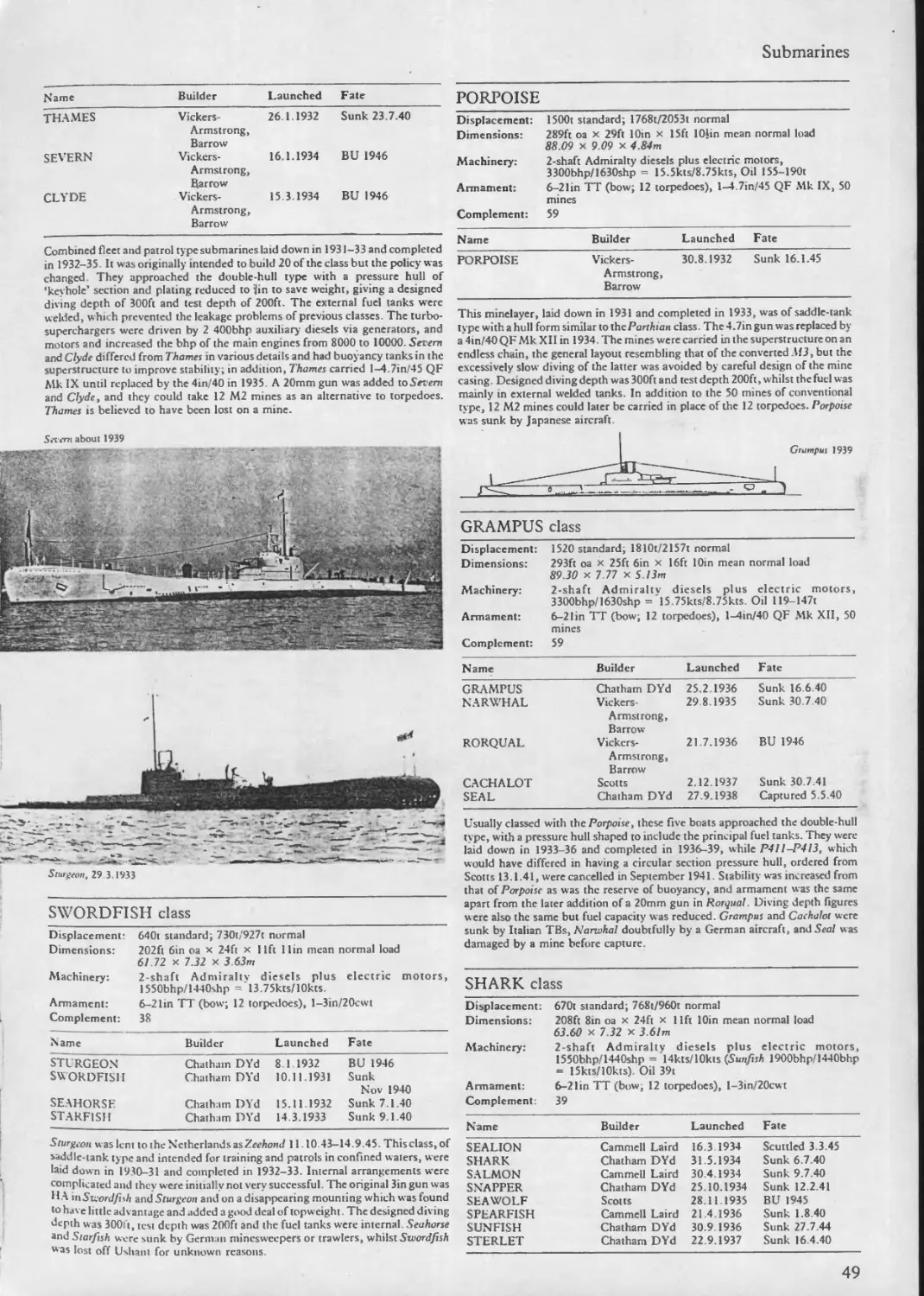
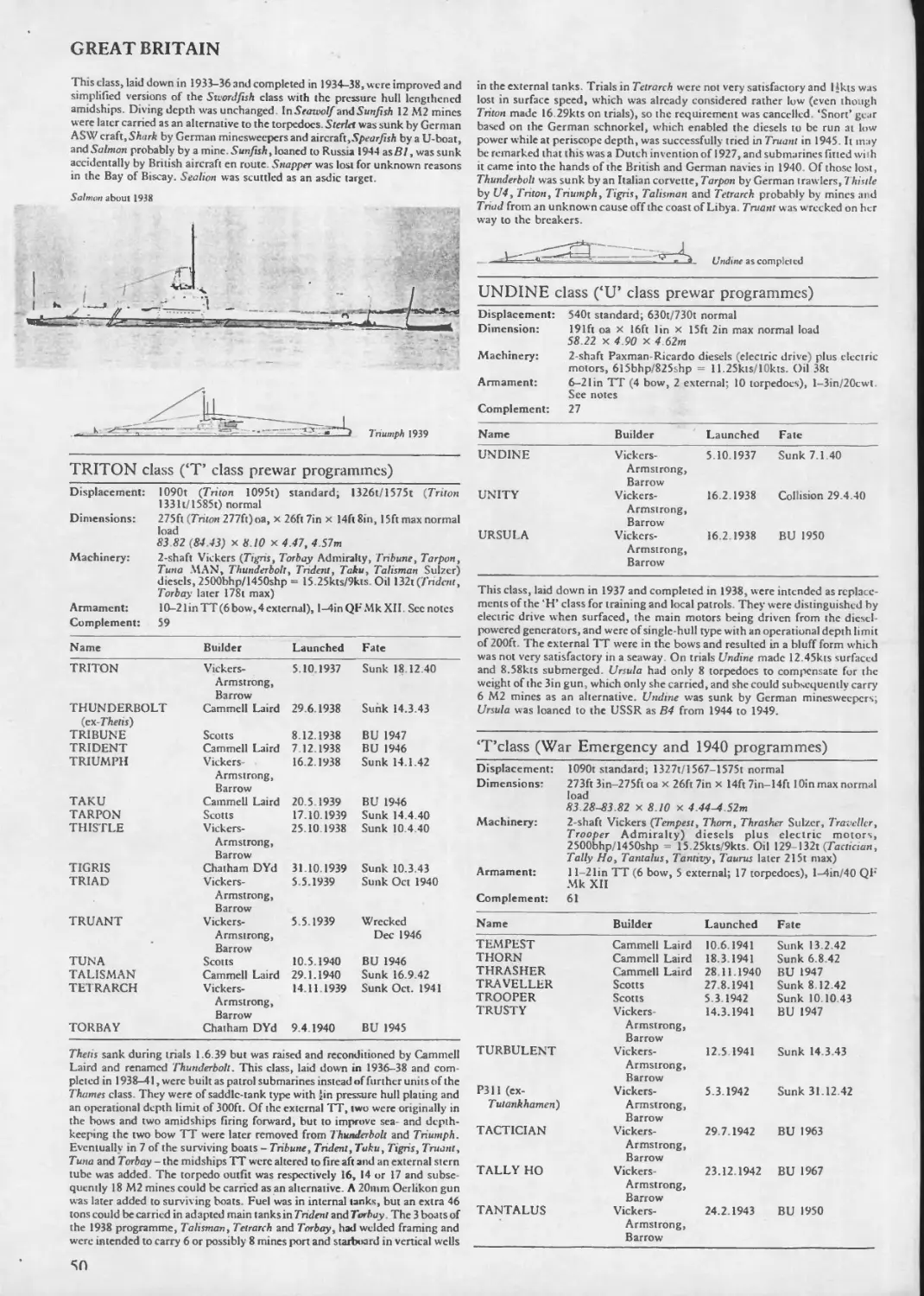
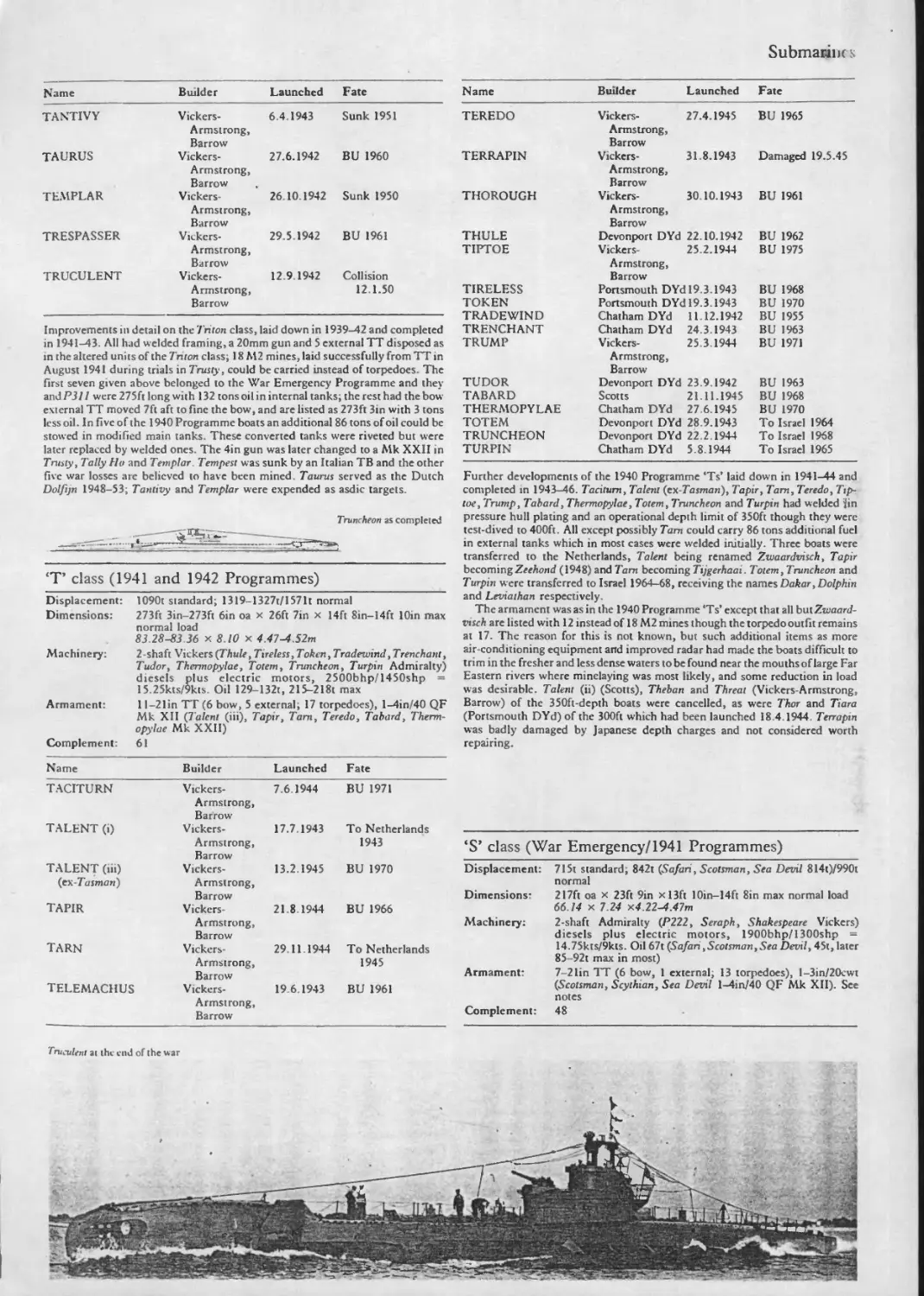
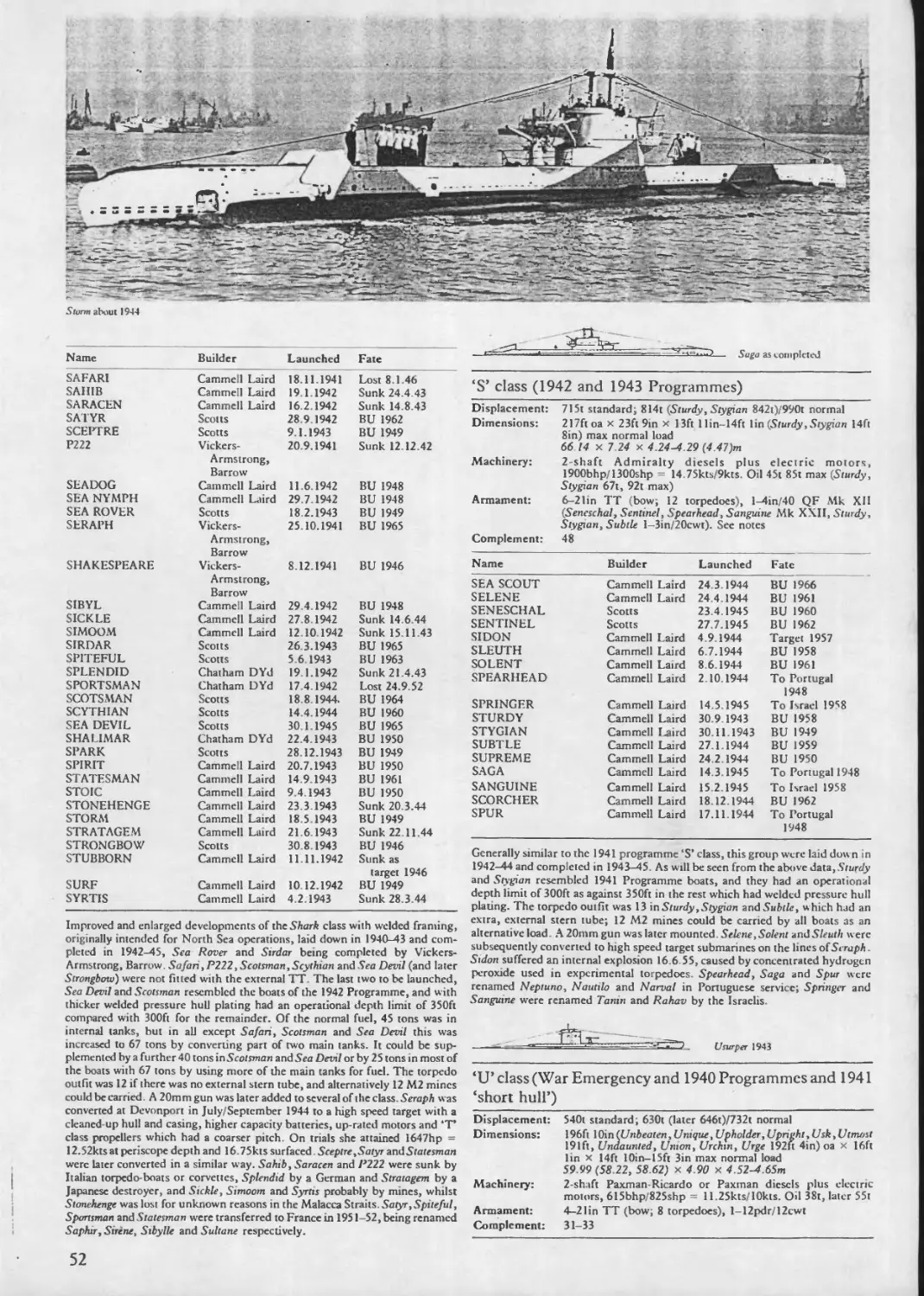





Текст
                    CONWAYS
ALL THE WORLD’S
FIGHTING
SHIPS
1922-1946
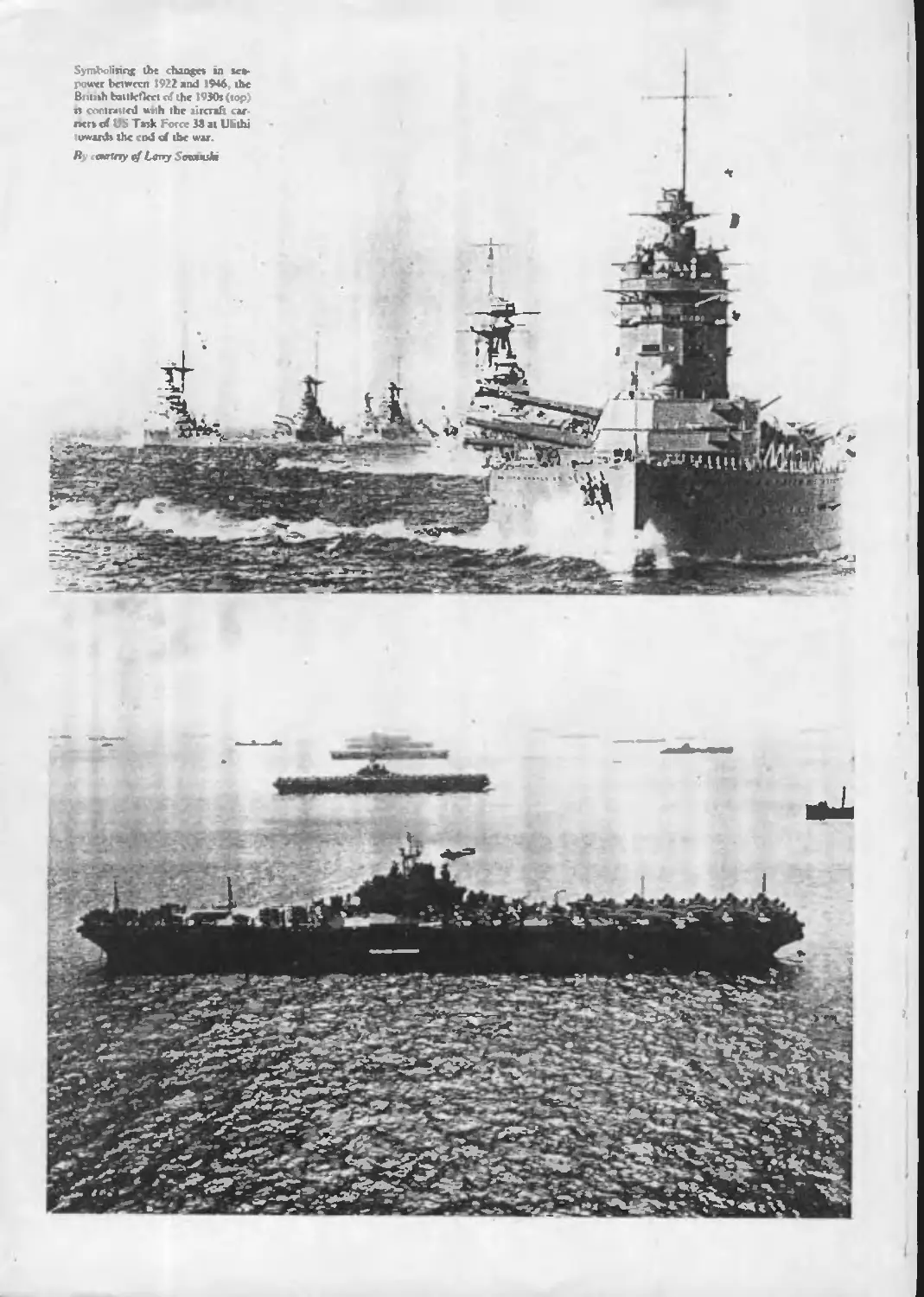
Symbolising the hinges in sc»*
power between 1922 and 946 the
Bfiiuh ba и к fleet of the 1930$ (top)
n cmninttcd with the sircnfi car
US Таз к Force 33 it USthj
lhe od of ibe wir.
Я «скгтпу rf Lorrf ScTMtuhi
CONWAYS
ALL THE WORLD S
FIGHTING
SHIPS
1922-1946
CONWAY MARITIME PRESS
Editorial Director
ROBERT GARDINER
Editor
ROGER CHESNEAU
PRZEMYStAW BUDZBON (Soviet Union, Poland)
N J M CAMPBELL (Great Britain)
NORMAN FRIEDMAN (United States of America)
OHN ROBERTS (Italy, Western Europe, the Mediterranean, the
Middle and Far East, and Minor Naval Forces, except Cuba, the
Dominican Republic and Ecuador)
ROBERT L SCHEINA (Latin America, including the Minor Naval
Forces excepted above)
ERWIN SIECHE (Germany)
IAN STURTON (Japan)
MAREK TWARDOWSKI (Eastern Europe, except Poland — in
association with Boris Lemachko)
KARL-ERIK WESTERLUND (Scandinavia)
I.ine drawings
By Przemyslaw Budzbon, Andrzej M Jaskuh, John Roberts, Adam
Smigielski and Marek Twardowski
Book design
By David Mills and Barry Kemp
F»*t published in 1980 by Conway Maritime Press Ltd,
101 Fleet Street, London EC4Y IDE
Reprinted 98 and 1992
ISBN 085177 146 7
© 1980 Conway Maritime Press Ltd
Printed and bound in the UK by
Page Bros (Norwich) Ltd
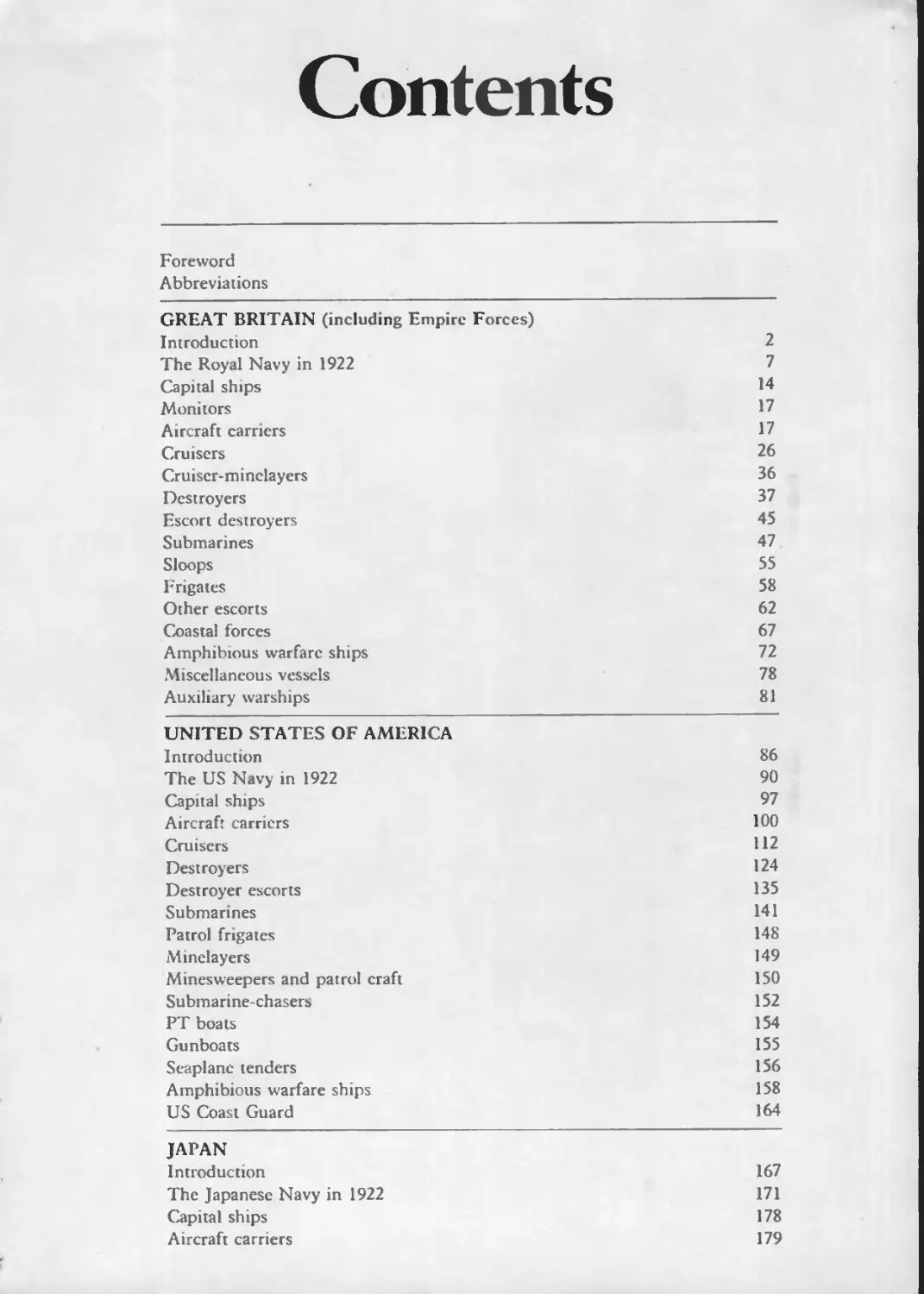
Contents
Foreword
Abbreviations
GREAT BRITAIN (including Empire Forces)
Introduction	2
The Royal Navy in 1922	7
Capital ships	14
Monitors	17
Aircraft carriers	17
Cruisers	26
Cruiser-minelayers	36
Destroyers	37
Escort destroyers	45
Submarines	47
Sloops	55
Frigates	58
Other escorts	62
Coastal forces	67
Amphibious warfare ships	72
Miscellaneous vessels	78
Auxiliary warships	81
UNITED STATES OF AMERICA
Introduction	86
The US Navy in 1922	90
Capital ships	97
Aircraft carriers	100
Cruisers	H2
Destroyers	124
Destroyer escorts	135
Submarines	141
Patrol frigates	148
Minelayers	149
Minesweepers and patrol craft	150
Submarine-chasers	152
PT boats	154
Gunboats	155
Seaplane tenders	156
Amphibious warfare ships	158
US Coast Guard	164
JAPAN
Introduction	167
The Japanese Navy in 1922	171
Capital ships	178
Aircraft carriers	179
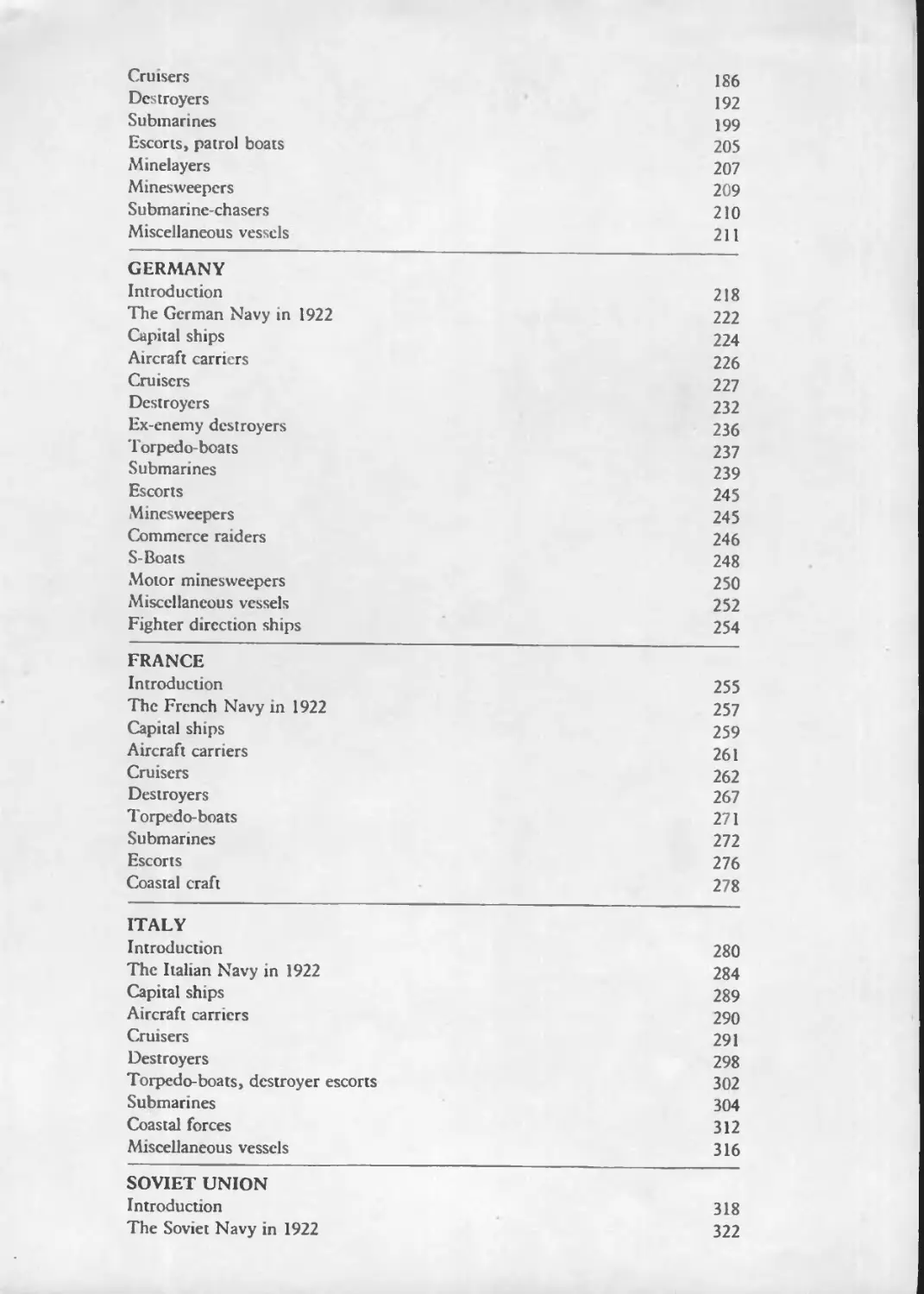
Cruisers	186
Destroyers	192
Submarines	199
Escorts, patrol boats	205
Minelayers	207
Minesweepers	209
Submarine-chasers	210
Miscellaneous vessels	211
GERMANY
Introduction	218
The German Navy in 1922	222
Capital ships	224
Aircraft carriers	226
Cruisers	227
Destroyers	232
Ex-enemy destroyers	236
Torpedo-boats	237
Submarines	239
Escorts	245
M nesweepers	245
Commerce raiders	246
S-Boats	248
Motor minesweepers	250
Miscellaneous vessels	252
Fighter direction ships	254
FRANCE
Introduction	255
The French Navy in 1922	257
Capital ships	259
Aircraft earners	261
Cruisers	262
Destroyers	267
Torpedo-boats	271
Submarines	272
Escorts	276
Coastal craft	278
ITALY
Introduction	280
The Italian Navy in 1922	284
Capital ships	289
Aircraft carriers	290
Cruisers	291
Destroyers	298
Torpedo-boats, destroyer escorts	302
Submarines	304
Coastal forces	312
Miscellaneous vessels	316
SOVIET UNION
Introduction
The Soviet Navy in 1922
318
322
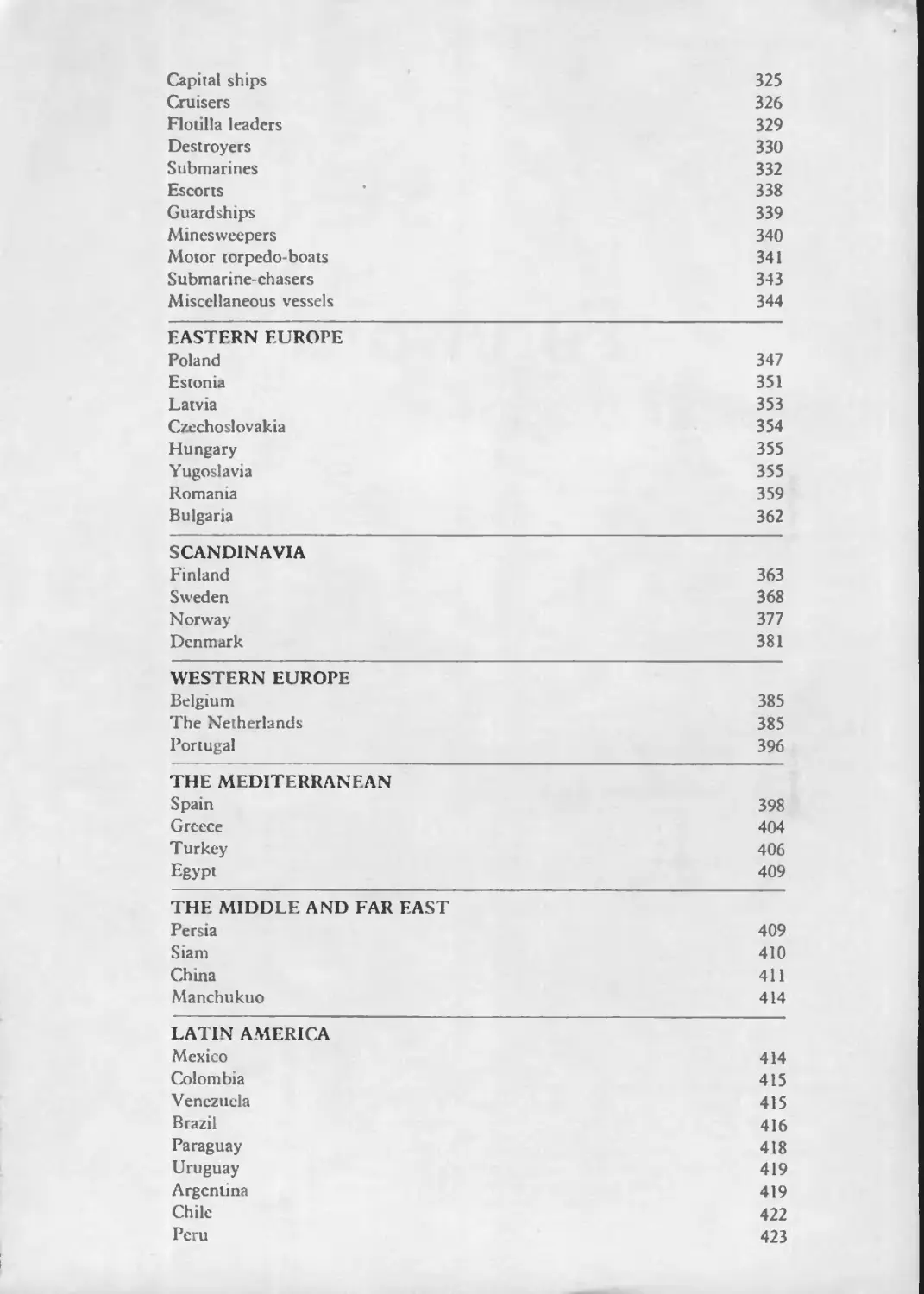
Capital ships	325
Cruisers	326
Flotilla leaders	329
Destroyers	330
Submarines	332
Escorts	338
Guardships	339
Minesweepers	340
Motor torpedo-boats	341
Submarine-chasers	343
Miscellaneous vessels	344
EASTERN EUROPE
Poland	347
Estonia	351
Latvia	353
Czechoslovakia	354
Hungary	355
Yugoslavia	355
Romania	359
Bulgaria	362
SCANDINAVIA
Finland	363
Sweden	368
Norway	377
Denmark	381
WESTERN EUROPE
Belgium	385
The Netherlands	385
Portugal	396
THE MEDITERRANEAN
Spain	398
Greece	404
T urkey	406
Egypt	409
THE MIDDLE AND FAR EAST
Persia	409
Siam	410
China	411
Manchukuo	414
LATIN AMERICA
Mexico	414
Colombia	415
Venezuela	415
Brazil	416
Paraguay	418
Uruguay	419
Argentina	419
Chile	422
Peru	423
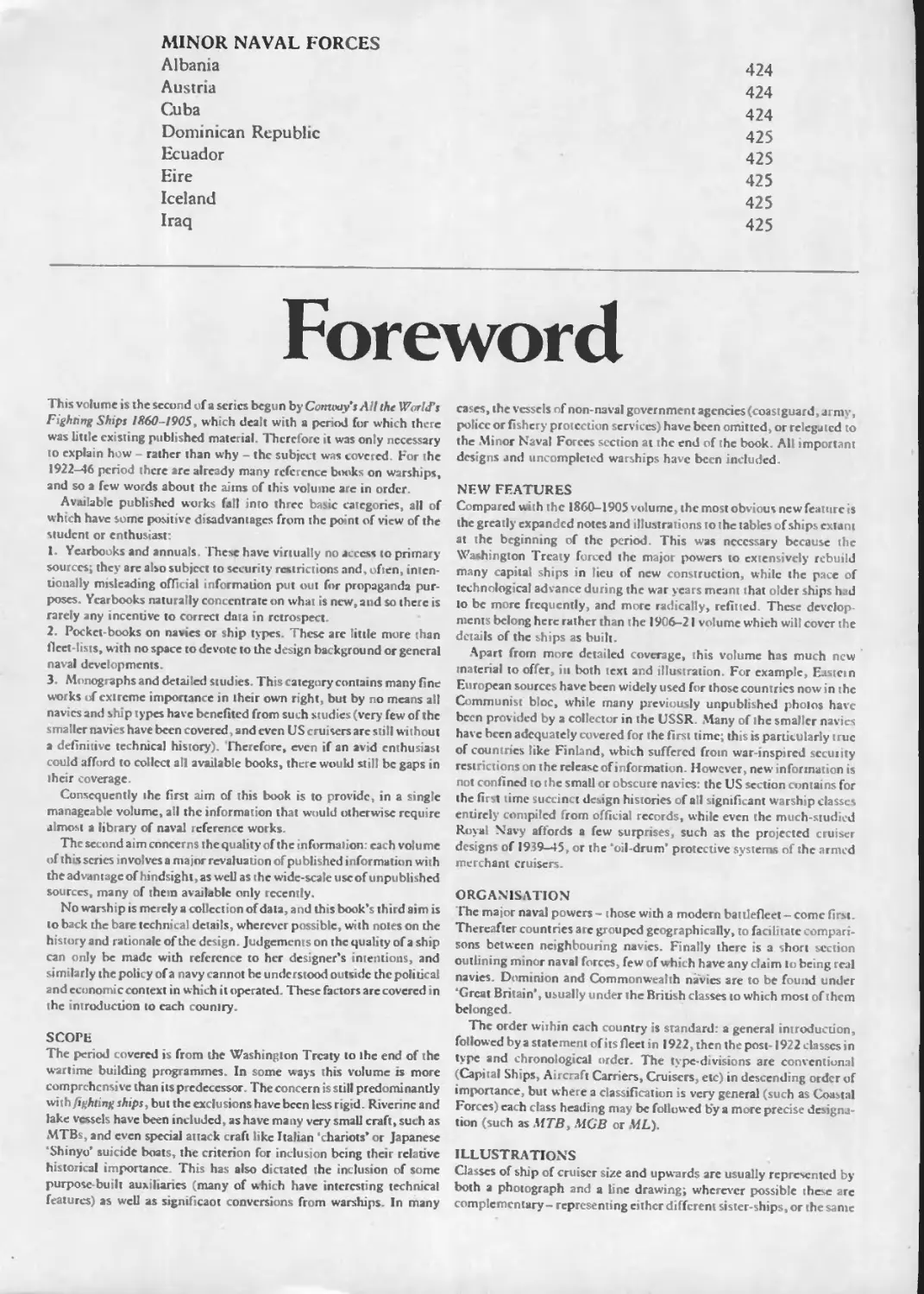
MINOR NAVAL FORCES
Albania
Austria
Cuba
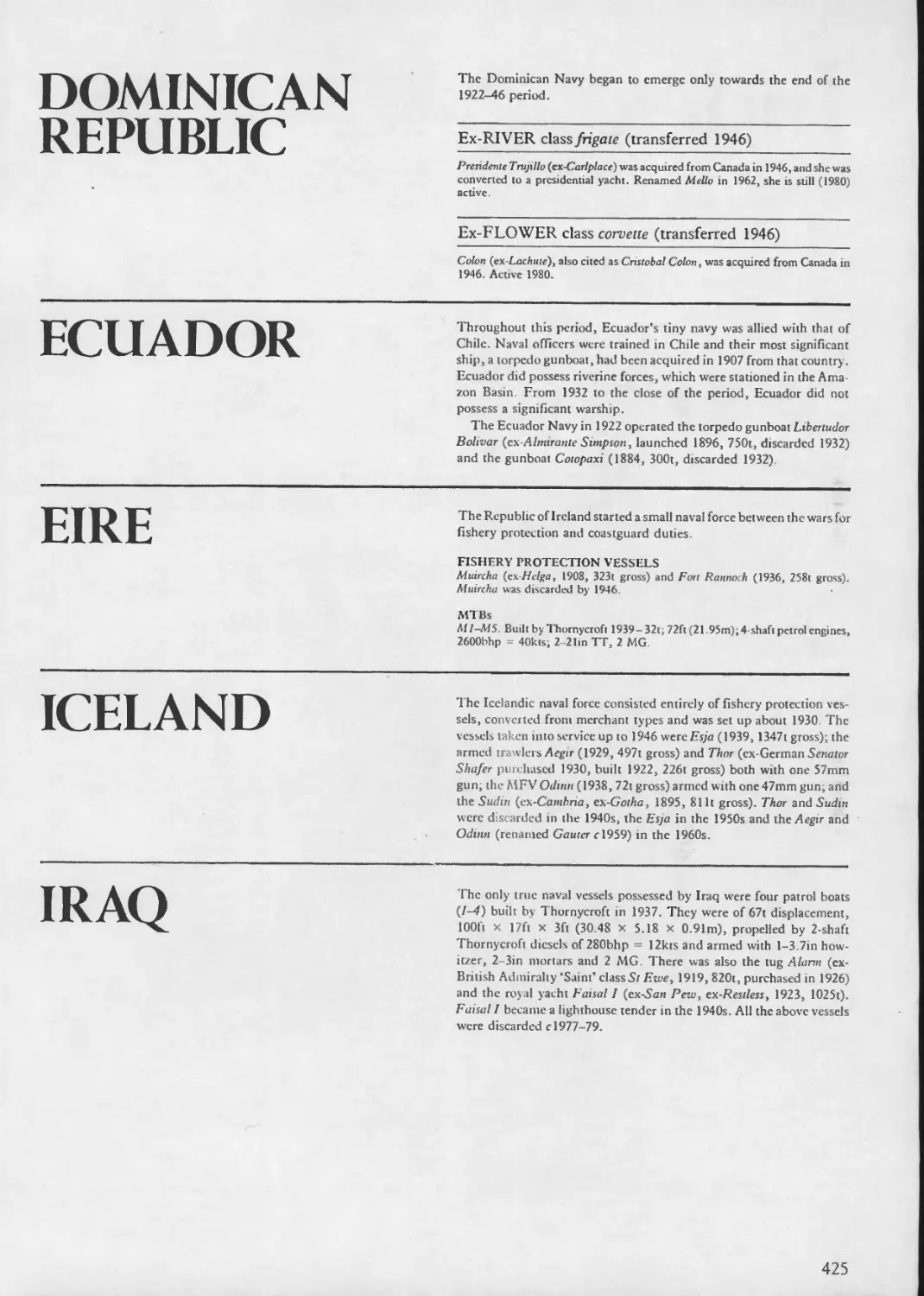
Dominican Republic
Ecuador
Eire
Iceland
Iraq
424
424
424
425
425
425
425
425
Foreword
This volume is the second of a series begun by Conway's All the World" j
Fighting Ships 1H6D-1905, which dealt with a period for which there
was little existing published material. Therefore it was only necessary
to explain how - rather than why - the subject was covered. For the
1922-46 period there are already many reference bix'ks on warships,
and so a few words about the aims of this volume are in order.
Available published works fall into three basic categories, all of
which have some positive disadvantages from the point of view of the
student or enthusiast
1	Yearbooks and annuals These have virtually no access to primary
sources; they are also subject to security restrictions and, often, inten-
tionally misleading official information put out for propaganda pur
poses. Yearbooks naturally concentrate on what is new, and so there is
rarely any incentive to correct data in retrospect.
2.	Pocket-books on navies or ship types. These are little more than
fleet-lists, with no space to devote to the design background or general
naval developments.
3.	Monographsand detailed studies. This category contains many fine
works of extreme importance m their own right, but by no means all
navies and ship types have benefited from such studies (very few of the
smaller navies have been covered, and even US cruisers are still without
a definitive technical history). Iherefore, even if an avid enthusiast
could afford to collect all available books, there would still be gaps in
their coverage.
Consequently ihe first aim of this book is to provide, in a single
manageable volume, all the information that would otherwise require
almost a library of naval reference works.
The second aim concerns the quality of the information: each volume
of this scries nvolves a major revaluation of published information with
the advantage of hindsight, as well as the wide-scale use of unpublished
sources, many of them available only recently.
No warship is merely a collection of data, and this book's third aim is
to back the bare technical details, wherever possible, with notes on the
history and rationale of the design. Judgements on the quality of a ship
can only be made with reference to her designer’s intentions, and
similarly the policy of a navy cannot be understood outside the political
and economic context in which it operated. These factors are covered in
the introduction to each country.
SCOPE
The period covered is from the Washington Treaty to the end of the
wartime building programmes In some ways this volume is more
comprehensive than ns predecessor The concern is still predominantly
with fighting ships, but the exclusions have been less rigid. Riverine and
lake vessels have been included, as have many very small craft, such as
MTBs, and even special attack craft like Italian chariots* or Japanese
‘Shinyo’ suicide boats, the criterion for inclusion being their relative
historical importance. This has also dictated the inclusion of some
purpose built auxiliaries (many of which have interesting techmeal
features) as well as significaot conversions from warships. In many
cases, the vessels of non-naval government agencies (coastguard, army,
police or fishery protection services) have been omitted, or relegated to
the Minor Naval Forces section at the end of the book All important
designs and uncompleted warships have been included.
NFW FEATURES
Compared with the 1860-1905 volume, the most obvious new feature is
the greatly expanded notes and illustrations to the tables of ships extant
at the beginning of the period. This was necessary because the
Washington Treaty forced the major powers to extensively rebuild
many capital ships in lieu of new construction, while the pace of
technological advance during the war years meant that older ships had
to be more frequently, and more radically, refitted. These develop-
ments belong here rather than the 1906-21 volume which will cover the
details of the ships as built
Apart from more detailed coverage, this volume has much new
material to offer, in both text and illustration. For example, Eastern
European sources have been widely used for those countries now in the
Communist bloc, while many previously unpublished photos have
been provided by a collector in the USSR Many of ihe smaller navies
have been adequately covered for the first time; this is particularly true
of countries like Finland, which suffered from war-inspired secuiity
restrictions on the release of information. However, new information is
not confined to the small or obscure navies: the US section contains for
the first time succinct design histones of all significant warship classes
entirely compiled from official records, while even the much-studied
Royal Navy affords a few surprises, such as the projected cruiser
designs of 1939-45, or the ‘oil-drum’ protective systems of the armed
merchant cruisers.
ORGANISATION
The major naval powers - those with a modern battlefleet - come first.
Thereafter countries are grouped geographically, to facilitate compari-
sons between neighbouring navies. Finally there is a short section
outlining minor naval forces, few of which have any claim to being real
navies Dominion and Commonwealth navies are to be found under
‘Great Britain*, usually under the British classes to which most of them
belonged
The order wiihin each country is standard: a general introduction,
followed by a statement of its fleet in 1922, then the post-1922 classes in
type and chronological order. The type-divisions are conventional
(Capital Ships, Aircraft Carriers, Cruisers, etc) in descending order of
importance, but where a classification is very general (such as Coastal
Forces) each class heading may be followed by a more precise designa-
tion (such as MTB, MGB or ML).
ILLUSTRATIONS
Classes of ship of cruiser size and upwards are usually represented by
both a photograph and a I nc drawing; wherever possible these are
complementary - representing either different sister-ships, or the same
ship before and after alterations. The emphasis on appearance changes
is earned into the captions for both types of illustrations which arc
dated whenever and as accurately as possible.
The line drawings, which were specially commissioned for this book,
are reproduced to 1/1250 scale, except for a few dearly marked as
1/1500 which would otherwise have been too large to print horizon-
tally Efforts have been made to obtain unpublished photos, but a clear
representative shot has been preferred over a poor but unique one.
ACKNOWLEDGEMENTS
For help with photographs we are indebted to the following individuals
and organisations. A D Baker III, Arngo Banlli C W Beilstein, John
Bowen, P Budzbon, the Danish Navy, Aid Fraccaroli, Jean Havel,
the Italian Navy, Boris Lcmachko, Jerzy Micinski, Bernard Millot, the
Ministry of Defence (London), Musee de la Manne (Paris), Jacques
Navarret, F C van Oosten of the Netherlands Navy Historical Branch,
Norman Polmar, Antoni Ratajczak, G von Rauch, John Roberts,
Robert L Scheina, Larry Sowinski, Lt Cdr Tamura, the US Coast
Guard, the US Navy, P A Vicary, Karl-Erik Westerlund and Wright &
Logan Photos arc credited after each capuon.all uncredited photos are
from the Conway Picture Library Colleen in.
NOTE
Any correspondence incorporating additions or modifications to the
information in this book should be directed to Conway Maritime Press
Ltd, 2 Nelson Road, London SEIO 9JB
Robert Gardiner
Abbreviations
АЛ, anti-aircraft
A AW, anti-aircraft warfare
ALW, Airborne Early Warning
AMGB, armoured motor gunboat
AP, armour-piercing
approx, approximately
Apr, April
AS, anti submarine
ASW, anti-submarine warfare
ATW, ahead-throwing weapon
Aug, August
aw, above waler
BOE, British destroyer escon
bhp, brake horsepower
Bl., breech-loading
BM, (including) breech mechanism
BPB, British Power Boats
bn, British registered tons
Bl H, British Thompson Houston
BU, broken up
r, circa
cal, calibre (usually expressed after
an oblique stroke following the
bone diameter, eg * 16in/43‘)
CIC, Combat Information Centre
C in C, Cominjndcr-in-Chief
cin, centime! rc(s)
CMB, coastal motor boat
CNO, Chief of Naval Operations
Co, (iompany
comm, commissioned
comp, completed
conv converted
Corp Corporation
erh, calibre radius head
CT, conning tower
CTL, construe live total loss
cu, cubic
cwt, hundredweight
cyl, cylindrical (of boilcis);
cylinders) (of engines)
DC, depth charges)
DCT, depth-charge thrower
DE, destroyer escort
Dec December
disp, displacement. Note that for
submarines, two figures
separated by an oblique stroke
indicate surface/submetgcd
values; this system applies also to
figures for range (endurance) and
speed
DNC, Director of Nasal
Construction
DP, dual-purpose
DYd, Dockyard
EEC, English Electric Company
F, Fahrenheii
Feb, February
FNFL, Forces Nationales
Francises Libres (Free French
Forces)
FRAM, Fleet Rehabilitation and
Modernisation
fs, feet per second
fl, fool; feet
FY, Fiscal Year
gal, gatlon(s)
GM, meiacentric height (distance
between G, or centre of gravity,
and M metacentre)
GMSA, German Minesweeping
Administrauon
grt gross registered Ions
HA, high-angle
HDML, harbour defence motor
launch
HM, Hts/Hcr Majesty’s
HMS, Hts/Hcr Majesty's Ship
hp, horsepower
HP, high pressure
HQ, headquarters
I, Island
ihp, indicated horsepower
in,inch(es)
inc, including
Jan,January
JMSDF, Japanese Marit me
Self Defence Force
КС, Krupp Cemented
kg, kilogratn(s)
kt(s), knots
kW, kilowatts
LA, low-angle
lb, pound(s)
LCA, Landing Craft, Assault
LCF, Landing Craft, Flak
LCG, Landing Craft, Gun
LCG(L), Landing Craft Gun
(Large)
LCG(M), Landing Craft, Gun
(Medium)
LC!(G), Landing Craft, Infantry
(Gun)
LCI(L), Landing Craft, Infantry
(Large)
LCI(S), Landing Craft, Infantry
(Small)
LCM, Landing Craft, Mechanical
LCP, Landing Craft, Personnel
LCP(R), Landing Craft, Personnel
(Rocket)
I CS, Landing Craft, Support
LCS(L), Landing Craft, Support
(I argc)
LCS(M), Landing Craft, Support
(Medium)
LCS(S), Landing Craft, Support
(Small)
I CT, Landing Craft, Tank
LCT R) Landing Craft Tank
(Rocket)
LCV, Landing Craft, Vehicle
LCV(P), Landing Craft, Vehicle
(Personnel)
LP, low pressure
I.SC, Landing Ship, Carrier
LSF, I anding Ship, Ftgh er
Direction
LSD, Landing Ship, Dock
I.SG, landing Ship, Gantry
LSH(L), Landing Ship,
Headquarters (1-arge)
LSI, Landing Ship, Infantry
I.SI(H), I anding Ship, Infantry
(Hard)
LSI(L), Landing Ship, Infantry
(Large)
IJSl(M), Landin Ship, Infantry
(Medium)
1Л! S) Landing Ship, Infantry
(Small)
LSM, Landing Ship, Medium
I SS, I.anding Ship, Stern Chute
1ST, Landing Ship Tank
l.SV, Landing Ship, Vehicle
m, metre(s)
Mar, March
МА/SB, motor anti-submarine
boat
max, maximum
MG, machine gun(s)
MGB, motor gunboat
Mk, Mark
ML, motor launcft
mm, millimclrc(s) Note that
calibres etc usually expressed as
centimetres have for convenience
all been given in millimetres
MMS, motor minesweeper
Mod, Model
MT, military transport
MTB, motor torpedo-boat
nm, nautical miles
No(s), Number(s)
Nov, November
N Yd, Navy Yard
oa, overall
Oct, October
pdr, pounderfs)
pp between perpendiculars
psi. pounds per square inch
QF, quick-firing
RAN, Royal Australian Navy
RCMP, Royal Canadian Mounted
Police
RCN Royal Canadian Navy
RIM, Royal Ind an Manne
RIN, Royal Indian Navy
RN, Royal Navy
RNVR, Royal Naval Volunteer
Reserve
RNZN, Royal New Zealand Navy
RPC, Remote Power Control
rpg, rounds per gun
S South
SAN, South African Navy
SAP, semi-armour-piercing
SB, Shipbuilders, Shipbuilding
SE, single-ended
Sept, September
shp, shaft horsepower
SNO, Senior Naval Officer
sq,square
STAAG, Stabil sed Tachymcttic
Anti-Aircraft Gun
std, standard
STS, Special Tensile Steel
sub, submerged
I, ton(s). Long tons are used
throughout.
ТВ, torpedo-boat
ТЕ, triple expansion
TNT, trinitrotoluene
TS, training ship
TT, torpedo tube(s)
UDT, Underwater D moltuon
Team
U.S, United States
USCG, United States Coast Guard
USCGC, United States Coast
Guard Cutter
USA, United States of America
USN, United States Navy
USS United States Ship
USSR, Union of Soviet Socialist
Republics
VC, vertical compound
VT, variable time (proximity)
VTE, vertical triple expansion
W, West
Wks, Works
wl, waterline
yd(s), yard's)
Great Britain
AND EMPIRE FORCES
THE EFFECTS OF THE WASHINGTON TREATY
Although the British Empire had reached its greatest extent by about
1920, Great Britain was still exhausted and impoverished by the
1914-18 War and heavily in debt to the United States, which had
become the most powerful industrial and financial country in the
world In these circumstances the acceptance of naval parity with the
USA was clearly a correct decision Nor were ihe limitations of ships*
individual displacements under ihe Washington Treaty undesirable,
namely 35,000 tons standard for capital ships, 27,000 ions for aircraft
carriers (two could be 33,000 tons), 10,000 tons for other war vessels,
the calibre of guns being limited at I6in for capital ships and 8in for
others with some limitations on the number of guns exceeding 6in in
aircraft earners. Britain was allowed to build two new battleships,
.Xe/son and Rodney - which, if much reduced from the cancelled
48,000-ton battlecruisers, were at least the most powerful in the world
for over a decade-and retained 18 battleships and 4 battlecruisers until
the new ships were completed, at which tunc 4 battleships would be
scrapped The life of capital ships was fixed at 20 years, and no further
new ships of this type were to be laid down by Britain, USA or Japan
until November 1931 II was permuted to add 3000 tons of bulges
and/or extra deck protection to existing ships and to complete the
re-armouring of Renown. The total capital ship replacement tonnage
was fixed al 525,000 tons standard displacement (no fuel or reserve feed
waler but otherwise fully armed and equipped) for Britain and the
L'SA, 315,000 tons for Japan and 175,000 tons for France and Italy. As
there were few existing aircraft carriers, total tonnage was fixed at
135,000,81,000 and 60,000 tons respectively. The Washington Treaty
was to remain in force until the end of 1936 One perhaps unforeseen
consequence of this Treaty was rivalry in 10,000-ton 8in cruisers, a type
which might otherwise have been uncommon. It should be stated that
Britain and the USA (with the possible excepuon of the Lexington and
Saratoga), always complied scrupulously wiih Treaty limits of dis-
placement but Japan, Italy and later Germany did not.
In international relations and diplomacy the 1920s and early 1930s
might be called the period of the League of Nations, under the Coven-
ant of which an international dispute should be settled by negotiation
and arbitration, and if that failed by collective economic sanctions and
ultimately by collective military action against the aggressor. Unfortu-
nately ihe League was crippled from the start by the United Slates’
refusal to join, and in reality any action against an aggressor outside
Europe would mean action by the Royal Navy probably on its own The
League was also pledged to general progressive disarmament, and its
aims, which had great popular support in Britain, were irreproachable
in an ideal world of countries ruled by pacific and well-intentioned
men In the 1930s, when the Japanese militaristsand Adolf Hitler took
control and Mussohm became aggressive, there was in Britain a
numerous, highly vocal body of opinion which clamoured for action in
support of the League, together with opposition to any attempt to build
up British naval forces - a dichotomy in which logic was absent.
It would seem that throughout the 1920s and early 1930s economic
factors would have been just as effective as treaties in limiting the
replacement of obsolescent British ships, and it is interesting to note
that one of the most persistent and savage attacks on the Naval Esti-
mates by a Chancellor of the Exchequer was that by Winston Churchill
on those of 1925-26 A potent means of financial restriction was the
Ten Year Rule originated in August 1919 to the effect that no great war
in which the British Empire would be engaged need be expected for the
next ten years. This became automatically self-perpetuating in 1929
and was not finally cancelled until November 1933 During this period
British naval strength was assessed as that necessary to defeat the
Japanese fleet in the Western Pacific, but the development of Hong
Kong was prohibited under the Washington Treaty, and t was decided
in 1923 that a new naval base should be constructed on the Johore
Strait, Singapore. Work progressed slowly and was suspended by the
Labour Governments of 1924 and 1929-31, but when war came there
was a base with possibly adequate coast defence batteries against attack
from the south, although the problem of providing sulficient air and
land defences against an overland attack from the north was never
solved which, with persistent underestimates of Japanese efficiency,
led to the disasters of 1941-42.
In 1922-23 the net naval estimates were just under £65 million, but
from 1923-24 to 1929-30 they were between £56 and 58 million except
in 1925-26 at £60 5 million, the average number borne being about
100,000 The building programmes which escaped cancellation were
not large, as shown by the following:
1922-23 2 battleships, 1 minelayer
1923-24 I submarine
1924-25	5	8in	cruisers,	2 destroyers
1925-26	4	8in	cruisers
1926-27	3	8in	cruisers,	6 submarines
1927-28	1	Sin	cruisers,	9 destroyers,	6 submarines, 2 sloops
1928-29 9 destroyers, 4 submarines, 4 sloops
1929-30 1 6in cruiser, 5 desiroyers, 3 submarines, 4 sloops
THE LONDON NAVAL CONFERENCE
The Wail Street crash of 1929 was the forerunner of world-wide depres-
sion and financial crisis, and the London Naval Conference of 1930 w as
able lo achieve further limitations in naval strength. An attempt by
Britain to reduce capital ship limits to 25,000 tons and I2in guns failed,
but it was agreed not to lay down any replacemen* ships until 1937 and
to reduce existing numbers to 15 for Britain and LSA and 9 for Japan.
Aircraft carrier limits were unchanged except for the inclusion of
vessels under 10,000 tons, which were nol so considered under the
Washington Treaty. Cruisers were divided into ships with guns of over
6 lin and those with 6.1in or less, and the old staff requirement of a
total of 70 cruisers for the British Empire was reduced to 50. The
United States’ preference for 8in cruisers was recognised and the quota
of tonnage for the larger cruisers agreed-as USA 180,000, Great Britain
146,800 and Japan 108,400, with 143,500,192,200 and 100,450 for the
smaller type. It was permissible to build 10,000-ton cruisers with 6.lin
guns if desired. Destroyer quotas were 150,000 tons for Britain and
USA and 105 OOOf r Japan, with individual limits of 1500 tons and Sin
guns, though 16 per cent of the quota might be 1850 tons. For sub-
marines the quotas were 52,700 tons for Britain, the USA and Japan,
w ith limits of 2000 tons and 5. hn guns although three vessels might be
up to 2800 tons with 6. lin guns. Neither France nor Italy agreed to this
2
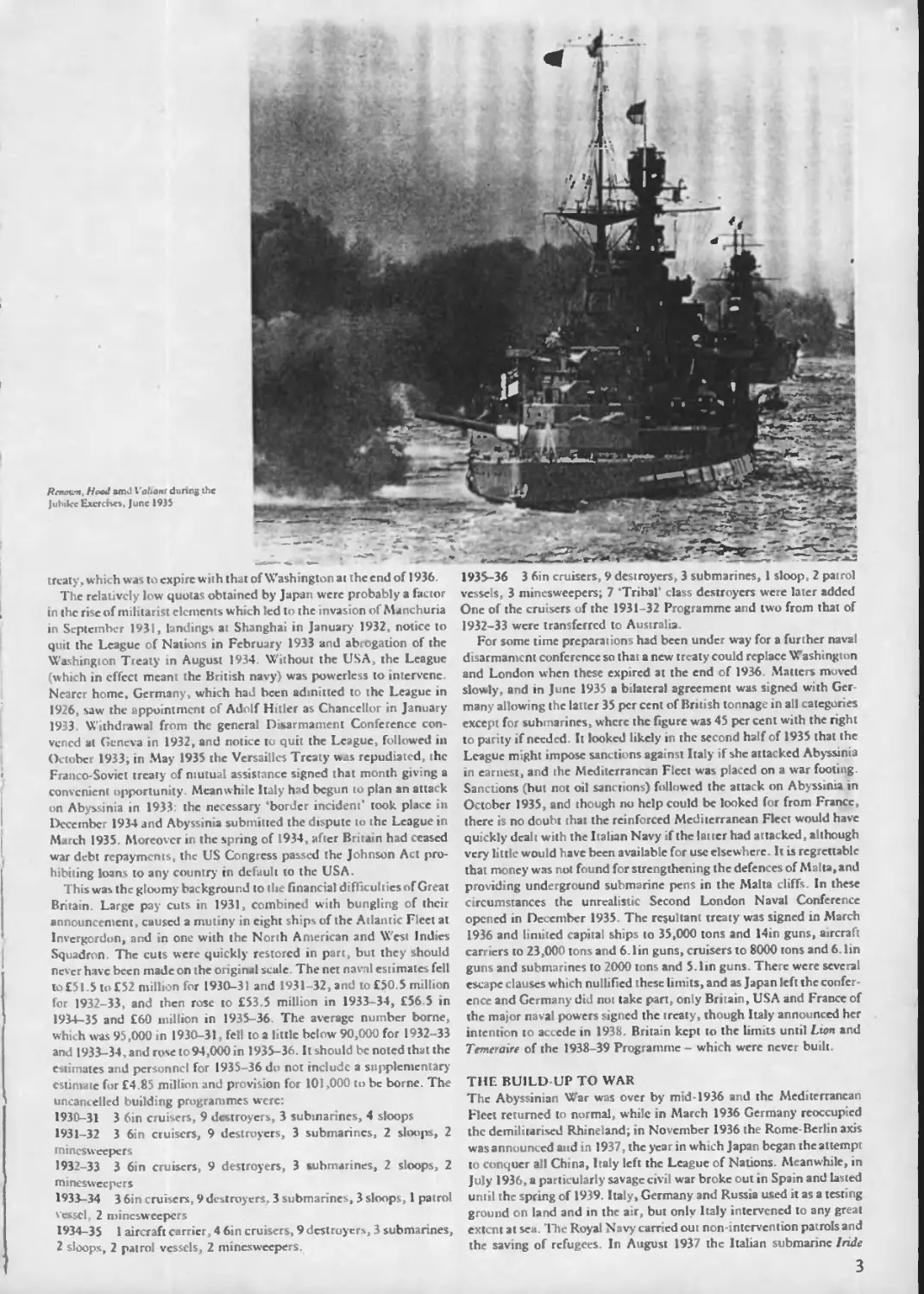
Длчтх'Яо Hood amJ I1'ahant during the
Jubilee Excrche*, June 1935
treaty, which was to expire with that of Washington at the end of 1936.
The relatively low quotas obtained by Japan were probably a factor
tn the rise of m 1 tarist elements which led to the nvasion of Manchuria
in September 1931, landings at Shanghai in January 1932, notice to
quit the League of Nations in February 1933 and abrogation of the
Washington Treaty tn August 1934. Without the USA, the League
(which in effect meant the British navy) was powerless to intervene
Nearer home. Germany, which had been admitted to the League in
1926, saw the appointment of Adolf Hitler as Chancellor in January
1933. Withdrawal from the general Disarmament Conference con-
vened at Geneva in 1932, and notice to quit the League, followed in
October 1933, tn May 1935 the Versailles Treaty was repudiated, the
Franco-Soviet treaty of mutual assistance signed that month giving a
convenient opportunity Meanwhile Italy had begun to plan an attack
on Abyssinia in 1933’ the necessary ‘border incident' took place in
December 1934 and Abyssinia submitted the dispute to the League in
March 1935 Moreover in the spring of 1934, after Britain had ceased
war debt repayments, the US Congress passed the Johnson Act pro-
hibiting loans to any country in default to the USA
This was the gloomy background to the financial difficulties of Great
Britain. Large pay cuts in 1931, combined with bungling of their
announcement, caused a mutiny in eight ships of the Atlantic Fleet at
Invergordon, and in one with the North American and West Indies
Squadron The cuts were quickly restored in part, but they should
never have been made on the original scale. The net naval estimates fell
to£5l.5to£52 million for 1930-31 and 1931-32,and to £50.5million
for 1932-33, and then rose to £53.5 million in 1933-34, £56 5 in
1934-35 and £60 million in 1935-36 The average number borne,
which was 95,000 in 1930-31, fell to a little below 90,000 for 1932-33
and 1933-34, and rose to 94,000 in 1935-36. It should be noted that the
estimates and personnel for 1935-36 do not include a supplementary
estimate for £4 85 million and provision for 101 >000 to be borne. The
uncancelled building programmes were:
1930-31 3 6in cruisers, 9 destroyers, 3 submarines, 4 sloops
1931-32 3 6in cruisers, 9 destroyers, 3 submarines, 2 sloops, 2
minesweepers
1932-33 3 6t n cruisers, 9 destroyers, 3 submarines, 2 sloops, 2
minesweepers
1933-34 3 6in cruisers, 9 destroyers. 3 submarines, 3 sloops, 1 patrol
vessel, 2 minesweepers
1934-35 1 aircraft carrier, 4 6in cruisers, 9 destroyers, 3 submarines,
2 sloops, 2 patrol vessels, 2 minesweepers.
1935-36 3 6in cruisers, 9 destroyers, 3 submarines, 1 sloop, 2 patrol
vessels, 3 minesweepers; 7 ‘Tribal’ class destroyers were later added
One of the cruisers of the 1931-32 Programme and two from that of
1932-33 were transferred to Australia
For some time preparations had been under way for a further naval
disarmament conference so that a new treaty could replace Washington
and London when these expired at the end of 1936 Matters moved
slowly, and tn June 1935 a bilateral agreement was signed with Ger
many allowing the latter 35 per cent of British tonnage in all categories
except for submarines, where the figure was 45 per cent with the right
to parity if needed. It looked likely in the second half of 1935 that the
League m ght impose sanctions against Italy if she attacked Abyssinia
in earnest, and the Mediterranean Fleet was placed on a war footing.
Sanctions (but not oil sanctions) followed the attack on Abyssinia in
October 1935, and though no help could be looked for from France,
there is no doubt that the reinforced Mediterranean Fleet would have
quickly dealt with the Italian Navy if the latter had attacked, although
very little would have been available for use elsewhere. It is regrettable
that money was not found for strengthening the defences of Malta, and
providing underground submarine pens in the Malta cliffs. In these
circumstances the unrealistic Second London Naval Conference
opened in December 1935. The resultant treaty was signed in March
1936 and limited capital ships to 35,000 tons and 14in guns, aircraft
carriers to 23,000 tons and 6.1in guns, cruisers to 8000 tons and 6. lin
guns and submarines to 2000 tons and 5. lin guns There were several
escape clauses which nullified these limits, and as Japan left the confer-
ence and Germany did not take pan, only Britain, USA and France of
the major naval powers signed the treaty, though Italy announced her
intention to accede in 1938. Britain kept to the limits until Lion and
Temeraire of the 1938-39 Programme - which were never built.
THE BUILD UP TO WAR
The Abyssinian War was over by mid-1936 and the Mediterranean
Fleet returned to normal, while in March 1936 Germany reoccupied
the demilitarised Rhineland; in November 1936 the Rome-Berlin axis
was announced and in 1937, the year tn which Japan began the attempt
to conquer all China, Italy left the League of Nations Meanwhile, in
July 1936, a particularly savage civil war broke out in Spain and lasted
until the spring of 1939. Italy, Germany and Russia used it as a testing
ground on land and in the air, but only Italy intervened to any great
extent at sea. "Die Royal Navy carried out non intervention patrols and
the saving of refugees. In August 1937 the Italian submarine Inde
3
GREAT BRITAIN
narrowly m ssed the destroyer Havock with a torpedo. Asdic contact
was obtained but not held, and a deliberate attack fa led to sink the
I ride. It is a pity that this did not lead to the excessive confidence in
asdic being questioned. Improbable as it seemed, Franco’s victory was
the best possible result for Britain as he was clever enough to avoid
entering the Second World War on the German side and the great
danger of a Marxist Spain was avoided. It is not necessary Io relate the
story of the Munich Agreement, the breaking up of Czechoslovakia,
the guarantee given to Poland by Britain, the Russo German pact and
the other events which preceded the outbreak of the Second World
War; it must be noted however that although relations between the
British and US Navies were generally excellent and far better than in
the 1920s, the various Neutrality Acts would have made the wartime
purchase of arms very difficult, and it was not until November 1939
that these were repealed in so far that war maidriei could be bought for
cash and transported in British ships.
Although Bnta n was now committed to re-armament, the Treasury
continued to restrict naval expenditure, and the estimates for 1936-37
were only £70 million though increased by supplementaries to £81
million. In 1937-38 they were £78 million, with a further £27 million
from the Defence Loans Act of 1937 which provided for up to £400
million from the Consolidated bund being spent on the Navy to the end
of 1941-42. In 1938-39 the estimates were £96 million, including
supplementaries with £30 million from the Defence Loans Act, while
for 1939-40 these figures were £69 5 and £80 million, with a further
£28.5 million from the £500 million Vote of Credit provided two days
before war broke out. The average number borne rose from 100,000 in
1936-37 to 107 000 in 1937-38, 118,000 in 1938-39 and 161,000 in
1939-40.
The build ng programmes were as follows (as previously, only ships
actually completed are included):
1936-37 2 battleships, 2 aircraft carriers, 2 6in cruisers, 5 5.25in
cruisers, 18 destroyers, 8 submarines, 2 sloops, 1 patrol vessel, 3
minesweepers
1937-38 3 battleships, 2 aircraft carriers, 5 6in cruisers, 2 5.25in
cruisers, 15 destroyers, 7 submarines, 3 sloops, 3 patrol vessels, 4
minesweepers
1938-39 1 aircraft carrier, 4 6in cruisers, 3 5 25in cruisers, 3 fast
minelayers, 3 submarines; also I aircraft maintenance ship, later light
fleet carrier
1939-40 (excluding First War Emergency Programme) 1 aircraft
carrier, 2 6in cruisers, 1 fast m nelayer, 16 destroyers 20 escort des-
troyers, 2 sloops, 56 corvettes, 20 minesweepers
The battleships of the 1938-39 and 1939-40 Programmes, 2 in
each year, were never built. Although much larger than previous pro-
grammes, the above were considerably smaller than was desirable as
the dreaded prospect of having to fight Japan, Italy and Germany at the
same time gradually became more real
Certain problems were oeglected in the years of peace, largely due to
over-strict financial control Oil and ammunition eserves were allowed
to run down, as was manufacturing capacity for guns and armour plate,
tn particular design facilities for new gun mountings. The problems of
trade defence and the special vessels necessary such as small escort
aircraft carriers, were neglected, though other escorts began to be
provided in the 1939-40 Programme. As previously mentioned, much
should have been done to improve Malta. Little had been done to
modernise Rosy th, placed at 12 months* notice in 1928, and the
defences of Scapa Flow were entirely inadequate Rights Io use Bere-
haven, Queenstown and Lough Swilly in the Irish Free State were
abandoned in April 1938, though there was no great pressure to do so.
It was never possible to have an integrated Imperial naval defence as the
Dominions were jealous of their autonomy, and though Australia had 2
8in cruisers btu t in the 1920s (to which 3 modern 6in ships originally
built for Bnta n were added, as well as various other vessels) and New
Zealand maintained 2 6in cruisers, Canada and South Afnca would do
very little.
All these omissions were secondary to the failure to provide adequate
naval aircraft. The Fleet Air Arm suffered badly under the divided
control of the Navy and Air Force, and was a favourite target for
Treasury cuts. Britain fell far behind the USA and latterly also Japan tn
numbers and quality of aircraft, and though naval control was restored
in 1937-38 there was a senous shortage of trained personnel, in addi-
tion, the tvpcs of aircraft which the Royal Navy required were often
unsatisfactory, and there was little realisation of the importance of
single-scat fighters, the tendency be ng to burden such aircraft with an
observer. Shore-based aircraft intended for operations over the sea
remained an RAF responsibility
Completed ships in the navies of the British Empire at the outbreak
of the Second World War comprised 12 battleships, 3 battlecruisers, 7
aircraft carriers, 15 Sin cruisers, 22 modern 6in cruisers, 27 older
cruisers, 2 monitors, I minelayer, 184 destroyers, 57 submarines, 32
sloops, 6 patrol vessels and 47 minesweepers (a few older sloops and
patrol vessels are excluded). Of ships over 10,000 tons standard, only 2
battleships and 1 aircraft carrier had been laid down since the First
World War.
WORLD WAR II
It ts not intended to describe here the naval operations of the Second
World War. Fortunately, the British army was thrown out of France in
1940 and Britain was able to fight a traditional maritime war instead of
the continental land war of 1914-18. After the USA had been brought
in by the Japanese attack of December 1941, the Allies were able to plan
and carry out a joint return to Europe where and when this was most
advantageous. On the whole, the Royal Navy was able to deal effec-
tively with those of Germany and Italy from 1939 t 1941, without
France from m d 1940 onwards By far the most dangerous part of
these enemies’ naval forces were the German U-boats and aircraft, but
the real menace of naval aircraft was not shown until the Japanese
attacks of 1941. Although in November 1939 Churchill as First Lord
promised Australia and New Zealand that if it came to the choice the
Far East would be given priority uver the Mediterranean, there was no
chance of this being made effective As it turned out the USA was able
to protect Australia and New Zealand, and after the great American
victory at Midway in June 1942, the Japanese naval menace assumed
manageable proportions. The lust great naval danger was the U-boat
campaign of 1942 and the first 5 months of 1943, which also ended in a
great victory, but for Britain and America jointly.
Opinions will always vary as to whether the Royal Navy obtained its
fair share of the war effort. Excessive precautions were taken against
invasion long after it had ceased to be practicable for Germany, and
there were seldom if ever enough carrier- or shore-based naval aircraft.
From 1939 to 1941 Britain was also wasteful of her scarce naval
resources. The important aircraft carticrsCourageous andGlorious were
virtually ihrown away, attempts were made to intervene at too many
places in Norway, the futile Dakar expedition should never have
occurred, and the sending of troops to mainland Greece should have
been replaced by firmly establishing forces in Crete. Subsequently it is
doubtful if too much effort was not spent on sending supplies to North
Russia and even as late as the autumn of 1943 operations in the Aegean
were continued in the absence of air cover, by that time obvious to
anyone as an essential A vital lesson which emerges from the war, and
confirms that of the First World VC ar, is that merchant shipping must
be convoyed. Though seldom expressed in this way, the advantages
were very simple: the convoy is live bait and attracts the submarine
quarry to the killer ships and aircraft of the convoy escort.
The total of the officers and men of the Royal Navy and Royal
•Marines reached 778 000 at the end of June 1944 with 73,500 Wrens
and 12,000 Merchant Navy personnel under special agreements. Even
so, there were so many of the smaller and auxiliary warships that it was
difficult to man some of the larger vessels.
Wartime building programmes concentrated on smaller ships, and
some of the battleships and aircraft carriers of the prewar programmes
were delayed in completion, most unfortunately in the case of the
latter. A very large and somewhat unrealistic programme of aircraft
carriers was planned after the early Japanese successes, but the largest
carriers were never built and the others were reduced in number.
Details of the various programmes, comprising only ships eventually
completed, were:
War Emergency 6 5.25in cruisers, 16 destroyers, 36 escort des-
troyers, 24 submarines, 60 corvettes, 16 minesweepers (10 of the
corvettes were Canadian-built)
1940-41 1 battlesh p, 1 monitor, 32 destroyers, 30cscort destroyers,
44 submarines, 18 sloops, 27 frigates, 25 corvettes, 50 minesweepers
(of which 20 were Australian-built and 12 Canadian)
4
Introduction
1941-42 5 6in cruisers, I monitor, 2 fast minelayers, 40 destroyers,
52 submarines 9 sloops, 19 frigates, 3 corvettes, 15 minesweepers
1942-43 2 fleet aircraft carriers, 15 light fleet aircraft earners (of
which 2 became aircraft maintenance ships), 1 6in cruiser, 4 I des-
troyers, 36 submarines, 16 frigates, 14 corvettes, 10 minesweepers
I94J-44 4 light nWt aircraft carriers, 13 destroyers, 16 submarines,
50 frigates, 17 corvettes, 24 minesweepers (of which 19 were
Canadian-buih)
1944-45 7 destroyers
In addition to the above programmes, 8 destroyers, 4 submarines and 4
corvettes building for foreign navies were taken over. Many of the ships
in the above programmes were built very slowly and 2 fleet aircraft
carriers, 13 light fleet aircraft carriers, 1 battleship, 4 6in cruisers, 51
destroyers, 19 submarines, 4 sloops, 20 frigates and 2 minesweepers
were not completed until after the war. The very large number of minor
and auxiliary warships mercantile conversions and landing craft arc
not included in the outlines of the War Programmes There was consid
erable switching of vessels between the Brit sh, Australian and Cana-
dian navies, and the Australian Navy’s bu tding programmes for the
war totalled 3 destroyers, 12 frigates and 36 minesweepers, all built in
Australia. The Canadian Navy's programmes totalled 8 destroyers, 60
frigates, 1J 2 corvettes and 76 minesweepers; of these, 4 destroyers and
15 corvettes were built in Britain and the rest in Canada. The Indian
Navy was increased by 6 sloops built tn Britain and by 17 minesweep-
ers, 9 built in Britain, 4 in Australia and 4 in India.
American Lend-1 ease supplied 38 escort aircraft car lers I >7 fri-
gates, 22 corvettes and 37 minesweepers, of which 8 frigates, 7 corvet-
tes and 15 minesweepers were built in Canada. These were all new
ships, and in addition 50 older destroyers, 9 submarines and 10 Coast
Guard cutters (sloops) were supplied. It may be noted that 2
Canadian-budt frigates and 8 corvettes were supplied to the USN, as
were 10 British built corvettes which had seen sonic service. American
policy towards Britain had altered very much since the days of the
Neutrality Acts, even before the USA found itself at war In July 1940
the exchange of the 50 destroyers for the lease of British bases in the
western hemisphere was agreed in principle, though not ratified until
September In April 1941 British warships could refit in US dockyards,
in July US forces relieved the British garrison in Iceland, in September
1941 the USN was allowed to escort convoys in the Atlantic and in
November US merchant ships were allowed to be armed and to enter
war zones
In addition to the Royal Navy's parr in the defeat of the U-boats and
in the North African and European andmgs, such actions as the night
attack on Taranto, the Battle of Cape Matapan and the sinking of the
Bismarck and Schamhost were famous victories.
Losses were very heavy and for the British Empire were as follows for
major ships (constructive losses are generally omitted as in many cases
the ships could have been repaired if worthwhile):
1939 1 battleship, 1 aircraft earner, 3 destroyers, I submarine 1
AMC
1940 1 aircraft carrier, 3 cruisers, 37 destroyers, 24 submannes, 3
sloops, 2 corvettes, 4 minesweepers, 9 AMCs
1941 2 battleships, 2 battlecruisers, 1 aircraft carrier, 1 escort earner,
10cruisers, 1 fast minelayer, 1 monitor, 23 destroyers, 11 submarines,
3 sloops, 8 corvettes, 4 minesweepers, 4 AMCs
1942 2 aircraft carriers, 1 escort carrier, 13 cruisers, 49 destroyers, 20
submannes, 6 sloops, II corvettes, 9 minesweepers, 1 AMC
1943 1 escort carrier, 2 cruisers, 2 fast minelayers, 17 destroyers, 14
submarines, 1 sloop, I frigate, 5 corvettes, 8 minesweepers
1944 4 cruisers, 18 destroyers, 6 submarines, 2 sloops, 9 frigates, 8
corvettes, 9 minesweepers
1945 2 destroyers, 1 submarine, 1 sloop, 1 frigate, 4 corvettes, 5
minesweepers
By 1946 the Royal Navy was only a small fraction of the strength of
the US Navy, with no prospect of ever gaining equality again, and a
new era had begun for Britain
WEAPONS
Guns British naval guns were generally designed for long accuracy
life and good regularity and not for extreme performance. Wire wind-
ing was still used for the 16in Mk I and for most 8in Mk VIIIs, but from
the 6in Mk XXIII onwards medium guns were built with an *A* tube,
jacket and breech ring, heavy guns having an inner ‘A’ tube as well
which was added to smaller ones on relining. Some 4in QF Mk Vs had
loose liners, but loose barrels became standard for most guns from
5.25in down, and designs were prepared for loose barrel 16in and 14in
weapons. The accompanying table gives data for most of the guns
introduced between 1922 and 1946 down to 4in
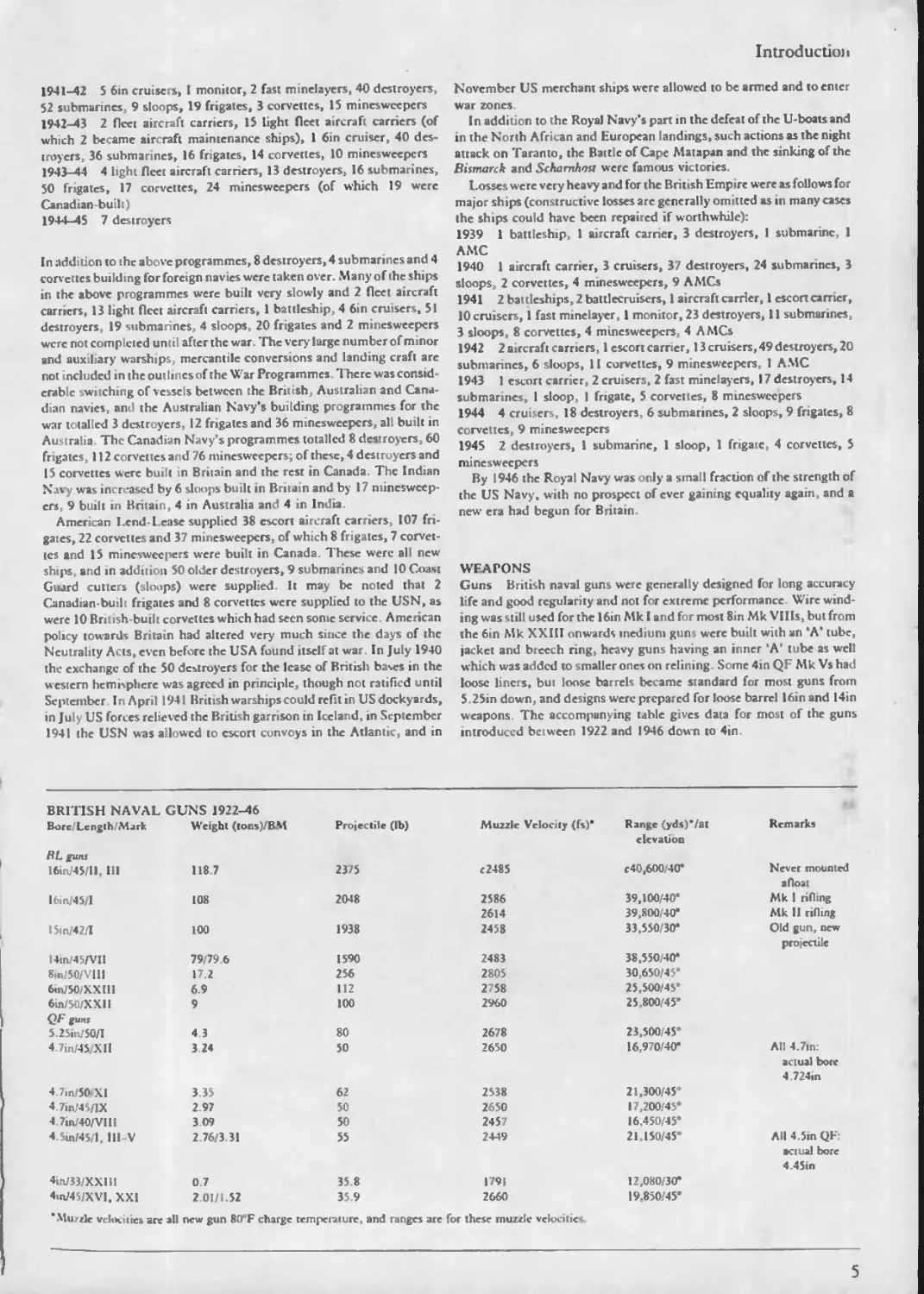
BRITISH NAVAL GUN’S 1922-46
Bore Length Mark	Weight (tons)/BM	Projectile (lb)	Muzzle Velocity (fs)*	Range (yds)*/at elevation	Remarks
BL guns 16in/45/ll, HI	118 7	2375	r2485	C40.600 40*	Never mounted
l6in/45/l	108	2048	2586	39,100/40*	afloat Mk 1 rifling
151П/42Л	100	1938	2614 2458	39,800 40* 33,550 30*	Mk II rifling Old gun, new
14in/45/VIl	79/79.6	1590	2483	38,550/40*	projectile
8in/50/V|l|	17.2	256	2805	30,650/45*
6tn/50/XXIII	6.9	112	2758	25,500/45*
6in/50/XXIl	9	100	2960	25,800/45’
QF guns 5.25|п/50Л	4 3	80	2678	23,500/45*
4.7in/45/Xll	3.24	50	2650	16,970/40*	All 4 7m:
4.7m/5O,XI	3.35	62	2538	21,300/45°	actual bore 4.724in
4.7in.M5flX	2.97	50	2650	17,200/45*
4 7in/40/VHl	3 09	50	2457	16,450/45*
4 5ui/45/l, III V	2.76/3.31	55	2449	21 150/45*	All 4 Sin QF
4in/33/XXHI	0 7	35 8	1791	12,080/30*	actual bore 4 45m
4iiV45/XVI. XXI	2 01/1.52	35.9	2660	19,850/45*
Muzzle vclociiies are all new gun 80“F charge temperalure, and ranges are for these muzzle velocities
5
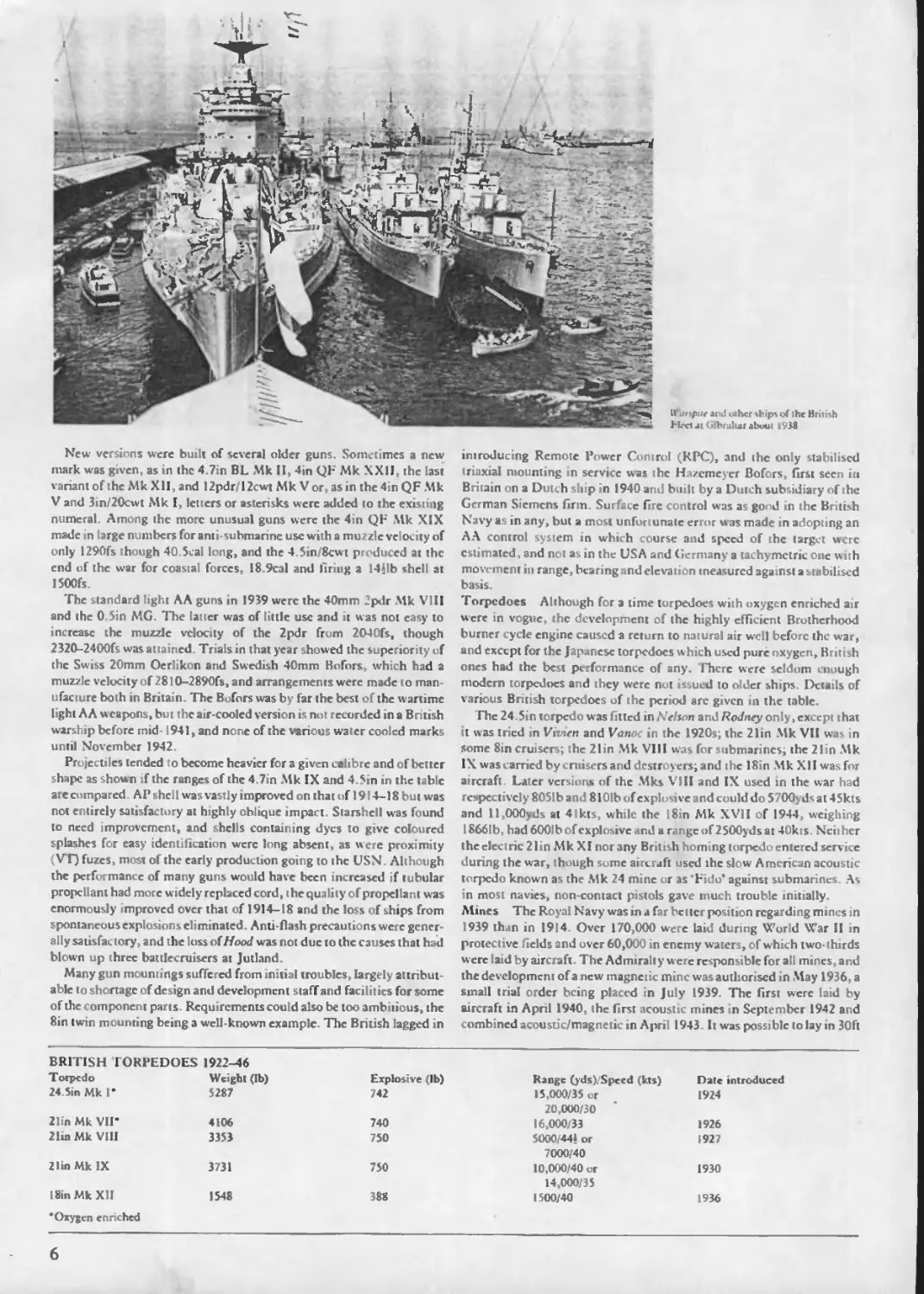
IVum/iw and other ihijn of ihe British
Fleet де Gibruhiix about 1953
New versions were built of several older guns. Sometimes a new
mark was given, as in the 4.7in BL Mk II, 4in QF Mk XXII, the Iasi
variant of the Mk XII, and 12pdr/12cwt Mk V or, as in the 4in QF Mk
V and 3in/20cwt Mk I, letters or asterisks were added to the existing
numeral Among the more unusual guns were the 4 n QF Mk XIX
made in large numbers for anti submarine use with a muzzle velocity of
only 1290fs though 40.Seal long, and the 4.5in/8cwt produced at the
end of the war for coastal forces, 18.9cal and firing a 14Jib shell at
1500fs.
The standard light AA guns in 1939 were the 40mm 2pdr Mk VIII
and the 0 Sin MG. The latter was of little use and it was not easy to
increase the muzzle velocity of the 2pdr from 2040fs, though
2320-2400fs was a ttained. Trials in that year showed the superiority of
the Swiss 20mm Oerlikon and Swedish 40mm Bofors which had a
muzzle velocity of 2810-2890fs, and arrangements were made to man-
ufacture both in Britain. The Bofors was by far the best of the wartime
light AA w capons, but the air-cooled version is not recorded in a British
warship before mid-194], and none of the various water cooled marks
until November 1942.
Projectiles tended to become heavier for a given calibre and of better
shape as shown if the ranges of the 4 7in Mk IX and 4.Sin in the table
are compared. AP shell was vastly improved on that of 1914-18 but was
not entirely satisfactory at highly oblique impact. Starshell was found
to need improvement, and shells containing dyes to give coloured
splashes for easy identification were long absent, as were proximity
(VT) fuzes, most of the early production going to the USN Although
the performance of many guns would have been increased if tubular
propellant had more widely replaced cord, the quality of propellant was
enormously improved over that of 1914-18 and the loss of ships from
spontaneousexplosionseliminated. Anti-flash precautions were gener-
ally satisfactory, and the loss of Hood was not due to the causes that had
blown up three battlecruisers at Jutland
Many gun mountings suffered from initial troubles largely attribut
able to shortage of design and development staff and facilities for some
of the component parts. Requirements could also be too ambitious, the
Sin twin mounting being a well-known example. The British lagged in
introducing Remote Power Control (RPC), and the only stabilised
triaxial mounting in service was the Hazcmeycr Bofors, first seen in
Britain on a Dutch ship in 1940 and built by a Dutch subsidiary of the
German Siemens firm. Surface fire control was as good in the British
Navy as in any, but a most unfortunate error was made in adopting an
AA control system in which course and speed of the target were
estimated, and not as in the USA and Germany a tachymetric one with
movement in range, bearing and elevation measured against a stabilised
basis.
Torpedoes Although for a lime torpedoes with oxygen enriched air
were in vogue, the development of the highly efficient Brotherhood
burner cycle engine caused a return to natural air well before the war,
and except for the Japanese torpedoes which used pure oxygen, British
ones had the best performance of any. There were seldom enough
modern torpedoes and they were not issued to older ships Details of
various British torpedoes of the period are given in the table.
The 24. Sin torpedo was fitted in Helton and Rodney only, except that
it was tried in Vivien and Vonoc in the 1920s; the 21in Mk VII was in
some Sin cruisers; the 21 in Mk Vll I was for submarines, the 2 lin Mk
IX was carried by cruisers and destroyers; and the 18in Mk XII was for
aircraft Later versions of the Mks VIII and IX used tn the war had
respectively 8051b and 8101b of explosive and could do 5700yds at 45kts
and 11,000yds at 4lkls, while the 1 Sin Mk XVII of 1944, weighing
18661b, had 6001b of explosive and a range of 2500yds at 40kts. Neil her
the electric 2 lin MkXI nor any British homing torpedo entered service
during the war, though some aircraft used the slow American acoustic
torpedo known as the Mk 24 mine or as Fido* against submarines As
in most navies, non-contact pistols gave much trouble initially
Mines The Royal Navy was in a far belter position regarding mines in
1939 than in 1914. Over 170,000 were laid during World W'ar II in
protective fields and over 60,000 in enemy waters, of which two-thirds
w ere laid by aircraft The Admiralty were responsible for all mines, and
the development of a new magnetic mine was authorised in May 1936, a
small trial order being placed in July 1939. The first were laid by
aircraft in April 1940, the first acoustic mines m September 1942 and
combined acoustic/magnetic in April 1943. It was possible to lay in 30ft
BRITISH 1ORPEDOES 1922-46
Torpedo	Weight (lb)	Explosive (lb)	Range (yds)/Spccd (kts)	Date introduced
24.Sin Mk I*	5287	742	15.000/35 or 20.000/30	1924
2 Jin Mk VII-	4106	740	16,000/33	1926
21in Mk VIII	3353	750	5000/441 or 7000/40	1927
2lin Mk IX	3731	750	10,000/40 or 14,000/35	1930
I8in Mk XII	1548	388	1500/40	1936
•Oxygen enriched
6
Introduction/The Royal Navy in 1922
of water from 15,OOOft and in 12ft from 200ft. Moored mines could be
laid from ships in up to 1000 fathoms, although the endurance of the
thin mooring rope was low, and most were laid in 100 fathoms or less
with few beyond 300 fathoms. The mine could be at up to 300ft below
the surface.
ASW weapons The tracking of submerged submarines by asdic
(sonar) proved to be much more difficult than had been thought and, as
only direction and not depth was indicated and contact was lost at
100-150yds when the submarine p scd under the asdic beam, there
was a large degree of uncertainty in dropping depth charges over the
stern. The standard Mk 7 DC had a 2901b amatol charge with a 20ft
hull-splitting radius against a tin hull, while an aluminised minol
charge increased this to 26ft The rate of sinking was 7-10fs, increased
to 16.5 in the heavy DC which had a 1401b weight attached, and the
initial 5-charge pattern was increased to a 10- or 14-chargc one with 5 or
9of the DCs heavy. The Mk 10 DC with a 1-ton charge was fired from a
destroyer’s 2lin TT or later dropped over the stern of‘Captain’ class
frigates. To allow the attacking ship to get clear of the effects of the
burst at 220ft, two buoyancy chambers limited the sinking rate to 6fs.
This type was introduced in March 1942, and the Mk 10*, with only one
buoyancy chamber sinking at 21fsand bursting at 600ft, in April 1943
but neither were much used A better method of attack was to fire
suitable projectiles ahead of the attacking ship while still in sound
contact, and it is unfortunate that the various howitzers and mortars of
1918 were not developed between the wars.
Hedgehog, which underwent sea trials in Westcott at the end of 1941
and was ready for service in January 1942, was a spigot mortar with 24
spigots in groups of 6, angled to give a 120ft diameter circle about 200
yds ahead of a stationary ship The 7in diameter bomb weighed 651b
and had a 351b charge of Torpcx, an aluminised cyclonite explos ve.
Sinking speed was about 22fs. A hit had to be scored, and Hedgehog
did not achieve a kill until.November 1942. It was much better in
relatively shallow waters than in the Atlantic About 35 ships whose
forward gun was needed had a split version, with 12 spigots on either
side coupled together. This was not satisfactory until April 1943.
By far the best weapon was Squid, a triple 12in mortar firing a 3901b
bomb with a 2071b minol charge and a sinking speed of about 42fs. The
pattern was a triangle of 120ft side at about 275yds mean range ahead of
the ship The bombs had time fuz.es and all three were set the same, and
if two Squids were mounted (as was usual), the tw patterns were
normally set 60ft apart in depth The new depth-determining Type 147
asdic was essential to Squid as the fuz.es were set automatically from the
depth recorder while the mortars were fired automatically by the asdic
range recorder. Squid wasordcred from the drawing board in 1942, sea
trials in Ambuscade were in May 1943, and the first production unit was
in Hadleigh Castle completed in September 1943. It was usually limited
to new ships, and, apart from Ambuscade, the only destroyer to have
Squid in the war was Escapade in January 1945 By the end of the war
between 60 and 70 ships had been fitted, while over 500 had Hedgehog.
The first Squid success was by Loch Killin on 31 July 1944.
RADAR
It would require a whole book to deal adequately with the development
of radar, and only the briefest outline can be given here. An experimen-
tal set was fitted to the minesweeper Saltburn in late 1936 but was not
satisfactory, and it was not until August 1938 that a prototype air
warning set, known as Type 79Y, working on a 7m wave length with a
pulse output of 15-20к\Г. was fitted tcSheffield. A second set was soon
fitted to Rodney, and in mid-1939 a Type 79Z of 70-90kW was installed
in the AA cruiscrCw/etv. This developed into the Type 279, which was
replaced gradually by the Type 281 on 3J-4m with a 350kW output,
and first fitted at the end of 1940 to Dido. In smaller ships a widely used
air warning set was Type 291 on 1.5m introduced in 1941. Precise
indication of a target needed shorter wavelengths, and the generation of
adequate power in the microwave region was solved by the develop-
ment of the resonant cavity magnetron in 1940 The first 10cm surface
warning set, Type 271, was fitted to the corvette Orchis in May 1941
and was highly successful. Types 272 and 273 were used in larger ships,
and latterly 3cm sets were used in some destroyers, submarines and
coastal forces craft. Other 10cm sets used later in the war were the Type
277 combined air and surface warning plus height-finder introduced in
late 1943 and repheed by Types 294 and 295. All these had a pulse
output of about 500k W, as did the air and surface target indicating
Type 293 first fitted in late 1943.
For main battery fire control the 50cm Type 284 was first fitted to
Nelson in June 1940and was very successful, being later rep acedbythe
10cm Type 274. Other 50cm gunnery sets were Types 282 for dose-
range AA introduced in early 1941,283 for main battery blind fire AA
barrages fitted from late 1942 and 285 for long-range A A and also as an
air and surface warning unit for small ships. Type 275 was a lOcth
replacement for 285, introduced in 1945.
In conclusion the experiences of Duke of York in the night action
against Schamhorst may be noted The Type 273 detected the latter at
45,500yds, while the Type 284 initially delected the target at 34,000yds
and could hold for bearing at 25,800yds. Radar spotting on shell
splashes was limited to 21,500yds or less.
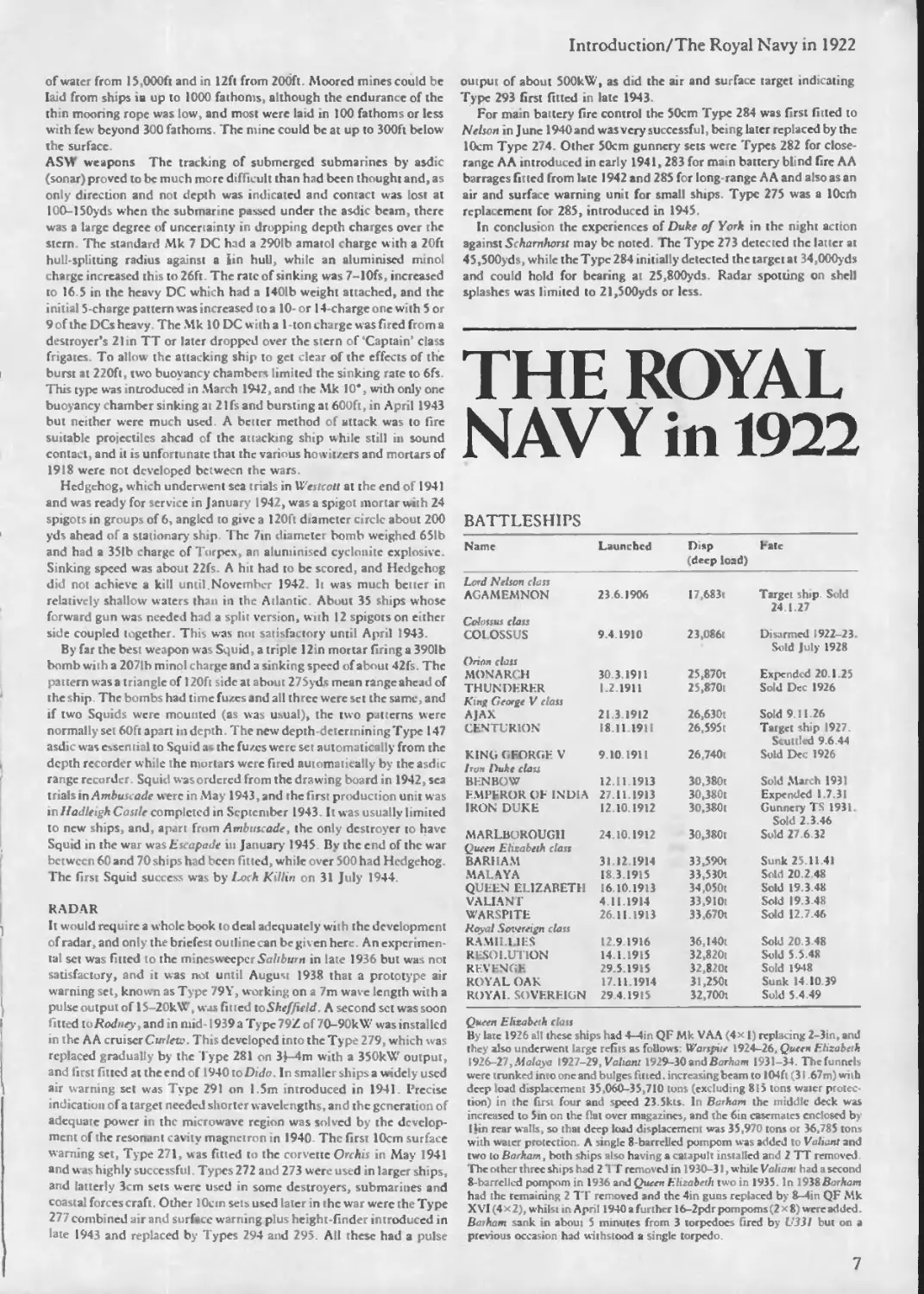
THE ROYAL
NAVY in 1922
BATTLESHIPS
Name	Launched	Disp (deep load)	Fate
Lord Nelson class AGAMEMNON	23.6.1906	17,683t	Target ship. Sold
Colossus class COLOSSUS	9.4.1910	23,O86t	24 1.27 Disarmed 1922-23.
Orion class MONARCH	30.3.1911	25,870t	Sold July 1928 Expended 20.1.25
THUNDERER	1.2 1911	25,870t	Sold Dec 1926
King George V class AJAX	21.3.1912	26,630t	Sold 9.11.26
CENTURION	18.11.1911	26,595t	Target ship 1927.
KING GEORGE V	9.10 1911	26,740t	Scuttled 9.6.44 Sold Dec 1926
I run Duke clau BENBOW	12.11 1913	30,380t	Sold March 1931
EMPEROR OF INDIA	27.11.1913	30,3801	Expended 1.7.31
IRON DUKE	12.10.1912	30,380t	Gunnery TS 1931.
MARLBOROUGH	24.10.1912	30,380t	Sold 2.3.46 Sold 27.6.32
Queen Elizabeth class BARHAM	31.12.1914	33,590t	Sunk 25.11.41
MALAYA	18.3.1915	33,5 30t	Sold 20.2.48
QUEEN ELIZABETH	16.10.1913	34,O5Ot	Sold 19.3.48
VALIANT	4 11.1914	33,910t	Sold 19.3.48
WARSPITE	26.11.1913	33,670t	Sold 12.7.46
Royal Sovereign class RAM11.1 1ES	12.9.1916	36,140t	Sold 20.3-48
RESOLUTION	14.1.1915	32,8201	Sold 5.5.48
REVENGE	29.5.1915	32,820t	Sold 19-18
ROYAL OAK	17.11.1914	31,250t	Sunk 14 10 39
ROYAL SOVEREIGN	29.4.1915	32,700t	Sold 5.4 49
Queen Elizabeth class
By late 1926 all these ships had 4—4in QF Mk VAA (4x 1) replacing 2-3in, and
they also underwent large refits as follows; Warspite 1924-26, Queen Elizabeth
1926-27, Malaya 1927-29, Valiant 1929-30 and Barham 1931-34. The funnels
were trunked into one and bulges fined. increasing beam to 104ft (31.67m) with
deep load displacement 35,060-35,710 ions (excluding 815 tons waicr protec-
tion) in the first four and speed 23.5kls. In Barham the middle deck was
increased to Sin on the flat over magazines, and the 6in easemates enclosed by
Hin rear walls, so that deep load displacement was 35,970 tons or 36,785 tons
with water protection. A single 8-barrel ed pompom was added to Va/iunr and
two to Barham both ships also having a catapult installed and 2 TT removed
The other three sh ps had 2 IT removed in 1930-31, while Valiant had a second
8-barrelled pompom in 1936 and Queen Elizabeth two in 1935. In 1938Barham
had the remaining 2 IT removed and the 4in guns replaced by 8-4in QF Mk
XVI (4x2), whilst in April 1940 a further 16-2pdr pompoms(2x8) were added.
Barham sank in aboui 5 minutes from 3 torpedoes fired by U3JI but on a
previous occasion had withstood a single torpedo
7
GREAT BRITAIN
AU except Barham underwent second recons ructions. Malaya was taken n
hand at Dcvonport between October 1934 and December 1936 The middle
deck was increased to Sin over inagaz les and io 31 in over engine rooms, and the
CT was replaced by a smaller one with Sin max The AA armament was now
8—4m QI* Mk XVI (4x2), 16-2pdr pompoms (2x8), the last 2 l Г were
removed and a cross-deck catapult added with hangars for two aircraft The
catapult was removed and the hangars converted toother uses tn late 1942 when
16-2pdr pompoms (2x8) were added, followed by 4--4tn QF Mk XVI (2x2) in
January 1943 In September 1943 the 12-6in guns and the battery amto rwere
removed, 2in plating being fitted over the ports By mid-1944, 4S-20mm
Oerl kons were mounted and deep load spla cmeni had i tsen to 37,710 tons
including water protection. During the war Malaya withstood one torpedo.
Warspue’s second reconstruction, at Portsmouth from March 1934 to March
1937, was more radical, and data was now:
Displacement. 36 450 tons deep load including 81S tons water tn protection
compartments.
Dimensions: Unchanged except 33ft lin (10.08m) mean deep load draught
Machinery: 4-shaft Parsons geared turbines, 6 Admiralty 3-drum bot ers,
80 OOOshp - 23.5kts, 3501 tons oil
Armour Changed as follows - battery 2in, CT 3in-2in, middle deck Sin over
magazines, 31m over engine and boiler rooms, main deck 3lin over forwar 1 belt
Armament 8-15in/42 Mk 1 4x2, 30* elevation), 8-6in/45 Mk ХП 8-4inQF
Mk XVI AA (4x2), 32-2pdr pompom 4x8)
There was a e oss-dcck alapull and hangars for 2 aircraft, but the aircraft
equipment was removed in 1943
Wa- pur was hit by a FX1400 guided AP bomb on 16.9.1943and near-missed
by another, and was never fully repaired though patched up as a bombardment
ship with 6 usable 15in, no 6 n 8-4in AA, 40 pompoms (5x8) and 35-20mm
She was again patched up after a ground mine explosion on 13 6.1944 but her
speed was reduced ta 15 5kts
Va/iaiu's reconstruction at Dcvonport from March 1937 to \ovember 1939
andQurettbhaabcrA's at Portsmouth from August 1937 to December 1940 with
a further month at Rosyth were the most comptc c of any of the class, and
resulted in the following new data:
Displacement: Vii/шнг (1939) 36,513 tons deep oad including 815 tons water
protection. Quern H rabeih (1944) 38,450 tons
Dimensions. Unch nged except Valiant 1939) 32ft lOin (10.01m) mean deep
load draught, Quern Elizabeth (1944' 34ft in (IO.52m)
Machinery 4-shaft Parsons geared turbines, 8 Admiralty 3-drum boilers,
80 OOOshp " 23 kts, Va/umr 3393, Queen Elizabeth 3366 tons oil
Armour Changed as follows - battery nil, HA mountings 2m-1 in, CT 3in-2in,
middle deck 5in over magazines, 3| n over engine and boiler rooms, main deck
3iin-2]in over forward belt
Armament: 8-15tn/42 Mk I 4 2, 30*elevation), 20-4 Stn/45 QF Mk 1 or 111
(10>2), 32-2pdr pompom (4 <B)
Aircraft equipment, removed in 1943, was as Warspite.
Queen Elizabeth's close-range AA armament was increased by at least
54-20mm Oerltkons, and Va lant at one time had 47, while in 1946 the latter had
56-2pdr pompoms (7x8). Both ships were badly damaged by 'human tor-
pedoes* on 19.12.1941 and Queen Elizabeth w hich had by far the worst damage,
was out of service until June 1943 Valiant was again seriously damaged by the
collapse of a floa tng dock on 8 8 1944
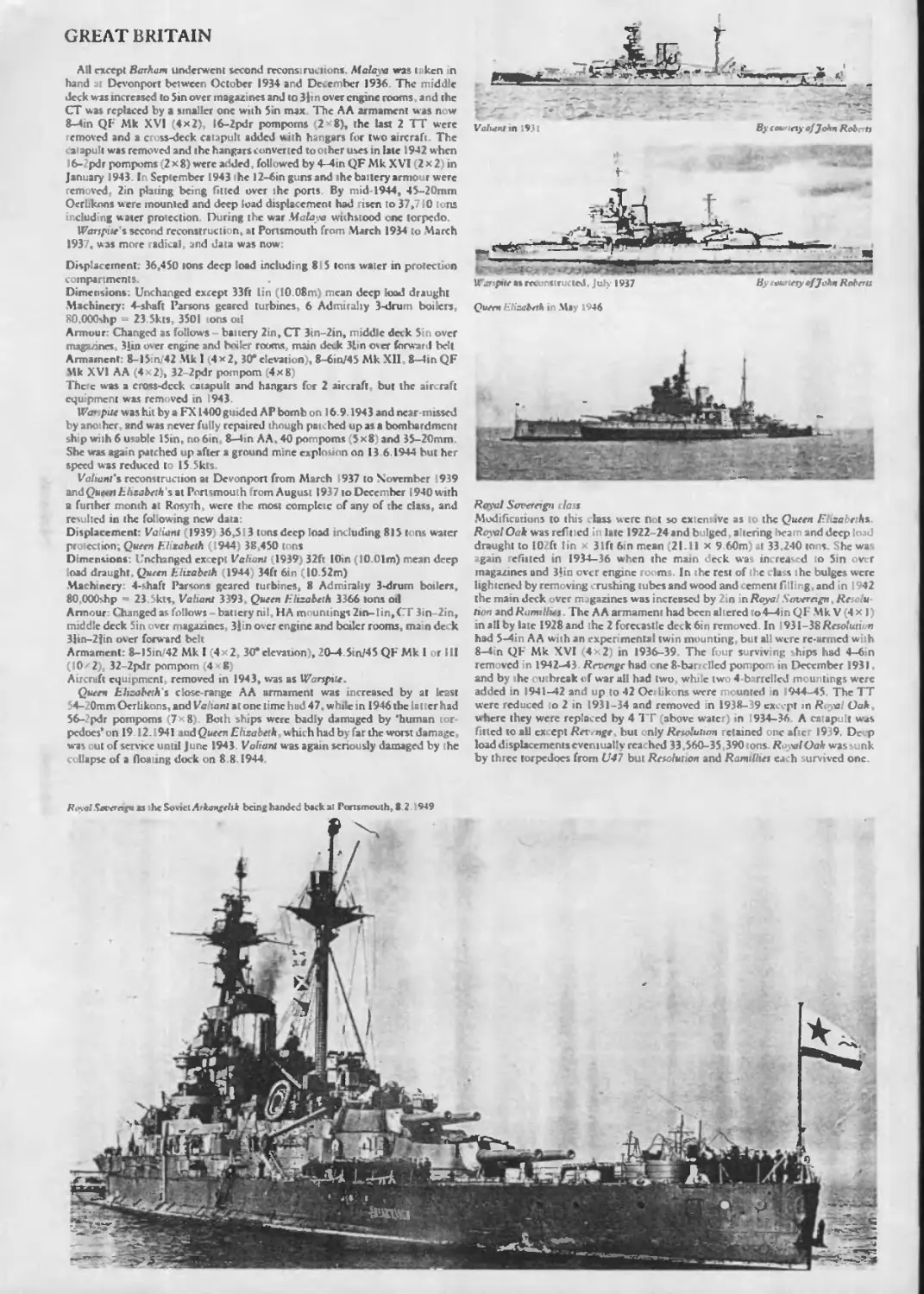
Queen Elizabeth in May 46
Royal Sovereign clast
Modifications to this class were n t so extensive as to the Queen Elizabeths
Royal Oak was refined in late 1922-24 and bulged, altering beam and deep load
draught to 102ft lin x 31ft 6tn mean (21.11 x 9.60m) al 33,240 ions. She was
again refitted n 1934-36 when the main deck was increased to Sin over
magazines and 3}in over engine rooms. In the rest of the class lhe bulges were
lightened by removing crushing tubes and wood and cement filling, and in 1942
the main deck over m gazines was increased by n in Royal Sovereign, Resolu-
tion and Ramillus Die AA armament had been altered to 4—4inQFMk V(4x I)
in all by late 1928 and the 2 forecastle deck 6in removed In 1931-38Retolunvn
had 5-4in A A with an expel mental twin mounting, but all were re-armed with
8-4 n QF Mk XVI (4x2) in 1936-39. The four survtv ng ships had 4-6 n
removed in 1942—43. Revenge had one 8-barrclled pompom in December 1931,
and by ihe outbreak of war all had two, while two 4-barrellcd mountings were
added in 1941-42 and up to 42 Oetlikons were mounted in 1944-45. The TT
were reduced to 2 in 1931-34 and removed n 1938-39 except in Royal Oak,
where they were replaced by 4 ТГ (above waler) in 1934-36. A catapult was
filled to all except Revenge, but only Resolution retained one after 1939. Deep
load displacements eventually reached 33,560-35,390 ions. Royal Oak was sunk
by three torpedoes from U47 but Resolution and Ramilhes each survived one.
Royal Sovereign tube Soviet Arlumtelsh being handed back al Portsmouth, 8.2 949
BATTLECRUISERS
Name	Launched	Disp (deep load)	Fate
Indefatigable class AUSTRALIA	25.10 1911	21,350i	Scuttled 12.4 24
Lion class LION	6.8.1910	3O,945t	Sold 31.1.24
Tiger class TIGER	15.12.1913	35,7 lOt	Sold 7 3 32
Renown class RENOWN	4.3.1916	32,730t	Sold 19 3 48
REPULSE	8 1.1916	37,490t	Sunk 10 12.41
Courageous class COURAGEOUS	5.2.1916	22,690t	Converted
GLORIOUS	20.4 1916	22,690t	1924-28 Converted
Hood class HOOD	22 8.1918	46,680t	1924-30 Sunk 24.5.41
Tiger class
Tiger's AA guns were finally changed to 4—4in QF Mk V (4x 1) in March 1929.
Fuel was reduced to 300 tons coal and 3300 tons oil.
Renown class
Renown's first reconstruction was undertaken at Portsmouth from May 1923 to
August 1926 and comprised the following alterations:
Displacement: 37,150 tons deep load
Dimensions: Beam 102ft 4in (31 19m) X 31ft 3in (9.53m) mean deep load
Machinery Unchanged, 3O.25kts
Armour; Belt 9in, lower edge 2in, main deck 4in over magazines, 21in-lin over
boiler rooms, 3m over engine rooms, continued to side over deck slope at
4m-21in, main deck slope 4m by magazines, lower deck 4in-3fm over
magazines beyond ‘A’ and *Y’, longitudinal bulkheads by boiler uptakes 2in,
bulges fitted
Armament: 15m unchanged, 15~4m BL Mk IX (5x3), 4—4in QF Mk V A A
(4x1).
One 4in triple was removed in March 1932, an 8-barrellcd pompom mounted in
May 1932 and a second briefly from January to May 1936, whilst a catapult was
fitted in May 1933. However, in September 1936/?елоош was taken in hand at
Portsmouth for a second, more drastic reconstruction, completed 2 9 1939.
Alterations were.
Displacement: 36,080 tons deep load
Machinery 4-shaft Parsons geared turbines, 8 Admiralty 3-drum boilers,
120,000shp = 30 75kts, 4613 tons oil
Armour: Barbette sides ‘A’ 6in main to upper deck, ‘B’ 6in main to forecastle
deck, box protection to 4.5in guns and TT 2Jin- lin, CT 3in-2in, main deck 5in
over 4 5in magazines, 24m over boiler rooms, 2?in over forward belt, lower deck
3iin by after belt bulkhead, boiler uptake longitudinal bulkheads removed
Armament: 6-15m/42 Mk I (3x2, 30° elevation), 2O-4.5in/45 QF Mk 1 or III
(10x2), 24—2pdr pompom (3x8), 8-2lin TT aw
One cross-deck catapult was fitted, with hangars for 2 aircraft. The aircraft
equipment was removed in 1943, although the catapult was also not earned from
November 1940 to October 1941. A quadruple pompom was added in
December 1943 and 64—20mm by 1944 The TT were removed in April 1945
By 1944, for reasons which arc not clear, deep load displacement had risen to
38,395 tons.
Repulse had 2—4in BL Mk IX and 2-3in AA replaced by 4—4in QF Mk V AA
(4x l)in November 1924, and was reconstructed at Portsmouth from April 1933
to May 1936. Alterations were.
Displacement: 38,300 tons deep load
Dimensions: 32ft 2in (9 80m) mean deep load
Machinery: Unchanged, 28.3kts
Armour: Main deck over magazines 5Jin, for 20ft abaft *Y’ 4Jin, over engine
rooms 3Ji n continued to side, low er deck over forw ard magazines 41m, crushing
tubes removed from bulges
Armament: 1 Sin unchanged, 12—4in BL Mk IX (4x3),4—4in QF Mk XV AA
(2x2), 4-4m QF Mk V AA, 16-2pdr pompom (2x8), 8-21in TT aw
There was one cross-deck catapult, and hangars for 2 aircraft The 4in Mk XV
were replaced by 2-4in Mk V in February 1939, and a third 8-barrelled pompom
replaced a 4in triple in November 1940, while 8-20mm Oerlikons were added in
1941. Repulse was sunk by 5 torpedoes from Japanese aircraft.
Courageous class
Both ships were converted into fleet aircraft carriers. See main tables.
Hood class
Hood was never reconstructed, and modifications were largely confined to the
A A armament The 4in Mk V A A guns were increased to 6 in December 1937
and to 8 in June 1938 when 2-5.5in w'ere removed, but in June-August 1939
8-4m Mk XVI (4x2) were mounted, all the 4in Mk V removed and the 2-5 Sin
replaced. Finally tn April all the 5.Sin were removed and 6-4in Mk XVI (3x2)
added. During the 1929-31 refit 2-8 barrelled pompoms were mounted, a
catapult added (removed in June 1932), and oil fuel increased to 4615 tons A
third 8-barrellcd pompom was added m December 1937 and the 2 submerged
TT removed, while 5 UP rocket projectors were mounted in May 1940, deep
load displacement being now 48,360 tons Hood was blown up by one or more
15in shells from Bismarck.
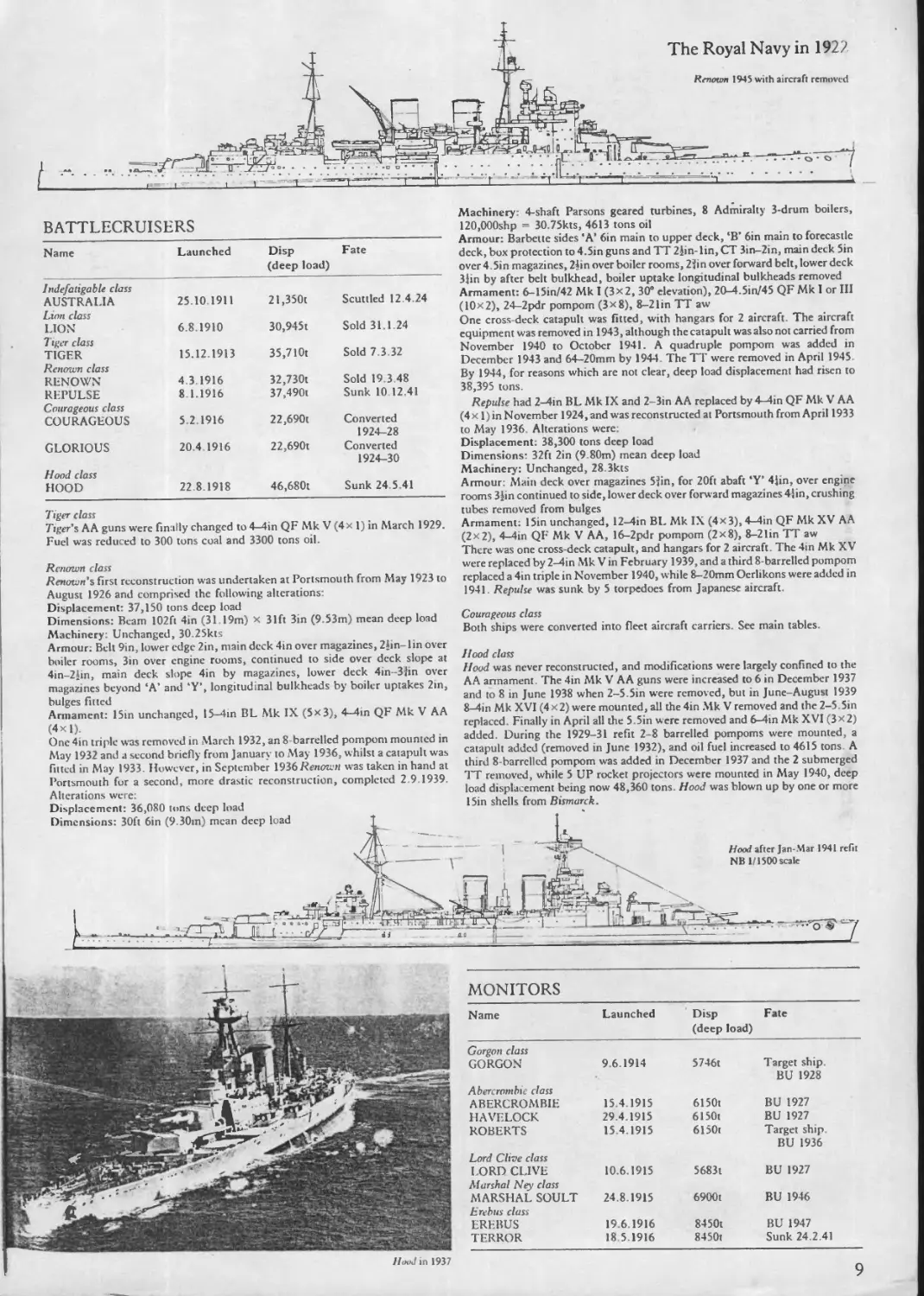
Hood in 1937
MONITORS
Name	Launched	Disp (deep load)	Fate
Gorgon class GORGON	9.6.1914	5746t	Target ship.
Abercrombie class ABERCROMBIE	15.4.1915	6150t	BU 1928 BU 1927
HAVELOCK	29 4 1915	6150t	BU 1927
ROBERTS	15.4.1915	6150t	Target ship
Lord Clive class LORD CLIVE	10.6.1915	5683t	BU 1936 BU 1927
Marshal Hey class MARSHAL SOULT	24 8 1915	6900t	BU 1946
Erebus class EREBUS	19.6.1916	8450t	BU 1947
TERROR	18 5 1916	8450t	Sunk 24.2.41
9
GREAT BRITAIN
Marshal Soult was a base ship from 1940, her 4in guns were removed in 1937 and
her 15m turret in 1940. The former 4in BL Mk IX and 3m HA m Erebus and
Terror were replaced in 1939-40 by 6-4in QF Mk V HA, and in 1940 the upper
deck was increased from 2in to 4in on the flat over 15in magazines and machin-
ery, while the main deck aft was thickened by Im to 2fin-2in. When sunk by
bomb near-misses Terror had 7-20mm, while the light AA in Erebus finally
comprised 3 quadruple 2pdr, 1 single 2pdr, 1 single 40mm Bofors and
15-20mm. Deep load displacement rose to about 9400 tons in Terror and 9800
tons m Erebus, though oil fuel was reduced by 90 tons.
CRUISERS
AIRCRAFT CARRIERS
Name	Launched	Disp (deep load)	Fate
ARK ROYAL	5.9 1914	7400t	Sold 1946
PEGASUS	96.1917	3300t	BU 1931
ARGUS	2.12 1917	15,750t	BU 1946
VINDICTIVE	17 1 1918	12,095t	BU 1946
EAGLE	8.6.1918	26,800t	Sunk 11.8 42
HERMES	11 9 1919	13,700t	Sunk 9 4 42
Ark Royal was renamed Pegasus 21.12.34. She was used mostly as a depot ship,
but a catapult was fitted in 1938 and she was re-armed with 4—3in/20cwt HA m
1940 A fighter catapult ship 1941-43, she was sold into mercantile service after
the war. Argus had bulges added in 1925-26, and in 1937-38 she was fitted to
operate Queen Bee target aircraft, but returned to operational service in the war.
The flight deck was extended to 570ft and armament comprised 4-4m QF Mk V
HA and 13-20mm Vindictive was converted back to a Hawkins class cruiser in
1923-25,with an armament of 6-7.5in, 3—4in HA, 4-3pdr saluting, 2-2pdr
pompoms and 6-2lin TT (4 aw, 2 sub). A hangar, and for a time a compressed
air catapult, were in the ‘B* gun position. She was demilitarised as a training ship
in 1936-37 and was converted to a repair ship in 1939-40. Eagle's 5-4in HA
were reduced to 4 in 1933, the gun between the funnels being replaced by 2pdr
pompoms (lx 8). A second 8-barrelled pompom was added m 1937, and by 1942
there were also 12-20mm. Petrol capacity was increased in 1942 to 17,750gal.
Eagle was sunk by 4 torpedoes from U73. Hennes was sunk by dive-bombers
from Japanese aircraft carriers. A few 20mm guns may have been added by the
time she was lost. Funous was under reconstruction 1922-25 and is described m
the main tables.
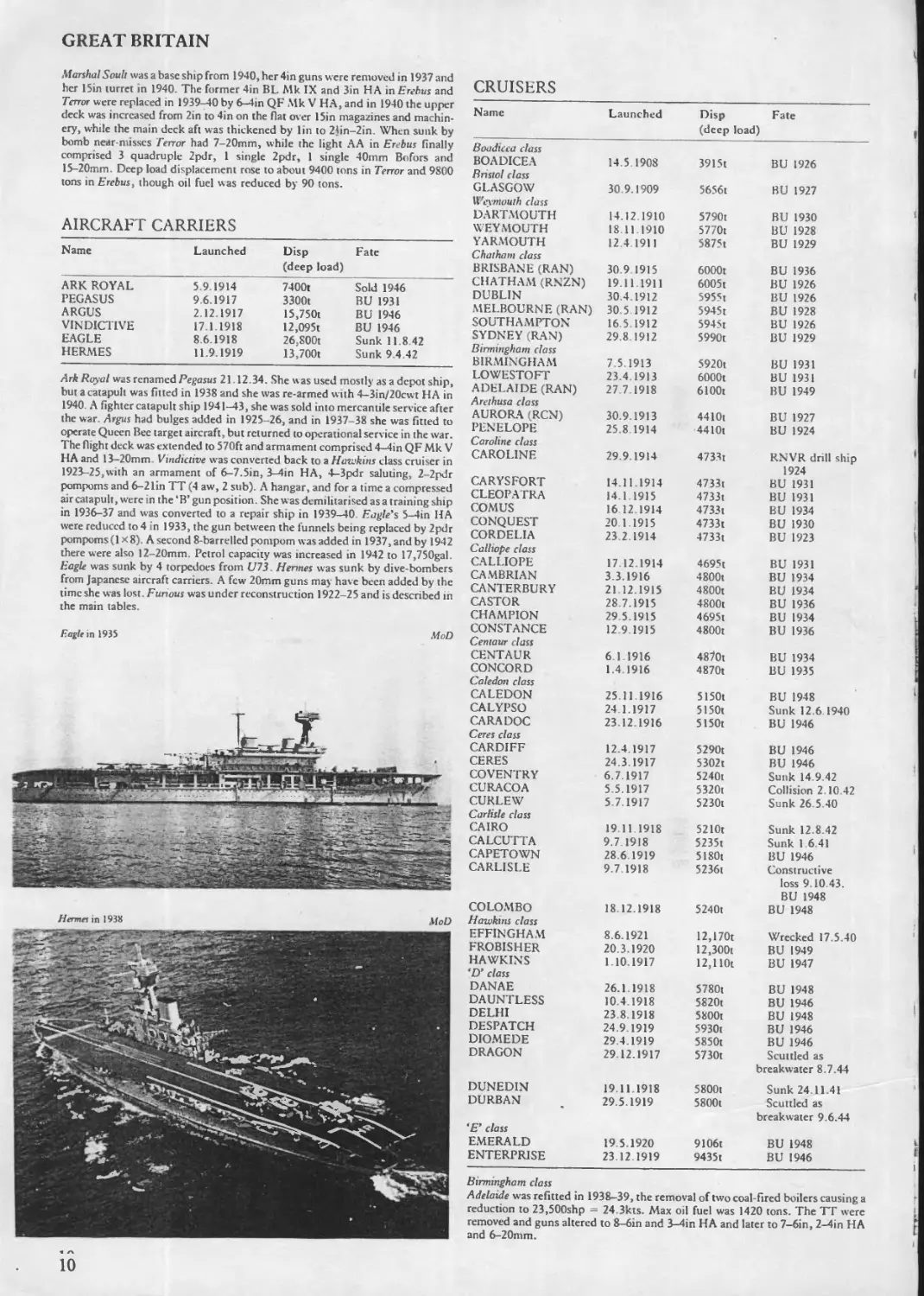
Eagle in 1935
MoD
Hermes in 1938
MoD
Name	Launched	Disp (deep load)	Fate
Boadtcea class
BOA DICEA	14.5.1908	3915t	BU 1926
Bnstol class
GLASGOW	30.9.1909	5656t	BU 1927
U'evmouth class
DARTMOUTH	14 12 1910	5790t	BU 1930
WEYMOUTH	18 11 1910	5770t	BU 1928
YARMOUTH	12.4.1911	5875t	BU 1929
Chatham class
BRISBANE (RAN)	30.9.1915	6000t	BU 1936
CHATHAM (RNZN)	19.11 1911	6005t	BU 1926
DUBLIN	30.4.1912	5955t	BU 1926
MELBOURNE (RAN)	30 5 1912	5945t	BU 1928
SOUTHAMPTON	16 5 1912	5945t	BU 1926
SYDNEY (RAN)	29.8.1912	5990t	BU 1929
Birmingham class
BIRMINGHAM	7 5 1913	5920t	BU 1931
LOWESTOFT	23.4.1913	6000t	BU 1931
ADELAIDE (RAN)	27 7 1918	6 lOOt	BU 1949
Arethusa class
AURORA (RCN)	30.9.1913	4410t	BU 1927
PENELOPE	25.8.1914	4410t	BU 1924
Caroline class
CAROLINE	29 9.1914	4733t	RNVR drill ship
			1924
CARYS FORT	14 11 1914	4733c	BU 1931
CLEOPATRA	14 1 1915	4733t	BU 1931
COMUS	16 12.1914	4733t	BU 1934
CONQUEST	20 1 1915	4733t	BU 1930
CORDELIA	23 2 1914	4733c	BU 1923
Calliope class
CALLIOPE	17.12.1914	4695t	BU 1931
CAMBRIAN	3 3 1916	4800t	BU 1934
CANTERBURY	21 12.1915	4800t	BU 1934
CASTOR	28.7.1915	4800t	BU 1936
CHAMPION	29 5.1915	4695t	BU 1934
CONSTANCE	12 9 1915	4800t	BU 1936
Centaur class
CENTAUR	6 1 1916	4870t	BU 1934
CONCORD	1.4 1916	4870t	BU 1935
Caledon class
CALEDON	25.11 1916	5150t	BU 1948
CALYPSO	24 1.1917	5150c	Sunk 12.6.1940
CARADOC	23 12.1916	5150t	BU 1946
Ceres class
CARDIFF	12 4.1917	5290t	BU 1946
CERES	24 3.1917	53O2t	BU 1946
COVENTRY	6.7.1917	5240t	Sunk 14.9.42
CURACOA	5 5.1917	5320t	Collision 2.10 42
CURLEW	5.7 1917	5230t	Sunk 26.5.40
Carlisle class
CAIRO	19.11.1918	5210t	Sunk 12.8.42
CALCUTTA	9.7 1918	5235t	Sunk 1 6.41
CAPETOWN	28 6 1919	5180c	BU 1946
CARLISLE	9.7.1918	5236c	Constructive
			loss 9 10 43.
			BU 1948
COLOMBO	18 12.1918	5240t	BU 1948
Hawkins class
EFFINGHAM	8.6 1921	12,170i:	Wrecked 17 5 40
FROBISHER	20.3.1920	12,300t	BU 1949
HAWKINS	1.10.1917	12,1 10l	BU 1947
‘D’ class
DANAE	26.1.1918	5780t	BU 1948
DAUNTLESS	10.4.1918	5820t	BU 1946
DELHI	23.8.1918	58OOt	BU 1948
DESPATCH	24 9.1919	5930t	BU 1946
DIOMEDE	29.4.1919	5850t	BU 1946
DRAGON	29 12.1917	5730t	Scuttled as
			breakwater 8.7 44
DUNEDIN	19.11.1918	5800t	Sunk 24.11.41
DURBAN	29.5.1919	5800t	Scuttled as
			breakwater 9.6.44
‘E’ class
EMERALD	19.5.1920	9106t	BU 1948
ENTERPRISE	23 12 1919	9435t	BU 1946
Birmingham class
Adelaide was refitted in 1938-39, the removal of two coal-fired boilers causing a
reduction to 23,500shp = 24 3kts. Max oil fuel was 1420 tons. The TT were
removed and guns altered to 8-6in and 3-4in HA and later to 7-6in, 2-4in HA
and 6-20mm.
10
The Royal Navy in 1972
Centaur class
No 2 6in gun was removed from Centaur in 1925 and from Concord in 1929.
Caledon class
Calypso was torpedoed by an Italian submarine Caledon was converted to an A A
cruiser in 1942-43, the forward superstructure being altered to accommodate a
second twin 4in forward The new armament was 6-4in QF Mk XVI (3x2), 2
twin and 4 single 40mm Bofors and 15-20mm The twin Bofors were in triaxial
mounungs Deep load displacement was given as 5320 tons, including 200 tons
ballast
Ceres class
Coventry and Curlew were converted to AA cruisers in 1935-36 and armed with
10-4m QF Mk V (Юх 1) and one 8-barrelled 2pdr pompom (though Coventry
initially had 2 such mountings). Both ships had 2-4m removed m 1939-40 and a
third appears to have been removed from Coventry in 1942. She was scuttled
after bomb damage, and Curlew was sunk by near-misses. Deep load displace-
ments on conversion were 5468 tons (Coventry') and 5355 tons (Curlew) Curacoa
was converted in 1939-40 and had 8-4in QF Mk XVI (4x2), with 1 quadruple
and 2 single 2pdr pompoms and later also 5-20mm. With 200 tons ballast, deep
load displacement was 5403 tons
19^-20inm. Four fixed above-water TT were removed from both ships in
1943—44. Effingham was reconstructed in 1937-38 and re-armed with 9-6m BL
Mk XII on 30° mountings, 4—4in QF Mk V HA and 4-2lin fixed above-water
TT. In 1939-40, 8-4in QF Mk XVI (4x2) replaced the earlier 4in, and two
8-barrelled 2pdr pompoms and a catapult were added During reconstruction 2
boilers were removed and the remaining 8 trunked into one funnel Oil fuel was
increased to 2620 tons, and shp reduced to 58,000 = 29.75kts. Deep load
displacement was 12,514 tons in 1938
‘D’ class
Diomede and Dunedin were loaned to the RNZN from 1924—25 until 1937 and
Dragon and Danae (as Conrad) to Poland 1943-44 and 1944—46 Delhi was
converted to an A A cruiser at New York N Yd in 1941, her 1942 armament
being 5-5in/38 US, 8-2pdr pompom (2x4)and 8, later 10-20mm.By 1945deep
load displacement had risen to 6400 tons. One 6in was removed from Danae,
Dragon and Durban in 1942-43, and the first two had their 4in QF Mk V
replaced by a twin 4in QF Mk XVI and 2 quadruple 2pdr pompoms added. By
early 1944 only Despatch and Durban retained TT. Dunedin was sunk by 2
torpedoes from U124 and Dragon was damaged by a Marder.
‘E’ class
The original 4x3 TT were increased to 4x4 in 1929 and a catapult was added to
Emerald in 1934 and to Enterprise in 1936. These were retained until 1944
Enterprise had 1 quadruple 2 pdr pompom added m 1940 and a second in 1943,
whilst Emera/J had two in late 1942. Both had 8TT removed m 1941-42, and 16
or 18-20mm were eventually added By 1945 deep load displacement had risen
to 10,350 tons in Emerald and 10,220 tons in Enterprise
FLOTILLA LEADERS
Curlew about 1938
Carlisle class
Cairo and Calcutta were converted to A A cruisers 1938-39 and Carlisle in
1939-40 All had 8-4in QF Mk XVI (4x2) and one quadruple 2pdr pompom,
Cairo later having 2 single 2pdrs also and Carlisle 10-20mm. As converted, deep
load displacements were 5215 tons (Cairo) and 5391 tons (Carlisle), the latter
including 200 tons ballast Bombs caused the loss of Calcutta and Carlisle, and
Cairo was scuttled after a torpedo hit from an Italian submarine Colombo,
converted in 1942-43, had 6-4in QF Mk XVI (3x2), 2 twin and 4 single 40mm
Bofors and 10-20mm, the twin Bofors being in triaxial mountings.
Hawkins class
In Hawkins 2—111 QF Mk V HA replaced the 3in at the end of 1924 and 2 more
were added in 1927. In 1929-30 she was converted to oil fuel only, 2 coal-fired
boilers being removed and oil capacity increased to 2740 tons. The 7.5in were
removed under the London Treaty in 1936 but replaced in 1939, and in 1945 her
armament was 7-7.5in, 4-4in QI' Mk V HA, 2 quadruple and 2 single 2pdr
pompoms and 9-20mm Deep load displacement had risen to 13,160 tons
Erobisher was used as a training ship in 1932-37 with 6 and later 5-7 5in and the
rest were removed in 1937. She was not re-armed until 1942, then mounting
5-7.Sin, 5-4m QF Mk V HA, 4 quadruple 2pdr pompoms, and 7, later
Frobisher about 1944
Name	Fate	Name	Fate
Marksman class: launched 1915, 1861t, (Abdiel 1945c) deep load ABDIEL	BU 1936	NIMROD	BU	1926 Improved Marksman class: launched 1916-17, 1912t deep load ANZAC (RAN)	BU 1935	SAUMAREZ	BU	1931 GRENVILLE	BU 1931	SEYMOUR	BU	1930 Shakespeare class, launched 1917-20, 2000t deep load BROKE	Sunk 8.11.42 SPENSER	BU	1936 KEPPEL	BU 1945	WALLACE	BU	1945
SHAKESPEARE BU 1936
Scott class: launched 1918-19, 2O55t deep load
BRUCE	Expended 22.11.39	MACKAY MALCOLM	BU 1949 BU 1945
CAMPBELL	BU 1947	MONTROSE	Collision 10.6.1944, BU 1946
DOUGLAS	BU 1945	STUART	BU 1947
Shakespeare class
U allace was converted in 1938-39 to an AA destroyer w’lth 4—4in QF Mk XVI
(2x2) and eventually 1 quadruple and 2 single 2pdr pompoms, 4-20mm and 30
DC. Deep load displacement was 2145 tons and oil fuel 409 tons Broke and
Keppel became escorts in 1941-42 with 3 later 2—4 7in, l-3in HA, 2 single
2pdrs, 6-21m TT, Hedgehog and 70-98 DC. Broke was sunk by coastal bat-
teries at Algiers and it was intended to convert Keppel to a long range escort in
1944, but it is not certain if this was completed. Deep load displacement was to
be 2280 tons, with 2-4.7in, 5-20mm, Hedgehog, 140 DCs, 25,OOOshp = 28kts
and 575 tons oil.
Scott class
Stuart was transferred to the RaN in 1933. All were converted to escort
destroyers in 1942-44 Typical armament was 3 later 2-4.7in, l-3m HA, 2
single 2pdr pompoms and 2-20mm (or 5-20mm), 6-2lin TT and 18-70 DCs,
with a deep load displacement of 2185-2235 tons. A twin 6pdr/I0cwt in ‘A’
position was mounted in Campbell, Mackay and Montrose against E-boats
Hedgehog appears to have been installed in Malcolm only. The first 4 7m QF
Mk IX was tried in Mackay in 1928-29.
DESTROYERS
Name	Fate	Name	Fate
Australian *Г class launched 1910-15		, 750t deep load
HUON	Expended	TORRENS	Expended
	9.4 30		24.11.30
PARRAMATTA	BU 1929	WARREGO	BU 1929
SWAN	BU 1929	YARRA	, BU 1929
7homycroft 'M' class, launched 1916,		1130t deep load
PATRICIAN (RCN)	BU 1929	RAPID	BU 1927
PATRIOT (RCN)	BU 1929	READY	BU 1926
11
GREAT BRITAIN
Name	Fate	Name	Fate
Yarrow later ‘ЛГ class: launched 1916-17, 1008-10511 deep load
RELENTLESS	BU 1926	SYBILLE	BU 1926
RIVAL	BU 1926	TRUCULENT	BU 1927
SABRINA	BU 1926	TYRANT	BU 1938
Admiralty ‘R’ class’ launched 1916-17, 1200-1244t deep load
RADSTOCK	BU 1927	SKILFUL	BU 1926
RAIDER	BU 1927	SORCERESS	BU 1927
REDGAUNTLET	BU 1927	SPRINGBOK	BU 1926
REDOUBT	BU 1926	STARFISH	BU 1928
RESTLESS	BU 1936	STORK	BU 1927
RIGOROUS	BU 1926	STURGEON	BU 1926
ROB ROY	BU 1926	SYLPH	BU 1927
ROCKET	BU 1926	TANCRED	BU 1928
ROMOLA	BU 1930	TARPON	BU 1927
ROWENA	BU 1937	TELEMACHUS	BU 1927
SABLE (exSalmon)	BU 1927	TEMPEST	BU 1937
SABLE	BU 1937	TENACIOUS	BU 1928
SARPEDON	BU 1926	TFTRARCH	BU 1934
SATYR	BU 1926	THISBE	BU 1936
SCEPTRE	BU 1926	THRUSTER	BU 1937
SHARPSHOOTER	BU 1927	TORMENTOR	BU 1929,
			wrecked
SKATE	BU 1947	TORRID	BU 1937,
wrecked
Thomycroft ‘R' class: launched 1916-17, 1208c deep load
RETRIEVER	BU 1927	TAURUS	BU	1930
ROSALIND	BU 1926	TEAZER	BU	1931
Modified‘R‘ class: launched 1916-17, TOWER	BU 1928		1225-12421 deep load UNDINE	BU	1928
TRENCHANT	BU 1928	URCHIN	BU	1930
ULSTER	BU 1928	URSA	BU	1926
UMPIRE	BU 1930	URSULA	BU	1929
Admiralty ‘S' class’ launched 1918-20, SABRE	BU 1945		, 1225t deep load SPLENDID	BU	1931
SALADIN	BU 1947	SPORTIVE	BU	1936
SARDONYX	BU 1945	STALW ART (RAN)	BU	1937
SCIMITAR	BU 1947	STEADFAST	BU	1934
SCOTSMAN	BU 1937	STERLING	BU	1932
SCOUT	BU 1946 .	STORMCLOUD	BU	1934
SCYTHE	BU 1931	STRENUOUS	BU	1932
SEABEAR	BU 1931	STRONGHOLD	Sunk
SEAFIRE	BU 1936	STURDY	4.3 1942 Wrecked
SEARCHER	BU 1938	SUCCESS (RAN)	30.10.1940 BU 1937
SEAWOLF	BU 1931	SWALLOW	BU	1936
SENATOR	BU 1936	SWORDSMAN (RAN) BU		1937
SEPOY	BU 1932	TACTICIAN	BU	1931
SERAPH	BU 1934	TARA	BU	1931
SERAPIS	BU 1934	TASMANIA (RAN)	BU	1937
SERENE	BU 1936	TATTOO (RAN)	BU	1937
SESAME	BU 1934	TENEDOS	Sunk
SHAMROCK	BU 1936	THANET	5.4 1942 Sunk
SHARK	BU 1931	THRACIAN	27.1.1942 BU 1947
SHIKARI	BU 1945	TILBURY	BU	1931
SIKH	BU 1927	TINTAGEL	BU	1932
SIMOOM	BU 1931	TRIBUNE	BU	1931
SIRDAR	BU 1934	TRINIDAD	BU	1932
SOMME	BU 1932	TROJAN	BU	1936
SPARROWHAWK	BU 1931	TRUANT	BU	1931
SPEAR	BU 1926	TRUSTY	BU	1936
SPINDRIFT	BU 1936	TURBULENT	BU	1936
Thomycrofi 'S' class: launched 1918-19, 1240t deep load
TORBAY	BU 1937	TOURMALINE	BU 1931
TOREADOR	BU 1937
Yarrow ‘S' class:	launched 1918-19,	1060t deep load
TOMAHAWK	BU 1928	TURQUOISE	BU 1932
TORCH	BU 1929	TUSCAN	BU 1932
TUMULT	BU 1928	TYRIAN	BU 1930
Admiralty ‘V* class: launched 1917-18, 148O-1523t deep load
VALENTINE	Sunk 15.5.1940	VENETIA	Sunk 19.10.1940
VALHALLA	BU 1931	VENTUROUS	BU 1936
VALKYRIE	BU 1936	VERDUN	BU 1946
VALOROUS	BU 1947	VERSATILE	BU 1948
VAMPIRE	Sunk	VESPER	BU 1947
VANESSA	9.4.1942 BU 1949	VIDETTE	BU 1947
VANITY	BU 1947	VIMIERA	Sunk
VANOC	BU 1946	VIMY	9.1.1942 BU 1948
VANQUISHER	BU 1948	(ex-Vancouver) VIOLENT	BU 1937
Name	Fate	Name	Fate
VECTIS	BU 1936	VIVACIOUS	BU 1948
VEGA	BU 1948	VIVIEN	BU 1948 v
VELOX	BU 1947	VORTIGFRN	Sunk
VENDETTA	Scuttled		15.3.1942
2.7.1948
Admiralty ‘NT’ class: launched 1917-18, 1490t deep load
VOYAGER	Wrecked 23.9.1942	WESTMINSTER	BU 1948
WAKEFUL	Sunk 29.5.1940	WHIRLWIND	Sunk 5 7.1940
WALKER	BU 1946	WHITLEY	Sunk 19.5.1940
WALPOLE	Damaged 6 1.45, BU 1945	WINCHELSEA	BU 1945
WALRUS	BU 1938	WINCHESTER	BU 1946
WARWICK	Sunk 20.2.1944	WINDSOR	BU 1949
WATCHMAN	BU 1945	WOLFHOUND	BU 1948
WATERHEN	Sunk 29.6.1941	W'RESTLER	Constructive loss 6.6.1944, BU 1944
WESSEX	Sunk	W'RYNECK	Sunk
24 5.1940	27 4 1941
WESTCOTT	BU 1946
Thomycrofi 'V' and ‘\V* classes: launched 1917-18, 1512t deep load
VICEROY	BU 1948	WOLSEY	BU 1947
VISCOUNT	BU 1947	W'OOLSTON	BU 1947
Admiralty Modified ‘\V’ class: launched 1918-19, 1508t deep load
VANSITTART	BU 1946	WHITSHED	BU 1948
VENOMOUS	BU 1947	WILD SW'AN	Sunk
			17.6 1942
VERITY	BU 1947	WITHERINGTON	BU 1947,
			Wrecked
VETERAN	Sunk	W1VERN	BU 1947
	26.9.1942
VOLUNTEER	BU 1948	WOLVERINE	BU 1946
WANDFRER	BU 1946	WORCESTER	BU 1946
WHITEHALL	BU 1945	WREN	Sunk
			27.7.1940
Thomycroft Modified ‘W’ class: launched 1919, 1530c deep load
WISHART	BU 1945	WITCH	BU 1946
Admiralty ‘R* class
Skate, after serving as a minelayer and then a magnetic minesweeper, became an
escort destroyer with l-4in, l-12pdr HA, 4-20mm and 70 DCs Deep load
displacement was 1360 tons
Admiralty ‘S' class
Thracian, beached and captured 16.12.41, served as the Japanese P101
1942-45. Thanet andStronghold were sunk by Japanese warships and Tenedos by
bombers from aircraft carriers. The survivors mostly ended their days as escort
destroyers with l-4in, l-12pdr HA, 4-20mm and 40-70 DC; deep load dis-
placement was 1385-1400 tons.
Thomycrofi ‘S' class
Torbay and Toreador were transferred to the RCN as Champlain and Vancouver
in 1928.
Admiralty ‘V’ class
Vampire and Vendetta were transferred to the RAN m 1933. Valentine, Valorous,
Vanity, Vega, Verdun, Vimiera and Vivien were converted to AA destroyers
1938-40 with 4-4in QF Mk XVI (2x2); later 4—20mm were added The DC
outfit was usually 30-45, and deep load displacement 1665-1710 tons, oil fuel
being reduced to 325 tons. Vanessa, Vanoc, Vanquisher, Velox, Versatile, Vesper,
Vidette and Vimy were converted to long-range escorts 1941-44 the fore boiler
room was adapted to take extra oil so that shp became 15,000 = 25kts and oil fuel
445 tons; deep load displacement was 1690-1775 tons; and armament comprised
2-4in QF Mk V, 5-20mm, Hedgehog and 110 DCs. Vivacious became a short-
range escort with the loss of l-4in and 3 TT, while Vampire, Vendetta, Venelia
and Vortigem were little altered except that l-12pdr HA was optional to one set
of ГТ, and 33 DCs were carried. Valentine and Vampire were sunk by bombs,
Venetia and Vimiera by mines, and Vortigem by an E-boat torpedo.
Vego as convened to an AA escort
12
The Royal Navy in 1922
Admiralty ‘IT class
Voyager and Waterhen were transferred to the RAN m 1933 Westminster,
Whitley, Winchester, Wolfhound and Wryneck were converted to AA destroyers
(as ‘V’ class) 1938-40; Walker, Warwick, Watchman, Westcott, Winchelsea and
Wrestler were converted to long-range escorts (as‘V’class) 1942—43, and Walpole
and Windsor became short-range escorts with a final anti-E-boat armament of
2-4in, 2-6pdr/10 cwt, 3-2pdr pompom, 2-20mm, 3-2lin TT and 20 DCs.
Voyager, Wakeful, Waterhen, Wessex and Whirlwind were little altered except for
33 DCs and, in Voyager and Waterhen, an optional 3in and 12pdr HA. Waterhen,
Wessex, Whitley and Wryneck were sunk by bombs, Warwick and Whirlwind by
U-boats and Wakeful by an E-boat, and Walpole and Wrestler were damaged by
mines.
Thomycroft ‘V’ and ,W' classes
Viceroy, Wolsey and Woolston were converted to AA destroyers 1938-41, differ-
ing from the Admiralty ‘Vs’ in having 331 tons of oil and an additional 2 single
2pdr pompoms. Viscount was converted to a long range escort in 1941, with
16,400shp = 26kts, 450 tons oil and armament as other ‘Vs’ except 140 DCs.
Deep load displacements were 1750-1785 tons.
Admiralty Modified ‘IVZ* class
Vansittart, Venomous, Verity, Volunteer, Wanderer and Whitehall were converted
in 1942-43 to long-range escorts, with 2-4 7in, 5-20mm, Hedgehog, 110 DCs;
shp and fuel were as in Admiraltj ‘Vs’, and deep load displacements were
1730-1760 tons. Wren and Wild Swan retained their original armament, apart
from l-12pdr HA in place of 3 TT, and the remaining 6 became short-range
escorts, Whitshed, Wivem and Worcester having a twin 6pdr/10cwt Typical final
armaments were 2-4.7in, 2-6pdr/10cwt, 3-2pdr pompom, 2-20mm, 3 TT, 20
DC(Wrttent) and 2-4 7in, l-12pdr HA, 4-20mm, 3 TT, Hedgehog and 70 DC
(Wolverine). Deep load displacements were 1675-1720 tons. Wild Swan and
Wren were sunk by bombs and Veteran by a U-boat
Thomycroft Modified ’W’ class
Both these vessels were converted to short-range escorts, Wishart having
3-4.7in, l-12pdr HA, 4-20mm and 98 DC, with a deep load displacement of
1690 tons
’ Vansinan as a long-range escort 1943	— —
SUBMARINES
Name	Fate	Name	Fate
‘C’ class launched 1913	, 312t/373t
CC1 (RCN)	BU 1925	CC2 (RCN)	BU 1925
‘E’ class; launched 1916	, 667t/807t
E48	BU 1928
'G' class launched 1915, 703t/837t
G4	BU 1928
‘Hi’ class; completed 1918, 364t/434t
CH 14 (RCN)	BU 1925	CH 15 (RCN)	BU 1925
“Н2Г class: launched 1917-19, 438t/504t
H21	BU 1926	H32	BU 1944
H22	BU 1929	H33	BU 1944
H23	BU 1934	H34	BU 1945
H24	BU 1934	H43	BU 1944
H25	BU 1929	H44	BU 1945
H26	BU 1928	H47	Collision
			9.7.1929
H27	BU 1935	H48	BU 1935
H28	BU 1944	H49	Sunk
			18.10.1940
H29	BU 1927	H50	BU 1945
H30	BU 1935	H51	BU 1924
H31	Sunk	H52	BU 1927
	24.12.1941
’.7’ class: launched 1915-	-17, 1204t/1820t
Л (RAN)	BU 1924	J4 (RAN)	BU 1924
J2 (RAN)	BU 1924	J5 (RAN)	BU 1924
J3 (RAN)	BU 1926	J7 (RAN)	BU 1929
A class: launched 1916-17, 1980t/2566t
K2	BU 1926	K14	BU 1926
K6	BU 1926	K15	BU 1924
K8	BU 1923	K16	BU 1924
Name	Fate	Name	Fate
K9	BU 1926	K22	BU 1926
K12	BU 1926
‘K26’ class: launched 1919, 2140t/2530t
K26	BU 1931
‘LT class:	launched 1917-18, 891t/1074t
LI	BU 1930	L5 .	BU 1931
L2	BU 1930	L6	BU 1935
L3	BU 1931	L7	BU 1930
L4	BU 1934	L8	BU 1930
‘L9* class:	launched 1918-19, 914t/1089t
L9	BU 1927	L20	BU 1935
Lil	BU 1932	L21	BU 1939
L12	BU 1932	L22	BU 1935
L14	BU 1934	L23	Foundered
			1946
L15	BU 1932	L24	Collision
			14.1.1924
L16	BU 1934	L25	BU 1935
L17	BU 1934	L26	BU 1946
L18	BU 1936	L27	BU 1946
L19	BU 1937	L33	BU 1932
‘L50’ class	• launched 1918-19, 960t/1150t
L52	BU 1935	L56	BU 1938
L53	BU 1938	L69	BU 1939
L54	BU 1938	L71	BU 1938
*M’ class;	launched 1917-18, 1594-1633t/1946t
Ml	Collision	М3.	BU 1932
	12.11.1925
М2	Lost
	26.1.1932
‘R’ class: 1	launched 1918, 410t/503t
R4	BU 1934	R10	BU 1929
K26 had 4-18in beam TT removed in 1929. One 4in gun was removed in
1925-26 from L54, L56,L69 and L71, and fromL53 in 1935. The 12ingun was
removed from М2 in October 1925, and she was fitted with a compressed air
catapult and carried a small seaplane. M3's 12m and 3in guns were removed in
July 1927, and she was converted to a minelayer with wet stowage for 100 mines
Surface displacements for М2 and М3 were given as 1788 and 1745 tons
respectively.
SLOOPS
Name	Fate	Name	Fate
Flower class: (Acacia type): launched 1915, 1275t deep load
BLUEBELL	BU 1930	LABURNUM	Lost Feb 1942
DAFFODIL	BU 1935	LILY	BU 1930
DAHLIA	BU 1932	MAGNOLIA	BU 1932
FOXGLOVE	BU 1946	MALLOW (RAN)	Expended 1.8.1935
HOLLYHOCK	BU 1930	VERONICA	BU 1935
Flower class (Azalea type); launched 1915, 1287t deep load
CLEMATIS	BU 1931	HELIOTROPE	BU 1935
Flower class (Arabis type): launched 1915-16, 1350t deep load CORNFLOWER	Sunk	MARGUERITE (RAN) Expended
CROCUS	15.12.1941 BU 1930	ROSEMARY	1.8 1935 BU 1947
CYCLAMEN	BU 1932	SNAPDRAGON	BU 1934
DELPHINIUM	BU 1933	VALERIAN	Foundered
GERANIUM (RAN)	Expended	VERBENA	22.10.1926 BU 1933
GODETIA	24 4.1935 BU 1937	WALLFLOWER	BU 1931
LOBELIA	Hulked 1924 WISTARIA		BU 1931
(Newfoundland)
LUPIN	BU 1947
Flower class (Aubnetia type): launched 1916-17, 1450l deep load
CORNWALLIS (RIM) BU 1946	HEATHER	BU 1932
Flower class (Anchusa type): launched	1917-18, 1493t deep load
BRYONY	BU 1938	HAREBELL	BU 1939
CHRYSANTHEMUM RNVR 1938	SWEETBRIAR	BU 1927
ELPHINSTONE (RIM)Wrecked	WINDFLOWER	BU 1927
29 1.1925
Other sloops comprised Clive (RIM), Lawrence (RIM), Dwarf and Thistle
(gunboats) and Espiegle.
Also operated by the Royal Navy in 1922 were 6 P-boats, 8 PC-boats, the
mmelaycrPnncest Margaret, 4 other minelayers (ex-‘M* class monitors, of which
2 were not converted until 1925), 3 early ‘Hunt’ and 59 later ‘Hunt’ class
minesweepers (5 of the latter operating as survey vessels), 7 Ascot class paddle
minesweepers, 12 ‘Insect’ class, 4 Fly class and 6 older river gunboats, 8 MLs
and 8 40ft, 20 55ft and 3 70ft CMBs
13
GREAT BRITAIN
CAPITAL SHIPS
T
These ships resembled the revolution-
ary *G3’ battlecruisers cancelled under
the Washington Treaty, but their
speed had to be reduced drastically
to comply wnh the 35,OOOt standard
displacement limit, and unfortunate-
ly they came out well under this.
The three 16m turrets were forward,
and 40° elevation was provided, whilst
the 6in turrets with 60° elevation were
aft on either beam, the middle ones
also superfiring. Four of the 4 7in
were forward of the 6in and a deck
higher, the other two being on the
quarterdeck. The torpedo tubes were
forward, discharging at a small angle
to the keel line, and equipment for
oxygen enrichment of the torpedoes’
air was provided.
The armour belt was internal and
inclined at 15° to the vertical. It
extended from the fore 16in to the
after 6in barbette and at 33ft 6in
draught from the middle deck 6ft 6in
above to 5ft 9in below water. The
thickness was 14in abreast the main
armament and 13in elsewhere with a
12in-7m forward bulkhead between
the middle and platform decks and a
lOin one aft between the middle and
lower decks. The funnel uptakes
extended to the mam deck. The main
turretshad 16in faces, llin-9in sides,
9in rears and 7Jin roofs, but the sec-
ondary guns had only Ihn-lin and
the 4.7m had noihing until shields
were added during the war. The
armour deck at the belt upper edge
was 6Jin over the magazines and 3fin
over the machinery, whilst the lower
deck aft was 4}in ending in a 4in stern
bulkhead These deck thicknesses are
for armour only and do not include
the 'in plating underneath. The
internal bulges were designed to with-
stand a 7501b TNT charge and amid-
ships comprised an empty outer
chamber, a water filled buoyancy
chamber, a 1 Jin torpedo bulkhead
about 12ft inboard and a com-
partment to limit flooding from a
strained torpedo bulkhead. Meta-
NELSON class
Displacement: 33,313t {Rodney 33,730t) standard; 41,250t extra deep load with buoyancy spaces filled
Dimensions:	660ft pp, 710ft oa x 106ft x 28ft lin mean, 33ft 6in mean at 41,250t
201.16, 216.40 x 32 31 x 8.56, 10 21m
Machinery:	2-shaft Brown-Curtis geared turbines, 8 Admiralty 3-drum boilers, 45,OOOshp = 23kts Oil 38O5t
{Rodney 3770t)
Armour:	Belt 14in-13in, bulkheads 12in—4m, funnel uptakes 9in-7in, barbettes 15m-12in, turrets 16m-7'm,
CT 14in-6|in
Armament:	9-16in/45 Mk I (3x3), 12-6in/50 Mk XXII (6x2), 6-4.7m/40QF Mk VIII HA (6x 1), 8-2pdr pompom
(8x 1), 4-3pdr saluting, 2-24 5in TT sub
Complement: 1314; 1361 as flagship
Name	Builder	Laid down	Launched	Comp	Fate
NELSON	Armstrong	28 12 1922	3 9.25	Aug 1927	BU 1948
RODNEY	Cammell Laird	28 12.1922	17 12.25	Nov 1927	BU 1948
centric height was 11 ft at 41,250t with
a stability range of 81°. There were
four boiler rooms located abaft the
two engine and two gearing rooms,
the total length being 138ft. Tactical
diameter was 670yds.
The design was based on the
heaviest armament and best magazine
protection possible on the displace-
ment, and the very limited area of side
armour had to be accepted. Unfortu-
nately the 16in guns and mountings
gave considerable trouble initially and
the rate of fire from the 6in and 4.7in
mountings, both of which were
power-worked, was much slower than
had been expected These defects
were gradually corrected and when
Rodney and Bismarck engaged in 1941
the former quickly gamed the upper
hand with some help from King
George V. Rodney was not hit in this
action, butAWson was twice damaged
bv ground mines during the war, and
an Italian 18in airborne torpedo
which hit abreast the torpedo body
room in September 1941 caused no
less than 3750t of water to enter the
ship. After this the torpedo installa-
tion was removed from Nelson. Vari-
ous proposals were made for increas-
ing the depth of the belt and for
improving the secondary armament,
but only Nelson was taken in hand m
1937-38 and alterations were limited
to 3in-2ijin armour on the lower deck
forward and 4in to extend the forward
bulkhead to the hold
An aircraft catapult was fitted on
Rodney's ‘X’ turret roof in 1936 and
removed m 1942—43. It had alwass
been intended that 8-barrellcd 2pdr
pompoms should form the chief close
range AA armament, but these were
not available until 1931 when one was
mounted m each ship, replacing the
eight single guns. A second
8-barrelled mounting was added in
1935-36 and a third in 1938-39 Nel-
son rccehed two more in June 1940
and a sixth in January 1942, whilst
Rodney had a quadruple mounting
Nelson, 11 9 1933
added in September 1941, and two
more 8-barrelled mountings m Feb-
ruary 1942. Nelson also received 4
quadruple US 40mm Bofors mount-
ings in November 1944 and there is a
record of a single Army Bofors being
installed briefly in the spring of 1942.
The number of 20mm Oerlikon guns
eventually reached between 60 and 70
in each ship, and 4 UP rocket mount-
ings w'ere fitted in Nelson during
1940—41. As usual, displacement rose
during the ships’ careers: just before
she was torpedoed Nelson displaced
43,300t at a draught of 35ft 3in for-
ward and 34f: 6in aft, and in 1945 the
figure was 44,054t Rodney displaced
43,140t in 1945.
King George V 1941
14
Capital ships
t
This class were built to the London
Treaty limits of 35,000t standard and
14in guns, though additions during
construction and the lapsing of the
treaty resulted in them being over the
old limit 1 he design was more con
ventional than that of Nelson, with a
much greater area of armoured side,
less protection to the main armament
which was not concentrated forward,
and much greater shp due to
improvement in machinery weights.
The Win mountings allowed 40° ele-
vation and were arranged with the
quadruples forward and aft and the
twin superfiring forward The 5.25in,
which served as anti destroyer and
heavy A \ guns, had 70° elevation and
were m two groups on each beam,
with a fixed athwartships catapult
between the groups and the inner
mounung supei firing m each group.
The armour belt was external and
not inclined, except where it followed
the slope of (he hull. It was taken to
the main deck between the I4in bar-
bettes and was 1 Sin tapering to 5Jin at
the lower edge abreast the magazines,
and 14in tapering to 4Ain abreast the
machinery There were 12m fore and
lOin aft bulkheads at the ends of this
belt, and the lower strake of the belt
was continued for about 40ft at either
end with a thickness of 13in-l lin tap-
ering to 5iin at the lower edge Bet-
ween end barbettes the belt was
exceptionally deep and at 32ft 6in
mean draught extended from 10ft
above to 13ft below water. The main
turrets had 13in faces, 9in-7in sides,
7m rears and 6in roofs but the 5.25in
had onh 2tn-lm protection and the
previous he ivy Cl' was replaced by a
light one high up on the signal deck.
The main deck had 6m armour over
the magazines and 5in elsewhere,
while the lower deck forward had
5in—2Jin to the foremost watertight
bulkhead and 41in aft to the steering
gear where it was increased to 5in end-
ing in a 4m stern bulkhead. During
KING GEORGE V class____________________________________________________________________________
Displacement: 36,727t standard, 42,076t deep load
Dimensions’ 700ft pp, 745ft oa x 103ft x 29ft mean, 32ft 7in mean at 42,076i
213 36, 227 01 x 31 39 x 8 84, 9.93m
Machinery:	4-shaft Parsons geared turbines, 8 Admiralty 3 drum boilers, 110,000shp = 28kts Oil 3 OOt, later
4030t
Armour.	Belt 15m-4Jin, bulkheads 12in-4in, barbettes 13in-llin, turrets 13in-6in, CT 41in-2in
Armament.	10-14in/45 Mk VII (2x4, 1x2), 16-5.25in/50 QF Mk I (8x2), 32-2pdr pompom (4x8), 2 aircraft
Complement:	1422
Name	Builder	Laid down	Launched	Comp	Fate
KING GEORGE V	Vickers-Armstrong, 1.1.1937	21.2.39	11.12.40	BU 1957
	Tyne
PRINCE OF WALES	Cammell Laird	1.1 1937	3.5 39	31 341	Sunk 10 12 41
DUKE OF YORK (ex-Anson)	John Brown	5 5 1937	28.2 40	4 11 41	BU 1957
ANSON (ex J elite oe}	Swan Hunter	20 7 1937	24.2 40	22 6.42	BU 1957
HOWE (ex-Beawy)	Fairfield	1 6 1937	9 4 40	29 8 42	BU 1957
construction IJm splinter protection
was added to the sides and crowns of
the 14in and 5 25in magazines The
amidships protection against tor-
pedoes was a development of that m
Nelson, the two outer chambers of the
latter being replaced by a three-
compartment sandwich of which the
middle compartment was filled with
oil and the other two left empty.
When required for fuel the oil was
replaced by seawater. The protective
bulkhead was increased to IJm and
rhe system was designed to withstand
a 10001b TNT charge The designed
metacentnc height was 6.1ft at light
and 8 1ft at deep load. Each propeller
shaft was driven by an independent
unit of two boilers and a set of tur-
bines, though the boilers could be
cross connected if necessary. The
units driving the outer shafts were
located forward of those driving the
inner. Unfortunately a small tactical
diameter was not among the Staff
Requirements and it amounted to
930yds.
Although the 14m mountings were
of more orthodox design than the 16m
in Nelson, they gave considerable
trouble in both Pnnce of Wales and
King George V when engaging Bis
march, and also in Duke of York
against Schamhorst two and half years
later The 5.25in turrets were
cramped and too slow-firing to be
ideal AA weapons, and 20-4.5in
would probably have been better The
armour protection against heavy
shells was never seriously tested in
action, though it is interesting to note
that in spite of the deep belt a 15m
shell from Bismarck hit Prince of
Wales far below the belt lower edge It
is however essential to explain how
Pnnce of Wales was sunk by a prob
able total of 1 3301b and 3 4501b tor-
pedo warheads charged with the type
of explosive used by the Germans in
World War I. The 3301b explosion
broke off the ‘A’ bracket of the port
outer shaft which was seriously bent
w'ith the loss of the propeller, the tur
b nes driving this shaft were not stop-
ped immediately, and the flood ng
directly or indirectly caused by the
rotating bent shaft effectively dis-
abled the ship Subsequently three
torpedoes with 4501b charges hit the
starboard side, one of which bent the
outer shaft wedging the propeller
between the inner shaft and the hull,
but it should be noted that the ship
capsized to port
The aircraft catapult was removed
from the four surviving ships in
1943-45, and there was a great
increase in close-range A A armament
during the war The original 4
8 barrelled pompoms were increased
to 6 in the last three ships as com-
pleted, and eventually the four sur-
vivors each had 8, with 6 quadruple
pompoms in all but King George V, 1
quadruple 40mm Bofors in all and 2
Single Bofors in King George V and 14
m Howe. The greatest number of
20mm Oerlikons appears to be 65 UP
rocket mountings were in the first two
ships for a time initially, and Pnnce of
Wales when lost had 5 8 barrelled and
1 quadruple pompom with a single
Bofors and probably about 10 Oer-
likons
Displacement rose and stabihtv fell
as additional weights were carried,
and as completed Howe at extreme
deep load was44,5lOt with GM 7 25ft
and a stability range of 65Г, whilst the
corresponding displacement for
Anson in 1945 was 45,360t.
LION class
Displacement: 40,550t standard, 46,300t deep load
Dimensions:	740ft pp, 785ft oa x 104ft x 30ft mean, 33ft 6in mean at 46,300t
225 55, 239 26 x 31 70 x 9 14, 10.21m
Machinery. 4-shaft Parsons geared turbines, 8 Admiralty 3-drum boilers, 130,000shp = 30kts. Oil 3720t
Armour:	Belt 15in-5Hn, bulkheads 13m-4in, barbettes 15in-12m, turrets 15in-6in, CT 41m-2in
Armament:	9- 16in/45 Mk II or III (3x3), 16-5.25/50 QF Mk I (8x2), 48-2pdr pompom (6x8), 2 aircraft
Complement:	1680 as fleet flagship
15
GREAT BRITAIN
This class were to have been built
under the escalation clause of the
London Treaty which allowed
45,000t and 16in guns, and were far
nearer the Navy’s requirements than
the King George V. It does not appear
to have been realised that Japan, Rus-
sia and Germany had already started
or were about to lay down ships
approaching or exceeding 60,000г,
and British political thinking of rhe
day kept the Lion class to near
40,000t. In general layout and
appearance they would have resem-
bled the King George V but with a
transom stern. The 16in guns and
mountings were different from those
in Kelson, being designed for a 23751b
instead of a 20481b shell. The armour
belt was a uniform 15in between bar-
beries with a 5jin lower edge, and at
33ft 6in mean draught extended from
lift above to 12ft below water. The
Name	Builder	Laid down	Launched	Comp	Fate
LION	Vickers-Armstrong,	4 7 1939	-	-	-
Tyne
TFMERAIRE	Cammed Laird	1.6.1939	_	_	_
CONQUEROR	John Brown	V*	MB	—
THUNDERER	Fairfield
lower strake was continued as in King
George V. The mam turrets had 15in
faces, 10in-7in sides, 7in rearsand 6in
roofs; deck, underwater and other
protection was as in King George V
except where indicated above, with
the addition of 2in between the lower
deck and nner bottom below the
citadel bulkheads. The turbines and
boilers were arranged as in King
George V.
Other wartime needs forced the
suspension and then cancellation of
this class, but under the 1945 Prog-
ramme it was intended to lay down the
Lion and Temeraire to a new design in
1946 for completion by 1952. Full
derails of this design have not been
found, but the upper limits were
50,000t standard with dimensions of
840ft x 118ft, and figures of 56,500t
deep load and 810ft x 115ft x 34ft 3m
mean at this displacement have been
quoted. The armament would have
comprised 9-16in/45 Mk IV guns in a
new tvpe of triple mounting designed
to have a firing interval of 20 seconds
per gun instead of the usual 30, with
24-4.5in/45 QF Mk V guns and 10
6-barrelled Bofors mountings. Oil
fuel capacity would probably have
been between 5000 and 6000t and
speed about 29kts. I he increased
beam would have allowed much
improved torpedo protection prob-
ably against a 20001b I NT charge
The project seems to have been aban-
doned because 12tn deck armour was
found to be necessary igainst possible
AP bombs, and this would have
required a much larger ship. The
economic condition of Britain would
in any case have forced the cancella-
tion of these ships.
This ship’s origins go back to an early
1939 project for utilising the 15in tur-
rets from Courageous and Glonous in a
30kt ship for the Far Eastern fleet.
The sacrifice in using these venerable
turrets was less than might appear as
they were a reliable and satisfactory
design which could be modernised
and given 30° elevation with thicker
face and roof plates, and the 15in gun
was only about 30fs down in muzzle
velocity compared with a new British
design. The one serious fault was that
the turrets were designed for a ship
with shell rooms below the
magazines, and for the contrary
arrangement, which was now stan-
dard practice, it was necessary to have
the magazine handing rooms on the
low er deck above the shell rooms with
fixed hoists from the magazines
below. Although outwardly of differ-
ent appearance, Vanguard resembled
К ng George V in many ways.
The 5.25m guns were in improved
mountings and there was no provision
for aircraft. The belt was reduced to
14in abreast the magazines and 13in
elsewhere with a uniform 4jin lower
edge, and the lower strake was con-
tinued for some distance at 13m-l lin
VANGUARD
Displacement:	44,500t standard; 51,420t deep load
Dimensions:	760ft pp, 814ft 4in oa x 108ft x 30ft 9|in mean, 34ft 10m mean at 51,420t 231 64, 248.20 x 32.92 x 9.38, 10.62m
Machinery:	4-shaft Parsons geared turbines, 8 Admiralty 3-drum boilers, 130,OOOshp = 30kts. Oil 4423t
Armour:	Belt 14in—4Jin, bulkheads 12in-4m, barbettes 13in—1 lin, turrets 13m-6in, CT 3in-lm
Armament:	8-15in/42 Mkl(4x2), 16-5 25in/5O QF Mk I (8x2), 73-40mm Bofors (10x6, 1x2, llxl), 4-3pdr
•	saluting
Complement:	1893
Name	Builder	Laid down	Launched	Comp	Fate
VANGUARD	John Brown	2.10 1941	30 11.44	9 8 46	BU 1960
with a 41in lower edge. The main tur-
rets had Bin faces, 9in-7in sides, 1 lin
rears and 6in roofs. The main deck
armour was 6in over the magazines
and 5in over the machinery, and the
lower deck was 5in-21in forward and
4 in-2iin aft The 5 25in guns had
2зт-Цт and there was more splinter
protection than in King George V,
including 2Jin-2m on the sides bet-
ween the middle and lower decks
beyond the heavy bell and extending
nearly to bow and stern. The torpedo
protection was similar to that in King
George V with a IJin-llin protective
bulkhead, and the compartment
bulkheads outboard of this were taken
to the middle deck instead of ending
at the lower deck At the most favour-
able position the system was designed
to stand 13001b TNT. At deep load
metacentric height was 8 2ft with a
stability range of 68° The mam
machinery was arranged as in King
George V, and on the mile at 45,720t
Vanguard developed 136,OOOshp =
31.57kts. As a result of war experi-
ence there were 4 diesel and 4
turbine-driven dynamos instead of 2
and 6 respectively.
Vanguard had a transom stern and a
marked sheer forward, which made
her a much better seaboat than previ-
ous British battleships. Tactical
diameter at full speed was 1025yds
As often happened, weights increased
during construction and 770t had to
be added to the upper deck structure
to meet the resultant higher stresses.
Vanguard in May 1947
16
Monitors/Aircraft carriers
MONITORS
Abercrombie as completed
These ships were a development of
the World War I Erebus class, Roberts
being buih to utilise the 1 Sin turret
from Marshal Sou It whilst Abercrom-
bie had one of the standby turrets orig-
inally intended for Funous if the lat-
ter’s 18in were failures. This turret
was brought up to date and the
mountings in both ships elevated to
30°. The 4m guns were on the upper
deck in Roberts and on the shelter
deck in Abercrombie The belt sloped
outwards along the top of the bulge
and ran between main and lower
decks from well forward of the bar-
bette to the mainmast. The turret had
a 13in face, 11 in sides and rear and 5in
or 6in roof, the armour deck at main
deck level was 4in-2in with a greater
area of 4in in Abercrombie, and in both
ships there was a 6in-4m glacis and
raised deck over the 15in magazine
which also had lAin splinter protec-
tion. The lower deck was 3in over the
ROBERTS class
Displacement: 7973t (Abercrombie 8536t) standard; 9150t (Abercrombie 9717t) deep load
Dimensions:	373ft 4m oa x 89ft 9m x 13ft 6in (Abercrombie 14ft 5in) mean deep load
//3 79 x 27.36 x 4.11 (4 39)m
Machinery:	2-shaft Parsons geared turbines, 2 Admiralty 3-drum boilers, 4800shp = 12.5kts. Oil 4911
Armour:	Belt 5in-4in, barbette Sin, turret 13in-5in, (Abercrombie 13in-6in) CT 3tn-2in
Armament:	2-15in/42 Mk I (1x2), 8—4m/45 QF Mk XVI AA (4x2), 16-2pdr pompom (1x8, 2x4)
Complement: 442/460
Name	Bu Ider	Laid down	Launched	Comp	Fate
ROBERTS	John Brown	30 4 1940	1.2.41	27.10 41	BU 1965
ABERCROMBIE	Vickers-Armstrong, 26 4.1941 Tyne		31.3.42	5 5.43	BU 1954
steering gear The sandwich-type
bulge was 17ft wide amidships with a
1 lin protective bulkhead, and the sys-
tem was designed to stand a 10001b
charge.
During the war Roberts was hit by 2
11001b bombs which her armour
withstood (although considerable
damage was caused), while Abercrom-
bie was twice damaged by moored
contact mines, on the second occasion
striking two of them As a result her
wartime career was much less active
than that of Roberts. The deep load
displacement rose to about 9500t in
Roberts and 9900t in Abercrombie.
Roberts had 8 single 40mm Bofors
added in July 1945 and the greatest
number of 20mm Oerhkons in either
ship appears to have been 20.
AIRCRAFT CARRIERS
Originally designed as a light battle-
cruiser but lust completed as a
makeshift aircraft carrier, Funous was
rebuilt with a lower hangar at the lev el
of the previous forecastle deck and an
upper hang ir and flight deck above A
short flying-ofl deck was built over
the bows, and the upper hangar
opened on to this. There was no island
until a small one was added in 1939,
and the boiler uptakes were led aft to
discharge either side of the round-
down or lower hangar; this was an
unsatisfactory arrangement and one
not repeated in British fleet carriers as
it led to problems with escaping heat
and also meant that insufficient work-
shop space was available, so that part
of the lower hangar had to be thus
used. The short forward flight deck
w as disused before 1939 and the mam
flight dec к which was 911ft w ide, had
a usable length of 530ft, increased to
596ft in 1941 1 he hangars measured
550ft lower. 520ft upper x 5011 x
15tt; the two cruciform lifts were 46tt
x 47ft, the forward one taking
12.5001b and the after 14,0001b and
both serving cither hangar. Petrol
stow ige. at JO.SOOgal. was limited
1 he flight deck was lin steel and the
total ofotlu r deck protection 2in max
1 he origin il bulges had been
increased in height to improve stabil-
ity but the svstem was only designed
Furious, 11 9 1933
FURIOUS fleet aircraft carrier
Displacement. 22,450t standard; 27,165t deep load
Dimensions:	735ft pp, 786ft 5in oa x 90ft lin over bulges x 28ft lin mean deep load
224.02, 239.70 x 27.46 x 8.56m
Machinery:	4-shaft Brown-Curtis geared turbines, 18 Yarrow smalltube boilers, 90,000shp = 30kts. Oil 3830t
Armour:	Bell 3in
Armament:	10-5 5in/5O Mk I (10x 1), 2-4in/45 QF Mk V HA (2x 1), 4—2pdr pompom (4x 1), 4—3pdr saluting, 36
aircraft
Complement: 1218
Name	Reconstruction	Yard	Fate
FURIOUS	June 1922-31.8.25	Devonport DYd	BU 1948
to stand 4401b TNT A third 4in HA
gun was added in 1931-32 and the 4
single pompoms were replaced by 2
8-barrelled mountings
In 1939 Furious was completely
re armed with 12-4m/45 QFMkXVI
HA in twin mountings, and the
8-barrelled pompoms were increased
to three. A fourth was added in April
1941 and subsequently up to 15 20mm
Oerhkons. In spite of her unsatisfac-
tory features Funous gave good ser-
vice during the war, and emerged vir-
tually unscathed. In 1942 her bulges
were deepened to improve stability,
which increased extreme deep load
displacement to 28,495t and GM from
2.5 to 4.9ft Her general condition
deteriorated and she was taken out of
operational service in September
1944
GREAT BRITAIN
This class were rebuilt from light
battlecruisers and were in many
respects similar to Furious but dif-
fered in having an island and funnel
on the starboard side of the flight
deck. The short forward flight deck
was given up in 1935-36 and the main
flight deck (which had the same
usable dimensions as in Furious) had
two catapults fitted which could
launch 80001b at 56kts or 10,0001b at
52kts. The upper and lower hangars
were both 550ft long and did not have
to be used for workshop space, whilst
the two lifts were slightly larger at 46ft
x 48ft. Petrol stowage was increased
to 34,500gal. Deck protection was
similar to that of Furious, and the
ships were bulged largely for stability
reasons, as the original beam was only
81ft. The system was designed to
stand 4401b of TNT. The single pom-
pons were replaced by 3 8-barrellcd
ones in June 1935 in Glorious and a
year later in Courageous, and the two
ships could distinguished by the
much longer after round-down in
Glorious.
Both were sunk by weapons against
which their protection gave no
defence, Courageous being hit by 2
torpedoes with 6601b charges from
U29 and sinking in 15 minutes, whilst
Glorious was caught unawares by
Schamhorsl and Gneisenau and sunk
by 1 lin shells in about 70 minutes.
COURAGEOUS class fleet aircraft carriers
Displacement: 22,500t standard; 27,560t (Glorious 27,400t) deep load
Dimensions:	735ft pp, 786ft 7in oa x 90ft 6in over bulges x 27ft llin-28ft mean deep load
224.02, 239.75 x 27.58 x 8.51-8.53m
Machinery:	4-shaft Parsons geared turbines, 18 Yarrow smalltube boilers, 90,000shp = 30kts. Oil 3685t (Glorious
3450t)
Armour:	Belt 3in
Armament:	16-4.7in/40 QF Mk VIII HA (16x 1), 4-2pdr pompom (4x 1), 4—3pdr saluting, 48 aircraft
Complement: 1216
Name	Reconstruction	Yard	Fate
COURAGEOUS	June 1924—5.5.28	Devonport DYd	Sunk 17.9.39
GLORIOUS	Feb 1924-10.3.30	Rosyth and	Sunk 8.6.40
Devonport DYds
Courageous as reconstructed
This famous ship was the first large
aircraft carrier to be laid down as such
for the Royal Navy. There was a high
continuous flight deck 56ft above the
deep load waterline with an unusually
long stern overhang, and an island
and funnel to starboard. The flight
deck was an integral part of the hull
structure, serving as the upper
strength deck, and had a usable area
of 720ft x 95ft. It was provided with
two catapults that could launch
12,0001b at 66kts. There were two
hangars measuring 568ft upper, 452ft
lower x 60ft x 16ft, and three rectan-
gular lifts, two measuring 45ft x 22ft
and one 45ft x 25ft. These each had
two platforms, of which the upper one
travelled between the flight deck and
upper hangar, and the lower one bet-
ween the two hangars. This meant
that it took three movements to trans-
fer an aircraft from flight deck to
lower hangar. Petrol stowage was
100,000gal.
ARK ROYAL fleet aircraft carrier
Displacement: 22,000t standard; 27,720t deep load
Dimensions:	685ft pp, 800ft oa x 94ft 9in wl x 27ft 9in mean deep load
208.78, 243.83 x 28.88 x 8.46m
Machinery:	3-shaft Parsons geared turbines, 6 Admiralty 3-drum boilers, 102,000shp = 31kts Oil 4620t
Armour:	Belt 4Jin, bulkheads 3in-2Jin
Armament:	16-4.5in/45 QF Mk I HA (8x2), 32-2pdr pompom (4x8), 4-3pdr saluting, 60 aircraft
Complement: 1580
Name	Builder	Laid down	Launched	Comp	Fate
ARK ROYAL	Cammell Laird	16.9.1935	13.4.37	16.11.38	Sunk 14.11.41
The belt was taken to the lower
hangar deck abreast the funnel, to the
upper deck fore and aft of this and to
the lower deck by the foward and after
4.5in magazines; there was a 3Jin
armour deck at the various levels of
the belt upper edge and over the steer-
ing gear. There was sandwich-type
underwater protection with a Ilin
protective bulkhead 13ft 4jin from
the side amidships. The system was
designed to withstand a 7501b charge
but trials while Ark Royal was build-
ing showed that the bulkhead stiffen-
ers had to be modified. There were 3
boiler and 3 engine rooms, and it
should be noted that the tactical
diameter was undesirably large at
1010yds. The 4.5in guns were in
open-backed mountings and apart
from blast effects could fire across the
flight deck. Two more 8-barrelled
pompom mountings were added in
May 1941.
Ark Royal gave excellent service in
the first two years of the war though
there were never enough aircraft for
her full outfit to be carried. She was
sunk by a single torpedo from U81
which hit very deep on the starboard
18
side and bottom abreast the starboard
boiler room making a hole 130ft x
30h and causing violent vertical oscil-
lations with an immediate 10° list.
Flooding spread and eventually
reached the middle and then the port
boiler room via the smoke ducts
which had no baffles and were taken
across the shijj too low down. Electric
power failed as there were no diesel
dynamos, and after 14 hours the ship
capsized
Ark Royal in 1940
This class were the first aircraft car-
riers with fully armoured hangars to
be built for any navy, and an examina-
tion of rhe armouring shows that resis-
tance to 6in shells or to a destroyer’s
guns at close range was considered at
least as important as that to bombs.
The weight of armour permitted only
one hangar, and the flight deck was
38Й above deep load waterline. There
was the usual island and funnel, and
the flight deck had an effective length
of 620ft in Illustrious and 670ft in the
other two, later increased to 740ft in
all by reducing the round-downs. The
width remained at 95ft, and there was
a single catapult capable of launching
11,000-14,0001b at 66kts. The hangar
measured 458ft x 62ft x 16ft and the
two rectangular lifts (which could
take 14,0001b) 45ft x 22ft. Petrol
stowage was 50,540gal, which was
inconveniently insufficient for the
52-54 aircraft it was found possible to
cany in 1944-45 using a permanent
deck park with outrigger stowage.
The belt amidships was taken to the
hangar deck, to the flight deck only on
the starboard side abreast the island,
and to the upper deck for the last 30ft
forward and aft. The hangar side
armour was complete and extended
well beyond the belt ends, merging
with the belt only by the island, and
the flight deck was 3in over the hangar
armour and Uin at the ends and below
the island. The lifts were not
armoured The hangar deck was I tn
outside the citadel where it formed the
hangar floor and 3in-2Ain between the
hangar walls and the belt, whilst the
lower deck was 3in aft. Underwater
protection was similar to Ark Royal’s
but improved in detail, and the
designed GM at deep load was 8.26ft.
1 actical diameter was about 1050yds,
Illustrious in 1953
Uy courtesy of John Roberts
ILLUSTRIOUS class fleet aircraft carriers
Displacement: 23,000t standard; 28,620t deep load designed; 29,110-29,240t service
Dimensions:	673ft pp, 753ft 3in oa x 95ft 9in wl x 28ft 6in mean at 29,200t
205.12, 229.58 x 29.18 x 8.69m
Machinery:	3-shaft Parsons geared turbines, 6 Admiralty 3-drum boilers, 111,OOOshp = 3O.5kts. Oil 4840t
Armour:	Belt 4Jin, hangar side 4Jin, bulkheads 4Jin-2Jin, flight deck 3in
Armament:	16-4.5in/45 QF Mk III HA (8x2), 48-2pdr pompom (6x8), 33 aircraft
Complement: 1229; up to 1997 later
Name	Builder	Laid down	Launched	Comp	Fate
ILLUSTRIOUS	Vickers-Armstrong, Barrow	27.4.1937	5.4.39	25.5.40	BU 1956
VICTORIOUS	Vickers-A rmst rong, Tyne	4.5.1937	14.9.39	15.5.41	BU 1969
FORMIDABLE	Harland & Wolff	17.6.1937	17.8.39	24.11.40	BU 1953
and there were 3 boiler and 3 engine
rooms. 1 he 4.5in guns were in low-
crowned ‘between decks’ mountings;
the light AA armament was altered
during the war, Illustrious eventually
having 40-2pdr (5x8), 3-40mm
Bofors (3x1) and 52-20mm Oer-
likons, whilst Formidable had
48-2pdr (6x8), 12 Bofors (12x I) and
34 Oerlikons and Victorious 40-2pdr
(5x8), 21 Bofors (2x4, 2x2, 9x1)
and 45 Oerlikons.
The vertical armouring was not
tested by gunfire during the war, but
on 10.1.41 Illustrious survived 7 bomb
hits and a near-miss, mostly 11001b
with delayed-action fuzes, though the
only 22001b went through the
armoured flight deck and burst about
10ft above the hangar deck. While at
Malta there was a further hit as well as
several near-misses, one of which dis-
abled the port machinery through
shock damage. As a result Illustrious
was out of action for 101 months, as
was F onntdable for 6 months after two
22001b bomb hits on 26.5.41 when off
Scarpanto. Neither of these hit the
armoured flight deck, and though the
only bomb that hit Victorious on
12.8.42 bounced off the armour, the
unarmoured part of the flight deck
and the lifts attracted more hits in
total than the armoured part. Both
Formidable and Victorious were twice
hit by Kamikazes, the worst damage
being in Formidable where the flight
deck was holed by the bomb rel< sed
shortly before the crash and an
armour splinter cut several steam
pipes in the centre boiler room.
GREAT BRITAIN
Originally intended as the fourth ship
of the Illustrious class, Indomitable was
altered while building to accommo-
date more aircraft at the price of 3in
less armour on the hangar sides. The
flight deck had effective dimensions
of 680ft x 95ft, later lengthened to
745ft, and was raised by 14ft to
accommodate a second hangar The
catapult could launch
12,500-14,0001b at 66kts. The new
upper hangar measured 458ft x 62ft
x 14ft, and the after part of the origi-
nal hangar was retained as the lower
hangar with dimensions of 168ft x
62ft x 16ft. The forward lift was
increased to 45ft x 33ft, the after one
remaining at 45ft x 22ft, and both
could take 14,0001b. Petrol stowage
was 75,1 lOgal and it was found poss-
ible to operate 56 aircraft. The 3in
armoured flight deck was retained but
there were some alterations in the
decks outside this area, the lower gal-
lery deck being 21in-2in over the
magazines, and the lower or upper
INDOMITABLE fleet aircraft carrier
Displacement: 23,000t standard; 29,730t deep load
Dimensions:	673ft pp, 753ft Ilin oa x 95ft 9in wl x 29ft mean deep load
205 12, 229.78 x 29.18 x 8 84m
Machinery:	3-shaft Parsons geared turbines, 6 Admiralty 3-drum boilers, lll,000shp = 30 5kts Oil 4500t
Armour:	Belt 4Ain, hangar side IJin, bulkheads 3in-ljin, flight deck 3in
Armament:	16-4 5in/45 QF Mk III HA (8x2), 48—2pdr pompom (6x8), 45 aircraft
Complement: 1392; up to 2100 later
Name	Builder	Laid down	Launched	Comp	Fate
INDOMITABLE	Vickers-Armstrong,	10.11.1937	26.3.40	10 10.41	BU 1955
Barrow
hangar deck 1 Jin over machinery
spaces. Indomitable had only 24—2pdr
(3x8) when completed, and did not
mount her full number until April
1942. In April 1944 12-40mm Bofors
(2x4,2x2) were added and at the end
of the war she also mounted 13 single
Bofors and 36 Oerhkons.
Indomitable was hit twice and
near-missed three times by 11001b
bombs on 12.8.42, both hits being
near the lifts and not on armour while
one near-miss caused an 8° heel. She
was out of action for 6 months, and on
16 7.43 was hit by an airborne tor-
pedo abreast the after end of the port
boiler room. The burst was on rhe
lower edge of the belt armour, the
corner of a 4lm face hardened plate
broke and armour fragments holed
the protective bulkhead. Indomitable
heeled 12i° and flooding occurred in
the uptake space on the main deck but
countcrfloodmg and a calm sea pre-
vented a fate similar to that of Ark
Royal, although the carrier was out of
action for 8J months
This class were a further development
of I llustnous with a flight deck of 760ft
effective length, 50ft above the deep
load waterline. The catapult could
launch 16,0001b at 66kts or 20,000lb
at 56kts, and both the forward lift
which measured 45ft x 33ft and the
45ft x 22ft after one could take
20,0001b. The upper hangar meas-
ured 458ft x 62ft x 14ft and the lower
hangar, which was aft, 208ft x 62ft x
14ft. The clear height of only 14ft
prevented the powerful Vought Cor-
sair single-seat fighter from being
accommodated Petrol stowage was
94,650gal, which was low for the 81
aircraft that could be carried with a
deck park. The armour belt was not
taken above the lower hangar deck,
and for much of its length only to the
main deck, there being no upper
deck. The 3in flight deck was retained
with 2J-1 Jin on the lower hangar deck
over the machinery spaces, while the
magazines had separate 3in-2in
crowns. Underwater protection
resembled that of Illustrious. It was
just possible to accommodate the
Implacable about 1953
Bv ottrtoy of John Roberts
IMPLACABLE class fleet aircraft carriers
Displacement: 23,450t standard; 32,1 lOt deep load
Dimensions:	673ft pp, 766ft 4m oa x 95ft 9in wl x 28ft 11m mean deep load
205 12, 233 57 x 29.18 x 8 81m
Machinery:	4-shaft Parsons geared turbines, 8 Admiralty 3-drum boilers, 148,000shp = 32kts. Oil 4690t (Indefatig-
able 4810t)
Armour:	Bell 4|in, hangar side 2in, bulkheads 3in-2in, flight deck 3in
Armament:	16-4 5in/45 QF Mk III HA (8x2), 44-2pdr pompom (5x8, 1X4), 60 aircraft
Complement: 1585, up to 2300 later
Name	Builder	Laid down	Launched	Comp	Fate
IMPLACABLE	Fairfield	21.2.1939	10.12.42	28 8 44	BU 1955
INDEFATIGABLE	John Brown	3.11.1939	8.12.42	3.5 44	BU 1956
4-shaft machinery, there being four
engine and four boiler rooms, and the
smoke ducts from the two port boiler
rooms were taken across the ship
higher up than in the previous
designs. The light AA guns were
increased by 8-2pdr (2x4), 4 single
40mm Bofors and 51 Oerhkons in
Implacable and by 10 single Bofors
and 40 Oerlikons in Indefatigable.
The only war damage was to Inde-
fatigable from a Kamikaze plus 5501b
bomb striking the flight deck at the
base of the island with no very serious
results.
20
Aircraft carriers
Although this class fall outside the
period of this volume as completed,
their original design is important to
the wartime development of aircraft
carriers. The flight deck was 795ft x
102ft 6in clear abreast the island and
55ft above the deep load waterline,
and there were two catapults capable
of launching 30,0001b at 75kts. The
two rectangular lifts were each 54ft x
44ft and could also take 30,0001b,
while the upper and lower hangars
each had a clear height of 17ft 6in and
a combined floor areas of 52,100 sq ft,
much greater than in former
armoured flight deck carriers and
only 480 sq ft less than in the previous
Ark Royal. Petrol stowage was rela-
tively limited at 103,300gal. The
flight deck was to have 4in armour on
lin steel, the lower hangar deck was
2lin-1 |in and magazines and steering
gear had 4|in-2in vertical and 4in
EAGLE class fleet aircraft carriers (original design)
Displacement: 36,800t standard; 46,000t deep load
Dimensions:	720ft pp, 803ft 9in oa x 112ft 9in wl x 31ft lin mean deep load
219.45, 244.97 x 34.37 x 9.47m
Machinery:	4-shaft Parsons geared turbines, 8 Admiralty 3-drum boilers, 152,OOOshp = 32kts. Oil 7490t
Armour:	Belt 4|in, hangar side Hin, bulkheads 4}in-l|in, flight deck 4in
Armament:	16-4.5in/45 QF Mk III HA (8x2), 64-2pdr pompom, 78 aircraft
Complement: 2740
Name	Builder	Laid down		Launched	1 Comp	Fate
EAGLE (ex-AuJacious) EAGLE ARK ROYAL	Harland & Wolff 24.10.1942 Vickers-Armstrong, 19.4.1944 Tyne Cammell Laird	3.5.1943		19.3.46 3.5.50	1.10.51 25.2.55	BU 1978 Cancelled Jan 1946 Stricken 1979
horizontal protection. The under- water protection was a modification of the previous sandwich with oil fuel, (replaceable by sea water) in the two outer compartments and was designed to stand a 12001b charge and		possibly 20001b. A tactical diameter of about 720yds was anticipated, and oil fuel capacity was much greater than in previous carriers. The light AA armament, which originally included 60 Oerlikons, was among the first		items to be altered and late 1945 fig- ures were 64-40mm Bofors (8x6, 2x2, 12x1) and 18 Oerlikons. Audacious was renamed Eagle in January 1946.
Malta class as designed
NB 1/1500 scale
This class were ordered in July 1943
but it was not expected that any would
be laid down before the first half of
1945, and under the 1945 programme
it was decided to proceed with Malta
and New Zealand for completion in
1950-51 and to defer the other two.
The end of the war and financial con-
siderations caused all to be cancelled.
The design was much altered: one of
the early projects was for a ship with 5
shafts and an armoured flight deck
and hangars, but this was abandoned;
it was eventually decided to depart
from previous British practice in the
interests of rapid operation of aircraft
and to use an open hangar in which
engines could be run up. The flight
deck of lin steel measured 909ft x
136ft and there was the usual star-
board island and funnel with a second
island abaft it to accommodate the
larger radar antennae. There were two
centreline lifts 54ft x 46ft and two
deck edge ones 56ft x 35ft, and they
and the two catapults were designed
for aircraft of 30,0001b. The flight
deck, which was 51ft lOin above the
MALTA class fleet aircraft carriers
Displacement: 46,900t standard, 56,800t deep load
Dimensions:	820ft pp, 916ft 6in oa x 115ft 8in wl x 34ft 6in mean deep load
249.93, 279.34 x 35.35 x 10.52m
Machinery:	4-shaft Parsons geared turbines, 8 Admiralty 3-drum boilers, 200,000shp = 32.5kts. Oil about 7500t
Armour:	Belt and bulkheads 4|in-l|in
Armament:	16-4.5in/45 QF Mk V HA (8x2), 55-40mm Bofors (8x6, 7x1), 81 aircraft
Complement: 2780/3535
Name	Builder	Laid down	Launched	Comp	Fate
MALTA	John Brown	-	—	—	Cancelled Jan 1946
GIBRALTAR	Vickers-Armstrong, -	—	—	Cancelled Oct 1945
	Tyne
NEW ZEALAND	Harland & Wolff -	—	—	Cancelled Jan 1946
AFRICA	Fairfield	-	—	—	Cancelled Oct 1945
deep waterline was not a strength
deck, this function being taken by the
hangar deck. The hangar area was
about 57,000 sq ft with a clear height
of 174ft. There were four boiler and
four engine rooms divided into two
groups with that for the outer shafts
forward. The magazines and steering
had box protection, and it had origi-
nally been intended that the deck
below the hangar deck was to have 6in
armour but objections were raised on
the grounds that a bomb which hit
would be bursting in a confined space,
and the armour was raised to the han-
gar deck except at the sides, probably
with some reduction in thickness for
stability reasons. The underwater
protection was similar to that in the
Eagle class and occupied 21ft a side
with expectations of standing a 20001b
charge. The 4.5in guns of the faster
firing Mk V pattern were to be in Mk
VII mountings similar to the Mk VI
widely used since the war but with a
larger 14ft diameter roller path.
Though built as an aircraft mainte-
nance ship, Unicom also served as an
aircraft carrier. The flight deck was
646ft x 80ft with a catapult able to
launch 12,500-14,0001b at 66kts, and
there were upper and lower hangars
each with a clear height of 161ft. The
forward lift was 46li x 33ft and the
after one 46ft x24ft, each taking
UNICORN light fleet aircraft carrier
Displacement: 14,750t standard; 20,300t deep load
Dimensions:	564ft pp, 646ft oa x 90ft wl X 24ft mean deep load
171.90, 196.90 x 27.43 x 7.32m
Machinery:	2-shaft Parsons geared turbines, 4 Admiralty 3-drum boilers, 40,000shp = 24kts. Oil 3157t
Armament:	8-4in/45 QF Mk XVI HA (4x2), 16-2pdr pompom (4x4), 35 aircraft
Complement: 1200
21
GREAT BRITAIN
20,0001b. Petrol stowage was
36,000gal. Unicom resembled a short,
high flight deck fleet carrier, with a
starboard island and funnel. There
were two engine and two boiler rooms
and the flight deck was Zin thick with
3in-2in boxes round the magazines
and a 1 4in protective bulkhead
Name	Builder	Laid down	Launched	Comp	Fate
UNICORN	Harland & Wolff	29 6 1939	20 11 41	12.3 43	BU 1959
Colossus as completed
against torpedoes. The close-range
A A armament also included 16 Oer-
likons.
This class were of much lighter
appearance than the Unicom and
larger fleet carriers The flight deck
had effective dimensions of 690ft x
80ft with a catapult capable of launch-
ing 14,0001b at 66kts, and the two lifts
were each 45ft x 34ft and could take
15,0001b. The single hangar meas-
ured 445ft x 52ft x 174ft clear, and
petrol stowage was 98,600gal Ocean
was originally fitted as a night fighter
carrier for 32 single-seat fighters.
There was no armour except for mant-
lets round the aircraft torpedo war-
heads, and, except m the machinery
spaces where the two boiler and two
engine rooms were disposed en Eche-
lon, no major longitudinal watertight
bulkheads. The transverse watertight
bulkheads were arranged so that the
ship would survive two complete sec-
tions being flooded by a torpedo hit on
the line of a bulkhead. The earlier
ships had up to 32 Oerlikons before
these were replaced by between 12
and 21 single 40min Bofors in mid-
1945. Within their obvious limita-
tions these were satisfactory ships and
gave economical service in the post-
war years. IV'arrior was loaned to
Canada from 1946 to 1948 and Ven-
geance to Australia from 1952 to 1955.
On transfer to other navies, Colossus,
Venerable, Vengeance and Warrior
were renamed Arromanches, Karel
Doorman, Minas Gerais and Indepcn-
dencia respectively.
COLOSSUS class light fleet aircraft carriers
Displacement: 13,190t (Theseus, Triumph, Warrior 13,35Ot)standard; 18,040t (Theseus,Triumph,Warrior 18,300t)deep
load
Dimensions:	630ft pp, 693-695ft oa x 80fl w| x 23ft 3in mean deep load
192.02, 211.22-211 83 x 24 38 x 7 09m
Machinery:	2 shaft Parsons geared turbines, 4 Admiralty 3 drum boilers, 40,000shp = 25kts Oil 3196t
Armament:	24—2pdr pompom (6x4), (Ocean 31-2pdr pompom (6x4, 7x 1)), 37 aircraft
Complement: 1300
Name	Builder	Laid down	Launched	Cotnp	Fate
COLOSSUS	Vickers-A rmstrong, 1.6.1942	30.9.43	16.12.44	To France 1946
	Tyne
GLORY	Harland & Wolff 27 8 1942	27.11 43	2 4 45	BU 1961
OCEAN	Stephen	8 11 1942	8.7 44	8 8 45	BU 1962
VENERABLE	Cammell Laird	3.12 1942	30.12.43	17 1 45	To Holland 1948
VENGEANCE	Swan Hunter	16 11 1942	23.2 44	15 1 45	To Brazil 1956
THESEUS	Fairfield	6 1.1943	6.7 44	9 2 46	BU 1962
TRIUMPH	Hawthorn Leslie 27 1.1943	2.10.44	9 5.46	Repair ship 1964
WARRIOR	Harland & Wolff 12.12.1942	20.5 44	14.3.46	To Argentina 1958
PERSEUS (cx-Edgor)	Vickers-Armstrong, 1.6.1942	26.3.44	19.10.45	Completed as
	Tyne			aircraft mam-
				tenance ship
PIONEER (ex-Marr)	Vickers Armstrong, 2 12 1942	20.5 44	8 2 45	Completed as
	Barrow			aircraft mam-
tenance ship
Perseus, 17.10 1952
MoD
As originally designed very similar to
the Colossus class but with reduced
fuel and petrol stowage of75,000gal to
compensate for strengthened decks
and fittings to operate heavier air-
craft. Magnificeni was loaned to
Canada from 1948 to 1957. Hercules,
Majestic, Powerful and Terrible were
renamed Vikrant, Melbourne,
Bonaventure and Sydney respectively
on transfer.
MAJESTIC class light fleet aircraft carriers (original design)
Displacement: 14,000t standard; 17,780t deep load
Dimensions:	630ft pp, 695ft oa x 80ft x 23ft mean deep load
192 02, 211 83 x 24 38 x 7 01m
Machinery:	2-shaft Parsons geared turbines, 4 Admiralty 3-drum boilers, 40,OOOshp = 25kts. Oil 3000t
Armament:	24-2pdr pompom (6x4), 19-40mm Bofors (19x 1), 37 aircraft
Complement: 1300
Name	Builder	Laid down	Launched	Comp	Fate
HERCULES	Vickers-Armstrong, Tyne	12 10.1943	22.9 45	4 3 61	To India 1957
LEVIATHAN	Swan Hunter	18.10.1943	7.6.45	—	BU incomplete 1968
MAGNIFICENT	Harland & Wolff	29.7.1943	16.11.44	21.5 48	BU 1965
MAJESTIC	Vickers Armstrong, Barrow	15 4 1943	28 2 45	8.11.55	To Australia 1955
POWERFUL	Harland & Wolff	27.11.1943	27.2.45	17.1.57	To Canada 1952
TERRIBLE	Devonport DYd	19 4 1943	30.9 44	5 2 49	To Australia 1948
22
Magnificent in Feb 1957	MoD
An enlargement of the Colossus and
Majestic classes with considerably
higher speed and able to operate
30,0001b aircraft. The catapult was to
launch this weight at 75kts; the two
lifts each measured 54ft x 44ft, while
the hangar had 17ft 6in clear height,
Elephant was renamed Hermes in
November 1945.
CENTAUR class light fleet aircraft carriers (original design)
Displacement: 18,3lOt standard, 24,000t deep load
Dimensions:	650ft pp, 737ft oa x 90ft wl x 24ft 8in mean deep load
198.12, 224 63 x 27.43 x 7.52m
Machinery:	2 shaft Parsons geared turbines, 4 Admiralty 3 drum boilers, 76,000shp = 29 5kts Oil 4000t
Armament	8—4.5in/45 QF Mk III HA (4x2), 34—40mm Bofors (2x6, 11x2), 42 aircraft
Complement: 1390
Name	Builder	Laid down	Launched	Comp	Fate
ALBION	Swan Hunter	23.3.1944	6.5.47	26.5.54	Stricken 1972
ARROGANT	Swan Hunter	—	—•	—	Cancelled Oct 1945
BULWARK	Harland & Wolff	10.5 1945	22.6.48	4.11 54	Extant 1980
CENTAUR	Harland & Wolff	30 5 1944	22.4.47	1 9 53	BU 1972
HERMES (ы-Elephant)	Vickers-Armstrong,	21.6 1944	16 2.53	18.11 59	Extant 1980
	Barrow
HERMES	Cammell Laird	—	—	—.	Cancelled Oct 1945
MONMOUTH	Fairfield	—	—•	—	Cancelled Oct 1945
POLYPHEMUS	Devonport DYd	—	—	—	Cancelled Oct 1945
Audacity 1941
Formerly the German merchant ship
Hannover of 5537t gross, captured m
the West Indies in February 1940.
The flight deck measured approxi
mately 460ft x 60ft, and there was no
hangar or lift, the aircraft being
parked aft on the flight deck. Petrol
stowage was 10,000gal Audacity was
torpedoed by U7SI, the first torpedo
stopping the ship, and two more
which hit 70 minutes later causing her
to break up and sink
AUDACITY escort aircraft carrier
Displacement: 1 l,000t deep load
Dimensions. 467ft 3m oa x 56ft 3in wl x ?m
142.41 x 17.14 x ?
Machinery:	1-shaft diesel, 52OObhp = 15kts
Armament:	1—4in/45 QF Mk V HA, 1- 6pdr, 4-2pdr pompoms (4x 1), 4-20mm, 6 aircraft
Complement: ?
Name	Builder	Laid down	Launched	Ct>mp	Fate
AUDACITY	Bremer Vulcan	?	29.3.1939	June 1941	Sunk 21 12.41
Originally laid down as a fast cargo
ship, Activity had a starboard island
and a flight deck of 492ft effective
length The hangar had a clear height
of 21ft and the lift was 42ft x 20ft and
could take 10,0001b Petrol stowage
was limned at 20,000gal
ACTIVITY escort aircraft carrier
Displacement: 11, ?00t standard, 14,250t deep load
Dimensions:	512ft oa x 66ft 5in x 25ft lin mean deep load
156.05 x 20.24 x 7.65m
Machinery:	2-shaft diesel, 12,000bhp = 18kts. Oil 2000t
Armament:	2-4in/45 QF Mk XVI HA (1x2), 24-20mm, 11 aircraft
Complement: 700
Name
Builder
Laid down Launched Comp Fate
ACTIVITY	Caledon	1.2.1940	30.5.42	14.10.42 Sold Apr 1946
23
GREAT BRITAIN
Pretoria Castle about 1944
Originally a Union Castle liner of
17,392t gross, Pretoria Castle was
taken up as an armed merchant
cruiser in October 1939, purchased in
July 1942 and converted to a trials
carrier by Swan Hunter. The flight
deck had an effective length of 550ft
with a catapult capable of launching
14,0001b at 66kts, and the lift meas-
ured 45ft x 34ft and could take
15,0001b. The hangar had a clear
height of 17ft 6in and petrol stowage
was 74,000gal.
PRETORIA CASTLE escort aircraft carrier
Displacement: 19,650t standard; 23,450t deep load
Dimensions:	592ft oa x 76ft 4in wl x 29ft 2m mean deep load
180 44 x 23.27 x 8 89m
Machinery:	2-shaft diesel, 16,000bhp = 18krs. Oil 2430t
Armament:	4—4in/45 QF Mk XVI HA (2x2), 28-20mm Aircraft complement varied
Complement: ?
Name	Builder	Laid down	Launched	Comp	Fate
PRETORIA CASTLE	Harland & Wolff	?	12 10.1938	9 4.43	Sold 26 1.46
Converted from fast cargo ships, this
class had a flight deck of 495ft effec-
tive length with a starboard island
The lift was 45ft x 34ft and could take
15,0001b and the hangar had a clear
height of 17ft 6in. Petrol stowage was
over two and a half times that of Activ-
ity at 52,OOOgal. Nairana was lent to
the Netherlands from 1946 to 1948
under the name of Karel Doorman.
VINDEX class escort aircraft carriers
Displacement: 13,445t (Nairana 13,825t) standard; 16,830t (Nairana 17,2lOt) deep load
Dimensions:	524ft oa X 68ft wl x 25ft 2in (Nairana 25ft 8in) mean deep load
/59 71 x 20 73 x 7 67 (7 82)m
Machinery:	2-shaft diesel, 10,700bhp = 16kts. Oil 1655t
Armament:	2-4in/45 QF Mk XVI HA (1x2), 16-2pdr pompom (4x4), 16-20mm, 18 aircraft
Complement: 700-728
Similar to the Vindex class except as
indicated above.
Name	Builder	Laid down	Launched	Comp	Fate
VINDEX	Swan Hunter	1.7 1942	4 5 43	3 12 43	Sold 1947
NAIRANA	John Brown		20 5 43	12.12 43	Sold 1948
CAMPANIA escort aircraft carrier
Displacement: 12,450t standard; 15,970t deep load
Dimensions:	540ft oa x 70fl w*l x 22ft 10m mean deep load
164 59 x 21.34 x 6.96m
Machinery:	2-shaft diesel, 10,700bhp = 16kts. Oil 2230t
Armament:	2-4m/45 QF Mk XVI HA (1x2), 16-2pdr pompom (4x4), 16-20mm, 18 aircraft
Complement: 700
Name	Builder	Laid down	Launched	Comp	Fate
CAMPANIA	Harland & Wolff	12.8 1941	17 6 43	7 3 44	BU 1955
The majority of British escort aircraft
carriers were obtained on Lend-Lease
from the USA They had been con-
verted from mercantile hulls in vari-
ous stages of construction or from
completed ships in the earlier cases.
Archer, converted from the Afor-
macland by Newport News, had a
flight deck of 438ft effective length
with a small starboard island. The
hangar was below the after part of the
flight deck and had a clear height of
18ft 9in. The lift was 38ft x 34ft and
took 12,0001b and the catapult could
launch 70001b at 60 8kts. Petrol stow-
age was drastically reduced from
87,500 to 36,000gal The 4in/50 guns
were replaced by 4in QF Mk V HA m
August 1942, 4—40mm Bofors (2x2)
ARCHER escort aircraft carrier
Displacement:	10,220t standard (with seawater ballast); 12,860t deep load
Dimensions:	492ft wl x 69ft 6m wl x 21ft 10m mean deep load 149.96 x 21 18 x 6 65m
Machinery:	1-shaft diesel, 8500bhp = 16.5kts Oil 1362t
Armament:	3—4in/50 US Mk 9 (3x 1), 15-20mm, 16 aircraft
Complement:	555
Name	Builder	Laid down	Launched	Comp	Fate
ARCHER	Sun		14 12.1939	17.11 41	To mercantile service 1945
were added m February 1943 with the
20mm reduced to 14 A great amount
of ballast was required and this ini-
tially comprised 1800t concrete and
1000t sea water.
24
Aircraft carriers
Converted from the Rio Hudson, Rio
Parana and Rio de Janeiro respec-
tively by Bethlehem (Staten Island),
Atlantic Basin and Tietjen-Laird. A
fourth ship, Charger, was retained by
the USN. The flight deck had an
effective length of 410ft (later 442ft),
and the hangar below the after part a
clear height of 16ft. There was a star-
board island and the lift and catapult
were as in Archer except that the lift
measured 42ft x 34ft. Petrol stowage
was 75,000 reduced to 36,000gal, and
ballast initially amounted to about
1930t. The 4in/50 guns were replaced
by 4 n QF Mk V HA in August-Sep-
tember 1942 in Biter and in October
1942 in Dasher.
Avenger was hit by a torpedo from
U15S abreast the bomb room which
exploded, and the ship broke up and
sank within 3 minutes, while Dasher
AVENGER class escort aircraft carriers
Displacement: 10,366t (Biter later 12,850t) standard; 15,125c (Biter later about 15,3OOt) deep load
Dimensions:	492ft oa x 69ft 6in wl x 25ft 2in (Biter later 25ft 5in) mean deep load
149.96 X 21.18 x 7.67 (7.75)m
Machinery:	1-shaft diesel, 8500bhp = 16.5kts. Oil 30611 (Biter later 1308c oil and 1097t cargo)
Armament:	3-^in/50 US Mk 9 (3x1), 19-20mm, 15 aircraft
Complement: 555
Name	Builder	Laid down	Launched	Comp	Fate
AVENGER	Sun	?	27.11.1940	2.3.42	Sunk 15.11.42
BITER	Sun	?	18.12.1940	1.5.42	To France 9.4.45
DASHER	Sun		12 4.1941	1.7.42	Sunk 27.3.43
was sunk by an accidental petrol
explosion attributed by the British to
lack of safety precautions and by the
Americans to lack of British experi-
ence with bulk petrol. Provision of
better petrol safety precautions,
together with extra ballast, as the Brit-
ish disliked the American practice of
filling empty fuel tanks with sea
waler, delayed the operational service
of the next batch of Lend-Lease car-
riers, which caused a dispute between
the two navies in August 1943. Biter
was renamed Dixmude on transfer to
France.
An improvement on previous Lend-
Lease escort carriers with a longer
hangar of 18ft clear height and two
lifts each 42ft x 34ft and taking
14,0001b. The flight deck had an
effective length of 438ft (later
increased to 450ft), and there was a
starboard island with a funnel well
abaft it discharging at about flight
deck level. There was one catapult
capable of launching 70001b (Pursuer
10,0001b) at 60.8kts, and petrol stow-
age, originally 151,500gal, was
reduced to 41,000-52,800gal. Ballast
was originally about 1040t. In Battler
the 4in/50 guns were replaced by 3
(later 2) 4in QF Mk V HA in January
1943, and Pursuer, Striker and Fencer
had respectively 4, 6 and 7 single
Bofors added in July 1945, with a
reduction to 4-20mm in Striker.
ATTACKER class escort aircraft carriers
Displacement: 10,200t standard; 14,170t deep load
Dimensions:	491ft 7in-496ft lin oa x 69ft 6in wl x 23ft 7m mean deep load
149.91-151.20 x 21.18 x 7.19m
Machinery:	1-shaft geared turbines, 2 Foster-Wheeler boilers, 8500shp = 18.5kts. Oil 3018-3160t
Armament:	2—4in/50 US Mk 9 (2x 1), 8—40mm Bofors (4x2), (Searcher 16-40mm Bofors (8x2)), 10 to 35-20mm,
18 to 24 aircraft
Complement:	646
Name	Builder	Laid down	Launched	Comp	Fate
ATTACKER	Western Pipe	17.4.1941	27.9.41	10.10.42	To USA 5.1.46
BATTLER	Ingalls	15.4.1941	4.4.42	15.11.42	To USA 12.2.46
CHASER	Ingalls	28.6.1941	15.1.42	9.4.43	To USA 12.5.46
FENCER	Western Pipe	5.9.1941	4.4.42	20.2.43	To USA 21.12.46
HUNTER	Ingalls	15.5.1941	22.5.42	11.1.43	To USA 29.12.45
PURSUER	Ingalls	31.7.1941	18.7.42	14.6.43	To USA 12.2.46
RAVAGER	Seattle-Tacoma	11.4.1942	16.7.42	26.4.43	To USA 27.2.46
SEARCHER	Seattle-Tacoma	20.2.1942	20.6.42	8.4.43	To USA 29.11.45
STALKER	Western Pipe	6.10.1941	5.3.42	30.12.42	To USA 29.12.45
STRIKER	Western Pipe	15.12.1941	7.5.42	29.4.43	To USA 12.2.46
TRACKER	Seattle-Tacoma	3.11.1941	7.3.42	31.1.43	To USA 29.11.45
Trouncer and Trumpeter were com-
pleted by Commerical Iron Works
and Rajah, Slinger and Speaker by
Willamette Iron and Steel. Generally
similar to the previous class, but with
a more powerful catapult launching
85001b at 73.8kts. The flight deck
remained at 438ft in some, and petrol
stowage was reduced to 36,000gal
AMEER class escort aircraft carriers
Displacement: U,400t standard; 15,390t deep load
Dimensions:	495ft 3in-496ft 8in oa x69ft 6m wl x 25ft 5in mean
150.49-151.38 x 21.18 x 7.75m
Machinery:	1-shaft geared turbines, 2 Foster Wheeler boilers, 8500shp = 18kts. Oil 3160t
Armament:	2-5in/38 US Mk 12 (2x1), I6-40nun Bofors (8x2), 27 to 35-20mm, 18 to 24 aircraft
Complement: 646
25
GREAT BRITAIN
except m Begum (34,860), Emperor (48,000) and Slinger (50,480t). The	Name	Builder	Laid down	Launched	Comp	Fate
5in guns were in mountings allowing	AMEER	Seattle-Tacoma	18.7.1942	18 10.42	20.7.43	To USA 17.1.46
27° elevation and were not HA. Arbi-	ARBITER	Seattle-Tacoma	26 4 1943	9.9 43	31 12 43	To USA 3 3 46
ter had 4 single Bofors added in	ATHELING	Seattle-Tacoma	9.6.1942	7.9.42	1.8.43	To USA 6.12.46
May-July 1945, and Trouncer had	BEGUM	Seattle-Tacoma	3.8 1942	11 11.42	3 8 43	To USA 4 1 46
14in August 1945 with a reduction in	EMPEROR	Seattle-Tacoma	23.6.1942	7.10 42	6.8.43	To USA 12.2 46
20mm to 7.	EMPRESS	Seaule-Tacoma	9 9.1942	30 12.42	13.8 43	To USA 28 1.46
Slinger was damaged by a ground	KHEDIVE	Seattle-Tacoma	22.9 1942	27 12.42	23.8 43	To USA 26 1 46
mine which exploded under the engine room in 17 fathoms on 5 2 44,	NABOB	Seattle-Tacoma	20.10.1942	9 3.43	7.9.43	Constructive loss 22.8 44
and was out of action for 8J months.	PATROLLER	Seattle-Tacoma	27.11.1942	6.5.43	25.10.43	To USA 13.12.46
Nabob was torpedoed by (7354 in the	PREMIER	Seattle-Tacoma	31.10.1942	22 3.43	3.11.43	To USA 12.4 46
vicinity of one of the bomb rooms,	PUNCHER	Seattle-Tacoma	21.5.1943	8.11.43	5.2 44	To USA 16.1.46
and 150ft of her side was open to the	QUEEN	Seattle-Tacoma	12.3 1943	31.7.43	7 12 43	To USA 31.10.46
sea, but she was later able to steam	RAJAH	Seattle-Tacoma	17 12.1942	18 5 43	17.1 44	To USA 13 12 46
1090nm to port at lOkts under her	RANEE	Seattle-Tacoma	5.1.1943	2.6.43	8.11.43	To USA 21.11.46
own power She was nor considered	REAPER	Seattle-Tacoma	5.6 1943	22 11.43	21 2 44	To USA 20.5 46
worth repairing and the same was rhe	RULER	Seattle-Tacoma	25.3 1943	21.8.43	22 12.43	To USA 29 1 46
case with Thane, immobilised by a	SHAH	Seattle-Tacoma	13 11 1942	21.4.43	27.9.43	To USA 6 12 45
damaged shaft from a torpedo fired by	SLINGER	Seattle-Tacoma	25 5.1942	15.12.42	11.8.43	To USA 27 2 46
U482 near the Clyde Lightvessel. It	SMITER	Seattle-Tacoma	10.5.1943	27 9.43	20.1.44	To USA 6.4.46
would appear that protection had	SPEAKER	Seattle-Tacoma	9.10.1942	20 2.43	20.11 43	To USA 27.7.46
been much improved compared with Az'enger.	THANE TROUNCER TRUMPETER	Seattle-Tacoma Seattle-Tacoma Seattle-Tacoma	23 2.1943 1.2.1943 25.8 1942	15.7 43 16.6.43 15 12.42	19 11.43 31.1.44 4 8 43	Constructive loss 15.1 45 To USA 3.3.46 To USA 6.4 46
Empire Mac Alpine as completed
MERCHANT AIRCRAFT CARRIERS
Also operated during World War II were bulk carriers sailing under the Red
Ensign with a flight deck and an additional naval complement to operate and
maintain the aircraft carried. All were returned to normal merchant service from
1945
Grain earners Empire Mac Alpine, Empire MacKendnck, Empire Mac Andrew,
Empire Mac Dermott, Empire MacRae, Empire MacCallum. Launched
December 1942-January 1944. Gross tonnage 7950-8250, 1-shaft diesel,
3300bhp = 12.5kts, l-4in/40 QF Mk IV or l-12pdr/12cwt, 2-40mm Bofors
(2x1), 4-20mm, 4 aircraft. Flight deck 400ft effective length, lift 42ft x 22ft
(10,0001b), hangar 24ft clear height, petrol 5000gal
Oil tankers Empire Mackay, Empire MacColl, Empire MacMahon, Empire
MacCabe (launched May-July 1943), Acavus, Adula, Alexia, Amaslra, Ancylus,
Gadila, Macoma, Miralda, Rapana (convened 1942-44). Gross tonnage
7999-9249, 1-shaft diesel, 3300-4000bhp = ll-13kts, l-4in/40 QF Mk IV,
2-40mm Bofors (2x1), 4-20mm or 8-20mm, 3 aircraft. Flight deck 450ft
effective length, no lift or hangar, petrol 5000gaL Gadila and Macoma operated
under the Dutch mercantile flag
CRUISERS
Kent 1944
This class of seven ships included two
—Australia and Canberra - which were
built for the Australian Navy. The
ammunition spaces were fairly well
protected with 4in cemented armour
on the most vulnerable areas and
3in-lin on the platform deck above,
but otherwise there was only lin side
plating and a 1 Jin lower deck protect-
ing the machinery spaces and IJin-lin
for the steering gear. There was a one
compartment bulge 5Jft wide out-
board of the wings amidships. The 8in
guns were in mountings of novel
design with 70° elevation and shell
and charge were rammed in one oper-
ation. The two Australian ships dif-
fered in having oxygen-ennehed Mk
VII torpedoes while the rest had Mk
Vs. A catapult with one aircraft was
fitted m 1931-32 but Australia did not
have one until 1935 and Canberra not
until late 1941. They were not handy
KENT class
Displacement: 9750-9870t (finally about 10,900t) standard; 13,400-13,540t (finally 14,490-14,910t) deep load
Dimensions:	590ft pp, 63O-633ft oa x 68ft 4in x 20ft 6in (finally 22ft-22ft 7in) mean deep load
179 83, 192 02-192 93 x 20 83 x 6.25 (6 71-6.88)m
Machinery:	4-shaft Parsons (Berwick, Australia, Canberra Brown-Curtis) geared turbines, 8 Admiralty 3-drum
boilers, 80,OOOshp = 31,5kts. Oil 3200-3400t
Armour:	Box protection to ammunition spaces 4in-lin, side lin, turrets and ring bulkheads lin
Armament:	8-8in/50 Mk VIII (4x2), 4—4in/45 QF Mk V HA (4x 1), 4-3pdr saluting, 4—2pdr pompom (4x1),
8-2lin TT aw (2x4)
Complement: 685-710
Name	Builder	Laid down	Launched	Comp	Fate
BERWICK	Fairfield	15.9 1924	30.3.26	15 2.28	BU 1948
CORNWALL	Devonport DYd	9.10.1924	11.3.26	8.5.28	Sunk 5.4.42
CUMBERLAND	V ickers-Armsr rong, Barrow	18.10.1924	16.3.26	23 1.28	BU 1959
KENT	Chatham DYd	15 11.1924	16.3.26	22 6 28	BU 1948
SUFFOLK	Portsmouth DYd	30.9.1924	16.2.26	31.5.28	BU 1948
AUSTRALIA	John Brown	26 8.1925	17.3.27	24.4.28	BU 1955
CANBERRA	John Brown	9.9.1925	31.5.27	10.7.28	Sunk 9 8.42
Cruisers
ships, Kent's tactical diameter being
1040yds at 14kts.
All the class except Canberra were
reconstructed between 1935 and
1939. A 4Jin cemented armour belt
extending for 6ft below the lower deck
was added in way of the machinery
spaces and transmitting station, and
4in internal armour was added to the
sides of the boiler room fan compart-
ments. To save weight the first ships
reconstructed, Cumberland and Suf-
folk , were cut down one deck abaft * Y’
turret. Aircraft were increased to 3
with an athwartships catapult and
hangar except in Kent and Australia,
and the TT were removed as they
were later in A ustralia. In Cumberland
the 4in HA guns were altered to 2
single Mk V and 2 twin Mk XVII and
in Suffolk to 6 Mk XVII; both ships
exchanged these for 8 Mk XVI (4x2)
in 1939, while the other four had this
armament on reconstruction The 4
single 2pdr pompoms were replaced
by 2 quadruples in Cumberland and
Suffolk and by 2 octuples in Berwick,
Cornwall and Kent, while Australia
had 1 quadruple replaced by 2 octuples
in October 1942. Catapults and air-
craft were removed from surviving
ships from June 1942, and in Febru-
ary 1943 Suffolk had eight-barrelled
pompoms instead of 2 quadruples,
Berwick having the reverse change in
October 1943. These two and Cumber-
land and Kent had 12 to 16 20mm in
Canberra as completed
1945, while Australia, refitted after
the Kamikaze damage of January
1945, had *X’ Sin turret removed and
10 twin and 8 single 40mm Bofors
added. The unreconstructed Can-
berra appears to have had 2 eight-
barrelled pompoms in June 1942. The
3pdr saluting guns were all removed
early in the war.
Cornwall was sunk in 12 minutes by
nine 250 to 5501b bombs and six
near-misses, all boiler and engine
rooms being put out of action. Suf-
folk, hit by a 11001b bomb with three
5501b near-misses, was out of action
from the after engine room to the
stem, and had to be beached at Scapa
after steaming at 15kts for 22J hours.
Her repairs took 10 months; Kent's
took a year, after a torpedo from an
Italian aircraft had removed the star-
board inner shaft and ‘A’ bracket. On
the other hand Australia survived a
total of six Kamikazes. Canberra
received over 20 Sin to 4.7in shell hits
at Savo Island in 3 minutes or less and
was completely disabled and aban-
doned after 5 hours when listing 30°
and with fires out of control. She was
scuttled 2 hours later. American
accounts say that she was also twice
torpedoed, but if so it is unlikely that
she would have survived as long. A
single 9.4in shell just above the belt
putCumberland’s main machinery out
of action at Dakar from loss of feed
water, but Berwick's 4Jin belt and 4in
magazine armour each deflected an
8m shell from the Admiral Hipper,
though one of the lightly protected
turrets was put out of action as also
against Italian Sin cruisers previously.
This class resembled the Kents but
had no bulges. All had Mk VII tor-
pedoes. A catapult with one aircraft
was installed in 1932-33, and in 1937
the 4 single pompoms were replaced
by 4 more 4in Mk V HA. Shropshire
had previously mounted a quadruple
pompom instead of two singles for a
short time in 1934—35. London was
reconstructed between December
1938 and March 1941 and much
altered in appearance, somewhat
resembling the Fiji class; unfortu-
nately the weight added overstressed
the hull and considerable trouble was
experienced until it was strengthened.
A 3Jin XC belt was added in way of
the machinery spaces for 8ft below the
lower deck, and aircraft increased to 3
with a hangar and athwartships
catapult. The 4in Mk Vs were
replaced by 8-4in Mk XVI (4x2)and
I6-2pdr pompoms (2 x 8) were added.
All had their catapults and aircraft
removed in 1943, and torpedoes were
changed to Mk IX in 1943-44; salut-
ing guns were removed early in the
"ar London had 6 single 40mm
Bofors and 20-20mm added by the
end of the war. Of the other ships,
t^ei'onshire had 12 pompoms (3x4)
added in March 1941 and in 1943-44
8in turret was removed, the 4in
*. Vs were replaced by 8-4in Mk
.	1 (4x2) and the pompoms
increased to 24 (6x4), while in 1945
’here were also 40-20mm. Shropshire
LONDON class
Displacement: 9830-9850t (finally 10,575-11,015t) standard; 13,315t (finally 14,280-14,580t) deep load
Dimensions:	595ft pp, 63O-633ft oa x 66ft x 20ft 9in (finally 22ft 3in-22ft 8m) mean deep load
181.35, 192.02-192.93 x 20.12 x 6.32 (6.78-6.91)m
Machinery:	4 shaft Parsons geared turbines, 8 Admiralty 3-drum boilers, 80,000shp = 32.3kts. Oil 3210c (later
3000-30431)
Armour:	Box protection to ammunition spaces 4in-lin, side lin, turrets and ring bulkheads lin
Armament:	8-in/50Mk VIII(4x2), 4—4in/45 QFMk V HA (4x l),4-3pdr saluting,4—2pdr pompom (4x 1), 8-2lin
TT aw (2x4)
Complement: 700
Name	Builder	Laid down	Launched	Comp	Fate
DEVONSHIRE	Devonport DYd	16.3.1926	22.10.27	18.3.29	BU 1954
LONDON	Portsmouth DYd	23.2.1926	14.9.27	31.1.29	BU 1950
SHROPSHIRE	Beard more	24.2.1927	5.7.28	12.9.29	BU 1955
SUSSEX	Hawthorn Leslie	1.2.1927	22.2.28	19.3.29	BU 1950
had 16 pompoms (2x8) in March
1941 and her previous 4in replaced by
8 Mk XVI (4x2) in February 1942;
the ship was transferred to the RAN
in 1943 as a replacement for Canberra.
The TT were removed in 1945, and
according to some accounts 15 single
Bofors were added, though the
records give 21-20mm.
In September 1940 Sussex was hit
by a 5501b bomb which burst in the
starboard thrust block compartment
when laying in York Hill Basin on the
Clyde after a refit. A disastrous fire
involved the whole after part of the
ship and she was out of action for 21
months. On her return to service she
had 8—4in Mk XVI (4x2) instead of
the Mk Vs, and 2 octuple pompoms
were added. ‘X’ 8in turret and theTT
were removed in August 1944, and 2
octuple pompoms were added with a
further increase to a total of 48 pom-
poms (6x8) and 14—20mm in 1945.
Sussex as completed
27
GREAT BRITAIN
l rndon in Sept 1949
These ships resembled the London
class, the most important differences
being improvements to the turrets
and shell supply A catapult was fitted
in 1932, though both ships carried a
seaplane in 1931 The 4in Mk Vs and
single pompoms were replaced by
8-4inQFMkXVI(4x2)and 16-2pdr
pompoms (2x8) in 1937. The 3pdr
saluting guns were removed early in
the war, and prior to her loss Dorset-
shire had 9-20mm added. Norfolk had
her catapult and aircraft removed in
1943, and during a long refit in 1944
‘X’ 8m turret was removed, the
8-barrelled pompoms were replaced
by 6 quadruple and the Mk VII tor-
pedoes by Mk IX By the end of the
war 10 single Bofors and 22-20mm
had been added.
Dorsetshire was sunk in about 8
minutes by 10 hits from 250-5501b
bombs and several near misses. The
NORFOLK class
Displacement: 9925-9975t {Norfolk finally about 10,900t) standard; 13,425t {Norfolk finally 14,600t) deep load
Dimensions:	595ft pp, 633ft—635ft Sin oa x 66ft x 20ft Ilin {Norfolk finally 22ft 8in) mean deep load
181.35, 192 93-193.67 x 20 12 x 6.37 (6 9l)m
Machinery:	4-shaft Parsons geared turbines, 8 Admiralty 3-drum boilers, 80,000shp = 32.3kts. Oil 32lOt (later
3OO5t)
Armour:	Box protection to ammunition spaces 4in-lin, side lin, turrets and ring bulkheads lin
Armament:	8-8in/50 Mk VIII (4x2), 4—4in/45 QF Mk V HA (4x 1), 4—3pdr saluting, 4—2pdr pompom 4x 1),
8-21in TT aw (2x4)
Complement: 710
Name	Builder	Laid down	Launched	Comp	Fate
DORSETSHIRE	Portsmouth DYd	21 9.1927	29 1 29	30.9.30	Sunk 5 4 42
NORFOLK	Fairfield	8.7.1927	12.12 28	30.4.30	BU 1950
HA magazine exploded, which doubt-
less accounted in part for her rapid
sinking. Both ships took part in the
final action with the Bismarck, Nor-
folk expending 527 8in shells and 8
torpedoes and Dorsetshire 254 shells
and 3 torpedoes of which 2 hit and
finally sank the German ship. Norfolk
also took part in the action in which
Schamhorsl was sunk, and was herself
hit by 2 I lin shells, one of which went
through ‘X’ ring bulkhead and roller
path and overboard without explod-
ing, while the other travelled across
the ship and burst near the far side
above the lov, er deck.
A smaller version of the previous clas-
ses, with reduced freeboard amid-
ships and aft. The 8in turrets and shell
supply were asm Norfolk but reduced
from 8 guns to 6, and Mk VII tor-
pedoes were carried. A catapult and
aircraft were installed in 1931. The 2
single pompoms were removed in
October 1933 and replaced by 2 and
possibly 6 singles in February 1941.
Armour was as in Norfolk except that
there was a 3in belt 8ft deep covering
the machinery spaces, and the lower
deck above the belt was slightly
increased to IJm. The saluting guns
were removed early in the war. York
was hit by an explosive motor boat
carrying a 6601b charge on 26.3.1941
which immediately flooded both
YORK
Displacement: 8250t standard; 10,350t deep load
Dimensions:	540ft pp, 575ft oa x 57ft x 20ft 3in mean deep load
164.59, 175.25 x 17.37 x 6.17m
Machinery:	4-shaft Parsons geared turbines, 8 Admiralty 3-drum boilers, 80,000shp = 32.3kts. Oil 1900t
Armour:	Box protection to ammunition spaces 4in-lm, side 3in, turrets and ring bulkheads Im
Armament:	6-8in/50 Mk VIII (3x2), 4—4in/45 QF Mk V HA (4x 1), 4-3pdr saluting, 2-2pdr pompom (2x 1),
6-21inTT aw (2x3)
Complement: 623
Name	Builder	Laid down	Launched	Comp	Fate
YORK	Palmer	16 5.1927	17.7 28	1.5.30	Abandoned 22.5 41
boiler rooms and the forward engine
room. She was beached at Suda Bay
and completely wrecked by 3 bombs
(2 11001b) and many near-misses over
a period of a month. The wreck was
scrapped in 1952.
28
Cruise) s
Similar to York but with 1ft more
beam and vertical funnels. The 8m
guns were in similar turrets but had
50" elevation instead of 7O9. Port and
starboard catapults with 2 aircraft
were installed 4 to 5 months after
completion and the 2pdrs were
removed in September 1933. Exeter
took part in the famous action against
the Admiral Graf Spee when she was
hit by seven Ilin shells and splinters
from several shorts, and put out of
action with no Sin guns able to fire.
She did not return to service for 14
months, then her secondary and
lighter guns comprised 8-4in QF Mk
XVI (4x2) and 2 8-barrelled pom-
poms, the Mk VII torpedoes were
replaced by Mk IX and, according to
some accounts, the 8in elevation
EXETER
Displacement:	8390i standard; I0,490t (later about ll,000t) deep load
D mensions:	540ft pp, 575ft oa x 58ft x 20ft 3in (later 21ft lin) mean deep load 164 59, 175.25 x 17.68 x 6.17 (6 43)m
Machinery:	4-shaft Parsons geared turbines, 8 Admiralty 3-drum boilers, 80,000shp = 32kts Oil 1900t
Armour:	Box protection to ammunition spaces 4m-lin, side 3in, turrets and ring bulkheads lin
Armament:	6-8in/50 Mk VIII (3x2), 4-4in/45 QF Mk V HA (4x 1), 4-3pdr saluting, 2-2pdr pompom (2x 1), 6-2 lin TT aw (2x3)
Complement:	630
Name	Builder	Laid down Launched Comp	Fate
EXETER	Devonport DYd 1 8.1928	18 7 29	23.7.31	Sunk 1.3 42
increased to 70е. At the Java Sea battle
an 8in hit in the after boiler room
reduced speed to 16kts, and two days
later when engaging the four cruisers
of the Nachi class an 8in burst in the
forward boiler room causing a serious
fire and loss of all steam power.
Further hits followed and the Exeter
was abandoned and scuttled, but
before the latter could take effect she
was sunk by a torpedo from a Japan-
ese destroyer.

Surrey class (probable appearance if
completed)
Originally to have been built under
the 1928-29 Programme for comple-
tion by May 1932, this class would
have resembled 4-turret versions of
the Exeter in appearance, but with the
forecastle deck continued to *X’ tur-
ret. The ships were never laid down,
and work on them was suspended on
23.8.1929. The belt covering the
machinery spaces would have
extended 9ft below the lower deck
which here had 2|in armour on Ain
plating, while the closing bulkheads
extended for a further 5ft. There was
IJin protection to the steering gear,
and the platform deck over the
ammunition spaces was to have 3in
armour. Most of the defects in the
protection of previous 8in cruisers
were remedied at the price of 30kts
speed, but though lin trunks were
SURREY class
Displacement:	10,000t standard; 12,664c deep load
Dimensions:	570ft pp, 600ft oa x 64ft x 21ft 6in mean deep load 173.73, 182.87 x /9.5/ x 6.55m
Machinery:	4-shaft Parsons geared turbines, 6 Admiralty 3-drum boilers, 60,000shp = 30kts Oil 2450t
Armour:	Box protection to ammunition spaces 5,m-3in, bell and bulkheads 5|in, turrets, trunks and ring bulkheads Im
Armament:	8-8m/50 Mk VIII (4x2), 4—4in/45 QF Mk V HA (4x 1), 4-3pdr saluting, 16-2pdr pompom (2x8), 8-2Im TT aw (2x4), 2 aircraft
Complement:	653
Name	Builder	Laid down	Launched	Comp	Fate
NORTHUMBERLAND	Devonport DYd		—	—	Cancelled 14.1.30
SURREY	Portsmouth DYd	—	—	—	Cancelled 14.1.30
added to the turrets, the armour
remained entirely inadequate. There
would have been two catapults.
A. prewar
Ajux as completed
29
GREAT BRITAIN
This class were I he only single-
funnelled cruisers to be built for the
Royal Navy since the 1880s. The 6in
mountings allowed 60° elevation but
the guns had hand ramming unlike
those in Nelson and Rodney. The 4in
Mk Vs were replaced by 8 Mk XVIs
(4x2) in 1937 except in Achilles which
did not have the latter until her refit of
1943-44 The belt was taken to the
upper deck by the 3 boiler rooms to
protect uptakes and fans, it only
covered the machinery spaces and
there was a Ilin deck above with
llin-lfin over the steering gear and
2in-lin over the box protection. As in
subsequent cruisers of the period the
torpedoes were Mk IX, and as usual
the saluting guns were removed early
in the war, the catapult and aircraft
from Ajax and Orton in 1941, and
from Leander and Achilles in 1943.
Ajax, Neptune and Orton had 2
4-barrelled 2pdr pompoms added in
1941-2 as well as 3 singles in Neptune,
and Ajax had 8 40mm Bofors (2x4)
instead of the quadruple pompoms in
August 1943. During her refit in
1943-44 Achilles had *X* 6in turret
removed, and 4 quadruple 2pdr pom-
poms were added followed by 5 single
Bofors ш 1945. There were also up to
LEANDER class
Displacement 6985-7270t standard, 9000-9280t (later 9460-9740t) deep load
Dimensions:	522ft pp, 554ft 6inoa x 55ft Sin (Leander 55ft 2m) x 19ft-19ft 8in (later 19ft llin-20ft Sin) mean deep
load
159.10, 169 01 x 16.97 (16 81) x 5.79-5 99 (6 07-6.22)m
Machinery:	4-shaft Parsons geared turbines, 6 Admiralty 3-drum boilers, 72,OOOshp = 32.5kts. Oil 1680-1785t
Armour:	Box protection to ammunition spaces 3lin-Iin, belt 3m on lin, bulkheads Ilin, turrets, trunks and ring
bulkheads lin
Armament:	8-6in/50 Mk XXIII (4x2), 4-4in/45 QF Mk V HA (4x 1), 4-3pdr saluting, 8-21in TT aw (2x4) 1
aircraft
Complement:	570
Name	Builder	Laid down	Launched	Comp	Fate
ACHILLES	Cammell Laird	11.6.1931	1.9.32	6.10 33	To India 1948
AJAX	Vickers-Armstrong,	7 2 1933	1.3 34	12 4 35	BU 1949
	Barrow
LEANDER	Devonport DYd	8.9.1930	24.9.31	24.3.33	BU 1949
NEPTUNE	Portsmouth DYd	24.9 1931	31 1 33	23 2 34	Sunk 19.12 41
ORION	Devonport DYd	26 9 1931	24.11.32	18 1.34	BU 1949
18-20mm in 1945 in this class. Lean-
der, completing long repairs at the end
of the wrar, also had ‘X’ turret
removed and later a quadruple and 3
single Bofors added.
Neptune sank slowly after striking 3
or 4 moored mines, but Ijeander sur-
vived a 24in torpedo at the Battle of
Kolombangara which put 2 boiler
rooms out of action, though being a
ship of limited value in the Pacific her
repairs took 25 months. Ajax was hit
by a 11001b bomb in the middle boiler
room and Orton by one on ‘A* roof and
another on the bridge. Both were out
of action for about 9 months Ajax and
Achilles took part in the action with
the Admiral Graf Spee, firing 732 and
1242 6in shells respectively. Both
were hit by splinters from near mis-
ses, and an 1 hn shell which hit Ajax
put ‘X’ turret out of action and par-
tially jammed *Y*. Leander and Achil-
les were loaned to the New Zealand
Navy from its formation on 1 10.1941
until 1945 and 1946 respectively.
Achilles was renamed Delhi in Indian
service.
This class differed from the Leanders
in having the machinery arranged on
the unit system with the two boiler
and two engine rooms alternated to
give two self-contained units of which
the forward drove the outer shafts.
The 4in Mk Vs were retained in Syd-
ney but replaced by 4 twin Mk XVIs in
Hobart and Perth in 1938-39. Hobart
had 2 quadruple 2pdr pompoms
added in December 1941 and 3 twin
40mm Bofors on triaxial mountings in
September 1944. There were also
10-20mm. ‘X’ turret, the catapult and
the aircraft were apparently retained
until the end of the war.
Sydney was. completed for the
Australian Navy, Hobart transferred
on 29 9 1938 and Penh on 25 7.1939.
Sydney was sunk in a mutually fatal
action with the raider Konnoran. *A’
and ‘B’ turrets were put out of action
by a torpedo, and -there were several
5 9in shell hits. She was last seen
burning furiously. Perth was lost in
the Sunda Straits battle from three
torpedoes and a number of shells from
Sin downwards Hobart was hit aft by
a shallow-running torpedo in July
1943, and was out of service for 17
months.
Apollo as completed
PERTH class
Displacement: 6830-7105t standard; 8850-9150t (Hobart later 9420t) deep load
Dimensions:	522ft pp, 562ft 3in oa x 56ft 8in x 18ft 6in-19ft (later 19ft 7in) mean deep load
159.10, 171 37 x 17 27 x 5 64-5.79 (5.97)m
Machinery:	4-shaft Parsons geared turbines, 4 Admiralty 3-drum boilers, 72,OOOshp = 32.5kts. Oil 1765-1837t
(Hobart later 1553t)
Armour:	Box protection to ammunition spaces 3lin-lin, belt 3in on lin, bulkheads Ilin, turrets, trunks and ring
bulkheads lin
Armament:	8-6in/50 Mk XXIII (4x2), 4-4in/45 QF Mk V HA (4x 1), 4-3pdr saluting, 8-21 in TT aw (2x4),
1 aircraft
Complement:	570
Name	Builder	Laid down	Launched	Comp	Fate
HOBART (ex-Apollo)	Devonport DYd	15-2 1933	9 10 34	13.1 36	BU 1962
PERTH (cx-Amphion)	Portsmouth DYd	26.6.1933	27.7 34	6.7.36	Sunk 1 3 42
SYDNEY (ex-Phaeton)	Swan Hunter	8.7 1933	22.9.34	24.9.35	Sunk 19.11.41
30
This class generally resembled Perth
but lacked ‘X’ turret, and were an
attempt to build the smallest possible
useful cruiser The deck was lin over
the belt and steering gear and there
was 2in-lin over the ammunition
spaces. An unfortunate feature was
that the 4in HA guns were a consider-
able distance from their magazines
Catapults and aircraft were removed
in 1940-41, and the 4in Mk Vs were
replaced by 4 twin Mk XVIs in
Galatea in December 1940 and m
Arethusa in September 1941. All had 2
quadruple 2pdr pompoms in
1940-41, replaced by 2 40mm quad-
ruple Bofors in Arethusa in 1943-44,
and also finally 8 to 11 20mm.
In spite of their obvious weaknesses
this class gave good service in Euro-
pean waters Galatea was hit by three
torpedoes from U557 and sank in
three minutes, while Penelope was hit
bv one from U410 when steaming at
26kts, and a second 16 minutes later
sank her at once In this case the hits
had been by the after engine and
boiler rooms, but when Arethusa was
hit by an airborne torpedo in
November 1942 ‘A* and *B’ turrets
were put out of action with flooding
for 100ft and a serious fire. She was,
however, got back to port though
remained out of service for 12J
months Aurora also survived a non-
contact mine and later a 11001b bomb,
the ship was named Chung King m
Chinese service
ARETHUSA class
Displacement.	5220-5270t standard, 6665—6715t (later 7180-7400t) deep load
Dimensions:	480ft pp, 506ft oa x 51ft x 16ft 6in (later 17ft 7in-18ft lin) mean deep load 146.30, 154.22 x 15.54 x 5.03 (S.36-S.5l)m
Machinery:	4-shaft Parsons geared turbines, 4 Admiralty 3-drum boilers, 64,000shp = 32.3kts Oil 1250-1325t (later 1115-1150t)
Armour:	Box protection to ammunition spaces 3in-lin, belt 2}in, bulkheads lin, turrets lin
Armament:	6-6in/50 Mk XXIII (3x2),4-4in/45 QF Mk V HA (4x 1)(Aurora,Penelope 8-4in/45 QF Mk XVI HA (4x2)), 2-3pdr saluting (not Penelope), 6-21 tn TT aw (2x3), 1 aircraft (not Aurora)
Complement:	500
Name	Builder	Laid down	Launched	Comp	Fate
ARETHUSA	Chatham DYd	25.1.1933	6.3.34	23.5.35	BU 1950
AURORA	Portsmouth DYd	23 7.1935	20.8.36	12.11.37	To China 1948
GALATEA	Scotts	2 6 1933	9.8.34	14 8 35	Sunk 14.12 41
PFNELOPE	Harland & Wolff	30 5.1934	15.10.35	13 11 36	Sunk 18 2 44
A larger type of 6in cruiser, more in
line with those building for other
navies. The 6in triple mountings
allowed 45° elevation and there were
no upper cordite hoists, the charges
being passed to the gunhousc via
hand-ups. As tn the previous 6in
cruisers the guns had hand ramming.
The ring bulkheads extended down-
wards for two decks so that only that
of *Y’ reached the platform deck.
There was a hangar abaft the bridge
for two aircraft and an athwartships
catapult (not fitted in Sheffield until
May 1938) which was removed in
1943-44. The belt was raised to the
uPper deck in way of the boiler rooms
as in Perth, but was more extensive
along the waterline though it did not
cover the 6in ammunition spaces. The
latter had a 2m-lin deck above them
w*th I fin over the machinery spaces
and Ilin-1| in over the steering gear
Tactical diameter was 780yds at
14kts. ‘X’ 6in turret was removed in
1^44-45, and Birmingham had 4
40mm quadruple Bofors added m
SOUTHAMPTON class
Displacement- 9100t standard; 11,350t (later 12,190t) deep load
Dimensions. 558ft pp, 591ft 6in oa x 61ft 8in x 20ft 4m (later 21ft 6tn) mean deep load
170 07, 180.28 x 18 79 x 6.20 (6.55)m
Machinery:	4-shaft Parsons geared turbines, 4 Admiralty 3-drum boilers, 75,000shp = 32kts. Oil 1925-2070t
Armour:	Box protection to ammunition spaces 4Jin-lin, belt 41in, bulkheads 21in, turrets lin, trunks and ring
bulkheads 2in-lin
Armament:	12-6m/50 Mk XXIII (4x3), 8-4m/45 QF MkXVI HA(4x2),4-3pdr saluting, 8-2pdr pompom (2x4),
6-2lin TT aw (2x3), 3 aircraft
Complement: 748
Name	Builder	Laid down	Launched	Comp	Fate
BIRMINGHAM	Devonport DYd 18.7.1935	1.9.36	18.11.37	BU 1960
GIJKSGOW	Scotts	16.4.1935	20.6.36	9.9.37	BU 1958
NEWCASTLE	Vickers-Armstrong, 4.10.1934 Tyne	23.1.36	5.3.37	BU 1959
SHEFFIELD	Vickers-Armstrong, 31.1 1935 Tyne	23.7.36	25.8.37	BU 1967
SOUTHAMPTON	John Brown	21 11.1934	10.3.36	6 3 37	Sunk 11 1 41
November 1944, while Glasgow dur-
ing her 1944-45 refit had 4 quadruple
and 4 single 2pdr pompoms added.
Sheffield docs not appear to have had 4
quadruple and 10 single Bofors until
1946 The final number of 20mm Oer-
likons ranged from 19 to 27.
Southampton was hit by two or poss-
ibly three 5501b bombs which caused
violent fires in rhe after superstruc-
ture and the forward boiler room The
fires got out of hand and with all water
and power lost, she was abandoned
and sunk by a torpedo from Gloucester
and four from Orton Glasgow, New-
31
GREAT BRITAIN
castle and Birmingham were torpedoed
and Sheffield struck a contact mine,
but in all cases the damage was well
forward or aft. The worst damaged
was Glasgow, hit in December 1940
by two airborne torpedoes, one right
forward and the other aft. The two
inner shafts were seriously damaged
and jammed, and the ship’s back was
broken; however, she was eventually
able to steam at 16kts. Her repairs
took 9 months.
Slightly enlarged Southaniptons differ-
ing as above, the most important
advance being the improved protec-
tion to the turrets. The deck over the
machinery spaces was increased
slightly to Ilin-Lin. Manchester had 3
40mm single Bofors and 5-20mm
added by the date of her loss, and
IJverpool in the course of a very pro-
tracted refit (1943-45) had the
catapult and ‘X’ turret removed and
her light A A guns increased to 6 quad-
ruple and 4 single 2pdr pompoms, 7
40mm single Bofors and 5-20mm
Gloucester was sunk by at least four
heavy bombs and three near-misses,
while Manchester, which was our of
action for 9 months after an airborne
torpedo hit aft, wras scuttled following
a M ГВ torpedo hit be the after engine
room which left only one shaft in
operation. Liverpool was hit by an air-
borne torpedo forward in October
1940 and the explosion of 5700gal of
petrol on top of the floodwater caused
the bow eventually to break off. She
was out of action for a year, and in
June 1942 another airborne torpedo
which hit by the after engine room
disabled all the shafts but one.
Repairs and a subsequent refit lasted
until July 1945.
GLOUCESTER class
Displacement: 9400t standard; 1 l,650t (later 12,330t) deep load
Dimensions:	558ft pp, 591ft 6in oa x 62ft 4m x 20ft 7m (later 21ft 6in) mean deep load
П0 07, 180.28 x 19.00 x 6.27 (6.5S)m
Machinery:	4-shaft Parsons geared turbines, 4 Admiralty 3-drum boilers, 82,500shp = 32.3kts Oil 1950-2100t
Armour:	Box protection to ammunition spaces 4lin-lin, belt 41in, bulkheads 2|in, turrets 4in-2in, trunks and
ring bulkheads 2in-lin
Armament:	12-6in/50Mk XXIII (4x3), 8-4in/45QF MkXVI HA (4x2), 4—3pdr saluting, 8-2pdr pompom (2x4)
6-2lin TT aw (2x3), 3 aircraft
Complement: 800
Name	Builder	Laid down	Launched	Comp	Fate
GLOUCESTER	Devonport DYd	22.9.1936	19.10 37	31.1.39	Sunk 22.5.41
LIVERPOOL	Fairfield	17 2 1936	24 3 37	2 11.38	BU 1958
MANCHESTER	Hawthorn Leslie	28.3 1936	12 4 37	4 8 38	Sunk 13.8 42
Liverpool in Mar 1950
Originally intended to displace 10,000
tons standard, these cruisers differed
considerably from the Southampton
type. The 6in triple turrets allowed
45° elevation and ramming was by
hand, but the endless chain shell and
cordite hoists were direct to the gun-
house with no break at the working
chamber The after turrets were
raised, with ‘Y’ at forecastle deck
level The shell rooms for the 6in were
above the magazines so that their
crowns were formed by the lower
deck and all the ring bulkheads
extended to this level Unfortunately
although the AA armament was
increased, the 4in magazines were
well forward of the guns and ammuni-
tion supply was unsatisfactory. There
was an athwartships catapult and
hangar abaft the bridge. Box protec-
tion to ammunition spaces was given
up in this class, and replaced by
extending the belt fore and aft. Hori-
EDINBURGH class
Displacement: Dimensions: Machinery: Armour: Armament: Complement:	10,550t standard; I3,175t (Belfast later 14,900t) deep load 579ft pp,613ft 6inoa x 63ft 4in (Belfast later 66ft 4in) x 21ft (Belfast later 23ft 2in) mean deep load /76 47, 186.99 x 19.30 (20 22) x 6 48 (7 06)m 4-shaft Parsons geared turbines, 4 Admiralty 3-drum boilers, 80,000shp = 32.5kts. Oil 2250t (later 1990t) Belt 4jin, bulkheads 2^in, turrets 4in-2in, ring bulkheads 2in-lin 12-6in/50 Mk XXIII (4x3), 12-4in/45 QF Mk XVI HA (6x2), 4—3pdr saluting, 16-2pdr pompom (2x8), 6-2lin TT aw (2x3), 3 aircraft 850
Name	Builder	Laid down Launched Comp	Fate
BELFAST	Harland & Wolff 10 12 1936	17.3 38	3 8 39	Preserved 1971
EDINBURGH	Swan Hunter	30.12.1936 31.3.38	6.7.39	Sunk 2.5.42
zontal protection was 3in over
ammunition spaces, 2in over the
machinery which was further aft than
in Southampton, and 2in-Hin over the
steering gear. Tactical diameter was
640yds at 12kts. Consideration was
given to arming this class (or the next
large cruisers, which were abandoned
under the revised treaty limit of 8000
tons) with power loaded quadruple
6in turrets with rhe shell and charge
rammed in one operation, but design
work was suspended in January 1937.
Belfast was badly damaged by a
magnetic mine below the forward
engine room in November 1939 which
broke the ship’s back and fractured all
the machinery feet She did not
return to service until October 1942,
having been bulged during these
repairs and her beam increased by 3ft.
32
Cruisers
She was refitted between August 1944
and April 1945 when the catapult and
4-4in were removed and light AA
increased by 4 quadruple and 4 single
2pdr pompoms, with 14-20mm,
while in July 1945 5 single Bofors
replaced 6-20mm. Edinburgh had her
2 8-barrelled pompoms replaced by 2
quadruples in February 1942 and had
also 6-20mm. She was hit by 2 tor-
pedoes from V4S6 on 30 April 1942,
one by the foremast and one aft which
wrecked the steering gear and carried
away (he starboard inner ‘A’ bracket.
Later the stern abaft ‘Y’ turret broke
off, but two days later, when attacked
by three large destroyers, Edinburgh
sank one of them. One torpedo, how-
ever, hit on the opposite side (port) to
the first two and Edinburgh was aban-
doned and sunk by a torpedo from
Foresight
This class were designed as anti-
aircraft cruisers with semi-automatic
5.25in guns on power loaded mount-
ings allowing 70° elevation, but the
slow delivery of the turrets resulted in
a variation in armament. Bonaventure
lacked ‘X’ and Dido and Phoebe ‘Q’,
while Scylla and Charybdis had 4.5in
in open backed shields. The 3in side
armour covered the machinery spaces
with a lin deck above and over the
steering gear, and there was a 2in deck
over (he combined magazines and
shell rooms The turrets had only Jin
plating Tactical diameter was 600yds
at 14kts.
Bonaventure and Naiad had their
original armament when lost, while
Hermione had 5-20mm added and
Charybdis 10, the latter’s 4in being
removed. Dido had *Q’ turret
mounted, replacing her 4in, in Sept-
ember 1941, but Phoebe remained a
4-turrel ship though her 4in was
removed in 1942. ‘Q’ turret was
removed from Cleopatra, Argonaut
and Euryalus in 1943-44. A third
quadruple pompom was added to
Phoebe in 1942 and to Argonaut,
buryalus and Scylla in 1944. Phoebe
and Cleopatra had their pompoms
replaced by 3 quadruple 40mm Bofors
in 1943 and 1944 respectively, while
DIDO class
Displacement: 5600t standard; 6850t (later 7210-7515t Charybdis, Scylla 6975t) deep load
Dimensions:	485ft pp, 512ft oa x 50ft 6in x 16ft 9m (later 17ft 6in-18ft 2in,Charybdis,Scylla 17ft)mean deep load
147 82, 156.05 x 15.39 x 5.11 (5 33-5 54, 5 18)m
Machinery:	4-shaft Parsons geared turbines, 4 Admiralty 3-drum boilers, 62,OOOshp = 32 2kts. Oil 1042-1 lOOt
Armour:	Side 3in, bulkheads lin
Armament:	10-5.25in/50 QF Mk I (5x2) (Bonaventure, Dido,Phoebe 8-5.2Sin + l-4in QF Mk V as starshell gun,
Charybdis 8-4.5in/45 QF Mk HI (4x2)+ l-4in QFMk V,Scylla 8-4.5in/45 QFMk III (4x2)), 8-2pdr
pompom (2x4), 6-21 in TT aw (2x3)
Complement: 480-530
Name	Builder	Laid down	Launched	Comp	Fate
ARGONAUT	Cammcll Laird	21.11.1939	6.9.41	8.8.42	BU 1955
BONAVENTURE	Scotts	30.8.1937	19.4.39	24.5 40	Sunk 31.3.41
CHARYBDIS	Cammell Laird	9.11.1938	17.9.40	3.12.41	Sunk 23.10 43
CLEOPATRA	Hawthorn Leslie	5 1.1939	27 3 40	5.12 41	BU 1958
DIDO	• Cammell Laird	20.10.1937	18 7.39	30.9 40	BU 1958
EURYALUS	Chatham DYd	21 10 1937	6 6 39	30.6 41	BU 1959
HERMIONE	Stephen	6.10.1937	18 5.39	25.3.41	Sunk 16.6.42
NAIAD	Hawthorn Leslie	26.8.1937	3.2.39	24.7.40	Sunk 11.3.42
PHOEBE	Fairfield	2.9.1937	25.3.39	30.9.40	BU 1956
SCYLLA	Scotts	19.4 1939	24.7.40	12 6.42	BU 1950
SIRIUS	Portsmouth DYd	6 4 1938	18 9.40	6.5.42	BU 1956
Sinus had 5 single Bofors in 1944 and
Argonaut 7 in 1945. These last two
ships retained only 4-20mm while the
rest had from 13 to 18.
Bonaventure was sunk by two tor-
pedoes from the Italian submarine
Ambra, Naiad and Hermione by one
each from U565 and U205 respec-
tively, and Charybdis by two from T23
and T27. Scylla was badly damaged
by a ground mine in June 1944 and
never completely repaired; on the
other hand, Phoebe twice survived a
single torpedo and Cleopatra once,
while Argonaut survived two at oppo-
site ends of the ship. Dido, Cleopatra
and Sinus survived hits by single
bombs of between 550 and 11001b.
Sinus in Aug 1947
GREAT BRITAIN
These vessels were more compact
than previous 6in ships and consid-
ered in October 1941 (o be the best
pattern for future cruisers The belt
protected the 6in ammunition spaces
and was here 31in reduced to 3'in by
the machinery where it was taken to
the upper deck The armour deck was
2in over the belt with ljin-1'in oxer
the steering gear, and there was l»in
on the transom stern. Except for their
armour, the 6in turrets and ammuni-
tion spaces were as in the Edinburgh
class but the after turrets were one
deck lower and the HA ammunition
supply was much improved. Tactical
diameter was 750yds at 14kts.
Catapults and aircraft were not fitted
to Fiji or Kenya', Nigeria's was
removed in October 1941 and the rest
of the class landed theirs between late
1942 and 1944 ’X* turret was
removed from Bermuda and Jamaica
in 1944-45 and from Mauritius and
Kenya later m 1945 The first three
had their light AA armament
increased to 5 quadruple 2pdr pom-
poms with 4 single pompoms in Ber-
muda and Jamaica, later reinforced in
these two by 4 and 2 single Bofors
respectively. In Kenya the original
pompoms were replaced by 5 twin and
8 single 40mm Bofors A quadruple
Bofors mounting was added to New-
foundland in May 1944 and two to
Uganda in October, while Nigeria had
4 single Bofors in 1945 Between 6 and
24 20mm are shown as mounted at the
end of the war.
In September 1940 Fiji was hit by a
torpedo from U32 which flooded the
forward boiler room. She was back in
service in 6 months and w as later sunk
by one bomb hit and three near-
misses. Two of the latter caused the
forward engine and boiler rooms to
flood rapidly, and Fyi was abandoned
with a heavy hst and capsized in about
5 hours Tnnidad was hit by one of her
own torpedoes which misran, on 29
March 1942 This blew a hole 45ft x
20ft in the port side abreast the bridge
and one 10ft x 7ft in the starboard
side, but she reached the Kola inlet
and was patched. On her return she
was hit by a heavy bomb which caused
FIJI class
Displacement: 8530t standard, 10,450t (later 10,830-1 l,090t) deep load
Dimensions:	538ft pp, 555ft 6in oa x 62ft x 19ft 10m (later 20ft 4m-20ft 9m) mean deep load
163 98, 169 31 x 18 90 * 6 04 (6 20-6 32)m
Machinery:	4-shaft Parsons geared turbines, 4 Admiralty 3-drum boilers, 72,500shp = 31.5kts. Oil 1613—1700t
Armour:	Belt 31in-3}in, bulkheads 2in-ljin, turrets 2in-lin, ring bulkheads lin max
Armament:	12-6in/50 Mk XXIII (4x3) (Ceylon, Newfoundland, Uganda 9-6in/50 Mk XXIII (3x3)) 8-4in/45 QF
Mk XVI HA (4x2), 8-2pdr pompom (2x4) (Ceylon,Newfoundland, Uganda 12-2pdr pompom (3x4)),
6-2Im TT aw (2x3), 2 aircraft
Complement: 730; 920 war
Name	Builder	Laid down	Launched	Comp	Fate
BERMUDA	John Brown	30 11.1939	11.9 41	21.8.42	BU 1965
CEYLON	Stephen	27 4.1939	30.7.42	13.7.43	To Peru 1959
FIJI	John Brown	30 3 1938	31 5.39	17.5.40	Sunk 22 5 41
GAMBIA	Swan Hunter	24.7 1939	30 11 40	21.2.42	BU 1968
JAMAICA	Vickers-Armstrong, 28 4 1939	16 11 40	29.6 42	BU 1960
	Barrow
KENYA	Stephen	18 6.1938	18 8.39	27.9.40	BU 1962
MAURITIUS	Swan Hunter	31 3.1938	19 7.39	1.1 41	BU 1965
NEWFOUNDLAND	Swan Hunter	9 11 1939	19 12.41	20.1 43	To Peru 1959
NIGERIA	Vickers Armstrong, 8 2 1938	18 7 39	23 9.40	To India 1957
	Tyne
TRINIDAD	Devonport DYd 214.1938	21 3.40	14.10.41	Sunk 15 5.42
UGANDA	Vickers-Armstrong, 20 7.1939	7 8 41	3.1 43	BU 1961
-	Tyne
a serious fire, and a ncar-miss which
blew in the starboard patch, and had
to be abandoned and scuttled by three
torpedoes. Of the other ships Kenya
was torpedoed near the stem, New-
foundland on the rudder and Nigeria
by the foremast, the last named being
Kenya tn Oct 1949
considerably damaged and out of ser-
vice for 104 months. Uganda was hit
by a FX1400 guided AP bomb which
passed through the ship and burst
under the after engine room, wreck-
ing this and putting three shafts out of
action Repairs took 13J months The
ship was transferred to Canada on
21.10.1944 and renamed Quebec,
Gambia was loaned to New Zealand
from 1944 to 1946 Ceylon, Neu found-
land and Nigeria were renamed
Coronel Bolognesi, Almirante Grau and
Mysore on transfer to Peru and India
Similar to the Dido class (of which
they are sometimes considered mem-
bers), these ships differed in the ab-
sence of rake to funnels and masts and
in that only 8-5 25in were ever
mounted, Black Prince had 2 single
Bofors added in 1944 and 6 more in
1945, while at that time 16 to 22
20mm were mounted. Spartan was hit
by a Hs 293 guided bomb which
caused damage so great that she sank
BELLONA class
Displacement: 5950t standard, 7350-7410t deep load
Dimensions:	485ft pp, 512ft oa x 50ft 6in x 17ft 9in-17ft Ilin mean deep load
147.82, 156.05 x 15.39 x 5.41-5 46m
Machinery:	4-shaft Parsons geared turbines, 4 Admiralty 3-drum boilers, 62,000shp = 32kts Oil 1042-11001
Armour:	Side 3in, bulkheads lin
Armament:	8-5.25in/5O QF Mk I (4x2), 12-2pdr pompom (3x4), 6-2lin TT aw (2x3)
Complement: 530
34
Cruisers
m about Ц hours. Bellona was lent to
New Zealand from 1948 to 1956,
Black Pnnce from 1948 and Royalist
from 1956. Diadem became Babur in
Pakistani service.
Name	Builder	Laid down	Launched	Comp	Fate
BELLONA	Fairfield	30.11.1939	29.9.42	29.10.43	BU 1959
BLACK PRINCE	Harland & Wolff	2 11.1939	27.8.42	20.11.43	BU 1962
DIADEM	Hawthorn Leslie	15.12.1939	26.8 42	6.1.44	To Pakistan 1956
ROYALIST	Scotts	21.3.1940	30.5.42	10.9.43	BU 1968
SPARTAN	Vickers-Armstrong,	21.12.1939	27 8 42	10.8.43	Sunk 29 1 44
Barrow
Similar to the Fiji class with three
turrets, but with 1ft more beam,
increased fuel oil, heavier A A arma-
ment and no arrangements for air-
craft. Ontario had 8 single pompoms
added just before completion (and
transfer to the RCN) which were soon
changed to 4 pompoms and 4 single
40mm Bofors, while Swiftsure had 13
single Bofors added in 1945, replacing
22-20mm, Ontario retaining 6 of the
latter. The increased beam improved
stability and increased the deep load
GM from barely 31ft in the Fijis to
4-4}ft. A third ship named Bel-
lerophon was laid down at John Brown
on 1.10.1941 but was altered to the
Tiger class on the stocks.
Only Superb was completed to the
original design as Tiger, Blake and
Defence (the last renamed Lion in 1957
and completed by Swan Hunter) were
altered after the war Hawke was can-
celled in 1945 and Bellerophon was to
be built as one of the Neptune class.
Superb resembled the Swiftsure but
had a beam of 64ft which increased
the deep load metacentric height to
about 4Aft. Protection was similar
with the addition of 3in plates to the
downtakes, and the 6in mountings
allowed 45° while those in the other
ships would have been Mk XXIV
elevating to 60° Superb originally had
10-20mm guns in addition to the
armament quoted
SWIFTSURE class____________________________________________________________________________
Displacement: 8800t standard, 1 l,130t (Swiftsure later 1 l,240t, Ontano 11,480t) deep load
Dimensions:	538ft pp, 555ft 6m oa x 63ft x 20ft 8in (later 20ft lOin-21ft 2m) mean deep load
163 98, 169 31 x 19.20 x 6 30 (6 35-6 4S)m
Machinery:	4-shaft Parsons geared turbines, 4 Admiralty 3-drum boilers, 72,500shp = 31 5kts. Oil 1850t
Armour- Bek 3$in-3ftn, bulkheads 2in-ljin, turrets 2in-lin, ring bulkheads lin max
Armament:	9-6in/50 Mk XXIII (3x3), I0-4in/45 QF Mk XVI HA (5x2), 16-2pdr pompom(4x4),6-21inTTaw
(2x3)
Complement: 855; 960 war
Name	Builder	Laid down	Launched	Comp	Fate
ONTARIO (ex-Afinotaur)	Harland & Wolff	20 11.1941	29 7.43	25.5.45	BU 1960
SWIFTSURE	Vickers-Armstrong, Tyne	22.9.1941	4 2 43	22.6.44	BU 1962
TIGER class (original data)
Displacement!: 8885t standard; ll,560t deep load
Dimensions:	538ft pp, 555ft 6in oa x 64ft x 21ft lin mean deep load
163 98, 169.31 x 19.51 x 6 43m
Machinery:	4-shaft Parsons geared turbines, 4 Admiralty 3-drum boilers, 72,500shp = 31 5kts. Oil 1900t
Armour:	Belt 3}m-3iin, bulkheads 2in-ljin, turrets 2in-lin, ring bulkheads lin max
Armament:	9-6in/50 Mk XXIII (3x3), 10-4m/45 QF Mk XVI HA (5x2), 18-2pdr pompom (4x4,2 x 1), 8-40mm
Bofors (8x1), 6-21 in TT aw (2 x 3)
Complement: 867
Name	Builder	Laid down	Launched	Comp	Fate
BELLEROPHON	Vickers-Armstrong,	—	—	—	—
(ex-Blake, cx-Tiger)	Tyne
BLAKE (ex-7’iger,	Fairfield	17.8.1942	20.12 45	8.3.61	Extant 1980
ex Blake)
DEFENCE	Scotts	24.6.1942	2.9.44	20.7.60	BU 1975
HAWKE	Portsmouth D Yd	Sept 1943	—	*	—
SUPERB	Swan Hunter	23.6.1942	31.8.43	16.11.45	BU 1960
TIGER	John Brown	1 10.1941	25.10.45	18.3.59	Extant 1980
(ex-Bellerophon)
Superb in Oct 1947
GREAT BRITAIN
PROJECTED DESIGNS 1939-45
Although nothing more novel than a modified Fiji or Dido was actually built
during the war, consideration was given to numerous projects varying in main
armament from 9-9 2in to6-5.25in. Of these only two types had some possibil-
ity of being built. The first was a large Sin cruiser of which it was hoped to
include 4 in the 1940 Supplementary Programme, then in the 1941 Programme,
and which was abandoned after a hope that one might be laid down in 1942.
Details would have been as follows:
Displacement: 16,100t possibly 18,740t standard, c20,200t deep load (more
if standard 18,740t)
Dimensions:	650ft pp, 670ft wl x 80ft x c24fi mean deep load (larger if
standard 18,740t)
198.12, 204 21 x 24.38 x 7 32m
Machinery:	4 shaft Parsons geared turbines, 4 Admiralty 3-drum boilers,
110,000 (possibly 120,000)shp = 32Jkts. Oil 35OOt
Armour:	Belt 4lin, bulkheads 4in, turrets ?6in-2in, ring bulkheads
?3in
Armament:	9-8in/50 Mk IX or X (3x3), 16-4in/45 QF Mk XVI HA
(8x2), ?16-2pdr pompom (4x4), possibly 12-4in (6x2),
48-2pdr (12x4), 6-2lin TT aw (2x3), 3 aircraft
Complement: ?
A prototype 8in Mk IX gun was ordered but it was altered to the lighter Mk X
during construction and never completed. The 41in belt would have been taken
to the upper deck between ‘A* and ‘Y’ turrets, with 2inon this deck over the belt
reinforced by 2in (or in the 18,740-ton ship 3in) over the ammunition spaces at
platform level. Further armour details taken from the 18,740-ton design include
lin on the side beyond the belt ends and on the transom stern, an armoured
lower deck abaft ‘Y* turret (thickness not given) and, in addition to the 4in
bulkheads at ‘A’ and ‘Y* turrets, several 2in-lin longitudinal and transverse
bulkheads in way of the ammunition spaces. Particular attention was to be paid
to good seakeeping - there was a long forecastle deck - and the tactical diameter
was to be small.
The second type which might have been built, owed much of its general
conception to United States experience in the 1942-43 campaign in the Solomon
Islands. The 1944 Programme included five large 6in cruisers, to be named
Centunon, Edgar, Mars, Minotaur and Neptune, to which the suspended Bd-
lerophon (originally of the Tiger class) was to be added. None of the five was ever
ordered and all were cancelled in 1946 They were to be known as the Neptune
class:
D splacement: 15,350t standard; cl8,700t deep load
Dimensions:	655fl wl x 76ft x c24ft mean deep load
199.64 x 23.16 x 7 32m
Machinery:	4-shaft Parsons geared turbines, 4 Admiralty 3-drum boilers,
108,OOOshp = 32Jkts. Oil 2850t
Armour:	Belt 4in, belt ends Ilin, bulkheads 4in, turrets ?4in-2in, ring
bulkheads ?2m
Armament:	12-6in/50 QF Mk 5 HA (4x3), 12—4.5in/45 QF Mk 5 HA
(6x2), 20-40mm Bofors (10x2), 16-21in TT aw (4x4)
Complement: 1050
The 6in guns would have been in Mk 25 mountings with 80° elevation, the 4 5in
m the w’ell known Mk 6, and the Bofors in the triaxial mounting known as
‘Buster’. There were also to be 28-20mm. The 6in guns had similar ballistics to
the USN 47cal Mk 16 introduced in the Brooklyn class, but the US triple
mountings allowed 40° or 60° elevation and the only previous HA 6in triple was
that in the French battleship Richelieu This had not been successful, and it may
be noted that postwar British cruiser designs had HA 6in in twin mountings.
The armour deck was 1 Jin but it is not clear whether the platform deck was also
armoured over ammunition spaces. There were armoured longitudinal and
transverse bulkheads to ammunition and machinery compartments, and in
appearance they would have generally resembled the Southampton class. The
large number of TT should, be noted.
CRUISER-MINELAYERS
Adventure as completed
The first British warship to be com-
pleted with a transom stern - which
was found to be unsuitable for
minelayers as the mines, when drop-
ped into dead water caused by the
stern, swung back and broke their
horns on it Adventure was thus rebuilt
with a cruiser stern, and transom
sterns were not reintroduced until the
Fiji class cruisers. The lin side was in
way of the machinery spaces with a
lin deck above and there were bulges
similar to those in the Kent class. The
4 single pompoms were replaced by an
8 barrelled mounting in 1938, and
7-20mm were later added. Adventure
was twice damaged by ground mines
during the war and was converted to a
repair ship in 1944.
. A successful class of fast minelayers,
also used for such duties as running
special cargoes of ammunition to
Malta. Apollo and Ariadne differed
from the rest in having only 4-4in and
2 (Anadne 3) twin Bofors instead of
the 2pdrs. These twin Bofors were on
triaxial mounungs, but in Anadne
they were replaced by US biaxial
mountings in July 1945 when 5 single
Bofors also replaced 10-20mm.
ADVENTURE
Displacement: 6740t standard; 8370t deep load
Dimensions:	500ft pp, 520ft (later 539ft) oa x 59ft x 17ft 2in mean deep load
152.39, 158.49 (164.28) x 17.98 x 5.23m
Machinery:	2-shaft Parsons geared turbines plus diesel-electric machinery for cruising, 6 Yarrow' boilers, 40,OOOshp
= 28kts. Oil 1500t
Armour:	Side lin
Armament:	4—4 7in/40 QF Mk VIII HA (4x 1), 4-3pdr saluting, 4-2pdr pompom (4x 1), 280 mines
Complement: 395
Name	Builder	Laid down	Launched	Comp	Fate
ADVENTURE	Devonport DYd	29 11.1922	18 6.24	5 5 27	BU 1947
Abdiel 1943
ABDIEL class
Displacement: 2650t standard; 4000t actual deep load later
Dimensions:	400ft 6in pp, 418ft oa x 40ft x 14ft 9in mean deep load
122.07, 127.40 x 12.19 x 4.50m
Machinery:	2-shaft Parsons geared turbines, 4 Admiralty 3-drum boilers, 72^000shp = 39 75kts. Oil 690-750t
(Apollo, Ariadne 825t)
Armament:	6-4in/45 QF Mk XVI HA (3x2), 4-2pdr pompom (1x4), 100-156 mines.
Complement: 242-246
36
Cruiser-minelayers /Destroyers
Apollo retained the tnaxial mount-
ings, and eventually 6 single Bofors
replaced 14—20mm. The rest of the
class had up to 8-20mm. Abdiel was
sunk by a ground mine, Latona was
scuttled after a 2501b bomb m the
engine room caused a serious fire and
explosion among the munitions she
• was carrying, and Welshman was tor-
pedoed by U617. Manxman survived
a torpedo abreast the engine room but
was out of service for over 2 years
Name	Builder	Laid down	Launched	Comp	Fate
ABDIEL	White	29.3.1939	23.4.40	15.4 41	Sunk 10 9.43
APOLLO	Hawthorn Leslie	10.10.1941	5.4.43	12.2.44	BU 1962
ARIADNE	Stephen	15 11.1941	16 2.43	9.10 43	BU 1965
LATONA	Thomycroft	4 4 1939	20.8.40	4 5 41	Sunk 25 10.41
MANXMAN	Stephen	24 3 1939	5.9.40	20 6.41	BU 1971
WELSHMAN	Hawthorn Leslie	8.6.1939	4.9.40	25.8.41	Sunk 1.2.43
Latona during trials
By courtesy of John Roberts
DESTROYERS
Ambuscade 1942
AMAZON_________________________________________________________
Displacement: 1352t standard, 1812t (later 1980t) deep load
Dimensions:	311ft 9in pp, 323ft oa x 31ft 7in x 12ft 7in (later 13ft Sin)
mean deep load
95.02, 98.45 x 9.63 x 3.84 (4.09)m
Machinery:	2-shaft Brown Curtis geared turbines, 3 Yarrow boilers,
39,500shp = 37kts Oil 428t
Armament:	4—4.7in/45 BL Mk I (4x 1), 2-2pdr pompom (2x 1), 6-21m
TT (2x3)
Complement: 138
Name	Builder	Launched	Fate
AMAZON	Thomycroft	27.1.1926	BU 1948
AMBUSCADE
Displacement:	1173t standard, 1585t (later 1820t) deep load
Dimensions:	307ft pp, 322ft oa x 31ft lin x 11ft 4in (later 12ft 6in) mean deep load 93.57, 98.14 x 9.47 x 3.45 (3.81)m
Machinery:	2-shaft Brown-Curtis geared turbines, 3 Yarrow boilers, 33,000shp = 37kts. Oil 381t
Armament:	4-4.7in/45 BL Mk I (4x 1), 2-2pdr pompom (2x1), 6-2lin TT (2x3)
Complement	138
Name	Builder	Launched	Fate
AMBUSCADE	Yarrow	15.1.1926	BU 1946
A prototype destroyer to a Thomycroft design laid down in early 1925 and
completed in 1926 The 4 7in mountings allowed 30° elevation and had small
shields which gave no splinter protection to the gun crews’ legs. The torpedoes
were Mk IV In November 1939, 50 tons of ballast were added and for a time a
3in HA gun replaced 3 TT. As an escort destroyer in 1943-44, she was armed
with 2-4.7in,4-20mm,6-21in TT and 95 DC, and m August 1944 she became a
target ship for flying training.
A Yarrow-designed prototype laid down in late 1924 and completed in 1926
Other designs were submitted by Denny, Hawthorn Leslie and White 1 he
original armament was identical to that in Amazon. During the war Ambuscade
had 3TT replaced by a 12pdrHA,and as an escort destroyer in early 1943 had 65
tons of ballast added and a Squid mounted, with 2-4.7in and noTT. Her final
armament in this role was 3—4 7in, l-12pdr, 2-2pdr, 2-20mm, 3-21in TT and
70 DC, and she was eventually used as a target ship as Amazon.
Bulldog as completed
‘A’ and *B’ classes
Displacement: 1337—1360t (Keith 1400l) standard, 1747-1815t (Keith 1821t)
(later 1930-1990t) deep load
Dimensions:	312ft (Saguenay, Skeena 309ft) pp, 323ft (Saguenay, Skeena
320ft) oa x32ft 3in (Saguenay, Skeena 32ft 6in) X 12ft 3in
(later 12ft Sin-13ft lin) mean deep load
95.10 (94.18), 98.45 (97.53) x 9.83 (9.91) x 3.73
(3.86-3.99)m
Machinery:	2 shaft Parsons (Acasta, Achates, Basilisk, Beagle Brown-
Cunis)geared turbines, 3 Admiralty 3-drum (Anthony, Ardent
Yarrow, Acheron, Saguenay, Skeena Thomycroft) boilers,
34,000shp — 35.25kts (Saguenay,Skeena 32,000shp = 35kts).
Oil 380t
Armament:	4—4.7in/45 QF Mk IX (4x 1), 2-2pdr pompom (2x 1), 8-2 lin
TT (2x4)
Complement: 138 (Keith 175)
37
GREAT BRITAIN
Name	Builder	Launched	Fate
ACASTA	John Brown	8 8.1929	Sunk 8.6.40
ACHATES	John Brown	4 10 1929	Sunk 31.12 42
ACHERON	Thorny croft	18 3.1930	Sunk 17.12.40
ACTIVE	Hawthorn Leslie 9 7 1929		BU 1947
ANTFLOPE	Hawthorn Leslie 27.7 1929		BU 1946
ANTHONY	Scotts	24 4 1929	BU 1948
ARDENT	Scotts	26.6.1929	Sunk 8.6.40
ARROW	Vickers-	22.8 1929	Damaged 4 8 43,
	Armstrong,		never repaired
	Barrow
KEITH	Vickers-	10.7.1930	Sunk 1.6.40
	Armstrong,
	Barrow
BASILISK	John Brown	6 8 1930	Sunk 1.6.40
BEAGLE	John Brown	26 9 1930	BU 1946
BLANCHE	Hawthorn Leslie 29 5 1930		Sunk 13.11.39
BOADICEA	Hawthorn Leslie 23 9.1930		Sunk 13 6.44
BOREAS	Palmers	18.7.1930	To Greece 1944
BRAZEN	Palmers	25.7.1930	Sunk 20.7.40
BRILLIANT	Swan Hunter	9 10 1930	BU 1947
BULLDOG	Swan Hunter	6 12 1930	BU 1946
SAGUENAY	Thornycroft	11.7.1930	Collision, then
			TS 1943
SKFENA	Thornycroft	10 10 1930	Wrecked 25 10.44
Saguenay and Skeena were built for Canada. The 4.7m QF Mk IX was intro-
duced in this class and the 30° mountings had shields extending to near the deck.
An unsuccessful 60° СР ХШ mounting was tried in Bulldog The torpedoes were
Mk V, and Mk IV in the two Canadian ships; these were later changed to Mk IX
in the RCN ships, the ‘B’ class and the surviving ‘As’. Acheron differed from the
rest in having boilers with 500psi pressure instead of 275-300psi Most of the
ships had l-3m HA replacing 4 TT in 1940, and later the majority of the
survivors were re-armed as escort destroyers, Bulldog for example having
2-4.7in, 6-20mm, 4—2 lin TT, Hedgehog and 125 DC, while Boadicea had
l-3in HA and 2-6pdr Hotchkiss for use against E-boats instead of the Hedgehog
and 20mm.
The classes were laid down in 1928-29 and completed in 1930-31. A now was
damaged by the explosion of an ammunition ship. Acasta and Ardent were sunk
by the Schamhorst and Gneisenau (the Schamhorsl herself being torpedoed by
Acasta), Achates was sunk by Admiral Hipper, Acheron and Blanche by mines,
Boadicea by an airborne torpedo and the others by bombs. Boreas became the
Greek Salamis.
‘A’ class leader
Displacement:
Dimensions:
Machinery:
Armament:
Complement:
1540t standard, 2012t deep load
332ft pp, 343ft oa x 33ft 9in x 12ft 4in mean deep load
101 19, 104.54 x 10.29 x 3.76m
2-shaft Parsons geared turbines, 3 Admiralty 3-drum boilers,
39,OOOshp = 35kts. Oil 4251
5-4 7in/45QF MkIX(5x 1), 2-2pdr pompom (2x 1), 8-21m
TT (2x4)
185
Name	Builder	Launched Fate
CODRINGTON	Swan Hunter	7.8 1929	Sunk 27 7.40
‘C’ and ‘D’ classes
Displacement: 1375—1400t standard; 1865-1942t (later 2040-2100t) deep
load
Dimensions:	317ft 9in pp, 329ft oa x 33ft x 12ft 5in (later 13ft-13ft 4m)
mean deep load
96 85, 100 28 x 10 06 x 3.78 (3.96-4 06)m
Machinery:	2 shaft Parsons geared turbines, 3 Admiralty 3-drum (Kem-
penfelt Yarrow) boilers 36,OOOshp = 36kts Oil 461-473t
Armament:	4-4 7in/45 QF Mk IX (4x1), l-3in HA, 2-2pdr pompom
(2x 1) (not in Dainty, Decoy, Delight, Duchess), 8-21in 1 Г
(2x4)
Complement: 145 (Kempenfelt, Duncan 175)
Name	Builder	Launched	Fate
KEMPENFELT	White	29.10 1931	Wrecked 10 11.45
COMET	Portsmouth DYd	30.9 1931	BU 1946
CRESCENT	Vickers- Armstrong, Barrow	29.9.1931	Collision 25 6 40
CRUSADER	Portsmouth DYd	30 9 1931	Sunk 14 9.42
CYGNET	Vickers- Armstrong, Barrow	29.9.1931	BU 1947
DUNCAN	Portsmouth DYd	7.7.1932	BU 1945
DAINTY	Fairfield	3.5.1932	Sunk 24.2.41
DARING	Thornycroft	7.4 1932	Sunk 18 2 40
DECOY	Thornycroft	7 6 1932	BU 1946
DEFENDER	Vickers- Armstrong, Barrow	7.4 1932	Sunk 11.7.41
DELIGHT	Fairfield	2.6 1932	Sunk 29 7 40
DIAMOND	Vickers- Armstrong, Barrow	8 4 1932	Sunk 27.4 41
DIANA	Palmers	16 6 1932	Collision 22 10 40
DUCHESS	Palmers	19.7.1932	Collision 12 12.39
Slightly enlarged versions of the ‘B’ class with increased fuel and a 3m HA gun.
Kempenfelt and Duncan were fitted as leaders Torpedoes were Mk V in Kempen-
feh, Mk IV in the *C’ class and Mk IX in the ‘Ds’, the others later having this
also. A 5 lin/50 QF was tried in Kempenfelt but proved too heavy, and a
quadruple 2pdr pompom was successfully tried m Crusader m 1935-36. The 3in
gun was removed from the ‘C’ class in 1936-38 and remounted instead of 4 TT in
1940-41. The surviving ships were later converted to escort destroyers with a
typical armament of 3-4 7in,6-20mm, 4-2 lin TT, Hedgehog and 125 DC The
two classes were laid down in 1930—31 and completed in 1932-33 Comet,
Crescent, Crusader and Cygnet were transferred to Canada in 1937-38 becoming,
respectively, Resngouche, Fraser, Ottawa and St Laurent, Kempenfelt (renamed
Assinihcnne) in 1939, Diana (Margaree) in 1940 and Decoy (Kootenay) in 1943.
Ottawa and Daring were sunk by U-boats and the rest by bombs
*E’ and ‘F’ classes
Larger than the rest of the ‘A’ class with an additional 4.7m gun. The torpedoes
were Mk V, later replaced by Mk IX. Shortly before her loss by bombing, 4 TT
were replaced by l-3in HA For a destroyer she was an unhandy ship with a full
speed tactical diameter of 980yds> 380yds up on the class average.
Codrtngton as completed
Kempenfelt in Sept 1933
Displacement: 1350—1405t standard; 1886-19401 (later 2O25-2O95t) deep
load
Dimensions:	318ft 3in pp, 329ft oa x 33ft 3in x 12ft 6m (later 13ft—13ft
2m) mean deep load
97 00, 100.28 x 10.13 x 3.81 (3.96-4.01)m
Machinery:	2 shaft Parsons (Fortune, Foxhound Brown Curtis) geared
turbines, 3 Admiralty 3-drum boilers, 36,OOOshp = 36kts Oil
471t
Armament:	4-4.7in/45 QF Mk IX (4x 1), 8-2lin TT (2x4). See notes
Complement: 145
Name	Builder	Launched	Fate
ECHO	Denny	16 2 1934	To Greece 1944
ECLIPSE	Denny	12 4.1934	Sunk 24 10.43
ELECTRA	~ Hawthorn Leslie	15 2 1934	Sunk 27 2 42
ENCOUNTER	Hawthorn Leslie	29.3.1934	Sunk 1.3 42
ESCAPADE	Scotts	30 1 1934	BU 1947
ESCORT	Scotts	29 3 1934	Sunk 11.7 40
ESK	Swan Hunter	19 3 1934	Sunk 31 8 40
EXPRESS	Swan Hunter	29.5.1934	BU 1956
FAME	Vickers-	28 6.1934	To Dominican
	Armstrong,		Republic 1949
	Tyne
FEARLESS	Cammell Laird	12.5.1934	Sunk 23.7.41
Destroyers
Name	Builder	Launched	Fate
FIREDRAKE	Vickers-	28.6.1934	Sunk 16.12.42
	Armstrong,
	Tyne
FORESTER	White	28.6.1934	BU 1947
FORESIGHT	Cammell Laird	29.6.1934	Sunk 12.8.42
FORTUNE	John Brown	29 8 1934	BU 1946
FOXHOUND	John Brown	12.10.1934	BU 1948
FURY	White	10 9.1934	Constructive
loss 21.6 44
Similar to the ‘C’ and ‘D’ classes with an improved hull form and 3 boiler rooms
instead of 2. The 4 7in guns would elevate to 40° if the gun well covers were
lowered, but AA defence was limited to the nearly useless 0.5in MG. The
torpedoes were Mk IX. In all but Escort l-3in HA and between 1 and 4 20mm
later replaced 4 TT. The surviving ships finally became escort destroyers with
3-4.7m, 6-20min, 4-21in TT, Hedgehog and 125 DC as a rule, though
Escapade had 2-4 7m, 6-20mm, 4-2 lin T1, Squid and 60 DC and Express and
Esk, fitted as minelayers, carried 2-4 7in, no TT and 60-72 mines The *E* and
‘F’ classes were laid down m 1933 and completed m 1934-35, Express, Fortune
and Foxhound were transferred to Canada m 1943—44, becoming, respectively,
Gatineau,Saskatchewan and Qu’Appelle. Fame ran aground at high speed on the
Durham coast in 1940 and was burnt out, but was salved and rebuilt at
Chatham Of the losses, Echpse,Esk andFury were mined,Escort andFiredrake
torpedoed by submarines and Fearless and Foresight by aircraft, whilst Electra
and Encounter were sunk in action with the Japanese. Echo was renamed
Navannon and Fame became Generahsimo on transfer.
CE’ and ‘F’ class leaders
Displacement: 1460-1495t standard, 2009-2049t (later 2200t) deep load
Dimensions:	332ft pp, 343ft oa x 33ft 9in x 12ft 6in (later 13ft 3m) mean
deep load
101 19, 104.54 x 10.29 x 3.81 (4.04)m
Machinery:	2-shaft Parsons geared turbines, 3 Admiralty 3-drum boilers,
38,000shp = 36.75kts. Oil 47It
Armament:	5—4.7in/45 QF Mk IX (5x 1), 8-2lin TT (2x4)
Complement: 175
Name	Builder	Launched	Fate
EXMOUTH	Portsmouth DYd	7 2.1934	Sunk 21 1 40
FAULKNOR	Y arrow	12.6.1934	BU 1946
Enlarged versions of the flotilla destroyers, with 5—4.7in and a slightly higher
speed. Exmouth was torpedoed by a U-boat and Faulknor (which was not
converted to an escort) had, with 40 tons of ballast and a complement of 201, a
final armament of 3-4.7in, l-3in HA, 1 quadruple 2pdr pompom, 6-20mm,
8-2lin TT and 38 DC
‘G’, ‘H’ and T classes
Displacement:
Dimensions:
Machinery:
Armament:
Complement:
1335—1370t standard; 1854— 1890t (later 1980-2095t) deep
load
312ft pp, 323ft oa x 33ft x 12ft 5in (later 13ft-13ft 4in) mean
deep load
95 10, 98.45 x 10 06 x 3 78 (3 96-4.06)m
2-shaft Parsons geared turbines, 3 Admiralty 3 drum {Hyper-
ion 2+1 Johnson) boilers, 34,000shp = 36kts. Oil 443-4611
4—4.7in/45 QF Mk IX (4x 1), 8-2 lin IT (2x4), ((Glowworm,
‘Г class 10-2 lin IT (2x5))
145
Express prewar as a minelayer
Name	Builder	Launched	Fate
GALLANT	Stephen	26.9.1935	Constructive toss 5.4.42
GARLAND	Fairfield	24.10.1935	To Netherlands 1947
GIPSY	Fairfield	7.11.1935	Sunk 21 11 39
GLOWWORM	Thomycroft	22 7.1935	Sunk 8.4 40
GRAFTON	Thomycroft	18.9 1935	Sunk 29 5.40
GRENADE	Stephen	12 11 1935	Sunk 29.5 40
GREYHOUND	Vickers- Armstrong, Barrow	15.8.1935	Sunk 22 5.41
GRIFFIN	Vickers- Armstrong, В arrow	15.8.1935	BU 1946
HASTY	Denny	5.5.1936	Sunk 15.6.42
HAVOCK	Denny	7.7.1936	Wrecked 6 4 42
HEREWARD	Vickers- Armstrong, Tyne	10 3 1936	Sunk 29 5 41
HERO	Vickers- Armstrong, Tyne	10.3.1936	BU 1946
HOSTILE	Scotts	24.1.1936	Sunk 23.8.40
HOTSPUR	Scotts	23.3.1936	To Dominican Republic 1948
HUNTER	Swan Hunter	25 2.1936	Sunk 10 4.40
HYPFRION	Swan Hunter	8 4.1936	Sunk 22 12 40
ICARUS	John Brown	26.11.1936	BU 1946
ILEX	John Brown	28 1 1937	BU 1948
IMOGEN	Hawthorn Leslie 30.10 1936		Collision 16 7.40
IMPERIAL	Hawthorn Leslie 11.12.1936		Sunk 29.5.41
IMPULSIVE	White	1.3.1937	BU 1946
INTREPID	White	17.12.1936	Sunk 26.9.43
ISIS	Yarrow	12.11.1936	Sunk 20.7.44
IVANHOE	Yarrow	11.2.1937	Sunk 1 9.40
This group were slightly smaller than the ‘E’ and *F’ classes due mainly to the
omission of cruising turbines. The ‘Gs’ had 4 7m mountings as in the ‘Es’ and
‘Fs’, but those in the rest could elevate to 40° without a gun well. A twin
mounting with 4 7in/45 QF Mk XII was tried m Hereward. Many were later
fitted with l-3in HA in place of half the TT, and most of the ‘Is’ were at limes
employed as minelayers with 2-4.7in and all TT replaced by 60 mines. To
increase stability the quintuple TT in the ‘Is’ were later converted to quadruple.
They and the ‘Gs’ and ‘Hs’ had Mk IX torpedoes. The usual DC outfit was
40-45. Some were later converted to escort destroyers, typically with 2 or
3-4.7m, 6-20mm, 4-2lin TT, Hedgehog and 125 DC.
The ‘G’, ‘H’ and T classes were laid down m 1934-36 and completed in
1936-38 Of the losses, Glowworm was sunk by the Admiral Hipper, Hunter by
German destroyers, Grafton by a U-boat, Hasty by an E-boat, Hereward by an
airborne torpedo, Gipsy, Hostile, Hypenon, Isis and Ivanhoe by mines and the
rest by bombs Gnffin and Hero were transferred to the RCN, being renamed
Ottawa and Chaudtere respectively; Garland and Hotspur were renamed Marnix
and Trujillo respectively when sold.
Ex-Turkish<	destroyers
Displacement: Dimensions: Machinery. Armament: Complement:	1370t standard; 1890l (later 2080t) deep load 312ft pp, 323ft oa x 33ft 6in x 12ft 5in (later 13ft 4in) mean deep load 95 10, 98.45 *10 21 * 3 78 (3 96)m 2 shaft Parsons geared turbines, 3 Admiralty 3 drum boilers, 34,000shp = 35.5kts. Oil 443 4-4.7in/45 QF Mk IX (4x 1), 8-21in TT (2x4) 145
Name	Builder	Launched	Fate
INCONSTANT (ex-Muavenct') ITHURIEL (ex-Gayrel)	Vickers- Armstrong Barrow Vickers- Armstrong, Barrow	24.2.1941 15.2 1940	To Turkey 1946 Constructive loss 28.11.42
As the ‘Gs’, ‘Hs’ and ‘Is’, but Mk IV torpedoes were carried from the beginning.
Ithuriel was damaged beyond repair as a result of bombing. Inconstant reverted
to her original name m Turkish service.
39
GREAT BRITAIN
Ex-Brazilian destroyers
Displacement: 1400t standard; 1930t (later 2020-2030t) deep load
Dimensions:	312ft pp, 323ft oa x 33ft x 12ft 9in (later 13ft 1 in-13ft 3in)
mean deep load
95 10, 98 45 x 10.06 x 3.89 (3.99^4.04)m
Machinery:	2-shaft Parsons geared turbines, 3 Admiralty 3-drum boilers,
34,000shp = 35kts. Oil 443t
Armament:	3-4 7in/45 QF Mk IX (3x 1), 8-21in TT (2x4)
Complement:	145
MX
Cussack as completed
Name	Builder	Launched	Fate
HARVESTER (ex-HnnJv.Vickers- cx-Jurua)	Armstrong, Barrow		29.9.1939	Sunk 11.3 43
HAVANT (cx-Javary)	White	17.7 1939	Sunk 1.6.40
HAVELOCK (cx-Jutahy)	White	16.10.1939	BU 1946
HESPERUS (ex-Hearty, cx-Juruena)	Thomycroft	1.8.1939	BU 1946
HIGHLANDER (exjaguanbe)	1 hornycroft	17 10.1939	BU 1947
HURRICANE (cx-Japarua)	Vickers- Armstrong, Barrow	29.9.1939	Sunk 24.12.43
TRIBAL class
Displacement:	1854t standard designed; 1959t actual; 2519t (later 2710t) deep load
Dimensions:	355ft 6in pp, 377ft oa x 36ft 6m (RCN 37ft 6in) x 13ft (later 13ft 8in) mean deep load 108 35, 114 91 x 11.13, 11.43 x 3 96 (4.16fin
Machinery:	2-shaft Parsons geared turbines, 3 Admiralty 3-drum boikrs, 44,000shp = 36.25-36.5kts. Oil 505-516t
Armament:	8-4.7in/45 QF Mk XII (4x2), 4-2pdr pompom (1x4), 4-2lin TT (1x4). Sec notes
Complement:	190-250
Name	Builder	Launched Fate
Generally similar to the *Gs’, ‘Hs’ and ‘Is’, except Whitehead torpedoes known
as Mk Xs were fitted, these being later replaced by the Mk IVs. 110 DC were
carried. Harvester and Hurricane were sunk by U boats, Havant by bombs.
Grenville in July 1936
‘G’, ‘H’ and T class leaders
Displacement: 1455-1456t (Inglefield 1544t) standard; 2O33-2O53t (Inglefield
208it, later 2270t) deep load
Dimensions:	326ft (Grenville 319ft) pp, 337ft (Grenville 330ft) oa x 34ft
(Grenville 34ft 6in) x 12ft 9in (Inglefield later 13ft 6in) mean
deep load
99.36 (97.23), 102.72 (100.58) x 10.36 (10.52) x 3.89
(4.1Ifin
Machinery:	2-shaft Parsons geared turbines, 3 Admiralty 3-drum (Gren-
ville 3 Yarrow) boilers, 38,000shp = 36.5kts. Oil 470t
Armament:	5-4.7in/45 QF Mk IX (5x1), 8-2lin TT (2x4), (Inglefield
10-21in TT (2x5))
Complement: 178
Name	Builder	Launched	Fate
GRENVILLE	Yarrow	15.8.1935	Sunk 19.1.40
HARDY	Cammell Laird	7.4.1936	Sunk 10 4.40
INGLEFIELD	Cammcll Laird	15.10 1936	Sunk 25.2.44
Enlarged versions of the ‘G’, *H’ and T flotilla destroyers with an extra 4.7in
gun. The TT in Inglefield were later converted to quadruples, and 50 tons
permanent ballast added. Her final armament appears to have been 4—4.7tn,
l-3in HA, 4-20mm, 8-2 lin TT and 38 DC. She was sunk by an HS 293 glider
bomb; Grenville was mined and Hardy lost in action with German destroyers.
AFRIDI	Vickers-	8.6.1937	Sunk 3.5.40
ASHANTI	Armstrong, Tyne Denny	5.11.1937	BU 1949
BEDOUIN	Denny	21 12 1937	Sunk 15 6.42
COSSACK	Vickers-	8.6.1937	Sunk 27 10.41
ESKIMO	Armstrong, Tyne Vickers-	3 9.1937	BU 1949
GURKHA	Armstrong, Tyne Fairfield	7.7.1937	Sunk 9.4.40
MAORI	Fairfield	2.9.1937	Sunk 12.2.42
MASHONA	Vickers-	3.9.1937	Sunk 28 5.41
MATABELE	Armstrong, Tyne Scotts	6.10.1937	Sunk 17.1.42
MOHAWK	Thomycroft	5.10.1937	Sunk 16 4 41
NUBIAN	Thomycroft	21.12 1937	BU 1949
PUNJABI	Scotts	18.12.1937	Collision 1.5.42
SIKH	Stephen	17.12 1937	Sunk 14 9.42
SOMALI	Swan Hunter	24 8.1937	Sunk 24.9.42
TARTAR	Swan Hunter	21.10.1937	BU 1948
ZULU	Stephen	23.9 1937	Sunk 14 9.42
ARUNTA (RAN)	Cockatoo	30.11.1940	Foundered 13.2.69
BATAAN (RAN)	Cockatoo	15.1.1944	BU 1958
WARRAMUNGA (RAN)Cockatoo		6.2.1942	BU 1963
ATHABASKAN (RCN)	Vickers-	18.11 1941	Sunk 29.4 44
HAIDA (RCN)	Armstrong, Tyne Vickers-	25.8.1942	Preserved
HURON (RCN)	Armstrong, Tyne Vickers-	25.6.1942	1964 BU 1965
IROQUOIS (RCN)	Armstrong, Tyne Vickers-	23.9.1941	BU 1966
ATHABASKAN (RCN)	Armstrong, Tyne Halifax	14.5 1946	BU 1969
CAYUGA(RCN)	Halifax	28.7.1945	BU 1964
MICMAC (RCN)	Halifax	18.9.1943	BU 1964
NOOTKA (RCN)	Halifax	26.4.1944	BU 1964
Mi? ,
Tartar,11.1941
MoD
This class were quite distinct from previous British designs, and were intended
to engage heavily armed destroyers such as the Fubuki class A strongly raked
stem was introduced, adding 10ft to the forecastle deck. The 4.7in (of which the
RAN and first 4 RCN ships had only 6) were in 40° twin mountings with open
backed shields, and it was found necessary to replace‘X’ by two4in Mk XVI HA
in the British units, except for Afndi, Gurkha and Mohawk (already sunk) The
last 4 Canadian units were fitted with 8-4in QF Mk XVI (4x2) and 4 to 6-40mm
from the beginning. During the war DCs were increased from 30 to 46 and
finally the survivor*»had 2-40mm and/or 8 to 12-20mm added. Torpedoes were
Mk IX Some extra stiffening had to be worked in, and tactical diameter was too
great, averaging 815yds at 33kts.
The British ships were laid down in 1936-37 and completed in 1938-39, while
the Australian and Canadian vessels were begun in 1939-44 and completed in
1942-48 The Canadian ‘Tribals’ displaced 1927 tons standard nominal (2745
tons deep load). Of those lost, Mohawk and Athabaskan were torpedoed by
destroyers, Cossack, Matabele, Somali by U-boats and Bedouin by an aircraft
after gunfire damage. Sikh was sunk by shore batteries and the remaining five by
bombs.
Destroyers
‘J’, ‘К’ and ‘N’ classes_____________________________________________
Displacement: 1690t standard designed; 1760-1773t actual; 233O-2384t
(later 254O-2555t) deep load
Dimensions:	339ft 6in pp, 356ft 6in oa x 35ft 8in x 13ft 8in- 13ft lOin(later
14ft 3in) mean deep load
103.48, 108.66 x 10.87 x 4.16, 4.22, (4.34)m
Machinery:	2-shaft Parsons geared turbines, 2 Admiralty 3-drum boilers,
40,OOOshp = 36kts. Oil 464t
Armament:	6-4.7in/45 QF Mk XII (3x2), 4-2pdr pompom (1x4),
10—21in TT (2x5)
Complement: 183-218
Name	Builder	Launched	Fate
JACKAL	John Brown	25.10.1938	Sunk 12.5.42
JAGUAR	Denny	22.11.1938	Sunk 26.3.42
JANUS	Swan Hunter	10.11.1938	Sunk 23.1.44
JAVELIN	John Brown	21.12.1938	BU 1949
JERSEY	White	26.9.1938	Sunk 2.5.41
JERVIS	Hawthorn Leslie 9.9.1938		BU 1949
JUNO	Fairfield	8.12.1938	Sunk 21.5.41
JUPITER	Yarrow	27.10.1938	Sunk 27.2 42
KANDAHAR	Denny	21.3.1939	Sunk 20.12.41
KASHMIR	Thornycroft	4.4.1939	Sunk 23.5.41
KELLY	Hawthorn Leslie 25.10.1938		Sunk 23.5.41
KELVIN	Fairfield	19.1.1939	BU 1949
KHARTOUM	Swan Hunter	6.2.1939	Internal explosion 23.6.40
KIMBERLEY	Thornycroft	1.6.1939	BU 1949
KINGSTON	White	9.1.1939	Constructive loss 11.4.42
KIPLING	Y arrow	19.1.1939	Sunk 11.5.42
NAPIER	Fairfield	22.5.1940	BU 1956
NEPAL (ex-Norscman)	Thornycroft	4.12.1941	BU 1956
NESTOR	Fairfield	9.7.1940	Sunk 15.6.42
NIZAM	John Brown	4.7.1940	BU 1955
NOBLE	Denny	17.4.1941	To Netherlands 1942
NOBLE (ex-Piorun, ex-Nerissa)	John Brown	7.5.1940	BU 1955
NONPAREIL	Denny	25.6.1941	To Netherlands 1942
NORMAN	Thornycroft	30.10.1940	BU 1958
Jervis, Kelly and Napier were fitted as leaders, and the last named with Nestor,
Nizam and Norman were manned by the Australian Navy during the war and
Piorun by the Polish. This class marked the introduction of longitudinal framing
as standard practice in British destroyers, though it had been tried in the Ardent
launched by Denny in 1913. They were also the first to have a single funnel since
the Fervent and Zephyr of 1895. The 4.7m mountings were as in the ‘Tribals’,
and in all except Juno, Kan dahar and Khartoum, a 4in QF Mk V HA gun was an
alternative to one set of TT. The usual DC outfit was 45. Jervis for a time had
one quadruple and one quintuple 'Fl' mounting, and as in subsequent des-
troyers the torpedoes were Mk IX. Up to 4 single Bofors or 10-20mm were
added by the end of the war.
The ‘J’ and ‘K’ classes were laid down in 1937-38 and completed in 1939,
dates for the ‘Ns’ being 1939 and 1940-42. The explosion in Khartoum origi-
nated from a burst torpedo air vessel, Jaguar was torpedoed by a U-boat and
Janus by an aircraft,Jersey, Jupiter and Kandahar were mined and the remaining
seven were lost from bombing. Noble and Nonpareil became the Dutch Van
Galen and Tjerk Hiddes in 1942.
Jackal, 7.5.1939
‘L’ and *M’ classes
Displacement: 192O-1935t standard; 266O-2725t (later 2810-2840t) deep
load
Dimensions:	345ft 6in pp, 362ft 6m oa x 36ft 9m x 14ft 3in-14ft 5in (later
14ft 10m) mean deep load
10S.31, 110.49 x 11.20 x 4.34-4.39 (4.52)m
Machinery:	2-shaft Parsons geared turbines, 2 Admiralty 3-drum boilers,
48,OOOshp = 36kts. Oil 537t
Armament:	6—4.7in/50QF MkXI (3x2), 4-2pdr pompom (1x4), 8-2lin
TT (2x4). See notes
Complement: 190-226
Name	Builder	Launched	Fate
GURKHA (ex-Lame)	Cammell Laird	8.7.1940	Sunk 17.1.42
LAFOREY	Yarrow	15.2.1941	Sunk 30.3.44
LANCE	Yarrow	28.11.1940	Constructive loss 9.4.42
LEGION	Hawthorn Leslie 26.12.1939		Sunk 26.3.42
LIGHTNING	Hawthorn Leslie 22.4.1940		Sunk 12.3.43
LIVELY	Cammell Laird	28.1.1941	Sunk 11.5.42
LOOKOUT	Scotts	4.11.1940	BU 1948
LOYAL	Scotts	8.10.1941	BU 1948
MAHRATTA (ex-Marksman)	Scotts	28.7.1942	Sunk 25.2.44
MARNE	Vickers- Armstrong, Tyne	30.10.1940	To Turkey 1959
MARTIN	Vickers- Armstrong, Tyne	12.12.1940	Sunk 10.11.42
MATCHLESS	Stephen	4.9.1941	To Turkey 1959
METEOR	Stephen	3.11.1941	To Turkey 1959
MILNE	Scotts	30.12.1941	To Turkey 1959
MUSKETEER	Fairfield	2.12.1941	BU 1955
ORKAN (ex-Myrmidon)	Fairfield	2.3.1942	Sunk 8.10.43
Enlarged versions of the ‘J’ class with a heavier gun armament, the 4.7in Mk XI
being considerably more powerful than the Mks IX and XII. They were in
weatherproof mountingsallowing 50° elevation, but delays occurred and four of
the class—Gurkha,Lance,Legion and Lively had 8-4inQF MkXVI HA (4 x 2).
A 4in QF Mk V HA was an alternative armament to 4 'IT in all the 4.7in ships
except Loyal, and by the end of the war 6 to 10-20mm were mounted. The
reversion to quadruple TT was to save topweight, and it was also thought that 8
torpedoes were sufficient. The usual DC outfit was 110 in the 4in ships and 45 in
the others.
The ‘L* and ‘M’ classes were laid down in 1938-40 and completed in 1940-42
except for Mahratta which had to be rebuilt on another berth when Scotts was
bombed in 1941 and did not complete until 1943. Laforey andAft/ne were fitted
as leaders, and Orkan was manned by the Polish Navy. Lightning was torpedoed
by an E-boat, Lance, Legion and Lively were bombed, and the other five were
sunk by U-boats. Marne, Matchless, Meteor and Milne were renamed Maresal
Fevzi Cakmak,Kilic AH Pasa, Piyale Pasa and Alp Arslan in Turkish service.
Lookout, 16.10.1945
41
GREAT BRITAIN
‘O’ and ‘P’ classes
Displacement: 154O-155Ot standard, 2220-2270t (later 2365-2430t) deep
load
Dimensions:	328ft 9in pp, 345ft oa x 35ft x 13ft 6in plater 13ft 1 lin—14ft
2in) mean deep load
100.20, 105.15 x 10.67 x 4.11 (4 24-4.32)m
Machinery:	2-shaft Parsons geared turbines, 2 Admiralty 3-drum boilers,
40,000shp = 37kts Oil 472t
Armament:	4-4in/45 QF Mk V HA (4x1), 4-2pdr pompom (1x4),
8-2lin TT (2x4). See notes
Complement: 176-212
Name	Builder	Launched	Fate
OBDURATE	Denny	19 2.1942	BU 1964
OBEDIENT	Denny	30.4.1942	BU 1962
OFFA	Fairfield	11.3.1941	To Pakistan 1949
ONSLAUGHT (ex-Pathfinder')	Fairfield	9.10 1941	To Pakistan 1951
ONSLOW (ex-Pakenham)	John Brown	31.3.1941	To Pakistan 1949
OPPORTUNE	Thomycroft	21.1 1942	BU 1955
ORIBI (ex-Observer)	Fairfield	14.1.1941	To Turkey 1946
ORWELL	Thomycroft	2.4.1942	BU 1965
PAKENHAM (ex-Onslow)	Hawthorn Leslie 28.1.1941		Sunk 16 4.43
PALADIN	John Brown	116 1941	BU 1962
PANTHER	Fairfield	28 5 1941	Sunk 9.10.43
PARTRIDGE	Fairfield	5.8.1941	Sunk 18.12.42
PATHFINDER (ex-Onslaughl)	Hawthorn Leslie 10.4.1941		Constructive loss 11.2.45
PENN	Vickers- Armstrong, Tyne	12 2.1941	BU 1950
PETARD (ex-Persistent)	Vickers- Armstrong, Tyne	27.3.1941	BU 1967
PORCUPINE	Vickers- Amstrong, Tyne	10 6 1941	Constructive loss 9.12.42
A smaller utility design with ‘J’ class machinery in a slightly reduced ‘J’ hull.
Onslow and Pakcnham were fitted as leaders. Obedient, Obdurate,Opportune and
Orwell were intended as minelayers with 3-4in guns and up to 60 mines. Four
ships - Offa, Onslaught, Onslow and Oribi - were fitted with 4.7in guns, the
same 40° mountings as the ‘H’ class, and all 16 ships had an alternative of a 4in
Mk V HA gun un place of 4 TT. This was always mounted in the ‘O’ class and
initially in most of the ‘Ps’ Petard was re-armed in early 1945 with 4-4in.QF Mk
XVI HA (2x2) and by that time 4 to 8-20mm were mounted. The usual DC
outfit was 70. The above classes were laid down in 1939-41 and completed in
1941-42. Pakenham was scuttled after gunfire damage from two Italian
torpedo-boats, Partridge and Porcupine were torpedoed by U-boats and Panther
and Pathfinder bombed Offa, Onslaught and Onslow were renamed Tanq,
Tughril and Tippu Sultan on transfer to Pakistan; Onbi became the Turkish
Gayret.
Obdurate postwar
.By courtesy of John Roberts
‘Q* and ‘R’ classes
Displacement: 1705-1725t standard; 2425-2480t deep load
Dimensions:	339ft 6inpp, 358ft 3inoa x 35ft 8in x 13ft 10in-14ft lin mean
deep load
103.48, 109.19 x 10.87 x 4 22-4.29m
Machinery:	2-shaft Parsons geared turbines, 2 Admiralty 3-drum boilers,
40,000shp = 36.75kts. Oil 588t
Armament:	4-4.7in/45 QF Mk IX (4x 1), 4—2pdr pompom (1 x4), 8-2 lin
TT (2x4)
Complement: 175-225
Name	Builder	Launched	Fate
QUADRANT	Hawthorn Leslie 28 2 1942		BU 1963
QUAIL	Hawthorn Leslie 1.6 1942		Sunk 18.6.44
QUALITY	Swan Hunter	6.10.1941	BU 1958
QUEENBOROUGH	Swan Hunter	16.1 1942	BU 1975
QUENTIN	White	5.11 1941	Sunk 2.12.42
QUIBFRON	White	31 1 1942	BU 1972
QUICKMATCH	White	11.4 1942	BU 1972
QUILLIAM	Hawthorn Leslie 29.11.1941		To Netherlands
			1945
RACEHORSE	John Brown	1 6 1942	BU 1949
RAIDLR	Cammell Laird	1 4.1942	To India 1949
RAPID	Cammell Laird	16.7.1942	For disposal
			1979
REDOUBT	John Brown	2.5.1942	To India 1949
RELFN1LESS	John Brown	15.7 1942	BU 1971
ROCKET	Scotts	28 10.1942	BU 1967
ROEBUCK	Scotts	10.12.1942	BU 1969
ROTHERHAM	John Brown	21.3.1942	To India 1949
The ‘Q’ and ‘R* classes had a ‘J’ hull modified by a transom stern, ‘J* machinery
and increased fuel capacity with the same armament as the 4 7m gunned ‘Os’. A
4in QF Mk V HA was alternative armament for one set of TT, but was never
mounted in service. By the end of the w'ar light AA guns were increased by 2 to 4
single Bofors and 4 to 6-20mmor by 8-20mm. The DC outfit was also increased
from 45-70 to 70-130 Stability was greater than in most destroyers with a
calculated GM of 3.16ft at 2412 tons. The ships were laid down in 1940-41 and
completed in 1942—43 Quiberon and Quickmatch were transferred to Australia in
1942 and Quadrant, Quality and Queenborough in 1945. Qutlliam and Rotherham
were fitted as leaders. Quentin was torpedoed by an aircraft and Quail, mined on
15.11 43, sank under tow for repairs Qutlliam became the Dutch Banckcrt, and
Raider, Redoubt and Rotherham were renamed Rana, Ranjit and Rajput by
India.
‘S’, ‘T, ‘U’, *V’ and ‘W’ classes
Displacement: 1710-1730t standard nominal; 1780-1810t actual;
2505-2545t deep load
Dimensions:	339ft 6in pp, 362ft 9in oa x 35ft 8in x 14ft 2in-14ft 4in mean
deep load
103 48, 110.56 x Ю87 x 4.32-4 37m
Machinery:	2-shaft Parsons geared turbines, 2 Admiralty 3-drum boilers,
40,000shp = 36.75kts. Oil 588t
Armament:	4—4.7in/45 QF Mk IX (4x 1), 2-40mm Bofors (1x2), 8-21in
TT (2x4)
Complement: 180-225
Name	Builder	Launched	Fate
SAUMAREZ	Hawthorn Leslie 20 11.1942		BU 1950
SAVAGE >	Hawthorn Leslie 24 9.1942		BU 1962
SCORPION	Cammell Laird 26 8.1942		To Netherlands
(ex-Sentinel) SCOURGE	Cammell Laird 8.12.1942		1945 To Netherlands
SERAPIS	Scotts	25.3 1943	1946 To Netherlands
SHARK	Scotts	1.6.1943	1945 Sunk 6.6.44
SUCCESS	White	3.4.1943	To Norway 1943
SWIFT	White	15 6 1943	Sunk 24 6.44
TROUBRIDGE	John Brown	23 9.1942	BU 1970
42
Destroyei s
Name	Builder	Launched	Fate
TEAZER	Cammell Laird	7.1.1943	BU 1965
TENACIOUS	Cammell Laird	24 3 1943	BU 1965
TERMAGANT	Denny	22.3.1943	BU 1965
TERPSICHORE	Denny	17.6.1943	BU 1966
TUMULT	John Brown	9.11.1942	BU 1965
TUSCAN	Swan Hunter	28.5.1942	BU 1966
TYRIAN	Swan Hunter	27 7.1942	BU 1965
GRENVILLE	Swan Hunter	12.10 1942	For disposal 1979
ULSTER	Swan Hunter	9.11.1942	Accommodation ship 1979
ULYSSES	Cammell Laird	22.4 1943	BU 1970
UNDAUNTED	Cammell Laird	19 7.1943	Sunk as target 1978
UNDINE	Thomycroft	1.6.1943	BU 1965
URANIA	Vickers- Armstrong, Barrow	19.5.1943	BU 1971
URCHIN	Vickers- Armstrong, Barrow	8 3 1943	BU 1967
URSA	Thomycroft	22 7 1943	BU 1967
HARDY	John Brown	18 3 1943	Sunk 30 1 44
VALENTINE (ex-Kempenfelt)	John Brown	2 9 1943	BU 1971
VENUS	Fairfield	23.2.1943	BU 1972
VERULAM	Fairfield	22 4.1943	BU 1972
VIGILANT	Swan Hunter	22 12 1942	BU 1965
VIRAGO	Swan Hunter	4 2 1943	BU 1965
VIXEN	White	14.9.1943	BU 1965
VOLAGE	White	15 12 1943	BU 1976
KEMPENFELT (ex-Vdlentine)	John Brown	8 5 1943	To Yugoslavia 1956
WAGER	John Brown	1.11.1943	To Yugoslavia 1956
WAKEFUL (ex-Zeftra)	Fairfield	30 6 1943	BU 1971
5X ESSEX (ex Zcm Л)	Fairfield	2.9 1943	To South Africa 1950
VC HELP	Hawthorn Leslie 3.6.1943		To South Africa 1953
WHIRLWIND	Hawthorn Leslie 30 8 1943		Sunk as target 1974
WIZARD	Vickers- Armstrong, Barrow	29 9.1943	BU 1967
WRANGLER	Vickers Armstrong, Barrow	30.12.1943	To South Africa 1956
Generally similar to the ‘Q’ and ‘R’ classes but with ‘Tribal’ class bows to make
them less wet forward. The 4.7in were in improved mountings with 55° eleva-
tion and better ammunition supply, and most of the ships had a triaxial twin
Bofors replacing the quadruple pompom. Savage had an experimental 4 5m/45
Mk III/IV armament with the two forward guns in an enclosed 80° twin
mounting, and the two after m single 55° ones. Scorpion, Volage, Wessex and
U hjp had 4—2pdr pompoms (1x4) instead of Bofors, whilst Savage and Swift
had only 20mm. The light AA armament at the end of the war was usually
increased by 1 to 5 single Bofors and up to 12-20mm, and the DC outfit was 70
or 130.
The above classes were laid down in 1941—42 and completed in 1943-44.
Sauniares, 7roubridge, Grenville, Hardy and Kempenfelt were fitted as leaders.
Svenner (exShark, transferred to Norway 1944) was torpedoed by a fleet ТВ,
Hardy bv a U boat and Swift was mined. Valentine (cx-Kempenfeh) and Vixen
became the Canadian Algonquin and Sioux. Ihe three Dutch transfers were
named Kortenacr, Evertsen and Piel Hein respectively, Success became the
Norwegian Stord and rhe two Yugoslavian units were renamed Kotor and Pula
and the South African shipsjan van Ricbeeck,Sunon van derStel and Vrystaat.
‘Z’ and ‘Ca’ classes
Displacement. 1710-1730t standard nominal, 251O-2575t deep load
Dimensions* 339ft 6in pp, 362ft 9m oa x 35ft 8m x 14ft 3m-14ft 6in mean
deep load
103.48, 110 56 x 10 87 x 4 34-4 42m
Machinery. 2-shaft Parsons geared turbines, 2 Admiralty 3-drum boilers,
40,000shp = 36 75kts. Oil 588t
Armament:	4-4 5in/45 QF Mk IV (4x1), 2^40mm Bofors (1x2), (Cap-
rice 4—2pdr pompom (1x4)), 8-21m TT (2x4)
Complement: 186-222
Name	Builder	Launched	Fate
MYNGS	Vickers-	31 5.1943	To Egypt 1955
ZAMBESI	Armstrong, Tyne Cammell Laird	21.11.1943	BU 1959
ZEALOUS	Cammell Laird	28.2 1944	To Israel 1955
ZEBRA (ex-Wakeful)	Denny	8.3.1944	BU 1959
ZENITH (cx-VIZersex)	Denny	5.6.1944	To Egypt 1955
ZEPHYR	Vickers-	15.7.1943	BU 1958
ZEST	Armstrong, Tyne Thomycroft	14.10.1943	BU 1970
ZODIAC	Thomycroft	11.3.1944	To Israel 1955
CAVENDISH	John Brown	12 4.1944	BU 1967
(cxStbyl) CAESAR (ex-Ranger)	John Brown	14.2 1944	BU 1967
CAMBRIAN	Scotts	10 12.1943	BU 1971
(ex-Spit/ire) CAPRICE (ex-Swallow)	Yarrow	16 9 1943	For disposal
CARRON (ex-Strenuous)	Scotts	28.3 1944	1979 BU 1967
CARYSFORT	White	25 7 1944	BU 1970
(ex-Pique) CASSANDRA	Yarrow	29.11.1943	BU 1967
(ex-Tourmaltne') CAVALIER (cx-Pellew)	White	7.4 1944	Preserved
Generally similar to the *S* to *W’ classes but with improved fire control and
4 Sin guns. The latter had a lower muzzle velocity than the 4 7m Mk IX but the
shell was heavier and of much reduced air resistance Elevation was 55°, and in
addition to the twin triaxial Bofors most ships had 4 single 2pdr pompoms, the
exceptions being Myngs with a single Bofors, 2-2pdr, 2-20mm, Zebra 2-2pdr,
2-20mm, and Zambesi, Zest, Zodiac and Cassandra 6 to8-20mm The DC outfit
was 70 or 130 in the ‘Zs’ and 80 or 130 in the ‘Cas’. The ships were laid down in
1942-43 and completed in 1944—45. Myngs and Cavendish were fitted as leaders
The two Egyptian transfers were renamed El Qaher and El Fareh respectively;
rhe Israeli vessels became Elath and Yaffa.
‘Ch*, ‘Co* and ‘Cr’ classes
Displacement: 1710-1730t standard nominal, 251O-2535t deep load
Dimensions:	339ft 6m pp, 362ft 9in oa x 35ft 8in x 14ft 3in-14ft 5in mean
deep load
103 48, 110 56 x 10 87 x 4 34-4.39m
Machinery:	2-shaft Parsons geared turbines, 2 Admiralty 3-drum boilers,
40,000shp = 36.75kts. Oil 588t
Armament:	4—4 5m/45 QF Mk IV (4x 1), 2-40mm Bofors (1 x2), 4-21m
TT(lx4)
Complement: 186-222
Name	Builder	Launched	Fate
CHAPLET	Thomycroft	18 7 1944	BU 1965
CHARITY	Thomycroft	30.11.1944	To Pakistan 1958
CHEQUERS	Scotts	30 10 1944	BU 1966
(ex-Champion) CHEVIOT	Stephen	2.5.1944	BU 1962
CHEVRON	Stephen	23 2.1944	BU 1969
CHIEFTAIN	Scotts	26.2.1945	BU 1961
CHILDERS	Denny	27.2.1945	BU 1963
CHIVALROUS	Denny	22 6.1945	To Pakistan 1954
COCKADE	Yarrow	7.3.1944	BU 1964
COMET	Yarrow	22 6.1944	BU 1962
COMUS	Thomycroft	14.3.1945	BU 1958
CONCORD	Thronycroft	14.5.1945	BU 1962
(ex-Corso) CONSORT	Stephen	19 10.1944	BU 1961
CONSTANCE	Vickers-	22 8.1944	BU 1956
CONTEST	Armstrong, Tyne White	16 12 1944	BU 1960
COSSACK	Vickers-	10.5.1944	BU 1961
CREOLE	Armstrong, Tyne White	22 11.1945	To Pakistan 1958
CRESCENT (RCN)	John Brown	20 7.1944	BU 1971
CRISPIN	White	23.6.1945	To Pakistan 1958
(ex-Craccher) CROMWELL	Scotts	6.8 1945	To Norway 1946
(ex-Cretan) CROWN	Scotts	19.12.1945	To Norway 1946
CROZIERS	Yarrow	19 9.1944	To Norway 1946
CRUSADER (RCN)	John Brown	5 10 1944	BU 1965
CRYSTAL	Yarrow	12 2 1945	To Norway 1946
Similar to the ‘Ca’ class but with only 4 TT to compensate for the weight of RPC
gear for the 4 5in The twin Bofors were in a triaxial mounting, except in
43
GREAT BRITAIN
Chivalrous, Camus, Concord, Creole, Crispin, Cromwell and Crown which had a
simpler biaxial mounting In all the class additional light ЛА comprised 2 single
2pdr pompoms or Bofors with 2-20mm or else 6-20mm only The DC outfit was
48, 70 or 108 The above classes were laid down in 1943-44 and completed ui
1945-46. Contest was the first British destroyer with an all-welded hull. The four
units taken over by Pakistan were renamed Shah Jt han, Tatmur, Alamgir and
Jahangir respectively, whilst the Norwegian vessels were renamed Bergen, Oslo,
Trondheim and Stavanger.
Cunson in 1949
BATTLE class (1st group)
Displacement: 2315—2325t standard; 3290-3300t deep load
Dimensions:	355ft pp, 379ft oa x 40ft 3in x 15ft 2in mean deep load
108 20, 115 52 x 12 27 x 4 62m
Machinery:	2 shaft Parsons geared turbines, 2 Admiralty 3-drum boilers,
50,OOOshp = 35.75kts Oil 727t, diesel fuel 40t
Armament:	4—4 5in/45 QF Mark III (2x2), 8-40mm Bofors (4x2),
8-2lin TT (2x4) See notes
Complement: 247-308
Name	Builder	Launched	Fate
ARMADA	Hawthorn Leslie 9 12 1943		BU 1965
BARFLEUR	Swan Hunter	1.11.1943	BU 1966
CADIZ	Fairfield	16 9 1944	To Pakistan 1957
CAMPERDOWN	Fairfield	8.2.1944	BU 1970
FINISTERRE	Fairfield	22 6 1944	BU 1967
GABBARD	Swan Hunter	16 3 1945	To Pakistan 1957
GRAVELINES	Cammell Laird	30 11 1944	BU 1961
HOGUE	Cammell Laird	21 4 1944	BU 1962
LAGOS	Cammell Laird	4 8.1944	BU 1967
ST JAMES	Fairfield	7.6 1945	BU 1961
ST KITTS	Swan Hunter	4.10 1944	BU 1962
SAINTES	Hawthorn Leslie 19.7.1944		BU 1972
SLUYS	Cammell Laird	28 2 1945	To Iran 1967
SOLEBAY	Hawthorn Leslie 22 2 1944		BU 1967
TRAFALGAR	Swan Hunter	12 1 1944	BU 1970
VIGO	Fairfield	27.9 1945	BU 1964
This class, laid down in late 1942 to early 1944 and completed in September 1944
to December 1946, were larger than previous destroyers and of longer range,
being intended for operations in the Pacific. Armada, Barfleur, St James,
Saintes, Solebay and Trafalgar were fitted as leaders. The bows were similar to
those of the ‘Tribal* class, and Denny stabilisers were fined in Camperdown and
Finisterre. The 4 5in twin mountings allowed 80° elevation and were both
forward, while a 4in was fitted to Armada, Barfleur, Camperdown, Hogue and
Trafalgar for use as a starshell gun In the later ships of the class 4 Bofors in twin
STAAG units were mounted instead of 8 in twin triaxial mountings In most the
light AA armament was supplemented by 6 single Bofors but in the first six to be
completed the additional guns varied from 4 single Bofors and 2 single pompoms
in Finisterre to 2 pompomsand 2-20mm m Armada. The original DC outfit was
60. In 1947 2—4 5m of the faster firing Mk V pattern, in an improved mounting,
were tried in Saintes The two vessels transferred to Pakistan were renamed
Khatbar and Badr respectively, and Sluys became the Iranian Artemiz.
St James, 4 11.1946
BATTLE class (2nd group)
Displacement: 2380-2400t standard; 3400-3420t deep load
Dimensions:	355ft pp, 379ft oa X 40ft 6in x 15ft 4in mean deep Io id
108.20, 115.52 x 12.34 x 4 67m
Machinery:	2-shaft Parsons geared turbines, 2 Admiralty 3 drum boilers,
50,OOOshp = 35.75kts. Oil 727t, diesel fuel 40t
Armament:	4-4 5in/45 QF Mk III (2 x2), 1-4 5in/45 QF Mk IV, 8-40mm
Bofors (3x2, 2x1), 10-21in TT(2x5)
Complement: 281-306
Name	Builder	Launched	Fate
AGINCOURT	Hawthorn Leslie	29.1.1945	BU 1974
AISNE	Vickers-	12.5.1945	BU 1970
ALAMEIN	Armstrong, Tyne Hawthorn Leslie	28.5.1945	BU 1964
BARROSA	John Brown	17 1 1945	BU 1978
CORUNNA	Swan Hunter	29.5.1945	BU 1975
DUNKIRK	Stephen	27 8 1945	BU 1965
JUTLAND	Stephen	20.2.1946	BU 1965
(ex Malplaquef) MATAPAN	John Brown	30.4.1945	BU 1978
Similar to the previous class bur with 3in more beam, 10 TT and an additional
4 5gun as a main armament of only 4—4 5in in ships of this size had been
criticized. The single 4.5in was in a 55° mounting, and the 3 twin Bofors
comprised 2 STAAG units and a biaxial mounting A US Mk 37 director was
fitted in this class, and as completed the DC were replaced by a Squid mounted
aft Although laid down m 1943-44, they w’ere not completed until 1946-48
Agincourt, Alamein, Corunna and Jutland were fitted as leaders. Eight units were
cancelled. Albuera (Vickers-Armstrong, Tyne), Belleisle and Omdurman (Fair-
field), Mons (Hawthorn Leslie), Namur, Navanno and San Domingo (Cammell
Laird) and Oudenarde (Swan Hunter); of these all but Omdurman, Mons and S’an
Domingo had been launched. A further eight of a modified type were also
cancelled. These would have had 41ft beam and 4—4 5in/45 Mk V guns, and
were the original Jutland and Pointers (Hawthorn Leslie), River Plate (Swan
Hunter), Sr Lucia (Stephen), Somme (Cammell Laird), Talavera and Tnn-
comalee (John Brown) and Waterloo (Fairfield). Jutland, Poictiers, Talavera and
Tnncomalee had been launched. Two of this modified type, Anzac and Tobruk,
were built in Australia but not laid down until the second half of 1946 and
completed in 1950-51. Standard displacement was 2440 tons, deep load 3450
tons, and they differed in a light AA armament of 12 Bofors in 3 STAAG and 6
single mountings.
WEAPON class
Displacement:
Dimensions:
Machinery:
Armament:
Complement:
1965-1980t standard nominal, 2825t deep load
341ft 6in pp, 365ft oa x 38ft x 14ft 8m mean deep load
104.09, 111 25 x 11.58 x 4 47m
2-shaft Parsons geared turbines, 2 Foster Wheeler boilers,
40,OOOshp = 34kts. Oil 620t
6-4in/45 QF Mk XVI HA (3x2), 6-40mm Bofors (2x2,
2x|), 10-2lin TT (2x5)
255-286
Name	Builder	Launched	Fate
BATTLEAXE	Yarrow	12 6.1945	BU 1964
BROADSWORD	Yarrow	5 2.1946	BU 1968
CROSSBOW	Thornycroft	20 12.1945	BU 1972
SCORPION	White	15.8.1946	BU 1971
(ex-Tomahawk,
ex-Cenlaur)
Originally intended as fleet anti submarine escorts, these destroyers were of
novel appearance, and had two boiler and two engine rooms alternately
arranged The twin Bofors were m STAAG mountings, and it was originally
intended that 50 to 150 DCs would be earned, but as completed these and ‘B’ 4in
mounting in Battleaxe and Broadsword, or ‘Y* in Crossbow and Scorpion, were
replaced by 2 Squids. The class were laid down in 1944 and completed in
1947—48. Cancelled ships were Carronade, Claymore, Dirk, Grenade, Halbtrd
and Poniard (Scotts), Culvenn, Howitzer and Longbow (Thornycroft), Cutlass
and Dagger (Yarrow), Musket and Sword (ex-Celt) (White) and Rifle and Spear
(Denny). Of these, Carronade, Culvenn and Cutlass had been launched.
44
Destroyers/Escort destroyers
ESCORT
DESTROYERS
Scenpion in Oct 1947
HUNT class (Type 1)
‘G’ class
Displacement: 1995t standard; 2740l designed deep load
Dimensions:	341ft 6in pp, 365ft oa x 39ft 6in x 14ft 2in mean deep load
104.09, 111.25 x 12.04 x 4.32m
Machinery:	2-shaft Parsons geared turbines, 2 Foster Wheeler boilers,
40,000shp = 33.75kts. Oil 586t
Armament:	4-4.5m/45 QF Mk V (2x2), 6-40mm Bofors (2x2, 2x1),
10-21inTT (2x5)
Complement: ?
This class would have been similar to rhe ‘Weapons* but with 18in more beam
and a heavier main armament. All were cancelled and names would have been:
Gael and Gallant (Yarrow), Gauntlet and Glowworm (cx-Gtft) (Thomycroft),
Gift (ex-Glowworm, ex-Guinivere) and Guernsey (Denny) and Grafton and
Greyhound (White).
DARING class
Displacement: 26lOt (designed), 2830t (actual) standard; 3360t (designed),
3580t (actual) deep load
Dimensions:	366ft pp, 390ft oa x 43ft x 13ft 7in mean deep load
111.55, 118.87 x 13.11 x 4.14m
Machinery:	2-shaft double-reduction geared turbines, 2 Forster Wheeler
(Daring, Decoy, Delight, Diana Babcock & Wilcox) boilers,
54,000shp = 34.75kts Oil 590t
Armament:	6-4.5in/45 QI* Mk V (3x2), 6-40mm Bofors (3x2), 10-21in
TT (2x5)
Complement: 278-330
	Name	Builder	Launched	Fate
to 2	DAINTY	White	16.8.1950	BU 1972
	DARING	Swan Hunter	10.8.1949	BU 1971
Itf Q	DECOY (ex-Dragon)	Yarrow	29.3.1949	To Peru 1970
	DEFENDER (ex-Dogstar)	Stephen	27.7.1950	BU 1972
	DELIGHT (ex-Disdain, cx-Ypres)	Fairfield	21 12 1950	BU 1971
	DIAMOND	John Brown	14.6.1950	Tender 1979
	DIANA (ex-Druid) duchess	Yarrow Thomycroft	8.5.1952 9.4.1951	To Peru 1970 For disposal 1979
Displacement: Dimensions: Machinery: Armament: Complement:	lOOOt standard; 1420-1450t deep load 264ft 2Jin pp, 280ft oa x 29ft x 12ft 6in mean deep load 80.53, 85.34 x 8.84 x 3.81m 2-shaft Parsons geared turbines, 2 Admiralty 3-drum boilers, 19,000shp = 28kts. Oil 240t 4-4in/45 QF Mk XVI HA (2x2), 4-2pdr pompom (1x4) 147
Name	Builder	Launched	Fate
ATHERSTONE	Cammell Laird	12.12.1939	BU 1957
BERKELEY	Cammell Laird	29.1.1940	Sunk 19.8.42
BLENCATHRA	Cammell Laird	6.8.1940	BU 1957
BROCKLESBY	Cammell Laird	30.9.1940	BU 1968
CATTISTOCK	Yarrow	22.2.1940	BU 1957
CLEVELAND	Yarrow	24.4.1940	Wrecked 28.6.57
COTSWOLD	Yarrow	18.7.1940	BU 1957
COTTESMORE	Yarrow	5.9.1940	To Egypt 1950
EGLINTON	Vickers- Armstrong, Tyne	28.12.1939	BU 1956
EXMOOR	Vickers- Armstrong, Tyne	25.1.1940	Sunk 25.2.41
FERNIE	John Brown	9.1.1940	BU 1956
GARTH	John Brown	14.2.1940	BU 1958
HAMBLEDON	Swan Hunter	12.12.1939	BU 1957
HOLDERNESS	Swan Hunter	8.2.1940	BU 1956
LIDDESDALE	Vickers- Armstrong, Tyne	19.8.1940	BU 1948
MENDIP	Swan Hunter	9.4.1940	To China 1948
MEYNELL	Swan Hunter	7.6.1940	To Ecuador 1954
PYTCHLEY	Scotts	13.2.1940	BU 1956
QUANTOCK	Scotts	22.4.1940	To Ecuador 1954
QUORN	White	27.3.1940	Sunk 3.8.44
SOUTHDOWN	White	5.7.1940	BU 1956
TYNEDALE	Stephen	5.6.1940	Sunk 12.12.43
WHADDON	Stephen	16.7.1940	BU 1959
Originally designed for 6-4in guns (and this number were issued for Atherstone,
Fernie and Hambledon), but it was found that the first ship was dangerously
unstable and that a serious error had been made in the calculations. They were
accordingly ballasted and 2-4in removed. Denny fin stabilisers were a feature of
this class, but these, though reducing the roll, gave a quick jerky motion. All
except Exmoor and possibly Tynedale had 2pdr pompom added against E-boats,
usually as a bow chaser. In 1945 Meynell had the quadruple pompom repheed by
a twin biaxial Bofors, and the armament of the class included 2-20mm. The DC
outfit was 50. All were laid down in 1939 and completed in 1940-41. Of the
losses, Berkeley was bombed, and Exmoor torpedoed by an E-boat, Tynedale by a
U-boat and Quom by a Marder. When sold, Cottesmore was renamed Ibrahim el
Awal, Mendip became Lin Fu, and Meynell and Quantock became Preadente
Velasco Ibarra and Presidente Alfaro respectively.
Femie as finally completed with 4-4in guns
Vt’hen the drawings were sealed in February 1945 this class incorporated the
latest ideas in fleet destroyers, but their construction was greatly delayed, as
the> were laid down in 1945-49 and completed in 1952-54. The beam/depth
ratio was larger than in previous destroyers, and metacentric height was about
3 2tt at light and 3.5ft at deep load. Tactical diameter was 5OO-56Oyds at full
sPeed The turbines were designed by Pametrada in five of the class, but in
Diamond only the LP were of this type, the HP being Brown BTH, and Decoy
and Diana had Yarrow EEC HP and LP. Steam conditions were 650psi and
85O°F. The 4.Sin were in 80° mountings, rhe Bofors in two STAAG, and one
biaxial and a Squid was mounted in place of 70 DC. Eight of the class were
cancelled. Danae (cx-Vimiera) (Cammell Laird), original Decuy and original
Delight (Vickers-Armstrong, Tyne), Demon (Swan Hunter), Dervish (White),
Desire and original Diana (Hawthorn Leslie) and Desperate (John Brown). Three
ships of a slightly modified type, Vampire, Vendetta and Voyager, were built in
Australia but not laid down until 1949-52 and completed in 1957-59. A fourth,
U aterhen, was cancelled. Decoy and Diana were renamed Ferre and Palacios in
eruvian service. Duchess was transferred to the RAN in 1964.
45
GREAT BRITAIN
Bicester 1942
HUNT class	> (Type 2)
Displacement:	1050t standard; 1580—1625t deep load
Dimensions:	264ft 21in pp, 280ft oa x 31ft 6m x 12ft 5in mean deep load
	80 53,	85.34 x 9 60 x 3 78m
Machinery:	2-shaft Parsons geared turbines, 2 Admiralty 3-drum boilers,
	19,000shp = 27kts Oil 265t (Avon Vale,			Bramham, Cowdray
	328t)
Armament:	6-4in/45 QF Mk XVI HA (3x2), 4—2pdr pompom (1x4)
Complement:	168
Name		Builder	Launched	Fate
AVON VALE		John Brown	23.10.1940	BU 1958
BADSWORTH		Cammell Laird	17.3.1941	To Norway 1946
BEAUFORT		Cammell Laird	9 6.1941	To Norway 1952
BEDALE		Hawthorn Leslie 23.7.1941		To India 1953
BICESTER		Hawthorn Leslie 5.9.1941		BU 1956
BLACKMORE		Stephen	2 12.1941	To Denmark 1952
BLANKNEY		John Brown	19.12.1940	BU 1959
BRAMHAM		Stephen	29 1.1942	To Greece 1943
CALPE		Swan Hunter	28.4.1941	To Denmark 1952
CHIDDINGFOLD		Scotts	10.3.1941	To India 1953
COWDRAY		Scotts	22 7.1941	BU 1959
CROOME		Stephen	30.1.1941	BU 1957
DULVERTON		Stephen	1.4.1941	Sunk 13.11 43
ERIDGE		Swan Hunter	20 8.1940	Constructive
				loss 29.8.42
EXMOOR (ex Burton)		Swan Hunter	12.3.1941	To Denmark 1953
FARNDALE		Swan Hunter	30.9.1940	BU 1962
GROVE		Swan Hunter	29.5.1941	Sunk 12.6.42
HEYTHROP		Swan Hunter	30 10 1940	Sunk 20.3.42
HURSLEY		Swan Hunter	25.7.1941	To Greece 1943
HURWORTH		Vickers-	10.4.1941	Sunk 22.10.43
		Armsirong,
		Tyne
LAMERTON		Swan Hunter	14 12 1940	To India 1953
LAUDERDALE		Thomycroft	5 8.1941	To Greece 1946
LEDBURY		Thomycroft	27.9.1941	BU 1958
MIDDLETON		Vickers-	12.5.1941	BU 1957
		Armstrong,
		Tyne
OAKLEY		Vickers-	30 10.1940	Sunk 16.6.42
		Armstrong,
		Tyne
OAKLEY (ex Tickham)		Yarrow	15 1 1942	To Germany 1958
PUCKERIDGE		White	6.3.1941	Sunk 6.9.43
SILVERTON		White	4 12.1940	BU 1959
SOU THWOLD		White	29.5.1941	Sunk 24.3.42
TETCOTT		White	12.8.1941	BU 1956
WHEATLAND		Yarrow	7 6 1941	BU 1959
WILTON		Yarrow	17.10.1941	BU 1959
ZETLAND		Yarrow	7 3.1942	To Norway 1954
Originally io have been Type 1, but given 2ft 6in more beam before launching or
for the later units laying down Avon Vale, Bramham and Cowdray had extra oil
fuel in place of stabilisers. A 2pdr pompom as bow chaser was mounted in Avon
Vale, Bedale, Cowdray, Lamerton and Lauderdale. Two single Bofors are
recorded in Beaufort and Exmoor and up to 4-20mm were carried. The DC outfit
was 30 or 60. Laying down was in 1939-41 and completion in 1941-42. Bedale,
Oakley (i) and Silverton transferred to the Polish flag and were renamed Slazak,
Kujawtak and Krakmviak respectively Dulverton was sunk by an HS 293 glider
bomb, Eridge was torpedoed by an Italian assault craft, Grove, Heythrop and
Puckendge were torpedoed by U-boats and the other three losses were mined.
The three Norwegian transfers were renamed (in the order given in the table)
Arendal, Haugesund and Tromso; the Indian vessels became Godavan, Ganga
and Goman, those transferred to Denmark became Esbern Snare, RolfKrake and
Valdemar Sejr\ the Greek units were renamed Themistocles, Kriti and Aigaion;
and Oakley (ii) became rhe West German Gneisenau.
HUNT class (Type 3)
Displacement: lOSOt standard; 1545- 1590t deep load
Dimensions:	264ft 2Jin pp, 280ft oa x 31ft 6m x 12ft 3in mean deep load
80 53, 85.34 x 9 60 x 3 73m
Machinery:	2-shaft Parsons geared turbines, 2 Admiralty 3-drum boilers,
19,000shp = 27kts. Oil 265-328t
Armament:	4—4in/45 QF Mk XVI HA (2x2), 4-2pdr pompom (1x4),
2-21inTT(lx2)
Complement: 168
Name	Builder	Launched	Fate
AIREDALE	John Brown	12 8 1941	Sunk 15 6 42
ALBRIGHTON	John Brown	11.10.1941	To Germany 1958
ALDENHAM	Cammell Laird	27.8.1941	Sunk 14.12.44
BELVOIR	Cammell Laird	18.11.1941	BU 1957
BLEAN	Hawthorn Leslie 15.1.1942		Sunk 11.12.42
BLEASDALE	Vickers- Armstrong, Tyne	23 7.1941	BU 1956
BOLEBROKE	Swan Hunter	5.11 1941	To Greece 1942
BORDER	Swan Hunter	3.2.1942	To Greece 1942
CATTERICK	Vickers- Armstrong, Barrow	22.11.1941	To Greece 1946
DERWENT	Vickers- Armstrong, Barrow	22.8.1941	BU 1947
EASTON	White	11 7 1942	BU 1953
EGGESFORD	White	12.9.1942	To Germany 1958
ESKDALE	Cammell Laird	16.3.1942	To Norway 1942
GLAISDALE	Cammell Laird	5.1 1942	To Norway 1946
GOATHLAND	Fairfield	3.2.1942	Constructive loss 24.7 44
HALDON	Fairfield	27 4 1942	To France 1942
HATHERLEIGH	Vickers- Armstrong, Tyne	18 12.1941	To Greece 1942
HAYDON	Vickers- Armstrong, Tyne	2.4.1942	BU 1958
HOLCOMBE	Stephen	14.4 1942	Sunk 12.12.43
LIMBOURNE	Stephen	12 5 1942	Sunk 23 10 43
MELBREAK	Swan Hunter	5.3.1942	BU 1956
MODBURY	Swan Hunter	13 4 1942	To Greece 1942
PENYLAN	Vickers- Armstrong, Barrow	17 3 1942	Sunk 3.12 42
ROCKWOOD	Vickers- Armstrong, Barrow	13.6.1942	Damaged 11.11 43
STEVENSTONE	White	23.11.1942	BU 1959
TALYBONT	White	3.2 1943	BU 1961
TANATSIDE	Yarrow	30 4.1942	To Greece 1946
WENSLEYDALE	Yarrow	20.6.1942	Collision Nov 1944
• Similar to the Type 2 ‘Hunts’ but with 2 torpedo-tubes replacing 2—4in guns.
Most of the later ships had extra oil fuel instead of stabilisers A 2pdr pompom as
bow chaser was mounted in Albrighton, В leas dale, Eskdale, Glaisdale, Steven-
stone and La Combattante Belvoir, Easton and Melbreak had 2 single Bofors
added and up to6-20mm were carried Torpedoes were Mk IX, and 30or 70 DC
were carried. The ships were laid down in 1940-41 and completed in 1942-43.
Rockwood was damaged by an Hs 293, Airedale was sunk by bombing,Blean and
Holcombe were torpedoed by U boats, Eskdale and Penylan by E-boats and
Limboume by German destroyers, and the rest were lost from mines. ltzen-
sleydale and Rockwood were not repaired after their mishaps. Units transferred
to Greece were renamed Pindos, Adrias (constructive total loss 22 10.43), Hast-
ings, Kanaris, Miaoulis and Adnas respectively; Norway’s pair became Eskdale
(sunk 14 4 43) and Narvik, West Germany renamed her ships Raule and
Bromrny, and Haldon became La Combattante (sunk 23.2.45).
Talybont as completed
46
Escort destroyers/Submarines
Brissenden as completed
HUNT class (Type 4)
Displacement: 1175t standard; 1700t (Brissenden 1750t) deep load
Dimensions:	276ft pp, 296ft oa x 33ft 4in, 34ft lOin over rubbers, x lift
6in-llft 9in mean deep load
84.12, 90 22 x 10.16, 10 62 x 3.51, 3.58m
Machinery:	2-shaft Parsons geared turbines, 2 Admiralty 3-drum boilers,
19,000shp = 26kts. Oil 271t (Bnssenden 342t)
Armament:	6—4in/45 QF Mk XVI HA (3x2), 4—2pdr pompom (1x4),
3-2hn TT (Ix3)
Complement:	170
Name	Builder	Launched	Fate
BRECON	Thomycroft	27 6 1942	BU 1962
BRISSENDEN	Thomycroft	15.9.1942	BU 1965
These two ships, laid down in 1941 and completed in 1942-43, were a Thorny-
croft design with a long forecastle deck giving them a markedly different
appearance from other ‘Hunts*. Brissenden had extra oil fuel instead of stabilisers
and mounted a 2pdr pompom as a bow’ chaser and 8-20mm, while Brecon in
1945 had 2 single 40mm Bofors and 2-20mm. The torpedoes were Mk IX and
both ships carried 30 DC.
Ex-US destroyers
50 US destroyers, launched 1917-20, were delivered to Britain from September
1940 in exchange for 99-year leases of sites for bases in the West Indies and
British Guiana. Typical armament of surviving ships in 1945 was l-4in/50 QF
USN Mk 9, l-I2pdr/12cwt HA, 3 or 4-20mm, 3-21in TT with Mk II tor-
pedoes, and 60 or 80 DC. The ships concerned were Annapolis (RCN) (ex-
Mackenzie), Bath (ex-Hopewell), Belmont (cx-Satlerlee), Beverley (ex-Branch),
Bradford (cx-McLanahan), Brighton (ex-Cowell), Broadwater (ex-Mason),
Broadway (ex-Hunt), Bumham (ex-Auhck), Burwell (ex-Laub), Buxton (ex-
Edwards), Cameron (ex-Welles), Campbeltown (cx-Buchanan), Caldwell (ex-
Hale), Castleton (ex-Aaron Ward), Charlestown (ex-Abbot), Chelsea (ex-
Crowninshield), Chesterfield (ex-Welbom C Wood), Churchill (ex-Hemdon), Clare
(ex-Abel P Upshur), Columbia (RCN) (ex-Haraden), Georgetown (ex-Maddox),
Hamilton (RCN) (ex-Kalk, ex-Rogers), Lancaster (ex-Philip), Leamington (ex
Twiggs), Leeds (ex-Conner), Lewes (ex-Conway, ex-Craven), Lincoln (ex-
Yamall), Ludlow (ex-S lock ton), Mansfield (ex-Evans), Montgomery (ex-Wickes),
Newark (ex-Ringgold), Newmarket (ex-Robinson), Newport (ex-Sigoumey),
Niagara (RCN) (cx-Thatcher), Ramsey (ex-Meade), Reading (ex-Bailey), Rich-
mond (ex-Fairfax), Ripley (ex-Shubrick), Rockingham (ex-Swasey), Roxburgh
(ex-Foote), St Albans (ex-Thomas), St Clair (RCN) (ex-Wilhams), St Croix
(RCN) (ex-McCook), St Francis (RCN) (ex-Bancroft), St Mary's (ex-Doran,
ex-Bagley), Salisbury (ex-Claxton), Sherwood (ex-Rodgers, ex-Kalk), Stanley
(ex-McCalla), Wells (ex-Tillman).
SUBMARINES i,
_______________-------П I- Oberon 1937
XI
Displacement:	2425t standard; 2780t/3600t normal
Dimensions:	363ft 6in oa x 29ft lOin x 15ft 9in mean normal load 110 79 x 9.09 x 4 80m
Machinery:	2-shaft Admiralty and 2 ex-U126 diesels plus electric motors, 7000bhp/2400shp = I9.5kts/8kts. Oil 452t
Armament:	6-21in TT (bow; 12 torpedoes), 4—5.2in/42 QF Mk I (2x2)
Complement:	110
Name	Builder	Launched Fate
XI	Chatham DYd 16 6.1923 BU 1937
An experimental cruiser submarine w'lth a gun armament and fire control
intended to engage a destroyer. She approached more nearly the double-hulled
type than previous British submarines, and the pressure hull plating was lin
thick, the designed depth limit being 350ft and the test depth 200ft Fuel
stowage was mostly external, only 40,5t being within the pressure hull The
surface machinery comprised 2 main diesels each of 3000bhp, and 2 auxiliaries
from U126, each of 1200bhp, which drove the battery-charging generators.
These generators could also drive the motors direct in which case the latter
developed lOOObhp each The total surface power was thus 8000bhp, but rhe
auxiliary diesels never achieved their designed output so that shaft revolutions,
and hence those of the main diesels, were limited and lOOOhp lost. XI was laid
down 2 11 21, completed 23.9.25 and, bedevilled by machinery troubles, was
laid up in December 1933 Her torpedoes were Mk IV.
Л7 as completed
OBERON
Displacement: 131 It standard; 1598t/1831t normal
Dimensions:	269ft 8in oa x 28ft x 15ft 6in mean normal load
82 19 x 8.53 x 4.72m
Machinery:	2-shaft Admiralty diesels plus electric motors,
2950bhp/1350shp = 13.75kts/7.5kts. Oil 186c
Armament:	8-2 lin TT (6 bow, 2 stern; 16 torpedoes), l-4in/40QFMkIV
(later Mk XII)
Complement: 54
Name	Builder	Launched	Fate
OBERON (ex-O7)	Chatham DYd 24.9.1926	BU 1945
A prototype overseas patrol submarine of the saddle-tank type, laid down in
1924 and completed in 1927. The pressure hull plating was jin and design depth
limit 500ft with test depth 200ft. Nearly all the fuel was carried in riveted
external tanks and, as in other submarines of the time, leakage was a problem
until welded tanks were installed during refits. The torpedoes were originally
Mark IV, but Mk VIII were carried later. Designed speeds were 15kts/9kts but
these were never attained. Oberon was laid up in 1944.
OXLEY class
Displacement:	1354t standard, 1636t/1872t normal
Dimensions:	275ft oa x 27ft 7Jin x 15ft 8Jin mean normal load 83.82 x 8.42 x 4.79 m
Machinery:	2-shaft Vickers diesels plus electric motors, 3100bhp/1350shp = 15kts/8.5kts Oil 195t
Armament:	8-2lin TT (6 bow, 2 stern), l-4in/40 QF Mk IV (later Mk XII)
Complement:	55
Name	Builder	Launched	Fate
OTWAY	Vickers- Armstrong, В arrow	7.9.1926	BU 1945
OXLEY	Vickers- Armstrong, Barrow	29.6.1926	Sunk 10 9.39
Laid down in 1925 and completed in 1927 for the Royal Australian Navy, this
class were transferred to Britain in 1931. They were a Vickers design, similar to
the Oberon, but with some improvements in hull form giving a higher speed A
20mm gun was later added to Otway. Oxley was accidentally torpedoed by HMS
7 nton
47
Oxley in Nov 1927
Rover as completed
ODIN class
Displacement: Dimensions: Machinery: Armament: Complement:	1475t standard; 1781 t/2038t normal 283ft 6m oa x 29ft Ilin x 16ft lin mean normal load 86.41 x 9.12 x 4 90m
	2-shaft Admiralty diesels plus 4520bhp/1390shp = 17 5kts/8kts. Oil 8-21 in TT (6 bow, 2 stern; 14 torpedoes) (later Mk XII) 53		electric motors, I74t i, l-4in/40QFMkIV
Name	Builder	Launched	Fate
ODIN	Chatham DYd	5.5.1928	Sunk 13.6.40
OLYMPUS	Beardmore	11.12 1928	Sunk 8.5.42
ORPHEUS	Beardmore	26.2.1929	Sunk 19.6.40
OSIRIS	Vickers-	19 5.1928	BU 1946
	Armstrong, Barrow
OSWALD	Vickers-	19.6.1928	Sunk 1 8.40
	Armstrong, Barrow
OTUS	Vickers-	31.8 1928	Scuttled
	Armstrong, Barrow		1946
Improvements on rhe Oberon, particular attention being paid to reaching a
higher speed They were laid down in 1927 and completed in 1929-30 I'he
pressure hull plating was Jin, and design depth limit 500ft with test depth 300ft,
thoughOlus at least went to 360ft, and it was found that some hull stiffening aft
was required. Virtually all the oil was in external tanks and these also needed
stiffening. Orpheus differed from the others in having Vulcan clutches No spare
torpedoes were carried for the stern TT; the outfit comprised Mk I Vs and later
Mark VIIls. A 20mm Oerlikon was added during the war to surviving boats. Of
the losses, Olympus was mined, and Odin, Orpheus and Oswald were sunk by
Italian destroyers.
PARTHIAN class
Displacement:	1475t standard; 1760t/2040t normal
Dimensions:	289ft 2in oa x 29ft Ilin x 15ft Ilin mean normal load 88 14 x 9 12 x 4 85m
Machinery:	2-shaft Admiralty diesels plus electric motors, 4640bhp/1635shp = 17 5kts/8 6kts. Oil 159t
Armament:	8-2IinTT(6bow,2stern; 14torpedoes), l-4in/40QFMkIV (later Mk XII)
Complement:	53
Name	Builder	Launched	Fate
PANDORA (ex-Python)	Vickers- Armstrong, Bar row	22.8.1929	Sunk 1 4.42
PARI HIAN	Chatham DYd	22.6.1929	Sunk 10 8.43
PERSEUS	Vickers- Armstrong, Barrow	22.5.1929	Sunk 6.12.41
PHOENIX	Cammell - Laird	3.10.1929	Sunk 16 7.40
POSEIDON	Vickers- Armstrong, Barrow	21.6 1929	Collision 9 6.31
PROTEUS	Vickers- Armstrong, Barrow	23.7.1929	BU 1946
Similar to the Odin class, but with an altered bow shape, laid down in 1928 and
completed in 1930-31. All had Vulcan clutches and Parthian high capacity
batteries. Output on all vessels was later reduced to 4340bhp/1635bhp. The
torpedoes carried were Mk VIII, which was standard in all further British
submarines of the period. Perseus carried l-4.7in/4O QF Mk X up to 1933 in
place of the 4in gun. Surviving boats later in the war had a 20mm Oerlikon
added and could take 18 М2 mines, layable from the TT, instead of their
torpedoes. Pandora was bombed at Malta, Parthian and Perseus mined and
Phoenix sunk by an Italian torpedo-boat.
48
Perseus as completed
RAINBOW class
Displacement: 1475t standard; 1763t/2030t normal
Dimensions:	287ft 2in oa x 29ft Ilin x 16ft lin mean normal load
87 53 x 9 12 *4 90m
Machinery:	2-shaft Admiralty diesels plus electric motors,
4640bhp/I670shp = 17 5kts/8 8kts Oil 158t
Armament:	8-2 hn TT (6 bow, 2 stern, 14 torpedoes), 1-4 7in/45 QF Mk
IX See notes
Complement: 53
Name	Builder	Launched	Fate
RAINBOW	Chatham DYd	14 5 1930	Sunk 15.10 40
REGENT	Vickers- Armstrong, Barrow	11.6.1930	Sunk 18 4 43
REGULUS	Vickers- Armstrong, Barrow	11.6.1930	Sunk ?6 12 40
ROVER	Vickers-	11.6.1930	BU 1946
Armstrong,
Bar row
Royalist (Beardmore) and Rupert (Cammell Laird) were cancelled. 1'his class,
laid down in 1929 and completed 1930-32, were similar to the Parthians, but
internal rearrangements saved 2fl in length, external plating was increased from
lin to Jin max with welded fuel tanks, the TT were strengthened and the gun
platform and bndge lowered. The diesels were later rated at 4IOObhp, but the
reason for this reduction is not known. From 1931 gun armament was changed
to l-4in/40 QF Mk XII (which Rainbow carried originally) Rainbow had high
capacity batteries, and by 1945 Rover had a 20mm gun added and could take 18
М2 mines instead of her torpedoes. Rainbow was sunk by an Italian submarine
and Regent and Regulus were probably mined.
THAMES class
Displacement:	1850t (Thames 1830t) standard; 2206t/2723t (Thames 2165t/268Ot) normal
Dimensions:	345ft oa x 28ft 3in x 15ft Ilin (Thames 15ft 7Jin) mean normal load
	105.15 x 8.61 *4 85 (4.76)m
Machinery:	2-shaft Admiralty supercharged diesels plus electric motors 10,000bhp/2500shp = 22kts (Thames 22 5kts)/10kts. Oil 202t (Thames 216-224t)
Armament:	6-2lin TT (bow; 12 torpedoes), I-4m/40 QF Mk XII
Complement:	61
Submarines
Name	Builder	Launched	Fate
THAMES	Vickers- Armstrong, Barrow	26.1.1932	Sunk 23 7.40
SEVERN	Vickers- Armstrong, Barrow	16.1.1934	BU 1946
CLYDE	Vickers- Armstrong, Barrow	15.3 1934	BU 1946
Combined fleet and patrol type submarines laid down in 1931-33 and completed
in 1932-35 It was originally intended to build 20 of ihe class but the policy was
changed They approached rhe double-hull type with a pressure hull of
‘keyhole* section and plating reduced to Jin to save weight, giving a designed
diving depth of 300ft and test depth of 200ft. The external fuel tanks were
welded, which prevented the leakage problems of previous classes. The turbo-
superchargers were driven by 2 400bhp auxiliary diesels via generators, and
motors and increased the bhp of the main engines from 8000 to 10000. Severn
and Clyde differed from Thames in various details and had buoyancy tanks in the
superstructure to improve stability; in addition, Thames carried 1—4 7in/45 QF
Mk IX until replaced by the 4in/40 in 1935 A 20mm gun was added to Severn
and Clyde, and they could take 12 М2 mines as an alternative to torpedoes.
Thames is believed to have been lost on a mine.
PORPOISE
Displacement:	1500t standard; 1768t/2053t normal
Dimensions:	289ft oa x 29ft lOin x 15ft lOJin mean normal load
	88.09 x 9.09 x 4.84m
Machinery:	2-shaft Admiralty diesels plus electric motors,
	3300bhp/1630shp = 15.5kts/8.75kts, Oil 155-190t
Armament:	6-21in TT (bow, 12 torpedoes), l-4.7in/45 QF Mk IX, 50
	mines
Complement:	59
Name	Builder	Launched Fate
PORPOISE	Vickers-	30.8.1932 Sunk 16.1.45
	Armstrong,
	Barrow
This minelayer, laid down in 1931 and completed in 1933, was of saddle-tank
type with a hull form similar to the Parthian class. The 4.7in gun was replaced by
a4in/40QFMkXIIin 1934. The mines were carried in the superstructure on an
endless chain, the general layout resembling that of the converted W3, but the
excessively slow diving of the latter was avoided by careful design of the mine
casing Designed diving depth was 300ft and rest depth 200ft, whilst the fuel w as
mainly in external welded tanks. In addition to the 50 mines of conventional
type, 12 М2 mines could later be carried in place of the 12 torpedoes. Porpoise
was sunk by Japanese aircraft.
Severn about 1939
GRAMPUS class___________________________________________________
Displacement: 1520 standard, I810t/2157t normal
Dimensions:	293ft oa x 25ft 6in x 16ft 10m mean normal load
89.30 x 7. 77 x 5 13m
Machinery:	2-shaft Admiraltv diesels plus electric motors,
3300bhp/l630shp ='15.75kts/8.75kts. Oil 119-147t
Armament:	6-21in TT (bow; 12 torpedoes), l-4in/40 QF Mk XII, 50
mines
Complement: 59
Sturgeon, 29.3.1933
SWORDFISH class_______________________________________________
Displacement- 640i standard, 730t/927t normal
Dimensions:	202ft 6in oa x 24ft x lift Ilin mean normal load
61.72 x 7.32 x 3 63m
Machinery:	2-shafi Admiraltv diesels plus electric motors,
1550bhp/1440shp =13.75kts/10kts.
Armament:	6-21m 14 (bow; 12 torpedoes), l-3in/20cwt
Complement: 38
Name	Builder	Launched	Fate
STURGEON	Chatham DYd	8.1 1932	BU 1946
SWORDFISH	Chatham DYd	10.11.1931	Sunk
			Nov 1940
SEAHORSE	Chath im DYd	15.11 1932	Sunk 7 1 40
STARFISH	Chatham DY'd	14 3.1933	Sunk 9 1 40
•STurtfi-OH was lent to the Netherlands as Zeehond 11.10.43—14.9.45. This class, of
saddle-tank type and intended for training and patrols in confined waters, were
laid down in 1930-31 and completed in 1932-33. Internal arrangements were
complicated and they were initially not very successful The original 3in gun was
HA in Swordfish and Sturgeon and on a disappearing mounting which was found
to ha\ e little advantage and added a good deal of topweight The designed diving
depth was 30011, test depth was 200ft and the fuel tanks were internal Seahorse
and Starfish were sunk by German minesweepers or trawlers, whilst Swordfish
was lost off Ushant for unknown reasons.
Name	Builder	Launched	Fate
GRAMPUS	Chatham DYd	25.2.1936	Sunk 16 6 40
NARWHAL	Vickers- Armstrong, Barrow	29.8.1935	Sunk 30.7 40
RORQUAL	Vickers- Armstrong, Barrow	21.7.1936	BU 1946
CACHALOT	Scotts	2.12.1937	Sunk 30.7.41
SEAL	Chatham DYd	27.9.1938	Captured 5.5.40
Usually classed with the Porpoise, these five boats approached the double-hull
npe, with a pressure hull shaped to include the principal fuel tanks. They were
laid down in 1933-36 and completed in 1936-39, while P411-P413, which
would have differed in having a circular section pressure hull, ordered from
Scotts 13.1.41, were cancelled in September 1941. Stability was increased from
that of Porpoise as was the reserve of buoyancy, and armament was the same
apart from the later addition of a 20mm gun in Rorqual. Diving depth figures
were also the same but fuel capacity was reduced. Grampus and Cachalot were
sunk by Italian TBs, Narwhal doubtfully by a German aircraft, and Seal was
damaged by a mine before capture
SHARK class
Displacement: Dimensions: Machinery: Armament: Complement:	670t standard, 768t/960t normal 208ft 8in oa x 24ft x 11ft 10in mean normal load 63.60 x 7.32 x 3 61m 2-shaft Admiralty diesels plus electric motors, 1550bhp/1440shp = 14kts/10kts (Sunfish 1900bhp/1440bhp = 15kts/10kts). Oil 39t 6-2Im TT (bow, 12 torpedoes), l-3in/20cwt 39
Name	Builder	Launched	Fate
SEALION	Cammell Laird	16.3 1934	Scuttled 3.3.45
SHARK	Chatham DYd	31.5.1934	Sunk 6.7.40
SALMON	Cammell Laird	30.4.1934	Sunk 9.7.40
SNAPPER	Chatham DYd	25.10.1934	Sunk 12 2 41
SEA WOLF	Scotts	28.11.1935	BU 1945
SPEARFISH	Cammell Laird	21 4 1936	Sunk 1.8 40
SUNFISH	Chatham DYd	30.9.1936	Sunk 27.7 44
STERLET	Chatham DYd	22.9.1937	Sunk 16.4.40
49
GREAT BRITAIN
This class, laid down in 1933-36 and completed in 1934-38, were improved and
simplified versions of the Swordfish class with the pressure hull lengthened
amidships. Diving depth was unchanged. In Seawolf and Sunfish 12 М2 mines
were later carried as an alternative to the torpedoes. Sterlet was sunk by German
ASW craft, Shark by German minesweepers and aircraft,Spearfish by a U-boat,
and Salmon probably by a mine. Sunfish, loaned to Russia 1944 as Bl, was sunk
accidentally by British aircraft en route Snapper was lost for unknown reasons
in the Bay of Biscay. Sealion was scuttled as an asdic target.
Salmon about 1938
Triumph 1939
TRITON class (‘T’ class prewar programmes)
Displacement:	1090t (Triton 1095t) standard; I326t/1575t (Triton 1331t/l585t) normal
Dimensions:	275ft (Triton 277ft) oa, x 26ft 7m x 14ft 8in, 15ft max normal load
	83 82 (84.43) x 8.10 x 4 47, 4 57m
Machinery:	2-shaft Vickers (Tigris, Torbay Admiralty, Tribune, Tarpon, Tuna MAN, Thunderbolt, Trident, Taku, Talisman Sulzer) diesels, 2500bhp/1450shp = 15.25kts/9kts Oil 132t (Trident, Torbay later 178t max)
Armament:	10-21 in TT(6bow, 4external), l-4inQFMk XII. Sec notes
Complement:	59
Name	Builder	Launched Fate
TRITON	Vickers-	5 10 1937	Sunk 18 12 40
THUNDERBOLT	Armstrong, Barrow Cammell Laird	29.6.1938	Sunk 14.3.43
(cx-Thetis) TRIBUNE	Scotts	8.12.1938	BU 1947
TRIDENT	Cammell Laird	7 12.1938	BU 1946
TRIUMPH	Vickers-	16.2.1938	Sunk 14.1.42
TAKU	Armstrong, Barrow Cammell Laird	20.5.1939	BU 1946
TARPON	Scotts	17 10 1939	Sunk 14.4 40
THISTLE	Vickers-	25 10 1938	Sunk 10 4.40
TIGRIS	Armstrong, Barrow Chatham DYd	31.10.1939	Sunk 10.3.43
TRIAD	Vickers-	5.5.1939	Sunk Oct 1940
TRUANT	Armstrong, Barrow Vickers-	5 5 1939	Wrecked
TUNA	Armstrong, Barrow Scotts	10.5.1940	Dec 1946 BU 1946
TALISMAN	Cammell Laird	29 1.1940	Sunk 16.9.42
TETRARCH	Vickers-	14.11 1939	Sunk Oct. 1941
TORBAY	Armstrong, Barrow Chatham DYd	9.4.1940	BU 1945
Thetis sank during trials 1.6.39 but was raised and reconditioned by Cammell
Laird and renamed Thunderbolt. This class, laid down in 1936-38 and com-
pleted in 1938—41, were built as patrol submannes instead of further units of the
Thames class They were of saddle-tank type with lin pressure hull plating and
an operational depth limit of 300ft. Of the external TT, two were originally in
the bows and two amidships firing forward, but to improve sea- and depth-
keeping the two bow TT were later removed from Ihundcrbolt and Triumph.
Eventually in 7 of the surviving boats - Tribune, Tndent, Tuku, Tigris, Truant,
Tuna and Torbay - the midships TT were altered to fire aft and an external stern
tube was added. The torpedo outfit was respectively 16, 14 or 17 and subse-
quently 18 М2 mines could be carried as an alternative. A 20mm Oerlikon gun
was later added to surviving boats. Fuel was in internal tanks, but an extra 46
tons could be earned in adapted main tanks in Tndent and Torbay. The 3 boats of
the 1938 programme, Talisman, Tetrarch and Torbay, had welded framing and
were intended to carry 6 or possibly 8 mines port and starboard in vertical wells
in the external tanks. Trials in Tetrarch were not very satisfactory and llkls was
lost in surface speed, which was already considered rather low (even though
Triton made 16.29kts on trials), so the requirement was cancelled. ‘Snort’ gear
based on the German schnorkel, which enabled the diesels to be run at low
power while ar penscope depth, was successfully tried in Truant in 1945. It may
be remarked that this was a Dutch indention of 1927, and submarines fined with
it came into the hands of the British and German navies in 1940 Of those lost,
Thunderbolt was sunk by an Italian corvette, Tarpon by German trawlers, Thistle
by U4, Triton, Triumph, Tigris, Talisman and Tetrarch probably by mines and
Tnad from an unknow n cause off the coast of Libya Truant was wrecked on her
way to the breakers.
Undine as completed
UNDINE class (‘U’ class prewar programmes)
Displacement: 540t standard, 630t/730t normal
Dimension:	191ft oa x 16ft lin x 15ft 2in max normal load
58 22 x 4 90 x 4.62m
Machinery:	2-shaft Paxman Ricardo diesels (electric drive) plus electric
motors, 615bhp/825shp = 11 25kts/10kts. Oil 38t
Armament:	6-21 in TT (4 bow, 2 external; 10 torpedoes), l-3in/20cwt
See notes
Complement: 27
Name	Builder	Launched	Fate
UNDINE	Vickers- Armstrong, Barrow	5.10 1937	Sunk 7.1 40
UNITY	Vickers- Armstrong, Barrow	16.2.1938	Collision 29.4.40
URSULA	Vickers-	16.2.1938	BU 1950
Armstrong,
Barrow
This class, laid down in 1937 and completed in 1938, were intended as replace-
ments of the *H’ class for training and local patrols They were distinguished by
electric drive when surfaced, the main motors being driven from the diesel-
powered generators, and were of single-hull type with an operational depth limit
of 200ft. The external TT were in the bows and resulted in a bluff form which
was not very satisfactory in a seaway. On trials Undine made 12.45kts surfaced
and 8.58kts submerged Ursula had only 8 torpedoes to compensate for the
weight of the 3in gun, which only she carried, and she could subsequently carry
6 М2 mines as an alternative. Undine was sunk by German minesweepers;
Ursula was loaned to the USSR as B4 from 1944 to 1949.
‘T’class (War Emergency and 1940 programmes)
Displacement: Dimensions: Machinery: Armament: Complement:	1090t standard, 1327t/1567-1575t normal 273ft 3in—275ft oa x 26ft 7in x 14ft 7in-14ft lOin max normal load 83 28-83.82 x 8.10 x 4.44-4.52m 2-shaft Vickers (Tempest, Thom, Thrasher Sulzer, Traveller, Trooper Admiralty) diesels plus electric motors, 2500bhp/1450shp = 15.25kts/9kts Oil I29-I32t (Tactician, Tally Ho, Tantalus, Tantivy, Taurus later 215t max) 11-2lin TT (6 bow, 5 external; 17 torpedoes), l-4in/40 QF Mk XII 61
Name	Builder	Launched	Fate
TEMPEST THORN THRASHER TRAVELLER TROOPER TRUSTY TURBULENT P311 (ex- Tutankhamen) TACTICIAN TALLY HO TANTALUS	Cammell Laird 10.6 1941 Cammell Laird 18.3.1941 Cammell Laird 28 II 1940 Scotts	27 8.1941 Scotts	5.3 1942 Vickers-	14.3.1941 Armstrong, Barrow Vickers-	12.5 1941 Armstrong, Barrow Vickers-	5.3 1942 Armstrong, Barrow Vickers-	29 7 1942 Armstrong, Barrow Vickers-	23.12.1942 Armstrong, Barrow Vickers-	24.2.1943 Armstrong, В arrow	Sunk 13.2.42 Sunk 6.8.42 BU 1947 Sunk 8 12.42 Sunk 10 10 43 BU 1947 Sunk 14 3.43 Sunk 31.12.42 BU 1963 BU 1967 BU 1950
so
Submarines
Name	Builder	Launched	Fate
TANTIVY	Vickers- Armstrong, Barrow	6.4.1943	Sunk 1951
TAURUS	Vickers- Armstrong, Barrow	27.6.1942	BU 1960
TEMPLAR	Vickers- Armstrong, Barrow	26.10.1942	Sunk 1950
TRESPASSER	Vickers- Armstrong, Barrow	29.5.1942	BU 1961
TRUCULENT	Vickers- Armstrong, Barrow	12.9.1942	Collision 12.1.50
Improvements in detail on the Triton class, laid down in 1939-42 and completed
in 1941-43. All had welded framing, a 20mm gun and 5 external TT disposed as
in the altered units of the Triton class; 18 М2 mines, laid successfully from TT in
August 1941 during trials in Trusty, could be carried instead of torpedoes. The
first seven given above belonged to rhe War Emergency Programme and they
andP3// were275fr long with 132 tons oil in internal tanks; the rest had the bow
external TT moved 7ft aft to fine the bow, and are listed as 273ft 3in with 3 tons
less oil. In five of the 1940 Programme boats an additional 86 tons of oil could be
stowed in modified main tanks. These converted tanks were riveted but were
later replaced by welded ones. The 4in gun was later changed to a Mk XXII in
Trusty, Tally Ho and Templar. Tempest was sunk by an Italian ТВ and the other
five war losses are believed to have been mined. Taurus served as rhe Dutch
Dolfijn 1948-53; Tantivy and Templar were expended as asdic targets.
Truncheon as completed
‘T’ class (1941 and 1942 Programmes)
Displacement:	1090t standard; 13l9-1327t/1571t normal
Dimensions:	273ft 3in-273ft 6in oa x 26ft 7in x 14ft 8in-14ft lOin max normal load 83.28-83.36 x 8.10 x 4.47 ^4.52m
Machinery:	2-shaft Vickers (Thule, Tireless, Token, Tradewind, Trenchant, Tudor, Thermopylae, Totem, Truncheon, Turpin Admiralty) diesels plus electric motors, 2500bhp/1450shp = 15.25kts/9kts. Oil 129-132t, 215-218t max
Armament:	11-21 in TT (6 bow, 5 external; 17 torpedoes), l-4in/40 QF Mk XII (Talent (iii), Tapir, Tam, Teredo, Tabard, Therm- opylae Mk XXII)
Complement:	61
Name	Builder	Launched Fate
TACITURN	Vickers-	7.6.1944 BU 1971 Armstrong, Barrow
TALENT (i)	Vickers-	17.7.1943 To Netherlands Armstrong,	1943 Barrow
TALENT (iii)	Vickers-	13.2.1945 BU 1970
(ex-Tasman)	Armstrong, Barrow
TAPIR	Vickers-	21.8.1944 BU 1966 Armstrong, Barrow
TARN	Vickers-	29.11.1944 To Netherlands Armstrong,	1945 Barrow
TELEMACHUS	I	Vickers-	19.6.1943 BU 1961 Armstrong, Barrow
Truculent ai the end of the war
Name	Builder	Launched	Fate
TEREDO	Vickers- Armstrong, Barrow	27.4.1945	BU 1965
TERRAPIN	Vickers- Armstrong, Barrow	31.8.1943	Damaged 19.5.45
THOROUGH	Vickers- Armstrong, Barrow	30.10.1943	BU 1961
THULE	Devonport DYd	22.10.1942	BU 1962
TIPTOE	Vickers- Armstrong, Barrow	25.2.1944	BU 1975
TIRELESS	Portsmouth DYd 19.3.1943		BU 1968
TOKEN	Portsmouth DYd 19.3.1943		BU 1970
TRADEWIND	Chatham DYd	11.12.1942	BU 1955
TRENCHANT	Chatham DYd	24.3.1943	BU 1963
TRUMP	Vickers- Armstrong, Barrow	25.3.1944	BU 1971
TUDOR	Devonport DYd	23.9.1942	BU 1963
TABARD	Scotts	21.11.1945	BU 1968
THERMOPYLAE	Chatham DYd	27.6.1945	BU 1970
TOTEM	Devonport DYd	28.9.1943	To Israel 1964
TRUNCHEON	Devonport DYd	22.2.1944	To Israel 1968
TURPIN	Chatham DYd	5.8.1944	To Israel 1965
Further developments of the 1940 Programme ‘Ts’ laid down in 1941-44 and
completed in 1943—46. Taciturn, Talent (cx-Tasman), Tapir, Tam, Teredo, Tip-
toe, Trump, Tabard, Thermopylae, Totem, Truncheon and Turpin had welded Jin
pressure hull plating and an operational depth limit of 350ft though they were
test-dived to 400ft. All except possibly Tam could carry 86 tons additional fuel
in external tanks which in most cases were welded initially. Three boats were
transferred to the Netherlands, Talent being renamed Zwaardvisch, Tapir
becomingZeehond (1948) and Tam becoming Tijgerhaai. Totem, Truncheon and
Turpin were transferred to Israel 1964-68, receiving the names Dakar, Dolphin
and Leviathan respectively.
The armament was as in the 1940 Programme *Ts* except that all but Zwaard-
visch are listed with 12 instead of 18 М2 mines though the torpedooutfit remains
at 17. The reason for this is not known, but such additional items as more
air-conditioning equipment and improved radar had made the boats difficult to
trim in the fresher and less dense waters to be found near the mouths of large Far
Eastern rivers where minelaying was most likely, and some reduction in load
was desirable. Talent (ii) (Scotts), Theban and Threat (Vickers-Armstrong,
Barrow) of the 350ft-depth boats were cancelled, as were Thor and Tiara
(Portsmouth DYd) of the 300ft which had been launched 18.4.1944. Terrapin
was badly damaged by Japanese depth charges and not considered worth
repairing.
‘S’ class (War Emergency/1941 Programmes)
Displacement: 715t standard; 842t (Safari, Scotsman, Sea Devil 814t)/990t
normal
Dimensions:	217ft oa x 23ft 9in xl3ft 10in-14ft 8in max normal load
66.14 x 7.24 x4.22-4.47m
Machinery:	2-shaft Admiralty (P222, Seraph, Shakespeare Vickers)
diesels plus electric motors, 1900bhp/1300shp =
14.75kts/9kts. Oil 67t (Safari,Scotsman,Sea Devil, 45t, later
85-92t max in most)
Armament:	7-2lin TT (6 bow, 1 external, 13 torpedoes), l-3in/20cwt
(Scotsman, Scythian, Sea Devil l-4in/40 QF Aik XII). See
notes
Complement: 48
Storm about 1944
Name	Builder	Launched	Fate
SAFARI	Cammell Laird	18 11.1941	Lost 8.1.46
SAHIB	Cammell Laird	19 1.1942	Sunk 24 4 43
SARACEN	Cammell Laird	16 2.1942	Sunk 14 8 43
SATYR	Scotts	28.9 1942	BU 1962
SCEPTRE	Scotts	9.1.1943	BU 1949
P222	Vickers- Armstrong, Barrow	20 9.1941	Sunk 12.12 42
SEADOG	Cammell Laird	11.6.1942	BU 1948
SEA NYMPH	Cammell Laird	29.7.1942	BU 1948
SEA ROVER	Scotts	18 2.1943	BU 1949
SERAPH	Vickers- Armstrong, Barrow	25.10.1941	BU 1965
SHAKESPEARE	Vickers- Armstrong, Barrow	8.12.1941	BU 1946
SIBYL	Cammell Laird	29 4.1942	BU 1948
SICKLE	Cammell Laird	27.8 1942	Sunk 14 6 44
SIMOOM	Cammell Laird	12 10.1942	Sunk 15 11 43
SIRDAR	Scotts	26.3.1943	BU 1965
SPITEFUL	Scotts	5 6.1943	BU 1963
SPLENDID	Chatham DYd	19 1.1942	Sunk 21 4.43
SPORTSMAN	Chatham DYd	17 4 1942	Lost 24.9 52
SCOTSMAN	Scotts	18 8 1944.	BU 1964
SCYTHIAN	Scotts	14.4.1944	BU 1960
SEA DEVIL	Scotts	30.1.1945	BU 1965
SHALIMAR	Chatham DYd	22.4.1943	BU 1950
SPARK	Scotts	28.12.1943	BU 1949
SPIRIT	Cammell Laird	20.7.1943	BU 1950
STATESMAN	Cammell Laird	14.9.1943	BU 1961
STOIC	Cammell Laird	9.4.1943	BU 1950
STONEHENGE	Cammell Laird	23.3.1943	Sunk 20 3.44
STORM	Cammell Laird	18 5 1943	BU 1949
STRATAGEM	Cammell Laird	21.6 1943	Sunk 22 11 44
STRONGBOW	Scotts	30 8 1943	BU 1946
STUBBORN	Cammell Laird	11.11.1942	Sunk as target 1946
SURF	Cammell Laird	10 12.1942	BU 1949
SYRTIS	Cammell Laird	4 2.1943	Sunk 28 3 44
Improved and enlarged developments of rhe SAarA class with welded framing,
originally intended for North Sea operations, laid down in 1940-43 and com-
pleted in 1942-45, Sea Rover and Sirdar being completed by Vickers-
Armstrong, Barrow. Safari, P222, Scotsman, Scythian and Sea Devil (and later
Strongbow) were not fitted with the external TT. The last two to be launched,
Sea Devil and Scotsman resembled the boats of the 1942 Programme, and with
thicker welded pressure hull plating had an operational depth limit of 350ft
compared with 300ft for the remainder. Of the normal fuel, 45 tons was in
internal tanks, but in all except Safari, Scotsman and Sea Devil this was
increased to 67 tons by converting part of two main tanks. It could be sup-
plemented by a further 40 tons inScotsman andSea Devil or by 25 tons in most of
the boats with 67 tons by using more of the mam tanks for fuel. The torpedo
outfit was 12 if there was no external stern tube, and alternatively 12 М2 mines
could be carried. A 20mm gun was later added to several of the class. Seraph was
converted at Dcvonport in July/September 1944 to a high speed target with a
cleaned up hull and casing, higher capacity batteries, up-rated motors and ‘T*
class propellers which had a coarser pitch. On trials she attained 1647hp =
12.52kts at periscope depth and 16.75kts surfaced Sceptre,Satyr andStatesman
were later converted in a similar way. Sahib, Saracen and P222 were sunk by
Italian torpedo-boats or corvettes, Splendid by a German and Stratagem by a
Japanese destroyer, and Sickle, Simoom and Syrtis probably by mines, whilst
Stonehenge was lost for unknown reasons in the Malacca Straits. Satyr,Spiteful,
Sportsman andStatesman were transferred to France in 1951-52, being renamed
Saphir, Sirene, Sibylle and Sultane respectively.
Saga as completed
‘S’ class (1942 and 1943 Programmes)
Displacement:	715t standard, 8I4t (Sturdy, Stygian 842t)/990t normal
Dimensions:	217ft oa x 23ft 9tn x 13ft llin-14ft lin (Sturdy,Stygian 14ft 8in) max normal load 66 14 x 7 24 x 4 24-4.29 (4 47)m
Machinery:	2-shaft Admiralty diesels plus electric motors, 1900bhp/1300shp = 14.75kts/9kts. Oil 45c 85t max (Sturdy, Stygian 67t, 92t max)
Armament:	6-21in TT (bow; 12 torpedoes), l-4in/40 QF Mk XII (Seneschal, Sentinel, Spearhead, Sanguine Mk XXII, Sturdy, Stygian, Subtle l-3in/20cwt). See notes
Complement:	48
Name	Builder	Launched	Fate
SEA SCOUT	Cammell Laird	24 3 1944	BU 1966
SELENE	Cammell Laird	24 4 1944	BU 1961
SENESCHAL	Scotts	23 4 1945	BU 1960
SENTINEL	Scotts	27 7.1945	BU 1962
SIDON	Cammell I aird	4 9.1944	Target 1957
SLEUTH	Cammell Lai d	6.7.1944	BU 1958
SOLENT	Cammell Lai d	8 6 1944	BU 1961
SPEARHEAD	Cammell Laird	2 10 1944	To Portugal
			1948
SPRINGER	Cammell Laird	14.5.1945	To Israel 19^8
STURDY	Cammell Laird	30.9 1943	BU 1958
STYGIAN	Cammell I_aird	30.11.1943	BU 1949
SUBTLE	Cammell Laird	27.1.1944	BU 1959
SUPREME	Cammell Laird	24.2.1944	BU 1950
SAGA	Cammell Laird	14.3.1945	To Portugal 1948
SANGUINE	Cammell Laird	15.2.1945	To Israel 1958
SCORCHER	Cammell Laird	18.12.1944	BU 1962
SPUR	Cammell Laird	17.11 1944	To Portugal
1948
Generally similar to rhe 1941 programme ‘S’ class, this group were laid dow n in
1942-44 and completed in 1943-45. As will be seen from the above data, Sturdy
and Stygian resembled 1941 Programme boats, and they had an operational
depth limit of 300ft as against 350ft in the rest which had welded pressure hull
placing. The torpedo outfit was 13 in Sturdy,Stygian and Subtle, which had an
extra, external stern tube; 12 М2 mines could be carried by all boats as an
alternative load. A 20mm gun was later mounted Selene, Solent and Sleuth were
subsequently converted to high speed target submarines on the lines of Seraph.
Sidon suffered an internal explosion 16.6.55, caused by concentrated hydrogen
peroxide used in experimental torpedoes. Spearhead, Saga and Spur were
renamed Neptuno, Nautilo and Narval in Portuguese service; Springer and
Sanguine were renamed Tanin and Rahav by the Israelis.
Usurper 1943
‘U’ class (War Emergency and 1940 Programmes and 1941
‘short hull’)
Displacement: 540t standard, 630t (later 646t)/732t normal
Dimensions:	196ft 10m (Unbeaten, Unique, Upholder, Uplight,Usk,Utmost
191ft, Undaunted, Union, Urchin, Urge 192ft 4in) oa x 16ft
lin x 14ft 10m-15ft 3in max normal load
59.99 (58.22, 58.62) x 4.90 x 4.52-4.65m
Machinery:	2-shaft Paxman-Ricardo or Paxman diesels plus electric
motors, 615bhp/825shp = 11.25kts/10kts. Oil 38t, later 55t
Armament:	4—21in TT (bow; 8 torpedoes), l-12pdr/12cwt
Complement: 31-33
52
Submarines
Name	Builder	Launched	Fate	Name	Builder	Launched	Fate
UMPIRE UNA UNBEATEN UNDAUNTED UNION UNIQUE UPHOLDER UPRIGHT URCHIN URGE USK UTMOST P32 P33 P36 P38 P39 P47	Chatham DYd Chatham DYd Vickers- Armstrong, Barrow Vickers- Armstrong, Barrow Vickers- Armstrong, Barrow Vickers- Armstrong, Barrow Vickers- Armstrong, Bar row Vickers- Armstrong, Bar row Vickers- Armstrong, Barrow Vickers- Armstrong, Barrow Vickers- Armstrong, Barrow Vickers- Armstrong Barrow Vickers- Armstrong, Barrow Vickers- Armstrong, Barrow Vickers- Armstrong, Barrow Vickers- Armstrong, Barrow Vickers- Armstrong, Barrow Vickers- Armstrong, Bar row Vickers- Armstrong, Barrow Vickers- Armstrong, Barrow Vickers- Armstrong, Barrow Vickers- Armstrong, Barrow Vickers- Armstrong, Barrow Vickers Armstrong, Barrow Vickers- Armstrong, Barrow Vickers- Annstrong, Barrow Vickers- Armstrong, Barrow- Vickers	30 12.1940 10 6.1941 9.7.1940 20 8.1940 • 1.10.1940 6.6 1940 8.7.1940 21 4 1940 30 9.1940 19.8.1940 7.6.1940 20 4.1940 15.12 1940 28.1.1941 28 4.1941 9.7.1941 23.8.1941 27.7.1942	Collision 19.7.41 BU 1949 Sunk 11.11.42 Sunk 13 5.41 Sunk 20 7.41 Sunk 23 10.42 Sunk 14 4 42 BU 1946 BU 1949 Sunk 28.4.42 Sunk 28.4.41 Sunk 24 11.42 Sunk 18 8.41 Sunk 23.8.41 Sunk 1.4.42 Sunk 23 2.42 Sunk 26.3 42 To Netherlands 1942 Sunk 25.12 42 BU 1958 BU 1949 BU 1946 BU 1946 BU 1950 BU 1950 BU 1950 BU 1946	UNSEEN (ex-P5Z)	Vickers- Armstrong, Barrow UNSHAKEN	Vickers- (ex-P54)	Armstrong, Barrow UPROAR (ex-	Vickers- Ullswater, ех-РЗ!)	Armstrong, Barrow UREDD (ex P41)	Vickers- Armstrong, Barrow UNIVERSAL	Vickers- (ex P57)	Armstrong, Tyne UNSPARING	Vickers- (ex P55)	Armstrong, Tyne UNSWERVING	Vickers- Armstrong, Tyne UNTIRING	Vickers- (ex-Upstarl)	Armstrong, Tyne UPSTART (ex-	Vickers- Untmng, ex P65)	Armstrong, Barrow USURPER (ex-P56)	Vickers- Armstrong, Tyne UTHER	.Vickers- Armstrong, Tyne VANDAL (ex-P64)	Vickers- Armstrong, Barrow VITALITY	Vickers- (ex-Untamed, cx-P58) Armstrong, Tyne VARANGIAN	Vickers- Armstrong, Tyne VARNE	Vickers- Armstrong, Barrow VOX	Vickers- Armstrong, Barrow	16 4 1942 17.2.1942 27.11.1940 24 8 1941 10 11.1942 28.7.1942 19.7.1943 20 1 1943 24 11 1942 24.9.1942 6.4.1943 23 11 1942 8.12.1942 4.3.1943 22.1.1943 23 1 1943	BU 1949 BU 1946 BU 1946 Sunk 24 2 43 BU 1946 BU 1946 BU 1949 Sunk as target 1957 Sunk as target 1957 Sunk 3.10 43 BU 1950 Sunk 24 2 43 BU 1946 BU 1949 To Norway 1943 BU 1949
P48 P52 ULTIMATUM (ex-P34) ULTOR (сх /^З) UMBRA (ex-P35) UNBENDING (ex-P37) UNBROKEN (ex-P42) UNISON (cx-P43) UNITED (cx-P44)		15.4.1942 11.10 1942 11.2.1941 12.10.1942 15.3.1941 12.5.1941 4 11.1941 5.11.1941 18.12 1941		These boats were developments of the Undine class and were laid down in 1939-43 and completed in 1940-43. Untamed was renamed when salved follow- ing her loss on trials 30 May 1943. There were no external TT in this class; 6 М2 mines could later be carried instead of torpedoes. Oil fuel was later increased by using two of the main tanks to give a total of 55 tons, and the 12pdr gun was replaced by l-3in/20cwt. The bows were reshaped and lengthened in later units to improve behaviour in a seaway when surfaced and at periscope depth Several of the class operated with great success from Malta but losses were heavy Union, Upholder, Utmost, P38 and P48 were sunk by Italian TBs, Usurper bj a German anti-submarine vessel, Undaunted, Urge, Usk,P32,P33 and Uredd probably by mines, P36 and P39 by aircraft at Malta and Unbeaten accidentally by British aircraft, whilst Unique and Vandal were lost for unknown reasons to the west of Gibraltar and in the Firth of Clyde Several boats were transferred to foreign navies: Urchin became the Polish Sokol, later P97; P47 became the Dutch Dolfijn in 1942; P52 (ex-Polish Dzik) served in the Danish Navy 1946-57 as Springeren ; Unbroken and Unison went to Russia as B2 and B3 and served 1944—49; Uredd and Vame were transferred to Norway in 1941 and 1943 respectively, the latter being renamed Ula, and Untiring and Upstart served as the Greek Xifias and Amfitriti 1945-52. France received Vox, renaming her Сипе, as which she served 1943-46 before returning to Britain as P67.
UNRIVALLI D		16.2.1942	BU 1946	‘U’ class (1941 long hull and 1942 Programmes)
(ex-P45) UNRUFFLED (ex-P46) UNRULY (ex-P49)	Armstrong, Barrow Vickers- Armstrong, Barrow Vickers- Armstrong, Barrow	19.12 1941 28.7.1942	BU 1946 BU 1946	Displacement: 545t standard; 658~662t/740t normal Dimensions:	204ft 6in oa x 16ft lin x 15ft 3in max normal load 62.33 x 4.90 x 4.65m Machinery:	2-shaft Paxman diesels plus electric motors 615bhp/825shp = 11.25kts/10kts. Oil 55t Armament:	4-2lin TT (bow; 8 torpedoes), l-3in/20cwt Complement: 33
53
GREAT BRITAIN
Name	Builder	Launched	Fate
VAMPIRE	Vickers- Armstrong, Barrow	20.7.1943	BU 1950
VELDT	Vickers- Armstrong, Barrow	19.7 1943	BU 1958
VENTURER	Vickers- Armstrong, Barrow	4 5.1943	To Norway 1946
VIGOROUS	Vickers- Armstrong, Barrow	15.10 1943	BU 1949
VIKING	Vickers- Armstrong, Barrow	5.5.1943	To Norway 1946
VIRTUE	Vickers- Armstrong, Barrow	29.11.1943	BU 1946
VISIGOTH	Vickers- Armstrong, Barrow	30.11.1943	BU 1950
VOX	Vickers- Armstrong, Barrow	28.9 1943	BU 1946
UPSHOT	Vickers- Armstrong, Barrow	24.2.1944	BU 1949
L'RTICA	Vickers- Armstrong, Barrow	23.3 1944	BU 1950
VAGABOND	Vickers- Armstrong, Tyne	19 9.1944	BU 1950
VARIANCE	Vickers- Armstrong, Barrow	22.5.1944	To Norway 1944
VARNE	Vickers- Armstrong, Tyne	24 2 1944	BU 1958
VENGEFUL	Vickers- Armstrong, Barrow	20 7.1944	BU 1958
VINEYARD	Vickers- Armstrong, Barrow	8.5 1944	BU 1950
VIRULENT	Vickers- Armstrong, Tyne	23.5.1944	BU 1961
VIVID	Vickers- Armstrong, Tyne	15 9 1943	BU 1950
VOLATILE	Vickers- Armstrong, Tyne	20 6.1944	BU 1958
VORACIOUS	Vickers- Armstrong, Tyne	11 11 1943	BU 1946
VORTEX	Vickers- Armstrong, Barrow	19.8.1944	BU 1958
VOTARY	Vickers- Armstrong, Tyne	21.8.1944	To Norway 1946
VULPINE	Vickers- Armstrong, Tyne	28.12.1943	BU 1959
This class, laid down in 1942-43 and completed in 1943-45, were a further
development of the ‘U’ type with the stern lengthened to give an easier angle of
approach of water to the propellers in order to reduce noise and also a further
fining of the bows. The hull had welded framing and the riveted plating was
increased from jin to ,in so that the operational depth limit was increased to
300ft Cancellations were Ulex, Upas, Utopia, Veto, Vinle, Visitant at Barrow,
and Unbridled, Upward, Vantage, Vehement, Venom, Verne and 8 unnamed units
at Vickers-Armstrong, Tyne. Venturer, Viking, Vanance and Votary were
renamed Ulstein, Utvaer, Utsira and Uthaug in Norwegian service; Veldt served
in the Greek Navy 1944-57 asPipmios, Vengeful 1945-57 as Delfin, Virulent
1946—58 asArgonafiis and Volatile 1946-58 as Tnaina, and Vineyard and Vortex
went to France in 1944, serving as Dons and Morse until 1947, when the latter
was transferred to Denmark asSaelen Denmark also received Vulpine, renam-
ing her Storen, and she and Saelen saw service until 1958.
P611 class (ex-Turkish)
Displacement 624 standard; 683t/856t normal
Dimensions:	201ft 7in oa x 22ft 4in x lift 10m max normal load
61 44 x 6 81 x 3 61m
Machinery:	2-shaft Vickers diesels plus electric motors, 1200bhp/780shp
= 13.7kts/8 4kts. Oil 34t
Armament:	5-2lin TT (4 bow, 1 external; 9 torpedoes), l-4in/40 QF
Mk XX
Complement: 35
Name	Builder	Launched	Fate
Р611 (ex-Oruc Reis')	Vickers- Armstrong, Barrow	19.7.1940	To Turkey 1942
P612 (ex-Murat Reis)	Vickers- Armstrong, Barrow	20.7 1940	To Turkey 1942
P614 (ex-Burak Reis)	Vickers- Armstrong, Barrow	19.10.1940	To Turkey 1945
P615 (ex-Uluc Ah Reis)	Vickers- Armstrong, Barrow	1.11.1940	Sunk 18.4.43
This class were saddle-tank boats with internal fuel tanks and a depth limit of
328ft (100m), laid down in 1939 and completed in 1941-42 P6U andP612 were
only commissioned for delivery to Turkey. The torpedo outfit in P614 and P6/5
comprised 8 of the standard Mk VIII for the bow tubes and a Whitehead Mk X
for the external stern lube. P615 was sunk by U123. The Turkish names were
re-instated on delivery.
Alderney in Jan 1950
‘A’ class
Displacement:	1120t standard; 1385t/1620t normal
Dimensions:	279ft 3in oa x 22ft 3in x 17ft lin max normal load 85 ll x 6.78 x 5 21m
Machinery:	2-shaft Vickers (Acheron, Aeneas, Affray, Alanc, Artemis, Art- ful Admiralty) supercharged diesels plus electric motors, 4300bhp/1250shp = 18 5kts/8kts. Oil 165t, 219c max
Armament:	10-2lin TT (4 bow, 2 stern, 4 external), l—lin/40 QF Mk XXII. See notes
Complement:	61
Name	Builder	Launched Fate
ACHERON	Chatham DYd	25.3.1947	BU 1972
AENEAS	Cammell Laird	25.10.1945	BU 1972
AFFRAY	Cammell Laird	12.4.1945	Lost 17.4.51
ALARIC	Cammell Laird	18 2 1946	BU 1971
ALCIDE	Vickers- Armstrong, Barrow	12 4 1945	BU 1972
ALDERNEY	Vickers- Armstrong, Barrow	25.6.1945	BU 1972
ALLIANCE	Vickers- Armstrong, В arrow	28.7 1945	Extant 1980
AMBUSH	Vickers- Armstrong, Barrow	24.9.1945	BU 1971
AMPHION (ex- Anchorite)	Vickers- Armstrong, Barrow	31.8 1944	BU 1971
ANCHORITE (ex- Amphion)	Vickers- Armstrong, Barrow	22.1.1946	BU 1970
54
Submarines/Sloops
Name	Builder	Launched	Fate
ANDREW	Vickers- Armstrong, Barrow	6.4.1946	BU	1977
ARTEMIS	Scotts	26.8.1946	BU	1972
ARTFUL	Scotts	22.5.1947	BU	1969
ASTUTE	Vickers- Armstrong, Barrow	30.1.1945	BU	1970 •
AURIGA	Vickers- Armstrong, Barrow	29.3.1945	BU	1971
AUROCHS	Vickers-	28.7.1945	BU	1967
Armstrong,
Barrow
This class, laid down in 1943-45 and completed in 1945-48, were designed for
operations against the Japanese and had better habitability than previous boats.
None was completed m time for war service and many were cancelled-Abelard
and Acasta (Portsmouth DYd); Ace and Achates (Devonport DYd); Adept
(Chatham DYd); Agate, Aggressor, Agile, Aladdin and Alcestis (Cammell Laird);
Asgard, Assurance and Astarte (Scotts); Andromache, Answer, Antaeus, Antagon-
ist, Ansae, Aphrodite, Approach, Arcadian, Ardent, Argosy and Atlantis
(Vickers-Armstrong, Barrow); and Admirable, Adversary, Asperity, Austere,
Awake and Aztec (Vickers-Armstrong, Tyne). Of these, Ace and Achates had
been launched in 1945, and were used for ship target trials These two, plus
Abelard and Acasta, would have had 6cyl Admiralty supercharged diesels due to
supply difficulties for the 8cyl type, and would have been about Ikt slower with
3400bhp. A further 20 boats were projected at the end of 1944, but orders were
never placed. The *A’ class approached the double hull type and the circular
section welded pressure hull of Jin plating allowed a design depth of 500ft and
test depth of 600ft It should be noted that they could operate at 500ft, the same
figure quoted for Oberon to Rainbow representing an emergency maximum
(some damage was to be expected if these exceeded the test depth of 200-300ft)
Of the fuel 60 tons was in internal and 105 tons in external tanks, while an extra
54 tons could be carried in the main tanks. A 20mm Oerlikon was mounted and
the four external TT comprised 2 bow and 2 stern. The torpedo outfit was 20
with 6 reloads for the internal bow tubes and 4 for the stern ones. Alternatively
18 М2 mines could be carried. The 4in Mk XXII was later removed, several
boats receiving a 4in/33 QF Mk XXIII in ns place. All were intended to have
‘snorts’ though these were not always fitted initially Compared with previous
British submarines, diving time, radar arrangements and sound insulation of
auxiliary machinery were much improved. It was found that in certain sea
conditions the first boats had a very undesirable rolling motion, and it was
necessarj to separate the port and starboard main tanks, to relocate the external
fuel tanks and to fit a bow buoyancy tank Excessive vibration of the penscopes
had also to be corrected.
The following US submarines served in the Royal Navy under Lend-Lease
PSI I (ex-USN R3), PS 12 (ex-R17), PS 14 (ex-R19), PS51 (Polish Jastrzab,
ex-S2S), PSS2 (ex-5/), PSS3 (ex^2/), Ps54 (ex-522), PS5 (ex,S24) and P5S6
(ex-529). The following captured German and Italian submarines were also
employed Graph (ex (JS70), P7U (ex-X2, ex-Gahleo Galilei), P712 (Greek
Matrozos, cx-Perla), P714 (French Narval, ex-Bronzo)
X2S about 1944
X craft midget submarines (launched 1942-45)
Displacement: (X) 26.9t/29.7t, (XT) 26.7t/29.8t, (XE) 30.3t/33.6t
Dimensions: (X) 51ft 7Jinoa,(XT) 51ft 4Jin,(XE') 53ft ijm x 5ft 9Jin less
side charges x (X) 7ft 4|in max,(XT) 6ft 1 lin,(XE) 7ft l|in
15.74, IS.66, 16.19 x 1.77 x 2.25, 2.11, 2 Um
Machinery:	1-shaft Gardner diesel plus electric motors, 42bhp/30shp =
6-6.6kts/5-6kts. OilfX) 24341b, (XT) 11341b, (XE) 21481b
Complement: 4
Class: X3-X10, X20-X25, XT1-XT6, XEI-XE9, XFll,XE12
Originating from a small submarine for river use under development for the
army by Commander Varley in 1939, the prototype X3 and X4 were built by
Varley Marine with assistance from Portsmouth DYd, the other X and XT boats
by Vickers-Armstrong, Barrow and the XE boats by Broadbent Markham of
Chesterfield and Marshall of Gainsborough The XEs were intended for use
aga nst the Japanese, and were more habitable than the Xs, while the XTs were
for training only. The two side charges (X,XE craft only), which had clockwork
time fuzes, each contained about 2 tons of explosive and were placed under the
bottom of the ship attacked. It was possible for a diver to leave and return to the
submerged craft. The depth limit of the X craft itself was 300ft, and they were
towed to near the target by ‘S’ or *T’ class submarines. Great damage was done to
the Ttrpttz and to the Takao by these craft. XS-X10 were lost during the former
operation and X22 and XFll in collisions The surviving units were mostly
stricken in 1945 Ъи\.ХЕ7 ,XE8 ,XE9 andXb 12 lasted until 1952-53,andX24 is
preserved as a museum exhibit. XE10 was cancelled.
SLOOPS
BRIDGEWATER class
Displacement:	1045t standard; 1600t deep load
Dimensions:	266ft 4in oa x 34ft lin x 12ft 3in mean deep load 81 18 x 10.39 x 3 73m
Machinery:	2-shaft Parsons geared turbines, 2 Admiralty 3-drum boilers, 2000shp = 16.5kts. Oil 282t
Armament:	2-4in/45 QF Mk V (2x1), 2-3pdr saluting
Complement:	100
Name	Builder	Launched	Fate
BRIDGET Al FR	Hawthorn Leslie 14.9.1928	BU 1947
SANDWICH	Hawthorn Leslie 28 9.1928	Sold 1946
This class, laid down in 1928 and completed in 1929, were the first replacements
for the ‘Flower’ sloops of World War I and were intended for foreign service and
also for minesweeping During the Second World War their use as anti-
submarine escorts was given priority, and the 1939 outfit of 15 DCs was
increased to 40 and then to 80 One and later both 4in guns were HA; one gun
was removed in 1943 and the 3pdrs earlier in the war, and 2 or 4—20mm had been
added by 1943.
Sandwi h as completed
GREAT BRITAIN
HASTINGS class
Displacement:	1045t standard; 1640t deep load
Dimensions:	266ft 4in oa x 34ft lin x 12ft 6in mean deep load 81.18 x 10.39 x 3.81m
Machinery:	2-shaft Parsons geared turbines, 2 Admiralty 3-drum boilers, 2000shp = 16.5kts. Oil 312t
Armament:	2-4in/45 QF Mk V (2x 1), 2-3pdr saluting
Complement:	100
Name	Builder	Launched	Fate
FOLKESTONE	Swan Hunter	12.2.1930	BU 1947
HASTINGS	Devonport DYd	10.4 1930	BU 1946
PENZANCE	Devonport DYd	10.4.1930	Sunk 24 8.40
SCARBOROUGH	Swan Hunter	14.3.1930	BU 1949
Laid down in 1929 and completed in 1930-31, these ships were generally similar
to the preceding class, with one of the 4in guns HA. Hastings stranded on a reef
off Suakin in 1935 and when repaired was on fishery protection duties in
1937-38 and temporarily armed with l—4in/40 QF Mk IV, Scarborough and
Folkestone were disarmed as surveying ships in 1938-39. They were re-armed
with l-4in QF Mk V HA in late 1939, Folkestone having a second one for a time
in 1942-43 and Scarborough a 12pdr HA during late 1941 to 1942. The other two
ships had 2-4in QF Mk V HA during the war. As with other sloops the 3pdrs
were removed and eventually 4 to 8-20mm were mounted. The DC outfit was
increased as in the Bridgewater class, and Folkestone and Scarborough had
Hedgehogs fitted Hastings alone could carry 18 to 22 mines. The only loss,
Penzance, was torpedoed by a U boat.
Scarborough prewar
HINDUSTAN
Displacement:	1190t standard
Dimensions:	296ft 4in oa x 35ft X 10ft Ilin mean deep load 90.32 x 10.67 x 3.33m
Machinery:	2-shaft Parsons geared turbines, 2 Admiralty 3-drum boilers, 2000shp = 16.25kts. Oil 320t
Armament:	2-4in/40 QF Mk IV (2x1), 4-3pdr saluting
Complement:	119
Name	Builder	Launched	Fate
HINDUSTAN	Swan Hunter	12.5.1930	BU 1951
A lengthened version of the Hastings class with extra tropical fittings, laid down
for India in 1929 and completed in 1930. The 4in guns were replaced by
2-4in/45 QF Mk V in 1943 and at the end of the war she had 2-20mm and
Hedgehog fitted. She saw service with the Pakistani Navy from 1948.
SHOREHAM/repeat SHOREHAM class
Displacement: Dimensions: Machinery: Armament: Complement:	1105t (repeats 1060t) standard; 1590t (repeats 1515t) deep load 281ft 4in oa x 35ft x 10ft 6in-llft lin mean deep load 85.75 x 10.67 x 3.20, 3.38m 2-shaft Parsons geared turbines, 2 Admiralty 3-drum boilers, 2000shp = 16.5kts. Oil 287-358t 2-4in/45 QF Mk V (2x 1), 4-3pdr saluting 100
Name	Builder	Launched	Fate
BI DEFORD	Devonport DYd	1.4.1931	BU 1949
FOWEY	Devonport DYd	4.11.1930	Sold 1946
ROCHESTER	Chatham DYd	16.7.1931	BU 1951
SHORFHAM	Chatham DYd	22.11.1930	Sold 1946
DUNDEE	Chatham DYd	20.9.1932	Sunk 15.9.40
FALMOUTH	Devonport DYd	19.4 1932	BU 1968
MILFORD	Devonport DYd	11.6.1932	BU 1949
WESTON	Devonport DYd	23.7.1932	BU 1947
Further developments of the Bndgezeater class (with a longer hull), laid down in
1929-31 and completed in 1931-33. One and later both of the 4in guns were HA
Shoreham had only one 4in gun in 1933-34, and the after gun was temporarily
removed from others when serving as C in C’s yachts on foreign stations During
the war the 3pdrs were reduced to two and then removed, up to 6-20mm were
added (Shoreham having l-2pdr and 3-20mm), and the DC outfit increased
from 15 to 40 and then to 90. Only Fowey appears to have had Hedgehog.
Dundee was torpedoed by a U-boat; Rochester had her 4in removed in early 1945
and became tender to the Navigation school Fowey andShorehani were sold into
mercantile service, and Falmouth became the RNVR Calliope in 1952
Wellington as completed
GRIMSBY class
Displacement: 990t (RAN 1055-1070t) standard; 1480-1510t deep load
Dimensions:	266ft 3in oa x 36ft x 9ft Uin-IOft lin mean deep load
81 15 x 10.97 x 3.02-3.07m
Machinery:	2-shaft Parsons geared turbines, 2 Admiralty 3-drum boikrs,
2000shp = 16.5kts (Parramatta, Warrego 2200shp =
16.85kts). Oil 347t (RAN 3l7t)
Armament:	2-4.7in/45 QF Mk IX (2 x 1), l-3in/20cwt HA, 4-3pdr salut-
ing. See notes
Complement: 100
Name	Builder	Launched Fate
ABERDEEN	Devonport DYd 22 1.1936		BU 1949
DEPTFORD	Chatham DYd	5.2.1935	BU 1948
FLEETWOOD	Devonport DYd	24.3.1936	BU 1959
GRIMSBY	Devonport DYd	19.7.1933	Sunk 25.5.41
LEITH	Devonport DYd	9.9.1933	To Denmark 1949
LONDONDERRY	Devonport DYd	16.1 1935	BU 1948
LOWESTOFT	Devonport DYd	11.4 1934	Sold 1946
WELLINGTON	Devonport DYd	29.5 1934	Master Mariners’ HQ ship 1947
PARRAMATTA (RAN)	Cockatoo	18.6.1939	Sunk 27 11.41
SWAN (RAN)	Cockatoo	28.3.1936	Sold 1964
WARREGO (RAN)	Cockatoo	10.2.1940	BU 1966
YARRA(RAN)	Cockatoo	28.3.1935	Sunk 4.3 42
In these ships, laid down in 1933-39 and completed in 1934—40, more considera-
tion was given to the convoy escort role and the armament was increased from
that in previous classes. Aberdeen,Swan and Yarra had 3-4in/45 QF Mk V HA
(3x 1); Parramatta and Watrego were fitted with 3-4in/45 QF Mk XVI (1x2,
lx 1) and Fleenvood 4 of these guns (2x2) Lowestoft only had 1-4.7in from late
1935 to early 1937, and Aberdeen (which never carried the 3pdrs)2—4in HA until
August 1939. Grimsby,lamdonderry and Lowestoft had their 4.7 and 3in replaced
by 4—4in QF Mk XVIs during 1939, while Swan had this armament in 1944;
Parramatta and Warrego had the after single 4in replaced by a twin in 1941 and
1943 respectively. The 3m HA in Deptford, Leith and Wellington and 1—4in in
Aberdeen were replaced by Hedgehog in 1943, and this was also added to
Lowestoft and Fleetwood. The 3pdrs were removed during the war and 2 to
6-20mm added, the DC outfit rising from 15 to 90 or to 40 in RAN ships. Earlier
in the war Grimsby and Lowestoft are listed as being able to carry 40 mines.
Grimsby was sunk by bombs, Parramatta by a U-boat and Yarra by Japanese
cruisers and destroyers. Leith and Lowestoft were sold into mercantile service in
1946, although Leith was later transferred to Denmark as Galathea.
INDUS
Displacement: Dimensions: Machinery: Armament: Complement:	1190t standard 296ft 4m oa x 35ft 6in x 10ft 9in mean deep load 90.32 x 10.82 x 3.28m As Grimsby class except 2000shp = 16.25kts. Oil 3411 2—4.7in/45 QF Mk IX (2x 1), 4-3pdr saluting 119
Name	Builder	Launched Fate
INDUS	Hawthorn Leslie 24 .8 1934 Sunk 6 4 42
A more heavily armed version of Hindustan, laid down for India in 1933 and
completed in 1935. She was sunk by bombs from Japanese aircraft.
56
Sloops
Enchantress as the Admiralty yacht
BLACK SWAN class______________________________________________
Displacement: 1300t standard; 1770-1945t deep load
Dimensions:	299ft 6in oa x 37ft 6in x 10ft 1 lin-11ft Sin mean deep load
91.29 x 11.43 x 3.33-3.56m
Machinery:	2-shaft Parsons geared turbines, 2 Admiraltv 3-drum boilers,
4300shp = 19.75kts. Oil 403-428t
Armament:	6-4in/45 QF Mk XVI HA (3x2), 4-2pdr pompom (1x4)
Complement: 180
Name	Builder	Launched	Fate
BLACK SWAN	Yarrow	7.7.1939	BU 1956
ERNE	Furness	5.8.1940	BU 1965
FLAMINGO	Yarrow	18.4.1939	To Germany
			1959
IBIS	Furness	28.11.1940	Sunk 10.11.42
BITTERN class_____________________________________________________
Displacement: 1190t (Enchantress 1O85t) standard; 1790t (Enchantress 1650t)
deep load
Dimensions:	282ft oa x 37ft x 11ft 5in (Enchantress 10ft lOin) mean deep
load
85.95 x 11.28 x 3.48(3.30)
Machinery:	2-shaft Parsons (Enchantress Brown-Curtis) geared turbines, 2
Admiralty 3-drum boilers, 33OOshp = 18.75kts. Oil 393t
Armament:	6-4in/45 QF Mk XVI HA (3x2), 2-3pdr saluting. See notes
Complement: 156 (Enchantress 128)
Name	Builder	Launched	Fate
BITTERN	White	14.7.1937	Sunk 30.4.40
ENCHANTRESS	John Brown	21.12.1934	Sold 1946
(ex-Bitlem) STORK	Denny	21.4.1936	BU 1958
Faster and more heavily armed than previous sloops, these vessels were laid
down in 1934-36 and completed in 1935-38. Denny-Brown stabilisers were
fitted in Bittern. Stork was completed as a surveying ship and not armed as above
until 1939. Enchantress served originally as Admiralty yacht and her armament
was 2—4.7in and 4-3pdrs, although a third gun was mounted until May 1936.
She had a 3in/20cwt HA added in December 1940, and at the end of the war also
had 4-20mm and a DC outfit of 60. A prototype of the split version of Hedgehog
was tried in her in July 1942 but was not satisfactory. Stork in 1945 had, in
addition to6-4in, Hedgehog and 90 DC. Bittern was bombed by German aircraft
and scuttled by a torpedo. Enchantress was sold into mercantile service.
EGRET class
Displacement:	1250t standard; 1790t deep load
Dimensions:	292ft 6in oa x 37ft 6in x lift 2in mean deep load 89.15 x 11.43 x 3.40m
Machinery:	2-shaft Parsons geared turbines, 2 Admiralty 3-drum boilers, 3600shp = 19.25kts. Oil 370t
Armament:	8-4in/45 QF Mk XVI HA (4x2), 2-3pdr saluting
Complement:	188
Name	Builder	Launched	Fate
AUCKLAND	Denny	30.6.1938	Sunk 24.6.41
(c-X-/7tTon) egret	White	31.5.1938	Sunk 27.8.43
pelican	Thornycroft	12.9.1938	BU 1958
Laid down in 1937 and completed in 1938-39, this class were slightly larger and
aster versions of Bittern with two more 4in guns. As with other sloops, the 3pdrs
*ere removed during the war, and by 1943 2-20mm had been added. ‘X’ 4in
mounting was removed in 1942-43 in Pelican and Egret and the former had a
Quadruple 2pdr pompom added in January 1944. By the end of the war she also
A A“20mm, whilst the earlier war outfit of 40 DC had been increased to 120.
‘a«d was sunk by bombing and Egret was blown up by a Hs 293 guided
These ships were developments of Egret, 7ft longer and Jkt faster, and were laid
down in 1938-39 and completed in 1939—41. Denny-Brown stabilisers were
fitted to all four. From 4 to 8-20mm guns were added during the war as well as
Hedgehog, and the DC outfit was increased from 40 to 110. Black Swan could
carry 34 mines. Ibis, the only loss, was sunk by an airborne torpedo. Erne
became the RNVR Wessex in 1952; Flamingo was renamed Graf Spee in German
service.
Modified BITTERN class_________________________________________
Displacement: 1300-1340t standard; 1735-1758t deep load
Dimensions:	292ft 6in oa x 37ft 6in x 10ft 1 lin mean deep load
89.15 x 11.43 x 3.33m
Machinery:	2-shaft Parsons geared turbines, 2 Admiralty 3-drum boilers,
3600shp = 19kts. Oil 370t
Armament:	6-4in/45 QF Mk XVI HA (3x2). See notes
Complement: 195
Name	Builder	Launched	Fate
JUMNA	Denny	16.11.1940	Extant 1980
SUTLEJ	Denny	1.10.1940	Extant 1980
GODAVARI	Thornycroft	21.1.1943	Sold 1959
NARBADA	Thornycroft	21.11.1942	BU 1959
These four sloops were built for the Indian Navy and were generally similar to
Egret but with a different armament. They were laid down in 1940-41 and
completed in 1941 or 1943. The last pair were fitted with 2-2pdr pompoms, and
later additions in all vessels comprised 4 or 6-20mm (and Hedgehog in Sutlej
only), whilst 80-88 DCs were carried if on anti-submarine duties. Jumna and
Sultej were used as surveying vessels from 1957 and 1955; the other two were in
Pakistani service, Godavari as Sind and Narbada zsjhelum, from 1948.
Modified BLACK SWAN class
Displacement: 1350-1490t standard; 1880-1950t deep load
Dimensions:	299ft 6in oa x 38ft 6in x 11ft 2in—11ft 6in mean deep load
91.29 x 11.73 x 3.40-3.50m
Machinery:	2-shaft Parsons geared turbines, 2 Admiralty 3-drum boilers,
4300shp = 19.75kts. Oil 390t
Armament:	6-4in/45 QF Mk XVI HA (3x2). See notes
Complement: 192 (Cauvery, Kistna 219)
Name	Builder	Launched	Fate
ACTAEON	Thornycroft	25.7.1945	To Germany 1958
ALACRITY	Denny	1.9.1944	BU 1956
AMETHYST	Stephen	7.5.1943	BU 1957
CHANTICLEER	Denny	24.9.1942	Constructive loss 18.11.43
CRANE	Denny	9.11.1942	BU 1965
CYGNET	Cammell Laird	28.7.1942	BU 1956
HART	Stephen	7.7.1943	To Germany 1959
HIND	Denny	30.9.1943	BU 1958
KITE	Cammell Laird	13.10.1942	Sunk 21.8.44
lapwing	Scotts/ Stephen	16.7.1943	Sunk 20.3.45
LARK	Scotts	28.8.1943	Constructive loss 17.2.45
MAGPIE	Thornycroft	24.3.1943	BU 1959
57
GREAT BRITAIN
Name	Builder	Launched	Fate
MERMAID	Denny	11.11.1943	To Germany
			1959
MODESTE	Chatham DYd	29.1.1944	BU 1961
NEREIDE	Chatham DYd	29.1 1944	BU 1958
OPOSSUM	Denny	30.11.1944	BU 1960
PEACOCK	Thomycroft	11.12.1943	BU 1958
PHEASANT	Yarrow	21.12.1942	BU 1963
REDPOLE	Yarrow	25 2.1943	BU 1960
SNIPE	Denny	20.12.1945	BU 1960
SPARROW	Denny	18.2.1946	BU 1958
STARLING	Fairfield	14.10.1942	BU 1965
WHIMBREL	Yarrow	25.8.1942	'Го Egypt 1949
\X ILD GOOSE	Yarrow	14.10.1942	BU 1956
WOODCOCK	Fairfield	26.11.1942	BU 1955
\X OODPECKER	Denny	29.6 1942	Sunk 27.2.44
WREN	Denny	11.8.1942	BU 1956
CAUVERY (RIN)	Yarrow	15.6.1943	Extant 1980
KISTNA (RIN)	Yarrow	22.4 1943	Extant 1980
The final class of wartime escort sloops and with 1ft more beam than Black
Swan. They were laid down tn 1941-44 and completed in 1942-46. A further 5
ships, Nonsuch and Nymphe (Chatham), Partridge (Thomycroft), and Waterhen
and UZrynecfc (Denny) were cancelled. All the class had Denny-Brown stabilisers
of varying types Light AA armament varied Cygnet, Kile and Woodpecker had
8-2pdr pompoms (2x4), Kite having only 4 originally; Actaeon, Modeste,
Nereide, Opossum, Bedpole, Snipe, Sparrow, Whimbrel and Woodcock had
4—40mm Bofors (2x2). In addition, Modeste was fitted with 4, later 2, single
Bofors and Actaeon, Nereide, Opossum,Snipe andSparrow had 2 single Bofors.
In 1945 the pompoms in Cygnet were exchanged for one and in 1947 for two twin
Bofors, whilst Amethyst, Hart, M agpie, Mermaid, Peacock, Starling, Wild Goose
and Wren had two twin Bofors added in 1944-45 Triaxial mountings were in
Amethyst, Hart, Redpole, Starling, Whimbrel and Woodcock only. In 1945 two,
possibly three, single Bofors were added to Redpole and two to Kistna. Up to
6-20mm were also carried in ships with Bofors or pompoms and 10 in those
without. The normal DC outfit was 110 but an additional 50 in the Bofors
magazine in place of these guns could be carried. Hedgehogs were apparently
fitted only in Amethyst, Hart, Magpie and Pheasant. All five losses were due to
U-boats. Actaeon was renamed Hipper on transfer to Germany, Han became
Scheer andMermaid was renamedSchamhorst. Chanticleer was hulked as the base
ship Lusitanta after being written off, whilst Lark was used by the Russians as
Neptun from 1945 1'he Egyptian ship was renamed El Malek Farouq. Cauvery is
now known as Kaveri.
Amethyst about 1949
Ftshguard (ex-USCGC Tahoe)	USCG
Ex-US Coast Guard cutters
The following ex-US Coast Guard cutlers were used by the Royal Navy: Banff
(exSaranac), Culver (cx-Mendota), Fishguard (ex-Ta hoe), G or lesion (ex-hasca),
Hartlanl (ex-Pontchartrain), Landguard (ex-Shoshone), Lulwonh (ex-Chelan),
Sennen (ex-Champlain), Tolland (ex-Cayuga) and Walney (ex-Scbago). Culver
was sunk by a U-boat 31.1.42 and Hartland and UZa/ney by gunfire at Oran I
8.11.42. By the end of the war typical armament was 1-4in/45 QF Mk V HA,
l-3in/5O US HA, 2-2pdr pompom, 4—20mm, Hedgehog and 100 DC. These
ships were transferred under Lend Lease April-June 1941.
FRIGATES
RIVER class (British- and earlier Canadian-built)
Displacement: 1310-1460t standard; 1920-2180t deep load
Dimensions:	301ft 4in oa x 36ft 8in x lift lOin—12ft 9in mean deep load
91.84 x 11.18 x 3.61-3.89m
Machinery:	2-shaft VTE, 2 Admiralty 3-drum boilers, 5500ihp = 20kts
(Cam,Chelmer,Ettrick,Halladale,Helmsdale 2-shaft Parsons
geared turbines, 6500shp = 21kts. Oil 440t (646t in later
ships)
Armament:	2-4in/40 QF Mk XIX (2x 1), Hedgehog, 126 later 150 DC
Complement: 140
Name	Builder	Launched	Fate
AIRE (TAMAR Mar-Dec 1946)	Fleming & Ferguson	22.4.1943	Wrecked 20.12.46
ANNAN (RCN 1944-45)	Hall Russell	29.12.1943	To Denmark 1945
AVON	Hill	19 6 1943	To Portugal 1949
AWE	Fleming & Ferguson	28.12.1943	To Portugal 1949
BALLINDERRY	Bly th	7.12.1942	BU 1961
BANN (RIN Tir 1945)	Hill	29.12.1942	TS 1948, extant 1979
BARLE (ex-USN)	Canadian Vickers26.9.1942		To USA 1946
BRAID	Simons	30.11.1943	To France 1944
CAM	George Brown	31.7.1943	BU 1945
CHELMER	George Brown	27.3 1943	BU 1957
Name	Builder	Launched	Fate
CUCKMERE	Canadian Vickers24.10.1942		To USA 1946
(ex-USA) DART	Bly th	10 10.1942	BU 1957
DERG	Robb	7.1 1943	BU 1960
DEVERON (RIN	Smiths Dock	12 10 1942	To Pakistan
Dhanush 1945)			1948
DOVEY (ex-	Fleming &	14.10.1943	BU 1955
Lamboume)	Ferguson
ETTRICK (RCN	Crown	5.2.1943	BU 1953
1944-45)
EVENLODE (ex-	Canadian Vickers9.ll 1942		To USA 1946
USN Danville) EXE	Fleming &	19.3.1942	BU 1956
	Ferguson
FAL	Smiths Dock	9.11.1942	To Burma 1948
FINDHORN	Canadian Vickers5.12 1942		To USA 1946
(ex-USN) FROME	Blyth	1.6.1943	To France 1944
HALLADALE	Inglis	28.1.1944	Sold (mercantile)
			1949
HELFORD	Hall Russell	6.2.1943	BU 1956
HELMSDALE	Inglis	5.6.1943	BU 1957
INVER (ex-USN)	Canadian VickerslS. 12.1942		To USA 1946
ITCHEN	Fleming &	29.7.1942	Sunk 22.9.43
	Ferguson
JED	Hill	30 7 1942	BU 1957
58
।
Frigates
Name	Builder	Launched	Fate
KALE	Inglis	24.6.1942	BU 1957
LAGAN	Smiths Dock	28.7.1942	Constructive
			loss 20.9 43,
			BU 1946
LOCHY	Hall Russell	30 10.1943	BU 1956
LOSSIE (ex-USN)	Canadian Vickers29 4.1943		To USA 1946
MEON (RCN 1944—45)	Inglis	4.8.1943	BU 1966
MON NOW’ (RCN	Hill	4 12.1943	To Denmark
1944-45)			1945
MOURNE	Smiths Dock	24 9 1942	Sunk 15.6.44
MOYOLA	Smiths Dock	27.8.1942	To France 1944
NADDER ''RIN	Smiths Dock	15.9.1943	To Pakistan
Shamsher 1944)			1948
NENE (RCN 1944-45)	Smiths Dock	9 12 1942	BU 1955
NESS	Robb	30 7 1942	BU 1956
NITH	Robb	25.9.1942	To Egypt 1948,
			sunk 31.10.56
ODZANI	Smiths Dock	19.5.1943	BU 1957
PARRET (ex-USN)	Canadian Vickers29 4 1943		To USA 1946
PLYM	Smiths Dock	4 2.1943	RNVR drillship
			1948, expended
			3.10.52
RIBBLE	Simons	23.4 1943	To Netherlands
			1943
R1BBLE (ex-	Blyth	10 11 1943	BU 1957
Duddon) (RCN
1944-45)
ROTHER	Smiths Dock	20.11.1941	BU 1955
SHIEL (ex-USN)	Canadian Vickers26.5.1943		To USA 1946
SPLY	Smiths Dock	18 12 1941	To Egypt 1948
STRULE (ex-	Robb	8 3.1943	To France 1944
Glenarm)
SWALE	Smiths Dock	16.1.1942	BU 1955
TAFF	Hill	11.9.1943	BU 1957
TAVY	Hill	3 4 1943	BU 1955
TAY	Smiths Dock	18 3 1942	BU 1956
TEES	Hall Russell	20 5.1943	BU 1955
ТЕМЕ (RCN 1944-45)	Smiths Dock	11.11.1943	Constructive
			loss 29.3.45,
			BU 1946
TEST (RIN Ncza	Hall Russell	30 5.1942	BU 1955
1946-47)
TEVIOT	Hall Russell	12.10.1942	BU 1955
TORRIDGE	Blyth	16.8.1943	To France 1944
TOW'Y	Smiths Dock	4 3.1943	BU 1956
1 RENT (RIN Kukn	Hill	10 10 1942	Survey vessel
1946)			Investigator 1951
1 WEED	Inglis	24.11.1942	Sunk 7.1.44
USK	Smiths Dock	3.4.1943	To Egypt 1948,
			scuttled 1956
waveney	Smiths Dock	30 4 1942	BU 1957
WEAR	Smiths Dock	1 6.1942	BU 1957
WINDRUSH	Robb	18.6.1943	To France 1944
WYE	Robb	16.8.1943	BU 1955
ANNAN (RCN)	Canadian Vickers 12.9.1942		To USA 1942
CAPE BRETON	Morton	24 11 1942	Sunk as
(RCN)			breakwater 1948
DUNVER (ex-	Morton	10.11.1942	Sunk as
Verdun) (RCN)			breakwater 1948
GROU (RCN)	Canadian Vickers7.8.1943		BU 1948
MATANE (ex-	Canadian Vickers29 5 1943		Sunk as
Stonnont) (RCN)			breakwater 1948
MONTREAL(RCN)	Canadian Vickersl2 6 1943		BU 1948
NADLR (ex-.4</ur)	Canadian Vickers22.8 1942		To USA 1942
(RCN)
NEW GLASGOW’	Canadian A arrow5.5 1943		Sold 1967
(RCN)
NEW W ATERFORD	Canadiin Yarrow3.7 1943		BU 1968
(RCN)
OUTREMONT (RCN)	Morton	3.7.1943	BU 1966
port colborne	Canadian Yarrow21.4.1943		BU 1948
(RCN)
PRINT E RUPER Г	Canadian Yarrow3.2.1943		Sunk as
(RCN)			breakwater 1948
SI CA 1 HERIN’E’S	Canadian Yarrow6.12.1942		W'eather ship
(RCN)			1950
ST JOHN (RCN)	Canadian Vickers25 8 1943		BU 1948
STORMON'l (RCN)	Canadian Vickers 14 7.1943		Sold (mercanule)
			1947
SW ANSEA (RCN)	Canadian Yarrow 19 12.1942		BU 1968
\ alleyfield	Morton	17.7.1943	Sunk 7.5.44
(RCN)
WASKES1U (RCN)	Canadian Yarrow6 12 1942		Sold (mercantile)
W ENTWOR1 H (RCN)	Canadian Yarrow6 3.1943		1947 BU 1948
The above ships, laid down in 1941-43 and completed in 1942-44, were
intended as ocean-going anti-submarine escorts, for which purpose they were
much superior to the smaller ‘Flower’ corvettes. They were built according to
First Class mercantile practice with scantlings based on those of lightly built
warship designs. Except in the 5 turbine ships, the engines were as in the
‘Flower* class but two sets were fitted. Oil fuel was limited to 440t in 24 of the
first British-built ships, but the omission of minesweeping gear and a re-
allocation of compartments allowed 646t in the remainder. The 8 RN ships
built in Canada were originally intended for the USN with Asheville (ex-Hadur)
and Natchez (ex-Annan) but were transferred under Lend-Lease. In Helms-
dale, Hedgehog was later replaced by Squid and DCs reduced to 54 The light
A A armament of 4 to 6-20mm was later increased to 12 in some, while in 1945
Inver had a twin 40mm Bofors as well as 2 singles, Мест and L'sk had 3 singles,
Awe, Bann, Halladale, Helford,Jed, Kale, Ness, Nith, Tay , Teviot 2 singles,
and Barle and Taff 1 single. Previously Roiher and Spey are recorded as mount-
ing 2 single 2pdr pompoms, and Deveron, Мойте and Towy 1 or 2-6pdr
Hotchkiss. When refitted in 1945 many of the Canadian-built RCN ships had
their 2-4in Mk XIX guns replaced by 4in Mk XVI in a twin mounting for-
ward All losses were caused by U-boats.
RIVER class (later Canadian-built)
Name	Builder	Launched	Fate
ANTIGONISH	Canadian Yarrow 10 2 1944	Sold 1967
BEACON HILL	Canadian Yarrow6 11 1943	Sold 1968
BUCKINGHAM (ex- Royal Mount)	Davie SB	28 4 1944	BU 1966
CAP DE LA MADELEINE	Morton	13.5.1944	BU 1966
CAPILANO	Canadian Yarrow8 4 1944	Sold (mercantile) 1947
CARLPLACE	Davie SB	6.7.1944	To Dominican Republic 1946
CHARLOTTETOWN	G T Davie	16.9.1943	Sunk as breakwater 1948
CHEBOGUE	Canadian Yarrow 16 8.1943	Constructive loss 4.10.44, BU 1948
COATICOOK	Davie SB	25.11.1943	Sold and wrecked in tow 1947
EASTVIEW	Canadian Vickersl7 11.1943	Sunk as breakwater 1948
FORT ERIE (ex-La Tuque)	GT Davie	27.5.1944	BU 1966
GLACE BAY (ex-Lauzon)	GT Davie	26 4.1944	To Chile 1946
HALLOWELL	Canadian Vickers28 3.1944	Sold (mercanule) 1945; to Israel 1950
INCHARRON	Davie SB	6.6.1944	Sold 1966, BU 1970
JOLIETTE	Morton	12 11 1943	To Chile 1946
JONQUIERE	GT Davie	28.10 1943	Sold 1967
KIRKLAND LAKE (ex-Sl Jerome)	Morton	27.4.1944	BU 1947
KOKANEE	Canadian Yarrow27.11 1943	Sold (mercantile) 1945
LA HULLOISE	Canadian Vickers29 10 1943	BU 1966
LANARK	Canadian VickerslO.12.1943	BU 1966
LA SALLE	Davie SB	12.11.1943	Sunk as breakwater 1948
LAUZON (ex- Glace Bay)	G T Davie	10.6.1944	Sold 1963
LEVIS	GT Davie	26.11.1943	Sunk as breakwater 1948
LONGUEU1L	Canadian Vickers30.10 1943	BU 1948
MAGOG	Canadian Vickers22.9.1943	Constructive loss 14.10 44, BU 1947
ORKNEY	Canadian Yarrow 18.9.1943	Sold (mercantile) 1947; to Israel 1950
PENETANG (ex- Ruuyn)	Davie SB	6.7.1944	To Norway 1956
POUNDMAKER	Canadian Vickers21.4 1944	To Peru 1947
PRESTONIAN (ex- Beauhamcns)	Davie SB	22 6.1944	To Norway 1956
ROYAL MOUNT (ex Ahnngton)	Canadian Vickersl5 4.1944	BU 1947
RUNNYMEDE	Canadian Vickers27.ll 1943	BU 1948
ST PIERRE	Davie SB	1.12.1943	To Peru 1947
SI STEPHEN	Canadian Yarrow6 2.1944	W'eather ship 1947
S IE THERESE	Davie SB	16 10 1943	Sold 1967
SEA CLIFF (ex-Megantic)	Davie SB	8 7 1944	To Chile 1946
59
GREAT BRITAIN
Name	Builder	Launched	Fate
SPRINGHILL	Canadian Yarrow7.9.1943	BU 1948
STETTLER	Canadian VickerslO.9.1943	Sold 1967
STONETOWN	Canadian Vickers28.3.1944	Weather ship 1950
STRATHADAM	Canadian Yarrow20.3.1944	Sold (mercantile) 1947; to Israel 1951
SUSSEXVALE (ex-Valdonan)	Davie SB	12.7 1944	Sold 1967
THETFORD MINES	Morton	30 10.1943	Sold (mercantile) 1946
TORONTO (ex- Giffard)	Davie SB	18 9.1943	To Norway 1956
VICTORIAVILLE	G T Davie	23.6 1944	Diving tender Granby 1967, stricken 1974
These vessels were similar to earlier units of the class except in their gun
armament of 2—4in/45 QF Mk XVI HA (1x2). The light AA comprised
8-20mm and most had l-12pdr/12cwt HA also; according to British records
this was in Antigonish, Glace Bay, Hallowell,Joliette, Kirkland Lake, Kokanee,
Lauzon, Longueuil, Orkney, Poundmaker, Sea Cliff and Thetford Mines, but it
was also in many others. All were RCN laid down in 1943-44 and completed in
1944. There were 20 named cancellations* Alexandria, Hardrock, Tisdale
(Canadian Vickers), Foster, Henryville, Lingabar, Merritionia, Plessivtlle, Ran-
ney Falls, St Romauld, Sussexvale (first) (G T Davie), Le Havre, Northumber-
land, Pesaquid, Wulastock (Canadian Yarrow),St Agathe,St Edouard,Shipton,
Westbury, Westville (Davie SB). Both losses were due to U-boats.
RIVER class (Australian-built)
Name	Builder	Launched	Fate
BARCOO	Cockatoo	26 8 1943	BU 1972
BARWON	Cockatoo	3 8 1944	BU 1962
BURDEKIN	Walker	30 6 1943	BU 1962
DIAMANTINA •	Walker	6 4 1944	Survey vessel 1959, extant 1979
GASCOYNE	Morts Dock	20.2.1943	Survey vessel 1959, BU 1972
HAWKESBURY	Morts Dock	24.7.1943	BU 1962
LACHLAN	Morts Dock	25 3.1944	To New Zealand 1949, stricken 1974
MACQUARIE (ex-Culgoa)	Morts Dock	3 3 1945	BU 1962
All RAN, laid down in 1942—43 and completed in 1943—46. Similar to other
‘Rivers’ except in gun armament This comprised 2-4in/45 QF Mk XVI HA
(2x 1), Burdekin originally having 2—4in/40 QF Mk XIX (2x 1). The light AA
comprised 6 to 8-20mm and later 1 to 3-40mm single Bofors.
Modified RIVER class (Australian-built)
Displacement: 1537t standard; 2187t deep load
Dimensions:	301ft oa x 36ft 6in x 12ft 9in mean deep load
91.74 x IL 13 x 3.89m
Machinery:	2-shaft VTE, 2 Admiralty 3-drum boilers, 55OOihp = 19kts.
Oil 610t
Armament:	4-4in/45 QF Mk XVI HA (2x2), Hedgehog, 50 DC
Complement: 177
Name	Builder	Launched	Fate
CONDAMINE	Newcastle	4 11 1944	BU 1962
CULGOA (ex-	Williamstown	22.9 1944	BU 1972
MacQuane)
MURCHISON	Evans Deakin	31.10.1944	BU 1962
SHOALHAVEN	Walker	14.12.1944	BU 1962
These four, all RAN, were laid down in 1943 and completed in 1945—46, and
had a 4in armament similar to that of the ‘Bay* class. The light AA guns
initially comprised 6 to 8-20mm, and later up to 5—40mm single Bofors. A
further 10 vessels were cancelled* Balmain, Campaspe (Morts Dock), Bogam
(Newcastle), Murrumbidgee (Melbourne), Naomi, Nepean, Wimmera, Wollon-
dilly (Cockatoo), Warburton (Evans Deakin) and Williamstown (Williamstown).
LOCH class
Displacement:	1435t standard; 2260t deep load
Dimensions:	307ft oa x 38ft 7in x 12ft 4m mean deep load 93.57 x 11.76 x 3.76m
Machinery:	2-shaft VTE, 2 Admiralty 3-drum boilers, 55OOihp = 19.5kts, (Loch Arkaig, Loch Tralaig 2-shaft Parsons geared turbines, 6000shp = 20kts). Oil 724t
Armament:	l-4in/45 QF Mk V HA (Loch Veyatie Mk XXI), 4-2pdr pompom (1x4), 2 Squid, 15 DC. See notes
Complement:	114
Name	Builder	Launched Fate
LOCH ACHANALT	Robb	23 3 1944	To New Zealand
(cx-Naver) (RCN			1948, BU 1966
1944-45)
LOCH ACHRAY	Smiths Dock	7 7 1944	To New Zealand 1948, BU 1967
LOCH ALVIE	Barclay Curie	14 4 1944	BU 1965
(RCN 1944-45)
LOCH ARKAIG	Caledon	7 6 1945	BU 1960
LOCH CRAGGIE	Harland & Wolff23.5.1944		BU 1963
LOCH DUNVEGAN	Hill	25.3.1944	BU 1960
LOCH ECK	Smiths Dock	25.4.1944	To New Zealand 1948, BU 1966
LOCH FADA	John Brown	14.12.1943	Sold 1968
LOCH FYNE	Burntisland	24.5.1944	BU 1970
LOCH GLENDHU	Burntisland	18 10.1944	BU 1957
LOCH GORM	Harland & Wolff8 6 1944		Sold 1961
LOCH INSH	Robb	10 5 1944	To Malaysia 1964
LOCH KATRINE	Robb	21.8.1944	To New Zealand 1949, BU 1967
LOCH KILLIN	Burntisland	29 11 1943	BU I960
LOCH KILLISPORT	Harland & Wolff6 7.1944		BU 1970
LOCH LOMOND	Caledon	19 6 1944	BU 1968
LOCH MORE	Caledon	3.10 1944	BU 1963
LOCH MORLICH (RCN 1944-45)	Swan Hunter	25.1 1944	To New Zealand 1949, BU 1961
LOCH QUOICH	Blyth	2.9.1944	BU 1957
LOCH RUTHVEN	Hill	3.6.1944	BU 1966
LOCH SCAVAIG	Hill	9.9.1944	BU 1959
LOCH SHIN	Swan Hunter	23.2.1944	To New Zealand 1948, BU 1961
LOCH TARBERT	Ailsa	19 10.1944	BU 1959
LOCH TRALAIG	Caledon	12 2 1945	BU 1963
LOCH VEYATIE	Ailsa	8 10 1945	BU 1965
GOOD HOPE (ex-	Blyth	5 7.1944	Stricken 1976
Loch Boisdale) (SAN)
NATAL (ex- Loch	Swan Hunter	19 6 1944	Expended 1972
Cree) (SAN)
TRANSVAAL (ex-	Harland & Wolff2.8.1944		Stricken 1976
Loch Ard) (SAN)
DERBY HAVEN (ex-Loch Assynt)	Swan Hunter	14.12.1944	Completed as depot ship; to Iran 1949
WOODBRIDGE HAVEN (ex-Loch Tomdon)	Swan Hunter	13.1.1945	Completed as depot ship, BU 1965
Improved ‘Rivers’ with much superior anti submarine armament, and with
hulls designed for prefabrication. They were laid down in 1943—44 and com-
pleted in 1944-46, Loch Fada being the lead ship. Fitting out was concentrated
at Hendon Dock and Dalmuir Basin on the Wear and Clyde. 26 were con
verted to ‘Bay’ class frigates with a heavier AA armament while under con-
struction, and 54 were cancelled Lochs Affnc, Clume, Ericht (Ailsa), Awe,
Enock, Eye, Eynort, Gotl, Houm, Inchard, Kirkaig, Laro, Lurgain, Ronald,
Sheallag, Shiel, Stemster, Striven, Sunart, Swin, Tummel, Vanavic (Harland &
Wolff), Badcall, Caroy, Knockie, Linnhe, Ryan, Scridain, Till (Pickersgill),
Creran,Doine,Glashan, Harray, Ken, Linfem, Minnick, Ossian, Skaig,Steniiess
(Smiths Dock), Eam,Skerrow (Hill), Erisort (Barclay Curie), Garve, Mabcrry
(Hall Russell), Griam, Kirbister, Lyon (Swan Hunter), Kishom, Nell, Odaim
(Robb), Tanna, Urigill, Vennachar, Watten (Blyth). Most if not all of these
would have had a 4in Mk XXI gun Up to 10-20mm were carried, but only 4
in those later fitted with 2 Bofors (Loch Craggie, Loch Eck,Loch Glendhu) and
none in those with 6 Bofors (Good Hope, Transvaal, Natal).
60
Mounts Bay about 1949
BAY class
Displacement: 1600t standard, 2420t deep load
Dimensions:	307ft oa	x 38ft 7in x 12ft 9in mean deep load
93.57 x	11.76 x 3.89m
Machinery:	2-shaft	VTE, 2 Admiralty 3-drum		boilers, 55OOihp =
19.5kts. Oil 730t
Armament:	4—4in/45 QF Mk XVI HA (2x2), 4—40mm Bofors (2x2)
(also 2	or 4 single 40mm Bofors except in Bigbury Bay,
Widemouth Bay), Hedgehog, 50 DC
Complement: 157
Name	Builder	Launched	Fate
BIGBURY BAY (ex-	Hall Russell	16.11.1944	To Portugal
Loch Carloway)			1959
BURGHEAD BAY (ex-	Hill	3.3.1945	To Portugal
Loch Harport)			1959
CARDIGAN BAY (ex-	Robb	28.12.1944	BU 1962
Loch Laxford)
CARNARVON BAY (ex-Robb		15.3.1945	BU 1959
Loch Maddy) CAWSAND BAY (ex-	Blyth	26.2.1945	BU 1959
Loch Roan) ENARD BAY (ex-	Smiths Dock	31.10.1944	BU 1957
Loch Bracadale) LARGO BAY (ex-	Ptckersgill	3.10.1944	BU 1958
Loch Fionn) MORECAMBE BAY	Pickersgill	1.11.1944	To Portugal
(ex-Loch Heili-n)			1961
MOUNTS BAY (ex-	Pickersgill	8.6 1945	To Portugal
Loch Kilbimie)			1961
PADSTOW BAY (ex-	Robb	24.8.1945	BU 1959
Loch Coulside) PORLOCK BAY (ex-	Hill	14.6.1945	To Finland
Loch Seaforth, ex-Loch Muick)			1962
ST AUSTELL BAY	Harland & Wolff 18.11.1944		BU 1959
(ex-Loch Lydoch)
ST BRIDES BAY	Harland & Wolff 16.1.1945		BU 1962
(ex-Loch Achilty)
START BAY (ex-	Harland & Wolff 15.2.1945		BU 1958
Loch Arklet)
TREMA DOC BAY (ex-	Harland & Wolff29.3.1945		BU 1959
Loch Amish) VERYAN BAY (ex-	Hill	11.11.1944	BU 1959
Loch Swannay)
WHITESAND BAY	Harland & Wolff 16.12.1944		BU 1956
(ex-Loch Lubnaig)
WIDEMOUTH BAY	Harland & Wolff 19.10.1944		BU 1957
(ex-Loch Frtsa)
WIGTOWN BAY (ex-	Harland & Wolff26.4.1945		BU 1959
Loch Garasdale) ALERT (ex-	Blyth	10.7.1945	Completed as
Dundrum Bay,			despatch vessel,
ex-Loch Scamadale)			BU 1971
SURPRISE (ex-	Smiths Dock	14.3.1945	Completed as
Gerrans Bay,			despatch vessel,
ex-Loch Canron)			BU 1965
COOK (ex-	Pickersgill	24.9.1945	Completed by
Pegwell Bay,			Dcvonport DYd
ex-Loch Mochrum)			as survev vessel
DALRYMPLE (ex-	Pickersgill	12.4.1945	Completed bv
Luce Bay, ex-Loch Glass) DAMPIER (ex-			Dcvonport DYd as survey vessel; to Portugal 1966
	Smiths Dock	15.5.1945	Completed bv
Heme Bay,			Chatham JDYd as
ex-Loch Eil)			survev vessel
OVi E.X (ex-	Hall Russell	19.10.1945	Completed bv
Thurso Bay,			Ch uham DYd as
ex-Loch Muick)			survej, vessel
Frigates
This class had improved anti-aircraft and less effective anti-submarine arma-
ment than the ‘Lochs*. They were laid down in 1944 and completed in 1945-46
except for Morecambe Bay and Mounts Bay (completed in 1949 by White and
Thomycroft respectively) and the four survey vessels completed in 1948-50.
Hollesley Bay (ex-Loch Fannie h) (Smiths Dock) was cancelled. Of those com-
pleted as frigates, Carnarvon, Cawsand, Enard, Largo, St Ausull, Start, Tre-
madoc, Whilesand and Wigtown Bay had four single Bofors, and Burghead,
Cardigan, Morecambe, Mounts, Padstow, Porlock, St Brides and Veryan Bay
two. These Had respectively 2 and 6-20mm, while the two ships without single
Bofors had 8-20mm.
CAPTAIN class (first group) (ex-US ‘GMT* class)
Class (US number/name): Bayntun (BDE1), Bazely (BDE2), Berry (BDE3),
Blackwood (BDE4), Burges (BDE12), Capel (DE266 Ше), Cooke (DE267
Dempsey), Dacres (DE268 Duffy), Domett (DE269 Eisner), Drury ex-Cockbum
(BDE46), Foley (DE270 Gillette), Gardiner (DE274 O'Toole), Garhes (DE271
Fleming), Goodall (DE275 Reybold), Goodson (DE276 George), Gore (DE277
Herzog), Gould (DE272 Lovering), Gnndall (DE273 Sanders), Hoste ex-Mitchell
(DE521), Inglis (DE525), Inman (DE526), Keats (DE 278 Tisdale),Kempthome
(DE279 Trumpeter), Ktngsmill (DE280), Lawford (DES 16), Lawson (DES 18),
Loring (DE52O), Louis (DE517), Manners (DE523), Moorsom (DE522), Moun-
sey (DE524), Pasley ex-Lindsay (DES 19).
Ex-Evarts class diesel-electric frigates delivered under Lend-Lease in
1943—44. Blackwood, Capel, Goodall and Gould were sunk by U-boats on
15.6 44, 26.12.44, 29.4.45 and 1.3.44 respectively and Lawford, serving as an
LSH, by an aerial torpedo on 8.6.44, while Goodson and Manners were never
repaired after damage by U-boats. Armament typically comprised S-3in/5O US
HA, 9 to 15-20mm, Hedgehog and 160 DC, but a twin 40mm Bofors is also
recorded in Bayntun, Bazely, Berry, Blackwood, Burges and Drury. At the end
of 1944 it was approved to carry 2 Mk 10* DCs, and as these each weighed
30501b 16 other DCs had to be landed.
Bentinck about 1944
MoD
CAPTAIN class (second group) (ex-US ‘ТЕ’ class)
Class (US number/name): Affleck (DE71 Oswald), Aylmer (DE72 Harmon),
Balfour (DE73 McAnn), Bentinck (DE52 Bull), Bentley (DE74 Ebert), Bicker-
ton (DE75 Eisele), Bligh (DE76 Liddle), Braithwaite (DE77 Straub), Bullen
(DE78), Byard (DE55 Donaldson), Byron (DE79), Calder (DE58 Formoe),
Conn (DESO), Cosby ex-Reeves (DE94), Cotton (DE81), Cranstoun (DE82),
Cubitt (DE83), Curzon (DE84), Dakins (DE85), Deane (DE86), Duckworth
(DE61 Gary), Duff (DE64 Lamons), Ekins (DE87), Essington (DE67), Fitzroy
(DE88), Hoisted (DE91 Reynolds), Hargood (DE573), Holmes (DE572),
Hotham (DE574), Narbrough (DE569), Redmill (DE89), Retalick (DE90),
Riou (DE92), Rowley (DE95), Rupert (DE96), Rutherford (DE93), Seymour
(DE98), Spragge (DE563), Stayner (DE564), Stockham (DE97), Thombrough
(DE565), Torrington (DE568), Trollope (DE566), Tyler (DE567), Waldegrave
(DE570), Whittaker (DE571).
Ex-Buckley class turbo-electric vessels delivered under Lend-Lease in
1943—44. Bickerion and Bullen were sunk by U-boats on 22.8.44 and 6.12.44
respectively, and 8 were not repaired after damage by U-boats {Affleck, Red-
mill), E-boats (Halsted, Trollope), ground mines (Dakins, Ekins), small contact
mine (Duff) and torpedo or floating mine which ignited Hedgehog propellant
(Whittaker). Typical armament was 3-3in/50 US HA, 8 to 10-20inni,
Hedgehog and 160 DCs, but Bentinck, Braithwaite, Byard, Calder, Curzon,
Duckworth, Duff and Essington had a twin 40mm Bofors for their main light
AA, supplemented later by 7 single Bofors in Calder, Duckworth and Essington,
while Cubitt had 2 singles only. A 2pdr pompom as an anti-E-boat bow chaser
was added to many in 1944 and at the end of that year it was approved to carry
2 Mk 10* DCs, which could be done without reducing other armament.
Hotham was retained by Britain until 1956 and was used for gas turbine
experiments.
61
GREAT BRITAIN
COLONY class (ex-US Tacoma class)
Class (US number): Anguilla ex-Hallowell (PF72), Antigua exHammond
(PF73), Ascension ex-Hargood (PF74), Bahamas ex-Hotham (PF75), Barbados
ex-Halsted (PF76), Caicos ex-Hannam (PF77), Cayman ex-Harland (PF78),
Dominica ex-Harman (PF79), Labuan ex-Gold Coast, ex-Harvey (PF80), Mont-
serrat cx-Homby (PF82), Nyasaland ex-Hoste (PF83), Papua ex-Hoven (PF84),
Penm ex-Sierra Leone, ex-Philhmore (PF89), Pitcairn ex-Pilford (PF85), St
Helena ex-Pasley (PF86), Sarawak ex-Pauon (PF87), Seychelles ex-Peard
(PF88), Somaliland ex-Popham (PF90), Tobago ex-Hong Kong, cx-Hobnes
(PF81), Tortola ex-Peyton (PF91), Zanzibar ex-Prowse (PF92).
Delivered under Lend-Lease in 1944. None was lost. Armament at the end
of the war comprised 3-3in/5O US HA, 4-40mm Bofors (2x2), 4 to 10-20mm,
Hedgehog and 64 DCs.
OTHER
ESCORTS
KINGFISHER class patrol vessels (launched 1935-38)
Displacement: 510-530t standard; 740-745t deep load
Dimensions:	243ft 3in oa x 26ft 6in x 8ft mean deep load
14 14 x 8 08 x 2.44m
Machinery:	2-shaft Parsons geared turbines, 2 Admiralty 3-drum boilers,
3600shp = 2Okts. Oil 160—172t
Armament:	1—4in/45 QF Mk V (later HA), 30-60 DC
Complement: 60
Class:
Fairfield - Kingfisher
Stephen - Mallard, Puffin
Thomycroft - Kittiwake, Sheldrake
Yarrow - Widgeon
SHEARWATER class patrol vessels (launched 1939)
Particulars as Kingfisher class except 580t standard, 233ft 3in oa x 25ft 6in x
8ft 9in mean deep load (71.09 x 7.77 x 2 67m), 132t oil.
Class:
Denny - Guillemot, Pintail
White - Shearwater
The Kingfisher and Shearwater classes were intended as a new version of the
First World War P and PC boats for use as coastal escorts. They were not
considered suitable for 1939-45 quantity production. Shearwater had a 12pdr
added and most had 2-20mm eventually. Pintail was mined 10 6 41 and Puf-
fin, moderately damaged when a midget submarine’s torpedo exploded when
rammed 26.3.45, was not repaired. The rest were disposed of 1946-50.
Clematis m late 1940
KIL class patrol vessels
Class: Kilbimie, Kilbride, Kilchattan, Kilchrenan, Kildary, Kildwick, Kilham,
Kilkenzie, Ktlkhampton, Kilmalcolm, Kilmarnock, Kilmartin, Kilmelford, Kil-
mington, Kilmore (ex-BECl-15, ex-USN PCE827-841 in order as given).
Ex-USN PCE842 class patrol vessels supplied under Lend-Lease. No war
losses.
Bryony 1942 as a minesweeper
FLOWER class corvettes (launched 1940-42)
Displacement: 1170t (900t-1110t actual in 1945) standard; 925t
(1245—I390t) deep load
Dimensions:	205ft (some 208ft 4in) oa x 33ft 2in x 13ft 7in—15ft 9in
mean deep load
62.48(63.50) *10.11x4.14-4 80m
Machinery:	1-shaft VTE, 2 cyl (some 2 Admiralty 3-drum) boilers,
2750ihp = 16 5kts. Oil 230t (Meadowsweet later 308t, Bal-
sam, Godelia, Potentilla, Tamarisk 337t)
Armament:	l-4in/45 BL Mk IX (4in/40 QF Mk XIX in some), 40 DC
(later Hedgehog, 72 DC). See notes
Complement: 85—109
Class:
Ailsa - Acanthus (to Norway 1942), Aconite (to France as Aconit 1941)
Blyth - Anemone, Arbutus (i)
G Brown - Alyssum (to France as Alysse 1941), Asphodel, Aubrietia, Auricula,
Balsam (ex-Cheltner), Bellwort, Borage
Cook, Welton & Gemmell - Azalea, Begonia (to USN as Impulse 1942)
Crown - Burdock, Campion, Godelia (ii) (ex-Dart) Heliotrope (to USN as Sur-
prise 1942), Hollyhock
Ferguson - Honeysuckle, Hydrangea, Jasmine
Fleming & Ferguson - Amaranthus, Bluebell, Campanula, Clover, Jonquil,
Larkspur (to USN as Fury 1942), Monkshood, Montbrena (to Norway 1941),
Tamarisk (ex-Ettrick) (to Greece as Tompazis 1943)
Grangemouth - Candytuft (to USN as Tenacity 1942), Carnation (to Holland as
Fnsio 1943—45), Celandine
Hall - Coltsfoot, Hyderabad (ex-Nettle), Lavender, Lobelia (to France 1941),
Poppy
Hall Russell - Conander (ex-ins) (to France as Commandante Detrqyat 1942),
Loosestrife, Marguerite, Marigold, Mignonette
Harland & Wolff-Abeita, Ahsma, Anchusa, Arabis (i) (to USN as Saucy 1942,
RN Snapdragon (ii) 1945), Armenia, Aster, Bergamot, Bryony, Buttercup (to
Norway 1942), Calendula (to USN as Ready 1942), Camellia, Chrysanthemum
(to France as Commandante Drogou 1942), Clarkia, Cowslip, Eglantine (to
Norway 1941), Erica, Freesia, Fritillaty, Genista, Gentian, Gloxinia, Heartsease
(ex-Pansy) (to USN as Courage \942), Heather, Hibiscus (to USN asSpiy 1942),
Hyacinth (to Greece as Apostohs 1943), Kingcup, Mallow (to Yugoslavia as
Nada 1944), Orchis, Peony (to Greece as Sakhtouris 1943), Periwinkle (to USN
as Restless 1942), Picotee, Pimpernel, Rhododendron, Vervain (ex-Broom) Can-
celled: Gloriosa, Harebell, Hemlock, Ivy, Ling, Marjoram
Hill - Clematis, Columbine, Convolvulus, Lotus (i) (to France as Commandante
d’Estienne d’Orves 1942), Meadowsweet, Mimosa (to France 19^2), Rockrose,
Saxifrage
Ingbs - Coreopsis (to Greece as Knezts 1943), Crocus, Oxlip, Pennywort,
Spiraea, Starwort
Lewis - Cyclamen, Dahlia, Dianella (ex-Daffodil), Myosotis, Narcissus, Sundew
(to France as Roselys 1941)
Philip - Mgella, Pentstemon
Robb - Delphinium, Dianthus, Lotus (ii) (ex-Phlox), Petunia, Pink, Polyanthus
Simons - Gardenia, Geranium, Potentilla (to Norway 1942—44), Primrose,
Primula, Ranunculus (to France as Renoncule 1941), Rose (to Norway 1941),
Salvia, Snapdragon (i), Violet, Woodruff
Smith’s Dock - Gladiolus, Godetia (i), Samphire, Snowdrop, Snowflake (ex-
Zenobia), Stonecrop, Sunflower, Sweetbriar, Thyme, Tulip, Verbena, Veronica
(to USN as Temptress 1942), Vetch, Wallflower, Zinnia Also ex-Frcnch vessels
Fleur de Lys (ex-La Dieppoise), La Bastiaise, La Malouine, Nasturtium (ex-La
Paimpolaise)
Canadian yards (All RCN, 10 lent by RN as indicated):
Burrard - Agassiz, Chilliwack, Trail, Wetaskiwin (ex-Banff)
Canadian Vickers - Chambly, Chicoutimi, Dauphin, Eyebnght (to RCN
1941—45), Lethbridge, Maxflower (to RCN 1941—45), Saskatoon, Trillium (to
RCN 1941-45)
Canadian Yarrow — Albemi, Edmundston, Nanaimo, Timmins, Vancouver (ex-
Kitchener)
Colbngwood — Barrie, Battleford, Collingwood, Drumheller, Galt, Halifax,
Moose-Jaw, Onlha, The Pas, Woodstock
Davie SB - Baddeck, Brandon, Buctouche, Hepatica (to RCN 1941-45), Pictou,
Rimouski, Shediac, Snowberry (to RCN 1941—45), Spikenard (to RCN 1940),
Windflower (to RCN 1940)
G T Davie — Kitchener (ex-Vancouver), Levis, Lunenburg, Shawintgan
Kingston - Charlottetown, La Malbaie (ex-Fort William), Napance, Prescott,
Sudbury
Manne Industries - Arrowhead (to RCN 1941—45), Bittersweet (to RCN
1941-45), Calgary, Camrose, Dunvegan, Fennel (to RCN 1941-45), Fredericton,
Regina, Sherbrooke, Sorel
Midland - Brentford, Midland
Morton - Artnda, Louisburg (i), Matapedia, Summerside, Ville de Quebec (ex-
Quebec)
Port Arthur - Algoma, Cobalt, Kamsack, Kenogami, Morden, Oakville, Port
Arthur, Rosthem, Weybum
St John - Amherst, Moncton, Sackvtlle
Victoria — Dawson, Dundas, Kamloops, New Westminster, Quesnell
Other escorts
This class of readily built escorts had its origins in a sketch design of Smith’s
Dock based on their whalecatcher Southern Pride but lengthened by 30ft.
Many modifications were made under construction if possible, or as the oppor-
tunity offered. These included extending the forecastle, and in some altering
the hull section forward above Iwl to give more sheer and flare. Bilge keels
were deepened, bridges improved, and splinter protection, increased electric
power and steam heating and artificial ventilation in living spaces were pro-
vided. 10 RCN corvettes (Calgary, Charlottetown, Fredericton, Halifax, Kitch-
ener, La Malbaie, Pon Arthur, Regina, Ville de Quebec and Woodstock) were
208ft 4in (63.50m) oa, and they and 5 others (Brentford, Midland, New West-
minster, Timmins and Vancouver) had waterlube boilers. There was consider-
able variation in armament from the standard given above. Delphinium, Erica,
Hyacinth, Peony and Salvia had a 12pdr or 3in/20cwt AA in place of the 4in
gun, while at one time Gloxinia (and possibly Mimosa, Primula, Samphire and
Snapdragon) had a 3in or 12pdr in addition to the 4in. Mallow had l-4in and
2-6pdr Hotchkiss in 1945, and earlier more than 30 ships were so armed.
Light AA by 1945 usually comprised l-2pdr and 2 to 4—20mm, or 3 to
6-20mm only. Losses were heavy: Alyssum 8.2.42, Arbutus 5.2.42, Asphodel
9.3.44, Bluebell 17.2.45, Gladiolus 16.10.41, Mimosa 9.6.42, Montbretia
18.11.42, Picotee 12.8.41, Polyanthus 20.9.43, Salvia 24.12.41, Vervain
20.2.45, Zinnia 23.8.41, Fleur de Lys 14.10.41, Charlottetown 11.9.42, Levis
19.9.41, Regina 8.8.44, Shawinigan 25.11.44 and Spikenard 11.2.42 (due to
U-boats); Samphire 30.1.43 (Italian submarine); Auricula 5.5.42, Erica 9.2.43,
Orchis constructive total loss 21.8.44, Pink constructive total loss 27.6.44, La
Bastiaise on trials 22.6.40, Albemi 21.8.44 and Weybum 22.2.43 (mines);
Marigold 9.12.42 and Louisburg 6.2.43 (aerial torpedoes); Hollyhock 9.4.42
(bombed and blew up); Snapdragon (i) 19.12.42 (near-missed by bombs); and
Gardenia 9.11.42, Godetia (i) 6.9.40, Rose 26.10.44 and Windflower 7.12.41
(collision). The survivors were disposed of or converted to other uses from
1945 to 1956.

Charlock 1944
Modified FLOWER class corvettes (launched 1942-44)
Displacement: 980-1000t standard; 1350-1370t deep load
Dimensions:	205ft (some 208ft 4in) oa x 33ft 2in x 14ft 3in-14ft 6in
mean deep load
62.48(63.50) x 10.11 x 4.34-4.42m
Machinery:	1-shaft VTE, 2 cyl (some 2 Admiralty 3-drum) boilers,
2750ihp = 16.5kts. Oil 337t
Armament:	l-4in/45 BL Mk IX (4in/40 QF Mk XIX in Canadian-buik),
Hedgehog, 72 DC
Complement:	109
Class:
G Brown - Arabis (ii), Arbutus (ii) (both to RNZN 1944-48)
Crown - Bugloss (to RIN as Assam 1945-48), Mimico (ex-Bulrush) (RCN)
Ferguson - Burnet (to RIN as Gondwana 1945), Charlock (to RIN as Mahratta
1946-47), Forrest Hill (ex-Ceanothus) (RCN)
Hall-Bemriy (to RIN as Sind 1945), Giffard (ex-Buddleia) (RCN). Cancelled:
Balm
Inglis - Longbranch (ex-Candytuft (ii)) (RCN)
Canadian yards:
Collingwood - Comfrey (to USN as Action 1943), Cornel (to USN as Alacrity
1943), Dittany (ex-USN Beacon), Fergus (ex-RCN Fort Francis) (RCN), Guelph
(RCN), North Bay (RCN), Owen Sound (RCN), Smilax (ex-USN Tact),Statice
(ex-USN Vim). Cancelled: Ingersoll (RCN)
Kingston - Belleville (RCN), Flax (to USN as Brisk 1943), Frontenac (RCN),
Honesty (ex-USN Caprice), Peterborough (RCN), Rosebay (ex-USN Splendor),
Smiths Falls (RCN), Trentonian (RCN). Cancelled: Listowel (RCN), Renfrew
(RCN)
Midland - Cobuurg (RCN), Linaria (ex-USN Clash), Lindsay (RCN), Parry
Sound (RCN), Strathroy (RCN), Thorlock (RCN), West York (RCN), Whitby
(RCN), Willowherb (ex-USN- Vitality). Cancelled: Meaford (RCN)
Monon - Asbestos (RCN), Atholl (RCN), Beauhamois (RCN), Hawkesbury
(RCN), Lachute (RCN, Louisburg (ii) (RCN), Mandrake (to USN as Haste
1943), Memttonia (ex-RCN Pointe Claire) (RCN), Milfoil (to USN as Intensity
1943), Musk (to USN as Might 1943), Nepeta (to USN as Pert 1943), Norsyd
(RCN), Privet (to USN as Prudent 1943), Riviere du I oup (RCN), St Lambert
(RCN), Stellarton (RCN). Cancelled: Brampton (RCN), Simcoe (RCN).
As indicated above, 7 w’ere transferred to Britain under Lend-Lease while 8
remained in the USN. This class incorporated the improvements gradually
introduced in the earlier ‘Flowers’, including increased oil fuel. The
Canadian-built RCN ships had waterlube boilers and they and the British-built
Forrest Hill, Giffard, Longbranch and Mimico were 208ft 4in (63.50m) oa.
Light AA consisted of 3 to 8-20mm with a 2pdr pompom in some. Trentonian
was torpedoed by a U-boat 22.2.45 and Merrittonia wrecked 30.11.45; the rest
were disposed of 1945-52.
CASTLE class corvettes (launched 1943-44)
Displacement: 1060t standard; 1590-1630t deep load
Dimensions:	252ft oa x 36ft 8in x 13ft 6in-13ft 9in mean deep load
76.81 x 11.18 x 4.11-4.19m
Machinery:	1-shaft VTE, 2 Admiralty 3-drum boilers, 2750ihp =
16.5kts. Oil 480t
Armament:	l-4in/40 QF Mk XIX, 1 Squid, 15 DC
Complement: 120
Class:
Ailsa - Tintagel Castle, Huntsville (ex-Wolvesey Castle) (RCN)
Austin - Amberley Castle. Cancelled: Appleby Castle, Tonbridge Castle
Barclay Curie — Berkeley Castle
Blyth - Knaresborough Castle, Launceston Castle, Coppercliff (cx-Hever Castle)
(RCN)
G Brown -Alnwick Castle; rescue ship Barnard Castle. Cancelled: Bere Castle,
Caldecot Castle, Norwich Castle
Caledon - Carisbrooke Castle, Dumbarton Castle, Hurst Castle
Crown - Farnham Castle, Hedingham Castle (ex-Gorey Castle). Cancelled:
Oswestry Castle, Pendennis Castle, Rhuddlan Castle
Ferguson - Tillsonburg (cx-Pembroke Castle) (RCN); rescue ships Rayleigh
Castle, York Castle. Cancelled: Thombury Castle
Fleming & Ferguson -Allington Castle (ex-Amaryllis), Lancaster Castle; rescue
ships Maiden Castle, Scarborough Castle. Cancelled: A lion Castle, Warkworth
Castle
Harland & Wolff - Oxford Castle, Pevensey Castle, Amprior (ex-Rising Castle)
(RCN), Petrolia (ex-Sherbome Castle) (RCN)
Inglis - Oakham Castle, Humberstone (ex-Norham Castle, ex-Totnes Castle)
(RCN). Cancelled: Calshol Castle, Dover Castle, Dudley Castle
Lewis - Bamborough Castle, Caistor Castle, Denbigh Castle. Cancelled: Mon-
mouth Castle
Pickersgill - Leeds Castle, Morpeth Castle, Bowmanville (ex-Nunnery Castle)
(RCN)
Robb - Flint Castle, Hespeler (ex-Guildford Castle) (RCN), Orangeville (ex-
Hedingham Castle) (RCN)
Smith’s Dock - Hadleigh Castle, Kenilworth Castle, Kincardine (ex-Tamworth
Castle) (RCN), Leaside (ex- Walmer Castle) (RCN), St Thomas (exSandgate
Castle) (RCN)
Swan Hunter — Portchester Castle, Rushen Castle, Shrewsbury Castle (Nor-
wegian Tunsberg)
Canadian yards (All cancelled):
Collingwood -Bodiam Castle, Bolton Castle, Bramber Castle, Bridgnorth Castle,
Brough Castle, Chepstow Castle, Chester Castle, Clare Castle, Clavering Castle,
Clitheroe Castle, Corfe Castle, Comet Castle, Cowes Castle, Dhyfe Castle
Kingston - Aydon Castle, Barnwell Castle, Beeston Castle, Bowes Castle,
Devizes Castle, Egremont Castle
Midland — Canterbury Castle, Carew Castle, Christchurch Castle, Clun Castle,
Colchester Castle, Cowling Castle, Cromer Castle, Dunster Castle, Wigmore Castle
Morton - Criccieth Castle, Fotheringay Castle, Helmsley Castle, Malting Castle,
Malmesbury Castle, Raby Castle, Tremaion Castle, Tutbury Castle
Five of these vessels were completed as convoy rescue ships, as indicated
above. This class were a considerable improvement on the ‘Flowers’, the
increased length, originally proposed by William Reed of Smith’s Dock, mak-
ing them more suitable for Atlantic weather conditions, and the anti-
submarine armament being rendered more effective by the installation of
Squid. Light A A varied from 4 to 10-20mm. Three were sunk: Hurst Castle on
1.9.44 and Denbigh Castle on 13.2.45 by U-boats, and Tunsberg (ex-Shrewsbury
Castle) by a mine on 12.12.44. The remaining RN ships were disposed of
between 1955 and 1961; the RCN vessels were mostly sold for mercantile service
in 1947, and all had gone by 1949.
HALCYON class minesweepers (launched 1933-39)
Displacement: 785-815t standard; 1330t deep load
Dimensions:	245fl 6in oa x 33ft 6in x 10ft 3in mean deep load
74.83 x 10.21 x 3.12m
Machinery:	2-shaft geared turbines (Halcyon, Harrier, Hussar, Skipjack,
Speedwell VC; Niger, Salamander VTE), 2 Admiralty
3-drum boilers, 1750shp = 17kts (1770ihp = 16.5kts;
2000ihp = 17kts). Oil 264t (223t; 223t)
Armament:	2-4in/45 QF Mk V (1 HA, later 2x1 HA, finally 1 HA
only); 40 DC as escorts
Complement: 80
Class:
Ailsa - Franklin, Jason
J Brown - Halcyon, Skipjack
Caledon - Scott
Devonport DYd - Bramble, Britomart, Hebe, Leda, Seagull, Sharpshooter
63
GREAT BRITAIN
Skipjack in 1940
Whitehaven during the war
By council of John Roberts
Grays - Gleaner, Hazard
Hamilton - Gossamer, Speedwell, Speedy, Sphinx
Thomycroft - Harner, Hussar
White - Niger, Salamander
Franklin, Gleaner, Gossamer, Jason and Scott were completed as surveying
vessels but converted to minesweepers in 1939. The first five ships were
remarkable in having 3 cylinder VC engines with poppet valves operated b\
rotary camshafts with enclosed forced lubrication, and Seagull was the first
all welded ship to be completed for the Royal Navy. From 4 to 8-20mm guns
were eventually added. Losses were heavy: Bramble 31.12.42 (gunfire German
destroyers); Leda 20.9.42 (U-boat); Hebe 22 11.43 (mine); and Gossamer
24 6.42, Skipjack 1 6 40 and Sphinx 3 2 40 (bombs). Four were accidentally
lost, Niger on a British moored magnetic mine 5.7.42, Bniomart and Hussar
lost and Salamander constructive loss from rocket-firing Typhoons 27 8 44.
The others, except for Franklin, Scott, Seagull and Shackleton (exSharpshooier)
which became surveying ships, were disposed of 1946-50.
BANGOR class (diesel-engined) minesweepers (launched
1940-42)
Displacement: 590t standard, 690t deep load
Dimensions:	162ft oa x 28ft x 9ft 4in mean deep load
49.38 x 8 S3 x 2.84 m
Machinery:	2-shaft diesels, 2000bhp = 16 5kts. Oil 65t
Armament:	l-3in/20cwt HA (RCN l-12pdr/12cwt HA, Melville
l-4in/40 QF Mk IV); 40 DC as escorts
Complement: 60
Class:
Denny - Bridlington, Bndport
Harland & Wolff - Bangor, Blackpool
Canadian yards (All RCN):
Davie SB - Digby, Granby, Lachtne, Melville, Noranda, Truro
Marine Industries — Brockville, Esquimalt, Transcona, Trots Rii teres
Smaller than the Halcyon class and found to be cramped for magnetic or
acoustic minesweeping gear. Lack of diesel manufacturing capacity limited the
numbers built Most had 1 to 3-20mm added Esquimalt was sunk by a U boat
16 4 45 and the four RN ships disposed of in 1946, while some of the RCN
vessels lasted until 1961 or later, either with that service or the RCMP.
BANGOR class (VTE-engined) minesweepers (launched
1940-44)
Displacement: 656-688t standard; 825-875t deep load
Dimensions:	180ft oa x 28ft 6in x 9ft 9m-10ft 3in mean deep load (prop-
eller ups to lift 8in-12ft 3in)
54 86 x 6 69 x 2.97-3 12, (3 56-3.73)m
Machinery:	2-shaft VTE, 2 Admiralty 3-drum boilers, 2400ihp =
16 5kts. Oil 150t
Armament:	l-3in/20cwt HA or l-12pdr/12cwt HA (some l-4in/40 QF
Mk IV); 40 DC as escorts
Complement: 60-87
Class:
Blyth - Blyth, Peterhead
Lobnitz-Bude,Clydebank (to RIN asOnssa 1942),Cromer, Eastbourne,Felix-
stowe, Fraserburgh, Lyme Regis (i) (to RIN as Rajputana 1942), Rhyl, Romney,
Seaham, Tilbury (to RIN as Konkan 1942)
Robb — Sidmouth, Stornoway
Canadian yards:
Burrard — Bellechasse (RCN), Chedabucto (RCN), Minas (RCN), Miramichi
(RCN), Quinte (RCN), Wasaga (RCN)
Canadian Vickers - Drummondmlle (RCN), Grandmere (RCN), Medicine Hat
(RCN), Red Deer (RCN), Swift Current (RCN), Vegreville (RCN)
Dufferin - Burlington (RCN), Fort York (ex-Mignan), Gananoque (RCN),
Georgian (RCN), Godench (RCN), Niptgon (RCN), Parrsborough, Port Hope
(RCN), Quahcum, Samia (RCN), Shtppigan, Stratford (RCN), Tadoussac,
Thunder (RCN), Wedgeport, Westmount (RCN)
North Vancouver - Canso (to RCN 1942-45), Caraquet (to RCN 1942-45),
Chignecto (RCN), Cowichan (RCN), Guysborough (to RCN 1942), Ingontsh (to
RCN 1943-45), Lockeport (to RCN 1942-45), Mahone (RCN), Malpeque
(RCN), Outarde (RCN), Ungava (RCN)
Port Arthur - Bayfield (to RCN 1941-45), Blaimtore (RCN), Fort William
(RCN), Кc nor a (RCN), Kentville (RCN), Milltown (RCN), Mutgrave (RCN)
Prince Rupert - Clayoqtiot (RCN), Courtenay (RCN), Kelowna (RCN), Quat-
sino (RCN)
Indian yards (All RIN):
Garden Reach - Bihar, Deccan, Malwa, Oudh
Hong Kong yards - (All completed by Japanese)
Hong Kong & WTiampoa - Lantan (ex Beaulieu), Lyemun (ex-Looe)
Taikoo - Taitam (ex-Portland), Waglan (exSeaford)
Similar to the diesel-engined Bangor class but enlarged to accommodate
boilers and VTE engines Chedabucto, Clayoquot, Cowichan, Mahone, Mal-
peque, Minas, Mtramicht, Nipigon, Quatstno, Quinte, Ungava and Wasaga had
4in guns Light AA eventually comprised l-2pdr pompom and/or 1 to
3-20mm Losses were. Clayoquot 24 12.44 and Guysborough 17 3 45 (U-boats);
Cromer 9 11 42, Felixstowe 18 12.43 and Mulgrave constructive loss 8 10 44
(mines), and Chedabucto 21 10 43 (collision) Most of the survivors were dis-
posed of between 1946 and 1950, but numerous RCN ships remained until
1957-59 and a few RIN vessels beyond those dates.
BANGOR class (turbine-engined) minesweepers
(launched 1940-42)
Displacement: 605l standard, 780t deep load
Dimensions:	174ft oa x 28ft 6in x 9ft 8in mean deep load
53 04 x 6.69 x 2 95m
Machinery:	2 shaft geared turbines, 2 Admiralty 3-drum boilers,
2000shp = 16 5kts. Oil 150t
Armament:	l-3in/20cwt HA, (Cromarty, RIN ships 1-I2pdr/I2cwt HA);
40 DC as escorts
Complement: 60-87
Class:
Ailsa - Beaumaris, Bootle, Boston, Clacton, Dornoch, Hythe (ex Banff), Pol-
ruan, Rye
Blyth - Ardrossan, Bnxham, Cromarty, Dunbar, Greenock (to RIN as Baluchi-
stan 1942), Hartltpool (to RIN as Kathiawar 1942)
Hamilton -Harwich (to RIN as Khyber 1942), I Ifracombe, Llandudno, Middles-
borough (to RIN as Kurnaon 1942), Newhaven (to RIN as Carnatic 1942),
Padstow (to RIN as Rohilkand 1943), Rothesay, Tenby
Philip - Whitehaven, Worthing
Stephen - Lyme Regis (ii) (exSunderland), Poole
Similar to other Bangors but with geared turbines. Hythe was sunk b\ a
U-boat 11 1043 and Clacton and Cromarty by mines on 31 12 43 and 23 10 43
respectively. The survivors were disposed of 1947-50 except for Rohilkand and
two RIN vessels which went to Pakistan, these lasting until 1956-61.
Bendigo 1941
BATHURST class minesweepers (launched 1940-43)
Displacement: 65Q-790t standard
Dimensions:	186ft 2in oa x 31ft 2in x 9ft 10m mean deep load
56 74 * 9 50 * 3.00m
Machinery:	2-shaft VTE, 2 3-drum boilers, 155O-2OOOihp = 15-16kts.
Oil 124-1531
Armament:	l-4in/45 BL Mk IX or l-4in/40 QF Mk XIX or l-4in/45
QF Mk XVI HA or l-12pdr/12cwt HA, l-40mm Bofors or
l-2pdr pompom in some, 12 to 40 DC (up to 82 DC as
escorts)
Complement: 80-90
Class: (Australian yards)
Broken Hill -Gawler (ex-Gambier), Kalgoorhe, Pine, Whyalla (ex-Glenelg)
Cockatoo - Bathurst, Bendigo, Cessnock, Glenelg (RAN), Goulbum, Wollon-
gong, Bengal (RIN), Madras (RIN)
Evans Deakin - Ararat (RAN), Broome, Bunbury (RAN), Bundaberg (RAN),
Fremantle (RAN), Gympie (RAN), Ipswich, Kiama (RAN), Launceston, Parkes
(RAN), Townsville (RAN)
64
Other escoi is
Morts Dock - Armtdale (RAN), Bumie, Colac (RAN), Deloraine (RAN),
Dubbo (RAN), Inverell (RAN), Latrobe (RAN), Lismore, Lithgow (RAN), Mil-
dura (RAN), Wagga (RAN), Warmambool (RAN), Bombay (RIN), Punjab
(RIN)
Newcastle - Strahan (RAN)
Poole & Steele - Cootamundra (RAN), Cowra (RAN), Geraldton,Junee (RAN),
Kapunda (RAN), Katoomba (RAN), Wallaroo (RAN)
Walkers — Bowen (RAN), Cairns, Gladstone (RAN), Maryborough, Rockhamp-
ton (RAN), Tam worth, Toowoomba
Williamstown - Ballarat, Benalla (RAN), Castlemaine (cx-Castle Harbour)
(RAN), Echuca (RAN), Geelong (RAN), Horsham (RAN), Shcpparton (RAN),
Stawell (RAN)
Cancelled Assam (RIN), Gondwhana (RIN),Sind (RIN), to be built at Garden
Reach, India
The 20 ships built for the RN were all lent to the RAN in the war, and were
generally similar to the Bangor class but with shorter forecastles. 2-20mm were
usually mounted if a Bofors or pompom were earned, and 3-20mm if these
were absent. Armidale was torpedoed by Japanese aircraft 1.12 42 and Geelong
and Wallaroo lost in collisions on 18.10 44 and 20 6.43 respectively. The rest
were sold or otherwise disposed of from 1946 onwards, with a few surviving to
the late 1960s or 1970s
ALGERINE class (turbine-engined) minesweepers
(launched 1941-44)
Displacement: 940-980t standard; 1225—1265t deep load
Dimensions:	225ft oa x 35ft 6in x 10ft 3in-10ft 6in mean deep load, 11ft
9in over propellers
68 58 x 10.82 x 3.12-3.20, 3 S8m
Machinery:	2-shaft geared turbines, 2 Admiralty 3-drum boilers,
2G00shp = 16.5kts. Oil 235t
Armament:	l-4in/45 QF Mk V HA, 4—40mm Bofors (4x1) in Hare,
Jewel, Liberty, 92 DC as escorts
Complement: 85-138 war
Class:
Blyth - Brave, Fancy
Harland & Wolff - Acute (ex-Alert), Alarm, Albacore, Algerine, Cadmus,
Chamaeleon, Cheerful, Circe, Espiegle, Fantome, Hare, Jewel, Liberty, Loyalty
(ex-Rattler), Muttne, Onyx, Pickle, Pincher, Plucky, Ready, Recruit, Rifleman,
Rinaldo, Rosano, Spanker, Squirrel, Vestal Cancelled Marmion (i), Moon (i)
A satisfactory type of minesweeper, larger and more spacious than the Ban-
gor class. They were often used as anti-submanne escorts. Shortage of capacity
for manufacturing turbine blading limited the number of the Algerines so
engined Those without Bofors had 4 to 8-20mm, usually the latter. Losses
were* * Loyally 22.8.44 (U boat), Algenne 15 11 42 (Italian submarine),Fantome
constructive loss 20 5 43 and Squirrel 24 7 45 (mines), Alarm constructive loss
2.1.43 (bombs); and Vestal 26.7.45 (Kamikaze). Most of the surviving ships
were disposed of in the 1960s
ALGERINE class (VTE-engined) minesweepers
(launched 1942-45)
Displacement: 950-1030t standard, 1235-1325t deep load
Dimensions:	225ft oa x 35ft 6in x 10ft 2in-10ft 9in mean deep load, 12ft
7in-13ft lin over propellers
68 58 x 10 82 x 3.10-3 28, 3.84-3 99m
Machinery:	2-shaft VTE, 2 Admiralty 3-drum boilers, 2400ihp =
16 5kts. Oil 23O-239t
Armament:	l-4in/45 QF Mk V HA, 4—40mm Bofors (4x I) in Courier,
Jaseur, Lioness,Serene, Wave, Welcome, 90-92 DC as escorts
Complement: 85-138 war
Class*
Fleming & Ferguson - Cockatrice
Lobnitz - Bramble, Fierce, L ly, Hound, Hydra, Lame (u), Lennox (ii), Niger (n)
(ex-Disdain), Orestes, Pelorus, Rattlesnake, Rowena, Stormcloud, Sylvia, Tan-
• ganyika, Waterwiich, Wave, Welcome Cancelled: Fireball, Gabriel, Happy
Return
Simons - Cancelled: Lame(i), Lennox (i)
Canadian yards:
Port Arthur - Border Cities (RCN), Fort Francis (RCN), Kapuskasing (RCN),
L\ sander (ex RCN Hespeler), Manner (ex-RCN Kincardine), Mamuon (ii) (ex-
RCN Orangez tile), Middlesex (RCN), New Liskeard (RCN), Orcadia, Oshawa
(RCN), Ossorx, Pluto, Polans, Portage (RCN), Pyrrhus, Rockcliff (RCN),
Romola, Rosamund, St Boniface (RCN), Sauli Ste Mane (ех-The Soo) (RCN),
Wallaceburg (RCN), Winnipeg (RCN). Cancelled: Styx
Redfern - Arcturus (ex USN), Coquette (ex RCN Boumanville), Couner (ex-
RCN Ampnor), Felicity (ex-RCN Copperchff), Flying Fish (ex-RCN Tillson-
burg), Golden Fleece (ex-RCN Humberstone), Gozo (ex-USN), Jaseur, Laertes,
Lightfoot (ex-USN), Lioness (ex-RCN Petrolia), Maenad, Magiciennc,
Mameluke, Mandate, Marvel, Mary Rose (ex-RCN Toronto), Melita (ex-USN),
Michael, Minstrel, Moon (ii), (ex RCN Mimico), Myrmidon, Mystic, Nenssa,
Octavia (ex USN), Persian (ex-USN), Postillion (ex-USN), Prompt (ex RCN
nuntsalle), Providence (ex RCN Forrest Hill), Seabear (ex RCN St Thomas),
Serene (ex-RCN Leastde), Skipjack (ex-RCN Solebay, ex-USN), Thisbe (ex-
USN), Truelove (ex-USN), Welfare (ex-USN)
Toronto - Antares (ex-USN), Anes (ex-USN), Clinton (ex-USN), Friendship
(ex-USN), Regulus (ex-RCN Longbranch) Cancelled Nicator, Niger (i), Non-
pareil, Nox, Odin
Of the 62 Canadian-built ships completed, 19 were built for the RN, 16
transferred from the RCN and 15 from the USN under Lend Lease, leaving 12
in the RCN. Similar to other Algerines except in having VTE engines. The 12
RCN ships were used as escorts, not as minesweepers Light AA comprised 4
to 8-20mm in ships without Bofors Losses were all due to mines* Hydra
(constructive loss) 10.11.44, Prompt (constructive loss) 9 5.45 and Regulus
12 1 45 Most of the remainder were disposed of in the late 1950s and 1960s.
CATHERINE class (ex-US Auk class) minesweepers
Class (US number/name): Catherine (BAM9), Cato (BAM 10), Chamois
(BAM12), Chance (BAM 13), Combatant (BAM14), Cynthia (BAM15), Elfreda
(BAM16, cx-Overseer AM321), Fairy (BAM25), Flonzel (BAM26), Foam
(BAM27), Frolic (BAM28), Gazelle (BAM 17), Gorgon (BAM18), Grecian
(BAM 19), Jasper (BAM29), Magic (BAM20), Pique (cx-Celenty) (ВАМИ),
Pylades (BAM21), Steadfast (BAM31), Strenuous (Vita/ AM 129), Tattoo
(BAM32), Tourmaline (Usage AM 130).
Supplied under Lend-Lease. Akbar, Alice, Amelia, Amity, Augusta, Blaze,
Brutus, Buffalo (BAM 1-8), Errant, Espoir, Exploit (BAM22-24) and Sepoy
(BAM30) were retained by USN Losses were Cato 6 7 44, Magic 6 7.44 and
Pylades 8.7.44 from Marders, and Chamois (constructive loss) 21.7.44 from a
mine.
BASSET class trawlers (launched 1935-38, RIN
1941-44)
Displacement: 521-560t standard, 725-775t deep load
Dimensions:	160ft 6in-164ft oa x 27ft lin-27ft 8in x 10ft 7in-llft 2in
mean deep load
48 92-49 99 x 8 25-8 43 x 3 23-3 40m
Machinery. 1-shaft VTE, 1 cyl boiler, 85(X-950ihp = 12.5- 13kts Coal
180-196t (Mastiff 129t oil)
Armament:	l-4in/40 QF Mk IV or l-12pdr/12cwt HA, 4 later 25 DC
Complement: 33 (RIN 48)
Class:
Robb - Basset, Mastiff
Canadian yards (All RCN):
Burrard - Comox
Canadian Yarrow - Nanoose (ex-Nootka)
Collingwood —Fundy
Morton - Gaspe
Indian yards (All RIN, 25 cancelled, 4 destroyed on slocks at Rangoon)
Alcock Ashdown - Karachi, Lucknow
Burn - Ahmedabad, Cochin (ex-Multan), Cuttack, Rampur (ex-Bansal), Shil-
long
Garden Reach - Amntsar, Madura, Poona, Travancore
Hooghbe - Agra, Berar, Calcutta, Patna
Scindia - Multan (ex-Cochin, ex Kolaba)
Shalimar — Baroda, Lahore, Nasik
Basset was the successful prototype for most of the subsequent trawlers built
for the Navy; the second ship, Mastiff, was distinct in having oil firing These
two and the RCN ships had 4in guns, though Basset later had a 12pdr. Up to
3-20mm were mounted The only loss, Mastiff, was mined in 1939 and the rest
were disposed of 1945-50
Rattlesnake in Jan 1952
65
GREAT BRITAIN
TREE, DANCE, SHAKESPEARIAN and ISLES class
trawlers (launched 1939-1944)
Displacement: 545t standard, 770t deep load
Dimensions:	164ft oa x 27ft 8in x lift lin mean deep load
49.99 x 8.43 x 3.38m
Machinery:	1 shaft VTE, 1 cyl boiler, 850ihp = 12.25kts Coal 183t
Armament:	l-4in/45 BL Mk IX or l-12pdr/12cwt HA, 30 DC
Complement: 35—40
Class:
Ardrossan - Acacia, Almond, Cotillion, Coverley, Coll, Gair say, Gorregan,
Graemsay ,Jura, Kintyre, Mmcarlo (Norwegian Tromoy 1944-46)
G Brown - Damsay
Cochrane - Ash, Bay, Fandango, Foxtrot, Celia, Coriolanus, Fluellen, Саппа,
Copmsay, Cumbrae, hday (Norwegian Tromoy 1944), Fara, Fetlar, Fiona,
Foula ,Gtllstone, Grain, Hellisay, Hermetray, Imersay, Lingay, Longa, Oronsay,
Orsay, Ronaldsay, Ronay, Rysa, Shapinsay, Sluna, Vatersay
Cook, Welton & Gemmell - Birch, Blackthorn, Gavotte, Hornpipe, Hamlet,
Horatio, Juliet, Laertes, Atlsa Craig, Annet, Arran, Balta, Benbecula, Bern,
Blackbird (ex-Sheppey), Bressay, Brora, Bruray (Portuguese Р/ 1943), Bryher,
Calvay, Colsay, Crowltn, Dabchick (ex-Thorney), Egilsay, Ensay, Fame,
Flatholm, Fuday, Gantlly, Gulland, Gweal (ex-Broreray), Hanneray, Hams
(ex-Gilsay), Hascosay, Hayling (Portuguese P3 1943), Hildasay, Hoxa, Hoy,
Inchcolm, Ktllegray (RNZN), Kitiem, Lindisfarne, Lundy, Mewslone, Mmalto,
Mull, Heave, Pladda, Rosevean, Sandray, Scalpay, Scaravay, Scarba (RNZN),
Sheppey (ex-Raasay), Shillay, Skokholm, Stonechat (RCN), Sursay, Tahay,
Tocogay, Trodday, Ulva, Vaceasay, Vallay, Whalsay (Portuguese P4 1943),
Whitethroat (RCN), Wiay
Crown - Earraid (ex-Gruna), Filla, Gruinard (Portuguese P7 1943)
Ferguson - Juniper, Mangrove (Portuguese P2 1943), Mazurka, Minuet,
Biggal, Hunda, Unst
Fleming & Ferguson -Bardsey, Cava, Fnskay (Portuguese P8 1943), Kerrera
(Norwegian Oksoy 1944)
Goole SB - Chestnut, Deodar, Morris Dance, Pirouette, Macbeth, Ophelia,
Burra, Bute, Fiaray, Mousa, Rousay, Ruskholm, Sanda (RNZN), Shia nr (Nor-
wegian Jeloy 1944), Tiree
Hall - Orfasy, St Kilda
Hall Russell - Olive, Pine, Polka, Quadrille, Othello, Stroma
Inglis - Elm, Fir, Rumba, Sarabande, Romeo, Rosalind, Oxna, Stronsay,
Swttha
Lewis - Caldy, Foulness, Grassholm, Inchkeith (RNZN), Inchmarnock, (Nor-
wegian Karmoy 1944), St Agnes, Skomer, Steepholm, Trondra, Westray
Robb - Hazel, Hickory, Saltarelo, Sword Dance, Skye, Staffa, Wallasea
Smiths Dock - Rowan, Walnut, Whitethorn, Wistaria, Tango, Two Step (ex-
Tarantella), Valse, Veleta, Islay
Canadian yards (Those indicated loaned to RCN):
Collingwood - Anticosti (RCN), Baffin (RCN), Caihff (RCN), Campobello,
Miscou (ex Bowell, ex-Сатрета) (RCN)
G T Davie - Dochet, Flint, Gateshead, Herschell
Kingston - Ironbound (RCN), Liscomb (RCN)
Midland - Magdalen (RCN), Manitoulin (RCN), Porcher (ex-Procher), Pros-
pect, Texada
This group, which were a development of the Basset class, comprised 20
‘Tree’, 20 ‘Dance’, 12 ‘Shakespearian’ and 145 ‘Isles’ class, of which 16 were
Canadian built Only the ‘Dance’ class had a 4in gun, while there were up to 3
or 4—20mm with 6 eventually in Annet, Bressay, Damsay, Fiaray, Foulness and
Lindisfarne. ‘Isles’ class trawlers given ‘Bird’ names were used as controlled
minelayers. Losses were: Juniper 1940 (gunfire); Laertes 1942 and Jura, Orfasy
and Stronsay 1943 (submarine); Horatio 1943 and Pine and Wallasea 1944
(MTB); Colsay 1944 (human torpedo); Gatrsay 1944 (explosive motor boat);
Chestnut and Hickory 1940, Almond and Ash 1941, Rysa 1943, Gamtlly 1944
and Coriolanus 1945 (mines); and Brora and Fiona 1941, Sword Dance and
Саппа 1942, Campobello 1943 and Hildasay 1945 (accident). Most of the
remaining \essels had been disposed of by 1950, though a few survived well
into the 1960s.
The ‘Isles’ dass trawler Lundy as a wreck disposal ship in 1949
Tut postwar
By courtesy of John Roberts
KIWI class trawlers (RNZN) (launched 1941)
Displacement: 600t standard, 825t deep load
Dimensions:	156ft pp x 30ft 3in x lift 6in mean deep load
47 55 x 9 22 x 3 51m
Machinery:	1-shaft VTE, 1 cyl boiler, lOOOihp = 14kts. Oil 220t
Armament:	l—4in/45 BL Mk IX, l-2pdr pompom, 40 DC
Complement: 35
Class:
Robb - Kiwi, Moa, Tui
These ships resembled corvettes in appearance and differed from most traw-
lers in being oil- and not coal-fired. Moa was sunk by bombing in 1943 but
Kiwi was not "Sold until 1963 and Tui until 1969.
Portuguese-type wooden hull trawlers (launched
1941-43)__________________________________________________________
Displacement: 500t standard; 615-640t deep load
Dimensions:	129ft- 133ft 9in pp x 27ft 2in-27ft 9in x 12ft 4in-llft 10m
mean deep load
39 32-40 77 x 8.28-8 46 x 3 76-3.61m
Machinery:	1-shaft diesel, 500bhp = llkts, Oil 56-65t
Armament:	l-12pdr/12cwt HA, 25 DC
Complement: 30
Class:
A Monica - Prong (ex-Port Stanley), Proof (ex-Port Royal), Property (ex-
Portrush)
M Monica - Prophet (ex Portobello), Protest (ex Pon Patrick), Prowess (ex-
Provost, ex-Portreath)
Portuguese-type steel hull trawlers (launched 1941-42)
Displacement: 452t standard; 564—5861 deep load
Dimensions:	149ft oa x 25ft 5in x lift 5in-llft 9in mean deep load
45 41 x 7 75 x 3 48, 3.58m
Machinery:	1-shaft diesel, 560bhp =11 5kts. Oil 80t
Armament:	l-12pdr/12cwt HA, 25 DC
Complement: 30
Class:
Alfeite - Probe (ex-Portaferry), Proctor (ex-Porltsham, cx-Portadown). Cancel-
led: 2 units
Uniao Fabril - Prodigal (ex-Porthleven), Product (ex-Porl Jackson), Professor
(ex-Pопта doc), Promise (ex Pon Natal). Completed as mercantile: 2 units.
The vessels of these two types were known as the Professor class, and were
distinct from other trawlers built for the British navy in having diesel engines.
Light AA comprised 3-20mm. All were sold m 1946.
Other escorts/Coastal forces
Brazilian-type trawlers
Six building in Brazil, transferred to that navy in 1942
CASTLE class trawlers (RNZN) (launched 1941-44)
Displacement: 447t light; 625t deep load
Dimensions:	125ft pp x 23ft 6in x 14ft max deep load
38 10 x 7.16 x 4.27m
Machinery:	1-shaft VTE, 1 cyl boiler, lOkts. Coal
Armament:	l-I2pdr/12cwt HA, 4 DC
Complement: 42
Class:
Mason - Manuka, Waikato. Cancelled. Waiau
Patent Slip - Awatere
Seager - Rimu, Taichat
Senior Foundry-Htnau
Stevenson & Cook - Aroha, Hdutapu, Matmai, Pahau,Putin, Watho, Watma,
Waipu. Cancelled Wauti, Waikaka, Waikanae
In many ways repeats of the First World War ‘Castle’ class and of rather
old-fashioned appearance. Some were composite-hulled, and one 20mm gun
was earned Punrt was mined in 1941 and the rest sold 1946—47 except Htnau
and Rimu which survived until 1955.
Butser 1943
HILLS class trawlers (launched 1941)
Displacement:	750t standard; 1005c deep load
Dimensions:	182ft 4in oa x 28ft 3in x 13ft 7in mean deep load, 17ft 2in max 55 57 x 8 61 x 4 14, 5 23m
Machinery:	1-shaft VTE, 1 cyl boiler, 970ihp = 12.25kts Coal 210c
Armament:	l-12pdr/12cwt HA, 55 DC
Complement:	35
Class:
Cook, Welton & Gemmell - Birdhp, Bredon, Butser, Duncton, Dunkety, Inkpen,
Portsdown, Yes tor
Based on builder’s mercantile Barnett of 1937, this class had a marked sheer
forward There were 3-20mm guns as light AA U-boats sank Bredon in 1943
and Btrdhp in 1944, while the rest were sold 1945-46.
Grenadier 1942
MILITARY class trawlers (launched 1942-44)
Displacement: 830t standard; U90t deep load
Dimensions:	193ft ca x 30ft x 14ft 10m mean deep load, 18ft 10m max
58.83 *9 14 * 4 52,$ 74m
Machinery:	1-shaft VTE, 1 cyl boiler, lOOOihp = 12 5kts. Coal 280t
Armament:	1—4m/40 QF Mk XIX, 65 DC
Complement: 40
Class:
Cook, Welton & Gemmell - Bombardier, Coldstreamer, Fusilier, Grenadier,
Guardsman, Home Guard, Lancer, Royal Manne, Sapper
Based on a mercantile type of the builders with a marked sheer forward and
the machinery further aft than usual They were the largest trawlers built for
the Navy during the war, and make an interesting comparison with the
‘Flower’ class corvettes From 4 to 6-20mm were carried, with 8 in Fusilier,
Lancer and Sapper. All were sold in 1946
In addition to the trawlers specially built for naval service, there were a ven
large number of ex-mercantile vessels employed during the war. Although
slow, most trawlers were highly seaworthy for their size, and were employed as
convoy escorts, auxiliary patrol vessels, minelayers, minesweepers and for
many other purposes. Altogether there were 25 naval survivors of the First
World War programmes, 20 purchased in 1935, 1 in 1936, 20 in 1939 and over
1300 requisitioned between 1939 and 1945. These last include vessels for the
Dominion navies and those originally of foreign ownership such as French or
Belgian A considerable number had originally been First World War nasal
vessels.
Whalers included 6 completing m 1939 which were taken over, and nearly
200 requisitioned during the war, but on the whole the trawler type w-as
preferred There were also 24 Admiralty drifters left from 1918 and about 550
requisitioned.
COASTAL
FORCES
Note: The classifications MTB (motor torpedo-boats), MGB (motor gunboats)
and МА/SB (motor anti-submarine boats) eventually merged into one, referred
to as MTB Unless otherwise noted, all were hard chine wooden-hulled boats.
ROUND TABLE class trawlers (launched 1941-42)
Displacement. 440t standard, 590t deep load
Dimensions:	137ft oa x 23ft 9in x 12ft 8m mean deep load
4 1 76 x 7.24 x 3.86m
Machinery:	1-shaft VTE, 1 cyl boiler, 600ihp = 12kts. Coal lOOt
Armament* l-12pdr/12cwt HA, 4 DC
Complement: 35
Class:
Hall Russell - Sir Galahad, Sir Gareth, Str Kay, Sir Lamorack
Lewis - Sir Agravame, Sir Geraint, Sir Lancelot, Sir Tnstram
Based on Hall Russell’s mercantile Star of Orkney of 1936 and smaller than
most naval trawlers with a noticeably high funnel One 20mm gun was carried
They were all sold 1946—47.
MTB1-12,	14-19 (launched 1936-39)
Displacement:	18l standard
Dimensions:	60ft 4in oa x 13ft 10m x 2ft 10m mean deep load 18.39 x 4 22 x 0.86m
Machinery:	3-shaft Napier petrol engines, 1650bhp = 35.3-38kts trials. Petrol 960gal
Armament:	2-18in TT (bow) (originally 2 stern troughs), 4 MG, could take 6 DC
Complement:	9
British Power Boats 60ft type. MTB1 was ex-MTB7,7 cx-13 and 19 ex-/ The
first RN MTB since the First World War. 10 were lost 1939-41 and the others
became motor attendant craft or target service boats.
MTB100 was converted in 1940 from the experimental MMS51 - a motor
minesweeper built in 1938 She resembled the above but was 60ft oa x 13ft 3in
(18 29 x 4 04m) and had 6 MGs.
MTB 19 as completed with stern troughs	MoD
FISH class trawlers (launched 1941-43)
Displacement:	590t standard, 830c deep load
Dimensions:	161ft 6in oa x 25ft 2in x 13ft 3in mean deep load 49 23 x 7 67 x 4.04 m
Machinery.	1-shaft VTE, 1 cyl boiler, 700ihp = 11.25kts Coal 197t
Armament:	l-12pdr/12cwt HA, 40 DC
Complement:	35
Class:
Cochrane -Bonito, Bream, Corncrake (ex-Afackerel), Grayling, Gnlse, Hemng,
Mullet, Pollack, Redshank (ex Turbot), Whiting
Based on Cochrane’s mercantile Gulfoss of 1929 There were 3-20mm as
hght AV Corncrake and Redshank were controlled minelayers; the former
foundered in 1943 and Hemng was lost in a collision the same year Redshank
la ted until 1957, the rest having been sold in 1946
67
GREAT BRITAIN
MTB332-343 (launched 1941) (ex-RCN)
Displacement: 22.4t standard?
Dimensions:	60ft oa x 13ft 3in
18.29 x 4 04m
Machinery:	2-shaft Packard petrol engines, 2400bhp = 40kts. Petro!
960gal
Armament:	4-0 Sin MG, 12 DC or 4 mines
Complement: 12
MGB75 (later MTB413) about 1942
By courtesy of John Roberts
BPB 60ft type. These do not appear to have been in active service for long No
TT are listed. One was lost in 1942.
MA/SB1-5 (launched 1938-39)
Displacement: 19t standard
Dimensions:	60ft oa x 13ft 11m x 2ft lOin mean deep load
18 29 x 4 24 x 0.86m
Machinery:	2-shaft Napier petrol engines, HOObhp = 27.5-30.9kts
trials. Petrol 740gal
Armament:	4 MG, 10 DC
Complement: 9
BPB 60ft type. These were essentially 2-shaft versions of MTB1 with DC and
no TT. One was lost in 1941 and the rest became Air/Sea Rescue Craft
MA/SB22-39 (launched 1941)
Displacement: 23t standard; 28-3It deep load
Dimensions:	63ft oa x 16ft 6in x 3ft 4in-3ft 6*in mean deep load
19.20 x 5 03 x 1 02-1 08m
Machinery:	3-shaft Napier petrol engines, 1650bhp = 33kts or 2-shaft
Packard, 2400bhp = 40kts. Petrol 1083gal
Armament:	l-20mm (in some), 2-0.5in MG, 2-0.303m MG, 10 DC
Complement: 9
BPB 60ft type. Larger than the first МА/SB. One was lost in 1941 and the rest
became air/sea rescue craft.
MGB40-45 (ex-MA/SB) (launched 1940)
Displacement: 24t standard
Dimensions:	63ft oa x 16ft 5in
19 20 x 5.00m
Machinery:	2-shaft Rolls-Royce petrol engines, 2200bhp = 40kts
Armament:	l-20mm, 2-O.5in MG, 2-O.3O3in MG, 2 DC
Complement: 10
BPB 60ft type. Originally building for Norway and Sweden as MTBs but
taken over. MGB44 and 45 became the Polish S2 and S3.
MGB6-21, 46, 50-67 (ex-MA/SBs) (launched 1939-41)
Displacement: 28-30t standard; 32—38t deep load
Dimensions:	70ft oa x 19ft lOin x 3ft ljin-3ft Ulin mean deep load
21.34 x SOS x0 9S-1.2Im
Machinery:	3-shaft petrol engines: MGB6-2I originally Napier
(1650bhp = 27kts), later Packard (3600bhp = 38kts); others
Rolls-Royce (3300bhp = 36.7kts). Petrol 2156-2350gal
Armament:	l-20mm, 2 to 4—0.5in MG, 1 to 4-О.ЗОЗш MG (MGB46
3-20mm); 2 DC (12-14 as A/S)
Complement: 9-12
British Power Boats 70ft type. MGB46, later MTB433, was originally for
Holland and SO-67 for France. A total of 6 were lost 1941-44.
AfGB6/,a British Power Boat 70ft ex-MA/SB
By courtesy of John Roberts
MTB412-418, 430-432, 434-500, 502-509, 519-522
(launched 1942-45)
Displacement:	37-46t standard; 46-53t deep load
Dimensions:	71ft 9in oa x 20ft 7in x 4ft 21in-4ft 6in mean deep load 21.87 x 6.27 x 1.28-1 37m
Machinery:	3-shaft Packard petrol engines, 3600—4O5Obhp = 38—lOkts trials. Petrol 2740gal
Armament:	2-18in TT (bow), l-6pdr/7cwt Mk II or l-2pdr pompom, 2 to 4-20mm, 4-0 303in MG, 2 DC
Complement:	12-17
British Power Boat type. МТВ412-418 were originally numbered in the
range MGB74-81, and MTB430-432, 434-SOO in that of MGB107-176
MTB4I8,436,437&nd 4S3 were transferred to the Netherlands 1943-44 and.
459-466, 485, 486 atid 491 to the RCN War losses totalled 21. The original
armament as MGB was l-2pdr pompom, 2-20mm, 2 MG and 2—4 DC, but
this was much increased as MTB. MTBS09 and 520 had the 6pdr later
replaced by a 4.5in/8cwt. This class were excellent sea boats and more heavily
armed than earlier units.
MTB71, 72 (launched 1940)
Displacement: 25t standard
Dimensions:	61ft oa x 15ft 4in x 3ft lin mean deep load
18 59 x 4 67 x 0.94m
Machinery:	2-shaft Isolta-Fraschini petrol engines, 2300bhp = 41kts.
Petrol 1172gal
Armament:	2-18in TT (bow), 2-0 5in MG, 2-O.3O3in (or 6-0 303m
MG); could take 6 DC
Complement: 10
Vosper 61ft type. Originally building for Norway and taken over; two others
were delivered to Norway as MTBS and MTB6. See under Norway for illustra-
tion.
MTB20-23, 29-30, 69-70, 218-221 (launched 1939-41)
Displacement:	32-35t standard
Dimensions:	71ft 9in oa x 16ft 4in (MTB218-221 72ft 7in x 17ft lin) x 3ft 4in-3ft 8in mean deep load 21 87 x 4.98 (22 12 x 5 21) x 1 02-1.12m
Machinery:	3 shaft Isolta-Fraschini petrol engines, 3450bhp = 42.5—I5kts trials (MTB2I8-221 Hall Scott, 1800bhp = 27.3-30.2kts, later Packard, 3600bhp). Petrol 1210—1904gal
Armament:	2-2lin TT (bow), 2-0.5in MG, 2-0.303in MG (or 10-0 303in MG), 8 DC or 4 mines
Complement:	10
Vosper 72ft type. MTB20, 21 and 23 sold to Romania in 1940, 29 and 30 built
as replacements, and 69, 70 and 218-221 built for Greece and taken over. Four
were lost in 1942.
MTB31^IO, 57-66, 73-98, 222-245, 347-362, 380-395,
523-537 (launched 1940-45)
Displacement: 35-39.4t standard; 43.5—47t deep load
Dimensions: 72ft 7in (MTB380 on, 73ft) oa x 19ft 2in (MTB347 on 19ft
5in) x 3ft 8in—4ft 2in mean deep load
22 12 (22 25) x 5.84 (S 92) x 1 12-1.27m
Machinery:	3-shaft Packard petrol engines, 3600-4050bhp = 37—40kts.
Petrol 251O-2577gal. See notes
Armament:	See notes
Complement: 12-13
*
Vosper 73ft type. MTB534-S36 were cancelled and 33,37,39 and 40 were lost
incomplete. Other losses totalled 20. MTB90-92,94, 96,98,227 and 239 were
loaned to France, and 222, 229, 231, 23S, 236 and 240 to the Netherlands.
M.TB380 on differed in being flush-decked. MTB31-34 had Isoua-Fraschmi
engines, and when the supply dried up Hall Scott engines were installed in
others of the earlier boats until Packards were available. The earliest armament
was 2-2lin TT (bow), 2-O.5in MG and 2-0.303in MG, with the ability to take
4 DC or 4 mines A 20mm was then added and the guns next changed to
3-20mm and 2 MG with 2-21in TT and 2 DC. MTB380-39S had 4-18in TT,
68
2-20mm, 4 MG and 2 DC, while the last group sacrificed 2 TT for a
6pdr/7cwt, which was replaced by a 4.5in/8cwt in MTBS28. The boats of this
type were most successful and reliable.
Experimental Vosper boats included the 68ft MTB102 with 3 Isotta-
Fraschini engines built in 1937; the stepped 70ft MTB 103 with 2 Packards
built in 1940; MTB379, the prototype for the 380 senes; and the 100ft
MGB510 of 1943.
MTB24, 25, 28, 49-56 (launched 1939-Л1)_____________________________
Displacement: 37t standard; 43l deep load
Dimensions:	74ft 3in oa x 16ft 7in (MTB49-56 75ft 9in x 17ft) x 3ft 3Jin
mean deep load
22 63 x 5 05 (23.09 x 5.18) x 1.00m
Machinery:	3-shaft Isotta-Fraschim petrol engines, 3450bhp = 42.7kts
trials (later Packard, 3600bhp, but MTB49-56 2-shaft
Thomycroft, 2600bhp = 25.3-30kts trials). Petrol
1850-2000gal
Armament:	2-2 lin TT (bow), 2-0.5in MG, 2-0.303in MG, (later
3-20mm, 2-0.303in MG), 4—6 DC or 4 mines
Complement: 10-12
Thomycroft 75ft type. Very strongly built but MTB49-56 were too slow and
were later used as target-towing boats for the War Office. One was lost in 1941.
Smaller Thomycroft boats, mostly stepped and of 44 to 60ft oa were MTB26
and 27 (acquired from China), 67 and 68 (from Finland), 213-217 and 327—331
(from the Philippines) and the experimental MTB104-107 and 344-346 Los-
ses totalled 11.
MTB102, a Vosper experimental craft, m Feb 1938
By courtesy of John Roberts
MTB41-48, 201-212, 246-257 (launched 1940-43)
Displacement: 37-40.5t standard; 43.6-491 deep load
Dimensions:	72ft lin-72ft 7in oa x 18ft2in-19ft 2in x 3ft 1 Ijin—4ft I Jin
mean deep load
21 97-22 12 x 5.54-5 84 x/ 21-1.26m
Machinery:	3-shaft Hall-Scott petrol engines, 2700bhp = 28-29.5kts
trials (later Sterling, 3600bhp = 36kts). Petrol 2000-2543gal
Armament:	2-21in TT (bow), 2-0.5in MG, 2-0.303in MG (later also
I-20mm or 3-20mm, 4—0.303in MG), 2-4 DC or 4 mines
Complement: 12
White 72ft type, essentially modified Vosper boats. MTB41-48 were lighter
than the others Losses in the war amounted to 8.
MTB89, an early Vosper 73ft boat, about 1940
MoD
MTB424-429 (launched 1944)
Displacement: 39t standard; 47t deep load
Dimensions:	71ft 6in oa x 18ft x 4ft lin mean deep load
21 79 x 5 49 x 1.24m
Machinery:	3-shaft Sterling petrol engines, 3600bhp = 39 5kts. Petrol
2300gal
Armament:	2-18in TT, l-6pdr/7cwt Mk II, 2-20mm, 4 MG
Complement: 17
White type To Poland on completion as S5-10. Less like Vosper boats than
the preceding, with the heavier gun armament of most of the later MTBs
MGB47, 48 (ex-MA/SB) (launched 1940)
Displacement: 35t standard; 40t deep load
Dimensions:	75fl oa x 16ft 8in x 3ft lOjin mean deep load
22 86 x 5 08 x 1 18m
Machinery:	3-shaft Packard petrol engines, 3600bhp = 41kts
Armament:	l-20mm, 4-0.5in MG, 4—0 303in MG, 2 (or as A/S 12) DC
or 4 mines
Complement: 12
White 75ft type Built for Poland and requisitioned. MGB48 later became
Polish Si
Other White boats comprised MTB 101, an experimental 67ft hydrofoil built
in 1939 and lost from hydrofoil failure in 1942, and MA/SB49, a 60ft boat,
formerly Bulldog of the India Store Department
MGBS01 as completed 1942
MoD
MGB501 (launched 1942)___________________________________________
Displacement: 95t deep load
Dimensions:	110ft wl x 19ft 6in x 4ft lin mean deep load
31 53 x 5 94 x 1 24m
Machinery:	3-shaft Packard petrol engines, 3600bhp = 30 3kts Petrol
5000gal
Armahent:	2-2 lin TT, 2-2pdr pompom (or l-2pdr, l-20mm), 4-0.5in
MG, 12 DC
Complement: 21
Camper & Nicholson 117ft type. An experimental prototype round bilge craft
vsith steel frames Lost in 1942
MTB208, a White 72ft type, in 1940

69
Л blockade runner conversion of an MGB502 t>pe boat
MGB502-509 (later 2002-2009) (launched 1942)
Displacement: 86. St standard; 102 St deep load
Dimensions:	117ft Sin oa x 19ft lin x 4ft 34in mean deep load
35.74 x 5 82 x 1 31m
Machinery:	3-shaft Paxman diesel, 3000bhp = 27.4-28kts. Oil SOOgal
Armament:	l-6pdr Hotchkiss, l-2pdr pompom, 4-20mm, 2 DC
(MGBS09 2-6pdr/7cwt Mk II, 2-20mm, 4—0.5in MG,
4-0.303in MG, 2 DC)
Complement; 21
Similar to MG В 501 but with diesel engines and originally built for Turkey.
Only 502,503 and 509 were completed as MGBs, the others being converted to
mercantile blockade runners for traffic with Sweden. One MGB was lost.
MTB/MGBS 11-518 (later 2011-2018) (launched 1944)
Displacement: 93t standard; 113t deep load
Dimensions:	117ft oa x 22fl 2in x 4ft 3iin mean deep load
35.66 x 6.76 x 1.31m
Machinery:	3-shaft Packard petrol engines, 4050bhp = 33kts
(MTB/MGBS11-513, 3600bhp = 31kts). Petrol 5190gaI
Armament:	4-18in TT, 2-6pdr/7cwt Mk II, 4-20mm, 4 MG, 2 DC
Complement: 30
A further development of MGB501. MTB/MGB2014, 2017 and 2018 had
l-6pdr replaced by a 4.5in/8cwt.
MGB312-335 (launched 1941)______________________________________
Displacement: 69t standard; 7St deep load
Dimensions:	110ft oa x 17ft Sin x 5ft 8in mean deep load
33.53 x 5 31 x 1.73m
Machinery:	3-shaft Hall-Scott petrol engines, 2700bhp = 27kts. Petrol
1800gal
Armament:	2-2pdr pompom (1 pompom, l-2pdr Mk XIV in a few),
4—0.5in MG, 4—0.303in MG (later 6-20mm, 4-0.303in MG),
4 DC
Complement: 16
Fairmile 110ft Type *C’ (modified Type ‘A’ MLs). War losses totalled 5.
MTB2018 (tx-MGB518) in Oct 1948	By courtesy of John Roberts
A Fairmile 'C type, MGB333	MoD
MTB601-800, 5001-5029 (launched 1942-44)______________________
Displacement: 102t (90t as MGB) standard, 118c (107l as MGB) deep load
(as MGB90 and 107)
Dimensions:	115ft oa x 21ft 3in x 4ft 8m-4ft Ilin mean deep load
35 05 x 6 48 x 1.42-1.50m
Machinery:	4-shaft Packard petrol engines, 48O0bhp = 29kts. Petrol
SOOOgal (inc 2000gal in emergency tanks)
Armament:	See notes
Complement: 14-30
Fairmile 115ft Type ‘D’. MTB601-695 were originally classed as MGBs but
late in the war only 11 boats were so rated. Of the 5000 series,
MTB5001-5003, 5005, 5007-5010, 5013, SO 15 and 5020 were completed as
MTBs and the rest cancelled or converted to long range rescue craft for the
RAF. Altogether 40 of the type were so converted. MTB726, 727, 735, 736,
743-746, 748 and 797 were transferred to the RCN in 1944 and some others
were manned by Norway. As MGBs, the original armament was l-2pdr pom-
pom, 2-20mm, 4-0 5in MG, 4-0.303in MG and 2 DC, to which 2-2lin TT
were later added, but the last 11 MGBs finished with l-6pdr Hotchkiss,
l-2pdr pompom, 4-20mm, 4 MG and 2 DC. As MTBs the eventual armament
was 2-18in or 2 lin or 4—18in TT, 2-6pdr/7cwt Mk II (or in some 1 and a 6pdr
Hotchkiss or 2pdr pompom), 2 to 3-20mm, 4-0.5in MG, 4-0 303in MG and 2
DC; as an alternative, 6-10 mines could be earned, and some had no TT and
32 DC. The gun records show a total of 171 boats with a 6pdr/7cwt at some
time in their careers. MTBS007 and 5008 had a 6pdr/7cwt replaced by a
4 5in/8cwt. War losses in this successful if rather slow type were heavy and
totalled 39.
LEND-LEASE BOATS
The following MTB/MGBs built in the USA were supplied under Lend-Lease
(RN numbers are given)*
Elco type: MTB259-268,307-326, MGB82-93. Losses: 11 MTBs, 2 MGBs.
Higgins type: MTB419-423, MGB68-73,100-106,177-192. Losses: none.
USN types: MTB269-271, 273 , 274. Losses: none
70
Two Fairmile ‘D’ type MTBs about 1943
MGB2001 (launched 1943)
Displacement: 80t standard; 97t deep load
Dimensions:	115ft oa x 21ft 3m x 4ft 5jin mean deep load
35 05 x 6.48 x 1 36m
Machinery:	4-shaft Bristol petrol engines, 6600bhp = 30kts. Petrol
SOOOgal (inc 2000gal in emergency tanks)
Armament:	l-6pdr Hotchkiss, l-2pdr pompom, 2-20mm, 4-0.Sin MG,
4—O.3O3in MG, 4 DC
Complement: ?
Fairmile 115ft Type ‘F’. The high bhp in this boat does not appear to have
given high speed.
Vosper type: MTB275-306,363-378,396-411. Losses: 6.
Also MTB2S8, a BPB type built in England as private speculation and
acquired by USN.
Two French MTBs were towed to England in 1940 and numbered MGB98
and 99. Both were lost.
By courtesy of John Roberts
MTB378a US-built Vosper 73ft type
Steam gunboat class as completed
Denny steam gunboats (launched 1941-42)
Displacement: 175c (later 2O5t) standard; 255t deep load
Dimensions:	145ft 8in oa x 23ft 4in x 4ft 7in, later 5ft 8in mean deep load
44 40 x 7.11 x 1 40, 1 73m
Machinery:	2-shaft Metrovtck geared turbines, 1 Foster Wheeler or
Lamont boiler 7200-8000shp = 34kts (later 30kts). Oil 50t
(inc 30t in auxiliary tanks)
Armament:	See notes
Complement: 27
Class:
Denny -SGB 7, SGB8 {Grey Wolf)
Hawthorn Leslie - SGB5 {Grey Owl), SGB6 {Grey Shark)
Thomycroft -SGBI, SGB2 (both cancelled)
White - SGB9 {Grey Goose)
Yarrow -SGB3 {Grey Seal), SGB4 {Grey Fox)
A steel-hulled, round-bilged gunboat intended to overcome the disadvan-
tages of the noisy MTB/MGB engines. Unfortunately their machinery was
extremely vulnerable and, after the addition of jin armour to the sides of the
machinery spaces and the installation of a heavier armament, speed suffered.
Except for SGB7, lost in 1942, they were given names in 1944. They were
originally armed with 2-2pdr pompom, 4—0.5in MG and 2 bow 2 lin TT, but
the gun armament was later increased by a 3in/20cwt HA, a 2pdr Mk XIV in
some, and 2 or 3—20mm, and then all 2pdrs were replaced in most by a
6pdr/7cwt Mk II with no 0.5in MG and up to 7-20mm; 2 DCs were carried,
and for minelaying 8 to 10 mines. Finally they were converted to wave making
’sweepers for pressure mines and armed with 4—20mm only A further 50, to
be numbered SGB10-50 and 351-359, were never ordered.
MLl 17 of the Fairmile *B' type as completed
MoD
MI 1368, an HD ML
MoD
Fairmile Type ‘A’ motor launches (launched 1940)
Displacement: 66t standard
Dimensions:	110ft oa x 17ft Sin x 5ft 6in mean deep load
33.53 x 5.3/ x 1.68m
Machinery:	3 shaft Hall-Scott petrol engines, 1680bhp / 25kts. Petrol
1200gal
Armament:	l-3pdr Hotchkiss (later also 1 to 3-20mm), 12 DC, 6-9
mines as minelayers
Complement: 16
Numbered ML100-111. Hard-chine wooden-hulled craft which suffered from
a large turning circle and short range They were converted to minelayers in
1942. Losses totalled 4.
Fairmile Type ‘B’ motor launches (launched 1940-44)
Displacement: 75.5t standard; 85 6t deep load
Dimensions:	112ft oa x 18ft 4in x 4ft 9in mean deep load
34 75 x 5.59 x / 45m
Machinery:	2-shaft Hall-Scott petrol engines, 1120bhp = 18kts. Petrol
2300gal
Armament:	See notes
Complement: 16
Numbered MLl 12-311,336-500,511-600,801-933,4001-4004 and 050-129
{ex-001-480). ML050-129 were RCN, 390, 391,412-421,436-441,474-477,
843, 844 and 872 RIN, 400-411 RNZN, 424-431 and 801-827 RAN, and
829-832 and 846-857 SAN; 492-500 and 511-553 were completed as rescue
MLs A total of 11 were transferred to France, while 8 not included above were
built for the USN A highly successful round-bilged wooden-hulled design of
excellent seakeeping qualities and used for many varied duties including anti-
submarine, minesweeping and minelaying A single 3pdr Hotchkiss was most
often mounted but many had a 6pdr Hotchkiss, a 2pdr pompom, a 2pdr Mk
XIV or a 40mm Bofors, with in addition 1 to 3-20mm. Some had 2-2pdr, or a
6pdr or 3pdr and a 2pdr. A Y-gun DC thrower was later carried, with up to 20
DC or 8-9 mines In 1940 2-21in TT taken from ex-USN destroyers were
fitted to 60 of the earlier launches for anti-invasion work. War losses were
heavy, amounting to 75
Admiralty harbour defence motor launches (launched
1940-44)
Displacement. 44—46t standard, 52-54t deep load
Dimensions 72ft oa x 15ft 10m x 4ft 7in mean deep load
21.95 x 4.83 x I 40m
Machinery:	2-shaft Gardner, Gleniffer or Thomycroft diesels, 260-
330bhp = 1 l-12kts Oil 1650gal
Armament:	See notes
Complement: 10
Numbered MLI0OI-16O0, though the highest in a completed craft is believed
to have been 1494 MLl 109-1120 and 1261-1268 were RIN, 1183-1194 and
1348-1351 RNZN, 1321-1329, 1340-1347 and 1352-1359 RAN, and
1197-1208 SAN; 26 HDMLs were also transferred to France Wooden
round-bilge launches of excellent seagoing performance for their size A single
2pdr Mk XI or XII (converted from sub-calibre guns) was originally mounted,
but later a 2pdr pompom or 3pdr Hotchkiss, or in a few a 40mm Bofors, and
often a 20mm or in some 2-20mm only, were installed; 8 DCs could be carried.
War losses totalled 56.
Conversions included anti-submarine launches 1-20 for dealing with midget
submarines and manned torpedoes in the Normandy invasion, and fast
despatch boats 10-81
There were also 4 Thomycroft motor launches built in 1939 for the Straits
Settlements RNVR These were 14—16kt craft. One was lost and the others
were numbered MLl 102-1104 after the HDMLs of these numbers had been
lost, and were manned by the Burma RNVR
Thomycroft motor minesweepers (launched 1937)
Displacement: 52t standard
Dimensions:	75ft oa x 14ft 4in x 5fl max deep load
22 86 x 4 37 x 1 52m
Machinery:	3-shaft Thomycroft petrol engines, 1500bhp = 15kts
Armament:	None
Complement: 11
Numbered MMS1 and 2. Considerably smaller than subsequent MMSs, these
were wooden-hulled and were disposed of in 1939 to Turkey as Kavak and
Canak.
71
GREAT BRITAIN
Admiralty motor minesweepers (launched 1940-44)
Displacement: 255t standard; 295t deep load
Dimensions:	119ft 4in oa x 23ft 5in x 8ft 9in mean deep load
36.37 x 7.14 x 2.67m
Machinery:	1-shaft diesel, 375-500bhp = 10-1 Ikts. Oil 24-26t
Armament:	l-20mm and/or 2-0.5in MG (2-20mm in some)
Complement: 20
Designated M MS 1-118,123-312 and RCN Coquitlam,Cranbrook,Daerwood,
Kalamalka, La Val/ёе, Llewellyn, Lloyd George, Revelstoke, Rossland and Sr
Joseph. A successful wooden-hulled minesweeper design. Nos 129-132 and
154 were built for the RIN. Transfers comprised 5 io Holland, 3 to Russia, 7 to
France, 1 to Greece and 9 to Belgium. Nos 141,142 and 238-241 were named
Burfin,Cottel, Fichot,Jude, Quirpon and Si Barbe as danlayers in 1944. Of the
original 318 MMSs, 23 were cancelled and 34 lost in the war.
Admiralty motor minesweepers (launched 1943-45)
Displacement: 360t standard; 430t deep load
Dimensions:	140ft oa x 27ft Ilin x 10ft 4in mean deep load
42.67 x 8.51 x 3.15m
Machinery:	1-shaft diesel, 500bhp = lOkts. Oil 54t
Armament:	2-20mm (4—20mm in a few)
Complement: 21
MMS1001-1090 and RCN Alder Lake, Ash Lake, Beech Lake, Birch Lake,
Cedar Lake, Cherry Lake, Elm Lake, Fir Lake, Hickory Lake, Larch Lake,
Maple Lake, Oak Lake, Pine Lake, Poplar Lake, Spruce Lake and Willow Lake.
Larger than the previous class, and with a short forecastle. The RCN MMSs,
apart from 6 cancelled, were transferred to Russia (as were 2 others), while 9
went to Holland and 2 to Norway. Other than the RCN, of the 90 original
boats 4 were cancelled and 1 lost during the war.
Other MMS included Nos 119-122 built in Newfoundland 1941-42 and
requisitioned. They were between the two ‘Admiralty’ classes in size but speed
was 9kts. They were named Emberley, OJerin, Marticot and Merasheen as
danlayers in 1942. 152 US YMSs (motor minesweepers) were supplied under
Lend-Lease, of which 10 were transferred to Greece. Their RN numbers ran
from 2001 to 2284. War losses totalled 8, including 2 Greek boats.
AMPHIBIOUS WARFARE
SHIPS
Glenroy at the end of the war	Wright &Logan
LSI(L) Landing Ship Infantry (Large)
Name	Gross tons/built	Speed (kts)/oil (t)	Armament	Military load
ARD PATRICK EL HIND GLENEARN GLENGYLE GLENROY KANIMBLA (RAN) KARANJA KEREN MANOORA (RAN) PERSIMMON WESTRALIA (RAN) 13 ships supplied under	7526/1939 5319/1938 9784/1938 9919/1939 9809/1938 10,985/1936 9890/1930 9890/1930 10856/1935 8244/1943 8108/1929 6711-7080/1943	14/976 14/? 18/1512 (diesel) 18/1382 (diesel) 18/1382 (diesel) 16.5/781 (diesel) 17/1700 17/1700 16/704 (diesel) 14/689 (diesel) 15.5/879 (diesel) 14/676	l-4.7in Mk V, l-12pdr 18 LCA, 2 LCP(R), 800 troops 1-4 7in Mk V	? 6-4in Mk	XVI	24 LCA/LCS(M),	3	LCM, 1089 troops 6-4in Mk	XVI	24 LCA/LCS(M),	3	LCM, 708 troops 6-4in Mk	XVI	24 LCA/LCS(M),	3	LCM, 1098 troops l-4in Mk	XVI, 2-3in 10 LCA, 1381 troops l-6in Mk VII, l-3in 9 LCP(L), 2 LCS(M), 2 LCM, 1500 troops l-6in Mk VII, l-3in 9 LCA, 1 LCS(M), 2 LCP(L), 2 LCM, 1296 troops 2-4in Mk XIX, 2-3in 8 LCA, 4 LCM(l), 1228 troops l-4in MkXIX, 1-I2pdrl8 LCA, 1 LCM, 1631 troops 3-4in Mk XIX	?LCs, 933 troops l-4in Mk XIX, 1-I2pdrl8 LCA, 2 LCV(P), 1 LCS(M)/LCM, 898-1458 troops
Lend-Lease
Numerous merchant vessels, with varying degrees of conversion, were emp-
loyed as landing ships during the war; only those which were at some time
classed as naval vessels are included in this and the following tables.
The diesel fuel for Gleneam includes 640t as ballast and for Glengyle and
Glenroy 662t. All had light AA armaments of 2pdr or 40mm and/or 20mm
guns. The most effective conversions were the 3 ‘Glens’ which had luffing
davits able to handle 3 LCAs, while the usual gravity davits only took one. The
3 RAN ships were former AMCs. Names were altered in Ard Patrick {ex-
Lamont, ex-Clan Lamont), Keren {ex-Hydra, ex-Kenya) and Persimmon (ex-
72
Pampas, ex-Parramatta). The Lend-Lease ships were not ex-USN but US
Maritime Commission C1-S-AY1 type ships made available to the Ministry of
War Transport; their RN names were Cicero, Donovan, Gaheemore, Ormonde,
Rocksand, Sainfoin, Sansovino, Sefton, Silvio, Str Hugo, Sir Visto, Empire
Broadsword and Empire Javelin. Four LSI(L)s were lost: Karanja (bombed
12.11.42), El Hind (fire 14.4.44), Empire Broadsword (mined 2.7.44) and
Empire Javelin (torpedoed by U-boat 28.12.44). Most of the rest were returned
in 1946.
Amphibious warfare ships
LSI(M) and (S) Landing Ship Infantry (Medium) and (Small)
Name	Gross tons/built	Speed (kts)/oil (t)	Armament	Military load
PRINCE BAUDOUIN	3219/1933	22/135 (diesel)	2-12pdr	8 LCP(L)/LCA/LCS(M), 384 troops
PRINCE CHARLES	2950/1930	20.5/323	2-12pdr	8 LCP(L)/LCA/LCS(M), 270 troops
PRINCE DAVID	6892/1930	20.7/1443	4-4in Mk XVI	8 LCA, 538 troops
PRINCE HENRY	6893/1930	21.5/1409	4-4in Mk XVI	8 LCA, 538 troops
PRINCE LEOPOLD	2950/1929	21/280	2-12pdr	8 LCP(L)/LCA/LCS(M), 255 troops
PRINCE PHILLIPE	2938/1939	22/129 (diesel)	2-12pdr	?
PRINS ALBERT	2938/1937	22/129 (diesel)	2-12pdr	8 LCP(L)/I.CA/LCS(M), 350 troops
PRINSES ASTRID	2950/1929	21/285	2-12pdr	8 LCP(L)/LCA/LCS(M), 247 troops
PRINSES BEATRIX	4136/1939	22/295 (diesel)	2-12pdr	6 LCA/LCS(M), 2 LCM(l), 396 troops
PRINSES JOSEPHINE	2950/1930	21/285	2-12pdr	8 LCP(L)/LCA/LCS(M), 210 troops
CHARLOTTE
QUEEN EMMA	4136/1939	22/295 (diesel)	2-12pdr	6 LCA/LCS(M), 2 LCM(l), 372 troops
Prince David and Prince Henry were former AMCs and had 40mm and 20mm
light AA, while the rest had 2pdr and 20mm and could carry 6 DC. The
landing craft were handled by gravity davits. Prince Philhpe was lost in a
collision 15.7.41 and Prince Leopold sunk by a U-boat 29.7.44. The rest were
returned or offered for sale in 1945—46.
Prinses Astnd as an LSI(S)
MoD
LSI(H) Landing Ship Infantry (Hand)
Name	Gross tons/built	Speed (kts)/od (t)	Armament	Military load
BRIGADIER	2294/1928	21/101	l-12pdr	6 LCA
DUKE OF WELLINGTON	3743/1935	20/120 (coal)	l-12pdr	6 LCA, 420 troops
INVICTA	4178/1939	22/120 (coal)	i-12pdr	6 LCA, 450 troops
ISLE OF GUERNSEY	2143/1929	18/?	l-4in Mk XIX	6 LCA, 393 troops
ISLE OF THANET	2701/1925	24/?	l-4m Mk XIX	6 LCA, 424 troops
LAIRDS ISLE	1783/1911	21/?	—	6 LCA, 420 troops
ROYAL SCOTSMAN	3288/1936	16/200 (diesel)	l-12pdr	6 LCA, 485 troops
ROYAL ULSTERMAN	3244/1936	16/194 (diesel)	—	6 LCA, 485 troops
ST HELIER	1952/1925	17/146	—	6 LCA, 420 troops
ULSTER MONARCH	3791/1929	17/170 (diesel)	l-12pdr	6 LCA, 580 troops
These ships carried their LCAs under hand-operated radial davits or project-
ing spurs, hence (H) in the type classification. All had 2pdr and/or 20mm as
light AA. The above armaments are taken from the gun records and differ in
some cases from those usually quoted. Names were changed in Brigadier (ex-
Worthing), Duke of Wellington (ex-Duke of York) and Laird's Isle (ex-Riviera).
All were returned in 1945-46.
Ulster Monarch as an LSI(H)
MoD
LSS Landing Ship, Stem Chute
^ame	Gross tons/built	Speed (kts)/oil (t)	Military load
DAFFODIL	2678/1917	115/279	13 LCM(l) or 9 LCM(3) plus 50 MT vehicles of7|tons,	105 troops
PRINCESS IRIS	2683/1917	11.5/279	13 LCM(l) or 9 LCM(3) plus 50 MT vehicles of 74 tons,	100 troops
Former train ferries with mean deep load draughts of 9ft 8in and 10ft 4in	Their armament was 4 single 2pdr and 5-20mm Daffodil was sunk by a mine
r«peclively and able to carry locomotives and rolling stock as an alternative	18.3 45 and Princess Ins returned in 1946.
"ad. For a short calm passage 14 LCM(l) or 11 LCM(3) could be carried.
73
GREAT BRITAIN
LSG Landing Ship, Gantry
Name	Deep load/built	Speed (kts)/oil (t)	Armament	Military load
DERWENTDALE	16,750/1941	11.7/728 (diesel)	1—4.7in Mk V	15 LCM(l), 268 troops
DEWDALE	16,750/1941	11.7/728 (diesel)	1—4.7in Mk V	15 LC.M(l), 257 troops
ENNERDALE	16,798/1941	11/1450	1—L7in Mk V	15 LCM(l), 266 troops
RFA oil tankers converted while building. The gantries were designed to hoist to 23ft with LCMs on deck to provide sufficient freeboard. It was intended to
LCM(l)s with a load of lOt. Light AA comprised 3-2pdr and also 6-20mm convert them to carry 3000t fresh water. They were disposed of in 1959-60.
except in Ennerdale. The deep load mean draught was 27ft 6in but was limited
LSC Landing Ship, Carrier
Name	Gross tons/built	Speed (kts)/oil (t)	Armament	Military load
EMPIRE CHARMAIN	7512/1942	11.5/? (diesel)	1—4in BL Mk VII	21 LCM, 323 troops
EMPIRE ELAINE	7512/1942	11.5/1179 (diesel)	l-4in BL Mk VII	21 LCM, 323 troops
Bachaquero, one of the tankers convened to LSTs
Heavy cargo ships handling the deck-stowed LCMs with large derricks. On
passage Empire Charmain could stow 30 LCMs and Empire Elaine 26. It docs
not appear that the former was ever a*naval ship.
MoD
LSD Landing Ship, Dock
Four of these specially built ships were provided under Lend Lease. They
were Eastway (ex-Battleaxe, ex-LSD9, ex В АРМ I), Highway (ex-Claymore,
ex-LSD10, ex-BAPM2), Northway (ex-Cutlass, ex-LSDll, ех-ВАРМЗ'),
Oceanway (ex-Dagger, ex-LSD12, ex-BAPM4). They were returned to the
USN in 1946-47.
LST Landing Ship, Tank
Name	Gross tons/built	Speed (kts)/oil (t)	Military load
BACHAQUERO	6455/1937	10/850	18-40t or 22—25t tanks or 33 MT, 207 troops
MISOA	6455/1937	10/910	18-40t or 22-25t tanks or 33 MT, 192 troops
TASAJERA	5679/1938	8.25/660	18-40t or 22-25t tanks or 33 MT, 207 troops
Converted from shallow-draught oil tankers trading from Lake Maracaibo.
They had an articulated bow ramp and could not beach in such shallow water
as LST(2)s. They were armed with 2-4in smoke mortars and 11 to 26-20mm,
while Bachaquero also had 3-2pdr. All were returned in 1945.
LST(l) Landing Ship, Tank Mk I (BOXER class -
launched 1942)
Displacement: 3616t designed (on arrival); 5970t deep load
Dimensions:	390ft pp x 49ft x 18ft 5in max deep load (on arrival 5ft fore,
13ft aft)
118.87 x 14.94 x 5.61 (1.52, 3.96)m
Machinery:	2-shaft Parsons geared turbines, 2 Foster Wheeler boilers,
7000shp = 16.25kts. Oil 1728t
Armament:	2-4in smoke mortars, 12-20mm, 1 LCM/LCS, 13-40t or
2O-25t tanks, 27-3t lorries
Complement: 169; 193 troops
Class:
Harland & Wolff - Boxer, Bruiser, Thruster
Specially built ships with the funnel to starboard to give a clear tank deck
and with a bow ramp and extension 145ft long and capable of taking 40t tanks;
the lorries were stowed on the upper deck. The ships were not suitable for
mass production and could not beach in sufficiently shallow water. Boxer
became a fighter direction ship in 1944, a radar TS in 1947 and was scrapped in
1958, while Bruiser was sold in 1947 and Thruster became the Dutch Pelikaan.
LST(2) Landing Ship, Tank Mk II
The famous USN LST made available under Lend-Lease. A total of 115 were
supplied of which 14 were lost in the war and the balance returned in 1945—47.
In RN service they were usually armed with l-12pdr HA and 6-20mm.
LST(3) Landing Ship, Tank Mk III (launched 1944—45)
Displacement: 2300t light; 4980t deep load
Dimensions:	347ft 6in oa x 55ft 3in X 12ft 5in mean deep load
105.92 x 16.84 x 3.79m
Machinery:	2-shaft VTE, 2 Admiralty 3-drum boilers, 55OOihp =
13.5kts. Oil 1400t
Armament:	4-40mm Bofors (2x2), 6-20mm (or 10-20mm only), 15—40t
or 2O-25t tanks, 14-3t lorries
Complement: 118-190; 170-62 troops
LST3043 one of the first batch of LST(3)s
MoD
British-built ships were numbered 3001 to 3045, of which 3004 3005, 3018,
3023, 3030, 3032-3034, 3039 and 3045 were cancelled or completed as mer-
chant ships; Canadian-built ships were numbered 3501 to 353 7, of which 352/,
3526-3531, 3533 and 3535-3537 were cancelled or not completed as LSTs.
Owing to lack of welding facilities and of diesel engines, these ships were
heavier than the LST(2)s. Many received names in 1947, often those of
Lend-Lease escort carriers, and a few survived into the 1970s.
74
Amphibious warfare ships
LSH(L) Landing Ship, Headquarters, Large
These ships had extensive communications equipment and comprised the
former AMC Bulolo, OBVs Hilary and Largs, LSI(L) Keren and also Lothian
(ex-City of Edinburgh), of 8036t gross, built in 1938, 16kts speed and 1402t oil
fuel. Lothian mounted 4—4in Mk XVI and 2O-2Omm, but the armament of the
others was reduced and finally comprised 5-40mm, 1 l-20mm (Bulolo), l-3in,
4-2pdr, 13-20mm (Hilary), l-3in, 2-2pdr, 14-20mm (Largs), or 8-40mm,
14-20mm (Keren).
LSF Landing Ship, Fighter Direction
An important feature of landings as their success depended on air superiority.
The specially equipped ships were the former LST(l) Boxer, 3 LST(2)s, (Nos
13, 216 and 217), the convoy escort Antwerp, auxiliary AA vessels Palomares
and Ulster Queen and also Stuart Рппсе, a 1948t gross 12kt coal-burner with
400t bunker capacity, built in 1940 and eventually armed with 24-20mm
Boxer had 2 quadruple pompoms and 12-20mm, Ulster Queen 4—4in Mk XVI,
2 quadruple pompoms, 10-20mm and 14 DC, while Palomares had 4 quadru-
ple pompoms and 12-20mm only. LST216 was lost in 1944 and Palomares,
mined 24.1.44, was out of action for 14 months.
LCI(L) Landing Craft, Infantry, Large
A total of 220 were provided under Lend-Lease, of which 20 were altered to
LCH for local HQ services; 10 were lost during the war. The usual British
armament was latterly l-2pdr pompom and 3-20mm
LCI(S) Landing Craft, Infantry, Small (launched 1943)
Displacement: 1 lOt loaded
Dimensions:	105ft lin oa x 21ft 5in x 3ft 6Jin mean loaded
32 03 x 6.53 x 1 08m
Machinery:	2-shaft Hall-Scott petrol engines, 840bhp — 14.5kts. Petrol
4000gal
Armament:	2 to 8-20mm
Complement.	17, 102 troops
Numbered 501 lo600, later 2501 to 2600, these were wooden-hulled Fairmile
‘H’ type vessels protected with jin steel applied as ‘scales’. Unlike the
LCI(L)s, they were only short range craft 8 were lost during the war.
LCS(L)2 Landing Craft, Support, Light Mk II
A further 10 LCI(S)s were converted to support craft and numbered 251 to
260. They were armed with l-6pdr/7cwt Mk V in a Valentine tank turret,
2-20mm, and a 4in smoke mortar. Loaded displacement was 116t and com-
plement 25.
l-CS(L)257, a Landing Crafi Support, Light Mk II
MoD
An LC1 (1) as completed
LCT(l) Landing Craft, Tank Mk I (launched 1940-41)
Displacement: 372t loaded
Dimensions:	152ft oa x 29ft x 4ft 4Jm mean loaded
46.33 x 8.84 x 1.33m
Machinery:	2-shaft Hall-Scott petrol engines, 840bhp = lOktS. Petrol
3650gal
Armament:	2-2pdr pompom, 2-20mm, 3—40t or 6-20t tanks
Complement: 12
Numbered I to 30, these were of cellular steel construction and could be
divided into 4 sections for transport as they were only short range. 15 were lost
in the war
An LCI(L) in 1944
MoD
An LCI(S) as completed	MoD
LCT(2) Landing Craft, Tank Mk II (launched 1942-43)
Displacement. 460t loaded
Dimensions:	159ft Ilin oa X 31ft x 5ft 4m mean loaded
48 74 x 9 45 x / 63m
Machinery:	3-shaft Napier petrol engines, 1050bhp = llkts. Petrol
8800gal See notes
Armament:	2-2pdr pompom, 2-20mm; 3-40t or 7-20t tanks
Complement: 12
Numbered 100 to 172, these were larger 3-shaft versions of the LCT(1),
though some had 2 shafts with Paxman diesels giving 860bhp = 9kts, and later
units had 3-shaft Paxman diesels producing 1500bhp = llkts. Fuel was
increased in both these to 10,800gal. War losses totalled 19.
75

LCF(2)l as completed
LCF(2) Landing Craft, Flak Mk II
Two LCT(2)s converted to AA craft. No 1 is given as 455t light and mounted
4-4in QF Mk XVI (2x2) and 3-20mm with a complement of 81, while No 2 is
listed as 369t light and had 8 single 2pdr pompoms and 4-20mm. Both were of
the 3-shaft diesel type and both were lost in the war.
LCT(R)(2) Landing Craft, Tank (Rocket) Mk II
These retained their original numbers and had a false deck with 792-5in
rockets electrically fired in salvos at a fixed range of 3500yds. Their comple-
ment was 17 or 18 and loaded displacement 515t.
LCT(3) Landing Craft, Tank Mk III (launched 1941-44)
Displacement: 640t loaded	%
Dimensions:	192ft oa x 31ft x 5ft 5in mean loaded
58.52 x 9.45 x 1.65m
Machinery:	2-shaft Paxman diesels, lOOObhp = 10.5kts. Fuel 6200gal.
See notes
Armament:	2-2pdr pompom, 2-20mm; 5-401 or ll-30t tanks
Complement: 12
Numbered 300 to 499 and 7001 to 7150, and basically an LCT(2) with a 32ft
section added amidships. They divided into 5 sections for transport. Later
units had 2-shaft Sterling petrol engines (lOOObhp = 10.85kts) and fuel was
reduced to 5760gal petrol. 31 were lost in the war.
LCT(5) Landing Craft, Tank Mk V
A total of 172 were supplied under Lend-Lease, of which 29 were lost in the
war.
LCT(6) Landing Craft, Tank Mk VI
Only 2 supplied under Lend-Lease.
LCT(8) Landing Craft, Tank Mk VIII (launched
1945—47)
Displacement:	810t loaded
Dimensions:	225ft oa x 38ft x 4ft 9in mean loaded 68.58 x 11.58 x 1.45m
Machinery:	2-shaft Paxman twin diesels, 1760bhp = 11.9kts. Fuel 22,600gal
Armament:	3-20mm; 8-30t tanks
Complement:	22; 42 troops
Designed by Thomycroft for the Far East and larger and more habitable than
previous LCTs. They saw no operational service in the war. Numbers were to
have been 4001-4200, but most were never completed.
LCT4039 in June 1948
C
By courtesy of John Roberts
LCF(3) Landing Craft, Flak Mk III
Diesel-engined LCT(3)s converted to AA craft. Loaded displacement was
515t. Nos 3-6 had 8 single 2pdr pompoms and 4-20mm with a complement of
68 and 7-18 4 single pompoms and 8-20mm with a complement of 76. War
losses were 2 of the second group.
LCT(R)(3) Landing Craft, Tank (Rocket) Mk III
LCT(3)s fitted with a false deck and mounting 1044-5in rockets or 936 if
tropicalised. Loaded displacement was 560t and complement 17 or 18. Origi-
nal numbers were retained. One was lost in the war.
LCG(L)(3) Landing Craft, Gun (Large) Mk III
Diesel engined LCT(3)s converted to gunboats and displacing 500t loaded.
Three retained their original numbers. They were armed with surplus guns for
destroyers, Nos 1-20 having 2 single 4,7in QF Mk IX and Nos 21, 22, 26,424,
426 and449 2 single 4.7in BL. All had 2 to 4-20mm and a complement of 45-48.
Nos 5-5, 424, 426 and 449 were lent to the USN. 4 were lost in the war.
LCT(4) Landing Craft, Tank Mk IV (launched 1942-45)
Displacement: 640t loaded
Dimensions:	187ft 3in oa x 38ft 8in x 4ft 5Ain mean loaded
57.07 x 11.79 x 1.36m
Machinery:	2 shaft Paxman diesels, lOOObhp = lOkts. Fuel ll,400gal
Armament:	2-20mm; 6-40t or 9-30t tanks
Complement: 12
Originally of lighter construction and greater beam than prev jus LCTs but
later strengthened. They were numbered 500-1364. War losses totalled 39.
LCF(4) Landing Craft, Flak Mk IV
LCT(4)s converted to AA craft. Displacement loaded was 510t and comple-
ment 76 with 4 single 2pdr pompoms and 8-20mm. Diesel fuel was 3100gal
but 11,400 for the Far East. Numbers were 19-46, and 3 were lost in the war.
LCG(L)939, as convened from an LCT(4)
LCG(L)(4) Landing Craft, Gun (Large) Mk IV
These were converted from LCT(4)s and retained their original numbers.
Displacement loaded was 570t and complement 47-48. They were armed with
2-4.7in BL and 7-20mm, and differed from LCG(L)(3)s in that the 4.7in were
superfiring. Diesel fuel was as in LCF(4)s. Serial numbers were 680,681,687,
764,811,831,893,939,1007 and 1062 of which 687,811 and 893 were lent to
the USN. War losses amounted to 3.
LCT(3)398 in 1944	MoD
76
Amphibious warfare ships
LCG(M)(1) Landing Craft, Gun (Medium) Mk I
(launched 1944)
Displacement: 380t loaded
Dimensions:	154ft 6in oa x 22ft 4in x 6ft lOJin mean loaded
41 09 x 6 81 x 2.10m
Machinery:	2-shaft Paxman diesel, lOOObhp = 11.75kts Fuel 9780gal
(13,82Ogal if ballast tank used)
Armament:	2-25pdr Mk II or 2-17pdr Mk III, 2-20mm
Complement: 31
Designed by John Brown’s to provide gun support with army weapons,
namely the 25pdr field gun-howitzer or the 17pdr anti-tank gun. They had 2in
max protection and could be flooded to ground in a known position and fire
from map references. The guns were m turrets and ‘echelonned’ forward.
Numbers ran from 101 to 200 but from the gun records 25pdrs were only
mounted in Nos 103,108-121,125-129,132,133,143-148,150 and 115-190
and 17pdrs in 101,102,104-101,122-124 and 191-196. Nos 101 and 102 were
lost.
A Mk II version for the Far East was ordered but saw no service. Numbers
wer t( be 501-524, and 2-25pdr guns were issued for Nos 513,514,516 and
5/7. There was also to be a rocket version called LCS(R) - Landing Craft,
Support (Rocket) - and numbered 1-30, but only the prototype was com-
pleted. 5O4-5in rockets were carried.
MINOR LANDING CRAFT
Landing ships carried a variety of landing craft, the most important of which
are listed below:
LCA (Landing Craft Assault). 1 i-13Jt, 414ft oa, able to carry 35 troops. 2030
built 1940-44. LCS(M) was an LCA with a 4in smoke mortar
LCP (Landing Craft Personnel): LCP(2) and LCP(S) 3£t-54t, c420 British-
built 1941-43; LCP(L) and LCP(R) 10?t, 1200 US-built 1940-43. Able to
carry up to 30 troops.
LCV and LCV(P) (Landing Craft Vehicle (and Personnel))- 11-llJt, 36ft oa,
able to carry 36 troops or a 3t vehicle. c700 US-built 1942-43.
LCM (Landing Craft Mechanised): The basic varieties used by the Royal
Navy w-ere LCM(l)- 36t,48|fj oa, able to carry one 16t tank or 100 troops - of
which 600 were British-built in 1940-44; LCM(3) - 52t, 50ft oa, able to carry
one 30t tank or 60 troops - of which 650 were US-built in 1942-44; and the
LCM(7) - 63t, 60’,ft oa, able to carry one 40t tank - of which 150 were
Bntish-built in 1943—44.
An LCM1) as built	MoD
An LCG(MX1) with armament as designed
LCA 365, a later type with forward cox wain’s position, 1944	MoD
An LCM<3) on trials
MoD
LCS{M)41 as completed 1943
'MoD
LCP(L)s during exercises in June 1943
TheThornycroft-designed LCM(7)
MoD

GREAT BRITAIN
MISCELLANEOUS
VESSELS
ALBATROSS seaplane carrier
Displacement: 4800t standard; 6350t deep load
Dimensions:	443ft 9in oa x 61ft, 77ft 9in over sponsons X 17ft 3in mean
deep load
135 25 x 18 59, 23.70 x 5 26m
Machinery:	2-shaft Parsons geared turbines, 4 Yarrow boilers, 12,OOOshp
= 2lkts. Oil 942t	W
Armament:	4—4.7in/40 QF Mk VIII HA, 4—2pdr pompom (4x1),
4-3pdr saluting, 9 aircraft
Complement: 450
Name	Builder	Launched	Fate
ALBATROSS	Cockatoo	23.2.1928	Sold 1946
Albatross was laid down for the Royal Australian Navy 5.5.26 and completed in
January 1929. She was later transferred to Britain and commissioned in the
RN 29.9.38. The hangar forward could accommodate 9 aircraft, though ini-
tially 6 single-engmed Seagull amphibian flving boats were carried, and later 6
to 9 Walrus. Petrol stowage was 8300gal. The original compressed air catapult
was replaced by one of the explosive powered type in December 1940. Albat-
ross was converted to a repair ship in 1943, her lighter guns being changed to
8-2pdr pompom (2x4) and 6-20mm. She was hit by a Dackel slow pattern-
running torpedo on 11.8 44 and was not repaired during the war. She was sold
into mercantile service after the war.
TERN class river gunboats (launched 1927-28)
Displacement: 262t standard
Dimensions:	168ft oa x 27ft x 4ft 3in mean deep load
51.21 x 8.23 x 1.30m
Machinery:	2-shaft geared turbines, 2 Yarrow boilers, 1370shp = 14kts.
Oil 60t
Armament:	2-3in/20cwt HA (2x 1)
Complement: 55
Class:
Yarrow - Seamew, Tern.
Designed for Chinese rivers with better accommodation than previous
tvpes. Tern was scuttled at Hong Kong 19.12.41 and Seamew scrapped in
1947.
PETEREL class river gunboats (launched 1927)
Displacement: 3!0t standard
Dimensions:	185ft oa x 29ft x 4ft 3in mean deep load
56 39 x 8 84 x 1.30m
Machinery:	2-shaft geared turbines, 2 Yarrow boilers, 2250shp = 16kis.
Oil 78t
Armament:	2-3in/20cwt HA (2x 1)
Complement: 55
Class:
Yarrow - Gannet, Peterel.
Similar to the Tern class but larger and faster Peterel was sunk at Shanghai
8.12.41 and Gannet transferred to China in 1942.
Falcon as completed
Tem on builder’s trials
Sandpiper as completed
SANDPIPER river gunboat (launched 1933)
Displacement: 185t standard
Dimensions:	167ft 4in oa x 30ft 8in x 2ft lin mean deep load
51.00 x 9.35 x 0.63m
Machinery:	2-shaft VTE, 1 Admiralty 3 drum boiler, 600ihp =
11 25kts. Oil 26t
Armament:	1-3.7in howitzer, l-6pdr Hotchkiss
Complement: 35
Thornycroft built. A gunboat designed for very shallow waters. Transferred to
China in 1942.
FALCON nver gunboat (launched 1931)
ROBIN river gunboat (launched 1934)
Displacement:	372t standard
Dimensions:	150ft oa x 28ft 9in x 6ft mean deep load 45.72 x 8.76 x I.83m
Machinery:	2-shaft geared turbines, 2 Admiralty 3-drum boilers, 2250shp = 15kts. Oil 89t
Armament:	1-3 7in howitzer, 2-6pdr Hotchkiss
Complement:	55
Displacement:	226t standard
Dimensions:	156ft 3in oa x 26ft 8in x 3ft 6in mean deep load 47.63 x 8.13 x 1.07m
Machinery:	2-shaft VTE, 1 Admiralty 3-drum boiler, 800ihp = 12.75kts. Oil 41t
Armament:	1-3.7in howitzer, l-6pdr Hotchkiss
Complement:	35
Built by Yarrow. Shorter and of deeper draught than the preceding, and one of
the few warships with a howitzer as main armament. Falcon was transferred to
China in 1942.
Built by Yarrow. Of deeper draught than Sandpiper and with a higher speed.
Served as a boom depot ship at Hong Kong in 1941 and scuttled there
25.12.41.
78
Miscellaneous vessel
SCORPION river gunboat (launched 1937)
Displacement: 700t standard
Dimensions:	208ft 9in oa x 34ft 8m x 6ft mean deep load
63 63 x 10 57 x 1.83m
Machinery:	2-shaft geared turbines, 2 Admiralty 3-drum boilers,
4500shp = 17kts Oil 136t
Armament:	2-4in/45 QF Mk V (2x1), 1-3.7in howitzer, 2-3pdr saluting
Complement: 93
Intended to serve as SNO’s ship on the Yangtze, Scorpion had better accom-
modation but a much weaker armament than the ‘Insect’ class of 1915. The 4m
guns were on 30" mountings. She was to have become an ASW vessel with 20
DC but was sunk by a Japanese destroyer 13.2.42 Built by White.
Dragonfly as completed
DRAGONFLY class river gunboats (launched 1938-39)
Displacement: 625t standard, 715t deep load
Dimensions:	196ft 6in oa x 33ft 8m x 6ft 2m mean deep load
59.89 x 10.26 x 1.88m
Machinery:	2-shaft geared turbines, 2 Admiralty 3-drum boilers,
3800shp = 17kts Oil 90t
Armament:	2-4in/45 QF Mk V (2x 1), 1-3 7m howitzer See notes
Complement: 74
Class:
Thomycroft - Dragonfly, Grasshopper
White - Cancelled: Bee
Yarrow - Locust, Mosquito
Generally similar to Scorpion but smaller The 4in were on 30° mountings
Dragonfh and Grasshopper were bombed and sunk by Japanese aircraft
14.2.42. Locust and Mosquito were not completed until 1940 and had a quadru-
ple 2pdr pompom in place of the howitzer. Mosquito was bombed and sunk
1 6 40, while Locust, whose later armament included 3-20mm and 20 DC,
became an HQ ship in 1944
The 4 Iranian gunboats Chahbaaz, Charogh, Karkas and Simorgh were cap-
tured in 1941 and sened in the RIN until 1946 under the namesHira,Nilam,
Mon and ImI respectively.
GUARDIAN netlayer (launched 1932)
Displacement- 2860t standard, 3665t deep load
Dimensions- 338ft oa x 53ft x 13ft 10m mean deep load
103 02 x 16 15 x 4 22m
Machinery:	2 shaft Parsons geared turbines, 2 Admiraltv 3-drum boilers,
6500shp = 18kts. Oil 734t
Armament:	2-4in/45 QF Mk V HA (2x1) (later 2 QF Mk XVI HA
(1x2))
Complement 181
The first specially built netlayer, not scrapped until 1962 The later twin 4in
mounting was located aft and 14-20mm were subsequently added Built at
Chatham.
PROTECTOR netlayer (launched 1936)
Displacement.	2820t standard, 3610t deep load
Dimensions:	338ft oa x 53ft x 13ft 9in mean deep load 103 02 x 16 15 x 4 19m
Machinery	2- shaft Parsons geared turbines, 2 Admiralty 3-drum boilers, 9000shp = 20kts Oil 707t
Armament:	l-4in/45 QF Mk V (later 2 QF Mk XVI HA (1x2))
Complement:	190
A faster version of Guardian, built by Yarrow, and surviving until 1970 She
was hit by an airborne torpedo 118 41 and was out of action for 4 years. The
original 4m gun was on a 30° mounting aft and was later replaced by the twin
HA, while 7-20mm were finally added.
Plover as completed
PLOVER coastal minelayer (launched 1937)
Displacement: 8O5t standard; 1020t deep load
Dimensions:	195ft 3in oa x 37ft 6in x 10ft mean deep load
59.51 x 11.43 x 3 05m
Machinery:	2-shaft VTE, 1400ihp = 14.75kts Oil 116t
Armament:	l-3in/20cwt HA, 100 mines
Complement: 69
A purpose-built (Denny) coastal minelayer, not scrapped until 1969 The 3in
was mounted aft and a 20mm forward, though prewar she only had 2 MGs.
Plover laid over 15,000 mines during the war.
There were also the smaller purpose-built controlled minelayers Linnet,
Redstart and Ringdove (498t, launched 1938), and M1-M8 (346t, launched
1939-44).
MEDWAY submarine depot ship (launched 1928)
Displacement: 14,650t standard; 18,362t deep load with water protection
Dimensions:	580ft oa x 85ft 4in x 23ft 2in mean deep load as above
176.78 x 26 01 x 7.06m
Machinery:	2 shaft MAN diesels, 8000bhp = 15.5kts Oil 610t (plus
1880t for submarines)
Armament:	4-4in/45 QF Mk V (4x1)
Complement: 400
The majority of depot ^repair ships were converted merchant vessels and are
excluded from this section Eight specially built ships with a powerful AA
armament for their time and some with special underwater protection are
however described
Medway was designed to tend 18 ‘O’ and ‘P’ class submarines, increased to
21 in war. Built by Vickers-Armstrong (Barrow), she carried 144-2lin tor-
pedoes and 3 spare 4in/40 QF Mk IV guns of which 2 were originally mounted
as part of her armament Internal bulges, generally similar to those in Nelson,
were provided with a total of 1374t water filling and a IJin torpedo bulkhead
located 13ft inboard amidships and inclined sharply outwards above water.
The upper deck was l|in amidships. Unfortunately Medway's topweight was
considerably less than the builders had calculated and at deep load her GM was
o'er 13ft. To avoid possible damage to submarines alongside her bilge keels
were originally only 12in and she is recorded as rolling 42° each way with a
period of 9 seconds and the loss of her main topmast Subsequently the bilge
keels were increased to 36in. Medway was sunk by 2 or possibly 3 torpedoes
from U372 on 30 6 42 A slightly smaller submarine depot ship, of the same
general type but turbine propelled, was to be built at Chatham under the
1928-29 programme and to be named Maidstone, but this vessel was cancelled
in 1929.
Medway on builder’s tr als
79
GREAT BRITAIN
RESOURCE fleet repair ship (launched 1928)
Displacement:
Dimensions:
Machinery:
Armament:
Complement:
12,3OOt standard, 15,580t deep load wnh water jackets of
underwater protection full
534ft oa x 83ft 3in x 22ft Ilin mean deep load as above
162.76 x 25.37 x 6 98m
2-shaft Parsons geared turbines, 4 Yarrow boilers, 7500shp
= 15 5kts. Oil 1035t (plus 430t for other ships)
4—4in/45 QF Mk V HA (4x 1)
581
Underwater and deck protection in this repair ship were similar to those in
Medway, but GM did not exceed 9.1ft. In 1945 her light AA armament com-
prised 4 single 2pdr pompoms and 10-20mm. Resource, built by Vickers-
Armstrong (Barrow), was scrapped in 1954.
Resource on builder s trials
Wooli nch as completed
WOOLWICH destroyer depot ship (launched 1934)
Displacement: 8750t standard; 10,200t deep load
Dimensions:	608ft oa x 64ft x 16ft 6in mean deep load
185.31 x 19.51 x 5.03m
Machinery:	2-shaft Parsons geared turbines, 4 Admiralty 3-drum boilers,
6500shp = 15.25kts. Oil 1112t
Armament:	4-4in/45 QF Mk V HA (4x 1)
Complement: 666
Built by Fairfield, and longer and of considerably less b am and draught than
the preceding, UZoo/zwich had no special torpedo protection. The upper deck
was Im over the machinery and the platform 2in over the ammunition spaces.
Light A A is given in 1945 as 2-2pdr pompoms and 4-20mm. Woolwich carried
72-2 lin torpedoes and 200 DCs for her destroyers and was scrapped in 1962.
MAIDSTONE class submarine depot ships (launched
1937-38)______________________________________________________
Displacement: 8900t standard; 11,815t (Forth 1 l,965t) deep load
Dimensions:	531ft oa x 73ft x 20ft 2in (Forth 20ft 4in) mean deep load
161.84 x 22.25 x 6.15 (6.20)m
Machinery:	2-shaft Parsons (Forth Brown-Curtis) geared turbines, 4
Admiralty 3-drum boilers, 7000shp = 17kts. Oil HOOt (plus
1200t diesel for submarines)
Armament:	8-4.5in/45 QF Mk I HA (4x2), 8-2pdr pompom (2x4)
Complement: 1167
Class: Forth, Maidstone
The armament was much increased in this class with twin 4.5m fore and aft,
and on the shelter deck amidships on either beam The quadruple pompoms
were supplemented by 4-20mm, and 117—21in torpedoes were carried for
submarines. There was no special torpedo protection, but the upper deck was
lin between the end 4.5in except where covered by the lin shelter deck, and
there was apparently 2in max over ammunition spaces on the platform deck.
Both ships were built by John Brown. Maidstone was for disposal in 1978 and
Forth in 1979.
Maidstone in Oct 1948	By courtesy of John Roberts
80
Miscellaneous vessels/Auxiliary warships
Tyne 1947
TYNE class destroyer depot ships (launched 1940)
Displacement: 11,000t standard; 14,000t deep load
Dimensions:	621ft 2in oa x 66ft x 20ft 7in mean deep load
189 33 x 20.12 x 6.27 m
Machinery:	2-shaft Parsons geared turbines, 4 Admiralty 3-drum boilers,
7500shp = 17kts Oil 1200t (plus 2000t for destroyers)
Armament:	8-4.5in/45 QF Mk III HA (4x2), 8-2pdr pompom (2x4)
Complement: 818
Class (builder): Hecla (John Brown), Tyne (Scotts)
Special torpedo protection was re-introduced in this class with an internal
sandwich bulge and a IJin torpedo bulkhead 10ft inboard. The middle deck
was armoured with 2in NC and there were 3in cast steel rings round the
ammunition hoist openings m the deck. The 4 5in twin mountings were in
superfiring pairs fore and aft. Hecla had had 6-20mm added when lost, while
Tyne eventually had 15. Each stowed 8О-211П torpedoes and 150 DCs for their
destroyers GM was 3 8ft at deep load Hecla was mined on 15.5.42 and was
out of action for 18 weeks, and on 11.11.42 she was sunk by 5 torpedoes from
U505. Tyne was disposed of in 1973
ADAMANT submarine depot ship (launched 1940)
Displacement: 12,700t standard; 16,500t deep load
Dimensions:	658ft oa x 70ft 6in x 21ft 3in mean deep load
200.55 x 21.49 x 6.48m,
Machinery:	2-shaft Parsons geared turbines, 4 Admiralty 3-drum boilers,
8000shp = 17kts. Oil 1310t (plus 1200t diesel for sub-
marines)
Armament:	8^4 5in/45 QF Mk HI HA (4x2), 16-2pdr pompom (4x4)
Complement: 1273
Adamant, built by Harland & Wolff, had similar torpedo protection to the
previous class except that the torpedo bulkhead was Hin, the middle deck was
also armoured in the same way as in Tyne. Her armament differed in having 4
quadruple pompoms with 6-20mm, and 117-2Iin torpedoes were carried for
submarines GM was increased to 6 2ft at deep load Adamant was scrapped in
1970.
AUXILIARY WARSHIPS
Athene 1942
ATHENE class aircraft transports (launched 1940-41)
Displacement: 10,890t (Engadine 10,650t) deep load
Dimensions:	487ft 8in oa x 63ft x 19ft llin-20ft 3in mean deep load
148.64 x 19.20 x 6.07-6.17m
Machinery:	2-shaft VTE and LP turbine, 8300hp-= 17kts. Oil 980t
Armament:	l-4.7in/45 BL Mk I, 1—4in/45 QF Mk V HA, 4-2pdr pom-
pom (4x 1)
Complement: ?
Class (builder): Engadine (Denny), Athene (Greenock, completed John
Brown)
Mercanule hulls acquired and completed as aircraft transports The
magazines were protected by 1 Jin sides and 2in crowns From 7 to 10-20mm
were eventually mounted and 16-20 aircraft could be transported with folded
wings or 40 Hurricanes with the wings removed Stowage was provided for
28,500gai aviation fuel. The ships were returned to mercantile service in 1946
and scrapped 1962-63.
armed merchant cruisers
Name	Gross tons/built	Speed (kts)/oil (t)	Guns/elevation/AA	Fate
alaunia	14,030/1925	15/1619	8-6in Mk VlI/2072-3in	Repair ship 1944
ALCANTARA	22,209/1926	19/2680	8-6in Mk VII/2072-3iti	Troopship 1943
andania	13,950/1921	15/1847	8-6m Mk Vll/1472-3in	Sunk 15.6 40
antenor	11,174/1925	15/1170	6-6in Mk VII/2072-3in	Troopship 1942
arawa	14,462/1922	15/1712	7-6in Mk VII/2072-3in	Troopship 1941
ascania	14,013/1925	15/2200	8-6in Mk VII/2072-3in	Troopship 1942
ASTURIAS	22,048/1925	19/2710	8-6in Mk VlI/2O°/2-3in	Laid up damaged Apr 1944
81
GREAT BRITAIN
Name	Gross tons/built	Speed (kts)/oil (t)	Guns/elevation/AA	Fate
AURANIA	13,984/1924	15/1591	8-6in Mk VII/2O°/2-3in	Repair ship Arlifcx 1942
AUSONIA	13,912/1921	15/1586	8-6in Mk VII/14°/2-3in	Repair ship 1942
BULOLO	6500/1938	15/624 (diesel)	7-6in Mk VII/2O°/2-3in	HQ ship 1942
CALIFORNIA	16,792/1923	16/2713	8-6in Mk VII/2O°/2-3in	Troopship 1942
CAN TON	15,700/1938	19/1318	8-6in Mk XII/2072-3in	Troopship 1944
CARINTHIA	20,277/1925	16.2/2270	8-6in Mk VII/2O°/2-3in	Sunk 7.6.40
CARNARVON CASTLE	20,063/1926	18/1420 (diesel)	8-6in Mk VII/2072-3in	Troopship 1944
CARTHAGE	14,182/1931	18/1288	8-6in Mk VII/2072-3in	Troopship 1943
CATHAY	15,225/1925	16/1340	8-6in Mk VII/2072-3in	Troopship 1942
CHESHIRE	10,520/1927	15/794 (diesel)	6—6in Mk VII/20°/2-3in	Troopship 1943
CHITRAL	15,346/1925	16/1850	7-6in Mk XII/30°/3-4in Mk V	Troopship 1944
CILICIA	11,137/1938	16.5/1052 (diesel)	8-6in Mk XII/2072-3in	Troopship 1944
CIRCASSIA	11,137/1937	16.5/1015 (diesel)	8-6in Mk XII/2072-3in	Troopship 1942
COMORIN	15,241/1924	16/1390	8-6in Mk VII/2072-3in	Sunk 6.4.41
CORFU	14,170/1931	17/1380	8-6in Mk VII/2072-12pdr	Troopship 1944
DERBYSHIRE	11,650/1935	16/740 (diesel)	6-6in Mk XII/2072-3in	Troopship 1942
DUNOTTAR CASTLE	15,007/1936	16/1372 (diesel)	7-6in Mk XII/2072-3in	Troopship 1942
DUNVEGAN CASTLE	15,007/1936	16/1372 (diesel)	7-6in Mk XII/2072-12pdr	Sunk 28.8.40
ESPERANCE BAY	14,204/1922	15/1701	7-6in Mk VII/2072-3in	Troopship 1941
FORFAR	16,402/1920	16/1728	8-6in Mk VI1/2072-3in	Sunk 2.12.40
HECTOR	11,198/1924	15/1180	6—6in Mk VII/2072-3in	Sunk 5.4.42
JERVIS BAY	14,164/1922	15/1859	7-6in Mk VII/2072-3in	Sunk 5.11.40
KANIMBLA	10,985/1936	16.5/781 (diesel)	7-6in Mk VII/2072-3in	LSI(L) 1943
LACONIA	19,695/1922	16.5/1895	8-6in Mk VII/1472-3in	Troopship 1941
LAURENTIC	18,724/1927	16.5/3536 (coal)	7-5.5in/2573—4in Mk V	Sunk 4.11.40
LETITIA	13,475/1925	15/1760	8-6in Mk VII/2072-3in	Troopship 1941
MALOJA	20,914/1923	16/2725	8-6in Mk VII/2O°/2-3in	Troopship 1941
MANOORA (RAN)	10,856/1935	16/704 (diesel)	7-6in Mk VII/2072-3in	LSI(L) 1942
MONOWAI (RNZN)	10,852/1924	19/1560	8-6in Mk VII/20°/2-3in	Troopship 1943
MONTCLARE	16,314/1922	17/1965	7-5.5in/2573-4in Mk V	Depot ship 1942
MOOLTAN	20,952/1923	17/2876	8-6in Mk VII/2072-3in	Troopship 1941
MORETON BAY	14,193/1921	15/1701	7-6in Mk VII/2072-3in	Troopship 1941
PATROCLUS	11,314/1923	15/3073 (coal)	6-6in Mk XII/2072-3in	Sunk 4.11.40
PRETORIA CASTLE	17,160/1938	19.5/1332 (diesel)	8-6in Mk XII/2072-12pdr	Escort carrier 1942
QUEEN OF BERMUDA	22,575/1933	20/2300	7-6in Mk XII/2O°/2-3in	Troopship 1943
RAJPUTANA	16,644/1925	17/2100	8-6in Mk VII/20°/2-3in	Sunk 13.4.41
RANCHI	16,738/1925	18/1885	8-6in Mk VII/2072-3in	Troopship 1943
RANPURA	16,688/1925	17/2250	8-6in Mk VII/20°/2-3in	Repair ship 1944
RAWALPINDI	16,697/1925	17/2100	8-6in Mk VII/207-	Sunk 23.11.39
SALOPIAN	10,515/1926	15/794 (diesel)	6—6in Mk VII/20°/2-3in	Sunk 13.5.41
SCOTSTOUN	17,046/1925	16/2495	8-6in Mk VII/2072-3in	Sunk 13.6.40
TRANSYLVANIA	16,923/1925	16/2378	8-6in Mk VII/2072-3in	Sunk 10.8.40
VOLTAIRE	13,245/1923	14.5/1430	8-6in Mk VII/200/-	Sunk 4.4.41
WESTRAI.IA (RAN)	8108/1929	15.5/879 (diesel)	7-6in Mk VII/2O°/2-3in	LSI(L) 1943
WOLFE	16,418/1921	16.5/1728	7-6in Mk XII/2072-12pdr	Depot ship 1941
WORCESTERSHIRE	11,402/1931	15/696 (diesel)	6—6in Mk VII/20°/2-3in	Troopship 1943
PRINCE DAVID (RCN)	6892/1930	21.5/1470	4—6in Mk VII/2O°/2-3in	LSI(M) 1943
PRINCE HENRY (RCN)	6893/1930	21.5/1470	4—6in Mk VII/20°/2-3in	LSI(M) 1943
PRINCE ROBERT (RCN)	6892/1930	21.5/1470	4-6in Mk VII/2072-3in	A A vessel 1943
The above, except the last three, were commissioned in 1939-40; Kanimbla
went to the RAN 1941. A further ship, Rimutaka (16,575t/1923) was returned
in 1939. The three RCN vessels were commissioned later in 1940. Some names
were changed on taking up: Forfar (ex-Montrose), Salopian (ex-Shropshire),
Scotstoun (ex-Caledonia) and Wolfe (ex-Montcalm'). The range of their arma-
ment was severely limited and, except for Chitral which could reach 18,500yds
and the two 5.5in ships a little over 16,000, none could exceed 15,500yds; the
majority with 6in Mk VIIs without high velocity charges only ranged to
14,200yds and the three with 14° mountings to 11,900. Various attempts were
made to improve this, 2-6in Mk VIIs being replaced by 6in Mk XIIs on 30°
mountings in Alcantara (December 1940), Ausonia (May 1941) and Monowai
(June 1942), while 4 guns were so replaced in Ranpura (November 1941). All
6in Mk VIIs were replaced by 6-6in Mk XII/300 in Asturias (October 1942), by
8 in Carthage (June 1942) and by 9 in Corfu (January 1943). In Canton the 6in
Mk XIIs were increased to 9 in August 1942 and supercharges issued which
gave 19,500yds at 20° with 1001b 6crh shells. In 1941^42 the 6in Mk VII in
Alcantara, Carnarvon Castle, Cheshire and Worcestershire had 1121b 6crh shells
which with special charges gave 17,500yds at 20°. The AA armament was also
improved, Canton and Corfu having 4-4in Mk XVIs in 1942-3, while 2-2pdr
pompoms were added to Alaunia, Canton, Cathay, Cilicia, Dunoltar Castle,
Queen of Bermuda and Worcestershire, and the number of 20mm reached 10 in
Canton. Catapults with one or two seaplanes were fitted to Alcantara, Asturias,
Canton, Pretoria Castle and Queen of Bermuda in 1941, and to Cilicia and Corfu
in 1943. To preserve the watcrplane and increase buoyancy if torpedoed,
empty oil drums were packed on the between decks; the completeness of this
varied widely, but its efficacy is shown by the Forfar, Salopian and Patroclus
taking respectively 5, 6 and 7 torpedoes to sink. In addition to these Andania,
Carinthia, Dunvegan Castle, Laurentic, Rajputana, Scotstoun and Transylvania
were sunk by U-boats, Hector by bombs, Jervis Bay by Admiral Scheer, Rawal-
pindi by Schamhorst and Voltaire by the raider Thor which had previously got
the belter of a brush with Alcantara and severely mauled Carnarvon Castle, her
6-5.9in guns ranging to 20,000yds as against 14,200 for her opponents. The
remaining loss, Comorin, was due to a fire which caused her to be scuttled.
Rawalpindi fining out as an AMC
By courtesy of John Bowen
82
Auxiliary warships
By courtesy of John Bowen
Canton before the funnel was cut down
By courtesy of John Bowen
Chural about 1940
i__ Covina as an OBV
OCEAN BOARDING VESSELS
Name	Gross tons/built	Speed (kts)/oil (t)	Guns/AA	Fate
ARIGUANI	6746/1926	14/2159 (coal)	2-6in Mk XI/I-3in	Catapult ship 1941, accommodation
				ship 1942
CAMITO	6833/1915	15.5/2322 (coal)	2-6in Mk XI/l-12pdr	Sunk 6.5.41
CAVINA	6907/1924	15.75/2172 (coal)	2-6in Mk XI/l-12pdr	Returned 1942
CORINTHIAN	3151/1938	14.5/996 (coal)	2-6in Mk XI/1- 12pdr	TS 1943
CRISPIN	5051/1935	14.5/692 (coal)	2-6in Mk XI/l-12Pdr	Sunk 3.2.41
HILARY	7403/1931	15.5/1975 (coal)	2-6in Mk XI/l-3in	HQ ship 1943
LADY SOMERS	8194/1929	16/1235	2-6in Mk VII/ l-3in	Sunk 15.7.41
LARGS	4504/1938	17/778 (diesel)	2-6in Mk XI/1—3in	HQ ship 1942
MALVERNIAN	3133/1937	14/956 (coal)	2-6in Mk XI/l-12pdr	Sunk 19.7.41
MANISTEE	5368/1920	13.5/? (coal)	2-6in Mk XI/l-12pdr	Sunk 24.2.41
MAPLIN	5824/1932	17/1197	2-6in Mk XI/?	Catapult ship 1941, returned 1942
MARON	6487/1930	15.2/622 (diesel)	2-6in Mk XI/l-12pdr	Returned 1942
MARSDALE	4890/1940	14.5/705	2-6in Mk XI/l-12pdr	Returned 1942
PATIA	5355/1922	13.5/? (coal)	2-6in Mk XI/l-3in	Catapult ship 1941, sunk 27.4.41
REGISTAN	5886/1930	14.5/770	2-6in Mk XI/l-3in	Returned 1941
TORTUGUERO	5285/1921	13.5/? (coal)	See notes	Returned 1942
Commissioned in 1940-41. Camilo had served as an escort ship in the First
World War. Tortuguero is often listed with 2-6in guns but there is no record of
any 6in issued to her. As catapult ships l-6in was removed and a rocket
catapult added with one adapted Hurricane fighter or two in Maplin-, the latter
had 1-3in AA added while light AA in some amounted to 2-2pdr pompoms
and/or 4-20mm. 1 he range of the 6in guns did not exceed 14,200yds. Malver-
nian was sunk by bombing and the others by submarines.
ARMED BOARDING VESSELS
AUXILIARY PATROL VESSELS
These comprised 12 screw ships taken up in 1939-40. Gross tonnage varied
widely: Vandyck was 13,241, Chakdina, Chakla and Chaniala 3033-3129,
Tiona and St Tudno 2190-2326, Goodtvin, King Orry, Laird’s Isle and Mona’s
Isle 1570-1877, Discovery 1062, and Fratton 757. Launching dates varied from
1905 to 1929, and King Orry had performed similar services in 1914—18. The
usual armament was 2-4in/40 QF Mk IV, sometimes with a 12pdr HA, while
Discot'en-, Fraiion and Goodwin appear to have only had the latter. Chakdina
had her 4in replaced by 2-3in AA in 1941 and originally had one as well as the
4in. Goodwin and Mona’s Isle became auxiliary A A vessels in 1941. Losses
were Chakdina, Chakla, Chantala, Fiona, Fratton, King Orry and Vandyck.
CONVOY ESCORTS
Only two ships were so classed, Antwerp and Malines of 2957 and 2980t gross,
built in 1920-21 and hired in late 1940. They were armed with l-4in/45 QF
Mk VH\, with 4—2pdr (4x 1) in Antwerp, and operated in the Mediterranean.
Malines was sunk in July 1942 but salved in early 1943 and was re-armed in
1945, while Antwerp became a fighter direction ship in 1944 and was returned
in 1945
There are believed to have been 89 of these, requisitioned 1939-42 and varying
from tugs to coastal passenger vessels. They were mostly employed in the Far
East, 36 being RN, 13 RAN, 3 RCN and 37 RIN. Kedah and Siang IFo were
respectively 2499 and 2595t gross, and 19 were between 1020 and 1820-Bun
Hong Liong, Bhadravati (RIN), GiangBee, Goodwin (ex-A A, ex-ABV), Haideri
(RIN), Irrawadi (RIN), Kelanan, Kudat, Mata Han, Kelravali (RIN), Parvati
(RIN), Princess Marie Jose, Raub, Sonavati (RIN), Sophie Marie (RIN), Tung
Wo, Victoria Marie (RIN), Vyner Brooke and Wilcania (ex-Wyrallah') (RAN).
Of these , Siang U7o, Giang Bee, Kudat, Mata Hari, Parvati, Raub, Sophie
Marie, Tung IV'o and Vyner Brooke were lost, as were (it is believed) 11 of the
smaller vessels. The heaviest guns mounted were I or 2-4in. Two vessels were
former RN patrol gunboats sold in 1920-Hashemi (ex-Kildorough) (RIN) and
Indira (cx-Kildysart) - while the sloop Pansy, also sold in 1920, retained her old
name in the RIN.
83
GREAT BRITAIN
SPECIAL SERVICE VESSELS
Name	Decoy name	Gross tons/built	Speed (kts/oil (t)	Guns/21in TT
BEAULY	LOOE	1030/1924	11/? (coal)	4-4 in Mk IV/2
BOTLEA	LAMBRIDGE	5119/1917	14/1482 (coal)	7-4in Mk IV/4
CAPE HOWE	PRUNELLA	4443/1930	13.5/? (coal)	7-4in Mk IV/4
CAPE SABLE	CYPRUS	4398/1936	13.5/853 (coal)	7-4in Mk IV/4
CITY OF DURBAN	BRUTUS	5945/1921	15/540+936 coal	9-4in Mk IV/4
KING GRUFFYD	MAUNDER	5072/1919	15/1325 (coal)	7-4in Mk IV/4
ORCHY	ANTOINE	1090/1930	11/? (coal)	4—lin Mk IV/2
W'ILLAMETTE VALLEY	EDGEHILL	4702/1928	15/898 (diesel)	9-4in Mk IV/4
Also known as ‘freighters* or as decoy ships, the above were updated versions
of the First World War Q-ships and in addition to the above guns and TT
carried DCs. They were armed in October 1939-March 1940 but achieved no
success and were withdrawn as decoy ships in early 1941. Cape Howe and
Willamette Valley were sunk by U-boats 21.6.40 and 29.6.40 respectively.
Botha, Cape Sable, City of Durban and King Gruffyd served as AMCs until
1941-42, but as their 4in guns on 20° mountings only ranged to 9500yds they
would have depended on torpedoes for any success, and they were all returned
by mid-1942.
The old patrol vessel PC14 also served as a decoy under the name of Chats-
grove, and the French steamer Le Rhin of 2456t gross, 9.5kts, built in 1920,
was used for various activities as Fidelity. When sunk by U43S on 30 12.42 she
appears to have been operating as an aircraft decoy ship mounting 4—4in QF
Mk XVI (2x2) and 4-2pdr pompoms (4x 1), as well as 2-75mm, l-37mm,
and possibly 2-25mm French guns. It is not clear whether she still had the
4-2lin TT and 2 seaplanes with which she was credited, although MTB10S
was on board at the time. Thanks at least in part to the Admiralty’s net defence
for merchant ships, it took 5 torpedoes to sink her.
SEA-GOING AUXILIARY AA VESSELS
Name	Gross tons/built	Speed (kts)/oil (t)	Guns/light AA	Fate
ALYNBANK	5151/1925	12/577 (diesel)	8—4in Mk XVI/8-2pdr	Blockship 9.6.44
FOYLEBANK	5582/1930	12/? (diesel)	8—4in Mk XVI/8-2pdr	Sunk 4.7.40
PALOMARES	1896/1937	16/136 (diesel)	6-4in Mk XVI/8-2pdr	Fighter direction ship 1943
POZARICA	1893/1937	16/136 (diesel)	6-4in Mk XVI/8-2pdr	Sunk 13.2.43
PRINCE ROBERT	6892/1930	21.5/1470	I0-4in Mk XVI/8-2pdr	Mercantile 1948
SPRINGBANK	5155/1926	12/400 (diesel)	8—4in Mk XVI/8-2pdr	Sunk 27.9.41
TYNWALD	2376/1936	21/292	6-4in Mk XVI/8-2pdr	Sunk 12.11.42
ULSTER QUEEN	3791/1929	18/170 (diesel)	6-4in Mk XVI/8-2pdr	Fighter direction ship 1943
Prince Robert (RCN) was the former armed merchant cruiser convened in
1943, while the rest dated from 1940-41. All had their 4in guns tn HA twin
mountings, and their 2pdr pompoms in two quadruple ones. Later Prince
Robert also had 4 single 40mm Bofors and 9-20mm, while others had up to
6-20mm. Springbank had an athwartships catapult fitted in March 1941 and
carried a Fulmar fighter. With their powerful AA armament these ships made
valuable convoy escorts. Springbank was sunk by a U-boat, Tynwald by an
Italian submarine or perhaps mined, Foylebank was sunk by bombs and
Pozarica, hit by an airborne torpedo on 29.1.43, capsized from the effect of
demolition charges used to remove underwater wreckage at the stern.
AUXILIARY MINESWEEPERS
Apparently 86 in number, including 4 former auxiliary patrol vessels. Of this
total 44 were RN, 20 RAN, 5 RCN, 9 RNZN and 8 RIN. They were
requisitioned in 1939-42 and during the war 2 RN vessels were transferred to
the RAN and 3 RAN units to the USN. Gross tonnage varied from 44 to 1746,
Kai, Kalavati (RIN), Orara (RAN) and Pangkor being over lOOOt. Losses
totalled 24, of 91 to 927t gross. A 12pdr was often mounted, though some had
l-4in. The ‘Hunt* class minesweeper Wexford, sold in 1921, became the RAN
Doomba in 1939.

Thames Queen 1940
COASTAL AUXILIARY AA VESSELS
PADDLE MINESWEEPERS
These comprised 6 screw {Conqueror, Coronation, Goodwin (cx-ABV), Kampar,
Mona’s Isle (ex-ABV} and Queen Eagle} and 26 paddle vessels {Aristocrat,
Balmoral, Bournemouth Queen, Crested Eagle, Emperor of India, Glen Avon,
Glen Usk,Glen More, Goatfell, Golden Eagle, Helvellyn,Jeannie Deans, Laguna
Belle, Loma Doone, Plinlimmon, Princess Elizabeth, Queen Empress, Ravens-
wood, Royal Eagle, Ryde, Sandown, Scawfell, Skiddaw, Thames Queen, West-
ward Ho! and Whippingham}', 20 of the latter were ex-minesweepers. They
varied from 350 to 3044t gross and were mostly well below lOOOt. The usual
armament was 2 to 6 single 2pdr pompoms plus MGs, but in many the latter
were replaced or reinforced by 2 to 6-20mm. A few had l-12pdr and 2-2pdr,
and the largest, the ex-dredger Coronation, had 2-3in/20cwt and 2-2pdr. Four
were lost: Kampar, Crested Eagle, Glen Avon and Helvellyn.
A total of 39 vessels requisitioned in 1939 (one in 1941) for work in British
coastal waters. They varied between 235 and 825t gross and some dated back
to the 1890s. As many as 20 became auxiliary coastal AA vessels in 1940-42,
mostly in the latter year. Two, Queen of Kent and Queen of Thanet, were the
former purpose-built RN minesweepers Atherstone and Melton sold in 1927.
Losses as minesweepers totalled 10: Brighton Belle, Brighton Queen, City of
Rochester, Devonia, Grade Fields, Mannion, Mercury, Snaefell, Southsea and
Waverley-, the 27 not named above were Ambassador, Duchess of Fife, Duchess
of Rothesay, Emperor of India, Essex Queen, Glen Avon, Glen More {ex-Glen
Gower}, Glen Usk,Goatfell, Helvellyn, Jeannie Deans, Kylemore, Laguna Belle,
Loma Doone, Medway Queen, Oriole, Plinlimmon, Princess Elizabeth, Queen
Empress, Ravenswood, Ryde, Sandown, Scawfell, Skiddaw, Thames Queen,
Westward Ho! and Whippingham. A 4in/40 QF Mk IV is recorded in Ryde and
Southsea, but otherwise the heaviest gun was a 12pdr.
R4
Auxiliary warships
Corbrae as a minesweeper maintenance ship
MINE DESTRUCTOR VESSELS
These comprised 10 ships of 1597-2314t gross requisitioned in 1939-40 for use
against magnetic mines. A 300t electro-magnet was carried in the bows, but
the field from this was too near the ship and it was superseded by the much
lighter and highly efficient LL-sweep. The usual armament comprised a 12pdr
and MGs. The 10 ships were Andelle, Borde, Burlington, Bushwood, Corbrae,
Corbum, Corfield, Queenworth, Springdale and Spnngtide. Of these, Corbum,
Corfield and Queenworth were lost in 1940-41 and the rest later converted to
minesweeper maintenance ships or to deperming vessels.
Two specially built ships, Cybele and Cyrus, were ordered in September
1943 for use against German pressure or ‘oyster’ mines. They had no engines
and were to operate under tow with no crew. Displacement was 3980t and
dimensions 350ft pp x 60ft (106 68 x 18.29m). Laid down by Denny and
Swan Hunter respectively, they were launched in January 1944 and completed
by Scotts in May Cybele was expended in tests and scrapped m 1946, while
Cyrus was wrecked in December 1944.
AUXILIARY MINELAYERS
Name	Gross tons/built	Speed (kts)/oil (t)	Guns/mines	Fate
AGAMEMNON	7593/1929	15.5/1191 (diesel)	2-4in Mk V/530	Amenities ship 1944
BUNGAREE (RAN)	3155/1937	11/573 (coal)	2-4in Mk IV, l-12pdr/467	Returned 1946
HAMPTON	2839/1934	16 5/130 (coal)	l-12pdr/270	Transport 1940
KUNG WO	4636/1921	15/?	See notes	Sunk 14 2 42
MENESTHEUS	7493/1929	15.5/1191 (diesel)	2-4in Mk V/410	Amenities ship 1944
PORT NAPIER	9600/1940		2-4m Mk V/550	Sunk 27 11.40
PORT QUEBEC	5936/1939	16/? (diesel)	2-4in Mk V/548	Repair ship Deer Sound 1944
PRINCESS VICTORIA	2197/1939	19/? (diesel)	l-12pdr/244	Sunk 19.5.40
SHFPPERTON	2839/1935	16 5/130 (coal)	2-12pdr/270	Constructive loss 5 5.41
SOUTHERN PRINCE	10,917/1929	17/1874 (diesel)	2—4in Mk V/562	Accommodation ship 1945
TEVIOTBANK	5087/1938	15/490 (coal)	l-12pdr/272	Returned 1944
Taken up in 1939—40 except for Bungaree (which from her gun records was not
armed until 1942) and Kung tt'o (acquired in the Far East in 1941). The
armament of the latter is not certain but is thought to have been 1—4in BL Mk
IX or QF Mk IV The 4in QF Mk I Vs m Bungaree were replaced by 2-4in Mk
V’s in Februarx 1944 These guns were m single HA mountings m all, as were
the 12pdrs. Light AA in the 4in-gunned ships comprised 2-2pdr pompoms
and 4 to 8-20mm, except that Southern Prince had 14—20mm only. They were
intended to operate under cover of the main fleet and most were employed in
such operations as taxing the Northern Barrage Port Napier was destroyed by
fire, Princess Victoria mined and Sheppenon 2nd Kung Wo lost from bombing
ARMED YACHTS
Counting only vessels of oxer lOOt TM, at least 138 xvere commissioned in the
RN, 4 in the RAN and 22 in the RCN of xvhich 15 xxere bought in the USA in
1940. One, Conqueror, became a coastal A A vessel and is noted in that classifi-
cation, while the rest xvere used as ASW vessels, auxiliary patrol, SNO’s ships
for minesweepers, armed boarding vessels and for many other purposes. A
total of 28 are believed to have been lost. It was unusual for more than one
12pdr or occasionally two to be mounted in the larger yachts, though Surprise
apparently had three, but several had a 4in BL Mk IX or QF Mk IV.
The armed yacht Viva 11 served in the AS
role until sunk on 8.5.1941
By courtesy of John Roberts
85
United States
of America
The United States emerged from World War I with an extremely
powerful but relatively unbalanced fleet and a new strategic orienta-
tion; both circumstances were to shape US naval development from
then until World War II The imbalance resulted from the prewar
disposition of Congress to fund capital ship but not cruiser construc-
tion; nor were enough destroyers built before the United States entered
World War I. Even the massive 1916 expansion programme called for
ten battleships and six battlecruisers, but only ten light cruisers for a
navy whose only other modern light cruisers were three small ‘scouts’
completed in 1908. Indeed, the cruiser shortage had been so great
before the war that US destroyers, then somewhat larger than the world
average, were frequently used as scouts, a role for which they were far
too small. Nor were there specialised flotilla leaders. The 1916 pro-
gramme called for 50 new destroyers, but the general shortage of US
destroyers brought forth a scries of very large w'ar programmes which
ultimately produced a nearly uniform class of 267 ‘flush-deckers’, a
fleet so massive that it discouraged attempts to build new destroyers for
over a decade. As in the case of the large World War II programme, the
destroyer design had to be frozen for production reasons, and so could
not reflect wartime lessons; the ‘flush-decker’ fleet, then, was obsoles-
cent upon completion.
Thus for the decade following World War I the US Navy built large
‘treaty’ cruisers which began to fill the gap in its fleet; however, this gap
remained as late as the outbreak of war in 1941, and helps to explain the
immense cruiser programme of World War II. In addition it developed
the new technology of aircraft carriers, and it modernised its existing
battleships under the terms of the Washington Treaty. Destroyer
construction did not start until the 1930s when, with the ‘flush-
deckers* very obviously wearing out, Congress was persuaded to pur-
chase new ships As for submarines, the 1916 programme authorised 58
coastal craft and 9 ‘fleet boats,’ the latter perhaps equivalent in theory
to the large British ‘K’ class of World War I. In fact although the coastal
boats were built at once, the nine larger ships, designated the ‘V’ class,
were not, their design and construction stretched out over more than a
decade, and they bridged the gap between World War I technology and
the beginnings of the very successful World War II ‘fleet boats.*
Submarine construction in numbers did not begin until the 1930s,
somewhat later than the resumption of destroyer building
One important element of US sea power did not appear in standard
tables of fleet strength: the large force of patrol aircraft, which, sea-
based, were expected to provide a mobile naval air force to supplement
the carrier aircraft operating with the battle fleet. Before World War II
it was assumed that air bases would be relatively difficult to build, so
that a naval force operating far from the United States would have to
employ aircraft capable of operating from sheltered waters in its vicin-
ity. Го this end the United States developed large flying boats, and a
large force of tenders to service them. Budgetary restrictions kept this
force small unul the late 1930s, but it is well to keep in mind that from
the early 1920s onwards the Navy retained a permanent list of US-flag
merchant ships together with conversion plans - including plans for
seaplane tenders, as well as for aircraft carrier conversions of fast liners.
This planning experience was probably valuable when large numbers
of auxiliaries had to be converted during World War II.
From 1919 onwards, this fleet was directed primarily at Japan,
which the US Navy perceived as the next probable naval enemy. Prior
to World War I the main strength of the US Navy was in the Atlantic,
and from the Navy’s point of view the most probable war scenario was a
German attempt to seize bases in the New World, an eventuality
codenamed ‘Black’. Japan (‘Orange’) was the next most probable
enemy, with the w'ar scenario an attempt to seize the Philippines, a US
possession since 1899. With the elimination of the‘Black’ fleet in 1918,
there was some consideration given the possibility of war with Britain
(‘Red’) in consequence of trade rivalry, but far more attention wfent to
the problems of an ‘Orange’ war, in which the US fleet would have to
advance across the Pacific towards a decisive engagement in Japanese
home w aters. After World War I the island chains of the Central Pacific
w'ere mandated to Japan, and it had to be assumed that they would be
fortified; at the least, the Japanese would be able to base submarines
and aircraft in them, and so reduce the US fleet cn route to its surface
battle. The only US possessions in the area were Guam and Wake; quite
early it became evident that any extended campaign in the Western
Pacific would require the seizure of temporary bases, and that an
elaborate fleet tram of tenders of various types would be required if
they were to be utilised. Even logistics w'ould be a serious problem, as
every gallon of fuel oil would have to be transported from the United
States over several thousand miles of potentially dangerous ocean
With the signing of the Washington Treaty m 1922, the Japanese
were fixed in the strength of the their battle line relauvc to that of the
United States, but naval aircraft (not carriers) and submarines were not
limited, and clearly the mandated islands might be used as bases for
both, to even the odds prior to a decisive battle. Both Japanese and US
strategists recognised this possibility, and it was responsible for a US
emphasis on anti aircraft and anti-submarine weapons wnhin the battle
fleet, an emphasis somewhat unusual in the early 1930s. On the other
hand, US strategists tended to play down convoy operations, partly
because the very large fleet of‘flush-deckers’ appeared to be sufficient
for any such requirements Such dependence made the transfer of fifty
‘flush-deckers* to the Royal Navy in 1940 particularly painful, even
though these ships were considered quite obsolete; by that time many
‘flush-deckers’ had been broken up under the terms of the London
Treaty of 1930.
As aircraft carriers developed, the outline of the ‘Orange* war
changed, and more and more emphasis came to be placed on the events
prior to the ultimate battle fleet engagement The US Navy came to see
in its large, fast carriers the cores of powerful raiding and sea control
forces, and it began to suspect that the Japanese would use their
powerful heavy cruisers in a similar raiding role, attacking the necessar-
ily long sea lines of communication in the Pacific Considerations of
raiding warfare, perhaps carried on even by the three Japanese battle-
cruisers, led, in the 1930s, to the design of fast battleships (/owa class)
and then of very large cruisers (Alaska class); with the destruction of
much of the battle fleet at Pearl Harbor it became clear that such
formations, suitably concentrated into task forces, could replace the
traditional battle fleet entirely.
One important element of the ‘Orange* war was the requirement to
seize islands as forward bases for the fleet; from the early 1930s
onwards the US Marine Corps experimented wuth the technique of
amphibious assault, and during the late 1930s designs for specialised
assault ships were proposed. At least in theory, such assaults differed
very considerably from their later European counterparts, in that many
fewer troops had to be transported over infinitely greater distances.
Moreover, in a navy limited by treaty in its earner fleet, air support was
Introduction
a considerable problem, for a time it appeared that the best means for
such support would be Marine scout bombers on pontoons, brought to
the battle area by seaplane tenders.
There was little interest in Atlantic warfare or, indeed, in World
War I-stylc ASW until the late 1930s, when most destroyers were fitted
with depth charge racks and planning for a new fleet of patrol craft (110ft
sub-chasers and what would become the 173ft PC) began. As the
European situation worsened, naval planners began to concentrate on
the possibility of Axis penetration of Latin America, and the defence of
the Canal Zone. An Atlantic Squadron and then an Atlantic Fleet were
established, and the President announced a Neutrality Zone in the
Western Atlantic, to be patrolled by the newest destroyers. By 1940
close liaison with the Royal Navy had been established, to the point
where a visit that year to Britain by two senior US naval constructors,
Admiral Mills and Captain Cochrane (who would soon become Chief of
BuShips), had considerable impact on the emerging US naval pro-
gramme. With the advent of Lend-Lease, warship designs adapted to
British requirements, such as the destroyer escort, were begun. Most of
these ships were taken over for US service after Pearl Harbor; that they
had been begun much earlier was extremely fortunate. British
requirements were responsible for the designs of the largest of the
specially-built amphibious craft, the LST and LSD, as well as for the
origin of the 180ft PCE/minesweeper and the Liberty Ship.
Meanwhile the Maritime Commission, established in 1936 to revital-
ise the US merchant marine, was producing a variety of standardised
freighter and passenger ship designs, and was preparing for mass
production. Most of the naval auxiliaries which made the Pacific war
possible were converted from the products of these assembly lines;
some had quasi-combatant roles. Moreover, the mass production
facilities built up by the Maritime Commission produced specialised
naval vessels, particularly the Casablanca class escort carriers, the
Tacoma class frigates, and many LSTs.
The immense US naval expansion actually began in 1940, when it
appeared possible that Britain might be defeated and that the United
States would have to fight a two-ocean war quite alone In the interest of
rapid production, designs already in production were for the most part
frozen, over some naval objections. These ships no longer conformed to
treaty restrictions, but they had been developed from designs produced
under treaty limits, and so did not fully realise the possibilities of the
post-treaty period; the Cleveland class light cruisers were particularly
unfortunate in this respect. Indeed, by the end of the war nearly all US
warships might best be characterised as badly overloaded, somewhat
topheavy, and severely cramped; but they proved effective, and the
assembly line methods (particularly extensive welding) employed in
their construction produced surprisingly few defective ships. Indeed,
many of these ‘short service’ craft, particularly the smaller ones, saw
long US and then foreign service; many still exist
From a numerical point of view, the new navy of the 1940 expansion
did not appear in great numbers until 1943; until then, it was the treaty
navy which blocked Japanese expansion and began the counter-
offensive in the Pacific, and which fought the opening phases of the US
end of the Battle of the Atlantic. A few light cruisers and even the first
Essex class fleet earner were commissioned during 1942, but carrier
task force operations did not begin in earnest until mid-1943, and
tactics were not really well fixed until late that year The immense new
fleet train was ready for the extended Fast Carrier Task Force opera-
tions of 1944—45, which in a sense recalled the ‘Orange’ \X ar Plan ideas
of the 1930s, in much altered form.
By this time the survivors of the prewar battle fleet had to be
relegated to a secondary role, if only because they had not nearly the
speed to keep up with the fast carriers; they saw employment mainly in
amphibious operations, although they did have the distinction of fight-
ing the last capital ship action in history, at Surigao Strait in October
1944. If one adopts the ‘high-low’ characterisation of the spectrum of
warships, as advocated by Admiral Zumwalt, one might see the new
ships of the Fast Carrier Task Force as the high end, by the end of the
war Task Force 58 might consist almost entirely of post-treaty ships.
The ‘low-end’ counterpart to this force was the amphibious Seventh
Fleet: old, slow battleships, some of them reconstructed quite com-
pletely, escort carriers, some of them with air groups comparable to
those of the new fast light carriers, but not nearly the same speed (and
with a primary shore support function, rather than an anti-ship role);
and even destroyer escorts rather than destroyers in many cases, as the
lower-speed amphibious formations did not require expensive fast
escorts. The ASW forces in the Atlantic were composed very largely of
these ‘low-end’ ships, whose main sophistication was in their ASW
weapons and sensors. For that they were admirably equipped and quite
effective. Such employment of escort carriers, by the way, differs
markedly from British policy during the same period; but the Royal
Navy had to use its older battleships for everything, and so could afford
slow carriers in the first line.
From a technical point of view, the emphasis in Pacific warfare was
an emphasis on very long steaming endurance, but rough-water sea-
keeping was of secondary importance: US warships, for example, often
had far less freeboard than did their British contemporaries, and suf-
fered accordingly in postwar North Atlantic exercises. Moreover,
design practice early in the war, which emphasised additions to AA
batteries and to AA ammunition stowed near those batteries, tended to
reduce freeboard yet more, so that ships designed to an appropriate
freeboard standard became quite wet as built. The big destroyers were
notorious in this regard, and in the Sumners and Geanngs the forward
gunhouses had to be reinforced against sea damage.
The drive to long endurance, on the other hand, led to an extremely
successful high-pressure boiler system, w-hich had exactly the effect
desired. Moreover, US ships often had far greater bunker capacities
than did their foreign contemporaries, a point of great consequence in
high speed task force operations in enemy waters, where ‘topping off*
was a potentially dangerous operation. The operations of the British
Eastern Fleet in 1945 off Japan make a great contrast to the operations
of the US Task Force 58, particularly in the frequency of fuellings
required.
The US Fleet prewar - Maryland class battleships off rhe California coast
THE DESIGN PROCESS
For the period 1922-46, US warships were designed to meet staff
requirements (Characteristics) formulated by a senior naval board (the
General Board); clauses of these documents are often cited in the
paragraphs describing individual classes below. The General Board
constantly asked how new ships would fit the ‘Orange’ War Plan, and
indeed their fitness was often tested by the wargames of the Naval War
College. Characteristics were developed after Hearings attended by,
among others, representatives of the War College, the office of the
Chief of Naval Operations, the War Plans Division, the Fleet Training
Division, and the technical Bureaux which designed the ships and their
equipment: Aeronautics, Construction and Repair (amalgamated with
Engineering in 1940 to form the Bureau of Ships), Engineering, and
Ordnance. These last organisations were totally independent, respons-
ible only to the civilian Secretary of the Navy; their lack of co-
ordination occasionally produced unfortunate results, such as the
extreme overweight of new destroyers in 1939-41. In theory the Gen-
eral Board submitted its Characteristics for approval by the civilian
Secretary, and the Bureau of Construction and Repair (later Ships)
designed ships to suit. In fact, however, others sometimes intervened.
87
UNITED STATES
President Franklin D Roosevelt in particular took a very personal
approach to his navy, and his influence is legendary. He was certainly
responsible for the light carriers and also the escort carriers; he is often
credited with the Alaskas, but that is very difficult to prove. He was
responsible for the construction of the 110ft subchasers, perhaps
largely because of his experience with similar craft in 1917-18 as
Assistant Secretary of the Navy. During the war the President often
intervened in naval construction programmes on the basis of personal
approaches made to him; for example, such an approach appears to
have been responsible for the Tacoma class frigate programme as well as
for the Casablancas. It is also possible that the President’s relations
with individual chiefs of Naval Operations enabled them to circumvent
the findings of the General Board; such may have been the case in the
1936 decision in favour of a slower, more heavily armed battleship
rather than the fast type favoured by the Board. Certainly the Presi-
dent’s support of Admiral King as CNO made it easier for him to move
the Characteristics function over to his own organisation (in the form of
the Ship Characteristics Board, or SCB) at the end of the war.
Unlike the Royal Navy, the US Navy generally did not permit
civilian builders to produce designs for its ships. There were excep-
tions, particularly for detail work, at times of heavy pressure on the
Navy designers, such as during the expansion of the 1930s and during
World War II In addition, Gibbs & Cox did much of the machinery
design for many US destroyers of the late 1930s. The role of the civil
firms expanded during wartime. For example, Gibbs & Cox was
responsible for the redesign of the Atlanta class (Juneau), and George C
Sharp designed the Casablanca class. The Electric Boat Company had
designed many US submarines before World War I, but the Navy had
then decided in favour of in-house design, and Electric Boat unsuccess-
fully proposed several alternative submarine designs during the 1930s;
only the small Mackerel was built to its plans. Perhaps the most interest-
ing exception to the general rule against civilian designs was the con-
struction of torpedo boats (PTs) to a variety of competing private
designs.
BUILDING PROGRAMMES
In US practice, Congress authorises ships and then may or may not
appropriate the funds to build them. ^Moreover, ships are referred to by
the fiscal year in which they are authorised; for example, fiscal year
(FY) 1935 (or 35) was the jear between 1 July 1934 and 30 June 1935.
Typically the planning for a programme would begin two years before,
since the Naval Bill would have to be presented in the autumn before
the end of the Fiscal Year, le about the end of the previous calendar
year. For most of the history of the Navy, Congress has funded new
construction on a year-to-year basis; the Navy has tried to gain approval
of multi-year programmes, and has generally tried to plan in terms of
such programmes, whatever it has actually received. Of course, the
authorisation of a large building programme has never ensured the
realisation of that programme; the period betueen the wars is a good
illustration of this truth.
The true beginning of this period is the 1916 expansion programme,
authorising a large new fleet (part of which remained uncontracted for
in 1921): nine large submarines (‘V-boats’) and twelve destroyers
(DD348-359). The submarines were gradually built, but in view of the
large number of existing destroyers Congress was unwilling to build
more. Attention was directed, rather, to the modernisation of the
existing coal-burning battleships, which were in poor condition (Act of
18 December 1924) and to the conversion of the Lexington and
Saratoga. There was also the problem of the cruiser deficiency: the Act
of 18 December 1924 also instructed the President to lay down eight
cruisers prior to 1 July 1927, ie in FY25-27. These became the P«n-
sacola and Northampton classes. Their construction still left the US fleet
grossly deficient in modern cruiser strength, but interest in a second
Cruiser Bill waned during preparations for a new disarmament confer-
ence, at Geneva, in 1927. With the failure of the conference, a new bill
was introduced, and it became law in February, 1929: it called for the
construction of fifteen cruisers, five each in FY29,30 and 31, as well as
a carrier for the FY30 programme. Meanwhile all but the five latest
oil burning battleships were rebuilt, under the FY28, 29 and 30 pro-
grammes.
The new cruiser programme fell foul of the London Treaty of 1930,
which limited the United States to eighteen heavy cruisers (one of
88
which could not be laid down until after 1 January 1935), and of the
Great Depression, which dried up government funds. In fact eight of
the fifteen cruisers were ordered as planned, w hich left two more under
the London limit; for a time one of the eight was planned as a flight-
deck cruiser, but that was dropped when Naval War College analysis
suggested that the semi-cruiser scheme would be ineffective. By late in
FY30 matters were sufficiently bleak that new construction program-
mes began to dry up, money was spent to lay down eight of the twelve
destroyers authorised in World War I but nothing more.
President Roosevelt entered office in 1933, convinced that a large
Navy was vital, and that national recovery required large public works
- which could include a naval programme. In fact the regular FY34
programme included only four 1850-ton destroyers and one more
heavy cruiser (CA44), but under the National Industrial Recovery Act
the President ordered four large light cruisers (CL40-43), two carriers
(Yorktown and Enterprise), 20 destroyers (DD36O-379), four sub-
marines (SS172-175), and two gunboats (Erie and Charleston).
The next year Congress passed a revolutionary act, the Vinson-
Trammell Act, which provided a ‘blanket’ authorisation of sufficient
new construction to maintain an under-age Navy up to treaty limits, ie
up to total tonnage limits in carriers, battleships, cruisers, destroyers,
and submarines. No longer would Congress authorise individual ships
on a year-by-year basis. The new total tonnage limits did sometimes
have peculiar consequences; for example, at first there was only 20,400
tons available for CV9, which became the Essex - and additional carrier
tonnage was required as she grew’ to 26,500 and then 27,500 tons on the
drawing board. The Vinson-Trammell Act was intended to authorise
an eight-year programme of 102 ships, but in fact it justified far more,
as the tonnage limits were extended by later legislation. The actual
FY35 programme was rather less ambitious: four cruisers (the last of
the eighteen 8in ships, CA45, and CL46-48), as well as fourteen
destroyers (DD38O-393) and six submarines (SS176-181). An addi-
tional carrier (CV7) was built the follow'ing year using FY35 funds. By
the end of the next (FY36) programme (CL49 and 50, DD394—408 and
SS182-187) all allowable cruiser tonnage had been consumed, and the
Navy was on the brink of a new battleship programme, as the long
‘building holiday’ ended.
The 1936 London Treaty removed total tonnage limits, but the 1934
Act was not amended to reflect new ones. However, with the worsening
world situation, the President asked, in January 1938, for a 20 percent
increase in tonnage limits, which became the basis for a Second Vinson
Act that May. The increases, to be spread over ten years, would amount
to 3 battleships, 2 carriers, 9 light cruisers, 23 destroyers, and 9
submarines - puny figures compared to the expansion soon to occur.
In fact the FY37 programme was rather small, in view of the mass of
new construction filling the yards: it consisted only of destroyers, no
longer limited to 1500 tons (DD409-420) and submarines
(SS188-193). FY38 included the first two new battleships (BB55 and
56), additional destroyers (DD421-428) and submarines (SS57 and
58), two light cruisers (CL51 and 52), eight destroyers (DD429-436),
and six submarines (SS 198-203), as well as a prototype fleet mine-
sweeper (AM55). However, in answer to the President’s call for
emergency additions, a Deficiency Bill added tw’o more 35,000 ton
battleships (BB59 and 60), two more light cruisers (CL53 and 54),
another minesweeper, a large seaplane tender (AV4), two small ones
(AVP10 and 11), and a cruiser minelayer (CM5, Terror). A carrier,
which became Hornet (CV8), was to be laid down the next fiscal year
with FY39 funds. This programme showed two peculiarities. First, in
order to speed production, CV8 was built to the design begun in 1932
for CV5 and 6. Second, although the design of a 45,000 ton battleship
was already well under way, Congress specified its two additional ships
as 35,000-tonners, and the Navy was glad to build repeat South
Dakotas.
By this time it was apparent that war was approaching, and that
speed in construction would be very important; the Secretary of the
Navy began to require that new ships duplicate existing prototypes
wherever possible. For FY40 the destroyers (DD437-444) duplicated
the earlier DD423 type, and the submarines (SS204—211) also dupli-
cated the earlier class. This programme also included two battleships
(BB61 and 62) and two light cruisers (CL55 and 56).
In October 1939 the General Board called for a one-third increase in
authorised tonnage (by 684,000 tons); however, this Act was not law
Introduction
until 14 June 1940, and then called only for an increase of 167,000 tons.
Then France fell, and on 19 July a second Act (the ‘Two-Ocean Navy
Bill*) became law: it provided for a 70 per cent increase in total
combatant tonnage: 200,000 tons of new carriers (79,500 for the earlier
Act), 420,000 of cruisers (68,500), 250,000 of destroyers (none), 70,000
of submarines (21,000)-and 385,000 of battleships (none). There were
to be two further increases in wartime: a total of 150,000 tons in
December 1941, and 1 9m tons (versus 1.4m for the Second Vinson
Act) in July, 1942 (500,000 tons each of carriers and cruisers, 900,000
of destroyers and escorts). These Acts more than covered the immense
1941 and war programmes.
The proposed FY41 programme amounted only to two battleships
(BB63 and 64), a carrier of new design (CV9), two cruisers (CL57 and
58), and the usual small groups of destroyers and submarines
(DD445-452 - a new design - and SS212-219). However, in May the
Secretary of the Navy announced a further programme: BB65 and 66,
CV10-15, CA68-71, CL59-67, DD453-464 (repeat Bensons),
DD465-482, (Fletchers, including six with catapults), DD483 to 497
(repeat Bensons), and 28 submarines. This was already a massive
programme, but on 26 July 1940 the President approved still more: five
Montanas, the six Alaskas, CA72-75, CV16-19, CL76-100,
DD498-648 and SS248-284 This was, by and large, the fleet which
fought the Pacific War. For FY42, which began in mid-1941, little
more was sought: ultimately only two carriers (CV20 and 21), two
cruisers CL101 and 102, replacing two cancelled for production
reasons, 60 destroyers (DD649-708) and 23 more submarines
(SS285-307) were ordered late in 1941 before construction program-
mes were reorganised for the war effort in mid-1942 By this time there
was little urgency in new construction, as the building yards were well
occupied, with Lend-Lease as well as US orders. For example, the first
destroyer escorts were already under construction
The war programmes were drawn up partly on the basis of yard
capacity rather than specific requirements. In some cases very large
numbers of ships were ordered from several yards simultaneously in
the hope that rather smaller numbers might become available m time,
for example, at one point 1005 destroyer escorts were on order in the
hope that 260 might become available during 1943 Similar considera-
tions determined part of the landing craft programme, and there were
constant conflicts between different programmes, particularly those
involving diesel engines. In any case, in August 1942 the President
approved a 690-ship, two-year programme: 10 Essexs (CV31-40), 4
larger carriers (CVB41^44, one of which was later disallowed), 17
heavy and 16 light cruisers, three 5in cruisers (CL119-121), 100 des-
troyers (DD709-808), 420 of the new destroyer escorts, and 120 sub-
marines. In October, 80 destroyer escorts were added, some of this
effort being obtained at the expense of the five Montanas and CB3-6;
later 24 escort carriers per year were added, and still later 50 Casablan-
Thc US Fleet at the end of the war - an Independence and an Essex class carrier
ahead of a line of battleships
cas. More escorts were added almost continuously in the effort to get
some of them in time to reduce the German submarine fleet; and the
landing craft programme created more problems. In effect this pro-
gramme covered FY43 and 44.
On 27 May 1943 the President approved another, 413-ship pro-
gramme: one CB was reinstated, and there were to be 3 fleet carriers
(CV45-47), 4 heavy and 7 light cruisers (numbers 139-149), 82 des
troyers (DD809-890), 110 submarines, and 205 destroyer escorts -
which were almost immediately cancelled. Continuing programmes for
light carriers (2 per year, CVL48 and 49) and escort carriers (8 per year)
were also established. This was the last major programme to be
approved in its entirety. An 84-ship programme was submitted early in
1945, calling for two more CVBs, six fleet carriers, 12 escort carriers, 4
heavy and 6 light cruisers, 36 destroyers and 18 submarines. These
ships are often quoted as cancelled on 22 March 1945; that is the day the
President disapproved all but the escort carriers
Of the ships ordered under the two war programmes, the only ones
cancelled in numbers were the cruisers still building at the end of the
war, many destroyer escorts, and many submarines (1944): by 1944 it
had become evident that those already in service were proving quite
sufficient for the task al hand, and that Japanese ASW forces were far
less efficient than had been expected.
BATTLESHIP RECONSTRUCTIONS
The United States emerged from the Washington Treaty with a combi-
nation of what it considered relatively obsolete coal-burning battleships
and twelve oil-burners incorporating the most modern ‘all or nothing’
protection against plunging shellfire However, only the five most
recent ships also incorporated a modern underwater protective system,
and only these ships had guns which might elevate beyond the former
standard of 15°. The treaty permitted the reconstruction of existing
battleships to provide them with enhanced defence against air attack (ie
with more deck armour - which would also improve their resistance to
plunging shellfire) and against underwater attack; however, no major
modification to gun mountings was permitted. The US Navy immedi-
ately planned major refits of all but the last five battleships, to
incorporate modern underwater protection by replacing existing prop-
ulsion with the turbo-electric system introduced in the Tennessees. In
fact this ambitious programme was not proceeded with, but large scale
work was done on the old coal-burners after a series of engineering
casualties in the 1923-24 Winter Manoeuvres highlighted their prob-
lems. Plans were also made to increase gun elevation (ostensibly to
match modificauons made by Britain and France) but these were
cancelled after Britain protested, and in fact such plans were revived
only in 1941 (when they were cancelled again, this time in view of the
urgency of other projects). The reconstructions of the first seven
oil-burners, which followed, were more complete and did include
higher gun elevations; but the enure reconstruction programme was
halted by the Depression and so did not include the five latest dread-
noughts. Plans for their reconstruction, and for extensive refits of the
Nevada s andPennsylvanias, were underway in 1941 but were cancelled
by the outbreak of war; the reconstructions actually carried out in
wartime were extemporised and bore no great resemblance to prewar
plans.
Throughout the prewar period, a distinction was drawn between the
former coal-burners and the later ships; the oldest ships were generally
assigned to the Scouting Fleet (later as a training squadron), the new to
the Battle Force, with New York and Texas first assigned to the Battle
Force and then relegated to training duty after the Scouting Fleet was
modernised and amalgamated with the Battle Fleet in the 1930s. In fact
the oldest ships were saved from scrapping only by the outbreak of war
in 1941. At that time a new distinction was being drawn, between the
old 21kt battle line and the new fast battleships suitable for carrier
operauons. Unlike Britain, the Umted States soon possessed enough
fast battleships to be able to avoid any tactical combination between fast
and slow battleships; the latter were generally assigned to shore bom-
bardment duty, although they did fight the last battleship engagement
of history, at Surigao Strait.
There was some considerable debate during 1942-43 as to the value
of the extensive reconstructions proposed for the 21 kt battleships sunk
or damaged at Pearl Harbor; ultimately rather austere conversions were
carried out on Nevada and Pennsylvania, but much more work was
89
UNITED STATES
done on California, West Virginia and Tennessee, which emerged as
quite modern in all but their speed. The other two turbo-electric
battleships,Maryland and Colorado, were little altered, except that the
former, badly damaged by a Kamikaze, was partially rebuilt in 1945.
Similarly, Idaho received a new secondary battery in 1944-45.
WAR MODIFICATIONS
Perhaps the greatest US naval deficiency prior to the outbreak of war
was the absence of light anti-aircraft weapons: US warships, particu-
larly destroyers, were unusually well equipped with 5in dual-purpose
guns (by world standards), but the 1. lin machine gun, the US counter-
part to the British 2pdr, had proven difficult to produce, and few were
in service. In 1940 a special Board under then Rear Admiral (later
CNO) E J King recommended emergency measures. All large ships
would be fitted with four quadruple l.lin guns, with single locally-
controlled 3in/50 weapons as an interim battery; many ships, including
some of the battleships at Pearl Harbor, still mounted these weapons at
the outbreak of war. The l.lin and its companion the 0.50cal machine
gun were already considered obsolete, and by the end of 1940 the US
Navy had fixed upon the twin 40mm Bofors gun as a replacement for
the former, and the 20mm Oerlikon to replace the latter weapon. At
first the improvement to destroyer A A batteries was to be limited to
machine guns, but by early 1941 US assessments of British experience
in Norway had suggested that a pair of twin Bofors would be a wise
replacement for one of five 5in guns. In fact production of the 40mm
was relatively slow, some destroyers not receiving their final AA bat-
teries until 1944, although all larger ships had been re-armed by
mid-1943.
Although the twin Bofors was about the weight of the quadruple
l.lin it replaced, most ships ultimately received quadruple Bofors
instead. One of the remarkable developments of the war was the
proliferation of such weapons far beyond the limits declared by the
naval constructors - on the basis of such considerations as the blast of
larger weapons, ammunition supply, and avoidance of sea damage. For
example, in battleships, turret-top Bofors guns, considered wholly
impractical before the war, were common by 1945. Indeed, the prolif-
eration of light AA weapons, often governed only by available deck
space, was a major factor in the overweight and topheaviness of virtu-
ally all US warships by the end of the war.
The general effect of these and other modifications was a vast
increase in complements (which led both to crowding and to greater
loads of stores) and in displacement; the latter was due not only to
additions of battery and other equipment, but also to the fact that US
designs typically provided for far more magazine volume than was
required to stow the prewar ‘standard’ allowance. All this volume was
put to use in wartime, with consequent great increase in ammunition
weight. By 1945 many ships were in a critical stability condition, and
many cruisers had one catapult removed to reduce topweight. Immedi-
ately after the war AA batteries were reduced (not least to save expen-
sive manpower) and in many cases one or two rangefinders from low
turrets w’ere removed.
Concomitants of the growth of AA firepower were the requirements
for good overhead vision for the captain; for good splinter protection
both for the bridge and for AA weapons on deck; and for AA fire
control, often in the form of small local directors such as the Mk 51.
The new guns also required clear arcs of fire, and consequently bridge
wings were cut back in most ships. Open bridges w’ere built on top of
the former superstructures, particularly in cruisers; however, the same
influence can be seen in the bridges of the later Fletchers and of the
Sumners and Gearings. In virtually all cases the extensive glassed-in
bridge areas of prewar ships were plated over, and scuttles were sealed.
In many cruisers internal aviation fuel lines (from lank to fuelling point
near a catapult) were removed from the hull and relocated outboard, to
reduce the fire hazard.
Wartime developments in ASW were perhaps less visible. Des-
troyers, which before the war had been fitted only with a pair of depth
charge tracks aft, received first Y-guns and then K-guns; the latter
were side projectors. The US Navy followed the Royal Navy in adopt-
ing the Hedgehog depth charge mortar, but did not fit it in modern
destroyers, preferring to reserve it for specialised escorts from ‘flush-
deckers’ dowm through PCEs and fleet minesweepers. Smaller craft
were fitted w’ith an equivalent rocket projector, Mousetrap, which had
the virtue of eliminating the heavy recoil of the mortar.
The great wartime technical development was radar, which sprouted
throughout the fleet as early as 1940, and which substantially altered
the appearance of all classes of US warships. Less visible modifications
associated with its advent were the construction of radar (equipment)
rooms and, perhaps far more importantly, of Combat Information
Centres (CICs) in which information from radars and from other
sources could be correlated to give the fullest possible picture of a
developing situation. CICs also functioned as fighter control centres,
and the radar outfits of some large ships - later of radar picket des-
troyers and escorts as well - were designed as much to facilitate fighter
control as shipboard gunnery.
THE US NAVY IN 1922
BATTLESHIPS
No Name	Launched	Disp (normal’)	Fate	No	Name	Launched	Disp (normal*)		 1 Fate

Florida class BB30 FLORIDA BB31 UTAH Wyoming class BB32 WYOMING BB33 ARKANSAS Texas class BB34 NEW YORK BB35 TEXAS Nevada class BB36 NEVADA BB37 OKLAHOMA	12.5.1910 23.12.1909 25.5.1911 14.1.1911 30.10.1912 18.5.1912 11.7.1914 23.3.1914	21,825t 21,825t 26,000t 26,000t 27,000t 27,000t 27,500t 27,500t	BU 1931 Target 1931, lost 1941 TS 1931, BU 1948 Expended 1946 Expended 1948 Memorial 1948 Expended 1948 Sunk 7.12.41	New Mexico class BB40	NEW MEXICO	23.4.1917	32,000t	BU 1948 BB41	MISSISSIPPI	25.1.1917	32,000t	Test ship	1948,	. BU 1956	1 BB42	IDAHO	30.6.1917	32,000t	BU 1948 California class BB43	TENNESSEE	30.4.1919	32,300t	BU	1959 BB44	CALIFORNIA	20.11.1919	32,300t	BU	1960 Maryland class	» BB45	COLORADO	22.3.1921	32,600t	BU	1959 BB46	MARYLAND	20.3.1920	32,600t	BU	1959 BB47 WASHINGTON 1.9.1921	32,600t	Expended 1924 BB48	WEST VIRGINIA 19.11.1921	32,600t	BU	1961 * ‘Normal’ displacement includes two-thirds fuel plus all ammunition. 	—	 		 1	 	—	 F
Pennsylvania class BB38 PENNSYLVANIA BB39 ARIZONA	16.3.1915 19.6.1915	31,400t 31,400t	Expended 1948 Sunk 7.12.41	This list does not include the pre-dreadnoughts, sold off under the Washington Treaty of 1921, nor the transitional South Carolina and Michigan (16,000t, 8-12in) and Delaware and North Dakota (20,000t, 10-12in); the latter pair were retained in service until the completion of the Colorado and West Virginia, then
discarded in 1924. North Dakota became a target and was scrapped in 1931.
90
The US Navy in 1922
USN
USN
Advantage was taken of modernisation to re-site the hull secondary batteries,
which had been quite wet. However, the new bulges did not improve sea-going
performance, and the ships remained wet; they also tended to be quite stiff.
Moreover, Texas and New York apparently performed poorly at sea due to their
reciprocating engines; they showed particularly severe torsional vibrations, bad
enough to threaten to crack their propeller shafts, at the standard fleet cruising
speed of about 12-14kts.
Florida was discarded under the 1930 London Treaty and Utah was converted
into a target ship; Wyoming was converted into a training ship, her side armour
and some of her guns being removed. Late in the 1930s Utah was used to test the
new US anti-aircraft guns and fire control systems; she was sunk while serving in
this capacity at Pearl Harbor. Projects to convert Wyoming first into an
expeditionary force support ship and then back into a battleship failed, and she
spent the war as a combination training ship and AA experimental unit.
The three remaining units were little modernised during World War 11;
Arkansas was given a new tripod foremast and new bridgework in 1942, and all
three received additional AA weapons. In 1945 they retained their 6-5in/51 and
10-3in/50; Arkansas had 9 quadruple 40mm, her half-sisters 10; she had 28
single 20mm, whilst they had 44 and 1 twin 20mm gun as well.
IT'wming at Norfolk N Yd, 6.6 1942
.V<w York at Norfolk N Yd, 1.2.1942
Aevada at Norfolk N Yd, 8.11.1944
Florida, Wyoming and Texas classes
These six ships were built to a single basic design; in fact the 12in Arkansas and
the Min New York were parallel design projects. All were reconstructed in the
mid-1920s, the objections being primarily better protection (deck and under-
water); in addition all were to be converted to burn oil fuel. Data became:
Machinery:
Armour:
Armament:
Displacement: (Florida) 21,986t standard, 27,726t full load; (Arkansas)
26,066t standard, 30,610t full load; (Texas) 27,000t standard,
31,924t full load
Dimensions:	(BB3O-31) 510ft wl, 521ft 6in oa x 106ft x 31ft Sin (155.44,
158.95 x 32.30 x 9.65m); (BB32-33) 554ft wl, 562ft oa x
106ft x 29ft 1 Hin full load (168.86,171 79 x 32.30 x 9.13m);
(BB34-35) 565ft wl, 573ft oa x 106ft x 30ft 2in full load
(172.21, 174.65 x 32.30 x 9.19m)
4-shaft Parsons turbines (BB34-35 2-shaft VTE), 4 (BB34-35
6) boilers, 28,000shp (BB34-35 28,100ihp) = 21kts
Deck armour and anti-torpedo protection were the only addi-
tions. In all, 3.5in was added to the second deck between the
end barbettes with local strengthening, plus 1.75in on the
third deck fore and aft and atop the conning tower and turret
roofs. 1.25in was added over boilers (except in BB34,35) and
O.75in over engines (except BB30, 31)
(BB30, 31) 10-12in/45, 12-5in/51,8-3in/50 AA; (BB32^ 33)
12-12in/50, 16-5in/51,8-3in/50 AA; (BB34, 35) 10-14in/50
(5x2), 16-5in/51, 8-3in/50 AA
Complement: (BB30, 31) 1171; (BB32, 33) 1242; (BB34, 35) 1290
The original design called for a thin watertight ‘splinter deck’ at about the
waterline, separating the main belt from an upper belt; upon reconstruction a
3.5in deck was added to cover the upper belt, as in the later oil-burning
battleships, and 1.75in was added to the third deck fore and aft of the main belt,
m areas where there was already some considerable protection (eg 1.5in already
forward in the two Floridas). Turret and conning tower roofs, already doubled
up during or just after World War I, were reinforced with an additional layer of
I 75in STS. The 3.5in deck armour consisted of two layers, only one of which
was STS; however, Utah had two layers of STS, the upper layer reduced to
1 -25in; in all cases this deck was increased by another layer of 1.25in STS over
the boilers. Moreover, in the later four ships the original upper deck had already
been thickened by lin STS over magazines, so that there the total thickness was
3.5in.
All six ships were reboilered with oil-fired boilers taken from the scrapped
battleships and battlecruisers originally ordered under the 1916 Programme;
A ete i ork and Texas had six boilers, the others four. One important factor in this
rcboilering was that it reduced the volume of the boiler rooms so that the
eflective depth of torpedo protection added by the bulges was considerably
increased.
An essential objective of modernisation was the provision of aircraft, using a
catapult on a midships turret; this required the elimination of the mainmast,
iowever, the Forces Afloat demanded two fire control positions, one of which
-Counted on a dwarf tripod aft in the Arkansas and New York classes; the
tahs had to make do with only the foremast position. Only in the latter pair
were new fire controls fitted, together with new tripod foremasts: the weight of
t e new system required a new mast in any case.
Nevada, Pennsylvania and New Mexico classes
The seven battleships of the Nevada, Pennsylvania and New Mexico classes were
deficient, at the end of World War I, only in underwater protection and in the
maximum elevation of their heavy guns; their reconstruction was earned out
under the FY28, FY30, and FY31 programmes respectively. Data became:
Machinery:
Armour:
Armament:
Displacement: (Oklahoma) 29,067t standard; 31,706t full load; (Pennsyl-
vania) 33,384t standard; 35,929t full load; (New Mexico)
33,420t standard, 36,157t full load
Dimensions:	(BB36, 37) 575ft wl, 583ft oa x 108ft x 29ft 8in full load
(175.26,177.70 x 32.91 x 9.04m);(BB38,39) 600ft wl, 608ft
oa x 106ft 3in x 30ft 3in full load (182.88,185.32 x 32.38 x
9.19m); (BB40-42) 600ft wl, 624ft oa x 106ft 3in x 31ft full
load (182.88, 190.19 x 32.38 x 9.44m)
(BB36, 37) 2-shaft Parsons turbines (Oklahoma VTE), 6
Bureau Express boilers, 25,000ihp = 20.5kts; (BB38, 39)
4-shaft Curtis turbines, 6 Bureau Express boilers, 33,375shp
= 21kts; (BB40-42) 4-shaft Westinghouse turbines, 6 (BB40
4) Bureau Express boilers, 40,000shp = 22kts
Armour was added on the second (protective) deck: 1.75in in
BB38 and 39, 2in in the others, as well as underwater protec-
tion in all
12-14in/50 (4x3) (BB36, 37 10-14in/45; BB38, 39 45 cal),
12-5in/51, 8-5in/25 AA
Complement: (BB36) 1374; (BB39) 1052; (BB41) 1443
In each case work included an increase of gun elevation to 30°; apparently
Britain and France no longer opposed such improvements. The usual new sets
of boilers were fitted to increase the depth of underwater protection to be
provided by bulges. New machinery was also fitted in several cases: Nevada
received the geared turbines originally fitted experimentally to the scrapped
North Dakota, and machinery originally ordered for the scrapped battleship
Washington was split between Arizona and Pennsylvania. The three New Mexicos
received entirely new geared turbines. Armour was added to the heavy deck, 2in
in the Nevadas and New Mexicos, 1.75in in the Pennsylvanias. These figures do
not of course indicate the extent to which the new multi-layered decks were not
the equal of single thicknesses; the figures quoted do not give equivalent thick-
nesses. In the four older ships the former rather wet hull secondaries were
replaced by a deckhouse arrangement similar to that built into rhe New Mexicos,
with 8-5in/25 A A and 2-5in/51 SP guns in open mounts above the deckhouse.
As the Pennsylvanias and New Mexicos had originally been very similar, this
reconstruction made them a nearly homogeneous class. The principal difference
was in appearance: the Nevadas and Pennsylvanias were fitted with tripod
masts, but those originally planned for the later ships were replaced with tower
bridges, justified primarily on the basis of resistance to blast and to shellfire.
Both Arizona and Oklahoma were sunk at Pearl Harbor; Nevada was badly
damaged and Pennsylvania, the long-time flagship of the US fleet, much less so.
In fact she operated for some considerable time during 1942, before being
refitted at Mare Island. Both of these reconstructions involved the replacement
of the former mixed secondary battery by 16-5in/38 in twin gunhouses, the
addition of large numbers of light AA guns, the elimination of the tripod
mainmast in favour of a squat tower, and the removal of the conning tower to
save weight. The former two-tiered fire control position on the tripod was cut to
91
UNITED STATES
Pennsylvania 1945
New Mexico 1942
one by the elimination of the secondary control position (and the installation of
two Mk 37 directors for the 5in guns).
The three New Mexicos were little altered, except m detail Idaho ended the
war with a new secondary battery of 10-5in/38 in enclosed single mounts, fitted
after battle damage; in 1945 she also had 10 quadruple 40mm and 43 Oerlikons.
Mississippi was refitted at her captain’s insistence at Pearl Harbor following
Kamikaze damage; at the end of the war she had no 5in/51, but 16-5in/25, 13
quadruple 40mm, and 40-20mm. New Mexico was far less extensively altered,
and in 1945 had 6-5in/51, 8-5in/25, 10 quadruple 40mm, and 46 Oerlikons.
Of the two earlier ships, Neva da ended the war with lOquadruple 40mm guns
and 5 single and 20 twin 20mm, the fruits of a programme of AA improvement
through the replacement of single by twin mounts. Pennsylvania also had 10
quadruple 40mm, but she had 27 single and 22 twin 20mm.
California and Maryland classes
California, Tennessee and IPest Virginia were among the most modern of the
prewar fleet; with the Colorado and Maryland they formed the ‘Big Five*,
homogeneous except for their main batteries. Prewar modernisation plans were
deferred first because of the Depression and then because the ships were too
urgently needed; however, it was planned to fit them with bulges to restore
buoyancy and so to lift their belts out of the water, given the extra weight they
had accumulated since completion. This work was actually earned out on
Colorado and Maryland', the former was under refit at the time of Pearl Harbor.
Even with the bulges, armoured freeboard was considered 2J-3ft below the
optimum for gun engagements; the much wider bulges fitted to the three ships
rebuilt in wartime were a more radical attempt to restore this freeboard. As
reconstructed, Cti/i/omia, Tennessee and West Virginia had the following charac-
tenstics:
Displacement: {Tennessee) 34,858t standard; 40,345t full load
Dimensions:	600ft wl, 624ft oa x 114ft x 33ft lin full load
182.88, 190.20 x 34.75 x 10.08m
Machinery:	4 shaft turbines, 8 Bureau Express boilers, 29,500shp =
20.5kts. Oil 4700t, range 12,100nm at 15kts
Armour:	3in added to second (protective) deck over magazines, 2in
elsewhere, conning tower replaced by 5in structure from
Brooklyn class cruisers
Armament:	12-14in/50 {West Virginia 8-16in 45), 16-5in/38 (8x2),
40-40mm (10x4), 43-20mm (as fitted to Tennessee 1943)
Complement: 2375
Tennessee was slightly damaged at Pearl Harbor and operated for some time m
nearly her original configuration, but both California and West Virginia clearly
required major reconstruction. Tennessee actually served as the prototype; the
scheme was based on that adopted for Nevada but included the provision of new
main battery directors (Mk 34 diverted from light cruisers being converted to
light carriers) on modern-style tower masts. In addiuon, the heavy conning
towers removed were replaced by light ones taken from Brooklyn class cruisers.
The principal addition of armour was 3in of STS over the magazines and 2in
elsewhere; the turret tops were also reinforced.
At the end of the war these five ships varied greatly in their light batteries.
Only Colorado retained her prewar 5in/51s (8) and 5in/25s; she also had 8
quadruple 40mm, as well as 39 single, 8 twin, and 1 quadruple 20mm Her sister
Maryland, damaged by a Kamikaze, was refitted m 1945 with 8 twin 5in/38 m
standard gunhouses, as well as 11 quadruple 40mm, 20 twin and 1 quadruple
20mm.
Tennessee and West Virginia both had 10 quadruple 40mm; California had 14
Tennessee had 43 single 20mm, California 40 twin; West Virginia, 58 single, 1
twin, and 1 quadruple 20mm.
Tennessee m May 1943	USN
Maryland prewar
U7«r Virginia 1945

California 1939
92
The US Navy in 1922
AIRCRAFT CARRIER
DESTROYERS
No	Name	Launched Disp (normal)	Fate
CV1	LANGLEY	1922*	12,700t	Seaplane tender 1937,lost 1942
• Date of completion as carrier; originally built as fleet collier.
ARMOURED CRUISERS
No	Name	Launched	Disp (normal)	Fate

CA2 ROCHESTER (ex-Saratoga, ex-New York)	2.12.1891	8200t	Stricken 1938, sunk as blockship 1941
CA4 PITTSBURGH	22 8.1903	13,680t	BU 1932
(ex-Pennsylvania)
CA5 HUNTINGTON	18 4.1903	13,680t	BU 1930
(ex-lVest Virginia)
CA7 PUEBLO	25.4.1903	13,680t	BU 1931
(ex-Colorado)
CA8 FREDERICK	12.9.1903	13,680t	BU 1930
(ex-Mary I and)
CA9 HURON (ex-	21.7.1904	13,680t	BU 1930
South Dakota)
CA11 SEATTLE (ex-	18.3.1905	14,500t	BU 1946
Washington)
CA12 CHARLOTTE (ex-	6.10.1906	I4,500t	BU 1930
North Carolina)
CAB MISSOULA	5.12.1906	14,500t	BU 1930
(ex-Afontana) St Louis Class
CAI8 ST LOUIS	6.5.1905	9700t	BU 1930
СЛ19 CHARLESTON 23 1 1904 PROTECTED CRUISERS		9700t	BU 1930
No	Name	Launched	Disp	Fate
New Orleans class
CL22 NEW ORLEANS	4 12 1896	3430t	BU 1930
(ex-Amazonas)
CL23 ALBANY (ex-	14.1.1899	3430t	BU 1930
Almirante Abreu) Olympia class
OLYMPIA	5.11.1892	5865t	Memorial 1957
Denver class
CL16 DENVER	21.6 1902	3200t	Sold 1933
CL17 DES MOINES	20.9.1902	3200t	Sold 1930
CL 18 CHATTANOOGA	7.3.1903	3200t	Sold 1930
CL19 GALVESTON	23.7.1903	3200t	Sold 1933
CL20 TACOMA	2.6.1903	3200t	Lost 1924
CL21 CLEVELAND	28.9.1901	3200t	Sold 1930
LIGHT CRUISERS
No	Name	Launched	Disp	Fate
Chester class
CL1 CHESTER*	26 6 1907	3750t	BU 1930
CL2 BIRMINGHAM	29 5.1907	3750t	BU 1930
CL3 SALEM	27.7.1907	3750t	BU 1930
Omaha class
CL4 OMAHA	14.12.1920	7O5Ot	BU 1946
CL5 MILWAUKEE	24.3 1921	7050t	To USSR 1944, BU 1949
CL6 CINCINNATI	23.5 1921	7O5Ot	BU 1946
CL7 RALEIGH	25.10.1922	7O5Ot	BU 1946
CL8 DETROIT	29.6.1922	7050t	BU 1946
CL9 RICHMOND	29.9.1921	7050t	BU 1947
CLIO CONCORD	15.12.1921	7050t	BU 1947
CL 11 TRENTON	16.4.1923	7050t	BU 1947
CI 12 MARBLEHEAD	9.10.1923	7050t	BU 1946
CL13 MEMPHIS * Chester was renamed York	17.4.1924 in 1928	7050t	BU 1947
No Name	Fate*
Pauldtng class launched 1909-12, 742t
DD22	PAULDING	CG17 1924, BU 1934
DD23	DRAYTON	BU 1935
DD24	ROE	CGI8 1924, BU 1935
DD25	TERRY	CG19 1924, BU 1935
DD26	PERKINS	BU 1935
DD27	STERETT	BU 1935
DD28	McCALL	CG14 1924, BU 1935
DD29	BURROWS	CG10 1924, BU 1935
DD30	WARRINGTON	BU 1935
DD31	MAYRANT	BU 1935
DD32	MONAGHAN	CGI5 1924, BU 1935
DD33	TRIPPE	CG20 1924, BU 1935
DD34	WALKE	BU 1935
DD35	AMMEN	CG8 1924, BU 1935
DD36	PATTERSON	CG16 1924, BU 1935
DD37	FANNING	CG11 1924, BU 1935
DD38	JARVIS	BU 1935
DD39	HENLEY	CGI2 1924, BU 1935
DD40	BEALE	CG9 1924, BU 1935
DD41	JOUETT	CG13 1924, BU 1935
DD42	JENKINS	BU 1935
Cassin class: launched 1912-15, 1036t
DD43 CASSIN
DD44 CUMMINGS
DD45 DOWNES
DD46 DUNCAN
DD47 AYLWIN
DD48 PARKER
DD49 BENHAM
DD50 BALCH
DD51 O’BRIEN
DD51 NICHOLSON
DD53 WINSLOW
DD54 McDOUGAL
DD55 CUSHING
DD56 ERICSSON
Tucker class: launched 1915-16, lllOt
DD57 TUCKER
DD58 CONYNGHAM
DD59 PORTER
DD60 WADSWORTH
DD62 WAINV RIGHT
DD63 SAMPSON
DD64 ROWAN
DD65 DAVIS
DD66 ALLEN
DD67 WILKES
DD68 SHAW
Caldwell class: launched 1917-18, 10201
DD69 CALDWELL
DD70 CRAVEN
DD71 GWIN
DD72 CONNER
DD73 STOCKTON
DD74 MANLEY
Wickes class launched 1917-19, 1090t
DD75	WICKES
DD76	PHILIP
DD78	EVANS
DD79	LITTLE
DD80	KIMBERLY
DD81	SIGOURNEY
DD82	GREGORY
DD83	STRINGHAM
DD84	DYER
DD85	COLHOUN
DD86	STEVENS
CGI 1924, BU 1934
CG3 1924, BU 1934
CG4 1924, BU 1934
BU 1935
BU 1935
BU 1935
BU 1935
BU 1935
BU 1935
BU 1936
BU 1936
CG6 1924, BU 1934
BU 1936
CG5 1924, BU 1934
CG23 1926, BU 1937
CG2 1924, BU 1934
CG7 1924, BU 1934
BU 1936
CG24 1926, BU 1934
BU 1936
BU 1939
CG21 1926, BU 1934
BU 1946
CG25 1926, BU 1934
CG22 1926, BU 1934
BU 1936
To Britain 1940, scuttled 1946
Sold 1939
To Britain 1940, BU 1947
To Britain 1940, BU 1945
AG28 1938, APD1 1940, BU 1946
To Britain 1940, BU 1945
To Britain 1940, BU 1947
To Britain 1940, BU 1945
APD4 1940, lost 1942
BU 1937
To Britain 1940, BU 1947
APD3 1940, lost 1942
APD6 1940, BU 1946
Sold 1936
APD2 1940, lost 1942
Sold 1936
Milwaukee 1942
93
UNITED STATES
No	Name	Fate*	No	Name	Fate*
DD87	McKEE	Sold 1936	DD168	MADDOX	To Britain 1940, to USSR 1944, BU
DD88	ROBINSON	To Britain 1940, BU 1945			1949
DD89	RINGGOLD	To Britain 1940, BU 1947	DD169	FOOTE	To Britain 1940, to USSR 1944, BU
DD90	McKEAN	APD5 1940, lost 1943			1952
DD91	HARDING	Sold 1936	DD170	KALK (ex-Rodgers')	To Canada 1940, BU 1945
DD92	GRIDLEY	Sold 1939	DD171	BURNS	DM11 1920, BU 1932
DD93	FAIRFAX	To Britain 1940, to USSR 1944, BU	DD172	ANTHONY	DM12 1920, expended 1937
		1949	DD173	SPRISTON	DM13 1920, expended 1937
DD94	TAYLOR	Stricken 1938, BU 1945	DD174	RIZAL	DM14 1920, BU 1932
DD95	BELL	Sold 1939	DD175	MACKENZIE	To Canada 1940, BU 1945
DD96	STRIBLING	DM1 1920, expended 1937	DD176	RENSHAW	BU 1936
DD97	MURRAY	DM2 1920, BU 1936	DD177	O’BANNON	Sold 1936
DD98	ISRAEL	DM3 1920, sold 1939	DD178	HOGAN	DMS6 1940, target 1945
DD99	LUCE (ех-ЛсЛ/0»)	DM4 1920, BU 1936	DD179	HOWARD	DMS7 1940, BU 1946
DD100	MAURY	DM5 1920, sold 1931	DD180	STANSBURY	DMS8 1940, BU 1946
DD101	LANSDALE	DM6 1920, sold 1939	DD181	HOPEWELL	To Britain 1940, lost 1941
DD102	MAHAN	DM7 1920, sold 1931	DD182	THOMAS	To Britain 1940, to USSR 1944, BU
DD103	SCHLFY	APD14 1943, BU 1946			1949
DD104	CHAMPLIN	Expended 1936	DD183	HARADEN	To Canada 1940, BU 1945
DD105	MUGFORD	BU 1936	DD184	ABBOT	To Britain 1940 BU 1947
DD106	CHEW	BU 1946	DD185	BAGLEY	To Britain 1940 BU 1945
DD107	HAZELWOOD	1X36 1930, BU 1936
DD108	WILLIAMS	To Canada 1940, foundered 1946	Clemson	class: launched 1918-21, 1190t
DD109	CRANE	BU 1946	DD186	CLEMSON	AVP17 1939, AVD4 1940, APD31
DD110	HART	DM8 1920, BU 1932			1944, BU 1946
DD111	INGRAHAM	DM9 1920, expended 1937	DD187	DAHLGREN	BU 1946
DDU2	LUDLOW	DM10 1920, BU 1931	DD188	GOLDSBOROUGH	AVP18 1939, AVD5 1940, APD32
DD113	RATHBURNE	APD25 1944, BU 1946			1944, BU 1946
DD114	TALROT	APD7 1942, BU 1946	DD189	SEMMES	CG20 1932, AG24 1935, BU 1946
DD115	WATERS	APD8, 1942, BU 1946	DD190	SATTERLEE	To Britain 1940 lost 1942
DD116	DENT	APD9 1942, BU 1946	DD191	MASON	To Britain 1940, lost 1941
DD117	DORSEY	DM SI 1940, lost 1945	DD193	ABEL P UPSHUR	CGI5 1930, to Britain 1940, BU
DD118	LEA	BU 1945			1945
DD119	LAMBER TON	AG21 1932, DMS2 1940, BU 1947	DD194	HUNT	CG18 1930, to Britain 1940, BU
DD120	RADFORD	Target 1936			1947
DD121	MONTGOMERY	DM17 1931, lost 1944	DD195	WELBORN C WOOD	CGI9 1930, to Britain 1940, BU
DD122	BRF.ESE	DM18 1931, BU 1946			1947
DD123	GAMBLE	DM15 1930, lost 1945	DD196	GEORGE E BADGER	CG16 1930, AVP16 1939, AVD3
DD124	RAMSAY	DM16 1930, BU 1946			1940, APD33 1944, BU 1946
DD125	TATNALL	APD19 1943, BU 1946	DD197	BRANCH	To Britain 1940 lost 1943
DD126	BADGER	BU 1945	DD198	HERNDON	CGI7 1930, to Britain 1940, to
DD127	TWIGGS	To Britain 1940, to USSR 1944, BU			USSR 1944 lost 1945
		1951	DD199	DALLAS	BU 1945
DD128	BABBITT	BU 1946	DD206	CHANDLER	DMS9 1940, BU 1946
DD130	JACOB JONES	Lost 1942	DD207	SOUTHARD	DMS10 1940, lost 1945
DD131	BUCHANAN	To Britain 1940, lost 1942	DD2O8	HOVEY	DMS11 1940, lost 1945 .
DD132	AARON WARD	To Britain 1940, BU 1947	DD209	LONG	DMS12 1940, lost 1945
DD133	HALE	To Britain 1940, BU 1944	DD210	BROOME	BU 1946
DD134	CROWNINSHIELD	To Britain 1940, to USSR 1944, BU	DD211	ALDEN	BU 1945
		1949	DD212	SMITH THOMPSON	Lost 1936
DD135	TILLMAN	To Britain 1940, BU 1945	DD213	BARKER	BU 1945
DD136	BOGGS	AG19 1931, DMS3 1940, BU 1946	DD214	TRACY	DM19 1937, BU 1946
DD137	KILTY	AG20 1931, DD137 1932, APD15	DD215	BORIER	Lost 1943
		1943, BU 1946	DD216	JOHN D EDWARDS	BU 1945
DD138	KENNISON	BU 1946		(cx-Stewart)
DD139	WARD (ex-Cowell)	APD16 1943, lost 1944	DD217	WHIPPLE	BU 1946
DDI40	CLAXTON	To Britain 1940, BU 1944	DD218	PARROTT	Lost 1944
DD141	HAMILTON	DMS18 1941, BU 1946	DD219	EDSALL	Lost 1942
DD142	TARBELL	BU 1945	DD220	MacLEISH	BU 1946
DD143	yarnalL	To Britain 1940, to USSR 1944, BU	DD221	SIMPSON	BU 1946
		1952	DD222	BULMER	BU 1947
DD144	UPSHUR	BU 1947	DD223	McCORMICK	BU 1946
DD145	GREER	BU 1945	DD224	STEWART	Lost 1942, returned 1945,expended
DD146	ELLIOT	DMS4 1940, BU 1946		-	1946
DD147	ROPER	APD20 1943, BU 1946	DD225	POPE	Lost 1942
DD148	BRECKINRIDGE	BU 1946	DD226	PEARY	Lost 1942
DD149	BARNEY	BU 1946	DD227	PILLSBURY	Lost 1942
DD150	BLAKELY	BU 1945	DD228	FORD	BU 1947
DD151	BIDDLE	BU 1946	DD229	TRUXTUN	Lost 1942
DD152	DUPONT	BU 1947	DD23O	PAUL JONES	BU 1947
DD153	BERNADOU	BU 1945	DD231	HATFIELD	BU 1947
DD154	ELLIS	BU 1947	DD232	BROOKS	APD10 1942, lost 1945
DD155	COLE	BU 1947	DD233	GILMER	APD11 1942, BU 1946
DD156	J FRED TALBOTT	BU 1946	DD234	FOX	BU 1946
DD157	DICKERSON	APD21 1943, lost 1945	DD235	KANE	APD18 1943, BU 1946
DD158	LEARY	Lost 1943	DD236	HUMPHREYS	APD12 1942, BU 1946
DD159	SCHENCK	BU 1946	DD237	McFarland	AVD14 1940, BU 1946
DD160	HERBERT	APD22 1943, BU 1946	DD238	JAMES К PAULDING	BU 1939
DD161	PALMER	DMS5 1940, lost 1945	DD239	OVERTON	APD23 1943, BU 1945
DD162	THATCHER	To Canada 1940, BU 1946	DD240	STURTEVANT	Lost 1942
DD163	WALKER	Lost 1941	DD241	CHILDS	AVP14 1938, AVD1 1940, BU 1946
DD164	CROSBY	APD17 1943, BU 1946	DD242	KING	BU 1946
DD165	MEREDITH	BU 1936	DD243	SANDS	APD13 1942, BU 1946
DD166	BUSH	BU 1936	DD244	WILLIAMSON	AVP15 1938, AVD2 1940, BU 1946
DD167	COWELL	To Britain 1940, to USSR 1944, BU	DD245	REUBEN JAMES	Lost 1941
		1949	DD246	BAINBRIDGE	BU 1945
94
The US Navy in 1'922
No	Name	Fate
DD247	GOFF	BU 1945
DD248	BARRY	APD29 1944, lost 1945
DD249	HOPKINS	DMS 13 1940, BU 1946
DD250	LAWRENCE	BU 1946
DD251	BELKNAP	AVD8 1940, APD34 1944,lost 1945
DD252	McCOOK	To Canada, lost 1943
DD253	McCALLA	To Britain 1940, lost 1941
DD254	RODGERS (ex-Kalk)	To Britain 1940, BU 1945
DD255	OSMOND INGRAM	AVD9 1940,APD35 1944, BU 1946
	(ex-Zngram)
DD256	BANCROFT	To Canada 1940, lost 1945
DD257	WELLES	To Britain 1940, lost 1940
DD258	AULICK	To Britain 1940, BU 1947
DD259	TURNER	Water barge 1937, BU 1947
DD260	GILLIS	AVD12 1940, BU 1946
DD261	DELPHY	Lost 1923
DD262	McDERMUT	BU 1932
DD263	LAUB	To Britain 1940, BU 1947
DD264	McLanahan	To Britain 1940, BU 1946
DD265	EDWARDS	To Britain 1940, BU 1946
DD266	GREENE (ex-Anthony)	AVD13 1940, APD36 1944, lost
		1945
DD267	BALLARD	AVD10 1940, BU 1946
DD268	SHUBRICK	To Britain 1940, BU 1945
DD269	BAILEY	To Britain 1940, BU 1945
DD270	THORNTON	AVD11 1940, BU 1945
DD271	MORRIS	BU 1936
DD272	TINGEY	BU 1936
DD273	SWASEY	To Britain 1940, lost 1944
DD274	MEADE	To Britain 1940, BU 1947
DD275	SINCLAIR	1X37 1930, BU 1935
DD276	McCAWLEY	BU 1931
DD277	MOODY	Sold 1931
DD278	HENSHAW	BU 1930
DD279	MEYER	BU 1932
DD28O	DOYEN	BU 1930
DD281	SHARKEY	BU 1931
DD282	TOUCEY	BU 1931
DD283	BRECK	BU 1931
DD284	ISHERWOOD	BU 1931
DD285	CASE	BU 1931
DD286	LARDNER	BU 1931
DD287	PUTNAM	Sold 1931
DD288	WORDEN	Sold 1931
DD289	FLUSSER	BU 1931
DD290	DALE	Sold 1931
DD291	CONVERSE	BU 1931
DD292	REID	BU 1931
DD293	BILLONGSLEY	BU 1931
DD294	CHARLES AUSBURN	BU 1931
	(ex-Ausfrum)
DD295	OSBORNE	Sold 1931
DD296	CHAUNCEY	Lost 1923
DD297	FULLER	Lost 1923
DD298	PERCIVAL	BU 1931
DD299	JOHN FRANCIS BURNES	BU 1931
	(ex-Swasey)
DD300	FARRAGUT	BU 1931
DD301	SOMERS	BU 1931
DD3O2	STODDERT	1X35 1930, AG18 1931, BU 1935
DD3O3	RENO	BU 1931
DD3O4	FARQUHAR	BU 1932
DD3O5	THOMPSON	BU 1931
DD306	KENNEDY	BU 1931
DD307	PAUL HAMILTON	BU 1931
	(ex-Hamilton)
DD308	WILLIAM JONES	BU 1932
DD309	WOODBURY	Lost 1923
DD310	S P LEE (ex-Branch)	Lost 1923
DD311	NICHOLAS	Lost 1923
DD312	YOUNG	Lost 1923
DD313	ZEILIN	BU 1931
DD314	YARBOROUGH	BU 1931
DD315	LA VALETTE	BU 1931
DD316	SLOAT	Expended 1935
DD317	WOOD	BU 1930
DD318	SHIRK	BU 1931
DD319	KIDDER	BU 1930
DD320	SELFRIDGE	BU 1931
DD321	MARCUS	Expended 1935
DD322	MERVINE	BU 1931
DD323	CHASE	BU 1931
DD324	ROBERT SMITH	BU 1931
DD325	MULLANY	BU 1931
DD326	COGHLAN	BU 1931
DD327 PRESTON	BU 1932
DD328 LAMSON	BU 1931
DD329 BRUCE	BU 1932
DD330 HULL	BU 1931
DD331 MacDONOUGH	BU 1931
DD332 FARENHOLT	BU 1931
DD333 SUMNER	BU 1934
DD334 CORRY	BU 1930
DD335 MELVIN	BU 1931
DD336 LITCHFIELD	BU 1946
DD337 ZANE	DMS 14 1940, BU 1946
DD338 WASMUTH	DMS 15 1940, lost 1942
DD339 TREVER	DMS 16 1940, BU 1946
DD340 PERRY	DMS 17 1940, lost 1944
DD341 DECATUR	BU 1945
DD342 HULBERT	A VP19 1939, AVD6 1940, BU 1946
DD343 NOA	APD24 1943, lost 1944
DD344 WILLIAM В PRESTON	AVP20 1939, A VD7 1940, BU 1946
DD345 PREBLE	DM20 1937, BU 1946
DD346 SICARD	DM21 1937, BU 1946
DD347 PRUI1T	DM22 1937, BU 1946
•In the ‘fates’ column, CG followed by a	number is the Coast Guard designation
of a ship employed against rum-runners during Prohibition. Other designators
(APD, AVD, AG) indicate alternative	use as an auxiliary; almost all the old
destroyers were redesignated as miscellaneous auxiliaries (AG) at the end of World War II and so are not noted.
* Flush-deckers'
Although these ships were all completed by 1922, some were so extensively
modified between the wars as to be worthy of mention. A total of 169 units,
including four of the prototype series (DD69-74 type) remained after the loss of
twelve unitsand the disposal of 93 others. In addition,Sernmes (DD189) became
a sonar test ship; Childs and Williamson became prototype fast seaplane tenders
(AVP14 and 15 and then AVD1 and 2 in 1940), and Manley became the
prototype fast transport (AG28, then APD1 in 1940) in 1938. Ultimately four-
teen ships became AVDs; eighteen were converted to fast minesweepers (DMS)
to join eight ships already converted to fast minelayers (DM). The APDs proved
extremely useful in the Pacific, and a total of 26 ships were converted in wartime
to join six prewar units. 1 he wartime total included six former AVDs (which
became APD31-36); APD26-28 and 30 were cancelled. Later APDs were all
former destroyer escorts. Data for APD flush-deckers became:
Displacement: (Greene) 1315t standard; 1793t full load
Dimensions:	314ft oa x37ft x 12ft 4in full load
95.71 x 11.28 x 3.76m
Machinery:	2-shaft turbines, 2 boilers, 13,000shp = 22-24kts max (trial
27.6kts). Oil 429t
Armament:	(1945) 3-3in/5O, 2-40mm, 5-20inm, 4 DC projectors, 2 DC
racks, 4 LCP(L) or LCP(R), 144 troops, no cargo
Complement: 101
The major deletion in flush-decker ranks was the transfer of fifty to Britain,
which left just 71 available as destroyers in the autumn of 1941; another unit,
Dahlgren, although retaining destroyer status, served as a propulsion test ship.
Of the 71,13 served as destroyers in the Asiatic Fleet, but the remainder were
considered second-line types suitable for conversion to escort status.
The escort conversion included the replacement of all 4in and 3in guns by
6-3in/50, two of them replacing the two after triple torpedo tubes. A total of
6-20mm and six DC projectors were also to be fitted. Of 37 conversions
authorised, only 27 could be carried out before the outbreak of war (DD118,
95
UNITED STATES
126, 128, 130,142, 144,145, 147, 152-5, 157-60, 199,210,220,221,223,229,
239,240, 245, 246 and 341). The remaining ships, including Dahlgren, were to
retain their 4in guns, but surrender the two after torpedo lubes in favour of six
DC throwers and 6-20mm guns (DDI06, 109, 113-116, 125, 137-9, 148-51,
156, 164, 215, 231-6, 242, 243, 247, 248 and 250). The same re-armament was
effected in surviving Asiatic Fleet units, and in Allen (DD66), the sole survivor
of earlier destroyer classes. In addition, many units had one boiler removed for
increased fuel stowage; in effect they were reduced to 25kts. By the end of the
war very few of the surviving ‘flush-deckers’ had all four boilers: most had been
reduced, therefore, to three funnels.
Nine of the AVDs reverted to destroyer status late in 1943; they were not
re-armed, but rather retained only two 4in guns and two boilers (two had been
removed to provide aircraft fuel stowage). Six later became APDs, but two
remained as destroyers until all the ‘flush-deckers* began to leave active service.
In 1943 it was decided to fit twelve units with Hedgehog as an experiment, at
the same time that Mousetrap was fitted to twelve Bensons-ten 3in conversions
(DD118, 126, 128, 142, 144, 145, 220, 223, 246 and 341- the cost was two DC
projectors and one or two 20mm guns, for a total of four) and two 4in ships
(DD109 and 187, the latter the Dahlgren with only two 4in guns).
At the end of hostilities in the Atlantic all were to be discarded, with the
exception of a few to be retained for training. These, too, were stricken soon
after the war.
SUBMARINES
No	Name	Fate	No	Name	Fate
‘H’ class: launched 1913 and 1918, 358t standard
SS29	H2 (ex-	BU 1931	SS148 H5		BU 1931
	Nautilus)		SS149 H6		BU 1931
SS30	H3 (ex-	BU 1931	SSI50 H7		BU 1931
	Garfish)		SS151	H8	BU 1931
SS147	H4	BU 1931	SS152	H9	BU 1931
‘K’ class: launched 1913-14, 392t surface
SS32	KI (ex-	BU 1931	SS35	K4 (exWalrus)	BU 1931
	Haddock)		SS36	K5	BU 1931
SS33	К 2 (ex-	BU 1931	SS37	K6	BU 1931
	Cachalot)		SS38	K7	BU 1931
SS34	КЗ (ex-Orca)	BU 1931	SS39	K8	BU 1931
‘L’ class: launched 1915-16, 450t surface
SS41	L2	BU 1932	SS46	L7	Sold 1925
SS42	L3	BU 1932	SS48	L8	Sold 1925
SS44	L5	Sold 1925	SS49	L9	BU 1932
SS45	L6	Sold 1925	SS51	LU	BU 1932
*T class: launched 1918-19, 1107t surface
SS52	T1 (ex-AAl,	BU 1930	SS60	T2 (ex-AA2)	BU 1930
	cx-Schley)		SS61	T3 (ex-AA3)
В U1930
‘N’ class, launched 1916-17, 340t surface
SS53	N1	BU 1931	SS55	N3	BU 1931
SS54	N2	BU 1931
‘O’ class: launched 1917-18, 52It surface
SS62	01	Stricken 1938SS71		O10	BU 1946
SS63	02	BU 1945	SS72	Oil	BU 1930
SS64	03	BU 1946	SS73	012	Merchant
SS65	04	BU 1946			ship 1930,
SS66	05	Lost 1923			scuttled 1931
SS67	06	BU 1946	SS74	013	BU 1930
SS68	07	BU 1946	SS75	014	BU 1930
SS69	08	BU 1946	SS76	015	BU 1930
SS70	09	Lost 1941	SS77	016	BU 1930
‘K’ class: launched 1917-19, 510-530t normal
SS78	R1	Sold 1946	SS93	R16	Sold 1945
SS79	R2	Sold 1946	SS94	R17	To Britain
SS80	R3	BU 1948			1942,
SS81	R4	Sold 1946			BU 1945
SS82	R4	Sold 1946	SS95	R18	Sold 1946
SS83	R6	Sold 1946	SS96	R19	To Britain
SS84	R7	Sold 1946			1942,
SS85	R8	Scuttled			lost 1942
		1936	SS97	R20	Sold 1946
SS86	R9	Sold 1946	SS98	R21	BU 1930
SS87	RIO	Sold 1946	SS99	R22	BU 1930
SS88	Rll	Sold 1946	SS100 R23		BU 1930
SS89	RL2	Lost 1943	SS101 R24		BU 1930
SS90	R13	Sold 1946	SS102 R25		BU 1930
SS91	R14	Sold 1946	SS103 R26		BU 1930
SS92	R15	Lost 1941	SS104 R27		BU 1930
‘S’ class (first group): launched 1918-22, 854t normal
SS105 SI		To Britain	SS134 S29		To Britain
		1942,			1942, .
		BU 1946			sold 1949
SS123 S18		Sold 1946	SSI35 S30		Sold 1946
SS124 S19		Sold 1946	SS136 S31		Sold 1946
SS125 S20		Sold 1946	SS137 S32		Sold 1946
SS126 S21	To Britain	SS138 S33	Sold 1946
	1942, scuttled
	1946
SS127 S22	To Britain	SSI39 S34	Sold 1946
	1942, BU 1945	SS140 S35	Expended
			1946
SS128 S23	Sold 1946	SS141 S36	Lost 1942
SS129 S24	To Britain	SS142 S37	Scuttled
	1942, target 1947		1945
SS130 S25	To Poland	SSI43 S38	Scuttled
	1941, lost 1942		1945
SS131 S26	Lost 1942	SS144 S39	Lost 1942
SS132 S27	Lost 1942	SS145 S40	Sold 1946
SS133 S28	Lost 1944	SS146 S41	Sold 1946
‘S’ class (second group): launched 1923-24, 906t normal
SSI53 S42	Sold 1946	SS156 S45	Sold 1946
SSI54 S43	Sold 1946	SS157 S46	Sold 1946
SS155 S44	Sold 1946	SSI58 S47	Sold 1946
"S’ class (third group): launched 1919, 800t normal SS106 S2	BU 1931 ‘S’ class (fourth group): launched 1918-21, 875t normal SS107 S3	BU 1937	SSI 16 Sil			Sold 1945
SS109 S4	Lost 1927	SSI 17 S12	Sold 1945
SSI 10 S5	Lost 1920	SSI 18 S13	Sold 1945
SS111 S6	BU 1937	SSI 19 S14	Sold 1945
SSI 12 S7	BU 1937	SS120 S15	Sold 1946
SSI 13 S8	BU 1937	SS121 S16	Scuttled 1945
SSI 14 S9	BU 1937	SS122 S17	Scuttled 1945
SSI 15 S10	BU 1936 ‘S’ class (fifth group): launched 1921, SSI59 S48	Sold 1946		903t normal SS161 S50	BU 1931
SSI60 S49	Sold 1931	SS162 S51	Lost 1925
GUNBOATS
No	Name	Launched	Disp	Fate
PG9	HELENA	30.1 1896	1397t	Sold 1932
PG16	PALOS	23.4.1914	190t	• Sold 1937
PG19	SACRAMENTO	21 2.1914	1140t	Merchant ship '
				Fermina 1947
PG20	MONOCACY	27.4.1914	190t	Scuttled 1939
PG21	ASHEVILLE	4.7.1918	1270t	Lost 1942
PG22	TULSA	25.8 1922	1270t	Tacloban 1944,
				sold 1946
PG38	ELCANO	28.1.1884	620t	Expended 1928
PG39	PAMPANGA	Feb 1888	243t	Expended 1928
PG40	QUIROS	24 1.1895	350t	Expended 1923
PG42	VILLALOBOS	1896	350t	Expended 1928
The US Navy also operated 50 ‘Bird’ class minesweepers (AM 1-54,
AMU-12 and 49-50 were cancelled in 1918). Launched 1918-19, these tug-
type vessels displaced 950t, were armed with 2-3in, and had a top speed of
14kts. Nine were reclassified as seaplane tenders (AVP 1-9) 1936, six as sub-
marine rescue ships (ASR1-6) 1929, seven as salvage ships (ARS1-4, 11-12
1941, ARS32 1942), seventeen as fleet tugs (AT131-145 1942, and 168-169
1944; AT 132 became ARS32), and one as a net tender (YNg20 1940). Of the
remainder, AM4 was lost in 1928, AM6 in 1923, AM8 in 1925 and AM37 in
1937.
The Coast Guard operated four Gresham class cutters (launched 1897-98,
1190t, 4—6pdr, 14 5kts): Gresham (sold 1947), Manning (sold 1930), Algonquin
(sold 1931) and Onondaga (sold 1924), the four Tampa class cutters (launched
1921, 1980t, 2-5in, 2-3in, 15kts): Tampa, Haida, Mojave and Modoc (all sold
1948); and also the following vessels: Seminole (860t, 4-6pdr, sold 1937),
Tuscarora (launched 1902,739t, 2-6pdr, sold 1937),Snohomish (launched 1908,
879t, 2-lpdr, 12.5kts, sold 1934), Acushnet (as Snohomish, naval tug 1936),
Seneca (launched 1508, 1445t, 13kts, 4—6pdrs,sold 1940), Yamacraw (launched
1908,1082t, 13krs,4—6pdr, sold 1935), Unalga (launched 1912,1180t, 12.5kts,
3-6pdr, sold 1947), Ossipee (launched 1915, 964t, 12.7kts, 4-6pdr, sold 1946)
and Tallapoosa (as Ossipee).
96
Capital ships
CAPITAL SHIPS
The two Nonh Carolinas were the first
battleships the US Navy built after
the expiration of the Washington
Treaty ‘building holiday*. As such
they were the outgrowth of a long and
tortuous process of design evolution,
which began not with fast battleships
but rather with an updated version of
the traditional US type, concentrating
on firepower and protection at the
expense of speed. In 1935, however,
the US Navy General Board decided
that it would be useful at least to
explore the type being built abroad, ie
a fast but well-armed and well-
protected ship. What decided the
issue in favour of the fast ship was the
need to operate carrier task forces; at
one point it was suggested that two
fast battleships combine with each of
the two big carriers (Saratoga and Lex-
ington) to form a task group. The
threat presented by the three 26kt
Longos was also an important factor.
The General Board therefore
approved a 3Okt, 9-14in gun ship,
protected against 14in fire, using
much the same arguments that would
later be made in favour of the/owas.
At virtually the last minute, however,
the Chief of Naval Operations
rejected this design, preferring a more
traditional 27kt type, armed with
11—14in guns (later 12, in quadruple
turrets), and it was his design which
was ultimately adopted.
Although 16in guns had figured in
the earliest sketch designs, the Lon-
don Treaty of 1936 limited new bat-
tleships to Min guns, and it was this
latter calibre which determined both
the battery and the protection
NORTH CAROLINA class
Displacement: Dimensions: Machinery: Armour: Armament: Complement:	(Washington) 37,484t standard; 44,377t full load 714ft 6in wl, 728ft 9in oa x 108ft 4in x 32ft lljin full load 217.78, 222.12 x 33.01 x 10.04m 4-shaft General Electric turbines, 8 Babcock & Wilcox boilers, 121,000shp = 28kts. Oil 6260t, range 17,450nm at 15kts Belt I2in-6.6in on O.75in STS backing, armour deck 5.5in-5in with L45in weather deck and 0.62in-0.75in splinter deck, bulkheads Ilin, barbettes 14.7in-16in, turrets 16in face, 7in roof, 9.8in side, U.8in rear, CT 14.7in-16in with 7in roof 9-16in/45 (3x3), 2O-5in/38 (10x2), 16-1.lin (4x4), 12-O.5in (12x 1), 3 aircraft 1880
No	Name	Builder	Laid down Launched Comm	Fate
BB55 NORTH CAROLINA New York N Yd 27.10.1937	13.6.40	9.4.41	Preserved 1961
BB56 WASHINGTON	Philadelphia N Yd 14.6.1938	1.6.40	15.5.41	Sold 24.5.61
designed into the new ships; they
were to be immune against Min
(15001b) shells between 20,000 and
30,800yds (reduced on the inner edge
to 19,000 against barbettes, and
extended to 33,000 against
magazines). The design made specific
allowance for replacing the new quad-
ruple Min turret with a triple 16in
turret, in the event that an escalator
clause in the London Treaty had to be
invoked; this latter referred to Japan-
ese acceptance of the Min limit.
Japan, as it turned out, refused to
agree to this limitation, and the US
government invoked the escalator
clause, so that in fact all the new US
battleships were armed with the I6in
gun. What such invocation could not
do was change the armour distribu-
tion, which was basic to the design.
Thus against the 22501b 16in shell
(which was less effective than the
27001b shell actually adopted), the
Nonh Carolina immunity zone was
only 21,000-27,000yds over maga-
zines, and 23,200-26,000yds over
machinery (as of November 1937).
Both ships entered service just
before the outbreak of war, although
they were not fully effective until
early 1942, due in part to severe pro-
peller vibration difficulties. Washing-
ton was the only modern US battleship
to engage an enemy capital ship: she
sank the Japanese battlecruiser
Kirishima on the night of 13-14
November 1942.
It appears in retrospect that from an
operator’s point of view the North
Carolina design was superior to the
later, more cramped, South Dakota.
At the end of the war each ship had 15
quadruple 40mm mounts; North
Carolina had, in addition, 20 single
and 8 twin 20mm, her sister 63 single,
8 twin and one quadruple mount.
North Carolina herself was refitted
and employed briefly postwar as a
training ship, unique among the US
treaty battleships.
North Carolina at Norfolk N Yd, 3.6.1942
By courtesy of A D Baker III
97
UNITED STATES
The four South Dakotas were an
attempt to achieve effective protec-
tion against 16in shellfire on a dis-
placement limited to 35,000 tons by
the London Treaty, without any sac-
rifice of the speed achieved in the
North Carolina design. It was also
important to protect them against
underwater hits, which were expected
at very long range; ultimately an
immune zone (against the 22501b 16in
shell) of 18,000 to 30,000yds was
required. The design solution was a
combination of very steeply sloped
internal side armour and a heavy
armoured deck; in order to save
weight the length of the vitals was
reduced as far as possible, and some
considerable cramping of upper-
works (such as blast interference be-
tween secondary guns and light AA)
was accepted; even when these ships
were being designed in 1937, the Gen-
eral Board considered them poten-
tially uncomfortable. The steeply
sloped belt, no thicker than that of the
North Carolinas, was continued into
the armoured bulkhead of the torpedo
protection, a novel system which had
not been tested when the ships were
laid down. Subsequent caisson exper-
iments suggested that it was not
entirely satisfactory, but by then not
only the four South Dakotas but also
theZowas had received it. Yet another
unusual feature was the ‘tunnel* stern,
in which the two outboard propellers
were encased in massive skegs, with
the two inboard units revolving in the
tunnel thus formed. Among the func-
SOUTH DAKOTA class
Displacement:	(South Dakota) 37,970t standard; 44,519t full load
Dimensions:	666ft wl, 680ft oa x 108ft 2in x 35ft lin full load 202.99, 207.26 x 32.96 x 10.69m
Machinery:	4-shaft General Electric turbines, 8 Babcock & Wilcox boilers, 130;000shp = 27.5kts. Oil 6959t, range 15,000nm at 15kts
Armour:	Belt 12.2inon 0.875in STS, lower belt 12.2in-lin on 0.875in STS, armour deck 5.75in-6in with 1.5in weather deck and 0.625in spl nter deck, bulkheads Ilin, barbettes 11.3in-17.3in, turrets 18in face, 7.25in roof, 9.5in side, 12in rear, CT 16in with 7.25in roof
Armament:	9-16in/45 (3x3), 2O-5in/38 (10x2), 12-1.lin (3x4), 12-O.5in as designed, 3 aircraft. See notes
Complement:	1793
No	Name	Builder	Laid down	Launched	Comm	Fate
BB57	SOUTH DAKOTA	New York SB	5.7.1939	7.6.41	20.3.42	Sold 25.10.62
BB58	INDIANA	Newport News	20.11.1939	21.11.41	30.4 42	Sold 6.9.63
BB59	MASSACHUSETTS	Bethlehem, Quincy	20.7.1939	23.9.41	12.5.42	Preserved 1965
BB60	ALABAMA	Norfolk N Yd	1.2.1940	16.2.42	16.8.42	Preserved 1964
tions of the skegs were torpedo pro-
tection for the propellers on the other
side, and hydrodynamic refinements
which permitted enough hull volume
abreast the after magazines to provide
sufficient torpedo protection there.
South Dakota was unique in that she
was fitted as a Force Flagship, with an
extra conning tower level; as top-
weight compensation, she received
only 8 twin 5in/38 mounts, although
she had 20-1.lin (5x4) compared
with her half-sisters. Originally only
she and Indiana were authorised
under the FY39 Naval Appropria-
tions Act; designs for theZowas were
begun under the designation ‘BB59*.
However, a Deficiency Appropria-
tions Act of 25 June 1938 authorised
two more 35,000-ton battleships, and
these were ordered as Massachusetts
and Alabama, even though at that
time work was already well advanced
on the Iowa design.
As much as had been sacrificed in
order to bring these ships to an
acceptable standard of protection
against 16in fire, in 1939 the Bureau
of Ordnance developed a new 27001b
16in shell which required, once more,
a new standard of protection: it was
estimated that the South Dakota
immune zone would shrink to
20,500-26,400yds, as would that of
theZowa. In effect the Montana began
as an attempt to design a ship, un-
limited by Treaty, which would have
roughly the characteristics of the
South Dakota but against the new
27001b shell, which the Bureau
claimed had more effectiveness than
an 18in shell of more conventional
form.
All four ships were withdrawn from
service immediately after World War
II, although Massachusetts was refit-
ted for further service. Her refit
included considerable reductions in
automatic weapons, presumably inci-
dent to a reduction in operating per-
sonnel. None of the four had seen
really arduous service, and through
the 1950s a variety of schemes to util-
ise their hulls was proposed. For
example, for a short time it was sug-
gested that one of these ships, rather
than a cruiser, become the first US
fleet missile ship. South Dakota (and
North Carolina') class hulls were also
proposed as satellite-launching ships,
as fast replenishment ships, and as
helicopter assault ships - none of
which appeared to be particularly
economical. There was even a brief
study of what it would take in the way
of boost power to bring one of these
ships up to the new fleet speed of
33kts, but that proved astronomically
expensive.
In August 1945 BB58 and 60 each
had 12 quadruple 40mm mounts,
BB57 17 and BB59 18. They also had,
as 20mm batteries: 72 single (BB57);
48 single plus 4 twin (BB58); 31
single, 1 twin and 1 quadruple
(BB59); and 56 single (BB60).
South Dakota on 23.2.1943
By courtesy ofAD Baker III
98
Capital ships
The four lowas were the largest and
fastest battleships completed for the
US Navy during World War II; in
principle they were South Dakotas
lengthened for higher speed, the
increased displacement being used
also to pass from 45 to 50cal 16in
guns. In view of the past US prefer-
ence for protection instead of high
speed, 10,000 tons seems a very high
price to pay for the jump from 27 to
33kts. However, the motivation,
which parallelled that for the original
30k t North Carolina design, was the
need for ships to form fast carrier task
forces. US prewar stategists expected
Japan to form such task forces out of
her carriers and her large heavy cruis-
ers, for attack upon US lines of com-
munication to the Western Pacific
prior to a decisive battle near the
home islands; they felt that any fast
carriers assigned to action against
such task forces would have to be
covered by heavy units capable, for
example, of defeating the three
Japanese Kongo class battlecruisers
which might well be detached from
the Japanese Battle Force as cover for
the carriers - which indeed occurred
in 1941.
Design work began in 1938, after
rumours of Japanese 46,000-ton
battleships led the United States, Bri-
tain , and France to agree to invoke the
Escalator Clause of the 1936 London
Treaty, to raise the limit on displace-
ment from 35,000 to 45,000 tons; in
fact the lowas as built exceeded the
latter limit. The existence of three
Kongos (the refit of the training ship
Hiei was apparently unsuspected as
late as 1940) set a lower limit of three
lowas, with a fourth as insurance
against the unavailability of any one of
them, and similarly against require-
ments in the Atlantic. Indeed, in 1940
it was expected that battleship con-
struction would soon revert to the
more traditional heavy type, and the
first studies of what would become the
Montana were made under the desig-
nation ‘BB65*. However, on 19 July
1940 Congress passed a very large
emergency construction programme,
and the Secretary of the Navy decided
that a large part of it would simply
duplicate the latest classes already on
order, as a means of saving time. Thus
two more battleships, BB65 and 66,
were ordered as lowas rather than as a
new class.
Only four out of the six ships were
ever completed, and they served in
the Fast Carrier Task Force in the
latter part of the war. Iowa was built
with an enlarged conning tower; to
balance its topweight, she was never
fitted with a quadruple Bofors gun on
No 2 turret. Ironically, although she
was thus designed as a Force Flag-
ship, in fact her sisters also proved
quite suitable for that role, New Jersey
serving as Fifth Fleet flagship in 1945.
Iowa's 20mm and 40mm outfit dif-
fered from her sisters’: she carried 60
IOWA class
Displacement: (Iowa) 48,1 lOt standard; 57,540t full load
Dimensions:	860ft wl, 887ft 3in oa x 108ft 2in x 36ft 2|in full load
262.13, 270.43 x 32.96 x 11.02m
Machinery:	4-shaft General Electric turbines, 8 Babcock & Wilcox boilers, 212,000shp = 32.5kts. Oil 762 It, range
15,000nm at 15kts
Armour:	Belt 12.lin on 0.875in STS, lower belt 12.Iin-l.6in on O.875in STS, armour deck 6in with 1.5in
weather deck and 0.625in splinter deck, bulkheads 11.3in, barbettes 11.6in-17.3in, turrets 19.7inface,
7.25in roof, 9.5in side, 12.0in rear, CT 17.5in with 7.25in roof
Armament:	9-16in/50, 2O-5in/38 (10x2), 80-40mm (20x4), 49-20mm, 3 aircraft. See notes
Complement:	1921
No	Name	Builder	Laid down	Launched	Comm	Fate
BB61	IOWA	New York N Yd	27.6.1940	27.8.42	22.2.43	Extant 1980
BB62	NEW JERSEY	Philadelphia N Yd	16.9.1940	7.12.42	23.5.43	Extant 1980
BB63	MISSOURI	New York N Yd	6.1.1941	29.1.44	11.6.44	Extant 1980
BB64	WISCONSIN	Philadelphia N Yd	25.1.1941	7.12.43	16.4.44	Extant 1980
BB65	ILLINOIS	Philadelphia N Yd	6.12.1942	—	—	Cancelled 11.8.45
BB66	KENTUCKY	Norfolk N Yd	6.12.1942	20.1.50	—	Sold for BU Sept 1958
of each. Wartime modifications
included some extensions to the
bridgework and major additions of
light anti-aircraft weapons; surely an
unexpected dividend of the great
length adopted for high speed was the
ease with which light weapons could
be added without interfering with the
arcs of fire of 16in and 5in guns. In
1945, Iowa had 19 and her sisters 20
quadruple 40mm mounts. Their
20mm batteries varied: Iowa had 52
single mounts, New Jersey 41 single
and 8 twin, Missouri 49 single, and
Wisconsin 47 single and 2 twin. The
extra mounts in Iowa were atop No 2
turret in place of the 40mm.
Illinois was cancelled in 1945; her
engines were later installed in two
Fast Replenishment Ships (AOE).
Her sister Kentucky was suspended
and ultimately launched to clear the
building dock at Norfolk; during the
1940s and 1950s she was redesigned
several times as a missile-launching
battleship (BBG), but ultimately she
was scrapped instead. Of her four sis-
ters, all but Missouri (training ship)
were laid up before the Korean War;
they were then reactivated, and
served for a time as fire support ships
and Force Flagships before again
being consigned to reserve in
1955-57. New Jersey alone was reacti-
vated (and refitted) for fire support
duty off Vietnam, 1967-69.
By all accounts the four lowas were
comfortable, fast ships, capable of
making their somewhat extraordinary
designed speed and unusually man-
oeuvrable for their great length,
thanks, perhaps, to their twin-rudder
design. However, the long, narrow
bow adopted for high speed made
them somewhat wet, as did their
limited freeboard due to large weight
increases both during construction
and due to wartime additions of anti-
aircraft weapons. They were the only
US battleships fast enough to keep up
with fast carriers and proved useful as
specialised flagships in a postwar
world in which there were no longer
targets suitable for battleship
engagement. However, they were
expensive to operate and so were soon
withdrawn from service.
Wisconsin at Philadelphia, 7.6.1944
USN
99
UNITED STATES
Montana class design
NB. 1/1500 scale
The Montanas are the clearest proof
that the Iowa design was a departure
from normal American practice: slow
ships (by the standards of their day)
protected against the new 27001b 16in
shell, and provided with extra
weapons largely on the basis of the
extra displacement required to pro-
vide that protection. The design pro-
cess was a long one, extended by the
1940 decision to build two repeat
lowas instead of ships of a new design.
At first an 18m gun scheme was con-
sidered, but quite early twelve
16in/50 (at first in quadruple turrets,
to save length) were adopted, with
protection against the 27001b shell.
The design was not feasible until the
outbreak of war had removed the
45,000-ton limit; then it grew very
rapidly to the figure shown.
The final design showed a reversion
to the externally armoured, bulged
hull form of the North Carolinas and
the adoption of a new 5in/54 secon-
dary gun in twin enclosed mountings.
The former change was adopted
because of a strong feeling that the
more steeply sloped internal armour
would be extremely difficult both to
fit and also to repair after battle dam-
age; moreover, damage to the skin of
the ship would cause local flooding. In
a ship of very greatly increased dis-
placement and beam, it would be
possible to accept the heavier external
belt. However, the resulting ship
would not be able to pass through the
existing locks of the Panama Canal.
This last was no serious limitation
MONTANA class
Displacement: 60,500t standard; 7O,5OOt full load
Dimensions:	890ft wl, 925ft oa x 121ft x 36ft 8in full load
271.27, 281.94 x 36.88 x 11.17m
Machinery:	4-shaft turbines, 8 boilers, 172,000shp = 28kts full load. Oil 7300t, range 15,000nm at 15kts
Armour:	Belt 16. lin-10.2in on lin STS, internal belt 7.2in-lin, armour deck 6in-7.35in with 2.25in weather
deck and O.62in-O.75in splinter deck, bulkheads 15.3in, barbettes 18in-21.3in, turrets 22.5in face,
9.15in roof, lOin side, 12in rear, CT 18in with 7.25in roof
Armament:	12-16in/50 (4x3), 2O-5in/54 (10 x 2), 32—10mm (8x4), 20-20mm (20x 1), 3 aircraft
Complement: 2149
No	Name	Builder	Laid down	Launched	Comm	Fate
BB67	MONTANA	Philadelphia N Yd		—	—	Cancelled 21 7.1943
BB68	OHIO	Philadelphia N Yd	—	—	—	Cancelled 21.7.1943
BB69	MAINE	New York N Yd		—	—	Cancelled 21.7.1943
BB70	NEW HAMPSHIRE	New York N Yd	—	—		Cancelled 21.7.1943
BB71	LOUISIANA	Norfolk N Yd	—	—	—	Cancelled 21.7.1943
because money had already been
appropriated for a third set of locks
quite wide enough for a Montana to
pass through. As for the new secon-
dary gun, it had been designed to pro-
vide more stopping power against des-
troyers; some loss in rate of fire
against aircraft was acceptable. The
new twin 5in/54 was specified for sev-
eral wartime projects, including (at
one lime) the Midways and a new
anti-aircraft cruiser; ultimately it was
superseded by the now-familiar Mk
42 automatic (single-barrel) version.
Although the General Board
thought in terms of four ships (one
division) in fact five were authorised
under the Act of 19 July 1940; all were
to have been built in Navy Yards.
They were suspended at Presidential
direction in April 1942, owing to an
apparent steel shortage; the same
reason was given for cancellation of
the new Panama Canal locks. The
General Board was later to claim that
‘this shortage was more a matter of
proper distribution and priority
assignments rather than an actual
shortage’, but all five ships were
finally cancelled on 21 July 1943.
The Montana design was one of a
generally ill-fated generation of US
warship designs produced just as
Treaty restrictions were given up:
they included new large 8in and 6in •
cruisers, a new 7500-ton anti-aircraft
cruiser - and the Alaskas. All died
because just as the Treaty limits
expired, and large amounts of money
for new construction became avail-
able, ii also became obvious that time
was very short and that it was far bet-
ter to build ships for which plans were
in existence, than to build the (far
more effective) ones which had yet to
be designed in detail - hence the deci-
sion in favour of repeat lowas for
BB65 and BB66. Similar decisions
were made for cruisers and for des-
troyers. However, the design work
which produced the Montanas was not
totally wasted; for example, the
machinery arrangement adopted for
the Midways was quite similar to
theirs.
AIRCRAFT CARRIERS
The US Navy was fascinated with the possibilities offered by the
aircraft carrier almost from its inception; carrier designs were studied
as early as 1918, with the assistance of a British constructor, later DNC,
S V Goodall. Langley was converted from the collier Jupiter as an
experiment, and showed the potential of carriers in early fleet prob-
lems. By 1926 naval aircraft were considered so important that the
Ranger was designed almost entirely on the basis of a study of the
maximum number of aircraft which could be maintained at sea, given
the tonnage limits of the Washington Treaty. Moreover, from the early
1920s onwards it was clear that, in an ‘Orange* war, treaty carrier
tonnage would be insufficient. Plans were therefore prepared for the
conversion of liners to second-line carriers, although until the late
1920s there were no US liners fast enough really to be satisfactory in
this role. This programme included the design and construction of
some long lead time mobilisation items, such as lifts, in the mid- 1930s,
and even the design of a liner (P-4P) specially designed for emergency
conversion to a carrier in 1938.
The emergency conversion programme was not dropped until 1940,
when the abatement of treaty restrictions and the size of the new
construction programme appeared to make such lash-ups redundant.
However, it was also apparent that the new carriers would not be
available until about 1944 or 1945; the President became interested in
emergency measures that would bring some light aircraft to sea for such
100
secondary duties as ASW. He was also interested in flight-deck ships
for aircraft transport (eg for Lend-Lease delivery). These two features
were fused in the escort carriers, many of which functioned more as
aircraft ferries for front-line carrier task forces. Escort carrier
development also benefited from British experience both in prewar
planning and in the conversion of the Empire Audacity, US prewar
conversion plans had been rather more grandiose. In addition, the
success of the initial conversion (Long Island) inspired the President to
see in the large fleet of Cleveland class cruiser hulls a resource for the
production of emergency fleet carriers. His first proposals, in mid-
1941, were resisted by the technical bureaux, but a much more austere
design, prepared on the basis of escort carrier practice, was proceeded
with early in 1942 and proved quite successful.
As for the fleet carriers, their role underwent considerable develop-
ment between wars. From the early 1930s onwards the big carriers
often combined with heavy cruiser escorts to form independent strike
groups; experience in this type of operation was important in the
formation of small carrier task groups early in World War II, and of
course to the formation of the Fast Carrier Task Force which broke the
Japanese fleet in the great battles of 1944. The pattern for fleet carriers
was set with the prewar Yorktown (CV5) class and developed into the
mass-production Essex. From this point of view the armoured-deck
Midways were an anomaly inspired by the success of British
Aircraft carriers
armoured-deck carriers* they were very expensive to build, and it
turned out that their large flight decks could accommodate a rather
unwieldy air group.
Perhaps the most important wartime development in carrier opera-
tions was the rise of the catapult. Modern hydraulic catapults first
appeared in the York towns, but were little used prewar, partly in view
of their low power. However, the small escort carriers were so slow that
they required catapults to launch their torpedo-bombers, and their
success in such operations led to increased use of flight deck catapults
(which by now were far more powerful) on board the fleet carriers. By
the end of the war a large proportion of all operational take-offs was by
catapult; such a practice permitted a much larger area of the flight deck
to be filled w ith ready aircraft than hitherto, and the aircraft could take
off with heavier loads. Catapults also increased the value of the escort
carriers as aircraft ferries: Army fighters were, in 1945, buih with
catapult fittings as a matter of routine, and launched from escort
carrier-ferries. This practice recalls the prewar concept of the Marine
scout bombers being launched from seaplane tenders to operate out of
advanced bases, and it had roughly the same virtue of permitting rapid
deployment. In a sense the flying-off ferry concept was first tested in
the delivery runs to Malta, eg by the US fleet carrier Wasp.
These two convened battlecruisers
were the first US fleet earners, and
experience with them was responsible
for the design of the Yorktown class of
the early 1930s There were serious
proposals for large carriers even
before the Washington Treaty pre-
sented the Navy with this pair of big,
fast hulls; one such proposal was for a
carrier built from material assembled
for the battlecruiser Ranger, the least
advanced of the six authorised in
1916 As finally completed, both
ships were armed with 8in guns rather
than with the 6in originally contemp-
lated, presumably because of the
imminent emergence of 8in ‘treaty
cruisers’ capable of running them
down at night or in bad weather. Plans
to provide torpedo tubes were not,
however, implemented.
For many years both ships were
carried on Navy lists as 33,000-
tonners ‘exclusive of equipment for
defence against air and submarine
attack,’ in reference to the Washing-
ton Treaty provision that existing cap-
ital ships could be refitted for defence
LEXINGTON class
Displacement: Dimensions: Machinery: Armour: Armament: Complement:	{Lexington 1936) 37,681t standard; 43,O55t full load 850ft wl, 888ft oa x 105ft 5in X 33ft 4in 259.08, 270.66 x 32.12 x 10.15m 4-shaft General Electric turbines, 16 Yarrow boilers, 180,OOOshp = 33.25kts. Oil 2400-3600t, range 10,500nm at 15kts Belt 7in-5in with I.25in deck over 0 75in STS, CT 2in with 2in roof. No protection for 8in guns 8-8in/55 (4x2), 12-5in/25 (12x1), 48-0.Sin, 63 aircraft. See notes 2327
No	Name	Builder	Laid down Launched	Comm	Fate
CV2 LEXINGTON	Bethlehem, Quincy 8.1 1921	3.10.25		14.12.27	Sunk 8.5.42
CV3 SARATOGA	New York SB	25.9.1920	7.4.25		16.11.27	Expended 25.7 46
against such attack, adding up to 3000
tons of diplacement; in fact the two
big carriers exceeded 35,000 tons.
By 1941 the SP main battery
seemed outdated, and plans were
made to replace it with 5in DP guns;
Lexington when sunk was without her
8in guns but also without the 5in/38
DP weapons which were to have
replaced them Her sister was refitted
at about the same time, and she was
also bulged to restore buoyancy
gradually lost as weight was added -
not to menuon additions of weight
due to considerable numbers of new
light AA guns.
After her last refit in the spring of
1945Saratoga mounted 8 single and 4
twin 5in/38, 25 quadruple 40mm, and
16 single 20mm. She was far larger
than an Essex, but actually earned
fewer planes due to her relatively
uneconomical design, which included
a closed hangar and precluded a
deck-edge lift The aircraft comple
ment indicated in the table is for 1936
and at that time comprised 18 fight-
ers, 40 bombers and 5 utility
machines; petrol stowage was 137,450
US gallons in 1942.
Saratoga in Puget Sound, 15.5 1945
By courtesy of A D Baker 111
101
UNITED STATES
The first US carrier built from the
keel up as such, Ranger was designed
almost without operational experi-
ence with carriers; her displacement
was limited so as to extract the max-
imum air fleet from a Washington
Treaty limit of 69,000 tons of new
carrier construction. Ranger was orig-
inally designed with a flush deck, but
in the course of construction it
became apparent that even the
aviators required an island. This and
other changes added greatly to her
tonnage, and she far exceeded her
designed 13,800 tons. However, the
original flush deck design shows in
her hinged funnels, a feature not
repeated until the abortive post-
World War II flush-deck attack car-
riers. Ranger was designed entirely
without passive protection, but was
armed with eight 5in/25 AA guns.
Her original air group comprised 36
bombers, 36 fighters and 4 utility air-
craft Petrol stowage was 135,840 US
gallons.
On trials, Ranger made 54,63Ishp
= 29 9kts at 16,169t. In service she
was relatively unsuccessful; in 1939,
for example, in connection with
proposals for new small carriers, her
captain testified that she often pitched
too much for flying operations, while
the larger earners remained effective.
Her major World War II service was
limited to the North African opera-
tion and a carrier raid on Norway m
1943 in company with the British
Home Fleet, after which Ranger was
relegated to training operations, with
Sin guns removed as weight compen
sation for new radars. A project to
bulge her was abandoned in view of
her low speed and small size.
In 1945, as a training carrier,
Ranger participated in the earliest
trials of Airborne Early Warning
(AEW) radar aircraft, which have
RANGER
Displacement: Dimensions: Machinery: Armour: Armament: Complement:	14,575t standard; 17,577t full load 730ft wl, 769ft oa x 80ft lin wl, 109ft 6in max x 22ft 5in full load 222.50, 234.39 x 24.40, 33.37 x 6.83m 2-shaft turbines, 6 Babcock & Wilcox boilers, 53,500shp = 29.25kts. Oil 1567-235Ot, range 10,000nm at 15kts Side and bulkheads 2in (over magazines only), deck lin 8-5in/25 (8x 1), 76 aircraft See notes 1788
No	Name	Builder	Laid down Launched Comm	Fate
CV4 RANGER	Newport News	26 9 1931	25 2.33	4.7 34	Sold for BU
	28 1 47
Ranger in late 1944 as a training earner
USN
These were in a sense the first modern
US earners, the prototypes of the
classic Essfxs of World War II. Unlike
Ranger, they were designed in the
light of experience with both large and
small earners (Lexington and Saratoga
on the one hand, Langley on the other)
and represented a compromise solu-
tion: the tonnage remaining after
Ranger would go into two ships of
about 20,000 tons each and one more
small carrier. This solution was par-
ticularly attractive because the Gen-
eral Board considered groups of two
carriers tactically useful. Another fac-
tor in the design was a demand for
protection, which parallelled
increased interest in cruiser protec-
102
YORKTOWN class
Displacement: (Enterprise') 19,875t standard; 25,484t full load
Dimensions:	770ft wl, 809ft oa, 824ft 9in over flight deck x 83ft 2in wl, 109ft 6in max x 25ft lljin full load
234.69, 246.58, 251 38 x 25 34, 33.37 x 7 90m
Machinery:	4-shaft Parsons turbines, 9 Babcock & Wilcox boilers, 120,000shp = 32 5kts Oil 2754—4360t, range
12,000nm at 15kts
Armour:	Belt 4in-2 5in over O.75in STS, armour deck 1 5m, bulkheads 4in, CT 4in with 2m roof
Armament:	8-5in/38 (8x 1), 16-1. lin (4x4), 24-0 5in (24 x 1), 96 aircraft. See notes
Complement: 2175 (1942)
No	Name	Builder	Laid down	Launched	Comm	Fate
CV5	YORKTOWN	Newport News	21.5.1934	4 4 36	30.9 37	Sunk 7 6 42
CV6	ENTERPRISE	Newport News	16.7.1934	3 10.36	12.5 38	Sold for BU 1 7.58
CV8	HORNET	Newport News	25.9.1939	14 12.40	20 10.41	Sunk 24.10 42
Aircraft carriers
non (see ihe New Orleans class). As in
the case of the Ranger, the aviators
wanted a flush deck, but in fact they
could not have both high speed
(which meant a great deal of smoke to
disperse) and folding funnels. Once a
big funnel had been accepted, the
aviators were willing to accept also a
bridge and a flying control position;
the latter had, indeed, been found
extremely useful and would soon be
installed on the Ranger, already under
construction.
For a time an armoured flight or
hangar deck was considered, but not
enough armour could be provided for
this to be useful; armour then, was
limited to a side belt and a deck cover-
ing it, intended to protect against
cruiser (6in) fire between 10,000 and
20,000yds at a 60° target angle. Tor-
pedo protection was limited to 4001b
TNT, the battleships built later were
designed to resist 7001b. There were
three catapults, two on the flight deck
and one double athwartships on the
hangar deck. The air group in 1938
consisted of 18 fighters, 36 torpedo-
bombers, 37 dive-bombers and 5 util-
ity machines. Aviation fuel capacity
was 177,950 US gallons. On trials,
Yorktown reached 120,517shp =
33.53kts at 22,963t.
Hornet (CV8) was built as a repeat
Yorktown to avoid delays attendant on
a new design. She was lost within a
year of her completion, and by 1943
only the much-damaged Enterprise
remained in existence By this time
she was greatly overweight, and in a
large refit in the autumn of 1943 she
was bulged to restore sufficient
buoyancy and stability. She fought in
nearly all the US carrier battles of the
Pacific War, and was to have been
preserved as the symbol of US naval
operations in World War II; however,
Enterprise was broken up in 1957.
These must have been among the
very first US warships designed to
incorporate the new quadruple 1. lin
machine gun. At the end of the war,
Enterprise had, in addition to her
8-5in/38,11 quadruple 40mm, 8 twin
40mm, and 16 twin 20mm, She was
then operating as a night-fighter car-
rier, with a reduced air group optim-
ised for night protection of the Task
Force.
Wasp was the last US carrier to be
severely limited by treaty; she was
designed to consume the tonnage left
o\ er from the two 20,000-ton carriers
Yorktown and Enterprise and was
unfortunate in that the Forces Afloat
wanted roughly the same characteris-
tics on no more than 14,500 tons. The
solution adopted was a modified
Ranger, in which both improved sta-
bility and improved protection were
sought There was no hope of obtain-
ing underwater protection, but there
was an armoured deck; this anti-
shellfire protection would be com-
pleted, in wartime, by the addition of
external belt armour Some transverse
stability was bought by the adoption
of an unusual asymmetrical hull form,
which balanced the weight of the
island superstructure.
The first design studies included
efforts to use the hangar deck for
flvmg-off operations, to increase the
rate at which aircraft could be
launched, this was rejected, but two
transverse catapults were installed,
together with two on the flight deck.
In addition, with the end of treaty
restrictions in 1939, efforts were made
to increase speed through increased
engine power However, it does not
appear that the planned side armour
w as fitted, quite possibly the demands
of other new ships, such as the new
hght cruisers, were considered more
pressing
Hasp’s air group in 1942 consisted
°* 27 fighters, 37 bombers and 12
torpedo-bombers. There were four
WASP
Displacement: Dimensions: Machinery: Armour: Armament: Complement:	14,700t standard (designed); 18,450t full load 690ft wl, 720ft oa x 81ft 7in wl, 100ft max x 23ft 3in full load 210.31, 219.45 x 24 86, 30.48 x 7.08m 2-shaft Parsons turbines, 6 Yarrow boilers, 70,000shp = 29 5kts. Oil 1602t, range 12,5OOnm at 15kts Belt 0.625in STS (backing for future installation of heavier belt), armour deck 1 25in 8-5in/38 (8x 1), 16-1.lin (4x4), 24-O.5in (24x1), 76 aircraft. See notes 2167
No	Name	Builder	Laid down Launched Comm	Fate
CV7 WASP	Bethlehem, Quincy 1.4.1936	4.4.39	25.4.40	Sunk 15.9 42
catapults (2 flight deck, 2 double ath- lion of one of the first quadruple wartships on the hangar deck), and 40mm guns shortly before the ship 162,000 US gallons aviation fuel could was lost. be earned War modifications were limited, but did include the installa-		Wasp in 1942
UNITED STATES
These ships were the core of the US
Fast Carrier Task Force which won
the Pacific war, and they formed the
basis of the postwar carrier fleet as
well. They were essentially enlarged,
improved York towns, freed of treaty
restrictions, with four more 5in/38
(and all starboard guns in twin gun-
houses to free flight deck space); new
high pressure boilers (symbolised by a
much shrunken funnel despite a con-
siderable increase in power); a newen
Echelon machinery arrangement; bet-
ter underwater protection (5001b
TNT); more powerful catapults; and
a second armoured deck, on the han-
gar deck level, to detonate armour-
piercing bombs before they reached
the vitals below, covered by the origi-
nal armour deck. Against non-
armour-piercing bombs, the hangar
deck would protect the entire hull
structure; for example, it prevented
Kamikazes from penetrating into the
hull proper. As in the Yorktowns and
Wasp and Ranger, the hangar and
flight deck were built on as a super-
structure. From an aircraft handling
point of view, they repeated the exper-
iment begun in the Wasp by incor-
porating a large deck-edge lift; in
practice this worked so well that in
1945 carrier commanders were asking
that the forward centreline lift be
replaced by a second deck-edge lift
further forward. In contrast to the
Yorktowns, the original Essex design
also incorporated six rather than four
quadruple l.lin machine guns; these
were replaced by 40mm guns in the
design phase, and even the first ships
had far heavier light batteries.
The original design called for three
catapults, two on the flight deck and
one athwartships on the hangar deck;
later (in the design phase) one of the
two on the flight deck had to be sup-
pressed because of overweight. How-
ever, the hangar deck catapult proved
less than useful, and ultimately all
ships had two flight deck units. As
completed, CV9carried no flight deck
catapults, CV16 had one and
CV10-13, 17 and 18 had one flight
deck and one double athwartships
catapult. The 1942 aircraft comple-
ment, quoted in the table, comprised
36 fighters, 37 dive-bombers and 18
torpedo-bombers. Aviation fuel
capacity was 240,000 US gallons.
The major war modification was a
considerable increase in light AA
weapons. As of 1940, it was planned
to put four multiple machine guns
(ultimately quadruple 40mm) on the
island superstructure, with two more
on the port sponsons which carried
open 5in mounts, and one more at
each end. Early ships were completed
with eight quadruple 40mm; this soon
rose to ten, with one more aft and one
on the former catapult sponson to
port. Units under construction were
modified with clipper bows to take an
additional mount forward. By the lat-
ter part of the war, many ships had
had their bridgework extended at the
ESSEX class
Displacement: (Essex) 27,208t standard; 34,88It full load Dimensions:	820ft wl, 888ft (CV9-13, 16-18, 20, 31 872ft) oa x 93ft wl, 147ft 6in max x 27ft 6in full load 249.93, 270.66 (265.78) x 28.34, 44.95 x 8.38m Machinery:	4-shaft Westinghouse turbines, 8 Babcock & Wilcox boilers, 150,OOOshp = 32.7kts. Oil 4758~6330t, range 15,000nm at 15kts Armour:	Belt 4in-2.5in, hangar deck 2.5in, armour deck over belt 1.5in Armament:	12-5in/38 (4x2, 4x 1), 32~40mm (8x4), 46-20mm (46x 1), 91 aircraft. See notes Complement: 2682
No	Name	Builder	Laid down Launched	Comm	Fate
CV9	ESSEX	Newport News	28.4.1941	31.7.42	31.12.42	Stricken 15.6.75, BU
CV10	YORKTOWN	Newport News	1.12.1941	21.1.43 (ex-Bon Homme Richard)	15.4.43	Stricken 1.6.73, preserved
CV11	INTREPID	Newport News	1.12.1941	26.4.43	16.8.43	Decommissioned 15.3.74, in reserve 1980
CV12	HORNET	Newport News	3.8.1942	30.8.43 (ex-Kearsarge)	29.11.43	Decommissioned 26.6.70, in reserve 1980
CV13	FRANKLIN	Newport News	7.12.1942	14.10.43	31.1.44	Stricken 1.10.64, BU
CV14	TICONDEROGA	Newport News	1.2.1943	7.2.44 (ex-Hancock)	8.5.44	Stricken 16.11.73, BU
CV15	RANDOLPH	Newport News	10.5.1943	29.6.44	9.10.44	Stricken 15.6.73
CV16	LEXINGTON	Bethlehem, Quincy 15.9.194 1	26.9.42 (ex-Cabot)	17.2.43	Active as CVT 1980
CV17	BUNKER HILL	Bethlehem, Quincy 15.9.1941	7.12.42	20.5.43	Stricken 1.11.66, BU
CV18	WASP (ex-Oriskany)	Bethlehem, Quincy 18.3.1942	17.8.43	24.11.43	Stricken 1.7.72, BU
CV19	HANCOCK	Bethlehem, Quincy 26.1.1943	17.8.43 (ex-Ticonderoga)	15.4.44	Stricken, 31.1.76, BU
CV20	BENNINGTON	Newport News	15.12.1942 26.2.44	6.8.44	Decommissioned 15.1.70, in reserve 1980
CV21	BOXER	Newport News	13.9.1943	14.12.44	16.4.45	Stricken 1.12.69, BU
CV31	BON HOMME	New York N Yd 1.2.1943	29.4.44 RICHARD	26.11.44	Decommissioned 2.7.71,in reserve 1980
CV32	LEYTE	Newport News	21.2.1944	23.8.45 (ex-Crown Point)	11.4.46	Stricken 1.6.69, BU
CV33	KEARSARGE	New York N Yd 1.3.1944	5.5.45	2.3.46	Stricken 1.5.73, BU
CV34	ORISKANY	New York N Yd 1.5.1944	13.10.45	25.9.50	Decommissioned 30.9.76, in reserve 1980
CV35	REPRISAL	New York N Yd 1.7.1944		Cancelled 12.8.45
CV36	ANTIETAM	Philadelphia N Yd 15.3.1943	20.8.44	28.1.45	Stricken 1.5.73, BU
CV37	PRINCETON	Philadelphia N Yd 14.9.194 3	8.7 45 (cx-Valley Forge)	18.11.45	Stricken 30.1.70, BU
CV38	SHANGRI LA	Norfolk N Yd	15.1.1943	24.2.44	15.9.44	Decom missioned 30.7.71, in reserve 1980
CV39	LAKE CHAMPLAIN Norfolk N Yd	15.3.1943	2.11.44	3.6.45 •	Stricken 1.12.69, BU
CV40	TARAWA	Norfolk N Yd	1.3.1944	12.5.45	8.12.45	Stricken 1.6.67, BU
CV45	VALLEY FORGE	Philadelphia N Yd 7.9.1944	18.11.45	3.11.46	Stricken 15.1.70, BU
CV46	IWOJIMA	Philadelphia N Yd 29.1.1945	—	Cancelled 12.8.45
CV47	PHILIPPINE SEA	Bethlehem, Quincy 19.8.1944	5.9.45 (ex-U7rigft/)	11.5.46	Stricken 1.12.69, BU
cost of	the lower forward 40mm starboard side at hangar deck level;	CVI2 had 10; CV10, 11, 16-18, and
mount,	but on the other hand most and two more on the flight deck level,	31 had 17,	and the others (except
mounte<	i a second quadruple 40inm on the port side aft, for a total of 17 or	CV13, under refit) had 18. 20mm bat-
in the port catapult sponson. In many 18 mounts. The ‘ultimate’ battery		teries varied	very widely; CV16 had
cases, two more were mounted on the called for 18 quadruple 40mm and 35		30 twins plus five of the new power-
hangar deck aft on the starboard side; twin 20min. In fact at the end of the		operated quadruple 50cal machine
three more abreast the island on the war CV9 and 38 had 11 40mm mounts;		guns, and CV18 had 29 twins plus six
104
Aircraft carriers
of ihe new weapons. The others had
20mm only: 61 single in CV9 and 10;
37 single and 19 twin in CV11; 35
single in CV12, 35 twin in CV14, 17,
21 and 32, 56 single in CV15; 59 single
in CV19; 60 single in CV20; 56 single
in CV31, 23 single and 16 twin in
CV36; and 7 single and 53 twin in
CV38
On trials, Intrepid reached
150,000shp = 32.73kts at 32,346t.
CV50-55 were cancelled 27.4.1945
and Onskany was suspended in 1946
for redesign for jet operation; she was
not completed until 1950. Most of her
sisters were reconstructed along simi-
lar lines
In 1942 it appeared that the United
States Navy would not be able to get
any new fleet carriers before 1944, the
planned date for the completion of
Essex. As an emergency measure the
President ordered the Navy to convert
Cleveland class cruisers to carriers, a
measure he had advocated since
August 1941. The Bureau of Ships
had objected that he would get only a
mediocre earner and that in any case
good earners could be had almost as
fast; indeed, the Essex was actually
completed in December 1942, before
an\ of the new light carriers had
entered service. However, the first
three were commissioned between
then and the completion of the second
Essex; the remaining six, as well as
five Essexs, were completed during
the rest of 1943. Each light carrier
displaced about a third as much as s
fleet earner and could operate about
half her air group; at one time it was
proposed that light carriers supply
combat air patrol support for a pair of
fleet carriers whose air groups would
be devoted instead to offensive
strikes.
The actual conversion was very
simple and was adapted from escort
carrier practice. The cruiser hull was
bulged for stability; it was necessary,
therefore, to replace the ‘Class A’
armour of the cruiser with ‘Class B’,
which could be welded to the new
bulge Delays in providing the latter
caused the first two ships to be com-
pleted with no side armour at all. Ini-
tial plans called for no island and a
ship control position under the for-
ward edge of the flight deck, but
INDEPENDENCE class
Displacement: (Independence) 10,662t standard, 14,7511 full load Dimensions:	600ft wl, 622ft 6in oa x 71ft 6m wl, 109ft 2in max x 24ft 3in full load 182.88, 189.74 x 21.79, 33 27 x 7 39m Machinery:	4-shaft General Electric turbines, 4 Babcock & Wilcox boilers, J00,000shp — 13,000nm at 15kts Armour;	Belt 5in on 0.63in STS, bulkheads 5in, armour deck over belt 2in (no belt						31.6kts. Oil 2633t, range in CVL22, 23)
Armament:	24-40mm (2x4, Complement: 1569		8x2), 22-20mm	, 30 aircraft. See notes
No	Name	Builder	Laid down	Launched	Comm	Fate
CVL22	INDEPENDENCE (ex-CL59 Amsterdam)	New York SB	1.5.1941	22.8 42	1.1.43	Expended 29.1.51
CVL23	PRINCETON (ex-CL61 Tallahassee)	New York SB	2.6.1941	18 10 42	25.2.43	Sunk 24 10 44
CVL24	BELLEAU WOOD (ex-CL76 New Haven)	New York SB	11.8.1941	6.12.42	31.3.43	To France Sept 1953	•
CVL25	COWPENS (ex-CL77 Huntington)	New York SB	17.12.1941	17.1.43	28.5.43	Sold for BU 1.11.59
CVL26	MONTEREY (ex-CL78 Dayton)	New York SB	29.12.1941	28.2.43	17.6.43	Stricken 1 6 70, BU
CVL27	LANGLEY (ex-Crown Point, ex-CL85 Fargo)	New York SB	11 4.1942	22 5 43	31.8 43	To France Jan 1951
CVL28	CABOT (ex-CL79 Wilmington)	New York SB	13.3.1942	4.4.43	24.7.43	To Spain 30 8.67
CVL29	BATAAN (ex-CL99 Buffalo)	New York SB	31 8 1942	1.8 43	17.11.43	Sold for BU 1 9.59
CVL30	SAN JACINTO (ex- Reprisal, ex-CL100 Newark)	New York SB	26.10.1942	26.9 43	15.12.43	Stricken 1.6.70, BU
experience with the first escort car-
riers led to the provision of CVE-t\ pe
island well forward Initial plans also
called for 5in guns fore and aft, but
only the first ship was so fitted, after
trials she received quadruple 40mm
guns in these positions instead, and
none of the later light carriers had any
weapon more powerful than the
40mm There was 1 flight deck
catapult, and in 1942 the air group
consisted of 12 fighters, 9 bombers
and 9 torpedo-bombers, 120,000 US
gallons aviation fuel could be stowed.
On trials, San Jacinto made
104,805shp = 31 74kts at 14,220t
The light carriers were considered
successful but badly cramped, and all
passed from service soon after the end
of the war. Two were recommissioned
and refitted as ASW carriers, and two
others were transferred to France, the
remainder were never recommis-
sioned postwar.
In 1945, CVL22-24 and 29 all had 2
quadruple and 10 twin 40mm guns,
plus 4-20mm. CVL25, 27 and 28 had
9 twin mounts and 5 twin 20mm;
CVL26 had 9 twin 40mm and 8 twin
20mm; and CVL 30 had 9 twin 40mm
and 22 single 20mm
Belleau Wood shortly after commissioning.
18 4.1943
USN
105
UNITED STATES
i
These very large carriers were
inspired by US interest in British
armoured flight deck carriers, the lat-
ter, however, in contrast to contem-
porary US carriers, had little protec-
tion below the flight deck. The great
size of the Midways resulted from an
attempt to provide an armoured flight
deck tn addition to an armoured han-
gar and protective (over belt) decks.
Once this kind of weight had been
accepted, it was easy to require in
addition protection against 8in rather
than 6in cruiser fire; after all, the
main Japanese cruiser force mounted
the heavier rather than the lighter
weapon, and in 1942, when the Mid-
ways were designed, it was still consi-
dered that the carrier might fall victim
to cruisers attacking at night or in bad
weather. Thus the Characteristics
ultimately adopted required protect-
ion against 8in/55 heavy shells by the
combination of protective deck and
belt between 15,000 and 22,000yds.
Torpedo protection was finally on a
battleship scale, and the machinery
was minutely compartmented as in
the abortive Montana class The new
carrier also employed the 5in/54 DP
gun originally planned for the Mon-
tanas, albeit in single mounts
arranged along the sides of the hull, to
avoid encroachment on the flight
deck.
At first four ships, CVB41-44,
were planned. However, the Presi-
dent was sceptical of the value of such
MIDWAY class
Displacement:	(Afidway) 47,387t standard; 59,9011 full load
Dimensions:	900ft wl, 968ft oa x 113ft wl, 136ft max x 34ft 6in full load 274.32, 295.04 x 34.44, 41.45 x I0.51m
Machinery:	4-shaft Westinghouse turbines, 12 Babcock & Wilcox boilers, 212,000shp = 33kts. Oil 6003-10,032t, range 15,000nm at 15kts
Armour:	Belt 7.6in (7in starboard side) with 2in STS abo\e belt to hangar deck, flight deck 3.5in, hangar deck 2in, armour deck over belt 2in STS, bulkheads 6 3in
Armament:	18-5in/54 (18x1), 84-40mm (21x4), 68-20mm (34x2), 137 aircraft. See notes
Complement:	4104
No	Name	Builder	Laid down	Launched	Comm	Fate
CVB41	MIDWAY	Newport News	27.10.1943	20.3.45	10.9.45	In service 1980
CVB42	FRANKI IN D ROOSEVELT (сх-Cora/ Sea)	New York N Yd	1.12.1943	29.4.45	27.10.45	Stncken 1.10.77, BU
CVB43	CORAL SEA	Newport News	10.7.1944	2.4.46	1.10.47	In service 1980
CVB44	—	—	—	—	—	Cancelled 11.1.1943
CVB56	—	—	—	—	—	Cancelled 28.3.1945
CVB57	—	—	—	—	—	Cancelled 28.3.1945
large ships, which he felt would not be
ready in time for war operations, he
went so far as to require the General
Board to ask operational commanders
whether thev would not in fact prefer
an equivalent tonnage of much smal-
ler ships (he appears to have had
escort carriers in mind). At first only
two ships were approved, and then a
third, but CVB44 was cancelled on
11.1 43. Two more ships, CVB56 and
57, were to have been included in the
abortive 1945 programme, but were
cancelled on 28.3 1945. The aircraft
complement quoted in the table
relates to 1945 and comprises 73
fighters and 64 bombers Stowage
capacity for 350,000 US gallons avia-
tion fuel wac nawided Тлр! Лихте? .	iVAr4.M*dtwvis.ag“.;hG
for Coral Sea are 215,520shp =
33.03kts at 58,600t.
In 1945 there was a general feeling
that such large carriers were a mis-
take, that they were too expensive and
that their very large air groups were
too large for efficient operation, given
current tactics. However, for a time
after the war they were the only car-
riers large enough to operate many
types of jet fighter and, perhaps more
importantly, the new strategic
bomber, the AJ Savage. At present
sole World War II ships remaining ii
front-line US service.
Midway working up, 20.10 1945
By courtesy ofAD Baker III
Aircraft carriers
In 1943 Admiral King ordered a con-
tinuing programme of two light car-
riers per year to replace expected
wastage; the two new ships would be
ready by December 1945, by which
time he estimated that two of the orig-
inal light carriers would have been
lost The new ships were to be based
on the Baltimore class hull, no heavy
cruisers would be convened, but the
use of a hull already in production
would, it seemed, make for a simpler
design. Ultimately in fact, an entirely
new hull was designed, without the
bulge of the earlier Independence class.
Protection was generally on the scale
of the larger Essex, and thus rep-
resented a decrease as compared with
the Baltimore-, the flight deck was
strengthened to take 20,0001b air-
craft; and a new island, similar to that
of the Commencement Bay class escort
carriers, was provided. The anti-
aircraft battery was strengthened, but
not to the point of providing 5in guns
Only two ships were built, by the
time another pair might have been
SAIPAN class
Displacement: Dimensions: Machinery: Armour: Armament: Complement:	14,500t standard (designed); 17,800t trial 664ft wl, 683ft 7in oa x 76ft 8m wl, iO8ft max x 27ft max 202.38, 208.35 x 23.36, 32 91 x 8 22m 4-shaft General Electric turbines, 4 Babcock & Wilcox boilers, 120,OOOshp = 33kts. Oil 2400t max, range 13,000nm at 15kts Belt 4in on 0 63in STS backing, bulkheads 4in, armour deck 2.5in 40-40mm (5x4, 10x2), 32-20mm (16x2), 48 aircraft. See notes 1821
No	Name	Builder	Laid down	Launched	Comm	Fate
CVL48 SAIPAN	New York SB	10.7.1944		8.7.45	14.7.46	Stricken 15 8 75, BU
CVL49 WRIGHT	New York SB	21.8.1944		1.9.45	9.2.47	Stricken 1.12.77
ordered, the war had ended. On trials,
Saipan achieved 119,247shp =
32.26kts at 17,490t. The aircraft car-
ried comprise 36 fighters and 12
torpedo-bombers, for which 140,000
US gallons aviation fuel could be
stowed. The two ships were rather
cramped for jet operations, and were
laid up in the mid 1950s after terms as
training carriers
The first of a long line of US escort
earners, Long Island was converted
from the cargo ship Mormacmail in
1941; at first her role was to be aircraft
transport, but quite soon she was
classed as a combatant. The conver-
sion work benefited somewhat from
British experience with the Empire
Audacity, converted at about the same
time, and indeed subsequent US con-
versions were transferred to the Royal
Navy. Long Island was originally a
diesel-powered C-3 cargo ship, and
her captain considered her far too
slow; consequently future US C-3
conversions were made from steam-
powered ships One of the Bntish
diesel C-3s, Charger, was however
retained by the US Navy as a training
ship. Unlike Long Island (and Empire
Audacity') she and the British C 3 con-
versions all had small island supers-
tructures. They could be disting-
uished from later US escort carriers
by the absence of funnels.
Each ship had a flight deck
catapult. Long Island's capacity was
10 observation and 6 bomber aircraft,
and her aviation fuel bunkerage was
100,000 US gallons; Charger had
stowage for 90,000 US gallons. In
1*^ Long Island was modified as an
aircraft transport; her flight deck was
made lighter, since it would no longer
have to take landing loads, and her
catapult was replaced bv a more pow-
erful type, as she would fly off the
aircraft she was carrying. By that time
many Army fighters were being built
u*th temporary catapult fittings for
Precisely such delivery. At the end of
the war Long Island carried two
in. 50, one 5in/38, and 20 twin
20mm
LONG ISLAND, CHARGER escort aircraft carriers
Displacement: (Charger) ll,800t standard; 15,126t full load
Dimensions:	465ft wl, 492ft oa x 69ft 6in wl, 102ft (Charger 111ft 2in) max x 25ft 2in full load
141.73, 149 96 x 21.18, 31.08 (33 88) x 7.66m
Machinery:	(Charger) 1-shaft diesel, 8500bhp = 16.5kts. Oil 1365-3061t
Armament:	3-4in (Long Island l-4in, 2-3in/50), 10-20mm (LongIsland 4-0.5m), 36 (Long Island 16) aircraft See
notes
Complement: 856
No	Name	Builder	Laid down	Launched	Comm	Fate
CVE1	LONG ISLAND	- Sun (ex-Af ormacmail)		11.1.1940	2.6.41	Sold 1949
CVE30	CHARGER (ex-BAVG4, Sun ex-Rio de la Plata)		1.3.1941	3.3 42	Sold 1947
Long Island at Puget Sound N \ d, 5.2 1944	USS
107
UNITED STATES
Block hland 1943
These steam-powered successors to
the original Long Island incorporated
a longer flight deck with two rather
than one lift. In February 1942 it was
decided to add an island, as in the first
British diesel ships. Twenty ships
were converted, of which ten were
assigned to the Royal Navy; thePrinre
William, of the next series (hulls
31-54), was also of this type. Com-
pared to the specially built Casablanca
type, they were slower but had a
greater cruising radius and greater
cargo and fuel capacity; in 1943 they
were described as above average in
habitability and quite manoeuvrable,
even with only a single screw. How-
ever, their merchant ship origins
showed in the cambered and sheered
hangar deck, which sometimes made
aircraft handling difficult in rough
weather. In addition, the Royal Navy
considered their survivability insuffi-
cient and rebuilt escort carriers which
it received via Lend-Lease. There was
one catapult, and the air group con-
sisted (1942) of 16 fighters and 12
torpedo-bombers. Aviation fuel
capacity was 90,000 US gallons.
In 1943 a revised design, 35ft
longer and with better underwater
protection, was worked out, but
instead the repeat Sangamon was
chosen for the FY44 programme as
the Commencement Bay class. The
value of the Bogues shows in their
postwar retention as aircraft trans-
ports.
In 1945 these ships were armed
with 2-5in/38,10 twin 40mm, and 27
(25 in CVE11) single 20mm.
BOGUE class escort aircraft carriers
Displacement: (Nassau) 9393t standard; 13,89It full load
Dimensions:	465ft wl, 495ft 8in oa x 69ft 6in wl, 111ft 6in max x 23ft 3in full load
141.73, 151.08 x 21.18,33.99 x 7.09m
Machinery:	1-shaft Allis-Chalmers turbine, 2 Foster-Wheeler boilers, 8500shp = 16.5kts. Oil 1746-34201, range
26,300nm at J5kts
Armament:	2-5in/51, 4-40mm, 10-20mm, 28 aircraft. See notes
Complement: 890
No	Name	Builder	Laid down	Launched	Comm	Fate
CVE9	BOGUE (ex- Steel Advocate)	Seattle-Tacoma	5	15.1.1942	26.9.42	BU Nov 1960
CVE11	CARD	Seattle-Tacoma	?	21.2.1942	8.11.42	BU 1971
CVE12	COPAHEE (ex- Steel Architect)	Seattle-Tacoma	?	21.10.1941	15.6.42	BU May 1961
CVE13	CORE	Seattle-Tacoma	?	15.5.1942	10.12.42	BU 1971
CVE16	NASSAU	Seattle-Tacoma	?	4.4 1942	20.8.42	BU June 1961
CVE18	ALTAMAHA	Seattle-Tacoma	?	22.5.1942	15.9.42	BU 1961
CVE20	BARNES	Seattle-Tacoma	?	22.5.1942	20.2.43	BU Feb 1960
CVE21	BLOCK ISLAND	Seattle-Tacoma	?	6.6.1942	8.3.43	Sunk 29.5.44
CVE23	BRETON	Seattle-Tacoma	?	27.6.1942	12.4.43	BU 1972
CVE25	CROATAN	Seattle-Tacoma	?	3.8.1942	28.4.43	BU 1971
CVE31	PRINCE WILLIAM	Seattle-Tacoma	18.5.1942	23.8.42	9.4.43	BU Mar 1961
SANGAMON class escort aircraft carriers
Displacement: (Sangamon) 10,494t standard; 23,875t full load Dimensions:	525ft wl, 553ft oa x 75ft wl, 105ft 2in max x 30ft 7in full load 160.02, 168.55 x 22.86, 32.05 x 9.32m Machinery:	2-shaft General Electric turbines, 4 Babcock & Wilcox boilers, 13,5OOshp = Armament:	2-5in/51, 8—40mm (4x2), 12-20mm, 31 aircraft. See notes Complement: 1080 (1945)					18kts. Sec notes
No	Name	Builder	Laid down	Launched	Comm	Fate
CVE26	SANGAMON (ex-AO28, Federal, Kearny ex-Esso Trenton)	13.3.1939	4 11.39	25.8.42	BU 1960
CVE27	SUWANNEE (ex-	Federal, Kearny AO33, ex-Markay)	?	4.3.1939	24.9.42	BU June 1962
CVE28	CHENANGO (ex-AO31, Sun ex-Esso New Orleans)	?	1.4.1939	19.9.42	BU July 1962
CVE29	SANTEE (ex-AO29, Sun ex-Seakay)	>	4 3.1939	24.8.42	BU May 1960
USN
Santee at Norfolk N Yd, 11.9.1942
USN
Bogue on 20.6.1943
Aircraft carriers
In mid-1942 Henry J Kaiser, who was
already mass-producing merchant
ships, proposed to build a hundred
auxiliary carriers within a year by
similar methods. At this time the
President was much impressed with
the urgent need for more carriers, and
the result was fifty Casablancas. They
were smaller than the Bogues and
more cramped, but they were also
faster and could carry more aircraft,
the 1943 air group comprised 9 fight-
ers, 9 bombers and 9 torpedo-
bombers Aviation fuel capacity was
100,000 US gallons In August 1943
the US Navy decided to retain all the
Casablancas for itself and to transfer
to the Royal Navy all the new Bogues
then being completed.
All were laid up at the end of the
war, and in postwar analyses of future
escort carrier requirements they were
always considered too small to be use-
ful for anything but helicopters
However, they appear to have oper-
ated quite successfully m the Pacific,
their duties including the amphibious
support role; it was these ships which
fought the action off Samar.
The standard battery in 1945 was
l-5in/38, 8 twin 40mm and 20 single
20mm.
CASABLANCA class carriers
Displacement: (Ltscombe Bay) 8188t standard, 10,902l full load Dimensions:	490ft wl, 512ft 3in oa x 65ft 2in wl, 108ft lin max x 20ft 9m full load 149.35, 156.14 x 19.86,32.94 x 6.32m Machinery:	2-shaft Skinner Unaflow turbines, 4 Babcock & Wilcox boilers, 9000shp = 10,200nm at 15kts Armament:	l-5in/38, 8-40mm (4x2), 12-20mm, 27 aircraft See notes Complement: 860						19kts. Oil 2228t, range
No	Name	Builder	Laid down	Launched	Comm	Fate
CVE55	CASABLANCA	Kaiser,	3.11.1942	5.4.43	8.7 43	BU 1947
	(ex-Alazon Bay,	Vancouver
	ex-Ameer)
CVE56	LISCOME BAY	Kaiser,	9.12 1942	19.4.43	7.8 43	Sunk 24.11.43
		Vancouver
CVE57	ANZIO (ex-	Kaiser,	12.12.1942	1.5.43	27.8.43	BU Mar 1960
	Coral Sea, ex-	Vancouver
	Alikula Bay)
CVE58	CORREGIDOR	Kaiser,	17.12.1942	12.5.43	31.8.43	BU 1960
	(ex-Anguilla	Vancouver
	Bay)
CVE59	MISSION BAY	Kaiser,	28 12.1942	26.5.43	13 9.43	BU Jan 1960
	(ex-Athehng)	Vancouver
CVE60	GUADALCANAL (ex-	Kaiser,	5.1.1943	5.6.43	25.9 43	BU Jan 1960
	Astrolabe Bay)	Vancouver
CVE61	MANILA BAY (ex-	Kaiser,	15.1 1943	10.7.43	5 10 43	BU Feb I960
	Bucarelt Bay)	Vancouver
CVE62	NATOMA BAY	Kaiser,	17.1.1943	20.7.43	14 10.43	BU Feb 1960
	(ex-Begum)	Vancouver
CVE63	ST LO (ex-Midway,	Kaiser,	23.1.1943	17.8.43	23.10.43	Sunk 25.10.44
	ex-Chapin Bay)	Vancouver
CVE64	TRIPOLI (ex-	Kaiser,	1.2.1943	2.9.43	31.10.43	BU Jan 1960
	Dtdnckson Bav)	Vancouver
CVE65	WAKE ISLAND (ex-	Kaiser,	6.2.1943	15.9.43	7.11 43	BU 1947
	Dolomi Bay)	Vancouver
CVE66	WHITE PLAINS (ex-	Kaiser,	11 2 1943	27.9.43	15.11.43	BU Aug 1959
	Elbour Bay)	Vancouver
CVE67	SOLOMONS (ex-	Kaiser,	19 3 1943	6.10.43	21 11.43	BU 1947
	Nassuk Bay, ex-	Vancouver
	Emperor)
CVE68	KALININ BAY	Kaiser,	26.4.1943	15.10 43	27 11.43	BU 1947
		Vancouver
CVE69	KASAAN BAY	Kaiser,	11.5.1943	24.10.43	4.12.43	BU Mar 1960
		Vancouver
CVE70	FANSHAW BAY	Kaiser,	18.5.1943	1.11.43	9.12.43	BU 1959
		Vancouver
CVE71	KITKUN BAY	Kaiser,	31.5.1943	8.11.43	15 12 43	BU 1947
		Vancouver
CVE72	TULAGI (ex-	Kaiser,	7 6 1943	15.11 43	21.12.43	BU 1947
	Fortaleza Bay)	Vancouver
CVE73	GAMBIER BAY	Kaiser,	10.7.1943	22.11.43	28 12.43	Sunk 25.10.44
		Vancouver
CVE74	NEHENTA BAY	Kaiser,	20.7.1943	28.11 43	3 1 44	BU June 1960
	(ex-Khedtve)	Vancouver
CVE75	HOGGATT BAY	Kaiser,	17.8.1943	4.12.43	11 1.44	BU May 1960
		Vancouver
CVE76	KADASHAN BAY	Kaiser,	2.9.1943	11.12.43	18.1.44	BU June 1960
		Vancouver				•
CVE77	MARCUS ISLAND	Kaiser,	15.9.1943	16.12.43	26,1.44	BU June 1960
	(ex-Kanalku	Vancouver
	Bay)
CVE78	SAVO ISLAND	Kaiser,	27.9.1943	22.12.43	3 2 44	BU June 1960
	(cx-Katta Bav)	Vancouver
CVE79	OMMANEY BAY	Kaiser,	6.10.1943	29.12.43	11.2 44	Sunk 4 1.45
		Vancouver
CVE80	PETROF BAY	Kaiser,	15 10.1943	5.1.44	18 2 44	BU Sept 1959
		Vancouver
CVE81	RUDYERD BAY	Kaiser,	24.10.1943	12.1.44	25.2 46	BU 1960
		Vancouver
CVE82	SAGINAW BAY	Kaiser,	1.11.1943	19.1.44	2.3.44	BU Apr 1960
		Vancouver
CVE83	SARGENT BAY	Kaiser,	8.11 1943	31.1.44	9.3.44	BU Sept 1959
		Vancouver
CVE84	SHAMROCK BAY	Kaiser,	15.11.1943	4.2.44	15 3.44	BU Nov 1959
		Vancouver
109
UNITED STATES
Sargent Bay in mid 1944
USN
No	Name	Builder	Laid down	Launched	Comm	Fate
CVE85 SHIPLEY BAY	Kaiser, Vancouver	22.11.1943	12.2.44	21.3.44	BU Jan 1961
CVE86 SITKOH BAY	Kaiser, Vancouver	23.11.1943	19.2.44	28.3.44	BU 1961
CVE87 STEAMER BAY	Kaiser, Vancouver	4.12.1943	26.2.44	4.4.44	BU 1959
CVE88 CAPE ESPERANCE (ex-Tananek	Kaiser, Vancouver	11.12.1943	3.3.44	9.4.44	BU Jan 1961
Bay)
CVE89 TAKANIS BAY	Kaiser, Vancouver	16.12.1943	10.3.44	15.4.44	BU Nov 1960
CVE90 THETIS BAY	Kaiser, Vancouver	22.12.1943	16.3.44	21.4.44	Sold 1965
CVE91 MAKASSAR STRAIT (ex Uli taka Bay)	Kaiser, Vancouver	29.12.1943	22.3.44	29.4.44	Stricken 1.9.58, target
CVE92 WINDHAM BAY	Kaiser, Vancouver	5.1.1944	29.3.44	3.5.44	BU Feb 1961
CVE93 MAKIN ISLAND (fix-Woodcliff	Kai er, Vancouver	12.1.1944	5.4.44	9.5.44	BU 1947
Bay)
CVE94 LUNGA POINT (ex-Alason Bay)	Kaiser, Vancouver	19.1.1944	11.4.44	14.5.44	BU Nov 1960
CVE95 BISMARCK SEA (fiX-Alikula Bay)	Kaiser, Vancouver	31.1.1944	17.4.44	20.5.44	Sunk 21.2.45
CVE96 SALAMAUA (ex- Angutlla Bay)	Kaiser, Vancouver	4.2.1944	22.4.44	26.5.44	BU 1947
CVE97 HOLLANDIA (ex- Astrolabe	Kaiser, Vancouver	12.2.1944	28.4.44	1.6.44	BU Nov 1960
Bay)
CVE98 KWAJALE1N (ex- Bucareli Bay)	Kaiser, Vancouver	19.2.1944	4.5.44	7.6.44	BU Jan 1961
CVE99 ADMIRALTY	Kaiser,	26.2.1944	10.5.44	13.6.44	BU 1947
ISLANDS
(ex-Chapin Bay)	Vancouver
CVE100 BOUGAINVILLE (ex-Didrickson Bay)	Kaiser, Vancouver	3.3.1944	16.5.44	18.6.44	BU 1960
CVE101 MATANIKAU (ex- Dolomi Bay)	Kaiser, Vancouver	10.3.1944	22.5.44	24.6.44	BU Nov 1960
CVE102 ATTU (ex- Elbour Bay)	Kaiser, Vancouver	16.3.1944	27.5.44	30.6.44	BU 1949
CVE103 ROI (ex-Alava Bay)	Kaiser, Vancouver	22.3.1944	2.6.44	6.7.44	BU 1947
CVE104 MUNDA (ex- Tonowek Bay)	Kaiser, Vancouver	29.3.1944	8.6.44	8.7.44	BU Oct 1960
1 1Л
Aircraft carriers
These were the most successful of the
escort carriers The four Sangamons
were converted from fleet oilers, and
consequently had much longer flight
decks than the C-3 and Casablanca
types. Conversion was actually some-
what delayed in view of the shortage
of tankers in 1942, and in fact propos
als to convert their sister-ships had to
be dropped for the same reason.
Instead hulls 31-54 were repeat C-3
conversions, all but the first (Pnnce
U illiam) going to the Royal Navy, in
their place the US Navy retained ail of
the Casablancas. However, for the
1944 Programme a modified Sanga-
mon was ordered as the Commencement
Bay class.
Perhaps the most notable feature of
these classes was their huge oil capac-
ity, retained from the original tanker
configuration. The Sangamons could
carry 12,876t oil as cargo (which could
be used as fuel); in 1945 they were
rated for 4780t fuel, plus ballast, for
23,900nm at 15kts. Even when not
using the cargo tanks, they had a very
long radius of action. The engine-aft
configuration shows in the location of
the after elevator well forward of that
m other escort carriers. In the repeat
class the engine spaces were further
subdivided and some tanks converted
permanently to salt water ballast, but
considerable oil capacity remained.
The repeat design also incorporated a
revised island similar to that in the
contemporary Saipans, and a more
powerful catapult, the H4C(replacing
the H2 of the earlier ships, and also
installed in CVE25 and 31-54).
The new ships were also faster; they
replaced the single 5in/51 of their
predecessors with 2-5m/38 A second
catapult was added, as well as futher
bulkheading.
The Sangamons were employed in
the Pacific during the early shortage
of fleet carriers, and ail participated in
the North African invasion, where
they flew off P-40s. They were the
onlv escort carriers capable of operat-
ing the F6F Hellcat, and at the end of
the war the Sangamons and Com-
mencement Bays were the only escort
carriers considered capable of operat-
ing postwar ASW aircraft, some of the
latter class were rebuilt for ASW and
remained active for a decade postwar.
Others operated Marine air support
units during the Korean War.
In 1945 thcSangamons were armed
with 2-5in/38, 2 quadruple 40mm, 10
twin 40mm, and 21 (19in CVE29)
single 20mm By way of comparison,
the Commencement Bay class had
2-5in/38, 3 quadruple and 12 twin
40mm, and 20 single 20mm.
Kuh Gulf on 1 10 1950
CSV
COMMENCEMENT BAY class escort aircraft carriers
Displacement: (Commencement Bay) 18,908t standard; 21,397t full load
Dimensions:	525ft wl, 557ft lin oa x 75ft wl, 105ft 2in max x 27ft Ilin full load
160.02, 169.90 x 22 86, 32.05 x 8.50m
Machinery:	2-shaft Allis-Chalmers turbines, 4 Combustion Engineering boilers, 16,000shp = 19kts. Oil 1789t (see
notes)
Armament:	2-5in/38, 36-40mm (3x4, 12x2), 20-20mm, 33 aircraft. See notes
Complement: 1066
No	Name	Builder	Laid down	Launched	Comm	Fate
CVE105 COMMENCEMENT BAY	Todd-Pacific, Tacoma	23.9.1943	9.5.44	27.11.44	Stricken 1.4.71
(ex-Sz Joseph Bay)
CVE106 BLOCK ISLAND (ex-Sunset Bay)	Todd-Pacific, Tacoma	25 10.1943	10.6.44	30.12.44	BU June 1960
CVE107 GILBERT ISLANDS (ex-Sz Andrews	Todd Pacific, Tacoma	29.11.1943	20.7.44	5.2 45	Stricken 15.10.76
Bay)
CVE108 KULA GULF (ex- Vermillion Bay)	Todd-Pacific, Tacoma	16.12.1943	15.8.44	12.5.45	BU 1971
CVE109 CAPE GLOUCESTER (ex-Willapa Bay)	Todd-Pacific, Tacoma	10.1.1944	12.9 44	5 3.45	Stricken 1 4 71
CVE110 SALERNO BAY (ex-Winjah Bay)	Todd-Pacific, Tacoma	7.2.1944	26.9.44	19.5 45	BU 1962
CVE111 VELLA GULF (ex- Totem Bay)	Todd-Pacific, Tacoma	7.3.1944	19.10.44	9 4.45	BU 197) «
CVE112 SI BONEY (ex- Frosty Bay)	Todd-Pacific, Tacoma	1.4.1944	9.11.44	14 5 45	BU 1971
CVE113 PUGET SOUND (ex-Hobart Bay)	Todd-Pacific, Tacoma	12.5.1944	30.11.44	18.6.45	BU 1962
CVE114RENDOVA (ex- Mosser Bay)	Todd-Pacific, Tacoma	15.6.1944	28.12.44	22 10.45	BU 1971
CVE115 BAIROKO (ex- Portage Bay)	Todd-Pacific, Tacoma	25.7.1944	25.1.45	16.7.45	BU Jan 1961
CVE116BADOENG STRAIT (ex-San Alberto	Todd-Pacific, Tacoma	18 8 1944	15 2.45	14.11 45	BU 1972
Bay)
CVE117SAIDOR (ex- Saltery Bay)	Todd-Pacific, Tacoma	29.9 1944	17.3.45	4.9.45	BU 1971
CVE 118 SICILY (ex- Sandy Bay)	Todd-Pacific, Tacoma	23.10 1944	14 4 45	27.2 46	BU Mar 1961
CVE119 POINT CRUZ (ex- Trocadero Bay)	Todd-Pacific, Tacoma	4.12.1944	18.5.45	16.10.45	BU 1971
CVE 120 MINDORO	Todd-Pacific, Tacoma	2.1.1945	27.6.45	4.12.45	BU Sept 1960
CVE121 RABAUL	Todd-Pacific, Tacoma	29.1.1945	14.7.45	30.8.46	BU 1972
CVE 122 PALAU	Todd-Pacific, Tacoma	19.2 1945	6 8 45	15 1 46	BU 1960
CVE123 TINIAN	Todd-Pacific, Tacoma	20.3.1945	5-9.45	30.7.46	BU 1971
CVE 124 BASTOGNE	Todd-Pacific, Tacoma	2 4 1945	—	—	Cancelled 11.8 45
CVE125 ENIWETOK	Todd-Pacific, Tacoma	20.4 1945	—	—	Cancelled 11.8.45
CVE126 LINGAYEN	Todd-Pacific, Tacoma	1.5.1945	—	—	Cancelled 11.8.45
CVE 127 OKINAWA	Todd-Pacific, Tacoma	22.5.1945	—	—	Cancelled 11.8.45
UNITED STATES
CRUISERS
The U S Navy ended World War I with a varied assortment of cruisers,
only three of which, the Birmingham class ‘scouts’, could in any way be
considered modern: by 1918 they were both too small and too slow to
function effectively in tactical combination with the new ‘flush-decked’
destroyers. The ten Omahas, then under construction, were fast
enough, although later they would be criticised as too lightly built and
over-armed. Beyond these ships there were the survivors of the ten
large (pre-dreadnought sized) prewar armoured cruisers, as well as
some ships which dated back to the 1890s, two large ‘semi-armoured
cruisers’, and eight small protected cruisers, six of them designed
primarily as gunboats {Cleveland class). Most were laid up, but the
Clevelands served in the Special Service Squadron in the Caribbean,
and some of the big armoured and semi-armoured cruisers made roomy
flagships: Seattle served as Flagship US Fleet 1923-27 (she was relieved
by the battleship Texas'); Huron and then Pittsburgh (1927-31; relieved
by Houston) as Flagship Asiatic Fleet; Pittsburgh as Flagship US Naval
Forces Europe; Rochester as Flagship Destroyer Squadrons Scouting
Fleet (then Special Service Squadron, 1927, and ultimately Receiving
Ship Manila); and Charleston served as Flagship Destroyer Squadrons
Battle Fleet (decommissioned 1923). These elderly ships survived until
the London Treaty of 1930; in fact Seattle and Rochester remained as
receiving ships throughout World War II. Of the Birminghams, only
the name ship of the class was in service in 1922, as Flagship Special
Service Squadron, and she was soon laid up.
None of the elderly ships could fill the two essential cruiser roles:
fleet support in combination with destroyers, both for defence against
hostile destroyers and for torpedo attack on an enemy battle line; and a
combination of independent operations and ‘strategic scouting* - dis-
tant cruising in hostile waters, raiding, and protecting the long lines of
communication across the Pacific. The advent of the 8in cruiser made it
impossible to assign such tasks to 6in ships such as the Omahas, and in
view of the grave shortage of modern US cruisers serious proposals to
modernise some of the armoured cruisers were made in 1922 and again
in 1929. In fact the eighteen 8in ships ultimately built by the United
States were all assigned the distant operations role, which was com-
bined with the role of support for detached carrier operations; by the
outbreak of World War II such operations had come rather to resemble
the later Task Force strike pattern. The chief defect of the 8in gun was
its low rate of fire - about 3 rounds per gun per minute compared to 9 or
10 for the 6in - so that at night or in bad weather the 8in cruiser might
do poorly, especially against fast-moving targets such as destroyers.
Consequently it was US policy to assign 6in cruisers to the direct
support role: in the prewar fleet organisation, the 6in cruisers were
concentrated in the Battle Force, the 8in units in the Scouting Force.
Both types were provided with extensive aircraft facilities for indepen-
dent operations; it was argued, for example, that a ship hunting com-
merce raiders would'have to depend upon her scout aircraft for her
information It should be noted that US design practice required a
covered hangar for cruiser aircraft, but not for battleship spotting
planes. In addition, the US Navy tended to favour very large cruisers in
view of the distances over which it expected to fight.
The latter policy was challenged by the terms of the London Treaty
of 1936, which restricted further cruiser construction to 8000 tons and
the 6in gun. After a long and painful study of alternative designs, there
were two chief contenders: an 8000-ton 6in design employing a new
twin dual-purpose weapon, and a 6000-ton design armed entirely with
5in guns. The second type had relatively few supporters, but won out
when the Bureau of Ordnance admitted that it could not produce its
new gun in time: any design with a mixed battery of 6in and 5in guns
was clearly unsatisfactory. This was the origin of the four Atlantas; for
the next ships the new 6in twin weapon was again proposed, and in fact
plans for a ship with five such mounts were drawn. However, difficul-
ties in remaining within the treaty limit delayed completion of the
design and then the outbreak of war ended the limits. The new ships
were built as modified versions of the last 10,000-ton 6in cruisers.
112
Meanwhile a new study of the cruiser programme was begun by the
General Board, it shaped the very large World War II building pro-
gramme.
By this lime proposals for a 12in-gun ‘super-cruiser’ had been cir-
culating within the Navy for some time. Such a ship would be ideal for
the traditional 8m-gun cruiser roles, and moreover would be able to
crush existing Sin ships. It was argued that any Japanese attempt to
outmatch her would deplete rhe Japanese battle fleet; a US fast battle-
ship would of course be better, but those would be in short supply.
Moreover, at this time the concept of the carrier strike force was
becoming more and more important, so much so that a memorandum
by the War Plans Division observed that the carrier programme should
determine the character of the cruiser programme. This concept was
the origin of the Alaska class. Quite possibly no Baltimore class heavy
cruisers would have been built, had there not been severe constraints of
shipyard space and industrial resources; the papers of 1939-40 clearly
indicate that Sin cruisers were considered very much a second-class
investment. The great needs were for ships to support fast carriers, and
for ships to support the Battle Fleet; for the second function, a 6in
cruiser was required. As for the Atlantas, the major commanders afloat
had little use for them; most refused, for example, to support a pro-
posed enlarged Atlanta armed with 5in/54 guns. Clevelands, or better
yet a more powerful 6in design, were greatly favoured, and this feeling
shows in the size of the Cleveland programme.
In fact the Alaskas were the sole survivors of a series of cruiser
designs of 1940, which included enlarged (and better-protected) Sin
and 6in cruisers, both killed off by a decision to repeat existing classes
as far as possible in the interest of numbers of ships. This explains the
main features of the large FY41 programme, but does leave sonic
question as to why a further division of the unpopular Atlantas
(CL95-98) was ordered. One suspects that, given the size of the prog-
ramme and the desire to have ships in numbers as soon as possible
(given the great need for cruisers) these four ships were ordered, using
slipways which in any case were too small to take Clevelands.
War experience favoured the Cleveland decision, in that the existing
heavy cruisers fared badly in the Solomons partly because of their low
rate of fire. However, the light cruisers had not the reach required to
counter Japanese torpedo tactics, and the old argument that short range
was quite enough in conditions of poor visibility was largely invalid m
an age of radar. By 1943 the Bureau of Ordnance had perfected not
merely the 6in DP gun but also an automatic 8in weapon, which would
permit construction of a true dual-pupose cruiser: a ship capable both
of long-range fire and of the destruction of fast-moving targets such as
destroyers; the Des Moines class was ordered. Of course, by the time it
materialised the situation had changed beyond recognition and there
was no longer much need for anti-ship fire.
At the end of the war, then, the United Stares operated a large force
of 6in and 8in cruisers, of which the former were almost all retired in
1948-50, perhaps because of the far greater efficacy of 8m fire in shore
bombardment. The surviving 5in ships did not fare much better; in any
case, their value had been questioned as early as 1940, on the theory
(which proved correct) that modern battleships would be al least as
effective as AA platforms. However, in wartime the AA cruisers were
effective enough for a new design to be started in 1944. It was aban-
doned the next year on the theory that destroyers could do the same job,
possibly quite as well, at a much lower unit cost - and a greater net
survivability.
War modifications to existing prewar cruisers were extensive, and
were generally concerned with AA actions: open-topped conning posi-
tions were built on top of the former bridgework, bridge windows were
plated in, bridge wings were cut away to clear arcs of fire, many
additional A A weapons were mounted, and conning towers were
removed as weight compensation. Several of the earliest heavy cruisers
were extensively rebuilt. However, the Omahas, which were not too
much older, were little altered, partly in view of their worn-out state
Cruisers
(due to their light construction); they had been considered briefly for
conversion to A A cruisers in 1941.
US cruisers, except for the Alaska class ‘large cruisers’, were num-
bered consecutively regardless of the distinction between light and
heavy cruisers. At first the Omahas and the 8in ‘treaty cruisers’ were
classified as ‘light cruisers* in view of their light protection compared to
that of the old armoured cruisers. Later a distinction was drawn
between ‘heavy cruisers’ (CA) with 8in guns and ‘light cruisers’ (CL)
w ith 5in and 6in guns; in a few cases light cruisers were actually larger
than some heavy cruisers The 5in ships were sometimes also described
as anti-aircraft cruisers (CLAA)
These ships, the first of the US treaty
cruisers, emphasised firepower in
their designs: protection was limited
to that effecuve against destroyers
(Sin fire), which would, it was
thought, be their chief adversaries. It
was expected that their own 8in guns
would outrange those of 6in cruisers,
and that it would be impossible to
provide protection useful against 8in
fire at the short ranges at which such
fire might be effective. However, dur-
ing the construction of the Pensacola*,
и became evident that they would be
able to accommodate director fire
control, and so would be able to fight
at ranges at which protection against
8m fire might indeed be possible -
hence the New Orleans design. They
were not designed for any specific
immune zone, but later calculations
showed that machinery and
magazines would have been proof
against 5.1in/5O fire outside 8000yds.
However, the belts over both would
have been penetrable by an 8m/5O
shell, such as the Japanese employed,
at 24,000yds; the deck over magazines
would have been penetrable beyond
16,000 and that over the machinery,
btAond 13,000, which figures suggest
PENSACOLA class
Displacement: (Salt Lake Cuy) 9097t standard; 1 l,512t full load
Dimensions:	570ft wl, 585ft 8in oa x 65ft 3in x 19ft 6in full load
113.14, 118.51 x 19.89 x 5.94m
Machinery:	4-shaft Parsons turbines, 8 White-Forster boilers, 107,000shp = 32.5kts. Oil 1411-2116t, range
10,000nm at 15kts
Armour:	Belt 2.5in over machinery with lin deck, 4in side and 1.75in deck over magazines, barbettes 0.75in,
gunhouses 2.5m face, 2in top, O.75in side and rear
Armament:	10-8in/55 (2x3, 2x2), 4-5in/25 (4x 1), 6-2lin TT (2x3), 4 aircraft
Complement: 631
No	Name	Builder	Laid down	Launched	Comm	Fate
CA24	PENSACOLA	New York N Yd	Oct 1926	25.4.29	6 2 30	Sunk 10.11.48
CA25	SALT LAKE CITY	New York SB	June 1927	23 1.29	11 12.29	Sunk 25.5.48
just how shocking the success of
director fire proved to be. Protection
of the gunhouses and the barbettes
(the latter penetrable at all ranges by
8in fire) was even less impressive. One
other protective feature, inherited
from the Omaha class light cruisers,
was the arrangement of alternating
fire and engine rooms, which did
assure some resistance to single
machinery hits, either shell or tor-
pedo
Salt Lake City achieved 107,746shp
= 32 78kts at 10,524t on trial. As
built the ships were somewhat wet
and, until the addition of deep bilge
keels, they were considered bad rol-
lers. Prewar modifications included
also the elimination of the TT (which
ended up aboard destroyer escorts)
and the addition of four 5in/25 AA
guns as well as the emergency AA
improvements of 1941. At that time
the massive mainmasts were cut
down, and during the war they, m
company with other US heavy cruis-
ers, received bridge modifications
including the fitting of a new open
bridge. In \945 Pensacola was refitted
along lines similar to those followed in
the surviving Northampton*', her tall
foremast was cut down. The star-
board catapult was landed as a
topweight-saving measure.
At the end of the war Pensacola had
7 and her sister 6 quadruple 40mm
She had twin 20mm guns, her sister
had 20 single mounts.
Pensacola as completed
UNITED STATES
These ships resulted from a General
Board query (February 1926) as to the
result of sacrificing one or two 8in
guns while providing bulkheads to
divide up the two large fire rooms of
the earlier ships, as well as a forecastle
(for seakeeping) and better aircraft
facilities; it was felt that the earlier
ships might well be overgunned
(none, however, had yet been com-
missioned). Design studies showed
that in fact the 3-turret 9-gun design
accepted was superior, for example in
weight, to an alternative 4-turret
8-gun type. For a time it appeared
that some sacrifice in side armour pro-
tection would be required, but in fact
these ships gained slightly in protec-
tion. All came out quite light, but that
appears not to have been suspected at
the time of design. Trial figures (for
Chicago) were 107,780shp = 32.5kts
at ll,062t.
These cruisers were not designed to
any standard of immune zone, but a
1933 US Navy study showed that they
would be proof against 5. lin (des-
troyer) fire outside 7000yds
(magazines) or 8000yds (machinery).
However, against 6in/50 fire they
would be limited to a band between
10,000 and 21,000yds (magazines);
the belt over their machinery would
resist such fire beyond 13,000yds, but
on the other hand the deck over the
machinery would be penetrable at
that range. There would be no
immunity at all against 8in/5O fire: the
belt over the magazines would be
penetrated at 24,000yds, the deck at
13,000 This kind of disparity was one
strong argument in favour of a consis-
tent specification by immune zone, as
in the New Orleans class of 1929.
Three ships, Augusta, Chicago, and
Houston, were built as flagships, with
NORTHAMPTON class
Displacement: (Northampton) 9006t standard; ll,420t full load
Dimensions:	582ft wl, 600ft 3in oa x 66ft lin x 19ft Sin full load
111.40, 182 96 x 20 14 x 5.92m
Machinery:	4-shaft Parsons turbines, 8 White-Forster boilers, 107,000shp = 32.5kts. Oil 1417-2108t, range
10,000nm at 15kts
Armour:	Belt 3in over machinery with lin deck, 3.75in side and 2in deck over magazines, barbettes 1.5in,
gunhouses 2 5in face, 2in roof, 0 75in side and rear
Armament:	9-8in/55 (3x3), 4-5in/25 (4x1), 6-2hn TT (2x3), 4 aircraft
Complement: 6t7 (CA29, CA30 734—748 plus staffs)
No	Name	Builder	Laid down	Launched	Comm	Fate
CA26	NORTHAMPTON	Bethlehem, Quincy	12 4.1928	5.9.29	May 1930	Sunk 1.12.42
CA27	CHESTER	New York SB	6.3.1928	3.7.29	June 1930	BU Nov 1929
CA28	LOUISVILLE	Puget Sound N Yd	4.7.1928	1.9.30	Mar 1931	BU 1960
CA29	CHICAGO	Mare Island N Yd	10.9.1928	10 4.30	Mar 1931	Sunk 30.1 43
CA30	HOUSTON	Newport News	1.5.1928	7.9.29	June 1930	Sunk 1.3 42
CA31	AUGUSTA	Newport News	2.7.1928	1.2.30	Jan 1931	BU Apr 1960
additional accommodation secured by
an extension of the forecastle aft to the
two catapults. Prewar modifications
included the removal of the TT,
which ultimately went to destroyer
escorts, and the addition of four more
5in/25 AA guns. War modifications
proceeded in two major stages: first,
the foremast was cut down, the
bridgework simplified, and an open
bridge fitted, relatively late in the war
the three surviving units had the
mainmast replaced by a lattice for-
ward of the second funnel; the after
superstructure became a base for
20mm guns and for the main and sec-
ondary directors. At the end of the
war CA27 and 28 each had 5 quadru-
ple 40mm guns and 13 twin 20mm;
CA31 had 4-quadruple and 4 twin
40mm, as well as 20 single 20mm.
Chicago off Mare Island, 20.12.1942	tAS'V
These two ships were the survivors of
what was to have been a class of five,
CL (later CA) 32-36: the others were
built to a new design emphasising pro-
tection. When the CL32 design was
approved in 1929, it was no more than
a Northampton with a slightly longer
hull and no bulbous bow; it was
throught that the latter feature might
cause pounding in a fast cruiser. Very
soon it became obvious that the
Northamptons were extemely light and
that there might be considerable ton-
nage available for extra protection,
but the design was very nearly frozen
and little could be done. Extra armour
was applied m the form of a second
PORTLAND class
Displacement: Dimensions: Machinery: Armour: Armament: Complement:	(Indianapolis) 10,258t standard; 12,755t full load 592ft wl, 610ft oa x 66ft x 21ft full load 180.44, 185 93 x 20.12 x 6.40m 4-shaft Parsons turbines, 8 Yarrow boilers, 107,000shp = 32.5kts. Oil 1417-2125t, range 10,000nm at 15kts Belt 2.25inover O.75in STS over machinery with 2.5indeck, 5.75inover magazines with 2.125in deck, barbettes 1.5in, gunhouses 2.5in face, 2in roof, O.75in side and rear 9-8in/55 (3x3), S-5m/25 (8x 1), 8-0 5m (8x 1), 4 aircraft 807 (Indianapolis, alternate fleet flagship, 917)
No	Name	Builder	Laid down Launched	Comm	Fate
CA33 PORTLAND	Bethlehem, Quincy 17.2.1930	21.5.32		23.2.33	BU Dec 1959
CA35 INDIANAPOLIS	New York SB	31.3.1930	7.11.31		15.11.32	Sunk 29.7 45
114
layer on top of the machinery and
much thicker magazines, but the lat-
ter still suffered from the defect that
they extended above the waterline.
This feature had been introduced in
view of the danger of underwater
explosion, but was criticised as the
danger of 8in fire became more evi-
dent. Immune zones were not
specified at the time of design, but
calculations made in 1933 showed the
magaz nes protected between 12,000
and 2O,5OOyds (aft) and between
12,000 and 23,000yds (forward)
against 8in/5O fire; however, the belt
over the engines could be penetrated
at 24,000yds whereas the deck over
them was penetrable beyond
16,000yds. Moreover, the gunhouses
for the 8in guns duplicated those of
earlier ships, and so were easily
penetrable at all realistic ranges.
However, it was estimated that the
magazines could be immune to
5.1 in/50 Tire at all ranges, and that the
machinery would be immune beyond
6000yds.
Trials figures for Indianapolis were
108,317shp = 32.86ktsat 1 l,144t. In
the course of design the TT of the
earlier ships were eliminated and the
secondary battery doubled; the
bridgework was enlarged (both ships
were flagships, partly because the
New Orleans design was so tight that
none of the new-design ships could be
so fitted) and the tripod foremast con-
siderably lowered. The mainmast was
also far lighter than in the previous
class, searchlights and the after con-
ning position being built up around
the second funnel, to clear arcs of fire
for the eight AA guns aft. War mod-
ifications included the simplification
of the bridgework, with a new open
bridge built on top of the forward
superstructure; the mainmast was
eliminated in favour of a lattice struc-
ture forward of the second funnel.
This reconstruction, completed in
both ships by May 1943, was the pro-
totype for Northampton class refits
later in the war.
Indianapolis served as Fifth Fleet
Flagship, and had the unfortunate
distinction of being the last major US
war loss of World War II. At that time
her surviving sister had 4 quadruple
and 4 twin 40mm guns, as well as 12
single 20mm.
Indianapolis in July 1945
USN
These seven ships link the Wichita
and wartime American heavy cruisers
with their very lightly protected fore-
bears. By the late 1920s there was
growing apprehension concerning the
light protection of the large cruisers
under construction, whose director-
controlled 8in guns might well prove
effective even at high speed and at
great range. However, the Bureau of
Construction and Repair maintained
that a 10,000-ton ship of high speed
armed with 8in guns could not be well
protected. Not until the first US
treaty cruisers were completed did it
become obvious that they were about
1000 tons below the treaty limit. In
1929 the US Navy began a fifteen-
cruiser programme, to consist of three
groups: CL (later CA) 32-36, 37^41
and 42—46. This programme would be
interrupted by a combination of the
London Treaty of 1930 and the Great
Depression, but in 1929 the General
Board approved a design very similar
to the previous Northampton class for
CL32-36, with the hope that the next
group might be built to much the
same design, in the interests of
minimising delays. That was not to
be.
There was considerable pressure
within the Navy for a better-protected
cruiser, and the Bureau of Construc-
tion and Repair had to admit that by
accepting some internal cramping
(and ultimately by abandoning theen
Echelon machinery arrangement) a
better-protected ship might be
NEW ORLEANS class
Displacement:	(New Orleans') 10,136t standard; 12,463t full load
Dimensions:	578ft wl, 588ft oa x 61ft 9in x 22ft 9in full load 176.18, 179.22 x 18.82 x 6.93m
Machinery:	4 shaft Westinghouse turbines, 8 Babcock & Wilcox boilers, 107,OOOshp = 32.7kts. Oil 1241-1861t, range 10,000nm at 15kts
Armour:	Belt 5in-3.25in on O.75in STS with 2.25in deck over machinery, 4in-3in side and 2.25in deck over magazines, barbettes 5in (6in in CA37, 38, 5.5in in CA39,44), turrets 6in face, 2.25in roof, 1.5in side
Armament:	9-8in/55 (3x3), 8-5in/25 (8x 1), 8-O.5in (8x 1), 4 aircraft
Complement:	868
No	Name	Builder	Laid down	Launched	Comm	Fate
CA32	NEW ORLEANS	New York N Yd	14.3.1931	12.4.33	18.4.34	BU Oct 1959
CA34	ASTORIA	Puget Sound N Yd	1.9.1930	16.12.33	1.6.34	Sunk 9.8.42
CA36	MINNEAPOLIS	Philadelphia N Yd	27.6.1931	6.9.33	20.6.34	BU July 1960
CA37	TUSCALOOSA	New York SB	3.9.1931	15.11.33	17.8.34	BU July 1959
CA38	SAN FRANCISCO	Mare Island N Yd	9.9.1931	9.3.33	23.4.34	BU May 1961
CA39	QUINCY	Bethlehem, Quincy	15.11.1933	19.6.35	9.6.36	Sunk 9.8.42
CA44	VINCENNES	Bethlehem, Quincy	2.1.1934	21.5.36	24.2.37	Sunk 9.8.42
115
UNITED STATES
achieved. In fact, ultimately, it
proved possible to replace the former
lightly-protected gunhouse mounting
of the 8in guns by a true turret, for a
.Minneapolis on 15.9.1941
USN
The United States signed the London
Treaty of 1930, which severely
limited further 8in cruiser construc-
tion, partly because it appeared that a
ship with twelve 6in guns could be
built on 10,000 tons with protection
actually superior to that of a heavy
cruiser; such a ship might be able to
overwhelm the 8in cruiser through its
much higher rate of fire. However,
development of the New Orleans
design produced a much better pro-
tected heavy cruiser, and in fact the
Brooklyns marked a reversion to
firepower at some expense in protec-
tion. This class also introduced the
hangar sunk into the hull aft which
would be a feature of subsequent
American cruisers, as well as a system
of longitudinal framing intended to
reduce hull weights. They had a new
rapid-firing 6in gun which employed
semi-fixed ammunition. Two
catapults were installed.
Apparently the main factor which
convinced the General Board to
specify fifteen 6in guns was the
attache import that the Japanese
Mogamis would mount fifteen 6. lin
guns on 8500 tons (March 1933).
Ultimately an immune zone against
6in shell-fire of 8000-23,000yds (60°
target angle) was specified; this con-
siderable zone resulted from armour
improvements in the course of detail
design bought, in many cases, by
weight-saving in the hull. In fact the
Savannah suffered serious bow dam-
age in a 1939 storm, which suggested
that perhaps the weight-saving had
been excessive.
The seven Brooklyns retained the
machinery arrangement of their heavy
cruiser predecessors, but the last two
ships, Helena and Sr Louis, had alter-
nating engine and boiler rooms, and
5in/38 rather than 5in/25 secondaries;
their weapons, moreover, were
mounted in twin gunhouses and their
superstructures rearranged. Savan-
116
great advance in protection. At this
time the Bureau of Ordnance con-
vinced the General Board to shift from
Characteristics written in terms of
BROOKLYN class
Displace Dimensi Machine Armour: А плате Complei	:ment: (Savannah) 9i	767t standard; 12,207t full load Ft 4in oa x 61ft 9in x 22ft 9in full load 2 x 18.82 x 6.93m is turbines, 8 Babcock & Wilcox boilers, 100,000shp = 32.5kts. Oil 1321-1982t, range 15kts 625in STS, armour deck 2in, barbettes 6in, turrets 6.5in face, 2in roof, 1.25in side and with 2.25in roof :3), 8-5in/25 (8x 1) (St Louis, Helena, 8-5in/38 (4x2)), 8-0.5in, 4 aircraft
	ons:	600ft wl, 6081
	182.88, 185.4
	:ry:	4-shaft Parsor
	10,000nm at '
	Bell 5in on 0.
	. rear, CT 5in,
	:nt:	15-6in/47 (5>
	nent: 868
No	Name	Builder	Laid down	Launched	Comm	Fate
CL40	BROOKLYN	New York N Yd	12.3.1935	30.11.36	18.7.38	To Chile 1951
CL41	PHILADELPHIA	Philadelphia N Yd	28.5.1935	17.11.36	28.7.38	To Brazil 1951, stricken 1973
CL42	SAVANNAH	New York SB	31.5.1934	8.5.37	30.8.38	BU Feb 1960
CL43	NASHVILLE	New York SB	24.1.1935	2.10.37	25.11.38	To Chile 1951
CL44	PHOENIX	New York SB	15.4.1935	12.3.38	18.3.39	To z\rgentina 1951
CL47	BOISE	Newport News	1.4.1935	3.12.36	1.2.39	To Argentina 1951
CL48	HONOLULU	New York N Yd	10.9.1935	26.8.37	7.9.38	BU Jan 1960
CL49	ST LOUIS	Newport News	10.12.1936	15 4.38	Dec 1939	To Brazil 1951, stricken 1975
CL50	HELENA	New York N Yd	9 12.1936	28.8.38	14.12.39	Sunk 6.7.43
nah's trials figures were 95,879shp =
33.33kts at ll,601t.
War modifications followed the
usual pattern of bridge alterations, the
removal of the conning tower, and the
fitting of many automatic AA
weapons. However, with the advent
of German guided missiles in 1944, it
appeared that the 5in/25 was no
longer adequate, and Savannah was
specific armour thicknesses to ones
written in terms of an immune zone:
for the new cruiser, this was to be
12,000-24,000yds at a target angle of
60° (against the 8in 2601b shell). At
first the new design was to apply only
to CL37-41, but of the five previous
ships, three (CL32, 34 and 36) were to
be built in navy yards and so the cost
of a new design u'ould be minimised
in their case. They were, therefore,
built to the new design; CL33 and 35
were built as planned, but given extra
armour on the basis of weight savings
discovered in the earlier ships. Of the
next group of cruisers, CA37 and 38
were slightly modified, incorporating
a new lightweight 8in gun. By the
time they had been laid down it was
clear that the New Orleans design was
uncomfortably close to the treaty
limit, and when quadruple l.lin
machine guns were requested for the
next ship, CA39, rigorous weight-
saving, including some reduction in
protection, was necessary. The last
bulged and re-armed with twin
5in/38s. All others were to have been
similarly reconstructed, but only
Honolulu received the full refit; in
addition,Philadelphia was bulged but
not re-armed.
Light AA batteries varied consider-
ably at the end of the war. All but
CL46 and 47 (which had 4 twin
40mm) had a combination of 4 quad-
ship of the class, CA44 (Vincennes),
repeated the CA39 design. On trials,
the name ship made 110,503shp =
32.47kts at U,179t.
For a class intended specifically for
high survivability, the record of three
ships sunk in a few minutes in a
cruiser battle off Guadalcanal seems
disappointing, although others of the
class showed great ruggedness in
combat. Wartime modifications were
reltatively minor: the bridgework was
reduced, the armoured conning tower
eliminated, and an open bridge fitted;
one crane (and, much later, one of the
two catapults) was landed, and light
AA weapons considerably multiplied.
Thus, in August 1945, the four sur-
viving ships of this class had six quad-
ruple 40mm and a variety of 20mm
batteries: 14 twin in СЛ32, 8 twin in
CA36,28 single in CA37 and 26 single
in CA38. In СЛ36 at least there were
plans to add a twin 40mm mount on
No 2 8in mount, but these were never
carried out.
ruple and 6 twin 40mm. CL40,41,42
and 48 each had 10 twin 20mm; CL43
had 9. The others retained only single
20mm: 19 in CL46, 18 in CL47 and 8
in CL49.
Philadelphia on 9.5.1945
USN
Cruisers
This ship was a heavy-cruiscr version
of the Brooklyns, and the direct ances-
tor of the wartime Baltimores. Under
the 1930 London Treaty, the United
States was permitted to lay down one
heavy cruiser in 1934 and one in 1935.
The 1934 ship, Vincennes, was largely
a repeat version of the previous heavy
cruiser; but for 1935 the Bureau of
Construction and Repair and the
Bureau of Engineering proposed a
new design based on Brooklyn, which
would have the superior aft aircraft
arrangement (which would permit a
better secondary battery arrange-
ment), better stability and freeboard,
increased steaming radius, and better
protection, as the new ship might
have the same deck protection as
Quincy and yet have an extra 200 tons
to be expended in protection. In fact it
turned out that using this tonnage was
skating rather close to the 10,000-ton
limit, so much so that at first Wichita
entered service without two of her
5in/38 secondary guns. However, she
also benefited from improved protec-
tion, and received a new 8in turret in
which the guns were mounted further
apart to cure a serious dispersion
problem being encountered in exist-
ing heavy cruisers. The 5in/38 gun
was specified during construction;
Wichita was far enough along that the
twin mount was not practicable for
WICHITA
Displacement: Dimensions: Machinery: Armour: Armament: Complement:	10,589t standard; 13,015t full load 600ft wl, 608ft 4in oa x 61ft 9in x 23ft 9in 182.88, 185.42 x 18.82 x 1.24m 4-shaft Parsons turbines, 8 Babcock & Wilcox boilers, 100,000shp = 33kts. 10,000nm at 15kts Belt 6in-4in on 0.63in STS, deck 2.25in, barbettes 7in, turrets 8in face, 2.75in rear, CT 6in with 2.25in roof 9-8in/55, 8-5in/38 (8x 1), 8-0.5in (8x 1), 4 aircraft 929	Oil 1323-1984t, range roof, 3.75in side, 1.5in
No	Name	Builder	Laid down Launched Comm	Fate
CA45 WICHITA	Philadelphia N Yd/ 28.10.1935 16.11.37	16.2.39 New York SB		BU Nov 1959
her, and in fact the topweight of the
two last 5in/38 in open mounts had to
be balanced by 200 tons of pig iron in
her bottom. The arrangement of sec-
ondary guns adopted survived in the
Baltimores, which had twin gun-
houses in place of the original six
single weapons of the Wichita. There
were 2 catapults.
Wichita employed 6.4in ‘Class A’
side armour, compared to the 5.5in
‘Class B’ of Vincennes, which made
her immune to 8in AP fire at 10,000
rather than at 16,400yds (90° target
angle); the decks of both ships could
be penetrated at 22,000yds or beyond.
In 1939 the Bureau of Ordnance pro-
duced a new longer AP shell which
was expected to penetrate the Wichita
belt at 15,700yds and the Vincennes at
18,000; however, it would have a flat-
ter trajectory and would not penetrate
their deck armour inside 22,300yds.
The newer shell had the virtue of
permitting firing at a lower muzzle
velocity and so greatly increasing gun
life, a critical problem with the previ-
ous very high muzzle velocities emp-
loyed. This newer shell was the one
for which immune zones were calcu-
lated in the Baltimores and in later
ships. For comparison with earlier
types, Wichita would have been
immune to belt penetration beyond
12,000yds, given a 60° target angle
and the new shell.
Wichita was little altered during
World War II. In the late 1940s it was
planned to convert her into a guided
missile cruiser, but two Baltimore
class hulls were selected instead. In
August, 1945 she was armed with 4
quadruple and 4 twin 40mm, and 18
single 20mm. The Bureau of Ord-
nance wanted to re-arm her with 6
twin 5in/38, but it is not clear whether
this plan was ever seriously reviewed,
even though it was listed in the official
Armament Summary.
Wichita prewar	By courtesy of A DRakerlll
117
UNITED STATES
These ships, the smallest of modern
US cruisers, are also surely the most
overrated, particularly as regards
speed: they nexer made 40kts, and
indeed on tnals the name ship did not
touch 34kts at full power (75,871shp
=33.27kts at 7404c) - which should
have been no surprise given the design
speed of 33kts. They resulted from a
long period of re examination of US
cruiser requirements, begun as the
1936 London Treaty forbade much
further construction of the traditional
US large cruiser. Moreover, in a legal
sense they were replacements for the
Omahas, which had served through-
out the post-WWI period as destroyer
leaders. The Sin design was evolved
alongside a senes of designs employ-
ing a new twin DP 6in/47 gun, and
was adopted at least in part due to
delays in the design of the latter
weapon.
Ultimately the rationale adopted
was that a new small cruiser should
work with destroyers, and should be
effective in AA and in anti destroyer
protection of the flanks of the battle
line. The 6000-ton displacement came
from a limit due to the tonnage avail-
able for replacement of over-age ships
plus unused Treaty tonnage; the ships
as designed were slightly overweight.
Protection was scaled against a 5 lin
AP projectile (60° target angle), for an
immune zone of 6000-16,000yds.
The 5in/38 battery was somewhat
unusually arranged, with two mounts
in the waist, so that the broadside was
seven rather than eight twin mounts.
Some of the papers in the General
Board file on this class suggest that the
waist guns were to be used for star-
shell firing.
After the original programme of
four ships, four more (CL95 to 98)
were ordered as part of the very large
naval expansion programme of 1940.
They differed from the original group
in having open bridges and additional
light AA weapons in place of the two
waist 5in gunhouses; there was also
ATLANTA class
Displacement: (Atlanta) 6718c standard; 8340t full load
Dimensions:	530ft wl, 541ft 6in oa x 53ft 2in x 20ft 6in
767.55, 765 05 x 16 21 x 6 25m
Machinery:	2-shaft Westinghouse turbines, 4 Babcock & Wilcox boilers, 75,OOOshp = 32.5kts. Oil 1360t, range
8500nm at 15kts
Armour:	Belt and bulkheads 3.75in, armour deck 1.25in, gunhouses 1.25m, deck over magazines (underwater)
1.25in
Armament:	16-5in/38 (8x2), 16-1. lin (4x4), 16-40mm (8x2), 8-20mm, 8-21in torpedo tubes (2x4), sec notes
Complement: 623
No	Name	Builder	Laid down	Launched	Comm	Fate
CL51	ATLANTA	Federal, Kearny	22.4.1940	6.9 41	1942	Sunk 13 11 42
CL52	JUNEAU	Federal, Kearny	27.5.1940	25.10.41	1942	Sunk 13.11 42
CL53	SAN DIEGO	Bethlehem, Quincy	27.3.1940	26.7.41	10.1 42	BU Dec 1960
CL54	SAN JUAN	Bethlehem, Quincy	15 5.1940	6.9 41	28 2.42	BU 1962
CL95	OAKLAND	Bethlehem, San Francisco	13.7.1941	23 10.42	Dec 1942	BU 1962
CL96	RENO	Bethlehem, San Francisco	12 8.1941	23 12 42	1943	BU 1962
CL97	FLINT (ex-Spokane)	Bethlehem, San Francisco	23.10 1942	25.1.44	31.8.44	BU 1966
CL98	TUCSON	Bethlehem, San Francisco	23.11 1942	3 9 44	3 2.45	Stricken 1966
CL119	JUNEAU	Federal, Kearny	15.9.1944	15 7.45	15.2 46	BU Mar 1961
CL120	SPOKANE	Federal, Kearny	15 11.1944	22.9.45	17.5 46	Sold for BU 17.5.73
CL121	FRESNO	Federal, Kearny	12.2.1945	5 3.46	27.11 46	BU 1966
considerable additional splinter pro-
tection As in other classes, wartime
increases in light AA weapons
increased topweight to a dangerous
extent, so much so that drastic reduc-
tions became necessary in 1945. For
example, the Atlantas were designed
with three quadruple 1.1m, added a
fourth on the fantail and later replaced
all with twin 40mm. The repeat ships
began with a total of six twin 40mm
but received far more: Reno com-
pleted with eight twin 40mm as well as
sixteen 20mm, for example. In 194S it
was decided that the TT would be
landed to reduce topweight, and this
was actually done inOakland and Tuc-
son.
As in the Clevelands and Balti-
mores, in 1942 the Bureau of Ships
proposed a modified design which
would reduce topweight by lowering
some guns (in this case by lowering
Nos 2 and 5 mounts to the main deck
level, and Nos 3 and 4 to the 01 level),
reduce superstructure profile, and
improve watertight integrity, more
light AA would be accommodated
(four quadruple and six twin 40mm).
CL119-121 were ordered to the new -
design, and completed postwar; the
main change as compared to the war-
time plan was the elimination of the
TT. When the question of additional
repeat Atlantas was raised in 1944, the
General Board sought an improved
design with 5in/54 guns, this ship was
actuality designed and was very nearly
ordered in 1945 and again postwar.
The Atlantas were unique among
wartime US cruisers in having sonar
and a respectable depth-charge bat-
tery, however, they were not nearly
manoeuvrable enough to use such
weapons effectively, and the latter
were removed as weight compensa-
tion. After some action in the Sol-
omons, most of their duty was in AA
screening of fast carrier formations,
apparently quite successfully.
Fhnt at San Francisco, 1 12 1944
USN
118
Cruisers
These were the most numerous of US
wartime cruisers, perhaps the most
numerous of all time. Of a grand total
of 52 ordered, 29 were completed as
cruisers (including 2 to a modified
design) and 9 as light aircraft carriers.
So massive a production run was due
not to excellence of design but rather
to the decision, m 1940, to go ahead
with repeat versions of existing ships
in the interest of numbers. In fact the
original decision to build ships of this
design was made m order to get ships
as fast as possible m 1939 CL55 and
56 were to be 8000-tonners (limned by
the London Treaty of 1936) armed
with five twin 6in/47 DP guns, the
weapons ultimately mounted aboard
the IV'orceners about ten years later. It
proved extremely difficult to produce
an acceptable design within the limit,
but with the advent of war the treaty
limit could be discarded. The General
Board favoured a new design, an
anti-aircraft cruiser armed with a new
5 4in weapon (which ultimately
became the 5in/54), but accepted a
Helena modified for heavier dual-
purpose firepower instead. Ulti-
mately, modifications quite distorted
the original design; for example,
much longer engineering spaces were
adopted However, the limitations
inherent in the prewar treaty-limited
hull continued to plague the new
ships, and the Clevelands were badly
top-heavy by the end of World War
II It did not help that they had been
designed to take advantage of the
weight to be saved bj adopting
aluminium deckhouses, whereas the
wartime aluminium shortage made it
necessary to use steel instead. Trials
figures (Biloxi) were 103,505shp =
3L93kts at 14,000t
CLEVELAND class
Displacement: (Biloxi) 11,744	t standard, 14,13It full load
Dimensions:	600ft wl, 610ft Im oa x 66ft 4in x 24ft 6in full load 182.88, 185.95 x 20 22 x 7.47m					•
Machinery:	4 shaft General Electric turbines, 4 Babcock & Wilcox boilers, I00,000shp = 32. range lljOOOnm at 15kts					5kts. Oil 1507-2100t,
Armour:	Belt 5in-3 5in, armour deck 2in, bulkheads Sin, barbettes 6in, turrets 6.5in face, 3m top, 3inside, 1.5m rear, CT 5in with 2.25m roof
Armament:	12-6in/47 (4x3), 12-5in/38 (6x2), Complement: 1285		28—40mm (4x4,	6x2), 10-20mm (Юх 1),		4 aircraft Sec notes
No	Name	Builder	Laid down	Launched	Comm	Fate
CL55 CLEVELAND	New York SB	1.7.1940	1.11.41	June 1942	BU Feb 1960
CL56 COLUMBIA	New York SB	19.8.1940	17.12.41	June 1942	BU 1960
CL57 MONTPELIER	New York SB	2.12 1940	12.2.42	Sept 1942	BU 1960
CL58 DENVER	New York SB	26.12.1940	4 4.42	Oct 1942	BU Nov 1960
CL 59 AMSTERDAM	New York SB	1.5.1941	22.8.42	—	Converted to CVL 1942
CL60 SANTA FE	New York SB	7.6.1941	10.6.42	Nov 1942	BU 1960
CL61 TALLAHASSEE	New York SB	2.6.1941	18.10 42	—	Converted to CVL 1942
CL62 BIRMINGHAM	Newport News	17.2 1941	20.3.42	Jan 1943	BU Dec 1959
CL63 MOBILE	Newport News	14.4.1941	15.5.42	Mar 1943	BU 1960
CL64 VINCENNES (ex-Fhnt)	Bethlehem, Quincy	7.3.1942	17.7.43	21.1.44	Expended 1966
CL65 PASADENA	Bethlehem, Quincy	6.2.1943	28.12.43	8.6.44	Stricken 1 12.70
CL66 SPRINGFIELD	Bethlehem, Quincy	13.2 1943	9.3.44	9.9.44	Sold for BU 31.7.78
CL67 TOPEKA	Bethlehem, Quincy	21.4.1943	19.8.44	23.12 44	Stricken 1.12.73
CL76 NLW HAVEN	New York SB	11.8.1942	6.11.42	—	Converted to CVL 1942
CL77 HUNTINGTON	New York SB	17.12.1941	17.1.43	—	Converted to CVL 1942
CL78 DAYTON	New York SB	29.12 1941	28.2.43	—	Converted to CVL 1942
CL79 WILMINGTON	New York SB	13.3.1942	4.4.43	—	Converted to CVL 1942
CL80 BILOXI	Newport News	9.7.1941	23.2.43	21.8.43	BU 1962
CI 81 HOUSTON (ex- Vicksburg)	Newport News	4.8.1941	19.6.43	Dec 1943	BU 1960
119
UNITED STATES
From CL64 onwards, the ships had
a new open bridge with a protected
conning position below, and without
the conning tower formerly used; a
similar design was adopted for the
Baltimore class heavy cruisers. In
mid-1942 the Bureau of Ships pro-
posed a modified design, in which the
turrets, 5m gunhouses, and 40mm
guns were all lowered, both to lower
the centre of gravity and to shorten
the ammunition hoists; the super-
structure would be redesigned to clear
arcs of AA fire (including the provi-
sion of a single funnel); main trans-
verse bulkheads were made intact up
to the second deck; and the hangar aft
was halved in size both to improve
watertight integnty and to increase
accommodation, the latter partly to
compensate for the transfer of the 5in
handling rooms from the superstruc-
ture to the hull. A parallel plan for the
Baltimore class was also submitted
These changes preceded ihe entrance
of any Cleveland into service; they
were based on general war experience.
In August 1942 it was decided that
although CL103-105 would have to
be completed to the existing design,
CL106-118 could be built to the new
one. In fact, CL112-115 were cancel-
led in 1944 because of interference
with other construction, including the
Worcesters, and CL108-111 and
116-118 were all cancelled at the end
of the war. Newark (CL 108) was
completed to the launching stage and
employed in underwater explosion
tests; only Fargo and Huntington were
ever completed to the 1942 design.
AA armament varied considerably
from ship to ship: CL55 and 56 car-
ried 8-40mm (4x2) and 13-20mm
(13x1); CL57 and 58 had 24-40mm
(4x4, 4x2) and 17-20mm (17x1),
CL60, 64-66, 80 and 81 had
24-40mm (4x4, 4x2) and 21-20mm
(21x1), CL62 and 63 had 28-40mm
(4x4, 6x2) and 21-20mm (21x1);
and CL 106 and 107 carried 28M0mm
(6x4, 2x2) and 21-20mm (21x1).
Other ships were as given m the table.
Perhaps the clearest indication of
the topweight problem in these ships
is the drastic character of the
No	Name	Builder	Laid down	Launched	Comm	Fate
CL82	PROVIDENCE	Bethlehem, Quincy	27.7.1943	28 12 44	15 5 45	Sold for BU31.7 78
CL83	MANCHESTER	Bethlehem,Quincy	Sept 1944	5.3 46	Oct 1946	BU 1961
CL84	BUFFALO	Federal, Kearny	—	—	—	Cancelled 16 12 40
CL85	FARGO	New York SB	11.4.1942	22.5.43	—	Converted to CVL 1942
CL86	VICKSBURG (ex- Cheyenne)	Newport News	26 10 1942	14 12.43	12.6 44	BU Sept 1964
CL87	DULUTH	Newport News	Nov 1942	13 1 44	Sept 1944	BU 1961
CL88	—	Federal, Kearny	—	—	—	Cancelled 16 12 40
CL89	MIAMI	Cramp	2 8.1941	12 8 42	28.12 43	BU 1962
CL90	ASTORIA (ex- Wilkes-Barre)	Cramp	6.9.1941	6.3.43	17.5.44	Stricken 1.11 69
CL91	OKLAHOMA CITY	Cramp	8.3 1942	20 2 44	22.12 44	Stricken 15 12 79
CL92	LITTLE ROCK	Cramp	6.3 1943	27 8 44	17.6 45	Stricken 22 11.76, preserved
CL93	GALVESTON	Cramp	20.2.1944	22 4 45	25.5 46	Stricken 21 12 73
CL94	YOUNGSTOWN	Cramp	—	—	—	Cancelled 12 8.45
CL99	BUFFALO	New York SB	31.8.1942	1.8 43	—	Convened to CVL 1942
CL100	NEWARK	New York SB	26 10 1942	26 9 43	—	Converted to CVL 1942
CL101	AMSTERDAM	Newport News	3 3 1943	25.4 44	8 1 45	Stricken 2 1 71
CL 102	PORTSMOUTH	Newport New s	28.6 1943	20 9 44	25.6 45	Stricken 1 12.70
CL103	WILKES-BARRE	New York SB	14.12.1942	24 12.43	1.7.44	Expended May 1972
CL 104	ATLANTA	New York SB	25.1.1943	6 2 44	3 12 44	Expended 1965
CL105	DAYTON	New York SB	8.3.1943	19 3 44	7 1 45	BU 1962
CL106	FARGO	New York SB	23.8.1943	25.3.45	9 12 45	Stricken 1 3.70
CL 107	HUNTINGTON	New York SB	4.10.1943	8 4 45	23.2 46	BU June 1962
CL108	NEWARK	New York SB	1942	—	—	Hull BU 1949
CL 109	NEW HAVEN	New York SB	Aug 1941	—	—	Cancelled 12 8 45
CL110	BUFFALO	New York SB	1942	—	—	Cancelled 12.8 45
CL111	WILMINGTON	Cramp	1941	—	—	Cancelled 12 8 45
CL112	VALLEJO	New York SB	—	—	—	Cancelled 5 10 44
CL113	HELENA	New York SB	—•	—	—	Cancelled 5 10 44
CL114	—	New York SB	—	—	—	Cancelled 5.10 44
CL115	ROANOKE	New York SB	—	—		Cancelled 5 10 44
CL116	TALLAHASSE	Newport News	2.6 1941	—	—	Cancelled 12 8 45
CL117	CHEYENNE	Newport News	1941-42	—	—	Cancelled 12.8.45
CL118	CHATTANOOGA	Newport News	—	—	—	Cancelled 12 8 45
countermeasures adopted in 1945 in
many ships one of the two catapults
was removed, and in some the range-
finder of No 1 turret was removed as
well, not to mention severe restric-
tions on ready-use AA ammunition
and even on radar and countermeas-
ures gear. All but Manchester (CL83)
had been laid up by the outbreak of
the Korean War in 1950, but six ships
were later rebuilt as missile cruisers
and plans to utilise the other hulls
were made through the 1950s and
early 1960s, probably the most spec-
tacular involving ihe Atlanta, which
was used for simulated nuclear blast
experiments.
Protection generally corresponded
with that of the Helena, except that
the immune zone was specified for a
90° rather than a 60° target angle -
9400-21,700}ds against the 1051b 6in
shell At this time the Bureau of Ord-
nance had a new 1301b shell, which
was far more destructive, but an
attempt to pass to larger light cruisers
protected against it failed on produc-
tion grounds.
These standard heavy cruisers shared
a common ancestry - and appearance
- with the slightly earlier Clevelands’,
they began as ‘improved Wichitas’, ic
as improved versions of the heavy
cruiser version of the Brooklyn class
Baltimore as complied
from which the Clevelands were
evolved. However, enough time was
taken in their design for the hull to
grow considerably, so that they did
not suffer from the sort of topweight
disease which afflicted the smaller
Clevelands. Armour was improved
only slightly over that of the Wichita,
most of the extra tonnage going
instead into hull strength, stability,
and extra DP and AA weapons, the
Baltimores were credited with an
immune zone (90° target angle) of
120
BALTIMORE class
Displacement: (Baltimore) 14,472t standard; 17,0311 full load
Dimensions: 664ft wl, 673ft 5in oa x 70ft 10m x 24ft full load
202.39, 205.26 x 21.59 x 7.32m
Machinery:	4-shaft General Electric turbines, 4 Babcock & Wilcox boilers, 120,000shp = 33kts. Oil 1200-2250t,
range 10,000nm at 15kts
Armour:	Belt 6in-4in, armour deck 2 5m, barbettes 6.3in, turrets 8in face, 3in roof, 3 75in-2m sides, 1 5in rear,
CT 6in with 3in roof, side over magazines (underwater) 3in with 2 5in deck
Armament:	9-8in/55 (3x3), 12-5in/38 (6x2), 48-40mm (11x4, 2x2), 24—20mm, 4 aircraft. Sec notes
Complement: 2039
Cruisers
15,700-24,000yds (2601b shell).
When the ships were being designed,
the Bureau of Ordnance was introduc-
ing a new series of super-heavy shells,
that for 8m weighing 3351b. Against
this projectile, the immune zone
would shrink to 19,600-21,100yds. A
much larger ship was required if the
old immune zone were to be restored
in the face of the new shell, but such a
course was rejected in 1940 due to the
same considerations which prompted
continuation of Cleveland production.
As in the case of the Clevelands, a
modified design was prepared and
adopted m 1942; it became the Oregon
City sub-class. Of ships ordered after
the first group of CA68-75,
CA130-136 were repeat Baltimores
because design work for the new ships
was behind schedule and would have
retarded them. CAI34 was later re-
ordered as the first of a new Newport
News class with 8in rapid-fire guns.
CA 122-124 became the Oregon City
class, and CA126-129, 137 and 138
were cancelled at the end of the war.
CAI25, Northampton, became a
prototype fleet flagship.
On trials, Boston recorded
118,536shp = 32.85kts at 16,570t.
CA68-71 carried 12x4 40mm,
CA72-75 had 22, CA 130-133, 135
and 136 28 (14x2) and CA122-124 20
(10x2) 20mm compared with data
given in the table. There were 2
catapults, and only 2 aircraft were in
fact earned in all but CA68-71.
Unlike the Clevelands, the Balti-
mores remained in service after World
War II, some serving as flagship/firc
support ships in Vietnam Five
became missile cruisers.
No	Name	Builder	Laid down	Launched	Comm	Fate
CA68	BALTIMORE	Bethlehem, Quincy	26.5.1941	28.7.42	15.4.43	Stricken 15.2.71
CA69	BOSTON	Bethlehem, Quincy	30.6.1941	26.8.42	30.6.43	Stricken 1.11.73
CA70	CANBERRA (cx- Pittsburgh)	Bethlehem, Quincy	3.9.1941	19.4.43	14.10.43	Stricken 31.7.78 BU
CA71	QUINCY (ex- St Paul)	Bethlehem, Quincy	9.10.1941	23.6.43	15.12.43	Stricken 1.10.73
CA72	PITTSBURGH (ex-Albany)	Bethlehem, Quincy	3.2.1943	22.2.44	10.10.44	Stricken 1.7.73
CA73	ST PAUL (ex- Rochester)	Bethlehem, Quincy	3.2.1943	16.9.44	17.2.45	Sold for BU 31.7.78
CA74	COLUMBUS	Bethlehem, Quincy	28.6.1943	30.11.44	8.6.45	Stricken 9.8.76, BU
CA75	HELENA (ex- Des Moines)	Bethlehem, Quincy	9.9.1943	28.4.45	4.9.45	Stricken 1.1.74
CA122	OREGON CITY	Bethlehem, Quincy	8.4.1944	9.6.45	16.2.46	Stricken 1.11.70
CAI23	ALBANY	Bethlehem, Quincy	6.3.1944	30.6.45	15.6.46	Extant 1980
CA124	ROCHESTER	Bethlehem, Quincy	29.5.1944	28.8.45	20.12.46	Stricken 1.10.74
CA125	NORTHAMPTON	Bethlehem, Quincy	31.8.1944	27.1.51	7.3.53	Stricken 1.12.77
CAI 26	CAMBRIDGE	Bethlehem, Quincy	—	—	—	Cancelled 12.8.45
CAI 27	BRIDGEPORT	Bethlehem, Quincy	—	—	—	Cancelled 12.8.45
CAI 28	KANSAS CITY	Bethlehem, Quincy	—	—	—	Cancelled 12.8.45
CA129	TULSA	Bethlehem, Quincy	—	—	—	Cancelled 12.8.45
CAI 30	BREMERTON	New York SB	1.2.1943	2.7.44	29.4.45	Stricken 1.10.73
CA131	FALL RIVER	New York SB	12.4.1943	13.8.44	1.7.45	Stricken 9.2.71
CAI 32	MACON	New York SB	14.6.1943	15.10.44	26.8.45	Stricken 1.11.69
CAI 33	TOLEDO	New York SB	13.9.1943	6.5.45	27.10.46	Stricken 1.1.74
CAI 35	LOS ANGELES	Philadelphia N Yd	28.7.1943	20.8.44	22.7.45	Stricken 1.1.74
CAI 36	CHICAGO	Philadelphia N Yd	28.7.1943	20.8.44	10.1.45	Extant 1980
CAI 37	NORFOLK	Philadelphia N Yd	—	—	—	Cancelled 12.8.45
CAI 38	SCRANTON	Philadelphia N Yd	—	—	—	Cancelled 12.8.45
Columbus off New York, 6.7.1945	By courtesy of AD Baker III
Albany in June 1946 as completed
USN
121
UNITED STATES
Although these large cruisers are
often considered capital ships (in view
of their main batteries and their gen-
eral appearance) in fact they were
simple developments of US cruiser
doctrine and requirements; they were
in effect, heavy cruisers finally unen-
cumbered by the Treaty limits of 8in
guns and a maximum displacement of
10,000 tons. They are often described
as white elephants, since by the lime
two out of the six originally ordered
finally appeared in 1944 the tactical
concepts which had inspired them
had been completely superseded.
However, that is not to deny their
validity in the context of 1940, when
nearly all senior US commanders
afloat enthusiastically supported a
‘super-cruiser’, to replace the exist-
ing 8in type. It is often said, too, that
these ships were imposed on the Navy
by President Roosevelt, but such
statements are at best difficult to ver-
ify. What is clear is that a 12in cruiser
project surfaced in the Bureau of Con-
struction and Repair as early as 1938,
and that the President may well have
inspired it on the basis of his notions
of foreign ‘battlecruiser’ and ‘super-
cruiser* development. Later discus-
sions always began with the 12m ship,
often designated CA2 to distinguish it
from a conventional heavy cruiser
(CA1) as one alternative in a spectrum
of possible future cruisers.
Cruiser practice shows in the provi-
sion of one rather than two rudders
(which, unfortunately, ensured a very
large tactical diameter) and m the
requirement for enclosed stowage for
aircraft. This latter wras responsible
for the unusual aircraft arrangement:
hull depth aft was too restricted to
permit a hangar tn the conventional
location there. However, it should be
noted that the abortive light and
heavy cruiser designs of 1940, which
were related to this one, also showed
aircraft amidships; the Bureau of
Aeronautics flirted briefly with this
idea, but ultimately rejected it. In
1945—46 there were proposals to
remove the two catapults and replace
them with an additional pair of twin
5in/38 gunhouses; a single catapult
(no hangar) was to be fitted on the
fantail.
The 12in/50 guns were a new
design and, because they were unique
among wartime US ships, they were
the most expensive heavy US guns of
their period. The initial Alaska design
called for eight guns in two triple and
one twin turret, and the design finally
adopted (three triples) was justified in
part because it would simplify turret
production. Armour was designed to
assure immunity against the 12in
11401b shell between 18,000 and
24,000yds at target angle of 60° - a
requirement tspical of prewar cruiser
ALASKA class
Displacement: (Alaska) 29,779t standard; 34,253t full load
Dimensions:	791ft 6in wl, 808ft 6in oa x 91ft lin x 31ft 10m full load
241.25, 246 43 x 27.76 x 9 70m
Machinery:	4-shaft General Electric turbines, 8 Babcock & Wilcox boilers, 150,OOOshp = 33kts Oil 3619t, range
12,000nm at 15kts
Armour:	Bell 9in-5in, armour deck 3.8in—4in with 1.4in weather deck and 0.625in splinter deck, barbettes
llin-13in, turrets 12.8in face, 5in roof, 5.25in-6m side, 5 25in rear, CT 10 6in with 5in roof
Armament:	9-12in/50 (3x3), 12-5in/38 (6x2), 56—40min (14x4), 34-20mm
Complement: 1517
No	Name	Builder	Laid down	Launched	Comm	Fate
CB1	ALASKA	New York SB	17.12.1941	15.8 43	17 6 44	BU July 1961
CB2	GUAM	New York SB	2 2.1942	12.11 43	17.9.44	BU Aug 1961
CB3	HAWAII	New York SB	20.12 1943	11.3 45	—.	BU Jan 1960
CB4	PHILIPPINES	New York SB	—	—		Cancelled 24.6 1943
CB5	PUERTO RICO	New York SB	—	—	—	Cancelled 24.6 1943
CB6	SAMOA	New York SB	—	—		Cancelled 24.6 1943
Alaska at Philadelphia N Yd, 30.7.1944
USN
practice The original Characteristics
specified the protection of machinery
spaces only against 8in (cruiser) fire,
but in view nf the positioning of the
5in magazines in way of these spaces,
the designers had to provide uniform
protection against 12in fire there too.
Neither ship was modified during
the war, and both were laid up soon
afterwards. Hawaii was retained
incomplete, at first for conversion to a
missile ship; later she was very nearly
converted to a command ship, a kind
of larger sister for Northampton They
were expensive to maintain, and a
poor substitute for a battleship;
moreover, in the postwar naval world,
even a Baltimore could quite over-
power any Soviet cruiser, so that there
were no more potentially hostile 8m
cruisers to overwhelm - not to men-
tion that, with a plenitude of carriers,
surface commerce raiders presented
rather less of a threat than prewar
planners had imagined.
1
122
Cruisers
Л*ewport Newt as completed
These three ships were the culmina-
tion of wartime US cruiser design. As
soon as the Bureau of Ordnance per-
fected the automatic 6in/47 DP gun
on which it had been working since
1937, it realised that the same princi-
ples could be applied to triple the rate
of fire of the Sin gun; detailed weight
estimates for twin and triple turrets
became available in July, 1943 and a
new cruiser to mount these weapons
was almost immediately designed and
ordered as the next class. Such
weapons would overcome the great
defect of existing 8in guns - excess-
ively slow fire — so slow that it was
almost impossible to hit fast Japanese
ship» in night actions; at the same
time they would greatly outrange the
existing fast-firing 6in weapons.
At first a twin installation in Oregon
City hulls was contemplated, on the
theory that these ships might not even
be delayed by the change; however,
the General Board was already dis-
satisfied with existing heavy cruiser
designs and felt that by demanding a
completely new ship with triple tur-
rets it would provide the postwar fleet
with at least some satisfactory cruis-
ers; otherwise the war might end with
nothing but an inadequate six-gun
ship under construction. New fea-
tures not connected directly w th the
guns included a unit machinery
arrangement similar to that in battle-
ships and unique among US cruisers,
and a separate ‘bomb deck’ to
improve protection against bombing
DES MOINES class
Displacement:	(Des Moines') 17,255t standard; 20,934t full load
Dimensions:	700ft wl 716ft 6in oa x 75ft 4in x 26ft full load 213.36, 218.39 x 22.96 x 7.92m
Machinery:	4-shaft General Electric turbines, 4 Babcock & Wilcox boilers, 120,000shp = 33kts (at 19,930t). Oil 3006t, range 10,500nm at 15kts
Armour:	Belt 6in-4in, deck 3.5in plus 0.75in and lin weather deck, bulkheads 5in-4in, barbettes 6.3in, turrets 8m face, 4in roof, 3.75in-2in sides, 1.5in rear, armoured pilot house 6.5in-5.5in
Armament:	9-8in/55 (3x3), 12-5in/38 (6x2), 24-3in/50 (12x2), 24-20mm (12x2), 4 aircraft (not carried as completed)
Complement:	1799
No	Name	Builder	Laid down	Launched	Comm	Fate
CA134	DES MOINES	Bethlehem,	28.5.1945	27.9.46	17.11.48	In reserve 1980
CAI 39	SALEM	Quincy Bethlehem,	4.6.1945	25.3.47	9.5.49	In reserve 1980
CAI 40	DALLAS	Quincy Bethlehem,	-Js			__	Cancelled 6.6.46
CA148	NEWPORT NEWS	Quincy Newport News	1.10.1945	6.3.47	29.1.49	Stricken 1978
(not counted in computation of the
immune zone against the 8in 2601b
shell - 15,700-28,000yds).
As the decision to pass to a new
class was made in mid-1943, the next
cruisers to be ordered were
CA139-142 and CL143-149. In
October, 1943 CAI34 was added to
the new class (Des Moines) to bring it
to five ships; the question was also
asked wiiether CL143, 148 and 149
were shifted to the new heavy cruiser
design, but CL144, 145, 146 and 147
were retained as units of a new 6in DP
cruiser class (Worcester) largely in
order to ensure that some of the new
twin DP 6in/47 mounts were sent to
sea. A late-war (1945) programme,
which would have added CAI50-153,
was never approx ed by the President,
leaving, at the end of the war, eight
prospective members of the Des
Moines class. CA142, 143 and 149
were all suspended, although materi-
als for them were held pending a deci-
sion as to their fate. Indeed, Admiral
King argued strongly for their com-
pletion on the theory that a
homogeneous group of eight such
ships would be extremely valuable.
However, he was overruled and later
CA140 and 141, which were little
advanced, were cancelled.
The three ships completed appear
to have been successful, Newport
News serving as a flagship and fire
support ship until she was decommis-
sioned in 1975. The new 8in rapid-fire
gun appears to have worked well in
service, the sole exception being a tur-
ret explosion in Newport News in
1972, which completely disabled No 2
mount. On trials, Des Moines
achieved 125,630shp = 32.66kts at
2O,532t.

These very large ‘light cruisers’ were
designed to mount the twin 6in/47
automatic DP gun originally prop-
osed by the Bureau of Ordnance as
early as 1937, and intended for the
Cleveland as originally designed, in
1939. The project was revived in
1941, with General Board Charac-
teristics calling for twelve 6in DP
guns, no 5in secondary battery, pro-
tection limited to a very thick deck
(up to 6 or 7in) and a speed of at least
33kts. Later the Board accepted con-
ventional side protection comparable
to that of the Clevelands, and by the
time the design had been completed
early in 1944 the Chief of the Bureau
of Ships saw it as an effective replace-
ment for the now seriously ovcrlo ided
Clevelands He observed, too, that not
even the new 5in/54 DP weapon
WORCESTER class
Displacement:	(Worcester) 14,700t standard (design); 17,997t full load
Dimensions:	664ft wl, 679ft 6in oa x 70ft 8in x 24ft 9in full load 202.39, 207.11 x 21 54 x 7.54m
Machinery:	4-shaft General Electric turbines, 4 Babcock & Wilcox boilers, 120,000shp = 33kts. Oil 2400t, range 8000nm at 15kts
Armour:	Belt 5in-3in with 3.5in armour deck and lin weather deck, bulkheads 4in, barbettes 5in, turrets 6.5in face, 4in roof, 2in-3in side and rear
Armament:	12-6in/47 (6x2), 24-3in/50 (11 x2, 2x1), 12-20mm (6x2)
Complement:	1401
No	Name	Builder	Laid down	Launched	Comm	Fate
CL144	WORCESTER	New York SB	29.1.1945	4.2.47	25.6.48	Stricken 1.12.70
CL145	ROANOKE	New York SB	15.5.1945	16.6.47	4.4.48	Sold for BU 22.2.72
CL 146	VALLEJO	New York SB	—	—	—‘	Cancelled 11.8.1945
CL 147	GARY	New York SB	—	—	—	Cancelled 11.8.1945
123
UNITED STATES
would suffice against the guided mis-
siles being introduced by the Germans
and, presumably, the Japanese; the
big 6in with a proximity fuze might
well be not merely useful, but abso-
lutely necessary. However, the suc-
cess of the 6in/47 design inspired the
Bureau of Ordnance to develop an
automatic 8in/55, which was suitable
for heavy cruisers not much larger
than the Worcesters’, the General
Board at one point recommended that
all seven new light cruisers contemp-
lated (CL143-149) be re-ordered as
large heavy cruisers. Ultimately pro-
duction delays in the 8in gun and the
need to send at least a few 6in DP
weapons to sea modified this decision,
so that four ships were ordered as
6in/47DP light cruisers CL144-147,
of which only two were ultimately
completed.
Protection was to ensure immunity
against the 6in 1051b shell between
9300 and 28,000yds (90° target angle);
against 10001b SAP bombs dropped
from any altitude; and against 12in
10001b AP bombs dropped from
below 7500ft. Bomb protection
included a separate ‘bomb deck’
Roanoke late in her career	USN by courtesy of Norman Polmar
above the principal armoured deck, as
in battleships and some heavy cruis-
ers. On trials Worcester made
122,096shp = 32.8Ikts at 16,940t.
The design included the usual
quartet of floatplanes aft with their
catapults; these were never, however,
installed, although the hangar and
crane were. Similarly, the original
design included 12 quadruple 40 mm
guns and 2O-2Omm; both ships were,
however, armed exclusively with the
new 3in/5O gun as completed.
DESTROYERS
Before World War I, the US fleet was overbalanced in favour of
battleships and against cruisers and destroyers. However, a major
element of the US response to the German U-boat offensive was a very
large destroyer-building programme. A specialised AS W destroyer was
proposed, but, unlike the destroyer escort of twenty years later, it was
not built, since ships of the existing design could be duplicated far more
rapidly. The result was a vast fleet of ‘flush-deckers’; in 1919 the
United States had, built and building, the largest fleet of modern
destroyers in the world. Postwar scrappings eliminated only the twenty
earliest destroyers. Of the earlier classes, many of the 750-ton ‘flivvers’
and the broken-deck ‘thousand-tonners’ were transferred to the Coast
Guard for service against ‘rum-runners’ attempting to evade Prohibi-
tion. All had raised forecastles and so were better sea boats than the
‘flush-deckers’; it is interesting that they were retained until the mid
1930s, although mass scrapping of the later boats (as a consequence of
the London Treaty) began in 1931. In any case more than half of the
large US destroyer fleet of the 1920s and 1930s was retained out of
commission at any one time, and studies of convoy and ASW require-
ments above the needs of the battle fleet usually concluded that
recommissioning existing destroyers would be better than building
specialised ASW ships. This view was not too different from that
prevailing after World War II, when the United States again possessed
a large fleet of modern destroyers (and, this time, escorts) well beyond
the needs of the active navy.
In some important ways the ‘flush-deckers’ were obsolescent even
before they began to appear in numbers in 1919. The British ‘V & W’
class set a new standard for destroyer design, and the US ships had
inadequate firepower to match it, particularly since the forward gun
was useless in a head sea. However, the vast size of the existing fleet
made it difficult for the Navy to ask Congress for new construction;
even a scheme for the reconstruction of existing units was rejected
because of the expense entailed. Thus new US destroyers did not begin
to appear until the mid-1930s. They did, however, show emphases not
present in other navies: all had DP main batteries with special DP fire
controls to match, and all had provision for depth charges. The latter
were not generally mounted in peacetime, partly because treaty limits
on displacement encouraged strict peacetime limits. Thus wartime
standard displacements were far greater than peacetime figures, partly
because they incorporated far greater ammunition loads.
124
As the new destroyers began to enter service in greater and greater
numbers, it became possible to assign ‘flush-deckers’ to alternative
duties. Some had already been converted into fast minelayers, and
indeed the first generation of such conversions was replaced during the
1930s. Others became fast minesweepers (DMS), light seaplane ten-
ders (A VD), and fast transports (APD); these conversions still retained
ASW weapons and were sometimes used for ASW operations in war-
time. Perhaps as importantly, a programme of conversions roughly
comparable to the British ‘Wairs’ was carried out. It is described in
greater detail below.
At first the destroyers benefited little from the King Board AA
recommendations; they were to receive only additional 0.50cal guns.
However, in 1941 a much more sweeping programme, to fit twin
Bofors guns to all destroyers which could take them, was begun. By
1944 all the prewar 5-gun destroyers had surrendered one 5in gun in
favour of a pair of twin 40mm guns. Of the 4-gun, 16-tube type, only
the Gridleys could not take at least one twin 40mm; they alone of the
prewar destroyers never received this weapon. It is noteworthy that,
unlike the Royal Navy, the US Navy preferred to surrender guns rather
than torpedo tubes in order to increase light AA batteries: one reason
why was the character of the Pacific War, in which there were frequent
night surface engagements as late as mid-1943. In fact US destroyers
participated in the last major surface action of the war, the Battle of
Surigao Strait, in which a division of Fletchers delivered a text-book
torpedo attack to sink the Japanese battleship Fuse, others severely
damaged her sister Yamashiro.
By that time, however, it was clear that in the closing stages of the
Pacific War air defence would be the most important task of the
destroyers. Orders were given to convert 12 (ultimately 24) of the new
Gearings to radar pickets, and at the same time plans were drawn for
emergency A A refits of most of the modern destroyers; these generally
envisaged replacement of all torpedo tubes (except one bank in Fletch-
ers, Sumners, Gearings) by Bofors guns. However, the need for des-
troyers was so urgent that there could be no question of mass refits: the
big A A refits were to be done only on a ‘not to delay’ basis, either during
scheduled overhauls or else following severe damage.
Porter on 28 4 193S
USV
FARRAGUT class
Displacement: (Farragut) 1358t standard, 2064t full
Dimensions:	334ft wl, 341ft 3in oa x 34ft 3in x lift 7in
101 80, 104.01 x Ю44 x 3 S3m
Machinery:	2-shaft Curtis turbines, 2 Yarrow boilers, 42,800shp =
36 5kts Oil 200-600i, 6500nm at 12kts
Armament:	5—5in/38 (5x1), 4—0 5in, 8—21in TT (4x2)
Complement:	160
No	Name	Builder	Launched	Fate
DD348	FARRAGUT	Bethlehem,	15.3 1934	BU 1947
	(exSmith, ex-P arragut)	Quincy
DD349	DEWEY (ex-	Bath Iron Wks	28 7 1934	BU 1947
	Phelps, ex- Dewey)			Sunk 18 12 44
DD350	HULL	New York N Yd 31.1 1934
DD351	MAC-	Boston N Yd	22 8.1934	BU 1947
	DONOUGH
DD352	WORDEN	Puget Sound	27 10 1934	Sunk 12 1 43
		N Yd
DD353	DALE	New York N Yd 23.1 1935		BU 1947
DD354	MONAGHAN	Boston N Yd	9.1 1935	Sunk 18 12 44
DD355	AYL WIN	Philadelphia	10 7 1934	BU 1947
N Yd
With these eight ships the US Navy set the pattern for its prewar destroyers. A
high forecastle was adopted m view of the extreme wetness of the ‘four-stackers’,
and these ships also introduced the DP 5in/38 gun, which armed all subsequent
US destroyers of the prewar and war period This weapon was controlled by a
new DP director, the Mk 33, which made these and later US destroyers effective
AA as well as anti-destroyer ships ASW gear was limited to a sonar and a
listening device; the fantail was strengthened for depth-charge racks but none
was fitted as part of the allowance w hich made up the standard displacement In
the interest of weight saving, moreover, shields were provided only for Nos 1
and 2 guns: they were considered primarily as weather protection. In fact all
these ships were built well under the London Treaty 1500-ton limit, which freed
some displacement for the enlargement of later ships, wrhen, in 1936, the limit
was shifted from one on individual ships to a limit on total destroyer tonnage
Farragut's trials figures were 46,266shp = 38.59kts at 1594t As in other
5 gun prewar destroyers, war modifications included the replacement of one 5in
gun by a pair of twin Bofors, as well as considerable additions of depth charges
and 20mm machine guns. The ‘ultimate’ battery, reached by 1944, was 2 twin
40mm, 5-20mm, plus 4 K-guns and 2 depth-charge racks.
PORTER class__________________________________________________
Displacement: (Phelps) 18341 standard; 2597t full load
Dimensions:	372ft wl, 381ft 1 in oa x 37ft x 13ft full load
113.39, 116 15 x 11.28 x 3.96m
Machinery:	2-shaft turbines, 4 Babcock & \X ilcox boilers, 50,OOOshp =
37kts Oil 235-635t, range 6500nin at 12kts
Armament:	8-5in/38 (4x2), 8-1 lin (2x4), 2-0 5in, 8-21in TT (2x4)
Complement 194
No	Name	Builder	Launched	Fate
DD456	PORTER	New York SB	12 12 1935	Sunk 26.10 42
DD3>7	SELFRIDGE	New York SB	18 4 1936	BU 1947
DD358	McDougal	New York SB	17 7.1936	Stricken 1949
DD359	WINSLOW	New York SB	21.9 1936	Stricken 1957
DD360	PHELPS	Bethlehem,	18 7 1935	BU 1947
		Quincy
DD361	CLARK	Bethlehem,	15 10.1935	BU 1946
		Quincy
DD362	MOFFETT	Bethlehem,	11 12 1935	BU 1947
		Quincv
DD363	BALCH	Bethlehem,	24 3.1936	BU 1946
Quincy
In 1922 the United States possessed the largest destroyer fleet in the world, but
few light cruisers tu ‘lead’ destroy er flotillas, and no programme of new con-
struction which might produce specialised ‘leaders’ such as those common m
Stlfndge in April 1944 as rebuilt
US\’
other navies Attempts to convince Congress to authorise such ships failed
because of the mass of newly completed destroyers; all through the 1920s the
General Board considered a series of abortive leader designs Finally, however,
eight ships, limited in displacement to 1850 tons by the London Treaty of 1930,
were procured The original design called for six single 5m/38, but it proved
possible to substitute eight twin single purpose mounts The result rather resem
bled a light cruiser Trials figures (name ship) were 47,271shp = 37 17kts al
2180t
It was a very tight design, and studies just before the outbreak of war showed
that a considerable reduction in battery would be necessary should dual-purpose
weapons be desired. Modernisation plans ulumately called for two twin and one
single DP 5in/38, plus two twin and one quadruple 40mm and 6-20mm; both
TT banks would be retained. Modernisation came late in the war, most of these
ships spent much of the war with No 3 twin 5in mount replaced by light AA, for
example, Moffett had a quadruple 40mm there, as well as 3 twin 40mm and
6-20mm. By 1944 only Selfridge retained all four gunhouses. DD357, 358, 359
and 360 were rebuilt, DD362 ended the war half-converted at Charleston Of
the refitted ships, DD 357,359 and 360 had the emergency AA modification of
1945, in which all TT were landed and two quadruple 40mm added, the 20mm
battery was reduced to two twin mounts In 1945 DD358 and 359 were con-
verted into radar pickets as AG126 and 127, for service with the Operational
Development Force, it appears that only Winslow (AG 127), saw much service of
this type, and she was laid up in 1950.
MAHAN class
Displacement:	(Mahan) 1488t standard; 2103t full load
Dimensions:	334ft wl, 341ft 4in oa x 35ft 5m x 12ft 4m full load 101.80, 104 04 x 10.67 x 3.76m
Machinery:	2-shaft General Electric turbines, 4 Babcock & Wilcox boil- ers, 49,OOOshp = 36.5kts Oil 201-522t, range 6500nm at 12kts
Armament:	5-5in/38 (5x 1), 4-O.5in, 12-2in TT (3x4)
Complement:	158
No	Name	Builder	Launched	Fate
DD364	MAHAN	Bethlehem, Staten I	1510.1935	Sunk 7.12 44
DD365	CUMMINGS	Bethlehem, Staten I	11.12.1935	BU 1947
DD366	DRAYTON	Bath Iron Wks	26.3.1936	BU 1947
DD367	LAMSON	Bath Iron Wks	17.6.1936	Expended 2 7.46
DD368	FLUSSER	Federal, Kearny	28.9.1935	BU 1948
DD369	REID	Federal, Kearny	11 1.1936	Sunk 11 12 44
DD370	CASE	Boston N Yd	14 9.1935	BU 1948
DD371	CONYNGHAM	Boston N Yd	14 9 1935	Expended 2 7 48
DD372	CASSIN	Philadelphia N Yd	28.10.1935	BU 1948
DD373	SHAW	Philadelphia N Yd	28.10 1935	BU 1946
DD374	TUCKER	Norfolk N Yd	26 2 1936	Sunk 4 8 42
DD375	DOWNES	Norfolk N Yd	22 4 1936	BU 1948
DD376	CUSHING	Puget Sound N Yd	31.12.1935	Sunk 13.11 42
DD377	PERKINS	Puget Sound N Yd	31 12 1935	Sunk 29 11.43
DD378	SMITH	Mare Island	20.2 1936	BU 1947
N Yd
125
UNITED STATES
No	Name	Builder	Launched	Fate
DD379	PRESTON	Mare Island N Yd	22.4 1936	Sunk 14.1.42
DD380	DUNLAP	Bethlehem, Staten I	18.4.1936	BU 1948
DD381	FANNING	Bethlehem, Staten I	18.9.1936	BU 1948
These ships are significant for later US warship development because they
introduced what were, for the time, extreme steam conditions; their boilers,
suitably developed and enlarged, powered most of the warships whose long
endurance was so important for Pacific warfare. At the same time it proved
possible to add four more TT at no loss in gun battery: a quadruple tube was
substituted for No 3 gun of the Farragut, which in turn was moved aft to the
shelter deck, and length was conserved by moving the two waist tubes out to
either beam. The total broadside thus remained unchanged, but there were
now', in effect, four reload torpedoes. Another major innovation was the provi-
sion of gun crew’ shelters for the superimposed weapons fore and aft. In the last
two ships built to this basic design, Dunlap and Fanning, both forward guns
were mounted in fully enclosed gunhouses, as in later ships, and consequently
there was no need for a forward gun crew shelter. On trials, Mahan made 44,477
shp = 37 8kts at 1749t.
Tw'o ships of this class, Cassin and Downes, were almost completely destroyed
at Pearl Harbor, their machinery and main batteries were installed on new hulls
built at Mare Island. They were unique in having only two banks of torpedo
tubes, both on the centreline, and had Admiralty-style bndgework. Three very
similar ships were built for the Brazilian Navy, their weapons apparently
supplied by the United States Greenhalgh, Mans E Barros, and Marciho Dias.
As refitted in 1943-44, these ships had 4-5in, 2 twin 40mm, and 5 (8 before
40mm fitted) 20mm. Further increases were planned m 1945. in January the two
waist TT were to be removed, and the twin Bofors replaced by quadruple
mounts. Only DD367 w-as so refitted; in June, as part of the emergency AA refit
programme, the third TT was to be removed, and 2 twin 40mms mounted
between the funnels. There would also be 4 twin 20mm. In fact only Shaw was
so refitted, she proved badly top-heavy, and had to have her No 3 5m gun
landed
BAGLEY class
Displacement: (Bagley) I646t standard; 2245t full load
Dimensions:	334ft wl, 341 ft 4in oa x 35ft 6in x 12ft lOin full load
101 80, 104 04 x 10 82 x 3.91m
Machinery:	2-shaft General Electric turbines, 4 Babcock & Wilcox boil-
ers, 49,000shp = 38 5kts Oil 337-504t, range 6500nm at
12kts
Armament:	4-5in/38, 4-0.5in, 16-21in TT (4x4)
Complement: 158
No	Name	Builder	Launched	fate
DD386	BAGLEY	Norfolk N Yd	3.9.1936	BU 1947
DD387	BLUE	Norfolk N Yd	27 5 1937	Sunk 22.8 42
DD388	HELM	Norfolk N Yd	27.5.1937	BU 1947
DD389	MUGFORD	Boston N Yd	31 10 1936	Expended 22 3 48
DD390	RALPH TALBOT	Boston N Yd	31.10.1936	Expended 8.3 48
DD391	HENLEY	Mare Island N Yd	11.1 1937	Sunk 3 10.43
DD392	PATTERSON	Puget Sound N Yd	6.5.1937	BU 1947
DD393	JARVIS	Puget Sound N Yd	6.5.1937	Sunk 9.8 42
The Mahan class represented, in effect, an attempt to achieve maximum des-
troyer gun battery at the possible expense of torpedo battery, it was alleged, for
example, that the raised centreline torpedo tube might well be ineffective in
combat. Before any Mahans had been completed to test this view, a new
destroyer class was designed, trading one gun for a fourth bank of torpedo tubes
The resulting ship still had a broadside of only eight tubes, but by 1936 it
appeared that torpedoes could beset to turn through wide angles after launch, so
that a single ship could fire all sixteen torpedoes in a single heavy salvo.
These ships fall into two groups: Bethlehem Steel built four Gndleys (DD38O,
382, 400 and 401) and the Navy Yards built eight Bagleys (DD386-393). It
appears that the former were much flimsier, perhaps for higher speed (for w hich
bonuses were paid); they alone of modern US destroyers recei\ ed no 40mm guns
in wartime, only (ultimately) 8-20mm. All ships has 2 DC racks 'I rials figures
were47,265shp = 38.99ktsat 1774t (Grid/ry), and 47,191shp = 36 Sktsat 1969t
(Blue) In 1945 all four Gndleys lost two TT banks upon re-assignment to the
Atlantic Fleet. The Bagleys, on the other hand, were fitted with a twin Bofors
aft, plus 6-20mm, without loss of other armament, prior to the emergency AA
refit programme of 1945, when all four TT banks would have been removed.
The emergency battery envisaged, 2 quadruple and 2 twin Bofors, and 2 twin
20mm, was not fitted to any of these ships.
GRIDLEY class
Displacement: (Gndley) 1590t standard; 2219t full load
Dimensions:	334ft wl, 340ft 10m oa x 35ft 10m x 12ft 9in full load
101.80, 103.89 x 10.67 x 3.89m
Machinery:	2-shaft Bethlehem turbines, 4 Yarrow boilers, 50,000shp =
38.5kts. Oil 194-525t, range 6500nm at 12kts
Armament:	4-5in/38 (4X 1), 4-0.5in 16-2lin TT (4x4)
Complement: 158
No	Name	Builder	Launched	Fate
DD38O	GRIDLEY	Bethlehem, Quincy	1.12.1936	BU 1947
DD382	CRAVEN	Bethlehem, Quincy	25.2.1937	BU 1947
DD400	McCALL	Bethlehem, San Francisco	20 11.1937	BU 1948
DD401	MAURY	Bethlehem, San	14.2.1938	BU 1946
Francisco
Mugford m Feb 1945
USN
126
Destroyers
SOMERS class
Displacement- Dimensions: Machinery: Armament: Complement:	(Sampson) 2047t standard; 2767t full load 372ft wl, 381ft oa x 36ft Ilin x 12ft 5m full load 113.39, 116.13 x 11.25 x 3.78m 2-shaft General Electric turbines, 4 Babcock & Wilcox boil- ers, 52,OOOshp = 37kts. Oil 23O-627t, range 7500nm at 15kts 8-5in/38 (4x2), 8-1.lin (2x4), 2-0 Sin, 12-21in TT 294
No	Name	Builder	Launched	Fate
DD381	SOMERS	Federal, Kearny	13.3.1937 DD383	WARRINGTON Federal, Kearny	15.5.1937 DD394	SAMPSON	Bath Iron Wks	16.4.1937 DD395	DAVIS	Bath Iron Wks	30.7.1938 DD396	JOUETT	Bath Iron Wks	24.9.1938		BU 1947 Sunk 13.9.44 BU 1946 BU 1947 BU 1946
These five ships were mod fied versions of the Porter class, with a single funnel
and three rather than two banks of TT: they had the most powerful torpedo
broadside in the US Na\\ when completed. They were also extremely top-
heavy; initial wartime modifications included the removal of one bank of tubes
as well as No 3 gunhouse The ultimate battery envisaged matched that of the
Porters, except that No 2 position was to be occupied by a twin rather than a
quadruple 40mm gun - a measure of their lesser reserve of stability. Only two
ships, DD395 and 396, were rebuilt, and both ultimately received the
emergency A A refit as well, with a total of 14-40mm guns and 2 twin 20mms.
Trials figures (Somers) were 51,525shp — 39.4kls at 2139t.
Jouitt at New York in 1939
C5.V
BENHAM class
Displacement: (Benham) 1657t standard; 2250t full load
Dimensions:	334ft wl, 340ft 9 in oa x 35ft 6in x 12ft lOin
101.80, 103 86 x 10.82 x 3 91m
Machinery:	2-shaft \\ estinghouse turbines, 3 Babcock & Wilcox boilers,
50,000shp = 38 5kls Oil 194—484t, range 6500nm at 12kts
Armament 4-5in/38, 4-0 5in, 16-21in TT (4x4)
Complement: 184
No	Name	Builder	Launched	Fate
DD397	BENHAM	Federal, Kearny 16.4.1938		Sunk 15.11.42
DD398	ELLET	Federal, Kearny 11.6.1938		BU 1947
DD399	LANG	Federal, Kearny 27.8.1938		BU 1947
DD402	MAYRANT	Boston N Yd	14.5.1938	Expended 4.4.48
DD403	TRIPPE	Boston N Yd	14.5.1938	Expended 3.2.48
DD404	RHIND	Philadelphia	28.7.1938	Expended 22.3 48
		N Yd
DD405	ROWAN	Norfolk N Yd	5.5.1938	Sunk 10 9 43
DD406	STACK	Norfolk N Yd	5.5.1938	Expended 24 4.48
DD407	STERETT	Charleston	27.10.1938	BU 1947
		N Yd
DD408	WILSON	Puget Sound	12.4.1939	Expended 8.3.48
N Yd
These ships were simple derivatives of the Bagleys with three rather than four
boilers: hence the much less prominent trunked uptakes. All four guns were
mounted on base-ring mountings, where previously only Nos 1 and 2 had been
so mounted. It is perhaps worth noting that these ships, and indeed all the new
classes back to the Mahans, had been designed in the almost total lack of
operational experience with modern destroyers; by 1935, when the Benhams
were in the design stage, complaints as to the flimsiness of the Farraguts were
beginning to be heard, On trials, Benham reached 49,250shp = 37.9ktsat2038t.
Some of the Benhams were the earliest of the US ‘fleet’ destroyers to be
assigned to Atlantic escort duty in 1940; they were refitted for ASW service, and
two after banks of tubes removed as space and weight compensation for a Y-gun,
depth charges and light AA weapons. Later even the Pacific Fleet units were
similarly modified, all surviving vessels ultimately receiving a pair of twin 40mm
aft, as well as 4-20mm. Three units (DD399, 407 and 408) received the 1945
emergency AA modification, surrendering their remaining pair of TT in favour
of two more twin 40mm, each single 20mm was replaced by a twin mount.
SIMS class
Displacement: (Sims) 1764t standard; 2313t full load
Dimensions:	341ft wl, 348ft 4in oa x 36ft x 12ft lOin full load
103.94, 106.17 x 10.97 x 3.9lm
Machinery. 2-shaft Westinghouse turbines, 3 Babcock & Wilcox boilers,
50,000shp = 35kts. Oil 298-459t, range 6500nm at 12kts
Armament:	5-5m/38, 4-0 5in, 8-2lin TT (2x4)
Complement: 192
No	Name	Builder	Launched	Fate
DD409	SIMS	Bath Iron Wks	8.4.1938	Sunk 7 5 42
DD410	HUGHES	Bath Iron Wks	17.6.1939	Expended 16 10.48
DD41I	ANDERSON	Federal, Kearny 4.2.1939		Expended 1.7.46
DD412	HAMMANN	Federal, Kearny 4.2.1939		Sunk 6.6.42
DD413	MUSTIN	Newport News	8.12.1938	Expended 18.4.48
DD414	RUSSELL	Newport News	8.12.1938	BU 1947
DD415	O’BRIEN	Boston N Yd	20.10.1939	Sunk 19 10.42
DD416	WALKE	Boston N Yd	20.10.1939	Sunk 14 11.42
DD417	MORRIS	Norfolk N Yd	1 6.1939	BU 1947
DD418	ROE	Charleston	21.6.1939	BU 1947
		N Yd
DD419	WAINWRIGHT Norfolk N Yd		1.6.1939	Expended 2.7.48
DD420	BUCK	Philadelphia	22.5.1939	Sunk 9.10.43
N Yd
In 1936 the Chief of Nasal Operations completed a review of US destroyer
design At the same time the new London Naval Treaty shifted the limit on
destroyer tonnage from a limit per ship (retaining, however, an upper limit of
3000 tons) to a limit on total tonnage; however the need for large numbers of
destroyers, and a desire to avoid a radical shift which would require a long design
period, made it advisable not to exceed the old 1500-ton limit by very much: the
Sims class was designed to displace 1570 tons, although in fact all came out quite
heavy. A reappraisal of the destroyer’s role in the standard US scenario of a fight
across the Pacific led to restoration of the fifth 5in gun, and in fact the Mahan
arrangement was repeated. However, as ships were completed grossly over-
weight (in some cases they were 120 tons over in light condition), the Bureau of
Construction and Repair proposed a variety of revisions including mounting two
banks of tubes on the centreline, thus eliminating one of the waist banks. The
broadside was unchanged, and in fact now the after bank of tubes could be used
in more severe weather This was accepted in September 1939, and many ships
w ere completed to the new standard The tubes thus made surplus were instal-
led on board the new Atlanta class AA cruisers. 2 DC racks (10 charges) were
carried.
One important source of overw-eight in these ships was the engineering plant;
there had been poor communication between the overall designers, in the
Bureau of Construction and Repair, and the machinery designers, in the Bureau
of Engineering. Consequently these two organisations were merged into the
New Bureau of Ships m 1940; that still left an independent Bureau of Ordnance
responsible for armour, guns and gun mountings. In effect these ships, as
redesigned, were the prototypes for the large series of Benson-Livermore class
destroyers Thes introduced the new Mk 37 Gun Fire Control System, which
for the first time in a destroyer required a computer room below decks, but
127
UNITED STATES
Rot in 1943
USN
which was to be extremely successful during World War II. Sims achieved
45,340shp = 35 4kls at 2220t on trials.
The enure class served tn the Atlantic prior to the outbreak of war, modifica-
tions for escort work included the elimination of No 3 5in gun in favour of a
Y-gun and automatic weapons, and later all received a pair of twin 40mm in the
former No 3 posiuon; they also had 4-20mm. Three were refitted in 1945:
DD413,414and 417. They received two more twin 40mm m lieu of their tubes;
in DD4I4, two single 20mm were replaced by twins.
BENSON/GLEAVES class
Displacement: (Niblaclt) 1839 standard;			2395t full load
Dimensions:	341ft wl		, 348ft 4in oa x	36ft lin x 13ft 2in full load
	103 94,	106 17 x 11 00	x 4 01m
Machinery:	2-shaft Wesunghousc turbines, 4 Babcock & Wilcox boilers,
	50,OOOshp = 35kts Oil 302—453t, range 6500nm at 12kts
Armament:	5-5in/38		!, 6-0 5in, 10-21in TT (2x5). See notes
Complement: 208
No	Name	Builder	Launched	Fate
DD421	BENSON	Bethlehem,	15 11 1939	To Taiwan
		Quincy		26.2 54, stricken 1975
DD422	MAYO	Bethlehem,	26 3.1940	Stricken 1.12.70
		Quincy
DD423	GLEAVES	Bath Iron Wks	9 12 1939	Stricken 1 11 69,
DD424				preserved
	NIBLACK	Bath Iron Wks	18.5.1940	Stricken 31.7 68
				BU
DD425	MADISON	Boston N Yd	20.10 1939	Stricken 1.6 68
DD426	LANSDALE	Boston N Yd	20 10 1939	Sunk 20 4.44
DD427	HILARY P	Charleston	14.12.1939	To Taiwan 26.2.54,
	JONES	N Yd		stricken 1975
DD428	CHARLES F	Puget Sound	16 5 1940	Stricken 1 6 68,
	HUGHES	N Yd		target
DD429	LIVERMORE	Bath Iron Wks	3 8 1940	Expended 1950
	(ex-Grayson)
DD430	EBERLE	Bath Iron Wks	14.9.1940	To Greece Apr 1951,
				stricken 1972
DD431	PLUNKETT	Federal, Kearny 9 3 1940		ToTaiwan 16.2 59,
				stricken 1975
DD432	KEARNY	Federal, Kearny 9 3.1940		Stricken 16 71
DD433	GWIN	Boston N Yd	25.5 1940	Sunk 13.7.43
DD434	MEREDITH	Boston N Yd	24.4 1940	Sunk 15 10.40
DD435	GRAYSON	Charleston	7.8 1940	Stricken 16 71
	(cx-Livermore)	N Yd
DD436	MONSSEN	Puget Sound	16 5 1940	Sunk 13.11.42
		N Yd
DD437	WOOLSEY	Bath Iron Wks	12 2 1941	Stricken 1.7.71
DD438	LUDLOW	Bath Iron Wks	11 11 1940	To Greece 21.1 51,
				stricken 1972
DD439	EDISON	Federal, Kearny 23 II 1940		Stricken 1 4 66
DD440	ERICSSON	Federal, Kearny 23 11 1940		Stricken 1 6.70
DD441	WILKES	Boston N Yd	31 5 1940	Stricken 1970
DD442	NICHOLSON	Boston N Yd	31 5 1940	To Italy 15.1 51
DD443	SWANSON	Charleston	2 11 1940	Stricken 1970
		N Yd
DD444	INGRAHAM	Charleston	15.2 1941	Sunk 22.8.42
		N Yd
DD453	BRISTOL	Federal, Kcarn	у 25 7.1941	Sunk 12 10.43
DD454 ELLYSON		Federal, Kearny 25 7.1941		To Jap m 19.10.54, to Taiwan 1970
DD455	HAMBLETON	Federal, Kearny	26 9 1941	Stricken 1.6.71
DD456	RODMAN	Federal, Kearny	26.9.1941	To Taiwan 28.7.55, expended 1976
DD457	EMMONS	Bath Iron Wks	23 8 1941	Sunk 6 4.45
DD458	MACOMB	Bath Iron Wks	23 9 1941	To Jap in 19 10 54, to 1 uwan 19 0
DD459	LAFFEY	Bethlehem, San Francisco	29 11 1941	Sunk 13 11 42
DD460	WOOD- WORTH	Bethlehem, San Francisco	29.11.1941	To Italy 25.5.51
DD461	FORREST	Boston N Yd	14 6 1941	BU 1946
DD462	I ITCH	Boston N Yd	14 6 1941	Stricken 1 7 71
DD463	CORRY	Charleston N Yd	28 7 1941	Sunk 6 6 44
DD464	HOBSON	Charleston N Yd	8 9 1941	Sunk 27 4 52
DD483	AARON WARDFederal, Kearny		22.11 1941	Sunk 7 4.43
DD484	BUCHANAN	Federal, Kearny	22.11 1941	To Turkey 28 4 49, stricken 1976
DD485	DUNCAN	Federal, Kearny	20.2.1942	Sunk 12.10 42
DD486	LANSDOW NE	Federal, Kearny	20 2 1942	To Turkey 28 4 49, stricken 1973
DD487	LARDNER	Federal, Kearny	20.3 1942	To Turkey 28 4 49, stricken 1974
DD488	McCalla	Federal, Kearny	20 3.1942	To'Turkey 28 4 49, stricken 1973
DD489	MERV1NE	Federal, Kearny	3 5 1942	Stricken 1 7 68, BU
DD490	QUICK	Federal, Kearny	3 5 1942	Stricken 15 1 72
DD491	FARENHOLT	Bethlehem, Staten I	19 11.1941	Stricken 1.6 71
DD492	BAILEY	Bethlehem, Staten I	19 12 1941	Stricken 1 6 68, BU
DD493	CARM1CK	Seattle-Tacoma	8 3 1942	Stricken 1 7 71
DD494	DOYLE	Seattle-Tacoma	17 3.1942	Stricken 1.12.70
DD495	ENDICOTT	Seattle-Tacoma	5 4 1942	Stricken 1 11 69, BU
DD496	McCOOK	Seattle-Tacoma	30 4 1942	Stricken 15.1.72
DD497	FRANKFORD	Seattle-Tacoma	17.5.1942	Stricken 1.6.71
DD598	BANCROFT	Bethlehem, Quincy	31.12 1941	Stricken 16 71
DD599	BARTON	Bethlehem, Quincy	31 1 1942	Sunk 13 11 42
DD600	BOYLE	Bethlehem, Quincy	15 6 1942	Stricken 16 71
DD601	CHAMPLIN	Bethlehem, Quincy	25.6.1942	Stricken 2.1.71
DD602	MEADE	Bethlehem, Staten I	15 2.1942	Stricken 16 71
DD603	MURPHY	Bethlehem, Staten I	29 4.1942	Stricken 1.11.70, BU
DD604	PARKER	Bethlehem, Staten I	12 5.1942	Stricken 1.7.71
DD605	CALDWELL	Bethlehem, San Francisco	15.1.1942	Sold for BU 4 11.66
DD606	COGHLAN	Bethlehem, San Francisco	12 2 1942	Stricken 1 7.71
DD607	FRAZIER	Bethlehem, San Francisco	17 3.1942	Stricken 1 7 71
DD608	GANSEV OORT Bethlehem, San Francisco		11 4.1942	Stricken 1 7 71
DD609	GILLESPIE	Bethlehem, San Francisco	8 5.1942	Stricken I 7.71
DD610	HOBBY	Bethlehem, San Francisco	4 6.1942	Stricken 1.7 71
DD61I	KALK	Bethlehem, San Francisco	18 7 1942	Stricken 1 6 68, BU
128
Destroyers
No	Name	Builder	Launched	Fate
DD612	KENDRICK	Bethlehem, San Pedro	2 4 1942	Stricken 1.5.66, target
DD613	LAUB	Bethlehem, San Pedro	28.4.1942	Stricken 1.7.71
DD614	MACKENZIE	Bethlehem, San Pedro	27.6 1942	Stricken 1.7.71
DD615	McLanahan	Bethlehem, San Pedro	7.9.1942	Stricken *1.7.71
DD6I6	NIELDS	Bethlehem, Quincy	1.10.1942	Stricken 5.9.70, BU
DD617	ORDRONAUX	Bethlehem, Quincy	9.11.1942	Stricken 1.7.71
DD618	DAVISON	Federal, Kearny	19.7 1942	Stricken 15.1.72
DD619	ED\X ARDS	Federal, Kearny	19.7 1942	Stricken I 7.71
DD620	GLENNON	Federal, Kearny	26.8.1942	Sunk 10.6.44
DD621	JEFFERS	Federal, Kearny	26.8 1942	Stricken 1.7.71
DD622	MADDOX	Federal, Kearny	15 9 1942	Sunk 10 7.43
DD623	NELSON	Federal, Kearny	15.91942	Stricken 1.3.68, BU
DD624	BALDWIN	Seattle Tacoma	14.6 1942	Stranded 16.4 61, scuttled
DD625	HARDING	Seattle-Tacoma	28.6.1942	BU 1947
DD626	SATTERLEE	Seattle-Tacoma	17.7 1942	Stricken 1.12.70
DD627	THOMPSON	Seattle-Tacoma	10 8.1942	Stricken 1 7.71
DD628	WELLES	Seattle-Tacoma	7.9.1942	Stricken 1.3.68, BU
DD632	COWIE	Boston N Yd	27 9 1941	Stricken 1.12 70
DD633	KNIGHT	Boston N Yd	27.9.1941	Stricken 1.6.67, target
DD634	DORAN	Boston N Yd	10 12 1941	Stricken 15.1 72
DD635	EARLE	Boston N Yd	10.12 1941	Stricken 1.12 69, BU
DD636	BUTLER	Philadelphia N Yd	12.2 1942	BU 1948
DD637	GHERARDI	Philadelphia N Yd	12.2.1942	Stricken 1.6.71
DD638	HERNDON	Norfolk N Yd	5.2 1942	Stricken 1.7.71
DD629	SHUBRICK	Norfolk N Yd	18.4.1942	BU 1947
DD640	BEATTY	Charleston N Yd	20.12.1941	Sunk 6 11.43
DD641	TILLMAN	Charleston N Yd	20.12 1941	Stricken 1.6.70, BU
DD645	STEVENSON	Federal, Kearny	t 11.11 1941	Sold for BU Apr 1970
DD646	STOCKTON	Federal, Kearny 11.11.1941		Stricken 1.7.71
DD647	THORN	Federal, Kearny 28 2 1943		Stricken 1.7.71
DD648	TURNER	Federal, Kearny 28 2 1943		Sunk 3 1 44
The last destroyers designed and built prewar, these were also the only ones to
survive the wave of scrapping at the end of World War II, many were transferred
abroad after 1945, but none now- survives They were derived from thcSimi
class first by passing from three to four (smaller) boilers arranged en echelon
(hence the two funnels) and then by adopting quintuple TT, two banks on the
centreline. 1 he Bensons were official!} 1620-ton destroyers, although in fact all
were far heavier. The very similar Gleaves class, officially ten tons heavier, could
be distinguished by round rather than flat-sided funnels; both groups arc listed
together here, the Benson class consisting of DD421, 422, 425-428, 459, 460,
491, 492, and 598-617, the Gleaves class of DD 423, 424, 429-444, 453-458,
461-464, 483-497, 618-641 and 645-648. In fact a more fundamental distinc-
tion could be drawn between the original 10-tube 5-gun ships of the 1937-39
Programmes (DD421-444) and later units (DD453 onwards) jrdered with
4-5in guns, 4-40mm (2 x 2), 7-20mm (7x1), 5-2 lin IT (1x5), and 4 or 6 DCTs
and 2 DC racks as ultimately armed (other arrangements were used until the
40mm guns became available in some cases). At first DD453—464, ordered in
mid-1940, were to have been the last of these ‘small’ destroyers, but in fact
production continued as a means of keeping up destroyer deliveries as produc-
tion of the much larger Fletchers began Indeed, further (slightly enlarged)
Bensons were very nearly ordered for the FY42 programme as a ‘sea control’
type.
During 1941 the Navy ordered the elimination of unnecessary curves in super-
structures as a time-saver m production, all ten ships built at Seattle-Tacoma
(DD493-497 and 624-628) and the last ten built by Federal at Kearny
(DD618-623) and 645-648) had square-faced bridges with directors on their
pilot houses rather than on pedestals. Trials figures (Livermore) were 50,400shp
= 37.58kts at 2O73t.
There were many variations in battery; 4-gun ships for a time mounted one
quadruple 1 lin machine gun and a 20mm gun aft m place of the assigned
battery of two twin Bofors atop the after deckhouse. Of the first senes, ships had
five guns and one TT bank for a time, but by late in the war four guns and ten
tubes were standard. All tubes were of course eliminated in those ships modified
for maximum AA battery in 1945. In 1943, twelve of the later units (DD493,
609, 620, 622, 623, 635, 637-689 and 646-648) were each fitted with three
Mousetrap ahead-throwing ASW rocket launchers. The experiment proved a
failure, but this was the only such installation in wartime modern US destroyers;
only destroyer escorts and the old ‘flush-deckers’ ever received Hedgehog in
wartime.
Ultimately the standard 10-tube AA battery was 2 twin 40mm and 4-20mm,
with provision in DD421—428 and 431 for temporary removal of one bank of
lubes in favour of four more 20mm. Ships of both groups received the 1945
refits, which left them with 2 quadruple and 2 twin 40mm, and 2 twin 20mm
Twelve Atlantic Fleet Bensons (DD454—458,461,462,464,621,625,636 and
637) were converted into destroyer minesweepers (DMS19-30) in 1944; their
TT and No 4 gun were removed. Twelve more (DD489,490,493-496,618,627
and 632-635) followed in 1945 as DMS31-42. Twelve of these DMSs were the
only Bensons retained in active service after the war.
Livermore about 1944	USN
129
UNITED STATES
FLETCHER class
Displacement:	(Fletcher) 2325t standard, 2924t full load
Dimensions:	369ft Im wl, 376ft Sin oa x 39ft 7m x 13ft 9in full load 112 50, 114.73 * 12 07 *4 19m
Machinery:	2-shaft General Electric turbines, 4 Babcock & Wilcox boil- ers, 60,000shp = 38kts (at 2550t) Oil 492t, range 6S00nm at ISkts
Armour:	Side 0 75in, deck over machinery 0 Sin
Armament:	5-5in/38, 4-1.lin (1X4), 4—20mm, 10-21m TT
Complement:	273
No	Name	Builder	Launched Fate
DD445	FLETCHER	Federal, Kearny 3.5 1942		Stricken 1 8.67, BU
DD446	RADFORD	Federal, Kearny 3 5.1942		Stricken 15.7.69, BU
DD447	JENKINS	Federal, Kearny 21 6 1942		Stricken 2.7 69, BU
DD448	LA VALLETTE	Federal, Kearny 21.6.1942		Stricken 1 2.74
DD449	NICHOLAS	Bath Iron Wks	19 2.1942	Stricken 30.1.70, BU
DD4S0	O’BANNON	Bath Iron Wks	14 3.1942	Stricken 30 1.70, BU
DD451	CHEVALIER	Bath Iron Wks	11.4.1942	Sunk 7 10 43
DD452	PERCIVAL	Federal, Kearny	—	Cancelled 7 1.46
DD465	SAUFLEY	Federal, Kearny	19 7.1942	Stricken 1.9.66, target
DD466	WALLER	Federal, Kearny	15.8.1942	Stricken 15.7.69, target
DD467	STRONG	Bath Iron Wks	17 5 1942	Sunk 5 7.43
DD468	TAYLOR	Bath Iron Wks	7.6 1942	To Italy 2 7.69
DD469	DE HAVEN	Bath Iron Wks	28 6 1942	Sunk 1 2.43
DD470	BACHE	Bethlehem, Staten I	27 7 1942	Stricken 1 3 68
DD471	BEALE	Bethlehem, Staten I	24.8 1942	Stricken 1.10 68
DD472	GUEST a	Boston N Yd	20.2 1942	To Brazil 5.6.59, stricken 1978
DD473	BENNETT	Boston N Yd	16 4 1942	To Brazil 15.12.59, stricken 1978
DD474	FULLAM	Boston N Yd	16 4 1942	Expended 7.7.62
DD475	HUDSON	Boston N Yd	3 6 1942	Stricken 1.12.72
DD476	HUTCHINS	Boston N Yd	20 2 1942	BU 1948
DD477	PRINGLE	Charleston N Yd	2 5 1942	Sunk 16.4.45
DD478	STANLY	Charleston N Yd	2.5.1942	Stricken 1.12.70
DD479	STEVENS	Charleston N Yd	24 6 1942	Stricken 1971
DD480	HALFORD	Puget Sound N Yd	29 10.1942	Stricken 1.5.68, BU
DD481	LEUTZE	Puget Sound N Yd	29 10 1942	BU 1947
DD482	WATSON	Federal, Kearny	—	Cancelled 7.1.46
DD498	PHILIP	Federal, Kearny	13 10 1942	Stricken 1 10.68, BU
DD499	RENSHAW	Federal, Kearny	13 10 1942	Stricken 14 1.70, BU
DD500	RINGGOLD	Federal, Kearny	11.11 1942	To W Germany 14.7 59, stricken 1972
DDS01	SCHROEDER	Federal, Kearny	11.11.1942	Stricken 1.10.72
DD5O2	SIGSBEE	Federal, Kearny	7 12.1942	Stricken 1.12 74
DD503	STEVENSON	—	—	Cancelled
DD504	STOCKTON	—	—	Cancelled
DD5O5	THORN	—	—	Cancelled
DD506	TURNER	—	—	Cancelled
DD5O7	CONWAY	Bath Iron Wks	16 8 1942	Stricken 15.11 69, BU
DD5O8	CONY	Bath Iron Wks	16 8.1942	Stricken 2.7.69, target
DD509	CONVERSE	Bath Iron Wks	30.8.1942	To Spam 15 7 59
DD510	EATON	Bath Iron Wks	20.9 1942	Stricken 2.7.69
DD511	FOOTE	Bath Iron Wks	11.10.1942	Stricken 1.10.72
DD512	SPENCE	Bath Iron Wks	27.10 1942	Sunk 18.12 1944
DD513	TERRY	Bath Iron Wks	22.11 1942	Stricken Apr 1974
DD514	THATCHER	Bath Iron Wks	6 12 1942	BU 1948
DD515	ANTHONY	Bath Iron Wks	20 12 1942	To W Germany 17.1.58
DD516	WADSWORTH Bath Iron Wks		10.1.1943	To W Germany 6.10.59
DD517	WALKER	Bath Iron Wks	31.1.1943	To Italy 2.7 69, stricken 1977
DD518	BROWN SON	Bethlehem, Staten I	24 9 1942	Sunk 26.12.43
DD519	DALY	Bethlehem, Staten I	24 10 1942	Stricken 1.12 74
DD520	ISHERWOOD	Bethlehem, Staten I	24.10 1942	To Peru 15.12.60
DD521	KIMBERLY	Bethlehem, Staten I	4 2 1942	To Taiwan 1 6 67
DD522	LUCE	Bethlehem, Staten I	6.3.1943	Sunk 3.5.45
DD526	ABNER READ	Bethlehem, San Francisco	18 8 1942	Sunk 1 11 44
DD527	AMMEN	Bethlehem, San Francisco	17.9.1942	BU 1961
DD528	MULLANY (ex-Beatty)	Bethlehem, San Francisco	10 10 1942	To Taiwan 6 10.71
DD529	BUSH	Bethlehem, San Francisco	27.10.1942	Sunk 6.4.45
DD53O	TRATHEN	Bethlehem, San Francisco	22.10 1942	Expended 1.11.72
DD531	HA7FLWOOD	Bethlehem, San Francisco	20 11 1942	Stricken 1.12.74
DD532	HEERMANN	Bethlehem, San Francisco	5.12 1942	To Argentina 1 8.61, stricken 1977
DD533	HOEL	Bethlehem, San Francisco	19.12.1942	Sunk 25.10.44
DD534	McCORD	Bethlehem, San Francisco	10 1 1943	Expended 1 11.72
DD535	MILLER	Bethlehem, San Francisco	7.3,1943	Stricken 1 12 74
DD536	OWEN	Bethlehem, San Francisco	21.3.1943	Stricken 15 4.73
DD537	THE SULLIVANS (ex Putnam)	Bethlehem, San Francisco	4 4.1943	Preserved 1974
DD538	STEPHEN POTTER	Bethlehem, San Erancisco	28 4 1943	Stricken 1 12 72
DD539	TINGEY	Bethlehem, San Francisco	28 5.1943	Stricken 1 11 65, target
DD540	TWINING	Bethlehem, San Francisco	11.7.1943	To Taiwan 6.10.71
DD541	YARNALL	Bethlehem, San Francisco	25 7 1943	To Taiwan 10 6.68
DD544	BOYD	Bethlehem, San Pedro	29.10.1942	To Turkey 1 10.69
DD545	BRADFORD	Bethlehem, San Pedro	12.12 1942	To Greece 27 9 62
DD546	BROWN	Bethlehem, San Pedro	21 2.1943	To Greece 27.9.62
DD547	COWELL	Bethlehem, San Pedro	18 3 1943	To Argentina 17.8 71
DD55O	CAPPS	Gulf SB	31 5 1942	To Spain 15 5 57
DD551	DAVID W TAYLOR	Gulf SB	4 7.1942	To Spain 15 5 57, stricken 1978
DD552	EVANS	Gulf SB	4 10 1942	BU 1947
DD553	JOHN D HENLEY	Gulf SB	15.11.1942	BU 1970
DD554	FRANKS	Seattle-Tacoma	7.12 1942	Stricken 1 12.74
DD555	HAGGARD	Seattle-Tacoma	9 2 1943	BU 1946
DD556	HAILEY	Seattle-Tacoma	9 3.1943	To Brazil 20 7 61
DD557	JOHNSTON	Seattle-Tacoma	25 3.1943	Sunk 24.10.44
DD558	LAWS	Seattle-Tacoma	22 4 1943	Stpckcn 15.4 73
DD559	LONGSHAW	Seattle-Tacoma	4 6 1943	Sunk 18 5 45
DD560	MORRISON	Seattle-Tacoma	4.7.1943	Sunk 3 5 45
DD561	PRICHETT	Seattle-Tacoma	31.7.1943	To Italy 10.1.70, stricken 1975
DD562	ROBINSON	Seattle-Tacoma	28 8 1943	Stricken 1 12.74
DD563	ROSS	Seattle-Tacoma	10 9 1943	Stricken 1 12 74
DD564	ROWE	Seattle Tacoma	30.9.1943	Stricken 1.12.74
DD565	SMALLEY	Seattle Tacoma	17 10 1943	BU 1966
DD566	STODDARD	Seattle-Tacoma	19 11 1943	Expended 1 6 75
DD567	WATTS	Seattle-Tacoma	31 12 1943	Stricken 1.2 74
DD568	WREN	Seattle-Tacoma	29 1.1944	Stricken 1.12.74
DD569	AULICK	Consolidated, Orange	2 3.1942	To Greece 21.8 59
DD57O	CHARLES AUSBURNE	Consolidated, Orange	6 3.1942	To W Germany 12.4.60, BU 1967
DD571	CLAXTON	Consolidated, Orange	1 4 1942	To W Germany 15.12 59
130
Destroyers
USN
Ktdd at Hunter’s Point in July 1945
No	Name	Builder	Launched	Fate	DD658 COLAHAN	Bethlehem, Staten I	3.5.1943	Stricken 1.8.66, target
DD572	DYSON	Consolidated,	15.4.1942	To W Germany	DD659 DASHIELL	Federal, Kearny	6 2.1943	Stricken 1.12 74
		Orange		17.2.60	DD660 BULLARD	Federal, Kearny	28.2.1943	Stricken 1.12 72
DD573	HARRISON	Consolidated,	7.5.1942	To Mexico	DD661 KIDD	Federal, Kearny	28.2 1943	Stricken 1 12.74
		Orange		Aug 1970				Stricken 15.4.71
DD574	JOHN	Consolidated,	7.5.1942	To Mexico	DD662 BENNION	Boston N Yd	4.7.1943
	RODGERS	Orange		Aug 1970	DD663 HEYWOOD L	Boston N Yd	6 10.1943	To Japan 10.3.59,
DD575	McKEE	Consolidated,	2.8.1942	Stricken 1 10.72	EDWARDS			BU 1976
		Orange			DD664 RICHARD P	Boston N Yd	6.10.1943	To Japan 10 3.59,
DD576	MURRAY	Consolidated,	16.8.1942	BU 1966	LEARY			BU 1976
		Orange			DD665 BRYANT	Charleston	29.5.1943	Stricken 1.6 68
DD577	SPROSTON	Consolidated,	31.8.1942	Stricken 1.10.68,		N Yd
		Orange		BU	DD666 BLACK	Federal, Kearny	28.3 1943	Stricken 21.9.69
DD578	WICK PS	Consolidated,	13.9.1942	Expended 1.11.72	DD667 CHAUNCEY	Federal, Kearny	28.3.1943	Stricken 1.10 72
		Orange			DD668 CLARENCE К	Federal, Kearny	18 4.1943	To Turkey 14 1.67
DD579	WILLIAM D	Consolidated,	27.9.1942	Sunk 10.6.45	BRONSON
	PORTER	Orange			DD669 COTTEN	Federal, Kearny	12.6.1943	Stricken 1 12.74
DD58O	YOUNG	Consolidated,	11.10.1942	Stricken 1.5.68,	DD670 DORTCH	Federal, Kearny	20.6.1943	To Argentina
		Orange		BU				1.8.61,
DD581	CHARRETTE	Boston N Yd	3 6 1942	To Greece 15.6 59				stricken 1977
DD582	CONNER	Boston N Yd	18.7.1942	To Greece 15.9 59	DD671 GATLING	Federal, Kearny 20.6 1943		Stricken 1 12 74
DD583	HALL	Boston N Yd	18.7.1942	To Greece 9.2 60	DD672 HEALY	Federal, Kearny 4 7 1943		Stricken 1.12.74
DD584	HALLIGAN	Boston N Yd	19.3.1943	Sunk 26 3.45	DD673 HICKOX	Federal, Kearny 4 7.1943		To S Korea
DD585	HARADEN	Boston N Yd	19.3.1943	Expended 1.11.72				15 11 68
DD586	NEWCOMB	Boston N Yd	4.7.1943	BU 1947	DD674 HUNT	Federal, Kearny	1.8.1943	Stricken 1.12 74
DD587	BELL	Charleston	24.6.1942	Expended 1.11.72	DD675 LEWIS	Federal, Kearny	1.8.1943	To Brazil 2.8.67
		N Yd			HANCOCK
DD588	BURNS	Charleston	8 8 1942	Expended 1 11 72	DD676 MARSHALL	Federal, Kearny	29.8.1943	Stricken 12.7.69,
		N Yd						BU
DD589	IZARD	Charleston	8.8.1942	Stricken 1.5.68,	DD677 McDERMUT	Federal, Kearny	17 10.1943	Stricken 1.4 65,
		N Yd		BU				BU
DD590	PAUL	Charleston	7.4.1943	Stricken 1.5.68,	DD678 McGOWAN	Federal, Kearny	14.11.1943	To Spain 31.11.60
	HAMILTON	N Yd		BU	DD679 McNAIR	Federal, Kearny	14.11.1943	Stricken 1.12.74
DD591	TWIGGS	Charleston	7.4 1943	Sunk 16 6 45	DD680 MELVIN	Federal, Kearny	17.10.1943	Stricken 1.12 74
		N Yd			DD681 HOPEWELL	Bethlehem,	2 5 1943	Stricken 2 1 70
DD592	HOWORT H	Puget Sound	10 1 1943	Expended 8.3.62		San Pedro
		N Yd			DD682 PORTER*	Bethlehem,	13 6.1943	Expended 1 3 75
DD593	KILLEN	Puget Sound	10.1.1943	Stricken 1.1.63,	FIELD	San Pedro
		N Yd		target 1967	DD683 STOCKHAM	Bethlehem, San	25.6.1943	Stricken 1.12.74
DD594	HART (ex-	Puget Sound	25.9.1944	Stricken 15 4 73	DD684 WEDDER-	Francisco
	Mansfuld)	N Yd				Bethlehem, San	1.8 1943	Stricken 1.10 69,
DD595	METCALFE	Puget Sound	25.9.1944	Stricken 2.1.71	BURN	Francisco		BU
		N Yd			DD685 PICKING	Bethlehem,	1 6.1943	Expended 1 3 75
DD596	SHIELDS	Puget Sound	25 9.1944	To Brazil 1 7.72		Staten I
		N Yd			DD686 HALSEY	Bethlehem,	30.6.1943	To S Korea 27.4.68
DD597	WILEY	Puget Sound	25.9.1944	Stricken 1.5.68,	POWELL	Staten I
		N Yd		BU	DD687 UHLMANN	Bethlehem,	30.7.1943	Stricken 15 7 72
DD629	ABBOT	Bath Iron Wks	17.2.1943	Stricken 1 12 74		Staten I
DD630	BRAINE	Bath Iron \X ks	7 3 1943	To Argentina	DD688 REMEY	Bath Iron Wks	25 7.1943	Stricken 1 12 74
				1 8 61	DD689 WADLEIGH	Bath Iron Wks	7 8.1943	To Chile
DD631	ERBEN	Bath Iron Wks	21.3 1943	To S Korea 1.5.63				July 1962
DD642	HALE	Bath Iron Wks	4 4.1943	To Colombia	DD690 NORMAN	Bath Iron Wks	28.8.1943	Stricken 15.4.73
				Dec 1960,	SCOTT
				stricken 1973	DD691 MERTZ	Bath Iron Wks	11.9 1943	Stricken 1 10 70
DD643	SIGOURNEY	Bath Iron Wks	24.4.1943	Stricken 1.12 74	DD792 CALLAGHAN	Bethlehem,	1.8.1943	Sunk 28.7.45
DD64	STEMBEL	Bath Iron Wks	8 5 1943	To Argentina 1.8.61		San Pedro
DD649	ALBER T W	Charleston	29.5.1943	Stricken 14.4 71	DD793 CASSIN	Bethlehem,	12.9.1943	Stricken 1.12 74
	GRANT	N Yd				San Pedro
DD65O	CAPER TON	Bath Iron Wks	22.5 1943	Stricken 1.12 74	DD794 IRWIN	Bethlehem,	31.10 1943	To Brazil 10.5.68,
DD651	COGSWELL	Bath Iron Wks	5.6 1943	'To Turkey 1 10 69	DD795 PRESTON	San Pedro		extant 1980
DD652	ING I RSOLL	Bath Iron Wks	28 6 1943	Stricken 20.1.70,		Bethlehem,	12.12.1943	To Turkey
				BU		San Pedro		15.11.69
DD653	KNAPP	Bath Iron Wks	10.7 1943	Stricken 6 3 72	DD796 BENHAM	Bethlehem,	30 8.1943	To Peru 8.10.61
DD654	BEARSS	Gulf SB	25.7.1943	Stricken 1.12.74		Staten I
DD655	JOHN HOOD	Gulf SB	25.10 1943	Stricken 1.12.74	DD797 CUSHING	Bethlehem,	30 9.1943	To Brazil 20 7.61,
DD656	VAN VAI -	Gulf SB	19.12 1943	To Turkey 28 2.67		Staten I		extant 1980
	KINBURGH				DD798 MONSSEN	Bethlehem,	30 10 1943	BU 1964
DD657	CHARLES J	Bethkhem	3.4 1943	Stricken 1970		Staten I
	BADGER	Staten I			DD799 JARVIS	Seattle-Tacoma	14 2.1944	To Spain 3 11 60
131
UNITED STATES
No	Name	Builder	Launched	Fate
DD800	PORTER	Seattle-Tacoma	13 3 1944	Stricken 1 10.72
DD80I	COLHOUN	Seattle-Tacoma	10 4.1944	Sunk 6.4 45
DD802	GREGORY	Seattle-Tacoma	8 5 1944	Stricken 1 5.66,
				training ship
DD803	LITTLE	Seattle-Tacoma	22 5 1944	Sunk 3 5 1945
DD804	ROOKS	Seattle-Tacoma	6 6 1944	To Chile
July 1962
This was by far the largest class of US destroyers, and the first to break
completely with design practices which had been built up under the London
Treaty of 1930 The great jump in displacement, to an official figure of 2100
tons, permuted them to mount a multiple machine gun (at first the quadruple
1. lin weapon) as well as 5-5in/38 and 10 TT; moreover, it guaranteed enough
reserve buoyancy and stability to permit retention of all 5in gunsand TT even as
the AA battery increased to 5 twin 40mm and 7-20mm. The flush deck hull
added strength, but reduced internal hull volume, so that the new design was
perceived as somewhat cramped even before the ships were laid down Most
older Navy men regard the Fletchers as the most satisfactory of US destroyers,
far belter than the overweight Sumners which succeeded them (and whose
construction was interleaved with theirs).
As in the case of the Bensons, the Navy ordered a simplified superstructure
wherever possible to speed production; the new bridge design also increased the
ov erhead view available to the captain; this modifcation applied to DD518-522,
526-541, 544-547, 554-568, 581-591, 594-597, 629-644, 649-691 and
792-804 Most gaps in the numerical scries of Fletchers are due to repeat
Bensons, but there were also a few cancellations (DD523-525, 542, 543 and
548-549 on 16 December 1940) as well as abortive experimental ships (DD452
and 482, for experimental engineering plants, and 503-506, which would have
been light destroyers). Of the ships completed, six were to have had a catapult in
place of No 3 gun and No 2 TT bank, with 2—40mm (1 x 2) and 8-20mm
(DD476-481) but in fact only three (DD477, 479 and 480) were so modified,
and they proved disappointing, although at least one saw combat m this form
All ships were fitted with 6 DCTs and 2 DC racks On trials, Stembel reached
60,000shp = 35. Ikts at 2800t.
The Fletchers ran through several configurations of light AA, most notably 3
twin 40mm plus 10(11 in high bridge ships) 20mm and then 5 twin 40mm plus
7-20mm; the two additional twin 40mm were added forward of the bridge.
Some ships were modified for increased AA firepower in 1945, one TT bank
being removed and two twnn Bofors replaced by two quadruple mounts. Some
Fletchers withdrawn from reserve during the Korean War were similarly mod-
ified In 1945-47 nearlv all ships of this class were reduced to reserve, but many
were reactivated upon the outbreak of the Korean War, 39 being converted nto
a new 4-gun, 5-tube, 3in/5O configuration.
Haynesworth as completed with
‘Admiralty’ stylcbridge
ALLEN M SUMNER class
Displacement: (Blue) 2610t standard; 3218t full load
Dimensions:	369ft wl, 376ft 6m oa x 40ft lOin x 14ft 2in full load
112.48, 114.76 x 12.45 x 4.32m
Machinery:	2-shaft General Electric turbines, 4 Babcock & Wilcox boil-
ers, 60,000shp = 36 5kts Oil 379-504t, range ЗЗООпт at
20kts
Armament:	6-5in/38 (3x2), 12-40mm (2x4, 2x2), Il-20mm, 10-2lin
TT. See notes
Complement: 336
No	Name	Builder	Launched	Fate
DD692	ALLEN M SUMNER	Federal, Kearny 15 12.1943	Stricken 15 8.73
DD693	MO ALE	Federal, Kearny 16 1.1944	To Greece July 1972
DD694	INGRAHAM	Federal, Kearny 16 1 1944	To Greece July 1971
DD695	COOPER	Federal, Kearny 9 2 1944	Sunk 3.12 44
DD696	ENGLISH	Federal, Kearny 27 2 1944	To Taiwan 11 8 70
DD697	CHARLES S SPERRY	Federal, Kearny 13 3 1944	To Chile 8 1.74
DD698	AULT	Federal, Kearny 26 3 1944	Stricken 16.7.73
DD699	WALDRON	Federal, Kearny 26.3.1944	To Colombia 30.10 73
DD700	HAYNS- WORTH	Federal, Kearny 15.4.1944	To Taiwan 12.5.70
DD701	JOHN W WEEKS	Federal, Kearny 21.5.1944	Stricken 12 8.70, BU
DD7O2	HANK	Federal, Kearny 21 5 1944	To Argentina 1.7.72
DD7O3	WALLACE L LIND	Federal, Kearny 14 6.1944		To S Korea Dec 1973
DD704	BORIE	Federal, Kearny 4 7 1944		To Argentina 1.7.72
DD705	COMPTON	Federal, Kearny	17 9.1944	To Brazil 27.9 72
DD706	GA1NARD	Federal, Kearny	17 9 1944	Stricken 1970
DD707	SOLEY	Federal, Kearny	8.9.1944	Stricken 13.2.70, BU
DD708	HARLAN R DICKSON	Federal, Kearny	17 12 1944	Stricken 1 7.72
DD709	HUGH PURVIS	Federal, Kearny	17 12.1944	To Turkey 15 2 72
DD722	BARTON	Bath Iron Wks	10.10.1943	Stricken 1.10 68, BU
DD723	WALKE	Bath Iron Wks	27 10 1943	Stricken 1 2 74
DD724	LAFFEY	Bath Iron Wks	21.11.1943	Expended 29.3.77
DD725	O’BRIEN	Bath Iron Wks	8.12.1943	Stricken 18 2.72
DD726	MEREDITH	Bath Iron Wks	21 12 1943	Sunk 9.6 44
DD727	DE HAVEN	Bath Iron Wks	9.1.1944	To S Korea Dec 1973
DD728	MANSFIELD	Bath Iron Wks	29 1.1944	To Argentina June 1974 for spares, BU 1978
DD729	LYMAN К SWENSON	Bath Iron Wks	12.2 1944	Stricken 1.4.74
DD730	COLLETT	Bath Iron Wks	5.3.1944	To Argentina Apr 1974
DD731	MADDOX	Bath Iron Wks	19 3 1944	To Taiwan 6 7.72
DD732	HYMAN	Bath Iron Wks	8.4.1944	BU 1970
DD733	MANNERT L ABELE	Bath Iron Wks	23 4 1944	Sunk 12.4 45
DD734	PURDY	Bath Iron Wks	7.5.1944	Stricken 2.7.73
DD741	DREXLER	Bath Iron Wks	3 9 1944	Sunk 28 5.45
DD744	BLUE	Bethlehem, Staten I	28 11 1943	Stricken 1 2.74
DD745	BRUSH	Bethlehem, Staten I	28 12.1943	To Taiwan 2 12.69
DD746	TAUSSIG	Bethlehem, Staten I	25 1 1944	To Taiw'an 6 5.74
DD747	SAMUEL N MOORE	Bethlehem, Staten I	23.2.1944	To Taiwan 2.12.69
DD748	HARRY E HUBBARD	Bethlehem, Staten I	24.3 1944	BU 1970
DD752	ALFRED A CUNNING- HAM	Bethlehem, Staten I	3 8 1944	Stricken 1 2 74
DD753	JOHN R PIERCE	Bethlehem, Staten I	1.9 1944	Stricken 2 7 73
DD754	FRANK E EVANS	Bethlehem, Staten I	3.10.1944	Sunk in collision 2 6 69
DD755	JOHN A BOLE	Bethlehem, Staten I	1 11 1944	Stricken 1 4 74
DD756	BEATTY	Bethlehem, Staten I	30 11 1944	Stricken Aug 1972
DD757	PUTNAM	Bethlehem, San Francisco	26.3 1944	Stricken 6 8.73
DD758	STRONG	Bethlehem, San Francisco	23 4 1944	To Brazil 31.10.73
DD759	LOFBERG	Bethlehem, San Francisco	12 8 1944	Stricken 1 4 74
DD760	JOHN W THOMASON	Bethlehem, San Francisco	30 9 1944	To Taiwan 6 5.74
DD761	BUCK	Bethlehem, San Francisco	11.3 1945	To Brazil 16 7.73
DD762	HENLEY	Bethlehem, San Francisco	8 4 1945	Stricken 2.7.73
DD770	LOWRY	Bethlehem, San Pedro	6 2 1944	To Brazil 29 10 73
DD774	HUGH W HADLEY	Bethlehem, San Pedro	16.7.1944	BU 1947
DD775	WILLARD KEITH	Bethlehem, San Pedro	29 8 1944	To Colombia 1.7.72, stricken 1977
DD776	JAMES C OWENS	Bethlehem, San Pedro	1 10 1944	To Brazil 16 7 73
DD777	ZELLARS	Todd Pacific, Seattle	19.7 1944	To Iran Mar 1971
DD778	MASSEY	Todd Pacific, Seattle	19.8 1944	Stricken 17.9 73
DD779	DOUGLAS H FOX	Todd-Pacific, Seattle	30 9.1944	To Chile 8 1 74
DD78O	STORMES	Todd-Pacific, Seattle	4 11.1944	To Iran Mar 1971 for spares
DD781	ROBERT К HUNTING- TON	Todd Pacific, Seattle	5.12 1944	To Venezuela 31 10 73
DD857	BRISTOL	Bethlehem,	29 10 1944	To Taiwan 22 9.69
San Pedro
132
Destroyers
In October 1941 the Bureau of Ships proposed a new destroyer design based on
its new twin enclosed 5in/38, the same weapon already in production for heavier
ships. One great advantage claimed over the Fletcher was reduced crowding
along the centreline, which might make it easier to mount additional light AA
weapons. At the same time the General Board began to work towards a new
heavy destroyer of higher speed, which early in 1942 was proposed as a 2500-
tonner; the Bureau of Ships proposal, employing a hull similar to that of the
Fletcher and essentially the same machinery, was to be an ‘interim* type. In fact
more of these ‘intenm* ships were ordered than of any other US destrover
design, although many were built to a modified design as Gearings.
Trials produced figures of 61,657shp = 32 99kts at 3086t (Afoa/e). In a sense
theSiwmers were the victims of all that added centreline space, in that the Forces
Afloat were able to demand more and more AA weapons (ultimately 2 quadruple
and 2 twin 40mm and 1 l-20mm) which in turn contributed to a severe over-
weight problem, in the end the ships could not attain the speeds of their
predecessors, and at the same time required more power to remain at cruising
speed, so that their range proved inadequate These problems were evident in
the first units completed in 1943, and they were responsible for the Gearing
design. There was one other problem. The ships were designed with an
Admiralty-style (partly closed) bridge, which proved very unpopular in service,
early units had to be refitted, although a division of Sumners fought at Nor-
mandy with the original closed bridge. 6 DCTs and 2 racks were fitted
In 1944 twelve ships (DD 735-740,749-751 and 771-773) were completed as
destroyer-minelayers, capable of carrying up to 120 mines each, they were not
fitted with TT but had 4 DCTs and 8-20mm. As the US Navy had by then
shifted to using aircraft for mining enemy waters, it is not clear whether any of
these ships ever operated as a minelayer, although four were severely damaged
on AA picket duty off Okinawa.
Strong at San Franusco, 2 5 1945
USN
Southerland аь a radar picket 1945
GEARING class
Displacement" Dimensions: Machinery: Armament: Complement:	(GoodncA) 2616t standard, 3460t full load 383ft wl, 390ft 6in x 40ft lOin x 14ft 4in full load 116.74, 119.03 x 12.45 x 4 37m 2 shaft General Electric turbines, 4 Babcock & Wilcox boil- ers, 60,000shp = 36.8kts Oil 740t, range 4500nm at 20kts 6-5in/38 (3x2), 12-40mm (2x4, 2x2), U-20mm, 10-2 Im TT 336
No Name	Builder	Launched Fate
DD7I0 GEARING	Federal, Kearn> 18 2 1945 Stricken 2.7 73
DD711 EUGl NE A Federal, Kearny 18 3.1945 To Spain 31.8 72
GREENE
DD712 GYATT	Federal, Kearny 15 4.1945 Stricken 22.10.69,
	BU
DD7I3 KENNETH D Federal, Kearny 17 6 1945 To Iran 13.1 75
BAILEY	for spares »
DD714 WILLIAM R Federal, Kearnv 8 7.1945	To South Korea
RUSH	1.7.78
DD7I5 WILLIAM M Federal, Kearny 29.7.1945 Stricken 1.12.76
WOOD
DD716 WILTSIE	Federal, Kearny 31 8.1945 To Pakistan
	29 4 77
DD717	THEODORE E CHANDLER	Federal, Kearny 20.10.1945		Stricken 1 4.75
DD718	HAMNER	Federal, Kearny 24.11.1945		In reserve 1980
DD719	EPPERSON	Federal, Kearny	22.12.1945	To Pakistan 29.4 77
DD720	CASTLE	Federal, Kearny	1946	Sold incomplete Aug 1955
DD721	WOODROW R THOMPSON	Federal, Kearny	1946	Sold incomplete Aug 1955
DD742	FRANK KNOX Bath Iron Wks		17.9.1944	To Greece 30 1 71
DD743	SOUTHER- LAND	Bath Iron Wks	5.10.1944	In reserve 1980
DD763	WILLIAM C LAWE	Bethlehem, San Francisco	21.5.1945	In reserve 1980
DD764	LLOYD THOMAS	Bethlehem, San Francisco	5.10.1945	To Taiwan 12 10 72
DD765	KEPPLER	Bethlehem, San Francisco	24.6 1946	To Turkey 30 6.72
DD766	LANSDALE	Bethlehem, San Francisco	20.12.1946	BU incomplete 1959
DD767	SEYMOUR D OWENS	Bethlehem, San Francisco	24.2.1947	BU incomplete 1959
DD768	HOEL	Bethlehem, San Francisco	—	Cancelled Sept 1946
DD769	ABNER READ	Bethlehem, San Francisco	—	Cancelled Sept 1946
DD782	ROWAN	Todd-Pacific, Seattle	29 12.1944	To Taiwan 18 12 75
DD783	GURKE	Todd-Pacific, Seattle	15.2.1945	To Greece 17.3.77
DD784	McKEAN	Todd Pacific, Seattle	31.3.1945	In reserve 1980
DD785	HENDERSON	Todd-Pacific, Seattle	28.5.1945	In reserve 1980
DD786	RICHARD В ANDERSON	Todd-Pacific, Seattle	7 7.1945	To Taiwan 10.6 77
DD787	JAMES E KYES	Todd-Pacific, Seattle	4.8.1945	To Taiwan 18.4.73
DD788	HOLLISTER	Todd-Pacific, Seattle	9.10 1945	Stricken 31 8 79
DD789	EVERSOLE	Todd-Pacific, Seattle	8 1.1946	To Turkey 11 7 73
DD790	SHELTON	Todd-Pacific, Seattle	8.3.1946	To Taiwan 18.4 73
DD791	SEAMAN	Todd-Pacific, Seattle	20.5.1946	BU incomplete 1962
DD8O5	CHEVALIER	Bath Iron Wks	29 10 1944	To South Korea 5.7.72
DD806	HIGBEE	Bath Iron Wks	12.11.1944	Stricken 15.7.79
DD8O7	BENNER	Bath Iron Wks	30.11.1944	Stricken 1.2.74
DD808	DENNIS J BUCKLEY	Bath Iron Wks	20.12 1944	Stricken 2 7 73
DD817	CORRY	Consolidated, Orange	28 7.1945	In reserve 1980
DD818	NEW	Consolidated, Orange	18.8.1945	To South Korea 23 2 77
DD819	HOLDER	Consolidated, Orange	25.8.1945	To Ecuador 1.9.78
DD820	RICH	Consolidated, Orange	5.10 1945	Stncken 15 12.77 BU
DD821	JOHNSTON	Consolidated, Orange	19.10.1945	In reserve 1980
DD822	ROBERT H McCARD	Consolidated, Orange	9.11.1945	In reserve 1980
DD823	SAMUEL В ROBERTS	Consolidated, Orange	30.11 1945	Stncken 2 11 70, BU
DD824	BASILONE	Consolidated, Orange	22.12.1945	Stricken 1.11.77, BU
DD825	CARPENTER	Consolidated, Orange	28 12.1945	In reserve 1980
DD826	AGERHOLM	Bath Iron Wks	30.3 1946	Stricken 1 12 78, target
DD827	ROBERT A OWENS	Bath Iron Wks	15.7.1946	Stricken 1 10.79
DD828	TIMMERMAN	Bath Iron Wks	19 5 1951	BU 1959
DD829	MYLES C FOX Bath Iron Wks		13.1.1945	Stricken 1.10 79
DD830	EVERETT F LARSON	Bath Iron W'ks	28.1 1945	To South Korea 23.2.77
DD831	GOODRICH	Bath Iron Wks	25.2.1945	BU 1978
DD832	HANSON	Bath Iron W'ks	11.3.1945	To Taiwan 18.4 73
DD833	HERBERT J THOMAS	Bath Iron Wks	25.3 1945	To Taiwan 6 5.74
DD834	TURNER	Bath Iron Wks	8.4.1945	Stricken 26.9.69, BU
DD835	CHARLES P	Bath Iron Wks	22 4.1945	Stricken 1 10 79
CECIL
133
UNITED STATES
No	Name	Builder	Launched	Fate
DD836	GEORGE К MACKENZIE	Bath Iron Wks	13 5 1945	Sunk as target 17 10 76
DD837	SARSHELD	Bath Iron Wks	27 5 1945	To Taiwan 1 10 77
DD838	ERNEST G SMALL	Bath Iron Wks	14.6.1945	To Taiwan Feb 1971
DD839	POWER	Bath Iron Wks	30 6.1945	To Taiwan 1 10.77
DD840	GLENNON	Bath Iron Wks	14.7.1945	Stricken 1.10.76, BU
DD841	NOA	Bath Iron Wks	30 7.1945	To Spain 31 10 73
DD842	FISKE	Bath Iron Wks	8 9 1945	In reserve 1980
DD843	WARRINGTON Bath Iron Wks		27 9.1945	Stricken 1.10 72
DD844	PERRY	Bath Iron Wks	25.10 1945	Stricken 2.7.73
DD845	BAUSSELL	Bath Iron Wks	19 11 1945	Stricken 30 5 78, target
DD846	OZBOURN	Bath Iron Wks	22 12.1945	Stricken 1 6.75
DD847	ROBERT L WILSON	Bath Iron Wks	5 1.1946	Stricken 30.9.74
DD848	WITEK	Bath Iron Wks	2 2 1946	Stricken 17 9 68, target
DD849	RICHARD E KRAUS	Bath Iron Wks	2.3 1946	To South Korea 30.10.72
DD85O	JOSEPH P	Bethlehem,	26 7.1945	Stricken 2 7 73
KENNEDY Jr Quincy
DD851	RUPERTUS	Bethlehem, Quincy	21 9 1945	To Greece, 10.7.73
DD852	LEONARD F MASON	Bethlehem, Quincy	4 1 1946	To Taiwan 10.3.78
DD853	CHARLES H ROAN	Bethlehem, Quincy	15 3 1946	To Turkey 21.9.73
DD858	FRED T BERRY	Bethlehem, San Pedro	28.1.1945	Stricken 15 9.70, BU
DD859	NORRIS	Bethlehem, San Pedro	25 2 1945	To Turkey 7 7 74
DD860	McCAFFERY	Bethlehem, San Pedro	12.4 1945	Stricken 30.9.73
DD861	HARWOOD	Bethlehem, San Pedro	22.5 1945	To Turkey 17.12 71, Sunk 22.7.74
DD862	VOGEL- GF.SANG	Bethlehem, Staten I	15.1 1945	In reserve 1980
DD863	STEINAKER	Bethlehem, Staten I	13 2.1945	In reserve 1980
DD864	HAROLD J ELLISON	Bethlehem, Staten I	14.3 1945	To Egypt 6.10 79
DD865	CHARLES R WARE	Bethlehem, Staten I	12 4 1945	Stricken 12 12 74
DD866	CONE	Bethlehem, Staten I	10.5.1945	In reserve 1980
DD867	STRIBLING	Bethlehem, Staten I	8 6.1945	Stricken 1.7.76, target
DD868	BROWNSON	Bethlehem, Staten I	7.7.1945	Stricken 30.9.76, BU
DD869	ARNOLD J ISBELL	Bethlehem, Staten I	6.8 1945	To Greece 4 12 73
DD87O	FFCH1ELER	Bethlehem, Staten I	19.9.1945	Stricken 11.9.70, BU
DD87I	DAMATO	Bethlehem, Staten I	21.11 1945	To Egypt 6 10 79
DD872	FORREST ROYAL	Bethlehem, Staten I	17 1.1946	To Turkey 27.3.71
DD873	HAWKINS (ex Beany')	Consolidated, Orange	7 10 1944	Stricken 1 10.79
DD874	DUNCAN	Consolidated, Orange	27 10.1944	Stricken 1 9.73
DD875	HENRY W TUCKER	Consolidated, Orange	8 11 1944	To Brazil 3 12.73, extant 1980
DD876	ROGERS	Consolidated, Orange	20 11 1944	In reserve 1980
DD877	PERKINS	Consolidated, Orange	7.12.1944	To Argentina 15 1 73, extant 1980
DD878	VESOLE	Consolidated, Orange	29.12 1944	Stricken 1 12 76
DD879	LEARY	Consolidated, Orange	20 1.1945	To Spain 31 10.73
DD880	DYESS	Consolidated, Orange	26 1 1945	In reserve 1980
DD881	BORDELON	Consolidated, Orange	3 3 1945	To Iran 1 2.77, for spares
DD882	FL’RSE	Consolidated, Orange	9 3 1945	To Spain 31.8 72
DD883	NEWMAN К PERRY	Consolidated, Orange	17.1.1945	In reserve 1980
DD884	FLOYD В PARKS	Consolidated, Orange	31 3 1945	Stricken 2.7 73
DD885	JOHN R CRAIG	Consolidated, Orange	14 4.1945	Stricken 27.7.79
DD886	ORLFCK	Consolidated, Orange	12 5 1945	In reserve 1980
DD887	BRINKLEY BASS	Consolidated, Orange	26 5.1945	To Brazil 3 12 73
DD888	STICKELL	Consolidated, Orange	16 6.1945	To Greece 1 7.72
DD889	O’HARE	Consolidated, Orange	22 6 1945	To Spain 31.10.73
DD890	MEREDITH	Consolidated, Orange	28 6 1945	Stricken 29 6 79
These were the ultimate development of the wartime US destroyer: they were
Sumners lengthened by 14ft to increase fuel capacity and, at the same time,
reduce wavemaking resistance and so restore some speed Indeed, they were
often referred to as ‘long hull Sumner s’ A total of 116 ships was ordered, with 36
more (DD891-926) included in a 1945 programme vetoed by the President that
March. Of the ships actually ordered, 93 were completed to the original design,
and another four (DD719, 824, 825 and 827) were completed postwar to a
modified design as prototype ASW escorts. Another unit, funmeman, was
completed to a modified destroyer design as a test ship for very high power,
lightweight (100,OOOshp) machinery, but proved unsuccessful. Five others
remained incomplete for a decade after the war, their completion frequently
considered On trials, Forrest Roy al achieved 65,464shp = 33 82kts(full load) at
3195t DC armament was 6 throwers and 2 racks.
In January 1945 Admiral King ordered the conversion of twelve ships
(DD742, 743, 805-808, 829 and 873-877) to radar pickets, a tripod mainmast
replacing the forward TT bank In May another dozen were designated:
DD830-835 and 878-883. By this time the emergency AA refit programme was
underway, replacing the after bank of tubes with a third quadruple 40mm.
Radar pickets thus lost all their TT, with their near-sisters reduced to a single
bank. The pickets were important enough for US-style earner task force tactics
for a further twehe to be converted postwar, under the FY52 programme
(DD711-714, 784, 817, 838, 842, 863, 870, 888 and 889).
All the Gearings remained in service after 1945 Many were converted into
specialised ASW ships to test tactics against the new fast submarines it was
assumed the Russians would soon have in quantity, and at the end of the 1950s
all theGeanngs were subject to FRA M reconstruction In 1980 a few USN ships
soil remain in resen e, the sole survivors of the immense World War II destroyer
programme
Gearing on 2 5 1945 as completed
By courtesy of A D Baker III
Destroyer escorts
DESTROYER ESCORTS
‘GMT’ class
Displacement: (Brennan) 1192t standard, 1416t full load
Dimensions:	283ft 6in wl, 289ft Sin oa x 35ft 2in x 86.41, 88 22 x 10.72 x 3 07m				10ft Im full load
Machinery:	2-shaft General Motors diesels, 6000bhp = 19.5kts. Oil 131-197t, range 6000nm/12kts Trials (Andres') 5870shp = 2O.95kts at 1436t
Armament:	3-3in/50, 4-1 lin(lx4), DC racks Complement:	156			9-20mm, 1 Hedgehog, 8 DCT, 2
No	Name	Builder	Launched	Fate
DES	EVARTS	Boston N Yd	7.12.1942	BU July 1946
DE6	WYFFELS	Boston N Yd	7.12.1942	To China Aug 1945
DE7	GRISWOLD	Boston N Yd	9.1.1943	BU Jan 1947
DE8	STEELE	Boston N Yd	9.1.1943	BU Jan 1947
DE9	CARLSON	Boston N Yd	9 1 1943	BU Dec 1946
DE10	BEBAS	Boston N Yd	9 1 1943	BU Feb 1947
DE11	CROUTER	Boston N Yd	26 1.1943	BU Dec 1946
DEB	BRENNAN	Mare Island N Yd	22.8.1942	BU Aug 1946
DE14	DOHERTY	Mare Island N Yd	29 8 1942	BU Dec 1946
DE15	AUSTIN	Marc Island N Yd	25.9.1942	BU Feb 1947
DE16	EDGAR G CHASE	Marc Island N Yd	26.9.1942	BU Apr 1947
DE17	EDWARD C DALY	Mare Island N Yd	21.10.1942	BU Feb 1947
DE18	GILMORE	Mare Island N Yd	22.10 1942	BU Mar 1947
DE19	BURDEN R HASTINGS	Mare Island N Yd	20 11 1942	BU Mar 1947
DE20	LE HARDY	Mare Island N Yd	21 11 1942	BU Jan 1947
DE21	HAROLD C THOMAS	Marc Island N Yd	18 12 1942	BU Feb 1947
DE22	WILEMAN	Mare Island N Yd	19 12.1942	BU Feb 1947
DE23	CHARLES R GREER	Mare Island N Yd	18 1.1943	BU Mar 1947
DE24	WHITMAN	Marc Island N Yd	19.1.1943	BU Feb 1947
DE25	WINTLE	Marc Island N Yd	18 2.1943	BU Aug 1947
DE26	DEMPSEY	Marc Island N Yd	19.2.1943	BU May 1947
DE27	DUFFY	Mare Island N Yd	16.4.1943	BU Aug 1947
DE28	EMERY (ex- Eisner)	Mare Island N Yd	17.4.1943	BU Aug 1947
DE29	STADTFIELD	Mare Island N Yd	17 5 1943	BU Aug 1947
DE30	MARTIN	Mare Island N Yd	18.5.1943	BU July 1947
DE31	SEDERSTROM Marc Island (ex- Gillette)	N Yd		15 6 1943	BU Feb 1948
DE32	FLEMING	Mare Island N Yd	16 6.1943	BU Feb 1948
DE33	TISDALE	Marc Island N Yd	28 6.1943	BU Mar 1948
DE34	EISELE	Mare Island N Yd	29 6.1943	BU Feb 1948
DE35	FAIR	Mare Island N Yd	27.7.1943	Sold June 1947
DE36	MANLOVE	Marc Island N Yd	28 7.1943	BU Mar 1948
DE37	GREINER	Puget Sound N \d	20 5 1943	BU Mar 1947
DE38	WYMAN	Puget Sound N Yd	3 6 1943	BU June 1947
DE39	LOVERING	Puget Sound N Yd	18 6 1943	BU Jan 1947
DE40	SANDERS	Puget Sound N Yd	18 6.1943	BU June 1947
DE41	BRACKETT	Puget Sound N Yd	1 8 1943	BU June 1947
DE42	REYNOLDS	Puget Sound N Yd	1 8.1943	BU May 1947
OE43	MITCHELL	Puget Sound N Yd	1 8 1943	BU Jan 1947
DE44	DONALDSON	Puget Sound N Yd	1.8 1943	BU Aug 1946
DE45	ANDRES	Philadelphia N Yd	24.7.1942	BU Feb 1946
DE47	DECKER	Philadelphia N Yd	24.7.1942	To China Aug 1945, Sunk Nov 1954
DE48	DOBLER	Philadelphia N Yd	24.7.1942	BU July 1946
DE49	DONEFF	Philadelphia N Yd	24.7.1942	BU Jan 1947
DE50	ENGSTROM	Philadelphia N Yd	24.7.1942	BU Jan 1947
DE256	SEID	Boston N Yd	22.2.1943	BU Feb 1947
DE257	SMARTT	Boston N Yd	22.2.1943	BU Aug 1946
DE258	WALTER S BROWN	Boston N Yd	22.2 1943	BU Aug 1946
DE259	WILLIAM C MILLER	Boston N Yd	22.2 1943	BU May 1947
DE260	CABANA	Boston N Yd	10.3.1943	BU June 1947
DE261	DIONNE	Boston N Yd	10 3 1943	BU July 1947
DE262	CANFIELD	Boston N Yd	6.4.1943	BU July 1947
DE263	DEEDE	Boston N Yd	6 4 1943	BU July 1947
DE264	ELDEN	Boston N Yd	6.4 1943	BU July 1947
DE265	CLOUES	Boston N Yd	6 4 1943	BU June 1947
DE301	LAKE	Mare Island N Yd	18 8.1943	BU Jan 1947
DE3O2	LYMAN	Mare Island N Yd	19.8.1943	BU Jan 1947
DE3O3	CROWLEY	Mare Island N Yd	22.9.1943	BU Jan 1947
DE304	RALL	Mare Island N Yd	23.9 1943	BU Apr 1947
DE305	HALLORAN	Mare Island N Yd	14 1 1944	BU Apr 1947
DE306	CONNOLLY	Mare Island N Yd	15 1 1944	BU June 1946
DE307	FINNEGAN	Mare Island N Yd	22 2 1944	BU June 1946
DE308	CREAMER	Mare Island N Yd	23 2 1944	Cancelled Sept 1944
DE309	FLY	Mare Island N Yd	10.4 1944	Cancelled Sept 1944
DE310	DELBERT W HALSEY	Mare Island N Yd	11.4 1944	Cancelled Sept 1944
DE311	KEPPLER	Mare Island N Yd	—	Cancelled Mar 1944
DE312	LLOYD THOMAS	Mare Island N Yd	—	Cancelled Mar 1944
DE313	WILLIAM C LAWE	Mare Island N Yd	—	Cancelled Mar 1944
DE314	WILLARD KEITH	Mare Island N Yd	—	Cancelled Mar 1944
DE315	—	Mare Island N Yd	—	Cancelled Mar 1944
DL527	O’TOOLE	Boston N Yd	2.11.1943	BU Mar 1946
DE528	JOHN J POWERS	Boston N Yd	2.11.1943	BU Feb 1946
DE529	MASON	Boston N Yd	17 11 194?	BU Apr 1947
DE530	JOHN M	Boston N Yd BERMINGHAM		17 11 1943	BU Mar 1946
135
UNITED STATES
*TE’ class
Displacement: (Joseph C Hubbard) 1432t standard, 1823t full load
Dimensions:	300ft wl, 306ft oa x 37ft x lift 3in full load
91 44, 93.27 x 11 28 x 3 43m
Machinery:	2-shaft General Electric turbines, 2 boilers, 12,OOOshp =
23kts. Oil 359t, range 6000nm at 12kts. Trials (Buckley):
12,200shp = 23 7kts at 1673t.
Armament:	3-3in/5O, 4-1.lin (1x4), 8-20mm, 2-21in TT (1x3), 1
Hedgehog, 8 DCT, 2 DC racks
Complement: 186
No	Name	Builder	Launched	Fate
DE51	BUCKLEY	Bethlehem, Hingham	9.1.1943	Stricken June 1968, BU
DE53	CHARLES LAWRENCE	Bethlehem, Hingham	16 2.1943	Stricken Sept 1964, BU
DE54	DANIEL T GRIFFIN	Bethlehem, Hingham	23 2.1943	To Chile 1.12 66
DE56	DONNELL	Bethlehem, Hingham	13.3.1943	Sold for BU Apr 1946
DE57	FOGG	Bethlehem, Hingham	20.3.1943	Stricken Jan 1965, BU
DE59	FOSS	Bethlehem, Hingham	10 4.1943	Stricken Jan 1965, BU
DE60	GANTNER	Bethlehem, Hingham	17 4.1943	To Taiwan May 1966
DE62	GEORGE W INGRAM	Bethlehem, Hingham	8.5.1943	To Taiwan July 1967
DE63	IRA JEFFERY	Bethlehem, Hingham	15.5.1943	Stricken 1960, BU
DE65	LEE FOX	Bethlehem, Hingham	29 5.1943	BU 1966
DE66	AMESBURY	Bethlehem, Hingham	5.6 1943	Stricken 1960, BU
DE68	BATES	Bethlehem, Hingham	6.6.1943	Sunk 25.5.45
DE69	BLESSMAN	Bethlehem, Hingham	19.6.1943	To Taiwan July 1967
DE70	JOSEPH E CAMPBELL	Bethlehem, Hingham	26 6.1943	To Chile 1 12 66, stricken 1973
DE153	REUBEN JAMES	Norfolk N Yd	6 2 1943	Stricken June 1968, BU
DE 154	SIMS	Norfolk N Yd	6.2.1943	Stricken 1960, BU
DE155	HOPPING	Norfolk N Yd	10 3.1943	BU 1966
DE 156	REEVES	Norfolk N Yd	22 4.1943	Stricken 1960, BU
DE 157	FECHTELER	Norfolk N Yd	22.4.1943	Sunk 4.5.44
DE 158	CHASE	Norfolk N Yd	24.4.1943	Sold for BU Nov 1946
DE159	LANING	Norfolk N Yd	4 7 1943	Stricken 1.3.75
DE 160	LOY	Norfolk N Yd	4 7.1943	BU 1966
DE161	BARBER	Norfolk N Yd	20.5.1943	To Mexico 17.2.69
DE198	LOVELACE	Norfolk N Yd	4.7.1943	Stricken 1967, target
DE199	MANNING	Charleston N Yd	1 6 1943	Stricken 30.7 68, BU
DE200	NEUENDORF	Charleston N Yd	1 6.1943	Sunk as target July 1967
DE20I	JAMES E CRAIG	Charleston N Yd	22.7.1943	Stricken June 1968, BU
DE202	EICHEN- BERGER	Charleston N Yd	22.7 1943	Stricken 1 12.72
DE203	THOMASON	Charleston N Yd	23 8 1943	Stricken June 1968, BU
DE204	JORDAN	Charleston N Yd	23.8 1943	BU July 1947
DE205	NEWMAN	Charleston N Yd	9 8.1943	BU 1966
DE206	LIDDLE	Charleston N Yd	9 8.1943	Stricken Apr 1967 BU
DE207	KEPHART	Charleston N Yd	6 9.1943	To S Korea Aug 1967
DE2O8	COFER	Charleston N Yd	6.9.1943	BU 1968
DE209	LLOYD	Charleston N Yd	23 10.1943	BU 1968
DE210	O1TER	Charleston N Yd	23 10 1943	Stricken Nov 1969, BU
DE211	JOSEPH C HUBBARD	Charleston N Yd	11 11.1943	Stricken Nov 1969, BU
DE212	HAYTER	Charleston N Yd	11.11.1943	To S Korea Dec 1966
DE213	WILLIAM T POWELL	Charleston N Yd	27.11.1943	BU 1966
DE214	SCOTT	Philadelphia N Yd	3 4 1943	BU 1967
DE215	BURKE	Philadelphia N Yd	3.4.1943	To Columbia June 1968
DE216	ENRIGHT	Philadelphia N Yd	29.5.1943	To Ecuador 14 7.67
DE217	COOLBAUGH	Philadelphia N Yd	29 5 1943	Stricken 1.7 72
DE218	DARBY	Philadelphia N Yd	29 5 1943	Stricken Sept 1968, BU
DE219	J DOUGLAS Philadelphia BLACKWOOD N Yd		29.5.1943	Stricken Jan 1970, BU
DE22O	FRANCIS M ROBINSON	Philadelphia N Yd	29 5.1943	Stricken 1.7.72
DE221	SOLAR	Philadelphia N Yd	29 5 1943	Lost 30 4 46
DE222	FOWLER	Philadelphia N Yd	3.7 1943	BU 1966
DE223	SPANGEN- BERG	Philadelphia N Yd	3.7 1943	BU 1966
DE575	AHRENS	Bethlehem, Hingham	21.12.1943	BU 1967
DE576	BARR	Bethlehem, Hingham	28 12.1943	Stricken 1960, BU
DE577	ALEXANDER J LUKE	Bethlehem, Hingham	28 12 1943	Stricken May 1970, BU
DE578	ROBERT I PAINE	Bethlehem, Hingham	30 12 1943	Stricken June 1968, BU
DE633	FOREMAN	Bethlehem, San Francisco	1.8.1943	Stricken Jan 1965, BU
DE634	WHITEHURST Bethlehem, San Francisco		5 9 1943	Stricken Jul} 1969, BU
DE635	ENGLAND	Bethlehem, San Francisco	26 9 1943	BU Nov 1946
DE636	WITTER	Bethlehem, San Francisco	17.10 1943	BU Nov 1946
DE637	BOWERS	Bethlehem, San Francisco	31.10 1943	To Philippines Apr 1961, BU 1966
DE638	WILLMARTH	Bethlehem, San Francisco	21.11.1943	BU 1968
DE639	GENDREAU	Bethlehem, San Francisco	12 12 1943	Stricken 1 12.72
DE640	FIEBERLING	Bethlehem, San Francisco	2.4 1944	Stricken 1.3 72
DE641	WILLIAM C COLE	Bethlehem, San Francisco	29.12.1943	Stricken 1 3.72
DE642	PAUL G BAKER	Bethlehem, San Francisco	12.3.1944	BU 1970
DE643	DAMON M CUMMINGS	Bethlehem, San Francisco	18 4.1944	Stricken 1 3.72
DE644	VAMMEN	Bethlehem, San Francisco	21.5.1944	Expended Feb 1971
DE665	JENKS	Dravo, Pitts- burgh	11.9.1943	BU 1968
DE666	DURIK	Dravo, Pitts- burgh	9 10.1943	BU 1967
DE667	WISEMAN	Dravo, Pitts- burgh	6.11 1943	Stricken 15 4.73
DE675	WEBER	Bethlehem, Quincy	1.5.1943	Stricken 1960 BU
DE676	SCHMITT	Bethlehem, Quincy	29.5.1943	To S Korea May 1967
136
Destroyer escorts
No	Name	Builder		Launched	Fate	DE231	HODGES	Charleston	9.12.1943	Stricken 1.12.72
								N Yd
DE677	FRAMLNT	Bethlehem,		28 6 1943	Sold 1961	DE579	RILEY	Bethlehem,	29.12.1943	To Taiwan
		Quincy						Hingham		10.7.68
DE678	HARMON	Bethlehem,		25.7 1943	BU 1967	DE58O	LESLIE L В	Bethlehem,	8 1 1944	Stncken 15.1 72
		Quincy					KNOX	Hingham
DE679	GREENWOOD	Bethlehem,		21.8.1943	BU 1967	DE581	McNULTY	Bethlehem,	8 1 1944	Stricken 11.2.72
		Quincy			Stricken Sept 1968,			Hingham
DE680	LOESLR	Bethlehem,		11.9 1943		DE582	METIVIER	Bethlehem,	12.1 1944	Stricken June 1968,
		Quincy		25.9.1943	BU			Hingham		BU
DE681	GILLETTE	Bethlehem,			Stricken 1.12.72	DE583	GEORGE A	Bethlehem,	12.1.1944	Stricken Jan 1965,
		Quincy		15.10.1943	Sunk 24 7 45		JOHNSON	H ngham		BU
DE682	UNDIRHILL	Bethlehem,				DE584	CHARLES J	Bethlehem,	15 1.1944	Stncken June 1968,
		Quincy			Stncken Dec 1969,		KIMMEL	Hingham		target
DE683	HENRY R	Bethlehem,		30 10 1943		DE585	DANIEL A	Bethlehem,	15.1 1944	Stncken Jan 1965,
	KENYON	Quincy			BU		JOY	H ngham		BU
DE693	BULL	Defoe, Bay City		25.3.1943	To Taiwan	DE586	LOUGH	Bethlehem,	22.1.1944	Stricken Nov 1969,
					Aug 1966			Hingham		BU
DE694	BUNCH	Defoe, Bay City		29.5.1943	BU 1965	DE587	THOMAS F	Bethlehem,	22 1 1944	Stricken 1 12 72
DE695	RICH	Defoe, Bay City		22.6.1943	Sunk 8 6 44		NICKEL	Hingham
DE696	SPANGLER	Defoe, Bay City		15.7.1943	Stricken 1.3.72	DE588	PEIFFER	Bethlehem,	26.1.1944	Stricken Jan 1966,
DE697	GEORGE	Defoe, Bay City		14 8 1943	BU 1970			Hingham		target
DE698	RABY	Defoe, Bay City		4.9.1943	StnckenJune 1968,	DE589	TINSMAN	Bethlehem,	29 1.1944	Stricken 15.5 72
					BU			Hingham
DE699	MARSH	Defoe, Bay Qty		25.9.1943	Stricken 15.4.73	DE684	DE LONG	Bethlehem,	23 11 1943	Stncken July 1969,
DE700	CURRIER	Defoe, Bay City		14.10 1943	Stncken Jan 1966,			Quincy		target
					target	DE685	COATES	Bethlehem,	9.12.1943	Stricken Feb 1970,
DE701	OSMUS	Defoe, Bay City		4.11.1943	Stricken 1.12 72			Quincy Bethlehem,		BU
DE702	EARL V	Defoe, Bay City		24.11 1943	BU 1968	DE686	EUGENE E		23 12 1943	Stncken June 1968,
	JOHNSON						ELMORE	Quincy		BU
DE703	HOLTON	Defoe, Bay City		15.12.1943	Stncken 1.11.72	DE706	HOLT	Defoe, Bay City	15.2.1944	To S Korea
DE704	CRONIN	Defoe, Bay City		5 1.1944	Stricken June 1970,					19 6.63
					BU	DE707	JOBB	Defoe, Bay City	4 3.1943	Stricken Nov 1969,
DE7O5	FRYBARGER	Defoe, Bay City		25.1.1944	Stricken 1.12.72					BU
DE789	TATUM	Consolidated,		7.8 1943	BU 1960	DE7O8	PARLE	Defoe, Bay City	25 3 1944	Stricken July 1970,
		Orange								BU
DE790	BORUM	Consolidated,		14.8.1943	Stricken 1965, BU	DE709	BRAY	Defoe, Bay City	15.4.1944	Expended 26.3.63
DE791	MALOY	Consolidated,		18.8 1943	BU 1966
		Oranee				‘WGT class				Stricken June 1970,
DE792	HAINES	Consolidated.		26.8.1943	Stricken 1960, BU	DE339	JOHN C	Consolidated,	11.12.1943
		Oranee					BUTLER	Orange		BU
DE793	RUN ELS	Consolidated,		4 9 1943	Stncken 1960, BU	DE340	O’FLAHFRTY	Consolidated,	14 12 1943	Stncken 1 12.72
		Orange						Orange
DE794	HOLE IS	Consolidated,		11 9 1943	Stricken 15.9.74	DE341	RAYMOND	Consolidated,	8 1.1944	Stncken 1972
		Orange						Orange		Stncken 15.3.72
DE795	GUNASON	Consolidated,		16.10.1943	Stricken 1.9.73	DE342	RICHARD W	Consolidated,	11.1.1944
		Orange					SUESENS	Orange
DE796	MAJOR	Consolidated,		23 10 1943	Stricken 1 12.72	DE343	ABER-	Consolidated,	14 1 1944	Stricken May 1967,
		Orange					CROMBIE	Orange		target
DE797	WEEDEN	Consolidated,		27.10.1943	Stricken June 1968,	DE344	OBERRENDER Consolidated,		18.1.1944	Sunk 9.5.45
		Orange			BU			Orange
DE798	VARIAN	Consolidated.		6.11 1943	Stricken 1.12 72	DE345	ROBERT	Consolidated,	22.1.1944	Sunk as target
		Orange					BRAZIER	Orange		Jan 1968
DF.799	SCROGGINS	Consolidated,		6.11 1943	Stncken Jan 1965,	DE346	EDWIN A	Consolidated,	25.1.1944	Stricken 1 12 72
		Orange			BU		HOWARD	Orange
DE800	JACK W	Consolidated,		18.12 1943	Stricken 1.8.72	DE347	JESSE	Consolidated,	29.1.1944	Stricken 1.1.68,
	WILKE	Orange					RUTHER- FORD	Orange		target

				•L		DE348	KEY	Consolidated,	12.2 1944	Stricken 1 3 72
				*	Robert Brazier 1944			Orange
						DE349	GENTRY	Consolidated,	15.2 1944	Stricken 15 1 72
				.	” a				Orange
	ГПУ»*. *				I '.’4 c	DE350	TRAW	Consolidated, Orange	12.2.1944	Sunk as target Aug 1968
						DE351	MAURICE J	Consolidated,	19 2 1944	Stricken 1 5 66,
							MANUEL	Orange		target
‘TEV	r’ and ‘WGT	’ classes				DE352	NAIFEH	Consolidated, Orange	29.2 1944	Sunk as target Juh 1966

Displacement: (KiZey) l430t standard; 181 It lull load						DE353	DOYLE C	Consolidated,	4.3.1944	Stricken 1.12 72
Dimensions:	300ft wl, 306ft oa >			37ft x lift 2in full load				BARNES	Orange
	91 44,	93.27 X 11.28 x 3 40m				DF354	KENNETH M	Consolidated,	7 3 1944	Stricken 1972
Machi	nery:	2-shaft General Electric (*WGT class Westinghouse) tur-						VCILLETT	Orange
	bines,12,000shp = 6000nm at 12kts		23kts. Oil 348t (‘WGT class 347t), range			DE355	JACCARD	Consolidated, Orange	18.3.1944	Sunk as target Nov 1967
Armament:	2-5in/38 (2x1), 4-40mm (2X2), 10-20mm, 3-21m 11						DE356	LI OYD E	Consolidated,	21 3.1944	Stncken 15 1 72
	(1X3),	1 Hedgehog	, 8 DC 1,2 DC racks				ACREE	Orange
Complement:	156						DE357	GFORGE E	Consolidated,	8 4 1944	Stncken 1.12 72
No	Name	Builder		Launched	Fate	DE358	DAVIS MACK	Orange Consolidated,	11.4 44	Sunk as target
‘TEV’ class								Orange		Jan 1966
DE224 RUDDEROW		Philadelph	ia	14 10 1943	Stricken Nov 1969,	DE359	WOODSON	Consolidated,	29.4.1944	Stricken 1.7 65,
		N Yd			BU			Orange		BU
DE225 DAY		Philadelphia		14 10 1943	Stricken June 1968,	DE360	JOHNNIE	Consolidated,	2.5.1944	Stricken 1972
		N Yd			target		HUTCHINS	Orange
DE23O CHAFFEE		Charleston		27 11.1943	Sold for BU	DE361	WALTON	Consolidated,	20.5.1944	Stricken Sept 1968
		N Yd			June 1948			Orange		BU
137
UNITED STATES
No	Name	Builder	Launched	Fate
DE362	ROLF	Consolidated, Orange	23.5.1944	Stricken 1.12.72
DE363	PRATT	Consolidated, Orange	1 6 1944	Stricken 15.3.72
DE364	ROMBACH	Consolidated, Orange	6.6.1944	Stricken 1.3.72
DE365	McGINTY	Consolidated, Orange	5 8.1944	Stricken Sept 1968, BU
DE366	ALVIN C COCKRELL	Consolidated, Orange	8.8.1944	Stricken Sept 1968, BU
DE367	FRENCH	Consolidated, Orange	17.6 1944	Stricken 15 5 72
DE368	CECIL J DOYLE	Consolidated, Orange	1.7.1944	Stricken 1.7.67, target
DE369	THADDEUS PARKER	Consolidated, Orange	26 8.1944	Stricken Sept 1967, BU
DE37O	JOHN L	Consolidated, WILLIAMSON Orange		29 8 1944	Stricken Nov 1970, BU
DE371	PRESLEY	Consolidated, Orange	19 8.1944	Stricken June 1968, BU
DE372	WILLIAMS	Consolidated, Orange	22.8 1944	Sunk as target July 1967
DE373	WILLIAM C LAWE	Consolidated, Orange	—	Cancelled June 1944
DE374	LLOYD THOMAS	Consolidated, Orange	—	Cancelled June 1944
DE375	KEPPLER	Consolidated, Orange	—	Cancelled June 1944
DE376	KLEINSMITH	Consolidated, Orange	—	Cancelled June 1944
DE377	HENRY W TUCKER	Consolidated, Orange	—	Cancelled June 1944
DE378	WEISS	Consolidated, Orange	—	Cancelled June 1944
DE379	FRANCOV1CH	Consolidated, Orange	—	Cancelled June 1944
DE402	RICHARD S BULL	Brown SB, Houston	16.11 1943	Stricken June 1968, BU
DE403	RICHARD M ROWELL	Brown SB, Houston	17 11.1943	Stricken June 1968, BU
DE404	EVERSOLE	Brown SB, Houston	3.12.1944	Sunk 28.10.44
DE405	DENNIS	Brown SB, Houston	4 12 1943	Stricken 1 12.72
DE406	EDMONDS	Brown SB, Houston	17 12.1943	Stricken 15.5.72
DE407	SHELTON	Brown SB, Houston	18 12.1943	Sunk 3.10.44
DE408	STRAUS	Brown SB, Houston	30.12.1943	Sunk as target May 1966
DE409	LA PRADE	Broun SB, Houston	31 12 1943	Stricken 15 1.72
DE410	JACK MILLER Brown SB, Houston		10.1.1944	Stricken June 1968, BU
DE411	STAFFORD	Brown SB, Houston	11.1.1944	Stricken 15 3.72
DE412	WALTER C WANN	Brown SB, Houston	19 1.1944	Stricken June 1968, BU
DE413	SAMUEL В ROBERTS	Brown SB, Houston	20.1.1944	Sunk 25.10.44
DE414	LE RAY WILSON	Brown SB, Houston	28.1.1944	Stricken 15 5.72
DE415	LAWRENCE C TAYLOR	Brown SB, Houston	29.1.1944	Stricken 1.12.72
DE416	MELVIN R NAWMAN	Brown SB, Houston	7.2 1944	Stricken 1.7.72
DE4I7	OLIVER MITCHELL	Brown SB, Houston	8.2.1944	Stricken 15.3.72
DE418	TABBERER	Brown SB, Houston	18.2.1944	Stricken 1.7.72
DE419	ROBERT F KELLER	Brown SB, Houston	19.2.1944	Stricken 1.7.72
DE420	LELAND E THOMAS	Brown SB, Houston	28.2.1944	Stricken 1.12.72
DE421	CHESTER T O’BRIEN	Brown SB, Houston	29 2.1944	Stricken 1972
DE422	DOUGLAS A MUNRO	Brown SB, Houston	8.3.1944	Sunk as target Jan 1966
DE423	DUFILHO	Brown SB, Houston	9 3.1944	Stricken 1 12.72
DE424	HAAS	Brown SB, Houston	20.3.1944	Stricken July 1966 BU
DE438	CORBESIER	Federal	13.2 1944	Stricken 1.12.72
DE439	CONKLIN	Federal	13.2.1944	Stricken Oct 1970, BU
DE440	McCOY REYNOLDS	Federal	22.2.1944	To Portugal 7 2 57
DE441	WILLIAM SEIVERLING	Federal	7 3.1944	Stricken 1 12 72
DE442	ULVERT M MOORE	Federal	7 3 1944	Sunk as target July 1966
DE443	KENDALL C CAMPBELL	Federal	19.3.1944	Stricken 15.1.72
DE444	GOSS	Federal	19.3.1944	Stricken 1 3 72
DE445	GRADY	Federal	2.4 1944	Stricken June 1968, BU
DE446	CHARLES E BRANNON	Federal	23 4 1944	Stricken Sept 1968, BU
DE447	ALBERT T HARRIS	Federal	16.4 1944	Stricken Sept 1968, BU
DE448	CROSS	Federal	4 7.1944	Stricken 1 7 66, BU
DE449	HANNA	Federal	4 7.1944	Stricken 1 12 72
DE450	JOSEPH E CONNOLLY	Federal	6.8.1944	Stricken Julv 1970, BU
DE451	WOODROW R THOMPSON	Federal	—	Cancelled June 1944
DE452	STEINAKER	Federal	—	Cancelled June 1944
DE508	GILLIGAN (ex- Donaldson)	Federal	22.2.1944	Stricken 1 3 72
DE509	FORMOE	Federal	2.4 1944	To Portugal 7 2 57
DE510	HEYLIGER	Federal	6.8 1944	Stricken 1.4.66, BU
DE531	EDWARD H ALLEN	Boston N Yd	7.10 1943	Stricken 1 7 72
DE532	TWEEDY	Boston N Yd	7.10.1943	Stricken Julv 1969, target
DE533	HOWARD F CLARK	Boston N Yd	8 11.1943	Stricken 15 5 72
DE534	SILVERSTEIN	Boston N Yd	8.11.1943	Stricken 1.12.72
DE535	LEWIS	Boston N Yd	7.12.1943	Sunk as target Jan 1966
DE536	BIVTN	Boston N Yd	7 12.1943	stricken 30 6 68
DE537	RIZZI	Boston N Yd	7.12.1943	Stricken 1972
DE538	OSBFRG	Boston N Yd	7 12.1943	Stricken 1972
DE539	WAGNER	Boston N Yd	27.12 1943	BU 1978
DE54O	VANDIVIER	Boston N Yd	27.12 1943	Stricken 1.11.74
DE541	SHEEHAN	Boston N Yd	27 12.1943	Cancelled Jan 1946
DE542	OSWALD A POWERS	Boston N Yd	27 12 1943	Cancelled Jan 1946
DE543	GROVES	Boston N Yd	1944	Cancelled Sept 1944
DE544	ALFRED WOLF	Boston N Yd	1944	Cancelled Sept 1944
DE545	HAROLD J ELLISON	Boston N Yd	—	Cancelled June 1944
DE546	MYLES C FOX Boston N Yd		—	Cancelled June 1944
DF547	CHARLES R WARE	Boston N Yd	—	Cancelled June 1944
DE548	CARPELOTTI	Boston N Yd	—	Cancelled June 1944
DE549	EUGENE A GREENE	Boston N Yd	—	Cancelled June 1944
DE550	GYATT	Boston N Yd	—	Cancelled June 1944
DE551	BENNER	Boston N Yd	—	Cancelled June 1944
DE552	KENNETH D BAILEY	Boston N Yd	—	Cancelled June 1944
DE553	DENNIS J BUCKLEY	Boston N Yd	—	Cancelled June 1944
DE554	EVERETT F LARSEN	Boston N Yd	—	Cancelled June 1944
Rudderow in July 1944				USN
138
Destroyer escorts
‘DET’ and ‘FMR’ classes
Displacement: (Edsall) 1253t standard; 1602t full load
Dimensions:	300ft wl, 306ft oa x 36ft 7in x 10ft 5in full load
91 44, 93.27 x 11 15 x 3 20m
Machinery:	2 shaft Fairbanks MorseCDET’ class General Motors) diesel,
6000bhp = 21kts. Oil (’FMR’ class) 320t, range 10,800nm at
12kts. Trials: (Levy) 5150shp = 20 2kts at 1525t
Armament:	3-3in/50,2-40mm(l x 2),8or 10-20mm,3-21inTT(l x 3),
1 Hedgehog, 8 DCTs, 2 DC racks
Complement: 186
No Name	Builder	Launched Fate
'DET class
DE99	CANNON	Dravo,	25.5.1943 Wilmington	To Brazil Dec 1944
DE100	CHRISTO- PHER	Dravo,	19.6.1943 Wilmington	To Brazil Dec 1944
DE101	ALGER	Dravo,	8.7.1943 Wilmington	To Brazil Mar 1945, stricken 1964
DE 102	THOMAS	Dravo,	31.7.1943 Wilmington	To China Oct 1948
DEI03	BOSTWICK	Dravo,	30 8.1943 Wilmington	To China Dec 1948
DE 104	BREEMAN	Dravo,	4.9.1943 Wilmington	To China Oct 1948
DE 105	BURROWS	Dravo,	2.10.1943 Wilmington	To Holland June 1950, BU 1968
DEI 12	CARTER	Dravo,	29 2.1944 Wilmington	1 о China Dec 1948
DEI13	CLARENCE L EVANS	Dravo,	22.3.1944 Wilmington	To France Mar 1952, BU 1960
DE 162	LEVY	Federal, Newark 28.3.1943	Stricken 1.8.73
DE 163	McConnell	Federal, Newark 28.3 1943	Stricken 1.10.72
DEI64	OSTFRHAUS	Federal, Newark 18.4.1943	Stricken 1.11.72
DE165	PARKS	Federal, Newark 18.4.1943	Stricken 1.7.72
DE 166	BARON	Federal, Newark 9.5.1943	To Uruguay May 1952
DE 167	ACREE	Federal, Newark 9.5.1943	Stricken 1.7.72
DE 168	AMICK	Federal, Newark 27.5.1943	To Japan June 1955, to Philippines 13 9.76
DE 169	ATHERTON	Federal, Newark 27.5.1943	To Japan June 1955, to Philippines 13.9.76
DEI 70	BOOTH	Federal, Newark 21.6.1943	To Philippines 15.12.67
DE171	CARROLL	Federal, Newark21.6.1943	Stricken Jan 1965, BU
DE 172	COONER	Federal, Newark 25.7.1943	Stricken 1.7.72
DE 173	ELDRIDGE	Federal, Newark 25.7.1943	To Greece Jan 1951
DE 174	MARTS	Federal, Newark 8.8.1943	To Brazil Mar 1945
DEI75	PENNE WILL	Federal, Newark 8.8.1943	To Brazil Aug 1944
DE 176	MICK A	Federal, Newark 22.8.1943	BU 1967
DE177	REYBOLD	Federal, Newark22.8.1943	To Brazil Aug 1944
DE 178	HERZOG	Federal, Newark 5.9.1943	To Brazil Aug 1944
DE 179	McANN	Federal, Newark 5.9.1943	To Brazil Aug 1944
DE 180	TRUMPETER	Federal, Newark 19.9.1943	Stricken 1.8 73
DE 181	STRAUB	Federal, Newark 19.9.1943	Stricken 1 8 73
DE 182	GUSTAFSON	Federal, Newark 3.10.1943	To Holland Oct 1950
DE183	SAMUEL S MILES	Federal, Newark 3 10.1943	To France Aug 1950
DE184	WESSON	Federal, Newark 17.10.1943	To Italy- Jan 1951
DE 185	RIDDLE	Federal, Newark 17.10.1943	To France Aug 1850
DE 186	SWEARLR	Federal, Newark 31 10.1943	To France Sept 1950
DE187	STERN	Federal, Newark 31.10.1943	lo Holland May 1951
DE188	O’NEILL	Federal, Newark 14 11.1943	To Holland Oct 1950
DE189	BRONSTEIN	Federal, Newark 14 11.1943	To Uruguay May 1952
DE190	BAKER (ex-Raby)	Federal, Newark 28.11.1943	To France Mar 1952
DE191	COFFMAN	Federal, Newark 28.11.1943	Stricken 1.7.72
DE 192	EISNER	Federal, Newark 12.12.1943	To Holland May 1951
DE 193	GARFIELD Federal, Newark 12.12.1943 THOMAS (ex- Wilham G Thomas)		To Greece Jan 1951
DE 194	WINGFIELD	Federal, Newark 30.12.1943	To France Sept 1950
DE 195	THORNHILL	Federal, Newark 30.12.1943	To Italy Jan 1951, stricken 1976
DE 196	RINEHART	Federal, Newark 9 1.1944	To Holland June 1950
DE 197	ROCHE	Federal, Newark 9 1 1944	Expended 11 3.46
DEu39	BANGUST	Western Pipe & 6 6.1943 Steel, San Pedro	To Peru Feb 1952
DE740	WATERMAN	Western Pipe & 20.6.1943 Steel, San Pedro	To Peru Oct 1951
DE741	WEAVER	Western Pipe & 4 7.1943 Steel, San Pedro	To Peru Oct 1951
DE742	HILBERT	Western Pipe & 18.7.1943 Steel, San Pedro	In reserve 1972
DE743	LAMONS	Western Pipe & 1.8 1943 Steel, San Pedro	In reserve 1972
DE744	KYNE	Western Pipe & 15 8.1943 Steel, San Pedro	In reserve 1972
DE745	SNYDER	Western Pipe & 29.8.1943 Steel, San Pedro	Stricken 1.8.72
DE746	HEMMINGFR	Western Pipe & 12.9.1943 Steel, San Pedro	To Thailand July 1959
DE747	BRIGHT	Western Pipe & 26 9 1943 Steel, San Pedro	To France Nov 1950
DE748	TILLS	Western Pipe & 3.10.1943 Steel, San Pedro	Stricken Sept 1968, target
DE749	ROBERTS	Western Pipe & 14 11.1943 Steel, San Pedro	Stricken Sept 1968, BU
DE75O	MCCLELLAND Western Pipe & 28 11.1943 Steel, San Pedro		In reserve 1972
DE751	GAYNIER	Western Pipe & 1943 Steel, San Pedro	Cancelled Sept 1944
DE752	CURTIS W Western Pipe & 1943 W HOWARD Steel, San Pedro		Cancelled Sept 1944
DE753	JOHN J	Western Pipe & 1943 VAN BUREN Steel, San Pedro		Cancelled Sept 1944
DE763	CATES	Tampa SB	10.10 1943	To France Nov 1950
DE764	GANDY	Tampa SB	12 12.1943	To Italv Jan 1951, stricken 1971
DE765	EARL К OLSEN	Tampa SB	13.2.1944	In reserve 1972
DE766	SLATER	Tampa SB	13.2.1944	To Greece Mar 1951
DE767	OSWALD	Tampa SB	25 4.1944	In reserve 1972
DL768	EBERT	Tampa SB	11.5.1944	To Greece Mar 1951
DL768	NEAL A SCOTT	Tampa SB	4 6 1944	Stricken June 196S
DE770	MUIR	Tampa SB	4 6.1944	To S Korea 1956, stricken 1977
DE771	SUTTON	Tampa SB	6.8.1944	To S Korea 1956, stricken 1977
DE772	MILTON LEW IS	Tampa SB	1944	Cancelled Sept 1944
DE773	GEORGE M CAMPBELL	Tampa SB	1944	Cancelled Sept 1944
139
UNITED STATES
No	Name	Builder	Launched	Fate	DE255	SELLSTROM	Brown SB, Houston	12.5.1943	Stricken Jan 1965,
									BU
DE774	RUSSELL	Tampa SB	1944	Cancelled	DE316	HARVESTON	Consolidated,	22.5.1943	Stricken Jan 1966,
	MCOX			Sept 1944			Orange		target
•FMR’ c	lass				DE317	JOYCE	Consolidated,	26.5.1943	Stricken 1.12.72
DE129	EDSALL	Consolidated,	1 11.1942	Stricken June 1968,			Orange
		Orange		BU	DE318	KIRKPATRICK Consolidated,		5 6.1943	Stncken 1.8 74,
DE130	JACOB JONES	Consolidated,	29 11.1942	Stricken Dec 1970			Orange		target
		Orange			DE319	LEOPOLD	Consolidated	12 6 1943	Lost 10.3.44
DE131	HAMMANN	Consolidated,	13 12 1942	Stricken 1.10 72			Orange
	(ex-Langley)	Orange			DE320	MENGES	Consolidated,	15 6 1943	Stricken Jan 1971
DE132	ROBERT E	Consolidated,	3.1.1943	BU 1967			Orange
	PEARY	Orange			DE321	MOSLEY	Consolidated,	26 6 1943	Stricken Jan 1971
DE133	PILLSBURY	Consolidated,	10 1 1943	Stricken Jan 1965,			Orange
		Orange		BU	DE322	NEWELL	Consolidated,	29.6.1943	Stricken 23.9 68,
DEI 34	POPE	Consolidated,	12 1.1943	Stricken Dec 1970			Orange		BU
		Orange			DE323	PRIDE	Consolidated,	3.7.1943	Stricken Jan 1971	•
DEBS	FLAHERTY	Consolidated,	17.1.1943	BU 1966			Orange
		Orange			DE324	FALGOUT	Consolidated,	24.7.1943	Stricken 1.6.75
DEB6	FREDERICK	Consolidated,	24.1.1943	Sunk 24.4.45			Orange
	C DAVIS	Orange			DE325	LOWE	Consolidated,	28 7.1943	Stricken Sept 1968
DEB7	HERBERT	Consolidated,	19 1.1943	Stricken 1.7.72			Orange
	C JONES	Orange			DE326	THOMAS J	Consolidated,	21 8 1943	To Tunisia
DEB8	DOUGLAS L	Consolidated,	24.1.1943	Stricken 1 10.72		GARY(ex-Guiy) Orange			27.10.73
	HOWARD	Orange			DE327	BRISTER	Consolidated,	24 8 1943	Stricken 23 9 68,
DEB9	FARQUHAR	Consolidated,	13 2.1943	Stricken 1 10.72			Orange		BU
		Orange			DE328	FINCH	Consolidated,	?8 8.1943	Stricken 1.2.74,
DEMO	J R Y	Consolidated,	7.3.1943	Stricken Dec 1970			Orange		target
	BLAKELY	Orange			DE329	KRETCHMER	Consolidated,	31 8.1943	Stricken 30 9.73	1
DE141	HILL	Consolidated,	28 2 1943	Stricken 1965,			Orange
		Orange		target	DE33O	O’REILLY	Consolidated,	2 10 1943	Stricken Jan 1971
DE142	FESSENDEN	Consolidated,	9.3 1943	Expended 1965			Orange
		Orange			DE331	KOINER	Consolidated,	5 10.1943	Stricken Sept 1968,
DE143	FISKE	(Consolidated,	14.3.1943	Sunk 2.8.44			Orange		BU
		Orange			DE332	PRICE	Consolidated,	30.10.1943	Stricken 1.8.74,	1
DE144	FROST	Consolidated,	21.3.1943	Stricken Jan 1965,			Orange		target
		Orange		BU	DE333	STRICKLAND	Consolidated,	2.11.1943	Stricken 1.12.72
DE145	HUSE	Consolidated,	23.3 1943				Orange
		Orange			DE334	FORSTER	Consolidated,	13.11 1943	To S Vietnam
DE146	INCH	Consolidated,	4 4 1943	Stncken 1.10.72			Orange		25.9 71
		Orange			DE335	DANIEL	Consolidated,	16 11 1943	Stricken 15 1 71	1
DE147	BLAIR	Consolidated,	6 4.1943	Stricken 112 72			Orange
		Orange			DE336	ROY 0 HALE	Consolidated,	20 11.1943	Stricken 1.8.74,
DE148	BROUGH	Consolidated,	10.4.1943	Stricken Jan 1965,			Orange		target
		Orange		BU	DE337	DALE W	Consolidated,	22 12 1943	Stricken Jan 1971
DE149	CHATELAINE	Consolidated,	21.4 1943	Stricken 1 8.73		PETERSON	Orange
		Orange			DE338	MARTIN H	Consolidated,	29 12 1943	Stricken Jan 1966,	(
DEI 50	NEUNZER	Consolidated,	27.4.1943	Stncken 1972		RAY	Orange		BU
		Orange			DE382	RAMSDEN	Consolidated,	24.5.1943	Stricken 1 8.74,
DE151	POOLE	Consolidated,	8.5.1943	Stricken 2.1.71			Orange		target
		Orange			DE383	MILLS	Consolidated,	26.5.1943	Stricken 1.8.74
DEI52	PETERSON	Consolidated,	15.5.1943	Stricken 2.1.71			Orange
		Orange			DE384	RHODES	Consolidated,	29.6.1943	Stricken 1 8.74,	1
DE238	STEWART	Brown SB,	22.11.1942	Stricken 1.10.72			Orange		target
		Houston			DE385	RICHEY	Consolidated,	30 6.1943	Stricken June 1968,
DE239	STURTEVANT Brown SB,		3 12.1942	Stricken 1.12 72			Orange		target
		Houston			DE386	SAVAGE	Consolidated,	15 7 1943	Stricken I 6.75,
DE24O	MOORE	Brown SB,	21.12 1942	Stricken 1.8 73			Orange		target
		Houston			DE387	VANCE	Consolidated,	16 7 1943	Stricken 1 6 75,	1
DE 241	KEITH (ex-	Brown SB,	21.12.1942	Stricken 1.11.72			Orangc		target
	Sc on)	Houston			DE388	LANSING	Consolidated,	2 8 1943	Stricken 1.2 74,
DE242	TOMICH	Brown SB,	28.12.1942	Stricken 1 11 72			Orange		target
		Houston			DE389	DURANT	Consolidated,	3 8 1943	Stricken 1 4.74,
DE243	J RICHARD	Brown SB,	6 1.1943	Stricken Jan 1971,			Orange		target
	WARD (ex-	Houston		BU	DE39O	CALCATERRA	Consolidated,	16 8 1943	Stricken 2.7.73
	James R Ward)						Orange
DE244	OTTER-	Brown SB,	19.1.1943	Stricken 1.8.74,	DE391	CHAMBERS	Consolidated,	17.8.1943	Stricken 1.3.74,
	STETTER	Houston		target			Orange		target
DE245	SLOAT	Brown SB,	21.1.1943	Stricken Jan 1971	DE392	MERRILL	Consolidated,	29.8.1943	Stricken 2.4.72
		Houston					Orange
DE246	SNOWDEN	Brown SB,	19 2.1943	Stricken Sept 1968,	DE393	HAVERFIELD	Consolidated,	30.8 1943	Stricken June 1969,	I
		Houston		BU			Orange		BU
DE247	STANTON	Brown SB,	21.2.1943	Stricken Dec 1970	DE394	SWENNING	Consolidated,	13.9.1943	Stricken 1972
		Houston					Orange
DE248	SWASEY	Brown SB,	18.3.1943	Stricken 1.11.72	DE395	WILLIS	Consolidated,	14.9 1943	Stricken 1972
		Houston					Orangc
DE249	MARCHAND	Brown SB,	20.3 1943	Stricken Dec 1970	DE396	JANSSEN	Consolidated,	4 10 1943	Stricken 1972	I
		Houston					Orange
DE250	HURST	Brown SB,	14.4.1943	To Mexico 1.10.73	DE397	WILHOITE	Consolidated,	5 10.1943	Stricken July 1969,
		Houston					Orange		BU
DE251	CAMP	Brown SB,	16.4.1943	To S Vietnam 20.7.70	DE398	COCKRILL	Consolidated,	29.10.1943	Stricken 1 8.73
		Houston		Philippines 1975			Orange
DE252	HOWARD D	Brown SB,	26.4.1943	Stricken Jan 1965,	DE399	STOCKDALE	Consolidated,	30.10.1943	Stricken 1972	I
	CROW	Houston		BU			Orange
DE253	PETTIT	Brown SB,	28.4.1943	Stricken 1.8.73	DE400	HISSEM	Consolidated,	26.12.1943	Stricken 1 6.75,
		Houston					Orange		target
DE254	RICKETTS	Brown SB,	10 5.1943	Stricken 1.11.72	DE401	HOLDER	Consolidated,	27.11.1943	Lost 11 4 44
		Houston					Orange
140
Destroyer escorts/Submarines
Although nominally divided into six classes, the destroyer escorts built by the
United States during World War II were actually variants of a single design, and
so are all treated together here. They originated in a series of design studies for
escort vessels ordered by the General Board in 1940; a major factor in US interest
was the success of the British Hunt class, particularly after the Mills Cochrane
mission to the Royal Navy. Early projects were dropped in view of the small
saving they represented compared to a much more capable conventional des-
troyer; moreover, destroyers were already in production and so could be had
sooner. What saved the concept was British interest in light second-rate des-
troyers. On 23 June 1941 the British Supply Council in North America asked the
Secretary of the Navy to release some escort destroyers, and a long-term
programme of 100 units was raised. The principal changes requested were a
dual-purpose mam battery (three 3in/50 rather than two single-purpose 4in/50)
and a triple torpedo tube, against surface raiders; the latter would be provided
out of stocks released by escort conversions of existing ‘flush-deckers’, although
later new production was required. The bridge was a British type, with the conn
one level above the helm. Despite Bureau of Ships arguments that repeat
destroyers could be delivered far more readily, the President approved the
production of 50 British destroyer escorts (BDE) on 15 August 1941.
These ships were to have been powered by geared turbines, for a speed of
24kts. However, gear-cutting presented a production bottleneck, and diesel
engines of submarine type had to be substituted; they added 34ft on length and
130 tons. Moreover, landing craft orders squeezed diesel production, the origi-
nal design had called for eight 1500hp diesels, four driving through electric
motors and four through small gears Now the geared diesels were eliminated, at
a cost of 41kts. Ships of this type were ‘short hulls’ or ‘GMTs’, for *GM Tandem’
(diesel) drive The next propulsive system to be explored was turbo-electric: the
original horsepower was retained, but the hull had to be lengthened; it turned
out that the lengthening balanced off the increase in displacement and the speed
of these 1 E units was about 24kts. The longer hull was standardised for ease of
production, other propulsive alternatives explored were a geared turbine using
relatively small gears (‘WGT’), the original diesel-electric system in a long hull
(‘DET’), and a geared diesel drive (‘FMR’, for reduction geared, also half
power).
Orders, of course, greatly exceeded the original fifty: at its peak, the DE
programme envisaged the completion of 1005 units - 105 ‘GMTs’, 154 ‘TEs’,
252 ‘TEVs’ (‘TEs’ with Sin guns), 293 ‘WGTs’, 116 ‘DETs’ and 85 ‘FMRs*.
Many of these were ordered specifically to ensure the completion of 260 units
during 1943, in fact over 300 were delivered that year. Mass cancellations began
in the autumn of 1943: 305 in September and October, another 135 in 1944, and
2 in 1946 Many DEs were converted to fast light transports (APD); 44 ‘TEs’
and 51 ‘TEVs’, against a programme of 50 of each There was also a programme
for twenty conversions to radar pickets, of which only seven were completed, at
the end of the war (DE51, 57, 153, 213, 223, 577 and 578). Many others were
converted in the 1950s as part of the North American air defence system.
DE armament varied greatly during the war The original design embodied
space and weight reservations for the installation of two enclosed 5in/38 in place
of the 3in/5O, and the ‘TEVs’ and ‘WGTs’ were completed to this standard. At
one time it was planned to convert ail DEs as weapons became available, but this
programme was abandoned for the ‘GMTs’; these ships were the only DEs
which never mounted torpedo tubes. Ironically, too, the Royal Navy, which had
originally specified tubes, asked that they be deleted from DEs transferred to it.
On the other hand, it was the Royal Navy which specified the installation of
Hedgehogs, with which all DEs were fitted.
Externally, all but the ‘TEVs’ and ‘WGTs’ had the original high British-style
bridge, similar, incidentally, to that of the 180ft mmesweeper/PCE - another
class built originally to an Admiralty requirement In the ships designed for Sin
guns, a lower bridge was employed, similar to that originally installed in the
Sumner class destroyers and in a few destroyer reconstructions; it, too, was
derived to some extent from contemporary British practice. This type of bridge
was not installed in 3in ships converted to 5m guns - USS Camp, following an
April 1945 collision, and 11 out of a projected 40‘TEs* (DE217-219, 678-680,
696-698 and 700-701; the ‘ТЕ’ conversions were carried out in the autumn of
1945) Nor was it installed in the radar picket ‘TEs’, which received a pair of 5in
guns as well as a new CIC and a heavy radar mainmast. In many ships the triple
TTs were removed, replaced on refit by four Army model single Bofors guns.
Moreover, a few late-production ships were completed without the tubes: six
‘WGTs’ (DE448-450. 510, 537 and 538) had a single quadruple 40mm aft, 3
twin 40mm, and 10 single 20mm In four ‘TEs’ (DE575-578), four Army type
40mm replaced the triple tubes.
Oster haus 1943 as completed
USN
SUBMARINES
Before 1919 US submarine design emphasised underwater perfor-
mance and quick diving; in consequence, US submarines were gener-
ally unseawonhy on the surface - incapable, for example, of traversing
the North Atlantic unescorted. The performance of the German sub-
marines was thus a considerable shock. The German concept was to
emphasise surfaced performance, regarding the submarine as a sub-
mersible torpedo-boat which might use her submersibility as a means
of concealment, for example during an approach to a target. However,
she would depend upon her surface performance for true mobility.
These concepts shaped US submarine development in the postwar
period, and are responsible for the characteristics of the large US ‘fleet
boats’ of World War II. In fact the hull form of the Argonaut was based
directly on German practice, and the Cachalots were based on the
German U135 design of World War I. For some considerable time, too,
US submarines were powered by diesels built under a German licence,
although the new generation of lightweight diesels introduced in the
1930s was of entirely domestic origin.
The other major factor in US submarine development was the expec-
tation of Pacific warfare: the submarine fleet would be required both to
interfere with Japanese operations in waters inaccessible to the US
surface fleet, and to provide vital strategic intelligence - both of which
functions it carried out very effectively in the war. Such operations
required a long cruising radius and long endurance on station, both of
which militated against small submarines of the type built by other
navies during the 1930s.
No account of the US submarine force can be complete without
mention of its misfortunes due to poorly functioning torpedoes; the
torpedo problem was not really solved until 1943, after which the
submarine force proved so successful that the programme for new
tonnage was cut back in 1944: boats already in operation were begin-
ning to run out of targets. Submarines sank the bulk of Japanese
merchant tonnage destroyed by US forces in the Pacific, and thereby
severely hampered Japanese operations For example, the Japanese
main fleet was based in the then Dutch East Indies in 1944 not for
strategic reasons but because it was at the source of its oil; tanker traffic
was too uncertain for the fleet to be able to operate from home waters.
Wartime modifications were extensive, generally involving the addi-
tion of light AA weapons, the replacement of light deck guns by heavier
ones (culminating in the installation of the ‘wet’ 5in/25 single-purpose
gun), and large increases in the number of‘limber’ (free-flooding) holes
to improve diving time; a relatively slow dive was the legacy of the US
emphasis on surfaced performance. Radar, both for air search and for
surface search and fire control, was installed, as well as a wide variety of
sonars, including special mine-detection sets which permitted US
submarines to penetrate the ASW mine barrages of the Sea of Japan and
so operate in Japanese home waters. Later in the war there were also
homing torpedoes for anti-escort operations, analogous to the German
‘Gnat’.	Uj	Вт 1943
4 ...J.--.-.Л-/
BARRACUDA class
Displacement: Dimensions: Machinery: Armament: Complement:		2119t/2506t 325ft wl, 334ft 6m oax 27ft 7in x 15ft 2in 99.06, 101.96 X 8.41 x 4.62m 2-shaft diesel plus electric motors, 6200bhp = 18.7kts/9kts 6-2lin IT (4 bow, 2 stern), I-5in/51 85
No	Name	Builder	Launched	Fate
SS163	BARRACUDA Portsmouth		N Yd 17.7.1924	BU 1945
	(ex VI)
SS164	BASS (ex-V2) Portsmouth		N Yd 27.12.1924	Scuttled 14.7.45
SS165	BONITA	Portsmouth		N Yd 9 6.1925	BU 1945
141
UNITED STATES
The first post WWI submarines, these fast fleet boats were the first of nine
(V7-V9) authorised as part of the big 1916 programme They were about twice
the sue of the surviving ‘S’ class boats, and were even larger than the three
wartime‘T class boats broken up under the London Treaty of 1930. However,
as they were being designed, interest within the Navy shifted towards very
long-range cruiser submarines of relatively modest speed, modelled (in theory)
on the German cruisers of World War I This led to the design of the much larger
minelayer Argonaut (V4) and of the two heavy-gun cruisers Narwhal and
Nautilus, VS and V6 Nomenclature demands some explanation when all US
submarines were distinguished only by a letter and a number, these were
‘V boats’. In 1931 the submarines were named and at the same time were given
new letter number combinations based on their names, in this case Bl to B3.
However, these three submarines were also at one time designated SF (fleet
submarines) 4 to 6\ Argonaut was SF7, and the two Narwhals SF8 and 9 The
large, relatively unsuccessful‘T* class was numbered SF1-3 under this system
Propulsion was by two direct-drive diesels plus two others driving through
motor-generators (‘composite system’) and much of the increase in size com-
pared to the earlier ‘S’ class can be traced to the requirement for high speed to
keep up with the battle fleet, range was 6000nm at 1 Ikts (surfaced) They were
designed to dive to 200ft (pressure hull axis). The 5in gun was replaced by a 3in
weapon in 1928. The three ‘Bs’ were not particularly successful, and they were
laid up for some time prior to the outbreak of war. They were partly re engined
prewar, the original Sulzer generating diesels being replaced by MAN units of
higher power. War service was limited to training, and plans to convert them to
transport submarines (APS2—4) were abandoned; all were stricken 10 March
1945.
ARGONAUT
Displacement:	2878l/4045t
Dimensions:	360ft wl, 381ft oa x 33ft 8in x 16ft 109.73, 116 13 x 10.26 x 4 88m
Machinery:	2-shaft diesels plus electric motors, 3175bhp/22OOshp = 13 65kts/7.43kts (trials)
Armament:	4-21in TT (bow), 2-6in/53, 2-O.3in, 60 mines
Complement:	86
No	Name	Builder	Launched	Fate
SSI66	ARGONAUT (ex-W)	Portsmouth N Yd	10.11.1927	Lost 10.1 43
This large submarine, originally numbered V4, was unique among US types in
that she was designed specifically as a minelayer Her design evolved from the
series of long range cruiser studies begun in 1919. Characteristics of 11 April
1923 called for ability ‘to withstand pressure for operating at 300ft’ and an
endurance of 90 days with a radius of not less than 6000nm at lOkts (normal fuel)
and not less than 18,000nm at lOkts (maximum fuel). The relative lack of
interest in speed shows in a note that ‘if vibration speeds are found to be
absolutely unavoidable, they shall be confined between 11 and 13kts’; continu-
ous reliable sea speed was to be 15kts on the surface These characteristics also
called for fitting to carry one observation aircraft, and for two mine tubes aft as
well as four bow TT.
The cruiser studies included much larger ships, and concentrated on surface
armament (two 6in/53 cruiser guns in Argonaut, but 7in and even 8in types in the
larger studies), aircraft and mines This series began in 1919 and by October
1920 some schemes showed displacements as great as 20,500 tons. This was far
too great a jump from the previous figure of about 2000, and when the Bureau of
Construction and Repair resumed its studies in 1922 it returned to the original
ideas of 1919 for a far simpler craft; a Design History notes that ‘at this time a
great many of the problems pertaining to larger sizes of submarines had already
been worked out on submarines VI to V3 and many of the devices installed on
American submarines as a result of war experience had been tried out on S48 to
51. In the meantime additional information had been obtained from German
sources and many plans of larger German submarines were available for exami-
nation and study . . the Bureau of Engineering had by this time practically
determined to make MAN diesel engines the standard type for propelling
machinery on American submarines’. The hull was also of German origin:
initially, it was to have duplicated that of Vl, but the Commander of the Control
Force (Rear-Admiral M M Taylor) asked that the US bulbous bow type be
compared to the German type, and the latter proved far superior. Argonaut was
converted to a transport submarine (renumbered APS1) and with Nautilus
carried Manne raiders to Makin Island on 17-19 August 1942 Range was
18,000nm at 10kts/50nm at 5kts.
Naru-hal in April 1943 refitted with external TT
USN
NARWHAL class
Displacement: 2987t/3960t
Dimensions:	355ft wl, 371ft oa x 33ft 3in x 16ft Ilin
108 21, 113 08 x 10 13 x 5 16m
Machinery:	2 shaft diesels plus electnc motors, 5633bhp/1600shp =
17 44kts/8kts (trials)
Armament:	6-2lin TT (4 bow, 2 stern), 2-6in/53, 2-0.3in
Complement: 89
No	Name	Builder	Launched	Fate
SS167	NARWHAL (ex V5)	Portsmouth N Yd	17 12 1927	BU 1945
SSI68	NAUTILUS (ex-V6)	Mare Island N Yd	15 3 1930	BU 1945
These two ships were cruiser submarine equivalents of the Argonaut, with a pair
of stern tubes in place of her two minelaying tubes They were the largest US
submarines until the advent of the nuclear submarine Nautilus thirty years later.
Characteristics required a maximum speed of I7kts on the surface, and omitted
the aircraft called for in the cruiser-minelayer. Both ships were re-engined with
Fairbanks-Morse diesels in 1940-41 and their composite powerplants replaced
by the diesel-electnc type used in more modern fleet boats. Range was
18,000nm at 10kts/50nm at 5kts.
Much of their wrar service was devoted to the transport of raid ng parues. The
major war alteration was the addition of four external TT, two forward and two
under the raised gundeck amidships.
Dolphin 1935
DOLPHIN
Displacement:	1688t/2215t
Dimensions:	319ft 3in oa x 27ft Ilin x 13ft lin 97 31 x 8 SI x 3.99m
Machinery:	2 shaft diesels plus electric motors, 3500bhp/1750shp = 17kts/8kts
Armament:	6-2lin TT (4 bow, 2 stern), l-4m/50, 4-0.3in
Complement:	63
No	Name	Builder	Launched	Fate
SS169	DOLPHIN	Portsmouth N Yd	8.3.1932	BU 1946
This relatively unsuccessful submarine marked the beginning of a trend away
from the large cruiser submarines and towards a more modest long-range type.
By the end of 1927 it appeared that any new submarine would be required to
operate in the Western Pacific, over 300nm from base; it would, therefore,
Argonaut at Mare Island, 18.7.1942
USN
142
Submarines
require an endurance of about 12,000nm and 60 to 90 days. Speed would be
relatively unimportant, but handiness and a good torpedo battery would be
valuable reliability, habitability, and torpedo battery would be far more impor-
tant (han surface speed, especially as the submarine would probably be operat-
ing very much on her own, away from the battle fleet A War Plans Division
memorandum suggested that displacement be held below 1600 tons and that
reliable sea speed be set at 12-14kts, with a maximum under favourable condi-
tions of 15-17. The torpedo battery would duplicate that of the previous class
(including three reloads per tube) but the gun battery might be reduced to a
single 5in weapon War Plans saw the new boat as a prototype, but wanted the
Navy to continue to build cruiser submarines meanwhile in view of the back-
wardness of the US submarine fleet. In fact, funds were short enough to prohibit
such a programme instead, the last three of the 1916 boats, V7 to V9, were robe
of the new type (actually V8 and V9 were completed to an even smaller design)
Design features included a small conning tower, closer in size to that of an ‘S’
class boat than to that of the previous cruisers. As in previous classes, drive was
composite, which the General Board favoured as a step on the way to an
all-electric system (as was, in fact, ultimately adopted). Contrary to the initial
recommendations of the War Plans Division, Dolphin carried only 18 torpedoes
and a 4in deck gun, she could not quite make the desired cruising radius either,
range being 6000nm at 10kts/50nm at 5kts She was employed mainly for
training during World War II, and in retrospect it is interesting that about ten
years later fleet boats of much the same displacement had so much better
military qualities.
Cuttlefish prewar
PORPOISE class
Displacement:	1316c standard; 1934t submerged
Dimensions:	289ft wl, 301ft oa x 24ft Ilin x 14ft lin 88.09, 91.75 x 7.59 x 4 29m
Machinery:	2-shaft diesel-electrics plus electric motors, 4300shp/2085shp = 19kts/lOkts
Armament:	6-2lin TT (4 bow, 2 stern), l-3in/5O, 2-0 5in, 4-0 3in
Complement:	54
No	Name	Builder	Launched	Fate
SSI72	PORPOISE	Portsmouth N Yd	20.6.1935	BU 1957
SSI 73	PIKE	Portsmouth N Yd	12.9.1935	BU 1957
Tarpon 1944
SHARK class_____________________________________________________
Displacement: 1315t standard, 1968t submerged
Dimensions:	290ft wl, 298ft oa x 25ft lin x 15ft lin
88 39, 90 83 x7.64 x4 60m
Machinery:	2-shaft diesel-electncs plus electric motors, 4300shp/2085shp
= 19 5kts/8kts
Armament:	6-21in TT (4 bow, 2 stern), l-3in/5O, 2-0 5in, 4-0 3in
Complement: 54
No	Name	Builder	Launched	Fate
SSI 74	SHARK	Electric Boat	21 5 1935	Lost 11 2 42
SSI75	TARPON	Electric Boat	4 9.1935	Lost 26 8.57
CACHALOT class
Displacement: 1120t standard, 1650t submerged
Dimensions:	265ft wl, 271ft lin oa x 24ft 9in x I4ft
80 77, 82 88 x 7.54 x4.27m
Machinery:	2 shaft diesels plus electric motors, 2770bhp/1600shp =
17kts/8kts
Armament 6-2 lin TT (4 bow), l-3in/5O, 3-0.5in, 4-0 3in
Complement: 51
PERCH class
Displacement: 1330t standard; 1997t submerged
Dimensions:	292ft 6in wl, 300ft 6in oa x 25ft 2in x 15ft 2m
89.16, 91 59 x 7 67 x 4 62m
Machinery:	2-shaft diesel-electncs plus electric motors, 4300shp/2366shp
= 19.25kts/8kts
Armament. 6-2Im TT (4 bow, 2 stern), l-3in/5O, 2-0 5in, 4-0.3in
Complement: 54
No	Name	Builder	Launched	Fate
SSI 70	CACHALOT	Portsmouth	19 10 1933	BU 1947
		N Yd
SS171	CUT! LEFISH	Electric Boat	21 11.1933	BU 1947
These two units, the last of the ‘V boats’, were somewhat stunted by the overall
submarine tonnage limitation of the 1930 London Treaty A major factor m
their design was the unfavourable comparison between the best of the German
boats of World War I, U135, and Dolphin-, it seemed that on 1200 tons it should
be possible to attain an operating depth of 250ft (compared to 185ft in the
German submarine), three months and 16,000nm (but at 7kts) endurance, plus
the usual 6 tube battery (with 14 or even 15 reloads), and a surface speed of
17kts. In fact matters were considerably simplified by the acceptance of a
two-diesel powerplant (to shafts or generators for recharging), and the final
Characteristics called for two quick reloads per tube, and a total of 16 torpedoes
The gun was reduced to a 3in/5O, typical of US submarines up to World War II.
Final Characteristics called for an endurance of ll.OOOnm at lOkts, including
allowances for battery charging, fouling and average sea states, this, with a
submerged range of 50nm at 5kts, was achieved
The argument in favour of relatively small units was that the point of the
submarine programme was to maintain in the probable operating area (the
Western Pacific) ‘the maximum number of potential torpedo hits and the
maximum serv ice of information to the Commander in Chief It would be about
3900nm each way, for a cruise of 33 days, or a total of 75 per patrol At the same
time the United States would be permitted to build, by December 1936, a total
of 25,100 tons over the V7-V9 (assuming, incorrectly, that V8 and V9 would
duplicate V7), in addition, 14,830 tons of replacements could be laid down in
1937-39. A requirement sometimes stated for forty boats would consume
48,000 tons even on a unit displacement as low as 1200, but to go much below the
Cachalot design would be to give up the long endurance absolutely necessary
Innovations included extensive welding and the first US 1 orpedo Data (Fire
Control) Computer. Both boats were refitted during World зг II, receiving
superstructures similar to those of wartime fleet boats; their war patrols were
unsuccessful and they were employed for training
No	Name	Builder	Launched	Fate
SSI 76	PERCH	Electric Boat	9 5 1936	Lost 3.3 42
SSI77	PICKEREL	Electric Boat	7.7.1936	Lost Apr 1943
SSI 78	PERMIT (ex-Pmno)	Electric Boat	5.10 1936	BU 1957
SS179	PLUNGER	Portsmouth N Yd	8 7.1936	BU 1957
SSI 80	POLLACK	Portsmouth N Yd	15 9 1936	BU 1947
SS181	POMPANO	Mare Island	11 3.1937	Lost Aug 1943
The first four boats of these classes, of two distinct designs, were financed by the
National Industrial Recovery Act of 1933; characteristics substantially repeated
those of the Cachalots, except that displacement was increased to 1300 tons to
reduce crowding in the machinery spaces As in Cachalot, endurance was
reduced from the previous 90 to 75 days Increased siz.e made possible increased
engine power, and surface speed specified rose from 16 5 to 18.8 kts
The Bureau of Engineering later noted that by this time it was clear that a total
redesign of submarine engines was in order if submarines were to meet the
severe speed and flexibility requirements of the General Board, if torsional
vibration problems associated with direct diesel drive were to be eliminated, and
if the dependence on foreign licences inherent in the use of MAN engines were
to be removed A high speed diesel with electric drive was selected ‘so as to
benefit from the Railroad Dieselization Program (which had been initiated by
the Navy) - and as the only way to obtain the flexibility and reliability of
multiple engines’ (Bureau of Engineering memorandum, February 1939) With
this system a submarine could proceed at high speed on the surface using three
of her four engines, while she charged her batteries on the fourth; performance
under the former direct drive system would have been limited (in a later boat) to
13J rather than 18kts in this condition. These classes introduced air
conditioning. Five boats had two external tubes added forward after the out-
break of war (SSI 72, 173, 175, 177 and 178) All survivorshad their superstruc-
tures remodelled Range for all boats was ll.OOOnm at 10kts/50nm at 5kts
143
UNITED STATES
SALMON class
Displacement: 1449t standard; 22lOt submerged
Dimensions:	300ft wl, 308ft oa x 26ft 2in x 15ft 7in
91.44, 93 88 x 7.98 x 4 75m
Machinery:	2-shaft diesels (composite drive) plus electric motors,
5500shp/2660shp = 21kts/9kts. See notes
Armament:	8-21in TT (4 bow, 4 stern), l-3in/50, 2-O.5in, 2-O.3in
Complement: 59
No	Name	Builder	Launched	Fate
SS182	SALMON	Electric Boat	12.6.1937	BU 1946
SSI 83	SEAL	Fleet nc Boat	25.8.1937	BU 1957
SSI 84	SKIPJACK	Electric Boat	23.10 1937	Sunk 16 10 48
SS185	SNAPPER	Portsmouth N Yd	24 8 1937	BU 1948
SS186	STINGRAY	Portsmouth N Yd	6.10.1937	BU 1947
SS187	STURGEON	Mare Island N Yd	15.3.1938	BU 1948
Sargo 1944
SARGO and SEADRAGON classes
Displacement: 1450t standard
Dimensions:	302ft 6in wl, 310ft 6in oa x 26ft lOin x 16ft 8in
92.20, 94.64 x 8.18 x S08m
Machinery:	2-shaft diesels (composite drive; diesel-electric in Seadragons)
plus electric motors, 55OOshp (Seadragons 5200shp)/2740shp
= 20kts/8.75kts
Armament:	8-21in TT (4 bow, 4 stern), l-3in/5O, 2-0.5in, 2-O.3in
Complement: 59
No	Name	Builder	Launched	Fate
SS188	SARGO	Electric Boat	6.6.1938	BU 1947
SSI 89	SAURY	Electric Boat	20.8 1938	BU 1947
SS190	SPFARFISH	Flectnc Boat	29 10 1938	BU 1947
SS191	SCULPIN	Portsmouth N Yd	27.7.1938	Lost 19 11.43
SS192	SQUALUS	Ponsmouth N Yd	14.9.1938	BU 1948
SS193	SWORDFISH	Mare Island N Yd	1.4.1939	Lost Jan 1945
SS194	SEADRAGON	Electric Boat	21.4.1939	BU 1948
SS195	SEALION	Electric Boat	25.5.1939	Lost 25.12.41
SS196	SEARAVEN	Ponsmouth N Yd	21.6.1939	Expended 11.9.48
SSI 97	SEA WOLF	Portsmouth N Yd	15.8. 1939	Lost 3.10.44
These submarines reverted to direct drive via hydraulic couplings, as it was
feared that flooding might disable an all electric system such as had been
introduced in the Porpoise class-which had not yet been completed when these
boats were laid down The Seadragons, SS193-197, reverted to diesel-electric
reduction gear drive and in fact no later US ‘fleet submarine* employed the
earlier composite system. The reversion saved some length, which went into a
double battery capacity as well as into longer TT. Two tubes were added aft, for
a total of eight (and 24 torpedoes, 12 forward, 8 aft, and 4 externally). As an
alternative, 32 mines (to be laid via the TT) could be carried, half tn the after
torpedo room. Characteristics called for a speed of 17ktson the surface on three
engines, and 8Jkts underwater for one hour. Endurance was to be 11,000nm at
lOkts with a 30 per cent power reserve for battery charging, and these boats were
to be able to operate at 2kts underwater for 48 hours with air-conditioning and
auxiliary machinery operating.
There were actually two very similar sub-classes, of which the second
(SS188-197) w'as slightly larger. One of these ships, Squalus, sank in a cele-
brated 1939 accident, reportedly as a consequence of a defective main induction
hatch; she was raised, renamed Sailfish, and recommissioned in 1940. War
modifications followed those in other prewar and early-war submarines, includ-
ing considerable reductions in superstructure.
Tauiogon 15 5 1940 as completed	US\
TAMBOR class
Displacement:	1475t standard
Dimensions:	302ft 6in wl, 307ft 2in oa x 27ft 3in x 15ft 92.20, 93 63 x 8 31 x 4.S7m
Machinery:	2-shaft diesel-electrics, plus electric motors, 5400shp/ 2740shp = 20kts/8.75kts
Armament: Complement:	10—21 in TT (6 bow, 4 stern), l-3in/50, 2-0 5in 60
No	Name	Builder	Launched	Fate
SSI 98	TAMBOR	Electric Boat	20.12 1939	BU Mar 1960
SS199	TAU TOG	Electric Boat	27.1 1940	BU 1960
SS200	THRESHER	Electric Boat	27 3 1940	BU 1948
SS201	TRITON	Portsmouth N Yd	25.3.1940	Lost 15.3 43
SS202	TROUT	Portsmouth N Yd	21.5.1940	Lost 29 2.44
SS203	TUNA	Mare Island N Yd	2.10.1940	Expended 25.9 48
SS206	GAR	Electric Boat	7 11.1940	BU 1959
SS207	GRAMPUS	Electric Boat	23.12 1940	Lost 5 3 43
SS2O8	GRAYBACK	Electric Boat	31 1 1941	Lost 27 2 44
SS209	GRAYLING	Portsmouth N Yd	4.9.1940	Lost 9 9.43
SS210	GRENADIER	Portsmouth N Yd	29.11 1940	Lost 22 4 43
SS211	GUDGEON	Mare Island N Yd	25.1.1941	Lost Apr 1944
For the submarines of the FY39 programme two TT were added forward, at a
cost of about 15 tons. I he 6-tube salvo had been debated for some years, and the
Submarine Conference re ected it in 1935 largely in the belief that it would
require an advance in displacement to 1750 tons. In 1937 it became obvious that
so great a sacrifice would not be needed, and the major units afloat voted
unanimously for 6 forward tubes, in an improved Sargo design Torpedo
capacity remained unchanged, and diesel electric propulsion was reintroduced
In these boats all torpedoes were carried internally, 16 forward and 8 aft. Each
torpedo reload rack could hold two mines, for a total capacity of 40 mines plus 4
torpedoes. Diving depth was 250ft, but this equated to a collapse depth of 500ft;
range was as for thcSalmons The Gar class (FY40) was also designed to operate
at 250ft, but two boats were to be tested at 300ft, and the next class was designed
for operation at 300ft.
Marlin 1943
MACKEREL, MARLIN
Displacement:	825t (Marlin 800t) standard; 940t (910t) normal surfaced; 1190t (1165t) submerged
Dimensions:	243ft lin oa (Marlin 238ft Ilin) x 22ft lin (21ft 8in) x 14ft (13ft) normal 74.09 (72 82) x 6 73 (6.60) x 4 27 (3.96)m
Machinery:	2-shaft diesels, 1680bhp (Marlin 1700shp) = 16 2kis (Marlin 16.5kts) surfaced
Armament-	6-21m ГТ, l-3in/5O, 2-O.5in, 2-0.3in
Complement:	42
No	Name	Builder	Launched	Fate
SS2O4	MACKEREL	Electric Boat	28.9.1940	BU 1947
SS205	MARLIN	Ponsmouth	29.1 1941	BU 1946
	•	N Yd
144
Submarines
These two small submarines were built largely at the instance of Admiral T C
Hart, the General Board's submarine expert, who feared that the ‘fleet boats’
were becoming too large, and who looked forward to replacements for the many
‘S’ class boats about to become over-age. They were justified as ‘patrol’ or coast
defence units, but met very great resistance on the part of the submariners, who
felt that a 1500-ton ‘fleet boat’ could do quite as much, but could also function in
the all-important Western Pacific. Ultimately two boats were built under the
FY39 programme, one (SS2O4) to an Electric Boat Company design, and the
other to a Navy in-house design; after the war Electric Boat built six modified
Mackerels for Peru, with ‘guppy’ sails and a deck gun. Mackerel had direct drive,
Marlin diesel-electric through motor-generators. Designed depth was 250ft, and
there were 6 TT and 12 torpedoes. Although the Board of Inspection and Suryey
was very favourably impressed with these small submarines, neither saw effec-
tive war service and both were discarded. The need which Hart forsaw for large
numbers of boats to protect the Hawaiian Islands, the US coast and the Canal
Zone never really materialised.
Argonaut, Tench class, as completed
Barbero, Balao class, as completed
GATO, BALAO and TENCH classes
Displacement:	1526t (Balao class 1525t, Tench class 15700 standard; 1810t (Tench class 18450 normal; 24 lOt (Balao, Tench classes 24150 submerged
Dimensions:	311ft 9in (Tench class 311ft 8in) oa x 27ft 3in x 15ft 3in (Tench class 15ft Sin) normal 95.02 (95.00) x 8.31 x 4.65 (4.7O)m
Machinery:	2-shaft diesel-electrics plus electric motors, 5400shp/2740shp = 2O.25kts/8.75kts
Armament:	10-21in TT (6 bow, 4 stern), l-3in/50,2-0.Sin, 2-0.3in. See
	notes
Complement:	60 (peace); 80 (war)
No	Name	Builder	Launched Fate
Gato class
SS212	GATO	Electric Boat	21.8.1941	Stricken 1960
SS213	GEENLING	Electric Boat	20.9.1941	Stricken 1960
SS214	GROUPER	Electric Boat	27.10.1941	Sold for BU 1970
SS215	GROWLER	Electric Boat	22.11.1941	Lost 8.11.44
SS216	GRUNION	Electric Boat	22.12.1941	Lost 30.7.1942
SS2x7	GUARDFISH	Electric Boat	20.1.1942	Expended 1961
SS218	ALBACORE	Electric Boat	17.2.1942	Lost 7.11.44
SS219	AMBERJACK	Electric Boat	6.3.1942	Lost 16.2.43
SS22O	BARB	Electric Boat	2.4.1942	To Italy 1955
SS221	BLACKFISH	Electric Boat	18.4.1942	Stricken 1959
SS222	BLUEFISH	Electric Boat	21.2.1943	Stricken 1959
SS223	BONEFISH	Electric Boat	7.3.1943	Lost 18.6.45
SS224	COD	Electric Boat	21.3.1943	Preserved 1975
SS225	CERO	Electric Boat	4.4.1943	Sold for BU 16.9.70
SS226	CORVINA	Electric Boat	9.5.1943	Lost 16.11.43
SS227	DARTER	Electric Boat	6.6.1943	Lost 24.10.44
SS228	DRUM	Portsmouth N Yd	12.5.1941	Preserved 1968
SS229	FLYING FISH	Portsmouth N Yd	9.7.1941	BU 1960
SS23O	FINBACK	Portsmouth N Yd	25.8.1941	BU 1959
SS231	HADDOCK	Portsmouth N Yd	20.10.41	Stricken 1959
SS232	HALIBUT	Portsmouth N Yd	3.12.1941	BU 1947
SS233	HERRING	. Portsmouth N Yd	15.1.1942	Lost 1.6.44
SS234	KINGFISH	Portsmouth N Yd	2.3.1942	Stricken 1960
SS235	SHAD	Portsmouth N Yd	15.4.1942	Stricken 1960
SS236	SILVERSIDES	Mare Island N Yd	26.8.1941	Preserved 1973
SS237	TRIGGER	Mare Island N Yd	22.10.1941	Lost 28.3.45
SS238	WAHOO	Mare Island N Yd	14.2.1942	Lost 12.10.43
SS239	WHALE	Mare Island N Yd	14.3.19r2	Stricken 1960
SS240	ANGLER	Electric Boat	4.7.1943	Stricken 15.12.71
SS241	BASHAW	Electric Boat	25.7.1943	Stricken 1969
SS242	BLUEGILL	Electric Boat	8.8.1943	Expended 2.12.70
SS243	BREAM	Electric Boat	17.10.194	Expended 8.11.69
SS244	CAVALLA	Electric Boat
SS245	COBIA	Electric Boat
SS246	CROAKER	Electric Boat
SS247	DACE	Electric Boat
SS248	DORADO	Electric Boat
SS249	FLASHER	Electric Boat
SS250	FLIER	Electric Boat
SS251	FLOUNDER	Electric Boat
SS252	GABI LAN	Electric Boat
SS253	GUNNEL	Electric Boat
SS254	GURNARD	Electric Boat
SS255	HADDO	Electric Boat
SS256	HAKE	Electric Boat
SS257	HARDER	Electric Boat
SS258	HOE	Electric Boat
SS259	JACK	Electric Boat
SS260	LAPON	Electric Boat
SS261	MINGO	Electric Boat
SS262	MUSK A L- LUNGE	Electric Boat
SS263	PADDLE	Electric Boat
SS264	PARGO	Electric Boat
SS265	PETO	Manitowoc
SS266	POGY	Manitowoc
SS267	POMPON	Manitowoc
SS268	PUFFER	Manitowoc
SS269	RASHER	Manitowoc
SS270	RATON	Manitowoc
SS271	RAY	Manitowoc
SS272	REDFIN	Manitowoc
SS273	ROBALO	Manitowoc
SS274	ROCK	Manitowoc
SS275	RUNNER	Portsmouth N Yd
SS276	SAWFISH	Portsmouth N Yd
SS277	SCAMP	Portsmouth N Yd
SS278	SCORPION	Portsmouth N Yd
SS279	SNOOK	Portsmouth N Yd
SS280	STEELHEAD	Portsmouth N Yd
SS281	SUNFISH	Mare Island N Yd
SS282	TUNNY	Mare Island N Yd
SS283	TINOSA	Mare Island N Yd
SS284	TULLIBEE	Mare Island N Yd
Balao class
SS285	BALAO	Portsmouth N Yd
SS286	BILLFISH	Portsmouth N Yd
SS287	BOWFIN	Portsmouth N Yd
SS288	CABRILLA	Portsmouth N Yd
SS289	CAPELIN	Portsmouth N Yd
SS290	CISCO	Portsmouth N Yd
SS291	CREVALLE	Ponsmouth N Yd
SS292	DEVILFISH	Cramp
SS293	DRAGONET	Cramp
SS294	ESCOLAR	Cramp
SS295	HACKLEBACK Cramp
SS296	LANCETFISH	Cramp
SS297	LING	Cramp
SS298	LIONFISH	Cramp
SS299	MANTA	Cramp
SS300	MORAY	Cramp
SS301	RONCADOR	Cramp
SS302	SABALO	Cramp
SS303	SABLEFISH	Cramp
SS304	SEAHORSE	Mare Island N Yd
SS305	SKATE	Mare Island N Yd
SS306	TANG	Mare Island N Yd
SS307	TILEFISH	Mare Island
N Yd
14.11.1943	Preserved 1969
28.11.1943	Preserved 1970
19.12.1943	Preserved 1976
25.4.1943	To Italy 1955
23.5.1943	Lost 12.10.43
20.6.1943	BU 1963
11.7.1943	Lost 13.8.44
22.8.1943	Stricken 1960
19.9.1943	•Stricken 1960
17.5.1942	Stricken 1959
1.6.1942	Stricken 1960
21.6.1942	BU 1959
17.7.1942	Stricken 19.3.67
19.8.1942	Lost 24.8.44
17.9.1942	Stricken 1960
16.10.1942	To Greece 1958
27.10.1942	To Greece 1957
30.11.1942	BU 1971
13.12.1942	To Brazil 1957
30.12.1942	To Brazil 1957
24.1.1943	BU 1961
30.4.1942	BU 1961
23.6.1942	Stricken 1959
15.8.1942	Stricken 1960
22.11.1942	BU 1961
20.12.1942	Stricken 20.12.71
24.1.1943	Expended 12.9.69
28.2.1943	Stricken 1960
4.4.1943	Sold for BU 1971
9.5.1943	Lost 26.7.44
20.6.1943	Stricken 1969
30.5.1942	Lost June 1963
23.6.1942	Stricken 1960
20.7.1942	Lost 16.11.44
20.7.1942	Lost Feb 1944
15.8.1942	Lost April 1944
11.9.1942	Stricken 1960
2.5.1942	Stricken 1960
30.6.1942	Expended 19.6.69
7.10.1942	Lost 1961
11.11.1942	Lost 26.3.44
27.10.1942	Stricken 1963
12.11.1942	Sold for BU Jan 1971
7.12.1942	Preserved 1.8.79
24.12.1942	Sold for BU June 1972
20.1.1943	Lost Dec 1943
24.12.1942	Lost 28.9.43
22.2.1943	Sold for BU Jan 1971
30.5.1943	Expended 14.8.68
18.4.1943	Expended 1961
18.4.1943	Lost Oct 1944
30.5.1943	Sold for BU 4.12.68
15.8.1943	BU 1958
15.8.1943	Preserved 1972
7.11.1943	Preserved 1972
7.11.1943	Expended 16.7.69
14.5.1944	Expended 18.6.70
14.5.1944	Stricken 1.12.71
4.6.1944	Preserved 1973
4.6.1944	Sold for BU 29.7.71
9.1.1943	Sold for BU 4.12.68
4.3.1943	Sunk 16.10.48
17.8.1943	Lost 24.10.44
25.10.1943	To Venezuela 1960
145
UNITED STATES
No	Name	Builder	Launched	Fate	SS366 SS367	HAWKSBILL ICEFISH	Manitowoc Manitowoc	9.1.1944 20.2.1944	To Holland 1953 To Holland 1953

SS3O8	APOGON (ex-	Electric Boat	10.3.1943	Sunk 26.7.46	SS368	JALLAO	Manitowoc	12.3.1944	Stricken 26 6 74
	Abadejo)				SS369	KETE	Manitowoc	9.4.1944	I ost Mar 1945
SS309	ASPRO (ex-	Electric Boat	7.4 1943	Stricken 1962	SS370	KRAKEN	Manitowoc	30.4.1944	To Spain 24.10.59
	Acedia)				SS371	LAGARTO	Manitowoc	28.5 1944	Lost 3 5 45
SS3IO	BA TFISH (ex-	Electric Boat	5 5 1943	Preserved 1972	SS372	LAMBREY	Manitowoc	18.6.1944	BU 1971
	Acoupa)				SSe73	LIZARDFISH	Manitowoc	16.7.1944	T Italy 5 3.66
SS3I1	ARCHERFISH	Electric Boat	28 5 1943	Expended 16.10 68	SS374	LOGGERHEADManitowoc		13.8.1944	Sold for BU
SS312	BURRFISH (ex-	Electric Boat	18 6 1943	Stricken 31.7.69					Aug 1969
	Annllo)				SS375	MACABI	Manitowoc	19.9 1944	BU 1971
SS313	PERCH	Electric Boat	12 9.1943	Stricken 1.12.71	SS376	MAPI RO	Manitowoc	9.11.1944	To Turkes 1960
SS314	SHARK	Electric Boat	17 10.1943	Lost 24.10.44	SS377	MENHADEN	Manitowoc	20.12.1944	To Spain 1971
SS315	SEALION	Electric Boat	31.10.1943	Stricken 1977	SS378	MERO	Manitowoc	17.1.1945	To Turkey 20.4.60
SS316	BARBEL	Electric Boat	14.11.1943	Lost 4.2.1945	SS379	NEEDLEFISH	Manitowoc	—	Cancelled
SS317	BARBERO	Electric Boat	12.12.1943	Stricken 1.7.64					29.7.1944
SS318	BAYA	Electric Boat	2.1 1944	Stricken 30.10.72	SS380	NERKA	Manitowoc	—	Cancelled
SS3I9	BECUNA	Electric Boat	30 1 1944	Preserved 1976					29 7 1944
SS320	BERGALL	Electric Boat	12 12.1944	To Turkey 17 10 58	SS381	SAND LANCE	Portsmouth	25.6.1943	To Brazil 1963
SS321	BESUGO	Electric Boat	27 2 1944	To Italy 1966		(ex-Ojanco,	N Yd
SS322	BLACKFIN	Electric Boat	12 3 19*44	To Greece 1972		ex-Orca)
SS323	CAIMAN (ex-	Electric Boat	30 3 1944	To Turkey	SS382	PICUDA (ex-	Portsmouth	12.7.1943	To Spain 1 10 72
	Blariquillo)			July 1972		Obispo)	N Yd
SS324	BLENNY	Electric Boat	9.4.1944	Stricken 15.8.73,	SS383	PAMPANITO	Portsmouth	12.7 1943	Preserved 1975
				target			N Yd
SS325	BLOWER	Electric Boat	23.4.1944	Lost 3.4.53	SS384	PARCHE	Portsmouth	24.7.1943	Sold for BU
SS326	BLUEBACK	Electric Boat	7.5.1944	To Turkey 1948			N Yd		July 1970
SS327	BOARFISH	Electric Boat	21 5 1944	To Turkey 1948	SS385	BANG	Portsmouth	30.8.1943	To Spam l.xO 72
SS328	CHARR (ex	Electric Boat	18 6.1944	Stricken 20.12.71			N Yd
	Bocaccio)				SS386	PILOTFISH	Portsmouth	30.8.1943	Sunk 16 10 1948
SS329	CHUB (ex-	Electric Boat	18 6 1944	To Turkey 1948			N Yd
	Bonaci)				SS387	PINTADO	Portsmouth	15.9.1943	Sold for BU 20.1.69
SS33O	BRILL	Electric Boat	25 6 1944	To Turkey 1948			N Yd
SS331	BUGARA	Electric Boat	2 7 1944	Lost 1.6.71	SS388	PIPEFISH	Portsmouth	12.10.1943	Sold for BU 20 1.69
SS332	BULLHEAD	Electric Boat	16 7.1944	Lost 6.8.45			N Yd
SS333	BUMPER	Electric Boat	6 8.1944	To Turkey 1950	SS389	PIRANHA	Portsmouth	27 10.1943	Sold for BU 11 8 70
SS334	CABEZON	Electric Boat	27.8.1944	Sold for BU			N Yd
				28.12.71	SS390	PLAICE	Portsmouth	15.11.1943	'To Brazil 1963
SS335	DENTUDA (ex	-Electric Boat	10.9.1944	Sold for BU			N Yd
	Capidoli)			20.1.69	SS391	POMFRET	Portsmouth	27.10 1943	To Turkey 3 5.72
SS336	CAPITAINE	Electric Boat	1.10.1944	To Italy 5.3.66			N Yd
SS337	CARBONERO	Electric Boat	15 10.1944	Stricken 1.12.70	SS392	S TERLET (ex-	Portsmouth	27.10 1943	Expended 31 1.69
SS338	CARP	Electric Boat	12 11 1944	Stricken 20.12 71		Pudiano)	N Yd
SS339	CATFISH	Electric Boat	19 11 1944	To Argentina	SS393	QUEENFISH	Portsmouth	30. IL 1943	Expended 1963
				7.1.71			N Yd
SS34O	ENTEMEDOR	Electric Boat	17 12 1944	To Turkey	SS394	RAZORBACK	Portsmouth	27.1.1944	To Turkev
	(ex-Chickwick)			24.8.73			N Yd		17.11 70
SS341	CHIVO	Electric Boat	14 1 1945	To Argentina	SS395	REDFISH	Portsmouth	27 1.1944	Expended 6 2 69
				7.1.71			N Yd
SS342	CHIPPER	Electric Boat	4 2.1945	Stricken 1.10.71	SS396	RONQUIL	Portsmouth	27.1.1944	To Spain 1.7.71
SS343	CLAMAGORE	Electric Boat	25.2.1945	Preserved 1979			N Yd
SS344	COBBLER	Electric Boat	1.4.1945	To Turkey	SS397	SCABBARD-	Portsmouth	27.1.1944	To Greece 26 2.65
				21 11.73		FISH	N Yd
SS345	COCHINO	Electric Boat	20 4 1945	Foundered 26 8 49	SS398	SEGUNDO	Portsmouth	5.2 1944	Stricken 8.S.70
SS346	CORPORAL	Electric Boat	10 6 1945	To Turkey			N Yd
				21.11.73	SS399	SEA CAT	P< rtsmouth	30.11.1944	Stricken 2.12.68
SS347	CUBERA	Electric Boat	17 6 1945	To Venezuela 1972			N Yd
SS348	CUSK	Electric Boat	28 7 1945	Stricken 24.9.69	SS400	SEA DEVIL	Portsmouth	28 2.1944	Expended 1965
SS349	DIODON	Electric Boat	10 9.1945	Sold for BU			N Yd
				June 1972	SS401	SEA DOG	Portsmouth	28.3.1944	Stricken 2 12 68
SS35O	DOGFISH	Electric Boat	27.10.1945	To Brazil 28.7.72			N Yd
SS351	GREENFISH	Electric Boat	21.12.1945	To Brazil 19.12.73	SS402	SEA FOX	Portsmouth	28.3.1944	To Turkey
	(zx-Doncella)						N Yd		Dec 1970
SS352	HALFBEAK	Electric Boat	19.2.1946	Stricken 1.7.71	SS403	ATULE	Portsmouth	6.3.1944	To Peru 31.7.74
	(ex Dory)						N Yd
SS353	DUGONG	Electric Boat		Cancelled	SS404	SPIKEFISH	Portsmouth	26.4.1944	Stricken 1.5.63
				23.10.1944		(cx-Shiner)	N Yd
SS354	EEL	Electric Boat		Cancelled	SS405	SEA OWL	Portsmouth	7.5.1944	Sold for BU 3.6 71
				23.10.1944			N Yd
SS355	ESPA DA	Electric Boat	—	Cancelled	SS406	SEA POACHER Portsmouth		20.5.1944	To Peru 1.7.74
				23.10.1944			N Yd
SS356	JAWFISH (ex-	Electric Boat		Cancelled	SS407	SEA ROBIN	Portsmouth	25.5 1944	Sold for BU 3 6.71
	Fanegal)			29.7.1944		SENNET	N Yd
SS357	ONO (ex-	Electric Boat	—	Cancelled	SS408		Portsmouth	6.6.1944	Stricken 2.12.68
	Friar)			29.7.1944			N Yd
SS358	GARLOPA	Electric Boat		Cancelled	SS409	PIPER	Portsmouth	26.6 1944	Stricken 1 7.70
				29.9 1944		(cx-Awa)	N Yd
SS359	GARRUPA	Electric Boat		Cancelled	SS410	THREADFIN	Portsmouth	26 6.1944	To Turkey 15.8.73
				29.7.1944		(ex-So/e)	N Yd
SS360	GOLDRING	Electric Boat		Cancelled	SS4U	SPADEFISH	Mare Island	8.1.1944	Sold for BU
				29.9.1944			N Yd		Oct 1969
SS361	GOLET	Manitowoc	1 8.1943	Lost 14.6.44	SS412	TREPANG (ex-	Mare Island	8.1.1944	Expended 16 9.69
SS362	GUAVINA	Manitowoc	29 8 1943	Expended 14.11.67		Senorita)	N Yd
SS363	GUITARRO	Manitowoc	26.9.1943	To Turkey 1954	SS413	SPOT	Mare Island	19.5.1944	To Chile 1962
SS364	HAMMER-	Manitowoc	24.10.1943	To Turkey 1954			N Yd
	HEAD				SS414	SPRINGER	Mare Island	3.8.1944	To Chile 1961
SS365	HARDHEAD	Manitowoc	12.12.1943	To Greece 26.7.72			N Yd
146
Submarines
No	Name	Builder	Launched	Fate
SS415	STICKLEBACK Mare Island N Yd		1.1.1945	Lost 29.5.58
SS416 TIRU Tench class		Mare Island N Yd	16.0.1947	Stricken 1.7.75
SS417	TENCH	Portsmouth N Yd	7.7.1944	To Peru for spares 16.10.76
SS418	THORNBACK	Portsmouth N Yd	7.7.1944	To Turkey 24.8.73
SS419	TIGRONE	Portsmouth N Yd	20.7.1944	Expended 25.10.75
SS420	TIGRANTE	Portsmouth N Yd	9.8.1944	Stricken 1.10.73
SS421	TRUTTA (ex- Tomaiaie')	Portsmouth N Yd	18.8.1944	To Turkey June 1972
SS422	TORO	Portsmouth N Yd	23.8.1944	BU 1965
SS423	TORS К	Portsmouth N Yd	6.9.1944	Preserved 1972
SS424	QUILLBACK (ex-Trembler)	Portsmouth	1.10.1944	Stricken 23.3.73
SS425	TRUMPET- FISH	Cramp	13.5.1945	To Brazil 15.10.73
SS426	TUSK	Cramp	8.7.1945	To Taiwan 18.10.73
SS427	TURBOT	Cramp	—	Cancelled 12.8.1945
SS428	ULUA	Cramp	—	Cancelled 12.8.1945
SS429	UNICORN	Cramp	—	Cancelled 29.7.1944
SS430	VANDACE	Cramp	—	Cancelled 29.7.1944
SS431	WALRUS	Cramp	—	Cancelled 29.7.1944
SS432	WHITEFISH	Cramp	—	Cancelled 29.7.1944
SS433	WHITING	Cramp	—	Cancelled 29.7.1944
SS434	WOLFFISH	Cramp	—	Cancelled 29.7.1944
SS435	CORSAIR	Electric Boat	3.5.1946	BU 1964
SS436	UNICORN	Electric Boat	1.8.1946	BU incomplete 1958
SS437	WALRUS	Electric Boat	20.9.1946	BU incomplete 1958
SS475	ARGONAUT	Portsmouth N Yd	1.10.1944	To Canada 1968
SS476	RUNNER	Portsmouth N Yd	17.10.1944	BU 1963
SS477	CONGER	Portsmouth N Yd	17.10.1944	Sold for BU June 1964
SS478	CUTLASS	Portsmouth N Yd	5.11.1944	To Taiwan 12.4.73
SS479	DIABLO	Portsmouth N Yd	1.12.1944	Sunk Dec 1971
SS480	MEDRF.GAL	Portsmouth N Yd	15.12.1944	Expended Aug 1970
SS481	REQL’IN	Portsmouth N Yd	1.1.1945	Stricken 20.12.71
SS482	IREX	Portsmouth N Yd	26.1.1945	Sold for BU 13.9.71
SS483	SEA LEOPARD	Portsmouth N Yd	2.3.1945	To Brazil 27.3.73
SS484	ODAX	Portsmouth N Yd	10.4.1945	To Brazil 28.7.72
SS485	SIRAGO	Portsmouth N Yd	11.5.1945	Stricken 1.6.72
SS486	POMODON	Portsmouth N Yd	12.6.1945	Sold for BU 28.12.71
SS487	REMORA	Portsmouth N Yd	12.7.1945	To Greece 29.10.73
SS488	SARDA	Portsmouth N Yd	24 8.1945	BU 1965
SS489	SPINAX	Portsmouth N Yd	20.11.1945	Stricken 11.10.69
SS490	VOLADOR	Portsmouth N Yd	17.1 1946	To Italy 18.8.72
SS491	POMPANO	Portsmouth N Yd	—	Cancelled 12.8.1945
SS492	GRAYLING	Portsmouth N Yd	—	Cancelled 12.8.1945
SS493	NEEDLEFISH	Portsmouth N Yd	—	Cancelled 12.8.1945
SS494	SCULPIN	Portsmouth N Yd	—	Cancelled 12.8.1945
SS516	WAHOO	Mare Island N Yd	—	Cancelled 7.1.1946
SS522	AMBERJACK	Boston N Yd	15.12.1944	To Brazil 17.10.73
SS523	GRAMPUS	Boston N Yd	15 12.1944	To Brazil 8.7.72
SS524	PICKEREL	Boston N Yd	15 12.1944	To Italy 18.8.72
SS525	GRENADIER	Boston N Yd	15 12 1944	To Venezuela 15.5.73
SS526	DORADO	Boston N Yd	—	Cancelled 29.7.1944
SS527	COMBER	Boston N Yd	—	Cancelled 29.7.1944
SS528	SEA PANTHER	Boston N Yd	—	Cancelled 29.7.1944
SS529	TIBURON	Boston N Yd	—	Cancelled 29.7.1944
These slightly improved Gars of the FY41 and war programmes were the US
‘fleet boats.’ The basic design was lengthened slightly for improved stability,
and for subdivision of the engine rooms into two compartments with a
pressure-proof watertight bulkhead between them. The size of auxiliary ballast
tanks was increased to compensate for the range of variation in weights inciden-
tal to 24 torpedoes or 40 mines. The longer and more stable hull made possible
the installation of 2000 rather than 1600bhp diesels, but in fact the more
powerful engines planned for FY42 and later boats were never installed. How-
ever, more powerful generators were fitted for this later upgrade. Some units
had electric motors coupled directly to the propeller shafts (SS343-352,
365-367, 377, 405—410, and all units from SS415 onwards). The Galas were
designed to operate at 300ft; weight saved in subsequent units went into heavier
hull construction, and all boats frofn SS285 onwards were designed for opera-
tion at 400ft. In 1945 it was claimed that the latest units (SS475 group) had a
collapse depth of 750ft and an operating depth of450ft, and could stow a total of
28 torpedoes. Range was ll,000nm at 10kts/96nm at 2kts.
War modifications to the earlier boats included considerable reductions in
their bridgework, in part to permit them to mount 20mm and 40mm light AA
guns on a ‘cigarette deck’ fore and aft. As in the previous classes, these boats
were at first armed with a single 3in/50 abaft the conning lower; their Charac-
teristics called for a mounting adaptable to larger weapons, and 4in/50 and
ultimately 5in/25 guns were installed. Later-construction boats were completed
with alternative gun mount positions fore and aft of the conning tower, and some
boats mounted two 5in/25s late in the war; a few boats had rockets for shore
bombardment. Specifically, SS285-291 were equipped with l-4in/50, l-40mm
and 2-0.5in; SS292-312 had l-5in/25, l-40mm and 2-0.5in; and SS313-352,
365-378, 381-426, 435, 475-490 and 522-525 were fitted with l-5in/25,
1-40mm and l-20mm.
All earlier boats were disposed of at the end of World War II, but most of the
very successful Gatos were retained, many being rebuilt as ‘guppies’ or as ‘fleet
snorkels’; some remain in foreign service, and for the first two postwar decades
they comprised the bulk of the US submarine force.
Gate in Nov 1944
USX
147
UNITED STATES
PATROL FRIGATES
ASHEVILLE and TACOMA classes
Displacement: 1509t {Natchez 1412t) standard; 2238t {Long Beach 2230t) full
load
Dimensions:	Asheville class 283ft wl, 301ft 6in x 36ft 6in x 13ft 2in full
load
86.25, 91.90 x 11.13 x 4.01m
Tacoma class: 285ft6inwl,3O3ft I linoa x 37ft 6in x 12ft 8in
87.02, 92 63 x U.43 x 3 8fm
Machinery:	2-shaft VTE, 3 boilers, 5500 ihp = 20kts Oil 674t (Tiicoma
class 768t), range 9500nm at 12kts {Tacoma class- unofficial)
Armament:	3-3in/5O, 4—40mm (2x2), 9-20mm (4-20mm in Ashevilles,
2-3in/50,4—40mm, 4-20mm in weather ships), 1 Hedgehog,
8 DC projectors, 2 DC racks
Complement: 190 (weather ships 176)
Peonainl945	USN
No.	Name	Builder	Launched	Fate
PF1	ASHEVILLE (ex- HMS Adur)	Canadian Vickers	22 8.1942	To Argentina June 1946
PF2	NATCHEZ (ex- HMS Annan)	Canadian Vickers	12.9 1942	To Dominican Republic July 1947
PF3	TACOMA	Kaiser, Richmond	7.7 1943	To S Korea Oct 1951
PF4	SAUSALITO	Kaiser, Richmond	20 7.1943	To S Korea 1953
PF5	HOQUIAM	Kaiser, Richmond	31.7.1943	To S Korea Oct 1951
PF6	PASCO	Kaiser, Richmond	17.8 1943	'Го Japan 1953
PF7	ALBUQUERQUE	Kaiser, Richmond	14 9.1943	To Japan 1953
PF8	LVERETT	Kaiser, Richmond	29.9 1943	To Japan Mar 1953
PF9	POCATELLO	Kaiser, Richmond	17 10 1943	Sold Sept 1947
PF10	BROWNSVILLE	Kaiser, Richmond	14 11.1943	Sold Sept 1947
PF 11	GRAND FORKS	Kaiser, Richmond	27.11.1943	Sold May 1947
PF12	CASPER	Kaiser, Richmond	27 12 1943	Sold May 1947
PF 13	PUEBLO	Kaiser, Richmond	20 1.1944	To Dominican Republic Sept 1947
PF14	GRAND ISLAND	Kaiser, Richmond	19 2 1944	To Cuba June 1947
PF15	ANNAPOLIS	American SB, Lorain	16.10.1943	To Mexico Nov 1947
PF 16	BANGOR	American SB, Lorain	6.11.1943	To Mexico Nov 1947
PF 17	KEY WEST	American SB, Lorain	29.12.1943	Sold May 1947
PF18	ALEXANDRIA	American SB, Lorain	15 1.1944	BU 1947
PF19	HURON	American Cleveland	3.7.1943	Sold 1948
PF20	GULFPORT	American Cleveland	21 8 1943	BU 1947
PF2I	BAYONNE	American Cleveland	11 9 1943	To Japan 1953
PF22	GLOUCESTER	Walter Butler, Superior	12.7.1943	To Japan 1953
PF23	SHREVEPORT	Waller Butler, Superior	15.7 1943	BU 1947
PF24	MUSKEGON	Waller Butler, Superior	25.7.1943	To France Mar 1947
PF25	CHARLOTTES- VILLE	Walter Butler, Superior	30 7 1943	To Japan Jan 1953
PF26	POUGHKEEPSIE	Walter Butler, Superior	12.8 1943	To Japan 1953
PF27	NEWPORT	Walter Butler, Superior	15 8.1943	To Japan 1953
PF28	EMPORIA	Walter	30.8 1943	To France
		Butler, Superior		Mar 1947
PF29	GROTON	Walter Butler, Superior	14.9.1943	To Colombia Mar 1947
PF30	HINGHAM	Walter Buller, Superior	27.8 1943	BU 1947
PF31	GRAND RAPIDS	Walter Butler, Superior	10 9 1943	BU 1947
PF32	WOONSOCKET	Walter Butler, Superior	27 9 1943	To Peru Sept 1948
PF33	DEARBORN (ex- Tolcdo)	Walter Butler, Superior	27.9 1943	Sold July 1947
PF34	LONG BEACH	Consolidated Steel, San Pedro	5 5.1943	To Japan 1953
PF35	BELFAST	Consolidated Steel, San Pedro	20 5 1943	Lost 17 11 48
PF36	GLENDALE	Consolidated Steel, San Pedro	28 5.1943	To Thailand 1951
PF37	SAN PLDRO	Consolidated Steel, San Pedro	11.6 1943	To Japan 1953
PF38	CORONADO	Consolidated Steel, San Pedro	17 6.1943	To Japan Jan 1953
PF39	OGDEN	Consolidated Steel, San Pedro	23 6 1943	To Japan 1953
PF40	EUGENE	Consolidated Steel, San Pedro	6 7.1943	To Cuba June 1947
PF41	EL PASO	Consolidated Steel, San Pedro	16 7.1943	Sold Oct 1947
PF42	VAN BUREN	Consolidated Steel, San Pedro	27 7 1943	BU 1947
PF43	ORANGE	Consolidated Steel, San Pedro	6.8.1943	Sold Sept 1947
PF44	CORPUS CHRISTIE	Consolidated Steel, San Pedro	17 8 1943	Sold Oct 1947
PF45	HUTCHINSON	Consolidated Steel, San Pedro	27.8.1943	To Mexico Nov 1947
PF46	BISBEE	Consolidated Steel, San Pedro	7 9 1943	To Colombia Feb 1952
PF47	GALLUP	Consolidated Steel, San Pedro	17 9 1943	To Thailand Oct 1951
PF48	ROCKFORD	Consolidated Steel, San Pedro	27 9 1943	To S Korea Nov 1950
148
Patrol frigates/Minelayers
No	Name	Builder		Launched	Fate
PF49	MUSKOGEE	Consolidated Steel, San Pedro	18.10.1943	To S Korea Nov 1950
PF50	CARSON CITY	Consolidated Steel, San Pedro	13.11.1943	To Japan Apr 1953
PF51	BURLINGTON	Consolidated Steel, San Pedro	7 12 1943	To Colombia 1953
PF52	ALLENTOWN	Froemming, Milwaukee	3.7.1943	To Japan Apr 1953
PF53	MACHIAS	Froemming, Milwaukee	22 8.1943	To Japan 1953
PF54	SANDUSKY	Froemming, Milwaukee	5 10.1943	To Japan 1953
PF55	BATH	Froemming, Milwaukee	14.11.1943	To Japan Dec 1953
PF56	COVINGTON	Globe, Superior	15 7.1943	To Ecuador Aug 1947
PF 57	SHEBOYGAN	Globe, Superior	31 7 1943	To Belgium Mar 1947
PF58	ABILENE (ex- Bndgcport')	Globe, Superior	21 8 1943	To Holland May 1947
PF59	BEAUFORT	Globe, Superior	9.10.1943	BU 1947
PF60	CHARLOTTE	Globe, Superior	10 10.1943	To mercantile service 1948
PF61	MANITOWOC	Globe, Duluth	30 11.1943	To France Mar 1947
PF62	GLADWYNE (ex- Wor test er)	Globe, Duluth	7.1.1944	To Mexico Nov 1947
PF63	MOBERLY (ex- Scranton)	Globe, Duluth	26.1.1944	Sold Dec 1947
PF 64	KNOXVILLE	Leatham D Smith SB, Superior	10 7.1943	To Dominican Republic Sept 1947
PF65	UNIONTOWN. (ex-C.hattanooga)	Leatham D Smith SB, Superior	7.8.1943	To Argentina June 1946
PF66	READING	Leatham D Smith SB, Superior	28 8 1943	To Argentina June 1946
PF67	PEORIA	Leatham D Smith SB, Superior	2.10.1943	To Cuba June 1947
PF68	BRUNSWICK	Leatham D Smith SB, Superior	6.11.1943	BU 1947
PF69	DAVENPORT	Leatham D Smith SB, Superior	8.12 1943	Sold June 1946
PF70	EVANSVILLE	Leatham D 27.11.1943	To Japan
		Smith SB, Superior	Oct 1953
PF71	NEW BEDFORD	Leatham D 29.12.1943 Smith SB, Superior	Sold Nov 1947
PF93	LORAIN (ex- 72 oanoke)	American SB, 18.3.1944 Lorain	To France Mar 1947
PF94	MILLEDGEVILLE American SB,5.4 1944 (ex-Sitka)	Lorain		Sold Apr 1947
PF95	STAMFORD	American SB,- Lorain	Cancelled Dec 1943
PF96	MACON	American SB,- Lorain	Cancelled Dec 1943
PF97	LORAIN (ex- Siika")	American SB,- Lorain	Cancelled Dec 1943
PF98	VALLEJO	American SB,- Lorain	Cancelled Dec 1943
PF99	ORLANDO	American SB,1.12.1943 Cleveland	Sold Nov 1947
PF 100	RACINE	American SB,15.3 1944 Cleveland	Sold Dec 1947
PF 101	GREENSBORO	American SB,9.3.1944 Cleveland	Sold Feb 1948
PF 102	FORSYTH	American SB,20 5.1944 Cleveland	To Holland July 1947
These ships, modelled on the British ‘River’ class, were the Maritime Commis-
sion’s attempt to reduce the shortage of ocean escorts. Its yards could not build
to naval specifications, instead, the ‘River’, already adapted to mercantile
standards, was further adapted to US prefabricated building methods and the
British powerplant replaced by a US-type triple expansion reciprocating engine.
The result, although externally quite similar to the destroyer escort, was con-
sidered decidedly inferior. It had a much larger turning circle, and its hull
structure showed many more discontinuities and hence was considered far
weaker, particularly in the face of underwater explosions The frigates were also
criticised as very hot below decks, perhaps due to their British design origin,
with its emphasis on North Atlantic operations
Two ‘Rivers’ were obtained from Canada to serve as prototypes; they became
PF1 and 2 in a new series. Another hundred were ordered from the Maritime
Commission; four were cancelled (PF95-98). PF72-92 were transferred to the
Royal Navy, which named them after British colonies, the remainder were
manned by the US Coast Guard. PF17, 18,20,23, 24,28-33,40,41,66-69, 71,
93,94 and 99-102 operated as weather ships, with a balloon hangar replacing the
after 3in/50 gun Many were transferred to other navies in this form, and
operated postwar as part of the international North Atlantic weather organisa-
tion. In addition, Asheville (PF1) served as trials ship for Squid, which the US
Navy was considering for adoption, in 1944.
In 1945, 28 units were transferred to the Soviet fleet. When returned these
were laid up in Japan, but at the outbreak of the Korean War they were
recommissioned for the US and Korean navies; others went to Japan. All other
frigates were discarded at the end of the war, as the\ were inferior to the
destroyer escorts in everything but cruising endurance.
MINELAYERS
TERROR (launched 6.6.1941)
Displacement: 5875t standard; 8640t full load
Dimensions:	440ft wl, 454ft lOin oa x 60ft 2in x 19ft 7in full load
134.11, 138.63 x 18.34 x 6.00m
Machinery:	2-shaft General Electric turbines, 4 boilers, 11,OOOshp =
18kts. Oil 1834t, range 10,000nm at 15kts
Armament:	4-5in/38 (4x 1), 8-0.5in, 900 mines
Complement: 481
Terror was the only US minelayer really well suited to operations in forward
areas. CM1 and 2 were cruisers converted during World W'ar I and no longer
available upon the outbreak of war; СМ3 and 4 were converted coastal passenger
ships, in existence in 1941 but never used as minecraft (Oglala, CM4, was sunk
at Pearl Harbor and then raised as a repair ship, Aroostook, СМ3, was redesig-
nated a cargo ship, AK44). CM8-12 were coastal passenger ships converted
after the outbreak of war to lay coastal fields. In addition, in 1944-45 the Army
transferred eight coastal mineplantcrs (ACM 1-3 and 5-9) built in 1942 War-
time minelaying operations were carried on by aircraft, destroyers and sub-
marines; although only Argonaut had been designed for this task, all submarines
were equipped to lay mines through their torpedo tubes The destroyer
minelayers comprised eight ‘flush-deckers’ (see 1922 table) and the following
Sumners converted during building DM23 Robert II Smith (ex-DD735, Bath
Iron Wks, launched 25.5.44, stricken 26 2.71), DM24 Thomas E Eraser (ex-
DD736, Bath Iron Wks, 10 6 44, stricken 1.11.70), DM25 Shannon (ex-
DD737, Bath Iron Wks, 24.6 44, stricken 1.11.70), DM26 Напу E Bauer
(ex-DD738, Bath Iron Wks, 9.7.44, stricken 15 8.71), DM27 Adams (ex-
DD739, Bath Iron Wks, 23.7.44, stricken 1.12.70), DM28 Tolman (ex-DD740,
Bath Iron Wks, 13.8.44, stricken 1.12 70), DM29 Henry A Wiley (ex-DD749,
Bethlehem Staten I, 21 4.44, stricken 15 10.70), DM30 Shea (ex-DD75O,
Bethlehem Staten I, 20.5.44, stricken 1972), DM31 7 William Ditter (cx-
DD751, Bethlehem Staten I, 4 7 44, BU 1946), DM32 Lindsey (ex-DD77I,
Bethlehem San Pedro, 5 3 44, stricken 1.10 70), DM33 Gwin (ex-DD772,
149
UNITED STATES
Bethlehem San Pedro, 9 4.44, to Turkey 22.10.71) and DM34 Лигой Ward
(ex-DD773, Bethlehem San Pedro, 5.5.44, BU 1946).
Tenor (CM5) was the only minelayer built for the purpose by the US Navy; she
is most interesting because of the varied uses to which the same basic design was
put: netlayer, special transport, and, postwar, mine countermeasures ship. One
key to this xersatility was the capacious mine deck aft, which was totally
enclosed Its six tracks were designed to accommodate 648 Mk VI mines, with
another 478 on tracks stowed on the first and second platforms, and about 70
more as cargo on special tracks amidships on the mine deck; access between hold
and mine deck was by two lifts. Later mines were somewhat larger, and total
capacity is usually given as 800 or 875. I'hc mine hold and mine deck area were
protected against splinters. When the question of a new minelayer was first
raised, speeds from 16.5 to 25kts were considered, but the higher range was
rejected because of cost. The speed chosen, 18kts, was a compromise figure-
somewhat abo\ e that demanded of fleet auxiliaries. Construction was to warship
rather than auxiliary standards: for example, there was a double bottom extend-
ing around the sides, as in a cruiser, and it was proposed that the wing tanks be
kept filled to the waterline in wartime
MINESWEEPERS
& PATROL CRAFT
Minesweepers are included with patrol craft because, in several impor-
tant cases, both types used a common design, and in addition the fleet
minesweepers often served in wartime as ASW escorts and indeed were
designed to incorporate important ASW capabilities. Both scries
derived from World War I forebears: the ‘Bird’ class minesweepers,
which were essentially large fleet tugs, formed the bulk of the US Mine
Force between the wars, and its advancing age prompted the design of
the Raven class, the large fleet mineweeper of the Second World War.
British Lend-Lease requirements led to the design of the 180ft Admir-
able class which supplemented the Ravens and their successors the
Auks. There was actually a specialised ASW variant of the Admirable,
the PCE; ironically, only this version was transferred to the Royal
Navy. As for the larger craft, they were equipped for ASW, and in the
1950s a number were converted as pure ASW craft for transfer to small
navies. Wartime requirements also led to the purchase of numerous
trawlers for conversion to minesweepers, and to the construction of a
large series of wooden coastal minesweepers (YMS). Only the Navy-
built fleet ’sweepers and the YMSs are described in detail here, because
only they were heavily enough armed to operate as combatants outside
US harbours. Some YMSs were completed instead as escorts (PCS).
During World War I the US Navy built two classes of ASW craft:
110ft ‘sub-chasers’ (SC) and much larger ‘Eagle-boats’ (PE) built on a
mass production basis by Ford and roughly comparable to the British
‘Р-Boats.’ In 1937 efforts began to design an Eagle-boat replacement;
in peacetime it would train reservists, and in wartime it might free
destroyers from coastal ASW tasks The President, who had been
involved in the earlier programme for 110ft sub-chasers, felt that the
165ft steel type envisaged was too expensive, and that upon mobilisa-
tion it might be well to have some design which could be built m small
boatyards; the World War II submarine-chaser (SC) was the result.
The 165ft type evolved into a 173ft PC; some were completed as
minesweepers, then converted into PCs.
The various patrol craft - PCEs, PCs, PCSs and SCs - all formed a
single numerical sequence, although in fact they represented vastly
differing capabilities. Many were transferred to overseas navies, and
many still exist in the smaller navies; a few PCs and PCEs were built
postwar to modified plans, for overseas navies, and the World War fl
SC design also formed the basis for some postwar construction War-
time modifications were relatively minor, being concerned mostly with
the introduction of ahead-firing weapons. Hedgehog was proposed for
both PCs and PCEs, but its deck recoil was too heavy for anything short
of the PCE; it w as also fitted to Admirable and Auk class minesweepers.
For the smaller types, a rocket-propelled ASW bomb - Mousetrap -
was evolved: it was fitted in all SCs, PCs and PCSs.
For the minesweepers, the single great development of ihe war was
the influence mine, acoustic or magnetic, which required a great
increase in electric power for specialised sweeping devices. All units
converted for minesweeping required additional, rather powerful
generators, and the Auk class differed from its pre-wrar design pre-
decessor, the Raven, primarily in the replacement of geared diesel by
diesel-electric drive, the latter providing generator capacity without
any excessive increase in ship size.
At the end of the war, reported advances in Japanese mine technol-
ogy led to a demand for ‘mine locators’ (what would now be called
‘minehunters’) and several landing craft were converted for this pur-
pose; they were redesignated AMC(U).
RAVEN and AUK class minesweepers (launched 1940-45)
Displacement: 810t (Auk class 890т) standard; 1040t (Auk class 1250t) full
load
Dimensions:	215ft wl, 220ft (Auk class 221ft 2in) oa x 32ft 2in x 9ft 4in
(АиЛ class 10ft 9in) full load
65.54, 67.06(67.41) x 9.80 x 2.84 (3.28)m
Machinery:	2-shaft diesel (Auk diesel-electric), 2880shp = 18kis. Oil
200t, range 6370nm at 16.5kts
Armament:	2-3in/5O, 4-20mm, 1 Hedgehog, 4 DC projectors, 2 DC
racks. See notes
Complement: 105
Class (fate):
Norfolk NYd (AM55-AM57)-Raven (stricken 1967),Osprey (lost 5 6.44),/lu/<
(discarded 1959)
Defoe, Bay City (AM58-AM61) - Broadbill (stricken 1.7.72), Chickadee (to
Uruguay 1966), Nuthatch (expended Dec 1967), Pheasant (stricken 1.12.66)
General Engineering (AM62-AM65, АМЮ0-АМЮЗ, AM314-AM320,
AM340): Sheldrake (stricken 30.6.68), Skylark (lost 28.3.45), Starling (stricken
1 7 2), Swallow (lost 22 4.45), Heed (stricken 1 3 67), Herald (stricken
1.7.72), Motive (expended 1968), Oracle (stricken 1.12 66), Champion (ex-
Akbar) (stricken 1.7.72), Chief (ex-Alice) (stricken 1.7.72), Competent (cx-
Amehe) (stricken 1.7.72), Defense (ex-Ami(y) (stricken 1 7.72), Devastator (cx-
Augusta) (stricken 1 7 72), Gladiator (cx-Blaze) (stricken 1.7 72), Impeccable
(ex-Brutus) (stricken 1.7.72), Ardent (ex-Bиffalo) (stricken 1.7.72)
Pennsylvania Shipyard (AM104-AM107) - Pilot (stricken I 7 72), Pioneer
(stricken 1.7.72), Portent (mined 22 1 44), Prevail (sold for BU 10 1 64)
Winslow Marine (AM108-AM111)-Pursuit (stricken 1.7.60),Requisite (strick-
en 1964), Revenge (ex-Right) (sold for BU 6.10 67), Sage (stricken I 7 72)
American SB, Lorain (AMI 12-AM115, AM383-AM386) - Seer (to Norway
1962), Sentinel (lost 12.7 43), Sm# (sold for BU 17.11.67),Skill (lost 25.9.43),
Surfbird (decommissioned 18.2 70), Spng (stricken 1.7 72), Tanager (stricken
1972), Tercel (stricken 1 7.72)
American SB, Cleveland (AMI 16-AM119, AM387-AM390) - Speed (to S
Korea 1967), Strive (to Norway 1959), Steady (to Taiwan 1968), Sustain (to
Norway 1959), Toucan (to China 1964), Towhee (stricken 1 5 69), Waxwing ( to
China 1965), Wheatear (stricken 1.7 72)
John H Mathias ЧАМ120-AM122) — Sway (to Mexico 19.9.72), Swerve (mined
9 7.44), Swift (stricken 1.7.1972)
Savannah Machine & Foundry Co(AM123-AM125, AM371-AM378)-5ywM
(stricken 1.7.72), Threat (stricken 1.7 72), Tide (mined 7.6.44),Minivet (mined
29.12 45), Murrelet (to Philippines 1965), Peregrine (stricken 1 2.69), Pigeon
(sold for BU 6.10 67), Pochard (sold for BU 17.11.67), Ptarmigan (to S Korea
July 1963), Quail (sold for BU 17.11.67), Redstart (to China 1965)
150
Minesweepers & patrol craft
Gulf SB, Madisonville (AM126-AM131, AM341, AM379-AM382) - Token
(sold for BU 17.11.67), Tumuli (stricken 1967), Velocity (stricken 1.7.72), Vital
(BU 1956), Usage (to Britain 1943),Zeal (stricken 1967), Dextrous (ex-Scpoy) (to
S Korea 1967),Roxe//e (stricken 1.7.7 2), Ruddy (to Peru 1960),Scoter (stricken
1.7.72), Shoveller (to Peru 1960)
Associated (AM321-AM324) - Overseer (ex-Elfreda) (to Turkey 1947), Spear
(ex-Erranr) (stricken 1.7.72), Triumph (ex-Espoir) (to Norway 1961), Vigilance
(ex Exploit) (to Philippines 1967)
These 220ft minesweepers were the first new ones ordered by the US Navy
since the ‘Birds’ of World War I They were intended to serve also as minelayers,
with a capacity for 80 mines, and this requirement led in turn to a larger design
than might otherwise have been required. There was also provision for carrying
depth charges, although there were no DC projectors, so that the minesweeper
could not lay an effective pattern. However, she was to have sonar, and in that
sense could be an effective ASW craft.
After the first two had been ordered, it became evident that magnetic mines
would have to be swept; it would be impossible to accommodate the requisite
540kW diesel generator, and so diesel-electric drive was adopted instead, with
arrangements permitting some power to be diverted to the magnetic sweep gear.
The hull had to be redesigned and displacement considerably increased, but this
Auk class visually resembled its parent Raven design and both are usually
brought together
The original Characteristics required a battery of 2-3in/5O DP guns and four
0.50cal machine guns. In wartime, DC projectors were fitted, and Hedgehog
installation in the 220ft and 180ft ’sweepers was considered second in priority
only to that in destroyer escorts. In 1944 the standard armament was 2-3in/50
(one scheduled for replacement by two single 40mm), 8-20mm, four projectors,
tw stern DC racks, and a Hedgehog just abaft the forward 3in gun. In 1945
some vessels had l-3in, 2—40mm (2 x 1), 8-20mm, all were designed to stow 80
mines as minelayers.
Although the 180fi type was simpler to build, production of the 220ft type
continued through the war, the programme consisted of AM55—65, (66-80 were
cx-trawlers, 81-99 PC hulls), 100-131, 314-341, and 371-390. Of the gaps in
this series, 132-135 were ex-trawlers, 136-165 were 180-footers, 166-213 were
cancelled in April 1942, 214-311 were 180-footers, 312 and 313 were never
contracted for, 342-350 were not assigned, 351-366 were 180-footers, and
367-370 were 180-footers cancelled in 1944. In addition AM332-333 and
336-339 were cancelled in 1943. Of the 1942 scries, at least some were to have
been Algerine class minesweepers built in Canada; of 15 originally ordered, 9
were transferred to the Royal Navy and 6 more cancelled and then re-ordered for
the Royal Navy.
Several units were modified postwar as ASW escorts for service in Allied
navies, they’ were considered somewhat superior to PCEs. However, ASW
equipment was removed from active minesweepers, all of which were suffering
from severe overweight by the end of World War II
*—	________-—-________ PCE867 1945
ADMIRABLE class minesweepers and PCE class escorts
(launched 1942-44)
Displacement: 850t trial (PCE design)
Dimensions:	180ft wl, 184ft 6in oa x 33ft lin x 9ft
54.86, 56.24 x 10 08 x 2 74m
Machinery:	2-shaft diesel, 2000bhp = 15.Ikts trial (14.3kts sustained).
Oil 140t, range 8500nm at 12kts
Armament:	(PCE) l-3in/50, 6-40mm (3x2), 4-20mm, 1 Hedgehog, 4
DC projectors, 2 DC racks
Complement: 96
Class (fate):
Tampa SB (AM136-15I, AM214-AM221) - Admirable (to USSR July 1945),
Adopt (to USSR July 1945), Advocate (to USSR June 1943),Agent (to USSR Julv
1943), Alarm (to USSR Aug 1953, Alchemy (to USSR Aug 1943), Apex (to USSR
Aug 1943), Arcade (to USSR Aug 1943), Arch (to USSR Sept 1943), Armada (to
USSR Sept 1943), Aspire (to USSR Sept 1943), Assail (to USSR Oct 1943),
Astute (to USSR July 1945), Augury (to USSR July 1945), Ramer (to USSR July
1945), Bombard (to USSR July 1945), Crag (ex-Craig) (to Mexico 1962), Cruise
(stricken 1.7 72), Deft (BU Jan 1959), Delegate (to China May 1946), Density
(discarded 1960), Design (discarded 1960), Det ice (to Mexico 1962), Diploma (to
Mexico 1962)
illamette Iron & Steel (AMI52-AM165, AM351-AM360) - Bond (to USSR
Aug 1945), Buoyant (sold May 1946), Candid (to USSR Aug 1945), Capable (to
LSSR Aug 1945). Captivate (to USSR Aug 1945), Caravan (toL’SSR Aug 1945),
Caution (to USSR Aug 1945), Change (discarded 1960), Clamour (discarded
1959), Climax (discarded 1959), Compel (discarded 1959), Concise (discarded
1959), Control (discarded 1958), Counsel (stricken 1.7.72), Adjutant (cancelled
Nov 1945), Bittern (cancelled Nov 1945), Breakhom (cancelled Nov 1945),
Cariama (cancelled Nov 1945), Chukor (cancelled Nov 1945), Creddock (to
Burma 1967), Dipper (sold Jan 1961), Dotterel (cancelled Nov 1945), Drake
(stricken 1.7.61), Driver (cancelled Nov 1945)
American SB, Lorain (AM222-AM231, AM255-AM266) - Disdain (to USSR
May 1945), Dour (to Mexico 1962), Eager (to Mexico 1962), Elusive (to China
May 1946), Embattle (to China May 1946), Embroil (cancelled June 1944),
Enhance (cancelled June 1944), Equity (cancelled June 1944), Esteem (cancelled
June 1944), Event (cancelled June 1944), Jubilant (to Mexico 1962), Knave (to
Mexico 1962), Lance (to China Aug 1945), Logic (to China Aug 1945),Lwrid (to
China Aug 1945), Magnet (to China Aug 1945), Mainstay (discarded 1959),
Marvel (to USSR May 1945) Measure (to USSR May 1945), Method (to USSR
May 1945), Mirth (to USSR May 1945), Nimble (to China June 1948)
Puget Sound Bridge (A«M232-AM237, AM361-AM370) - Execute (to Mexico
1962),Faafi(y (to Mexico 1962),ForKy(loUSSRMay 1945), Fixity (sold 1949),
Flame (cancelled June 1944), Fortify (cancelled June 1944), Dunlin (discarded
1946), Gadwall (sold 1968), Gavia (to China Mac 1946), Greylag (stricken
1.10.67), Harlequin (to Mexico 1962), Harrier (discarded 1959) Hummer (cancel-
led June 1944), Jackdaw (cancelled June 1944), Mednck (cancelled June 1944),
Minah (cancelled June 1944)
Commercial Ship Repair (AM238-AM245, AM294—AM301) - Garland (dis-
carded 1960), Gayety (to Vietnam June 1962), Hazard (sold for BU 22.10. 68),
Hilarity (to Mexico 1962), Inaugural (discarded 1961), Illusive (cancelled June
1944), Imbue (cancelled June 1944), Impervious (cancelled June 1944), Salute
(lost 8.6.45),Saunter (sold April 1945),Scout (to Mexico 1963),Scrimmage (sold
1962), Scuffle (to Mexico 1963), Sentry (to Vietnam July 1962), Serene (to
Vietnam Aug 1963), Shelter (to Vietnam Aug 1963)
Savannah Machine & Foundry Co (AM246-AM254) -Implicit (to China June
1948), Improve (sold 1948), Incessant (sold 1949), Incredible (sold 1959), Indica-
tive (to USSR May 1945), Inflict (lost 24 4 53), Instill (to Mexico 1962),Intrigue
(to iMexico 1962), Invade (to Mexico 1962)
Gulf SB, Madisonville (AM267-AM282) - Notable (discarded 1946;, Nucleus
(to USSR May 1945),O/>ponen/(discarded 1960),Palisade (to USSR May 1945),
Penetrate (to USSR May 1945), Peril (t< USSR May 1945), Phantom (to China
June 1948), Pinnacle (to China June 1948), Pirate (lost 12.10.50), Pivot (to
China Aug 1948), Pledge (lost 12 10 50), Project (to Philippines May 1948),
Prime (to China May 1946), Prowess (to Vietnam 1970), Quest (to Philippines
June 1948), Rampart (to USSR May 1945)
General Engineering (AM283-AM293) - Ransom (to Mexico 1963), Rebel (to
Mexico 1963), Recruit (to Mexico 1963), Reform (to China June 1948), Refresh
(toChinaJune 1948),Reign (discarded 1959), Report (discarded 1963),Reproof
(completed as merchant ship Harcourt Malcolm 1947), Risk (completed as
merchant ship George Gamblin 1947), Rival (cancelled June 1944), Sagacity
(cancelled June 1944)
Associated SB (AM3O2-AM311) - Signet (cancelled June 1944), Skirmish (to
Dominican Republic 1959),Scurry (ex-Skurry) (stricken 1 5.67),Spectacle (sold
May 1947), Specter (stricken 1.7.72), Staunch (stricken 1 4.67), Strategy (sold
for BU 1969), Strength (hulked 1968), Success (to Mexico 1963), Superior (to
Mexico 1962)
Pullman Standard Car, Chicago - PCE827-PCE866
Albina, Portland - PCE867-PCE890
Willamette Iron & Steel - PCE891-PCL934
The Ravens were relatively complex and difficult to build, partly because of
their dual minesweeping/minclaying function. In the spring of 1940 the Bureau
of Ships began to investigate an alternative single-purpose design, to emphasise
‘excellent seakeeping qualities permitting the minesweepers to sweep and keep
station in all kinds of weather; second, simplicity of design to permit production
in large numbers with ipinimum cost in lime and money*. The result was the
180ft Admirable, which irslightly modified form served also as the PCE escort.
Changes in favour of mass production included the abandonment of electric
drive in favour of a pair of diesels plus a 540k W generator, as in the modified
PCs, hull design was also simplified, with the double-bottom of the earlier ship
abandoned in favour of a hull deepened amidships for greater freeboard and
girder strength It was expected that even the lead ship might be built faster than
a Raven/Auk, for no more than two-thirds the cost of the more complex design.
However, by the time the new design was ready, there was no immediate
requirement for more US minesweepers, the design was, therefore, offered to
the Royal Navy. Its bridge was modified to reflect British practice, and therefore
resembled that of the contemporary destroyer escort, also intended for British
use However, the Admiralty rejected it on the ground that thcRangor of similar
size was inadequate; the British wanted (and got) Ravens instead. The Bureau
now modified its minesweeper into an escort to meet British staff requirements.
Meanwhile, the US Navy, loo, needed more escorts, and it appeared, in the
autumn of 1941, that the need to use PC engines in other classes would preclude
production of more PCs (beyond 122 on order) until after January 1944; it
appeared that none of the other engines available would fit the PC hull.
Although this prediction ultimately proved false, it inspired a suggestion to
accept the slow 180ft hull as a substitute PC, and in November the District Craft
Board suggested that thirty units be ordered as coastal minesweepers (AMc)
plus another twenty as PCs (reclassified PCE); others were ordered as escorts for
the Roxal Navy. The 180-footer was considered quite inferior to the 173ft PC
because of the staff requirement for a 22kt speed in a sub-chaser; ultimately,
however, it proved far more seaworthy and hence a far better convoy escort/cor-
xette Similarly, the AMcs were reclassified as fleet sweepers (AM) before
completion
War programmes comprised a total of 174 minesweepers (AM136-I65,
214-311, 351-366 and 391-420) of which the last series (which was cancelled)
was to have replaced units transferred to other navies. They were to have had no
Hedgehogs, as weight compensation for a more powerful anti-aircraft battery.
AM227-231,236, 237, 243-5 and 290-3 were all cancelled in 1944, and 351-5,
358 and 359 in November 1945. In addition AM214 and 215 were completed as
Sperrbrechers, to sweep magnetic mines using special coils around their hulls;
and AxM359 was completed as a degaussing vessel (YDG11).
PCE827-841 were all transferred to the Royal Navy as the ‘Kil’ class. In
151
UNITED STATES
mid-1943 PCE842-866 and 935-946 were ordered modified to a convoy rescue
configuration, PCER, but only thirteen (848-860) were so completed Others
were modified for plane guard and weathership duty off Hawaii 882,884-6,
897-900 and 902-4 in 1944, and842,844-7,870,871,874,880,881 and893-6 .
in mid-1945 PCE876,879 and 883 became degaussing ships (YDG8-10); 878
was converted into a drill minelaying and recovery ship (ACM4) for the Pacific
Fleet PCE901 was con\ erted into a transport (AG72) to support Navy activities
on San Clemente Island ff the California coast. Six, including 873 and 877,
became amphibious control craft (PCEC).
The choice of the PCE as an interim ASW craft was ironic, in that production
took considerably longer than expected and PCs were built with alternate
engines. PCE861 -6,887-90, and 905-960 were cancelled; of the latter, 905-9
became AM232-6 and 911-920 became AM351-6O, reflecting the higher prior-
ity placed on minesweepers for assault, rather than slow escorts.
CIVILIAN CRAFT TAKEN OVER FOR PATROL AND
MINESWEEPING
By 1940 it was clear that large numbers of patrol and minecraft would be needed
well before the large programme in hand could produce them; the only other
source of such craft was the civilian fleet, particularly, in the case of minccraft,
the fishing fleet Thus twenty steel trawlers became AM66-81 and A M132-135,
ten more were taken over by the Coast Guard. They are not described in detail
because, unlike the other AMs, they could not be used for convoy or offensive
operations. In addition, wooden fishing vessels were taken over as coastal
sweepers (AMcl-35, 56-60 111-112 and 149), of these, Goshawk, A Mc4, later
became AM79. The Navy also built a large senes of what amounted to Tuna
clippers, 97ft long and armed with a pair of O.SOcal machine guns: AMc36-55
and 61-110 AMcl 13-142 were re-ordered as the first series of 180ft steel
minesweepers, AM 136-165; 143-148 and 200-202 were reclassified as yard
patrol craft (YP381-389), and 150-199 were re-ordered as coastal transports
(APcl-50).
A ibnirable i п 1943	(/.S X
Commandeered yachts served in a variety of roles, depending upon their size;
many were redesignated several times in wartime Twelve were classified as
gunboats (PG52-61, 72 and 85); three became MTB tenders (AGB) and one a
surveying ship (AGS); Dauntless (PG61) served as Admiral King’s ‘flagship’,
berthed at the Washington Navy Yard, through the war 1 he largest of these
converted ships, Vixen (PG53), served as Flagship Submarines Atlantic Fleet.
Somew hat smaller yachts served as ‘patrol yachts’ (PY1O-32) and those smaller
still as coastal patrol yachts (PYcl-52); the distinction between these two scries
is not clear in retrospect. At a further remove, many cabin cruisers became yard
patrol craft (YP).
The first eleven yachts taken over were, instead, classified in the PC category;
PC454—460, 509-510, 523 and 826; all were later renumbered in the PYc
(46-52), PY (18, ex PC459)and YP (ex-510 and 523) senes, 457 was lost as a PC
The district patrol craft series included many Coast Guard craft taken over at
the end of Prohibition in 1934-36, as well as numerous ex-yachts and some
Navy-built 75ft craft (at least YP78-82, 242-246 and 583-591), in addition there
was a senes of 128-footers, YP618-646 Gaps in this sequence suggest the
number of civilian craft taken over: only about 69 craft were taken over from ihe
Coast Guard, most of them standard 75-footers.
SUBMARINE-CHASERS
PC597 1943
PC (173ft) class
Displacement: (PC1084, 1945) 414t standard; 463t full load
Dimensions:	170ft wl, 173ft Sin oa x 23ft 2in x 7ft 9in full load
51.82, 52 93 x 7 06 x 2.36m
Machinery:	2-shaft diesel, 2880bhp = 19kts (18 2kts sustained). Oil 49t,
range 4800nm at 12kts. Trial (PC461): 21.16kts (displace-
ment not given, but much closer to 300t than above figures)
Armament:	l-3in/5O, l-0mm, 2 Mousetrap, 2 DC projectors, 2 DC racks
Complement: 59
Class:
Albina, Portland - PC569-PC572, PCS78-PCS82, PC815-PC820,
PC1077-PC1082
Brown, Houston - PC565-PCS78, PC608-PC611, PC1251-PC1254
Commercial Iron Wks, Portland - PC596-PC599, PC776-PC814,
PC1586-PCIS92
Consolidated SB, New York - PC483-PC487, PCS63, PC564,
PC600-PC603, PC1191-PC1210, PC1237-PC1240, PC1264, PC1265,
PC1S46-PC15S9
Defoe, Bay City - PC4S1, PC452, PC471-PC482, PC542-PC549,
PC583-PC587, PCI 119-РСП66
Dravo, Pittsburgh - PC490-PC494, PC573, PC592-PCS9S,
PC1S93-PC1597
Dravo, Wilmington -PC495, PCS74-PCS77
Gibbs Gas Engine, Jacksonville - PC612-PC615, PCI 181 -PCI 190
Jakobson, Oyster Bay - PC1S98, PC1599
Jeffersonville - PC559-PC562, PC624-PC627
Geo Lawley, Neponset - PC461-PC470, PC616-PC619, РСЮ83-РС1118
Luders Marine, Stamford - PC556-PC558, PC604 PC6O7, РС12П-
PC1120, PCI255-PC1259
Nashville Bridge - PC620-PC623, PC1241-PC1250, PC1600, PC 1601
Penn-Jersey, Camden - PC1221-PC1224, PC1602, PC1603
Leatham D Smith SB, Sturgeon Bay-PC496,PC550,PC551 ,PCS88-PC591,
PC821-PC825, PC1I71-PC1180, PC1225-PC1230, PC1260-PC1263,
PCIS60-PC1S85
Sullivan, Brooklyn - PC488, PC489, PC552-PCSS5, PCI 167-PC1170,
PC1231-PC1236
Of the many large ASW craft (PCs, PCSs and PCEs) built by the US Navy
during World War II, these were the only ones designed for the purpose, and
even they were closely connected with the large minesweeper programme. Their
development began with 1938 Characteristics calling for a replacement for the
ageing World War I Eagle boat. They were to serve as coastal escorts, sub-
hunters off bases and focal points, units for the development of submanne/sub-
chaser tactics, and also as ASW cover for the fleet during sorties and entrance to
bases. A speed of 22kts was intended to provide a lOkt margin over the typical
convoy, and the endurance of 3000nm at 12kts was set by the requirement to
escort such a convoy from San Diego to Balboa in the Cana! Zone. Two were
ordered under the 1938 experimental programme: one diesel-powered 165ft
long and with a forecastle (PC451), and one steam powered, 173ft long and with
a flush deck (PC4S2). The Bureau of Construction and Repair argued in favour
of steam on the theory that it provided greater power and hence could drive a
larger vessel at 22kts; existing (submarine-type) diesels of about l500bhp each
would limit size and hence payload 3 his problem was only exacerbated by the
President’s suggestion that two rather than one 3in/5O be carried, a suggestion
possibly inspired by criticism to the effect that many submarines, surfaced,
could outshoot a‘sub killer’ armed only with a single weapon. The Bureau chose
the longer flush decked hull, with diesel power, the experimental steam plant of
452 was still proving troublesome as late as 1944 It announced this decision in
July 1940, with PC451 in service and showing great promise on trials; many
critics in the fleet derided the ships actually built as wet, due to their flush-
decked hull form, and slow on trial. The Bureau’s reply was essentially that the
forecastle boat, although drier, would be even slower if loaded as deeply as the
173ft type actually adopted. In November 1940, with coastal yards unable to
build more minesweepers of the standard Auk type, the Bureau of Ships decided
to use the same (PC4S2) hull for a minesweeper, with a pair of900hp diesels and
a 540kW diesel generator for magnetic sweeping; eighteen were built on the
Great Lakes. These boats were never entirely satisfactory and in 1944 were
converted to sub chasers. However, they were not re-engined, and their speed
was, therefore, limited to 17kts: they became PC1586-1603.
There were relatively few war modifications. Hedgehog was to have been
fitted, but it would have replaced the forward 3in/5O; instead, Mousetrap,
originally a temporary measure, was made permanent, with no loss of gun
battery. However, in most units the after 3in/5O was replaced by a single 40mm
gun. In addition 24 units were converted toPGMsin 1944 (PGM9-32), wnhone
3in/5O forward, a twin 40mm aft, six 20mm, one 60mm trench mortar, two
0 50cal machine guns, and two smokescreen generators. Another 35 were
converted to amphibious control craft, PC(C).
Although the PCs in genera! did not make their designed 22kts, they did carry
wartime loads far heavier than those initially envisaged, and after all they were
the only units of the sea-going patrol fleet capable even of approaching this
required speed By mid-war they were no longer very badly needed, as the
submarine war had shifted to mid-Atlantic and they were competing with
landing craft for diesel power. PC1092-1118 and 1570-1585 were cancelled
152
J
Submarine-chasers
SC724 in 1942
l/VV
SC (110ft) class
Displacement: (SC633, 1944) 1211 standard; 136t full load
Dimensions:	107ft 6in wl, 110ft 10m oa x 17ft x 6ft 2in full load
32 77, 33 78 x 5.18 x 1 88m
Machinery:	2-shaft diesel, 2400bhp = 21kts. Oil 18t, range 1500nm at
I2kts
Armament* (SC1474) l-40mm, 3-20mm, 2 Mousetrap, 2 DC projectors,
1 DC rack
Complement: 27
Class:
American Car & Foundry -SC449
Walter E Abrams, Halesite-SC672,SC673,SC67S-^SC6S/ ,SC1333SC1340
American Cruiser, Detroit - SC5II, SC512, SC658, SC659, SC682SC687
Annapolis Yacht - SC521, SC522, SC688-SC691, SC1309-SC1314
Burger, Manitowoc - SC66O, SC661, SC1059, SC1060
Calderwood, Manchester -SC692 ,SC693 ,SC1358-SC1361 ,SC1SO2 ,SC1503
Dachel-Carter, Benton Harbor - SC664, SC665
Davtona Beach - SC668, SC669, SC694-SC697, SC1302SC1308,
SCI484-SC1487
Delaware Bay, Leesburg - SC648, SC&49, SC698-SC703, SC1325-SC1328
Dingle Boat, St Paul - SCI000-SC1002
Donovan, Burlington - SC1029, SC1030, SCI504-SCI506
Dooleys Basin, Fort Lauderdale - SC710,SC711
Elizabeth Citv - SC515-SC518, SC638-SC641, SC704-SC709,
SC1276-SC1287 ,SC1488-SC1491
Fellows & Stewart, Wilmington -SCIOO3-SCIO12,SC137O-SC1375
Fisher, Detroit - SC499, SC500, SC662, SC663, SC712—SC721,
SCI347SC1350
Gulf Manne Ways, Galveston -SC1O57, SC1058
Harbor Boat, Terminal Island - SC722-SC729
Harns & Parsons, Greenwich - SC1061, SC1062, SCI321SC1324,
SCIS07SC1509
Hihebrant, Kingston - SC674, SC765, SC730-SC733
Inland Waterways, Duluth - SC670, SC671, SC1059, SC1060
Island Docks, Kingston - SC996-SC999
Geo W Kneass, San Francisco - SC990-SC995
Thomas Knutson, Halesite - SC1498-SC1501
Al Larson, Terminal Island - SC734, SC735
1 ibertj, Brooklyn - SC736, SC737
Mathis Yacht, Camden - SC507, SC508, SC524-SC529, SC630-SC635,
SC1023-SC1028, SC 1067SC 1072
John E Matton. Waterford - SC985SC989
Peterson Boat, Sturgeon - SC536SC539, SC642SC645, SC 1031 -SC1038,
SCI517SCI520
Juhus Peterson, Nyack - SC652, SC653, SC738SC743, SC1315-SC1320
Perkins & Vaughan, Wickford - SC1065, SC1066, SC1298SC1301,
SC1510SCI5I6
Peyton, Newport Beach - SC772SC775, SC1362SC1365
Quincy Adams, Quinsy - SC513, SC514, SC628, SC629, SC744-SC751,
SC1266-SC1275, SC1474-SC1479
Rice Bros, E U™\hb<w-SC503,SC504,SCl039SC1046,SCl314SCl346,
SC1480-SC14S3
Robinson Marine, Benton Harbor - SC540, SC54I, SC646, SC647,
\C752-SC759
* A Robinson, Ipswich - SC676,SC677,SC760-SC767,SC1288-SC1297
Seabrook Yasht - SC501, SC502, SC768SC771
Simms Bros, Dorchester-SC977-SC980,SC1329-SC1332,SC1492SC1495
Snow, Rockland - SC656, SC657
John Trumpy, Gloucester - SC1O73-SCIO76
Vent nor - SCIO47SCIO52
\ ictory, Holland -SC1063,SCI064
Vineyard, Milford - SC519, SC520, SC636, SC637, SC981SC984,
SC1351SC1354,SC1496, SC 1497
Weaver, Orange - SC666, SC667
Westergard, Rockport - SC497, SC498, SC530, SC531, SC650, SC651,
SC654,SC655
Wilmington Boat -SC1053SC1056, SC1366-SC1369
The fleet of 110ft submarine-chasers built in World War II was directly
descended from a similar fleet built m 1917-18; Franklin D Roosevelt had
expedited the construction of the earlier fleet as Assistant Secretary of the Navy
and, as President, was much struck by the poteniial for building many such craft
in boatyards, in 5 to 8 weeks, in the event of mobilisation. Formal Characteris-
tics of 1937 called for operation in coastal and harbour waters, and the protection
of fleet anchorages; they were to carry one 3in/23 gun (in preference to a 1 lin
automatic weapon also suggested), and 14 depth charges Endurance would be
l>00nm at 12kts, half the standard for the PC. Although the General Board
wanted a speed of 22kts, as in the PC, it was willing to settle for far less, as
commercially available petrol engines were to be used, to facilitate mass produc-
tion in wartime. Similarly, the 110ft length was chosen because a longer (120ft)
boat would have required saw*n rather than bent frames.
Three experimental boats were built under the 1938 programme. SC449
(Luders), SC450 (Elco), and SC453 (Bureau of Ships); the last was adopted
for mass production. It had a new hull form, based on that of the World War I
sub-chaser but steel-reinforced amidships to take far more powerful ‘pancake’
diesels and beamier, with hull lines flattened aft for decreased resistance at full
speed. The Bureau claimed that she could reach 22kts, and that her hull form
would show its superiority over a more conventional one up to 24kts. The
wheelhouse was aluminium rather than steel.
In fact the high-pow’er diesel did not prove very readily adaptable to mass
production, and of a total of 435 completed, 231 had two 500hp rather than
1200hp diesels, and consequently could make only 16kts Nor could these
wooden boats be readily produced, partly because of a relative dearth of US
wooden boatbuilders by 1941. Quantity deliveries were not made until 1943-44,
and by then coastal ASW craft were not so badly needed: 37 were cancelled in
August 1943. About 200 were transferred to Allied navies, 8 were converted to
motor gunboats to harass Japanese small craft traffic in the South-West Pacific,
and 35 were converted to SC(C)s, ‘control’ and communications relay craft for
amphibious operations As production was not sufficient in 1942, eight Cana-
dian Fairmile *B’ motor launches were acquired under ‘reverse Lend-Lease’;
they became SC1466-1473. In 1945 a total of 72 were transferred to the Coast
Guard for air-sea rescue (AVR).
Armament was to have been l-3in/23, 2-0 50cal machine guns, and depth
charges. However, during 1942 the Mousetrap ASW weapon was developed,
and all SCs mounted it forward. In addition, gun armament was increased, in
1943 the ‘ultimate’ battery was specified as l-3in/5O DP (which had been
rejected as far too heavy in the 1937 studies), 3-20mm, two DC throwers, and
DC racks. A year later the standard was l-40imn forward, with the balance of
the armament as in 1943. Most boats were so armed by 1945, although five boats
had a 3in/23, as did one of the surviving Fairmiles The PGMs had one 3in/23 or
40mm forward, one 40mm aft, four twin 0 50cal machine guns, one 60mm
mortar and one multi barrel bazooka 1 his modification included a considerable
reduction in the height of the bridgework, and the addition of light splinter
protection.
153
F.W56J as completed 1942
USN
PCS class submarine-chasers and YMS class motor mine-
sweepers (launched 1942-45)
Displacement: (PCS1405, 1944) 2511 standard; 278t full load
Dimensions:	130ft wl, 136ft oa x 24ft 6in x 7ft 9in full load
39 62, 41 45 x 7.47 x 2.36m
Machinery:	2-shaft diesel, 800bhp = 14 Ikts (trial)
Armament:	(PCS) l-3in/5O, l-40mm, 2-20mm, 2 Mousetrap, 4 DC pro-
jectors, 2 DC racks
Complement: 57 (YMS 60)
Astoria Marine - PCS1464, PCS 1465
Ballard, Seattle - PCS1457, PCS 1458
Bellingham Iron Wks - PCS 1461 -PCS 1463
Burger, Manitowoc - PCS1423, PCS1424, PCS1449, PCS1450
Colberg, Stockton - PCS1402-PCS1404
Dachel-Carter, Benton Harbor - PCS 1417-PCS 1420
Gibbs Gas Engine, Jacksonville - PCSI429-PCS1440
Greenport Basin - PCSI405-PCS1412
Harbor Boat, Terminal I - PCS1441-PCS1444
Hiltebrant, Kingston - PCS 1425-PCS1428
Robert Jacob, New York - PCS 1388-PCS1395
Moican & Ericson, Tacoma - PCS 1455, PCS 1456
San Diego Marine - PCS1445-PCS1448
South Coast, Newport Beach - PCSI396-PCS1401
Stadium, Cleveland - PCS14I3-PCSI416
William F Stone, Oakland - PCS 1421, PCS 1422
Tacoma Boat - PCS 1451-PCS1454
Western, Tacoma - PCS1459, PCS 1460
Wheeler, Brooklyn - PCS1376-PCS1387
Associated, Seattle - YMS287-YMS296
Astoria Marine - YMS100-YMS103, YMS135-YMS142, YMS422-YMS425
Ballard, Seattle - YMS326-YMS333
Bellingham Iron \X ks - YMS269-YMS276, YMS342-YMS345, YMS410-
YMS413, YMS480, YMS48I
Burger, Manitowoc - YMS I07-YMS112, YMS155-YMS162
Campbell, San Diego - YMSI51-YMS154
Colberg, Stockton - YMS94-YMS99
Dachel-Carter, Benton Harbor - YMS163-Y WS170
Gibbs Gas Engine, Jacksonville - YMS54-YMS65, YMS346-YMS357,
YMS464-YMS472
Henry C Grebe, Chicago - YMS84, YMS85, YMS171-YMS182, YMS279,
YMS280, YMS405-YMS409, YMS418-YMS421
Greenport Basin - YMS20-YMS31, YMS183-YMS194, YMS375-YMS382,
YMS453-YMS459
Harbor Boat, Terminal I - YMS 117-YMS 120, YMS313-YMS316,
YMS393-YMS396, YMS473, YMS474
Hcrrcshoff, Bristol - YMS18, YMS19
Hilt ebrant, Kingston - YMS32-YMS38, YMS195-YMS206, YMS442-
YMS445, YMS462, YMS463
Robert Jacob, New York - YMS39-YMS41, YMS207-YMS215,
YMS358-YMS362, YMS438-YMS441, YMS446-YMS448
Kruse & Banks, North Bend - YMS121-YMS124, YMS265-YMS268
Al Larson, Terminal I - YMS86, YMS87, YMS320-YMS325
J M Martinac, Tacoma - YMS 125-Y \1S 128, YMS2I6-YMS221,
YMS277-YMS278
Mojean & Ericson, Tacoma - YMS222-YMS225, YMS426-YMS429,
YMS479
Henry В Nevins, New York - YMSl-YMSll, YMS308-YMS312,
YMS397-YMS404
Northwestern, Bellingham - YMS285, YMS286
Rice Bros, E Boothbay - YMS12-YMS17, YMS303-YMS307
Frank L Sample, Boothbay Harbor - YMS104-YMS106, YMS226-YMS234
San Diego Marine - YMS U3-YMS116, YMS143-YMS146, YMS475,
YMS476
Seattle SB - YMS334-) \IS341
South Coast, Newport Beach - YMS88-YMS93, I \JS259-YMS2&f,
YMS317-YMS319, YMS449-YMS452
Stadium, Cleveland - YM S 76-YMS83 , YM S235-YM S240 ,
YMS389-YMS392, YMS414-YMS417, YMS460, YMS461
William F Stone, Cleveland - YMS299-YMS302
Tacoma Boat - YMS129-YMS132, YMS241-YMS246, \ \tS297, YMS298,
YMS430-YMS433, YMS477, YMS478
Weaver, Orange - YMS66-YMS75, YMS247-YMS258, YMS37I-YMS374
Western, Tacoma - YMS 133, YMS134, YMS 147-YMS150
Wheeler, Brooklyn - YMS42-YMS53
These small minesweepers, nominally intended for harbour protection (the
Y’, or Naval District, designator originally meant ‘Yard’) actually made long
overseas voyages and swept for invasion forces. They were inspired by the
contemporary British 105ft motor minesweeper, and originally were to have
been built on 110ft sub-chaser hulls. However, with the advent of magnetic
mines they required considerable enlargement to accommodate a third diesel to
power a magnetic sweep. Wooden construction was adopted for simplicity, as in
the case of the smaller sub-chasers; the requirement for non-magnctic hulls did
not arise until after World War II. However, it was necessary to provide for
particularly strong hull construction against the effects of nearby ground mine
detonations There were three sub-classes: YMS1-I34 had two funnels,
135-445 had one, and 446-481 had none visible. Eighty more, of the first series,
were laid down for the Royal Navy as BYMSl-80, many others being transfer-
red from the later senes. Others went to the French, Norwegian, and Sosict
Navies.
Although the YMS could make only 1 Skis, and the requirement for a sub-
chaser was a speed of 22kts, the shortage of such craft was so severe that the
construction of one hundred sub-chasers on YMS hulls was ordered in June
1942. It appeared that the elimination of the 540kW magnetic sweeping diesel
would buy a 50 per cent increase in endurance (to 3000nm at 12kts) as well as a
second 3in/5O gun, 52 depth charges, and a Hedgehog. In fact this was far too
ambitious; the YMS conversions, which were designated PCS to distinguish
them from the PC and the AM conversion (PCE), in the end had only a single
3in/5O, a 40mm gun, and the Mousetrap rocket projector
Not surprisingly, many, after completion, were released for subsidiary
duties. In any case the PCS appeared only after the need for coastal escorts had
largely subsided. Only ninety numbers were assigned (PCS/376-1465) of
which 31 were cancelled; of the 59 built, 5 had been laid down as YMSs, while
many of the cancelled PCSs were built as YMSs. In 1944, 22 PCSs were refitted
as sonar training ships, with a Hedgehog in place of the 3m/5O gun forward.
PCS1377, 1378, 1380-87, 1392, 1417, 1423,1424, 1426, 1431, 1441, 1442,
1445, 1446, 1448 and 1449. Thirteen more w'ere converted to PCS(C)s for
control of landing craft, a small deckhouse replacing their after 40mm guns:
1379, 1389, 1390, 1391, 1402, 1403, 1418, 1421, 1429, 1452, 1455, 1460 and
1461. There were also five YMS conversions (38, 176, 311,389 and 390) but
these proved unsatisfactory and were discontinued. Two units (PCS1464 and
1465) were completed as mine location and recovery craft, for use in fleet
anchorages; they were intended to recover enemy air-laid mines which might be
unsweepable by existing techniques (AMc203, 204); this programme also
included the conversion of four coastal minesweepers (AMcS6, 88, 97 and 98)
In a PCS n required the removal of the after 40mm gun and one 20mm, and the
relocation of the other 20mm to the pilot house roof. Nine units became survey
ships (AGS6-14). PCS1458, 1388, 1396, 1404, 1457, and YMS195, 242 , 262
and 263. Finally YMS344 and 480 became mobile degaussing ships, YDG6and 7.
PT BOATS
Elco, Higgins, Vosper and Huckins types
Displacement:	54t (Vosper type 44,9t) full load
Dimensions:	Elco type: 80ft x 20ft 8in x 5ft 3in 24.38 x 6.30 x 1.60m Higgins type: 78ft 6in x 20ft lin x 5ft 3in 23.93 x 6.12 x 1.60m Vosper type: 72ft 6in x 19ft 3in x 5ft 6in 22.10 x 5.87 x I 68m
Machinery:	3-shaft petrol engines, 4050bhp = 39kts (1 hour rate, Vosper type 3375bhp = 38.75kts). Petrol 3000gal (Higgins type 2850gal, Vosper type 2960gal), range 500nm at 20kts (Vosper tvpe 570nm at 20kts)
Armament:	See notes
Complement:	17 (Vosper tvpe 10-12)
Class:
Elco - PT20-PT68, PT103-PT196, PT314-PT367, PT372-PT383,
PT486-PT563, PTS65-PT624, PT731-PT790
Higgins - PT71-PT94, PT197-PT254, PT265-PT313, P1450-PT485,
PT625-PT660, PT791-PT808
Vosper - PT368-PT371, PT384-PT449, PT661-PT730
Huckins - PT95-PT102, PT255-PT264
US interest in modern MTBs dates from the mid-1930s, when it became
apparent that the type was being revived in overseas navies such as the Royal
Navy; the United States had previously imported Thornycroft-type CMBs, and
of course many such craft had been employed by rum-runners during the late
1920s and early 1930s. Prototypes were ordered under the same experimental
authorisation of 1938 which produced the prototype SC and PC designs; among
them was a Bnush Hall-Scott craft which became PT9 and, ultimately, the
prototype of US PTs. It became a pattern boat for PT10-19 and also for
154
Pl'Cl-12'у the latter were ASW versions ordered as stop-gaps in view of the
impending shortage of PC and SC hulls; all 23 were ultimately turned over to the
Royal Navy, and/JTC73-36 were completed asPT33-44 and 57-68 (PTC37-60
were built for Lend-Lease). Of low-numbered boats, PT1-8 were unsuccessful
experimental types. PT 10-19 were 70ft Elco (Electric Boat Co) craft; they were
enlarged to 77ft to provide space for four rather than two torpedoes, and Elco
went on to build PT20-68, the craft was then again enlarged to the 80ft type
which became standard in wartime: PT103-196,314-367,372-383,486-553,
565-624,731-760 and 761-790. Higgins of New Orleans produced a modified
version of the original British boat, a 78-footer,P770, it became the prototype
of the other major US class PT71-94, 197-254, 265-313, 450-485, 625-660
and 791-808 In addition there was a Huckins type (JPT95-102 and 255-264)
which was generally relegated to training; and there was the standard British
Vosper type, generally built for Lend-Lease (PT368-371, 384-449 and
661-730’, of these at least 384-399 went to the RN and400-499 and 661-687 to
the Soviet Union; the United States also built BPT21-68 for Lend-Lease).
Mam Eko and Higgins boats were transferred under Lend-Lease, and at the
end of the war PT623-24, 761-790 and 797-808 were all cancelled.
During the war Higgins produced a prototype lightweight ‘Hellcat’, which
the Navy acquired as PT>64 Although it showed greatly improved perform-
ance, it could not carry heavy gun battery; by that time (1944) Pl* boats were
frequently employed more as gun- than as torpedo-boats
The original PT batten was 4-21 in torpedoes in tubes, necessary to keep
gvros aligned, and two twin 0.50cal guns During the war, the tubes were
eliminated and aircraft torpedoes in racks substituted, ultimately many boats
had, in addition, one 40mm right aft and one 37mm aircraft gun right forward
(1944); still later many were fitted with a pair of 12-tube 4 5in rocket launchers
PT588, an Elco type, m Oct 1944
(Army type), replacing the two forward torpedoes; in 1945 it was intended to use
5in spin-stabilised rockets instead of the 4 5in Most boats carried a portable
60mm mortar as well, and in many cases the two twin 0.50s of the earlier boats
were replaced by single 20mm guns. In other cases it appears that a 20mm
forward supplemented the two twin 0.50s (Elco class, which had a longer
forecastle); 2 single 0 50cal weapons were also earned, and there were 2 DCs
Vosper boats (1945) had 2 torpedo tubes, l-20mm, 2-0 5in MG and 4 DCs in
chutes A few boats were fitted with an experimental power-driven quadruple
20mm mount (Elco Thunderbolt) aft This increase in gun armament indicates
the transformation of the Pl role from torpedo attack to the destruction of
Japanese inter-island barge traffic, largely by gunfire, PTs often also attacked
shore targets, particularly with their rockets.
The postwar US evaluation was that they were useful but not cost-effective,
and all were sold. A squadron of four new PTs, 809-812, was built for evalua-
tion, and indeed was the bridge to more recent fast fighting craft, such as the
PTFs of the 1960s.
GUNBOATS
Before World War II, the United States operated two classes of gun-
boats, both intended for peacetime duties' river craft (PR) on the
Yangtze in China, and sea-going units for the Special Service Squadron
in the Caribbean. The latter were influenced by a clause in the London
Treaty of 1930 which permitted ships of up to 2000 tons armed with
guns of up to 6in calibre, le the Ene and Charleston For its part the
Royal Navy used the same clause to build ASW/AAW
escorts, the sloops, that the United States did not is an indication of a
lack of interest in coastal trade protection (te convoy AAW) in the US
Navy of the early' 1930s The four river gunboats built between the wars
were the only US combatants of their time to be built abroad, by the
Kiangnan Dock & Engineering Co of Shanghai
In wartime, the gunboat category expanded to include ships more
properly considered escorts, the ‘Flower’ class corvettes obtained
under ‘reverse Lend-Lease.’ The patrol frigates (PF) were also origi-
ERIE class (launched 1936)
Displacement-	2000t standard; 2339t trial (design)
Dimensions:	308ft wl, 328ft 6in oa x 41ft 3in x 11ft 4in standard (design) 93 88, 100 13 x 12.57 x 3 45m
Machinery.	2-shaft turbines, 2 boilers, 6200shp = 20kts Oil 489t, range 8000nm at 12kts
Armour:	Belt 3 5in, deck 1.25in over machinery, hn over magazines, side 2.875in over forward magazines, 3in-2in over after magazines, CT 4in with 1.25in roof
Armament:	4-6in/47 (4x 1), 16-1. lin (4x4), 1 aircraft
Complement:	236
Class (builder, fate) PG50/’ne(New York NYd, lost 12.11 42),PG51C/iar/t’S-
A’« (Charleston, sold 25 3.48)
Trie and Charleston were imaginative attempts to combine peacetime and
wartime missions in the one class of surface combatants not limited by the
London Treaty of 1930 ‘sloops’ of up to 2000 tons, with speeds of up to 20kts,
and armed with guns of 6 lin or lesser calibre Given the battle-line speed of
about 20kts, and usually less, such ships might well be designed to replace
screening cruisers in wartime. They would also be useful in coastal or convoy
ASW , and so might free destroyers (whose numbers were limited by treaty) for
other duties In the convov role, their 6in guns would be a useful counter to
converted merchant raiders, considered a major problem before World W ar II,
when it was assumed that submarines would not carry on unlimited commerce
nally included m the gunboat category. Closer to true gunboats w'ere
small patrol craft (SC and PC) converted to motor gunboats (PGM) to
harass Japanese coastal traffic in the South Pacific, and to support
amphibious operations; they arc described under their original desig-
nations. There were also landing craft converted to gunboats for
amphibious fire support: LCI(G), (M) and (R); LCS(LX3); and
LSM(R) Once again, all are described under the LCI(L) and LSM.
As for the prewar gunboats, one on the Yangtze fled up-river from
the Japanese and w’as turned over to the Chinese Government; one was
captured at Shanghai, three fled to the Philippines; and Panay had
already been sunk by Japanese bombers in 1937, in a famous incident
which very nearly led to war at that time. Ene was torpedoed in 1942,
but her sister Charleston survived the war on the Alaskan station. She
carried out patrol and escort missions, but also was able to employ her
6m guns to support the Aleutian landings in 1943
warfare since such warfare had been outlaw’ed. Minelaying was another possible
wartime duty. In peacetime, the United States required gunboats with impress-
ive firepower and relatively limited draught for operations in the Caribbean and
in Central America, where the Marines repeatedly interv cued to keep the peace.
Peacetime cruising also required considerable habitabilitv, which made it dif-
ficult to provide military features within a hull limned by treaty, and the
requirement to save weight accounts for the unusual hull form actuallv adopted.
Relatively little power was required to have a 2000-ton ship at 20kts-on trials
Ene developed 5940shp = 20.4ktsat 2281t-and in fact the power requirement
could be reduced by cutting waterline length (and wetted area - at this speed
resistance was largely frictional). However, the wartime role demanded a long
fantail for depth-charge racks, depth-charge projectors, and perhaps mine rails.
A long bow was required to keep the forward 6in gun dry; hence the pronounced
clipper bow and the apparently old-fashioned counter stern. Both peace and war
missions required a scout aircraft, but the designers were unable to find space or
weight for a catapult, and had to settle for a crane and a stowage space amid-
ships, the aircraft would have to take ofl directly from the water The gun
mounts were the final example of weight saving apparent in the design: there
w as not enough weight for power loading or for fully-enclosed shields, and in
fact 6in elevation had to be limited 'I his class introduced the new 6in/47 gun
with its powder enclosed in a cartridge, had there been no such gun, the old
5in/51 would have been selected in preference to the more awkward 6in/53 of
earlier ships, with its bag ammunition.
The wartime role demanded protection, but once again the treaty limit
precluded very much. As in the carrier IV «.«/>, the solution adopted was io fit
internal protection, including deck armour, and to make provision for a belt to
be fitted upon the suspension of treatv limits in wartime It does not, however,
appear that this was ever done in cither case. Indeed, Charleston, the surviving
ship, was little modified in wartime
155
Panay on trials 30 8 1928
WAKE class river gunboats
Displacement: 370t
Dimensions:	150ft wl, 159ft 5in oa x 27ft lin x 5ft lin mean
45.72, 48.59 x 8 25 x I 55m
Machinery:	2-shaft VTE, 2 Tnornycroft boilers, 1950ihp = 14 5kts
Armament:	2-3in/23
Complement: 70
Class (fate): PR3 Wake (ex-Guam) (to China 1946), PR4 Tmuila (to China Mar
1942).
PANAY class nver gunboats
Displacement: 450t
Dimensions:	180ft wl, 191ft lin oa x 28ft lin x 5fl 3in
54.86, 58.24 x 8 56 x I 60m
Machinery:	2-shaft VTE, 2 Thomycroft boilers, 2250ihp = 15kts
Armament:	2-3in/5O
Complement: 70
Class (fate): PR5 Panay (lost 12 12 37), PR6 Oahu (lost 6 5 42)
LUZON class river gunboats
Displacement: 560t
Dimensions:	198ft wl, 210ft 9in oa x 31ft lin x 5ft 7in
60.35, 64.24 x 9.47 x 1.70 m
Machinery:	2-shaft VTE, 2 Thomycroft boilers, 3150ihp = 16kts
Armament:	2-3in/5O
Complement: 70
Class (fate): PR7 Luzon (lost 3.2.45), PR8 Mindanao (lost 5.5.42).
Six river gunboats for service on the Yangtze were authorised under the
programme for FY25: four of 180ft length, and two of 200ft. The reasoning
behind this distinction is unclear, as several experienced river gunboat com-
manders observed that the shorter the boat, within limits, the better she would
negotiate the twists of the river, and the farther up-river she would be able to
penetrate. However, as the Design History notes, ‘It is important as a factor in
American influence in China that these vessels outclass in smartness of finish
and appearance the gunboats of all other nationalities’.
In fact the group of six boats was d v i led into three classes. Wake and Tutuila
of 150ft, Panay and Oahu of 180ft (as originally designed, and as all were to have
been), and Luzon and Mindanao of 198ft. Only Tututla avoided capture by
steaming up-river to Chunking, she was turned over to the Chinese in March
1942. Panay was sunk in 1937, and Wake was captured by the Japanese at
Shanghai on the outbreak of war. The three larger boats withdrew to ihe
Philippines, where two were scuttled and Luzon was lost.
TEMPTRESS class
Displacement: 1375t full load
Dimensions:	190ft wl, 205ft (PG62-71 205ft 2in) oa x 33ft x 14ft 7in max
57 91, 62.48 (62.54) x 10.06 x 4 45m
Machinery:	1-shaft VTE, 2 boilers, 2750ihp = 16.5kts. Oil 337t
Armament:	(1945) 2-3in/5O (PG62-71 1—4in/50, l-3in/5O), 4-20mm, I
Hedgehog, 4 DC projectors, 2 DC racks
Complement: 90 (PG62-71 87)
Class (fate):
Smiths Dock tPG62) - Temptress (ex HMS Veronica) (lost Jan 1947)
Crown (PG63) - Surprise (ex-HMS Heliotrope) (to China 1947)
Harland & Wolff (PG64-PG67, PG70) -Spry (ex-HMS Hibiscus) (sold 1947),
Saucy (ex-HMS Arabis) (sold 1947), Restless (ex-HMS Penunnkle) (sold 1947),
Ready (ex-HMS Calendula) (sold 1948), Courage (ex-HMS Heartsease, ex-
Pansy) (lost Dec 1958)
Cook Welton (PG68) - Impulse (ex-HMS Begonia) (sold 1946)
Fleming & Ferguson (PG69) - Fury (ex-HMS Larkspur) (sold 1946)
Grangemouth (PG71) - Tenacity (ex-HMS Candytuft) (sold 1947)
Collingwood (PG86-PG88, PG97-PG99) - Action (ex-HMS Comfrey) (sold
1952), Alacrity (ex-HMS Cornel) (sold 1948), Beacon (ex HMS Dittany) (sold
1956), Splendor (ex-HMS Rosebay) (sold 1950), Tact (ex HMS Smil ax) (to
Argentina 1946), Vim (ex-HMS Stance) (sold May 1947)
Kingston (PG89, PG90) - Brisk (ex-HMS Flax) (sold 1955), Capnce (ex-HMS
Honesty) (sold Dec 1946)
Midland (PG91) - Clash (ex-HMS Ltnana) (sold 1948), Vitality (ex-H MS Wil-
lowherb) (sold May 1947)
Morton (PG92-PG96) - Haste (ex-HMS Mandrake) (sold 1949), Intensity (ex-
HMS Milfoil) (sold 1956), Might (ex-HMS Musk) (sold 1957), Pert (ex-HMS
Nepeta) (sold 1956), Prudent (ex-HMS Privet) (to Italy 1949)
Earlv in 1942 the US Navy had a large ASW programme in progress, but
almost no ASW craft in commission; it was desperate for complete or almost
complete hulls. British-built corvettes were transferred as the ‘gunboats’
PG62-7I, and fifteen more were ordered in Canada as PG86-100, of which
seven (PG88, 90, 91 and 97-100) were turned over to the Royal Navy upon
completion. The principal difference between British- and Canadian-built ships
was in the gun battery: one 4in/50 forward in the former, with a 3in/5O aft, and
two 3in/50 in the latter. Externally, the later series had a raised gun/Hedgehog
platform forward, whereas in the ex British ships both were much closer to deck
level. All these ships began, of course, with British weapons and radars, and
were gradually refitted to US standards.
Similarly, the US Navy ordered ten Canadian frigates as PG101-110, only two
averc retained, and they became the prototype frigates, PF1 and 2; PG111 210
were .reclassified as PF3-102 (see under ‘Frigates’). PG72 and 85 were ex-
yachts; numbers 73-84 were not used.
SEAPLANE TENDERS
Before World War II the US Navy faced the twin problems of a large
requirement for air support in its progress across the Pacific, and a
severe treaty and legislative limitation on the number of aircraft carriers
it could build. It appeared, moreover, that there would be no easy way
to construct island bases for land aircraft. Although seaplanes and
floatplanes suffered some considerable loss of performance as com-
pared to their land-based counterparts, then, they might well be the
only aircraft available in forward areas, apart from those assigned to
task forces. Prewar Navy programmes therefore included several types
of seaplane tender. At first, the primary distinction was between ships
intended to operate two full squadrons of patrol aircraft (AVs) and
those, limited in draught so that they could operate out of small
harbours, which might operate only a single squadron of twelve seap-
lanes (AVPs, descended from converted minesweepers and destroyers,
AVDs). In each case the tender was intended to provide quarters for
aircrew as well as repair facilities, which in the larger tenders might
include stowage for spare wings and even hulls. Both AVs and AVPs
156
had to be well armed, since they would constitute the shore defence of a
patrol plane base. In addition, in 1940 the Marines developed a new
concept: they would fit their scout bombers with floats, and use them to
defend newly-acquired bases. The scout bombers would be trans-
ported to their bases by ‘seaplane carriers’, which would deliver them
by catapult, as that would be far quicker than crane. In fact the concept
of a separate ‘seaplane carrier’ was rejected, but the Currituck class was
designed to incorporate a larger hangar and a flush-decked catapult.
However, it soon became apparent that airstrips would not be too
difficult to build and, moreover, that the escort carriers would provide
numerous landplane ferries; the ‘seaplane carrier’ concept was aban-
doned entirely and the Curritucks were employed as conventional seap-
lane tenders.
The primary role of their aircraft was reconnaissance, with bombing
and torpedo attack as secondary functions. Despite the rise of land-
based naval reconnaissance aircraft, they were maintained through the
war and in fact new patrol seaplanes were developed postwar, tenders
Seaplane tenders
being modified to handle them. Their great advantage was their mobil-
ity; an airstrip for a big bomber was far more difficult to build than was
one to handle a carrier-type single-engined aircraft.
The prewar seaplane tender force consisted of three large units: AV 1
(IV'ngftz) a ‘Hog Island’ cargo ship converted in 1921, AV2 (Jason) a
collier stricken in 1936, and AV3 (Langley), originally the first US
carrier, de-rated and cut down in 1937, plus fourteen former flush-
decked destroxers converted in 1938—40 (forward boilers replaced by
fuel tanks for seaplanes, all tubes removed, and former 4m SP guns
replaced by two 3in/50s; thev were redesignated AVD1-14; nine
reverted to destroyers 1943), and nine former minesweepers of the
World War I ‘Bird’ class (AVP1-9, ex-AMl, 10, 18, 19,23,27, 34,41,
51).
CURTISS class (launched 1940)___________________________________
Displacement: 12,053t trial
Dimensions. 508ft wl, 527ft 4in oa x 69ft 3in x 21ft 4in max
154 84, 160 73 x 21 II x 6 50m
Machinery:	2-shaft Parsons turbines, 4 Babcock & Wikox boilers,
12,000shp = 18kts. Oil 2164t
Armament:	4-5in/38, 10-0 5in MG
Complement: 1195
Class (builder, fate): AV4 Curtiss (New York SB, discarded 1963), AV5
Albemarle (New York SB, helicopter repair ship 1965).
Norton Sound 1945
OlflllTf i 1 йГ’НЗА! 111±1T
- - ’□LELflLUI 1МД1-1 ГШРГР'’' '
BARNEGAT class (launched 1941-45)
Displacement:	(Matagorda) 2040t standard, 25511 full load
Dimensions:	300ft wl, 310ft 9in oa x 41ft lin x 12ft 5in full 91.44, 94.72 x 12.52 x 3.78m
Machinery:	2-shaft diesel, 6080bhp = 20kts. Oil 260t, range 6000nm at 12kts
Armament:	2-5in/38 (2x I), 4-0 Sin (design)
Complement	367 (including aviation unit)
Class:
Puget Sound N Yd (AVP10-AVP13) - Barnegat, Biscayne, Casco, Mackinac
Boston N Yd (AVP21, AVP22) - Humboldt, Matagorda
Lake Washington (AVP23-AVP26, AVP33-AVP55) - Absecon, Chincoteague,
Coos Bay, Half Moon, Barataria, Bering Strait, Castle Rock, Cook Inlet, Corson,
Duxbury Bay,Gardiners Bay,Floyds Bay, Greenwich Bay,Hatteras,Hempstead,
Kamishak, Magothy, Matanzas, Metomkin, Onslow, Orca, Rehoboth ,San Carlos,
Shehkof, Suisun, Timbalter, Valcour
Associated (AVP29-AVP32) - Rockaway, San Pablo, Unimak, Yakutat
These small seaplane tenders, capable of handling one squadron each, were
intended to operate out of small harboursand atolls, special emphasis was placed
on shallow draught and consequently on weight-saving. In wartime they were
also used to escort groups of larger tenders (A Vs) and therefore had considerable
ASW armament, and sonar, these features were also considered necessary for
ships which might well operate independently in contested waters. Aviauon fuel
stowage was 80,000 US gallons
The gap between AVP-13 and A VP-21 is explained by the redesignation of
AVP14-20 as AVD (destroyers) 1-7 in 1940 In view of the very large numbers
on order, some were considered surplus as early as 1943, and AVP27,28,56 and
57 were completed as MTB tenders (AGP6-9). In addition AVP23 was con
verted into a catapult training ship for cruiser and battleship aviators, using
surplus equipment from cancelled Cleveland class cruisers AVP42-47 were
cancelled in April 1943, vicums of the strong demand for diesel engines for
escorts and for amphibious craft
The battery originally envisaged was 2-5in/38, but by 1942 the assigned
‘ultimate’ battery was four of these weapons (with 8-20mm and, in many cases,
two DC racks) In fact, few ever mounted so heavy a battery, although in 1944
mans retained two 5in/38 and in some No 2 gun was being moved aft to cover the
blind spot there. At that lime there were two standard batteries: l-5in/38, 1
quadruple and 2 twin 40mm, and 6-20mm; or 2-5in and 4-20mm Coos Bay
(AVP25) was unique, late in the war, in having Mousetrap, as well as 2-5in/38.
In 1945, with US forces nearing Japan, three ships (AVP21,22 and 29) were
selected for conversion to press ships at Philadelphia, New York, and Boston;
they were to have been redesignated AG121-123. This work was cancelled on 24
August 1945 and they were reconverted to AVPs
The AVPs combined very long range, thanks to their diesel-electric plants,
with good habitability and seaworthiness, in 1948—49, eighteen (including two
former AGPs) were transferred to the Coast Guard.
CURRITUCK class (launched 1943-44)_________________________
Displacement: 14,000t trial; 15,092г max
Dimensions:	520ft wl, 540ft 5in oa x 69ft 3in x 22ft 3in max
158 50, 164 72 x 21 ll x 6.78m
Machinery 2-shaft Parsons turbines, 4 Babcock & Wikox boilers,
12 OOOshp = 19.2kts. Oil 2324t
Armament- 4-5in/38, 8-1 lin (2x4), 4-0 5in MG
Complement. 1247
Class (builder, fate): AV7 Cumttuk (Philadelphia N Y’d, stricken 1.4 71),
A\ 11 Norton Sound (Todd, San Pedro, extant 1980 as guided missile trials ship),
AV12 Pine Island (lodd, San Pedro, stricken 1.2 71), AV13 Salisbury Sound
(ex Puget Sound) (Todd, San Pedro, discarded 1970s).
The large Curtiss and Cumtu<.k class fleet seaplane tenders were designed to
service up to two full squadrons, and to earn out minor repairs on their
quarterdecks As such, they had bomb and aviation fuel capacities (Curtiss class
269,620, Currituck class 278,000 US gallons) comparable to those of carriers, but
no protection to match All that could be done for theCurtiss class was to provide
a four lav er torpedo protection svstem over the machinery, and to try to keep
aviation fuel tanks well below the waterline A 1941 proposal to provide 2in STS
over much of the third deck n the later Cumtucks, at the expense of 2 ft 6in more
beam, was rejected at a late stage
The two groups differed largely in that the latter were redesigned with more
deck area aft (and a flush-decked H-5 catapult) to enable them to carry Marine
Corps dive bombers with floats, for advanced base operation, the use of a single
funnel similarly reflects an attempt to increase hangar space for stowage. As an
alternative, the War Plans Division foresaw the use of these ships as mobile
bases for coastal patrol aircraft; how ever, like the Marine Corps scheme, this one
was not carried through, and iheCurritucks performed as conventional tenders
TANGIER, POCOMOKE, and KENNETH WHITING
class
Displacement:	U,760t (Kenneth Whiting class 12,000t) trial
Dimensions:	492ft oa x 69ft 6in x 23ft 9in max 149 96 x 21.18 x 7 24m
Machinery:	1-shaft turbine, 2 boilers, 8500shp = 16kts (Pocomoke 9350shp = 17kts) Oil 1309t (Pocomoke 1313t, Kenneth Whil- ing 1556t)
Armament.	(1945) l-5m/38, 4-31П/50 DP, 8-40mm (4x2), 15-20mm (Kenneth Whiling 12-40mm, 2x2, 2x4, 16-20mm)
Complement:	1075 (Kenneth Whiting 1077)
157
UNITED STATES
Tangier as completed
Class (builder, fate): AV8 Tangier (ex-Sea Arrow) (Mixire, sold 1963), AV9
Pocomoke (ex-Bxihequer) (Ingalls, discarded 1961), AV 10 CAandeleur (Vi estern
Pipe,stricken 1.4 71), AVHKcnneth U Airing (Todd,! icoma, discarded 1961),
AV15 Hamlin (Todd, Tacoma, discarded 1961), AVI6 St George (Todd,
Tacoma, discarded 1963), AV 17 Cumberland Sound (Ttxld, Tacoma, BU 1964),
AV18 Townsend (Todd, Tacoma, cancelled Aug 1945), AV 19 Calibogue (Puget
Sound N Yd, cancelled Oct 1944), AV20 Hobe Sound (Charleston N Yd,
cancelled Oct 1944)
The big tenders, built to Navy standards, were Ux> expensive for mass
production, as in other cases, standard Maritime Commission C 3 hulls were
substituted. Two acquired from shipping lines became Tangier (AV8) and
Pocomoke (AV9); others, AV10 (C3—Sl-Bl) and AV14—20 (niodilicd
C3-S-AIs), were built to Navy accounts (of which AV19-20 were cancelled in
November 1944 and AVI 8 in August 1945). Conversion generally involved the
elimination of cargo masts aft and the substitution of the characteristic seap me
tender flush deck, with a heavy crane capable of hoisting a large patrol bomber
aboard In lhePocomokes this crane was right aft; in the Kenneth It hunig(.\\ 14)
class, forward against the superstructure, leaving space for a second 5in/38 aft
Aviation fuel capacity actually exceeded that of the specially built ships:
312,000gal as against 278,000 for aCumiuck, 269,000 for Curnss and 291,000 lor
Pocomoke. Chandeleur (AV 10) was considered a separate class, intermediate
between AV9 and 14
AMPHIBIOUS
WARFARE SHIPS
The large US amphibious fleet derived from two very different streams
of development The first, an indigenous one, was concerned with
relatively small operations, cither in the Caribbean, where prewar the
US Mannes had an important peacekeeping mission, or else in the
island chains of the Pacific, where the function of a landing w ould be to
secure a base for fleet support in the fleet’s movement across the Pacific
towards Japan. In the latter case troops and their equipment would
have to be transported over very great distances and then landed
without any opportunity to regroup. Transports and cargo ships, then,
would have to be ‘combat-loaded*, with that matfnel to be landed first
most accessible; this would be relatively low-density loading. The
Marines and the US Army therefore concentrated on developing,
between the wars, a senes of small landing craft which could be carried
on the davits of converted transports: this effort culminated in the
wartime LCVP and LCM. There was also a series of artillery and tank
lighters, too large for davit stowage, which could be carried, empty, on
deck and then launched by crane.
For most of the prewar period it had to be assumed that wartime
transports would be converted merchant ships, perhaps with heavier
booms and davits and defensive weapons. However, late in the 1930s
the Maritime Commission began design work on a specialised Marine
Corps transport, which would incorporate a stern ramp to permit
quicker loading of lighters normally carried on deck. Two such craft
were built, as the ‘attack transports’Doyen and Feland, each capable of
carrying a battalion of the Marine Expeditionary Force. At the time of
their design, it was pointed out that the new minelayer Terror appeared
to offer more internal space for vehicles, albeit al some increase in
displacement; in 1943 two minelayers and four netlayers derived from
Terror were modified and completed as LSVs (Landing Ships Vehicle).
However, no further ramped ships were built in view of the large
number of beaching ships and craft developed as a direct consequence
of the other major element n US amphibious development, the
requirement for European operations, which came into existence only
after the United States began to supply Britain under Lend-Lease.
A European invasion would require a density of tanks and other
vehicles so great as to be far beyond the capacity of any system of
lighters and converted merchant ships, or even ramped ships such as
thcDoyens. The Royal Navy improvised beaching Tank Landing Ships
from Lake Maracaibo shallow-draught tankers, but clearly a large force
would be needed for any major landing, and a recourse was therefore
had to the United States. Two major types were envisaged: a Tank
Landing Craft (Atlantic) capable of crossing the ocean under its own
power, and beaching to supply tanks and vehicles at the far side; and a
much smaller Tank Landing Craft, which would be unable to cross the
Atlantic but might be carried across m another new type of ship, in
effect a powered floating drydock or ‘TLC Carrier*. These ships
became, respectively, the LST, the LCT, and the LSD. The LCT
proved useful enough to prompt development of versions of gicater
range, in effect intermediate between it and the LS I': these evolved
into the LSM. In all of these designations, ‘S’ denoted a ship, and ‘C* a
craft which could be carried aboard ship; for example, an LCT, empty,
was often carried in chocks on board an LST, which could launch н by-
heeling over.
The other major wartime amphibious craft was the LCI(L), intended
only to land infantry. It originated in a requirement for a ‘raiding’ craft
for Commando operations and for raids such as the one at Dieppe; the
LCI(L) was limited to infantry. The basic hull form proved so useful
that many were converted for a variety of support tasks.
As for larger ships, most US attack transports and cargo ships were
developments of rhe mass production ‘Victory’ and C-3 class hulls;
others were specialised designs, but none except the first two had the
prewar stern ramp. Some were converted from merchant ships taken
over by the Navy; their ‘attack’ status derived from the provision for
launching beaching craft from their davits.
By 1943 the need for close in support at the beach itself had pro-
duced the first of a scries of specialised support craft, which are
described separately below. Most were converted from landing craft,
but there were also ‘motor gun boats’ (PGMs) converted from SC and
PC hulls.
Finally, amphibious warfare required a degree of detailed command
and control nor previously appreciated. The US Navy built a number of
specialised command ships (AGCs); in effect, these were the first
combatant ships in history whose ‘main batteries’ were mounted on
other ships, and which, therefore, vvere valuable principally because of
their command facilities, radios, and fighter-control radars 1 he need
for such units was so acute that in 1944 the large Coast Guard cutters of
the Bibb class, which had served as convoy flagships in the Atlantic,
were all converted to the AGC role, as was the light seaplane tender
Biscayne On a more detailed level, control and communications craft
were required to operate with the beaching craft, and large numbers of
landing craft as well as patrol and minecrafl were converted for this
role. Many appear never to have been redesignated. No destroyer
escorts were converted, although three became control craft (DECs)
postwar.
APPALACHIAN and MOUNT McKINLEY classes
command ships (launched 1943—45)
Displacement: 13,910c trial
Dimensions:	435ft wl, 459ft 3in {Mount McKinley class 459ft 2in) oa x 63ft
x 24ft max
132 59, 139.98 (139 96) x 19.20 x 7.32m
Machinery:	1 shaft turbine, 2 boilers, 6600shp = 17kts. Oil 4240t
Armament:	2-5in/38, 8-40mm (4x2), 2&-20mm (10x2)
Complement: 507 + 368 HQ personnel (Mount McKinley 622 + 441)
iro
The attack transport Fremont on 13.2.1944
USN
The command ship Eldorado in Nov 1944
USN
BAYFIELD class attack transports
Displacement: 16,100t full load
Dimensions:	465ft wl, 492ft oa x 69ft 6in x 26ft 6in full load
141.73, 149.96 x 21.18 x 8.08m
Machinery:	1-shaft General Electric turbine, 2 boilers, 8500shp = 18kts.
Oil 1282t
Armament:	(1945) 24-26 LCVPs, 2 LCM(3)s, 55OOt cargo, 1500 troops,
2-5in/38, 8-40mm (4x2), 24-20mm (12x2)
Complement: ?
Class (fate):
Federal, Kearny (AGC1-AGC3) - Appalachian (BU 1960), Blue Ridge (BU
1961), Rocky Mount (discarded 1960)
Moore (AGC5) - Caloclin (ex-Mary Whitridge) (BU 1960)
North Carolina SB (AGC7-AGC17) - Mount McKinley (ex-Cyclone) (discarded
1960s), Mount Olympus (ex-Eclipse) (discarded 1961), Wasatch (ex-Fleetwing)
(BU 1961), Auburn (ex-Kalhay) (BU 1961), Eldorado (ex-Monsoon) (discarded
1960s), Estes (ex-Morning Star) (discarded 1960s), Panamint (ex-Nori hem Light)
(BU 1961), Teton (ex-Wit ch of the Wave) (BU 1961), Adirondack (BU 1961),
Pocono (discarded 1960s), Taconic (discarded 1960s)
These ships provided both headquarters and air control facilities for the
amphbious assault; they were so important that in 1944 the six surviving
‘Treasury’ class Coast Guard cutters were withdrawn from Atlantic convoy
service and converted into additional AGCs. The light seaplane tenderBiscayne
(AGC18,ex-AVPl 1) was similarly converted in 1943. All other AGCs were built
on cargo ships hulls. Ancon (AGC4) was a former transport and before that had
been a Panama Rail Road liner; she served at Sicily, Salerno, Normandy and
Okinawa. Wartime units built for the purpose split into two classes:
Appalachian (AGC1-3 and 5, on C2-S-B1 hulls, comparable to AKA53-100)
and Mount McKinley (AGC7-17, on C2-S-AJ1 hulls). In each case the conver-
sion entailed building up the hull one full deck height between the forward and
after kingposts; a new lattice mast was stepped on the superstructure to carry a
big air search radar. In addition, many units carried a height-finding radar for
fighter control on top of one leg of the forward kingpost.
The converted Coast Guard cutters retained their Coast Guard designations,
but for a time Duane was designated AGC6, which accounts for the gap in the
series above.
DOYEN class attack transports (launched 1942)
Displacement: 6720t full load
Dimensions:	405ft wl, 414ft 6in oa x 56ft x 18ft 6in
/23.45, 126.34 x 17.07 x 5.64m
Machinery:	2-shaft Westinghouse turbines, 2 Babcock & Wilcox boilers,
8000shp = 19kts. Oil 1772t
Armament:	(1945) 16 LCVPs, 1100 troops, 4-3in/50, 4-40mm (2x2),
8-20mm
Complement: 472
Class: Doyen (APA1), Feland (APA11).
HARRIS and DICKMAN classes attack transports (‘Hog
Islanders’) (launched 1940-42)
isplacemcnt:	21,300t full load
Dimensions:	534ft wl, 535ft 2in oa x 72ft (Dickman class 72ft 4in) x 30ft
6in (Dickman class 30ft 3in) max
162.77, 163.12 x 21.95(22.05) x 9.30 (9.22)m
.Machinery:	2-shaft Bethlehem turbines, 8 boilers, 12,000shp = 17.5kts
(Dickman 10,000shp = 16.7kts). Oil 4449t
Armament:	(1945) 33 (Harris 22) LCVPs, 2-4 LCM(3)s, 3991t cargo,
1650-1900 troops, 4-3in/50,6-40mm(l x 2, 1x4), 20-20mm
(10x2)
Complement: 693
Class: Harris class-/7am'j (ex-President Grant) (APA2), Hunter Liggett (ex-Pan
A merica) (APA14), TaskerH Bliss (ex-President Cleveland) (AP42),Hugh L Scott
(ex-Presidenl Pierce) (A P43); Dickman class - Joseph T Dickman (ex-President
Roosevelt) (APA 13), Henry T Allen (ex-President Jefferson) (APA 15),
J Franklin Bell (ex-Presidenl McKinley) (APA16), American Legion (APA17)
Class: Bayfield, Bolivar, Callaway, Cambria, Cavalier, Chilton, Clay, Custer,
Du Page, Elmore, Fayette, Fremont, Henrico, Knox, Lamar, Leon, Alpine,
Barnstable, Burleigh, Cecil, Dade (ex-Lorain), Medocino, Montour, Riverside,
Westmoreland, Hansford (ex-Gladwin), Goodhue, Goshen, Grafton
(APA33-APA48, APA92, APA93, APA95, APA96, APA99-APA102,
APA104, APA106-APA109)
WINDSOR and FUNSTON classes attack transports
Displacement; 13.2OOt full load
Dimensions: 450ft wl, 473ft lin oa x 66ft x 25ft max
137.16, 144.20 x 20.12 x 7.62m
Machinery:	1-shaft Bethlehem turbine, 2 Babcock & Wilcox boilers,
8000shp = 17.5kts
Armament:	(1945) 24 LCVPs, 2 LCMs, 1 LCP(L), 1 LCP(R), 3895t
cargo, 1468 troops, 2-5in/38, 8—40mm (4x2), 24-20mm
(12x2)
Complement: 466
Class: Windsor class - IV’inJjor (APA55), I eedstown (ex-Wood) (APA56), Adair
(APA91), Dauphin (APA97), Dutchess (APA98), Queens (APA103), Shelby
(APA 105);Funston class-Frederick Funston (APA89),JamesO’Hara (APA90),
Griggs (APA110), Grundy (APA111), Guilford, (APA 112), Stika (APA113),
Hamblen (APA114), Hampton (APAI15), Hannover (APA116)
ORMSBY and SUMTER classes attack transports
Displacement: 12,775t (Sumter 13,900t) full load
Dimensions:	Onnsbv class: 435ft wl, 459ft 3in oa x 63ft x 24ft full load
132.59, 139.98 x 19.20 x 7.32m
Sumter class: 445ft wl, 468ft 9in x 63ft x 23ft 3in
135.64, 142.88 x 19.20 x 7.09m
Machinery:	1-shaft General Electric turbine, 2 boilers, 6000shp =
16.5kts. Oil 1380t (Sumter class 1235t)
Armament:	(1945) 26 LCVPs, 2 LCM(3)s, 1500 (Sumter class 1650)
troops, 2-5in/38, &-40mm (4x2), 28-20mm (14x2) (Sumter
class 2O-2Omm, 10x2)
Complement: 524 (Sumter class 449)
Class: Ormsby class - Ormsby (APA49), Pierce (APA50), Sheridan (АРЛ51);
Sumter class - Sumter (APA52), Warren (APA53), Vayne (APA54), Baxter
(APA94)
159
HASKELL class attack transports (‘Victory’ hull)
Displacement: 14,800t full load
Dimensions:	436ft 6in wl, 455ft oa x 62ft x 24ft max
133.05, 138.69 x 18.90 x 7.32m
Machinery:	1-shaft Westinghouse turbine, 2 Babcock & Wilcox boilers,
85OOshp = 16 5kts. Oil 1177t
Armament:	(1945) 21-22 LCVPs, 2 LCM(3)s, 1-2 LCP(L)s, 1 LCP^R),
2900t cargo, 1561 troops, 1—5in/38, 12-40mm (1x4, 4x2),
10-20mm
Complement: 536
Class: Haskell (APA 117), Hendry (APA118), Highlands (APA119), Hinsdale
(АРА 120),Hocking (APA121), Kenton (АРА 122), Kittson (АРА 123),Lu Grange
(АРА 124), Lanier (APA 125),Sr Mary’s (APA 126), Allendale (APA 127), Arenac
(APA128), Marvin H McIntyre (ex-Arlington) (APA129), Attala (APA130),
Bandera (APA131),Famwe// (APA\32),Beckham (APA 133), Bland (APA 134),
Bosque (APA135), Botetourt (APA136), Bowie (APA137), Braxton (APA138),
Broadwater (APA 139), Brookings (APA 140), Buckingham (APA 141), Clearfield
(APA 142), Clermont (APA 143), Clinton (APA 144), Colbert (APA 145), Collings-
worth (APA 146), Cottle (APA 147), Crockett (APA 148), Audubon (APA 149),
Bergen (APA150), LaPorte (APA151), Lattmer (APA 152), Laurens (APA153),
Lowndes (APA 154), Lycoming (APA 155), Mellette (APA 156), Napa (APA 157),
Newberry (APA158), Darke (APA159), Deuel (APA160), Dickens (APA161),
Drew (APA 162), Eastland (APA 163), Edgecombe (APA164), Effingham
(APA 165),Fond du Lac (APA 166), Freestone (APA 167),Gage (APA 167), Galla-
tin (APA 168), Gosper (APA169), Granzn7/e (APA 170), Grimes (APA 171), Hyde
(APA 173), Jerauld (APA 174),Kames (APA 175), Kershaw (APA 176),Kingsbury
(APA 177), I ander (APA 178), Lauderdale (APA 179), Lavaca (APA 180), Oconto
(APA 187), Olmsted (APA 188), Oxford (APA 189), Pickens (APA 190), Pondera
(APA 191), Rutland (APA 192), Sanborn (APA 193), Sandoval (APA 194),
Lenawee (APA 195), Logan (APA196), Lubbock (APA 197), McCracken
(APA 198), Magoffin (APA 199), Marathon (APA200), Menard (APA201),
Menifee (APA2O2), Meriwether (APA203), Sarasota (APA2O4), Sherburne
(APA2O5), Sibley (APA206), Mifflin (APA207), Talladega (APA2O8), Tazewell
(APA209), Telfair (APA210), Missoula (APA211), Montrose (APA212), Moun-
trail (APA213), Natrona (APA214), Navarro (APA215), Neshoba (APA216),
New Kent (APA217), Noble (APA218), Okaloosa (APA219), Okanogan
(APA22O), Oneida (APA221), Pickaway (APA222), Pitt (APA223), Randall
(APA224), Bingham (APA225), Rawlins (APA226), Renville (APA227), Rock-
bridge (APA228), Rockingham (APA229), Rockwell (APA23O), Saint Croix
(APA231), San Saba (APA232), Sevier (APA233), Bollinger (APA234), Bot-
tineau (APA235), Bronx (APA236), Bexar (APA237), Dane (APA238), Glynn
(APA239)
ANDROMEDA class attack cargo ships (C2-S-B1)
Displacement: 13,905t full load
Dimensions:	435ft wl, 459ft 3in oa x 63ft x 26ft max
132.59, 139.98 x 19.20 x 7.92m
Machinery:	1 shaft General Electric turbine, 2 Combustion Engineering
boilers, 6000shp = 16.5kts. Oil 1553t
Armament:	(1945) 15-16 LCVPs, 8 LCM(3)s, 1 LCP(L), 4450t cargo,
l-5in/38, 8-40mm (4x2), 12-20mm
Complement: 404
Class: Andromeda (AKA 15), Aquarius (A.KA16), Centaurus (AKA 17), Cepheus
(AKA 18), Thuban (AKA 19), Virgo (AKA20), Achemar (AKA53), Algol
(AKA54), Alshain (AKA55), Ameb (AKA56), Capricornus (AKA57), Chara
(AKA58), Diphda (AKA59), Leo (AKA60), Muliphen (AKA61), Shehak
(AK A62), Theenim (AKA63), Tolland (AKA64),Shoshone (AKA65),Southamp-
ton (ЛКА66), Starr (AKA67), Stokes (AKA68), Suffolk (AKA69), Tate
(AKA70), Todd (AKA71), Caswell (AKA72), New Hanover (AKA73), Lenoir
(AKA74), Alamance (AKA75), Torrance (AKA76), Towner (AKA77), Trego
(AKA78), Trousdale (AKA79), Tyrrell (AKA80), Valencia (AKA81), Venango
(AKA82), Vinton (AKA83), Waukesha (AKA84), Wheatland (AKA85), Wood-
ford (AKA86), Duplin (AKA87), Uvlade (AKA88), Wamck (AKA89),
Whiteside (AKA90), Whitley (AKA91), Wyandot (AKA92), Yancey (AKA93),
UZtnsron (AKA94), Marquette (AKA95), Mathews (AKA96), Memck (AKA97),
Montague (AKA98), Rolette (AKA99), Oglethorpe (AKA 100), Ottawa
(AKA 101), Prentiss (AKA 102),Rankin (AKA 103),Seminole (AKA\Q4),Skagit
(AKA 105), Union (AKA 106), Vermilion (AKA 107), Washbum (AKA 108)
GILLIAM class attack transports and ARTEMIS class
attack cargo ships
Displacement: 6800t (Artemis class 6740t) full load
Dimensions:	400ft wl, 426ft oa x 58ft x 15ft 6in
121.92, 129.85 x 17 68 x 4.72m
Machinery:	2-shaft Westinghouse turbines, 2 Babcock & Wilcox boilers,
6000shp = 18kts Oil 1475t (Artemis class 1400t)
Armament:	(1945) 13 LCVPs 1 LCP(L), 1032t cargo, 849 troops,
1—5in/38, 8-40mm (4x2), 10-20mm (Artemis class 11-13
LCVPs, 2 LCM(3)s, 1 LCP(L), 900t cargo, 12-20mm)
Complement: 283 (Artemis class 303)
Class: Gilliam class - Gilliam (APA57), Appling (APA58), Audrain (APA 59),
Banner (APA60), Barrow (APA61), Bemen (APA62), Bladen (APA63), Brat ken
(APA64), Briscoe (APA65), Brule (APA66), Bruleson (APA67), Butte (APA6S),
Carlisle (APA69), Carteret (APA70), Catron (APA71), Clarendon (APA72),
Cleburne (APA73), Colusa (APA74), Cortland (APA75), Crenshaw (APA76),
Crittenden (APA77), Cullman (APA78), Dawson (APA79), Elkheart (APA80),
Fallon (APA81), Fergus (APA82), Fillmore (APA83), Garrard (APA84), Gas-
conade (APA85), Geneva (APA86), Niagara (A PA 87), Presidio (APASS);
Artemis class - Artemis (AKA21), Athene (AKA22), Aurelia (AKA23), Birgit
(AKA24), Circe (AKA25), Corvus (AKA26), Devosa (AKA27), Hydrus
(AKA28), Lacerta (AKA29), Lumen (AKA30), Medea (AKA31), Mellcna
(AKA31), Ostara (AKA32), Pamina (AKA33), Polana (AKA34), Rcnate
(AKA35), Roxane (AKA36), Sappho (AKA37), Santa (AKA38), Scania
(AKA39), Sehnur (AKA40), Sidonia (AKA41), Sircma (AKA42), Sylvania
(AKA43), Tabora (AKA44), Troilus (AKA45), Turandot (AKA47), Vakria
(AKA48), Vanadis (AKA49), Ventas (AKA50), Хета (AKA51), Zenobia
(A KA 52).
Unlike conventional freighters (AKs) and transports (APs) attack transports
(APA/AKA) were designed to unload their cargoes over the side into landing
craft which they carried; in a sense their beaching craft were their mam bat
tenes. 'Phis distinction was recognised in February 1943 with the redesignation
of many ships from AP to APA; examples are noted below. AKAs were ‘combat
loaded,’ so that the materiel needed first in an assault was most accessible 1 his
was relatively inefficient, but not so much as the loading of vehicles in beaching
craft aboard an LSD. Moreover, AKAs and APAs were quite fast compared to
an LST or LSD.
The first two, Doyen (APA1, ex-AP2) and Feland (APA11, ex-AP18) were
designed with Caribbean operations in mind. Most others were conversions.
World War I emergency-built ‘Hog Islanders’ split into tw’o classes- Hams
(APA2, 3, 12 and 14 with near-sisters AP42 and 43) and Dickman (AP13 and
15-17; APA15 became AG90 in 1945). APA4 and 5 (of which APA4 was lost in
1943) were former Grace Liners built in 1928. APA 6-9 were former Baltimore
Mail Liners of 1918-19. APA 10 and 22-24, the Harry Lee group, were former
American Export Liners. AH remaining APAs were built under Maritime
Commission auspices, as part of a large programme begun in 1936 to rebuild the
US merchant marine APA 18-20, 29 and 30, and AP103 and 104 were C3As
built prewar for American President Lines; they constituted the President
Jackson class. The Arthur Middleton Class (APA25-27, C3P) had been built for
the American-South Africa Line; the Crescent City class (APA21,28,31 and 32,
and AP105, C3 Delta) for the Delta Line.
Ж ith these prew-ar-designed specialised classes in service, production of
attack transports shifted to standardised types: C3-S-A2 (Bayfield class;
APA33-48, 92-93,95-96,99-102, 104, and 106-109), C3-S-A3 (ITmdsor class:
APA55-56, 91,97-98, 103 and 105); C3-S1-A3 (Funston class: APA89-90and
110-116); C2-S-B1 (Ormsby class: APA49-51); C2-S-E1 (Sumter class:
APA52-54 and 94). The Gilliam class were specially designed as attack trans-
pons and cargo ships and were rather smaller than the other types listed here
(Mantime Commission special design S4-SE2-BD1 APA57-88 as well as
AKA21-52). The bulk of US attack transports were redesigned Victory Ships
(VC-2-S-AP5s): APA 117-247, of which 181-186 and 24(3-247 were cancelled
Attack cargo ships were far less numerous. None pre-dated the Maritime
Commission; they fell intoArcnirur (AKAI, 6-8 and 11; AF11 similar, all C2),
Procyon (C2: AKA2-4 and 12-14), Fomalhaut (Cl; AKA5, soon reclassified as
AK22), Alhena (modified C2: AKA9), AImaak (C3-E: AKA 10), Andromeda
(C2-S-B1: AKA 15-20, 53-68 and 88-100; very similar were the C2-S-AJ3:
AKA64—87 and 101-108), and Artemis (S4-SE2-BEL AKA21-52) classes.
AKA 109-111 of theC2-S-Bl class were cancelled in 1945. The later ships of the
A J3 class were sometimes called the Rankin class postwar; in wanime they were
included with the other C2s.
160
Amphibious warfare ships
Lining as APD55 (cx-DE159) on 8.8 1945
USN
APD37 series light transports (launched 1943-45)
Displacement: (Croslev, TEV) 1725c standard, 2U4i full load
Dimensions:	300ft wl, 306ft oa x 37ft x 12ft 7in full load
91.44, 93 21 x 11.28 x 3.84m
Machinery:	2-shaft turbine, 2 boilers, 12,OOOshp = 23 6kts. Oil 347t,
range 5000nm at 12kts
Armament:	l-5in/38, 6-40mm (3x2), 6-20nun, 2 DC racks, 4 LCVPs,
162 troops, deck cargo aft plus petrol stowage for vehicles
Complement; 203
Class: Yokes (cx-DE668), Pavhc (ex-DE669), Odum (ex-DE670), Jack C
Robinson (ex-DE671), Bassett (ex-DE672),<7o/m P Gray (ex-DE673), Crosley
(ex-DE226), Crtad (ex-DE227), Ruchamkm (ex-DE228), Kirwin (ex-DE229),
Kinzer (ex-DE232), Register (ex-DE233), Brock (ех-ОЕ234),.7оЛи Q Roberts
(e.x-DE235), W illiam M Hobby (ex-DE236), Ray К Edwards (ex-DE237),
Arthur L Bristol (ex-DE281), Truxton (ex-DE282), Upham (ex-DE283),Ringness
(ex-DE59O), Knudson (ex-DE591), Rednour (ex-DE592), Tollberg (ex-DE593),
U dhamj Pattison (ex-DE594),Afym (ex-DE595), Walter В Cobb (ex-DE596),
Earle В Hall (ex-DE597),Hany LCorl (ex-DE598),Be/er (ex-DE599),Jru/iurA
Raven (ex-DF600), Walsh (ex-DE601), Hunter Marshall (ex-DE602), Earhart
(ex-DE603), U alter S Gorka (ex-DE604), Rogers Blood (cx-DE6O5),Francovich
(ex-DE606), Joseph M Auman (ex-DE674), Don О Woods (ex-DE721), Beverly
W Reid (ex-DE722), Kline (ex-DE687), Raymond W Herndon (cx-DE688),
Sinbner Diachenko (ex-Alex Diachenko, ex-DE690), Horace A Bass (ex-DE691),
Wantuck (cx-DE692), Gosselin (ex-DE710), Begor (ex-DE711), Cavallaro (ex-
DE712), Donald W Wolf (ex-DE713), Cook (ex-DE714), Walter X Young (ex-
DE715), Balduck (ex-DE716), Burdo (ex-DE717), Kleinsmith (ex-DE718),
Ueiir (ex-DE719), Carpellotti (ex-DE720). (APD69-APD74, APD87-
APD136)
In addition to the vessels listed above, APDs also comprised the converted
‘flush-dcckcrs* APD1-36 (see 1922 table) and some ‘TE’/‘ I LV’ senes con-
verted after completion as DEs (APD37-68, 75-86 and 139).
APDs were intended to land raiding parties and, in the case of some of the
ex-destroyer escorts, to support the underwater demolition teams (UDTs)
which cleared beach obstacles. Some destroyer or DE sound gear was retained,
as well as some ASW weapons, and the ships had a secondary role of escorting
amphibious groups; their 4in and 5in guns also provided close support of
landings.
The destroy er escort conversions w ere better arranged and had provision fora
deck load of cargo and vehicles aft. ‘ТЕ’ and ‘TEV’ conversions differed only in
bridge configuration, the ‘TEs’ retaining their original high bridges Three
APDs were converted as flagships APD55 and 86 for UDTs and APD63 as
flagship of an APD division. In APD55 a twin Bofors replaced the cargo crane
aft; in the other two this was a quadruple mounting
LSV class landing ships (launched 1942-43)
Displacement: 5875t (LSV3-6 5625t) standard
Dimensions:	440ft wl, 455ft 6in (LSV3-6 451ft 3in) oa x 60ft 3in x 20ft
134 11, 138.84 (137 54) x 18 36 x 6.10m
Machinery:	2-shaft geared turbines, 11,OOOshp = 20 3kts
Armament:	See notes
Complement: 564
Class: Willamette Iron & Steel(LSV\,2)-Catskill (ex-CM6),Ozark (ex-CM7).
Ingalls (LSV3—6) - Osage (ex-AN3), Saugus (ex-AN4), Monitor (ex AN1),
Montauk (ex-AN2)
In 1940, when the first attack transports were being designed, Terror was
proposed as an alternative solution, with more space for vehicles on about the
same displacement; moreover, plans already existed. This proposal was shelved,
but a modified Tenor was ordered as a netlayer (AN); although it was far larger
than required (the British Protector, 3695t full load, was the model), it had the
great advantage that plans already existed - and it did have that large cargo space
aft, fully enclosed. The design was modified to omit the STS protective plating
of the minelayer and the stern cut down to permit net handling aft About 4ft
was cut from their bows for net and buoy handling forward, and they had single
rather than twin funnels. Four were ordered, as AN1-4, under the 1940
programme; the same programme also included two repeat Tenors, CM 6 and 7.
In 1943 all four netlayers and the two repeat Terrors were redesigned ass chicle
transports, with a ramp aft to permit them to unload amphibious vehicles from
the capacious decks there. The former minelayers retained the four single 5in/38
of their original designs; the ex-netlayers had a twin mount afi in place of two
singles, but in wartime this was replaced by a single 5in/38. Typical loads were
(ex-CM6 and 7) 44 DUKW amphibious trucks and 800 troops, (ex-AN 1 and 2)
19LVT amphibious tractors, 29 DUKW, 800 troops; (ex-AN3 and 4) 21 I.VTs,
31 DU К Ws, 800 troops. All carried 14 LCVPs on deck and in davits, and all had
a large crane aft. All were laid up in 1946; LSV6 was renamed Galilea and
redesignated a net carrier (AKN), These ships were again redesignated mine
countermeasures ships in 1955, and Catskill and Ozark were actually converted
for this role in the mid-1960s.
Monitor (LSV5) in 1944
USN
LSD class landing ships
Displacement: 4032t light; 7930t sea-going
Dimensions:	454ft wl, 457ft 9in oa x x 72ft 2in x 15ft 10m sea-going
138.38, 139 52 x 22.00 x 4.83m
Machinery:	2-shaft Skmner Uniflow (LSD13-27, 2 shaft turbines); 2
boilers, 7400ihp = 15.4kts (LSD 13-21, 25-27 7000shp,
LSD22-24 9000shp = 15.6kts). Range 7400nm at 15kts
Armament:	3 LCT(5)sor(6)sor 2 LCl(3)sor(4)sor 14 LCM(3)sor 1500t
cargo or 41 LVTsor47 DUKWs, l-5in/38, 12-40mm(2x2,
2 x4), 16-20mm. With temporary decks up to92 LVTsor 108
DUKWs
Complement: 254
Class:
Moore, Oakland (LSD1-LSD8) — Ashland, Belle Grove, Carter Hall, Epping
Forest, Gunston Hall, Lindenwold, Oak Hill, White Marsh
Newport News (LSD 13-LSD19) - Casa Grande (ex-HMS Portway, cx-Spear),
Rushmore (ex-HMS Swashway, ex-Sword), Shadwell (ex-HMS Waterway, ex-
Tomahawk) Cabildu, Catamount, Colonial, Comstock
Boston N Yd (LSD20, LSD21, LSD26, LSD27) - Donner, Fort Mandan,
Tortuga, Whetstone
Gulf SB (LSD22-LSD24) - Fort Manon, Fort Snelling, Point Defiance
Philadelphia N Yd (LSD25)-Son Marcos.
Perhaps the most unusual of the specialised amphibious craft of World War II
was the Landing Ship Dock or LSD, a kind of self-propelled drydock capable of
moving pre-loaded beaching craft over long distances Like the LS I and LCT,
it originated m a British Staff Requirement, in this case for a ‘TLC carrier’,
although at first it was designated a ‘truck transport* and the emphasis appears
to have been on the ability to carry large numbers of vehicles plus large beaching
craft to move them on to the beach. The original specification called for a
flooding deck aft to take either two of the large British LCTsor three of the new
US type LCT(S), with tanks aboard Optional loads included fourteen
LC.M(3)s each with one medium tank (the LCT could carry five) or cargo;
detachable decks could be fitted to carry vehicles, with ramps permitting
loading into landing craft. One unusual feature of the original requirement was
the high speed specified, 17kts, with an endurance of SOOOnm at 15kts.
There were two w anime classes; LSD 1-8 had Skmner Uniflow reciprocating
steam engines, whereas LSD9-27 had steam turbines. The original British
requirement was for seven, and ultimately LSD9-15 were to have been transfer-
red, but the last three were retained for US service.
San Marcos (LSD25)on 22.4 1945
USN
161
UNITED STATES
LS \f(R)S0I as complcicd
LST class landing ships
Displacement: 1625t light; 2366t beaching (500t load), 4080t sea-going
(1675t load)
Dimensions:	316ft wl, 328ft oa x 50ft x 3ft Ilin forward, 9ft lOin aft
(beaching condition)
96 32, 99.98 x 15.24 x 1.19,3 00m
Machinery:	2 shaft diesel, 1800bhp = 12 Iktsat 3960t. Range 24 OOOnm
at 9kts
Armament:	(1945) 7-40inm, 12-20mm interim (8-40mm (2x2, 4x1),
12-20mm ultimate battery), 163 troops
Complement: 111
Class: LST1-LST1152
The ‘Large Slow Target’ is surely the best-remembered of the alphabet soup
of World War II amphibious craft. Developed initially in response to the British
request for an Atlantic Tank Carrier capable of bringing tanks from US factories
directly on to foreign beaches, the Landing Ship Tank proved extremely adapt-
able and surprisingly durable: some survive m navies even today. The basic
requirement called for a capacity of about twenty 25-ton tanks or equivalent
vehicles, some of which might be stowed on the weather deck, with an elevator
or, in later units, a ramp down on to the main (tank) deck for exit via the bow
ramp. Sustained speed was to have been lOkts, but in fact the LSTs were
generally slower, and this was the primary complaint against them. Required
endurance, 5000nm, was greatly exceeded in practice. The original requirement
called for the capability to carry one LCT (complete) ‘either as deck cargo or m
the hold. This is necessary in order to solve the problem of transporting the
shallow draught TLC (LCT) from America to the United Kingdom’.
There were great variations from ship to ship For example, some had only
two davits, others six, all carrying LCVPs By late in the war many had 7-40mm
and 12 single 20mm, but all were scheduled for 2 twin and 4 single 40mm (with
two Mk 51 directors), and the l2-20mm single mounts. A total of 1152 ships
were built; the series from LSTS42 onwards had less payload and a heavier
battery, plus a 4000gal per day distilling plant and other added deadweight.
Ships from LSTS 13 onwards (except 53/) had a ramp rather than an elevator
from weather to tank decks.
Many were transferred to the Royal Navy, which built its own LST as the
Mk 3, with frigate-type steam machinery replacing the US diesel type. The
United States, too, tried to build a steam LST (to achieve better speed) and this
appeared postwar as LST1153 The US LST was generally referred to as a Mk 2,
with the original Bnush ship-type LST designated Mk 1
A total of 83 were converted to or completed as auxiliaries: battle damage
repair ships (ARBI-12), motor torpedo boat tenders (AGP4—5, 10-11 and
14-20), aircraft engine repair ships (ARVE/ARVA3-6), salvage craft tenders
ARST1-3), landing craft repair ships (ARL1—41; ARL42—47 w ere cancelled in
August 1945), stores issue ships (AKS16-19, later APB) and self-propelled
barracks ships (APB35-48, some never designated LST in the first place, but all
built on LST hulls).
LSM class
LSM class landing ships
Displacement: 520t light; 743t landing; 1095t sea-going
Dimensions:	196ft 6in wl, 203ft 6inoa x 34ft 6in x 3ft 6in forward, 7ft aft
(beaching condition)
S9 89, 62.03 x 10.52 x / 07, 2.13m
Machinery:	2-shaft diesel, 2800bhp = 13 .2kts at 928t. Range 4900nm at
12kts
Armament:	5 medium or 3 heavy tanks or 6 LVT or 9 DUKW, 48 troops,
2—40mm (1x2), 4-20mm
Complement: 60
Class: LSM1-187, LSM200-400, LSM413-S00, LSM537-588.
LSM(R) class fire support ships
Displacement: 7831 (LSM(R) 196-199-826t, LSM(R)40l^l2, SO1-536 994t)
Dimensions:	196ft 6in wl, 203ft 6in oa x 34ft 6in x 5ft 6in
(LSM(R) 196-199 5ft 9in LSM(R)401-4I2,501-536 6ft 9in)
59.89, 62.03 x 10.52 x 1.68(1.75, 2.06)m
Machinery:	2-shaft diesel, 2800bhp = 13kts. Range 4900nm at 12kts
(LSM(R)4O1-412, 501-536 3000nm at 12kts)
Armament:	!-5in/38, 2-40mm, 3-20mm, 105 rocket launchers
(LSM(R)196-199, 85 rocket launchers, LSM(R)4OI-412,
501-536, 4-40mm (2x2), 8-20mm (4x2), 4—4.2in mortars,
20 rocket launchers)
Complement: 81 (LSM(R)401^12, S01-S36 143)
Class: LSM(R)I88—LSM(R)199, LSM(R)40l—LSM(R)412, LSM(R)50l—
LSM(R)S36.
Early in 1943 the Bureau of Ships began studies of an ocean-going tank
lighter, intermediate in size between the LST and LCT, and with higher speed,
to permit tactical combination with the fast LCI(L); ‘it was recognized that such
a type would be considerably larger than LCT6 and would therefore have to be
capable of making long ocean voyages under its own power . . . the landing
displacement of the new type LCT ... is nearly three times that of the LC1 6,
whereas the tank cargo carried is 165 tons as compared with 150 tons for the
LCT6 This results primarily from the requirement for higher speed, but also
from the fact that the new type LCT requires greater freeboard, greater
strength, and provision for carrying the tank crews in order to be a satisfactory
type for long ocean voyages. . . The new type LCT not only has greater
freeboard, but has watertight deckhouse structure built along each side of the
tank deck to provide additional reserve buoyancy and improved stability at large
angles. The resulting craft therefore should be satisfactory for long ocean
passages, except in extreme storm conditions. Since the cargo deck is open, only
non-perishable cargo should be carried on long voyages Rapid self-drainage of
this space is necessary and would be provided. . . For loads, such as trucks, with
less density than tanks, the deck area becomes the determining factor in the load
that can be carried. For the new type LCT, the deck area available for ferrying
vehicles is about twice that of LCT-6. . .’ (Bureau of Ships memo on the
preliminary design, 28 August 1943). The result of this discussion was soon
redesignated LSM (Landing Ship Medium) instead of LCT(7). It became a
priority item in the 1944 and 1945 amphibious programmes, and ultimatch a
total of 558 were ordered, but LSM188-199 were converted to support ships
(rocket), or LSM(R), with a single enclosed 5in gun aft and four 4 2in mortars,
plus between 85 and 105 rockets Forty-eight more units were redesigned as
LSM(R)4O1-412 and S01-S36; they had their superstructures moved right aft,
with the 5in gun forward, and carried 10 automatic rocket launchers in place of
the simple rails of the earlier emergency conversions. They also had two rather
than one twin 40mm gun. Finally, four units, LSM549-S22, became salvage
lifting vessels, ARS(D)s, in 1945.
LCi(L)463 1943
LCI(L) class large landing craft
Displacement: 194t (LCI(L)35l-lO98 209t) light; 238t (258t) landing, 387t
(385t) full load
Dimensions:	153ft wl, (LC1(L) 351-1098 159ft) 158ft 6in oa x 23ft Sin x
2ft 8in(2ft lOin) forward, 5ft (5ft 3in)aft (beaching condition)
46.63 (48.46), 48.31 x 7.21 x 0.81 (0.86), 1.52 (1.60)m
Machinery:	2-shaft diesel, 2320bhp = 15 5kts Oil 120t, range 8700nm at
12kts (LCI(L) 351-1098 1 lOt, 8000nm at 12kts)
Armament:	188 troops or 75t cargo (sca-going) (LCI(T) 351-1098 209
troops), 4-20mm (LCI(L) 351-1098 5-20mm)
Complement: 24 (LCI(L)35l-1098 29)
Class: LCl(L)l-LCI(L)U39.
The Landing Craft Infantry (Large), which was the basis for numerous
specialised amphibious types, was itself designed as a large raiding craft lor
commando operations. An Admiralty Staff Requirement of 30 April 1942 called
for 300 craft, each to carry 200-250 troops (no cargo) at 20kts (not less than 14)
with an endurance of 500nm at 15kts. These craft had to be built in the United
States in view of the saturation of British building capacity, but they would be
too large to cross the Atlantic as deck cargo: they had to be able to cross on their
own, given extra fuel stowage. They were to beach, and to land troops from
gangways: no elaborate bow doors would be required, and this would permit
them to utilise a more ship-like form that that of the LST, and consequently to
achieve better speed. The basic design was fixed by May 1942 at 153ft length, a
modified PC hull form having been considered and then rejected By that time it
was designated a special transport (APY) and design files noted that ‘the vessel is
to be of such arrangement that it can be adapted to the transporting of packaged
cargo which is susceptible of manhandling’; ultimately a capacity of 75 tons of
cargo was provided.
LCI(L)l-350 had low, square-cut, conning towers; LCI(L)351-1098 had tall
round ones, as in the LSM; of the latter series, 641-657, 691-716, 762-7S0,
782-821,866-884,1024-1033, and 1033-1098 had bow doors and conventional
ramps rather than gangways. Many were converted for specialised duties:
LC(FF)s (49 converted) as flotilla flagships for LCIs, LCI(G)s and LC(L)s;
LCI(M)s (42 converted) for pre-landing barrage, with a single 40mm gun and
3-4.2in chemical mortars; LCI(R) for rocket bombardment, with 6-5in rocket
launchers in place of the mortars (36 converted); LCI(G)(86 converted) with six
optional batteries: 2—40mm, 3-20mm, 6-0.50cal MGs and 10 Mk 7 rocket
launchers; 3-40mm, 2-20mm, 5-0.50cal MGs and 8 Mk 1 rocket launchers;
1 A?
Amphibious Warfare Ships
2-40mm, 4-20mm and 10 Mk 7 rocket launchers; l-40mm, l-3m/50 gun,
4-20mm and 10-0 50caI MGs; or l-40mm, 3-20mm and 24 rocket launchers.
In addition, a series of 130 support ships, LCS(L) (3)s, were built on new
LCI(L) hulls completely rearranged internally; they mounted a 3in/50 or a twin
40inm on the bow, two more twin 40mm (one in No 2 position, one aft), plus
4-20mm and 10 Mk 7 rocket launchers, and were in effect small shallow-
draught gunboats suitable for close-in fire support as well as for interdicting
inter-island barge traffic.
The first LC1<L) was completed on 9 October 1942 and production ended in
October 1944, bv which time these relatively inflexible, cramped craft were no
longer necessary LCS(L) completions extended between 20 June 1944 and
March 1945, most coming in the autumn of 1944 Five were converted to
underwater object locators, AMC(U)7-11, in 1945.
LCT(5) and LCT(6) class landing craft
Displacement- 283c (LCT(6) 309t) landing
Dimensions:	I05ftvvI, 114ft 2in(LCT(6) 119ft lin)oax 32fi8inx 2ft 10m
(3ft 7m) forward, 4ft 2m (4ft) aft
32 00, 34 80 (36.30) x 9 96 x 0 86(1 09), I 21 (1.22)m
Machinery:	3-shaft diesel, 675bhp = 8kts. Range 1200nm at 7kts
Armament:	4 medium or 3 heavy tanks or 150t cargo, 2-20mm
Complement: 11 (LCT(6) 13)
Class: LCT1-LCT146S
The Landing Craft, Tank was the largest of all US shipborne amphibious
craft; it could be carried only by an LST, on deck, and then launched broadside,
empty Alternatively, the LCT could be carried in sections, each weighing less
than 50 tons, which were buoyant and so could be bolted together in the water.
The class originated with a British request for a US version of a Thornycroft
design for a lank lighter about 100ft long, capable of carrying heavy and medium
tanks; the Admiralty Staff Requirement of November 1941 called for a capacity
of six 10-ton trucks or three 50-ton tanks or six 27-ton medium tanks, two
abreast. They were to serve primarily as point-to-point lighters for a European
invasion mounted from the United Kingdom, and were not expected to be
seaworthy enough for an Atlantic crossing, in fact one important function of the
LSD was to transport loaded LCTs over great distances.
The US LCT design based broadly on the Admiralty requirement was ready
within a month of receipt of the Admiralty requirement, and production was
very rapid The initial design was designated Mk V, as there were already four
types of much larger British tank transports, roughly comparable to the later US
LSM. The initi il production LCT(5) was followed by an enlarged LCT(6),
designed to perform, a secondary function as a causeway between an LST and the
shore: it had a detachable stern plate, with a hp beneath it for the LST ramp to
engage; the LCT(5) superstructure was split in half to permit vehicles to run the
entire length of the craft. 500 LCT(5)s were succeeded by 965 LCT(6)s all being
completed between 29 June 1942 and 22 December 1944. Postwar survivors
were reclassified LCU (for Utility) and additional craft of the same type were
built under several postwar programmes
The I .Cl s were the smallest US landing craft to receive numbers in their own
right, as LC11-1465 They began with the designator YTL, for yard (ielocal,or
short-range) tank lighter. LCT Mk 7 became the LSM, the Landing Ship,
Medium, and LCT(8) was a British type unrelated to the US designs Six
LCT(6)s were converted to underwater object locators, AMC(U) 1-6, in 1945.
LCV, LCVP, LCM(3), LCP(L)/LCP(R) type shipborne
landing craft
Displacement:	LCVP 8t light; LCM(3) 23.2t light, 52t full load; LCP 8t loaded
Dimensions:	LCV, LCVP. 36ft oa x I Oft 6in x 2ft Zin forward, 3ft aft (light) 10 97 x 3.20 x 0 66, 0 91m LCM 50ft oa x 14ft lin x 3ft forward, 4ft aft (light) /5 24 x 4.29 x 0 91, 1 22m LCP: 36ft 8in x 10ft 10m x 3ft 6m (loaded) 11.18 x 3.30 x / 07tn
Machinery:	LCV: 1-shaft diesel (225bhp) or petrol (250hp) engine = 9kts. Range !02nm at 9kts LCVP: 2-shaft diesel, 220-450bhp = 8kts loaded. Range 850nm at 6.25kts LCP. 1-shaft diesel or petrol engine, 15O-25O(b)hp = 8kts loaded Range 50nm at 8kts (petrol), 130nm at Skis (diesel)
Armament:	36 troops or 60001b vehicle, 2-0.3in (LCVP, LCM 1 tank or 26 8t cargo or 60 troops, 2-0. Sin, LCP 36 troops or 6700-81001b cargo, 2-0 3in)
Complement:	3 (LCM 4)
T he earliest US efforts in amphibious development were devoted to specialised
boats which, carried in the davits of transports, could negotiate surf and beach
on target shores. All were designed for loading after launch, troops clambering
down nets imo boats, and vehicles being loaded (relatively slowly) by boom The
first US surf boils were designed by the Eureka (Higgins) company of New
Orleans; experiments began in 1936 with a 28ft type based on a 1926 design used
bv trappers The Marines contracted for a 32ft version to carry 24 troops
(September 1940) and the Admiralty ordered a slightly larger type, 36ft 8in
long, to carry a full British platoon. This LCP(L) or landing craft, personnel
(large) was the basis for later US craft: 2140 were built during the war. Its main
defect was the difficulty experienced by heavily loaded men attempting to leap
the 4ft or more over its bow, and it was superseded by a ramped version, the
LCP(R), 2572 of which were built in wartime. Both were wooden, and proved
vulnerable to beach obstacles in landings in 1942.
These boats could carry only troops, but the troops would need vehicles, at
least light tanks, when they came ashore The LCP(R) was redesigned with a
large armoured ramp as the LCV, capable of carrying such tanks, 2366 were
built A modified, armoured, armed, version, the LCVP, was the standard small
landing craft of World War II- 22,492 were built in wartime It could carry 3
tons of vehicles or 36 men
By December 1941 it had become evident that medium rather than light tanks
would be required for amphibious assaults, and a 50ft craft was designed. The
Bureau of Ships proposed a flat-decked lighter, bur Higgins’ design for an
enlarged LCVP was procured instead as the LCM(3); earlier marks denoted
British types. A total of 8631 were built, and they were the largest craft carried in
davits. The need to carry still heavier tanks led to the LCT design, which had to
make sea passages under its own power However, a modified LCM, the Mk 6,
was built with an extra 6ft section inserted- it was required to carry the 30-ton
Sherman tank It could not be carried in davits, and had to travel in sections or in
the well deck of an LSD: a total of 2513 were built. Mks 4 and 5 were British
types, as was the Mk 7; the Mk 8 was the postwar US LCM.
The other principal means of ship-to-shore transport used in landings was the
amphibious vehicle, the DUKW truck or the LVT tractor The LSVs were
designed specifically to launch such vehicles from their ramps aft, to permit
particularly quick reinforcement of the beach, the Marines even developed
amphibious trailers for them, and both were sometimes used for close fire
support, one version of the LVT mounting a self-propelled how itzer turret w ith
a 75mm gun and another mounting a light tank turret with a 37mm anti-tank
gun. DUKWs sometimes came ashore in initial assaults with 105mm howitzers
aboard.
USX’
LCS(L)45 on 22.5.1946
LCS(L)(3) class fire support craft
Displacement: 250t light, 387t full load
Dimensions:	153ft wl, 158ft oa x 23ft 8in x 5ft 7m full load
46.63, 48.16 x 7.21 x 1.70m
Machinery:	2-shaft diesel, 2320bhp = 15 5kts. Oil 76t, range 5500nm at
12kts
Armament:	l-3in/5O, 4—40mm (2x2), 4—20mm, 10 rocket launchers
Complement: 71
Class: LCS(L)l-LCS(L)130.
LCS(S) class fire support craft
Displacement:	9 8t (LCS(SXZ) 10.3t)
Dimensions:	36ft 8m oa x 10ft 10m x 3ft 6in 11.18 x 3.30 x 1.07m
Machinery:	1-shaft petrol engine, 250hp = 12kts. Range 115nm at 12kts (LCS(SX2) 1-shaft diesel, 225bhp = 11 5kts. Range 135nmat 11 5kts)
Armament:	See notes
Complement:	6
The earliest US close support craft for landings was a converted LCP(L)
designated LCS(S), for Landing Craft Support (Small), a comparison with
larger British types. It could be carried in the davits of an attack transport, and
was armed primarily with rockets and smoke pots, the first to silence machine
gun fire on the beach, the second to provide cover. There were two marks:
(LCS(SXl) had 2-0.50ca! or 3-0.30cal or 1-0 50 and 2-0.30caI machine guns
plus two rocket launchers; Mk 2 had 1-0 50, 2-0 30, and two 12-rocket laun-
chers Both had light armour on their bridges, and a total of 558 was delivered.
Amphibious commanders liked them, and particularly favoured the fact that
163
UNITED STATES
they cotild be carried aboard transports, but wanted more powerful weapons,
such as 20mm guns. Meanwhile the Bureau of Ships proceeded with its
LCS(LX3)design based on the LCI(L) hull (and described under that heading).
The Bureau also studied a number of other alternatives, including a modified
version of the LCC control craft (which was not proceeded with), a PCS (with an
armoured pilot house and one twin 40mm rather than one single aft, not built), a
modified 173ft PC (built as a PGM and described under the PC), a modified SC
(PGM - see under SC), a modified PT (unofficially modified in the field as a
barge destroxer, but not for amphibious operations), and, finally, an LC1'(5)
fitted as a gun or flak ship. The latter might have been transported on the deck of
an LST, but the Bureau did ‘not consider the launching of an LCT(5) converted
to LCG or LC1- from the deck of an LST to be a practicable operation’. Similar
conversions in British service were practicable in view of ihe short distances
from British ports to the invasion beaches in Europe. By October 1943 it had
been decided that fire support requirements might best be met by a combination
of a small craft which might be carried on board transports (the LCS(S)) and a
sea-going craft preferably combining the functions of a gunboat (LCG) and an
AA craft (LCF, or Landing Craft, Flak) - the LCS(LX3). A destroyer escort
conversion with three 5in/38s looked extremely promising but was ultimately
rejected, as was a conversion of the 180ft PCE.
Meanwhile the Forces Afloat converted many existing LCI(L)s to support
craft (as described under LC1(L)). These conversions extended bevond the end
of the LCS(L) programme, for example, in June 1945 Admiral King ordered the
conversion of additional LCI(G)s to bring the fleet of 207 ships (125 LCS(L)s
and 82 LCI(G)s) up to a total of 400.
US COAST GUARD
The United States is unusual in having a second military sea force, the
Coast Guard, which in peacetime is part ot the civil government (in
1922-46 under the jurisdiction of the Treasury Department) but in w'ar
becomes part of the Navy; in fact the Coast Guard fell under naval
jurisidictionon 1 November 1941. Peacetime tasks arc the enforcement
of maritime law (including laws against smuggling) and assistance to
life and property on the sea; the latter includes the International Ice
Patrol and the operation of harbours. Indeed, the Coast Guard was
formed in 1915 by the amalgamation of the Revenue Cutter Service,
formed in 1790, and the Lifesaving Service; in 1939 the Lighthouse
Service merged with the first two.
The Coast Guard fleet included a wide range of‘cutters’, the largest
of which were similar to Navy gunboats, as well as motor launches for
harbour and coastal operations, and a fleet of buoy tenders. This fleet
grew spectacularly during the 1920s in the face of an explosion of
smuggling (‘rum-running’) brought on by Prohibition. In 1924 the
Navy transferred twenty destroyers (numbered CGI-20 in Coast
Guard sen ice-see 1922 table): 13 of the 750-ton typeand7‘thousand-
lonners’; fiv e more ‘thousand tenners’ (CG21-25) were added in 1926,
and six ‘flush-deckers’ became CGI5—20 in 1930, replacing six of the
earliest ships. At the same rime there was a massive patrol boat pro-
gramme, which at its peak produced 203 74ft 11 in boats, numbered
between CG100 and CG302\ 51 of them were transferred to the Navy
upon the expiration of Prohibition, and formed the core of the YP
force. There were also thirteen 99ft Sin boats (210 tons), which were
named; some of these, too, went into the Navy district patrol force
during the 1930s. However, the Coast Guard retained its larger ‘cut-
ters’, which performed valuable ASW service in wartime. The ‘Treas-
ury’ class also served as amphibious command ships. Moreover, the
new generation of Coast Guard motor launches, most notably the
83-footers, were employed m European waters.
In addition, the Coast Guard provided a large pool of trained person-
nel, who manned a total of 30 destroyer escorts, 75 frigates, 22 trans-
ports, 9 attack transports, 15 cargo ships, 5 attack cargo ships, 18 petrol
tankers, 76 LSTs, 28 LCIs, and 33 smaller Navy craft, as well as 288
Army vessels. At the end of the war the Coast Guard took over many
sub chasers as it attempted to develop a long-range search and rescue
branch to deal with aircraft lost at sea, and apparently for a time
operated the weather ships converted in 1944—45.
LAKE (250ft) class Coast Guard cutters (launched
1927-31)
Displacement:	1662t trial, 2075t full load
Dimensions:	239ft wl, 250ft oa x 42ft x 12ft Ilin trial 72.85, 76.20 x 12.80 x 3.94m
Machinery:	1-shaft General Electric turbine, 2 Babcock & Wilcox boilers, 3350shp = 17kts. Oil 300t
Armament:	l-5in/51, l-3in/5O, 2-6pdr
Complement:	97
Class (fate):
Bethlehem, Quincy (WPG45-W PG49)-CAf7uM (to Britain 1941),PoMtc/iur/nzi«
(to Britain 1941), Tahoe (to Britain l941),CAaznp/ain (to Britain 194l),ALWo/u
(to Britain 1941)
General Engineering (WPG5O-WPG53) - Itasca (to Britain 1941), Sebago (to
Britain 1941), Saranac (to Britain 1941), Shoshone (to Britain 1941)
United Dryock (WPG54) - Cayuga (to Britain 1941)
These ten turbo-electric units were direct successors to four Tampa class
cutters completed in 1921-22; there were differences in the electrical systems of
the two groups of five. They introduced a new hull form the Tampa s had been
designed in 1916 with the plumb bow and counter stern of previous ships, but
ice patrol in the North Atlantic showed that the latter feature was undesirable:
heavy seas coming up under the counter caused severe shocks. In this design,
therefore, a slightly raking stem and a cruiser stern were adopted, together with
some increase in power All were transferred to the Royal Navy under Lend-
Lease See also under Great Britain
Northland during ihe war
NORTHLAND Coast Guard cutter (launched 5.2.1927)
Displacement: 1785t trial
Dimensions:	200ft wl, 216ft 7in oa x 39ft x 13ft Sin trial
60.96, 66.02 x Ц.89 x 4.17m
Machinery:	I-shaft diesel, lOOObhp = 11.5kts
Armament:	2-6pdr, 1-lpdr, 1 aircraft
Complement: 107
This ice-reinforced cutter (built by Newport News) was designed as a successor
to the Bear, for Arctic service; she was an early example of largely w’elded hull
construction, with diesel electnc propulsion. Bilge keels were not fitted in view
of the likelihood of ice damage, another unusual feature was the provision, at
first, of sails as insurance against ice damage to the single propeller The latter
were removed in 1936. In wartime Northland (WPG49) was armed: she carried,
at the end of the war, two single 3in/5O, 4-20mm, two depth charge racks and
two K-guns, and was equipped with sonar as well as air and surface search radar.
TREASURY class Coast Guard cutters (launched 1936-37)
Displacement: 2350t trial
Dimensions:	308ft wl, 327ft oa x 41ft x 12ft 6m trial
93.88, 99.67 x 12 50 x 3.81m
Machinery:	2-shaft Westinghouse turbines, 2 Babcock & Wilcox boilers,
5250shp = 19kts. Oil 561t, range 9500nm at llkts
Armament:	2-5in/51, 2-6pdr, 1-lpdr, 1 aircraft
Complement: 123
164
Bibb about 1942
USN
Class (fate):
Charleston N Yd (WPG31) - Bibb (in service 1980)
Philadelphia N Yd (WPG32, WPG33, WPG35, WPG37)-Campbell (in service
1980), Duane (inservice 1980), Ingham (inservice 1980),Taney (inservice 1980)
New York N Yd (WPG34, WPG36) - Alexander Hamilton (sunk 30 1 42),
Spencer (engineering training school 23.1.74)
These seven large cutters were perhaps the most successful built by the Coast
Guard, at least up to the present senes. Design requirements included a speed of
20kts and space on deck aft for both an aircraft and a large towing bitt well
forward of rudders and propellers. The aircraft had to be carried in a hangar.
Onginally the Coast Guard planned to enlarge the very successful ‘Lake’ class,
increasing beam to add deck area and increasing length ot 316ft for extra speed.
The Coast Guard vessel was of conventional transverse framed single-screw
design; however, at the same time the Navy was designing the Erie class to a
similar specification, with the new longitudinal framing and twin screws Its
design was adapted for Coast Guard use the new 327ft cutter retained the hull
framing, basic lines, and compartmentauon of the gunboat, but used heavier
scantlings and was altered in stem, stern, and skeg form to reflect Coast Guard
requirements; in addition the superstructure was cut down to provide a long
open quarterdeck.
The class was originally to have included ten ships; three were apparently
switched to the later Owasco class when the latter was ordered in 1941 Origin-
ally, all seven vessels carried 2-5in/5l forward, plus 2-6pdr and 1-lpdr How-
ever, in 1941 the aircraft was landed and replaced by a third 5in/51; in 1941, for
example, Duane had 3-5in and 3 single 3in/5O, as well as DC racks and К guns;
bv that time these ships were being used as ASW escorts m the North Atlantic.
Armament varied m wartime. For example, in 1942 Bibb showed 3m guns in
‘A’, ‘С’, ‘P’ and ‘X’ positions, and 5in/5I in ‘B* and *Q’. Perhaps the most
powerful battery carried was four 5in/38 in enclosed mounts (eg Taney, 1944)
Through 1944 their principal employment was as convoy flagships. However,
that autumn all six surviving units were converted as amphibious flagships
(AGC), with their superstructures built up amidships for additional accommo-
dation, one or two additional pole masts were stepped Batteries were sharply
reduced Duane was cut to 2 quadruple 40mm, 3 twin 40mm (one forward, two
superfiring aft), and 8-20mm Her sisters had two open merchant ship type
5in/38,as well as 3 twin 40mm and 4 or 8 (Ingham,Spencer) 20mm So important
was the AGC conversion that 1850-ton destroyers were withdrawn from Pacific
service to replace the big ‘cutters’ as convoy flagships, and their reconstruction
delayed accordingly All six returned to their Coast Guard configurations post-
war.
О WASCO class Coast Guard cutters (launched 1944—45)
Displacement* 2010t full load
Dimensions* 255ft oa x 43ft x 16ft full load
77.12 x 13 .11 x 4 88m
Machinery 1-shaft Westinghouse turbine, 2 Foster Wheeler boilers,
4000shp = 19kts Oil 390t, range 12,200nm at 12kts
Armament.	4-5in/38 (2 x 2), 8—40mm (2 x 4), 4-20mm, 1 Hedgehog, 6 DC
projectors, 2 DC racks
Complement: 276
Class (fate):
Western Pipe, San Pedro (WPG39-WPG44, WPG64-WPG68) - Owasco (sold
7 10 74), Winnebago (sold 7 10 74), Chautequa (decommissioned I 8 73),
Sebago (ex-Wachusett) (decommissioned 29 2.72), Iroquois (sold 1 6 65),
Wachusett (ex Huron) (sold 18 11 74), Escanaba (ex-Otsego) (decommissioned
28 6 73), Winona (decommissioned 31 5.74), Klamath (decommissioned
1 5 73), Minnetonka (ex-Sunapee) (decommissioned 31 5 74), Androscoggin
(sold 7.10.74)
Coast Guard Yd, Curtis Bay (WPG69, WPG70) - Mendota (decommissioned
1.11.73), Ponchartram (cx-Okeechobee) (decommissioned 19 10.73)
The odd number of these vessels built, thirteen, reflected a requirement to
replace three over-age units (which were originally to have been replaced by the
‘Treasury’ class) and then to replace ten units transferred to Britain (‘Lake*
class). Although they were authorised in July, 1941, they had alow priority and
none was laid down prior to the summer of 1943, completions began in the late
spring of 1945 and none actually saw war service
They reverted to turbo-elecinc drive and presented a rather foreshortened,
almost topheavy appearance The superstructure was broken into two blocks to
accommodate an aircraft, a requirement dropped (in part at Navy insistence)
soon after the outbreak of war The other major wartime change was the
inclusion of a super-firing Hedgehog forward There were also six К guns and a
pair of DC racks aft, like the larger ‘Treasury’ type, they were considerably
reduced m armament after the end of hostilities. They appear not to have been
nearly as satisfactory in service the last 255-footer was decommissioned in 1974,
whereas six years later five ‘Treasury’ class vessels remain active.
WIND class Coast Guard cutters (icebreakers') (launched
1942-43)__________________________________________________________
Displacement. 6515t full load
Dimensions:	269ft oa x 63fl 6in x 25ft 9m max
81 99 x 19 36 x 7 8Sm
Machinery. 2-shaft diesel, 12,000bhp = 16 8kts trial Oil 1370i, range
50,000nm at 1 Ikts
Armament:	4— 5in/38 (2x2), 12—40mm (3x4), 6-20mm, 1 Hedgehog, 6
DC projectors, 2 DC racks, 1 aircraft
Complement: 316
Pastwind showing postwar modifications
USCG
UNITED STATES
Class: WAG278 Northwind, WAG279 Eastwind, WAG28O Southwind,
WAG281 Westwind, WAG282 Northwind.
These icebreakers were built by Western Pipe, San Pedro, both for Navy and
for Giast Guard service; their armament matched that of the 255ft cutlers. At
least the Navy units, and possibly all, were designed to provide iceward protec-
tion during the Murmansk run, as noted by an internal Navy memo to reduce
their armament upon conclusion of the war in Europe By that time three of the
Coast Guard units (WAG278, 280 and 281) had been supplied to the Soviet
Union under Lend Lease, and they were returned in 1949 The two Navy units
were completed only after the war. Northwind (ii) and Westwind arc still in
service.
Equipment included an aircraft (generally a J2F) carried on a platform abaft
the funnel and handled by crane All were completed with bow propellers, but
these proved impractical in service near Greenland and were removed, the
spaces for their machinery being converted to cargo holds. The Coast Guard
units may have been designed specifically to supply US bases established in
Greenland in 1941.
A wartime view of Algol quin	USCG
ALGONQUIN (165ft ‘A’) class Coast Guatd cutters
(launched 1932-34)
Displacement: 1005t full load
Dimensions:	150ft wl, 165ft oa x 36ft X 12ft 3in full load
45.72, 50.29 x /0.97 x 3.73m
Machinery:	1-shaft Westinghouse turbine, 2 Foster Wheeler boilers,
1500shp = 12.5kts. Oil 156t, range ЗЗООпт at lOkts
Armament:	2-3in/50
Complement: 61 (98 in 1945)
Class (fate):
Pusey & Jones (WPG75, WPG76, WPG78) - Algonquin (BU 1948), Comanche
(sold 1949), Mohawk (sold Nov 1948)
Defoe, Bay City (WPG77, WPG79, WPG80) - Escanaba (lost 13.6.1943),
Onondaga (sold Dec 1954), Tahoma (sold 1955).
Replacements for obsolete ‘rugboat’-typc cutters developed from the Tallapoosa
class launched in 1915, which was the first flush-decked type with good
freeboard, the Algonquins were further intended to operate in severe ice condi-
tions, with plating doubled around the bow, a cut-away forefoot, short length
and medium draught. Wartime additions to armament were 2--20mm guns, 2
DC racks, 4 K-guns, and Mousetrap (all but Onondaga).
Nemesis postwar	USCG
THETIS (165ft ‘B’.) class Coast Guard cutters (launched
1931-34)__________________________________________________________
Displacement: 334t trial
Dimensions:	160ft 9in wl, 165ft oa x 23ft 9in x 7ft 8in trial
49 00, 50 29 x 7.24 x 2.34m
Machinery:	2-shaft diesel, 1340bhp = 16kts
Armament:	(1945) 2-3in/5O, 2-20mm, 2 DC racks, 2 DC projectors, 2
Mousetrap
Complement: 50 (75 in 1945)
Class (fate):
Mathis (WPC100, WPC108) - Argo (sold 1955), Galatea (to Dominican
Republic 1948)
Lake Union (WPC101, WPC102, WPC105) - Anadne (decommissioned
23.12.68), Atalanta (sold Dec 1954), Cyane (sold Dec 1954)
Bath Iron Wks (WPC103, WPC104, WPC106, WPC109, WPC110, WPC114,
WPC115) -Aurora (decommissioned 17.1.68), Calypso (ex-AG35) (sold 1955),
Daphne (sold 1955), Hermes (sold May 1958), Icarus (to Dominican Republic
1948), Perseus (sold 1962), Thetis (to Dominican Republic 1948)
Manitowoc (\X PC107, \\ PCI 13) — Dione (discarded 1970s),Pandora (discarded
1959)
Marietta :WPC111, WPC112, WPC116)-Nemesis (decommissioned 20 11 64),
Nike (discarded 1970s), Triton (sold 16.1.69)
Unlike the later ‘A’ type, these units were a direct consequence of Coast
Guard experience during Prohibition, and indeed were intended to counter
improvements in ‘rum-runner’ cargo ship effectiveness against trailing tactics
by the earlier 125ft class. They were ,thus, roughly comparable to the later Navy
PCs (and indeed may have inspired the original designauon of the PC as a ‘ 165ft
sub-chaser’) whereas the ‘A* class was more comparable to the 180ft PCE.
Of eighteen built, one (Electra) was transferred to the Navy as the Presidential
yacht Mayflower Icarus, unassisted, actually sank a German submarine. The
prewar battery of l-3in/23 and 2-1 pdr machineguns was increased, in wartime,
to 2-3in/5O, 2-20mm, 2 depth-charge racks, 2 К guns and Mousetrap. The
Coast Guard classed these units as WPCs and the ‘A’ class as WPGs, or
gunboats.
Harriet Ixne 1944
ACTIVE (125ft) class Coast Guard cutters (launched
1926-27)
Displacement: 232t trial
Dimensions:	120ft wl, 125ft oa x 23ft 4in x 7ft
36 58, 38 10 x 7.11 x 2.13m
Machinery:	2-shaft diesel, 600bhp = 13.3kts
Armament:	(1945) l-3in/23 DP (none in Ewing Moms), 2-20mm, 2 DC
racks, 2 Mousetrap
Complement: 38 (46 in 1945)
Class (fate): Active, (extant 1980), Agassiz (decommissioned 13.10 69), Alert
(sold 28.10.1969), Antietam (lost 14.9.44), Bonham (sold 1959), Boutwell (sold
1964), Cahoone (discarded 1970s), Cartigan (discarded 1970s), Colfax (ex-
Montgomery) (sold 1956), Crawford (sold 1947), Diligence (sold 1964), Div (sold
1948), Ewing (decommissioned 23.6.67), Faunce (sold 1964), Frederick Ixc
(discarded 1970s), General Greene (decommissioned 15.11.68), Harriet Lane
(sold 1949),Jackson (lost 14 9.44), Kimball (decommissioned 31.12 68), Legare
(discarded 1970s), Manon (sold 1963), McLane (decommissioned 31 12.68),
Morris (decommissioned 7 8.70), Nemaha (sold 1958), Pulaski (sold 1957),
Reliance (sold June 1948), Rush (sold 1964), Tiger (sold 1948), Travis (sold
1963), Vigilant (sold 1956), Woodbury (sold 1963), Yealon (decommissioned
18.7.69), Cuyahoga (deleted 1978), (WPC125-WPC157).
The construction of these craft was a consequence of Prohibition: although
the small motor launches were able to compete with rum-running craft in close
coastal waters, it soon became apparent that it would be necessary to trail the
foreign cargo carriers supplying the coastal craft, to prevent cargo transfer. The
design emphasised seaworthiness and cruising radius, and they were powered
by twin diesels of the highest power available, with mechanical clutches and
reversing gear, direct reversing engines were precluded by the degree of fast
manoeuvring expected In World War II they were classed as sub-chasers
(WSC), although they were in fact considerably slower than the new 110ft
wooden type By the end of hostilities their original single 3in/23 had been
joined by 2-20mm guns, 2 depth-charge tracks aft, and Mousetrap Only Ewing
Morris had no 3in gun. All were built by New York SB.
COAST GUARD LAUNCHES
Under Prohibition, the Coast Guard built up a very large force of coastal craft,
most notably the 203 74ft 1 lin motor launches, which at that time represented
the largest US postwar building programme. The Navy transferred 19 World
War I sub-chasers to the Coast Guard, and the Coast Guard also built a variety of
speedboats and fast ‘picket boats’. «Most of these craft had no ASW function
However, from 1941 onwards, the Coast Guard built 230 83ft patrol boats,
which did serve abroad; they were armed with l-20mm gun, 4 depth charge
tracks, and Mousetrap, and thus were perhaps roughly equivalent to the British
HDMLs. There were also nine 80ft (1937) and six 78ft (1929-31) motor
launches, which were presumably design predecessors of the 83ft type.
Originally all of these craft were numbered in a CG series; however, in
wartime they were renumbered in a five-digit series of which the first two were
the length: thus the 74ft 1 lin boats became 74300-74351; the 78ft CG400-405
became 78300-78305; the 80ft CG406-414 became 80300-80308, and ihe 83fi
CG450-489, 491-499 and 600-634 became 83300-83383, whereas later 83fi
boats became simply 83384-83529.
166
Japan
In 1853 and 1854, Commodore Perry interrupted Japan’s 250 years of
self-imposed isolation, and forced her to sign trade and consular
agreements. The intrusion of these unwanted interlopers, backed as
they were by overpowering force, was reluctantly agreed to, but was
also deeply resented, their presence being contrary to Japan’s most
fundamental religious and social beliefs; an unwritten, and apparently
very far-fetched, national programme was accordingly formulated in
the 1860s (and passed down to later generations), providing for the
gradual elimination of the occidental powers from their colonies and
privileges in the Far East, and for the creation of an Asian empire under
Japanese hegemony.
The independence of Japan itself was saved by the internal reforms
that followed the 1868 Meiji Restoration, and the 1894-95
Sino-Japanese War ended Chinese interference in Korea. 1 he wars of
1904—05 and 1914—18 removed Russian and German influence in the
Orient; Japan’s plans for China were shown by the merciless ‘21
Demands’ of 1915, while her ‘8-6’ and ‘8-8’ naval construction pro-
grammes matched the United Slates’ huge 1916 programme ship for
ship. From the Russo-Japanese War onwards, Japan made exceptional
sacrifices, in both money and human lives, to protect her interests, for
example spending in 1921 32 per cent of her entire national revenue on
naval purposes, 17.5 per cent on new' construction alone. In 1920 and
1921, America was advised repeatedly through diplomatic channels
that fortification of the naval base of Cavite, in the Philippines, would
be treated as a casus belli; after the costly efforts to oust the Russians
from Port Arthur, Japan had no intention of allowing another powerful
fortress to be built on her doorstep.
JAPAN AND THE NAVAL TREATIES
The post-World War I Pacific arms race was of short duration, being
ended in 1921-22 by the Washington Conference and subsequent
Treaty limiting naval armaments, which set a 5-5-3 ratio for the capital
ships of Britain, America and Japan. Japan’s interests were seemingly
jeopardised by the lower figure, and by the termination of the 1902
Anglo-Japanese Treaty of Alliance, also prescribed in the Washington
‘package’, but two factors safeguarded her security. Britain and
America had Atlantic and Mediterranean commitments, so neither
would find it easy to assemble an overwhelming force in the Orient, and
associated with the Naval Limitations Treaty was the Four-Power
Treaty, which, by prohibiting the development of fortified bases in the
Western Pacific, Philippines and China Sea cast of Singapore, pro-
tected Japan from the reidy advance of a hostile American fleet.
Japan’s external policy in the 1920s was milder than in earlier years,
and at home some effort was made to curb spending on armaments.
The spirit of the League of Nations and the peaceful outcome of the
ruinous arms race put militarism into temporary eclipse. Certain irrit-
ants, however, remained. The lower capital ship ratio suggested an
inferiority that offended national pride, and the summary ending of the
Anglo-Japanese Treaty rankled. Relations with the United States,
since 1915 never more than cordial, were not improved by the racial
slurs implicit in the 1924 American Immigration Act. The rise of the
Kuomintang threatened the rebirth of China and a rival Oriental
nationalism. From 1929 the worldwide depression provided an
economic spur to renewed Japanese militarism, which was manifested
m an unpleasant process of‘government by assassination’, and a more
active prosecution of the national programme. Manchuria was invaded
and became a client-state. Within the Government and armed forces, a
struggle took place between the conservative ‘Strike-North’ faction,
favouring an all-out war on Soviet Russia, and the more radical and
ultimately victorious ‘Strike-South’ faction, which proposed seizing
Japan’s sources of oil and raw materials in Malaya and the East Indies.
The 1930 London Conference, called because of a looming arms race
in cruisers, established total tonnage limits for cruisers, destroyers and
submarines (for which the Washington Treaty had limited only indi-
vidual displacements and gun calibres). The 10-10-7 ratio for British,
American and Japanese cruisers was acceptable to Japan, but the Naval
Staff was much less happy with its 52,700 tons of submarines, the same
as for Britain and America, as this would allow too few of the large boats
necessary. Her subsequent attitude to naval disarmament was cynical
in the extreme: in 1934, preparing for yet another conference, she
proposed firstly a common upper limit for the British, American and
her own navies, ic that all three, irrespective of national commitments,
should be the same size, and secondly that all ‘offensive’ naval
weapons, meaning aircraft carriers and submarines, should be
abolished. Such unrealistic proposals received no support from other
countries, and at the end of the year Japan gave notice of termination of
the 1922 Washington Treaty. Following definite rejection of the com-
mon limit proposals in January 1936, Japan withdrew from the second
London Conference and, the 1922 and 1930 Treaties expiring on 31
December 1936, thereafter refused to agree to qualitative or quan-
titative limits proposed by other powers, or to give details of her own
construction plans.
JAPANESE NAVAL STRATEGY
The ‘Strike-South’ plans provided for a sudden pre-emptive attack
south.; the slender American, British, French and Dutch forces in the
area would be swept aside or annihilated. Japan’s conquests, her man-
dated islands, and the US islands of Wake and Guam, would be
strongly fortified, so that Britain, or more particularly America, would
be deterred by the cost in lives and materials from attempting re-
conquest. In time, America would always be able to outbuild Japan,
and to offset this Japan emphasised technical developments - new
torpedoes, dive bombers, long range scouting and attack submarines -
to keep ahead. If Japan’s strike south was not followed by a quick
peace, the loss of Wake and Guam would delay an American fleet
advancing to relieve or re-take the Philippines; the US ships would be
decimated and their crews exhausted by constant air and torpedo
attack, and on arrival in the Far East would face the Japanese Fleet,
close to its bases, fresh for battle, equal or only slightly inferior in
numbers, and with individually superior ships.
In accordance with this strategy, and following the national tradi-
tion, the Japanese Navy concentrated all on the offensive, on preparing
for big spectacular battles leading to the final crushing blow. As
resources were limited, no balanced plan could be made for a long or a
defensive war. The capital ship actions of Tsushima and Jutland were
studied exhaustively, but commerce warfare was not, as it did not fit
into the romantic Japanese concept of war; the lessons of the 1914-18
U-boat campaigns were ignored. Japanese submarines were intended
to locate and attack battleflects, and not to prey on the long American
lines of communication. Similarly, defence against submarines was
neglected, and the Japanese merchant ships, unconvoyed, were sup-
posed to fend for themselves.
In summary, Japanese war plans fatally underestimated American
resolve and resources. The fanatical courage, extraordinary disregard
for death, and other warrior attributes of the Samurai, together with
the huge territorial gains of the early months of the war, proved
unavailing against the products of overwhelming industrial power.
DESIGN PRACTICE
Japanese design and construction techniques followed western (mainly
British) practice up to 1914; it should be remembered that the first
home-built battleships were only begun in 1905. The last warship
constructed outside Japan, the battlecruiser Kongo, was delivered in
1913, and the last major warship machinery in 1920. As Japan wished-
even after 1918 - to keep up with the latest technological advances,
co-opcration with the Royal Navy and British armament companies
167
JAPAN
continued, although on a more limited scale than hitherto. The
1921-23 Semphill Mission helped to tram the first Japanese naval
airmen, and assisted in designing the aircraft carrier Hosho. In 1923,
Japan was authorised to buy plans of the large German submarine
cruisers U183-U190, designed but not built during the war, and in the
year following one 8in gun and mounting were ordered from the
Elswick Ordnance Co, samples of the latest AP projectiles from Had-
fields, and new battleship fire control equipment from Barr & Stroud.
Co-operation with Britain faded in the late 1920s, as Japan became
reluctant to trade full details of her later designs and equipment on a
reciprocal basis. Her naval constructors, thenceforth working alone,
had nothing comparable with the British wealth of data, accumulated
from wartime battle experience and from the extensive trials of the
immediate postwar period, to assist in designing new ships for the
1930s. Furthermore, a reluctance to attempt ab initio design calcula-
tions meant that the parameters of new types were obtained by the
second-rate ‘trial and-error’ process of scaling up from existing ships.
Japan, having a smaller fleet and fewer resources than her rivals,
necessarily aimed in the inter-war years for better weapons and indi-
vidual ship-for-ship superiority. She was successful with certain
weapons, as will be discussed below, but the design of superior war-
ships by constructors with less experience and data to draw on was an
impossible task. The constructors were handed down specifications for
new ships (in Britain, ‘Staff Requirements’) which simply could not be
attained on the displacements stipulated by the naval treaties. Success-
ful warship design is a compromise among the conflicting demands of
offence (usually guns, torpedoes and aircraft), defence (armour and
anti-torpedo protection), and speed To increase two of these is inevit-
ably to reduce the third. Japanese constructors made ingenious
attempts to save weight, by sacrificing habitability and sometimes
freeboard, but, in attempting to produce ships w’hich were ahead on all
counts, cut too many corners; the ships were often overweight, by
much more than the margin usually allowed, or of the correct weight
but thoroughly unsatisfactory, with insufficient structural strength or
stability. In the second case, extensive reconstructions were required,
from which there emerged splendid ships, indeed superior to foreign
counterparts, but now very far above the displacement limits, a minus
point which naturally did not feature in contemporary accounts. This
method of producing superior ships lacks elegance and a proper
appreciation of economy in design; in retrospect, it would have been
better, if more dishonest, to have designed ships of greater displace-
ment from the beginning, and to have built them in just one step.
In preparing for war, no attempts were made to plan mass-
production methods for escorts or other ship types, or to arrange for
necessary improvisations in construction when particular materials
were likely to be in short supply. •
JAPANESE WARSHIP TYPES
The different Japanese ship types will now be discussed in turn.
Battleships. 1 he ten older battleships, completed between 1913 and
1921, were very thoroughly modernised before 1941, being given
better protection against air and torpedo attack, increased elevation for
main batteries, augmented A A armament and, in many cases, length-
ened hulls to take advantage of more powerful machinery. As recon-
structed, they were considerably faster than the older American ships,
but like contemporary British ships, which they resembled, had
inferior protection; armour thicknesses were less and distribution pre-
dated the ‘all-or-nothing’ scheme introduced in the Nevada.
Pride of place in the Japanese Fleet went to the giant new Yantato and
Musashi, which entered service soon after Pearl Harbor. In these
63,000t ships, designed between 1934 and 1937, and begun in the latter
year, Japan produced the largest and most powerful battleships ever
built, far exceeding the treaty restrictions. In the West, nothing was
known of these ships until almost the end of the war, as the mist of
secrecy around post-1936 Japanese construction became for the
Yamatos an all-enveloping fog.
Aircraft carriers and naval aviation. In naval aviation, the Japanese
were at first behind Britain both technically and operationally, but
during the 1920s made rapid advances, since they were ready learners
and imitators of western techniques and equipment. As in America, the
168
Naval Air Service was an integral part of the navy, so was not plagued
with the problems of divided control faced by the British Fleet Air
Arm. By about 1936, Japan was roughly level with America in general
development, and well ahead of Britain in carrier aircraft design. In the
early 1930s, a larger number of small earners was preferred to a few big
ones, but later in the decade Japan, like Britain and America, turned to
larger ships.
In December 1941, Japan led the British and American navies in
ship-based air power, having ten carriers (six large, four small) against
the American eight, of which only three were in the Pacific. As might
be expected, the Japanese carriers emphasised offence, carrying the
largest number of aircraft at high speeds, with good A A armament, but
only very limited protection. Little consideration was given to damage
control until the carriers’ vulnerability was shown at Midway. The
Zero (‘Zeke’) fighters, ‘Kate’ torpedo bombers and other aircraft in
service in 1941 were superior to their American counterparts, but
newer types were hardly in the pipeline, and would not enter service
until too late, in 1944—15. The aircrews were superbly trained, but men
lost in the heavy fighting in 1942 were never adequately replaced;
petrol was insufficient for proper flight training, so that successive
batches of Japanese aviators were increasingly unable to meet
American airmen on level terms.
Cruisers. Japan was the first country to start building cruisers up to
the Washington Treaty limits (the four Nachis were announced late in
1922), and was quicklv followed by Britain and America. The 18 heavy
cruisers in service in December 1941 were magnificently aggressive
ships, fast, heavily armed with guns and torpedoes, and adequately
protected The first 12 exceeded designed displacements by around
lOOOt apiece, possiblv because of poor control of weights as a way of
getting round treaty restrictions; having long slim hulls and very high
horsepower, they were easily able to take later increases of torpedo and
AA armament, stability being maintained by added bulges, with little
reduction in speed. The Mogami class, which followed, had serious
problems. Designed to impossible specifications (15-6 1 in guns and
152,OOOshp for 37kts on only 8500t), the name ship lacked stability,
and was unable to train her turrets properly because her hull had been
deformed by defective welding. Returned to dockyard hands for
repairs, strengthening, and the fitting of bulges, Mogami emerged at
Il,200t, a displacement more appropriate to her size and power.
The backbone of Japan’s light cruiser force in December 1941 was
the elderly 5500-ton class, the most recent dating from 1925. The
Agano class, which joined the fleet during the war, were fast and heavily
armed w’ith torpedoes, suiting them for the standard Japanese light
cruiser role of destrov er leader, but to western eyes the guns armament
was weak and protection insufficient.
Destroyers. Perhaps the most original Japanese efforts in warship
construction were in their destroyers, the twenty-four ships of the
Fubuki class (‘Special Tvpe’), completed 1928-32, leading the world’s
navies m design and armament. For the first time, destroyers carried
5in guns in twin enclosed turrets, which in later units of the class
elevated to 75°, making them dual-purpose weapons. The 24in tor-
pedo, with a 50 per cent larger warhead than the 21 in weapon standard
m other major navies, was introduced in Japanese destroyers (and
cruisers) during the 1920s; the existence of this large weapon was not
made public. Propulsion was by compressed air (Type 90), but be-
tween 1928 and 1933 first an oxygen-enriched and then a fully oxj gen-
fuelled torpedo was developed. 1 he oxygon-fuelled ‘Long Lance’ Type
93 torpedo of 1933 could run at 49 kts for 22,000yds, more than three
times the range of the 2lin American model, and proved a nasty
surprise for Allied admirals in the Java Sea and many later battles.
Like the cruisers, many torpedo craft were unstable or too lightly
constructed, the best known incident being the capsizing of the
torpedo-boat Tomozuru in a March 1934 storm. Remaining afloat, she
was towed into port keel up, righted, and re-built, rejoining the fleet
some 15 percent heavier, two knots slower, and with lighter armament.
Similar changes were made to other torpedo-boats and the destroyers of
the Haisuharu and Shiratsuyu classes, which had also been designed for
maximum performance on severely restricted displacement. Even the
‘Special Type’ destrov ers had their weaknesses; in September 1935 the
Hatsuyukt lost her bows up to the bridge in a typhoon, resulting in a
general strengthening of hulls, ballasting and reduction of upper-
works.
Introduction
JAPANESE SUBMARINE CLASSES
Class	Japanese Description	Translation	Series	Observations
A	Ko-gata	A Model	I	Al, 2, M - HQ submarines
В	Olsu-gata	B-model	I	Bl, 2, 3, 4 - scout submarines
C (old)	—	—	Ha	Cl, 2, 3 - Vickers type (British ‘C’ class)
C (new)	Hei-gata	C-niodel	I	Cl, 2, 3, 4 - attack submarines
1)	'1 ei-gata	D-mode!	1	Dl, 2 - transport submarines
J	Jun(yo) sen(suikan)	Cn iser submarine	I	JL IM, 2, 3
К	Kai(gun) chu	Medium Navy design	RO	KI, 2, 3,4 (old), 5, 6 (new)
KD	Kai(gun) dai	Large Navy design	I	К 1)1, 2, За, 3b, 4, 5, 6a, 7
К RS	Kirai scn(suikan)	Minelaying submarine	I
KS	Kai(gun) sho	Small Navy design	RO
KT	Kai(gun) toku chu	Medium special Navy design	RO	Old type
L		—	RO	LI, 2, 3, 4 - old Vickers type (British ‘L’ class)
SH	Sen(suikan) ho	Support submarine	I
SS	Sen(suikan) yuso sho	Small supply submarine	Ha
ST	Sen(suikan) taka	Fast submarine	I
STo	Sen(suikan) toku	Special submarine	1	Very large cruiser submarines
SIS	Sen(smkan) taka sho	Small fast submarine	Ha
Submarines. As mentioned earlier, the Japanese had a highly
developed and unique concept of submarine warfare; squadrons of
large submarines would operate as part of the battle fleet, to locale and
sink enemy battle forces. For long distance reconnaissance numerous
submarines carried small catapult-launched seaplanes, which ranged as
far as the US west coast. Convoys and merchant ships were regarded as
very subsidiary targets, for which few torpedoes were allocated.
From 1919, experiments started with large submarines, at first to
British and German designs, to find the type best suited to Japanese
needs. The resulting boats were very long-range, but not very handy,
and had inferior habitability, equipment and weapons to American
equivalents, following the expiry of the Naval Treaties in December
1936, many more submarines were laid down, the larger boats includ-
ing three highly specialised types: the А-type, or headquarters sub-
marine, the В-type intended for scouting and the C-typc, or attack
submarine, to which the D-type (transport submarine) was added
during the war, when constant air attack prevented the supply and
reinforcement of the southern islands by surface ships. In 1945, three
huge submarines of the ‘STo’ class, each carrying 3 aircraft and
designed to combine the functions of the A, В and C types, entered
service, but they were too late to be tested in action. Midget submarines
to ambush the advancing US battle fleet and attack it in its bases were
developed from 1931.
Other ship types. The four large, fast seaplane carriers, each able to
carry 24 aircraft, or 12 aircraft and 12 midget submarines, were another
peculiarly Japanese concept. As the naval warfare for which they were
designed did not develop, two were converted into conventional light
aircraft carriers.
The fleet train expanded in the 1930s as Japan prepared to move
south. Large merchant ships were adopted for ready conversion to
seaplane carriers, transports, depot ships and the like. The China
incident caused the construction of large numbers of patrol boats,
gunboats and small transports, and also landing craft for amphibious
attacks. These were modelled on civilian fishing boats, and could be
lowered from the decks of large transports.
Personnel. In action, of course, it is very often the men behind the
guns, and not differences in the paper specifications of the ships, that
count. Although conscription was introduced to the Japanese Navy
after 1930, and living conditions aboard ship were hard and cramped,
the Japanese sailor was dedicated, well-trained and efficient. Intensive
battle practice was carried out under realistic combat conditions in
remote and stormy areas of the North Pacific, and paid off handsomely
in the early months of the war. The training in night work, and
excellent vision of look-outs, went a long way towards offsetting the
Japanese lack of radar.
THE JAPANESE NAVY AT WAR, 1941-45
Between 7 and 11 December 1941, Japan attacked Malaya, Hong
Kong, the Philippines, Guam, Wake and Pearl Harbor. Although the
outbreak of hostilities was not unexpected, the number and scale of
Japanese assaults came as a shock to the Allied powers. Most important
navally was the Pearl Harbor operation, which, although it crippled the
American battleship force, was much less profitable to Japan than it
might have been. Its political ineptitude, in bringing America un-
ditided into the war, is well known; tactically, the attacks were of
dubious value, as the American aircraft carriers were not m port, and
the shore installations and fuel tanks were left intact; strategically, the
operation was hardly necessary, as the American War Plan was for the
battle force to fight its way towards the Philippines, straight for the
decisive battle for which Japan had long been preparing.
The initial conquests to March 1942 were unexpectedly easy, and led
to a euphoric feeling of invincibility, the so-called ‘victory disease’,
with the result that, instead of consolidating her gams, Japan tried to
extend her defensive perimeter, the conquest of another broad swathe
from the Aleutians through Midway and the Gilberts to the Solomons
and New Guinea was planned, making the island part of her empire
more far-flung, and increasing demands on the navy, merchant ship-
ping and the limited stocks of fuel.
In May 1942 came the Coral Sea battle, the first of many Pacific
actions between carrier-borne aircraft, in which the opposing ships
never sighted each other. The battle, Japan’s first setback, checked her
movement south, and show'cd that the American carrier threat was not
to be despised. The Midway operation was intended to draw them into
battle and overwhelm them, after which a peace could be patched up
At Midway, however, Japan’s striking sword broke at the hilt; she lost
very heavily in carriers, planes and trained men, and was immediately
afterwards plunged into the campaign of attrition for the Solomons. Al
lhe end of 1942, after one year of war, Japanese and American naval
losses were roughly comparable (each had lost iwo battleships, four
large carriers and two light cruisers; Japan had also lost two small
carriers, four heavy cruisers and 21 destroyers to America’s five heavy
cruisers and 26 destroyers), but Japan had nothing to match the huge
American construction programme, which by then was turning out
unprecedented numbers of ships and aircraft at unheard-of rates.
Japanese replacements, whether of ships, aircraft or men, were of lower
quality; thus for the splendid carriers lost at Midway were substituted
inferior and slower ships, converted liners, depot ships and the like.
The new carrier air groups, much less skilled than those destroyed,
were thrown into the hopeless defence of Rabaul in 1943 and again
Destroyers of the Japanese Fleet in review, Dec 1928, with Mutsuki class vessels in the
foreground and ‘Special Type’ destroyers beyond
169
JAPAN
wiped out; the second hasty and painful rebuilding took another six
months, and turned out still poorer and worse-trained aircrews.
The American counter-offensive had two prongs: in the south-west
Pacific, almost two years of heavy fighting in the Solomons and along
the north coast of New Guinea broke the Bismarck Barrier and isolated
Rabaul, while in the Central Pacific a carefully prepared invasion fleet,
protected by massive new carrier task forces, advanced through the
Gilbert and Marshall Islands to the Marianas. The attack on Saipan
(June 1944) drew out the Japanese Fleet, and in the Battle of the
Philippine Sea, described by Monson as the ‘greatest carrier action of
all time’, it was finally stripped of its naval air arm; in the first day of the
battle, Japan lost 300 planes to America’s 30, leading to the derisive
description ‘the Marianas Turkey Shoot’ for the air fighting.
From June 1944 the American carrier forces rampaged far and wide,
covering the Philippine landings and sweeping unchecked from Saigon
and the South China Sea to Formosa and Japan. The remnants of the
Imperial Navy, without air cover, were crushed at Leyte Gulf in a futile
and ill-coordinated attempt to check the American invasion, and in
April 1945 a last suicidal sortie by the giant battleship Yaniato failed
some 200 miles short of its goal, Okinawa.
The American and Japanese submarine operations, w'hich made an
interesting contrast in style and effectiveness, should also be men-
tioned. American submarines from 1943 operated freely and success-
fully against Japanese communications, sinking cargo ships, trans-
ports, warships and the tankers carrying precious fuel from Borneo and
Sumatra to the homeland. Japanese anti-submarine operations were
ineffective; the escorts were too few', and better at detecting than killing
submarines. Japanese submarines w’ere less active operationally than
US submarines, and much less enterprising than German U-boats; they
failed dismally in their part of the Pearl Harbor attack and m the
reconnaissance before Midway, and only briefly in 1942 were they used
successfully in their planned role against the American battle fleet.
Badly handled, and vulnerable because of their size, they began to
suffer heavy losses when properly equipped AS vessels started arriving
in the Pacific in the first half of 1944.
NOTES
Displacements. The normal displacement (in British or long tons =
1016kg) used for Japanese warships designed before the Washington
Treaty was the displacement of the ship ready for sea, but with 25 per
cent of the fuel, 75 per cent of the ammunition, one-third to two-thirds
of stores and lubricating oil, and without reserve feed water. The
standard displacement (in long tons) introduced for comparative pur-
poses in the Washington Treaty was the displacement of the ship ready
for sea, with full stores, ammunition and complement, but without
fuel, lubricating oil or reserve feed water. From 1920, Japanese war-
ships were designed using the trial displacement (in metric tons, or
tonnes, = 1000kg). This was the displacement ofthe ship ready for sea,
with two-thirds of the full load of fuel, ammunition, stores, lubricating
oil and reserve feed water.
It follows from these definitions that the difference between full load
and standard displacement should be greater than the total oil fuel
carried, and the difference between trial and standard displacements
should be roughly twice the difference between the full load and trial
displacement. However, discrepancies can be found for certain classes,
possibly because Japanese calculations of standard displacements were
frequently perfunctory and sometimes (as for many prewar cruisers
and destroyers) intentionally misleading. Ships often exceeded design
displacement figures; if known, the actual figures have been put in the
notes, but the distinction is not always apparent Unexpectedly large
differences between full load and trial displacements can sometimes be
explained if the former figure is for the completed ship and the latter for
the ship as designed. (All displacements have been converted to long
tons.)
Gun calibres. The Japanese practice, from about 1917, of
rounding-off exact gun calibres to the nearest centimetre has caused
problems for compilers. For example, the exact metric equivalent of
three inches is 7.62cm, but the calibre of the standard 3in/40 AA gun
was frequently approximated in official lists to 8cm; this approximate
figure is sometimes reconverted to its exact equivalent, 3 15in, and the
gun listed, erroneously, as being of 3.1m or 3.2m calibre.
The precise calibres of certain cruiser guns have presented similar
but less tractable complications. Recent reference books state that the
larger pre-World War I cruisers had the Elswick pattern Sin
(20.3cm)/45 gun, the early Treaty cruisers a 7 9in(20 0cm)/50 gun
derived from this, and the later Treaty cruisers a further development,
an 8in (20.3cm)/50 weapon. This double change of calibre is inherently
unlikely, and it would not be surprising to find (hat all the Treaty
cruisers, and the aircraft carriers Akagi and Kaga, had the same
weapon, the apparent differences resulting from the rounding-off just
mentioned. The calibre of this weapon is given as 8in, which is more
probable from the balance of evidence.
The main armament of light cruisers changed about 1914 from an
Elswick pattern 6tn (15 2cm)/50 gun to a Japanese 5.5in (14.0cm)/50.
The 1931 Programme Afogami class introduced a new 6. lin
(15.5cm)/60 gun, used in the definition of light cruisers in the 1 ondon
Naval Treaty, and subsequently also fitted in the Yamalo class battle-
ships (1937) and the light cruiser Oyodo (1939 Programme). However,
the gun listed for the Agano class light cruisers, also of the 1939
Programme, is a new 5.9in (15.0cm)/50 or 6in (15 2cm)/50 weapon
The addition of a 5.9in gun to the existing 6.1 in and 6in (old) guns
w'ould seem to produce an excessive and undesirable multiplicity of
similar calibres, with complications of ammunition manufacture and
storage; the new gun was therefore probably of 6in calibre. There is still
some uncertainty in this, as the re-arming of the .Vfogu/Hi class with Sin
guns at the time the Agunos w ere building would have made many spare
6.lin guns available, future investigators may well show the Agmius,
6in/50 weapons to be non-existent, (he actual guns being the estab-
lished 6 lin/60s.
The Japanese Fleet in Chinese waters, Feb 1941
170
The Japanese Navy in 1922
THE JAPANESE NAVY
BATTLESHIPS
Name	Launched	Disp (normal)	Fate
Second class coast defence	ships
MISHIMA (ex-Admira/ Seniavin)	22.8.1894	4200t	Depot ship 1928 Sunk as target 1936
OKINOSH1MA	12.5.1896 (ex-Gt m ral- Admiral Graf Apraksin) First class coast defence ships		42001	Hulked 1922 BU 1939
FUJI	31 3 1896	12,533i	Training hulk 1922.' BU 1948
SHIK1SHIMA	1 11 1898	14,850г	Hulked 1923 BU 1948
ASAHI	13 3 1899	15,200t	Depot and repair ship 1923. Sunk 25 5 42
SUWO (ex Pohieda)	24.5.1900	13,500t	Hulked 1922. BU 1946
HIZEN (ex-Rctvizan)	23.10.1900	12,700t	Target. Sunk 1924
MIKASA	8 11 1900	15,140t	Museum ship 1923
I\\ AMI Cex-Orel) Rattleships	19.7.1902	c!5,000t	Target. Sunk 1924
KASHI MA	22.3 1905	16,400t	BU 1923
KATOR1	4 7 1905	15,950i	BU 1923
SATSUMA	15 11 1906	19,350i	Target Sunk 1924
AK1 Karachi Jass	15 4.1907	19,800l	Target Sunk 1924
SETTS U 1 uso class	30 3.1911	21,433t	Target ship 1924 BU 1947
1 USO	28.3 1914	30,600t	Sunk 25 10 44
YAMASHIRO Ise class	311 1915	30,600t	Sunk 25.10 44
ISE	12 11.1916	31,260t	Sunk 18 7 45
HYUGA Kagato class	27.1 1917	31,260t	Sunk 24 7 45
NAGATO	9 11 1919	33,800t	Expended 29 7.46
MUTSU A'ctgu class	31.5 1920	33,8OOt	Lost 8 6 43
KAG.A	17.11 1921	39,900t	Converted 1923-28
1 OSA	18 12 1921	39,900t	Target Sunk 9.2.25
> jtndihtro. Sept I'JZS
Fuso class.
In 1927-28 the foremast was rebuilt and 6-3in/40 A A guns added Both ships
subsequently underwent major reconstruction, Fuse between 1930 and 1933,
and Yamashiro between 1930 and 1935, with the following alterations: hull
lengthened aft, new machinery, improved horizontal and anti-torpedo protec-
tion, elevation of main armament increased (from 30° to 43°), augmented A A
armament and addition of aircraft facilities Full details of the improved protec-
tion (which almost certainly included thicker armour on the barbettes and turret
roofs) are not known, but deck protection over vitals was increased to 7in, and
the total weight of armour went up from 8588t to 12,199l. The fore funnels were
removed, and towering pagoda bridges replaced the previous built up tripods
Following experience with Fuse, Yamashiro differed slightly the dead angle for
‘C’ turret was forward instead of aft, allowing a larger bridge, and the catapult
was moved from this turret to the quarterdeck Data was now;
Displacement: 34,700t standard, 38,536t trial
Dimensions:	Changed as follows-689ft wl,698ftoa x 100ft 6m x 3lfi9in
210 00, 212 75 x 30 64 x 9 69m
Machinery:	4-shaft geared turbines, 6 boilers, 75,000shp = 24 7kls. Oil
5100t
Armour:	Changed as follows - deck 3 8in (middle deck), 2in (upper
deck) See notes above
Armament:	12-14in/45 (6x2), 14-6in/50 (14x1), 8-5in/40 DP (4x2),
16-25mm AA, 3 aircraft
Complement:	1396
1 he light AA armament was increased to 2O-25mm in 1941, and to 37-25mm in
June 1944. A post Midway proposal, to convert these ships to hybrid
battleship-carriers on the same lines as Hyuga and Ise (‘X’ and *Y turrets
replaced by flight deck, hangar, lift and catapults), was dropped after the
aircraft and pilot losses in the Battle of the Philippine Sea Both ships were sunk
in the Battle of Surigao Strait, part of the Leyte Gulf operations Fuse went
down after taking two torpedo hits from US destroyers, and Yamashiro from
four destroyer torpedoes and numerous 16in and 14in shells
Ise class
In 1926-28 the foremast was rebuilt, and 1-2 aircraft added Both ships under-
went major reconstruction, Ise between 1935 and 1937, and Hyuga between
1934 and 1936, being altered similarly to the Fuso class. The total weight of
aimour increased from 9525t to 12,644t Data was now
Displacement: 35,S00t {Hyuga 36,000t) standard, 39,535t (Wvuga 39,03It)
trial
Dimensions:	Changed as follows - 700ft wl, 7O8fl oa x 104ft x 30ft 2in
213 36, 215.80 x 31 70 x 9.2lm
Machinery:	4 shaft geared turbines, 8 boilers, 80,000shp — 25.3kts Oil
53l3t
Armour; Changed as follows - deck 3.8in (middle deck), 2in (upper
deck). Sec notes for Fuso class
Armament:	12-14in/45 (6x2), 16-5 5in/5O (16x 1), 8-5in/40 DP (4x2),
2O-25nim AA, 3 aircraft
Complement: 1376
As a result of the carrier losses at Midway, both were converted in 1943 into
hv brid battleship-carriers. ‘X’ and ‘Y’ turrets were removed, and a hangar and
Bight deck built on to the quarterdeck. The 22 seaplanes were to be launched bv
catapult, and recovered from the sea by crane, as the deck was much too short
for landing. The 5 Sin armament was removed and the AA armament increased
Data now became:
Displacement: 35,3501 standard, 38,065t trial
Dimensions:	Changed as follows - length 720ft 5in oa, draught 29ft 7in
219 62, 9 03m
Machinery:	Unchanged except 4249t oil
Armament:	8-14in/45 (4x2), 16-5in/40 DP (8x2), 57-25mm AA, 22
aircraft
Complement:	1463
The light AA armament was increased to 104-25mm AA in June 1944, and 6
28 barrelled rocket launchers added in September 1944 The two catapults were
removed in October, and no aircraft were aboard in the Leyte Gulf operations
Both were sunk in shallow water at Kure by US aircraft, and were broken up
after the war.
171
Nagaio class
The appearance of this class was altered in 1924, when the forefunnel was
trunked aft, the adoption of a clinker screen (1921) having failed to keep smoke
away from the massive heptapodal foremast. Both ships underwent major
reconstruction between 1934 and 1936, being altered similarly to (heFwso class;
however, unlike the three earlier classes, the machinery was not increased in
power, although the ships were reboilered and the turbines slightly uprated
Deck protection over machinery and magazines was increased, and additional
armour added to the barbettes above and below the main deck; the turret roofs
were probably made thicker. The total weight of armour went up from 10,396t
to 13,O32t. Data was now:
Displacement: 39,120t standard; 42,753t trial
Dimensions:	Changed as follows - 725ft 4in wl, 738ft Oin oa x 108ft 2in x
31ft 2in
221.07, 224.94 x 32.96 x 9.49m
Machinery:	4-shaft geared turbines, 10 boilers, 82,OOOshp = 25kts. Oil
5600t
Armour:	Belt 11.8in, deck 2.7in (main), 5in (middle), barbettes 11.8in
+ 4.9in (above deck), 3in + 8.4in (below deck), turrets 14in,
conning tower 14.6in-3.8in
Armament:	8-16. lin/45 (4x2), 18-5.5in/50 (18x I), 8-5in/40 DP (4x2)
2O-25mm AA, 3 aircraft
Complement: 1368
Nagato about 1928
The light AA armament in Nagato was increased to 68-25mm in June 1944, two
5.5in being removed, and to 98-25mm in 1945, when trial displacement reached
42,893t. There was one catapult. Mutsu was accidentally destroyed in the Inland
Sea by an internal explosion, probably originating in a magazine. Nagaio
survived the war, although considerably damaged, and was used as a target in
the Bikini A-bomb tests.
Kaga class
The construction of these battleships (26.5kts, Ilin belt, 10-16in guns) was
suspended soon after they were launched, and they were cancelled under the
terms of the Washington Treaty. Kaga was completed as an aircraft carrier and
is described in a later section; Tosa was used as a target for torpedoes and diving
shells, the results being used to design the protection of the Yaniato class.
Kii class
Four high-speed battleships of the Kii class (Kii, Owari, No 11, No 12: 42,600t
normal, 29.7kts, 11.5in belt, 10-16in guns) were cancelled at the same time as
the Faga class. The builders had been selected but no keels laid; in appearance,
they would have been almost identical with the Amagi class battlecruisers.
172
The Japanese Navy in 1922
BATTLECRUISERS
Name	Launched	Disp (normal)	Fate
Kongo class KONGO	18.5.1912	27,500t	Sunk 21 11.44
HIEI	21.11.1912	27,500t	Sunk 13.11.42
KIRISHIMA	1.12 1913	27,500t	Sunk 15 11.42
HARUNA	14.12 1913	27,500t	Sunk 28.7.45
A magi class AMAGI		41,200t	BU 1923
AKAGI	(22.4.1925)	41,200t	Converted 1923-27
ATAGO	—	41,200t	BU 1923
TAKAO (ex-Ashitaka')	—	41,200t	BU 1923
Kongo class
The class underwent major reconstruction, following which they were reclass-
ified as battleships, as follows: Kongo 1929-31, Kirishima 1927-30, Haruna
1927-28. All three were reboilered, the forefunnel being remosed and the
second enlarged and heightened, while bulges were fitted and the horizontal
protection greatly strengthened (the total weight of armour was increased from
6502t to 10,313D The elevation of the main armament was increased from 33° to
43' Data was now:
Displacement: 29,330t standard; 31,785t normal
Dimensions:	Unchanged except 95ft 3in beam and 28ft 4in draught
29 04, 8 65m
Machinery:	Changed as follows - 10 boilers {Haruna 16), 25 9kts. Oil
3292t, coal 266It
Armour:	Changed as follows - middle deck 4.7in over magazines, 3.2m
over machinery, barbettes and turret roofs increased by 3in
Armament:	8-14in/45 (4x2), 16-6in/50 (16x1), 4-3in/40 AA {Kongo
7-3m), 4-2lin TT sub, 3 aircraft
Complement:	1118
Hici was reconstructed and demilitarised as a training ship between 1929 and
1932 Her main characteristics became: standard displacement l9,500t on
draught 20ft 9in 6 30m), output 13,800shp = 18kts with only 11 of the 36
boilers, no armour belt, armament 6-14in/45 (3x2), 16-6m/50 (16x1),
4-3in/40 AA. The 6in guns were subsequently removed.
All four shipN underwent further reconstruction as follows- Kongo 1935-37,
Hiei (remilitarised) 1936-40,Kirishitna 1934-36,Haruna 1933-34. The hull was
rebuilt aft, increasing the length, and the machinery completely renewed, the
original power being more than doubled The AA armament was increased, 419
extra tons of armour w'orked into the barbettes, and a catapult installed Z/ici’s
fire contiol arrangements and bridge structure layout served as a model for the
Varnaio class. Data now became:
Displacement: Kongo 3l,720t, Hiei 32,350t, Kirishima 31,9S0l, Haruna
32,156t standard; Kongo 35,740t, Hiei 36,400t, Haruna
36,023t trial
Dimensions:	Changed as follows - length 720ft 6in wl, 738ft 7in oa,
draught 31ft 1 lin
219.61, 222.05, 9.72m
Machinery. Changed as follows - 8 boilers (Hiei, Haruna 11), 136,000shp
= 30 5kts Oil 6330t
Armament:	8-14 n/45 (4x2), 14-6m/50 (14x1), 8-5in/40 DP (4x2),
4—40mm AA, 8-13 2in AA (w0-25min AA in 1936), 3aircraft
Complement	1437
Hui about 192X
Armament changes to Kongo and Haruna during the war were as follows: in
1943, the light AA armament was increased to 34—25mm, in 1944 radar was
added, and the secondary and light armament became 8-5in, 12-5in/4O DP
(6x2), 34-25inm AA In October 1944 the light AA armament was IOO-25inm,
and m Haruna in 1945 118-25mm, with some depth charges
Kongo blew up and sank two hours after being hit by one torpedo from the US
submarine Sealion. Hiei, crippled by over 50 shell hits of 8m calibre downwards
in the first Battle of Guadalcanal, was finished off by four airborne torpedoes
Kirishima was totally disabled by gunfire from USS Washingion in rhe second
Battle of Guadalcanal (she was hit by 9 16m and over 40 5m shells, at only
8400yds range), and had to be scuttled Haruna, sunk in shallow water near
Kurc by US aircraft, was broken up in 1946.
A magi class
The construction of these battlecruisers (30kts, 10m belt, 10-16in guns) was
suspended before they were launched, and they were cancelled under the terms
of the Washington Treaty. Akagi was completed as an aircraft carrier and is
described in a later section, the others were demolished on their slipways.
Tour battlecruisers or fast battleships (Nos 13-16, 47,500t normal, 30kts,
13in belt, 8-18m guns) were cancelled at the same time as the Akagi class No
names or builders had been selected, and no keels were laid.
ARMOURED CRUISERS
Name	Launched	Disp (normal)	Fate
Asama class ASAMA	22 3 1898	9700t	Training ship 1937
TOKIWA	6.7.1898	9700t	BU 1947 Convened 1928-29
Yakumo class YAKUMO	8 7.1899	9850t	BU 1947
Adzuma class ADZUMA	24 6 1899	9456t	Hulk 1941,
Izutno class IZUMO	19.9.1899	9750t	BU 1946 Sunk 28.7 45
1WATE	29 3 1900	9750t	Sunk 25.7.45
Kasuga class KASUGA	22.10.1902	7628t	Hulked 1942,
NISSHIN	9.2.1903	7698t	sunk 18.7.45 Discarded 1935,
Ikoma class IKOMA	9.4.1906	13,750l	sunk as target 1936 BU 1923
Ktirama class KURA MA	21.10 1907	14,6361	BU 1923
IBUKI	21.11.1907	14,636t	BU 1923
Asama class
Rated as first class coast defence ships Asama underwent armament changes
like У'akumo's, the main deck 6in guns being removed by 1937. Tokiwa, rebuilt
as a minelayer, is described in a later section
Yakumo
Rated as a first class coast defence ship. Yakumo was used for training from
1921. In 1924, 4—3in QF and 12—47mm QI*’ guns, and three 18in TT were
removed, and replaced by I—3in AA; following a further refit in 1930-33, the
armament was 4-8m/45, 12-6m QF, 4-3in QF, 1 -3m AA, no TT, and perfor-
mance after rebodering was 7000ihp = 16kts In 1945 the 8in turrets were
replaced by 5in DP guns on bandstands, the final armament being 4-6in QF
(4x 1), 4-5in/40 DP (2x2), l-3in AA, I2-25nim AA, with speed about 9kts
Adzuma
Rated as a first class coast defence ship, Adzurna had been used for training from
1914 Armament changes in 1924 were as in Yakumo, and after a further refit in
1930 she carried 4-8in/45, 8-6m QI , 4—3in QF, l-3in AA, 2-18m TT;
performance after reboilering was 94OOihp = 16kts.
173
JAPAN
Knakami 1941
Magara 1943
I sumo class
Rated as first class coast defence ships. Iwaie was used for training from 1923,
but Izumo served as Flagship of Naval Forces in China from 1932 to 1942, only
becoming a training ship in 1943 Armament changes m 1924 were as in
Yakumo, but with one 18in TT removed . After refits in 1930-31, Izumo was
armed with 4-8m/45, 8-6in, 4—3in QF, 1—3in AA, no TT, and Iwaie with
4—8in 45, 8-6in, 2-3in QF, 3—3in A A, 3 MG, no TT; performance after
reboiknng was 7000ihp = 16kts. In 1944-45 the 8in turrets were replaced by
Sin DP guns on bandstands, the final armament being 4-6in QF (4* * 1)14-5in/40
DP (2x2), l-3in AA (Iwaie 3-3in AA), 14-25mm AA (Iwaie 9-25mm AA),
2-13.2mm AA (not in Iwaie) with speeds around 12kts. Both ships, sunk in
shallow water at Kure by US aircraft, were broken up postwar.
Kasuga class
These ships, rated as first class cruisers, were used for training from 1927. In
1924, 2-3in QF and the 47mm QF were removed, and replaced by l-3in AA.
After a further refit in 1933, Kasuga's armament was l-10in/45,2-8in/45 (1 x2),
4—6in 40 QF (4x1), 4—3in QF, l-3in AA, 4-18in TT. Kasuga, sunk in shallow
water at Yokosuka by US aircraft, was broken up postwar.
Ikoma/Kurama class
These three ships, re-rated as first class cruisers in 1921 (previously battlec-
ruisers), were discarded in accordance with the Washington Treaty.
LIGHT CRUISERS
Name	Launched	Disp (normal)	Fate
Tenryu class TENRYU	11.3.1918	3948t	Sunk 18 12.42
IATSUTA	29.5.1918	3948t	Sunk 13 3 44
Кита class KU MA	14.7.1919	5500t	Sunk 11.1.44
TAMA	10.2.1920	5500t	Sunk 25.10.44
KITAKAMI	3.7.1920	5500t	BU 1946
OI	15.7 1920	5500t	Sunk 19 7 44
KISO	14.12.1920	55OOt	Sunk 13 11 44
Hagar a class NAGARA	25 4 1921	5570t	Sunk 7.8 44
ISUZU	29.10.1921	5570t	Sunk 7.4 45
NATORI	16.2.1922	5570t	Sunk 18 8 44
YURU	15.2.1922	5570t	Sunk 25.10.42
KINU	29.5.1922	5570t	Sunk 26.10.44
ABUKUMA	16.3 1923	5570t	Sunk 26.10 44
PROTECTED CRUISERS
Name	Launched	Disp (normal)	Fate
Chiiose class
СНГ1 OSE Niilaka class	23 1.1898	4760t	Discarded 1928 Sunk as target 19 7.31
NIITAKA	15.11.1902	3366t	lost in storm 26 8.22
TSUSHIMA Tone class	15.12.1902	3366t	Hulked 1930. Sunk 1944
TONE Chikuma class	24 10.1904	4100t	Discarded 1931. Sunk as target 1933
CHIKUMA	1.4 1911	5000t	Discarded 1931
HIRADO	29.6.1911	5000t	Discarded 1939. BU 1947
YAHAGI	3.10.1911	5000t	Hulked 1940. BU 1947
Chiiose
This ship was rated as a second class cruiser. I-3in A A replaced 2-3in QF in
* 1924.
Kiitaka class
Rated as second class coast defence ships. In 1924, l-3in AA replaced 2-3in QF
in Tsushima", this ship was sunk at Yokosuka, probably by US aircraft.
Tone and Chikuma classes
The four ships were rated as second class cruisers. The Chikuma class was
reboilcred in 1924, 6 boilers replacing the original 16, and 2-3m/40 AA were
added. 2-3in QF were removed from Hirado and Yahagi around 1932.
Tenryu class
This class, and later ships m this section, were rated as second class cruisers The
pole foremast was replaced by a tripod in 1930-31, and 2-13 2mm AA were
added in 1939, but the class was not otherwise modernised. Both ships were
victims of US submarine torpedoes, the boats being Albacore and Sandlance
respectively.
I
Кита class
A flying-off platform for an aircraft was installed forward in 1927, with a hangar
in the bridge. The platforms were removed about 1935, when Кита and lama
were fitted with a tripod mainmast, and a catapult for an aircraft between Nos 5
and 6 5.Sin guns. Eight 24in ГТ replaced the original 2lin TT in 1940.
In 1941, Kitakami and Oi were rebuilt as torpedo cruisers, in a most unusual
conversion. Nos 5,6 and 7 5.5in guns were removed, 200ft sponsons, extending
from the first funnel to the mainmast, increased overall beam from 47ft Sin
(14 4m) to 57ft 3in (17 45m), and supported ten quadruple 24m TT, easily the
heaviest torpedo battery ever mounted afloat Data became: displacement 5870t
standard, and armament 4-5.5in/50 (4x 1), 8-25mm AA, 4G-24in TT (10x4).
Oi was further rearmed in 1943, the remaining 5.5in guns being replaced by
4-5in/40 DP (2x2, fore and aft), and 28-25mm AA being added. Torpedo
cruisers became doubtful bargains as the possibility of a fleet action faded alter
Midway, so in 1942-43 Knakami was converted into a fast transport, with
armament 4-5in/40 DP (2x2), 18-25mm AA, 8-24m TT (2x4), and 6(?) 14m
Daihatsu landing craft In January 1944 she was hit in the aft engine room by a
British submarine torpedo, and was rebuilt as a Kaiten (suicide submarine)
carrier; data was then: displacement 5640t standard, 6960t trial, armament
4-5in/40 DP(2x2), 67-25mm AA, 8 Kaiten, 18 DCs, and performance with the
two turbines and two shafts remaining 35,OOOshp = 23kts Nos 5 and 7 5.5in
guns in Tama and Kiso were replaced by 2-5in/40 DP(1 x2) in July 1944, when
the light A A armament was increased to 44-25mm and 6-13.2mm.
Кита was sunk by torpedoes from the British submarine Tally Ho off
Penang; Tama, damaged m the Battle of Cape Engano, was finished off bv 3
torpedoes from the US submarine^a/Zao Kitakami was used postwar as a repair
ship for repatriation transports before being scrapped. Oi was torpedoed and
sunk by the US submarine Flasher, whereas Kiso was a victim of US carrier
aircraft in Manila Bay.
174
The Japanese Navy in 1922.
Nagara class
This class was completed with a flying-off platform forward and a hangar in the
bridge, but no aircraft was carried (except briefly by Yura and Abukuma in
1926-27)until a catapult was added to the platform in about 1927. Abukuma was
repaired with a bow likeVaAu’s after colliding with Kitakami tn 1930. Between
1931 and 1936 the pole mainmast was replaced by a tripod, and the catapult
moved aft, between nos 5 and 6 5.Sin guns In 1943, nos 5 and 7 5 Smgunswcrc
replaced by 2-5in/4O DP (1 x 2), when the light AA armament was augmented to
22-25mm and 2-13.2mm; the torpedo battery was reportedly increased to
24-24in TT. 1 he displacement of the surviving units increased to 6050t by June
1944, with 36-25mm AA and speed reduced to 33.4kts. Isuzu was re-armed as
an anti-aircraft cruiser in 1944, with an armament of 6-5in/40 DP (3x2),
38-25mm AA, 8-24in TT (4x2)
All were war losses. Three were sunk by US submarine torpedoes: Nagara
(sunk by Croaker), Isuzu (Charr and Gabilan), and Naion (Hardhead). Yuru,
crippled by Manne aircraft off Guadalcanal, was sunk by Japanese destroyers,
whereas Kinu and Abukuma were despatched by US aircraft in the retreat from
the Leyte Gulf Battle.
DESTROYERS (THIRD CLASS)
Name	Launched	Disp (normal)	Fate
Asakase class
ASA К AZ E	28 10.1905	3811	Minesweeper 1923 Sold 1928
WAKABA	25.11 1905	3811	Minesweeper 1923 Sold 1928
USHIO	18.6 1905	38It	Minesweeper 1923. Sold 1928
NENOHI	30 8.1905	381t	Minesweeper 1923. Sold 1928
KISARAG1	6.9.1905	3811	Minesweeper 1923. Sold 1928
KAMIKAZE	15.7.1905	381t	Minesweeper 1923. Sold 1928
HATSUSHI MO	13 5 1905	38h	Minesweeper 1923. Sold 1928
YUGURE	17.11.1905	381t	Minesweeper 1923. Sold 1928
11ARUKAZE	25 12.1905	381t	Minesweeper 1923. Sold 1928
YAYOI	7 8 1905	381t	Sold 1925
01 IE	10 1 1906	381t	Sold 1925
H1BIK1	31 3.1906	381t	Minesweeper 1923. Sold 1928
HAISUYUKI	8 3 1906	38h	Minesweeper 1923. Sold 1928
YUDACH1	26 3 1906	38h	Minesweeper 1923 Sold 1928
NOWAKI	25.7.1906	381t	Sold 1924
MIKAZUK1	26 5 1906	381t	Sold 1928
SHIGURE	March 1906	381t	Sold 1925
IIATSUHARU	12 5.1906	381t	Sold 1925
HAYAKAZE	April 1906	3811	Sold 1925
SI11RATSUYU	12.2.1906	381i	Sold 1928
SHIRAYUK!	19 5 1906	381t	Sold 1928
MATSUKAZE	23.12 1906	381t	Sold 1925
NAGATSUKI	15.12 1906	381t	Minesweeper No ll 1926. Sold 1930
YL’NAGI	22.8.1906	381t	Sold 1925
UZUKI	20 9.1906	381t	Sold 1925
MINAZUKI	5.11.1906	381t	Minesw eeper No 10 1926 Sold 1930
HAYAГЕ	22.5.1906	381t	Sold 1925
KI К UZUKI	18.4.1907	381t	Minesweeper Ko 12 1926 Sold 1930
URANA.M1	8.12 1907	381t	Minesweeper No 8 1926 Sold 1930
IS0NAM1	21 1! 1908	38h	Minesweeper Ko 7 1926. Sold 1930
AYANAMI	20 3 1909	381t	Minesweeper Vo 9 1926 Sold 1930
Ihe units converted to minesweepers were rearmed with 2-4 7in/45 and
2-3in 40 guns
DESTROYERS (SECOND CLASS)
Name	Launched	Disp (normal)	Fate
Sakura class SAKURA	20 12 1911	605t	Sold 1931
TACH IRAN A	27 1 1912	605t	Sold 1931
Kaba class
KABA	6 2.1915	665t	Sold 1931
MATSU	5.3.1915	665t	Sold 1931
KASHIWA	14.2.1915	665t	Sold 1931
KATSURA	4.3.1915	665t	Sold 1931
KAEDE	20.2.1915	665t	Sold 1931
KIRI	28.2.1915	665t	Sold 1931
KUSUNOKI	5.3.1915	665t	Sold 1931
UME	27.2.1915	665t	Sold 1931
SAKAKI	15.2.1915	665t	Sold 1931
SUGI	16.2.1915	665t	Sold 1931
Momo class MOMO	12.10.1916	835i	Sold 1940
KASHI	1.12.1916	835t	Sunk 10.10.44
HINOKI	25.12.1916	835t	Sold 1940
YANAGI	24.2.1917	835t	Hulked 1940.
К no kt class ENOKI	5.3.1918	850t	BU 1947 Minesweeper Vo 10
NARA	28 3.1918	850t	1930. Sold 1938 Minesweeper Ko 9
TSUBAKI	23.2.1918	850t	1930 Sold 1938 Sold 1932
KUWA	23.2.1918	850t	Sold 1932
KEYAKI	15.1 1918	850t	Sold 1932
MAKI	28 12.1917	850t	Sold 1932
Atomi class MOMI	10.6.1919	850t	Hulked 1932
KAYA	10.6.1919	850t	Sold 1939
NIRE	22 12.1919	850t	Tender 1940.
NASHI	26.8.1919	850t	BU 1948 Sold 1939
TAKE	26.8 1919	850t	Tender 1940
KAKI	20.10.1919	850t	BU 1947 Tender 1940
KURI	19.3.1920	850t	BU 1947 Sunk 8 10.45
TSUGA	17.4.1920	850t	Sunk 15.1.45
FUJI	27.11.1920	850t	Patrol Boat No 36
KIKU	13.10.1920	850t	1939. BU 1947 Patrol Boat No 31
AOI	9.11.1920	850t	1939. Sunk 30.3.44 Patrol boat No 32
HAGI	29 10 1920	850t	1939. Sunk 23.12 41 Patrol boat No 33
SUSUKI	21.2 1921	850t	1939. Sunk 23.12.41 Patrol Boat No 34
ASHI	3.9.1921	850t	1939 Sunk 3 7.44 Tender 1940.
TSUTA	9.5.1921	850t	BU 1947 Patrol Boat No 35
WARABI	28.9.1921	850t	1939 Sunk 2 9 43 Lost 24 8 1927
HASU	8.12.1921	850t	BU 1946
HISHI	30.5.1921	850t	Patrol Boat No 37
SUMIRE	14.12.1921	850t	1939 Constructive total loss 24.1.42 Tender 1940,
YOMOGI	14.3.1922	850t	BU 1948 Patrol Boat No 38
Г A DE	15.3.1922	850t	1939. Sunk 25.11.44 Patrol Boat No 39
Wakaiake class WAKATAKE (No 2)	24.7.1922	900t	' 1939. Sunk 23 4 43 Sunk 30.3.1944
KURETAKE (Vo 4)	21.10 1922	900t	Sunk 30 12 1944
SANAE (No 6)	15.2.1923	900t	Sunk 18 11 1943
SAWARAB1 (.Vo S)	1.9.1923	900t	Lost 5 12 1932
ASAGAO (V«> 10)	4.11.1922	900t	BU 1948
YUGAO (No 12)	14.4.1923	900t	Patrol Boat No 46
10.11 44 FUYO (Vo /6)	23.9.1922	900t	1942 Sunk 10 11 44 Sunk 20 12.43
KURUKAYA (Vo IS)	19 3.1923	900t	Sunk 10.5.44
At ото class
Kashi served in the Manchukuo Navy as Hat U'ei between 1937 and 1913. She
was renamed Kott when returned to Japan for use as a convoy escort
JAPAN
Enpki class
1'he units converted to minesweepers were rearmed with 2-4.7in/45 guns and 2
MGs.
Morni class
Nine ships, as listed above, were convened to patrol boats in 1939, data became:
displacement 1162i trials, armament 2-4.7in/45, 6-25nun AA, 60 DCs, and
performance with one boiler removed 1200shp = 18kts. All except No 31 had
sterns modified in 1941 so they were able to carry and launch one 46ft Daihatsu
landing craft with 150 troops The light AA armament of No 31 was increased to
8-25mm in 1941.
Nire,Take, Kaki,Ashi andSumire, disarmed in 1939, were re-rated as lenders
in 1940; data became: displacement 755t standard, armament 1 or 2—4.7in/45,
2-2Im TT and performance with two boilers removed 9000shp = 14kts. Used
for training, four were renamed in 1944—45 as follows: Tomanura No 1 (ex-Xire),
Osu (ex-Kaki), Tomariura No 2 (ex-AsAt), Mnaka (ex-Sumire). Warabi was lost
by collision with the cruiser Jintsu, several were lost during the war, while Kuri
hit a mine postwar.
Wakatake class
Originally numbered, the names being assigned in 1928. Five further units were
cancelled following the Washington Treaty. Yugao was converted to a patrol
boat in 1939-40, data becoming: displacement 1130t trials, armament
2-4 7m/45, 8-25min AA, 60 DCs, and performance with one boiler removed
10,OOOshp = 18kts. Wartime armament of the unconverted ships was
2-4 7m/45, 6-25mm AA, some 13.2mm AA, 4-21in TT (Asagao 2-21in IT),
36-48 DCs Sawarabi capsized and sank in heavy w’eather in 1932, six were war
losses (five to US submarines, Wakatake to US carrier aircraft), and Asagao
survived, heavily damaged.
Umikaze class
As converted to minesweepers, displacement was 1030t standard, armament
l-4.7in/40, 4-3in and speed 24kts.
Minekaze class
Yakaze was refitted m 1937 as control ship for the radio-controlled target sh p
Settsu, with one or two 4 7in guns and all torpedo tubes removed In 1939-40,
Nakakaze andShimakaze were convened to patrol boats, characteristics becom-
ing: displacement 1700t trials, armament 2-4.7in, 10-25mm AA, 2-21inTT, 16
DCs, and performance with one boiler removed 19,250shp = 20kts. In 1941
they were modified to carry and launch two Daihatsu landing craft with 250
troops, the 4.7in gun aft being removed. Unconverted ships had hulls streng-
thened, ballast added and oil fuel capacity reduced in 1937/9. Speeds fell to
34.5-36kts, and displacements increased to 1552-1692t. Towards the end of the
war surviving units were used as Kaiten carriers and aircraft rescue ships, with
one or two 4 7in gunsand up to 20-25mm AA. Tenof this class were war losses’
Tachikaze to US carrier aircraft, Nadakaze to a British submarine, and the other
eight to US submarines.
Kamikaze class
Launched as numbered units, names not being assigned until 1928. Two further
ships of this class were cancelled following the Washington Treaty. Following
1941-42 reconstructions, the data became: displacement 1523t normal, arma-
ment 3-4 7m/50 DP, 10-25mm AA, 4-2 Im TT (2x2). The 1 ght AA in surviv-
ing units became 13 to 2O-25mm and 4-13.2mm by June 1944, with speed down
to 35kts. Seven of the class became war losses; Hayate was sunk by shore
batteries in the first attack on Wake Island, Hatakaze and Oite were victims of
carrier aircraft, and the other four went down to US submarine torpedoes
DESTROYERS (FIRST CLASS)
Name	Launched	Disp (normal)	Fate
Umikaze class UMIKAZE	10 10 1910	1150t	Minesweeper .Vo 7
YAMAKAZE	21.1.1911	1150t	1930. Sold 1936 Minesweeper Vo 8
Urakaze class URAKAZE	16 2.1915	907t	1930. Sold 1936 Hulked 1936
Amaisukaze class AMATSUKAZE	5.10.1916	1227t	Sunk 18 7.45 Sold 1935
ISOKAZE	5.10.1916	1227t	Sold 1935
TOKITSUKAZE	27 12 1916	1227t	Hulked 1935.
HAMAKAZE	30.10.1916	1227t	BU 1948 Sold 1935
Kawakaze class KAWAKAZE	10.10.1917	1130t	Sold 1934
TANIKAZE	20.7 1918	U30t	Hulked 1935.
Minekaze class MINEKAZE	8.2.1919	1345t	BUH946 Sunk 10.2.44
SAWAKAZE	7.1 1919	1345t	BU 1948
OK1KAZE	3 10 1919	1345t	Sunk 10 1.43
HAKAZE	21 6.1920	1345t	Sunk 23.1 43
YAKAZE	10.4.1920	1345t	Target 1942,
NADAKAZE	26.6.1920	1345t	BU 1948 Patrol Boat No 2
SHIMAKAZE	31.3.1920	13451	1939. Sunk 25 .7.45 Patrol Boat .Vo 1
AKIKAZE	14.12.1920	1345t	1939. - Sunk 13 1.43 Sunk 3.11.44
SHIOKAZE	22.10.1920	1345t	BU 1948
YUKAZE	28.5.1921	1345t	BU 1947
HOKAZE	12.7.1921	1345t	Sunk 6.7.44
TACHIKAZE	31 3.1921	1345t	Sunk 17.2 44
NOKAZE	1.10 1921	1345t	Sunk 20 2.45
NAMIKAZE	24.6.1922	1345t	To China 1947 as
NUMAKAZE	25.2.1922	I345t	Shen Yang BU Sunk 19.12.43
Kamikaze class KAMIKAZE (No I)	25.9 1922	1400t	Wrecked 7 6.46.
ASAKAZE (No 3)	8.12.1922	1400t	BU Sunk 23.8.44
HARUKAZE (No 5)	18.12.1922	1400t	BU 1947
MA 1 SUKAZE (No 7)	30 10.1923	I400t	Sunk 7 6 44
HAI AKAZE (No 9)	15.3.1924	1400t	Sunk 12 I 45
OITE (No //)	27.11.1924	1400t	Sunk 17.2 44
HAYATE (No 13)	23.3.1925	1400t	Sunk 11.12.41
ASANAGI (No IS)	21.4.1924	1400t	Sunk 22 5 44
YUNAGI (No 17)	23.4 1924	1400t	Sunk 25 8.44
SUBMARINES
In 1922, Japanese submarines were numbered in sequence, but between 1924
and 1927 they were re-numbered according to size in three senes, the ‘Ha* series
for third class submarines (under 500 tons), the ‘RO’ senes for second class
submarines (500-1000 tons) and the ‘Г scries for first class submarines (over
1000 tons). Numberings in these series continued until 1945
SUBMARINES (THIRD CLASS)
Number	Launched	Disp (surface)	Fate
Cl class - Vickers type	1
Ha 1 (ex-.Vo 8)	19 5 .1908	286t	Sold 1928
Ha2 (ex-.Vo 9)	19.5.1908	286t	Sold 1928
C2 class — Vickers type
Ha3 (ex-.Vo 10)	4 3.1911	291t	Sold 1928
Ha4 (ex-Vo 11)	18 3.1911	291t	Sold 1928
Ha5 (ex-.Vo 12)	27.3.1911	291t	Sold 1928
Vickers — Kawasaki type
Наб (ex-.Vo 13)	18 7.1912	304t	Sold 1928
Schneider-Laubeuf type
Ha9 (ex-.Vo 14)	8 7.1918	529t	Sold 1928
Ha 10 (ex-.Vo 15)	7.4.1914	457t	Sold 1928
C3 class - Vickers type
Ha7 (ex-.Vo 16)	15.3.1916	290t	Sold 1928
Ha8 (ex-.Vo 17)	15.3.1916	290t	Sold 1928
The original No 14 became the French Armide in 1915; the No 14 listed above
was built as a replacement.
SUBMARINES (SECOND CLASS)
Number	Launched	Disp (surface)	Fate
Fiat-Laurenti type RO1 (ex-.Vo 18)	28 7.1919	717t	Sold 1930
RO2 (ex-.Vo 21)	22.11.1919	7I7t	Sold 1930
RO3 (ex-Vo 31)	10.3.1921	740t	Sold 1930
RO4 (ex-.Vo 32)	22.6.1921	740t	Sold 1930
RO5 (ex-Vo 33)	17.9.1921	740t	Sold 1930
KI class RO 11 (ex-No 19)	15.10.1917	735t	Sold 1931
RO 12 (ex-No 20)	1 12.1917	735t	Sold 1931
K2 class ROB (ex-.Vo 22)	31.3.1919	755t	Hulked 1931.
ROH (ex-No 23)	26 8.1919	755t	BU 1948 Sold 1932
RO 15 (ex-No 24)	14 10.1920	755t	Sold 1931
176
The Japanese Navy in 1922
1.1 class - Vickers type
RO51 (ex-No 25)	25.10.1919	902t	Sold 1940
RO52 (ex-No 26) L2 class - Vickers type	9.3.1920	902t	Sold 1932
RO53 (ex-No 27)	6.7.1920	902t	Sold 1938
RO54 (ex-No 28)	13.10.1920	902t	Sold 1939
RO55 (ex-No 29)	10.2.1921	902t	Sold 1939
RO56 (ex-No 30) КЗ class	11.5.1921	902t	Sold 1940
RO 16 (ex-No 34)	24.2.1921	755t	Sold 1932
RO 17 (ex-No 35)	25.3.1921	755t	Sold 1936
RO 18 (ex-No 36)	28.12.1920	755t	Hulked 1936.
			BU 1948
RO19(ex No 37)	22.4.1921	755t	Sold 1936
RO20 (ex-No 38)	26.10.1920	755t	Sold 1932
RO21 (ex-No 39)	26.10.1920	755t	Sold 1932
RO22 (ex-No 40)	15.10.1921	755t	Sold 1932
RO23 (ex-No 41)	25.10.1921	755t	Sold 1932
RO24 (ex-No 42)	8.12.1919	755t	Sold 1932
RO25 (ex-No 43) K4 class	17.7.1920	755t	Sold 1936
RO26 (ex-No 45)	18.10.1921	770t	Hulked 1940.
			BU 1948
RO27 (ex-No 58)	22.7.1922	770t	Hulked 1940.
			BU 1947
RO28 (ex-No 62)	13.4.1922	770t	Hulked 1940.
			BU 1948
13 class - Vickers type RO57 (ex-No 46)	3.12.1921	889t	BU 1946
RO58 (ex-No 47)	2.3.1922	889t	BU 1946
RO59 (ex-No 57) KT class	28.6.1922	889t	BUH946
RO29 (ex-No 68)	5.12.1922	665t	Sold 1936
RO30 (ex-No 69)	18.1.1923	665t	BU 1947
RO31 (ex-No 70)	Feb 1923	665t	Scuttled 5.4.46
RO32 (ex-No 71)	19.3.1923	665t	BU 1947
K4 class
Five further units of (his class, Nos 63-67, were cancelled in 1922.
13 class
These boats were used for (raining from 1941
RIVER GUNBOATS
Name	Launched	Disp (normal)	Fate
SUMI DA	26.6.1903	126t	Sold 1935
FUSHIMI	5.8.1906	180l	Sold 1935
TOBA	7.11.1911	250t	To China 1945
			as Yang Chi
Seta class SETA	30.6.1922	340t	To China 1945
			as Chang Teh
KATATA	16.7.1922	340t	BUH946
HIRA	14.3.1923	340t	Constructive
			total loss 26.11.44. BU
HOZU	19.4.1923	340t	Constructive
total loss
26.11.44. BU
Toha's 2-3in/28 guns were replaced by 2-3in/40 AA cI935, and the light
armament from 1940 was 3-25mm AA, 1-13.2mm AA. The guns were removed
in 1945 for use ashore.
1 he armament of the Sera class c 1940 was 2-3m/40 AA, 6-25mm A A. The
25mm AA were subsequently replaced by 5-13.2mm AA inSeia and Kaiaur, the
guns were removed from these ships in 1945 for use ashore. Hira and Hozu,
reduced to wrecks by Chinese aircraft on the Yangtse in 1944, were broken up
later.
MINELAYERS
Name	Launched	Disp (normal)	Fate
KATSURIKI	5.10.1916	2000t	Converted 1936
TSUGARU (ex-Pallada)	26.8.1899	673 It	Discarded 1922.
			Sunk as target
			1924
ASO (ex-Bayan)	12.6.1900	7726t	Discarded 1930.
Sunk as target
1932
KT class
RO30-RO32 were used for training from 1940.
GUNBOATS
Name	Launched	Disp (normal)	Fate
Second class
UJ1	14.3.1903	620t	Sold 1932
SAGA	4 10.1912	785c	Sunk 22.1.45
Al AKA (ex-Nakoso)	11.4.1922	880t	To China 1945
			as An Tung
Eirsi class			*
CHIHAYA	26.5.1900	I243t	BUH939
YODO	18.11 1907	1250t	Converted 1927
MOGAMI	25.3.1908	1350t	Sold 1928
Saga was rearmed during the 1930s, the armament becoming l-4.7in/45,
3-3in/40 AA, 6 MG; she was sunk by US aircraft at Hong Kong.
Ataka was refitted with a tripod foremast and rearmed in 1937, the armament
becoming l-4.7in/45,2-3in/40 AA, 8-13.2mm AA, 2-7.7mm MG. Bulges were
added to improve stability, increasing the displacement to 1094t and the beam to
32ft lin
Chihaya was used as a TS from 1927.
Used for surveying duties from 1927, Yodo was hulked in 1940 and broken up
postwar. Only 2-3in guns were fitted from 1927.
Kaisuriki was rearmed with 2-3in/40 AA guns in 1931. Employed on surveying
duties from 1936, she was re-rated as a survey ship in 1942, and sunk by a US
submarine 21.9.44. The above two ex-Russian cruisers were fitted for minelay-
ing and rated as minelayers in 1920.
There were also the Natsushima, Sokuten, Toshima, Kuroshinta, Ashikazt,
Katoku, Kurokami, Kalashima, Ento, Enoshima, Kurosaki, Ninoshinta,
Washizaki. These 420t tender-type minelaying (and minesweeping) vessels were
launched between 1911 and 1920. They were rearmed in 1941/2, when the
armament became l-3in/40 AA, 120 mines; one or two 13.2mm AA were added
in 1944/5.
The old 3rd class destroyers Marakumo and Yugure (launched 1898-99) were
removed from the effective list in 1921 and rerated as depot ships for mine-
sweepers and torpedo boats; they were also fitted for minesweeping. Their fates
are not known.
MOTOR TORPEDO-BOATS
Thomycroft built four 55ft CMBs for Japan in 1920. Nos 615 and one other,
number unknown, were later used for training, and sold c 1939; the third boat,
No 1149, still existed at Kure as a tender in 1945. The fate of the fourth boat,
number unknown, is uncertain.
177
JAPAN
CAPITAL SI 1 IPS
The ultimate battleships, with the
greatest displacement, biggest guns
and heaviest armour of all time.
Yamato and Musashi were ordered in
the 1937 3rd Supplementary Pro-
gramme, the second pair in the 1939
4th Supplementary Programme.
Their historv, even in the design
stage, consisted of a senes of super-
latives; no fewer than 23 different pro-
jects were considered before plans
were finalised. Yamato and Shinano
were built in new or enlarged docks,
whereasMusashi was launched from a
conventional slipway at a record
35,737t. Special precautions, includ-
ing a 408t camouflage net for Musashi,
were needed to keep their building
secret. A heaxy-hft ship,KosAino, was
constructed to transport 18.lin guns
and mountings to rhe shipyards.
Protection was designed to give
immunity against 1 Sin shells between
22,000 and 33,000yds, and against a
It bomb dropped from 15,000ft.
Below the belt (inclined at 20е to the
vertical) was a 7.9in-3in anti-torpedo
bulkhead (14° inclination) which
extended to the outer bottom along
machinery spaces, but was carried
under the magazines fore and aft as
extra protection against mines. The
connection of the bell to this bulkhead
was weak, and the inboard bulkheads
inelastic, so that the ami-torpedo pro-
tection fell below expectations. Each
triple turret had a total revolving
weight of 2530t, and the range at 45°
elevation with a 32201b AP projectile
was 45,960% ds, rate of fire being 1.5-2
rounds per gun per minute. There
were (wo catapults.
The designed displacement figures
listed above were exceeded, actual
figures being 63,000t (approx) stan-
dard, 68,010t trial, 71,659t full load.
The 6-6.lin guns amidships were
removed in 1943, to make room for an
additional 12-5in/40 DP (6x2),
although these were only fitted in
Yamato. The light AA armament in
this ship was increased to 36-25mm in
1943, 98-25mm in April 1944,
113-25mm in July 1944 and
YAMATO class
Displacement: 62,315t standard; 67,123t trial; 69,990t full load
Dimensions:	800ft 6in pp, 839ft 1 lin wl, 862ft 9in oa x 121ft lin x 34ft lin
244.00, 256.00, 263.00 x 36.90 x 10.40m
Machinery:	4-shaft geared turbines, 12 boilers, 150,000shp = 27kts. Oil 6300t
Armour:	Belt 16 lin, deck 9 lin-7 9in, barbettes 21.5in-2in, turrets 25 6in-7.6in, conning tower 19.7in-l 1.Sin
Armament:	9-18.1m/45 (3x3), 12-6. lin/60 (4x3), 12-5in/40 DP (6x 2), 24-25mm AA, 4-13.2mm A A, 7 aircraft
Complement: 2500
Name	Builder	Laid down	Launched	Comp	Fate
YAMATO	Kure N Yd	4.11.1937	8.8 40	16.12.41	Sunk 7 4 45
MUSASHI	Mitsubishi, Nagasaki	29.3.1938	1.11 40	5 8 42	Sunk 24 10.44
SHINANO	Yokosuka N Yd	4.5.1940	(8.10.44)	(19.11.44)	Converted 1942-44
No Ill	Kure N Yd	7.11 1940	—	—	BU incomplete 1942
15O-25mm in 1945. The data for
Musashi were 36-25mm in 1943,
54—25mm early m 1944, 115-25mmin
April 1944 and 13O-25mm in July
1944.
The construction of Shinano and
No 111, which would have had mar-
g nally thinner armour than the first
pair and a modified A A armament,
was suspended in December 1941 and
cancelled in 1942. Shinano, about 50
per cent complete, was completed as
an aircraft carrier (described later),
but No 111 ,30 per cent complete, was
Yamato on trials 30.10.1941
dismantled in the building dock. No
797, of similar type, proposed in the
1942 5th Supplementary Programme,
was cancelled before being named or
ordered. Two further ships, No 798
and 799, with 6-20in guns and prob-
ably 18in side armour, were also
proposed and cancelled in 1942.
Neither completed ship had an
opportunity of justifying her exis-
tence, as both perished under the fury
of American air attacks after brief
careers. Musashi was sunk by between
10 and 19 torpedoes and 17 bombs in
the Battle of the Sibuyan Sea, part of
the Leyte Gulf operations, and
УЪинпо by between 9 and 13 tor-
pedoes and 6 bombs while approach-
ing Okinawa.
The design of this type was begun in
1939, and tests on the 12.2in (31cm)
gun and the proposed underwater
protection system w-ere carried out in
1940-41. Plans were finalised in 1941,
but in 1942, when more details of the
US Alaska class became known, the
proposed main armament was altered
to 9-14.2m < 36cm) in three triple tur-
rets (B65 type). The construction of
two ships, A’os 795 and 796, to this
design was approved in the 1942
Programme, but they were never
named,ordered or laid down, because
B64 type
Displacement: 32,000t standard; 34,800t trial
Dimensions:	787ft 5in wl, 802ft 6m oa x 89ft 3m x 28ft lOin
240.00, 244.60 x 27.20 x 8.80 m
Machinery:	4-shaft geared turbines, 8 boilers, 160,000shp = 33.0krs. Oil 4545t
Armour:	Belt 7Am, deck 5in
Armament:	9-12 2m/50 (3x3), 16-3 9in/65 AA (8x2), 12-25mm AA, 8-13 2mm AA, 8-24in TT, 3 aircraft
Complement: ?
of more important wartime priorities.
The ships would has e been rated as
‘super А-type (ie heavy) cruisers’, not
battlecruisers (cf Alaska class), and in
appearance would have been less mas-
sive Yamatos.
178
Aircraft carriers
AIRCRAFT CARRIERS
Hosho was laid down as the naval oiler
Hiryu, but conversion into an aircraft
carrier was ordered in 1920. The
revised design was prepared with the
aid of the British Semphill Technical
M ssion, and Hosho was fitted out in
the Yokosuka N Yd. The flight deck
was 519ft x 74ft 6in. The small star-
board side island and tripod mast
were removed in 1923 after trials; the
funnels, which were hinged to lie
horizontally during flying operations,
were fixed in the upright position in
1934. The flight deck was lengthened
aft in 1944, to give an overall length of
579ft 5in (176.60m).
Hosho underwent various changes
in armament; the 2-3in A A were
replaced by 8-25mm AA (4x2) in
1941, and the 4-5.Sin guns by a
further 8-25mm (4x2) in 1942. The
aircraft complement was reduced to
21 in 1934, and 11 in 1942. She was
used for training during the war, and
by 1945 armament was 6-25mm AA
(3x2) only. She was scrapped after
the war following use as a repatriation
transport. Construction of a sister
ship, Shokaku, was cancelled because
of the Washington Treaty.
HOSHO_______________________________________________________________________
Displacement: 7470t standard; 9330t trial; 10,000t full load
Dimensions:	510ft pp, 541ft 4in wl, 551ft 5in oa x 59ft lin x 20ft 3in
155.45, 165.00, 168.10 x 18.00 x 6.17m
Machinery:	2-shaft geared turbines, 12 boilers, 30,000shp = 25kts. Oil 2695t, coal 940t
Armament:	4-5.5in/50 (4x 1), 2-3in/40 AA (2x 1), 2 MG, 26 aircraft
Complement: 550
Name	Builder	Laid down	Launched	Comp	Fate
HOSHO	Asano, Tsurumi	16.12.1919	13.11.21	16.12.22	BU 1947
Hosho about 1928
Akagi 1942
Akagi was laid down as a 41,200t bat-
tlecruiser of the ‘8-8’ programme;
construction was suspended in Feb-
ruary 1922, and conversion to an air-
craft carrier began on 19.11.1923.
Conversion of a second battlecruiser,
Amagi, was cancelled when this ship
was wrecked on the stocks by the 1923
earthquake; the battleship Kaga was
converted instead. The official stan-
dard displacement is listed above, but
the actual figure wasc30,000t. There
were two hangars, with the flush
flight deck 624ft x 100ft on top
mainly for landings; two flying-off
platforms forward enabled planes to
take off from the hangar decks. The
boiler uptakes led to two funnels on
the starboard side, the larger curving
downwards and the smaller upwards,
both below flight deck level.
Akugi was taken in hand for a com-
plete reconstruction at Sasebo X Yd
between 1935 and 1938. The hangars
were lengthened by about 80ft, the
flying-off platforms removed, and the
flight deck extended almost the full
length of the ship (817ft 6in x 100ft).
П he aircraft complement was
increased to 91, although 72 was the
operational maximum. A small island
was fitted to port amidships, the 8in
turrets were removed, and the two
lifts increased to three A 4ft wide
bulge either side increased stability
and Underwater protection, and the
AKAGI
Displacement:
Dimensions:
Machinery:
Armour:
Armament:
Complement:
26,900t standard; 33,82It trial (after 1938 36,500t standard; 40,650t trial; 42,750t full load)
771ft Oin pp, 816ft 8in wl, 855ft 4inoa x 95ft x 26ft 6in (after 1938 821ft 5in wl, 855ft 2inoa x 102ft 9in
x 28ft 7in) •
235.00, 249.00, 260.70 x 29.00 x 8.07 m (250.36, 260.67 x 31.32 x 8.71m)
4-shaft geared turbines, 19boilers, 131,200s'.ip = 31kts. Oil 3900t, coal 2lOOt. (After 1938 133,OOOshp
= 31.2kts. Oil 6000t)
Belt 10m, deck ?in, casemates ?in, turrets ?lin
10-8in/50 (2x2, 6x1), 12-4.7in/45 AA (6x2), 22 MG, 60 aircraft (after 1938 6-8in/50 (6x1),
12-4.7in/45 A A (6x2), 28-25mm AA, 91 aircraft)
2000
Builder	Laid down Launched	Comp
KurcNYd	6.12.1920	22.4.25	25.3.27
Fate
Sunk 5.6.42
Name
AKAGI
two funnels were replaced by a single
long downward curved stack, still to
starboard. Akagi's flight deck and
hangars were wrecked by bombs from
US dive-bombers at the Battle of
Midway; uncontrollable fires were
started, and the ship was abandoned
and scuttled.
Akagi as completed
179
JAPAN
Kaga 1942
The Kaga was laid down and
launched as a 39,900t battleship of the
‘8-8’ programme; construction was
suspended in February 1922, and
conversion to an aircraft carrier in
place of the battlecruiser Amagi began
in 1923. The official standard dis-
placement is listed above, but the
actual figure was c30,000t. Hangar,
flight-deck and flying-off platforms
followed the same pattern as the
Akagi, although the flight deck was
shorter (562ft x 100ft). Funnel
arrangement differed, the boiler
uptakes being trunked aft along the
outside of the upper hangar deck to
outlets over the quarterdeck, an
unsatisfactory arrangement.
The Kaga was taken in hand for a
complete reconstruction at Sasebo N
Yd between 1934 and 1935. The hull
was lengthened aft by 34ft, the han-
gars were extended forward, the
flying-off platforms removed, and the
flight deck extended the full length of
the ship (815ft 6in x 100ft). The air-
craft complement was increased to 90,
although 81 was the operational max-
imum, and this figure was reduced to
66 in 1942. A small island was added
to starboard, forward of amidships,
and a third lift was fitted. The addi-
KAGA
Displacement: 26,900t standard; 33,1611 trial (after 1935 38,200t standard; 41,869t trial; 43,650t full load)
Dimensions:	715ft lin pp, 754ft 5in wl, 782ft 6in oa x 97ft x 26ft (after 1935 788ft Sin wl, 812fl 6in oa x 106ft 7in x
31ft lin)
218.00, 230.00, 238.50 x 29.60 x 7.93m (240.30, 247.65 x 32.50 x 9.48m)
Machinery:	4-shaft geared turbines, 12 boilers, 91,OOOshp = 27.5kts. Oil 3600t, coal 1700t. (After 1938 8 boilers,
127,400shp = 28.34kts. Oil 5300t)
Armour:	Belt Ilin, deck ?in, casemates ?lin, turrets ?in
Armament:	10-8in/50 (2x2, 6x1), 12-4.7in/45 AA (6x2), 22 MG, 60 aircraft (after 1938 10-8in/50 (10x1),
16-5in/40 DP (8x2), 22-25mm AA, increased to 3O-25mm in 1941, 90 aircraft)
Complement: 1340 (after 1938 2016)
Name	Builder	Laid down	Launched	Comp	Fate
KAGA	Kawasaki, Kobe	19.7.1920	17.11.21	31.3.28	Sunk 4.6.42
tion of bulges to improve stability
increased the beam by 9ft 6in, and the
long trunked boiler exhausts were
replaced by a single downward curved
funnel to starboard. The 8in turrets
were removed, and the guns replaced
in four additional casemates aft. Hit
by 4 bombs from US dive-bombers at
the Battle of Midway, uncontrollable
fires wrecked Kaga's flight deck and
hangars; abandoned, she sank when
the aviation fuel tanks exploded.
Kaga as completed
Ryujo 1942
Ryujo, built under the 1927 Pro-
gramme, was planned with a single
hangar, but to double the aircraft
complement a second hangar was
added without enlarging the ship,
^vhich turned out to be lightly built,
overloaded and unstable. The flight
deck measured 513ft 6in x 75ft 6in.
In a reconstruction between 1934 and
1936, the armament was reduced, the
hull strengthened and extra bulges
added. The forecastle was raised a
deck in 1940 to improve seakeeping.
Ryujo was sunk by 4 bombs and a
torpedo in the Battle of the Eastern
Solomons.
RYUJO
Displacement: SOOOt standard; 9990t trial (after 1936 10,600t standard; 12,53 It trial; 13,650t full load)
Dimensions:	548ft 7in pp, 575ft 5in wl, 590ft 4in oa x 66ft Sin x 18ft 3in (after 1936 beam 68ft 2in x 23ft 3in)
167.00, 175.39, 179.90 x 20.32 x 5.56m (20.78 x 7.08m)
Machinery:	2-shaft geared turbines, 6 boilers, 65,OOOshp = 29kts. Oil 2490t
Armour:	Light protective plating along machinery and magazine spaces
Armament:	!2-5in/40 DP (6x2), 24 MG, 48 (operational max 37) aircraft (after 1936 8-5in/40 DP (4x2), 4-25mm,
increased to 22-25mm in 1942, 24-13mm AA)
Complement: 600 (after 1936 924)
Name	Builder	Laid down	Launched	Comp	Fate
RYUJO	Yokohama Co, Yokohama	26.11.1929	2.4.31	9.5.33	Sunk 24.8.42
Ryujo 9.9.1934
Aircraft carriers
Soryu, built under the 1931-32 Sup-
plementary Programme, was the
model for nearly all the later Japanese
carriers, fast, lightly built, and
intended to deliver blows but not
receive them The flight deck was
711ft 6m x 85ft 4in, and the two han-
gars were served by three lifts. The
small island was to starboard, and just
abaft two funnels discharged almost
horizontally just below flight deck
level Soryu was hit by 3 bombs from
US dive-bombers in the Bittie of
Midway, burst into flames, and blew
up when the fires reached the aviation
fuel tanks.
SORYU
Displacement.	15,900t standard; 18,500t trial; 19,800t full load
Dimensions:	688ft 9in pp, 728ft 2in wl, 746ft 6in oa x 69ft I Im x 25ft 210.00, 222.00, 227.50 x 21.30 x 7.62m
Machinery:	4-shaft geared turbines, 8 boilers, I52,OOOshp = 34 5kts Oil 3670t
Armour:	Belt 1 8in, deck lin (machinery), 2.2in (magazines)
Armament:	12-5in/40 DP (6x2), 28-25mm AA, 71 (operational max 63) aircraft
Complement.	1100
Name	Builder	Laid down	Launched	Comp	Fate
SORYU	Kure N Yd	20 11 1934	23.12 35	29.12.37	Sunk 4.6 42
Soryu on trials, 22.1.1938, when she made 34 9kts
Hiryu (1931-32 Supplementary Prog-
ramme) was a slightly enlarged and
modified 5orvu; the beam was
increased by Im for a 20 per cent
increase in oil capacity, the protection
was strengthened and the forecastle
raised by a deck. The flight deck was
711ft 6in x 88ft 6m, and as in Soryu
the two hangars were served by three
lifts. The island was almost amidships
and to port (the second and last
Japanese carrier with this arrange-
ment) where it partly balanced the
two horizontally-discharging funnels
to starboard Hiryu was hit by 4
bombs from US dive-bombers in the
Battle of Midway, wrecking flight
deck and hangars; she had to be aban-
doned and scuttled, the last of the 4
Japanese carriers sunk in the Battle.
HIRYU_______________________________________________________________________________________
Displacement: 17,3OOt standard, 19,930t tnal; 21,900t full load
Dimensions:	688ft 9in pp, 731ft 9in wl, 745ft Ilin x 73ft 3in x 25ft 9in
210.00, 222 93, 227 40 x 22.32 x 7.84m
Machinery:	4-shaft geared turbines, 8 boilers, 153,OOOshp = 34.3kts Oil 4400t
Armour:	Belt 3.5in (machinery), 5.9in (magazines), deck lin (machinery), 2.2in (magazines)
Armament* 12-5in/40 DP (6x2), 31-25mm AA, 73 (operational max 64) aircraft
Complement: 1101
Name	Builder	Laid down	Launched	Comp	Fate
HIRYU	Yokosuka N	Yd 8 7.1936	16.11.37	5 7.39	Sunk	5 6.42
7.uikaku 1944
NB. 1/1500 scale
Approved tn the 1937 3rd Sup-
plementary Programme, Shokaku and
/utkaku were enlarged and much
improved Hiryus, most of the extra
displacement being used to increase
armour thickness, although there was
still no protection for the 794ft 6in X
95ft flight deck or the double hangars
These ships were considered the most
successful Japanese carriers To help
prevent the disastrous fires which
occurred in other carriers at Midway,
the air spaces around the aviation fuel
tanks were filled with concrete (1942)
Armament changes were as follows-
SHOKAKU class
Displacement: 25,675t standard, 29,330t trial; 32,10St full load
Dimensions. 774ft 6in pp, 820ft 3m wl, 844ft lOin oa x 85ft 4in x 29ft Im
236.06, 250.00, 257.50 x 26.00 x 8.87 m
Machinery:	4-shafi geared turbines, 8 boilers, 160,000shp = 34.2kts. Oil 4lOOt
Armour:	Belt 1.8in (machinery), 6 5m (magazines); deck 3 9in (machinery), 5. lin (magazines)
Armament:	I6-5in/40 DP (8x2), 42-25mm AA, 84 (operational max 72) aircraft
Complement: 1660
Name	Builder	Laid down	Launched	Comp	Fate
SHOKAKU	Yokosuka N Yd	12 12.1937	1.6.39	8.8 41	Sunk 19 6.44
ZUIKAKU	Kawasaki, Kobe	25 5.1938	27.11.39	25.9.41	Sunk 25.10 44
181
JAPAN
1943, 70-25mm AA; July 1944
(Zuikaku), 96-25mm AA, 6 28-
barrelled rocket launchers. Wartime
reports of a third ship of this class,
Ryukaku, sunk in the Battle of the
Coral Sea, were erroneous; Ryukaku
never existed, the ship lost being the
much smaller Shoho
Shokaku, basing survived extensive
damage at the Battle of the Coral Sea
(May 1942; 2 bombs) and Santa Cruz
(Oct 1942; 6 bombs) was sunk by 3
torpedoes from the US submarine
Cat alla m the Battle of the Philippine
Sea. Zuikaku was sunk by 6 torpedoes
and 7 bombs from US aircraft in the
Battle of Cape Engano, part of the
Leyte Gulf operations.
Shokaku, 23 8 1941, shortly after completion
These ships were conversions from
submarine support ships, the original
names being Takasaki and Tsurugisaki
respectively. Tsurugisaki, completed
as a support shipon 15.1.39, was con-
verted 1941-42, whereas Takasaki
was taken over for conversion while
fitting out The original diesel motors
were replaced by destroyer boilers
and turbines. The single hangar,
served by two lifts, was topped by a
flight deck 590ft 6in x 75ft 6in, leng-
thened mZutho in 1943 to631ft 1 lin.
Armament changes in Zuiho were as
follows; 1943, 48-25mm AA; 1944,
68-25mm AA, 8-28 barrelled rocket
launchers Zuiho was sunk by bombs
and torpedoes from US aircraft in the
Battle of Cape Engano. Shoho was
sunk by 11 bombs and up to 7 tor-
pedoes in the Battle of the Coral Sea,
the first Japanese carrier loss.
ZUIHO class
Displacement: 11,262t standard; 13,730t trial; c!4,200t full load
Dimensions:	607ft pp, 660ft 9in wl, 671ft Ilin oa x 59ft 9in x 21ft 9in
185.02, 201 45, 204.80 x 18 20 x 6 64m
Machinery:	2-shaft geared turbines, 4 boilers, 52,OOOshp = 28kts Oil c2600t
Armament:	8-5in/40 DP (4x2), 8-25mm AA, 30 aircraft
Complement: 785
Name	Builder	Laid down	Launched	Comp	Fate
ZUIHO	Yokosuka N Yd	20 6 1935	19 6.36	27 12.40	Sunk 25 10 44
SHOHO	Yokosuka N Yd	3 12 1934	1.6.35	26.1 42	Sunk 7.5 42
Shoho, on 20 12 1941 shortly before com-
mi ssonmg
182
Aircraft carriers
Ryuho 1944
Ryuho was originally built as the sub-
marine support ship Tatgei, com-
pleted 31.3.35, and taken in hand for
conversion and renaming in 1941.
The diesel motors were replaced by
destroyer-type boilers and turbines.
The single hangar had two lifts and
was topped by a flight deck 607ft x
75ft 6in, lengthened in 1944 to 650ft.
Armament changes were as follows:
1943, 42-25nim AA, 6-13 2mm AA,
1944,61-25mm AA, 28-13.2mm AA,
6 DCs Ryuho was an unsuccessful
conversion, with a weak hull, poor
internal subdivision, and a real speed
RYUHO
Displacement:	13,360t standard; 15,060t trial; c 16,700t lull load
Dimensions:	647ft 5in pp, 689ft wl, 707ft 4m oa x 64ft 3in x 21ft lOin 197.32, 210.00, 215 60 x 19.58 x 6.67m
Machinery:	2-shaft geared turbines, 4 boilers, 52,OOOshp = 26.5kts. Oil c2900t
Armour:	Deck 0.4in
Armament:	8-5in/40 DP (4x2), 38-25mm AA, 31 aircraft
Complement:	989
Name	Builder	Laid down	Launched	Comp	Fate
RYUHO	Yokosuka N Yd	12 4 1933	16 11.33	28 11 42	BU 1946
severely damaged by US aircraft at
These ships were begun as the
27,500grt, 24kt, NYK Line pas-
senger liners Kashiwara Maru and
Izumo Man, taken over in 1940 while
on the stocks, renamed and con-
verted They were the first Japanese
carriers with the funnel included in
the island structure, it was angled
outboard to carry’ smoke away from
the flight deck Two hangars were fit-
ted, with two lifts, and a flight deck
690ft x 89]. ft Although intended for
service with the fleet, they were not as
good as the purpose-built ships; the
water-tight subdivision was poor, the
hangars cramped for height, and the
JUNYO class
Displacement*	24,140t standard, 26,523t trial; c28,300t full load
Dimensions:	675ft lOin pp, 706ft 4m wl, 719ft 6in oa x 87ft 7in x 26ft 9in 206 00, 215.30, 219 30 x 26.70 x 8 15m
Machinery:	2-shaft geared turbines, 6 boilers, 56,250 shp = 25.5kts. Oil c2800t
Armour.	Almost ml
Armament:	12-5in/40 DP (6x2), 24-25mm AA, 53 aircraft
Complement	1187-1224
Name	Builder	Laid down	Launched	Comp	Fate
JUNYO	Mitsubishi, Nagasaki	20.3.1939	26.6.41	5.5.42	BU 1947
HIYO	Kawasaki, Kobe	30.11.1939	24.6 41	31 7.42	Sunk 20.6.44
sea speed only about 22-2 3kts
Armament changes were as follows:
1943, 4О-251ПШ AA, July 1944
damaged, to be used as a repatriation
transport before going to the ship-
(Junyo) 76-25mm A A, 6 28-barrelled
breakers. Hiyo was sunk by a US air-
borne torpedo in the Battle of the
rocket launchers Junyo survived the
war, although twice severely Philippine Sea
Taiho 1944
NB 1/1500 scale
TAIHO
Displacement- Dimensions: Machinery: Armour: Armament: Complement	29,300t standard; 33,660t trial; 37,720t full load 780ft lOin pp, 830ft lin wl, 855ft oa x 90ft Ilin x 31ft 6in 238 00, 253.00, 260.00 x 27.70 x 9.59m 4-shaft geared turbines, 8 boilers, 160,OOOshp = 33.3kts Oil 5700t Belt 2.2in (machinery), 5.9m (magazines), flight deck 3 lin, lower hangar deck 4.9m 12-3.9m/65 AA (6x2), 51-25mm AA, 84 (operational max 53) aircraft 1751
Name	Builder	Laid down Launched Comp	Fate
TAIHO	Kawasaki, Kobe 10.7.1941	7 4 43	7.3.44	Sunk 19.6 44
Approved in the 19394th Supplemen-
tary Programme, 7 aiho was a mod
ilied Shokaku, with an armoured
flight deck (the first Japanese earner
so protected, and probably suggested
bv (he experience of HMS Illustrious
in Jan 1941). Compared with
Shokaku, one deck was omitted to
maintain stability, and the hull plat-
ing was extended ar the bow to the
844ft x 98ft 6in flight deck. The fun-
nel was included in the island struc-
ture and was angled outboard, as in
Juuyo. Taiho was armed with the new
twin 3.9in AA mounting, also fitted in
the Akusuki class destroyers Two
further slightly enlarged ships prop-
osed in the 1942 Programme (Nos
SOI, 802), and five more in the 1942
Supplementary Programme (Nos
5021-5) were never begun Taiho was
hit by one torpedo from the US sub-
marine Albacore in the Battle of the
Philippine Sea, and blew up when
petrol vapour, having spread through
the ship because of inept damage con-
trol, ignited.
183
Built as seaplane earners under the
1931-32 Supplementary Programme,
the original completion dates being
25.7.38 and 15 12.38 respectively.
Taken in hand during the war for
conversion to aircraft carriers, Chitose
by Sasebo N Yd in 1943-44 and
Chtyoda by Yokosuka N Yd in
1942-43, beam being increased by 6ft
7in. The flight deck, 590ft 6in x 75ft
6in, covered a single hangar which
was served by two lifts. The A A
armament was increased to 48-25mm
AAinJulyl943 Both ships sank after
bomb damage in the Battle of Cape
Engano.
CHITOSE class
Displacement: 11,190t standard; 13,43It trial; c 15,300t full load
Dimensions:	570ft 10m pp, 610ft wl, 631ft 7in oa x 68ft 3in x 24ft 8in
174.00, 185.93, 192.50 x 20.80 x 7.51m
Machinery:	2-shaft geared turbines plus diesel motors, 4 boilers, 44,000shp/12,800bhp = 28.9kts. Oil c3000t
Armament:	8-5in/40 DP (4x2), 3Q-25mm AA, 30 aircraft
Complement: c800
Name	Builder	Laid down	Launched	Comp	Fate
CHITOSE	Kure N Yd	26.11.1934	29 11.36	1 1.44	Sunk 25.10 44
CHIYODA	Kure N Yd	14.12.1936	19 11.37	31 10.43	Sunk 25.10.44
Shinano was laid down as the third
Yamato class battleship, but construc-
tion was suspended in Dec 1941, and
after the Battle of Midway she was
converted into a carrier. The single
hangar, served by two lifts, was built
at forecastle deck level, and was
covered by an armoured flight deck,
839ft Ilin x 131ft 3in. The full
battleship deck and underwater pro-
tection was retained, but the belt
armour was halved in thickness. The
funnel arrangement was as in Junyo
and Taiho. Intended as a support ship
for carrier task forces, Shinano carried
reserve aircraft, fuel and ordnance,
but only a limited number of her own
aircraft (hangar capaicity was about
70 planes).
The Unryu class carriers, approved m
the 1941-42 War Construction Pro-
gramme, were of Hiryu вре, but with
a larger island on the starboard side
and two lifts in place of three. The
flight deck was 711 ft 6in x 88ft 6in,
except Katsura#:, 703ft 9in x 88ft 6in.
Cruiser-type machinery was fitted in
all except Katsuragi and Aso, which
had less powerful destroyer boilers
and turbines, with some loss in speed.
Six 28-barrelled rocket launchers
were added to (he armament in
1944—45 One further ship of this type
proposed in the 1942 Programme (No
800) and ten more in the 1942 Sup-
plementary Programme (Nos 5002,
5005, 5008-15) were never begun.
Unryu was sunk by two torpedoes
from the US submarine Redfish m the
East China Sea. Amagi, sunk in shal-
low water at Kure by US aircraft
bombs, was broken up after the war,
as were Katsuragi (after use as a repat-
riation transport) and the three
incomplete ships.
SHINANO
Displacement:	62,000t standard; 66,984t trial; 71,890t full load
Dimensions:	800ft 6in pp, 839ft Ilin wl, 872ft 8in oa x 119ft lin x 33ft lOin 244.00, 256.00, 266.00 x 36.30 x 10.30m
Machinery:	4-shaft geared turbines, 12 boilers, 150,000shp = 27kts Oil 8900t
Armour:	Belt 8.lin, flight deck 3.1in, hangar deck 7 5in
Armament:	16-5in/40 DP (8x2), 145-25mm AA, 12 28-barrelled rocket launchers, 47 aircraft
Complement:	2400
Name	Builder	Laid down Launched Comp	Fate
SHINANO	Yokosuka N Yd 4.5.1940	8 10.44	19.11.44	Sunk 29 11 44
The biggest aircraft carrier of the
war (and first exceeded in standard
displacement by the nuclear-powered
USS Enterprise, launched 1960),
Shinano was not fully complete when
hit by 4 torpedoes from the US sub-
marine Archerfish. With poor water-
tight integrity and a crew untrained in
damage control, she remained afloat
for 7 hours, a tribute to the under-
water defence system.
UNRYU class
Displacement:	17,150t (Amagi 17,460t, Katsuragi 17,260t) standard; 19,780t (Amagi, Ikoma 20,120t, Katsuragi 19,880t, Kasagi 20,020t) trial; Unryu c22,400t, Amagi c22,800t, Katsuragi 22,534t full load
Dimensions:	679ft 2in pp, 731ft 8in wl, 746ft lin oa x 72ft 2in x 25ft 9in (Katsuragi, Aso 25ft 6m) 207.00, 223 00, 227.40 * 22 00 * 7 85(7.76)m
Machinery:	4-shaft geared turbines, 8 boilers, 152,000shp = 34kts (Katsuragi, Aso 104,000shp = 32kts). Oil 3670t
Armour:	Belt 1.8in (machinery), 5.9in (magazines); deck hn (machinery), 2.2in (magazines)
Armament:	12-5in/40 DP (6x2), 51-25mm AA (Amagi, Katsuragi 89-25mm AA), 65 (Katsuragi, Kasagi, Aso 64; Ikoma 53) aircraft
Complement:	1595 (Katsuragi, Aso 1500)
Name	Builder	Laid down Launched Comp	Fate
UNRYU	Yokosuka N Yd 1.8.1942	25.9 43	6 8.44	Sunk 19.12 44
AMAGI	M tsubishi, Nagasaki 1.10 1942	15.10.43	10 8.44	Sunk 24.7.45
KATSURAGI	Kure N Yd	8.12.1942	19.1.44	15.10.44 BU 1947
KASAGI	Mitsubishi, Nagasaki 14.4.1943	19.10.44	-	BU 1947
ASO	Kure N Yd	8.6 1943	1.11 44	-	BU 1947
I КОМА	Kawasaki, Kobe 5.7 1943	17.11.44	-	BU 1947
Katsuragi on trials, about Oct 1944
By courtesy of Lt Cdr Tamura
184
Aircraft carriers
Ibuki was laid down and launched at
Kure as a herfvy cruiser of modified
Mogami type; her construction was
suspended after launching, and con-
version to an aircraft carrier, with
flight deck 672ft 5in x 75ft 6in, a
single hangar and two lifts, com-
menced at Sasebo Nl Yd in November
1943 The conversion was never com-
pleted, as construction was stopped in
March 1945 with the ship about 80 per
cent complete.
Ibuki design
IBUKI
Displacement:	12,500t standard; 14,570t trial
Dimensions:	616ft 2in pp, 650ft 9in wl, 672ft 7in oa x 69ft 7in x 20ft 8in 187.80, 198 35, 205 00 x 21 20 x 6 31
Machinery.	2-shaft geared turbines, 4 boilers, 72,000shp = 29kts
Armament:	4—3in/60 AA, 48-25mm AA, 6 28 barrelled rocket launchers, 30	DCs, 27 aircraft
Complement:	1015
Name	Builder	Laid down Launched	Comp	Fate
IBUKI	Kure N Yd	24 4 1942	21.5 43	BU 1947
Chuyo 1943
These ships were converted passenger
liners, the mercantile names being
Kasuga Mani, Vine ata Mani and Nitta
Mam Yawata Mam and Nitta Mam
were completed as 17,|00grt, 22 2kt
NYK Line ships, and were conxened
to escort carriers in 1942 by Kure N
Yd. Kasuga Mam was taken over for
conversion at Sasebo N Yd in May
1941 while fitting out. Although
comparable with allied escort carriers,
the Taiyo class were used as aircraft
transports and for flight training. The
flight deck was 564ft 3in x77ft. The
light AA armament mounted in 1943
was 22-25mm AA, 5-13 2mm AA in
Chuyo, and 24-25mm AA in Taiyo
and Unyo. In Jul\ 1944, the last two
were armed with 4—5in/40 DP (2x2),
64-25mm AA, 10-13.2mm AA. All
three were victims of US submarine
torpedoes, from Rasher, Barb and
Sailfish respectively.
TAIYO class escort aircraft carriers
Displacement: 17,830t standard; 19,700t trial
Dimensions:	551ft 2m pp, 569ft Ilin wl, 591ft 4m oa x 73ft 10m x 25ft 5in (Taiyo 26ft 3in)
168.00, 173.70, 180.24 x 22.50 x 7.74{8.OO)m
Machinery:	2-shaft geared turbines, 4 boilers, 25,2OOshp = 21kts
Armament:	8-5in/40 DP (Taiyo 6-4.7in/45 AA), 8-25nim AA, 27 aircraft
Complement: 850 (Taiyo 747)
Name	Builder	Laid down	Launched	Comm	Fate
TAIYO	Mitsubishi,		19 9 1940	15 9 41	Sunk IS 8 44
UNYO	Nagasaki Mitsubishi,		31.10.1939	31.5.42	Sunk 16.9.44
CHUYO	Nagasaki Mitsubishi,		20 5 1939	25.11 42	Sunk 4 12 43
Nagasaki
Kaiyo on trials. 15 II. 1943, when she
made 52.600shp = 23.7kts
This ship was originally the
I2,755grt, 2l.5kt, OSK passenger
liner Argentina Mam, used as a troop
transport from December 1941 and
taken oxer for conversion to an escort
earner in December 1942 (her sister-
ship Biazil Mam, also earmarked for
conversion, was sunk in August 1942
before work could begin). Destroyer-
type boilers and turbines replaced the
original diesel motors, and she xxas
used as an aircraft transport and for
flight training. The light AA arma-
ment xvas increased in July 1944 tv
44—25mm, and a number of 28
barrelled rocket launchers were instal-
led, along xvith 8 depth charges.
Kaiyo, severely damaged by US air-
craft in Beppu Bay at rhe end of the
war, was broken up in situ.
KAIYO escort aircraft carrier
Displacement 13,600l standard; 16,4S3( trial
Dimensions:	50St 6in pp, 523ft 7in wl, 546ft 5in oa x 71 fl lOin x 26ft 5in
155 00, 159 59, 166.55 x 21.90 x 8.04m
Machinery:	2-shaft geared turbines. 4 boilers, 52,OOOshp = 23kts
Armament	8-5in/40 DP (4x2), 24—25mm AA, 24 aircraft
Complement: 829
Name	Builder	Laid down	Launched	Comm	Fate
KAIYO	Mitsubishi, Nagasaki	>	9.12.1938	23.11.43	BU 1948
185
JAPAN
Shinyo was originally the 18,184grt
21 kt NDL (German) passenger hner
Schamhorst, purchased in February
1942 and converted by Kure N Yd
1942-43. Some of the steel used in the
conversion came from .Vo 111, the
fourth (cancelled) unit of the Yamato
class. 1'he flight deck was 590ft 6m x
80ft 6in, and the light AA armament
was increased early in 1944 to
42-25inin, and m July 1944 to
5O-25inm Shinyo was torpedoed and
sunk by the US submarine Spadefish.
The Kamakawa Maru (ex-Chichibu
Маги) a NYK passenger liner
requisitioned as a transport in 1941 was
to have been convened to an escort
carrier but was sunk on 28 4.43.
SHINYO escort aircraft earner
Displacement: 17,5OOt standard; 20,586t trial
Dimensions:	606ft Ihn pp, 621ft 3in oa x 84ft x 26ft 10m
185 00, 189 36 x 25.60 x 8 18m
Machinery:	2-shaft geared turbines, 4 boilers, 26,OOOshp = 22kts
Armament:	8-5in/40 DP (4x2), 3O-25mm AA, 33 aircraft
Complement: 942
Name	Builder	Laid down	Launched	Comm	Fate
SHINYO	Deschimag, Bremen	?	14.12 1934	15 12 43	Sunk 17.11 44
Sftinyoon trials, 1.11 1943
CRUISERS
The Sendai class, approved in the
1921-22 Estimates, were similar to
the Nagara class, but with an
improved arrangement of boilers, the
uptakes leading to four instead of
three funnels. The actual normal dis-
placement was 5900t. The hull of
Kako, cancelled under the terms of
the Washington Treaty, was
demolished on the slipway. The ships
were completed wnh a flying-off plat-
form forward and a hangar in the
bridge, but no aircraft was carried
until a catapult was added to the plat-
form in J929 Jintsu was repaired with
a bow like .VaAo’s after colliding with
rhe destroyer Warabi in 1927. Ail had
the pole mainmast replaced by a
tripod in 1934, when the catapult was
moved aft, between nos 6 and 7 5.Sin
guns. The seventh gun was re-sited
further aft (the change in position
being less in Naka than in the others).
The armament was modified in 1943,
Naka in 1934
SENDAI class
Displacement: Dimensions: Machinery Armour: Armament: Complement:	5195t standard; 5595t normal; 7100t full load 500ft pp, 520ft wl, 534ft 9in oa x 48ft 5in x 16ft lin 152.40, 158 53, 163 03 x 14 17 x 4 9Im 4-shaft geared turbines, 12 boilers, 90,OOOshp = 35 2kts. Oil lOlOt, coal 570t Bek 2.5in, deck l.lin 7-5.5in/5O f7x 1), 2-3in/40 AA (2x 1), 2 MG, 8-24in TT (4x2), SO mines 450
Name	Builder	Laid down Launched Comp	Fate
NAKA	Mitsubishi,	10.6 1922	24 3.25	30 11.25 Sunk 17 2.44
	Yokohama
SENDAI	Mitsubishi,	16 2 1922	30 10 23	29 4 24	Sunk 2.1143
	Nagasaki
JINTSU	Kawasaki, Kobe 4 8 1922	8.12.23	31.7.25	Sunk 13.7.43
KAKO	Sasebo N Yd	15 2 1922	-	-	Cancelled 17.3.22
to become 7—5.5in/5O(7x 1), 2-5in/40	actions in the Solomons fighting. Sen- and torpedoes from light cruisers and
DP, 44-25mm AA, 6-13.2mm AA. dai, heavily hit by 6in gunfire in the destroyers in the Battle of Kolomban-
Naka was sunk by US carrier air- Battle of Empress Augusta Bav, was gara.
craft off Truk in the Carolines and the	finished off by carrier aircraft,
other two were	victims of surface whereasjintsu was crushed by gunfire
Yubariun builder's (rials
This ship was originally proposed
under the 1917 Programme as a small
cruiser with experimental machinery,
to be named Ayase. As finallv
approved, in the 1921-22 Estimates,
she was designed by Captain Hiraga
for a heavy armament and high speed
on the smallest possible displacement;
gun and torpedo broadsides, speed
and endurance were (he same as for
the 55OOt cruisers, on only 58 per cent
of their displacement (as designed).
The side armour, fitted internally and
slightly inclined, contributed to the
longitudinal strength, an innovation
also incorporated in Kako and later
heavy cruisers The designed dis-
pla einent figures (listed in the table)
were considerably exceeded, actual
YUBARI
Displacement: 2890t standard; 3141t normal
Dimensions’ 435ft pp, 447ft 10m wl, 455ft 8m oa x 39ft 6in x lift 9in
132 59, 136.50, 138 90 x 12.04 x 3.58m
Machinery:	3-shaft geared turbines, 8 boilers, 57,750shp = 35.5kts. Oil 830t, coal lOOt
Armour:	Belt 2.3m, deck Im, gunhouses Im
Armament:	6-5.5in/50 (2x2, 2x 1), 1—3in 40 AA, 2 MG, 4-24in TT (2x2), 34 mines
Complement: 328
Name	Builder	Laid down	Launched	Comp	Fate
YUBARI	Sasebo N Yd	5.6.1922	5.3.23	31.7.23	Sunk 28.4 44
values as completed being 3387t stan-
dard, 3560t normal, 4075t trial and
4400t (approx) full load, and trial
speed with 57,990shp was only
34.8kts. The funnel height was
increased in 1924, and shields fitted to
the TT in 1927. The single 5.5in guns
were removed in 1943, when the
armament became 4—5.5m/50 (2x2),
12-25mm AA, 8-13.2mm AA,4-24in
TT (2 x 2); speed had by then fallen to
about 32kts. Yubari was hit by a tor-
pedo from L’S submarine Bluegill on
27 April 1944 and sank the next day.
Kako 1939
These ships, the first heavy cruisers
built to Washington Treaty restric-
tions, were hurriedly authorised in
1922 under the 1922-29 Programme
to compensate the builders for capital
ships cancelled under the Treaty. To
save weight without sacrificing lon-
gitudinal strength, the hull was flush
decked with a characteristic wavy
sheer line, which allowed for a
designed freeboard of 28ft at the bows
and 15ft aft. The designed displace-
ment figures above were nevertheless
exceeded; actual displacements w’ere
8I00t standard, 9433t trial. In
1932-33, the 3in AA guns were
replaced by 4-4.7in/45 AA (4x1),
8-13.2mm AA added, and the launch-
ing platform replaced by a catapult.
T he single gunhouses were an
uneconomical arrangement, and
when taken in hand for reconstruc-
tion, Furutaka by Kure N Yd in
1937-39 and Kako by Sasebo N Yd in
1936-37, the Sin guns were rear-
ranged in twin turrets (lin armour),
the fixed torpedo tubes replaced by
rotating mountings, and bulges fitted.
Displacement was increased to 8700t
standard, 10,34 It trial, with a beam of
55it 7in (16.93m) and draught of 18ft
5m (5.61m). The speed fell to 33kts
and the revised armament was
6-8m./50 (3x2), 4-4.7in/45 A A
(4* 1), 8-25mm AA, 4-13.2mm AA
and 8-24in TT (2 x 4), with 1 catapult
and 2 aircraft
Both ships were sunk m the heavy
fighting for Guadalcanal,Furutaka by
gunfire and a torpedo from US
cruisers in the Battle of Cape
Esperance, and Kako by the US sub-
marine S44
FURUTAKA class
Displacement: Dimensions: Machinery: Armour: Armament Complement:	7100t standard; 8450( trial 580ft Oin pp, 602ft 2in wl, 607ft 6m oa x 51ft 9in x 18ft 3in 176.78, 183.53, 185.17 x 15.77 x 5.56m 4-shaft geared turbines, 12 boilers, 102,000shp = 34 5kts. Oil 1400t, coal 400t Belt 3in, deck 1.4in, gunhouses lin 6-8in/50 (6x1), 4-3in/40 AA (4x1), 2MG, 12-24m TT (6x2), 1 aircraft 625
Name	Builder	Laid down Launched	Comp	Fate
FURUTAKA	Mitsubishi,	5.12 1922	25.2.25	31 3.26	Sunk 11.1042
	Nagasaki
KAKO	Kawasaki, Kobe 17.11.1922	10.4.25	20.7.26	Sunk 10.8 42
Kako in 1930
187
JAPAN
Aoba 1945
The Aoba class, approved in the
1922-29 Programme, were improved
Furuiakas, with 8in guns in twin tur-
rets and a heavier secondary arma-
ment; they were the first Japanese
cruisers with catapults. Designed dis--
placement figures were handsomely
exceeded, the actual standard dis-
placement being 8300t. 8-13.2mm AA
were added in 1932. Both ships were
modernised by Sasebo N Yd 1938 -40,
when bulges were fitted and the fixed
TT replaced by 8-24in TT (2x4) in
rotating mountings Displacement was
increased to 9000t standard, 10,65It
trial, with a beam of 57ft 9in (17.60m)
and draught of 18ft 7in (5.66m). The
speed fell to 33kts, the revised light AA
armament was 8-25mm and
4-13 2mm, and 2 aircraft were carried.
During the war, the light AA arma-
ment of Aoba was increased to
15-25mm in May 1944, and 42-25mm
in July 1944,4-24in TT were removed
AOBA class
Displacement: 7100t standard; 8760t trial
Dimensions:	582ft 3in pp, 602ft 4in wl, 607ft 6in oa x 51ft 1 lin x Ibfi 9m
/77 48, 183.58, 185 17 x 15.83 x 5.71m
Machinery:	4-shaft geared turbines, 12 boilers, 102,000shp = 34.5kts Oil iSOOt, coal 450t
Armour:	Belt 3in, deck 1.4in, turrets lin
Armament:	6-8in/50 (3x2), 4-4.7irV45 AA (4x 1), 2 MG, 12-24in TT (6x2), 1 aircraft
Complement: 625
Name	Builder	Laid down	Launched	Comp	Fate
AOBA	Mitsubishi, Nagasaki	4 2.1924	25 9.26	20 9 27	Sunk 28.7 45
KINUGASA 	Kawasaki, Kobe	23.1.1924	24.10.26	30 9.27	Sunk 14 11.42
and the remaining quadruple mount
resited on the centreline
Aoba, sunk by US aircraft at Kure
in shallow water, was broken up in
1948. Kinugasa was sunk by US
carrier-borne aircraft in the Battle of
Guadalcanal.
Kinugasa as completed
Haguro 1944
This class, approved in the 1922-29
Programme, were the first heavy
cruisers ordered to the displacement
limits of the Washington Treaty. The
inclined side armour was thicker than
in the Aoba class, and underwater
protection comprised a triple hull and
an arched longitudinal bulkhead. The
standard displacement as published is
listed above; the actual figure was
10,980. All four ships were extensively
refitted 1934-36, when the 4.7in guns
were replaced by 8~5in/40 DP (4x2),
4-13.2mm AA added, the fixed TT
replaced by 8-24in TT (2x4) in rotat-
ing mounts and a second catapult
installed. The class was further mod-
ernised in 1940-41, when the light AA
NACHI class
Displacement: 10,000t standard; 13,120t tnal (actual)
Dimensions:	631ft 2m pp, 661ft lin wl, 668ft 6in oa x 56ft 11m x 19ft 4in
192.39, 201 50, 203 7b x 17.34 x 5 90m
Machinery:	4-shaft geared turbines, 12 boilers, 130,000shp = 35.5kts. Oil 2470t
Armour:	Belt 3.9in, deck 1.4in, turrets lin, turret bases 3in
Armament:	10-8in/50 (5x2), 6^.7in/45 AA (6x 1), 2 MG, 12-24in TT (4x3), 2 aircraft
Complement: 773
Name	Builder	Laid down	Launched	Comp	Fate
MYOKO	Yokosuka N Yd	25.10.1924	16.4.27	31.7.29	Scuttled 8.7.46
NACHI	Kure N Yd	26.11.1924	15.6.27	26 11.28	Sunk 5.11.44
HAGURO	Mitsubishi, Nagasaki	16.3.1925	24 3.28	25.4.29	Sunk 16 5.45
ASHIGARA	Kawasaki, Kobe	11 4 1925	22 4.28	20.8.29	Sunk 8.6.45
188
Cruisers
armament was increased, the TT
armament doubled, the bridge and
foremast modified, and bulges fitted to
maintain stability. Displacement was
increased to 13,000t standard, 14,743t
trial, with a waterline length of 661ft
9m (201 70m), beam 68ft (20.73m) and
draught 20ft 9in (6 32m). The speed
fell to 33 8kts, and the revised arma-
ment was 10-8m/50 (5x2), 8-5in/40
DP (4x2), 8-25mm AA, 4-13 2mm
A A and 16-24in TT (4x4), with 2
catapults and 3 aircraft. During the
war the light AA armament was
increased to 24-25mm in May 1944,
and to 52-25mm in July 1944, when
the 'IT armament was halved (2x4).
Myoko, laid up unrepaired at Sin-
gapore after being torpedoed in the
Leyte Gulf Battle and again by US
submarine Bergall in December 1944,
was scuttled in the Malacca Straits
after the war Na chi was sunk by US
carrier-borne aircraft in Manila Bay,
Haguro by 8 torpedoes from British
destroyers in a classic action off
Penang, and Ashigara by 5 torpedoes
from HM submarine Trenchant near
the Banka Strait.
'J he Takao class, approved tn the
1927-31 Programme, were improved
Nachis, the main alterations being a
more massive bridge structure, TT at
upper deck level in rotating instead of
fixed mountings, and an upright sec-
ond funnel They were the first
cruisers since the Tenryu class to have
bridge protection The main arma
ment could be elevated to 70°, giving
limited use against aircraft The stan-
dard displacement as published is
listed above; the actual figure was
11,350t 7 akao and Atago were exten-
sively modernised in 1939-40, with
the addition of bulges, an enlarged
bridge structure and doubling of the
secondary armament and torpedo bar-
ters Displacement increased to
13,400t standard, 14,604t trial, with a
waterline length of 661ft 9in
(201 70m), beam 68ft (20.73m) and
draught 20ft 9in (6 32m). The speed
fell to 34 2kts and the revised arma-
ment was 10-8in/50 (5x2), 8-5in/40
DP (4x2), 8-25mm AA, 4-13 2min
AA and 16-24m TT, with 2 catapults
and 3 aircraft. Changes to Maya and
Chokai were less extensive the 4.7m
AA were replaced by 8-5m/40 DP
(4x2), and 4—13.2mm AA were
added M<nu was severely damaged
bv US aircraft at Rabaul m November
1943, ‘C’ turret being demolished,
and was rebuilt with the following
rev ised particulars trial displacement
I3,140t, armament 8-8in/50 (4x2),
12-5m,'4O DP (6 x 2), 30-25mm A A, 2
aircraft During the war, the light A A
armament in the other three units was
increased to26-25mm in March 1944,
and 6O-25mm (,M<»yu 66-25mm) in
July 1944, with some DCs
Atago and Маха were each sunk bv
• our torpedoes from US submarines
in the Leyte Gulf Battle preliminaries,
TAKAO class
Displacement:	9850t standard; 12,781t trial
Dimensions	631ft 8in pp, 661ft 8in wl, 668ft 6in x 59ft 2in x 20ft lin 192.54, 201 67, 203.76 x 18.03 x 6.11m
Machinery:	4 shaft geared turbines, 12 boilers, 130,OOOshp = 35.5kts. Oil 2570t
Armour:	Belt 3.9in (machinery), 4 9m (magazines), deck 1.4in, turrets lin
Armament:	10-8in/50 (5x2), 4-4.7in/45 AA (4x1), 2-40mm (2pdr) AA, 8-24m TT (4x2), 3 aircraft
Complement:	773
Name	Builder	Laid down	Launched	Comp	Fate
TAKAO	Yokosuka N Yd	28 4.1927	12.5.30	31 5.32	Sunk 31 7.45
ATAGO	Kure N Yd	28.4.1927	16.6.30	30.3.32	Sunk 23.10.44
MAYA	Kawasaki, Kobe	4.12.1928	8.11.30	30.6.32	Sunk 23.10.44
CHOKAI	Mitsubishi, Nagasaki	26.3.1928	5.4.31	30.6.32	Sunk 25 10 44
the attackers being Darter and Dace
respectively. Takao survived tw'o tor-
pedoes from Darter on the same
occasion, and returned to Singapore,
where she was sunk in shallow water
by explosive charges from the British
midget submarine XE3. Refloated
Takan on trials, 31.3.1932, when she made 139,500shp=35.5kisai 12,175t
after the war, she was scuttled
27.10 46 in the Malacca Straits.
Chokai was sunk by dive-bombing
attacks, with some help from des-
trover gunfire, in the Battle of Samar
during the Leyte Gulf operations.
189
JAPAN
л
Kumano 1944
The Alogujjns, approved in the 1931
Supplementary Programme, were
designed as light cruisers (8500t stan-
dard, 6 lin guns), although larger
than man} heavy cruisers. The trials
of Mogami and Mikurna showed up
welding defects in the hull, doubtful
stability and distortions preventing
training of turrets. Both were rebuilt
1936-38 with strengthened hulls and
bulges to improve stability; the
revised characteristics were: 11,200c
standard and I3,230t trial displace-
ment, dimensions 616ft 2m pp, 649ft
lOin wl x 63ft x 19ft 4in (187.80,
198.06 x 19 20 x 5.90m), speed
35kts and light AA armament
8-25mm and 4-13 2mm (replacing
4-40mm). Suzuya and Kumano were
completed with these modifications.
All four ships were re-armed as heavy
cruisers by Kure N Yd in 1939-40,
with an additional bulge, the modified
characteristics being: 12,400t stan-
dard and 13,668t trial displacement,
dimensions 649ft 7in wl x 66ft 3m x
19ft 5in (198.00 x 20.20 x 5 90m),
speed 34.9kts and main armament
10-8in/50 (5x2). Mogami, heavily
damaged by US aircraft at Midway,
underwent repairs and a third recon-
struction at Kure N Yd in 1942-43:
‘X’ and * Y’ turrets were replaced bv a
flight deck over the aft third of the
ship, and 11 seaplanes were to be car-
ried with 2 catapults (because of shor-
tages, the actual complement was 6
planes, and on occasion only 2 were
carried) The displacement fell to
12,206t standard and 13,670t trial on
19ft 4m (5 89m) draught, the speed
rose to 35kts, and the light AA arma-
ment was increased to 3O-25mm.
During the war, the light AA arma-
ment of Suzuya and Kumano was
increased to 2O-25mm in 1943, to
MOGAMI class
Displacement: 8500t standard; 10,993t trial
Dimensions:	620ft lin pp, 646ft 4in wl, 661ft lin oa x 59ft Im x 18ft Im
189 00, 197.00, 201 SO x 18 00 x 5 SOrn
Machinery:	4-shaft geared turbines, 10 boilers, 152,000shp = 37kts. Oil 2163t
Armour:	Belt 3 9in (machinery), 4.9in (magazines), deck 2.4in-l 4in, turrets lin
Armament:	I5-6.lm/60 (5x3), 8-5in/40 DP (4x2), 4-40mm (2 pdr) AA, 12-24m TT (4x3), 3 aircraft
Complement: 850
Name	Builder		Laid down	Launchci	d Comp	Fate
MOGAMI	Kure N Yd MIKUMA	Mitsubishi, Nagasaki SUZUYA	Yokosuka N Yd KUMANO	Kawasaki, Kobe		27.10.1931 24.12.1931 11.12.1933 5.4 1934	14.3.34 31 5 34 20 11 34 15 10 36	28 7 35 29 8 35 31 10 37 31 10 37	Sunk 25.10.44 Sunk 6.6 42 Sunk 25.10.44 Sunk 25 11 44
3O-25mm AA in January 1944, and to 5O-25mm AAin July 1944. Two units of a slightly modified Mogami class, approved in the 1941 Programme, were laid down in 1942 Ibuki was converted to an aircraft carrier while under construction (sec above), and	the unnamed No 301 was cancelled and demolished on the slip shortly after construction started. Mogami, damaged by gunfire in the Battle of Surigao Strait, was despatched by US torpedo-bombers. Mikurna was sunk by US aircraft m			the Battle of Midway. Suzuya was sunk by carrier-borne aircraft bombs in the Battle of Samar, and Kumano, damaged in this battle and disabled subsequently by submarine attacks, was finished off by aircraft bombs in Dasol Bay, Philippines.
Mogami on trials, 20 3 1935. Al full load (12,669т) she made I54,266shp-36kts
Tone 1945
Approved m the second 1932 Sup-
plementary Programme, Tone and
Chikuma were designed as light
cruisers (8500t standard, 12-6 lin
guns in four triple turrets). The naval
treaties expired while they were being
built, enabling them to be completed
as heavy cruisers. The main arma-
ment was concentrated forward, to
keep the quarterdeck clear for the
extensive aircraft arrangements, as
these very successful ships were
intended as the ‘eyes’ of the cruiser
force. Only 5 aircraft were actually
carried. The side armour was inclined
outboard at 30° to the vertical, and a
thinner extension to the double bot-
tom formed the anti-torpedo bulk-
head. The light AA armament was
increased to 57-25mm m June 1944.
190
TONE class
Displacement: 1 l,215t standard; 13,1 lOt trial; 15,200t full load
Dimensions:	620ft 5m pp, 649ft 7in wl, 661ft lin oa x 60ft 8in x 21ft 3in
189.10, 198,00, 201.SO x 18 SO x 6 47m
Machinery:	4-shaft geared turbines, 8 boilers, 152,OOOshp = 35kts
Armour:	Belt 3 9in (machinery), 4.9in (magazines), deck 2.5in-1.2in, turrets lin
Armament:	8-8m/50 (4x2), 8-5in/40 DP (4x2), 12-25mm AA, 12-24in TT (4x3), 6 aircraft
Complement: 850
Name	Builder	Laid down	Launched	Comp	Fate
TONE	Mitsubishi, Nagasaki	1 12.1934	21.11.37	20.11.38	Sunk 24.7.45
CHIKUMA	Mitsubishi, Nakasaki	1.10.1935	19.3 38	20.5.39	Sunk 25.10.44
Tone, sunk in shallow water near bombs and a torpedo in the Battle of
Kure by US aircraft, was broken up in	Samar:
1948. Chikuma was sunk by aircraft
Cruisers
Kashii in Julv 1941
This class vvas ordered under the 1937
and 1939 Supplementary Programme
as training cruisers; used during the
war as administrative flagships of
submarine fleets, escort squadrons,
etc The armament was altered as fol-
lows m 1943 4-5.5in/50 (2x2),
6-5m/40 DP (3x2), 2O-25mm A A,
no TT, by July 1944 the catapult had
been removed, and the light AA
armament became 30-25mm,
8-13.2mm, with 100 DCs Four
further ships, Nos 815-8 (5800t),
proposed in the 1942 Programme,
were cancelled before being named or
ordered
Kaion was damaged by US aircraft
near Truk, and finished off by
cruisersand destroyers,andKashn by
US aircraft in the China Sea Kashima
survived the war to be used on repat-
riation duties before being scrapped.
Kashiwara was cancelled and disman-
tled on the slipway before being
launched.
KATORI class
Displacement: Dimensions: Machinery: Armour: Armament: Complement	5890t standard; 6180t trial 405ft 2in pp, 425ft 9in wl x 52ft 4in x 18ft lOin 123.50, 129.77 x /5.95 x 5.75m 2-shaft geared turbines plus diesel motors, 3 boilers, 8000hp = 18k^s Deck 2in 4-5.5in/50 (2x2), 2-5in/40 DP (1x2), 4-25mm AA, 4-21in TT (2x2), 1 aircraft
Name	Builder	Laid down	Launched	Comp	Fate
KATORI	Mitsubishi,	24.8 1938 Yokohama	17.6.39	20.4.40	Sunk 17.2.44
К ASH IMA	Mitsubishi,	6.10.1938 Yokohama	25.9.39	31.5.40	BU 1947
KASHII	Mitsubishi,	30.5.1940 Yokohama	14.2.41	5.12.41	Sunk 12 1 45
KASHIWARA	Mitshubishi,	23 8 1941 Yokohama	--	—	Cancelled 1941, BU
This class was built under the 1939
4th Replenishment Programme as
lightly protected, fast leaders for des-
troyer squadrons The armament was
originally planned as 8-6in guns, only
6 TT and no aircraft The light AA
armament was increased to 46-25mm
by 1944, to 52-25mm in surviving
units in March 1944 and to 61-25mm
in July 1944 'Ihe aft set of TT in
Sakawa may have been removed by
1945.
Agatto was torpedoed near Truk by
the US submarine Skate', .Voshiro was
sunk bv carner-borne aircraft in the
retreat from the Battle of Samar,
Yahagi succumbed to bomb and tor-
pedohits during the Yamato's last sor-
tie, and Sakaua survived the war to
be expended tn the Bikini atomic
bomb tests.
AG ANO class
Displacement: Dimensions* Machinery: Armour: Armament: Complement:	6652t standard; 7590t trial; 8534t full load 531ft 6in pp, 564ft 4in wl, 571ft 2in oa x 49ft lOin x 18ft 6in 162 00, 172.00, 174.10 x 15 20 x 5 63m 4-shaft geared turbines, 6 boilers, lOO.OOOshp = 35kts. Oil 14O5t Belt 2.2m (machinery'), 2m (magazines), deck 0.7in, turrets lin 6-6in/50 (3x2), 4-3in/65 AA (2x2), 32-25mm AA, 8-24in TT (2x4), 16 DCs, 2 aircraft 730
Name	Builder	Laid down	Launched	Comp	Fate
AGAN’O	Sasebo N Yd	18.6 1940	22.10.41	31.10.42	Sunk 17.2.44
NOS HI RO	Yokosuka N Yd 4 9 1941	19.7.42	30.6 43	Sunk 26 10.44
YAHAGI	Sasebo N Yd	1111.1941	25.10.42	29.12.43	Sunk 7.4.45
SAKAWA	Sasebo N Yd	21.11.1942	9.4.44	30.11.44	Expended 2.7.46
Sakawa, fining out at Sasebo, 24 11.1944
By courtesy of Lt Cdr Tamura
JAPAN
These ships were built as the Chinese
Xing Hai and Ping Hat respectively.
Japanese help with the construction of
Ptng Hat having ended in 1933, she
was launched and completed with
assistance from a German mission.
.\i«g Hat was captured by Japanese
units in the Yangtze River on
13.12.37 and subsequently handed
over to the Wang Ching-Wai (Nank-
ing proJapanese puppet) Govern-
ment Ping Hai, sunk in shallow
water in the Yangtze on 23.9.37, was
raised, repaired and also handed over.
In 1943-44, both were taken over by
the Japanese Navy, refitted and
renamed. The main armament of
loshima became 6-5in/40 DP; the
armament of Yasoshima was appar-
ently 3-5in/40 DP (1x2, 1x1),
arranged as in the Matsu class des-
troyers, and 2O-25mm AA and 4-2lin
TT loshima was torpedoed and sunk
off Honshu by the US submarine
Shad, Yasoshima by US carrier air-
craft in Luzon.
Ex-Chinese light cruisers
Displacement: 2500t normal
Dimensions:	350ft Oin pp, 360ft Oin oa x 29ft Oin x 13ft Oin
106 68, 109.73 x Ц.89 x 3.96m
Machinery:	2-shaft geared turbines, 9500shp = 22 2kts
Armour:	Deck lin, turrets lin
Armament:	6-5.5in/50 (3x2), 6-3in AA (6x 1) (Ping Hat 3-3.5in AA, 3x 1), 8 MG, 4-21in TT (2x2), 2 aircraft
(never carried)
Complement: 340
Name	Builder	Laid down	Launched	Comp	Fate
IOSHIMA YASOSHIMA	Harima Co, Harima 1930 Kiangnan,	9 7 1931 Shanghai	10.10.31 29.9 35	1932 18 6 36	Sunk 19.4 44 Sunk 25 11 44
Oyodo, approved in the 1939 4th
Replenishment Programme, was
planned as a flagship for scouting
submarine flotillas; the main arma-
ment was forward and a very large
(45m) catapult for six E15K recon-
naissance seaplanes was installed aft.
The type of warfare planned was
hardly practicable by 1943, and the
aircraft were not ready, so Oyodo was
completed with a normal 18m
catapult, offset to port, and carried
only 2 planes. The 6. lin guns were
from the Mogami class; the light AA
armament was increased to 52-25mm
in 1945. Eight further ships of the
type ('Niyodo* ie 'Oyodo Xo 2’, of the
1939 Programme, Nos 810-814 of the
1942 Programme and Nos 5037-38 of*
the 1942 Modified Programm) were
never begun. Oyodo, sunk in shallow
water at Kure by US aircraft, was
broken up in 1948.
Oyodo at Kure, 25.4.1943
By countsy of Lt Cdr Tamura
OYODO
Displacement: 8164t standard; 10,252t trial; 11,433t full load
Dimensions:	590ft 7m pp, 620ft lin wl, 630ft 3in oa x 54ft 6in x 19ft 6m
180 00, 189 00, 192 10 x 16 60 x 5 95m
Machinery:	4-shaft geared turbines, 6 boilers, 110,OOOshp = 35kts
Armour:	Belt 2in, deck 1.4in, turrets lin
Armament:	6-6.1in/60 (2x3), 8-3.9in/65 AA (4x2), 12-25mm AA, 2 aircraft
Complement: ?
Name	Builder	Laid down	Launched	Comp	Fate
OYODO	Kure N Yd	14 2.1941	2 4 42	28 2.43	Sunk 28 7 45
DESTROYERS
MUTSUKI class
Displacement: 1315t :	standard, 1445t normal Jin pp, 328ft 9m wl x 20ft x 9ft 9in 100.20 x 9.16 x 2.96m l geared turbines, 4 boilers, 38,500shp = 37.2kts. Oil
Dimensions:	320ft (
97.54,
Machinery:	2-shafi
420t	n/50 DP (4x 1), 2	-7 7mm MG, 6-24in TT (2x3), 18
Armament:	4-4 7ii
DCs
Complement: 150
Name	Builder	Launched	Fate
MUTSUKI (No 19)	Sasebo N Yd	23.7.1925	Sunk 25.8.42
KISARAGI (No 21)	Maizuru N Yd	5.6.1925	Sunk 11.12.41
YAYOI (No 23)	Uraga, Tokyo	11.7.1925	Sunk 11 9.42
UDZUKI (No 25)	Ishikawaiima, Tokyo	15.10.1925	Sunk 12.2.44
SATSUKI (No 27)	Fujmagata, Osaka	25 3.1925	Sunk 21 9 44
MINADSUKI (No 28)	Uraga, Tokyo	25.5.1926	Sunk 6.6.44
FUMIDSUKI (No 29)	Fujmagata, Osaka	16.2.1926	Sunk 18 2 44
NAGATSUKI (No 30)	Ishikawajima, Tokyo	6.10.1926	Sunk 6.7 43
KIKUDSUKI (No 31)	Maizuru N Yd	15 5.1926	Sunk 4 5 42
M1KADSUKI (No 32)	Sasebo N Yd	12 7.1926	Sunk 28 7 43
MOCHIDSUKI (No 33)	Uraga, Tokyo	28 4.1927	Sunk 24 10 43
YUDSUKI (No 34)	Fujinagata,	4.3.1927	Sunk 12.12.44
Osaka
The Mutsuki class, approved in the 1923 Programme, laid down 1924-26 and
completed between Dec 1925 and Oct 1927, was an improved Kamikaze class,
with 24in TT instead of 2 lin; the class was fitted for minelaying and minesweep-
ing. Originally known by numbers only, the names were assigned in 1928 All
were refitted as fast transports in 1941-42, data becoming: displacement 1590t
standard, 1883t trial, armament 2-4.7in/50 DP, 10-25mm AA, 6-24in TT, 36
DCs, with speed down to 33.9kts. The light AA armament in surviving units
was increased in June 1944 to 2O-25mm and 5-13.2mm. All were war losses,
many being destroyed in the Solomons fighting in 1942—43. Udzukt was tor-
pedoed by US PT boats, Mtnadsuki by US submarine and the remainder were
sunk by shore-based or carrier aircraft.
192
Destroyers
FUBUKI class
Displacement: 1750t standard; 2O57t trial
Dimensions:	367ft Oin pp, 378ft 3in wl, 388ft 6in oa x 34ft x 10ft 6in
Hl.86, 115.30, 118.41 x 10.36 x 3.20m
Machinery:	2-shaft geared turbines, 4 boilers, 50,000shp = 38kts. Oil
500t
Armament:	6-5in/50 DP (3 x 2), 2-13mm A A, 9-24in TT (3 x 3), 18 DCs
Complement:	197
Name	Builder	Launched	Fate
FUBUKI (No 35)	Maizuru N Yd	15.11.1927	Sunk 11.10.42
SHINONOME (No 36)	Sasebo N Yd	26.11.1927	Sunk 18.12.41
USUGUMO (No 37)	Ishikawajima, Tokyo	26.12.1927	Sunk 7.7.44
SHIRAKUMO (No 38)	Fujinagata, Osaka	27.12.1927	Sunk 16.3.44
ISONAMI (No 39)	Uraga, Tokyo	24.11.1927	Sunk 9.4.43
SHIRAYUKI (No 40)	Yokohama Co, Yokohama	20.3.1928	Sunk 3.3.43
HATSUYUKI (No 41)	Maizuru N Yd	29.9.1927	Sunk 17.7.43
MIYUKI (No 42)	Uraga, Tokyo	26.6.1928	L ost 29.6.34
MURAKUMO (No 43)	Fujinagata, Osaka	27.9.1927	Sunk 12.10.42
URANAMI (No 44)	Sasebo N Yd	29.11.1928	Sunk 26.10.44
SHIKINAMI (No 45)	Maizuru N Yd	22.6.1929	Sunk 12.9.44
AYANAMI (No 46)	Fujinagata, Osaka	5.10.1929	Sunk 15.11.42
ASAGIRI (No 47)	Sasebo N Yd	18.11.1929	Sunk 28.8.42
SAGIRI (No 4S)	Uraga, Tokyo	23.12.1929	Sunk 24.12.41
YUGIRI (No 49)	Maizuru N Yd	12.5.1930	Sunk 25.11.43
AMAGIRI (No 50)	Ishikawajima, Tokvo	27.2.1930	Sunk 23.4.44
OBORO(No 5D	Sasebo N Yd	8.11.1930	Sunk 16.10.42
AKEBONO (No 52)	Fujinagata, Osaka	7.11.1930	Sunk 13.11.44
SAZANAMI (No 53)	Maizuru N Yd	6.6.1931	Sunk 14.1.44
USHIO (No 54)	Uraga, Tokyo	17.11.1930	BU 1948
TheFubuki class, or ‘Special Type’, destroyers were approved in the 1923 (Nos
35-39), 1926 (Nos 40-43) and 1927 (Nos 44-54) Programmes, laid down
1926-30 and completed between March 1928 and Aug 1932. Known originally
by numbers, the names were assigned in 1928. When introduced, the ‘Special
Type’ were the best armed destroyers afloat; the twin enclosed turrets elevated
to 40° in Nos 35-44 and 75° in the intermediate group, Nos 45-54. The
seaworthiness was improved by eliminating the well-deck in front of the bridge.
All were rebuilt in 1935-37 to improve stability and hull strength, data becom-
ing: displacement 2090t standard, 2389t trial, speed 34kts, oil fuel 490-500t and
complement 215-221. ‘X’ turret was removed in surviving units in 1943-44 to
make room for more AA guns; the armament became 4-5in/50 DP (2x2),
14-25mm AA, 4-13.2mm AA, 36 DCs, with complement 238-250. The light
AA armament was increased in June 1944 to 22-25mm and 10-13.2mm.
Miyuki was sunk prewar in a collision w th the destroyer Inazuma. Eighteen
ships were war losses; Shinonome and Amagiri were mined, Fubuki, Ayananii
and Yugiri were sunk in action with US surface ships,Sagin was torpedoed by a
Dutch and Usugumo, Shirakumo, Isonami, Shikinami and Sazanami by
American submarines, and the remaining 7 went down to land- or carrier-based
aircraft
Ayamam at Yokohama, 5.9.1931
AKATSUKI class
Displacement: Dimensions: Machinery: Armament: Complement:	1680t standard; 1950t trial 350ft Oin pp, 371ft 9in wl x 34ft x 10ft 9in 106.68, 113.30 x 10.36 x 3.28m 2-shaft geared turbines, 3 boilers, 50,000shp = 38kts. Oil 475t 6-5in/50 DP(3x2), 2-13mm AA, 9-24in TT (3 x 3), 14 DCs 197
Name	Builder	Launched	Fate
AKATSUKI	Sasebo N Yd	7.5.1932	Sunk 13.11.42
HIBIKI	Maizuru N Yd	16.6.1932	To USSR 1947 as
			Writkv. BU 1963
IKAZUCHI	Uraga, Tokyo	22.10.1931	Sunk 14.4.44
INAZUMA	Fujinagata,	25.2.1932	Sunk 14.5.44
	Osaka
The Akatsuki class, comprising the last 4 units of the ‘Special Type’, was
approved in the 1927 Programme, laid down in 1930 and completed between
Aug 1932 and March 1933. Hibiki was the first welded Japanese warship. The
reduced number of boilers meant the first funnel was thinner than in theFubuki
class. All were rebuilt in 1935-37 to improve stability and hull strength, data
becoming: displacement 1980t standard, 2264t trial, speed 34kts, oil fuel
49Q-500t and complement 221. ‘X’ turret was removed in 1941—42 to allow more
AA guns; the armament became 4—5in/50 DP (2x2), 14—25mm, 4-13mm AA,
36 DCs. By June 1944 the light A A armament in surviving units was 22-25mm
and 1Q-I3mm, and in 1945 Hibiki had 28-25mm AA.
Akatsuki was sunk by gunfire from US cruisers and destroyers near Guadal-
canal, whereas Inazuchi and Inazuma were victims of US submarine torpedoes.
HATSUHARU class___________________________________________
Displacement: 1490t standard; 1650t trial; 1802t full load
Dimensions:	339ft 7in pp, 346ft lin wl, 359ft 3inoa x 32ft lOin x 9ft Ilin
103.50, 105.50, 109.50 x 10.00 x 3.03m
Machinery:	2-shaft geared turbines, 3 boilers, 42,000shp = 36.5kts. Oil
500t
Armament:	5-5in/5O DP(2x2,1 x 1), 2-13mm AA,9-24inTT(3x3), 14
DCs
Complement: 200
Name	Builder	Launched	Fate
HATSUHARU	Sasebo-N Yd	27.2.1933	Sunk 13.11.44
NENOHI	Uraga, Tokyo	22.12.1932	Sunk 4.7.42
HATSUSHIMO	Uraga, Tokyo	4.11.1933	Sunk 30.7.45
WAKABA	Sasebo N Yd	18.3.1934	Sunk 24.10.44
YUGURE	Maizuru N Yd	6.5.1934	Sunk 20.7.43
ARIAKE	Kawasaki, Kobe 23.9.1934		Sunk 28.7.43
The Hatsuharu class, approved in the 1931 Programme, laid down 1931-33 and
completed between September 1933 and March 1935, were designed for max-
imum performance on a displacement restricted by the 1930 London Treaty.
The ships were smaller than the preceding classes, but had the same heavy TT
armament and the added topweight of a superfiring 5in gun on the forecastle, so
that stability was suspect; after the Tomozuru capsized, the Hatsuharu and
Nenohi (the only units complete) were rebuilt, with one set of TT suppressed
and the superfiring gun moved to upper deck level aft. The displacement rose to
1715t standard, 2066t trial, and speed fell to 33.3kts. The other ships in the class
were modified similarly while building. Because of the torpedo reload arrange-
ments, the second funnel was offset slightly to starboard of the centreline. With
‘X’ turret removed in 1942-43, the armament became4-5in/50 DP(2x2), 13 to
21-25mm AA, 4-13.2mm AA, 36 DCs.
All were war losses; Nenohi was torpedoed by a US submarine, Hatsushimo
was mined, and the remaining four were sunk by land- or carrier-based aircraft.
193
_ L
JAPAN
Kawakaze as completed
SHIRATSUYU class
Displacement: 1685t standard; 1950t trial
Dimensions:	339ft 7in pp, 352ft 8in wl x 32ft 6in x lift 6in
103 50, 107.50 *9 90 x 3.50m
Machinery:	2-shaft geared turbines, 3 boilers, 42,000shp = 34kts. Oil
500t
Armament:	5-5m/5O DP(2x2, 1 x 1), 2-13mm AA, 8-24in TT(2x4), 16
DCs
Complement: 180
Name	Builder	Launched	Fate
SHIRATSUYU	Sasebo N Yd	5.4.1935	Sunk 15.6 44
SHIGURE	Uraga, Tokyo	18.5.1935	Sunk 24.1.45
MURASAME	Fujinagata, Osaka	20.6.1935	Sunk 6.3.43
YUDACHI	Sasebo N Yd	21 6.1936	Sunk 13.11.42
SAMIDARE	Uraga, Tokyo	6 7.1935	Sunk 25 8 44
HARUSAME	Uraga, Tok\o	21.9 1935	Sunk 8.6 44
YAMAKAZE	Uraga, Tokyo	21.2.1936	Sunk 25.6.42
KAWAKAZE	Fujinagata, Osaka	1.11.1936 •	Sunk 6.8.43
UMIKAZE	Maizuru N Yd	27.11.1936	Sunk 1.2.44
SUZUKAZE	Uraga, Tokyo	11 3.1937	Sunk 26 1 44
TheS/nrarruyu class, approved in the 1931 (first 6 units) and 1934 Programmes,
laid down 1933-35 and completed between August 1936 and August 1937, were
very similar to the rebuilt Hatsuharu class, but with quadruple TT instead of
triples. ‘X’ turret was removed in 1942-43 to allow more AA guns; the arma-
ment became 4—5m/5O DP (2x2), 13 to 21-25mm AA, 4—13.2mm AA, 8-24in
TT, 36 DCs on 2O42t trial displacement
All were war losses; Shiratsuyu was sunk in collision with a tanker, Harusame
by US aircraft, .Mura same, Yudachi and Kawakaze tn action with US surface
ships and the remaining 5 by US submarine torpedoes.
ASASHIO class
Displacement: Dimensions: Machinery: Armament: Complement:	1961t standard; 2330t trial 364ft 2in pp, 377ft 4in wl, 388ft oa x 33ft Ilin x 12ft lin 111.00, 115.00, 118.26 x 10.35 x 3.69m 2-shaft geared turbines, 3 boilers, 50,000shp = 35kts. Oil 500t 6-5in/50 DP (3 x 2), 4-25mm AA, 8-24in TT (2 x4), 16 DCs 200
Name	Builder	Launched	Fate
ASASHIO OSHIO MICHISHIO ARASHIO NATSUGUMO YAMAGUMO MINEGUMO ASAGUMO ARARE KISUMI	Sasebo N Yd 16 12 1936 Maizuru N Yd 19.4.1937 Fujinagata,	15 3.1937 Osaka Kawasaki, Kobe 26.5.1937 Sasebo N Yd	26 5.1937 Fujinagata,	24 7 1937 Osaka Fujinagata,	4 11.1937 Osaka Kawasaki, Kobe 5.11.1937 Maizuru N Yd 16.11.1937 Uraga, Tokyo 18 11.1937		Sunk 4.3.43 Sunk 20.2.43 Sunk 25.10.44 Sunk 4.3.43 Sunk 12.10 42 Sunk 25.10 44 Sunk 5.3.43 Sunk 25.10.44 Sunk 5.7.42 Sunk 7.4 45
The Asashio class, approved in the 1934 Programme, laid down 1935-37 and
completed between August 1937 and June 1938, were larger than the two
preceding classes, and marked the end of Treaty restrictions. The distribution
of the main armament reverted to that of the ‘Special Type’, and the class set a
pattern for later Japanese fleet destroyers. The new, advanced steam turbines
were at first unreliable, and defective steering caused poor manoeuvrability, but
problems were ironed out by Dec 1941. As in earlier types, ‘X’ turret was
removed m 1943-44 and replaced by more light AA guns, the armament
becoming 4-5in/50 DP (2x2), 12-25mm AA. The light AA armament was
increased by June 1944 to 28-25mm and 4-13.2mm with 36 DCs, on a dis-
placement of 2000t standard, 2370t trial and 2635t full load
All were war losses, Oshio and Arare were victims of US submarine torpedoes,
Mtchishio, Yamagumo, Minegumo and Asagumo were sunk in action with US
surface ships (3 in the Battle of Surigao Strait), and the remaining 4 went dow n
to US land- or carrier-based aircraft.
KAGERO class
Displacement: 2O33t standard; 2450t trial
Dimensions:	364ft 2in pp, 381ft 3in wl, 388ft 9in oa x 35ft Sin x 12ft 4in
111 00, 116 20, 118 SO x 10.80 x 3.76m
Machinery:	2-shaft geared turbines, 3 boilers, 52,OOOshp = 35kts
Armament:	6-5in/50 DP (3x2), 4-25mm AA, 8-24in TT (2x4), 16 DCs
Complement: 240
Name	Builder	Launched	Fate
KAGERO	Maizuru N Yd	27.9 1938	Sunk 8 5.43
KUROSHIO	Fujinagata, Osaka	25.10.1938	Sunk 7 5.43
OYAHIO	Maizuru N Yd	29.11 1938	Sunk 8.5 43
HATSUKAZE	Kawasaki, Kobe	24.1.1939	Sunk 2.11.43
NATSUSHIO	Fujinagata, Osaka	23.2 1939	Sunk 8 2 42
YUKIKAZE	Sasebo N Yd	24.3.1939	To China 1947 as Tan Yang
HAYASHIO	Uraga, Tokyo	19.4 1939	Sunk 24 11.42
MAIKAZE	Fujinagata, Osaka	15.3.1941	Sunk 17.2.44
ISOKAZE	Sasebo N Yd	19.6 1939	Sunk 7 4 45
SHIRANUI	Uraga, Tokyo	28.6.1938	Sunk 27.10.44
AMATSUKAZE	Maizuru N Yd	19 10 1939	Sunk 6 4 45
TOKITSUKAZE	Uraga, Tokyo	10.11.1939	Sunk 3 3 43
URAKAZE	Fujinagata, Osaka	19.4 1940	Sunk 21.11.44
HAMAKAZE	Uraga, Tokyo	25 11 1940	Sunk 7 4 45
NOWAKI	Maizuru N Yd	17.9.1940	Sunk 26.11.44
ARASHI	Maizuru N Yd	22 4.1940	Sunk 7 8 43
HAGIKAZE	Uraga, Tokyo	18.6 1940	Sunk 7.8 43
TANIKAZE	Fujinagata, Osaka	1.11.1940	Sunk 9.6.44
The Kagero class, approved in the 1937 (first 15 units) and 1939 (last 3 units)
Programmes, laid down 1937-39 and completed between November 1939 and
June 1941, were very similar to the preceding Asashio class (but without their
‘wrinkles’) and were regarded as ideal fleet destroyers. ‘X’ turret was removed in
1943-44 and replaced by more light AA guns, the armament becoming 4-5in/50
DP (2x2), 14-25mm AA, 36 DCs. The light A A was increased by June 1944 to
18 to 24—25mm and 4—13.2mm. Hamakaze was the first Japanese destroyer with
radar (1943).
Seventeen of the class were war losses. Kuroshio to mines, Natsushio, Urakaze
and Tanikaze to US submarine torpedoes,Hatsukaze,.Maikaze,Nowaki, Arashi
and Hagikaze to US surface ships and the other 8 to land- or carrier-based
aircraft.
Asagumo, 14.9.1939
194
Destroyers
removed, and 10 more 25mm AA added; the light AA armament was increased
by June 1944 to 28-25mm and 4-13.2mm. Sixteen ships of this type (Nos
733-748, 2750t standard) planned in the 1942 Programme were never begun.
Shimakaze was sunk by US carrier aircraft off Cebu, Philippines.
YUGUMO class
Displacement:
Dimensions:
Machinery:
2077t standard; 2480t trial
366ft pp, 383ft lOin wl, 391ft oa x 35ft 5in x 12ft 4in
111.55, 117.00, 119.17 x 10.80 x 3.76m
2-shaft geared turbines, 3 boilers, 52,OOOshp = 35kts —
Armament:
Complement:
6-5in/50 DP (3x 2), 4-25mm AA, 8-24in TT (2x4), 36 DCs
228
AKITSUKI class
Name
Builder
Launched Fate
YUGUMO	Maizuru N Yd	16.3.1941	Sunk 6.11.43
AKIGUMO	Uraga, Tokyo	11.4.1941	Sunk 11.4.44
KAZEKUMO	Uraga, Tokyo	26.9.1941	Sunk 8.6.44
MAKIKUMO	Fujinagata, Osaka	5.11.1941	Sunk 1.2.43
MAKINAMI	Maizuru N Yd	27.12.1941	Sunk 25.11.43
ТАКANAMI	Uraga, Tokyo	16.3.1942	Sunk 1.12.42
NAGANAM1	Fujinagata, Osaka	5.3.1942	Sunk 11.11.44
TAM AN AM I	Fujinagata, Osaka	20.12.1942	Sunk 7.7.44
SUZANAMI	Uraga, Tokyo	12.3.1943	Sunk 11.11.43
ONAMI	Fujinagata, Osaka	31.8.1942	Sunk 25.11.43
FUJINAMI	Fujinagata, Osaka	20.4.1943	Sunk 27.10.44
KISHINAMI	Uraga, Tokyo	19.8.1943	Sunk 4.12.44
HAYANAMI	Maizuru N Yd	19.12.1942	Sunk 7.6.44
KIYONAMI	Uraga, Tokyo	17.8.1942	Sunk 20.7.43
OKINAM1	Maizuru N Yd	18.7.1943	Sunk 13.11.44
11 AMAN AM I	Maizuru N Yd	18.4.1943	Sunk 11.11.44
ASASHIMO	Fujinagata, Osaka	18.7.1943	Sunk 7.4.45
KIYOSHIMO	Uraga, Tokyo	29.2.1944	Sunk 26.12.44
HAYASHI MO	Maizuru N Yd	Nov 1943	Sunk 26.10.44
AKISHIMO	Fujinagata, Osaka	5.12.1943	Sunk 13.11.44
The Yugumo class, ordered in the 1939 (first 12 units) and 1941 (16 units, of
which only 8 were built) Programmes, laid down 1940-42 and completed
between September 1941 and May 1944, closely resembled the Kagero class, but
had an improved bridge and increased elevation for the main armament (75°,
against 55°). Radar was installed from 1943, when 2-25mm AA were added. ‘X’
turret was removed in 1943-44, and replaced by light AA guns, the gun
armament becoming 4-5in/50 DP (2x2), 15-25mm AA. From June 1944 the
light AA armament was 15 to 28-25mm and 4—13.2mm, but in some units *Y’
turret was replaced by the standard 5in/40 DP mounting, the gun armament
then being 2-5in/50 DP, 2-5in/40 DP, 12-25mm AA. The names selected for
the eight units proposed in the 1941 Programme but later cancelled were
Untigiri, Yamagiri, Tanigiri,Kazvagiri, Taekaze, Kiyokaze, Saiokaze and Mura-
kaze. Eight more ships proposed in the 1942 Supplementary Programme (Nos
5041-8) were never begun.
All the completed ships were war losses; Makikumo to mines, Akigumo,
Kazekumo, Tamananii, Kishinami and Hayanami to US submarine torpedoes,
Yugumo, Makinami, Takanami and Onami to US surface ships, Kiyoshimo to PT
boats and aircraft, and the other 9 to land- or carrier-based aircraft.
Displacement: 27011 standard; 3430t trial; 3700t full load
Dimensions: Machinery: Armament: Complement:	413ft fin pp, 433ft lin wl, 440ft 3in oa x 38ft lin x 13ft 7in 126.00, 132.00, 134.20 * 11.60 * 4.15m 2-shaft geared turbines, 3 boilers, 52,OOOshp = 33kts. Oil 1097t 8-3.9in/65 DP (4x2), 4-25mm AA, 4-24in TT (1x4), 72 (Suzursuki 34) DCs 300
Name	Builder	Launched	Fate
AKITSUKI	Maizuru N Yd	2.7.1941	Sunk 25.10.44
TERUTSUKI	Mitsubishi, Nagasaki	21.11.1941	Sunk 12.12.42
SUZUTSUKI	Mitsubishi, Nagasaki	9.3.1942	BU 1948
HATSUSUKI	Maizuru N Yd	3.4.1942	Sunk 25.10.44
NIITSUKI	Mitsubishi, Nagasaki	29.6.1942	Sunk 6.7.43
WAKATSUKI	Mitsubishi, Nagasaki	24.11.1942	Sunk 11.11.44
SH1MOTSUKI	Mitsubishi, Nagasaki	7.4.1943	Sunk 25.11.44
FUYUTSUKI	Maizuru N Yd	20.1.1944	BU 1948
HANATSUK1	Maizuru N Yd	10.10.1944	BU 1948
WITSUKI	Uraga, Tokyo	25.9.1944	To China 1947 as Fen Yang, BU 1963
HARUTSUKI	Sasebo N Yd	3.8.1944	To USSR 1947 as (?) Pospeschny, BU?
NATSUTSUKI	Sasebo N Yd	2.12.1944	BU 1948
MOCHITSUKI	Sasebo N Yd	—	BU 1945
The Akitsuki class, ordered in the 1939 (first 6 units) and 1941 (10 units, of
which only 6 were completed) Programmes, laid down 1940-43 and completed
between June 1942 and August 1945, were planned originally as fast AA escorts
for carrier task forces; the design was amended to include one set of TT, DCTs
and DCs, and proved xery successful. The light AA armament was increased
during the war, to 15-25mm by 1943, 29-25mm and 4—13.2mm in June 1944
and to between 40 and 51-25mm in 1945. Mochitsuki was dismantled on the
stocks from March 1945, and the last 3 units of the 1941 Programme (Kiyotsuki,
Otsuki and Hatsuki, were never begun. Further units proposed during the war
(Nos 770-85 of the 1942 Programme, Nos 5061-83 of the 1942 Supplementary
Programme) were also never begun.
Six of the class were war losses: Shimotsuki to a US submarine, 2 (Akitsuki,
Wakatsuki) to US carrier aircraft, and the other 3 to US surface ships (Terutsuki
to PT boats).
Harutsuki in Feb 1945
By courtesy of Ij Cdr Tamura
SHIMAKAZE
Displacement:
Dimensions:
Machinery:
Armament:
Complement:
2567t standard; 3000t trial
395ft 4in pp, 413ft 5in wl z 36fl 9in x 13ft 7in
120.50, 125.00 x 11.20 x 4.14m
2-shaft geared turbines, 3 boilers, 75,OOOshp = 39kts
6-5in/50 DP (3 x 2), 6-25mm A A, 15-24in IT (3 x 5), 18 DCs
>
Name	Builder	Launched	Fate
SHIMAKAZE	Maizuru N Yd 18.7.1942	Sunk 11.11.44
Shimakaze, approved in the 1939 Programme and built between August 1941
and May 1943, was the prototype of a new’ heavy destroyer, with advanced
machinery producing 50 per cent more power than earlier types; her best
recorded performance was 79,240shp = 40.9kts. In 1944 ‘X’ turret was
195
JAPAN
ESCORT DESTROYERS
MATSU class
TACHIBANA class
Displacement:	1262г standard, 1506t trial
* Dimensions:	302ft 4m pp, 321 ft 6in wl,	328ft linoa	x 30ft 8in x 10ft lOin
	92 IS, 98 00, 100 00 x 9 35 x 3.30m
Machinery:	2-shaft geared turbines, 2	boilers, 19,000shp = 27.8kts
Armament:	3-5in/40 DP (1x2, 1x1),	24-25mm AA, 4-24m TT (1x4),
	36 DCs
Complement:	>
Name	Builder	Launched	Fate
MATSU	Maizuru N Yd	3 2.1944	Sunk 4 8.44
MOMO	Maizuru N Yd	25 3.1944	Sunk 15.12 44
TAKE	Yokosuka N Yd	28 3.1944	To UK, BU 1947
UME	Fujinagata,	24.4 1944	Sunk 31 1.45
	Osaka
KUWA	Fujinagata,	25.5 1944	Sunk 3 12.44
	Osaka
MAKI	Maizuru N Yd	10 6 1944	To UK, BU 1947
KIRI	Yokosuka N Yd	27.5 1944	To USSR 1947
SL’GI	Fujinagata,	3 7.1944	To China 1947
	Osaka		as Hui Yang
MO MI	Yokosuka N Yd	16 6 1944	Sunk 5 1.45
H INOKI	Yokosuka N Yd	4.7.1944	Sunk 7.1 45
KASHI	Fujinagata,	13 8.1944	To USA 1947.
	Osaka		BU 1948
KAYA	Maizuru N Yd	30 7 1944	To USSR 1947
KAEDE	Yokosuka N Yd	25 7 1944	To China 1947
			as Hen Yang.
			Hulked
SAKURA	Yokosuka N Yd	6 9.1944	Sunk 11 7.45
NARA	Fujinagata,	12 10 1944	BU 1948
	Osaka
TSUBAKI	Maizuru N Yd	30.9 1944	BU 1948
KEYAKI ‘	Yokosuka N Yd	30 9 1944	To USA 1947.
			Target 1947
YUNAGI	Fujinagata,	25 11.1944	BU 1947
	Osaka
The Matsu class, approved in the 1942 Supplementary Programme, was laid
down 1943-44 and completed between April 1944 and January 1945. Designed
for simplicity and rapid construction, they were analogous to the American
destroyer escorts, but much more heavily armed 1 he 6-2lin TT in a sextuple
mounting originally proposed were dropped, and a quadruple 24m mounting
installed The light AA armament was increased to 28 or 29-25mm by 1945 The
two sets of machinery were arranged in separate units to prevent a single hit
immobilising the ship 11 further units were cancelled in 1944 before construc-
tion began Seven of the class were war losses: Memo to a US submarine, Sakura
to a mine, Ume and Momt to US aircraft, and the other 3 to US surface ships.
Memo in June 1944
Displacement: Dimensions: Machinery: Armament: Complement:	1289t standard, 1555t trial 302ft 4in pp, 321 ft 6in wl, 328ft lin oa x 30ft Sin x 11ft lin 92 IS, 98 00, 100 00 x 9 3S x 3 37m 2-shaft geared turbines, 2 boilers, 19,000shp = 27.8kts
	3-5m/40 DP (1x2, 1x1), 60 DCs	24-25mm AA, 4-24in TT (1x4),
Name	Builder	Launched	Fate
TACHIBANA	Yokosuka N Yd	14 10 1944	Sunk 14 7.45
NIRE	Maizuru N Yd	25.11 1944	BU 1948
TSUTA	Yokosuka N Yd	2 11 1944	To China 1947 as Hua Yang. Hulked
HAGI	Yokosuka N Yd	27.11.1944	To UK 1947. BU
KAKI	Yokosuka N Yd	11 12 1944	To USA 1947. BU
SHI1	Maizuru N Yd	13.1.1945	To USSR 1947
NASHI	Kawasaki, Kobe	17 1 1945	Sunk 28 7 45
SUM1RE	Yokosuka N Yd	27 12 1944	To UK 1947. Target 1947
ENOKI	Maizuru N Yd	27 1 1945	Sunk 26 6 45
KUSUNOKI	Yokosuka N Yd	18 1.1945	To UK 1947 BU
ODAKE	Maizuru N Yd	10 3 1945	To USA 1947. BU
HATSUZAKURA	Yokosuka N Yd		20.2.1945	To USSR 1947
KABA	Fujinagata, Osaka	27.2.1945	To USA 1947. BU
HATSUYUME	Maizuru N Yd	25.5 1945	To China 1947 as Hsin Yang
YAEZAKURA	Yokosuka N Yd	17.3.1945	BU incomplete 1945
TOCHI	Yokosuka N Yd	28.5.1945	BU incomplete 1945
YADAKE	Yokosuka N Yd	1 5 1945	BU incomplete 1945
KATSURA	Fujinagata, Osaka	23.6.1945	BU incomplete 1945
WAKARAKURA	Fujinagata, Osaka		—	BU 1945
AZUSA	Yokosuka N Yd	—	BU 1945
SAKAKI	Yokosuka N Yd	—	BU 1945
KUZU	Yokosuka N Yd	—	BU 1945
HISHI	Maizuru N Yd	—	BU 1945
The Tachibana class, approsed in the 1942 Supplementary Programme (first 13
units) and 1943—44 Programme (20 units, of which only one was completed),
were laid down 1944—45 and completed between January and June 1945. They
were very similar in design to the Matsu class, but had a simplified hull, without
tumblehome or curies (except at the bow and stern). The Tachibanas could be
distinguished from the Matsus by the modified foremast and narrower fore-
funnel 9 units listed above were dismantled in 1945 while still incomplete, 4
after launching and 5 on the stocks, the other units of the 1943-44 Programme
were never begun, neither were 80 more proposed in the 1944 -45 Programme.
Tachibana andNasht were sunk by US carrier aircraft;.Vasfti was raisedin 1955,
repaired, and used by the JMSDF for radar trials Enoki, mined in shallow
water, was salved after the war and scrapped.
Torpedo boats/Submarines
TORPEDO-BOATS
TOMOZURU class
Displacement: 535t standard; 65It trial, 737t full load
Dimensions:	254ft 3in pp, 259ft 2in wl, 269ft oa x24ft 3in x 8ft 2in
77 SO, 79 00, 82.00 x 7 40 x 2.50m
Machinery:	2-shaft geared turbines, 2 boilers, ll,000shp = 3Okts. Oil
150t
Armament:	3-5in/50 DP (1x2, 1x1), 1—10mm AA, 4-21in T1 (2x2)
Complement: 113
Name	Builder	Launched Fate
TOMOZURU	Maizuru N Yd	1 10.1933	Sunk 24.3.45
CHIDORI	Maizuru N Yd	1 4.1933	Sunk 24.12 44
MANAZURU	Fujinagata, Osaka	11.7.1933	Sunk 1.3.45
HATSUKARI	Fujinagata, Osaka	19 12.1933	BUcl946
TheTomosurw class, approved in the 1931 Programme, were laid down 1931-33
and completed between November 1933 and November 1934. As designed, they
were practically small destroyers, but turned out to be dangerous!} unstable
because of excessive topweight Tomozuru capsized in heavy weather while
running trials 12.3 34, but was brought into port and righted. 'Ihe class was
rebuilt with a lighter armament and about 60t of permanent ballast, data
becoming displacement 600t standard, 758t trial, 815t full load, speed 28kts
and armament 3-4.7in/45 (3x1), 1-7 7mm, 2-21in 1“Г (1x2) In 1942, *Y’
4.7m gun was removed, and the light A/\ armament increased to 10-25mm,
with provision for 48 DCs Tomozuru and Manazuru were sunk by US carrier
aircraft, and Chidon by a US submarine
Kiji 1945
OTORI class
Displacement:	840t standard, 945t trial; 1040t full load
Dimensions:	278ft lOin pp, 284ft 9in wl, 290ft 4in oa x 26ft lOin x 9ft lin 85.00, 86.80, 88.50 x 8.18 x 2.76m
Machinery:	2-shaft geared turbines, 2 boilers, I9,000shp = 3O.5kts
Armament:	3-4.7in/45 (3x1), l-40mm AA, 3-21in TT (1 x3)
Complement:	113
Name	Builder	Launched Fate
OTORI	Maizuru N Yd	25.4.1935	Sunk 12.6.44
KASASAGI	Osaka IW, Osaka28.10.I935		Sunk 26 9.43
HIYODORI	Ishikawajima, Tokyo	25 10 1935	Sunk 17.11 44
HAYABUSA	Yokohama Co, Yokohama	28.10.1935	Sunk 24.9.44
НАТО	Ish kawajima, Tokyo	25.1.1937	Sunk 16.10.44
SAGI	Harima Co, Harima	30.1.1937	Sunk 8.11.44
KARI	Mitsubishi, Yokohama	20.1.1937	Sunk 16 7.45
KIJI	Tama, Okayama 26.1 1937		To USSR 1947
The Otori class, approved in the 1934 Programme, laid down in 1934-36 and
completed between October 1936 and September 1937, were an enlarged
Tomozuru class. In 1944 ‘Y’ 4.7in gun was removed, and the light AA armament
increased to ll-25mm, with provision of 48 DCs; standard displacement was
increased to 1043t. Eight further ships of this class were cancelled, and replaced
by submarine chasers Nos 4-11. Seven of the class were war losses, Otori,
Hayabusa, Hato to US carrier aircraft and the other 4 to US submarines
Chidon after reconstruction, 2.12.1936
SUBMARINES
KD1 class
KD2 class
Displacement:	1390t standard; 1500t/2430t
Dimensions:	285ft 5in pp, 300ft oa x 28ft lOin x 87.00, 91.44 x 8.81 x 4.60m	15ft Im
Machinery:	4-shaft diesels plus electric motors, 20kts/lOkts	5200bhp/2000shp =
Armament	8-21m TT, 1-4 7in/45, l-3in/40
Complement:	60
Number	Builder	Launched	Fate
151 (ex-Vo 44)	Kure N Yd	29.11.1921	Sold 1941
Displacement:	1390t standard; 1500t/2500t
Dimensions:	310ft 4in pp, 330ft lOin oa x 25ft lin x 16ft lOin
	94.60, 100.85 x 7.64 x 5.14m
Machinery:	2-shaft diesels plus electric motors, 22kts/lOkts	6800bhp/200shp =
Armament:	8-2lin TT, l-4.7in/45, l-3in/40
Complement:	60
Number	Builder	Launched	Fate
152 (ex-A’o 51)	Kure N Yd	12.6.1922	BU 1948
This first class submarine, approved in the 1919 Programme and built between
1921 and June 1924 as Ao 44, was renumbered in 1924. Mainly experimental,
the design, based on British plans, was notable for its long range. 20,000nm at
lOkts/lOOnm at 4kts 151 was used for training from 1930; in 1932 the machin-
ery was reduced to 2 shafts and 2 diesel motors, and the 3in gun was removed
This first class submarine, approved in the 1920 Programme and built between
1922 and May 1925 asA’o 5/, was renumbered in 1925.Thedesign of this second
large experimental boat closely followed the German U139-, compared with ISl,
surface range was halved, but submerged endurance was unchanged Five
further units of this type, Nos 52-56, were cancelled in 1922 following the
Washington Treaty 152, used for training from 1940, was renumbered //52 in
May 1942. Disarmed and laid up in July 1942, she was scrapped postwar.
197
JAPAN
lIS3 1942
KD3a class
Displacement: Dimensions: Machinery: Armament: Complement:	1635t standard; 1800t/2300t 310ft pp, 330ft oa x 26ft 2in x 15ft lOin 94 49, 100 58 *7.98 x 4.83m 2 shaft diesels plus electric motors, 6800bhp/1800shp = 20kts/8kts 8-2lin TT, 1—4.7in/45 64
Number	Builder	Launched	Fate
153 (cx-No 64)	Kure N Yd	5.8.1925	BU 1948
154 (ex-No 77)	Sasebo N Yd	15.3 1926	BUH946
155 (ex No 78)	Kure N Yd	2.9.1925	BUH946
158	Yokohama N Yd	3.10 1925	Scuttled 1.4.46
Approved in the 1923-28 Programme, these first class submarines were laid
down in 1924-25 and completed between March and December 1927. The
des gn was based on the experimental ISl and ISl, owing more to the latter
Range was lO.OOCnm at 10kts/90nm at 3kts. All were relegated to training duties
between March and July 1942, and in May all were renumbered, 153 becoming
1153 etc. 1158 was converted into a Kaiten earner in 1945, 2 Kaitcn suicide
submarines replacing the 4.7in gun. All four survived the war, 1158 to be
scuttled by the US Navy and the others to be broken up.
KD5 class
Displacement:	1575t standard; 1705t/2330t
Dimensions:	296ft 1 Im pp, 313ft wl, 320ft 6in oa x 26ft 1 lin x 15ft 5m 90 50, 95 40, 97 70 * 8.20 * 4 70
Machinery:	2-shaft diesels plus electric motors, 6000bhp/18shp = 2O.5kts/8 2kts
Armament:	6-21in TT, l-3.9in/50, 1-13.2mm
Complement:	70-82
Number	Builder	Launched	Fate
165	Kure N Yd	2.6 1931	Sunk 27.6 45
166	Sasebo N Yd	2.6.1931	Sunk 17 7.44
167	Mitsubishi, Kobe	7.4 1931	Lost 29 8 40
Further first class submarines, these vessels were approved in the 1927-31
Programme, laid dow n in 1929 and completed between August and December
1932. Thej were very similar to the KD4 class, and had the same surface and
submerged endurance, but differed in gun armament 167 sank accidentally
during fleet manoeuvres and was never refloated. 165 and 166 were renumbered
1165 and 1166 in May 1942; 1166 was torpedoed by»the British submarine
Telemachus, and //65, converted into a Kaiten carrier on the same lines as the
earlier *KD’ boats, was lost while on a Kaitcn mission.
/65 in 1932
KD3b class
Displacement: I635t standard; 18OOt/23OOt
Dimensions:	308ft 5in pp, 324ft 6in wl, 331ft 4m oa x 25ft 1 Im x 16ft lin
94.00, 98 90, 101.00 x 7 90 x 4 90
Machinery:	2-shaft diesels plus electric motors, 6800bhp/l800shp =
20kts/8kts
Armament:	8-2lin TT, 1-4 7in/45
Complement: 79
Number	Builder	Launched	Fate
156	Kure N Yd	23.3.1928	Scuttled 1.4 46
157	Kure N Yd	1.10 1928	Scuttled 1.4 46
159	Yokosuka N Yd	25.3.1929	Scuttled 1.4.46
160	Sasebo N Yd	24.4.1929	Sunk 17.1.42
163	Sasebo N Yd	28.9.1927	BU 1940
The KD3b class, approved tn the 1923-28 Programme, laid down in 1926-27
and completed between March 1929 and March 1930, closely resembled the
KD3a class. with only slight differences in the shape of bow, stern and conning
tower 163 was sunk in collision with 160 on 2 February 1939, raised m Januarv
1940 and scrapped; 160 was sunk by a British destroyer in the Java Sea The
three surviving units were renumbered in May 1942,156 becoming 1156 etc,
and were used for training from July 1942. They were convened into Kaiten
carriers in 1945,2 Kaitens replacing the 4.7in gun, and were scuttled by the US
Navy after the war
KD4 class
Displacement:	1635t standard; 1720t/2300t
Dimensions:	298ft 7in pp, 313ft wl, 320ft 6in oa x 25ft 7in x 15ft lOin 91 00, 95 SO, 97 70 * 7 80 * 4 83m
Machinery:	2-shaft diesels plus electric motors, 6000bhp/1800shp = 20kts/8.5kts
Armament:	6-21in TT, l-4.7in/45
Complement:	58
Number	Builder	Launched	Fate
161	Mitsubishi, Kobe	12.11.1927	BU 1942
162	Mitsubishi, Kobe	29.11.1928	Scuttled 1.4.46
164	Kure N Yd	5.10 1929	Sunk 17 5 42
These vessels were almost identical in appearance with the preceding KD3b
class, but slightly shorter and with two fewer torpedo tubes. Range was
10,800nm at 10kts/60nm at 3kts. Approved in the 1923-28 Programme, the
boats were laid down 1926-28 as first class submarines and completed between
April 1929 and August 1930 161 was sunk in a collision on 6 October 1941,
raised in February 1942 and scrapped. 162 was renumbered 1162 in May 1942,
and used for training from July 1944; like the other older submarines, she was
convened into a Kaiten carrier m 1945,2 Kaitens replacing the 4.7in gun. 164 is
believed to have been torpedoed by the US submarine Triton.
KD6a class
Displacement: Dimensions: Machinery: Armament: Complement:	1400t standard, 1785t/2440t 322ft 10m pp, 336ft 7m wl, 343ft 6in oa x 26ft 1 lin x 15ft 98 40, 102.60, 104.70 * 8 20 * 4 58m 2-shaft diesels plus electric motors, 9000bhp/l800shp = 23kts/8.2kts 6-21in TT, l-3.9in/50 {171-173 1-4 7m/45), 1-13.2mm 60-84
Number	Builder	Launched	Fate
168	Kure N Yd	26 6.1933	Sunk 27 7 43
169	Mitsubishi, Kobe	15.2 1934	Sunk 4 4 44
170	Sasebo N Yd	14 6 1934	Sunk 10 12.41
171	Kawasaki, Kobe	25.8.1934	Sunk 1.2.44
172	Mitsubishi, Kobe	20.6 1935	Sunk 10 11.42
173	Kawasaki, Kobe	20.6 1935	Sunk 27.1.42
First class submarines, approved in the 1931 Programme, laid down in 1932-34
and completed between July 1934 and Janauary 1937, these were enlarged
versions of the KD5 type, the extra displacement being used to increase surface
speed and fuel capacity. Surface range was 14,000nm at lOkts, submerged
endurance almost unchanged at 65nm at 3kts. 170 was sunk in the Pearl Harbor
operations, and 173 was torpedoed by the US submarine Gudgeon. The remain-
ing units were renumbered m May 1942, 168 becoming 1168 etc 1171 was
modified as a transport in 1942, the gun and some spare torpedoes being
removed to enable a 46ft Daihatsu landing craft, vehicles or stores to be carried
on deck. The last four units of the class were sunk in the Solomon and Central
Pacific areas.
KD6b class
Displacement:	1420t standard; 1810t/2564t
Dimensions:	322ft 10m pp, 336ft 7in wl, 344ft6moa x 26ft 1 lin x 15ft lin 98 40, 102.60, 105.00 x 8 20 * 4 60m
Machinery:	2-shaft diesels plus electric motors, 9000bhp/l800shp = 23kts/8kts
Armament:	6-21in TT, 1-4 7in/45, 4-13.2mm
Complement:	60-84
Number	Builder	Launched	Fate
174	Sasebo N Yd	28 3.1937	Sunk 12 4.44
175	•	Mitsubishi, Kobe	16.9.1936	Sunk 4 2 44
198
Submarines
These two units, laid down in 1934—35 and completed in December 1938 and
September 1937, were almost identical with the KD6a class. They were
approved in the 1934 Programme and rated as first class submarines. Surface
range was 10,000nm at 16kts, but the submerged endurance was unchanged.
They were renumbered//14 ixv&lllS respectively in May 1942.1174, like//11,
was modified as a transport in 1943, the gun being removed etc. Both were sunk
by US forces in the Central Pacific area.
/7 as completed
KD7 class
Displacement:	1630t standard; 1833t/2602t
Dimensions:	323ft 6in pp, 336ft 7in wl, 346ft 2in oa x27ft lin x 15ft lin 98.60, 102.60, 105.50 x 8.25 x 4.60m
Machinery:	2-shaft diesels plus electric motors, 8000bhp/1800shp = 23.1 kts/8kts
Armament:	6-2lin TT, l-4.7in/45, 2-25mm
Complement:	88
Number	Builder	Launched	Fate
176	•	7.6.1941	Sunk 16/17.5.44
177	♦	20.12.1941	Sunk >3.10.44
178	•	24.2.1942	Sunk >28.5.43
179	•	16.7.1942	Lost 14.7.43
180	♦	7.2.1942	Sunk 26.4.44
181	♦	2.5.1942	Sunk >16.1.44
182	♦	30.5.1942	Sunk ?1.9.43
183	•	21.1.1943	Sunk 28/29.4.44
184	•	12.12.1942	Sunk ?19.6.44
185	•	16.9.1943	Sunk ?22.6.44
•Sources give conflicting information, Kure N Yd, Yokosuka N Yd, Kawasaki
(Kobe) and Mitsubishi (Kobe) all being quoted.
These first class submarines, approved in the 1939 Programme, laid down from
1940 and completed between August 1942 and September 1943, were very
similar to the KD6 classes. Surface range was 8000nm at 16kts, and submerged
endurance 50nm at 5kts. All were renumbered in May 1942,/76 becoming 1176
etc. 1176, Illi and 1181 were modified as transports in 1942-43 on the same
lines as//7/. //79 foundered on a training exercise in 1943; refloated in 1957,
her hull was used by the JMSDF for test purposes. The remainder of the class
were sunk by US forces in the north, central and south-west Pacific areas; the
dates of some successful attacks are uncertain.
//76 on 31.7.1942
JI class
Displacement:	1970t standard; 2135t/2791t
Dimensions:	308ft 5in pp, 308ft 2in wl, 319ft 1 lin oa x 30ft 3in x 16ft 5in 94.00, 93.93, 97.50 x 9.22 x 5.00m
Machinery:	2-shaft MAN diesels plus electric motors, 6000bhp/2600shp = 18kts/8kts
Armament:	6-2lin TT, 2-5.5in/40
Complement:	92
Number	Builder	Launched	Fate
Il (ex-A’o 74)	Kawasaki, Kobe	15.10.1924	Sunk 29.1.43
12 (ex-.X'o 75)	Kawasaki, Kobe	23.2.1925	Sunk 7.4.44
13 (ex-.Vp 76)	Kawasaki, Kobe	8.6.1925	Sunk 9/10.12.42
14	Kawasaki, Kobe	22.5.1928	Sunk 25.12.42
These first class submarines were approved in the 1923-28 Programme, laid
down in 1923-26 and completed between March 1926 and December 1929, and
were based on the plans of the German U142 type (U-cruisers). The first three
boats were renumbered on completion. The surface range was very impressive,
24,400nm at lOkts, but the submerged endurance was similar to that of the
smaller KD boats, 60nm at 3kts. The upper hull and conning tower were lightly
protected. Oxygen-fuelled Type 95 2lin torpedoes replaced compressed air
models in 1939-41 II and 12 were modified as transpons in 1942-43, the aft
5.Sin gun and some spare torpedoes being removed to enable a 46ft Daihatsu
landing craft, vehicles or stores to be carried on deck. All four units were sunk in
the south-west Pacific area, //, 13 and 14 while supplying beleaguered island
bases.
JIM class
Displacement: 2080t standard; 2243t/2921t
Dimensions:	308ft 5in pp, 308ft 7in wl, 319ft 1 lin oa x29ft 9in x 16ft 2in
94.00, 94.06, 97.50 x 9.06 x 4.94m
Machinery:	2-shaft diesels plus electric motors, 6000bhp/2600shp =
18kts/8kts
Armament:	6-21in TT, l-5.5in/40, 1 aircraft
Complement: 93
Number	Builder	Launched	Fate
15	Kawasaki, Kobe 19.6.1931	Sunk 19.7.44
A first class submarine, approved in the 1928-31 Programme, laid down in 1930
and completed in July 1932. /5 was very similar to the JI class, but adapted for
long-range scouting, a hangar and catapult replacing the 5.5in gun aft. The
hangar was in two sections, and contained a dismantled seaplane, which could
be assembled on the catapult when required - a time-consuming process during
which the submarine was exposed to attack. Performance figures were as for the
JI class. The 5.Sin gun was temporarily replaced by l-5in/40 DP between
February and July 1936. The hangar and catapult were removed in 1940 and
replaced by a second 5.5in/40 gun, the vessel then becoming an attack sub-
marine. IS was sunk by an American DE east of Guam.
J2 class
Displacement: 1900t standard; 2243t/30611
Dimensions:	302ft 2in pp, 314ft wl, 323ft 2in oa x 29ft 9in x 17ft 5in
92.10, 95.70, 98.50 x 9.06 x S.31m
Machinery:	2-shaft diesels plus electric motors, 8000bhp/2600shp =
20kts/7.5kts
Armament:	6-2lin TT, l-5in/40 DP, 1-13.2mm AA, 1 aircraft
Complement: 97
Number	Builder	Launched	Fate
16	Kawasaki, Kobe	31.3.1934	Sunk 714.7.44
This first class submarine was approved in the 1931 Programme, laid down in
1932 and completed in May 1935; she was almost identical with IS, but had a
modified gun armament and more powerful machinery. The surface range was
reduced to 20,000nm at lOkts, but the submerged endurance was unchanged at
60nm at 3kts. 16 was sunk in the Saipan area, possibly by an American attack on
the day given.
18 on 12.4.1939
J3 class
Displacement: 22311 standard; 2525t/3538t
Dimensions:	340ft 7inpp, 350ft 1 lin wl, 358ft 7inoa x 29ft lOin x 17ft 3in
103.80, 106.95, 109.30 x 9.10 x 5.26m
Machinery:	2-shaft diesel plus electric motors, ll,200bhp/2800shp =
23kts/8kts
Armament:	6-21in TT, l-5.5in/40, 2-13.2mm AA, 1 aircraft
Complement: 100
Number	Builder	Launched	Fate
17	Kure N Yd	3.7.1935	Sunk 22.6.43
18	Kawasaki, Kobe	20.7.1936	Sunk 31.3.45
199
JAPAN
Approved in the 1934 Programme, these first class submannes were laid down
in 1934-35 and completed between March 1937 and December 1938 They were
built to a Japanese cruiser submarine design, developed mainly from the KD3
and KD4 classes, but with aircraft arrangements as in IS and 16. Surface range
was 14,000nmat 16kts, submerged endurance the same as for the earlier J boats.
In 1943 2-25mm AA replaced 1-13 2mm AA, and 18 was modified as a Kaiten
carrier in 1944—45,4 Kaitens replacing the hangar and catapult. Both were sunk
by American forces, 17 in the Aleutians, and 18 near Okinawa.
A first class submarine, approved in the 1941 War Programme, laid down in
1942 and completed in April 1944 She differed from the Al class in having less
powerful machinery, and lower surface and submerged speeds. The weight and
space saved was used to increase oil fuel capacity, surface range was increased io
22,OOOnm at 16kts, but submerged endurance was only slightly improved at
75nm at 3kts. There was one catapult. 112 was lost in the Central Pacific area,
but the exact cause and date are uncertain
121 1930
IN 1945
KRS class
Displacement:	1142t standard, 1383t/1768t
Dimensions:	269ft wl, 279ft 6in oa x 24ft 8m x 14ft 6in 82 00,85 20 x 7 52 x 4 42m
Machinery:	2-shaft diesels plus electric motors, 2400bhp/l lOOshp = 14 5kts/7kts
Armament:	4-2hnTT, 1-5 5in/40, 42 mines
Complement:	51-70
Number	Builder	Launched	Fate
121 (ex No 48)	Kawasaki, Kobe	30.3 1926	BUC1946
122 (ex-No 49)	Kawasaki, Kobe	8 11 1926	Sunk 10.6.45
123 (ex No SO)	Kawasaki, Kobe	19 3 1927	Sunk >29.8.42
124	Kawasaki, Kobe	12 12 1927	Sunk 20.1 42
These submarines were approved in the 1919 Programme, laid down 1924—26
and completed between March 1927 and December 1928 They were practically
identical to the ex German //25 (Japanese 01, BU 1928) and served as first class
minelayers. The first three were renumbered when launched. Range was
10,500nm at 8kts/40nm at 4 5kts All were renumbered in 1939,72/ becoming
1121 etc. In 1940 they were refitted for refuelling reconnaissance seaplanes,
petrol tanks being added on deck 1123 was sunk off Guadalcanal, 1124 m the
East Indies. The other two were used for training from 1943, 1122 being
torpedoed by the US submarine Skate
A1 class as completed
Al class
Displacement: 2434t standard, 2919t/4149t
Dimensions:	355ft 8in pp, 367ft 5m wl, 373ft oa x 31ft 4in x 17ft 7in
108 40, 112 00, 113 70 x 9 55 x 5 36m
Machinery:	2-shaft diesels plus electric motors, 12,400bhp/2400shp =
23 5kts/8kts
Armament:	6-21in TT, 1-5 5in/40, 2-25mm AA, 1 aircraft
Complement: 114
Number	Builder	Launched	Fate
19	Kure N Yd	20 5 1939	Sunk 11 or
			15 6.43
no	Kawasaki, Kobe	20.9 1939	Sunk 4 7.44
Ill	Kawasaki, Kobe	28 2 1941	Sunk after 11 1.44
The design of these first class submannes - which were approved in the 1937 and
1939 Programmes, laid down 1938-39 and completed between February 1941
and May 1942 - was developed from the J3 class, with extra communication
equipment so they could act as headquarters ships for submarine flotillas, the
hangar and catapult were in front of the conning tower for the first time, with the
5.5in gun aft. Surface range was 16,OOOnm at 16kts, whilst submerged
endurance was 60nm at 3kts. Two further units proposed in the 1943 Pro-
gramme were never begun 19 was sunk by US forces in the Aleutians, 110 near
Saipan, and Ill was reported missing near Samoa.
A2 class
Displacement:	2390t standard, 2934t/4172t
Dimensions:	355ft 8in pp, 367ft 5in wl, 373ft oa x 31ft 4in x 17ft 8tn 108.40, 112 00, 113.70 x 9.55 x 5 39m
Machinery:	2-shaft diesels plus electric motors, 4700bhp/1200shp = 17 7kts/6 2kts
Armament:	6-2lin TT, l-5.5in/40, 2-25mm AA, 1 aircraft
Complement:	114
Number	Builder	Launched Fate
112	Kawasaki, Kobe 1943	Sunk after 5.1 45
AM class
Displacement: 2620t standard, 3603t/4762t
Dimensions:	355ft 8m pp, 373ft oa x 38ft 5in x 19ft 4m
108 40, 113 70 x 11.70 x 5 89m
Machinery:	2 shaft diesels plus electric motors, 4400bhp/600shp =
16 7kts/5 5kts
Armament:	6-21in TT, l-5.5m/40, 7-25mm AA, 2 aircraft
Complement: cl 14
Number	Builder	Launched	Fate
113	Kawasaki, Kobe	1944	Sunk 16 7.45
114	Kawasaki, Kobe	1944	BUH946
115	Kawasaki, Kobe	12 4 1944	BU incomplete 1945
II	Kawasaki, Kobe	10.6.1944	BU incomplete 1947
These vessels were laid down in 1943 under the 1941 War Programme as first
class submarines, 113 and 114 were completed in December 1944 and March
1945. The largest Japanese submarines built before the STo class, they were
planned as advanced headquarters (А-type) submannes, but were modified to
operate as scouting units with the STo class. The hangar was built slightly to
starboard of the centreline and partly under the conning tower, which was offset
to port One catapult was fitted The machinery was still less powerful than in
the A2 class, and the range slightly reduced, being 21,OOOnm at 16kts/60nm at
3kts. Two large hollow tubes extending upwards from the conning tower
formed a primitive schnorkel. Three further units of this class proposed in the
1942 Modified Programme (Nos 5094—96) were never begun 113 was sunk by
US forces off the Japanese coast, and 114 was scrapped postwar The construc-
tion of IIS and 11 was halted while they were fitting out, and their hulls were
demobshed, Il postwar after sinking in a storm in September 1945.
Bl class
Displacement: Dimensions: Machinery: Armament: Complement:	2198t standard; 2589t/3654t 335ft 1 Impp, 350ft 9m wl, 356ft 7inoa x 30ft 6in x 16ft lOin 102.40, 106.92, 108 70 x 9 30 x 5 I4m 2-shaft diesels plus electric motors, 12,400bhp/2000shp = 23 6kts/8kts 6-2lin TT, 1-5 5m/40, 2-25mm AA, 1 aircraft 101
Number	Builder	Launched	Fate
115	Kure N Yd	7.3 1939	Sunk 10.11.42
117	Yokosuka N Yd	19 7 1939	Sunk 19 8 43
119	Mitsubishi, Kobe	16 9 1939	Sunk 25 11 43
121	Kawasaki, Kobe	24 2.1940	Sunk >27 or 29 11 43
123	Yokosuka N Yd	24 11 1939	Sunk ?26 2 42
125	Mitsubishi, Kobe	8 6 1940	Sunk ?3 or 20 9 43
126	Kure N Yd	10.4 1940	Sunk 24.10 44
127	Sasebo N Yd	6 6 1940	Sunk 12 2 44
128	Mitsubishi, Kobe	18 12 1940	Sunk 17.5 42
129	Yokosuka N Yd	29 9 1940	Sunk 26.7 44
130	Kure N Yd	17 9 1940	. Sunk 13 10 42
131	Yokosuka N Yd	13 3.1941	Sunk 13 6.43
132	Sasebo N Yd	17 12 1940	Sunk 24 3 44
133	Mitsubishi, Kobe	1 5 1941	Sunk 13 6 44
134	Sasebo N Yd	24.9.1941	Sunk 13 11 43
135	Mitsubishi, Kobe	24 9 1941	Sunk 22 11 43
136	Yokosuka N Yd	I 11 1941	Scuttled 1 4 46
137	Kure N Yd	22 10 1941	Sunk 19.11 44
138	Sasebo N Yd	15.4.1942	Sunk 12 11 44
139	Sasebo N Yd	15 4 1942	Sunk ?26 11 43
200
Submarines
Approved in the 1937 and 1939 Programmes, these first class submarines were
laid down between 1938 and 1940 and completed between September 1940 and
April 1943 The design was developed from the KD6 class as a specialised
scouting type, and was generally an improved but slightly smaller Al, with the
hangar moulded into the conning tower. Surface range was 14,000nm at 16kts
and submerged endurance 96nm at 3kts From 1941 several units were modified
asattack submarines, a second 5.5in gun replacing the hangar and catapult. 136
and 137 were refitted as Kaiten carriers in 1944, when the 5.5in gun and the
aircraft facilities were removed; 136 carried six Kaitens, and 137 four. This
relatively large class saw extensive service in the different war theatres, includ-
ing blockade-running to occupied France, and only one survived the war.
Almost all were sunk by US forces, but 127 was sunk by British destroyers near
Addu Atoll, and 134 was torpedoed by the British submarine 7 auras off Penang
IIS on trials, 15.9.1940
B2 class
Displacement: 2230t standard; 2624t/3700t
Dimensions:	335ft Ilin pp, 350ft 9in wl, 356ft 7in oa x 30ft 6in x 17ft lin
102.40, 106.92, 108.70 x 9.30 x 5.20m
Machinery:	2-shaft diesels plus electric motors, 11,000bhp/2000shp =
23.5kts/8kts
Armament:	6-21in TT, 1-5 5in/40, 2-25mm AA, 1 aircraft
Complement: 101
Number	Builder	Launched	Fate
140	Kure N Yd	1942	Sunk between
			29.11.43 and
			3.12.43
141	Kure N Yd	1943	Sunk 28.11.44
142	Kure N Yd	1943	Sunk 23.3.44
143	Sasebo N Yd	1943	Sunk 15.2.44
144	Yokosuka N Yd	1943	Sunk 29.4.45
145	Sasebo N Yd	1943	Sunk 28 10.44
These first class submarines were almost identical in design with the Bl class,
and had the same surface and submerged ranges. They were approved in the
1941 War Programme, laid down in 1942, and completed between July 1943and
January 1944 As in the Bl class, some units were modified as attack submarines
with a second 5.5m gun replacing the hangar and catapult. 144 was modified as a
Kaiten carrier in 1944, 4 Kaitens being fitted in place of the 5.5in gun and
aircraft facilities All were sunk by US forces, mainly in the Central Pacific and
Philippine areas. Eight further units proposed in the 1942 Ptogramme (Nos
702-9) were never begun.
B3 class
Displacement: 2140t standard; 2607t/3688t
Dimensions:	335ft Ilin pp, 350ft 9in wl, 356ft 7in oa x 30ft 6in x 7ft
102.40, 106.92, 108.70 x 9.30 x 5.19m
Machinery:	2-shaft diesels plus electric motors, 4700bhp/1200shp =
17 7kts/6.5kts
Armament:	6-2lin TT, l-5.5in/40, 2-25mm AA, 1 aircraft
Complement:	101
Number	Builder	Launched	Fate
154	Yokosuka N Yd	1943	Sunk 28.10.44
156	Yokosuka N Yd	1943	Sunk 18.4.45
158	Yokosuka N Yd	1944	Scuttled 1 4.46
These first class submarines, laid down in 1942/3 under the 1941/2 War Prog-
ramme and completed between Marchand September 1944, were very similar to
the preceding В1 and B2 classes, but with much less powerful machinery, giving
lower surface and submerged speeds. The weight and space saved was used to
increase fuel oil capacity: surface range increased to 21,000nm at 16kts and
submerged endurance was slightly up at 105nm at 3kls. 156 and 158 were
convened to Kaiten carriers in 1944, the 5.5in gun and aircraft facilities being
replaced by four Kaitens (six Kaitens in 1945). 158 sank the US cruiser
Indianapolis on 29 July 1945; it is not clear whether Kaitens were used in this
attack. 18 further units proposed in the 1941 Programme {162,164-166) and
1942 Modified Programme (Nos 5101-5114) were never begun.
Eighteen B4 class submarines (Nos 5115-5132), similar to the B3 class but
with more powerful machinery to give a surface speed of 22.5kts, were proposed
in the 1942 Modified Programme but never begun.
Cl class
Displacement: Dimensions: Machinery: Armament: Complement:	2184t standard; 2554t/3561t 340ft 7inpp, 350ft Ilmwl,358fi7inoa x 29ft lOin x 17ft7in 103 80, 106 95, 109.30 x 9.10 x 5.35m
	2-shaft diesels plus electric motors, 23 6kts/8kts 8-21m TT, l-5.5in/40, 2-25mm AA 101		12,400bhp/200shp =
Number	Builder	Launched	Fate
116	Mitsubishi, Kobe	28.7.1938	Sunk 19.5 44
118	Sasebo N Yd	12.11.1938	Sunk 11.2.43
120	Mitsubishi, Kobe	25.1.1939	Sunk 3 9 43
122	Kawasaki, Kobe	23.12 1938	Sunk 5 10 or 4.11.42
124	Sasebo N Yd	12.11 1939	Sunk 10 or 11 6.43
These first class submarines were laid down in 1937-38 under the 1937 Prog-
ramme and completed between March 1940 and October 1941. The design was
developed from the KD6 class as a specialised attack class, and was generally
similar to the Al and Bl classes, but without the aircraft facilities. Range was
14,000nm at 16kts/60nm at 3kts. They carried a Type A midget submarine on
deck aft for the Pearl Harbor attack. 116 was modified as a transport submarine
in 1943, the 5.5in gun and some spare torpedoes being replaced by a 46ft
Daihatsu landing craft, or vehicles, stores and other equipment. All were sunk
by US forces in the Pacific theatre {116 by the DE England').
C2 class
Displacement:	2184t standard; 2557t/3564t
Dimensions:	340ft 7inpp, 350ft 1 lin wl, 358ft 7moa x 29ft lOin x 17ft7in 103.80, 106 95, 109.30 x 9 10 x 5.35m
Machinery:	2-shaft diesels plus electric motors, 11,000bhp/2000shp = 23.5kts/8kts
Armament:	8-2lin TT, l-5.5in/40, 2-25mm AA
Complement:	101
Number	Builder	Launched	Fate
146	Sasebo N Yd	1943	Sunk after
			27.10 44
147	Sasebo N Yd	1943	Scuttled 1 4.46
148	Sasebo N Yd	1943	Sunk 23.1.45
These first class submarines were almost identical in design with the Cl class,
and had the same surface and submerged ranges, but were not fitted to carry
midget submarines. They were laid down in 1942 under the 1941 \X ar Pro-
gramme and completed between February and September 1944.147 and 148
were convened to Kaiten earners in 1944, the 5.5m gun being replaced by four
Kaitens (six Kaitens in 1945). 148 was sunk by US forces near Yap while on a
Kaiten operation. Nine further units of the this class, 149-151 of the 1941 War
Programme and Nos 710-713 of the 1942 Programme, were cancelled before
construction began.
C3 class
Displacement:	2095t standard; 2564t/3644t
Dimensions:	335ft 1 lin pp, 350ft 9in wl, 356ft 7in oa x 30ft 6in x 16ft lOin 102.40, 106.92, 108.70 x 9.30 x 5.12m
Machinery:	2-shaft diesels plus electric motors, 4700bhp/1200shp = 17.7kts/6.5kts
Armament:	6-2lin TT, 2-5 5in/40, 2-25mm AA
Complement:	101
Number	Builder	Launched	Fate
152	Kure N Yd	1943	Sunk 24 6.44
153	Kure N Yd	1943	Scuttled 1.4.46
155	Kure N Yd	1943	Sunk ?28.7.44
201
JAPAN
Ihese first class submarines were laid down in 1942 under the 1941-42 War
Programme and completed between December 1943 and April 1944 Thedesign
was generally similar to the preceding Cl and C2 classes, but utilised a В1-3
class hull and, following the trend shown in the A3 and B3 classes, had much less
powerful machinery, giving lower surface and submerged speeds. The weight
and space saved was used to increase fuel oil capacity, surface range was
increased to 21,000nm at 16kts and the submerged endurance improved con-
siderably, to 105nm at 3kts. 153 was converted to a Kaiten carrier m 1944, the
5 5in gun aft being replaced by four Kaitens (six Kaitens in March 1945). 152
was sunk by US forces near the Azores while blockade running, and 155 near
Tinian Seventeen further units of this class, 157 and 159 of the 1941-42 War
Programme and 15 of the 1942 Modified Programme, were cancelled before
construction began.
Twenty-five C4 class submarines (Nos 5156-80), similar to the C3 class but
with more powerful machinery to give a surface speed of 2O.5kts and only one
5 5in gun, were proposed in the 1942 Modified Programme but never built.
ST class 1944
ST class
Displacement: Dimensions: Machinery: Armament: Complement:	1070t standard; 1291t/I450t 249ft 4in pp, 257ft 7in wl, 259ft 2in oa x 19ft x 17ft Ilin 76 00, 78 50, 79 00 x 5 80 x 5 46m
	2-shaft diesels plus electric motors, 15 8kts/l9kts 4-21 in TT, 2-25mm A A 31		2750bhp/5000shp =
Number	Builder	Launched	Fate
1201	Kure N Yd	1944	To USA 1945
1202	Kure N Yd	1944	Scuttled 1946
1203	Kure N Yd	1944	To USA 1945
1204	Kure N Yd	16 12.1944	Sunk incomplete 22 6 45
1205	Kure N Yd	15.2 1945	BU incomplete 1948
1206	Kure N Yd	26 3 1945	BU incomplete
1946
These first class submarines were developed from the experimental submarine
No 71, and were Japan’s first attempt at producing true submarines (as opposed
to submersibles). There were laid down in 1944 under the 1943-44 Programme,
and completed between February and May 1945. The hull and conning tower
were streamlined, extensive use of prefabrication and electric welding cut
building times to about ten months, and the battery capacity was increased, the
ships, the first operational type with a schnorkel or 'Guppy*, compared well with
the German Type XXIs Surface range was 5800nm at 14kts, submerged
endurance was 135nm at 3kts, or 17nm at 19kts followed by 36nm at 3kts Only
three of the class were completed; four units were broken up postwar (1205,
1206, also 1207 and 1208, construction of which had been suspended in 1945
while on the stocks), and 91 further units were never begun (1209-1223 of the
1943-44 Programme, and 76 more boats projected in the 1944—45 Programme).
I3S1 1945
SH class
Displacement:	2650t standard; 3512t/429Ot
Dimensions:	351ft Im pp, 360ft 1 lin wl, 364ft 2in oa x 33ft 4in x 20ft 2in 107 00, 110.00, 111.00 x 10 15 x 6 14m
Machinery:	2-shaft diesels plus electric motors, 3700bhp/1200shp = 15.8krs/6.3kts
Armament:	4—2 lin TT, 2-3in trench mortars, 7-25mm AA
Complement:	90
Number	Builder	Launched	Fate
1351	Kure N Yd	1944	Sunk 14.7.45
1352	Kure N Yd	23 4 1944	Sunk incomplete 22 6.45
First class submarines, laid down m 1943 under the 1942 Programme, and
completed in January 1945 (1351), these vessels were designed as mobile supply
bases for seaplanes and flying boats. The 390t of cargo included 3651 of aviation
fuel, fresh water, bombs and torpedoes. The armament originally planned was
1-5 5in/40 and 4-25mm A A, but 5 5in guns were in short supply, so the trench
mortars were fitted instead, and the number of AA guns increased Range was
13,000nm at 14kts/100nm at 3kts. 1351 was sunk by a US submarine in the East
Indies, and 1352 by US air attack /353, of the same class, and three very similar
but slightly enlarged units were never begun.
1361 as completed
DI class
Displacement: Dimensions: Machinery: Armament: Complement:	1440t standard, 1779t/2215t 231ft 4in pp, 239ft 6in wl, 241ft 2in oa 70.50, 73 00, 73 50 x 8.90 x 4.76m 2 shaft diesels plus electric motors, 13kts/6 5kts l-5.5m/40, 2-25mm AA 60		x 29ft 2in x 15ft 7m 1850bhp/1200shp =
Number	Builder	Launched	Fate
1361	Kure N Yd	1943	Sunk 30 5 45
1362	Mitsubishi, Kobe	1943	Sunk 13 or
			18 1 45
1363	Kure N Yd	1943	Lost 29 10.45
1364	Mitsubishi, Kobe	1943	Sunk 15 or
			16 9 44
1365	Yokosuka N Yd	1944	Sunk 28 11 44
1366	Mitsubishi, Kobe	1944	Scuttled 1 4 46
1367	Mitsubishi, Kobe	1944	Scuttled 1 4 46
1368	Yokosuka N Yd	1944	Sunk 27.2.45
1369	Yokosuka N Yd	1944	BUH946
1370	Mitsubishi, Kobe	1944	Sunk 26 2 45
1371	Mitsubishi, Kobe	1944	Sunk 24 2 45
1372	Yokosuka N Yd	1944	Sunk 18 7 45
The DI class laid down in 1943 under the 1942 Modified Programme and
completed between May and November 1944, were designed as transport
submarines, to run supplies, troops and equipment to beleaguered island gar-
risons m the south-west Pacific and Philippine areas. Rated as first class sub-
marines they were originally planned to carry 2-2lin TT, but these were
removed after trials with 1361 Two 13m landing-craft were carried in wells on
the deck aft, and two large rubber boats could also be used for landing. There
w’as capacity for 82t cargo and 110 men Surface range was 15,000mn at lOkts
and submerged endurance 120nm at 3kts. In 1944-45 1361,1363,1366-1370
and 1372 wereconvened to Kaiten earners, the 5.5in gun being replaced by five
Kaitens Eight of the class were sunk by US forces in the Pacific theatre; 1363
was accidentally mined u’hilc underway postwar. 92 further units of this class,
proposed in the 1943-44 Programme, were never begun.
D2 class
Displacement: Dimensions: Machinery: Armament: Complement:	1660t standard, 1926t/2240t 232ft 1 lin pp, 241ft 2in wl, 242ft 9in oa x 29ft 2in x 16ft 7in 71 00, 73.50, 74 00 x 8 90 x 5 05m
	2-shaft diesels plus electric motors, 13kts/16 5kts l-5.5in/5O, 2-25mm AA 60	1750bhp/1200shp =
Number	Builder	Launched	Fate
1373	Yokosuka N Yd 1944	Sunk 14 8 45
1374	Yokosuka N Yd —	BU incomplete 1945
These first class submarines, laid down in 1944 under the 1943-44 Programme
and completed in April 1945 (/373), were slightly enlarged modifications of the
DI class, with the same surface range and slightly less submerged endurance,
lOOnm at 3kts One landing craft, 150t petrol and 1 lOt cargo could be earned
/373 was torpedoed and sunk by the US submarine Spikefish as hostilities were
ending; the incomplete hull of 1374 was demolished on the stocks from April
1945. The 1943-Л4 Programme also included 1375-1378 and a further 140
projected units, but none of these was ever begun.
i
202
Submarines
STO class
Displacement:	3530t standard; 5223t/656Ol
Dimensions:	380ft 7in pp, 394ft wl, 400ft 3in oa x 39ft 4in x 23ft 116.00, 120.10, 122.00 x 12.00 x 7.02m
Machinery:	2-shaft diesels plus electric motors, 7700bhp/2400shp = 18.7kts/6.5kts
Armament:	8-2lin TT, l-5.5in/5O, 10-25mm AA, 3 aircraft
Complement:	144
Number	Builder	м	Launched	Fate
1400	Kure N Yd	1944	Scuttled 1946
1401	Sasebo N Yd	1944	Scuttled 1946
1402	Sasebo N Yd	1944	Scuttled 1.4.46
1403	?Kure N Yd		Cancelled 1945
1404	Kure N Yd	7.7.1944	Sunk incomplete
			28.7.45
1405	Kawasaki, Kobe	—	BU incomplete
			1945
Laid down in 1943—44 under the 1942 Modified Programme and completed
between December 1944 and July 1945, these first class units were the largest
submarines of their day. The design was based on a proposal by Admiral
Yamamoto for a submarine-launched bombing attack on the Panama Canal
locks; the original proposal was for a surface displacement of 4550t and an
aircraft capacity of two bombers, subsequently increased as above. Range was
30,OOOnm at 16kts/60nm at 3kts. The aircraft facilities were arranged as in the
AM class, with a hangar below and to starboard of the conning tower, which was
offset to port. There was one catapult. 1402 was redesigned while building and
completed as a supply tanker, able to carry a large quantity of oil fuel. 1403 and
12 further units 1406-1417, were cancelled in 1945, before the keels were laid (it
is possible, but not confirmed, however, that the hull of 1403 was irreparably
damaged in an air raid soon after being laid down), and 1405, laid down in
September 1944, was demolished on the slip in 1945.
L4 class
Displacement: Dimensions: Machinery: Armament: Complement:	988t standard; 996t/1322t 243ft pp, 250ft oa x 24ft 3in X 12ft 4in 74.07, 76.20 x 7.38 x 3.77m 2-shaft diesels plus electric motors, 2400bhp/1600shp = 16.5kts/9kts 6-2lin TT, l-3in/40 AA, 1 MG 47-60
Number	Builder	Launched	Fate
RO60 (ex-No 59)	Mitsubishi, Kobe	22.12.1922	Lost 29.12.41
RO61 (ex-No 72)	Mitsubishi, Kobe	19.5.1923	Sunk 31.8.42
RO62 (ex-No 73)	Mitsubishi, Kobe	19.9.1923	BU cl946
RO63 (ex-No 84}	Mitsubishi, Kobe	24.1.1924	BU cl946
RO64	Mitsubishi, Kobe	19.8.1924	Sunk 12.4.45
RO65	Mitsubishi, Kobe	25.9.1925	Sunk 4.11.42
RO66	Mitsubishi, Kobe	25.10.1926	Sunk 17.12.41
RO67	Mitsubishi, Kobe	18.3.1926	BUcl946
RO68	Mitsubishi, Kobe	23.2.1925	BUH946
Second class submarines, laid down between 1921 and 1924 under the 1921-28
Programme and completed between September 1923 and July 1927, these boars
were the final Japanese version of the British *L* class submarine design. They
were slightly larger than the units of the L3 class, and had two more torpedo
tubes. The first four units were renumbered in 1924. Range was 55OOnm at
10kts/80ninat4kts. RO62-RO64 ,RO67 an<3RO68 were used for training from
1942. Five of the class were sunk during the war, RO60 by shipwreck on
Kwajalein, RO66 in a collision with RO62, and the other three by action of US
forces.
K5 class
Displacement:	700t standard; 940t surface
Dimensions:	234ft 7in wl, 248ft 4in oa x 22ft x 12ft Ilin 71.50, 75.70 x 6.70 x 3.95m
Machinery:	2-shaft diesels plus electric motors, 2900bhp/1200shp = 19kts/8.2kts
Armament:	4-2lin TT, l-3in/40 AA, l-13.2mm AA
Complement:	42
Number	Builder	Launched	Fate
RO33	Kure N Yd	10.10.1934	Sunk 29.8.42
RO34	Mitsubishi, Kobe	12.12.1935	Sunk 5.4.43
Second class submarines, laid down in 1933-34 under the 1931 Programme and
completed in October 1935 and May 1937, these units were based on the earlier
К1-4 and KT medium submarine designs, with much improved performance.
Surface range was 8000nm at 12kts and submerged endurance 90nm at 3.5kts.
RO33 was sunk by an Australian destroyer near Port Moresby and R.O34 by an
American destroyer in the Solomons.
RO46 1944
K6 class
Displacement: 960t standard, 1115t/1447t
Dimensions:	251ft pp, 259ft 2in wl, 264ft lin oa x 23ft 2in x 13ft 4in
76.50, 79.00, 80.50 x 7.05 x 4.07m
Machinery:	2-shaft diesels plus electric motors, 4200bhp/1200shp =
19.7kts/8kts
Armament:	4-2 lin TT, l-3in/40 A A, 2-25mm AA
Complement: 54
Number	Builder	Launched	Fate
RO35	Mitsubishi, Kobe	4.6.1942	Sunk 725.8.43
RO36	Mitsubishi, Kobe	14.10.1942	Sunk 13.6.44
RO37	Mitsubishi, Kobe	30.6.1942	Sunk 22.1.44
RO38	Mitsubishi, Kobe	24.12.1942	Sunk after
			19.11.43
RO39	Sasebo N Yd	6.3.1943	Sunk 2.2.44
RO40	Mitsubishi, Kobe	6.3.1943	Sunk 16.2.44
RO41	Mitsubishi, Kobe	5.5.1943	Sunk 723.3.45
RO42	Sasebo N Yd	25.10.1942	Sunk 10/11.6.43
RO43	Mitsubishi, Kobe	5.6.1943	Sunk 26.2.45
RO44	Tamano,	1943	Sunk 16.6.44
	Tamano
RO45	Mitsubishi, Kobe	1943	Sunk 730.4.44
RO46	M tsubishi, Kobe	1943	Sunk 725.4.45
RO47	Tamano,	1943	Sunk 726.9.44
	Tamano
RO48	Mitsubishi, Kobe	1943	Sunk 714.7.44
RO49	Tamano,	1943	Sunk 75.4.45
	Tamano
RO50	Tamano,	1943	Scuttled 1.4.46
	Tamano
RO55	Tamano,	1944	Sunk 7.2.45
	Tamano
RO56 (ex-KO75)	Tamano,	1944	Sunk 79.4.45
	Tamano
The K6 second class submarines, laid down 1941—43 under various 1940-42
Programmes and completed between March 1943 and November 1944, were
enlarged and improved versions of the K5 class. The final Japanese medium
submarine design, they had a range of 5000nm at 16kts/45nm at 5kts. The 3in
gun was added during construction, the original plans not providing for any
guns. Only one of the class survived the war, the remainder being victims of
action by US forces in the Pacific theatre. 61 further units of this class approved
in the 1941 and 1942 Modified Programmes (RO5I-ROS4, RO70-RO74,
RO76-RO79 and R0200-R0227}, together with nine units (Nos 715-723)
proposed in the 1942 Programme, were never begun.
RO68 on 29.10.1925
JAPAN
jjj
KS class as completed
KS class
Displacement: Dimensions: Machinery: Armament: Complement:	525t standard; 601 t/782t 188ft 4in pp, 194ft 1 lin wl, 199ft lOinoa 57.40, 59.40, 60 90 x 6 00 x 3.51m 2-shaft diesels plus electric motors, 14 2kts/8kts 4-2lin TT, 2-25mm AA 38		x 19ft 8in x 11ft 6in 1100bhp/760shp =
Number	Builder	Launched	Fate
ROIOO	Kure N Yd	6 12.1941	Sunk 25.11.43
RO101	Kawasaki, Kobe	17 5.1942	Sunk 15.9.43
RO 102	Kawasaki, Kobe	17.5.1942	Sunk 14.5.43
RO 103	Kure N Yd	6.12.1941	Sunk after 28.7.43
RO104	Kawasaki, Kobe	11.7.1942	Sunk 23.5.44
RO105	Kawasaki, Kobe	11.7.1942	Sunk 31.5.44
RO106	Kure N Yd	30.5.1942	Sunk 22.5 44
RO 107	Kure N Yd	30.5.1942	Sunk ?12.7.43
RO108	Kawasaki, Kobe	26.10.1942	Sunk 26.5.44
RO 109	Kawasaki, Kobe	1942	Sunk ?29 4 45
RO 110	Kawasaki, Kobe	1943	Sunk 11.2.44
RO111	Kawasaki, Kobe	1943	Sunk ? 10 6.44
RO112	Kawasaki, Kobe	1943	Sunk 11 2.45
RO113	Kawasaki, Kobe	1943	Sunk 12.2 45
RO 114	Kawasaki, Kobe	1943	Sunk 17.6.44
RO115	Kawasaki, Kobe	1943	Sunk ?31.1.45
RO 116	Kawasaki, Kobe	1943	Sunk 24.5.44
RO117	Kawasaki, Kobe	1943	Sunk 17 6.44
Number	Builder	Launched	Fate
HA101	Kawasaki, Tanagawa 1944	BUcl946
HA102	Mitsubishi, Kobe 1944	BUcl946
HA103	Mitsubishi, Kobe 1944	Scuttled 1.4 46
HA104	Kawasaki, Tanagawa 1944	BUH946
HA105	Mitsubishi, Kobe 1945	Scuttled 1 4.46
HA106	Kawasaki, Tanagawa 1944	Scuttled 1.4.46
HA 107	Kawasaki, Tanagawa 1945	Scuttled 1.4.46
HA108	Kawasaki, Tanagawa 1945	Scuttled 1.4.46
HA109	Mitsubishi, Kobe 1945	Scuttled 1 4.46
HA110	Kawasaki, Tanagawa 1945	Lost incomplete
		16 4 46
НАШ	Mitsubishi, Kobe 1945	Scuttled 1.4.46
НА112	Mitsubishi, Kobe 1945	BU incomplete
cl 946
Third class submarines, laid down in 1944—45 under the 1943—44 Programme
and completed between November 1944 and August 1945. They were small
transport submarines, to supply isolated island garrisons, and could carry 60t or
103m’ cargo. They were built to a simplified design, and extensive use of
prefabrication and electric welding reduced construction time to about five
months. Range was 3000nm at lOkts 146nm at 2-3kts. All twelve units were
scrapped or scuttled after the war, except Ha 110, which sank after springing a
leak 88 further units proposed in the 1944 45 Programme (Hal 13-Ha200)
were never begun.
STS class as completed
Laid down in 1941—42 under the 1940 and 1941 Programmes and completed
between August 1942 and January 1944, these second class submarines were
small medium boats intended for use in coastal waters. The planned armament
was replaced by l-3in A A, surface range was 3500nm at 12kts and submerged
endurance 60nm at 3kts. Nine further units of this class, approved in the 1942
Programme, were never begun. All were war losses, many being sunk in the
central and south-west Pacific areas and in the Philippines. Five of this class and
one larger boat were credited to the US DE England, operating with an escort
group, in only eight days (RO 104-RO 106, RO108, ROU6 and 116).
STS class
No 71
Displacement:	195t standard, 213t/240t
Dimensions:	140ft 5in oa x 10ft lOin x 10ft 2in 42 80 x 3.30 x 3 10m
Machinery:	1-shaft diesel plus electric motors, 13. lkts/21 3kts	300bhp/1800shp =
Armament:	3-18in IT
Complement:	11
Number	Builder	Launched	Fate
71	Kure N Yd	1938	BU 1940
A small experimental submarine, laid down in 1937 under the 1937 Third
Reinforcement Programme and completed in August 1938, designed to test new
propulsion machinery and for a high submerged speed. The original plans
provided for German Daimler-Benz diesel motors, intended performance
figures being 1200bhp/1800hp = 18kts/25kts, with a surface range of 3830nm at
12.5kt$ and a submerged endurance of 35nm at 7kts. However, Japanese
machinery had to be used, resulting in the reduced power and speed listed in the
table; the actual surface range was only 2200nm at 12kts, whilst submerged
endurance was 38nm at 7kts. No 71 was scrapped after being used for extensive
trials; the data gained was used in the design of the high-speed wartime ST and
STS classes.
SS class as completed
SS class
Displacement:	370t standard; 429t/493t
Dimensions:	138ft 5in pp, 144ft 4in wl, 146ft oa x 20ft x 13ft 3in 42 20, 44.00, 44.50 x 6.10 x 4 04m
Machinery:	1-shaft diesel plus electric motors, 400bhp/150shp » 10kts/5kts
Armament:	l-25mm AA
Complement:	21
Displacement: Dimensions: Machinery: Armament: Complement:	320t standard, 377t/440t 164ft pp, 173ft Ilin oa x 13ft lin x lift 3in 50 00, 53 00 x 4.00 x 3 44m 1-shaft diesel plus electric motors, 400bhp/1250shp « 10.5kts/13kts 2-2lin TT, 1-7.7mm MG 22
Number	Builder	Launched	Fate
HA201	Sasebo N Yd	1945	Scuttled 1.4.46
HA202	Sasebo N Yd	1945	Scuttled 1.4.46
HA2O3	Sasebo N Yd	1945	BU 1948
HA204	Sasebo N Yd	1945	Lost 29 10.45
HA2O5	Sasebo N Yd	1945	BUH946
HA206	Kawasaki, Tanagawa 10.7.1945		Lost incomplete 25.8.45
HA207	Sasebo N Yd	1945	Scuttled 5 4.46
HA208	Sasebo N Yd	1945	Scuttled 1.4.46
HA2O9	Sasebo N Yd	1945	BU 1946
HA210	Sasebo N Yd	1945	Scuttled 5.4.46
HA 211	Kawasaki, Tanagawa 24.4.1946		BU incomplete 1946
HA212	Kawasaki, Kobe	25.6 1945	BU incomplete cl 946
HA213	Mitsubishi, Kobe	29.7.1945	BU incomplete cl 946
HA214	Mitsubishi, Kobe	15.8.1945	BU incomplete C1946
HA215	Sasebo N Yd	15 6.1945	• Scuttled incomplete 5.4.46
HA216	Sasebo N Yd	1945	Scuttled 5.4.46
HA217	Sasebo N Yd	26.6.1945	Scuttled incomplete 5.4.46
HA218	Sasebo N Yd	2.7.1945	BU incomplete 1946
HA219	Sasebo N Yd •	12.7.1945	Scuttled incomplete 5.4.46
HA221	Kawasaki, Kobe	4.8.1945	BU incomplete C1946
HA228	Sasebo N Yd	18.7.1945	Scuttled incomplete 5.4.46
HA229	Sasebo N Yd	27.7.1945	BU incomplete 1946
HA230	Sasebo N Yd	1946	BU incomplete 1946
204
Submarines/Escorts/Patrol boats
Laid down from March 1945 under the 1943-44 Programme, and completed
from May 1945, these third class submarines were derixed from the experimen-
tal No 71 Intended to protect the Japanese islands against the advancing
Americans, they had high underwater speed, good manoeuvrability and
schnorkels Although built as rapidly as possible, onK ten were completed by
the end of the war, and none was used operationally. Surface range was 3000nm
at lOkts, and the submerged endurance lOOnm at 2kts All units, w'hether
complete or not, were scrapped or scuttled after the war, exceptHa204, which
was wrecked, and Ha206, which sank in a storm, the hulls of two incomplete
boats were launched after the war to clear the slips 16 further units (Ha220,
Ha222-Ha227 ,Ha231-Ha238 and Ha246) were broken up on the stocks post-
war (it is not certain that Ha234 and Ha236 were ever begun, although material
was assembled for their construction), and another 50 units were never begun
(Ha239-Ha24S ,Ha247-Ha279, and ten unnumbered units projected in 1945).
Yu 1001 class (built 1944-45)
Displacement: 392t surface
Dimensions:	160ft 9in oa x 16ft 5m x 8ft 9in
49.00 X 5 00 x 2 67m
Machinery:	1-shaft diesel plus electric motors, 700bhp/?shp = 12ktsPkts
Complement: ?
Class: Yul001-Yul014
As Yul class YuI007, YuIOll, Yul0l3 and Yul014 survived the war and
were scrapped in 1947-48, the fates of the other ten units are not known.
Construction of a further (Yu200l) class began in 1945, but details arc not
available; little progress was probably made.
Yul class (built 1943-44)
Displacement: 273t/370t
Dimensions 129ft 7in pp, 134ft 2in oa x 12ft lOin x 9ft 8in
39 50, 40 90 x 3.9 x 2.95m
Machinery:	1-shaft diesel plus electric motors, 400bhp/75shp =
10kts/5kts
Armament:	l-37mm AA
Complement: 13
Class: Yul-Yul2
The Japanese Army designed, built and operated two classes of small trans-
port submarines, roughly comparable with the Navy’s SS class, to help supply
beleaguered island garrisons in the south west Pacific 40t cargo could be
carried. YulO and Yul2 survived the war, and were scrapped in 1947; the fates
of the other ten units are not known.
EX-GERMAN AND ITALIAN SUBMARINES
Eight ex-German and Italian submarines, as follows, were operated by the
Japanese Navy between 1943 and 1945 ROSOO (ex-l/5//, transferred to Japan
in July 1943 and used for trials, BU 1946); RO501 (ex-U1224, transferred soon
after completion, sunk 13.5.44 by an American DE off the Azores en route for
Japan); 1501,1502, ISOS and 1506 (ex-Ul81, U862, U219 and U195, seized in
May 1945 after the surrender of Germany, serving briefly in the Japanese Navy,
and scuttled or BU 1946-47); and 1503 (e.x-UIT24, ex-Commandante Capellini,
scuttled 15 4.46) and 1504 {cx-UIT25, cx-Luigi Torelh, scuttled 16 4 46). The
two Italian boats were in Japanese ports at the time of the Italian surrender, they
were seized and turned over to the Germans until May 1945, when they were
i icorporated into the Japanese Navy. For full details of all these vessels see
under Germany and Italy.
ESCORTS, PATROL BOATS
——-----------------------------------------—------' Shimushu class 1944
SHIMUSHU class (Type A) escorts (launched 1939-40)
Displacement: 860t standard; 1004t trial
Dimensions. 237ft 10m pp, 250ft wl, 255ft oa x 29ft lOin x 10ft
72 50, 76.20, 77.72 x 9.10 x 3.05m
Machinery 2 shaft diesels, 4200bhp = 19.7kts
Armament:	3—4.7in/45 (3x1), 4-25mm AA, 12 DCs
Complement: 150
Class (builder, fate) Shimushu (Mitsui, Tamano, to USSR 1947), Hachijo
(SaseboN Yd, BU 1948),Kunashin (Tsurumi, Yokohama, lost 4.6.46), Ishigaki
(Mitsui, Tamano, sunk 31.5.44)
These general-purpose escorts, built between 1938 and 1941, were the pro-
totypes for the war construction escort programme. The anti-submarine arma-
ment was increased to 24 DCs in 1942, and 60 DCs and a 3in DCT in 1943; the
light AA armament was increased to 15-25mm in 1943 Kunashin was wrecked
while on repatriation duties postwar. Four further units of this type proposed in
the 1942 Programme (Nos 790-793) were never begun
ETOROFU class (Improved Type A) escorts (launched
1942—43)
Displacement* 870t standard; 1004t trial
Dimensions:	237ft lOin pp, 250ft wl, 255ft oa x 29ft lOin x 10ft
72.50, 76 20, 77.72 x 9.10 x 3.05m
Machinery. 2-shaft diesels, 4200bhp = 19.7kts
Armament:	3-4.7in/45 (3x1)(Kanju 2-4.7in/45 (2x 1)), 4-25mm AA, 36
DCs
Complement: 147
Class (builder, fate): Etorofu (Hitachi, Sakurajima, to USA 1947, BU), Oki
(Uraga, Tokyo, to China 1947 as Ku An), Sado (Tsurumi, Yokohama, sunk
22.8.44), Matsuwa (Mitsui, Tamano, sunk 22.8 44), Fukue (Uraga, Tokyo, to
UK 1947, BU), Tsushima (Tsurumi, Yokohama, to China 1947 as Lin An),
Multure (Hitachi, Sakurajima, sunk 2.9.43) Wakamija (Mitsui, Tamano, sunk
23.11 43), Kanju (Uraga, Tokyo, sunk 15.8.45), Hirado (Hitachi, Sakurajima,
sunk 12.9 44), Amakusa (Hitachi, Sakurajima, sunk 9.8.45), Manju (Mitsui,
Tamano, BU 1946), Kasado (Uraga, Tokyo, BU 1948), Iki (Mitsui, Tamano,
sunk 24 5 44).
These ships, built between 1942 and 1944, were slightly improved versions of
theShimushu class, and earned more depth charges The anti-submarine arma-
ment was increased to 60 DCs and a 3in DCT in 1943, and the light AA
armament to 15-25mm (Kanju 21-25mm). Kanju was sunk by Soviet and
Amakusa by US aircraft, and the other six units sunk were torpedoed by US
submarines.
Etorofu in Mav 1943
JAPAN
Nomi as completed
MIKURA class (Type B) escorts (launched 1943-44)
Displacement: 940t standard; 1004t trial
Dimensions:	237ft lOin pp, 254ft 3in wl, 258ft 5in oa x 29ft lOin x 10ft
12 50, 11.SO, 18.11 x 9.10 x 3.06m
Machinery:	2-shaft diesels, 4200bhp — 19.5kts
Armament:	3-4 7in/45 (1x2, lx 1), 4-25mm AA, 120 DCs
Complement:	cl 50
Class (builder, fate): Mikura (Tsurumi, Yokohama, lost ^bout 2.SAS), Miyake
(Tsurumi, Yokohama, BU 1948), Awaji (Hitachi, Sakurajima, sunk 2.6.44),
Kurahashi (Tsurumi, Yokohama, to UK 1947, BU), Nomi (Tsurumi,
Yokohama, sunk 15 4 45), Chibun (Tsurumi, Yokohama, sunk 12 1.45),
Yashiro (Hitachi, Sakurajima, to China 1947 as Cheng An),Kusagaki (Tsurumi,
Yokohama, sunk 7 8 44).
These ships, built between 1942 and 1944, were improved versions of the
Type A ships, and designed as anti-submarine rather than general purpose
ships. The construction time was between six and twelve months. In 1944-45
the light AA armament was increased to 14, and later 18-25mm (Miyake
16-25mm). There was 1 3in DCT. Chiburi was sunk by US carrier aircraft,
Mikura by causes unknown, and the other three units lost were torpedoed by US
submarines.
Ukuru class 1944
UKURU class (Improved Type B) escorts (launched
1944-45)
Displacement:
Dimensions:
Machinery:
Armament:
Complement:
940t standard; 1004t trial
237ft lOin pp, 254ft 3in wl, 258ft 5in oa x 29ft lOin x 10ft
12 SO, 77.50, 18.17 x 9.10 x 3.06m
2 shaft diesels, 4200bhp = 19 5kts
3-4 7in/45 (1x2, 1X1), 6-25mm AA, 120DCs
cl50
Class (builder, fate): Ukuru (Tsurumi, Yokohama, to JMSDF 1948), Hibun
(Hitachi, Sakura ima, sunk 22.8 44), Shonan (Hitachi, Sakurajima, sunk
25 2 45), Daito (Hitachi, Sakurajima, lost 16 11 45), Okinawa (Tsurumi,
Yokohama, sunk 30 7 45), Ките (Hitachi, Sakurajima, sunk 28 1 45), Ikuna
(Hitachi, Sakurajima, to JMSDF 1948), Shinnan (Uraga, Tokyo, to JMSDF
1948), Yaku (Uraga, Tokyo, sunk 23.2.45), Aguni (Tsurumi, Yokohama, BU
1948), Mokuto (Hitachi, Sakurajima, sunk 4.4 45), Inagi (Mitsui, Tamano,
sunk 9.8.45), Uku (Sasebo N Yd, to USA 1947, BU),Chikubu (Uraga, Tokyo,
to JMSDF 1948), Habushi (Mitsui, Tamano, to USA 1947, BU), Sakito
(Hitachi, Sakurajima, BU 1947), Kuga (Sasebo N Yd, BU 1948), Oga (Mitsui,
Tamano, sunk 2 5 4S), Kozu (Uraga, Tokyo, to USSR 1947),Kanawa (Mitsui,
Tamano, to UK 1947, BU), Shiga (Sasebo N Yd, to JMSDF 1948), Amann
(Tsurumi, Yokohama, to UK 1947, BU),Hodaka (Uraga,Tokyo, to USA 1947,
BU 1948),Hafeuro (Hitachi, Sakurajima, to UK 1947, BU),Zwo (Maizuru N Yd,
BU c!946), Takane (Mitsui, Tamano, BU 1947), Ikara (Uraga, Tokyo, BU
c\946),Shisaka (Hitachi, Sakurajima, to China 1947 as Hui An), I kino (Uraga,
Tokyo, to USSR 1947), Otsu (Hitachi, Sakurajima, BU 1948), Urumi (Uraga,
Tokyo, BUc 1946),Muroisu (Uraga,Tokyo, BUc\946),Tomoshin (Sakurajima,
Osaka, BU unlaunched 1947).
These ships, built in 1944—45, were very similar to theAfiftura class, but with
a simplified hull form, and with construction simplified by prefabrication
techniques building limes were as low as 4-5 months They were constructed in
three scries, Nos 310-339 of the 1941 Programme (Ukuru class), Nos 5251-5284
Shonan in July 1944
of the 1942 Modified Programme (Yaku class), and Nos 4701-4721 of the
1943-44 Programme (inagi class). The light AA armament was increased in
1944-45 to 16 and later 2O-25mm There was 1 3in DCT. Eight of the class were
war losses; Makuto was mined, Okinawa and Inagi were sunk by US aircraft and
five units were US submarine victims. Daito was mined postwar.
30 further numbered units were cancelled in 1944 (18 numbers between 5251
and 5284 of the Yaku class, and 12 numbers between 4701 and 4721 of ihe/wui,n
class), together with an additional 79 unnumbered units proposed in the
1944-45 Programme.
Type C escorts (launched 1944-45)
Displacement: 745t standard, 7971 trial
Dimensions:	206ft Sin pp, 216ft 6in wl, 221ft 5in oa x 27ft 7in x 9ft 4in
63.00, 66.00, 61 SO x 8.40 x 2.90m
Machinery:	2-shaft diesels, 1900bhp = 16.5kts
Armament:	2-4.7in/45, 6-25mm AA, 120 DCs
Complement: 136
Class (fate): No 1 (sunk 6.4 45), No 3 (sunk 9 1 45), No 5 (sunk 21 9 44), No 7
(sunk 14.11.44), No 9 (sunk 14.2.45), No II (sunk 10.11.44), No 13 (sunk
14.8.45),No IS (sunk 6.6.44),No 77 (sunk 12.1.45),No/9 (sunk 12.1 45),No
21 (sunk 6.10 44), No 23 (sunk 12.1.45), No 25 (sunk 3.5.35), No 27 (to UK
1947, BU),No 29 (BU 1948),No 3/ (sunk 14 4 45),No33 (sunk 28 3 45),No 35
(sunk 12.1 45), No 37 (to USA 1947, BU), No 39 (sunk 7 8 45), No 41 (sunk
9 6.45), No 43 (sunk 12.1.45), No 45 (BU 1948), No41 (sunk 14 8 45),No49(to
USA 1947,BU),No57 (sunk 12.1.45),NoS3 (sunk7.2.45),No55(toUK 1947,
BU),No 57 (BU 1947),No 59 (BU 1947),No 61 (BUc 1946),No 63 (BU 1948),
No6S (sunk 14.7.45), No 67 (to China 1947 as Ymg Ku),No 69 (sunk 16.3.45),
No 71 (to USSR 1947), No 73 (sunk 16.4.45), No 75 (lost after 23 8 45), No 77
(to USSR 1947),No 79 (to USSR 1947), No81 (to China 1947 as Mukden), No S3
(BU incomplete 1948), No 85 (to China as Shin An), No 81 (to USA 1947, В U),
No 89 ((BU incomplete 1947), No 95 (BU 1948), No 97 (BU incomplete 1947),
No 10S (to USSR 1947), No 101 (to China 1947 as Chao An), No 205 (to China
1947 as Chang An), No 207 (to USA 1947, BU), No 2/3 (sunk 18.8.45),No 2/5
(toChina 1947 asLiao Hai), No 217 (to UK 1947, BU),No 2/9 (sunk 15.7 45),
No 221 (to USSR 1947), No 223 (BU incomplete 1947), No 225 ((BU 1948), No
227 (to USSR 1947).
The Type C escorts (kaibokan) were laid down from September 1943 under
the 1943—44 Programme and completed betw een March 1944 and the end of the
war. The design was a smaller and simplified version of Type В and extensive
use was made of prefabrication techniques and electric welding, the hull was
without sheer or camber, and the fittings \ery austere, enabling construction
time to be reduced to between three and eight months. The class received odd
numbers, in sequence. Building yards were as follows (the builders of particular
units are generally not known): Mitsubishi, Kobe; Kyowa, Osaka; Nihonkai,
Toyama; Tsurumi, Yokohama, Maizuru N Yd, Naniwa, Osaka, Niigata. The
light AA armament was increased in 1944—45 to 12 and later 16-25mm. The
hulls of six more units were demolished on the slipways in 1945 (Nos 93,101,
109,117,229,235). 67 further units were cancelled in 1944 before construction
began (Nos 91,99,103,111,113,115,119-203,209,211,231,233,237-263),as
were another 168 projected in the 1944—45 Programme (No 265 onwards).
No 17 on 13 4 1944
Type D escorts (launched 1944 45)
Displacement: 740t standard; 925t trial
Dimensions:	213ft 3in pp, 223ft lin wl, 228ft oa x 28ft 2in x 10ft
65.00, 68.00, 69.50 x 8 60 x 3.05m
Machinery:	1-shaft geared turbine, 2 boilers, 2500shp = 17.5kts
Armament:	2-4.7in/45, 6-25mm AA, 120 DCs
Complement: 160
206
Escorts/Patrol boats/Minelayers
Class (fate): No 2 (BU 1948), No4 (BU 1948),No6 (sunk 13.8.45),NoS (toUK
1947, BU), No 10 (sunk 27.9.44), No 72 (to USA 1947, BU), No 14 (to China
1947 as CAi Nan), No 16 ((to UK 1947, BU), No 18 (sunk 29.3.45), No 20 (sunk
29 12.44), No 22 (to USA 1947, BU), No 24 (sunk 28.6 44), No 26 (to USA
1947, BU), No 28 (sunk 14.12 44), No 30 (sunk 28 7 45), No 32 (to UK 1947,
BU), No 34 (to USSR 1947),No 36 (to USA 1947, BU), No 38 (sunk 25.11 44),
No 40 (to China 1947 as Cheng An), No 42 (sunk 10.1 45), No44 (toUSA 1947,
BU),No46 (sunk 17.8.45),No48 (to USSR 1947),No 50 (BU 1948),No52 (to
USSR 1947), No54 (sunk 15 12 44), No 56 (sunk 17 2 45),No5S(toUSA 1947,
BU), No 60 (to UK 1947, BU), No 62 (BU 1948), No 64 (sunk 3.12 44), No 66
(sunk 13 3.45), No 68 (sunk 24 3 45), No 72 (sunk 1.7.45), No 74 (sunk
14 7 45),No 76 (to USSR 1947), No 78 (to USSR 1947), No 82 (sunk 10 8.45),
No 84 (sunk 29 3 45),No/02(toUSSR 1947), No 104 (to China 1947 as Tai An),
No 106 (to USA 1947, BU), No 112 (sunk 18.7 45),No /76 (BUc 1946),No 118
(to China 1947 as Chieh 12), No 124 (BU 1948), No 126 (to UK 1947, BU), No
130 (sunk 29.3.45), No 132 ((BU 1948), No 134 (sunk 6.4.45), No 138 (sunk
2.1.45), No 142 (to USSR 1947), No 144 (sunk 2.2.45), No ISO (to USA 1947,
BU), No 154 (to UK 1947, BU), No 156 ((to UK 1947, BU),No 158 (to USA
1947, BU),No 160 (to UK 1947, BU),No 186 (sunk 2 4.45),No 190 (BU 1948),
No 192 (to China 1947 as Tung An), No 194 (to China 1947 as Chieh 6), No 196
(toLSSR 1947), No 198 (to China 1947 as Chieh !4),No200 (BU 1948), No 202
(BU 1947), No 204 (BU 1948).
The Type D escorts (kaibokan) w ere laid down from October 1943 under the
1943-44 Programme and completed between March 1944 and the end of the
war The design was very similar to Type C, but because of a shortage of diesel
motors, turbine machinery was installed, slightly increasing maximum speed
but greatly reducing endurance (4500nm instead of 6500nm, at 16kts). The
building time was between four and nine months The class received even
numbers, in sequence. Building yards were Mitsubishi, Nagasaki, Kawasaki,
Kobe, Ishikawajima, Tokyo (a complete list of the builders of particular units is
not available). As with the Type C units, the light AA armament was increased
in 1944-45 to 12 and later 16-25mm, and there was 1 3in DCT The hulls of A os
70,80 and 122 were demolished on the slipways in 1945. 72 further units were
cancelled in 1944 before construction began (Nos 86-100, 108,110, 114,120,
128, 136,140,146,148,152,162-184,188 and 206-286), as were another 60
projected in the 1944-45 Programme (No 288 onwards).
No 8 in Feb 1944
OTHER VESSELS
To help overcome the shortage of escorts, two purpose-built target ships were
taken over and refitted in 1945 Hitachi (launched 1943, 164It standard) was
re-armed as an escort with 2-4.7in/45, 28-25mm AA guns and 36 DCs Her
performance with 2-shaft geared turbines was 4400shp = 19 3kts. She was
scrapped m 1947 Ohania (lauched 1944, 2670t) was taken over while building
and armed with 2-4.7in/45, 32-25mm AA guns and 36 DCs Her performance
with destroyer-type 2-shaft geared turbines was 52,000shp = 32.5kts. She was
sunk by U.S. aircraft 10.8.45.
In the late 1930s and early 1940s, thirteen obsolete destroyers were converted
into patrol boats; details of the conversions are given m the 1922 table. All except
one of the destroyers were given numbers instead of names The vessels mod-
ified were
Momi class No 31 (ex-Kiku), ho 32 (ex-Aoi), No 33 (ex Hagi), No 34 (ex-
Susuki),No 35 (ex-Tsuta),No 36 (ex-Fuji),No 37 (ex-Hishi),No38 (ex-Yomogi)
and No 39 (ex-Tade)
Wakatake class No 46 (ex-Yugao)
Minekaze class No 1 (ex-Shitnakaze), No 2 (ex-Nadakaze) and Sawakaze
Nine ex-AUied ships served as patrol boats in the Japanese Navy (full details
of all except No 105 can be found in the appropriate sections of the different
navies)
No 101 The ‘S’ class destroyer Thracian was beached at Hong Kong on
25 12 41, taken over by the Japanese, she was repaired, and entered service on
25.11 42. Her armament was apparently unchanged, but boiler power was
reduced, and her performance became 10,000shp = 25kts. Reclassified as a
training ship in March 1944, she was returned to Britain after the war and
broken up at Hong Kong.
No 102 The Sentnies class destroyer Stewart (DD224) was captured, badly
damaged, m a Soerabaia drydock She was re-armed and extensively altered,
with a tripod foremast and the first funnel trunked into the second, and entered
service on 15 6 43. The data became displacement 1515t trial, armament
2-3in/40 AA, 2-13.2mm AA (1944: 2-3in/40 AA, 16-25mm AA, 72 DCs),
28,500shp = 26kts, complement c 120. No 102 was returned to the USA after the
war, and was scuttled off San Francisco after use as a target.
No 103 The US Bittern class minesweeperFincA was sunk at Bataan by Japan-
ese artillery on 11.4.42. She was salvaged, repaired, re armed with 2-3in/40AA
and 48 DCs, and entered service on 1 4 43 No 103 was sunk by US aircraft
No 105 (ex Ararat) The origin of this 1200t US ship is obscure, and further
particulars are not known She was sunk by a US PT boat on 29.11 44.
No 107 The old US tug Genesee (ex Monocacy), scuttled at Corregidor on
5.5 42, was salvaged, repaired and re-armed with 2-3in/40 AA and 48 DCs,and
entered service on 20.4.44. She was sunk by US aircraft.
No 104, No 108 These two Dutch gouvemementsmarine patrol vessels were
scuttled at Tjilatjap and Tandjong Pnak respectively in March 1942. Formerly
Valk and Arend, they were salvaged, repaired and re armed with l-3in/40 AA,
8-25mm A A, 2-13.2mm AA and 48 DCs, and they entered service on 31 1 44
and 31.7 44 No 104 was accidentally mined 24 8 45, No 108 was sunk by US
aircraft 28 3 45.
No 106 The Dutch destroy er Bancken, scuttled at Soerabaia in March 1942,
was salvaged and refitted by the Japanese. She was re-armed with 2-3in/40 AA,
12-25mm AA, 24 DCs and 2-46ft landing craft, but work, except on the
engines, was incomplete in August 1945. No 106 was sunk as a target in the
Madura Straits in September 1949
No 109 The Dutch gouvemementsmarine patrol vessel Fazant, scuttled at
Tandjong Pnak in March 1942, was salvaged, repaired, and re-armed with
l-3in/40 AA and 48 DCs, and entered service on 15 10 44 No 109 was returned
to the Netherlands in 1946, and became the Indonesian Kartika in 1951 She was
sold in 1954.
MINELAYERS
TOKIWA (launched 1898)
Shirataka as completed
Displacement:	9240t standard
Dimensions:	408ft pp, 442ft oa x 67ft x 24ft 4m 124.36, 134.72 x 20.42 x 7 43m
Machinery:	2-shaft VTE, 18,000ihp = 21.3kts
Armour:	Belt 7in-3 Sin, deck 2in, turret 6in, casemates 6m
Armament:	2-8in/45 (1x2), 8-6in/40 (8x1), 2-3in, l-3in AA, 200-300 mines
Complement	>
Displacement-
Dimensions:
Machinery:
Armament-
This old armoured cruiser was converted 1928-29, losing her after 8in turret and
lower deck 6in guns; actual speed after rebuilding was about 16kts. She was
refuted in 1940, when the armament became 4—6in/40 (4x1), l-3in AA,
2-40mm AA, 35-25mm AA, 200-300 mines, 80 DCs, with a further reduction
m speed to 12kts. Sunk in shallow water at Ominato by US aircraft 8 8.45,
1 oktwa was broken up postwar
SHIRATAKA (launched 1929)
1345t standard; 1516l trial
259ft lOin pp, 275ft 7in wl x 37ft Ilin x 10ft 2in
79.20, 84.00 * 11.55 x 3 10m
2-shaft ТЕ, 2 boilers, 2000ihp = 16kts
3-4.7in/45 (3x1), 1 MG, 100 mines
Complement: ?
Shirataka, built 1927-29 under the 1923 Programme by Ishikawajima, Tokyo,
was a dual purpose minelayer/netlayer, being fitted to carry six anti-submarine
nets She was refitted as an escort in 1943-44, the minelaying equipment being
replaced by 36 DCs, and was torpedoed by a US submarine on 31 8 44
207
JAPAN
ITSUKUSHIMA (launched 1929)
Displacement: 1970t standard; 2O47t trial
Dimensions:	328ft lin pp, 341ft 2in wl x 38ft lOin x 1 Oft 7in
100.00, 104 00 x 11 83 x 3.22m
Machinery:	3-shaft diesels, 3OOObhp = 17.0kts
Armament:	3-5.5in/50 (3x1), 2-3in/40 AA, 300 mines, 2 DCs
Complement: 235
Shirataka as completed
Iisukushima, built 1928-29 by Uraga, Tokyo, under the 1923 Programme, was
the first Japanese diesel-engined surface ship, her design was said to be inspired
by the British cruiser-minelayer A dventure. She was also equipped for netlaying.
She was refitted in 1944, when the armament became 3-5.5in/50, 2-25mm AA,
6-13.2mm AA and 400 mines on a standard displacement of 2330t, and was
torpedoed 7.10 44 by a Dutch submarine.
.?-/ Tsubame 1931
SARUSHIMA (launched 1933)
Displacement: 566l standard; 574t trial
Dimensions:	219ft lOin pp, 229ft 8in wl x 24ft 7in x 6ft lin
67 00, 70 00 x 7.49 X 1 85m
Machinery:	2 shaft diesels, 2100bhp = 18 Okts
Armament:	2-3in/40 AA (2x1), 1-13.2mm AA, 120 mines
Complement: ?
Sanshima, built 1933-34 under the 1931 Programme, was a slightly modified
Kamone class light minelayer/netlayer. She was refitted as an escort in 1943-44,
when the minesweeping gear was replaced by 36 DCs. Built by Mitsubishi,
Yokohama.
KAMOME class (launched 1929)
Displacement: 450t standard; 502t trial
Dimensions:	206ft 8in pp, 214ft Ilin wl x 23ft 7in x 6ft Ilin
63.00, 65.50 x 7.20 x 2.10m
Machinery:	2-shaft ТЕ, 2 boilers, 25OOihp = 19kts
Armament:	l-3in/40 AA, 1-13 2mm AA, 120 mines
Complement: 56
Class (builder, fate): Катете (Osaka, Osaka, sunk 27.4 44), Tsubame (Mit-
subishi, Yokohama, sunk 1.3 45)
These ships, built 1928-29 under the 1923 Programme, were light
minelayer/netlayers for coastal and inshore use. They were refitted as escorts in
1943-44, when the minesweeping gear was replaced by 36 DCs.
OKINOSHIMA (launched 1935)
Displacement: 4400t standard, 4920t trial
Dimensions:	370ft 9in pp, 391ft 4in wl x 51ft 8in x 18ft
113 00, 119.29 x 15.74 x 5.49m
Machinery:	2-shaft geared turbines, 4 boilers, 9000shp = 20kts
Armament:	4-5 5in/5O (2x2), 2-3in/40 AA, 500 mines, 1 aircraft
Complement: ?
The construction of this large cruiser-minelayer was approved in the 1931
Programme, and she was built by Harima betw-een 1934 and 1936 When not
minelaying, she could be used as a long-range escort Okinoshima was torpedoed
by a US submarine 11.5.42.
YAEYAMA (launched 1931)
Displacement: 1135t standard; 1358t trial
Dimensions:	280ft 6in pp, 292ft wl x 34ft Ilin x 9ft 4in
85.50, 89 00 x 10.65 x 2 84m
Machinery:	2-shaft ТЕ, 2 boilers, 4800ihp = 20kts
Armament:	2-4.7in/45, 2 MG, 185 mines
Complement: 150
Yaeyama 1933
TSUGARU (launched 1940)
Yaeyama, built 1930-32 under the 1927 Programme at Kure N Yd, was another
minelayer/netlayer, and also the first all welded Japanese warship. She was
refitted as an escort in 1943-44, the minelaying equipment being replaced by 36
DCs, and was sunk by US carrier-based aircraft on 24.9.44.
Displacement:	4000t standard; 4330t trial
Dimensions:	372ft Sin pp, 397ft wl, 408ft 6in oa x 51ft 3in x 16ft 2in 113 60, 121 00, 124.50 x 15.61 x 4 92m
Machinery:	2-shaft geared turbines, 4 boilers, 9000shp = 20kts
Armament:	4-5in/40 DP (2x2), 4-25mm AA, 600 mines, 1 aircraft
Complement:	?
Naisushma as completed
Built al Yokosuka N Yd 1939-41 under the 1937 Programme, this vessel was an
improved but slightly smaller Okinoshima, and was torpedoed by a US sub-
marine on 29.6.44. Two further units planned in the 1942 Programme (Nos 898
and 899) were never begun.
NASAMI class (launched 1933-34)
Displacement: 450t standard; 502t trial
Dimensions:	219ft lOin pp, 229ft 8m wl x 24ft 7m x 6ft 3in
67.00, 70.00 x 7.50 x 1.90m
Machinery:	2-shaft diesels, 2300bhp = 19kts
Armament:	2-3in/4O AA (2x 1), 1-13.2mm AA, 120 mines
Complement: ?
Class (builder, fate): Nasami (Harima, Aioi, sunk 1.4.44), Naisushima
(Ishikawajima, Tokyo, sunk 22.2.44)
These ships, built 1932-34 under the 1931 Programme, were light
minelayers/netlayers, very similar to the К among class.
SOKUTEN, HARASHIMA and AJIRO classes (launched 1938—43)
Displacement:	720t standard; 738t trial
Dimensions:	228ft pp, 241ft 2in wl, 247ft 8in oa x 25ft 9in x 8ft 6in 69 50, 73 50, 75.50 x 7 85 x 2 60m
Machinery:	2-shaft diesels, 3500bhp (Sokuten class 3600bhp) = 20kts
Armament:	2-40mm AA (Hiroshima and Ajiro classes l-3in/40 AA), 2-13.2mm AA, 120 mines
Complement:	100
208
Minelayers /Minesweepers
Class (builder, fate): Sokuien class - Sokuien (Mitsubishi, Yokohama, sunk
25.7.44), Shirakami (Ishikawajima, Tokyo, sunk 3.3.44), Naryu (Mitsubishi,
Yokohama, sunk 16.2.45), Kyosai (Ishikawajima, Tokyo, to UK 1947, BU),
Ukishima (Ishikawajima, Tokyo, sunk 16.11.43); Hiroshima class - Hiroshima
(sunk 27.7.43), Hoko (sunk 29.8.43), Ishikazi (to USA 1947, BU), Takashima
(lost 10.10.44), Saishu (Sasebo N Yd, to China 1947 as Yung Ching), Niizaki
(BU 1947), Yurijima (sunk 14.1.45), Nuwashtma (BU c!946),Maeshtma (CTL
18.10. 44), Moroshima (never begun); Ajiro class -Ajiro (Hitachi, Innoshima,
sunk 1.10.44).
These ships were approved and built as follows: Sokuien class, 1937 Pro-
gramme, built 1937-40, Hiroshima class, 1939 Programme, built 1939—42,
Ajiro, 1941 Programme, built 1943. The Hiroshima class were built byTsurumi,
Yokohama (3 units), Mitsubishi, Yokohama (2), Mitsui, Tamano (2), Hitachi,
Sakurajima (2) and Sasebo N Yd (1), but the builders of individual ships are not
known. They were designed as multi-purpose light minelayers/netlayers/es-
corts. In 1943—44 the radius of action was improved by using water ballast tanks
for storing oil fuel, and their performance as escorts was increased by substitut-
ing 36 DCs for the minelaying equipment. The light AA armament was
augmented in 1944, 6-25mm replacing 2-13 2mm. 13 other units of the Ajiro
class (nos 461—473) were cancelled before construction began, as were 8 more
proposed in the 1942 Programme (nos 850-857), and 12 of an improved type
planned in the 1942 Modified Programme (nos 5421-5432).
HATSUTAKA class (launched 1939-44)
Displacement: 1608t standard; 1860t trial
Dimensions:	270ft 8in pp, 283ft lOin wl, 298ft 3in oa x 37ft lin x 14ft 5in
82.50, 86.50, 90.90 x 11.30 x 4.40m
Machinery:	2-shaft geared turbines, 3 boilers, 6000shp = 20kts
Armament:	4-40mm AA (Wakatake (2-3in/40 AA), 4-25mm AA, 360
mines
Complement: ?
Class (builder, fate): Hatsutaka (Harima, Aioi, sunk 16.5.45), Aotaka (Harima,
Aioi, sunk 26.9.44), Wakatake (Harima, Aioi, to UK 1937 as Laburnum).
These ships were approved in the 1937 and 1939 Programmes, and built
between 1938 and 1941. They were designed as multi-purpose minelayers/net-
layers/escorts, and in 1943—44 their escort capabilities were increased by sub-
stituting 36 DCs for the minelaying equipment. A fourth unit, Asadori, pro-
posed m the 1942 Programme, was cancelled before construction began, as was
an improved unit (Ko 8 i9) from the same programme. Laburnum served in the
Malayan Navy at Singapore until scrapped in 1956.
Kamtshtma as completed
KAMISHIMA class (launched 1945)_________________________
Displacement: 766t standard; 787t trial
Dimensions:	228ft pp, 240ft 6m wl, 244ft 5in oa x 25ft 9in x 8ft 6in
69.50, 83.30, 74.50 x 7.85 x 2.60m
Machinery:	2-shaft diesels, 1900bhp = 16.5kts
Armament:	2—40mm AA, 13-25mm AA, 120 mines, 36 DCs
Complement: ?
Class (builder, fate): Kamishima (Sasebo N Yd, to USSR 1947), Awashima
(Sasebo N Yd, to USA 1947, BU).
This class of light minelayers was designed for rapid construction. 9 units
were planned in the 1943-44 Programme, and 11 more were projected in the
1944- 45 Programme, but only two from the first group were built, priority
being given to the construction of Koryu and Kaiten midget submarines.
"i
HATSUSHIMA class cablelayers/minelayers (launched
1940-41)
Displacement: 1564t standard; 1670t trial
Dimensions:	225ft 5in pp, 230ft wl, 262ft 3in oa x 35ft 5in x lift 7in
68.70, 70.00, 79.93 x 10.80 x 3.53m
Machinery:	2-shaft ТЕ, 2 boilers, 2300ihp = 14kts
Armament:	l-3in/40 AA, 2-13.2mm AA, 12 mines
Complement: ?
Hatsutaka on 31.10.1939
Class (builder, fate): Hatsushima (Kawasaki, Kobe, sunk 28.4.45), Tsurushima
(Kawasaki, Kobe, to civilian use 1945), Odaie (Harima, Harima, sunk 27.3.45),
Tateishi (Harima, Harima, sunk 21.3.45).
These ships were intended as cablelayers, with subsidiary netlaying and
minelaying capabilities. In 1943-44, however, they were refitted as minelayers-
/escorts, the armament becoming l-3in/40 AA,6-25mm AA and 120 mines plus
DCs.
MINESWEEPERS
Wl 1944
Wl class (launched 1923-24)
Displacement: 615t standard; 6911 trial
Dimensions:	235ft pp, 243ft 9in wl, 250ft 2in oa x 26ft 4in x 7ft 6in
71.63, 74.30, 76.26 x 8.03 x 2.29m
Machinery:	2-shaft ТЕ, 3 boilers, 4000ihp = 20kts
Armament:	2—4.7in/45 (2x1), l-3in/40 A A
Complement: 92
Class (builder, fate): Wl (Harima, Harima, sunk 10.8.45), W2 (Mitsui,
Tamano, sunk 1.3.42), W3 (Hitachi, Sakurajima, sunk 9.4.45), W4 (Sasebo N
Yd, scuttled 13.7.46).
This class were suitable for use as minesweepers or escorts; the minesweeping
equipment was removed from Wl, W3 and W4 in 1944, when they were refitted
with l-4.7in/45 (aft), 5-25mm AA and 36 DCs.
W5 class (launched 1928)
Displacement: 620t standard; 706t trial
Dimensions:	236ft 3in pp, 246ft lin wl, 252ft 7in oa x 27ft lin x 7ft 5in
72.00, 75.00, 77.00 x 8.25 x 2.25m
Machinery:	2-shaft ТЕ, 3 boilers, 4000ihp = 2 Ikts
Armament:	2-4.7in/45 (2x1), l-3m/40 AA, 1 MG
Complement: 87
Class (builder, fate): 1175 (Mitsui, Tamano, sunk 4.11.44), W6 (Hitachi,
Sakurajima, sunk 26.12.41)
These two ships were slightly enlarged versions of the Wl class. U75 was
refitted as an escort in 1944, when the armament became l-4.7in/45(aft),
5-25mm AA, 36 DCs.
209
JAPAN
W13 as completed
W13 class (launched 1933-44)
Displacement: 500i standard; 55It trial
Dimensions:	226ft 4m pp, 236ft 3in wl, 242ft 9in oa x 26ft 1 lin x 6ft 9m
69.00, 72.00, 74 00 x 8.20 x 2.07m
Machinery:	2-shaft ТЕ, 2 boilers, 3200ihp = 2Okts
Armament:	2-4 7in/45 (2x1), 2-13.2mm AA
Complement: ?
Class (builder, fate): W13 (Fujinagata, Osaka, sunk 12.1.42), W14 (Hitachi,
Sakurajima, sunk 12 1 42), IF/5 (Fujinagata, Osaka, sunk 5 3.45), W16 (Mit-
sui, Tamano, sunk 11.9.43).
These vessels were rebuilt in 1935 to improve stability; the funnel and bridges
were cut down, and permanent ballast added. Data became: 6911 standard, 787t
tnal, speed 18kts. The minesweeping gear in W15 was replaced by 36 DCs in
1944, and the light AA armament increased to 5-25mm. W13 and WI4 were
both sunk by shore batteries in the attack on Tarakan, Borneo
W17 class (launched 1935)
Displacement: 578t standard, 696t trial
Dimensions:	220ft lOin pp, 229ft 8in wl, 237ft lOin oa x 25ft 9in x 8ft 3in
67.30, 70.00, 72.50 x 7.85 x 2.52m
Machinery:	2-shaft geared turbines, 2 boilers, 3200ihp = 19kts
Armament:	2-4 7in/45 (2x 1), 2-13.2mm AA
Complement: ?
Class (builder, fate): W17 (Hitachi, Sakurajima, BU 1947), W18 (Mitsui,
Tamano, sunk 26 11 44).
Very similar to the preceding class. They were modified as escorts in the same
way as other minesweepers in 1943—44, the minesweeping gear being replaced
by 36 DCs and the light AA armament increased to 5-25mm.
W7 class (launched 1938-39)
Displacement: 630t standard; 738t trial
Dimensions:	220ft lOin pp, 233ft 1 lin wl, 237ft lOinoa x 25ft 9in x 6ft 7in
67.30, 71 30, 72.50 x 7.85 x 2.00m
Machinery:	2-shaft geared turbines, 2 boilers, 3850shp = 20kts
Armament:	3-4 7in/45 (3x 1), 2-25mm AA
Complement: 88
Class (builder, fate): U”7 (Mitsui, Tamano, sunk 15.4.44), W8 (Uraga, Tokyo,
scuttled 13.7 44), U”9 (Maizura N Yd, sunk 2.2 42), W10 (Ishikawajima,
Tokyo, sunk 10.12.41), Wl! (Uraga, Tokyo, sunk 28 3.45), W12 (Ishikawa-
jima, Tokyo, sunk 6.4.45).
This class closely resembled the preceding W17 class, W7, W8, Wil and Wil
were modified as escorts in 1943-44, when the after 4.7in gun was removed, the
light AA armament increased to 9-25mm AA, and the minesweeping gear
replaced by 36 DCs.	i
W19 class (launched 1941-44)
Displacement: 648t standard, 743t trial
Dimensions:	220ft lOinpp,233ft Ilin wl,237ft lOinoa x 25ft9m x 8ft7in
67 30, 71.30, 72 50 x 7 85 x 2.61m
Machinery:	2-shaft geared turbines, 2 boilers, 3850shp = 20kts
Armament:	3-4.7in/45 (3x1), 2-25mm AA
Complement: ?
Class (fate): W19 (constructive total loss 10 12 41), Ц720 (sunk 4 5.45), W21 (to
USA 1947, BU), 1V22 (sunk 11 11.44), W23 (to USSR 1947), W24 (sunk
15.7.45), W25 (sunk 4.7.44), 1Г26 (sunk 17.2.44), W27 (sunk 10.7.45), W28
(sunk 29.8 44), W29 (sunk 7.5 45), W30 (sunk 11.11 44), W33 (sunk 9 8.45),
W34 (sunk 21.5.45), IF38 (sunk 20.11.44), W39 (sunk 20 7.45), W41 (sunk
4.1.45).
The ships of this class were almost identical with the U77 class; the builders
included Harima, Harima (4 units), Ishikawajima, Tokyo (2), Mitsubishi,
Yokohama (2) and Fujinagata, Osaka (2), but the builders of individual units are
not known In all except W19 and W26, the minesweeping gear wras replaced by
36 DCs, and the light AA armament increased to 9-25mm (1944). A further 63
units were never begun: W31, W32, W35-W37, W40, W42-W88, and Nos
820-9.
Twenty-two old destroyers were modified as minesweepers between 1923 and
1930; details of the modifications are given in the 1922 tables. Twelve of the
destroyers retained their names, but ten were given numbers. The vessels
modified were: Asakaze class - Asakaze, Wakaba, Ushio, Nenohi, Kisaragi,
Kamikaze, Hatsushimo, Yugure, Harukaze, Hibiki, Hatsuyuki, Yudacht, No 7
(ex-fsonami), No 8 (ex-Uranami), No 9 (ex-Ay an a mi), No 10 (ex-Minazuki), No
11 (ex-Nagatsuki) and No 12 (ex-Kikuzuki)-, Enoki class-No 9 (ex-Nara) and No
10 (ex-Enokiy, Unukaze class - No 7 (ex-Umikaze) and No 8 (ex-Yamakaze).
Two British minesweepers, full details of which will be found in the British
section, were also taken over. W101 (ex-Taiiam, ex-Ponland) and WI02 (ex-
Waglan, exSeaford), were captured at Hong Kong in December 1941 while
building, and completed to a slightly modified design, with a raked funnel and
Japanese guns. The revised particulars were: 667t trial displacement, 2200ihp =
15.8kts, armament 1-4 7in/45, 8-25mm AA, 36 DCs, complement c60. W101
was sunk by US aircraft off Cape Padaran; W102 was returned to Great Britain
in 1947 and scrapped.
SUBMARINE-CHASERS
Ch2 1935
CH3 (built 1935-36)
Displacement: 270t standard; 280c trial
Dimensions:	173ft 11 in pp, 180ft 5in w'l x 18ft 4in x 7ft 2in
53.00, 55.00 x 5.60 x 2.18m
Machinery:	2500bhp = 20kts
Armament:	2—40mm AA
Complement: 45
During the war, 3-25mm AA, 1 DCT and 36 DCs were added to the armament.
Ch3 was scuttled after the war.
CHI class (built 1933-34)
Displacement: 266t standard; 276t trial
Dimensions:	203ft 5in pp, 210ft wl x 19ft 4in x 4ft Sin
62 00, 64.00 x 5.90 x 1.43m
Machinery:	3400bhp = 24kts
Armament:	2—40mm AA, 2-7.7mm MG
Complement: 45
Class: Chl,Ch2
These two ships were reconstructed to improve stability in 1935, after the
capsizing of the Tomozuru; data became: displacement 376t standard, 400t full
load, speed 21kts. In 1944, 3-25mm AA replaced the 2 MG, and a DCT and 36
DCs were added. Ch2 was a war loss and Chi was scuttled postwar.
CH51 class (built 1936-37)_______________________________________
Displacement: 170t standard; 172t trial
Dimensions:	141ft 9in pp, 146ft wl x 15ft 9in x 5ft 7in
43.20, 44.50 x 4.80 x 1.70m
Machinery:	3000bhp = 23kts
Armament:	l-40mm AA, 18 DCs
Complement: ?
Class: Ch51, Ch52
These ships were re-rated as auxiliary submanne-chasers in 1942, when depth
charge capacity was increased to 20-30 DCs, and as tugs in 1944. Both survived
the war.
210
Submarine chasers/Miscellaneous vessels
CH53
Displacement:
Dimensions:
Machinery:
Armament:
Complement:
170t standard; 177t trial
141ft 9in pp, 146ft wl x 15ft 9in X 5ft 8in
43.20, 44.50 x 4.80 x 1.73m
3000shp = 23kls
1—40mm AA, 18 DCs
?
Ch53 was a near sister to ChSl and Ch52, and like them was re-rated as an
auxiliary submarine-chaser in 1942, when the depth charge capacity was
increased to 20-30 DCs, and as a tug in 1944. Ch53 survived the war.
17 CM 1939
CH4 class (built 1937-39)
Displacement: 2911 standard; 304t trial
Dimensions:	177ft 2in pp, 182ft lin wl x 18ft 4in x 7ft lin
54.00, 55.50 x 5.60 x 2.15m
Machinery:	2600bhp = 20kts
Armament:	2—40mm AA, 36 DCs
Complement: ?
Class: Ch4-Cht2
In 1944-45,3-25mm AA were added to the armament of this class. Ch3,Ch4,
Ch5 and Ch9 survived the war; Ch3 and СЛ5 were scuttled by the Allies, Ch4
was scrapped and Ch9 was transferred to China asFu Ling. The other units were
war losses.
CH 13 class (built 1939-42)
Displacement: 438t standard; 453t trial
Dimensions:	152ft 7in pp, 160ft 9in wl x 22ft x 9ft
46.50, 49.00 x 6.70 x 2.75m
Machinery:	1700bhp = 16kts
Armament:	l-3in/40 AA, 2-13.2mm AA, 36 DCs
Complement: ?
Class: Chl3-Ch27
In 1944, 3-25mm AA were added to the armament of surviving units. ChlS,
ChI9,Ch20, Ch21 and Ch23 were broken up after the war, and the remainder
were war losses.
CH28 class (built 1941-44)
Displacement: 420t standard; 435t trial
Dimensions:	152ft 7in pp, 160ft 9in wl x 22ft x 8ft 7in
46.50, 49.00 x 6.70 x 2.63m
Machinery:	1700bhp = 16kts
Armament:	l-3in/40 AA, 2-13.2mm AA, 36 DCs
Complement: ?
Class: Ch28-Ch89
In 1944, 3-25mm AA were added to the armament of surviving units. Ch38,
Ch41 ,Ch42,Ch44,Ch47,Ch49,Ch5l ,Ch52 and Ch56 survived the war;CA47
was scuttled by the Allies,Ch42, Ch44, Ch47, Ch52 and Ch56 were scrapped,
ChSl sank in a storm, Ch38 was transferred to Russia and Ch49 to China as Ya
Lung. Ch59, Ch62 and Ch64-Ch89 were never begun.
MISCELLANEOUS
VESSELS
I Д	Hashidate as completed
HASHIDATE class gunboats (launched 1939-40)
Displacement: 999t standard; 1092t trial
Dimensions:	249ft 4in pp, 257ft 7in wl x 31ft lOin x 8ft
76.00, 78.50 x 9.70 x 2.45m
Machinery:	2-shaft geared turbines, 2 boilers, 4600shp = 19.5kts
Armament:	3-4.7in/45 (1x2, 1x1), 4-25mm AA
Complement: 170
Class (builder, fate): Hashidate (Sakurajima, Osaka, sunk 22.5.1944), Uji
(Sakurajima, Osaka, to China 1945 as Chang Chi').
These ships were built 1939-41 for service against China. The light AA
armament was increased to 9-25mm during the war, and depth charges were
added. Hashidate was torpedoed by a US submarine.
The following ships, full details of which will be found in the appropriate
sections of the different navies, also served in the Japanese Navy as gunboats:
Nanyo (ex-Lyeman, ex-Looe). This British Bangor class minesweeper was taken
over at Hong Kong in December 1941 while building, and completed as a
gunboat (2—4.7in/45). The displacement listed (1200t) is however much greater
than the 672t of the Bangors, suggesting a very drastic revision of the original
design, a case of mistaken identity, or a typographical error. Nanyo was sunk by
US aircraft 23.12.43 in the Formosa Straits.
Nanshin (ex-Rurn) and Nankai (ex-Regulus). Dutch gouvemcmentsmanne
minelayers, taken over by the Japanese while building, and modified as gun-
boats. Nanshin was never finished (the remains were broken up cl 946) because
she was cannibalised for materials and spare parts; her proposed armament was
4-4.7in/45 and 8-25mm AA. Nankai, completed with 3-3in/40 AA,4-25mm
AA, was sunk by a submarine in the Java Sea 16.7.45.
Okitsu (ex-1 .epaiito). The light minelayer Lepanto was scuttled at Shanghai on
9.9.43 following the Italian surrender. She was salvaged, refitted as a gunboat
(700l displacement, l-3in/40 AA, 8-25mm AA, 36 DCs, complement 184) and
incorporated in the Japanese Navy on 1.3.44. She was transferred to China as
Sien Ning 1946.
ATAMI class river gunboats (launched 1929)
Displacement: 206t standard; 225t normal
Dimensions:	148ft 7in pp, 148ft 7in wl x 20ft 8m x 3ft
45.30, 45.30 x 6.30 x 0.92m
Machinery:	2-shafi triple expansion, 2 boilers, 1300ihp = 16.7kts
Armament:	J - 3in/40 AA, 6 MG
Complement: 77
Class (builder, fate): Alami (Fujinagata, Osaka, to China 1946 as Yung Ping),
Futami (Fujinagata, Osaka, to China 1946 as Yung An).
These ships were approved in the 1927 Programme and built between 1928
and 1930. The light A A armament was increased about 1940, 5-25mm guns
replacing the 6 MG, and in 1945 both ships were disarmed, the guns being taken
for use ashore.
211
JAPAN
FUSHIMI class river gunboats (launched 1939)
TSUKUSHI survey ship (launched 1941)
Displacement: 304t standard, 344t trial; 368t full load
Dimensions:	159ft lin pp, 164ft wl x 32ft 2in x 4ft 2in
48 SO, SO 00 x 9.80 x / 26m
Machinery:	2-shaft geared turbines, 2 boilers, 22OOshp = 17kts
Armament:	l-3in, 2-25mm AA
Complement: 64
Displacement:	1400t standard, 1575t trial
Dimensions:	260ft 2in pp, 272ft 4in wl x 34ft 9m x lift 10m 79 30, 83 00 x 10.60 * 3 60m
Machinery:	3-shaft diesels, 5700bhp = 19 7kts
Armament:	4-4.7in/45 AA, 1 aircraft
Complement:	>
Class (builder, fate): Lushimi (Fujinagata, Osaka, to China 1946 as Kiang Hsi),
Sumida (Fujinagata, Osaka, to China 1946 as Kan Chang).
These ships were approved in the 1937 Programme and built between 1938
and 1940. The light AA armament was increased to 8-25nim in 1942-43, but in
1945 both ships were disarmed, the guns being taken for use ashore.
This heavily armed survey ship built by Mitsubishi, Yokohama, was designed
for use in enemy-held areas; she was mined off the coast of New Ireland 4.11 43.
Two further units, No 847 and Miho, No 5418, were never begun.
КОТАКА river gunboat (launched 1930)
Displacement: 50t standard, 61 7t tn al
Dimensions:	98ft 5in pp, 100ft lin oa x 16ft lin x 2ft lin
30 00, 30 SO x 4 90 x 0 64m
Machinery:	2-shaft diesels, 540bhp = 15.5kts
Armament:	5 MG
Complement: ?
This tiny gunboat, approved in the 1927 Programme and built by Mitsui,
Tamano, in 1929-30 for service on the upper Yangtze river, was sunk by
Chinese aircraft 31.5 44 while in use as a communications ship. Her wartime
armament was 3-7.7mm MG.
The following ex-enemy river gunboats were taken over by the Japanese
during World War II:
Tatara (ex-UZa&e, ex-Guam) and Karatsu (ex-Lucon). The US Wake was cap-
tured by the Japanese at Shanghai on 8 12.41 Her wartime armament of 2-3in,
13-25mm AA guns was removed in 1945 for use ashore. She was transferred to
China in 1946 as Tai Yuan. Luzon, another US river gunboat, was sunk by
Japanese batteries at Corregidor on 5 5 42 but raised, repaired, and incorpo-
rated in the Japanese Navy on 1.8.42; she was scuttled before the American
reoccupation of Manila.
Suma (ех-МогЛ). The British gunboat Moth, scuttled at Hong Kong on
12.12.41, was raised, repaired and incorporated in the Japanese Navy on 1.7.42.
She was mined 19.3 45 in the Yangtze river
Maiko (ex-Afacou). Macau, taken over by Japan in 1943 because of Portugal’s
alignment with the Allies, was incorporated in the Japanese Navy on 15.8 43 In
1946 she was transferred to China as Wu Feng.
Narumi (ex-Ermanno Carlotlo). The Italian gunboat Ermanno Carloito, scuttled
at Shanghai on 9 9 43 following the Italian surrender, was incorporated in the
Japanese Navy on 15.10 43 Her armament was removed in 1945 for use ashore
She, too, was transferred to China in 1946, recening the name Kiang Kun.
A type coastal escorts (built 1945)
Displacement: 278t standard; 277t trial
Dimensions:	150ft lOin pp, 159ft lin wl x 17ft 9in x 7ft 9in
46.00, 48.50 x 5.40 x 2.36m
Machinery:	800bhp = 15kts
Armament:	1—40mm AA, 6-25mm AA, 60 DCs or 4 DCs and 2 Kaiten
Complement: ?
These A type coastal escorts, with steel hulls, were designed for mass produc-
tion, but the only two laid down (No 1 and No 2), although launched, were
incomplete in August 1945.
В type coastal escorts (built 1945)
Displacement:	280t standard; 285t tnal
Dimensions:	114ft 10m pp, 123ft wl x 20ft x 8ft 35 00, 37 50 x 6.09 x 2 4Sm
Machinery:	800bhp = 12.5kts
Armament:	l-40mm AA, 6-25mm AA, 60 DCs or 8 DCs and 1 Kaiten
Complement:	?
These В type coastal escorts were designed with wooden hulls, and were even
simpler in construction than the A type. 22 units within the sequence No
101—157 were laid down in 1945, but none was launched before the Japanese
surrender. Another 78 units planned were never begun.
212
NOTORO seaplane carrier
Displacement: Dimensions: Machinery: Armament: Complement:	14,050t standard 455ft 8in pp x 58ft x 26ft 6in 138 88 x 17 68 x 8 08m 2-shaft ТЕ, 4 boilers, 5850ihp = 12kts 2—4.7in/45, 2-3m/40 A A 10 aircraft 155
Name	Builder	Launched	Fate
NOTORO	Kawasaki, Kobe 3 5.1920	BU 1947
Notoro was originally built as an oiler of the Shiretoko class in 1919-20; she was
converted into a seaplane earner and aircraft transport in 1924. The seaplanes
were handled by derricks and stowed on the former well decks, which had been
covered by a light platform. Reconverted into an oiler in 1942,.\rotoro survived
the war and was broken up in 1947.
KAMOI seaplane carrier
Displacement:	17,000t standard, !9,240t trial
Dimensions:	488ft 6in pp, 496ft oa x 67ft x 27ft 8m 148 90, 1S1 18 У 20 42 x 8 43m
Machinery:	2-shaft electric drive turbines, 2 boilers, 9000shp = 15kts
Armament:	2-5.5in/50, 2-3in/4O AA, 12 aircraft
Complement:	?
Name	Builder	Launched	Fate
KAMOI	New York Co, Camden	8.6.1922	Sunk 5 4.45
Kamen, hke Notoro, was originally an oiler, and was built 1921-22 in the United
States; she underwent conversion to a seaplane carrier on similar lines in
1932-33. Her maximum capacity was 22 seaplanes. Reconvened into an oil-
tanker in 1943,Kanm was sunk by US aircraft in Hong Kong harbour; her hull
was demolished after the war.
CHITOSE class seaplane carriers
Displacement: 11,023t standard; 12,350t trial
Dimensions:	570ft lOin pp, 603ft 4in wl x 61ft 8m x 23ft 8in
174 00, 183 90 x 18 80 x 7.21m
Machinery:	2-shaft geared turbines plus diesel motors, 4 boilers,
44,000shp/12,800bhp = 29 Okts
Armament:	4-5m/40 DP (2x2), 12-25mm AA, 24 aircraft
Complement: ?
Name	Builder	Launched	Fate
CHITOSE	Kure N Yd	29 11.1936	Convened 1943
CHIYODA	Kure N Yd	19 11.1937	Converted 1942
These ships, laid down 1934-35 under the 1931 Programme and completed in
July and December 1938, were the first Japanese purpose-built seaplane
carriers. The seaplane handling area amidships was covered by a large platform,
supported on pillars which also carried the diesel uptakes. There were four
catapults. The sterns of both ships were altered in 1941 so that they could carry
and launch 12 midget submannes, the seaplane capacity being halved. They
were converted into conventional light aircraft earners in 1942—43 (see above),
to help offset the heavy carrier losses in the 1942 campaigns.
Chitose on trials 18.7.1938
MIZUHO seaplane carrier
Displacement: Dimensions: Machinery: Armament: Complement:	I0,929t standard, ll,960t trial 570ft lOin pp, 602ft 4in wl x 61ft 8in x 23ft 3m 174.00, 183.60 x 18.80 x 7.08m 2-shaft diesels, 15,2OObhp = 22kts 6-5in/40 DP (3x2), 12 25mm AA, 24 aircraft ?
Name	Builder	Launched Fate
MIZUHO	Kawasaki, Kobe 16.5.1938 Sunk 2.5 42
Mizuho, laid down in 1937 under the 1937 Programme and completed tn
February 1939, was very similar to the Chitose class but with less powerful
machinery Four catapults were fitted She was able to carry and operate midget
submarines from the beginning; when transporting tw el ve of these, the seaplane
capacity was halved. Mizuho was torpedoed by a US submarine.
NISSHIN seaplane carrier
Displacement. 11,317t standard; 12,300t trial
Dimensions:	570ft lOin pp, 616ft lOin wl X 64ft 8in X 23ft
174 00, 188 00 x 19 70 x 7.00m
Machinery:	2-shaft diesels, 47,000bhp = 28kts
Armament:	6-5.5in/50 (3x2), 18-25mm AA, 20 aircraft
Complement: ?
Name	Builder	Launched	Fate
NISSHIN	Kure N Yd 30 11 1939	Sunk 22.7.43
Nisshin, laid down in 1938 under the 1937 Programme and completed m
February 1942, was a faster and heavier armed Mizuho, she was fitted for
minelaying, carrying 700 mines and 12 seaplanes as an alternative to 20 sea
planes. There were two catapults Her stern was altered in the same way as the
Chitose class in 1942, to enable her to operate 12 midget submarines. Nisshin was
sunk by US aircraft in the south-west Pacific area. Two slightly larger ships of
this type proposed in the 1942 Programme (Nos 863 and 864) were never begun
SEAPLANE TENDERS (EX-MERCHANT SHIPS)
Nine merchant ships were taken over between 1937 and 1942 and adapted as
seaplane carriers The 8 seaplanes carried were launched from two catapults on
the well deck aft and recovered by derrick Single 6in guns were fitted at bow
and stern, and 2-13 2mm AA in the bridge wings. The list of ships, which
ranged between 6000 and 9000grt, was as follows Kagu Maru,Kamikau>a Maru,
Kimikawa Maru, Kinugasa Maru, Kiyokaua Maru, Kumkawa Maru, Sagara
Maru,Sanuki Maru,Sanyo Maru. Kanukawa Maru was lost as a seaplane lender
m May 1943, the others were re-converted to transports 1941-43.
AKITSUSHIMA flying-boat tender (launched 1941)
Displacement: 4650t standard, 4900t trial
Dimensions:	357ft 7in pp, 370ft 9in wl, 387ft oa x 51ft lOin x 17ft 9in
109.00, 113 00, 117 95 x 15 80 x 5.40m
Machinery 2-shaft diesels, 8000bhp = 19kls
Armament:	4-5m/40 DP, 10-25mm AA, 1 large flying boat
Complement: ?
Akitsushima, laid down by Kawasaki, Kobe, in 1940 under the 1939 Programme
and completed in April 1942, was designed to handle and operate a single large
flying boat. She was sunk by US carrier aircraft 24.9.44 Construction of three
sister-ships, one named Chihaya, plus six of smaller and one of larger type, never
began.
SHIMANE MARU class aircraft transports
(launched 1944—45)
Displacement: 11,800t standard, 14,270i trial
Dimensions:	492ft lin pp, 502ft wl, 526ft 7in oa x 65ft 7in x 29ft lOin
150 00, 153.00, 160 50 x 20.00 x 9.10m
Machinery:	1-shaft geared turbines, 2 boilers, 8600shp = 18kts
Armament 2-4.7in/45, 52-25mm AA, 12 aircraft, 16 DCs
Complement: ?
Class (builder, fate): Shimane Maru (Kawasaki, Kobe, sunk 24 7.45),Otakisan
Maru (Kawasaki, Kobe, sunk incomplete 25.8.45)
These ships, begun as 1TL type standard tankers, were taken over in 1944 for
conversion The design, generally resembling Allied escort carriers or merchant
aircraft carriers, provided for a flight deck 508ft x 75ft, with a single lift to the
hangar below. The overall length above is that of the unconverted tanker design.
ShimaneMaru, although intended as a convoy escort, could not be used because
of shortage of aircraft, pilots and fuel, plans were in hand to convert her to a
coal-burning freighter when she was sunk by US aircraft The incomplete hull of
Otakisan Maru was mined postwar Similar conversions for three other tankers,
Nos 14 and 16 of the 1TL type and one of the 3TL tvpe, planned in 1944-45
never began.
YAMASHIRO MARU class aircraft transports
(launched 1944)
Displacement: 10,100grt, 15,613t trial
Dimensions:	485ft 7m pp, 516ft 6in oa x 66ft 1 lin x 29ft 6in
148 00, 157 43 x 20 40 x 9 00m
Machinery:	1-shaft geared turbine, 2 boilers, 4500shp = 15kts
Armament:	16-25mm AA, 8 aircraft, 120 DCs
Complement: 221
Class (builder, fate) Yamashiro Maru (Mitsubishi, Yokohama, sunk 17.2 45),
Chigusa Maru (Yokohama, Yokohama, completed 1949 for civilian use)
These ships, begun as 2TL type standard tankers, were chartered by the
Japanese Army in 1944 for an even simpler conversion than the Shimane Maru
class The flight deck was much shorter (410ft x 75ft), and the 8 aircraft were
stowed aft, as there was no hangar or lift Yamashiro Maru was never used
operationally; she was sunk by US aircraft before plans to convert her to a
coal burning freighter could be implemented. Chigusa Maru was incomplete in
August 1945
AKITSU MARU class landing ships with flight decks
(launched 1941-42)
Displacement: 11,800t standard
Dimensions:	471ft 7m pp x 64ft x 25ft 9in
143 75 x 19.50 x 7 86m
Machinery	2-shaft geared turbines, 4 boilers, 7500shp = 20kts
Armament.	2-3in/40 AA, 10-3in field guns, 20 aircraft
Complement: ?
Class (builder, fate) Akitsu Maru (Harima, Harima, sunk 15.11 44), Nignsu
Maru (Harima, Harima, sunk 12 1 44)
These passenger liners were taken over by the Japanese Army in 1944 while
on the stocks, and modified as landing ships, the 20 landing craft carried being
launched through stern doors. The bridge and funnel were moved to starboard,
to allow the installation of a 403ft x 74ft flight deck for flying off the ship’s
aircraft The single lift was at the after end of this deck Plans to remove Akitsu
Maru’s stern derrick and extend the flight deck to allow landings were never put
into effect Both ships were torpedoed by US submarines.
213
JAPAN
KUMANO MARU landing ship with flight deck
(launched 1944)
Displacement:
Dimensions:
Machinery:
Armament:
Complement:
8000t standard; 10,330t trial
465ft 9m pp, 501ft oa x 64ft 3in x 23ft
141 96, 152.70 x 19.58 x 7 00m
2-shaft geared turbines, 4 boilers, lO.OOOshp = 19kts
8-3in/40 AA, 6-25mm AA, 8 to 37 aircraft
>
Kumano Maru, begun as an M type standard freighter, was taken over by the
Japanese Army while building and modified as a landing ship The 12 56ft and
13 46ft landing craft were launched through hinged stern doors. A flight deck,
360ft lOin x 70ft 6in, allowed the take off of the aircraft carried, the exact
number depending on the type of plane and the number of landing craft carried
This ship was reconverted to a regular freighter after the war and returned to
civilian use.
SHINSHU MARU landing ship (launched 1935)
Displacement: 9000t standard; ll,800t trial
Dimensions:	492ft 2in pp x 72ft 2m x 26ft 9in
150.00 x 22.00 x 8.16m
Machinery:	2 shaft geared turbines, SOOOshp = 19kts
Armament:	5 to 8-3m/40 AA, 20 aircraft
Complement: ?
Shinshu Maru, designed and built by Harima for the Japanese Army, was the
world’s first purpose-built landing ship. Twenty landing craft could be
launched through stern doors, and heavy items of equipment could be dis-
charged into lighters from large ports on either side amidships. Shinshu Maru
was sunk in shallow water by a stray Japanese torpedo in the Java landings,
1 3.42. She was raised and repaired in 1943, and finally sunk 5.1 45 by US
aircraft off Formosa
T1 class landing ships (launched 1944-45)
Displacement: 1500t standard; 1770t trial
Dimensions:	292ft pp, 308ft Sin wl, 315ft oa x 33ft 5in x lift lOin
89.00, 94.00, 96.00 x 10.20 x 3.60m
Machinery:	1-shaft geared turbine, 2 boilers, 9500shp = 22kts
Armament:	2-5in/40 DP (1x2), 15-25mm AA
Complement: ?
Class (fate): T1 (sunk 27.7 44), T2 (sunk 5 8 44), T3 (sunk 14 9.44), T4 (sunk
4 8 44), T5 (sunk 14 9 44), T6 (sunk 25.11.44), T7 (sunk 27.12.44), T8 (sunk
24.12.44), T9 (to USA 1947, BU), T10 (sunk 25.11 44), Til (sunk 7.12.44),
T12 (sunk 13.12.44), T13 (to USSR 1947), T14 (sunk 15.1.45), T15 (sunk
17.1.45), T16 (to China 1947 as IV'u Z), T17 (sunk 2.4.45), T18 (sunk after
18.3.45), T19 (to UK 1947, BU), T20 (lost 25.9.46), T21 (sunk 10.8.45), T22
(BU incomplete 1946)
These ships were built between 1943 and 1945 as high-speed, well armed
landing ships to support isolated island garrisons m the south-west Pacific area
The design was simple and straightforward, and the 5 landing craft carried were
launched by rails from the stern. The escort and ASW capabilities of the class
were increased in May 1944, when 4 DCTs and 42 DCs were added, and from
September 1944, when the light AA armament was increased to 26-25mm and
5-13.2mm. Surviving units were adapted in 1944-45 to carry 2 Koryu or 6
Kaiten midget submarines, the cargo capacity being reduced. The construction
of 24 further units of this class (Г23-Т46) was cancelled in 1945.
SS class landing ships (launched 1942-Л4)
Displacement:
Dimensions:
Machinery:
Armament:
Complement:
933t trial
193ft 7in pp, 206ft 9in oa x 31ft 6in x 9ft 2in
59.00, 63.02 x 9.60 x 2.80m
2-shaft diesels, HOObhp = 13.5kts
l-3in/40 AA, 4-20mm AA, 4-7.7mm AA, 1 mortar
Class (fate): SSZ (ex-Koryu Maru, sunk 13.1 45), SS2 (ex-Banryu Maru, sunk
13.9.44), SS3 (cx-Kairyu Maru, sunk 27.3 44), SS4 (sunk 1944), SS5 (sunk
30.11.44), SS6 (sunk 4.12.44), ),SS7 (to civilian use 1946), SS# (sunk), SS9
(sunk 4.12.44), SS10 (sunk), SS/Z (sunk 1945), SSI2 (to civilian use 1945),
SS13 (to civilian use 1945), SS 14 (sunk),SS/5 (sunk),SS/6 (lost April 1946),
SS17 (sunk 5.6.45), SS18-SS20 (to civilian use 1945-46), SS21 (sunk 1.6.45),
SS22 (sunk 8 8.45)
This class, designed and begun for the Japanese Army, were taken overby the
Navy in 1942; in appearance they resembled civilian coasters, with machinery
aft. Their bows were strengthened; when carrying out landings, they would be
run on to the beach, and vehicles landed through bow doors and down a hinged
ramp. In 1944—45 the 20mm AA were replaced by 25mm AA Five further units,
numbers not known, were being built in August 1945; four were broken up on
the stocks, and the fifth completed for civilian use.
T101 class landing ships (launched 1944)
Displacement: 950t standard; 994t trial
Dimensions:	236ft 3in pp, 246ft lin wl, 264ft oa x 29ft lOin x 9ft 6in
72.00, 75 00, 80 47 x 9 10 x 2.89m
Machinery:	3-shaft diesels, 1200bhp = 13.5kts
Armament:	l-3in/40 AA, 6-25mm AA
Complement: 90
Class (fate): T101 (sunk 28 10 44), T102 (sunk 26 10.44), T127 (sunk 24 9.44),
T12S (sunk 4.6.44), T149 (constructive total loss 12.1.45, BU c!946), T150
(sunk 27.7.44)
This Navy class was on the same lines as early Allied LST ty pcs, the vehicles
carried being landed on the beach from the drawbridge-type bow Shortage of
diesel motors caused most of the planned ships to be completed with geared
turbines (see ТЮЗ class). In May’ 1944 the light A A armament was increased to
8-25nnn, and 12 DCs were added, the light AA armament was further increased
to 21-25mm in surviving units in September 1944.
T149 on trials 2 3 1944
ТЮЗ class landing ships (launched 1944—45)
Displacement: 870t standard; 1004t trial
Dimensions:	236ft 3in pp, 246ft Im wl, 264ft oa x 29ft lOin x 9ft Sin
72.00, 75.00, 80 47 x 9 10 x 2.94m
Machinery:	1-shaft geared turbine, 2 boilers, 2500shp = 16kts
Armament:	l-3in/40 AA, 6-25mm AA
Complement: 90
Class (fate): ТЮЗ (sunk 4.7.44), ТЮ4 (sunk 13.12.44), T10S (sunk 11.10.44),
ТЮ6 (ex-SB120, sunk 15.12.44), T107 (ex-SB123, sunk 5.1.45), T108 (cx-
SB/25, BUH946),77/0(toUK 1947, BU),77//(sunk24 11 44),T112 (sunk
5.11 44), T113 (sunk 25.11 44), T114 (sunk 17.2.45), T115 (BU c 1946), T129
(sunk 14 8 44), T130 (sunk 4 7 44), T131 (constructive total loss 12 1.45, BU
H946), 7732 (sunk 27.12.44), T133 (sunk 4 8.44), T134 (sunk 4.10.44), T135
(sunk 18 10 44), T136 (sunk 18 10 44), T137 (to USSR 1947), 1138 (sunk
26.10.44), T139 (sunk 6.11.44), T140 (sunk 12.1.45), T141 (sunk 25.11.44),
T142 (sunk 25 11 44), TI43 (sunk 8.2.45), T144 (BUcl946), 7745 (ex>SB//5,
constructive total loss 4.4.45), T146 (ex-SBII8, sunk 28.4.45), T147 (ex-
SB112, to UK 1947, BU), 775/ (sunk23.11.44),7752 (sunk2.8.44),T153 (BU
.1947), T154 (sunk 5.1.45), T157 (sunk 24.12.44), T1S8 (sunk 10.10.44), T159
(sunk 12.12.44), T160 (sunk 24.11 44), T161 (sunk 25.11 44), T172 (to China as
Lu Shan 1947), T173 (sunk 22.5 45), T174 (BU 1948), T175 (lost incomplete
18.9.45), T176 (lost incomplete 18.9 45); SB101^SB106 (BU 1947), SB107
(sunk Mar 1945),SB1O8^SB111 (BU 1947-48),SB112 (u>NwVasT147 1945),
SB113 (sunk 28 7 45), SB 114 (BU cl947), SB 115 (to Navy as T145 1945),
SB116 (BU 1947), SB//7 (BU 1947), SB1I8 (to Navy as T146 1945), SB119
(BU 1947), SB120 (to Navy as T106 1944), SB121 (BU 1947), SB122 (BU
1947), SBI23 (to Navy as T107 1944), SB124 (BU 1947), SB125 (to Navy as
TI08 1944), SB126 (BU 1947), SB127 (BU incomplete 1947), SBI28 (BU
incomplete 1947)
214
Miscellaneous vessels
The ТЮЗ class was a turbine-powered version of the TI01 class, identical
apart from machinery arrangements and a taller, thinner funnel. Army vessels
were prefixed ‘SB’. The armament changes during the war were the same as for
the T101 class. The following numbers in the Navy sequence were not used:
7109, T116-T126, T148 ,T1S5, T1S6 ,T162, T163, T166-T171 and T177-T2O3
(the ships which would have had these numbers were either handed over to the
Army, or cancelled) T164 and 7765 were cancelled in 1945 while on the stocks
Six of the Army ships were handed over to the Navy in 1944-45 and renum-
bered.
In addition to the above, the following cargo vessels were requisitioned while
under construction and converted into landing ships Mayasan Maru, Tamatsu
Maru, Takatsu Maru, Kibitsu Маги, Hyuga Maru, Scttsu Maru and Tokitsu
Maru All were sunk or irreparably damaged during the war, except Settsu Maru
and Tokitsu Maru which were converted for civilian use after the war.
775/ on 20.4 1944
LANDING CRAFT
The standard Japanese landing craft was the 14m (46ft) Daihatsu (naval designa-
tion, the army designation was LB D), 3229 of which were built between 1935
and 1945. The displacement was 20-21.4t, on dimensions 47ft Ilin x lift x 2ft
6m (14.60 x 3.35 x 0 75m), and the performance 60-150bhp = 7.5-8 5kts
The armament was 2-7.7mm MG (2 or 3-25mm AA in later versions), ten tons
of cargo could be carried, and there wras a crew of 12 Many Daihatsu were
adapted as anti submarine patrol craft, with 2-25mm AA and 4 DCs or
1-13 2mm A A and 2-21 in torpedoes
Various other types, with broadly similar characteristics, were developed
from the Daihatsu during the war:
Type	Naval designation	Army designation	Number built
10m	Shohatsu	SB C	20
13m	Chuhatsu	—	?3
15m	Moku Daihatsu	—	1140
17m	Toku Daihatsu	N-L-BD	163
T2 of the T1 class
T1 class motor torpedo boats (built 1941)
Displacement: 17t standard, 20.5t full load
Dimensions:	60ft oa x 14ft lin x 2ft 2in
18.30 x 4.30 x 0 65m
Machinery:	1860bhp = 38 5kts
Armament:	2-18in torpedoes (or 6 DCs), 2-7 7mm MG
Complement: 7
This class was designed on similar lines to the 19-metre experimental boat built
m 1940 and comprised six boats, Nos 1-6. Nos 2-6 were war losses, and No 1
was scrapped after the war.
T23, T25 and T31-T39 classes motor torpedo boats
(built 1943-45)
Displacement: 20t standard, 24-25 2t full load
Dimensions:	59ft Im oa x 14ft lin x 2ft 2in-2ft 5in
18.00 x 4.30 x 0.65-0.74m
Machinery:	530bhp = 17kts (T25, T32 lOOObhp = 21.5kts,T31 800bhp
= 20kts,T33900bhp = 21kts,T34,T38 1400bhp = 27 5kts,
T35 1840bhp = 35kts, T36 800bhp = 21.5kts,T37 1200bhp
= 25kts, T39 1440bhp = 27kts)
Armament 2-18m torpedoes, l-25mm AA or 1-13 2mm AA
Complement: 7
The standard Japanese MTB type. The multiplicity of classes w'as due to the
different machinery installations, which also accounted for the slightly different
draughts and full load displacements. The 238 units completed were produced
in the following sequences. T23 201-207, 401-410, 451-456; T25: 468,
484-488,T31.208-240,T32-301-308, T33 500-505,T34 151-165;T35 469,
482, 483, 494-499, 801-937, 529-537; T36; 411-450 , 470-473; T37: 327-2
T38 241-286,457-467,506,528 and T39 474-481 At least 34 were sunk or
irreparably damaged during the war 402,453 (T23); 219, 220,222,223,225,
228,232,233,236,239 (T31);5OO (T33);482,483,493,496,498,805,806,810,
812-814,820,823 (J35);416,428 (T36); 241,245-247,249-251,254,256,258
(T38). The remainder were surrendered, and scrapped in 1946-48.
ARMED MERCHANT CRUISERS
Thirteen fast cargo liners and freighters, of between 5000 and ll,000grt and
with speeds of 16.5-21 kts, were taken over in 1941-42 and converted into armed
merchant cruisers for commerce raiding. The armament fitted varied: 4 to 8
guns of 4.7m, 5.5m or 6in calibre were carried and some ships had seaplanes, TT
or a minelaying capability The ships converted were the Aikoku Maru,Akagt
Maru,AsakaM aru, Awal a M aru, Bangkok M aru, Gokoku M aru, Hokoku Maru,
Ktnryu Maru, Kiyozumi Maru, Kongo Maru, Noshiro Maru, Saigon Maru and
Ukushima Maru.
The guns carried were behind fixed shields, and could not be concealed, so
that the ships could not be disguised when raiding. Because of this, and because
Allied counter-measures had become relatively effective by 1942-43, the raiding
campaign was unsuccessful. Hokoku Maru was sunk in a celebrated action with
the Indian minesweeper Bengal and the Dutch (mercantile) tanker Ondma on
1111 42, Akagi Maru and Kongo Maru were sunk by US carrier aircraft, and the
remainder were converted to transports in 1942-43
A T38 type MTB at speed, in June 1944
19-metre motor torpedo boat (built 1940)
Displacement: 18 7t standard
Dimensions:	62ft 4in oa x 14ft lin x 3ft Ilin
19 00 x 4 30 x I 20m
Machinery;	1860bhp = 35kts
Armament:	2-18in torpedoes, 17.7mm MG
Complement: >
1 his experimental boat underwent comparative trials with the ex-Chinese No 1
and the Italian-built MAS (motor gunboat) No 1 in 1940 Her fate is unknown
T14 of the T51 type in June 1944
215
JAPAN
T14 class motor torpedo boats (built 1944—45)
Displacement: 14. St full load
Dimensions:	49ft 2in oa x 12fi x 2ft
15 00 x 3.65 x 0 62m
Machinery:	92Obhp = 33 Okts
Armament:	2-18in torpedoes, l-25mm AA or 1-13.2mm AA
Complement: 7
These boats were smaller than the standard type and had a better performance
47 boats were completed: Nos 538-555,839-848 and 871-889, of which 549,
869-877, 879 and 883 were war losses, and the remainder broken up after the
war, together with the incomplete 890-894 Nos 895-900 were never begun.
T15 class motor torpedo boats (built 1944-45)
Displacement: 15t full load
Dimensions:	49ft lOin oa x 12ft 6in x 2ft lin
15.20 x 3.80 x 0.64m
Machinery:	920bhp = 35kts
Armament:	2-18in torpedoes, l-25mm AA or 1-13 2inm A A
Complement: 7
The T15 class was very similar to the T14 class. 29 boats are known to have been
built, Nos 1001-1008 and 1011-1031, of which 1013 was a war loss, and the
remainder broken up after the war.
H35 and H38 classes motor gunboats (built 1943-44)
Displacement: 25l standard til38 24.8t)
Dimensions:	59ft lin oa x 14ft lin x 2ft 5in
18 00 x 4 30 x 0.74 (H38 0 73)m
Machinery; 1840bhp = 34kts (H38 1400bhp = 27kts)
Armament:	3-25mm AA
Complement: 7
These two classes had the same hulls and machinery as the T35 and T38 classes
of motor torpedo-boats. The two types were interchangeable, ic the gunboats
could land their four depth charges and the triple 25mxn mounting, and be fitted
with 2-18in torpedoes and one 25mm or 13.2mm gun instead T he boats of the
H35 class were numbered in the ranges 27-32 and 201-207, of which at least
one, No 28, was a w ar loss; the H38 boats were in the ranges 10-26 and 51-100 of
which ten, Nos 10, 11, 19, 20 , 25, 52, 55 , 61, 62 and 67 were war losses;
surviving units were broken up after the war. Three further boats of this type
were used in training Kaiten (human torpedo) pilots. They carried no arma-
ment, and their fates are unknown.
H61 class motor gunboats (built 1944 45)
Displacement: 25.6l standard
Dimensions:	62ft 4in x 14ft 4in x 2ft 5in
19.00 *4 38 x 0.73m
Machinery:	600bhp = 17 5kts
Armament:	3-25mm AA
Complement: 7
T51 class motor torpedo boats (built 1942—45)
Displacement: 75t standard (No 10 80t); 84 2 full load (No 10 90t)
Dimensions:	106ft 3in oa x 16ft 5m x 3ft Sin
32 40 x 5.00 x 1 Um
Machinery:	3600bhp = 29kts
Armament:	2-18in torpedoes, 3-25mm AA
Complement: 18
The boats of this class had diesel motors, and were much slower than earlier
types Like the H35 and H38 classes, they could double as motor torpedo-boats,
carrying 2-18in torpedoes instead of the gun and DC armament. The boats of
the H61 class were numbered in the ranges 33-46,101-124 and 218-245, but
not all these were completed (only 105 boats of the H2, 35, 38 and 61 classes
combined were completed). Nos 33-36,41,46,102,106,113,222 and 223 were
war losses, and the remainder were broken up after the war.
These large boats, based on the German S-boats, were intended as division boats
for the smaller standard craft. 8 DCs were carried, rising to 12 if no torpedoes
were fitted. 8 boats were completed, Nos 10-17, of which 10 and 72 were war
losses and the remainder scrapped after the war, together with the incomplete 18
and 19. Nos 20-27 and 5441-5458 were never begun.
CAPTURED MOTOR TORPEDO BOATS
Full details of the following boats will be found in the appropriate sections of the
different navies.
Ex-Chinese The Chinese motor torpedo boats Nos 1 and 2 were captured at
Canton in 1938. Incorporated in the Japanese Navy in 1939, they were used for
training; their fates are unknown.
Ex-Dutch The Dutch motor torpedo boats TMIII and 4-21 were scuttled at
Soerabaia in March 1942; salvaged, they were repaired and incorporated in the
Japanese Navy after renumbering* 101 (ex-TMIII'), 102 (ex TM4), 103 (ex-
TM6), 104 (ex-TM8\ 105 (ex-TM9), 106 (ex-TM10), 107 (ex-TMll), 108
ex-TM!2),109 (tx-TM13),110 (?x-TM!4),lll (ex-TM15\l 12 (ех-ТМ5),ПЗ
(ex-TM7),l 15 {tx-TM16),116 (cx-TM17),l 17 (ex-TM!8),l 18 (ex-TM19),l 19
(exTM20), 120 (ex-TM21). The exact correspondence of the renumbering is
not certain. Nos 102,109-113 and 115-117 were war losses, and 103-108 were
broken up after the war; the fates of 101 and 118-120 are uncertain.
Ex-Philippine The Philippine motor torpedo boat QI 11, scuttled at Corregidor
in May 1942, was salvaged and incorporated in the Japanese Navy as No 114.
She was a war loss.
19m type motor launches (built 1936-38)
Displacement:	lOt (approx) standard
Dimensions:	length 62ft 4in 19.00m
Machinery:	?bhp = 19kts
Armament:	1-7.7mm MG
Complement:	>
About 48 boats of this type, numbered from No 3537, were built No details of
the fates of individual boats are known.
15m type motor launches (built 1938-39)
Displacement: lOt (approx) standard
Dimensions:	49ft 2in x 10ft lOin x 1ft Ilin
15 00 x 3 30 x 0 60m
Machinery:	120bhp = llk.es
Armament:	1-13 2mm AA or 1-7.7mm MG
Complement: ?
About 40 of this type were built for general duties on Chinese rivers, numbers
carried were 1035-1038 and others. Some boats had ordinary machinery and
propellers, others had aircraft engines with the propellers in the air. Details of
the fates of individual boats are not available.
Hl and H2 classes motor gunboats (built 1940, 1942-43)
Displacement: 26t standard (H2 24 7t)
Dimensions:	59ft lin oa x 14ft 9in x 2ft 8in (H2 3ft lin)
18.00 x 4.50 x 0.82 (0.93)m
Machinery:	1840bhp = 33kts (H2 2100bhp = 33.5kts)
Armament:	2-20mm AA, 2-7.7mm MG
Complement: 8
The H1 class boat, No 7, was the prototype, an ex-Italian MAS, built in Italy in
1940 and used for comparative trials; Nos 2-9 of the H2 class were built in Japan
in 1942-43 2 DCs were carried. Nos 1,3,4,5, 7 and 8 were war losses; the
others were broken up after the war.
25t type motor launches (built 1940-44)
Displacement:	26t standard
Dimensions:	59ft x lift 6in x 2ft 4in 18.00 x 3.50 x 0.70m
Machinery:	300bhp = llkts
Armament:	2-13.2mm AA
Complement:	?
Around 80 boats of this type were built for general duties on Chinese rivers;
numbers carried were 1164-1173, 1179-1180, 1357-1366 and others. The
steering position and machinery were protected by bullet-proof plating (0.2in),
and the propellers were in tunnels. Details of the fates of individual boats are not
available
216
Miscellaneous vessels
SHINYO type suicide craft (built 1944 45)
Displacement: 1.35-2.15t
Dimensions:	16ft 9in-21ft 4in oa x 5ft 6in-6ft lin x 1ft lin-lft 2in
5.10-6.50 x 1.67-1.86 x 0.33-0.36m
Machinery:	62-134bhp = 2O-28kts
Armament.	1-13.2mm AA (Shinyo 5 only), 2-4.7in rockets
Complement	1 (Shinyo 5 2)
These motorboats, the surface equivalent of Kamikaze aircraft, were built in
large numbers from early 1945; the monthly rate was 400-600 boats by the end
of the war, and total production was around 6000. The rockets on either quarter
were designed to spoil the enemy gunners* aim, and an explosive charge of TNT
- which could be replaced by two depth charges — was in the bow These boats,
and the Japanese Army versions (Maru-Ni and K-gata-tei types) had few succes-
ses
A type midget submarines (built 1934—42)
Displacement: 45.3t submerged
Dimensions. 78ft 5m oa x 6ft lin x 6ft lin
23.90 x 1 85 x 1.85m
Machinery:	1-shaft electric motor, 600hp (submerged) = 19-24kts
Armament:	2-18in 'IT
Complement: 2
This class comprised numbers/, 2 (\934)tHal яп<ЗНа2 (\936)tHa3-Ha52 and
Ha54-Ha61 (1938-42), the first two built without, and the others with, conning
towers They were designed for use in a fleet action or for attacking defended
harbours (submerged endurance was 17nm at 19ktsor SOnm at 2kts), and could
be launched from the large seaplane carriers and the Cl class submarines; their
operations included the attacks on Pearl Harbor, Sydney and Diego Suarez
(Madagascar) The remaining A type boats were relegated to training as new
midget submarine classes were developed
В and C types midget submarines (built 1943-44)
Displacement: 49t submerged
Dimensions:	81ft 8m oa x 6ft 2in x 6ft 2in
24.90 x 1 88 x 1.88m
Machinery:	1-shaft diesel plus electric motor, 40bhp/600shp =
6.5kts/18.5kts
Armament:	2-18in 'IT
Complement: 3
The main problem of the A type boats was the lack of a diesel motor/generator
for recharging batteries during an operation, this was remedied in the one В type
boat, Ha53y which was the prototype for the 15 C type, Ha62-Ha76. The
surface range was 350nm at 6 5kts, and the submerged endurance 120nm at
4kts; these boats could be carried on the T1 class landing ships. The
M-Kanamono type was a minelaying version of the C type, carrying four mines
instead of two torpedoes; one boat of this type was built in 1944-45.
C type midget No 69 aboard the landing ship 73, 17.8.1944
D type (KORYU) midget submannes (built 1944-45)
Displacement: 58.4t submerged
Dimensions:	86ft lin oa x 6ft 8in x 6ft 7in
26 25 x 2 04 x 2.00m
Machinery:	1-shaft diesel plus electric motor, 150bhp/500shp =
8kts/16kts
Armament:	2-18in ТГ
Complement: 5
The Koryu type had a more powerful diesel motor/generator than the В and C
tvpes, for quicker battery recharging, and were generally larger and more
seaworthy. The surface range was lOOOnm at 8kts and the submerged endurance
125nm at 2.5kts. The boats could be used as suicide craft, when an explosive
charge would replace the torpedoes. Hall, the prototype, was completed in
January 1945; the use of mass production techniques reduced building time to 2
months, and it was planned to have 570 boats ready by September 1945.
However, a shortage of materials and Allied bombing reduced this figure to 115
(by August) which could be carried into action on the T1 class landing ships (2
Koryu). All remaining boats, whether completed or not, were scrapped after the
war.
KAIRYU type midget submarines 1945
Displacement: 18 94t surface, 18.97t submerged
Dimensions:	56ft 8m x 4fi 3in x 4ft 3m
17.28 x 1.30 x 1.30m
Machinery;	1-shaft diesel plus electric motor, 85bhp/80bhp =
7.5kts/10kts
Armament:	2-18in torpedoes
Complement: 2
The Kairyu type, for local defence, was a reduced A type, with side fins (the
prototype S-Kanamono boat was an actual A type, modified); the two torpedoes
carried were slung on either side below the hull. The boats could be used as
suicide craft, when a 600kg (13201b) explosive charge would replace the tor-
pedoes. The surface range was 450nm at 5kts and the submerged endurance
36nm at 3kts These boats could be built in 30 days, production began in
February 1945, and it was planned to have 760 ready by September 1945,
however, the actual figure by August was 212 boats All Kairyu boats, whether
completed or not, were scrapped after the war.
A Type 1 Kaiten aboard Kitakami 26.2 1945
KAITEN 1 type human torpedoes (built 1944—45)
Displacement. 8 2t submerged
Dimensions:	48ft 5m x 3ft 3in x 3ft 3in
14.75	x	1.00	x 1.00m
Machinery:	550bhp	=	30kts
Armament:	-
Complement	I
These craft were based on the body of a Type 93 torpedo and about 400 were
built. They were for last-ditch coastal defence, and were also carried m specially
adapted surface ships and submarines. They were fitted with a 1550kg (34101b)
warhead. In early versions an escape hatch enabled the pilot to escape once he
had set the craft on a collision course, but later versions were without the hatch,
and were thus analogous to the Shinyo motor boats and Kamikaze aircraft
KAITEN 2 and 4 types human torpedoes (built 1945)
Displacement: 18.lt submerged (Kaiten 4 18t)
Dimensions:	54ft lin x 4ft 5in x 4ft 5in
16 50 x /35 x / 35m
Machinery:	1500bhp = 40kts
Armament:
Complement: 2
The Kaiten 2 was powered by a special hydrogen peroxide engine, but shortages
and Allied bombing prevented more than a few being built; theKaitt?i 4 reverted
to the standard liquid oxygen engine, but had a larger warhead, 1800kg (39601b)
as against 1550kg (34101b). The tot il output of Kaiten 2 and-/ is believed to have
been only about 20 craft (the Kaiten 3 was an experimental craft which was not
put into production).
217
I
Germany
The evolution of the post-WWI navy of the German Republic reflected
the political complications that accompanied the rebirth of the entire
nation at that time. The Vorlaufige Reichsmarine (‘interim’ German
Navy) was established by law on 16 April 1919 under the command of
Vice-Admiral von Trotha. Before really defining the future role of the
navy he faced his first big problem. Backed by von Trotha and believ-
ing that the German people - angry about the strong terms of the
Versailles Treaty-would agree with his decision that ‘the honour of the
navy* must be saved, Vice-Admiral Ludwig von Reuter, on 21 June
1919, ordered the scuttling of all German ships interned at Scapa Flow.
As compensation, the Allies demanded that further warships be deli-
vered, and the optimists among the German leadership had to abandon
the belief that the ceded vessels could be used to form the core of a new
navy; the naval terms of the Versailles Treaty and the pronouncements
of the Allied Military Control Commission remained unchanged. All
that was left to Germany were the elements of a thoroughly antiquated
coast-defence force: 8 pre-dreadnoughts (including 2 in reserve) which
had been withdrawn from active service during World War I, 8 light
cruisers (2 reserve), 16 destroyers and 16 torpedo-boats (4 of each in
reserve) New construction was severely limited in terms of displace-
ment, armament and launching schedules; submarines were strictly
forbidden (as was military aviation), and many coastal fortifications
had to be dismantled. However, the limit on personnel was much more
important than all these materiel restrictions, since the Reichsmarine
was allowed to comprise a maximum of only 15,000 officers and men.
EARLY DEVELOPMENTS
In the early postwar years, great numbers of ex-imperial Navy sailors
and officers were fighting in the Marinefreikorps in what was virtually a
civil war against the insurgent Communists and radical Socialists, this
‘red army* also being partially composed of ex-sailors. The Marine-
freikorps later became the famous Brigade Rode andBrigade Loewenfeld\
these Bngaden were later disbanded and the ex-naval personnel concen-
trated in the Brigade Erhardt. The problem of what to do with this ‘grey
navy’ was an important one, since were they to be counted as naval
personnel there would be little room left for ‘real’ sailors to man the
ships. A revolt against the Versailles Treaty was planned, and on 13
March 1920 the Brigade Erhardl occupied Berlin during the Kapp-
Luttwitz uprising. Navy counter-riots at Kiel and Wilhelmshaven were
among the many factors that led to the establishment of a Socialist
government.
The Socialists were naturally suspicious of win Trotha and strong
pressure-groups demanded that he be relieved of duty; they had their
way, and in October 1920 he was replaced by Admiral Paul Behnke.
The task facing the new head of the Reichsmarine was to consolidate the
navy, build a fresh structure of authority, and train a new generation of
218
naval officers. The Bildungsinspektion (Training Department) under
Rear-Admiral Erich Raeder thus became the vital element in a tiny
naval administration.
It is a significant fact that the aims of the Reichsmarine were not
imposed by the government or by the ministry of the Reichswehr, but
defined by the navy itself; they were set forth in a September 1920
memo by Rear-Admiral William Michaelis:
1 The imposition of authority and the laws of the state in coastal areas
2 The control of territorial waters along the German coast
3	The prevention of piracy in German waters
4	The defence of the coasts against annexation by other coastal states
nearby
5	The control of coastal sealanes, especially those to East Prussia
6 The carrying out of courtesy visits overseas ‘to demonstrate the
standards of efficiency and the attitudes of the whole nation’
7	The provision of security against a blockade by smaller Baltic
countries
8	The carrying out of ‘cultural duties’ such as hydrographic survey,
fishery protection and oceanography
Nevertheless, at the end of the period of the Vorlaufige Reichsmarine
(31 March 1921), conservative forces and the former high-ranking
officers of the Imperial Germany Navy had quickly established them-
selves, either in the Army or in the administration; by a law of 31 March
1921 the Reichswehr was founded, together with the Reichsmarine, both
services being composed of regular soldiers. In the years under Behnke
the duties of the Reichsmarine were close to those defined by Michaelis.
In October 1923 the crew of the cruiser Hamburg put down a Commun-
ist uprising in the city of the same name.
The first overseas visits, in the early 1920s, were restricted to North
Sea and Baltic ports by budgetary considerations, the first world cruise
not taking place until 1927-28. Old, worn-out ships were gradually
modernised, concentrating mainly on the installation of new boilers
since the existing ones had long since become unsafe to operate; higher
speeds could thus be reached faster, although the 17-18kts maximum
was still far too slow. The first new vessel of any size - the cruiser
Emden - was laid down in 1921 but because of the muddled political
situation and the country’s economic condition took four years to
build.
THE RISE OF RAEDER
In 1924 Vice-Admiral Hans Zenker became Behnke’s successor,
remaining in office until 1928. An evaluation of possible conflicts with
Poland showed that her ally, France, could be the future naval enemy,
so German naval strategy had as its primary tasks the free flow of
German North Sea shipping and the repulse of any French task force
that might enter the Baltic. It was believed that Britain and the United
Tirpitz fitting out
in 1940
States would remain neutral in a development such as this. The con-
struction of new ships in the early 1930s for the Reichsmarine - light
cruisers, destroyers and torpedo-boats, even the Schanihorst and Hip-
per classes - must be seen in this context.
The second aspect of German naval strategy arose from the simple
question of what was to happen with the training cruisers deployed
overseas if a conflict broke out. A steadily growing school of young
naval officers claimed that these units should not return but carry out
disruptive operations against French interests overseas; thus was born
the strategy of long-range commerce raiding using surface vessels.
The leadership of the Reichsmarine was not entirely in tunc with the
Reichstag, and their acceptance of the Weimar Republic was relatively
cool. On the other hand, the German political parties had something of
a love-hate relationship w ith regard to the armed forces. For example,
the 'Panzerschijj question’ was an important issue in the 1928 Reichstag
elections, the German Social st Party (SPD) campaigning under the
slogan ‘Food not Panzerkreuzer’ The opinions of the German naval
leadership concerning the Volkerbund were similarly significant. As the
terms of the Versailles Treaty were basically incorporated into the
Volkerbund laws, the German militarists regarded them as an instru-
ment imposed by the victorious Allies to keep Germany in her place.
Even so, unlike the Army, the Navy regarded participation in the
Volkerbund as useful for naval re-armament and Germany’s acceptance
as one oi Europe’s major powers
This first decade of the new republic was a time of social movement;
the high-ranking officers from the old Imperial German Navy began to
retire or othcrw ise left the service and a generation of new, technocratic
officers appeared. TheReichsmarine was interested in taking pan in any
talks about worldwide armament reductions (which w'ould imply the
acceptance of Germany as one of the major naval powers), but at the
same time the secret development of‘forbidden’ weapons was initiated.
Steps were taken to found a naval air arm (various activities were going
on in Sweden) and to keep up to date with submarine development (by
setting up a foreign-based design bureau). One of the people involved
in these activities was Kapt z S Lohmann, the head of iheSectianspoit-
abteilung (Ocean Transport Department), who had a sound economic
background and good contacts with shipping companies. His depart-
ment began to co-ordinate clandestine developments with and orders
for industry. He managed to conceal the nature of his activities by
creating a chain of fictitious firms across Europe, taking his money
from the Ruhrfonds (a secret fund subscribed to by the Ruhr industries)
and bv selling surplus stocks of wartime military equipment, including
old ships. However, after the collapse of one of the country’s largest
companies, Phoebus AG, a Berlin newspaper quickly uncovered the
tact that Lohmann had been engaged to create a powerful propaganda
and advertising instrument to further Germany’s naval adventures.
Although public opinion dismissed the w'hole thing as the ‘Phoebus
affair’, and despite the fact that Lohmann retired and died in 1928, the
Reichsmarine was acutely embarrassed. To avoid such happenings in
future, the surreptitious re-armament programme was removed from
the official budget and financed by a secret ‘B-Budget’ known only to a
handful of people.
At a more public level, the ‘pocket-battleship’ quarrel (Panzer-
schiffsftage) became one of the most controversial issues of German
domestic policy, characterised by an overwhelming Socialist rejection
of this t\ pe of ship. I n this situation the Reichsmarine needed a new C in
C with a fresh outlook - a candidate acceptable to all parties. This was
to be Erich Raeder. Soon after World War I, this Tight-hand man’ of
von Trotha was considered to have a very important future. Following
the Kapp-Liittwitz uprising his superiors managed to ‘hide’ him until
1922 in the Naval Historical Library. During this period he wrote two
volumes of the official German World War I naval history concerning
surface raider operations. These books show very clearly his preference
for a worldwide commerce raiding system carried out by surface units,
a doctrine which was fostered by his experience of witnessing the High
Seas Fleet lying impotent for most of the war, inactive in harbour and
unable to change the course of events, and one which formed his later
naval strategy. Chief of Staff to Admiral Hipper during the early years
of World War I, he wras head of the Training Department from 1922
until 1924; in 1925 he became chief of the Baltic Station, one of the
three top positions in the Reichsmarine. The leadership of this sober-
minded professional with a strict moral code was characterised by his
painstaking attention to detail and his authoritarian outlook. He did
have political leanings but insisted on keeping the Navy out of political
arguments and maintaining good relationships with all political fac-
tions within the Weimar Republic He was cautious enough not to push
forward too energetically the Reichsnianne's enthusiasm for a prog-
ramme of new ships to replace the older units: Panzerschiff'B’ (the later
Admiral Scheer) was not accepted by the Reichstag until 1931, and the
Schifjbauersatzplan (replacement construction programme) not until
1932. 1 he latter called for the build-up of a new German naval force
(Phase I 1930-36, Phase II (secret) 1936-43) and was innocuously
referred to as the Umbauplan (rebuilding plan), but it was in fact the
first official step to renege on the terms of the Versailles Treaty by the
government, although the financial viability of the programme was
very uncertain owing to the economic crisis
Ihe 1932 Geneva disarmament conference (to which Germany was
invited for the first time) achieved no positive results towards a halt in
international naval arms development, the delegates focussing mainly
on questions concerning land forces In 1933 the National Socialist
German Labour Party (NSDAP) obtained a majority in the Reichstag,
and Adolf Hitler became chancellor. Hitler’s political aims were
219
GERMANY
centred around a clear rejection of the terms of Versailles and the
re arming of the Army and Navy to re establish Germany as a world
power, but he quickly realised that a massive military build-up would
provoke both the Soviet Union and Great Britain, and this explains his
wish to get a naval agreement with the latter, to ‘have his back free’ for
the struggle with Communism. I Ie also tried to use his influence in the
design of capital ships.
1 he 1935 Anglo-German Naval Agreement established the ‘35 per
cent formula’: Germany was allowed to build 35 percent of the British
warship tonnage in aircraft carriers, battleships, cruisers, destroyers,
etc; in submarine tonnage, 45 per cent could be built as a first stage,
with parity to follow al a later dale In the ensuing years Britain tried to
keep arms reduction talks going with all the naval powers, but nothing
significant was ever achieved. On 28 April 1939 Hitler repudiated the
Anglo-German naval agreement completely.
NEW STRATEGIES
In the years from 1933 to 1937 the overall Reichsniarine (Kriegsmarine
from 21 May 1935) strategy changed to one involving primarily Atlan-
tic warfare; France was regarded as the future enemy. During the
Spanish Civil War, Germany was a member of the international Non-
Intervention Committee (NIC), and units of the Kriegsmarine carried
out patrol duties German naval aid to Franco was on a far smaller scale
than that provided by the Luftwaffe or the //cer, it consisted only of
some one dozen advisers training Spanish sailors and helping in naval
administration and development, the patrolling units of the Knegs-
rnarine NIC detachment remaining neutral.
Hitler showed great interest in all naval questions, knowing astonish-
ing details out of reference books by heart. He was demanding a
battleship force because he needed powerful ships for his aggressive
policy and as a strong lever in international politics. During the crisis in
May 1938 it became evident to the German naval hierarchy for the first
time that Hitler believed that a naval confrontation with Britain was
possible. He ordered the battleships *F* and ‘G’ (Bismarck and Tirpitz)
to be finished ahead of schedule, the submarine programme to be
accelerated, the battlecruisers Schamhorsi and Gneisenau to be upgun-
ned, and the construction of six ‘H’ class battleships to be completed
with all despatch. Raeder had a different opinion as to how Britain
might be defeated: he knew that the only chance would be extensive
commerce raiding on the high seas. This would require more ‘pocket-
battleships’, long range light cruisers, scouts (Spahkreuzer) and sub-
marines; a mighty battle fleet would be as useless as it had been in
World War I because Britain would again blockade the North Sea.
During internal discussions within the Navy, this original concept was
modified in order to accommodate Hitler’s battleship ambitions, and
thus was born the ‘Z-Plan’ - although in its intitial version it was
rejected by the Fiihrer He countered Raeder’s opposition by threaten-
ing the appointment of a civilian overlord for the whole programme of
naval construction, just as he had appointed Dr Fritz Todt to show the
‘lazy* Army how the NSDAP wanted those programmes to be man-
aged. The final ‘Z-Plan’ was adopted on 1 March 1939 and consisted of
the following ships, which would remain in commission until 1948
(figures in parentheses give the numbers of ships to be commissioned,
or under construction, in 1939): 4 aircraft carriers (2); 8 battleships (4);
5 battlecruisers (2); 8 heavy cruisers (8, including the ‘pocket-
battleships’); 13 light cruisers (9); 22 scouts (-); 68 destroyers (30); 90
torpedo-boats (36); 249 submarines (129); 302 small fighting vessels
(187); 10 mineships/minelayers (3); and 909 auxiliaries (123). (It must
be pointed out that German sources and books differ surprisingly in the
figures for the ‘Z Plan’, the figures given here are based on the projects
quoted in this book.) The plan overruled the contention of Donitz and
his sympathisers that the real ‘equalisers’ in a war with Britain would be
the submarines and that U-boat production should be given top prior-
ity.
Shortly before World War II the situation within the Kriegsmarine
was therefore schismatic. Hitler, who in his early political career had
criticised the Imperial German Navy’s concept of a vast battle fleet as
being only a source of Communist-inspired mutinies, and now sanc-
tioned a huge fleet as a political instrument. The Kriegsmarine, believ-
ing in the strategy of long-range surface commerce raiding, had to live
with a naval construction programme not only consisting of a powerful
surface fleet, but also including a medium-sized submarine arm. It is
questionable whether a task force composed of a carrier, ‘H’ class
battleships, ‘P’ class cruisers and scouts could have operated success-
fully without any base and being supplied only from ships.
The acceleration of this ambitious building programme created an
acute shortage of materials (especially high-grade steel) and dockyard
personnel In addition there arose a fierce struggle and deteriorating
relationships among the three services as each strove for priority treat-
ment — one must keep in mind that at the same time the German panzer
divisions were forming, and Goring was rapidly building up his bomber
fleet. The creation of an operational naval air arm was also being
jeopardised by Goring’s insistence that ‘everything with wings belongs
to me’. In 1939, all the capital ships in commission had had their design
characteristics heavily interfered with by political requirements, only
two genuine battleships were m the final stages of fitting out, and the
construction of the carrier w'as being delayed by technical problems and
the lack of interest shown by the Luftwaffe.
Remaining in the background through all this discussion about
warship details and naval programmes amongst technicians, militarists
and politicians was a man working to build up and train the nucleus of
the future German submarine fleet — Karl Donitz. When he became
commander of the U-boat arm in 1935 he had no precise orders from
the Naval High Command (Oberkommando der Kriegsmarine,or OKM),
and was able to assume personal responsibility for its running, thereby
developing the famous Rudeltaktik. Dontiz regarded the submarine as a
torpedo-carrying vessel operating on the surface, attacking at night and
being able to dive in case of emergency. He believed that the Allied
convoy system would be quickly reintroduced in the event of a war with
Britain, and championed the method of operating submarines in strong
‘wolfpacks’ (Ruder) However, in August 1939 only 51 German U boats
were operational - far too few to operate in packs, since only one-third
of the boats could be in action at any one time, another third being on
their outward or homeward voyages and the remaining third being in
port under refit.
WORLD WAR II
When war with Poland was declared on 1 September 1939, the/Cnegs-
nianne had taken its precautions, the ‘pocket-battleship’ Admiral Graf
Spec had left Germany on 21 August 1939, destination South Atlantic,
and her sister-ship Deutschland had left on the 28th, destination North
Atlantic; between 19 and 21 August, 21 submarines had sailed to take
up waiting positions around the British Isles, commanded by men who
would soon become famous - Prien, Schepke, Kretschmer, Schult/c,
Schuhardt and others. After the declaration of war by France and Great
Britain, the Kriegsmarine surface raiders, after a three-week standby,
began to carry out their duties. Naval operations against Poland were
only a minor part of that particular Blitzkrieg. In the North Sea,
destroyers cosered by light cruisers laid mine barrages. ,
The OKM carried out its programme of surface commerce raiding
very audaciously with its small numbers of ships, anxious to reverse the
reputation for cowardice that built up around the Imperial German
Navy in World War I. This led, of course, to spectacular losses of ships
engaged on raiding missions: Admiral Graf Spee had to be scuttled in
the Rio de la Plata estuary after battle damage and a slick propaganda
exercise by the British that convinced her commander that he was
heavily outgunned. During the attack on Norway the Germans had
suffered ship losses that might be considered acceptable in view of the
value of the objective, but it was nevertheless impossible to replace
these ships during the war. The brand new cruiser Blucher was sunk in
the narrows near Oslo, the light cruisers Konigsberg and Karlsruhe were
lost off central Norway, and at Nan ik half the German destroyer force
had to be scuttled Bismarck was sunk in 1941 after an unlucky torpedo
hit had smashed her rudders.
After the loss of Bismarck the Allies began systematically to hunt
down and sink the widespread network of German supply ships; com-
merce raiding with capital ships w’as brought to an end. Hitler feared
the loss of more capital ships and also anticipated an Allied invasion of
Norway, so he ordered most of them there to form a ‘fleet in being’;
however, vast quantities of oil w'ere being transferred to Italy, so
cutting down the activities of German capital ships anyway. At the
same time, the U-boats were gaining incredible victories, convincing
Hitler that capital ships w’ere completely outdated instruments of sea
power.
220
The German Fleet at Kiel about 1937
The final clash on this question came after the convoy battle near
Bear Island, the German Operation ‘Rainbow’, on 31 December 1942
and 1 January 1943. The heavy cruisers Admiral Hipper and Liitzow
made an attempt to intercept the eastbound convoy JW-51B and ran
into its British cruiser escort Hipper was badly damaged and the
destroyer Z16 (Friedrich Eckhold) sunk; dunng the battle, the recon-
naissance submarine U354 radioed ‘I see only red’. Hitler believed that
the whole convoy was burning and that he could awaken the German
nation on the first day of the new year with a special announcement
claiming an important victory Owing to a chain of unfortunate events,
communications being disrupted by bad weather, and the task force
commander observing strict radio silence, the impatient Hitler did not
receive the first garbled reports until the afternoon. When he realised
that nothing had been achieved and, on the contrary, that Hipper had
been damaged and one of the destroyers lost, he exploded with one of
his most startling outburts of the entire war. All capital ships had to be
scrapped immediately, as thev only consumed manpower and repair
facilities and led to a loss of prestige after every action. Erich Raeder
now fought his last battle as C in C of the German Navy. He prepared an
exhaustive memo, pointing out the fleet’s role as deterrent; he sought to
demonstrate how small the profit really was when men, guns and
materiel belonging to the Navj were used in the Westwall fortifications.
As a final salvo, he observed that ‘the paying-off of large surface units
will be a victory gained by our enemies without any effort on their pan’.
Hitler insisted that his order was irrevocable, and Raeder resigned on
30 January 1943. Karl Donitz, the only admiral Hitler considered to
have made a significant contribution to the war at sea, through his work
as head of the U-boat arm, was installed as his successor. One of the
first things Donitz realised on taking up supreme command was that
the surface fleet must not be sacrificed as Hitler wanted By all means,
he argued, it could be cut down, but it must not be scrapped. Within
three weeks he had succeeded where Raeder had failed, and the fleet
got its reprieve. But the time for great doings by German capital ships
was over; the remaining vessels acted only as training units and as the
‘fleet in being’, and were later destroyed one after the other by Allied
attacks. At (he end of the war only two major surface ships were
operational - the heavy cruiser Prinz Eugen and the light cruiser
Kiirnberg. Submarine warfare reached its peak in 1943; from then on
the U-boats w ere hunted remorselessly by the Allies, and all attempts to
regain the intitiative by developing new types came loo late.
The allocation of the surviving units of the Kriegsmarine and of
merchant ships after the war proved to be a very delicate problem.
Russian opinion was very simple - Stalin wanted one-third of all
German ships, as the Soviet Union’s naval forces were ill-equipped.
The Americans were not interested in acquiring German fighting units
(the US Navy had bv 1945 rapidly developed into the world’s leading
seaborne force) but they did wish to inspect and study German innova-
tions and techniques. The main British interest lay with the U-boats;
Britain w anted to study them, take over all the useful innovations, and
then destroy the vessels to remove once and for all this instrument of
naval power that had so nearly decided the war. But both Western allies
needed a large amount of merchant tonnage for the planned invasion of
Japan. Britain, moreover, suggested that France should also get a
portion of the German ships. The discussions at the Potsdam Confer-
ence in July turned out to be very difficult: Stalin was very determined,
Roosevelt was sick, and Churchill was not to remain British Prime
Minister for very much longer. The final document, signed on 1
August 1945, was a fair compromise which accommodated all opinions.
The Soviet Union got one-third of all surviving German warships and
would get one-third of the German merchant tonnage after hostilities
with Japan had been concluded. She wfould fit out the new Polish Navy
with ships from her own yards. The United States and Great Britain
proposed that all German merchant shipping be placed under the
control of the Combined Shipping and Adjustment Board and the
United Maritime Authority until the end of the war with Japan. Britain
would supply warships from her own inventory to the new navies of
France, Belgium and the Netherlands. A further US proposal was that
at least all riverine and coastal vessels should remain German property,
because she feared that in the event of a complete breakdown of
German postwar industry she would have to pay war reparations to the
Soviet Union indirectly via her Marshall Aid Plan.
Three general features of the equipment of large German naval
fighting units were very similar in all ships, and so they are not covered
in great detail in the individual class notes.
Shipboard aircraft All German capital ships were equipped with
floatplanes to be launched by catapults. From 1934 light cruisers and
the ‘pocket-battleships’ carried the Heinkel He 60 biplane. From 1938
it was planned to replace the outdated He 60 by the new Heinkel He
114, but this aircraft did not meet the requirements satisfactorily,
serving only on board Gneisenau in 1938 The last He 114s were carried
on board the raiders Atlantis, Widder and Pinguin. From 1939 the
Arado Ar 196 floatplane became the standard equipment for large
German warships.
Close-range anti-aircraft weapons The Kriegsmarine, in common
with all other navies at the time, grossly underestimated the menace of
attack from the air, and ships were armed only with the 20mm C30
single and the semi-automatic 37mm/83 C30 twin before the war.
During the early war years, a ‘navalised* version of the Army’s
famous 20mm quadruple mounting was introduced - the 20mm C38M
(‘M’ = Marine). These weapons were located in former searchlight
positions, on special sponsons or on turret roofs. The older type 37mm
was subsequently replaced by the fully-automatic 37mm/83 M42
(Model! 1942). In 1944, 20mm singles were generally replaced by the
20mm C38 in M44 shielded twin mountings. In addition, the Swedish
40mm/70 Bofors 28 was introduced in 1944 in small numbers on board
capital ships and destroyers. None of these weapons was radar-
controlled. By the end of hostilities a few ships had been armed with
launchers for unguided 73mm Fohn rockets, but more powerful close-
range AA weapons (30mm and 55mm) were still at the development
stage.
Radar equipment In 1934 the Kriegsmarine was showing keen inter-
est in the first radar sets developed by GEMA, a company specially
221
GERMANY
established for the purposes of producing such equipment. From
1938/39, several large vessels were fitted with the Seetakt set working
on an 80cm wavelength. During the opening stages of the war this
radar, useful only for navigation and detection, was the standard set
carried by German capital ships Its significant antenna (‘mattress’) was
installed in front of the rangefinder cupolas Developments with enemy
radar systems led to a tactical misinterpretation in respect of active
radar by the German authorities: as well as ‘radio silence’, they also
adopted ‘radar silence’ (Funkmesstille), claiming that it was too danger-
ous to use detectable radar beams and relj mg on their superior optical
rangefinding devices. So a great number of passive radar detection
systems were developed -Metox, Naxos, etc. Late in the war, Hohent-
wiel was introduced; this consisted of a smaller, independent ‘mattress’
installed above the Seetakt antenna. Towards the end of 1944, the
Berlin, a system copied from the British H2S set and working on the
incredible wavelength of 9cm, became available, but this was installed
only on board Prin? Eugen and three destroyers.
In general terms, it can be said that before the war and dining the
first two years of hostilities Germany possessed superior radar equip-
ment; later in the war German scientists were unable to come to terms
with shorter wavelengths and so could not keep in step with enemy
radar developments.
THE GERMAN NAVY in 1922
Elsass about 1926
BATTLESHIPS
Name	Launched	Disp (std)	Fate
Braunschweig class BRAUNSCHWEIG	20.12.1902	13,000t	Stricken 13.3.31
ELSASS	26 5 1903	13,000t	Stricken 313 31
HESSEN	18.9.1903	13,000t	To USSR 1946
PREUSSEN*	30 10.1903	13,000t	Stricken 5.4.29
LOTHRINGEN*	27 5.1904	13,000t	Stricken 31.3.31
Deutschland class HANNOVER	29 9 1905	12,983t	BU 1944—46
SCHLESIEN	28.5.1906	12,9831	Scuttled 5.5.45
SCHLESWIG-	7.12.1906	12,983l	Sunk 18.12.44
HOLSTEIN
•Reserve
These eight units formed the backbone of the depleted German Navy in 1922,
but since service strength was restricted to 15,000 men only four of the six active
vessels could be operational at any given time.
Braunschweig class
The secondary armament was reduced in this class and most of the 88mm guns
were removed Braunschweig served 1922-26 and Elsass 1924-30. Hessen was in
service 1925-34 but in 1935-36 was converted into a radio-controlled target
ship, having 4 new automatic Navy oil-burning boilers installed, thereby
increasing output to 18,000ihp and speed to 20 kts She was ceded to the Soviet
Union in 1946 and renamed TseT, her ultimate fate is unknown. Preussen and
Lothnngen, tn reserve, weredisarmed and used as F-boat tenders from 1918-19.
After Preussen was scrapped, a 200ft midships section was retained and used as a
target for explosives tests; this section, nicknamed ‘SMS Vierkant' (lit: ‘even
keel’), was scuttled at Wilhelmshaven m April 1945.
Deutschland class
Hannover served 1921-27 and was stricken in 1935. Her planned conversion to a
radio-controlled target ship was not proceeded with. Schleswig-Holstein served
1921-32. In 1932 she was converted into a cadet training ship: she was given 8
new boilers, the redundant boiler rooms being used as dormitories; one funnel
was removed; a heavy, tubular mast was installed; and the ГТ were removed
Schlesien, which served 1927-34, was modified along similar lines in 1936. The
secondary armament of both ships was reduced to 12-150inm in 1931 and
10-150mm in 1935, and was removed altogether in 1939. AA armament was 2 to
4-88mm/45 C13 in 1927,4-37mm and 4-20mmm 1936,6-105mm in 1937, and
10-40mm/70 Bofors 28 and 22-20mm C38 in 1944. Schleswig-Holstein was
bombed by the RAF on 18.12.44 whilst undergoing a refit at Deutsche Wcrke,
Gotenhafen; she was decommissioned 25 1 45 and broken up in situ Schlesien
was mined oil Usedom Island on 3.5.45 and scuttled off Swinemiinde two days
later. The wreck was broken up betw-een 1952 and 1957.
CRUISERS
Name	Launched	Disp (std)	Fate
Gazelle class NIOBE*	18.7.1899	2617t	To Yugoslavia 1925
NYMPH E*	21 11.1899	2617t	BU 1932
THETIS	3.7.1900	2617t	BU 1930
AMAZONE	6.10.1900	2617t	BU 1954
MEDUSA	5.12 1900	2617t	BU 1948- SO
ARCONA Bremen class	22.10 1902	2617t	BU 1948-50
HAMBURG	25.7.1903	3220t	BU 1956
BERLIN	22 9 1903	3241г ’	Scuttled 1947
•Reserve
Gazelle class
These prewar light cruisers were modernised in the early 1920s and used as
training ships A11 w ere armed with 10—105mm/40 (5x2) and 2-450mm TT sub.
Niobe was sold to Yugoslavia in 1925, was renamed Dalniacija, and served as a
training cruiser In 1941 he was captured by the Italians and commissioned as
Cattaro, but in 1943 she was taken over with other units of the Italian fleet by
Germany, reverting to her original name. She was torpedoed by the British
MTB267 at Silba Island, ‘cannibalised’ by Yugoslav partisans and broken up tn
situ 1947—49. Nyniphe and Amazone were modernised in the early 1920s, w'hen
they were given new bows, increasing length oa to 356ft 7in. Nyniphe served
1924-29 and Amazone 1920-29, but both were stricken 31.3.31. Amazone
continued in use as an accommodation hulk at Kiel and as such survived World
War II. Thetis was in service during the 1920s before being stricken 31.3.31.
Arcona and Medusa were stricken 1929-30 but survived to be converted into
floating AA batteries in 1942. They were re-armed with 4-105min/65 C33
(2x2), l-lO5mm/45 C32, 2-37mm/83 and 4-20mm. Their machinery was
removed, but displacement rose slightly to 3090t max. Both ships were scuttled
3.5.45 and later scrapped.
Bremen class
The two surviving units of this class had been re-armed in 1920, with 10 (Berlin
8) 105mm/45 and 2-5OOnim TT aw, Berlin was modernised 1921-22 and fitted
with a new bow which increased length to 362ft 10m wl, 373ft 4m oa Both
vessels were used as accommodation ships at Kiel from 1935-36. Hamburg was
bombed and sunk in late 1944, raised in 1949 and broken up two years later;
Berlin was scuttled in the Skagerrak in 1947 loaded with poison gas shells.
222
The German Navy in 1922
DESTROYERS
MINESWEEPERS (launched 1916-19, 515-690t)
Name	Launched	Disp (std)	Fate
VI	11 9 1911	670t	Stricken 27.3 29
V2	14 10 1911	670i	Stricken 18.11 29
V3	15.11.1911	670t	Stricken 18.11 29
V5	25.4 1913	670t	Stricken 18.11.29
V6	28 2 1913	670t	Stricken 27.3 29
G7	7.11.1911	660t	To USSR 1945
G8	21 12.1911	660t	lo Great Britain 1945
G10	15 3 1912	660t	Scuttled 5.5.45
Gil	23 4 1912	660t	Sunk 3 4 45.
SIS	10.8.1912	650t	Stricken 31.3.31
S19	17.10.1912	650t	Stricken 31.3.31
S23	29.3.1913	650t	To USSR 1945
TORPEDO BOATS
Kame	Launched	Disp (std)	Fate
T139	12 11 1906	533t	BU after WW1I
T141	7 2 1907	533t	BU 1933
T143	6 4 1907	533c	Stricken 10.5 27
T144*	27.4.1907	533t	Stricken 8.10 28
T146	27.6 1907	533t	Stricken 8.10 28
T148*	11.9.1907	533i	Stricken 8.10.28
T149	19.10.1907	533t	Stricken 16.5.27
T151	14.9.1907	558t	To USA 1945, BU 1946
T152*	11 10.1907	558t	Stricken 313 31
T153	13 11.1907	558t	To USA 1945, BU 1946
T154	19 12.1907	558t	Stricken 8.10 28
T155*	28 1 1908	558t	Scuttled 22.4 45
T156	29 2 1908	558t	Scuttled 3.5 45
T157	29 5.1908	558t	Mined 22.10.43
T158	23 10.1908	558t	To USSR 1945
T168	16 3 1911	6651	Stricken 11 1 27
T175*	24 2 1910	700t	Stricken 23 9 26
T185*	9 4 1910	650t	To USSR 1945
T190*	12 4.1911	666t	To USA 1946
T196	24.5.1911	660t	To USSR 1945
•Reserve
The Treaty of Versailles permitted the Reichsnianne to possess 12 destroyers and
12 torpedo-boats, plus a number of vessels as material reserve for ‘cannibalis-
ing*. The destroy er force consisted of the first group of ocean-going torpedo-
boats of the Imperial German Navy built in the years 1911-13. In terms of
contemporary destroyer development, these boats were too obsolete to match
any foreign destroyers and in the Reichsnianne they were always listed as
Torpedoboote. In 1921-23 they were reboilered and fitted with 2-105mm/45, the
‘G’ series were lengthened and displacement in all boats rose by about 15 per
cent. The boats retained their prew ar prefix letter indicating the builder: ‘V tor
A G Vulcan, ‘S’ for Schichau and ‘G’ for Germaniawcrft Most of the worn out
vessels were scrapped in the late 1930s, but in 1937 the remaining units were
reclassified, receiving the abbreviation letter *T* (for Torpedobool') and a new
number, GIO becoming T110, Gil becoming TUI and so on. G7/Т107 was
ceded to the Soviet Union in 1945, becoming Porashayushtshiy, S23IT123 also
went to the USSR, having served throughout the war (as the radio control ship
for the target Hessen) under the name Komet.
The torpedo-boat force consisted of older, smaller torpedo-boats built in the
years 1906-07. In the Reichsmanne these boats had their old prefix letters
replaced by *T’ 7151-1158, T1S5, TI90 and 7796 were modernised at
Wilhelmshaven in the early 1920s, receiving remodelled bridge layouts and
funnels. The older boats yvere scrapped in the late 1930s, the more serviceable
units yvere used for various auxiliary duties and were either re-armed or dis-
armed. T139 and T141 were converted to radio control ships in 1927 under the
names Pfeil and Blits-, TI53 became the rangefinder training ship Eduard
Jungmann in 1938. T158 became the Russian Prosorlini in 1945.
Name	Service	Fate
M28	Trial ships Pehkan 11.3.29; M528 1940	GMSA 1945
M50	R boat tender Bromrny 26 11 37, M5501940	Sunk 15 6.44
M60	Trials ship Hecht 29.8.38; R boat tender Hille \9У),М560 1940	GMSA 1945
M61		Mined 26 7.40
M66	1 rials ship Stortebecker 26 11 37; M566 1940	GMSA 1945
M72	AI572 1940	GMSA 1945
M75	M575 1940	Capsized 2.3.45
M81	Trials ship Nautilus 11.3.29; M58I 1940	GMSA 1945
M82	lender Jagd 11 3.29, M582 1940	GMSA 1945
M84	M584 1940	Sunk 30.11 44
M85		Mined 1.10 39
M89		Mined 26 7 40
M96	Hospital ship 1921	Capsized 15.3 22
M98	M598 1940	GMSA 1945
Ml 02	My02 1940	GMSA 1945
Ml 04	Mb04 1940	Sunk 9 4 45
M107	R-boat tender Von der Groeben 1939, M5O7 1940	Sunk 15 6 44
M108	Gunnery training ship Delphm 2 6 28; M508 1940	To USSR 1945
Ml 09	Trials shipJoAuHH Wittenberg 29.8.38; Sundewall 2.12.38; A1509 1940	GMSA 1945
MHO	M510 1940	GMSA 1945
Mill	MSI I 1940	Mined 3 11 41
Ml 13	U-boat tender Acheron 20 6 36, M513 1940	GMSA 1945
Ml 15	Trials sh p Arkona 1.10.35; M515 1940	Mined 22 5 44
Ml 17	M517 1940	GMSA 1945
M122	M522 1940	Bombed 20.3.45
Ml 26	R boat tender Alders 1939, ЛИ26 1940	GMSA 1945
Ml 29	Trials ship Otto Braun 29 8 38, Л/529 1940	Mined 2 12 41
Ml 30	AA TS Fuchs 12 5.28; M53U 1940	GMSA 1945
Ml 32		Sunk 13 11.39
Ml 33	Tender Wacht 11.3.28; R-boat tender Raule 24.8.39; M533 1940	Collision 9 5.42
Ml 34	Tender Fraucnlob 11.3.28; R-boat tender GMSA 1945 Jungmgen 1938, M534 1940
Ml 35	Tender Hila 5.2 23; Gazelle 2 1.39, M535 1940	To USSR 1945
Ml 36	U boat tender Havel 29.8 38	M ned 26 7 40
Ml 38	1 ishcry protection vessel Zieten 1923, R-boat tender Nettelbeck 2.5.39, M538 1940	Ran aground 26.1 45
M145	M545 1940	GMSA 1945
Ml 46	Tender 7aku 26 8 33; R-boat tender Von der Lippe 1939, M546 1940	Bombed 17 6 44
Ml 57	AI557 1940	Foundered 23.12.41
After the First World War it was incumbent upon the Germans to dear the
North Sea and Baltic of all mines, and so the German minesweeper flotillas
remained intact, but of course disarmed, after the Armistice Most of the boats
were sold either for scrapping or to foreign navies and pnvateowners in the early
1920s, but some of the remaining boats, inactive for a period, were adapted for
various purposes tn the late 1920s and early 1930s. There were differences in
hull length, superstructure appearance, armament, etc, but in 1940 all were
reclassified as minesweepers, adding the prefix *5’ to their former pennant
numbers The boats th it survived the second conflict served once more in the
German Minesweeping Administration (GMSA) after 1945 In the late 1940s
they were sold to private owners, most of them being converted for harbour and
riverine use
There were also the gunnery tenders Drache and Hay and the oceanographic
survey ship.VftYeor in service in 1922.
223
GERMANY
CAPITAL SHIPS
Although the two ships of the Bis-
marck class are regarded by many as
representing the epitome of German
battleship design and construction,
they were a political compromise in so
far as Hitler did not want to provoke
the British, with whom he had con-
cluded an agreement in 1935. At this
time, France was regarded as the
potential enemy on the continent, and
one whose navy needed to be balanced
by battleship construction.
Bismarck and Tirpitz, the first
genuine German battleships laid
down since World War I, exhibited
many features of the last battleship
design of the Imperial Navy, the
Baden class. The armour arrangement
followed closely that of Baden, with
thicker horizontal and somewhat
thinner vertical protection Internal
sub-division was extensive, although
the major compartments were larger
than those of Baden to obviate the
problems of cramped conditions,
especially in the boiler rooms. The
main armament generally complied
with accepted international practice
m calibre and number, and in charac-
teristics the weapons were very simi
I ar to contemporary Italian and
French 15in naval guns. Speed and
radius of action were inferior to those
of the preceding Schamhorsl class
The extremely broad beam of 118ft
was adopted for reasons of stability; as
a result, the ships were steady gun
platforms even in heavy seas. One of
the outstanding features was the opti-
cal rangefinder equipment. However,
Tirpitz's original radar was never
updated and she retained her two
Seetakt sets until the end
The class were built to Tirpitz’s
request for the best possible internal
protection and stability rather than
too heavy an armament. The official
displacement figure of 35,000 tons
came from calculations arising out of
the Anglo-German Naval Agreement;
the real figures were a military secret
and not until the war was over did it
become known that the official figure
had been exceeded by so wide a mar-
gin.
BISMARCK class
Displacement:
Dimensions:
Machinery:
Armour:
Armament:
Complement:
41,700t (Tirpitz 42,900t) standard; 50,900t (Tirpitz 52,600t) deep load
792ft 4in wl, 813ft 8in oa x 118ft lin x 28ft 6in, 34ft 9in max
241 SO, 248.00 x 36.00 x 8 70, 10 60m
3-shaft Blohm & Voss (Tirpitz Brown-Boveri) geared turbines, 12 Wagner boilers, 138,000shp= 29kts
Belt 121in-101in, deck 2in, armoured deck 4jin-3Jin, slopes 4in, torpedo bulkhead 1 fin, main turrets
14|in-7in, secondary turrets 4m-l!in, CT 14m-2in
8-380mm/47 C34 (4x2), 12-150mm/55 C28 (6x2), 16-105mm/65 C32 (8x2), 16-37mm/83 C30
(8x2), 12-20mm C30, 4—6 aircraft
2092 (Tirpitz 2608)
Name	Builder	Laid down	Launched	Comm	Fate
BISMARCK	Blohm & Voss, Hamburg	1.7.1936	14.2 39	24.8.40	Sunk 27.5.41
TIRPITZ	Wilhelmshaven N Yd	20.10 1936	1 4 39	25 2.41	Sunk 12.11 44
Both vessels were sunk by the Brit-
ish. Bismarck was hunted down and
sunk bv British banleships on 27 5 41
during her first commerce raiding sor-
tie, after her rudder had been jammed
by an airborne torpedo. Tirpitz played
an important role as part of the ‘fleet
in being’ in Norway. From 1942 she
carried 6-533mm torpedo tubes in
triple mountings (removed from the
cruiser Leipzig), and from that date
her AA armament was steadily
increased up to 40-20mm C38 in
single and quadiuple mountings. She
was sunk by RAF Lancasters at her
berth off Haakoy Island near Tromso.
Bismarck in early 1941
By courtesy of A many Preston
224
Capital Ships
When Hitler adopted the ‘Z-Plan* on
1 January 1939, the six units of the ‘H’
class were to be the heart of this
ambitious programme. Not only
would these huge battleships provide
tough opposition for British capital
ships, they would also serve as a useful
‘fleet in being* and act as a valuable
political instrument. Hitler wanted
this battleship fleet to be completed
within six years, and so a number of
unprecedented steps had to be taken:
the naval building programme was
accorded top priority over Luftwaffe
and Army requirements; full respon-
sibility for the whole programme was
given to a single person, Rear-
Admiral Werner Fuchs, who was to
have great powers of authority; and
Blohm und Voss was chosen to have
overall responsibility for the design,
construction, orders for materials and
personnel requirements concerning
all six ships.
The ‘H* class was designed to the
same general principles as the preced-
ing Bismarck class. The two weak
points of the design might have been
the torpedo tubes and the aircraft
arrangements. Underwater torpedo
tubes were stipulated - the first time
‘H’ class
Displacement: Dimensions: Machinery: Armour: Armament: Complement:	55,453t standard; 62,497t deep load 872ft wl, 911ft Sin oa x 122ft x 33ft 6in 265.80, 277.80 x 37.20 x 10.20m 3 shafts, 12 MAN double-acting 2-stroke 9cyl diesels, 165,000bhp = 30kts Belt lljin-7in, deck 31in-2in, armoured deck 4Jin-4in, torpedo bulkhead l?in, armoured bulkheads 8jin, main turrets 151in-5in, secondary turrets 4in-ljin, CT 15Jin 8—406mm/47 (4x2), 12-150mm/55 C28 (6x2), 16-105mm/65 C33 (8x2), 16-37mm/83 C33 (8x2), 24—20mm C38 (6x4), 6-533mm TT sub, 4 aircraft 2600 (estimated)
Name	Builder	Laid down Launched Comm	Fate
‘H’	Blohm & Voss,	15.7.1939	-	BU 1939
	Hamburg
‘J’	A G Weser, Bremen 15.8.1939	-	-	BU 1939
‘K’	? _ _ _	—
‘L’	? _ _ _
‘M’	? _ _ _	—
‘N*	? - • -	—
since World War 1 that such an
obsolete feature was incorporated.
The catapult was sited directly under
the gun barrels of ‘D’ turret and
would probably have given rise to
serious problems in any engagement.
Owing to the outbreak of war the
‘Z-Plan* was cancelled, and work on
both ‘H’ and ‘J’ ceased on 10 October
1939. They were later scrapped on
slip to provide materials and man-
power for the submarine building
programme. Only a few of the 406mm
guns were manufactured. Three
formed the famous Batterie Lin-
demann at Cap Blanc Nez, and four
were installed in concrete bunkers at
Trondesncs securing the Vestfjord
leading to Narvik.
Further designs derived from the
‘H’ class led finally to the ‘H44’ study,
an enormous vessel with a displace-
ment of 141,500 tons and a main
armament of 508mm (20in) guns.
Much more than any other capital
ship of any other navy, the two units
of the Schamhorsl class were a com-
promise of political, military and
technical requirements. Hitler’s orig-
inal conception was a ship possessing
the same armament and speed as the
‘pocket-battleships’ but having a dis-
placement of 19,000 tons, the increase
being taken up by superior protec-
tion; the Kriegsmarine's viewpoint was
that such a vessel, carrying only six
280mm guns, would be an ill-
balanced design - at the very least a
third triple turret was required, even
though this would raise the displace-
ment figure to 26,000 tons. Hiller
rejected this idea because he did not
want to draw criticism from Great
Britain by breaking the Versailles
Treaty; he did not appear to realise
that the construction of an ‘unsink-
able’ commerce raider such as he had
advocated would provoke Britain
much more than the construction of a
relatively straightforward battle-
cruiser which, with a main calibre of
only 280mm, would be inferior to all
the British battleships in commission
in 1934. The Navy’s arguments were,
however, reluctantly accepted, and
the ships were designed with three
triple turrets; the German naval pro-
gramme, published after the Anglo-
German Naval Agreement of 1935,
therefore contained ‘twoPanzerschiffe
of 26,000 tons with 280mm guns’.
The Kriegsmarine regarded the vessels
as a reply to the French Dunkerque
class
The Anglo-German Naval Agree-
ment allowed a maximum calibre of
SCHARNHORST class
Displacement: 34,84It standard; 38,9001 deep load
Dimensions:	741ft 5in wl, 753ft Ilin oa x 98ft 5in x 27ft, 32ft 6in max
226.00, 229.80 x 30.00 x 8.23, 9.9lm
Machinery:	3-shaft Brown-Boveri (Gneisenau Germania) geared turbines, 12 V agner boilers, 165,000shp = 32kts
Armour:	Belt 13?in-6?in, torpedo bulkhead 1 Jin, deck 2m, armoured deck 3in, slope 4in, main turrets 14in-6m,
secondary turrets 5Ain-2in, gunshields 2in, CT 13Jin-4in
Armament:	9-280mm/54.5 C28 (3x3), 12-150mm/55 C28 (4x2, 4x1), 14-105mm/65 C33 (7x2), 16-37mm/83 C33
(8x2), 8-20mm C30, 3—4 aircraft
Complement: 1669-1840
Name	Builder	Laid down	Launched	Comm	Fate
SCHARNHORST	Wilhelmshaven D Yd	16.5.1935	30.6.36	7.1.39	Sunk 26.12.43
GNEISENAU	Deutsche Werke, Kiel	3.5.1935	8.12.36	21.5.38	Scuttled 28.3.45
16in, and Hitler soon had second
thoughts, ordering the ships to be
equipped with 380mm (15in) guns;
but as the 280mm triple turret was
readily available and the development
of a new 15in turret would take some
years, he agreed that the two vessels
should have Ilin weapons initially
because he urgently needed capital
ships for his political ideals. The ships
would be upgunned at the earliest
possible opportunity. The 380mm
twin turret was later to be used for the
Bismarck class - which was therefore
tied to this mounting as other navies
were settling on 16in as the ideal bat-
tleship calibre.
In the winter of 1938-39, each ship
was refitted with a clipper bow,
increasing overall length to 770ft 8in
(234.90m). Two catapults were origi-
nally fitted, but that on ‘C’ turret was
removed in 1938-39, when Scham-
horsl received a new tripod mainmast.
Close-range armament was increased
during the war, Schamhorst receiving
an additional 24-20mm C38 and
Gneisenau 12—20mm C38. Schamhorsl
was also later fined with 6-533mm
torpedo tubes (2x3) removed from
the light cruiser Niimberg.
Plans to upgun both ships were still
alive at the beginning of World War
II. When Gneisenau was badly
damaged following an RAF raid in
Kiel during the night of 26/27
November 1942 it was decided to
reconstruct the ship to take 380mm
guns. This plan was, however, aban-
doned in 19-13 and she remained idle
without her bow section forward of
‘A’ turret The main armament was
used for coastal batteries: three
280mm guns were installed near the
Hook of Holland and the other six in
Norway; the 150mm secondary
armament was used, in at least one
instance, as a railway gun, complete
with turret. Later in the war the ship
wras tow'ed to Gotenhafen (Gdynia)
where she was scuttled as a harbour
blockship in 1945. The wreck was
broken up in situ by a Polish company
from 1947 to 1951. Schamhorst was
sunk 26.12.43 (during an attempt to
intercept convoy JW-55B) by the bat-
tleship Duke of York and the cruisers
Belfast, Jamaica and Norfolk.
225
Designs for these three battlecruisers
started in 1937, in parallel to designs
for an improved ‘pocket-battleship’
which was later rejected. The class
were incorporated into the ‘Z-Plan* in
1939, the same year it was planned to
lay them down. The ships were
designed to act as long-range mer-
chant raiders (action radius 14,000nm
at I9kts) that would have forced Great
Britain to give each of her convoys
strong battleship escort. Because of
the outbreak of war the keels were
never laid; in fact only ‘Q’ was
ordered, on 8 August 1939.
Displacement: Dimensions: Machinery: Armour: Armament: Complement:	3O,5OOt standard; 35,720t max 807ft wl, 841ft 6in oa x 98ft 5in x 31ft 6in, 34ft 6in max 246.00, 256.50 x 30.00 x 9.60, ll.20m 3 shafts. 8 MAN double-acting 2-stroke 24cyl diesels (outer shafts) plus 1 Brown-Boveri geared turbine, 4 Wagner boilers (central shaft), 116,000bhp = 27kts (outer shafts only), 176,000hp = 33.4kts (all three) Belt 7in-4in, torpedo bulkhead IJin, deck 2in, armoured deck 3in, main turrets 81in-2in, secondary turrets 5$in, CT 7jin-3in 6-380mm/47 C34 (3x2), 6-150mm/48 (3x2), 8-105mm/65 C33 (4x2), 8-37mm/83 C33 (4x2), 20-20mm C38, 6—533mm TT aw, 4 aircraft 1965
Name	Builder	Laid down Launched Comm	Fate
‘O’	Deutsche Werkc, -	-	-	- Kiel
‘P’	Wilhelmshaven	-	-	-	- D Yd
‘Q’	Germania werft,	-	-	-	- Kiel
AIRCRAFT CARRIERS
Graf Zeppelin 1942 design
NB. 1/1500 scale
After 1933, the Reichsmarine took its
first tentative steps towards the build-
ing of an aircraft carrier. The ‘carrier
gap’ was an obvious shortcoming in
the naval inventory, but the restric-
tions of the Versailles Treaty meant
that any project had to start from
scratch. Basic research was under-
taken by Ing Wilhelm Hadeler, a
member of the Knegsmarine's Con-
struction Department, and his task
was further complicated by the rapid
technological strides taking place in
military aviation during the 1930s and
the healed discussions concerning
carrier design generally. The lack of
experienced pilots, too, posed serious
problems.
In 1933-34, Hadeler presented his
first sketch designs for a ship of
22,000 tons with a speed of 35kts and
accommodation for 50 aircraft. Fol-
lowing the Anglo-German Naval
Agreement, Germany decided to
build two carriers each with a dis-
placement of 19,250 tons, amounting
GRAF ZEPPELIN class
Displacement: 26,93It (1937), 28,090t (1939) standard
Dimensions:	820ft 2in wl x 103ft 4in over bulges x 23ft 7in
250.00 x 31.50 x 7.20m
Machinery:	4-shaft Brown-Boveri geared turbines, 16 La Mont boilers, 200,000shp = 35kts
Armour:	Belt 3Jin, deck Ilin, flight deck £in, casemates Uin
Armament:	16-150mm/55 C28 8x2), 12-105mm/65 C33 (6x2), 22-37mm/83 C33 (11x2), 28-20mm C38 (?x 1)
and C38M (?x4), 41-43 aircraft
Complement: 1760 excluding flying personnel (estimated)
Name	Builder	Laid down	Launched	Comm	Fate
GRAF ZEPPELIN	Deutsche Werke, Kiel	28.12.1936	8.12.38	—	?BU 1947
‘B’	Germaniawerft, Kiel	?	—	—	BU 1940
to 35 per cent of British carrier ton-
nage.
The design studies were given to
Deutsche Wcrke (Kiel) AG, who set
up a special design bureau. Specifica-
tions for the ship’s fighting
capabilities were drawn up in close
co-operation with the Kriegsmarine’s
Construction Department, but assis-
tance from the Luftwaffe) who dis-
played little enthusiasm for the pro-
ject and were unable io specify exactly
their requirements or the aircraft to be
embarked, was singularly lacking.
The general opinion of the day was
that a carrier should be capable of
defending herself against surface
ships and should therefore be
armoured along lines similar to those
of a heavy cruiser. This approach was
also adopted by theKnegsmarine; later
studies suggested that a carrier should
also be able to defend herself against
night attacks by destroyers, so
226
16-150mm guns were incorporated.
After a fruitless visit by a German
officer to HMS Furious during the
1935 Navy Week, some useful details
of Japanese carrier design were
gleaned by a team sent to inspect
Akagi, and these confirmed that the
German vessel was proceeding along
the right lines.
The keel of carrier ‘A* was laid on
the slip which had become free after
the launching of the battlecruiser
Gneisenau. In the meantime, models
of the electrically-operated lifts,
which could be tested under
simulated ship movements, were
built, while the Luftwaffe constructed
a working model of the arrestor sys-
tem at Travemiinde, carrying out
2500 test landings. As a ship of such
huge vertical dimensions would be
vulnerable to wind pressure, two
retractable Voith Schneider propel-
lers were fitted at the bow to assist
manoeuvring. In order to minimise
the danger of aviation fuel fires, all
non-liquid-filled parts of the fuelling
system were filled with dry gas, and
all petroleum pipes were surrounded
by tubes containing a highly pressur-
ised inert gas. There was a sprinkler
system in all the hangars, but no foam
extinguishing system. The height of
the funnel was limited by the
requirement that the ship should be
able to negotiate the Belt bridge near
Fredericia, although later design
studies showed that it was impossible
to make all the necessary masts,
antennae and aerials retractable, and
this limit was abandoned. The origi-
nal straight stem was altered to one of
‘clipper* configuration in 1939. It was
planned to equip Graf Zeppelin with
the Me 109T (= Trager), a shipboard
version of the standard Messerschmitt
Me 109 fighter, and the Ju 87G, a
‘navalised’ derivative of the Junkers
Ju 87 dive bomber. Original specifica-
tions called for 8-10 Me 109s, 13 Ju
87Gs and 20 Fieseler Fi 167 aircraft;
these were subsequently modified to
12 Bf 109Fs and 30 Ju 87Gs.
By the outbreak of World War II
the ship was 85-90 per cent complete,
with commissioning anticipated by
mid-1940. However, in order to
divert resources to the U-boat build-
ing programme, construction was
suspended around May of that year. A
resumption was ordered on 13 May
1942; despite the fact that many of its
features were by now obsolescent, the
ship was towed to Kiel, where new-
asymmetrical bulges were fitted to
compensate for additional equipment
Aircraft carriers/Cruisers
installed on the bridge, thereby reduc-
ing speed to 33.8kts. Construction
was again halted on 30 January 1943,
and three months later Graf Zeppelin
was towed to Stettin. She was scuttled
by the Germans in January 1945 but
was raised by the Russians in 1946.
The carrier was taken in tow to
Leningrad on 27 September 1947 but
never reached her destination, prob-
ably being sunk by a mine en route.
The construction of carrier ‘IP pro-
ceeded extemely slowly; it was
envisaged that any modifications
required in the light of operational
experience with her sister-ship could
be incorporated during the building
period. However, work was halted in
March 1940 and she was scrapped on
slip.
During World War II the Krtegs-
marine had contemplated completing
the French carriers Joffre and Pain-
levf and converting the passenger lin-
ers Europa, Potsdam and Gnetsenau to
aircraft carriers, but in the event only
one conversion was actually begun. In
June 1942 the Hipper class cruiser
Seydlitz was about 90 per cent com-
plete at the Deschimag works in Bre-
men but Hitler, impressed by the
Japanese attack on Pearl Harbor and
reflecting on the loss of Bismarck,
agreed on 26 August 1942 that the
ship should be completed as a carrier.
She was stripped of all her superstruc-
ture and armament, ‘B’ and ‘C’ turrets
being installed near Lorient as coastal
batteries. After Hitler’s order that
SEYDLITZ
Displacement: 18,000t designed
Dimensions:	654ft 6in wl, 711ft Ilin oa x 105ft flight deck x 25ft Ilin
199.SO, 217.00 x 32.00 x 7.90m
Machinery:	3-shaft Deschimag turbines, 12 Wagner boilers, 130,OOOshp = 32kts
Armour:	Belt 1 Un
Armament:	10-105mnt/50 C33 (5x2), 8-37mm/83 C39 (4x2), 24—20mm, 18 aircraft
Complement: ?
Name
SEYDLITZ
carrier construction should be halted,
the hull was towed to Konigsberg in
1943 where it lay until the end of the
war; it was scuttled on 10 April 1945
Builder
Laid down Launched Comm Fate
Deschimag,
Bremen
29.12.1936 19.1.39
Scuttled 1U.4.45
when the Russians took the city. It is
probable that the hull was refloated,
towed to Leningrad, and scrapped.
Completed as a carrier,Seydlitz would
have had an aircraft complement of 10
Bf 109Gs and 8 Ju 87Ds.
CRUISERS
Admiral Scheer 1945
The terms of the Treaty of Versailles
allowed Germany to build warships
with a maximum displacement of
10.000 tons with a maximum gun
calibre of 280mm (I lin). It was gues-
sed that within these limits only
coast-defencc ships for Baltic opera-
tions similar to the Swedish Sverige
class could be built. In the years
immediately following World War I,
the economic situation prevented any
ambitious projects being undertaken,
and a new capital ship could only be
considered when such new tech-
nologies as diesel propulsion and elec-
tric welding had been developed.
When a capital ship did emerge, it was
a remarkable vessel: a ‘pocket-
battleship*. More accurately, the
design represented a heavily armed,
thinly protected long-range merchant
raider which would be stronger than
any other faster ship and faster than
any other stronger vessel - with the
exceptions of the British battlecruis-
ers Hood,Renown and Repulse. They
were a real threat to the commercial
traffic of any potential enemy, and if
all the permitted eight units of the
class had been built the three British
DEUTSCHLAND class
Displacement: 11,700t standard; 15,900-16,2001 deep load
Dimensions:	596ft Im wl, 610ft 3in oa x 70ft 10m x 19ft, 24ft 3in max
181.70, 186.00 x 21.60 x 5.80, 7.40m
Machinery:	3 shafts. 8 double-acting 2-stroke 9cyl MAN diesels, 54,000bhp = 28kts
Armour:	Belt 3in-2’in, deck Ilin, torpedo bulkhead Ifin-lhn, main turrets 5'.in-3'iin, shields -Un, C'l 6m
Armament:	6-280mm/54 C28 (2x3), 8-150mm/55 C28 (8x 1), 6-105mm/65 C33 (3x2), 8-37mm/83 C30 (4x2),
6-20mm C30 (6x1), 8-533mm TT (2x4), 2 aircraft
Complement: 619-1150
Name	Builder	Laid down	Launched	Comm	Fate
DEUTSCHLAND	Deutsche Werke, Kiel	5.2.1929	19.5.31	1.4.33	Scuttled 4.5.45
AD dlRAL SCHEER	Wilhelmshaven N Yd	25.6.1931	1.4 33	12.11.34	Sunk 9.4.45
ADMIRAL GRAF SPEE	Wilhelmshaven N Yd	1.10.1932	30.6.34	6.1 36	Scuttled 17.12.39
ships would have been insufficient to
match them. The Washington Naval
Treaty did not allow Britain to build
further battlecruisers, however, so
France was persuaded to lay down rhe
two units of the Dunkerque class.
To avoid any complications in the
interpretation of the Versailles
Treaty, the Deutschland class were
described as Panzerschiffe (armoured
ships) in Germany; however, in 1940
they were reclassified as heavy cruis-
ers. During World War II all three
units successfully carried out their
tasks as commerce raiders: Deutsch-
land s nk 6962 tons of shipping, Graf
Spee 50,089 tons and Admiral Scheer
137,223 tons. Admiral Graf Spee was
scuttled on 17 Dec 1939 in the Rio de
la Plata estuary after some successful
British intelligence work had con-
vinced her commander that a superior
British force was awaiting this depar-
ture After this fiasco Hiller ordered
the Deutschland to be renamed Liiizow
to avoid any possibility of a ship bear-
ing the symbolic name ‘Germany’
being sunk All carried 6-88inm/45
C32 (3x2) from 1934 to 1939, and
from 1945 Butzow's A A armament
227
GERMANY
was increased io 26-20mm C38 m
single and quadruple mountings. She
had a new, curved bow fitted in 1940
and a high funnel cap added in 1942.
She was scuttled on 4 May 1945 at
Swinenuinde after heavy damage
inflicted by near-misses from RAF
‘Tallboy’ bombs. The wreck was
broken up m the 1960s. Admiral
Scheer was modified in appearance
during the war with a curved bow, a
funnel cap and a remodelled forward
superstructure, and had her close-
range armament increased to
4—40mm/70 Bofors 28 (4x1) and
10-20mm C38 in single and quadru-
ple mountings. She was sunk on 9
Apnl 1945 at Kiel by RAF‘Tallboys’.
The capsized wreck was partially
scrapped and later ‘buried* by build-
ing a new quay.
The units ‘D’ and ‘E’ of this class
were later redesigned to match the
French Dunkerque and Strasbourg,
becoming the battlecruisers Schar-
nhorst and Gneisenau.
When it became evident in 1934 that
the restrictions of the Versailles
Treaty would be relaxed, the Retchs-
ntarine had already built six of its per-
mitted eight light cruisers. In the sub-
sequent Anglo-German Naval
Agreement, Germany was allowed to
V~~ -
build five heavy cruisers each of
10,000 tons displacement and carry-
ing 203mm (Sin) guns - so-called
‘Treaty cruisers* The London Naval
Agreement precluded the building of
heavy cruisers until 1 January 1943,
but as an exception Germany was to
be allowed to build three ‘Treaty
cruisers*, plus two others (which were
in the planning stage) provided they
were reduced to 150mm (5.9in) guns.
Russia gave notice of her intention to
build seven cruisers with a 180mm
(7in) main armament for the Baltic
Fleet, Germany promptly upgunned
her two 150mm cruisers to 203mm, to
a design virtually identical to their
three forerunners. So the go-ahead for
the construction of ‘Treaty cruisers’
by Germany turned out to be a politi-
cal decision too: according to the
Washington Treaty it was impossible
to build further ‘pocket-battleships’,
because a main armament larger than
203mm calibre required a displace-
ment of 17,500 tons On the other
hand, the old light cruisers were no
match for the new Russian, French
and British light cruisers.
HIPPER class (first group)
Displacement:
Dimensions:
Machinery:
Armour:
Armament:
Complement:
14,050t standard; 18,200t deep load
638ft 5in wl, 665ft 8m oa x 69ft lOjin x 19ft, 25ft Ilin max
194.60, 205.90 x 21 30 x 5.80, 7.90m
3-shaft Blohm & Voss (Bliicher Dcschimag) geared turbines, 12 La Mont (Blucher Wagner) boilers,
132,OOOshp = 32.5kts
Belt 3Jin-lJin, deck Ilin-Jin, torpedo bulkhead i'in, main turrets 6lin-2Jin, CT 6in-2in
8-203mm/60C34(4x2), 12-105mm/65C33(6x2), 12-37mm/83C34 (6x2), 8-20mmC30, 12-533mm
TT (4x3), 3 aircraft
1600
Name	Builder	Laid down	Launched	Comm	Fate
ADMIRAL HIPPER	Blohm & Voss,	6.7.1935	6.2 37	29.4.39	Scuttled May 1945
BLUCHER	Hamburg Deutsche Werke,	15.8.1936	8 6 37	20.9 39	Sunk 9 4 40
	Kiel
In Germany, many authorities
argued against the usefulness of these
heavy cruisers because their radius of
action was only 6800nm against the
Deutschland? 12,000, which effec-
tively prevented them from carrying
out long-range commerce raiding
missions. The sophisticated high-
pressure steam propulsion system of
these vessels proved to be the source
of a great deal of trouble, and it is
significant that the US Navy crew that
brought Brine Eugen from Balboa to
Pearl Harbor after the war, although
trained by Kriegsmarine personnel,
were unable to maintain the
machinery properly; a complete
breakdown occurred, and the cruiser
had to be taken in tow.
HIPPER class (second group)
Displacement: Dimensions: Machinery: Armour: Armament: Complement:	16,974t standard; 19,042t deep load 654ft 6in wl, 679ft IJin oa x 70ft 6in x 21ft 8m, 23ft 7lin max 199.50, 207.70 * 21 50 * 6.60, 7 20m 3-shaft Dcschimag (Pnnz Eugen Brown-Boveri) geared turbines, 9 Wagner (Pnnz Eugen La Mont) boilers, 132,000shp = 32.5kts As first group As first group 1600
Name	Builder	Laid down Launched Comm	Fate
PRINZ EUGEN	Germaniawerft,	23.4.1936	22 8.38	1.8.40	Sunk 22.12.46 Kiel
SEYDLITZ	Deschimag, Bremen 29.12.1936	19 1 39	-	See carrier section
LUTZOW	Deschimag, Bremen 2 8.1937	1.7.39	—	Sold 1940
228
Cruisers
Admiral Hipper could be disting-
uished from her sisters by her straight
stem and funnel cap. She made two
sorties against convoys W-55A and
SLS-64, sinking 61,000 tons. Her A A
armament was augmented in 1945 by
the addition of a number of 40mm/70
Bofors 28 and 20-20mm C38 in single
and quadruple mountings. The ship
was heavily damaged by RAF bomb-
ing in April 1945 whilst in drydock at
Deutsche Wcrke, Kiel; on 2 May
1945 the ship was scuttled by
explosive charges; in 1946 she was
refloated and towed to Heikendorf
Bay, where she was broken up in
1948-49.
Blucher acted as lead ship for Task
Force 5 invading Oslo. On board were
900 men of the 163rd Infantry
Division with w-eapons, ammunition,
equipment and supplies, together
with a large number of Gestapo offi-
cials who were to take up positions in
the Norwegim administration. Dur-
ing the attempt to break through the
Drobak Narrows on 9.4.40, the ship
was shelled at short range (500yds) by
the 280mm and I50mm Oscarsborg
shore batteries and was later hit by
two torpedoes fired from the Kaholm
battery'. The wreck still lies at a depth
of 35 fathoms and contains a good deal
of oil, giving rise to fears of pollution.
Prinz Eugen accompanied Bismarck
on the latter’s break-out into the
Atlantic, but escaped; she later
returned in company with Schamhorst
and Gneisenau from Brest to Ger-
many. Her AA armament in 1945
comprised 17—40mm/70 Bofors 28
(17x1), 4-20mm C38 (2x2) and
24-20mm C38 (6x4). During the
Potsdam Conference she was ceded to
the United States and selected as a
target for the Operation ‘Crossroads’
A-bomb tests. She survived both test
‘Able’ on 1.7 46 and test ‘Baker’ on
25.7.46, remaining afloat without
structural damage, although con-
taminated. She was towed to Kwa-
jalem Atoll and decommissioned
29.8.46. On 21 December of that year
she took on a 35° list to starboard due
to minor damage at the stern. Salvage
crews could not be brought in but to
prevent Prinz Eugen sinking she was
towed to Enubuj Reef where she cap-
sized the following day. The wreck
still lies at position 167e41'E 08°44’S.
The US Navy refused permission for
her to be scrapped in order to prevent
radium-contaminated material enter-
ing the world steel market.
Seydliiz and Lutzow were the origi-
nal light cruisers referred to above and
were initially designed to carry
12-15Omm/5O C28 (4 x 3) guns. Seyd-
litz was about 90 per cent complete
when it was decided to convert her
into a carrier; for further details see
carrier section. Liitzow was sold to the
Soviet Union in January or February
1940, the name thus becoming free for
the ‘pocket-battleship* Deutschland.
In April 1940 the ship was towed to
Leningrand and renamed Petropav-
lovsk ; small parts of the superstruc-
ture, ‘A’ turret and ‘D’ turret (minus
its barrels) were installed. She acted as
a floating battery during the siege of
Leningrad in the winter of 1941 and
fired 676 shells. She was herself shell-
ed by German batteries, and
after 53 hits she foundered and was
beached, although it proved possible
to refloat her in September 1942. In
1943 she was renamed Tallinn and
served again as a floating battery.
From 1945 to 1956 she was an
accommodation ship on the Neva
River and was subsequently scrap-
ped.
Prinz Eugen about 1941
The Treaty of Versailles allowed
postwar Germany to possess eight
I ght cruisers of 6000 tons, of which
only six could be in service at any one
time. These old cruisers could be
replaced after 20 years, counted from
their launch dates. The obsolete
World War I light cruisers Niobe
(launched 1899), Thetis (1900), Med-
usa (1900), Arcona (1902), Nytnphe
(1899) and Amazone (1900) were
therefore replaced by, respectively,
Emden, Konigsberg, Karlsruhe, Kbln,
Leipzig and Niimberg.
For the first new light cruiser,
Emden, the displacement limit was no
problem, since this ship was built to a
design that followed closely the most
recent World War I light cruisers.
The ship was not, however, of great
fighting value and served principally
as a training ship for junior officers
and cadets, making several cruises
before the war. In 1933-34 she was
reboilered with 10 oil-burners, with
output increased slightly to 46,500shp
= 29.4kts.
Emden did not take part in any
major operations during World War
II - except the assault on Norway.
Her 150mm C16 guns were ex-
changed for 15Omm/5O C36 (8x 1) in
1942, although an armament of
Emden 1931 .X *
EMDEN
Displacement: 5600t standard; 6990t deep load
Dimensions:	493ft 9in wl, 508ft lOin oa x 46ft 11m x 19ft, 21ft 8m max
150.50, 155 10 x 14.30 x 5.80, 6.60m
Machinery:	2-shaft Brown-Boveri geared turbines, 4 coal-fired plus 6 oil-fired Navy boilers, 45,900shp = 29.4kts
Armour:	Belt IJin, deck Jin, gunshields 2m, CT 4m-2in
Armament:	8-150mm/55 C16 (8x 1), 3-88mm/45 C32 (3x 1), 4-20mm C30, 4-533mm TT (2x2)
Complement: 650
Name	Builder	Laid down	Launched	Comm	Fate
EMDEN	Wilhelmshaven	8.12.1921	7.1.25	15.10.25	Scuttled	3.5.45
N Yd
16-150mm/55 C28 (8x2) was earlier
proposed. AA weapons were
increased to 4—37mm/83 C33 (2x2)
and 7-20mm in 1945. She served for a
period as a training ship in the Baltic,
her last duty being to return the coffin
of Feldmarschall Hindenburg from
the Tannenberg Memorial at Hohen-
stein in East Prussia. She was heavily
damaged by RAF bombing at
Deutsche Werke, Kiel, and scuttled
on 3.5.45 at Heikendorf Bay. The
wreck was broken up on the spot in
1949.
Emden in the early 1930s
229
GERMANY
and incc rporated the newly developed
electric welding techniques and the
new 150mm (5 9in) triple turret. The
two after turrets were offset from the
centreline and could fire at maximum
(40°) elevation on all bearings. For the
first time, both steam and diesel
machinery were installed* the diesels
were located in the unoccup ed space
beside the shaft tunnels and each
worked over a Vulcan gearbox; each
propulsion system could only work
individually, so giving the ships a
diesel cruising speed of lOkts and a
turbine 'dash* speed of 32kts.
Before the war these cruisers were
used extensively as training ships for
cadets, and each made several world
cruises Karlsruhe suffered some
Displacement:
Dimensions:
Machinery:
Armour:
Armament:
Complement:
6650t standard; 8130t deep load
554ft 5in wl, 570ft lOin oa x 50ft 2in x 18ft 3m, 20ft 7in max
169.00, 174.00 x 15.30 x 5.56, 6.28m
2-shaft Navygeared turbines, 6 Navy boilers plus 2 double-acting 4-stroke lOcyl MAN diesels, 1800bhp
= lOkts (diesels only), 65,OOOshp = 32kts (turbines)
Belt 2$in-2in, deck Uin-Jm, torpedo bulkhead Ain, turrets Hin, CT 4m-ljin
9-150mm/60 C28 (3x3), 2-88mm/45 C32 (2x1) (Kobt 4-88mm/45 C32), 8-37mm/83 C30 (4x2),
8-20mm C30 (8x 1), 12-500mm TT (4x3), 2 aircraft
850
Name	Builder	Laid down	Launched	Comm	Fate
KONIGSBERG	Wilhelmshaven N Yd	12.4 1926	26.3.27	17 4.29	Sunk 10.4 40
KARLSRUHE	Deutsche Werke, Kiel	27.7 1926	20.8.27	6 11 29	Sunk 9.4 40
KOLN	Wilhelmshaven N Yd	7 8 1926	23.5 28	15 1.30	Sunk 30.4 45
damage due to structural weaknesses
in her hull plating during her world
cruise, and was refitted and strength-
ened at San Diego m April 1936, this
increased her beam (to 54ft 5Ain), her
draught, and her displacement (to
8350 tons) From 1934, all three ves-
sels carried 533mm torpedo tubes,
and from 1935-36 a inpod mainmast.
From 1940 the 88mm battery was
altered to 4 twin 76cal C32; in 1942
Kbln had her catapult and two of her
triple torpedo tubes landed, and her
after control position was enlarged.
Konigsberg undertook minelaying
sorties in the North Sea after the out-
break of World War II During the
assault on Norway she was assigned to
Task Force 3 for the invasion of
Bergen. She was damaged by shore
batteries during the landing opera-
tions and remained at Bergen for local
defence purposes while the rest of the
force returned to Germany. On
10.4.40 she was bombed by RN
Skuas, set on fire and put out of
action. She was decommissioned and
broken up in suu in 1943. Karlsruhe
was used as a minelayer in the North
Sea during the early war years, and for
the Norwegian campaign was
assigned to Task Force 4 for the
invasion of Knstiansand and Arendal
She was torpedoed by H M submarine
Truant at position 58°04 N 08°04’E on
9.4.40. Owing to heavy internal
damage she had to be sunk some
hours later by the German torpedo-
boat Greif Koln also undertook North
Sea minelaying sorties and was after-
wards engaged in the assault on Nor-
way, forming part of Task Force 3
against Bergen From 1940 until 1942
she conducted operations m the Baltic
and until 1943 was part of the
‘standby’ force in Norway She
became a training ship for cadets in
the Baltic in 1944 and undertook
escort duties to Norway On 3 3.45,
during a refit at Wilhelmshaven Navy
Yard, she was bombed by the RAF,
settling on the bottom with her super-
structure above water. On 6 April she
was decommissioned, although she
wras later used as a local defence bat-
tery. Kbln was scrapped in 1946.
Karlsruhe in 1932
Nurnberg about 1937
Light cruisers
Leipzig about 1934
The two light cruisers Leipzig and
Xiirnberg do not form a homogeneous
class although each had machinery
which utilised both diesel and steam
propulsion. The centre shaft was dri-
ven by the diesels which operated via a
common gearbox: at cruising speed,
when only the centre shaft was in
operation, the outer shafts were
turned at idling speed by small elec-
tric motors; for high speed runs both
systems could be used simultane-
ously, the centre screw having vari-
able pitch blades to give optimum
operating results. The two ships dif-
fered in respect of superstructure lay-
LEIPZIG
out and armament. Leipzig had a
Displacement: 6515t standard; 8250t deep load
Dimensions:	533t 9Jm wl, 581ft oa x 53ft 2in x 16ft, 18ft 8in max
168.80, 177.10 x 16.20 x 4.88, 5.69m
Machinery:	3 shafts. Navy geared turbines, 8 Navy boilers, 60,000shp = 31kts (outer shafts) plus 4 double-acting
2-stroke 7cyl MAN diesels, 12,400bhp — 18kts (central shaft), 32kts (all three)
Armour:	Belt 2in-ljin, deck Jin, turrets Hin-Jin, CT 4in-Hin
Armament:	9-150mm/60 C28 (3x3), 2-88mm/45 (2x 1), 8-37mm/83 C30 (4x2), 12-5OOmm TT (4x3)
superstructure similar to that of the
‘K’ class cruisers, while Num berg had
a distinctive block-shaped forward
superstructure and a searchlight plat-
form around the funnel.
From 1935 to 1944Leipzig carried a
catapult (2 aircraft); from 1936 she
was fitted with 6-88mm/76 (3x2).
Her torpedo lubes were exchanged for
533mm models in 1934, halved in
number in 1941, and removed
altogether in 1944. From 1936 she
carried a mainmast instead of antenna
spreaders. Leipzig undertook
minelaying sorties in the North Sea
following the outbreak of World War
II. During a minelaying sortie with
Nurnberg on 13 December 1939 she
was torpedoed amidships by HM
submarine Salmon-, whilst returning
she was attacked a second time by HM
submarine Ursula, but two of the
three torpedoes intended for the dam-
aged cruiser hit the sloop F9 instead.
Laid up for some weeks and decom-
missioned for repairs at Kiel, she was
converted into a training ship, losing
No 2 engine room (which became a
dormitory) and halving the number of
boilers, thus reducing the maximum
speed to 24kts. Leipzig operated in her
new role in the Baltic from 1942 until
1943. Her armament was increased to
Complement: 850
Name	Builder	Laid down	Launched	Comm	Fate
LEIPZIG	Wilhelmshaven N Yd	28.4.1928	18.10.29	8.10.31	Scuttled 16.12.46
NURNBERG
Displacement: Dimensions: Machinery: Armour: Armament: Complement:	6520t standard; 8380t deep load 557ft 9in wl, 594ft lOin oa x 53ft lOin X 16ft lin, 21ft max 170.00, 181.30 x 16.40 x 4.90, 6.40m As Leipzig, except Parsons geared turbines, max speed 32kts Belt 6in-?in, deck Jin, turrets 3}in-Jin, CT 4in-ljin 9-150min/60 C28 (3x3), 8-88mm/76 (4x2), 8-37mm/83 C30 (4x2), 8-20mi (4x3), 2 aircraft 896		n C30, 12-5 33mm TT
Name	Builder	Laid down Launched	Comm	Fate
NURNBERG	Deutsche Werke, 1934	6.12.34 Kiel	2.11.35	To USSR 1946
4-40mm/70 Bofors 28 (4xl) and
16-20mm C38 ^twins and quadruples)
in 1944. On 15 October of that year
she was rammed by the heavy cruiser
Prinz Eugen off the Hela Peninsula,
u hile drifting to recouple her engines,
and almost split in two The wide-
spread damage amidships was only
temporarily patched up. After the war
she served as accommodation ship for
the German Minesweep ng Administ-
ration. On 20.7.46 she was scuttled at
position 57*53'N 06°13'E, laden with
poison gas shells.
Niimberg was also used for minelay-
ing sorties in the North Sea after the
outbreak of war. She was torpedoed
on the same occasion as Leipzig but
was only damaged around the bows;
owing to her refit she did not take part
in the Norwegian campaign. From
1941 until 1942 she was a cadet train-
ing ship in the Baltic, her two after
torpedo tube mountings being
removed. After a period as part of the
‘fleet in being’ in Norway, she was
again used as a cadet training ship in
the Baltic from 1944 until the end of
the war. After the war the ship was
ceded to the Soviet Union by the
Potsdam Conference and handed over
in January 1946. Renamed Admiral
Makarov, the cruiser was observed in
the Baltic until 1953, probably being
scrapped in the years immediately fol-
lowing.
231
GERMANY
Lillie information exists concerning
the ‘M* class cruisers. They would
have had a combined steam turbine/
diesel propulsion like their fore-
runners Numberg and Leipzig, and,
although having basically the same
dimensions and displacement as the
triple-turreted cruisers, they would
have only carried twin turrets of the
type fitted as Bismark’s secondary
armament. In superstructure and
armament layout they would have
resembled more the Spahkreuzer
(scout cruiser) Spl class (see below).
‘ЛГ class
Displacement: 7800t designed; 10,400t deep load
Dimensions:	584ft wl, 600ft 4in oa x 55ft 9in x 17ft 9in designed, 24ft max
178.00, 183.00 x 17.00 x S.40, 7.30m
Machinery:	3 shafts. Wagner geared turbines, 4 Wagner boilers, 100,000shp (outer shafts) plus 4 double-acting
2-strokc 12cyl MAN diesels, 16,500bhp (central shaft) = 35.5kts (all three)
Armour:	Belt 2in-l«in, deck l*in-?in, turrets 31in-4’in, CT 4in-i‘in
Armament:	8-150mm/55 C28 (4x 2), 4-88mm/76 (2x2), 8-37mm/83 C33 (4 x 2), ?-20mm, 8-533mm TT (2 x4), 2
aircraft
Complement: 920
Name	Builder	Laid down	Launched	Comm	Fate
‘M’	Deutsche Werke, Kiel	1938	—	—	BU 1941-43
‘N’	Wilhelmshaven N Yd	1939	—	—	BU 1941-43
‘O’	German iawerft, Kiel	1939	—	—	BU 1941—43
T’	Germaniawerft, Kiel	—	—	—	—
‘Q’	Schichau, Danzig	—	—	—	—
‘R’	Deutsche Werke,	—	—	—	—
Kiel
DESTROYERS
When it became clear that the limits imposed by the Treaty of Versail-
les would be relaxed, the Reichsmarine could begin to consider its first
designs for a real destroyer* that would match contemporary vessels in
other navies. The strategic concept behind this new type only
embraced North Sea and Baltic operations: the vessels were not origi-
nally designed for oceanic warfare, but nevertheless they operated in all
sea conditions around the far-flung coastline of Nazi-occupied Europe.
The development of a high-pressure steam propulsion unit was a
difficult problem. A test ship for this innovative system was the Blohm
& Voss-built HAPAG freighter Uckermark, which was the first ship to
be fitted with Benson boilers; the Navy’s first high-pressure steam
propulsion experimental ship was the aviso Grille. After further
developments the escorts F1-F10 were equipped with competitive
boiler systems from Benson and La Mont, whilst the gunnery training
ship Brummer was fitted with Wagner boilers. Nevertheless, despite
great efforts to perfect a system, German destroyers often suffered from
problems with their sophisticated machinery. It must be pointed out
that the machinery fitted in the war-built boats never achieved its full
potential owing to the lack of high quality construction praterials for-
boilers, steam pipes, tubes, etc. The boats therefore never reached
their design speeds.
The German Navy entered World War II with 21 operational des-
troyers. The loss of ten units at Narvik in April 1940 resulted in severe
reprisals for the destroyer forces. Later in the war, newly-built ships
came into operational service only very slowly - many were commis-
sioned before being fully worked up. The first 22 boats bore the names
of honoured naval personnel from World War I; the wartime destroyers
had no names with the exception of Hermes, operating in the Mediter-
ranean. In peacetime German destroyers had their flotilla number and
their tactical disposition within the flotilla painted as white numbers on
the hull. These were removed after the outbreak of war, but many
vessels had their real pennant number, or the abbreviated letters of
their name, painted on the bridge, although this was only shown at sea.
In harbour the digits were covered with canvas or with metal shields for
security reasons, and very few pictures show this little-known feature.
Because of the growing threat posed by aircraft, AA armament was
steadily increased. The older, semi-automatic 37mm/83 C30 twin was
gradually replaced by the new fully-automatic 37mm/83 M42. Many of
the 20mm C30s were replaced by 20mm C38s on twin M44 mountings
or on the famous C38M quadruple mounting. From 1944 onwards the
first 40mm/70 Bofors 28 appeared on board destroyers and heavier
units, where they replaced the 37mm twins. Later in the war the
mounting in ‘Q* position was removed from some boats and replaced by
sponsons for additional AA weapons, this being referred to as the
‘Barbara’ configuration. From 1940 all German destroyers received
operational radar sets of the FuMO 21 type, later replaced by an
improved version (FuMO 25) on Z4,5, 6,10,14,15,20, 25, 28, 29,
33-36, 39 and 43. A few boats had their aft searchlight removed and
replaced by a FuMO 21 Hohentwiel". Z5,10,14,15,20,25,28,29,31
and 39. Z4 and Z28 had an additional Hohentwiel antenna above the
standard Seetakt antenna. All boats had passive detection sets of the
Metox type. All destroyers and torpedo-boats were equipped for
minelaying.
*Thc Treaty of Versailles permitted the Reichsmarine to operate 12 destroyers,
but the Reichsmarine referred to these vessels as torpedo-boats.
1934 type
Displacement:	1625t standard; 3156t deep load
Dimensions:	381ft 6in wl, 391ft 5in oa x 37ft x 13ft lin 116.30, 119.30 x Ц.30 x 4.00m
Machinery:	2-shaft Wagner geared turbines, 6 Wagner boilers, 70,000shp = 38.2kts
Armament:	5-127mm/45 C34 (5x1), 4-37mm/83 C30, 4-20mm C30, 8-533mm TT (2x4)
Complement:	315 (Zl 338)
Name	Builder	Launched	Fate
Zl	Deutsche Werke, Kiel	18.8.1935	Sunk 22.2.40
Z2	Deutsche Werke, Kiel	18.8.1935	Sunk 13 4.40
Z3	Deutsche Werke, Kiel	30.11.1935	Sunk 22.2.40
Z4	Deutsche Werke, Kiel	30.11.1935	To Britain 1945
The 1934 type was the first destroyer design of the Kriegsmarine and all further
types evolved from ii in basic layout and armament and engine disposition. The
ships were laid down between October 1934 and January 1935 and commis-
sioned in early 1937. Soon after completion, additional plating was worked in to
stiffen the hulls, and the bow was extended by 1ft. After 1938 a new enclosed
bridge was fitted. Z4 (Richard Beilzen) carried a tripod mast from 1940, higher
funnel caps from 1943 and a clipper bow from 1944. Zl (Leberecht Maass) and
Z3 (Max Schultz) were sunk during an erroneous air attack by German He 111
bombers north-west of Borkum. Z2 (Georg Thiele) foundered at Rombaksfjord;
she’ was finally broken up in 1963. Z4 was ceded to the Royal Navy in 1945,
brought to England in the summer of the same year and broken up in 1947.
232
Destroyers
J934A type
Displacement: 1625t standard; 31 IO-3165t deep load
Dimensions:	381ft 6in wl, 397ft oa x 37ft X 13ft lin
11630, 121 00 x ИЗО x 4.00m
Machinery:	2-shaft Wagner (Z9-Z/6 Blohm & Voss) geared turbines, 6
Wagner (Z9-Z/6 Benson) boilers, 70,OOOshp = 38.2kts
Armament:	As 1934 type
Complement: 315
Name	Builder	Launched	Fate
Z5	Deschimag, Bremen	24.3.1936	To France 1946
Z6	Deschimag, Bremen	22.4.1936	To France 1946
Z.7	Deschimag, Bremen	16 7.1936	Sunk 2 5.42
Z8	Deschimag, Bremen	15.9 1936	Sunk 25.1.42
Z9	Germaniawerft, Kiel	27.3.1936	Sunk 13.4.40
ZlO	Germaniawerft, Kiel	14.5.1936	To Britain 1946
Zll	Germaniawerft, Kiel	8.7.1936	Sunk 13.4.40
Z12	Germaniawerft, Kiel	12.3.1937	Sunk 13.4 40
Z13	Blohm & Voss, Hamburg	18.3.1937	Sunk 13.4 40
Z14	Blohm & Voss, Hamburg	5.11.1935	To USSR 1946
ZI5	Blohm & Voss, Hamburg	24.9 1936	To USSR 1946
ZI6	Blohm & Voss, Hamburg	21.3.1937	Sunk 31 12 42
'I he 1934A type destroyers were slightly improved versions of, and some 6ft
longer than, the 1934 type. They were laid down between March 1935 and
January 1936 and were completed between 1937 and 1939 There were slight
variations in configuration The steam pipes on the funnel uptakes differed
according to the machinery fitted; from 1943 Z5 (Paul Jacobi) had a clipper
bow; from 1941 Z6 (Theodor Riedel) had a tripod mast and in 1942 her funnel
caps were lowered Z5’s armament was increased in 1944 to 2-40mm/70 Bofors
28 (4x1), 8-20mm C38 (2x4), 4-37mm/83 M42 (2 x 2) and 4-20mm C38 (2x2);
7.6 was altered along similar lines Both ZlO (Hans body) and Z/5 (Ench
Steinbrinck) were modified to ‘Barbara* standards in 1944-45, the former receiv-
ing 12-37mm/83 M42 (6x2) and the latter 14-37mm/83 M42 and 4-20mm
(1x4)
Z5 was handed over to rhe Royal Navy in 1945; she was transferred to the
French Navy at Cherbourg on 2 February 1946 and renamed Desatx; refitted at
Brest in 1946/7 and equipped with US-manufactured radar, she saw active
service and was used for weapons trials from 1947 to 1949. She was broken up in
1951. Z6 was transferred to Great Britain after World War II and was also
handed over to the French Navy at Cherbourg on 2 February 1946, being
renamed Kleber (D603), she was refitted and modernised at Cherbourg from
1948 to 1951 with US-manufactured radar and German-style ‘Barbara’ installa-
tions. She served from 1951 in the Mediterranean, was placed in reserve from
1953 to 1957 and was sold for scrapping in autumn 1958. Z7 (Hermann
Schoemann) was shelled and damaged by the cruiser Edinburgh during an attack
on convoys PQ-15 and QP-11, and was scuttled with depth charges Z8 (Bruno
Heinemann) was sunk on cn route to France after striking a mine off Calais. Z9
(Wolfgang Zenker) foundered at Rombaksfjord and was broken up in 1960. ZlO
was ceded to Great Britain after the war; transferred to Portsmouth on 7 January
1946 and renamed R38, she served as a trials ship with a mixed Anglo-German
crew and later as an accommodation ship at Southampton before being broken
up at Sunderland in 1949. ZU (Bernd von Arnim) foundered at Rombaksfjord
and was broken up in 1962; Z12 (Erich Giese) also foundered at Rombaksfjord
and her wreck still lies there; ZI3 (Erich Koellner) was sunk after being shelled
off Djupvik. Z14 (Enednch Ihn) was transferred to the Soviet Union after the
war, being renamed Pospeshnyi, she saw service in the Baltic and was scrapped in
the 1950s. Z/5 was also ceded to the USSR and was renamed Pylkij; she served
in the Baltic from 1946 until 1956, was disarmed and used as an accommodation
ship until 1958 and was scrapped 1960-62. Zl6 (Friedrich Eckoldi) was sunk by
gunfire from HMS Sheffield during an attack on convoy JW-51B.
1936 type
Displacement: 181 It standard; 3415t deep load
Dimensions:	393ft 8in wl, 404ft 2in (Z20-Z22 410ft lin) oa x 38ft 8in x
13ft lin
120 00, 123.20 (125 00) x 11 80 x 4 00m
Machinery:	As 1934 type except 70,OOOshp = 40kts
Armament:	As 1934 type except 7-20mm C30 (7x 1)
Complement: 313 (Z20 330)
Name	Builder	Launched	Fate
Z17	Deschimag, Bremen	19 8.1937	Sunk 13 4 40
Z18	Deschimag, Bremen	1.12.1937	Sunk 13.4.40
Z19	Deschimag, Bremen	22 12 1937	Sunk 13 4 40
Z20	Deschimag, Bremen	15.6 1938	To USSR 1946
Z21	Deschimag, Bremen	2.8.1938	Sunk 10.4 40
Z22	Deschimag, Bremen	20 9 1938	Sunk 10.4 40
Laid down in 1936-37 and commissioned in 1938-39, the 1936 type destroyers
were further examples of slightly improved ‘1934s*. 7.20-7.22 featured a clipper
bow, as indeed did all subsequent German destroyers Most of the boats of this
type were lost at Narvik. Z17 (Diethervon Roeder) w'as lost there, and the wreck
still lies within the harbour. Z18 (Hans LUdemann) was sunk on the same day al
Rombaksfjord; her wreck is still there. Z/9 (Hermann Киппе), which foundered
at Herjangsfjord, was broken up between 1960 and 1963 Z20 (KarlGalsier) was
ceded to the USSR after the war; renamed Proishnyj, she saw service in the Baltic
and was probably scrapped in the 1950s BothZZ/ (Wilhelm Heidkamp)andZ22
(Anton Schmitt) were sunk at Narvik, where their wrecks still lie
I.eberechi Maass (7.1), probably running trials
Karl Galstcr (Z20) as commissioned
233
GERMANY
1936A type
Displacement: 3605c (Z25-Z27 3543t,Z2S 3519t,Z29-Z30 3597t)deep load
Dimensions:	399ft Ilin wl, 416ft 8in oa x 39ft 4in x 12ft 10in-15ft 2in
121.90, 127 00 x 12.00 x 3.9 2^1.62 m
Machinery:	As 1934 type except 70,000shp = 38 5kts
Armament:	4-i50mm/50 C36 (4x1), 4-37mm/83 C30 (2x2), 5-20min
(Z28 7-20mm) C30 (5x1), 8-533mm TT (2x4). See notes
Complement: 321
Name	Builder	Launched	Fate
Z23	Deschimag, Bremen	14 12 1939	BU 1948
Z24	Deschimag, Bremen	7.3.1940	Sunk 24 8.44
Z25	Deschimag, Bremen	16.3.1940	To France 1946
Z26	Deschimag, Bremen	2.4 1910	Sunk 29 3.42
Z27	*	Germaniawerft, Kiel	1.8.1940	Sunk 28.12.43
Z28	Germaniawerft, Kiel	20.8.1940	Sunk 6.3.45
Z29	Germaniawerft, Kiel	15 10 1940	Scuttled 16 12 46
Z30	Germaniawerft, Kiel	8.12.1940	To Britain 1945
The 1936A type was an enlarged version of the 1936 type, designed to carry a
heavier armament of 5-150mm. These boats are often referred to as the‘Narvik’
class, which is incorrect; the assumption comes from the fact chat some of these
boats formed the 8th Destroyer Flotilla (‘Narvik’) between 1 December 1940
and August 1944.
Z38 as the Nonsuch in Dec 1945
1936A (Mob) type
Displacement: 2603t standard; 3597t deep load
Dimensions:	399ft Ilin wl, 416ft 8m oa x 39ft 4m x 13ft lin
121.90, 127.00 x 12 00 x 4.00m
Machinery:	2-shaft Wagner geared turbines, 6 Wagner boilers, 70,000shp
= 38 5kts
Armament:	5-15Omm/5O C36 (1x2, 3x1), 2-37mm/83 M42 (1x2),
10-20mm C38 (2x4, 2x 1), 8-533mm TT (2x4)
Complement: 321
Name	Builder	Launched	Fate
Z31	Germaniawerft, Kiel	15.5.1941	To France 1946
Z32	Germaniawerft, Kiel	15 8.1941	Beached 8 6 44
Z33	Germaniawerft, Kiel	15 9.1941	To USSR 1946
Z34	Germaniawerft, Kiel	5.5.1942	Scuttled 26.3.46
Z37	Germaniawerft, Kiel	24 2.1941	Scuttled 24.8.44
Z38	Germaniawerft, Kiel	5.8.1941	To Britain 1946
Z39	Germaniawerft, Kiel	2 12.1941	To USA 1946
Commissioned between April 1942 and August 1944, the boats of the 1936A
(Mob) type were part of a wartime (mobilisation) building programme. The
As the C38 twin turret was delayed by production difficulties, the class was
completed with a single 150mm mounting on a ‘bandstand’ in ‘A’ position; when
the turret became available it replaced the single gun in Z23 ,Z24 ,Z2S and Z29.
Experience proved the 150mm gun to be less than satisfactory since the ammun-
ition had to be handled as separate shells and powder-cartridges as against the
single cartridge of the old 127mm weapon. Moreover, at 97 tons the twin turret
was so heavy that the boats’ sea-going capabilities suffered.
The class were laid down between November 1938 and April 1940 and
commissioned between September 1940 and November 1941. Z28 was towed to
Deschimag, Bremen, for final outfitting; as a staff destroyer she featured a
revised superstructure aft, giving rise to the nickname ‘pullman car*. Z30
carried a flying deck over her torpedo tubes for a period, this being removed in
1942—43.Z25 and Z29 were modified to‘Barbara’ standards, with 12-37mm/83
M42 in single and twin mountings and 18-20mm C38 in M44 twin and C38M
quadruple mountings.
Z23 was damaged by RAF bombing at ha Pallice on 12 August 1944,
decommissioned nine days later, she was eventually broken up in 1948 Z24 was
bombed by the RAF off Lc Verdon and, altnough she managed to reach
harbour, capsized at her berth. Z25 was transferred to Great Britain after the
war. On 2 February 1946 she was handed over to the French Navy at Cherbourg
and renamed Hoche (D602). In reserve 1949-51, she was then refitted and
modernised with a single 150mm gun in ‘A* position, a German-type ‘Barbara’
AA configuration, French-type 550mm torpedo tubes, US-manufactured radar,
Hedgehog, etc. On 16 October 1953 she recommissioned as a fast escort at
Toulon and was used as an ASW trials ship. Decommissioned on 28 August
1956, she was finally stricken on 2 January 1958 and broken up between 1961
and 1962. Z26 was sunk during a German attack on convoy PQ-13 by gunfire
from the cruiser Trinidad and the destroyers Гигу and Eclipse. Z27 was sunk in
battle with the cruisers Glasgow and Enterprise during an attempt to assist home
the blockade-runner Alstcrufer. Z28 was sunk following RAF bombing at the
Sassnitz Roads; she was broken up in shallow water in 1950 Z29 was at
Wesermiinde for refitting at the end of the war, and was ceded to the USA; she
was scuttled in the Skagerrak loaded with poison gas ammunition. 7.30 was
decommissioned on 14 May 1945 at Oslo following mine damage; ceded to Great
Britain in 1945, she was towed to Rosyth, after which she was used for explosive
trials and sunk.
group differed from the earlier designs in having a curved cap on the forward
funnel Originally the group should only have comprised Z3I-Z34, but after the
cancellation of the 1938B type destroyers the group was enlarged to include
Z37-Z42 although in the event only 7.37-Z39 were built
Both Z32 and Z38 were lowed to Deschimag, Bremen, for final outfitting.
Z31 was completed with a single 150mm gun in ‘A’ position, in 1943-44 a twin
turret was installed, and in 1945, following battle damage, a 105mm/45 C32 was
fitted. Z29 was converted to ‘Barbara’ configuration in the spring of 1945,
carrying 14—37mm/83 M42 in single and twin mountings and 13-20mm C38
Z33 and Z34 received AA guns from the foundered Liitsow in April 1945:
4—40mm/70 Bofors, 2-37mm/83 M42 1x2,4—20mmC38M( 1x4)and 4-20mm
M44 (2x2)
Z31 was transferred to the Royal Navy after the end of the war. She was
handed over to the French Navy at Cherbourg on 2 February 1946, and entered
service under the nameAfarceau. She was refuted and modernised between 1948
and 1950: a single 150mm gun was installed in ‘A’ position, and US-
manufactured radar and AA weapons were fitted. She served for a further three
years and after a period in reserve was sold for scrapping in 1958. However, she
continued to be used for some time as a floating jetty ar Brest, not being finally
broken up until the 1960s. Z32 was shelled by the RCN destroyers Haida
and Huron during the Allied invasion of Barflcur and was driven ashore at the lie
de Bas. Z33 was ceded to Great Britain in 1945; in the summer of 1945 she was
handed over to the Russians and renamed Provornyj, and after service in the
Baltic was scrapped in 1960-62 Z34 was heavily damaged following a Russian
torpedo hit on 16 April 1945; ceded to the USA after the war, she was, however,
scuttled in the Skagerrak loaded with poison gas ammunition on 24 March 1946.
Z37 was scuttled at Bordeaux and the wreck broken up in 1949. Z38 was
transferred to the Royal Navy and renamed Nonsuch (R40) in the autumn of
1945; later known as D107, she was decommissioned in 1949 and sold for
scrapping Z39 also went to the Royal Navy but on 11 July 1945 was handed over
to the US Navy at Plymouth; transferred to Boston, she was used for trials and in
autumn 1945 was redesignated DD939 In late 1947 she was sold to France and
towed to Casablanca, being hulked therefrom 1949 to 1951. She was then towed
to Toulon and cannibalised for the French ex-German destroyers Kleber, Hoche
and Marceau -, the remnants were scrapped in 1964
234
Destroyers

7.43 on trials
1936B type
Displacement: 2527t standard; 35O7t deep load
Dimensions:	399ft Ilin wl, 416ft 8in oa x 39ft 4in x 12ft 6in
121.90, 127.00 x 12.00 x3.80m
Machinery:	2-shaft Wagner geared turbines, 6 Wagner boilers, 70,000shp
= 38kts
Armament:	5-127mm/5O C34 (5x 1), 8-37mm/83 M42 (4x2), 16-20mm
C38 (3x4, 2x2) 8-533mm TT (2x4)
Complement: 313
Name	Builder	Launched	Fate
Z35	Germaniawerft, Kiel	20.10.1942	Mined 12.12.44
Z36	Germaniawerft, Kiel	15.5.1943	Mined 12.12.44
Z43	Germaniawerft, Kiel	2.9.1943	Scuttled 3.5.45
Z44	Dcschimag, Bremen	20.1.1944	Sunk 29.7.44
Z45	Dcschimag, Bremen	—	Bombed on slip
1936C type
Displacement:	303It standard; 3594t deep load
Dimensions:	398ft 7in wl, 414ft oa x 40ft x 13ft lin 121.50, 126.20 x 12.20 x 4.00m
Machinery:	2-shafr Wagner geared turbines, 6 Wagner boilers, 70,000shp = 38kts
Armament:	6-128mm/45 or /50 C41M (3x2), 6-37mm/83 M42 (3x2), 6-20mm C38, 8-533mm TT (2x4)
Complement:	320
Name Builder	Launched Fate
Owing to the unfortunate experiences with the 150mm gun, these vessels were
armed with the traditional 127mm/5O C34 single weapon. Z35 and 7.36 were
towed to Deschimag, Bremen, for final outfitting. During a minelaying opera-
tion north-east of Reval in the Gulf of Finland, they both ran on to the German
Seeigel mine barrage and were lost. Z43 was scuttled in Geltinger Bay; she
foundered in shallow water and was broken up in 1953. Z44 was bombed by the
RAF at Deschimag’s outfitting basin at Bremen and foundered, being broken
up in 1948. Z45 was damaged by bombing whilst still on her slip and was broken
up in 1946.
Z46	Deschimag, Bremen	—	BU on slip 1946
Z47	Dcschimag, Bremen	—	BU on slip 1946
Z48	—	—	—
Z49	—	—	—
Z50	—	—	—
The design of the 1936C type followed closely the standard German destroyer
layout, the only new feature being the adoption of the successful 128mm
dual-purpose gun. Owing to bomb damage and a shortage of materials, con-
struction work on Z46 and Z47, begun in 1943, proceeded very slowly and was
Z5/ design
Displacement:	6300t standard
Dimensions:	531ft 6in wl, 554ft 5in oa x 52ft 6in x 16ft 162.00, 169.00 x 16.00 x 4.90m
Machinery:	3 shafts. 2 geared turbines, 4 Wagner boilers 80,OOOshp (outer shafts) plus 4 MAN double-acting 2-stroke diesels, 32,000bhp (central shaft) = 36kts (all three)
Armament:	6-150mm/48 (3x2), 2-88mm (1x2), 12-20mm C38 (3x4), 10-533mm TT (2x5)
Complement:	520 estimated
1942 type
Displacement:	2330t standard; 2632t deep load
Dimensions:	354t 4in wl, 375ft oa x 36ft x 13ft lin 108.00, 114.30 x 11.00 x 4.00m
Machinery:	3 shafts. 6 V double-acting 2-stroke diesels (4 on central shaft, 1 each on outer shafts), 57,120bhp = 36kts
Armament:	4-127mm/45 C34 (4x 1), 8-37mm/83 M42 (4x2), 12-20mm C38 (3x4), 6-533mm TT (2x3)
Complement:	235
Name	Builder
SP1	Germaniawerft, Kiel
SP2
SP3
Launched Fate
BU on slip 1943
Name	Builder	Launched	Fate
Z51	Deschimag, Bremen	1944	Sunk 21.3.45
Design studies for a large destroyer with light armour date back to 1938. After
the cancellation for the 1938B type destroyers (Z40-Z42), three scout destroyers
were planned with the designation ‘Spiihkreuzer 1—3’ (scout cruisers 1-3). The
first unit,5p/, was laid down at Germaniawerft, Kiel, in 1941, but was scrapped
<»n slip in 1943 inorder to transfer material and manpower to other construction.
This unit was to be a trials ship to gain experience with diesel propulsion; the
layout of the superstructure resembled that of the standard German destroyer
design. Laid down in 1943, the vessel was launched in 1944 but was sunk whilst
outfitting during a bomb attack and was scrapped in situ in 1946-48.
235
GERMANY
Z52 design
1944 type
Displacement: 3170t standard; 37O3t deep load
Dimensions:	413ft 5in wl, 433ft Sin oa x 41ft 4in x 14ft lin
126.00, 132. 10 x 12.60 x 4.30m
Machinery:	2 shafts. 8 MAN double-acting 2-stroke diesels, 76,000bhp =
37.5kts estimated
Armament:	6-128mm/50 or /45 C41M (3x2), 3-55mm, 14-30mm,
8-533mmTT (2x4)
Complement: 308
Name	Builder	Launched	Fate
Z52	Deschimag, Bremen	—	BU on slip
Z53	Deschimag, Bremen	—	BU on slip
Z54	Deschimag, Bremen	—	BU on slip
Z55	Deschimag, Bremen	—	BU on slip
Z56 ’	Deschimag, Bremen	—	BU on slip
The 1944 type was the most modern of all German destroyer designs. It would
have been diesel powered and armed with a new generation of weapons The
most important of these was the newly developed 128mm/45 C41M dual-
purpose gun, which was a navaliscd version of the very successful 128mm/5O
Flakzu'illing 40, one of the best German AA guns. It is not clear today whether
this gun would have been semi- or fully automatic. After 1941 AA crews
requested a medium calibre A A gun to counter the low-level attacks of armoured
tactical fighters, as the classic 20mm and 37mm weapons were proving in-
adequate. The 55mm Flak (Gerat 58) was developed, but was rejected by both
Hitler and Speer, so only a few prototypes were built. Little information is
available on this gun. For close-range defence it was planned to introduce a new
30mm gun (not identical to the 30mm/103 C38 rejected by the Army). The main
armament would have been radar-controlled from two USN-style optical/elec-
tronic range-finder cupolas. Because ofbomb damage and shortages of materials
the construction of these vessels - which were laid down in 1943 - was halted and
the assemblies v.;ere scrapped on slip.
Ex-Enemy
Destroyers
ZH1
Displacement:
Dimensions:
Machinery:
Armament:
Complement:
1922t standard; 2228т deep load
344ft 6in wl, 351ft oa x 34ft 9in x 9ft lOin
105 00, 107.00 x 10 60 x 3.00m
2-shaft Parsons turbines, 3 Yarrow cyl boilers, 45,OOOshp =
37.5kts
5-120mm (2x2, I x 1), 4-37mm/83 C33 (2x2), 4-20mm C38
(2x2), 8-533mm TT (4x2)
230
This French destroyer was laid down in 1939 but her construction was taken
over by Germany after the fall of France. The superstructure and armament
were redesigned to conform to German requirements, but the vessel’s comple-
tion was disrupted by French sabotage, construction was abandoned and she
was stricken in 1943 before she could be launched.
Name
Builder
Launched Fate
ZH1 {cx-Gerard
Callenburgh)
Rotterdam 9.5.1940
Droogdock
Maatschappij/Blohm
& Voss
Sunk 8.6.44
The Dutch Isaac Sweers class destroyer Gerard Callcnburgh, laid down in 1931,
was scuttled in May 1940 at Rotterdam following unsuccessful attempts to tow
her to England. She was refloated by the Germans and completed at Hamburg 11
years later, although commissioning (asZZ/I) was delayed owing to a shortage of
trained personnel. The original Dutch main armament was retained, but the A A
and torpedo mountings were of German design. The catapult and floatplanes
planned by the Dutch were never fitted. In October 1943 the vessel finally
arrived at Bordeaux as an operational unit. ZH1 was torpedoed and sunk by the
RN destroyers Tartar and Ashanti during the invasion of Barfleur.
ZG3
Displacement: Dimensions: Machinery: Armament: Complement:	1414t standard; 2O88t deep load 323ft 2in wl, 332ft oa x 34ft lin x 9ft lOin 98.50, 101 20 x 10.40 x 3 00m 2-shaft Parsons turbines, 3 Yarrow boilers, 34,OOOshp = 32kts 4-127mm/45 C34 (4x1), 4-37mm/83 C30 (2x2), 4-20mm C38 (4x1), 8-533mm TT (2x4) 215
Name	Builder	Launched Fate
ZG3 {cx-Vasilefs Georgios)	Yarrow	3.3.1938	Scuttled 7.5.43
ZF2
Displacement: 2O7Ot standard; 2910t deep load
Dimensions:	363ft lOin wl, 371ft oa x 36ft Sin x 9ft lOin
110.90, 113.10 x 11 10 x 3.00m
Machinery:	2-shaft Rateau-Chanticrs de Bretagne turbines, 4 Indret boil-
ers, 58,OOOshp = 37kts
Armament:	5-127mm/45 C34 (1x2, 3x1), 4-37mm/83 C33 (2x2),
10-20mm C38, 8-533mm TT (2x4)
Complement: 245
Name	Builder	Launched Fate
ZF2 {ex-L’Opiniatre) A C de la Gironde,-	BU on slip
Bordeaux
The Greek destroyer Vasilefs Georgios, a British ‘G7*H’ class design laid down m
1937 and commissioned into the Greek Navy 15.2.39, was scuttled at the
Scaramanga State Yard, Salamis, on 20.4.41, following the German conquest of
Greece, but, having only superficial damage, was raised and refitted for Kriegs-
marine service as ZG3 {Hermes). She became the only major German surface unit
in the Mediterranean, and served in the escort role for about a year. Commis-
sioned first on 21 March 1942 and again on 22 August of that year, she was
immobilised by near-misses during an RAF bombing raid on 30.4.43 at La
Goulette, Tunis, and scuttled a week later. She was broken up in situ in 1944-45.
After the capitulation of Italy, a number of Italian units (some of which were
themselves ex-Yugoslavian) were taken over by theKriegsmarine and designated
Torpedobool Ausland (= foreign torpedo-boat) However, by rhe standards of the
day, these were destroyers in all but name. The vessels concerned were TA 14
{ex-Turbine), TA 15 {ex-Francesco Crispi), ТАЗ I (ex-Dardo),TA32 {ex-Premuda,
ex-Dubrovnik), TA33 {ex-Corsaro, ex^Squadrisia), TA43 {ex-Sebenico, ex-
Beograd) and TA44 {ex Antonio Pigafetta). For full details see under Italy and
Yugoslavia.
236
Torpedo-boats
TORPEDO-BOATS
Afonv class 1944
1923 type (launched 1926)
Displacement: 924t standard, 1290t deep load
Dimensions:	281ft 2in wl, 287fi 9in oa x 27ft 8in X 9ft 2in, 12ft max
85 70, 87 70 x 8.43 x 2.81, 3.65m
Machinery:	2-shaft Vulcan geared turbines, 3 Navy boilers, 24,829shp =
33 6kts
Armament:	3-105mm/45 C16 (3x 1), 2-2 Omm, 6-500mm TT (2x3)
Complement: 127
Class: Mowe, Greif, Seeadler, Albairos, Kondor, Falke
These small vessels were intially classified as destroyers but after the launch of
the first 1934 type destroyers were redesignated torpedo-boats. They were built
at V ilhelmshaven N Yd, laid down 1924-25 and commissioned 1926-28, and
were based on the Imperial German Navy’s SIH and BI 14 designs Mowe
originally featured a rounded stern; the rest of the class had transom sterns. In
1931 the new 533mm TT were fitted and in 1936 the funnels were shortened, the
after control position and superstructure enlarged, and the main armament
altered to 3-105mm/45 C28 or C32 (3x1). AA armament was augmented to
7-20mm C38 (1x4, 3x 1) in 1944
During the war these vessels served as ‘maids of all work’, and all six were
casualties: Albairos was sunk on 10.4 40 following a gunnery duel at Bolaer-
ne/Os!of]ord;5eeuJ/er foundered 13.5.42 off Boulogne after being torpedoed by
British MTBs; Greif was bombed and sunk 24.5.44 whilst being transferred
from Cherbourg to Le Havre; and Mowe, Falke and Kondor were all sunk at Le
Havre during air raids, on 15.6 44, 24,6.44 and 28 6 44 respectively.
Greif in the early 1930s
1924 type (launched 1927-28)
Displacement: 933t standard, 1320t deep load
Dimensions:	292ft wl, 303ft lOin oa x 28 ft 4in x 9ft 3in, lift 6in max
89.00, 92.60 x 8.65 x 2.83, 3.52m
Machinery:	2-shaft geared turbines, 3 Navy boilers, 25,160shp = 34.6kts
Armament:	3-105mm/45 C28 (3x 1), 2-20mm, 6-500mm TT (2x3)
Complement: 127
Class: Wolf, Illis, Jaguar, Leopard, Luchs, Tiger
Built at Wilhelmshaven N Yd, laid down 1926-27 and commissioned 1928-29
As with the 1923 type, the IT were renewed with 533mm mountings in 1931,
and from 1943-44 8r-20mm C38 were carried Leopard and Luchs were used for
weapons trials in 1934, be ng fitted with 3-127mm/45 C34, which were later
adopted as destroyer armament.
All six units were lost during the war: Tiger was sunk 27 8.39 following a
collision with Z3 east of Bornholm; Leopard was sunk 30.4 40 in a collision with
the minelayer Preussen-, Luchs was torpedoed 26.7.40 by HM submarine Sword-
fish , Wolf was mined and sunk off Dover on 8 1 41; Hus went down off Boulogne
after being torpedoed by British MTBs, 13.5.42, and Jaguar was bombed and
sunk at Le Havre on 15.6.44.
77 as completed
1935 type (launched 1938-39)
Displacement: 844t (JT5-T12 839t) standard; 1088t (75-772 1082t) deep load
Dimensions:	269ft 8in wl, 276fl 7in oa x 28ft 3in x 7ft 8in, 9ft 8m max
82.20, 84 30 x 8 62 x 2 33, 2 94m
Machinery:	2-shaft Wagner geared turbines, 2 Wagner boilers, 31,000shp
= 35.5kts
Armament:	l-105mm/45 C34, l-37mm/83 C33, 5 to 8-20min C38,
6-533mm TT (2x3)
Complement: 119
Class: TI-T12
Laid down in 1937 and commissioned 1939—40, these boats and the 1937 type
are often erroneously referred to as the ‘hlbing’ class, owing to the fact that
TI-T4, T9 and T10 were built there by Schichau. The rest of the class were built
by Deschimag at Bremen. A clipper bow was fitted during the war to improve
sea-going performance, thereby increasing overall length to 285ft 9in (87.1m),
and a tripod mast and a bowsponson (l-37mm) were also installed. The unique
fixed V-shaped radar antenna was later replaced by the standard Seetakt system,
and some vessels received 1 to 2-40mm/70 Bofors 28 in place of the aft TT bank.
The straightforward design, with its flush-decked hull and boxy superstructure,
proved very successful, and the boats were used as escorts, sub chasers and
minelayers in offshore waters.
Tl wassunkby bombing during repairs at Deutsche Werkc, Kiel, 10.4.1945.
T2 was sunk by bombs during repairs at Deschimag, Bremen, 29 7.44, though
refloated later that year, she was scrapped in 1945. T3 was sunk by bombing at
Le Havre 19.9.40 but was raised in 1941 and recommissioned; she was subse-
quently mined north of the Hela Peninsula 14.3 45 T4 was ceded to the USA in
1945 but was handed over to the Danish Navy 18.6.48; however, she never
commissioned and was scrapped in 1951 7’5 was mined north of the Hela
Peninsula 14 3 45 and T6 met a similar fate east of Aberdeen 7 11 40. 77, like
7'2, was sunk by bombs at Deschimag 29.7.44, and although refloated in 1944,
was broken up soon afterwards T8 and T9 were scuttled 3 5.45 at the Strander
Bucht. TlO sank after having been bombed at Deutsche Werke’s dock at
Gotenhafen (Gdynia) 18.12.44 777 was transferred to Great Britain in 1945; on
2.2.46 she was handed over to the French Navy at Cherbourg and renamed Bir
Hakeim. She served in the French Navy until stricken 8 10.51, being subse-
quently broken up. T12 was ceded to the USSR in 1945; she was renamed
Podvishnyj, stricken in 1957 and later broken up.
Luc hi about 1938
237
120 as lhefrenvh Baccarat in 1946
Ry courtesy of Jean Navareti
TI3 1944
1937 type (launched 1939-41)
Displacement: 853t standard, 1098t deep load
Dimensions:	269ft wl, 279ft 6in oa x 29fr lin x 8ft 3in, 10ft 4in max
82.00, 85.20 x 8.87 x 2.51, 3 14m
Machinery:	2-shaft Wagner geared turbines, 4 Wagner boilers, 32,OOOshp
= 35.5kts
Armament:	As 1935 type
Complement: 119
Class: T13-T21
Built by Schichau at Elbing and commissioned in 1941. Very similar to the
1935 type but with an enlarged bridge. Tripod masts and 37mm bow sponsons
were fitted to surviving boats late in the war, some receiving the 40mm Bofors as
in the previous class.
Г13 was sunk by bombs in the Skagerrak 10 4.45, whilst escorting Hansa
T14 was handed over to the USA after the war, but transferred to the French
Navy in 1947. Renamed Dompaire, she saw service until 8.10.51 when she was
stricken and sold for scrapping. T15 was sunk by bombs whilst undergoing
repairs at Deutsche Werke, Kiel, on 13.12 43. T16 suffered heavy bomb
damage whilst escorting Hansa, but managed to reach Frederikshaven, there
being decommissioned 13.4 45 and broken up. ТП was ceded to the USSR in
1946 and renamed Porivystyj. In 1952 she was handed over to the East German
Seepohzet, being renamed Rosa Luxembourg, and was finally broken up in 1957.
718 was sunk in the Baltic 17.9 44 following Russian bombing. T19 was
transferred to the USA in 1945; although handed over to the Danish Navy in
January 1947, she was never commissioned, being broken up in 1951. T20 was
ceded to Great Britain m 1945; on 2.2 46 she was handed over to the French
Navy at Cherbourg, renamed Baccarat, and finally stricken 8.10.51 and sold for
scrap. T21, transferred to the USA after the war, was scuttled in the Skagerrak
16.12.46 loaded with poison gas ammunition.
T25 1944
1939 type (launched 1941-44)
Displacement:	1294t standard, 1754i deep load
Dimensions:	318ft 3in wl, 334ft 8in oa x 32ft 1 Oin X 8ft 6in, 10ft 7in max 97.00, 102.00 x 10.00 x 2.60, 3.22m
Machinery:	2-shaft Wagner geared turbines, 4 Wagner boilers, 29,000shp = 32 5kts
Armament:	4-105mm/45 C34 (4x1), 4-37mm/83 M42 (2x2), 7 to 12-20mm C38, 6-533mm TT (2x3)
Complement:	206
Class: T22-T36
Built by Schichau at Elbing, these vessels were enlarged and improved
versions of earlier classes. They were in effect destroyer escorts, and they served
successfully in this role during World War II From 725 onwards, additional
20mm sponsons were fitted forward of the bridge. T31-T36 featured a simp-
lified hull construction forward.
T22, T30 and T32 were lost on a German minefield due to navigational errors
on 18 8 44 in the Gulf of Finland whilst on a minelaying sortie 123, ceded to
Great Britain, was handed over to the French Navy on 2 2.46 and renamed
L’Alsacien (107). Refuted 1948—49, she saw service until 1952 as D604; she was
then placed in reserved, stricken 9 6.54 and sold for scrapping. T24 was sunk by
RAF bombers whilst acting as guardship at Le Verdon, 24 8.44 T25 and T26
were sunk 28.12.43 by the RN cruisers Glasgow and Enterprise during an
attempt to bring home the blockade-runner Alsterufer. T27 was scuttled after
heavy battle damage and torpedo hits during an action with MTBs off the coast
ofBrittany29 4 44 T28 was given up to Great Britain and, like T23, was handed
over to the French at Cherbourg on 2.2.46, renamed Le Lorram (TO8), she was
later refitted, the 105mm gun at ‘A’ position being replaced by superstructure.
Reclassified D605, she apparently served as a cadet training or ASW trials ship,
being stricken 21.7.59 and sold for scrap. T29 was sunk by British cruisers and
destroyers off Brittany on 26 4 44 T31 was torpedoed 20 6.44 in the Gulf of
Finland by Russian M I'Bs. T33 was transferred to the USSR in 1946, renamed
Pnmernyj, she was broken up in 1960. T34 was mined east of Arkona on
20.11.44 during gunnery training. T35 was handed over to the USA in 1945 and
redesignated DD935, in 1947 she was sold to France and “cannibalised* for the
French ex-German torpedo-boatsLe Lorram ъпА L’Alsacien. T36 was mined and
bombed at Swinemiinde (SwinoujScie) 4.5.45.
1940 type
Displacement:	193It standard; 2566t deep load
Dimensions:	360ft lOinwl, 375ft 8inoa x 37ft lin x 10ft 8in, 12ft 6in max 110.00, 114.50 x 11.30 x 3 24, 3.81
Machinery:	2-shaft Parsons geared turbines, 3 Yarrow watertube boilers, 45,000shp = 34 8kts
Armament:	4-127mm/45 C34 (4x1), 4-37mm/83 M42 (2x2), 8-20mm C38 (2x4), 8-533mm TT (2x4)
Complement:	231
Class: T61-T72
Laid down in 1941 at Wilton Fijcnoord, Schiedam (T61, T62, T67, T68} and
at Rotterdam DroogdookMaatschappij(T63,T64,T69,T70),and in 1942at De
Schelde, Vlissingen (7Y>5, T66, T71,772), these vessels were designed around
the machinery already available for the Dutch destroyers Tjerk Hiddes and
Philips van Almonde, whose hulls had been gutted. These designs were in fact
genuine destroyers which were to be built in Dutch yards. T61, T63 and 7'65,
the only three to be launched (1944), were towed to Germany for final outfitting,
but T61 was sunk by an airborne torpedo on 12 9.44 off the Dutch coast All the
other vessels remained in the Netherlands, T66 being destroyed on slip by
bombing in 1944. The remaining boilers and turbines were used in the Dutch
postwar destroyers Holland, Gelderland,Hoordbrabant and Zeeland, which were
once more designed to suit existing machinery.
238
Torpedo boats/ Submarines
1941 type
Displacement:	1493c standard; 2155t deep load
Dimensions:	334ft 8in wl, 347ft 9in oa x 35ft lin x 9ft 8in, 12ft 2in max 102 00, 106 00 x 10.70 x 2 94, 3.72m
Machinery.	2-shaft Wagner geared turbines, 4 Wagner boilers, 40,OOOshp = 34kts
Armament:	4-105mm/45 L44B (4x 1), 4-37mm/83 M42 (2x2), 8-20mm C38 (1x4, 2x2), 6-533mm IT (2x3)
Complement:	210
Class: T37-1SI
The 194! type torpedo-boats were improved and enlarged 1939 types and
would have featured an optical/electromc rangefinder similar to that developed
for the 1944 type destroyers. T40-T80 were destroyed on slip at Elbing during
the German evacuation of East Prussia in May 1945. T37-T39 were almost
complete at the end of the hostilities but were scuttled, being finally broken up
in 1946
Ex-ENEMY TORPEDO-BOATS
Following the fall of France, a number of French torpedo-boats in various stages
of construction were taken over by the Knegsmanne. However, owing to
sabotage and bomb damage these vessels were never commissioned They were
scuttled during the German withdrawal The boats concerned were TA / (ex-Le
Fier), TA2 (ex-L*Agile), ТАЗ (ex-L’Alsacien), TA4 (ex-L’Entreprenant), TAS
(ex-Le Farouche) and TA6 (ex-Le Corse). Two Norwegian torpedo-boats under
construction at the Horten State Yard were also taken over-TA7 (ex-7) and TA8
(ex-/Z) - but, like the French vessels, these were never completed A large
number of Italian torpedo-boats (TA9-TA13 being ex-French torptlleurs Mgers)
were handed over to Germany on 5.4 43 These comprised TA9 (ex Bombarde),
ТАЮ (ex-La Pomone), TA11 (ex-L’Iphigtnie), TA12 (ex Bahste), TA13 (ex-La
Bayonnaise), TA 16 (ex-Castelfiardo), TAI7 (exSan Martino), 7'A18 (ex-
Solferino), TA19 (ex-Calatafini), TA20 (ex-Audace, ex-Kawakaze), TA21 (ex-
Instdioso), TA22 (ex-Guiseppe Misson), TA23 (cx-lmpavido), TA24 (ex-Arturo),
TA2S (ex-Inirepido), TA26 (ex Arduo), Ta27 (ex Aunga), TA28 (ex Arturo),
TA29 (ex-Ertdano), TA30 (ex Dragone), TA3S (ex-Gutseppe Dezza), 7 A 36 (ex-
Stella Polans), TA37 (ex-Gladio), TA38 (exSpada), TA39 (ex-Daga), ГА40
(ex-Pugnale), TA41 (ex-Lancia), TA42 (ex-Alabarda), TA4S (exSpica), TA46
(ex-Fionda), TA47 (ex-Balestra), TA48 (ex-Yugoslavian T3, ex-Austro-
Hungarian 78T) and TA49 (ex-Lira). See under France, Norway and Italy for
further details.
SUBMARINES
Although the Treaty of Versailles specifically forbade Germany to
possess any submarines, a design bureau was set up at The Hague in
1922: the N V Ingenteurskanloor voor Scheepsbouw (IvS), under the
management of Dr Ing Hans Techel and Korv Kapt (ret) Hans Blum.
The work of the IvS ensured that Germany did not fall behind in
contemporary submarine development and helped her to enter the
export market. Export efforts met with little success initially, however,
so the Navy had to bring in additional money for guarantees via
specially founded commercial organisations.
The First World War UBIII and UCIII types were further
developed, and in 1926-27 the IvS received a contract for two 505t/620t
boats for 'I urkey. These were built at Fijenoord, Rotterdam, and
became the Eirind^i Indnii, and Iktndgi Iпониt which were tested by
German cx-submanne personnel in 1928. In 1926 a contract was signed
with Finland The IvS designed the Vetehincn, the Vesthiist and the
1 kii-Tiirsit, trials being conducted, again in the presence of German
ex-submarine officers, in 1930. In 1926-27 a deal was offered to Spain
which included a submarine developed from the ‘Project 51a*, which
had been designed late m the war. This became the 745t/965t sub-
marine El, which was, however, not bought by Spain owing to the fall
of the Spanish monarchy in 1931; the vessel was subsequently sold to
Turkey. From 1924 Finland showed great interest in a tiny 99t/136t
coastal submarine; after some delay, this was built in 1930as5a«/tA:o A
larger, follow-up type (Project Lilliput) was a 250t coastal submarine -
this was the Finnish Vestkko, which worked up in 1933-34 with a
Finnish crew and German advisers. Later, the first nucleus crews of the
secret German submarine crew training programme learnt their trade
on board this boat, which w-as the forerunner of the German Type IIA
submarine
1 hese events involved the preparation of a great number of designs
which also could meet the requirements of a future German submarine
force, and thus it was possible to begin the construction of submarines
very quickly when the National Socialist party came to power and
revoked the terms of the 1 reaty of Versailles.
Orders for materials and preliminary construction started in 1934 in
secret - Hiller needed ‘political freedom* for his negotiations with
Great Britain and France. In January 1935 Germaniawerft, Kiel, was
ordered to send all stored material to Deschimag, Bremen, so that the
construction of the Type IA boats could begin the following month.
I he'Гуре IX was an improved design derived from the Spanish El, but
only two units-(/25 and (726-were built, the design being superseded
by the Type VII. The second design grew out of the Finnish Vestkko
and became the small Types IIA, IIB, IlCand IIDcoastal submarines.
Because of stockpiled construction material they were commissioned
only four months after having been laid down. Designs for the follow-
up Types III to VI were stopped when the specifications for the
standard ocean going Type VII U-boats were adopted in 1934 After
Germany’s formal announcement of her intention to re-arm (25 3 35),
ten Type VIIA submarines were laid down and commissioned within
ten months Further improvements led to the Types VIIB and VIIC.
The latter became the ‘workhorse* of the Kriegsmarine, operating in the
famous ‘wolf-pack* tactics against Allied convoys from 1939 to 1943.
In March 1943 came the first real setback for German U-boat war-
fare Today we know that it was caused mainly by the successful
breaking of the German ‘Code M* by British ‘Ultra’ cryptologists, plus
the extensive use of HF/DF and surface radar by Allied ASW vessels.
All efforts to revive aggressive U-boat warfare were centred around the
modification of existing vessels, little attention being given to their
inherent technical weaknesses* improved and increased A A armament,
the removal of the 88mm gun, the installation of passive radar sets of
theAferox and Naxos types and, finally, the installation of a schnorkel
and Hohentwiel radar and the fitting of new torpedoes with new homing
devices (acoustic Zaunkontg, direction-finding LUT and searching
FAT). But even with these technological innovations the out-dated
Type VIIC could not match the advanced Allied ASW techniques.
Further variants of the standard Type VII design led to the 1 ype
VIID minelayer and the Type VIIF torpedo transport. In 1935 the
German Navy issued a requirement for a long-range submarine. This
was developed from the Type IA and became the Types IXA, IXB,
IXC and IXC/40, and the enlarged submarine cruisers of the Types
IXD-1 and IXD-2. The last two types of conventional German U-boat
were the big Type XB submarine minelayer and the Type XIV supply-
submarine (nicknamed ‘milch-cow’).
In 1943 it became more and more obvious that the U-boat in its
present form would not be able to match Allied ASW techniques. In
particular, surfacing to recharge batteries and to renew the air supply
turned out to be an extremely hazardous business as Allied maritime
aircraft equipped with ASW radar were patrolling a steadily increasing
area of ocean. Since the early 1930s the German engineer Hellmuth
Walter had been working on a circuit motor which would function
independently of atmospherically derived oxygen. In the so-called
‘cold system’ Walter turbine highly concentrated hydrogen peroxide
239
GERMANY
(90 per cent IhOz) was to be the oxy gen-producing substance, thus
enabling conventional fuel to be used. The technological problem was
the handling of the peroxide - which is extremely unstable. Early
designs of high-speed submarines with a Walter propulsion system date
back to 1933, but it was not until 1939-40 that the first experimental
80t submarine V80 was built. This steamhned ‘fish’ reached sub-
merged speeds of 28 Ikts.
The next step was the development of a 320t experimental boat
(V300) which was to reach 25kts on 4000shp produced by a Walter
turbine of the ‘hot system’. This system, via a catalyst, produced high
pressure steam and oxygen by ‘burning’ the peroxide.
After further design changes the Type V300 610c experimental
submarine U791 was built in 1943. The next developments were the
Wa201 designs (U792 and U793 — 277t/294t; bow torpedo tubes;
9kts/25kts) and Wk202 (JJ794 and U795 - 236t/259t; 2 bow tubes;
8.5kts/24kts). However, in contrast to the feverish rate at which vast
numbers of the well-tried conventional boats were built, the develop-
ment of an entirely new propulsion system, and the experiments with
streamlined hulls which complemented it, proceeded very slowly, the
whole Walter programme having been accorded a low priority. Thus in
1943 — by which time conventional submarines were being completely
outclassed — the development of new U-boats was so far behind that it
was reckoned to be two years before any long-range Walter-propelled
submarines could be used operationally. In an attempt to alleviate the
problem, it was decided to marry the conventional U-boat powerplant
to the new streamlined hull forms; the result was the Type XXI
electro-boat, whose *8’-shaped internal hull provided enough room to
treble the battery capacity, so boosting underwater speed to 15kts. To
help counter recent Allied successes, other innovations were incorpo-
rated into the design: six bow tubes with a mechanical fast-reload
system; ‘creeping engines’ to facilitate silent escape at 5kts; a retract-
able schnorkel with modern ECM devices, two remotely controlled
30mm A A twin mountings; and new underwater sound detection
devices with accurate plotting and tracking systems and displays.
Everything possible was done to make the first boats operational by
November 1944; Speer organised the mass production of 20 boats per
month by assembling prefabricated sections. However, during initial
trials in the Baltic it was discovered that the capabilities of the new
submarine were so different from those of the old U-boat that entirely
new handling and attacking techniques had to be developed and evalu-
ated. In the last days of the war dozens of these boats lay ready in
Norway awaiting their orders; but the submarines which might have
made a comeback and inflicted casualties at the 1942 level stayed in
harbour. Only U2511 and U3008 made a sortie - which was broken by
the war’s end. Germany was also developing the small Type XXIII
coastal electric submarine. Following top-priority construction in
bomb-proof bunkers, these boats became operational in small numbers
in 1944-45.
It is typical of the strange mixture of efficiency and muddle which
characterised the war effort of the Third Reich that the obsolescent
Type VIIC U boat was stilt being constructed in great numbers at the
same time as the new advanced types were being entrusted to the skills
of‘diluted’ labour. In 1945 several new submarines types were in the
design or experimental stage (including the revolutionary Walter Type
XVIIB), but the disintegration of the Nazi regime put an end to all
these programmes.
During World War II three German submarines were captured by
the Allies. The first was U110 (Type IXB), which on 9.5.41 was forced
to surface after having been chased by Aubretia tBulldog and Broadway.
Vital secret material - including Schliisselmaschine Л1, the German
naval Enigma code machine — was captured. The U-boat sank on
10.5.41 whilst under tow by HMS Bulldog. The second was US70
(Type VIIC) which was captured on 27.8.41 by British aircraft. It was
impressed into the Royal Navy as Graph but was wrecked in 1944. The
third U-boat to be captured was U505 (Type IX) which was taken on
4 5.44 by a US ASW force led by USS Guadalcanal. She was commis-
sioned in the USN as Nemo. Since 1954 she has been on display as a
museum ship outside the Chicago Museum of Science and Industry'.
The German U-boat arm commissioned 1149 German plus 21 cap-
tured (British, Turkish, Dutch, French and Italian) units, so the total
figure of fighting boats was 1170 (not including the eight experimental
Walter vessels); 630 boats were lost in action, 42 were lost by accident,
81 were lost m German or German-occupied harbours through enemy
action (bombs and mines) and 215 boats were scuttled by their crews at
the end of the war (after Donitz’s famous ‘Rainbow’ order); 38 boats
were decommissioned during the war because of irreparable damage
and 11 boats were interned in neutral harbours or sold to foreign navies.
After the German capitulation U181, U862, U219 and U195 were
commissioned into the Imperial Japanese Navy as I SOI, 1502,1505 and
1506. 153 boats were surrendered to the Allies after the ‘Rainbow’
order was revoked; 116 of them were scuttled in the North Atlantic
during Operation ‘Deadlight’.
Some boats survived for experimental purposes: Great Britain
received Meteorite (ex-171407, Type XVIIB), N41 (ex-U3O17 > Type
XXI) N35 (ex-U2326, Type XXIII) and others, France got Mille
(ex-t/47/,Type VIIC),Blaison (cx-17723, Type IXB),Bough (ex-USlO,
Type IXC), Laubie (ex-U766, Type VIIC), Roland Monllot (ex-172518,
Type XXI) and U2326 (Type XXIII). the last two coming via the Royal
Navy. Norway took into service Knerter (ex-U4706, Type XXIII),
Kya (ex-U926, Type VIIC), Kaura(ex-U99S, Type VIIC - this boat is
now displayed as a museum ship near Kiel) and Kynn (ex-U1202, Type
VIIC/41); Poland raised U1308 (Type VIIC/41) and U2344 (Type
XXIII); East Germany raised U923 (type VIIC); the Federal German
Navy put into service the raised boats Wilhelm Bauer (ex-U2540, Ту pe
XXI), Hecht (ex-U2367) and Hai (cx-U2365), both Type XXIII; Spain
finally took over the already purchased U573 (Type VIIC) as G7\
Canada got U190 (Type IXC/40); the United States received U234
(Type XB), U997 (Type VIIC), U3008 and U2S13 (both Type XXI);
and the Soviet Union received, via Great Britain, U1057, U1058,
U1064, U130S (aU Type VIIC), U1231 (Type IXC), U2529, U3035,
U3041, U3515 (aU Type XXI), U2353, U2529 (Тчре XXIII) and
probably others including many prefabricated hull sections. Most of
the innovations discovered in these boats and the information yielded
by the documents captured during the Allied Operation ‘Paperclip’
have been incorporated in today’s submarines and in current underwa-
ter technology. French experiments with the Roland Monllot had a
strong influence on the design of the first six postwar French sub-
marines of the Narva I class. Great Britain tried to develop the Walter
propulsion system but this becamh quickly outdated with the advent of
nuclear power. US experiments with U3008 led to the GUPPY (Greater
Underwater Propulsion Power) programme, and the study of the Ger-
man Ursel documents led to the Regulus programme. (In 1945 Ger-
many undertook trials with a launching container for a V2, which was
to have been towed by submarine to the US coast. The first tests were
made under the codename Ursel by U1163). After experiments with
Type XXI boats, the Soviet Union developed her ‘W’ class submarine,
over 200 of which were built. Other developments were used for more
peaceful purposes. For example, at the end of the war, German scien-
tists were developing a synthetic rubber coating to be glued on to
submarine hulls to absorb Asdic echoes. The material proved unsuit-
able for this purpose, but it became today’s Neoprene.
Type IA (launched 1936)
Displacement: 848t/967t*
Dimensions:	237ft 6in oa x 20ft 4in X 14ft lin
72.40 x 6.20 x 430m
Machinery:	2 shafts. 2 MAN diesels plus 2 electric motors,
154Obhp/5OOshp = 17.8krs/8.3kts
Armament:	6-533mm ТГ (4 bow sub, 2 stem sub, 14 G7e torpedoes),
l-105mm/45 C32, l-120mm C30
Complement: 43
Type 14 as completed
Class: U2S, U26
Built by Deschimag, Bremen. Both lost 1940.
•Displacement figures for U-boats were normally quoted in cubic metres. A
cubic metre of clear water weighs 1000kg or 1 tonne; 1 tonne = 0.9842 long tons.
240
Submarines
Type ПА as completed
Type ПА (launched 1935)
Type ПС (launched 1938-39)
Displacement: 250t/298t
Dimensions:	134ft 2in oa x 13ft Sin x 12ft 6in
40.90 x 4.10 x 3.80m
Machinery:
Armament:
Complement:
2 shafts. 2 MWM diesels plus 2 electric motors,
350bhp/180shp = 13kts/6 9kts
3-533mm TT (bow sub; 6 torpedoes), l-20mm СЗО
25
Displacement:	286t/336t
Dimensions:	144ft ca x 13ft 5m x 12ft 6in 43.90 x 4 10 x3.80m
Machinery:	2 shafts 2 MWM diesels plus 2 electric motors, 35Obhp/2O5shp = 12kts/7kts
Armament:	As Type IIA
Complement:	25
Class: UI-U6
Built by Deutsche Werke, Kiel. U1 ,U2 and US were war losses, the rest were
surrendered in 1945.
Class: VS6-U63
Built by Deutsche Werke, Kiel. U56 and U63 were war casualties, U59 was
surrendered in May 1945, and the remaining vessels were scuttled in May 1945.
1/9 on trials
Type IID (launched 1940)
Displacement:
Dimensions:
Machinery:
Armament:
Complement:
309t/358t
144ft 4in oa x 16ft x 12ft 9m
44 00 x 4 90 x 3 90m
As Type IIC except 12.7kts/7.4kts
As Type IIA
25
Class: U137-UIS2
Built by Deutsche Werke, Kiel. Three boars -U138, UI44 and U147 - were
lost at sea during the war, of those that survived, U143, UMS, U149 and U1S0
surrendered and the rest were scuttled by the Germans.
Type VIIA 1940
Type 1IB (launched 1935—40)
Displacement: 275l/324t
Dimensions:	140fl oa x 13ft 5in x 12ft 6in
42 70 x 4.10 x 3 80m
Machinery:	As Type IIA
Armament:	As Type ПА
Complement: 25
Class: U7-U24, U120, U121
1 he main group were launched 1935-36 by Germaniawerft and Deutsche
Werke, the last pair early 1940 by Flenderwerft UlS and U24 were scuttled in
1944 but salvaged by the Russians and used postwar. U21 was scrapped in
February 1945; U8, UI4, U17, U120, and U12I were scuttled and U10 and
Uli surrendered at the end of the war; the remaining boats were lost from
various causes during the war.
Type VIIA (launched 1936-37)
Displacement: 616t/733t
Dimensions:	211ft 7in oa x 19ft x 14ft Sin
64.SO x S.80 x 4.40m
Machinery:	2 shafts 2 diesels plus 2 electric motors, 1160bhp/375shp =
16kts/8kts
Armament:	5-533mm TT (4 bow sub, 1 stern aw; II torpedoes),
l-88mm/45 C35, l-20mm C30
Complement: 44
Class: U27-U36
Built by Deschimag and Germaniawerft. U29 and U30 were scuttled at the
end of the war, the rest were war losses
An unidentified Type VIIC boat returning to a French рол
иг-

GERMANY
Type VIIB as completed
Type VIIB (launched 1938-41)
Displacement: 741t/843t
Dimensions:	218ft 2in oa x 20ft 4in x 15ft 5in
66.50 x 6.20 x 4.70m
Machinery:	2 shafts. 2 diesels plus 2 electric motors, 1400bhp/375shp =
17.2kts/8.8kts
Armament:	5-533mm TT (4 bow sub, 1 stern sub; 14 torpedoes),
l-88mm/45 C35, l-20mm C30
Complement: 44
Class: U45-U55, U73-U76, U83-U87, U99-U102
Built by Germaniawerft, Vulcan and Flenderwerft. Around 1944, surviving
boats had their 88mm guns removed, their conning towers enlarged to ‘winter
garden* configuration to ship a 37mm/83 C30U, passive radar installed and a
schnorkel fitted. All were war losses except U101, which was surrendered after
the war and U46, U48 and U52 which were scuttled in May 1945.
U441 Type VIIC as ‘U-Flak I’
Type VIIC (launched 1940-44)
Displacement: 749t/851t
Dimensions:	220ft 2in x 20ft 4in x 15ft 9in
67.10 x 6.20 x 4.80m
Machinery:	2 shafts. 2 diesels plus two electric motors, 1400bhp/375shp
= 17kts/7.6kts
Armament:	5-533mm TT (4 bow sub, 1 stern sub), l-88mm/45 C35,
l-20mm C30
Complement: 44
Class: U69-U72, U77-U82, U88-U98, V132-U136, U201-U212, .
U221-U232, U235-U291, U301-U329, U331-U458, U465^U486,
U551-U790, U807-U840, U901-U1058, U1063-U1080
Laid down at various yards; 593 units were completed and commissioned.
U474, U769, U77O, U996, U1011 and U1012 were bombed on slip and written
off; U1026-U1031 were scuttled incomplete at the end of the war; and U395,
U684-U700, U723-U73O, U780-U790, U807-U820, U823, U824,
U829-U840, U909-U920, U931-U9S0, U1032-U1050 and U1066-U1080
were cancelled.
Alterations late in the war followed those detailed for the Type VIIBs. Most
were lost from various causes during the course of the war; some were scuttled at
the end-of hostilities: U71,	U230, U267, U290,	U316, U323,	U339,	U349,
U351, U370, U382,	U397,	U428, U466, U474,	U475, US52,	U554,	US60,
US96, U612, U7O4,	U708,	U717, U721, U733,	U746, U748,	U750,	U822,
U827, U828, U903,	U904,	U922, U924, U929,	U958, U963,	U967,	U979,
U999, U1007, U1016, U1025, U1026, U1028-U1030 and U1056-, and a large
number were surrendered: U228, U244, U245, U249, U2S5, U256, U262,
U276, U278, U281, U291,	U293,	U294, U29S,	U298, U299,	U310,	U312,
U313, U315, U318, U324,	U328,	U34S, U363,	U368, U369,	U427,	U471,
U481, U483, U485, U5S5,	U637,	U668, U680,	U712, U716,	U72O,	U739,
U758, U760, U764, U766,	U773,	U77S, U776,	U778, U779,	U82S,	U826,
U901, U907, U926, U928,	U930,	U953, U9S6,	U968, U975,	U977,	U978,
U98S, U991-U99S, U997, U1002, U1004, U1005, U1009, U1010, U1019,
U1022, U1023, U1052, U1054, U10S7 and U1058. U428-U430 served as
SI-S3 and U746-U750 asS4S9 in the Italian Navy during 1943. U471 and
U766 were taken over by France in 1945 and served until the early 1960s asMille
and Laubif, U570 was captured during the war by the Royal Navy and served as
Graph until wrecked in 1944; U573 was interned by Spain in 1943 and was
commissioned in that country’s service as G7; and U923 was raised after the war
by the East Germans and recommissioned by them, serving until 1954. U926
and U995 became the Norwegian Kya and Kaura, and remained in service until
the early 1960s; the latter is now preserved at Kiel. U1O57, U10S8 and U1064
were taken over by the Soviet Union in 1945 and saw service asSSJ ,S82 andSW
until about 1963.
Type VIIC/41 (launched 1943-44)
Displacment: 747t/847t
Dimensions:	220ft 6in x 20ft 4in x 15ft 9in
67.20 x 6.20 x 4.80m
Machinery:	As Type VIIC
Armament:	As Type VIIC
Complement: 44
Class: U292-U300, U11O1-U122O, U1271-U1404
70 units completed and commissioned; U1111-UII30, U1133-Ul 160,
U1173-U1190, UI211-U1220, U1280-U1300 and U1309-U1404 were cancel-
led before being laid down. More than half the completed boats survived the
war, U293-U295, U298, U299, U1102-U1105, U1108-UU10, U1163,
U1165, U1171, U1194, U1197, U1198, U1202, U1203, U1271, U1272,
U1275, U1301, U130S and U1307 being surrendered and U110I, UU32,
UU61, U1162, U1168, UH70, U1192, U1193, U1I96, U1204, U1205,
U1207, U1209, U1277, U1303, U1304, U1306 and U1308 being scuttled by
their crews in May 1945. After the war U1202 served 1948-61 in the Norwegian
Navy as Kynn and U130S became the Soviet S84.
Type VIIC/42
Displacement: 983t/1082t
Dimensions:	225ft 5in x 22ft Sin x 16ft 9in
68.70 x 6.90 x 5.10m
Machinery:	2 shafts. 2 MAN diesels plus 2 electric motors,
2200bhp/375shp = 18.6kts/7.6kts
Armament:	5-533mm TT (4 bow sub, 1 stern sub; 16 torpedoes),
8-20mm C38 (1x4, 2x2)
Complement: 45
Class: U699, U700, U783-U790, U9I3-U918, U937-U942, U1069-U1080,
U1093-UH00, UIU5-UH20, U 1147-UU52, U1215-U1220, U1286-
U1297, U1313-U1318, U1339-U1350, U1423-U1434, U1440-U1463,
U1805-U1822, U1901-U1904, U2001-U2004, U2101-U2104, U2301-
U2318
176 units ordered but none commissioned. Design features included an
enlarged conning tower with sponsons at two levels to mount the additional AA
guns; a retractable Hohentwiel radar antenna; and a schnorkel.
Type VIID 1944
Type VIID (launched 1941)
Displacement:	950t/1063t
Dimensions:	252ft 3in x 21ft x 16ft 5in 76.90 x 6.40 x 5.00m
Machinery:	As Type VIIC
Armament:	As Type VIIC, plus 15 Type SMA mines
Complement:	44	*
Class: U213-U218
Minelayer variant of Type VIIC. Built by Germaniawerft, Kiel. All lost in
action except U218 which was surrendered in May 1945.
Type VIIF (launched 1943)
Displacement:	1067t/1162t
Dimensions:	254ft 7in x 23ft Ilin x 16ft 77.60 x 7.30 x 4.90m
Machinery:	As Type VIIC
Armament:	As Type VIIC, plus stowage for 27 torpedoes
Complement:	46
Class: U10S9-4J1062
Torpedo supply version of Type VIIC. Built by Germaniawerft, Kiel. U1061
was surrendered in May 1945; the other three units were war casualties.
242
Submarines
U37 as completed
Type IXD-1 (launched 1941-42)
Type IXA (launched 1938-39)
Displacement:	1016t/l I35t
Dimensions.	251ft x 21ft 4in x 15ft 5in 76 SO x 6 SO x 4.70m
Machinery.	2 shafts 2 MAN diesels plus 2 electric motors, 22OObhp/5OOshp = 18 2kts/7.7kts
Armament.	6-533mm TT (4 bow sub, 2 stern sub, 22 torpedoes), l-I05mm/45 C32, l-37mm/83 C30, l-20mm C30
Complement:	48
Class U37-U44
Built by Dcschimag, Bremen. All lost during the war except U37 and U38
which were scuttled by their crews in May 1945
Displacement:	1585t/1771t
Dimensions:	287fi 5in x 24ft 7in x 17ft 9in 87.60 x 7 50 x 5.40m
Machinery:	2 shafts. 6 Daimler-Benz diesels plus 2 electric motors, 15OObhp/5OOshp = 20 8kts/6 9kts See notes
Armament:	As Type IXB. See notes
Complement:	57
Class: U180, U195
Built by Deschimag, Bremen, Converted to submarine freighters, when the
original S-boat type diesels were replaced by 2 Germania diesels (1400bhp =
15 8kts), the torpedo tubes removed, and gun armament altered to l-37mm/83
C30U and 4-20mm C38 (2x2). As transports these boats could carry 252 tons of
freight U180 was mined in 1944, UI95 became the Japanese 1506 in 1945 but
was surrendered in August that year
Type IXB (launched 1939^10)_____________________________________
Displacement: 1034t/1159t
Dimensions. 251ft x 22ft 4m x 15ft 5m
76 50 x 6.80 x 4 70m
Machinery:	2 shafts 2	MAN	diesels	plus 2 electric motors,
2200bhp/500shp =	18	2kts/7.3kts
Armament:	As Type IXA
Complement	48
Class- U64, U65, U103-U111, U122-U124
Built by Deschimag, Bremen 1 he 105mm gun was removed from surviving
units in 1944 and A A armament was increased to l-37mm/83 C30,2-20mm C38
(1x2) All lost during the war except U123 which surrendered and saw service
as the French Blaison 1947-51.
Types IXD-2 and IXD/42 (launched 1941-44)_______________________
Displacement: 1590t/1775t
Dimensions:	287ft 5m oa x 24ft 7m x 17ft 9m
87 60 x 7 SO x 5 40m
Machinery:	2 shafts. 2 MAN diesels plus 2 MWM diesel generators plus 2
electric motors, 2200 + 580bhp/500shp = 19 2kts/6 9kis
Armament:	As Type IXC
Complement: 57
Class: U177-U179, UI8I, U182, U196-U200, U847-U852, U859-U8&4,
U871-U876 (Tvpe IXD 2), U883-U888, U895-U900, U1531-U1542 (Type
IXD/42)
Built by Deschimag, Bremen The Type IXD/42 was a slightly improved
version of the Type IXD-2, but only one unit -U883 - was commissioned U181
and U862 were transferred to Japan in 1945 and redesignated I SOI and IS02
respectively, both were surrendered in August 1945 and subsequently scuttled
At the end of the war in Europe, U861, U873-U875 and U883 were surrendered
to the Allies, and U8S2 and U876 were scuttled by their crew. The other units
were sunk or otherwise lost during the war.
Type IXC (launched 1940-42)
Displacement:	1102t/1213t
Dimensions:	252ft x 22ft 4in x 15ft 5in 76 80 x 6 80 x 4.70m
Machinery:	As Type IXB
Armament	As Type IXB
Complement:	48
Class U66-U68, U125-U131, U153-U166, U171-U176, US01-U524
53 units, built by Deschimag, Bremen, except U161-U166 (Seebeckwerft,
Bremerhaven) and U501-U524 (Deutsche Werft, Hamburg) Wartime mod-
ifications were as for Type IXB AU but five were lost through various causes
during the war. U1S5, U510 and US16 were surrendered to the Allies in May
1945, US 10 subsequently serving as the French Bouan 1945-58 US0S was
depth-charged and captured by US forcesand entered USN service as thcMmo
in 1944, she is now preserved at Chicago USI1 was transferred to Japan in 1943
as the RO500, surrendered m 1945 and sunk in 1946
Type IXC/40 (launched 1942-44)
Displacement	U26t/1237t
Dimensions:	252ft x 22ft 8in x 15ft 5in 76 80 x 6 90 x 4 70m
Machinery	As Tvpe IXB
Armament:	As Type IXB
Complement	48
Class: U167-U17O, U183-U194, US25-US50, US01-U806, U841-U846,
U8>3-Ub>9, US6S-U870, U877-U881, U1221-U1262, U1S01-UIS30
Built bv Dcschimag except U167-U170, U801-U806 (Seebeckwerft, Bre-
merhaven) and US25-U550, U1221-U123S (Deutsche Werft, Hamburg);
U1236-U1262 were either cancelled or bombed on slip. Wartime additions were
as for Type IXB U188 andU1234 were scuttled in May 1945and L17O,U19O,
U530, U532, U539, US41, U802, U80b, U806, U868, U1228 and
I 1230-U1233 were surrendered at the end of hostilities, U1231 serving with
tht Soviet Niw as .V25 until I960 The other completed units were war
casualties.
Type XB 1943 44
Type XB (launched 1941-43)
Displacement:	1735t/2143t
Dimensions:	294ft 7in x 30ft 2in x 15ft 5in 89.80 X 9 20 x 4 70m
Machinery:	2 shafts. 2 Germania diesels plus 2 electric motors, 2 IOObhp/55Oshp = 16.4kts/7kts
Armament:	2-533mm TT (stern sub), l-105mm/45 C32, l-37mm/83 C30U, l-20mm C30, 66Type SMA mines
Complement:	52
Class: U116-UU9, U219, U220, U233, U234
Built by Germaniawerft, Kiel. U219 was transferred to Japan as ISOS in 1945,
being subsequently surrendered and scrapped, and U234 was also surrendered,
in May 1945. The other six boats were war casualties.
Type XIV (launched 1941-42)
Displacement:	166 It/19011
Dimensions:	220ft 2m x 30ft 10m x 21ft 4in 67 10 x 9 40 x 6 50m
Machinery.	2 shafts 2 Germania diesels plus 2 electric motors, I400bhp/375shp = 14 4kts/6 3kts
Armament.	2-37mm/83 C30 (2x 1), l-20mm C30
Complement:	53
Class: U459-U464, U487-USOO, U2201-U2204
Submarine tankers with a capacity of 432 tons of oil. Only ten (U459-U464,
U487-US00), laid down by Deutsche Werke, Kiel, were actually commis-
sioned, all these were war losses.
243
GERMANY
Тчре XXI as completed
V80 (launched 19.1.40)
Displacement: 72t/75t
Dimensions:	72ft 2in oa x 6ft Ilin X 10ft 6in
22.00 x 2.10 x 3.20m
Machinery:	1 shaft Walter turbine, 2OOOshp = 28kts
Armament:	None
Complement: 4
Placed in reserve 1942; scuttled early 1945.
U791 (launched 1942)
Displacement: 600t/645l
Dimensions:	170ft llinoa x 13ft lin x J8ft
52.10 x 4.00 x 5 50m
^Machinery:	1 shaft 2 MWM diesels plus 2 Walter turbines and 2 electric
motors, 150bhp/2180 + 75shp = 9.3kts/19kts
Armament:	2-533mm TT (bow sub; 6 torpedoes)
Complement: 25
Ex-V300
Type Wa20	1 (launched 1943-44) ‘
Displacement:	273t/289t
Dimensions:	127ft llinoa x 10ft lOin x 14ft Im 39 00 x 3.30 x 4 30m
Machinery:	1-shaft. 2 Deutz diesels plus 2 (U973 1) Walter turbines and 1 electric motor, 210bhp/2500 + 77shp = 9kts/25kts
Armament:	2-533mm (short) TT (4 torpedoes)
Complement:	12
Class: U792, U793
Built by Blohm & Voss, Hamburg. Both were scuttled at Kiel in May 1945
but were subsequently raised and transferred to the Royal Navy.
Type Wk202 (launched 1943-44)
Displacement: 232t/255t
Dimensions:	113ft6inoa x 11ft 2in x 15ft
34 60 x 3.40 x 4 60m
Machinery:	1-shaft 1 Deutz diesel plus 2 (17795 1) Walter turbinesand 1
electric motor, 21Obhp/2OOO + 77shp = 9kts/24kts
Armament:	2-533mm (short) TT (4 torpedoes)
Complement: 12
Class: U794-U800
Built by Germaniawerft. U794 and U795 were scuttled incomplete at the end
of World War II. The construction of U796 was stopped in May 1944;
U797-U800 were cancelled.
Type XVIIB (launched 1944-45)
Displacement: 307t/332t
Dimensions:	136ft 2in oa x 10ft lOin x 14ft lin
41.50 x 3.30 x 4 30m
Machinery:	1-shaft 1 Deutz diesel plus 1 Walter turbine and 1 electric
motor, 210bhp/2500 + 77shp = 8 5kts/21.5kts
Armament:	2-533mm (short) TT (4 torpedoes)
Complement: 19
Class. U1405-U1409
Contracted to Blohm & Voss, Hamburg, but only the first three boats of this
type were completed, the rest being scrapped on slip or cancelled All three
completed, the rest being scrapped on slip or cancelled. All three completed
units w’ere scuttled in May 1945, but U1406 and U1407 were salvaged, the
former being transferred to the USA and the latter serving with the Royal Navy
1946-49 as Meteorite.
Type XVIIG
Displacement: 309t/340t
Dimensions:	129ft 7in oa x lift 2in x 15ft 5m
39.50 x 3.40 x 4.70m
Machinery:	As Type XVIIB
Armament:	As Type XVIIB
Complement: 19
Class: U1081-U1092
To be built by Germaniawerft, Kiel, but all cancelled.
Type XXI (launched 1944-45)
Dsiplacement: I595t/1790t
Dimensions:	251ft 8in oa x 21ft 8in x 20ft 8in
76.70 x 6.60 x 6 30m
Machinery. 2 shafts. 2 MAN diesels plus 2 electric motors and 2 ‘creeping’
electric motors, 2OOObhp/25OO + 113shp= 15.6kts/17.2kts,
5kts
Armament:	6-533mm TT (bow sub; 23 torpedoes), 4—20mm XX. See
notes
Complement: 57
Clas.s: U2501-U3044, U3501-U3695
Allocated to Blohm & Voss, Hamburg, (U2501-U2761), Deschimag, Bre-
men ((73001-U3061) and Schichau, Danzig (U3501-U3695). However, only
121 units were commissioned: U2501-U2546, U2548-U2551, U3001-U3035,
U3037-U3041, U3044 and U3501-U3530, U2547, U2550, U2552, U3036,
U3041 and U3043 were bombed on slip prior to launching, U2S53-U2761 and
U3531-U3695 were in various stages of construction when the war ended and
U2762-U3000 were not laid down.
The original design called for 30mm AA guns but these weapons were not
mounted because of the complexity of the system and the fact that they were not
readily available Radar equipment was impressive with a Hohentwiel
(FuMO61) or Hohentwiel Ul (FuMO6S) set and Samos (Fu \fB4), Сурет II
(FuMB9), Borkum (FuMВ10), Fliege'(FuMB24) and Miicke (FuMB25) passive
detection sets, all situated on retractable antenna masts.
Of the completed boats, 172503, U2509, U2514-U2516, U2521, U2S23,
U2524, U2530, U2532, U2534, U2S37, 172542, 173003, U3007, U3028,
U3030, U3032, U350S, U3508, U3512, U3519, U3S20 and 173523 were lost
through enemy action or accident and the remainder were either surrendered or
scuttled by their crews at the end of the war U2540 was salvaged and renamed
Wilhelm Bauer. U3008 was transferred to the USA in 1945 and was sunk as a
target in 1954.172529, U3035, U3515 and U3041 were transferred to the Soviet
Union and served as7V27-N3O 1945-63; in addition, a further 20 or 30 boats
under construction at the war’s end were probably completed by the Russians.
Type XXIII (launched 1944-45)
Displacement. 230l/254t
Dimensions:	113ft 10m oa X 9ft lOin x 12ft 2in
34.70 x 3.00 x 3.70m
Machinery:	I-shaft. 1 MWM diesel plus 1 electric motor and 1 ‘creeping’
electric motor, 580bhp/580 + 35shp = 15kts/22kts, 5kts
Armament:	2-533mm TT (bow sub, 2 torpedoes)
Complement: 14
Class: U2321-U2500, U4001-U4120, U4701-U4891
Construction of this class was scheduled for Deutsche Werft at Hamburg
(U2321-U2331, U2334-U2371, U400I-U4120), at Toulon (V2372-U2400), at
Genoa (U2401-U2430), at Monfalcone (U2431-U2445) and at Nikolayev/Linz
(172446-172460), and by Germaniawerft at Kiel (U2332, U2333,
U4701-U4712). Only U2321-U237I and U47OI-U4712 (63 units) were com-
missioned. U2.372-U2377 and U2378-U2400 were in the final stages of assem-
bly by May 1945, and the remaining boats were cancelled (72323, U2331,
U2338, U2340, U2342, U2344, U2355, U2359, U2367„ U4708' and U4709
were lost through enemy action or by accident, and the remaining commissioned
vessels were either scuttled or surrendered at the cessation of hostilities. U2344
was salvaged after the war by Poland and served for a short period before being
broken up; U2365 and U2367 were also salved, serving asHai and Hecht unul
1956. U2353 was m sen ice as the Soviet N37 1945-63.
CAPTURED SUBMARINES
The following is a list of submarines taken over by the Knegsmanne during
World War II. For further details see under the relevant navy.
Ex-British UB (cx-Seal)
Ex-Dutch UDI (ex-O8), UD2 (exO12), UD3 (exO25), UD4 (exO26), UD5
(exO27)
Ex-French UFI (ex-L’Afncaine), UF2 (ex La Favounte), UF3 (ех-Ь’Ангёе)
Ex-Italian UIT1 (ex-RlO), UIT2 (ex-RH), UIT3 (ex-R12), UIT4 (ex-R7),
UIT5 (ex-R8), UIT6 (ex-R9), UIT7 (ex-Bario), UIT8 (ex-Litio), UIT9 (ex-
Sodio), UIT10 (ex-Potassio), UIT11 (ex-Rame), UITI2 (ex-Ferro), UIT13
(ex-Piombo), UIT14 (ex-Zmco), UIT15 (exSparide), UIT16 (ex-Murena),
UITI7 (ex-CM2), UIT18 (ex-CM3), UIT19 (ex-Nautilo), UIT20 (ex-Grongo),
UIT21 (ex-Giuseppe Finzi), UIT22 (ex-Alphtno Bagnohnt), UIT23 (ex-
Reginaldo Giuliani), UIT24 (exGommandanle Capellini), UIT25 (ex-Luigi
Torelli)
Ex-Norwegian UC1 (ex-B5), UC2 (ex-B6)
Ex-Turkish UA (ex-Batiray)
244
Escorts / Minesweepers
ESCORTS
‘F’ class (launched 1935)
Displacement: 712t standard; 1028t deep load
Dimensions:	241ft 2m wl, 249ft 4in x 28ft lOin x 8ft 6in, 10ft 7in max
73 50, 76.00 x 8.80 x 2.59, 3.24m
Machinery:	2-shaft Brown Boveri geared turbines, 2 La Mont (Л7, F8
Benson) boilers, 14,OOOshp = 28kts
Armament:	2-105mm/45 C32 (2x1), 4—37min/83 C30 (2x2), 4—20mm
C30 (4x 1)
Complement:	121
Class: FI-F10
Built by Germaniawerft (FI-F6) and Blohm & Voss (F7, F8), and at
Wilhelmshaven N Yd (F9,FIO), these so-called ‘fleet escorts’ served as experi-
mental ships to gain experience with the new high-pressure steam boilers and
with hull structures designed for future destroyers Their sophisticated
machinery gave so much trouble that the vessels never became operational in
their intended role; they were also poor sea boats. Accordingly, F1-1-4 and F6
were lengthened to 255ft 3in (77 80m) wl, 263ft lin (80 30m) oa, increasing
deep load displacement to 1147t Fl, F3 and F6 were also converted to a
A prewar view of L6
flush-decked configuration to give extra accommodation, renamed as l.ibelle
(later Jagd}, Hat and Konigin Luise respectiveh, these three vessels served
mainly as tenders.
Fl served in the GMSA (German Minesweeping Administration) after 1945
and was transferred to Lrance in 1947 where she was subsequently broken up;
F2 went to Great Britain after the war and was sunk off Scapa Flow in 1946; F3
was sunk by bombing at Kiel 3.5.45;F4 was broken up in 1945, F5 was mined
in the Baltic 29 1.45; F6 was sunk by bombs at Wilhelmshaven 30.3.45;/-7 was
ceded to the USSR in 1945, becoming the target ship V225; F8 went to Great
Britain in 1945 and in 1950 was scrapped in the Netherlands; F9 was torpedoed
by HM submarine Ursula near Heligoland 14.12.39, and F10, having been
transferred to the USA after the war, was broken up in the Netherlands in 1950
A new class of fast cscorts/gunboats was planned in 1941: GI-G24. Gl was the
only vessel actually laid down, at Stiilckenwerft, Hamburg, but she was scrap-
ped on shp in 1943.
MINESWEEPERS
1935 type as completed
1935/1939 (Mob) type (launched 1937-41)
Displacement: 682t (M25 onwards 685t) standard; 874t (Л/25 onwards 878t)
deep load
Dimensions:	218ft 6m wl, 224ft Sin oa x 27ft lOin x 8fl 8in
66 60, 68.40 x 8 50 x 2.65m
Machinery:	2-shaft Lenz SE, 2 Wagner boilers, 32OOshp = 18 3kts
Armament:	2-105min/45 C32 (2x 1), 2-37mm/83 (2x1), 2-20mm C30
Complement: 95-113
Class: Л1/-Л139, M81-A18S, М101-МЮ4, M13I-M133, MIS1-M156,
M20I-M206, M251-M256
The 1935 type minesweepers - and indeed their successors - proved to be
extremely well designed and suited to a variety of tasks, including escort, ASW,
AA cover and minelaying. Russian naval intelligence referred to them as ‘small
M-type destroyers’! There were 69 commissioned units of the 1935/1939 (Mob)
type, built al a number of yards. At 1 and М2 were fitted with Voith-Schneider
A prewar view of one of the first group of
1935 type minesweepers
propellers; all other German M-boats had conventional 2-shaft propulsion.
From 1943 a reinforced ice-cutting stem was fitted and AA armament was
increased to 6-20mm C38 towards the end of the war. The 1935 type was built
under licence for foreign navies - the Spanish Bidasoa class and the Romanian
Demokratija - but the vessels were complex to construct.
1940 type about 1941
1940 type (launched 1941-44)
Displacement: 543t standard; 775t deep load
Dimensions:	189ft wl, 204ft 5in oa x 27ft lOin x 6ft lOin, 9ft 2in max
57.60, 62 30 x 8.50 x 2.10, 2.80m
Machinery:	2-shaft Bauer-Wach VTE with exhaust turbine, 2 Navy
water-tube boilers, 2400shp = 16 8kts
Armament. l-105inm/45 C32, l-37rmn/83 C30, 7-20mm C38 (1x4,
3x1)
Complement: 68-80
Class: M261-M267, M271-M279, M291-M294, M301-M308, M321-M330,
A134I, M34S, M361-M378, M381-M389, M401 M408, M4II-A1416,
A1421-M428, A143I-M438, M441-M446, M451-M456, M4S9-M463,
M467-M471, M475-M476, AI483, M484, M486, M489, M495, M496
This class, comprising 127 units built at various yards, were simplified,
coal-burning versions of the 1935 type. Some of the surviving vessels were
re-armed during the war wnh 2-105mm C32 (2 x 1), 3 or 4—40mm/70 Bofors 28
in single mountings and 8-20mm C38. Degaussing equipment was fined from
1943.
245
GERMANY
1943 type (launched 1944-45)
Displacement: 5821 standard; 82It deep load
Dimensions:	207ft wl, 222ft 5in oa x 29ft 6m x 6ft 3in, 8ft lOin max
63 10, 67 80 x 9 00 x I 90, 2.70m
Machinery:	2-shaft VTE + 2 Bauer-Wach exhaust drive turbines, 2 Navy
watertube boilers, 2400shp = 16.7kts
Armament:	2-105mm/45 Flak. L44 (2x1), 2-37mm/83 M42 (2x1),
8-20mm C38 (1x4, 2x2), l-73mm Fohn rocket projector
Complement: 107
Class: M601-M666, M801-M813
From 1943, all orders for 1940 type M-boats were converted into orders for
the 1943 type This design was essentially an enlarged 1940 в pc - and a coal
burner - and incorporated the lessons learnt during wartime operations. The
boats were to be assembled from seven prefabricated sections produced by
subcontractors spread across Europe: Korneuburg/Vienna, Toulon, Rostock
and Konigsberg. There were four standard versions- a minesweeper; a sub-
chaser with an additional 7x21 depth charges; a torpedo-boat with 2-533mm
TT in fixed deck tubes; and a torpedo training vessel Onlv M601-.M612 and
M801-M806 (18 units) were commissioned, M613-M616 and M807-M8I3
were incomplete at the end of the war, and the rest were in various stages of
prefabrication.
After the war, most of the surviving minesweepers, of all tvpes, formed the
German Minesweeping Administration to clear both the North Sea and the
Baltic. They were sold soon afterwards.
The "East German minesweepers of the Krake and Habicht classes show a
strong resemblance to the old M-boat design, and other na\ ies such as those of
Romania and Bulgaria used the design postwar.
COMMERCE RAIDERS
Orion 1940
о /
During the Second World War, as in the First, the German Navy
employed commerce raiders. These were merchant ships armed with
obsolete 150mm guns removed from ships of the Imperial Navy; only
during the latter stages of the war was it decided to equip new vessels
with up-to-date weapons and radar. However, in contrast to their
outdated main armament the crews of these ships were the best sailors
to be found in the Kriegsmarine.
On being impressed into the Navy, all ex-merchant ships were
allotted a simple number: Schiff I, Schiff 2 and so on. Those converted
to raiders held their old pennant numbers for security reasons, but were
also given an additional Handels-Stdr-Kreuzer (‘commerce-disruption
cruiser’) or HSK designation and a pennant number. The commander
of the vessel was furthermore given the right to name the ship according
to his wishes. All three systems were in use at the same time; in
addition, British Intelligence allotted their own code letters to the
ships: for example, Orion was ‘Raider A’ and Atlantis ‘Raider C*.
In the early stages of the war these raiders operated very successfully,
but attempts to send out better equipped ships after 1943 failed. The
ships returned to Germany and were reconverted for other duties such
as troop transport and fighter direction.
ORION
Displacement: 15,700t/7021grt
Dimensions:	462ft 7m wl, 485ft 7in oa x 61ft x26ft Ilin
141 00, 148 00 x 18.60 x 8 20m
Machinery:	1-shaft Blohm & Voss geared turbine, 4 boilers, 6200shp =
13 5kts
Armament:	6-150mm/45 C06 (6x1), l-75mm/35, 4-37mm/83 C30
(2 x 2), 4-20mm C38 (2 x 2), 6-533mm TT (2 x 3), 228 mines,
1 aircraft
Complement: 376
Orion (= HSKl — Schiff 36, Bnush designation ‘Raider A’) was the former
freighter Kurmark. Laid down m 1930 by Blohm & Voss, Hamburg, she was
commissioned 9.12.39, and disguised to resemble the Dutch TS Beemsterdijk,
Soviet SS Sovet, Japanese SS Maebasi Maru and similar vessels. Her 150mm
guns probably originated from Schlesvng-Holstein, whilst her 75mm
Schneider-Creuzot weapon, as on other raiders, was ex Polish. One Arado Ar
196A-1 was carried unul February 1942, when it was replaced by a Japanese
Nakajima floatplane. She was the slowest of all the German raiders.
Onon sank 5 ships (totalling 33,340grt) and was partly responsible for the loss
of 5 others (4I,138grt) From 1942 she was used as a repair ship, on 12 1 44
became the gunnery training ship Hector, and in March 1945 became a cadet
training ship, reverting to her former name Orion. She was bombed by RAF
aircraft on 4.5.45 north of SwinemGnde, foundered, and was broken up in 1952.
Displacement: 17,600t/7862grt
Dimensions:	488ft lOin wl, 508ft 6in oa X 61ft 4in x 28ft 6in
149 00, 155.00 x 18 70 x 8.70m
Machinery:	1-shaft. 2 MAN double-acting 6cyl diesels, 7600bhp = 16kts
Armament:	6-150mm/45 C06 (6x1), l-75mm/35, 2-37mm/83 C30
(1x2), 4-20mm C38 (2 x 2), 4-533mm TT (4 x 1), 92 mines, 2
aircraft
Complement: 351
freighter MS Goldenfels, her layout resembled the Norwegian MS Knute Nelson,
Soviet MS Kim, Japanese Kasii Maru and Dutch MS Abbekerk. Her 150mm
guns were taken from the pre-dreadnought Schlesien. Two Heinkel He 114B
floatplanes were carried. Having sunk or captured 22 vessels totalling
145,968grt, Atlantis was herself sunk by gunfire from the cruiser Devonshire in
the South Atlantic on 23 11.41.
246
Commerce raiders
Srier 1942
WIDDER
Displacement:	16,800t/785Igrt
Dimensions:	475ft 9in wl, 498ft 8in oa x 59ft 9in x 27ft 3in 145.00, 152.00 x 18.20 x 8.30m
Machinery:	1-shaft Blohm & Voss geared turbine, 4 boilers, 6200shp = 14kts
Armament:	6-150mm/45 (6x1), l-75mm/35, 4-37mm/83 C30 (2x2), 4—20mm C38 (2x2) 4-533mm TT (2x2), 2 aircraft
Complement:	364
Laid down by Howaldswerke, Kiel, in 1929 and commissioned as the armed
merchant cruiser HSK3 (Schiff 21), on 12.9.1939, Widder was the former TS
Neumark and was known to British Intelligence as ‘Raider D’. She was fitted
with 150mm guns from Deutschland class battleships and carried HE 114B
floatplanes. In appearance she resembled the Swedish SS Narvik and the
Spanish SS Neptune.
Widder was responsible for the loss of 10 ships totalling 58,644gn during her
180 day sortie From 1941 to 1945 she was employed as a repair ship, and after
the war was ceded to Great Britain under the name TS Ulysses. Transferred back
to Germany in 1950 as the TS Fenchenhetm, she was beached near Bergen
9.10.55, foundered, and was broken up the following year.
THOR
Displacement:	9200t/3862grt
Dimensions:	380ft 7in wl, 400ft 3in oa x 54ft 9in x23ft 4in (26ft 7in after arming) 116.00, 122.00 x 16 70 x 7 !0(8.l0)ni
Machinery:	1-shaft AFG geared turb nc, 2 La Mont boilers, 6500shp — 18kts
Armament:	6-150mm/45 (6x1), l-37mm/83 C30, 4-20mm C3O(2x2), 4—533mm TT (2x2), 1 aircraft
Complement:	345
Originally the freighter TS Santa Crus, Thor (= HSK 4 = Schiff 10) was laid
down at Deutsche Werke, Hamburg, in 1938 and commissioned as a commerce
raider on 15.3.40 As with Widder, her 150mm weapons originated from
Deutschland class battleships. Her layout resembled that of the Yugoslavian SS
Vir.
Known to the British as ‘Raider E’, she undertook two raiding sorties in
World War II: on the first she sank 12 ships (96,54 Igrt) and on the second sank
or captured 10(55,587grt). Following an explosion on board the German supply
ship Uckermark at Yokohama 30.11.42, Thor, lying alongside, was burnt out and
became a total loss.
STIER
Displacement: 11,000t/4778grt
Dimensions:	406ft lOin wl, 439ft 8m oa x 56ft 9m x 23ft 8in
124.00, 134.00 x 17.30 x 7.20m
Machinery:	1 shaft. 1 MAN 2-stroke 7cyl diesel, 3750bhp = 14kts
Armament:	6-150mm/48 (6x I), 2-37mm/83 C30 (1x2), 4-20mm C38
(2x2), 2-533mm TT sub (2x 1), 2 aircraft
Complement: 324
MS Cairo was laid down by Germaniawerft, Kiel, in 1936 and commissioned as
Sner (= HSK6 = Schiff 23) in 1942, probably on 10 May. Designated ‘Raider J’
by the British, she carried two Ar 231 floatplanes. She was responsible for the
loss of 4 ships (3O,728grt) but had a relatively short career, being sunk in action
with the US Liberty ship Stephen Hopkins in the South Atlantic on 27.9.42.
КОМЕТ
Displacement: 7500t/3287grt
Dimensions:	357ft 7in wl, 377ft 3in oa x 50ft 2m x 21ft 4in
109.00, 115.00 x 15.30 x 6.50m
Machinery:	1 shaft. 2 MAN 2-strokc 6cyl diesels, 3900bhp = 14.8kts
Armament:	6-150mm/45 (6x1), I-60mm/18, 2-37mm/83 C30 (1x2),
4-20mm C38 (2 x 2), 6-533mm TT (2 x 2 aw, 2 sub), 1 MTB,
2 aircraft
Complement 269
This vessel, the former MS Ems, was the smallest but best-equipped German
armed merchant cruiser. She was built by Dcutschewerft, Hamburg, being laid
down in 1937 and commissioned as HSK7 (Schiff 45) 2 6.40. The layout
resembled that of the Japanese MS Tokyo Maru, the Russian SSDenev and the
Portuguese MS Sao Thomi. Kernel's 150mm guns originated from Deutschland
class battleships, her 60mm weapon was an obsolete landing gun in service with
the Imperial Navy. Her original speed was I6kts. Aircraft equipment comprised
2 Ar 196A-ls; the MTB was one of the LS (letchtes Schnellboot) series of midget
torpedo boats carried by commerce raiders, Kernel's boat being LS2 (Meteont).
After breaking through to Kamchatka via the Arctic passage, Koniel sank 10
vessels (2 l,378grt) returning to Norway 9 7 40 Attempting a breakout via the
English Channel for a second sortie, she was sunk ЬуЛ/ TB236 on 14.10.42 with
the loss of all hands.
PINGUIN
Displacement:	17,600t/7766grt
Dimensions:	485ft 7in wl, 508ft 6in oa x 61ft 4in x 28ft 6m 148.00, 155.00 x 18.70 x 8 70m
Machinery:	1 shaft. 2 MAN double-acting 6cyl diesels, 7600bhp = 16kts
Armament’	6-150inm/45 (6x 1), l-75mm/35, l-37mm/83 C30, 4-30mm C38 (2x2), 4-533nim TT (2x2), 300 mines, 2 aircraft
Complement:	401
Disguised to resemble the Russian SS Pechora, the Greek MS Knossos and the
Norwegian MS 1 amerlane, Pinguin (= HSK5 = Schiff 33) was laid dow n by A G
Weser at Bremen in 1936 and commissioned by the Kriegsniarine 6 2 40. She was
formerly MS Kandelfels, and was known to British Intelligence as ‘Raider F’.
Her main armament was taken from Deutschland class pre-dreadnoughts; her
two He 114B floatplanes were replaced by a single Ar 196A-1 in March 1941.
During a 357-day, 59,188nm sortie in World War II she sank 26 vessels
totalling 136,642grt She met her end in the Indian Ocean on 8 5.41, sunk by
gunfire from the cruiser Devonshire, 341 men were lost
MICHEL
Displacement: 10,900t/4740grt
Dimensions:	406ft lOin wl, 433ft oa x 55ft lin x 24ft 3in
124.00, 132.00 x 16.80 x 7 40m
Machinery:	1 shaft. 2 MAN 2-strokc diesels, 6650bhp = 16kts
Armament:	6-150mm/45 C13 (6x1), l-105mm/45 C32, 4-37mm C30
(2x2), 4-20mm C38 (2x2), 6-533mm TT (2x2 aw, 2x1
sub), 1 MTB, 2 aircraft
Complement: 406
J his vessel, the former MS Bonn (ex-Pohsh MS Bielsko) was laid down in 1939
by Danziger Werft and commissioned as HSK9 ( = Schiff 28) on 17.9 41 Her
150mm and 20mm weapons were taken from Widder, she carried two Ar 196A-3
aircraft, and her MTB LS4 was named Esau. Known to British Intelligence as
‘Raider H’ Michel sank 15 vessels (99,368grt) on her first, 373-day raid, return-
ing to Yokohama 1.3.43, on her second, 149-day sortie she sank only 3 ships
(27,632grt) before being torpedoed by the US submarine Tarpon in the North
Pacific 17 10.43
247
Kormoran 1941
KORMORAN
Displacement: 19,900t/8736grt
Dimensions:	515ft wl, 538ft oa x 66ft 3in x 27ft lOin
157 00, 164 00 * 20 20 * 8 50m
Machinery:	2 shafts 4 Krupp-Germaniawerft 4-stroke 9cyl diesels, plus 2
Siemens Schuckert 4600 kV electric motors, 16,000bhp —
18kts
Armament:	6-150mm/45 C13 (6x 1), l-75mm/35,4-37nim (1 x2,2x 1),
5 20mm C30 (5x 1), 6-533mm TT (2x2 aw, 2x1 sub), 360
mines, 1 MTB, 2 aircraft
Complement: 400
Kormoran (— HSK8 = Schiff 41), the former MS Sieiermark, was laid down at
the Germaniawerft yard, Kiel, in 1938 and commissioned on 9 10 40 Her
appearance resembled that of the Russian TP Viacheslev Molotov and the
Japanese MS Sakuo Maru and MS Kinka Maru, and she was known to British
Intelligence as ‘Raider G’ Diesel-electric machinery was installed. Her single
75mm Schneider-Creuzot was landed before she undertook her first sortie, her
37mm weapons consisted of two 83cal C30 guns m a tu in mounting and 2 single
Army anti-tank guns Two Ar 196A-1 floatplanes were carried, whilst the MTB
was designated LS3.
Kormoran sank or captured 11 ships totalling 68,274grt in a 350-day sortie.
She was caught off Shark Bay, Western Australia, but the cruiser Sydney on
11 11 41 and after an exchange of fire both vessels went down.
CORONEL
Displacement: 12,700t/5042grt
Dimensions:	416ft 8m wl, 439ft 7in oa x 58ft 9in x 25ft 1 lin
127 000, 134.00 x 17 90 x 7 90m
Machinery:	1-shaft. 1 double-acting 2-stroke 8cyldiesel, 51 OObhp = 16kts
Armament:	6-150mm/48 (6x 1), 6-40mm/70 Bofors 28 (6x 1), 8-20mm
C38, 3 aircraft
Complement: 350
Coronel (= Schiff 14), the former MS Togo, was laid down by Vulcan, Bremen,
m 1938 and commissioned by the Kriegsmarine m December 1942 Attempting
to breakout via the English Channel, she was bombed and damaged off Dunkirk
on 7.2.43. She returned to Germany and was converted into a fighter direction
ship (sec below).
- (Schiff 5}_________________________________________________________
Displacement: 19,200t/9138grt
Dimensions:	475ft 9in wl, 502ft oa x 65ft 1 lin x 28ft 6in
145 00, 153 00 x 20 10 x 8 70
Machinery:	2 shafts. 2 double-acting 2 stroke 6c\l diesels, 9000bhp =
17kts
Armament:	8-150mm/48 (8x1), 2-105mm/45 C32 (2x1), 8-40mm/70
Bofors 28 (8x1), 36-20mm C38, 4-533mm TT (4x1), 1
MTB, 1 aircraft
Complement: ?
Laid down for the Glen Line as Glengarry in 1939 by. Burmeister & Wain,
Copenhagen, Schiff 5 never became operational owing to bomb damage at
Hamburg, where she was fining out at the Blohm & Voss yard. Her designed
armament was believed to include an Fa 330 Bachsielze (rotary wing kne).
Schiff 5 was later named Hansa and sened as a cadet training ship in the
Baltic. She was handed back to the British in 1945, under the name Empire
Humber, the following year she was returned to her original owners, and
reverted to her original name. She was subsequently (197P) broken up.
S-BOATS
The Versailles Treaty did not make it clear whether the Reichsnianne
was allowed such an essentially offens ve weapon as the MTB, and the
first studies w’ere carried out m secret but supported by Kapt z S
Lohmann and his Seetransportabteilung. During 1923-26 6 ex-Impenal
LM type boats LM20-LM23, LM27, LM28 were purchased, and in
1926 Abeking & Rasmussen delivered the experimental boat К (17.40
x 3.40 x 1.16ms 1600bhp = 40kts), based on the British Thornycroft
55ft CMB type. Ltirssen built the competitive trials boat Liir (21 00 x
3 60 x 1.28m; 1350 = 33.5kts) and the Caspar Werft at Travemunde
built theNarwal (21.30 x 4.06 x 0.90m; H25bhp = 34.8kts). In 1929
all these boats were redesignated U-Boois-Zersidrer (submarine-
destroyers) and renamed UZ11-UZ18. Most advances came from the
Lurssen Werft, all successful S-Boat designs coming from this firm in
close collaboration with the Reichsmarine's К-Ami (design depart-
ment). Based on the successful design of the fast yacht Oheka II, built
for an American, and the Liir, Lurssen built the first German MTB in
1930, originally christened LJZ16, later renamed 117/ and finally
designed asS/ in 1932. Further designs show a continuing improve-
ment from group to group. All the German S-Boats had two fixed bow
TT plus two spare torpedoes, but in the S700 group it was planned to
install all four torpedoes ready to fire, two in fixed bow tubes and two in
fixed stern tubes. The Kriegsmanne commissioned 249 S-Boats (exclud-
ing ex-Italian, LS, coastal and experimental boats); 157 were lost or
scuttled. The surviving 92 were distributed as follows: 30 to USA, 34 to
Britain, 28 to USSR. The western Allies transferred most of their boats
into the OMGUS stock of surplus war material. From OMGUS Nor-
way bought 15 boats, Denmark 14. Most of the boats were used for
coastal or riverine duties by their later private ow ners and subsequently
scrapped. The Kriegsmarine also used the riverine S-Boats
KMI-KM.36. In the second half of the war a great number of trial
boats, experimental boats and hydrofoils were constructed and tested:
Type Kobra, Type Schluten, Type Wai, Type Hydra, Type No /, Type
No 2, Type No 3 and the hydrofoils TS1-TS6, VS5-VS8, VS 10 and
VS11.
Si (built 1930)
Displacement:	39t standard, 50t deep load
Dimensions:	87ft x 13ft 9m x 3ft 6m 26 80 x 4 20 x 1 06m
Machinery:	3-shaft Daimler-Benz petrol engines, 2700bhp = 34 2kts
Armament:	2-500inm IT, l-20mm
Complement:	18
Built by Liirssen, Vcgesack. Sold to Spain 1938.
S2 group (built 1932)
Displacement: 46jt standard, 58t deep load
Dimensions:	91ft 8in x 13ft 9in x 3ft 6m
27.95 x 4.20 x 1.06m
Machinery:	3 shaft Daimler-Benz petrol engines, 3300shp = 33 8kts
Armament:	2-500mm TT, l-20mm
Complement: 18
Class: S2-SS
Built by Lurssen, Vegcsack ToSpain \938asLTl 1 ,LT12,LT14 andLTlS.
S6 group (built 1933-34)
Displacement: 80t standard, 95t deep load
Dimensions:	106ft 3in x 16ft x4ft
32 40 x 4.90 x 1.21m
Machinery:	3-shaft MAK diesels, 3960bhp = 35kts
Armament:	2-533mm TT, l-20mm
Complement:	21
Class: S6-S9
Built by Lurssen. The first operational diesel boats, with improved hull-form
from S 7 onwards.
248
S-boats
S10 group (built 1934—35)
Displacement	78t standard, 92t deep load
Dimensions:	106ft 3in x 16ft x 4ft 32 40 x 4 90 x 1.21m
Machinery:	3-shaft Daimler-Benz diesels, 3960bhp = 35kts
Armament:	2-533mm TT, l-20mm
Complement'	21
Class: S10-313
Built by Lursscn, Vegesack.
One of the first ‘schncllbootc’, S4 shortly after commissioning
S14 group (built 1936-38)
S30 group (built 1939-41)
Displacement:	92Jt standard, 114t deep load
Dimensions:	113ft 7m x 16ft 9in x 4ft 9m 34 62 x 5.10 x 1.44m
Machinery:	3-shaft MAN diesels, 6150bhp = 37.5kts
Armament:	2-533min TT, l-20mm
Complement.	21
Displacement:	8 It (S54S61 82t) standard, lOOt (S54-361 102t) deep load
Dimensions:	107ft 6m x 16ft x 4ft 32.76 x 4.90 x I 21m
Machinery:	3-shaft Daimler Benz diesels, 3960bhp = 36kts
Armament:	2-533 TT, 2-20mm (2x1)
Complement-	16
Class: S14S17
Built by Lurssen, Vegesack The last class with MAN diesels which were
rejected in favour of the more reliable Daimler-Benz engines
Class: S30-S37, SS4^S61
Built by Lurssen, Vegesack. Similar to the S/0 group, and utilising engines
ordered for export
S18 group (built 1938-39)
Displacement:	92h standard, 115c deep load
Dimensions:	113ft 7in x 16ft 9in x 4ft 9in 34.62 x 5.10 x 1.44m
Machinery.	3-shaft Daimler Benz diesels, 6000bhp = 39.5kts
Armament-	2-533mm TT, l-20mm
Complement.	21
Class: S18S25
Generally similar to S14 series. Built by LGrssen, Vegesack.
S38 group (built 1939-43)
Displacement: 92it standard; H5t deep load
Dimensions:	114ft 8m x 16ft 9m x 5ft
34.94 x 5 10 x 1.52m
Machinery:	3-shaft Daimler-Benz diesels, 6000bhp = 39.5kts
(S101-3I35,S137,S138 38 5kts)
Armament:	2-533mm TT, 2—20mm
Complement:	21
Class: S38S53, S62^S99, S101-3135, S137, S138 (S159-3166 were never
completed)
Built by Lurssen, Vegesack except forS101S133, S1S9-S166 (Schlichting,
Travemunde). S73, S78 and S12S-S126 transferred to Spain as LT21-LT2S
1943 From S67 an armoured bridge (panzerkalotie) was adopted Armament
was increased to a maximum of 3-20mm and 1 40m (or 37mm, or 4 20mm).
S26 group (built 1940)
Displacement: 92jt standard; 115t deep load
Dimensions:	114ft 8m x 16ft 9in x 5ft
34 94 x 5 10 x 1.52m
Machinery. 3 shaft Daimler-Benz diesels, 6000bhp = 39.5kts
Armament- 2-533mm TT, 2-20mm (2x 1)
Complement:	21
Class; S26S29
Built by Lursscn, Vegesack Wartime developments of the S18 group, and
the first with 1 1 s enclosed in the forecastle.
Boats of the 53# group surrendering in 1945
S100 group	(built 1943-45)
Displacement.	loot (S171S218 105c, S219-3 SOO 107t); 117t (112c, 124t) deep load
Dimensii ns:	114ft 8in x 16ft 9m x 5ft 34.94 x 5 10 x 1 52m
Machinery:	3-shaft Daimler-Benz diesels, 7500bhp = 42kts (S170,S208, S3OI-S5OO 9000bhp = 45kts)
Armament:	2-533mm TT, l-40mm, l-20mm See notes
Complement:	21
GERMANY
Class: S100, SI36, Si 39-3150, S167-S500
Built by Liirssen, Vegesack, except S187~S194, S219-S300 (Schlichting,
Travemiindc). Improved S38 type, with increased firepower and further super-
charging. Armament varied as in the S38 type, but the proposed fitting of
6-30mm/103 was never carried out, as the weapon was not ready in time.
S229-S243,S308-S328 were not completed, and S244-S300, S329-S500 were
not laid down. S145 was transferred to Spain in 1943 as LT26.
S701 group (built 1944-45)
Displacement: 107t standard; 114t deep load
Dimensions:	114ft 8in x 16ft 9in x 5ft
34 94 x 5 10 x 1.52m
Machinery:	3-shaft Daimler-Benz diesels, 7500bhp = 42kts
Armament:	4-533mm TT, 6-3Omm
Complement: 23
Class: S701-S800
Pan of an ambitious programme of prefabricated construction, but only
S7OI-S7O9 completed, probably with the usual 20mm and 40mm AA. Built by
Danziger Waggonfabrik.
CAPTURED MOTOR TORPEDO-BOATS
The following were taken over by the Knegsmarine during World War II. For
further details see under the relevant navy.
Ex-British RA9 (ex ML306), RA10 (tx-MTB314)
Ex-Bulgarian SI (ex-F5)
Ex-Dutch 5/5/ (ex7M54), 5/52 (ех-ГИ55), 5/53 (cx-TA/56), 5/54 (ex-
7Л157),5/55 (ex-7M5S),5/56 (ex-TAf59),5/57 (ex-TM60),S!58 (ех-ТАШ),
S201 (ех-ТМ52), S202 (ех-7Л153)
Ex-Italian 550/ (ex MAS566), S502 (ех-МА5567), S503 (ex-MASS68),S504
(ex-MASS69\ S5O5 (ex-MAS57O\ S5O6 (ex-MAS574'), S5O7 (ex-MAS575),
S508 (cxMAS525), S509 (ex-AfA5549), S510 (ex-MAS551\ S511 (ex-
ЛМ5557),55/2 (ех-Л1А5553), S601 (ex-MAS423),S602 (ex-MAS430),S603
(ex-MAS431), S621 (ex-AfA556/), S622 (ex-MAS550), S623 (ex-MAS554),
S624 (ex-MAS424), S62S (ex-MAS437\ S626 (ex-MAS502), S627 (ex-
MAS504), S628 (ex-MASSOS), S629 (ex-MAS558), SAI (ex-MS16), SA2
(ex-MS34),SA3 (ex-MS36),SA4 (ex-A155/),5A5 (ex-Af563), 5A6 (ex-AI57/),
5A7 (ехЛ1576)
Ex-Yugoslavian 52 (ex-Ve/efcir), 53 (ex-Dinara), S4 (ex-Triglav), 55 (ex-
Rudnik). These four vessels saw service with the Italian Nav> before being taken
over by Germany.
LSI group (built 1942-45)
Displacement:	Hit
Dimensions:	41ft 3m x 10ft 9m x 2ft 9in
	/2.57 x 3 27 x 0.83m
Machinery:	See notes
Armament:	2-450mm TT, l-20mm. See notes
Complement:	6
Class: LS1-LS20
These vessels were designed as midget torpedo-boats. However, it proved
impossible to produce the planned 450mm torpedoes in tune, so a passu e
armament of 3 Type TMB magnetic mines, which could be slipped over the
stern, wassubstituted. Propulsion was by means of 2 Junkers 850bhp diesels but
these caused so many problems that LS2 (on board the commerce raider Komet)
was out of service for considerable periods. Eventually the Daimler-Benz 12cyl
lightweight diesel became available; this was installed in LS2, which was taken
on board Kortnoran where she operated satisfactorily LS2 had a modified
minelaying system, each of the 2 mines being discharged through vertical tubes.
LS4 was the first boat to be equipped with 450mm torpedoes, although she only
carried 2. This boat was embarked on the commerce raider Michel.
KS group (built 1945)
Displacement: 13t
Dimensions:	43ft 9in x lift 6in x 2ft 9in
13.33 x 3 50 x 0.83m
Machinery:	2-shaft petrol engines, 1500bhp = 33kts
Armament:	2-533mm TT
Complement:	6
Class: KS201-KS220
Only KS201, KS202, KS212, KS213, KS215, KS219 and KS220 were
completed. Riverine S-boats.
MOTOR MINESWEEPERS
R1 group (launched 1929-34)
Displacement:	60t (Rl 45t, R8 63t)
Dimensions:	85ft 3in x 14ft 6m x 4ft
	26 00 x 4.41 x 1.21m
Machinery:	2-shaft MWM diesels, 700bhp = 17kts
Armament:	l-20mm
Complement:	18
Class: R1-R16
Built by Abeking & Rasmussen (Lemwerder), Schlichting (Travemunde) and
Lurssen (Vegesack). Later re-armed with 4—20mm (2x2).
A prewar view of R8, one of the first class of
motor minesweepers
R17 group (launched 1934-38)
Displacement; 115t
Dimensions:	121ft 6in x 18ft x 4ft 3in
37.00 x 5.50 x 1.30m
Machinery:	2-shaft MAN diesels, 1800bhp = 21kts
Armament:	2-20mm(2xl)
Complement: 34
Class: R17-R24
Built by Abeking & Rasmussen (Lemwerder) and Schlichting (Travemunde).
Later fitted with 4-20mm (2x2). All boats had Voith-Schneider instead of
conventional propellers.
RI7, R18 and R19 running trials
250
A wartime view of an unidentified R boat employed in a minelaying role
R25 group (launched 1938-39)
Displacement: HOt
Dimensions:	116ft 3in x 18ft 3in x 4ft 6in
35 40 x 5.60 x 1.40m
Machinery:	2-shaft MAN diesels, 1800bhp — 2 Ikts
Armament:	2-20mm(2xl)
Complement: 34
Class: R2S-R40
Built by Abcking & Rasmussen (Lemwerder) and Schlichting fl ravenwnde).
4-20mtn (2x2) added during the war
R218 group (launched 1943—45)
Displacement: 1401
Dimensions:	128ft 6in x 18ft 9in x 5ft
39.20 x 5.70 x 1.50m
Machinery:	2-shaft MAN diesels, 2500bhp = 2Ikts
Armament:	l-37mm
Complement: 38
Class: R218 R300
Built by Burmesier (Burg Lesum and Swinemunde) and Schlichting
(Travemunde) R27I, R291-R300 unfinished, R277-R287 cancelled. Com
pletcd vessels had up to 6-20mm added during the war.
R41 group (launched 1939-43)
Displacement: 125t
Dimensions:	124ft x 19ft x 4ft 6in
37 80 x 5.80 x 1 40m
Machinery:	2-shaft MAN diesels, 1800 bhp = 20kts
Armament:	l-37mm
Complement: 34
Class: R41-RI29
Built by Abcking &. Rasmussen (Lemwerder) and Schlichting (1 ravcmiinde).
Up to 6-20mm added R141-.rl50 had Voith-Schneider propellers
R130 group (launched 1943—45)
Displacement: 150t
Dimensions:	134ft 9in x 19ft x 5ft 3in
41 10 x 5 80 x 1 60m
Machinery:	2-shaft MAN diesels, 1800bhp = I9kts
Armament:	l-37mm
Complement: 38
Class: R130-RIS0
Built by Abcking & Rasmussen (Lemwerder). Up to 6-20mm added.
R141-R1S0 had Voith-Schneider propellers.
R151 group (launched 1940-43)
Displacement: 125t
Dimensions:	116ft 3in x 18ft 3in x 4ft 6in
35 40 x 5 60 x 1 40m
Machinery;	2-shaft MAN diesels, 1800bhp = 21kts
Armament:	l-37mm
Complement: 34
Class: R15I-R2I7
Built b\ Burmesier (Burg Lesum). Up to 6-20mm added
R301 group (launched 1942—45)
Displacement: 160t standard; 177it deep load
Dimensions* 134ft 6m x 19ft 9in x 6ft
41 00 x 6.00 x 1.80m
Machinery:	2-shaft MAN diesels, 3750bhp = 24kts
Armament:	l-37mm, 3-20mm
Complement: 38
Class: R301-R312
These were built by Abeking & Rasmussen (Lemwerder). 2-533mm TT were
added during the war, and the boats were redesignated escort minesweepers
GR301-GR312.
R401 group (launched 1943—45)
Displacement- 1401
Dimensions:	128ft 6in x 18ft 9in x 5ft
39 20 x 5 70 x I 50m
Machinery:	2-shaft MAN diesels, 2550bhp = 22.5kts
Armament:	l-37mm, 6-20mm (3x2)
Complement: 38
Class: R401-R448
R42S-R427 w ere uncompleted and boats from R428 onwards were never laid
down Buih bv Abcking & Rasmussen (Lemwerder).
Other motor minesweepers that saw service with the Kriegsmarine were the
ex-Dutch vessels RA51-RA56 (125t), ex-Frcnch RA1-RA8, ex-British RA9
and RAIO, and ex-ltalian RA251-RA268 and RD101-RD149. RA10I-RAI05
( Ot) and R 4106-R Al 12 (80t) were built in Dutch yards to German order and
RA201-RA204 (35t) were constructed in Norwegian yards
251
GERMANY
MISCELLANEOUS
VESSELS
A prewar view of Bremse
BREMSE gunnery training shiplminelayer (launched
24.131)
Displacement: H35t standard; 1870t deep load
Dimensions:	318ft 3in wl, 341ft 2in oa x 31ft 2in x 6ft 7m
97.00, 104.00 x 9.50 x 2.80m
Machinery:	2-shafts. 4double-acting 2-stroke MAN diesels, 26,000bhp =
27kts
Armament:	4-127mm/45 C34 (4x 1), 8-20mm C30, 350 mines
Complement: 192
Saar about 1937
Laid down in 1930. In basic layout this vessel resembled a World War I light
cruiser. Trials ship for diesel machinery installed in Deutschland-, sunk 6.9.41.
A prewar view of the first Brummer
SAAR U-boat tender (launched 5.4.34)
Displacement:
Dimensions:
Machinery:
Armament:
Complement:
2710t standard; 3250t deep load
311ft 8in wl, 331ft 4in oa x 44ft 3in x 14ft lin, 15ft max
95.00, 101.00 x 13 SO x 4 30, 4.60m
2 shafts. 2 MAN 4-stroke diesels, 4800bhp = 18.3kts
3-105mm (3x1), 8-20mm C30 (8x 1)
228 4- 253
Commissioned 1 10.34, Saar was the accommodation ship for the German
ComSubEast. In 1944 her AA armament was increased to 4—Wmm/70 Bofors 28
and 16-20mm C38 (4x4). Transferred to France in 1945 and renamed Gustav
Z4d£, she was stricken in 1970.
BRUMMER gunnery training shiplminelayer (launched
29.5.35)
Displacement: 2410t standard; 3010t deep load
Dimensions:	354ft 4in wl, 370ft 9in oa x 44ft 3in x 10ft 6in, 13ft 9in max
108.00, 113.00 x 13.50 x 3.20, 4.20m
Machinery:	2-shaft Wagner geared turbines, 2 Wagner boilers, 10,OOOshp
= 20kts
Armament:	4—105mm/65 C33 (2 x 2), 2-88mm/45 C35 (2x1), 4—37mm/83
C30 (2x2), 450 mines
Complement: 182 (480 as TS)
Laid down 1934 by Deschimag, Bremen. Resembled contemporary German
tenders in general layout. Sunk 14.4.40.
BRUMMER gunnery training shiplminelayer (launched
21.12.32)
Displacement: 1596t standard; 1860t deep load
Dimensions:	308ft 5inwl,318ft 3inoa x 37ft9in x lift lOin, 13ft linmax
94.00, 97.00 x 11.50 x 3.60, 4.03m
Machinery:	2 shafts. 2 Laval geared tubines, 3 watertube boilers plus 2
4-stroke Sulzer diesels, 6000shp = 21kts
Armament:	4—127mm/45 C34 (4x1), 2-37mm/83 C33 (1x2), 4-20mm
C38, 280 mines
Complement: 168
Ex-NorwegianO/ai> Tryggvason, laid down at Horten N Yd in 1931. Took name
of previous Brummer after that ship had been lost. Scuttled at Kiel 1945.
.WILHELM BAUER class U-boat tenders (launched
1938-40)
Displacement: 4700t (Otto Wunsche 5000t) standard; 5600t (Otto Wunsche
5900t) deep load
Dimensions:	413ft 5in (Ono Wunsche 433ft lin) wl, 436ft 4in (Otto Wunsche
456ft) oa x 52ft 6in x 14ft 5in, 15ft 9in max
126.00 (132.00), 133.00 (139.00) x 16.00 x 4.40, 4.80m
Machinery:	2 shafts. 4 MAN 2-stroke diesels, 12,000bhp = 20kts (Otto
Wunsche 13,8OObhp = 21 5kts)
Armament:	4-105mm (Otto Wunsche 2-105mm) C33 (2/1x2),
2-37mm/83 C33 (1x2), l-40mm/70 Bofors 28, 12-20mm
C38
Complement: 310 + 440
Class (commissioned, fate): Wilhelm Bauer (30.4.40, bombed at Travemunde
8.4.45 and later BU), Waldemar Kophamel (21.10.40, to USSR as Kuban 1945),
Otto Wunsche (8.11.43, to USSR as Pecora 1945). All built by Howaldtswerke,
Kiel.
Other U-boat tenders in service with the Kriegsmarine were converted merchant
ships: Donau (ex-Nicea, 4620t, launched 19.12.21, commissioned 27.10 36,
4-37mm 4- 4—20mm, later ammunition ship Flensburg, sunk by internal
explosion 14.6.45); Weichsel (ex-Syra, 5200t, launched May 1923, commis-
sioned 7.4.37, l-88mm + 4-37mm, transferred to Great Britain 1945, then
Russian Donee 1947); Isar (ex-Puma, 4560t, launched 23.10.30, commissioned
25.7.43, l-88mm + 4-37mm AA 4- 10-20mm AA, to USSR as Neman 1946);
LecA(ex-PanzAer,4560t,launched23.10.30,commissioned 10.6.39, l-88mm +
4—37mm 4- 10-20mm, to USA 1946, Italy 1948 and Israel 1949, BU 1963); and
Erwin Wassner (ex-Gran Canaria, 6080t, launched 29.1.38, commissioned Jan
1939, 4-37mm 4- 6-20mm, bombed at Kiel 24.7.44).
252
Miscellaneous vessels
TSINGTAU S-boai tender (launched 6.6.34)
Displacement:	1980t standard; 2490t deep load
Dimensions:	288ft 9in wl, 310ft oa x 44ft 3in x 13ft Im 88 00, 94.50 x /3.50 x 4.00m
Machinery:	2 MAN 4-stroke diesels, 4100bhp = 17.5kts
Armament:	2-88mm/45 C16 (2x 1), 8-20mm C30 (8x 1)
Complement:	149 + 251
Built by Blohm &. Voss, Hamburg, laid down 1933 and commissioned 24 9.39.
Her main armament was later replaced by 4-88mm/76 (2x2). Ceded to Great
Britain in 1945, she was scrapped in 1950.
TANGA S-boat tender (launched 4.12.37)
Displacement. 2190l standard; 2620t deep load
Dimensions. 314ft Ilin wl x 44ft 3m x 12ft 2in, 13ft Sin max
96.00 x 13.50 x 3.70, 4.10m
Machinery:	2 MAN 4-stroke diesels, 4100bhp = 17.5kts
Armament:	2-100mm, 2-30mm, 4-20mm
Complement. 225
Built by Neptun, Rostock, laid down in 1936 and commissioned 21.1.39 Her
guns were of unknown origin, probably not German 1 ransferred to the USA in
1947, she became the Danish Aegir in 1948 and was scrapped in 1967.
GRILLE Admirahy yacht (launched 15.12.34)
Displacement: 2560t standard; 3430t deep load
Dimensions:	377ft 3in wl, 442ft 1 lin oa (not including bowsprit) x 44ft 4in
x lift 2in, 13ft 9in max
115.00, 135.00 x 13 50 x 3.40, 4 20m
Machinery:	2-shaft Blohm & Voss geared turbines, 2 Benson boilers,
22,000shp = 26kts
Armament:	3-127min/45 C34 (3x 1), 4-37mm/83 C33 (2x2), 4-20mm
C30 (4x1)
Complement: 248
Grille was the first ship in the Kriegsmarine to test the high-pressure steam
machinery that was scheduled for use in German destroyers. Laid down in
March 1934 at the Blohm & Voss yard in Hamburg, she commissioned on
19 5.35 and served in peacetime as an Admiralty yacht during fleet reviews and
visits by VIPs. During the war she was used as a minelayer up to February 1942.
She was decommissioned in July 1942 and was used as a staff ship at Narvik for
the C in C and ComSub Arctic. After the war Grille was transferred to Great
Britain and then in 1947 to the USA, where she was sold to private owners. She
was broken up in 1951.
Hela 1940
HELA fleet tender (launched 22.12.39)
Adolf Luderits 1940
Displacement: 2113t standard, 2520l deep load
Dimensions:	303ft 6in wl, 327ft 5in oa x 41ft 8in x 11ft 6in, 13ft lin max
92.50, 99.80 x 12.70 x 3 50, 4.00m
Machinery:	2 shafts. 2 MAN 4-stroke diesels, 4700bhp = 19 3kts
Armament; 2-105mm/45 C32 (2x 1), l-37mm/83 C30, 2-20mm C30
Complement: 259
ADOLF LUDERITZ class S-boat tenders (launched Feb
1939)
Displacement:
Dimensions:
M ichinery:
Armament:
Complement:
2900t standard; 3600t deep load
374ft wl, 47ft 7in x 14ft lin
114 00 x 14 50 x 4.30m
4 MAN double-acting 4-stroke diesels, 12,400bhp = 23kts
2-105mm (2x1), 6-37mm/83 C33 (3x2)
225
Class (commissioned, fate)’ Adolf LUdenlz (11.6 40, to USSR as Pajsherd
1946), Carl Peters (6.1.40, mined 14.5 45).
Laid down in 1938 by Neptun, Rostock Armament altered m 1941^ to
4-105mm/50 C33 (2x2), l-40mm/70 Bofors 28, 6-37mm/83 C33 (3x2),
8-20mm C38 (4x2).
Laid down 1937 by Stiilckenwerft, Hamburg, in 1937 and commissioned
16 10.40. Her machinery was originally installed in MS Athen. In 1946 she was
transferred to the USSR and renamed Angara
CASTOR icebreaker/АА training ship (launched 15.10.40)
Displacement: 5150t standard, 627It deep load
Dimensions:	272ft 4in wl, 295ft 3inoa x 68ft 1 lin x 19ft 8in, 22ft 4in max
83 00, 90.00 x 21.00 x 6.00, 6.80m
Machinery:	3-shaft VTE, 4 Wagner watertube boilers, 9600ihp = 15kts
Armament:	l-IO5mm/45 C32, 4-37inm/83 M42 (2x2), 16-20mm C38
Complement: 390
Built by Schichau, Danzig, laid down in 1938 and commissioned 15.10.40.
Armament originally planned was 4-105mm/45 C32 (4x 1). Castor was mined in
the Baltic 15.3 45 but was raised in 1951 and was transferred to the Soviet Union
under the name of Peresvet. A sister-ship, Pollux, was planned but not laid
down.
GUSTAV NACHTIGAL class S-boat tenders (launched
1940)
Displacement: 3100t standard; 3700t deep load
Dimensions:	374ft wl x 48ft 3in X 19ft 8in
114 00 x 14 70 x 6.00m
Machinery:	1 Blohm & Voss diesel, 38OObhp = 17kts
Armament:	3-105mm/45 C32 (3x 1), 6-37mm/S3 M42 (3x2), 10-20mtn
C3S
Complement’ ?
Class (builder, commissioned, fate): Gustav Nachtigal (Deutsche Wcrke,
Antwerp, 13.5.44, to Great Britain 1945, Belgium 1951), Hermann von Wiss-
mann (Cockerill, Antwerp, 16 12.43, torpedoed 15.6.44)
Laid down in 1937 and 1939 as Polish cargo vessels and captured after the fall
of Poland.
There were also the R-boat tenders Von der Groeben (Л/507, ex-Af 107), Alders
(51526, ex-Af 126), Raule (Л/533, ex-Af I33),jungingen (51534, ex-Af 134), .\'et-
telbeck (51538, ex-51/38), Von der Lippe (51546, ex-51146), Brommy (51550,
ex-M50)and I Idle (51560,ex-5160). These vessels were all ex-mine sweepers and
are noted on an earlier page.
MISCELLANEOUS EX-ENEMY VESSELS
Following the capitulation of Belgium and the Netherlands, a number
of miscellaneous vessels were taken over, classified as Kanonenboote
(gunvesscls) and commissioned into the Kriegsmarine in 1942-43:
Name	Disp (std)	Armament	Fate
КI (ex-Dutch)	1200t	4—120mm, 4—37mm, Bombed 5 5.45 12-20mm
K2 (ex-Dutch)	1200t	4—120mm, 4-37mm, Torpedoed 12-20mm	9 10 44, raised and BU
КЗ (ex-Dutch)	12001	4-120mm, 4-37mm, Dutch Van Speyk 12-2О1ПП1	1945, ВU 1960
K4 (ex-Bclgian Lorelei)	1640t	3-105mm, 4-37mm, Belgian Artvelde 10-20mm	1945, BU 1954
253
GERMANY
After the fall of France a number of small fighting vessels under
construction in that country were also taken over. These were commis-
sioned into the Knegsmarine in 1942-43 as Schnelle Geleitboote (fast
escorts)-all were 1372t standard, 1760t deep load, and armed with 2 to
3-105mm, 4—37mm and 10 to 14—20mm. SG3 (ex-Uranus) was
returned to France in 1945 as Beautemps Веаиргё, SG2 (ex-Saturnus)
was sunk by bombs in January 1944, SGI (ex-Jupiter) was sunk by
bombs in August 1944 and SG4 (ex-Merkur) re-entered French service
as La Perouse in 1945.
A further 25 French units were taken over as fast escorts, but only a
few of them were genuine warships (corvettes and avisos'), the rest being
armed auxiliaries (cablelayers, hydrographic ships, tenders,
minelayers and coastal steamers). They were armed with 2-105mm,
2-37mm and 2 to 6-20mm. SG14 (ex-Matelot Leblanc) was sunk by
bombing 24.8.43; SG1S (cx-Rageot de la Touche) was torpedoed off
Genoa 25.5.44; SG21 (ex-Chamois) was sunk by gunfire off Toulon
15.8.44; SG22 (ex-Commandant Riviere) was sunk May 1945; and
SG23 (ex-La Batailleuse) was scuttled at Genoa 25.4 45. Two further
units, SG16 (ex-Admiral Senes) and SG 17 (ex-Enseigne Ballande) were
not commissioned. See also under France.
In addition to the above, a number of ex-Dutch and ex-Danish sloops
and some ex-Itahan corvettes were taken over during World War II,
together with minelayers and minesweepers from various enemy navies
and a few Dutch and Danish coast defence vessels.
Other types in service with the German Navy between 1922 and 1946
included torpedo recovery vessels, the 280t corvettedfZ/, minelayers,
auxiliary minesweepers, ferries, trawlers and miscellaneous transports.
FIGHTER DIRECTION
SHIPS
Togo 1943
The origin of German fighter direction ships lay in the need to provide
distant early warning of enemy air activity for the Luftwaffe transport
aircraft supplying Rommel’s Afnka Korps - British fighters were
causing such heavy losses that the ability of the ground forces to mount
an efficient campaign was being seriously threatened.
The first ship designated for conversion to a fighter direction ship
was the Vichy French MS St Odette (ex-Gran). Renamed Odysseus, she
was, however, torpedoed on 28.12.42 by HM submarine Ursula before
any work could be carried out. The next ship was lheKreta (ex-Ile de
Beauit), which was captured by the Germans at Marseilles 18.1.43. By
August 1943 the conversion work was finished, but as the ship was
preparing for trials the capitulation of Italy brought about a fundamen-
tal change in the strategic situation. Kreta served as troop transport for
the German evacuation of Corsica. Whilst covering a minelaying opera-
tion she was torpedoed in the Strait of Bonifacio on 21.9.43 by HM
submarine Unseen.
Two faster ships were next converted, the Italian destroyers Premuda
(ex-Dubrovntk) and Corsaro. Both got a Freya Al set in place of the
mainmast. When the ships were ready in summer 1944, however,
Allied air supremacy over the Mediterranean was so complete that they
were rendered impotent. Both ships were reconverted into destroyers
(see under destroyers).
The situation in Germany was different. The only gap in the line of
coastal early warning Freya stations was in the Danish Belt. Here
British night bombers penetrated the German skies undetected and
mined the Belt waters too. So it was decided to put into service a night
fighter direction/lead ship. The choice fell on the commerce raider
Coronel. She was armed with 3-105mm/45 C32 (3x1), 2-40mm/70
Bofors 28,4-37mm/83 M42 (4x1), 20-20mm C38 (5x4) and 4-73mm
Fohn rocket projectors and fitted out with a Freya 1800cm radar system
(tracking radius 75 miles) forward and a Wurzburg giant FuMG65
53.6cm/600MC system (radius 56 miles) aft. Reverting to the name
Togo, the ship recommissioned 18.10.43 with a complement of 357 and
operated in the Danish Sund and in the Baltic, being used towards the
end of the war as a troop and refugee transport She was ceded to the
USA in 1946 and later transferred to Norway under the name Svalbard.
She survives today as the freighter Lacastelle, registered in Panama.
Surrendered U-boats being prepared for scuttling (Operation Deadlight) in Dec 1945
France
During ihc First World War French industry was so badly disrupted
by the occupation of her north eastern Departments that very little naval
construction was possible. Thus France could not take full advantage
of technical advances made during the war. Furthermore, the activities
of the Navy were overshadowed by the Army, and even after 1918 the
lingering fear of German militarism ensured that the Army would have
first call on the national defence budget.
FRANCE AND THE NAVAL TREATIES
The lack of a coherent naval policy as well as a full-blown economic
crisis in the early postwar years prevented any new construction for
some time During the Washington Conference (Nov 1921-Feb 1922)
France made it clear that she resented being treated as the equal of
Italy, since the French colonial empire was so much larger, but the
limit of 175,000t of battleships and 60,000t of aircraft carriers was far
beyond her economic power and the stipulation was more a blow to
national pride than actual plans. However, France refused to be bound
bj the Treaty beyond the end of 1936, and rejected the Anglo-
American initiative to restrict submarine warfare.
Nothing of importance to the French Navy was agreed at Geneva in
1927 or London in 1930, but at the 1932-33 Geneva Disarmament
Conference, Germany revoked the military clauses of the Treaty of
Versailles and eventually withdrew from the Conference altogether.
This revived the fear of the old enemy, and in January 1935 France
followed the Japanese lead in denouncing the W ashing ton Treaty. A
naval agreement was worked out between Britain and Germany in June
1935 allowing the latter 420,000t instead of the Versailles total of
108,000t. One further attempt at a treaty was made in London in 1936,
but little was achieved, and Japan and Italy withdrew.
THE RECONSTRUCTION OF THE FRENCH NAVY
The building up of a modern naval force took place against this hostile
background of treaty restraints, frequent political crises and rapid
changes of government, not to mention the economic depression of the
late 1920s and early 1930s. Luckily for the French Navy competent
Ministers of Marine like George Leygues and Francois Petrie often
survived government changes and gave policy a certain consistency
The first funds for the ‘modernisation’ of the Navy were voted in 1922
and provided for 3 Duguay Trouin class light cruisers, 6contre-torpillcurs
(large destroyers, or flotilla leaders) of the Jaguar class, 12 Bourrasque
class destroyers, 6 Requin class large submarines, 6 Ariane class coastal
submarines and the conversion of the Beam to an aircraft carrier. Nine
more submarines were authorised in 1923. Problems were experienced
unh most of these designs since the Naval Construction Corps had
been given few design opportunities during the previous decade, but on
the whole the programme was a creditable achievement
In 1924 the French Navy attempted to get approval for an ambitious
plan that would provide the Washington limits in capital ships and
carriers, 360,000t of flotilla craft and 96,000t of submarines by 1943.
1 his was refused in parliament, however, and only 2 Duquesne class
heavy cruisers, 6 UAdroit class destroyers, and 2 Redoutable class
1500-tonne ocean-going submarines were authorised. Thereafter, in
every year follow mg 1924 the Navy was compelled to seek approval for
individual annual budgets, although the totals of the rejected 1924
Programme remained the ultimate goal. This produced fluctuations in
the tonnages authorised from year to year, according to political and
economic considerations; in some years, such as 1928 and 1936, very
little was ordered, and m 1933 nothing at all, and most у ears were well
short of the 40,000t that was required annually to carry out the 1924
Programme
Nevertheless construction went ahead, albeit sporadically, the
1925-31 Programmes authorising 5 heavy cruisers, 24contre-torpillcurs,
8 destroyers and 55 submarines. 'I hese types in general were consider-
able improvements over the first postwar generation of French war-
ships, and as the Naval Construction Corps gained more experience,
they began to manifest consistent, and in many ways traditional,
French design characteristics - concern with speed, and with the
requirements of commerce warfare, an extreme example of the latter
being the submarine cruiser Surcouf. In an attempt to acquire sub-
marine construction experience rapidly, the 600-tonne and 630-tonne
boats were designed by individual yards in response to a general
specification, but it is indicative of the trend towards standardisation in
the late 1930s that the final class was built to an official design
France’s early postwar efforts were concentrated on cruisers and
flotilla craft, but a new fast capital ship was first proposed m 1927. The
concern with commerce warfare was still paramount since this pro-
posal, designated a croiseur de combat (battlecruiser), was designed to
out-gun Treaty cruisers and to attack convoys that might be escorted by
slow battleships. However, in 1929 Germany laid down the first of the
‘pocket-battleships’, and France responded with the Dunkerque in
1931. The tonnage and main armament calibre - both below Washing-
ton limits - were also affected by current discussions with Britain and
Italy on reducing the size of future capital ships. Despite the constric-
tion in size, the Dunkerque design set a number of important trends: it
was a step towards the later fast battleships, although only armoured on
a battlecruiser scale; it foreshadowed the later concern with underwater
protection in the armour scheme; and it introduced the concept of a DP
secondary armament, although the mounting was too complex and
never gave satisfactory service.
1 hese new fast battleships required screening forces, and the first of
the La Gahssonniere class were authorised in the same year, but ade-
quate destroyers proved problematical. It took nearly 5 years to finalise
a design that would have a service speed of 33-34kts, but such was the
pace of construction that only 6 of these Le Hardi class vessels were
completed when France surrendered in 1940.
Smaller destroyers, or torpedo-boats, were also built in the 1930s,
but these 600-tonne craft were very overvv eight as completed and lacked
even adequate stability, although they were fast. The potential value as
escorts, however, was severely limited by the lack of asdic.
In 1935 the first 35,OOOt capital ships were ordered in France; the
Richelieu class were a response to the Italian Littorio class, 2 of which
had been under construction for a year. However, re-armament really
got underway in 1938 with a supplementary budget approved on 2 May
and a second on 4.3.39. With the 1937 and 1938 estimates this provided
for 2 battleships, 2 aircraft carriers, 3 light cruisers, 4 contre-torpillcurs,
6 destroyers, 14 light destroyers, 21 submarines, 16 minesweeping
sloops, 3 colonial sloops and 4 seaplane lenders, as well as submarine
chasers and MTBs Apart from the aircraft carriers, of which French
designers had little experience, they were all modern designs, compar-
able with any foreign contemporaries.
By 1939 the French fleet had been successfully reconstructed,
although the numbers - and in a few cases the designs - fell short of
what the Navy felt was necessary. In some instances, such as the
contre-torpillcurs or lhe Surcouf, the ships were highly original, but there
vveie a number of areas in which the French Navy was poorly prepared
for modern warfare. One was the lack of an adequate light AA weapon;
the Mod 33 37mm gun designed to replace the semi-automatic Mod 25
did not enter service before the outbieak of war. This inadequacy was
common enough in other navies, but the lack of anti-submarine
equipment, and in particular the few flotilla craft fitted with asdic, is
less easy to explain
THE FRENCH NAVY IN THE SECOND WORLD WAR
Few ships of the big 1938-39 re-armament programmes were destined
to see much combat. Indeed, the involvement of the French Navy in
the Second World War gave little opportunity to test her warships
against their intended enemies. Up to the Armistice on 22.6.40, French
ships operated alongside the Royal Navy, and played a prominent part,
255
KCourbei class battleship and anzhg/e and a
L'Adroit class destroy er at Vilkfranche
before the war
By courtesy of Bernard Millot
for example in the Dunkirk evacuation, but after the surrender France
was to find herself in a ‘no man’s land’ between her previous enemy and
her erstwhile ally.
However, before the German occupation many ships escaped to, or
were already in, British or French colonial ports. These included the
incomplete Richelieu (to Dakar), Jean Bart (to Casablanca), Courbet
and Paris (at Portsmouth), Lorraine (at Alexandria), Bretagne, Prove-
nce, Dunkerque and Strasbourg (at Mers-el-Kebir), and Вёат (at
Martinique). Also in British ports (including Alexandria) were 4 cruis-
ers, 2 contre-torpilleurs, 11 destroyers, 9 submarines, 16 escorts, and 23
smaller craft; in French colonial ports were 10 light cruisers, 14 contre-
torpilleurs, 27 destroyers, 46 submarines, 31 escorts, and 25 other
vessels. During the German advance, incomplete vessels which could
not escape either under tow or their own power were destroyed or
sabotaged where they lay - in Cherbourg, Le Havre, Brest and a
number of smaller ports.
However, after the French surrender Britain continued the fight. In
Britain the ultimate fate of the French ships was a source of acute
anxiety, and despite French good faith, it seemed that Germany was
not to be trusted and might well commandeer some if not all of the
French fleet. Therefore the difficult, and still controversial, decision
was taken to remove as many French ships as possible from potential
German control. On 3.7.40 French ships in British ports were Seized,
and at Mers-el-Kebir the main French squadron, which had refused
what amounted to an ultimatum to surrender, was attacked and put out
of action. A pre-emptive strike was also carried out against Dakar at the
same time.
These attacks soured Anglo-French relations for the rest of the war,
but nevertheless a small Free French Naval Force (FNFL) was set up
on the same day as the attacks. France, now under the Vichy Govern-
ment, responded by recalling many warships from the colonial ports to
Toulon, which was in the Free Zone (not occupied by the Germans).
Many of these ships saw little service, but there were still active French
naval forces in French African and Indo-Chinese ports. Indeed, a
French squadron defeated a Thai naval force in the Gulf of Siam in
January 1941, in a battle to resist Japanese-backed claims on Cambo-
dian territory.
The FNFL grew from 2700 men in November 1940 to only 5314 in
August 1943, but they participated in the second attack on Dakar in
September 1940, and a number of ships were particularly successful in
individual operations, the submarine Rubis being the best-known.
British and FNFL forces attacked Vichy-controlled Syria in June 1941,
resulting in a number of French ships sunk or damaged, and in May
1942 in the wake of the Japanese victories further East, Britain seized
Diego Suarez in Madagascar. However, the heaviest French losses
were incurred in opposing the Anglo-American landings in Algeria and
Morocco, fierce fighting developing around Algiers, Oran and Casa-
blanca. An armistice was signed in November 1942, but the Germans
responded rapidly by invading Tunisia and occupying the Free Zone of
mainland France. They seized a number of ships at Bizerta, most of
which were turned over to the Italians and later scuttled or sunk, but
before they could reach Toulon the majority of the French fleet was
scuttled on 27.11.42.
Eventually an Algerian Government was set up and ships which had
been interned or laid up in colonial pons joined FNFL units in fighting
alongside the Allies. Many ships were refined in the USA, and the
small trickle of new ships transferred to the FNFL from 1940 onwards
was increased to include 6 American DEs and 8 British frigates, as well
as 3 British submarines, and a large number of minesweepers and
submarine-chasers. Thereafter the French Navy took an active part in
the war in the Mediterranean and on the Atlantic coast. Richelieu
served with the British East Indies Fleet, and after the end of the war in
Europe a number of French ships were actively employed in Indo-
China.
NOTES
Armament. In the following tables, gun calibres are given as approxi-
mations in Imperial measures, with the calibre and Model (Mod + the
last 2 figures of the year, eg Mod 25 = Model 1925). They were actually
known under the following designations: 380mm (15in), 340mm
(13.4in), 330mm (13in), 203mm (8in), 155mm (6. lin), 152mm (6in)
Mod 30 and 36, 138 6mm (5.5in) Mod 24, 27, 29 and 34, 130mm
(5.lin) Mod 19, 22 and 35, 100mm (3.9in) Mod 30 and 36, 100mm AA
(3.9in) Mod 25,27 and 31,90mm AA (3.5in) Mod 26,75mm (3in) Mod
28, 75mm AA (3in) Mod 22-27. Torpedoes were 550mm (21.7in) and
400mm (15.7in), the former calibre having three variants, 1923 Model
DT for destroyers, 1924 Model V for submarines, and 1929 Model D
for cruisers and larger surface craft. The 400mm existed in two models,
the DAR type for aircraft and MTBs, and the 1926 Model V for
submarines. The French Navy used the following light AA weapons:
37mm in twin or single mountings (the much improved Mod 33 was
still undergoing trials when France surrendered), single and twin
Hotchkiss 25mm, twin and quadruple Hotchkiss 13.2mm heavy MGs,
and 8mm Hotchkiss, 7.5mm MAC and Dame MGs in a variety of
mountings.
Builders. In the following tables shortened versions of French building
yards are given. Their full titles and locations are as follows:
Ateliers et Chantiers de St-Nazairc-Penhoet, at St-Nazaire or Grand
Quevilly
Ateliers et Chantiers de la Loire, at St-Nazaire or Nantes
Ateliers et Chantiers de Bretagne, at Nantes
Ateliers et Chantiers Dubigeon, at Nantes
Forges et Chantiers de la Mediterranee, at La Seyne or Le Havre
Ateliers et Chantiers de La Seine-Maritime (also known as Chantiers
Worms), at Le Trait
Ateliers et Chantiers Augustin-Normand, at Le Havre
Chantiers Navals Fran$ais (C N F), at Caen
Ateliers et Chantiers de France, at Dunkerque
Forges et Chantiers de la Gironde, at Bordeaux .
Dyle et Baccalan, at Bordeaux
Chantiers Maritime du Sud Quest, at Bordeaux
Ateliers et Chantiers de Provence, at Port-de-Bouc
Chantiers de Normandie, at Fecamp
Schneider, at Chalons-sur-Sadne
Societe Proven^ale de Construction Navales (S P C N), at La Ciotat
Chantiers Navals de La Pallice, at La Pallice
All French naval dockyards are prefaced ‘Arsenal de . . .’
256
The French Navy in 1922
THE FRENCH NAVYinl922
CAPITAL SHIPS
Name	Launched	Disp (std)	Fate
Republique class PATRIE	17.12.1903	13,965t	TS. Condemned
Danton class VOLTAIRE	16 1.1909	18,850t	1927 Condemned 1935
DIDEROT	19 4.1909	18,850t	Condemned 1936
CONDORCET	20 8 1909	18,850t	Sold for BU
Courbet class COURBET	23 9 1911	22,189t	14.12.45 Scuttled 9 6 44
ocFan	22 9 1911	22,189t	Sold for BU
PARIS	28 9.1912	22,189t	14 12.45 Sold for BU
FRANCE	7.11.1912	22,189t	21.12.55 Foundered 26.8.22
Bretagne class BRETAGNE	21.4.1913	21,838t	Sunk 3.7.40
PROVENCE	20.4.1913	21,838t	Scuttled 27.11 42,
LORRAINE	30 9 1913	21,838t	BU 1949 BU 1954
Danton class
All three vessels served as training ships from 1927. Condorcet was scuttled by
the Germans at Toulon in August 1944 but was subsequently refloated.
Courbet class
With the exception of France (wrecked on an uncharted rock in Quiberon Bay),
this class were refitted 1926-29. The major modifications were the trunking of
the two forward funnels into a single uptake, replacing the pole foremast with a
tripod, enlarging the bridgework, fitting improved fire control gear, increasing
the elevation of the main armament guns to give a range of 23,000yds compared
with previous 14,500yds and increasing AA armament to 7-3in and 2-45mm.
Courbet was also reboilered at La Seyne in 1929 with small-tube boilers origi-
nally ordered for the cancelled Normandie class battleships
Ocean was renamed Jean Bart in 1936 and disarmed in 1938 for service as a
training ship. On 7.3 44 she was damaged by bombs during an Allied air raid
and on 15.3.44 was used for explosives trials by the Germans and sank. Subse-
quently salvaged, she was finally broken up during 1946-47 at Toulon Courbet
and Pans became training ships in 1939 and were taken over by the RN on
3.7.40; Courbet was subsequently transferred to the FN FL and served as an A A
guardship while Paris was used as an accommodation ship. Courbet was
expended as part of the Normandy breakwater while Paris was returned to
France and towed to Brest in August 1945 where she served as a pontoon from
1950 until sold.
Bretagne class
The range of the main armament was increased in 1921-23 by increasing the
elevation from 18° to 23°, and all were converted to partial oil-firing in 1927-30,
and extensively reconstructed between 1932 and 1935 This involved improved
internal protection, new oil-burning, small-tube boilers, and new 13.4in guns
(originally intended for the cancelled Normandie class) and augmented AA
armament, the submerged TT and 8-5.5in guns being removed. Lorraine's
rebuilding went one stage further, the centre 13.4in turret being replaced by a
hangar for 4 aircraft, and a catapult.
Bretagne blew up at Mers-el-Kebir under the fire of British battleships, which
also so damaged the Provence that she sank in shallow water. She was raised and
repaired at Toulon where she was scuttled, although she was salved by the
Germans tn July 1943 Lorraine was interned by the British at Alexandria from
June 1940 to May 1943 when she joined the FNFL and served in the Mediterra-
nean. Between 1945 and 1953 she was a training ship and finally a hulk, being
stricken on 17.2.53.
ARMOURED CRUISERS
Name	Launched	Disp (normal)	Fate •
LATOUCHE TREVILLE	Oct 1892	4700t	Stricken 1926
POTHUAU	Sept 1895	5374t	Stricken 1929
JEANNE D’ARC	June 1899	1 l,029t	Stricken 1934
GUEYDON	Sept 1899	9548t	Stricken 1942
MONTCALM	Mar 1900	9177t	Hulked 1933
DESAIX	Mar 1901	7547t	Stricken 1927
CONDE	Mar 1901	10,233t	Stricken 1933
MARSEILLAISE	Jan 1900	9458t	Stricken 1929
JULES FERRY	Aug 1902	12,379t	Stricken 1927
VICTOR HUGO	Mar 1904	13,108c	Stricken 1930
JULES MICHELET	Aug 1905	13,105t	Stricken 1937
ERNEST RENAN	Apr 1906	13,5O4t	Stricken 1931
EDGAR QUINET	Sept 1908	13,847t	Wrecked 9.1.30
WALDECK ROUSSEAU4.3 1908		13,995t	Hulked 1936
LIGHT CRUISERS
Name	Launched	Disp (normal)	Fate
CASSARD	May 1896	3890t	Stricken 1924
COLMAR	14.11.1908	4350t	Stricken 1927,
			BU 1929
MULHOUSE	4.11.1911	4550t	BU 1935
STRASBOURG	25.4.1914	4900t	BU 1944
METZ	18.12.1915	5300t	BU 1936
The last four were ex-German taken over in 1920. Their former names were
Kolberg, Stralsund, Regensburg and Konigsberg respectively The small 3500t
Austrian Novara of 1913 was taken over at the same time and renamed Thton-
ville.
Lorraine at the end of the war
Чу courtesy of Bernard Millot
257
FRANCE
DESTROYERS
Name	Launched	Disp (normal)	Fate
450-tonnes SPAHI	30 5 1908	440t	Stricken Dec 1927
MAMELUCK	10.3.1909	440t	Stricken Feb 1927
LANSQUENET	20 11.1909	440t	Stricken Dec 1928
CAVALIER	9.5.1910	440t	Stricken Oct 1927
ENSEIGNE HENRY	12.5.1911	440t	Stricken June 1927
ASPIRANT HERBER	30 4 1912	440t	Stricken July 1930
850 tonnes BOUCLIER	29 6 1911	835t	Stricken 15 2 33
CASQUE	25.8.1910	835t	Stricken 26.3.26
CIMETTERRE	13.4.1911	835t	Stricken 10.7 26
CAPITAINE MEHL	20 4 1912	835t	Stricken 10 7.26
COMMANDANT BORY 14.9.1912		835t	Stricken 29.7.26
COMMANDANT RIVIERE	2.10 1912	835t	Stricken June 1933
DEHORTER	18.4.1912	835t	Stricken 1933
FRANCIS GARNIER	1 10 1912	835t	Stricken 10 2.26
BISSON	12.9.1912	835t	Stricken June 1933
COMMANDANT LUCAS	11 7 1914	835t	Stricken June 1933
PROTET	15.10.1913	835t	Stricken 1933
MANGINI	31 3 1913	835t	Stricken 1934
MAGON	19.4.1913	835t	Stricken 16.2.26
ENSEIGNE ROUX	13.7.1915	835t	Stricken 1938
MfiCANICIEN PRINCIPAL	15.5.1915	835t	Stricken 1936
LESTIN ENSEIGNE GABOLDE 23.4 1921		835t	Stricken 1938
Ex-Argentinian AVENTURIER	18 2 1911	930t	Stricken 1938
INTRfiPIDE	25.9.1911	930t	Stricken 1937
tEmeraire	8.12.1911	930t	Stricken 1936
opiniAtre	1911	930t	Stricken 1933
Japanese Kaba type algErien	1917	675t	Stricken 1936
ANNAMITE	1917	675t	Stricken 1933
ARABE	1917	675t	Stricken 1936
BAMBARA	1917	675t	Stricken 1933
HOVA	1917	675t	Stricken 1936
KABYLE	1917	675t	Stricken 1936
MAROCAIN	1917	675t	Stricken 1935
SAKALAVE	1917	675t	Stricken 1936
SENfiGALAIS	1917	675t	Stricken 1936
SOMALI	1917	675t	Stricken 1935
TONKINOIS	1917	675t	Stricken 1936
TOUAREG	1917	675t	Stricken 1935
Ex-Austnan (taken over in MATELOT LEBLANC	1920) 1916	1050t	Stricken 1936
(cx-Dukla) Ex-German (taken over in PIERRE DURAND (ex-V79)	1920) 18.4.1916	925t	Stricken 1933
BUINO (ex-V/30)	20 11.1917	925t	BU 1934
CHASTANG (ex-S133)	1.9.1917	Q20t	Stricken 1934
VESCO (ex-5/34)	25.8.1917	920t	Stricken 1935
MAZARfi (cx5/35)	27 10.1917	920t	Stricken 1935
DELIGNY (ex-S139)	24.11.1917	920t	Stricken 1934,
RAGEOT DE LA TOUCHE (ex/7/46)	23 1 1918	990t	BU 1935 BU 1935
DELAGE (ех-Я/47)	13.3.1918	990t	BU 1935
AMIRAL SfiNfiS (ex-SU3)	31 1 1918	2060t	Stricken 1936
The French-built Argentinian vessels were requisitioned in August 1914. The
Kaba type were built in Japan because of disruptions to the French shipbuilding
industry caused by rhe war. They were repeats of a design already in service with
the Japanese Navy.
TORPEDO-BOATS
Name	Launched	Disp (normal)	Fate
GRONDEUR	13.2.1892	HOt	Stricken 10.11.25
MISTRAL	4 5.1901	115t	Stricken 18.4.28
SIROCCO	20 2 1901	115t	Stricken 5.5.25
SIMOUN	23.3.1901	115t	Stricken 20.4.25
AUDACIEUX	29.8 1900	115t	Stricken Feb 1923
MORTIER	23.3.1906	310t	Stricken 30.3.27
CLAYMORE	14 3.1906	310t	Stricken	19.3 26
CARQUOIS	26.6.1907	310t	Stricken	29.11.30
TRIDENT	5 12.1907	310t	Stricken	13.11 31
MASSUE	19.9 1908	310c	Stricken	30 3.27
GLAIVE	10.9.1908	320t	Stricken	13.3.32
POIGNARD	3.7 1909	320t	Stricken	3 5 26
SAPE	23 9.1907	320t	Stricken	3.5.26
FANFARE	19.12.1907	320t	Stricken	28 4.25
In 1922 there were also the small lOOt coastal TBs3/0>315,321,324,327,328,
330, 332, 336, 337, 339, 349, 368 Few survived bejond 1930 and all were
stricken by 1937.
SUBMARINES
Name	Launched	Disp (surface/sub)	Fate 1
BRUMAIRE	29.4 1911	395t/550t	Stricken 1930
EULFR	12 10.1912	395t/550t	Stricken H923
NEWTON	20.5.1912	395t/550t	Stricken 1926
CURIE	18 7 1912	395t/550t	Stricken 1928
LE VERRIER	31.10.1912	395t/550t	Stricken 1925
CLORINDE	2.10.1913	415t/570t	Stricken Jan 1926
CORNELIE	29 10.1913	415t/570t	Stricken Dec 1926
GUSTAVE ZED’E	20.5.1913	840t/1050r	Stricken 1937
NERIEDE	9 5.1914	840/1050t	Stricken 1935
AMPHITRITE	9 6 1914	415t/610t	Stricken Sept 1935
ARTfiMIS	14.10.1914	41St/610t	Stricken 1927
ATALANTE	14 4 1915	415t/610t	Stricken 1931
ARETHUSE	20.4.1916	415t/610t	Stricken 1927
ARARANTE	11.11.1915	415t/610t	Stricken 1925
ASTREE	6 12 1915	415t/610t	Stricken 1928
ANDROMAQUE	13.2.1915	415t/610t	Stricken 1931
BELLON E	8.7 1914	530t/790t	Stricken 1935
GORGONE	23.12.1915	530t/790t	Stricken 1935
HERMIONE	15.3.1917	530t/790t	Stricken 1935
DAPHNE	25 10.1915	635t/890t	Stricken Feb 1935
DUPUY DE LOME	9.9.1915	830t/1290t	Stricken July 1935
SANE	27 1 1916	830t/1290t	Stticken July 1935
FULTON	1 4 1919	870t/1250t	Stricken July 1935
JOESSEL	21.7.1919	870t/1250t	Stricken April 1935
LAGRANGE	31 5 1917	920t/1320t	Stricken July 1935
ROMAZOTTI	31.3.1918	920t/1320t	Stricken 1937
LAPLACE	12.8.1919	920t/1320t	Stricken July 1935
REGNAULT	25 6 1924	920t/1320t	Stricken 1937
MAURICE CALLOT	26.3.1921	930t/1300t	Discarded 1936
PIERRE CHAILLEY	19 12.1922	885l/1190t	Stricken c!937
Requisitioned boats
ARMIDE	July 1915	460t/670t	Stricken July 1932
AMAZONE	Aug 1916	460t/670t	Stricken July 1932
ANTIGONE	Oct 1916	460t/670t	Stricken Aug 1935
O’BYRNE	22 5.1919	340t/520t	Stricken July 1935
HENRI FOURNIER	30 9 1919	340t/520t	Stricken July 1935
LOUIS-DUPETIT-
THOUARS	May 1920	340t/520t	Stricken July 1935
Ex-German boats
ROLAND MOR1LLOT	14 12.1915	265t/290t	Discarded 1925
(ex-t/B26)
VICTOR REVEILLE	9.4.1916	750t/830t	BU 1933
(ex-t/79)
JEAN AUTRIC	16.5.1917	798t/I000t	BU 1937
(ex-U105)
lEon mignot	11 10.1917	798t/1000t	BU 1935
(ex-U108)
RENE AU DRY	4 4 1918	1165t/1510t	BU 1937
(ex-U119)
HALBRONN	3.12.1917	1150t/2500t	BU 1935
(ex-U/39)
PIERRE MARRAST	20.4.1918	820t/1000t	BU 1937
(ex-U/62)
JEAN ROULIER	6 9 1918	820t/1000t	Stricken 1935
(ex-U/66) TRINITE-
SCHILLEMANS	29 4.1918	520t/640t	BU 1935
(ex-UB94) CARISSAN	29 7.1918	520t/640t	BU 1935
(cx-UB99)
JEAN CORRE	26.10.1918	525t/650t	BU 1936
(cx-UB155)
All the requisistioned boats were taken over while building. Amide was ex-
Japanese, the next pair ex-Greek, and the remaining three ex-Romanian Of the
German boats, UB26 was captured on 5.4 16, but the remainder were taken
over in 1918-19.
258
The French Navy in 1922/Capital Ships
SLOOPS
Name	Launched	Disp (normal)	Fate
QUENTIN
ROOSEVELT	Dec 1916	585t	BU 1955
(cx-Flamant)
DUBOURDIEU	Apr 1918	453t	Sunk 8.11.42
DU CHAFFAULT	Sept 1918	453t	Stricken 1938
DUMONT	6 11.1918	453t	Renamed Enseigne
D’URVILLE			Henn’ 19 10 29.
			Hulked 1940
DU COUfiDIC	July 1919	453t	Stricken 1939
DUPERRB	Dec 1918	453t	Stricken 1933
VILLE D’YS	June 1917	1121t	BU 1945
(ex-Andromeda)
SCARPE	31 10.1917	604t	Stricken cl936
SUIPPE	April 1918	604t	BU 1953
ANCRE	April 1918	604t	Stricken cl936
Al LE ITE	March 1918	492t	Sold for BU
			14.10 41
ESCAUT	1918	492t	Stricken cl936
MARNE	25 11 1916	601t	Scuttled 10 3 45
AISNE	1917	566t	BU 1938
MEUSE	1917	566t	BU 1938
YSER	Jan 1917	566t	Scuttled 27.11 42
SOMME	March 1917	566t	Sold for BU
			14 10 41
OISE	12 10 1917	566t	BU 1938
aldEbaran	19 5 1916	1250t	Stricken mid 1930s
BELLATRIX	29.5.1916	1250t	Stricken mid-1930s
ALGOL	17 6 1916	1250t	Stricken mid-1930s
ALIAIR	6 7.1916	1250t	Stncken mid 1930s
ANTARfcS	4 9 1916	1250t	Stricken mid-1930s
CASSIOPEE	10 2 1917	1250c	Stncken mid 1930s
REGULUS	19 3.1917	1250t	Stricken mid-1950s
ARRAS	July 1918	850t	BU Feb 1946
YPRES (cx-Dunkerque)	July 1918	850t	BU Apr 1942
REIMS	July 1918	850t	BU 1938
LAFFALTX (ex Verdun)	1918	850l	BU 1938
TAHURE	March 1918	850t	Sunk 24.9 44
BELFORT	March 1919	850t	Sold for BU
			22 11.46
AMIENS	May 1919	850t	Sold for BU
			13 10 49
COUCY	June 1919	850t	Sold for BU 25.2 46
LASSIGNY	July 1919	850t	Stricken 21 10 41
ePinal VAUQUOIS LES fiPARGES	Aug 1919 Aug 1919 Sept 1919	850l 850t 850t	BU Dec 1946 Mined 18.6 40 Scuttled 27 11 42
CALAIS	Nov 1919	850t	Sold for BU
			25 11 46
BAPAUME	1919	850t	BU 1937
Epernay	1919	850t	BU 1934
NANCY	1919	850t	BU 1938
1OUL	1919	850t	BU 1935
VIMY	1919	850t	BU 1935
CRAONNE	1919	850t	BU 1935
LI EVIN	1920	850t	BU 1935
lunEville	1920	850t	BU 1935
MONTDEMENT	1920	850t	BU 1935
MONTMIRAIL	1920	850t	BU 1933
PERONNE	1920	850t	BU 1935
REM I REMONT	1920	850t	BU 1936
REVIGNY	1920	850t	BU 1937
VITRY LE FRANQOIS	1920	850t	BU 1935
BACCARAT	1921	850t	BU 1933
BETHUNE	1921	850t	BU 1934
MINESWEEPERS
There were large numbers of minesweepers (ex-ASW gunboats). Of the Ardent
class, the remaining vessels were Agile, Alert, Ardent, Audacieux, Batailleuse,
Belhqueuse, Capnaeuse, Curieuse, Dedaigneuse, Emporia, Etourdt, Eveille,
Graaeuse, Impitueuse, Inconstant, Maltcieuse, Moqueuse, Sans Souci and
Tapageuse Of 266t, all were built in 1916-17 and all, except Dedaigneuse
(scuttled 27.11.42), Etourdi (BU 1941) and Tapageuse (BU 1944), had been
stricken by 1938.
Other ex-ASW gunboats converted to minesweepers were- theLwonne(1917,
266t) and the 315t Fnponne class ships of 1916-17, Dihgente, Engageante,
Surveillante (the first was stncken in 1938 and the others BU in 1946), and the
457t Conqufranie and Vaillante of 1917 (the former was sunk on 14 4 41, and the
latter was condemned in 1932).
Purpose built minesweepers included the 360t Grantt class of 1918-19,
Grantt, Mica, Porphyre, only the first surviving until the war. Of the similar
Pynie, Quartz and Meulieure of 1919, only the last served during World War II,
being wrecked on 25 4 41.
SUBMARINE-CHASERS
At this date there were still 41 of the US-buih type in service, along with 15
French-built craft By 1939 only 8 (Ch25,51,56,58,74,81,95 and 98) of the
former were in commission, and 4 (Ch 106,107, 111 and 112) of the latter were
serving in the Far East
CAPITAL SHIPS
Sometimes classed as battlecruisers,
these vessels initiated the general
trend towards fast battleship designs
among the major European navies.
Intended as an answer to the German
Deutschland class, they were given a
high speed and comparauxely light
protection - the latter being only-
intended to defeat the German Ilin
AP shell with which the Deutschland
(and later Schanihorst) class were
armed. Dunktrque was provided
under the 1931 Programme and Stras-
bourg under the 1934 Programme as
replacements for the battleships
France (lost in 1922) and Octan (dis-
armed 1938) respectively, according
to current treaty requirements. In
DUNKERQUE class
Displacement 26,500t standard; 3O,75Ot (Strasbourg 31,400t) normal; 35,500t deep load
Dimensions:	685ft Sin pp, 703ft 9in oa x 102ft x 28ft 6in
209 00, 214 50 x 31.08 x 8 70m
Machinery 4-shaft Parsons geared turbines, 6 Indrct boilers, U2,500shp = 29.5kts. Oil 6500t
Armour.	Main belt 9iin-5$in, decks 5in-llin, turrets 131in-6in, torpedo bulkhead Hin, secondan turrets 31m,
CT 1 Olin
Armament. 8-13in/50 Mod 33(2x4), 16-5.1in/45 Mod 35 DP (3x4, 2x2), 8-37mm AA(4x2), 32-13 2mm AA
(8x4), 2 aircraft
Complement: 1431
Name	Builder	Laid down	Launched	Comp	Fate
DUNKERQUE	Arsenal de Brest 24.12.1932	2.10.35	Apr 1937	Scuttled 27.11 42
STRASBOURG	A C de St-Nazaire- 25.11.1934	12.12.36	Dec 1938	Scuttled 27 11.42
Penhoct
259
FRANCE
outline the design was based on the
British Nelson class with the entire
mam armament forward, a tower
bridge structure and internal side pro-
tection. The original designed dis-
placement was 26,500t standard,
33,OOOt deep load. During 2-hour
full-power trials, Dunkerque made
31 06kts with 135,585shp and, during
8-hour full power trials, 30 75kts
with 114,050shp Strasbourg achieved
similar results. The main armour belt
was inclined at 21° and was intended
to resist 11m AP shells at normal
inclination down to 18,000yds range.
The underwater protection consisted
of air and fuel compartments bounded
on the inboard side by the torpedo
bulkhead and outboard by a com-
partment filled with a rubber-based,
water-excluding compound. The
quadruple turret design was originally
evolved for the cancelled battleships
of the Normandie class and provided
the 13in guns with 35° elevation giv-
ing a maximum range of 32,800yds.
The turrets were spaced well apart to
avoid the possibility of a si ngle shell or
torpedo neutralising them both and to
minimise mutual intereference due to
blast effect Ammunition stowage
allowed for 800 rounds of 13in, 7865
rounds of 5 Im and 20,200 rounds of
37inm One catapult was fitted.
Prior to the French surrender the
two ships were employed mainly in
covering Atlantic convoys against
interference by raiders Both were at
Mers-el-Kebir (Oran) in April 1940
where Dunkerque was heavily dam-
aged by gunfire from the British fleet
and, 3 months later, by torpedo air-
craft from Ark Royal. Strasbourg
escaped and moved to Toulon where
she was joined by Dunkerque, after
temporary repairs, m February 1942
Both were scuttled at Toulon (Dun-
kerque m dry dock) in November 1942
but Strasbourg was salvaged by the
Italian Navy in ihe following year
She was returned in 1944 and sunk
during an Allied bomb ng raid on
Toulon on 18 8 44. She was salvaged
again in 1945 and, after service as an
experimental hulk for underwater
tests, was sold for scrapping in May
1955. The wreck of the Dunkerque was
removed from the drvdock in 1945
and was eventually sold for scrap in
1958.
The first 2 were authorised m 1935
and the remaining pair in 1938, and
were designed to carry 8-15in,
15-6in, 8-37mm and 24-13 2m The
armament of the first two was subse-
quently altered owing to the exigen-
cies of war, while more substantial
changes were made to the design of
the uncompleted pair. They followed
the general design of the Dunkerque
class with a high proportion (37 per
cent) of displacement given over to
protection (against 15in shellfire).
The 380mm (1935 pattern) main
armament fired a 19381b shell at bet-
ween 1 and 2 rounds per minute to a
range of 50,000yds at 35е elevation
Magazine capacity was originally
832-15m and 2800-6m, but in 1943
this became 650-15in, 3000-6in and
6500-3.9in The Richelieu's machin-
cry was built by A C de la Loire, St-
Nazaire, and Jean Bart's by F C de
1’Atlantique.
Richelieu was 95 per cent complete
when France surrendered and she
proceeded to Dakar, where she was
damaged during the British attack In
1942 she joined the Allies and was sent
to the USA for a maj’or refit, emerging
in October 1943 w'ith radar added,
aircraft and catapults removed, and
the 37mm and 13 2mm A A replaced
by 56-40mm (14x4) and 48-20mm
(48x1). This increased displacement
by 3000t, 500t of which was increased
bunkerage. Range was
5500/2500/1800nm at 18/26/32kts
and during postwar trials she reached
179,OOOshp = 32.5kts. Richelieu was
employed with the British Eastern
Meet in 1944—45 and later off French
Indo-China She paid off in 1959 and
was hulked at Brest as an accommoda-
tion ship.
Jean Ban was an estimated 77 per
cent complete when France was over-
run, but she escaped to Casablanca in
RICHELIEU class
Displacement:	35,000t standard; 43,293t (Jean Ban 46,500t) normal; 47,548t (Jean Bart 49,850t) deep load
Dimensions:	794ft pp, 813ft 2m oa x 108ft 3m (Jean Bart 116ft 3in over bulges) x 31ft 7in (Jean Bart 30ft 3m) 242.00, 247 85 x 33 00 (35 43) * 9 63(9 22)m
Machinery:	4-shaft Parsons geared turbines, 6 Indret boilers, 150,OOOshp = 30kts (Jean Bart 165,OOOshp = 32kts) Oil 6796t (Jean Bart 6476t)
Armour:	Mam belt 131in-9?in (fore bulkhead 15in-9iin), longitudinal torpedo bulkhead 2in-Hin, mam deck 6?in-6m, lower deck 2in-l$in, mam turrets 17Jm-6j|in, secondary turrets 5in-23in Jean Bart had 426ft external bulges
Armament:	(Richelieu in 1940) 8-15m/45 Mod 35 (2x4), 9-6in/55 Mod 36 DP (3x3), 12-3.9in/45 Mod 31 AA (6x2), 8-37mm AA (4x2), 16-13.2mm AA (4x4), 3 aircraft
Complement:	1670 (Richelieu m 1943), 2134 (Jean Ban as flagship)
Name
RICHELIEU
JEAN BART
CLEMENCEAU
GASCOIGNE
June 1940 under her own power Only
the forward 15in turret was mounted
and it was late 1942 before this was in
any condition to fire. At the time of
the US invasion of North Africa Jean
Bart also carried 8-90mm (4x2),
5-37mm(2x2, lx I)and 22-13.2mm
(4x2, 14x1) AA; during this attack
the ship was badly damaged and the
work of completion did not begm
until 1946 at Brest, although various
proposals for make-shift completion
(with one main turret or as an aircraft
carrier) were put forward during the
latter stages of the war. Sea trials
began on 16 1.49 when she obtained
162,855shp = 31.84kts over 6 hours,
and 176,030shp = 32.13kts for 2
hours. In May 1955 she was finally
completed with 8-15in/45 (2x4),
9-6in (3x3), 24—3.9in AA (12x2),
28-57mm (14x2), 2G-20mm (20x 1).
She was stricken in January 1961, and
hulked at Toulon.
Clemenceau, like her sisters, was
Builder	Laid dowi	Launched	Comp	Fate
Arsenal de Bre't 22.10.1935	17.1 39	July 1940	BU 1964
A C de St-Nazaire- Jan 1939	6 3 40	Jan 1949	BU 1970
Penhoet
Arsenal de Brest 17.1.1939	1943	—	Hull sunk 27 8 44
A C de St-Nazaire- —	—	—	Cancelled
Penhoet
built in drydock and was only 10 per
cent complete in June 1940. The
incomplete hull was floated out in
1943 and later bombed by Allied air-
craft, on 27 8 44 The design incorpo-
rated some modifications to the sec-
ondary armament (12-6in) and A A
guns, with aircraft facilities deleted.
Gascoigne was to have had the main
armament turrets mounted one for-
ward and one aft. She was never laid
down Two sisters were approved m
April 1940 - although they may have
been built to a new design - but were
not begun.
Richelieu at Cherbourg in Aug 1946
260
Aircraft carriers
AIRCRAFT CARRIERS
A carrier was authorised in 1922 and it
was decided to convert this vessel
from the incomplete hull of a Nor-
mandie class battleship, work starting
in August 1923. The flight deck was
590ft 9in long with 3 electric lifts (two
50ft square and one 27ft x 40ft) to the
406ft 9in hangar, beneath which were
further workshops and storage for
partly dismantled aircraft. There was
originally a retractable charthouse
forward. Petrol stowage, under inert
gas, was 3530 cu ft, with 530 cu ft of
oil. Because of the limited flight deck
area only a quarter of the aircraft
complement could be ranged at once.
Radius was 6000nm at lOkts.
Bfam was completely refitted at La
Seyne during 1935, but by the out-
break of war was too slow for fleet
carrier duties. She was demilitarised
at Martinique in May 1942, but joined
the FNFL on 30.6.43. She was con-
verted to an aircraft transport in the
USA 1944-45 and emerged in March
1945 with an all-American armament
of 4—5in/38 DP (4x1), 24-40mm
(6x4) and 26-20mm (26x 1).
She served as an accommodation
ship for submarine crews at Toulon
for many years before being sold to
Italian shipbreakers.
BfiARN
Displacement: 22,146l standard; 28,400t full load
Dimensions:	559ft 9in pp, 599ft oa x 89ft (115ft 6in over flight deck) x 30ft 6in
170.60, 182.60 x 27.13 (35.20) x 9.30m
Machinery:	4 shafts. 2 turbines, 6 Normand du Temple boilers, 22,500shp (inner shafts), plus 2 sets reciprocating
engines, 15,000ihp (outer shafts) = 21.5kts. Oil 2160t
Armour:	Main belt 3'in, flight deck lin, main deck lin, lower deck 2?in, casemates 2jin
Armament:	8-6.1in/55 Mod 21 (8x l),6-3in AA(6x l),8-37mm AA(8xl), 16MGs,4—21.7inTT sub, 40 aircraft
Complement: 875
Name	Builder	Laid down	Launched	Comp	Fate
BfiARN	F C de la Mediterranee, La Seyne	Jan 1914	Apr 1920	May 1927	Sold for BU 31.3.67
By courtesy of Bernard Millot
Beam prewar
These ships belonged to the 1938
Programme and were the final result
JOFFRE class
of extensive studies undertaken from
1931 onwards. The designers had
access to British design experience
and opted for a double-storied han-
gar. However, to increase the size of
the upper hangar, which was rather
small on some of the early British
ships, it was taken the full width of the
hull to the port side. Painlevf w’as
never laid down; the construction of a
third carrier was approved in April
1940 but this project was also cancel-
led. The flight deck measured 656ft
3in x 91ft 9in (200 x 28m) and was
offset to port to compensate for the
island superstructure on the starboard
Displacement: Dimensions: Machinery: Armour: Armament: Complement:	18,0001 standard; 20,000t normal 748ft pp, 774ft 3in oa x 80fl 9in (113ft 2in over flight deck) X 21ft 8m 228.00, 236.00 x 24.60 (34.50) x 6.60m 4-shaft Parsons geared turbines, 8 Indret boilers, 125,000shp = 33kts Main belt 4in, longitudinal bulkheads lin-Hin, main deck llin-2|in (over magazines) 8-5.1in/45 Mod 35 DP (4x2), 8-37mm AA (4x2), 24-13.2mm AA (6x4), 40 aircraft 1251
Name	Builder	Laid down Launched Comp	Fate
JOFFRE	A C de St-Nazaire- 26.11.1938 -	—	Construction
	Penhoet	abandoned
		June 1940
PAINLEVE	A C de St-Nazaire- -	-	—	Cancelled
	• Penhoct
side. The flight deck was provided
with 9 arrestor wires and 2 lifts. The
air group would have comprised 25
torpedo-bomber and 15 fighter air-
craft. Radius was 7800nm at 20kts or
ofjoffre and Painlevd was authorised,
the Naval Staff had contemplated the
possible conversion of the heavy
cruisers Duquesne and Tourville into
Authorised under the 1926 Pro-
gramme, Commandant Teste was
designed to act as a tender and trans-
port for seaplanes as well as a reserve
from which aircraft supplies could be
drawn by cruisers which carried
planes. This vessel was fitted out with
repair and maintenance shops and had
a hangar measuring 275ft x 88ft 6in x
23ft (84.00 x 27.00 x 7.00m). Air-
craft were launched by 4 catapults and
recovered by 5 cranes of between 5t
and 12t capacity. A stern ramp was
also fitted to receive the aircraft. The
COMMANDANT TESTE seaplane tender
Displacement: 10,000t standard; 1 l,500t full load
Dimensions:	512ft 9in pp, 547ft Ilin oa, x 88ft 7in x 22ft 9in
156.30, 167.00 x 27.00 x 6.93m
Machinery:	2-shaft Schneider-Zoelly geared turbines, 4 Loire boilers, 21,000shp = 2O.5kts. Coal 720t, oil 290t
Armour:	Main bell 2in, main deck (over machinery) I Ain
Armament:	12-3.9in/45 Mod 27 AA (12x 1), S-37mm AA (8x 1), 12-13.2mm AA (6x2), 26 aircraft
Complement: 686
Name	Builder	Laid down	Launched	Co nip	Fate
COMMANDANT TESTE	F C de la Gironde	May 1927	12.4.29	1932	BU 1950
261
FRANCE
catapults were of the Penhoct 3-ton
type Of the Loire small-tube boilers,
2 of them were coal-fired, and the
other 2 burned oil. Radius was
6000nm at lOkts and on trials an aver-
age speed of 21,77kts was maintained
for 3 hours. At the beginning of the
war the ship carried one squadron of
torpedo-carrying Lateco^re 298 float-
planes and one squadron of Loire-
Nieuport 130 flying boats. She was
not damaged during the British attack
on Mers-el-Kebir but was scuttled at
Toulon to avoid capture by the Ger-
mans After she was raised in 1946,
proposals to convert her either to a
fast transport for troops and equip-
ment or to a training carrier with a
502ft flight deck and 12 aircraft were
put forward. However, both projects
were cancelled and she was used as a
store ship for US equipment, being
finally sold on 15.5.50.
Commandant Teste prewar
By courtesy of Bernard Millot
ARROMANCHES
The British light fleet carrier Colossus
was transferred to the French Navy as
the Arromanches in August 1946 (see
British section for full details). She
was paid off щ 1974.
DIXMUDE escort aircraft earner
The US-built British escort carrier
Biter was transferred to the French
Navy as the Dixmude in April 1945.
She was mainly employed ferrying
aircraft from the USA, but was m
action in Indo-China in 1946-48 She
was paid off in 1956, and after har-
bour service was returned to the US
Navy in 1966 for disposal.
CRUISERS
The first major French design after
the First World War was generally
Pnmaguet 1937
considered successful and seaworthy
Authorised in 1922, this class adopted
a calibre that was already in service
with the French Army, namely the
6 lin gun, which fired 4-56.5kg shells
per minute to a maximum range of
21,600m at 35° elevation, a perform-
ance superior to the old marks of 7 6m
gun. The enclosed gunhouses were
reportedly gas-tight, with forced ven-
tilation. Originally 24 torpedoes were
carried, the 12 spares being stowed in
a magazine. Protection, however, was
slight, although there were 16 water-
tight bulkheads and double skin plat-
ing abreast the machinery.
Trials results (6 hours at full com-
plement of fuel and stores) for the
three ships were 116,235,115,100 and
116,849shp = 33.6, 33.04 and
33.06kts respectively, but they
proved economical steamers being
able to maintain 30kts at half power
for 24 hours. Radius was 4500/
3000/900nm at 15/20/33kts.
Pnmaguet was given a large refit at
Lorient in 1937 and in 1942 had
2-25mm AA (2x 1) and 16-13.2mm
AA (4x4) added. In 1943 theTT and
catapult were removed from Duguay
Troutn and 15 single 20mm and 3 twin
13.2mm A A guns added; by the end
of the war her AA armament was
comprised of 6-40mm and 20-20mm,
all in single mountings.
Duguay Troutn was disarmed at
Alexandria in 1940 but rejoined the
Allies 30 5.43 Lamoue-Ptcquei was
based m French Indo-China m 1940
and took part in the battle at Koh-
Chang on 17.1.41, in which a number
of Thai vessels were sunk and dam-
aged. She was bombed by US Navy
aircraft near Saigon. Pnmaguel was
disabled during the Allied landings in
North Africa and although beached
became a total loss.
DUGUAY TROUIN class
Displacement: 7249t standard; 7880t normal; 9350l full load
Dimensions:	575ft Im pp, 595ft 9in oa x 56ft 5in x 17ft
175.30, 181 60 x 17.20 x 5 20m
Machinery:	4-shaft Parsons geared turbines, 8 Guyot boilers, 100,000shp = 33kts Oil 1500t
Armour:	Main deck Jin, turrets lin, CT Im, box citadel (magazines and steering gear) Jin
Armament:	8-6.1in/55 Mod 21 (4x2),4—3in/60 Mod 22 AA(4x 1),4-13.2mm AA, 12-21.7inTT(4x3), 2aircraft
Complement: 578
Name	Builder	Laid down	Launched	Comp	Fate
DUGUAY TROUIN	Arsenal de Brest	4.8.1922	14.8 23	10 9.26	BU 29 3 52
LAMOTTE-PICQUET	Arsenal de Lor ent	17.1.1923	21 3.24	1 10 26	Sunk 12 1 45
PRIMAGUET	Arsenal de Brest	10 8.1923	21.5 24	1.9 26 .	Beached 8 11.42
Duguay Troutn about 1946	By courtesy of Bernard Millot
262
Cruisers
Duquesne as completed
Authorised under the 1924 Prog-
ramme, these were the first French
* I reaty* cruisers In many respects
enlarged versions of the Duguay
Trouin class with an improved hull
form, they were, like their predeces-
sors, good steamers and could main-
tain 3Okts at half power. Duquesne
maintained 131,770shp = 34.12kts
(35.3kts max) during a 4-hour trial
and louruille I26,919shp = 33 22kts
(34 13kts max) over 6 hours at normal
displacement Range was
4500/1900nm at 15/3Okts. Boiler and
engine rooms were arranged alter-
nately. The 1924 model 8m/5O fired a
127kg shell to a maximum range of
31,000m at 4 rounds per minute.
There was one catapult.
Protection was still scanty, the total
weight being barely 430t Both
rejoined the Allies in 1943, when their
AA armament was altered during
refits in the USA to 8-40mm and
!6-20mm, all in single mountings
Both were paid off in 1950 and hulked
before going to the breakers.
DUQUESNE class
Displacement:	10,000t standard, ll,640t normal, 12,200t full load
Dimensions:	607ft pp, 626ft 8in oa x 62ft 4in x 20ft 9in 185 00, 191 00 x 19.00 x 6 32m
Machinery:	4-shaft Rateau-Bretagne geared turbines, 9 Guyot du Temple boilers, 120,OOOshp = 33 75kts Oil !820t
Armour:	Mam belt lin, turrets lin, CT Im, box citadel (magazines and steering gear) lin
Armament:	8-8in/5O Mod 24 (4x2), 8-3in/60 Mod 22 AA (8x1), 8-37mm AA (4x2), 12-13.2mm AA, 6-21.7in TT (2x3), 2 aircraft
Complement:	605
Name	Builder	Laid down Launched Comp	Fate
DUQUESNE	Arsenal de Brest 30.10.1924	17.12 25	1928	BU July 1955
TOURVILI E	Arsenal de Lonent 14 4 1925	24 8 26	1928	BU Mar 1962
Tourville at the end of the war
By courtesy of Bert ard Millot
One of these cruisers was ordered
each year from 1925 to 1928 They
were modified Tourvilles with 2kts
sacrificed for better protection, but
each showed slight improvements
over the preceding ship, and no two
were identical in design or appear-
ance. Machinery weight saving in the
last three allowed more armour, the
total weight rising from 95It in Suf-
Jren, through 1374t in the next pair, to
I533t in Dupleix. After Suffren the
vertical armour was sited inside the
hull, allowing a reduction m the deck
plating from 50mm to 20mm and pro-
viding 60mm-54mm armour over the
whole length of the machinery com-
partments. Additional protection to
the after boiler and engine rooms was
provided b\ a 6lft coal filled space
between the hull and the internal tor-
pedo bulkhead. The coal was orig-
inal!} carried to fire two small boilers
intended to increase the range by
. 2000nm at 1 Ikts, but the boilers were
not fitted to the last pair of ships,
although they reportedly kept the coal
protection. Radius was 5300 (Suffren
4600)/3700nm at 15/20kts On a
4 hour trial Suffren averaged
IOO,O89shp = 32.5Ikts and of the
remainder Colbert achieved
99,575shp = 31 27kts for 6 hours at
I l,426t and 105,722shp = 33 06kts
for 1 hour. All except Suffren had
their AA armament increased during
1941-42; Colbert received 6-37mm
(6x1), 20-13 2mm (4x4, 2x2) and
4-8nim (4X1); Foch and Dupleix
added 8-37mm (4x2), 20-13.2mm
(4x4,2x2)and 7 (Dupleix 3)8mm. In
1943 Suffren was armed with
8-40mm, and 20-20mm, all singles,
in exchange for 6-21 7in TT, the air-
craft and catapult.
Suffren was interned at Alexandria
from June 1940 until joining the Allies
on 30 5 43 After the war she served
m the Far East and w as finalls paid off
on 27 12 62, became an accommoda-
tion ship and was renamed Ocean m
1964 The other 3 w'ere scuttled at
Toulon, although Foch and Dupleix
were raised in 1943, the former to be
scrapped and the latter destroyed by
Suffren postwar
By courtesy of Bernard Mtllot
Allied bombing.
SUFFREN class
Displacement: 9938t standard, ll,290t normal; 12,780t full load
Dimensions:	607ft pp, 637ft 2in (Suffren 643ft, Dupleix 636ft 6in) oa x 63ft 4in (Suffren 65ft 7in, Colbert 63ft 7in) x
24ft (Foch 24ft 7m, Dupleix 23ft 7in)
185 00, 194 20 (196 00, 194 00) x 19 3 (20.00, 19.4) x 7 34 (7 5,7 2)m
Machinery; 3-shaft Rateau-Bretagne geared turbines, 9 Guyot du Temple boilers, 90,OOOshp = 31kts. Oil 1800t
(plus 640t coal in Suffren and Colbert)
Armour	Main belt 2,m-2in (Suffren 2in), longitudinal bulkheads lin (Suffren only), upper and main decks
lin-?in (Suffren, Dupleix lin), turrets lin, CT Ilin
Armament 8-8in/50 Mod 24 (4x2), 8-3 5in/5O Mod 26 A A (Suffren 3m) (8 x 1, Dupleix 4x2), 8-37mm AA (4x2),
12-13 2mm (3x4), 12-21 7in TT (4x3) (Suffren only), 3 (Suffren 2) aircraft
Complement: 605 (Suffren 602) peace; 752 (Suffren 773) war
Name	Builder	Laid down	Launched	Comp	Fate
SUFFREN	Arsenal de Brest	May 1926	3.5 27	1930	BU 1974
COLBERT	Arsenal de Brest	June 1927	20.4.28	1931	Scuttled 27.11.42
FOCH	Arsenal de Brest	June 1928	24 4.29	1931	Scuttled 27.11.42
DUPLEIX	Arsenal de Brest	Oct 1929	9 10 30	1932	Scuttled 27 11 42

FRANCE
This unarmoured minelaying cruiser
was authorised under ihe 1925 Prog
ramme She served most of the latter
stages of her career as a gunnery train-
ing ship at Toulon, but early m 1939
she was converted into an officer cadet
training cruiser and renamed La Tour
d’Auvergne, by which name she is bet
ter known. She attained 56,000shp =
30 6kts on trials, with a maximum of
31 6kts She was lost following an
accidental mine explosion at Casa-
blanca, and the wreck was con-
demned on 24 2 40. In April 1940
there was a short-lived proposal to
build a light cruiser to replace her.
La Tour d’Auvergne (ex-Pluton) 1949
PLUTON
Displacement: Dimensions: Machinery: Armament: Complement:	4773t standard; 6500t full load 472ft 5in pp, 500ft 4in oa x 51ft 2m x 17ft 144 00, 152 50 x 15 60 x 5 18m 2-shaft Breguet geared turbines, 4 small-tube boilers 57,000shp = 30kts Oil 1200t 4-5 5in/40 Mod 27(4x1), 4-3in/60 A A (4x 1), 2-37mm AA (2x 1), 12-13 2mm A A (3x4), 290 mines 424
Name	Builder	Laid down Launched Comp	Fate
PLUTON	Arsenal de Lorient Apr 1928	10 4 29	Apr 1931	Sunk 13 9 39
Authorised under the 1929 Prog-
ramme as a purpose-built training
ship for midshipmen, without the
speed of a genuine cruiser. She was
the only other ship armed with the
6 lin/55 guns of the Duguay Trouin
class, and although the onginal design
provided for 2 catapults she was com-
pleted without any, the seaplanes
being handled by crane. Radius was
5200/3200nm at 11/2Ikts, and on
3-hour full-power trials she attained a
maximum of 27 84kts and a mean of
27.03kts at 39,000shp; maximum
cruising speed at full load was 23kts.
At the fall of France she was in
Martinique, which joined the Allies
on 3 6 43 Following a refit in which
the TT and aircraft were removed and
the light AA replaced by 6-40mm and
2O-2Omm (aU singles), she took part
in Mediterranean operations She was
scrapped at La Seyne.
JEANNE D’ARC ________________________________________________________________________________________
Displacement: 6496t standard; 72911 normal; 8950t full load
Dimensions:	525ft pp, 557ft 9m oa x 58ft x 21ft
160 00, 170.00 x 17 70 x 6 40m
Machinery:	2 shaft Parsons geared turbines, 4 Penhoet boilers, 32,500shp = 25kts. Oil 1400t
Armour:	Box citadel (for magazines) Jin, CT lin, protective deck and light plaung to gunhouses
Armament:	8-6 lin/55 Mod 21 (4x2), 4-3in/60 AA (4x 1), 4-37mm AA (2x2), 12-13.2mm AA, 2-21.7in TT
(2x1), 2 aircraft
Complement: 505 + 156 midshipmen and 20 instructional officers (peace); 648 (war)
Name	Builder	Laid	down Launched	Comp	Fate
JEANNE D’ARC	A C de SfNakaire-	1928	14.2.30	Sept 1931	BU 1966
Penhoet
Authorised in 1930, this vessel was
the last and best French ‘treaty’
cruiser, and one of the most outstand-
ing examples of the type in any navy.
A radical departure from the widely
criticised ‘tin-clad’ heavy cruisers, she
was built in response to the Italian
Zara class Armour weight totalled
2657t (compared with 1553t in the
preceding Dupletx) and it was better
distributed, emphasis was placed on
protection against aerial bombs and
underwater attack, an extensive tor-
pedo bulkhead being separated from
the main belt by oil and coal bunkers.
The bulkhead extended from the bot-
ALGERIE
Displacement: 10,000t standard; 1 l,100t normal; 13,900t full load
Dimensions:	590ft 6in pp, 610ft Ilin oa x 65ft 7in x 20ft 2in
180.00, 186.20 x 20.00 x 6 15m
Machinery:	4-shaft Rateau-Bretagne geared turbines, 6 Indret boilers, 84,000shp = 31kts. Oil 3186t
Armour:	Mam belt 4jin, transverse bulkheads 2Jin, longitudinal bulkheads Ilin, mam deck 3in (midships) lin
(ends), turrets 3Jin (faces) 2 in (sides and roofs), CT 3Jin-2Jin
Armament:	8-in/50 Mod 24 (4x2), 12-3 9in/50 Mod 31 AA (6x2), 8-37mm AA (4x2), 16-13 2mm AA, 6-21 7in
TT (2x3), 3 aircraft
Complement: 748
Name	Builder	Laid down	Launched	Comp	Fate
ALGfiRIE	Arsenal	de Brest 13.3.1931	21 5 32	1934	Scuttled	27 11 42
264
Cruisers
кип of the hull to the armoured deck
and included the barbettes. The main
armament and ammunition trunking
was also adequately protected for the
first time
Power was reduced compared to
the Suffren class, but the improved
hull form meant no loss of speed Dur-
ing 3-hour trials Algerie made
52,000/59,400/66,OOOshp = 29/30/
30.67kts and 27.4kts over 24 hours.
At 12,000t the results were 85,190shp
= 31.71 kts over 6 hours, a maximum
of 93,230shp = 33 2kts, and an aver-
age of 32.93kts for 1 hour. Radius was
8700nm at 15kts.
The range of the main armament
was increased by improved shell
design. The two catapults were of a
new explosive-propelled rather than
compressed air type In 1940-41 light
AA armament was increased by
8-37mm (2x4) and 20-13.2mm, the
tripod mainmast and aircraft equip-
ment being removed, and in early
1942 she was fitted with radar, with an
improved set following later in the
year. Algfrie was scuttled at Toulon,
but raised on 18.3.43 and scrapped
Authorised under the 1930 pro-
gramme, £nnle Berlin was originally
envisaged as an improved Pluton, but
in the final design cruiser characteris-
tics took prccdence over those of
minelaying In fact, the ship did pre-
war service as a flagship for a squad-
ron of 12 super-destroyers of the
Malin and Maille' Brtzd classes. The
new 1930 model 6in triple mounting
was introduced with this ship, this
gun fired a 54 3kg shell to a range of
21,500m She was lightly built and in
1935 the hull below the turrets was
strengthened to permit salvo firing.
However, she was very fast, trials
results being 108,026/117,099/
137,9O8shp = 36 73/37.29/39.66kts
over 8 hours^ 1 hour/an average of 3
runs. Furthermore the trials were car-
ried out in bad weather. Radius was
3600/1 lOOnm at 15/33kts. Based at
Martinique after June 1940, she was
extensively refitted m the USA during
1944-45 when the 37mm and 13.2mm
were replaced by 4-3 5m (2x2),
16-40mm (4x4) and 20-20mm
(20x 1), and the TI, catapult and air-
craft removed
EMILE BERTIN_____________________________________________________________________________________
Displacement: 5886t standard; 6530t normal; 8480t full load
Dimensions:	547ft Ilin pp, 580ft 8in oa x 52ft 6m x 21ft 8in
167 00, 177 00 x 16 00 x 6 60m
Machinery:	4-shaft Parsons geared turbines, 6 Penhoet boilers, I02,000shp = 34kts. Oil 1360t
Armour:	Box citadel lin (magazines), main deck lin, CT lin (sides) lin (hood)
Armament:	9-6in/50 Mod 30 (3x3), 4-3 5in/5O AA (1x2, 2x1), 8-37mm AA (4x2), 8-13 2mm AA (4x2),
6-21 7in TT (2x3), 2 aircraft, 200 mines
Complement: 567 peace; 711 war
Name	Builder	Laid down	Launched	Comp	Fate
fiMILE BERTIN	A C de St-Nazaire- Aug 1931 Pcnhoet	9.5.33	1934	BU Oct 1959
Emile Berttn postwar
By courtesy of Bernard Mt Hot
Essentially much improved Emile
Berlins, with additional protection
against 6in shellfire, these ships were
widely regarded as the most success-
ful French cruiser design, and com-
pared favourably with contemporary
foreign types for speed and seaworth-
iness The basic design was modified
during construction which resulted in
extended building times, and the last
4 (1932 Programme) differed in
details from the first pair (1931 Prog-
ramme) Designed for 97,600shp =
321kts, on trials they all exceeded
expectations with over 100,000shp =
35-36kts. For example, La Gahsson-
niere achieved 96,000shp = 35 42kts
over 8 hours and Marseillaise 35.39kts
lor 1 hour. Fuel consumption was
low, giving a radius of 7000/
6800/5500/1650nm at 12/14/18/
34kts. A feature of these ships was the
long, clear quarterdeck to facilitate
the operation of aircraft which were
housed in a hangar abaft the second
funnel, a single catapult was fixed to
the top of the after 6in turret.
Except for Marseillaise and Mont-
calm, all ships had l-37mm AA,
2-25mm (1 x2) and 4-13.2mm (2x2)
added in 1941 After being scuttled,
LA GALISSONNIERE class
Displacement:	7600t standard; 8214t normal; 9100t full load
Dimensions:	564ft 3in pp, 588ft Ilin oa x 57ft 4in x 17ft 7in 172.00, 179 SO x П 48 x 5 3Sm
Machinery:	2-shaft Parsons (Gloire,Jean de Vienne,Marseillaise Rateau-Bretagne) geared turbines, 4 Indret boilers, 84,OOOshp = 31 kts. Oil 1569t
Armour*	Main belt 4in (bulkheads 21m), longitudinal bulkheads Jin, main deck IJin, turrets 4in (faces) 2m (sides, backs and roofs), CT 3Jin (sides) 2in (hood)
Armament:	9-6in/50 Mod 30 (3x3), 8-3.5in/50 AA (4x2), 8-37mm AA (4x2), 12-13.2mm AA, 4-21.7in TT (2x2), 4 aircraft
Complement:	540 peace, 764 war
Name	Builder	Laid down	Launched	Comp	Fate
LA GALISSONNlfeRE	Arsenal de Brest	27.10 1931	18 11 33	31 12 35	Scuttled 27.11 42
JEAN DE VIENNE	Arsenal de Lorient	Dec 1931	31 7.35	15.4.37	Scuttled 27.11.42
MARSEILLAISE	A C de la Loire, Nantes	1933	17.7.35	25.10.37	Scuttled 27 11 42
GLOIRE	F C de la Gironde	1933	28 9 35	4 12 37	Sold for BU Jan 1958
MONTCALM	F C de la Mediterranee, La Sevne	1933	26 10 35	4 12 37	BU 1970
GEORGES LEYGUES	A C de St-Nazaire- Penhoet	1933	24.3 36	4 12.37	Sold for BU Nov 1959
265
FRANCE
La Galissonnwre was refloated by the
Italian Navy in 1943 but was bombed
by Allied aircraft on 18 8 44 before
she could be refitted Jean de Vienne
suffered the same fate on 24 11.43.
The remaining three were refitted in
the USA in 1943, the hangar and air-
craft equipment being removed and
the light AA armament replaced by
24—40mm (6x4) and 16-2 0mm
(16x1). Radar was also fitted. A
further refit was carried out in 1945
when the ships acquired a lattice fore
topmast to carry new radar. At this
time, they could still make 32kts even
though full load displacement had
reached 10,850t. They had active
postwar careers; Montcalm survived
as an accommodation ship at Toulon
from 1958 to 1970.
Montcalm in Oct 1953
The first of these ‘improved La Galis-
sonntere' class was ordered in 1937 and
the other pair in 1938 but only the first
was laid down. They were faster and
had modified aircraft arrangements,
with two catapults and the hangar
amidships Little work was done on
De Grasse during the war, construc-
tion only resuming in 1946, but this
was soon stopped to consider a
modernised design. She was finally
completed as an A A cruiser in 1956.
DE GRASSE class
Displacement: 8000t standard
Dimensions:	570ft lOin pp, 578ft Sin oa X 59ft x 18ft 2in
174.00, 176.30 x 18 00 x 5.54m
Machinery:	2-shaft Rateau-Bretagne geared turbines, 4 Indret boilers, 110,OOOshp = 33kts.
Armour:	?
Armament:	9-6in/50 (3x3), 6-3.5in/50 AA (3x2), 5-25mm AA (5x 1), 8-13.2mm AA (1 x4 2x2); 6-21.7in TT
(2x3), 4 aircraft
Complement: 580
Name	Builder	Laid down	Launched	Comp	Fate
DE GRASSE	Arsenal de Lorient	Nov 1938	11 9.46	3 9 56	BU 1976
CHATEAURENAULT	F C de la Meditcrran6e, La Seyne	—	—	—	Cancelled
GUICHEN	F C de la Gironde	—	—	—	Cancelled
Projected heavy cruisers
The construction of three vessels
reportedly to be known as the St Louis
class, was approved on 1 4 1940.
Nominally replacements for the
Duguay Trouin class, their design was
an improved Algtne, with an overall
length of 663ft, 14,470t standard
(17,620t full load) and 9-8in guns.
266
Destroyers
DESTROYERS
CHACAL class
Displacement: Dimensions: Machinery: Armament: Complement:	2126t standard; 2400-2500t normal; 2950-3050t full load 392fl 9m pp, 415ft Ilin oa x 37ft 2in x 13ft 5in 119 70, 126 78 x 11 32 x 4.10m 2-shaft Rateau-Bretagne (Leopard, Lynx Breguet) geared tur- bines 5 du Temple boilers, 50,000shp = 35kts. < il 530t 5-5.1Ш/40 Mod 19 (5x1), 2-3in/50 Mod 22 AA (2x1), 6-21 7in TT (2x3) 195
Name	Builder	Launched	Fate
JAGUAR LYNX TIGRE CHACAL LEOPARD panthere	Arsenal de	17.11.1923 Lorient A C de la Loire, 24 2 1924 St-Nazaire A C de Bretagne 2.8 1924 A C de St-	27 9 1924 Nazaire-Penhoet A C de la Loire, 29.9.1924 St-Nazaire Arsenal de	27.10.1924	Sunk 23 5.40 Scuttled 27.11.42 BU 1954 Sunk 24 5 40 Wrecked 27.5 43 Scuttled 9.9.43
Lorient
GUEPARD class
Displacement: Dimensions: Machinery: Armament' Complement:	2436t standard; 2700t normal; 3200t full load 403ft lOin pp, 427ft 2in oa x 38ft 7in x 15ft 4in 123 10, 130.20 x 11.76 x 4 68m 2-shaft Parsons (Lion, Vauban Zoelly) geared turbines, 4 Yarrow or Penhoet vertical boilers, 64,000shp = 35Ikts. Oil 572t 5-5.5in/4O Mod 23 (5x1), 4-37mm AA (2x2), 4-13.2mm A A (2x2), 6-21.7in TT (2x3) 230
Name	Builder	Launched	Fate
GUEPARD VAI MY VERDUN BISON LION VAUBAN	Arsenal de	19.4.1928 Lorient AC de St-	19.5.1928 N’azaire Penhoet A C de la Loire, 4 7.1928 St-Nazaire Arsenal de	29.10 1928 Lorient A C de France 5.8.1929 A C de France 1.2 1930	Scuttled 27.11 42 Scuttled 27.11.42 Scuttled 27.11 42 Sunk 3.5.40 Scuttled 27.11.42 Scuttled 27.11.42
I his class was built under the 1922 Programme and represented a new type of
super-destroyer, although they were always known as contre-torpilleurs in
France. They were inspired by British and German wartime experience with big
flotilla leaders, one of which (the 2500t ex-German SI 13) served in the postwar
Trench Navy as the Admiral Senes. However in 1917 France had also studied an
indigeneous design for a 35kt vessel with 35OOnm range and an armament of
4-5.Sin guns and 6 TT, so the Jaguar class was not entirely foreign in inspira-
tion. They were superior to almost all flotilla craft when completed and were
designed to operate in fast divisions of 3 ships, 36 such vessels being planned by
1940
Despite lack of recent experience with high-powered machinery, the design-
ers produced a reliable installation, 34kts being possible for long per ods at full
load On trials Tigre was the fastest at 55,200/57,200shp = 35 93/36.7kts for 8
hours/1 hour at 2418/2304t Radius was 3300/2900/1000/600nm at 134/16/
28/35kts
The 5. lin gun was a completely new design, firing a 70Alb shell to a maximum
range of 20,300yds. It was a powerful weapon with a good range, but the
hand-worked rotating breech mechanism kept the rate of fire to about 4 or 5
rounds per minute The AS armament was originally 30-2201b DCs for the four
mortars, and 16-4401b DCs for the two racks In 1939 it was decided to re-arm
them with twin 3 9in guns as AA vessels, but the project was cancelled. Bv the
outbreak of war, sonar had been added and No 3 gun replaced with 8-13.2mm
(2x4) Ltopard served with the FNFL and had 2 boilers and the forefunnel
removed to be replaced with 780t more bunkerage increasing the range to
4200nm at 13kts. Light A A was also increased and the ship recommissioned in
March 1942 She was lost by stranding off Tobruk. Tigre was captured by the
Italians before she could be scuttled and was briefly designated FR23; she
underwent a refit similar to Leopard's on her return to the French Navy on
28.10.43 Jaguar was torpedoed bv the German motor torpedo-boats S21 and
S23 off Dunkerque; Lynx was raised on 21.1.44 and scrapped, Chaial was
bombed off Boulogne, Panthere was taken over bv the Italian Navy as the FR22
and finally scuttled at La Spezia in 1943
( Auia/ prewar
The first of three classes of general!} similar 2400 tonne designs, Bison, Guepard
and Lion were ordered under the 1925 Programme and the other three in the
following year’s appropriation. They were more heavily armed, more powerful
and faster than their predecessors. 1 he new 5.5m gun fired a heavy 40 4kg shell
but the rate of fire was only 5-6 rounds per minute Furthermore all the 2400
tonnes suffered from poor fire control arrangements, and although the gun had a
theoretical range of 19,000m, observation of the fall of shot over 13,000m was
almost impossible with the single 3-metre coicidence rangefinder fitted The
principal AA weapon was the semi-automatic 1925 model 37mm with a rate of
fire of 30 rounds per minute AS warfare was of minor importance in the
contre-torpilleur rationale, but this class was fitted with 4 Thomycroft DCTs and
2 racks for 24-4401b DCs.
All except Guepard achieved around 40kts at standard displacement and
351-36-lkts during 8-hour trials. Light AA armament was increased in 1940,
usually by an extra 25mm and a few 8mm MGs. Bison was bombed off Norway,
and the remainder were scuttled at Toulon. However, all except Vauban were
raised during 1943; Guepard was later sunk by Allied bombing on 11.3.44;
Valmy and Lion served as the Italian FR24 and FR21, being finally scuttled at
Genoa in 1945 and La Spezia on 9.9.43 respectively.
Bison prewar
MusA? de la Manne
267
FRANCE
Albatros 1940
AIGLE class
Displacement:	244It standard; 2660t normal, 34lOt full load
Dimensions:	401ft 7in pp, 421ft 7in (last pair 424ft 2in) oa x 38ft lOin x 16ft 4in 122.40, 128.50 (129.30) x 11.84 x 4.97m
Machinery:	2-shaft Parsons (Aigle Zoelly, Gerfaui, Ppervier Rateau- Bretagne) geared turbines, 4 Yarrow or Penhoet vertical boil- ers, 64,OOOshp (last pair 68,OOOshp) = 36kts Oil 580t
Armament:	5-5.5in/40 Mod 27 (5x1), 4-37mm AA (2x2), 4-13.2mm AA (2x2), 6-(last pair 7-)21.7in TT (2x3; 1x3, 2x2)
Complement:	230
Name	Builder	Launched Fate
AIGLE	AC de France 19 2.1931 Scuttled 27.11.42
GERFAUT	A C de Bretagne 14.6.1930 Scuttled 27.11 42
ALBATROS	- A C de la Loire, 27.6.1930 BU 9 9 59 St-Nazaire
VAUTOUR	F C de la	26.8.1930 Scuttled 27.11 42 Mediterranee, Le Havre
Epervier	Arsenal de	14 8 1931 Beached 9.11 42 Lonent
MILAN	Arsenal de	13.10.1931 Beached 8.11.42 Lorient
Ordered under the 1927 Programme, this class introduced the new faster-firing
(12-15 rounds per minute) semi-automatic 1927 model of the 5.5in gun,
although the rate of fire was achieved at the expense of maximum range, since
elevation was reduced to 28°. Magazine stowage on all the 2400 mines was
140rpg of 5 5in and a total of 2400 of 3in. This class was among the first of the
contre-iorpilleurs to receive the more effective stereoscopic rangefinders (one
5-metre and one 4-metre) after 1936. Only Aigle failed to make 40kts at standard
displacement on tnals, Ppervier being fastest at 41.9kts; 8-hour trials gave an
average of’between 37.2kts (Aigle) and 40.01 kts (Gerfaut). All could maintain
about 37kts at full load. Radius was 3650/750nm at 18/37kts. The last pair were
fitted with a mix of experimental high pressure boilers of different designs.
During the 1940 AA armament additions, Gerfaui received two extra 37mm
singles and three twin 13.2mm instead of the l-25mm and MGs added to the
others. Albatros was beached during the Allied landings in North Africa but
raised on 17.7.43 and converted to a gunnery training ship with her 2 forward
boilers and funnels removed, speed reduced to 24,'kts and an armament of
3-5 5in, 2-3in AA and l-40mm The three scuttled at Toulon were raised in
1943 but were bombed and sunk by Allied aircraft. The last pair were disabled
during the North Africa landings; F.peruier was salved in October 1946 and
scrapped.
Milan during the Spanish Gvil War
By courtesy of Jacques \'аг arret
VAUQUELIN class
Displacement: 244 h standard; 2660t normal; 3140t full load
Dimensions:	410ft 7in pp, 424ft 2in oa x 38ft 10m x 16ft 4in
122.40, 129.30 x Ц 84 x 4.97m
Machinery:	2-shaft Parsons (Cassard Rateau Bretagne, Vauquelin Zoelly)
geared turbines, 4 Yarrow or Penhoet vertical boilers,
64,OOOshp = 36kts Oil 585t
Armament 5-5 5in/40 Mod 27 (5x1), 4-37mm AA (2x2), 4-13 2mm
(2x2), 7-21.7in TT (1x2, 2x2), 50 mines
Complement: 230
Name	Builder	Launched	Fate
VAUQUELIN	A C de France 29.3 1931	Scuttled 27.11 42
CASSARD	A C de Bretagne 8.11 1931	Scuttled 27.11 42
MAILLF. BRfiZfi	AC de St-	9.111931 Nazai re-Penhoet	Blew up 30.4 40
KERSAINT	A C de la Loire, 14 11.1931 St-Nazaire	Scuttled 27.11.42
TARTU	A C de la Loire, 7.12.1931 St-Nazaire	Scuttled 27.11 42
CHEVALIER PAUL	FC de la	21.3 1932 M£ditcrran6e, La Seyne	Sunk 16.6.41
Ordered under the 1928-29 Programme, these were an improved version of the
previous class. The Thornycroft DCTs were not fitted, the facility to carry
50-11001b mines being preferred to AS capability. On trials they made between
39.83kts (Chevalier Paul) and 42.85kts (Cassard) at standard displacement, an
average of between 37.03kts (Kersaint) and 39.19kts (МаШё Вгёгё) for 8 hours.
Most of the 2400 tonnes could maintain 36-37kts at full load in wartime condi-
tions. Radius was the same as for the Aigle class.
During the 1940 AA additions, Cassard received 4—37mm (4x 1) rather than
the standard 1-25mm and several MGs МаП1ё Вгёгё sank at Greenock following
the accidental explosion of one of her torpedoes; Chevalier Paul was torpedoed
by a British aircraft off Syria; the remainder were scuttled at Toulon.
La Faniasque as completed
LE FANTASQUE class
Displacement: 2569t standard; 2724-2800t normal; 3200-3400t full load
Dimensions:	411ft 5in pp, 434ft 4in oa x 40ft 6in x 16ft 5in
125 40, 132 40 x 12.45 x 5 01m
Machinery:	2-shaft Rateau-Bretagne (L’Indomptable, Le Malin, Le
Triumphant Parsons) geared turbines, 4 Penhoet {Le Terrible
Yarrow Loire) vertical boilers, 74,OOOshp = 37kts. Oil 580t
Armament:	5-5 5in/45 Mod 29 (5x1), 4-37mm AA (2x2), 4-13 2mm
A A, 9-21 7in TT (3x3), 50 mines
Complement: 210
Name	Builder	Launched	Fate
LE MALIN	F C de la M6diterranee, La Seyne	17.8 1933	BU Feb 1964
LE TERRIBLE	CNF	30.11 1933	BU June 1962
L’INDOMPTABLE	F C de la Mediterranee, La Seyne	7.12.1933	Scuttled 27.11 42
L’AUDACIEUX	Arsenal de Lorient	15.3.1934	Sunk 7.5.43
LE FANTASQUE	Arsenal de Lorient	15.3.1934	Stricken 2.5.57
LE TRIOMPHANT	A C de France	16.4.1934	Stricken Dec 1954
Vauquehn 1939
Ordered under the 1930 Programme, these ships were a considerable improve-
ment over the 2400 tonnes. The new 1929 model 45 calibre 5 5 in gun was more
powerful than the Mod 27 and had a range of 20,000m at rhe maximum elevation
of 30е A theoretical rate of fire of 12 rounds per minute was possible, and full
director control was provided for the first time in contre-iorpilleurs. However, the
greatest advance was in the machinery. For the whole of their careers they were
the fastest flotilla craft afloat, being able to maintain 37kts at full load. Trials
results at standard displacement varied from 42.71kts (Le Faniasque) to
45.03kts (Le Terrible)at 96,419/94,240shp, although L’Audacieux developed the
most power at 101,876shp. Results from 8-hour tnals were between 92,364shp
= 40 49kts (Le Faniasque) and 86,443shp = 42.93kts (Le Temble) at
2822/2853t. Radius was 4000/3000/2500/840nm at 15/2 l/24/40kts. They all
suffered recurnng machinery defects, but the Rateau turbines proved more
robust than the Parsons machinery. The facility for laying 50 11001b mines was
268
Destroyers
fitted later in their careers; the two DC racks carried 16 4401b charges
Le Triomphani served in the FNFL from June 1940 and had No 4 5.Sin gun
replaced by a British 4in AA, and two single 2pdrs and 8 MGs were also added
along with asdic and Type 290 radar. L’Audacteux was badly damaged on
23.9 40 at Dakar by the cruiser Australia, but was repaired only to be sunk by
Allied bombers at Bizerta, the hull was broken up in August 1947. The remain-
ing units had 2—37mm (1x2) and 2 MGs added in 1941—42, and all four
surviving ships, including Le Triomphani, were refitted in the USA between
February 1943 and April 1944; the A A armament became 8—40mm (1 x4, 2x2)
and 10-20mm, although Le Tnomphant had only 6-40mm and no 20mm.
Bunkerage was increased to 730t and the ships were re-rated as light cruisers
although they still did not possess the range of real cruisers.
Marceau (cx-Z3l) shortly after the war	By courtesy of Jacques Navarret
Ex-German destroyers
The Desatx (ex-Z5) Kleber (ex Z6), Hoche (ex Z25) and Marceau (ex-Z31) were
taken over in February 1946, after a brief period in Royal Navy hands from May
1945 (see German section for details). Desaix was paid off in 1949 and scrapped
in 1951; Kleber was paid off in 1956 and broken up in 1958; and the other pair
were scrapped in 1956.
MOGADOR class
Displacement: 2884t standard; 3500-3600t normal; 4018t full load
Dimensions:	429ft 9in pp, 451ft lin oa x 41ft 7in x 15ft
131.00, 137.50 x 12.67 x 4 57m
Machinery:	2-shaft Rateau-Bretagne geared turbines, 4 Indret vertical
boilers, 92,000shp = 39kts. Oil 710t
Armament* 8-5 5in/45 Mod 34 (4x2), 4-37nun AA (2x2), 4-13 2min
A A (2x2), 1О-21.71П TT (2x3, 2x2), 40 mines
Complement: 264, 284 as flagship
Name	Builder	Launched	Fate
VOLTA	A C de Bretagne 26.11.1936	Scuttled	27 11 42
MOGADOR	Arsenal	de 9.6.1937	Scuttled	27.11.42
Lonent
Ordered under the 1936 Programme, these very powerful ships were let down
by the unreliable mountings for the main armament. The 1934 model was fitted
in an enclosed gunhouse but proved too complex and delicate, and the usual rate
of fire was 6 rounds per minute. On trials Mogador averaged 104,925shp =
41 27ktsand 118,320shp = 43.45ktsfor8hours/l hourat3513/3098t,andVoila
42.09kts (8 hours) and 42.88kts (1 hour) at 3168/3112t. Radius was
4000/3000nm at 18/20kts. After battle damage at Mers-el-Kebir Mogador had
No 3 turret removed and 4—37mm (2x2) and 8-13.2mm AA fitted, Volta had
her AA armament changed to 2-37mm (1 x2)z2-25mm (1 x 2), 8-13 2mm and
8-8mm MGs. After being scuttled at Toulon both were raised in mid 1943 and
scrapped
Three improved vessels were authorised on 2.5.38 (Desaix, Hoche, Kleber)
and a fourth (Marceau) on 12.4.39. A further 6(2 reportedly to be named Bayard
and Brutx) were authorised on 1 4 40, but all were cancelled before work had
begun They would have had a stronger hull, a larger radius of action, the ability
to raise steam more quickly and an improved A A and AS armament, with only 6
Volta about 1938
Muste de la Marine
BOURRASQUE class
Displacement: 1319t standard, 1500t normal; 1900t full load
Dimensions* 326ft 6in pp, 347ft x 31 ft 9in x 14ft lin
99.53, 105.77 x 9 64 x 4.30rn
Machinery:	2-shaft Parsons (Orage, Ouragan Rateau-Bretagne, Tomade,
Tramontane, Trornbe, Typhon Zoelly) geared turbines, 3 du
Temple boilers, 33,OOOshp = 33kts Oil 345t
Armament.	4—5.1in/40 Mod 19 (4x1), 2-37mm AA (2x1), 2-13.2mm
AA, 6-21.7m TT (2x3)
Complement: 142
Name	Builder	Launched	Fate
TYPHON	FC de la Gironde22 5 1924	Scuttled 9.11.42
SIMOUN	A C de St-	3 6 1924 Nazaire-Penhoet	Sold for BU 17 2 50
ORAGE	CNF	30.8.1924	Sunk 23.5.40
TRAMONTANE	F C de la Gironde29.11.1924	Beached 8.11.42
OURAGAN	CNF	6 12 1924	Sold for BU 7.4 49
CYCLONE	FC de la	24.1.1925 Med i terranee, Le Havre	Scuttled 18.6.40
ТЕМРЁТЕ	A C Dubigeon 21.5.1925	BU Feb 1950
MISTRAL	FC de la	6 6.1925 Mediterranee, Le Havre	BU Feb 1950
TORNADE	Dyle et Baccalan 12 3 1925	Sunk 8 11.42
BOURRASQUE	A C de France 5.8.1925	Sunk 30.5.40
SIROCCO	AC de St-	3.10.1925 Nazaire-Penhoet	Sunk 31.5.40
TROMBE	FC de la Gironde29.12.1925	BU Feb 1950
Rated as torptlleurs cTescadre to differentiate them from thecontre-iorpdleurs, the
Bourrasque class of the 1922 Programme was the first French postwar standard
destroyer design. In machinery terms they were somewhat disappointing: on
trials at less than normal displacement none exceeded 34.5kts, Orage for exam-
ple averaging 32.57kts on her 8 hour trials 30kts was the best sea speed fully
loaded, and the radius was only 23OOnm at 14kts, far less than the designed
3000nm at 15kts.
The armament was powerful by contemporary standards but the low rate of
fire (4-5 rounds per minute) destroyed the advantage of a heavier shell. The AA
aimament was originally l-3in and 2—8mm, but was altered in the 1930s to that
quoted above Later No 3 gun was removed in some ships to improve stabili у
and after 1940 most French controlled ships had l-25mm and 2-13.2mm A A
added and a TT mounting removed In 1943 the A A armament was further
altered to l-40mm and 3-20mm. Mistral served in the Royal Navy as a gunnery
training ship and was re-armed with 4—4in AA (2x2), l-12pdr, and 3-20mm,
with one bank of IT removed. The original AS armament was weak, with no
asdic, only 2 throwers for 2201b DCs and racks for 20 4401b DCs, but DC
stowage was impioved in surviving units after 1943.
269
FRANCE
Typhon was expended as a blockship at Oran, Orage was bombed off
Boulogne; Tramontane was damaged off Oran by HMS Aurora and beached;
Cyclone was torpedoed by the German S24 and later scuttled at Brest; Tornade
was sunk by HM Ships Aurora and Calpe off Oran, Bourrasque was mined and
finished off by German shore batteries near Nieuport; and Sirocco was tor-
pedoed by the German S23 and S26.
L’ADROIT class
Displacement:	1378t standard; 1500t normal; 2000t full load
Dimensions*	331ft pp, 351ft 8in oa x 32ft 3in x 14ft lin 100 90, 107 20 x 9.84 x 4.30m
Machinery:	2-shaft Parsons (L? Adroit, L’Alcyon, Frondeur Zoelly, Fougueux Rateau Bretagne) geared turbines, 3 du Temple boilers, 34,000shp = 33kts. Oil 340t
Armament:	4-5.1Ш-40 Mod 24 (4x1), 2-37mm AA (2x1), 2-13 2mm AA, 6-21.7in TT (2x3)
Complement:	142
Name	Builder	Launched	Fate
L’ALCYON	F C de la Gironde 26.6.1926		Sold for BU 10.6.52
LA PALME	A C Dubigeon	30.6.1926	Scuttled 27.11.42
LE MARS	CNF	28 8 1926	Scuttled 27.11 42
LA RAILLEUSE	A C Dubigeon	9 9 1926	Lost by accidental
			explosion
			24.3 40
LE FORTUNE	CNF	15.11.1926	Sold for BU 31 8.50
L’ADROIT	A C de France	1 4 1927	Sunk 21 5.40
BRESTOIS	Dyle et Baccalan 18 5 1927		Sunk 8 11.42
BORDELAIS	F C de la Gironde23 5 1927		Scuttled 27.11 42
BOULONNAIS	CNF	1.6.1927	Sunk 8 11.42
FORBIN	F C de la	17.7 1928	Sold for BU
	Mdditcrranee,		10 11.52
	Le Havre
FOUGUEUX	A C de Bretagne 4 8.1928		Sunk 8.11.42
FOUDROYANT	Dyle et Baccalan 24.4.1929		Sunk 1.6 40
BASQUE	A C de la Seme-	25.5.1929	Sold for BU
	Maritime		10 12 52
FRONDEUR	CNF	20 6 1929	Sunk 8.11.42
Improved Bourrasques with a modified 5 lin gun (although rate of fire was still
only 5-6 rounds per minute), the first 6 were ordered under the 1924 Pro-
gramme, the ‘B’ names in 1925 and the *F* names in 1927. They were refitted
and modified as the Bourrasque class. La Palme and Le Mars were raised and
scrapped after being scuttled at Toulon; La Railleuse was sunk at Casablanca
following the explosion of one of her torpedoes, L’Adroil and Foudroyant were
bombed off Dunkerque; Brestois,Boulonnais, Fougueux andFrondeur were sunk
in action with US ships off Casablanca during the North African landings.
LE HARDI class
Displacement: 1772t standard (last four 2215t); 1982t (last four 2**62t) nor-
mal; 2577t (last four 2929t) full load
Dimensions:	366ft 2in (last four 389ft lin) pp, 384ft 6in oa (last four ?) x
36ft 5in (last four 39ft) x 13ft 9in
111.60(118 60), 111 20 x H (0(11 88) x 4 20m
Machinery:	2 shaft Rateau-Bretagne (Casque, Sirocco, Mameluck, Le
T&rufraire Parsons) geared turbines, 4 Sural-Norguet boilers,
58,OOOshp = 37kts, (last four 62,000shp = 35kts). Oil 470t
Armament:	6-5. lin/45 (3x 2), 2-37mm AA (2x 1), 4-13 2mm AA (2x2),
•	7-21.7in TT (1x3, 2x2), 1 Ginocchio towed AS torpedo
Complement: 187
Name	Builder	Launched	Fate
LE HARDI	A C de la Loire, 4 5 1938 Nantes	Scuttled 24 4 45
FOUDROYANT (ex-Fleuret)	FC de la	28.7.1938 Mediterranee, La Seyne	Scuttled Aug 1944
L’ADROIT (ex Epee)	FC de la	26.10 1938 M6diterran6e, La Seyne	BU 1944
CASQUE	FC de la	2.11.1938 Mediterranee, La Seyne	Sunk 27.4 44
LANSQUENET	FC de la Gironde20.5 1939	BU Sept 1958
MAMELUCK	A C de la Loire, 12.8.1939 Nantes	BU 1958
SIROCCO (ex- Le Corsatre)	F C de la	14 11 1939 Mediterranee, La Seyne	Expended 28 10 44
BISON (ex-Le Fhbustier)	FC de la	14.12.1939 Mediterranee, La Seyne	Scuttled 27.11 42
L’lNTREPIDE	FC de la	26 4 1941 Mediterranee, La Seyne	Construction abandoned April 1941
LE TfiM^RAIRE	FC de la	7.111941 Mediterranee, La Seyne	Construction abandoned Nov 1941
L’AVENTURIER	F C de la Gironde20.4.1947	BU May 1960
L’OPINlATRE	F C de la Gironde-	Construction abandoned July 1943
La Railleuse prewar
Bv lounesy of Jean Havet
270
Destroy ers/T orpedo-boats
Although authorised in 1932, the design was not finalised until 1934 and Le
Hardt was not laid down until 1936. The new fast capital ships of the Dunkerque
class required destroyers that could maintain 34—35kts at full load, which this
class easily achieved Le Hardi, the only unit to be given full trials because of the
war, averaged 61,119shp = 38 69kts for 8 hours at 2429t and made 39.09kts for
| hour. Radius was 3100/1900/1000nm at 10/25/35kts. The 5 lin gun was the
same as mounted in the Dunkerque, but in a twin semi automatic enclosed
mounting. This had a rate of fire of 14-15 rounds per minute but with a
maximum elevation of 30° it had no AA capability It w'as also complex and
unreliable, and provision for AA - and AS with only 8 2201b DCs (1 rack) -
warfare generally was inadequate Four were renamed in April 1941 to com-
memorate ships lost m 1940, Lansquenet was to have been renamed Cyclone at
this time During 1941 units in commission had 2-25mm (2x1), 4-13.2mm
(2x2) and 5-8min AA added.
All were scuttled at Toulon on 27.11.42, but salved in 1943 by the Italians. Le
Hardt served briefly as the FR37, was then taken over by the Germans, and
finally scuttled at Genoa Foudroyant became the FR36, but was captured bv the
Germans and scuttled as a blockship at Toulon L’Adroit served as the FR33,
then in the German Navy before being returned in May 1944 Casque was
bombed by Allied aircraft after being raised. Lansquenet became the Italian
FR34, then the German TA34, was scuttled at Genoa on 24.4 45 but was raised
and returned to France on 19.3.46, but was never erpaired. Mameluck was
bombed by Allied aircraft on 6.8.44 and not repaired. Strocco served a\FR32,
but was taken over by the German Navy and used as a blockship at Genoa
Flibustier was only 75 per cent complete when scuttled, but served briefly in the
Italian (FR35) and German navies before being used as a blockship at Toulon.
The last four were to have been completed to an improved AA design with a
DP version of the 5.lin gun and 8-13.2mm AA and only 6 TT and no AS
equipment. However, L’Opintdtre actually received the LA version of the 5.1m,
an additional 4-3.9in (2x2) A A and AS equipment The construction of all four
was abandoned during the war, the hulls being scrapped around 1945, except for
L'Aventurier which was used as a mooring pontoon for some time
Three improved vessels, with a new 5.1m DP gun, were authorised on
28.4.40, but they were never ordered. Late in May 1940 France considered the
purchase of 24 of the US Benson class destroyers, but the USA was never
approached. There was also an August 1942 project for a 33kt, 2000t destroyer
armed with 4 or 6-4.7m AA, plus an ATW of the Hedgehog type, this project
was also stillborn.
TORPEDO -BOATS
I.a Bayotmaise about 1937	By courtesy of Jacques Xazarrct
LA MELPOMENE class
Displacement: 680t standard, 760t normal; 895t full load
Dimensions:	249ft 4in pp, 264ft 9in oa x 26ft lin x 10ft lin
76 00, 80.70 x 7 96 x 3 07m
Machinery:	2-shaft Parsons or Rateau-Bretagne geared turbines, 2 Indret
boilers, 22,OOOshp = 34.5kts. Oil 170t
Armament:	2-3.9in/40 Mod 30 (2x1), 4-13.2mm AA (2x2), 2—21.7in
TT(lx2), 1 towed Ginocchio AS torpedo
Complement: 105
Name	Builder	Launched	Fate
LA MELPOMENE	A C de Bretagne 24 1.1935	Sold for BU 15 5.50
LA POMONE	A C de la Loire, 25 1 1935 Nantes	Scuttled 27.9 43
LA FLORE	A C de Bretagne 5.3.1935	Sold for BU 31 8.50
L’lPHIGtNIE	A C de la Loire, 18.4.1935 Nantes	Sunk 10.9.43
I A BAYONNAISE	C Maritimes du 28 1 1936 Sud Ouest	Scuttled 25 8 44
BOMBARDE	A C de la Loire, 23.3.1936 Nantes	Sunk 23.8 44
L’INCOMPRISE	AC de la	14.4.1936 Seine-Manume	Sold for BU 31.8 50
LA POURSUIVANTE	A C de France 4 8 1936	Scuttled 27.11 42
LA CORDELIERE	A C Augustin- 9 9 1936 Normand	Sold for BU 17.2.50
BALISTE	AC de France 17.3.1937	Sunk 22.8.43
BRANLEBAS	A C Augustin- 12.4.1937 Normand	Foundered 14 12.40
BOUCLIER	AC de la	9 8 1937 Seme-Martime	Sold for BU, 31 8.50
The 1930 London Naval Conference allowed unlimited numbers of warships up
to 600t standard for ‘coast defence* and this class was designed to exploit this
provision. They were intended principally for Mediterranean operations, and
were originally to have been designated ‘escorts’, with an armament of 2—3in
(2x 1) and 4-15.7m (400mm) TT. As built they were overweight, and conse-
quently lacked stability and were very poor seaboats, but they made 36.Skis at
standard tonnage on trials, and between 34.14kts and 35.5kts over 8 hours at
normal displacement, 32kts being possible at full load. The radius was some-
what less than designed at 1000/650nm at 20/25kts There was 1 DC rack
Branlebas, La Melpomine, La Flore, L’Incompns, La Cordeltere and Boucher
were in British ports m 1940. Only Branlebas, which capsized while serving in
the Royal Navy, Boucher which was Polish-, then Dutch- and finally FNFL-
manned, and La Melpomene saw much service; of the other six, La Pomune,
L’lphtgente and Bombarde were captured at Bizerta on 8.12.42 and served first in
the Italian Navy (asFR42,FR43 and FR41 respectively) and after May 1943 in
the German Navy (as TA10, TAll and TA9). TA 10 was disabled by HMS
Eclipse and scuttled off Rhodes; TAI 1 was sunk in Piombino harbour by Italian
tanks; and TA9 was bombed by US aircraft off Toulon. The remaining three
were scuttled at Toulon, La Bayonnaisc and Baliste serving as the Italian FR44
and FR45 and then the German TA 13 and TA 12, the latter being sunk by Allied
aircraft.
LE FIER class_____________________________________________________
Displacement: lOlOt standard, 1337t full load
Dimensions:	295ft 3in pp, 311ft Sin oa x 30ft 10m x 10ft 8in
90 00, 95.00 x 9 40 x 3.25m
Machinery:	2-shaft Parsons or Rateau-Bretagne geared turbines, 3 Indict
boilers, 30,800shp = 33kts. Oil 290t
Armament:	4-3 9in AA/40 Mod 30 (2x2), 8-13 2mm A A (4x2),
4-21.7inTl (2x2)
Complement: 136
271
FRANCE
Name	Builder	Launched	Fate
LE FIER	A C de Bretagne	12.3.1940	Scuttled incomplete 11.8.44
L’AGILE	A C de Bretagne 23.5.1940		Scuttled incomplete 11 844
L’ENTREPRENANT	A C de la Loire, Nantes	25.5.1940	BU incomplete 1944
LE FAROUCHE	A C de la Loire, Nantes	19.10.1940	Scuttled incomplete 11.8.44
L’ALSACIEN	A C de la Loire, Nantes	1942	BU incomplete 1944
LE CORSE	A C de la Loire, Nantes	4 4 1942	Scuttled incomplete 11 8 44
LE BRETON	A C de la Loire, Nantes	—	Construction abandoned June 1940
.A/iarwn, ex-German T23, postwar	By courtesy of Bernard Milloi
This class was designed to overcome the deficiencies of the Melpomene class,
which were largely due to tonnage restrictions. Designed radius w’as
2000/1300nm at 10/20kts plus 5 hours at 90 per cent of full power. The first
Seven were captured in the early stages of construction, and attempts were made
by the Germans to complete them as the TAI, TA2, TA4, TAS, ТАЗ and TA6
respectively (Le Bieton being abandoned) but none was ever completed They
would have had 3-4. lin AA, 2-37mm AA, 9-20inm and 6-2lin TT in German
service. Le Tunisien, Le Normand, Le Pansten,Le Provencal,Le Saintongeais,Le
Niqois and Le Savoyard were cancelled, as were further design studies based on
this type for a planned 18 and later 24 vessels.
Ex-British HUNT class escort destroyer
La Combattante (ex-HMS Haldon) was transferred to the FNFL on 15.12 42 on
completion (see British section for details). She had an active career and was
mally sunk by a Seehund midget submarine (KU330) on 23 2.45 off the South
Falls Bank. The transfer of two oilier units proposed in July 1943 did not take
place
Ex-German torpedo-boats
Jn February 1946 France took over from the Royal Navy the ex-German TBs
Til, T20, T23 and T28 renaming them Birhaketm, Baccarat, Alsacien and
Lorrain (see German sections for details). The first pair were discarded in 1949
and scrapped, and the others were paid off and broken up 1955-56.
Ex-American destroyer escorts
Six Cannon class (cx-DE 106-111) wrere transferred to France during Janu-
ary-April 1944 to become the Sfntyalais, Algdnen, Tunisien, Marocatn, Hova
and Somali respectively (see US section for details). All were returned to the US
Navy in May 1964, exccpiSomah which became an experimental vessel in 1956
and was renamed Arago in 1968.
SUBMARINES
REQUIN class
Displacement: 947t standard, 1150c normal; 1441t submerged
Dimensions:	256ft 8in pp x 22ft 5in x 16ft 8in
78.25 x 6.84 x 5.10m
Machinery:	2 shafts. Sulzer or Schneider diesels plus electric motors,
2900bhp/1800shp = 15kts/9kts. Oil 116t ( + 51t in ballast
tanks)
Armament:	10-21.7inTT(4bow,2stern,2x2external), 1-3 9in/40Mod
25,2-8mm MG (2x1)
Complement: 51
Name	Builder	Launched	Fate
REQUIN	Arsenal de Cherbourg	19 7 1924	Scuttled 9.9 43
SOUFFLEUR	Arsenal de Cherbourg	1 10 1924	Torpedoed 25 6.41
MARSOUIN	Arsenal de Brest 27.12 1924		BU Feb 1946
DAUPHIN	Arsenal de Toulon	2.4.1925	Scuttled 15.9.43
NARVAL	Arsenal de Cherbourg	9.5.1925	Mined 15.12.40
MORSE	Arsenal de Cherbourg	11.11.1925	Mined 16.6.40
PHOQUE	Arsenal de Brest	16.3.1926	Sunk 28.2.43
ESPADON	Arsenal de Toulon	28 5.1926	Scuttled 13 9 43
CAIMAN	Arsenal de	3.3.1927	Sunk 11.3.44
Cherbourg
Ordered under the 1922 and (last 3) 1923 Programmes, these were the first
ocean-going submannes designed in France after World War I, and benefited
from a study of the big U-boats taken as reparations. These large boats were
rated first class and were intended for colonial service, long-range operations
against commerce, and scouting operations for the fleet. They were double-
hulled and designed to operate at 250ft (80m); but they suffered from poor
handling characteristics and inadequate surface speed Designed endurance was
30 days, actual radius being 7700/6400/3000nm at 9/12/15kts surfaced, or 70nm
at 5kts submerged. They had the usual French external TT in twin mounts in
the casing; they could be remotely trained submerged or on the surface, but
could not be reloaded at sea. With the reloads for the internal TT a total of 16
torpedoes could be carried. All had major refits to hull and machinery between
1935 and 1937.
» Requm, Dauphin, Phoque and Espadon were seized by the Germans at Bizerta
on 8.12.42, and later commissioned by the Italians as FRl 13, FRl 15, FRl 11
and FRl 14 respectively; Souffleur was sunk by HM submarine Parthian', and
Caiman was raised after scuttling at Toulon but was later bombed.
Requin prewar
By courtesy of Jean Havel
11 I Hl
SIRfiNE class
Displacement: 609t normal; 757t submerged
Dimensions:	209ft Ilin pp x 17ft lin x 14ft Im
64.00 x 5 20 x 4.30m
Machinery:	2 shafts. Sulzer diesels plus electric motors, 1300bhp/l OOOshp
= 14kts/7Jkts. Oil 60t
Armament:	7-21.7in TT, l-3in/35, 2-8mm MG (2x 1)
Complement: 41
Name	Builder	Launched	Fate
SIRfiNE	A C de la Loire, 6.8 1925 Nantes	Sunk 1944
NAIADE	A C de la Loire, 20 10.1925 Nantes	Sunk 24 11 43
GALATEE	A C de la Loire, 18 12.1925 Nantes	Sunk June 1944
NYMPHE	A C de la Loire, 1 4 1926 Nantes	BU 1938
272
Submarines
S irene 1927
Under the 1922 Programme a requirement was promulgated for a 600 tonne
second class or sea-going type submarine and this and the following two classes
were the result, although the designs varied between builders. They were all
manoevrable and well-armed, but they were cramped internally, with poor
conditions for the crew. These double-hulled Loire-Simonot types had an
unnecessarily complex arrangement of "IT with 2 in the bow plus 2 fixed
external forward, a twin external training mount abaft the CT and 1 fixed
external aft, with a total of 13 torpedoes. Galate'e made 14.3ktson trialsand was
the fastest of \he600 tonnes. They had a maximum operational depth of250ftand
a range of 3500/2300nm at 9/13kts on the surface or 75nm at 5kts submerged.
The first three were scuttled at Toulon on 27.11.42 but were raised only to be
sunk by Allied air attack.
Лпаи« 1927
ARIANE class
Displacement: Dimensions: Machinery:	626t normal; 787t submerged 216ft 6in pp x 20ft 4in x 13ft 6in 65.98 x 6.20 x 4.10m 2 shafts. Normand-Vickers diesels 1250bhp/1000shp = 14kts/7Jkts. Oil		plus electric motors, 60t
Name	Builder	Launched	Fate
ARIANE	A C Augustin- Normand	6.8.1925	Scuttled 9.11.42
ONDINE	A C Augustin- Normand	8.5.1925	Lost in collision 3.10.28
EURYDICE	A C Augustin- Normand	31.5.1927	Sunk 22.6.44
DANAE	A C Augustin- Normand	11.9.1942	Scuttled 9.11.42
A Normand-Fenaux type, also ordered under the 1922 Programme, this class
was considered the most successful of the 600 tonne designs. They were com-
pleted with 3.9in guns; in other details and performance they resembled the
Sirene class. Eurydice was scuttled at Toulon (but raised and later bombed by
Allied aircraft) and the other two surviving boats at Oran.
Thetts 1930
CIRCE class
Displacement:	615t normal; 776t submerged
Dimensions:	204ft Ilin pp x 20ft 4in x 13ft lin 62.48 x 6.20 x 3.99m
Machinery:	2 shafts. Schneider diesels plus electric motors, 1250bhp/1000shp = 14kts/74kts. Oil 60t
Name	Builder	Launched	Fate
REDOUTABLE	Arsenal de	24.2.1928 Cherbourg	Sunk 11.3.44
VENGEUR	Arsenal de	1.9.1928 Cherbourg	Scuttled 27.11.42
ARCHIMEDE	CNF	6.9.1930	Sold for BU 19.2.52
FRESNEL	AC de St	8.6.1929 Naza ire-Penhoet	Sunk 11.3.44 *
HENRI POINCARE	Arsenal de	10.4.1929 Lorient	Scuttled 9.9.43
MONGE	FC de la	25.6.1929 Mediterran£e, La Seyne	Sunk 8.5.42
PASCAL	Arsenal de Brest 19.7.1928	Sunk 11.3.44
PASTEUR	Arsenal de Brest 19.7.1928	Scuttled 18.6.40
PONCELET	Arsenal de	10.4.1929 Lorient	Scuttled 8.11.40
ACHILLE	Arsenal de Brest 28.5.1930	Scuttled 18.6.40
AJAX	Arsenal de Brest 28.5.1930	Sunk 24.9.40
actEon	A C de la Loire, 10.4.1929 Nantes	Sunk 8.11.42
ACHERON	A C de la Loire, 6.8.1929 Nantes	Sunk 24.11.43
ARGO	A C Dubigeon 11.4.1929	Sold for BU 26.4.46
PROTEE	FC de la	31.7.1930 Mediterranee, La Seyne	Sunk 29.12.43
PEGASE	A C de la Loire, 28.7.1930 Nantes	Sold for BU 10.6.50
persEe	CNF	23.5.1931	Sunk 23.9.40
PHfiNIX	A C Dubigeon 12.4.1930	Lost in accident 15.6.39
promEthEe	Arsenal de	1930 Cherbourg	Lost in accident 8.7.32
Second Series
L’ESPOIRE	Arsenal de	18.7.1931 Cherbourg	Scuttled 27.11.42
LE GLORIEUX	AC de St	29.11.1931 Nazaire-Penhoet	Sold for BU 27.10.52
LE CENTAURE	Arsenal de Brest 14.10.1932	Sold for BU 19.6.52
LE HEROS	Arsenal de Brest 14.10.1932	Sunk 7.5.42
LE CONQUERANT	A C de la Loire, 26.6.1934 Nantes	Sunk 13.11.42
LE TONNANT	FC de la	15.12.1934 Mediterrande, La Seyne	Scuttled 15.11.42
Third Series
AGOSTA	Arsenal de	30.4.1934 Cherbourg	Scuttled 18.6.40
SFAX	A C de la Loire, 6.12.1934 Nantes	Sunk 19.12.40
CASABIANCA	A C de la Loire, 2.2.1935 Nantes	Sold for BU 12.2.52
BEV ZIERS	Arsenal de	14.10.1935 Cherbourg	Sunk 5.5.42
OUESSANT	Arsenal de	30.11.1936 Cherbourg	Scuttled 18.6.40
SIDI FERRUCH	Arsenal de	9.7.1937 Cherbourg	Sunk 11.11.42
Name	Builder	Launched	Fate
CIRCE	Schneider	29.10.1925	Scuttled 6.5.43
CALYPSO	Schneider	15.1.1926	Sunk 30.1.43
THETIS	Schneider	30.6.1927	Scuttled 27.11.42
DORIS	Schneider	. 25.11.1927	Torpedoed 9.5.40
Le Glorieux postwar
By couttesy of Bernard Mtllot
Schneider-Laubeuf type, also authorised in 1922; other details and performance
as Sirene class. The first two were captured at Bizcrta on 8.12.42 by the Germans
and CircJ was allocated to the Italian Navy as the FR117 and later scuttled;
Calypso was finally sunk in an air raid, and Doris by U9 in the North Sea.
REDOUTABLE class
Displacement:	1384t standard; 1570t normal; 2084t submerged
Dimensions:	301ft lOin pp x 302ft lOin oa x 26ft Ilin x 15ft 5in 92.00, 92.30 x 8.20 x 4.70m
Machinery:	2 shafts. Sulzer or Schneider diesels plus electric motors, 6000bhp (second series 7200, third series 8000bhp) 2000: hp = 17kts (second series 19, third series 20kts)/10kts. Oil 95t
Armament:	9-21.7in TT, 2-15.7in TT, l-3.9in/40 Mod 25, 2-13.2mm AA (1x2)
Complement:	61
273
FRANCE
Ocean-going or first class submarines of 1500 tonnes, this class was a consider-
able improvement over (he preceding Requin class. The first two were author-
ised in 1924, with 7 following in 1925, 5 each in 1926 and 1927, and improved
second senes of 6 boats in 1928-29, with a final, ihird series of 6 in 1930
Double-hulled boats with a maximum operational depth of 250ft, they had fine
seakeeping and handling characteristics as well as high speed on the surface,
although diving time at 45-50 seconds was rather slow, They were considered
highly successful and the diesel engines (and consequently surface speeds) were
successively increased in ihe second and third series boats. After 1941 the range
could be increased in some boats by using some ballast tanks for oil fuel,
10,000 4000nm at 10/ 17kts being possible, or 100 un at 5kts submerged. The
external TT comprised 2-21 7in and 2-15.7in in a s ngle quadruple mounting
aft (replaced in some boats in 1942 with 3-21 7in), and a triple 21.7in mount
abaft the CT. Internally, there were 4-21.7in in the bow, with a total of
11-21 7in and 2-15.7in torpedoes. AA armament in surviving boats was
increased after 1942.
Redoutable, Vengeur, Fresnel, Henri Poincari, Pascal, Achfron and L'Espoire
were scuttled at Toulon, although some were raised but sunk later by Allied
bombing Pasteur, Achille, Agosta and Ouessant were scuttled at Brest. Monge,
Poncelet, Ajax, Action, Persee, Le Hiros, Le Conqitirant, Le Tonnant, B&tiziers
andSidi Ferruch were lost during Allied attacks on French colonial possessions.
Protie was probably depth charged by German patrol vessels; Pigase was paid
off at Saigon in Sept 1941 and later broken up there; Sfax was torpedoed by
mistake by U37 after the surrender of France.
SAPHIR class
Displacement:	76It normal; 9251 submerged
Dimensions:	212ft 9in pp x 216ft 2in oa x 23ft 7in x 14ft lin 64.85, 65.90 x 7.20 x 4.30m
Machinery:	2 shafts Normand-Vickers diesels plus electnc motors, 1300bhp/l OOOshp = 12kts/9kts. Oil 95t
Armament:	3-21.7in TT, 2-15.7in TT, 1-3/35 Mod, 28, 2-13.2mm AA (1x2), 32 mines
Complement:	42
Name	Builder	Launched Fate
SAPHIR	Arsenal de Toulon	20 12.1928	Scuttled 15 9 43
TURQUOISE	Arsenal de Toulon	16.5.1929	Scuttled 6.5 43
NAUTILUS	Arsenal de Toulon	21 3.1930	Sunk 31.1.43
RUBIS	Arsenal de Toulon	30 9.1931	Stricken 10 4 49
DIAMANT	Arsenal de Toulon	18 5 1933	Scuttled 27 11 42
PERLE	Arsenal de Toulon	30.7.1935	Sunk in error 8.7.44
Double-hulled medium displacement minelaying submarines, two being
authorised in 1925, and one in each year 1926-29 The simple and safe
Normand Fenaux system of vertical external mine-tubes made them highly
successful minelayers - in fact/?ufeis in FNFL service was the most successful
minelaying submarine of the war - but in other respects they were not outstand-
ing boats. Maximum operational depth was 250ft and they had a range of
7000/4000nm at 7J/12kts, or 80nm at 4kts submerged. The TT comprised
2-21.7in in the bow with 4 torpedoes, and an external triple mount aft with
2-15.7in and 1-21.7in TT.
The first three were captured at Bizerta on 8.12 42, the first pair being taken
oxer by the Italians as theFR112 and FR116, but all three were scuttled or sunk
in that port during 1943. Rubts operated very successfully with the FNFL,
sinking 14 merchant ships and 10 small warships, and although decommis-
sioned was still used as a sonar target at Toulon in 1957. Diamant was raised after
being scuttled, but the hulk was bombed in 1944. Perle was mistakenly bombed
by British aircraft.
Surcouf in the mid 1930s
SURCOUF
Displacement: 2880t standard; 3250t normal; 4304t submerged
Dimensions:	360ft lOin oa x 29ft 6in x 23ft lOin
110 00 x 9.00 x 7.25m
Machinery:	2 shafts. Sulzer diesels plus electric motors, 7600bhp 3400shp
= 181kts/lOkts. Oil 280t
Armament:	8-21,7m TT, 4-15.7in TT, 2-8in/5O Mod 24 (1 x2),2-37mm
A A (2x1), 4-13 2mm AA (2x2), 1 aircraft
Complement: 118
Name	Builder	Launched	Fate
SURCOUF	Arsenal de Cherbourg	18.10.1929	Sunk in collision 18 2 42
Authorised under the 1926 Programme, Surcouf was designed for long range
commerce warfare, with an endurance of 90 days, the designed radius being
10,000/6800nm at 10/13-lkts or 70/60nm at 5/4-*kts submerged; maximum oper-
ational depth was 250ft and she could dive in 2 minutes; she made 19kts on
trials For her role as raider she was fitted with a compartment for prisoners, a
boarding launch (later removed) and a small Besson MB411 floatplane complete
with hangar abaft the CT. The ГГ were disposed as follows: 4-21 7in bow, and
externally 4-21.7in (1 x4) in thecasing aft, with 14 torpedoes; and 4-15.7in TT
(1x4) externally in a second traversing mount (with 8 torpedoes), the smaller
torpedoes being fast but short-range (1550yds) weapons intended to be used
against merchant shipping. Surcouf was the only French submarine to carry
reloads for external TT.
The 8in guns were the same model as fitted in heavy cruisers and were carried
in a watertight turret. They had a maximum range of 30,000yds at 30° elevation,
a rate of fire of 2-3 rounds per minute and could open fire 2} minutes after
surfacing. Maximum effective range, however, was 13,000yds, dictated by the
13ft rangefinder. Technically Surcouf was a successful boat, but she had no
opportunity for employment against enemy merchant shipping. She was sunk in
the Gulf of Mexico in a collision with the US merchant ship Thomson Lykes
La Vestale 1940
ARGONAUTE class
Displacement: 630t normal, 798t submerged
Dimensions:	208ft pp x 21ft x 13ft lOin
63.40 x 6 40 x 4 24m
Machinery:	2 shafts Schneider-Carel diesels plus electric motors,
1300bhp/lOOOshp = 14kts/9kts. Oil 65t
Armament:	6-21.7in TT, 2-15.7in TT, l-3in/35 Mod 28, 1 MG
Complement: 41
Name	Builder	Launched Fate
ARGONAUTE	Schneider	23.5 1Q29	Sunk 8 11 42
arEthuse	Schneider	8 8 1929	Sold for BU Mar
			1946
ATALANTE	Schneider	5.8.1930	Sold for BU Mar
			1946
LA VESTALE	Schneider	25 5 1932	Sold for BU 14 8.46
LA SULTANE	Schneider	5 8.1932	Sold for BU
26.12.46
Authorised under the 1926 (2 boats), 1927(1 boat) and 1929 (2 boats) Program-
mes, this class was the first of the 630 tonne (second class) type, which was
developed from the 600 tonnes. As with the previous type, a number of builders
produced their own designs to a single specification, this class being a
274
Submarines
Schneider-Laubeuf design The 630 tonnes had improved transverse stability
submerged (but the same operational depth) and superior habitability. Radius
was slightly extended at 4000/2500nm at 10/13kts, or 85nm at 5kts submerged.
On all the privately designed boats of this type the TT were disposed: 3-21.7in
in the bow, a twin external traversing mount aft plus one fixed external aft (7
torpedoes) and a twin 15.7m externa] mount aft Argonaute was depth-charged
off Oran
DIANE class
(Made 1932
Name	Builder	Launched	Fate
IRIS	A C Dubigeon	23 9.1934	Sold for BU 1.2.50
MINERVE	Arsenal de Cherbourg	23.10.1934	Wrecked 19.9.45
VENUS	AC de la	6.4.1935 Seine-Maritime		Scuttled 27.11.42
JUNON	A C Augustin- Normand	15.9.1935	Sold for BU 6 12.54
PALLAS	A C Augustin -Normand	25.8.1938	Scuttled 9.11.42
CERES	A C de la	9.12 1938	Scuttled 9 11.42
Seine-Mari u me
Displacement: Dimensions: Machinery:	57It normal; 809t submerged 211ft 4in pp x 20ft 4in x 14ft lin 64.40 x 6 20 x 4.30m 2 shafts. Normand-Vickers diesels 1400bhp/lOOOshp = 14kts/9kts. Oil 6	plus electric motors, 5t
Name	Builder	Launched	Fate
DIANE	A C Augustin- 13.5.1930 Normand	Scuttled 9.11.42
MEDUSE	A C Augustin- 26 8.1930 Normand	Beached 10 11 42
ANTIOPE	A C de la	19 8 1930 Seine-Maritime	Sold for BU 26.4.46
AMPHITRITE	A C Augustin- 20.12 1930 Normand	Sunk 8.11 42
AMAZONE	A C de la Seine- 28.12.1931 Maritime	Sold for BU 26.4.46
ORPHfiE	AC Augustin- 10.11.1931 Normand	Sold for BU 15.4.46
OREADE	AC de la	23.5.1932 Seine-Mari lime	Sunk 8.11.42
LA SYBILLE	AC de la	28.1 1932 Seine-Mari time	Sunk 11.11.42
LA PSYCHE	A C Augustin- 4 8 1932 Normand	Sunk 8.11.42
A Normand-Fenaux variant on the 630 tonne specification, built by Normand
themselves and by A C de la Seine Maritime (also known as Chantiers Worms)
under the 1926 (2 boats), 1927 (3 boats), 1928 (2 boats) and 1929 (2 boats)
Programmes. Apart from the data above, they were similar to the Argonaute
class. Diane was scuttled at Oran; Mdduse, Amphitrite, Ordade and La Psyche
were sunk during the Allied invasion of North Africa; and La Sybille was
probably torpedoed in error by U173 off Morocco.
ORION class
Displacement: Dimensions: Machinery:	558t normal, 787t submerged 219ft pp x 20ft 4in x 14ft 5in 66.75 x 6 20 x 4 40m 2 shafts. Sulzer diesels plus electric 1 OOOshp = 14kts/9kts. Oil 65t	motors, 1400bhp/
Name	Builder	Launched	Fate
ORION	A C de la Loire, 21 4 1931 Nantes	BU Apr 1943
ON DINE	A C Dubigeon 4.5.1931	BU Apr 1943
Loire-Dubigeon 630 tonne design ordered under the 1928 Programme. Other
details are as Argonaute class. Both were cannibalised for spares for Minerve and
Junon and finally broken up in Britain.
MINERVE class
Displacement:	662t normal; 856t submerged
Dimensions:	223ft Sin pp x 18ft 5tn x 13ft 3m 68.10 x 5 62 x 4 03m
Machinery:	2 shafts. Normand-Vickers diesels plus electric motors, 1800bhp/1230shp = 14|kts/9kts Oil 60t
Armament:	6-21.7inTT, 3-15 7mTT, l-3m/35 Mod 28,2-13.2mm A A (2x1)
Complement:	42
An official French Admiralty design based on the 630 tonne type, representing a
change of policy away from competing private designs and towards greater
standardisation. They were authorised in 1930, except the last two which were
built under the 1936 Programme An increased but simplified TT armament
was arranged as follows: 4-21.7in forward and 2 aft, with a triple traversing
15.7in mount abaft the CT; there were no reloads. Range and operational depth
were the same as the Argonaute class. Ins was interned in Spain from 1942-45;
Junon and Minerue served with the FNFL from 1940; Vdnus was scuttled at
Toulon and the remaining pair at Oran.
AURORE class
Displacement: 893t normal; 1170t submerged
Dimensions:	235ft 7in pp, 241ft 2in oa x 21ft 4in x 13ft 9in
71.80, 73.SO x 6.50 x 4 20m
Machinery:	2 shafts. Sulzer or Schneider diesels plus electric motors,
3000bhp/1400shp = 14jkts/9kts Oil 85t
Armament- 9-21.7in TT, 1-3 9in/40 Mod 36, 2-13 2mm AA (2x 1)
Complement: 44
Name	Builder	Launched	Fate
AURORE	Arsenal de	26.7.1939 Toulon	Scuttled 27.11.42
LA CREOLE	A C Augustin- 8.6.1940	Sold for BU July
	Normand	1961
LA FAVORITE	AC de la	5.11.1942 Seine-Maritime	Sunk 6.7.44
LA BAYADERE	A C Augustin- - Normand	BU on slip 18 6.40
L’AFRICAINE	AC de la	7.12 1946 Seine- Maritime	BU 1963
L’ASTREE	A C Dubigeon 3.5.1946	Sold for BU Dec 1965
L’ANDROMEDE	A C Dubigeon 17 11 1949	Sold for BU Dec 1965
L’ARTfiMIS	A C Augustin 28 7 1942 -Normand	BU 1967
A much improved development of the 630 tonne type, with an operational depth
of 330ft. Armament was increased both in the calibre of deck gun and TT which
were disposed 4 forward, 2 aft, and a triple external mount amidships. Radius
Junon postwar with deck gun removed
Ry courtesy of Bernard Millal
275
was 5600/2250nm at 10/15kts or 85nm at 5kts submerged 1 hey were ordered
under the 1934 (1 boat), 1937 (4), and 1938 (10) Programmes, but only Aurore
was complete by June 1940; she was scuttled at Toulon. La Ctfole was towed to
the UK and completed postwar; La Favonte, L’Afncaine, L’At trie and
L’Andromede were taken over by the Germans as UF2 ,UFl, unnamed and UF3
respectively, but only UF2 was commissioned Except La Fazonte they were
completed to a modified design postwar, as was L’Artimis The construction of
L'Andromaque,L*Antigone, L‘Amide, L’ffennione, La Gorgone,La Clortnde and
La Comehe was abandoned or cancelled.
ROLAND MORILLOT class
Displacement: 1817t normal; 2416t submerged
Dimensions:	336ft 3in oa x 27ft 3in x 14ft Ilin
102.50 x 8.32 x 4.50m
Machinery:	2 shafts. Diesels plus electric motors, 12,000bhp/2300shp =
22kts/9kts. Oil 95t
Armament:	10-21.7in TT, 2-15.7in TT, l-3.9in/40 Mod 36, 2-13.2mm
AA(lx2)
Complement: 70
These first class boats were ordered in 1934 (1), 1937 (1) and 1938 (3) with a
further 8 authorised in 1940. They were greatly improved versions of the 1500
tonne type which with a further 85t of fuel in the ballast tanks had a range of
10,000nm at lOkts. Only Roland Mordlot ,La Praya and La Martinique had been
laid down by the outbreak of war - all three at the Arsenal de Cherbourg - and
they were destroyed on the slip on 18.6.40, and La Guadaloupe, La Reunion and
the eight other unnamed units were cancelled.
EMERAUDE class
Displacement: 862t normal; 1119t submerged
Dimensions:	236ft 3in pp, 238ft 6in oa x 24ft lin x 13ft 6in
72 00, 72.70 x 7 36 x 4.1От
Machinery:	2 shafts. Schneider diesels plus electric motors, 2000bhp/
1270shp = 15kts/9kts
Armament:	4-21.7in TT, l-3.9in/40 Mod 36, 2-13.2mm AA (1x2), 40
mines
Complement: 43
Enlarged and improved versions of theSopAir class minelayers, Emeraude was
authorised in 1937, and Agate, Corail and Escarbouche in 1938. Only the first was
laid down and she was destroyed on the slip 23.6.40, the remainder being
cancelled. They would have had a range of 5600nm at 12kts or 90nm at 4kts
submerged.
PHfiNIX class
Displacement:	1056t normal, 1252t submerged
Dimensions:	245ft Sin pp x 21 ft x 12ft lOin 74 90 x 6.40 x 3 90m
Machinery:	2 shafts. Sulzer diesels plus electric motors, 4200bhp/1400shp = 18kts/9kts. Oil 12It
Armament:	10-21.7in TT, l-40mm AA, l-20mm A A
Complement:	45
A development of the Aurore class with a lengthened hull and improved equip-
ment for tropical service, one (Phfnix) was authorised in 1939 and a further 12 in
1940. They would have been named Bnimaire, Florial, Fnniaire, Fructidor,
Geminal, Messidor, \’ivose, Pluziose, Prairal, 1 hermidor, Vcndrinairc and Vcn-
tose, but were all cancelled.
Ex-Italian ACCIAIO class
The second class submarine Bronzo (see Italian section for details) was captured
by the Royal Navy on 12.7 43, transferred to the French Navy on 29.1 44,
renamed \Tarval, and used as an asdic TS. She was sold for scrapping in Jan
1949.
Ex-British U and V classes
The maintenance of French-built submarines in the UK was problematical, so 1
‘U’ class and 2 ‘V’ class submarines were transferred from the Royal Navy to the
FNFL. Vox became Curie on 1.5 43 and was returned on 17 9.46; Vineyard
became Dons on 30 6 44 and was returned on 18 11 47, and Vortex became
Morse on 15.12.44 and was returned on 17.9.46.
Ex-German Type XXI
U2S18, taken over by the Royal Navy it. 1945, was transferred to France in
1946, and renamed Roland Monllot in 1947. She was broken up in 1968.
Ex-German type XXIII
In 1946 U2326 was transferred from the Royal Navy, which had taken over the
boat in 1945, but she was lost in an accident off Toulon on 6 12 46. She had not
been renamed.
ESCORTS
D'Entrecasteaux before the war
BOUGAINVILLE class colonial sloops
Displacement: 1969t standard; 2156t normal; 2600l full load
Dimensions:	321ft 6in pp, 340ft 3in oa x 41ft 8in x 14ft 9in
98 00, 103.70 x 12.70 x 4 50m
Machinery:	2 shafts Burmeister & Wain or Sulzer diesels, 3200bhp =
151kts. Oil 297t
Armament:	3-5.5in/40Mod (3x 1),4—37mm AA(4x 1),6 MGs, 50 mines,
1 aircraft
Complement: 139 peace; 183 war
By courtesy of Jacques Navarret
Name	Builder	Launched	Fate
DUMONT D’URVILLE A C Maritime 21.3.1931 du Sud Quest		Sold for BU 26.3 58
BOURGAINVILLE	FC de la Gironde 21 4 1931	Sunk 9.11 40
SAVORGNAN DE	A C Maritime 18 6 1931	Sold for BU
BRAZZA	du Sud Ouest	20.3.57
D’ENTRECASTEAUX	A C de Provence 22.6.1931	Sold for BU 19.10.48
RIGAULT DE GENOUILLY	F C de la Gironde 18.9.1932	Sunk 4.7.40
AMIRAL CHARNER	A C Maritime 1 10.1932 du Sud Ouest	Scuttled 10 3 45
D’IBERVILLE	A C Maritime 23.9.1934 du Sud Ouest	Scuttled 27.11.42
276
Escorts
LA GRANDIERE	A C de Provence 22.6.1939	Sold for BU
(tx-Ville D’Ys)		23 11.59
BEAUTEMPS	F C de la Gironde 20.6.1939	Scuttled
BEAUPRE		incomplete 24.6 40
LA PEROUSE	F C de la Gironde -	Cancelled
Designed for colonial service, principally in the tropics, with an emphasis on
habitability, all had flagship facilities and light bullet-proof plating to control
positions. On trials they averaged between 17.2kts (Dumont D’Urville) and
18.3kts (Savorgnan de Brazza) and Amiral Chamer reached a maximum of
18.9kts. In their designed role they proved efficient and reliable, having a radius
of 13,000/7600nm at 8J/14kts. Modifications to the light AA armament were
made to surviving units by 1944
The Vichy-manned Bougainville was sunk by her FNFL sister Savorgnan de
Brazza off Libreville; Rigault de Genouilly was torpedoed by HM Submarine
Pandora off Algiers; Amiral Chamer was scuttled in Indo-China; Ville D'Ys was
renamed on 1.4.40; D’Entrecasteaux was damaged beyond repair by British
forces at Diego Suarez in May 1942.
The last three were intended as surveying vessels, but m 1939 a revised sloop
design was prepared with 6-3.9in AA, 4—37mm and 4-20mm, it was never
implemented
ELAN class minesweeping sloops (launched 1938-Л0)
Displacement: 630t standard; 750t normal; 895t full load
Dimensions:	242ft 2in pp, 256ft Ilin x 28ft 6in x 10ft 9in
73 81, 78.30 x 8.70 x 3.28m
Machinery:	2 shafts. Sulzer diesels, 4000bhp = 20kts. Oil 100г
Armament- (As designed) 2-3 9in/60 (1x2) AA, 8-13 2mm (1x4, 2x2)
Complement: 88, war 106
Class (builder, fate): Elan (Arsenal de Lorient, sold for BU 26.3.58),
Commandant Воту (A C de France, sold for BU \7.2.53),Commandant Delage (A
C de France, sold for BU 18.10.60), Commandant Duboc (A C Dubigeon, BU
July 1963), Commandant Riviere (A C de Provence, sunk as Italian FR52
28 5 43; hulk sold for BU 9.8.46), La Capricteuse (A C Dubigeon, BU Sept
1964), La Moquese (Arsenal de Lorient, BU Oct 1965), Commandant Domine,
(ex-La Rteuse, A C Dubigeon, BU Oct 1960), L’ Impetueuse (A C de France,
scuttled 7 8 44), La Curieuse (Arsenal de Lorient, scuttled Aug 1944), La
Batailleuse (A C de Provence, scuttled 25 4 45), La Boudeuse (A C de France,
sold for BU 15 4 58), La Gracieuse (A C de Provence, sold for BU 11.9.58).
Although designed for minesweeping they were never so employed, and all
received make-shift armaments, including 2 DCT and 1 DC rack. Some were
taken over by the RN, and eventually the FNFL, and were given British 4in AA
(1x2) and single 2pdrs; others served briefly in the Italian and German navies.
CHAMOIS class minesweeping sloops (launched 1938—39,
1942-44)
Class (fate): The following were built by the Arsenal de Lorient - Chamois
(sunk as German SG21 15.8.44), Chevreutl (to Tunisia as Destur Oct 1959),
Gazelle (sold for BU 8 3 61), Annamite (BU 1967), La Surprise, (ex Bambaro,
sunk 8.11 42) The following were built by A C Provence and launched in
1942-44: Matelot Leblanc (sunk as German SG14 24.8 44), Rageot de la Touche
(sunk as German UJ2229 22.5 44), Amiral Sinis (scuttled as German SG16
21 8 44), Ensetgne Ballande (scuttled as German SGI 7 20 8 44)
Three of this class authorised in 1938 were cancelled, and the construction of
12 of the 1939 Programme was abandoned, although 4 were eventually com-
pleted to a modified design postwar. Details were as for theL/лл class, but with a
raised forecastle.
FLOWER class corvettes (launched 1940)
Apart from different calibre guns (l-3.9in, 4-13.2mm AA), these were identical
to the British ‘Flower’ class (see British section for details). The four vessels
were ordered from Smiths Dock, Middlesborough, in 1939 and were La Bas-
tiase, La Dieppoise, La Malouine and La Paunpolaise, the first was mined during
her trials on 22.6.40, and the remainder were taken over by the RN after die fall
of France. An order for a further 18 was divided between British and French
yards. The British order was never fulfilled, but four of the French vessels were
completed by the Germans as PAI-4 (ex-Arquebuse, Hallebarde, Sabre and
Poignard, respectively); they were all sunk by RAF aircraft in 1944, exceptPA*/
which was expended as a blockship in April 1945.
Between 1941 and 1943 8 ‘Flowers* were transferred to the FNFL. Thes
were Aconit, Alysse, Commandant Ddtroyer, Commandant Drogou, Renoncule,
Roselys, Lobelia, Mimosa (respectively ex-Aconite, Alyssum,Coriander, Chrysan-
themum, Ranunculus, Sundew, Lobelia and Mimosa). Alysse and Mimosa were
torpedoed on 10.2 42 and 9 6 42 respectively, and the rest were returned to the
RN in 1945 and rapidly sold.
ex-British RIVER class frigates
Six ‘Rivers’ were transferred to the FNFL in 1943-44 (see British section for
details). They were L’Aventure (ex-Braid), Croix de Lorraine (cx-Strule), La
Decouvertc (ex-Windrush), L’Escamiouche (ex-Frome), La Surprise (ex-Torridge)
and Tonkinois (ex-Mqyola). They were retained by the postwar French Navy and
all were scrapped in 1961-62, except La Surprise which became the Moroccan
Maouna in 1964.
Ex-German M35 type fleet minesweepers
Fifteen ex-German M35 type vessels were taken over from the RN and US Navy
in 1946-47 (see German section for details). In German service they had been
numbered M4, M9, M12, M21, M24, M28, M3S, M38, M8I, M85, M202,
M20S and M251-M253;M9 was renamed Somme, M24 Ailette and the remain-
der Meuse, Bapaunu, Oise, Lafraux, Yser, Craonne, Belfort, Рётоппе, Avere and
Vimy respectively. Five were returned to Germanj in 1957 and the rest broken
up.
Ex-German M40 type fleet minesweepers
1 hineen ex-German M40 type minesweepers were taken over at the same time
as the M35 type. These were ex-M27S, M277, M404, M424, M432 (Suippe),
M434, M442 (Marne), M452 (Aisne), M454,M475, M476 and M495 (3 were
renamed and the French names are given in brackets). Most were discarded by
the mid-1950s
Ex-Allied wooden minesweepers
Between 1944 and 1946 the RN transferred 14 wooden minesweepers to the
French Navy; 8 were MMS(l) type (see British section for details) and were
renumbered D361-D368 and 6 were MMS(2) type. All were returned in
October 1947. The US Navy also transferred 31 of the YMS type (see American
section of details) during the same period, the vessels being renumbered D202,
D301, D31I-D318, D321-D327, D331-D338 and D3S1-D356. They were
retained for postwar service, except D202 which was mined on 25.10.44.
277
FRANCE
COASTAL CRAFT
CH3 1936
All were scrapped in ihe 1950s and early 1960s, except L*Ardent (lost in
collision 7 7 44), L’Enjouf (torpedoed by U870 9 1 45) and Goumter (Moroccan
Agadir 1965).
CH1-4 submarine-chasers (launched 1933-34)
Displacement: 148t standard, 180t full load
Dimensions:	157ft 8in x 18ft x 6ft 3in
48 05 x 5.50 x 1.90m
Machinery:	2 shafts. Sulzer or MAN diesels, 2400bhp — 20kts
Armament:	l-3in, 2-8mni MG
Complement: 41
Built by A C de Bretagne. The main armament was the Army 1897 Model field
gun; the AS armament (4 DCT, 1 DC rack) was as fitted in 1940, the rack
carrying 6-2201b DCs. CHI and CH4 were bombed at Toulon in 1944 by Allied
aircraft while in German hands; the others were broken up in 1945 and 1948.
CH5-21 submarine-chasers (launched 1939-41)
Displacement: 107t standard; 114t normal; 137t full load
Dimensions:	116ft 6in pp, 121ft 9in oa x 18ft 7in x 6ft 5in
35.50, 37 10 у S 66 у 1 95m
Machinery:	2 shafts. MAN diesels, 1130bhp = 151kts. Oil 51t
Armament:	l-3in, 2-8mm MG
Complement: 23
These were built by A C de France (CH5-CH8}, F C de la Mednerranee, Le
Havre (CH9-CHI2 and CH17-CH21), and A C de la Seine-Maritime
CH 13-CH15, and were basically similar to the preceding class Apart from CH9
which was bombed at Dunkerque on 21 5.40, the first 15 vessels served in the
RN,C/75-C/7S being lost and the remainder being transferred to the FNFL in
1943. CH 16 was scuttled on 18.6 40, and CH 17-CH21 served in the German
Navy as RA6, RA7, RAI, RA2 zndRA8 respectively Most surviving vessels
were scrapped in the early 1950s.
CH41-48 wooden-hulled submarine-chasers
(launched 1939-42)
Displacement: 126t standard; 160t full load
Dimensions:	122ft 8in oa x 18ft 2in x 7ft lOin
37.40 x 5.53 x 2 40m
Other details as preceding class CH47 and CH48 were never completed The
first three served in the RN and then the FNFL and were scrapped cl950;
CH44-CH46 served in the German Navy as RA4, RA3 and RA5 respectively.
Cimeterre (cx-PCl250) postwar
By courtesy of Bernard .MiHot
Ex-American PC type coastal escorts (launched 1944)
In 1943 32 PCs were allocated to the French Navy and transferred between
March and November 1944'(see American section for details). They were
PC471-PC475, PC480-PC482, PC542, PC543, PC545, PC546, PC550,
PCS51, PCS56, PC557, PC559, PCS62, PC591, PC62I, PC626-PC627,
PC1226, PC1227, PC1235, PC1248-PC1250 and PC1560-PC1562, becom-
ing respectively L’EveilU, Le Ruse, L’Ardent, L’Indiscret, Le R4solu, L’Emportf,
L’ Effronti ,L’ EnjoiU,Tirailleur ,Le Vontatre,Goumier, Franc Tireur,Le Vigilant,
Mameluck, Carabiniere, Dragon, Voltigeur, L’Attentif, Spahi, Fantassin, Gre-
nadier, Lansquenet, Cavalier, Legionnaire, Lancier, Hussard, Sabre, Pique, Cime-
terre, Coutelas, Dague and Javelot.
Ex-American SC type submarine-chasers
The US Navy transferred 52 of these vessels to France in 1943-44. (Sec
American section for details ) They became CHS, CH6, CH5I, CHS2, CH61,
CH62, CH71, CH72, CH81-CH85, CH91-CH96, СНЮ1-СНЮ7,
CHU1-CH116, CH121-CH126, CH131-CH136 and CH 141-CH 146 Only
38 were in service in 1951 and only 7 in 1966.
Ex-British FAIRMILE type motor launches
Fairmile *B’ types (see British section for details) ML267 and ML268 were
FNFL-manned for the St-Nazaire raid, as were ML123, MI 245 ML247 bet-
ween July 1941 and July 1942. ML205, ML182, ML269 and ML303 also served
from May-August \942,ML244,ML266,ML271 and ML302 were transferred
in January 1943 and with the Canadian-built Fairmile’A’ types ML052,ML062
and ML063 were renamed St Rowan, St GuAioU, St Yves, St Alam, Galantry,
Langlade and Colom bier respectively.
Also transferred in 1943 were 23 British HMDLs, renumbered VPI-VP16,
VP21-VP27, VP31, VP32, VP41 and VP42 and 5 ex-American launches.
VTB8, VTB9 MTBs (launched 1935)
Displacement: 211
Dimensions:	61ft lOin oa x 16ft lin x 4ft
18 85 x 4 90 x I 23m
Machinery:	2 shafts. Lorraine petrol engines, 2200bhp = 46kts
Armament:	2-15.7in TT (2x1)
Built by A C de la Loire. VTB8 was lost in an accident 7.8.39; VTB9 served in
the FNFL until laid up in 1944 The older VTB1-VTB3 were still in service in
1939 but only used for training. VTB10 of 1936 was similar to VTB8 but her
Hispano-Suiza engines were unreliable and.she never served actively.
VTB11-VTB14 MTBs (launched 1939, 1941)
Displacement: 28t
Dimensions:	65ft 7in oa x 13ft
20 00 x 3 96m
Machinery:	2 shafts. Lorraine petrol engines, 2200bhp = 45kts
Armament:	2-15.7in TT (2x 1), 2-7.5mm MG
Built by A C de la Loire, VTBl I and VTB12 were taken over incomplete by the
RN in June 1940 and put in to service as AfGB98 and MGB99 There were 6
DCs. VTB13 was completed in 1941 with 1-12.7mm AA, and VTB14 was not
finished until 1945 and then as an ASRL. The planned construction of the
round-bilge but otherwise similar VTB1S-VTB22 (2-12.7mm AA) was cancel-
led.
VTB23-VTB40 were ordered from British Power Boat as motor anti-
submarine boats, but were taken over by the RN and completed as
MGB50-MGB67.
Vosper MTBs 90-92,94,96,98,227 and 239 were loaned to the FNFL; they
were returned to the RN in February 1946. Two German boats S307 and S305
were taken over incomplete in 1944; both were broken up in 1950.
278
Miscellaneous vessels
MISCELLANEOUS
VESSELS
1л P&vuse, exSans Peur, in 1954
By courtesy of John Roberts
SANS SOUCI class seaplane tenders (launched 1940-41)
Armed merchant cruisers
Displacement:
Dimensions:
Machinery:
Armament:
1372t standard (1760t full load as completed)
295ft 3in pp, 31 lf( 8in oa x 38ft 7in x 10ft 6m
90.00, 95.00 x Ц.76 x 3.20m
2 shafts, Sulzer diesels, 4200bhp = 18kts. Oil 256t
l-3in AA
Class (fate): Sans Souci (became German Uranus, SG3, in 1943; returned in
1945 and completed as survey vessel Beautemps Beauprf), Sans Peur (became
German Merkur ,SG4, in 1942; returned in 1945 and completed as survey vessel
La Perouse),Sans Parril (became Germ.tnJupiter,SGl, in 1942; sunk 6.8.44 by
Allied aircraft), Sans Reproche (became German Satumas, SG2, in 1940;
bombed still incomplete January 1944).
These vessels were captured incomplete by the Germans who converted them
to gunboats with 2 or 3-4. lin AA, 4-37mm and 10 to 14-20mtn, although only
Jupiter was completed.
- .
The river gunboat
Argus as completed
River gunboats
For service in her Indo-China colonies, France employed the following river
gunboats: Argus and Vigilante (218t, 2-3in, 2-37mm, 4-8mm) launched at
Toulon in 1922; Francis Garnier (639t, 2-3.9in, l-3in, 2-37mm, 4—8mm)
launched by CN Fin December 1927; and Mytho and Tourane (95t, 1—3in,
!-47mm, 2-8mm and 1 mortar) launched at Saigon in 1933 and 1936 respec-
tively. They were all sunk or scuttled in 1945.
Name	Gross Tonnage	Requisitioned Fate
ARAMIS	17,537	6.9.1939	Paid off 1.8.40
COLOMBIE	13,390	11.11.1939	Paid off 7.9.40
KOUTOL’BIA	8790	Sept 1939	Paid off 5.9.40
VILLE D’ORAN	10,172	Sept 1939	Paid off 1.10.40
EL DJEZAIR	5818	Oct 1939	Paid off 17.10.40
EL MANSOUR	5818	10.10.1939	Paid off 17.10.40
EL KANTARA	5079	Sept 1939	Paid off 15.10.44
CHARLES PLVMIER	4504	3.9.1939	Paid off 22.10.40
VICTOR	4504	Sept 1939	Sunk 6.5.42
SCHOELCHER BARFLEUR	3259	Nov 1939	Armed transport
ESTEREL	3100	Oct 1939	1944 Paid off 2.11.40
QUERCY	3100	4.9.1939	Paid off 15.11.40
CAP DES PALMES	3081	1941	Returned 1947
Built in the 1930s and armed with between 5 and 8-5.5in or 5.9in guns, and
usually 2-3in AA and whatever light AA could be found. One further vessel, the
Mexique was intended for conversion but the necessary alterations were too
extensive. Victor Schoelcher was paid off on 15.10.40 but taken up again on
27.11.41 and renamed Bougainville-, she was sunk by RN aircraft at Diego
Suarez.
France also operated 15 smaller ex-merchantmen as ‘auxiliary sloops’ and
some 60 trawler-type vessels as auxiliary patrol vessels, as well as 5 armed
yachts. Over 480 units, mostly of the trawler type, also served as auxiliary
minesweepers.
The armed merchant cruiser Quercy in May 1946
By courtesy of John Roberts
970
Italy
The end of the First World War and the defeat of the Central
Powers removed Italy’s principal adversary, the Austro-Hungarian
Empire, leaving the country with no immediate external threat.
This, combined with a financial crisis and the retrenchment that
always follows a war, resulted in the cancellation of the 4 Caracaolo
class battleships, laid down in 1915, and the proposed repair of the
battleship Leonardo da Vina. However, four scouts {Leone class)
and 14 destroyers (Palestro, Curtaione and Generali classes), ordered
during the war but not begun due to material shortages, were laid
down during 1919-22. The fleet at this time was in a poor state.
The naval war in the Adriatic had been largely one of small craft,
with the main force acting as a ‘fleet in being’, and the inactivity of
a major section of the Navy had reduced morale and efficiency. A
large part of the Fleet was obsolete and although there were five
dreadnoughts of fairly recent design and a good number of newly
constructed scouts and destroyers there were no modern cruisers.
This situation was however remedied somewhat by the acquisition
of ex-Austrian and German light cruisers in 1920.
COLONIAL AMBITION
The political unrest in Italy during the immediate postwar years re-
solved itself late in 1922 when the Fascists under Benito Mussolini
came to power. Following the elections of 1924 Mussolini systemat-
ically reduced all opposition to his rule and before the end of the
decade had converted Italy from a democratic state into a dictator-
ship. The effect on the Navy was substantial since Mussolini’s
strong belief in the need to expand Italy’s colonial empire and an
economic policy which involved high government spending on
public works and armaments etc necessarily involved the mainte-
nance of a strong fleet. On the debit side, however, the political
allegiance of the officers of the Fleet was often as important, if not
more so, than their professional ability, which led to bad choices of
command and affected the competence and loyalty normally
expected of an officer corps.
RIVALRY WITH FRANCE
Italy’s principal naval rival was France, with whom she came into
early conflict over the expansion of Italy’s North African colony of
Libya. Italy’s entry into the First World War had been largely
gained by promises from Britain and France to increase the size of
this colony; Britain handed over a section of Egypt in 1925 but
France not only refused to hand over any land but also gained con-
trol of Tunisia, over which Italy had hoped to extend her influence.
These conflicts of interest reinforced the naval rivalry between the
two countries: France saw the Italian Navy as a threat to her lines
of communication with North Africa whilst Italy saw the French
Navy as a direct challenge to her power and ambitions.
At Washington in 1922 the two countries had agreed to parity in
strength for battleships and cruisers but not smaller vessels. Italy
was willing to accept parity in these latter but France was not,
arguing that she must provide for the defence of her Atlantic sea-
board as well as in the Mediterranean. As the Italian Navy was not
at this time of equal strength to that of France, and needed a sub-
stantial construction programme to correct the situation, the threat
of having to compete with expansions in the French destroyer and
submarine fleet further aggravated relations between the two coun-
tries.
Between 1923 and 1933 Italy laid down 18 cruisers, 36 destroyers
and 49 submarines while France laid down 14 cruisers, 46 des-
troyers and 55 submarines. Neither country found satisfaction in
these figures, Italy failing to gain parity and France failing to pro-
vide sufficient reserve for the Atlantic. At the London Naval Con-
ference in 1930 France again refused to accept demands for parity
in destroyers and submarines and, in the case of the latter (on
which Italy was actually willing to accept a complete ban), wished
to greatly expand her construction programme. This again seriously
threatened Italy’s ability to compete, and both countries ultimately
refused to ratify the Treaty. To a certain extent all this political
wrangling was academic as the Depression had seriously curtailed
the ability to spend money on armaments and between 1932 and
1936 warship construction was comparatively light. This was in
part due to the revival of battleship construction, the expense of
which necessarily limited the programmes for smaller ships. In
1933 Italy began to reconstruct the two Cavour class battleships -
converting them from vessels bordering on obsolescence to fast,
first class battleships - and in the following year began work on the
two new battleships of the Liuorio class To France this was a
major threat and prompted a reply in the shape of the Richelieu
class. At about this time, however, Italy’s rivalry with France
cooled a little as Mussolini had found a new area for expansion in
Africa - Abyssinia.
ABYSSINIA AND SPAIN
In January 1935 the disagreement over the Libyan/French North
African border was settled when a token strip of land between
these colonies, plus a small section of French Somaliland, was
handed over to Italy. A few months later, in July 1935, the Italian
Fleet was mobilised and moved to the Eastern Mediterranean and
Red Sea to cover the transport of troops and supplies to the Italian
colony of Eritrea, whence Abyssinia was invaded in October 1935.
During the Spanish Civil War, which began in July 1936, the
Fascist forces of General Franco received substantial help from
both Germany and Italy. Part of this included a brief and distaste-
ful submarine campaign by Italy on behalf of the Franco forces. In
1937 the submarines Archimede, Torricelli, Iride and Onice were
transferred to Franco. In the case of the first two the transfer
seems genuine as they remained in Spanish hands, but in the latter
two cases the Italian crews remained aboard and the two vessels
returned to Italy after only a short time. An untidy submarine
campaign began in August 1937 and one French and one Spanish
ship were torpedoed on the 13th and 15th respectively. On the 17th
the British Admiralty authorised counter-attacks if British vessels
were similarly molested by ‘pirate’ submarines and, on the 31st, the
destroyer Havock, narrowly missed by a torpedo, depth-charged
her attacker - the Inde - which escaped with minor damage.
Shortly after this, following a general international uproar, Musso-
lini called off the campaign. This was the only occasion prior to the
war that Mussolini was forced to withdraw by international press-
ure - albeit applied indirectly. The Italian Navy did not care for
this use of their resources.
280
Introduction
NAVAL EXPANSION
1 he late 1930s brought a return to an extensive programme of new
construction. Between 1935 and 1940 two more Lutorio class battle-
ships were laid down, the remaining pair of old battleships were
taken in hand for reconstruction, and 12 cruisers, 16 destroyers, 60
submarines and several smaller vessels were ordered. This came
close to providing parity with France, but the Mediterranean situa-
tion was now beginning to change as a result of Germany’s rise to
power.
Mussolini initially regarded Hitler as a serious threat to his own
position and this was, in part, the cause of the improved relations
with France in 1935 Subsequently, however, the two Fascist states
came together to form the Rome-Berlin Axis in 1936 From this
point on Mussolini was following rather than leading events and, in
attempting to keep pace with his German counterpart, led his coun-
try into a war for which the majority of Italians had no enthusiasm.
The British were disturbed by the expansion of the Italian Navy,
which upset the balance of naval power in the Mediterranean,
together with other irritations such as the laying down of two bat-
tleships before the Second London Naval Conference, the events of
the Spanish Civil War, Abyssinia and the new accord with Ger-
many. As a result the possibility of a war in which Britain and
France combined against Itah had to be taken into account; in
such a situation the Italian Navy and Mussolini’s valued African
colonies would have stood little chance. Thus, although Italy
invaded Albania in April 1939 in order that Mussolini might extend
his influence into the Balkans before Hitler extended his power too
far south, she did not enter the war in September 1939.
In 1940, however, with France on the brink of collapse and the
apparent prospect of Britain’s early defeat, the possibilities for a
successful Mediterranean war must have seemed to Mussolini to
have great advantages With no naval rival in the Mediterranean he
could expand his North African empire, and by joining Hitler he
could ensure that Italy gained a share of the spoils - an opportunity
which, if not taken, might result in Italy becoming a satellite of the
new German Empire.
Italy declared war on 11 June 1940 and France was finally defeat-
ed in the following month. Soon afterwards the French Fleet
ceased to have any serious effect on the situation and, with only the
British Mediterranean Fleet to face, the prospects for a naval war
were much more equitable.
WAR OPERATIONS
Despite her paper advantage the Italian strategic approach seems to
have been based on the necessity to keep her fleet intact as far as
possible. The Navy was charged with the passive role of protecting
the supply lines to North Africa, and the main battle fleet was
ordered to avoid action with the British for its own sake. Thus the
battle fleet took up a defensive role in the central Mediterranean
where it could be protected from interference by shore-based air-
craft while offensive action was to be taken by aircraft and sub-
Oriam cn rouie to surrender, Sept 1943
marines. The effect of Italian aircraft had, however, been ovei
estimated. Their principle method of attack were high level bomb
ing and torpedo attack. The former proved too inaccurate to be
effective while the latter, although more successful, involved flying
low and straight, making the ideal target for AA fire which, at high
angles against manoeuvring targets, was close to useless The sub-
marines were no more successful: losses m the early months of the
war were heavy and continued to be so.
The first naval action of the war involving major units was the
Battle of Calabria in which the battleships Cesare and Cavour with
16 cruisers encountered 3 British battleships and 5 cruisers while
the latter were covering a convoy. Initially the Italians ignored their
order to avoid action and, so as to draw the British away from the
convoy and towards Italian aircraft, approached the British Fleet.
Unfortunately, Cesare was hit almost immediately at a range of
26,400yds by a lucky shot from Warspile. The Italians turned awa\
and retired, although whether this was a direct result of the hit is
not clear. Whatever the cause the object had now been achieved
and retirement was justified by the doctrine then in operation. As
planned, Italian aircraft arrived on the scene as the ships drew
away with the British Fleet in pursuit, but not only did they fail to
hit any of the enemy ships but they proceeded to bomb their own
vessels as well. This action provided the British with a considerable
advantage in morale and more than any other event set the seal on
the oft-repeated opinion that the Italian Fleet preferred to run
rather than fight. It is an unfair judgement as the Italians proved
quite capable of fighting with as much courage as anybody else
when given the opportunity. The real faults lay in poor strategic
thought, misdirection from high levels and, on the part of many
officers afloat, an unwillingness to take favourable opportunities for
attack if they conflicted with their operational orders. There were
also lesser problems in that the Italians were entering a war without
recent combat experience and no major fleet battle to their credit
since Lissa in 1866; the British, on the other hand, had been at war
for almost a year, making an adjustment which is not easy to carry
out overnight, and were highly developed in the art of fleet actions
as a result of the experience gained, and since developed, at Jutland
in 1916.
It seems likely that Mussolini wished to keep his fleet intact to
maintain his strength when the war was over Whatever the reason,
Italy’s best opportunity to gain command of the sea occurred in the
first months of the war. The Italian battle fleet during
August-November 1940 outnumbered the British fleet, possessed
more modern ships, and had the tactical advantage of faster battle-
ships. A well-planned fleet action at this time might have given
them success at sea followed by victory in North Africa. Instead,
their ships were tied to Taranto where, on 11 November 1940, tor-
pedo aircraft from the carrier Illustrious (the one advantage the Brit-
ish Fleet possessed) sank the battleship Cavour and heavily dam-
aged Litiono and Duilio. There followed, on 28 March 1941, the
Battle of Matapan in wrhich the only remaining operational battle-
By courtesy of John Roberts
ITALY
The cruiser ЛГизю Attertiiolo about 1940	halt an K'uvy
ship, Vittorio Veneto, was torpedoed and damaged and three of the
powerful Zara class cruisers, the most important units in the fleet
after the battleships, were lost. If the truth of the old maxim that
attack is the best form of defence was ever realised by the Italian
high command, they had lost the chance of applying it and never
again had the opportunity to gain full control of the Mediterranean.
Shortly after Matapan the battles for Greece and Crete brought
heavy losses to the Britih Fleet and at Alexandria in December
1941 Queen Elizabeth and Valiant were sunk by Italian human tor-
pedoes. This general neutralisation of both battle fleets during
1940-41 initiated a period in which the Italians attempted to stop
supplies to Malta and the British attempted to stop supplies to
North Africa. In these operations, together with a multitude of
minor actions around the Mediterranean, the Italian Navy showed
its true fighting spirit, although the balance of success was very
much in favour of the Allies. Italian destroyers and escorts fought
many fierce defensive actions whilst protecting supply ships and the
losses on the run to North Africa were extremely high. In this war
of attrition both sides lost heavily in warships, merchant ships, men
and material, but Italy’s ability to replace these losses was limited
and her chances of continuing the war gradually wore dowrn. From
1941 the Germans took more and more of the burden of the war m
the Mediterranean and, with the Allied invasion of North Africa
late in 1942, any opportunity the fleet had of affecting the outcome
faded. Reaction against what had always been an unpopular war
grew m 1943 and brought the downfall of Mussolini and the Italian
surrender in September. The main body of the Fleet surrendered
to the Allies shortly afterwards, and although some units served
with Allied forces the majority remained inactive for the rest of the
war. German reaction was the immediate occupation of Italy and,
as the majority of naval building and repair work had been shifted
to northern yards to avoid Allied air raids, a large number of
Italian warships fell into their hands.
WARSHIP DESIGN
One of the main reasons for the low success record of the Italian
Fleet during the war was the quality of their ships and equipment
together with the lack of ship/aircraft co-operation and radar.
Design policy from the 1920s onwards was based on the production
282
of high-speed ships to provide a qualitative advantage over foreign I
vessels. France adopted a similar approach, and the competition
between the tw'o nations resulted in the search for ever greater
speeds at the expense of other ship qualities. Much effort was put
into the production of lightweight high power machinery and
means of weight-saving in hull structures and other shipboard
equipment. The result was thoroughbreds of somewhat tempera-
mental nature which when finely tuned and in good condition pro-
duced exceptional results, but when subjected to heavy work lost
performance dramatically. It should be said, however, that, with a J
few exceptions, the very high speeds obtained on trial were not the
result of running ships at very light displacement. The majority of
trials were at standard displacement, at w'hich both Italian and
most foreign design speeds were quoted, which is slightly above a	|
ship’s normal light displacement and includes no fuel or reserve	|
feed water. Thus to carry fuel for a trial some other weights needed
to be sacrificed such as ammunition stores etc, to keep to the cor-
rect displacement. Running trials very light had no value as the
resultant figures would not provide accurate information for subse-
quent designs or prove that the ship could meet its design require- ।
ments - the primary purpose of trials The real reason for the very
high trial speeds obtained was excessive forcing of the machinery.
This was particularly so during builders’ trials in the late 1920s as
at that time the Italian Government was paying 1,000,000-lire bon-
uses for every Ikt m excess of the design speed. This resulted in i
the builders going to extremes, and in many cases over-stressing
the machinery installation, and in the early 1930s the practice was
stopped. The high speeds did of course have propaganda value as
well and in this respect some published speeds were those achieved
during only a short period of the trial run. Distortion also resulted »
when a very high speed maintained for a minimal part of a lengthy
trial served to push up the mean speed for the overall trial. In ser-
vice with ships operating at average displacements, subject to foul-
ing, bad weather and machinery wear, speeds were much less. In
fact the war demonstrated that British ships, with much lower
design speeds, were usually faster in practice and had machinery of
much greater reliability.
Weight-saving which involved light hull structures, the use of
welding and general reductions in fittings, resulted in compare-
Introduction
lively poor habitability levels and a lowering of structural strength.
However, this last was more acceptable under Mediterranean condi-
tions where rough weather, although by no means rare, was much
less frequent and severe than in, say, the Arctic or North Atlantic.
The Mediterranean also provided the advantage of being a limited
sphere of operation which did not require vessels of high endurance
and consequently provided savings in the space and weight devoted
to fuel compartments when compared with the ships of the deep-
ocean navies.
All the designs of the 1920s for cruisers, destroyers and sub-
marines suffered from stability problems, mainly as a result of
restricting beam to assist in the maintenance of high speeds, but
experience with these vessels produced substantial improvements in
the designs of the following decade In general the cruisers initially
sacrificed protection to obtain high speeds except_for the excellent
Zara class in which a lower speed was accepted to provide good
protection and showed that Italy’s designers were quite capable of
producing well balanced designs when given the opportunity. The
development of the light cruiser showed a general trend towards
better protection and lower speeds as war approached, and the later
vessels of the ‘Condottieri’ series were again well-balanced ships.
Destroyer development, with the exception of the ‘Navigatori’
class, was one of gradual improvement of the same basic design
(culminating in rhe ‘Soldati’ class), and apart from the high speed
the result was ships of no particular merit In lesser craft Italy
showed little prewar interest in escort vessels, which cost her dearly
during the war, but a strong interest in submarines and light
forces. Italy’s submarine fleet at the outbreak of war was much
larger than Germany’s and potentially a serious threat to the Brit-
ish, but the results obtained were not spectacular and the force
never operated as efficiently or successfully as Hitler’s U-boats. In
light forces, with which Italy had gained her most important naval
successes in the First World War, the Italians showed their great
flair for operations of individual bravery. Their MAS-boats, special
attack motor-boats, and particularly their human torpedoes
achieved much but, with the exception of the attack on Alexandria
in December 1941, did little to affect the trend of the war.
Above all the Italian Navy’s greatest problems related to aircraft.
Before the war reliance had been placed on co-operation between
the Navy and land-based aircraft for both fleet air defence and air
strikes, and consequently no need was seen for aircraft carriers.
Aircraft were carried on board cruisers and battleships, but these
were intended for reconnaissance and spotting, although during the
war several ships were equipped with fighters. The war soon
demonstrated that the reliance on shore based aircraft was a mis-
take, but the attempt to correct this by the conversion of two mer-
chant vessels to aircraft carriers came too late to affect the situa-
tion. Italian ships also suffered, like those of all other nations in
1939, from a lack of effective A A weapons, and although some
improvements were made during the war the problem remained
and worsened as Allied air power over the Mediterranean streng-
thened.
NOTES
Machinery: Horsepower is Italian horsepower, which was meas-
ured slightly differently from standard shp and produced a figure
slightly higher The hp and speed given in the tables are as
designed. Sea speeds are maximum achieved under normal wrar
conditions.
Armament: Armaments given in the table are as designed The
lengths of Italian guns, in calibres, were again measured slightly
differently from those of other countries; the German 150min/45
for example became the Italian 150mm/43.
Builders: In the tables that follow, shortened versions of Italian
shipyards are given. Their full titles and locations are:
R Arsenale, La Spezia
Ansaldo, Genoa
Ansaldo, Sampierdarena
Ansaldo, Sestri Ponente
Baglietto, Varazze
Breda, Porto Marghera
Bacini e Scali Napolctani, Naples
R Cantieri di Castellammare di Stabia
Cantieri del Tirrero, Genoa
Cantieri del Tirrero, Riva Trigoso
Cantieri Navali del Quarnaro, Fiume
Cantieri Navali Riuniti, Ancona
Cantieri Navali Riuniti, Palermo
Cantieri Navali Triestini, Monfalcone
Cantieri Odero Terni Orlando, Leghorn
Canueri Odero Terni Orlando, Muggiano
Cantieri Odero Terni Orlando, Sestri Ponente
Cantieri Riuniti dell’Adriatico, Monfalcone
Cantieri Riuniti dell’Adriatico, Trieste
Caproni, Milan
Celli, Venice
Cerusa, Vol tri
Costruzioni Meccaniche e Aeronautiche, Marina di Pisa
Costruzioni Navali e Aeronautiche, Rome
Migliari, Savona
Navalmeccamca, Castellammare di Stabia
Officine e Cantieri Partenopei, Naples
Orlando, Leghorn
Odero, Sestri Ponente
Polli, Chioggia
Picchiotti, Limite sull’Arno
Pattison, Naples
SACIN, Venice
Stabilnnento Tecnico 1 nestino, Trieste
SV AN, Venice
Tosi, Taranto
Andrea Doria and Caio Dulio lying olf
Malta, Sept 1943
B\ courtesy of John Roberts
ITALY
THE ITALIAN NAVY in 1922
BATTLESHIPS
Name	Launched	Disp (full load)	Fate
Regina Elena class NAPOLI	10 9 1905	13,774t	Stricken 1926
REGINA ELENA	11.6.1904	13,807t	Stricken 1923
ROMA	21 4 1907	13,772i	Stricken 1927
VITTORIO	12 10.1904	13,914c	Stricken 1923
EMANUELE Danie Alighieri class			•
DANTE ALIGHIERI	20 8 1910	2I,260t	Stricken 1928
Cavour class CONTE DI CAVOUR	10.8.1911	23,868t	Sunk 15.2.45
GIULIO CESARE	15 10.1911	24 410t	?Sunk 29 10 55
LEONARDO	14 10 1911	24,288t	Sold 22 3 23
DA VINCI Dona class ANDREA DORIA	30 3 1913	24 340t	BU 1961
CAIO DUILIO	24 4 1913	24,301t	BU 1957
Cavour class
Leonardo Da Vizui was sunk by internal explosion in 1916 and salvaged in
1919 A planned reconstruction of the vessel did not materialise.
During the 1920s a fixed aircraft catapult was fitted on the forecastles of
Cavour and Cesare, their foremasts were replaced by derrick stumps and a
new quadruped foremast fitted forward of the forefunnel. Both underwent
major reconstruction 1933-37, Cavour at Trieste and Cesare at Genoa. The
original machinery was taken out and replaced by a two-shaft geared tur-
bine installation driven by eight boilers providing a nominal 75,OOOshp at
27kts, forcing provided 93,OOOshp for 28kts. Oil fuel stowage was 2472t,
giving an endurance of 6400nm at 13kts. Internally, the ships were rebuilt
to include the Pugliese underwater protection system, more extensive sub-
division and a unit machinery arrangement in which the port engine room
was aft and the starboard engine room forward of the boiler rooms Exter-
nally, a new superstructure was fitted, and new sections were added to bow
and stern, increasing the overall length to 611ft 6in (186 38m), the latter
assisting in the speed improvement by increasing the length to-beam ratio.
The deck over machinery was increased to 80mm and over the magazines
to 100mm thickness and the barbette armour to 280mm, while various other
minor mprovemenis were made to ihe protection, including a new, 260mm
CT and 25mm torpedo bulkheads The secondary gun battery and its case-
mate armour were removed and ihe embrasures plated in to give the ships
flush sides to forecastle level. A new secondary battery of 12-120mm/50
(6x2) was mounted amidships, on the forecastle deck, and the original light
and AA weapons replaced by 8-100mm/47 (4x3), 12-37mm/54 (6x2) and
12-13 2mm MG (6x2). The midships triple 305mm/46 gun mounting was
removed and the remaining 10 guns of the main armament were bored out
and relined to 320mm/43 8 calibre while the mountings were modified to
give 27° elevation for a range of 31,000yds. The modernisation increased the
deep displacement to 29,032 tons and the draught, at normal load, to 34ft
lin (10.39m). On trials Cavour made 28 08kis with 93,433shp and Cesare
28 .25kts with 93,490shp.
On completion of this refit the Cesare earned 2 aircraft catapults but
these were removed after tnals Both vessels had their 13 2mm MG
replaced by 12-20mm/65 AA (6x2) during the early years of the war and
Cesare had a further 4 (2x2) added in 1942 Cavour was sunk by aerial tor-
pedoes at Taranto in November 1940 and when salvaged had her armament
removed except for the 37mm/54 AA guns - a further 4-37mm/54 (2x2)
were added on the quarterdeck for her transfer to Trieste for repair and
reconstruction When refitted she was to have mounted 12-135mm/45
(6x2), in place of the 120mm, I2-65mm/64 AA (12x1) in place of the
100mm and l^-20mm/65 AA (5x2, 3x1) guns, a second director on the
bridge and radar but was scuttled on the Italian surrender in 1943. The
wreck was captured and raised by the Germans but was sunk again during
an air raid on Trieste The ship was refloated in 1947 and scrapped
1950-52. Cesare was renamed Zll after the war and on 15.12.48 was trans-
ferred to Russia as part of war reparations. The Russians renamed her
Navorossusk and, although probably sunk by a mine in the Black Sea, it has
also been reported that she was broken up in 1955 (it is perhaps a case of
confusion in that she may have been damaged by a mine and subsequently
scrapped)
Dona class
An aircraft catapult was added on the forecastles of both ships in the mid-
1970s and they were taken in hand for complete reconstruction 1937-40,
Dona at Trieste and Duilio at Genoa. Modifications closely followed those in
the Cavour class, the midship structure and machinery compartments being
gutted and the midships turret and secondary battery removed to allow the
Gtung of the same type and arrangement of machinery, underwater protec
non, sub-division and superstructure The forecastle deck was extended aft
to the mainmast and made flush with the side and the overall length
increased to 613ft 2in by additions to bow and stern, but the speed was
slightly less at 75,OOOshp = 26kts (normal) and 87,OOOshp = 27kts (forced)
The protection was modified as in Cavour except that the barbettes were
not altered, they already being slightly thicker than in the earlier class The
main guns were also modified as in Cavour but the remaining armament
was altered to 12-135mm/45 (4x3) mounted forward abreast the bridge,
10-90mm/50 AA (10x1) amidships, 15-37mm/54 AA (6x2 + 3x1) and
16-20mm/65AA (8x2), all recently-introduced weapons. On completion of
reconstruction the deep displacements were 28,882t (Dona) and 29,39It
(Duilio) with normal draught at 28ft 3in (8 58m) War modifications were
few and consisted mainly of the addition of 4—37mm/54 AA (2x2) guns and
radar, 4 of the 20mm (2x2) were removed in 1944.
Duilio was damaged by a single 18in torpedo at Taranto in November
1940 but was repaired, at Genoa, by May 1941. She was under refit from
March 1942 until the Italian surrender, when both ships transferred to
Allied control. They were returned in 1944 and employed as training ships
in the postwar fleet, Duilio was flagship of the CinC Italian Navy 1947-49.
Conte dt Cavour prewar
The Italian Navy in 1922
Caio Duilio 1946
Cato Duilio at Maha, 12.9.1943
By courtesy of John Roberts
ARMOURED CRUISERS
PROTECTED CRUISERS
Name	Launched	Disp (full load)	Fate
Garibaldi class FRANCESCO	23.4.1902	7972t	TS 1924, stricken
FERRUCCIO			1.4.30
VARESE	6.8.1899	7972t	TS, stricken
			4.1.23
Pisa class PISA	15.9 1907	10,433t	TS, stricken 28.4.37
San Giorgio class SAN GIORGIO	27.7.1908	ll,122t	Scuttled 22.1.41
SAN MARCO	20.12.1908	1l,713t	Target 1935,
			sunk cl944
Name	Launched	Disp (full load)	Fate
Lombardia class PUGLIA	22.9.1898	3050t	Discarded 22.3.23
Calabna class CALABRIA	20.9.1894	2660t	Discarded
13.11.24 Libia class LIBIA	11.11.1912	4395t	Discarded 11.3.37
Campania class CAMPANIA	23.7.1914	3137t	Discarded 11.3.37
SCOUTS (see also Torpedo Vessels)
Saw Giorgio was reconstructed at R Arsenalc, La Spezia (La Spezia Naval
Yard) 1937-38 for service as a coast defence ship. Her boilers were reduced
to 8 and converted to oil fuel only, with stowage for the latter of !300t.
Two of her funnels were removed and the remaining pair fitted with caps,
the topmasts were reduced, and some additional superstructure was fitted.
The main and secondary armament remained unaltered but the other guns
were replaced by 8-100mm/47 (4x2) and 14-13.2mm (7x2) AA. On com-
pletion of this refit standard displacement was 9470t and full load ll,500t.
In 1940 she transferred to Tobruk to serve as AA guardship for which an
additional 2-100mm/47 (1x2), mounted on the forecastle, and 12-20mm/65
(6x2) AA were fitted She was scuttled at Tobruk.
San Marco was converted to a radio-controlled target 1931-35, with all
her armament and most of her superstructure removed. The number of
boilers was reduced and the remainder converted to о I fuel only, providing
13,OOOshp for a maximum 18kts. Displacement was 8600t standard, 8966t
full load. She was captured by the Germans on the Italian surrender and
was found sunk, with upper part above water, at R Arsenale, La Spezia, at
the end of the war.
Name	Launched	Disp (full load)	Fate
Agordat class AGORDAT Quarto class	11.10.1899	15O5t	Discarded 4.1.23
QUARTO Nino Bixio class	19.8.1911	3388t	Discarded 5.1.39
NINO BIXIO	30.12.1911	4075t	Discarded 15.3.29
MARSALA 27.11.27	24.3.1912	4075t	Discarded
TORPEDO CRUISER
Name	Launched	Disp (full load)	Fate
TRIPOLI	25.8.1886	955t	Discarded 4.3.23
285
ITALY
EX-ENEMY LIGHT CRUISERS (transferred 1920)
Name	Launched	Disp (full load)	Fate
Ex-Austrian VENEZIA (cx-Saida)	26.10 1912	4350t	Discarded 11.3 37
BRINDISI	23.11 1912	4350t	Discarded 11.3 37
(ex Helgoland) Ex-German TARANTO	24 8 1911	5840t	Sunk 23.9 44
(cx-S trassburg) ANCONA	15 10 1913	62S0t	Discarded 11.3.37
(ex-Graudenz) BARI (ex-Pillau)	11.4 1914	5170t	Sunk 28 6.43 .
Taranto was reconstructed 1936-37 for colonial service, the forward funnel
being trunked into the second. War modifications included the addition of
8-20mm/65 AA (4x2) to the existing 7-150mm and 2-75mm AA guns. She
was scuttled at La Spezia when Italy surrendered but was subsequently
raised by the Germans. Sunk dunng an air raid in October 1943, she was
again salvaged but was finally sunk in another air attack. The wreck was
broken up after the war
In 1928-29 Ancona was fitted with a fixed centreline aircraft catapult on
the forecastle deck, which entailed the extension of the stem into an exagg-
erated clipper bow. She was laid up at Taranto in 1932
Ban was rebuilt 1934-35 for colonial service at R Arscnale, La Spezia,
when the number of boilers were reduced, the remainder converted to oil
fuel only and the forward funnel and TT removed After refit the machin-
ery’ produced 21,000shp for 24 5kts and displacement was 3248t standard,
5220t full load. War modifications included the addiuon of 6-20mm/65 A A
Early in 1943 she began conversion into an AA cruiser, but before comple-
tion she was sunk during an air raid on Leghorn. Salvage work was begun
but,-on the Italian surrender, the vessel was sabotaged to prevent her use
by the Germans, who subsequently scrapped the wreck.
In all the above-mentioned light cruisers the original AA weapons were
replaced by Italian 76mm/40 AA guns.
Taranto 1937
TORPEDO VESSELS/SCOUTS (reclassified as des- troyers 1938)
Name	Launched	Disp (full load)	Fate
Poerio class GUGLIELMO PEPE	17 9.1914	1012t	To Spain as
ALESSANDRO	4 8.1914	1012t	Teruel 1938 To Spain as
POERIO Mirabello class CARLO MIRABELLO	21.12.1915	2000t	Huesca 1938 Mined 21.5.41
AUGUSTO RIBOTY	24 9 1916	2000t	BU 1951
Aquila class AQUILA	26 7 1916	17O5t	To Spam as
FALCO	16 8.1919	1730t	Melilla 1939 To Spam as
Leone class LEONE	1.10.1923	2300t	Ceuta 1939 Wrecked 1.4.41
PANTERA	18 10.1923	2300t	Scuttled 4 4 41
TIGRE	7.8.1923	2300t	Scuttled 4 4 41
Mirabello class
Riboty had 6-20mm A A added and four of her 8-102mm guns removed in
1943. She was officially granted to Russia as a war reparation but was never
transferred, being broken up in Italy.
Leone class
Ordered in 1917 but construction was delayed due to shortage of steel and
other materials.
DESTROYERS	(reclassified	as torpedo-boats 1929
except where noted)
Name	Launched	Disp (full load)	Fate
Lampo class (reclassified	as torpedo boats 1921)
EURO	27.8.1900	350t	Discarded 1924
STRALE	19.5.1900	350l	Discarded 1924
Nembo class (reclassified as torpedo boats 1921)
AQUILONE	16.10.1902	380t	Discarded 1923
ESPERO	9 7 1904	380t	Discarded 1923
ZEFFIRO	14.5.1904	380t	Discarded 1924
Soldato class (reclassified	as torpcdo-boais 1921)
ARTIGLIERE	18.1 1907	405t	Discarded 1923
BERSAGLIERE	2.10 1906	405t	Discarded 1923
CORAZZIERE	11.12.1909	405t	Discarded 1928
GRANATIERE	27.10.1906	405t	Discarded 1927
LANCIERE	28.2.1907	405t	Discarded 1923
ALPINO	27.11.1909	417t	Discarded 1928
CARIBINIERE	12.10.1909	417t	Discarded 1925
FUCILIERE	21.8.1909	4I7t	Discarded 1932
PONTIERE	3 1.1910	4I7t	Discarded 1929
Ascaro class (reclassified	as torpedo-boat 1921)
ASCARO Indomito class	6.12.1912	407t	Discarded 1930
IMPAVIDO	22.3.1913	758t	Discarded 1937
INDOMITO	10 5.1912	758t	Discarded 1937
INSIDIOSO	30.9.1913	758t	Sunk 5.11.44
IRREQUIETO Ardito class	12.12.1931	758t	Discarded 1937
ARDENTE	15.12.1912	778t	Discarded 1937
ARDITO	20.10.1912	778t	Discarded 1931
Animoso class (never reclassified)
ANIMOSO Pilo class	13.7 1913	827t	Discarded 1923
GIUSEPPE CESARE	25 5.1915	885t	Discarded 1953
ABBA GIUSEPPE DF.ZZA	26 10 1915	885t	Scuttled 3.5.45
GIUSEPPE MISSORI	20 12.1915	885t	Scuttled 3 5.45
ANTONIO MOSTO	20.5.1915	885t	Discarded 1958
IPPOLITO NIEVO	24.7.1915	885t	Discarded 1938
FRATELLI CAIROLI	12.11.1914	885t	Mined 23 12.40
ROSOLINO PILO	24 3.1915	885t	Discarded 1954
SIMONE	11.9.1915	885t	Mined 24.4.41
SCHIAFFINO
286
The Italian Navy in 1922
Name	Launched Disp	Fate
Audace class
AUDACE Sirton class	27 9.1916	1152t	Sunk 1.11.44
GIOVANNI ACERBI	14.2.1917	837t	Sunk Apr 1941
VINCENZO	23 4.1917	837c	Scuttled 8.4.41
GIORDANO ORSINI GIUSEPPE	24 11.1916	837t	Scuttled 25.9.43
SIRTORI FRANCESCO	5.6 1917	837t	Sunk 24.9.43
STOCCO La Masa class ANGELO BASSINI	28 3.1918	837c	Sunk 28.5.43
GIACINTO CARINI	7 11.1917	837t	Discarded 31 12 58
ENRICO COSENZ	6.6.1919	837t	Scuttled 27 9.43
NICOLA FABRIZI	8.7.1918	837t	Discarded 1 2 57
GIUSEPPE	12 3 1919	837t	Sunk 4 5.41
LA FARINA GIUSEPPE	6.9.1917	837t	Scuttled 11.9.43
LA MASA GIACOMO MEDICI	6 9.1918	837t	Sunk 16 4 43
Palestro class CONFIENZA	18.12 1920	890t	Sunk 20.11.40
PALESTRO	23 3 1919	890t	Sunk 22.9 40
SAN MARTINO	8.9.1920	890t	Sunk 12 10.44
SOLFERINO Generali class	28 4.1920	890t	Sunk 19.10.44
GENERALE	23 4 1921	800t	Mined 22 8 42
ANTONIO CANTORE
GENERALE	18 2.1922	800t	Scuttled 9.9 43
ANTONINO CASCINO
GENERALE	7.8.1921	800t	Mined 28.3.41
ANTONIO CHINOTTO
GENERALE	4 10 1922	800t	Scuttled 9.9.43
CARLO MONTANARI
GENERALE	24.12.1919	800t	Scuttled 9.9.43
ACHILLE PAPA GENERALE	23 5 1921	800t	Mined 31.1 43
MARCELLO PRESTINARI
Curtatone class (reclassified as torpedo-boats 1938)
CALATAFIMI	17.3 1923	925t	Sunk 9 8 44
CASTELFIDARDO	4 6 1922	925t	Sunk 2 6.44
CURTATONE	17.3.1922	925t	Mined 20 5.41
MONZAMBANO Ex-German destroxers	6 8.1923	925t	Discarded 15 4 41
PREMUDA (ex-VZ/6)	2.3.1918	2060t	Discarded 1937
CESARE ROSSAROL	15 12.1914	1374t	BU 1939
(ex-B97) ARDIMENTOSO	25 5.1916	920t	Discarded 1937
(exsS63)
Ex-Austrian destroyers (transferred 1920)
ZENSON (ex-Balatori)	1912	837t	Discarded 1923
MUGGIA (ex-Csepel)	1912	837t	Foundered 15.3.29
POLA (ex-Or/en)	1913	837c	Renamed Zenson
			1931. Discarded 1937

FASANO (ex-7 air a)	1912	837t	Discarded 1923
GRADO (ex-Tnglav)	1917	837t	Discarded 1937
MONFALCONE	1917	866t	Discarded 1939
(ex-Uszok) CORTELLAZZO	1917	866t	Discarded 1939
(ex-Lika)
Indomi to class
Insidioso was discarded in 1938 but brought back into naval service after the
outbreak of war. In 1941 she was refitted and re-armed with l-102mm/45,
4-20mmAA and 2-13.2mm MG and variously employed as an AS target for
training and as an escort vessel. She was captured by the Germans in 1943
and renamed ТЛ21, she was sunk by an aenal torpedo
Pilo class
Apart from Niezo and early war losses, alterations included the removal of
half the TT, 3 of the 5-102mm guns and the fitting of 6-20mm AA Cairoh
was sunk off Libya and Schiafjino off Cape Bon Dezza was scuttled at Fiume
on 16 9 43 but was refloated and repaired by the Germans as ГА35. She was
mined off Pola on 17 8.44 but was again refloated Missori was also captured
in 1943 being renamed TA22 Mosto and Cesare Abba were reclassified as
minesweepers in 1953.
Audace
Employed as control vessel for target ship San Marco 1937-40 and had her
IT removed In 1942 all but 2 of her 102mm guns and both 40mm AA were
removed and 6-20mm AA added She was captured by the Germans at Ven-
ice on 12.9.43 and renamed TA20. She was sunk by the escort destroyers
Avon Vale and Wheatland off Zara
Sirtori class
Acerbi was sunk in an air attack on Massawi and Giordano Orsini was scuttled
at the same place. Sinon was damaged by German aircraft on 14 9 43 and
sunk at Corfu to avoid capture. Stocco was sunk by German aircraft off Corfu.
La Masa class
During the Second World War Canni and La Masa had their 76mm AA
guns, 3 of their 4-102mm guns and 2 TT removed and 8-20mmAA and a
triple 533mm TT mounting added. The rest of the class had both 76mm guns
and 1 or 2 of the 102mm guns removed and 6-20mm AA added A few also
had 2 of their 450mm TT removed. Farina is believed to have been mined in
the central Mediterranean. Media was sunk in an air attack on Catania har-
bour - the wreck was raised in 1952 and subsequently scrapped Bassini was
sunk in an air attack on Naples, and Cosens was scuttled at Lagosta following
damage received in an air attack earlier the same day. Masa was scuttled at
Naples while under repair Carini and Fabnzi were reclassified as minesweep-
ers 1952-53
Palesiro class
Reclassified as torpedo-boats 1938. During the war Martino and Solfenno had
two of their 102mm and both 76mm guns removed and 6-20inm AA added
Confienza was lost in collision with an AMC and Palestro was torpedoed by
the submarine Osiris. The remaining pair were captured by the Germans on
Italy’s surrender and renamed TA17 and TA 18 respectively. ТАГ7 was lost in
an air raid and TA 18 was sunk by the destroyers Termagant and Tuscan.
Generali class
Three of the class were scuttled at La Spezia on Italy’s surrender, Montanan
and Papa were salvaged by the Germans but not repaired. The former was
scuttled again on 4 10 44 and the latter was used as a blockship at Onegha
Curtatone class
During 1942-43 the 76mm AA guns and original TT were removed and
6-20mm AA guns and 2-533mm TT added. Castelfidardo and Calatafimi
were captured by the Germans on 9 9 43, and later renamed TA16 and IA19.
The former was sunk by aircraft off Heraklion and the latter by the Greek
submarine Pipinos.
TORPEDO-BOATS
Name	Launched	Disp (full load)	Fate
Saffo class
SAGITTARIO	31 5.1905	210c	Discarded 1923
SIRIO	13.5.1905	210t	Discarded 1923
SPICA*	15 7.1905	210t	Discarded 1923
Pegaso class
PALLADE	1 6.1906	207t	Discarded 1923
PEGASO	12 8.1905	207t	Discarded 1923
PROCIONE*	16.12.1905	207t	Discarded 1924
CALIPSO	26 4 1909	207t	Discarded 1927
CALLIOPE	27 8 1906	213t	Discarded 1924
CANOPO	28.2.1907	213t	Discarded 1923
CASSIOPEA*	5.7.1906	213t	Discarded 1927
CIGNO	9 5.1906	213t	Discarded 1923
CLIMENE*	15.5.1909	213t	Discarded 1926
CLIO	26.11.1906	213c	Discarded 1927
AIRONE*	13 5.1907	213t	Discarded 1923
ALBATROS	22 1 1907	213c	Discarded 1923
ALCIONE*	23.9.1906	213t	Discarded 1923
ARDEA	10 1.1907	213t	Discarded 1923
ARPIA*	22 8 1907	213t	Discarded 1923
ASTORE	22 6.1907	213t	Discarded 1923
Orione class
ORFEO	23 4.1907	217t	Discarded 1923
ORIONE	29.3.1906	217t	Discarded 1923
•Fitted for minesweeping 1917-18
There were also the coastal torpedo boats 1PX-4PN, 6PX-12PX,
33PN-35PX, 37PS’ and 38PN (launched 1911-13, 136t full load, dis-
carded 1925-32), I3OS-16OS and I8OS-24OS (1911-12, 132c, discarded
1925-30), 25AS-31AS (1912-13, 136t, discarded 1923-32), 32AS' (1913,
140t, discarded 1923); 39RM (1915, 156t, discarded 1923); 40Р1Ы5РХ
(1916, 165t, discarded 1927-32), 46OS-51OS (1916, 154t, discarded
287
ITALY
1931-32); 52AS-57AS (1916, 154t, discarded 1932-34); S8OL-63OL (1916,
1541, discarded 1931-32); and 64PN, 65PN, 67 PN and 69PN-71PN
(1917-18, 154t, discarded 1929-32). The cx-Austrian Francesco Rnmondo
(launched 1910, 108t, captured 1917) was disarmed in 1920 and employed
in subsidiary duties before being finally discarded in 1925.
SUBMARINES (SEA-GOING)
Name	Launched	Disp (surface)	Fate
Provana class
AGOSTINO	18.11.1917	750t	Discarded 1.5 28
BARBARIGO
GIACOMO NANI	8.9 1918	750t	Discarded 1 8,35
ANDRbA PROVANA	27 1 1918	750t	Discarded 21.1 28
SEBASTIANO	7.7.1918	750t	Lost 6.8.25
VEN I ERO
GUNBOATS
Name	Launched	Disp	Fate
BRONDOLO	4.12.1909	1151	Discarded 1934
SEBASTIANO CABOTO	20 7 1912	863t	Scuttled 12 9.43
ERMANNO CARLOГТО Ex-Austnan gunboat	9.6.1918	215t	Scuttled 9.9.43
MARECHIARO (ex-Taurur)	1904	1200t	Renamed Aurora 1927. Sunk 11 9.1943
Sebastiano Caboto was salvaged by the Germans but later bombed and sunk
off Rhodes by British aircraft. The river gunboat Carlotto, scuttled at Shan-
ghai, was raised by the Japanese and commissioned as Marumi In 1945 she
was transferred to China and renamed Kiang Kun. Marechiaro was sunk by
German S-boats off Ancona. She served as an Admiralty yacht.
ESCORT GUNBOATS
SUBMARINES (OCEAN-GOING)
Name	Launched	Disp (surface)	Fate
Micca class ANGELO EMO	23.2.1919	825t	Discarded 1 10.30
LUIGI GALVANI	26.1 1918 .	825t	Discarded 1 1.38
LORENZO	29.9 1918	825t	Discarded 21 1.28
MARCELLO PIETRO MICCA	3 6.1917	825t	Discarded 2 6 30
LAZZARO	26.7.1919	825t	Discarded 10 4.37
MOCENIGO TORRICELLI	16.1.1918	825t	Discarded 1 10.30
Name	Launched	Disp	Fate
ALESSANDRO VIITURI	1922	206t	Discarded 1939
ERNESTO GIOVANNINI	11 3.1922	206t	Discarded 1950
ANDREA BAFILE	1922	206t	Discarded 1939
TOLOSETTO FARINATI	1922	206t	Discarded 1939
CARLO DEL GRECO	1922	2O6t	Discarded 1939
EMANUELE RUSSO	1922	206t	Lost 29.3 23
Russo sank at Naples after a fire.
SUBMARINES (COASTAL)
Name	Launched	Disp (surface)	Fate
ARGONAUTA	5.7.1914	250t	Discarded 29.3 28
‘F* class
Fl	2 4.1916	260t	Discarded 2 6.30
F2	4.6.1916	260t	Discarded 1.2.29
F5	12.8.1916	260t	Discarded 20.7 29
F6	4.3.1917	260t	Discarded 1 8 35
F7	23.12.1916	260t	Discarded 1.2 29
F9	24.9.1916	260t	Discarded 1.8.28
F10	19.10 1916	260t	Discarded 2 6 30
F12	30.11 1916	260t	Discarded 20 7.29
F13	20.5.1917	260t	Discarded 1.8.35
F14	23.1.1917	260t	Lost 6.8.28
F15	27.5.1917	260t	Discarded 28.5.29
F16	19.3.1917	260t	Discarded 1.5 28
F17	3.6.1917	260t	Discarded 1.11.29
F18	15.5.1917	260t	Discarded 1 10 30
F19	10.3.1918	260t	Discarded 2 6 30
F20	17.3.1918	260t	Discarded 1.7.35
F2I	19.5.1918	260t	Discarded 1.10.30
‘ЛГ class
N1	6.9.1917	270t	Discarded 1.10.30
N2	26.1.1918	270t	Discarded 1 5.28
N3	27.4 1918	270t	Discarded 1 8.35
N4	6.10.1918	270t	Discarded 1.8.35
N5	18.11.1917	270t	Discarded 10 7.29
N6	20.9.1918	270t	Discarded 1.8.35
'//’ class
Hl	16.10 1916	355t	Discarded 23 3.47
H2	19.10 1916	355t	Discarded 23 3 47
H3	26.4.1917	355t	Discarded 10.4.37
H4	17.4.1917	355t	Discarded 23.3.47
H6.	23.4.1917	355t	Scuttled c!944
H7	24.5.1917	355t	Discarded 1.10 30
H8	24.5.1917	355t	Sunk 5.6.43
‘X’ class
X2	25.4.1917	397t	Laid up 16.9 40
X3	29.12.1917	397t	Laid up 16.9.40
'H* clast
H6 was captured by the Germans on 14.9.43. H8 was sunk in an air raid at
La Spezia but was salvaged and employed for battery charging.
MINESWEEPERS
Name	Launched	Disp	Fate
RD4	27.2.1916	193t	Sunk 29 1 43
RD6	26.10.1916	193t	To Yugoslavia
RD7	28 9 1916	212t	19.8.47 Sunk 15.6 42
RD9	2.2.1917	212t.	Captured 9 9.43
RD11	31.5.1917	2l2l	Wrecked 1931
RD12	2.7.1917	212t	Sunk 2.5.1943
RD13	2 7.1917	I93t	Scuttled 9 9 43
RD16	29.3.1917	198t	To Yugoslavia
RD17	22.4 1917	198t	1948 Captured 9 9 43
RD18	17.5.1917	198t	Sunk 5.5 43
RD20	14.7.1917	198t	Sunk 11.4.43
RD21	26.11 1917	198t	To Yugoslavia
RD22	31.12.1917	I98t	1948 Sunk 25 10.43
RD23	21.1.1918	198t	Sunk 5.5 43
RD24	4 3.1918	198l	Capsized
RD25	4.4.1918	198t	18 2.43 To Yugoslavia
RD26	15.5.1918	198t	1948 Captured
RD27	16.9.1918	197t	Sept 1943 To Yugoslavia
RD28	18.7.1918	I97t	1948 To Yugoslavia
RD29	28.8.1918	197t	1948 To Yugoslavia
RD30	22.10.1918	197t	1948 Sunk 26.12.42
RD31	30.12 1917	I79t	Sunk 20 1.43
RD32	8 2 1919	179t	Discarded 1956
RD33	20.3.1919	179t	Capsized 22.1.43
RD34	12.5.1919	179t	Discarded 1965
RD35	17.7.1919	179t	Captured 13.9.43
RD36	11.8 1919	179t	Sunk 20 1 43
RD37	2.10.1919	179t	Sunk 20.1.43
RD38	28.8.1919	198t	Sunk 18 5 43
RD39	27.7.1919	200t	Sunk 20.1 43
RD40	16.10.1919	200t	Discarded 1955
RD41	12.12.1919	200t	Discarded 1953
RD42	5.2 1920	200t	Sunk 5 5.43
RD43	12.4.1920	200t	Capsized 22 1.43
RD44	6.6.1920	200t	Sunk 5.5.43
RD46	29.5.1920	209t	Discarded 1923
288
The Italian Navy in 1922/Capital ships
Name	Launched	Disp	Fate
RD47	30.8.1920	209t	Discarded 1923
RD48	21.1.1921	209t	Discarded 1923
RD49	24.11.1921	209t	Captured 9.9.43
RD51	9.10.1919	315t	Discarded 1922
RD55	16.2.1923	209t	Sunk 25.5.43
RD56	14.3.1923	209t	Sunk 9.1.43
RD57 Ex-German minesweepers	6 3.1923	209t	Sunk 5.5.43
МЕТЕО (ex-MU9)	22.6.1918	517t	Renamed Vieste 1927, BU 1945
ABASTRO (ex-Af 120)	24 7.1918	517t	Renamed Cotrone 1927 (later Crotone), sunk Sept 1941
RD4, RD 12, RD18, RD25, RD36, RD37, RD42 and RD43 were under the
control of the Coast Guard. RD6, RD16, RD21, RD25 and RD27-29 were
transferred to Yugoslavia as war reparations. RD7 was torpedoed by a sub-
marine and RD9 and RD17 were seized by the Germans at Piraeus; RD26,
RD35 and RD49 were also taken by the Germans, the last being scuttled by
them in 1945. RD12 was sunk by aircraft off Cape Bon; RD18, RD20,
RD30, RD42, RD44 and RD55-57 were also sunk by aircraft. RD3I,
RD36, RD37 and RD39 were sunk off Zara by the British destroyers Kel-
vin 2nd Javelin
MINELAYERS
Name	Launched	Disp	Fate
BRONDOLO	4.12.1909	115t	Discarded 1934
MARGHERA	29.3.1909	lilt	Discarded 1934
Ex-Austrian minelayers ALBONA (ex-MT130)	20 7.1918	128t	Discarded postwar
LAURANA (ex-MTI31)	24.8.1918	I28t	Sunk 20.2.45
ROVIGNO (ex-MT!32)	28.9.1918	128t	Discarded postwar
Initially classed as minesweepers and numbered RD58, RD59 and RD60
until 1921, all three cx-Austrian vessels served operationally in World War
II
MONITOR_________________________________________
Name	Launched	Disp	Fate
FAA DI BRUNO	30.1.1916	2809t	Discarded 1924
Re-designated GM194 after being stricken, Di Bruno survived until the Sec-
ond World War and was used as a harbour defence vessel at Genoa
1940-43.
MAS-BOATS
These comprised MASI (launched 1915, 12.3t, discarded 1928); MAS2
(1915, 12.3t, discarded 1922); MAS4,5,8, 9, 11-13,15,16 (ex-22), 17 and
19-21 (1916-17, 15.75t, discarded 1922-27 except MASIS which was pre-
served as museum exhibit); MAS23, 24, 26, 29-31,34-41,44-48 and 50-52
(1916-17, 11.6t, discarded 1922-29 except MAS34 which foundered
27.4.25); MAS 53-57 (1917, 11.2t, discarded 1926-29); MAS58 , 59 , 61 and
62 (1917, 12.3t, discarded 1922-26); MAS63-66, 70-75, 78, 81-87, 89 (ex-
88) and 90 (1917-18, 41t, discarded 1922-29 except MAS66 which was
wrecked 19.9.23); MAS92 (1917, 11.3t, discarded 1934); MAS94 (1917,
U.3t, discarded 1937); MAS95 (1917, 11.3t, discarded 1929); MAS96
(1917, 11.3t, preserved); MAS 103, I04(ex-I09), 108 and 110-114 (1918,
41t, discarded 1922-29 except MAS108 sunk 18.1125); MAS115-I24,
126-133 and 136-139 (1918, 18.7t, discarded 1922-28 except MAS 133 sunk
1 6 27); MAS141-143 and 145-157 (1917-18, 11.8t, discarded 1922-34
except MAS151 wrecked 27.5.27 and MAS152 foundered 27.6.22);
MASI58-I65 (1918-19, 12t discarded 1925-29); MAS168-175 (1917-18,
12t, discarded 1922-25); MAS 176-200 (1918, 12t, discarded 1922-38),
MAS20I and 202 (1917-18, 11.8t, discarded 1922); MAS203 (1917, 12t,
discarded 1922); MAS204-217 (1918, 13t, discarded 1922 except MAS212
discarded 1939, MAS208 sunk 1934 raised and discarded, MAS204 , 206,
210, 213 and 276 scuttled at Massawa 8.4.41); MAS218, 219, 222-225 and
228—230 (1918-19, 12t, discarded 1926-37 except MAS223 sold to Spain
1937); MAS233-239 and 241-252 (1918-19, 19t, discarded 1922-29);
MAS253, 255-258, 260, 262-263, 265-267, 269-272, 274-285, 287-295 and
297-320 (1918, 41c, discarded 1922-29 except MAS262 sunk 28.9.27 raised
and discarded and MAS265 destroyed by petrol explosion 14.9.27);
MAS303, 305-307, 309, 311, 312, 314-316 and 296 (ex-310) (1918, 43t,
discarded 1922-29); MAS318 (1914-17, 19.6t, discarded 1926); MAS319
and 320 (1919, 12t, discarded 1928 and 1931); MAS325 and 326 (1918, 12t,
discarded 1926 and 1929); MAS327-334, 344, 346-347, 352-357, 368-372
and 374 (1918-20, 43t, discarded 1922-29 except MAS332 sunk 23.3.29
later raised and discarded and MAS354 lost by fire 19.5.25); MAS377, 381,
383-393, 395 and 396 (1918-19, 42t, discarded 1922-29); MAS397-400
(1918-24, 29.6t, discarded 1935); MAS40M10 (1918-24, 28t, discarded
1928); and MAS415-422 (1918-24, 19t, discarded 1927-38).
CAPITA! Q14TPQ
Design work on these ships began in
1930 under the direction of Umberto
Pugliese. They were the first capital
ships to be built by Italy since the
First World War and the first battle-
ships to be laid down by a major naval
power since 1922.They coma ned
many novel features, initiated the
prewar development of the fast battle-
ship, and were primarily intended as
an answer to the French Strasbourg
class. Although the initial intention
ma\ have been to keep to the existing
international limit of 35,OOOt it can
safely be assumed that by 1934, when
Littorio and Vittono Veneto were
authorised, the designed displace-
ment was at least 40,000t as even at
this figure the completed ships can be
seen to be substantially overweight.
In contrast, the main armament w'as
restricted to 381mm calibre, instead
of the 406mm allowed bv treats, due
to the limitations of existing Italian
LITTORIC	) class
Displacement:	40,724t (Veneto 40,517t, Roma 40,992t) standard; 45,236t (Veneto 45,029t, Roma 45,485t) full load
Dimensions:	735ft pp, 780ft (Roma, Impero 789ft 6in) oa x 107ft 5in x 31ft 5in mean at standa d load 224.05, 237.76 (240.68) x 32.82 x 9.60m
Machinery:	4-shaft Belluzo ge< red turbines, 8 Yarrow boilers, 128,200hp = 30kts. Oil 4140t
Armour:	Belt 280mm + 70mm, bulkheads 210mm-70mm, decks 162mm—45mm, funnel uptakes 105mm, barbettes 350mm—280mm, turrets 35Omm-2OOmm, secondary turrets 280mm-70mm, CT 260mm-60mm
Armament:	381mm/5O Mod 34 (3x3), 12-152mm/55 Mod 34/35 (4x3), 4-120mm 40 Mod 91/92 (4x1), 12-90mm/50 Mod 38/39 AA (12x1), 2O-37mm/54 AA (8x2, 4x1), 16-20mm 65 AA (8x2)
Complement:	1830-1950
Name	Builder	Laid down	Launchec	1 Comp	Fate
IMPERO	Ansaldo, Genoa	14.5.1938	15.11 39	-	BU incomplete 1948-50
LITTORIO	Ansaldo, Genoa	28.10.1934	22.8.37	6.5 40	BU 1948-55
ROMA	CRDA, Trieste	18.9.1938	9.6 40	14.6.42	Sunk 9.9.43
VITTORIO VENETO	CRDA, Trieste	28.10 1934	22.7.37	28.4.40	BU 194&-51
ordnance manufacturing plant. To 885kg AP	shell at 2800fs,	giving a	weighed 1560t and magazine stowage
compensate for this a long, 50cal, high	maximum	range of 46,800yds at 35°		was provided for 74rpg (55 AP, 19
velocity design was adopted, firing a elevation. The 381mm triple turrets			HE) The 152mm/55 secondary guns
289
ITALY
were carried in triple mountings
weighing 133t and providing 45° max-
imum elevation. The 120mm guns
were old Armstrong weapons carried
for firing starshell but the A A guns,
like the main and secondary, were all
of new design.
The side armour, designed to
defeat 15in AP at 17,500yds and
beyond, was sloped at 1 Г and layered
from outboard as follows: 70mm hard
faced steel to decap AP shclls/250min
gap/280mm КС armoured belt/50mm
wood backing/25mm skin
plating/140cm gap/36mm splinter
screen, a second, lin, splinter screen
was positioned further inboard but
sloped in the opposite direction where
it also served to deflect projectiles
from above. The belt was 12ft 4in
high, of which 5ft was below the load
waterline, and closed by 70mm bulk-
heads fore and aft, beyond which was
a waterline bell of 60mm forward and
125mm aft. The magazines were pro-
tected bx a 162mm armoured main
deck and 210mm-100mm bulkheads
while, between these, the mam deck
over the machinery reduced to 110mm
and, at the sides over the wing com-
partments, to 90mm. A 45mm fore-
castle, and 70mm side above the belt,
served to provide fuze initiation and
decapping of bombs and shells. Aft,
the steering and one of the auxiliary
machinery rooms were protected b\ a
105mm lower deck, 210mm after
bulkhead and 100mm forward bulk-
head, the latter forming the lower sec-
tion of the 70mm after bulkhead of the
citadel The 381mm barbettes were
350mm thick above the forecastle and
280mm below while the turrets had
350mm faces and 200mm sides and
roofs The secondary turrets were
exceptionally well protected with
350mm faces, 130mm-75mm sides,
150mm roofs and 150mm-100mm
barbettes The central bridge tower
was protected from main deck to
director with 50mm to 130mm plates
and had a central communication tube
of 200mm-160mm thickness. The
underwater protection system,
developed bx Pugliese, was particu-
larly original; from the base of the belt
I ittario Venelo on trials, 1940
a 40mm torpedo bulkhead extended
inboard before curving downward to
meet the outer bottom Within the
space formed by this bulkhead and
the void double bottom was a liquid-
filled compartment containing a void
longitudinal drum of 380cm diameter
with 6mm walls. In the event of a
torpedo hit the drum was designed to
collapse, absorbing the majority of the
force of detonation, while the curved
torpedo bulkhead arrested the
remaining blast and splinters. This
system, designed to resist 7721b
TNT, is said not to have performed as
well as expected due to insufficient
care in the construction of the com-
partments. As defence against explo-
sions under the hull the area between
the wing compartments was protected
by a Ferrati triple bottom with outer
liquid and inner void spaces.
The turbines were divided between
two engine rooms separated by four
boiler rooms, the after turbines driv-
ing the centre and the forward tur-
bines the wing shafts. Endurance was
4700nm at 14kts. Six turbo and 3
diesel generators provided a total
power output of 4050k\V. On trials
Luiorio made 137,649hp = 31.3ktsat
41,1221 and Veneto 132,77 Ihp =
31 4kts at 41,472t; their maximum
continuous sea speed was 28kts. To
improve the speed they were designed
with bulbous bows, but these were
found to cause vibration and wetness
and the bow was modified and length-
ened 6ft to reduce these problems.
In the second pair, Impcro and
Roma (provided under the 1938 Prog-
ramme), the sheer forward was
increased adding 6ft to the freeboard
at the stem and further increasing the
length. A 68ft catapult was mounted
on the quarterdeck and 3 reconnais-
sance aircraft could be carried, in
1942 some of these were replaced by
fighters. War modifications included
the addition of 12-20mm/65 (6x2) in
Littono and Roma (in the latter case
before completion) and 16-20mm/65
(8x2) in Veneto. Litiono was the first
Italian battleship fined with radar,
receiving a Gufo EC3 in September
1941; it was later replaced by an
improved version and eventually
became fully operational at the end of
1942. Venelo and Roma were fitted
with Gufo, and Littono received a sec-
ond set, in 1943.
Littono was hit by 3 torpedoes at
Taranto on 11 November 1940, two
on the starboard side forward and one
on the port side aft; she was under
repair until Apnl 1941. She subse-
quently received minor damage in the
Battle of Sirte in March 1942 and in
air attacks in June 1942 and Apnl
1943. On 30 July 1943, 5 days after
the overthrow of Mussolini, she was
renamed Italia Veneto was hit by an
aerial torpedo, on the port side abaft
‘Y’ turret, during the Battle of Mata-
Italian Vary
pan in March 1941, and was under
repair until August 1941. Two
months later she was torpedoed bx the
submarine Urge, on the port side
abreast ‘Y’ turret, and was again out
of action until March 1942 Veneto
and Roma received minor bomb dam-
age during air raids on La Spezia in
June 1943. While on route to Malta to
surrender on 9 September 1943,/ta/ia
and Roma were hit by German glider
bombs. Roma was hit twice, the first
bomb striking amidships, passing
through the ship and exploding under
the bottom, and the second hitting
abreast the bridge and detonating the
forward magazines with the result
that the ship broke in two and sank. In
haha a single bomb passed through
the deck and side and exploded in the
sea, causing heavy damage to the hull
forward of *A’ turret. The incomplete
Impero was captured by the Germans
and used as a target but was sunk in an
air attack on 20 February 1945 She
was raised in 1947 and towed to Ven-
ice for scrapping. The surviving pair
returned to Italy in 1946 but in 1947
were assigned, as war reparations, to
th’e USA (Italia) and UK (Veneto) who
ordered their scrapping. A consider-
able amount of disarming and equ p-
ment stripping took place before the
ships began breaking up proper in the
early 1950s.
AIRCRAFT CARRIERS
The passenger liner Roma (32,583t
gross, launched 1926) was taken over
on Italy’s entry into the w'ar for con-
version into an auxiliary aircraft car-
rier but in January 1941 it was decided
to carry out a much more extensive
rebuilding which resulted in the pro-
duction of a first class carrier showing
little resemblance to her mercantile
origin She was taken in hand in July
1941 and work began in November.
The superstructure was removed and
the internal structure rebuilt, to
accommodate new machinery and
improve sub-division. The bow was
lengthened to provide a better hull
form and bulges added for torpedo
protection and improved stability.
Protection w’as limited to a 600mm
thick reinforced concrete cladding to
the hull side, within the bulges, and
80mm plating on the ammunition and
AQUILA
Displacement: 23,130t standard, 28,350t full load
Dimensions:	680ft pp, 759ft 2in oa x 96ft 7m x 24ft mean, flight deck 709ft 7in x 83ft ”
207.30, 211.60 x 29.40 x 7.31; 216.20 x 2S.30m
Machinery:	4-shaft Belluzzo geared turbines, 8 Thomycroft boilers 151,000hp = 30kts. Oil 3600t
Armament:	8-135mm/45 (8x 1), 12-65mm/64 AA (I2x 1), 132-20mm/65 (22x6), 51 aircraft
Complement: 1165 + 243 air personnel
Name	Conversion	Yard	Fate
AQUILA (ex-Roma)	1941-43	Ansaldo, Genoa	Scuttled Apr 1945
aviation fuel compartments. The
machinery, originally ordered for the
cruisers Paolo Fmilio and Comelio
Silla of ihe ‘Capitani Romani’ class,
was arranged in four compartments
each containing two boilers and one
set of turbines and separated into two
equal groups by a midship compart-
ment. Armament was originally to
have been 8-152mm/55, 12-90mm/
50 AA and 104—37mm/54 AA guns
but this was later revised to that given
above. The 135mm guns were origi-
nally ordered for ships of the‘Capitani
Romani’ class. The hangar was 160m
x 18m and could accommodate 26 Re
2001 aircraft although this number
could be increased by suspending a
further 15 from the hangar roof and
parking 10 on the flight deck. A
folding-wing version of the Re 2001
was under development which would
have further increased the aircraft
stowage to 66. The flight deck had
290
two catipults (of German type) for-
ward and two lifts (abreast the fore
and aft ends of the island superstruc-
ture). At the time of Italy’s surrender
Aquila, which had been renamed in
February 1942, was virtually com
plete but was sabotaged to prevent her
use by the Germans who seized the
vessel shortly afterwards. She was
damaged in an air raid on 16.6.44 and
by ‘Ch iriots* on 19 4 45 and was then
scuttled by the Germans at Genoa
She was salvaged in 1946, towed to La
Spezia and, after some discussion on
rebuilding her, scrapped 1951-52
Aquila laid up at Genoa. 1945
The passenger liner Augustus (1927,
30,418t gross, diesel engines,
28,000bhp = 18kts) was taken over in
1942 for conversion into an auxiliary
aircraft carrier The proposed altera
tions were not extensive being limited
to removing the superstructure and
adding a hangar, flight deck and
bulges (abreast the machinery) No
superstructure was to be fitted above
SPARVIERO (ex-Falco, ex-Augustus)
the flight deck which would extend
from the stem to about 18m forward
of the stern. Intended armament was
6-152mm (6x1), 4—102mm (4x1)
and light AA weapons She was ini-
tially renamed Falco but this was later
altered to Sparviero. Apart from the
removal of the superstructure little
work was done on the ship before she
was seized by the Germans in Sep-
tember 1943. She was scuttled
5 10.44
CRUISERS
DJU.Cl3.tl
These, the first of Italy’s 8in gun
‘treaty ’ cruisers, were provided under
the 1924-25 Programme. They were
designed to the 10,000t treaty limit
but exceeded this figure on comple-
tion due no doubt to the difficulties of
keeping weights strictly to the design
figure during construction. Designed
for very high speed at the expense of
protection, they were among the fas-
test of the first generation 10,000t
cruisers and were initially classified as
light cruisers although they were later
redesignated heavy cruisers to distin-
guish them from the ‘Condottieri’ 6m
gun vessels. Protection to the hull
consisted of a box citadel extending
from 26ft 3in (8in) forward of‘A’ tur-
ret to 16ft 6in (5m) abaft ‘Y’ turret,
with 70mm sides closed at the top by a
50mm deck and at the ends by 60mm
upper and 50mm (forward) and
40mm (aft) lower bulkheads There
was no protection forward but aft the
lower deck was 20mm on flat and
30mm on slope. The barbettes and
communication tube were 70mm
above and 60mm below the upper
deck. The CT had 100mm walls,
40mm floor and 50mm roof and was
surmounted by a director with 80mm
walls and a 60mm roof.
The machinery was given a unit
arrangement with 8 boilers forward in
two boi er rooms, then the forward
engine room driving the wing shafts,
then the after boi er room with 4 boi -
ers and finally the after engine room
driving the centre shafts. Designed
Trema as compkled
TRENTO c	:lass
Displacement:	10,344t (Trieste 10,339t) standard; 13,334c (Trieste 13,326t) full load
Dimensions:	623ft 4in pp, 646ft 2m oa x 67ft 7in x 22ft 4in mean deep 190 00, 196 96 x 20.60 x 6 80m
Machinery:	4-shaft Parsons geared turbines, 12 Yarrow boilers, 150,000hp = 36kts Oil 2214t *
Armour:	Belt 70mm, bulkheads 60mm—40mm, decks 50mm-20mm, barbettes 70mm-60mm, turrets 100mm, CT 100mm-40mm, communciation cube 70mm-60mm
Armament:	8-203mm/50 Mod 24 (4x2), 16-100mm/47 AA (8x2), 4-40mm/39 AA (4x1), 4-12.7mm MG, 8-533mm TT aw (4x2)
Complement:	723 (as built), ?8I (war)
Name	Builder	Laid down Launched Comp	Fate
TRENTO	OTO, Leghorn	8 2 1925	4 10.27	3.4 29	Sunk 15.6 42
TRIESTE	SIT	22 6.1925	24.10.26	21.12 28 Sunk 104.43
power at normal loading was
120,000hp, which would be sufficient
for about 34kts. On 8-hour full-power
tnals Trento achieved 35 6kts at
313rpm with 146,975hp on 1 l,027t
and Trieste 35.65kts at 295rpm with
142,761hpon ll,145t Trials revealed
excessive vibration in the tripod mast
and control tops and some additional
stiffening was subsequently fined.
Maximum sea speed was 31kts and
endurance, at 16kts, 4160nm
A fixed aircraft catapult was fitted
on the centreline forward and a han-
gar (for 2 aircraft) provided under the
forecastle forward of‘A’ turret, 3 air-
craft could be carried. The 2O3mm/5O
guns were provided with 45° eleva
non, giving a maximum range of
30,000yds, and fired a 113kg shell at 3
rounds per minute The turrets were
reported to be poorly arranged and
some alterations were later made to
improve the rate of fire. The
l00mm/47 were old, 1910 model,
Austrian guns fitted in new DP
mountings providing 85 max eleva-
ITALY
lion. They were used on a large
number of Italian ships and were sub-
sequently augmented and replaced by
new 100mm/47 Mod 31 guns of the
same general design. The two after-
most 100mm/47 mounts (2x2) and
the 12 7mm MG were removed
1937-38 and replaced by 8-37mm/54
A A (4x2) and 8-13.2mm MG (4x2).
Trento had 4-20mm/65 A A (4x1)
added in 1942 and Trieste 8-20mm/65
(8x 1) by 1943 Funnel caps were also
added to both ships.
Both vessels took part in the Battle
of Matapan in March 1941 and Trento
saw action at Calabria in July 1940 and
in the Second Battle of Sirte in March
1942 Trento was torpedoed and sunk
by HM submarine Umbra during the
Malta convoy operations of June
1942 Trieste was torpedoed and badly
damaged by HM submarine Utmost
while covering a convoy in November
1942 but was able to reach Messina.
She was sunk in an air raid on La
Maddalena, Sardinia.
Pola 1932
T
Designed to meet a desire for better
balanced vessels than the Trento class,
the Zara class sacrificed high speed
for greatly improved protection. Orig-
inal requirements were for a 200mm
belt, good deck protection, a speed of
32kts and, of course, 8-8in guns It
was soon realised that these could not
be provided within the existing
10,000t limit and it was decided that a
higher displacement would have to be
accepted Some attempt was, how-
ever, made to limit the excess by
reducing the requirement for side
protection to 150mm, omitting TT,
reducing the superstructure and
abandoning the flush deck of Trento
for a short forecastle and stepped hull
design It was also decided to utilise
the two-shaft, lightweight machinery
plant of the ‘Condottieri’ tvpe light
cruisers, which weighed only 1400t
compared with the Trento's 2330t.
Despite these efforts the designed
displacement was still 1500t above the
limit Zara and Fiume were provided
under the 1928-29 Programme,
Gorizia under the 1929-30 Pro-
gramme and Pola under the 1930-31
Programme. The ships were origi-
nally classed as light cruisers, then
armoured cruisers (to distinguish
them from the Trento class), and
finally heat у cruisers. Citadel protect-
ion consisted of a 150mm belt, taper-
ing to 100mm at the lower edge,
extending from the fore side of ‘A’
barbette to the aft side of ‘ Y’ barbette,
covered by a 70mm main deck and
closed at the ends by 120mm (upper)
and 90mm (lower) bulkheads. Bar-
bettes were 150mm above the upper
deck and 140mm below and the com-
munication tube 120mm above and
100mm below (‘B’ barbette 120mm
below upper deck, 140mm below
forecastle deck). The conning tower
had 150mm walls, 70mm floor and
80mm roof and was surmounted by a
director with 120mm walls and a
95mm roof. Fuze initiation was pro-
vided by a 20mm upper deck and
30mm sides above the belt and the
steering gear was protected by a
20mm lower deck and 30mm sides.
There was no protection forward. At
2700t the weight of protection was
three times that provided in the Trento
class.
The unit machinery was arranged,
from forward, as follows: No 1 boiler
room (2 boilers), forward engine room
with turbine to starboard and aux-
iliaries and No 2 boiler room (1 boiler)
Fiume on 5 8 1933
By courtesy of John Roberts
ZARA class
Displacement: 11,680t (Fiume 11,326t, Gonzia 1l,712t, Pola 11,545t) standard; 14,300t (Fiume 13,944t, Gorizia
14,330t, Pola 14,133t) full load
Dimensions:	547ft 5in wl, 557ft 2in oa x 62ft 10m x 21ft Ilin mean at full load
179.60, 182.80 x 20.62 x 7 20 n
Machinery:	2-shaft Parsons geared turbines, 8 Thomycroft (Fiume Yarrow) boilers, 95,000hp = 32kts. Oil 2362t
(Gorizia 2313t, Pola 2283t)
Armour:	Belt 150mm-100mm, bulkheads 120mm-90mm, decks 70mm-20mm, barbettes I50mm-120mni,
turrets 150mm-120mm, CT 150mm-70mm, communication tube 120mm-100mm
Armament:	8-203mm/53 Mod 29(4x2), 16-100mm/47AA(8x2),4 to6-40mm AA(4-^6x 1),8-13 2mmAA(4x2)
Complement: 841 (as built)
Name	Builder	Laid down	Launched	Comp	Fate
FIUME	STT	29.4.1929	27 4.30	23.11 31	Sunk 29.3 41
GORIZIA	OTO, Leghorn	17.3.1930	28 12.30	23.12.32	Sunk 26.6.44
POLA	OTO, Leghorn	17 3 1931	5 12 31	21.12.32	Sunk 29.3.41
ZARA	OTO, Muggiano	4.7.1929	27 4.30	20 10 31	Sunk 29.3.41
to port, Nos 3 and 4 boiler rooms (2
boilers each), after engine room with
turbine to port and auxiliaries and No
5 boiler room (1 boiler) to starboard.
Normal machinery power was
76,000hp with designed overload to
95,000hp for 32kts at 270rpm. On
contractors trials, run at an average of
120,000hp (except Pola) on ll,000t
displacement, speeds of 33kts (Fiume)
to 35.2kts (Zara) were recorded. Pola
however was tried after the practice of
excessive forcing was stopped and
achieved 34 2kts with only
106,560hp. On official full power
trials Zara achieved 33 87kts with
97,900hp at 270rpm on ll,280t;
Fiume 32.17kts with 100,320hp at
283rpm on ll,375t; Gorizia 33.9kts
with 106,060hp at 266rpm on
10,865t; and Pola 33 7kts with
96,274hp at 263rpm on 11,005t Max-
imum sea speed was 29kts. Pola dif-
fered from the other units of the class
in having an enlarged bridge struc-
ture, which extended aft and faired
into the forefunnel, and no ‘flutes’ in
the forecastle side plating. The
203mm Mod 29 guns fired a 125kg
shell at about ЗА rounds per minute
and, with 45° elevation and a muzzle
velocity of 3080fs, had a maximum
range of 34,400yds. Shell stowage was
provided for 157rpg for the main
armament. Aircraft arrangements
were similar to those in Trento, with a
fixed catapult forward and a hangar
for two aircraft beneath the forecastle.
In the late 1930s the two after 100mm
gun mountings, the 40mm and the
12.7mm guns were removed and
8-37 mm/54 AA (4x2) and 8-13 2mm
MG (4x2) fitted. During 1940
2-120mm/15 guns (2x1) were
mounted abreast the conning tower
for use as starshell weapons, but these
were replaced in Gorizia by
4—37mm/54 A A (2x2) in 1942. In
1943 Gonzia had her 13.2mm MGs
removed and 14-20mm/65 added
(6x2, 2x1). During the Battle of
Matapan Pola was torpedoed by Brit-
ish aircraft', Zara and Fiume were
detached to assist but, overtaken at
night by the British Fleet, were sunk
by battleship gunfire and destroyer
torpedoes while Pola was both scut-
tled and torpedoed by destroyers.
Gorizia was captured by the Germans
following the Italian surrender but
was later sunk by Italian-manned
‘Chariots’ at La Spezia, the wreck
being broken up in 1946.
292
Cruisers
Bolzano 1942
Ordered under the 1929-30 Pro-
gramme, the Bolzano brought a
return to the high speed and light
armour of the Trento class, with which
she is often included as a half-sister.
Basically she was a combination of the
Trento design (with improved com-
partmentation and stability), the
armament and the stepped hull of the
Zara class, and the superstructure of
Pola Protection was the same as that
in Trento except that the citadel ter-
minated at the forward edge of ‘A’
barbette. She had boilers of higher
power than Trenin, which allowed for
a reduction in their number, and the
machinery was arranged from for-
ward as follows: 6 boilers in 3 boiler
rooms/forward engine room/4 boilers
in 2 boiler rooms/after engine room
In order to accommodate a revolving
aircraft catapult on the centreline
amidships, the uptakes from the after
boilers were angled aft in order to
increase the distance between the
funnels. Electrical machinery, pro-
viding a total output of 1080kW, was
the same as that provided in the Zara
class. On trials she made 36.8Ikts at
ЗЗЗгрт with 173,772hp on a dis-
BOLZANO___________________________________________________________________________________
Displacement: 10,890t standard, 13,665t full load
Dimensions:	615ft 6m pp, 646ft oa x 67ft 7m x 17ft 4m mean at full load
187.60, 196.90 x 20.60 x 6.80m
Machinery:	4-shaft Parsons geared turbines, 10 boilers, 150,000hp = 36kts. Oil 2224t
Armour:	Belt 70mm, bulkheads 60mm-50mm, decks 50mm-20mm, barbettes 70mm-60mm, turrets 100mm,
CT 100mm-40mm, communication tube 70mm-60mm
Armament:	8-203mm/53 Mod 29 (4x2), 16-100mm/47 AA (8x2), 4-40mm/39 AA (4x I), 8-13.2mm MG (4x2),
8-533mm TT aw (4x2)
Complement: 725 (as built)
Name	Builder	Laid down	Launched	Comp	Fate
BOLZANO	Ansaldo, Genoa	11 6 1930	31.8 32	19 8 33	Sunk 21 6 44
placement of 10,847t. In the late
1930s the two aftermost twin
100mm/47 gun mountings were
replaced by 4—37mm/54 (2x2), and m
1942 the 13.2mm guns were replaced
by 4-20mm/65 AA (4 x 1). She was hit
by three shells during the action off
Calabria and was torpedoed by the
submarines Triumph in 1941 and
Unbroken in 1942. Following the lat-
ter she was taken in hand for repair at
La Spezia and during 1942-43 pro-
posals were made for her conversion
into a cruiser-carrier with a flight
deck running from the after funnel to
the bow This entailed removing the
bridge structure and forward turrets
and splitting the forefunnel to trunk-
out at each side of the flight deck
Nothing came of this proposal and on
Italy’s surrender the ship was cap-
tured by the Germans; she was sunk at
La Spezia by ‘Chariots’, launched
from the Italian MTB MS74.
Bolzano as completed
Alberuoda Barbiano 1932
Provided under the 1927-28 Pro-
gramme, these ships were Italy’s first
postwar light cruiser design. They
were built mainly to counter the large
French destroyers of \he Jaguar, Lion
and Aigle classes, and were of the
classic scout cruiser tvpe intended to
overtake and destroy even the fastest
destroyers. They did however, sac-
rifice too much for their high speed,
being given very light armour which
even their intended victims could eas-
ily penetrate, although in theory they
could have used the longer range of
their own guns to keep out of trouble.
They were also lightly built generally,
of short endurance, and very cramped
and uncomfortable ships which
proved to be wit and lacking in stabil-
ity. The stability problem was par-
GIUSSANC	) class (‘Condottieri’ type - first group)
Displacement: Dimensions: Machinery: Armour: Armament: Complement	51 lOt (Barbiano 5I55t, Colleoni 5170t, Bande Nere 5130t) standard; 6844t mean full load 525ft pp, 555ft 5tn oa x 50ft lOin x 17ft 9in mean at full load 160.00, 169.30 x 15.50 x 5.30m 2-shaft Belluzzo geared turbines, 6 Yarrow boilers, 95,000hp = 36 5kts. Oil 1230t Belt 24mm + 18mm, bulkheads 20mm, decks 20mm, turrets 23mm, CT 40mm-25mm, communica- tion tube 30mm 8-152mm/53 Mod 26 (4x2), 6-100mm/47 AA (3x2), 8-37mm/54 AA (4x2), 8-13.2mm AA (4x2), 4-533mmTT(2x2) 520
Name	Builder	Laid down Launched	Comp	Fate
ALBFRCIO DA BARBIANO	Ansaldo,	Genoa	16.4.1928	23.8 30 AMBERTO DI GIUSSANO	Ansaldo,	Genoa	29 3.1928	27.4 30 BARTOLOMEO COLLEONI	Ansaldo,	Genoa	21.6.1928	21.12.30 GIOVANNI DELLE	CCS	31 10.1928	27.4.30 BANDE NERE		9 6 31 5.2 31 10.2.32 Apr 1931	Sunk 13 12 41 Sunk 13.12 41 Sunk 19.7.40 Sunk 1 4 42
293
ITALY
lullv due to ihe hull tumblehomc,
which was not repeated in later ships
A considerable amount of weight sav-
ing was made with the design by the
use, among other things, of welding,
minimal habitability requirements
and lightweight machinery. I'he latter
vcas remarkable for providing such a
high power, on only 2 shafts and with
only 6 boilers - a system used again in
the much larger 7ara class All boilers
were placed on or near the centreline,
due to the narrow hull, and from for-
ward the machinery was arranged as
follows 2 boiler rooms each with 2
boilers/midship compartment/for-
ward engine room (driving starboard
shaft )/after boiler room with 2
boilers/aftcr engine room (driving
port shaft). On trials Barbiano
maintained 39 6kts for 8 hours with
112,760hp; her usually reported
42 OSkts on trial was maintained for
only 32 minutes with I23,479hp on
a displacement of 55OOt - a remark
able result nevertheless, particularly
•as she was above standard dis-
placement. Figures for the other
ships of the class were 102,088hp =
38 5kts on 5700t (Giussano),
119,177hp = 39 9kts on 5480t (Col-
leoni) and 101,231hp = 38 2kts on
AIJo Fraccaroli Collcciion
AlbericoJu Haibiitno ;11 Venice in Sept 1934
5670t (Bande \reie) Sea speed was
30kts.
Hull protection was provided over
the length of the machinery and
magazine compartments only, con-
sisting of a 24mm side with !8mm
longitudinal splinter bulkhead
inboard, closed by 20mm decks and
end bulkheads Deck and side
protection stepped down from main
to lower deck level abreast ‘A’, *X’
and *Y’ magazines The 152mm/53
guns had a maximum range of
24,700yds at 45° elevation and fired a
1051b shell at a muzzle velocity of
2790fs; maximum rate of fire was 5
rounds per minute All except Guis-
sano were equipped for minelaying. A
single fixed catapult was fitted on the
forecastle and two aircraft could be
earned, one stowed on the deck and
one on the catapult Bande \rcre was
sunk off Stromboli bv the submarine
Urge,Colleoni off Crete bv the cruiser
Sydney and the destroyers Hyperion
and Ilex, and Guissano and Barbiano
oft Cape Bon by the destroyers I eg-
юп, Maori, Sikh and Isaac Sneers.
Lutgi Cadorna as completed
Provided under the 1929-30 Pro-
gramme, these ships were essentially
repeats of the Giussano class with
improved stability. Compared with
the earlier class they had no tumble-
home (which increased the area of
accommodation space as well as
improving stability), a reduced bridge
structure, a lowered forward director
and no after control position 1 hey
also had new model 152mm guns with
more spacious gunhouses, a slight
rearrangement of the positions of the
100mm and TT mountings amid-
ships, and ihe mainmast mounted
forw ird of the funnel to allow for the
filling of a fixed aircraft catapult on
the after shelter deck (angled forward
from the centreline to the starboard
deck edge abreast the after funnel), 2
aircraft were earned They were fitted
for employment as minelayers and
could carry between 84 and 138 mines
depending on the type On trials in
1933 Cadorna made 38 Ikts with
112,930hp on a displacement of 5815t
and Diaz 39.7kts w’ith 121,407hp on
5443t In 1938 the 40mm AA guns
were removed and 8-20mm/65 AA
(4x2) added In 1943 Cadorna had
her catapult and 13 2mm MGs
removed and 4—20mm/70 AA (4x1)
added, and in 1944 her TT were also
removed. Diaz was torpedoed by HM
submarine Upright while covering a
convoy to Tripoli.
CADORNA class (‘Condottieri’ type - second group)
Displacement: 5232t (Diaz 532It) standard, 7001t (Diaz 7080t) full load
Dimensions:	525ft pp, 555ft 5in oa x 50ft 10m x 18ft mean at full load
160 00, 169.30 X /5 50 X 5.40m
Machinery:	2 shaft Parsons geared turbines, 6 Yarrow boilers, 95,000hp = 36.5kts. Oil 121 It
Armour:	Belt 24mm + 18mm, bulkheads 20mm, decks 20mm, turrets 23mm, CT 40mm-25mm, communica-
tion tube 30mm
Armament- 8-152mm/53 Mod 29 (4x2), 6-100mm/47 AA (3x2), 2-40mm/39 AA (2x I), 8-13 2mm AA 4x2),
4-533mm TT (2x2)
Complement: 544
Name	Builder	Laid down	Launched	Comp	Fate
LUIGI CADORNA	CRDA, Trieste	19 9.1930	30.9.31	11 8.33	Stricken 15 51
ARMANDO DIAZ	OTO, Muggiano	28 7.1930	10 7.32	29.4.33	Sunk 25 2 41
Luifti ( ad'llna 31 La Spezia about 1937
Aldo I ranaroli Colkcium
294
Cruisers
Provided under the 1930-31 Pro-
gramme, these ships represented an
improvement on the earlier ‘Condot-
tieri’ types being 200t larger to allow
for a major increase in the level of
protection. The armour las out was
basically the same as that of the
Cadoma class but unh thicknesses
generally increased and no step down
of the citadel abreast the magazines.
I'he belt was 60mm and the longitud-
inal splinter bulkhead 25mm (30mm
abreast magazines), while the main
deck was 30mm thick between the
bulkheads and 20mm at the edges.
Two additions were made to the side
protection compared with the
Cadorna-, the side above the belt and
the platform betw cen the bottom edge
of the belt and the longitudinal
splinter bulkhead w-ere increased to
20mm thickness, the latter complet-
ing a longitudinal armoured box along
each side at the waterline Taking
both belt and bulkhead into account,
this system gave protection from 8m
shellfire beyond 22,000yds and 6m
shellfire beyond 14,000yds, at zero
inclination; however, the decks were
only proof against Sin inside
19,500yds and 6in inside 16,500yds,
giving no immunity zone against 8in
and only a narrow one against 6in.
The Moniecuccoh class also differed in
having a protective deck fore and aft
of the citadel, this being 50mm thick
above the weather decks and
45mm-30mm thick below' The com-
plex bridge structure of earlier types
was abandoned in favour of a simple
circular conning tower, surmounted
by the mam director, with only one
external platform (at its base). The
main conning position was protected
by lOOinm walls, 30mm roof and
25mm floor and the rest of the tow er
by 50mm-40mm plates. Weight
devoted to protection was about 1350t
MONTECUCCOLI class (‘Condottieri’ type - third group)
Displacement:
Dimensions:
Machinery:
Armour.
Armament:
Complement:
7405t standard; 8853t (Aitendolo 8848t) full load
546ft 1 lin (Auendolo 545ft 3in) pp, 597ft 9in oa x 54ft 6in x 19ft Sin mean at full load
166.70 (166.20), 182.20 x 16.60 x 6.00m
2-shaft Belluzo geared turbines, 6 Yarrow boilers, 106,000hp = 37kts. Oil 1297t (Aitendolo 1275t)
Belt 60mm + 25mm, bulkheads 40mm-20mm, decks 30mm-20mm, barbettes 50mm-30mm, turrets
70mm, CT 100mm-40mm, communication tube 30mm
8-152mm/53 Mod 29(4x2), 6-100mm/47 AA (3x2), 8-37mm/54 AA (4x2), 8-13.2mm AA (4x2),
4-533mm TT (2x2)
588 (as designed), 650 (war)
Name	Builder	Laid down	Launched	Comp	Fate
RAIMONDO	Ansaldo, Genoa	1.10.1931	2 8.34	30.6.35	Stricken 1.6 64
MONTECUCCOLI
MUZIO AITENDOLO	CRDA, Trieste	10.4.1931	9.9.34	7.8.35	Sunk 4.12 42
compared with 5751 in Cadoma.
Armament and machinery were the
same as in Cadoma except that the
latter was still further advanced in
power to weight ratio, its layout
omitted the compartment between
the forward engine room and forward
boilers, and all boilers (except the two
forward) were separated into indi-
vidual compartments instead of being
paired. Like Bolzano they earned an
aircraft catapult on the shelter deck
amidships which necessitated trunk-
ing the after boiler uptakes aft, to pro-
vide sufficient room between the fun-
nels, and grouping the 100mm AA
guns abaft the after funnel to keep the
midships area clear The catapult
could train over a limited arc to launch
from either side of the ship; 2 aircraft
were carried. On trials Moniecuccoh
reached 38.7kts with 126,099hp on a
displacement of 7020t and Auendolo
36.8kts with 123,330hp on 7082t. In
1943 Moniecuccoh had her aircraft
gear, TT and 13 2mm guns removed
and 12-20mm added Auendolo was
lost during an air attack on Naples
Moniecuccoh was com erted to a cadet
training ship after the war.
r.ugemudi Salma 1940
Provided under the 1931-33 Pro-
gramme, these vessels were enlarged
versions of the Moniecuccoh class with
the same armament and slightly more
powerful machinery (partially to
compensate for the increased size) and
improved protection to give reason-
able, but sull inadequate, zones of
immunity against cruiser guns. The
arrangement of the armour was basic-
ally the same but with the belt
increased to 70mm, splinter bulkhead
to 35mm and mam deck to 35mm
amidships and 30mm at the edges.
Proportional increases were made
with the other areas of protection
except for the lower bridge which was
the same as that in the previous class.
DUCA D’AOSTA class (‘Condottieri’ type - fourth group)
Displacement:
Dimensions:
Machinery:
Armour:
Armament.
Complement:
8317t (Savoia 8610t) standard; 10,374t (Savoia 10,672t) full load
563ft 7in pp, 613ft 2in oa x 57ft 5in x 21ft 4in mean full load
171.80, 186.90 x 17.50 x 6 50m
2-shaft Parsons (Savoia Belluzo) geared turbines, 6 Yarrow boilers, 110,000hp = 36 5kts. Oil 1653t
Belt 70mm + 35mm, bulkheads 50mm-30mm, decks 35mm-30mm, barbettes 70mm-50mm, turrets
90mm, CT 100mm-25mm, communication tube 30mm-20mm
8-152mm/53 Mod 29 (4x2), 6-100mm/47 AA (3x2), 8-37mm/54 AA (4x2), 12-13 2mm AA (6x2),
6-533mm TT (2x3)
578 (as designed), 694 (war)
Name	Builder	Laid down	Launched	Comp	Fate
EMANUELE FILIBERTO DUCA D’AOSTA	OTO, Leghorn	29.10.1932	22.4.34	13.7.35	To USSR 2.3.49
EUGENIO DI SAVOIA	Ansaldo, Genoa	6.7.1933	16.3.35	16.1.36	To Greece 1.7.51
295
ITALY
The machinery was of ihe same design
but slightly rearranged with the boil-
ers in two equal groups of three distri-
buted alternately with the engine
rooms. This arrangement produced
the main external difference from the
Montecuccoli class as the funnels were
of equal size. Other variations
included larger bridge platforms,
heavier mainmast and more space
between the second funnel and after
turrets On trials Aosta madc37.35kts
with 127,924hp on a displacement of
7671t and Savoia 37.33kts with
121,380hp on 8300t. Maximum sea
speed was 34kts.
In 1943 the aircraft gear, TT and
Emanuele Filiberio Duca d‘Aosta in 1937
13.2mm guns were removed and
12-20mm added. Both ships saw sub-
stantial war service and were often
employed to run essential supplies to
North Africa. They were transferred
to other countries after the war, as war
reparations, Aosta being taken over by
Russia and renamed Stalingrad, and
later Kerch, before being discarded in
the late 1950s and the Savoia going to
Greece as Helle until 1964 when she
also was discarded.
Provided under the 1932-33 Pro-
gramme, the/lAn/zzi class introduced
the second, and final, major change in
the development of the ‘Condottieri’
type and were the best balanced
design of the entire group By accept-
ing a lower speed and increased size it
was possible to provide a heavier
armament and a substantial increase
in protection, placing them on equal
terms with the majority of foreign 6in
cruisers Compared with the Aosta.
class they were about 1000г heavier
and had 4ft 7in more beam, improved
stability and, of course, more guns
and armour, but they were about
2Jkts slower. The arrangement of
armour, although basically following
that of the previous class, included
some novel features. The side armour
consisted of a ‘de-capping’ belt of
30mm thickness with an inner con-
cave belt of 100mm КС which joined
the 30mm side at the bottom and
almost joined it at the top. The tops of
the 100mm belts were closed by a
40mm main deck and the ends by
bulkheads of similar construction to
the belt except that both plates were
vertical. The sides above the belt were
20mm and the upper deck 15mm at
the edges and 10mm down the centre.
Barbettes were 100mm but reduced to
90, 50 or 30mm in areas shielded by
other armour. The CT was con-
structed in a similar manner to that in
Aosta except that the roof of the main
conning position was increased to
70mm. The funnel uptakes were pro-
tected, for the first time in this type,
between the main and upper decks.
The main armament consisted of ten
of the new 152mm/52 guns, also fitted
in the Littorio class, which fired a
1101b shell up to a maximum range of
27,000yds, at 4 5° elevation, at a rate of
4-5 rounds per minute. An additional
twin 100mm AA mounting was also
provided, the guns being in a four-
cornered arrangement abreast the
Giuseppe Ganbaldi in 1946
ABRUZZI class (‘Condottieri’ type - fifth group)
Displacement:
Dimensions:
Machinery:
Armour:
Armament:
Complement:
9440t (Ganbaldi 9050t) standard; 1 l,575t (Garibaldi U,117t) full load
563ft 7in pp, 613ft 6in x 62ft x 22ft 4in mean at full load
171 80, 187.00 x 18.90 x 6.80m
2-shaft Parsons geared turbines, 8 Yarrow boilers, 100,000hp = 34kts. Oil 1700t
Belt 100mm + 30mm, bulkheads 100mm + 30mm-30inm, decks 40mm-30mm, barbettes
100mm-30mm, turrets 135mm, CT 100mm-30mm, communication tube 30mm, funnel uptakes
50mm-20mm
10-152/55 Mod 36 (2 x 3, 2 x 2), 8-100mm/47 AA (4 x 2), 8-37mm/54 A A (4 x 2), 8-13-2mm AA (4 x 2),
6-5 33mm TT (2x3)
640 (as designed); 692 (w’ar)
Name	Builder	Laid down	Launched	Comp	Fate
LUIGI DI SAVOIA DUCA	ОГО, Muggiano	28 12 1933	21 4 36	1.12 37	Stricken 1 4 61
DEGLI ABRUZZI
GIUSEPPE GARIBALDI	CRDA, Trieste	Dec 1933	21.4.36	20.12.37	Stricken Jan 1972
superstructure. The ships were
equipped for minelaying and could
carry between 80 and 108 mines
depending on type. Two catapults
were provided, with one aircraft for
each, mounted abreast the funnel
amidships and capable of limited
training to launch off the bow. bight
rather than the usual six boilers were
provided but these were of smaller
dimensions which (together with the
increased beam) allowed them to be
fitted two abreast in four rooms, one
boiler room being positioned forward
of the forward engine room and the
remainder betwen the two engine
rooms. On trials Abruzzi made
34.8kts with 103,990hp on a light dis-
placement of 85OOt and Ganbaldi
made 33 6kts with 104,030hp on a
nominal displacement of 10,120t.
Maximum sea speed was 31 kts
In 1943—44 the 13 2mm guns were
removed and IO-2Omm/65 AA (5x2)
added. Abntzzi also had a radar set
added, the aerial being fitted on a new
lattice mast abaft the conning tower
In 1945—46 the aircraft gear and ГГ
were removed. On Italy’s surrender
both came under Allied control but
they were returned after the war.
Garibaldi was reconstructed as a
guided missile cruiser 1957-61.
296
Cruisers
Slightly improved versions of the
Abruzzi class, ordered under the
1939—40 Programme but suspended
in June 1940 and never begun owing
to the need to concentrate available
resources on smaller warships. They
would have been of similar appear-
ance to the previous class but with a
bridge structure modelled on that of
the Litiono class and the modernised
battleships Other variations included
the provision of thicker deck protect-
ion, higher power machinery to com-
pensate for increased size, a modified
AA battery to include new 90mm and
20mm mountings, and a proposal to
carry 4 instead of 2 aircraft. The
proposed name for the second vessel
was altered in 1940.
Scipione Africano 1944
In this class a return was made to the
original ‘Condottieri’ idea of produc-
ing a ‘destroyer of destroyers’. The
ships were intended primarily to
counter the large French destroyers of
the Fantasque and Mogador classes
and, as those ships had design speeds
of 39-40kts, the exceptionally high
speed of 41kts was specified for the
new design. To allow for the construc-
tion of a reasonable number, and keep
costs down, design displacement was
limited to 3400t with only light
splinter protection to the machinery,
guns and control positions. In effect
the resulting vessels were little more
than very large, fast destroyers
although they had a distinctive cruiser
profile with a flush deck and two fun-
nels. Detailed design resulted in a
slight increase in displacement and
abandonment of the machinery pro-
tection, splinter plating being pro-
vided for the bridge (15mm) and gun
turrets (20mm) only. The machinery
was arranged in two separate groups
each consisting of 2 boilers and 1 tur-
bine, one group forward and one aft
separated by a small auxiliary
machinery room amidships. All boil-
ers were in individual compartments
No trials appear to have been run, as
those units completed did so after the
outbreak of war, but they are reported
to have reached 41 kts in service with-
out difficulty. Sea speed was 36kts, an
excellent figure which would have
allowed sufficient margin for both
running down destroyers and escap-
ing from cruisers The 135mm guns
were fitted in turn turrets providing
45° elevation, giving a range of
21,400yds, and a rate of fire of 6
rounds per minute. They also carried
a new type quadruple TT (with the
tubes in two vertical pairs instead of
the more usual side-by-side arrange-
ment) and 24 DCs, and were equip-
ped for minelaying (114-130 mines
depending on type).
Of the three units completed,
Afncano carried a short pole mast on
her after director, Regolo a pole mast
abaft her second funnel and Afagno no
inast All three were fitted with a
tripod foremast to support the aerial
of an F.C/3 radar set but only Regolo
and Africano were actually fitted with
the equipment VC'ork on Druso,
'J iberio, Agrippa and Emilio ceased in
June 1940. Traiano was sunk by
‘Chariots’ while fitting-out at
COSTANZO CI ANO class (‘Condottieri’ type - sixth group)
Displacement: 9615t standard; 11,8101 full load
Dimensions:	620ft oa x 62ft 4in x 22ft 7in mean at full load
189.00 x 19.00 x 6.90m
Machinery:	2-shaft geared turbines, 8 boilers, 115,000hp = 33kts
Armour:	Belt 100mm, deck 45mm, turrets 140mm, CT 140mm
Armament:	10-152mm/55 Mod 36 (2x3, 2x2), 8-90mm/50 AA (8x 1), 8-37mm/54 AA (4x2), 12-20mm/65 A A
(6x2), 6-533mm TT (2x3), 2 DC throwers
Complement: ?
Name	Builder	Laid down	Launched	Comp	Fate
COSTANZO CIANO	-	-	-	-	-
VENEZIA (ex-Luigi Rizzo")	•	-	-	-	—	-
‘CAPITANI ROMANI’ class_____________________________________________________________________
Displacement: 3686t standard; 5334t full load
Dimensions:	455ft pp, 468ft lOin oa x 47ft 3in x 16ft mean full load
138 70, 142.90 x 14.40 x 4.90m
Machinery:	2-shaft Belluzo (Augusto, Magno Parsons) geared turbines, 4 Thomycroft boilers, 110,000hp = 40kts
Oil 1387t
Armament:	8-135mm/45 Mod 38 (4x2), 8-37mm/54 AA (8x 1), 8-20mm/70 AA (4x2), 8~533mm TT (2x4)
Complement: 418 (as designed)
Name	Builder	Laid down	Launched	Comp	Fate
ATTILIO REGOLO	OTO, Leghorn	28.9.1939	28.8 40	143.42	Transferred to France 1948
CAIO MARIO	OTO, Leghorn	Sept 1939	17.8.41	—	Scuttled cl944
CLAUDIO DRUSO	CT, Riva Trigoso	Sept 1939	—	—	BU on stocks 1941-42
CLAUDIO TIBER1O	OTO, Leghorn	28.9.1939	—	—	BU on stocks 1941-42
CORNELIO SILLA	Ansaldo, Genoa	12.10.1939	28.6.41	—	Sunk July 1944
GIULIO GERMANICO	CCS	3.4 1939	26.7.41	19.1.56	BU 1971
OTTAVIANO AUGUSTO	CNR, Ancona	23 9.1939	28.4.41	—	Sunk 1.11.43
PAOLO EMILIO	Ansaldo, Genoa	12.10.1939	—	—	BU on stocks 1941-42
POMPEO MAGNO	CNR, Ancona	23.9.1939	24.8.41	4.6 43	TS 1964
SCIPIONE AFRICANO	OTO, Leghorn	28 9.1939	12.1.41	23.4 43	Transferred to France 1948
ULP1O TRAIANO	CNR, Palermo	28.9.1939	30.11.42	—	Sunk 3.1.43
VIPSANIO AGRIPPA	CT, Riva Trigoso	Oct 1939	—	—	BU on stocks 1941-42
Palermo. Mario was completed as a
hulk for use as a fuel depot in January
1943 and, with the incomplete Silla,
Augusto and Germamco, was seized by
the Germans after the surrender. Silla
and Augusto were sunk in Allied air
raids, at Genoa and Ancona respec-
tively. Mario and Germamco were
Pompeo Magno al Malta in Sept 1943
scuttled by the Germans, the former
at La Spezia and the latter, on
28.9.43, at Castellammare. In 1947
Germanico was salvaged and, together
with Magno, was completely refitted
and modernised 1951-55. They were
renamed San Marco and San Giorgio
respectively being classified ‘scouts’
initally and then destroyer leaders.
Regolo and Afncano were transferred
to France in 1948 under the terms of
the peace treaty and renamed
Chateaurenault and Guichen respec-
tively; they were discarded in 1962
and 1961 respectively, when they
became training hulks.
By courtesy of John Roberts
ITALY
Etna class as redesigned for Italian service
These two vessels were ordered by
Siam in 1938 and were originally to
have mounted 6-152mm (3x2),
6-76mm AA (6x1), and 8-13.2mm
(4x2) guns, 6-533mm TT (2x3) and
an aircraft catapult amidships. Work
on the vessels was stopped in
December 1941 and they were taken
over by the Italian Government on
6.8 42 and renamed. The design was
modified to that of an AA cruiser with
new guns and the TT and catapult
omitted. The bridge was moved
further aft, necessitating a raked fun-
nel, the superstructure was remodel-
led and the mainmast omitted.
Machinery was arranged on the unit
system with 3 boilers in separate com-
partments, 2 forward of the forward
engine room and the third between
the two engine rooms Protection con-
sisted of a 60mm belt with 20mm
splinter bulkheads inboard covered
by a 20mm deck Between the splinter
bulkheads the deck increased to
35mm.
ETNA class
Displacement: 5900t standard
Dimensions:	462ft 7in pp, 504ft 7in oa x 47ft 6in x 19ft 6in
141.00, 1S3 80 x 14.47 x 5 95m
Machinery:	2-shaft Parsons geared turbines, 3 boilers, 40,000hp = 28kts.
Armour:	Belt 60mm, deck 35mm-20mm
Armament:	6-l35mm/45 Mod 38 (3x2), 10-65mm/64 (lOx 1), 2(X-20mm/65 (10x2)
Complement: 580
Name	Builder	Laid down	Launched	Comp	Fate
ETNA (ех-ТоЛян)	CRDA, Trieste	23 9.1939	28.5 42	—	—
VESUVIO (ех-Мшя/аи)	CRDA, Trieste	26 8.1939	6 8 41	—	—
Work on the two vessels recom-
menced but proceeded very slowly
owing to wartime shortages of mater-
ial and labour and on the surrender
they were only 60 per cent complete;
they were seized by the Germans on
10.9.43 who carried on the construc-
tion for a short period and then scut-
tled the ships at Trieste They were
salvaged after the war and scrapped in
1949.
EX-FRENCH CRUISERS
Jean de Vienne and La Cahssontere, scuttled at Toulon in November 1942, were
taken over by the Italian Navy, refloated in the following year and redesignated
FR11 and FR12 respectively. Plans were drawn up to repair and refit them for
Italian service, and work was begun, but very little progress was made on the
ships before the surrender. Both vessels were seized by the Germans and later
sunk in Allied air raids For details of these ships see under France.
DESTROY ERS
\azano Sauro as tompleicd
SELLA class
Displacement: 955t standard; 1457t full load
Dimensions:	270ft 9in pp, 278ft 6in x 28ft 2in x 8ft lOin
82.50, 84 90 *8 60 x 2 70m
Machinery:	2-shaft Parsons (Crispi Belluzzo) geared turbines, 3 Thorny-
croft boilers, 36,000hp = 35kts. Oil 250l (normal)
Armament:	3-120mm/45(lx 1,1 x2),2-40mm/39 AA(2x 1), 2-13 2mm
MG, 4—533mm TT (2x2), 2 DC throwers
Complement: 120 (peace); 152 (war)
SAURO class
Displacement:	1040t standard; 1575t full load
Dimensions:	294ft wl, 295ft 10m oa x 30ft 2in x 9ft 6in 89 60, 90 16 x 9 20 * 2.90m
Machinery:	2-shaft Parsons geared turbines, 3 Thomycroft boilers, 36,000hp = 35kts. Oil 230t (normal)
Armament	4-120mm/45 (2x2), 2-40min/39 A A (2 x |), 2-13 2mm MG, 6-533mm TT (2x3)
Complement:	155 (war)
Name	Builder	Launched	Fate
FRANCESCO CRISPI	Pattison	12.9.1925	Scuttled 12 10.44
QLINTINO SELLA	Pattison	25.4.1925	Sunk 11.9.43
BETTINO RICASOLI	Pattison	29.1.1926	Sold Mar 1940
GIOVANNI	Pattison	24.6.1926	Sold Mar 1940
NICOTERA
Name	Builder	Launched	Fate
CESARE BATTISTI	Odero	11.12 1926	Scuttled 3.4.41
DANIELE MANIN	CNQ	15.6.1925	Sunk 3.4 41
FRANCESCO NULLO	CNQ	14 11 1925	Sunk 21 10 40
NA7ARIO SAURO	Odero	12.5.1926	Sunk 3.4 41
Improved versions of the wartimePalestro and Curtatone designs in which larger
size and improved machinery design was utilised to provide a heavier armament
(120mm guns and 533mm TT in place of 102mm guns and 450mm tubes) and
higher speed (35 instead of 32kts). They were of similar appearance to the earlier
ships except that the funnels were taller (later cut down), the after gun mounting
was raised on a small deck-house and the forecastle extended slightly further aft
The arrangement of the main armament was somewhat unusual with a twin
mounting aft and a single forward but in 1929 the latter was replaced by another
twin mounting. Machinery power was increased from the 22,OOOhp of the
Palestro/Curtatone class to 36,000hp, but this was generally exceeded on trials
when speeds of 38kts or more were recorded at light displacements. This
performance was not maintained in service, however, and the machinery proved
troublesome and unreliable. The best sea speed obtainable by 1940 was 33kts.
Cnspi is reported to have been re-engined m 1937 Rtcasoli and Nicotera were
sold to Sweden and renamed Puke and Pstlander respectively; their new owners
found them equally troublesome and they were stricken in 1947. During the
Second World War the two remaining vessels had their 40mm AA guns replaced
by 4-20mm/70 AA and had 2 DC throwers added. Sella was torpedoed by the
German S-boatsS54 and S61 off Venice. Crispi was taken over by the Germans
in September 1943 and renamed TA/5; she was bombed and sunk at Candia
8 3 44, refloated but later scuttled.
Bettino Ricasoh as completed
By courtesy of John Roberts
298
Modified versions of the Sella class with beam increased to compensate for the
additional topweight of triple TT and two twin 120mm mountings. Apart from
this and a slightly larger hull these ships were generally similar to the previous
class and they differed little from them in appearance They did, however, have
shorter funnels (the second being cut down more than the first), an additional
rangefinder platform between the TT and a slightly larger bridge structure The
armament type and layout of these ships became standard for all Italian des-
troyers, up to and including the Sold an class, with the exception of the
‘Navigatori’ class. They were laid down m 1924 and completed in 1927 (Sauro
1926) Like the Sella class all exceeded design power and speed on trial, one
achieving over 37kts, but later proved unreliable; sea speed was 31kts. All four
w'ere lost in the Red Sea, Manin and Sauro being bombed by British aircraft,
Nullo sunk by rhe destroyer Kimberley and Bauisti scuttled off the coast of
Arabia.
Destroyers
TURBINE class
Displacement: Dimensions: Machinery: Armament: Complement:	!070t standard; 1670t full load 299ft 6in pp, 305ft 9in oa x 30ft 2in x 9ft lOin 91.30, 93.20 x 9.20 x 3.00m 2-shaft Parsons geared turbines, 3 Thornycroft boilers, 40,000hp = 36kts. Oil 270t (normal) 4-120mm/45 (2x2), 2-40mm/39 AA (2x 1, 2-13.2mm MG (1x2), 6-533mm TT (2x3) 142 (peace); 179 (war)
Name	Builder	Launched	Fate
AQUILONE	Odero	3.8.1927	Mined 17.9.40
BOREA	Ansaldo, Genoa 28.1.1927	Sunk 17.9.40
ESPERO	Ansaldo, Genoa 31.8.1927	Sunk 28.6.40
EURO	CT, Riva Trigoso7.7.1927	Sunk 1.10.43
NEMBO	CT, Riva Trigoso27.1.1927	Sunk 20.7.40
OSTRO	Ansaldo, Genoa 2.1.1928	Sunk 20.7.40
TURBINE	Odero	21.4.1927	Sunk 15.9.44
ZEFFIRO	Ansaldo, Genoa 27.5.1927	* Sunk 5.7.40
Repeats of the Sauro class (except for a slight increase in length and higher
powered machinery for an additional 1 kt in design speed), laid down in 1925 and
completed 1927-28 On trials the design power was greatly exceeded and Euro
achieved 38.9kts on 4-hour full-power and Turbine, in a mile run with 51,214hp,
reached 39.5kts. Best sea speed was 33kts. Early war modifications included the
removal of the 40mm guns and the addition of about 8-20mm AA and 2 DC
throwers. Turbine later had one TT mounting removed and 2-37mm/54 AA
(2x 1) added. Nembo,Ostro andZeffiro were sunk by British airborne torpedoes.
Horea and Euro were bombed, the former by British and the latter by German
aircraft. Turbine was seized by the Germans in September 1943, renamed TA 14,
and was later sunk by US aircraft at Salamis.
Giovanni Jo V eras saint 1942
‘NAVIGATORI’ class
Displacement: Dimensions: Machinery: Armament: Complement:	l900t standard; 2580t full load 346ft 3in pp, 352ft oa x 33ft 5in x lift 2in 105.50, 107.30 x 10.21 x 3.40m 2-shaft Parsons (CNQ-built ships Belluzzo, CNR-buih ships Tosi) geared turbines, 4 Odero (CNQ-buih ships Yarrow) boilers, 50,000hp = 38kts. Oil 630t 6-120mm/50 (3x2), 2—40mm/39 AA (2x 1), 4—13.2mm MG (2x2), 6-533mm TT (2x3) 173 (peace); 224 (war)
Name	Builder	Launched Fate
ALVISE DA MOSTO	CNQ	1.7.1929	Sunk 1.12.41
(ex-A/t’ise Cadamosto) ANTONIO DA NOLI	CT, Riva Trigoso21.5.1929	Mined 9.9.43
N1COLOSO	CNR, Ancona 5.1.1930	Stricken 15.7.54
DA RECCO GIOVANNI	CNQ	15.12.1928	Sunk 19.10.42
DI VARAZZANO LANZEROTTO	Ansaldo, Genoa 14.3.1929	Mined 24.3.43
MALOCELLO LEONE PANCALDO	CT, Riva Trigoso5.2.1929	Sunk 30.4.1943
EMANUELE	CNR, Ancona 12.8.1929	Sunk 29.5.42
PESSAGNO ANTONIO	CNQ	10.11.1929	Sunk 17.2.45
PIGAFETTA LUCA TARIGO	Ansaldo. Genoa 9.12.1928	Sunk 16.4.41
ANTON IOTTO	Odero	12.5.1929	Sunk 8.6.42
USODIMARE UGOLINI VIVALDI	Odero	9.1.1929	Sunk 10.9.43
NICOLO ZENO	CNQ	12.8.1928	Scuttled 9.9.43
Ordered in 1926 and laid down 1927-28, the‘Navigatori’class were constructed
to counter the large French destroyers of thejuguar and Guepard classes. They
were smaller than their French rivals but had an almost comparable armament
and a 2-3kt advantage in design speed. The design was evolved from the scout
type and, although ordered as destroyers, they were reclassed as scouts prior to
completion during 1929-31. They reverted to the designation ‘destroyer’ in
1938 The machinery layout was advanced for a destroyer type of this period,
being on the unit system with alternate engine and boiler rooms arranged in two
groups, each consisting of 2 boilers and one turbine. As usual the design
performance was greatly exceeded on trial: Pigafetta reached 41.57kts with
65,530hp on a light displacement of 1862t but still made 39.58kts with 60,600hp
during a 6 hour trial at standard displacement. Mosto is reported to have
touched 45kts with 71,000hp for short periods. The machinery proved reliable
but was still subject to deterioration by time and use and best wartime sea speed
was around 32kts (less in modified units - see below). The armament was the
same as that provided in the standard Italian destroyers except for the fitting of a
third twin 120mm mounting, forward of the second funnel. The guns them-
selves were new' 12Omm/5O Mod 26 guns which fired a 501b shell to a maximum
range of 24,000yds at 45° elevation compared with 48.51b to 21,000yds for the
earlier 45cal guns. The new gun was capable of firing at 6 rounds per minute
and, with minor variations through various models up to 1940, was used in all
Italian destroyers up to and including theSoldati class. All except Recco were
equipped for minelaying and could carry between 86 and 104 mines depending
on type. Generally the class was successful, being among the most valuable and,
during the war, hard working of Italy’s torpedo-vessels, but they were ‘wet’,
rolled rather badly in heavy weather and their reserve of stability was small.
During the early 1930s, in order to reduce these problems, the bridge and
funnels w’ere shortened, a pole mast replaced the tripod, the oil fuel stowage was
modified and the centre TT was removed from each mounting. Shortening the
funnels seems to have caused problems with smoke interference, as funnel caps
were also added. During 1939-40 all except Recco and Usodimare had their hulls
widened by 3ft 3in (Im) to improve stability and seakeeping, the latter also being
assisted by the provision of a raised clipper bow adding 6ft 6in (2m) to the oa
length. The additional space was utilised to increase the oil stowage to 680t and
the centre TT were reinstated. The overall effect was to raise displacement to
2125t standard (2888t full load) and reduce speed to 27-28kts. During 1933-34
an additional 4-13.2mm MG (2x2) were fitted and during 1940-42 the 40mm
guns were removed and 7 (Recco, Pancaldo and Pigafetta 9) 20min AA and 2 DC
throwers added. During 1942-42 Pigafetta and Pancaldo had their after TT
mounting replaced by 2-37mm/54 AA (2x1). Pancaldo and Malocello were
fitted with an EC3 and a GermanSeewAr radar set respectively, the aerials being
fitted above the bridge.
Da Mosta was sunk off Tripoli by the cruisers Aurora and Penelope and the
destroyer Lively. Verassio, Pessagno and Usodimare were torpedoed by the
submarines Unbending, Turbulent and Alagi, the latter being in error. Pancaldo
was sunk by an aerial torpedo in Augusta harbour on 10.7.40 but was salvaged,
repaired at Genoa and recommissioned in December 1941. She was later sunk by
aircraft at Tunisia. Tarigo was sunk by gunfire in action with the destroyers
Jervis, Nubian, Janus and .Mohawk but torpedoed and sank the last before going
down. Da Noli and Vivaldi were damaged by German shore batteries off
Sardinia, the former then hitting a mine and sinking and the latter being sunk by
German aircraft the following day. Zeno and Pigafetta were scuttled at Trieste
after the Italian surrender; the latter was salvaged by the Germans and became
TA44 on 14.10.44 but was lost during an air raid on Trieste.
Saeita 1933
FRECCIA class
Displacement: 12O5t standard; 2116t full load
Dimensions:	302ft 6in pp, 315ft 5in oa x 32ft x 10ft 4in
92.20, 96.15 x 9.75 x 3.15m
Machinery:	2-shaft Parsons geared turbines, 3 Thornycroft boilers,
44,000hp = 38kts. Oil 630t.
Armament:	4-120inm/50 (2x2), 2-40mm/39 AA (2x 1), 4-13.2mm MG
(2x2), 6-533mm TT (2x3)
Complement: 156 (peace); 185 (war)
Name	Builder	Launched	Fate
DARDO	Odero	6.9.1930	Scuttled 24.4.45
FRECCIA	CT, Riva Trigoso3.8.1930		Sunk 8.8.43
SAETTA	Ct, Riva Trigoso 17.1.1932		Mined 3.2.43
STRALE	Odero	26.3.1931	Wrecked 21.6.42
Ordered in 1928, laid down in 1929 and completed in 1932 (Freccia 1931), this
class were designed to provide a fleet destroyer with the speed and range
necessary to keep station with Italy’s new cruisers. The design was basically an
enlarged Turbine with wider beam utilised for additional oil stowage, giving a
lange of 4600nm at 12kts, and higher powered machinery for a speed equal to
that of the ‘Navigatori’ class. Although the general layout followed that of earlier
classes they were of more streamlined appearance due to the adoption of a single
fn mel,alargci streamlined bridge structure, and a clipper bow (except in Dardo
a d Stralc, the fust to complete, which retained the vertical stem). On trials
S] eds of 38 391 is were obtained but the class proved a failure in its original
pin pose as the machinery could not maintain this performance under service
conditions; during the war the ships were mainly employed as convoy escons.
They were also poor seaboats and were low on stability, particularly with oil fuel
partially consumed, and to correct these problems bilge keels and 90t of perma-
nent ballast v.< । c added. Provision was also made for filling empty oil tanks with
seaw'ater (causing contamination problems) which, with the ballast, reduced
them to a sea speed of 30kts. Armament was the same as in the Turbine class
299
ITALY
except for the provision of the new 50cal 120mm gun and the fitting of twin
13 2mm MG. During 1939-40 the 13.2mm and 40mm guns were replaced by 5
or6-20mm/65 A A and 2 DC throwers were added During 1942-43 the after TT
mounting was replaced by 2-37mm/54 AA (2x |) and 6-20mm/70 AA (3x2)
were added except in Strale which ran aground on the coast of Tunisia in 1942.
Frecaa was lost during an air raid at Genoa and Dardo, captured by the Germans
and renamed TA31, was scuttled at the same location.
FOLGORE class
Displacement: 1220t standard; 2lOOt full load
Dimensions:	309ft 5m wl, 315ft lin oa x 30ft 2in x 10ft 10m
94 30, 96 05 x 9 20 * 3 30m
Machinery:	2 shaft Belluzzo geared turbines, 3 Thomycroft boilers,
44,000hp = 38kts. Oil 5 lOt
Armament:	4—12Omm/5O (2x2), 2-40mm/39 AA (2x 1), 4—13.2mm MG
(2x2), 6-533mm TT (2x3), 2 DC throwers
Complement: Name	156 (peace), 185 (war)
	Builder	Launched	Fate
BALENO	CNQ	22 3 1931	Foundered 17.4.41
FOLGORE	OCP	26.4.1931	Sunk 2.12.42
FULMINE	CNQ	2 8 1931	Sunk 9 11.41
LAMPO	OCP	26 7 1931	Sunk 30 4 43
Laid down in 1929-30 and completed in 1932, the Folgore class were modified
Frecaas with beam reduced to that of the Turbine class to improve their chances
of holding the required high speed; this entailed sacrificing the greater oil
stowage ofFrecaa, and endurance was consequently reduced to 3600m at 12kts.
The modification was not a success and little discernible improvement in speed
resulted while the faults of Frecaa were retained. Modifications to improve
stability and sea-keeping were similar to those in the earlier class War modifica-
tions also followed those of the/* recaa class but onlyLumpo and Fol gore received
the late additions to AA All four were sunk m action with British surface ships
but Lampo, lost 16.4 41, was salvaged m August 1941, repaired and recommis-
sioned in May 1942, being bombed and sunk by aircraft a year later.
Fulnttnc prewar
Italian Navy
MAESTRALE class_____________________________________________
Displacement: 1615t standard; 2207t full load
Dimensions:	333ft 4m pp, 350ft oa x 33ft 7in x 10ft 10m
101 60, lOo 10 x Ю.15 x 3.31m
Machinery:	2 shaft Parsons geared turbines, 3 3-drum boilers, 44,000hp
= 38kts. Oil 520t
Armament:	4—12Omm/5O (2x2), 2-40min/39 AA (2x 1), 4-13 2mm MG
(2x2), 6-533mm TT (2x3), 4 DC throwers
Complement: 153 (peace); 190 (war)
Name	Builder	Launched	Fate
GRFCALE	CNR, Ancona	17.6 1934	Stricken 31.5.64
LIBI CC1O	CT, Riva Trigoso	4 7 1934	Sunk 9 11 41
MAI-SI RALE	CNR, Ancona	5 4 1934	Scuttled Apr 1945
SCIROCCO	CT, Riva fngoso	22.4.1934	Foundered 23.3 42
Following earlier problems, great care was exercised in the design calculations
for this class, which were laid down in 1931 and completed in 1934, and the
result was an efficient if unspectacular design which provided a sound basis for
future development and ultimately resulted in the successful ‘Soldati’ design.
Basically they were enlarged Frecaus but with the stability faults corrected, by
increasing the beam and careful attention to weight distribution Length was
also increased to provide a finer hull form, with the same length-to-beam ratio as
the Folgore class, in order to retain the high speed without higher powered
machinery The machinery plant was also more efficient and, although trial
speeds were not much greater than in the earlier ships, at around 38-39kts
(Libeccio touched 41 3kts but only for a short period) sea speed showed a 2kt
improvement at 32kts. The armament was identical to that of the FolgorelF rec-
da classes War modifications included the addition of 6 to 12-20mm A A, 4 DC
throwers and a 120mm/15 starshell gun (not fitted in all sh ps), and the removal
of the 40mm AA and 13 2mm MG. Grecale, and possibly Macstrale, had her
after TT and the midships rangefinder replaced by 2-37mm/54 AA (2x1).
Libeccio was torpedoed by the submarine Upholder, and Saroico sank in the
storm which fo lowed the Second Battle of Sirte Maestrale was scuttled at
Genoa on 9 9 43 and then salvaged by the Germans who partially repaired her
before scuttling her again Grecale survived the war to be modernised as an AS
escort 1952-53 and converted to a command vessel 1959-60.
ORIANI class
Displacement: 1675t standard; 2254t full load
Dimensions. 333ft 4m pp, 350ft oa x 33ft 7in x lift 2in
101 60, 106 70 x 10 15 x 3 42m
Machinery:	2 shaft Parsons geared turbines, 3 3 drum boilers, 48,000hp
= 38kts Oil 520t
Armament:	4— 120mm/50 (2x2), 8-13.2mm MG (4x2), 6—533mm TT
(2x3), 2 DC throwers
Complement: 157 (peace); 206 (war)
Name	Builder	Launched	Fate
VITTORIO Al FIERI	OTO, Leghorn	20 12 1936	Sunk 28.3 41
GIOSUE CARDLCCI	OTO, Leghorn	28 10 1936	Sunk 28 3 41
VINCENZO	OTO, Leghorn	19 9.1936	Sunk 9.8 43
GIOBERII
ALFRI DO ORIANI	О 1 O, Leghorn	30 7 1936	To France 8 8 48
Repeats of the Maestrah but with installed power increased to improve practical
speed. Trials showed not great advance on the earlier class, a little over 39kts
being reached, but sea speed showed a Ikt improvement at 33kts. The four
vessels of the class were laid dow n in 1936 (Опиш 1935) and completed in 1937,
demonstrating the high speed with which OTO usually built their ships Early
war modifications included the addition of about 8-20mmj65 AA and the
removal of the 13 2mm guns. During 1942-43 the surviving pair had their after
TT mounting replaced by 2-37mm/54 (2x1), and 4—20mm/70 AA (2x2),
l-120mm/15 starshell gun and 2 DC throwers were added Onam was also fined
with a German radar set Alfien and Carducci were sunk during the Battle of
Matapan and Gioberii was torpedoed by the submarine Simoon Onam w’as
transferred to France as a war reparation and renamed D'Estaing, she was
deleted from the French Navy list in 1954.
Corsaro as the German TA33
‘SOLDATI’ class
Displacement: 1690-1820t standard, 225O-25OOt full load
Dimensions:	333ft 4in pp, 350ft oa x 33ft 7m x 11ft 6in
101 60, 106 70 x 10 15 x 3 50m
Machinery:	2-shaft Belluzzo (OTO-built ships Parsons) geared turbines, 3
Yarrow boilers, 48,000hp = 38kts. Oil 517t
Armament:	4 or 5-120mm/50 (2x2 + 1 x 1 m some) 12-13.2mm MG
(4x2, 4x 1), 6-533mm TT (2x3), 2 DC throwers
Complement: 165 (designed); 206 (war)
300
Destroyers
Name	Builder	Launched	Fate
First group alpino	CNR, Ancona	18.9.1938	Sunk 19.4.43
ARTIGLIERE	OTO, Leghorn	12.12.1937	Sunk 12.10.40
ASCARI	OTO, Leghorn	31.7.1938	Mined 24.3.43
AVIERE	OTO, Leghorn	19.9.1937	Sunk 17.12.42
BERSAGLIERE	CNR, Palermo	3.7.1938	Sunk 7.1.43
CAMICIA NERA	OTO, Leghorn	8.8.1937	To USSR 21.2.49
CARABINIERE	CT, Riva Trigoso23.7.1938		Stricken 1965
CORAZZIERE	OTO, Leghorn	22.5.1938	Sunk 4.9.44
FUCILIERE	CNR, Ancona	31.7.1938	To USSR 17.1.50
GENIERE	OTO, Leghorn	27.2.1938	Sunk 1.3.43
GRAN ATI ERE	CNR, Palermo	24.4.1938	Stricken 1958
LANCIERE	CT, Riva Trigoso 18.12.1938		Foundered
Second group BOMBARDIF.RE	CNR, Ancona	23.3.1942	23.3.42 Sunk 17.1.43
CARRISTA	OTO, Leghorn	—	BU on stocks
CORSARO	OTO, Leghorn	16.11.1941	M ned 9.1.43
LEGIONARIO	OTO, Leghorn	16.4.1941	To France
MITRAGLIERE	CNR, Ancona	28.9.1941	15.8.48 To France
SQUADRISTA	OTO, Leghorn	12.9.1942	15.7.48 Sunk 4.9.44
VELITE	OTO, Leghorn	31.8.1941	To France
			24.7.48
Carabimen about 1950
Having developed a good basic fleet destroyer design with the Maestrale/Oriani
classes, 12 of the same type were ordered tn 1936 and another 7 in 1940,
providing the largest destroyer class ever ordered for the Italian Navy. The first
group were laid down in 1937 and completed during 1938-39 and the second
were laid down in 1940-41 and completed, with the exception ofSquadrisia and
Carrista, in 1942. As originally designed they were no more than repeats of the
Oriani class, with machinery of the same type but slightly improved efficiency
(sea speed 34—35kts), but subsequent alterations to the armament resulted in a
number of variations from the model. In the first group a 120mm/15 starshell
gun was mounted on the platform between the TT except in Carabiniere which
carried a fifth 12Omm/5O. This latter arrangement was adopted in all the second
group except Velite which carried the 120mm/15 gun. During 1941-42 Aseari,
Nera, Geniere and Lancicre also had a 120mm/50 fitted in place of their
120mm/l 5. The designed close range AA armament of 13.2mm MG was gradu-
ally supplanted by twin and single 20mm AA guns, initially 8 (4x2) and, by
1943, 10 to 12 in number. During 1942-43 Carabiniere, Granatiere, Legonario,
Fuciliere and Velite had their after TT replaced by 1 or 2 single 37mm/54 AA; the
latter pair also had their 120mm/15 gun replaced by a 37mm/54 AA. A second
director was mounted abaft the funnel in Alpino and on the after superstructure
in Carabiniere, Aseari, Aviere and Lanciere', this was removed from all during
1940-41. Initially 2 DC throwers w’ere fitted but this was later increased to 4.
Velite and Fuciliere were fitted with Gufo radar and Legionario received a
German set. The class saw extensive war service, proving capable of efficient
operation with the fleet and in company with torpedo-boats, and of absorbing
substantial damage without loss; their main weakness, as with the majority of
prewar destroyers, was inadequate AA defence. Three were lost in air raids,
Alpino at La Spezia, Bersagliere at Palermo, and Geniere which sank in Palermo
harbour after a bomb had damaged the drydock she was in. Nera, renamed
Artigliere in 1943, was sunk by gunfire and torpedo by the cruisers Ajax and
York, whilst Corsaro was sunk by 2 mines and Aseari by 3, both off Bizerta.
Aviere and Bmnbardiere were torpedoed by the submarines Splendid and Uniled
off Bizerta and Marettimo respectively. Laniere capsized in a storm 120nm east
of Malta after the Second Battle of Sine. Corazsiere was scuttled at Genoa 9.9 43
and later refloated by the Germans, but was subsequently lost in an air raid.
Squadrisia (renamed Corsaro in July 1943) and Carrista were captured incom-
plete by the Germans in September 1943 and renamed TA33 and TA34 respec-
tively; the former was towed to Genoa, where she was lost in an air raid, and the
latter, whose bow and stern had previously been cannibalised to repair other
ships of the class, was broken up. The majority of the surviving vessels were
transferred as war reparations, Artigliere (cx-Nera) and Fuciliere going to Russia
as Z12 and Z.20 (discarded 1958), and Legionario, Mitragliere and Velite to
France asDuchaffault (discarded 1954),Jurien La Graviere (discarded 1956) and
Duperrt (discarded 1961), Caribiniere and Granatiere were retained in Italian
service and converted to AS vessels 1953-54.
COMANDANTI MEDAGLIE D’ORO class
Displacement: 2067t standard; 2900t full load
Dimensions:	396ft oa x 40ft 4in x lift lOin
120.70 x 12.30 x 3.60m
Machinery:	2-shaft geared turbines, 3 boilers, 60,000hp = 35kts
Armament:	4—135mm/45 (4x 1), 12-37mm/54 AA (12x 1), 6-533mm TT
(2x3)
Complement: 272
Designed to incorporate war experience, these ships were basically enlarged
‘Soldati* class vessels with substantially increased AA capability and improved
stability. The initial design followed closely the ‘Soldati’ layout with 5-135mm
guns (2x2, I x 1) but this was subsequently modified to four single DP mount-
ings, in a superfiring arrangement fore and aft - the first use of a true AA main
armament in an Italian destroyer. The 135mm/45 guns, the heaviest weapons of
an Italian destroyer design, were the same as those fitted in the Doria and
‘Romani* classes but new mountings were to be provided. These were backed up
by 12-37mm A A, two in the bridge wings, two abreast the foremast on the
forecastle deck, two abaft the funnel, one on the platform between the TT and
two abreast it on the upper deck, and three at the forward end of the after
superstructure. No provision was made for 20mm guns, but Gufo radar, with
aerials on the forward director, and a secondary director, on the after super-
structure, were to be fitted. To compensate for the additional topweight of this
armament and the additional structure, and to increase the internal volume for
machinery and magazines, beam was increased by 7ft (2.15m) and length by 46ft
(14m), keeping the length-to-beam ratio to about 9.8:1 compared with 10.5:1 in
the ‘Soldatis*. Installed power was raised to 60,000hp but specified speed was
only 35kts, representing a new policy of giving maximum nominal speed rather
than the excessive figure expected on forced power trials. The machinery was
arranged as in the'Soldatis*, w’ith 2 boiler rooms and one engine room except in
Esposito which was to be of modified design with alternate engine and boiler
rooms on the unit system which necessitated the provision of two funnels. 20
vessels of this class were ordered and a further 4 projected, but only 9 were laid
down and none was completed. Those laid down were Comandante Baroni,
Comandante Borsini and Comandante Margotiini (by OTO, Leghorn); Coman-
danle Botli and Comandante Ruia by CRDA, Trieste; Comandante Casana and
Comandante Dell’anno by CNR, Ancona; and Comandante de Cristofaro and
Comandante Roscana by CT, Riva Trigoso. The last-named was laid down in
1942 and the remainder in 1943. The vessels not laid down were Comandante
Corsi, Comandante Esposito, Comandante Fiorello, Comandante Giannattasio,
Comandante Milano and Comandante Novar о ordered from CRDA, Trieste;
Comandante Fontana, Comandante Moccagalta and Comandante Rodocanacchi
from OTO, Leghorn; and Comandante Giobbe and Comandante Giorgis from
CT, Riva Trigoso. All units under construction were seized by the Germans in
September 1943 and later broken up on the stocks except for Cristofaro and
Toscano which were badly damaged during Allied air raids and Margotiini which
was launched by the Germans and later found at I^i Spezia in two halves
EX-ENEMY DESTROYERS
The Yugoslav Dubrovnik, Beograd and Ljubljana were captured on 17.4.41,
refitted, repaired, and commissioned in the Italian Navy in January, August and
October 1942 respectively as the Premuda ,Sebcni о and Lubiana. The first two
were seized by the Germans in September 1943 and the last-named was lost on
1.4.43. Гог other details see under Yugoslavia and Germany.
Eleven French destroyers, scuttled at Toulon in 1942, were taken over by the
Italian Navy, redesignated with FR numbers and salvaged. These vessels were:
FR21 (cx-Lion), FR24 (cx-Vabny), FR22 (cx-Panthere), FR23 (ex-Tigre),
FR31 (ex-Trombe), FR32 (cx Le Siroco), FR33 (ex-L*Adroit), FR34 (ex-
Lansquencl), FR3S (ex-Le Bison'), FR36 (cx-Le Foudroyant) and LeHardi which
was unofficially renamed FR37. Only two completed repairs, FR21 and FR32,
which commissioned in January 1943. In September 1943 FR21 and FR22 were
scuttled and the remainder captured by the Germans w’hile under repair or en
route to be repaired, except for FR22 and FR31 which were returned to the
French in October 1943. For full details see under France.
301
ITALY
TORPEDO-BOATS,
DESTROYER ESCORTS
ALBATROS
Displacement:	334t standard, 490t full load
Dimensions:	231ft 3in oa, 22ft 7in x 5ft 7in 70 SO x 6 90 x 1.71m
Machinery:	2-shaft Belluzzo geared turbines, 2 3-drum boilers, 4300bp = 24.5kts
Armament:	2-450mm TT, 2-102mm/35 (2x I j, 2-13.2mm MG (2x 1), 4 DC throwers
Complement:	52
Name	Builder	Launched	Fate
ALBATROS	CNR, Palermo	27.5.1934	Sunk 27.9 41
Albatros was laid down in 1931 and completed in 1934 as a submarine-chaser but
was recalssificd as a torpedo-boat in 1938. Two 37mm/54 AA (2 x 1) were added
to her armament in the late 1930s She sank the British submarine Phoenix in
July 1940 but was herself sunk by a British submarine (Upright) off Sicily.
Vega 1936
SPICA class
Displacement:	Spua group. 620t standard; 885t full load Climene group: 640t standard; 995t full load Perseo group 630t standard; 985t full load Alctone group: 670t standard; 1030t full load
Dimensions:	246ft pp, 263ft 4m-269ft oa x 26ft 1 lin (Alctone group 26ft) x 9ft 3in-10ft 2m full load 75 00, 80 40-82.00 x 8.20(7.92) x 2 82-3.09m
Machinery:	2-shaft Tosi geared turbines, 2 Yarrow boilers, 19,000hp = 34kts. Oil 2O7t
Armament:	4—450mm TT (2x1, 1x2, or 4x1, or 2x2), 3-IOOmm/47 (3x 1), 4-40mm/39 (2x2, Spica group only), 8 (Spica group 4), 13 2mm MG (4 or 2x2), 2 DC throwers
Complement:	99 (peace); 120 (war)
Name	Builder	Launched	Fate
Spica group
ASTORE	BSN	22.4 1934	Sold 1940
SPICA	BSN	11 3 1934	Sold 1940
Chmene group CANOPO	CT, Riva Trigosol 10.1936		Sunk 3.5.41
CASSIOPEA	CT, Riva Tngoso22 11 1936		Discarded 31 10 59
CASTORE	CNA, Ancona	27.9 1936	Sunk 2.6 43
CENTAURO	CNR, Ancona	19 2 1936	Sunk 4 11 42
CIGNO	CNR, Ancona	24 11 1936	Sunk 16 4 43
CLIMENE	CNR, Ancona	7.1.1936	Sunk 28.4 43
Perseo group ALDEBARAN	Ansaldo, Genoa	14 6 1936	Mined 20.10 41
ALTAIR	Ansaldo, Genoa	26.7.1936	Mined 20.10.41
ANDROMEDA	Ansaldo, Genoa	28 6 1936	Sunk 17.3 41
ANTARES	Ansolda, Genoa	23.12.1936	Sunk 28 5 43
PERSEO	CNQ	9 10.1935	Sunk 4 5.43
SAGI П ARIO	CNQ	216 1936	Discarded 1 7 64
SIRIO	CNQ	14.11.1935	Discarded 31.10.59
VEGA	CNQ	21 6 1936	Sunk 10.1 41
Alctone group Al RONE	Ansaldo, Genoa	23 1 1938	Sunk 12.10 40
ALCTONE	Ansaldo, Genoa	23 12 1937	Sunk 11.12 41
ARETUSA	Ansaldo, Genoa	6.2.1938	Discarded 1.8.58
ARIEL	Ansaldo, Genoa	14.3 1938	Sunk 12.10 40
CALIPSO	Ansaldo, Genoa	29.9.1937	Mined 5.12.40
CALLIOPE	Ansaldo, Genoa	16.4.1938	Discarded 1.8.58
CIRCE	Ansaldo, Genoa	29 6 1938	Sunk 27.11.42
CLIO	Ansaldo, Genoa	3.4.1938	Discarded 31.10.59
LIBRA	CNQ	3 10.1938	Discarded 1.4.64
LINCE	CNQ	15.1.1938	Sunk 4 11.44
LIRA	CNQ	12.11 1937	Sunk 4.11.44
LUPO	CNQ	7.11.1937	Sunk 2 12.42
PALLADE	BSN	19.12.1937	Sunk 5.8.43
PAR I'ENOPE	BSN	31 1.1937	Scuttled 11.9.43
PLEIADI	BSN	5.9 1937	Foundered
POLLUCE	BSN	24.10 1937	14.10 41 Sunk 4 9 42
In the early 1930s the Italian Navy decided to replace its old torpedo-boats with
new vessels of 600t displacement on the basis that there were no international
treaty limitations on the numbers of vessels that could be built at or below this
figure. The result was the Spica series, handsome vessels resembling miniature
Freccia class destroyers. They were of excellent design but little tactical value as,
like the French, the Italians had failed to appreciate that the destroyer had
rendered such vessels obsolete. They were of greater value as escort vessels but
AA (and AS) armament was limited by considerations of topweight and the
Italian Navy does not seem to have considered removing the TT or other
equipment to provide additional such weapons; however, they did make moder-
ately good AS vessels Their vulnerability is w’ell demonstrated by the fact that
seven were lost in action with surface vessels (Atroite, And, Vega, Lupo, Cigna,
Perseo and Castore) while aircraft claimed another eight and the mine and
submarine torpedo only three each They did however have superficial advan-
tages in the 1930s as these small vessels were relatively cheap and could be built
in larger numbers than destrovers, and their short range and limited seakeeping
qualities were less important to a central Mediterranean navy than to one
committed to deep ocean service. The machinery was arranged in 3 compart-
ments- 2 boiler rooms and 1 engine room - and at 15kts provided an endurance
of 1800nm. On trials over 37kts was achieved by many of the class but post-
completion additions had increased displacements by around 250t by 1940
which, with general wear and tear, reduced maximum speeds to 30kts, sea speed
was 26 to 29kts. Three torpedo dispositions were orginally provided in the class.
The Spica group and Clinicne and Centauro were fitted with a single tube on each
beam and a twin on the centreline; the remainder of the Chmene group, the
Perseo group and the CNQ-built vessels of the Alctone group had two single
tubes on each beam; the remainder of iheAZoone group mounted two twin tubes
on the centreline. The latter arrangement had the obvious advantage of provid-
ing a full broadside of four torpedoes and between 1939 and 1941 all the vessels
of the class were converted to this standard.
War modifications included the replacement of some or all of the 13 2mm MG
by twin 20min/65 mountings, the normal arrangement being 6-20mm (3x2)
and 2-13.2mm (1x2). During 1941-42 a further 2 DC throwers were added,
with stowage for 40 DC, and later several units received German sonars All
were equipped for minelaying, carrying 18-28 mines depending on tvpe. Spica
and Astore were sold to Sweden in 1940 and renamed Romulus and Remus
respectively Pleidi was beached after an Italian aircraft had crashed on her and
subsequently foundered after being hit by a bomb. Andromeda, Canape,Polluce,
Centauro, Antares and Pallade were sunk by aircraft and Alctone, Chmene and
Lince were torpedoed by submarines, the last being aground at the time. Circe
was lost in an accidental collision with a merchantman and Partenope and Lira
were scuttled The latter was salvaged by the Germans and renamed TA49 but
was later destroyed in an air raid on La Spezia while under repair. The surviving
units were modernised during 1950-53.
PEGASO class
Displacement:	840t standard; 1575t full load
Dimensions:	270ft 6m pp, 293ft oa x 31ft 9m x 12ft 3in full load 82.SO, 89.30 x 9.69 x 3.74m
Machinery:	2-shaft Tosi geared turbines, 2 3-drum boilers, 16,000hp = 28kts Oil 520t
Armament:	6-450mm TT (2x3), 2-100mm/47 (2x1), 8-13.2mm MG (4x2), 6 DC throwers
Complement:	154 (peace); 168 (war)
Name	Builder	Launched	Fate
PEGASO	BSN	8.12.1936	Scuttled 11.9.43
PROCION E	BSN	31.1 1937	Scuttled 9 9 43
ORION E	CNR, Palermo	21.4.1937	Discarded 1.1.65
ORSA	CNR, Palermo	21.3.1937	Discarded 1.7.64
Similar to the British ‘Hunt’ class in design and appearance, the Pegaso class
were basically an enlarged Spica design modified to give greater endurance, but
less speed, for escort work. When originally designed in 1935 they were rated as
escort vessels, but at the time of completion in 1938 they were re rated as escort
torpedo-boats. They were about 200t larger than Spica but had a lighter gun
armament and, as they were not required as attack vessels, less powerful
machinery. The space and weight made available by these changes was utilised
to increase the oil fuel stowage (giving an endurance of 5000m at 14kts) and the
302
Torpedo-boats, destroyer escorts
AS armament. They still, however, carried two pairs of TT, one on each beam,
and lacked an effective AA armament. Design speed was reached on trial
without difficulty but not greatly exceeded, and sea speed was good at 27kts. To
reduce wetness forward they employed a nuxlified bow design with a knuckle at
upper deck level. War modifications were not extensive apart from the substitu-
tion of 8 to 1 l-20mm A A for the original 13.2mm MG. Pegaso and Procione were
scuttled on the Italian surrender, the former at Majorca and the latter at La
Spezia. The surviving pair were reconstructed as AS frigates 1953-54.
CICLONE class
Displacement: 910t si	tandard; 1625t full load 3in pp, 287ft lOin oa x 32ft 6in x 12ft 4in 87.75 x 9.90 x 3.77 m t Tosi or Parsons geared turbines, 2 Yarrow boilers, Ihp = 26kts. Oil 442t (normal) mm TT (2x2), 2-100m/47 (2x1), 8-20mm/70 (4x2), throwers
Dimensions:	270ft 1
82.50,
Machinery:	2-shaf
16,00C
Armament:	4—4501
4 DC
Complement: 177
Name	Builder	Launched	Fate
ALISEO	Navalmcccanic.i 20.9.1942	To Yugoslavia 1949
ANIMOSO	Ansaldo, Genoa 15.4.1942	To USSR 1949
ARDENTE	Ansaldo, Genoa 27.5.1942	Sunk 12.1.43
ARDIMENTOSO	Ansaldo, Genoa 27.6 1942	To USSR 1949
ARDITO	Ansaldo, Genoa 16.3.1942	Sunk 15.6.44
CICLONE	CRDA, Trieste 13.1942	Mined 8.3.43
FORTUNALE	CRDA, Trieste 18.4.1942	To USSR 1949
GHIBLI	Navalmcccanic.i 28.2.1943	Scuttled 25.4.45
GROPPO	Navalmeccanica 19.4.1942	Sunk 25.5.43
IMPAVIDO	CT, Riva Trigoso24.2.1943	Mined 25.4.44
IMPETUOSO	CT, Riva Trigoso20.4.1943	Scuttled 11.9.43
INDOMITO	CT, Riva Trigoso6.7.1943	To Yugoslavia 1949
INTREPIDO	CT, Riva Trigoso8.9.1943	Sunk 21.6.44
MONSONE	Navalmeccanica 7.6.1942	Sunk 21.6.44
TIFONE	CRDA, Trieste 31.3.1942	Scuttled 7.5.43
URAGANO	CRDA, Trieste 3.5.1942	Mined 3.2.43
These vessels, slightly modified repeats of the Pegaso class, were laid down
1941-42 and completed 1942-43. They were about 70t heavier than the Pegaso
and about Rin (0.2 Im) beamier which, as they had the same machinery, resulted
in a 2kt loss of speed; fuel stowage was also reduced, giving a range of about
4000nm at 14kts. These modifications improved stability and allowed for some
increases in the AA and AS armament and the fitting of a director on the bridge
in place of an open rangefinder. They were built as part of the attempt to correct
the deficiency of escorts and were intended primarily to protect traffic to North
Africa. Six of the class (Animoso, Ghibli, bnpai'ido, bidomito, Inirepido and
Monsone') were fitted with a third 100mm 47 gun on the after centreline AA
platform, the displaced twin 20mm mounting being replaced by 2-20mm AA
(2x l)on the quarterdeck. General A A additions included 1 or 2 single 20mm on
the quarterdeck and 2 single 20mm on the forecastle, giving a maximum of 12 in
some ships. Ardente was lost in collision with the destroyer Grecale and Groppo
and Monsone were bombed at Messina and Naples respectively. On the Italian
surrenderImpetuoso,Tifone,Impavido,Ghibli and Intrepido, the last-named still
completing, were scuttled at Majorca, at Tunisia, off Elba, at La Spezia and at
Trigoso respectively. Impavido, Inirepido and Ghibli were salvaged by the
Germans, the first two being renamed TA23 and TA25. Ardilo was also seized,
becoming TA26, and she and TA25 were later sunk by US PT boats. TA23 was
lost off Capriera and Ghibli never completed repairs being scuttled at La Spezia
at the end of the war. The surviving vessels were transferred as war reparations,
bidomito and Aliseo going to Yugoslavia as Triglitz* and Biokovo respectively and
the remainder to Russia (new names unknown).
Ciclow as completed
ARIETE class
Displacement: 745t standard; lllOt full load
Dimensions:	266ft lin pp, 274ft oa x 28ft 3in x 10ft 4in
81.10, 83.50 x 8.62 x 3.15m
Machinery:	2-shaft Parsons geared turbines, 2 3-drum boilers, 22,000hp
= 31.5kts. Oil 210t
Armament:	6-450mm TT (2x3), 2-100mm/47 (2x1), 10-20mm/65
(3x2, 4x 1), 2 DC throwers
Complement: 150
Name	Builder	Launched	Fate
ALABARDA	CRDA, Trieste	7.5.1944	Sunk 21.3.45
ARIETE	Ansaldo, Genoa	6.3.1943	To Yugoslavia 1949
ARTURO	Ansaldo, Genoa	27.3.1943	Sunk 18.3.45
AURIGA	Ansaldo, Genoa	15.4.1943	Sunk 9.6.44
BALESTRA	CNQ	4.10.1947	To Yugoslavia 1948
DAGA	CRDA, Trieste	15.7.1943	Scuttled 16.10.44
DRAGONE	Ansaldo, Genoa	14.8.1943	Sunk 15.6.44
ERIDANO	Ansaldo, Genoa	12.7.1943	Sunk 18.3.45
FIONDA	CNQ	31.1.1943	To Yugoslavia 1948
GLADIO	CRDA, Trieste	15.6.1943	Sunk 7.10.44
LANCIA	CRDA, Trieste	7.5.1944	Scuttled May 1945
PUGNALF.	CRDA, Trieste	1.8.1943	Scuttled 4.5.45
RIGEL	Ansaldo, Genoa	22.5.1943	Sunk 4.9.44
SPA DA	CRDA, Trieste	1.7.1943	Scuttled 13.10.44
SPICA	CNQ	30.1.1944	Sunk 13.4.45
STELLA POLARE	CNQ	1.4.1944	Mined 18.3.44
A modified Spica design intended to provide convoys with protection against
surface attack. They were larger than the Spica class and carried a heavier TT
and AA armament but one less 100mm gun. Machinery power was increased to
compensate for the increased size and dimensions but speed, which was not as
important in these ships, was slightly less. Endurance was 1500nm al 16kts.
Forty-two units were projected in 1942 but shortages of material and labour
meant that only 16 could be laid down. The intended A A armament was
2-37mm/54 (2x1) and l2-20mm/65 (2x2, 8x1) but shortage of suitable
weapons resulted in Ancle, the only vessel to enter service with the Italian Navs.
carrying the guns given in the above table. The remaining 15 vessels were seized
by the Germans in September 1943 and renamed as follows: TA24 (ex-Arturo).
TA27 (ex-Auriga), TA28 (ex-Rigel), TA29 (cx-Eridano), TA30 (cx-Dragone),
TA36 (exStella Polare), TA37 (ex-Gladio), TA38 (exSpada), TA39 (ex-I)aga),
TA40 (ex-Pugnale), TA41 (ex-Lancia), TA42 (ex-Alabarda), TA45 (cx-Spica),
TA46 (ex-Eionda) and TA47 (ex-Balesira). All except the last two were com-
pleted by the Germans with a variety of AA weapons and in most cases a radar
set. Average AA armament was 12-20inm AA, which included quadruple, twin
and single mounts.
TA27, TA28 and TA42 were sunk by aircraft at Portoferraio, Genoa and
Venice respectively. TA40 and TA41 were badly damaged in an air raid on
Trieste on 20 2.45 and were later scuttled. TA39 was mined in the Aegean and
TA38 was mined and bombed at Volos; both were then scuttled. TA24 and
TA29 were lost in action with the destroyers Meteor and Lookout in the Gulf of
Genoa and TA37 in action with the destroyers Termagant and Tuscan in the Gulf
of Salonika. TA30 and TA45 were torpedoed by British MTBs. The incomplete
TA46 and TA47 were damaged by bombs while on slip on 20.2.45. In 1948 they
were taken over for completion by Yogoslavia who renamed them Velebit and
Ucka respectively but only the latter vessel was finished. Ancle was also transfer-
red to Yugoslavia, being renamed Dumitar.
Italian Navy
ITALY
EX-ENEMY TORPEDO BOATS
Six Yugoslavian torpedo boats, IT,7 3 and T5-T8, were captured in April 1941,
all being commissioned under the Italian flag with names unchanged. T3 and T5
were fitted with 2-76mm/30 AA (2x 1) in place of their original 66mm weapons
in 1942, but these vessels were otherwise little altered. After the Italian surren-
der T6 was scuttled and Г8 was sunk by German aircraft; T3 was seized by the
Germans and redesignated ТЛ48, but she was later sunk. Tl and T7 weie
returned to the Yugoslavs on 7 12.43, for further details see under Yugoslavia
The French torpedo-boats Bombarde, La Pomone and L' 1 phigenie t captured
by the Germans at Bizerta, were transferred to the Italian Navy on 28 12 42 and
renamedF/?4/ ,FR42 andFR43 respectively. Early in 1943 they were returned
to the Germans who again renamed them TA9, TA10 and TAI 1 respectively.
For further details see under France.
SUBMARINES
Balilla 1940
However, she took a long time to dive, was unhandy when submerged and could
not reach her designed speed (I9kts/lOkts). Range was 5000nm at 9kts/80nm at
4kts. She was employed on a few operational patrols early in the war but, in
mid-1940, suffered a battery explosion and was laid up the following year.
BALILLA class
Displacement: Dimensions: Machinery: Armament: Complement:	1427t/1874i 283ft 9in oa x 25ft 7m x 15ft 5in 86.50 x 7 80 x 4 70m 2-shaft Fiat diesels plus 2 Savigliano electric motors, 4900bhp/2200hp = 16kts/17kts. Oil 140t 6-533mm TT (4 bow, 2 stern; 16 torpedoes), l-120mm/27, 2-13.2mm MG (2x1) 77
Name	Builder	Launched Fate
BALILLA	OTO, Muggiano 20.2.192/ Laid up 28 4 41
DOMENICO	OTO, Muggiano 19.9.1927 Laid up 15 4 41
MILLELIRE
ANTONIO SC1ESA OTO, Muggiano 12.8.1928 Scuttled 12.11.42
ENRICO TOTI	OTO, Muggiano 14 4.1928 Laid up 1 4.43
Laid down in 1925 and completed in 1928 (Sciesa 1929), these boats were
designed by their builders to meet a Navy request for a cruiser submarine
capable of operating in the Red Sea and Indian Ocean from Italy’s African
colonies, necessitating a high endurance and reasonable surface speed; U120, a
German UE11 type transferred to Italy at the end of World War I, provided the
basis for the design. The result was a double-hulled boat which, for the time,
was very strongly constructed, allowing a maximum diving depth of 350ft
(Mi Heli re actually reached 400ft on trials in May 1930). The class had a number
of other innovatory features including an auxiliary Fiat diesel of 425hp for
economic cruising at 7kts, giving a range of 13,000nm, and for battery recharg-
ing This feature was nor repeated in later vessels and one assumes it was either a
failure or took up too much space. Stability was rather poor and the designed
speed of 17.5kts/8 9kts was not realised in the completed boats. The torpedoes
comprised 2 reloads for each bow tube and 1 for each stern lube, and all boats
except Saesa carried 4 mines The original 120mm gun was carried in a shielded
mounting in the forward section of the conning tower but in 1934 this was
replaced by a 120mm/45 deck gun. The boats earned out a few offensive patrols
during 1940-41 (Ton sank the British submarine Rainbow 15.10.40) but they
were too big to operate effectively in the Mediterranean and Balilla andMillelire
were laid up while the remaining pair operated as supply submarines to North
Africa Saesa was damaged by US aircraft on 6.9.42, beached at Tobruk and
scuttled two months later.
ETTORE FIERAMOSCA
Displacement: 1530t/2094t
Dimensions:	275ft 6in oa x 27ft 3in x 16ft 9in
83.97 x 8.30 x 5.1 Im
Machinery:	2-shaft Tosi diesels plus 2 Marelli electric motors,
5200bhp/2300hp = 15kts/8kts. Oil 150t
Armament:	8-533mm TT (4 bow, 4 stern; 14 torpedoes), l-120mm/27,
4-13.2mm MG (2x2)
Complement: 78
Name	Builder	Launched	Fate
ETTORE FIERAMOSCA	Tosi	15.4.1929	BU 1946
Italy’s second cruiser submarine design, by Bernardis, laid down in 1926 and
completed in 1930, was intended to have its operational effectiveness improved
by carrying a seaplane for scouting. A hangar was incorporated into its large
conning tower but the necessary aircraft was never built and the hangar was
removed in 1931; at the same time her 120mm/27 gun was replaced by a
120mm/45. She was of single-hull construction with external bulges, which
arrangement was intended to give better stability than in the Balilla class.
304
ARCHIMEDE class
Displacement:	970t/1239t
Dimensions:	231ft 4in oa x 22ft 6in x 13ft 6in 70.50 x 6 87 x 4.12m
Machinery:	2-shaft Tosi diesels plus 2 Marelli electric motors, 3000bhp/l lOOhp = 17kts/8kts. Oil lOOt
Armament:	8-533mm TT (4 bow, 4 stern; 16 torpedoes), 2-l00mm/43 (2x1), 2-13 2mm MG (2x1)
Complement:	55
Name	Builder	Launched	Fate
ARCHIMEDE	Tosi	10 12.1933	To Spain 1937
GALILEO FERRARIS	Tosi	11.8 1934	Sunk 25 10 41
GALILEO GALILEI	Tosi	19.3.1934	Captured 19 6 40
EVANGELISTA	Tosi	27.5 1934	To Spain 1937
TORRICELLI
A Cavallim partial double-hull design, laid down in 1931 and completed
1934-35. Basically an enlarged version of the sea-going Settcmhriiii class with
greater range (10,500nm at 8kts/105nm at 3kts) and stowage for 16, instead of
12, torpedoes to make the boats suitable for ocean service. Archimede and
Torricello were secretly transferred to Spain and renamed General Sanjurjo and
General Mula. Galilei was captured by the British armed trawler Moonstone m
the Red Sea and employed by the RN as the training boat .¥2; she was scrapped
in 1946. Ferraris was damaged by an aircraft w'hile attacking convoy HG74out of
Gibraltar and, unable to dive, was sunk by the British escort destroyer Lamerton.
Domenico Millehre as completed
Ettore Fieramosca prewar
Italian X’avy
Submarines
Of ana 1940
GLAUCO class
Displacement: Dimensions: Machinery: Armament: Complement:	10541/ 1305t 239ft 6in oa x 23ft 3in x 16ft lOin 73.00 x 7.20 x 5.12m 2-shaft Fiat diesels plus 2 CRDA electric motors, 3OOObhp/12OOhp = 17kts/8kts 8-533mm TT (4 bow, 4 stern; 14 torpedoes), 2-100mm/47 (2x1), 2-13 2mm MG (2x1) 58
Name	Builder	Launched	Fate
GLAUCO OTARIA	CRDA, Monfalcone CRDA, Monfalcone	5.1.1935 20.3.1935	Scuttled 27.6 41 Discarded 1.2.*48
Ordered as Delfin and Espadarte b\ Portugal and laid down in 1931 but cancelled
shortly afterwards In 1932 the Italian Government took over the contracts and
work was restarted, the two vessels entering service with the Italian Navy in
October 1935 and January 1936 respectively. Both saw service in the North
Atlantic during 1940-41 Glauco was scuttled west of Gibraltar after being
heavily damaged by the destroyer Wishart Otaria was employ ed to run supplies
to North Africa and on Mediterranean patrols during 1941-43.
PIETRO MICCA____________________________________________________
Displacement: 1545t/1940t
Dimensions* 296ft 3in oa x 25ft 3in x 17ft 5in
90.30 x 7.70 x 5 30m
Machinery:	2-shaft Tosi diesel plus 2 Marelli electric motors,
3OOObhp/15Ohp = 15.5kts/8 5kts
Armament:	6-533mm TT (4 bow, 2 stern; 10 torpedoes), 2-120mm/45
(2x1), 4-13.2mm MG (2x2), 20 mines
Complement: 72__________________________________________________
Name	Builder	Launched	Fate
PIETRO MICCA	Tosi	31.3.1935	Sunk 29.7.1943
Laid down in 1931 and completed in 1935, lheAficcc was Italy’s largest prewar
submarine. She was designed by Cavallini as a cruiser/minelayer of similar size
to the British Porpoise class but with only 40 per cent of their mine load, and less
speed, although the gun armament was heavier. Endurance was 12,OOOnm al
8kts/80nm at 4kts. She carried out a few minelaying operations in 1940 and
several supply runs during 1941-42 She was torpedoed bv the British sub-
marine Trooper in the Straits of Otranto.
a lower designed speed but actual speed was slightly higher than in the earlier
ships at 16.8kts/4.7kts, although this was still below the required figure The
space and weight gained provided for the addition of 2 TT, a second 120mm gun
and a substantial increase in fuel stowage, giving an endurance of 13,400nm at
8kts without the need of an auxiliary diesel as in Bahlla Endurance submerged
was 80nm at 4kts and the diving limit 330ft. The torpedoes carried gave one
reload for each tube. Calvi was scuttled in the Atlantic after being heavily
damaged by Lulworth and other British escorts. In 1943 the remaining pair were
converted to carry supplies to and from Japan but Tazzoh was lost in the Bay of
Biscay on her first trip out from causes unknown Finzi was seized by the
Germans in September 1943 and taken into their service as U1T21, she was
employed as an operational unit in the North Atlantic and scuttled at Bordeaux
- . L.	хЛ	- *		 _2_.л	L	—
>	—a— 	- -	——	— 	г oca i y-tu
FOCA class
Displacement: D mensions: Machinery: Armament: Complement:	13O5t/1625t 271ft lOin oa x 23ft 6in x 17ft lin 82 85 x 7.17 x 5.20m 2-shaft Fiat diesels plus 2 Ansaldo electric motors, 2880bhp/1250hp = 16kts/8kts 6-2lin IT (6 bow; 8 torpedoes), l-100mm/43, 4-13.2mm MG (2x2), 36 mines 60
Name	Builder	Launched	Fate
ATROPO FOCA ZOEA	Tosi	20 11 1938 Tosi	26.6 1937 Tosi	5 12 1937	Discarded 23.3.47 Lost Oct 1940 Discarded 23.3 47
Italy’s last minelaying submarines, laid down 1936-37 and completed 1937-39,
were a Cavallini design derived from the Archimede and Glauco classes and about
half-way between them in size. Maximum diving depth was 330ft and endurance
85OOnmat 8kts/106nmat 4kts Torpedo armament was sacrificed to provide two
mine chutes at the stern The original 100mm/43 gun was mounted in a shielded
position in the after section of the conning tower but was later replaced b\ a
100mm/45 gun mounted on the casing forward of the tower. Foca was lost from
an unknown cause during a minlaying operation off Haifa.
Vemero 1942
Commandante Cappehnt 1939
CALVI class_____________________________________________________
Displacement: 1525t/2O28t
Dimensions* 276ft 7in oa x 25ft 3in x 17ft lin
84.30 x 7.70 x 5 20m
Machinery:	2-shaft Fiat diesels plus 2 San Giorgio electric motors,
4400bhp/1800hp = 17.1kts/7 9kts. Oil 249t
Armament:	8-533mm TT (4 bow, 4 stern; 16 torpedoes), 2-120mm/47
(2x1), 4-13.2mm MG (2x2)
Com piemen t	77________________________________________________
Name	Builder	Launched Fate
PIETRO CALVI
GIUSEPPL FINZI
ENRICO 1AZZOL1
ОГО, Muggiano 31.3.1935
OTO, Muggiano 29.6.1935
OTO, Muggiano 14.10 1935
Scuttled 15.7.42
Scuttled 20.8.44
Lost May 1943
Designed by the builders, laid down in 1932 and completed 1936{Calvi 1935)
Improved and updated versions ofBahlla with slightly wider beam and better
hull form for improved stability. Less powerful machinery was provided giving
MARCELLO class
Displacement: 1043t/1290t
Dimensions:	239ft 6in oa x 23ft 7in x 16ft 8in
73.00 x 7.19 x S.lOm
Machinery:	2-shaft CRDA (Cappelhni, Di Bruno, Mocenigo, Veniero Fiat)
diesels plus 2 CRDA electric motors, 3600bhp/l lOOhp =
17 4kts/8kts Oil 108t
Armament:	8-533mm TT (4 bow, 4 stern, 16 torpedoes), 2-100mm/47
(2x1), 4-13 2mm MG (2x2)
Complement: 57	________________
Name	Builder	Launched	Fate
BARBARIGO	CRDA, Monfalcone	13.6.1938	Lost June 1943
DANDOLO	CRDA, Monfalcone	20 11 1937	Discarded 23.3.47
EMO	CRDA, Monfalcone	26 6 1938	Scuttled 10 11 42
MARCELLO	CRDA, Monfalcone	20.11 1937	Sunk 22 2 41
MOCENIGO	CRDA, Monfalcone	20 11.1937	Sunk 13.5.43
MOROSINI	CRDA, Monfalcone	28.7.1938	Lost 1943
NANI	CRDA, Monfalcone	16.1 1938	Sunk 7.1 41
PROVANA	CRDA, Monfalcone	16.3 1938	Sunk 17 6.40
VENIERO	CRDA, Monfalcone	12.2 1938	Lost 7.6 42
COMANDANTE CAPPELLIN1	OTO, Muggiano 14.5.1939		Scuttled 15.4.46
COMANDANTE	OTO, Muggiano 18.6.1939		Lost Nov 1940
FAA DI BRUNO
A Bernardis design with a partial double-hull and internal ballast tanks. I he
first eight were laid down in 1937 and completed in 1938; the last pair, laid dow n
in 1938 and completed in 1939, are often listed as a separate class but differed
only in internal detail. These boats proved very manoeuvrable under water but,
305
ITALY
like most of their predecessors, were lacking in transverse stability which was
not helped by the large conning tower Diving limit was 330ft and endurance
75OOnm at 9 4kts/120nm at 3kts or 80nm at 4kts. Design speeds were exceeded
in trials, Provana achieving 18.24kts/8.5kts. The torpedoes carried provided
one reload for each tube. Nani was sunk by the Bntish corvette Anemone,
Marcello bv convoy escorts and Bruno from an unknown cause in the North
Atlantic. Provana was rammed by the French sloop La Curieuse off Oran and
Emo was brought to the surface by the British armed trawler Lord Nuffield and
scuttled to avoid capture. Morostni was lost in the Bay of Biscay and Ventero in
the western Mediterranean, probably by aircraft attack. Mocenigo was sunk by
bombs during an air raid on Cagliari In 1943 Barbarigo and Cappelhni were
converted to transports to carry supplies to and from Japan; the former was sunk
by aircraft in the Bay of Biscay on her first trip out and the latter was seized by
the Japanese at Sabang in September 1943 following the Italian surrender. She
was handed over to the Germans to become U1T24 and re-armed with a German
105mm gun Shewasre-takenby the Japanese in 10.5 45 and renumbered 1503,
surrendered to the USX at Kobe on 2.9,45 and finally scuttled at Kii Suido.
BRIN class
Displacement:	1000i/1245t
Dimensions:	237ft 8in x 21ft Ilin x 14ft Ilin 12 41 X 6 68 x 4 54m
Machinery:	2-shaft Tosi diesels plus 2 Ansaldo electric motors, 3400bhp/1300hp = 17.3kts/8kts
Armament:	8-533mm TT (4 bow, 4 stern, 14 torpedoes), l-120mm/43, 4-13.2mm MG (4x|)
Complement:	58
Name	Builder	Launched	Fate
ARCHIMEDE	Tosi	5.3 1939	Sunk 16.4.43
BRIN	Tosi	3.4 1938	Discarded 1 2 48
GALVANI	Tosi	22 5 1938	Sunk 24 6.40
GUGLIELMOTTI	Tosi	5.3.1939	Sunk 17 3.42
TORRICELLI	Tosi	26 3.1939	Scuttled 23.6.40
A Tosi partial double-hull design derived from the Archimede class. The first 3
units were laid down in 1936 and completed in 1938; the final pair were laid
down in 1937 to replace the two Archimede class ships transferred to Spain and,
to maintain the secrecy of the transfer, were built surreptitiously and given the
names of the earlier vessels. They completed in 1939. Diving limit was 360ft.
The 120mm/43 gun, fitted in a shielded position in the after section of the
superstructure, was replaced by a 120mm/47 on the deck forward in the early
vears of the war. Galvani was sunk by the British sloop Falmouth off the Persian
Gulf and Torricelli was scuttled after a short engagement with the British
destroyers Kandahar, Khartoum and Kingston and the sleep Shoreham in the Red
Sea Gughibnotti was torpedoed by the British submarine Unbeaten off Calabria
and the.Arc/iimede was sunk by a US Catalina off Brazil. Brin surrendered to the
Allies m 1943 and was employed as an AS training target 1944—45.
Aldo Fraccaroli Collection
Brin about 1940
LIUZZI class
Displacement: Dimensions: Machinery: Armament: Complement:	1148t/1460t 249ft 8in x 22ft 1 lin x 14ft Ilin 16.10 x 6.98 x 4.55m 2 shaft Tosi diesels plus 2 Ansaldo electric motors, 2500bhp/1500hp = 18kts/8kts. Oil 35t
	8-533mm (4 bow, 4 4-13.2mm MG (2x2) 58	stern; 12 torpedoes) l-100mm/47,
Name	Builder	Launched Fate
ALPINO BAGNOLINI Tosi		28.10 1939 Sunk 11 3 44
REGINALDO	Tosi	3 12 1939 Sunk 14 2.44
GIULIANI
CONSOLE GENERALE Tosi		17.9.1939 Scuttled 27.6.40
LIUZZI
CAPITANO	Tosi	7.1.1940 Sunk 15.12.40
TARANTINI
Laid down 1938-39 and completed 1939-40 as an enlarged Bnn design with
improved stability, more powerful machinery and a lighter gun mounted on the
deck forward of the conning tower. Range was 1 l,300nmat 8kts/108nm at 3kts.
Liuzzi was scuttled to avoid capture following an action with the British des-
troyers Dainty, Defender and Ilex off Crete. Tarantini was torpedoed by the
British submarine Thunderbolt in the Bay of Biscay The remaining pair were
converted to transport submarines m 1943 to carry valuable materials to and
from Japan. Giuliani was siezed by the Japanese at Singapore and Bagnolini by
the Germans at Bordeaux on 10.9.43 and incorporated in the German Navy as
U1T23 and UIT22 respectively. The former vessel was torpedoed by the British
submarine Tally Ho in the Straits of Malacca and the latter was sunk by a SAAF
— off the Cape of Good Hope en route for Japan.
Maggiore Baracca 1940
MARCONI class
Displacement: Dimensions: Machinery: Armament: Complement:	I175t/I465t 251ft oa x 22ft 4in x 15ft 6in 16.50 x 6.81 x 4 12m 2-shaft CRDA diesels plus 2 Marelli electric motors, 3600bhp/1500hp = 17.8kts/8 2kts Oil 118t 8-533mm TT (4 bow, 4 stern; 12 torpedoes), l-100mm/47, 4-13.2mm MG (2x2) 57
Name		Builder	Launched	Fate
MAGGIORE BARACCA MICHELE BIANCHI LEONARDO DA VINCI ALESSANDRO MALASPINA GUGLIELMO MARCONI LUIGI TORELLI		OTO, Muggiano 21 4.1940 OTO, Muggiano 3.12.1939 CRDA,	16 9.1939 Monfalcone OTO, Muggiano 18.2.1940 CRDA,	30 7.1939 Monfalcone OTO, Muggiano 6.1.1940	Sunk 8.9 41 Sunk 5.7.41 Sunk 24 5 43 Lost Sept 1941 Lost Oct 1941 Scuttled Apr 1946
A Bernadis design derived from the Marcello class, laid down 1938-39 and
completed in 1940. Compared with the earlier class beam was reduced and
length increased, and more powerful elecinc motors provided for a slight
improvement in speed. Diving limit was the same but the conning tower was
smaller and one less gun was carried to compensate for the lower stability of the
new hull dimensions. Endurance was 10,500nm at 8kts/l lOnm al 3kts or 80nm
al 4kts. Bianchi was torpedoed by the British submarine Tigris in the Bay of
Biscay and Baracca was rammed by the British escort destrov er Croome west of
Gibraltar. Malaspina and Marconi were lost from unknown causes in the North
Atlantic Da Vinci was to be converted to carry a CA midget submarine on her
casing, forward of the conning tower, in 1942 but this proposal was cancelled.
She was sunk by the British destroyer Active and frigaie .Vess off Cape Finis-
terre. Torelli was converted to a transport submarine in 1943 and proceeded to
Singapore where she was seized by the Japanese on 10 9 43 following the Italian
surrender; she was transferred to Germany as UIT2S but later returned to the
Japanese as 1504 and surrendered to the USN at Kobe 2 9.45 who sank her off
Kobe.
CAGNI class
Displacement:	1653t/2l36t
Dimensions:	288ft Sin oa x 25ft 5in x 18ft 9in 87 90 x 7.76 x 5 72m
Machinery:	2-shaft CRDA diesels plus 2 CRDA electric motors, 4370bhp/1800hp = 17kts/8 5kts
Armament:	14—450mm TT (8 bow, 6 stern; 36 torpedoes), 2-100mm/47 (2x 1), 4-13.2mm MG (2x2)
Complement:	85
Name	Builder	Launched	Fate
A MM I RAG LIO CAGNI	CRDA, Monfalcone	20 7 1940	Discarded 1 2 48
AMMIRAGLIO CARACCIOLO	CRDA, Monfalcone	16.10.1940	Scuttled 11.12 41
AMMIRAGLIO MILLO	CRDA, Monfalcone	31.8 1940	Sunk 14.3.42
AMMIRAGLIO SAINT BON	CRDA, Monfalcone	6 6 1940	Sunk 5.1.42
306

Submarines
Annniragho Mtllo, 1941	Italian .\ агу
I he Cagnt class, laid down in 1939 and completed in 1941, were designed for
extended operations against ocean trade routes and carried an exceptional!}
large torpedo complement to match their high endurance; to maximise the
number of tubes and reloads the 450mm type were employed, instead of the
standard 533mm, which wasconsidered sufficient for use against merchantmen
I'heir large conning towers were replaced by smaller, German-style structures
while they were fitting out. Endurance was 13,500m at 9kts and their capability
for long operations can be judged from Cagni's first South Atlantic patrol which
lasted 41 months during 1942-43 Her second patrol began in June 1943 and
ended when she surrendered at Durban on 20.9 43 Initially however their large
size was utilised to carry supplies to North Africa but they were far from suitable
f >r Mediterranean waters and three were lost. Saint-Ron and Millo were tor-
pedoed by the British submarines Upholder oft Sicily and Ultimatum in the
Ionian Sea respectively, and Caracaolo was scuttled to avoid capture following
damage by the British escort destroyer F arndale off Bardia Cagni was employed
by the Allies as a training boat 1943-44
ROMOLO class
Displacement.	2155t/2560t
Dimensions:	283ft lOin oa x 25ft 9in x 17ft 6in 86.50 x 7.86 x 5 34m
Machinery:	2-shaft Tosi diesels plus 2 Marelli electric motors, 2600bhp 900hp = 14kts/6.5kts
Armament	2-450mm TT (bow - not in all units), 3-20mm/65 AA (3x 1)
Complement	63
Name	Builder	Launched	Fate
REMO	Tosi	28.3.1943	Sunk 15.7.43
ROMOLO	Tosi	21.3.1943	Sunk 18.7.43
R3	Tosi	7.9.1946	BUH947
R4	Tosi	30 9 1946	BUH947
R5	Tosi	—	BU on slip
R6	Tosi	—	BU on slip
R7	CRDA, Monfalcone	21 10 1943	Sunk 25.5 44
R8	CRDA, Monfalcone	28.12.1943	Sunk 20.4.44
R9	CRDA, Monfalcone	27.2.1944	Sunk 16 3.45
R10	OTO, Muggiano 12 7.1944		Scuttled 24.4.45
Rll	OTO, Muggiano 6.8.1944		Scuttled 24.4.45
R12	OTO, Muggiano 29.9.1944		Scuttled 24.4.45
Laid down in 1942-43, these were the last and largest of Italy’s ocean-going
submarines. Designed by Cavallini and Tosi, they were specifically intended to
transport special cargoes, such as rubber, to and from Japan. They had a
carrying capacity of 600r and mounted only a token armament. As they were not
required as attack vessels the machinery was of comparatively low power,
providing sufficient but not spectacular speeds. Endurance was 12,000nm at
9kts/90nm at 4kts. Only Remo and Romolo were completed, both were lost
within davs of each other and only a few weeks after entering service The
former was torpedoed by the British submarine United m the Gulf of Taranto
and the latter bombed by aircraft off Augusta. R3 and R4 were delivered
incomplete to the Navy on 14.11.46 and the construction of RS and R6 was
suspended on 8 1.44. R7-R12 were seized by the Germans and renumbered
UIT4,5,6, 1,2 and3 respectively UIT4-6 were sunk in air raids on Monfal-
cone while fitting out and the remainder were scuttled at the end of the war. All
six were salvaged in 1946 and broken up 1947-48 except R11 and R12 which
were converted to floating oil depots
I hi launch of Romolo at Taranto, 21 3 1943
Name	Builder	Launched	Fate
FRATELLI BANDIERA LUCIANO MANARA CIRO MENOTTI SANTORRE SANTAROSA	CNT	7 8 1929 CNT	5 10.1929 OTO, Muggiano 29 12 1929 OTO, Muggiano 22 10 1929		Discarded 1 2 48 Discarded 1.2 48 Discarded 1 2 48 Scuttled 20 1 43
Pier Capponi 1940
MAMELI class__________________________________________________
Displacement: 810t/993t
Dimensions:	211ft llinoa x 21ft 4in x 14ft lin
64 60 x 6.5/ x 4 30m
Machinery:	2-shaft Tosi diesels plus 2 CGE electric motors,
3000bhp/l lOOhp = 15kts/7 5kts. Oil 48t
Armament:	6-533mm TT (4 bow, 2 stern, 10 torpedoes), l-102mm/35,
2-13.2mm MG (2x1)
Complement: 49
Name	Builder	Launched	Fate
PIER CAPPONI	Tosi	19.6.1927	Sunk 31.3 41
GIOVANNI DA PROCI DA	Tosi	1.4 1928	Discarded 1.2 48
GOFFREDO MAMFLI (ex-Masaniello)	Tosi	9 12 1926	Discarded 1 2 48
TITO SPERI	Tosi	25.5.1928	Discarded 1.2 48
Designed by Cavallini and Tosi, these vessels were the prototypes for several of
Italy’s sea-going submarines and the first postwar vessels of the type. Laid down
in 1925 and completed in 1929, they benefited from war experience and the
examination of ex-German boats and, like the first ocean-going types, set new
records for strength and diving ability They were designed for a diving depth of
330ft, butAfami/i reached 380ft during diving trials in March 1929 They also
handled well when submerged but were low on stability, and to correct this
external bulges were added after completion, reducing their speed from
17 2kts/7.7kts as designed to 15kts/7.25kts Endurance was 35OOnm at
8kts/65nm at 4kts. Reload torpedoes were provided only for the bow tubes
Capponi was torpedoed off Stromboli by the British submarine Rorqual In 1942
the three remaining vessels were re-engined with Tosi diesels of 4000bhp,
raising the surface speed to a respectable 17kts
Venor Puant 1942
PISANI class
Displacement: 866i/1040t Dimensions:	223ft 9in x 20ft x 16ft 2in 68 20 x 6.09 x 4 93m Machinery:	2-shaft Tosi diesels plus 2 CGE electric motors, 3000bhp/H00hp = 15kts/8 2kts. Oil 70t Armament:	6-533mm TT (4 bow, 2 stern), l-102mm/35,2-13 2mm MG (2x1) Complement: 48
Name	Builder	Launched	Fate
GIOVANNI BAUSAN	CNT	24 3.1928	Laid up 16.4.42
MARCANTONIO	CNT	26.12.1927	Laid up 16 4 42
COLONNA
DES GENEYS	CN1	14 11 1928	Laid up 16 4 42
VF FTOR PISANI	CNF	24 11 1927	Laid up 23 3 47
A Bernadis design, laid down 1925-26 and completed in 1929, developed in
parallel with the Marneli class. They had a higher designed speed of
17.25kts/8.75kts, with the same machinery, and oil fuel stowage greatly
increased to give a 30 per cent improvement in surface endurance - 5000nm at
8kts. Submerged endurance was 108nm at 4kts. Like the Marneli class, thev
suffered from low transverse stability, and external bulges were added, reducing
the speeds to 15kts/8 2kts Their low speed and age made them of little value
during World War II and all but one were laid up in \942.Bausan was converted
for use as a floating oil tank.Geneys was used to charge batteries and Colonna was
scrapped in 1943.
BANDIERA class
Aldo Praccarolt Collection
Displacement: Dimensions:	925t/1080t 212ft 9in x 22ft 3in x 16ft
Machinery:	69 80 x 7 30 x 5 26m 2-shaft Fiat (CN1 boats Tosi > diesels plus 2 Savigliano clee-
Armament:	trie motors, ЗОООЬЬр/1300hp = 15kts/8kts 8-533mm TT (4 bow, 4 stern, 12 torpedoes), l-102mm/35,
Complement:	2-13.2mm MG (2x1) 53
307
ITALY
Designed by Bernadis in 1927, laid down in 1928 and completed in 1929, these
were an enlarged Ptsant design with higher submerged speed, two more TT and
slightly higher endurance As with the previous vessels, stability was low and
bulges were added to the hull, reducing the designed speeds of 17.5kts/9kts.
Endurance was 4750nm at 8 5kts/60nm at 4kts. They proved to be poor seaboats
and tended to plunge into oncoming waves so the bow was modified shortly after
completion to give higher freeboard at the stem and improve buoyancy forward
In 1942 the large conning tower was replaced by a smaller one, of similar design
to that in German boats, in Monara (and possibly others) and the 102mm gun in
Menotti was replaced by a 100mm/47 model. The class were used as supply
vessels to carry maldriel to North Africa from 1941. In 1942 they became
training vessels except Santarosa which continued as a supply boat until she
grounded near Tripoli on 19.1 43. She was torpedoed by the British МГВ260
on the following day and was later scuttled.
Squalo 1940
SQUALO class
Displacement: 920t/1125t
Dimensions:	212ft 9in oa x 22ft x 15ft lOin
69.80 x 7.21 x 5.19m
Machinery:	2-shaft Fiat diesels plus 2 CRDA electric motors,
3OOObhp/13OOhp = 15kts/8kts
Armament:	8-533mmTT(4 bow, 4 stern), l-102mm/35, 2-13 2mm MG
(2x1)
Complement: 53
Name	Builder	Launched	Fate
DELFINO	CRDA, Monfakone	27.4.1930	Lost 23.3.43
NARVALO	CRDA, Monfakone	15.3.1930	Sunk 14.1.43
SQALO	CRDA, Monfalcone	15.1.1930	Laid up 1.2 48
TRICHECO	CRDA, Monfalcone	11.9.1930	Sunk 18.3.42
Half sisters to lheBandiera class from which they differed little, having the same
initial faults and modifications. Syualo and possibly others had a smaller con-
ning tower fitted during 1942-43. Tricheco was torpedoed off Brindisi by the
British submarine Upholder', Narva lo was scuttled off Tripoli to avoid capture
after being brought to the surface by the British destroyer Pakenham, escort
destroyer Hursley and an aircraft; and Dcffino was accidentally lost off Taranto
BRAGADIN class
Displacement:	965t/1068t
Dimensions:	235ft 7in oa x 20ft 2in x 16ft 4in 71 50 x 6.15 x 4 98m
Machinery:	2-shaft Tosi diesels plus 2 Marelh electric motors, 1500bhp/1000hp = 11 5kts/7kts. Oil 41t
Armament:	4-533mm TT (bow; 6 torpedoes), l-102nim/35, 2-13.2mm MG (2x1), 16-24 mines
Complement:	55
Name	Builder	Launched	Fate
MARCANTONIO BRAGADIN	Tosi	21.7 1929	Stricken 1 2 48
FILIPPO CORR1DONI	Tosi	30.3.1930	Stricken 1.2.48
SIqw, single-hull, sea going minelayers designed by Bernadis, laid down in 1927
and completed in 1931 As first completed they were found to have a tendency to
dip into a head sea and a modified, raised bow was fitted Two mine tubes were
fitted aft but their position was found unsatisfactory and in 1935 the stern was
rebuilt, the tubes being moved to the extreme stern. Endurance was 9000nm at
8kts/72nm at 4kts. They were not employed as minelayers during the war, being
used on supply runs until surrendered to the Allies in 1943.
Marcanionio Brogadtn about 1941	Aldo Fraccaroli Collection
SETTEMBRINI class
Displacement:	938t/1135t
Dimensions:	226ft 8in oa x 21ft 8in x 14ft 7in 69.11 x 6.61 x 4.4Sm
Machinery:	2-shaft Tosi diesels plus 2 Ansaldo electric motors, 3000bhp/1400hp = 17 5kts/7.7kts
Armament:	8-533mm IT (4 bow, 4 stern; 12 torpedoes) l-102mm/35, 2-13 2mm MG (2x1)
Complement:	56
Name	Builder	Launched	Fate
LUIGI SETTEMBRINI	Tosi	28.9.1930	Sunk 15.11.44
RUGGIERO SETTIMO	Tosi	29.3.1931	Stricken 23 3 47
A Cavalhni/Tosi type based on their earlier Mameli design but modified to
improve stability, provide two more torpedo tubes aft and give a higher endur-
ance. As no post-completion modifications were necessary to correct stability
they achieved their design speed in service. Endurance was 9000nm at
8kts/80nm at 4kts. Seitembrini was sunk accidentally in the Western Atlantic by
the US escort destroyer Frament.
/• t J
ARGO class
Displacement: 780t/1000t
Dimensions:	207ft 4in x 22ft 9in x 14ft 7in
63.15 x 6.93 x 4.46m
Machinery:	2-shaft Fiat diesels plus 2 CRDA electric motors,
1500bhp/800hp = 14kts/8kts
Armament:	6-533mm TT (4 bow, 2 stern; 10 torpedoes), l-100mm/47,
4-13 2mm MG (4x 1)
Complement: 46
Name	Builder	Launched	Fate
ARGO	CRDA, Monfakone	27.11.1936	Scuttled 11 9 43
VELELLA	CRDA, Monfalcone	12.12.1936	Sunk 7.9 43
Originally ordered by Portugal in 1931 but later cancelled, the contracts for
these two vessels being taken over by the Italian Government and work recom-
mended in 1936, these boats were completed in 1937. They were based on a
Cavallini design and were of partial double-hull construction and, apart from the
larger size, resembled the standard Italian 600t type. Vellella was torpedoed by
the British submarine Shakespeare and Argo was scuttled at Monfalcone.
308
Medusa 1941
ARGONAUTA class
Displacement: Dimensions: Machinery: Armament: Complement:	650t/800t 201fi 9in x 18ft 8in x 15ft 5in 61.50 x 5.70 x 4.70m 2-shaft CRDA (Jalea, Jantina Fiat, Salpa, Serpenie Tosi) diesels plus 2 CRD A (Salpa,Serpenie Marelli) electric motors, 1200bhp/800hp = 14kts/8kts 6-533mtn TT (4 bow, 2 stern; 12 torpedoes), l-102mm/35, 2-13.2mm MG 44
Name	Builder	Launched	Fate
ARGONAUIA	CRDA,	19.1.1931	Sunk 28.6.40
FISA LI A	Monfalcone CRDA,	2.5.1931	Sunk 28.9.41
JALAE	Monfalcone OTO, Muggiano	15.6 1932	Discarded 1.2.48
J ANTI NA	OTO, Muggiano	16.5.1932	Sunk 5.7.41
MEDUSA	CRDA, Monfalcone	10.12.1931	Sunk 30.1.42
SALPA	Tosi	8.5.1932	Sunk 27.6.41
SERPENTE (съ-Xautilus)	Tosi	28.2.1932	Scuttled 12.9.43
I .aid down in 1929-30 and completed in 1932-33, these were the first of the
Bernadis 600t type. Being smaller than earlier classes they were cheaper, could
be built in greater numbers and were much better suited to the shallow, clear
waters of the Mediterranean. They were not, moreover, excessively inferior in
offensive power having only slightly less speed (following the alterations to the
larger vessels) and, although mounting two fewer TT, still carrying 12 tor-
pedoes, giving a reload for each tube. Endurance was 5000nm at 8kts/74nm at
4kts, and diving limit was 260ft. Three were sunk by British ‘T class sub-
marines: Salpa off Solium by Triumph, Jantina in the Aegean by Torbay and
Medusa b\ Thorn in the Adriatic. Fisala was sunk by the British corvette
Hyacinth off Haifa and Argonauia by British aircraft. Serpenie was scuttled at
Ancona following the surrender. During the war Medusa and Serpenie were
fitted with smaller conning towers to reduce their silhouettes.
[l	Sirena with original conning tower 1940
________ --------------------e--
SIRENA class
Displacement: Dimensions:	680t/837t 197ft 6in oa x 21ft 2in x 15ft 5in 60.18 x 6.45 x 4.70m
Machinery:	2-shaft Fiat diesels plus 2 CRDA electric motors (Diamante, Rubino, Smeraldo and Topazio Tosi diesels/Marelli motors), 12OObhp/8OOhp = 14kts/7.7kts. Oil 80t
Armament: Complement:	6-533mm TT (4 bow, 2 stern; 12 torpedoes), l-100mm/47, 4—13.2mm MG 45
Name	Builder	Launched	Fate
AMETISTA	OTO, Muggiano	26.4.1933	Scuttled 12.9.43
ANFITRITE	CRDA, Monfalcone	5.8.1933	Sunk 6.3.41
DIAMANTE	Tosi	21.5.1933	Sunk 20.6.40
GALATEA	CRDA, Monfalcone	5.10.1933	Stricken 1.2.48
NAIADE	CRDA, Monfalcone	27.3.1933	Sunk 14.12.40
NEREIDE	CRDA, Monfalcone	25.5.1933	Sunk 13.7.43
ONDINA	CRDA, Monfalcone	2.12.1933	Sunk 11.7.42
RUBINO	CNQ	29.3.1933	Sunk 29.6.40
SIRENA	CRDA, Monfalcone	26.1.1933	Scuttled 9.9.43
SMERALDO	Tosi	23.7.1933	Lost Sept 1941
TOPAZIO	CNQ	15.5.1933	Sunk 12.9.43
ZAFFIRO	OTO, Muggiano	28.6.1933	Sunk June 1942
Second of the Bernadis 600t type, laid down in 1931 and completed during
1933-34. Slightly larger than the earlier Argonauia class with more beam and less
length and a 100mm instead of a 102mm gun, but otherwise similar with the
same torpedo stowage and endurance. During 1942—43 the large conning tower
was replaced by a smaller type (similar to those in German submarines) in
Ametista, Xercide, Ondina, Sirena, Topazio and Zaffiro. Three were sunk by
British destroyers: Anfitrite by Greyhound in the Aegean, Xereide by Echo and
Hex off Augusta and Xaiade (scuttled) after being brought to the surface by
Hereward and Hyperion. Ondina was sunk off Beirut by the SAN escorts Protea
and Southern Maid, and Diamante by the British submarine Parthian off Tob-
ruk. Three were sunk by aircraft: Rubino in the Ionian Sea, Topazio in error by
the RAF off Sardinia and Zaffiro off Algeria. Smeraldo was lost in the central
Mediterranean from an unknown cause and Ametista and Sirena were scuttled at
Ancona and I«a Spezia respectively after Italy surrendered.
PERLA class
Displacement: Dimensions: Machinery: Armament: Complement:	680t/844t 197ft 6in oa x 21ft 2in x 15ft 5in 60.18 x 6.45 x 4.70m 2-shaft Fiat (Corallo, Diaspro and Turchee CRDA, Ambra, Malachite Tosi) diesels plus 2 CRDA (Ambra, Malachite Marelli) electric motors, 1200bhp/800hp = 14kts/7.5kts. Oil 80t 6-533mm IT (4 bow, 2 stern), l-100mm/47,2 or 4—13.2mm MG (2x1 or 2x2) 45
Name		Builder	Launched	Fate
AMBRA		OTO, Muggiano	28.5.1936	Scuttled 9.9.43
BERILLO		CRDA, Monfalcone	14.6.1936	Sunk 2.10.40
CORALLO		CRDA, Monfalcone	2.8.1936	Sunk 13.12.42
DIASPRO		CRDA, Monfalcone	5.7.1936	Stricken 1.2.48
GEMMA		CRDA, Monfalcone	21.5.1936	Sunk 6.10.40
IRIDE		OTO, Muggiano	30.7.1936	Sunk 22.8.40
MALACHITE		OTO, Muggiano	15.7.1936	Sunk 9.2.43
ONICE		OTO Muggiano	15.6.1936	Stricken 23.3.47
PERLA		CRDA, Monfalcone	3.5.1936	BU 1954
TURCHESE		CRDA, Monfalcone	19.7.1936	Stricken 1.2.48
Laid down in 1935 and ccmpletcd in 1936, these boats were the third 600t type
and virtually repeats of the previous Sirena class. During 1940-42 Ambra and
Iride were modified to carry 3 and 4 human torpedoes respectively. Stowage was
provided in tubes fitted fore and aft of the conning tower and the deck gun was
removed. During W42-43Ambra,Corallo,Diaspro,Malachite,Onice,Pirla and
Turchese had smaller conning towers fitted. In 1937 Iride and Onice were
transferred to Spain as Gonzalez Lopez and Aquilar Tablada respectively but
kept their Italian crewsand were returned to Italy shortly afterwards. Rerillo was
scuttled to avoid capture after being brought to the surface by the British
destroyers Havock and Hasty off Egypt. Corallo was sunk in the western
Mediterranean by the British sloop Enchantress. Gemma was torpedoed in error
by the Italian submarine Tricheco and Malachite was torpedoed by the Dutch
submarine Dolfin off Sardinia. Iride was torpedoed by Swordfish aircraft from
the carrier Eagle near Tobruk while preparing her first human torpedo attack.
Ambra was scuttled at La Spezia, and Perla was captured by the British corvette
Hyacinth off Beirut on 9.7.42 and transferred to Greece as the Malrozos.
P 1 :c
L_ Durbo 1940
ADUA class
Displacement: 680t 844t
Dimensions:	197ft 6in oa x 21ft 2in x 15ft 5in
60.18 x 6.45 x 4.70m
Machinery:	2-shaft Fiat (CRDA built boatsCRDA. Tosi-built boatsTosi)
diesels plus 2 Marelli (CRDA built boats CRDA) electric
motors, 1200bhp/800hp = 14kts/7.5kts. Oil 80t
Armament:	6—533mm TT (4 bow, 2 stern), l-100mm/47,2 or 4—13.2mm
MG (2x1 or 2x2)
Complement: 45
Name	Builder	Launched Fate
ADUA	CRDA, Monfalcone	13.9.1936	Sunk 30.9.41
ALAGI	CRDA,	15.11.1936	Stricken 23.5.47
	Monfalcone
ARADAM	CRDA,	18.10.1936	Sunk 4.9.44
	Monfalcone
ASCIANGHI	OTO, Muggiano	5.12.1937	Sunk 23.7.43
AXUM	CRDA,	27.9.1936	Scuttled 28.12.43
	Monfalcone
BEILUL	OTO, Muggiano 22.5.1938		Sunk May 1944
DAGABUR	Tosi	22.11.1936	Sunk 12.8.42
DESSIE	Tosi	22.11.1936	Sunk 28.11.42
DURBO	OTO, Muggiano 6.3.1938		Sunk 18.10.40
GONDAR	OTO, Muggiano 3.10.1937		Sunk 30.9.40
LAFOLfc	OTO, Muggiano 10.4.1938		Sunk 20 10.40
MACALLfi	OTO, Muggiano 29.10.1936		Wrecked 15.6.40
NEGHELLI	OTO, Muggiano 7.11.1937		Sunk 19.1.41
309
ITALY
Name	Builder	Launched	Fate
SCIRE	OTO, Muggiano 6.1.1938		Sunk 10.8.1942
TEMBIEN	OTO, Muggiano 6.2.1938		Sunk 2.8.41
L’ARSCIEK	Tosi	19.9.1937	Sunk 15.12.42
L’EBI SCEBELI	Tosi	3.10.1937	Sunk 29.6.40
Repeats of the Perla class, forming the fourth of the 600t classes, laid down
1936-37 and completed 1936-38. Three other units of this class, the original
Ascianghi. Gandar and Xeghelli, were sold to Brazil prior to launching. Adua,
Alagi, Gondar, Scire and Tembien were refitted with smaller conning towers
during the war. During 1940-41 Gondar and Scire were modified to carry 3
human torpedoes in canisters fore and aft of the superstructure, the 100mm gun
being removed; both were lost in their first attacks with these weapons, Gandar
being scuttled off Alexandria after being damaged by aircraft and the British
destroyers Diamond and Stuart and Scire sunk by the armed trawler Islay off
Haifa (Scire’s wreck was broken up in 1963). Nine others of the class were sunk
by British destroyers: Durbo, scuttled to avoid capture after damage from the
Firedrake, Wrestler and aircraft cast of Gibraltar; Scebeli, similarly scuttled after
attacks by Dainty and Ilex SW of Crete; Lafold, by Gallant, Griffin and Hotspur
north of Melilla; Xeghelli, by Greyhound in the eastern Mediterranean;.4 Jria, by
Gurkha and Legion off Algeria; Dessie, by Quiberon and Quentin off Bone;
Dagabur, rammed by Wolverine off Algiers; Uarscick, scuttled to avoid capture
after attacks by Petard and the Greek Olga-, and Ascianghi, by Eclipse and
Laforey off Sicily. In addition, Tembien was rammed off Tunis by the British
cruiser Hermione. M аса lid was wrecked on a shoal in the Red Sea and Axion was
scuttled after running aground on the Greek coast. Beilul was seized by the
Germans at Monfalcone on 9.9.43 and sunk there during an air raid.
Асгшш 1941
ACCIAIO class
Displacement:	697t/850t
Dimensions:	197ft 6in oa x 21ft 2in x 15ft 8in 60.18 x 6.44 x 4.78m
Machinery:	2-shaft Fiat diesels plus 2 CRDA electric motors, l400bhp/800hp = 14kts/7.7kts. Oil 78t
Armament:	6 (Tosi-built ships 4) 533inm TT (4 bow’, 2 stern),
	l-100mm/45, 1 or 2-20mm/70 AA (1, 2x1) or 2 or 4-13.2mm MG (2 x 1 or 2x2)
Complement:	45
Name	Builder	Launched	Fate
ACCIAIO	OTO, Muggiano	20.7.1941	Sunk 13.7.43
ALABASTRO	CRDA, Monfalcone	18.12.1941	Sunk 14.9.42
ARGENTO	Tosi	22.2.1942	Sunk 3.8.43
ASTERIA	CRDA, Monfalcone	25.6.1941	Sunk 17.2.43
AVORIO	CRDA, Monfalcone	6.9.1941	Sunk 8.2.43
BRONZO	Tosi	28.9.1941	Captured 12.7.43
COBALTO	OTO, Muggiano	20.7.1941	Sunk 12.8.42
GIADA	CRDA, • iMonfalcone	10.7.1941	Discarded 1.1.66
GRANTO	CRDA, Monfalcone	7.8.1941	Sunk 9.11.42
NICHELIO	OTO, Muggiano	12.4.1942	To USSR 1949
PLATINO	OTO, Muggiano	1.6.1941	Discarded 1.2.48
PORFIDO	CRDA, Monfalcone	23.8.1941	Sunk 6.12.42
VOLFRAMIO	Tosi •	9.11.1941	Sunk 1944
The last of the Bernadis 600t type, laid down 1940-41 and completed 1941-42,
these vessels were basically repeats of the Adua/Perla class with a smaller
conning tower to improve stability and reduce silhouette, and more powerful
diesel engines. The Tosi-built ships had even more powerful diesels, at the
expense of the two stern tubes, which raised their designed surface speed to
14.7kts. They also had Marelli or Ansaldo electric motors. As completed the
class achieved 15kts or more on the surface, but submerged speed was generally
below expectations. Three were torpedoed by British submarines: Acciaio by
Unruly, Granite by Saracen off Sicily and Porfido by Tigris off Bone. Three were
scuttled to avoid capture when damaged by surface ships: Argento south of Sicily
by the L’S destroyer Buck, Asteria off Bougie by the British escort destroyers
Easton and Wheatland, and Avono off Bougie by the RCN corvette Regina.
Alabastro was sunk off Algeria by aircraft and Cabilto was rammed by the
British destroyer Ithuriel ofTBizerta. Bronze was captured by the British mine-
sweepers Boston, Cromarty, Poole and Seeham and was redesignated P714\ in
1944 she was transferred to the French Navy, renamed Narval and employed for
training until scrapped in 1948. Volframio, scuttled at La Spezia on 8.9.43, was
salvaged by the Germans but later sunk in an air raid on the port. Xichelio was
transferred to Russia as a war reparation in 1949 (new name unknown); she was
discarded in the late 1950s or early 1960s. Giada remained in the Italian Navy,
being employed as the battery-charger PV2 1948-50 and then reinstated on the
list as a training vessel after being rebuilt 1951-53.
——............................................-?—-.t	_____ Flutio 1943
FLUTTO class (Type 1)
Displacement: 930t/1093t
Dimensions:	207ft 4in x 22ft Ilin x 16ft
63. IS x 6.98 x 4.87m
Machinery:	2-shaft Fiat diesels plus 2 CRDA electric motors,
2400bhp/800hp = 16kts/8kts
Armament:	6-533mm TT (4 bow, 2 stern; 12 torpedoes), l-100mm/47,
2-20mm/70 AA (2x I)
Complement: 50
Name	Builder	Launched	Fate
CERNIA	Tosi	—	Laid up 6.1.44
DENTICE	Tosi	—	Laid up 6.1.44
FLUTTO	CRDA, Monfalcone	19.11.42	Sunk 11.7.43
GORGO	CRDA, Monfalcone	31.1.1942	Sunk 21.5.43
GRONGO	OTO, Muggi no	6.5.1943	Sunk 4.9.44
MAREA	CRDA, Monfalcone	10.12.1942	To USSR 1949
MURENA	OTO, Muggiano	11.4.1943	Sunk 4.9.44
NAUTILO	CRDA, Monfalcone	20.3.1943	Sunk 9.1.44
SPARIDE	OTO, Muggiano	21.2.1943	Sunk 6.9.44
SPIGOLA	Tosi	—	BU on slip 1948
TRITONE	CRDA, Monfalcone	3.1.1942	Sunk 19.1.43
VORTICE	CRDA, Monfalcone	23.2.1943	Discarded 1.8.67
TheFlutto class design was a combination of war experience and an expansion of
the 600t type. Compared with the latter vessels they carried the same armament
but more powerful diesels giving a 2kt increase in surface speed. They also
carried 12 torpedoes, giving a reload for each tube, and had better diving and
underwater handling qualities. Endurance was 5400nm at 8kts/80nm at 4kts.
Grongo and Murena were fined with cylinders for carrying human torpedoes and
surrendered their deck guns. Flutto was sunk by the British MTB640, 6S1
670 in the Straits of Messina. Gorgo was sunk by the US destroyer Xields off
Algeria and Tritone was sunk by the British destroyer Antelope and the RCN
corvette Port Arthur off Bougie. Work on Cernia, Dcntice and S pigola stopped in
1943. Grongo, Murena and Spande were scuttled at La Spezia and Nautilo at
Venice in September 1943, but all were refloated by the Germans who redesig-
nated them UIГ20, UIT16, UIT1S and UIT19 respectively; all four were sunk
in harbour in Allied air raids. Murena andSparide were salvaged and broken up
but Xautilo was refloated and refitted by the Yugoslavs to become Saw. Marea
was transferred to Russia as a war reparation and Vortice, used as the battery-
charger PV1 1948-51, was later rebuilt as a training boat, being reinstated in the
Italian Navy list in 1952.
FLUTTO class (Type 2)
Displacement: 913t/1113t
Dimensions:	210ft 7in oa x 22ft Ilin x 16ft 2in
64.19 x 6.98 x 4.93m
Machinery:	2-shaft Fiat diesels plus 2 CRDA electric motors,
2400bhp/800hp = 16kts/8kts
Armament:	6-533mm TT (4 bow, 2 stern), l-100mm/47, 2-20mm AA
(2x1)
Complement: 50
Name	Builder	Launched	Fate
ALLUMINIO	OTO, Muggiano	—	BU on slip
ANTIMONIO	OTO, Muggiano	—	BU on slip
BARIO	CRDA, Monfalcone	23.1.1944	Scuttled 1.5.45
CROMO	CRDA, Monfalcone	—	BU on slip
FERRO	CRDA, Monfalcone	—	Destroyed on slip 1.5.45
310
Submarines
Name	Builder	Launched	Fate
I OSFORO	OTO, Muggiano -	BU on slip
LITIO	CRDA,	19.2 1944 Monfalcone	Scuttled 1 5.45
MANGANESE	OTO, Muggiano -	BU on slip
PIOMBO	CRDA, Monfalcone	Destroyed on slip 1 5 45
POTASSIO	CRDA, Monfalcone	Destroyed on Slip 1.5 45
KAME	CRDA, Monfalcone	Destroyed on slip 1 5 45
SILICIC	OTO, Muggiano -	BL on slip
SODIO	CRDA,	16 3 1944 Monfalcone	Scuttled 1 5 45
ZINCO	CRDA, Monfalcone	Destroyed on slip 1 5 45
/OLFO	OTO, Muggiano -	BU on slip
Laid down 1942-43, these vessels were, apart from a slight increase in length,
repeats of the blutto Type 1. 24 were ordered but 9 were never laid down,
Лmanto and Vaguest о (ordered from Tosi) and Cadmto, Гndio,Mercuno, Oro,
Ollone, Rutenio and Vanadto (ordered from CRDA Monfalcone). A further 12
units of the same design, but designated asFlutto Type 3, were ordered in 1943
but none was laid down. The units laid down were building in northern yards, to
avoid enemv air raids, and consequently all were seized bv the Germans in
September 1943 Bano, Litto,Sodio, Potassio, Rome, Ferro, Piombo and Zinco
were earmarked for completion as VIT7 loUlTl4 respectivelv and the remain-
ing 7 were scrapped on the slips None was completed bv the Germans, the three
launched units were scuttled while fitting out and the remainder blown up on
the slip Lito was later raised and broken up but Bono was salvaged in 1945 and
subsequently rebuilt, entering service with the Italian Navy as Pietro Calzi in
1961
Name	Builder	Launched	Fate
CC1	Caproni	—	BU incomplete
CC2	Caproni	—	—
CC3	Caproni	—	—
A Caproni design to meet the same specification as the CM class CC1 was laid
down in 1943 but never completed, 2 and 3 may never have been started but if so
did not progress to any extent A further 34 were ordered but none was laid
down
CA class (Type I) (launched 1937-38)
Displacement*	13 3t/16 It
Dimensions:	32ft lOin oa x 6ft 5in x 5ft 3in 10 00 x I 96 x I 60m
Machinery:	1-shaft MAN diesel plus 1 Marelli electric motor, 60bhp/25hp = 6 25kts/5kts
Armament:	2-450mm TT
Complement:	2
Class: CAI, CA2
Built secretly by Caproni, these midgets were designed by the builders and
aroused sufficient interest in the Italian Navy togain two orders In 1941 a plan
was put forward for their use in attacks on the US East Coast in which they were
to be transported across the Atlantic on the deck of an ocean-going submarine
For this purpose they were modified during 1941-42 to carry 8-2201b (100kg)
charges, the 7T and the diesel engines being removed. In this condition speed
was 7kts/6kts, displacement 11.8t/13.8t and the crew increased to 3. 1 he
submanneLeonarJoDu Vinci was modified tocarryCA? which was transported
to Bordeaux for the purpose but the operation was never earned out CA 1 was
scuttled at La Spezia in September 1943 and CA2, still at Bordeaux, was scuttled
by the Germans in 1944 The later vessel was salvaged in 1949 and later
scrapped.
CA class (Type II) (launched 1942-43)
Displacement: 12 61/13 8t
Dimensions:	34ft 3in x 6ft 3in x 6ft
10 47 x 1 90 x 1 83m
Machinery:	1-shaft Marclli electne motor, 25hp = 7kts/6kts
Armament:	8-100kg charges, 20-2kg charges
Complement: 3
Class: САЗ, CA4
Slightly enlarged versions of the CA Type I incorporating the modificat ons
for attacks on harbour shipping already carried out in the earlier pair during
1941-42 Built by Caproni, both were scuttled at La Spezia 9 9 43.
CM class
Displacement 90t/112t
Dimensions* 108ft lin oa x 9ft 6in x 9ft
32 9S x 2 89 x 2 77m
Machinery:	2 shaft Fiat Spa diesels plus 2 CRDA electric motors,
600bhp/120hp = 14kts/6kts
Armament* 3-450mm TT
Complement; 8
Name	Builder	l.aunched	Fate
CM1	CRDA, Monfalcone	5 9 1943	Discarded 1 2 48
СМ2	CRDA, Monfalcone		Scuttled Apr 1945
(.М3	CRDA, Monfalcone	—	—
A builder’s design to meet a wartime requirement for a small submarine to
prov ide local defence for important harbours and other coastal areas likely to be
attacked bv surface forces СМ3 was never laid down and orders fora further 16
were cancelled before construction started CM1 and 2 were seized bv the
Germans in September 1943 and renumbered U1T17 and 18 UIT17 was
completed in January 1945 and retrieved by the Italians shortly afterwards.
ШТ18 was damaged on the slip during an air raid in May 1944 but was later
launched - perhaps onh for scuttling. She was salvaged in 1950.
CC class
Displacement: 98t/115t
Dimensions* 108ft 3m x 8ft lOin x 7ft 2in
33 00 x 2 70 x 2 I8m
Machinery 2 shaft Fiat diesels plus 2 CRDA electric motors,
700bhp/120hp = 16kts/9kts
Armament 3-450mm TT, 2-13 2mm MG (2x 1)
(omplement: 8
CB class (launched 1942-43)
Displacement: 35 4t/44 3t
Dimensions:	49ft 2in x 9ft 10m x 6ft 8in
14 99 x 3.00 x 2 QSm
Machinery:	1-shaft Isotta-Fraschini diesel plus 1 Brown-Boven electric
motor, 80bhp/50bhp - 7 5kts/7kts
Armament*	2—450mm torpedoes or 2 mines
Complement: 4
Class: CB1-22
lhese vessels, which were much larger than the earlier CA type, were
designed for coast defence and the protection of harbours, the torpedoes (or
mines) being carried externally 72 were ordered in total but onlv 22 were laid
down, bv Caproni CB1-6 were completed in 1941 and CB7-12 in 1943. The
remainder, laid down m 1943, were captured incomplete by the Germans in
1943 CBl-4 and CB7 were transferred to Romania at the end of 1943 and
scuttled in the Black Sea in August 1944. CBS was sunk by Russian aircraft at
Yalta in June 1942 and CB 13-22 were transferred by the Germans to their
311
ITALY
puppet Fascist Government in northern Italy; the completed CB7, which they
also captured and transferred, was cannibalised to complete CB13 which was
sunk in an air raid on Pola on 23.3.45. CB14, IS and 17 (renumbered СЙ6) were
also sunk in air raids. CB16 was captured by British forces after running
aground in October 1944. CB18 was sunk off Pesaro in March 1945, but was
later raised and broken up. CB2I was accidentally sunk in a collision in April
1945. CBI9 was scrapped in 1947; the fate of CB20 is uncertain but she may
have been taken by the Yugoslavs. CB22, damaged at Trieste, was salvaged after
the war and put on exhibition at Trieste War Museum.
EX-ENEMY SUBMARINES
The Yugoslav Osvetmk and Smell were captured at Cattaro in April 1941 and
incorporated in the Italian Navy as Francesco Rismondo and Antonio Baiamonti
respectively Both were scuttled in September 1943, Hrabn was also captured
but not incorporated and was scrapped in 1941. For full details see Yugoslavia.
Nine French submarines captured at Bizerta b\ the Germans in December
1942 were transferred to the Italian Navy. They wee renamed as follows,FR111
(exPhoque), FR112 (cx-Saphir), FRl 13 (ex-Requin), FRl 14 (ex-Fspadon),
FR1 IS (ex-Da uphill), F R116 (ex-Turqucnse) and В R117 (ex-Circe), plus Cahpso
and Nautilus which were not renamed. FRl ll, 113,114 and 115 were taken in
hand for conversion to transport submarines but only the first-named was
completed, FRl 13 being scuttled and 114 and //5 sunk by the Germans in
September 1943. FRI11 was sunk by aircraft off Cape Passaro on 28.2.43.
FRl 12 was converted for battery charging at Naples in 1943. The remainder
never left Bizerta,;Nautilus and Calypso being sunk in an air raid on 31.3 43 and
F R116 and 117 scuttled on6 5.43. Another French submarine, Henn Poincare,
scuttled at Toulon in 1942, was raised by the Italians and towed to Genoa for
repairs where she w'as scuttled again in September 1943. For further details see
under France.
COASTAL FORCES
MAS423 class (SVAN fast type) (launched 1929)
Displacement:
Dimensions:
Machinery:
Armament:
Complement:
13t
52ft 6in x 10ft 8in x 4ft 4in
16.00 x 3.25 x 1.32m
2-shaft Isotta-Fraschini petrol engines, 1500hp = 40kts
2-450mm torpedoes, 2-6.5mm MG, 6 DCs
9
Class: MAS423-426
Built by SVAN and based on First World War SVAN designs, their appear-
ance being generally reminiscent of the CMB type with a turtle-back deck as far
aft as the cockpit. As with all Italian MAS-boats, the DCs were small 50kg
weapons; primative hydrophones were also fitted MAS424 blew up at La
Spezia 26 2 35 following a petrol fire and MAS423, scuttled at Pola in Sep-
tember 1943, was salvaged by the Germans; renumberedS604 she was lost in the
Adriatic in 1944. MAS42S was lost by accident in 1937 and MAS4 26 was
stricken in 1943.
MAS427 class (SVAN type) (launched 1925)
Displacement: 31t (MAS429 30t)
Dimensions:	78ft 9m (MAS429 72ft 3in) x 13ft lin x 4ft 3in
24 00(22 00) x 4.00 x 1.30m
Machinery:	3-shaft Isotta Fraschini petrol engines, 1200hp = 26kts
(MAS429 28kts)
Armament:	2-450mm TT, l-76mm, 2-6.5mm MG, 10 DCs
Complement: 11
Class: MAS427-429
Large slow type compared with other Italian MASs of the period, built by
SVAN and commissioned between 1925 and 1927 Range was 300nm at full
speed MAS427 was lost in an accident in 1929, and the other two were stricken
in 1937 and 1938 respectively.
MAS430 class (SVAN fast type) (launched 1929-34)
Displacement: 14t (MAS430 \3.5i, MAS437 18 5t)
Dimensions:	52ft 6in (MAS437 57ft 5in) x 10ft 8in (MAS437 lift 8in) x
4ft lin
16.00(17.50) x 3.25 (3.56) x 1 25m
Machinery:	2-shaft Isotta-Fraschini petrol engines, 1500hp = 40kts. See
notes
Armament:	2-450mm torpedoes, 2-6.5mm MG, 6 DCs
Complement: 13 (.WAS430 9)
Class: MAS430-437
SVAN-built, slightly broader versions of the MAS423 type. Machinery
installations varied: MAS430 had 2-shaft Fiat petrol engines, and MAS433 and
MAS434 were similarly refitted in 1938-39; MAS 4 37 had 2-shaft Fiat diesels.
Power output was the same for all, and range was I25nm at 36kts (lOOnm at
40kts for MAS437). MAS43S and 436 were transferred to Spain 1937, and 430
and 437 were seized by the Germans in September 1943 and renumbered S602
and S625 (SA18 in 1945); 430 was scuttled in 1944 and 437 sunk May 1945.
MAS432 was stricken 1943 and 433 and 434 in 1949
MAS431 (Baglietto fast type) (launched 1931)
Displacement: 15.5t
Dimensions:	52ft 6in x 12ft 1 lin x 4ft lin
16.00 x 3 95 x 1 25m
Machinery:	2-shaft Fiat petrol engines, ISOOhp = 4Ikts
Armament:	2-450mm torpedoes, 2-6.5mm MG, 5 DCs
Complement: 7
Generally similar to SVAN 430 type; built by Baglietto and commissioned 1932.
Range was lOOnm at 40kts. MAS431 was captured by the Germans in Sep-
tember 1943 and renumbered S603. She was sunk in November 1943.
MAS438 class (Baglietto type) (launched 1934)
Displacement:	40t
Dimensions:	?
Machinery:	Isotta	Fraschini petrol	engines, 2000hp = 32kts
Armament:	l-76mm/40,	2 MG (2x 1)
Complement:	?
Class: MAS438-441
These sub-chasers resembled motor launches, or cabin cruisers, having a low
forecastle, no turtle back and a substantial wheelhouse amidships. They were
employed as AS vessels during the war and were renumbered AS2S-28. AS26
(cx-439) was lost off Cape Miseno 5.8 46 and AS27 (ex-440) was handed over to
Russia as a war reparation 6 7 49. MAS438 and 441 were stricken in 1950
STEFANO TURR experimental MTB (launched
9.5.1936)
Displacement: 58t standard, 63t full load
Dimensions:	105ft oa x 19ft 6in x 2ft lOin
32.00 x 5 9S x 0 86m
Machinery:	4-shaft Fiat diesels, 3000hp = 34kts
Armament:	4-450mm torpedoes, 3-13.2mm MG (3x1), 1-6 5mm MG,
12 DCs
Complement: 16
Laid down in 1935 by CMA and completed in 1937 to a Baglietto design.
Constructed of aluminium alloy. Not successful, maximum speed be ng under
30kts. Range was 750nm at 25kts. Laid up 1941 and scrapped 1946-47.
MAS424 (Baglietto fast type) (launched 24.10.1937)
Displacement: 2 It
Dimensions:	54ft 2in x 13ft Ilin x 3ft Ilin
16.50 x 4.25 x 1.20m
Machinery:	2-shaft Isotta-Fraschim petrol engines, 1500hp = 40kts
Armament:	2—450mm torpedoes, l-6.5mm MG (13.2mm from 1940), 6
DCs
Complement: 8(10 from 1940)
Built by Baglietto. Named424 to replace the earlier 424 lost in 1937. Range was
350nm at 40kts. She was scuttled in Secptember 1943 but later salvaged by the
Germans and renumbered S624 (SA17 1945). She was scuttled again in May
1945.
MAS451 class (Baglietto fast type) (launched 1940)
Displacement: 24t
Dimensions:	59ft x 15ft 8in x 5ft lin
18.00 x 4.78 x 1.56m
Machinery:	2-shaft Isotta-Fraschini petrol engines, 2200hp = 42kts
Armament:	2-450mm torpedoes, 1-13.2mm MG, 6 DCs
Complement:	11
Class: MAS4S 1,452
Entered service in Jan and Feb 1941 They also had two 80hp Alfa Romeo
petrol engines for cruising, and range was either 330nm at 42kts or 836nm at
8kts on cruising engines only. Both were sunk by aircraft off Malta on 26.7.41.
312
MAS45I in Feb 1941
MAS501 class (Baglietto fast type) (launched 1936-37)
Displacement: 21.5t
Dimensions:	55ft 9in X 14ft Sin X 4ft 3in
17.00 x 4.40 x 1.30m
Machinery:	2-shaft Isotta-Fraschini petrol engines, 2000hp = 44 kts Fuel
1.25c
Armament'	2-450mm torpedoes, 1-13.2mm MG, 6 DCs
Complement: 9
Class (builder): MAS501, MAS515-518 (Picchiotti), MAS502-509,
MAS511-512 (Baglietto), MAS5I0, MAS513, MAS514, MAS525 (CRDA,
Monfalcone),MAS519-522 (Celli), MAS523, MAS524 SAC1N)
First group of the Baglietto-designed 500 senes which became the standard
type for all future MAS boats. With a hard-chine double-stepped hull they
proved capable of reaching speeds of up to 47kts MAS525 had a metal hull.
MAS506, 508 and 511 were sold to Sweden in 1940. MAS5I2 was wrecked
24 I 42 and MAS501 and 503 were bombed and sunk in an air raid on La
Maddalena on 10.4 43. MAS 507 and 509 were lost following a fire on 12.8 44,
MAS502 and 504 were captured by the Germans at Voltri on 8.9.43 and
renumbered 5626 and S627. The former was lost in March 1944 and the latter
was sunk by the destroy er Gremnlle off Anzioon 25.3 44. MAS505 was surren-
dered to the Germans on 10 4.44; renumbered S628 she was scuttled at Genoa in
May 1945 MAS523 became MTSS23 in 1944 and had her original armament
replaced by 3-20mm/65 AA (3x1) 524 was sold to Sweden in 1940. 573 ran
aground near Cephalonia in 1942 and became a total loss. 518 and 525 were
scuttled in September 1943 but the latter was salvaged in 1946 and repaired for
use as a harbour craft. 522 was surrendered to the Germans but in 1944 was sunk
by aircraft in the Aegean In 1949 518 was transferred to Russia as a war
reparation and the remainder were discarded between 1945 and 1950 (some
continued to serve as harbour craft)
MAS526 class (Baglietto fast type) (launched 1938-39)
Displacement: 25 2t
Dimensions:	61ft 4in x 15ft 5in x 4ft Hin
18 70 x 4.70 x 1.50m
Machinery 2-shaft Isotta-Fraschini petrol engines, 2000/2300hp =
42-44kts Fuel 1.25t
Armament:	2-350mm torpedoes, 1-13.2mm MG or l-20min/65 AA, 6
DCs
Complement: 10
Class (builder): MAS526-535 (Baglietto), MASS36-539 ,MAS545 (Picchiotti),
MAS540-544 (Celli), MAS546-550 (CRDA, Monfalcone)
This second group of the 500 series were lengthened versions of ihcAZ.455(?Z
type. They had two 70hp Alfa Romeo (or 50hp Cararo) cruising petrol engines,
giving a range of I lOOnm at 6kts, as opposed to 360nm at full speed with main
engines In 1944 MAS540 and 545 had their entire armament replaced with
3-20mm AA (3* 1). Af.45550 was constructed with a metal hull, displaced 2It
and was slightly narrower and faster MAS526-529 were transferred to Finland
on 5.6.43 and became^/—/. MAS534 was sunk by German aircraft during a raid
on Leros on 26 9 39, 530,532,533,535,548 and 539 were also lost in air raids
during 1943.537 was sunk by surface ships in the .Aegean on 4.9.40,536 was lost
after collision with a tug on 7 7 43,546 was mined on 21 2 44 and 541 lost from
unknown cause in March 1944 MAS53I,542,549,550 and 551 were seized bv
the Germans in September 1943; the first named, transferred to the Fascist
Government in northern Italy, was sunk off Provence on 11 12.44. The remain-
der becameS60I ,S509 (later 5A/2),5622 (laterSA21) andS501 (later 5.4/3);
S601 was sunk by aircraft in the Aegean in 1944 andS509 and 510 were scuttled
in April 1945. AZ 3S543 was transferred to France in 1949 and renumbered V782
(BU 1955) and the remainder were discarded 1949-50 when 547 joined the Coast
Guard and 538 and 545 became harbour craft
MAS551 type (launched 1941)
Displacement
Dimensions:
Machinery:
Armament:
Complement:
27.8t
61ft 4in x 15ft lin x 4ft 7in
18 70 x 4 60 x I 40m
2-shaft Isotta-Fraschini petrol engines, 23OOhp - 43kts. Fuel
1 25t
2-450mm torpedoes, l-20mm AA, 10 DCs
13
Class (builder): MAS551 (CXA), Af.45552-554 (CRDA, Monfalcone)
This third group of the 500 series was generally similar toAI.45526 type but of
Л1 45505 m 1941
Aldo brace ar oh Collet mm
steel construction MAS552 was sunk by aircraft on 30 4.43, MAS553 was
scuttled in September 1943, salvaged by the Germans and renumbered 55/2 in
April 1945 MAS554 was captured by the Germans at Venice in September 1943
and renumbered S623, scuttled in April 1945, she was refloated and broken up
shortly afterwards.
Note: There was also an expenmental 19t craft numbered MAS55I originally
built by OTO at the end of the First World War and taken into service in 1939 to
test the new 450mm torpedoes. These were launched tail-first over the stern and
became the system used in Ml S-tj pe assault craft This boat was striken in 1941
before the new MAS551 came into service
MAS539 al Piraeus, 14.12 1941	Aldo Fractaroh Collation
MAS555 tvpe (launched 1941)
Class (builder): AZ.4.5555-557, 577-573 (Picchiotti), MAS558-560, 574-576
(Celli); MAS56I-57O (Baglietto)
313
ITALY
Repeals of the А1А5526 type, but with a wooden hull and consequently 4in
more beam, the last 11 boats forming a heavier fourth group of the 500 series.
560, 563, 564, 571, 573 and 576 were bombed and sunk in air raids during
1942-43. MAS572 was lost in collision with A/A5566 in the Black Sea on
12.5 43 and 555 was scuttled in September 1943. Seven, operating m the Black
sea, were transferred to Germany in Mav 1943 and renumbered as follows: S50I
(ex-566), S502 (ex-567), S503 (ex-565), S504 (ex-569), S505 (ex-570), SS06
(cx-574) and 5507 (ex-575). All were transferred to Romania in August 1943and
scuttled in August 1944. A further 6 were captured by the Germans at the end of*
1943: Af AS557, 558 and 56/ were renumbered 55/ /, S629 and 562/ respec-
tively, Л/А5556 and 562 were transferred to the Fascist Government of northern
Italy and A/A5559 was scuttled at Leros in November 1943 The rest were
scuttled in April 1945 except 562 which was recaptured by US PT boats in April
1944 and returned to the Italian Navy; she was discarded in 1950 but continued
in service as a harbour craft.
A fifth group of 30 improved 500 series MAS-boats was cancelled in Sept
1943.
MASS70 and sister boats of lhe Black Sea flotilla in April 1943	Italian Vurv
MS Type 1 MTBs (launched 1942)
Displacement: 62.4t full load
Dimensions:	91ft lOin x 14ft lin x 5ft lin
28.00 x 4.30 x 1.55m
Machinery:	3-shaft Isotia-Fraschini petrol engines, 3450hp - 32kls. Fuel
9t
Armament:	2-533mm TT, 1 or 2-20mm/65 Breda A A (1 or 2x1),
2-6.5mm MG, 6 to 8 DCs
Complement: 19
Class: MSI 1-16, 21-26, 31-36
Ordered June 1941 and all built by CRDA, Monfalcone. Slower, but larger
and more seaworthy than the MAS boats, which they superseded, these
composite-built vessels were copies of the German built Yugoslav S boats cap-
tured in 1941. Built specifically for operations in the Sicilian Narrows, they
could carry two spare torpedoes, although they did not receive their designed
gun armament. Range was 850nm/250nm at 12kts/32kts. MS 12,13,14,15,22,
23 and 25 were sunk by aircraft 1942-43. MS2I was scuttled after receiving
mine damage on 25.9.43,Af526 was wrecked on 9.10.43 and AI533 was sunk by
German land artillery on 3 11.43. MS 16, 34, 36 and 32 were scuttled in
September 1943 but the first three were salvaged by the Germans and renum-
bered SAI,SA2 and5A3 respectively; they were scuttled again in May 1945.
MS35 was transferred to France in 1948 and broken up in 1953. MS 11, MS24
andMS3I served postwar as MV6II, 612 and6/3 and later as MS471,472 and
473; the first-named was discarded in 1965 but the remaining pair survived into
lhe late 1970s.
MS Type 2 MTBs (launched 1942-43)
Displacement: 67t
Dimensions:	91fi lOin x 14ft lin x 5ft lin
28 00 *4 30 x 1 60m
Machinery:	2-shaft Isotta-Fraschini petrol engines, 3450hp = 31 kts. Fuel
9t
Armament:	2-533mm TT, 2-450mm torpedoes, 2 to 4—20mm/65 Breda
AA, 2-8mm MG, 8 DCs
Complement: 19
Class: MS51-56, 61-66, 71-76
Ordered June 1942 from CRDA, Monfalcone. Repeats of AI5 Type 1 except
for ihc addition of 2-450mm torpedoes and their launching gear (as well as two
spare 533mm torpedoes), adding slightly to draught and displacement, and
consequently reducing speed. Unlike the MAS-boats, the MS type carried
100kg DCs MS74 and 75 were modified to carry various types of small assault
craft (2 SLC or 2 MTR or I MTM or 1 MTSM) which were launched over the
stern and involved clearing all obstructions from the after section of the deek
MS62 was sunk in an air attack on 12.7 43 and 66 was lost in action with surface
forces on 3.8 43. On the Italian surrender А/555/, 64 and 76 were seized by the
Germans and renumbered SA4-7 respectively; 5A6 was broken up and the
remainder scuttled in May 1945. The Germans also took MS74 and 75 but
transferred them to the Fascist Government in northern Italy; both were
returned to lhe Navy in 1945. MS52, 53, 61,65 and 75 were transferred io
Russia in 1949 and the remainder discarded between 1954 and the late 1970s
A total of 44 improved MS (third and fourth series) boats, and nine vessels
based on the German S38 type, were cancelled in September 1943.
EX-ENEMY COASTAL CRAFT
The Yugoslavian Orjen, Velcbit, Dinara, Triglav, Suvobor and Riulmk
(German-built S-boats) were captured in April 1941 and incorporated in the
Italian Navy as MS41D-46D respectively. MS41 and 45 were scuttled in
September 1943 but lhe remainder were taken by the Germans becoming S2
(ex-MS42D), S3 (ex-MS43D), S4 (cx-MS44D) and 55 (ex-AI546D). All four
were sunk at Salonika in October 1944.
The British-built Uskok and Ceimk were also captured from Yugoslavia in
April 1941 being renamed Al AS ID and MAS2D. ID foundered in lhe Adriatic-
on 19.4.42 and 2D, renumbered MS47 in 1942, was discarded on 1 9 43 I or
further details see under Yugoslavia.
VAS Type 1 AS MLs (launched 1942)
Displacement: 68t
Dimensions:	91ft lOin x 14ft lin x 4ft 5in
28.00 x 4.30 x 1.35m
Machinery:	3 shafts 2 Fiat petrol engines plus I Carraro petrol engine,
1500hp/300hp = 20kts Fuel 11 5t
Armament:	2-450inm torpedoes, 1 or 2-20mm/65 AA (1 or 2xj),
2-6 5mm MG, 26 DCs
Complement: 26
Class (builder): VAS201-208 ^Baglietto), VAS209-214 (Picchiolli),
VAS215-220 (Navalnieccanica), VAS221-230 (Celli)
Construction ofa large number of AS launches began in 1941 and extended it>
three types of basically similar specification The Italians classed them as VcJctrc
Annsommergibili, equivalent to the British classification МА/SB (or HDML) or
the US sub-chaser but, unlike their foreign contempories, they carried tor-
pedoes to allow coastal attacks against surfaced submarines. They were also
based on lhe Yugoslavian S-boais, the first 14 being wooden and the remainder
composite. They had a range of 300nm at 19kts on main engines, or I lOOnm at
12kts on the auxiliary, centre-shaft engine As with the MS type the intended
armament could not be fitted until 1943 because of shortages of 20mm guns, and
2-6 5mm MGs were usually carried in lieu of the forward 20mm.
VAS202, 212, 213, 216, 229 and 230 were sunk in air raids during 1943.
VAS223 was wrecked on 5.5 43 and VAS208,214, 219 and 220 were sunk by
German land artillery on 11 9.43 VAS206 was beached after catching fire in
February 1944 and became a total loss. VAS203, 205, 207,225 and 226 were
scuttled in September 1943. VAS209, 210, 215,217, 218, 221 and 227 were
seized by the Germans in September 1943 and were later lost or scuttled except
218 which was returned to the Navy in 1945 The surviving boats were discarded
in 1953 and 1957.
Al Ju Fraccaroli Cvllcciioii
314
Coastal forces
VAS Type 2 AS MLs (launched 1942-43)
Class (builder): VAS231-236 (Baglietto), VAS237-VAS238 (Gistaguta),
VAS239-VA S242 (Navalmeccanica), VAS243-VAS245 (Soliente),
VAS246-248 (Celli)
Repeats of the Type 1 VAS except for a different machinery installation. This
class had one 1150hp Isotta Fraschini petrol engine on the central shaft (for
I6kts), and two 300hp Carraro engines on the wing shafts (for 14kts), giving a
top speed of 21.5kts on all engines. Range was increased at 440nm at 20kts or
1260nm at 14kts (wing shafts only). All were composite-built and
VAS231-VAS236 were completed as minesweepers.
VAS23I was sunk by aircraft, 234 by S-boats and 244 by MTBs during 1943.
VAS247 was scuttled in September 1943 after receiving action damage.
VAS236, 239, 240, 241, 242 and 243 were captured by the Germans and
renumbered RA26I,262 and265-S respectively. VAS238 was also captured but
not renumbered. All were later scuttled except 240 and 241 which were
returned.
VAS Type 3 AS MLs (launched 1942-43)
Displacement: 90l
Dimensions:	111ft lOin x I6ft 5in x 6ft Ilin
34.10 x 5.00 x 2.10m
Machinery:	See notes
Armament:	2-450mm torpedoes (or l-37mm/54), 1 or 2-20mm/65,
2-6.5mm MG
Class (builder): VAS301-312 (Ansaldo, Genoa)
Ansaldo-designed steel round-bilge craft. VAS301-VAS304 were completed
with three 350hp Fiat deisels for 18kts and a range of 900nm at 14kts. The
remainder were to have had Ansaldo diesels but these proved unsatisfactory
before development was complete, and so were fitted with the same installation
as the Type 2 VAS, for a top speed of 19kts and a range of lOOOnrn at 13k.es.
The entire class was captured bv the Germans in September 1943 and renum-
bered RA254, 257, 256 , 255 , 252, 251, 253 , 263, 258 , 2&t, 259 and 260
respectively. 307 io312 were still fitting out. RA256 and 257 were sunk in air
raids in March and August 1944 respectively. RA255,251 and 259 were sunk in
action off Genoa in August 1944. The remainder were scuttled in April 1945.
A further 24 of an improved type were cancelled in Sept 1943.
MAT explosive motor-boat
Displacement: 0.94t
Length:	15ft 6in
4.74m
Machinery:
Armament:
Complement:
1-shaft Alfa Romeo petrol engine, 90hp = 32kts
1-330kg charge
1
A Baglietto stepped-hull design for an explosive motor-boat small enough to be
flown to its operational area by a Savoia S55 seaplane. On being set towards its
target the crewman abandoned over the stern leaving the MA I to hit, split open
and drop its charge, which detonated at set depth or, when reaching the seabed,
alongside the enemy hull. Two prototypes were built; they were tested in 1936
and proved satisfactory. Carrying them in a seaplane, however, did not prove
practical. In 1940 a modified version was tested against the Qumo and caused
extensive damage to its target which sank immediately.
MTM explosive motor-boat
Displacement: It
Dimensions:	18ft 4in x 6ft 6in
5.60 x ].90m
Machinery:	1-shaft Alfa Romeo petrol engine, 95hp = 33kts
Armament:	l-300kg charge
Complement:	1
An enlarged MAT of which 16 were ordered in 1938 and 12 in 1939. Trials with
the first units demonstrated the need for improvements in the hull and machin-
ery and the second group were suspended while the first 6 were modified. The
step in the hull was omitted, the weak fabric deck covered with marine ply and
the engine position modified. Results being satisfactory, work went ahead and
.ill were completed by early 1941. Six of these craft, launched from the des-
troyers Crispi and Sella, sank the British cruiser York and damaged a tanker at
Suda Bay on 25.3.41.
MTR reduced explosive motor-boat
Displacement: It
Dimensions:	20ft x 5ft 3in
6.10 x 1.60m
Machinery:	1-shaft Alfa Romeo petrol engine, 95hp = 29kts
Armament:	l-300kg charge
Complement:
A modified MTM with narrower beam so as to be suitable for carriage in
submarines.
MTS type motor-boats
Displacement:	1.7l
Length:	23ft 6in x 6ft Ilin x 1ft 8in 7.15 x 2.10 x 0.50m
Machinery:	1-shaft Alfa Romeo petrol engine, 90hp = 28kts
Armament:	2—450mm torpedoes
Complement:	2
Developed in 1939, these were in effect miniature MTBs, MTS standing for
Motoscafi di Turismo, Siluranti (torpedo-carrying touring boat). Based on the
MTM, they were enlarged to carry two men and 2 torpedoes which, as the
engine was not changed, resulted in a 5kt loss in design speed. They were
designed by Baglietto with a V-section wooden hull, from which the torpedoes
were dropped over the stern, tail first, as in World War I CMBs. Four were built
and ran successful trials in 1940 but, although they had a range of 90nm, in
practice they proved of little value as they were too slow and too small to operate
effectively.
MTSM type motor-boats
Displacement:	3t
Dimensions:	27ft 6in x 7ft 3in x 2ft 8.40 x 2.20 x 0.60m
Machinery:	2 Alfa Romeo petrol engines, 190hp = 32kts
Armament:	l-450mm torpedo, 2 DCs
Complement:	2
These were designed by Baglietto in 1941 to overcome the defects of the MTS
(*M* standing for Modificaii) by improving hull form and increasing size (for
seaworthiness) and engine power (for speed). The latter however could only be
achieved by adding a second engine which absorbed space leaving only sufficient
room for one torpedo. The depth charges were to drop alongside surface ship
hulls. Over 100 were built during 1941-43. Some were modified to carry 3 skin
divers in place of the torpedo. Range was 200nm. MTSM228 torpedoed the
British escort destroyer Eridge on 29.8.42.
MTS MA type motor boats
Displacement: 3.65t
Dimensions:	28ft lOin x 7ft 7in x 2fl 4in
8.80 x 2.32 x 0.70m
Machinery:	2 Alfa Romeo petrol engines, 190hp = 29kts
Armament:	l-450mm torpedo, 1 Breda MG, 2 DCs
Complement: 2
A modified MTSM design with size increased to provide 250nm range, larger
DCs (70kg instead of 50kg) and a smoke canister. 100 were ordered in 1943 and
many were under construction when Italy surrendered, several falling into
German hands.
MTL type motor boats
Displacement: 7t
Length:	31ft 2in
9.5m
Machinery:	1 petrol engine plus 1 electric motor, 22hp/8hp = 5kts/4kts
Armament:	2 SLC
Designed in 1941. Intended to carry 2 SLCsand their crews to Malta for attacks
on shipping. Range was 60nm with the petrol engine and 40nm with the electric
motor which was intended to provide a silent approach.
SMALL ATTACK CRAFT
R boat: small oar-propelled boat 4 x 0.8m carrying 200kg charge intended for
attacks on Gibraltar from the Oltena. Four were built but were not used
operationally.
SLC: Human torpedo, code-named Maiale (Pig), designed in 1935. Developed
from a standard 533mm torpedo with a detatachable 220kg warhead, later
increased to 250kg, it weighed 600kg, was 6.7m long and carried a crew of 2
divers. Driven by an electric motor, it had a range of 15nm at 2-3kts and 4nm at
4-5kts. 11 had been built b\ the outbreak of war and a large number were
constructed during 1940-43. The tanker Olterra, interned at Algerciras in June
1940, w’as employed as a secret base for these weapons from which to carry out
attacks on Gibraltar. They were the most successful of Italy’s special assault
craft and sank or damaged over 180,000t of shipping. Their most spectacular
success was the sinking of the battleships Valiant and Queen Elizabeth in
Alexandria harbour on 18.12.1941.
SSB: Modified version of the SLC designed and constructed at La Spezia naval
yard to earn’ a 300kg warhead.
315
ITALY
MISCELLANEOUS
VESSELS
Entrea 1945
ERITREA colonial sloop
GIUSEPPE MIRAGLIA seaplane carrier
Displacement:	4880t
Dimensions:	377ft pp x 49ft x 17ft 115 00 X 15 00 x 5.20m
Machinery:	Parsons geared turbines, 8 Yarrow boilers, 12,000hp = 21 kts. Oil 430t
Armament:	4—102mm AA (4x 1), 20 aircraft
Complement:	180
Name	Converted	Yard	Fate
GIUSEPPE MIRAGLIA 1924-27 La Spezia ?
(ex- Cilia de Messina)
Displacement: 2165t standard; 3O68t full load
Dimensions:	285ft 5in pp, 317ft Ilin oa x 43ft 7in X 15ft 5in
87 00, 96 90 x 13.30 x 4 70m
Machinery:	2-shaft Fiat diesels plus diesel electric dn\e, 7800bhp +
1300hp = 20kts. Oil 320t
Armament:	4-120mm/45 (2x2), 2-40mm/39 (2x1), 4-13.2mm MG
(4x1)
Complement: 234
Name	Builder	Launched	Fate
ERITREA	CCS	28.9 1936	To France 1948
A former merchant ship (launched 20.12.23) converted to a seaplane carrier at
La Spezia to accommodate 4 large and 16 small aircraft. The superstructure was
built up flush with the sides and extended fore and aft to form hangars Aircraft
catapults were mounted on the centreline above the forecastle and poop to which
aircraft could be transferred from the flat hangar roofs Aircraft were recovered
through doors in the hangar sides by means of gantries mounted above the
doors. After completion this vessel was used extensively for catapult launching
experiments. During the Second World War she was classed as an aircraft
transport but was mainly employed on training duties in home waters. She was
surrendered at Malta in 1943 where she served as a depot ship for Italian
auxiliaries and submarines.
Designed in 1934 as a result of Italy’s colonial expansion and intended to show
the flag in peacetime and serve as an escort in war. She was ordered on 8.5.35
and completed 10.2.37. The machinery arrangement was somewhat unusual
with a diesel and electric motor connected to each shaft which could be used
independently or together. Power for the electric motors was provided by a pair
of diesel-driven generators carried in a separate compartment forward of the
main engine room, the Marelli electric motors being fined on a third compart-
ment abaft the main engine room; intermediate compartments separated all
three main machinery rooms. Range was 6950m at 11 8kts with electric motors
only, 5000m at I5.3kts on diesels only and 6120m at 13 3kts with both in
operation. Maximum speed, with diesels only, w'as 18kts at a continuous max-
imum rating of 7000hp. Enirea was equipped for minelaying and in 1940-41 her
40mm guns were replaced by 4-37mm/54 A A (2x2). She surrendered to the
Allies at Colombo in September 1943 and was transferred to France as the
Francis Gamier on 12.2.48 (stricken 1966). A second vessel of this type, to be
named Eiiopia, was projected but not built.
DIANA sloop
Displacement: 1735t standard; 2550t full load
Dimensions:	356ft 10m pp, 373ft 6in oa x 38ft 4in x 11ft 6m
108 75, 113 90 x 11.70 x 3.50m
Machinery:	2 shaft geared turbines, 4 3-drum boilers, 30,000hp = 32kts
Armament:	2-102mm/35 (1x2), 6-20mm/65
Complement: ?
Name
Builder	Launched Fate
DIANA
CNQ	20.5.1940 Sunk 29.6.42
Designed as a Government Yachl/despatch vessel Employed as a fast transport
during the war until torpedoed by HM submarine Thrasher. In July 1941 she
transported 11 motor boats (9MT, 1MTSM and 1MTL) to the Central Mediter-
ranean for an attack on Malta.
GABBIANO class corvettes
Displacement: 660t standard; 728t full load
Dimensions:	192ft 1 Цп pp, 211ft oa x 28ft 7in x 8ft 4in
58.80, 64.35 x 8.71 x 2.53m
Machinery:	2-shaft fiat diesels, 3500bhp = 18kts. Oil 64t
Armament:	l-100mm/47, 7-20mm/65 or 70 AA (2x2, 3x 1) 2-450mm
TT (not in all unns), 10 DC throwers
Complement: 110
Diana in March 1942
Italian Хагу
Name	Builder	Launched	Fate
ALCE	OTO, Leghorn	27 5 1942	Scuttled 24.4.45
ANTILOPE	OTO, Leghorn	9 5.1942	Sunk 16.8.44
APE	Navalmeccanica	22 11 1942	Stricken 1965
ARDEA	Ansaldo, Genoa	—	Scuttled 24 4 45
ARTEMI DE	CRDA,	10 8.1942	Scuttled 24 4 45
	Monfalcone
BAIONETTA	Breda	5 10.1942	Stricken Jan 72
BERENICE	CRDA,	20.5.1943	Sunk 9 9.43
	Monfalcone
BOMBARDA	Breda	31.8.1942	Stricken cl975
CALABRONE	Navalmeccanica	27.6 1943	Scuttled 29 8.44
CAMOSCIO	OTO, Leghorn	9.5 1942	Sunk 17.8 44
CAPRIOLO	OTO, Leghorn	5 12.1942	Scuttled 24 4 45
CARABINA	Breda	31 8 1943	Sunk Feb.1944
CAVALLETTA	Navalmeccanica	3 12 1942	BU on slip c 1944
CERVO	OTO, Leghorn	—	Scuttled 24.4.45
CHIMERA	CRDA, Trieste	30 1 1943	Stncken <T975
CICALA	Navalmeccanica	27.6 1943	Scuttled 3 5.44
CICOGNA	Ansaldo, Genoa	12.10 1942	Wrecked 24.7 43
CLAVA	Breda	—	Destroyed on
			slip c 1944
COCCINIGLIA	Navalmeccanica	—	Suspended
•			incomplete
316
Miscellaneous vessels
Name	Builder	Launched	Fate
COLUMBRINA	Breda	7.12.1942	Sunk 27.3.44
CORMORANO	Cerusa	20.9.1942	Stricken Jan 1972
CRISALIDE	Navalmeccanica	8.12.1947	Stricken Jan 1972
DANAIDE	CRDA, Trieste	21.10.1942	Stricken cl970
DAI NO	OTO, Leghorn	—	Scuttled 24.4.45
•DRIADE	CRDA, Trieste	7.10.1942	Stricken 1966
EGERIA	CRDA,	—	Scuttled Sept 1943
	Monfalcone
EURIDICE	CRDA,	12.3.1944	Sunk incomplete
	Monfalcone		25.5.44
EUTERPE	CRDA,	22.10.1942	Scuttled 24.4.45
	Monfalcone
FARFALLA	Navalmeccanica	4.1.1948	Stricken Jan 1972
FENICE	CRDA, Trieste	1.3.1943	Stricken 1965
FLORA	CRDA, Trieste	1.12.1942	Stricken cl970
FOLAGA	Ansaldo, Genoa	14.11.1942	Stricken 1965
GABBIANO	Cerusa	23.6.1942	Stricken Jan 1972
GAZZELLA	OTO, Leghorn	9.5.1942	Mined 5.8.43
GRILLO	Navalmeccanica	21.3.1943	Scuttled 3.5.44
GRU	Ansaldo, Genoa	23.12.1942	Stricken cl970
IBIS	Ansaldo, Genoa	12.12.1942	Stricken Jan 1972
LIBELLULA	Navalmeccanica	—	BU on slip
LUCCIOLA	Navalmeccanica	21.3.1943	Scuttled 13.9.43
MARANGONE	Ansaldo, Genoa	16.9.1943	Sunk 3.3.44
MAGGIOLINO	Navalmeccanica	—	Suspended
			incomplete
MELPOMENE	CRDA,	29.8.1943	Sunk 1.11.44
	Monfalcone
MINERVA	CRDA,	5.11.1942	Stricken cl970
	Monfalcone
PERSEFONE	CRDA,	21.9.1942	Scuttled 24.4.45
	Monfalcone
POMONA	CRDA Trieste	18.11.1942	Stricken 1965
PROCELLARIA	Cerusa	4.9.1942	Mined 31.1.43
RENNA	OTO, Leghorn	5.12.1942	Sunk 4.9.44
SCURE	Breda	—	Scuttled 24.4.45
SC1MITARRA	Breda	16.9.1942	Stricken Jan 1972
SFINGE	CRDA, Trieste	9.1.1943	Stricken c!975
SIBILLA	CRDA, Trieste	10.3.1943	Stricken Jan 1972
SPINGARDA	Breda	22.3.1943	Sunk 1.11.44
STAMBECCO	OTO, Leghorn	—	Scuttled 24.4.45
STROLAGA	Ansaldo, Genoa	—	Scuttled 24.4.45
TUFFETTO	Ansaldo, Genoa	25.8.1943	Scuttled 24.4.45
TERSICORE	CRDA,	16.10.1943	Sunk 20.4.44
	Monfalcone
URANIA	CRDA,	21.4.1943	Stricken Jan 1972
	Monfalcone
VESPA	Navalmeccanica	22.11.1942	Scuttled 24.4.45
ZAGAGLIA	Breda	—	?BU on slip 1945
A warlime design for small, cheap AS escon that could be constructed quickly
and in large numbers. Successful ships with adequate qualities for Mediterra-
nean operations. Range was 3000nm at 15kts. Two auxiliary electric motors of
150hp each were fitted to allow silent AS search at 6kts (max 16nm endurance).
Carabina and Bombardc (modified by the Germans) were not fitted with these
motors. Berenice was sunk by German shore artillery off Trieste. The majority of
the class were seized by the Germans shortly after the Italian surrender, the
following completed vessels being renamed Vj6082 cx-Antilupe, Uj6081 ex-
Camosao (both sunk by the US destroyer Endicott}, Uj2221 ex-Vespa, Uj2226
ex-Artemide. Vessels completed by lhe Germans were Uj6085 ex-Renna, Uj205
cx-Colubrina, U)207 ex-Carabina, Uj2223 ex-Marangone (all lost in air attacks),
Uj208 ex-Springarda, Uj202 ex-Melpumene (both lost in action with British
escort destroyers Avon Vale and Wheatland), Uj6083 ex-Capriolo, Uj6084 ex-
Alce, I rj2222 cx-Tuffetto and I Tj206 ex-Bombarda (last named was scuttled April
1945 but later salvaged and repaired). The construction of the following vessels
was continued by the Germans but not completed: Uj?04 ex Euridice, Uj203
ex-Tersicore (both lost in air raids), Uj2224 ex-Stroglago, Uj2225 ex-Ardea,
Uj6087 cx-Daino, Uj60S6 ex-Ccrvo, Uj6088 cx-Stambecco and Uj209 ex-Scure.
In addition, Pcrsefone, Euterpe and Egeria, scuttled by the Italians in September
1943, were salvaged and renumbered Uj2227,2228 and 201 butall were scuttled
again before repairs were complete. Grillo, Cicala and Calabrone were also taken
by the Germans but not renumbered. Libellula, Cavalletta and Clava were
broken up or destroyed on lhe slip by lhe Germans. Crisalide and Eorfalla were
scuttled by lhe Germans in April 1945 but were salvaged after lhe war and
re-entered service with the Italian Navy in 1952-53.
EX-ENEMY VESSELS CLASSED AS CORVETTES
The French La Batailleuse, Commandant Riviere, Chamois, L’Impetueuse, La
Curieuse and Degaigneuse were taken over by the Italian Navy as FR5I-FR56.
The first two were captured at Bizena in December 1942 and the rema nder,
scuttled at Toulon in 1942, were salvaged in 1943. FRS2 was bombed and sunk
in an air raid on Leghorn on 28.5.43 and FR51 was scuttled at La Spezia in
September 1943. The latter vessel was salvaged by the Germans and renamed
SG23 but was scuttled again at Genoa on 25.4.1945. The remainder were seized
by lhe Germans while under repair in September 1943. FR53 becameSG27 and
was sunk in an air raid on Toulon on 15.8.44. For further details see under
France.
OSTIA class minelayers (launched 1925—27)
Displacement: 615t standard; 850t full load
Dimensions:	204ft x 28ft 6in x 8ft 6in
62.18 x 8.69 x 2.59m
Machinery:	2-shaft ТЕ, 2 watertube boilers, 1500hp = 15kts. Oil 75t
Armament:	2-102mm/35, l-76mm AA, 80 mines
Complement: 66
Class (builder): Azio (CNR, Ancona), Dardanelli (CNT), Legnano (CNR,
Ancona), Lepanto (CNR, Ancona), Milazzo (CNT), Ostia (CNT)
Ordered 1924. Also fitted for minesweeping. The CNT vessels were coal-
fired, the remainder oil-fired. Dardanelli and Milazzo were sold to Venezuela in
1938 and renamed General Urdaneta and General Soublette. Lepanto, scuttled at
Shanghai in September i943, was salvaged by the Japanese in February 1944
and renamed Okitsu. After the war she became the Chinese/Znen Ning.Azio and
Legnano were discarded postwar, Ostia was a war loss.
FASANA class minelayers (launched 1924-26)
Displacement: 6 lOt standard
Dimensions:	192ft pp x 32fi x 5ft 8m
58.52 x 9.75 x 1.73m
Machinery:	2-shaft diesels, 700bhp = lOkts
Armament:	l-76mm AA, 54 mines
Complement: ?
Class: Buccari, Durazzo, Fasana, Pelagosa
Built by CCS. Could also be used for minesweeping. Durazzo was sunk by the
British submarine Safari 17.8.43, Buccari and Pelagosa were sunk at Naples in
1943, and Fasana was discarded postwar.
VEDETTA class minesweepers (launched 1937)
Displacement:	70t
Dimensions:	85ft 6in x	14ft	x	4ft	3in
26.06 x 4.27 x 1.30m
Machinery:	2-shaft diesel,	400bhp =	12kts
Armament:	l-76mm
Complement:	?
Class: Vedetta, Vigilante
Probably discarded postwar.
RD1 minesweeper (launched 1938)
Displacement: 188t
Dimensions:	109l't 6in x 21 ft Sin x 7ft 4in
33.38 x 6.60 x 2.24m
Machinery:	1-shaft diesel, 450bhp = lOkis
Armament:	l-76mm
Complement: ?
Built by CNR, Ancona. Probably discarded postwar.
GUNBOATS
Italy had no true gunboats apart from theSebastiano Caboto launched in 1912,
but classified a multitude of auxiliary craft under this title All were purchased
merchant vessels, mainly trawlers, either dating from World War I or
requisitioned during World War II.
The Yugoslavian gunboat Belt Orao was captured in April 1941 and incor-
porated in lhe Italian Navy as Alba. For full details see under Yugoslavia.
OTHER EX-ENEMY VESSELS
The 6 Yugoslavian minelayers of thcGaleb class were captured in April 1941 and
incorporated in the Italian Navy under new names. The 5 Yugoslavian mine
tenders of the Malinska class were also captured by Italy in April 1941 and
incorporated in the Navy under new names. For full details of all these units see
under Yugoslavia.
317
Soviet Union
After seven years of continuous struggle Russia emerged m 1921 heav-
ily wounded, disorganised and with a considerable loss of territory, but
united again under strong new rulers. Because of the weakness of their
position the Bolsheviks had to abandon the ‘export’ of revolution; the
time gained would be used for reconstructing the administration,
building up the economy - along Marxist lines - and reorganising the
armed forces.
The New Economic Policy had to be introduced in the spring of 1921
to put the country on a strong footing (even at the cost of the Marxist
doctrine) and stimulate trade with other countries The political and
economical advantages of co operation between a defeated Germany
and an excommunicated Soviet Russia had inaugurated a formal
friendship and gave the Soviets much-wanted links with the highly
developed German industry. Those enterprises, together with consid-
erable aid from other sources, helped the Soviets to bring a halt to
starvation and initiate competitive industrial production. On 30
December 1922 the Union of Soviet Socialist Republics was officially
founded.
THE RESTORATION OF THE NAVY
After two revolutions and a civil war the Russian Navy had practically
ceased to exist. I he Soviets had been left without a single vessel in the
Black Sea, the Arctic or the Far East; only in the Baltic did an
embryonic fleet survive, albeit in a wretched condition and without
serious military potential The dockyards and other facilities were
wrecked byond repair, and the crews were hampered by political
agitation and by shortages of all kinds. The naval rebellion at Kron-
shtadt in March 1921 led to crews being selected entirely on political
rather than professional grounds.
The Tenth Party Congress in 1921 decided to rebuild the Navy. Any
new construction was beyond the capabilities of existing industry, so it
was decided to utilise all the most valuable and modern units already
available. Old, damaged, immobilised or unfinished warships amount-
ing to 75 per cent of the Red Navy’s total tonnage had been retired and
sold to German shipbreakers during 1922-23. The necessary renova-
tions at harbours and dockyards were made during 1921 and it was
possible to recommission some ships the following year. By the end of
1922 18 ships on the Baltic were operational again including the dread-
noughtMaraf and the training shipOfeean (renamed Kotnsomolec in the
same year).
In 1924 the Soviet Navy had 1 battleship, 1 cruiser, 8 destroyers and
9 submarines in service again with the Baltic Fleet and 1 cruiser, 2
destroyers and 2 submarines on the Black Sea, totalling 90,000 tons.
The year was marked by the death of Lenin followed by the seizure of
power by Stalin A hard line was adopted with regard to internal affairs,
and the reorganisation of the armed forces was begun.
Soviet industrial production improved very slowly. By 1926 it had
achieved no more than 75 per cent of its prewar level. These results
were achieved thanks mainly to the strenuous efforts of the whole
Soviet people, and encouraged thoughtsofa return to naval shipbuild-
ing in the Soviet Union. By 1926 3 battleships had been recommis-
sioned, together with 1 cruiser, 13 destroyers and 14 submarines,
amounting to 139,000 tons.
318
THE 1926 NAVAL PROGRAMME
In 1925 a five-}ear plan for mercantile shipbuilding was approved and
production of the first Soviet-designed cargo vessels was begun in the
Baltic Yard at Leningrad. The first timber carrier, Tovarishch Krasin
(3535dwt), was ready by 1927.
Work on the first naval programme had been initiated in 1925. The
six-year naval programme, calling for the building of 12 submarines, 18
guard vessels and 36 MTBs, as well as the modernisation of 2 cruisers, 4
destroyers and several other units, had been approved by the Council
for Work and Defence on 26 November 1926. Although the necessary
funds were provided, the practical realisation even of such a small
programme involved difficulties of a technical nature. The Soviets had
to overcome the shortage of experienced naval engineers and skilled
workmen, a deficiency in technology, and problems caused by the low
quality of Soviet industrial products. The capacity of Soviet industry
proved to be inadequate for building modern warships in a reasonable
time. The laying down of the first six 400t guardships, planned for 13
August 1927, had to be suspended until May-July 1928 because the
builder - the Zhdanov Yard in Leningrad - had no slipways available
(the construction of these slipways had begun only at the end of 1927).
The production of the hull sections had, however, begun in 1927, but
this had to be stopped for a time because of the need continually to
strengthen them. These and other miscalculations had also been made
during the design and construction of submarines. More promising
were the MTBs, which were designed after the careful examination of
British CMBs, a few of which had been captured in 1920.
Of the 1926 Programme, 2 cruisers, 4 destroyers and 1 river monitor
had been commissioned and 6 MTBs of the Sh4 class had been com-
pleted by the end of 1928. The 8 Uragan class guardships and 6
submarines of the ‘D’ class had been laid down; one - Dekabrist — had
been launched by this date. By now the Soviet Navy had 3 battleships, 2
cruisers, 11 destroyers, 9 submarines and 6 brand new MTBs in the
Baltic and 2 cruisers, 5 destroyers, 5 submarines and 2 MTBs in the
Black Sea. The battleship Parizhskaya Kommuna and the cruiser Pro-
fintem were transferred from the Baltic to the Black Sea Fleet in 1930 to
maintain a balance with the Turks who had undertaken repairs to the
battlecruiser Yavuz Sultan Selim.
THE FIRST FIVE-YEAR PROGRAMME
Because of the problems with the 1926 Programme and in order to
co-ordinate the naval programmes with the newly introduced five-year
plan embracing the whole of the Soviet economy, it was decided to
lengthen the building times authorised in 1926. On 4 February 1929
the new programme was approved by the Council for Work and
Defence, sanctioning all the ships of the 1926 Programme plus 3 flotilla
leaders, 3 large, 3 medium and 4 coastal submarines, about 16 MTBs
and 2 river monitors. The modernisation of 3 battleships and comple-
tion of 1 old cruiser to a modified design was also planned.
To avoid a collapse of the programme adequate funds were provided
for the necessary reorganisation and expansion of the shipbuilding
industry. To cope with such an enlarged programme new designs were
needed, but Soviet naval architects had little experience. Various over-
tures were made to gain technical assistance from abroad, but these met
with little success, although it is probable that some French assistance
was utilised during the design stages of the Leningrad class flotilla
leaders. The submarine design bureau was more fortunate since it
could carry out an examination of the British submarine Z.55, which
was refloated by the Soviets in 1928.
Japanese military activity in China brought up the question of the
defence of the Soviet provinces in the Far East during the early 1930s-
thc Soviet Union had no front-line warships there except the river craft
of the Amur Flotilla In view of this it was decided to expand the first
five-year programme to include some warships for this theatre. In 1931
an additional 12 submarines of the ‘Shch' class h id been ordered and,
in the absence of anything better, 24 of the ‘AV class, despite the latter’s
unsuitability for the Pacific A total of 3 flotilla leaders, 53 sub-
marines*, 4 guard vessels and 2 river monitors had thus been laid down
during the first five-year plan
By mid-1933, 6 ‘D’ class submarines, 7 Uragan class vessels and
about 555Л4 class MTBs had appeared as a result of both the 1926 and
the first five-year programmes. The cruiser Krasnyi Kavakz had also
been completed to a modified design, and 1 destroyer, the submarine
L55 and 2 river monitors had been recommissioned.
THE SECOND FIVE-YEAR PROGRAMME
I he first five-year programme was not an outstanding success Despite
the fact that 30 ships over and above those planned had been begun,
only a few of them were completed in time The first Soviet-designed
warships formed the basis for a discussion about future Soviet naval
strategy. Because Soviet forces were scant and consisted largely of
MTBs, the ‘mosquito fleet’ war policy had been regarded as the best
one for the Soviet Navy. This had a lot in common with Admiral Aube’s
nineteenth century Jeune Kcole but was adapted for the needs of
modern warfare. Soviet naval doctrine was to be concentrated around
submarines, light surface forces and naval aviation, together with mine
barrages defended by coastal artillery. 'I he Soviet war plan called for
the Navy to defend the wings of the great land forces, causing as much
discomfort to enemy shipping as possible.
The new stage in the reform of the armed forces w as initialed bv the
abolition of the Revolutionarv War Council in 1934 The cadre system
had been introduced, and the ranks were restored on 22 September
1935. To achieve greater control over the commanding officers, the
operational and political command were div ided, and political commis-
sars were reintroduced in 1937.
The second five-year programme of naval shipbuilding was
approved bv iht Council for Work and Defence on 11 July 1933 It was
planned to complete 12 flotilla leaders, 20 destroyers, about 355 sub-
marines, about 194 M TBs and 4 river monitors, to be in service on 1
January 1938 The huge number of submarines was soon reduced to
171, so about 157 boats had to be completed during the second five-year
plan. The actu d number of ships authorised in 1933 is estimated to be
at least 4 cruisers, 9 flotilla leaders, 49 destroyers, around 155 sub-
marines, around 248 MTBs and 4 river monitors.
’One additional boat was built from public subscriptions.
Action stations aboard the cruiser Voroshilov	Author’s Collection
A considerable amount of design work had to be done, of course, in
order to realise such an ambitious programme and to build reasonable
ships. It was possible to utilise some of the experience gained during the
earlier programme, but foreign aid was far more valuable. The Soviets
had at last been successful in obtaining the latter, having forged some
useful links with the Italian shipbuilding industry. However, the
choice of Italian designs indicated how- little interest was show n by the
Soviet Navy towards operations on the high seas at that ume: on the
other hand, Italian shipbuilding had a good reputation in the early
1930s and shipbuilding costs in Italy were lower than elsewhere in
Europe. The Italians were involved in drawing up the designs for the
Kirov class cruisers and the Type 7 destroyers, as well as submarines
and smaller craft. To promote the flotilla leader programme (the Lenin-
grad class proved to be failures), one ship of this tv pe was ordered from
ihe OTO Yard in Livorno, further units being built in Soviet yards.
Submarine development also received a fillip The Ingenieurskantoor
г'оогScheepsbouw in The Hague (founded by the Germans there, since
submarine building w’as forbidden in Germany) worked out the design
of a medium submarine for the Soviet Navy - presumably allowing
Soviet engineers to participate - which was used to develop ‘S’ class
submarines and influenced the design of later types
A total of 4 cruisers, 4 flotilla leaders (one of which was ordered in
Italy), 46 destroyers, 151 submarines, 6 guardships, 27 minesweepers
and 9 river monitors, plus a considerable number of smaller boats, had
been laid down under the second five-year programme. It is significant
that with the exception of the flotilla leaders almost all the vessels were
laid down on schedule. The list of ships completed in this period was
not so impressive however: 2 Leningrad class flotilla leaders, 1 destroyer
(Bodiyi'), 11 Uragan class guard vessels, 6 Tral class minesweepers, 2
319
SOVIET UNION
Aktivnyi class and 2 Zheleznyakov class river monitors, and the big
minelayer Marti converted from the old Imperial yacht - a total of 25
surface units. The submarine programme was quite a different matter,
since a total of 137 boats had been completed: 10 ‘L’ class minelayers, 3
of the ill-fated ‘P* class fleet boats, 3 ‘S’ class, 69 ‘Shch’ class and 52
coastal boats of the ‘M’ class. To the above figures 176 MTBs mainly of
theG5 class must be added, as well as some sub-chasers of the Af 02 and
MO4 Types and Types 1124 and 1125 armoured motor gunboats.
THE THIRD FIVE-YEAR PROGRAMME
Although only a small number of ships of the 1933-38 Programme had
been completed, the results of the two previous five-year plans were
satisfactory enough for the Soviet leaders. There were 162 warships
under construction on 1 January 1938 and a large number of these
vessels was scheduled for completion during the following two or three
years. The shipbuilding industry had not been able fully to meet its
targets, but it had proved that such programmes were possible.
The long disputes that had taken place during the late 1920s between
lhe ‘small navy’ advocates and the ‘big navy’ adherents were resolved a
decade later by Stalin himself, who decided to expand the Soviety Navy
to match the strength of the traditional naval powers. His decision was
undoubtedly influenced by the end of the battleship ‘holidays’, the not
wholly successful London Naval Conference of 1936* and the intensive
naval re-armament being undertaken by the great powers. The opposi-
tion of high-ranking naval officers and some party members w'as over-
come by the purges of 1937-39.
By the end of 1937 the People’s Commissariat of the Navy had been
organised to deal w’ith the work relating to the naval re-armament
programme, although preliminary studies concerning battleship build-
ing in lhe Soviet Union had begun in the mid-1930s. However, the
Naval Staff had been compelled to recommend that, as Soviet industry
was not able to build such large ships, various foreign yards should be
consulted; this brought about some interesting designs and resulted in
the permission of the US government being given to order a 45,000-ton
battleship in a US yard.
The Eighteenth Party Congress accepted the large re-armament
programme both of the Navy and the Army. The large ten-year naval
shipbuilding estimate had been worked out and, using these figures,
the programme had been drawn up for the third five-year plan. It was
intended to have in service by 1943 a total of 19 battleships, 20 cruisers,
18 flotilla leaders, 145 destroyers (all new), 341 submarines, 514 MTBs
and 44 river monitors. However, this huge programme, calling for the
authorisation of 16 battleships, 17 cruisers, 11 flotilla leaders, 100
destroyers and approximately 131 submarines over five years, had not
been approved officially, but it was used as a basis for a series of
one-year programmes authorised by the Party Central Committee and
the Council of the People’s Commissaries of the Soviet Union. All the
ships had to be built in the Soviet Union and therefore the battleship to
be built in the USA was not ordered. A programme such as this
inevitably had its effect on the Soviet economy; huge capital investment
in heavy industry resulted in the total neglect of consumer goods.
To simplify production as much as possible the ships had to be
ordered in large senes - and only a few basic designs were approved for
production: 2 for the capital ships, 2 for the cruisers, 2 for the des-
troyers, 5 for the submarines, 2 for the MTBs, etc. The new designs
were drawn up and this time the Soviet naval architects were able to
solve their problems satisfactorily, even though much foreign aid was
still needed, particularly during lhe design stages of the battleships and
cruisers.
In the 1939 German-Soviet pact gave the Soviets some technical
assistance but the Germans were reluctant to part with the draw ings for
*Thc Soviet Union was a signatory to the 1936 Treaty, but was affected
neither quamitively nor qualitively since (a) she was allowed to build
two 16in-gunned battleships and seven heavy cruisers; (b) there were
no restrictions on the size of Pacific Fleet; and (c) despite the Treaty
limitations lhe Council for Work and Defence authorised in 1938 four
59,150-ton battleships and four large cruisers - at least half of these
units for deployment in European waters.
320
the Bismarck class battleships and modern submarines. The Germans
did sell the incomplete cruiser Liazow - and German technical staff
were despatched to Leningrad in order to help complete this ship and
render assistance during lhe construction of two others in Soviet yards
-but this acquisition was purely political and pushed through by Stalin
personally against the advice of his naval officers.
On 1 January 1939 the composition of the Soviet Navy was as
follows:
	Arctic	Baltic	Black Sea	Pacific	Total
Battleships	w	2	1	—	3
Cruisers	—	1	4	—	5
Flotilla leaders	—	1	2	—	3
Destroyers	3	12	9	2	26
Submarines	7	56	31	70	164
There were also 263 MTBs and		14 river	monitors. The growth was
noticeable but not considerable, as by the beginning of 1939 the Rus-
sians had planned to have in service 3 battleships, 7 cruisers, 12 flotilla
leaders, around 66 destroyers, 221 submarines and 308 MTBs. Many of
these ships had been laid down during the second five-year plan and
w’ere still fitting out. During 1939-40 3 battleships, 2 large cruisers and
9 cruisers were laid down, and the keel-laying ceremony of the fourth
battleship was scheduled for 28 November 1940.
WORLD WAR II
The prospect of Soviet involvement in a European war brought about a
general re-armament of the forces. The large tank and aircraft pro-
grammes were begun but these caused a shortage of steel, and sacrifices
had to be made in the shipbuilding programme. On 19 October 1940 it
was decided to suspend the construction of the new capital ships (the
fourth battleship Sovyctskaya Rossiya had not yet been laid down) and
continue the building of submarines and light surface forces. At the
time of the German invasion 5 capital ships, 9 cruisers, 4 flo t ilia leaders,
26 destroyers, 88 submarines, 21 guardships, 45 minesweepers and 10
river monitors had been laid down.
During the 34 years of the third five-year plan the Soviet Navy had
been considerably enlarged by the commissioning of 74 surface war-
ships - 4 Kirov class cruisers, 4 Leningrad class flotilla leaders, the
flotilla leader Tashkent (built in Italy), 24 Type 7 and 5 Type 7U
destroyers, 32 Tral class minesweepers and 4 Zheleznyakov class river
monitors. In addition, 63 submarines were commissioned - 6 ‘K’ class,
9 ‘L’ class minelayers, 14 ‘S’ class, 8 ‘Shch* class and 26 coastal boats of
the *M’ class.
It is dilficult now to discover whether or not the Soviets were able to
bring to fruition their colossal programme. The two last columns of the
accompanying table, for example, indicate an evident reduction in the
destroyer programme.
	Laid down Commis-		Under construc- tion on 22 6.41	In service 22.6.41	Total 3+4	Planned on 1.1.43
	between 1927 and 22 6.41	sioned by 22 6.41
	1	2	3	4	5	6
Capital	5	—	5	3	8	19
ships
Cruisers	14’	4	10	7	17	20
Floulla	11»	7	4	7	11	18
leaders
Destroyers	72	303	41	47	88	145*
Submarines	298	206s	91	210‘	300	341*
Guardships	39	18	21	22	43
Minelayers	I5	1	—	18	18	>
River monitors	21	8	13	20	33	44
Total	533	312	219	334е	518	587+
* 1 purchased in Germany
» 1 ordered in Italy
’ 1 lost incomplete
4 Includes replacement boats
• Conversion
• In addition, 477 small motor boats, 85 AMGBs, about 300 MTBs, 2 BOZ ty pc
large Sub-chasers and about 90 small sub-chasers and minesweeping launches
had been built prior to the German invasion.
Introduction
The Winter War with Finland gave the Northern and Baltic Fleets
the opportunity to prove their combat efficiency, but although about
ten times stronger than the Finnish Navy these forces were unable to
influence the course of the conflict. The Soviet Navy was in general not
prepared for combat during the winter months - even the ships of the
Black Sea Fleet usually remained in harbour during winter. The poor
training programme and the purges of the late 1930s meant that the
Soviet Navy was hampered by low standards of seamanship and unpro-
fessional officers, and during the opening stages of the war w ith Ger-
many the Baltic and Black Sea Fleets were decimated. The composition
of the Soviet Navy on 22 6 41 was as follows:
	Arctic	Baltic	Black Sea	Pacific	Total
Battleships	—	2	1	—	3
Cruisers	—	2	5	—	7
Flotilla leaders	—	2	3	2	7
Destroyers	8	17	11	11	47
Submarines	15	65	44	86	210
Guardships	7	7	2	6	22
Minelayers	1	6	3	8	18
Minesweepers	2	33	15	30	80
MTBs	2	48	84	135	269
Sub-chasers	15	15	28	19	77
Almost one-third of these forces (50 per cent of the MTBs) remained
inactive during the hostilities as they belonged to the Pacific Fleet
w Inch - in contrast to the other fleets - was composed mainly of modern
units. A few attempts had been made to reinforce the Northern and
Black Sea Fleets with some of these ships, but the distances which had
to be covered made this impossible on a large scale
The Soviet Navy had a negligible influence on the course of the war
with Germany, the struggle was decided by events on land The Soviet
Navy had no great water obstacles on the way to Germany and so there
was no need for large-scale amphibious operations. However, numer-
ous small landings were undertaken, first to slow the German advance
and later against German-held shores. During the largest of these (25
December 1941-2 January 1942), small ships of the Black Sea Fleet and
the Azov Flotilla successfully transported 42,000 men through the
Kerch Narrows.
\ itually every Soviet naval operation was conducted by small units
only. The larger Soviet surface units - superior to the Axis forces,
especially on the Black Sea - were unable to show their strength. After
the heavy losses incurred during withdrawals and evacuations in the
Balticin 1941 and in the Black Sea in 1942 the Russians were not willing
to risk the surviving units, whose maintenance, in blockaded Lenin-
grad or in small Caucasian harbours, was neglected. Naval crews were
enlisted for fighting ashore - a task which they undertook gallantly -
and as a result the fighting efficiency of the ships w’as greatly reduced.
From June 1941 until May 1943 over 16,000 officers and 373,000 men
were transferred from the Navy to the Army. Moreover, too centralised
a command restricted the freedom of the task group commanders at
sea. On the other hand, Soviet surface forces played an important part
in the defence of Odessa and Sevastopol, and the guns of the ‘steel
fortress’ - which is how the Baltic Fleet may best be described -
enabled Leningrad to be successfully defended and played an import-
ant role during the 1944 operations around this city.
The whole burden of the surface war at sea was carried by the
‘mosquito fleet’. Minesweepers, MTBs, sub-chasers, adapted fishing
trawlers, tugs and other auxiliary vessels were used in all environments
- the open sea, lakes and rivers - and for all sorts of duties throughout
the war, suffering heavy losses but enjoying considerable success.
The river flotillas should be mentioned because of their great influ-
ence on the outcome of the land campaigns. Although often impro-
vised, these units fought well, enabling the carrying of vital cargoes to
be continued and the transfer of numerous warships via the inland
waterways to be carried out.
Submarines also played a vital role during the war although, again,
losses were heavy. Suffering from technical shortcomings, particularly
with the earlier classes of boats, and from inadequately trained crews,
and decimated by the German-Finnish mine barrages and the light
forces in the mouth of the Gulf of Finland, the submarines of the Baltic
Fleet were not able to impede the U-boat crew training programme
carried out by the Germans in the central Baltic - in fact it was only the
strength of the Soviet land offensive that enabled the submarines and
light forces to operate in this area at all. Russian submarines were,
however, used with greater effectiveness in flanking operations in the
Arctic.
The Soviets claimed 614 warships and 676 merchantmen of 1586grt
sunk by the Navy during the war. 66.2 per cent of the number of
warships was said to be sunk by naval aircraft, 8.6 per cent by surface
forces (principally MTBs) and 5.5 per cent by the submarines; for
merchant shipping the figures are 50.4, 2 8 and 29.2 per cent respec-
tively. This gives 33 warships and 157 merchant vessels (462,313grt)
allocated to the submarines, but Western sources give 28 warships and
108 merchantmen (254,525grt). At least 89 Soviet submarines were lost
in action, many of them with all hands; a total of 107 submarines were
lost from all causes.
CONCLUSION
At the beginning of the war 219 warships of various sorts were under
construction in Soviet yards; of this figure, 5 destroyers and 6 sub-
marines ran acceptance trials and were subsequently commissioned. In
addition, 9 destroyers and 23 submarines had been completed and
commissioned by the end of 1941, and the cruiser Petropavlovsk (ex-
Liitzow') was completed as a floating battery. During 1941-42 the
Prosorlivyi ex-German T158 in Soviet service
Jerzy Miiirliki Collection
i
SOVIET UNION
Soviets lost all their yards on the Black Sea, while the yards in Lening-
rad were forced to abandon or suspend work on large ships because of
the blockade. The yards in the Far East were unable to produce
warships without supplies from European Russia. Soviet yards did not
lay down any large units between 1942 and 1945, although 2 destroyers,
29 submarines, 4 guardships and 8 minesweepers, as well as 15 large
sub-chasers (BO2 type), which were begun before the war, were com-
pleted. The production of small boats, however, was expanded thanks
mainly to the engines supplied by the USA under Lend-Lease. At least
880 small boats were built - about 180 of which were MTBs.
The Russians produced 32 designs for small warships and motor
boats, 42 for auxiliary units and 7 for submarines during the war. None
of the submarines was introduced during the war, although a small
submarine type developed from the XV Series and incorporating vari-
ous improvements resulting from combat experience had been author-
ised for production immediately after the war (‘M’ class). The design of
a large submarine type began in 1944 and this new boat (‘Whiskey’
class) went into production in 1950 after improvements inspired by the
German Tvpe XXI U-boat had been introduced. The improved
Ognevoi class design also appeared postwar as the ‘Project 30bis’ of the
Skotyi class.
Work on the Chapayev class cruisers (evidently to an improved
design), and on destroyers and submarines laid down before the war,
was resumed during the closing stages of hostilities. At the end of the
war 5 cruisers, 11 destroyers, 24 submarines, about 5 guardships and
11 minesweepers were under construction. All of these entered service
between 1946 and 1950.
The Lend Lease supplies of ships, engines, torpedoes, mines and
ammunition, plus radar and asdic equipment, played a significant role
in the postwar development of the Soviet Navy. Records indicate that
the Soviet Navy received 28 frigates, 67 minesweepers, 202 MTBs, 140
sub-chasers, 3 naval icebreakers and 53 landing craft,* and 1 battle-
ship, 1 cruiser, 9 destroyers and 4 submarines were temporarily trans-
ferred by the United Kingdom and USA to the Soviet Union in 1944 in
place of the war booty claimed by the Soviets from Italy in 1943.
The composition of the Soviet Navy at the end of the war was as
follows:
	Arctic	Baltic	Black I Sea	’acific	Total
Battleships	1	1	1	—	3
Cruisers	1	2	4	2	9
Flotilla leaders	1	2	—	1	4
Destroyers	16	11	10	12	49
Submarines	23	25	46	79	173
MTBs	c30	c 106	c48	c204	c388
In September 1945 the Soviet		Union	began work	on a	new naval
armament programme: at least 20 cruisers, 75 destroyers, 90 frigates
and 300 submarines were laid down during the first decade of peace.
‘Information about Lend-Lease was not widely publicised in the
Soviet Union.
NOTES
Ships awarded to the Soviet Union as a result of the post-WWII
treaties and conferences
Battleship: Giulio Cesare (Italian)
Coast defence battleships: Vainamdinen (Finnish), Hessen (German)
Cruisers: Duca d’Aosta (Italian), Nurnberg (German)
Destroyers and torpedo-boats: Animoso, Ardimentoso, Artigliere, For-
tunate , Fuciliere (Italian); Blitz, Erich Steinbrinck, Frteduch Ihn,Karl
Galster, Komet, T12, ТГ7, ТЗЗ, Г107, TI58, T185, TI96, Z33 (Ger-
man); Haruzuki, Hatsuzakura, Hibiki, Kaya, Kiji, Kin, Shn (Japan-
ese).
Submarines: Marea, Nichelio (Italian); U10S7, U10S8, U1064,
U1231, U1305, U23S3, U2529, U303S, U3041, U351S (German)
Escort vessels: F7 (German); Iktno, Kozu, Shimushu,34,48,52,71,
76, 77-79, 102, 105, 142, 196, 221,227 (Japanese)
Minelayers: Kamtshinia, Katashima (Japanese)
Minesweepers: М3 ,M7 ,M 17, M29, M30, M34 ,M 151, Ml 55, M203,
M204 ,M254-M256, M26S, M267, M279 ,M291, M323, М324, М327,
M330,M341 ,M342,M348,M369,M377 ,M386,M40I ,M405-M407,
M411,M4IS,M423,M425,M431 ,M437,M443,M446,M 156,M461,
M467, M470, M484, M496, M508, M530, M535, M560 (Germany);
W23 (Japanese)
MTBs: MAS440, MAS5I6, MASSI9, MS52-MS53, \tS61,MS6S,
MS75 (Italian); Si I, SI 6, S24, S50 ,S65, S81, S82, S86, S99,SI0I,
S 109,Sl 10,Sl 13 ,S118,S123 ,S132 ,S135 ,S175 ,S204 ,S209,S211,
S214, S219, S222,S227, S704, S7O7-S7O9, S628 (German)
MLs: ME40, VAS245, VAS248 (Italian); R23, R28, R53,R63, R65,
R87, R90, R103, R105, R107, R113, R121-R123, R149, R234,
R238, R245, R254, R2S7, R258, R262, R263, R265, R269, R270,
R288, R289, R409-R423, R302, R303, R305, R307, R308,
R310-R3I2, RAI 11, R112 (German), Ch38 (Japanese)
Soviet shipbuilding yards
The major Russian shipbuilders were as follows:
Baltic
Ordzhonikidze Yd, Leningrad
Marti Yd, Leningrad
Zhdanov Yd, Leningrad
Baltic SB, Reval
Sudomekh Wks, Leningrad
Izhora Wks, Leningrad
Pctrozavod Wks, Leningrad
Shipbuilding Wks, Leningrad
White Sea
402 Yd, Molotovsk
Black Sea
Sevastopol DYd
Marti Yd, Nikolayev
Nikolayev DYd
61 Kommunar Yd, Nikolayev
Russud SB, Nikolayev
Far East
Dalzavod Yd, Vladivostok
Komsomolsk Yd
Diomedes Inlet Yd, Vladivostok
Others
Krasnaya Sormovo Yd, Gorki
Leninskaya Kuznica Yd, Kiev
Zelyenodolsk Yd
Ural Machine Wks
THE SOVIET
NAVY in 1922
BATTLESHIPS
Name	Launched	Disp (std)	Fate
Gangut class
GANGUT	7.10.1911	23,OOOt	BU 1959
MARAT	9.9.1911	23,OOOt	Constructive
(ex-Petropavlovsk)			total loss
			23 9.41
PARIZHSKAYA КОМ-	29.6.1911	23,000t	BU 1957
MUNA (ex-Sevastopol)
POLTAVA	10.7.1911	23,OOOt	Discarded 1925
Imperator Alexander If class
ZARIA SVOBODY	July 1887	9244t	Discarded 1925
(ex-hnperator Alex-	•
under II)
Imperator Pavel I class
ANDREI PERVO-	20.10.1906	17,!25t	BU 1925
SWANN I
RESPUBLIKA	7.9.1907	17,125t	BU 1923
(ex-Imperator Pavel I)
Chesma class
CHESMA (ex-Tango,	May 1886	10,960t	BU 1923
ex-Chesnta)
322
The Soviet Navy in 1922
Gangut class
These vessels - the first Russian dreadnoughts - had been authorised in 1908 by
Tsar Nikolai II for deployment with the Baltic Fleet. They saw little action
during the First World War, and in 1917-18 came under Bolshevik control, but
owing to a lack of maintenance and trained crews only Petropavlovsk could be
commissioned with the Red Navy (November 1918). After the Civil War all
were in desperate need of repairs; Marat (ex- Petropavlovsk from 13.3.21), being
in the best condition, was, however, recommissioned in 1922, followed by
Parizhskaya Kommuna (ex-Sevastopol from 31.3.21) in 1923. The latter was
quickly taken in hand for a refit; she was recommissioned again on 17.9.25 with
d clipper bow, her forefunnel raised and curved aft, an additional rangefinder
and augmented AA armament. Oktyabrskaya Revoluciya (cx-Gangut from 7.7.25)
was recommissioned 23.3.26 and only Frunze (ex-Poltava) remained inactive on
account of her damaged condition. Used as a stationary barracks in Leningrad,
Frunze was cannibalised in piecemeal fashion for spare parts; the hulk was towed
to Kronshtadt in 1941 and expended as a blockship, and she was scrapped in
1956. Parizhskaya Kommuna was transferred to the Black Sea 1929-30.
After their 1930s modernisation, all three battleships appeared with the
clipper bow, an additional forecastle deck added, their forefunnels heightened
and curved aft, an enlarged bridge, improved fire control, heavy masts, and
cranes for handling seaplanes or light MTBs. The mixed-firing boilers originally
fitted were replaced by oil-fired units, Oktyahraskaya Revoluciya being re-
engined with the turbines probably intended for the battlecruiser Izmail. Parizh-
skaya Kommuna was fitted with bulges. Both battleships of the Baltic Fleet
undertook shore bombardment during the Winter War with Finland in
1939-40. Shortly before the German invasion some 120mm guns were removed
(2 from Oktyabrskaya Revoluciya, 4 from Parizhskaya Kommuna, ? from Marat)
together with the large cranes and seaplanes so that the AA armament could be
augmented to 6-3in/55 and 36-13.2mm (Parizhskaya Kommuna 16-13.2mm)
MG. After the outbreak of war all three ships were Used as floating batteries,
their crews being reduced by one-third and some 120mm guns removed for
ground defence.
Marat was damaged 23.9.41 by bombers from Stukageschzvader 2 in Kron-
shtadt; the forward part of the hull as far back as the forefunnel was submerged,
but as the rest of the hull remained above water the ship was used as a gun
battery. After the war she was towed to Leningrad and reclassified as the
artillery ship Volkhov. Oktyabrskaya Revoluciya was heavily damaged by Ger-
man bombers in Kronshtadt 21.9.41; towed to Leningrad for repairs, she was
again bombed 4.4.42. However, she was serviceable once more by November
1942 and took pan in the Soviet offensive off Leningrad in 1944. Her armament
by now consisted of 12-12in, 10-120mm, 6-3in AA. 10-0.5in MG, 89-0.3in
MG and 4—450mm TT, and she carried a crew of 1411. By the end of the war she
had received 8-6in A A m twin mounts, I6-37mm A A with protective shields
and Type 279 air warning radar supplied by the British. She was used as a
training ship after the war. Parizskaya Kommuna was employed 1941—42 in
coastal bombardment duty but following bomb damage was withdrawn to Poti
and remained there until the end of hostilities in the Black Sea. In 1944 she had
I2-I2in, I2-I20mm, 6-3in AA, I2-37mm AAand 14-0.5in MG, with a crew of
1546. British Type 290/291 air warning radar was installed. She became a
training ship after the war.
CRUISERS
Name	Launched	Disp (std)	Fate
Diana class AURORA	May 1900	6731t	Preserved
Kajul class PAMIAT MERKURIYA June 1903		6645t	Constructive
(ex-Kajul) Rurik class RURIK	17.11.1906	I5,190t	total loss 16.7.42 BU 1930
Kajul class
Pamial Mercuriya was the sole survivor of a class of four first class cruisers built
under the 1895 Programme for the Black Sea Fleet. She was very active in
1914—17, flew the Ukrainian flag for a short period, and was captured by the
Germans in 1918 and then returned to the ‘Whites’. Seized by the Bolsheviks
again in November 1920 at Sevastopol, she was repaired, renamed Kommtem
6.3.23 and commissioned with the Red Navy 1.5.23. She was in a poor condition
by the end of the 1920s but by 1932 had been completely overhauled. In 1936-37
some experiments with flying boats were carried out, the third funnel having
been removed for this purpose. She was used as a training cruiser after 1939.
Involved in the Soviet defence of Sevastopol in 1942, she was damaged by
bombers at Novorossisk 2.7.42 and then sailed to Poti where she wras again
bombed on 16.7.42. She was decommissioned, stripped of all her armament,
and expended as a breakwater in the Khopi estuary. The wreck was raised
around 1958 and scrapped.
DESTROYERS
Name	Launched	Disp (std)	Fate
Donskoi Kazak class TURKMENEC	1905	500t	TS 1979
STAVROPOLSKIY UKRAINA	1904	500t	BU 1950s
VOISKOVOI	1904	500t	BU 1950s
Gaydamak class GAYDAMAK	1905	570t	BU 1926
RUSH AL (ex-Ussuriyec)	1905	570t	Discarded 1930s
SLADKOV (ex-Vsadnik)	1905	570t	Discarded 1930s
ZHELEZNYAKOV	1905	570t	Discarded 1930s
(ex-Amurec) KARL LIBKNECHT	1905	570t	Discarded 1930s
(ex-Finn) YAKOV SVERDLOV	1905	570t	Discarded 1930s
(ex-Emir Bukharskiy) General Kondratyenko class KONSTRUKTOR	1905		6I5t	?Stricken 1957
(ex^Sibirskiy Strielok) POGRAN1CHNIK	1905	6l5t	BU 1925
Narvik class - Type I NOVI К	1911	1280t	Mined 28.8.41
Narvik class - Type ll BYSTRY1*	1914	HlOt	Sunk 21.9.41
Novik class - Type ill IZIASLAV	1914	1350t	Sunk 8.8.41
PRIAMYSLAV*	1915	1350t	Mined 28.8.41
Novik class - Type IV KAPITAN BELLI*	1915	1260t	BU 1950s
LENIN	1914	1260t	Scuttled 24.6.41
(ex-Kapitan Izlmetiev) KAPITAN KERN*	1915	1260t	BU 1950s
GARIBALDI	1914	1260t	BU 1950s
(yx-Leylenant Ilyin) Novik class - Type V DESNA	1915	1260t	Mined 24.8.41
STALIN (ex-Samson)	1915	1260t	BUH953
ZABIYAKA	1915	1260t	BUH953
VOLODARSKIY	1915	I260t	Mined 28.8.41
(ex-Pobyeditiel) ZINOVYEV (ex-Azard)	1916	1260t	Mined 28.8.41
Novik class - Type VI ZANTE*	1916	1326t	BU 1950s
KORFU*	1916	1326t	To Bulgaria 1949
LEVKAS*	1916	1326t	Stranded 10.4.42
* Incomplete
Diana class
Aurora was built under the 1895 programme as a first class cruiser for the Baltic
Fleet and rc-arined with 14-130mm guns during her 1916-17 refit. Her crew
played a significant role in the Bolsheviks’ seizure of power in Russia. Recom-
missioned with the Red Navy 23.3.23 as a cadet training cruiser, she was laid up
from about 1931 at Kronshtadt and Leningrad. She was stripped of her main
armament in 1941, and was subsequently damaged by German bombers and
scuttled to avoid capsizing. Raised in 1944, she was repaired and preserved at a
permanent anchorage on the Neva 2 11.48.
Petrovskiy (ex-Korfu) in the 1930s
Author's Collection
SOVIET UNION
Donskoi Kazak class
Seven vessels of this class were actually on strength in 1922 but Donskoi Kazak
(damaged in Wlf>),Sienegushchiy,Sirashnyi andZabaikalec were scrapped that
year. Turmenec Stavropolskiy, transferred to the Caspian, was renamed Altfatyer
and reclassified as a gunboat with a new armement of 3-4in, 2-45mm AA,
2-37mm AA and 2-0.3in MG. She still exists as a training unit. Ukraina and
Voiskovoi, renamed Bakinskiy Rabochiy and AfarJiin respectively, were similarly
re-armed; they were scrapped in the 1950s.
General Kondratyenko class
Of the original four vessels in this class one, Okhotnik, was sunk n 1917, whilst
General Kondratyenko was broken up m 1922. Konstruktor was used in experi-
ments from 1925 and recommissioned in 1941 with 3-IOOmm (3x 1), 2-37mm
(2x 1), 2-20mmand MGs Her bows were destroyed in a German air raid but she
was repaired with a shortened bow and reclassified as a gunboat. She was
employed as a guardship from 8.5.45.
Kovik class
Fifty-four destroyers had been laid down between 1910 and 1915 around the
design of Novik - in 1914 the most powerful and fastest destroyer in the world.
Having a powerplant imported from the A G Vulcan Yard in Stettin, she reached
37 3kts on trials, although her sister-ships could not quite match her perfor-
mance. All carried a considerable TT armament, but the guns grouped on the
main deck aft were difficult to operate in a rough sea. Thirty of these units were
commissioned prior to the Bolshevik Revolution, but only 9 remained in service
after the Civil War; 8 had been cancelled in 1914, 8 were scrapped in 1923, 6
were completed during 1923-28 and 2 more were raised and repaired in 1928.
Though of generally similar appearance, they were divided into 6 sub-groups
known as the Types I-VI. Unfortunately they proved to be of limited fighting
value during the Second World War.
Novik herself was renamed Yakov Sverdlov in 1931 and by 1941 was armed
with 4-4in/45 (4x 1), l-3in/55 AA, l-37mm/67 AA, 2MGs and %-450mm TT
(3x3), and could carry 60 mines Bystryi, damaged m 1919, was repaired and
recommissioned as Frunze in 1928. She was re-armed along similar lines.
Iziaslav was renamed Karl Marx in 1923, whilst Priamyslav was completed as
Kalinin in 1927; both were re-armed as above, although Karl Marx had only two
triple banks of TT
Of the Type IV vessels, Kapttan Belli and Kapuan Kern were completed in
1927-28 as Karl Libknecht and Rykov respectively. All four ships were armed
with 4-4in/45 (4x 1), 2-45mm/46 A A (2x 1), 2-37mm/67 AA (2x 1), 3-0. Sin
MG(3x 1), 9-450mmTT and 50 mines by 1941, and 2-20mmandup to9-0.3m
MG were added during World War II. Garibaldi was renamed Trockiy soon after
1922 and received a fourth name - Voikov - in 1928. The Type Vs were re-armed
similarly by 1941, although they were fitted with only 6-450mmTT (2x3) and
could carry 60 mines. Desna, Zabiyaka and Zinovyev were renamed Engels
(1923), Urickiy (1923) and Artiom (1937) respectively. The threcType Vis were
all completed in 1925, their original names being changed: Zante was commis-
sioned as Nyezamozhnyi, Levkas as Shaumyan and Korfu as Petrozskiy. They
were joined by a fourth unit,Dzerzhinskiy {ex-Kaliakriya), which was raised and
repaired in 1928. This vessel was mined off Sevastopol 13.5 42 By 1941 the
ships were armed with 4-4in/45 (4x 1), 2-3in/55 АЛ (2x 1), 2-37mm/67 A A
(2x 1), 3—0.5in MG (3x 1), 6-450mm TT (2x 1) and 60 mines, augmented by
3-37mm/67 and 2-20mm on Nyesamozhnyi and Petrovskiy later in the war.
TORPEDO-BOATS
Name	Launched	Disp (std)	Fate
Prytkiy type BA DI NA {ex^Strogiy)	1901	240t	Discarded 1930s
LEYTENANT SHMIDT1901		240t	Discarded 1930s
{ex-Svirepyi) TOCHNYI	1906	297t	Discarded 1930s
TVIORDYI	1906	297t	Discarded 1930s
Besstrashnyi type ARTIEMYEV	1906	355t	Discarded late
(ех-Ууло^ЧУ1) MARTYNOV	1906	355t	1930s Discarded late
(ex- Vnushityelnyi) ROSHAL {ex-Jnzhener-	1906	355t	1930s Discarded late
mekhanik Dimitriyev) ZHEMCHUZHNYI	1906	355t	1930s Discarded late
{ex-Inzhener- mekhanik Zrnenev) Zavidnyi class MARTI {ex-Zavidnyt)	1903	350t	1930s Discarded late
			1930s
These nine units were the only Soviet World War I torpedo-boats to survive into
the 1930s; 41 others, though still in existence in 1922, were sent for scrapping
shortly after that year. 1 'ochnyt and Tiiordyi were renamed Potaptenko and Lazo
respectively in 1923, whilst Anieniyev and Martynov were used as training
vessels.
SUBMARINES
Name	Launched	Disp	Fate
‘Bubnov* type
POLITRUK {ex-Nierpa)	1913	645t/790t	Discarded 1930s
LEOPARD	c 1915	650t/780t	Discarded cl936
PANTIERA	C1915	650t/780t	Discarded 1941
RYS	c 1915	650t/780t	Sunk 13 9 34
TIGR	<1915	650t/780t	BUcl937
TUR	<1915	650t/780t	Discarded 1938
VOLK	<1915	650t/780t	Discarded cl937
YAGUAR	<1915	650t/780t	Discarded cl936
ZMIEYA	<1915	650t/780t	Lost 5.9.34
YORSH	C1916	650t/780t	Sunk 22.5 31
AG class
AG25	•	355t/433t	Sunk 4.11 43
KAMANEV (ex AG26)	•	355t/433t	Discarded 1943
LUNAKHARSKIY	•	355t/433t	Discarded
(ex-AG24)			June 1946
TROCKIY (ex-AG 23)	•	355t/433t	Discarded 1941
* Assembled 1916-23 from sections delivered from the USA
"Bubnov* type
Most of these submarines were renamed in the early 1920s Leopard became
Krasnoarmeyec (B4), Pantiera became Komissar (B2), Rys became Bolshevik
(B7), Tigr became Kommunar (B6), Tur became Tovanshch (B3),Vo/fc became
Batrak (Bl), Yaguar becameKrasnoflotyec (B8),Znneya becameProtletariy (B6)
and Yorsh became Rabochiy. Five other units of the class extant or partly
completed in 1922 were scrapped in the years immediately following.
AG class
These four units were joined in 1930 by a fifth, Metallist (A5, ex-AG21) which
had been scuttled at Sevastopol m 1919 but was raised in 1928 The inevitable
name changes took place: AG25 became Marxist (A3), Karnanev was renamed
Pohrabotnik (Л4), Lunakharsky became Konnnunist (A2) and Trockiy took the
namesNyezamozhnyi and lYienShakhtior (Al). Armament by World War II was
4-450mm TT (bow), 1—45mm/46 and 2-0.3in MG All served on the Black Sea
RIVER MONITORS
Name	Launched	Disp	Fate
Shkval class
LENIN (ex- Shtorm)	1909-10	950t	Discarded 1950s
SVERDLOV (ex-Vvuga)	1909-10	950t	Discarded 1950s
TROCKIY (ex-Uragan)	1909-10	950t	Discarded 1950s
Shkval class
In addiuon to the above, Dalnevostochnoi Komsomolec {ex-Amur, ex-Vikhr)
Dzherzinskiy {ex-Vostretsov,ex-Taifun), Kirov {ex-Tnanda Filov,ex-Smerch') and
Sun Yat-Sen (ex^Shkval') were recommissioned 1927-34 and were discarded in
the 1950s. One of the three ships in commission in 1922 was soon renamed -
Trockiy became Krasnyi Vostok. This vessel, together with Lenin and Sverdlov,
was modernised in the 1930s, and all were used on the Amur. At the outbreak of
war the armament consisted of 6 to 8-120mm {Sverdlov 4-6in), 2-37mm/67 AA,
4 to 5-0 5in MG and 2 to 4—0 3in MG.
In 1922 the Soviet Navy also had in commission the guardships Kobchik
(discarded c 1940) and Korshun (renamed Pionyer, lost 1941); the Mandzhur class
gunboats Rubanec (BU 1925), and Znamya Socyalizma (ex-Tyetyec, auxiliary
1930s), the Grozyashchiy class gunboat Krasnpye Znamya {ex-Khrabryt, modern-
ised 1944—45 with 5-130mm/55 and 8-37mm /67, BU 1960s), and theChivinec
class gunboat Krasnaya Zvezda {ex-Chivtnec, converted to gunnery training ship
w'ith 4-130mm, 2—47mm AA, 4 MGs, discarded 1930s); the minelayers 25
Oktyabrya {ex-Narova, ex-General Admiral, hulked cl937), 9 Yanvarga {ex-
Volga, hulked cI937) and Amur (lost 27 8 41), the minesweepers Mtnrep (dis-
carded 1940s), Zapal (lost Aug 1940), Patron (discarded 1930s), Plamya (dis-
carded 1930s, Gruz, Kapstui and Krambol (all discarded ?1930s), Kluz (lost
24.11.41) and Udamik (lost 2 10 42); about 9 river/lake gunboats and 16
Elpidiofor class landing ships. The two battleships, two cruisers, seven des-
troyers, three torpedo-boats, four submarines, three landing ships and two
gunboats interned at Bizerta in 1920 were sold for scrapping m 1924.
324
Capital Ships
CAPITAL SHIPS
Four ships of this class were author-
ised on 21.1.1938 by the Council for
Work and Defence, despite the fact
that their displacement exceeded the
limit allowed by the 1936 London
Naval Conference Commissioning
was scheduled for 1941. The general
characteristics were sketched by
Admiral I S Isakov, the design, which
was influenced by the Ansaldo project
supplied in 1936 and was known as
‘Project 23’, was modified several
times after the keels had been laid
down The Pugliese system was cho-
sen for underwater protection as well
as a triple bottom The heavy A A
armament was a remarkable feature
for its time but it seems to reflect the
lack of air cover that could be
expected for these ships
Only 3 units were laid down -
Soyyetskiy Soyuz for the Baltic Fleet,
Sovyetskaya Ukraina for the Black Sea
Fleet, and Sovyetskaya Byelorussia
for the Northern Fleet. The fourth
ship, Sovyetskaya Rossiya, was plan-
ned for the Molotovsk 402 Yd but
construction advanced no further
than the partial gathering of material
at the Marti Yd in Nikolayev; con-
struction was cancelled in 1940, the
material being used to build the
SOVYETSKIY SOYUZ class
Displacement: 59,150t standard, 65,150t deep load
Dimensions:	889ft Im oa x I27ft 7m x 33ft 6in
211.00 x 38.90 x 10.20m
Machinery:	3-shaft turbo-electric drive, 231,OOOshp = 28kts
Armour:	Belt 16]in, deck 8,'in, turret faces 19fin
Armament; 9-l6in/50 (3x3), 12-15Omm/5O (6x2), 8-100mm/56 (4x2), 32-37mm/67 (8x4), 8-0.5in MG, 4
aircraft
Complement: 5
Name	Builder	Laid down	Launched	Comp	Fate
SOVYETSKAYA	402 Yd	28.11.1939	—	—	BU 1940s
BYELORUSSIYA
SOVYETSKIY	Ordzhonikidze Yd	28.8.1938	—	—	BU 1949
SOYUZ
SOVYETSKAYA UKRAINA	Marti Yd, Nikolayev	28.11.1938	—	—	BU 1946
experimental hull section which was
commissioned during the war as the
floating AA battery Ne Tron Meniya.
Material for Sovyetskaya Byelonts-
stya had been supplied by the Baltic
Works in Leningrad Construction
work on the three hulls was practically
halted late in 1940, despite the fact
that the hulls for the first pair were
approximately 75 per cent complete.
The hull of Sovyetskaya Ukraina was
captured by the Germans at
Nikolayev, only having been slightly-
damaged by the withdrawing Soviet
forces. The Germans considered the
launching of the hull but this plan was
abandoned, and some of the material
and that from two destroyer hulls was
used to build the troopships Tolita
and Teja. The slip, with the remains
of the hull, was damaged by the Ger-
mans when they evacuated
Nikolayev, and all three hulls were
dismantled on the slipways during the
late 1940s
ARKHANGELSK
The British battleship Royal
Sovereign was temporarily transferred
to the Soviet Union in order to fulfil
the Soviet’s claim for a share of the
Italian Navy Handed over on 30 June
1944 in UK and officially commis-
sioned with the Northern Fleet on 29
August 1944, she found herself the
primary target for German U-boats
and midget submarines and did not
venture out of the Kola Inlet until the
end of hostilities in Europe. She was
returned to the Roy al Navy on 4 Feb-
ruary 1949 as the Italian battleship
Giulio Cesare had been delivered
instead.
Incomplete hull of Sovyetskaya Ukraina
Jerzy Miariski Collection
325
SOVIET UNION
CRUISERS
These ships were authorised by the
Council for Work and Defence on 21
January 1938. The preliminary
design, disregarding the Washington
Treaty, called for a displacement of
22,000t, a speed of 33kts, a main
armament of 9-IOin guns, and a belt
5|in thick. However, the Defence
Committee put forward a new
requirement on 29 July 1938, pre-
sumably affected by the German
Schamhorsl class battlecruisers. The
new design was approved 12.4.40,
eight months after the keel of the first
unit had been laid down. Only two
ships were in fact laid down; the
incomplete hull of Sevastopol was cap-
tured by the Germans at Nikolayev
and scrapped.
KRONSHTADT class large cruisers
Displacement: 35,240t standard; 38,360t deep load
Dimensions:	816ft Sin x 103ft x 29ft lOin
248.00 x 31.40 x 9.10m
Machinery:	4-shaft geared tuibines, 231,OOOshp = 33kts
Armour:	Belt 9in, deck 3Jin, turrets 12in
Armament:	9-12tn (3x3), 8-150mm/50 (4x2), 8-100mm/56 (4x2), 24-37mm/67 (6x4), 8-O.5in MG, 4 aircraft
Complement: ?
Name	Builder	Laid down Launched	Comp	Fate
KRONSHTADT	Marti Yd, Leningrad	15.7.1939	—	BU 1950s
SEVASTOPOL	Marti Yd, Nikolayev	1939	—	BU 1940s
Of the six Svetlana class cruisers
authorised under the 1912 Pro-
gramme all were launched during the
First World War but none was com-
pleted prior to the Bolshevik Revolu-
tion. After the Civil War only the two
most advanced units - Svetlana
(renamed Profintem ?c!924) and
Admiral Nakhimov (renamed Cher-
vona Ukraina cl922) — were consi-
dered possible to complete. Profintem
was ready in 1925 but after her sea
trials spent the next two years under-
going necessary alterations. Chervona
Ukraina (almost ready in 1918) took
four years to complete. Both cruisers
were utterly outdated when finally
commissioned: the guns were carried
low at main deck level and were dif-
ficult to operate in a rough sea; and
the machinery was old-fashioned, the
designed speed of 29.5kts being quite
unattainable. Between 22.11.29 and
14.1.30 Profintem and the battleship
Parizhskaya Kommuna were transfer-
red to the Black Sea.
During the mid-1930s the AA
armament was augmented on both
ships to 6-3in/55 and 12 MGs. Profin-
tem was renamed Krasnyi Krym on
5.11.39 and by this time she had com-
pleted a major overhaul. She was
equipped with modern fire control
arrangements and new AA armament
consisting of 6-100mm/56,
10-37mm/67 and 7-0.5in MG. The
seaplane and cranes were removed.
The complement was increased to
852. Chervona Ukraina underwent
similar reconstruction during
1939-41. Both cruisers were busy
during the defence of Odessa and
Sevastopol where Chervona Ukraina
was heavily damaged by the bombers
of I Stukageschwader 77 on 12.11.41
and in spite of measures to save her,
Krasnyi Kavkaz after the war
Haris Lentachko Collection
326
PROFINTERN class
Displacement: 6833t (Chervona Ukraina 6934t) standard; 8000t deep load
Dimensions:	506ft Ilin (Chervona Ukraina 518ft 8in) x 50ft 5in x 18ft 6in
154.50 (158.40) x 15.36 x 5.65m
Machinery:	2-shaft Brown-Curtis (Chervona Ukraina Parsons) turbines, 12 Yarrow' boilers, 46,300shp = 22kts.
Coal 540t, oil 690t
Armour:	Belt 3in-liin, main deck lin, casemates and gunshields Ij’in, CT 3m
Armament:	15-130mm/55 (15x 1), 4-2.5in (4x 1), 4-13.2mm MG, 6-21in TT (Chervona Ukraina 12—2 lin TT), 1
aircraft, cl00 mines
Complement: 684
Name	Builder	Laid down	Launched	Comp	Fate
CHERVONA UKRAINA	Russud SB	31.10.1913	6.11.15	27.2.27	Foundered 13.11.41
(ex-Admiral Nakhimov) PROFINTERN (ex.-Svetlana)	Baltic SB	24.11.1913	21.11.15	1.7.28	BU 1960
slowly filled with water and sank the
next day. The wreck was raised
1946-48 and scrapped. Krasnyi Krym
was evacuated to Poti after the fall of
Sevastopol and operated from this
base. During the war her .AA arma-
ment was augmented with 2 single 3in
guns, and by 1945 she was equipped
with Type 291 air warning radar. She
served as a training cruiser from
7.3.45 and was decommissioned in
1958.
Chervona Ukraina about 1930
Boris Lemachko Collection
Begun as ihe light cruiser Admiral
Lazarev (Svetlana class), this ship was
resumed in September 1927 under the
1926 Programme. Renamed Krasnyi
Kavkas in 1926, she was completed to
a modified design nearly 20 у ears after
being laid down. She was lengthened
by some 30ft, and the upper deck side .
plating was earned further aft. The
main armament comprised experi-
mental 180mm/57 guns in enclosed
centreline turrets, and the disposition
of the main armament, her large
bridge, 2 funnels and the lattiue
mainmast made her considerably dif-
ferent in appearance from her sisters.
By the outbreak of war her АЛ
armament comprised 6-100mm/47,
4—45mm/46, 8-37mm/67 and 6-0.5in
MG The cruiser took part in defen-
sive operations during 1941, being
badly damaged by German shore
artillery at Feodosiya on 29.12 41
She was again heavily damaged by air-
craft from Stukageschwader 77 on
4 1 42 off Tuapse, and was repaired in
I’oti by October of that year Her AA
armament was augmented with guns
taken from the sunken Chervona
Ukraina, and her damaged propellers
were replaced by ones removed from
KRASNYI KAVKAZ
Displacement: Dimensions: Machinery: Armour: Armament: Complement:	7650t standard; 9030t deep load 169 50 x 15 70 x 6.20m 2-shaft turbines, 12 Yarrow' boilers, 55,000shp = 29kts Oil 1600t Belt 3in-ljin, deck llin-lin, turrets 3m, CT 3in 4-180mm/57 (4x1), 4-100mm/47 (4x1), 4-45mm/46 (4x1), 4-0 5in MG, 12-21in TT (4x3), 1 aircraft, 100 mines 850
Name	Builder	Laid down Launched Comp	Fate
KRASNYI KAVKAZ	Nikolavev DYd 31.10.1913 21 6.16	25 1.32	Sunk as target
(cx-Admiral Lazarev)	late 1950s
this wreck. Bv 1944 Krasnvi Kavkas
had 4-180mm/57	(4/1),
12-100mm/57 (6x2), 2-3in/45
(2x1), 4-45mm/46 (4/1),
10-37mm/67 (10x l)and 6-0.5in MG
but no catapult or seaplane Quadru-
ple Vickers 0.5in MG mounts were
also placed atop ‘B’ and ‘X’ turrets In
the autumn of 1944 she began a major
overhaul and the rudder provisionally
repaired in 1943 was replaced This
work was completed in 1945, but the
ship was later refuted for further ser-
vice as a training cruiser. The middle
pair of twin 100mm АЛ guns were
removed, together with the two after
sets of TT, and the light AA guns
were reduced or eliminated entirely.
She served as a training ship from
12,5 47, was decommissioned in the
early 1950s, and was expended as a
target during the trials of the SSN-1
missile around 1956.
I he last four ships of these classes
were authorised under the second
five-year programme for deployment
with the Baltic Fleet (Kirov, Maxim
(/oik y) and the Black Sea Fleet (Vor-
oshilov, Molotov)', the last pair were
begun during the third five-year plan
for the Pacific Fleet. The design was
prepared with the assistance of the
Italian Ansaldo Yd, Genoa, and there-
fore the Kirovs bore a striking resemb-
lance to Ita lan cruisers Two prclimi
nary designs of these ships are known,
the first one of 7000t standard, the
second one of 7250t and showing
9-lS0mm/57 guns in triple turrets
However, the hull design of the latter,
prepared bv the Italian engineers, was
regarded bv the Russians as too light
and the hull was considerably streng-
thened, increasing designed standard
displacement to 7700t. The final
design, known as ‘Project 26’, was
approved bv the Council for Work
and Defence on 29 12 34 After the
iniilial pair had been laid down in
1935 the design was improved in
order to increase protection, AA
armament and range Kiro’v was readv
for trials on 7.8.37, although modifi-
cat ons delayed her commissioning
for a year, for the same reasons, pre-
.sumably, the construction of V<»r-
oshilov was suspended for some time,
and her main characteristics differed
shghtlv from those of К rov. On the
last two ships, 10-37mm (IOx 1)
replaced the 45mm weapons.
Kirov was employed during the
\\' inter War with Finland for shore
bombardment. After the outbreak of
war with Germany she took part in the
Sov iet defence of Tallin, and was then
evacuated to Kronshtadt and em-
ployed in defence of Leningrad,
where she was damaged bv German
KIROV class__________________________________________________________________________________________
Displacement: 7880t (Voroshilov 7970l) standard, 9436t (Voroshilov 9950t) deep load
Dimensions. 584ft pp, 626ft 8in oa x 57ft Ilin x 23ft 9in max
178 00, 191 00 x 17.66 x 7 23m
Machinery:	2-shaft geared turbines (diesels for cruising), 6 Yarrow-Nonnand boilers, 113,000shp = 36kts
(Voroshilov 122,5OOshp = 34kts) Oil 12801
Armour:	Belt 2in, main deck 2in. turrets 3in, barbettes 2in, CT 6in
Armament:	9-180mrn/57 (3x3), 6-100mm/56 (6x1), 6-45inm /46 (6x1), 4-0 5in MG, 6-21in TT (2x3), 2
aircraft, 100 mines
Complement: 734
Name	Builder	Laid down	Launched	Comp	Fate
KIROV	Ordzhonikidze Yd	22.10.1935	30 11.36	26 9 38	Deleted late 1970s
VOROSHILOV	' Mani Yd, Nikolayev	15.10.1935	28 6.35	15.6 40	BU 1960s
bombers late in 1941 and again in
April 1942. She was repaired and back
in service early in 1943, and sup-
ported the Soviet offensive near
Leningrad in 1944 Voroshilov bom-
Voroshilov about 1946	Boni Lemaihko Collection
barded German positions during the
early stages of the war but was heavily
damaged by bombs at Novorossisk
31.10 41 Repaired at Pou, she was
operational again by February 1942
and supported Soviet ground opera-
tions. She was mined 20.11.42 whilst
transporting supplies to Sevastopol,
but reached Batum where she was
repaired by the end of 1944
SOVIET UNION
The prototype vessel of the second
group, Maxim Gorkiy, lost her bow
through striking a mine 23.6 41 but
was temporarily repaired and emp-
loyed in the defence of Leningrad.
She was heavily damaged by the Ger-
man bombers and artillery in April
1942, but was repaired and sendee-
able the same summer. In 1944 she
was used as a support ship for the
Leningrad offensive Molotov was
involved in Soviet defensive opera-
tions off Sevastopol, and though tor-
pedoed by the Italian ,AS56£ on
3.8 42, losing 65ft of stern, she was
able to return to port. The damaged
stern was replaced by a section from
the incomplete c-uiser Frunze, and
the ship was back in service by late
1944. Kaganovich and Kalinin were
launched at Komsomolsk but had to
be towed to Vladivostok for fitting out
because their draught was too great
for the Amur. Although both com-
missioned a long time before the
Soviet Union declared war on Japan,
they remained inactive during hos-
tilities.
During the war all four ships in
European waters underwent some alt-
MAXIM GORKIY class
Displacement: 8177t standard; 9792t deep load
Dimensions:	626ft Sin x 58ft lin x 20ft 9in
191 00 x 17.70 x 633m
Machinery:	2-shaft geared turbines (diesels for cruising), 6 Yarrow-Normand boilers, 129,500shp = 35kts
Armour:	As Kirov class
Armament:	9-180mm/57 (3x3), 6-100mm/56 (6x 1), I0-45mm/46 (10x 1), 4-0.5in MG, 6-2Im TT (2x3), 2
aircraft, 100 mines
Complement: 963
Name	Builder	Laid down	Launched	Comp	Fate
MAXIM GORKIY	Ordzhonikidze Yd	20 12.1936	30.438	12 11 40	BU 1958
MOLOTOV	Mani Yd,	Nov 1936	23.2 39	14 6 41	D scarded 1970s
	Nikolayev
KAGANOVICH	Komsomolsk Yd	1939	Oct 1943	June 1944	BU 1960s
KALININ	Komsomolsk Yd	1939	Apr 1943	1943	Discarded 1960s
erations - intitially the AA armament
was increased, then the catapult and
seaplanes were removed in order to
mount additional light guns. Shortly
before the warKirou received an addi-
tional 5-37mm/67 AA guns instead of
her 3-45mm, and in 1943 her AA
armament consisted of 8-100mm/56
(8x1), 10-37mm/67 (10x1) and
4-0.5in MG, and 4 DCTs were fitted
Voroshilov had 6-100mm/56 (6x1),
3-45mm/46 (3x1), !4-37mm/67
(14x 1) and 8-0.5in MG, plus 2
DCTs, with a complement of 882.
Maxim Gorkiy received an extra
3-37mm/67 AA and 2-0.5in MG by
1943.
Shortly after the war all the Kirovs
were probably armed with
18-37mm/67 guns Fire control had
also been improved - some of the
units had received the German Wackel-
topf directors (either Molotov or Vor-
oshilov had one by April 1944) and
Type 285 gunnery and Type 279 air
warning sets as well Kirov became a
headquarters and training ship;
Molotov was renamed Slava in 1958,
and was used as a training cruiser
from the 1960s, Kaganovi h was
renamed Petropavlovsk in 1958
Molotov shortly after compleuon
Boris Ltmachko Collection
Approved and laid down under the
third five-year plan for deployment
with the Baltic and the Black Sea
Fleets, these units were larger than
Kirovs and were lengthened in order
to accommodate a fourth triple turret
aft. Compared with the Kirovs they
had greater freeboard and, with their
extra length, were probably better
seaboats The widely spaced, tall fun-
nels with the catapult between gave
them a striking resemblance to Italian
treaty cruisers. During the early
stages of design, 180mm 57gunswere
probably decided upon as the main
armament. The construction of these
ships was slowed in 1940, but all
except the two captured by the Ger-
mans at Nikolayev were completed
during the late 1940s to the improved
design. The hulls of Fninze and
Kuibyshev were taken to Caucasian
ports in 1941 and rhe stern of the
former was used to repair the dam-
aged cruiser Molotov. Chkalov was
renamed Komsomolec in 1960.
Chapayev and Zheleznyakov were
transferred to the Northern Fleet in
1950. Komsomolec and Zhelezniakov
are still in existence as training cruis-
ers.
CHAPAYEV class
Displacement: U,300t standard; 15,000t deep load
Dimensions:	659ft 5in pp x 64ft 8in x 21ft
201 00 x 19 70 x 6 40m
Machinery:	2-shaft geared turbines (diesels for cruising), 6 watertube boilers, 130,OOOshp = 34kts Oil 35OOt
Armour:	Improved as compared with Kirov class
Armament:	12-150mm/50 (4x3), 8-100mm/56 (8x ]), 24-37mm/67, 6-2lin TT (2x3), 2? aircraft, 200 mines
Complement: 840
Name	Builder	Laid down	Launched	Comp	Fate
CHAPAYEV	Ordzhonikidze Yd	1938	1940	1949	BU 1961
CHKALOV	Ordzhonikidze Yd	1939	1948	1950	Training ship
ZHELEZNIAKOV	Marti Yd, Leningrad	1938	1940	1949	Training ship
FRUNZE	Maru Yd, Nikolayev	1939	31.12.40	1950	BU 1960s
KUIBYSHEV	61 Kommunar Yd	1939	31.1 41	1950	Discarded 1960s
ORDZHONIKIDZE	Marti Yd, Nikolayev	1940	—	—	BU 1940s
‘VII’	61 Kommunar Yd	1940	—	—	BU 1940s
TALLIN
As a result of the German Soviet pact
of 1939 the Germans sold to the Soviet
Union the incomplete Hipper class
cruiser Liltzow. She was renamed Pet-
ropavlovsk but had still not been com-
pleted by the middle of the war. How-
ever, she was commissioned as a float-
ing battery by August 1941, armed
328
provisionally with 3-8in and some
light AA guns. Sunk by German artil-
lery fire on 17 9.41 at Leningrad, she
was raised and towred to Kronshtadt
for repairs. She was renamed Tallin in
1943 and took part m the Soviet offen-
sive off Leningrad in 1944 She was
employed as a stationary training unit
after the war and scrapped, still
incomplete, in 1958-59. For further
details see under Germany.
MURMANSK
The US light cruiser Milwaukee of the
Omaha class was temporarily trans-
ferred to the Soviet Navy to fulfill the
Russian claim for their share of the
Italian Fleet She arrived at the Kola
Inlet on 5.4.44, and was handed over
and commissioned with the Northern
Fleet 20 4 44 She spent the remain-
der of war in the Arctic, but was
returned to the US Navy on 8 3 49 as
the Italian cruiser Duca d’Aosta had
been delivered instead. See under
USA.
Komsomolec (ex-Ch.iklav) in May 1964
FLOTILLA LEADERS
LENINGRAD class
Displacement: 2150t standard, 2582r (last three 2680t) deep load
Dimensions:	418ft 4in oa x 38ft 5in x 13ft 4 n, 13ft 9in max
127 50 x П 10 x 4 06, 4.18m
Machinery:	3 shaft geared turbines, 3 watenube boi ers, 66,OOOshp =
36kt
Armament 5-130mm/55 (5x1), 2-3in/55 (2x1), 2-45mm/46 (2x1),
8-2 Im TT (2x4), 70 to 80 mines
Complement; 250
Name	Builder	Launched	Fate
KHARKOV	Marti Yd, Nikolayev	1936	Bombed 6 10 43
LENINGRAD	Zhdanov Yd	1933	Discarded 51960s
MOSKVA	Marti Yd, Nikolayev	1935	Mined 26 6 41
MINSK	Zhdanov Yd	6 11 1935	Auxiliary 1959
BAKU (ex-Kirt)	Komsomolsk Yd	25 7 1938	D scarded ? 1960s
TBILISI	Dalzavod Yd	1938	Discarded 51960s
The first three units of this class (laid down 1932) were authorised under the first
five-year programme and built to the design known as Project 1’; they were
followed by a further three to an improved design (‘Project 38’), authorised
under the second five year plan and laid down 1934-36 They were inspired bv
the 1 rench contrt'-turpilleurs, but did not earn the high op mon of their counter
parts Top heavy and poor scaboats these leaders faced numerous technical
shortcomings since thev were the first large modern surface warsh ps designed
and built in the Soviet Union. Construction took, on average, 5 years. During
the war the Л A armament was augmented - Rakit had 2-3in/55 (2x1),
6-37mm/67 (6x1) and 6-0 5in MGs with a complement of 311 '1 he midships
130min gun was removed from some ships in order to accommodate additional
light guns. DCTs were also added. Late in the war Baku received a British made
Type 285 gunnery radar set, asdic, and probably a US-made SG type surface
warning set Possiblv some of the other ships received these svstems too
Kharkov was sunk bv bombers from Stukageschuader 77 off the Crimean
coast, together with destrovers Besposhchudnyi and Sposobnyi Moskva was lost
on mines oft Constanza Minsk was sunk by bombers from Siukagesc Invader 2 off
Kronshtadt on 23 9 41, but was refloated and recommissioned m November
1942 She was used as a target-towing vessel from 1959. and transferred to the
Northern Fleet Baku was laid down as Kiev, but was renamed Sergyei Ord-
zhonikidze on 25.7 39, Ordzhonikidze on 27.12.39, and finally Baku on 25 9.40
She was transferred to the Northern Fleet via the Siberian sea route between 15
July and 14 October 1942. Material for Baku and Tbilisi had been assembled at
Nikolay ev
TASHKENT
Displacement:	2893t standard, 32OOt deep load
Dimensions:	458ft 6in x 44ft 1 lin x 12ft 2in
•	1.19 75 x 13 70 x 3.70m
Machinery:	2-shaft geared turbines, 2 Yarrow boilers, 110,OOOshp = 39kts
Armament:	6-130mm/50 (3x2), 6-45mm/46 (6x 1), 6-0.5in MG, 9-2 lin TT (3x3), 80 mines
Complement	250
Name	Builder	Launched	Fate
TASHKENT	OTO Yd, Livorno	21.11 1937	Foundered 2 7.42
Ordered in Italy under the second five-year programme, this vessel was of
exceptionally sound design and construction and made 44 2kts on trials,
although she was unarmed at the time She was laid down in January 1937 and
delivered in February 1939, provisionallv armed with 3-130mm/55 in single
mounts as her tw'in turrets hid not been made readv She received her designed
armament in 1940-41 During the war2-3in AA guns were added m place of one
bank of torpedo tubes. Her handsome lines and unusua1 sky blue paint scheme
earned her the nicknames ‘Blue Beauty ’ and ‘Blue Cruiser’. She entered service
with the Black Sea Fleet, but was heavily damaged bv German bombers of
Sevastopol and towed, with 1900t of water in the hull, bv the destroyer Bduelnyi
to Novorossisk where she foundered ’1 he twin turrets were salved and two of
them were later used on the de troyer Ognevoi. The wreck was partially scrap-
ped by the Germans during 1942 and finally by the Soviets when the port was
recaptured in 1943
9ЭО
Tashkent about 1939 with the provisional armament	Boris Lemachko Collection
KIEV class flotilla leaders
Displacement: 2600t
Dimensions:	?
Machinery:	2-shaft geared turbines, 2 Yarrow boi ers, 38kts
Armament:	6-130mm/50 (3x2), 2-3in/55 (2x1), 3-45mm/46 (3x1),
8-5in MG, 8 or 10-21Ш TT (2x4 or 5), 80 mines
Complement: ?
Minsk shortly after lhe war	Boris Lemachko Collection
Name	Builder	Launched	Fate
KIEV	Marti Yd, Nikolayev 12 12 1940	BU 1940s
OCHAКОV	61 Kommunar Yd -	Damaged Aug 1941
PEREKOP	61 Kommunar Yd -	Damaged Aug 1941
YEREVAN	Marti Yd, Nikolayev 26 6 1941	BU 1940s
Possibly about 12 units of this class had been authorised under the third
five vear plan The design, known as ‘Project B-Г was prepared by the Soviets
as an improved Tashkentt and the reduction in displacement seems to be a result
of the requirement for a smaller radius of action. Only four vessels (for the В ack
Sea 1 leet) had been laid down (in 1939-40) prior to the German invasion, the
others be ng subsequently cancelled The hulls of Kiev and Yerevan were
evacuated to Poti m August 1941 and scrapped after the war. Two others «ere
demolished on the slipways.
I
DESTROYERS
GNEVNYI	class
Displacement:	I855t standard, 2380t deep load
Dimensions:	370ft 7in oa x 22ft 6m x 13ft 5in max 112 SO x 10 20 x 4.10m
Machinery:	2-shaft geared turbines, 3 watertube boilers, 48,OOOshp = 37kts Oil 540t
Armament:	4-130mm/50 (4x1), 2-3m/55 (2x1), 2-45mm/46 (2x1), 4-0.‘чп MG, 6-2Im TT (2x3), 56 mines
Complement:	246
Name	Builder	Launched Fate
BDITELNYI	61 Kommunar Yd	1936	Bombed 2 7 42
BESPOSHCHADNYI	Sevastopol DYd	1937	Bombed 6 10 43
BFZUPRECHNYI	61 Kommunar Yd	1936	Bombed 26 6 42
BODRYI	Marti Yd, Nikolayev	1936	Discarded ?1950s
BOIKIY	Marti Yd, Nikolayev 29.10.1936		Discarded ?1950s
BYSTRYI	Marti Yd, Nikolayev	1936	Mined June 1941
GNEVNYI	Zhdanov Yd	17.7.1936	Mined 23 6 41
GORDYI	Ordzhonikidze Yd	1936	Mined 14.11.41
GREMYASHCHIY	Zhdanov Yd	12.3.1937	Discarded 1958
GROMKIY	Ordzhonikidze Yd	6 12 1937	Discarded 51950s
GROZYASHCHIY	Zhdanov Yd	18.8 1936	Discarded 51950s
GROZNYI	Zhdanov Yd	31.7.1936	Discarded ?1950s
RASTROPNYI	Komsomolsk Yd	1939	Discarded ? 1950s
RAZIASHCHIY	Dalzavod Yd	1938	?To China 1955
RESH1TELNYI	Komsomolsk Yd	Oct 1938	Beached 7 11 38
(ex Pr\tkty) REZKIY	Komsomolsk Yd	1939	To China 1955
(?ex Pospyeshnyt) REZVYI	Dalzavod Yd	June 1937	Discarded ? 1950s
RYANIY	Dalzavod Yd	Oct 1937	Discarded ? 1950s
RAZYARYONNYI	Komsomolsk Yd	1940	Discarded 1950s
RAZUMNYI	Dalzavod Yd	1940	Foundered cl960
REDKIY	Komsomolsk Yd	1940	Lost ? 1940s
RESHITELNYI	Dalzavod Yd	1939	To China 1955
(?ex Rekordnyi) RETIVYI	Komsomolsk Yd	1940	To China 1955
REVNOSTNYI	Komsomolsk Yd	1940	Discarded 1950s
SILNYI	Zhdanov Yd	—	Converted into
SMETLIVYI	Ordzhonikidze Yd	1937	Type 7U Mined 4 1141
SOKRUSHITELNYI	Zhdanov Yd	15.8 1936	Foundered
STEREGUSHCHIY	Zhdanov Yd	1937	20 11 42 Bombed 23.9 41
STREMITELNYI	Zhdanov Yd	1936	Bombed 20 7 41
STOROZHEVOI	Zhdanov Yd	—	Converted into
REKORDNYI	Dalzavod Yd	1941	Tvpe 7U Discarded ? 1950s
Cnevnyt during the war Note the Type 286 radar aerial	Jerzy Micirfski Collection
Forty-eight units of this class, known as the Tvpe 7, were authorised under the t
second five-year plan. Work on the design began in 1932 after the ‘Project 1’ of
the Leningrad class flotilla leaders had been completed Assistance from Italian
engineers had been provided during the process of design and construction, so
the destroyers bore a striking resemblance to the Italian single-funnelled boats.
(The Italian influence is more apparent if one compares the Ty pe 7 destroyers
with the Kondounotis class built in Italy for Greece ) Consequently the boats J
incorporated some faults inherent m the Italian design-structural weakness and
limited seaworthiness, the latter being additionally affected by a heavier arma-
ment than that installed on the Italian vessels. The machinery layout was
conventional, with all the engine rooms placed abaft the boiler rooms. The early
ships were faced with serious turbine problems. After the first 30 units had been
laid dow n, a modified design was introduced by the end of 1936 Thus the Tv pe
7 boats would have comprised five flotillas distributed among the Black Sea (‘B’
flotilla), the Baltic (‘G’ and ‘S’ flotillas) and the Pacific (‘P’ and ‘R’ flotilla)
Fleets Although two hulls of the ‘S’ flotilla boats were in the early stages of
construction it proved possible to convert them into Type 7U units of the
modified design. Material for the Pacific Fleet destroyers had been assembled m
Nikolayev during 1935-36. Destroyers built in the Komsomolsk Yd had to be
towed to Vladivostok after launched because of the draught limitations of the	1
Amur. AA armament was augmented during the war to 2-3in/55, 3 to
4-37mm/67 and 2 to 8—0 5in MGs, and 2 DCTs were installed. Late in the war	I
some of this class were fitted with asdic, radar and other electronic systems made
available from Allied sources.
330
Destroyers
Bditelnyi was sunk by bombers from Kampfgeschwader 100 in Novorossisk
and was refloated in 1948 and scrapped; Besposhchadnyt was also sunk by
German bombers off Crimea Bystryi was lost on mines dropped by German
aircraft from Kampfgeschwader 4 off Sevastopol, but was salvaged and cannibal-
ised for spares Gnevnyi was a constructive total loss on the ‘Apolda* mine
blurage off the Oleg Bank, being torpedoed subsequently by Gordyi. Goidvi
herself was lost on the ‘Corbetha’ mine barrage off Naisaari. Grcmyashchiy,
Grttmkiy and Grosnyi were transferred to the Arctic in 1939 Smetlivyi was also
sunk on the Corbetha* mine barrage. Sokrushitclnyi andStremitelnyi were trans-
ferred to the Arctic in 1939 and 1940 respectively: the former foundered during
a siorm in the Barents Sea, the latter was sunk by bombers of KampJgesckvwdiT
30 in Ekaterinski Gavan. Steregushchiy was sunk at Kronshtadt by bombers of
S t n k ageschwa de > 2, but was refloated in 1944 and recommissioned autumn 1945.
The first six boats of the Pacific Fleet were initially given names beginning
with letter P but wrere renamed cl940-41 Reshitelnyi was lost incomplete
through stranding on Cape Zolotoi during a towing operation from Kom-
somolsk to Vladivostok and her name passed to another unit of the class.
Razvaryonnyi and RazUmnyi were transferred in July 1942 to the Arctic via the
Siberian sea route, the latter served as an electronic survey vessel from 1959, but
was beached during a storm off Murmansk Redkiv was probably lost acciden
tally during the war. Revnostnyi sailed to the Arctic with the two previously
mentioned boats but was damaged m a collision 18 7.42 and had to return to
Vladivostok Rckordnyi was converted from the Type 7U destroyer under
construction for the Black Sea Fleet in order to utilise the equipment that had
been assembled in Vladivostok for the lost Reshitelnyi. The boats transferred to
China in 1955 were renamed An Shan, Chang Chun, Chi Lin and Lu Chun
STOROZHEVOI class
Displacement 2192l normal; 2404t deep load
Dimensions:	370ft lin oa x33ft 6in x 13ft lin mean
112.80 x 10 20 x 4 00m
Machinery:	2Ahaft geared turbines, 4 watertube boilers, 54,OOOshp (?first
pair 48,OOOshp) = 36kts. Oil 500t
Armament:	4-130mm/50 (4x1), 2-3m/55 (2x1), 3-37mm/67 (3x1),
4-0 5in MG, 6-2 lin TT (2x3), 60 mines
Complement: 207
Name	Builder	Launched	Fate
SILNYI	Zhdanov Yd	Oct 1938	Discarded ? 1960s
STOROZHEVOI	Zhdanov Yd	2 10.1938	BU 1959
SERD1TYI	Zhdanov Yd	1939	Lost 19 7 41
SLAVNYI	Ordzhonikidze Yd	1939	Training ship C1958
SMELYI (ex-Lctuchiy)	Ordzhonikidze Yd	1939	Lost 27.7 41
STO1KIY (ex-/ ikhoi)	Ordzhonikidze Yd	26.12 1938	BUH959
STRASHNYI	Zhdanov Yd	1939	Discarded ?1950s
SUROVY1	Zhdanov Yd	1939	Mined 13.11 41
SKORYI	Ordzhonikidze Yd	1939	Mined 28.8 41
S 1ATNYI	Ordzhonikidze Yd	1939	Mined 18.8 41
STROGIY	Zhdanov Yd	1939	Deleted ? 1950s
STROINYI	Zhdanov Yd	1940	BU 1959
SV1REPYI	Ordzhonikidze Yd	1940	Deleted ? 1950s
SPOKOINYI	Zhdanov Yd	1940	BU 1940s
	?Marti Yd, Nikolayev		Type 7 Rekordnvi
SMYSHLONNYI	61 Kommunar Yd	1939	Mined 23 6 42
SOOBRAZITELNYI (ек-Prozorltvx i)	61 Kommunar Yd	1939	Museum ship 1966
SOVERSHENNYI	Sevastopol DYd	1939	Lost 12.11 41
SPOSOBNYI	Sevastopol DYd	1939	Bombed 6 10 43
SVOBODNYI	Marti Yd, Nikolayev	1939 •	Bombed 10.6 42
Modifications and alterations introduced to the Type 7 design resulted at the
end of 1936 in the Type 7U. The hull was strengthened, more powerful
machinery was installed, and two funnels were fitted AH possible efforts were
made to compensate for the additional weight of the hull and machinery; in
particular the oil fuel capacity was reduced to 500t which, together with
increased output of the turbines, resulted in a decrease in radius to 1380nm at
20kts. Full load displacement was increased only by 24t The armament
remained the same, but the 3in AA guns were resiled on the stern to overcome
the restricted arcs of fire imposed by the additional funnel It seems that the GM
w as lowered despite the heavy second funnel structure, because of the increased
weight of the machinery. With the freeboard only slightly reduced all the
improvements brought better seaworthiness as compared with the original
design. Before the first Type 7U unit was completed, the new pattern light AA
guns had been introduced and the new destroyers were equipped with 37inm/67
instead of 45mm/46 guns Eighteen units were laid dow n (Spokoinyi ,Strogiy and
Siminyi were begun under the third five-year plan), which would make up three
flotillas distributed between the Baltic (‘S’ and ‘1.’ flotillas) and the Black Sea
( P’ flotilla) Fleets. However, two boats of the Type 7 (‘S’ flotilla) were con-
verted into the 7U, while one Type 7U (‘1*’ flotilla) was converted back into a
'I ype 7, shifted to Vladivostok in sections and assembled at the Dal/avod Yard
in order to utilise equipment that had been assembled for the lost Reshitelnyi.
During the war the AA armament was augmented and finally comprised 2 to
3-3m/55, 6 to 7-37mm/67 and 4 to 8-0 5in MG. 1 he complement rose to 271.
Late in the war some boats were fitted with asdic and other electronic equipment
delivered under Lend-Lease.
Silnyi and Storozhcvoi were converted from Type 7 destroyers whilst under
construction. The latter was struckb\ a torpedo from S3/ in the Irben Straitson
27.6 41 and lost her bow, but she was rebuilt with anOgnevoi class bow section
and fitted with one twin turret instead of the two single mounts she was
recommissioned in 1943.
1 he first batch of original I pc 7U boats for the Baltic Fleet - probably the
first six - were intially given names beginning with the letter L but were soon
renamed. Sntelyi was cither torpedoed (bv S54?) or mined in the Gulf of Riga
Sorovyi was lost on mines off Hango, Skoiyi was lost on the ‘Juminda’ mine
barrage, and Statnyi struck a mine off Saaremaa Island. Spokoinyi was taken
incomplete from Leningrad to Molotovsk in June 1941, but owing to damage
was never finished and was scrapped after the war. Slavnvi was discarded in the
1960s
Most if not all the Black Sea Fleet boats were originally given names begin-
ning with the letter 1* but these were also quickly renamed. Smyshlonnyi was
mined off Crimea. Soobrasitelnyi survived the war and it seems likely that she
was used for training duties up to the early 1960s. Soversheenn\i was hit by a
mine during trials on 30 9 41, was drydocked in Sevastopol but was again
damaged bv bombers from IV L'licgerkorps on 12.11 41 and capsized, although
righted, she was dost roved by arullerv fire in April 1942 Sposobnyi was sunk by
bombers from Stukageschwader 77 off Crimea during attempts to tow the
destroyers Kharkov and Besposhchadnyi which had been damaged by the bom-
bers. Svobodnyi was sunk bv German bombets off Sevastopol.
OPYTNYI
_______
Displacement:	1670t standard; 1870t deep load
Dimensions:	387fi 2m oa x 38ft x 13ft 9in max 118.00 x 11.60 x 4.20m
Machinery:	2-shaft geared turbines, 4 Ramsin boilers, 70,OOOshp = 42kts. Oil 400t
Armament:	3-l30mm/50 (Зх I), 4-45mm/46 (4x 1), 3-37mm/67 (3x 1), 8—2lin 'IT (2x4), 60 mines
Complement:	197
Name	Builder	Launched	Fate
OPY 1 NYI (ex- Sergei ( hdzhonikidze')	Zhdanov Yd, Leningrad	Dec 1935	BU С1950
Thi. experimental destroyer, the first to be produced without direct assistance
from abroad, was built to test new machinery arrangements for the Soviet
destroyer programme, and represented an attempt to produce an espcciallv light
and fast boat The fact that only one gun was mounted vn the forecastle and the
fitting of one boiler room forward and two aft indicated the desire to minimise
weight forward in order not to restrict the lift of the bow at top speed. Opytnyi
reached 41.6kts on trials, but was not commissioned until late 1941 because of
continued experiments. Stresses and vibration at high speed prevented the guns
from being worked properly.
Slatnt after ihe war
SOVIET UNION
Ognevoi 1945
OGNEVOI class
Displacement:
Dimensions:
Machinery;
Armament:
Complement:
2240t standard; 2950t deep load
383ft 10m x 36ft lin x 13ft 9in
117 00 x Ц 00 x4 20m
2-shaft geared turbines, 3 watertube boilers, 54,000shp =
37k ts
4— 130mm/50 (2x2), 2-3in/55 (2x1), 3-37mm/67 (3x1),
4-0.5in MG, 6-2 lin TT (2x3), 96 mines
250
GM Fuel capacity was also probably increased After the war all the completed
boats had 2-85mm/55 and 6-37mm/67 fitted instead of the A A armament
previously planned.
At least 24 units were ordered during 1938^40 and all but one were laid down
prior to the German invasion. Material for the boats allocated to the Northern
and Pacific Fleets had been assembled at Leningrad and Nikolayev.
Only Ognevoi and Vnushitelnyi were completed and commissioned by the end
ofhostilities, 12 others were completed between 1945and 1949. The hulls of two
units were captured by the Germans at Nikolayev and scrapped, while a further
seven were demolished after the war. The unnamed vessel laid down at the 402
Yd, Molotovsk, was eventually commissioned as Stalin Ozonioi vv is transferred
to Bulgaria 1956 and renamed Georgi Dynntrov, she was returned bj the end
1960s for scrapping.
The first postwar Soviet standard destroyer design - ‘Project 30bis’, the
Skoryi class - was developed directly from the Ognevoi class.
Name	Builder	Launched	Fate
OBRAZCOVYI	Zhdanov Yd	1940	D’scarded ?1960s
ODARYONNYI	Zhdanov Yd	Jan 1941	Discarded ? 1960s
ODVAZHNYI	Zhdanov Yd	1940	Discarded ? 1960s
OTLICHNYI	Zhdanov Yd	1940	Discarded 31960s
OGNEVOI	61 Kommunar Yd	1940	Discarded ? 1960s
OPASNYI	61 Kommunar Yd	—	BU 1940s
OTVERZHDYONNYI	Sevastopol DYd	1940	Discarded ?1960s
OZORNOI	61 Kommunar Yd	1941	To Bulgaria 1956
	61 Kommunar Yd	—	BU 1940s
OSMOTRITELNYI	402 Yd, Molotovsk Aug 1944		Discarded ? 1960s
OTCHO TLIVYI	402 Yd, Molotovsk 1947		D scarded ? 1960s
>	402 Yd, Molotovsk 1947		Discarded 1960s
VLASTNYI	Komsomolsk Yd	1947	D scarded ?1960s
VNIMATELNYI	Komsomolsk Yd	C1944	Discarded ? 1960s
VNUSHITELNYI	Komsomolsk Yd	1944	Discarded ?1960s
VYNOSL1VYI	Komsomolsk Yd	1947	Discarded ? 1960s
This de: ign, known as ‘Project 30’, was begun in 1937 as the standard destroyer
type for the third five-year programme and was developed from the Type 7U
Efforts had been made to improve seaworthiness, the mam armament being
grouped in the two twin turrets on the main and forecastle decks to lower the
DOSTOINYI class
Class (former names, commissioned, retroceded/fate): Derzkiy (ex-Chelsea,
ex-Crownmshteld, 16 7.44, 23 6 49), Deyatelnyi (ex-Churchill, ex Herndon,
16.7.44, sunk by U997 off Kola 16.1.45), Doblesinyi (ex Roxburgh, ex Foote,
10 8 44,4.2 49),Dostotnyi (ex-Sl Albans,ex-Thomas, 16 7.44,28 2 49),/AarA>jv
(ex Brighton, ex-Cowell, 16 7 44, 28 2 49), Zhguchty (ex-Ieatmngton, ex-
Twiggs, 16 7 44, 30.1.50), Zhivuchiy (ex-Richniond, ex-Fairfax, 16.7 44,
23 6 49), Zhostkiy (ex-Georgetown, ex-Maddox, 10.8 44, 8 9 52), Druzhnyt (cx-
Lxncoln, ex-Yamall, 26 8 44, 23 8 52).
1-ight British (formerly US) flush decked destroyers were temporarily trans-
ferred to the Soviet Union on 30 5 44 in order to meet the Soviet claim for their
share of the Italian Fleet which had surrendered to the Allies in 1943 All were
commissioned with the Northern Fleet Lincoln was handed over on 26.8 44 as a
source of spares but was also commissioned by the Soviets. All but the sunken
Churchill were returned to the RN when the Italian boats were delivered.
The following destroyers of the Royal Romanian Navy were seized by the
Soviet troops in August 1944 at Constanza and commissioned with the Black Sea
Fleet Letuchyi (ex Regina Mana, returned 1953), Likhoi (ex Regele Ferdinand,
returned 1953), Logkiy (ex-Marasesti, returned 1946), Lovkiv (ex-Marasti,
returned 1946). For further details see under Romania.
SUBMARINES
D class, Scries 1,1940
Series I
Displacement: 933t/1354t
Dimensions:	249ft 4m oa x 21ft 4in x 12ft 6m max
76.00 x 6 50x3 80m
Machinery:	2 shafts Diesels plus electric motors, 2600bhp/1600shp =
14kts. 9kts.
Armament:	8-21m 1*1 (6 bow, 2 stern; 14 torpedoes), l-100mm/52,
1—45mm/46, 1-0 3in MG
Complement: 53
No.	Name	Builder	Launched	Fate
DI	DEKABRIST	Ordzhonikidze Yd	3 11 1928	Lost Nov 1940
D2	NARODOVOLEC	Ordzhonikidze Yd	1929	Stationary training unit 1958
D3	KRASNOGVARDEYEC Ordzhonikidze Yd		12.7.1929	Lost July 1942
D4	REVOLUCYONER	Marti Yd, Nikolayev	1929	Sunk 4.12.43
D5	SPARTAKOVEC	Marti Yd, Nikolayev	1929	Discarded ?1950s
D6	YAKOBINEC	Marti Yd, Nikolayev	1929	Lost 12.11 41
The six Senes I boats were authorised under the 1926 Naval Programme and
were the first submarines entirely designed and built in the Soviet Union They
were generally of inferior quality, incorporating a number of technical short-
comings caused by the low quality of Soviet industnal products, but there were
also design faults, for example the adopuon of high battery cells in closed
compartments which consumed much space and complicated maintenance.
Kingston valves were inter-connected and the boats listed considerably during
332
the early diving trials There was also a good deal of trouble with the venting of
the ballast tanks which had to be resolved in order to reduce diving time from 3
minutes to 30 seconds.
These vessels were said, how'ever, to be good seaboats, and they reached
15.3kts/8.7kts on trials. The double hull had 8 compartments, and the diving
limit was 300ft. Radius was 7500nm at 9kts/132nm at 2kts The 45mm/46 AA
gun was introduced on these boats when available All underwent numerous
repairs and alterations, the last ma or refit taking place m 1940.
DI-D3 were transferred to the Arctic tn 1933, returning in 1940 to Leningrad
for refit; all but D2 were redeployed with the Northern Fleet in 1940. DI was
lost m a diving accident in Molotovska Bay, D3 was lost during patrol off
Norway, probably mined, D4 was sunk off Yevpatoria by UJ102 and UJ103',
and D6, damaged by German aircraft off Sevastopol on 18 8 41, was drydocked
at Sevastopol but destroyed there bv bombing.
Yacobmec (D6) as completed
Rons Lemachko Collection
BEZBOZHNIK
The British submarine LS5, sunk 4 6.19 off Kronshtadt by Soviet destroyers,
was raised by the Russians in 1928, repaired, and commissioned m October 1931
as L55, later renamed Bezbozhmk. She served as a model for early Soviet
submarine designs - the ‘L* class in particular Damaged accidentally in autumn
1941, she served as a charging plant during the war and was scrapped cl960
Submarines
L class, Senes П mid 1930s
Series II
Displacement: 1051t/1327t
Dimensions:	265ft 9in oa x 21 ft 8m x 13ft 9m
81.00 x 6 60 x 4 18m
Machinery:	2 shafts. Diesels plus 2 electric motors, 2200bhp/1050shp =
14kts/9kts. Oil 98 6t
Armament:	6-21m TT (bow; 12 torpedoes), l-100mm/52, l-45mm/46,
20 mines
Complement: 54
No.	Name	Builder	Launched	Fate
LI	LENINEC	Ordzhonikidze Yd	28 2.1931	Sunk On 1941
L2	STALIN EC (ex- Marxist)	Ordzhonikidze Yd	1931	Mined 14 II 4)
L3	FRUNZOVEC (ex-Bolshevtk)	Ordzhonikidze Yd	8.7.1931	BU 1959
L4	GARIBALDYEC	Marti Yd, Nikolayev	31.8.1931	Discarded 1958
L5	CHARIST	Marti Yd, Nikolayev	1931	Discarded 51950s
L6	KARBONARIY	Mani Yd, Nikolayev	1931	Sunk 18 4 44
L class, Scries XI as completed
Series XI
Displacement: Dimensions: Machinery: Armament: Complement:	1100t/1400t 265ft 9in oa x 21ft 8m x 14ft Sin 81.00 x 6.60 x 4 40m 2 shafts Diesels plus 2 electric motors, 2200bhp/1450shp = 14kts/9kts 6-2lin TT (bow, 12 torpedoes),•l-I00mm/52, l-45mm/46, 20 mines c55
No. Name	Builder	Launched	Fate
L7 VOROSH1LOVEC Dalzavod Yd,		1935	?Lost 1941-42
LS DZHFRZHINEC Dalzavod Yd,		1935	Discarded 51950s
L9 KIROVEC	Dalzavod Yd,	1935	Discarded 51950s
L10 -	Dalzavod Yd,	1936	Discarded ? 1950s
Lil -	Dalzavod Yd,	1936	Discarded 51950s
L12 -	Dalzavod Yd,	1936	Discarded ? 1950s
L class, Series XIII as completed
Series XIII
Displacement:	1123t/1416<
Dimensions.	273ft 3in oa x 23ft x 13ft 5in 83.30 x 7 00 * 4 08m
Machinery	2 shafts. Diesels plus electric motors, 4200bhp/2400shp = 18kts/lOkts
Armament:	8-2 lin TT (6 bow, 2 stern), l-100mm/56, l-45inm/46, 2-0.3in MG, 20 mines
Complement:	55
Displacement: 578t/7O4t
Dimensions:	187ft x 20ft 4m x 12tr 5in
S7.00 x 6.20 x 3.78m
No.	Builder	Launched	Fate
L13	Dalzavod Yd	1937	?Lost 1941-42
L14	Dalzavod Yd	1937	Discarded ? 1950s
L15	Dalzavod Yd	1938	Discarded > 1950s
L16	Dalzavod Yd	1938	Sunk 11.10.42
I 17	Dalzavod Yd	1938	Discarded ?1950s
1.18	Dalzavod Yd	1938	Discarded ? 1950s
1.19	Dalzavod Yd	1938	Discarded ? 1950s
I. IK about 1943
Boni Lemachko Collection
Series XHIbis
Displacement:	1123t/1416t
Dimensions:	273ft 3in oa x 23ft x 13ft 5m 83.30 x 7 00 x 4.08m
Machinery:	2 shafts. Diesels plus electric motors, 4200bhp/2400shp = 18kts/1 Okts
Armament'	8-21in TT (6 bow, 2 stern), l-100mm/56, 1—45mm/46, 2-0.3in MG, 20 mines
Complement:	55
Number	Builder	Launched	Fate
L20	Ordzhonikidze Yd	1940	Deleted ?1950s
L21	Ordzhonikidze Yd	Apr 1941	Deleted ? 1950s
L22	Ordzhonikidze Yd	25 9 1939	Deleted И 950s
L23	Marti Yd, Nikolavev	1940	Sunk 17.1.1944
L24	Mani Yd, Nikolayev	1940	Lost 24 12 1942
L25	Marti Yd, Nikolayev	1941	Mined 1944
These minelaying submarines, consisting of the Scries II authorised under the
1926 Naval Programme, the Series XI and XIII built during the second five-year
plan and the Series XHIbis built under the third five-year programme, were
designed after the thorough examination of the British submarine L5S which
was refloated by the Soviets in 1928 Experience gamed during the design work
on the ‘D’ class boats was also utilised, which led to an improved ballasting
system and lhe abandoning of closed battery compartments. However, the boats
of Series II were poorly ventilated and the three 112-cell batteries overheated
The hull featured saddle ballast tanks, with lhe outer hull covering the full
length of the boat Maximum operating depth was 300ft Mines were carried in
two horizontal stern tubes, the laying arrangement was presumably developed
from that installed in the world’s first minelaying submarine Krab, built tor the
Imperial Russian Navy.
The boats were not particularly well constructed, but improvements were
gradually introduced in the later scries. With the Series XII boats, installed
power was doubled, 2 stern 'IT were added, and a new model of main gun w-as
mounted The radius of action for the Series II and XI boats was 6000nm at
9kts/135nm at 2kts submerged, for Series XI1 Ibis submarines the figures were
14,OOOnm/130nm. Material for the Vladivostock built boats was assembled at
the Ordzhonikidze Yard at Leningrad (L7-L16), the Marti Yard at N kolajev
(1.17 and LI8) and at Sevastapol Dockyard (L19).
LI w'assunk by German artillery fire on the Neva at Leningrad; L2 was lost on
mines off Keri Isle; and I <6 was sunk by UJ104 off Constanza. L3's conning
tower is now a memorial. L7 was probably lost in the Pacific, cause unknown, as
was Ll3 LIS transferred to the Northern Fleet via the Panama Canal during
25.9 42 - May 1943, and transferred again to the Baltic Fleet in 1948 1.16 was
torpedoed in error by the Japanese submarine 125 oft the US coast vv hile cn route
tothe Arctic with LIS 1.21 commissioned on 31 8 43 L20 and L22 were moved
incomplete to Molotovsk in August 1941; they completed there and were
commissioned with the Northern Fleet on 24.9.42 and 31.8.43 respectively L23
was transferred incomplete to Poti in August 1941, and completed and commis-
sioned there in October 1941, she was sunk by lhe German corvette UJ106 off
Cape'l ai hancut. L24 was iransferrcd in an unfinished state to a Caucasian port
in August 1941, and completed and commissioned there in April 1942; she was
lost off Cape Kaliakra, presumably mined. 1 he hull of L2S was moved to the
Khopi estuary in August 1941, but was sunk by a mine whilst under tow
Shch class, Scries III as completed
Series III
Machinery:	2 shafts. Diesels plus 2 electric motors, 1370bhp/800shp =
12.5kts/8 5kts
Armament:	6-21in TT (4 bow, 2 stern, 10 torpedoes), l-45mm/46.
2-0.3in MG
Complement: 35
Number Name	Builder	Launched	Fate
SHCH301 SHCHUKA	Ordzhonikidze Yd	1 12.1930	Lost 27.8.41
(ех-5/кЛЗ/, exShih I) SHCH302 OKUN	Ordzhonikidze Yd	1931	Mined 13.10.42
(cxShih32, exShchZ) SHCH303 YORSH	Ordzhonikidze Yd	6 11.1931	BU 1958
(exShi h33, exShch3) SHCH304 KOMSO	Ordzhonikidze Yd	2 5 1931	Mined Dec 1942
(сх-5ЛсЛ34, MOLEC
ех-5ЛсМ)
333
SOVIET UNION
Shch class, Scries V late 1930s
Series Vbis-2
Series V
Displacement: 589t/708t
Dimensions:	191ft Ilin x 20ft 4in x 14ft lin
58.50 x 6 20 x 4.30m
Machinery:	2 shafts. Diesels plus 2 electric motors, 1600bhp/800shp =
14kts/8kts Oil 58t
Armament:	6-21 in TT (4 bow, 2 stern; 10 torpedoes), 2-45mm/46 (2 x 1),
1-0 3in MG
Complement: 40
Number Name	Builder	Launched	Fate
SHCH 101 LOSOS	Dalzavod Yd	1933	BU 1958
(ex-Shchll) SHCH 102 LESHCH	Dalzavod Yd	1933	BU 1958
(ехл5Лс/1/2) SHCH 103 ?KARP	Dalzavod Yd	1933	BU 1958
(ex-Shch!3) SHCH 104	Dalzavod Yd	1933	BU 1958
- (ех-5йсЛ/4) SHCH 105	Dalzavod Yd	1933	BU 1958
- (ех^ЛсЛ/5) SHCH 106	Dalzavod Yd	1933	BU 1958
- (cx-Shchie) SHCH 107	Dalzavod Yd	1933	BU 1958
- (exShch!7) SHCH 108	Dalzavod Yd	1933	BU 1958
- (ex-S/icA/S) SHCH 109	Dalzavod Yd	1933	BU 1958
- (ex-Shch!9') SHCH 110	Dalzabod Yd	1934	BU 1958
- (ex-5hch20") SHCH111 KARAS	Dalzavod Yd	1934	BU 1958
- (cx-Shch2I) SHCH112	Dalzavod Yd	1934	BU 1958
- (ехл$ЛсА22)
SHCH3O5 LIN	Marti Yd, Leningrad 31 12.1933		Sunk 5.11.42
SHCH306 PIKSHA	Maru Yd, Leningrad 1934		Lost Nov 1942
SHCH307 TRESKA	Marti Yd, Leningrad 1 8 1934		BU 1958
SHCH308 SYOMGA	Ordzhonikidze Yd	1934	Mined Oct 1942
SHCH309 DELFIN	Ordzhonikidze Yd	10.4 1935	Discarded 1950s
SHCH310 BIELUKHA Ordzhonikidze Yd		10.4.1935	BU 1958
SHCH311 KUMZHA	Ordzhonikidze Yd	1935	Sunk 15 10.42
Series Vbis
Displacement: 607t/749t
Dimensions:	192ft 9in x 20ft 4in x 14ft Im
58 75 x 6 20 x 4 30m
Machinery:	2 shafts. Diesels plus 2 electric motors, 1370bhp/800shp =
12kts'7 5kts
Armament:	6-2lin ГГ (4 bow, 1 stern; 10 torpedoes), 2—45mm/46 (2x 1)
Complement: 40
Number	Name	Builder	Launched	Fate
SHCH113 STRELAD		Dalzavod Yd	1934	Discarded ? 1950s
SHCH 114	—	Dalzavod Yd	1934	Discarded ? 1950s
SHCH 115	—	Dalzavod Yd	1934	Discarded ?1950s
SHCH116	—	Dalzavod Yd	1934	Discarded ? 1950s
SHCH 117	MAKREL	Dalzavod Yd	1934	Discarded ? 1950s
SHCH118	KEFAL	Dalzavod Yd	1934	Discarded ? 1950s
SHCH 119	BIELUGA	Dalzavod Yd	1934	Discarded ? 1950s
SHCH 120	—	Dalzavod Yd	1934	Discarded ? 1950s
SHCH 121	ZUBATKA	Dalzavod Yd	1934	Discarded ? 1950s
SHCH201	SAZAN	Marti Yd, Nikolayev 3.4 1934		?Lost 1956
SHCH202	SELD	Marti Yd, Nikolayev 1934		Discarded ? 1950s
SHCH203	KAMBALA	Mam Yd, Nikolayev 1934		Lost Nov 1943
Displacement: 617t surfaced/721l submerged
Dimensions:	192ft 9in x 20ft 4m x 14ft lin
58 75 x 6 20 x 4 30m
Machinery:	2 shafts. Diesels plus 2 electric motors, 1370bhp SOOshp =
12kts/6.7kts
Armament:	6-21 in TT(4 bow, 2stern, 10 torpedoes), 2—45mm/46(2x 1),
l-0.3in MG
Complement: 40
Number	Name	Builder	Launched	Fate
SHCH 122	SAYDA	Dalzavod Yd	1935	Discarded M950s
SHCH 123	UGOR	Dalzavod Yd	1935	Discarded ? 1950s
SHCH 124	—	Dalzavod Yd	1935	Discarded 51950s
SHCH125	—	Dalzavod Yd	1935	Discarded 51950s
SHCH 204	—	Alam Yd, Nikolayev	1935	Lost Dec. 1941
SHCH205 NF.RPA		Marti Yd, Nikolayev	1.2 1935	BU 1958
SHCH206	—	.Marti Yd, Nikolayev	1935	Mined Sept 1941
SHCH2O7	—	61 Kommunar Yd	1935	Discarded 51950s
SHCH 208	—	61 Kommunar Yd	1935	Lost Aug 1942
The ‘Shch’ class medium submarines comprised 3 Series III boats authorised
under the first five-year programme (one add tional boat of this senes was built
by public subscription, 12 Series V (supplementary), authorised during the first
five-year plan for the Pacific Fleet and modified versions of Series III; and 12
Series Vbis (originally designated Scries VIII). There were also 7 Series V begun
during the early years of the second five-year plan for the Baltic Fleet. These
submarines were followed in 1934-38 by 33 Series X and 20 Series Xbis,
authorised under the third five-year programme.
The first original Soviet submarine design had been developed during the late
1920s and was m production from 1930 until the end of the war. The design
faults apparent with the Series HI boats were gradually ironed out with subse-
quent scries, which continued to be built m large numbers The hull was fitted
with saddle tanks, the outer hull covering two-thirds the length of the boat;
maximum operating depth was 300ft The pressure hull had 7 compartments (6
in Series III), and the Scries V boats had two 56-cell batteries. The radius for
each tvpe was Series III 6000nm at 8kts/123nm at 1 75kts; Series V 5750nm at
8 5kts/125nm at 2kts; Series Vbis 9300nm at 8 5kts/125nm at 2kts; and Senes
Vbis-2 7I50nm at 8.5kts/ll0nm at 2kts.
Shch30, begun as Shchl and redesignated Shch31 cl931, was sunk on the
‘Juminda’ mine barrage; Shch302 was mined off Someri Island Shch303's
conning tower is now a memorial. Shch304 was built by public subscription, and
her conning tower was similar to those of the Series II after modification; she was
mined tn the Gulf of Finland.
Material for ShchlOl-Shcbl 12 was assembled at the Marti Yd, Leningrad.
Shch 103 w'as wrecked accidentally in 1939, but was rebuilt and recommissioned
after the outbreak of war with Germany. Shch305 was rammed and sunk bv the
Finnish submarine Vethinen off the Aland Islands. Shch3O7's conning tower is
now a memorial. Shch308 was mined in the Gulf of Finland some time after
20.10 42.Shch3l 1 wassunkby the Finnish sub-chasers VMV13 and VMVI5 off
Porkkala.
Material for Shchl 13-Sluhl21 was assembled at the 61 Kommunar \d in
Nikolayev. Shch201 is believed to have been wrecked accidentally at Pon in
1950s. Shch203 was lost on mines off Cape Tarkhancut or sunk by the German
Schiff 19 on 16.10 43
Material for Shchl22-Shchl25 was assembled at the 61 Kommunar Yd m
Nikolayev Shch204 was lost off the Bulgarian coast, presumably mined
Shch2O6 was lost on the mine barrage off Suhna Shch208 was lost, presumablv
mined, after 23.8.42.
Shch 324 about 1940
Bans Lemachko Collection
Submarines
Shch class. Series X as completed
Series X
Displacement:	: 590t/708t
Dimensions:	192ft 9in x 20ft 4in x 14ft lin
	58.75 x 6.20 у 4.30m
Machinery:	2 shafts	. Diesels plus 2 electric motors, 1600bhp'800shp =
	13.6kts/8.7kts. Oil 58t
Armament:	6-21 in TT (4 bow, 2 stern; 10 torpedoes), 2^l5mm '46(2x 1),
	2-0.3in MG
Complement:	40
Name		Builder	Launched	Fate
SHCH 126		Dalzavod Yd	1936	Discarded ?1950s
SHCH 127		Dalzavod Yd	1936	Discarded ? 1950s
SHCH128		Dalzavod Yd	1936	Discarded ? 1950s
SHCH 129		Dalzavod Yd	1936	Discarded ? 1950s
SHCH 130		Dalzavod Yd	1936	Discarded ? 1950s
SHCH 131 (ex-	Shch216)	Mani Yd, Nikolayev	1937	Discarded ? 1950s
SHCH 132 (ex-	Shch217)	Marti Yd, Nikolayev	1937	Discarded ? 1950s
SHCH 133 (cx^S7f<A2/S)		Marti Yd, Nikolayev	1937	Discarded ? 1950s
SHCH 134 (ex	Shch2I9)	Marti Yd, Nikolayev	1937	Discarded ? 1950s
SHCH 139 (icx-Shch423)		Marti Yd, Leningrad	cl 936	Discarded ?1950s
SHCH140(?e:	i-Shch3l2) Ordzhonikidze Yd		1935	Discarded ? 1950s
SHCH 141 (cx-Shch32I)		Marti Yd, Leningrad	1936	Discarded ? 1950s
SHCH209		61 Kommunar Yd	2.3.1936	BU 1958
SHCH210		Marti Yd, Nikolayev	1936	Sunk 13.3.43
SHCH211		Marti Yd, Nikolayev	1936	Mined 16.11.41
SHCH212		Marti Yd, Nikolayev	1936	Lost 17.12.42
SHCH2I3		61 Kommunar Yd	1936	Lost 12.7.42
SHCH214		61 Kommunar Yd	1936	Sunk 19.6.42
SHCH215		61 Kommunar Yd	11.1.1937	BU 1958
SHCH317		Marti Yd, Leningrad 25.9.1935		Lost 8.7.42
SHCH318		Marti Yd, Leningrad	1935	Discarded ? 1950s
SHCH319		Marti Yd, Leningrad	1935	Lost c20.9.41
SHCH320		Mani Yd, Leningrad	12.2.1935	Sunk 27.10.42
SHCH 322		Ordzhonikidze Yd	1935	Lost Nov 1941
SHCH323		Ordzhonikidze Yd	10.4.1935	Mined 1.5.43
S11CH324		Ordzhonikidze Yd	1935	Lost Nov 1941
SHCH401 (cx-5Wi3/3)		Ordzhonikidze Yd	12.4 1935	Lost 24.4.42
SHCH402 (ex	-Shch3l4)	Ordzhonikidze Yd	28.6.1935	Sunk 21.9.44
SHCH403 (сх-5ЛсЛЗ/5)		Zhdanov Yd,	31.12.1935	Lost Oct 1943
		Leningrad
SHCH404 (ex-.S7icA3/6)		Zhdanov Yd,	27.12.1935	Discarded ? 1950s
		Leningrad
SHCH421 (ex	Shch3i3)	Marti Yd, Leningrad	12.5.1937	Lost 9.4.42
SHCH422 (ex	-Shch3I6)	?Marti Yd, Leningrad 1937		Lost Julv 1943
SHCH424 (ex-Xlu h325)		/Marti Yd, Leningrad 1937		Lost Oct 1939
The Scries X and Xbis submarines were generally similar to the preceding
‘Shch’ class vessels, but particular care was taken to reduce submerged noise
levels. The Series Xbis boats benefited from improved technology which per-
mitted faster building times compared with earlier series. Radius for the Scries
X was 6500nm at 8kts/108nm at 2.Skis and for Series Xbis 3650nm at
8kts/122nm at ?kts.
Shch2I0 was sunk by German aircraft off Crimea; Shch2II was lost on mines
off Cape Schabla, and Shch2!2 was lost on or after 11.12.42, presumed sunk by
German surface craft off Sulina. Shch2!3 was presumed destroyed by German
aircraft while stranded off Sochi; Shch214 was sunk by the Italian MTB
Л/А557/ off Sevastopol. Shch216-Shch2I9 were dismantled and transferred to
the Pacific Fleet cl938 and commissioned as Shch!31-Shchl34.
Shch312 was transferred to the Pacific Fleet c 1940 and possibly renumbered
Shchl40. Shch313-Shch316 were transferred to the Northern Fleet between
28.5 and 27.6.37 and renumbered Shch401Shch404. Shch3l7 is believed to
have been lost on mines in the Gulf of Finland, as is Shch319 some time after
20.9.1941 .Shch320 was sunk by the Finnish submarine Iku Turso off the Aland
Islands. Shch32I transferred to the Pacific Fleet in 1940 and wa possibly
renumbered ShchI4I. Shch322 was lost in the Gulf of Finland, presumed
mined. Shch323 was mined off Kronshtadt, refloated in 1944 and scrapped
Shch324 w'as lost (presumably mined) in the Gulf of Finland. Shch32S-Shch328
were renumberedSlich3I3-~Shch3I6 (though not respectively) in 1937, commis-
sioned with the Baltic Fleet, then transferred to the Northern Fleet in June 1939
and again renumbered Shch4I2-Shch424 (not in the same order).
Shch401Shch404 ex-Shch313Shch316) arrived in the Arctic from the Baltic
Fleet in 1937. Shch40l was lost off Norway, possibly sunk by German surface
craft off Tanafiord 24.4.42. Shch402 was sunk in error by Soviet aircraft in the
Barents Sea. Shch403 was lost off Norway, and Shch404 returned to Leningrad
in 1948.
Shch 412-Shch424 (ex.Shch313-Shch316, not respectively) arrived from the
Baltic Fleet in the Arctic in June 1939. Shch42l was damaged on a mine off
Porsanger Fjord on 8.4.42, and was abandoned; she was sunk by the Soviet
submarine K22. Shch422 was lost off Norway. Shch423 was transferred to the
Pacific Fleet via the Siberian sea route in 1940 and renumbered ShchI39
Shch424 was accidentally rammed and sunk by a Soviet fishing trawler off the
Kola Inlet.
Material for Shch 13SShch 139 (Series Xbis) was assembled at the Marti Yd in
• Leningrad. Shch2!6 w'as sunk by the German UJ104 and UJ106 off Cape
Tarkhancut. Shch405 w'as lost on mines off Someri Island; Shch406 was sunk
by German aircraft off Vaindlo Island; and Shch408 was sunk by German vessels
of the 31st Flotilla after being damaged 22-24.5.1943 by Finnish VAfV' boats
and the minelayers Riilahii and Ruolsinsalmi. Shch409-Shch4l I were accepted
incomplete by the Navy and commissioned after the war, althoughShch4IO was
possibly lost during trials. Shch412-Shch415,Shch417 andShch4!9 were com-
pleted postwar. Shch4l6 andShch4!8 were damaged on slip and scrapped after
the war.
1* class, Senes IV as completed
Series Xbis
Displacement: Dimensions: Machinery: Armament: Complement:	587t/7O5t 192ft 9m x 20ft 4in x 14ft lin 58.75 x 6.20 x 4.20m 2 shafts. Diesels plus 2 electric motors, 1600bhp/800shp e 13.6kts/8kts 6-21 in ТГ (4 bow, 2 stern; 10 torpedoes), 2-45mm/46(2x 1) 39
Name	Builder	Launched	Fate
SHCH 135	Dalzavod Yd	1940	Discarded ? 1960s
SHCH 136	Dalzavod Yd	1940	Discarded ? 1960s
SHCH 137	Dalzavod Yd	1940	Discarded ? 1960s
SHCH 138	Dalzavod Yd	1940	Discarded ? 1960s
SHCH216	61 Kommunar Yd	1940	Lost 17.2.44
SHCH405	Marti Yd, Leningrad	1939	Lost 21.8.42
SHCH406	Marti Yd, Leningrad	17.12.1939	Lost 1.6.43
SHCH407	Marti Yd, Leningrad	1941	BU 1958
SHCH408	Marti Yd, Leningrad	1941	Lost 26.5.43
SHCH409	Marti Yd, Leningrad	1941	Discarded ? 1950s
S1ICH410	Marti Yd, Leningrad	1941	?Lost 1945
SHCH411	Marti Yd, Leningrad	Julv 1941	Discarded ? 1960s
SHCH412	Marti Yd, Leningrad	July 1941	D scarded ? 1960s
SHCH413	Marti Yd, Leningrad	?1946	Discarded ? 1960s
SHCH414	Marti Yd, Leningrad	?1946	Discarded ? 1960s
SHCH415	Marti Yd, Leningrad	?1946	Discarded ? 1960s
SHCH416	Marti Yd, Leningrad	—	BU 1940s
SHCH417	Marti Yd, Leningrad	?1947	Discarded ? 1960s
SHCH418	Marti Yd, Leningrad	—	BU 1940s
SHCH419	Marti Yd, Leningrad	?1947	Discarded ? 1960s
Series IV
Displacement: 1200t/1870t
Dimensions:	295ft 3in oa x26ft 3in x 10ft 2in
90.00 x 8.00 x 3.10m
Machinery:	2 shafts. MAN diesels plus 2 electric motors,
5400bhp/l OOOshp = 18.5kts/7.7kts
Armament:	6-2lin TT (4 bow, 1 stern; 10 torpedoes), 2-100inm/52
(2x1), l-45mm/46
Complement: 54
No	Name	Builder	Launched	Fate
Pl	PRAVDA	Ordzhonikidze Yd	3.1.1934	Lost 17.9.41
P2	ZVEZDA	Ordzhonikidze Yd	1934	BU 1956
P3	ISKRA	Ordzhonikidze Yd	1934	BU ? 1950s
The three Scries IV boats were authorised under the first five-year programme
and were intended to operate with the surface fleet but in the event proved a
complete failure. The double hull featured a pressure hull with 8 compartments,
externally stiffened. The maximum operating depth, designed to be 165ft, was
increased during construction to 250ft, which necessitated additional stiffening.
A buoyancy coefficient of 80 per cent resulted in a long diving time. The ‘P* class
were poor seaboats: they drew only 10ft and the least swell exposed the screws.
The designed speed of 20kts/lOkts was never achieved, and the boats took five
yeais to bu Id. Despite their large dimensions they carried 4 torpedoes fewer
than the Series I submarines and also had a smaller radius of action - 5700nm at
lOkts surfaced and 105nin at 4kts submerged It took 20 hours to charge the
batteries.
None was fully operational apart from being used as transports in 1941. Pl
was struck by a mine off Hango; P3 and P2 were damaged in Leningrad, the
former by German bombers on 23.9.1941 and the latter by German artillery fire
in December 1941. The boats were repaired and refitted postwar with conning
towers similar to those of the ‘K’ class submarines (as which they were errone-
ously identified after the war).
335
SOVIET UNION
VI class, Scries VI as complcicd
Series VI (launched 1933-34)
Displacement: cl60t'c200t
Dimensions:	124ft x 10ft 3m x 8ft 6in
37.81 *313*2 58m
Machinery:
Armament:
Complement:
1-shaft diesel plus 1 PG60 electric motor, 6S5bhp =
13kts 6kts Oil 5 St
2-2i n TT (bow), l-45mm/46
16
Class: Af/-Af2S, Af5/. Af52
l he ‘M’ class small submarines comprised 4 Series VI boats authorised under
the first five-year programme supplemented by 26 additional units of this series
authorised during the first five-year plan for the Pacific Fleet (2 of them
remained with the Black Sea Fleet, however). The initial scries was followed by
20 Series Vlbis boats, 4 Series XII and 24 Senes Xllbis under the second
five-year plan In addition, 19 Series Xllbis and 7 Scries \V submarines were
laid down under the third five-year programme.
The design of these boats, which had been drawn up during the early 1930s,
called for a submarine w hieh could be easily transported by rail in an assembled
condition. To fulfil these requirements 18 rail wagons with a lifting capacity of
120t had been constructed, so the dry weight of planned submarines could not
exceed this figure. VX’ith such a limited displacement, these boats had poor
fighting qualities and were not suited for open sea warfare. Despite the obvious
shortcomings, however, a large order was placed with the Ural Machine Wks,
where all the Series VI boats were built. After completion, the submarines ran
trials on the Black Sea and were transported by rail to Vladivostok This system
enabled the Pacific Fleet to be strengthened without any additional burden on
the naval yards, albeit with boats of dubious fighting value.
All the Series VI boats ran trials on the Black Sea 1933-34; M1-M28 were
transported by rail to the Pacific, M26 and four others being transferred back to
the Black Sea m 1944 XIS! and Af52 were originally commissioned with the
Black Sea Fleet but were transferred by rail to the Caspian in August 1942,
returning to the Black Sea in 1943. MSI was accidentally sunk off Ochemire
23 9.43 but was refloated 1.10 43 and recommissioned. One unit from the
Pacific Fleet was sold to China in the 1950s; the rest were discarded and
presumably scrapped m the 1940s and 1950s.
M class, Series Vlbis as completed
Series Vlbis (launched 1934-35)
Displacement: 161t/201t
Dimensions:	124ft x 10ft 3in x 8ft 6in
37.81 x 3.13 x 2.S8m
Machinery:	1-shaft diesel plus 1 electric motor, 685bhp = 13kts/6kts. Oil
5.5t
Armament:	2-2Im TT (bow), l-45mm/46
Complement: 16
Class: MS3-MS6, M71-M86
By the beginning of the second five-year plan the initial *M* class design had
been modified in order to improve ns hydrodynamic qualities - the conning
tower was streamlined and a casing was added aft - and to achieve better
standards of construction orders had been placed with the experienced naval
yards in Leningrad and Nikolayev Experiments were conducted with all-
welded sections on one of the early Series Vlbis boats built at Leningrad.
.1153-5156 were built at the Maru Yard (Nikolayev), M7I-M80 at the
Zhdanov Yard (Leningrad) and M81-M86 at the Sudomekh Works (Lening-
rad). Af53, M82 and M84-M86 were transferred to the Pacific, being renum-
bered Л129, M43 amd M44—M46 respctively M54 M56 served on the Caspian
Sea 1942-43. M71, M80 and M83 were blown up 24 6 41 to prevent their
capture. M 72 was mined in the Gulf of Finland in June 1941 and subsequently
hulked; M73 and M75 were hulked m early 1941 M74 was sunk by German
bombers at Kronshtadt 23.9.41, but was later refloated and eventually scrap-
ped. Af 76, Af 77 and M79 served on Lake Ladoga 1943—44. M78 was sunk by
U144 off the Latvian coast 24 6.41, and M81 was mined off the Laine Bank
1.7.41. All surviving boats were discarded in the 1940s and 1950s, two of the
Pacific Fleet units being transferred to North Korea.
Series XII (launched 1936-37)
Displacement: 206t/218t
Dimensions:	146ft x 10ft lOin x 9ft lOin
44.SO x 3.30 x 3.00m
Machinery:	1-shaft diesel plus 1 electric motor, 800bhp/400shp =
14kts/8kts. Oil 17.2t
Armament:	2-2lin TT (bow), l-45rnm/46, 2-0.3in MG
Complement: 20
Class: M87-M90
Built at the Sudomekh Wks, Leningrad, to an improved design, power,
endurance and operating depth being considerably increased, radius, for exam-
ple, was more than doubled to 1880nm at 8kts/107nm at 2kls. Streamlined
conning towers were fitted after commissioning. M90 was rammed and sunk
during her acceptance trials in 1938 but was refloated the following year,
repaired and recommissioned m late 1941 or early 1942 The other three units
were transferred to the Arctic in 1939 and renumbered AI/7/, Af/72 and X1401
M171 (e.x-AfS7) was converted into a minelayer in 1944, XI172 (ex-.W8S) was
lost, probably mined, in the Barents Sea in October 1943, and M407(ex-AfS9)
was completed to the standard Series Xllbis design in 1942. The two survix ing
boats were discarded in the 1950s
Af class, Senes Xllbis as completed
Series Xllbis (launched 1937-41)
Displacement- 210t/261t
Dimensions:	146ft x 10ft lOin x 10ft lin
44.SO *330 *3 07m
Machinery:	1-shaft diesel plus 1 electric motor, 800bhp/400shp =
13.5kts/7 7kts
Armament:	2—21 in TT (bow), l-45mm/46, 1-0 3in MG
Complement: 20
Class: M30-M36, MS7-M62, M91-MI22
Improved Series XII boats with streamlined conning towers and enlarged fuel
capacity. Radius 3O2Onm at 8kts/94nm at 2kts Built by the Marti Yard,
Nikolayev (M30-M36, MS7-M62), the Sudomekh Works, Leningrad
(M9I-M103), the 402 Yard, Moloto\sk (Af104-Ml 10, last pair cancelled), and
the Krasnaya Sormovo Yard, Gorki (Af lll-M 122) MS7,M6l,M91 ,M92 and
MlOO were later renumberedM41 ,M42, ^MIOO (later Af/76),Af/74 andAf 176
respectively; Af 97 was sunk accidentally on trials (November 1938) but was
raised and repaired. Renumbered M/73, she was sunk by the German UJ1101,
VJH08 and UJ1I12 off Baasfjord, 24.8 42 МЮ4-М108, as they were funded
by public subscription, were allocated the names Yaroslavskiy Komsomolec,
Chelabinskiy Komsomolec, Leninskiy Komsomol and Kovostbirskiy Komsomolec
M31, МЗЗ, M34, M58-M60, М91-МЮЗ, МЮ6, МЮ8, MII8 and
Af I20-MI22 were war casualties.
In 1937 it was decided to fit some *M* class submarines experimentally with
the Regeneraitvnyi Yedinyi Dvigatiel Osobovo Naznacheniya (Special Purpose
Regenerating Power Unit) for operating diesels when submerged. Two boats
were chosen M89 and Redo (yd no 592, under construction). The latter was
placed ashore and sealed for the duration of hostilities, but the experiments,
though continuing for a short period after the war, were abandoned, and the
boat was commissioned under the number Af 92. An additional unit of the senes
-M401 - was designated for similar experiments but the project was cancelled
after the outbreak of war and the boat was completed to the standard design,
being commissioned probably under another number.
Of the 19 survivors, three were transferred to Bulgaria (becoming MI-M3)
and one to China; the rest were discarded in the 1950s
M30 after lhe war	Borts Lemachko Collection
M class, Senes XV about 1945
Scries XV (launched 1940 and 1946-47)
Displacement: 281t/351t
Dimensions:	162ft 5m x 14ft 5in x 9ft mean
49.SO x 4.40 x 2.7Sm
Machinery:	2 shafts. Diesels plus 2 electric motors, 1600bhp/875shp =
15.7kts/7 8kts
Armament:	4-21in TT (bow), l-45mm/46, 2-0.3m MG
Complement: 24
Class: M200-M213
An entirely new design, with 2-shaft machinery, 4 TT and welded hulls. As
with other ‘M’ class boats, the hull was of the single type, but in Series XV of
seven instead of six sections. Maximum operating depth was 260ft and radius
3000nm at 8kts/90nm at 2kts.
336
I’hc Series X\ boats were built at the Sudomekh Works, Leningrad M200,
M202 and Л1 203 received the names Afest, Rybnik Donbasa and Irkuckiy Rybnik.
M204-M 206 were* launched after the war and scrapped in the 1960s;
M2O7-M2I3 were ordered but their keels had not been laid by June 1941 and
lhev were cancelled, only to be re-ordered and supplemented by about 40others
after the war.
S class, Senes IX as completed
Series IX
Displacement 840t/1070t Dimensions:	255ft lin x 21ft x 13ft 3in 77.75 x 6.40 x 4.04m Machinery:	2 shafts Diesels plus 2 electric motors, 4000bhp/l lOOshp = 19 5kts/9kts. Oil lOOt Armament:	6-2lin TT (4 bow, 2 stern, 12 torpedoes), l-100mm/56, 1-4 5 mm/46 Complement 46 Number	Name	Builder	Launched	Fate SI (cx-.V/)	NALIM	Ordzhonikidze	Yd	8 8 1935	Blown	up 24.6.41 S2 (cx-N2)	-	Ordzhonikidze	Yd	7.11 1935	Mined	2	1.40 S3 (cx-X'3)	-	Ordzhonikidze	Yd	Feb 1936	Sunk 24	6 41 \56 as complcied
Scries IXbis
Displacement: 856t/1090t
Dimensions:	255ft Im x 21ft x 13ft 4in
	77.75 x 6 40 x 4 06m
Machinery:	2 shafts. Diesels plus 2 electric motors, 4000bhp/l lOOshp =
	18 85kts/8.8kts
Armament.	6-21 in TT (4 bow,	2 stern, 12	torpedoes), l-100mm/56,
	l-45mm/46, 1-0 3in MG
Complement:	45
Number	Builder	Launched	Fate
S4	Ordzhonikidze Yd	Nov 1936	Lost 6 1 45
S5	Ordzhonikidze Yd	1937	Lost 28.8.41
<‘Z.	Ordzhonikidze Yd	1937	Lost 30.8.41
S7	Krasnaya Sormovo Yd	1949	Lost 21 10.42
SS	Krasnaya Sormovo Yd	1939	Lost 21 10.41
S9	Krasnaya Sormovo Yd	1939	Lost 5.9 43
SI0	Krasnaya Sormovo Yd	1939	Lost 27.6.41
Sil	Krasnaya Sormovo Yd	1939	Lost 2.8 41
SI2	Krasnaya Sormovo Yd	1939	Lost Aug 1943
S13	Krasnaya Sormovo Yd	25.4 1939	BU 1958
S14	Krasnaya Sormovo Yd	1941	Discarded ? 1960s
S15	Krasnaya Sormovo Yd	1941	Discarded ?1960s
S16	Krasnaya Sormovo Yd	1941	BUC1962
S17	Krasnaya Sormovo Yd	1941	Discarded ? 1960s
S18	Krasnaya Sormovo Yd	1941	Discarded ? 1960s
SI9	Krasnaya Sormovo Yd	1941	Discarded ? 1960s
S20 (exS44)	Krasnaya Sormovo Yd	1941	Discarded ? 1960s
S2I	Sudomekh Wks	1941	Discarded ? 1960s
S22	Sudomekh Wks	1941	Discarded ? 1960s
S23	Sudomekh Wks	1947	Discarded ? 1960s
S24	Sudomekh Wks	1947	Discarded ? 1960s
S31	Marti Yd, Nikolavev	22.2 1939	Discarded ? 1950s
S32	Maru Yd, Nikolayev	1939	Lost June 1942
S33	Marti Yd, Nikolayev	30.5.1939	Training unit
S34	Marti Yd, Nikolayev	1939	Lost 12.11.41
S35	Marti Yd, Nikolayev	1940	Discarded ? 1960s
S36	Marti Yd, Nikolayev		Destroyed 16 8 41
S37	Marti Yd, Nikolayev	—	Destroyed 16 8 41
S45	Krasnaya Sormovo Yd	?	?Construction abandoned
S51	Dalzavod Yd	30.8.1940	To China 1955
S52	Dalzavod Yd	1939	To China 1955
S53	Dalzavod Yd	1939	To China 1955
S54	Dalzavod Yd	1939	Lost May 1943
S55	Dalzavod Yd	1939	Ixjst Dee 1943
S56	Dalzavod Yd	25.12 1939	Preserved
S57	Dalzavod Yd	cl 940	To China 1955
S101	Sudomekh Wks	20.4.1938	Discarded ? 1950s
SI 02	Sudomekh Wks	1939	Discarded ? 1950s
SI 03	Sudomekh Wks	1939	Discarded ? 1950s
S104	Sudomekh Wks	25 4 1939	Discarded ? 1950s
S105	?Sudoniekh Wks	?1939	?BU incomplete
SI 06	?Sudomekh Wks	?1939	?BU incomplete
S107	?Sudomekli Wks	?I939	?BU incomplete
SI 08	?Sudomekh Wks	?1939	?BU incomplete
S9 before the war
Boris Lemachko Collection
M400 experimental submarine
Built by the Sudomekh Works, Leningrad, during 1940-41 to a special NKVD
design with aluminium casing and conning tower. Length about 65ft (20m); 2
diesel engines, 2-21 in 'IT (bow), l-45mm/46 Launched 1941, damaged before
completion by German artillery fire 1942.
Series XVI
Displacement:	856t/1090t
Dimensions:	255ft I in x 21 ft x 13ft 4in 77 75 x 6.40 x 4 06m
Machinery:	2 shafts. Diesels plus 2 electric motors, 4000bhp/l lOOshp = 18 85kts/8.8kts
Armament:	6-21in IT (4 bow, 2 stern; 12 torpedoes), l-100mm/56, l—45mm/46, l-0.3m MG
Complement:	45
Name Builder	Launched Fate
S46	Krasnaya Sormovo Yd	1947	Discarded ? 1960s
S47	Krasnaya Sormovo Yd	?1947	Discarded ? 1960s
S48	Krasnaya Sormovo Yd	1947	Discarded ? 1960s
?S25 (ex-S49)402 Yd		1945	Discarded ? 1960s
?S52 (ex-S59)402 Yd		1946	Discarded ? 1960s
?S27 (ex-S6fl)402 Yd		1946	Discarded ? 1960s
The ‘S’ class medium submarines comprised 3 Series IX boats and 17 Series
IXbis authorised under the second five-year plan, followed by 27 Series IXbis
and 6 Senes XVI begun during the third five-year plan. Approximately 10 more
Scries XVI had been ordered but the keels had not been laid down prior to the
outbieak of hostilities and these boats were cancelled.
1 he design of the Series IX was drawn up at the Ingenieurskanioor voor
Scheepsbouu in The Hague during 1933-34 and consequently the boats bore a
striking resemblance to the Turkish submarine Gwr designed by the same office
and the German Type IA submarines belonging to the same development line.
The design of the Series IX was subsequently modified, first by abandoning the
large gunshield and later by improving the lines of the conning tower. The Series
XVI boats incorporated many more improvements, including the use of high
tensile steel and welded hulls, and showed better flow characteristics when
submerged since the deck gun was moved to a position abaft the conning tower
1 hey were good, seaworthy boats - in fact the best prewar Soviet submarine
type - but took a long time to build They were the first Soviet vessels to receive
degaussing equipment, about 1942.
The hull was of the saddle-tank type, the pressure hull having 7 compart-
ments. Maximum operating depth was 260ft, and radius was 95OOnm at
lOkts/135nm at 3kts. The hulls of some boats were subcontracted to the Kras-
naya Sormovo Yd in Gorki, near Moscow, and were towed to Len ngrad,
Molotovsk or Nikolayev to be fitted out. Four series IXbis boats were paid for
by public subscription and consequently carried names as well as numbers- S14
(Geroicheskty Sevastopol), SIS (Kolkhoznica), SI6 (peroi Sovyetskovo Soyuza
Nurseitov), and S17 (Sovyetskaya Svanetiya).
SI was blown up at Liepaja to prevent her capture; S2 was lost on mines off
Marked Island during the Winter War; and S3 was sunk by the German MTB
S35 off Steinort. S4 was rammed and sunk by the German torpedo-boat T33 off
Danzig 55 and 56 were lost on the ‘Juininda’ mine barrage
S7^S16 were transferred via inland waterways to Leningrad for fitting out.57
was sunk by the Finnish submarine Vesihiisi off Soderarm;55 was lost on mines
off Suursaan Isle; 59 was sunk by German surface craft off Porkkala; andSlO
was sunk by the German S-boats off Danzig. Sil was mined off Sodavain Bay,
but the wreck was refloated and scrapped after the war. 5/2 was lost tn the Gulf
of Finland. S13 gained the most spectacular success of any Soviet submarine.
During a single patrol she sank the liners Wilhelm Gusdoff (25,484gn) and
General Steuben (14,660grt)with heavy lossoflife, however, whether the 7900 or
so refugees were civilian or military is a matter over which Soviet and German
historians still quarrel to this day S14-S16 were evacuated incomplete from
Leningrad in July 1941 to Baku (SI4) and Astrakhan (the others). The boats
were completed and transferred to the Arctic via inland waterways in April 1943
and (5/6) in 1945.
337
SOVIET UNION
5/7 was transferred via inland waterways to Molotovsk for completion in
1943 and commissioned with the Northern Fleet in April 1945. S18 and S19
completed at Astrakhan, and were transferred to the Baltic in 1946 and to the
Arctic in 1944 respectively S20 was originally destined for the Black Sea Fleet
as5-M, but was towed to Ixningrad for completion and evacuated from this city
m July 1941 She was completed at Astrakhan and transferred to the Arctic in
1945.
S2I and 522 were taken incomplete from Leningrad in June 1941, completed
at Astrakhan and transferred to the Arctic during 1945. The construction of S23
and S24 was suspended for the duration of the wrar. S32 was sunk by the Italian
midget submarine CB3 off Feodosiya; S34 was lost on mines in Burgas Bay, and
S35 was towed incomplete to Tuapse in August 1941 and laid up in the Khopi
estuary, being completed only after the war S36 and S36 were destroyed on
their slipways by retreating Soviet troops. S44 was intended for the Black Sea
Fleet but was moved to the Baltic Fleet and renumbered 520. The construction
of 545 was halted during the war, and possibly cancelled afterwards.
Material for the Pacific Fleet boats had been assembled at the Leningrad
yards: Ordzhonikidze (55/-553), Zhdanov (S54SS6) and Sudomekh (557).
55/ was transferred to rhe Northern Fleet via the Panama Canal
28.10 42-24 1.43, returning presumably via the Siberian sea route m 1950.554
was transferred to the Northern Fleet via the Panama Canal 18 10.42-7 6 43,
but was lost in the Barents Sea. 5'55 were transferred to the Arctic together with
556; the former was lost in Barents Sea but the latter returned via Siberia in
1950, becoming a stationary training unit at Vladivostok from the end of the
1950s, and subsequently a memorial.
SI01 and SI02 transferred to the Arctic m August 1941. SI03-S108 were
taken incomplete from Leningrad to Astrakhan in July 1941, but of these only
SI03 and 5104 were completed by the end of hostilities; they were allocated to
the Northern Fleet in June 1943.
Nine of these large ocean-going submarines were authorised under the second
five-year programme and three were begun under the third five-year plan. Laid
down 1936-38 and completed 1939-1945, they were the biggest and undoub-
tedly the best Soviet wartime submarine ty pe, and were designed especially for
Arctic conditions. Design work started in 1934 and, to avoid the deficiencies
experienced with the Scries IV boats, large scale experiments were made with
the hull section of the old submarine Forel The class had originally been
intended to carry a small dismantled reconnaissance floatplane, known as the
SPL, in a special hangar, but this project was abandoned
There was a double hull with seven compartments, the maximum operating
depth was 230ft and the diving time 50 seconds. 24 torpedoes were carried,
together with 20 Type EM mines in the middle ballast tank. A surface speed of
22.5kts was called for but this was seldom attained in practice. The radius was
14,000nm at 9ktson the surface or 160 miles at 2.9kts submerged. Four 60-cell
batteries were fitted.
Kl and K2 were transferred to the Northern Fleet in 1940, followed by КЗ,
K21-K23 in August 1941 It was planned to transfer all the ‘K’ class boats to the
Arctic but after the German and Finnish troops cut the Stalin Canal link in
September 1941 the other boats had to remain with the Baltic Fleet for the
duration of hostilities. КI was lost m the Kara Sea, presumably on mines, K2
failed to return from patrol off northern Norway, and КЗ was sunk by UJII02,
UJl106 and UJtill off Batsfjord K21 made as unsuccessful attack on Tirpitz
during the PQ-17 operation 5.7 42 . K22 was mined off Cape Harbaken, and
K23 was sunk by UJ 1101 ,UJ 1109 and UJ 1110 off Olesa Fjord KS3-K56 were
accepted incomplete by the Navy in 1942, and were completed and commis-
sioned by the end of 1945 KS1-KS6 were transferred to the Northern Fleet v ia
the Great Belt m August 1948.
RONIS class
Class: Ronis, Spidola
Built in 1927 for the Latvian Navy and seized in 1940 by the Soviets during
the annexation of Latvia. Commissioned with the Baltic Fleet. Both scuttled off
Liepaja to prevent capture on 24.6 41 For further details see under Latvia.
Series XIV
Displacement:	1490t/2104t (2600t full load)
Dimensions:	320ft 4in x 24ft 3in x 14ft lOin 97 65 x 7.40 x 4 Sbn
Machinery:	2 shafts. Diesels plus electric motors, 8400bhp/2400shp = 21kts/lOkts. Oil 250t
Armament:	10-2lin TT (6 bow, 2 stern, 2 trainable on pressure hull), 2-100mmx56 (2x1), 2-45mm/46 (2x 1), 20 mines
Complement:	60
No Builder	Launched	Fate
Kl Maru Yd, Leningrad	4.5.1938	Lost Oct 1943
K2 Marti Yd, Leningrad	4.5.1938	Lost Aug/Sept 1942
КЗ Marti Yd, Leningrad	1938	Sunk 21.3 43
K21 Ordzhonikidze Yd	1.8.1938	Stationary training unit 1959
K22 Ordzhonikidze Yd	1939	Mined 7.2.43
К23 Ordzhonikidze Yd	1938	Sunk 12.5.42
K5I Ordzhonikidze Yd	1940	Discarded ? 1950s
K52 Ordzhonikidze Yd	5.7.1939	Discarded ? 1950s
K53 Ordzhonikidze Yd	1940	Discarded ? 1950s
К54 Maru Yd, Leningrad	Mar 1941	Discarded ? 1950s
K55 Marti Yd, Leningrad	Mar 1941	Discarded ? 1950s
K56 Maru Yd, Leningrad	1940	Discarded ? 1950s
К class, Senes XIV boat in the Arctic
Borts Lemachko Collection
KALEV class
Class* Kalev, Lembit
Minelaying submarines built m 1937 m Britain for the Estonian Navy and
seized by the Soviets during the annexation of Estonia in 1940. Commissioned
with the Baltic Fleet. Kalev was lost November 1941; Lembit survived the war
and was renamed UI and then5S5 n 1949 Discarded 1956 For further details
see under Estonia.
V1-V4
Class: VI (cx-Sunfish), V2 (cx-Unbroken), V3 (ex-Unison), V4 (ex-Ursula)
These four British submarines were temporarily transferred to the Soviet
Union in lieu of Italian vessels claimed by the Russians after the surrender of the
Italian fleet. Sunfish was sunk in error by British aircraft off Norway en route to
the USSR; the remaining three were handed back 10 2.49 See under Great
Britain.
S3, S4, TS4
These three submarines were seized by the Soviet Union from Romania in
August 1944 and put into service with the Black Sea Fleet. S3 (ex-Requinul) and
S4 (ex-Marsuimd) were discarded in the late 1950s and scrapped; TS4 (ex-
Delfinul) was returned in 1945. Sec under Romania
ESCORTS
EK.1 class
Class: EK1 (ex-Charlottesvtlle), EK2 (ex-Long Beach'), EK3 (ex-Belfast), EK4
(ex-Glendale), EKS (ex-San Pedro), EK6 (ex-Corona da), EK7 (ex-Ogdcn), EK8
(ex-A IIentown), EK9 (ex-Machias), EK 10 (ex-Sandusky), EK 11 (ex Bath),
EK12 (ex-Tacoma), EK13 (ex-Sausahto), EKI4 (ex-Hoqutam), EKIS (cx-
Pasco), EK 16 (ex-Albuquerque), EK 17 (ex-Everett), EK 18 (ex-Btsbee), EK 19
(ex-Gallup),EK20 (ex-Rockford),EK2l (ex-Muskogee),EK22 (ex-C arson City),
EK23 (px-Burlington), EK24 (ex-Bayonne), EK2S (ex-Poughkeepste), EK26
(ex-Gloucester), EK27 (ex-Newport), EK28 (ex-Evansville).
These US Tacoma class frigates were transferred to the Soviet Union to assist
with the war against Japan. They were commissioned with the Pacific Fleet,
ЕК1-ЕК11 in mid-July 1945, EK12-EK23 by the end of August 1945 and
EK24-EK28 during Scptcmber/October 1945. All but EK3 (foundered off
Petropavlovsk 17.11.48) were returned in 1949 See under USA
338
Guardships
GUARDSHIPS
YASTREB class (launched 1940-41)
DZERZHINSKIY class (launched 1934)
Displacement: 8lOl standard, 1161t deep load
Dimensions:	262ft 6in x 27ft 3in x 12ft 4m
80.00 x 8 30 x 3.75m
Machinery:	3 shafts. Tosi diesels, 45OObhp = 18.5kts. Oil 80t
Armament:	3-4in/60 (3x1), 4-45mm/46 (4x1), 3-0.5in MG, 3-0.3in
MG, 24 mines
Complement: 121
Displacement: 906t standard, 1059t deep load
Dimensions* 275ft 7m oa x 27ft 3in x 9ft 10m
84.00 x 8.30 x 3.00m
Machinery:	2-shaft geared turbines, 4 watertube boilers, 23.OOOshp =
31 kts
Armament:	3-100mm/56 (3x 1), 4-37mm/67 (4x1), 6-0.5in MG (3x2),
3-450mm TT (Iх2), 20 mines
Complement:	148
Class: Berkut, Gryf, Kondor, Korshun, Oryol, Sokol, Voron, Yastrcb
Begun under the third five-year programme for deployment wnh the Baltic
Fleet, these vessels were developed from the Uragan class but bu It to a better
all-round design However, they experienced the same stability problems as
their predecessors, and to lower the centre of gravity as mueh as possible, ‘X’
mount was placed on the main deck instead of in a superfinng position over‘Y’
mount Their designed armament was 3-85mm, 4-37mm, 3-0.5in MG and
3-4S0mm T 1
All eight were launched before the outbreak of hostilities ar the Zhdanov
Yard, Leningrad, and the hulls of Berkut, Gryf, Kondor, Sokol and Toron were
evacuated to Gorki in 1941, one later reportedly serving as a depot ship at
/Xstrakhan. Sokol is believed to have been scrapped incomplete. Work on the
three remaining boats was suspended because of a shortage of manpower,
Yastreb was resumed in June 1943 and the boat was commissioned about 1944,
followed by Korshun and Oryol in 1945. Another seven vessels were reportedly
completed aficr the war, although the exact number of boats fin ills commis-
sioned is not known
One ‘modified Yastreb' —Zorkiy - was under construction in the Zhdanov Yd
for the NKVD; the hull was launched prior to the German invasion and
remained at Neva. The fate of this ship is unknown - possibly she was never
commissioned owing to war damage or perhaps she was commissioned after the
war under another name
Yaureb class boai after the war
Boris Lenuuhlto Collection
ALBATROS class (launched 1943-44)
Displacement.	920t
Dimensions:	278ft lOin x 27ft 6in x 9ft lOin 85.00 x 8 40 x 3 00m
Machinery:	2 shaft geared turbines, 2 watertube boilers, 12.300shp = 25kts
Armament:	3-100mm/56 (3x 1), 6-37mm/67 (6x 1), 8-0.511 MG (4x2), 3-450mm IT (1 x3), 20 mines
Complement;	92
Class: Albatros,Chaika,Fregat,Krechet,Orlan, ‘VP, Kaguar,Leopard,Pantera,
Bys, Tigr, Yaguar
Authorised under the third five-year programme, at least 12 of this class had
been laid down before the war, to be distributed between the Pacific and the
Black Sea Fleets. The incomplete hulls of lhe last six were captured by the
Germans at Nikolayev and subsequently scrapped. Only Albatros and Chaika,
built by the Komsomolsk Yard, were commissioned by the end of 1945,
provisionally armed with 3-85mm (3x 1),4—0.5in MG and 3—450minTT (1x3)
Fregat, Krechet and Orlan were laid down at the Dal/arod Yard, VLidivostock,
but onlj Krecht i (launched after the war) was completed The vessel numbered
‘VP is believed to have been laid down at the Komsomolsk Yard
Class: Dzerzhinskiy, Kirov
Ordered from Ansaldo, Genoa, for service with the Far East Coast Guard of
the NKVD. Delivered without armament and transferred to Vladivostok via the
Suez Cana). In service wrilh the NKVD until the outbreak of war with Japan,
when both were commissioned with the Pacific Fleet. ’
Kirov as completed
Boris Lemachko Collection
URAGAN class (launched 1929-35)
Displacement: 450t standard; 619t deep load
Dimensions:	234ft 7in oa x 24ft 3in x 8ft 6in
71.50 x 7.40 x 2.58m
Machinery:	2-shaft geared turbines, 2 waterlube boilers, 6300shp =
23kts. Oil 125t
Armament:	2—lin/60 (2x1) (Burya, Furga ,S meg, 7ucha and Pacific Fleet
boats 2-100mm/56), i-13-2mm MG (3x1), 3-450mm II
(1x3), 48 mines
Complement: 72
Class: Stnerch, Tatfuh, Uragan, Ctklon, Groza, Vikhr, Burya, Purga, Snieg,
Tucha, Shkval, Shtonn, Burun, Grom, Mietel, Vyuga, Mohtya, Zarnrca
Eighteen of this class were authorised under the 1926 Naval Programme to
replace the few still serviceable Tsarist-built torpedo-boats that had been used
for coastal patrol duties. They were the first surface warships built by the Soviets
and not surprisingly incorporated many design and construction faults. Only 12
ships were laid down on schedule and the last six were carried over to the second
five-year plan. Shkval and Shtonn were built at the Marti Yard, Nikolayev,
Вurim, Grom, Mietel, Vyuga, Molnya and Zamica at the Dalzavod Yard, Vla-
divostok, and the rest al the Zhdanov Yard, Leningrad. Material for lhe Pacific
Fleet boats was assembled at the Zhandanov Yard.
The results of the first tnals of Uragan and others were deplorable - none of
lhem exceeded 23-24ktsm a calm sea although 29ktshad been contracted Thus
lhe guardships proved to be a complete failure - too slow for use as torpedo-
boats and of no value as ASW vessels because of their lack of depth charge
handling equipment and underwater detection devices. They were generally of
poor construction and юр heavy.
Prior lo the war AA armament was augmented bv adding 3-45mm/46 guns
During the war some of the class were re-armed with 2-100mm/56 guns instead
of the 4in weapons and 37mm/67 guns instead of or in addition to the 45mm
pieces. Two DCTs were added and the complement rose to 108. The class was
nicknamed ‘the bad weather flotilla’ because of their individual names - ‘hur-
ricane’, ‘storm’ etc.
Ciklon and Snieg w ere mined 28.8.41; Purga was bombed and sunk on Lake
Ladoga 1 9.42, Vikhr was bombed and sunk at Kronshtadt 23 9 41 but was
subsequently refloated and repaired with the turbines salved from the wreck of
Purga-, and Burya was mined 24 8.42. The surviving vessels were discarded in
the 1950s
339
SOVIET UNION
RUBIN class (launched 1936-39)
Displacement: 550t
Dimensions:	203ft 5m pp x 23fr 7in x 8ft 6in
62.00 x 7.20 x 2.60m
Machinery:	2 shafts. Diesels, 2300bhp = 17kts. Oil 85t
Armament:	l-4in/60, 2-37min/67 (2x1), 2-0 5in MG
Complement: ?
Class: Brilliant, Rubin, Saphir, Zhemchug
Built in the Zhdanov Yard, Leningrad, for the Northern Coast Guard of the
NKVD, and commissioned with the Northern Fleet after the outbreak of war
with Germany. Of similar construction and appearance to the Tral class mines-
weepers. Brilliant and Zhemchug were war losses.
GANGUTYEC
The former Russian despatch vessel Sputnik was captured by the German
auxiliary cruiser Mows in 1918, handed over to the Estonian Navy and commis-
sioned as Laine. Seized by the Soviet Navy during annexation of Estonia in 1940,
she was commissioned as the minesweeper T49. She was reclassified as the
guardship Gangutyec m 1941, but was lost on mines off Hango 2 12 41. For
further details see under Estonia.
Two Romanian escort vessels, Sborul (ex-Austro-Hunganan torpedo-boat
81T) and Smeul (ex-&3F), were seized by the Soviets in Constanza in August
1944 and commissioned with the Black Sea Fleet as Musson and Toros respcc
lively. They were returned in 1945. For further details see under Romania.
AMETIST
The Estonian torpedo-boat Sulev (ex-German A32) was seized by the Soviets
during the annexation of Estonia in 1940 and commissioned with the Baltic
Fleet. Relegated to auxiliary duties in 1942 and scrapped cl955. For further
details see under Estonia.
MINESWEEPERS
Vladimir Polukhin as completed
VLADIMIR POLUKHIN class fleet minesweepers
(launched 1940-41, ?1946)
Displacement: 700t (7T250-T254 600t) standard, 900t (7T2S0-T254 800t)
deep load
Dimensions:	249ft 4in pp x 26ft 3in x 7ft 5in
76.00 x 8.00 x 2.26m
Machinery:	2-shaft geared turbines, 2 boilers, 8000shp = 24kts
(7T250-T254 = 18kts). Oil 190t
Armament. 2-100mm/56(2x l)or 2-3in/55,3-37mm/67 (3x 1), 2-20mm
(2x 1), 15 mines
Complement: 120
Class: T250 (Vladimir Polukhin'), T25I (Pavel Khokhryanov), T2S2 (Alexandr
Petrov), T253 (Karl Zedin), T254 (Vasiliy Gromov), T255 (Adnan Zosimov),
T256 (Vladimir Trefolyev), T257 fHmofyei Ulyancev), T258 (Mikhail Martynov),
T2S9 (Fiodor Mitrofanov), T260 (Luka Pankov), T261 (Pavlik Vinogradov),
T262 (Styepan Gredyushko), T263 (Semion Paleikov), T264, 71265, T450 (Pavel
Golovin), T45I (Ivan Bonsov), T452 (Sergei Shuvalov), T4S3 (Semion Roshal),
T4S4 (Ivan Sladkov), T455 (Nikolai Markin), 7T456, 7T457
Fast fleer minesweepers developed from the Tral class, built at the Petrozavod
Works, Shipbuilding Works and Izhora Shipbuilding Works in Leningrad and
at Sevastopol Dockyard; at least 24 were probably laid down during the third
five-year plan - 16 in the Baltic and 8 in the Black Sea During 1940-41 about 15
hulls were launched and all from Sevastopol and about 5 from Leningrad were
evacuated either to Poti and the Khopi estuary (the former) or to various inland
harbours (the latter). Of those remaining in Leningrad, the prototype boat
Vladimir Polukhin was completed and commissioned 6.11.42, while Vasiliy
Gromov enetered service in 1943. A further four - Pavel Khokhryanov, Fiodor
Mitrofanov, Luka Pankov and Pavlik Vinogradov - were ready between 1944 and
1945. Most of the others entered service during the late 1940s. T264 and T26S
were probably scrapped incomplete 1946—47, Pavel Golovin and Nikolai Markin
were destroyed incomplete in June 1942 and Semion Roshal, 7Г456 and 5T457
were also probably lost before completion. The remaining vessels were dis-
carded in the 1960s.
STARSHYI LEYTENANT LEKARYEV class fleet
minesweepers
Class: TilliSlarshyiLeytenant Lekaryev (ex-Advocate), Tll2lStarshyi Leytenant
Vladimirov (ex-A gent), T113 (ex-Alarm), T114 (ex-Alchemy), Т115 (ex-Apex),
T116 (ex-Arcade), TH7 (ex-Arch), Tl 18 (ex-Armada), Tl 19 (ex-Aspire), T120
(ex-Assail), T271 (ex-Fancy), T272 (ex-Marvel), T273 (ex-Measure), T274 (ex-
Method), T27S (ex-Minh), T276 (ex-Nucleus), T277 (ex-Disdain), T278 (ex-
Palisade), T279 (ex-indicative), T280 (ex-Penetrate), T281 (cx-Penl), T282
(ex-Rampart), T52I (ex-Admirable), T522 (cx-Adopt), T523 (ex Astute), T524
(ex-Augury), T52S (ex-Bamer), T526 (ex-Bombard), T593 (ex Bond), T594
(ex-Candid), T595 (ex-Capable), TS96 (ex-Captivate), T597 (ex-Caravan), T598
(ex-Caution)
Thirty-four US Admirable class minesweepers were loaned to the Soviet
Union under Lend-Lease, the first 10 units being handed over in 1943 and
commissioned with the Northern Fleet (ГП1-Т120) followed by a further 24
for the Pacific Fleet in 1945. Tl 14, Tl 18 and T120 were sunk by U-boats in the
Kara Sea in 1944, T278 was lost in the Pacific, T279 was mined off Korea
10.8 45, and TII6, T117 and T522 were scrapped after the war. T281, TS21,
TS23-T526 and T593-T598 were stricken in 1954, Т1П-Т113, TII5 and T119
were scuttled in 1956; and the remaining boats were purchased by the USSR in
the 1950s.
DO ROTE YA coastal minesweeper (built 1924)
Displacement: 443t standard; 500t deep load
Dimensions:	151ft 7in x 21ft 4in x 13ft Im
46.20 x 6.50 x 4 00m
Machinery:	2-shaft VTE, 2 cyl boilers, 400ihp = 8kts
Armament:	2—45mm/46
Complement: ?
DZHALITA coastal minesweeper built 1926)
Displacement: 470t
Dimensions:	132ft lOin x 20ft Sin x 9ft 6in
40.50 x 6.30 x 2.90m
Machinery:	2-shaft VTE, 2 cyl boilers, 300ihp - 8kts
Armament*	2-45mm/46
Complement: ?
340
Minesweepers/Motor torpedo-boats
Tral as completed
TRAL class coastal minesweepers (launched 1935-40)
Displacement: 434t standard, 490t deep load
Dimensions:	203fl 5in oa x 25ft X 7ft 9m
62 00 x 7.62 x 2 31m
Machinery:	2 shafts. Diesels, 2800bhp = 18kts
Armament. l-100mm/56, 1—45mm/46, 30 mines
Complement. 52
Class: T201 (Zaryad), T202 (Bui), T203 (Patron), T204 (Pugas), Tl (Stryela),
12 (Tros), T3 (Provodnik), T4 (Podsekatyel), T20S (Gafel), T206 (Verp), T207
(Shpil), T208 (Shkiv), T209 (Knekht), T210 (Gak), T2U (Ryrn), T2I2 (Shtag),
T213 (Krambol), T214 (Bugel), T215, T216, T217, T218, T219 (Kontradmiral
Khoroshkin), T22O, T221-T224, T401 (Tral), T402 (Minrep), T403 (Gruz, ex-
piling), T404 (Shchit), T40S (Vzryvatvel), T406 (Iskatyel), T407 (Mina), TS
(Paravan), 76 (Kapsul), Tl (Viekha), T8 (Cheka), T408 (Yakor), 1309 (Gar-
pun), T410 (Vzryv), T411 (Zashchitnik), T4I2 (Arseniy Raskin), T4I3,
1414-1416
This, the first Soviet built class of minesweepers, was intended as the stan-
dard medium minesweeper type for the second and third five year plans Design
work started in 1933, the prototype boat was laid down in 1934 and this was
followed by a further 26 under the second five-year plan A total of 48 had been
laid down prior io the German invasion, and possibly a further 8 were planned,
to give seven 8-boat flotillas distributed two each among the Baltic, Black Sea
and Pacific Fleets, and one for the Northern Fleet During the war AA arma-
ment was augmented on some boats bv adding 1 to 3-37mm,'67 and 3 to 6-0.5in
MG, as well as 20inm and 0 3m MGs The complement reached 60 Built at the
Zhdanov Yard (T201-T208, T1-T4) and at the Izhora Works (T209-T224) in
Leningrad, and at Sevastopol Dockyard (p40l-T4l6, TS-T8)
T201-T203, 1206, T208, T209, T212-T214, T2I6 and T402 were lost by
mining, T219 was sunk during fitting out but refloated and commissioned
8.S 45, T403 was sunk by an S-boat 28.2.43, T40S was damaged by German
coastal batteries off Yevpatoria 7.1.42 and was stranded, T410 and T411 were
sunk by U boais, and T413 was sunk by German aircraft off Sevastopol
1414-1416 were unfinished, their hulls presumably being captured by the
Germans; T221-T224 had their construction suspended but were possibly
completed after the war. TI-T8 were sold to North Korea around 1955.
Jerzy Mtetriski Collection
T442, T446 and others of the T371 class
T371 class
Displacement: 150t standard, 180t deep load
Dimensions:	127ft 11m x 18ft x 4ft Ilin
39 00 x 5 SO x I 50m
Machinery:	2 shafts. Diesels, 1440bhp = 14kts
Armament* 2-45mm/46 (2x 1), 4-0 5in MG (2x2), 18 mines
Complement: 32
Small steel minesweepers were designed during the war for mass production in
the small yards. To simplify construction as much as possible, straight hull lines
were adopted, which allowed use of flat sections only The protoype boat was
laid down in 1942 and from 1943 onwards five were delivered monthly In 1944
the new enlarged version - T311 class - was introduced Built in Leningrad,
about 145 units were completed during the war, followed by a large number
after the war, the type continuing in production until 1955 or 1956 Approxi-
mately 250 were built by this date Nine were delivered to Poland in 1946, and
many others were sold or loaned to satellite navies during the 1950s.
T297-T299
Class: T291 (ex-I'irseifts), T298 (ex-Viesturs), T299 (ex Inianla).
The former Latvian gunboat and two minesweepers were seized by the
Soviets in 1940 and commissioned with the Baltic Fleet as minesweepers. T291
w is mined 2 12 41 and T299 on 1 7 41 T298 was renumbered 75/ (June 1940)
and 757 (September 1941). For further details see under Latvia.
T108 class
Fifteen RN and RCN motor minesweepers were handed over to the Soviet
Union in 1944—45 and commissioned with the Northern Fleet as ТЮ8-Т110,
T12I-TI22 and with the Black Sea Fleet as T193-T202 They were returned
after the war
151 class
T301 class___________________________________________
Displacement: 130t standard, 155t deep load
Dimensions:	101ft 8in x 16ft lin x 4ft 7m
31 00 x 4 90 x 1.40m
Machinery:	2 shafts. Diesels, 960bhp = 12.5kts
Armament 2-20mm (2x1), 4-0 5m MG (2x2), ? mines
Complement: 32
Forty-three US ‘YMS’ class minesweepers were handed over to the Soviet Navy
in May-September 1945 under Lend-Lease. Of these, 31 were commissioned
with the Pacific Fleet as T1SI-TIS6, TS81-TS92 and TS99-T6U and 6 each
with the Baltic and the Black Sea Fleets as T181—T186 and T187-1192 respec-
tively Two became war losses, 7 were scrapped by the Soviets by 1954 and a
further 11 by about 1956, 12 were declared unseaworthy bv the Soviets in 1954
and scrapped afterwards, and 11 were scuttled in the Barents Sea under USN
supervision.
MOTOR TORPEDO -BOATS
ANT1-ANT4 experimental MTBs
This group of M l'Bs comprised four vessels of differing characteristics. A \'T1,
built in 1921, was powered by a 160hp Isotta-Fraschini petrol engine, giving a
speed of 40kts; she was unarmed The second boat, believed numbered A \ 72
and probably also unarmed, was built around 1925, her petrol engine gave her a
speed of 35kts. АХ'ТЗ (Pervenec) displaced 8.9t and was armed with I—18in
torpedo and 2 MGs, built in 1927, she was fitted with 2 Wright Cyclones
delivering 1050bhp = 54kts. ANT4 (Tupolev), slightly bigger at lOt, had the
same machinery, giving 50kts, and was armed vvith 2-18in torpedoes and 1 MG,
she was built in 1928 Penenec and Tupolev were designed at the Central
Aero-Hydrodyn imic Institute under Ing A N Tupolev and served as prototypes
for the Sh4 type M 1 Bs.
Sh4 type (built 1928-32)
Displacement: 10 9t standard, 12 8t full load
Dimensions:	59ft 4in x 10ft Ilin x c3ft 3in
18 08 x 3.33 x cl 00m
Machinery:	2 shafts. 2 Wright Typhoon (later boats Isotta-Fraschini)
petrol engines, 1050bhp = 44kts (later boats 1600bhp =
50kts)
Armament:	2-18in torpedoes, 1-0 3m MG
Complement: 6
The first scries M 1 Bs of the Soviet Navy. 36 were authorized under the 1926
N ival Programme, followed by about 16 more under the first five-year prog-
ramme The design was developed from British CMBs, a few of which remained
341
SOVIET UNION
SH4 type boat
Author's Collection
m Soviet hands after the Civil War. The hull was of aluminium alloy Approxi-
mately 55 were commissioned, serving m the Baltic, Black Sea and Pacific.
Careless treatment and lack of maintenance caused the rapid wearing out of all
the boats of this class, and by the end of 1930s they were used as sub-chasers,
guardships of the NKVD, training units or naval harbour launches.
SiVll, SM2 experimental MTBs (built 1931)
25< MTBs powered by 3 GAM-34 petrol engines (1540bhp = 30kts), built under
the designation Slalnoi.
G8 experimental MTB
A 26t design armed with 2-21 in torpedoes and 3 .MGs, built m 1938 Her four
petrol engines developed 3200bhp = 47kts.
D2 experimental MTB
This 17t MTB was built in 1939 and was flowered b\ 2 GAM-34FN petrol
engines with an output of 2200bhp. She «'as armed, however, as a submarine-
chaser with 2 MGs and 52 depth charges.
TKAU6 ofiheDJ type n 1944
Boris l.emachko Collection
Jerzy Micirlski Collection
TKA12S of the G5 type, Series 10
G5 type
Displacement: 14.03t (Series 9 14.8t, Series 10, 11 16.25t)
Dimensions:	56ft 9in wl x 10ft 11m (Series 10, 11 lift 2in) x 1ft 11m
(Series 9 2ft 2in, Series 10, 11 2ft 8in)
17.30 x 3.33 (3.40) x 0.60 (0 65, 0.82)m
Machinery:	2 shafts GAM-34 (Series 9 GAM-34B, Series 10
GAM-34BS, Series 11 GAM-34BS-F) petrol engines,
1250bhp = 45kts (Series 9 1600bhp = 49kts, Series 10
1700bhp = 53kts, Series 11 2000bhp = 56kts)
Armament:	2-2lin torpedoes, 1 to 2 MG. See notes
Complement: 6 or 7
Improved version of the standard Sh4 tvpe and intended as the standard MTB
for the second five-year programme Production of these boats was continued
during the third five-year plan however, simply because there was no good
design for the replacement type available before 1940 Approximately 253 boats
«erecompleted before lhe war, followed by 39 built during hostilities. Possibly
some others were commissioned after the war, and 4 boats were sold to the
Republican Forces during the Spanish Civil War.
The G5 class comprised about 152 Series 7, 8 and 9 boats completed m
1934-36, about 20 Series 10 boats produced in 1937 and about 120 Series 11
which completed the class in 1945. Machine gun armament varied: Series 7
boats carried 1-0 3in MG, Series 8-10 1-0.5in, and Series 11 1-0 3in and
l-0.5in,or just 1 or 2-0.5m ROFS-82or ROFS-132 rocket launchers were also
fitted to late production versions. Of 42 boats of this class in commission with
the Baltic Fleet, 77 with the Black Sea and 135 with the Pacific Fleet on 22.6.41,
73 were lost and 31 discarded or decommissioned, which, together with war
production and the two boats refloated and recommissioned with the Finnish
Navy and returned m 1944, gave about 191 boats in commission after rhe war.
This figure was almost instantly reduced by discarding boats of earlier scries;
others were discarded during 1950s, some being transferred to North Korea.
G6 experimental MTB
Built 1935 and displacing 70t, this experimental boat was powered by 8 GAM-
34BS petrol engines developing 6800bhp = 42kts. Armament consisted of
3-2lin TT, l-45mm/46 and 3 MGs.
D3 type
Displacement:	32t standard; 35t full load
Dimensions:	71ft x 13ft x 4ft 4in
21 63 x 3 96 x 1 33m
Machinery:	3 shafts. See notes
Armament:	See notes
Complement:	9-14
A large MTB type developed during the third five-year plan and a radical
departure from the ‘small MTB* policy. Of wooden construction, these boats
had more satisfactory living accommodation compared with earlier types, and
their ability to stay at sea in Force 6 conditions and an improved torpedo
launching system increased their fighting efficiency.
Because of engine shortages many of the early boats received powerplants not
called for in the original design - installations included GAM-34 FN (3600bhp =
39kts), GAM-34 (2O25bhp = 32kts) and 2 GAM-34BS + GAM-34 (2375bhp =
35kts). Some «'ere completed as sub-chasers by installing one engine less. AA
armament varied, some boats carrying between 1 and 4-0 5in and others 1 or
2-20mm. Only 3 boats were in commission at the beginning of the war (2 of
them wnh the Northern Fleet) but 12 more were running trials in the Baltic A
total of about 130 boats were constructed during 1939-45 for deployment with
the Baltic Fleet (about 110), the Northern Fleet (about 16) and the Black Sea
Fleet (the rest). Only about 10 were lost during the war, and a considerable
number were reclass fied as sub-chasers Two transferred to Poland in 1946, the
others were stricken during the 1950s.
SM3 experimental MTB
A 26t design built in 1940 and armed with 2-21 in torpedoes and 2 MGs. 3
GAM-34FN petrol engines, 33OObhp = 45kts.
D4 experimental MTB
Built in 1940, this boat was powered by 3 GAM-34FN petrol engines (33OObhp
= 39kts) and armed with 2-2lin torpedoes and 12 MGs She displaced 22l An
unnamed boat, powered by 2 diesel engines (2400bhp = 56kts) and displacing
15t, was also built tn 1940.
KOMSOMOLEC class
Displacement: ? 15t
Dimensions:	?
Machinery:	3 shafts. GAM-34FN petrol engines, 33OObhp = 57kts
Armament:	2-2Im TT, 4-O.5in MG (2x2)
Complement: ?
This new design of small MTB was presumably intended to replace the G5 type
boats under the third five-year plan. The hull was of aluminium construction,
and TT were installed mstead of launching or dropping gear as in earlier types.
The protoly pe boat ran trials in the Baltic in 1940 but senes production of these
boats had not been introduced before the German invasion and the programme
was suspended until the end of 1944. The first scries Komsomolec class MTBs
entered service with the Baltic Fleet in 1945 and were followed by at least 12
more transferred to the Pacific Fleet before the Soviet Union declared war on
Japan.
342
Minesweepers/Motor torpedo-boats
Tral as completed
TRAL class coastal minesweepers (launched 1935-40)
Displacement: 434t standard, 490t deep load
Dimensions:	203ft 5in oa x 25ft x 7ft 9in
62 00 x 7.62 x 2.37m
Machinery:	2 shafts. Diesels, 2800bhp = 18kts
Armament:	l-100mm/56, 1—45mm/46, 30 mines
Complement: 52
Class: T201 (Zatyad), T202 (Bui), T203 (Patron), T204 (Fugas), Tl (Stryela),
T2 (Tros), T3 (Provodnik), T4 (Podsekatyel), T205 (Gafel), T206 (Verp), T207
(Shpil), T208 (Shkw), T209 (Knekht), T210 (Gak), T211 (Rym), T212 (Shtag),
T2I3 (Krambul), 7214 (Bugel), T21S, T216, T217, T218, T219 (Kontradmiral
Khoroshkin), T220, T221-T224, T401 (Tral), T402 (M inrep), T403 (Gruz, ex-
Elling), T404 (Shchit), T40S (Vzryvatyel), T406 (Iskaiyel), T407 (Мша), T5
(Paravan), 7'6 (Kapsul), T7 (Vtekha), T8 (Cheka), Г4д8 (1 akor), 1309 (Gar-
pun), T410 (yzryv), 7'411 (Zashchitnik), T412 (Arseniy Raskin), T413,
7'414-7'416.
This, the first Soviet-built class of minesweepers, was intended as the stan-
dard medium minesweeper type for the second and third five-year plans. Design
work started in 1933; the prototype boat was laid down in 1934 and this was
followed by a further 26 under the second five-year plan A total of 48 had been
laid down prior to the German invasion, and possibly a further 8 were planned,
to give seven 8 boat flotillas distributed two each among the Baltic, Black Sea
and Pacific Fleets, and one for the Northern Fleet. During the war A A arma-
ment was augmented on some boats by adding 1 to 3-37mm/67 and 3 to 6-0 5in
MG, as well as 20mm and 0 3in MGs The complement reached 60. Built at the
Zhdanov Yard (T201-T208, TI-T4) and at the Izhora Works (7'209-7'224) in
Leningrad, and at Sevastopol Dockyard G'401-7'416, TS-T8)
T201-T203, 1'206, T208, T209, T2I2-T214, T216 and T402 w ere lost by
mining, T219 was sunk during fitting out but refloated and commissioned
8.5.45, T403 was sunk by an S-boat 28 2.43, T405 was damaged by German
coastal batteries off Yevpatoria 7.1 42 and was stranded, T410 and T411 were
sunk by U-boats, and T413 was sunk by German aircraft off Sevastopol.
T414-T416 were unfinished, their hulls presumably being captured by the
Germans, T221-T224 had their construction suspended but were possibly
completed after the war. T1-T8 were sold to North Korea around 1955.

7'442, 7'446 and others of the T371 class	Jerzy MiaAski Collection
T371 class
Displacement: 150t standard; 180t deep load
Dimensions:	127ft Um x 18ft X 4ft Ilin
39 00 x 5 50 x 1.50m
Machinery:	2 shafts. Diesels, 1440bhp = 14kts
Armament	2—45mm/46 (2x 1), 4—0.5in MG (2x2), 18 mines
Complement: 32
Small steel minesweepers were designed during the war for mass production in
the small yards. To simplify construction as much as possible, straight hull lines
were adopted, which allowed use of flat sections only. The protoype boat was
laid down in 1942 and from 1943 onwards five were delivered monthly. In 1944
the new enlarged version - T371 class - was introduced Built in Leningrad,
about 145 units were completed during the war, followed by a large number
after the war, the type continuing in production until 1955 or 1956. Approxi-
mately 250 were built by this date Nine were delivered to Poland m 1946, and
many others were sold or loaned to satellite navies during the 1950s.
T297-T299
Class: T297 (cx-Virsaitis), 7'298 (cx-Viesturs), T299 (ex-lmanta).
The former Latvian gunboat and two minesweepers were seized by the
Soviets in 1940 and commissioned with the Baltic Fleet as minesweepers T297
was mined 2 12 41 and T299 on 1.7.41 T298 was renumbered 7'5/ (June 1940)
and T57 (September 1941). For further details see under Latvia.
T108 class
Fifteen RN and RCN motor minesweepers were handed over to the Soviet
Union in 1944—45 and commissioned with the Northern Fleet as T108-TI10,
7'121-7'122 and with the Black Sea Fleet as T193-T202 They were returned
after the war
T151 class
T301 class
Displacement: 130t standard; 155t deep load
Dimensions:	101ft 8in x 16ft Im x 4ft 7in
31 00 x 4.90 x 1 40m
Machinery:	2 shafts Diesels, 960bhp = 12.5kts
Armament:	2-20mm (2x 1), 4-0.5in MG (2x2), ? mines
Complement: 32
Forty-three US ‘YMS’ class minesweepers were handed over to the Soviet Navy
in May-September 1945 under Lend-Lease. Of these, 31 were commissioned
with the Pacific Fleet as T1SI-TIS6, TS81-TS92 and TS99-T611 and 6 each
with the Baltic and the Black Sea Fleets as T181-T186 and T187-T192 respec-
tively. 1 wo became war losses, 7 were scrapped by the Soviets by 1954 and a
further 11 by about 1956, 12 were declared unseaworthy by the Soviets in 1954
and scrapped afterwards, and 11 were scuttled in the Barents Sea under USN
supervision.
MOTOR TORPEDO -BOATS
ANT1-ANT4 experimental MTBs
*1 his group of M 1 Bs comprised four vessels of differing characteristics A \T1,
built in 1921, was powered by a 160hp Isotta-Fraschini petrol engine, giving a
speed of 40kts; she was unarmed. The second boat, believed numbered A\rT2
and probably also unarmed, was built around 1925; her petrol engine gave her a
speed of 35kts A\T3 (Pcrvenec) displaced 8.9t and was armed with 1—18in
torpedo and 2 MGs; built in 1927, she was fitted with 2 W right Cvclones
delivering lOSObhp = 54kts. AN7V (Tupolev), slightly bigger at lOt, had the
same machinery, giving 50kts, and was armed w ith 2-18m torpedoes and I MG;
she was buili in 1928 Pervenec and Tupolev were designed at ihe Central
Aero-Hydrodynamic Institute under Ing A N Tupolev and served as prototypes
for the Sh4 type MTBs
Sh4 type (built 1928-32)
Displacement: 10 9t standard; 12 8t full load
Dimensions:	59ft 4m x 10ft Ilin x c3ft 3in
18 08 x 3 33 x cl 00m
Machinery:	2 shafts. 2 Wright Typhoon (later boats Isotta-Fraschini)
petrol engines, 1050bhp = 44kts (later boats 1600bhp =
50kts)
Armament:	2-18in torpedoes, 1-0.3m MG
Complement: 6
The first series M I Bs of the Soviet Navy 36 were authorized under the 1926
Naval Programme, followed by about 16 more under the first five-year prog-
ramme The design was developed from British CMBs, a few of which remained
341
SOVIET UNION
in Soviet hands after the Civil War. The hull was of aluminium alloy. Approxi-
mately 55 were commissioned, serving in the Baltic, Black Sea and Pacific.
Careless treatment and lack of maintenance caused the rapid wearing out of all
the boats of this class, and by the end of 1930s they were used as sub-chascrs,
guardships of the NKVD, training units or naval harbour launches.
SMI, SM2 experimental MTBs (built 1931)
25c MTBs flowered by 3 GAM-34 petrol engines (1540bhp = 30kts), built under
the designation Stalnoi.
G8 experimental M ТВ
A 26t design armed with 2-2lin torpedoes and 3 MGs, built in 1938. Her four
petrol engines developed 3200bhp = 47kts.
D2 experimental MTB
This 17t MTB was built in 1939 and was powered bv 2 GAM-34FN petrol
engines with an output of 22OObhp. She was armed, however, as a submarine-
chaser with 2 MGs and 52 depth charges.
ГКА116 of the D3 type in 1944
Boris I.emuchko Collection
TKA125 of theG5 type, Series 10
Jerzy .Micirfski Collection
G5 type
Displacement: 14 03t (Series 9 14.8t, Series 10, 11 16 25t)
Dimensions:	56ft 9in wl x 10ft Ilin (Series 10, 11 lift 2in) x 1ft 1 lin
(Series 9 2ft 2in, Series 10, 11 2ft 8in)
17.30 x 3.33 (3.40) x 0.60 (0 6S, 0.82)m
Machinery:	2 shafts. GAM-34 (Series 9 GAM-34B, Series 10
GAM-34BS, Series 11 GAM-34BS-F) petrol engines,
!250bhp = 45kts (Series 9 1600bhp = 49kts, Series 10
1700bhp = 53kts, Series 11 2000bhp = 56kts)
Armament:	2-21 in torpedoes, 1 to 2 MG. See notes
Complement: 6 or 7
Improved version of the standard Sh4 tvpe and intended as the standard MTB
for the second five-year programme. Production of these boats was continued
during the third five-year plan however, simply because there was no good
design for the replacement type available before 1940 Approximately 253 boats
were completed before the war, followed by 39 built during hostilities. Possibly
some others were commissioned after the war, and 4 boats were sold to the
Republican Forces during the Spanish Civil War.
The GS class comprised about 152 Series 7, 8 and 9 boats completed in
1934-36, about 20 Series 10 boats produced in 1937 and about 120 Series 11
which completed the class in 1945. Machine gun armament varied: Series 7
boats carried 1-0 3in MG, Senes 8-10 1-0.5in, and Senes 11 1-0 3in and
l-0.5in, or just 1 or 2-0.5in. ROFS-82 or ROFS-132 rocket launchers were also
fitted to late production versions. Of 42 boats of this class in commission with
the Baltic Fleet, 77 with the Black Sea and 135 with the Pacific Fleet on 22.6.41,
73 were lost and 31 discarded or decommissioned, which, together with war
production and the two boats refloated and recommissioned with the Finnish
Navy and returned in 1944, gave about 191 boats in commission after the war.
This figure was almost instantly reduced by discarding boats of earlier senes;
others were discarded during 1950s, some being transferred to North Korea.
G6 experimental MTB
*
Built 1935 and displacing 70t, this experimental boat was powered by 8 GA M-
34BS petrol engines developing 6800bhp = 42kts Armament consisted of
3-2lin TT, 1—45mm/46 and 3 MGs.
D3 type
Displacement:	32t standard; 35t full load
Dimensions:	71ft x 13ft x 4ft 4in
21.63 x 3 96 x / 33m
Machinery:	3 shafts. See notes
Armament:	See notes
Complement:	9-14
A large Ml В type developed during the third fivc-jear plan ind a radical
departure from the ‘small Ml B’ policy. Of wooden construction, these boats
had more satisfactory living accommodation compared with earlier types, and
their ability to stay at sea in Force 6 conditions and an improved torpedo
launching system increased their fighting efficiency
Because of engine shortages many of the early boats received powerplants not
called for in the original design - installations included GAM-34FN (3600bhp =
39kts), GAM-34 (2025bhp = 32kts)and 2 GAM-34BS + GAM-34 (2375bhp -
35kts). Some w’ere completed as sub-chasers by installing one engine less AA
armament varied, some boats carrying between 1 and 4—0 5in and others 1 or
2-20mm. Only 3 boats were in commission at the beginning of the war (2 of
them with the Northern Fleet) but 12 more were running trials in the Baltic A
total of about 130 boats were constructed during 1939-45 for deployment with
the Baltic Fleet (about 110), the Northern Fleet (about 16) and the Black Sea
Fleet (the rest). Only about 10 were lost during the war, and a considerable
number were reclassified as sub-chasers. Two transferred to Poland m 1946, the
others were stricken during the 1950s.
SM3 experimental MTB
A 26t design built in 1940 and armed with 2-2lin torpedoes and 2 MGs. 3
GAM-34FN petrol engines, 3300bhp = 45kts.
D4 experimental MTB
Built in 1940, this boat was powered by 3 GAM 34FN petrol engines (3300bhp
= 39kts) and armed with 2—2 lin torpedoes and 12 MGs. She displaced 22t. An
unnamed boat, powered by 2 diesel engines (2400bhp = 56kts) and displacing
15t, was also built in 1940.
KOMSOMOLEC class
Displacement: ?15t
Dimensions:	?
Machinery:	3 shafts. GAM-34FN petrol engines, 33OObhp = 57kts
Armament:	2-21in TT, 4-O.5in MG (2x2)
Complement: ?
This new design of small MTB was presumably intended to replace the GS type
boats under the third five-year plan. The hull was of aluminium consiruction,
and TT were installed instead of launching or dropping gear as in earlier types
The protoljpe boat ran trials in the Baltic in 1940 but senes production of these
boats had not been introduced before the German invasion and the programme
was suspended until the end of 1944. The first series Komsomolec class MTBs
entered service with rhe Baltic Fleet in 1945 and were followed by at least 12
more transferred to the Pacific Fleet before the Soviet Union declared war on
Japan.
342
Submarine-chasers
A Komsomolec class boat in 1948
Bons Lemachko Collection
Al class
US Vosper 70ft tvpe transferred to the Soviet Union 1944—45 A total of 140
boats of this type were intended for transfer but only 90 were actually shipped,
whilst delivery of a further 50 was cancelled after the end of the w'ar with Japan.
All but one reached Soviet ports, of these 2 were lost during the war.
A2 class
US Higgins 78ft type transferred to the Soviet Union 1943-45 59 units were
scheduled for transfer, and all but 4 cancelled in 1945 and 2 lost during transfer
леге commissioned with the Soviet Navy Seven were war casualties.
A3 class
US fclco 80ft type delivered to the Soviet Navy 1944—15 60 boats were
scheduled and actually delivered All survived the war
Altogether, 259 US-built MTBs were scheduled for transfer to the Soviet
Union under Lend-Lease; of these, 205 were shipped and 202 actually reached
Soviet ports and were commissioned with the Soviet Navy 53 were shipped m
‘knocked down’ condition and assembled in Russia 9 were war losses, 76 were
returned to the USN 1954-55, 26 were scrapped by the Soviets after the war, 66
were declared unseaworthy in 1954 and presumably scrapped afterwards, and
25 were scuttled in the Barents Sea under USN supervision in 1956
The Soviets seized 12 MTBs from lhe Romanian and Bulgarian Navies in
August and September 1944 respectively All were commissioned with the
Black Sea Fleet, being designated TKA951-TKA955 and TKA958-TKA964.
They were returned m 1945. For further details see under Romania and Bul-
garia
SUBMARINE-CHASERS
MO2 type
Displacement: 511
Dimensions:	85ft 4in x 13ft lin x 4ft 3in
26 00 * 4.00 к I 30m
Machinery:	2 shafts GAM-34 petrol engines, 1350bhp = 14kts. Petrol 5t
Armament:	2-45mm 46 (2x 1), 2-0.5in MG (2x 1)
Complement:	14
'I he first Soviet built sub-chasers, the design for which was authorised under
the second five-year programme both as a coast guard launch for the N KVD and
submarine-chaser for the Navy in the event of war Of wooden construction,
these were not a successful design since they did not achieve their designed
speed oi 25kts, they lacked manoeuvrability and stability, and the fuel system
was unreliable. Only one senes(?6—312) of this tvpe was built, in 1935, and the
construction <>f lhe others wi. cancelled in favour of a new design following
petrol explosions on one boat
1MO4 type
Displacement: 50 5t standard; 56.5t full load
Dimensions:	88ft 3in x 13ft lin x 4ft lOin
26 90 x 4.00 x 1 48m
Machinery:	3 shafts. 3 GAM-34 (later boats GAM-34BS) petrol engines
2O25bhp = 24kts (later boats 2550bhp = 26kts)
Armament- 2-45mm/46 (2x 1), 2-0 5in MG (2x1), 3-0 3in MG (3x 1)
Complement 24
1 his design was prepared in 1936 as an improvement of the ill-fated ИО2 type
A third engine was added and a new gear ng system gave reverse thrust
Sc ikcepingqualities, manoeuvrability and stability were improved is compared
with the earlier design; however, owing to their rudimcntarv equipment they
were not efficient ASW units and served more frequently as patrol craft Four
1 nge mines could be carried
1‘vvo prototypes were buth in 1936 and mass production was begun under
lhe third five year programme At least 80 vessels oi this type were commis-
sioned with the Soviet Navy before the war, followed by alarge number of others
during hostilities 1 hey were used before the war as patrol launches with the
N KVD (/’K design ition), or sea-going sub-chasers (АЮ or guardbuars (5A'.4)
during the vv i
BO2 type
Displacement: 240t
Dimensions:	160ft 9in x 19ft x 6ft 7m
49.00 x 5.80 x 2 00m
Machinery:	3 shafts. Diesels, 3300-3600shp = 22kts Oil 18t
Armament:	l-3in/55, 2-37mm/67 (2x 1), 3-0 5in MG (3x 1)
Complement: 30
”1 hese, the largest of the Soviet sub-chasers, entered production during the third
five-year plan after a considerable delay - at least 11 were planned for service by
1 January 1939 Seventeen had been laid down before the German invasion; of
theseonlv 2 were commissioned before the war, and a further 15 were completed
343
SOVIET UNION
during hostilities. The first fixe units had diesels of Soviet design, whilst the
others were powered by General Motors diesels. A large number of this type
were, howcx er, laid down during the war, entering service in the post-war xears;
sonic of these had Soviet-designed machinery The BO2s xvere built at the
Krasnaya Sormovo Yard, Gorki, the Zelycnodolsk Yard on the Volga, the 402
Yard, Molotovsk, and the Diomedes Inlet Yard near Vladivostok.
BM0622 about 1947
Boris Lemachko Collection
M0328 of the TK ixpc
Jerzy Mtcirffki Collection
TK type
Displacement: About 32t
Dimensions:	71ft x 13ft x 4ft 4m
21 63 x 3 96 x 1.33in
Machinery:	2 shafts GAM-34BS petrol engines, 1700bhp = 24kts
Armament:	l-37mm/67, 2-0.5in MG (2x 1)
Complement: 12
Sub-chasers or guardboats based on the D3 MTB design, some of these MTBs
were built entirely for this purpose, whilst others were adapted to this role
because they proved too sloxx’ for MTB duties.
BMO type
Displacement: 74t
Dimensions:	82ft x 14ft lin x 3ft Ilin
25.00 x 4.30 x 1.20m
Machinery:	3 shafts. 2 M-50 plus 1 auxiliary diesel, 2000 bhp + 400bhp =
20kts
Armament:	1—45min/46, l-37mm/67, 1-0 5in MG AA; or l-37mm/67,
4-0. Sin MG (2x2)
Complement: 24
Could carry mines.
BO201 class
US sub-chasers of the ‘SC’ type. 12 were delivered to the Northern Fleet in 1943
followed by 34 more in 1944; 32 were allocated to the Pacific Fleet. 4 were lost
during the war, 10 were returned to the USN in 1955, and 29 were scuttled m the
Barents Sea in 1955 followed by 10 more in the Pacific 1955-56. The remainder
were purchased by the Russians.
A total of 138 US-built sub-chasers were transferred to the Soviet Union
under Lend-Lease between 1943 and 1945; 78 ‘SC* type, 26 ‘OTC’ type and 36
‘RPC’ type. Ail but 9, xvhich were war losses, were returned to the USN,
scuttled under US supervision, purchased by the Soviets, or scrapped by them
by the mid-1950s.
MISCELLANEOUS
VESSELS
Mam m the 1940s
MARTI minelayer
Displacement: 5665t standard; 6198t deep load
Dimensions:	401ft 3in x 50ft 6in x 22ft 4in
122.30 x 15.40 x 6.80m
Machinery:	2-shaft VTE, 4 boilers, ll,500shp = 14kts
Armament:	4-130mm/50 (4x1), 7-3in/55 (7x1), 3-45mm/46 (3x1),
3-0.5in MG AA, c32O mines
Complement: 400
Name	Converted by Date of Fate
conversion
MARTI (ex-Shtandarf) Maru Yd, Leningrad 1932-25.12.36 BUcl960
The former Imperial yacht Shtandart, built during 1893-96 by the Burmeister &
Wain Yard, Copenhagen, xvas converted into minelayer and commissioned with
the Baltic Fleet. This conversion was not an outstanding success: only 320 mines
were carried on 6000t displacement and Marti proved to be too slow for efficient
minelaying After sustaining minor damage n 1941-42 she was repaired in
1943, and then used as a floating battery during the defence of Leningrad.
Overhauled and re-engined at Rostock during the late 1940s, she was used as a
training ship, and xvas renamed Oka in 1957.
344
SUUROP class minelayers
The former Estonian minelayers Ristna and Suurop were seized by the Soviets in
1940 and commissioned with the Baltic Fleet. Suurop was sunk by German
aircraft in autumn 1941; Ristna became training ship postwar and was scrapped
in 1960. For further details see under Estonia.
DON minelayer
The Romanian minelayer Admiral Murgescu was seized by the Soviets in August
1944 at Constanza and commissioned with the Black Sea Fleet as Dun. She was
returned after the war. See under Romania.
ONYEGA class netlayers
Displacement: 530t
Dimensions:	186ft 8m x 30ft 6in x 1ft
56.90 x 9 30 x 0.30m
Machinery:	1-shaft VTE, 1 boiler, 330ihp = 8kts
Armament:	3-45mm/46 (3x 1)
Complement: 50
Class: Onyega, Vyatka
Two steam barges under construction in Krasnaya Sormovo Yd, Gorki were
converted m 1941 into netlayers and commissioned with the Baltic Fleet. They
had a minelaying capability.
Miscellaneous vessels
KORALL gunboat
Ihe Lithuanian gunboat Pnniunas was seized by the Soviets in 1940 and
commissioned as an NKVD guardship, she was incorporated into the Soviet
Navy in June 1941 Re-armed and reclassified as a gunboat, she was lost in 1944.
See under Lithuania.
Two Romanian gunboats, Locotenant-Comandor Slihi i-ugen and Sublocoten-
ant Ghilescu, were taken over by the Soviets in August 1944 at Constanza and
commissioned with the Black Sea Fleet as Achtuba and Angara respectively.
1 hey were returned in 1948. For further details see under Romania
Type 1125BKA armoured motor gunboats
Displacement: 29t
Dimensions:	74ft 2in x lift 6in x 1ft 8in
22.60 x 3 SO x 0.5m
Machinery:	I shaft Petrol engine, 720bhp = 20kts Petrol It
Armour:	Turret faces 2m Light plating on CT and sides
Armament. l-3in/4i 2, 1-0 5in MG, 2-0.3in MG (2x1)
Complement: 10
UDARNYI class river monitors (built 1932)
Displacement: 385t
Dimensions:	167ft 4in x 26ft Ilin x 2ft Sin
5 / 00 x 8 20 x 0 82m
Machinery:	2 shafts. Diesels, 1600bhp = 13kts Oil 20t
Armament* 2-13Omm/5O, 4—45mm/46, 6 MG
Complement. 70
Class: Aktivnyi, Udamyi
Built at the Leninskaya Kuznica Yard, Kiev Aktivnyi served with the Amur
Flotilla and was discarded in the 1950s; Udamyi served with the Dniepr and
Danube flotillas and was sunk 18 9.41 by German aircraft.
Zheleznyakov 194S
ZHELEZNYAKOV class river monitors (built 1934-39)
Displacement 263t
Dimensions:	157ft 6in x 24ft 1 lin x 2ft 6in
48 00 x 7 60 x 0 75m
Machinery. 2 shafts. Diesels, 300bhp = 7.6kts
Armament:	2-4m (1x2), 4—45mm/46 (2x2), 4 MG
Complement: 70
Class: Flyagin, Lctachev, Martynov, Rostovtsev, Zheleznyakov, Zhcmchuzhin
Built at the Leninskaya Kuznica Yard at Kiev for service with the Dniepr
Flotilla All were lost except Zheleznyakov, which has been preserved at Kiev
Five Polish river monitors scuttled by the Poles on Pry pec in September 1939
were refloated bv the Soviets and commissioned with the Soviet Pinsk Flotil a
Bobruisk (ex Krakow), Smolensk (ex Horodyszcze), Vinnica (ex Warszawa), V«-
ebsk (ex-Torun) and Zhitomir (ex Pinsk) All were lost in 1941, Bobruisk possibly
being bombed but the rest blown up to prevent their falling into enemy hands.
For further details sec under Po and.
Five Romanian river monitors-Ardeal, lonCBratianu, Alexandru I ahovan,
Besarabia and Bukovina - were seized by the Soviets in August 1944 and
commissioned with the Soviet Danube Flotilla as Azov, Mariupol, Berdyansk,
Kerch and Izmail respectively All survived the war
Type 1124BKA armoured motor gunboats
Displacement:	42t
Dimensions:	82ft x 12ft 6in x 2ft 7in 25.00 x 3 80 x 0 80
Machinery:	2 shafts Petrol engines, 1600hp = 28kts Petrol 4t
Armour:	Bell |in, turret faces 2in, CT Ain
Armament:	2-3in/41.2 (2x1), 2-0.Sin MG (1x2)
Complement:	17
MB К type armoured motor gunboats
Displacement: 150t
Dimensions:	118ft hn x 17ft 9in x 4ft Uin
36.00 x 5.40 x I 50m
Machinery:	2 shafts. Diesels, lOOObhp = 18kts
Armour. 1 urrets l‘in-2in, CT ljin-2m
Armament 2-8>mm (2x 1), l-37mm/67, 4-0 5m MG (2x2) See notes
Complement: 38 to 42
These ships were widely used during the Civil War m the large land areas where
the rivers and lakes were the best and most reliable means of communication and
defence Utilising their experience in this type of warfare the Soviets developed,
under the second five-year programme, two basic tvpes of small armoured
motor gunboats. 'These types were preceded by the expenmental ‘N and ‘K’
types armed with l-16mm MG and 2-3in guns respectively.
Mass production of the Type 1124 and the Type 1125 boats was begun around
1935 mainly in the small inland yards. The early boats were armed with the Tу pe
L-20 3m gun in the turret used on the T-28 and T-35 tanks (turret armour Jin).
After the 3inf3O 5 turret of the famous T-34 tank was made available around
1939, the new A MGs received this installation War production boats had
Model 1940 3m/41 2 guns as they were introduced on T-34 tanks ROFS-82
rocket launchers wx*re fitted on some boats during the war
By the time of the German invasion 85 boats of these two types had been
commissioned and 68 were under construction On 18 8 41 a further 110 units
were ordered and all were completed during hostilities
A third type of (sea going) A MG was developed during the war The design
for this was drawn up shortly before the outbreak of war as an enlarged version
of thcTvpe 1124. The construction of the prototy pe was begun m Leningrad m
1941 and this was completed in 1943. Further units were delivered in 1944.
Intended for use in the shallow waters of the Baltic, they were in the event
employed for a wide range of duties. Later units were fitted with 2-100mm
instead of 2-85mm.
All three types were very successful vessels. At least 270 of them were built
between 1935 and 1945, and of these around 90 were lost
R type minesweeping launches
Displacement-	30t
Dimensions:	68ft 1 lin x 10ft lOin x 3ft 7m 21.00 x 3 30 x 1.10m
Machinery-	2 shafts Petrol engines, 140bhp = 9kts
Armament:	1 to 2-0. Sin MG
Complement:	11
К type minesweeping launches
Displacement.	16t
Dimensions-	51ft 2m x 9ft lOin x 2ft 10m 15.60 x 3 00 x 0.70m
Machinery:	1 shaft Petrol engine, lOkts
Armament:	2-0 5m MG
Complement:	7
MSV type minesweeping launches
Type 1125BKA boats in March 1945
Boris l.emachko Collection
Displacement:	I3t
Dimensions:	45ft Ilin x 9ft 10m x 2ft lOin 14.00 x 3 00 x 0.70m
Machinery:	1 shaft Petrol engine, lOkts
Armament*	1-0 Sin MG
Complement:	6
Small boats of wooden construction built during the war in large numbers by
various у ards, most of them for the Baltic Fleet Their size restricted their use to
shallow, inland and harbour waters onlv.
345
SOVIET UNION
KM4 type minesweeping launches
Displacement: Dimensions: Machinery:	9t 45ft 1 lin X 10ft 6in X 2ft 7m 14 00 x 3 20 x 0 80m 2 shafts Petrol engines, 146bhp = lOkts
KM5 type minesweeping launches
Displacement	lOt
Dimensions:	45ft Ilin x lOin 10m x 2ft Ilin 14 00 x 3 30 x 0.90m
Machinery:	1 shaft. Petrol engine, 170bhp = 10.5kts
Minesweeping launches of almost identical appearance, armed with 1-0 5in MG
and carrying a crew of 10, which were employed with river and like flotillas and
on other shallow waters
PK type motor launches
Displacement:	23t
Dimensions:	73ft 10m x 13ft Im x 4ft 3in 22 SO x 4 00 x 1.30m
Machinery:	2 shafts. Petrol engines, 1650bhp = 27kts
Armament:	1-0 5m MG, 2-0.3m MG
Complement:	23
MKM type
Displ icement:	18t
Dimensions:	53ft 2in x 10ft 6in x 3ft 11m 16 20 x 3 20 x 1 20m
Machinery:	2 shafts Petrol engines, 1650bhp = 27kts
Armament:	l-0.5in MG, l-0.3in MG
Complement:	9
'I he PK and MKM type small motor launches were built before and during the
war and were used in civilian service and as the NKVD guard launches Because
of their high speed it was intended that they be employed on ASW dunes but m
the event they were used for a wide range of different tasks
YOSIF STALIN class naval icebreakers
Displacement. 11,000t
Dimensions. 349ft 9in x 92ft 2m x 30ft 2m
106 60 x 28 10 x 9 20m
Machinery 2 shaft VI E, 9 watertube boilers, 10,500shp = 15 5kts Coal
/oil 3000t
Armament:	2-100mm/56 (2x1), 4-3in/55, 2 MG, 3 aircraft
Complement: 142
Name	Builder	Launched	Fate
ANASTAS MIKOYAN	Mani Yd,	1938	Discarded 1970s
LAZAR KAGANOVICH	Nikolayev Marti Yd,	30 4 1937	Discarded 1970s
(ex-Ofto S/mndr) VIACHESLAV	Nikolayev Ordzhonikidze Yd	8 8 1939	Sold for BU 1967
MOLOTOV \OSIF STALIN	Ordzhonikidze Yd	14.8.1937	Discarded 1970s
These large vessels were authorised under the second five-year programme and
were the first ships of their type built by the Soviets Yosef Stalin, completed in
1939, was transferred to the Arctic bfore the war, renamed Admiral Lazareyev in
1953 then Sibir m 1960 Lazar Kaganovich, completed in 1938, was also trans-
ferred to lhe Arctic before the war, she was renamed Admiral Lazarcyev in 1960.
Anastas Mikoyan was almost complete when she was transferred to the Pacific
Fleet via the Mediterranean (aided by British pilots), the USA and Montevideo
during 1941-42 She was refitted by the Todd Dry Dock Corp at Seattle
Viacheslav Molotov remained incomplete at Leningrad, but was commissioned
in 1945 or 1946, she was renamed Admiral Makarov in 1957
Admiral Lazareyev (ex Lazar Kaganovich) in the 1960s Jerzy Mtciriski Collection
Poland
Poland
The early 1920s spelt (he end of the ambitious Polish naval programmes
worked out in 1920, and settled the composition of the Polish Navy for
the next decade: a force of 6 torpedo-boats, 2 gunboats, 4 minesweepers
and 6 river monitors. Such divergence between early projects and hard
reality was not entirely due to economic and industrial problems: the
country had almost 2000 miles of land border but only 90 miles of
coastline.
THE ‘SMALL PROGRAMME’
'1 he considerable investments made by the Polish Government in
Gdvnia and the gradual stabilisation of Poland’s economy brought
about the possibility of additional military expenditure, and in 1924 the
KMW (Kierownictwo Marynarki Wojennej = Directorate of rhe Navy)
drew up a so-called ‘small programme’ which envisaged the building of
2 cruisers, 6 destroyers, 12 torpedo-boats and 12 submarines over a
period of twelve years. A naval base would have to be built at Gdynia to
house and supply (he Polish ships as well as those of the French Navy
which, according to the 1921 alliance, could be expected in case of war
with Russia. In 1925 the KMW asked for the authorisation of 9
submarines (3 minelay ing) and the necessary shore facilities as well, but
by mid-1925 the Polish currency was in serious trouble and all but the
minelaying submarines fell victim to budget cuts. Quite unexpectedly,
however, the KMW received from the War Ministry permission to
order two additional destroyers from France. In fact, as there were no
naval yards on Polish soil all five ships were ordered in 1926 from
I rench yards Delivery was only concluded in 1932: Wither, the fastest
built, was delivered 20 months late andBurza took 6years to build. The
ships had many design and construction faults, which discouraged the
KMW from placing orders with French yards for some time. The Great
Depression buried any hopes of completing the ‘small programme’ and
by the mid-1950s no new ships had been laid down. In 1933 the
economic situation improved and new orders were possible. Four
replacement minesweepers were ordered from Polish yards, which
produced quite satisfactory boats in a reasonable time - a notable
achievement for the Polish shipbuilding industry which proved its
ability to produce warships. The bigger ships had to be ordered abroad,
however. In 1934 an order for a minelayer was placed in France, but
this vessel was widely criticised for its poor fighting qualities and its
high cost, which was equivalent to that of a large destrov er. A much
better bargain was obtained from Britain. Two ‘super-destroyers’ were
ordered from Samuel White, resulting in a pair of splendid boats which
were far in advance of other designs at the time
SHIPS BY PUBLIC SUBSCRIPTION
By the end ot the 1920s the Polish community had become widely-
interested in maritime affairs, thanks to the development of Gdynia:
spontaneous local action had produced funds for the expansion of the
Navy. In 1930 the Reichsmniister Treviranus questioned the legality of
the Polish possession of Pomerania, and thereupon the Polish public
organisations arranged a nationwide subscription for the building of a
submarine Bv the middle of 1935 the equivalent of £200,000 had been
raised from voluntary contributions, and with this money the KMW
ordered a submarine from the Koninkhjke Maatschappij de Schelde,
adding another boat from its own funds The Dutch yard had been
chosen because of a distrust of French yards and because of the out-
standing reputation of the Dutch shipbuilding industry. Both ships
w ere delivered in 1939 and proved to be exceptionally successful It was
also planned to build 17 MTBs from public subscription - one from
each of the Polish provinces.
THE SIX-YEAR RE-ARMAMENT PROGRAMME
The introduction of national service in Germany in 1935 and the
militarisation of the Rhineland posed problems for the defence of
Poland. Steady economic growth and political changes had made Polish
military planning receptive to new ideas. The six-year re-armament
programme authorised in 1936 promised a thorough modernisation of
the Polish armed forces, based mainly on the country’s own industrial
capability. A large industrial complex, located between the Vistula and
San rivers (far from both the German and Russian borders) had been
planned in the late 1930s, but unfortunately little had been completed
before the outbreak of war.
The preliminary programme worked out by the KMW in 1936 called
for the expansion of the Navy to a force of 8 destroyers, 12 submarines,
1 minelayer, 12 minesweepers and 10 MTBs during the six-year pro-
gramme. However, this was not approved in its entirety, and reduc-
tions were made in all categories of ships. A total of 2 destroyers, 2
submarines, 2 minesweepers and 2 MTBs had been ordered before the
war, and a pair of 300t minesweepers and 5 MTBs (2 built from public
subscriptions) were envisaged, together with (he modernisation of the
Wicher class destroyers. The destroyers, minesweepers and three of the
MTBs had to be built in Poland. Only 2 minesweepers of this pro-
gramme had been delivered before the war.
WORLD WAR II
On 1 September 1939, when the Germans invaded Poland, the Polish
Navy consisted of 4 destroyers, 5 submarines, 1 minelayer and 6
minesweepers, as well as 2 gunboats and several other old or auxiliary
vessels. Of these scant forces, the destroyers Blyskawica, Burza and
Grom were on their way to the British Isles under Operation ‘Pekin’.
Л his hard decision of depriving (he home waters of the major part of
their defence had been made because of the hopeless position of these
precious ships in the face of an overwhelming German superiority both
on the sea and in the air. Of the remaining vessels, Wicher and Gryf were
destroyed by German bombers during the third day of (he wrar, and the
minesweepers, having operated successfully from Jastarnia for a while,
w'ere totally destroyed by German bombers on 14.9.39
The Polish submarines employed for the defence of Hela had no
targets for their torpedoes, as the Germans planned no landings on the
Peninsula All weic shifted to patrol duty m the central Baltic on 8 9.39
but again had no targets. Because of German air supremacy the Polish
submarines w'ere not able to enter Gdynia or Hela, but had to use
neutral harbours, where all but Wilk were interned by the end of
September; of these, Orzel escaped from Tallin and after a lone patrol
in the Baltic she sailed for Britain.
Some minoi boats of the Pinsk Flotilla had been transferred to the
Vistula in spring 1939 and they fought the Germans briefly until
paralysed by shallows and damaged bridges; they were subsequently
scuttled. The bulk of the Pinsk Flotilla (6 monitors and 3 armoured
motor gunboats) remained on the Prypec, however, and the ships were
scuttled there when the Soviets invaded the eastern provinces of Poland
on 17.9.39
By mid-Octobcr 1939 the Polish Flotilla in Britain consisted of 3
destroyers and ? submarines which had been operating with the Royal
Navy. On 18 11 39 Count E Raczynski, the Polish Ambassador in
London, and Mr Cadogan signed an agreement to form the Polish
Naval Detachment in Great Britain. According to this agreement the
Polish warships came under the operational control of the Admiralty,
while administration, command and regulation would remain in Polish
hands. The agreement also embraced the conditions by which British
347
BKskawwa and Grom al a British port after Operation ’Pekin’
ships would be loaned to the Polish Navy. A total of 2 cruisers, 6
destroyers, 3 submarines and 9 MTBs were transferred to the Poles
during hostilities.
The Polish Navy in exile performed gallantly, participating in all
major Allied operations in the Atlantic as well as in the Mediterranean
and Arctic. The Polish ships took part in 1949 convoys, patrols and
operations, in which they sank 7 surface warships, damaged 11 others,
sank 2 submarines (3 others unconfirmed) and destroyed 39 enemy
transports. In these actions 1 cruiser, 3 destroyers and 2 submarines
were lost. To quote the British professor Brian Tunstall, ‘Of all the
navies of the United Nations, none has fought better under circum-
stances of extreme operational difficulty than the navy of Poland’.
By May 1945 the Polish Navy consisted of 1 cruiser, 6 destroyers (1
in reserve), 3 submarines (1 in reserve) and 5 MTBs. All these ships
were handed over to the Royal Navy between July and September
1946, and those belonging to Poland were retroceded to the new Polish
Government.
THE NEW NAVY
In 1944 part of the Polish territories west of the Curzon Line w'ere freed
from German control and power was seized by the Communist
administration there. To secure the areas around Gdansk and Gdynia,
whose liberation was soon expected, it was decided to organise the
Naval Reserve Batallion. This unit was the first in the People’s Navy,
which was officially founded on 7.7.45, after the Polish Provisional
Government of National Unity had been recognised de jure by the
western powers. The new naval authority at once began efforts to
recover vessels belonging to Poland, and by the end of 1945 three
submarines had returned from Sweden, followed in 1946 by the four
minesweepers seized by the Germans in 1939. On 5.4.46 the Polish
Navy received 9 minesweepers, 2 MTBs and 12 sub-chasers as its quota
of German ships seized by the Allies. The Soviet Union, obliged at
Potsdam to do so, began to build up the Polish Navy with production
from Russian yards.
The following Soviet warships were transferred to Poland in place of
the German units allocated as war reparations: the minesweepers 7225,
T228, T232, T243, T244 and T4S6t plus 3 others all of the T371 class
(these were commissioned as Albatros, Czapla, Jaskolka, Jastrzab,
Kania,Kondor, Kormoran, Krogulec and Or/iA); the MTBs TKA76 and
TKA116 of the D3 class (commissioned as Tpl and Tp2 respectively);
and lhe sub-chasers BMO552, MO32S-MO329, MO368-MO372 and
MO546 of the TK class (commissioned as Blyskawiczny, Bezwzgledny,
Bysiry, Dziarski, Dzielny, Karny, Niedoscigly, Nieucfniyiny, Odzuazny,
Smialy, Spratvny and Szybki respectively).
THE POLISH NAVY IN 1922
TORPEDO-BOATS
Name	Launched	Disp (full load)	Fate
Ex-German ’A* class GORAL (ex-AM)	1917-18	3811	See notes
KRAKOWIAK (ex-A64)	1917-18	381c	See notes
KUJAWIAK (ex-A6S)	1917-18	381t	See notes
SLAZAK (ex-A59)	1917-18	381t	See notes
Ex-German VIOS class KASZUB (ex-WOS,	1914	412t	Lost 20 7.25
ex-Z4) MAZUR (ex-V705, ex-Z/)1914		412t	Sunk 1.9.39
Ex-German 'A’ class
With the exception of Krakowiak, which was scrapped in 1937, these vessels
were all captured by the Germans in 1939; their ultimate fates are unknown.
Goral was renamed Podhalanin in 1922.
Ex-German VI OS class
Originally ordered for the Royal Netherlands Navy. Mazur was rebuilt as a
gunnery training ship from 1931: her forecastle was extended, her TT were
removed and 2-75mm were added. In 1935 one boiler room and one funnel were
removed and the bridge was remodelled She became the first warship to be lost
in World War II, sunk by German bombers on 1.9.39 The wreck was raised by
the Germans and scrapped.
348
Poland
GUNBOATS
Disp
Name	Launched (full load) Fate
Их-Russian Golub class
GENERAL HALLER	1918-19	441t	Sunk 6.939
(ex-7"urunmaa, ex-Vodorez)
KOMENDANT	1918-19	441t	See notes
PILSUDSKI
(stx-Karjakla, ex-Lun)
К о mend ant Pilsudski was scuttled 1.1039 following the invasion of Poland but
was raised by the Germans and recommissioned as Heistemest. Redesignated
M3109, she was finally lost 16.9.44.
.1
• Warszawa class river gunboat
d
Other units in the Polish fleet in 1922 consisted of the ex-German ‘FM’ class
minesweepers ('zaika (ex-FM27'),Jaskolka (ex-FM2), Afezi'd (ех-/'’ЛГЗ/), and
Rybiiwa (cx-FM28), and the Warszawa clss river monitors Horodyszcze,
Mozyrz, Pinsk and Warszawa. The latter were modernised during the 1930s,
when their draught was reduced; Mozyrz was renamed Torun.
Ex-British ‘D’ class cruisers
The British cruiser Dragon was loaned to the Polish Navy on 15 1.43 The first
cruiser operated by the Polish Navy, she served (under her old name) until
8.7.44 when she was torpedoed off Normandy by a German one-man torpedo of
the X'eger type A constructive total loss, she was expended as a breakwater for
the ‘Mulberry’ harbours. The replacement unit - HMS Danae - was handed
over to the Poles 4.10.44 and renamed Conrad. She survived the war and was
returned to (he RN 28.9.46.
WICHER class destroyers
Displacement: 1540t normal; 1920t full load
Dimensions:	351ft 8in oa x 33ft 2in x 10ft lOin mean
107.20 x 10.10 x 3.30m
Machinery:	2-shaft Parsons geared turbines, 3 3-drum boilers, 35,OOOshp
= 33kts. Oil 330t max
Armament:	4—130mm/40 (4x1), 2—40mm/40 (2x1), 4—13.2mm MG
(2x2), 6-550mm TT (2x3), 60 mines
Complement: 155
Name	Builder	Launched Fate
BURZA	CNF	16.4.1929	BU 1977
WICHER	CNF	8.7.1928	Sunk 3.9.39
The first large, modern ships of the Polish Navy. The design was based on that
of the French torpilleurs d’escadre of the Bourrasque class, extensive!) improved,
however, according to the requirements of the Poles. The ships were ordered
2.4.26 from an inexperienced yard (for political reasons), IVtc/nr being laid
down 19.2.27 and Burza 11.11.27, but they were delivered 20 (Wn/ier) and 32
months late because of numerous defects and the bankruptcy of the yard;
despite many improvements to the original design, they still had a number of
shortcomings 'Ihe most significant alteration made before the war was the
removal of the mainmast. It was planned to modernise the ships during the early
1940s in order to standardise gunnery, improve the AA defence and standardise
the silhouettes with that of (he Grom class.
Hurza with postwar modifications as a museum ship at Gdynia Antoni Ratajczak Collection
Wicher was sunk at Hela by bombers, but the wreck was raised by the
Germans and sunk m the shallows of the Gulf of Gdansk. It was expended in the
1950s as a target. Burza sailed to Britain with the ‘Pekin* flotilla, and by mid -
1940 she earned l-3in A A in place of the after TT bank as well as 8-0.5in MG
additionally. Modernised for escort duties in 1942 at Portsmouth, she carried
2-130mm (2x 1), l-3in AA,4—40mm AA (1 x 4), 4—20mm A A (4x1), 3-5 50mm
TT (1x3) and I Icdgchog, together with Type 271 and Type 292 radar. Used as a
stationary training unit and submarine depot ship from 1944, she was towed to
Poland in 1951, modernised 1952-55 as an AA frigate, and became a museum
ship at Gdynia in 1960. She was scrapped at Szczecin in 1977.
GROM class destroyers
Displacement: 201 It standard; 3383t full load
Dimensions:	374ft oa x 36ft lin x 10ft lOin mean
114.00 x 11.00 x 3.30m
Machinery:	2-shaft Parsons geared turbines, 4 3-drum boilers, 54,500shp
= 39kts. Oil 13O-35Ot
Armament:	7-120mm/50 (1 x 1,3 x 2), 4—40mm/60 (2 x 2), 8-13.2mm MG
(4x2), 6-550mm TT (2x3), 44 mines
Complement: 180
Name	Builder	Launched	Fate
BLYSKAWICA	White, Cowes	1.10.1936	Preserved 1976
GROM	White, Cowes	20.7.1936	Lost 5 5.40
These ships, ordered 29.3.35 and laid down m the autumn of that year, were the
best and fastest destroyers in the world when built. They sailed to Britain with
the ‘Pekin’ flotilla and underwent minor refits to suit them to Atlantic sea
conditions and were re-armed with l-4m AA gun in place of the after bank of
TT. Grom was sunk by bombers from Kampfgeschwader 100 in Rombaksfjord
off Narvik. Blyskawica received four twin 4in AA guns and 4-20mm A A m lieu
of her 120mm weapons and MGs in December 1941. The single 4m AA gun was
removed and both sets of TT were installed again by 1941-42, and she carried
Type 271 radar. Having an AA armament equivalent to that of the ‘C* class
cruisers, she was often regarded as an AA cruiser. By the end of the war both the
fore set of П’ and the Type 271 radar had been removed. Her electronic
equipment consisted then of Type 291, Type 284 gunnery, and Type 293 radar.
She returned to Gdynia in 1947 and was flagship of the Polish Navy until the late
1960s. Two additional units of this class - Huragan and Orkan — were ordered
1.5.39 at the Naval Workshops in Gdynia for delivery in 1942, but the materials
were only partly assembled before the German invasion.
GARLAND destroyer
This Briush ‘G’ class destroyer was transferred to the Polish Navy 3.5.40, the
first ship loaned to the Poles by the Royal Navy during the war. Her name was
not changed, and she was returned 24.9.46. See under Great Britain.
OURAGAN destroyer
The former French destroyer Ouragan was seized by the Royal Navy after the
fall of France in 1940 and transferred to the Polish Navy 18.7.40. She was
commissioned under the same name, and returned to the RN 30.4.41. See under
France.
PIORUN destroyer
The British ‘N* class destroyer Nerissa was transferred to the Polish Navy
5.11.40 to compensate for Grom which had been lost off Narvik. Renamed
Piorun, she was returned 28.9.46. See under Great Britain.
ORKAN destroyer
The British destroyer Myrmidon (‘M* class) was transferred to Poland 18.11.42
and renamed Orkan. She was sunk whilst covering the SC-143 convoy by a
‘Gnat’ acoustic torpedo from the German submarine U378, 8.10.43. 178 lives
were lost - the heaviest blow for the Polish Navy dunng the war. See under
Great Britain
'I hree Bri ish ‘Hunt’ (Type 2) escort destroyers were also handed over to the
Polish Navy: Silverton on 20.4.41, Oakley on 30.5.41 and Bedale on 17 4.42.
They were renamed Krakowiak, Kujawiak and Slazak respectively. Kujawiak
was mined ofl Maha 16.6.42; the others were returned 28.9.46. See under Great
Britain.
349
EASTERN EUROPE
—--------- *-------------------=-	-*•	2 U/trt 1939
WILK class submarines
Displacement: 980t/1250t
Dimensions:	257ft 6in oa x 19ft 4in x 13ft 9in
78.SO x 5.90 x 4.20m
Machinery:	2-shaft Normand-Vickers diesels plus 2 electric motors,
l8OObhp/12OOshp = 14kts/9kts
Armament:	6-550mm TT (4 bow, 1x2 trainable on pressure hull; 10
torpedoes), l-100mm/40, 1—10mm/40, 40 mines
Complement: 54
Name	Builder	Launched	Fate
RYS	AC de la Loire, 22.4.1929 Nantes		BU 1954
WILK	A C Augustin- 12.4.1929 Normand		BU 1951
ZBIK	C? F	14.6.1931	BU 1954
Minelaying submarines of the ‘Normand-Fenaux’ type ordered 1.12.26.
Enlarged versions of the French Saphir class, their diving limit was 260ft and
their radius 25OOnm at lOkts/lOOnm at 5kts. The were of‘double hull’ config-
uration. These vessels were good sea boats but they were noisy, their external
fuel tanks gave off oil leakages even with slight damage, and their minelaying
system was unreliable. They were delivered 27, 38 and 32 months late respec-
tively. The 40mm AA gun was replaced by 2-13.2mm MG (1 x 2) during 1930s.
Rys and Zbik were interned in Stavnas (Sweden) on 17.9.39 and 27.9.39.
Together with Sep, they were transferred to Loch Malar to prevent them
escaping. Wilk sailed to Britain through the Sund Narrows and arrived at
Rosyth 20.9.39. She was used as a training ship from September 1940, but
because of her poor condition was decommissioned 2.4.42. She was towed to
Poland in 1951 and subsequently scrapped. Rys and Zbik returned to Gdynia
25 10.45 and served with the Polish Navy until the early 1950s.
Orzel as completed
ORZEL class submarines
Displacement:	1100t/1473t (1650t full load)
Dimensions:	275ft 7in oa x 22ft x 13ft 8in 84.00 x 6.70 x 4.17m
Machinery:	2-shaft Sulzer diesels plus 2 Brown-Boveri electric motors, 4740bhp/l lOOshp = 20kts/9kts. Oil 76.5m3
Armament:	12-550mm TT (4 bow, 4 stern, 2x2 trainable on pressure hull; 20 torpedoes), l-105mm/41, 2—40mm/60 (1x2), 2-13.2mm MG (1x2)
Complement:	60
Name	Builder	Launched	Fate
ORZEL	De Schelde	15.1.1938 NYd, Vlissingen	Lost 8.6.1940
SEP	Rotterdam DYd 17.10.1938	Discarded 1970
Orzel at a British port in 1940
Ordered 29.1.35, Orzel being built by public subscription, these large ocean-
going submarines proved to have excellent fighting qualities. They were of
‘double hull’ type, with a pressure hull of 5 compartments. Diving limit was
260ft, and radius 7000nm at lOkts/lOOnm at 5kts. Orzel commissioned 2.2.39;
Sep arrived at Gdynia in April 1939 before builder’s trials had been concluded,
to avoid the danger of German sabotage. Sep was interned at Stavnas (Sweden)
17.9.39. Orzel arrived at Tallin 15.9.39 on account of mechanical problemsand
her commander’s illness. Against international law, she was interned there the
same day, presumably under pressure from the Germans. Charts, navigation
equipment and part of the armament were confiscated. Despite all this, and
under the nose of an Estonian gunboat, Orzel broke out from Tallin 18.9.39, and
after a lonely Baltic patrol she entered the Sund Narrows 8.11.39, the last Polish
warship operating in home waters during the war. She arrived at Rosyth
14.10.39, evading minefields and the air and naval patrols of the Kriegsmarine.
She was lost, from an unknown cause but probably mined, in the North Sea. Sep
was returned to Poland 25.10.45.
Modified Orzel class design
___________
ORZEL (modified) class submarines
Displacement: 1175t/l550t
Dimensions:	285ft oa x 26ft 3in x 17ft
86.87 x 8.00 x 5.18m
Machinery:	2-shaft diesels plus 2 Brown-Boveri electric motors,
20kts/9kts
Armament:	12-550mm TT (4 bow, 4 stern, 2x2 trainable on pressure
hull; 20 torpedoes), 4—IOmm/6O (2x2), ?MG
Complement: ?
Name	Builder	Launched	Fate
I	A C Augustin- - Normand	BU 1940
II	A C de la Loire, — Nantes	BU 1940
Two ocean-going submarines ordered in 1938 and laid down the following year
as a modified version of the Orzel class, with delivery scheduled for 1940-41.
‘Double hull’ type. The absence of a medium calibre gun and the heavy A A
armament were remarkable for the time. Work on both vessels was suspended
22.4.39, and the hulls were destroyed on the slipways by the Germans.
JASTRZAB submarine
The former US S25 was scheduled for delivery to the RN together with R3 to
investigate the usefulness of these old types to the RN. However, the Polish
crew of the non-operational Wilk was chosen to man S25, and for propaganda
reasons she was commissioned directly as the Polish Jastrzab, flying the White
Ensign as well as the flag of Poland. Despite the fact that ‘S’ class submarines
had been allocated for training duties in the RN, Jastrzab was sent to screen the
PQ15 Russian convoy, because her crew was clamouring to go into action. She
was sunk in error by the Norwegian destroyer St Albans and the British
minesweeper Seagull in the Norwegian Sea 2.5.42.
Ex-British *U’ class submarines
Two submarines of this class were transferred to the Polish Navy during
construction: Urchin on 19.1.41 (commissioned as Sokol) and P52 on 11.10.42
(Dzik). Their brief service in the Mediterranean earned them the nickname
‘Terrible Twins’. Dzik was a training vessel from 15.12.44. Both were returned
to the RN, Dzik on 25.8.46 and Sokol 2 days later.
GRYF minelayer
Displacement: 2250t normal
Dimensions:	338ft 7in oa x 43ft x lift lOin
103.20 x 13.10 x 3.60m
Machinery:	2-shaft Sulzer diesels, 6000bhp = 20kts. Oil I00-310t
Armament:	6-120mm/50(2x 1,2x2),4—40mm/60(2x2),4-13.2mm MG
(2x2), 600 mines
Complement: 205
Name	Builder	Launched	Fate
GRYF	AC Augustin- 29.11.1936	Sunk 3.9.1939
Normand
350
Poland/Estonia
Gryf in 1938	Antoni Ratajczak Collection
MG (1x2) and 4—0.3m MG (2x2). The former was ceded to the Polish Navy
17.8.40 as SI {Chari), re-armed with 8-0.3in MG (4x2) instead of the original
MGs Decommissioned 21.2 44.
S2, S3 MGBs (built 1939-40)
British Power Boat vessels intended as submarine-chasers for the Royal Nor-
wegian Navy, but commissioned into lhe RN as MGB44 and MGB45, later
renumbered MG13204 and MGB205. They were transferred to the Polish Navy
19.7.40 and 28.7.40 and commissioned as S2 (Wilczur) and S3 (Wyzel) respec-
tively. S3 was discarded 20 5.43 because of hull damage; S2 was discarded
5 7 44
Ordered in 1934, this ship was designed by the KMW for a variety of tasks -
none of which she was able to fulfil very effectively Her primary role was
minelaying, but she had to be used as a training ship for cadets and as a state
yacht as well She was overgunned, and had too small an area allocated for her
machinery as her displacement was restricted owing to a shortage of available
funds She was laid down 14.11.34 and completed 27.2.38 After receiving
slight damage on 1 9 39, she was docked and sunk (together with the floating
dock) to serve as a battery at Hela She was destroyed by German bombers on
3.9.39, but both *X’ and ‘Y’ 120mm guns, together w ith her twin 40inms, were
removed from the wreck to augment the defence of the Hela Peninsula. The
wreck was raised by the Germans and sunk in the shallows of the Gulf of
Gdansk Used as a target after the war, she was partially raised and scrapped by
lhe 1960s.
Jaskolka as completed
JASKOLKA class minesweepers (launched 1934—38)
Displacement: 183t (last two 185t)
Dimensions:	147ft 8in oa x 18ft X 5ft lin moulded
45 00 x 5.50 x 1.55m
Machinery:	2-shaft Nohab diesels, 1040bhp = 17.5kts
Armament- !-75mm/35 (last two 1-13 2mm MG), 2-0 3inMG(2xl), 20
mines
Complement: 30
Class: Czajka, Jaskolka, Mewa, Rybitwa, Czapla, Zuraw
Built at the PZInz Yard, Modlin (Czajka,Rybuwa'). the Gdynia Yard (Mewa)
and Warsztaiy Portowe Mar Wa), Gdynia (the rest). All were sunk or damaged
in September 1939, butCzajka ,Mewa,Rybitwa andZuraw were repaired by the
Germans and recommissioned as U esterplatie (ТВЛ1 /), Puiztg (Tl:A7),Rtxhofi
(T1 Л8) and O.xhoft, being returned to Poland 12.3 46 and not discarded until
I960.
Sl class MTBs (built 1939-40)
Displacement: 39t full load
Dimensions:	75ft oa x 16ft 8m x 4ft 6m max
22 86 x 5.08 x / 37m
Machinery:	3 shafts. Isotta Fraschini petrol engines, 3450bhp = 45kts.
Petrol 5t
Armament:	2-21in TT (2x 1), l-40mm/60, 2-0 3in MG (1x2) •
Complement: ?
These two boats were ordered 24.1.39 from funds made available by public
subscription, and were scheduled for delivery from Whites, Cowes, in March
1940. 'They were completed asMGB47 and MGB48 with l-20mm AA, 2-0.5in
S4MTB (built 1942-43)
The British Power Boat MGB1I3 was transferred to the Polish Navy 5.7.43. In
1944 she was re-armed as an MTB, and on 18.4.44 was returned
S5-S10 Af/'Bs (built 1944)
The British MГВ424-М1B429 were transferred to the Polish Navy between
May and October 1944 and commissioned as 55-570 respectively 55 was
returned 15.10 44, the others on 8.5 45.
CH11, CH 15 submarine-chasers
These former I rench sub-chasers were seized by the British on 3.7.40 and
transferred to the Polish Navy 19.7.40. They were commissioned under the
same names, and were returned to Britain 5.2 41
4ЭЭ>
---—' - Krakow as completed
KRAKOW	class river monitors
Displacement:	70 3t normal
Dimensions:	114ft lOin oa x 19ft 8in x 1ft 3in 35.00 x 6.00 x 0.39m
Machinery:	2 shafts. Perkun-Kromhout diesels, 120bhp = 7.5kts. Oil 1 6-3.5t
Armour:	Belt 6mm, deck (above machinery spaces) 5mm, CT and turrets 5mm-8nun
Armament:	2-75mm (1x2), l-100mm howitzer, 4-0.3in MG (4x1),
	mines
Complement:	29
Class: Krakow, Wilno
Ordered 31 12 23 from the Zelmcwskiego Yard in Krakow, these were lhe
first warships designed and built entirely m Poland. The propellers were placed
in tunnels, and the 75mm turret was built around the small CT, which gave a
360 arc of fire. Both vessels commissioned with the Pinsk Flotilla in 1926.
About 1932 they were re-armed with 3-100mm howitzers of the new pattern in
place of the guns quoted above. By the end of the 1930s the A A armament had
been augmented by 2 or 4 twin 13.2mm MGs.
Krakow was scuttled on the Prypec off Kuzliczyn 21.9 41, but raised by the
Russians and commissioned w ith the Soviet Pinsk Flotilla as Bobruisk (see under
Soviet Union); Wilno was blown up near Osobowicze 19.9 39
Estonia
Although in 1922 Estonia had been independent for only three years,
her navy presented a strong and balanced force. At sea two destroyers,
two gunboats and two minelayers were supported by a number of
auxiliaries, while on the Pejpus (or Chudskoye) Lake, Estonia operated
a force of about three gunboats
All Estonian ships were of Russian origin, belonging previously to
the Tsarist Imperial Navy; most of them were found in Estonian
harbours in 1918, the noteworthy exceptions being the two destroyers,
which were captured in 1918 by British destroyers operating off lhe
1 stonian coast and promptly presented to Estonia.
'I he only Estonian acquisition during the 1920s was a former Ger-
man torpedo-boat raised from the Moonsound shores and repaired.
This was done owing to circumstances rather than to any need and
Estonia concentrated upon maintaining her navy and not expanding it
A stiong naval force was undoubtedly a serious financial strain for a
small country, even if the Estonian economy was growing in the
pre-depression period.
The early 1930s brought a notable change m fleet composition: the
destioyers Lennuk and Wambola were sold to Peru since they were
unsuiled to local conditions. With the money received and the funds
351
EASTERN EUROPE
Estonian warships about 1930: torpedo-boat
Sulev and destroyer Lennuk; the funnel with
one band belongs to the minelayer Suurop
Bans Lemachko Collection
spared on ship’s maintenance, a fleet expansion programme was drawn
up, wherein the construction of submarines, torpedo-boats and MTBs
was contemplated. Of these, only the submarines were built, arriving
in Estonia from British yards in 1937. In the same year Estonia under-
took warship construction in her own yards and the fleet was streng
lhened two years later with the commissioning of the gunboat Pikken,
which also served as a Presidential yacht. One more gunboat for the
Coast Guard was probably built to replace the obsolete Kou, and two
minelayers were reported building to replace the old paddle vessels of
the Risina class. Whatever the designs were, they were interrupted by
the outbreak of the Second World War and subsequent events.
The Soviet Union, aiming at strengthening her western borders,
concluded a treaty of mutual assistance between herself and Estonia on
28 September 1939. According to this treaty small detachments of the
Soviet Army had to be stationed on Estonian territory for defence
purposes. The Estonian regime remained the same. On 16 June 1940 a
note was sent to Estonia (and also Latvia) by the Soviets, complaining
about provocations taking place on Estonian territory against the Soviet
Army and asking for the setting up of a government able to guarantee
the carrying out of the terms of the 1939 treaty. The USSR asked also
for a strengthening of Soviet military detachments stationed in Estonia.
Five days later the new Estonian government was established and the
Communist Party of Estonia was able to emerge and increase its influ-
ence. Exactly a month later Estonia was proclaimed a Soviet Socialist
Republic. The Estonian Parliament accepted this proposition; a deleg-
ation went to Moscow at the end of July 1940 and the amalgamation was
finalised on 6 August 1940. All ships in the Estonian Navy were
henceforth incorporated into the Soviet Baltic Fleet.
THE ESTONIAN
NAVY IN 1922
DESTROYERS
Name	Launched	Disp	Fate
LENNUK (ex-Avtroil) 1917	1350t	To Peru 1933
WAMBOLA (ex-Spartak, 1917 ex-Kapitan I Ranga Miklucha Maklaj')	1200t	To Peru 1933
There were also the gunboats Lembit (ex Bieber, ex-Bobr, BU 1925), Lame
(ex-Spuimk, sunk 24 7 41) and Wanemune (ex-Imperator, scuttled 1941) and the
minelayers Risina (ex-18, ex-Apostol Pwtr, BU 1960) and Suurop (ex-19, ex-
Apostol Pavel, ?sunk August 1941).
SULEV torpedo-boat (launched 1916)
Displacement: 227t normal; 286t full 1 ad
Dimensions:	164ft oa x 17ft 5in x 7ft 8in, 9ft 6m max
50.00 x 5 32 x 2.34, 2 90m
Machinery:	1-shaft Schichau geared turbines, 1 Navy boiler, 35OOshp =
24kts. Oil 53t
Armament:	2-450mm TT (1x2), 2-75mm (2x1), 10 mines
Complement: 35
The former German torpedo-boat A32, with minesweeping capabilities On 25
October, 1917 she was stranded on the Moonsound. Salved in 1923 by Estonia,
she was subsequently overhauled and in 1924 entered service in the Estonian
Navy. She was taken over by the Soviets on 13 August 1940, renamed Ametist
and employed as an NKVD guard vessel In 1942 she was relegated to auxiliary
duties (transport and tender); after the war she was used as a training ship for the
NKVD Coast Guard School Her final years (1952-54) were spent as a blockship
at Leningrad. She was scrapped in 1955.
Kalev as completed
KA LEV class submarines
Displacement: 620t/850t
Dimensions:	190ft 3in x 23ft Ilin x 10ft lOin
58.00 x 7.30 x 3.30m
Machinery:	2-shaft Vickers diesels plus electric motors, I200bhp/790shp
= 13.5kts/8.5kts
Armament:	4-533mm TT (bow), 1—45mm AA, l-20min AA, 20 mines
Complement: 38
Name	Builder	Launched	Fate
KALEV	Vickers- Armstrong, Barrow	1937	Sunk Nov. 1941
LEMBIT	Vickers-	7 7.1936	Preserved 1979
Armstrong,
Barrow
Built in Great Britain, these ships were undoubtedly the most valuable fighting
units in the Estonian Navy. On 13 August 1940 they were taken over by the
Soviets, although their names remained unchanged. Kalev was sunk in
November 1941 by mines off Hango while serving as transport submarine
Lembil survived the war and was renamed U1 in 1945. Renamed S85 in 1949,
she was transferred in 1956 to a naval shipyard and used for experimental
purposes In 1979 she became a memorial at Tallin.
Ptkken approximate appearance
when in Soviet service
PIKKERI gunboat (launched 1939)
Displacement: 500t standard; 540t full load
Dimensions:	187ft oa x 24ft lin x 8ft 6in
57.00 x 7.35m x 2.60m
Machinery:	2-shaft diesels, 1900bhp = 18kts
Armament:	2-75mm (2x 1), 2 MG
Complement: ?43
352
Kolev in Mav 1939
PA Vicary
This, the most modern Estonian surface vessel, was built at Tallin and was also
the Presidential Yacht. On 13 August 1940 she became a Soviet staff vessel with
her name unchanged. From 2.12.1941 she served as the aviso and staff vessel
Ki T, and was renamed Luga on 15 March 1942. After the war she was relegated
to auxiliary duties and from 1946 to 1955 served as a tender under the name
Rion. In 1955 she was sold to the Moscow State University and rebuilt as a
research vessel with the name Moskovskoi Universitet. Transferred to the Black
Sea, she remained tn commission until the late 1960s, when she was scrapped.
In addition to the above, the Estonian Navy had the following minor vessels: 6
gunboats of under 200t (Mardus, Taara, Uku, Tartu, Ahii and Ilmaiar, the last
threeon LakePejpus); 3 minesweepers of under 50i(Kalev, Olev and Tahkona)-,
8 motorboats of under 50t (MPS,MP8,MP10,MP14,MP23,Sakala, Delia
and Erilane)', 3 icebreakers (Suur Toll, Tasuja and Juri Vilmsy, 2 auxiliaries of
over 200t (Kalcwipoeg and Kajaky, and 4 tugs (Tallin, Merikaru, Heino and
Lei ger). There was also the frontier guard gunboat Kou, built 1909, displacing
lOOt, with a speed of 12kts and an armament of l-?57mm and 2 MGs. She was
probably deleted before the war and replaced by a vessel of the same name, built
1938-39 in Tallin. This vessel was presumably seized by the Soviets in 1940, but
her ultimate fate is unknown.
Latvia
The Latvian Navy was formed in 1918, when a small number of former
Tsarist vessels were found in harbours taken over by the Latvian
administration; these were augmented in 1921 by an ex German
minesweeper, salvaged and repaired by the Latvians.
The economic situation of Latvia was much more healthy than that
of other Baltic Slates, since she was much more industrialised. This,
and need to secure her coastal defences, enabled funds to be found in
the mid-1920s for the expansion of the Navy, but two submarines and
two minesweepers were the only fighting ships Latvia built either
abroad oral home. With the Depression in the 1930s the possibilities to
expand the Navy disappeared.
Like other Balkan states, Latvia became a Soviet Socialist Republic
in 1940. The conduct of the Latvian government between the wars,
Latvian foreign policy, and the existence of strong Communist Party,
made the process of joining the USSR identical to that followed by
Estonia and Lithuania. Latvian warships became units of the Soviet
Baltic Fleet in August 1940. During the war they fought in the Baltic,
where almost all were lost during 1941.
In 1922 the Latvian Navy possessed only one fighting vessel, the
guardship Virsaitis (the former German minesweeper M6S). This unit
was sunk 2.12.41.
Ronis as completed
RONIS class submarines
Displacement: Dimensions:	390t/514t 180ft Sin oa x 15ft 9in x lift 10m SS.00 x 4.80 x 3.60m
Machinery:	2 shafts. 2 Sulzer diesels plus 2 1300bhp/700shp = 14kts/9kts. Oil 19t	electric motors,
Armament: Complement:	6-450mm TT (4 bow, 2 stern), l-75mn 27	i AA. 2 MG
Name	Builder	Launched	Fate
RONIS	A C de la Loire, 1.7.1926 Nantes	Scuttled 24.6.41
Sl’IDOLA	A C Augustin- 6.10.1926 Normand	Scuttled 24.6.41
Both these units were ordered in France in 1925. Their diving depth was about
160ft. In August 1940 they were incorporated into the Soviet Navy, retaining
their original names. Both were overhauled in July 1941 at Liepaja, where they
w ere blown up and scuttled on 24.6.41 to avoid their falling into German hands.
IM ANTA class minesweepers (launched 1926)
Displacement:
Dimensions:
Machinery:
Armament:
Complement:
256t standard; 310t full load
160ft 9in pp x 21ft x 4ft Ilin, 5ft Ilin max
49.00 x 6.40 x I.SO, 1.80m
2-shaft ТЕ, 2 boilers, 750ihp = 14 kts. Oil 30t
l-75mm AA, 4 MG, 30 mines
39
Class: Imania, Viesiurs.
Built by A C Augustin-Normand (Imania) and A C de la Loire, Nantes. Both
were seized by the Soviets in 1940, Viesturs being redesignated T298 and Imania
T299. The former was again redesignated in June 1941 (TSl) and yet again in
September that year (T57); she survived the war and was scrapped in the 1950s.
Her sister was mined 1.7.41.
Other Latvian naval vessels comprised the coast guardship Erglisj 3 motor-
boats (Ariilerists,Bulta andLidaka)-, 3 icebreakers(Krisjans Valdemars ,I.acplesis
and Varonisy, the survey ship Hidrografs-, and the training ship Svejenccks.
EASTERN EUROPE
Lithuania
Unlike the other two Balkan States, Lithuania did not emerge in 1919
with even a small navy, and this factor undoubtedly influenced the
future development of Lithuanian naval forces. Another important
factor, limiting Lithuania’s interest in the sea, was her very short
coastline of only about 22 miles, although in 1924 the Klaipeda region
was added to Lithuanian territory as an autonomous province. At this
time only a few small motorboats existed for coastal patrol duties. In
1927 the only Lithuanian warship was bought - an ex-German mines-
weeper; further acquisitions were limited to motorboats for the coast
guard service.
1939 was a significant year for Lithuania. In March the Klaipeda
region was seized by the Germans and became part of East Prussia. Six
months later a treaty of mutual assistance with the USSR was con-
cluded according to which small detachments of the Soviet Army were
stationed in Lithuania In June 1940 the USSR demanded the creation
of new government in Lithuania; after this government was estab-
lished, it proclaimed the country a Soviet Socialist Republic in July
1940, and on 3.8.40 Lithuania joined the Union of Soviet Socialist
Republics The Lithuanian Navy, small as it was, was taken over by
Soviets and incorporated into the Baltic Fleet.
PRESIDENTAS SMETONA patrol vessel (launched
31.10.17)
Displacement: 500t normal
Dimensions:	183ft 9m wl, 194ft 6m oa x 24ft 3in x 7ft
56.00, 59 30 x 7.40 x 2.15m
Machinery:	2-shaft ТЕ, 1 Navy boiler, 1850ihp = 16kts. Coal 120t
Armament:	2-105mm(2xl)
Complement: ?40
The former German minesweeper Л159, bought in 1927. Under the name
Presidentas Smeiona she served as a patrol vessel. The name was changed to
Anianas Smeiona about 1934 and then once again, on 22 6 40, to Primunas. In
August 1940 she fell into Soviet hands, was probably renamed Oihchnik, and
then became the NKVD guardship Korall. During the war she served as an
escort ship She was sunk in 1944
The Lithuanian naval forces also operated 6 motorboats (Aiivaras, Saulvs,
Zaibas,Praschunia ,Partizanas andSovations')and 1 icebreaking lug (Perkunas).
Presidentas Smeiona in ihe late 1930s
J erzy MiciAski Collection
Czechoslovakia
Czechoslovakia, being a small, landlocked country, maintained only
token riverine detachments on the Danube and Elbe rivers. The first
vessels were former Austro-Hungarian boats and these formed the
nucleus of the Czechoslovakian ‘navy’ for about ten years.
The weakness of the Danube flotilla was recognised early on, but
only at the end of the 1920s were the first steps taken to supplement the
flotilla with modern vessels. Two big monitor-type patrol ships were
planned, but only one was built and this entered service in early 1930s.
Two river minesweepers were begun in 1937, and two gunboats of
modern design were also planned, but these were not begun.
The Anschluss in Austria created new problems for the Czecho-
slovakian defences. Recognising the danger of German aggression and
seeking a swift way to build up their forces, the Czechs tried to obtain
new vessels from foreign yards. The designs received were disappoint-
ing - they were either obsolete colonial gunboats or ships unsuited for
riverine warfare. Finally, it was decided to buy ten MTBs of Higgins
design in the USA, for service as police motorboats in peacetime and
reconnaissance duties in the war. The Munich decisions prevented
these boats being delivered.
The political changes of 1938-39 spelt the end of the small Czecho-
slovakian river flotilla. After the German occupation in December 1938
the older ships were scrapped. The more modern ones were to be sold
to Yugoslavia, but nothing came of these plans since the Germans
impressed them into their Donau Flotilla in April 1939.
THE CZECHOSLOVAKIAN
NAVY IN 1922
In 1922 Czechoslovakian river detachments possessed 7 boats of under 35 ions
and 8 motorboats of 8 tons.
PRESIDENT MASARYK river patrol vessel (launched
1931)________________________________________________________
Displacement: 230t full load
Dimensions:	160ft 9in x 19ft 8in x 3ft 7in
49.00 x 6.00 x 1.10m
Machinery:	2 sets Skoda geared turbines, 23OOhp = 16!kts
Armament:	4—66mm, 4 MG, 10 mines
Complement: 50
The largest ship of the Czechoslovakian Danube Flotilla. In 1939 she was
pressed into German service on the Danube under the name Bcchalunn and in
1944 was redesignated GB1. Captured by the US Army in April 1944, she was
returned to Czechoslovakia in 1950 and hulked in 1955. The building of a
sister-ship was contemplated.
354
OMm35 class river patrol boats (launched 1939)
*  I	-—— 	— 	«	—	—
Displacement: 60t
Dimensions:	105ft x 13ft lin x 3ft 3m
32.00 x 4.00 x I 00m
Machinery- 2 diesel engines, 900hp = 19^kts
Armament. 2 MG, 22 mines
Complement:	?
Class: OMm35, ОМтЗб
1 hese boats were incorporated into the German Danube Flotilla in 1939 and
reclassified as river minesweepers under the names FMI and FM2. Both were
transferred to Romania tn 1941.
Other vessels in Czecholsovakian service (including those in service in 1922)
comprised 2 motorboats of 35t, OMd I and 2, 2 motorboats of 30t, ОМтЗЗ and
34, 4 motorboats of 26t, OMvt29-32; 3 motorboats of 25t, OMh3>4 and 5; 5
motorboats of 12t, OMvl24-28; 10 motorboats of lOt, ОЛШ2,13 and 15-22 (on
the Elbe); 8 motorboats of 8t,OMsI 1-18-, and 2 mine vessels of 1 lit,MiP I and
II
Hungary
SOPRON river patrol boat
Displacement:	140t normal
Dimensions:	149ft 3in x 19ft 8in x 3ft 3in 45 50 x 6 00 x I 00m
Machinery:	2 sets AEG geared turbines, 2 Yarrow boilers, I400shp = 18.6kts. Oil 18t
Armour.	Side 10mm, deck 6mm, CT 10mm
Armament:	2-75mm (2x1), 6 MG
Complement:	42
1 he Danube, which flows through several European countries, plavs a
great part in the life of Hungary Its role was recognised to greater
extent after the First World War, when Hungary lost access to the
Adri itic,and the Danube became the most important route connecting
landlocked Hungary with the sea
As one of the defeated powers, Hungarx was allowed to keep only a
small force of eight patrol boats, augmented bx two launches and ten
motorboats, for police duties on the Danube The terms allowed the
Hungarian ‘navy’ to expand, as the first Hungarian ships were four
relatively modern patrol boats (belonging previously to the Austro-
Hungarian monarchy) and four small river minesweepers Economic
recovery enabled the purchase in Austria of three vessels, sister-ships to
the boils already possessed, to go ahead in 1927, two years later the
next boat was bought from the same country, while one of the Hun-
garian ships was transferred to Austria.
During the Second World War Hungarian vessels operated with the
German Danube Flotilla VC hen the war ended, a new Hungarian
Danube Flotilla was created in 1945, equipped with wooden mine-
sweeping boats
THE HUNGARIAN
NAVY IN 1922
On strength m 1922 w'ere the 140t river patrol boat Komarom (ex Lachs, sunk
25.11 44), the 1331 patrol boats Kecskemet (cx-lriza) and Szeged (ex Bregalniia,
ex U els') and the 60t river craft Siofok (ex-Csuka, deleted 1944). 1 Iiese were all
launched between 1915 and 1918.
Sister vessel to Komarom, purchased from Austria in October 1927 and previ-
ously named Star
KECSKEMET class river patrol boats
Displacement	133t normal
Dimensions*	144ft 4in x 19ft 8in z 3ft 3in 44 00 x 6 00 x 1 00m
Machinery:	2 sets AEG geared turbines, 2 Yarrow boilers, 1200shp = 17 3kts. Oil 18t
Armour:	Side 8mm, deck 6mm, CT 10mm
Armament:	4-66mm AA, 4 MG
Complement	40
Class- Baja, Gyor
The former Austrian Barsch and Compo, these craft were sister-vessels to the
Kecskemet and Szeged and were obtained in 1929 and 1927 respectively, Согиро
being purchased and Barsch being received in exchange for Siofok.
GODOLO river patrol boat
Displacement:	60t normal
Dimensions	118ft lin x 15ft lin x 2ft Ilin 36 00 x 4.60 x 0 90m
Machinery:	2 sets ТЕ, 800ihp = 13 8kts
Armour:	Side 5mm, deck 4inm, CT 5mm
Armament:	l-66mm, 2 MG
Complement:	27
Sister-ship of Siofok, purchased from Austria in August 1927.
1 he Hungarian river forces also operated a number of small auxiliary vessels,
among them the armoured motor patrol boats/mmesweepers Honved, Htiszar
and Inzer (former Austro-Hungarian); the supply vessel Csobanc, the staff
vessel Buk, and the training vessel Badacsony During the war a number of other
ships were pressed into naval service as minesweepers
Yugoslavia
THE ROYAL YUGOSLAVIAN NAVY
1 he Yugoslavian Navy experienced a sudden boom immediately after
the First World War, when the former Austro-Hungarian fleet was
transferred to the Yugoslavian flag However, the Italians were
extremely uneasy about the rise of new naval power in the Adriatic area
and pressed the Allies to distribute the Austro-Hungarian fleet among
the victors. '1 his was done, and only scraps of the formet navy were
allocated to Yugoslavia The ships received were twelve modern
torpedo boats, four obsolete minesweepers, four river monitors and a
number of auxiliaries The fleet was further strengthened during the
1920s, when six minesweepers of the German ‘M’ class and the old
cruiser Ntobc were bought.
During the early 1920s the young kingdom was in a bad way both
politically and economically. The state was a multi national one and the
Serbian part of the population dominated the Croatian and Slovenic
355
EASTERN EUROPE
The largest ship in the Yugoslavian
Navy, the cruiser Dabnacija (ex German
X’iobe)
Jerzy MiciAfkt Collection
people. This led to constant unrest and was one of the factors in the
country’s very slow economic development. The year 1922 brought a
change for better. The economy was revived when foreign capital
began to flow into Yugoslavia, attracted by a stabilisation in both
domestic and foreign affairs. This situation, however, proved to be
temporary and worsened again when the world recession came.
It is small wonder that the Yugoslavian shipbuilding industry did not
build any new warships for the Navy for a long time. The first vessels
were five small mine tenders, left over on the stocks by the Austro-
Hungarians and completed by Yugoslavia in the early 1930s. Mean-
while, other ships were ordered in foreign yards and the Royal Yugo-
slavian Navy was strengthened by one destroyer, four submarines, two
CMBs and a number of auxiliaries. Any further expansion of the Navy
was prevented by lack of funds.
The end of the recession was marked by political unrest in Yugos-
lavia that led to King Alexander’s assassination in Marseille in 1934.
The new government enabled German capital to penetrate the Yugos-
lavian economy. This led also to a change m political orientation, the
links with Czechoslovakia, France and Great Britain were breached
and support was sought in Germany and Italy. In the naval field this
attitude was reflected in the ordering of a series of MTBs from Lurssen
(eight of this class were completed), in addition, the building of two
German Type II submarines for Yugoslavia was reported. German
shipyards were also considered when the building of two destroyers of
the improved Beograd class were discussed.
The situation lasted until the end of March 1941, when Yugoslavia
decided to turn her back on the Axis powers. Less than two weeks later
she was attacked by the Germans and Italians, with little chance of
survival. Her navy was bombed and later overrun by the Italians,
almost all the ships being incorporated into the Italian Navy with new
names. Only four ships escaped this fate’ the destroyer Zagreb was
blown up in harbour, whilst the submarine Nebojsa and the MTBs
Dumuior and Kapnakcalan escaped to the Allies. These units formed
the nucleus of the Royal Yugoslavian Navy in exile. The riverine
forces, after putting up some resistance, were either scuttled or sunk by
bombs during the first days of the Yugoslavian campaign.
The Royal Yugoslavian Navy in exile was strengthened in 1943 by
one corvette, and then by the ships returned by Italy after that coun-
try’s surrender. Further, in mid-1944, eight MGBs were transferred to
Yugoslavia under Lend Lease. They remained under the Royal flag for
about a year, as on 29 November 1945 the Federal Republic of Yugos-
lavia was proclaimed.
NAVAL FORCES OF THE YUGOSLAVIAN PEOPLE’S LIBER-
ATION ARMY
The so-called ‘Tito’s Navy’ was born on 18 December 1942 as a part of
Yugoslavian People’s Liberation Army and its first ships were the
former fishing boats Bartizan and Pionir. However, naval activities off
lhe Yugoslavian coast were underway even earlier, when fishermen
were busy fishing both the fish for food and mines for explosives. Their
boats were used also for transport duties.
The vessels used by the partisans were small boats armed with
captured Italian guns; weapons of US and British origin were later
made available. Some of the vessels were equipped with grenade
throwers. Almost all the ships had their command posts and gun
platforms protected with sandbags, wooden planks and steel sheets.
In mid-1944 the whole partisan fleet was reorganised under the
categories NB (Naoruzani Brod = armed ships), PC (Patrolm Caniac =
patrol boats), MC (Motomi Catnac — motor boats), В (Barkas =
launches) and BB (Bolnicki Brod = hospital ships). When in August
1944 twelve LCTs arrived, they received the designation MS (Motomi
Splavi — motor craft).
With the fall of Italy the Germans tried to take over the control of the
Adriatic, and to fight the partisans they equipped and armed six ships
ofc200t each. However, their attempts were thwarted, when one of
them -Anton - was captured by partisans on 30 April 1944 and became
the biggest ship of‘Tito’s Navy’, with the патеСгепш Zvczda (= Red
Star), her previous, Italian, name being Stella Blanca (= White Star).
Apart from the captured ships, other units joined the partisans: some
w'ere transferred from the Allies, and some even escaped the puppet
Croatian Navy - as did one MTB of the former German KS class.
During the war nearly ninety small boats served lhe partisans as
warships, while over 200 ships were used as transports. After the war
these ships were returned to their previous owners, while the Navy
took over the ships belonging to the former Royal Yugoslavian Navy.
Some ex-Italian units were also taken over. However, only seven small,
old minesw eepers and a midget submarine entered service before 1946;
further ships (torpedo-boats, submarines, etc) entered Yugoslavian
service after this date, but they fall outside the scope of this book.
THE NAVY OF THE INDEPENDENT CROATIAN STATE
The Croatian population did not relish the Serbian domination of
prewar Yugoslavia. This could clearly be seen when in 1941 lhe Croa-
tian detachments were leaving the battlefields and refused to fight.
When Yugoslavia was occupied, the so-called Independent Croatian
State was created Despite its name, the state was heavily dependent on
Germany and Italy both in domestic and external affairs. The Axis
powers allows the Croatians to havean army, but as the Italians decreed
the Mediterranean ‘Mare Nostrum’, they opposed to formation of a
Croatian Navy.
Although the Germans went along with the Italians, they did help lhe
Croatians create a ‘Black Sea Detachment’, composed of minesweeping
boats with Croatian crews and based at Varna. This was the first step
towards selling up of ihe Croatian Navy. The next was taken after
Italy’s surrender. The Germans, no longer restricted by any treaties
with the Italians and short of manpower, were eager to have Croatian
crew’s man the ships fighting the partisans. Thus some old ships
belonging previously to the Royal Yugoslavian Navy, as well as some
small German craft, were given to the Croatians.
German influence and Tito’s victories were the main reasons for the
gradual change of allegiance among the Croatian crews. A few small
boats escaped to the partisans and the crew of the torpedo-boat 11
proclaimed itself ready to mutiny and flee together with the boat. The
Germans anticipated events and changed the crew.
The Croatian Navy was short-lived The remaining ships were sunk
and the organisers captured by the liberating forces in 1945-and a few
months later iried.
356
Yugoslavia
THE YUGOSLAVIAN
NAVY IN 1922
TORPEDO-BOATS
Name	Launched	Disp	Fate
Tl class
Tl (cx-76T)	15.12.1913	262t	Deleted early 1960s
'12 (ex-77T)	30.1.1914	262t	BU 1939
1'3 (cx-757')	4 3 1914	262t	Sunk 20 2 45
T4 (ех-79Г)	30 4.1914	262t	Deleted 1932
7'5 class
T5 (cx-87F)	20.3.1915	266t	Deleted early 1960s
Г6 (cx-93F)	25.11.1915	266t	Scuttled 11 9 43
T7 (ex 96F)	7.7.1916	266t	Sunk 25.6.44
1 8 (ex-97F)	20 8.1916	266t	Sunk 10 9 44
Г9 class
'1 9 (ex-60T)	8.4.1907	210t	Deleted late 1920s
1 10 (ex-617")	18 4.1907	210t	Deleted late 1920s
1 11 (ex-69T)	17.4 1909	21 Ot	Deleted late 1920s
1 12 (ех-54Г)	10.9 1906	2 lOt	Deleted late 1920s
/1 class
I ormer Austro-Hungarian 74 class, T group torpedo-boats, allocated to Yugos-
lavia in 1920 14 ran aground in 1932 and was deleted; Tl and T3 became Italian
prizes m April 1941 and served with their names unchanged. After the Italian
cap tulation ll was returned to the Royal Yugoslavian Navy and served as
Golesnica during the postwar years until deleted tn the early 1960s. T3 fell into
German hands at Rijeka on 16 9 1943 and was renamed TA48 She was sunk at
Trieste by British aircraft
15 class
These former Austro-Hungarian 74 class, F group torpedo-boats were also
allocated to Yugoslavia in 1920. All were taken overby the Italians in April 1941
and served with their names unchanged. T6 was scuttled north-west of Rimini
and T8 was sunk by German aircraft, both were in Italian hands at that time. 7'5
was returned to the Royal Yugoslavian Navy on 7.12.1943. After the war she
was renamed Cer and was deleted in the early 1960s. T7 was taken over by the
Germans in September 1943 and then presented to the Croatian Navy (her name
probably still unchanged) She served there unul destroyed by the British
MTB659, M'l B662 amd MTB670 off Murter Island.
7'9 class
I our boats of the former Austro-Hungarian Kavnan class were transferred to
Yugoslavia in 1920. Their former names were 60T (cx-Schwalbe), 6IT (ex
Ptnguin), 69T (ex Polyp) and 54T (ex Wai) All were discarded and broken up
between 1928 and 1930.
MINELAYERS
Name	Launched	Disp	Fate
Galeb class GALEB (ex-MI00)	23 5.1918	330t	Sunk 6 11 42
J A ST REB (ех-ЛШ2)	12.11.1918	330t	Beached
KOBAC (ex M121)	10.9.1918	330t	24/25.11 41 Sunk 30 1 43
GAVRAN (ex-M106)	8 7.1918	330t	Sunk 10 7 43
ORAO (ex-M97)	23 3.1918	330t	Deleted 1955
SOKOL (cx-MlM)	19.3.1919	330t	Sunk 19.1.43
Sokol in the early 1930s
Galeb class
Six German ‘AV class minesweepers were bought by the Yugolavianson 20 July
1921 as‘tugs’, for 1,400,000 marks each In 1923 Gavran was renamedlabud. In
\938-39Jastreb was refilled for oil firing only In April 1941 all were captured
by the Italians and renamed; Selve (ex-Galeb), Jirona (ex-Jastrib), Ume (ex-
Kobac), Oriole (ex-Iabud), Vergada (ex-Orao) and Eso (ex-Sokol). Vergada was
returned to the Royal Yugoslavian Navy 7.12 43, after the war she was renamed
Pionir, then /elengora, and was deleted in 1955. The remaining vessels were
destroyed while in Italian hands: Selve was bombed by British aircraft at
Benghazi; Z.irona was beached near Benghazi after a British air raid and on
28 11 41 the wreck was destroyed by the Italians, Unie was sunk by Biiush
aircraft at В zerta; Oriole was scuttled in Port Augusta before British forces
entered the town, and Eso was sunk at Djerba Island by British aircraft.
There were also the river monitors Morava (ex-Koros, scuttled 11/12.4.41,
raised and repaired by Croatia, mined June 1944); Sara (ex-Bo</n>g, Scuttled
11/12 4 41, raised and repaired by Croatia, scuttled 8/9 9 44, raised again and
repaired by Royal Yugoslavian Navy and served postwar); Drava (ex-Enns,
sunk by German bombers 12 4 41, raised by Hungary and scrapped); and
Vardar (ex-Bosna, scuttled 11/12.4.41) The cruiser Dalmacija (ex-German
Niobe) was also purchased in 1925 She was refitted as a gunnery training ship in
1926-27 and in April 1941 was taken over by the Italians asCattaro. Captured by
the Germans and renamed Niobe once more on 11 9 43, she was soon
transferred to Croatia as Zniam. She was stranded 19.12.43 and torpedoed by
British MTBs two days later.
Dubrovntk in the laic 1930s
DUBROVNIK destroyer leader
Displacement:	1880t standard
Dimensions:	348ft6in pp,371ft 5inoa x 35ft x lift9inmean, 13ft 5mmax 105 23, 113.20 x Ю 67 x 3 58, 4.10m
Machinery:	2-shaft Parsons geared turbines, 3 Yarrow boilers, 48,OOOshp = 37kts. Oil 470t
Armament	4-140mm (4x1), 2-84mm AA (1x2), 6-40mm AA (2x2, 2x 1), 2 MG, 6-533mm TT (2x3), mines
Complement:	220
Name	Builder	Launched Fate
DUBROVNIK	Yarrow	11 10 1931 Sunk 24 4.45
Built in Great Britain, Dubrovnik was one of the largest destroyers of her time. In
1934 she took King Alexander on his visit to Franceand had the melancholy task
of conveying his body home after the King was assassinated In April 1941 she
fell into Italian hands and was renamed Premud i and re-armed with 4-140mm,
l-120mm starshell, 4—20mm AA, 2-37mm AA (later 2-37mm AA extra instead
of 1-120mm) and 6-533mm TT She was captured by the Germans at Genoa
8 9 43and renamed TA32, being refitted by them with 4-105mm,4-37mm AA,
36-20mm AA, 3-533mm TT and electronic equipment, and serving as a night
action leader. She took part in an action in the Ligurian Sea and was scuttled a
month later, at Genoa, on 24 4.45.
BEOGRAD class destroyers
Displacement	12lOt standard, 1655t full load
Dimensions:	321ft 6in oa x 31ft x 10ft 5m mean
98 00 x 9.45 x 3.18m
Machinery; 2-shaft Parsons (Beograd Curtis) geared turbines, 3 Yarrow
boilers, 40,OOOshp = 38kts. Oil 120t
Armament:	4—120mm (4x 1), 4—40mm A A (2x2), 2 MG, 6-550mm TT
(2x3), 30 mines
Complement: 145
Name	Builder	Launched	Fate
BEOGRAD	A C de la Loire, 23.12 1937 Nantes	Sunk 30 4.45
LJUBLJANA	Jadranske	28 6 1938 Brodogaliste, Split	Sunk 1 4 43
ZAGREB	Jadranske	30.3.1938 Brodogaliste, Split	Blown up 17.4.41
357
EASTERN EUROPE
Bt h Orao
These ships were a development of the French Stmoun class destroyers One of
the class was built in France, while the remaining two were constructed in
Yugoslavia, under French supervision. Two further units of this class were
planned. Their careers in the Yugoslavian Navy were short. In April 1941
Beograd and Ljubljana were captured by Italians, while Zagreb was blown up in
Kotor by tw’o of her officers to prevent her falling into enemy hands. Ljubljana
was renamed Lubiana by Italians and was sunk 1 4.43 off ihe Tunisian coast by
British aircraft. Beograd bore the nameSetenico until taken over bj the Germans
at Venice on 11.9 43 and was renamed TA43 by them. She was sunk at Trieste
by artillery fire from advancing Yugoslavian Army units. After the war, in June
1946, she was raised, probably to clear harbour waters of obstacles, and scuttled
a month later.
Oiveinik in the early 1930s
OSVETNIK class submarines
Displacement:	630t/809t
Dimensions:	218ft 2in oa x 17ft 9in x 12ft 6in 66 SO x 5 40 x 3 80m
Machinery:	2 shafts. 2 MAN diesels plus 2 Nancy electric motors, 1480bhp/1000shp = 14.5kts/-9 2kts. Oil 25t
Armament:	6-550mm TT (4 bow, 2 stern), 1-100mm, l-40mm AA
Complement:	43
Name	Builder	Launched	Fate
OSVETNIK	A C de la Loire, 14.1.1929 Nantes	Scuttled 18.9 43
SMELI	A C de la Loire, 1 12.1928 Nantes	Scuttled 9.9 43
Two boats of this class were built to the Simonot design in France Their diving
depth was 260ft In April 1941 they were taken over by the Italians;Osveimk was
renamed Francesco Rismondo, while Smelt became Antonio Baiamonii. On
14 9.43 the former was captured by the Germans at Bonifacio and scuttled by
them four days later Baiamonii was scuttled by the Italians themselves on 9,9.43
at La Spezia.
Hrabn in lhe late 1930s
HRABRI class submarines
Displacement: Dimensions: Machinery: Armament: Complement:	975t/1164t 236ft 5m oa x 24ft x 13ft 72.05 x 7.32 x 3 96m 2 shafts. 2 diesel engines plus 2 2400bhp/1600shp = 15.7kts/lOkts 6-533mm TT (bow), 2-102mm, 1 MG 45	electric motors,
Name	Builder	Launched	Fate
HRABRI	Vickers-	1927 Armstrong, Tyne	BU 1941
NEBOJSA	Vickers-	1927 Armstrong, Tyne	Deleted 1958
These boats were modified British ‘L* class submarines, the design of which
dated back to World War I Hrabri was captured by the Italians in April 1941
and renumbered N3, but was not commissioned due to her poor condition and
was later scrapped Nebojsa fled to Alexandria in April 1941 and operated
together with Second (1942) and Third (1943) Submarine Flotillas. After the
war she served in the Yugoslavian Navy as Tara, until stricken in 1954.
BELI ORAO gunboat (launched 3.6.39)
Displacement. 567t standard, 660t full load
Dimensions:	197ft lin pp, 213ft 3in oa x 26ft 6in x 9ft 4in
60.08, 65 00 x 8 08 x 2.84m
Machinery:	2 shafts. 2 Sulzer diesels, 1900bhp = 18kts
Armament:	2—40mm AA, 2 MG
Complement: ?
Ordered from Adnatico, Trieste, for service as a Royal yacht during peacetime
and as an escort during war, Belt Orao was captured by the Italians at Boka
Kotorska in April 1941 and renamed Alba. §he was renamed once again Zagab-
ria, then returned to the Royal Yugoslavian Navy 7 12.43 After the war her
name was changed to Biokovo and later tojadranka. In 1978 she was still in
service as a yacht.
NADA corvette
At the beginning of 1944 the British ‘Flower’ class corveiicMalhnv was transfer-
red to Yugoslavia, receiving the name.VaJa. After the end of the war she w as
renamed Partizanka. In 1949 she was returned to Great Briain and then transfer-
red to Egypt with the new name Solium For further details see under Great
Britain
Malinska 1939
MALINSKA class mining tenders (launched 1931)
Displacement: 130t
Dimensions:	96ft 5in pp, 102fl oa x 22ft x 4ft 7in
29.40, 31.10 x 6 70 x 1 40m
Machinery:	2 sets ТЕ, 1 Yarrow boiler, 280ihp = 9kts
Armament:	l-66mni
Complement: ?
Class: Malinska, Marjan, Meljine, Mljet, Motor
These five ships were laid down for the Austro-Hungarian Navy at the
Yarrow yard at Kraljevica asMT130 class mining tenders. Three others of the
class were completed in 1920 for Italy as the Albona class. The five Yugoslavian
units were previously designated MT133-MTI37. In April 1941 all were cap-
tured by the Italians and entered their service as Arbe (ex-Mahnska, sunk by the
crew and raised by the Italians), Ughano (ex-Marjan),Soha (ex-Mcljine^Mcleda
(ex-Mljef) and Pasman (cx-Mosor). Arbe was returned to the Royal Yugoslavian
Navy on 16 2.44 and reverted to her previous name. After the war she was
renamed М2, then Af 32; in 1978 she was still in service Ughano was taken over
by Germans in September 1943 and probably sunk while in their hands. Soha
was returned to the Yugoslavian Navy on 7 December 1943, reverted to her
previous name and after the war became Ml thenAI3/ and was subsequently
deleted. Mcleda was returned together with Soha-, after the war her name was
changed to М3, then toAI33, and she also was deleted afterwards. Pasman was
captured in September 1943 by the Germans, who gave her to the Croatians.
While manned by them, she was stranded 31.12.44 on Istu Island; the remains
were scrapped in 1954.
CETNIK class MTBs (launched May 1927)
Displacement: 15t standard
Dimensions:	55ft X lift X 4ft 3in
16.77 x 3.35 x 1.30m
Machinery:	2 shafts. 2 Thomycroft petrol engines, 750hp = 37kts Petrol
1.6t
Armament:	2-456mm TT (2x1), 2 MG
Complement: 5
358
Class: Cetmk, Uskok
A version of Thornycroft’s 55ft CMBs, this class at first bore the names TC1
and TC2. Both wete captured by the Italians in April 1941 Uskok became
MAS ID CD’ standing for Dalmatia) and was sunk on 19 April 1942 bv accident.
Cetmk becameMAS2D until July 1942, when renamed Л1547; she was stricken
from the MTB list 1 9 43 and renumbered ME43. After the war she was found
at Taranto in very bad shape
ORJEN class MTBs (launched 1936-39)
Displacement: 61 7t full load
Dimensions- 90ft lOin wl, 91ft 10m oa x 14ft lin x 4ft Ilin max
27.7(7, 28.00 x 4.30 x 1.51m
Machinery:	3 shafts 3 Daimler-Benz petrol engines, 3300hp — 3 Ikts Oil
9ms.
Armament:	2-550mm TT, l-40mm AA
Complement:	16
Class: Orjen, Dunniior, Suvobor, Kajmakcalan, Velebit, Dinaira , Rudnik, Tng-
lav
Much more seaworthy than the Cetnik class, these boats were ordered from
the well-known Lurssen yard. Two of the class, Kajmakcalan and Dunnitor,
escaped to Alexandria in April 1941 and served with the Allies. After the war
both were renamed: Kajmakcalan became TC6, then TC392-, Dunnitor became
ГС5, then TC391. Both were deleted in 1962 The others fell into Italian hands
and were renamed, and in July 1942 their numbers were changed once again to:
Ms41 (ex-MAS3D, cx-Orjen)-, Ms42 (e\-MAS4D, e\-Velebity, Ms43 (ex-
MAS5D, ex-Dinara)-, Ms44 (ex-MAS6D, cx-Tnglav)-, Ms4S (ex-MAS7D, ex-
Suvobor)-, and AL46 (ex-MAS8D, ex-Rudnik). Ms4l was scuttled on 9.9.43 at
Monfalcone Afterwards she was probably raised by Germans and mined while
in their hands. Ms45 was also scuttled, on 18.9.43 at Cattohca The remaining
boats were captured by the Germans and renamed S2 to 55 m the abov e order.
All were scuttled by the Germans tn October 1944 at Salonika
MT class MTBs
In mid-1944 eight boats were transferred to the Royal Yugoslavian Navy at
Malta. These former US PT boats bore the numbers PT201, PT204,
PT207-PT2U, РГ213 and РТ2Г7-, their Yugoslavian numbers were MT1 to
MT8. All were deleted postwar, Ml 8 in 1955, the rest in 1966 Details of these
boats can be found in the US section
Other vessels to serve with the Yugoslavian Navy during \X orld \X ar II were
the submarine lender Hvar (3600t, BU 1953), the seaplane tender Zma (I870t,
sunk 22.12 43), the oiler Perun (4500t, sunk 17.3.43), the water carrier Lovcen
(56It, deleted 1945) and the sail training shipJaJraw (720t) Other auxiliaries
included tugs, tenders and yachts; all were captured in April 1941 by the
Italians In 1943 some fell into German hands, and several of these were
returned to the Yugoslavians after the war.
Y ugoslavia/Romania
NAVAL FORCES OF THE YUGOSLAVIAN PEOPLE’S LIBERATION
ARMY
Although almost all the ships belonging to the Yugoslavian partisans were
former civilian vessels and thus fall outside the scope of this volume, a brief
outline of their technical data is given here.
Armed ships. The biggest vessels used by the partisans. At least seventeen flew
their ensign NB11 (Crvena Zvijezda), the former German anti-insurgent vessel
Anton and former Italian lugger Stella Blanca, was captured by the Yugoslavians
30.4 44, she was mined near Suska Island 1.4.45. She displaced 180t and was
armed with l-40mm, l-37mm, 7-20mm and 1 light and 1 heavy mortar, and in
1945 with 2-37mm, 6-20mm, and 4-12 7mm MGs. NB8 (Komat) was a former
tuna boat She displaced 90t and was armed with 1—40mm, 3-20mm and 3-8mm
MGs. There were five more armed ships of c80t (NB1-NB3,NB6 and NB13),
all former fishing boats and armed with at least 1—40mm, 2-20mm and two or
more MGs; five ships ofc70t, armed along similar lines to the 80t ships, though
some lacked 40mm guns; two boats of 20t, one of them being NB9 (Biokovac),
the former Yugoslavian customs vessel, which was sunk in error by British
destroyers; and NB5 (Zvan), of unknown tonnage, armed with 2-20mm and
6-8mm MGs only.
Patrol boats. At least 56 patrol boats were used bv the Yugoslav lans. Twelve of
them were of over 151, armed with 40mm and 20mm guns and MGs. Nine were
under 151, all armed with l-8mm MG The remaining boats were of unknown
tonnage, though judging from their armament thirteen must have been under
lOt, while eight were rather larger. Fourteen boats were lost during the war One
of the patrol boats was PC79, which escaped from the Croatian Navy: she was a
former German KM-boot of 19t and armed with l-20mm AA gun.
Auxiliary vessels. The names of three motor boats, six launches and one
hospital ship are know n Tw elve LCTs were also transferred to the partisan fleet
in August 1944.
Transports. The names of 214 transports arc known. Of these, one was of
2819grt (the steamship Dubac), 17 ships were over lOOgn, 84 ships were
between lOgrt and lOOgrt, and 13 ships were under lOgrt. The rest of the ships
were of unknown tonnage It should be noted that although all the above ships
were on the ‘fleet lists’, about 50 per cent were inoperative.
Riverine forces. The first riverine detachment of the partisan forces was created
on 15 September 1944 On 1 February 1954 the riverine forces consisted of 17
patrol boats, five of which had escaped from the Croatians
THE NAVY OF THE INDEPENDENT CROATIAN STATE
The Croatian Navy was equipped with ships supplied by the Germans. Some of
the ships were of German origin, while most of them wrere former Yugoslavian
ships, captured by Italians in April 1941, and then captured again by the
Germans after Italy’s surrender Croatian crews served on German ships as well
- for example, twentv Croatians served on the mmelav er Ktebitz (ex-Italian
Ramb III). The following ships were exclusively Croatian-manned: the
torpedo-boat TA48 (former Yugoslavian T3), the armed steamers G102 and
G104, and 8 KM class torpedo-boats (one of which escaped to the partisans).
Three further ships were transferred to the Croatians and did not carry German
names; the torpedo boat T7 (former Yugoslavian 77), the training cruiser
Zmam (former Yugoslavian Dalntacija), and the mine tender Mosor (former
Yugoslavian Mosor).
A river polite force was also operated by the Croatians It consisted of the two
river monitors Bosna and Sava (former Yugoslavian Aforazia and Sana), six
motorboats, at least three of which escaped to the partisans, and more than ten
auxiliary vessels.
Romania
l he development of the Romanian Navy in the 1922—45 period can be
easily divided into three distinct stages, each separated by etght-year
periods of inactivity, associated with the economic difficulties of an
underdeveloped country
When the First World War ended in 1918, Romania emerged as the
biggest multi-national Balkan state Although encircled bv enemy
countries during the war, she managed to retain her navy and in 1920,
with her coastline doubled, she took the opportunity to strengthen her
naval forces Thus, in the first period of development, the division of
former Austro-Hungarian tonnage brought in seven modern torpedo-
boats (of which only six reached Romania, one being sunk on passage)
and three heaviK armed gunboats, or monitors, for service on lhe
Danube. Two of four destroyers ordered before the war in Italy were
returned to Romania after wartime service under the Italian flag
1 inally, ‘shopping around’ resulted in the acquisition of four big and
modern anti-submarine escorts from France and six former VAS boats
from Italy. 1 hese units were added to the tiny fleet of mostly obsolete
ships already in service.
During the early 1920s Romania took steps to improve her economy
- an ambitious goal and one difficult to achieve for an agricultural
country. However, a steady increase in prosperity could be observed
during the 1923-28 period of stabilisation, which enabled funds to be
set aside for the realisation of the 1927 Programme, when two des-
troyers, a submarine and a submarine depot ship were ordered in Italy.
These vessels entered service in the 1930s. The Danube and Dnestr
flotillas were strengthened with tw'elve small motorboats. The prog-
ramme called also for a further two destroyers and one submarine, but
none was begun
In 1929 the world recession struck. The small, agrarian countries
w ere lhe most heavily affected and the impact of the crisis could be felt
until 1935. Romania was not able to afford to build new warships until
1937, and was then willing to do so, as they were to be built in
Romanian yards.
The financial situation was strengthened in 1936 with the estab-
lishment of the Romanian Navy Ministry. Up till then the fleet con-
sisted of four destroyers, six torpedo-boats and a submarine depot ship
359
Marasesti ai Comtan/a, 1944
Bans Leniachko Collection
(not counting the obsolete nineteenth century warships). The new
Ministry took the opportunity to build up the Navy on more reasonable
lines. The programme of 1937 called for a cruiser, four small des-
troyers, three submarines, two minelayers and ten MTBs, plus aux-
iliaries. This programme was only partially realised, since only one
minelayer and two submarines were completed by Romanian yards,
while three MTBs and two auxiliaries were purchased abroad.
During the war Romania became an ally of Germany. Her navy’s
operational areas were the Danube and Black Sea, where the respon-
sibilities were shared with the tiny Bulgarian fleet and a number of
German warships, either transferred via inland waterways, pressed into
service, or built in the Black Sea yards. While the war lasted, some
additions were made to the fleet, and thus the third period of fleet
expansion was the longest and most significant. This period ended in
1944, when two submarines were accepted from the yards. Meanwhile
rhe Romanians assisted with convoy escort and minelaying operations.
The latter created an urgent need for more minelayers and to save time
two passenger ships were converted. The offensive capabilities of
Romanian Navy were greatly enhanced with the arrival of four MTBs,
received from the Germans, who themselves had captured the boats in
occupied Holland. The last acquisitions were three KF К patrol boats,
received from Germany.
The rapid worsening of the German military situation in 1944 and
strains put on the country by ‘total war’ were the direct causes of the
dictator Antonescu’s overthrow on 23 August 1944, in a coup d'etat in
which all Romanians, from King Mihail I to the Communist Party,
collaborated. On the same day Romania accepted the terms of an
agreement with the Soviet Union and the next day the Romanians took
the offensive against German units. This change of sides did not,
however, prevent the Romanian warships falling into Soviet hands: all
were incorporated into the Soviet Black Sea Fleet or into the newly
created Danube Flotilla. They served in these capacities for more than
a year, until in September 1945 the majority of ships were returned to
Romania.
The last part of the war saw the Romanians fighting the Germans on
both land and water. Romanian crews manned several river mine-
sweepers on the Danube and participated in minesweeping and assault
operations, under the operational command of the Soviet Navy. In
1945 some ships were returned by the USSR, mostly the older ones.
Thus in 1946 the Romanian Navy had to start once again, with ships
that had for the most part first entered service over twenty years earlier.
THE ROMANIAN
NAVY IN 1922
DESTROYERS
Name	Launched	Disp	Fate
Mara sit class
MARASTI (ex-Sparvicro, 26.3.1917 ex-Vartef)	13911	Stricken c!963
MARASESTI (ex Nibbio, 30.1.1918 ex-Vtscal)	1391t	Stricken c!963
Black Sea Fleet Re armed in 1925-26 with 5-120mm replacing the original
3-152mm Employed during World War II in escort duties with 4-120mm,
4-37mm AA and 4-20mm AA fitted. Taken over by the Soviets in August 1944,
Marasti being renamed Lovky and Marasesti becoming Logktj. Returned to
Romania 1946 and redesignated Dll and D12.
TORPEDO-BOATS
Name	Launched	Disp	Fate
Sborul class SBORUL (ex^/T)	6.8.1914	257t	BUC1960
VARTEJUL (ex-75T)	20.11.1913	237t	Stricken 1932
V1FORUL (ex-74 Г)	28.8.1913	257t	Stricken 1932
VIJELIA (ex^SOT)	3.8.1914	257t	Stricken 1932
Naluca class NALUCA	11.8.1914	262t	Sunk 20.8.44
SMEUL	7.11.1914	262t	BU 1960
Sborul in the early 1920s
Naluca in the mid 1920s
Ion Brananu as Soviet Manupol	Boris Lemachko Collection
Sborul class
Black Sea Fleet Sborul served during WWII as an escort vessel, armed with
2-88mm AA and 2-20mm AA, plus depth charges. In August 1944 she became
the Soviet SKR (Sturoshevoi Korabl = escort ship) Musson. Returned to
Romania 22 9 45
Naluca class
Black Sea Fleet. Three boats of this class were allocated to Romania in 1920, but
Fulgerul was sunk en route from Austria-Hungary in the Bosphorus. The two
vessels that entered service were employed as escorts during WWII and fitted
with 2-88mm and 2-20mm, depth charges being added later Naluca was sunk
in an air raid on Constanza, but Snteul survived, to be incorportated into the
Soviet Fleet as SKR Paros Returned to Romania 22 9.45.
Romania
Capitan \ icolae Lascar Bogdan class in the early 1920s
Other units of the Black Sea Fleet in 1922 comprised the gunboats Capuan
Dumtsiresctt (cx-Mtgnonne, BU 1946), Lototenant-Commandor Stiht Eugen (ex-
/• riponne, BU r 1960), Locotenant Lepri Remus (ex-Chiffonne, sunk 11.1.40) and
Sublacotenant Ghtgulescu (ex-Impaiiente, BU cl960) There were also the sail
training shipAfniTd and the training ship Eltsabeta T he Danube Division in
1922 consisted of the river monitors Ion Brauanu, Alexandru Lahozan, Last ar
Catargiu, Mihail Kogalnueanu, Ardeal (cx-Tentes), Basarabia (ex-inn) and
liuuH'ina (ex-Sutu), and eight Capitan Nicolae Lascar Bogdan class and 6 ‘ЛГ
class (cx-Itah.in) river patrol boats.
Regele Ferdinand as Soviet Likhot
Boris Lemachko Collection
REGELE FERDINAND class destroyers
Displacement. 1400t standard, 1850t full load
Dimensions. 334ft 4in oa x 31ft 6in x lift 6in
101 90 x 9.60 x 3.51m
Machinery:	2-shaft Parsons geared turbines, 4 Thornvcroft boilers,
48,000shp - 35kts. Oi 480t
Armament:	5-120mm (5x 1), l-76mm, 2-40mm AA (2x 1), 2 MG(2x 1),
6-533mm ТГ (2x3), 50 mines
Complement: 212
N i:nc	Builder	Launched	Fate
REGELE FERDINAND Pattison, Naples 2.12.1928	Deleted late	1960s
REGINA MARIA Pattison, Naples 2 3.1929	Deleted late	1960s
Designed in Britain, built in Italy and equipped by Germans and Swedes, these
ships were similar to British Shakespeare class destroyers although their internal
arrangement was different due to an en echelon layout of turbines. During the
war both were employed mainly on escort duties and their armament was
altered, one 120mm gun was landed, 2-20mm AA guns replaced the 76mm
weapon (two more 20mm were added later) and finally two 40mm A A guns w ere
mounted Probably one Soviet submarine (Л154) was sunk by Regele Ferdinand
at the end of Nov ember 1941. After Soviet troops occupied Romania both ships
were incorporated into the Soviet Black Sea Fleet and renamed Likhot (ex-Regele
I erdinand) and 1 ctu hy ex-Regina Mana) They were returned later than other
Romanian warships - in 1953 - and again renamed Likhoi became D22 (later
1)10) and Letuchy became D21 (later D9). In the late 1960s both ships were
deleted from the lists and scrapped This class was to number four ships, but the
second pair were not begun
Delfinul 1936
Although completed in 1931, this unit was not accepted by Romanian Navy
until five years later, in April 1936, after a large number of modifications had
been carried out. Diving depth was 260ft Her only war success was sinking a
ship on 6 11.41 (probably the Soviet Urales, 1975grt). In July 1942 she began a
refit, and for the rest of the war she remained inoperational, due in some
measure to sabotage by the Romanian underground movement. In spile of her
condition she was taken over by the Soviets and until 22 9 45 she bore the name
TS4 She was returned later and deleted in 1957. A second boat of this class was
planned in 1927-28, but not begun.
MARSUINUL submarine
Displacement: 620t surfaced
Dimensions:	190ft 3m x 18ft 4in x lift lOin
58.00 x 5.60 x 3.60m
Machinery:	2 shafts. 2 MAN diesels plus 2 electric motors, 1840bhp/?shp
= 16kts/9kts
Armament:	6-533mm TT (4 bow, 2 stern), l-105mm, l-37mm
Complement: ?
Name	Builder	Launched	Fate
MARSUINUL	Santieri Galati, 4 5 1941	?
Galatz
This submarine was designed by the Ingemeurskantoor voor Scheepsbouw in The
Hague, her construction was supervised by German technicians from
Deschimag, and at that time she bore the number 52 She entered service in
1944 and made only one war patrol. In August 1944 she became the Soviet54.
«=-—	------ -___ Requinu! (probable appearance)
REQUINUL submarine
Displacement: 585t surfaced
Dimensions; 216ft 8in oa x 19ft 4in x lift lOin
66.00 x 5.90 x 3.60m
Machinery:	2 shafts. 2 MAN diesels plus 2 electric motors, 1840bhp/?shp
= 17kts/9kts
Armament:	4-533mm TT (bow), l-20mm AA, 40 mines
Complement: ?
Name	Builder	Launched	Fate
REQUINUL	Santieri Galati, 22.5.1941	?
Galatz
This boat, also designed by the Ingenieurskantoor voor Scheepsbouw, was built as
52 in Romania under German supervision She entered service in 1944 and
made only two patrols. After August 1944 she was incorporated into the Soviet
Navy, receiving the designation 53. A third boar, probably of a design similar to
the Rcquinul and Marsuinul, was planned, but not laid down.
Ex-Italian CB class midget submarines
Displacement: 36l/45t
Dimensions:	49ft 3in x 9ft lOin x 6ft Ilin
15 00 x 3 00 x 2.10m
Machinery:	1-shaft. 1 diesel engine plus 1 electric motor, 90bhp/lOOshp =
7.5kts/7kts
Arm iment	2—456mm torpedoes
Complement: 4
Five Italian Costiero В class midget submarines were transferred in somewhat
poor condition to Romania after 8 9.43. Their Italian designations were
CB1-CB4 and CB6 In August 1944 all were transferred again, this time to the
Soviet Union, they were scrapped by the Russians in 1955
AntralMurgescu as Soviet Don in 1945
Borts Lemachko Collection
DELFINUL submarine
Displacement. 650t/900t
Dimensions:	223ft lin x 19ft 4in x lift 10m
68.00 x 5 90 x 3 60m
M ichinery 2 shafts 2 Sulzer diesels plus 2 electric motors,
800bhp 800shp = I4kts/9kts
Armament:	8-533mm TT (4 bow, 4 stern), l-!02mm
Complement: *
N ime	Builder	Launched	Fate
DELFINUL	Quarnaro, Fiume	22 6 1930	Deleted 1957
361
EASTERN EUROPE
Class: Vantul, Vartejul, Vedema, Vulcanul.
These boars belonged to the Dutch TMS2 class, which were based on the
British Power Boat design They fell into German hands and were subsequently
completed with engines coming from RAF aircraft shot down over Europe
They did not reach their designed speed because of weight pioblems Three
were transferred to Bulgaria and the other four to Romania. Captured by the
Soviets, they became TKA9S1 ~ TKA954-, all were returned 22 9 45
AMIRAL MURGESCU class minelayers
Displacement: 812t standard
Dimensions:	252ft 8in x 29ft 10m x 8ft 2in
77 00 x 9 10 x 2 50m
Machinery:	2 shafts. 2 Krupp diesel engines, 21OObhp = I6kts
Armament:	2-105mm AA (2x1), 2-37mm AA (2x1), 4-20rnm, 135
mines
Complement: 79 (135 in wartime)
Class: Amiral Murgescu, Ceteiea Alba.
Two vessels of this class were begun before the war, but only one was
completed; a second pair was planned, but neither was begun Amiral Murgescu,
launched 14.6.34, served during the wrar as a minelayer and an escort ship. In
August 1944 she became the Soviet Don She w'as later returned, and in about
1967 w'as deleted.
VIFORUL class MTBs (launched 1939)
Displacement: 32t
Dimensions:	72ft x 16ft 5in x 3ft 7in
21.95 x 5.00 x 1.10m
Machinery:	2 shafts. 3 Isotta-Fraschim petrol engines, 3450hp = 40kts
Armament:	2-533mm TT, 2 MG, depth charges
Complement: 12
I
Viforul class M ГВ
Jerzy Miciriski Collection
Class: Viforul, Vijeha, Viscolul.
These three boats of Vosper design were bought in 1940 from Great Britain,
their respective numbers m the Royal Navy being MTB20, MTB21 and
MTB23 A further seven of this type were to be built in Romania, but none was
begun. Viforul and Vijeha were sunk by debris from the mined Hungarian ship
Ungvar while escorting her. Viscolul w'as incorporated into the Soviet Black Sea
Fleet in August 1944 and was renamed TKA955. She was returned 22.9 45.
VANTUL class MTBs (built 1940)
Displacement’ 32t
Dimensions:	70ft x 13ft 5in x 4ft 7in
21 34 x4.10 x 1.40m
Machinery:	3 shafts. 3 Rolls-Royce Merlin petrol engines, 2850hp = 30kts
(full load)
Armament:	2-533mm TT, l-37mm, 2-20mm
Complement: ?
Ex-German FM class river minelayers
In 1941 two river minelayers of modern design were transferred to Romania by
the Germans. These ships were the former Czechoslovakian river minelayers
OMm35 and ОМтЗб. For further details see under Czechoslovakia.
I
The submarine depot ship/training ship Constanta, the patrol vessel
Luceafarul (cx-Royal yacht Maidin') and the sail training ship Af irccu (built 1938)
also served in the Black Sea Division during World War II The Romanian Navy
also had at least eight tugs, two hydrographic boats and one small sail training
ship. The two passenger ships Dacia (3418grt) and Riegele Carol I (2369grt)
were impressed as minelayers, and three KFК class patrol boats were transfer-
red from Germany.
Of the small boats used on the Danube for patrol work and minesw'eeping,
eleven were pressed into Soviet service in 1944, together with the staff vessel
Macin and three tugs. Two of the latter were returned on 27.9.45 to Greece,
from w'here they were seized during lhe war. 1 he third tug was returned on the
same day to Romania.	I
Bulgaria
During the First World War Bulgaria joined the Central Powers.
Therefore, when the Treaty of Neuilly was signed on 27 July 1919, her
armed forces had to be drastically reduced. The naval clauses obliged
lhe Bulgarians to hand over their ships to the Allied Powers or to scrap
them. Only a small force - four torpedo-boats and a number of patrol
boats - was allowed for police and patrol duties. This substitute of a
Navy had to be organised on a civilian basis and had to be directed by
the Ministry of Commerce. The only Bulgarian acquisitions in the early
1920s were two former submarine-chasers, purchased in France in
1922.
Until lhe mid-1950s neither the political nor the economical situation
allowed the Navy to expand. Bulgaria, probably the poorest of the
Balkan countries, was busy building up her economy; however,
although this preoccupied the minds of the Bulgarian leaders, they did
not forget the humiliating terms of the Neuilly treaty and in 1938 they
signed a further treaty wherein all armament clauses were repudiated.
This treaty (signed between Bulgaria and the Balkan Treaty states, ie
Greece, Yugoslavia, Romania and Turkey) came about when the re-
armament programme had already started. In 1937 the mutual agree-
ment was signed by Bulgaria and Germany, and this enabled the former
to receive from Germany military hardware worth 30 million marks.
German help enabled the Bulgarians to strengthen their fleet with five
modern MTBs of Lurssen design. However, only four reached Bul-
garia; the fifth w'as finished after the outbreak of the w'ar and remained
in Germany.
In March 1941 Bulgaria joined the Axis countries and German
military assistance brought m three more MTBs Meanwhile a number
of Bulgarian merchant ships were pressed into German service as
auxiliaries.
Bulgaria/Finland
On 8 September 1944 Soviet troops crossed the Bulgarian border and
with no resistance they occupied the whole country; the Bulgarian
army changed sides and began to fight the Germans. Bulgarians served
in the Soviet Danube Flotilla too, where some small river vessels acted
as minesweepers and assault craft. I he Soviets did not miss the chance
of strengthening, if only in numbers, their Black Sea Fleet, and a few
Bulgarian warships went under the Soviet flag. Their service there was
short - mainly from September 1944 to April 1945 - and t he ships were
soon retroceded.
THE BULGARIAN
NAVY IN 1922
TORPEDO-BOATS
Name	Launched	Disp	Fate
Drski class
DRSKI	1907	98t	Museum 195?
KHRABRY	1907	98t	BU 1952-55
SMEI.Y	1907	98t	Sunk 19.5.43
S I ROGI	1907	98t	BU 1952-55
PATROL BOATS
Name	Launched	Disp	Fate
lielmorec class BELOMOREC (ex-627)	1917	77t	>
CHERNOMOREC (cx-CW)	1917	77t	>
S2 type MlBs (launched 1939)
Displacement; 47 8t designed; 57.6l full load
Dimensions:	90fl lOin wl,91ft lOinoa x 14ft 8ia x 4ft I lin forward,4ft lin
aft
21 7, 28.00 x 4.46 x / 5/, 1.25m
Machinery:	3 shafts 3 Daimler-Benz petrol engines, 2850hp = 37 Ikts
Armament:	l-20mm AA, 2-533mm TT (2x 1)
Complement: 18
Class: F1-F4
Four MTBs ordered before the war from Ltirssen, Vegesack A fifth boat of
this class remained in Germany and was renamed Si Further boats were to be
built in Bulgaria, but none was begun. In September 1944 all were taken over by'
Soviet Navy and redesignated TKA958-1KA961, all were returned to Bulgaria
on 2 April 1945.
Ex-Dutch MTBs (launched cl941)
Displacement: 30t designed, 37 4t full load
Dimensions. 64ft 7in wl, 70ft 2in oa x 19ft lOin x 3ft 9in forward
19 6S, 21.40 x 6.05 x 1.14m
Machinery:	3 shafts. 3 Rolls-Royce Merlin petrol engines, 2850hp = 34kts
Armament:	l-37mm, 2-20mm, 2-533mm TT (2x 1)
Complement:	16
Class: I-III
Former Dutch MTBs of the T52 class, built by Gusto Werf, Schiedam and
seized by Germans in the occupied Netherlands Based on a Bnush Power Boat
design, two of them were completed by the Germans and served as experimental
boats under the namesS201 and S202. Both were deleted from German Navy in
1942 and transferred to Bulgaria, a third boat soon follow'ed, and four more of
this class went to Romania. Their engines w-ere reported to be taken from RAF
aircraft shot down over Europe. In September 1944 all three were taken over by
Soviet Navy and renamed TKA962-TKA964. On 2 April 1945 all were
returned
In addiuon, the Bulgarian Navy had a few small patrol boats, yachts, tugsand
oilier auxiliaries. Some of them (the small training ships Assan and Kamicia, the
tug Voieioda, and the personnel boat Ganekura) were taken over bv the Russians
in October 1944, to be returned in 1945 to Bulgaria, except for the tug Voievoda,
which went to Yugoslavia in 1945 since it originally belonged to that navy
Finland
Finland had been a grand duchy of Russia since the Napoleonic Wars,
but during the Bolshevik revolution of 1917 she had seized the oppor-
tunity to assert her independence. By 1918 Finalnd was an independent
kingdom (later a republic) and the basis of a navy was to be found in the
numerous ex-Russian warships abandoned in Finnish ports, although
fully operational vessels were few
At first the Soviet Union was concerned with its internal problems
but gradually the old Czarist expansionist ambitions seemed to re-
emerge. Finland had a population of onlv 3 million and any defence
effort had to be concentrated on the Army Even the modest naval
proposals of the 1920s - a scheme for small destroyers, for example -
had no chance of success, given the poor state of the economy How-
ever, at the end of the decade the parliament v oted for a modernisation
programme which included the construction of 2 novel coast defence
ships,4 submarinesand some M 1 Bsand small craft. The naval interest
was short lived and the Army once more gained precedence from 1933,
the only warship building of the late 1930s being 2 minelayers and some
small craft.
In 1939 the Soviet Union forced Estonia and Latvia to allow her
forces to use their territory and eventually the Baltic republics were
The flagship of ihe 1 innish Navy, the Vdinamvinen, in 1944 Ry couriers of К I Wesierlund
363
SCANDINAVIA
incorporated into the Soviet Union. Finland was ‘invited’ to join simi-
lar negotiations, but many of the Soviet demands could not be met.
Without warning the Soviet Union attacked Finland on 30.11.39. The
land campaigns of Finland’s heroic 31 month defence arc most widely
known but the Navy also made its contribution to the ‘Winter War’.
The minelayers and submarines were particularly active, but the two
coast defence ships acted as a miniature ‘fleet in being’ to ward off the
threat of amphibious attacks.
The Moscow peace treaty of March 1940 was harsh, and included the
‘leasing’ to the USSR of the strategic naval facilities of the Hangoarea.
In this context it is understandable that when Germany invaded the
Soviet Union in June 1941, Finland should decide to continue the war.
Finnish naxal activity was mainly concerned with mining the entrance
to the Gulf of Finland, in which the Finns were initially very successful.
A further armistice and peace treaty followed in 1944 whereby the
Soviets once again took a strategic naval base between Helsinki and the
Baltic, this time at Porkkala. As part of the reparations Finland gave up
lhe rer ining coast defence ship which became the Soviet Vyborg t and
Finland was allowed only 10,000 tons of naval vessels and 4500 person-
nel, and submarines and torpedo-craft were prohibited.
Since 1945 relations between the two countries have improved and
Porkkala has been returned, but Finland is still dependent on the
USSR. The Finnish Navy operates a few Soviet frigates and missile
boats, but the ban on submarines and MTBs continues.
THE FINNISH
NAVY IN 1922
TORPEDO-BOATS
Name	Launched	Disp	Fate
SI (cx-Rjanyi)	1900	260t	Stricken 1930
S2 (cx-Prozorlivyt)	1899	260t	Foundered 2.10.25
S5 (cx-Podvt hnyi)	1900	260t	Stricken 1930
In the war of liberation war a further 7 torpedo-boats were taken over from the
Russian Navy: S3 (ex-Poslusnyi'), S4 (cx-Rezvyf) and S6 (ex-Mo212’) of theSJ
class and C1-C4 (ex-No215, No216, Ko217, No2l9), built 1902, 150t.
These were later returned to Russia.
Hameenmaa class
These vessels were building at Helsinki as the Russian Pingvin and Golub
respectively when the Germans entered the city in April 1918. They were
commandeered as the German Wulf and Bear, but later were taken ox er by the
Finnish Navy.
Karjala class
Taken over while building as the Russian Filin and Orland at Aabo.
Kias Hom class
Both built at Elbing as the Russian torpedo-boats Voievoda and Posadnik.
MINELAYERS
Name	Launched	Disp	Fate
LOUHI	1916	776t	Mined 21.1.45
Louhi was the ex-Russian Voin. There were also the small minelayers Pomnti,
Miina (ex-Russian Л17, Г17, launched 1916-17, 80t, stricken 1953), Paukko,
Licska, Loimu (ex-Russian TIS, TI6, T2I, launched 1915-16, 60t, stricken
1953).
MINESWEEPERS
Name	Launched	Disp	Fate
RAUTU	1917	165t	Stricken 1950
VILPPULA	1916	165t	Lost during World War II
Ranlu and Vilppula were the cx-Russian Murman and T2. There were also the
ex-Russian inshore minesweepers MTI-MT4, MT12 (1916, 20t, all stricken
c I925)and A37,A38,A40,A42-A45,AF2,BVA,BVD and Haukka (1915-17),
12t, two or three lost during the war and the remainder stricken c 1947).
Uusimaa
MOTOR TORPEDO-BOATS
Name	Launched	Disp	Fate
SISU (cx-A17V/)	1916	13t	Stricken in W\\ II
HURJA (e.x-.W7V2)	1916	13l	Stricken in WWI1
Ex-Italian MAS220 and MAS221 purchased in 1920.
SLOOPS
Apu postwar	By courtesy of K-E Westerlund
By courtesy of K-h Westerlund
Name	Launched	Disp	Fate
Hameenmaa class HAMEENMAA	1917	400t	Stricken 1953
UUSIMAA	1917	400t	Stricken 1953
Karjala class KARJALA	1918	342t	Stricken 1953
TURUNMAA	1918	342t	Stricken 1953
Kias Hom class KLAS HORN	1891	420t	Stricken 1937
MATTI KURKI	1891	420t	Stricken 1937
ICEBREAKERS
Name	Launched	Disp	Fate
ML’RTAJA	1890	815t	Stricken 1958
SAMPO	1898	1850i	Stricken 1958
APU	1899	800t	Stricken 1958
TARMO	1907	2300t	Stricken 1970
VOIMA	1917	2070t	Lost in WW1I
364
Finland
Laid down betw'een Sept 1926 and early 1927, and completed 1930-31, these
submarines were German-designed although built in Finland. While Germany
was adhering to the ‘no submarines* provision of the Versailles Treaty, the
German Navy built up its design expertise with commissions such as this one
from foreign navies.
Consequently this class, w'hich was itself developed from the German UBIII
Type from the First World War, became the ancestor of the Type VII which
bore the brunt of German submarine effort in the Second War. Radius was
1500nm at 10kts/75nm at 5kts, and the driving limit was about 240ft (75m). All
were sold 2.12.52 and scrapped in Belgium.
ILMARINEN class coast defence ships
Displacement: 3900t standard
Dimensions:	305ft lin pp x 55fl 5in x 14ft 9in
93.00 x 16.90 x 4.50m
Machinery:	2 shafts. Germania diesels with Leonard electric drive,
6000bhp = 16kts. Oil 93t
Armour:	Belt 50mm-55mm, deck 20mm, turrets 100mm, CT 120mm
Armament:	4—254mm/45. 8-105mm/50 AA, 4—10mm AA, 2-20mm AA
Complement: 411
Name	Builder	Launched	Fate
VAINAmOINEN	Crichton-Vulcan,	28.12.1930	To USSR 1947
Aabo
ILMARINEN	Crichton-Vulkan,	9.7.1931	Sunk 13.9.41
Aabo
I .aid down in August and September of 1929 respectively, they were completed
in 1932 and 1933. A novel Finnish variant of the‘coastal battleship* type, these
vessels were armed with guns of Bofors manufacture. The main armament had
an elevation of 50° and fired a 4951b shell. Vaindmoimn was ceded to the Soviet
Union as reparations and renamed Vyborg; she was stricken about 1958. Ilmari-
ncn was lost off Hango, probably as the result of a mine.
Vcsikko as completed
VESIKKO submarine
Displacement:	250t standard; 300t submerged
Dimensions:	134ft 2in pp x 13ft 6in x 13ft 9in 40.90 *4.10 x 4.20m
Machinery:	2 shafts. MAN diesels plus electric motors, 700bhp/360shp = 13kts/7kts. Oil 9t
Armament:	5-533mm TT (3 bow, 2 stern), l-20mm, 1 MG
Complement:	16
Name	Builder	Launched	Fate
VESIKKO	Crichton-Vulcan, Aabo	1932	Stricken 1947, preserved
Another German-designed boat, built ai the secret request of the German Navy
and although completed in 1933 not purchased until January 1936. She was used
for trials and training German officers in the interim. Again based on a First
World War German design - Type UBII - and a prototype for the coastal Type
II. Radius was 1500nm at 13kts/50nm at 5kts,and operational maximum depth
was 300ft (90m).
SAUKKO'	submarine
Displacement: Dimensions: Machinery: Armament: Complement:	114t standard; 142t submerged 106ft 4in pp x 13ft 6in x 9ft 6in 32.40 *4.10 x 2.90m 1 shaft. Krupp-Germania diesel plus electric motors, 170bhp/120shp = 7kts/5.7kts 2-450mm TT bow, 1-12.7mm MG, 9 mines 15
Name	Builder	Launched Fate
SAUKKO	Hictalahden	2.7.1930	Stricken 1947, Laivatelakka	BU 1952
The smallest genuine submarine in the world at the 1ппе,&шМо was designed
and intended for service on Lake Ladoga. For this purpose she could be
dismantled into two rail-portable sections. The 1920 Treaty of Dorpat between
Finland and the USSR stipulated that no warship on the lake should exceed
1001, andSaukko was designed to be 99t. However, this was exceeded as built
and she was never used on Lake Ladoga. Range was 375nm at 9kts/45nm at
4kts.
Rtuihtnsalmi postwar
By courtesy of К—/: Westerland
RUOTSINSALMI class minelayers
Iku-Tursu 1932
VETEHINEN class submarines
Displacement:	493t standard; 716t submerged
Dimensions:	208ft 4in oa x 20ft 4in x lift lOin 63.50 x 6.20 x 3.60m
Machinery:	2 shafts. Atlas diesels plus electric motors, 1160bhp/600shp = 12.6kts/8.5kts. Oil 20t
Armament:	6-533mni TT, l-76mm/48, l-20mm AA, 20 mines
Complement:	30
Displacement:	3 lOt standard
Dimensions:	50.00 * 7.90 X 1.50m
Machinery:	2 shafts. 2 Rateau diesels, U20bhp = 15kls
Armament:	l-75mm/50, 2-20mm AA, 2 DC racks and 2 throwers,
	100 mines
Complement:	60
Name	Builder	Launched	Fate
RUOTSINSALMI	Crichton-Vulcan, Aabo	May 1940	Stricken 1977
RI1 LAHTI	Crichton-Vulcan, Aabo	1940	Sunk 23.8.43
Name	Builder	Launched	Fate
VETEHINEN	Crichton-Vulcan, Aabo	1.6.1930	Stricken 1947
VESIHIISI	Crichton-Vulcan, Aabo	1930	Stricken 1947
1KU-TURSU	Crichton-Vulcan,	1931	Stricken 1947
Aabo
Laid down in 1938 and completed in 1941. Riilahii wras sunk by a Soviet
submarine in the Gulf of Finland.
OTHER MINELAYERS
During the war four merchant vessels were also fitted out as minelayers: Baltic
(launched 1898, 1096brt, lOkts, l-75mm, 60 mines), Frej (launched 1900,
561brt, lOkts, l-75mm, 50 mines), Poseidon (launched 1899, 804brt, lOkts,
l-75mm, 60 mines),Suomi launched 1910,659brt, 12kts, l-75mm,60 mines).
365
SCANDINAVIA
KUH A class minesweepers (launched 1941-45)
.4 Леей 2 about 1948
By courtesy oj K-E VC'esierlund
Displacement:
Dimensions:
Machinery:
Armament:
17t
56ft 5in x 12f< 6in x 4ft Ilin
17.20 x 3 80 x l.SOm
1 Lister diesel, 70bhp = 9kts
l-20mm
Class: Kuha l-Kuha 8
Kuha I was mined 3.11.1941 at Bjorko in the Gulf of Finland, Kuha 3
30 9 44 at Hogland, and Kuha 4 23 7 42 at Hango; Kuha 6 was mined and
sunk off Kotka, 15.9.44 All the rest were stricken, the last in 1961.
AHVEN class minesweepers (launched 1936-37)
Displacement: 17t standard
Dimensions:	56ft 5in x 12ft lin x 4ft 3in
17 20 x 3.80 x 1.30m
Machinery:	1 diesel, 65bhp = 10.5kis
Armament:	l-20mm
Complement: 8
Class: Ahven, Kttski, Kuore, Lahna, Muikko, Sarki
Built at Turun Vencveistamo, later renamed Ahven 1-6, stricken 1961.
NARVI class minesweepers (launched 1944)
Displacement: 400t standard
Dimensions:	129ft pp x 27ft Ilin x 10ft 6in
39.30 x 8 SO x 2.30m
Machinery:	2 reciprocating engines, 2 boilers, 400ihp = lOkts
Armament:	1—45mm/47, 3-20mm AA, 40 mines
Class: Jurmo, Karvi
Ordered in 1940 by the USSR as river tugs; both handed over to the Soviet
Union 1944.
SMI class minesweepers
Displacement:	20t standard
Dimensions:	59ft x 12ft 6in x 5ft 7in 18 00 x 3 80 x 1.70m
Machinery:	1 Wickstrom engine, 80hp = 9kts
Armament:	l-20mm
Class: SM1-SM4
The first pair were launched in 1939 and the others in 1940. S.M3 was mined
5.10.44 at Hogland in the Gulf of Finland; the remainder were stricken
1951-54.
OTHER MINESWEEPERS
In the Second World War some tugs were equipped as minesweepers, with
l-20mm After the w5r four remained in the Navy as AS,DR2 ,DR 7 zndDRll-,
they were stricken in 1954.
NUOLI class MTBs (launched 1928-29)
Displacement: 13l standard
Dimensions:	55ft lin x lift 2in x 4ft 4in
16 80 x 3 40 x 1.30m
Machinery:	2 gas engines, 750bhp = 40kts
Armament:	2-450mm TT, 1 MG
Complement: 7
Class: N’uoli (ex-.W7V5), Syoksy (ex-MTV4), Raju (ex-.HTV7), Vinha (ex-
Af7V6)
The first pair were built by Thomycroft 1928 and the others at Borgaa and
Aabo respectively. A 20mm A A replaced the MG in 1942. К noli was stricken
Aug 1942 and Syoksy in 1944; Raju was sunk 16.5.43; and Vinka, reclas-
sified as a patrol boat with TT removed from 1943, was stricken in 1945.
ISKU MTB (launched 1926)
Displacement:	lit standard
Dimensions:	54ft 2in x lift 2in x 3ft 7in 16 SO x 3 40 x 1.10m
Machinery:	2 Rolls-Royce petrol engines, 650bhp = 31kts
Armament:	2-450mm TT, 2 MG
Ex-.W7V3 built in Borgaa, Finland; stricken during World War II.
PUKKIO class minesweepers (launched 1939-40)
Displacement: 162t standard
Dimensions:	88ft 6in pp x 22ft x 8ft 3in
27.00 x 6.70 x 2.S0m
Machinery:	1 diesel, 300bhp = lOkts
Armament:	1—45mm/47, l-20mm AA, 20 mines
Class: Pukkio, Porkkala
Tug-type, general purpose vessels Porkkala was mined and sunk 28 11 41 at
Bjorkd in the Gulf of Finland A further vessel, Pansio, was launched m 1947.
JYMY class MTBs (launched 1939)
Displacement:	25l
Dimensions:	61ft 5in x 15ft Sin x 4ft Ilin 18 70 x 4 70 x l.SOm
Machinery:	Isotta-Fraschini petrol engines, 2000bhp — 42kts
Armament:	2—450mm TT, l-20mm, 1-12.7mm
Class’ J(Jymy)l-J4
Ex-Itahan MASS26-MASS29, purchased 5.6 43. According to 1944 peace
treaty, TT removed and reclassified as MGBs; stricken 1961.
AJONPAA class minesweepers (launched 1941-42)
Displacement: 52t
Dimensions. 65ft 7in x 17ft 5in x 5ft 7in
20 00 x S.30 x 1.70m
Machinery:	1-shaft diesel, 200bhp = lOktss
Armament:	l-20mm
Class: Ajonpaa, Kallanpaa
Danish-built wooden minesweepers for use against magnetic mines, acquired
in 1942. Stricken 1960 and 1962 respectively.
HURJA class MTBs (launched 1941)
Displacement:	20t
Dimensions:	54ft 2in x 14ft lin x 4ft 1 lin 16 SO *4 30 x 1 S0m
Machinery:	2 petrol engines, 1600bhp = 36kts
Armament:	2-450mm TT, l-20mm, 2-13mm, 2 DC racks
Class: H(Hurja)l-HS
Ex-Itahan, Baglietto-built. TT removed 1949, reclassified as MGBs, arma-
ment changed to 2-20mm and 2-13mm, stricken 1963.
366
Finland
T class MTB$ (launched 1942-43)
Displacement:	22l
Dimensions:	58ft 5in x 14ft lin x 3ft 1 lin 17.80 * 4.30 x 1.20m
Machinery:	2 Isotta-Fraschini petrol engines, 2300bhp = 48kts
Armament’	2-450mm TT, l-20mm
Class: Tl-18
An Italian design built under licence by Turun Veneveistamo. TI-T6 were
named Tarmo,Taisio, Tyrsky, Tuima, Tuisku and Tuuh respectively; the last two
were not named. In accordance with the peace treaty the TT were removed after
1945 and the boats renamed Taisto 1-8 and reclassified as MGBs, armament
being changed to l-40mm and 2-l3mm, all were stricken by 1964.
EX-SOVIET MTBs
During the war 4 Soviet MTBs were captured and used in the Finnish Navy :
(17) Vasama (captured 1941, 35t, 2-450mm IT, l-20mm and 2-12.7mm);
Vihuri (V2), Viima (УЗ) and a second V3 (16t, 2-533mm TT. 1-12.7mm), the
first two being captured in 1941 and the last salved in 1944 They were ex-Soviet
TKA52 ,TKA 141 and TKA64 respectively, although the origin of the second V3
is unknown Viima became VI in the summer of 1943, Vuiuwiu dropping
the number designation. All were returned to the Soviet Union in the
autumn of 1944.
VMV1 class motor launches (launched 1931)
Displacement 30t
Dimensions. 82ft 2in x I31t 6in x 31t 4in
25 00 x 4 10 x I 00m
Machinery:	Petrol engines, 1220bhp = 25kts
Armament:	l-20mm
Complement: 8
Class: VMV1,VMV2
Built in Germany , stricken in 1951
VA1176 postwar
By courtesy of K-E Westerlund
Sisu about 1939
VMV8 class motor launches (launched 1935)
Displacement: 33l
Dimensions:	86ft x 13ft 6in x 3ft 2in
25 00 x 4 10 x 1,00m
Machinery:	Semi-diesels, 1220bhp = 22kts
Armament	l-20mm
Complement: 8
Class: VMV8-VMVI7
Built in Aabo VMV12 and VMV17 were sunk by bombs 26.2.1944,
6.2.44 and 18.6 44 respectively. VMVIO was sunk by German attack 15.9.44 ai
Hogland in the Gulf of Finland. The remainder were stricken successively, lhe
last in 1970, although V.UVII has been preserved at Sandhamn.
OTHER MOTOR LAUNCHES
launched 1930 at Helsingfors, was burned out in 1931; VMV4 built in
Norway in 1916 was stricken in 1939; VMVS and VAIV6 launched 1933 at
Nvstad were stricken in 1959 and 1960, VA1V7 launched 1932 at Aabo was
wrecked after an internal explosion 1933, VMVI8 (ex-SPl, a 72ft, llkt Home
Guard vessel) launched 1935 was stricken 1958; VA1V19 and VMV20 (ex-SP41
and SP42) launched 1943 are still extant 1980.
JAAKARHU icebreaker (launched 1926)
Displacement: 4825l standard
Dimensions:	257ft 2in x 63ft 4in x 18ft
78.45 x 19.30 x 6.40m
Machinery:	2-shaft (plus 1 bow-thruster) VTE, 8 boilers, 9800ihp = 18kts
Armament; 4-102mm/60, 2-20mm AA
Built by Smit, Rotterdam Handed over to lhe Soviet Union after 1945 and
renamed Sibiryakav.
OTSО icebreaker (launched 1936)
Displacement: 900t standard
Dimensions:	147ft x 38ft 9in x 10fl 9in
44 81 x Ц.80 x 3 25m
Machinery:	1-shaft (plus 1 bow-thruster) ТЕ, 1945ihp = 13kts Oil 60t
Armament:	l-7>mm/50
Stricken 1967.
B\ courtesy of K-E K'esterlunJ
SISU icebreaker (launched 24.9.38)
Displacement. 2000t standard
Dimensions:	210ft 7in oa x 46ft 11m x 16ft Sin
64.20 x 14 30 x 5 10m
Machinery:	2 shafts (plus 1 bow -thruster). 3 Atlas diesels (electric drive),
4000bhp = 15 8kts
Armament:	2-102mm/60, 2-40mm A A
Complement: 100
Built by Sandvikcns. Also served as a submarine depot ship. The armament was
altered in 1944 to 2-102mm/45, 3-20mm AA Stricken 1974
OTHER VESSELS
During the war the following served as gunboats: Aunus (ex-Kingsfon Emerald,
launched 1927. 310brt, 1-13 mm/50, l-40mm and 2-20mm AA) and Vietta
(ех-Сопан Doyle, launched 1915, 3O3brt, l-!30mm/50, 3-20mm AA) There
was also the Coast Guard patrol vessel Tursas (launched 1933, 360t l-76mm,
l-40mm, 2-20mm AA, 12kts).
Among escorts used in the Second World War was the presidential yacht Лига
(launched 1884. 563t, l-75mmand 2-20mm, sunk 13.1.40 by Soviet submarine
ShM24).
Saukko as completed
By courtesy of K-E VCesterlund
SCANDINAVIA
Sweden
Sweden had been neutral in the First World War and was never directly
threatened. The Army had been expanded but the Navy had experi-
enced difficulties in building even those ships which parliament had
voted, due to a lack of strategic materials.
Three coast defence battleships had been ordered, but only Sverige
had entered service, in 1918. The other two, Drotming Victoria and
Gustaf V, ran trials in 1921 and 1922 respectively. In 1922 the Navy
also possessed nine smaller coastal battleships, launched between 1897
and 1905. Officially there were six cruisers but only Fylgia, launched in
1905, could be considered as such by international standards. Only two
destroyers were built during the First World War, and these were not
much bigger than the eight older boats. No torpedo-boats had been
built since 1910 but 62 were operational during the war, about half of
them as patrol boats with a reduced torpedo armament. The sub-
marines increased from the five active in 1914 to twelve in 1918
In 1914 Russia was the most likely enemy, followed by Germany, but
by 1919 both these countries had lost the bulk of their navies. In 1922
the Swedish Navy was the strongest in the Baltic, but the majority of
the people, and the government, dismissed the idea of another war as
impossible and placed their confidence in the League of Nations.
Defence expenditure was cut and in 1925 the Swedish parliament
decided on a reduction of the armed forces to 50 per cent or less. Only a
few ships were to be built - the projected SSverige class were reduced to
1 - although the coastal battleships were to be modernised.
After 1930 more and more people understood that ‘the era of ever-
lasting peace’ had not arrived. The rise of the Nazi regime south of the
Baltic increased the willingness to spend more on defence: the Navy got
new ships, including the aircraft-carrying cruiser Gotland - very much
studied in naval circles - and new and better destroyers, submarines
and patrol boats.
A new defence law of 1936 meant more money for material, warships
and aircraft, expanded numbers of regulars and conscripts, and longer
and better training. Even plans for new coastal battleships were
accepted, although the latter were never built. In 1937, 1938 and 1939
new ships (including 2 coastal battleships) were voted, but to recon-
struct a navy takes a long time and when the Second World War broke
out the Swedish Navy had received only a few of the ships.
From the moment the Soviet Union attacked Finland in November
1939, the Swedish people were united as never before in their defence
efforts. Hitler’s attack on Denmark and Norway in April 1940
increased the enthusiasm - every conscript was in arms, industry
produced war material and the shipyards built warships. Warships
were also obtained from abroad, including destroyers and MTBs from
Italy. The coalition government - and espe< ally the Social Democratic
defence minister- pressed for increased defence efforts. By about 1943
Sweden felt able to resist Nazi pressure, although Germany had encir-
cled the country by occupying Denmark, Norway, Poland and the
Manlighelen in April 1943	Author's Collet non
Baltic states, and was in alliance with Finland. The German Navy was
still an important factor, but by 1943 Sweden had reached her highest
degree of readiness for hundreds of years.
As the Second World War ended, Sweden again had the good fortune
to stand neutral, one of only four such nations in Europe. The Navy
was again the strongest in the Baltic, although soon overtaken by the
Soviet Union. In 1946 the Swedish Navy consisted of 7 coastal battle-
ships, 2 cruisers (undergoing trials), 1 A A cruiser (ex-‘aircraft cruiser’),
1 old armoured cruiser, 29 destroyers (2 under construction), 26 sub-
marines, 21 MTBs, 21 escort and patrol boats, 2 large minelayers and
42 minesweepers. Hundreds of civilian ships and boats, from auxiliary
cruisers to minesweepers and patrol boats had sailed under the Swedish
ensign during the war, but by 1946 they had been paid off. Many of the
older vessels were scrapped.
Sweden was one of the few countries west of the Iron Curtain
(perhaps the only one) that did not reduce its forces in the 1940s and
1950s. New destroyers, large torpedo-boats, small MTBs and sub-
marines were constructed and joined the Navy; war-built ships were
modernised and rebuilt. A well-trained conscript army of 500,000 and
an air force of more than 700 combat aircraft, together with the Navy,
were of great value in the years of the Cold War.
Note: From 1902 the Swedish Navy (Marinen) has consisted of two
branches: the Fleet and the Coastal Artillery. The latter has its own
vessels, coastal minelayers, patrol boats, landing craft, etc.
THE SWEDISH
NAVY IN 1922
COASTAL BATTLESHIPS
Name	Launched	Disp (std)	Fate
Sverige class GUSTAF V	31.1.1918	7900t	Sold 16.6.70, BU
DROTTNING	15.9.1917	7900t	Sold 20.3.59, BU
VICTORIA SVERIGE Oscar II class	3.5.1915	7600t	Sold 15.9.58, BU
OSCAR II Aran class	6.6.1905	38OOt	Sold 11.9.74, BU
MANLIGHETEN	1.12.1903	3800t	Pontoon 1956
TAPPERHETEN	7.11.1901	3800t	Sold 1952, BU
WASA	29.5.1901	3800t	Sold 9.11.60
Aran	14.8.1901	3800t	Sold 1951,
			sunk 1.11.68
Drisiigheten class		•
DRISTIGHETEN Oden class	28.4.1900	3700t	Sold 19.1.61, BU
NIORD	31.3.1898	3700t	Sold 1945, BU
THOR	7.3.1898	3700t	BU 1942
ODEN Svea class	9.3.1896	3700t	BU 1943
THULE	4.3.1893	3300t	Target 1928
GOTA	30.9.1889	3400t	BU 1942
MONITORS
Name	Launched	Disp (std)	Fate
Thordon class TIRFING	1.8.1866	1524r	Sold 1923
THORDON Gerda class	1.12.1865	15O5t	Sold 1923
BJORN	1874	459t	Sold 1933
GERDA	1872	459t	To Denmark
•			1938
368
Sweden
Author's Colletno»
Gustaf V about 1943
The coastal battleships were originally classified as first class armoured ships,
the bigger monitors second class armoured ships and the smaller monitors third
class armoured sh ps (respectively lkl,2kl and 3kl pansarbaatar) From 1926 the
remaining coastal battleships were classified as armoured ships (pansarskepp)
Oden class
Originally had two funnels and two masts, the fore a heavy military mast;
modernised during the First W orld War with one broad funnel and one mast
with light top, Niord in I917,77ior in 1916 and Oden in 1915. They were stncken
m 1937 (last pair) and 1928 (Aiord - but used as barrack ship until 1944)
Svea class
Si'ea was rebuilt as submarine depot ship in 1920 and stricken 1941. All three
originally had 2-254mni/34mm and 4-l52mm/28mm guns. Completely recon-
structed, Thule m 1903, Gota in 1901 and Svea in 1904, with l-210mm and
7-152mm guns. Thule, stncken 1923, became a target ship for artillery and
bombers and was sold in the 1930s. Gota was stricken in 1923, but used as a
barrack ship until 1938.
7 hordbn class
Originally 2-240mm/19. Tirfing rebuilt 1903, Thordon in 1905 with
2-120mm, 45 and 8-57mm and —47mm respecth ely.
Gerda class
Remaining two of seven small monitors Originally l-240mm/19 Bjorn rebuilt
1909, Gerda in 1910 with l-120mm/45 and 3-57mm Both were stricken in
1922
Svenge class
z\H three ships were modernised, refitted and rebuilt several times, modifica-
tions included a new control top, a tripod mast with director and enlarged
bridgework, oil-firing and the famous 40mm Bofors AA guns To allow space
for the 40mm A A guns two 152mm guns w'ere remm ed. Gustaf V was moder-
nised in 1930 and 1938 with her funnels trunked into one, Drowning Victoria was
modernised in 1927, 1935 and 1941 wnh her funnels remaining upright; and
Sverige was modernised in 1926, 1933 and 1939 with her forefunnd curved back
in an ‘S’ form All three differed in appearance from the mid-1930s. They were
stricken on 1 4.57 (first two) and 30 1.53 (Sverige').
Tylgia as rebuilt. 1941
ARMOURED CRUISER
Author's Collection
Oscar II in 1940
Name	Launched	Disp (std)	Fate
FYLGIA	20.12.1905	43i0t	Sold 1957, BU
Tylgia was the world’s smallest genuine armoured cruiser, built as flagship of
the scouting flotilla and to be stronger than all light cruisers in the Baltic. As the
‘white swan of Sweden’ she sailed for 25 years as a cadet training ship. Moder-
nised in 1939-40 with two instead of three funnels, modern fire control and A A
guns Stricken on 30 1 53, she was used in experiments 1954-55.
TORPEDO-CRUISERS
(W II
Modernised in 1939 with a light tripod mast and stronger AA Served from this
time as cadet training ship and was stricken 24.2.50 but survived as a training
hulk.
Name	Launched	Disp (std)	Fate
ORNEN	6 8 1896	844t	Sunk as target
			1950
JACOB BAGGE	30.4.1898	835t	Sold 1949, BU 1951
CLAS HORN	9.2 1898	846t	Sold for BU 1924
PSI LANDER	25.11 1899	814t	Sunk as target
3.8.39
Division or flotilla leaders for torpedo-boats. Jacob Bagge served from 1925 to
1935 as a seaplane tender, and from 1936 as a cadet training ship. Psilander from
1928 and Omen from 1920 served as cadet training ships.
Tappcrheicn in 1941	Author's Collection
Aran class
Manlighetcn was modernised in 1941 with a light tripod mast, stronger AA and a
cruiser bow 7apperheten and Aran were modernised 1939-40 with light tripod
and stronger A A Wasa was rebuilt as a dummy ship for the Drottning Victoria
during the Second World War. They were stricken on 24 2.50, 13.6.47,15 3.40
and 13 6 47 (in the order given in the table)
Dristigheten
Altered to a seaplane tender in 1927-29 with two aircraft and associated work-
shops and only 4—75mm and 2-25mm A A guns. Stricken 13 6.47.
DESTROYERS
Name	Launched	Disp (std)	Fate
MODE	22.7.1902	453t	Sunk as target 1936
M AGNE	2 8.1905	460t	BU 1944
WALE Sigurd class	21 9 1907	461t	Sunk as target 1946
SIGURD	19.9.1908	462t	Sold 1961, BU
RAGNAR	30 5.1908	460t	Sold 1951, BU
VIDAR Hu«in class	9.6.1909	460t	Sunk as target 1961
HUGIN	10.12.1910	460t	BU 1949
MUN IN U range! class	5 12.1911	460t	Sold 1944, BU
WRANGEL	25 9.1917	498t	Sunk in experi- ments 1960
WACHTMEISTER	19 12.1917	498t	Sold 1950
Destroyers which survived the war were all stricken on 13 6.47.
369
SCANDINAVIA
V47 ^ex-PoIaris) during the war
Author's Collection
Clas l-'leming in 1940, as rebuilt. She laier
received a third funnel amidships
MINELAYERS
’ Author's Collection
Name	Launched	Disp (std)	Fate
CLAS FLEMING	14.12.1912	1748t	Sold 9.11.60, BU
TORPEDO-BOATS (FIRST CLASS)
Name	Launched	Disp (std)	Fate
Plejad class
PLEJAD (V38)	19.6.1905	106l	Target 1942
SPICA (V41)	22.10.1908	115t	BU 1951
ASTREA (V42)	1.10.1908	122t	Sunk as target
			1953
THETIS (V40)	19.9.1908	U7t	BU 1951
IRIS ZV39)	31.10.1908	124 c	BU 1951
POLLUX (V52)	3.5.1909	115c	BU 1947
CASTOR (V5/)	24.4.1909	115c	BU 1947
ARGO (V46)	19.9.1909	120c	BU 1951
ALTAIR (V45)	5.6.1909	115c	BUrl951
ARCTURUS (V44)	26.7.1909	112c	BUH95I
ANTARES (V43)	11.6.1909	119t	BU 1951
RIGEL (V50)	10.6.1910	115t	BU 1949
REGULL'S (V49)	20.5.1910	115t	BU 1957
PERSEUS (V48)	6.4.1910	115t	BU 1957
POLARIS (V47)	1.12.1909	115t	BUH951
VESTA (V54)	24.11.1910	120 c	BU 1947
VEGA (V53)	17.11.1910	120t	BU 1948
Komei class
КОМЕТ (У20)	4.6.1896	104c	Stricken 1925
BLIXT (V27)	26.7.1898	107 c	Stricken 13.6.47
METEOR (V28)	28.9.1898	116c	Stricken 13.6.47
STJERNA (V29)	21.3.1899	102c	Stricken 1937
ORKAN (V30)	24.4.1900	102t	Stricken 13.6.47
BRIS (V3/)	5.5.1900	94t	Sunk as target
			1938
VIND (V32)	16.5.1900	lOOt	Stricken 1937
VIRGO (V33)	9.9.1902	98t	Stricken 30.12.41
MIRA (V34)	26.4.1902	ion	Stricken 17.12.43
ORION (V35)	5.9.1903	116c	Stricken 13.6.47
SIRIUS (V36)	12.9.1903	117t	Stricken 24.7 42
KAPELLA (V37)	14.4.1904	96l	Stricken 1937
Plejad class
Plejad was built by Normand as a prototype boat. The other 16 were reclassified
in 1928 as patrol boats with minesweeping capability, with TT removed. V44,
V46, V51 and VS2 were stricken on 18.10.40, V53 and VS4 on 30.12.41, V49
and V50 in 1944 and the remainder on 13.6.47.
Kotnei class
Kernel was buik by Schichau as a prototype boat. All were reclassified in 1921 as
patrol boats with minesweeping capability and no TT. They were numbered as
above.
There were also 10 second class TBs numbered 5-/5, but No 13 never existed
owing to superstition; launched in 1906-1908, they displaced 60t. All were
reclassified in 1928 as patrol boats with minesweeping capability and no TT.
They were transferred to Coastal Artillery during World War 2, and apart from
No 6 (sunk 14.12.44) they were stricken between 1946 and 1954.
MAS type
Two li.3l boatsbuiltin 1918(5171?/ ex-MAS231 and MTB2 ex-MAS232)were
acquired from the Italian Navy in 1921. Both were stricken in 1927 and sold in
1929.
SLOOP
Name	Launched	Disp (std)	Fate
SVENSKSUND	30.9.1891	415t	Sold 1962
Served as a survey vessel from 1942 until stricken in 1957.
Officially classified as a ‘mine cruiser’. Totally rebuilt 1939-40, lengthened and
fitted with diesels producing compressed and heated air for the propeller
machinery, known as the Gotaverken ‘Warm Air Machinery System’.
There was also the Edda of 1881, the youngest of a series of gunboats of 662t
rebuilt as a minelayer in 1907 and sold in 1924; and the coastal minelayers
(minuilaggare): Mul3, launched 19.4.1879, 99t, 6.55kts, stricken 1956; MulS,
launched 1885, and Mul6, launched 1893, 108t, 6.5kts, both stricken 1952;
Mul7y launched 1902, and Mul8, launched 12.7.1904, 109t, 7.5kts, stricken
1953, BU 1955 and 1959 respectively; and Mul9, launched 1912, 120t,9.1kts,
stricken 1956.
SUBMARINES
Name	Launched	Disp	Fate
UB Nol (ex-Hajen)	16.7.1904	11 lc/127t	Stricken 1922,
			preserved
HVALEN	16.2.1909	186t/230t	Sunk as target
			1924
UB No2 class L’B No2	25.2.1909	!38t/230t	Stricken 1929
UB No3	14.4.1909	138c/230t	Stricken 1930
UB No4 Sviirdfisken class	16.10.1909	138c/230t	Stricken 1929
SVARDFISKEN	30.8.1914	252/370t	Stricken 1936
TUMLAREN	14.10.1914	252c/370t	Stricken 1936
Delfinen class DELFINEN Laxen class	1914	260t/370t	Stricken 1930
LAXEN	1914	140t/?	Stricken 1935
GA3DAN Abborren class	1915	140t/?	Stricken 1935
ABBORREN	25.5.1916	174t/?	Stricken 1937
BRAXEN Hajen class	5.5.1916	174t/?	Stricken 1937
HAJ1-N	8.11.1917	422l/?	Stricken 19.3.43
SALEN	31.1.1918	422l/?	Stricken 24.7.42
VALROSSEN Bai'trn class	16.4.1918	422c/?	Stricken 19.3.43
BAVERN	5.3.1921	472t/?	Stricken 6.10.44,
			BU 1956
ILLERN	30.6.1921	472t/?	BU 1944
UTTERN	25.7.1921	472t/?	Stricken 6.10.44
UB Nol-4, Laxen class and Abborren class were designated second class sub-
marines, all others first class. I Hem was lost in a collision 12.8.42 but was salved.
MINESWEEPERS, PATROL BOATS
Sprangaren class minesweepers: Sokaren (16.8.17),Sveparen (19.2.18),SpruMir-
ren 12.6.18), 185t, lOkts, l-57mm, 1 MG, minesweepers and tenders. Sokaren
sunk 3.10.53, Sveparen stricken 1964, Sprangaren stricken 1961.
V11-V14, V23-V26, launched 1884-1902, 53-60t, patrol boats, ex-torpedo-
boats, stricken 1923-26.
V/9, launched 1914, 55c, ex-searchlight boat.
V7-VI0, launched 1883-86, 45-49t, patrol boats, ex-torpedo-boats, 1907-09
transferred to Coastal Artillery, all stricken 1923.
V/-V5, launched 1879-80, 23t, patrol boats, ex-torpedo-boats, 1899 transfer-
red to Coastal Artillery, stricken 1921-30.
Sweden
TRE KRONOR class cruisers
Gotland was originally projected (in 1926) as a small aircraft carrier of4500l with
hangar capacity for 12 floatplanes launched by two catapults but with no
recovery facilities. In 1927 the concept was altered to an ‘aircraft cruiser’ of
4800t with 3 twin 152mm mountings, and two catapults aft, the 12 floatplanes
being carried on deck. However, this design could not be built within the budget
limits and the plans were recast once again: the hull was shortened, 2-152mm
guns were placed in casemates and stability dictated the fitting of only one
catapult. For recovering her aircraft Gotland had a drag sail which was towed at
speed against the wind, and a heavy-duty crane aft. Gotland usually carried 6
Hawker Ospreys although there was capacity for 8 on deck and 3 below. The
floatplanes were manoeuvred on the aircraft deck by means of wheeled trolleys
running on a system of rails. Endurance was 4000nm at 12kts.
This unique hybrid provoked considerable foreign interest and was widely
used as a training ship. However, the design was overtaken by developments in
aviation and since no suitable new floatplane was available, the ship was con*
verted in 1943-44 to an AA cruiser, with 4—75mm/60, 8-40inm (4x2), and
eventually 16-25mm AA. In 1954—55 a further modernisation standardised the
A A armament to 13-40mm (4x2, 5x l)and 2-25mm(l x2), with the casemate
152mm guns removed. She was sold for scrapping 4.1.62.
Displacement:	8200t standard; 9200t full load
Dimensions:	570ft lOin pp, 597ft lin oa x54ft 9in x 21ft 4in max 174.00, 182.00 x 6.70 x 6.50m
Machinery:	2-shaft de Laval geared turbines, 4 4-drum boilers, 90,OOOshp = 33kts
Armour;	Belt 20mm-25mm plus vitals 70mm-80mm, decks 30 + 30 + 20rnm-50mm + 20 — 100mm-130mm, turret front 125mm, sides 30mm, back 80mm, roof 50mm, turret magazines 30mm, CT 20mm-25mm
Armament:	7-152mm/53 (1x3, 2x2), 27-40mm Bofors A.A, 6-533mm T1 (2x3), 160 mines
Complement:	610
Name	Builder	Launched Fate
TRE KRONOR	Gotaverken	16.12.1944 Stricken 1.1.64
GOTA LEJON	Eriksbcrg	17.11.1945 Sold to Chile 1971
Laid down on 27 and 22 September 1943 respectively, they were completed on
18 October and 15 December 1947. The 152mm guns were fully automatic and
with an elevation of 70° had full A A capability. Armour weight totalled 2100t.
Tre Kronor was modernised 1952-53 and Gota Lejon 1950-52. Goto Lejon was
modernised and partially rebuilt 1957-58 with new bridge tower, AA changed to
4-57mm and 1 l-40mm Bofors, new radar and other electronics. A similar
rebuilding of Tre Kronor was stopped for economic reasons, and she was eventu-
ally sold to become a pontoon bridge.
EHRENSKOLD class destroyers
Displacement:	974t standard
Dimensions: Machinery:	292ft pp x 29ft 2in x 12ft 6in max 89.00 x 8.88 x 3.80m 2-shaft de Laval geared turbines, 3 Penhoet boilers,
Armament:	34,OOOshp = 36kts 3-120mm/46 (3x7), 2-40mm (Vickers, later Bofors) AA,
Complement:	6-533mm TT (2x3), 2 DC throwers, 20 mines 120
Name	Builder	Launched	Fate
EHRENSKOLD	Kockums	25.9.1926	Stricken 1.4.63
NORDENSKJOLD	Gotaverken	19.6.1926	Stricken 1.4.63
GOTLAND	cruiser
Displacement: Dim.-nsions: Machinery: Armour: Armament: Complement:	4700t standard; 5550t full load 426ft 6in wl, 442ft 3in oa x 50ft 7in x 18ft max 130.00, 134.80 x 15.40 x 5.50m 2-shaft de Laval geared turbines, 4 Penhoet boilers, 33,OOOshp = 28kts. Oil 800t Bulkheads 29mm-51mm,deck 5 limn, turrets29mm-51mm, CT 51mm 6-152inm/55 (2x2, 2x 1), 4-75mm,'6O AA, 4-25mm AA, 4—8mm MG. 6-533mm TT (2x3), 80-100 mines, 6 aircraft 467
Name	Builder	Launched Fate
GOTLAND	Lindholmen &	14.9.1933 Stricken 17.7.60 Gotaverken
(itnlanJ as an A A cruiser, 1944
Laid down in 1924 and completed in December and September of 1927, they
were first named Nils Fhrenskold and О И Nordenskjold. During the war the AA
armament was changed to 4—25mm. In 1950-51 they were rebuilt as fast
frigates: 1080t, 30kts, l-120mm, 4—10mm, l-20mm and AS weapons. Both
were used as targets until sold and scrapped in 1974 and 1964 respectively.
Psilander leaving Naples en rouie to Sweden. 18.4.194U	Author's Collection
Authors Collection
371
SCANDINAVIA
PSILANDER class destroyers
ROMULUS class destroyers
Displacement:	1250t standard
Dimensions:	275ft 7m pp x 28ft 3in x 8ft 6in mean 84 00 x 8 60 x 2 60m
Machinery:	2-shaft Parsons geared turbines, 3 Thornvcroft boilers, 36,OOOshp = 35kts
Armament:	4-120mm/45 (2x2), 2-40mm (Term, later Bofors) AA, 2-13mm AA, 4-533mm TT (2x2), 10 mines
Complement:	106
Name	Builder	Launched	Fate
PSILANDER (ex- Giovanni Ntcotera)	Pattison, Naples 24.6 1926	stncken 13.6.47
PUKE (ex- Betnno Rtcasoh)	Pattison, Naples 29 1 1926	Stricken 13 6 47
Italian Sella class destroyers purchased together with Romulus and Remus and
four MTBs in March 1940 They were seized by order of the British government
on 20 6 40 in Skaalefjord, Faeroe Isles, and taken to Kirkwall. They were
returned 1 7 40, to Goteborg (Gothenburg). Extensive repairs and alterations
for northern conditions were carried out but they experienced difficulties
throughout the war. They were sold for scrapping in 1949.
Displacement:	870t standard
Dimensions:	255ft Ilin pp, 267ft oa x 26ft x 10ft 6in 78 00, 81 40 x 7.90 x 3 20m
Machinery:	2 shaft Tosi geared turbines, 2 boilers, 19,OOOshp = 34kts
Armament:	3-100m m/47 (3 x I) A A, 6-20mm A A, 4-450mm TT (2 x 2), 2 DC throwers, mines
Complement:	100
Name	Builder	Launched	Fate
ROMULUS (cx- Sptca)	Bacini e Scali, Naples	11.3.1934	Stricken 15.8.58
REMUS (ex-Astore)	Bacini e Scali, Naples	22 4 1934	Stricken 15.8 58
Italian Spica class torpedo-boats purchased together with Psilunder and Puke
and four MTBs in March 1940. They were seized bv order of the British
government 20.6 40 in Skaalefjord, Faroe Isles, and taken to Kirkwall, being
returned 1 7 40 and altered for northern conditions. In 1953 they were reclass-
ified as frigates, 1- 100mm being removed and AS weapons installed Both were
sold on 5.8 59 and scrapped in 1961.
Kias Uggla as completed
К LAS HORN class destroyers
Displacement:	1020t standard
Dimensions:	298ft 7in pp x 29ft 2m x 12ft 2m max 91.00 x 8.90 x 3.70m
Machinery:	2-shaft de Laval geared turbines, 3 Penhoet boilers, 26,OOOshp = 36kts Oil 150t
Armament:	3-120mm/46(3x 1), 2-40mm Vickers (later 4-25mm Bofors) A A, 6-533mm TT (2x3), 2 DC throwers, 20 mines
Complement:	130
Name	Builder	Launched Fate
KLAS HORN	Kockums	13.6 1931 Stricken 15 8 58
KLAS UGGLA	Karlskrona N Yd 18.6 1931 Sunk 17 9 41
Stockholm 1937
GOTEBORG class destroyers
Displacement: 1040t standard, 1200t full load
Dimensions:	305ft lin pp, 310ft 4in oa x 29ft 6in x 12ft 6in max
93 00, 94 60 x 9 00 x 3 80m
Machinery:	2-shaft de Laval geared turbines, 3 Penhoet boilers,
32,OOOshp = 39kcs. Oil 150t
Armament:	3-120mm/46 (3x 1), 6-25mm AA, 2 MG, 6-533mm TT
4 lahar's Collection
(2x3), 2 DC throwers, 20 mines Complement:	135
Name	Builder	Launched	Fate
GOTEBORG	Gotaverken	14 10.1935	Stricken 15.8.58
STOCKHOLM	Karlskrona N Yd	24 3 1936	Stncken 1.1 64
MALMO	Enksberg	22 9 1938	Stricken 1 1 64
KARLS KRONA	Karlskrona N Yd	16.6 1939	Stncken 1 7.74
NORRKOPING	Enksberg	5 9.1940	Stricken 1.2.65
GAVLE	Gotaverken	25.9.1940	Stricken 6.12 68
Laid down in pairs in 1934, 1937 and 1939 they were completed in 1936, 1937,
1949, 1940 and 1941 (last pair). Very fast, all exceeding 40kts, and some41kts.
Goteborg was sunk 17.9 41 (see Kias Horn), but salvaged, repaired and moder*
nised. Stockholm, Karlskrona, Xorrkoping and Gavle were rebuilt 1948-54, their
beam being increased for better stability to 31ft 10m (9 70m). In all six A A
changed to4-40mm, and displacement to 1140t. Last five reclassified as frigates
in 1961 without rebuilding Goteborg and Norrkoptng were used as targets, the
former being sunk 14 8 62.
Laid down in 1929 and completed in 1932 Improved Ehrenskiild class Both
sunk by unsolved explosion at Haarsfjarden naval base, south of Stockholm,
17.9.41 (along with the destroyer Giiteborg). After salvage, parts of Kias Uggla
were used for repairing Kias Hom, at the same time increasing A A to 6-25mm.
Radius was 600nm/1600nm at 36kts/20kts. Kias Hom was a training hulk from
1958 until sold for scrapping on 14 11 67
Munin 1955
Romulus in 1941
Author's Collection
MODE class destroyers
Displacement: 750t standard; 960t full load
Dimensions:	255ft 11m oa x 26ft 7in x 8ft lOin max
78 00 x 8 10 x 2.70m
Machinery:	2 shaft de Laval geared turbines, 2 3-drum boilers, 16,OOOshp
= 30kts Oil 190t
Armament:	3-105mm/50 (3x 1) AA, 2-40mm Bofors AA, 2-20mm AA,
Complement:	3-533mm TT (1x3), 2 DC throwers, mines 100
Name	Builder	Launched	Fate
MODE	Gotaverken	11 4.1942	Stricken 1 7 70
MAGNE	Gotaverken	25.4.1942	Stricken 1 1 66
MJOLNER	Eriksberg	9.4.1942	Stricken 1.4.66
MUNIN	Oresundsvarvet	27 5 1942	Stncken 6.12 68
Laid down in 1940 and completed in 1942 (except Muntn, m 1943). Originally
classified as coastal destroyers, with a radius of 1260nm at 20kts. In 1953 they
were reclassified as frigates, 1—105mm removed, AS weapons installed The first
pair were scrapped in 1973, Munin m 1970 and Mjolner was sold on 3.11 69
372
Sweden
alert about 1935
Author’s Collection
VALEN submarine
Displacement: 548t standard, 730t submerged
Dimensions- 187ft 4in oa x 23ft 4m x 10ft 2in
57 10 x 7.10 x 3 10m
Machinery:	2-shafts. 2 Atlas diesels plus 2 electric motors. 1340bhp/
700shp = 14 8kts/7.4kts
Armament.	4—450mm TT, l-75mm/42.5 AA, l-25mm AA, 20 mines
Complement: 31
VISBY class destroyers
Name	Builder	Launched	Fate
VALEN	Karlskrona N Yd	5 5 1925	Stricken 6 10 44
Displacement: 1135t standard, 1320t full load
Dimensions:	311ft 2in pp, 321ft 6in oa x 29ft 6in x 12ft 6m
95.00, 98.00 *9 00 x 3 80m
Machinery:	2 shaft de Laval geared turbines, 3 3-drum boilers, 36,OOOshp
= 39kts. Oil 150t
Armament:	3-120mm/46 (3x1;, 4-40mm Bofors AA, 3-20mm AA,
6-533mm T Г (2x3), 4 DC throwers, 20 mines
Complement: 140
Name	Builder	Launched	Fate
VISBY	Gotaverken	16 10 1942	Extant 1980
SUNDSVALL	Eriksberg	20 10 1942	Extant 198
HALS1NGBORG	Gotaverken	23.3.1943	Stricken 1.7.78
KALMAR	Eriksberg	20 7 1943	Stricken 1 7 78
Laid down in 1942 and completed respectively on 10 S.42, 17 9 43, 17.9 43 and
3.2 44 Improved Giiieborg class Two voted as replacements for Kias Hom and
Kias Uggla, sunk 17 9.41. All reclassified as frigates from 1.1 1965. Visby and
Sutidsvall were rebuilt 1964—66 1200l, 31 Ift 2in x 301t 2in x 12ft 6in (95.00 X
9 20 x 3 80m), 2-57mm Bofors AA, l-375mm Bofors, quad AS rocket
launcher, 1 helicopter, mines. Kalmar was used as a target ship Hiilsingborg was
scrapped m 1979, and the remaining two were in material reserve in 1980
4 uthur's Collection
I 'ppland before her 19S4 refii
OLAND class destroyers
Displacement:	1880t standard
Dimensions.	351ft pp, 367ft 6in oa x 36ft 9in x lift 2in t07 00, 112 00 x 11 20 x 3 40m
Machinery	2-shaft de I aval geared turbines, 2 Penhoet boilers, 44,000shp = 35kts. Oil 300t
Armament	4-120mm/45 (2x2) DP, 6—40mm ((. ppland 7—40mm) Bofors A A, 8-25min A A, 6-533mm TT (2x3), l-375mm Bofors quad AS rocker launcher, 60 mines
Complement-	210
Name	Builder	Launched	Fate
OLAND	Koekums	15.12.1945	Stricken 1 7 78
UPPLAND	К iriskrona N A d	15 11 1946	Stricken 1 7.78
Laid down in 1943 and commissioned on 5 12 47 and 31.1 48 respectively.
Radius of action was 2500nm ar 20kts. Oland modernised 1949, 1953, 1960 and
1969, Uppland 1954 and 1963 Both reclassified in 1974 as frigates, without
alterations The 120mm guns were semi automatic with 80° elevation, and
superstructure and machinery spaces h id light protective plating
A minelaying submarine utilising the Normand-Fenaux system, laid down in
1923 and comnusioned 4.9.25.
Drakcn 1929
DRAKEN class submarines
Displacement:
Dimensions'
Machinery:
Armament-
Complement:
6671 standard; 850t submerged
216ft 10m oa x 21ft x 10ft 10m
66 10 x 6 40 x 3 30m
2 shafts. 2 Gotaverken diesels plus 2 electric motors,
1920bhp/lOOOshp = 13.8kts/8 3kts
4-533mm TT, l-105mm/41, l-25mm AA
35
Name	Builder	Launched	Fate
DRAKFN	Karlskrona N Yd	21 10.1926	Stricken 28 10 48
GRIPFN	Karlskrona N Yd	21 8 1928	Stricken 18 6 47
UL\ EN	Karlskrona N Yd	6 3 1930	Mined 16 4 1943
Laid down in 1925, 1926 and 1928 and comn issioned respectively on 25 2 29,
11.3 29 and 16 2 31 Surface radius was 5600nm at lOkts Drakcn was scrapped
in 1951, Gripen was sold for scrap in 19>7, and Ulzen - sunk bv a German mine-
vvas raised and broken up
Delfinen 1937, as completed
Author's Collection
DELFINEN class submarines
Displacement-	540t standard, 720t submerged
Dimensions	207ft oa x 21ft x lift 2in 63 10 x 6.40 x 3 40m
Machinery:	2 shafts. 2 MAN’ diesels plus 2 electric motors, 1200bhp/800shp = ISkts 9kts
Armament:	4-533mm TT (3 bow, 1 stern), l-57mm. l-2>mm AA, 20 mines
Complement:	34
Name	Builder	Launched	Fate
DELFINEN	Koekums	20 12 1934	Sold 1957, BU
NORDKAPARLN	Koekums	9.2.1935	Sold 1958, BU
SPRING AREN	Koekums	27.4.1935	Sold 1956, BU
Minelaying submarines laid down in 1933 and completed respectively on
22 4 36, 16.10 36 and 3 8 37. Thcv were all stricken 24 2 53
373
SCANDINAVIA
U4 as completed, 1944
Author'* Collection
SJOLEJONET class submarines
Displacement:	580t standard; 760t submerged
Dimensions:	210ft Sin oa x 21ft x	lift 2in
	64.20 x 6.40 x 3.40m
Machinery:	2 shafts. 2 MAN	diesels plus	2 electric	: motors,
	2100bhp/1000shp = 16 2kts/10kts
Armament:	6-533mm 1T, 2-40mm Bofors AA
Complement:	38
Name	Builder	Launched	Fate
SJOLEJONET	Kockums	25.7.1936	Stricken	15.5.59
SJOBJORNEN	Kockums	15.1.1937	Stricken	1.11.64
SJOHUNDEN	Kockums	26.11.1938	Stricken	1.7.60
SVARDFISKEN	Kockums		18.5.1940	Stricken	15.5.59
TUMLAREN	Kockums	8.9.1940	Stricken	1.1.64
DYKAREN	Kockums	17.12.1940	Stricken	1.12.59
SJOHASTEN	Kockums	19.10 1940	Stricken	1.4.63
SJOORMEN	Kockums	5.4.1941	Stricken	1.1.64
SJOBORREN	Kockums	14.6.1941	Stricken	15.6.59
U1 class submarines
Displacement: Dimensions: Machinery: Armament: Complement:	367t standard; 450t submerged 162ft 9in pp x 15ft 5in x J2ft 6in 49.60 x 4.70 x 3.80m 2 shafts. 1 MAN diesel-electric motor plus 2 drive motors, !350shp/?shp = 13.8kts/7.5kts 4—533mm TT, l-20mm 23
Name	Builder	Launched	Fate
Ul	Kockums	14.6.1941	Stricken 1.7.60
U2	Karlskrona N Yd	16.5.1942	Stricken 1960
U3	Karlskrona N Yd	11.6.1942	Stricken 1.11 64
U4	Kockums	5.6.1943	Stricken 1.7.70
U5	Kockums	8.7.1943	Stricken 1976
U6	Kockums	18.8.1943	Stricken 1.7.74
U7	Kockums	25.11.1943	Stricken 1.7.73
U8	Karlskrona N Yd	25.4.1944	Stricken 1976
U9	Karlskrona N Yd	23.5.1944	Stricken 1976
The first 4 were laid down 1935-39 (one in each year except 1938), the next 4 in
1940 and the last boat in 1941. In the above order, the\ were commissioned on
21.9.38, 20.3.38, 18.12.39, 26.4.41, 19.7.41, 18.10.41, 16.7.41, 3.12.41,
20.5.42. Two of the TT were in a traversing deck mounting, three in the bow
and one in ihe stern, and rhe 40mm guns were on disappearing mountings. All
were reconstructed in the 1950s, the guns and deck TT being removed and the
conning tower streamlined. Sjoborren was sunk in a collision 4.9.42, but raised
and repaired. All were sold for scrapping between 1961 and 1967.
The first 3 were laid down in 1940 and the remainder in 1943, the first 3 being
completed between June 1942 and Nov 1943, U4-U8 in 1944 and U9 in 1945.
One of the TT was on a swivelling mounting on deck. During 1961-64 the last
six were completely rebuilt as AS submarines, being renamed l-'orellen (ex-C'-Z),
Abborren (ex-US),Si ken (ex-U6),Gaddan (ex-U7),Laxen (ex-C7S)andMaknllen
(cx-U9). Ul was used in experiments before being sold for scrapping on
25.11.63, U2 was sold for scrapping on 9.6.65, and U3 is preserved as a museum
at Malmo.
Ak'snabben 1944
NEPTUN class submarines
Displacement: Dimensions: Machinery: Armament: Complement:	550t standard; 730t submerged 205fl 5in oa x 21fl x lift 2in 62.60 x 6.40 x 3.40m 2 shafts. 2 MAN diesels plus 2 electric motors, 1800bhp/1000shp = 15kts/lOkts 5-533mm TT, l-40mm Bofors A A, l-20mm AA, 20 mines 35
Name	Builder	Launched	Fate
NEPTUN	Kockums	17.11.1942	Stricken 1.4.66
NAJAD	Kockums	26.9.1942	Stricken 1.4.66
NACKEN	Kockums	26.9.1942	Stricken 1.4.66
Minelaying submarines laid down in 1942 and commissioned respectively on
26.8.43, 15.7.43 and 12.6.43. All were sold for scrapping on 11.11.70.
ALVSNABBEN minelayer
Displacement: 4250t standard
Dimensions:	317ft 7in wl, 334ft 8in oa x 44ft 7in x 16ft
96.80, 102.00 x 13.60 x 4.90m
Machinery:	1 shaft. 1 Burmeister & Wain diesel, 3000bhp = 14kts
Armament:	4—152mm/44, 8-40mm Bofors AA, 6-20mm AA, mines
Complement: 255
Name	Builder	Launched	Fate
ALVSNABBEN	Eriksbcrg	19.1.1943	To be stricken 1981
Mercantile hull purchased on slipway. Modernised 1951, 1961, 1966 and 1972.
Last armament 2-152mm, 2-57mm Bofors A A, mines. Relieved Gotland as
sea-going cadet training ship in 1959 although she had been employed in a
training role from 1953.
COASTAL MINELAYERS
There were also the coastal minelayers, or mining tenders, Mid 10 and Mulll.
The former, launched in 1939, 166t, 90ft x 18ft 6in x 7ft 6in (27.43 x 5.64 x
2.30m), 9.5kts, 4 MG, was stricken 1.10.70. Mulll, launched in 1946, 200t,
98ft 9in x 23ft 8in x lift lOin (30.00 x 7.21 x 3.60m), lOkts, 2-20mm, was
still in service in 1980.
374
Sweden
T16 probably running trials
Author s Collection
MTB3 class MTBs (built 1925)
Displacement:
Dimensions.
Machinery:
Armament:
Complement:
12.5t
53ft 2in pp x lift 2in x 3ft 7in
16 20 x 3 40 x 7 10m
2 shafts. 2 petrol engines, 750bhp = 40kts
2-450mm TT, 1 MG
7
Class: MTB3,MTR4
Thomycroft 55ft CMBs launched on 5 6.25 and 14 9.25 respectively Both
were stricken 1.8.40.
T15 class MTBs (built 1941)
Displacement: 22.5t standard
Dimensions:	61ft 4m x 15ft lin x 4ft Ilin
18 70 x 4 60 x 1.50m
Machinery:	2 shafts. 2 Isotta-Fraschini 183 petrol engines, 23OObhp =
45kts
Armament:	2-450nun TT, l-20min
Complement: 11
Class: TI5-T18
Built by Kockums. All stricken 1.10.56.
14m 1940	Author’s Collection
T3 class MTBs (built 1940)___________________________________________
Displacement: 20t standard
Dimensions. 60ft x 15ft Sin x 4ft 1 lin
18 30 x 4 70 x l.SOm
Machinery:	2 shafts. 2 Isolta-Fraschini 183 petrol engines, 23OObhp =
40kts
Armament:	2-450min TT, 2 \1G
Complement* 8
Class: ТЗ, T4
Vosper-built wooden-hulled craft Tl and 77, ordered from the British Power
Boat Co, were commandeered and never delivered to Sweden Both were
stricken on 1 4 49 but 13 was used for gas turbine experiments between 19>2
and 1959 and both were eventually sunk as targets in 1963.
Til class MTBs (purchased 29.2.40)
Displacement: I7t
Dimensions:	55ft 9in x 14.9in x 4ft Ilin
17 00 x 4 SO x 1 50m
Machinery:	2 shafts 2 Isotta-Fraschini 181 petrol engines, 2000bhp =
47kts
Armament:	2-450mni TT, 1-13.2mm MG, 6 DC
Complement. 10
Class (fate): Til, ex-Af.AS506 (stricken 28.6.46); 7'12, ex-Af AS 508 (stricken
1 4 49); T13, e\-MAS511 (stricken 28 6.46); T14, ex-.MAS524 (stricken
28.6.46).
All built by Baglietto in 1936 and sold to Sweden by the Italian Navy in
February 1940
T21 class MTBs (built 1942-43)
Displacement: 271 standard
Dimensions:	65ft 7in x 16ft 5in x 4ft Ilin
20.00 x 5 00 x 1.50m
Machinery:	2 shafts. 2 Isotta-Fraschini petrol engines, 3000bhp = 49kts
Armament:	2-533mm TT, l-20mm
Complement: 11
Class. T21-T3I
AU built bv Kockums. AH reached 5Ikts and one 52.7kts. T21-T24 were
stricken 1 1.59, 775-777, T29 and T30 were stricken 10.10.57; T28 and T31
were stricken on 15 5 59. 775, T26, T29, T30 and T3I later transferred to
Missile Experimental Central as target towing boatsand T27 as a missile target.
STYRBJORN type patrol vessels
Displacement:	300—l40t standard
Dimensions:	98ft 5in-12lft 4in x 13ft 2in-23ft x 13ft 9in-14ft lin 30.00-37.00 x 4.00-7.00 x 4 20-4.30m
Machinery*	1-shaft VTE, 700-800ihp = lOkts
Armament:	l-57mm or l-37mm, 1 MG
Not a class, but three pairs of similar vessels, all Norwegian-built whale-
catchers. They were’Styrbjdm, launched 1923asA7o, bought 31.8 35,stricken
1 12.59, sold 17.1 61 to tug firm; Kanon and Knit, launched 1924, bought 1940,
stricken 20.12.58, sold 14 5 59, Granat and Harpun, launched 1925, bought
1935, stricken 5.11 63 and 21.1 65 respectively, sold 1964 and 1965, Harpun
BU;Siarkodder, launched 1925 as Graham, bought 1935. stricken 1.12.59, sold
17.1.61, BU',Siyrbjdm and Starkodder were fitted for minelaying and Granat,
Harpun, Kanon and Knit belonged to the Coastal Artillery
375
SCANDINAVIA
ASKOFjARD class patrol boats
Displacement: 25t standard
Dimensions:	63ft 4in x 12ft 6m x 4ft Ilin
19 30 x 3 80 x 1 50m
Machinery:	1 shaft. 1 diesel, 92bhp = 11 5kts
Armament:	l-37mm
Complement: 7
Class: Askofard, Baggensfjard, Kamddfjard
Launched 1931, 1932 and 1932 respectively as V77, V72 and V73 Belonged
to Coastal Artillery. Stneken 1954.
EDOFJARD class patrol boats
Displacement: 28t standard
Dimensions:	69ft 7in x 12ft 6in x 4ft Ilin
21.20 x 3.80 x 1 50m
Machinery:	1 shaft. 1 diesel, 92bhp = 11 5kts
Armament:	l-37mm
Complement: 7
Class: Edojjdrd, Kanhobnsfjard, Lidofjard
Launched 1933 as V76, V74 and V75. Belonged to Coastal Artillery. Stricken
1954.
So udon about 1943
Я uthors Collation
ARHOLMA class minesweepers
Displacement: 365t standard; 442t full load
Dimensions:	180ft 5in pp, 186ft oa x 24ft 1 hn x 6ft 1 lin
55 00, 56 70 *7 60 x 2 10m
Machinery:	2-shaft de Laval geared turbines, 2 boilers, 32OOshp = 17kts.
Oil 60t
Armament:	2-10<'mm/41 A A, 2 MG, 2 DC throwers, mines
Complement: 37
Viiktaren about 1944
\uihor,s Collation
Class (launched, builder, fate): Arholma (27 4 37, Karlskrona N Yd, stricken
1 4 60, sunk as target), Landsori (26 11 37, Karlskrona M Yd, stricken 1.1.64),
Bredskar (12.12.40, Eriksberg, stricken 1.4.66, sunk as target), Bresnan
(18 6 40, Eriksberg, stricken 1.4.66, training hulk); Gronskar (30.10.40,1'inn-
boda Varv, Stockholm, stricken 1.4.63), Hnlmon (5.9 40, Eriksberg, stricken
1 164, target), Koster (10.10 40, Oresundsvarvet, Landskrona, stricken
1 164), Kullen (29 10 40, Oresundsvarvet, Landskrona, stricken 1.4.66),
Ramskar(28 10.40, Lindholmen, Gotcborg, stricken I 4 66), Sandlin (15.8.40,
Oskarshamns Varv, stricken 1.1.64), Ulvon (29.4 41, Oskarshamns Varv,
camouflage experiment vessel, stricken 1.1.68), Ven (7.10.40, Gotaverken,
stricken 1 12 59, sunk as target), Vinga (7.10 40, Gotax erken, stricken 1.1.64),
sunk as target), Ors/tar 31 3 40, Lindholincn, Goteborg, stricken 1.4 66,target,
sold)
JAGAREN class patrol boats
Displacement: 3 lOt standard
Dimensions:	170ft 3in pp x 19ft 7m x 9ft 2m
51 90 x 6 00 x 2 80m
Machinery:	2 shafts, 1 de Laval geared turbine, 2 Vanson boilers, 3600shp
= 23kts Oil 50t
Armament:	2-75mm, 2-25mm AA, 2 DC throwers
Complement: 41
Class (service): Jagarcn (launched 1 Iz. 1932, stricken 1 1 59, target ship, sold
17 10 61), Kaparen (launched 3.3 1933, stricken 1 1 59, training hulk, sold
10.3 69),Snapphanen (launched 2 11 1934, stricken 1 1 59, sold 1959, modern-
ised and rebuilt, to Guatemala as Jose Francisco Barrundia), Vakiaren (launched
25.4.1934, stricken 1.1.59, target ship, later BU).
AH built at Karlskrona N Yd.
SVK1 class patrol boats
Displacement: 19t standard
Dimensions:	54ft 2in x 12ft 2in x 3ft Ilin
16.50 x 3 70 x 1.20m
Machinery:	1 shaft 1 diesel, lOObhp = 10.5kts
Armament:	l-20mm
Class:SVK/^VK5
Coastal patrol boats for the volunteer naval corps (Sjavdntskaaren), all built by
Br Larsson, Kristinehamn and launched 1944
V51 class patrol boats
Displacement: 145t standard
Dimensions:	105ft x 17ft 4m x 7ft 3in
32.00 x 5.30 x 2.20m
Machinery:	1 shaft ТЕ, 400ihp = llkts
Armament:	l-20mm, 1 MG
Complement: 12
Class: V51-V56
Launched 1944—45, VSl and V56 at Oskarshamns Varv, V52 and V54 at
Finnboda Varv, Stockholm, V53 and V55 at Stockholm N Yd. All belonged to
Coastal Artillery. V51-V53 and V56 stricken 16 II 66, V54 and V55 stricken
17.6.65.
M1 class minesweepers
Displacement: 61t standard, 64t full load
Dimensions:	98ft 5in pp x 14ft lin x 3ft 3in
30 00 x 4 30 x 1 00m
Machinery:	3 shafts. 3 engines, 630bhp = 17kls. Oil 3t
Armament:	l-20mm
Complement: 11
Class (launched): Ml (12 8 1937), М2 (3 10 1937)
Built at Ekensbergs Varv, Stockholm Steel hulls Ml Bolinder hot bulb
engine, М2 Nohab diesels. Stricken 4 4 52 and 4 3.53 respectively, surveying
vessels, later BU.
Л/5 about 1950	Author's Collection
М3 class minesweepers (launched 1940-41)
Displacement: 50t standard
Dimensions:	82ft Oin x 16ft 9in x 4ft 7m
25.00 x 5 10 x 1.40m
Machinery:	2 shafts 2 diesels, 400bhp = I3kts
Armament:	l-20mm
376
Sweden/Norway
Class: M3-M14
Built at various small vards. Mahogany hulls. Scania, Ellwe or Bolinder
diesels. Six redesignated surveying vessels and named: М3 (Maasen,
2.12 55),AN (Taman, 2 12.55),MS (Svarian, 2.12.55), M6 (Gnsslan, 4 3.55X
Af9 (Anden, 1 1 60),MIO (Viggen, 1 11 60). Successively stricken, the last one
in 1971 Ml and AT# stricken 1 2.59, training vessels for volunteer naval corps
(Sjozarnskaaren), sold 1968 MH and Vf/2 stricken 22 11.57 and Al 14 stricken
15.5.59, all three transferred to Central Customs Authority. M13 stricken
1 12.59, transferred to Royal Science Academy as research vessel Sagitta.
ATLE icebreaker (launched 1925)
Displacement: 1725t standard; 2630t full load
Dimensions:	204ft lin x 55ft 9in x 20ft 8m
62 20 x /7 00 x 6.30m
Machinery:	6000shp = 14kts
Armament:	4—57min AA, 4 MG
Complement: 44
Built at Lindholmen, Gothenburg as Statsibryturen Stricken 23.9 66 and
sold 11.10.67
Л125 postwar
Author’s Collection
Author’s Collection
M15 class minesweepers (launched 1941)
Ymer in 1949
Displacement. 70t standard
Dimensions’ 90ft Ilin x 16ft 5m x 4ft Ilin
27.70 x 5 00 x I 50m
Machinery:	2 shafts. 2 Scania Vabis diesels, 410bhp = 13kts
Armament:	l-20mm
Class: M15-M26
Built at various small yards Wooden hulls MIS and M16 became clearance
diving tenders in 1976; MI7 and \H8 on 1.11.61 became tenders and were
named Lommen and Spoven, M!9 transferred on 1 2.65 to Central Torpedo
Manufacturing Industry as tender; M20 was rebuilt in 1969 as a mine research
vessel, named Skuld. M21-M26 became clearance diving tenders in 1976
Norway
During the First World War the Norwegian Navy - consisting of 4 old
coast defence ships, some 40 torpedo-boats and a few submarines and
sloops - had carried out neutrality patrols without any serious chal-
lenge. Two coast defence ships building in Britain in 1914 were com-
mandeered by the Royal Navy and completed as the monitors Glaiion
YMER icebreaker (launched 1932)
Displacement:
Dimensions:
Machinery:
Armament:
Complement:
34651 standard; 4545t full load
257ft 10m x 63ft 4in x 22ft 4in
78 60 x 19 30 x 6.80m
6 diesels, electric drive, 9000bhp = 15 9kts
4—75mm AA, 2-40mm Bofors AA, 4—25mm AA
44
The first diesel electric engined icebreaker in the world Built by Kockums.
Stricken 15.2 76
(ex-Bjorgvin) and Gorgon (ex-NidarosY, neither e\ er entered Norwegian
service.
As with other Scandinavian countries, defence effort and expendi-
ture was drastically cut back after the Versailles Treaty. The first
postwar surface warship, the minelayer Olav Tryggvason, was not
launched until 1932, previous naval construction being limited to 6 ,
small submarines. Even the rise of Nazi Germany did not alter defence
policy nobody, it seems, read Vice Admiral Wegener’s 1929 book in
which he advocated German occupation of Denmark and Norway in
any future war
During rhe 1930s many of the oldest vessels were scrapped, but
replacements were few. By 1939 the only new vessels were 4 coastal
destroyers or torpedo-boats of the Sleipner and Odin classes (with 2
Eidreold in the 1920s
By courtesy of K-E U esterlund
377
SCANDINAVIA
more building), 2 minesweepers and 2 patrol craft; 2 larger destroyers
had been laid dow n. When war broke out every available ship was fitted
out for neutrality patrols, the age record being held by 7 small
minelayers originally built between 1874 and 1887. Many were in very
poor condition: for example, the coast defence ships of 1897 had their
guns removed for use as coastal artillery and the 4 )-year-old torpedo-
boats could only serve as patrol craft. Excepting about 10 ships, the
German invasion of 9 April 1940 was met with a navy of museum
pieces.
The naval side of the fighting was a disaster. Destroyers torpedoed
the coastal battleships Norge and Eidsvold at Nan ik within minutes of
the outbreak of hostilities; torpedo-boats, submarinesand other vessels
were not properly scuttled, or fell into German hands undamaged.
Only the torpedo-boatsSleipner and Drang, the submarine/?/, 2 patrol
craft and 6 whale-catchers fitted for minesweeping escaped to Britain.
Howexer, once established, the Nonvegian King and government in
exile organised a very active war effort from the UK. The Norwegian
merchant marine was one of the world’s largest and its revenue and
personnel formed the basis of a new navy. British warships were leased
or purchased, and an initial force of MTBs and MLs grew to include
fleet destroyers and submarines Transfers included 5 of the ex-US
‘flush-deckers’, 3 ‘Hunt’ class escort destroyers, 2 ‘S’ class destroyers,
6 ‘U’ class submarines and 7 corvettes. The USA supplied 4
submarine-chasers and 4 ‘YMS’ type minesweepers, while the coastal
forces of the new Norwegian Navy totalled 29 MTBs and 9 MLs, with
39 whale-catcher ty pe vessels and 2 ex-British motor minesweepers for
patrol and mine-warfare duties.
The Norwegian Navy fought with distinction in northern waters and
the Mediterranean. Siord was involved in the Schamhorst action and
Svenner was lost during the Normandy invasion. Other losses included
a ‘flush-decker’ torpedoed on convoy duty, one of the ‘Hunts’, a
submarine, 7 MTBs, 4 minesweepers and an ML. At the end of the war
some ships were returned but the Norwegian Navy of 1945 was still
stronger and more modern than it had been in 1940.
Since the war Norway has built new surface ships, submarines and
fast attack craft, and with its new duties including the protection of
North Sea oil interests the Navy is the most powerful in Scandinavia.
THE NORWEGIAN
NAVY IN 1922
COASTAL BATTLESHIPS
Name	Launched	Disp (std)	Fate
Norge class NORGE	31.3.1900	3645t	Sunk 9 4.40
EIDSVOLD	14.6.1900	3645t	Sunk 9.4 40
Haarfagre class HARALD HAAR-	4 1.1897	3380t	BU 1947
FAGRE TORDENSKJOLD	18.3.1897	3380t	BU 1948
Norge class
Both xessels were torpedoed during the occupation of Narvik, Norge by Amon
Schmiu {722) and her sister by Wilhelm Heidkamp (Z21).
Haarfagre class
Both these units were captured at Horten 9.4.40 and were rebuilt as the German
AA guard ships Theiis and Nymphe respectively. They were re-armed with
7-102mm (7x1), 2-40mm (2x1) and 9-20mm (2x4, 1x1) AA. Theiis was
retroceded in May 1945, but Nymphe was bombed and beached at Svolvaer also
in May 1945, the wreck being broken up postwar.
DESTROYERS
Name	Launched	Disp	Fate
Draug class DRAUG	18.3.1908	540t	?BU in England
			1940s
TROLL	7.7.1909	540t	Sold 1947, BU
GARM	27.5.1913	540t	Sunk 26 4.40
Valkynen class VALKYRIEN	1896	410t	BU c!923
Draug class
The name-ship escaped from Haugesund to Britain 10.4.40 Troll was aban-
doned at Floro 4 5 40 and taken over by the Germans 14 days later, she was
retroceded in 1945; Garm was bombed and set on fire at Bjordal.
378
TORPEDO-BOATS
Name	Launched	Disp	Fate
Snogg class SNOGG	2.9.1920	198t	Retroceded Mav
SIEGG	16 6.1921	198t	1945, BU Sunk 20 4 40
TRYGG	31 5.1919	198t	Sunk 1944
Teist class TEIST	18 2.1907	92t	Scuttled 14.4.40
SKARV	14 12 1906	92t	Captured 9.4.40
KJELL	1912	94t	Retroceded 1945,
Ravn class RAVN	18.12.1903	70t	stricken, BU Scuttled 17.4.40
Orn	18 12.1903	70t	Sold 1946
LOM	14.9.1905	70t	Sold 1946
JO	10.7.1905	70t	Scuttled 17 4 40
GRIB	26.1.1905	70t	Scuttled 17 4.40
Hval class HVAL	1896	84t	Stricken 1931
DELFIN	1896	84t	Stricken 1927
TRODS	1899	84t	Stricken c 1933
BRAND	1899	84t	>BU 1940s
STORM	1899	84t	Sunk 13.4.40
SKREI	31.10.1901	84t	Scuttled 8 5 40
SA EL	25.9.1901	84t	Damaged 18 4 40,
S1LD	30.7.1900	84t	lost Scuttled 5 5.40
LAKS	12.7.1900	84t	Stricken and
Hvas class HVAS	1898	64t	sold 1945 Stricken,
KJAEK	1899	64t	sold 1946 Stricken,
FALK	26.6.1902	64t	sold 1946 Stricken,
HAUK	1903	64t	sold 1946 Stricken 1945
Varg class VARG	1894	45t	Stricken c 1923
RAKET	1894	45t	Stricken c 1923
GLIMT	1896	45t	Stricken cl923
BUNK	1896	45t	Retroceded
LYN	1896	451	May 1945, BU Retroceded
DJF.RV	1897	45t	May 1945, BU Scuttled 3 5.40
KVIK	1898	45t	Stricken,
DRISTIG	1898	45t	sold 1947 Scuttled 3 5 40
Snogg class
Snogg, abandoned with Troll, was taken over 18 5 40 and became the patrol
vessel ZacA, later V5S04, beached 6 9 43 «it Bergen, she was later salvaged, Siegg
was sunk when, under fire from Bremse at Heroysund in Hardangcrfjord, one of
her torpedoes exploded Trygg was bombed at Aandalsncs 25 4 40, but sale aged
by the Germans to become the patrol vessel VS503\ she was finally sunk by
Allied bombing in Hjeltefjord.
Teisi class
Teist was blown up by her crew at Drange. Skarv was captured at Egersund by
the German minesweepers Ml and .И2, but was later seriously damaged and
broken up. Kjell was captured while under repair at Knstiansand, and used as
the German patrol boat KTI, Grenadier (1941) and finally V5512.
Ravn class
Ravn,J о and Gnb were blown up by their crews south of Lyngor. Gm and Lorn
were captured while under repair at Horten 17 4 40. They were renamed
Schlange and Eidechse respecitvely, and returned in May 1945
Hval class
Although already stricken, Hval and Delfin were put into service by the Ger-
mans after their capture 9.4.40: both were returned in May 1945andsold Brand
was captured at Laksevaag 11.4.40, renamed Taraniel, later NB19, and finally
VSS19, returned May 1945 and BU. Sad was attacked by tw'o S-boats at
Lukksund and beached at Aanuglo where she later sank, Laks was captured
while under repair at Trondheim 9.4.40 but was not used by the Germans.
Hvas class
All were fitted as minesweepers when captured (12-17 April), and served as the
German patrol boats NO2S {Sees tern), NO24 (SchildkrSie), NO26 (Qualle) and
NO23 (Krokodil) respectively. All were retroceded in 1945.
Varg class
Blink, Lyn and Kvik were operaung as patrol craft when captured (between 9
and 11 April), becoming ihe German KT4, KT3 and KT2 respectively in 1941,
being renamed Kurassier,Muskener and Dragoner, and were finally renumbered
Norway
as \'K04, NK03 and NK02. Djerv and Dristig were fined as minesweepers when
scuttled German sources say they were salvaged and returned in May 1945.
Odd class
The 7 boats of this 36t class — Odd, Springer, Rask, PiltSnar, Oicr and Orm,
launched 1882-91 - were all stricken about 1923.
SUBMARINES
Name	Launched	Disp	Fate
A class
A2	1913	260t/340t	BU after 1940
A3	1913	260t/340t	Scunled 16.4.40
A4	1913	260t/340t	Scuttled 16.4.40
A class
A2 was captured inOslofjord 9.4.40, retaken by the Norwegians and abandoned
damaged at Teie submarine base 12,4.40 The wreck was later broken up.
SLOOPS
Name	Launched	Disp	Fate
ORKLA	1917	270t	Stricken <4923
RAUMA	1917	270t	Stricken c 1923
MICHAEL SARS	1900	300t	Sunk 13 4.40
FRITHIOF	1895	1380t	Stricken cl927
AEGIR	1893	380t	Stricken 1934
HEIMDAL	1892	640t	Bombed 12.4 40,
sank later
MtchaelSars and Heimdal were fishery protection vessels. Both had surrendered
to the Germans 9.4.40 before being sunk. Frtthiof, nominally a cruiser, was used
as a cadet training ship. MINELAYERS
Name	Launched	Disp	Fate
FROYA	1916	595t	Beached 13.4 40
Glommen class GLOMMEN	1916	330t	Sunk 1944
LAUGEN	1916	330t	Sold 1950
Glommen class
Both surrendered at Melsomvik 14.4.40, and were used in their original role by
the Germans as theNKiOl and the NK'tO5 (later U22) Laugen was retroceded in
1945. Froya was run ashore by her own crew, and later wrecked by a torpedo
from a U-boat
Seven old gunboats also served as minelayers: Vale (1874, 250t), Uller (1876
250t),Brage,Nor and Vidur 1878, 236t),G »r (1885,290t),and 7\r(1887,290t).
Vale was abandoned 5.5 40 at Kjelkenes in Sogn, captured by the Germans,
returned May 1945 and scrapped Uller was captured 9.4.40 bv the Germans at
Kxarven in Bergen: under the German Hag she was attacked by Norwegian
aircraft 30.5 40 and sunk in Sognefjord.Bnigc, out of commission at Melsomvik
nasal depot, Oslofjord, was captured bv the Germans 9.4 40, returned May
1945 and scrapped Nor was as Brage, stricken 1945 and sold 1950; Vidar was
alsoas Brage, stricken, and sold 1947. Gor was abandoned 5.5.40 at Kjelkenes in
Sogn and captured by the Germans; she became a submarine supply boat, was
returned May 1945, stricken, and sold 1946 as an oil barge Tyt was abandoned
20 4 1940 at Skorpo in Hardangerfjord, captured by the Germans, returned
Mas 1945, and stricken
Ex-British ‘S’ class destroyers
1 he British destroyers Success and Shark were transferred to the Norwegian
Navy in 1943 and 1944 as the Siord and Svenucr respectively Szenner was sunk
off Normandy 6.6.1944 by a German S-bo.it, and Stord was stricken about 1957.
Aalesund class as designed
Name	Builder	Launched	Fate
AALESUND (cx-ZW)	Horten N Yd	1941	—
ZN5	Horten N Yd	?1941	—
Laid down in April 1939, both were captured on the stocks bv the Germans who
intended to complete them as TA7 and TA8, but were prevented from doing so
by sabotage ZN4 was renamed Aalesund in 1945 but her construction was
abandoned in.1950 The hulls of both units were broken up. In German sen ice
they would have displaced 1694t full load and been armed with 3-120mm (3x 1),
2-37mm AA (2 x 1), 6-20mm AA (1 x4, 2x 1) and 4-533mm TT (1 x4), with a
complement of 162. Radius would have been 3100nm at 19kts.
Sletprter as completed
SLEIPNER class torpedo-boats
Displacement:	597t standard; 708t full load
Dimensions:	236ft 3in pp, 243ft 9in oa x 25ft 7in x 6ft 1 lin 72 00, 74.30 x 7 80 у 2 10m
Machinery:	2-shaft de Laval geared turbines, 3 Yarrow boilers, l2,5OOshp = 30kts Oil lOOt
Armament:	3-102mm/40 (3x 1), l-40mm Bofors AA, 2 MG, 2-533mm TT (1x2)
Complement:	75
Name	Builder	Launched	Fate
SLEIPNER	Horten N Yd	7.5 1936	Stricken 1956
AEGFR	Horten N Yd	25 8.1936	В imbed 9.4.40
GYLLER	Horten N Yd	7.7.1938	Stricken 1959
Laid down in 1934, 1935 and 1937 and completed 1937-39. Fitted for minelay-
ing, they also carried 4 DC throwers; Gyller had 4 TT (2x2). Radius was
3500nm at 15kts. Sleipner was the only modern Norw egian warship to escape to
Britain in 1940. Gyller surrendered at Kristiansand 11.4.1940 and served as the
German Lowe until May 1945 Rebuilt as frigates C1953, their armament was
changed to 3-76mm, 2-40mm and 2-20mm AA, noTT, but fitted for minelay-
ing
Sleipner in 1948	fh courtesy of K-E W esterlund
Balder as a frigate in lhe 1950s
В courtesy of K-E Vi esterlund
AALESUND class destroyers
Displacement: 1220t standard
Dimensions:	311ft 8in pp, 328ft oa x 32ft 6in x 9ft 2in
95.00, 100.00 x 9.90 x 2.80m
Machinery:	2-shaft de Laval geared turbines, 2 Yarrow boilers, 30,OOOshp
= 34kts. Oil 300t
Armament:	4— 120mm (1x2, 2x 1), 2-40mm Bofors A A (1x2), 2-13mni
AA (2x 1), 4-533mm TT (2x2)
Complement: 130
379
SCANDINAVIA
ODIN class torpedo-boats
Displacement: 632t standard
Dimensions:	242ft 9in pp x 25ft 7in x 9ft lOin
74.00 x 7.80 x 3.00m
Machinery:	2-shaft de Laval geared turbines, 3 Yarrow boilers, 12,500shp
= 30kts. Oil lOOt
Armament:	2-102mm/40 (2x 1), 40mm Bofors AA, 2 MG, 2-533mm
TT(lx2)
Complement: 75
Name	Builder	Launched	Fate
ODIN	Horten N Yd	17.1.1939	Stricken 1959
BALDER	Horten N Yd	11.10.1939	Stricken 1959
TOR	Fredrikstad	9.9.1939	Stricken 1959
•	Mek Verkstad
Improved versions of the previous class, all were laid down in 1938. Only Odin,
which surrendered at Kristiansand 11.4.40, was completed at the time of the
German invasion. She served as the Panther, and Balder and Tor were completed
by the Germans as the Leopard and Tiger respectively. In German service they -
and Gyllcr of the previous class - were armed with l-102mm, 2 to 4-20mm,
2-8mm MG and 2-533mm TT; the TT were later removed. Retroceded in May
1945, they all underwent the same frigate conversion as the Sleipner class
about 1953.
Ex-British HUNT class escort destroyers
The Type 3 ‘Hunts’ Eskdale and Glaisdale were Norwegian manned from 1942.
The former was torpedoed and sunk by S-boats 14.4.43, but the latter was sold
to Norway and renamed Narvik in 1946; she was stricken in 1962 and scrapped
in Denmark. The Tvpe 2 Badsworih was transferred 16.11.44 and renamed
Arcndal in 1946; she was stricken in 1961. For further details see under Great
Britain.
Ex-US destroyers
Class (transferred, fate): Mansfield (16.12.40, returned 11.2.42), Newport
(1.10.41, returned 15.6.42), Bath (9.4.41, sunk 19.8.41), St Albans (14.4.41,
returned 4.2.44), Lincoln (1.6.42, returned 8.2.44).
Five of these ex-US ‘flush-deckers’ were transferred to Norwegian control in
1940-42. See under Great Britain and USA for further details.
____ B4 1929
В class submarines
Displacement: Dimensions: Machinery: Armament: Complement:	420t standard; 545t submerged 167ft 4in pp x 17ft 6in x lift 6in SI.00 x 5.33 x 3.S0m 2 shafts. Sulzer diesels plus electric motors, 900bhp/700shp = 14kts/l ikts 4—456mm TT (bow), l-76mm AA 23
Name	Builder	Launched	Fate
Bl	Horten N Yd	1.8.1922	Sold 1946, BU
B2	Horten N Yd	15.8.1923	Surrendered 11.4.40
B3	Horten N Yd	25.1.1924	Scuttled 9.6.40
B4	Horten N Yd	19.12.1923	Abandoned 10.4.40
B5	Horten N Yd	17.6.1929	Stricken 1942, BU
B6	Horten N Yd	4.9.1929	Stricken Oct 1944
Laid down between 1915 and 1925 (last pair) to an Electric Boat Codesign, they
were completed between 1923 and 1930. Bl escaped to Britain in June 1940 and
joined the 7th Submarine Flotilla as an asdic training and target boat until paid
off 24.4.1944. B2 and B4 were captured but never used by the Germans; their
ultimate fate is unknown. BS and B6 were captured 11.4.40 and 18.5.40 and
were put into service as the German L'Cl and UC2 respectively until being
stricken.
Ex-British *U’ class submarines
Of the ‘short hull’ type, Uredd {cx-P4l) was transferred in 1941 and Vame in
1943, the latter being renamed Ula. Uredd was sunk off Norway 24.2.43.
Four of the ‘long hull’ type were also transferred, Variance in 1944 to become
Utsira and Venturer, Viking and V’o/an' in 1946, becoming Ulstein, Utvaer and
Uthaug respectively. The surviving 5 were sold for scrapping in 1965-66.
Ex-British corvettes
Class (transferred, fate): Eglatine (14 8.41, stricken 1956), Montbretia
(16.9.41, sunk 18.11.42), Acanthus (26.9.41, stricken 1957), Rose 23.10.41,
sunkin collision 26.10.44),Poiennlla (16.1 42, returned to RN 13.4.44),Butter-
cup (20.12.44, stricken 1957), Tunsberg, cx-Shrewsburv Castle (17.4.44, mined
12.12.44).
Six British ‘Flower’ class and one ‘Castle’ class corvettes were transferred to
Norwegian control during the war. Eglantine, Acanthus and Buttercup were
renamed Sordy, Andenes and Nordkyn respectively. Sec under Great Britain
for further details.
Ex-US submarine-chasers
One ex-US PC t pe and three SC type sub-chasers were transferred to the
Norwegian Navy. PC467 was completed on 16.9.42 and renamed King Haakon
VII (stricken 1955); the SC boats were taken over 26.10.43 and renamed Hcssa
(CX.SC683'), Hitra (ex-SC7l8) and Vigra (ex-SClOO) (all stricken 1958).
MTBS running trials, 1940
Ex-British MTBs
Class (transferred, fate): MTBS (May 1940, lost in accidental explosion
1.7.41), MTB6 (May 1940, abandoned 26.9.40), MTBS0 (6.12.41, returned
18.6.42). MTBSl (24.1.42, returned 28.6.42), MTBS2 (1.12.41, returned
18.6.42), MTB54 (6.2.42, returned 28.5.42), MTB56 (28.7.41, returned
29.6.42), MTB71 (10.11.41, returned 4.2.42), MTB345 (16.3.43, captured
28.7.43). MTB6I8 (18.6.42, stricken after weather damage 10.11.44), At TB619
(23.8.42, returned 6.7.44), MTB620 (11.11.42, returned 20.8.43), MTB623
(27.8.42, returned 19.1.45), MTB62S (4.9.42, wrecked 8.2.44), MTB626
(13.11.42, scuttled after a fire 22.11.43),.\ITB627 (20.9.42), returned 31.1.45),
MTB631 (22.8.42, beached and captured 14.3.43),Л17’13653 (22.3.43, returned
18.1.45), MTB688 (23.8.43, returned 22.1.45), MTB712 (30.12.43, lost
26.1.45).
The above were Norwegian-manned or controlled during the war. A further
10 boats were retained after 1945 and were renamed (with their original numbers
and transfer dates): Falk (ex-MTB711, 8.4.44), Hauk (cx-MTB713, 21.2.45),
Jo (ex-MTB722, 26.1.44), Kjeld (ex-MTB723, 22.1.45), Lorn (ex-MTB7O9,
24.12.43), Ravn (ex-MTB716, 2.12.44), Skarv (ex-MTB7l9, 16.1.45), Stegg
(cx-MTB7l7, 1.9.44), Тля (cx-MTB71S, 4.12.43), От (cx-MTB7O4,6.3A5).
Hauk was stricken 1949, Orn in 1951, and the remainder in 1959. See under
Great Britain for further details.
Ex-British FAIRMILE ‘B’ type motor launches
Class (transferred, fate): ML122 (13.12.1940, returned 12.6.42), MLI24
(22.12.40, returned 12.6.42), ML12S (23.12.40, returned 13.3.45, transferred
again, stricken 1949), ML128 (13.12.40, returned 11.3.45), ML208 (28.4.41,
returned 30.S A2),ML2l0 (5.5.41, mined 15.2.44),ML213 (30.4.41), stricken
1949), ML233 (30.4.41, returned 31.5.42), MLS73 (6.2A3, stricken 1949).
OLAV TRYGGVASON minelayer
Displacement:	1596t standard; 1924t full load
Dimensions:	305ft lin pp, 318ft 3in oa x 37ft 9in x lift lOin 93.00, 97.00 x 11.SO x 3.60m
Machinery:	2 shafts. 2 de Laval geared turbines plus 2 8cyl diesels (2 x 700bhp), 6000hp = 23kts. Oil 200t
Armament:	4-120mm/45, l-76mm AA, 2-47mm AA, 2 MG, 4-456min TT (2x2), 250 mines
Complement:	132
380
Norway/Denmark
Olai' Tryggvason as cortipkt cd
Ex-British MM II type minesweepers
Class (transferred, fate): Orkla, ex-Af MS 1085 (27.7 44, from 1957 research
vessel., stricken 1962), Vefsna, ex-MMSlO86 (30 10 44, from 1957 research
vessel, stricken 1962).
Name	Builder	Launched	Fate
OLAV TRYGGVASON	Horten N Yd	27.12.1932	Scuttled 1945
Laid down in 1931 and completed in 1934 with diesel electric drive for cruising,
radius was 3000nm at 14kts. Surrendered at Horten 9 4 40, she was taken into
German service as the Albatros, to commemorate the torpedo boat she had sunk.
Renamed Brummer in 1941 she became a gunnery training ship and was badly
damaged by US bombing at Kiel 3 5.45 and later scuttled in dock See also
under Germany.
OTRA class minesweepers (launched 1939)
Displacement’ 370t standard
Dimensions:	167ft 4in pp x 23ft x 6ft 3in
51 00 x 7 00 x 1.90m
Machinery:	2-shaft VTE, 900ihp = 13.5kts
Armament l-40mm Bofors AA, 2-20mm AA, 2-13mm AA, mines.
Complement: 25
Class (fate): Otra (captured by the Germans 9 4 40 at Horten, German mine-
sweeper Togo, returned 1945, stricken 1963), Канта (captured by the Germans
9.4.40 at Horten, German minesweeper Kamerun, returned May 1945, stricken
1963)
Laid down 1939, completed 1940 Bu It by Nyland, Oslo.
MINESWEEPERS (CONVERTED WHALE-CATCHERS)
In June 1940 six minesweepers (converted whale-catchers) escaped from Nor-
way Syrian, Bortind, Nordhav II (sunk 10 3 45), 7horodd, Hval V andB/егЛ.
During the rest of the war 22 whale-catchers and similar vessels were equip
ped as minesweepers: Alcmaria, Polar VI, Mandat, Vardo ,Drobak ,Ko$ 16 (sunk
in accident 25 8 41), Harstad (e\-Kos 17, sunk 27 2 43), Brezik, Grimstad,
Transvalia, John Williamson, Noble Nora, Egeland (wrecked 29 11 41) Karmoy
(cx-Globc 5), Ok ov (ex-Pol 6), Snowdrift, Silhouette, Tromoy (e\-Br ush Fda\,
returned 19.10.44), Oftsoy,Karmoy, J etoy (last three ex-British, returned 1945),
Tromoy (ex-Afincarlo, from 24.10.44).
Of all the above-mentioned 28 minesweepers, 11 were retained bv the postwar
Norwegian Navy: Bortind (launched 1912, 328t), Bjerk (1912, I82t), Thorodd
(1919,422t),Syria» (1919,298brt),Polar VI (1925,263brt),Drobak andHval 5
(1929, 248brt), Braik, Grimstad, Mandal and Vardo (1939, 258brt). All were
stricken 1946-47
Ex-US YMS.type minesweepers
Four US minesweepers (ex-YMS379-YMS382') were transferred on 22 3 45.
YMS382 was sunk 8 5.45, and the remainder were stricken 1958. Further
v essels of this tv pc were transferred postw ar.
FRIDTJOF NANSEN patrol vessel (launched 1930)
Displacement. 1275t standard
Dimensions:	239ft 6in pp x 34ft 9in x 16ft 5in
73 00 x Ю 60 x 5 00m
Machinery:	2-shaft V I E, 2000ihp = 15kts
Armament. 2-102mm/40, 2-47mm AA, 1 aircraft
Complement: 70
Laid down 1928 at HortenN Yd,launched 5 II.30,completed 1931. Grounded
8.11 40 in Redvedbukta, Jan Mayen, sunk.
NORDKAPP class patrol vessels (launched 1937)
Displacement: 266t standard
Dimensions:	124ft 8in pp x 21ft 8in x 9ft 2in
38.00 x 6 60 x 2 80m
Machinery:	1 shaft 2 Sulzer diesels, electric drive, 580bhp = 13 7ktS
Armament:	l-47mm
Complement: 22
Class (builder, fate): Kordkapp (Horten N Yd, escaped April 1940 to Great
Britain, stricken 1956),Serija (Horten N Yd, captured 9.4.40, became German
patrol craft Lowe, later H2, D\V, V6735 and V6315, returned 1945, stricken
1956).
Both these vessels were also equipped as minesweepers.
OTHER VESSELS
During 1940-45 10 whale-catchers and similar vessels were equipped as patrol
craft IIonningsvaag, Namsos, Svolvaer, Horten, Tarsund, Riser, .Moss, Molde,
Narvik and Bodo Bodo (cx-Gos 8) was mined 4 1 43 and sunk in the North Sea
'1 he remaining 9 were retained in the postwar Norwegian Navy for one or two
years
Denmark
*
Like other Scandinavian countries, Denmark had been neutral during
the First World War, although her neutrality was sometimes precari-
ous. As the guardian of the entrance to the Baltic, Denmark was subject
to conflicting pressure from Britain and Germany respectively to close
or keep open the Belts. Britain went so far as to construct the‘large light
cruisers’ Courageous, Glorious and Furious for possible operations in the
Baltic.
After the war parts of Slesvig which had been annexed by Prussia in
1864 were returned to Denmark following a referendum. The peace
provisions also included the setting up of the League of Nations, in
w hich Denmark vvas to place considerable faith T he interest in defence
was so low that from 1924 proposals were put forward to reduce the
armed forces to the level of a simple defence/coastguard organisation.
Even after the rise of the Nazi regime in Germans little was done, the
premier Stauning proclaiming, apropos re-armament, ‘Vad kan det
nytte?* (what is the point?) As a result very few new ve seis were built
before war broke out. The coast defence ship Niels Juel, laid down in
1914, was completed in 1923 without the designed 2— 12in and 8-4 7in
guns, mounting 10-5 9in and 12 smaller weapons instead, but with a
speed of 16kts she was not even the equal of a cruiser Only six 290t
torpedo boats and five submarines joined the Beet by 1939, when one
additional submarine and a minelayer were under construction
Germany invaded Denmark on 9 April 1940 and since no resistance
was offered at first the occupation was not particularly onerous The
Navy remained nominally independent but German pressure on the
Danish government was gradually stepped up, and in January 1941 the
Danes were forced to give up the six new-est torpedo-boats, although
officially these were ‘leased’ by the German Navy Friction between the
occupation forces and the Danish government increased until it
reached a flashpoint in /Xugust 1943 w'hen the Danes refused to turn
over captured resistance fighters to the German authorities. On 29
August the Germans moved to disarm all Danish forces, but the Danes
had already decided to scuttle all possible warships in such an event.
Therefore as the Germans entered the naval dockyard at Copenhagen a
total of 27 warships were blown up or sunk Elsewhere the Danes were
less well prepared and no orders ever reached the remaining ships, but
many were scuttled on the initiative of their crews. The Niels Juel was
attacked by German aircraft and later beached at full speed, although
she did not become a total loss as intended.
A few vessels escaped to Sweden (the torpedo-boat Hcrckaiten, the
minesweepers MSI ,MS7 and zVJSS, and the patrol boats КЗ, K6,K8,
K10-K13,K15 and K17) but some of the remainder were salvaged by
381
SCANDINAVIA
the Germans. In May 1945 those that survived were returned to
Denmark, but few were fit for service. Therefore after 1945 the Danish
Navy was rebuilt around ex-British frigates and submarines, although
some German torpedo-boats and minesweepers were also transferred to
Denmark by the victorious Allies.
THE DANISH
NAVY IN 1922
X'arhvalen operating as a minesweeper, after 1930
Danish .Wit’v
TORPEDO-BOATS
COASTAL BATTLESHIPS
Name	Launched	Disp (std)	Fate
NIELS JUEL Herluf Trolle class	3.7.1918	4100t	Beached 29.8.43
PEDER SKRAM	2.5.1908	3785t	Scuttled 29.8.43
OLFERT FISCHER	9.5.1903	3700t	Sold Oct 1936
HERLUF TROLLE	2.9.1899	3650t	Sold for BU
			30.4 32
Skjold class SKJOLD	8.5.1896	2195t	Stricken 21.5.29
.Vids Juel was refitted in 1936. After being beached she was refloated by the
Germans, and served as the cadet training ship Xord I a nd from rhe summer of
1944. She was bombed at Eckcnforde 3.5.45, and the wreck was broken up in
1952.
Herluf Trolle clast
Peder Skram was raised and served as the German training ship and AA battery
Adler. Bombed in April 1945 she was again salvaged and towed to Denmark
where she was sold for breaking up at Odense 1.5.49. Olferi Fischer served as a
target ship with specially armoured superstructure until sold.
Name	Launched	Disp (std)	Fate
Springeren class
SAELEN	1919	108t	Scuttled 29.8.43
HAVKATTEN	1919	108t	Stricken Nov 1948
NORDKAPEREN	1918	108t	Scuttled 29.8.43
MAKRELEN	1918	108t	Scuttled 29.8.43
N ARHVALEN	1917	108t	Stricken 1949
HAVHESTEN	1917	108t	Wrecked 29.8.43
sOhunden	1917	1081	BU after 1946
SOLOVEN	1916	108t	Captured 29.8.43
STOR1 N	1916	108t	Stricken 1940
SPRINGEREN	1916	108t	Captured 29.8.43
Hi’alrossen class
SVAERDFISKEN	1913	108t	Stricken 1932
DELFINEN	1913	108t	Stricken 1932
HVALROSSEN	1913	108t	Scuttled 29 8 43
Siiridderen class
SOULVFN	1911	270t	Stricken 1937
FLYVEFISKEN	1911	270t	Stricken 1937
SORIDDEREN	1911	270t	Stricken 1937
Tumleren class
SPAEKHUGGEREN	1911	295t	Stricken 1935
VINDHUNDEN	1911	295t	Stricken 1935
TUMLEREN	1911	295t	Stricken 1935
Ormen class
ORMEN	1907	97t	Stricken 1932
Hajen class
SOBJORNEN	1898	142t	Stricken 1928
HAVORNEN	1897	I42t	Stricken 1928
HAJEN	1896	I42t	Stricken 1928
By courtesy of K-E Westerlund
Springeren class
The last 6 were refitted as minesweepers with deck IT removed about 1923.
Xarhvalen was under repair on 29.8.43 and so could not be scuttled, but was
damaged beyond use. Havhesten was renamed Havornen in 1938. Sohunden was
stricken in 1940, but was scuttled 29.8.43. Soloven was renamed Soridderen in
1937 and Hajen in 1943 serving withSpringeren as German minesweepers until
June 1945 when both were returned and stricken.
SUBMARINES
CRUISERS
Name	Launched	Disp (std)	Fate
Hekla class HEIMDAL	30.8.1894	1342t	Stricken 22.10.30
GEISER	5.7.1892	1282t	Stricken 29.3.28
Valkyrien class VALKYRIEN	8.9.1888	3O2Ot	Stricken 5.10.23
Rota class
All 3 were sold in 1952 and scrapped.
Name	Launched	Disp (std)	Fate
Rota class
FLORA	23.4.1920	30lt/369t	Scuttled 29.8.43
BELLONA	14.3.1919	30It 369t	Scuttled 29.8.43
ROTA	16.8.1918	30lt/369t	Scuttled 29.8.43
Aegir class
GALATHEA	15 4 1916	I85t/235t	Stricken 1940
NEPTON	22.12.1915	I85t/235t	Stricken 26.4.33
TRITON	29.7.1915	I85t/235t	Stricken 1940
RAN	30.3.1915	185t/235t	Stricken 1940
AEGIR	8.12.1914	I85t/235t	Stricken 26.4.33
Havmanden class
NYMFEN	10.2.1914	l64t/204t	Stricken 11.3.32
NAJADEN	9.7.1913	!64t/204t	Stricken 9.9.31
2den APRIL	31.3.1913	164t/204t	Stricken 15.1.29,
(ех-Тшоя)			target, sold 1932
HAVFRUEN	31.8.1912	!64t/204t	Stricken 3.5.32
THETIS	19.6.1912	164t 204t	Stricken 26.4.28
HAVMANDEN	23 12.1911	l64t/204t	Stricken 26.4.28
MINELAYERS
Name	Launched	Disp (std)	Fate
SIXTUS	21.12.1918	186t	Scuttled 29 8.43
KVINTUS	1917	186t	Scuttled 29 8 43
LOSSES’	5 10.1910	628t	Scuttkd 29 8.43
HJAELPEREN	1890	280t
The first 3 were salvaged by the Germans Sixtus and Lessen were sunk off
Rostock in 1945, although the latter was later raised;Kvinius finished the war as
the guardship Fiirstenburg at Warnemunde
Also operated in 1922 were the Fishery Inspection Ships Diana (1916, 260t),
Fenny(1915, 1900), Islands Falk (1906,760t), Beskytteren (1900,447t),Sa/rAo/»i
(1892, 300t) and Absalon (1877, 300t); the gunboats Guldborgsund (1884,270t),
Griinsund (1883,260t), Lille Belt (1875,250t) and Falster (1873,380t); the patrol
boats Nol-15 (1879-95, 16-50t); and the training ship Ingolf (ex-cruiser,
1.9.76, 1012t). There was also the Royal Yacht Dannebrog (1879, 1190t).
Najaden class
N AJA DEN class torpedo-boats
Displacement:	782t standard; 890t full load
Dimensions:	279ft pp, 283ft oa x 27ft 4in x Hit 6 n 86 00 x 8.40 x 3 40m
Machinery:	2-shaft Atlas geared turbines, 24,OOOshp = 35kts
Armament:	2-105mm, 3-40mm, 6-20mm AA, 6-533mm T1, 2 DC throwers, 60 mines
Complement:	100
Name	Builder	Launched	Fate
N AJA DEN	Copenhagen N Yd	17.3.1943	Stricken 1966
NYMFEN	Copenhagen N Yd	22.6.1943	Stricken 1966
Ordered in 1939 but because of lhe German invasion not laid down until July
1942, with completion delated until 1947. In 1945 they were renamed U illcmoes
and Iluitfeld respectively As completed they were equipped with 450min TT
from Dragen and Glenten class torpedo-boats In 1951 thev were reclassified as
coastal destroyers and in 1958 as patrol vessels, 'l he Madsen 20mm guns were
removed in 1961
Laxen 1932
DRAGEN class torpedo-boats
Displacement: Dimensions: Machinery: Armament: Complement:	290t standard; 335t full load 200ft 2in oa x 19ft 8in x 7ft 6in 61.00 x 6 00 x 2 30m 2-shaft Brown-Boven (Laxen Atlas) geared turbines, 2 Thornycroft boilers, 6000shp = 27 5kts. Oil 40t 2-75mm/40, 2-20mm AA, 2-Smm MG, 8-456mm TT (2 bow, 2x3 deck), 2 DC throwers, mines 51
Name	Builder	Launched Fate
DRAGEN	Copenhagen	Dec 1929 Mined 14.5 45 N \d
HVALEN	Copenhagen	1930	Disabled 14 6.45 N Yd
LAXEN	Copenhagen	1930	Disabled 14 6 45 N Yd
Turned over to Germany 5 2.41 and served like the Glenten class as torpedo
recovery vessels, renamed TFA3, TFA5 and TFA6 respectively. IFA3 was
sunk in the Geltinger Bight, but the other 2 were disabled at Flensburg from the
same cause as the Glenten class. The wrecks of 7’FA 5 was broken up in 1950 and
TFA6 in 1952
!
I
Hogen prewar
GLENTEN class torpedo-boats
Displacement: Dimensions: Machinery: Armament: Complement:	290t standard; 335t full load 200ft 2in oa x 19ft 8in x 7ft 6in 61 00 x 6.00 x 2.30m 2-shaft Atlas geared turbines, 2 Thornvcroft boilers, 6000shp = 27 5kts. Oil 40t 2-87mm/50, 2-20mm AA, 2-8mm MG, 6-456mm TT (2 bow, 2x2 deck), 2 DC throwers, mines 51
Name	Builder	Launched	Fate
GLENTEN	Copenhagen N Yd	5 1.1933	Disabled	14.6.45
HOGEN	Copenhagen N Yd	20 10.1933	Disabled	14.6.45
ORNEN	Copenhagen N Yd	19.10.1934	Disabled	14.6 45
The first 2 were completed in 1934 and the last in 1935. According to a
government dcciMonof 22 1.41 they were handed over disarmed to the Germans
5.2.41. Rebuilt in Germany, they were officially rated as torpedo recovery
vessels, but were also used as targets for training sumbannes of the 26th U-Boat
Flotilla. In spring 1942 they were designated 1 FA (Torpedofangboote Ausland),
and numbered TFA4, 7 FA I and TFA2 respectively They were all disabled at
Flensburg when the depot ship Donau blew up, the hulk of the TFA4 being
sunk the following month; the wrecks of the other pair were broken up in 1949.
Diyaden 1928
DAPHNE class submarines
Displacement 308t standard; 38It submerged
Dimensions:	160ft 9m oa x 17ft lin x 8ft 2in
49 00 x 5.20 x 2.50m
Machinery. 2 shafts 2 Burmeister & Wain diesels plus 2 Titan electric
motors, 1200bhp/400shp = 13.4kts/6.8kts
Armament:	6—456min TT (4 bow, 2 stern), l-75mm/35, l-20mm AA
Complement: 25
Name	Builder	Launched	Fate
DAPHNE	Copenhagen	Dec 1925	Scuttled 29 8 43
N Yd
DRYADEN	Copenhagen	3.6 1926	Scuttled 29.8.43
N Yd
Both laid down n 1924 and completed in 1926 and Sept 1927 respectively. Both
were sold in 1946 and broken up.
HAVMANDEN class submarines
Displacement: Dimensions: Machinery: Armament: Complement	320t standard; 402t submerged 157ft 6in oa x 15fi 5in x 9ft 2in 48.00 x 4.70 x 2.80m 2 shafts. 2 Burmeister & Wain diesels plus 2 Brown-Boveri electric motors, 1200bhp/450shp = 1 Skis/Skts 5-456mm TT (3 bow, 2 stern), 2-40mm AA, 2-8mm MG 20
Name	Builder	Launched	Fate
HAVMANDEN	Copenhagen N Yd	19.6.1937	Scuttled 29.8.43
HAVFRUF.N	Copenhagen N Yd	6 11.1937	Scuttled 29.8 43
HAVKALEN	Copenhagen N Yd	3 3.1938	Scuttled 29 8.43
HAVHESTEN	Copenhagen N Yd	11.7 1940	Scuttled 29 8.43
383
SCANDINAVIA
Danish \raiy
Havmanden as completed
HVIDBJORNEN fishery protection vessel (launched 1928)
Displacement: 1050c standard
Dimensions:	196ft lOin x 32ft 2in x 13ft lin
60.00 x 9 80 x 4 00m
Machinery:	VTE, 2 boilers, ISOOihp = 14 5kts
Armament:	2-87mm/40, 2 MG, 1 aircraft
Complement: 61
Completion dates in the above order were. 8 10 38,6 5 39, 18.7.39,13 10 42 A
fifth unit, referred to as *H5’, was cancelled after the German invasion The
hulks of the scuttled boats were sold for breaking up in 1950.
Built at Copenhagen N Yd Scuttled in the Great Belt 29.8 43, salvaged bv the
Germans and used as a patrol vessel (Vs number unknovv n) According to \X est
German sources, taken over bv East German Navy as corvette Ernst Thabnami
(cx-Dorsch'), later training ship after rebuilding 1950-53, renamed Albtn Kdbis,
stricken c 1965.
Lindormen 1940
LINDORMEN minelayer (launched 30.3.40)
Displacement: 614t standard
Dimensions:	173ft Ilin x 28ft lOin x 7ft lOin
53.00 x 8 80 x 2.40m
Machinery:	2-shaft VTE, 2 Thomycroft boilers, 1200ihp = 14kts. Oil 35t
Armament:	2-7 5 mm, 3-2 0mm A A, 150 mines
Complement: 58
Built at Copenhagen N Yd. Scuttled 29.8.43, salvaged by the Germans and
served as V$I401, and later V1601. Retroceded in 1945 and stncken 1969.
There were also the smaller minelayers Laaland and Lougen, both launched
1941 at Copenhagen N Yd. Details were: 350t standard, lllft6in x 21ft7in x
6ft 7in(34 00 x 6 60 x 2 00m), 2-20mm A A, lOkts. Scuttled 29.8 43, salvaged
by the Germans, retroceded 1945, stricken 1974.
The coastal minelayer Lougen in 1941
By courtesy of K-E Wesierlund
SOBJORNEN class minesweepers (launched 1938—42)
Displacement: 270t standard; 304t full load
Dimensions:	177ft 2in oa x 20ft Sin x 6ft 7in
54.00 x 6.30 x 2.00m
Machinery:	1-shaft Atlas geared turbines, 1 Thomycroft boiler, 2200shp
= 18kts. Oil 30t
Armament:	2-75mm, 2-20mm AA, 4-8mm MG
Complement: 48
Class: Soloven, Sobjornen, Soulven, Sondderen, Sohesten, Sdhunden
All built by Copenhagen N Yd and renamed MA1-MA6 respectively. Fitted
for minelaying. All were scuttled 29.8.43 in various ports, but all except MA2
and M43 were salved and served as German minesweepers Vs61-V$64 respec-
tively. They were retroceded in 1945 and stricken 1959-62.
There were also the motor minesweepers MSl-MSlO, launched in 1941.
Details were: 70t,78ft9in x 15ft lin x 4ft 1 lin(24.00 x 4.60 x l.SOm), 1 diesel
250bhp = 10.5kts, l-20mm, 2 MG. Three escaped to Sweden (sec Introduc-
tion), MS4, MS8 and MS 10 were scuttled 28 9.43 and MS2, MS3, MS5 and
MS6 were captured by the Germans. MS4 was totally destroyed, but the rest
returned to service in 1945 and were renamed Sorie Sara, Asko, Baago, End,
Fand, Hjorto, Lyd, Mund and Stryno. Sone Sara and Stryno were stricken in
1956, Fand in 1960 and the remainder 1968-71.
INGOLF fishery protection vessel (launched 1933)
Displacement: 1180t standard
Dimensions:	213ft 3in x 35ft 5in x 16ft Im
65.00 x 10.80 x 4.90m
Machinery:	VTE, 2 Thomycroft boilers, 2950ihp = 16 5kts
Armament:	2-l20mm/55, 2-57mm/44, 2-20mm AA, 2 MG, 1 aircraft
Complement: 66
Built at Copenhagen N Yd. Scuttled in the Great Belt 29 9.43, salvaged by the
Germans, patrol vessel from 1942, fleet tender (renamed Sleipntr?') from
1.11.43, fate unknown.
HEJMDAL fishery protection vessel (launched 1.2.35)
Displacement: 7O5t standard
Dimensions:	175ft oa x 30ft x 12ft
53.34 x 9 14 x 3.66m
Machinery:	1-shaft VTE, 2 boilers, 800ihp = 13kts. Oil lOOt
Armament:	2-75mm, 2-Л0тт, 2-8mm MG
Complement: 40
Built at Copenhagen N Yd. Range 4000nm at 12kts. Scuttled 29 8 43 but salved
to become the German patrol vessel Nergcr. Retroceded 1945.
FREJA fishery protection vessel (launched 22.12.38)
Displacement: 322t standard
Dimensions:	124ft 8in pp, 175ft 6in oa x 25ft 3in x 7ft 3m
38.00, 53.50 x 7.70 x 2.20m
Machinery:	1-shaft VTE, 1 boiler, 300ihp = lO.Skts. Oil 15t
Armament:	2-75mm, 2-20mm AA
Complement: 40
Built by Copenhagen N Yd Scuttled 29.8.43 but salved to become the German
Siidpol. Became the navigation training tender Freya in 1944, and was
retroceded 1945.
PATROL BOATS
Maagen, HOt standard, 8kts, l-37mm/38, 11 men, launched 1930,
stationed in Greenland.
P1-P38, small patrol boats varying in size. All 38 captured by the Germans
29 8 43.
K1-KI8, small patrol boats, also fitted for minesweeping. Nine escaped to
Sweden (see Introduction); the remaining vessels were captured by the Germans
29 8.43.
384
Belgium/The Netherlands
Belgium
A few days after the end of the First World War the Belgian authorities
took over control of 14 torpedo-boats abandoned by the Germans when
the latter evacuated Flanders. The boats concerned - A14, Al 2, A4,
A5,A8,A9,A11,A16 and A20 (launched 1915, displacement 109t),
and АЗО,A40, A42, A43 and A47 (launched 1916, displacement 230t),
were renumbered A3PC-A9PC and A21PC-A25PC respectively.
Belgium up to this time had no true navy and it was decided to use
these vessels to provide the basis of a coast defence force, to administer
which a naval commission was formed in 1919. On 19 April 1920 they
purchased the British ‘Flower’ class sloop Zinnia (name not changed,
lauched 12 8.15, displacement 1200t), but after this interest in the new
force gradually diminished and in March 1927 it was disbanded as a
military organisation In 1926 the ‘PC’ was dropped from the names of
the torpedo-boats and Al, A2, A3, A9 and A24 were renamed Prince
Leopold у Prince Charles ,Prinzesse Marie Jose, West Diep and Wiehngen
respectively, but when the naval force was disbanded all the torpedo-
boats except the last two named were sold for scrapping. Zinnia was
also retained for service as a fishery protection vessel and she and the
two torpedo-boats were henceforward manned by civilians. The only
vessel added to this group was the sail tnaining ship Mercator built by
Ramage & Ferguson at Leith and launched in 1931. She was a barquen-
line of 1200t with a sail area of 13,500 sq ft, an auxiliary diesel engine
(500bhp = 1 Ikts) and a complement of 80.
In 1940 Zinnia, Wiehngen and U'esr Diep were captured by the
Germans. Zinnia was rebuilt by Cockcrill at Antwerp for service with
the Kriegsmarine under the name Barbara. 'Ihe foward well deck was
plated-in, giving a flush forecastle as far as the mainmast, the two
funnels replaced by a single capped uptake, the superstructure rebuilt
and an armament of 3-105mm (3x 1), 8-37mm (4x2) and 12-20mm
AA (6x2) fitted She was returned to Belgian control in 1945, renamed
Breydel and scrapped in 1952. West Diep was employed as an auxiliary
training vessel, first under the name Reiher and then as Warendorp-, she
w'as captured by US forces in 1945 and broken up in 1948. Wielingen
was not taken into German service and was scrapped by them in 1943.
During the war 9 British MMSs(43,75,79,112,182,187,188,189and
193) and a number of small auxiliary vessels were manned by Belgian
personnel
Artevelde as the German Lorelei
ARI EVELDE fishery protection vessel/Royal Yacht
Displacement: 1640t standard; 2270t full load
Dimensions:	292ft pp, 323ft 2in oa x 34ft 5in x 10ft lOin
89.00, 98.50 x 10.50 x 3.30m
Machinery:	2-shaft Parsons-Rateau geared turbines, 2 Babcock & Wilcox
boilers, 21,700shp = 28.5kts. Oil 680t
Armament:	4—105mm, 2-40mm AA, 120 mines, 30 DC
Complement" 180
Name	Builder	Launched	Fate
ARTEVELDE	Cockerill	28.8.1940	BU 1954-55
Laid down ar Antwerp in 1939 as a replacement for Zinnia and, although
intended primarily as a fishery protection vessel, she was to have doubled as the
Royal Yacht. She was also well-armed and could carry out minelaying and
minesweeping duties in the event of war. She was captured on the stocks in May
1940 and launched by the Germans who completed her in the Dutch yard of
.Wilton-Fijenoord m 1943 as the Lorelei (she was named K4 when launched).
The Germans modified the original design and as completed the vessel resem-
bled the rebuilt Zinnia and was armed with 3- 105mm (3 x I), 4—37mm AA (2 x 2)
and 10-20inm <2x4, 1x2), together with the intended minelaying and mine-
sweeping gear. She was recaptured at Cuxhaven at the end of the war and
returned to Belgium.
The Netherlands
The major part of Holland’s naval strength w’as intended to provide
defence for the principle part of her colonial empire - the Dutch East
Indies. This collection of large and small islands was rich in raw
materials and, in particular, a major supplier of the world’s oil
resources. In the 1920s the East Indies was about seventh in the world '
league of oil producing countries, at an average 20 million barrels a
year, which was ten limes that produced in the homelands of their most
likely aggressor - the Japanese. 'I he Dutch naval authorities were well
aware of the threat from Japanese expansionism but Holland had
neither the finance nor the political will to build a major fleet capable of
matching that of the Japanese. In the face of these considerations the
policy adopted was to build a small but quality fleet capable of carrying
out delaying and harassing actions until reinforced by an ally, it being
realised that a war in the Fat East was extemely unlikely to involve only
the Dutch Given their obvious inferior position the provision of a good
submarine and minelaying force played an important part in this
strategy, these being weapons w ith w hich an inferior force could inflict
considerable damage on a more powerful enemy.
Holland itself had only minor need of naval defence, as the most
likely form of attack would come from land and not the sea, and the
European naval force was limned to the provision of minelayers and
coast defence torpedo craft and gunboats. Small short-range sub-
marines were also constructed until the 1930s when it was decided to
provide larger submarines, partly to increase their striking abilities in
home waters (possibly including long range Atlantic patrols) and partly
to make them interchangeable with the larger East Indies boats.
CONSTRUCTION PROGRAMMES
The Dutch, although neutral, were substantially affected by the
wholesale destruction that took place in the First World War, a large
part of which occurred close to their own borders. As a result they felt
strongly the anti-war euphoria that followed the Armistice and any
attempt to obtain funds for re-armament met with strong opposition.
At the beginning of the 1920s the Navy consisted mainly of old and
obsolescent vessels apart from two new cruisers (Sumatra and Java)
laid down in 1916 and a moderate programme of submarine construc-
tion. In 1920 a committee recommended the provision of 4 cruisers, 24
destroyers and 32 submarines for the East Indies Fleet, which was far
beyond the available financial rescources, but even a reduced prog-
ramme for 12 destroyers and 16 submarines proposed in 1923 met
strong opposition in the Dutch Parliament and was rejected. Later,
however, the construction of 8 destroyers, the Van Ghent and Van
Galen classes, was approved and the ships were laid down at the rate of
two per year from 1925 onwards. In 1930 another committee recom-
mended that the strength of the East Indies Fleet should be 3 cruisers,
12 destroyers and 18 submarines, which necessitated the construction
of one more cruiser, 4 destroyers and 6 submarines. The cruiser, De
Ruyter, and 5 submarines, rhe KX1V class, were authorised, but not
385
The Netherlands East Indies Fleet off Java before the war
Tramp in 1939 as completed
the four additional destroyers. In the late 1930s there was a general
increase in the awareness of the threat from the Japanese and a prog-
ramme of naval re-armament, unfortunately too late to come to full
fruition, was begun. In 1936 Tromp and a submarine, 016, were laid
down and these were followed during 1938-41 by 3 cruisers, 4 des-
troyers, 9 submarines and 3 proposed battlecruisers but of those only 1
cruiser, 1 destroyer and 6 submarines were to serve with the Dutch
Navy during the war, a large pan of the remainder being destroyed or
captured while under construction, while the battlecruisers were never
laid down.
WARSHIP DESIGN
The Dutch had and have a substantial shipbuilding industry of high
quality and all their major warships were built in home yards. They
were able in most instances to provide their own design expertise for
these vessels but in the case of their first modern destroyers (Van Ghent
class) and the proposed battlecruisers of 1939 they were wise enough to
seek design assistance from abroad, thereby ensuring a degree of
previous experience which they did not possess themselves. They were
unusual among the smaller navies in providing well-balanced and
modern warships of which any of the major navies would have been
proud. The only aspect in which they did not entirely match foreign
contemporaries was in the rather poor protection of their cruisers but
this was largely the result of the limitation of the size of such ships by
financial considerations and not one of design weaknesses.
Dutch warships were also exceptionally well equipped and the
degree of sophistication involved not only equalled but in some cases
exceeded that of lhe major navies. The prime example is that of
gunnery and fire control gear, in which they had developed advanced
equipment incorporating 3-axis stabilisation, remote control and a
certain amount of automation. Perhaps the most famous example of
this equipment is the twin 40mm Hazemeyer AA mounting - which so
impressed the British that they copied it, added radar, and mounted it
on a considerable number of RN ships. Less well known is the Dutch
development of the submarine snorkel which, although it made little
impact on the British, was quickly adopted by the Germans to become
standard equipment in their U-boats.
In addition to that carried out at home a certain amount of construc-
tion was undertaken in East Indies - mainly small vessels for the East
Indies Marine and Gouvemementsmarine. It should be mentioned that
there were three forces operating in the East Indies: firstly the East
Indies Squadron which consisted of the major Dutch warships in the
area; secondly the East Indies Marine which included all the coast
defence vessels (gunboats, minelayers, minesw’eepers, torpedo-boats,
etc) and the submarines; and thirdly the East Indies Guuvemement-
smarine which was owned and run by lhe East Ind us government for
local customs and police work and consisted of a variety of small patrol
vessels, survey ships, etc.
WORLD WAR II
The outbreak of war in Europe brought no immediate problem for
Holland but when the German invasion did come, on 10 May 1940, the
complete occupation of the country was accomplished in five days. Of
the naval forces present 2 cruisers, 1 destroyer, 9 submarines, 2 gun-
boats, 1 sloop and 6 torpedo-boats escaped to Britain, the remaining
vessels being destroyed or captured. On the 20 May the Dutch Gov-
ernment was re-established in London, while their surviving European
naval force was placed under the operational control of the Royal Navy
and continued to operate in conjuction with Allied units until the end of
the war. Curiously, the Netherlands did not declare war on Italy until
11 December 1941, three days after declaring war on Japan.
\X hen war in the Far East broke out the East Indies Squadron
consisted of 4 cruisers and 7 destroyers backed up by the 15 submarines
of the East Indies Marine. The submarines began operations immedi-
ately but in the first month of the war 4 were lost. The Japanese began
their invasion of the East Indies by landing on the Celebes on 11
January 1942 and rapidly followed up by landing in Borneo, Amboina,
Sumatra, Bali, Timor and finally Java, the whole undertaking being
complete by the end of March. The hoped-for allies were present but
were hard pressed themselves and could only provide a token rein-
forcement of British, US and Australian ships to the East Indies
Squadron. Ill-prepared and ill-organised, this force could do little to
prevent the Japanese onslaught and the Battle of the Java Sea, together
with the minor actions which followed it, saw the virtual annihilation of
Allied naval power in the Far East. The Dutch lost all their cruisers and
destroyers except Sumatra and the majority of the remaining vessels
w'ere scuttled, lost or captured except for the gunboat Soemba and 7
submarines which, with iheSwwatra, escaped to Australia. Like their
European counterparts these vessels continued to operate under the
control of the Royal Navy until the end of the war.
Many of these Dutch ships caused supply problems due to the fact
that their ammunition and equipment was, obviously, not standard
with British or US vessels, and they were therefore laid up or, in the
case of some of the older ships, scrapped. Replacements and additional
ships were provided by the RN and USN; some of these were returned
at the end of the war but others were retained for the postwar Dutch
Navy. Besides these latter units the Dutch acquired the following
vessels from the British during 1945-46: the escort carrier Karel Door-
man (ex-Nairana)’, the destroyers Evertsen (ex-Scourge), Kortenaer (ex-
Scorpion), and Banckeri (ex-Qutlliam)\ and the minesweepers Ambon
(ex-cairns'), Banda (ex-Wollongong), Batjan (ex-Lismore), Boeroe (ex-
Tootvomba), Ceram (ex-Burnie), Moratai (ex-Ipswich), Ternate (ex-
Tamworth) and Tidore (ex-Kalgoorlie).
THE DUTCH NAVY IN 1922
COAST DEFENCE SHIPS
Name	Launched	Disp	Fate
HERTOG HENDRIK	1902	5000t	Hulk 1945
MARTIN HARPERT- ZOON TROMP	1904	5216t	Stricken 1930s
JACOB VAN HEEMSKERK	1906	4920l	Hulk 1948
DE ZEVEN	1909	6426t	Scuttled 1942
PROVINCIEN
Hertog Hendrik was converted to a TS in 1924, having he‘r after turret removed,
and, in 1928, was fitted to carry 2 seaplanes. In 1939 she became a coast guard
battery at Vlieereede and w’as renamed Vlieereede. Armament was l-240mm,
4-150mm, 2-75mm, 4—37mm AA, 2—40mm AA and 2-12.7mm AA. In
November 1939 she was laid up for disposal but was captured by the Germans in
May 1940. Sunk in an air raid in June 1940, she was salvaged in October and
taken to Antwerp for conversion into a floating AA battery under the name
Ariadne. She served in this role at Wilhelmshaven, was recaptured in 1945 and
served as the accommodation ship Hertog Hendrik from 1947 until sold for scrap
in 1972.
386
The Netherlands
Jacob van Heemskerk was fitted to carry 2 seaplanes in 1929. In 1939 she
became the guardship Ijmatden with an armament of 2-240mm and 2-40mm A A
guns. Scuttled in May 1940, she was later raised by the Germans and laid up at
Antwerp until towed to Keil in 1941 for conversion to a floating AA battery She
entered service in 1944 as Undine and was recaptured at Wilhelmshaven in 1945.
She was converted to an accommodation ship and re-entered Dutch service as
Neptunis in 1948, surviving at least until the mid-1970s.
De Zeven Provincien was refitted as a gunnery TS 1935-36, for service in the
East Indies, her armament being reduced, 5 boilers removed and the remaining
3 converted to oil fuel. She was renamed Soerabaia in 1936. Scuttled at
Sourabaya following bomb damage, her wreck was raised by the Japanese and
used as a blockship.
CRUISERS
Name	Launched	Disp	Fate
Holland class
GELDERLAND	1898	3970t	Sunk 16.7.44
NOORDBRABANT	1899	3970t	Lost 17.5.40
Sumatra class
JAVA	9.8.1921	6670t	Sunk 27.2.42
SUMATRA	20.12.1920	6670t	Scuttled 9.6.44
CELEBES	—	5570t	Cancelled 1919
Name	Launched	Disp	Fate
SPHINX Gardeyn class	1902-03	103t	Stricken 1920s
MICHEL GARDEYN	1904-06	48t	Stricken 1920s
CHRISTIAAN CORNELIS	1904-06	48t	BU 1940
WILLEM WARMONT Draak class	1904-06	48t	Stricken 1920s
DRAAK	1906-07	103t	Stricken 1930s
KROKODIL	1906-07	103t	Stricken 1930s
ZEESLANG Gl class	1906-07	103t	Stricken 1930s
Gl-10, G12 GI3 class	1903-08	140t	Stricken prewar except G2
G13, 15, 16 Zl class	1912-14	180t	BU 1943-46
Zl—4 Z5 class	1915-19	277t	BU cl938-40
Z5-8	1914-16	263t	BU 1943—48
Holland class
Gelderland served as a gunnery TS 1920-39 and then became an accommodation
ship. She was converted to a floating AA battery by the Germans 1943-44 and
renamed Niobe. Sunk by Russian aircraft in the Gulf of Finalnd, she was raised
and scrapped by the Finns 1952-53. Noordbrabant was employed as an accom-
modation ship from 1920, she was lost in a fire and the wreck is believed to have
been refloated and broken up by the Germans.
G2 became the German TFA10 in 1940 but was returned to the Dutch in 1945
and broken up. G13 and 15 were broken up in the UK in 1943-44, G16 became
the German TFA 9 in 1940 but was returned in 1945and thenscrappped.Z5 was
refitted as a patrol vessel in 1932 having her TT and one boiler removed, her
forecastle lengthened and the remaining boiler converted to oil firing. She
transferred to the UK in 1940and became HMSB/ude in March 1942, serving as
a submarine tender until scrapped in 1945—46. The remainder also sailed to the
UK in 1940, Z6 and Z8 being broken up 1943-45 and Zl 1947-48.
Java as completed
KVIII as completed
SUBMARINES
Sumatra class
Laid down in 1916 (Celebes 1917), these vessels were much delayed and they did
not enter service until 1924-25. Shortly after completion they were fitted to
carry two seaplanes (Fairey HID) and during 1934-35 the foremast was replaced
by a thin tower summounted by a director, the mainmast was shortened, and 6
(Java 8) single 40mm AA replaced their original 4-l3pdr AA guns. Java was
sunk by the Japanese cruisers Haguro and Kachi. Sumatra was laid up in 1944
and sunk as part of the Normandy breakwater.
DESTROYERS
Name	Launched	Disp	Fate
Fret class BULHOUND	1911	5 lOt	Stricken	1927
FRET	1910	510t	Stricken	1922
JAKHALS	1911	510t	Stricken	1928
WOLF	1910	510t	Stricken	1922
Lvnx class HERMEL1JN	1913	510t	Stricken	1925
L\ NX	1913	510t	Stricken	1928
Panter class PANTER	1913	5 lOt	Stricken	1934
VOS	1913	510t	Stricken	1928
Panter was converted to a despatch vessel in 1928.
Name	Launched	Disp (surface)	Fate
02 class 02-05	1911-13	131t	Stricken 1930s
Hay-Whitehead type Kl'	1913	330t	Stricken 1920s
Holland type 06	1916	190t	Stricken 1930s
Hav-Denny type 07	1916	180t	Stricken 1930s
Holland type 08	1915	343t	Scuttled May 1945
Hay-Denny type К II	1917	560t	Stricken 1930s
Kill class Kill, KIV	1919-20	560t	Stricken 1930s
KV class KV-KVII	1920-21	507t	Stricken 1930s
KVIII class KVUI-KX	1922-23	520t	except KVII sunk 18.2.42 Lost or laid
Ex-German M1 (ex-UC8)	1915	160t	up 1942 Stricken 1930s
OS was the ex-British H6, interned by the Dutch in 1916 and later purchased.
Captured by the Germans in 1940 she was renamed UDI and used for training
U-boat personnel. KVIII and IX were laid up in Australia in August 1942 and
later scrapped. KX was damaged by Japanese patrol vessels and later scuttled at
Sourabaya on 2.3.42. Ml was interned by Dutch 1915 and purchased 1917.
ARMOURED GUNBOATS
TORPEDO-BOATS
Name	Launched	Disp	Fate
Hydra class HYDRA	1900	IO3t	Stricken 1920s
SCYLLA	1900	103c	Stricken 1920s
Sphinx class MINOTAURUS	1902-03	IO3t	Stricken 1920s
PYTHON	1902-03	103t	Stricken 1920s
Name	Launched	Disp	Fate
BRIN1O	12.8.1912	540t	Sunk 14.5.40
FRISO	29.8.1912	530t	Sunk 12.5.40
GRUNO	26.5.1913	540t	5
Re-engined 1934-35 with diesel engines (!500bhp = 14kts). Rrinio and Friso
were sunk by German aircraft but both were later raised and broken up by the
Germans. Gruno served with the RN from 1940 and had 2-2pdr AA (2 x 1) added
to her armament.
387
WESTERN EUROPE
MINELAYERS
Name	Launched	Disp	Fate
Hydra class (ex-gunboats) DAS	1875	210т	Sold 1925
HAVIK	1875	210t	BU 1936
Woden class (ex-gunboats) HADDA, THOR,	1877-79	280t	Lost or BU
BULGIA, BALDER, BRAG^, FREIJR, HEFRING, TYR, NJORD, VIDAR Koeiei class (ex-gunboats) ASSAHAN, SERDANG,	1897-1900	780t	during WWII Stricken 1930s
SIBOGA Hydra class HYDRA	1911	593t	Sunk 15.5.40
MEDUSA	1913	593t	Depot ship 1946
Aukes class DOUWE AUKES	23 2.1922		Sold for BU
VAN MEERLIANT	24 11 1920	?	1961 Mined 4 6 41
Woden class
The first three were serving as minelayers in 1922 and Balder, Bidgia and Vidar
were converted to minelayers in 1923, 1925 and 1928 respectively Braga was
converted to a minesweeper, and Freijr, Hefring, Tyr and S’joid continued to
serve as gunboats to the end of their careers. Xjard was scrapped in 1925. Bulgta
and Thor were sunk 12.5.40. Balder ,Hadda, Tyr and Vidar were captured by the
Germans in May 1940 and broken up by them Braga,Hefting and Freijr were
scuttled in May 1940 but the latter pair were raised, Hefring being scrapped
while Freijr was again scuttled in September 1944 (raised and scrapped
1947-48).
Aukes class
Aukes was converted to a convoy leader in 1941 and armed with l-75mm AA,
2-2pdr AA (2x 1) and 2-20mm AA (2x 1).
MINESWEEPERS
Name	Launched	Disp	Fate
M1-M4	1916 (М2 1918)	230t	See notes
Ml was captured by the Germans in May 1940 and successively renamed
LAZ46,/.RDS andBS.Y. She was returned in !945and became the tugRSH in
1946 U2 was mined 13.5.40 \13 was used as blockship U4 was scuttled on
14.5.1940 but later salvaged by the Germans and employed as a tug. She was
returned in 1945 and became the tug RS23 in 1946
Projected battlecruisers
Displacement: 27,950t standard
Dimensions:	777ft 8in wrl x 98ft 5in x 25ft 7in
237 10 x 30 00 x 7.80m
Machinery 4-shaft geared turbines, 8 Werkspoor boilers, 180,000shp =
34kts Oil 2900t
Armour. Belt 225mm, bulkheads 225mm, barbettes 250mm, turrets
250mm-100mm, torpedo bulkheads 40mm, decks 100mm,
30mm
Armament:	9-280mm/45 (3x3), 12-120mm/45 (6x2), 14—40mm AA
(7x2), 8-20mm AA (8x 1)
Complement: 1050
Three battlecruisers were proposed for the reinforcement of the East Indies
Squadron in 1939 and authorised in February 1940. They were intended to
strengthen the cruiser and destroyer force and support them against the more
powerful and numerous Japanese cruisers which, in particular, outclassed the
existing Dutch cruisers. They were to have been completed in 1944 but the
German invasion halted all further development of the class. German assistance
was initially sought for design work and the first proposal was for ships very
similar to rhe Schamhorsl class and armed with rhe same 280mm guns in three
triple turrets. Displacement was 27,500t standard,speed 33ktswith 155,000shp
and secondary armament 8-120mm (4x2). Subsequently the design was
enlarged (with the particulars given above) to include more powerful machinery
arranged on the unit system, necessitating two funnels instead of one, and two
more twin 120mm mountings, the German main armament was retained The
side armour was sloped to increase its angle of impact with projectiles. A 100mm
main deck joined the tops of the side armour while a 30min splinter deck, sloped
at the sides to join the bottom of the belt, was provided below it Underwater
protection was provided by wing compartments divided longitudinally and
bounded on the inboard side by a 40mm bulkhead The outboard side extended
beyond the base of the belt to form a slight bulge giving a hull section reminis-
cent of the British Repu/re and Renoun . In general the ships, if built, would have
been contemporaries of the US Alaska class w hich they resembled in size, speed
armament and concept.
J De Ruyler as commissioned
DE RUYTER cruiser
Displacement:	c6000t standard; 6442t load; 7548t full load
Dimensions:	552ft 2in wl, 560ft 4in oa x 51ft. 6in x 16ft 9in 168.30, 170.80 x IS.70 x 5.10m
Machinery:	2-shaft Parsons geared turbines, 6 Yarrow boilers, 66,000shp = 32kts. Oil 1300t
Armour:	Bek 50-30mm, barbettes 30mm, turrets 30mm, bulkheads 30mm, decks 30mm, CT 30mm
Armament:	7-l5Omm/5O(3x2, 1x1), 10-40mm AA (5x2), 8-12 7mm A A (4x2)
Complement:	435
Name	Builder	Launched Fate
DE RUY1 ER	Wilton	11 3 35	Sunk 28 2 42
	Fijc noord
Authon ed in 1930 to replace the cancelled Celebes and provide the third cruiser
considered necessary on the East Indies station. The design was severely
restricted by monetary considerations and was initially limited to 5250t dis-
placement and 6-150mm guns(2x2 aft, 1x2 forward) which allowed for a speed
of 32kts and light protection equal to that of thcSuwicfro class. This design was
heavily criticised, principally due to its small size and limited armament,
8-150mm or 6-203mm guns being regarded as more suitable. Subsequently the
hull was lengthened to improve the lines, and hence speed, and the additional
space and volume obtained were utilised to fit a single 150mm gun in a superfir-
ing position forward and an aircraft catapult abaft the funnel. Some weight
saving was made possible by careful design and the adoption of welding,
aluminium, etc. The ship was ordered to this enlarged design in August 1932.
Protection consisted of a waterline belt extending from the forward edge of‘A’
magazine to the after end of the steering compartment, covered by a 30mm
protective deck and closed with 30mm end bulkheads. The main control tower,
mounted at the top of a tower-type bridge, after control tower, turrets, barbettes
and communication trunks were fitted with 30mm armour. Revolving weight of
the twin Mk 9 turrets was 70t while the single Mk 10 mounting, which was
388
К vtenaer as completed	Bv courtesy of fohn Roberts
Name
GERARD
CALLENBURGH
ISAAC SWEERS
PHILIPS VAN
ALMON DE
TJERK HIDDES
Builder
Launched Fate
Rottcrdamse 12.10.1939 Sunk 9.6.44
De Schelde
De Schelde
16.3.1940 Sunk 13.11.42
BU on slip
Rottcrdamse 12.10.1939 BU 1942-43
Designed by Yarrow, these ships were modified versions of HMS Ambuscade
from which they differed very little in specification. They did however differ m
having funnels of equal section, the mainmast stepped between the 1'1 instead
of against the after superstructure and in variations of equipment to meet Dutch
requirements. These latter included the carrying of mines, a seaplane stowed
above the after TT and the omission of shields on the guns in ‘B’ and ‘Y’
positions. Speed at deep load was 34kts. All were built in Dutch yards with
assistance from Yarrow. Va» Ghent was wrecked and abandoned after running
aground in Banka Strait. Piet Hein was sunk by gunfire from the Japanese
destroyers Asashio and Oshio in the Bandoeng Strait. Kortenaer was torpedoed
and sunk by Japanese destroyers during the Battle of the Java Sea. Evertsen was
heavily damaged and set on fire in action with Japanese cruisers and destroyers
on 28 February 1942, and beached and abandoned the following das.
In these vessels, designed with the assistance of Yarrow, size was substantially
increased over that of earlier classes to provide a higher speed, greater endurance
and heavier armament, bringing them more into line with contemporary Japan-
ese vessels. The twin 120mm mountings were placed in ‘A’ and ‘ Y’ positions and
the single in ‘X’ position, while the twin Ha/emeycr Bofors were fitted in ‘B’
position and on a platform between the TT. They were also to carry a seaplane,
stowed between the funnels. The boilers were disposed in two rooms w«th a
single unit in the forward compartment and two in the second, while the
turbines were fitted in a single engine room. Range was 5400nm at 19kts. None
had been completed when the Germans invaded but Isaac Sweers was towed to
the UK minus most of her armament and fire control gear. She was completed
with British equipment and entered service in May 1941 with 6-4in HA/LA
3x2), 4—40mm and 8-0.5in AA (2x4), 2-20mm AA (2x 1) replacing the0.5in
c 1942. In addition a British HA director radar Type 285 added later was fitted
on the bridge and the rig altered to a tripod foremast, carrying a D/F aerial (later
replaced by an air-warning radar aerial) and pole mainmast abaft the second
funnel. She was torpedoed off Algiers by the German submarine U431. The
remaining three were scuttled or, m the case of Almonde, wrecked on the slip.
Callenburgh was salvaged by the Germans and completed &s>ZHl in 1942; she
was sunk by the British destroyers Ashanti and Tartar (sec under Germany).
Hiddes was also salvaged but. being irreparable, was scrapped, while the wreck
of Almonde was broken up on the slip.
Ex-British ‘N’ class destroyers
VAN GALEN class destroyers
Displacement:
Dimensions:
Machinery:
1316t standard; 1650t full load
307ft pp, 322ft oa x 31ft 2in x 9ft lOin
95.57, 98.15 x 9.55 x 2.97m
2-shaft Parsons geared turbines. 3 Yarrow boilers, 31,OOOshp
= 36kts. Oil 330t
Two British destroyers of the ‘N’ class, Noble and Nonpareil, were purchased by
the Royal Netherlands Navy while under construction and renamed Van Galen
and Tjerk Hiddes respecitvely. For further details see under Great Britain.
Armament:
Complement:
4-120mm/50 (4x1), l-75mm AA, 4-40mm AA (2x2),
4-12.7mm AA (4x 1), 6-533mm TT (2x3)
KXI 1921
Name
120
Builder
Launched Fate
KXI class submarines
BANCKERT
VAN GALEN
VAN NES
WITTE DE WITI1
Burgerhouts
Fijenoord
Burgerhouts
Fijenoord
14.11.1929
28.6.1928
20.3.1930
11.9.1928
Sunk Sept 1949
BU 1942
Sunk 17.2.42
Scuttled 2.3.42
Displacement:
Dimensions:
Machinery:
670t/815t
218ft lOin oa x 20ft 2in x 12ft 2in
66.90 x 6.15 x 3.70m
2-shaft MAN diesels plus 2 electric motors, 2400bhp/725shp
= 15kts/8kts. Oil 45t
Slightly modified versions of the Van Ghent class, fitted for minesweeping
instead of minelaving, and with an improved AA armament of twin 40mm
mountings. They also mounted one less 75mm gun and carried 30t more fuel,
giving a range of ЗЗООпт at 15kts compared with 3200nm in Van Ghent. I an
Galen was bombed and sunk 10.5.40 at Rotterdam by German aircraft but was
raised by the Germans in October and later broken up. Van Nes was bombed and
sunk in the Banka Strait bv Japanese aircraft and Witte de With was scuttled at
Sourabaya following bomb damage. Banckert was also damaged in Japanese air
attacks and was under repair in drydock on 2.3.42 when both dock and ship
were scuttled with a torpedo. She was salvaged by the Japanese and renamed
patrol boat No 106 but repairs were not completed. She was surrendered to
Allied forces in 1945 and returned to the Dutch who sank her as a target in the
Madura Strait in September 1949.
Armament:
Complement:
Name
KXI
KXII
KXIII
TJERK HIDDES class destroyers
Displacement:
Dimensions:
Machinery:
1604t standard; 2228t full load
344ft 6in wl, 351ft oa x 34ft 9in x 9ft 2in
105.00, 107.00 x 10.60 x 2.80m
2-shaft Parsons geared turbines, 3 Yarrow boilers, 45,OOOshp
= 37.5kts. Oil 560t
2-530mm TT bow). 4—450mm TT (2 bow, 1 stern; 12 tor-
pedoes , l-88mm AA, 1-12.7mm AA
31
Builder
Fijenoord
Fijenoord
Fijenoord
Launched Fate
24.4.1924
15.7.1924
23.12.1924
BU 1945
Sunk 18.2.42
BU 1945
Originally authorised in 1918, these boats were of Dutch design and were larger
than earlier types with a heavier torpedo armament and stronger hull. Diving
limit was about 200ft (60m) and range 3500nm at llkts/13nm at 8kts. The
torpedoes provided one reload for each tube. The ‘K’ and roman numeral
designation indicated that they were sea-going types intended for service in the
East Indies, the ‘O’ and arabic numeral designation being used for coastal boats
intended for service in home waters. KXII was sunk by Japanese aircraft at
Sourabaya on 18.2.42 and the wreck was blown up in the following month to
prevent her salvage by the Japanese, l he remaining pair were paid off in
Australia 1944—45.
09 class submarines
010 1926
Armament:
Complement:
5-120mm/50(2x 2, I x 1), 4—40mm AA (2x2) 4-12.7mm AA
(4x 1), 8-533mm TT (2x4). 24 mines
158
Displacement:
Dimensions:
Machinery:
Armament:
Complement:
515t/647t
179ft 6in oa x 18ft 8in x 11ft 6in
54.70 x 5.70 x 2.50m
2-shaft Sulzer diesels plus 2 electric motors, 900bhp/610shp
= 12kts/8kts. Oil 2h
2-530mm TT (bow), 3-450mm TT (2 bow, 1 stern; 10 tor-
pedoes) l-88mm AA, 1-12.7mm AA
29
equipped for firing starshell, weighed 25t. The 120mm guns were high-velocity
weapons of 2950fs firing a 101.51b shell. The close-range AA armament of five
40mm twin Hazemeyer mountings was grouped close together on the after
superstructure - an odd arrangement which limited arcs of fire and made them
vulnerable to destruction bv a single hit. The fire control systems were very
advanced for the period and included remote controls, stabilisation and a fair
degree of automation. The 18m Heinkel catapult carried a Fokker CX1W
aircraft for spotting and reconnaissance and a second aircraft could be stowed
between it and the after superstructure. 'I he boilers were equally disposed in
three rooms, the pair in the foremost being slightly smaller than the others. The
turbines were designed to accept a 15 per cent overload for short periods, giving
76,000shp for a speed of 33.5kts. Cruising turbines were fitted to both shafts for
economic cruising at 17kts and endurance at 12kts with 750t oil was 6800nm
(lljOOOnm approx with full 1300t oil).
De Ruyter was the flagship of the ABDA squadron at the Battle of the Java Sea
in 1942. During the battle she was hit by gunfire and a ‘Long Lance’ torpedo
fired by the Japanese cruiserHaguro, and sank two hours later with heavy loss of
life.
De Ruyter during trials, with experimental funnel cap
tacob van Heemskerck about 1942 as refitted bv the Bntish
V < [herlands Хагу
TROMP class cruisers
Displacement:
Dimensions:
Machinery:
Armour:
Armament:
Complement:
3787t standard; c4800t full load
410ft lin pp, 433ft oa x 40ft 8in x 13ft 9in
125.00, 132.00 x 12.40 x 4.20m
2-shaft Parsons geared turbines, 4 Yarrow boilers, 56,000shp
= 33.5kts. Oil 860t
PRO VINCI EN class cruisers
Belt 15mm, bulkheads 30-20mm, decks 25mm-15mm, gun-
shiclds 15mm, CT 12mm, communication tube 25mm
6-150mm/50 (3x2), 8-40mm AA (4x2), 4—12.7mm AA
(2x2), 6-533mm TT (2x3)
309
Name	Builder	Launched	Fate
JACOB VAN HEEMSKERCK	Ncderlandse	16.9.39	Stricken 1958
TROMP	Nederlandse	24.5.37	Stricken 1958
Name
Displacement:
Dimensions:
Machinery:
Armour:
Armament:
Complement:
8350t standard; 10,800t full load
598ft 5in pp, 613ft 6in oa x 56ft 7in x 18ft 6in
182.40, 187.00 x /7.25 x 5.60m
3-shaft Parsons geared turbines, 6 Yarrow boilers, 78,000shp
= 32kts. Oil 1750t
Bell 100mm-75mm,
100mm-50mm
decks 25mm-20mm, turrets
10-150mm/50 (2x3, 2x2), 14-40mm AA (7x2), 8-12.7mm
AA (4x2), 6-533mm TT (2x3)
700
Builder
Launched Fate
Authorised in 1935 but originally conceived in 1931 as large 2500t flotilla leaders
and later expanded into light cruisers of the classic scout type. Their primary
purpose was to strengthen the Dutch destroyer force in the East Indies and
counterbalance, to some extent, the greater strength of the Japanese destroyer
fleet. On a comparatively small displacement they provided a heavy armament
with a speed sufficient to keep station with their destroyers under normal
sea-going conditions, but sacrificed armour to do so. In this respect they were
vulnerable to destroyer fire but the splinter protection provided was sufficient to
limit the area of damage. An external belt of 15mm plating was backed up
internally by longitudinal 30mm bulkheads covered by 25mm deck and closed
by 30mm bulkheads, forming a complete internal box. Splinter protection was
also provided for the guns, lire control gear and communication and ammuni-
tion trunks. The armament included provision for carrying a seaplane on the
superstructure amidships but no catapult. The 120mm guns were fitted in Mk
11 twin mountings capable of 60°elevation. The twin 40mm Hazemeyer AA
guns were again grouped together, as in De Ruyter, on the after shelter deck in a
four-cornered arrangement, but the main armament was concentrated forward
instead of aft, emphasising their intended role as a spearhead to a destroyer
force. The four boilers were fitted fore and aft and equally disposed between two
boiler rooms abaft which were two engine rooms, that forward containing the
starboard and that aft the port turbine.
Both ships transferred to the UK after the German invasion of the Low
Countries but Heemskerck had not completed fitting out. Principally she lacked
her armament and fire control gear so she was completed at Portsmouth D\ d
with a British armament of 10-4in HA/LA (5x2), 4—2pdr pompoms (1 x4) and
6-20mm (6x 1). Three of the twin 4in mounts replaced the 150mm mountings
and the remaining pair were placed on each side of the after shelter deck while
the quadruple pompom was fitted at the after end of the shelter deck. Two HA
directors were fitted, on the bridge and after superstructure, each carrying the
aerials of radar t ype 285. In addition the forecastle and side plating were
extended further aft and the rig modified to include a tripod mainmast to carry
the second aerial of air-warning radar Type 279, the first being on a modified
foremast. TT were not fitted. Later in the war her 2pdr mounting was removed
and the intended armament of 8-40mm AA 4x2) on Hazemeyer mountings
fitted, while the single 20mm AA were replaced by 8-20mm AA (4x2). In
addition the mainmast was removed when a single aerial air-warning radar set
was fitted; a surface warning set was also added. Tromp was modified to a lesser
extent, initially having 4—20mm (4x 1) added and later 4—3in AA (4x 1) and
another 2-20mm (2x 1) together with air-warning, surface-warning and gun-
nery radar sets. Both units saw extensive war service with the Allies and survived
to form part of the postwar fleet. After being stricken both were employed as
accommodation ships.
DE ZEVEN
PRO VI NCI EN
EENDRACHT
Wilton-
Fijcnoord
Rottcrdamse
24.12.44
22.8.50
Completed as
De Ruyter, to
Peru 1973
Completed as
De Zeven
Provincien, to
Peru 1976
Authorised in 1938 as replacements for theyava arxdSutnaira. Initially designed
as enlarged versions of De Ruyter with 8-150mm guns (4x2) instead of six and
much improved protection but later modified to incorporate triple mountings in
‘A’ and ‘Y’ positions. Eendracht was to have been named Kijkdutn. Construction
was not far advanced when the German invasion brought a hah to proceedings
and although their new owners carried out some work on the ships very little
further was accomplished until after the war. Provincien was launched by the
Germans to clear the building slip and then laid up. After the war the design was
modified to incorporate new equipment and the results oi war experience,
including the provision of more powerful machinery, improved sub-division
and remodelled superstructure. Work recommenced in 1947 when Eendracht
was renamed De Zeven Provincien and Provincien was renamed De Ruyter.
Provincien was converted to a guided missile cruiser 1952-54. Both were sold to
Peru, Dr Ruyter in 1973 and Provincien in 1976, being renamed Abnirante Grau
and Aguirre respectively. Both are still (1980) in service.
VAN GHENT class destroyers
Displacement:
Dimensions:
Machinery:
Armament:
Complement:
1316t standard; 1640t full load
307ft pp, 322ft oa x 31ft 2in x 9ft 9in
93.57, 98.15 x 9.53 x 2.97m
2-shaft Parsons geared turbines, 3 Yarrow boilers, 31,000shp
= 36kts. Oil 300t
4-120mm/50 (4x 1), 2-75mm AA (2x1), 4-12.7mm AA
(4x 1), 6-533mm TT (2x3), 24 mines
129
Name
EVERTSEN
KORTENAER
PIET HEIN
VAN GHENT
(ex- De Ruyter)
Builder
Burgerhouts
Burgerhouts
Burgerhouts
De Schelde
Launched Fate
29.12.1926
30.6.1927
2.4.1927
23.10.1926
Lost 29.2.42
Sunk 27.2.42
Sunk 19.2.42
Wrecked 15.2.42
The Netherlands
Name	Builder	Launched	Fate
09	De Schelde	7.4.1925	BU 1945
OlO	Nederlandse	30.7.1925	BU 1945
Oil	Fijenoord	19.3 1925	Scuttled
			Sept 1944
Originally authorised in 1917, these boats were smaller versions of theXX/ class
designed for service in home waters. Diving limit was 200ft (60m) and range
3500nmat llkts/8nmat 71kts The torpedoes gave one reload for each tube 09
and OlO escaped to Britain in 1940 and operated with the RN until laid up at the
end of 1944.011 was captured by the Germans and scuttled as a blockship. The
wreck was raised in 1947 and scrapped
O/5 ac completed
012 class submarines
Displacement: 568t/715t
Dimensions:	198ft 6in oa x ISft 4in x lift lOin
60 50 x 5.60 x 3 60m
Machinery. 2-shaft Sulzer (012 MAN) diesels plus 2 electric motors,
1800bhp/620shp = 15kts/8kts. Oil 93t
Armament:	5-533mm TT (4 bow, 1 stern), 2-40mm AA (2x1)
Complement: 31
Name	Builder	Launched	Fate
012	De Schelde	1 11 1930	Scuttled
			May 1945
013	De Schelde	8 11 1930	Sunk 20.6 40
014	De Schelde	3 10.1931	BU 1943-44
015	Fijenoord	17 5.1931	BU 1946-47
Ordered during 1927-29, these vessels were a substantial improvement on the
previous ‘O’ class For a relatively small increase in displacement they possessed
a uniform armament of 533mm TT, a stronger, mainly welded hull of improved
form giving a deeper diving limit of 280ft (85m) and an increase in submerged
endurance to 26nm ar 8kts They also had more powerful diesels for a higher
surface speed and greater oil fuel stowage to compensate for the higher con-
sumption, surface range was 35OOnm at lOkts. The armament included 2-40mm
A A guns on disappearing mountings which shows an early appreciation by the
Dutch of the vulnerability of submarines to air attack They were carried in fore
and aft, watertight extensions to the conning tower. This arrangment was
repeated in all subsequent boats up to theO2/ class. O!3,14 and 15 escaped to
Britain m 1940 but shortly afterwards 013 was sunk in error by the Polish
submarine Wilk in the North Sea 014 was paid off in September 1943.012 was
captured by the Germans at Den Helder; renamed UD2, she served with the
German Navy until scuttled at Kiel at the end of the war.
KXIV as completed
KXIV class submarines
Displacement: Dimensions: Machinery: Armament: Complement	77lt/1008t 242ft 9in oa x 25ft x 12ft lOin 74 00 x 7.60 x 3.90m 2-shaft MAN diesels plus 2 electric motors, 3200bhp/lOOOshp = 17kts/9kts 8-533inm TT (4 bow, 2 stern, 2 amidships, 14 torpedoes), l-88nim AA, 2-40mm AA (2x 1) 38	-
Name	Builder	Launched	Fate
KXIV	Rotterdamse	11.7.1932	Laid up June 1946
KXV	Rotterdamse	Dec 1932	Laid up June 1946
KXVI	Rotterdamse	Apr 1933	Sunk 25 12 41
KXVII	Fijenoord	Julv 1932	Sunk 24 12 41
KXVIII	Fijenoord	Julv 1932	Sunk 24 12 41
Enlarged versions of the OI2 class, for service in the East Indies, with heavier
torpedo armament and higher speed One of the additional tubes was mounted
in the stern and the others in an external revolving mounting forming part of the
casing forward of the CT, the torpedo complement prov ided one reload for each
of the internal tubes only Diving limit was 260ft (80m) and endurance 35OOnm
at 1 lkts/26nm at 8.5kts. KXIV -XVI were ordered in 1929 and KXVI!-XV HI
in 1930. KXVI sank the Japanese destroyerScgin on24 12.1941 but washerself
sunk the following day bv the Japanese submarine/66 off Kuching KXVI I was
sunk by Japanese destroyers off Malaya and KXV1II, heavily damaged in a DC
attack and non-opcrauonal at Sourabaya, was scuttled to prevent her use by the
Japanese She was however salvaged bv the Japanese in 1944 and repaired to
serve as a radar picket hulk in the Madura Strait where she was sunk by the
British submarine Taciturn in July 1945 The remaining pair continued to
operate in the Far East and Indian Ocean against Japanese shipping until the end
of the war
016 submarine
Displacement: 896t/1170t
Dimensions. 254ft 3in x 21ft 9in x 13ft 3in
77 50 x 6.63 x 4 04m
Machinery:	2-shaft MAN diesels plus 2 electric motors, 32OObhp/lOOOshp
= 18kts/9kts
Armament:	8-533mm TT (4 bow, 2 stern, 2 amidships) 1 -88mm AA,
2-40mm A A (2x 1)
Complement 38
Name
Builder
Launched Fate
016
De Schelde
27 1 1936 Mined 16 12 41
With this boat the policy of providing smaller vessels for home service was
abandoned and she was actually larger than any of the preceding ‘K’ boats
Subsequently the distinction between the overseas and home types was aban-
doned and all later submarines were designated with numbers prefixed ‘O’. In
effect the Dutch Navy recognised that the larger sea-going type would provide
greater operational flexibility for home operations and, if required, could be
transferred to the Far East. 016 was virtually a slightly enlarged version of the
KXIV class with (he hull form modified to provide a 1 kt improvement in surface
speed Her machinery and armament were identical to that of the earlier class.
She was lost in a British minefield off Singapore while returning from patrol
016 as completed
courtesy of John Robert
019 class submarines
Displacement: 998t/1536t
Dimensions:	265ft 9in oa x 24ft 7in x 13ft I in
81 00 x 7 50 x 4.00m
Machinery:	2-shaft Sulzer diesds plus 2 electric motors, 52OObhp/
lOOOshp = 19 25kts/9kts
Armament:	8-530mm Tl (4 bow, 2 stern, 2 amidships), l-88mm AA,
2-40mm AA (2x 1), j-12 7mm AA, 40 mines
Complement: 55
Name	Builder	Launched	Fate
019	Wilton-Fijenoord	22.9.1938	Wrecked 8 7.45
020	Wilton- Fijenoord	31.1 1939	Sunk 20 12.41
Originally designated KXIX and XX, these boats were given *0’ designations
when it was decided to abandon the distinction between home and overseas
types They were the Dutch Navy’s first minelaying submarines but the design
was based on that of the Polish Orzel and Sep which were designed and built in
Holland in the late 1930s. The mines were carried in vertical tubes, 10 on each
side within the saddle tanks, each tube containing 2 mines In other respects the
boats carried the same armament as the earlier units but the diesel engines were
of much higher power - mainly due to the hull’s larger size but also to give a
substantial surface speed. They were also fitted with experimental air-breathing
391
WESTERN EUROPE
masts to allow the diesels to be run at periscope depth - a novel idea that in 1940
inspired the German development of the‘snorkel’. Diving limit was deeper than
in earlier vessels at 320ft (100m). 020 was sunk bv the Japanese destroyer
Uranami buiO/9 continued tooperate in the East Indies and Indian Ocean until
wrecked in the China Sea at the end of the war.
Name	Builder	Launched	Fate
FLORES	Fijenoord	15 8 1925	Sold for BU
			1968
SOEMBA	Wilton	24.8.1925	Stricken 1956
079 in 1941
Netherlands X'avv
Local defence vessels intended to guard the approaches to important bases and
the defensive minefields thereof For reconnaissance, principally the early
warning of an approaching enemy, they were equipped to carry a seaplane.
Fiores escaped to Britain in 1940, while Stnwftu was operating in the Far East.
Both later served in the Mediterranean and Atlantic. During the war the 75mm
gun was removed and 4—20mm AA (4x 1) {Flores 2-2pdr and 2-20mm) were
fitted and the aircraft facilities removed. In 1945 Soemba was disarmed and
converted into a radar TS; she survived into the late 1970s as a repair barge.
021 class submarines
Displacement: 934t/1350t
Dimensions:	255ft Ilin oa x 21ft 4in x 12ft 6in
78 00 x 6 50 x 3.80m
Machinery:	2-shaft Sulzer diesels plus 2 electric motors, 5200bhp/
lOOOshp = 19.5kts/9kts. Oil 135t
Armament:	8-533mm TT (4 bow, 2 stern, 2 amidships), l-88mm AA,
2-40inm A A (2* 1), 1-12.7mm AA
Complement: 55
JOHAN MAURITS VAN NASSAU gum
Displacement: 1520t standard, 1795c full load Dimensions:	259ft 3in pp x 37ft 9in x 12ft 3in 79 00 x 11.50 x 3.73m Machinery:	2-shaft ТЕ, 4 Yarrow boilers, 2100ihp Armour:	Deck 25mm, CT 25mm Armament.	3-150mm (3x 1), 2-40mm A A (2x I), 4- Complement: 124 Name	Builder	Launched JOHAN MAURITS	De Schelde	20 8.1932 VAN NASSAU	= 15kts. Oil 273t -12.7mm AA (2x2) Fate Sunk 14 5 1940
A repeat of the Flores class but slightly longer and heavier and carrying a
different light AA armament. She was sunk by German bombs olf Callantsoog.
Name	Builder	Launched	Fate
021	De Schelde	21.10 1939	Sold for BU
			24 1.58
022	De Schelde	20.1.1940	Sunk 8 11.40
023	Rotterdamse	5.12.1939	BU 1949
024	Rotterdamse	18.3 1940	Stricken 1956
025	Wilton-Fi ienoord	1.5.1940	Scuttled May 1945
026	Rotterdamse	23.11.1940	Scuttled 3.5.45
027	Rotterdamse	26.9.1941	Stncken Dec 1959
Virtually repeats of theO/9 with the minelaying capability omitted allowing for
a smaller and more streamlined hull giving a slightly higher surface speed.
Diving limit was again 320ft (100m) and surface range 7100nm at lOkts.
021-024 escaped to Britain on the German invasion; 022 and 023 were
incomplete and were given their final fitting-out at Portsmouth DYd; shortly
afterwards022 was sunk by the German minesweeper Af 144 and the patrol boat
Ujl77 off Lindenses The remaining three were captured incomplete by the
Germans in May 1940. 025, which had been scuttled, was raised and renamed
UD3, while 026 and 027, still on the building slips, were completed as UD4
and UD5 in 1941. UD3 and UD4 were scuttled at the end of the war at Kiel but
UD5 was returned to the Dutch. The three German boats were fitted with
2-20mm AA in place of the 40mm guns and UD4 and UD5 (and possibly UD3)
were completed with German type conning towers.
Johan Маш its min Nassau about 1937
Ex-British submarines
The following submarines were transferred to the Dutch by the British Admir-
alty: Zeehond (ex-Sturgeon), Zwaardvisch (ex-Talent), Tijjerhai (ex-Tam) and
Dolfijn (ex P47). Sturgeon was returned in 1945 but the two *T’ class boats were
purchased for the postwar fleet and P47 was scrapped in Holland 1947-48. See
also under Great Britain.

Flores 1953
FLORES class gunboats
Displacement:	1457c standard
Dimensions:	249ft 3in pp x 37ft 9in x 11ft 9in 45.50 x 11.50 x 3.58m
Machinery:	2-shaft ТЕ, 4 Yarrow boilers, 2000ihp = 15kts. Oil 285c
Armour:	Deck 25mm, CT 25mm
Armament:	3-150mm (3x 1), l-75mm AA, 4-12.7mm AA (2x2)
Complement:	132
VAN KINSBERGAN sloop
Displacement:	1760t standard, c2350t full load
Dimensions:	328ft pp, 338ft 6in oa x 38ft x 10ft 3in 99 98, 103.18 x 11 58 x 3 12m
Machinery:	2-shaft Werkspoor geared turbines, 2 Yarrow boilers, 16,OOOshp = 25 5kts. Oil 128t
Armour:	Deck 20mm-12mm
Armament:	4— 120mm (4x 1), 4—40mm AA (2x2)
Complement:	190
Name	Builder	Launched	Fate
VAN KINSBERGAN	Rotterdamse	5 1.1939	Discarded cl959
Designed to serve as a TS in peacetime and as an escort in wartime. Ordered in
November 1936, this was a sophisticated ship largely due to the need to prov ide
extensive armament and fire control gear for training purposes. In 1940 she
escaped to Britain and spent the rest of the war engaged in escort and patrol work
until laid up in January 1945. During the war the twin 40mm mounting on the
bridge was removed and 6-20mm A A (2x2, 2 x 1) guns, asdic and radar were
added. By 1946 her displacement had risen to 2095t standard, 2703t full load. In
1951 she was reclassified as a frigate and in 1955 she was convened to a depot
ship.
392
—тУ
А'З 1945
1938 Programme gunboats
Displacement:
Dimensions:
Machinery.
Armour:
Armament:
Complement:
1180t standard; 1400t full load
246ft lin pp, 255ft 1 lin <>a x 33ft 6in x 9ft 6in
75.00, 78 00 x 10.20 x 2 90m
2-shaft Babcock & Wilcox diesels, 35OObhp = ISkts Oil 157t
Belt 60mm, deck 35mm-20mm, turrets 60mm, CT 20mm
4-120mm (2x2), 4—40mtn AA (2x2), 4-12.7mm AA (2x2),
2 DC throwers
106
Name
‘A’
*B’
‘C
Builder	Launched Fate
P Smit	23 11.1940	Sunk 5.5.45
Gusto	28 6 1941	Sunk 28.9.44
P Smit	22.3.1941	BU 1960
Rigel m 1931
A etherlands Navy
RIGEL minelayer
Low-freeboard coastal escort vessels of which 7 were projected but only 3 laid
down. They were captured by the Germans in May 1940 and completed by them
as KI, K2 and КЗ respectively, being fitted with a German close range A*A
armament of 4-37mm (2x2) and 12-20inm (2x4, 2x2) and less powerful
diesels giving a speed of 15.5kts. KI was sunk by Allied aircraft in the Kattegat.
K2, sunk by an aerial torpedo, was salvaged in 1945 but foundered under tow
and in 1946 was salvaged again to be scrapped during 1946-48 КЗ was returned
to the Dutch, renamed Van Spcyk in 1946 and re-engined m 1953.
EX-ALLIFD ESCORT VESSELS
The ‘Flower’ class corvette Carnation and the ‘River’ class frigate Rtbhle were
transferred to the Dutch in 1943 and renamed Fnso and Johan A f aunts van
Nassau respecitvely. Fnso was returned in February 1945 but Nassau was
retained in the Dutch Navy until scrapped in 1959. For full details see under
Great Britain The US PC468 was transferred to the Dutch Navy in 1942 and
renamed Queen Wilhelmina. She remained in service postwar and was finally
sold to the Nigerian Navy in 1962.
SUBMARINE-CHASERS
Twoclasses of sub-chasers were to have been built by the Dutch. The first was to
consist of four vessels of 328t and 24kts speed, armed with l-76mm and
4-40mm guns They were laid down in 1939 by Sourabaya Droogdok but three
were later cancelled and the fourth was destroyed on the stocks in 1942 The
second class was to have consisted of 18 vessels built in home yards for the East
Indies station Six were ordered in 1940, 3 from Nederlandse Dok and 3 from
J & К Smit, but all further development was halted by the German invasion.
They were to have displaced 395t, been fitted with steam turbines for a speed of
24kts and have had an armament of 4-40mm guns.
Displacement: 163 It
Dimensions:	228ft 4in pp, 242ft 9in x 36ft lin x 9ft lOin
69.60, 74 00 x ll.00 x 3 00m
Machinery:	2-shaft ТЕ, 1400ihp = 12.5kts
Armament:	2-76mm (2x 1), 2-12.7mm AA (2x 1), 150 mines
Complement: 63
Built at Nederlandse Dok for East Indies station and launched on 7.3.31, being
intended to serve as the Governor’s yacht in peacetime. Sunk as a blockship at
Tandjong Priok on 2.3.42 but salvaged by the Japanese in March 1944, she was
returned to the Dutch in 1945 and sold to Indonesia in 1951 and renamed
Dewakambar.
VAN ORANJE class minelayers
Displacement: 1291t standard
Dimensions:	215ft lOin pp, 229ft 8in oa x 36ft x 10ft 9in
65.80, 70.00 x 11.00 x 3 28m
Machinery:	2-shaft ТЕ, 1750ihp = 15kts
Armament:	2-75mm AA (2x1), 2-40mni AA (2x1), 2-12.7mm A A
(2x1)
Complement’ 121
Class: Gouden I.eeuw, Prins van Oranje
Two pure minelayers built for the East Indies station by De Maas and
launched in 1931. The former was scuttled at Souabaya on 7 3 42 and the latter
was sunk by Japanese ships off Tarakan on 12.1.42
PRO PATRIA minelayer
Displacement.	537t standaid; 612t full load
Dimensions.	154ft 3in pp x 2Sft 3in x 7ft 7in 47.00 x 8 60 x 2. 30m
Machinery:	ТЕ engines, 650ihp = lOkts
Armament*	l-75mm AA, 2-12.7mni AA (2x 1), 80 mines
Complement	61
Small coastal minelayer launched by Sourabaya Droogdok on 21 7.1922 and
scuttled on 15 2.42 in the River Musi.
KRAKATAU minelayer
Displacement: 982t
Dimensions:	213it 3in pp x 32ft 10m x 10ft 6in
65 00 x 10 00 x 3 20m
Machinery:	ТЕ engines, coal-fired boilers, 2500 hp = 15.5kts
Armament:	2-75mm .AA (2x I), 4-12 7mm AA (4x 1), 150 mines
Complement: 91
Built at Sourabava Droogdok, launched in 1924 and scuttled off Madura on
8.3.42.
Goudin Leeuw in 1932
JAN VAN BRAKEL minelayer
NAUTILUS minelayer
Displacement:	800t standard
Dimensions:	18011 5in pp, 192ft 7in oa x 31ft 2in x lift 6in 55 00, 58.70 x 9.50 x 3 50m
Machinery.	ТЕ engines, 3 boilers, 1350ihp = 15kts. Oil I38t
Armament.	2-75mm AA (2 - 1), 2-40nun A A (2x1), 1-12.7mm A A, 40 mines
Complement:	50
Constructed by Rottcrdamse Droogdok for service in home watersand launched
on 30 10.29 She was designed to carry out fishery protection work in
peacetime. Lost in an accidental collision in the Humber Estuary on 22.5 41
Displacement: 740t standard; 955t full load
Dimensions* 181 ft Sin pp, 193ft 7in x 32ft lOin x 9ft lOin
55.30, 59 00 x 10 00 x 3 00m
Machinery:	2-shaft ТЕ, 2 Yarrow- boilers, 1600ihp - ISkts Oil 72t
Armament:	2-75mm (2x1), l-37mm AA. 4-12.7mm AA (2x2), 80
mines
Complement: 65
Similar to Nautilus and also designed to operate as a fishery protection vessel in
peacetime. Launched by К M de Schelde on 8 2.36, she served in home waters
and was employed as an escort while operating with the Allies during World War
II. Initial war modifications included replacing the 12.7mm AA with 2-20mm
AA (2x 1); by 1945 a further 4-20mm were added. She was scrapped in 1956
393
WESTERN EUROPE
W illem van de Zaun 1945
WILLEM VAN DE ZAAN minelayer
Displacement: 1267t standard
Dimensions:	229ft 8in pp, 246ft 9in oa x 36ft 9in X I Oft 9in
70.00, 75.20 x 11.20 x 3.28m
Machinery:	2-shaft ТЕ, 2 Yarrow boilers, 23O(hhp = 15 5kts. Oil 225t
Armament:	2-120mm/50 (2x1), 4—40mm AA (2x2), 4—12 7mm AA
(2x2), 92 mines
Complement: 120
Built by Nederlandse Dok and launched on 15.12.38 this vessel had a fully
enclosed minedeck and a heavier armament than earlier minelayers. She was
intended to serve as a cadet TS in peacetime which would in part account for the
comparatively sophisticated armament. She was also fitted to carry a seaplane
amidships, to handle which a crane was fitted abaft the funnel. She escaped to
Britain in 1940 and served alongside the Allies until the end of the war During
this time her 40mm guns were replaced by a quadruple 2pdr pompom and the
12.7mm guns by 4-20mm A A (4x 1).
RAM class minelayers
Displacement: 2400t standard
Dimensions:	253ft 3in pp, 281 ft 6m oa x 36ft lin x 12ft 6in
77.20, 85 80 x 11.00 x 3.80m
Machinery:	2 shaft diesel engines, 4800bhp = 18kts
Armament:	3-75mm AA
Complement: 120
Class: Ram, Regulus
Two large minelayers laid down for the East Indies Marine, the Ram at
Tandjorg Priok Droogdok and the Regulus at Sourabaya Droogdok, were still
under construction when Japan invaded the Dutch East Indies Ram, which had
been launched in 10.12 41 was towed to Tjilatjap and scuttled there on 2 3 42.
She was later raised by the Japanese and renamed Nanshin for conversion to a
gunboat, but never entered service. She was surrendered in 1945 and later
broken up Regulus was damaged on the slip but was repaired by the Japanese,
launched on 21.4.43 as the gunboat Nankai and completed in June 1944 She
was torpedoed and sunk by a submarine on 16.7.45.
JAN VAN AMSTEL class minesweepers
Displacement: 450t standard; 585t full load
Dimensions:	183ft pp, 186ft oa x 25ft 7in x 6ft 7in
55.80, 56.70 x 7.80 x 2 00m
Machinery:	2-shaft ТЕ, 2 Yarrow boilers, 1690ihp = 15kts Oil HOt
Armament:	l-75mm, 4-12 7mm AA (2x2)
Complement: 46
Name	Builder	Launched	Fate
JAN VAN AMSTEL	P Smit	27.8.1936	Sunk 8 3 42
PIETER DE BITTER	P Smit	29.10.1936	Scuttled 6.3.42
ABRAHAM CRIJNSSEN	Gusto	22.9.1936	BU 1961
ELAND DUBOIS	Gusto	24.10.1936	Scuttled 8 3 42
WILLEM VAN EWIJCK	P Smit	22.2.1937	Mined 8 9.39
WILLEM VAN EWIJCK	P Smit	18.4.1940	BU 1961
PIETER FLORISZ	P Smit	11.5.1937	BU 1961
JAN VAN GELDER	Gusto	17.4.1937	BU 1961
ABRAHAM VAN DER	Gusto	27.5.1937	BU 1946
HULST
Three further vessels of this class, ordered from P Smit, were cancelled,
together with the two projected for 1940. The first Ewijck was lost off Terschel-
ling and the second, captured incomplete in Apnl 1940, was completed by the
Germans as M553 She was mined on 21 4 44 but salvaged on 20 7 44; returned
to the Dutch in 1945, she was renamed Abraham van derHulst it being thought
that this washer original name. The actualHulst was scuttled along withFlorisz
at Enkuizen on 14.5.40 but both were salvaged by the Germans and renamed
M552 and M551 respectively, both were returned in 1945, the Tlonsz being
given her original name while Hulst became a third Ewijck. Amsiel was sunk by
Japanese destroyers in the Madura Strait. Biner was scuttled at Sourabaya and
Dubois at Gili Genteng. The survivors sened as BDVs in the postwar fleet.
COASTAL MINESWEEPERS
Name	Builder	Launched	Disp (std)	Length (pp)	hp/speed (kts)	Armament
А, В, C, D	Willemsoord	1929-30	179t	140ft 5in (42.80m)	700ihp/14 5	2 MG
MERBABOE class	Priok	1937	80t	74ft 6in (22.70m)	135hp/10	1-12.7mm AA
ALOR class	Priok	1938	131t	96ft 2in (29.30m)	300bhp/12	2 MG
MERAPI class	Priok	1942	80t	68ft Ilin (21.00m)	135bhp/10	2-12 7mm AA
DJEMBER class	Pnok	1940-43	175t	106ft 9in (32.50m)	360bhp/12 5	2 MG
ARDJOENO class	Priok	1937	75t	86ft Ilin (wl) (26.50m)	1000bhp/15	2 MG
MvI-MvVI	Gusto	1940	123t	72ft 3in (37 80m)	1800bhp/20	1—40mm AA, 1-12 7mm AA
A, B,C and D were all sunk in 1942 in the Far East but the first three were later
salvaged by the Japanese and served as their sub-chasers Nos 113,112,116,until
lost in 1944 45. The Merbaboe class consisted of Merbaboe, Rindjani and
Smeroe; all three were captured by Japanese in March 1942, returned in 1945
and transferred to Indonesia in 1951.
The Alor class consisted of Alor, Aroe, Bantam, Boeroe, Bogor, Ceram and
Cheribon. All were scuttled at Tandjong Pnok on 2.3.42 but Bantam was
salvaged by the Japanese and became their patrol boat No 117', she was tor-
pedoed by the US submarine Hardhead off Bali on 23 7.45.
The M erapi class consisted of Merapi ,Slamal and Tjerimei-, all were destroyed
incomplete at Tandjong Priok in March 1942 but the last named was salvaged by
Japanese and renamed ChalOl and finally sunk by US aircraft on 8.4.45.
The Djember class consisted of Djember, Djombangh, Djampea, Enggano,
Endeh, Flores, Fak-Fak, Garoet and Grissee. Endeh was sunk by a Japanese
destroyer in the Java Sea on 2.3.42. The first four were scuttled at Tandjong
Priok on 2.3.42 but all except Djember were salvaged by the Japanese, returned
1945 and transferred to Indonesia in 1951. The remainder were destroyed
incomplete at Tandjong Priok but Flores was repaired by the Japanese, returned
1945 and transferred to Indonesia in 1951.
The Ardjoeno class comprised Ardjoeno, Gedeh, Kawi, Lawoe and Salak; all
were scuttled at Sourabaya on 2.3.42 but later salvaged by the Japanese becom-
ing their patrol boats Nos 102, 104, 109, 110 and 118 respectively AU were
394
returned in 1945 except 104 (ex-Gedeh) which was lost in August 1943.
MvI-VI were captured incomplete by the Germans on 19.6.40 and completed
by them as RA51-54,56 and 55 respectively TA53 and 55 were lost in August
1941 and the remainder scuttled in August 1944.
In addition to the above the following British MMSs were transferred to the
Dutch during the war: Admiralty Txpe I - Ameland (ex-MMS231), Beveland
(ex-MMS237), Marken (ex-MMS227, lost May 1944), Marken (ex-MMS34),
Putien (ex-MMS 138), Rozenburg (ex-MMS292), Terschelling (cx-MMS174, lost
July 1942), Terschelling (ex-MMS234), Texel (ex-MMS73) and Vheland (ex-
MMS226); Admiralty Type II - Duiveland (ex-MMSI044), Overflakkee (cx-
MMS1046), Schokland (ex-MMS1082), Tholen (cx-MMS1014), Voome (cx-
MMS1043), Walcheren (ex-MMS 1042), Wicringen (ex-MMSI025) and Ijsscl-
monde (ex-MMS1026). All the above vessels, apart from the two lost, were
retained in the postwar Dutch Navy.
The Netherlands
EAST INDIES GOUVERNEMENTSMARINE PATROL VESSELS
Name	Builder	Launched	Disp	Speed (kts)	Armament	Fate
SIRIUS, WEGA	Yselwcrf	1922	936t	12 25	l-76mm	Scuttled 28.2 42/Sunk 26 1.42
FOMALHOUT	Sourabaya	1923	SOOt	13 5	—	Scuttled 2 3.42
MEREL	Sourabaya	1928	592t	12	—	Scuttled 2 3 42
AREND, VALK	Fijenoord	1929	775t	15	2-76min, 2-12 7 AA	Scuttled Mar 1942
FAZANT, RE1GER	Sourabasa	1930	623t	12	l-76mm	Scuttled 1 3.42/Wrecked 28.2 42
Besides ihe above, Albairos, Aldebaren, Bcllatnx, Canopus, Beneb, Gemma and
Eridanus, constructed 1911-18, were still in service All were scuttled in March
1942 except Canopus and Deneb which were sunk by Japanese aircraft early in
1942. All were salvaged by the Japanese except Alderbaren and Deneb and were
recaptured at the end of the war. The Japanese also salvaged Arend, Valk and
Frazam and employed them as patrol boats Nos 108,104 and 109 respectivelv.
108 and 104 were sunk by aircraft in 1945 but 109 was returned in 1945 and later
became the Indonesian Kartika (BU 1954)
The Gouvemementsmarine also included a large number of survey vessels,
harbour tenders and auxiliaries
Roger in 1932

Valk in 1938	Neiherland. Nazi
MTBb
Name	Builder	Built	Disp	Length	bhp/speed (kts)	Armament
TM1-TM4	Thomycroft	1927-28		55ft (16.76m)	375/37	2—450mm TT, 2 MG, 4 DC
TM3	Sourabaya	1938	13t	61ft (18 60m)	1260/32	2-450mm TT, 2 MG (2x 1)
TM4-TM2I	Sourabaya	1940-42	17At	63ft (19 20m)	1350/33.25	2-450mm TT, 2-7.7mm MG (2x 1), 4 DCs
TM5I-TM53	BPB (5/)/Gusto (52-53)	1939-40	32t	70fl (21 30m)	3300/40 (2x1)	2-533mm TT, 2-20mm AA
TM54-TM61	Gusto	1940-41	57t	91ft 9in (28.00m)	2850/34	2-533mm TT, 2-20mm AA (2x1)
TM1-4 were 1 hornycroft 55ft wooden hull CMBs stricken in the early 1930s
1 he second TM3 was an experimental vessel fitted with an aircraft engine, she
was not a success, never became fully operational and was scuttled on 2.3 42
7 M4-21 were steel hulled vessels propelled by aircraft engines, 7 M4-I5 were
scuttled at Sourabaya in March 1942, and the incomplete TM16-21 were blown
up at the same time Some of these \essels or pans of them are believed to have
been used by the Japanese to construct new MTBs but there is much confusion
over th s point TMSl was purchased from British Power Boats and 7Af52-53
were Dutch copies 7’5/5/ served with the RN from 1940, successively becom-
ing MA/SB46, MGB46 and MTB433. She was returned in 1945 and renamed
RJ2 1 M52 and 53 were captured bs the Germans while building and completed
asS20l and 5202, similarly, all the TM54-61 group were captured incomplete,
the design was modified by the Germans and they were completed as5 151-158.
For further details see under Germany (Material for TM62-70, also of this
class, had been collected but the group was not laid down and they were
cancelled in May 1940.)
EX ALLIED MTBs
Sixteen US Vosper-type Pl boats were constructed for the Dutch at Fyffs
shipyard in New York and Canadian Power Boats in Montreal and numbered
TM22-37. However, TM32, 35, 36 and 37 were retained by the USN as
PT368-371 TM 23,24,25,27 and3/ were lost during 1943-44 TM28-30 were
taken over by the RN as target boats in 1943. Apart from those lost all were
returned to the USA in 1945.
Ihe following Bnush MTBs were loaned to the Dutch during 1942-44-
White type MTB202, 203 (renamed Arend) and 204; Vosper type - MTB222
(renamed Spencer), 229 (renamed Gier), 231 (renamed Stromvogel), 235
(rena ned Spencer following loss of MTB222), 236 (renamed Havik) and 240
(renamed Buizerd), BPB type - MTB418, 436 and 453. Arend was mined oft
Boulogne 18 5 44 and Spencer (e\-MTB222) was sunk 10.11.43 after heavy
damage in collision with MTB230 The remainder were returned to the RN in
1946
MA/SBs
Name	Built	Launched	Disp	hp/specd (kts)	Armament
SI, S2	Far East	1941	?	28kts	1 MG
S3-S6	Far East	1942	26t	32kts	4 MG
S7, S8	USA	1942	45t	30kts	l-20mm A A
OJR 1-6	USA	1942	48t	32kts	2 MG
H7, H8	USA	1940	5	>
52 was lost and 5/ and the OJR class were scuttled in February-March 1942
The fate of the 57 and H7 groups is unknown.
395
WESTERN EUROPE
MOTOR LAUNCHES
Name	Builder	Built	Disp	Length (pp)	hp/speed (kts)	Armament
P1-P8	*	1939-40	23t	62ft (18.90m)	165bhp/9	2 MG
P9-16	Priok	1941	26t	62ft (18.90m)	300bhp/14.5	2 MG
Pl 7-22	♦	1941-42	32t	78ft 9in (24.00m)	?/18	2 MG
P37-40	♦	1942		72ft (22.00m)	165bhp/10	2-40mm A A, 2 MG
В1-16	Sourabaya or Palembang	1942	130t	139ft lin (42.40m)	1500bhp/18	l-76mm, l-40mm AA
•Constructed in the East Indies
The majority of the above vessels were scuttled or destroyed in Far Fast in 1942.
PI ,P4,P11 ,P12,P13 orP14,P!5 andP/6 were salvaged by the Japanese but
returned to the Dutch in 1945, except P13 (or 14), taken into service as Challl,
which was lost in 1943. Seven of the В class were also salvaged (original names
unknown)and renamedChal03,105-108,114 and 115. All were recovered after
the war, except Cha 105 (sunk by US submarine Hardhead on 16.6.45), but only
Chal07 and Chai 15 were returned to the Dutch. The British Fairmile ‘B’ MLs
138,143,162 and 164 were transferred to the Dutch in 1942; except forML138,
which was retained for service as a minesweeper in the post warfleet, they were
returned in 1946.
Portugal
The Portuguese Navy was maintained principally for coast defence and
for police duties both in home waters and around the country’s exten-
sive colonial possessions. The latter included Angola, Portuguese East
Africa and a large number of islands and small coastal territories in the
Atlantic Ocean, Indian Ocean and Far East. The fleet was only suffi-
cient to deal with small local conflicts and in the event of a major war
could not have defended the extensive lines of communication with this
widely dispersed empire. In 1922 it consisted largely of old and obsolete
vessels but in 1930 a ten-year Programme for the provision of new’ ships
to revitalise lhe fleet was authorised. Two destroyers w’ere ordered
from Yarrow and 3 more, of the same design, w’ere laid down in the
Naval Yard at Lisbon together w’ith 2 sloops (Nunes and Lisboa)', a
51 lOt seaplane render (to be named Sacadura Cabral), 4 submarines
and 2 sloops were ordered from Italy, and 2 more sloops (Velho and
Zarco) from the British firm Hawthorn Leslie. In 1931, however, the
Italian orders were cancelled, the contract for lhe two sloops (the
Albuquerque class) being transferred to Hawthorn Leslie and that for
the submarines replaced by an order for 3 boats (lhe Delfim class) with
Vickers-Armstrong (the seaplane lender was not re-ordered while the
original submarine contracts were later taken over by the Italian Gov-
ernment and the 4 vessels completed for the Italian Navy). These ships
entered service during 1933-36 and formed the main strength of the
Portuguese Navy until the end of the 1940s when the Government
began purchasing foreign vessels to strengthen the fleet. Portugal was
not directly involved in the Second World War except for the invasion
of her Timor colony by the Japanese in 1942 and an agreement to allow
Britain to use base facilities in the Azores in 1943.
DESTROYERS
Name	Launched	Disp	Fate
TEJO	1901	522t	Discarded cl929
Guadiana class
DOURO	1913	660t	Discarded cl929
GUADIANA	1911	660t	Discarded 1930s
TAMEGA	1922	660t	Discarded cl943
TORPEDO-BOATS
Name	Launched	Disp	Fate
No 2	1886	65t	Discarded 1930s
No 3	1886	65t	Discarded 1920s
AVE (cx-86F)	1913-15	266t	Stricken 1940
SA DO (ex-59F)	1913-15	266t	Stricken 1940
LIS (ex 90F)	1913-15	266t	Stricken 1934
MONDEGO (ех-9/F)	1913-15	266t	Stricken 1938
Nos 2 and 3 were ex-Austrian vessels transferred to Portugal in 1920
SUBMARINES
Name	Launched	Disp	Fate
ESPADARTE	1912	245t	Discarded c!930
FOCA class	1916-17	260t	Discarded 1930s
The Foca class consisted of Foca, Golginho and Hidra.
GUNBOATS
THE PORTUGUESE NAVY IN 1922
COAST DEFENCE SHIP
Name	Launched	Disp	Fate
CHAIMITE	1898	335t	Discarded by 1930
PATR1A	1903	626t	Discarded by 1930
LURIO class	1907-08	3O5t	Discarded by 1930
BEIRA class	1910-18	463t	Discarded 1935-50
REPUBLICA	1915	!250t	Discarded M943
(ex-Gladiolus)
CARVALHO ARAUJO	1915	1200t	Discarded 1959
(cx-Jonquil)
Name	Launched	Disp	Fate
VASCO DA GAMA	1876	2982t	BU 1935
CRUISERS
Name	Launched	Disp	Fate
ADAMASTOR	1896	1729t	Sold mid-1930s
SAO GABRIEL	1898	1809t	Discarded by 1928
ALMIRANTE CLASS	5.5.1898	4186i	Discarded 1923
The Lurio class also included Save and the Beira class Bengo, lbo,Mandovi and
Quanza. Republica and Araujo were cx-British ‘Flower’ class sloops purchased
in 1920. Araujo was converted to a survey vessel in 1937.
Besides the above there were the old gunboats Limpopo (launched 1890),
Zambezi (1886),Sado I (1886) and Acor (1874); the river gunboats Tete (1918),
Macau (1909), Flecha (1909) and Pio Minhv, and the minelayers Vulcano ( 1910),
SadoII (1905) and Mineiro (1892). The majority of these vessels were deleted in
the 1920s and 1930s but Limpopo andMineiro survived until about 1943,Afacau
until about 1945, Rio Minho and Vulvano into the late 1940s and Tete until the
early 1970s. There were also two patrol vessels, Dili (495t)and Lince (1911,75t),
the despatch vessel Cinco de Outubro (1900, 1343t) and the fishery protection
vessel Carregado (1912, I05t).
396
Portugal
1л«ид’<1 on 23 7 1933
DOURO class destroyers
Displacement: 1219t standard, 1563c full load
Dimensions:	307ft pp, 323ft oa x 31 fl x lift
93.57, 98 45 x 9.45 x 3 35m
Machinery:	2-shaft Parsons geared turbines, 3 Yarrow boilers, 33,OOOshp
= 36kts Oil 345t
Armament:	4 120mm r4x 1), 3-40mm AA (3x 1), 8-533mm Tl (2x4), 2
DC throwers, 20 mines
Complement: 184
Name	Builder	Launched	Fate
DAO	Lisbon DYd	27 7 1934	Discarded 29 11 60
DOURO	Lisbon DYd	9.6 1932	Sold 1934
DOURO	Lisbon DYd	16.8.1935	Discarded Dec 1959
LIMA	Yarrow	29 5 1933	Discarded early 1960s
TEJO	Lisbon D\ d	9 6 1932	Sold 1934
TEJO	Lisbon DYd	4 5.1935	Discarded 9.2.65
VOLGA	Yarrow	25 1 1933	Discarded early
1960s
Modified versions of the British Ambuscade, designed by Yarrow who con-
structed the machinery for all the vessels of the class. 1 he original Dotiro and
Tcia were sold to Colombia, being renamed Antioquia and Caldas respectively,
and were replaced by two new vessels of the same names. All comfortably
reached their design speed on trial; maximum speed at full load was 32kts and
endurance about 3500nm at 15kts. In about 1942-43 the 40mm pompoms were
replaced by 6-20mm (6x 1) A A and the forward TT mounting was removed
Modified versions of the British Bridgewater class minesweeping sloop*,
designed by Hawthorn Leslie and laid down 9.10.31 They were not, however,
fitted for minelaying, and carried a heavier armament and more oil fuel than
their British counterparts. They also had a forward shelter deck, to earn the
superfiring gun in ‘B’ position, which raised the bridge by one deck, and to
compensate for this additional topweight the beam was increased by 18in
Endurance was 6000nm at lOkts and on full power trials both exceeded 17kts In
1943 the 40inm pompoms were replaced by 5-20mm AA (5x 1).
Bvaiurtess of John Roberts
Alfonso de Albuquerque as completed
ALBUQUERQUE class sloops
Displacement: 1780t standard, 2440t full load
Dimensions:	326ft 9in x 44ft 3in x 12ft 6in
99 60 x 13 49 x 3.8hn
Machinery:	2-shaft Parsons geared turbines, 2 Yarrow boilers, 8000shp
21 kts. Oil 580t
Armament:	4-120inm (4x1), 2-76mm (2x1), 4—*0mm AA (4x1), 2 DC
throwers, 40 mines
Complement: 189
Delfirn as completed
DELFIM class submarines
Name	Builder	Launched I arc
ALFONSO DI-	Hawthorn Leslie 28.5.1934	Sunk 13 12 61
ALBUQUERQUE
BARTOLOMEU DIAS Hawthorn Leslie 10 10 1934 Hulked H965
Displacement 800t/1092t
Dimensions:	227ft 2in x 21ft 4in x 12ft Sin
69.23 x 6 50 x 3.86m
Machinery:	2-shaft Vickers diesels plus 2 electric motors, 23()0bhp/
lOOOshp = 16.5kts/9 25kts
Armament:	6-533mm TT (4 bow, 2 stern), l-4in, 2 MG
Complement 36
Name	Builder	Launched	Fate
DELFIM	Vickers	1 5.1934	Discarded ? 1950s
ESPARDARTE	Vickers	30 5 1934	Discarded 51950s
GOLGINHO	Vickers	30.5 1934	Discarded ? 1950s
Medium-sized patrol submarines designed by Vickers, laid down at Bai row on
9.3.33 and completed in 1935 Smaller than contemporary British boats but
otherwise of similar design and appearance except that the deck gun was in a
fully enclosed shield Twelve torpedoes were carried, providing one reload for
each tube Endurance was 5000nm ar lOkts/1 lOnin at 4kts, equivalent distances
at full speed were 2000nm'8nm
Ganado Velho 1933
VELHO class sloops
Displacement. Dimensions.	950t standard, 1414c full load 250t*t pp 268ft oa x 35fl 6in x lift 3in 76 20,81.69 x 10.82 x 3 43m
Machinery:	2-shaft Parsons geared turbines, 2 arrow boilers, 2000shp = 16 5kts Oil 470t
Armament:	3-120mm (3x 1), 4-T0mm A A (4x 1), 4 DC throwers
Complement:	142
Name	Builder	Launched Fate
GONCALVI S 7.ARCO Haw thorn Leslie 28 11.1932 Discarded 1960s GONCALO VELHO	Hawthorn Leslie 3 8.1932	Discarded 1960s
The contract for these two ships was originally placed with the Italian OlO
company in 1931 but was cancelled in the following vearand replaced with the
British shipbuilders Hawthorn Leslie who provided a new design the Italian
design was for 2 lOOt, two-lunnclled ships). They were intended for colonial
service and were equipped to operate as general-purpose vessels, being well
armed and equipped for minelaving and anti-submarine work They were also
designed to carry a seaplane on the forecastle deck just forward of the mainmast
but this feature appears to have been discontinued not long after they com-
pleted Endurance was 10,000nm at lOkts, a high figure well suited to their
intended employment In the mid-1940s the 40mm guns were replaced by
8-20mm AA(8x 1) Albuquerque was sunk 13 I2.61bylndiannavalfon.es Dias
was hulked in about 1965 and renamed San Cnstovao
NUNES class sloops
Displacement: 1090t standard; 1220c full load
Dimensions* 223ft pp, 234ft 4in oa x 32ft 9in x 9ft 4m
67 96, 71.42 x 9 98 x 2.84m
Machinery:	2-shaft MAN diesels, 2400bhp = 16 5kts. Oil llOt
Armament:	2-120mm (2-* 1), 4-40mm AA (4x 1), 2 DC throwers
Complement:	138
Name	Builder	Launched	Fate
PEDRO NUNES	Lisbon DYd	17.3.1934	Discarded <1978
JOAO DE LISBOA	Lisbon DYd	21 5 1936	Discarded bv 1970
Diesel-driven sloops designed and constructed in Portugal and laid down in
1930. Lisboa was originallv to have been named Infante D Henrique. Endurance
was 6000nm at 13kts. In the mid- 1940s their 40mm pompoms were replaced bv
4-20mm AA (4 x 1) Both were converted to survey ships, Nunes in 1956 and
Lisboa in 1961.
397
WESTERN EUROPE/THE MEDITERRANEAN
GUNBOATS AND PATROL VESSELS
Name	Type	Builder	Launched	Disp (std)	Length	hp.'specd (kts)	Armament
ZAIRE class	Gunboats	Lisbon DYd	1925-29	397t	147ft 8in (45.00m)	700 13	2-76mm, 2-47nun
TORRES GARCIA	Coastguard patrol vessel	Vigo	1928	250t	91ft lOin (28.00m)
FARO class	Fishery protection vessels	Lisbon DYd	1927-30	295t	120ft (36.58m)	650/13	2-47mm
AZ EVIA class	Fishery protection vessels		1941-42	230t	134ft 6in (41.00m)	2600.17	2-20mm, 2 MG
The Zaire class also included Damao and Dio and were slightly modified
versions of the Betra class fitted with coal-fired boilers and ТЕ engines. In the
mid- 1940s Zaire was re-armed with 2-20mm AA (2x1) and 2 DC throwers.
The Faro class also included Lagos. The Асег ш class consisted of Azevia,
Bicuda,Corvina,Dourada,Fataca and Espadilha-, they were diesel-propelled.
Ac.tio as completed
Spain
The Spanish Navy’s primary functions were the defence of the Span-
ish coast and the Balearic and Canary Islands, trade protection, and
commerce raiding. Cruisers and destroyers were provided to fulfil all
these requirements and were backed up by gunboats, for coast
defence and escort duty, and submarines, for commerce raiding. Pro-
viding a balanced and modern force was however hampered by
Spain’s weak financial position, and the considerable disruption of a
civil war, which both limited the number of ships that could be built
and resulted in extended construction times. The latter, of course,
meant that even though ships might be fully up-to-date when author-
ised they were often out-of-date when actually commissioned.
In 1908 the Spanish Government set up the shipbuilding and
armaments company Sociedad Espahola de Construcion Naval
(SECN) with the primary purpose of reconstructing the Navy after its
heavy losses in the Spanish-American War of 1898. To provide
finance and expertise a 24.5 per cent share of this company was sold to
the three British firms of Vickers, Armstrong and John Brown, who
provided not only modern designs but also skilled overseers for the
Spanish yards. Shipbuilding facilities were provided at Ferrol and
Cartagena, and all subsequent major Spanish warships were built in
these two yards except for the destroyer Churruca, launched in 1925 at
a new yard in Cadiz. The rebuilding programme began slowly, but
between 1922 and 1930 8 cruisers, 16 destroyers and 12 submarines
were either completed or put in hand. The world depression brought
a halt to further plans and greatly delayed the completion of those
ships still under construction; before the Spanish economy had recov-
ered from this setback the Civil War brought a complete halt to further
naval expansion.
On the outbreak of the Civil War on 17 July 1936 the major part of
the Navy was under the control of the Republican Government but, as
the majority of naval officers supported the Nationalist cause, the
command and organisation of the ships fell mainly to lower deck
personnel, considerably weakening its effectiveness. Early in the war
the Nationalists captured the naval bases at Ferrol and Vigo together
with the battleship Espana and the cruisers Cervera, Canarias and
Baleares, the last two being incomplete.
The Republican fleet took the logical step of blockading the Straits
of Gibraltar to prevent the transport of General Franco’s army by sea
from Morocco to the Spanish mainland. However, for some inexplic-
able reason they departed for the Bay of Biscay in September 1936
398
leaving only two destroyers on patrol. In the following month
Canarias and Cervera cleared the Straits by sinking Ferrandiz and
damaging Gravina, allowing Franco to transport 8000 troops by sea
for the assault on Madrid; this was the only major effort involving
warships during the Civil War, and neither this nor subsequent naval
events were particularly spectacular. Both sides concentrated their
naval energies on protecting their seaborne lines of supply, with sec-
ondary duties directed towards attacks on commerce (usually with
submarines) and bombardments and other harassing tactics along the
coast. The only naval battle of any note, which took place on the night
of 5/6 March 1938, was short and indecisive and occurred only
because the two forces involved had run into each other accidentally.
The only concrete result of the Battle of Cape Palos was the sinking of
the cruiserBaleares.
The Civil War ended on 28 March 1939 with Spain in a disrupted
and greatly depleted condition. Financially she was very weak and
subsequent plans to reinforce the Navy were hampered by consider-
able delays in the provision and construction of new ships, due not
only to limited funds but also to fluctuations in the availability of
those funds. This situation was to continue with but little improve-
ment until Spain received US assistance in the 1960s.
THE BASQUE NAVY
During the Civil War the Basque Government, which was allied to the
Republican cause, ran its own small naval force. Il was completely
independent of the main Spanish Fleet and consisted entirely of small
mercantile conversions, mostly armed trawlers and coastal fishing
vessels, employed as gunboats and minesweepers. One of these ves-
sels, Donosiia (ex-mercantile Virgen del Carmen), was originally a
purpose-built British naval trawler, George Darby of the Castle class
built in 1918. The largest ships in the force were the auxiliary vessels
Guernica and Galdemes (3717t), and the deep-sea trawlers Araba and
Bizkaya (both 1190t), Xabarra (1204t) and Guipozcoa (1252t). Araba
was sunk by aircraft in 1937 but was salvaged by the Nationalists and
served as Alava until the end of the war; Xabarra was sunk and
Galdemes captured by the cruiser Canarias in Mary 1937; Guemia was
sunk by a Nationalist auxiliary warship in 1938. There were about 35
other vessels of less than 400t, of which about 7 were lost from various
causes.
Spain
THE SPANISH NAVY IN 1922
BATTLESHIPS
Name	Launched	Disp (load)	Fate
PEI AYO	5 2 1887	9745t	BU 1925
/ sparla class ESPANA	5.2.1912	15,450t	Wrecked 26.8.23
ALFONSO XIII	7 5 1913	15,450t	Mined 30 4 37
JAIME PRIMERO	21.9 1914	15,450г	Lost 17 6 37
/*< layo served as a gunnery TS until discarded in October 1922 Espana was lost
oft Cape Tres, Morocco Alfonso X HI, renamed Espaiht in April 1931, was sunk
oft Cape Penas after drifting on to a mine Jaime Primera (or Jaime I) suffered an
accidental magazine explosion and caught fire while under repair (following
bomb damage) at Cartagena and was scuttled; she was refloated in 1938 and
broken up 1939-40.
DESTROYERS
Name	Launched	Disp (load)	Fate
Audaz class AUDAZ	6 2 1897	430t	BU 1925
OSA DO	16 3 1897	430t	BU 1925
PROSERPINA	25.10 1897	457t	BU 1931
TERROR	28 8.1896	450t	BU 1924
Bustamante class BUSTA MANTE	1913	530t	BU 1931
CARDARSO	1914	530t	BU 1930
VILLAA.MIL	1913	530t	BU 1932
Alsedo class ALSEDO	26 10.1922	1145t	Stricken 1957
JUAN LAZAGA	Mar 1924	1145t	Stricken 1961
VELASCO	June 1923	1145t	Stricken 1957
The Audaz class were fitted for minelaying
CRUISERS
Name	Launched	Disp (load)	Fate
1 MPERADOR CARLOS V Cataluna class	13.3 1895	9090t	BU 1933
PRINCESA DE ASTURIAS	17.10.1896	7524t	Discarded 1929
CATALUNA Plata class	24.9.1900	7524t	Discarded 1929
RIO DE LA PLATA Estramadura class	17.9.1898	1875t	Discarded 1929
ESTRAMADURA Reina Rcgenlc class	1900	2O3Ot	Discarded 1930
R1 INA REGENTE Eugenia class	1906	5287t	Discarded by 1929
REINA VICTORIA 1 UGLNIA A' inez class	21 4 1920	5500t	Stricken 1956
BLAS DE LEZO	3 3.1923	4650t	Wrecked 11 7 32
MENDEZ NUNEZ	27.7.1922	4650t	Discarded 1960s
Rio de la Plata was fitted for minelaying Reina Victoria Eugenia was renamed
Republica in 1931 and then Navarra after her 1937-38 reconstruction During
this reconstruction, which was carried out at Cadiz, she was fitted with 8 new
oil-fired Yarrow boilers trunked into two new vertical funnels and the super-
sti ucture was rebuilt to include a new streamlined bridge and small vertical fore
and mainmasts. 1 he main armament was reduced to 6 of the original 9-150mm
guns repositioned on the centreline (‘Y’ mounting was retained in its original
position while the remaining five were arranged two forward, one abaft the
bridge, one abaft the second funnel and one superfiring in ‘X’ position) A new
A A armament of 4-88mm and 4-20mm w-as also fitted On completion dis-
pl iccment was 4857t standard, 6500t full load, oil stowage was 1200t giving an
endurance of 4S00in at 15kts.
I
TORPEDO-BOAT S
Name	Launched	Disp	Fate
1	1912	1771	BU 1931
2	1911	177t	Discarded cl939
3	1912	177t	Lost Sept 1936
4	1912	177t	Scuttled Apr 1939
5	1912	177t	BU 1931
6	1912	I77t	BU 1932
7	1914	I77t	BUc 1944
8	1914	177t	BU 1932
9	1915	177t	Discarded c1943
10	1916	177t	BU 1932
11	1915	177t	BU 1931
12	1915	177t	BU 1932
13	1914	177t	BU late 1940s
14	1915	177t	Discarded 1943
15	1916	177t	BU 1935
16	1916	177t	Discarded c 1943
17	1918	177t	BU late 1940s
18	1918	177t	Discarded c 1939
19	1918	177t	Discarded cl943
20	1918	I77t	Scuttled Apr 1939
21	1919	177t	Scuttled Apr 1939
22	1919	177t	Scuttled Apr 1939
3 was wrecked in the Bidosoa riser,4 was scuttled at Cartagena but salvaged for
BU in 1940, and 14 was gutted by fire at Cartagena in March 1939 but later
repaired. 2021 and 33 were scuttled at Porman and later broken up
Mendez Nunez as converted to an AA cruiser
Mendez Nunez was reconstructed as a AA cruiser 1944 47 with a new arma-
ment of 8-120mm AA (10x1), 10-37mm (5x2) AA, 8-20mm AA and
6-533mm TT (2x3) The superstructure was completely rebuilt, the boilers
retrunked into two new funnels and a new ng fitted The 120mm guns were
arranged in simitar fash on to the guns of the US Atlanta class with three
mountings on the centreline both fore and aft and one on each beam abreast the
alter superstructure. She also had her bow modified into a more exaggerated
clipper form, increasing the overall length by about 7ft After reconstruction
displacement was 4680t standard, 6045l full load	____
Alredo on 3.8 1926	By courtesy of J ihn Roberts
SUBMARINES
Name	Launched	Disp (surface)	Fate
Holland type ISAAC PERAL	July 1916	488t	Hulked 1930,
			renamed A0
I.aurenti b iat tvpe NARCISO	1917	260t	Discarded 1930s
MONTURIOL COSMO GARCIA	1917	260t	Discarded 1930s
A3 Holland type	1917	260t	Discarded 1930s
Bl	1921	491t	Scuttled Apr 1939
B2	1922	4911	BU 1948
B3	1922	491t	Scuttled Apr 1939
B4	1922	49h	Scuttled Apr 1939
B5	1923	4911	Sunk 12.10.36
B6	1923	491t	Sunk 19 9.36
BI and B2} scuttled at Cartagena, were raised in 1940: Bl was scrapped but B2
was used as a generator plant until broken up in 1948. B3 and B4, scuttled at
Porman, were raised and scrapped in 1939 B5 was sunk by aircraft off Malaga
and B6 by the destroyer Velasco and auxiliaries off Cabo Penas.
399
THE MEDITERRANEAN
GUNBOATS
Name	Launched	Disp	Fate
Recalde class BONIFAZ	1911	81 It	Discarded 1930s
LAURIA	1912	81 It	Discarded 1930s
LAYA	1910	Slit	Sunk 15.6.38
RECALDE	1910	8111	Discarded 1930s
Castillo class ANTONIO CANOVAS	21.1.1922	13l4t	Stricken 1959
DEL CASTILLO JOSE CANALEJAS	1.12.1922	1314t	Stricken ? 1950s
EDUARDO DATO	1923	1314t	Sunk 11.8.36
Laya, sunk by Nationalist aircraft at Valencia, was salvaged in 1940 and scrap-
ped. The names of the Castillo class ships were shortened after completion by
the omission of the first word. Dato was sunk by the battleship^unHe Primero at
Algeciras.
in the mid 1930s
Besides the above Spain still had a few old gunboats built during 1885-97, all
except one of which (the 114t Macmahon) were discarded in the 1920s, and two
old river gunboats, Perla (1887,42t) and Cartagcner (1908.270 I’here were also
eleven purpose-built armed trawlers purchased in 1922 - the ‘Castle* class Uad
Lucas (ex-HMS Xess), Uad Muluya (ex-HMS lV'<rve«rv). Uad Ras (ex-HMS
U't-ar), Uad Marlin (ex-HMS Erne) and Uad Targa (ex-HMS /cw); the Afrwv
class UadQuert (ex-HMS Rother),Xauen (ex-HMS Z/enn-Cnmmvll)and Arcilla
(ex-HMS William Doak)’, the Briscaid class Tetuan (ex-Frcndi Grognard),
Larache (ex-French Poilu) and Alcazar (cx-French Rengage). Uad Targa w is
wrecked 1.9.31 and Uad Ras was lost in 1933, whilst Uad Lucas and Uad
Muluya were sunk by the cruiser Cervera on 10.11.36. The remainder were
discarded between 1944 and 1965. There were also three coasiguard/fishcry
protection vessels, Delfin, Dorado and Gaviota built 1910-11. of 158t, armed
with I-57mm gun and with a speed of 1 Ikts, and an ocean-going tug, Antclo,
equipped for minelaying and minesweeping. Delfin and Dorado were discarded
in the 1920s and Gaviota and Aniclo in the 1930s.
Ubertad 1929
£
ALFONSO class cruisers
Displacement: 7475t standard; 9237t full load
Dimensions:	545ft pp, 579ft 6in oa x 54ft x 16ft 6in
166.12, 176.63 x 16.46 x 5.03m
Machinery:	4-shaft Parsons geared turbines, 8 Yarrow boilers, 80,000shp
= 33kts. Oil 1680t
Armour:	Belt 75mm-40mm, decks 50mm-25mm, CT 150mm
Armament:	8-150mm/50 (4x2), 4-102mm/45 AA (4x1), 2-3pdr AA,
12-533mm Г Г (4x3)
Complement: 564
All three ships were refined 1940-46; Cervera having her 102mm and 3 pdr AA
replaced by 4- 105mm (4x 1), 8-37mm (4x2) and 4-20mm (4x 1) AA, her after
control and bridge structure enlarged and a short pole mast fitted in place of her
tripod mainmast. These modifications increased displacement to 7976t stan-
dard, 9660t full load. Galicia and Cervantes had their midships 6in gun mount-
ing replaced by an aircraft catapult and crane; the single 6in mountings replaced
by twins to give the same eight-gun main armament, eight 90mm (4x2) and
20-20mm (5x4) AA in place of the original AA armament; the 'IT removed;
and the superstructure and rig modified as in the Cervera. With these alterations
displacement was 8250t standard, 9900t full load. Cervantes was torpedoed and
damaged by an unidentified Italian submarine off Cartagena, 23.11.36.
Name	Builder	Launched	Fate
PRINCIPE ALFONSO	Ferrol	23.1.25	Stricken 2.2.70
ALM1RANTE CERVERA	Ferrol	16.10.25	Stricken 1960s
MIGUEL DE	Ferrol	19.5.28	Stricken 1960s
CERVANTES
Provided under the 1915 Navy Law, these vessels were designed by Sir Phillip
Watts and were based on the British ‘E’ class light cruisers. The main differ-
ences from the British vessels were the grouping of all the boilers forward of the
engine rooms, allowing for two funnels rather than the three oddly spaced
uptakes of the *Es’, and the provision of eight rather than seven 6in guns which
were carried on three twin and two single mountings, all fitted on the centreline.
The twin mountings were fitted amidships and in *B’ and ‘X’ positions and the
single mountings in *A* and *Y* positions. The dimensions were also slightly
modified, the ships being narrower and longer, an additional 4in AA gun was
fitted and the superstructure was modified. Protection and machinery were
virtually the same as those of the British ships. On trials Alfonso achieved
34.7kts with 83,000shp; she was renamed Libertad on 1931 and Galicia in 1939.
Miguel de Cervantes about 1946
By courtesy ofJohn Roberts
Balearcs as completed without ‘Y’ turret
Spain
7 — Baleares 1938
CANARIAS class cruisers
Displacement: 10,113t standard; 13,O7Ot full load (designed)
Dimensions:	600ft pp, 635ft 9in oa x 64ft x 17ft 4in
182.90, 193.55 x 19.50 x 5.27m
Machinery:	4-shaft Parsons geared turbines, 8 Yarrow boilers, 90,OOOshp
= 33kts. Oil 2588t
Armour:	Belt 2in, magazine box protection 41in sides, 2in-lin bulk-
heads, 3in crowns, decks llin-lin, turrets lin, CT 1 n
Armament:	8-2O3mm (4x2), 8-120mm AA (8x 1), 8-40mm AA (4x2),
4-12.5mm MG (2x2), 12-533mm TT (4x3)
Complement; 780
Name	Builder	Launched	Fate
BALEARES	Ferrol	20.4.32	Sunk 6.3.38
CANARIAS	Ferrol	28.5.31	Stricken 17.12.75
Ordered on 31.3.1928 under the 1926 Programme, these vessels were modified
versions of the British Kent class designed by Sir Phillip Watts. Their basic form
was the same as that of the Kents and included the external bulges, which the
British abandoned in the later ‘County’ classes to secure a higher speed; Watts
also aimed for a higher speed but achieved this by reducing the beam by 4ft,
increasing the length slightly and raising the machinery power by 10,OOOshp,
which added 1.5kts to the designed speed at standard displacement. He also
increased the subdivision of the boilers by separating them into three, instead of
two, compartments, two boilers being placed in the fore and aft rooms and four
in the centre room. With this arrangement two vertical funnels were originally
intended but while under construction the design was altered to trunk both into
a single large funnel. At the same lime a streamlined tower bridge structure was
designed to replace the standard platform type originally specified The main
armament was the same as in the Kent class but the AA and torpedo armament as
finally designed (which is that given in the above table) showed a substantial
increase on the original. They were also to have mounted an aircraft and catapult
but these were never fitted.
Canarias ran preliminary trials in 1934 and achieved 33.7kts with 91,299shp
on four-hour full-power. She was still fitting-out on the outbreak of the Civil
War and lacked her secondary armament and fire control gear. She was hur-
riedly completed by the Nationalists with 4-102min and 2-57mm A A guns from
the battleship Espaila and an improvised fire control system, but by February
1937 che 102mm guns had been replaced by the intended 8-120mm A A, and
4-40mm AA and 4-37mm AA (2x2) of German origin had also been added. In
1939-40 shields were added to her 120mm guns, the 37mm AA were increased
to 12(6x2) and the 40mm removed. The 57mm guns were retained for saluting.
Her fire control gear was gradually modified to its designed form during the
early 1940s. Baleares was completed minus‘Y’ turret (fitted by June 1937) and
with a mixed secondary armament of 120mm LA, Italian 100mm AA and 40mm
AA guns. She was sunk by the Republican destroyersBarcaiztegui, Lepanto and
Artequera off Cabo Palos when a torpedo detonated the forward magazines.
Canarias had her TT removed in the late 1940s and was refitted 1952-53 when
her AA battery was modernised and her funnel split into two vertical uptakes as
originally designed. Various other minor improvements were made during the
1950s and 1960s and she eventually received modern electronic gear before
being scrapped in 1978.
Abnirante Miranda as refined
CHURRUCA class destroyers
Displacement:	1st group 1536t standard; 2O87t full load 2nd group c!590t standard; 2175t full load
Dimensions:	320fl pp, 333ft oa x 31ft 9in x 10ft 6in 97.52, 101.50 x 9.68 x 3.20m
Machinery:	2-shaft Parsons geared turbines, 4 Yarrow boilers, 42,OOOshp = 36kts. Oil 500t (2nd group 540t)
Armament:	5-120mm (5x 1), l-76inm AA, 6-533mm AA (2x3), 2 DC throwers
Complement:	175
Name	Builder	Launched	Fate
1st group SANCHEZ	Cartegena	24.7.1926	Stricken 1960s
BARCAIZTEGUI ALMIRANTE JUAN	Cartegena	21.5.1928	Sunk 29.9.36
FERRANDIZ JOSE LUIS DIEZ	Cartegena	25.8.1928	Stricken 1960s
LEPANTO	Cartegena	7.11.1928	Stricken Aug 1957
ALCALA GALIANO	Cartegena	3.11.1925	Sold 1927
ALCALA GALIANO	Cartegena	12.4.1930	Stricken 1957
ALIMIRANTE	Cartegena	8.9.1930	Stricken 1957
VALDES CHURRUCA	Cadiz	26.6.1925	Sold 1927
CHURRUCA	Cartegena	1929	Stricken 1960s
2nd group ALMIRANTE	Cartegena	29.12.1930	Stricken 1960s
ANTEQUERA ALMIRANTE	Cartegena	20.6.1931	Stricken 2.3.70
MIRANDA GRAVINA	Cartegena	24.12.1931	Stricken 1960s
ESCANO	Cartegena	28.6.1932	Stricken 1960s
ULLOA	Cartegena	24.7.1933	Stricken 1960s
JORGE JUAN	Cartegena	28.3.1933	Stricken 1959
CI SCAR	Cartegena	26.10.1933	Wrecked 17.10.57
и
Abnirante Antequcra in 1937
By courtesy of John Roberts
Provided under the 1915 Navy Law, these vessels were virtually repeats of the
British Scott class flotilla leaders. The second group varied only in detail, having
a greater oil fuel stowage and modified gun mountings with larger shields. The
original Alcala Galiano and Churruca, sold to Argentina and renamed Juan de
Garay and Cervantes respectively, were replaced by two new vessels of the same
name laid down in 1929 Ferrandtz was sunk by the cruiser Canarias in the
Straits of Gibraltar. Ciscar was sunk by Nationalist aircraft at Gijon 21.10.37 but
was later salvaged bv the Nationalists and repaired 1938-39. Diez, disabled by
the Canarias and beached al Catalon Bay 30.12.38, was refloated the same day
and towed to Gibraltar where she was interned until the end of the Civil War.
401
THE MEDITERRANEAN
('<//;•<» Soldo 1940
ALAVA class destroyers
Displacement:	1650t standard; 2170t full load
Dimensions:	320ft pp, 333ft oa x 31ft 9in x 10ft 6in 97.52, 101.50 x 9.68 x 3.20m
Machinery:	2-shaft Parsons geared turbines, 4 Yarrow boilers, 42,OOOshp = 36kts. Oil 540t
Armament:	4-120mm (4x 1), 6-37mm A A (3x2), 3-20mm A A (3x 1), 6-533mm TT (2x3)
Complement:	224
Name	Builder	Launched	Fate
ALAVA	Cartegena	19.6.1947	Stricken 1978
LINIERS	Cartegena	1.5.1946	Extant 1980
CALVO SOTELO
(cx-Zacatccas)
These ships formed the 3rd group of theChurruca class and were originally laid
down in 1936 but construction was suspended on the outbreak of the Civil War.
They were restarted in 1939 but suspended again in the following year while the
design underwent some minor modifications, and they were eventually laid
down again in December 1944 and January 1945 respectively, Alava finally
completing in December 1950 and Linters in January 1951. As originally
designed they were to have been the same as the 2nd group of the Churruca class
but they omitted the midships 120mm gun in favour of a heavier torpedo
armament of 8-533mm TT (2 x 4), and were to have carried 4-25mm (2 x 2) A A.
The 120mm guns were new models with 45° DP mountings. The 1944 design
reverted to triple tubes, and the light AA armament was altered to 2-37mm and
3-20mm. By the lime of their completion a further 4-37mm AA had been
added. They differed little in appearance from the earlier groups until recon-
structed as AS frigates 1961-62. Limcrs was still in service in 1980.
OQUENDO class destroyers
Nine vessels of this class were authorized in the mid-1940s but they were not
ordered until 1947-48. Six were cancelled in 1953 and the remaining three
completed in the early 1960s. As originally envisaged they were to have been of
1940t, armed with 8-105mm (4x2) DP guns and 7-533mmTT,and capable of a
speed of 39kts. They were completed to a modified design, with a different
armament, as AS destroyers.
CALVO SOTELO gunboat
Displacement: 1600t standard; 2000t full load
Dimensions:	282ft pp, 303ft oa x 40ft x 1 Oft
86.00, 92.35 x 12.20 x 3.05m
Machinery:	2-shaft Parsons geared turbines, 2 Yarrow boilers, 6500shp =
20kts. Oil 400t
Armament:	4-I02mm (4x 1), 2-75mm AA (2x 1), 3-20 im AA
Complement: 141
Name
Builder	Launched Fate
Echavarricta у 27.8.1934 Stricken 1957
Larrinaga
Zacatecas was built for lhe Mexican Navy at Cadiz but was taken over by the
Spanish Government on the outbreak of the Civil War in 1936. when she was
almost complete. A sister-ship, Durango, was delivered to the Mexican Navy.
JUPITER class gunboat-minelayers
Displacement: 2lOOt standard; 2600t full load
Dimensions:	302f lOin pp, 320ft oa x 41 fl 6in x lift 6in
92.30, 100.00 x /2.65 x 3.50m
Machinery:	2-shaft Parsons geared turbines, 2 Yarrow boilers, 5000shp =
18.5kts. Oil 280t
Armament:	4-120mm (4x 1), 2-75inm A A (2x 1), 4-20mm AA (2x2), 2
DC throwers, 264 mines
Complement: 123
Name	Builder	Launched	Fate
JUPITER	Ferrol	14.9 1935	Stricken 1974
MARTE	Ferrol	19.6.1936	Stricken 1972
NEPTUNO	Ferrol	19.12.1937	Stricken 1970
VULCANO	Ferrol	12.10.1935	Stricken 1977
These dual-purpose vessels, completed in 1937 (Neptuno 1938), provided a
means of reducing costs by combining the features of an escort vessel and a
sea-going minelayer, thus avoiding the need to provide specialised ships for lhe
latter function. They had a fully enclosed mine deck with loading doors in the
ships’ sides and carried their mines on four rails with discharge doors in the
transom. Endurance was 3700m at 12kts. Vulcano and Jupiter were modernised
1959-61 and m the latter year all were reclassified as frigates.
Ex-Italian destroyers
During 1938-39 four old Italian destroyers, Aquila, Falco, Guglielmo Pepe and
Alessandro Poerio were transferred to the Nationalists and renamed Melilla,
Ceuia, Huesca and Temel (or Rerucl?) respectively. All four were dicarded
1947-50.
Eolo as completed
AUDAZ class torpedo-boats (launched 1951-61)
Class: Ariete, Atrevido, Audaz, Furor, Intrepido, Osado, Rayo, Relampago,
Temerario.
The design of this class was based on the French LeFier class from which they
originally differed only in detail except that the armament consisted of standard
Spanish weapons. Three 105mm guns, all of which were fitted aft, were carried
on DP mountings capable of 90° elevation, and the machinery was arranged on
the unit system with alternate boiler and engine rooms. They were laid down in
1945 but were extensively delayed by financial problems. Audaz, Atrevido,
Osado and Rayo, launched in 1951, were completed 1953-56 to the original
design and the class were reclassified as frigates in 1955. The remaining vessels
were completed 1960-65 to a modified design, and the earlier units were
modernised to the same standard at the same time, all being reclassified as AS
destroyers. Atrevido was renamed Meteoro while under construction. Ariete ran
aground in the River Muros and became a total loss. Intrepido was still in service
in 1980.
EOLO class	minelayers
Displacement: Dimensions: Machinery:	1500t standard; 1900t full load 278ft pp, 292ft oa x 38ft 6in x 10ft 84.73, 89.00 x 11.73 x 3.05m 2-shaft Parsons geared turbines, 2 Yarrow boilers, 5000shp =
Armament:	19.5kts. Oil 340t 4—102mm (4x 1), 4-37mm AA (4x 1), 4-13mm AA (4x |),
Complement:	170 mines, 2 DC throwers 219
Name	Builder	Launched Fate
EOLO	Ferrol	30.8.1939 Stricken 1972
TRITON	Ferrol	24.2.1940 Stricken 1972
Reduced editions of the Jupiter class w'ith a lighter armament but the same
machinery and greater oil fuel stowage. Speed was Ikt higher, due to the smaller
hull, and endurance increased to 5500m at 12kts. The mine deck was retained at
main deck level but not fully enclosed, the structure being stepped down abreast
the after superstructure to provide a low quarterdeck. Eolo completed in 1942
and Trittin in 1943.
402
PIZARRO class gunboats
Displacement: 1710t standard; 2246t full load
Dimensions:	279ft pp, 312ft 4in oa x 39ft 6in x lift
87.54, 95 20 x 12 15 x 3 40m
Machinery 2-shaft Parsons geared turbines, 2 T arrow boilers, 5000shp =
18.5kts Oil 402t
Armament:	6-120mm(3x2),8-37mm AA,6-20mm AA,4 DCthrowers,
40 mines
Complement 250
Name	Builder	Launched	Fate
HIRN AN CORTES	Ferrol	3.8.1944	Stricken 1971
MARTIN ALONSO	Ferrol	3.8 1944	Stricken late 1960s
PINZON
PIZARRO	Ferrol	3.8.1944	Stricken late 1960s
VESCO NUN1 Z DE	Ferrol	3.8.1944	Stricken 1972
BAI BOA
I.EGAZPI	Ferrol	8 8 1944	Stricken 1978
MAGALLANES	Ferrol	8.8.1944	Stricken 1972
SARMIENT O DE	Ferrol	8.8.1944	Stricken 1973
GAMBOA
VICENTE YANEZ	Ferrol	3 8 1944	Extant 1980
PINZON
Slow but well armed and seaworthy escort vessels developed from the Lolo
class Construction was delayed bv financial probkms and thes did not complete
until 1947-51 1 hey were reclassified as frigates in 1958 and four, Vuente Yanes
Pinson, Legaspi, Hernan Cortes and Sarmiento de Gamboa were modernised
1959-60. Vicente Yanes Pinson was still service in 1980.
‘C* class submarines
Displacement- 916t/1290t
Dimensions. 247ft oa x 20ft 10m x 13ft 6in
75.30 x 63 40 x 4 10m
Machinery:	2-shafl Vickers diesels plus 2 electric motors, ZOOObhp/
750shp = 16kts/8 5kts
Armament:	6-533mm TT (4 bow, 2 stern), l-75mm AA
Complement: 46
Name	Builder	Launched	Fate
Cl	Cartagena	28.3.1927	Sunk 9.10.38
(2	Cartagena	4.5.1928	Discarded 1952
C3	Cartagena	20 2 1929	Sunk 21 12.36
C4	Cartagena	6 7.1929	Lost June 1946
C5	Cartagena	28.12 1929	Lost Dec 1936
C6	Cartagena	1928	Scuttled 20.10 37
A Holland-type design, built in Spain under licence from the Electric Boat Co.
Enlarged and unproved versions of the ‘B class with 533mm instead of 450min
TT and two more bow tubes but lower submerged speed Diving limit was 260ft
(80m) and endurance 4000nm surface and 125nm at 4'.kts submerged Cl was
rennmaed Isaac Peral in 1930 but the number was retained She was sunk by
N itionalist aircraft at Barcelona but was raised in 1938, she was not repaired,
however, and after King employed as a target was broken up in 1948. C3 was
torpedoed and sunk by an Italian submarine off Malaga, and C5 was lost from an
unknown cause in the Bay of Biscay C6 was scuttled at Gijon after receiving
bomb damage, the wreck was salvaged in 1947 but foundered in tow to the
breakers. C2 and C4, under refit tn France 1937-39, were surrendered to the
Nationalists 7 3.39.
( 2 as completed
Spain
D3 as completed
*D’ class submarines
Displacement: 1065/1480t
Dimensions:	275ft 6in oa x 21ft 9in x 13ft 2in
84.00 x 6 63 x 4 00m
Machinery:	2-shafr Sulzer diesels plus 2 electric motors, 5000bhp/
1350shp = 20 5kts/9 5kts
Armament 6-533mm TT (4 bow, 2 stern), 1-120mm, 4-37mm AA
Complement: 60
Name	Builder	Launched	Fate
DI	Cartagena	11.5.1944	Stricken 1960s
D2	Cartagena	21.12 1944	Stricken 1971
D3	Cartagena	20.2.1952	Stricken 1971
Long range patrol submarines with a high surface speed and a heavy deck gun
but a comparatively light torpedo armament for their size. Diving limit was
300ft (90m) and surface endurance 9000nm at lOkts. Provided under the 1926
Programme, Di and D2 were laid down in 1933 and 1934 respectively but
construction stopped on the outbreak of the Civil \\ ar and they did not complete
until 1947 and 1951 D3 was laid down in 1945 and completed in 1954
EX-FOREIGN SUBMARINES
In April 1937 the Italian submarines Evangelista Torricelli and Archimede were
secretly transferred to the Nationalists and renamed General Mola and General
Sanjurjo respectively; thev were stricken in 19>9. Ferrans, Galilei, Iride and
Onice were also transferred, the latter pair being renamed Gonsalez Lopez and
Aguilar Tablada, but they remained under control of their Italian crews and
returned to Italy shonlv afterwards. For full details of these vessels sec under
Italy
In 1942 the German Ty pe VIIC submarine (7573 was interned at Cartagena
where she had sought refuge after being damaged by British aircraft. In 1943 she
was purchased by the Spanish Government and incorporated in the Spanish
NavyasG7,shewasstncken2 5 1970 For full particulars see under Germans
Bidusoa as completed
BIDASOA class minesweepers
Displacement:	550t standard, 775t full load
Dimensions:	189ft pp, 210ft oa x 28ft x 7ft 3in 57.6/, 64 00 x 8 53 x 2 2bn
Machinery:	2-shafi ТЕ plus auxiliary turbine, 2 boilers, 2400ihp = 16.5kts. Coal 192t
Armament	l-105mm, 2-37mm AA (2x 1), 2-20mm AA (2x 1)
Complement:	65
Name	Builder	Launched	Fate
BIDASOA	Cartagena	15.9.1943	Stricken 1972
GUADALETE	Ferrol	18.10.1944	Foundered 25 3.54
LEREZ	Cartagena	21.12 1944	Stricken 1971
NERVION	Cartagena	15.4.1944	Stricken 1972
SEGURA	Cartagena	15.5.1945	Stricken 1972
T AMBRE	Ferrol	18.10 1944	Stricken 1972
TER	Cartagena	15 4.1945	Stricken 1972
Based on German 1940 tspe M-boat minesweepers and competed during
1946-49. T he auxiliary turbine utilised the exhaust steam from the mam
engines Guadalcte was lost in a gale 20nm cast of Gibraltar.
DEDALO seaplane tender
Displacement: 10,800l
Dimensions:	420ft x 55fl x 20ft 6in
12S.02 x 16.76 x 6.25m
Machinery:	ТЕ, 3 SE boilers, 3000ihp = 12 5kts. Coal 940t
Armament:	2-105mm (2x 1), 2-lpdr (2* 1)
Complement: 324
Name	Builder	Launched	Fate
DEDALO (ex-.VcMt-n/f/s) Swan Hunter	1901	Sunk c 1936
A former merchant vessel converted in 1922 to accommodate an airsh p, 2
balloons and a number of seaplanes A mooring mast was provided at the
forward end of the forecastle for the airship She was laid up for disposal at
Sagunlo in 1935 where she was sunk by N itionalist aircraft. The wreck was
salvaged in 1940 and scrapped at Valencia.
403
THE MEDITERRANEAN
OTHER VESSELS
.И/-Л16 were Thomycroft 40ft CMBs built in 1922, 250bhp = 30kts.
DAR1-DAR4 were cx-RussianG5 class MTBs sold to the Republicans in 1937.
DAR3 was heavily damaged by aircraft in November 1937 and became a total
loss, DAR4 as sunk by aircraft near Barcelona on 30.7.39. For full details see
under USSR.
The cx-Italian MTBsAL45-/35 and MAS437 were transferred to the National-
ists on 10.3.37. The name given to the former vessel is not known but that of the
latter wasjewr Quirogo; she was lost off Gibraltar on 7.5.37. For full details see
under Italy. LT 11-14 were the ex-GermanS2-5 sold to Spain in 1936 and also
given the names Falange, Oviedo, Requite and Toledo, Falange was lost 18.6.37,
the rest discarded in the 1940s. Sicilia (cx-MAS223) and Napolis (ex-AfA5100)
were Italian vessels transferred to the Nationalists 26.4.37; they were redesig-
nated LT18 and LT17 respectively c 1929 and discarded 1931. 1.21-26 were the
ex-Gcrman.S'73, 78,124,125,126 and 134 transferred to Spa n in 1943. All were
discarded during 1955-58. For full particulars sec under Germany. The
German-designed S-boat LT27-32 were built at La Carraca, Cadiz. Displace-
ment was 120t standard and dimensions 114ft x 16ft 8in x 5ft (34.75 x 5.08 x
1.52m); 3-shaft diesels gave 75OObhp = 4Iktsand armament was2-533mm TT
and 2-20mm ЛА. Construction was greatly delayed and extended over
1945-1959, and later vessels were of modified design. LT27, 28 and 29 were
stricken during 1963-64 and the remaining three in the late 1970s.
Spain also possessed a large number of small motor launches am! patrol craft
which were used mainly for customs and coast guard work.
Greece
The traditional enemy of Greece was Turkey and the size and composi-
tion of both fleets was to a large extent governed by attempts to match
new construction on a ship-for-ship basis. Fortunately neither country
could afford to generate a major naval race and the only important
vessels ordered by Greece between the wars were 6 submarines from
France in 1925-26, 4 destroyers from Italy in 1930 and 2 destroyers
from Britain in 1937. Although ahead of Turkey initially, the Greek
position deteriorated in the late 1930s when Turkey ordered 4 sub-
marines and 4 destroyers, but by this time Italy was a much greater
threat. From the time he came to power Mussolini attempted to extend
Italy’s influence over the Balkan states and clashed with Greece as early
as 1923 when Corfu was bombarded by the Italian fleet as a reprisal for
an incident on the Albanian border. Matters remained fairly quiet,
however, until Italy consolidated her hold over Albania by annexing
the country in April 1939 and from there invaded Greece in October
1940. Unexpectedly the Greeks pushed the Italian army back into
Albania and the situation stagnated until Germany intervened in April
1941. Supported by overwhelming air power the Germans had overrun
the country' by the end of the month and the Greek islands by the end of
May.
A large section of the fleet was sunk during German air attacks in
April and it had little opportunity to interfere with what was mainly a
land campaign, while the battle for command of the sea around the
islands in the Aegean, the primary purpose of the Greek Navy, largely
fell to the British Mediterranean Fleet. It was not a form of warfare for
which the Greek Navy was prepared as, like many others, it was
designed for traditional surface action and not defence against massed
air attacks. The surviving ships retired to join the British under whose
operational control they remained until the end of the war. During
1943-44 2 destroyers, 6 escort destroyers, 4 corvettes, 4 submarines
and several minor vessels were loaned to the exiled Greek Navy and
operated by them in the Mediterranean. After the war Greece was
allowed to rota n these vessels, and was loaned several more, to re-
establish her fleet.
THE GREEK NAVY IN 1922
BATTLESHIPS
Name	Launched	Disp	Fate
KILKIS (ex-USS Mississippi)	30.9.1905	12,5OOt	Sunk 23.4.41
LEMNOS (ex-USS Idaho)	9.12.1905	12,500t	Sunk 23.4.41
Lemnos was discarded in 1932 and, in 1937, hulked and disarmed for use as an
accommodation ship. Kilkis was placed in reserve in 1932 and was used as a TS
from 1935. Both were sunk by German dive-bombers off Salamis. The wreck of
Kilkis was raised in 1951 and broken up.
COAST DEFENCE VESSEL
Name	Launched	Disp	Fate
SPETSAI	1889	4808t	Discarded 1929
Employed as TS.
404
CRUISERS
Name	Launched	Disp	Fate
GIORGIOS AVEROFF	Mar 1910	9956t	Discarded cl945
HELLE (ex-Fri Hung)	Mar 1912	2600t	Sunk 15.8.40
Averoff was refitted at La Seyne 1925-27 and received new fire control gear,
including a main director mounted on a new, heavier, tripod foremast. Helle was
reconstructed as a cruiser/minelayer at La Seyne 1925-28, having her machin-
ery renewed, superstructure rebuilt and armament modified. 1 ler poop and the
original secondary armament were removed and a third 6in gun was added
amidships. The thickness of the flat of the protective deck w’as increased to 2in,
new fire control and minelaying gear were fitted and, toclear the latter, the 1 Г
were resiled further forward. Particulars as modified were:
Displacement: 2O83t standard
Machinery:	3-shaft Parsons geared turbines, Yarrow boilers, 7500shp
2O.5kts. Oil 600t
Armament:	3-6in (3x1), 2-3in AA (2x1), 4-6pdr (4> I), 2-18in FT
(2x 1), 1 lOmines
Complement: 232
Helle was torpedoed by the Italian submarine Delfino off Tinos before Greece
entered the war.
DESTROYERS
Name	Launched	Disp
NIKI class	1905-06	350t
THYELLA class	1906-07	350t
AETOS class	1911	980t
KERAVNOS class	1912	562t
SMYRUE (ex-UIau)	1907	400t
The.ViAi class also included Aspis and Velos. Velos was sold in 1931 but the other
two were refitted during 1928-29 and survived until scrapped г 1946. The
Thyella class also included Sphendoni and Lonkhi. Lonkhi was sold in 1931; the
remaining pair were refitted during 1926-28, Thyella subsequently being sunk
by German aircraft in April 1941 and Sphendoni discarded c 1945. Kerazmos, her
sister-ship Nea Genea, and the ex-Austrian Sтугие had been discarded by 1928
The Aetos class also included Lerax, Leon and Panther. Completely recon-
structed by While at Cowes 1924—25, they were reboilered with 4 Yarrow
oil-fired boilers and had the original 5 funnels replaced by 2; a forward shelter
deck was added to accommodate a gun (moved from forward of the original
mainmast) in ‘B’ position, a new bridge was filled, the TT increased from
4-2 lin (4x 1) io 6-2 lin (2x3) and 2-2pdr A A added. Displacement as modified
was 1050t standard, 1300t full load, and maximum speed 34kts. Aetos and
Panther were also fitted for minelaying and could each carry 40 mines. Leon was
damaged by German aircraft in Suda Bay 22.4.41 and was sunk 15.5.41. The
remaining three served under RN control for the remainder of ihe war and in
1941 had their after TT mounting replaced by a 3in AA gun, the after 4in gun
removed and 4 DC throwers added. They were discarded c!945.
TORPEDO-BOATS
Name	Launched	Disp
AIGLI class	1913	120t
‘P’ class	1914-15	241t
‘K* class	1914	241t
TheAig/i class also included Alkyone, Arethousa, Dafni,Doris and Thetis. Dafni
and Thetis were sold in 1931 and the remainder were sunk by German aircraft in
the Gulf of Athens during 22-25 April 1941. The ‘P* and ‘K’ classes were
ex-Austrian vessels transferred to Greece in 1920. The P’ class consisted of
Pergamos, (ex-95F), Panormos (ex-94 F) and Proussa (ex-92F) and the ‘K’ class
Greece
of Kyzikos (cx-98M), Kios (ex-99.W and Kydonia (cx-100M). Panormos was
wrecked off Cape Tourlos in March 1938 and the remainder were sunk by
aircraft, Kios in the Gulf of Athens on 22.4.1941, Kyzikos and Pergamos at
Salamis on 24 and 25.4.41 and Kydonia off Morea on 26.4.41 by the Germans,
and Proussa off Corfu by lhe Italians on 4.4.41.
SUBMARINES
Name	Launched	Disp	Fate
DELFIN	1911-12	295t	BU 1920s
XIPHIAS	1911-12	2951	BU 1920s
repaired was sunk by a bomb. She was raised and repaired at Piraeus by the
Germans who added 4-20mm AA (4x 1) to the armament and incorporated her
into the Kriegsmarine on 21.3.42 as ZG3 (she was also given the name Hermes).
She was damaged by Allied aircraft on 30.4.43 and towed to La Goulettc where
she was scuttled on 7.5.43. Olga served under the operational control of the RN
from mid-1941 in the Mediterranean and Red Sea. She had her after TT
mounting replaced by a 3in AA gun, *Y’ gun removed to provide space for an
increased DC armament and lhe mainmast removed. She was sunk by German
aircraft in Leros harbour.
Pupamicolis as completed
There were also the minelayers Monemassta ,Aigialia and.Vaup/iu (1881,29t)
all discarded 1920s; lhe gunboats Aknon and Ambrakia (1881,433l),Achelaos,
Alphios, Peneios and Eurotas (1884, 404t), all discarded 1920s, and Kissa and
Kichle (1884,86t) discarded 1930s; and one 45ft Thornycroft-typeCMB built in
1920 and discarded in the 1930s.
KATSONIS class submarines
Displacement:	595t/778t
Dimensions:	204ft 9in pp x 17ft 6in x lift 62.40 x 5.30 x 3.40m
Machinery:	2-shaft Schneider-Carels diesels plus 2 electric motors, 1300bhp/l OOOshp = 14kts/9.5kts
Armament:	6-533min TT (4 bow, 2 stern) l-100mm, l-3pdr AA
Complement:	39
YDRA class destroyers
Name	Builder	Launched	Faie
KATSONIS	F C de la Gironde	20.3.1926	Sunk 14.9.43
PAPAMICOLIS	F C de la Loire	19.11.1926	Discarded 1945
Displacement:	1389t standard; 2050t full load
Dimensions:	303ft pp x 32ft x 10ft lOin 92.35 x 9.75 x 3 30m
Machinery:	2-shaft Parsons geared turbines, 3 Thornycroft boilers, 44,OOOshp = 38kts. Oil 650t
Armament:	4-120mm/50 (4x1), l-75mm AA, 3-40mm AA (3x1), 6-533mm TT(2x3)
Complement:	156
French-designed and -built submarines of the Schneider-Laubeuf type, gener-
ally similar to the French Navy’s 600t Circe class. Only two of the bow lubes
were filled internally, (he remaining bow and stern tubes being filled in the
casing. The conning lower was larger than lhai in contemporary French boats as
the 100mm gun was incorporated, in a raised position, at its forward end on a
rotating platform/shield similar to that later employed in British types. Diving
limit was 260ft (80m) and endurance 3500nm at lOkts/lOOnm at 5kts. Both
served under RN control 1941-45. Katsonis was rammed and sunk by the
German sub-chaser Uj2l0l in the Aegean.
Name	Builder	Launched	Fate
CONDOURlOTIS	Odero	28.8.1931	Discarded cl946
PSARA	Odero	1932	Sunk 13.4.41
SPETSAI	Odero	1932	Discarded cl946
YDRA	Odero	21.10.1931	Sunk 22.4.41
Italian-designed and -built destroyers based on the Italian Ereccia class but with
guns mounted singly instead of in pairs, necessitating a redesigned superstruc-
ture with a smaller bridge. All were equipped for minelaying and each could
carry 40 mines. On trials they exceeded 40kts with 50.000shp but, as with most
Italian ships, this was achieved by heavy forcing and could not be maintained
under service conditions. Endurance was 5800m at 20kts. Psara and Ydra were
sunk by German aircraft. The remaining pair served with lhe RN for the rest of
the war with the pendant numbers H07 and H38 and were modified for escort
work having their after TT mounting replaced by a 3in AA gun and ‘Y’ gun
removed to provide space for a heavy DC armament includ ng 8 throwers.
Katsonis in June 1928, as completed
By courtesy of John Roberts
Claz-kos as completed
VASILEFS GEORGIOS class destroyers
Displacement: 1350t standard; 1850t full load
Dimensions:	312ft pp, 323ft oa x 33ft 6in x 8ft 6in
95.10, 98.45 x 10.21 x 2.59m
Machinery:	2-shaft Parsons geared turbines, 3 Yarrow boilers, 34,OOOshp
= 36kts. Oil 450i
Armament:	4—5in (4x 1), 4—37mm AA (4x 1), 8-21in TT (2x4), 4 DC
throwers
Complement: 150
Name	Builder	Launched	Fate
VASILEFS GEORGIOS	Yarrow	3.3.1938	Scuttled 7.5.43
VASILISSA OLGA	Yarrow	2.6.1938	Sunk 26.9.43
PROTEUS class submarines
Displacement: 750t/960t
Dimensions:	225ft pp x 18ft lOin x 13ft 8m
68.60 x 5.73 x 4.18m
Machinery:	2-shaft Sulzer diesels plus 2 electric motors,
1420bhp/1200shp = 14kts/9.5kts. Oil 105t
Armament:	8-533mm TT (6 bow, 2 stern), l-100mm, l-3pdr AA
Complement: 41
Name	Builder	Launched	Fate
GLAVKOS	CNF	1928	Lost 4.4.42
NEREUS	A C de la Loire	Dec 1927	Discarded 1945
PROTEUS	A C de la Loire	24.10.1927	Sunk 19.12.40
TRITON	A C de la Loire	4.4.1928	Sunk 16.11.42
Laid down at Scotstoun in 1937 and completed in 1939 as modified versions of
the British ‘G’ class with torpedo armament reduced to eight tubes, main
armament increased from 4.7in to 5in calibre and minor variations incorporated
by the builders such as the substitution of Yarrow for Admiralty boilers. The
37mm AA guns were mounted on platforms between the funnels and abreast the
after funnel but in other respects they were of almost identical appearance to
their British counterparts. Georgios was damaged by aircraft on 13.4.41 and was
lost seven days laier at Salamis when the floating dock in which she was being
A Loire-Simonot type similar to the Katsonis class but enlarged to allow all the
tubes to be positioned internally. The 100mm gun was filled on the same
platform/shield arrangement at the forward end of the conning tower as Kat-
sonis, but at casing level instead of flush with the top of the superstructure. This
and lhe lack of external tubes served to distinguish the class from the earlier pair
Proteus was rammed and sunk by the Italian torpedo-boat Antares off Valona.
Triton was sunk by the German patrol craft Uj2102 between Andos and Euboea.
All except Proteus served under RN control during lhe war
405
THE MEDITERRANEAN
MINELAYERS
Name	Launched	Builder	Disp	Length	ihp/spccd (kts)	Mines
TENEDOS	1906	Glasgow	460t	142ft (43.28m)	560ИЗ	40~
KORGIALENIOS	1916	Rotterdam	380t	150ft (45.72m)	550/13.5	50
PARALOS	1925	Rotterdam	3951	150ft (45.72m)	550/13	52
PLEIAS	28.4 1926	Breda, Venice	520t	162ft (49 4m)	1000/14	50
In peacelime Plans served as a lighthouse tender and (he remainder as despatch
vessels. All four were sunk by German aircraft in April 1941 but Paralos,
Korgialenios and Tenedos were salvaged bj the Germans and incorporated in the
Kriegsmarine as Uj2l03, UjlllO and Uj2l06. 2103 was lost m 1943,2/06 was
torpedoed by a submarine on 21 6 44 and 2110 was scuttled at Salonika on
25.10.44.
MOTOR TORPEDO-BOATS
Tl, T2
55ft Thomycroft CMBs built in 1929. Displacement lit, petrol engines,
750bhp = 37kts, armament 2-18in ’1 Г, 2 MG, 4 DCs. Both sunk by German
aircraft April 1941.
ТЗ, T4 and T3-6
The first two, ordered from Vosper and built in 1940, were requisitioned bv
the RN and became \1TB69 and 70 T3-6, of che same design, were ordered
partly to replace che early vessels buc these coo were taken over by the RN after
Greece was overrun and became MTB 218-221. For details see under Great
Britain.
EX-BRITISH VESSELS
The following R N warships were loaned to Greece 1942-45 and formed che basis
for the rebuilding of the postwar Greek Navy although all were eventually
returned.
Destroyers: S’avarinon ex-Echo, transferred \944),Salamis (ex-Boreas, 1944)
Escort destroyers: Adnas (ex-Border, 1942, constructive total loss 22 10 43 ,
Krite (ex-Hurdcy, 1943), Miaouhs (ex-Modbury, 1942), Pindos (ex-Bolebroke,
1942) Kanans (cx-Haiherleigh, 1942), Themistocles ex-Bramham, 1943)
Corvettes: Aposlohs (ex-Hyacmlh, 1943), Kriezis (ex-Coreopsis, 1943), Sakh-
louris (ex-Pcony, 1943), Tompazis (ex-Tamarisk, 1943)
Submarines: Amfitriti (ex-Untiring, 1945), Xifias (cx-L’pstart, 1945), Piptnos
(ex-VeWr, 1943), Delfin (ex-Vengeful, 1944)
BYMS: ex-RN, ex-US): Afroessa (ex-2185, 1944), Kassas (ex-2074, 1944,
mined off Piraeus 15 10.44), Kos (ex-2191, 1944, mined off Piraeus 15.10.44),
Kalymnos (ex-2033, 1945), Ilhaki (ex-2240, 194**), Paralos (ex-2066, 1943),
Lefkas (ex-2068, 1944), Leros (ex-2186, 1944), Palmas (ex-2229, 1944),
Salamima (ex-2065, 1944), Symi (ex-2190, 1945), ? (ex-2054, 1944)
MMS: Tinos ex-144, 1944)
Besides the above, Greek seamen manned a large number of small British
auxiliaries (duffers, trawlers, whalers, etc.)
EX-US VESSELS
Sub-chaser: Varilefs Georgios II (ex-PC622)
LST: Khios (ex-LST37), Lemnos (ex-LST35), Lesvos (ex-LST33), Sanios (cx-
LST36).
All che above were transferred co Greece 1943. Lesvos was lost at Bizerta in
1944
Turkey
Under the terms of the Treaty of Sevres, concluded by the Allies,
Greece and Turkey, the Turkish Navy was to be reduced to a coast
defence force; this, among other things, required the surrender of the
battlecruiser Yavuz to Britain for breaking up. Turkey was, however,
in considerable state of turmoil as a result of the rise of the Natioanlists
under Mustapha Kernel who was intent on replacing the Ottoman
dynasty and ejecting all foreigners from Turkish soil, particularly the
Greeks. During this period of civil war, which involved a conflict with
Greece and much external intervention by the British, French and
Americans, the Fleet remained interned under Allied control awaiting
the outcome of the struggle. The Sultan eventually gave up his position
of authority, leaving Turkey in November 1922, and in the following
July the Allies and the new Turkish Government signed a peace treaty
at Lausanne. Kernel had rejected the original Treaty of Sevres and
gained many concessions from the Allies including the right to keep the
fleet intact. Turkey had, however, been considerably weakened in her
recent struggles and initially there were no funds available for either
new ships or the maintenance of the old.
In 1926 a programme of refit and repair work was begun and two
submarines were ordered from the Netherlands. Thereafter a slow but
steady improvement was made in the quality and condition of the Fleet
and the training of its personnel. In 1929 a construction programme of
6 destroyers and 12 submarines was proposed, indicating an intention
to concentrate on undersea warfare. Initially 4 destroyers and 2 sub-
marines were ordered from Italy but, apart from the purchase of
another submarine from Spain in 1934, funds were not made available
for further new ships until 1937 when 4 submarines were ordered from
Gemany. This signalled the beginning of a new phase of expansion, a
further 4 submarines and 4 destroyers being ordered in Britain in 1939,
but the outbreak of the Second World War, and the consequent loss of
access to most of the major European building yards, brought it to a
premature end. In addition one of the German-built submarines and all
of the British-built vessels were taken over by the countries concerned
after the outbreak of war, although the British did deliver half their
order in 1942 and return the remainder in 1946. Turkey severed
relations with Germany on 2.8.44 and with Japan on 6.1.45, declaring
war on Germany on 23.2.45, but her naval forces had neither the time
nor the opportunity to become involved in hostilities.
406
THE TURKISH NAVY IN 1922
BATTLECRUISER
Name	Builder	Launched	Fate
YAVUZ SULTAN	23 3 1911	22,980t	BU 1971
SELIM (ex-Goeben)
Overhauled, repaired and refitted al Ismid 1927-30 and equipped with French
fire control system by A C de St-Nazaire-Penhoet On 4-hour full-power trial in
1930 she averaged 27kts She was renamed Yavuz in 1936 and received a shore
refit in 1938. In 1941 she was again refitted, having her mainmast removed and
12-40mm AA (12x 1) and 4-20mm AA (4x 1) added.
COAST DEFENCE SHIP
Name	Builder	Launched	Face
TOORGOOD REIS (ex-Weissenburg)	1891	10,500t	Hulked 1924, BU 1938
CRUISERS
Name	Launched	Disp	Fate
MEDJIDIEH HAMIDIEH	1903 1903	3330t 3830t	Discarded cl947 Discarded c!947
Both were mainly employed as training ships buc Hamidieh was equipped for minelaying (70 mines). Medjidieh was refitted and reboilered in 1930 with Babcock & Wilcox boilers.
DESTROYERS
Name	Launched	Disp	Fate
BERK-EFSHAN	1894	270t	Discarded 1920s
SAMSOUN class	1907	290t	Discarded 1930s
MUVANET-I-MILET	1909	607t	Discarded 1920s
class
The Samsoun class included Samsoun, Bassra and Tashoz; che Milei class also
i ncl ud ed Noumoune-i-Hamiyet.
Turkey
TORPEDO-BOATS
Name	Launched	Disp	Fate
YOUNOUS	1902-1904	145t	Discarded c!928
DRACH class	1905	160t	Discarded cl928
SIVRIHISAR class	1906	98t	Discarded 1930,
ви
The Younous class also included Ack-Hissar, the Drach class, the Moussoul and
the Sivrihisar class Sultanhisar.
The Turkish Navy also operated the torpedo-gunboats Berkistavet and
Peykisevket (1906, 1014t, reconstructed 1937-38, with modified superstructure
and raked stem, and fitted to carry 25 mines, both discarded late 1940s); and the
gunboats Barik-i-Zaffer (1908, 198t); Malaria (1907, 2 lOt); Kemal Reis, Hizar
Reis and Isa Reis (1911-12, 413t); Aidan Reis, Burak Reis, Sakiz andPrevesah
(1912, 502t). Kemal Reis, Hizar Reis and Isa Reis were converted to minesweep-
ers and Aulen Reis to a survey ship in the late 1930s, and all four were discarded
in the late 1940s. The others were discarded in the 1920s. There were also the
minelayersKiresund (1877,3O56t gross, discarded in 1920a),Nusrat (1912,364t,
discarded 1957), and Intibah (1886, 616t, salvage tug fitted for minelaying,
renamed Uyanik by 1942 and discarded 1957).
K(h aiepe as completed
By courtesy of John Roberts
KOCATEPE class destroyers
Displacement:
Dimensions:
Machinery:
Armament:
Complement:
1250t standard; 1650t full load
321ft 6in pp, 328ft Sin oa x 30ft 9in x 9ft 6in
98.00, 100.20 x 9.37 x 2.90m
2-shaft Parsons geared turbines, 3 Thomycroft boilers,
40,OOOshp = 36kts. Oil 360t
4—120mm/50(4x 1), 2-40mm A A (2x 1), 2-20mm A A (2x 1),
6-533mm TT(2x3)
149
Name	Builder	Launched	Fate
ADATEPE	Ansaldo, Genoa	19.3.1931	Discarded c!950
KOCATEPE	Ansaldo, Genoa	7.2.1931	Discarded cl950
Italian-designed vessels laid down in 1930 and completed in 1932. They were of
similar general design to contemporary Italian Navy destroyers except dial the
120mm guns were mounted singly and that the boiler uptakes were trunked into
two rather than one funnel.
TIN AZTEPE class destroyers
Displacement: Dimensions: Machinery: Armament: Complement:	1206c standard; 1610t full load 307ft pp, 315ft oa x 30ft 6in x 10ft 9in 93.57, 96.00 x 9.30 x 3.28m 2-shaft Parsons geared turbines, 3 Thornvcroft boilers, 35,OOOshp = 36kts. Oil 350t 4- 12Oinm/5O (2x2), 2-40mm A A (2x1), 2-20mm AA (2x 1), 6-633mm TT (2x3) 149
Name	Builder	Launched	Fate
TINAZTEPE ZAFER	CT, Riva Trigoso CT, Riva T rigoso	27.7.1931 20.9.1931	Discarded 1957 Discarded 1957
Ordered in 1930 and completed in 1932. An Italian design similar to/ recriu type
but with machinery power reduced and two funnels instead of a single uptake.
Like contemporary Italian Navy destroyers they were equipped for minelaying.
GAYRET class destroyers
Displacement: 1360t standard; 1880c full load
Dimensions:	312fi pp, 323ft oa x 33ft x 8ft 6in
9S.10, 98.45 x 10.06 x 2.59m
Machinery:	2-shaft Parsons geared turbines, 3 Admiralty 3-drum boilers,
34,OOOshp = 35.5kts. Oil 455t
Armament:	4-120mm (4x 1), 4—20mm AA (4x 1), 8—2lin TT (2x4;
Complement: 145
Name	Builder	Launched	Fate
DEMIRH1SAR	Denny	1941	Discarded 1960
GAYRET	Vickers- Armstrong	15.12.1940	BU 1946-47
MUAVENET	Vickers- Armstrong	24.2.1941	Discarded I960
SULTANHISAR	Denny	1941	Discarded 1960
Ordered in 1939 from British firmsand of identical design to the Royal Navy ‘II’
class destroyers. Gayret and Muavenet were taken over by the RN on completion
and served as 1 IMS Ithuriel and Inconstant, but the other two were delivered to
Turkey in 1942. The two RN vessels had the after TT mounting replaced by a
12pdr AA gun and later Inconstant also had *Y* gun and the 12pdr removed (to
provide space for additional DC stowage), 2 more 20mm AA fitted and the
director tower and rangefinder on the bridge replaced by surface warning radar.
The Ithuriel was heavily damaged by aircraft off Bone in 1942 and became a
constructive total loss. Inconstant was returned to Turkey in 1945 and reverted
to her original name, while her sister was replaced by the destroy er Oribi which
was renamed Gayret. See also under Great Britain.
Btwufct Inonu 1936
BIRINDCI 1NONU class submarines
Displacement:	505t/620t
Dimensions:	192ft 6in oa x 19ft x lift 6m 58.68 x 5.80 x 3.50m
Machinery:	2-shaft MAN diesels plus 2 electric motors, 1100bhp/700shp = 13.5kts/8.5kts
Armament:	6-450mm TT (4 bow, 2 stern), l-75mm, l-20mm AA
Complement:	29
Name	Builder	Launched Fate
B1RINDC1 1N6nO	Fijenoord	1.2.1927	Discarded cl950
JKINDCI JNONU	Fijenoord	12.3.1927	Discarded cl950
Small coastal submarines of German design laid down in the Netherlands in
1926 and completed in 1928. These were the first vessels to be built for the
Turkish Navy since before the First World War. The literal translation of the
names is ‘Number 1’ and ‘Number 2’.
Dumlupynar 1936
DUMLUPYNAR submarine
Displacement: 920t/1150t
Dimensions:	223ft x 19ft x)4ft
68.00 x 5 80 x 4.27m
Machinery:	2-shaft MAN diesels plus 2 electric motors, 3000bhp/ 1400shp
= 17.5kts/9kts
Armament:	6-533mm TT (4 bow, 2 stern), l-100mm, 1 MG
Complement: 47
Name	Builder	Launched	Fate
DUMLUPYNAR	CNT	4.3.1931	Discarded cl950
A Bernardis-designed submarine laid down at Monfalcone in 1929 and com-
pleted in 1931. Similar to the ItalianPisani class but with an improved hull form
and higher speed.
SAKARYA submarine
Displacement:	710t/940t
Dimensions:	196ft pp x 22ft 4in x 13ft 59.74 x 6.80 x 3.96m
Machinery:	2-shaft MAN diesels plus electric motors, 1600bhp/l lOOshp = 16.9kts/9.5kts
Armament:	6-533mm TT (4 bow, 2 stern), 1-100mm, l-20mm AA
Complement:	41
Name	Builder	Launched Fate
SAKARYA	CNT	2.2.1931	Discarded cl950
407
THE MEDITERRANEAN
A small sea-going submarine designed by Bernardis, laid down ai Monfalcone in
1929 and completed in 1931. Similar co the Italian Argonauio class but slightly
larger to accommodate more powerful machinery for higher surface and sub-
merged speeds
Gur 1935
GUR submarine
Displacement: 750t 960t
Dimensions:	237ft 6in x 20ft 4m x 13ft 6in
72 42 x 6 /9 x 4 11m
Machinery:	2-shaft MAX diesels plus 2 electric motors, 2800bhp/1 OOOshp
= 2Okcs 9kts
Armament:	6-533mm TT (4 bow, 2 stern; 14 torpedoes), 1-lOOmm,
l-20mm AA
Complement: 42
Sakarva in 1933
By courtesy ajJohn Roberts
Name	Builder	Launched	Fate
GUR	Echovarnela у Larnnga	1932	Discarded cl950
Banray as completed
A German-designed submarine laid down at Cadiz in 1930, purchased by
Turkey in 1934 and delivered in January 1935. She was a medium-sized sea-
going vessel of high speed, filled with standard Turkish armament. The torpedo
complement provided a reload for each bow tube, and endurance was 6400nm at
9kcs/101nm at 4kts. Diving limit was 260ft (80m). Experience gained with this
ves el was utilised by the Germans in che design of the Type IA U-boats.
Saldiray 1940
‘AY’ class submarines
Displacement: 934t I210t
Dimnsions:	262ft 6in x 21ft x 14ft
80.00 x 6 40 x 4 26m
Machinery:	2-shaft Burmeister & Wain diesels plus 2 electric motors,
3500bhp/1000shp = 20kts/9kts
Armament:	6-533mm TT (4 bow, 2 stern), l-100mm, l-20mm AA
Complement: 44
Name	Builder	Launched	Fate
ATILAY	Germaniawerft, Kiel	1938	Lost 14.7.42
YILDIRAY	Istanbul	26.8.1939	Discarded 1957
SALDIRAY	German: awerf, Kiel	23.7.1938	Discarded 1957
High-speed seagoing submarines designed by Germaniawerft, two being built in
Germany and one locally under German supervision. Similar to the Type IXA
U-boats but differing substantially in detail to meet Turkish requirements, the
more obvious external difference from standard German practice being lhe
conning tower which, like that in Gur, incorporated the 100mm gun on a raised
platform with a low shield at ns forward end. D ring limit was 330ft (100m).
Altlay was lost during exercises off Canakkale.
Hum' in the mid 1930s
COASTAL CRAFT
By courtesy of Aldo Fraccaridi
Name	Type	Built	Builder	Disp	Length	bhp/speed (kts)	Armament
DOGAN class	MAS	1926	SVAN	32t	69ft (21.03m)	1500/34	2-450mm TT, l-75inm, 8 DC
АТАК	Minelayer	1938	Golciik	500t	144ft 4in (43.99m)	1025/13	40 mines
SIVRIHISAR class	Minelayer	1940	Thornycroft	350t	172ft (52.46m)	1200/15	40 mines, l-75mni
KAVAK class	MMS	1937	Thornycroft	32t	75ft 22.86m)	1500/15	None
MTB 1-10	MTB	1942	Turkey	70t	71ft 6in (21.79m)	2000/10	2-533mm TT
The Dogan class also included Maru and Dentzkusu. They were purchased from
Italy in 1931 and discarded in the late 1940s. The Stvnhisar class also included
Torgud Rets (ex-Yuzbasi Hakkt), discarded in 1960. The Kavak class also
BATIRAY submarine
Displacement: 1044/1375t
Dimensions:	284ft 5in x 22ft 3m x 13ft 5in
86 70 x 6 80 x 4.10m
Machinery:	2-shaft Burmeister & Wain diesels plus Brown-Boveri electric
motors, 4600bhp/1300shp = 18kcs/8.4kts. Oil 250t
Armament:	6-533mm IT (4 bow, 2 stern), l-10Smm, l-20mm AA, 40
mines
Complement: 47
Name
BATIRAY
Builder
Launched Eate
Germaniawerft, 28.8.1938 Scuttled 3.5.45
Kiel
A German-designed and -built ocean-going minelaying submarine ordered with
the *Ay’ class in 1937 and completed in 1939. Taken over by the German Njv v
on the outbreak of war and renamed (7Л, she was scuttled at Kiel and later
broken up.
ORUC REIS class submarines
Displacement: Dimensions: Machinery: Armament: Complement: 40	624t/861t 193ft pp, 201ft 6in oa x 22ft 3in x 10ft 6m 58 83, 61 42 *6.78 x 3 20m 2-shaft Vickers diesels plus 2 electric motors. 155Obhp/13OOshp = 13.75kts/lOkts. Oil 3Sc 5-2lin TT (4 bow, 1 stern; 9 torpedoes), l-3in, l-20mm AA
Name	Builder	Launched	Fate
BURAC REIS	Vickers- Armstrong MURAT REIS	Vickers- Armstrong ORUC REIS	Vickers- Armstrong ULAC ALI REIS	Vickers- Armstrong		19 10.1940 20.7.1940 19 7.1940 1 11.1940	Discarded 1957 Discarded 1957 Discarded 1957 Sunk 18 4 43
Ordered in 1939 and laid down, at Barrow Of similar design to the- Royal Navy’s
‘S’ class, hav mg the same machinery but being slightly smaller and with one less
TT. The bow tubes were internal and the stern tube external, oik reload for each
bow tube was provided. Endurance was 2500m at lOkts. All four were taken
over by Great Britain after the outbreak of war and became P614, 612, 611 and
6/5 respectively but it was subsequently decided to deliver half the order and
Oruc and Mural were taken to Turkey bv British crews in 1942. 1*615 was
torpedoed by lhe German submarine UI23 in the Atlantic and P614 was
returned to Turkey in 1945, reverting to her original name of liurak Reis.
included Canak; both vessels were purchased in 1939 and discarded m the
1950s. In addition to the above, 7 HDMLs, renamed MLl—7, and 8 Fairmile
MLs, renamed AB1—8, were acquired from Britain during 1944—45
408
Egypt/Persia
Egypt
THE EGYPTIAN NAVY IN 1922
In 1922 the Egyptian naval force consisted of two vessels purchased in
1920, the P-boat Raqib (ex-British P57, 1917, 613t) and the sloop
Solium (ex-HMS Syringa, 1917, 1290t), ten old river gunboats (Melik,
Sheik, Sultan, Fateh, Nasir, Zafir, Abuklea, Hifer, Metemmeh and
Tamai) all of which had been discarded by 1930; the royal yacht
Mahroussa (1865, 3417t); 2 transports; and a large number of small
auxiliaries and river craft. Raqib was discarded in the 1930s undSollum
was lost when she ran aground at Sidi Barrani in January 1941 while
under attack by German aircraft Few ships were added to this force
until after 1946, the largest vessel taken into service being the transport
El Anura Fatvzia (1929,2640t, 2-3pdr guns) which remained inservice
until the 1960s and the most important the small sloop El Amir Faroug
ElAmir Faroug as completed
EL AMIR FAROUG sloop
Displacement: 1441t
Dimensions:	247ft x 34ft x 13ft 3in
75.29 x 10.36 x 4.04m
Machinery:	2-shaft ТЕ, 2 boilers, 2800ihp = I7kts
Armament:	l-6pdr, 4 MG
Complement: 70
Name	Builder	Launched	Fate
EL AMIR FAROUG	Hawthorn Leslie 1926	Discarded postwar
MOTOR BOATS
Name	Builder	Built	Disp	Length	hp/speed (kts)	Armament
DARFEEL, NOOR EL BAHR	Thornvcroft	1925	20t	56ft (17.07m)	330/17	l-37min
AL SAREA	White	1936	20t	55ft (16.76m	900, 35	l-37mm
RAQIB	Alexandria	1938	>	66ft (20.12m)	540/15	l-37mm
All the above served with the RN during the Second World War as harbour
defence vessels Besides the above there were two slow coastal motor boats
(Qamar and Fl Hoot of 24t) and the trawler Mabahiss (1930, 618t) which served
as a patrol vessel.
Persia
In 1922 Persia possessed two warships, the gun vessels Pmepo/ts (1885,
1200t) and Mazaffir (1899, 379t), both of which were discarded by
1939. The latter vessel had served with the Royal Navy during 1914-18
and was refitted by the British at Bombay prior to her return to Persia.
In addition to these ships Persia purchased the German minesweeper
FM24 (1918, 170t) in 1922 and renamed her Fatiya, then Pahlavi in
1926 and finally Shahan in 1935; the last was discarded in the early
1940s.
During the 1930s, 2 sloops, 4 motor patrol boats and 6 small motor
gunboats were ordered from Italian yards together with a royal yacht,
Chahsever (1936,350t),and a tug,Neyrou (1934,226t). During 1940-41
Germany attempted to bring Persia into its sphere of influence, large
numbers of German ‘tourists’ entered the country and Persian ports
were regularly visited by German and Italian merchant vessels. On 25
August 1941 the country was invaded b\ British and Russian troops
and during the following few weeks a large part of the Navy was either
captured or sunk An armistice w'as signed on 1 September and the
German nationals surrendered at Tehran two weeks later. Thereafter
Persia remained under Allied influence, declaring war on Germany on
9 September 1943 and on Japan on 1 March 1945.
AZERBAIJAN class motor launches
Displacement: 30l
Dimensions:	68fi 6in x 12ft 6in x 3ft 6in
20 88 x 3.81 x 1.07m
Machinery:	2-shaft Krupp diesels, 300bhp - 14kts
Complement: 5
Class (fate): Azerbaijan, Gehlani, Mazendem (all scuttled or sunk in August
1941), Rabobar, Gorgan, Sef Indreude (discarded 1970s)
Built by CNR, Palermo, in 1935
Palang as completed
BABR class sloops
Displacement: Dimensions: Machinery: Armament: Complement.	950t 204ft 8m pp x 29ft 6in x 9ft lOin 62 38 x 9 00 x 3 00m 2-shaft Fiat diesels, 1900bhp = 15kts. 3-102mm (3x 1), 2 MG (2x 1) 85		Oil 120t
Name	Builder	Launched	Fate
BABR PALANG	CNR, Palermo CNR, Palermo	2 8.1931 Nov 1931	Sunk 25.8.41 Sunk 25 8.41
Palang was sunk by the British sloop Shoreham at Abadan and Baht by the
Australian sloop Yarra in Khorrainshahr Babr was later refloated and towed up
the Koran river but foundered during the process.
CHAROGE	1 class motor patrol I	^oats
Displacement: D mensions: Machinery: Armament.	33h 170ft pp x 22ft x 6ft 51.80 x 6.70 x 1.83m 2-shaft Fiat diesels, 900bhp =15 5kts 2-75mm (2x 1), 2-37mni AA (2x 1)
Name	Builder	Launched	Fate
CHAROGH	CNR, Palermo	26.7 1931	Discarded	1950s
CHANВAAZ	OCP, Naples	12 9 1931	Discarded	1950s
KARKASS	CNR, Palermo	24 8 1931	Discarded	1946
SIMORGH	CNR, Palermo	3 8 1931	Discarded	1950s
All four vessels were captured b> Briush forces on 25.8.41, and subsequenth
incorporated in the RIN as X'ilam, Hira, Mau and Lal respectively. They were
rearmed with l-12pdr and I-20mm AA and employed as harbour defence and
training vessels at Bombay until returned to Persia in 1946 when they reverted to
their original names.
409
THE MIDDLE AND FAR EAST
Siam
Ratanakosindra as coniplctcd
In 1922 the Siamese Navy consisted of old and obsolete vessels apart
from a destroyer purchased from the Royal Navy in 1920 and 5 new
CMBs constructed by Thomycroft. In 1923 a sloop was purchased
from the Royal Navy and shortly afterwards 2 new coast defence vessels
were ordered in Britain but little else was done to expand the fleet until
the 1930s. In 1934 9 torpedo-boats and 2 minelayers were ordered from
Italy and in the following year 2 coast defence ships, 3 torpedo-boats, 2
sloops and 4 submarines from the Japanese. Two cruisers, which were
never delivered, were ordered from Italy in 1938 but the outbreak of
the Second World War brought a halt to further plans for new ships.
Siam attempted to take advantage of French weakness in Europe by
invading French Indo-China in November 1940 but achieved little, lost
four of her ships and signed an armistice on 29 January 1941. On 7
December 1941 she was invaded by Japan but signed a peace treaty
with that country on 21 December and a month later declared war on
Britain and the USA. Her naval forces however, took little part in the
conflict and she lost no more of her ships during the remainder of the
war.
THE SIAMESE NAVY IN 1922
DESTROYERS
RATANAKOSINDRA class armoured gunboats
Displacement: 886t standard, lOOOt full load
Dimensions:	160ft pp, 174ft oa x 37ft Im x 10ft 9in
48 78, 53 04 x II 30 x 3 28m
Machinery:	2-shaft VTE, 2 Yarrow boilers, 850ihp = I’kts. Oil 96t
Armour:	Belt 24-l}in, barbettes 21m, turrets 2Jin, CT 44in, decks
l$-3in
Armament:	2-6in (2x 1), 4—3in AA (4x1)
Complement: 103
The small armoured coast defence ship Ratanakosindra was ordered from ihe
British Armstrong company and laid down at Elswick on 29.9 24 She was
launched on 21.4.25 and completed in August 1925. A second vessel of identical
design, theSukhothat, was ordered in 1928 from Vickers Aimsirongs (the iwo
companies havmg amalgamated) and laid down in December 1928 She was
launched on 19 11.29 and completed in December 1930 1 hey were unusual
vessels with a somewhat cramped appearance, being short and broad beamed,
with a high superstructure. In many ways they resembled coastal monitors
havmg armoured turrets fore and aft, a conning tower and a fire control lop,
with 9ft rangefinder, on the foremast but, although having a low freeboard
armoured hull, they also had a raised forecastle for seaworthiness, a feature not
normally found in the monitor type. They were successful and long lived ships,
the Ratanakosindra surviving unul discarded in the 1960s and the Sukhothai
until discarded in the early 1970s.
Name	Launched	Disp	Fate
SUA TAYANCHUOU	1908	375t	Discarded 1930s
SUA KHAMRONS	1912	385t	Discarded 1930s
INDHU
PHRA RUANG	1916	1035l	Discarded 1959
(ex Radiant)
Phra Ruang was a British ‘R’ class destroyer purchased in 1920.
Dhi'itl'tin 1938
TORPEDO-BOATS
Name	Launched	Disp	Fate
1-3	1908	120t	Discarded 1930s
4	1913	120t	Discarded 1930s
GUNBOATS
Name	Launched	Disp	Fate
MONGKUT	1887	700t	Discarded 1930s
RUJAKUMARN
MURATHA	1898	530t	Discarded c!930
BHALI, SUGRIB	1901	580t	Discarded 1930
CHOW PHRAYA	1918	840t	Stricken 24.8 71
(cx-Havant)
Chow Phraya was a British ‘Hunt’ class sloop purchased in 1923.
In addition to the above there was the Royal yacht Mufte Chakri (1918,2400t)
the coastguard vessel Sriya Monthon (1908, 2251) the 55ft Thomycroft CMBs 1
to5 (1922, lit) and a few auxiliaries and small craft.
SRI AYUTHIA class coast defence ships
Displacement: 2265t
Dimensions:	252ft 8in X 47ft 4m x 13ft 8in
76 SO x 14.43 x 4 17m
Machinery:	2 shafts, MAN diesels, 5200bhp = 15 5kts. Oil 150t
Armour:	Belt 2Ain, turrets 4in, barbettes 4in, decks IJin-lin
Armament:	4-8in (2x 1), 4-3in AA (4x 1), 4-40mm AA (4x 1)
Complement: 155
Name	Builder	Launched	Fate
SRI AYUTHIA	Kawasaki	21 7 37	Sunk 3.7 51
DHONBURI	Kawasaki	31 1.38	Sunk 17.1 41
Designed and built m Japan these ships were similar in principle to the
Ratanakosindra class but were much larger, more powerful, vessels. Laid down
in 1936 they were completed 16 6 38 and 5 8 38 respecuvelv Side armour was
fitted abreast the machinery compartments only and the barbettes extended
down to the lower deck. A complete main armament control system was
provided with a DCT mounted on a tower above the bridge 1 he 3m AA guns
were mounted on the forward shelter deck Both were heavily damaged and
beached in action with the French cruiser Lamotte Picquct and other French
vessels in the Gulf of Siam on the night of 16/17 January 1941. Ayuthia was later
refloated and repaired in Japan by the end of 1941, but Dhonburi capsized and
sank while under tow after being refloated. The Ayuthia was laicr sunk by
Siamese Army artillery on 3.7.51 during a revolution and the wrecks of both
vessels were later raised and scrapped.
Taksin class (original design)
TAKSIN class cruisers
Displacement:	5500t standard
Dimensions:	504ft 7in x 47ft 6in x 17ft 3in 153.8 x 14 47 x 5 25m
Machinery:	2-shaft geared turbines, 3 boilers, 4500shp = 30kts
Armour:	Belt 60mm, deck 30mm
Armament:	6-152mm (3x2), 6-76mm A A (6x I), 8-13 2mm MG (8x1), 6-533mm TT
Two cruisers, Taksin and Naresuan, were ordered from Cantieri Riuniu Dell*
Adriatico in 1938 and laid down at Trieste in 1939. Construction worked
stopped in 1941 and they were later taken over by the Italian Navy, redesigned
and completed as the Etna and Vesuvio. For further details sec under Italy.
410
Siam/China
'Гrad
PUKET class torpedo-boats
Displacement: 318t standard; 470t full load
Dimensions:	219ft pp, 223ft oa x 21ft x 7ft
66 75, 68 00 x 6.40 x 2 13m
Machinery. 2-shaft Parsons geared turbines, 2 Yarrow boilers, 900shp =
31kts Oil 102t
Armament:	3-3in AA (3x 1), 2-20mm A A (2x 1), 6-18in TT (2 x 1,2x2)
Complement: 70
Name (launched): Chandraburi (18.1.37), Chonbun (1937), Chunphom
(IS 1 37), Patam (16.10 36), Puket (28 9 35), Rayong (11 1.37), Songhkli
(1937), Surasdra (28 11.36) and Trad (26 10.35)
Ordered from Cantien Navali Riuniti dell'Adriatico in 1934 and laid down at
Monfalcone during 1935-36. The armament was ordered from Vickers-
Armstrongs, presumably to keep to the gun and ammunition type already tn
service with the Siamese Navy and avoid complex supply and storage arrange-
ments. On trials the Puket achieved 32.34kts with 10,OOOshp Chonbun, Son-
ghkh and Trad were sunk in action with French warships in the Gulf of Siam on
17.1.41 but Trad was later salvaged and repaired. The Trad, Puket and Chun-
phorn were discarded cl976 but the remainder were still in service in 1980.
KANTAN class torpedo-boats
Displacement: 1 lOt standard; 135t full load
Dimensions:	131ft 6in pp, 138ft oa x 15ft lin x 5ft
40 00, 42 00 x 4 59 x 1.52m
Machinery:	2-shaft geared turbines, 2 boilers, lOOOshp = 19kts. Oil 18t
Armament:	l-3in AA, 2-20mm AA (2* 1), 2-18in TT
Complement: 31
Three small, low freeboard torpedo-boats, Kantan, Kylongyai and Takbat all
launched by the Ishikawajima Coon 26.3.37. They were discarded in the 1970s
but a fourth vessel of this class, the Sattahip, was built at Bangkok during
1956-58 and was still in service in 1980.
BANGRACHAN class minelayers
Displacement:	368t standard; 408t full load
Dimensions:	160ft 9in pp x 25ft 3in x 7ft 3in 50 00 x 7 69 x 2 20m
Machinery:	2 shafts, Burmeister and Wain diesels, 540bhp = 13kts Oil 33.5t
Armament:	2-3in AA (2x 1), 2-20mm AA (2x 1), 142 mines
Complement:	55
Meklong
Bangrachan and Nhongarhai were small minelayers ordered from Cantieri Nav-
ali Riuniti dcU’Adnaiicoand launched at Monfalcone in 1936 They had a short
forecastle and the mines were earned on two sets of rails fitted abreast the
superstructure on the upper deck Both vessels were still in service in 1980
Machanu
TACHIN class sloops
Displacement: Dimensions: Machinery: Armament: Complement:	14001 standard; 2000t full load 269ft x 34ft x 10ft 4in 82 00 x 10 36 x 3.14m 2-shaft VTE engines, 2 boilers, 25OOOihp = 17kts 4-4 7in (4x 1), 2-20mm AA (2x 1), 4-18in TT (2x2) 155 (as TS)
Name	Builder	Launched	Fate
TACH IN	Uraga Dock	24 7.1936	BU 1945—46
MEKLONG	Uraga Dock	27.11.1936	Discarded cl976
Designed and built in Japan these vessels were intended to combine the roles of
sloop and training ship, and were also equipped for minesweeping. Both were
laid down in 1936 and completed in June 1937 Two more vessels of the class
were projected but neither was built.
SINSAMUDAR class submarines
Displacement: 370t/430t
Dimensions:	167ft 4in x 13ft 6in x 12ft
51 00 x 4 11 x 3.65m
Machinery:	2 shafts, diesel engines plus 2 electric motors, 1000bhp/
540shp = 14.5kts/8kts Oil 27t
Armement:	5-2in TT (4 bow, 1 stern), 1 MG
Complement: 24
Name	Builder	Launched	Fate
BLAJUNBOL	Mitsubishi	14.5.1936	Discarded cl950
MACHANU	Mitsubishi	24.12.1936	Discarded cl950
SINSAMUDAR	Mitsubishi	14.5.1936	Discarded cl950
VI LUN	Mitsubishi	24.12.1936	Discarded cl950
Four small coastal submarines designed and built in Japan and completed in
1938 A further 4 were projected but never ordered.
COASTAL CRAFT
Name	Type	Built	Builder	Disp	Length	bhp/speed	Armament
CMB6-9	MTB	1935	Thornycroft	I6t	55ft (16.76m)	950/40kts	2 torpedoes, 2 MG, 2 DC
SARASINDHU class	Fishery protection vessels	1936	Bangkok DYd	50t	72ft (21.94in)	150/9kts	l-37:nm
Sarasindhu class also included Thieu' Uthock and Travane Van, they were of
Italian design Besides the above there was the unarmed despatch vessel Samel
(ex-Pi Sua Nan, 165l)
China
Although nominally under rhe Peking Government, China was a
divided country in the 1920s being controlled by various provincial
warlords and political factions. Her Na\y was however concentrated
mainly in the southern provinces and was for the most part under the
control of the centra! Government. In 1922 it consisted of a few’obsolete
cruisers and torpedo craft, of lhe old seagoing coast defence fleet, and a
large number of gunboats and river patrol craft. Its principal area of
operations was the Yangtze Kiang which was navigable by seagoing
ships as far as Hankow, 600 miles from the sea, and by smaller vessels
for a further 1000 miles In peacetime the Navy served as a police force,
as crime in general and piracy in particular was rife on the river and
along the coast. In w'ar it was intended to defend the coast and prevent
the penetration of the country via the Yangtze which extended into the
heart of Southern China This and other rivers in China also acted as
natural obstacles on which a naval force could do much to hold up and
harass an advancing army.
By 1929 the internal struggles of China appeared to be over when rhe
country was united by the Nationalist Kuomintang under Chiang
Kai-shek but his failure to bring the communists under control was to
result first in rebellion and later in full civil war which lasted off and on
411
THE MIDDLE AND FAR EAST
until 1949 and even continued while both sides were fighting the
Japanese. The new central Government had started to rebuild the river
Navy in 1926 when a programme of new construction was begun. Six
heavily armed, shallow draught gunboats and two smaller gunboats
were laid down at Shanghai between 1926and 1931 andduring 1930-31
two Japanese designed ‘light cruisers’ were begun, one at home and one
in Japan Shortly after this however Japan occupied Manchuria and the
communists broke away from the central Government bringing naval
expansion to a virtual halt. A few patrol vessels were built tn the early
1930s and attempts were made to obtain warships from Europe, princi-
pally Germany, but, although several vessels were ordered, only a few
Ml Bs were ever delivered. In 1937 Japan invaded southern China and
by the end of 1938 had occupied the eastern area of the country which
included all the main seaports and therefore the means for China to
obtain naval assistance from abroad. Apart from a few vessels the
Chinese fleet was either sunk (mainly by aircraft) scuttled or captured
during 1937-38 but some of the latter vessels were transferred to the
puppet Nanking Government set up by the Japanese in March 1940.
Apart from the transfer of some British and American gunboats to
China in 1942 there does not appear to have been any further develop-
ment of naval forces until after the communists gained control of the
country in 1949. Japan surrendered her Chinese territories on 14
August 1945 and some of the vessels she had captured were returned to
China but the fates of many vessels are still uncertain or unknown due
to the confused state of the country during 1937-49 and the secretive
nature of the Peoples Republic of China.
THE CHINESE NAVY IN 1922
CRUISERS
Name	Launched	Disp	Fate
Fu Am class FU AN	1894	1900t	Discarded ? 1930s
TUNG CHI	1895	1900t	Scuttled 11 8.37
Hai Yung class HAI YUNG	1897	2954t	Scuttled 11 8.37
HAI CHOU	1897	2954t	Scuttled 11.8 37
HAI CHEN	1898	2954t	Scuttled 11 8 37
Hai Chi class HAI CHI	1898	4300t	Scuttled 11.8.37
Ying Swei class YING SWEI	1911	2750t	Sunk 25 10 37
CHAO HO	1911	2600t	Lost 28 9 37
Ying Swet was sunk by the Japanese aircraft in the Yangtze and Chao Ho,
disabled by Japanese warships at Canion, was run aground and abandoned.
Wnh the exception of Fu Am whose fate is uncertain, the rest were laid up in ihe
mid-1930s and later sunk as blockshrps in the Yangtze.
GUNBOATS
Name	Builder	Launched
FEI YING	1895	837t
CHIEN Wlil	1902	861t
CHIEN AN	1900	861t
HOI FU	1904	680t
FU YU	1904	750t
CHU class	1906-07	740t
KIANG class	1906-07	550t
YUNG FENG class	1912-13	830t
YUNG CHIEN class	1915	860t
WEI SHENG class	1922	932t
Fei Ying had been reclassified as a destroyer by 1930 but her subsequent fate is
unknown. The next pair were reconstructed 1930-31 and renamed Tse Chiang
and Ta Tung. They were reboilcred and fitted with two new (larger) funnels, ihe
poop and waist bulwarks were removed and a new ng was filled As rebuilt the
displacement was 900t and the armament 2-120mm (2x 1), l-76inm, 2-57mm
(2x1) and l-20inm AA. Speed was 20kts with 6000hp. Both were scuttled
11.8.37 as blockships in the Yangtze.
Hoi Fu and Fu Yu were sunk by Japanese aircraft at Canton in September and
October 1937 respectively The Chu class consisted ofChu Chi, n (scuttled in the
Yangtze 11.8 37),Chu Kuan (in Taiwan fleet after 1949, discarded 1960s), ( hu
Tai (sunk by Japanese aircraft in the Yangtze 1 6 38), Chu Tuug (in Chinese
Republic fleet after 1949. discarded ?1960s),CAu Yu (sunk by Japanese aircraft
in the Yangtze 2.10 37, later raised and scrapped) and Chu Yew (scuttled al
Tsingtau August 1937) The Kiang class consisted of Kiang ( hen (sunk by
Japanese aircraft in the Yangtze 20 7.38, later salvaged, subsequent fate
unknown), Kiang Heng and Kiang Li (both captured by the Japanese September
1937, subsequent fate unknown) and Kiang Yuan (in Chinese Republican Fleet
after 1949, discarded ?1960s). The Yung Feng class consisted of Yung Feng (lost
1937 or 1938) and Yung Hsiang (scuttled al Tsingtau August 19V, later raised,
and stricken cl959) The Yung Chien class comprise Yw/ig Chien (sunk by
Japanese aircraft at Shanghai 25.8 37, wreck captured November 1937, sal
vaged and repaired as Japanese depot ship Asuka 1938, AA ship 1945, sunk
7 5 45 in I luangpo Estuary by US aircraft, possibly refloated but fate uncertain)
and Yung ( hi (sunk bv Japanese aircraft in the Yangtze 21 10 38, captured
8 11.38, relfuated and repaired, transferred to Nanking Government as Hai
Hsing May 1940, recaptured by Chinese September 1945 and reverted to Yung
Chi, served with Nationalist forces until sunk by Communists in Yangtze .April
1949). The Wei Sheng class consisted of Wei Sheng and Teh Siu ng w hich during
the late 1920s were converted to seaplane tenders, the after section of the vessels
being cleared to accommodate 2 aircraft (as modified, armament was l-120inin,
l-75nim, 4 MG), both were scuttled as blockships in the Yangtze on 11 8 37.
There were also the small gunboats Yi Shen (1911, 350t) and S7iw Shen (1911,
380t, both scuttled in 1937 or 1938) and We Feng (1912, 200t, fate unknown)
River gunboats comprised Chen Shen (1899, 275t, captured by ihe Japanese
cl937); Li Chieh (ex-Vaierland, 1903, 266t, became Manchukuo Navy Lisui
1932); Li Sui (cx-Otrer, 1909, 170t, scrapped 1932); Kiang Hsi and Kiang Kun
(1911 and 1912, 150t, captured by the Japanese cl937); Hai Ou and Hai Fu
(1916-17, 150t, in service 1930, subsequent fate unknown), Hat Hung and Hui
Ku (1916 and 1919, 190t, in service in 1930, subsequent file unknown), and
Kung Sheng (later Chien Tien, 1922, 279t, in service 1930, subsequent fate
unknown) In addition there were the coastal craft Kuai I and Kuai 2 (ex-Italian
MAS 226 and 227, purchased in 1921 and discarded early 1930s)
DESTROYERS
Name	Launched	Disp	Fate
CHIEN KANG	1912	390t	Sunk 27.9.37
TUNG AN	1912	390t	Scuttled Aug 1937
YU CHANG	1912	390t
ung An was scuttled at Tsingtau. Chien Kang was sunk by Japanese aircraft in
the Yangtze; she was later refloated but her subsequent fate and that of Yu
Chang is unkwn.
TORPEDO-BOATS
Name	Launched	Disp	Fate
CHANG	1895	90t	>
LIEU	1895	90t	>
SU	1895	120t
CHEN	1895	120t
HU PENG	cl907-08	97t	Sunk 1.10.37
HU OAH	cl907-08	97t	Sunk 8.10.37
HU YING	c1907-08	97t	Sunk 8.8 37
HU TSUIN	cl 907-08	97t	Lost C1937
The fate of the first four is unknown but they were sull in service in 1930 and it
seems likely they were discarded shortly afterwards The three vessels sunk
were lost in the Yangtze to Japanese aircraft.
NING HAI class light cruisers
Displacement: 2500t normal
Dimensions:	350ft pp, 360ft oa x 39ft x 13ft
106.68, 109.73 x 11.89 x 3 96m
Machinery:	2-shaft geared turbines, coal-fired boilers, 9500shp =
22.25kts
Armour:	Deck lin, turrets lin
Armament:	6-140mm (3x2), 6-76mm AA (6x 1) (Ping Hui 3-88mm АЛ
(3x1)), 4—533mm TT (2x2)
Complement: 320
Name	Builder	Launched	F.itc
NING HAI	Harima	1.10.31	Sunk	19.9.44
PING HAI	Kiangnan	Dock	29 9.35	Sunk	25 11 44
412
China
Although nominally classed as light cruisers these unusual vessels could better
be described as large coast defence gunboats They were of Japanese design, well
armed but lightly protected and comparatively slow. Apart from the deck and
turret plating the only protection was bullet proof plating on the sides abreast
the machinery They carried two aircraft, one of which was accommodated in a
hangar at the base of the mainmast, and on trials .Viwg Wai as eraged 24kts with
10,500shp. Ning Hai was laid down in 1930 and completed in 1932. However,
Ping Hat was laid down on 9 7 31 in China under Japanese supervision but the
Japanese withdrew their personnel in 1933 and construction came to a standstill.
The project was taken over by a German naval mission in 1935 and the vessel was
completed on 18 6.36 with a German AA armament (the original weapons not
having been delivered by the Japanese) and some minor variations in superstruc-
ture design. Both were sunk in shallow' water in the Yangtze by Japanese aircraft
on 23.9 37, were later captured by the Japanese, raised, repaired and transferred
to the Nanking Government Fleet in 1939. In 1943 they were taken over by the
Japanese Navy, and in June 1944 A’ing Hai was renamed loshima and Ping Hai
became Yasoshima loshima was torpedoed by the US submarine Shad south of
Honshu and Yasoshima was sunk by US aircraft in Santa Cruz Bay, Luzon The
wreck of the latter vessel was raised in 1946 and returned to China for scrapping
SUBMARINES
Two coastal submarines were ordered from Germany in 1938 but were taken
over b} the German Navy in 1939 and completed in 1940 as the U120 and U121.
For full details see under Germany.
HSIEN NING gunboat
Displacement: 418t standard
Dimensions:	170ft pp, 180ft oa x 24ft x 6ft 6in
51 82, 54 86 x 7.32 x 1.98m
Machinery:	2-shaft ТЕ, 2 Yarrow boilers, 25OOihp = 17kls
Armament:	1-120mm, 1-100mm, 3-57mm (3x 1)
Complement* 115
Launched 16 8 28, Hsicn Ning w’as the first of a sei les of generally similar
gunboats built by lhe Kiangnan Dock Co, Shanghai and designed to operate in
the lower, deep-water reaches of the main Chinese rivers and along the coast.
Draught was therefore comparatively shallow although not equal to that of the
type normally classified as river gunboats. She was sunk by Japanese aircraft in
ihc Yangtze river I 7.38
being moved aft to the quarterdeck where it replaced the 100mm gun of the
earlier ships In other respects the layout was basically the same although there
was some slight variations in the superstructure and the boilers and funnels were
positioned relatively further aft. The machinery power was increased and the
hull form made finer than in the earlier ships to maintain, and fractionally
increase, the required speed. She was sunk in 1949 but was later salvaged by the
Republicansand is reported to have served in the Chinese Fleet until the 1970s.
Yat Sen as completed
YAT SEN gunboat
Displacement: 1520t standard
Dimensions:	256ft 7in pp, 270ft oa x 34ft 5in x lift 2in
78 20, 82 30 x 10.50 x 3 40m
Machinery:	2-shaft VTE, 3 Yarrow boilers,c6000ihp = 20kts. Coal 280t
Armament* l-152mm, l-140mm, 4—76mm AA (4x 1), 2-47mm (2x 1)
Complement: 173
Yat Sen was generally similar in layout to the earlier gunboats but was much
larger and has often been classified b} \\ estern references as a sloop She was
launched at Kiangnan Dock on 12.11 30.1 he 152mm gun was mounted on the
forecastle, the 140mm gun on the quarterdeck and the 76mm A A guns on the
centre line (in ‘B’ and ‘X’ positions, between the funnels and between the after
funnel and mainmast). She was damaged in Japanese air attacks and beached at
Nangking on 25.9.37 but was salvaged by the Japanese and reconstructed as a
TS Renamed Atada, she was fitted with 3-80mm AA (3x 1) guns, poop deck, a
new rig and a modified bridge structure She was captured by the Al es in
August 1945, returned to China on 25.8 46 and renamed ) i Hsien. She remained
in service with the Nationalist Navy until the 1960s
NING class patiol boats
Ming Chuen in rhe 193(K
Displacement: 400t standard
Dimensions:	142ft 9in pp x 22ft Ilin x 6ft 7in
43 SO x 7.00 x 2 00m
Machinery:	1-shaft ТЕ, 1 coal-fired boiler, 600ihp - lOkts
Armament.	2-57mm(2xl)
Complement: 44
MING CHEUN class gunboats
Displacement. 460t standard
Dimensions:	176ft 9in pp x 26ft x 6ft 6in
53.87 x 7.92 x 1.98m
Machinery:	2-shaft ТЕ, 2 Yarrow boilers, 3600ihp = ISkts
Armament:	l-120mm, l-100mm, l-76mm, 2-57mm (2x 1), l-20mm
Complement: 115
hhng ( hi tni and Ming Sen were built by Kiangnan Dock and launched in 1929
and 1931 respectively. In design they w’ere slightly enlarged versions of the
Hsicn Ning with more powerful machinery, giving a Ikt increase in speed, and
with a 76mm gun in place of one of the 57mm weapons. In appearance thev were
almost identical to the earlier ship Ming Cheun became the Republican Chang
Chiang after I949and is reported to have survived into the late 1970s Ming Sen
was sunk at Hankow by Japanese aircraft on 3.10.37 but was salvaged by them
and repaired in 1939. She was commissioned in the Japanese Navy as the repair
ship Hitonose and was lost 21.12 44 in collision with the merchant vessel Kosho.
She was salvaged but subsequently struck a mine and sank
YUNG SUI gunboat
Displacement:	650t standard
Dimensions:	223ft pp x 29fi 1 lin x 6ft 67.97 x 9 /2 x 1.83m
Machinery;	2-shaft ТЕ, 2 Yarrow boilers, 4000ihp = 18.5kls
Armament:	l-150mm, l-l20mm, 3-76mm (3x1), 4-57mm (4x1), l-20mm AA
Complement;	100
Built bv К angnan Dock and launched in 1929, this vessel wras an enlarged
version ol the Ming Cheun class designed to accommodate a heavier armament
A 150mm gun replaced the 120mm gun on the forecastle, the Lit ter weapon
Class: Chang Ning, Cheng Xing, Chung Xing, Kiang Ning, IV’ei Ning, Yun Xing,
Fu Xing, Hai Xing, Sui Ning, Suh Ning and Tai Ning
All built at Shanghai DYd 1932-36 The first six were captured by the
Japanese 1937-38 but subsequent fates are unknown except for Uvci Ning and
Yun Ning which became the Japanese Nav у Bunsei and Unsei respectively Both
were recaptured by the Allies but only Wet Ning was returned to China - she was
sunk in 1949 but later salvaged, forming part of the Republican Fleet until the
1960s The remaining five vessels were scuttled 1937-38.
MINELAYERS
TungHsin and Tung Teh (built at Foochow Arsenal 1935; 500t, 12kts; l-76mm,
4-47mm) were both captured by lhe Japanese September 1937. Their subse-
quent fate is unknown
SMALL GUNBOATS
Yung Shen (1928; 300t; 500hp = lOkts; l-76mm, l-57mm), and Jen Shen
(1931; 300t; 500hp = lOkts; l-80mm, I-57mm) were both scuttled <1937
EX-FOREIGN VESSELS
The corvettes Fu Po (ex-HMS Petunia, ‘Flower’ class), was purchased in 1945
and lost ina collision 19.3.47. For particulars see under Great Britain. The river
gunboats Ying Shan (ex-HMS Gannet), Ying Hao (ex-HMS Sandpiper), Lung
Huan (ex-HMS Fall on) and Mei Yuan (ex-USS Tutuila) were presented to China
by the British and US Governments in February 1942. ) ng Hao was scuttled in
the Yangtze in April 1949 and the remainder, captured b\ ihc Communists,
were still in service with the Republican Fleet in the early 1960s.
413
THE MIDDLE AND FAR EAST/LATIN AMERICA
MTBs
Name	Built	Builder	Disp	Length	bhp/speed (kts)	Armament
KUAI 3-4	1931	Baglietto	18t	52ft 6in (16 00m)	1500/40	2-450mm Tl*, 2 MG
KUAI 1-2	1934	Thomycroft	14t	55ft (16 76m)	1500/38	2-450mm IT, 2 MG
KUAI 5-8	1936	Thomycroft	14t	55ft (16 76m)	2400/40	2-450mm TT, 2 MG
KUAI 101-103	1937	Lurssen, Vegesack	49t	92ft (28.00m)	3300/36	2-533m TT, l-20mm A A
1 and 2 were purchased to replace rhe original I and 2 discarded in (he early
1930s; interned at Hong Kong in 1938, they were purchased by Bn tain in 1939
and became MTB26 and 21 (both lost 19-11). The remainder were probably
destroyed during 1937-38 except 102 which survived to be captured by the
Communists after the warand served in the Republican Navy until the 1960s In
1936 China ordered a MTB depot ship and several MTBs from Germany but
only 101-103 were delivered The remaining order (which included purchasing
the existing German S-boats S2-5) was cancelled on the outbreak of the Smo-
Japanesc war. The depot ship was completed in 1938 as the German Tanga
Manchukuo
On 18 September 1931 Japan began to occupy Manchuria and soon gained
control of China’s eastern provinces which she declared an independent state in
1932. The country, of course, remained under Japanese influence although
provided with its own government organisation and armed forces. A number of
gunboats and patrol craft were specially built in Japan to form a Manchukuo
river flotilla, most of which was based on the Amur and its tributaries and these,
together with an ex-Japanese destroyer and a large number of small craft,
formed the independent naval force of the new country. It was to see little
fighting until August 1945 when the Soviet Amur flotilla, in support of the
invading Soviet Army, entered Manchuria from the cast. The Manchukuo fleet
is reported to have been captured without a fight and to have been incorporated
in the Soviet force but its fate is by no means certain. The Russians handed over
considerable quantities of arms, captured from the Japanese, to communist
Chinese forces but whether these inc hided any of the river vessels is not known.
DESTROYERS
Hai Wei (ех-Аая) was transferred from the Japanese Navy in 1937 but returned
in 1943, for full details see under Japan.
RIVER GUNBOATS
Shun Tien and Yang Min (270t, 1934), Ting Pien and Chin Yen (20t, 193*»)
These four vessels, specially built by Harima in Japan, were ol shallow draught
and heavily armed for their size. Dimensions were 183ft (second pair 195ft) x
29ft x 3ft (55.78 (59.44) x 8.84 x 0.91m). Armament consisted of a twin
120mm DP mounting forward, a single 120mm DP mounting alt and 3 MG
fitted on a lattice tower amidships. They were propelled by diesel engines, ihe
first pair being designed for 12.5kts with 680bhp and the second pair 13kts «uh
750bhp; complement 70. Lisui (266t, 1903) ex-Chinese Li Chich captured by
Japan m 1932 and transferred to Manchukuo. Tatung and Limin (65t, 1933) built
by Mitsubishi, dimensions 100ft x 16ft x 2ft 6in (30.48 x 4 88 x 0.76m) diesel
engines, 240bhp = 10 5kts; armament l-57mm howitzer, 3 MG; complement
20. In addition to the above there were a large number of small patrol vessels,
motor launches, patrol craft and a few ex-Russian vessels operated as gunboats.
Mexico
Although one of the wealthiest nations in Latin America, Mexico has
never developed a substantial navy. She supported the Republican
cause during the Spanish Civil War and purchased three destroyer-
sized vessels and ten gunboats from that source. During World War II,
she was an active member of the Allied Powers and sustained signifi-
cant losses to her merchant marine fleet.
In 1922, the Mexican Navy consisted of the cruiser transport Pro-
greso (launched 1907, 1590t, discarded 1947) and General Guerrero
(1908, 1880t, discarded 1924); the Bravo class gunboat Blanquel (ex-
Morales , 1903, 1200t, discarded 1924) and Bravo (name also cited as
Nicolas Bravo, 1903, 1200t, discarded 1945); the Tampico class gun-
boats Tampico and Vera Cruz (1902, 980t, discarded 1924); and the
gunboatsP/аи de Guadalupe (1892, 824t, discarded 1924), Agua Prieta
(1891, purchased 1921, 1200t, discarded 1935) and Zaragoza (1891,
1200t, discarded 1924).
Queretaro poslwcr	Ry courtesy of Robert L Scheina
Durango
By courtesy и/ Robert L Schema
ANAHUAC coast defence ship
Anahuac (стс-Deodoro) was purchased from Brazil in 1924. She was not modern
ised while in Mexican service and was discarded in 1938. See under Brazil.
GUANAJUATO class patrol sloops (launched 1934)
Displacement: 1300t
Dimensions:	260ft pp x 37ft 9in x 10ft
7.92 x H.5I * 3.05m
Machinery:	2-shaft Parsons geared turbines, 5000shp 29kts
Armament:	3-4in (3x 1), 4—25mm AA (2x2), 4-13mm AA (2x2)
Complement: 140
Class: Guanajuato, Queretaro, Potosi
Built by Socicta Espaftol, Ferrol, entered service in 1935 and discarded 1975
Mexico/Colombia/Venezuela
DURANGO .class gunboat-transports (launched 1934-35)
Displacement: 1600t
Dimensions:	282ft pp x 40ft x 10ft
85 95 12 19x3.05m
Machinery:	2-shaft Parsons geared turbines, Yarrow boilers, 6500shp =
20kts
Armament:	2-4in (2x 1), 4-25mm AA (2x2), 4—13mm AA (2x2)
Complement:	141
Class (builder, fate): Durango (Levante, Valencia, active 1980), Zacatecas
(Echevarrieta & Larringaga, Cadiz, retained by Spain, never entered Mexican
sere ice).
Accommodation for 490 troops plus 80 horses.
*G’ class gunboats (launched 1934-35)
Displacement: 130t, 180t full load
Dimensions:	147ft 6in pp, 153ft wl x 16ft 6in x 5ft 3in
44.96, 46 63 x 5.03 x 1 59m
Machinery:	2-shaft MAN diesels, 3000bhp = 26kts
Armament:	2-25mm AA (2x 1), 4—13mm AA (2x 1)
Complement: 21
Class: G20-G29
Constructed by Euskalduna, Bilbao, these ships were of British design, with
German engines and French guns G24 was discarded in 1945, G20,21,23,26
and 21 in 1954, G22 and 25 in 1956 and G28 in 1963.
G25 postwar
USX
Colombia
Colombia possessed no significant fleet units in 1922 In 1933 a tern-
tonal dispute erupted with Peru in the Amazon Basin, and Colombia
purchased two destroyers from Portugal in an attempt to reinforce her
river flotilla; however, the dispute cooled before the units arrived. Only
minor combatants and riverine craft were added to the fleet throughout
this period.
VOUGA class destroyers
CARTEGEN A class river gunboats (launched 1930)
Displacement: 142t
Dimensions:	130ft pp, 137ft 3in oa x 23ft 6in x 2ft 9in
39.62, 41.83 x 7./6 x 0.84m
Machinery:	2 Gardner semi diesels, 600bhp = 15 5kts
Armament:	l-3in, 4 MG
Complement: ?
Class (fate): Barranquilla (discarded 1970), Cartagena (active 1980), Santa
Mana (discarded Dec 1962)
A very successful design, built by Yarrow. Hull was galvanised steel and
machinery and magazine areas were fitted with bullet-proof plating Armament
after 1962 comprised 2-3in, l-20mm, 4 MG.
In 1933 Colombia purchased Anliquois {ex-Douro') and Caldas {ex-Tejo') from
Portugal. These ships were a Yarrow’ design. Both units were completely
refitted 1954-55, and both were discarded in 1961
Venezuela
From 1922 to 1946 Venezuela was a ‘gunboat navy’; the nation had not
yet developed her vast natural resources On strength in 1922 were the
gunboats Mariscal Sucre (launched 1886, purchased 1912, 1125t, dis-
carded 1941), General Salotn (1884, 1900, 750t, discarded 1946) and
Miranda (1895, 1898, 200t, discarded 1945).
General Soublette 1939
Ex-Italian gunboats (purchased 1938)
Ex-FLOWER class corvettes (transferred 1946)
Class (former name, fate)' Carabobo {Kanisack, lost 1946), Constitution
{Algoma, discarded 1962), Fcberaaon (Ainherit, discarded 1956), hidependencia
{Dunvegan, discarded 1953), Libertad {Battlcford, grounded and discarded
12.4.1949), Patna {Oakville, discarded 1962), Victoria {Westaskattin, discarded
1962)
Displacement: 615t; 850t full load
Dimensions:	204ft pp x 28ft 6in x 8ft 6in
62.18 x 1.39 x 2.59m
Machinery:	Reciprocating, 1500ihp = 15kts. Fuel 850t
Armament:	2-4in (2x1), l-3in, 2 MG
Class: General Soublette, General Urdaneta
Launched in 1925, both these Dardanelli class units were purchased from the
Italian Navy. Discarded in 1950.
415
LATIN AMERICA
Brazil
Naval acquisitions lingered from 1922 until the eve of World War II.
Brazil’s resources were taxed by social and political challenges, and
these even manifested themselves in the fleet. Four submarines were
acquired - the ‘poor man’s* answer to redressing the imbalance of naval
power vis a vis Argentina. In the Pacific, Peru was opting for the same
solution vis a vis Chile.
The Navy had become a focal point for social unrest. Leftists were
achieving colossal successes in Mexico, Russia and elsewhere. Sailors
were among the best travelled, and thus most exposed to new
ideologies, and many had been abroad due to ship construction in
foreign yards and for World War I. There had already been a fleet
mutiny in 1910, and fourteen years later Sdo Paulo hoisted the red flag
of rebellion. She prowled Rio de Janeiro’s harbour and fired a six-
pound shot into Minas Gerais - but could win no converts. Finally the
mutineers received asylum in Uruguay and Scio Paulo was returned.
During the early 1930s, the Navy was employed against the Paulist
revolutionaries.
In 1918 a US naval mission arrived in Brazil and continued to exert
considerable influence throughout this era. The Naval War College was
dominated by Americans and the organisation of the dreadnoughts was
patterned on the US system. In 1937 the United States attempted to
lease six destroyers to Brazil, but the outcry in Argentina was deafen-
ing, the southern neighbour claiming that this would destroy the arms
balance between the two nations. Moreover, many in Great Britain saw
this as a threat to a traditional British sales market. The United States
succumbed to the pressure.
As in World War I, Brazil was an active Allied power in the Second
World War. The Navy’s primary duty was patrolling and escorting
convoys in the South Atlantic, but its vessels also took part in the
African and Italian campaigns. The cruiser Bahia was the most signif-
icant war loss; she exploded in 1945 while serving as a guard ship,
stationed to provide a rescue site for distressed American pilots.
Brazil began indigenous warship construction during this period.
She built three Marcilio Dias class destroyers, six Acre class destroyers,
six Henrique Dias class trawlers and six Carioca class minelayers, plus
small units, although admittedly the destroyers were based on the US
Mahan design and the Royal Navy Hero design respectively. These
ships took an exceedingly long time to build, yet they represented an
impressive beginning for a new industry.
THE BRAZILIAN NAVY IN 1922
CRUISERS
Name	Launched	Disp	Fate
BARROSO Rio Grande do Sul class	1895	3450t	Discarded 1931
BAHIA	20.1.1909	3000t	Sank 4.7.45
RIO GRANDE	20.4.1909	3000t	Discarded 1948
DO SUL
Bahia and Rio Grande do Sul were completely refitted in Riode Janeiro 1925-26,
new engines and boilers being installed by Thomycroft.
DESTROYERS
Name	Launched	Disp	Fate
Para class ALAGOAS	1909	560t	Discarded 1939
AMAZON AS	1908	560t	Discarded 1931
MATO-GROSSO	23.1.1909	560t	Discarded 1945
PARA	11.7.1908	560t	Discarded 1933
PARAIBA	1908	560t	Discarded 1944
PARANA	1910	560t	Discarded 20.10.33
PIAUI	1908	560t	Discarded 1944
RIO GRANDE DO	1909	560t	Discarded 1944
NORTE SANTA-	27.10.1909	560t	Discarded 1944
CATHARINA SERGIPE	20.5.1910	560t	Discai ded 1944
Porpoise class MARANHAO	1913	934t	Discarded 1945
Maranahao was acquired by Brazil in 1920.
SUBMARINES
Name	Launched	Disp	Fate
F class
Fl	11.6.1913	25Ot/3O5t	Discarded 18.11.33
F3	9.11.1913	25Ot/3O5t	Discarded 18.11.33
F5	1913	25Ot/3O5t	Discarded 18.11.33
In 1922 the Brazilian Navy also had in commission the submarine lender Crum
(launched 1915, 4100t, discarded 1946); the training ship Benjamin Constant
(launched 1892, 2750t, disarmed 2.3.26); the torpedo-boat tender Belmonte
(cx-Palmarcs, ex-Valesia, launched 1912, 5227t, c ;carded 1961); and the river
gunboat Pernambuco (launched 1910, 470t, discarded 1948). There were also
numerous minor river gunboats.
BATTLESHIPS
Name	Launched	Disp	Fate
Deodoro class DEODORO	18.6.1898	3162t	Sold 1924
FLORIANO Minas Gerais class	6.7.1899	3162t	Discarded 1936
MINAS GERAIS	10.9.1908	19,200t	Discarded 1953
SAO PAULO	19.4.1909	19,200t	Discarded 1951
Minas Gerais class
Minas Gerais was reconstructed between 1931 and 1935. She was converted to
burn oil, new turbo-generators replaced the dynamos, and 2-4.7in AA guns
were added. The two funnels were trunked into one. Sdo Paulo was to have
received a similar refit; however, this was not executed due to the poor condition
of her hull and machinery.
JURUENA class destroyers
The Brazilian Navy ordered six ‘H’ class destroyers from Great Britain in 1938.
\ХЪИс under construction, five (the sixth was not yet begun) were appropriated
by the Royal Navy at the outbreak of the war. The units were to be named
Jaguaribe ,Japura,Javary, Junta ,Juruena andJuiahy. For full details see under
Great Britain.
416
Brazil
MARCILIO DIAS class destroyers
Displacement: 1500t, 2200t full load
Dimensions:	341ft pp, 357ft oa x 34ft lOin x 9h lOin
103.94, 108 81 x 10.61 x 2 99m
Machinery:	2-shaft General Electric geared turbines, 4 boilers, 42,800shp
= 36 5kts. Oil 550c
Armament:	4-5m (4x 1), 4-4Omm, 4-20mm, 4-21in (1x4)
Complement: 190
Name	Builder	Launched	Fate
GREENHALGH	Ilha das Cobras	8.7 1941	Discarded 1966
MARCILIO DIAS	Ilha das Cobras	20.7.1940	Discarded 1966
MARIZ E BARROS	Ilha das Cobras	28 12.1940	Discarded 1972
Timbira 1952
TUPI class submarines
Displacement' 620t/853t
Dimensions:	196ft 9in oa x 21ft x 15ft
60.00 x 6 40 x 4 60m
Machinery:	2-shaft Fiat diesels, plus electric motor, 1350bhp/800hp =
14kts/7 5kts
Armament:	6-2lin TT (4 bow, 2 stern), 1-3.9in, 2-13mm
Complement; 42
Name	Builder	Launched	Fate
TAMOIO	OTO, Muggiano 14 2.1937	Discarded 1960
TIMBIRA	OTO, Muggiano 30.12 1936	Discarded 1960
TUPI	OTO, Muggiano 28.11.1936	Discarded 1960
Formerly the Italian submannes Яscianghi, Gondar and Heghelh respectneh.
Designed for a diving limit of 165ft. Entered service 14.3.38.
"1 hese ships, which commissioned late 1943-44, were based on the US Mahan
design and were also known as the *M* class
ACRE class destroyers
Displacement' 1340t; 1800t full load
Dimensions:	323ft oa x 35ft x 8ft 6in
98 45 x 10 67 x 2 59m
Machinery:	2-shaft Parsons geared turbines, 3 boilers, 34,OOOshp =
35.5kts. Oil 450t
Armament 4-5in (4x 1), 2—40mm (1x2), 4-20mm (4x 1), 8 DC throw-
ers, 2 DC racks
Complement: 150
Ex-US destroyer escorts
Class (former name, transferred, fate): Babitonga (DE101 Alger, 10 3.45.
discarded 1964), Baependi (DE99 Cannon, 19.12 44, discarded 1974), Baum
(DE177 Reybold, 15.8 44, discarded 1975), Rebenbe (DE178 Herzog, 1 8 44.
discarded 1968), Benevente (DE100 Christopher, 19.12.44, discarded 1975),
Bcrtioga (DL175 Pennewill, 1 8 44, discarded 1964), Bocaina (DE174 Marts,
20 3 45, discarded 1975), Bracui (DE179 Л/сАмм, 15 8 44, discarded 1974).
F.x-‘DET’ class destroy er escorts
Name	Builder	Launched	Fate
ACRE	Ilha das Cobras	30.5.1945	Discarded 1974
AJURICABA	Ilha das Cobras	30 5 1945	Discarded 1964
AMAZONAS	Ilha das Cobras	20 11.1943	Discarded 1973
APA	Ilha das Cobras	30 5 1945	Discarded 1964
ARAGUARY	Ilha das Cobras	14 7.1946	Discarded 1974
ARAGUAYA	Ilha das Cobras	20 11 1943	Discarded 1974
Hcnnque Dias 1946
IIENRIQUE DIAS class trawlers (corvettes) (launched
1942-43)
This class was built to replace six ‘H’ class units requisitioned by Great Britain at
the outbreak of World War II They were basically ‘H’ class destroyers modified
with American equipment. The first to complete, Araguaya, was not commis-
sioned until 3 9 49; the last, Ajuricaba, entered service in December 1951.
Displacement: 813t; 920t full load
Dimensions:	160ft pp, 176ft 6in oa x 28h x 16ft
48 77, 53.80 x 8 53 x 4 88m
Machinery:	1 E, lOOOihp = 12 5kts Coil
Armament:	2-76mm (2x 1), 4 DC throwers
Class (former name, launched, fate): Barreto de Menezes (Pam, Feb 1945,
discarded 1960), Felipe Camarao (Papaterra, July 1942, discarded 1960), Fer-
nandes Vtctra (Parati, 11 6.42, discarded 1953),Hennque Dias (Paigo, 26 8 42,
discarded I960), Mathias de Albuquerque (Pampano, 11 6 42, discarded 1952),
Vidal de Negreiros (Pelegrime, 1942, discarded 1951)
All units were built b\ Henrique Lage, Ilha do Viana Laid down in 1941 for
lhe Royal Navy and transferred to lhe Brazilian Nav\ 24 8 42 while under
construction
HUMAITA submarine
Displacement Dimensions- Machinery: Armament: Complement:	1390t/1884t 285ft 5in oa x 25ft 7in x 13ft 2in 87.00 x 7 80 x 4.00>n 2-shaft Ansaldo diesels, plus electric motor, 4900bhp/900hp = 18.5kts/9 5kts 6-2lin TT (4bow, 2 stern), l-4in, 16 mines 61
Name	Builder	Launched	Fate
HUMAITA	OTO, Muggiano 11 6 1927	Discarded 1951
RIO PARDO submarine-chaser (launched 1943)
Displacement: 132t
Dimensions:	120ft pp, 128ft oa x 21ft x 5ft 9in
36 58, 39.01 x 6 40 X I 75m
Machinery:	3 diesels, 1890bhp = 20kts
Armament:	20mm
1 his boat, a modified Bali Ila, was designed for deep diving and commissioned
25 3.29. Innovations included placing lhe diesel and electric motors well for-
ward, elimination of bow planes, and novel distribution of ballast tanks.
Rio Pardo, launched 29.11.43, was converted to a transport in 1952 Built by
Ilha das Cobras, Rio de Janeiro, designed indigenously.
417
The launching ceremony of ihe Сатациа, 16 9 1939 By courieiy of Robert L Sehcina
CARIOCA class minelayers (launched 1938-39)
Displacement: 552t
Dimensions:	188ft 9in pp x 25ft x 8ft
57 50 x 7.62 x 2.44m
Machinery:	2 shafts, 2 sets 1 E, 22OOihp = 14kts. Enel 70t
Armament:	2-4in (2x 1), 4-20mm, 50 mines
Complement: 97
Class (launched, fate): Cabedelo (16.9.39, discarded 1960),Camaqua (16.9.39,
lost 21 7.44), Camocim (28.10 39, discarded 1960), Cananela (22.10.38, dis-
carded 1960), Caravelas (14 9 39, discarded 1960),Сапога (22.10.38, discarded
1960).
Ex-US submarine chasers
Class (former number, transferred, fate): Goiana {PCS54 2.5.42, discarded
1952), Grajau (PC1236, 17.11.43, discarded 1960),Grauna (РС56/, 6.12.43,
discarded 1960), Guatba (PC604, 14 6 43, discarded 1952), Guajara (PC607,
22 10.43, discarded 1960), Guapore {PC544, 26 9 42, discarded 1958), Gumpa
{PC60S, 14.6.43, discarded 1952), Gurupt {PC547, 26 9 42, discarded I960);
Jacut {SCI288, 19.5 43, discarded 1951), Jaguarao {SC765, 16.2 43, discarded
1951), Jaguanbe {SC767, 16.2.43, discarded 1951), Javan {SC763, 7.12 42,
discarded 1951), Judtai {SCI289, 26.4.43, discarded 1951),.7млш {SC764,
31 12 44, discarded 1951), Juniena {SC766, 31 12.42, discarded 1951), fuud
{SC762, 31.12 42, discarded 1951).
PARNA1BA river gunboat (launched 2.9.37)
Displacement:	595t
Dimensions:	178ft 3in wl, 180ft 6in oa x 33ft 6m x 5h 54.33, 55 02 x 10 21 x I 52m
Machinery:	2 sets Thomycroft ТЕ, 1300ihp = 12kts
Armour:	See notes
Armament:	1-4 7in, 2-47mm, 6-20mm
Complement:	5
Built by the Ilha das Cobras, Rio de Janeiro; currently in sen ice. Sides and deck
partially armoured, but excessive draught causes her to be inactive for part of the
year. Re-armed 1960 with l-3in, 2-47mm, 2-40mm, 6-20inm.
PARAGUACU river gunboat (launched 22.12.38)
Displacement:	430t
Dimensions:	146ft 4in oa x 34ft 9in wl x 5ft 44 60 x Ю 58 x I 52m
Machinery:	2 sets reciprocating engines, HOOihp = 13kts
Armour:	See notes
Armament:	l-47in, 2-47mm, 6-20mm
Complement:	?
Built by Ilha das Cobras, Rio de Janeiro; discarded 1972. Re-armed 1960 with
1—3in, 2—47mm, 2-40mm, 6-20mm. Sides and deck partially armoured. Active
only at certain times of year owing to deep draught
Paraguay
Humaita
C U Reilsian Collection
Paraguay is one of two South American nations without a coastline.
However, navigable rivers form much of her international boundaries
and penetrate deep into her interior. Between 1933 and 1935 Paraguay
and Bolivia fought the Chaco War, during which Humana and Para-
guay were employed as transports. Paraguay succeeded in capturing
about three-quarters of the disputed territory.
PARAGUAY class armoured river gunboats
Displacement: 745t; 865t full load
Dimensions:	231ft 6in oa X 35ft x 7ft 6in
70 56 x Ю 67 x 22.86m
Machinery:	2-shaft Parsons geared turbines, 2 Thomycroft boilers,
6000shp = 17kts. Oil 150t
Armour:	Deck 0.33m, sides 0.5in, CT O.75in
Armament:	2-4.7in (2x I), 3-3in AA (3x 1), 2-40mm AA
Complement: 86
Class: Humana, Paraguay
Built by Odero, Sestn Ponente, launched 1930, commissioned May 1931 and
sull (1980) active.
418
Uruguay/Argentina
Uruguay
Uruguay has traditionally possessed no more than a modest harbour
protection force. In 1922 the Navy consisted of the cruiser Montevideo
(launched 1885, purchased 1908, 2050t, discarded 1932) and the tor-
pedo gunboat Uruguay (12.4.1910, 1150t, discarded 1953).
Rio Negro 1939
PAYSANDU class patrol craft (launched 1935)
Displacement: 180t
Dimensions:	137ft 6in x 19ft x 5ft 4in
41.90 x 5.80 x 1.65m
Machinery:	2 Germania diesels, lOOObhp = 17kls
Armament:	See notes
Complement: ?
Class (fate): Paysandu (discarded 1963), Rio Negro (discarded 1969), Salto
(active 1980)
Built by CNR, Ancona. Typical armament was 2-20mm (2x1), l-37mm,
1 MG, but this varied. Used for training as well as patrol.
Argentina
Throughout the first half of the twentieth century, Argentina possessed
the strongest navy in Latin America. During the first decade, she had
been unsuccessfully challenged for fleet superiority by her principal
rivals, Brazil and Chile. This superiority continued until the final years
of World War II. At that time, the Argentine position vis ii vis Brazil
began to deteriorate; Brazil was reaping the rewards of being an active
Allied power.
During its period of superiority, the Argentine fleet was maintained
only through considerable national sacrifice. By the mid- 1920s the fleet
had become almost totally obsolete; most first-line units had been built
in the 1880s and 1890s, the only significant exceptions being the two
dreadnoughts, Moreno and Rivadavia. Argentina undertook a massive
programme to revitalise her navy. From 1924 until 1926, battleships
were reconstructed along the lines of their American near-sisters, and
in 1926 Argentina authorised an expenditure of 75 million gold pesos to
be apportioned over 10 years for a naval programme. Remarkably, this
programme survived almost intact. Argentina purchased two heavy
cruisers, a light cruiser, twelve destroyers, and three submarines, so, as
World War II began, Argentina possessed a moderately sized modern
fleet.
Argentina was the last of the ‘ABC’ powers to join the submarine
race. The method of acquisition was no less controversial than when
Argentina had obtained herdreadnoughts. A naval commission headed
by Rear-Admiral Galindez travelled throughout Europe requesting
bids. Desired qualities were selected from competing firms, and
revised bids sought, but firms believed that trade secrets had been
compromised. After considerable controversy, Galindez selected Can-
tiere Navale Franco Tosi of Taranto, Italy, to construct Argentina’s
first submarine.
Argentina, like the remainder of Latin America, did not have the
capacity to build warships of destroyer size or larger, yet a significant
beginning was made to develop an indigenous shipbuilding capability.
Nine Bouchard class minesweepers were built during the late 1930s and
these were followed up by two King class patrol vessels. Admittedly,
these programmes were small and suffered from long delays; however,
they did contribute to an industrial base needed to build larger war-
ships.
THE ARGENTINE NAVY IN 1922
BATTLESHIPS
Name	Launched	Disp	Fate
El Plata class EL PLATA	29.8.1874	1500t	Discarded 16.11.27
LOS ANDES	29.10.1875	1500t	Discarded 16.11.27
Almirante Brown class
ALMIRANTE BROWN	6.10.1880	4300t	Discarded 17.11.32
Libertad class IN DEPEN DENCI A	26.2.1891	2300t	Discarded 1951
LIBERTAD	11.12.1890	2300t	Discarded 16.12.46
(ex-Nueve de Julio) Rivadavia class MORENO	23.9.1911	27,700t	Sold 8.2.56
RIVADAVIA	26.8.1911	27,700i	Sold 8.2.56
Rivadavia class
Both ships were modernised 1924-26, being converted to oil-firing and having a
new fire control system installed.
CRUISERS
Name	Launched	Disp	Fate
PATAGONIA	1885	1400t	Discarded 16.11.27
NUEVE DE JULIO	26.7.1892	3500t	Discarded 23.10.30
BUENOS AIRES	10.5.1895	4500t	Discarded 17.5.32
Garibaldi class
GARIBALDI	27.5.1895	6700t	Discarded 20.3.34
GENERAL	1896	7100t	Discarded 8.5.47
BELGRANO
PUEYRREDON	25.7.1898	6800t	Discarded 2.8.54
SAN MARTIN	25.5.1896	6700t	Discarded 18.12.35
Patagonia was transformed into a hydrographic ship in 1905 and a transport in
1917.
DESTROYERS
Name	Launched	Disp	Fate
Cornerites class (modified RN ‘A’ class) CORRIENTES	1896		280t	Discarded 23.10.30
ENTRE RIOS	11.7.1896	280t	Discarded 23.10.30
MISIONES	1897	280t	Discarded 23.10.30
La Plata class CORDOBA	1911	890t	Discarded 10.1.56
LA PLATA	1911	890t	Discarded 10.1.57
Jujuy class CATAMARCA	1911	lOlOt	Discarded 10.1.56
JUJUY	15.4.1912	lOlOt	Discarded 10.1.56
In addition to the above, the Argentine Navy in 1922 also operated 4 Bathurst
class (modified RN Type 79) coastal torpedo-boats, Bathurst, Buchardo,Jorge
and Thorne (launched 1890, 90t, discarded 1926-27); 2 Comodaro Py class
(modified Ariete class) coastal torpedo-boats, Comodaro Py and Comodaro Mura-
ture (launched 1891, 110t, discarded 1926-27); the sea-going torpedo gunboat
Patria (launched 1893, HOOt, discarded 1927); the coa tai gunboat Uruguay
(launched 6.3.1874, 550t, converted to hydrographic ship 1903, decommis-
sioned 16.11.27 and now preserved); the Rosario class river gunboats Rosario
and Parana (launched 1908, 1050t, sold 23.7.59 and 14.9.56 respectively); and
the training ship Presidenle Sarmiento (launched 31.8.1897, 2733t, decommis-
sioned 1961, preserved).
419
LATIN AMERICA
VEINTICINCO DE MAYO class cruisers
Displacement: 6800t; 9000i full load
Dimensions:	560fl 4in oa x 58ft 6in X 15ft 4in
170.80 x П.82 x 17.40m
Machinery:	2-shaft Parsons geared turbines, 6 Yarrow boilers, 85,OOOshp
= 32kts. Oil 180t
Armour:	Deck Im, sides 2.75in, CT 2.33in, turrets 2in
Armament:	6-7.5in (3x2), 12-3.9in (6x2), 6-40mm (6x 1), 6-21in TT
(2x3)
Complement: 600
Name	Builder	Launched	Fate
ALMIRAN'I E BROWN OTO, Sestri	28~9 1929	Discarded	27 6 61
VEINTICINCO OTO, Leghorn	11 8.1929	Discarded	24.3.60
DE MAYO
Modified Trento class vessels which entered service 5 7 31 and were widely
employed. Although often criticised in naval publications as attempting too
much for their displacement, these cruisers were very popular in the Argentine
Navy.
Almirame Brown 1931
Veinticinco de Mayo prewar
La Argentina 1946
LA ARGENTINA cruiser
BUENOS AIRES class destroyers
Displacement: Dimensions: Machinery: Armour: Armament: Complement:	6500t, 7500t (full load) 510ft pp, 541ft 2in oa x 56ft 6in x 16ft 6in /55 45, 164.93 x /7 22 x 5.03m 4-shaft Parsons geared turbines, 4 Yarrow boilers, 54,OOOshp = 30kts. Oil 1500t Deck 2in, sides 3in, CT 3in, turrets 2in 9-6in (3x3), 4-4ш (4x 1), &-2pdr (8x 1), 6-2lin TT (2x3) 556 + 60 cadets
Name	Builder	Launched Fate
LA ARGENTINA	' ickers-		16 4.1937 Discarded 1974
	Armstrong, Barrow
A mollified \rethusa class ship specifically designed as a training cruiser to
replace the old training ship Presidente Sarmiento. Scheduled to be delivered in
early 1938, she was delayed due to British re-armament and did not enter service
until 31.1.39.
San Luis postwar	1	By courtesy of Robert L Scheina
Displacement: 1375t
Dimensions:	320ft wl, 323ft oa x 34ft 8in x 10ft 6in
97 54, 98.45 x Ю 58 x 3 20m
Machinery:	2-shaft Parsons geared- turbines, 3 boilers, 34,OOOshp =
35 5kts. Oil 450t
Armament:	4-4.7in (4x 1), 8-2pdr, 8-21in TT (2x4)
Complement: 130
Name	Builder	Launched	Fate
BUENOS AIRES	Vickers- Armstrong, Barrow	21 9 1937	Discarded 1971
CORRIENTFS	Vickers- Armstrong, Barrow	21 9.1937	Collision 3 10 41
ENTRE RIOS	Vickers- Armstrong, Barrow	21.9.1937	Discarded 1973
MISIONES	Cammell Laird	23.9.1937	Discarded 3 5 71
SAN JUAN	John Brown	24.6.1937	Discarded 1973
SAN LUIS	John Brown	23 8.1937	Discarded 3 5 71
SANTA CRUZ	Cammell Laird	3.11.1937	Discarded 1973
Modified British *G* class destroyers, commissioned 1937-38. Cornerites was
lost in a collision with Almiranle Brown. One set of quad FT was removed in
1956.
La Argentina as completed
420
Cervantes as completed	,
 I. -
SANTA FE class submarines
Saha 1936
CHURUCCA class destroyers
Displacement:
Dimensions:
Machinery:
Armament:
Complement:
1522t; 2087t full load
318ft 3in oa x 31ft 6in x 10ft 6in
97.00 x 9.60 x 3.20m
2-shaft Parsons geared turbines, 4 boilers, 42,OOOshp =
36kts. Oil 540t
5-4.7in (5x 1), l-3in, 4 MG, 6-2lin TT (2x3)
160
Name	Builder	Launched	Fate
CERVANTES	La Carraca,	June 1925	Discarded	24.6.61
Cartagena
JUAN DE GARRAY	La Carraca,	2.11.1925	Discarded	25.3.60
Cartagena
Originally intended for the Spanish Navy but purchased by Argentina while
under construction, entering service in 1926-27.
Displacement: 775t/920t
Dimensions:	227ft lin oa x 21ft Sin x 16ft 6in
69.24 x 6.68 x 5.05m
Machinery:	2-shaft Tosi diesels, plus electric motors, 3000bhp/ 1400hp =
17.5kts/9kts
Armament:	8-2lin ТГ (4 bow, 4 stern), l-4in, l-37mm
Complement: 40
Name	Builder	Launched	Fate
SALTA	Tosi	17.1.1932	Discarded 5.4.61
SANTA FE	Tosi	28.7.1931	Discarded 23.4.59
SANTIAGO	Tosi	28.3.1932	Discarded 23.4.59
DEL ESTERO
The agreement to build these submarines included an Italian understanding to
purchase agricultural products from Argentina; in addition, Argentina had to
purchase aircraft from France in order to compensate that country for the
withdrawal from an earlier order for submarines. The boats entered service
1932-33.
BOUCHARD class minesweepers (launched 1936-39)
MENDOZA class destroyers
Displacement: 1570t; 2120t full load
Dimensions:	332ft 3in wl, 335ft oa x 31ft 9in x 12ft 6in
101.27, 102.11 x 9.68 x 3.81m
Machinery:	2-shaft Parsons geared turbines, 4 boilers. 42.OOOshp =
36kts. Oil 540t
Armament:	5—4.7in (5x 1), l-3in, 2-2pdr, 6-2!in TT (2x3)
Complement: 160
Name	Builder	Launched	Fate
LA RIOJA	White	26.1.1929	Discarded 30.4.62
MENDOZA	White	13.7.1928	Discarded 30.4.62
TUCUMAN	White	10.10.1928	Discarded 30.4.62
Modified ‘Scott’ class vessels, commissioned September 1929. 38kts were main-
tained for 6 hours on trials of Mendoza and Tucuman; La Rioja touched 39.4kts
without running machinery in excess of designed power.
Displacement: 450t; 520t full load
Dimensions:	193fi 6in oa x 23ft Ilin x 7ft 5in
59.00 x 7.30 x 2.27m
Machinery:	2-shaft MAN diesels, 2000bhp = 16kts. Oil 50t
Armament:	2-3.9in (2x 1), 2-40mm (2x 1), 2 MG
Complement: 62
Class (builder, fate): Bouchard (Rio Santiago, to Paraguay Feb 1964), Drum-
mond (Rio Santiago, discarded 28.3.64),Fournier (Sanchez, San Fernando, lost
22.9.49), Gratnille (Rio Santiago, discarded 19.12.67), Parker (Sanchez, San
Fernando, discarded 23.7.63),Py (Rio Santiago, discarded 20.11.67),Robinson
(Hansen у Puccini, San Fernando, discarded 19.12.67), Seaver (Hansen y
Puccini, San Fernando, discarded 20.11.67), Spiro (Rio Santiago, discarded
14.3.62).
These were the first modern warships built in Argentina. Fournier struck an
uncharted rock at the entrance of the San Gabriel Channel and sank.
KING class patrol vessels (launched 1943-45)
Displacement: 900t; 1030c full load
Dimensions:	252ft 7in oa x 29ft 6in x J 3ft 2in
77.00 x 9.00 x 4.00m
Machinery:	2-shaft Werkspoor diesels, 2500bhp = I8kts. Oil 90t
Armament:	3-3.9in (3x 1), 4—40m
Complement: 130
Class (builder, fate): King (Rio Santiago, extant 1980), Muraiure (Rio Santiago,
extant 1980).
These units were begun as minelayers, of which there were to have been four.
The other two units were completed as anti-submarine frigates Piedra Buena
and Azopardo some years later.
RMnson (forcgriHind) and .Muraiure (of the King class) in 1955	Author's (Collection
LATIN AMERICA
Chile
Nationally and internationally, the Chilean Navy has been reputed to
be a first class fighting force; only in this Latin American republic has
the Navy had more prestige than the Army. The fleet’s victory in the
War of the Pacific (1879-83), followed by its spectacular success in the
Revolution of 1891, created a reputation of invincibility, which lasted
until 1931.
From August until November 1931, the fleet was in a state of
mutiny. The causes were the complex political, social and economic
problems which confronted the nation. On 6 September 1931 a
‘hotch-potch’ of 22 aircraft attacked rhe fleet. Although little damage
was done, the impact of the air raid was devastating. The mutiny,
which was more a protest, was broken and, more importantly, the
prestige of the fleet nationally was degraded. The dreadnought
Almirante Latorre, which had just been modernised with a new anti-
aircraft armament, was ineffective. It took years to rebuild public
confidence in the fleet.
The Chilean Navy has had a long kinship with the Royal Navy. A
British naval mission was established in 1923 and survived until 1932.
During this period, Chile purchased British-built destroyers and sub-
marines, unlike Argentina and Brazil, Chile made no attempt to estab-
lish significant indigenous warship construction during 1922-46.
Throughout its history, the Chilean Navy has been credited with
maintaining its ships in first-class order, often in spite of age. Testify-
ing to this, the United States attempted unsuccessfully to obtain
Almirante Latorre, some destroyers, and a submarine tender shortly
after the attack on Pearl Harbor.
THE CHILEAN NAVY IN 1922
BATTLESHIPS
Name	Launched	Disp	Fate
Capitan 0 Bnen class CAPITAN O’BRIEN Capitan Thompson class	1898	350t	Discarded	1924
CAPITAN THOMPSON 1898		480t	Discarded	1924
Almiranie Lynch class ALMIRANTE	1913	1430t	Discarded	1945
CONDELL ALMIRANTE LYNCH Almirante Williams class	1912	1430t	Discarded	1945
ALMIRANTE RIVEROS 1914		1700t	Discarded	1933
ALMIRANTE	1914	1700t	Discarded	1933
WILLIAMS ALMIRANTE URIBE	1914	1700t	Discarded	1933
Guardiamtrine Riquelme was renamed Lientur in 1928.
SUBMARINES
Name	Launched	Disp	Fate
FRESIA	1915	364t/435t	Discarded 1953
GL’ACOLDA	1915	364t/435t	Discarded 1949
GL’ALA	1915	364t/435t	Discarded 1953
QUIDORA	1915	364t/435t	Discarded 1945
RL’CUMILLA	1915	3641/4 35t	Discarded 1945
TEGUALDA	1915	364t/435t	Discarded 1945
In addiuon to the above, the Chilean Navy in 1922 also operated ihe Injenicro
class torpedo-boats Capitan Manuel Thompson, Cirujano Vide la, Guardiamannu
Contreras, Injenicro Hyatt, Injemcro Mutilla and Teniente Rodnguez (launched
1896-98, !40t, discarded 1922-27); the training ship Baquedano (1898, 2500t,
sold 1955; often referred to incorrectly as General Baquedano)-, the transports
Maipo (ex-Manitoba, 1901,6600t, retired 1929) and Rancagua (ex Idaho, 1S98,
8600t, discarded 1931); and the collier Angamos (ex-Cinu di Venezia, 1S90,
5975t, lost 6.7.28).
Name	Launched	Disp	Fate
HUASCAR	1865	1130t	Extant 1980 as museum
ALMIRANTE COCHRANE	1874	35OOt	Discarded 1933
CAPITAN PRAT	Sept 1890	6901t	Discarded 1936
ALMIRANTE LATORRE	17.11.1913	28,000t	Discarded 1959
Almirante Latorre was modernised 1929-31 in Britain: her machinery was con-
verted to burrt oil, new fire control equipment was installed, anti-torpedo bulges
were added, and the main armament elevauon was increased.
CRUISERS
Name	Launched	Disp	Fate
PRESIDENTS ERRAZURIZ	1890	2 lOOt	Discarded 1930
BLANCO ENCALADA	1893	4420t	Discarded 1945
MINISTRO ZENTENO	1896	3600t	Discarded 1930
CHACABUCO	1898	4300t	Discarded 1959
ESMERALDA	1896	7000t	Discarded 1930
O’HIGGINS	1898	8500t	Discarded 1958
Serrano on builder’s trials
SERRANO class destroyers
DESTROYERS
Displacement:
Dimensions:
Machinery:
Armament:
Complement:
1090t; 1430t full load
288ft 3in pp, 300ft oa x 29ft x 12ft 8in
87.86, 91.44 x 8.84 x 3 86m
2-shaft Parsons geared turbines, 3 Thomycroft boilers,
28,000shp = 35kts. Oil 320t
3-4 7in (3x 1), l-3in AA, 3 MG, 2 DC throwers, 6-2lin TT
(2x3), mines
130
Name	Launched	Disp	Fate
Capitan Orella class CAPITAN MUNOZ	1896	300t	Discarded 1924
GAMERO CAPITAN ORELLA	1896	300t	Discarded 1924
GUARDIAMARINE	1896	300r	Discarded 1924
RIQUELME TENIENTE SERRANO	1896	300t	Discarded 1924
Name	Builder	Launched Fate
ALDEA	Thomycroft	29 11.1928	Discarded	1957
HYATT	Thomycroft	21.7 1928	Discarded	1963
ORELLA	Thomycroft	8.3.1928	Discarded	1967
RIQUELME	Thomycroft	28.5.1928	Discarded	1963
SERRANO	Thomycrofi	25 1.1928	Discarded	1967
VIDELA	Thomycroft	16.10.1928	Discarded	1960
Capitan Merino Jarpa class
CAPITAN MERINO	1898	321t	Discarded 1924
JARPA
Units were fitted for service in a wide range of climates. All exceeded their
contracted speed on trials. Entered service Sept 1928 (Serrano) and 1929 (the
rest).
422
CAPITAN O’BRIEN class submannes
Displacement: Dimensions: Machinery: Armament: Complement:	I540t/2020t 260ft pp x 28ft x 13ft 6in 79.25 x 8.53 x 4 15m 2-shaft diesels plus electric motors, 2750bhp/1300hp = 15kts/9kts 8-21 in TT (6 bow, 2 stern), 1-4 7in 54
Name	Builder	Launched	Fate
ALMIRAN'I E	Vickers-	15 1.1929	Discarded	1957
SIMPSON	Armstrong, Barrow
CAPITAN O BRIEN Vickers-		2.10.1928	Discarded	1957
	Armstrong, Barrow
CAPITAN THOMPSON Vickers-		15 1 1929	Discarded	1958
	Armstrong, Barrow
Modified British ‘O’ class. Recognition feature was large conning tower,
encompassing one-third of the deck and mounting a Vickers 4 7in gun in a
turret Entered service May-September 1929.
Ex-RIVER class frigates
Class (former name, fate): Covadonga (Sea Cliff, discarded 1967), Esmeralda
(Glace Bay, discarded 1968), Iquique (Joheiie, discarded 1968)
Purchased from the RCN.
Ex-FLOWER class corvettes (transferred 1946)
Class (former name, fate): Casma (Stellanton, discarded 1969), Chipana
(Strathroy, discarded 1969), Papudo (Thorlock, discarded 1967)
Purchased from the RCN.
Araucano as complcicd
ARAUCANO depot ship (launched 22.10.29)
Displacement: 9000i
Dimensions:	390ft x 55fl x 16ft 6in
118.87 x 16.76 x 5.03m
Machinery:	Parsons geared turbines, 2400shp = 13kts
Armament:	2—4.7in, 5-20mm
Complement: ?
Built by Vickers-Armstrong, Barrow Designed as submarine depot ship but
used as flagship and training vessel Carried a seaplane for a while Discarded
1958.
Peru
For lhe Peruvian Navy, the period 1922-46 was one of continuing
border disputes, centred mostly in the Amazon Basin In 1933 a
struggle with Colombia was renewed, last having flared up in 1910 The
old cruiser Lima, along with destroyer Rodnguez, was rushed from
Callao, through lhe Panama Canal, and up the Amazon. The destroyers
Guise and Villar were purchased from Estonia and hurried directly to
the Amazon. ’Io support this makeshift river flotilla, the Peruvian
flagship Almirante Grau and two ‘R’ class submarines were sent to
Belem do Para, Brazil, to control the mouth of the Amazon Learning
that Colombia had purchased two Portuguese destroyers, Guise and
Villar were despatched to the Caribbean to patrol the Colombian coast,
but they failed to intercept their prey. The situation stabilised, and the
fleet was withdrawn to Callao and Iquitos. In 1941 the Peruvian Navy
had a similar confrontation with Ecuador.
Administratively, lhe Peruvian Navy was much influenced by US
naval missions at this time. North Americans dominated fleet com-
mands from 1920 until 1933 and, to a much lesser extent, from 1937 to
1946. During the early period, Americans held key positions such as
Chief of Naval General Staff; Director, Naval Academy; Commander,
Na\al Station; Chief of Staff, Naval Squadron, and Director of
Administration. In 1924 an American was even commander of Peru-
vian forces afloat, flying his flag on board Almiranle Grau.
Ship acquisitions were very modest. The War of the Pacific
(1879-83) had devastated Peru, and the economic repercussions
extended through the 1922-46 period. Submarines were the only first-
class warships purchased, and Peru had not developed any basis for
indigenous construction.
THE PERUVIAN NAVY IN 1922
CRUISERS
Name	Launched	Disp	Fate
LIMA	1881	1790t	Discarded 1940,
			hulked
Almiranle Grau class
ALMIRANTE GRAU	1906	3200l	Discarded 1958
CORONEL	1906	3200t	Discarded 1958
BOLOGNESI
Almiranle Grau class
Both ships were extensively overhauled tn 1924. this included conversion from
coal to oil and the installation of Italian fire-control systems.
DESTROYER
Name	Launched	Disp	Fate
RODRIGUEZ	1909	490t	Discarded 1939, hulked
Often incorrectly cited as Temenie Rodnguez.
423
LATIN AMERICA/MINOR NAVAL FORCES
There was also ihe river gunboat America (launched 1904, 240l) which
currently (19S0) lies at Iquitos; there arc plans to retain her as a museum ship.
Peru also operated numerous small river craft in 1922
Ex-Estonian destroyers
In 1933 Peru purchased two much-travelled destroyers from Estonia, Guise
(ex-Lcnnuk) and Villar (ex-Vambola) They were rushed from the Baltic to the
Peruvian Amazon where they served out their careers. Guise was discarded
cl947 and Villar cl954. The ships are often incorrectly referred to as Almirante
Guise and Almirante Villar. See under USSR and Estonia
R2 postwar
‘R’ class submarines
Displacement: 576t/755t
Dimensions:	178ft 6in pp, 186ft 3in oa x 17ft 6in x 15ft
54.41, 56.77 x 5.33 x 4 57m
Machinery:	2-shaft Nelscco diesels plus electric motors, SOObhp/lOOOhp
= 14 5kts/9.5kts
Armament:	4-2lin TT (bow), l-3in
Complement: 30
Name	Builder	Launched	Fate
R1	Electric Boat	12 7 1926	Discarded I960
R2	Electric Boat	29.3 1926	Discarded 1960
R3	Electric Boat	21.4 1928	Discarded 1960
R4	Electric Boat	10.5.1928	Discarded 1960
Commissioned 12.12.26 (Я/, R2) and in 1928 (R3, R4). R5 and R6 were
projected in 1926 but never funded. All received major refits 1935-36 and
1955-56. The boats were renamed Islay, Casma, Pacocha and Arica, respec-
tively, in 1957.
LORETA class nver gunboats (launched 1934)
Displacement: 250t
Dimensions:	153ft x 22ft x 4ft 6m
46.33 x 6.71 x 1.37m
Machinery:	2 diesels, 700bhp = 15kts
Armament:	4—3in, 2-20mm, 2 MG
Complement: ?
Class: Amazonas, Loreta
Built b> Electric Boat. Armament from 1960 comprised 2-3in and 2—40mm.
The boats arc currently (1980) active and are based al Iquitos.
Minor Naval Forces
ALBANIA
AUSTRIA
MINESW EEPERS
Skencrbeg (ex-FM23), Sijuipnia (ex-FAf/6) ex-German minesweepers built
1917-18, 14lft x 19ft 9in x 4ft 9m (42.98 x 6.02 x 1.45m); 2-shaft V I E,
600ihp — I4kts; l-88mm gun; discarded 1935.
MOTOR BOATS
Tirane, Saranda, Durres, Vlore built by SVAN Venice 1926; 46i; XOft ^24 3Sm)
450bhp = 17kts; l-76mm, 2 MG, fate unknown.
After the First World War the Austro-Hungarian empire was divided
up and the new state of Austria lost its access to the sea. 1 herefore the
only naval vessels retained were a number of river patrol boats for use
on the Danube. Three were sold to Hungary in 1927, and one was
exchanged for the Hungarian Stofok in 1929. See under Hungary for
further details. The only new construction undertaken before German
annexation in 1938 was a programme of small patrol and minesweeping
launches.
CUBA
Cuba in lhe laic 1930s
Throughout the 1922-46 period, Cuba possessed only a ‘gunboat
navy’. Units operated comprised the sloops Cuba (launched 10 8.1911,
2O55t, discarded 1971) and Patna (10.8.1911, 1200t, discarded 1955);
the Diez de Octubre class gunboats Diez de Octubre (Nil, 208t, dis-
carded 1946) and Veinte у Cuarto de Febrero (1911, 2O8t, discarded
1946); and the gunboat Baire (1906, 500t, discarded 1948).
424
DOMINICAN
REPUBLIC
The Dominican Navy began to emerge only towards the end of the
1922-46 period.
Ex-RIVER class frigate (transferred 1946)
Presidents Trujillo (ex-Carlplacej was acquired from Canada in 1946, and she was
convened io a presidential yacht. Renamed Mello m 1962, she is soil (1980)
active
Ex-FLOWER class corvette (transferred 1946)
Colon (ex-Lachute), also cited as Cnstobal Colon, was acquired from Canada m
1946. Active 1980.
ECUADOR
Throughout this period, Ecuador’s tiny navy was allied with that of
Chile. Naval officers were trained in Chile and their most significant
ship, a torpedo gunboat, had been acquired in 1907 from that country.
Ecuador did possess riverine forces, which were stationed in the Ama-
zon Basin. From 1932 to the close of the period, Ecuador did not
possess a significant warship.
The Ecuador Navy in 1922 operated the torpedo gunboat Ltbertudor
Bolivar (ex-Almirante Simpson, launched 1896, 750t, discarded 1932)
and the gunboat Cotopaxi (1884, 300t, discarded 1932)
EIRE
The Republic of Ireland started a small naval force between the wars for
fishery protection and coastguard duties.
FISHERY PROTECTION VESSELS
Muircha (ex-Hclga, 1908, 323t gross) and Fort Rannoch (1936, 258l gross).
Muircha was discarded by 1946
Ml Bs
M1-M5. Built by Thomycrofi 1939-321; 72ft (21 95m); 4 shaft petrol engines,
2600bhp = 40kis, 2-21 in TT, 2 MG.
ICELAND
The Icelandic naval force consisted entirely of fishery protection ves-
sels, converted from merchant types and was set up about 1930 The
vessels taken into service up to 1946 wercEsja (1939, 1347t gross); the
armed trawlers Aegir (1929, 497t gross) and Thor (ex-German Senator
Shafer purchased 1930, built 1922, 226t gross) both with one 57mm
gun, the MFV Odinn (1938, 72t gross) armed with one 47mm gun, and
the Sudtn (cx-Cambna, ex-Gotha, 1895, 81 It gross). Thor and Sudin
w’ere discarded in the 1940s, the Esja in the 1950s and the Aegir and
Odinn (renamed Gauter c!959) in the 1960s.
IRAQ
The only true naval vessels possessed by Iraq w’ere four patrol boats
(1-4) built by Thomycroft in 1937. They were of 67t displacement,
100ft x 17ft x 3ft (30 48 x 5.18 x 0.91m), propelled by 2-shaft
Thomycroft diesels of 280bhp = 12kts and armed with 1-3 7in how-
itzer, 2-3in mortars and 2 MG There was also the tug Alarm (ex-
Bntish Admiralty ‘Saint’ class St Ewe, 1919, 820t, purchased in 1926)
and the royal yacht Faisal I (exSan Pew, ex-Restless, 1923, 1025t).
Faisal I became a lighthouse tender in the 1940s. All the above vessels
were discarded cl977-79.
425
Index
Л, Argentina; Al, Albania, Be. Bdgium;Br. Braul.Bu. Bulgaria; C>, China;
Ce. Chile; Col0 Colombia; Cu, Cuba; Ci, Czechoslovakia; Dk Dcnnutk;
DR. Dominican Republic Ec, Ecuador; Eg, Egypt; EL Eire; E*. Estonia;
F, France; Fi Finland; C, Germany; CB, Great Britain (including lunpire force*
Gr, Greece; Hu, Hungary; I, Italy; le, Iceland; Ir, Iraq; Jp Japan: 1л, Latvia;
Li, Lithuania; Ma, Manchukuo; Меж, Mexico, Nc, The Net her Limb. No. Norway;
Pa, Paraguay; Pe. Persia; Pl. Poland; Po, Portugal; Pu, Peru; Re. R«Mtiania;
Si, Siam; Sp, Spain; Sw, Sweden; Tu Turkey; Ur, Uruguay USA, United Slates «f
America, USSR, Soviet Union; V», Venezuela; Yu, Yugoslavia.
Aalesund (No/1941)	379	Admiral Graf Spec (G 1934)	227	AjonpM(Ft/l941)	366	A Idcbaran ( F/1916)	259
Aaron Ward (USA/1919)	94	Admiral Hipper (G/1937)	228	Ajuricaba (Br/1945)	417	Aldebaran (1/19361	302
Aaron Ward (USA/1941)	128	Admiral Scheer (G/1931)	227	Akagi (J/1927)	179	Aldcbaren (Ne/cxMini 1922)	395
Aaron Ward (USA/1944)	150	Admiralty Islands (USA/1944)	110	Akagi Mani (J/c 1936)	215	Alden (USA/1919)	91
Abastro(l/1918)	289	Adolf LOdentz (G/1939)	253	Akalsuki (J/1932)	>93	Aldenham (GB/1941)	46
Abborrcn (Sw/1916)	370	Adopt (USA/1942)	151	Akebono(J/1930)	193	Alder Lake (GB( 1944)	72
Abbot (L'SA/1918)	94	Adrian Zosimov(USSR/194I)	340	Aki(J/1907)	17)	Alderney (GB/1945)	54
Abbot (USA/1943)	131	Adrias(Gr/!942)	406	Akigumo (J/1941)	195	Ahlers (G/1918)	253
Abdiel (GB/1915)	11	Adua (1/1936)	309	Akikazc (J/1920)	176	Alert (F/c 1916)	259
Abdiel (GB/1940)	37	Adula(GB/1937)	26	Akishimo (J/1943)	195	Alert (GB/1945)	61
Abel P Upshur (USA/1920)	94	Adventure GB/ 924)	36	Akitau Maru (J/1941)	213	Alert (USA/1926)	166
Abelard (GB/-)	55	Adversary GB/-)	55	Akitsuki (J/1941)	195	Alessandro Malaspina (1/1940)	3IM
Abdia GB/1940)	62	Advocate (USA/1942)	151	Akitsushima (J/1941)	213	Alessandro Pocrio <1/1914)	286
Abercrombie (GB/19) 5)	9	Adzuma(J/1899)	173	Akiion (Gr/1881)	405	Alessandro Vitturi 11/1922)	288
Abercrombie (GB/1942)	17	Acgir(Dk/l9l4)	382	Aktivnyi (USSR/1932)	345	Alexander Hamilton i USA/1936) 165
Abercrombie (USA/1944)	137	Aegir (1с/1929)	425	Al Sarea(Eg/1936)	409	Alexander J Luke (USA/1943)	13/.
Aberdeen (GB/1936)	56	Aegir (No/1893)	379	Alabama (USA/1942)	98	Atexandr Petrov (L'SSR/cl946)	310
Abilene (USA/1943)	149	Aegir (No/1936)	379	Ahbarda (1/1944)	303	Alexandria (GB/-)	60
Abner Read (USA/1942)	130	Aeneas (GB/1945)	54	Alabaslro(l/194l)	310	Akxandna (USA/I*»44)	148
Abner Read (USA/-)	133	Aetos(Gr/1911)	404	Alacrity (GB/1944)	57	Alexandru I.ahovari (Ru/cxtant
Abraham Crijnssen (Nc/1936)	394	Affleck (GB/1943)	61	Alacrity (USA/1942)	1'6	1922)	361
Abraham van de Hulst (Ne/1937) 394		Affray (GB/1945)	54	Aladdin (GB/-)	55	Alexia (GB/1934)	26
Absalon (Dk/|877)	383	Africa (GB/-)	21	Alagi (1/1936)	309	Alfonso XIII (Sp/1913)	399
Absecon (USA/1942)	157	Afridi (GB/1937)	40	Alagoas Br/1909)	416	Alfonso de Albuquerque
Abuklca (Eg/cxtanl 1922)	409	Afroessa (Gr/?)	406	Alamance (USA/c 1943)	160	(Po/1934)	397
Abukuma(J/1923)	174	Agamemnon (GB/1906)	7	Alamein (GB/1945)	44	Alfred A Cunningham
Acacia (GR/1*40)	66	Agamemnon (GB/1929)	85	Ataric(GB/1946)	54	(USA/1944)	132
Acanthus (GB/1941)	62	Agano (J/1941)	191	Alarm (GB/1942)	65	Alfred Wolf (USA/1944)	138
Acasta (GB/1929)	38	Agassiz (GB/1940)	62	Alarm (Ir/1919)	425	AlfredoOriani (1/1936)	300
Acasta (GB/-)	55	Agassiz (USA/1926)	166	Alarm (USA/1942)	151	Al8cr(USA/1943)	139
Achvus (GB/1934)	26	Agate (GB/-)	55	Alaska (USA/1943)	122	Atgcrie (F/1932)	264
Acciaio (1/1941)	310	Agent (USA/1942)	151	Aliunia GB 1925)	81	Algcrien (F/1917)	258
Ace (GB/1945)	55	Agerholm (USA/1946)	133	Alava (Sp/1947)	402	Algerien (F/1943)	272
Achates (GB/1929)	38	Aggressor (GB/-)	55	Alba (I/?)	317	Algerine (GB/1941)	65
Achates (GB/1945)	55	Agile (F/c 1916)	259	Albacore (GB/1942)	65	Algol (F/1916)	259
Achelaos (Gr; 884	405	Agile (GB/-)	55	Albacorc(USA/1942)	145	Algol (USA/c 1943)	160
Achcrnar (USA/c 1943)	160	Agincourt (GB/1945)	44	Albany (USA/1899)	93	Algoma (GB/1940)	62
Acheron (F/1929)	273	Agordat (1/1899)	285	Albany (USA/1945)	121	Algonquin (USA/1898)	96
Acheron (GB/I93O)	38	Agosta (F/1934)	273	Albatros (F/1930)	268	Algonquin (USA/19 4)	166
Acheron (GB/1947)	54	Agostino Barbango (1/1917)	288	Albatros (G/l1926)	237	Ahsco (1/1942)	303
Achille (F/1930)	273	Agra (GB/1942)	65	Albatros (I/1907)	287	Alisma (GB/1940)	62
Achilles (GB/1932)	30	Agua Pncla (Mex/1891)	414	Albatros (1/1934)	302	Alkyone(Gr/l9l3)	404
Ack-Hissar (Tu/c 1902)	407	Aguni (J/1944)	206	Albatros (Ne/cxtant 1922)	395	Alien (USA/1916)	93
Aconil (F/1941)	277	Ahmedabad (GB/1943)	65	Albatros (USSR/1944)	339	Allen M Sumner (USA/1943)	132
Aconite (GB/1941)	62	Ahrens (USA/1943)	136	Albatross (GB/1928)	78	Allendale (USA/c 1943)	160
Acor(Po/l874)	396	Ahti (Es/exlant 1922)	353	Albemarle (USA/1940)	157	Allemown (USA/1943)	149
Acrc(Br/1945)	417	Ahven(Ft/el936)	366	Albercio da Barbiano (1/1930)	293	Alliance (GB/1945)	54
Acree (USA/1943)	139	Aidan Reis(Tu/19l2)	407	Alberni (GB/1940)	62	Allingion Castle (GB 1944)	63
Actaeon (GB/1945)	57	Aigialia(Gr/l88l)	405	Albert T Harris (USA/1944)	138	Alluminio(I/~)	310
Actcon (F/1929)	273	Aigle (F/1931)	268	Albert W Grant (USA/1943)	131	Almirante Antcquera <Sp/l93O)	401
Action (USA/1942)	156	Aigli (Gr/1931)	404	Albion (GB/1947)	23	Almiranle Brown (А/1880)	419
Active (GB/1929)	38	Aikoku Maru J/c 1939)	215	Albona (1/1918)	289	Almirante Brown (А/1929)	4’0
Active (USA/1926)	166	Ailcttc(F/1918)	259	Albrighlon (GB/1941)	- 46	Almirante Ccrvera (Sp/1925)	400
Activity (GB/1942)	23	Ailctte(F/1940)	277	Albuera (GB/1945)	44	A Imirante Class (Ро/1898)	396
Acushnet (L'SA/1908)	96	Ailsa Craig (GB/1943)	66	Albuquerque (USA/1943)	148	Almirante Cochrane <Сс/1874)	422
Acute (GB/1942)	65	Aire (GB/1943)	58	Alcala Gahano (Sp/1925)	401	Almirante Condell (<«/1913)	422
Adair (USA/c 1943)	159	Airedale (GB/1941)	46	Alcala Gahano (Sp/1930)	401	Almirante Juan Fernuidiz
Adamant (GB/1940)	81	Airone (1/1907)	287	Alcantara GB/1926)	81	(Sp/I928)	401
Adamastor (Po/1896)	396	Airone(U1938)	302	Alcazar (Sp/cxtant 1922)	400	Almirante Lalorrc (0/1913)	422
Adams (USA/1944)	149	Aisne(F/1917)	259	Ake (1/1942)	316	Almirante Lynch (Ce/1912)	422
Adatepc(Tu/1931)	407	Aisnc (F/1942)	277	Alcestis (GB/-)	55	Almirante Riveros (Cc/1914)	422
Adelaide (GB/1918)	10	Aisne (GB/1945)	44	Alchemy (USA/1942)	151	Almirante Simpson (0/1929)	423
Adept (GB/-)	55	Anvaras(Li/cxtant 1922)	354	Abide (GB/1945)	54	Almirante Uribe (Cc/1914)	422
Adirondack (USA/1945)	159	Ajax (F/1930)	273	Akione (1/1906)	287	Almirante Valdes (Sp/1930)	401
Adjutant (USA/1944)	151	Ajax (GB/1912)	7	Alcionc 1/ 937)	302	Almiranle Williams (Cc/1914)	422
Admirable (GB/-)	55	Ajax (GB/1934)	30	Alcmaria (No/?)	381	Almond (GB/1940)	66
Admirable (USA/1942)	151	Ajiro (J/1943)	209	Aides (Се/1928)	422	Alnwick Castle (GB/1944)	63
426
Alor (Ne/1938)	394	Andania(GB/1921)	81	Apollo (GB/1943)	37	Argus (GB/I917)	10
Alpl tos (Gr/1884)	405	Andcllc(GB 922)	85	A post oils (Gr/1940)	406	Arholma(Sw/1937)	376
Alpine (USA/r 1943)	159	Andcn (Sw/<-1940)	377	Appalachian (USA/1943)	159	Ariadne (GB 1943)	37
Alpino (1/1909)	-	286	Andcnes (No/1941)	380	Appleby Castle (GB/-)	63	Ariadne (US 4/1934)	166
Alpino (1/1938)	301	Anderson (USA/1939)	127	Appling (USA/cl943)	160	Anake(j/I934)	193
Alpino Bagnolmi (1/1939)	306	Andrea Rafik (I/1922)	288	Approach (GB/-)	55	Ariane (F/1925)	273
AKicien(F/l941)	272	Andrea Doria(1/19)3)	284	Apu(Fi/1899)	364	Arica (Pu/1928)	424
Alscdo(Sp/1922)	399	Andrea Pros ana (1/1918)	288	Aquarius (USA/c 1943)	160	And (1. 1938)	302
AMutn (USA/c 1943)	160	Andrei Pervoswannt		Aquila (I/1916)	286	Aries (GB/1942)	65
Altair (F/I9I6) •	259	(USSR 1906)	322	Aquila (1/1926)	290	Anete (1/1943)	303
Altair (1/1936)	302	Andres (USA/1942)	135	Aquilar Tablada (Sp 1935	403	Arietc (Sp/c1960)	402
Altair (Sw/1909)	370	Andrew (GB. 1946)	55	Aquilone(l/I902)	286	Anguani(GB 1926)	83
Altamaha (USA/1942)	108	Andromache (GB/-)	55	Aquilonc(l/I927)	299	Anstocral (GB 1935)	84
Alton Castle fGB/-)	63	Andromaqtte (F/1915)	258	Arabe(F/l9|7)	258	Arizona (USA/1915)	90
Alvin C Cockrell (USA/1944)	138	Andromeda (1/1936)	302	Arabis (GB/1940)	62	Ark Royal (GB/1914)	10
Alvise da Момо (1/1929)	299	Andromeda (USA/el943)	160	Arabis (GB/1943)	63	Ark Royal(GB/1937)	18
Alvsnabben (Sw/1943)	374	Androscoggin (USA/1945)	165	Aradam(l/I936)	309	Ark Royal (GB/1950)	21
Alynbank (GH/1925)	84	Anemone (GB/1940)	62	Araguary (Br/1946)	417	Arkansas (USA/1911)	90
Alys.se(F/l94l)	277	Anfilritc (1/1933)	309	Araguaya (Br/1943)	417	Arkhangelsk USSR/1915)	325
Alyssum (GB/I94I)	62	Angamos (Се/1890)	422	Aramis (F/1932)	279	Armada (GB'1943)	44
Amagi(j/I943)	184	Angelo Bassini (1/1918)	287	Arun (Sw/1901)	368	Armada (USA/1942)	151
Aniagi (J/-)	173	Angelo Fmo 1/1919)	288	Ararantc(F/l9l5)	258	Armando Diaz (1/1932	294
Anugiri (J/1930)	193	Angler (USA/1943)	145	Ararat (GB/1943)	64	Armena(GB 1941)	62
Amakusa (j/1943)	205	Anguilla (GB; 1943)	62	Arare(j/I937)	194	Armtdale (GB 1942)	65
Amami(j/I944)	206	Animoso (1/1913)	286	Arasht (J/1940)	191	Armidc(F/191S)	258
AmaranlhiH (GR/1940)	62	Animoso(l/1942)	303	Arashio (J/1937)	194	Arncb USA4 I943)	160
Amastra(GB/l934)	26	Annamilc (F/1917)	258	Araucano(Cc/l929	423	Arnold J Isbell (USA/1945)	134
AmatsukazcfJ 1916)	176	Annamitc(F 1939)	277	Arawa (GB/1922)	81	Arnprior (GB/1944)	63
AmitsukazefJ 1939)	194	Annan (GB; 1942)	59	Arbiter (GB/1943)	26	A roe (Nd 1938)	394
Amazon (G B/19’6)	37	Annan (GB'1943)	58	Arbutus (GB/1940)	62	Aroha (GB/1942)	67
A nuzonas (Hr 1908)	416	Annapolis (GB/1918)	47	Arbutus (GB/1944)	63	Arpta (1/1907)	287
Amazonas (Br/1943)	417	Annapolis (USA/1943)	148	Arcade (USA/1942)	151	Arran (GB/1940)	66
Amazonas (Pu/1934)	424	Annet (GB/1943)	66	Arcadian (GR/-)	55	Arras (F/1918)	259
Amazone (F/191 6)	258	Anson (GB 1940)	15	Arch (USA/1942)	151	Arrogant (GB/-)	23
Am izonc (F/1931)	275	Answer (GB/-)	55	Archer (GR/1939)	24	Arromanches (F/’1943)	262
Amazone (G/1900)	222	Antaeus (GB -)	55	Archerfish (USA/1943)	146	Arrow (GB/1929)	38
Ambassador (GR/1911)	84	Antagonist (GB/-)	55	Archimedc (F/1930)	273	Arrowhead GB 1940)	62
Aniberyack (USA/1942)	145	Antares (F/I9I6)	259	Archimedc(l/I933)	304	Arseniy Raskin (USSR/1940)	341
Aiubcriack (USA/1944)	147	Antares (GB/1942)	65	Archimede (I/1939)	306	Artemide{I/1942)	316
Amberley Castle (GB/1943)	63	Antares (I 1936)	302	Arcilia (Sp/extant 1922)	400	Art<mis(F/1914)	258
Ambenodi Giussano (1/1930)	293	Antares (Sw/1909)	370	Arcona (G/1902)	222	Artemis (GB/1946)	55
Ambra (1/1936)	309	Antclo Sp/extant 1922	400	Arcturus GB/1942)	65	Artemis (USA/d943)	160
Ambrakia (Gr/ISSl)	405	Amc4opc (GB/1929)	38	Arcturus (Sw/1909)	370	Artevclde(R</1940)	385
Ambuscade (Gil/1926)	37	Antenor(GB 1925)	81	Ard Patrick (GB/1939)	72	Artful (GB/1947)	55
Ambush (GB/1945)	54	Anthony (GB/1929)	38	Ardca (1/1907)	287	Arthur L Bn tol (USA/1944)	161
Ameer (GB/1942)	26	Anthony (USA/I9I8)	94	Ardea(lZ-)	3)6	Artic*myev(USSR/1906)	324
Лин-I inj (Nc/r 1942)	394	Anthony (USA/1942)	130	Ardeal (Ro/cxtmt 1922)	361	Artigltere (1/1907)	286
America (Pu/1901)	424	Anticosti (GB/1942)	66	Ardent (F/cl9l6)	259	Art>gltcrc(L 1937)	301
American Legion (USA/1941)	159	Antietam (I SAJI 926)	166	Ardent (GH/1929)	38	Artilerists(La/cxtant 1922)	353
Amesbury (USA/1943)	136	Antietam (USA/1944)	104	Ardent (GB/-)	55	Arturo (1/1943)	303
Amethyst (GB/1943)	57	Antigone (F/1916)	258	Ardent (USA/1943)	150	Arunta (GB/1940)	40
Amelist (USSR/1916)	340	Antigonish (GB/1914)	59	Ardente (1/1912)	286	Arvida (GB/1940)	62
Amettsu (1/1933)	309	Antigua (GB 1913)	62	Ardente (I/1942)	303	Asagao(j/I922)	175
Amfitriti (Gr/1943)	406	Antilope (1/1942)	•316	Ardimentoso (1/1916)	287	Asagiri (J/1929	193
Amherst (GB/1940)	62	Antimontio (I/-)	310	Ardimcntuso (1/1942)	303	AsagumofJ/1937)	194
Amick (USA/1943)	139	Amiope(F/|930)	275	Ardito (1/1912)	286	Asahi (J/1899)	171
Amiens (F/I9I9)	259	Antiquois (Col/1913)	415	Ardtlo (1/1942)	303	Asaka Maru (J/c 1937)	215
Amiral Chamer (F/1932)	276	Antoine (GB < 1930)	84	Ardjoeno(Nc/l937)	394	Asakaze (J/1905)	175
Amiral Murgcwu (Ro/1934) 344	362	Anton Schmitt (G/1937)	233	A rdrossan (GB 1941)	64	Asakaze (J/1922)	176
Amiral Senes (1-719|$)	258	Antunio Rajamonti 1/1928)	312	Arenac (USA/c 1943)	160	Asama (J/1898)	173
Amiral Senes I- 1942)	277	Antonio Canovas del Castillo		Arend (Ne/1929)	395	Asanagi J 1924)	176
Amincn (USA/1910)	93	(Sp/19’2)	400	Arend(Ne/cl94l)	395	Asashtmo (J 1943)	195
Ammen (USA/1942)	130	Antonio da Noli (1/1929)	299	Arendal (No/1942)	380	Asashio(J/1936)	194
Ammiraglio ( Jgni (1/1940)	306	Antonio Mosto (I/1915)	286	Arethousa (Gr/1913)	404	Asbestos (GB 1943)	63
Ammiraglto C-irjcciolo (1/1940)	306	Antonio Pigafctla(l/I929)	299	Arcthusa(GB/1934)	31	Ascania (GB/1925)	81
Ammiraglto Milin (1/1940)	306	Antonio Sciesa (1/1928)	304	Arfthuse(F/1916)	258	Ascari (1/1938)	301
Ammiraglio -Saint* Bon (1/1940)	306	Antoniotto Usodimare (I/1929)	299	Arethuse(F/1929)	274	A scare (1/1912)	286
Atnphion (GB/1944)	54	Antwerp (GB/1919)	75	A retusa (1/1938)	302	Ascension (GB/1943)	62
Amphitrite (F/1914)	258	Antwerp (GB/1920)	83	Argento (1/1942)	310	Ascianchi(l/1937)	309
Amphitrite (171930)	275	Anzac(GB/l9l7)	11	Argo(F/I929)	273	Asgard (GR-)	55
Aiuriisar(GB'l9ll)	65	Anzac (GB. 1948)	44	Argo (1/1936)	308	Ash (GB/1939)	66
Amsterdam (USA/1942)	119	Anzac(GB.'-)	55	Argo Sw/1909)	370	Ash Lake (GB/1945)	72
Amsterdam (l'SA/1944)	120	Anrio(USA 1943)	109	Argo (USA/1932)	166	Ashanti GB 1937)	40
Amur(USSR/estant 1922)	324	Aoba(J/1926)	188	Argonaut (GB/1941)	33	Asheville(USA/l918)	96
Anahuac Мех/189$)	414	Aoi(J/1920)	175	Argonaut (USA/1927)	142	Asheville (USA/J 942)	148
Anastas Mikoyan (USSR/1938)	346	Aotaka (J/1940)	209	Argonaut (USA/1944)	147	Ashi(J/l92I)	175
Anchorite (G В/1946'	54	Apa(Br/l945)	417	Argonaule (F 1929)	274	Ashigara(J/1928)	188
Anchusu(GB/l94l)	62	Ape (1/1942)	316	Argonautia (1/1914)	288	Ashikazi(J/19l5)	177
An otu (1/1913)	286	Apex (USA/1942)	151	Argonauts (1/1931)	309	Ashland (USA/1942)	161
Altered? 1918)	259	Aphrodite (GB/-)	55	Argosy (GB/-)	55	Asko (Dk/1941)	384
Ancylus(GB/1934)	26	Apogon (USA/1943)	146	Argus (F/1922)	279	Askofjard (Sw/1931)	376
427
Aso (J/1900)	177	Aurochs (GB/1945)	55	Balfour (GB/1943)	61	Basset GB 1935	65
Aso(J/1944)	184	Aurora (GB/1913)	10	Balilla (1/1927)	304	Basse t (USA/1944)	161
Asperity (GB/-)	55	Aurora GB 1936 *	31	Batiste (F/1937)	271	Bassra (Tu/1907)	406
Asphodel (GB/1940)	62	Aurora (USA/I93I)	166	Ballarat (GB/1940)	65	Bastogne (USA/-)	111
Aspirant Herber F 1912)	258	Aurora (US R/1900	323	Ballard (USA/1918)	95	Bataan (GB/1944)	40
Aspire (USA/1942)	151	Aurore(F/l939)	275	Ballinderry (GB/1942)	58	Bataan (USA/1943)	105
A spis (Gr/c 1905)	404	Ausonia (GB/I92I)	82	Balm (GB/-)	63	Bata euse (F/c 1916)	259
Aspro (USA/1943)	146	Austere (GB/-)	55	Balmain (GB/-)	60	Bates (USA/1943)	136
Assahan (Ne 1897)	388	Austin (USA/1942)	135	Balmoral (GB/1900)	84	Batfish (USA/1943)	146
Assail (USA/1942)	151	Australia GB 1911)	9	Balsam (GB/1942)	62	Bath (GB/1918)	47
Assam (GB/-)	65	Australia GB 1927)	26	Balta (GB/1940)	66	Bath (USA/1943)	149
Assan (Bu/?)	363	Avc(Po/rl9l3)	396	Bailie (Fi/1898)	365	Bathurst (Л/1890)	419
Assiniboine (GB/1931)	38	Avenger GB 1940)	25	Baltimore (USA/1942)	121	Bathurst (GB/1940)	64
Assurance (GB/-)	55	Aventuricr (F/1911)	258	Bambara(F/l9l7)	258	Bali ray (Tu/1938)	408
Astarte GB/-)	55	Avere(F/1940)	277	Bamborough Castle (GB/1944)	63	Batrak (USSR/cl915)	324
Aster (GB/1941)	62	Aviere (1/1937)	301	Ban Hong Liong GB 1908	83	Battleaxe (GB/1945)	44
Asteria (1/1941)	310	Avon (GB/1943)	58	Banckert (Ne/1929)	390	Battleford (GB/1941)	62
As ore 1/1907)	287	Avon Vale (GB/1940)	46	Bancroft (USA/1919)	95	Battler (GB/1942)	25
Ast с I 1934	302	Avorio(I/1941)	310	Bancroft (U SA/1941)	128	Bauru (Br/1943)	417
Astoria {USA/1933)	115	Aujji (J/1943)	206	Bandera (USA/c 1943)	160	Baussell (USA/1945)	134
Astoria (USA/1943)	120	Awake (GB/-)	55	Banff (GB/1930)	58	Bavcm (Sw/1921)	370
Astrea(Sw/l909)	370	Awashinta (J 1945	2 9	Bang (USA/1943)	146	Bayfield (USA/c 1943)	159
Astree(F/l9lS)	258	Awata Maru (J/cl937)	215	Bangkok Maju (J/c 1937)	215	Baxter (USA/c 1943)	159
Asturias GB 1925)	81	Awatere (GB/1942)	67	Bangor (GB/1940)	64	Bay (GB/1939)	66
Astute (GB/1945)	55	Awe (GB/1943)	58	Bangor (USA/1943)	148	Baya (USA/1944)	146
Astute (USA/1943)	ISl	Asum (1/1936)	309	Ba gra ha (Si/1936)	44	Bayfield (GB/1941)	64
Atago(j/I930)	189	Ayanami J 1909)	175	Bangust (USA/1943)	139	Bayntun (GB/1942)	61
Atago(J/-)	173	Ayanami J 1929	193	Bann (GB 942)	58	Bayonne (USA/1943)	148
Atak(Tu/cl938)	408	Aydon Castle (GB/-)	63	Banner (USA/c 1943)	160	Bazely (GB/1942)	61
A taka (J/1922)	177	Aylmer (GB/1943)	61	Bantam (Ne/1938)	394	Bdilelnyi (USSR/1936)	330
A taianta (USA/1934)	166	Ajlwin(USA/l9l2)	93	Bapaume (F/1919)	259	Beacon (USA/1942)	156
Atalantc(F/19l5)	258	Aytwin(USA/l934)	125	Bapaume(F/1940)	277	Beacon Hill (GB/1943)	59
Atalantc(F/l930)	274	Azalea (GB/1940)	62	Baquedano (Ce 1898)	422	Beagle (GB/1930)	38
Atami(j/I929)	211	Azerbaijan Pe 935)	409	Barataria (USA/1942)	157	Beale (USA/1912)	93
Athabaskan GB/ 941)	40	Azevia (Po/cl941)	398	Barb (USA-1942)	145	Beale (USA/1942)	130
Athabaskan (GB/1946)	40	Azio(I/I927)	317	Barbarigo (1/1938)	305	Warn (F/1920)	261
A theling (GB/1942)	26	Azov(USSR/cxtant 1922)	345	Barbel (USA/1943)	146	Bearss (USA/1943)	131
Athene (GB/1940)	81	Aztec (GB/-)	55	Barber (USA/1943)	136	Beatty (USA/1941)	129
Athene (USA/r 1943) Atherstonc (GB 1916)	160 84	Azusa (J/-)	196	В arbero (USA/1943) Barcoo GB 1943)	146 60	Beatty (USA/1944) Bea if n (GB/1941)	132 46
Athcrstone GB 1939)	45	Baag6(Dk/1941)	384	Bard sey (GB/1943)	66	Beaufort (USA/1943)	149
A the ton USA/1943)	139	Babbit (USA/1918)	94	Bari (1/1914)	286	Beauharrtois GB 1944)	63
A tholl (GB/1943)	63	Babttonga Br 1943)	417	Barle (GB/1942)	58	Beauly (GB/1924)	84
Alilay (Tu/I938)	408	Babolsar (Pc/1935)	409	Barnard Castle (GB/1944)	63	Beaumaris (GB/1940)	64
Atlanta (USA/1941)	118	Babr(Pc/l93l)	409	Barnstable (U! A/c 1943)	159	Bcautemps Beauprf F 1939	277
Atlanta (USA/1944)	120	Baccara F 1921)	259	Barnwell Castle (GB/-)	63	Beau temps Beaupre F 941)	279
Atlantis (file 1939)	246	Baccarar F 1941)	272	Baroda (GB/1941)	65	Bcbas (USA/1943)	135
Atlantis (GB/-)	55	Bachaquero (GB/1937)	74	Baron (USA/1943)	139	Beberibe (Br/1943)	417
Atle(Sw/l935)	377	Bache (USA/1942)	130	Bartolomeo Colleoni (1/1930)	293	Beckham (USA/r 1943)	160
A ires ido Sp 1951)	403	Badacsony Hu/ex t 1922)	355	Barton (USA/1942)	128	Becuna (USA/1944)	146
Atropo (1/1938)	305	Baddeck (GB/1940)	62	Barwon GB 1944	60	Bedalc (GB/1941)	46
Attacker (GB/1941)	25	Badger (USA/1918)	94	Barbados (GB/1943)	62	Bedouin (GB/1937)	40
Attala (USA/r 1943)	160	Ba na(USSR/!90l)	324	Вaril cur(F/1938)	279	Bee(GB/~)	79
Atlilio Regolo (1/1940)	297	Badoeng Strait (USA/1945)	III	Barfleur (GB/1943)	44	Beech Lake (GB/1945)	72
Attu (USA/1944)	110	Badsworlh (GB/1941)	46	Barham (GB/1914)	7	Bceston Castle (GB/-)	63
A rule (USA/1944)	146	Baependi (Br/1943)	417	Barik-i-Zaffcr (Tu/1908)	407	Begonia (GB/1940)	62
Aubrielia (GB/1940)	62	Baffin (GB/1912)	66	Barto (I/1944)	310	Beg or (USA/1944)	161
Auburn (USA/1943)	159	Baggensfard Sw 932)	376	Barker (USA/1919)	94	Begum (GB/1942)	26
Auckland (GB,11938)	57	Bagley (USA/1918)	94	Bar negai (USA/1941)	157	Bcilul (1/1938)	309
Audace (1/1916)	287	Bagley (USA/1936)	126	Barnes (US А/1942)	108	Beira (Po/r 1910)	396
Audacieux F 1900)	258	Bahamas (GB/1943)	62	Barnett (GB/1937)	67	Bclcl (USA/1944)	161
Audacieux (F/cl9l6)	259	Bahia (Br/1909)	416	Barney (USA/1918)	94	Belfast (GB/1938)	32
Audacity (GB/1939)	23	Bailey (USA/1919)	95	Barnwell (USA/c 1943)	160	Belfast (USA/1943)	148
Audaz(Sp/1897)	399	Bailey (USA/1941)	128	Barr (USA/1943)	136	Belfort (F/1919)	259
Audaz(Sp/195l)	402	Bainbridge (USA/1920)	94	Barracuda (USA/1924)	141	Belfort (F/1941)	277
Audrain (USA/c 1943)	160	Batonetta I 1942)	316	BarranquiIla Co 1930)	415	Belt Orao (Yu/1939)	358
Audubon (USA/c 1943)	160	Bairc(Cu/l906)	424	Barreto de Menezes (Br/1945)	417	Belknap (USA/1919)	95
Augury (USA/1943)	151	Bairoko (USA/1945)	III	Barrie GB 1940)	62	Bell (USA/1918)	94
Augusta (USA/1930)	114	Baja (Hu/-)	355	Barrier (USA/1943)	151	Bell (USA/1942)	131
Augusto Riboty I 1916)	286	Baker (USA/1943)	139	Barrosa (GB/1945)	44	Bellatrix (F/1916)	259
Auk (USA/1941)	150	Baku (USSR/1938)	329	Barroso (Br/1895)	416	Bellatrix (Ne/extant 1922)	395
Aulick (USA/1919)	95	Balao (USA/1942)	145	Barrow (USA/c 1943)	160	Belle Grove (USA/1943)	161
Aulick (USA/1942)	130	Balch {USA/1912)	93	Barry (USA/1920)	95	Belleau Wood (USA/1942)	105
Ault (USA/1944)	132	Balch (USAH936)	125	Bartolomeu Dias P 1934)	397	Bellechasse (GB/1941)	64
Aunus (Fi/1927)	367	Balder (Ne/c 1878)	388	Barton (USA/1943)	132	Belleiste (GB/1946)	44
Aura (Fi/1884)	367	Balder (No/1939)	380	Basarabia R ex ant 1922)	361	Bellerophon (GB/-)	35
Aurania (GB/1924)	82	Balduck (USA/1944)	161	Bashaw (USA/1943)	145	Belleville (GB/1944)	63
Aurelia (USA/c 1943)	160	Baldwin (USA/1942)	129	Basilisk (GB/1930)	38	Be 1 queuse F cl9!6	259
Auricula (GB/1940)	62	Baleares (Sp/1932)	401	Baritone (USA/I945)	133	Bellona (Dk/1919)	382
Auriga (GB/1945)	55	Baleno (1/1931)	300	Basque F 1929)	270	BeUona (GB/1942)	35
Auriga (1/1943)	303	Balestra(l/1947)	303	Bass (USA/1924)	141	Bellone (F/1914)	258
428
Belmonte В 1912)	416	Birch Lake (GB/1945)	72	Boise (USA/1936)	116	Braunschweig (G/1902)	222
Bellwort (GB/1940)	62	Bird last (USA/1918-19)	96	Bolcbroke (GB/1941)	46	Brave (GB/1943)	65
Belmont (GB/1918)	47	Birdlip (GB/1941)	67	Bulivar (USA/r 1943)	159	Bravo (Мех/1903)	414
Bel imorcc (Bu/19(7)	363	Birgit (USA/c 1943)	160	Bollinger (USA/r 1943)	160	Braxen (Sw/1916)	370
Belvoir (GB/1941)	46	Birhakeim (F/I939)	272	Bolshevik (USSR/r 1915)	324	Braxton (USA/c 943)	160
Bet alia (GB/1942)	65	Birindci InonO (Tu 1927)	407	Bolton Castle (GB/ )	63	Bray (USA/1944)	137
Benbccula (GB/1943)	66	Birmingham (GB/1913)	10	Bolzano (1/1932)	293	Brazen (GB/1930)	38
Benbow(GB/|9l3)	7	Birmingham GB 1936	31	Bombard (USA/1943)	151	Breakhorn (USA/1944)	151
Bendigo (GB/1941)	64	Birmingham (USA/1907)	93	Bombards (1/1942)	316	Bream (GB/1942)	67
Bencb (Ne/cxtant 1922) .	395	В mingham (USA/1942)	119	Bombarde F 1936)	271	Bream (USA/1943)	145
Bcneventc (Br 1943)	417	Bisbee (USA/1943)	148	Bombardier (GB/1943)	67	Brcck (USA/1919)	95
Bengal (GB/1942)	64	Biscayne (USA/1941)	157	Bombardiere (1/1942)	301	Breckenridge (USA/1918)	94
Bcngo (Po/rl910)	396	Bismarck G 1939)	224	Bombay (GB/1941)	65	Brecon (GB/1942)	47
Benham (USA/1913)	93	Bismarck Sea (USA/1944)	110	Bon Homme Richard		Brcdon (GB/1941)	67
Benham (USA/1938)	127	Bison (F/1912)	258	(USA/1944)	104	Bredskar (Sw/1940)	376
Benham (USA/1943)	131	Bison (F/1928)	267	Bonaventure (GB/1939)	33	Brceman (USA/1943)	139
Beniamin Constant (Br/1892)	416	Bison (F/1939)	270	Bond (USA/1942)	151	Breese (USA/1918)	94
Benner (USA/1944)	133	Biter (GB/1940)	25	Bonefish (USA/1943)	145	Bremerton (USA/1944)	121
Benner USA )	138	Bittern GB 193 ')	57	Bonham (USA/1926)	166	Brcmdn (Sw/1940)	376
Bennett (USA/1942)	130	Bittern (USA/1944)	151	Boiufaz(Sp/19l 1)	400	Bremse (G/1931)	252
Bennington (USA/1944)	104	Bittersweet GB 940)	62	Bonita (USA/1925)	141	Brennan (USA/1942)	135
Bennion (USA/1943)	131	Bivin (USA/1943)	138	Bonito (GB/1941)	67	Brentford GB 1941)	62
Benson (USA 1939	128	Bjcrk(No/1912)	381	Booth (USA/1943)	139	Bressay (GB/1942)	66
Bentinck (GB/1943)	61	Bjorn (Sw/1874)	368	Bootle (GB/1941)	64	Brestois(F/1927)	270
Bentley (GB/1943)	61	Black (USA/1943)	131	Borage (GB/1941)	62	Bretagne F 19 3)	257
Beograd (Yu/1937)	357	Black Prince (GB/1942)	35	Borde (GB/1921)	85	Breton (USA/1942)	108
Berar (GB/1942)	65	Black Swan (GB/1939)	57	Bordelais (F/1927)	270	Brevik (No/?)	381
Berdyansk (USSR/exlant 1922)	345	Blackbird (GB/1943)	66	Bordelon (USA/1945)	134	Brcydcl(Bc/l9l5)	385
Bcre Castle (GB/-)	63	Blackfm (USA/1944)	146	Border (GB/1942)	46	Bridgeport (USA/-)	121
Berenice (1/1943)	316	Blackfish (USA/1942)	145	Border Cities (GB/1943)	65	Bridgewater (GB/1928)	55
Bcrgall USA/1944)	146	Blackmore (GB/1941)	46	Borea (1/1927)	299	Bridgnorth Castle (GB/-)	63
Bergamot (GB/1941)	62	Blackpool (GB/1940)	64	Boreas (GB/1930)	38	Bridlington (GB/1940)	64
Bergen (USA/r 1943)	160	Blackthorn (GB/1939)	66	Boric (USA/1919)	94	Bri port (GB/1940)	64
Bcrillo(1/1936)	309	Blackwood (GB 1942)	61	Boric (USA/1944)	132	Brigadier (GB/1928)	73
Bering Strait (USA/1944)	157	Bladen (USA/r 1943)	160	B»rund(No/l9l2)	381	Bright (USA/1943)	139
Berk-Efshan (Tu/1894)	406	Blair (USA/1943)	140	Borum (USA/1943)	137	В ighton GB 1918	47
Berkeley (GB/1940)	45	Bhirmore (GB/1942)	64	Bosque (USA/r 1943)	160	Brighton Belle GB 1900)	84
Berkeley Castle (G В/1943)	63	Blajunbol (Si/1936)	411	Boston (GB/1940)	64	Brighton Queen GB 1905	84
Berkistuvet (Tu 1906)	407	Blake (GB/1945)	35	Boston (USA/1942)	121	Brill (USA/1944)	146
Berkut (USSR/1940)	339	Blakely (USA/1918)	94	Bostwick (USA/1943)	139	Brilliant (GB/1930)	38
Berlin (G/1903)	222	Blanche (GB/1930)	38	Botetourt (USA/r 1943)	160	Brilliant (USSR/c 1936)	340
Bermuda (GB/1941)	34	Blanco Encalad Ce/1893)	422	Botica (GB/I9I7)	84	Brin(f/1938)	306
Bern (GB/1942)	66	Bland (USA/r 1943)	160	Bottineau (USA/r 1943)	160	Brindisi (1/1912)	286
Bcrnadou (USA/1918)	94	Blankney(GB/l940)	46	Bouchard (A/r 1936)	421	Brinio(Ne/19|2)	387
Bernd von Arnim (G/1936)	233	Blanqucl (Мех/1903)	414	Boucher(F/1911)	258	Brinkley Bass (USA/1945)	134
Berrien (USA/r 1943)	160	Blas de Lezo(Sp/|923)	399	В outlier (F/1937)	271	Bns (Sw/1900)	370
Berry (GB/1942)	61	Blcan (GB/1942)	46	Bougainville (F/1931)	276	Rristune(GB/1915)	10
Bcrsagtierc (1/1906)	286	Bleasdalc (GB/1941)	46	Bougainville (USA/1944)	110	Briscoe (USA/r 1943)	160
Bersag icrc (1/1938)	301	Rlcncathra (GB/1940)	45	Boulonnais (F 1927)	270	Brisk (USA/1942)	156
Bcnioga Br 1943)	417	В lenny (USA/1944)	146	Bournemouth Queen (GB/1908)	84	Bnsse den (GB/1942)	47
Ben i.k (GB/1926)	26	Blessman (USA/1943)	136	Bourrasque (F/1925)	269	Brister (USA/1943)	140
Beskytlcren (Dk/1900)	383	Bligh (GB/1943)	61	Boutwell (USA/1927)	166	Bristol (USA/1941)	128
Bcsposhchadnyi USSR/1937)	330	Blink (No/1896)	378	Bowen (GB/1942)	65	Bristol (USA/1944)	132
Besugi (USA/1944)	146	Blixt (Sw/1898)	370	Bowers (USA/1943)	136	Britomart (GB/1938)	63
Bethune (171921)	259	Block Island (USA/1942)	108	Bowes Castle (GB/-)	63	Rrixham (GB/1941)	64
Bctony (GB/1943)	63	Block Island (USA/1944)	111	Bowfin (USA/1942)	145	Broadbill (USA/1942)	150
Bcttinu Ricasoli (1/1926)	298	Blower (USA/1944)	146	Bowie (USA/C1943)	160	Broadsword (GB/1946)	44
Bevdand Ne/rl942)	394	Blucher(G/1937)	228	Bowmanvdlc GB/1944	63	Bron water (GB/1919)	47
Beverley (GB/1919)	47	Blue (USA/1937)	126	Boyd (USA/1942)	130	Broadwater (USA/r 1943)	160
Beverly VC Reid (USA/1944)	161	Blue (USA/1943)	132	Boyle (USA/1942)	128	Broadway (GB/1920)	47
Berea l FIBS)	273	Blue Ridge (USA/1943)	159	Boxer (GB/1942)	74,75		Bruck (USA/1944)	161
Be ar (USA/r 1943)	160	Blucbac». (USA/1944)	146	Boxer (USA/1944)	104	Brocklesby (GB/1940)	45
Be/bozhnik (USSR/1918)	332	Bluebell (GB/1915)	13	Bracken (USA/r 1943)	160	BrockviUe (GB/1941)	64
Bczuprcchnyi (USSR/1936)	330	Bluebell (GB/1940)	62	Brackett (USA/1943)	135	Broke (GB/1920)	11
Bhadravati (GB/I932)	83	Bluefish (USA/1943)	145	Bracui(Br/l943)	417	Brommy(G/1916)	253
Khali (Si/1901)	410	Bluegill (USA/1943)	145	Bradford (GB/1918)	47	Brondolo (1/1909)	288,289
Ribb (USA/1937)	165	Blyskawica(Pl/1936)	349	Bradford (USA/1942)	130	Bronstein (USA/1943)	139
Bicester (GB/1941)	46	Blyth (GB/1940)	64	Braga Ne/rl878)	388	Bronx (USA/r 1943)	160
Bickerton (GB/1943)	61	Boadicea (GB/1908)	10	Bragc(No/l878)	379	Bronzo(l/I94l)	310
Bicuda(Po/rl94l)	398	Boadicea (GB/1930)	38	Braid (GB/1943)	58	Brookings (USA/r 1943)	160
Bid.isoa(Sp/l943)	403	Boarfish (USA/1944)	146	Braine (USA/1943)	131	Brooklyn (U SA/1936)	116
Biddle (USA/19 IS)	94	Bobruisk (USSR/r 1925)	345	Braithwaite (GB/1943)	61	Brooks (USA/1919)	94
Bideford (GB/1931)	56	Bocaina (Br/1943)	417	Bramber Castle (GB/ -)	63	Broome (GB/1941)	64
Bigbury Bay (GB 1944	61	Bodiam Castle GB/ )	63	Bramble (GB/1938)	63	Broome (USA/1919)	94
Biggal (GB/1944)	66	Bodo N /> |	381	Bramble (GB/1945)	65	Brora (GB/1940)	66
Bihar (GB/1942)	64	Bodryi (USSR/1936)	330	Bramhain (GB/1942)	46	Brough USA/1943)	140
Billnsh (USA/1942)	145	Bogam (GB/-)	60	Brampton (GB/-)	63	Brough Castle (GB/-)	63
Billingsley (USA/1919)	95	Boggs (USA/) 9)8)	94	Branch (USA/1919)	94	Brown (USA/1943)	130
Biloxi (USA/1943)	119	Bogor(Ne/l938)	394	Brand (No/1899)	378	Brownson USA/1942)	130
Bingham (USA/c 1943)	160	Bogue (USA/1942)	108	Brandon (GB/1941)	62	Brownson USA/1945)	134
Birch (GB/1939)	66	Boikiy (USSR/1936)	330	Branlebas (F/1937)	271	Brownsville (USA/1943)	148
429
Bruce (GB/1918)	11
Bruce (USA/1920)	95
Bruiser (GB/1942)	74
Brule (USA/r 1943)	160
Bruleson (USA/c 1943)	160
Brumairc(F/19II)	258
Brummcr(G/l932)	252
В ummer (G/1935)	252
Bruno Heinemann (G/1936)	233
Brunswick (USA/1943)	149
Bruray (GB/1942)	66
Brush (USA/1943)	132
Brutus (GB/r 1921)	84
Bryant {USA/1943)	131
Bryher (GB/1943)	66
Bryony (CB 1917)	13
Bryony (GB/1941)	62
Buccari (1/1926)	317
Buchanan (USA/1919)	94
Buchanan (USA/1941)	128
Buchardo(A/1890)	419
Buck (USA/1939)	127
Buck (USA/1945)	132
Buckingham'GB 1944)	59
Buckingham (USA/c 1943)	160
Buckley (USA/1943)	136
Bucovina (Ro/extant 1922)	361
Buctouchc (GB/1940)	62
Bude (GB/1940)	64
Buenos Aires (А/1895)	419
Buenos Aires (A/1937)	420
Buffalo (USA/1943)	120
Buffalo (CL84) (USA/-)	120
Buffalo (Cl. 110) (USA/-)	120
Bugara (USA/1944)	146
Bugel (USSR/1939)	341
Bugloss (GB 1943)	63
Bui (USSR/1936)	341
Buino(F/1917)	258
Buizerd(Nc/l942)	395
B0k(llu/cxtant 1922)	355
Bulhound (Xc/1911)	387
Bulgia(Ne/cl878)	388
Bull (USA/1943)	137
Bullard (USA/1943)	131
Bulldog (GB/1930)	38
Bullen (GB/1943)	61
Bullhead (USA/1944)	146
Bulmer (USA/1920)	94
Bulolo(GB/l938)	75,82
Bulta (I л/extant 1922)	353
Bulwark (GB/1948)	23
Bumper (USA/1944)	146
Bunbury (GB/1942)	64
Bunch (USA/1943)	137
Bundaberg (GB 1941)	64
Bungaree (GB/1937)	85
Bunker Hill (USA/1942)	104
Buoyant (USA/1942)	151
Burak Reis (Tu/1912)	407
Burak Reis (Tu/1940)	408
Burdekin (GB/1943)	60
Burden R Hastings (USA/1942) 135
Burdo(USA/l944)	161
Burdock (GB/1940)	62
Burfin(GB/?)	72
Burges (GB/1943)	61
Burghcad Bay (GB/1945)	61
Burke (USA/1943)	136
Burleigh (USA/r 1943)	159
Bullington (GB/1940)	64,85
Burlington (USA/1943)	149
Burnet (GB/1943)	63
Burnham (GB/1919)	47
Bumie (GB/1940)	65
Burns (USA/1918)	94
Burns (USA/1942)	131
Burra (GB/1941)	66
Bu ish USA/1943)	146
Burrows (USA/1910)	93
Burrows (USA/1943)	139
Burun (USSR/1934)
Burwell (GB/1918)
Burya (USSR/1933)
Burza(Pl/1929)
Bush (USA/1918)
Bush (USA/1942)
Bushwood (GB/1930)
Bustamante (Sp/1913)
Bute (GB/1941)
Butler(USA/l942)
Butser (GB/1941)
Buite (USA/r 1943)
Buttercup (GB/1941)
Buxton (GB/1918)
Byard (GB/1943)
Byron (GB/1943)
Bys USSR )
Bysiryi(USSR/l914)
B-siryi USSR/1936)
Cabana (USA/1943)
Cabedelo(Br/l939)
Cabezon (USA/1944)
Cabildo (USA/1944)
Cabot (USA/1943)
Cabrilla (USA/1942)
Cachalot (GB/1937)
Cachalot (USA/1933)
Cadiz (GB/1944)
Cadmus (GB/1942)
Caesar (GB/1944)
Cahoone USA/1927)
Caicos (GB/1943)
Caitiff (GB/1942)
Caiman (F/1927)
Caiman (USA/1944)
Caio Duilio (1/1919)
CaioMario(l/194l)
Cairns (GB/1941)
Cairo (GB/1918)
Caistor Cas le (GB/1944)
Calabria (1/1894)
Galabrone 1/1943)
Calais (F/1919)
Calatafimi (1/1923)
Calcatcrra (USA/1943)
Calcutta (GR/1918)
Calcutta (GB/1943)
Caldas (Col/1901)
Caldecot Castle (GB/-)
Caldwell GB/1919)
Caldwell (USA/1917)
Caldwell (USA/1942)
Caldy (GB/1943)
Caledon (GB/1916)
Calendula (GB/1940)
Calgary (GB/1941)
Caliboguc (USA/-)
California (GB/1923)
Cali mia (USA/1919)
Calipso (1/1909)
Calipso (1/1937)
Callaghan (USA/1943)
Callaway (USA/c 1943)
Calliope (GB/1914)
Calliope (1/1906)
Calliope (1/1938)
Calpc (GB/1941)
Calshot Castle (GB/-)
Calvay (GB/1943)
Calvo Sotelo (Sp/1934)
Calypso(F/1926)
Calypso (GB/I9I7)
Calypso (USA/1932)
Cam (GB/1943)
Camaqua (Br 1939)
Cambria (USA/r 1943)
Cambrian (GB/1916)
Cambrian (GB/1943)
Cambridge (USA/-)
Camellia GB/1940)
339	Cameron (G В/1919)	47	Card (USA/1942)	108
47	Caniicia Nera (1/1937)	301	Cardarso (Sp/1914)	399
339	Camito (GB/1915)	83	Cardiff (GB/1917)	10
349	Camocim Br 1939)	418	Cardigan Bay (GB/1944)	61
94	Camoscio 1 1942)	316	Carew Castle (GB/-)	63
130	Camp (USA/1943)	140	Carfavclas Br 1939)	418
85	Campania (GB/1943)	24	Cariama F 1944)	151
399	Campania(l/I914)	285	Carinthia GB 1925)	82
66	Campa ula (GB/1940)	62	Carioca (Br/1938)	418
129	Campaspe (GB )	60	Carisbrooke Castle (GB/1943)	63
67	Campbell ;GR/I918)	11	Carissan F 918)	258
160	Campbell (USA/1936)	165	Carl Peters (G/1939)	253
62	Campbeltown (GB/1919)	47	Carlisle (GB/1918)	10
47	Camperdown (GB/1944)	44	Carlisle (USA/r 1943)	160
61	Campion (GB/1941)	62	Carlo del Greco (1/1922)	288
61	Campobello (G В/1942)	66	Carlo Mirabello(I/1915)	286
339	Camrose (GB/1940)	62	Carlplace (GB/1944)	59
323	Canak(Tu/rl937)	408	Carlson (USA/1943)	135
330	Canancla (Br/1938)	418	Carmick (USA/1942)	128
	Canaries (Sp/1931)	401	Carnarvon Bay (GB 1945)	61
135	Canberra (GB/1927)	26	Carnarvon Castle (GB 926)	82
418	Canberra (USA/1943)	121	Carnation (GB 1940)	62
146	Candid (USA/1942)	151	Caroline (GB/I9I4)	10
161	Candytuft (GB/1940)	62	Carp (USA/1944)	146
105	Canfield (USA/1943)	135	Carpellotli (USA/1945)	161
145	Canna (GB/1940)	66	Carpellotti (USA/-)	138
49	Cannon (USA/1943)	139	Carpenter (USA/1945)	133
143	Canopo(l/I907)	287	Carquois (F/1907)	258
44	Canopo (1/1936)	302	Carregado P 1912)	396
65	Canopus (Ne/cxtent 1922)	395	Carrista (1/-)	301
43	Canso (GB/1941)	64	Carroll (USA/1943)	139
166	Canterbury (GB/1915)	10	Carron (GB/1944)	43
62	Canterbury Castle (GB/-)	63	Carronade (GB/1946)	44
66	Canion GB 1938	82	Carson City (USA/1943)	149
272	Cap de la Madeleine (GB/1944)	59	Cartagena (Col 1930)	415
146	Cap des Palmes (I7/1935)	279	Cartagcncr (Sp/1908)	400
284	Capable (USA/1942)	151	Carter (USA/1944)	139
297	Cape Breton GB 942)	59	Carter Hall (USA/1943)	161
65	Cape Esperance (USA/1944)	110	Carteret (USA/c 1943)	160
10	CapeGlouce ter (USA/1944)	111	Carthage (GB/1931)	82
63	Cape Howe GB 1930)	84	Cartigan (USA/1927)	166
285	Cape Sable (GB/1936)	84	Carvalho Araujo Po 1915)	396
316	Capel (GB/1943)	61	Carysfort GB 1914	10
259	Capelin (USA/1943)	145	Carysfon (GB/1944)	43
287	Caperton (USA/1943)	131	Casa Grande (USA/1944)	161
140	Capetow (GB/1919)	10	Casabianca (F/1935)	273
10	Capilano GB 1944)	59	Casablanca (USA/1943)	109
65	Capitainc (USA/1944)	146	Casco (USA/1941)	157
415	Capiiaine Mehl F 1912)	258	Case {USA/1919)	95
63	Capitan Dumistrcscu (Ro/extant		Case (USA/1935)	125
47	1922)	361	Casma (0/1944)	423
93	Capitan Manuel Thompson		Casma (Pu/1926)	424
128	(Cc/rl896)	422	Casper (USA/1943)	148
66	Capitan Merino Jarpa Cc/1898)	422	Casque (F/1910)	258
10	Capitan Munoz Gamcro		Casque (F/1938)	270
62	(Се/1896)	422	Cassandra (GB/1943)	43
62	Capitan Nicolac Lascar Bogdan		Cassard F 1896)	257
158	(Ro/extant 1922)	361	Cassard (F/I93I)	268
82	Capitan O'Brien (Ce/1898)	422	Cassin (USA/1913)	93
90	Capitan O'Brien (Ce/1928)	423	Cassin (USA/1935)	125
287	Capitan Orella (Се/1896)	422	Cassin (USA/1943)	131
302	Capitan Prat (Се/1890)	422	Cassiopea (1/1906)	287
131	CapitanoTarantini (1/1940)	306	Cassopca (1/1936)	302
159	Capitan Thompson Ce 1898)	422	Cassiopde F/1917)	259
10	Capitan Thompson (Се/1929)	423	Cas clfidaro 1/1922)	287
287	Capps (USA/1942)	130	Castle (USA/1946)	133
302	Caprice (GB/1943)	43	Castle Rock (USA/1944)	157
46	Caprice (USA/1942)	156	Castlemainc (GB/1941)	65
63	Capricicusc (F/r 1916)	259	Castleton (GB/1919)	47
66	Capricornus (USA/r 1943)	160	Castor (G/1940)	253
402	Capriolo (1/1942)	316	Castor (GB/1915)	10
273	Captivate (USA/1942)	151	Castor (Sw/1909)	370
10	Carabiniere F 1944)	278	Castorc (1/1936)	302
166	Carabiniere (1/1909)	286	Caswell (USA/c 1943)	160
58	Carabiniere (1/1938)	301	Cataluna (Sp/1900)	399
418	Carabina (1/1943)	316	Caumarca (A/I911)	419
159	Carabobo(Ve/1941)	415	Catamount (USA/1945)	161
10	C radoc GB/1916)	10	Cates (USA/1943)	139
43	Caraquet (GB/1941)	64	Catfish (USA/1944)	146
121	Caravan (USA/1942)	151	Cathay (GB/1925)	82
62	Carboncro (USA/1944)	146	Catocrin (USA/1943)	159
430
Catron (USA/c 1943)	160
Cabkill (USA/1942)	161
Ciitirick(Gli/l94l)	46
Cattixtock (GB/1940)	45
Cainion (USA/1942)	151
Cauvery (GB/1943)	58
Cava(GB/194l)	66
Cavalier (F/1910)	258
Cavalier (F/1944)	278
Cawlier (GB/1941)	• 43
Cavalier (USA/r 1943)	159
Cat alia (USA/1943)	145
Cavallaro (USA/1944)	161
Gtvalletta (1/1942)	316
Cavendish (GB/1944)	43
Cavina (GB/1924)	83
Ca vsand Bay (GB/1945)	61
Caiman (GB/1943)	62
Ca uga (GB/1945)	40
Cayuga (USA/1931)	164
Ceara (Br/1915)	416
Cecil (USA/r 1943)	159
Cecil J Doyle (USA/1944)	138
Cedar Lake(GU/l945)	72
Cel jndine (GB/1940)	62
Celebes (Ne/-)	387
Celia (GB/1940)	66
Centaur (GB/1916)	10
Centaur GB 1947)	23
Ccnt*uro(l/I936)	302
Ccntaurus(USA/<l943)	160
Centurion (GB/I9I1)	7
Centurion (GB/-)	36
Cepheus(USA/cl943)	160
Ceram (Ne/1938)	394
Orb (F/1938)	275
Ceres (GB/1917)	10
Cernia (I/-)	310
Ccro(USA/l943)	145
Cervantes (A/1925)	421
Cervo(I/-)	316
Cesare Baitisli (1/1926)	298
Cesare Rossarol (1/1914)	287
Osenock (GB/1941)	64
Ceieiea Alba (Rn/-)	362
Cctnik (Yu/1927)	359
Ceuta (Sp/1919)	402
Ceylon (GB/1942)	34
Ch.tcabuco(Cc/1898)	422
Chacal(F/1924)	267
Chaffee (USA/1943)	137
Chahsever (Pc/1936)	409
Chaika (USSR/1943)	339
Chaimite (Po/1898)	396
Chakdina(GB/l9l4)	83
Chakla(GB/l9l4)	83
Chamaeleon (GB/1944)	65
Chambers (USA/1943)	140
Chambly (GB/1940)	62
Chamois (F/1938)	277
Champion (GB/1915)	10
Champion (USA/1942)	150
Champlain (USA/1928)	164
Champlin (USA/1918)	94
Champlin (USA/1942)	128
Chanbaaz (Pe/1931)	409
Chandeleur(USA/1941)	158
Chandler (USA/1919)	94
Chandraburi (Si/1937)	411
Chang(Ca/l895)	412
Chang Ning (Ca/c 1936)	413
Change (USA/1942)	151
Chantala (GB/1920)	83
Chaniicleer(GB/l942)	57
Chao Но(Са/19| I)	412
Ch ipayev (USSR/1940)	328
Chaplet (GB/1944)	43
Chara (USA/r 1943)	160
Charger(USA/I94I)	107
Charity (GB/1944)	43
Charles Ausburn (USA/1919)	95
Charles Ausbume (USA/1942)	130
Charles E Brannon USA/1944)	138
Charles F Hughes (USA/1940)	128
Charles H Roan (US А/1946)	134
Charles J Badger (USA/1943)	131
Charles J Kimmel (USA/1944)	137
Charles Lawrence (USA/1943)	136
Charles P Cecil (USA/1945)	133
Charles Plumier(F/1939)	279
Charles R Greer (USA/1943)	135
Charles R Ware (USA/1945)	134
Charles R Ware (USA/-)	138
Charles S Sperry (US А/1944)	132
Charleston (USA/1904)	93
Charleston (USA/1936)	155
Charlestown (GB/1918)	47
Charlock (GB/1943)	63
Charlotte(USA/1906)	93
Charlotte (USA/1943)	149
Charlottesville (USA/1943)	148
Charlottetown (GB/1941)	62
Charlottetown (GB/1943)	59
Charogh (Pe/1931)	409
Charr (USA/1944)	146
Charreue (USA/1942)	131
Charybdis (GB/1940)	33
Chase (USA/1919)	95
Chase (USA/1943)	136
Chaser (GB/19421	25
Cha tang (F/1917)	258
Chaieaurenanli (F -)	266
Chatelaine (USA/1943)	140
Chatham(GB'l9ll)	10
Chattanooga (USA/1903)	93
Chattanooga (USA/-)	120
Chaudicre(GB/1936)	39
Chauncey (USA/1918)	95
Chauncey (USA/1943)	131
Chautequa (USA/1944)	165
Chebogue (GB/1943)	59
Chedobucto(GB/l94l)	64
Cheerful (GB/1944)	65
Cheka (USSR/1937)	341
Chelan (USA/1928)	164
Chelmer (GB/1943)	58
Chelsea (GB/1919)	47
Chen (Ca/1895)	412
Chen Shen (Са/1899)	412
Chenango (USA/1939)	108
Cheng Ning (Ca/c 1936)	413
Chepstow Castle (GB/-)	63
Chequers (GB/1944)	43
Cheribon (Ne/1938)	394
Chernomorec(Bu/l9l7)	363
Cherry Lake(GB/I945)	72
Chervona Ukraina(USSR/I9I5) 326
Cheshire (GB/1927)	82
Chesma (USSR/1886)	322
Chester (USA/1907)	93
Chester (USA,'1929)	114
Chester Castle (GB/-)	63
Chester T O'Brien (USA/1944) 138
Chesterfield (GB/1920)	47
Chestnut (GB/1940)	66
Chevalier (USA/1942)	130
Chevalier (USA/1944)	133
Chevalier Paul (F/1932)	268
Cheviot (GB,'19-14	43
Chcvreuil(F/1939)	277
Chevron (GB/1944)	43
Chew (USA/1918)	94
Cheyenne (USA/-)	120
Chiburi (J/1943)	206
Chkago(USA/1930)	114
Chicago USA/1944)	121
Chickadee (USA/1942)	150
Chicoutimi (GB/1940)	62
Chiddmgfold (GB'1941)	46
Chidori (J/1933)	197
Chief (USA/1943)	150
Chi flam(GB 1945)	43
Chien An (Ca/1900)	412
Chien Kang (Ca/1912)	412
Chien Wei (Ca/1902)	412
Chtgnccto GB 1940	64
ChigusaMani(J/l944)	213
Chihaya (J/1900)	177
Chikubu(J/1944)	206
Chikuma(j/I9l I)	174
Chikuma (J/1938)	190
Childen(GB/l945)	43
Chids(USA/l920)	94
Chilliwack (GB/1940)	62
Ch ion (USA/c 1943)	159
Chimera(l/1943)	316
Chin Yen (Ma/1935)	414
Chincotcague(USA/l942)	157
Chipana (Се/1944)	423
Chipper (USA/1945)	146
Chitose (J/1898)	174
Chitose 0/1936)	184 212
Chitra! (GB/1925)	82
Chivalrous (GB/1945)	43
Chivo (USA/1945)	146
Chiyoda(j/I937)	183,212
Chkalov (USSR/1948)	328
Chokai J/I93I)	189
Chonburi (Si/1937)	411
ChowPhnya(Si/l918)	410
Christchurch Castle (GB/~)	63
Christiaan Cornell (Ne/c 1905) 387
Christ. >pher (USA/1943)	139
Chrysanthemum (GB/1917)	13
(.hrysanthemum (GB/1941)	62
Chu Chien (Ca/c 1906)	412
Chu Kuan (Ca/c 1906)	412
Chu Tai (Ca/c 1906)	412
Chu Tung (Ca/c 1906)	412
Chu Yew (Ca/c 1906)	412
Chu Yu (Ca/c 1906)	412
Chub (USA/1944)	146
Chukor (USA/1944)	151
Chung Ning (Ca/c 1936)	413
Chunphorn(Si/1937)	411
Churchill (GB/1919)	47
Churruca (Sp/1925)	401
Churruca (Sp/1929)	401
Chuyo(j/I939)	185
Cicala (1/1943)	316
Cicero (GB/1943)	72
Ci lone (1/1942)	303
Cicogna (I/1942)	316
Cigno(l/I906)	287
Cigno(l/I936)	302
Ciklon(USSR/1930)	339
Cilicia (GB/1938)	82
Cimeterre(F/l9l 1)	258
Cimeterre(F/1944)	278
Cincinatti (USA/1921)	93
CincodeOutubro(Po/1900)	396
Circassia (GB/1937)	82
Circf (F/1925)	273
Circe (GB/1942)	65
Circe(l/1938)	302
Circe (USA/c 1943)	160
CiroMenotU(I/l929)	307
Cirujano Videla (Cc/c 1896)	422
Ciscar (Sp/1933)	401
Cisco (USA/1942)	145
City of Durban (GB/1921)	84
City of Rochester GB 1904	84
Oa ton JGB/1941)	64
Clamagore(USA/1945)	146
Clamour (USA/1942)	151
Clare (GB/1920)	47
Clare Castle (GB/-)	63
Clarence К Bronson (USA/1943) 131
Clarence L Evans (USA/1944)	139
Clarendon (USA/c 1943)	160
Clark (USA/1935)	125
darkia(GB/l940)	62
Clas Fleming (Sw/1912)	370
das Hom Sw 1898)	369
dash (USA/1942)	156
daudio Druso (I/-)	297
daudioTtbcno(I/-)	297
dava(U-)	316
Clavering Castle (GB/-)	63
Claxton (USA/1919)	94
Claxton (USA/1942)	130
Chy (USA/c 1943)	159
day more F 1906)	258
Claymore (GB/-)	44
Qayoquot GB 1940)	64
dearfield (USA/c 1943)	160
deburne(USA/cl943)	160
dematis(GB/1915)	13
Clematis (GB/1940)	62
demenceau (F/1943)	260
demson (USA/1918)	94
deopatra(GB/l915)	10
deopatra (GB/1940)	33
dermont (USA/c 1943)	160
dcveland (GB/1940)	45
Cleveland (USA/1901)	93
Cleveland (USA/I94I)	119
dimax (USA/1943)	151
dtmene I 1909	287
dimene(I/l936)	302
dinton (USA/c 1943)	160
Clio (I/1906)	287
Clio (1/1938)	302
Clitheroe Castle (GB/-)	63
Clive (GB/extanl 1922)	13
dorinde(F/I9l3)	258
Clones USA/1943)	135
dover (GB/1941)	62
dun Castle (GB/-)	63
Clyde (GB/1934)	49
Clydebank (GB/1941)	64
Coates (USA/1943)	137
Coaticook (GB/1943)	59
Cobalt (GB/1940)	62
Cobaho(l/I94l)	310
Cobbler (USA/1945)	146
Cobia (USA/1943)	145
Coboirg (GB/1943)	63
Coc niglia I )	316
Cochin (GB/1943)	65
Cochino(USA/l945)	146
Cockade (GB 1944)	43
Cock ce (GB/1942)	65
Cockrill (USA/1943)	140
Cod (USA/1943)	145
Codnngton GB 1929	58
Cofer (USA/1943)	136
Coffman (USA/1943)	139
Coghlan(USA 1920)	95
Coghlan (USA/1942)	128
Cogswell (USA/1943)	131
Colac (GB/1941)	65
Colahan (USA/1943)	131
Colbert (F/1928)	263
Colbert (USA/c 1943)	160
Colchester Castle (GB/-)	63
Cddslreamer (GB/1942)	67
Cole (USA/1919)	94
Colfax (USA/1927)	166
Colhoun (USA/1918)	93
Colhoun (USA/1944)	132
Coll (GB/1942)	66
Collett (USA/1944)	132
Collingsworth USA/c 1943)	160
Coll gwood (GB/1940)	62
Colmar (F/1908)	257
Colombie F/I93I)	279
Colombicr (F/c 1942)	278
Colombo(GB/19l*8)	10
Colon (DR/1944)	425
Colonial (USA/1945)	161
Colorado (USA/1921)	90
Colossus (GB/1910)	7
Colossus GB/1943)	22
431
Colsay (GB/1943)	66	Constance (GB/1944)	43	Cotopaxi (Ес/1884)	425	Cuba (Си/1911)	424
Coltsfoot (GB/1941)	62	Constanta (Ro/extant 1922)	362	Cotswo d (GB/1940)	45	Cubera (USA/1945)	146
Columbia (GB/1918)	47	Constitucion (Vc/1940)	415	Cot tel (GB/?)	72	Cubitt (GB/1943)	61
Columbia (USA/1941)	119	Conte di Cavour (1/1911)	284	Cotten (USA/1943)	131	Cuckmere (GB/1942)	58
Columbine (GB/1940)	62	Contest (G В/1944)	43	Cottesmore (GB/1940)	45	Culgoa (GB/1944)	60
Cclumbrina I 942)	317	Control (USA/1943)	151	Cottle (USA/c 1943)	160	Cullman (USA/c 1943)	160
Columbus (USA/1944)	121	Converse (USA/1919)	95	Cot ton (G В/1943)	61	Culver (GB/1928)	58
Colusa (USA/r 1943)	160	Converse (USA/1942)	130	Coucy (F/1919)	259	Culverin GB 1946)	44
Comanche (USA/1934)	166	Convolvulus (G В/1940)	62	Counsel (USA/1943)	151	Cumberland (GB/1926)	26
Comandanie Baroni (I/-)	301	Conway (USA/1942)	130	Courage (USA/1940)	156	Cumberland Sound iUSA/1944)	158
Comandanie Borsini (I/-)	301	Cony (USA/1942)	130	Courageous GB 1916)	9,18	Cumbrae (GB/1940)	66
Comandanie Botti (I/-)	301	Conyngham (US А/1915)	93	Courbet (F/I9II)	257	Cummings USA 1913)	93
Comandanie Cappcllini (1/1939)	305	Conyngbam (USA/1935)	125	Courier (GB/1943)	65	Cummings (USA 1935)	125
Comandanie Casana (I/-)	301	Cook (GB/1945)	61	Courtenay GB 1941)	64	Curacoa (GB/1917)	10
Comandanie Com (I/-)	301	Cook (USA/1944)	161	Coutelas(F/l944)	278	Curie (F/I9I2)	258
Comandanie Dell'Anno (I/-)	301	Cook Inlet (USA/1944)	157	Covadonga (Се/1944)	423	Curie (F/1943)	276
Comandanie di Crisiofaro (I/-)	301	Cooke (GB/1943)	61	Coventry (G В/1917)	10	Curieuse (F/c 1916)	259
Comandanie Fspotsi о (I/-)	301	Coolbaugh (USA/1943)	136	Coverley (GB/1941)	66	Curlew (GB/1917)	10
Comandanie Fai di Bruno I 1939		Conner (USA/1943)	139	Covington USA 1943)	149	Currier (USA/1943)	137
	305	Cooper (USA/1944)	132	Cowdray (GB/1941)	46	Currituck (USA/1943)	157
Comandanie Fiorello (I/-)	301	Coos Bay (USA/1942)	157	Cowell (USA/1918)	94	Curiatone (1/1922)	287
Comandanie Fontana (I/-)	301	Cootamundra (GB/1942)	65	Cowell (USA/1943)	130	Curtis W Howard (USA/1943)	139
Comandanie Giannaitasio (I/-)	301	Copahcc (USA/1941)	108	Cowes Castle (GB/-)	63	Curtiss USA 1940)	157
Comandanie Giobbe (I/-)	301	Copinsay (GB/1940)	66	Cowichan (G В 1940)	64	Curzon (GB/1943)	61
Comandanie Giorgis (I/-)	301	Copperc ff(GB/!944)	63	Cowie (USA/1941)	129	Cushing USA/I9I5)	93
Comandanie Marg tt ni (1/-)	301	Coquette (GB/1943)	65	Cowling Castle (GB/-)	63	Cushing (USA/1935)	125
Comandanie Milano (I/-)	301	Coquitlam (GB/1944)	72	Cowpens (USA/1943)	105	Cushing (USA/1943)	131
Comandanie Novara I/-)	301	Coral Sea (USA/1946)	106	Cowra (GB/1943)	65	Cusk (USA/1945)	146
Comandanie Rodocanaccht I/-)	301	Corallo(l/I936)	309	Cowslip (GB/1941)	62	Custer (USA/c 1943)	159
Comandanie Roscana I )	301	Corazziere (1/1909)	286	Crag (USA/1943)	151	Cutlass (GB/1946)	44
Comandanie Ruia (I/-)	301	Corazziere (1/1938)	301	Cranbrook (GB/1943)	72	Cutlass (USA/1944)	147
Comber (USA/-)	147	Corbesier (USA/1944)	138	Crane (GB/1942)	57	Cuttack (GB/1943)	65
Comet (GB/1931)	38	Corbrae(GB/l9l2)	85	Crane (USA/1918)	94	Cuttlefish (USA/1933)	143
Comet (GB/1944)	43	Corbum (GB/1936)	85	Cranstoun (GB/1943)	61	Cuyahoga (USA/1927)	166
Comfrey (GB/1942)	63	Cordelia (GB/I9I4)	10	Craonne (F/1919)	259	Cyane (USA/1934)	166
Comma alant Bory(F/l9l2)	258	Cordoba(А/1911)	419	Craonne F 1940)	277	Cvbele (GB/1944)	85
Commandant Во у F 1939)	277	Core (USA/1942)	108	Craven (USA/1918)	93	Cyclamen (С В 1916)	13
Commandant Delage F 1939	277	Coreopsis (GB/1940)	62	Craven (USA/1937)	126	Cycla men (G В/1940)	62
Commandant D£troyer(F/194l)	277	Corfe Castle (GB/-)	63	Crawford USA/1927)	166	Cyclone (F/1925)	269
Commandant Dotnine F 1939)	277	Corfield (GB/1937)	85	Cread (USA/1944)	161	Cygnet (GB/1931)	38
Commandant Drogou F 1941)	277	Corfu (GB/1931)	82	Creamer (USA/1944)	135	Cygnet (GB/1942)	57
Commandant Duboc F 1939)	277	Coriander (GB/1941)	62	Creddock (USA/1944)	151	Cyprus GB 1936)	84
Commandant I.ucas(F/l9l4)	258	Corinthian (GB/1938)	83	Crenshaw (USA/r 1943)	160	Cyrus (GB/1944)	85
Commandant Riviere (F/1912)	258	Coriolanus (GB/1940)	66	Creole (GB/1945)	43	Czajka (Pl/extant 1922)	349
Commandant Rtviire F 1939)	277	Cormorano (I 1942)	317	, Crescent (GB/1931)	38	Cza)ka(P1/cl936)	351
Commandant Teste (F/1929)	261 Commencement Bay (USA/1944) 111		Corn :rake I 1942) Cornel (GB/1942)	67 63	Crescent (GB/1944) Crested Eagle GB 1935)	43 84	Czap!a(PUcl936)	351
Comodoro Manure A/1891)	419	Comelic F 1913)	258	Crcvalle (USA/1943)	145	D'Entrecasteaux (F/1931)	276
Comodoro Py (A/1891)	419	Cornelio Silla (I/1941)	297	Criccieth Castle (GB )	63	D’Ibervtllc(F/l934)	276
Comorin С В 1924)	82	Cornet Cas le (GB/-)	63	Crisalide (1/1947)	317	Dabchick GB/1943)	66
Comox (GB/1938)	65	Cornflower (GB/1916)	13	Crispin (GB/1935)	83	Dace (USA/1943)	145
Compel (USA/1943)	151	Cornwall (GB/1926)	26	Crispin (GB/1945)	43	Dacia (Ro/extant 1922)	362
Competent (USA/1943)	150	Cornwallis GB 1917)	13	Crittenden (USA/c 1943)	160	Dacres (GB/1943)	61
Compton (USA/1944)	132	Coronado (USA/1943)	148	Croaker (USA/1943)	145	Dade (USA/c 1943)	159
Comstock USA 1945)	161	Coronation (GB/1902)	84	Croaten (USA/1942)	108	Daerwood (GB/1943)	72
Comus GB 1914)	10	Coronel (G/cl938)	248	Crockett (USA/c 1943)	160	Daffodil (GB/1915)	13
Comus (GB/1945)	43	Coronel Bologncs Pu/1906	423	Crocus (GB/1915)	13	Daffodil (GB/1917)	73
Concise (USA/1943)	151	Corporal (USA/1945)	146	Crocus (GB/1940)	62	Dafm (Gr/1913)	404
Concord GB 1916	10	Corpus Christie USA 1943)	148	Croix de Lorraine F 1943)	277	Daga (1/1943)	303
Concord (USA/1921)	93	Corregidor (USA/1943)	109	Cromarty (GB/1941)	64	Dagab ir 1/1936)	309
Coo ord (GB/1945)	43	Corricntes (A?1896)	419	Cromer (GB/1940)	64	Dagger (GB/-)	44
Condamine G В/1944)	60	Corrientes (A/1937)	420	Cromer Castle (GB/-)	63	Dague(F/l944)	278
Condi(F/I90I)	257	Corry (USA/1921)	95	Cromo(I/-)	310	Dahlgren (USA/1918)	94
Condorcet (F 1909)	257	Corty(USA/194l)	128	Cromwe 1 (GB/1945)	43	Dahlia (GB/1915)	13
Condouriotis Gr 1931)	405	Corry (USA/1945)	133	Cronin (USA/1944)	137	Dahlia (GB/1940)	62
Cone (USA/1945)	134	Corsair (USA/1946)	147	Croomc (GB/1941)	46	Dainty (GB/1932)	38
Conficnza (1/1920)	287	Corsaro(G/l942)	254	Crosby (USA/1918)	94	Dainty (GB/1950)	45
Conger (USA/1944)	147	Corsaro (1/1941)	301	Crostey (USA/1944)	161	Daito (J/1944)	206
Conklin (USA/1944)	138	Corson (USA/1944)	157	Cross (USA/1944)	138	Dakins (GB/1943)	61
Conn (GB/1943)	61	Cortellazzo (I/1917)	287	Crossbow (GB/1945)	44	Dale (USA/1919)	95
Conner (US А/1917)	93	Cortland (USA* 1943)	160	Crouter (USA/1943)	135	Dale (USA/1935)	125
Conner (USA/1942)	131	Corunna (GB/1945)	44	Crowley (USA/1943)	135	Dale W Peterson (USA/1943)	140
Connolly USA/1944)	135	Corvina (Po/r 1941)	398	Crowhn (GB/1943)	66	Dallas (USA/1919)	94
Conquerante (F/I9I7)	259	Corvina (USA/1943)	145	Crown (GB/1945)	43	Dallas (USA/-)	123
Conqueror GB 1911)	84,85		Corvus (USA*I943)	160	Crowninshield (USA/1919)	94	Dalmacija (Yu/extant 1922)	357
Conqueror (GB/-)	16	Cosby (GB/1943)	61	Croziers (GB/1944)	43	Dalnevostochnoi Komsomolec
Conquest (GB/1915)	10	Cosmo Garda (Sp/1917)	399	Cruise (USA/1943)	151	(USSR/exunt 1922)	324
Conrad (PV1918)	349	Cossack (GB/1937)	40	Crusader (GB/1931)	38	Dalrymple (GB/1945)	61
Con vie Generate I juzzi (J/I939) 306		Cossack (GB/1944)	43	Crusader (GB/1944)	43	Daly (USA/1942)	130
Contort (GB/1944)	43	Costanzo Ciano (I/-)	297	Crystal (GB/1945)	43	Damao (Po/c 1925)	397
Constance (GB/1915)	10	Cotillion (GB/1940)	66	Csobanc(Hu/extant 1922)	355	Damato (USA/1945)	134
432
Dantun M Cummings (USA/1944)		Delfinen (Sw/1914) Delfinen (Sw/1934)	370 373	Diaspro (I/1936) Dickens USA/ 1943)	309 160	Drach(Tu/l905) Dragen (Dk/1929)	407 383
	136
Datnpier (GB/1945)	61	Delfino(Ii 1930)	308	Dickerson USA/1919)	94	Dragon (F/1944)	278
Damsay (GB/1942^	66	Delfinul (Ro/1930)	361	D derot(F/1909)	257	Dragon (GB/1917)	10
Daiiac<(F/l927)	273	Delhi (GB/1918)	10	Dido (GB/1939)	33	Dragon (Р1/1917)	349
Danae (GB/1918)	10	Delight (GB/1932)	38	Diether v >n Roeder G 1937)	233	Dragone(l 1943)	303
Danae (GB/-)	45	Delight (GB, 1950)	45	DetdeOctubre(Cu/19ll)	4?4	Dragonet (USA/1943)	145
Da naide (1/1942)	317	Delight (GB/-)	45	Digby GB/1942)	64	Dragonfly (GB/1938)	79
D.mdolo (1/1937)	305	Deligny (F/1917)	258	Dili Po/extani 1922)	396	Drake (USA/1944)	151
Dane (USA/r 1943)	)60	Deloraine (GB/1941)	65	Diligence (USA/1927)	166	Draken (Sw/1926)	373
Daniel (USA/1943)	140	Delphinium (GB/1915)	13	Diligente (F/H9I6)	259	Draug(No/1908)	378
Daniel A Joy (USA/1944)	137	Delphinium (GB/1940)	62	Dinaira (Yu/c 1936)	359	Drava (Yu/cxlant 1922)	357
Daniel T Griffin (USA/1943)	136	Delphy (USA/1918)	95	Dio (Po/r 1925)	397	Drayton USA/1910)	93
Daniele Manin (I/192 5	298	Delta (Es/extant 1922)	353	Dtodon USA/1945)	146	Drayton USA/1936)	125
Dannebrog (Dk/1879)	383	Derrurhisa (Tu/1941)	407	Diomede (GB/1919)	10	Drew (USA/ 1943)	160
Dame Alighieri I 1910)	284	Demon GBI-)	45	Dione USA/1934)	166	Drexler USA 1944)	132
Dao(Po/1934)	397	Dempsey (USA/1943)	135	Dionne (USA/1943)	135	Dnadc(l/I942)	317
Daphne (Dk/1925)	383	Denbigh Castle (GB/1944)	63	Dtphda (USA/r 1943)	160	Dnstig (No/1898)	378
Djphn6(F/l9l5)	258	Denizkusu (Tu/cl926)	408	Dipl ma (USA/1944)	151	Dnsugheten Sw 1900)	368
Daphne (USA/1932)	166	Dennis (USA/1943)	138	Dipper (USA/1 >44)	151	Driver (USA/1944)	151
Darby (USA/1943)	136	Dennis J Buckley (USA/1944)	133	Dirk (GB/-)	44	D bak (No/?)	381
Dardanclli (1/1925)	317	Dennis J Buckley (USA/-)	138	Discovery (GB 1929)	83	Drott rung Vittoria (Sw/1917)	368
Dardo(l/I930)	299	Density (USA/1944)	151	Disdain (USA/1944)	151	Drski (Bu/1907)	363
Datfcd (Eg/1925)	409	Dent (USA/1918)	94	Dittany (GB/1942)	63	Dram (USA/1941)	145
Daring (GB/1932)	38	Dentice (1/-)	310	Dtx (USA/1927)	166	Dramhellcr (GB/1941)	62
Daring (GB/1949)	45	Den uda (USA/1944)	146	D xrmide F 1940	262	Drummond (A/c 1936)	421
Darke (USA/r 1943)	160	Denver (USA/1902)	93	D)ampca(Ne/r 1940)	394	Drammondvilie GB/1941)	64
Dart (GB/1942)	58	Denver (USA/1942)	119	Djember (Nc/rl940)	394	Drury (GB/1943)	61
Darter (USA/1943)	145	Deoda (GB/1940)	66	D>erv(No/|897)	378	Dryadcn (Dk/1926)	383
Dartmouth (GB/1910)	10	Dcodoro (Br/1898)	416	Diombangh (Ne/r 1940)	394	Du Chaffault(F/19l8)	259
Das (Ne/1875)	388	Deptford GB 1935)	56	Dobler (USA/19421	135	DuCou6dtc (F/1919)	259
Dasher (GB/1941)	25	Derby Haven (GB/1944)	60	Dochet (GB/1942)	66	Du Page (USA/c 1943)	159
Dashicll (USA/1943)	131	Derbyshire (G В 1935)	82	Dogan (Tu/c 1926)	408	Duane (USA/1936)	165
Dauntless (GB/1918)	10	Derg (GB/1943)	58	Dogfish (USA/1945)	146	Dubbo (GB/1942)	65
Dauphin (F/1925)	272	Dervish (GB/-)	45	Doherty USA/1942)	135	Dublin (GB/1912)	10
Dauphin (GB/1940)	62	Derwent (GB/1941)	46	Dolf in(Ne/i942)	392	Dubourdieu ( F/1918)	259
Dauphin (USA/< 1943)	159	Derwentdalc (GB/1941)	74	Dolphin (USA/1932)	142	Dubrovmk (Yu/1931)	357
Davenport (USA/1943)	149	Des Gencys (I/1928)	307	Domenico Millelire(!/I927)	304	Duchess (GB/1932)	38
David W Taylor (USA/1942)	130	Des Moines (USA/1902)	93	Domett (GB/1941)	61	Duchcs*(GB/195l)	45
Davis (USA/I9I6)	93	Des Moines (USA/1946)	123	Dominica (GB/1943)	62	Duchess of Fife GB 1903)	84
Davis (USA/ I93S)	127	Desai x (F/1901)	257	Don(USSR/l934)	341	Duchess of Rothesay GB 1894)	84
Davison (USA/1942)	129	Dcsaix(F/l936)	269	Don О Woods (USA/1944)	161	Duckworth (GB/1943)	61
Dau son (GB/1941)	62	Design (USA/1944)	151	Donald W Wolf (USA/1944)	161	Dudley Castle (GB/-)	63
Dawson (USA/r 1943)	160	Desire (GB/-)	45	Donaldson USA/1943)	135	Duff (GB/1943)	61
Day (USA/1943)	137	Desna (USSR'1915)	323	Donau(G/192l)	252	Duffy (USA/1943)	135
Dayton (USA/1943)	119	Despatch (GB/1919)	10	Doneff USA/1942)	135	Dufilho (USA/1944)	138
Dayton (USA/1944)	120	Desperate (GB/-)	45	Donnell (USA/1943)	136	Dugong (USA/-)	146
De Grasse (171946)	266	Dessie(l/I936)	309	Donner (USA/1945)	161	Duguay Trouin(T 1923)	262
IX- Haven (USA/1942)	130	Detroit (USA/1922)	93	Donosan GB/1943)	72	Duiveland (Ne/cl943)	394
De Haven (USA/1944)	132	Deuel (USA/r 1943)	160	IXxsnba GB/1919)	84	Duke of Wellington (GB/1935)	73
De Long (USA/1943)	137	Deutschland (G/1931)	227	Dorado (Sp/r 1910)	400	Duke of York (GB/1940)	15
De Ruyter (Ne/1935)	388	Devastator (USA/1943)	150	Dorado (USA/1943)	145	Duluth (USA/1944)	120
De Zeven Provincien (Ne/1909)	386	Deveron (GB/1942)	58	Dorado (USA/-)	147	Dulverton (GB 1941)	46
De Zeven Provincien (Ne) 944	388	Device (USA/1944)	151	Doran (USA/1941)	129	Dumbarton Castle GB/15M3)	63
Deane (GB/1943)	61	Devilfish (USA/1943)	145	Dons (F/1927)	273	Dumlupy nar (Tu/1931)	407
Dearborn (USA/1943)	148	Devi res Castle (GB/-)	63	Dons (F/1944)	276	Dumont D'Urville F 1918	259
Decatur (USA/1921)	95	Dcvonia (GB/1905)	84	Dornoch (GB/1942)	64	Dumont D Urville(F/l93l)	276
Deccan (GB/1944)	64	Devonshire (GR/1927)	27	Dororesa (USSR/1924)	340	Dunbar GB/1941)	64
Decker (USA/1942)	135	Devosa (USA/c 1943)	160	Dorsetshire (GB/1929)	28	Duncan (GB/1932)	38
Decoy (GB/1932)	38	Dcwdalc (GB/1941)	74	Dorses (USA 1918)	94	Duncan (US А/1913)	93
Decoy (GR/1949)	45	Dewev (USA/1934)	125	Dortch (USA/1943)	131	Duncan (USA/1942)	128
Decoy (GB/-)	45	Dextrous (USA/1943)	151	Dotterel (USA/1944)	151	Duncan USA 1944)	134
Dedaigncusc (F/r 1916)	259	Dhyfe Casilc (GB/-)	63	Douglas (GB/1918)	II	Duncton (GB/1941)	67
DcJak.(Sp/l90l)	403	Dhnnbu S 1938)	410	Douglas A Munro(USA/l944)	138	Dundas GB 1941	62
IX-ede (USA/1943)	135	Diablo(USA/l944)	147	Douglas H Fox (USA/1944)	132	Dundee GB/1932)	56
Defence (GB/1944)	35	Diachenko (USA/1944)	161	Douglas L Howard iUSA/1943)	140	Dunedin (GB/1918)	10
Defender (GB/1932)	38	Diadem (GB/1942)	35	Dour (USA/1944)	151	Dunkerque (F/1935)	259
Defender (GB/1950)	45	Diamant(F/l933)	274	Dourada (Po/c 1941)	398	Dunkery (GB/1941)	67
Defense (USA/1943)	150	Di imanle(I/I933)	309	Douro(Po/I9l3)	396	Dunkirk (GB/1945)	44
Deft (USA/1943)	151	Diamantina (GB/1944)	60	Douro(Po/l932)	397	Dunlap (USA/1936)	126
Dehorter (F/I9I2)	258	Diamond (GB/1932)	38	Douro(Pu/l93S)	397	Dunlin (USA/1943)	151
Dckabrist (USSR/1928)	332	Diamond (GB/1950)	45	Douwe Aukes (Nc/1922)	388	Dunottar Castle (GB/1936)	82
Delage (F/19I8)	258	Diana (Dk/1916)	383	Dover Castle (GB/-)	63	Dunster Castle GB/-)	63
Delbert W I lalsey (USA) 1944)	135	Diana (GB/1932)	38	Doves (GR/1943)	58	Dunvegan GB/1940)	62
Delegate (USA/1943)	151	Diana (GB/1952)	45	Downes (USA 1913	93	Dunver (GB/1942)	59
Deffim(Po/l934)	397	Diana (GB/-)	45	Downes (USA/1936)	125	Duperre(F/19IS)	259
Delfin (Gr/c 1911)	405	Diana 1/194	316	Doyen (USA/1919)	95	Dupleix (F/1930)	263
Delfin (Gr/1944)	406	Diane (F/1930)	275	Doy en (USA/1942)	159	Duplin (USA/c 1943)	160
Delfin (Nitfl 896)	378	Dianella (GB/1940)	62	Doyle (USA/1942)	128	Dupont (USA/1918)	94
Delfin (Sp/cl9IO)	400	Diano (I/-)	317	Doyle C Barnes (USA/1944)	137	Dupuy de Lome (F/1915)	258
Delfinen (DWI9I3)	382	Dianihus (GB/1940)	62	Draak (Nc/r 1906)	387	Duquesne (F/1925)	263
433
Durango (Мсх/с 1934)	415	El Amir Faroug (Eg/1926)	409	Enoki (J/1945)	196	Ettrick (GB/1943)	58
Duram (USA/1943)	140	El Amir» Fawzia Eg/1929)	409	EnncoCosenz (I/1919)	287	Eugene (USA/1943)	148
Durazzo (I/19’6)	317	El Djezair(F/1934)	279	Enrico Tazzoli(I/1935)	305	Eugene A Greene (USA/1945)	133
Durban (GB 1919)	10	El Hind (GB/1938)	72	Enrico Toti (1/1928)	304	Eugene A Greene (USA/-)	138
Durbo (1/1938)	309	El Hoot (Eg/?)	409	Enright (USA/1943)	136	Eugene E Elmore (USA/1943)	137
Durik (USA/1943)	136	El Kantara (F/1932)	279	Ensay (GB/1942)	66	Eugenio di Savoia (1/1935)	295
Durmitor (Yu/r 1936)	359	Fl Mansour (F/1933)	279	Enseigne Ballande (F/1942)	277	Euler (F/1912)	258
Durres(AI/19’6)	424	El Paso (USA/1943)	148	Enseigne Gabolde (F/1921)	258	Eundue (1/1944)	317
Dutchess (USA/r 1943)	159	El Plata (A/1874)	419	Enseigne Henry t. F/1911)	258	Euro (1/1900)	286
Duxbury Bay (USA/1944)	157	Elan(F/l938)	277	Enseignc Roux iF/1915)	258	Euro (1/1927)	299
Dwarf (GB/extant 1922)	13	Eland Dubois (Ne/1936)	394	En emedor USA/1944)	146	Eurotas Gr 1884)	405
Dyer USA/1918)	93	Elcano(USA/l884)	96	Enterpnse GB 19 9	10	Euryalus GB/1939)	33
Dyess (USA/1945)	134	Elden (USA/1943)	135	Enterprise (USA/1936)	102	Eurydice(F/1927)	273
Dykaren (Sw/1940)	374	Eldorado USA/1943)	159	Ento(J/19l7)	177	Euterpe(l/I942)	317
Dyson (USA/1942)	131	FJdndge (USA/1943)	139	Entre Rios (A/1896)	419	Evangelista Torricelli (1/1934)	3CM
Dzhalita (USSR/1926)	340	Electra (GB/1934)	38	Entre Rios(A/1937)	420	Evans (USA/1918)	93
Dzherzinskiy		Elisabeta (Ro/exiani 1922)	361	Eolo(Sp/l939)	402	Evans (USA/1942)	130
(USSR/exiant 1922)	324	Elkheart (USA/c 1943)	160	Epcrnay (F/1919)	259	Evansville (USA/1943)	149
Dzherzinskiy (USSR/1934)	339	FJIet (USA/1938)	127	Epervier (F/1931)	268	Evarts (USA/1942)	135
Dzik (Pl/1942)	350	Elliot (USA/1918)	94	Epinal (F/I9I9)	259	EveiM (F/c 1916)	259
Eager (USA/1944)	151	Ellis (USA/1918) Hlyson (USA/1941)	94 128	Epperson (USA/1945) Epping Forest (USA/1943)	133 161	Evcnlode (GB/1942) Event (USA/-)	58 151
Eagle (GB/1918)	10	Elm (GB/1939)	66	Equity (USA/-)	151	Everett (USA/1945)	148
Eagle (GB/1946)	21	Elm Lake (GB/1945)	72	E ben (USA/1943)	131	Everett F Larson (USA/1545)	133
Eagle (GB/-)	21	Klmore (USA/c 1943)	159	Erebus (GB/I9I6)	9	Everett F Larson (USA/-)	138
Earhan (USA/1945)	161	Elph nstonc (GB/1917)	13	Erglis (La/cxtant 1922)	353	Eve sole (USA/1944)	138
Earl К Olsen iUSA/1944)	139	Elpidiofor (USSR/exiant 1922)	324	Enca (GB/1940)	62	Fversole(USA/l946)	133
Earl V Johnson (USA? 1943)	137	Elsass (G/1903)	222	Ench Giese (G/1937)	233	Evcrtsen (Nc/1926)	389
Earle (USA/1941)	129	Elusive (USA/1944)	151	Erich Koellner(G/1937)	233	Ewing (USA/1927)	166
Earle В Hall (USA/1944)	161	Ely (USA/1944)	135	Erich Steinbrinck (G/1936)	233	Exe (GB/1942)	58
Earraid (GB/1941)	66	Etnanuelle Ftlihcrto Dura d'Aosta		Ericsson (USA/1914)	93	Execute (USA. 1944)	151
Eastbourne (GB/1940)	64	CI/1934)	295	Ericsson (USA/1940)	128	Exeter (GB/1929)	29
Eastland (USA/r 1943)	160	Emanuele Pessagno (1/1929)	299	Eridano(l/I943)	303	Exmoor (GB/1940)	45
Easton (GB/1942)	46	Emanuele Russo(1922)	288	Eridanus (Ne/eatant 1922)	395	Exmoor (GB/1941)	46
Eastview (GB/1943)	59	Embattle (USA/1944)	151	Eridge (GB/1940)	46	Exmouth (GB/1934)	39
Easiway (GB/1943)	74	Emberlcy (GB/cl941)	72	Erie (USA/1936)	155	Express (GB/1934)	38
Eastwind (USA/1943)	166	Embroil (USA/-)	151	Erilanc (Es/extant 1922)	353	Eyebnghl (GB/1940)	62
Eaton (USA/1942) Eberle (USA/1940)	130 128	Emden (G/1925) Emerald (GB/1920)	229 10	Er skay (GB/1942) Eritrea (1/1936)	66 316	Faidi Bruno(I/1916)	289
Ebert (USA/1944)	139	Emeraude (F/-)	276	Ermanno Carlotto (I/1918)	288	Facility (USA/1944)	151
Echo(GB/l934)	38	Emery (USA/1943)	135	Erne (GB/1939)	57	Fair (USA/1943)	135
Ediuca (GB/1942)	65	Emile Benin (F/1933)	265	Ernest G Small (L SA/1945)	134	Fairfax (USA/1917)	94
Eclipse (GB/1934)	38	Emmons (USA/1941)	128	Ernest Renan F/1906)	257	Faisal I (1г/1923)	425
Eday (GB/1941)	66	Emo (1/1938)	305	Ernesto Giovannini (1/1922)	288	Fak Fak (Ne/c 1940)	394
Edda(Sw/188l)	370	Fmperador Carlos V (Sp 1895)	399	Erwin Wassner(GZI938)	252	Fal (GB/1942)	58
Edgar (GB/-)	36	Emperor (GB/1942)	26	Escanaba (USA/1932)	166	Falange (Sp/1932)	404
EdgarG Chasc(USA/l942)	135	Emperor of India (GB/1906)	84	Escanaba (USA/1945)	165	Falco (I/1919)	286
Edgar Quinet (F/1908)	257	Emperor of India (GB/1913)	7	Escaflo Sp/1932	401	Falcon (GB/I93I)	78
Edgecombe (USA/r 1943)	160	Empire Broadsword (GB/1943) ~	72_ Escapade (GB/1934)		38	Falgout (USA/1943)	140
Edgehill (GB/1928)	84	Empire ChamuaniGB/1942)	74	Escaut (F/1918)	259	Falk (No/1902)	374
Edinburgh (GB/1938)	32	Empire Elaine (GB/1942)	74	Fscolar (USA/1943)	145	Falk (No/c 1943)	380
Edison (USA/1940)	128	Empire Javelin (GB/1943)	72	Escort (GB/1934)	38	Falke (G/1926)	237
Edmonds (USA/1943)	138	Empire MacAlpine (GB/1942)	26	Esja(lc/I939)	425	Fall River (USA/1944)	121
Edmundston GB/1941)	62	Empire MacAndrew (GB/1943)	26	Esk (GB/1934)	38	Fallon (USA/c 1943)	160
Edofiard(Sw/1933)	376	Empire MacCabe (GB/1943)	26	Eskdale (GB/1942)	46	Falmou h(GB/1932)	56
Edsall (USA/I920)	94	Empire MacCallutn GB/1943)	26	Eskimo(GB/1937)	40	Falster(Dk/1873)	383
Edsall (USA/1942)	140	Fmpire MacColl (GB/1943)	26	Esmera da Cc 1896)	422	Fame (GB/1934)	38
F.duarto Dato(Sp/l923)	400	Empire MacDermott (GB/1944)	26	Esmeralda (Се/1944)	423	Fancy (GB/1943)	65
Edward C Daly (USA/1942)	135	Empire Mackay (GB/1943)	26	Espada (USA/-)	146	Fancy (USA/1944)	151
Edward H Allen (USA/1943)	138	Empire MacKcndnck (GB/1943)	26	Espadilha (Pole 1941)	398	Fandango (GB/1940)	66
Edwards(USA/I9l8)	95	Empire MacMahon(GB/1943)	26	Espadon(F/1926)	272	Fanfare (F/1907)	258
Edwards (USA/1942)	129	Empire MacRae GB/1943)	26	Espana(Sp/1912)	399	Fanning (USA/1912)	93
Edwin A Howard (USA/1944)	137	Emporia (USA/1943)	148	Espadarte (Po/1912)	396	Fanning (USA/1936)	126
Eel (USA/-)	146	Emporte (F/c 1916)	259	Espardane Po/1934)	397	Fane (Dk/I94l)	384
Eendracht (Ne/1950)	389	Empress (GB/1942)	26	Esperance Bay (GB/1922)	82	Fanshaw Bay (USA/1943)	109
Effingham (GB/1921)	10	Enard Bay (GB/1944)	61	Espero (1/1904)	286	Fantassin (F/I944)	278
Effingham (USA/c 1943)	160	Enchantress (GB/1934)	57	Espero (1/1927)	299	Fantome (GB/1942)	65
Egeland (No/?)	381	Encounter GB/1934)	38	Espiegle GB/extant 1922)	13	Far* (GB/1941)	66
Egeria (I/-)	317	Endeh (Nc/c 1940)	394	Espicgle (GB/1942)	65	Farenhoh (USA/1921)	95
hggcsford (GB/1942)	46	Endicott (USA/1942)	128	Esqu malt (GB/1941)	64	Farenholt USA/1941)	128
Egi Isay (GB/1942)	66	Engadne (GB/1941)	81	Essex (USA/1942)	104	Farfalla (1/1948)	317
Eglantine (GB/1941)	62	Engageante (F/c 1916)	259	Essex Queen (G В/1897)	84	Fargo (USA/1943)	120
Eglinton (GB/1939)	45	Enggano (Ne/c 1940)	394	Essington (GB/1943)	61	Fargo (USA/1945)	120
Egrcmont Castle (GB/-)	63	England (USA/1943)	136	Esteem (USA/-)	151	Farndale (GB/1940)	46
Egret (GB/1938)	57	English (USA/1944)	132	Esterel (F/1938)	279	Fame (GB/1943)	66
F.hrcnsko d (Sw/1926)	371	Fngstrom (USA/1942)	135	Estes (USA/1943)	159	Farnham Castle (GB/1944)	63
Eichenberger (USA/1943)	136	Enhance (USA/-)	151	Estramadura (Sp/1900)	399	Faro (Pole 1927)	398
Eidsvold (No/1900)	378	Eniwctok (USA/-)	III	Etna (1/1942)	298	Farquhar (USA/1919)	95
Eisele (USA/1943)	135	Ennerdale (GB/1941)	74	Etorofu (J/1943)	205	Farquhar (USA/1943)	140
Eisner (USA/1943)	139	End(Dk/1941)	384	Etourdi (F/c 1916)	259	Farragut (USA/1918)	95
Ekins (GB/1943)	61	Enoki 0/1918)	175	Ettore Fieramosca 1/1929)	304	Farragut (USA/1934)	125
434
Farsund (No/?)	381	Flounder (USA/1943)	145	Frankford (USA/1942)	128	Gaobard (GB/1945)	44
Fauna (I/1924)	317	Floyd В Parks (USA/1945)	134	Franklin (G В 1937)	63	Gabbiano l1/1942)	317
Fasano (I/1912)	287	Floyds Bay (USA/1945)	157	Franklin (USA/1943)	104	Gabilan (USA/1943)	145
i itaca P 1940) .	398	Fluellen (GB/1940	66	Franklin D Roosevelt		Gabriel (GB/-)	65
Fateh (Eg/cxtani 1922)	409	Flusser (USA/1919)	95	(USA/1945)	106	Gad Jen (Sw/1915)	370
Fatiya(Pc/l9l8)	409	Flusser (USA/1935)	125	Francovich (USA/-)	138	Gadila (GB, 1934)	26
Faulknor (GB/1934	39	Flutto (1/1942)	310	Franks (USA/1942)	130	Gad wall (USA/1943)	151
Fauncc USA/19’7)	166	Fly (GB/1942)	65	Fraser (GB/1931)	38	Gael(GB/~)	45
Fayette (USA/c 1943)	159	Flyagin (USSR/c 1935)	345	Fraserburgh (GB/1941)	64	Gafel (USSR/1938)	341
Fazant (Ne/1930)	395	Flying Fish GB 1944)	65	Fratelli Band era I 19 9	307	Gage (USA/c 1943)	160
Fearless (GB/1934)	38	Flying Fish (USA/1941)	145	Fratclli Cairoli I 1914	286	Gainard (USA/1944)	132
Fcberacton (Ve/1940	415	Flyvefisken Dk/19! 1)	382	Fratton (GB/1925)	83	Gairsay (GB/1942)	66
Fechteler (USA/1943)	136	Foca Ц/1937)	305	Frazier (USA/1942)	128	Gak(USSR/1938)	341
Feehtcler (USA/1945)	134	Foca (Polcl9I6)	396	Freccia (I/1930)	299	Gala ry (F/c 1942)	278
Fet Ying (Ca/1895)	412	Foch (F/1929)	263	Fred T Berry (USA/1945)	134	Galatea (GB/1934)	31
Fela nd (USA/1942)	159	1 Oj (USA/1943)	136	Frederick US A 1903)	93	Galatea (1/1933)	309
Felicity (GB/1944)	65	Folaga (1/1942)	317	Frederick C Davis (USA/1943)	140	Galatea (USA/1932)	166
Felipe Camarao Br 1942)	417	Foley (GB/1943)	61	Frederick Funston (USA cl943)	159	Galatee(F/l925)	272
Felixstowe, GB 1941)	64	Folgorc(l/I931)	300	Frederick Lee (USA/1927)	166	Galathea (Dk/1916)	382
Fencer (GB/1942)	25	Folkestone (GB/1930)	56	Fredericton (GB/1941)	62	Caleb (Yu/1918)	357
Fentcc 1 1943)	317	Fomalhout (Ne/1923)	395	Freestone USA/r 1943)	160	Galilei (Sp/1934)	403
I mnel (GB/1940)	62	Fond du Lac USA/r 1943	160	Fregat (USSR/r 1943)	339	Galileo Ferraris (1/1934)	304
Fenns Dk/1915)	383	Foote (USA/1918)	94	Freccia (GB/1940)	62	Galileo Galilei (1/1934)	304
Fergus (GB/1944	63	Foote (USA/1942)	130	Frcijr (Ne/c 1878)	388	Gallant (GB/1935)	39
Fergus (USA/c 1943)	160	I b n F/I928	270	Frei (Ft/1900)	365	Gallant (GB/-)	45
Fernandes Vieira В 942)	417	Ford (USA/1920)	94	Frna(Dk/l938)	384	Gallatin (USA/c 1943)	160
1 eniic (GB/1940)	45	Foreman (USA/1943)	136	Frcmantle(GB 1942)	64	Gallup (USA/1943)	148
Ferraris Sp 19 4	403	Foresight (GB/1934	39	Fremont (USA 1943)	159	Galt GB/1940)	62
F<nro(I -)	310	Forester (GB 1934)	39	French USA’1944)	138	Galteemore (GB/1943)	72
Fessenden (USA* 1943)	140	Forfar (GB/1920)	82	Fresia(Ce/l9I5)	422	Galvani (1/1938)	306
1 etlar (GB/1941)	66	Formidable (G В 1939)	19	Fresnel (F/19’9)	273	Galveston USA/1903)	93
Fiaray (GB/1942)	66	Fortnoe (USA/1944	138	Fresno(USA 1946)	118	Galveston USA 1945)	120
Ftchot (GB/< 1943)	72	Forrest (USA/1941)	128	Fret (Ne/19101	387	Gambia GB/1940)	34
Ficberling (USA/1944)	136	Forrest Hdl (GB/1943)	63	Fridtjof Nansen No/1930)	381	Gambier Bas USA 1943)	109
Fierce (GB/1945)	65	Forrest Royal (USA/1946)	134	Friedrich Eckoldt (G/1937)	233	Gamble (USA/1918)	94
Fiji (GB/1939)	34	Forster USA/1943)	140	Friedrich Ihn 4G/1935)	233	Gananoque (GB/1941)	64
FilippoCorridont I 1930)	308	Foccyth (USA/1944)	149	Friendship (GB,11942)	65	Gandy (USA/1943)	139
1 ilia (GB/1942)	66	Fon Erie(GB/1944)	59	Friso (Ne/1912)	387	Ganekura Bu	363
Fillmore USA/, 1943)	160	Fort Francis (GВ 1943)	65	Friso (Ne/1940)	393	Gangut (USSR/1911)	322
Finback (USA/1941)	145	Fort Mandan (USA/1945)	161	Fnthiof (No/1895)	379	Gangutyec (USSR/19’2)	340
Finch (USA/1943)	140	Fort .Manon (USA/1945)	161	Fritillary (GB/1941)	62	Gamlly (GB/1943)	66
Findhorn (GB/1942)	58	Fort Rannoch(F</1936)	4’5	Frobisher (GB'1920)	10	Gannet (GB/192'7)	78
Finisterre (GB/1944)	44	Fort Snelling (USA/1946	161	Frome (G В 1943)	58	Gansevoort USA/1942	128
Finnegan (USA 1944)	135	Fort William (GB/1941)	64	Frondeur(F/1929)	279	Gantner (USA/1943)	136
Fiodor Mitrofanov (USSR/1941) 340		Fon York (GB/1941	64	Frontenac (GB 1943)	63	Gar (USA/1940)	144
Fiona (GB, 1927)	83	Forth (GB/1938)	80	Frost (USA/1943)	140	Gardenia (GB/1940)	62
lionda 1/1943)	303	Fortify (USA )	151	Froya (No/1916)	379	Gardiner (GB/1943)	61
Fir (GB/1940)	66	Fo: tunale (I/1942)	303	Frunze (USSR 1940)	328	Gardiners Bay (USA/1944)	157
Fir Lake (GB 1945)	72	Fortune (GB/1934	39	Fry bargcr (USA/1944)	137	Garfield Thomas USA 1943)	139
Fireball (GB,-)	65	Foss (USA/1943)	136	Fu An (Ca/1894)	412	Garibaldi (А/1895)	419
Firedrake GB 934)	39	Foster (GB/ )	60	Fu Ning (Ca/< 1936)	413	Garibaldi (USSR/1914	323
Fisalia(l/I93l)	309	Fotheringay Castle (GB/-)	63	FuPo(Ca/1940	413	Garland (GB/1935)	39
1 tshguard (GB/19’7)	58	Foudroyant(F/1929)	270	Fu Yu (Ca/1904)	412	Garland (Р1/1935)	349
Fiske (USA/1943)	140	Foudroyant(F/I938)	270	Fubuki(j/I927)	193	Garland (USA/1944)	151
Fiske (USA 1945)	134	Foula (GB/1941)	66	Fucihcre (1/1909)	286	Garltes (GB/1943)	61
Fitch(USA/l94l	128	Foulness | GB 1942)	66	Fuciliere (I 938)	301	Garlopa (USA/-)	146
F’iizroy (GB/1943)	61	Fourgueux(F/1928)	270	Fuday (GB/1944)	66	Garm(No/l9l3)	378
F'iuine (1/1930)	292	Fournier (A/c 1936)	4’1	Fugas (USSR* 1935)	341	Garoet (Ne/c 1940)	394
Fixity (USA/1944)	151	Fowey (GB/1930)	56	Fuji 0/1896)	171	Garpun (USSR/1939)	341
Flaherty (USA/1943)	140	Fowler (USA 1943)	136	Fuji 0/1920)	175	Garrard (USA/c 1943)	160
Flame USA/-)	151	Fox (USA/1919)	94	Fujinami 0/1943)	195	Garnipa (USA/-)	146
Flamingo (GB/1940)	57	Foxglove (GB/1915)	13	Fukuc(J/19433	205	Garth (GB'I94O)	45
Flasher (USA/1943)	145	Foxhound (GB 1934	39	Fullam (USA. 1942)	130	Gary (USA/-)	123
Flatholm (GB/1943)	66	Foxtrot (GB 1940)	66	Fuller (USA/1918)	95	Gascogne (F/ )	260
Flax (GB/1942)	63	Foylcbank(GB 1930)	84	Fulniinc(l/I93l)	300	Gasconade USA 1943)	160
Flecha (Ро/|9в9)	396	Frament (USA/1943	137	Fulton (F/1919)	258	Gascoyne (GB/1943)	60
Fleetwood (GB/1936)	56	Franc Tireur (F/I944)	278	Fumidsuki (J/1926)	192	Gaspe (GB/1938)	65
Fleming (USA/1943)	135	France (F/I9I2)	257	Fundy (GB/1938)	65	Gates cal (GB/1942)	66
Fletcher (USA 1942)	130	Francesco Crispi (I 1925)	298	Furious (GB* 1916)	17	Gatineau (GB/1934)	39
Fleur de Lys (GB/1940)	62	Francesco Fcrruccio(LI902)	285	Furse (USA/1945)	134	Gatling (USA/1943)	131
Flier (USA/1943)	145	Francesco Nulln (1/1925)	298	Furutaka(j/I925)	187	Gato (USA; 1941)	145
1 lint (GB/1942)	66	Francesco Rismondo (1/1910)	288	Fury (GB/1934)	39	Gauntlet (G В -)	45
Flint (USA/1944)	118	Francesco Rismondo (1/1929)	312	Fury (USA/1940)	156	Gavia (USA/1943)	151
Flint Castle (GB/1943)	63	Francesco Stocco (I/1917)	287	Fushtmi J 1906)	177	Gaviota (Sp/c 1910)	400
Flora (Dk/19’0)	382	F rancis Garnier (F/1912)	258	Fushinii 0/19)9)	212	Gavle(Sw/1940)	372
Flora (I/1942)	317	Francis Garnier (F/1927)	279	Fusilier (GB/1942)	67	Gavotte (GB/1940)	66
Flores (Ne/1925)	392	Francis M Robinson		Fusu0/1914)	171	Gavran (Yu/1918)	357
Flores (Mele 1940)	394	(USA/1943)	136	Futanu 0/1929)	211	Gawler (GB/1941)	64
Florian (Br/1899)	416	Francovich (USA/1945)	161	Fuyo(j/I922)	175	Gaydamak (USSR/1905)	323
Fl nda USA 1910)	90	Frank E Evans (USA/1944)	132	Fuyuituki J1944)	195	Gayety (USA/1944)	151
Fiona (GB, 1941)	66	Frank Knox USA 1944)	133	Fylgia (Sw/1905)	369	Gaynier (USA/1943)	139
435
Gayret(Tu/l940)	407	Giovanni dcllc Bande Ncre	Goodhue (USA/c 1943)		159	Grenade (GB/1935)	39
Gazelle (F/1939)	277	(1/1930)	293	Goodrich (USA/1945)	133	Grenade (GB/-)	44
Gazzella ll/1942)	317	Giovanni di Verazz-ano (1/1928)	299	Goodson (GB/1943)	61	Grenadier (F/1944)	278
Gearing (USA/1945)	133	Giovanni Nicotera (I/1926)	298	Goodwin (GB/I9I7)	83,84	Grenadier (GB/1942)	67
Gcdeh(Ne/l937)	394	Gipsy (GB/1935)	39	Gor(No/1885)	379	Grenadier (USA/1940)	144
Geelong (GB/1941)	65	Giulio Cesare (I/1911)	284	Goral(Pl/cl917)	348	Grenadier (USA/1944)	147
Geenling (USA/1941)	145	Giulio Germanies (I/1941)	297	Gordyi (USSR/1936)	330	Grenville (GB/1916)	11
Gehlani(Pe/I935)	409	Giuseppe Cesare Abba (I/1915)	286	Gore (GB/1943)	61	Grenville (GB/1935)	40
Geiser (Dk/1892)	382	Giuseppe Dezza (1/1915)	286	Gorgan (Ре/1935)	409	Grenville (GB/1942)	43
Geldcrland (Ne/1898)	387	Giuseppe Finzi (1/1935)	305	Gorgo(l/I942)	310	Gresham (USA/1897)	96
Gemma (1/1936)	309	Giuseppe Garibaldi (1/1936)	296	Gorgon GB/I9I4	9	Grey Fox (GB/1941)	71
Gemma (Nc/extant 1922)	395	Giuseppe la Farina (I 1919)	287	Gorgone(F/l9IS)	258	Grey Goose (GB/1942)	71
Gendreau (USA/1943)	136	Giuseppe la M sa I 1917)	287	Gorizia (I/1930)	292	Grey Owl (GB/1941)	71
General Belgrano A 1896)	419	Giuseppe Miraglia (I/1923)	316	Gorleston (GB/1929)	58	Grey Seal (GB/1941)	71
General Greene (USA/1927)	166	Giuseppe Missori (1/1915)	286	Gorregan (GB/1943)	66	Grey Shark (GB/1941)	71
General Guerrero (Мех/1908)	414	Giuseppe Si лол (I 1916)	287	Goshen (USA/c 1943)	159	Grey Wolf (GB/1941)	71
General Haller (P1/H918)	349	Glace Bay (GB/1944)	59	Gosper (USA/c 1943)	160	Greyhound (GB/1935)	39
General Mob (Sp/1934)	403	Gladiator (USA/1943)	150	Goss (USA/1944)	138	Greyhound (GB/-)	45
General Salom (Ve/1884)	415	Gladio (1/1943)	303	Gossamer (GB/1937)	64	Grib(No/l905)	378
General Sanjurjo (Sp/1933)	403	Gladiolus (GB/1940)	62	Gosselin (USA/1944)	161	Gridley (USA/1918)	94
General Soubleue Ve/1925)	415	Gladstone (GB/1942)	65	Gota (Sw/1889)	368	Gridley(USA/1936)	126
General Urdancta Ve/1925)	415	Glad wyne (US А/1944)	149	Gota Lejon Sw 194 5)	371	Griffin (GB/1935	39
Generate Achille Papa (1/1919)	287	Glaisdale (GB/1942)	46	G6teborg(Sw/l935)	372	Griggs (USA/c 1943)	159
Generate Antonio Canlore		Glaive (F/1908)	258	Gotland Sw 1933)	371	Gnlle(G/l934)	253
I/I92I)	287	Glasgow (GB/1909)	10	Gouden Lecuw (Ne/1931)	393	Grillo(I/1943)	317
Generate Antonio Cascino		Glasgow (GB/1936)	31	Goulburn (GB/1940)	64	Grilse (GB/1943)	67
1/1922)	287	Glauco (1/1935)	305	Gould (GB/1943)	61	Grimes (USA/c 1943)	1Л0
Generate Antonio Chinolto		Gbvkos(Gr/l928)	405	Goo mier(F/1944)	278	Grimsby (GB/1933)	356
(1/1921)	287	Gleaner (GB/1937)	64	Gozo (GB/1943)	365	Grimstad (No/?)	381
Generate Carlo Montanari		Gleaves (USA/1939)	128	Gracie Fields (GB/1936)	84	GrindaU (GB/1943)	61
(1/1922)	287	Glen Avon (GB/1912)	84	Gracieuse F 1916)	259	Gnpen Sw 1928	373
Generate Marell Presnnari		Glen More (GB/1922)	84	Grado(l/I9l7)	287	Grissee (Nc/c 1940)	394
(1/1921)	287	Glen Usk(GB/l9l4)	84	Grady (USA/1944)	138	Grisslan Sw c 1940)	377
Geneva (USA/r 1943)	160	Glendale (USA/1943)	148	Graemsay (GB/1942)	66	Griswold (USA/1943)	135
Geniere (1/1938)	301	Glenearn (GB/1938)	72	Graf Zeppelin G 1938)	226	Grom (Pl/1936)	349
Genista (GB/1941)	62	Glenelg (GB/1942)	64	Grafton (GB/1935)	39	Grom (USSR/1934)	339
Gentian (GB/1940)	62	Glengyle (GB/1939)	72	Grafton (GB/-)	45	Gromkiy (USSR/1937)	330
Gentry (USA/1944)	137	Glennon (USA/1942)	129	Grafton (USA/c 1943)	159	G ondeur F 1892	258
Georg Thiele (G/1935)	232	Glennon (USA/1945)	134	Gram (GB/1943)	66	Crongo(l/I943)	310
George (USA/1943)	137	Glenroy (GB/1938)	72	Grajau (Br/?)	418	Gronskar Sw 1940)	376
George A Johnson (USA/1944)	137	Glenten(Dk/l933)	383	Grampus (GB/1936)	49	Gronsund (Dk/1883)	383
George E Badger (USA/1920)	94	Glimt (No/1896)	378	Grampus (USA/1940)	144	Groppo (1/1942)	303
George F Davis USA 1944)	137	Gloire(F/l935)	265	Grampus (USA/1944)	147	Groton (USA/1943)	148
George К Mackenzie (USA/1945)		Glommen (No/1916)	379	Granat (Sw/1925)	375	Grou (GB/1943)	59
	134	Gloriosa (GB/1940)	62	Granatiere (1/1906)	286	Grouper (USA/1941)	145
George M Campbell (USA/1944)	139	Glorious (GB/1916)	9,18	Granatiere (1/1938)	301	Grove (GB/1941)	46
George W Ingram (USA/1943)	136	Glory (GB/1943)	22	Granby (GB/1941)	64	Groves (USA/1944)	138
Georges I-eygues F 1936)	265	Gloucester (GB/1937)	32	Grand Forks (USA/1943)	148	Growler (USA/1941)	145
Georgetown (GB/1918)	47	Gloucester (USA/1943)	148	Grand bland (USA/1944)	148	Groza (USSR/1930)	339
Georgian (GB/1941)	64	Glowworm (GB/1935)	39	Grand Rapids (USA/1943)	148	Grozny! USSR/1936)	330
Gerald ton (GB/1941)	65	Glowworm GB/ )	45	Grandmere (GB/1941)	64	Grozyashchiy (USSR/1936)	330
Geranium (GB/1915)	13	Gloxinia (GB/1940)	62	Granit(F/cl9l8)	259	Gru (I/1942)	317
Geranium (GB 1940)	62	Glynn (USA/r 1943)	160	Gran to (1/1941)	310	Gruinard (GB/1942)	66
Gerard Callcnburgh (Ne/1939)	390	Gneisenau (G/1936)	225	Granville (A/c 1936)	421	Grundy (USA/c 1943)	159
Gerda (Sw/1872)	368	Gnevnyi (USSR/1936)	330	Granville (USA/c 1943)	160	Grunion (USA/1941)	145
Gerfaut (F/1930)	268	Goatfell(GR/l934)	84	Graph (GB/1941)	55	Gruno(Ne/19l3)	487
Ghcrardi (USA/1942)	129	Goathland (GB/1942)	46	Grassholm GB 194 3)	66	Gruz(USSR/cxtant 1922)	324
Ghibli 1/1943)	303	Godavari (GB/1943)	57	Grasshopper (GB/1939)	79	Gruz (USSR/1936)	341
Giacinto Carini 1/1917)	287	Goderich (GB/1941)	64	Grauna (Br/?)	418	Gryf (Pl/1936)	350
Giocomo Medici I 1918)	287	Godetia (GB/1916)	13	Gravelines (GB/1944)	44	Gryf (USSR/1940)	339
Giacomo Nani I/ 918	288	Godetia (GB/1940)	62	Gravina(Sp/l931)	401	Guacolda Ce 1915)	422
Giada (1/1941)	310	Godetia (GB/1941)	62	Grayback (USA/1941)	144	Guadalcanal (USA/1943)	109
Giang Bee GB/1908)	83	Godolo (Hu/-)	355	Graylag (USA/1943)	151	Guadalete (Sp/1944)	403
Gibraltar GB/ )	21	Goff (USA/1920)	95	Grayling (GB/1942)	67	Guadiana P 1911)	396
Gier(Ne/l942)	395	Goffredo Matneli (1/1926)	307	Grayling (USA/1940)	144	Guaiba (Br/?)	418
Giffard (GB/1943)	63	Goiana (Br/?)	418	Grayling (USA/-)	147	Guajara (Br/?)	418
Gift(GB/~)	45	Gokoku Maru (J/c 1941)	215	Grayson (USА/1940)	128	Guala(Ce/19IS)	422
Gilbert Islands (USA/1944)	III	Golden Eagle (GB/1909)	84	Grecale (1/1934)	300	Guam (USA/1943)	122
Gillespie (USA/1942)	128	Golden Fleece (GB/1944)	65	Greene (USA/1918)	95	Guanajuato Mex/1934	414
Gillette (USA/1943)	137	Gddring (USA/ )	146	Greenfish (USA/1945)	146	Guaporc (Br/?)	418
GtUiam (USA/r 1943)	160	Gddsborough (USA/1918)	94	Greenhalgh (Br/1941)	417	Guardfish (USA/1942)	145
Gilligan (USA/1944)	138	Golet (USA/1943)	146	Greenock (GB/1942)	64	Guardiamarina Contreras
Gillis (USA/1919)	95	Golginho (Pofc 1916)	396	Greensboro (USA/1944)	149	(Ce/cl896)	422
Gillstonc (GB/1943)	66	Golginho (Po/1934)	397	Greenwich Bay (USA/1945)	157	Guardiamarine Riquelme
Gilmer (USA/1919)	94	Goncalo Velho(Po/1932)	397	Greenwood (USA/1943)	137	(Ce/1896)	422
Gilmore (USA/1942)	135	Goncalves Zarco (PoJ 1932)	397	Greer (USA/1918)	94	Guardian (GB/1932)	79
Giorgios Averoff (Gr/1910)	404	Gondar (1/1937)	309	Gregory (USA/1918)	93	Guardsman (GB/1944)	67
Giosue Carducd (I/1936)	300	Gondwhana (GB/ )	65	Gregory (USA/1944)	132	Guavina USA/1943)	146
Giovanni Acerbi (1/1917)	287	Gonzalez Lopez (Sp/1935)	403	Greif (G/1926)	237	Gudgeon (USA/1941)	144
Giovanni Bausan 1/1928)	307	Good Hope (GB/1944)	60	Greiner (USA/1943)	135	Guelph (GB/1943)	63
Giovanni da Procida 1/1928)	307	Goodall (GB/1943)	61	Gremyashchiy USSR/1937)	330	Guepard (F/1928)	267
436
Guernsey (GR/-)	45	Halford (USA/1942)	130	Harusame 0/1935)	194	Hecla (GB/1940)	81
Guest (USA/1942)	130	Halibut (USA/1941)	145	Harutsuki J 1944)	195	Hector (GB/1924)	82
Gucydon F1899)	257	Halifax (GB/1941)	62	Harvester (GB/1939)	40	Hcdtngham Castle (GB/1944)	63
Guglielmo MarconiJI 939	306	Hall (USA/1942)	131	Harveston (USA/1943)	140	Heed (USA/1942)	150
Guglielmo Pepe I 914	286	Halladale (GB/1944)	58	Harwich (GB/1942)	64	Heermann (USA/1942)	130
Gugliemotu (1/1939)	306	Halligan (USA/1943)	131	Harwood (USA/1945)	134	Hefring(Ne/cl878)	388
Guichen (F/-)	266	I 1 alloran (USA/1944)	135	Hascosay (GB/1944)	66	Heimdal (Dk/1894)	382
Guilford (USA c 1943)	159	Hallowell (GB/1944)	59	Hashemi GB 1918)	83	Heimdal (No/1892)	379
Guillemot (GB/1939)	62	1 lalsey Powell (USA/1943)	131	Hashidatc J 1939	211	Heino (Es/extant 1922)	353
Guise (Pu/I9l7)	424	H alsmgborgJSw/1943)	373	Haskell (USA/cl943)	160	Heimdal (Dk/1935)	384
Guitarro (USA/1943)	146	Halslcd (GB/1943)	61	Haste (USA/1942)	156	Hcla(G/1939)	253
G borgsund (Dk/1884)	383	II makaze 0/1916)	176	Hastings (GB/1930)	56	Helena (USA 1896)	96
Gulfoss(GB/l929)	67	llamakaze(J/l940)	194	Hasty (GB/1936)	39	Helana (USA/1938)	116
Gulfport (USA/1943)	148	Hamanami (J/1943)	195	Hasu(J/192l)	175	Helena (USA/1945)	121
Gulland (GB/1943)	66	llambledon (GB/1939)	45	Hatakaze (J/1924)	176	Helena (USA/-)	120
Gunason (USA/1943)	137	Hamblen (USA/c 1943)	159	Hatfield (USA/1919)	94	Helford (GB/1943)	58
Gunnel (USA/1942)	145	1 lamblet (USA/1941)	P8	Hatherleigh (G В/1941)	46	Heliotrope (GB/I9I5)	13
Gunston Hall (USA/1943)	161	Hamburg G 1903)	222	Halo 0/1937)	197	Heliotrope (GB/1940)	62
Gur(Tu/l932)	408	Hameenmaa(Fi/l9l7)	364	Hatsuharu (J/1906)	175	Helle (Gr/1912)	404
Gurke (USA/1945)	133	llamidich (Tu/1903)	406	Hatsuharu 0/1933)	193	Flellisay (GB.I944)	66
Gurkha (GB/1937)	40	Hamilton (GB/1918)	47	Hatsukari (J/1933)	197	Helm(USA/l937)	126
Gurkha (GB/1940)	41	Hamilton (USA/1919)	94	Hatsukaze (J/1939)	194	Helmsdale GB/1943)	58
Gurnard USA 1942)	145	Hamlet (GB/1940)	66	Hatsushima 0/1940)	209	Helmsley Castle (GB/-)	63
Gurupa (Br |	418	Hamlin (USA/1944)	158	Hatsushimo (J/1905)	175	Helvellyn (GB/1937)	84
Gurupi (Br/?)	418	Hammann (USA/1939)	127	Hatsushimo 0/1933)	193	Hemlock (GB/1940)	62
Gustafson (USA/1943)	139	H am rnann (USA/1942)	140	Hatsusuki(J 1942)	195	Hemminger (USA/1943)	139
Gustaf V (Sw/1918)	368	1 lammerhead (US А/1913)	146	Hatsu taka (J/1939)	209	Hempstead (USA/-)	157
Gustav Nachtigal G 940)	253	11 amner (USA/1945)	133	Hatsuyuki J 1906)	175	Henderson (USA/1945)	133
Gustave Zedc (F/1913)	258	Hampton (GB/1934)	85	Hatsuyuki (J/1927)	193	Hendry (USA/c 1943)	160
Guysborough (GB/1941)	64	Hampton (USA/c 1943)	159	Hatsuyume 0/1945)	196	Henley (USA/1912)	93
Gweal (GB/1942)	66	llanatsuki (J/1944)	195	Hatsuzakura ( J/1945)	196	Henley (USA/1937)	126
G«-in(USA/l9l7)	93	Hancock (USA/1943)	104	Hatteras (USA/-)	157	Henley (USA/1945)	132
Gwin (USA/1940)	128	Hank (USA/1944)	132	Hauk (No/1903)	378	Henri Fournier (F/1919)	258
Gwin (USA/1944)	149	Hanna (USA/1944,	138	Hauk (No/ 1943)	380	HenriP ncarcl(F/1929)	273
Gyatt (USA/1945)	133	Hanneray (GB/1944)	66	Haukka (Ft/c 1916)	364	Henrico (USA/c 1943)	159
Gyatt (USA/-)	138	Hannover G/1905)	222	Hautapu (GB/1942)	67	Henrique Dias Br 94 )	417
Gyller (No/1938)	379	Hannover (USA/cl943)	159	Haval N 1896	378	Henry A Wiley USA/1944)	149
Gympic (GB/1942)	64	Ilans Lody (G/1936)	233	Havant (GB/1939)	40	Henry R Kenvon (USA/1943)	137
Gyor (Hu/-)	355	Hans Lilden anil (G/1937) Hansford (USA/c 1943)	233 159	Havelock (GB/1915) Havelock (GB/1939)	9 40	Henry 1 Allen (USA/1941) Henry W Tucker (USA/1944)	159 134
Haas (USA/1944)	138	Hanson (USA/1945)	133	Haverfield (USA/1943)	140	Henry W Tucker (USA/-)	138
Habushi(j/I944	206	Happy Return (GB/-)	65	Havfrucn (Пк/1912)	382	Henryville (GB/-)	60
Habuto 0/1935)	206	Hur den (USA/1918)	94	Havfruen(Dk/l937)	383	Henshaw (USA/1919)	95
Hachijo 0/1940)	205	llaraden (USA/1943)	131	H avhesten (Dk/1917)	382	Hepatica GB 1940)	62
llacklcback (USA/1943)	145	Harald Haarfagre (No/1897)	378	Havhesten (Dk/1940)	383	Herald (USA 1942)	150
Hadda(Nc/cl878)	388	Filler (USA/1942)	145	l!avik(Nc/l875)	388	Herbert (USA/1919)	94
Haddo (USA/1942)	145	Hardhead (USA/1943)	146	Havik(Ne/l942)	395	Herbert C Jones (USA/1943)	140
Haddock (USA/1941)	145	Harding (USA/1918)	94	Havkalen (Dk/1938)	383	I lerbert J Thomas USA/1945)	133
1 ladleigh Castle (GB/1943)	63	Harding (USA/1942)	129	Havka tcn(Dk/l9!9)	382	Hercules (GB/1945)	22
Hagi(j/I944)	196	Ilardrock (GB/-)	60	Havnianden Dk 1911)	382	Hereward (GB/1936)	39
Haggard (USA/1943)	130	1 lardy (GB/1936)	40	Havmanden Dk 1937)	383	HerlufTrolle(Dk/l899)	382
Hagi 0/1920)	175	Hardy (GB/1943)	43	Havock (GB/1936)	39	Hermann Kunne (G/1937)	233
Hagikazc 0/1940)	194	Hare (GB/1942)	65	Havomen ( Dk/1897)	382	Hermann Schoemann(G/l936)	233
Haguro CI/1928)	188	Harebell (GB/1918)	13	Hawaii (USA/1945)	122	Hermann vun W'issmann
Hai Chen (Ca/1898)	412	Harebell (GB/1940)	62	Hawke (GB/-)	35	(G/1940)	253
Hai Chi (Ca/1898)	412	Hargood (GB/1943)	61	Hawkcsbury (RAN) (GB/1943)	60	H crmelijn (Ne/1913)	387
Hai Chou (Ca/1897)	412	Harlan R Dukson (USA/1944)	132	Hawkcsbury (RCN) (GB/1943)	63	Hennes (G/1938)	236
Hai Fu (Ca/c 1916)	412	I larlcquin (USA 1941)	151	Hawkins * В 1917)	10	Hermes (GB/1919)	10
1 lai Hung (Ca/1916)	412	Harmon (USA/1943)	137	Hawi ns (USA/1944)	134	Hermes (GB/1953)	23
Hoi Ku (Ca/1919)	412	Harold C Thomas (USA/1942)	135	Hawksbill (USA/1944)	146	Hermes (GB/-)	23
llai Ning(Ca/cl936)	413	Harold J Ellison (USA/1945)	134	Hayabusa 0/1935)	197	Hermes (USA/1932)	166
1 lai Ou (Ca/c 1916)	412	Harold J Ellison (USA/-)	138	Hayakaze (J/1906)	175	Hermetray (GB/1944)	66
Hai Wei (Ma/1916)	414	Harpun (Sw/1925)	375	Hayanami J 1942	195	Hermione F 1917)	258
II ' Yung (Ca/1897)	412	Harrier (GB/1934)	63	Hayashimo 0/1943)	195	Hermione GB/1939)	33
Haida (USA/1921)	96	Harrier (USA/1944)	151	Hayashio (J/1939)	194	Hernan Cories (Sp/1944)	403
Haida (GB/1942)	40	Harriet Lane (USA/1926)	166	Hayatc(J/1906)	175	Herndon (USA/1919)	94
llaideri (GB/1920)	83	Harris (GB/1944)	66	Hayate (J/1925)	176	Herndon USA/1942	129
Hailey (USA/1943)	130	Harris (USA 1940)	159	Haydon (GB/1942)	46	Hero (GB/1936)	39
Haines (USA/1943)	137	I iarrison (USA/1942)	131	Hayling (GB/1942)	66	Herring (GB/1942)	67
Il qcn(Dk/1896)	382	Harry E Hubbard (USA/1944)	132	Haynswvrlh (USA/1944)	132	Herring (USA/1942)	145
llajen(Sw/1917)	370	Harry F Bauer (USA/1944)	149	Hayter (USA/1943)	136	Herschett (GB/1942)	66
Hakaze(J/l920)	176	Harry L Corl (USA/1944)	161	Hazard (GB/1937)	64	Hertog Hendrik (Nc/1902)	386
Hake (USA/1942)	145	Harstad (No/?)	381	Hazard (USA/1944)	151	Herzog (USA/1943)	139
Halberd (GB/-)	44	Han (GB/1943)	57	Hazel (GB/1939)	66	Hespelcr (GB/1943)	63
Halbronn(F/l9l7)	258	Hart (USA/1918)	94	Hazelwood (USA/1918)	94	Hesperus (GB/1939)	40
Htkyon(GB/l933)	63	Hart (USA/1944)	131	Hazelwood (USA/1942)	130	Hessai(No/?)	380
Haldon (GB/1942)	46	Han land (GB/1928)	58	Healy (USA/1943)	131	Hessen (G/1903)	222
Hale (USA/1919)	94	I tiepool (GB/1942)	64	I Icansease (G В/1940)	62	Heyltger USA/1934)	138
Hale (USA/1943)	131	Harukazc(J/l905)	175	Heather (GB/I9I6)	13	H evthrop (G В 1940)	46
Half Moon (USA/1942)	157	Harukaze 0/1922)	176	Heather (GB/1940)	62	I ley wood L Edwards
llalfbcak (USA/1946)	146	Haruna (J/1913)	173	Hebe (GB/1936)	63	(USA/1943)	131
437
Hibiki (J/1906)	175	Honesty (GB/1942)	63	Hurst (USA/1943)	140	Incharron (GB/1944)	59
Hibiki (J/1932)	193	Honeysuckle GB/1940)	62	Hurst Castle (GB/1944)	63	Inchcolm (GB/1941)	66
llibicui (GB/1940)	62	Honningss aag No/?)	381	Hurworth (GB/1941)	46	In hkctth (GB 1941	66
Hiburi (J/1944)	206	Honolulu (USA/1937)	116	Huse (USA/1943)	140	Inchmamock GB 1941)	66
Hickory (GB/1940)	66	Honvcd (Hu/extaitt 1922)	355	Hussar (GB/1934)	64	Inconstant F 19 6	259
Hickory I ake 4G В/1944)	72	Hood (GB/1918)	9	Hussard F 1944	278	Inconstant (GB/1941)	39
Hi kox (USA/1943)	131	H< pcwcll (USA/1918)	94	HOszar (Hu/extant 1922)	355	Incredible (USA/1943)	151
Hidra (Po/c 1916)	396	Hopewell (USA/1943)	131	Hutchins USA 1942)	130	Indefatigable (GB/1942)	20
Hidrografs(La/exiant 1922)	353	Hopkins (USA/1920)	95	Hutchinson (USA/1943)	148	Independence (USA/1942)	105
Hiei(j/I9l2)	173	Hopping (USA/1943)	136	H sal V (No/1929)	381	I ndependencia (A/1891)	419
Hifer (Fg/extant 1922)	409	Hoquiam (USA/1943)	148	Hsalen(Dk/l930)	383	Independentia Ve 1940)	415
Higbee (USA/1944)	133	Hooce A Bass (USA/1944)	161	Hvalen Sw 1909	370	Indiana (USA/1941)	98
Highlander (GB/1939)	40	Horatio (GB/1940)	66	Hvalrossen (Ok/1913)	382	Indianapolis USA 1931)	114
Highlands (USA/c 1943)	160	Hornet (USA/1940)	102	Hvar (Yu/extant 1922)	359	Indicative (USA/1943)	151
Highway (G В/1943)	74	Honet (USA/1943)	104	IIvas(No/1898)	378	Indira (GB/1918)	83
Hilarity (USA/1944)	151	Hornpipe (GB/1940)	66	Hyatt (Cc/1928)	422	Indomi table (G В 1940)	20
Hi ary (GB/1931)	83	Horodyszcze (Pl/cxiant 1922)	349	Hvidbjornen (Dk/1928)	384	Ind nui (I/1912)	286
Hilary (GB/1938)	75	Horsham (GB/1942)	65	Hyacinth (GB/1940)	62	Indomito (1/1943)	303
Hilary P Jones (USA/1939)	128	Horten (No/?)	381	Hyde (USA/c 1943)	160	Indus (GB/1934)	56
Hilbert (USA/1943)	139	HoshoO/1921)	179	Hyderabad (GB/1941)	62	Infante D Henrique P 1936)	397
Hildasay (GB/1941)	66	Hoste (GB/1943)	61	Hydra (GB/1942)	65	Inflict (USA/1944)	151
Hill (USA/1943)	140	Hostile (GB/1936)	39	Hydra (Ne/1900)	387	Ingersoll (GB/-)	63
Hille (G/1917)	253	Hotham (GB/1943)	61	Hydra (Ne/I91l)	388	Ingersoll (USA/1943)	131
Hinau (GB/1941)	67	Hotspu r (G В/1936)	39	Hydrangea (GB/1940)	62	Ingham (USA/1936)	165
Hind (GB/1943)	57	Hound (GB/1942)	65	Hydrus (USA/c 1943)	160	Inglefield (GB/1936)	40
Hindustan [GB/1930)	56	Houston (USA/1929)	114	Hyman (USA/1944)	132	Inglis (GB/1943)	61
Hingham (USA/1943)	148	Houston USA/1943)	119	Hypen on (GB/1936)	39	Ingolt(Dk/1876)	383
Hinoki(J/1916)	175	Hova(F/l917)	258	Hyihe (GB/1941)	64	Ingolf (Dk/1933)	384
llinoki (J/1944)	196	Hova(F/l944)	272	Hyttga(J/I9l7)	171	Ingonish (GB 1941)	64
Hinsdale (USA/c 1943)	160	Hovey (USA/1919)	94	Ilyuga Maru (J/1944)	215	Ingraham (USA/1918)	94
Hira (GB/1941)	79	Howard (USA/1919) •	94			Ingraham (USA/1941)	128
Hira(J/1923)	177	Howard D Crow (USA/1943)	140	Ibis (GB/1940)	57	Ingra am (USA/1944)	132
Hirado (J/1911)	174	Howard F Clark (USA/1943)	138	Ibis (I/1942)	317	Injeniero Hyatt (Ce/c 1896)	422
Hirado (J/1943)	205	Howe (GB/1940)	IS	Ibo (Po/c 1910)	396	InjcnieroMu ilia (Ce/c 1896)	422
Hiroshima (J 1940	209	Howitzer (GB/-)	44	Ibuki (J/1907)	173	Inkpen (GB/1941)	167
Hiryu(j/I937)	181	Howorth (USA/1943)	131	Ibukt J/1943)	185	Innun (GB/1943)	61
Hishi (J/1921)	175	Hoxa (GB/1941)	66	Icarus (GB/1936)	39	Insidioso(l/I9l3)	286
Hishi (J/-)	196	Hoy (GB/1941)	66	1 -arus (USA/1932)	166	Instill (USA/1944)	151
Hissem (USA/1943)	140	Hozu(j/I923)	177	Iccfish (USA/1944)	146	Intensity (USA/1942)	156
Hitachi (J/1943)	207	Hrabri (Yu/1927)	358	Idaho (USA/1917)	90	Intibah(Tu/l886)	407
Hiira(No/?)	380	Hsien Ning (Ca/1928)	413	Ijsselmonde (Ne/c 1943)	394	Intrepid (GB/1936)	39
Hiyo (J/1941)	183	Hu Oah (Ca/c 1907)	412	Ikara(J/1945)	206	Intrepid (USA/1943)	104
Hi -odori (J/1935)	197	Hu Peng Ca/c 1907)	412	Ikazuchi (J/1931)	193	Intrepide(F/I9ll)	258
Hizar Rcis(Tu/cl911)	407	Hu Tsuin (Ca/c 1907)	412	Iki (J/1943)	205	Inirepido (1/1943)	303
Htzen (J/1900)	171	Hu Ying (Ca/c 1907)	412	1 kindci InonO (Tu/1927)	407	Intrepido (Sp/c I960)	402
Hjae peren(Dk/1890)	383	Huascar (Cc/1865)	422	lkino(J/1945)	206	Intrigue(USA/l944)	151
Hjorto(Dk/I941)	384	Hudson (USA/1942)	130	Ikoma (J/1906)	173	Invade (USA/1944)	151
Hobart GB/1934)	30	Huesca Sp/1914	402	Ikoma J/1944)	184	Inver (GB/1942)	58
Hobby (USA/1942)	128	Hugh L Scott (USA/1942)	159	Iku-Tursu (Fi/1931)	365	InvereU (GB/1942)	65
Hobe Sound (USA/-)	158	Hugh Purvis (USA/1944)	132	Ikuna (J/1944)	206	Invicta (GB/1939)	73
Hobson [USA/1941)	128	Hugh W Hadley (USA/1944)	132	Ilex (GB/1937)	39	Ion Bratianu (Ro/extant 1922)	361
Hoche (F/1940)	269	Hughes (USA/1939)	127	Ilfracombe (GB/1941)	64	loshima (J/1931)	192
Hocking (USA/c 1943)	160	Hugin (Sw/1910)	369	Itlern (Sw/1921)	370	Iowa (USA/1942)	99
Hodaka(j/I945)	206	Hulbert (USA/1919)	95	Illinois (USA/-)	99	Ippolito Nievo (I/1915)	286
Hodges (USA/1943)	137	Hull(USA/192l)	95	Illusive (USA/-)	151	Ipswich (GB/1941)	64
Hoe (USA/1942)	145	Hull (USA/1934)	125	Illustrious (GB/1939)	19	Iquique (Ce/1943)	423
Hoel (USA/1942)	130	Humaita (Br/1927)	417	llnurinen (Fi/1931)	365	Ira Jeffery (USA/1943)	136
Hoel (USA/-)	133	Humaita (Pa/1930)	418	llmatar(Es/cxiant 1922)	353	Irex (USA/1945)	147
Hogan (USA/1919)	94	Humberstone (GB/1944)	63	litis (G/1927)	237	Iride (1/1936)	309
Hogen(Dk/1933)	383	Humboldt (USA/1941)	157	I manta (La/1926)	353	lris(F/1934)	275
Hoggau Bay (USA/1943)	109	Hummer (USA/-)	151	Imbue (USA/-)	151	Iris (Sw/1908)	370
Hogue (GB/1944)	44	Humphreys (USA/1919)	94	Imcrsay (GB/1944)	66	Iron Duke (GB/1912)	7
Hoi Fu (Ca/1904)	412	Hunda (GB/1942)	66	Imogen (GB/1936)	39	Ironbound (GB/1942)	66
Hokaze (J/1921)	176	Hunt (USA/1920)	94	Impavido(l/I9l3)	286	Iroquois (GB/1941)	40
Hoko (J/1941)	209	Hunt (USA/1943)	131	Impavido(l/I943)	303	Iroquois (US А/1944)	165
Hokoku Maru (J/c 1939)	215	Hunter (GB/1936)	39	Impeccable [USA/1943)	150	Irrawadt GB 1913)	83
Holcombe [GB/1942)	46	Hunter (GB/1942)	25	Imperial (GB/1936)	39	I rrequieto (I/1931)	286
Holder (US Aj 1943)	140	Hunter Liggett (USA/1941)	159	Impcro (1/1939)	289	Irwin LSA 1943	131
Holder USA/1945)	133	Hunter Marshall (USA/1945)	161	Impervious (USA/-)	151	Isa Reis(Tu/cl911)	407
11 demcss (US А/1940)	45	Hunting ton (USA/1903)	93	Impctueuse F/cl9l6)	259	Isaac Peral (Sp/1916)	399
HoUandia USA/1944)	110	Huntington (USA/1943)	119	Impctuoso (1/1943)	303	Isaac Sweers Ne/1940)	390
Hollesley Bay GB/-1	61	Huntington (USA/1945)	120	Implacable (GB/1942)	20	Isar(G/1930)	252
Hollis (USA/1943)	137	Huntsville (GB/1944)	63	Implicit (USA/1943)	151	lse(J/1916)	171
Hollister (USA/1945)	133	Huon(GB/l9l4)	11	Improve (USA/1943)	151	I sherwood (USA/1919)	95
Hollyhock (GB/1915)	13	H ragan(Pl/~)	349	Impulse (USA/1940)	156	Isherwood (USA/ 942)	130
Hollyhock [GB/1940)	62	IIurjaFi/1916)	364	Impulsive (GB/1937)	39	Ishigaki (J/1940)	205
Holmes (GB/1943)	61	Huron (GB/1942)	40	Inagi (J/1944)	206	Ishikazi (J/1941)	209
Holmon (Sw/1940)	376	Huron (USA/1904)	93	Inaugural (USA/1944)	151	Isis (GB/1936)	39
Holt (USA/1944)	137	Huron (USA/1943)	148	Inazuma (J/1932)	193	Iskatycl (USSR/1938)	341
Holton (USA/1943)	137	Hurricane (GB/1939)	40	Incessant (USA/1943)	151	Iskra (USSR/1934)	335
Home Guard (GB/1944)	67	Hursley (GB/1941)	46	Inch (USA/1943)	140	lsku(Fi/1926)	366
438
I lands Falk (Dk/ 1906)	383
I lay (GB/1941)	66
I lay (Pu/1926)	424
Isleof Guernsey (GB/1929)	73
I le ofThanet (GB 1923)	73
I okaite (J/1916)	1 6
Isokaze(J/1939)	194
Isonami(j/I908)	173
Isonami (J/1927)	193
Israel (USA/1918)	94
Isuzu(J/1921)	174
Itasca (L'SA/1929)	164
I chen (GB/1942)	38
I haki (Gr/?)	406
Ithuriel (GB/1940)	39
Itsukushima J 1929)	208
Ivan Borisov (USSR/I94I)	340
IvanSladkov(USSR/194l)	340
Ivanhoe (GB/1937)	39
Ivy (GB. 1940)	62
Iwami (J/1902)	171
Iwale (J/1900)	173
Iwo(J/1945)	206
Iwo Jima (USA/-)	104
Imrd (USA/1942)	131
lziaslav(USSRZI9!4)	323
Izmail USSR/ex ant 1922)	343
Izumo(j/I899)	173
J Doughs Blackwood (USA/1943)
136
J Franklin Bell (USA/1941}	159
J Fred Talbott (USA/1918)	94
J RY Blakely(USA/1943)	140
J Richard Ward (USA; 1943)	140
J William Ditter (USA/1944)	149
Ji-ikarhu (Fi/1926)	367
Jaccard (USA/1944)	137
Jack (USA/1942)	141
Jack C Robinson (USA/1944)	161
Jack Miller (USA/19-14)	138
Jack W Wilke (USA/1943)	137
Jackal (GB/1938)	41
J ackdaw (USA/-)	151
Jackson (USA/1927)	166
Jacob Bagge Sw 1898	369
Jacob Jones (USA/1918)	94
Jacob Jones (USA/1942)	140
Jacob van I lecmskerck Ve 19 9
389
Jacui(Br/?)	418
Jdgaren(Sw/l932)	376
Jadran (Yu/extant 1922)	359
Jaguar (F/1923)	267
Jaguar (G/1928)	237
Jaguar (GB/1938)	41
Jaguarao В ?)	418
Jaguaribc(Br/l939)	416
Jaguaribe (Br/?)	418
JaimePr mero(Sp 1914	399
Jakhals(Nc/l9Il)	387
Jahe (1/1932)	309
Jallao (USA/1944)	146
Jim :a (GB/1940)	34
James COwens (USA/1944)	132
James E Craig (USA/1943)	136
James E Kyes (USA/1945)	133
James К Paulding (USA/1920)	94
James O’Hara (USA/c 1943)	159
J sn van Amstel (Ne/1936)	394
Jan van Brake! Ne 1936)	393
Jan van Gelsler (Ne/1937)	394
Janssen (USA/1943)	140
Jantina (1/1932)	309
Janus (GB/1938)	II
Japura (Br/1939)	416
Jarvis (USA/1912)	93
Jarvis (USA/I937)	126
Jarvis (USA/1944)	131
Jascur (GB/1944)	65
Jaskolka (PVcxtant 1922)	349
Jaskolka (Pl/c 1934	351	Jouett(USA/1912)	93	Kamsack GB 1941)	62
Jasmine (GB/1941)	62	Jouett (USA/1938)	127	Kanaris(Gr/l941)	406
Jason (GB/1937)	63	Joyce (USA/1943)	140	Kantan Si 1937)	411
Jastreb(5u/I918)	357	Juan de Garray A 19251	421	Kanawa (J 1944	206
Jastrzab PI/ 922)	350	Juan Lazaga(Sp/l924)	399	Kandahar (GB/1939)	41
Java (Ne/I92l)	387	Jubilant (USA/1943)	151	Kane (USA 1919)	94
Javan (Br/?)	418	Jude(GB/?)	72	Kanholmsfiard Sw 1933	376
Javary(Br/1939)	416	Judiai(Br/>)	418	Kanimbla (GB/1936)	72,82
Javelin (GB/1938)	41	Jujuy (A/I9I2)	4 9	Kanju (J/1943 .	205
Javelot (F 1944)	278	Jules Fern Г 1902)	257	Kanon(Sw/l924)	375
Javier Quirogo (Sp/1934)	404	Jules Michelet (F/1905)	257	Kansas City l USA/-)	121
Ja fish (USA/-)	146	Juliet (GB/1940)	66	Kaparen Sw 1933)	376
JcanAutric F 1917)	258	Julius A Raven (USA/1944)	161	Kapclla Sw 1904	370
Jean Bart Г 94	260	Jumna (GB/1940)	57	Kapiun Belli (USSR/1915)	323
Jean Corre (F/1918)	258	Juneau (USA/1941)	118	Kapitan Kern (USSR/1915)	323
Jean de Vienne F 935)	265	Ju leau (USA/1945)	118	Kapsiui USSR/extani 1922)	324
Jean Roulier 1F/I9I8)	258	Junee (GB/1943)	65	KapsuliUSSR/1937)	341
Jeanne d'Arc (F/1899)	257	Jungingen G 1919)	253	Kapunda (GB/1942)	65
Jeanne d Arc (F/1930)	264	Juniper (GB/1939)	66	Kapukasing(GR 1943)	65
Jeannie Deans(GB/1931)	84	Juno (GB/1938)	41	Karachi (GB 1941	65
Jed (GB/1942)	58	Junon(F/1935)	275	Karanja (GB/1930)	72
Jeffers (USA/1942)	129	Ju tyo(J/!94l)	183	Karatsu (J/1927)	212
Jel6y(No/?)	381	Ju liter (GB/1938)	41	Kari (J/1937)	197
Jen Shen (Ca/1931)	413	Jupiter (Sp/1935)	402	Karja!a(Fi/19l8)	364
Jen kins (USA/1912)	93	Jura (GB/1941)	66	Karkass(Pe/l93l)	409
Jenkins (USA/1942)	130	Juri Vilms (Es/extant 1922)	353	Karl Galcter (G/1938)	233
Jenks (USA/1943)	136	Jurmo(Fi/l944)	366	Karl Zedin (USSR/c 1946)	340
Jerauld (USA/c 1943)	160	Jurua(Br/l939)	416	Karlskrona (Sw/1939)	372
Jersey (GB/1938)	41	Jurua (Br/?)	418	Karlsruhe G 1927)	230
Jervis (GB/1938)	41	Juruena(Br/1939)	416	Karmoy No/?)	381
Jervis Bay (GIVI922)	82	Juntena(Br/?)	418	Karmbi «-Globe 5) (No/?)	381
Jesse Rutherford (USA/1944)	137	Jutahy (Br/1939)	316	Karnes (USA/c 1943)	160
Jewel (GB/1944	65	J tai (Br/?)	418	Kasaan Bay (USA/1943)	109
Jintsu (J/1923)	186	Jutland (GB/1945)	44	Kasado(j/I943)	205
J WI905) Js(No/cl943)	378 380	Jutland (GB/1946)	44	Kasagi (J/1944) Kasasagi J 1935)	184 197
JoSo de Lisboa (P 1936)	397	Kaba (J/1915)	175	Kashi J 1916)	175
Jobb (USA/1943)	137	Kaba(J/1945)	196	Kash J 1944	196
Joessel (F/1919)	258	Kabylc(l-7I917>	258	Kashii (J/1941)	191
Joffre F )	261	Ksdashan Bay L A/1943)	109	Kashima(J/1905)	171
Johan Maurits van Nassau (Ne 1932)		Kaede (J/1915)	175	Kashima (J/1939)	191
	392	Kaede (J/1944)	196	Kashiwa (J/1915)	175
Johan M urits van N issau (Ne/1943)		Kaga (J/1921)	171,180	Kashiwara (J/-)	191
	393	Kaganovich (USSR/1939)	328	Kashmir (GB/1939)	41
John A Bole (USA/1944)	132	Kagero (J/1938)	194	Kasso (Gr/?)	406
John C Butler (USA/1943)	137	Kagu Maru (J/r 1936)	213	Kasuga(J/1902)	173
John D Edwards(USA/1919)	94	Kaguar (USSR/-)	339	Kaszub Pl 1914)	348
John D Henley (USA/1942)	130	Kat GB/1921)	84	Katashinu (Ji'1917)	177
John Francis Burnes(USA/l9il£	1 95	Kaiyo(J/1938)	185	Katata(J/1922)	177
John Hood (USA/1943)	131	Kajak (Es/extanl 1922)	353	Katoku (J/1915)	177
John J Povers (USA/1943)	135	Kajmak ala n (Yu/1936-39)	359	Katoomba (GB/1941)	65
John J van Buren (USA/1943)	139	Kaki(j/I919)	175	Kaion(J 1905)	171
John L Williamson (USA/1944)	138	Kaki(Jj 944	196	Katori(J 1939)	191
J oh 51 Bermingham (USA/1943)		Kako(j/I923)	186	Katsonis (Gr/1926)	405
	135	Kako(j/I925)	187	Ka sura (J 1915)	175
John P Gray (USA 1944)	161	Kalamalka (GB/1943)	72	Katsura J 1945)	196
John Q Roberts (USA/1944)	161	Kalavati (GB/1928)	84	Katsuragi J 1944)	184
John R Craig (USA/1945)	134	Kale (GB/1942)	59	Katsur к J 916	177
John R Pierce (USA/1944	132	Kalev (Es/extant 1922)	353	К vak(Tu/cl937)	408
J uhn Rodgens (USA 1942)	131	Kalev (Es/1937)	352	Kawakaze J 1917)	176
John W Thomason (USA/1944)	132	Kalev (USSR/1937)	338	Kawakaze J 1936)	194
John W Weeks (USA/1944)	132	Kalcwipocg (Es/extant 1922 I	353	Kawi(Ne/l937)	394
J oh Williamson (No/?)	381	Ka good e (GB/1941)	64	Kaya (J/1919)	175
Johnnie Hutchins (USA 1944)	137	Kalinin (USSR/1939)	328	Kaya (J/1944)	196
Johnston (USA 1943)	130	Kalinin Bai (USA/1943)	109	KazckumoU/1941 i	195
Johnston (USA, 1945)	133	Kalk (USA/1918)	94	Kearny (USA/1940)	128
Joliette (GB/1943)	59	Kalk (USA/1942)	128	Kearsarge (USA/1945)	IM
Jonquicre (GB; 1943)	59	Kallanpaa (Fi/1942)	366	Keats (GB/1943)	61
J quil (GB/1940)	62	Kalmar (Sw/1943)	373	Kecskemet (Ilu/exlant 1922)	355
Jordan (USA/1943)	136	Kalymos (Gr/?)	406	Kedah (GB/1927)	83
J >rge(A/!890)	419	Kamanev(USSRvl9l6)	324	Keith (GB/1930)	38
J wage Juan (Sp/1933)	401	Kamicia Bu	363	Keith (U A/1942)	140
Jove Canalejas Sp 922)	400	К unikawa Maru i c 1937)	213	Kelanan (GB/1921)	83
Jose Luis Diez (Sp/1928)	401	Kamikaze J1905)	175	Kelly (GB/1938)	41
Joseph ( H bbaid (USA/1943)	136	Kam kaze(J/1922)	176	Kelowna (GR 1941)	64
Joseph E Campbell (USA/1943)	136	Kamishak (USA/-)	157	Kelvin (GB/1939)	41
Joseph E Connolly (US Az 1944)	138	Kamishima JZI945)	209	Kemal Reis (Tu/c 1911)	407
Joseph M Auman (USA/1944)	161	Kamloops (GB/1940)	62	Kempenfelt GB 1931	38
Joseph P Kennedy Jr (USA/1945)		К (J/1922)	212	Kempe felt (GB/1943)	43
	134	Kamome J’1929)	208	Kempthorn c (GB/1943)	61
JosephT Dickman(USA/1941)	159	К am par (GB/1915)	84	Kendall C Campbell (USA/1944) 138
439
Kendrick (USA? 1942)	129	King George V (GB/1939)	15	Kondor (G/1926)	237	Kvik (No/I898)	378
Kenilworth Castle (GB/1943)	63	King Gruffyd GB/1919)	84	Kondor (USSR/1941)	339	Kvintus(Dk/l917)	383
Kennedy (USA/1919)	95	King Haakon VII (No/1942)	380	Kongo (J/I9I2)	173	Kwajalein USA 1944)	110
Kenneth D Bailey (USA/1945)	133	King Orry(GBZ 1913)	83	Kongo Maru (J/c 1935)	215	Kydonia(Gr/1914)	405
Kenneth D Bailey (USA/-)	138	K'ngcup GB 1940)	62	Korugsbcrg (G/1927)	230	Kylemore (GB/1897)	84
Kenneth M Willett (USA/1944)	137	Kingfish (USA/1942)	145	Konstruktor (USSR/1905)	323	Kylongyai (Si/1937)	411
Kenneth Whiling (USA/1943)	158	Kingfisher GB 1935)	62	Kontradmiral Khoroshkin		Купе (USA/1943)	139
Kenruson USA'1918)	94	Kingsbury USA/c 1943)	160	(USSR/1940)	341	Kyosai (J/1939)	209
Kenogami (GB/1940) Kenora (GB/1941)	62 64	Kingsmill (GB/1943) Kingston (GB/1939)	61 41	Kootena у (G В/1932) К orall (USSR/c 1916)	38 345	Kynkoi (Gr/1914)	405
Kent (GB/1926)	26	Kinryu Maru (J/c 1938)	215	Korfu (USSR/I9I6)	323	L'Adroit (F/1927)	270
Kenton (USA/c 1943)	160	Kintyre (GB/1941)	66	Korgialenios (Gr/1916)	406	L'Adroit (F/1938)	270
Kentucky (USA/1950)	99	Kinu(J/)922)	174	Kormocan (G/c 1938)	248	L'Africaine (F/1946)	275
Kernville (GB/1942)	64	Kinugasa (J/1926)	188	Korshun (USSR/extant 1922)	324	L’Agile (F/1940)	272
Kenya (GB/1939)	34	Kinugasa Maru (J/c 1936)	213	Kortenaer Ne/1927)	389	L'Alcyon (F 1926	270
Kephart (USA/1943)	136	К nzer (USA/1943)	161	Kos (Gr/?)	406	L’Alsacien (F/1942)	272
Keppel (GB/1920)	11	Kioe (Gr/1914)	405	Kos 16 (No/?)	381	L'Andromede (F 1949)	275
Keppler (USA/1946)	133	Kipling (GB/1939)	41	Koster (Sw/1940)	376	L’Ardent (F/1944)	278
Keppler (USA/-)	135	138	Kiresund (Тц/1877)	407	Kotaka (J/1930)	212	L'Artemis (F/1942)	275
Kcravnos(Gr/1912)	404	Kiri (J/1915)	175	Кou (Es/extant 1922)	353	I.'Asirie (F/1946)	275
Kerch (USSR/extant 1922)	345	Kiri (J/1944)	196	Kou (Es/c 1939)	353	L’Anentif (F/1944)	278
Keren (GB/1930)	7i	2,75	Kirishima (J/1913)	173	Koutoubia (F/I93I)	279	L'AudacieuX (F 1934)	268
Kerrera (GB/1941)	66	Kirkland Lake (GB/1944)	59	Kozu (J/1944)	206	L’Aventure (F/1943)	277
Kcrainl (F/I93I)	268	Kirkpatrick (USA/1943)	140	Krakatau (Ne/1924)	393	L'Aveniurier (F/1947)	270
Kershaw (USA/c 1943)	160	Kirov (USSR/exiant 1922)	324	Kraken (USA/1944)	146	L’Effronti (F/1944)	278
Kete (USA/1944)	146	Kirov (USSR/1934)	339	Krakowiak Pl/c 1917)	348	L Emport/ (F/1944)	278
Key (USA/1944)	137	Kirov (USSR/1936)	327	Krakiwtak Pl 1940)	349	L'Enjou6(F/l944)	278
Key West (USA/1943)	148	Kirwin (USA/1944)	161	Krakow (Pl/c 1926)	351	L'Enireprcnant (F/1940)	272
Keyaki (J/1918)	175	Kisaragi (J/1905)	175	Krambol (USSR/extant 1922)	324	L'Escarmouch (F/1943)	277
Keyaki (J/1944)	196	Kisaragi (J/1925)	192	Krambol (USSR/1938)	341	L'Espotre (F/1931)	273
Kharkov (USSR) 1936)	329	Kishinami (J/1943)	195	Krasnaya Zvezda (USSR/extant		L’EveilM (F/1944)	278
Khartou m (GB/1939)	41	Kiso(J/1920)	174	1922)	324	L'Imperieuse (F' 1939)	277
Khedive (GB/1942)	26	Kissa(Gr/1884)	405	Krasni Vostok (USSR/c 1909)	324	L'Incomprise (F/1936)	271
Khios (Gr/c 1942)	406	Kistna (GB/1943)	58	Krasnoarmeycc (USSR/c 1915)	324	L'lndiscret (F/1944)	278
Khrabry (Bu 1907)	363	Kisumi(J/1937)	194	Krasnoflotyec (USSR/c 1915)	324	L‘ I d mpiable (F/1933)	268
Kiama (GB/1943)	64	К taka mi (J/19’0)	174	Krasnogvardeyee (USSR/1929)	332	L Inir6pide(F/194l)	270
Kiang Chen (Ca/c 1906)	412	Kitchener (GB/1941)	62	Krasnoye Znamya (USSR/extant		L'lph genie (F/1935)	271
Kiang Heng (Ca/c 1906)	412	Kite (GB/1942)	57	1922)	324	L Opiniaire (F/-)	270
KiangHsi (Ca/I9l 1)	412	Kitkun Bay (USA/1943)	109	Krasnyt Kavraz (USSR/I9I6)	327	La Argentina (А/1937)	420
Kiang Kun (Ca/I9!2)	412	Kittem (GB/1943)	66	Krasnyi Krym(USSR/1915)	326	La Bastiase (F/1940)	277
Kiang Li (Ca/c 1906)	412	Kittiwake (GB/1936)	62	Krechet (USSR/c 1946)	339	La Bastiase (GB/1940)	62
Kiang Ning (Ca/c 1936)	413	Kittson (USA/H943)	160	Kreta(G/?)	254	La Balailleuse (F/1939)	277
Kiang Yuan (Ca/c 1906)	412	Kiwi GB/1941)	66	Kretchmer (USA/1943)	140	La Bayadere (F/->	275
Kibitsu Maru (J/1943)	215	Kiyokawa Maru (J/c 1942)	213	Knezis (Gr 1940)	406	La Bayonnaise (F/1936)	271
Kichle(Gr/l884)	405	К yonami 0/1942)	195	Krisjans Valdemars (La/extant 1922)		La Boudeuse (F/1939)	277
Ktdd (USA/1943)	131	Kiyoshimo (J/1944)	195		353	La Capricieuse (F/1939)	277
Kidder (USA/1919)	95	Kiyozumi Maru (J/c 1934)	215	Krite(Gr/194l)	406	La Combattante (F/1942)	272
Ktcv(USSR/l940)	330	Kiaek (No/1899)	378	Krokodil (Ne/c 1906)	387	La Cordeliire (F/I936)	271
Kiiski (М/с 1936)	366	Kte!d(No/cl943)	380	Kronshtadt (USSR/c 1939)	326	La Cr6ole (F/1940)	275
Kiji(J/1937)	197	Kjell (No/1912)	378	Krut(Sw/1924)	375	1л Curieuse (F/1939)	277
Kiku(J/I920)	175	Klamath (USA/1945)	165	Kudat (GB/1914)	83	La D&ouvcrtc (F/1943)	277
Kikudsuki(j/I926)	192	Kias Horn (Ft/1891)	364	Kuga (J/1944)	206	La Dieppoise F/1940)	277
Kikuzuki(J/l902)	175	Kias Horn (Sw/1931)	372	Ku byshev (USSR/1941)	328	La Fantasque (F/1934)	268
Kilbimie (GB/1943)	62	Kias Uggla (Sw/1931)	372	Ku awtak (Pl/c 1917)	348	La Favorite (F/1942)	275
К bnde (GB/1943)	62	Kleber (F/1936)	269	Ku awiak Pl/1940	349	1л Flore (F/1935)	271
Kilcha tun (GB/1943)	62	Klcinsmith (USA/1945)	161	Kula Gulf (USA/1944)	111	La Galissonnitre (F/1933)	265
К i 1 chrenan (GB/1943)	62	Klansmiih (USA/-)	138	Kullen (Sw/1940)	376	La Gradeuse (F/1939)	277
Kildary (GB/1943)	62	Kline (USA/1944)	161	Kuma (J/1919)	174	La Grandicre (F/1939)	277
Kild wick (GB/1943)	62	Kluz (USSR/extant 1922)	324	Kumano (J/1936)	190	La Grange (USA/c 1943)	160
Kilham (GB/1943)	62	Knapp (USA/1943)	131	Kumano Maru (J/1944)	214	La Hulloisc (GB/1943)	59
Kilkenzie (GB/1943)	62	Knarcsborough Castle (GB/1943) 63		Kume(J/1944)	206	1л Malbaie(GB/l941)	62
Kilkhatnpton (G В/1943)	62	Knave (USA/1943)	151	Kunashiri (J/1940)	205	La Malouinc (F/1940)	277
Kilkis(Gr/1905)	404	Knekht(USSR/1938)	341	Kung Sheng Ca/1922)	412	La Malouine (GB/1940)	62
Killegray GB/1941)	66	Krugh (USA/1941)	129	Kung Wo (GB/1921)	85	1л Martinique (F/-)	276
Killen (USA/1943)	131	Knox (USA/c 1943)	159	Kunikawa Maru (J/c 1937)	213	La Melpomene (F/1935)	271
Kilmalcolm (GB/1943)	62	Knoxville (USA/1943)	149	Kuore(Fi/cl936)	366	UMoquese (F/1940)	277
Kilmarnock (GB/1943)	62	Knudson (USA/1944)	161	Kurahashi (J/1943)	206	La Paimpolaise (F/1940)	277
Kiimartin (GB/1943)	62	Kobac(Yu/1918)	357	Kurama (J 1907)	173	La Palme (F/1926)	270
Kilmelford (GB/1943)	62	Kobchik (USSR/extant 1922)	324	Kureiake(J/1922)	175	La Pirouse (F/1941)	279
Kilmington (GB/1943)	62	Kocalepe (Tu/1931)	407	Kuri (J/1920)	175	La Pdrouse (F/~)	277
Kilmore (GB/1943)	62	Koiner (USA/1943)	140	Kurokami (J/1917)	177	La Plata (A/1911)	419
Kilty (USA/1918)	94	Kokanee(GB 1943)	59	Kurosaki (J 1918)	177	La Pomone (F/1935)	271
Kimball (USA/1927)	166	Koln (G/19’8)	230	Kuroshima J/1914)	177	La Porte (USA/c 1943)	160
К mberley (GB/1939)	41	KomaromHu/cxtant 1922)	355	Kuroshto (J/1938)	194	La Poursuivante (F/1936)	271
Kimberly (USA/1917)	93	Komendani Pilsudski (PV 1918)	349	Kurukaya (J/1923)	175	La Trade (USA/1943)	138
Kimber у (USA/1942)	130	Komet (G/cl937)	247	Kusagaki (J 1944)	206	LaPraya(FZ-)	276
Kinukawa Maru (Jlc 1937)	213	Komet (Sw 1896	370	Kusunoki (J/1915)	175	La Psyche (F/1932)	275
Kincardine (GB/1944)	63	Konussar (USSR/c 1915)	3’4	Kusunokt (J/1945)	196	La Railleuse (F/1926)	270
King (A/c 1943)	421	Kommunar (USSR/c 1915)	3’4	Kuwa (J/1918)	175	l a Rioja (А/1929)	421
King(USA/1920)	94	Kommunist USSR/c 1920	324	Kuwa (J/1944)	196	La Salle (GB/1943)	59
King George V (GB/1911)	7	Komsomolecclats (USSR/c 1945) 342		Kuzu (J/-)	196	La Sulune (F/1932)	274
440
lj Surprise (F/1939)	277	Lapwing (GB 1943)	57	Lefkas (Gr/?)	406	Lightning (GB, 1940)	41
La Surprise (F/1943)	277	I-arache (Sp/extant 1922)	400	Legare(USA/l927)	166	Lille Belt (Dk/1875)	383
la Sybille (F/1932)	275	lurch Lake GB 1945)	72	Lcgazpi(Sp/1944)	403	Lily (GB/1915)	13
l.aVjlke(GB/l943>	72	Lard ner (USA,'1919)	95	Legion (GB/1939)	41	Lima (Po/1933)	397
La Valleiic(USA/!919)	95	1 ardner (USA/1942)	128	Lcgronano (I/1941)	301	Lima(Pu/188l)	423
1J Vallettc (USA/1942)	130	Largo Bay (GB/1944)	61	Legionnaire (F/1944)	278	Limbourne (GB/1942)	46
1-a Vest ale (F/1932)	274	Largs (GB/193S)	75,83		Legnano (1/1926)	317	Limin (Ma/1933)	414
Ixabnd (Dk/1941)	384	Lark (GB/1943)	57	Leiger (Es/extani 1922)	353	Limpopo (Po/1890)	396
Ixbuan (GB/1943)	62	1 jarkspur (GB/1940)	62	Leipzig (G/1929)	231	Linaria (GB/1942)	63
1 uburnum (GB/1915)	13	I arne (GB/1943)	65	Leith (GB/1933)	56	Lince (1/1938)	302
I .arena (USA/r 1943)	160	1 jrne (GB/-)	65	Leland EThomas(USA/1944)	138	Lince (Po/I9ll)	396
1 Jehine (GB/1941)	63	1 scar Caiorg u (Rn/exiani 1922) 361		Lembii (Es/extant 1922)	352	Lincoln (GB/1918)	47
Lachlan (GB/1944)	60	Lassigny (F/1919)	259	Lcmbit (Es/1936)	352	Lindenwald (USA/1943)	161
Uchuic (GB/1944)	63	Latimer (USA/r 1943)	160	Lembii (USSR/1937)	338	Lindisfarne (GB/1943)	66
lxconia(GB/l922)	82	1-nona (GB/1940)	37	Lemnos (Gr/1905)	404	Lindormen (Dk/1940)	384
1-acplesis (La/exunt 1922)	353	Laiouche Treville (F71892)	257	Lemnos (Gr/c 1942)	406	Lindsay (GB/1943)	63
Lady Somers (GB/1929)	83	Latrobe (GB/1942)	65	Lenawee (USA/r 1943)	160	Lindsey (USA/1944)	149
1 aertes (GB/1940)	66	Laub (USA/1918)	95	Lenin (USSR/r 1909)	324	Ling (GB/1940)	62
laser tes (GB/1944)	65	Laub (USA/1942)	129	Lenin (USSR/I9I4)	323	Ling (USA/1943)	145
I .afi.iux (171918)	259	Lauderdale (GB/1941)	46	Leningrad (USSR/1933)	329	Lingabar (GB/-)	60
Laffey (USA/1941)	128	1 auderdale (USA/c 1943)	160	Lennox (GB/1943)	65	Lingay (GB/1944)	66
laiffey USA/1943)	132	1 .augen (No/1916)	379	Ixnnox (GB/-)	65	I.ingayen (USA/-)	III
1 Jfole (1/1938)	309	launceston (GB/1941)	64	Lennuk(Es/l917)	352	Linicrs(Sp/1946)	402
luforey (GB/1941)	41	Launceston Castle (GB/1943)	63	Lenoir (USA/r 1943)	160	Linnet (GB/1938)	79
lufraux(F/l940)	277	Laurana (1/1918)	289	Leo (USA/r 1943)	160	Lion (F/1929)	267
lugan (GB/1942)	59	Laurens (USA/r 1943)	160	Leon(Gr/l9ll)	404	Lion (GB/1910)	9
lugano(USA/l944)	146	1 aurentic(GB. 1927)	82	Leon (USA/r 1943)	159	Lion(GBZ-)	16
Lagos (GB/1944)	44	Lauria (Sp/1912)	400	Leon Mignoi (F/I917)	258	lioness (GB/1944)	65
Lagos (l’u/r 1927)	398	Lauzon (GB/1944)	59	Leonard F Mason (USA 1946)	134	Lionfish (USA/1943)	145
|jtgr.tnge(F/l917)	258	Lavaca (USA/r 1943)	160	Leonardo da Vinci (1/1911)	284	Lira (1/1937)	302
1 aiguna BeIlc(GB/1896)	84	Lavender (GB. 1941)	62	I conardo da Vinci (1/1939)	306	Lis (Po/c 1913)	396
l-ahna (Fi/rl936)	366	Lawford (GB 1943)	61	Leone (1/1923)	286	Liscomb (GB/1942)	66
1 jthore(GB/19ll)	65	Lawoc (Ne/1937)	394	Leone Pancaldo (I/1929)	299	Liscombe Bay (USA/1943)	109
l-iinc(l*s/exiani 1922)	352	Lawrence (GB. extant 1922)	13	Ixopard (F/1924)	267	Lismore (GB/1940)	65
Laird» Isle (GB/1911)	73,S3	1 awrence (USA/1920)	95	Leopard G 1928)	237	I jstowcl (GB/-)	63
1-ake (USA/1943)	135	Lawrence C Taylor (USA/1944)	138	Leopard (USSR/rl9IS)	324	lisui (Ma/I903)	414
Lake Champlain (USA/1944)	1CM	laws (USA/1943)	130	Leopard (USSR/-)	339	Litchfield (USA/1919)	95
bib (N<V 1900)	378	Lawson (GB/1943)	61	Leopold (USA/1943)	140	I.irhgow (GB/1940)	65
Lal (GB/1941)	79	Laxen (Dk/1930)	383	Lepanio(I/1927)	317	Litio(l/I944)	311
1 .amir (USA/r 1943)	159	Laxen (Sw/I9l4)	370	Lepanto (Sp/1928)	401	Little (USA/1917)	93
1.amberinn (USA/1918)	91	1-aya (Sp/1910)	400	Lcrax (Gr/1911)	404	Little (USA/1944)	132
1 arnbrey (USA/1944)	146	luzar Kaganovich (USSR/1937)	346	l.erez(SpJ 1944)	403	little Rock (USA/1944)	120
1 jambridge (GB/1917)	84	I azzaro Mocemgo (1/1919)	288	Leros (Gr/?)	406	Liliorio (1/1937)	289
1 л merlon (GB/1940)	46	lx Breton (F/-)	272	Les Eparges (F/1919)	259	Lively (GB/1941)	41
Unions (USA/1943)	139	LcCentaure (F/1932)	273	Ixslic L В Knox (USA/1944)	137	Livermore (USA/1940)	128
tamouc Picquel (F/1924)	262	I x Conqueram (F71934)	273	Lesvos (Gr/r 1942)	406	Liverpool (GB/1937)	32
Lampu(l/I93l)	300	lxCorse(F/)942)	272	Lethbridge (G В 1940)	62	Lizardfish (USA/1944)	146
I-am*ou (USA/1920)	95	1 c Farouche (F/1940)	272	Letitia (GB/1925)	82	Ljubljana (Yu/1938)	357
1 unison (USA/1936)	125	1 eFier(F/l940)	272	I zutze (USA/1942)	130	IJandudno(GB/1941)	64
l-inark (GB/1943)	59	Le Fortune (F/1926)	270	Levachev (US SR'r 1935)	345	Llewellyn (GB/1942)	72
1 uncastcr (GB/1918)	47	lxGlorieux(F/193l)	273	Leviathan (GB/1945)	22	Lloyd (USA/1943)	136
1 uncaster Castle (GB/1944)	63	1-eHardi (F/1938)	270	Levis (GB/1940)	62	I Jnyd E Acree (USA/1944)	137
Unce (GB/1940)	41	Lcl lardy (USA/1942)	135	Levis (GB/1943)	59	Lloyd George (GB/1942)	72
Uncc (USA/1943)	151	Le Harve (GB/~)	60	lzvkas(USSR/l916)	323	Lloyd Thomas (USA/1945)	133
Lancer (GB/1942)	67	l.elle os(F/1932)	273	Levy (USA/1943)	139	Lloyd 1 homas (USA/-)	135
I juicelfiali (USA/1943)	145	Le Mars (F/1926)	270	Lewes (GB/1918)	47	Lloyd Thomas (USA/-)	138
I jincia (1/1944)	303	Le Malin (F/1933)	268	Lewis (USA/1943)	138	Lobelia (F/1941)	277
l-aneier(F/l944)	278	Le Ray Wilson (USA/1944)	138	Lewis I lancock (USA/1943)	131	lobelia (GB/I9I6)	13
Fancier (I 1907)	286	Le Rcsolu (F/1944)	278	Lexington (USA/1925)	101	Lobelia (GB/1941)	62
l.aricierc 1/1938)	301	1 e Ruse (F/1944)	278	Lexington (USA/1942)	104	Loch Affric (GB/-)	60
Lander (USA/< 1943)	160	Le Temerai re (F/1941)	270	Ley te (USA/1945)	104	Loch Arkaig (GB/1945)	60
l_mdgu.ird (GB/1930)	58	Le Terrible (F/1933)	268	I xy tenant Shmidt (USSR/190I)	324	Loch Achanalt (GB/1944)	60
1 .andsort (Sw/1937)	376	I e Tvnnant (F 1934)	273	LiChich(Ca/I903)	412	Loch Achray (GB/1944)	60
LangfUSA/1938)	127	Lcl riomphant (F/1934)	268	Li Sui (Ca/1909)	412	Loch Ahic (GB/1944)	60
1 anglade (F/c 1942)	278	Le Verrier(F/l9)2)	258	libeccio (1/1934)	300	Loch Awe (GB/-)	60
Ungley (USA/I9I2)	93	Le Vigilant (F/1944)	278	Libellula (I/-)	317	Loch Badcall (GB/-)	60
1 angley (USA/1943)	105	Le Vontaire (F/1944)	278	Libertad(A/l890)	419	Loch Caroy (GB/-)	60
Lanier (USA/. 1943)	160	ixa (USA/1918)	94	1 ibenad (Ve/I941)	415	1 axh Clunie (GB/-)	60
1 -tiling (USA/1943)	136	Leamington (GB/1918)	47	Liber tudor Bolivar Ec/1896	425	Loch Craggie (GB/1944)	60
1 ansdalc(USA/l9IS)	94	lxander(GB/l93l)	30	Liberty (GB/1944)	65	Loch Cretan (GB/-)	60
Lansdale (USA/1939)	128	Leary (USA/1918)	94	I Jbia(l/|9l2)	285	Loch Do.ne(GB/~)	60
Lansdale (USA/1946)	133	Leary (USA/1945)	134	Libra (1/1938)	302	Loch Dunvegan (GB/1944)	60
1 ansdowne (USA/1942)	128	Leaside (GB/1944)	63	Lidaka(La/cxiant 1922)	353	Loch Farn (GB/-)	60
Lansing (USA/1943)	140	Lebcrccht Maass (G/1935)	232	I iddcsdale(GB'194O)	45	Loch Eck (GB/1944)	60
Lansquenet(F/1909)	258	Lech(G/1930)	252	laddie (USA/1943)	136	Loch Enock (GB/-)	60
Lansquenet F/1939)	270	Leda (GB/1937)	63	Lidofi^rd (Sw/1933)	376	Loch Ericht (GB/-)	60
1 .ansqucncl (F/1944)	278	Ledbury (GB/1941)	46	Lieh(Ca/1895)	412	Loch Ensort (GB/-)	60
1 anun (GB/1941)	64	Lee Fox (USA/1943)	136	Lientur (Се/1896)	422	Loch Eye (GB/-)	60
1 inzerono Malocello (I/1929)	299	Leeds (GB/1917)	47	Licshu(Fi/el9I5)	364	Loch Eynort (GB/-)	60
1 aplacc (F/1919)	258	Leeds Canle(GB/)943)	63	Licvin(F/1920)	259	Loch Fada (GB/1943)	60
Upon (USA/1942)	145	Leedstown (USA/c 1943)	159	Lightfoot (GB/1942)	65	l och Fyne (GB/1944)	60
441
Loch Garve GB/-)	60	Longueuil (GB/1943)	59	Lyman К Swenson (USA/1944)	132	Magnet (USA/1943)	151
Loch Glashan (GB/-)	60	Longshaw USA/1943)	130	Lyme Regis (GB/1941)	64	Magnificent (GB/1944)	22
Loch Glendhu GB ) 944)	60	Lonkhi (Gr/c 1906)	404	Lyme Regis (GB/1942)	64	Magnolia (GB/1915)	13
Loch Goal (GB/-)	60	Looe(GB/l924)	84	Lyn (No/1896)	378	Magoffin (USA/c 1943)	160
Loch Gorm (GB/) 944)	60	Lookout (GB/1940)	41	Lynx(F/1924)	267	Magog (GB/1943)	59
Loch Griam (GB/-)	60	Loosestrife (GB/1941)	62	Ly-nx(Ne/19l3)	387	Magon(F/l913)	258
Loch Harray (GB/-)	60	Lorain (USA/1944)	149	Ly6(Dk/l94I)	384	Magoihy (USA/-)	157
Loch Hourn (GB/-)	60	Lorain (USA/-)	149	Lysander (GB/1943)	65	Magpie (GB/1943)	57
Loch Inchard (GB/-)	60	Lord Give (GB/1915)	9			MahaChakri (Si/1918)	410
Loch Insh (GB/1944)	60	Lorenzo Marcello (1/1918)	288	Maagen ( Dk/1930)	384	Mahan(USA/l9l8)	91
Loch Katrine (GB/1944)	60	Loreia (Pu/1934)	424	Maasen (S w/c 1940)	377	Mahan (USA/1935)	125
Loch Ken (GB/-)	60	Loring (GB/1943)	61	Mabahiss (Eg/1930)	409	Mahone (GB/1940)	64
Loch Killin (GB/1943)	60	Lorna Doone iB/1891)	84	Macabi (USA/1944)	146	Mahrana (GB/1942)	41
Loch Kilhsport (GB/1944)	60	Lorraine(F/I9l3)	257	MacaM (1/1936)	310	Mahroussa (Eg/1865)	409
Loch Kirbister (GR/-)	60	Lorraine(F/l941)	272	McAno (USA/1943)	139	Maiden Castle (GB 1944)	63
Loch Kirkaig (GB )	60	Los Andes A 1875)	419	Macau (Po/1909)	396	Maidstone (GB/1937)	80
Loch Kishorn (GB/-)	60	Loe Angeles (USA/1944)	121	Macbeth (GB/1940)	66	Maidstone (GB )	79
Loch Knockie(GBZ-)	60	Lessen (Dk/1910)	383	McCaffery (USA/1945)	134	Maikaze(J/l94l)	191
Loch Laro (GB/-)	60	Lassie GB/1943)	59	McCall (USA/1910)	93	Maiko(j/I909)	212
Loch Linfern(GB/~)	60	Lothian (GB/1938)	75	McCall (USA/1937)	126	Maille Breed (F/1931)	268
Loch Linnhe (GB/-)	60	Loihringen G 1904	222	McCalla (USA/1919)	95	Maimai (GB/1943)	67
Loch Lomond (GB/1944)	60	Utus(i) (GB/1942)	62	McCalla (USA/1942)	128	Maine (USA/-)	100
Loch Lurgain (GB/-)	60	Lotus (ii) (GB/1942)	63	McCawley (USA/1919)	95	Mainstay (USA 1943)	151
Loch Lyon (GB/ )	60	Lougen(Dk/l94l)	384	McClelland (USA/1943)	139	Maipo(Cc/l901)	422
Loch Maberry (GB/-)	60	Lough (USA/1944)	137	McConnell (USA/1943)	139	Majestic (GB/1945)	22
Loch Minnick (GB/-)	60	Louhi(Ft/l9l6)	364	McCook USA/1919)	95	Major (USA/1943)	137
Loch More (GB/1944)	60	Louis (GB/1943)	61	McCook (USA/1942)	128	Makassar Strait (USA/1944)	110
Loch Morlich (GB/1944)	60	Louisburg GB 1941)	62	McCord (USA/1943)	130	Maki (J/1917)	175
Loch Nell (GB/-)	60	Louisburg (GB/1943)	63	McCormick (USA/1920)	94	Maki (J/1944)	196
Loch Odairn GB/ )	60	Louis- Du pet tl hoiiars (F/1915) 258		McCoy Rey nolds (USA/1944)	138	Makikumo(j/I94l)	195
Loch C ’sian (GB/-)	60	Louisiana (USA/-)	100	McCracken (USA/c 1943)	160	Makin Island (USA/1944)	110
Loch Quoich (GB/) 944)	60	1 ouisville(USA/l930)	114	McDcrmul (USA/1918)	95	Makinami J 1941)	195
Loch Ronald (GB -)	60	Lovcen (Yu/ем ant 1922)	359	McDermut (USA/1943)	131	Makrelen(Dk/l9l8)	382
Loch Ruthven (GB/1944)	60	Lovelace (U SA/1943)	136	MacDonough (USA/1920)	95	Malachite (1/1936)	309
Lech Ryan (GB/-)	60	Lovering (USA/1943)	135	MacDonough (USA/1934)	125	Malatia(Tu/l907)	407
Loch Scavaig (GB/1944)	60	) owe (USA/1943)	140	McDougal (USA/I9I4)	93	Malaya (GB/1915)	7
Izxh Scridain (GB/-)	60	I owestoft GB 913)	10	McDougal (USA/1936)	125	Malcolm (GB/1919)	II
Loch Sheallag (GB/-)	60	Lowestoft GB 1934	56	McFarland (USA/1920)	94	Malidcuse (F/r 1916)	259
Loch Shiel (GB/-)	60	Lowndes (USA/c 1943)	160	McGinty (USA/1944)	138	M lines GB/1921)	83
Loch Shin (GB/1944)	60	l.owty (USA/1944)	132	McGowan (USA/1943)	131	Malinska (Yu/1931)	358
Loch Skaig (GB/ )	60	1лу (USA/1943)	136	Machanu (Si/1936)	411	Mallard (GB/1936)	62
Loch Skcrrow (GB/-)	60	Loyal (GB/1941)	41	Machias (USA/1943)	149	Mailing Castle (GB/-)	63
Loch Stcmster (GB/-)	60	Loyally GB 1944)	65	Macin (Ro/extant 1922)	362	Mallow (GB/1915)	13
Loch Stenness (GB/-)	60	Lubbock (USA/r 1943)	160	Mack (USA/1944)	137	Mallow (GB/1940)	62
1 och Striven (GB/-)	60	Lubiana (1/1938)	301	Mackay (GB/1918)	11	Malmesbury Casile (GB/-)	63
Loch Sunan (GB/-)	60	1-uca Tango (1/1928)	299	McKean (USA/1918)	94	Malmo (Sw/1938)	372
Loch Swin (GB/-)	60	Luccida(I/l943)	317	McKean (USA/1945)	133	Matoja(GB/l923)	82
Loch Tanna (GB/-)	60	Luce (USA/1918)	94	McKee(USA/I9l8)	94	Malny (USA/1943)	137
loch Tarbert (GB/1944)	60	I uce (USA/1943)	130	McKee (USA/1942)	131	Malpeque (GB/1940)	64
Loch Tilt (GB/-)	60	1 .uceafarul (Ro/extant 1922)	362	Mackenzie (USA/1918)	94	Malvernian (GB/1937)	83
Loch Tralaig GB 1945)	60	Luchs(G/1928)	237	Mackenzie (USA/1942)	129	Malwa (GB/1944)	64
Loch Tummel (GB/-)	60	Luciano Manara (I/1929)	307	Mackerel (USA/1940)	144	Mameluck (F/1909)	258
Loch Urigill (GB/-)	60	Lucid (USA/)943)	151	Mackinac (USA/1941)	157	Mameluck F 1939)	270
Loch Veya tie (GB/1945)	60	Lucknow (GB/1942)	65	McLanahan (USA/1918)	95	Mameluck (F 19441	278
Loch Vanax ie (GB/-)	60	Ludlow (GB/I9I7)	47	McLanahan (USA/1942)	129	Mameluke GB 1944)	65
Loch Vennachar (GB/-)	60	Ludlow (USA/1918)	94	McLane (USA/1927)	166	Manazuru J 1933	197
Loch Watien (GB/-)	60	Ludlow (USA/1940)	128	Mac Lenh (USA/1919)	94	Mandal (No/?)	381
Lochy (GB/1943)	59	Luigi Cadorna (1/1931)	294	Macmahon Sp 1890)	400	Mandoi(Po/cl9I0)	396
Lockeport (GB/1941)	64	Luigi di Savoia Du a Degli		McNair (USA/1943)	131	Manley (USA/I9I7)	93
Locotenant-Commandor Suhi		Abruzzi 1/1936)	296	McNulty (USA/1944)	137	Mansfield ((GB/1918)	47
. Eugen (Ro/extant 1922)	361	Luigi Galvani (I 1918)	288	Macoma (G В/1935)	26	Malta (GB/-)	21
Locotenant Lcpri Remus		I uigi Settembrini (1/1930)	308	Macomb (USA/1941)	128	Manchester (GB/1937)	32
(Ro/extant 1922)	361	Luigi Torelli (I/1940)	306	Macon (USA/1944)	121	.Manchester (USA/1946)	120
Locust (GB/1939)	79	Luka Pankov (USSR/1941)	340	Macon (USA/-)	149	Mand e (GB/1944)	65
Locscr (USA/1943)	137	Lulworth (GB/1928)	58	Macquarie (GB/1945)	60	Mandrake (GB/1942)	63
Lofbert (USA/1944)	132	Lumen USA cl943)	160	Middox USA/1918)	94	Mangini (F/1913)	258
Logan (USA/c 1943)	160	I .unakharskiy USSR/c 1916)	324	Maddox (USA/1942)	129	Mangrove (G В/1940)	66
Loggerhead (USA/1944)	146	Lundy (GB/1942)	66	Maddox (USA/1944)	132	Manila Bay (USA/1943)	109
Logic (USA/1943)	151	Lunenberg (GB/1941)	62	Madison (USA/1939)	128	Manistee (GB/1920)	83
Loimu Fi 1915)	364	Luncxnllc (F/1920)	259	Madras (GB/1942)	64	Manitoulin (GB/1942)	66
Lom(No/l905)	378	Lung Huan(Ca/l93l)	413	Madura (GB/1942)	65	Manitowoc (USA/1943)	149
Lorn (No/c 1943)	380	Lunga Point (USA/1944)	110	Maenad (GB/1944)	65	Manju (J 1943)	205
Lommen (Sw/1941)	377	Lupin (GB/1916)	13	Macshima 0/1943)	209	Man gheten (Sw 1903)	368
London (GB/1927)	27	Lupo (1/1937)	302	Maestrale (1/1934)	300	Manlovc (USA/1943)	135
Londonderry (GB/1935)	56	Lurio(Po/cl907)	396	Magallanes (Sp/1944)	403	Manners (GB/1943)	61
Ung (USA/1919)	94	Luronnc F 1917)	259	Magdalen (GB/1942)	66	Mannert LAbele (USA/1944)	132
Long Beach (USA/1943)	148	L0tzow(G/1931)	228	Maggiolino (1/-)	317	Manning (USA/1897)	96
Long Island USA 1940)	107	Luzon (USA/1927)	156	Maggiore Baracca (1/1940)	306	Manning (USA/1943)	136
Longa (GB/1943)	66	Lycoming (USA/c 1943)	160	Magidenne (G В/1944)	65	Man6(Dk/l941)	384
Longbow (GB/-)	44	Lyernun (GB/1942)	64	Magne (Sw 1905)	369	Manoora GB 1935)	72,82
Longbranch (GB/1943)	63	Lyman (USA/1943)	135	Magne(Sw/1942)	372	Mansfield (USA/1944)	132
442
Manta (USA/1945)	145	Mary Rose (GB/1943)	65	Melville (GB/1941)	64	Mtkazuki (J/1906)	175
Manuka (GB/1941)	67	Maryborough (GB/1940)	65	Melvin (USA/I92I)	95	Mikhail Manynov (USSR/c 1946) 340
Manxman GB 1940)	37	Maryland (USA/1920)	90	Melvin (USA/1943)	131	Mikurna (J/1934)	190
Muisn (GB/1937) *	40	Mashona (GB/1937)	40	Melvin R Nawman (USA/1944)	138	Mtkun (J/1943)	206
Mapiro (USA/1944)	146	Mason (USA/1919)	94	Memphis (USA/1924)	93	Milan (F/1931)	268
Maple Lakc(GlV-)	72	Mason (USA/1943)	135	Menard (USA/c 1943)	160	Milazzo (I/. 1925)	317
Maplin (GB/1932)	83	Massachu set tes (USA/1941)	98	Mendez Nunez (Sp/1922)	399	Mildura (GB/1941)	65
Marakumo (J/1898)	177	Massey (USA/1944)	132	Mendip (GB/1940)	45	Milfoil (GB/1942)	63
M.trungone (1/1943)	317	Massue(F/1908)	258	Mendota (USA/1928)	164	Milford (GB/1932)	56
Maranhao (Br/1913)	416	Mastiff (GB 1938)	65	Mendota (USA/1944)	165	Mi Hedge VI le (USA/1944)	149
Marasesti (Ro/1918)	360	Mali Hari (GB/1915)	83	Mendoza (А/1928)	42)	Miller (USA/1943)	130
Marasti (Ro/1917)	360	Matabele (GB/1937)	40	Mcncstheus (G В/1929)	85	Mills (USA/1943)	140
Marat (USSR/1911)	322	Matagorda (USA/1941)	157	Menges (USA/1943)	140	Milltown (GB/1942)	64
Marathon (USA/c 1943)	160	Matane (GB. 1943)	59	Menhaden (USA/1944)	146	Mtlne(GB 1941)	41
Marblehead (USA/1923)	93	Matanikau (USA/1944)	1)0	Menifee (USA/c 1943)	160	Milton Lewis (USA/1944)	139
M.trcantoniu Bragadin (1/1929)	308	Matarutas (USA/-)	157	Mcon (GB/1943)	59	Milwaukee (USA/I921)	93
M.trcantonio Colonna (1/1927)	307	Matapan (GB/1945)	44	Merapi (Ne/1942)	394	Mimico (GB/1943)	63
Marceau F/1941)	269	Maupedia (GB/1940)	62	Merashecn GB/cl942)	72	Mimosa (F/1941)	277
Marcello (1/1937)	305	Matchless (GB/1941)	41	Merbaboe (Ne/1937)	394	Mimosa (GB/1941)	62
Marchand (USA/1943)	140	Matelot Leblanc(F/I9I6)	258	Mcrcator(Be/l931)	385.	Mina (USSR/1937)	341
M.ucilio Dias (Br/1940)	417	Maielot (F/1942)	277	Mercury (GB/1934)	84	Minadsuki (J/1926)	192
Mateus (USA/1919)	95	Mathews (U SA/r 1943)	160	Meredith (USA/19)8)	94	Mimh(USAA-)	151
Marcus Island (USA/1943)	109	Mathias de Albuquerque		Meredith (USA/1940)	128	Minalto (GB/1943)	66
Mardus (Es/extant 1922)	353	(Br/1942)	417	Meredith (USA/1943)	132	M nas(GB ISM I)	64
Marea (1/1942)	310	Mato-Grosso Br 1909)	416	Meredith (USA/1945)	134	Minas Gera s(Br/)908)	416
Marechiaro {I/1904)	288	Matsu (J/1915)	175	Merci (Ne/1928)	395	Mtnazuki (J/1906)	175
Margarce (GB/1932)	38	Matsu (J/1944)	196	Mcrikaru (Es/extant 1922)	353	Mincarlo (GB/1944)	66
Marghera(I 1909)	289	Matsukaze (J/1906)	175	Men wet her (USA/r 194 3)	160	Mindanao (USA/1927)	156
Margucnte GB/1915)	13	Matsukaze(J 1923)	176	Mermaid (GB/1943)	58	Mindoro(USA/)945)	111
Marguerite (GB/1940)	62	Matsu wa (J/1942)	205	Mero (USA/1945)	146	Mtnegumo (J/1937)	194
Marigold (GB/1940)	62	Main Kurki (Fi/1891)	364	Mcrrick(USAAI943)	160	Mineiro(Po/l892)	396
Mariner (GB/1944)	65	Maunder (GB/1919)	84	.Merrill (USA/1943)	140	Minekaze (J/19 9)	176
Mirion(USA/l9»7)	166	Maurice Callot (17)921)	258	Merrittonia GB 1944)	63	M nerva (1/1942)	317
Mariscal Sucre (Ve/1886)	415	Maurice J Manuel (USA/1944)	137	Mernttonia (GB/ )	60	Mmerve(F/l934)	275
Mariupol (USSR/extant 1922)	345	Mauritius (GB/1939)	34	Mertz (GB/1943)	131	Ming Chuen (Ca/1929)	413
Martz e Barros Br 1940)	417	Maury (USA 1918)	94	Mervine (USA/1919)	95	Ming Sen (Ca/1931)	413
Marfan (Yu/1931)	358	Maury (USA/1938)	126	Mervine (USA/1942)	128	Mingo (USA/1942)	145
Marjoram (GB/1940)	62	Max Schultz .G/1935)	232	Metallist (USSR/cl916)	324	Mirustro Zenteno (Br/1896)	422
Maikcn (i)(NcA 1942)	394	Maxim Gorkiy (USSR/1938)	328	Metcalfe (USA/1944)	131	Minivet (USA/1944)	150
Matken (ii) (Ke/.-1942)	394	Maya(J/1930)	189	Metemnteh (lig/extant 1922)	409	Minneapolis (USA/1933)	115
Marlborough (GB/1912)	7	Mayasoit Maru (J/1942)	215	Mcteo (1/1918)	289	Minnetonka (USA/1945)	165
Marltn(USA/194l)	144	Mayflower (GB/1940)	62	Meteor (GB/1941)	41	Minotaur (GB/-)	36
Marmion (GB/1906)	84	Mayo (USA/1940)	128	Meteor (Sw/1898)	370	Minolaurus (Ne/c 1902)	387
Mannion (GB/1944)	65	Mayrant (USA/I9I0)	93	Method (USA/1943	151	Minrep (USSR/extant 1922)	324
Marmion (GB/-)	65	Mayrant (USA/1938)	127	Metivier (USA/1544)	137	Minrep (USSR/1936)	341
Marne (F/1916)	259	Mazaflir (Ре/1899)	409	Meiomkin (USA/ )	157	Minsk (USSR/1935)	329
Marne (171942)	277	Mazare F 1917)	258	Merz (F/1915)	257	Minstrel (GB/1944)	65
Marne (GB/1940)	41	Mazendern (Pc/193**)	409	Meultcurc (1/19)9)	259	Minuet (GB 1941)	66
Maroeain (171917)	258	Mazur (Pl/1914)	348	Meuse (F/1917)	259	Mira (Sw/1902)	370
Marocatn (F/1944)	272	Mazurka (GB/1940)	66	Meuse (F/1940)	277	Mtralda (GB/1936)	26
Maron (GB/1930)	83	Meade (USA/1919)	95	Mcwa (Pl/extant 1922)	349	Miramichi (GB/1944)	64
Marquette (USA/c 1943)	160	Meade (USA/1942)	128	Mcwa (Pl/c 1936)	351	Miranda (Ve/1895)	4)5
Mars(GBZ-)	36	Meadowsweet GB/1942)	62	Mew stone (GB/1943)	66	Mircea (Ro/extant 1922)	36)
Marsala (1/1912)	285	Meaford (GB/-)	‘ 63	Meyer (USA/1919)	95	Mircea (Ro/c 1938)	362
Marsdak- (GB/1940)	83	Measure (USA/1943)	151	Meynell (GB/1940)	45	Minh(USA/)943)	151
Marseillaise (171900)	257	Mccanicien Principal Lestin		Miami (USA'1942)	120	Mtscou (GB/1942)	66
Marseillaise (F/1935)	265	(F/1915)	258	Mtaoulis(Gr/1942)	406	Mishima (J/1894)	171
Marsh (USA/1943)	137	Medea (USA/c 1943)	160	Mica (17c 1918)	259	Misiones A/1897)	419
Marsha) Souli (GB/191S)	9	Medicine Hat (GB/1941)	64	Michael (GB 1944)	65	Misitones (А/1937)	420
Marshall (USA/1943)	131	Medjidteh(Tu/19O3)	406	Michael Sars (No/1900)	379	Misoa (GB/1937)	74
Marsonin (F/1924)	272	Medocino(L'SA/c 1943)	159	Michel (G/c 1939)	247	Mission Bay (USA/1943)	109
Marsutnul (Ro/1941)	361	Mcdrcgal (USA/1944)	147	Michel Gardeyn (Ne/. 1905)	387	Mississippi (USA/I9I7)	90
Marte (Sp/1936)	402	Medrick(USAZ-)	151	Michele Bianchi (I/I939)	306	Missoula (USA/1906)	93
.Marti (Tu/rl926)	408	Medusa (G/19O0)	222	Michtshio(j/I937)	194	Missoula (USA/c 1943)	160
Maru (USSR/c 1895)	344	Medusa (I/1931)	309	Micka (USA/1943)	139	Missouri (USA/1944)	99
Maru (USSR/1903)	324	Medusa (Ne/1913)	388	Mikadsuki(j/I926)	192	Mistral (F/1901)	258
Marucoi (GBAI941)	72	Medusc(F/1930)	275	Micmac (GB/1943)	40	Mistral (171925)	269
Marlin (GB/1940)	41	Medway (GB/1928)	79	Middlesborough (GB. 1942)	64	Mitchell (USA/1943)	135
Martin (USA/1943)	135	Medway Queen (GB/1924)	84	Middlesex (GB/1943	65	M tragliere(I/l941)	301
Marlin Alonso Pinzon Sp 1944	403	Mei Yuan (Ca/1927)	413	Middleton (GB'1941)	46	Mi-ake(J/!943)	206
Marlin H Ray (USA/1943)	140	Meklong(Si/1936)	411	Midland (GB/1941)	62	Miyuki (J 1928)	193
Martin Harpcrtzoon Tromp		Melbourne (G В/1912)	10	Midway (USA/1945)	106	Mizuho (J/1938)	213
(Nc/19O4)	386	Mclbreak (GB/1942)	46	Mietcl (USSR/1934)	339	Mjolner (Su/1942)	372
Mart* (USA/1943)	139	Melik (Eg/extant 1922)	409	Mifflin (USA/. 1943)	160	Mljet(Yu/l93l)	358
Martynov (USSR/1906)	324	Melilla (Sp/1916)	402	Might (USA/1942)	156	Moa (GB/1941)	66
Manynov (USSR/. 1935)	345	Mehta (GB/1942)	65	Mignonet tc (GB/1941)	62	Moale (USA/1944)	132
Marvel (GB'1944)	65	Meljine(Yu/1931)	358	Mguel de Cervantes (Sp/1928)	400	Moberly (USA/1944)	149
Marvel (USA/1943)	151	MeUcna(USA/«*19l3)	160	Mihail Kogalnitcanu (Ro/exrant		Mobile (USA/1942)	1)9
Marvin H McIntyre		MeUette (USA/c 1943)	160	1922)	361	Mocemgo (I/I937)	305
(USA/c 1943)	160	Melpomene (1/1943)	317	Miina (Fi/c 1916)	364	Mochid suki (J/1927)	192
Marxist (USSR/c 1916)	324	Melton (GB/I9I6)	84	Mikasa(J/1900)	171	Mochtisuki (J/-)	195
443
Modbury (GB/1942)	46
Mode (Sw/1902)	369
Mode (Sw/1942)	372
Modeste (GB/1944)	58
Modoc (USA/I92I)	96
Moffett (USA/1935)	125
Mogador(F/1937)	269
Mogami (J/1908)	177
Mogami (J/1934)	190
Mohawk (GB/1937)	40
Mohawk (USA/1934)	166
.Mojave (USA/1921)	96
Mokuto(j/I945)	206
Molde (No/?)	381
Molnya (USSR/1935)	339
Molotov (USSR/1939)	328
Momi(J/19l9)	175
Momi (J/1944)	196
Memo (J/1916)	175
Momo(J/1944)	196
Monaghan (USA/19)1)	93
Mon ghan (USA/1935)	125
Mona’s Isle (GB/1905)	83,84
Monarch (GB/1911)	7
Moncton (GB/1941)	62
Moodego (Po/c 1913)	396
Monemassta(Gr/)881)	405
Monfalcone (1/19)7)	287
Monge (F/1929)	273
Mongkut Rujakumarn (Si/l887) 410
Monitor (USA/1943)	161
Monkshood .GB/1941)	62
Monmouth (GB/-)	23
Monmouth Casile (GB/-)	63
Monnow (GB/1943)	59
Monocacy (USA/I914)	96
Monowai (GB/1924)	82
Mons (GB/-)	44
Monsone (I/1942)	303
Monssen(L'SA/1940)	128
Monssen (USA/1943)	131
Montague (USA/c 1943)	160
Montana (U SA/-)	100
Montauk (USA/1943)	161
Montbrctia (GB/1941)	62
Montbrelia (No/1941)	380
Montcalm (F/I900)	257
Montcalm (F/1935)	265
Montclare .GB/1922)	82
Montdemcm (F/1920)	259
Monterey (USA/1943)	105
Montevideo (Ur/1890)	419
Montgomery (GB/1918)	47
Montgomery' (USA/1918)	94
Mon mirail F/1920	259
Montour (USA/c 1943)	159
Montpelier (USA/1942)	119
Montreal (GB/1943)	59
Montrose (GB/1918)	II
Montrose (USA/c 1943)	160
Montserrat .GB/1943)	62
Monzam ba no (1/1923)	287
Moody (USA/1919)	95
Mooltan (GB/1923)	82
Moon (GB/1943)	65
Moon (GB/-)	65
Moore (USA/1942)	140
Moorsom GB/1943)	61
Moose-Jaw (GB/1941)	62
Moqueuse (F/c 1916)	259
Morales (Mex/1903)	414
Morava (Yu/extant 1922)	357
Moray (USA/1944)	145
Morcambe Bay (GB/1944)	61
Morden (GB/1941)	62
Moreno (А/1911)	419
Moreton Bay (GB/1921)	82
Moroshima (J/-)	209
Morosini (1/1938)	305
Morpeth Castle(GB/1943)	63
Morris (USA/1919)	95
Morns (USA/1927)	166
Morris (USA/1939)	127
Morns Dance GB 1940)	66
Morrison (USA/1943)	130
Morse (F/1925)	272
Morse (F/1944)	276
Monter (F/1906)	258
Moskva (USSR/1935)	329
Mosley (USA/1943)	140
Mosor(Yu/1931)	358
Mosquito (GB/1939)	79
Moss (No/?)	38)
Mosyrz(Pl/extant 1922)	349
Mou (GB/1941)	79
Motive(USA/1942)	150
Mounsey (GB/1943)	61
Mount McKinley (USA/1943)	159
Mount Olympus (USA/1943)	159
Mountrail (USA/r 1943)	160
Mounts Bay (GB/1945)	61
Moume (GB/1942)	59
Mousa (GB/1942)	66
Moussoul (Tu/)905)	407
Mowe (G/1926)	237
Moyola (GB/1942)	59
Muavenet (Tu/)941)	407
Mugford (USA/1918)	94
Mugford (USA/1936)	126
Muggia(!/)912)	287
Muikko(Fi/cl936)	366
Muir (USA/1944)	139
Muircha (Ei/)908)	425
Mu grave (GB/1942)	64
Mulhouse (F/1911)	257
Muhphen (USA/c 1943)	)60
Mull (GB/1941)	66
Mullany (USA/1920)	95
Mulbny (USA/1942)	130
Mullet (GB/1942)	67
Multan (GB/1944)	65
Munds (USA/1944)	110
Munin (Sw/19) I)	369
Munin (Sw/1942)	372
Murakumo(j/I927)	193
Murasame 0/1935)	194
Murat Res(Tu/1940)	408
Muratha(Si/l898)	410
Muraturc (A/c 1943)	421
Murchison (GB 1944)	60
Murena (1/1943)	310
Murmansk (USSR/1921)	328
Murotsu (J/1945)	206
Murphy (USA/1942)	128
Murray (USA/1918)	94
Mutray(USA/1942)	131
Murrelet (USA/1944)	ISO
Mumimbidgec (GB/-)	60
Munaja(Fi/)890)	364
Musashi (J/1940)	178
Musk (GB/1942)	63
Muskallunge (USA/1942)	145
Muskegon (USA/1943)	148
Musket (GB/-)	44
Muskctcer(GB/I941)	4)
Muskogee (USA/1943)	149
Mustin (USA/1938)	127
Mutine (GB/1942)	65
Mutsu (J/1920)	171
Mutsuki 0/1925)	192
Mutsure 0/1943)	205
Muvanet-t-Milet (Tu/1909)	406
Muzio Auendolo (1/1934)	295
Myers (USA/1944)	161
Myles C Fox (USA/1945)	133
Myles C Fox (USA/-)	138
Myngs (GB/1943)	43
MyokoO/1927)	188
Myosotis (GB/1941)	62
Myrmidon (GB/1944)	65
Mysuc(GB/1944)	65
Myrbo(F/1933)	279
Nabob (GB/1943)
Nachi 0/1927)
Nacken (Sw/1942)
Nada (Yu/1940)
Nadakaze (J/1920)
Nadder (GB/1943)
Nadur(GB/l942)
Naganami (J/1942)
Nagara (J/1921)
Nagato(J/19l9)
Nagatsuki (J/I906)
Nagatsuki (J/1926)
Naiad (GB/1939)
Natade F/1925)
Naiade (1/1933)
Naifeh (USA/1944)
Natrana (GB/1943)
Najad (Sw/1942)
Najaden (Dk/1913)
Najaden (Dk/1943)
Naka(J/1925)
Naluca(Ro/)914)
Namdofjard Sw/1932)
Namikaze (J/1922)
Namsos (No/?)
Namur (GB/1945)
Nanaimo (GB/1940)
Nancy (F/1919)
Nani (I/J938)
Nanoose (GB/1938)
Naomi (GB/-)
Napa (USA/c 1943)
Napanee (GB/1940)
Napier (GB/1940)
Napoli (1/1905)
Nara(j/I918)
Nara (J/1944)
Narbada GB/1942)
Narbrough GB 1943)
Narciso Monturio) (Sp/1917)
Narcissus (GB/194!)
Naresuan (Si/-)
Narhvalcn (Dk/1917)
Narodovolcc (USSR/1929)
Narumi (J/1921)
Narval (F/1925)
Narva! (F/I94I)
Narvalo (1/1930)
Narvi (Ft/1944)
Narvik (No/1942)
Narvik (No/?)
Narwhal (GB/1935)
Narwhal (USA/1927)
Naryu (J/1939)
Nasami (J/1934)
Nasht (J/1919)
Nashi 0/1945)
Nashville (USA/1937)
Nasik (GB/1944)
Nasir (Eg/extant 1922)
Nassau (USA?1942)
Nasturtium (GB/1940)
Natal (GB/1944)
Natchez (USA/1942)
Natoma Bay (USA/1943)
Natori (J/1922)
Natrona (USA/c 1943)
Natsugumo(J/1937)
Natsushi ma 0/1911)
Natsushima (J/1933)
Natsushio (J/1939)
Natsutsuki (J/1944)
Naupba Gr 1881)
Nautilo (1/1943)
Nautilus (F/1930)
Nautilus (Ne/1929)
Nautilus (USA/1930)
Navan no (GB/1945)
Navannon (Gr/)934)
Navarro (USA/c 1943)
Nazario Sauro (1/1926)
26	N ea Genea (Gr/1912)	4(M
188	Neal A Scuti (USA/1944)	139
374	Neavc (GB/1942)	66
358	Neboisa (Yu/1927)	358
176	Needlefish (i)(USA/-)	146
59	Needlefish (ii)(USA/-)	147
59	Neghello (1/1937)	310
195	Nehenta Bay (USA/1943)	109
174	Nelson (GB/1925)	14
171	Nelson (USA/1942)	129
175	Nemaha (USA/1927)	166
192	Nembo (1/1927)	299
33	Nemesis (USA/1934)	166
272	Nene (GB/1942)	59
309	Nenohi (J, 1905	175
137	NenohiU/1932)	193
24	Nepal (GB/1941)	41
374	Nepean (GB/-)	60
382	Nepeta (GB/1942)	63
383	Nepion (Dk/I9)5)	382
186	Neptun (Sw/1942)	374
360	Neptune GB 933)	30
376	Neptune (GB/-)	36
176	Neptuno(Sp/1937)	402
38)	Nereide (GB/1944)	58
44	Nereide (1/1933)	309
62	Nereus(Gr/1927)	405
259	Neriede(F/I9)4)	258
305	Nerissa (GB/1944)	65
65	Ncrka (USA/-)	146
60	Nervion (Sp/1944)	403
160	Neshoba (USA/c 1943)	160
62	Ness (GB/1942)	59
4)	Nestor (GB/1940)	41
284	Nettelbeck (G/1919)	253
175	Netravati (GB/1909)	83
196	Neuendorf (USA/1943)	136
57	Neunzcr (USA/1943)	140
61	Nevada (USA/1914)	90
399	New (USA/1945)	133
62	New Bedford (USA 1943)	149
4)0	New Glasgow (GB, 1943)	59
382	New Hampshire (USA/-)	100
332	New Hanover (USA/cl943)	160
212	New Haven (USA/1942)	119
272	New Haven (USA/-)	120
276	New Jersey (USA/1942)	99
308	New Kent (USA/c 1943)	160
366	New Liskeard (GB. 944)	65
380	New Mexico (USA/1917)	90
381	New Orleans (USA; 1896)	93
49	New Orleans (USA/1933)	115
142	New Waterford (GB/1943)	59
209	New Westminster tGB/1941)	62
208	New York (USA/1912)	90
175	New Zealand (GB/-)	21
196	Newark (GB/1918)	47
116	Newark(USA/l943)	120
65	Newark (USA/-)	120
409	Newberry (USA/c 1943)	160
108	Newcastle GB 1936	31
62	Newcomb (USA/1943)	131
60	Newell (USA/1943)	140
148	Newfoundland (GB; 1941)	34
109	Newhaven (GB/1942)	64
174	Newman (U SA/1943)	136
160	Newman К Perry (USA/1945)	134
194	Newmarket (GB/1918)	47
177	Newport (GB/1917)	47
208	Newport (USA/1943)	148
194	Newport News (L'SA/1947)	123
195	Newton (F/1912)	258
405	Ncyrou (Ре/1934)	409
310	Nhongarhai (Si/)936)	411
274	Niagara (GB/1918)	47
393	Niagara (USA/c 1943)	160
142	Niblack (USA/1940)	128
44	Nicator(GB/-)	65
406	Nichebo (1/1942)	310
160	Nicholas (USA/1919)	95
298	Nicholas (USA/1942)	130
444
Nicholson (USA/I9I4)	93	Notoro(j/I920)	212	Oite (J/1924)	176	Orkan (Sw 1900)	370
N holson (USA/1940)	128	Noumoune-i-Hamiyct (Tu/1909) 406		Okaloosa (USA/r 1943)	160	Orkla (Na1917)	379
Nicola Fabi I 1918)	287	Novik (USSR/I911)	323	Okanogan (USA/r 1943)	160	Orkla (No/1944)	381
Nicolas Bravo MtxJ 1903)	414	Nowaki (J/1906)	175	Oki (J/1942)	205	Orkney (GB 1943)	59
Nocolo Zeno 1/1928	299	Novaki (J/1940)	194	Okikazc(j/I9l9)	176	Orlan (USSR/-)	339
Nicolosoda Rccco(l/)930)	299	Nox (GB/-)	65	Okinanu(J 1943)	195	Orlando (USA/1943)	149
Niclds (USA/1942)	129	Nubian (GB/1937)	40	Okinawa (J/1944)	206	Orleck (USA/1945)	134
Niels Juel (Dk/1918)	382	N udeus (USA/194 3)	151	Okinawa (USA/-)	111	Orm (No/?)	379
Nigella (GB/1940)	62	Nueve de Julio A 1892)	419	Okinoshima J 1896)	171	Ormen(Dk'l907)	382
Niger (GB/1936)	64	Numakaze(j/I922)	176	* Okinoshima (J 1935)	208	Orm nde (GB/1943)	72
Niger (GB/1945)	65	Nuoli Ft cl928)	366	Oklahoma (USA/1914)	90	Ormsby USA/CI943)	159
Niger (GB/-)	65	NOrnberg (G/1934)	231	Oklahoma City (USA/1944)	120	Orn(No/1903)	378
Nigeria (GB/1939)	34	Nusrar(Tu/l9l2)	407	Oksoy (No/?)	381	Orn(No/cl943)	380
Nigiisu Maru (J/1942)	213	Nuthatch (USA/1942)	150	Oksoy (ex-Pol 6) (No/?)	381	Ornen(Dk. 1934)	383
Niitaka(J/l902)	174	Nuwashima (J/1942)	209	Oktyabrya (USSR/extani 1922)	324	Omen Sw 18961	369
Niitsuki (J/1942)	195	Nyasaland (G В/1943)	62	Oland (Sw/1945)	373	Oronsay (GB/1943)	66
Niizaki (J/1942)	209	Nyezamozhnyi (USSR/c 1920)	324	Olav Tryggvason (No/1932)	381	Orphde (F/1931)	275
Nike(USA/1934)	166	Nymfen (Dk/1914)	382	Olev(Es/extanl 1922)	353	Orpheus (GB/1929)	48
Niki (Gr/c 1905)	404	Nymfen (Dk/1943)	383	Olfen Fischer (Dk/ 903)	382	Orsa (1/1937)	302
Nikolni Markin (USSR/1941)	340	Nymphc F 1926	272	Olive (GB/1910)	66	Orsay (GB 1945)	66
Nihm (GB/1941)	79	Nymphc (G/1899)	222	Oliver Mitchell (USA/1944)	138	Orskar (Sw 1940)	376
Nimble (USA/1943) Nimrod (GB/1915)	151 11	Nymphe (GB/-)	58	Olmsted (USA/r 1943) Olyir p a(USA/l892)	160 93	Oruc Reis (Tu/1940) Orwell (GB 1942)	408 42
Ning Hai (Ca/I93l)	413	O'Bannon (USA/1919)	94	Olympus GB 1928)	48	Oryol (USSR/1941)	339
Nino Bixio (I/I9I1)	285	O'Bannon (USA/1942)	130	Omaha (USA/1920)	93	Orzel(Pl/l938)	350
Ninoshima (J 1918)	177	O'Brien (USA/I9I4)	93	Omdurman (GB/-)	44	Osado (Sp 1897)	399
Niobe(G/l899)	222	O'Brien (USA/1939)	127	Ommancy Bay (USA/1943)	109	Osado (Sp 1951)	402
Niord(Sw/l898)	368	O'Brien (USA/1943)	132	Onami (J/1942)	195	Osage (USA'1943)	161
N ipigon (G В/1940)	64	O'Byrne(F/l9l9)	258	Ondina (1/1933)	309	Osberg (USA/1943)	138
Nire 0/1919)	175	O'Flaheny (USA/1943)	137	Ondine(F/l925)	273	Osborne (USA/1919)	95
Nire (J/1944)	196	O'Ilarc(USA/l945)	134	Ondine F 1931)	275	Oscar 11 (Sw/1905)	368
Nisshin (J/1903)	173	O'H gginv (Ce/1898)	422	Oneida (USA'c 1943)	160	Oshawa(GB'1943)	65
Nisshin (J/1939)	213	O'Neill (USA/1943)	139	Onicc (1/1936)	309	Oshio(J/I937)	194
Nith (GB/1942)	59	O'Reilly (USA/1943)	140	Ono (USA/-)	146	Osiris (GB 1928)	48
Nizam (GB/1940)	41	O' oolc (USA/1943)	135	On-mdaga USA/1898)	96	Osmond Ingram (USA/1919)	95
Njord (Ne/c 1878)	388	Oahu (USA/1927)	156	Onondaga (USA/1934)	166	Osmotritelnyi (USSR/1944)	332
Noa (USA/1919)	95	Oak Hill (USA 1943)	161	Onslaught (GB/1941)	41	Osmus (USA/1943)	137
Noa (USA/1945)	134	Oak Lakc(GB/-)	72	Onslow (GB/1941)	41	Osprey (USA/1940)	150
Noble(GB/l940)	41	Oakham Castle (GB/1944)	63	Onslow (USA/1912)	157	Ossipee(USA/l915)	96
Noble (GB/1941)	41	Oakland (USA/1942)	118	Ontario (GR/1943)	35	Ossory(GB 1944)	65
Noble (USA/c 1943)	160	Oakley (GB/1940)	56	Onyega (USSR/c 1941)	344	Ostara (USA/r 1943)	160
Noble Nora (No/?)	381	Oakley (GB/1942)	46	Onyx (GB/1942)	65	Ostcrhaus USA/1943)	139
Nokaze(J 1921)	176	Oakville (GB/1941)	62	Opasnyi (USSR/-)	332	Ostro (1/1928)	299
Nomi (J/1943)	206	Obdurate (GB/1942)	42	Ophelia (GB/1940)	66	Osvctnik (Yu/1929)	358
Nonpareil (GB/1941)	41	Obedient (GB/1942)	42	Opiniatre(F/l9ll)	258	Oswald (GB 1928)	48
Nonpareil (GB/-)	65	Oberon (GB/1926)	47	Opossum (GB/1944)	58	Oswald (USA/1944)	139
Nonsuch (GB/-)	58	Obcrrender (USA/1944)	137	Opponent (USA/1943)	151	Oswald A Powers (USA/1943)	138
Noor el Bahr (Eg/1925)	4 19	Oboro(j/I930)	193	Opportune (G В/1942)	42	Oswestry Castle (GB/-)	63
Noordbrabant (Ne/1899)	387	Obrazcovyi (USSR/1940)	332	Opytnyi (USSR/1935)	331	Otakisan Maru (J/1945)	213
Nootka(GB/l944)	40	Ocean (1719II)	257	Oracle (USA/1942)	150	Otaria (1/1935)	305
Nor (No? 1878)	179	Ocean (GB/1944)	22	Orage(F/l924)	269	Otchotlivsi (USSR/1947)	332
Noranda (GB/1941)	64	Ocean way (GB/1943)	74	Orange (USA/1943)	148	Oter(No/19?)	379
Nordenskjold (Sw/1926)	371	Ochakov (USSR/-)	330	Orangeville (GB/1944)	63	Othello (GR 941)	66
Nordhav II (No/?)	381	Oconto (USA/r 1943)	160	Orao(Yu/l9I8)	357	Otlichnyi (USSR/1940)	332
Nord kaperen (Dk/1928)	382	Octavia (GB/1942)	65	Orara(GB/l907)	84	Otori (J/1935)	197
Nordkaparcn (Sw/1935)	373	Odakc(j/I945)	196	Orca (USA/1942)	157	Otra(No/l939)	381
Nordkapp (No/1937)	381	Odaryonnyi (USSR/1941)	332	Orcadia(GB/l944)	65	Otso(Fi/)936)	367
Nordkyn {No/1941)	380	Odate(J/I940)	209	Orchis (GB/1940)	62	Otsu (J/1945)	206
Norfolk (GB/I928)	28	Odax (USA/1945)	147	Orchy (GB/1930)	84	Ot taviano Augusto (I/1941)	297
Norfolk (USA/-)	121	Odd (No/19?)	379	Ordronaux (USA/1942)	129	Ottawa (GB 1931)	38
Norge N f 1900)	378	Oden (Sw/1896)	368	Ordzhonikidze (USSR/-)	328	Ottawa (GB 1935)	39
Norman (GB/1940)	41	Oderin(GBAI94l)	72	Ortade (F/1932)	275	Ottawa (USA/C1943)	160
Norman Scott (USA/1943)	131	Odin (GB/1928)	48	Oregon City (USA/1945)	121	Otter (USA 1943)	136
Norris USA1945)	134	OJin(GB/-)	65	Orelh (Ce/1928)	422	Ottersielier (USA/1943)	140
Norrkoping (Sw/1940)	372	Odin(No/1939)	380	Orestes (GB/1942)	65	Otto Wunsche (G/1940)	252
Norsyd (GB/1943)	63	Odinn (Ic/1938)	425	Orfasy (GB/1942)	66	Otus(GB/l928)	48
North Bay (GB/1943)	63	Odum (USA/1944)	161	Orfeo(I/l907)	287	Ol verzhdyonnyi (USSR/1940)	332
North Carolina (USA/1940)	97	Odvazhnyo (USSR/1940)	332	Oribi (GB/1941)	42	Orway(GB 1926)	47
Northampton (USA/1929)	114	Odysseus (G/?)	254	Orillia (GB/1940)	62	Oudenarde GB/1945)	44
Northampton (USA/1951)	121	Odzani (GB/1943)	59	Oriole (GB/1910)	84	Oudh(GB 1942)	64
Northland (USA/1927)	164	Olla (GB/1941)	42	Orion (F/1931)	275	Oucssant (F71936)	273
Northumberland (i) (GB/-)	29	Oga(J'1944)	206	Orion (G/c 1930)	246	Ouragan(F 1924)	269
Northumberland (ii) (GB/-)	60	Ogden (USA/1943)	148	Orion (GB/1932)	30	Ouragan(Pt 1924	349
Northway (GB/1943)	74	Ogelthorpe(L’S:V. 1943)	160	Orion Sw 1903)	370	Outardc(GB/l941)	64
Northwind (USA/1942)	166	Ogncvoi (USSR/1940)	332	Orionc(l/I906	287	Outrcmont .GB/1943)	59
Northwind (USA/1945)	166	Ohama (J/1944)	207	Orivne(l/I937)	302	Overflakkec (Ne/c 1943)	394
Norton Sound (USA/1943)	157	Ohio (USA/-)	100	Oriskany (US A. 194 5)	104	Overseer (USA/1943)	151
Norwich Castle (GB/-)	63	Oi (J/1920)	174	Orjen (Yu/r 1937)	359	Overton (USA/1919)	94
Noshiro(j/I942)	191	Oise(F/l9l7)	259	Orkan (GB/1942)	41	Owasco (USA/1944)	165
Noshiro Maru J/cl9 4	215	Oisc(F/l94l)	277	Orkan (PV1942)	349	Owen (GB 1945)	61
Notable (USA/1943)	151	Oite (J/1906)	175	Orkan (PV-)	349	Owen (USA/1943)	130
445
Owen Sound (GB/1943)	63	Partenope (I/1937)	302	Periwinkle (GB/1940)	62	Pillsbury (USA/1920)	94
Oxford (USA/c 1943)	160	Parthian (GB/1929)	48	Perkins (USA/1910)	93	Pillsbury (USA/1943)	140
Oxford Castle (GB/1943)	63	Partizanas(Li/cxtant 1922)	354	Perkins (USA/1935)	125	Pilot (USA/1942)	150
Oxley (GB/1926)	47	Partridge (GB/1941)	42	Perkins (USA/1944)	134	Pilotfish (USA/1943)	146
Oxlip (GB/1941)	62	Partridge GB/ )	58	Perkunas(Li/extant 1922)	354	Pimpernel (GB/1940)	62
Oxna (GB/1943)	66	Parvati (GB/1927)	83	Perla (I/1936)	3 9	Pinchcr (GB/1943)	65
Oyahio(J/l93S)	194	Pasadena (USA/1943)	119	Perla (Sp/1887)	400	Ptndos Gr 1941)	4 6
Oytxlo (J/1942)	192	Pascal (F/1928)	273	Perle (F/1935)	274	Pine (GB/1940)	66
Ozark (USA/1942)	161	Pasco (USA/1943)	148	Permit (USA/1936)	143	Pine Island (USA/1944)	157
Ozbourn (USA/1945)	134	Pasley (GB/1943)	61	Piro ne F 1920	259	Pine Lake (GB/1945)	72
Ozomot (USSR/1941)	332	Pasteur (F/1928) Patagonia (A/1885)	273 419	Pironne F 1940 Perry (USA/1921)	277 95	Ping Hai (Ca/1935) Pinguin(G/cl936)	413 247
Pacocha Pu 1928	424	Palani Si/1936	411	Perry (USA/1945)	134	Pink (GB/1942)	62
Paddle (USA/1942)	145	Pathfinder (GB/1941)	42	Persie (Fl 1931)	273	Pinna le (USA/1943)	IS)
Padstow (GB/1942)	64	Paua (GB/1922)	83	Persefone (1/1942)	317	Pinsk (Pl/extani 1922)	349
Padstow Bay (GB/1915)	61	Patinos (Gr/?)	406	Pcrseo (I/1935)	302	Pintado (USA/1943)	146
Pahau (GB/1943)	67	Patna (GB/1942)	65	Perscpolis Pe 1885)	409	Pintail (GB/1939)	62
Pahlavi (Pc/1918)	409	Patria (А/1893)	419	Perseus (GB/1929)	48	Pioneer (GB/1944)	22
Painlevf (F/-)	261	Patria (Cu/1911)	424	Perseus (GB/1944)	22	Pioneer (USA/1942)	150
Раке ham (GB/194))	42	Pat ria (Po/1903)	396	Perseus (Sw/|910)	390	Pionyer(USSR/exiam 1922)	324
Paladin (GB/1941)	42	Patria (Ve/1941)	415	Perseus (USА/1932)	166	Piorun(Pl/l940)	349
Palang Pc/ 931)	409	Patrician (GB/1916)	11	Persian (GB/1943)	65	Pipefish (USA/1943)	146
Palau (USA/1945)	III	Patrie (F/1903)	257	Persimmon (GB/1943)	72	Piper (USA/1944)	146
Palestra (1/1919)	287	Patriot (GB/1916)	11	Pen (USA/1942)	156	Pi pinos (Gr/1943)	406
Palisade (USA/1943)	151	Patroclus (GB/1923)	82	Penh (GB/1934)	30	Pique (F/1944)	278
Pallade (1/1906)	287	Patroller (GB/1943)	26	Perun (Yu/exlant 1922)	359	P'ranha (USA/1943)	146
Pallade (1/1937)	302	Patron USSR/extat I 1922)	324	Pcsaquid (GB/-)	60	Pirate (USA/1943)	15)
Pallas (F/1938)	275	Patron (USSR/1936)	34]	Petard (GB/1941)	42	Pirie (GB/1941)	64
Palmer (USA/1918)	94	Patterson USA 1911)	93	Peterborough (GB/1944)	63	Pirouette (GB/1940)	66
Palomares GB 1930)	84	Patterson (USA/1937)	126	Peterel(GB/l927)	78	Pisa (1/1907)	285
Palomares GB 1937)	75	Paukko(Fi/el9l5)	364	Peterhead (GB/1940)	64	Pitcairn (GB/1943)	62
Palos (USA/1914)	96	Paul G Baker (USA/1944)	136	Peterson (USA/1943)	140	Pitt (USA/c 1943)	160
Pam a Mcrkunya (USSR/1903) 323		Paul Hamilton (USA/1919)	95	Pcto (USA/1942)	145	Pittsburgh (USA/1903)	93
Pamina USA 1943)	160	Paul Hamilton (USA/1943)	131	Petr Bay (USA/1944)	109	Pittsburgh (USA/1944)	12)
Panpanga USA 1888)	96	Paul Jacobi (G/1936)	233	Petrolia (GB/1944)	63	Pivot (USA/1943)	151
Pampa nito (USA/1943)	146	Paul Jones (USA/1920)	94	Pettit (USA/1943)	140	Pizarro (Sp/1944)	403
Panaminl (USA/1943)	159	Paulding (USA/1910)	93	Petunia (GB/1940)	62	Pladda (GB/1941)	66
Panay (USA/1927) Pandora GB 1929)	156 48	Pavel Golovin (USSR/-) Pavel Khokhryanov	340	Pevensey Castle (GB/1944) Peykiscvket (Tu/1906)	63 407	Plaice (USA/1943) Plamya (USSR/cxtant 1922)	146 324
Pandora (USA/1934)	166	(USSR/1941)	340	Phantom (USA/1943)	151	Plan de Guadalupe (Мех/1892)	414
Pangkor(GB/1929)	84	Pavlic (USA/1943)	161	Pheasant (GB/1942)	58	Platino (I/1941)	310
Panormos (Gr/c 1914)	404	Pavlik Vingradov USSR/1941)	340	Pheasant (USA/1942)	150	Pledge (USA/1943)	151
Pansio F’ 1947)	366	Paysandu (Ur/1935)	419	Phelps (USA/1935)	125	Pleias (Gr/)926)	406
Pansy (GB/1916)	83	Peacock (GB/1943)	58	Phinix (F/1930)	273	Pleiadi (1/1937)	302
Panter(Ne/19l3)	.	387	Peary (USA/1920)	94	Phinix (F/-)	276	Pleiad (Sw/1905)	370
Pantera (1/1923)	286	Peder Skram (Dk/1908)	382	Philadelphia (USA/1936)	116	Piessi ville (GB/-)	60
Pantera (USSR/-)	339	Pedro Nunes (Po/1934)	397	Philip (USA/1918)	93	Plinlimmon GB 1895)	84
Panther (GB/1941)	42	P6gase( F/1930)	273	Philip (USA/1942)	130	Plover (GB/1937)	79
Panther (Gr/1911)	404	Pegaso (1/1905)	287	Philippine Sea (USA/1945)	104	Plucky (GB/1943)	65
Panthere F 1924)	267	Pegaso (1/1936)	302	Philippines (USA/-)	122	Plunger (USA/1936)	143
Pantiera (USSR/r 1915)	324	Pegasus GB 1917)	10	Philips van Almonde (Ne/-)	390	Plunkett (USA/1940)	128
Papamicvlis Gr 1926)	405	Peiffer (USA/1944)	137	Phoebe (GB/1939)	33	Pluto (GB/1944)	65
Papua (GB/1943)	62	Pclagosa (1/1924)	317	Phoenix (GB/1929)	48	Pluton (F/1929)	264
Papudo (Cc/1944)	423	Pelayo (Sp/1887)	399	Phoenix USA 1938)	116	Plym (GB-’I943)	59
Para (Br/1908)	416	Pelican (GB/1938)	57	Phoque F 1926)	272	Pocatello (USA/1943)	148
Paraguacu Br/1938)	418	Pelorus (GB/1943)	65	Phra Ruang (Si/1916)	410	Pochard (USA/1944)	150
Paraguay (Pa/1930)	418	Pendennis Casile (GB )	63	Piaui (Br/1908)	416	Pocomokc USA/1940)	158
Paraiba (Br/1908)	416	Peneios Gr 884)	405	Pickaway (USA/c 1943)	160	Pocono (USA/1945)	159
Paralos (Gr/1925)	406	Penelope (GB/1914)	10	Pickens (L'SA/rI943)	160	Podsckatyel (USSR/1937)	341
Paralos (Gr/?)	406	Penelope GB 1935)	31	Pickerel (USA/1936)	143	Pogramchnik (USSR/1905)	323
Parana А/1908)	419	Penetang (GB/1944)	59	Pickerel (USA/1944)	147	Pogy (USA/1942)	145
Parana Br 1910)	416	Penetrate (USA/1943)	151	Picking (USA/) 943)	131	Poictiers GB 1946)	44
Paravan (USSR/1937)	341	Penn (GB/1941)	42	Pickle (GB/1943)	65	Poignard (F/1909)	258
Parche (USA/1943)	146	Pennewille (US AJ1943)	139	Picolee (GB/1940)	62	Point Cruz (USA/1945)	Hl
Pargo (USA/1943)	145	Pennsylvania (USА/1915)	90	Pictou (GB/1940)	62	Point Defiance (USA/-)	161
Paris (F/I912) Parizhskaya Kommuna	257	Pennywon (GB/1941) Pensacola (USA/1929)	62 113	Picuda (USA/1943) Pier Capponi (I/1927)	146 307	Pola (I/I9I3) Pola (1/1931)	287 292
(USSR/I91I)	322.326	Penrstemon (G В/1941)	62	Pierce (USA/c 1943)	159	Polana (USA/c 1943)	160
Parker (A/c 1936)	421	Penylan (GB/1942)	46	Pierre Chailley (Н/1922)	258	Polar VI (No/?)	381
Parker (USA/1913)	93	Penzance (GB/1930)	56	Pierre Durand (Fl 19)6)	258	Polaris (GB/1944)	65
Parker (USA/1942)	128	Peony (GB/1940)	62	Pierre Marrast (F/1918)	258	Polaris (Sw/1909)	370
Parkes (GB/1943)	64	Peoria (USA/1943)	149	Piet Hein (Ne/1927)	389	Pol irabolnik (USSR/c)920)	324
Parks (USA/1943)	139	Perch (USA/1936)	143	Pieter de Biller (Ne/1936)	394	Politruk(USSR/1913)	324
Parle (USA/1944)	137	Perch (USA/1943)	146	Pieter Florisz (Ne/1937)	394	Polka (GB/1941)	66
Pamaiba(Br/)937)	418	Percival (USA/1918)	95	Pietro Calvt (1/1935)	305	Pollack (GB/1943)	67
Parramatta (GB/1910)	11	Perdva] (USA/-)	130	Pietro Micca (I/1917)	288	Pollack (USA/1936)	143
Parramatta (GB/1939)	56	Peregrine (USA/1945)	150	Pietro Micca (1/1935)	305	Polluce (1/1937)	302
Parrot (GB/1943)	59	Perekop (USSR/-)	330	Pigeon (US А/1945)	150	Pollux (Sw/1909)	370
Parrott (USA/1919)	94	Pergamos (Gr/c 1914)	404	Pike (USA/1935)	143	Polruan GB 1940)	64
Farnborough (G В/1941)	64	Peril (USA/1943)	151	Pikkeri (Es/1939)	352	Poltava (USSR/1911)	322
Parry Sound (GB/1943)	63	Perim (GB/1943)	62	Pi) (No/?)	379	Polyanthus (GB/1940)	62
446
Polyphemus (GB )	23	Prevail USA/1942)	150	Prunelle (GB/1930)	84	Rabaul USA 1945)	III
Pomfret (USA/1943)	146	Prevesah (Tu/1912)	407	Psara(Gr/l932)	405	Rabochiy USSR/ 1910)	324
P mmi F 1916)	364	Pnamyslav (USSR/1915)	323	Psilander (Sw/1899)	369	Raby (USA 1943)	137
P mod n USA 1945)	147	P ice(USA/1943)	140	Psilander (Sw/1926)	372	Raby Castle (GB/-)	63
Pomona (I 1942)	317	Pncheti (1 SA 1943)	130	Ptarmigan (USA 1944)	150	Racehorse GB/1942)	42
Pompano USA 1937)	143	Pride (USA/1943)	140	Puckeridge (G В/1941)	46	Racine (L SA/1944)	149
Pompano (USA/-)	147	Pr maguel F 1924)	262	Pueblo USA/1903)	93	Radford USA/1918)	94
Pompco Magno (1/1941)	297	P tme (USA/1944)	151	PuebIo(USA/l944)	148	Radford USA/1942)	130
Pompon (USA/1942)	145	Prim rose (GB/1940)	62	Puerto Rico (USA/-)	122	Rai stock (GB/I9I6)	12
Poncelel l F/1929)	273	Primula (GB/1940)	62	Pueyrrcdon A 1898	419	Rageot de la Touche (F/1918)	258
Pondera (USA/r 1943)	160	Prince Baudouin (GB/1943)	73	Puffer (USA/1942)	145	R geot de la Touche F/1942)	277
Poniard (GB/-)	44	Prince Charles (Bc'c 1915)	385	Puffin (GB/1936)	62	Ragnar Sw 1908	369
Pon chan ain USA 19 8	164	Pri nee Charles (G В.1930)	73	Pugei Sound USA 1944)	HI	Raider (GB 1916)	12
Pontchartrain USA 1944)	165	Prince David GB 1930)	73,82	Puglia (I/1898)	285	Raider (GB 1942)	42
Potuiere (1/1910)	286	Prince Henry (GB, 1930)	73,82	Pugnale (1/1943)	303	Raimondo Monlecuccoli (1/1934) 295
Poole (GB/1941)	64	Prince Leopard (Be/rl915)	385	Puke (Sw/1926)	372	Rainbow GB 1930)	48
Poole (USA/1943)	140	Prince Leopold GB 9 9	73	Puket(Si/l935)	411	Rajah (GB 1943)	26
Poona (GB/1942)	65	Prince of Wales (GB/1939)	15	Pukkio (Fi/c 1939)	366	Ra)U Fi 1929)	366
Pope (USA/1920)	94	Prince Phillipe (GB/1939)	73	Pulaski (USA/1927)	166	Rajputana GB/1925)	82
Pope (USA/1943)	140	Prince Robert (GB' 1930)	82,84	Puncher (GB/1943)	26	Rakct (No 1894)	378
Poplar Lake (GB/1945)	72	Pnnce Rupert (GB' 1943)	59	Punjab (GB/1941)	65	Raleigh (USA/1922)	93
Poppy (GB/1941)	62	Prince William (USA/1942)	108	Punjabi (GB'1937)	40	Rail (USA 1943)	135
Porcher (GB/1942)	66	P neesa de Asturias (Sp/1896)	399	Purdy (USA/ 944)	132	Ralph Talbot (US.A/1936)	126
Porcupine (GB/1941)	42	Princess Elizabeth (GB/1927)	84	Purga (USSR/1933)	339	Ram (Ne/1941)	394
Porfido (1/1941)	3)0	Princess Iris (GB/1917)	73	Puriri (GB/c 1941)	67	Rame I/-)	310
Porkkala (Fi/r 1939)	366	Princess Margaret		Pursuer (GB/1942)	25	Ramillies(GB/19l6)	7
Porlock Bay (GB/1945)	61	(GB/extant 1922)	13	Pursuit(USA/l942)	150	Rampart (USA/1944)	151
Porphyre (F/c 1918)	259	Princess Marie Jose (GB/1922)	83	Putnam (USA/1919)	95	Rampur (GB/1941)	65
Porpoise (GB/1932)	49	Princess Victoria (G В 1939)	85	Putnam (USA/1944)	132	Ramsay (U SA/1918)	94
Porpoise (USA/1935)	143	Princeton (USA/1942)	105	Pullen (Ne/c 1942)	394	Ramsden USA/1943)	140
Рол Arthur (GB/1941)	62	Princeton (USA/1945)	104	Py(A/cl936)	421	Ramsey (GB/1919)	47
Pon Colborne (GB/1943)	59	Principe Alfonso(Sp/l925)	400	Pyrrhus (GB/1945)	65	Ramska Sw/1940)	376
Port Hope (GB/1941)	64	Pringle (USA/1942)	130	Pyrite (F/I9I9)	259	Ran(Dk/l9l5)	382
Port Napier (GB/1940)	85	Prins Albert (GB. 1937)	73	Pytchlcy (GB/1940)	45	Rancagua Се/1898)	422
Pon Quebec (GB/1939)	85	Prinses Beatrix (GB/1939)	73	Python (Nc/c 1902)	387	Ranchi (GB 1925)	82
Port age (GB/1942)	65	Prinses Astrid (GB/1929)	73			Randall USA/c 1943)	160
Porchester Castle (GB/1943)	63	Prinses Josephine Charlotte		Qamar (Eg/?)	409	Randolph (USA/1944)	104
Portent (USA/1942)	150	(GB/1930)	73	Q Appclle (GB/1934)	39	Ranee (GB 1943)	26
Porter (USA/1915)	93	Prins van Oranje (Nc/I93l)	393	Quadrant (GB/1942)	42	Ranger (US.A/1933)	102
Porter (USA/1935)	125	Prinz. Eugen (G' 1938)	228	Quadrille (GB/1941)	66	Rankin (USA/c 1943)	160
Poner (USA/1944)	132	Pr nzess Marie Jose (Nc/c 1915)	385	Quail (GB/1942)	42	Ranney Falls (GB )	60
Porterfield LSA/1943)	131	Privet (GB/1942)	63	Quail (USA/1914)	150	Ranpura(GB/1925)	82
Pon Lind (USA/1932)	114	Pro Palria (Nr/1922)	393	Qualicum GB 1941)	64	Ransom (USA/1943)	151
Portsdown (GB/1941)	67	Probe (GB 1942/	66	Quality (GB/1941)	42	Ranunculus (GB/1941)	62
Poi tsmouth (USA/1944)	120	Procelliarla (1/1942)	317	Quantock (GB/1940)	45	Rapana GB 1935)	26
Poseidon (Fi/1899)	365	Prociotic (I/1905)	287	Quanza P 1910)	396	Rapid (GB 1916)	11
Poseidon (GB/1929)	48	Procione (1/1937/	302	Quarto 1 1911)	285	Ra| d(GB 942)	42
Postillion (GB/1943)	65	Proctor (GB/1942)	66	Quartz (F/1919)	259	Raqib(Eg 1917)	409
Poiassio(I/~)	310	Prodigal (GB/1941)	66	Quatitino (GB 1941)	64	Raqib (Eg'1938)	409
Potentilla (GB/1941)	62	Product (GB/1941)	66	Queen (GB/1943)	26	Rasher (USA 1942)	145
Potentilla (No/1941)	380	Professor (G В/194 2)	66	Queen Eagle (GB/1940)	84	Rask (No/?)	379
Pothuau (F/1895)	257	Profintem (USSR/1915)	326	Queen Elizabeth (GB/1913)	7	Rastropnyi (USSR/1939)	330
Potosi (Мех/1934)	414	Progreso (Мех/1907)	4 4	Queen 1 mma (GB/1939)	73	Ratanakosindra (Si/1925)	410
Poughkeepsie (USA/1943)	48	Protect (USA/1943)	151	Queen Empress(GB/19l2)	84	Rathburne USA/1917)	94
Poundmaker (GB/) 944)	59	Ptoletariy (USSR/c 1915)	324	Queen of Kent (GB/1916)	84	Raton (USA/1943)	145
Power (USA/1945)	134	Promllhee F1930)	273	Queen of Thanct (G В 1916	84	Rat lesnake(GB 1943)	65
Powerful (GB/1945)	22	Promise (GB/1941)	66	Queen of Bermuda (GB 1933)	82	Raub GB. 1926)	83
Pozarica (G В/1937)	84	Prompt (GB/1944)	65	Queen Wilhdtnina (Nc/c 1942)	393	Raule(G/l9l9)	253
Praschama (Li'extant 1922)	354	Prong (GB/1942)	66	Queenborough (GB/1942)	42	Rautu(Fi/l917)	364
Pratt (USA/1944)	138	Proof (GB/1942)	66	Queenfish (USA.'1943)	146	Rauma(No/19l7)	379
Pravda (USSR/1934)	335	Property (GB-I 4 )	66	Queens (USA/r 1943)	159	Rauma(No 1939)	381
Preble (USA/1920)	95	Prophet (GB/1942)	66	Qucenworlh GB 1924	85	Ravager(GB'l942)	25
Premier (GB'1943)	26	Proserpina (Sp/1897)	399	Quentin (GB/1941)	42	Raven (USA/1940)	150
Premuda G/19311	254	Prospect (GB/1942)	66	Quentin Roosevelt (F/1916)	259	Ravenswood GB/1891)	84
Premuda (I/1918)	287	Protector (GB/1936)	79	Qucrcy(F 1937)	279	Ravn (No/1903)	3 8
Premuda (1/1931)	301	Protce(F/193U)	273	Queretaro (Мех/1934)	414	Rav (No/cl943)	380
Prentiss (USA/c 1943)	1 >0	Protest (GB/1941)	66	Quesnell (GB/1940)	62	Rawalpindi (GB/1925)	82
Prescott (GB/1941)	62	Piotci (F/1913)	258	Quest (USA/1944)	151	Rayleigh Castle (GB/1944)	63
President Masaryk (Cz/1931)	354	Proteus (Gr/1927)	405	Q b (GB 942)	42	Rawlins (USAAr 1943)	160
Presidentas Smeiona (Li/1917)	354	Proteus (GB 1929)	48	Quick (USA/1942)	128	Ray (USA 1943)	145
Presidenie Emizuriz. (Br/1890)	422	Ptou»a(Gr/cl9l4)	404	Quickmatch (GB 942)	42	Ray К Edwards (USA/1944)	161
Presidcnle Surmiemo A 189	419	Provana (1/1938/	305	Quidora (Се/1915)	422	Raymond (USA/1944)	137
Presidenie Trujillo (DR? 1944)	425	Provence F/1913)	257	Quillback (USA/1944)	147	Raymond W Herndon
Presidio (USA/r 1943)	160	Providence (GB.' 1943)	65	Quilliatn (GB/1941)	42	(USA/1944)	161
Presley (USA/1944)	138	Providence (USA' 1944)	120	Quincy (USA'1935)	115	Rayo(Sp/l95I)	402
Preston (USA/1920)	95	Provodnik (USSR/1937)	341	Quincy (USA/1943)	121	Rayong (Si; 1937)	411
Preston ( SA 193	126	Provost (G В/1943)	66	Quinle(GB 1941)	64	Raziash hiy (USSR/1938)	330
Preston (USA/1943)	131	Prowess (GB/1943)	66	Quintino Sella (I/1925)	298	Razorback USA/1944	146
Prestonian (G В/1944)	59	Prowess (USA/1944)	151	Quires (USA/1895)	96	Razuinn i (USSR/1SM0)	330
Pretoria Castle GB 81	24,82	Prudent (USA/1942)	156	Quirpon (I It?)	72	Razyaryonnyi USSR/1940	330
Preussen (G/1903)	222	Pruitt (USA/1920)	95	Quorn (GB/1940)	4>	Reading (GB/1919)	47
447
Reading (USA/1943)	149	Reshitelnyi USSR/1939)	330	Riviere du Ixiup jGB/1943)	63	Rosa по (А/1908)	419
Ready (GB/1916)	1)	Resolution GB/1915)	7	Riznl (USA/1918)	94	Rosario (GB/1943)	65
Ready (GB/1943)	65	Resource GB 1928)	80	Rizzi (USA/1943)	138	Rose (GB/1941)	62
Ready (USA/1940)	156	Respubhka(USSR/l907)	322	Roanoke USA/1947)	123	Rose(No/l94I)	380
Reaper (GB/1943)	26	Resugouche (GB/1931)	38	Roanoke (USA/-)	120	Rosebay (GB/1943)	63
Rebel (USA/1943)	151	Restless (GB/1916)	12	Rob Roy (GB/1916)	12	Roselle (USA/1944)	151
Recaldc(Sp 1910)	400	Restless (USA/1940)	156	Robalo (USA/1943)	145	Roselys(F/l941)	277
Recruit (GB/1943)	65	Rctahck (GB/1943)	61	Robert A Owens USA 946)	133	Rosemary (GB/1915)	13
Recruit (USA/1943)	151	Rcuvyi (USSR/1940)	330	Robert В aaer jUSA/1944)	137	Roses ean (GB/1943)	66
Red Deer (GB/1941)	64	Retriever (GB/1917)	12	Ri ben E Peary <USA/1943)	140	Roshal (USSR/1906)	324
Redfin (USA/1943)	145	Reuben James (USA/1919)	94	Robe i F Keller (USA/1944)	138	Rosolino Pi 0(1/1915	286
Redfi h (USA? 1944)	146	Reuben James (USA/1943)	136	Robert H Me Hard (USA/194')	133	Ross (USA/1943)	130
Rcdga ntlct (GB/1916)	12	RcvclMoke GB/1943)	72	R Aert H Sm h (USA/1944)	149	Rossland (GB/1943)	72
Redkiy USSR/1940)	330	Revenge GB/1915)	7	Robert 1 Paine (USA/1943)	136	Rostovtsev USSR)	345
Redm 1) (GB/1943)	6)	Revenge USA/1942)	150	Robert К Huntington		Rota(Dk/l9l8)	382
Rednout (USA/1944)	16)	R6vigny (F/I92O)	259	(USA 1944)	132	Rother (GB/1941)	59
Redoubt (GB/1916)	12	Revnostnyi USSR/1940)	330	Robert L Wilson (USA/1946)	134	Rotherham (GB/1942)	42
Redoubt (GB/1942)	42	Revolucyoner (US S R? 1929)	332	Robert Smith(USA/1919)	95	Rothesay (GB/1941)	64
Redoutablc(F/l928)	273	Rcybold USA/1943)	139	Roberts (GB/1915)	9	Rousay (GB/1941)	66
Redpole (GB/1943)	58	Reynolds (USA/1943)	135	Roberts (GB/1941)	17	Rover (GB/1930)	48
Redshank (GB/1942)	67	Rezfay USSR/1939)	330	Roberts (USA/1943)	139	Rovigno (1/1918)	289
Redstart (GB/1938)	79	Rezvyt USSR/1937)	330	Robin (GB/1934)	78	Rowan (GB/1939)	66
Reds art (USA/1944)	150	Rhind (USA/1918)	127	R< binson (A/c 1936)	421	Rowan (L'SA/1916)	93
Reeves USA/1943)	136	Rhodes (USA/1943)	140	Rob nson (USA 1918}	94	Rowan (USA/1938)	127
Reform (USA/1944)	151	Rhododendron (GB/1940)	62	Robinson (USA 1943)	130	Rowan (USA/1944)	133
Refresh (USA/1944)	151	Rhuddfan Castle (GB )	63	Roche USA/1944)	139	Rowe (USA/1943)	130
Regele Ferdinand (Ro/1928)	361	Rhyl (GB/1940)	64	Rochester (GB/1931)	56	Rowena (GB/1916)	12
Regent GB/1930)	48	Ribbie (GB/1943)	59	Rochester (USA/1891)	93	Rowena GB 1944)	65
Regina (GB/1941)	62	Rabble (rx Dudden) (GB/1943)	59	Rochester (USA/1945)	121	Rowley GB 1943)	61
Regina Elena (1/1904)	284	Rich (USA/1943)	137	Rock (USA/1943)	145	Roxane (USA/c 1943)	160
Regina Mar a (Ro/1929)	361	Rich (USA/1945)	133	Rockaway USA/1942)	157	Roxburgh (GB/1918)	47
Regmaldo Giuliani (I/l 939)	306	Richard В Anderson (USA/154 5) 133		Rockbridge (USA/c 1943)	160	Roy О Hale (USA/1943)	140
Registan (GB/1930)	83	Richard Beitzen G 1935)	232	Rockcliff (GB/1943)	65	Royal Eagle (GB/1932)	84
Register (USA/1944)	161	Richard E Kraus (USA/1946)	134	Rocket (GB/1916)	12	Royal Marine (GB/1944)	67
Rcgnault F 924)	258	Richard M Rowell (USA/1943)	138	Rocket (GB/1942)	42	Royal Mount (GB/1944)	59
Regu us(F/19l7)	259	Richard P Leary (US А/1943)	131	Rockford (USA/1943)	148	Royal Oak (GB/1914)	7
Regulus (GB/1930)	48	Richard S Bull (USA/1943)	138	Rockha pton (GB/1941)	65	Royal Scotsman (GB/1936)	73
Rcgulus (GB/1943)	65	Richard W Sucsens (USA/1944)	137	Rockingham (GB/1919)	47	Roval Sovereign (GB/1915)	7
Regulus (Ne/1943)	394	Richelieu ;F/1939)	260	Rockingham USA/cI943)	160	Royal Ulsterman (GB/1936)	73
Regulus (Sw/1910)	370	Richey (USA/1943)	140	Rockrose (GB/1941)	62	Royalist (GB/1942)	35
Rehobeth USA/1942)	157	Richmond GB/1917)	47	Rocksand (GB/1943)	72	R zenburg (Ne/c 1942)	394
Reid (USA/1919)	95	Richmond USA/I92I)	93	Rockwell (USA/c 1943)	160	Rubanec(USSR/cxtani 1922)	324
Reid USA/1936)	125	Ricketts (USA/1943)	140	Rockwood (GB/1942)	46	Rubin (USSR/1936-39)	340
Reiger(Ne/1930)	395	Riddle (USA/1943)	139	Rocky Mount (USA/1943)	159	Rubino (1/1933)	309
Reign (USA/1944)	151	Ricgelc Carol 1 (Ro/extant 1922)	362	Rodgers (USA; 1919)	95	Rubis(F/1931)	274
Rams(F/19)8)	259	Rifle (GB/-)	44	Rod man (USA/1941)	128	Ruchamkin (USA/1944)	161
Reina Regentc(Sp/1906)	399	Rifleman GB/1943)	65	Rodney GB/1925)	14	Rucumilla (Cc/1915)	422
Reina Victoria Eugenia		Riga It de Genouilly (F/1932)	276	Rodrigucz (Pu/1909)	423	Rudderow (USA/1943)	137
(Sp/1920)	399	Rigd (1/1943)	303	Roe (USA/1909)	93	Ruddy (USA/1944)	151
Rekordnyi (USSR/1941)	330	Rigd(Ne/l931)	393	Roe (USA/1939)	127	Rudnik (Yu/?)	359
Relampago (Sp/c 1960)	402	Rigel (Sw/1910)	370	Roebuck GB/1942)	42	Rudyerd Bay (USA/1944)	109
Relentless (GB/1916)	12	Rigorous GB/1916)	12	Rogers (USA/1944)	13	Ruggiero Se timo(I/!93l)	308
Relentless (GB/1942)	42	Rufahn(Fi/l940)	365	Rogers Blood (L SA/1945)	161	Ruler (GB/1943)	26
Reliance (USA/1927)	166	Riley (USA/1943)	137	Roi (USA/1944)	110	Rumba (GB/1940)	66
Reiney USA/1943)	131	Rimouski (GB/1940)	62	Roland Morillot (F/I9I5)	258	Runels (USA/1943)	137
Rcmiremont F 19 0	259	Rimu (GB/1941)	67	Roland Morillot (F/1945)	276	Runner (LSA/1942)	145
Remo (1/1943)	307	Rinaldo GB/1943)	65	Roland Morillot (F/-)	276	Runner (U SA/1944)	147
Remora (USA/194S)	147	Rindiani Nc/1937)	394	Rolette (USA/c 1943)	160	Runnymede (GB/1943)	59
Remus Sw/1934)	372	Rinehart (USA/1944)	139	Rolf (USA/1944)	138	Ruotsinsalmi (Fi/1940)	365
Renate (USA/c 1943)	160	Ringdove (GB/1938)	79	Roma (1/1907)	284	Rupert (GB/1943)	61
Rendova (LSA/I944)	111	Ringgold USA/1918)	94	Roma 1/1940)	289	Rupertus (USA/1945)	134
Rene A udry (F/1918)	258	Ringgold ;USA/1942)	130	Romazoui (F/1918)	258	Rurik (USSR/1906)	323
Renfrew (GB/-)	63	Ringness USA/1944)	161	Rombach (USA/1944)	138	Rush (USA/1927)	166
Renna (1/1942)	317	Rio de fa Plata (Sp/1898)	399	Romeo (GB/1941)	66	Rushai (USSR/1905)	323
Reno (USA/1919)	95	Rio Grande do None (Br 1909)	416	Romney (GB/1940)	64	Rushen Castle (GB/1943)	63
Reno (USA/19) 2)	118	Rio Grande do Sul (Br/1909)	416	Romola GB 1944)	65	R shmorc (USA/1944)	161
Rcnoncule (F/1941)	277	RioMinho(P<Vcxtani 1922)	396	Romola (СВ/1916)	12	Ruskholm (GB/1942)	66
Renown (GB/1916)	9	Rio Negro (Ur/1935)	419	Romolo I 1943)	307	Russell (USA/1938)	127
Renshaw (USA/1918)	94	Rio Pardo Br/1943)	417	Romulus (Sw/1934)	372	Russell M Cox (USA/1944)	140
Renshaw USA/1942)	130	Riou (GB/1943)	61	Ronaldsay GB/1941)	66	Rutherford (GB/1943)	61
RenviUe(USA/cl943)	160	Ripley (GB/1918)	47	Ronay (GB/1945)	66	Rutland (USA/c 1943)	160
Report (USA/1944)	151	Riquelme (Ce/1928)	422	Roncador (USA/1944)	145	Re am у (USSR/1937)	330
Reproof USA/1944)	151	Risk(USA/’944)	151	Roms La/19 6)	353	Rybitwa(Pl/extant 1922)	349
Reprisal (USA/-)	KM	Riser (No/?)	381	Roms (USSR/1927)	338	Rybitwa(PVcl934)	351
Republica(Po/19l5)	396	Ristna (Es/extant 1922)	352	R mqui) (USA 1944)	146	Ryde (GB/1937)	84
Repulse (GB/1916)	9	Ristna (USSR/1922)	344	Rooks USA/1944)	132	Rye (GB/1940)	64
Requin (F/1924)	272	Rivadavta (A/I9II)	419	Roper (USA/1918)	94	Rym (USSR/1938)	34)
Requin (USA/1945)	147	Rival (GB/1916)	12	Rorqual GB/1936)	49	Rys (PV1929)	350
Requinul Ro/1941)	361	Rival (USA/-)	151	Rosalind (GB/1916)	12	Rvs(USSR/cl9I5)	324
Req isite (USA/1942)	150	River Plate (GB/-)	44	Rosalind (GB/1941)	66	Rvea (GB/1941)	66
Reshitelnyi(USSR/1938)	330	Riverside (USA/c 1943)	159	Rosamund GB/1944)	65	Rvujo(J/1931)	180
448
Ryuho(j/I933)
SP Lee (USA/1919)
Saar (G/1934)	*
Sabalo (USA/1944)
Sable (GB/1916)
Sable («-Salmon (GB/1916)
Sablefish (USA/1944)
Sabre(F/1944)
Sabre (GB/1918)
Sackville (GB/1941)
Sacramento (USA/1914)
Sado(j/I942)
Sado(Po/cI9l3)
Sado I(Po/l886)
Sidoll (Po/1905)
Sad (No/1901)
Saelen(Dk/l9l9)
Saetia (1/1932)
Safari (GB/1941)
Saga (GB/1945)
Saga (J/1912)
Sagacity (USA/-)
Sagara Maru (J/r 1940)
Sage (USA/1942)
Sagi (J/1937)
Saginaw Bay (USA/1944)
Sagiri(j/I929)
Sagitta no 1 1905)
Sagiitario I 1936)
Saguenay GB. 1930)
Sahib (GB/1942)
Saidor (USA/1945)
Saigon Maru (J/c 1937)
Sainfoin(GB/l943)
St Agathe(GfV-)
St Agnes (GB/1943)
St Alain(F/cl9l2)
Si Albans (GB/1918)
St Austell Bay (GB/1944)
St Barbe (GB/?)
St Boniface (GB/1942)
St Brides Bay (GB/1945)
St Catherine's (GB/1942)
St Clair (GB/1918)
St Croix (GB/1919)
Saint Croix (USA/c 1943)
St Edouard (GB/-)
Si Francis (GB/1919)
Si George (USA/1944)
St Gufnole (F/cl942)
Si Helena (GB/1943)
Si Helier(GB/|925)
St James (GB/1945)
St John (GB/1943)
St Joseph (GB/1943)
Si Kilda (GB/1942)
St Kiits(GB/l944)
Si Lambert (GB/1943)
Si Laurent (GB/1931)
Si Lo (USA/1913)
St Louis (USA/1905)
Si Louis (USA/1938)
St Lucia (GB/—)
Si Mary's(GB/1918)
Si Mary's (USA/c 1943)
Si Paul (USA/1944)
St Pierre (GB/1943)
St Romauld (GB/—)
Si Rowan (F/r 1942)
Si Stephen (GB/1944;
St Thomas (GB/1943)
St Tudho(GB/1926)
St Yves (F/c 1942)
SreTheresc (GB/1943)
Saimes (GB/1944)
Saipan (USА/1945)
Saishu (J/I94I)
Sakaki (J/1915)
Sakaki(JZ-)
Sakala(Es/extanr 1922)
183	Saka avc F 1917) Sakarya Tu 1937)	258 407	Sins Souci (F/r 1916) Sans Souci (F/1941)	259 279	ScawfeU (GB/1937) Sceptre(GB.'19I7)	84 12
95	Sakawa (J/1944)	191	Sansovino (GB/194 3)	72	Sceptre (GB/1943)	52
252	Sakhiouris Gr 1940	406	Sania-Caiharina (Br/1909)	416	Schamhorst (G/1936)	225
145	Sakiio(j/I944)	206	Sama Cruz (A/1937)	420	Schenck (USA/1919)	94
12	$akiz(Tu/19l2)	407	Santa Fe(A/l93l)	421	'Schiffe S’(G/cl939)	248
12	Sakura (J/1911)	175	Santa Fe (USA/1942)	119	Schlesien (G/1906)	222
145	Sakura (J/1944)	196	Santa Maria (Col/1930)	415	Schleswig-Holstein (G/1906)	222
278	Saladin (GB/1919)	12	Santee (USA/1939)	108	Schley (USA/1918)	94
12	Salak(Ne/1937)	394	Santiago del Estero (А/1932)	421	Schmitt (USA/1943)	136
62	Salamander (GB 1936)	64	Sanlorre Santarosa Д/1929)	307	Schokland(Ne/cl943)	394
96	Salamaua(USA/l 944)	110	Sanuki Maru J 1939	213	Schroeder (USA/1942)	130
205	Salaminia (Gr/?)	406	Sanyo Maru (J/c 1930)	213	Scimitar (GB/1918)	12
396	Salamis (Gr/1930)	406	Sao Gabriel (Ро/1898)	396	Scimitarra(l/I942)	317
396	Saldiray (Tu/1938)	408	S4oPaulo(Br/)909)	416	S pione Africano(l/I94l	297
396	Salem (USA/1907)	93	Sape(F/1907)	258	Scire (1/1938)	310
378	Salem (USA/1947)	123	Saphir (F/1928)	274	Scirocco(l/I934)	300
382	Salen (Sw/1918)	370	Saphir (USSR/c 1936)	340	Scorcher (GB/1944)	52
299	Salerno Bay (USA/1944)	111	Sapper (GB/1942)	67	Scorpion GB 1937)	79
52	Salisbury (G В/1910)	47	Sappho (USA/c 1943)	160	Scorpion GB/1942)	42
52	Salisbury Sound (USA/1944)	157	Sarabande (GB/1940)	66	Scorpion (G В/1946)	44
177	Salmon (GB/1934)	49	Saracen (GB/1942)	52	Scorp on (USA/1942)	145
151	Salmon (USA/1937)	144	Saranac (USA/1930)	164	Scoter (USA/1944)	151
213	Salopian GB/1926)	82	Sarandu (AV 1926)	424	Scotsman (GB/1918)	12
150	Salpa (I/1932)	309	Sarasi ndhu (Si/c 1936)	411	Scotsman GB 1944)	52
197	Sall Lake City (USA/1929)	113	Sarasota (USA/e 1943)	160	Scotstoun (GB/1925)	82
109	Salta (A/1932)	421	Saratoga SA 1925)	101	Scoti (GB/1938)	63
193	Saliarclo(GB/l940)	66	Sarawak (GB/1943)	62	Scott (USA/1943)	136
287	Sailholm (Dk/1892)	383	Sards (USA/1945)	147	Scourge GB 1942)	42
302	Salio(Ur/l935)	419	Sardonyx (GB/1919)	12	Scout (GB/1918)	12
38	Salute (USA/1943)	151	Sargent Bay (USA/1944)	109	Scout (USA/1943)	151
52	Salvia (GB/1940)	62	Sargo (USA/1938)	144	Scranion (USA/-)	121
111	Samel (Si/?)	411	Sarita (USA/c 1943)	160	Scribner (USA/1944)	161
215	Samidare (J/1935)	194	Sarki(Fi/cl936)	366	Scrimmage (USA/1943)	151
72	Samoa (USA/-)	122	Sarmiento de Gamboa (Sp/1944)	403	Scroggins (USA/1943)	137
60	Samos (Gr/r 1942)	406	Sarnia (GB/1942)	64	Scuffle (USA/1943)	151
66	Samphire (GB/1941)	62	Sarpedon (GB/1916)	12	Sculpin (USA/1938)	144
278	Sampo (Fi/1898)	364	Sarslield (USA/1945)	134	Sculpin (USA/-)	147
47	Sampson (USA/I9I6)	93	Sarushima (J/1933)	208	Score (I/-)	317
61	Sampson (USA/1937)	127	Saskatchewan GB 1934)	39	Scurry (USA/1943)	151
72	Samsoun (Tu/1907)	406	Saskatoon (GB/1940)	62	Scylla (GB/1940)	33
65	Samuel В Roberts (USA/1944)	138	Satsuki (J/1925)	192	Scylla (Ne/1900)	387
61	Samuel В Roberts (USA/1945)	133	Salsunu(J/l906)	171	Scvihe (GB/1918)	12
59	Samuel N Moore (USA/1944)	132	Sailerlee (USA/1918)	94	Scythian GB 1944)	52
47	Samuel S Miles (USA/1943)	139	Sailerlee (USA/1942)	129	Sea Cat (USA/1944)	146
47	San Carlos (USA/1942)	157	Saiyr (GB/1916)	12	Sea Cliff (G В 1944)	39
160	San Dicgo(USA/194l)	118	Satyr (GB/1942)	52	Sea Devil (GB/1945)	52
60	San Domingo(GB/-)	44	Saucy (USA/1940)	156	Sea Devil (USA/1944)	146
47	San Francisco (USA/1933)	115	Saufley (USA/1942)	130	Sea Dog (USA/1944)	146
158	San Giorgio 1 1908)	285	Saugus (USA/1943)	161	Sea Fox (USA/1944)	146
278	San Jacinto (USA/1943)	105	Sau kko ( Fi/1930)	365	Sea Leopard (USA/1945)	147
62	San Juan (A/1937)	420	Sauli Ste Marie (GB/1942)	65	Sea Nymph (GB/1942)	52
73	San Juan (USA/1941)	118	Saulys(Lt/extani 1922)	354	Sea Owl (USA/1944)	146
44	San Luis (A/1937)	420	Sau marez (GB/1916)	11	Sea Panther (USA/-)	147
59	San Marco (1/1908)	285	Sauinarez (GB/1942)	42	Sea Poacher (USA/1944)	146
72	San Marcos (USA/1945)	161	Saunter (USA/1943)	151	Sea Robin (USA/1944)	146
66	San Martin (A/I896)	419	Saury (USA/1938)	144	Sea Rover (GB/1943)	52
44	San Martino (1/1920)	287	Sausalito (USA/1943)	148	Sea Seoul (GB/1944)	52
63	San Pnblo (USA/1942)	157	Sava (Yu/extani 1922)	357	Scabcar (GB/1918)	12
38	San Pedro (USA/1943)	148	Savage (GB/1942)	42	Seabcar (GB/1943)	65
109	San Saba (L'SA/rl943)	160	Savage (USA/1943)	140	Seadog (GB/1942)	52
93	Sarue ( J/192 3)	175	Savannah (USA/1937)	116	Seadragon (USA/1939)	144
116	Sanborn (USA/C1943)	160	Savanoris (I.i/cvtant 1922)	354	Seafire (GB/1918)	12
44	Sanchez Barcaiztcgui (Sp/1926)	401	Save (Po/c 1907)	396	Seagull (GB/1937)	63
47	Sand Lance (USA/1943)	146	Save Island (USA'1943)	109	Seaham (GB/1941)	64
160	Sanda (GB/1941)	66	Savorgnan de Brazza F 1931)	276	Seahorse (GB/1932)	49
121	Sanders (USA/1943)	135	Sawakaze(J/1919)	176	Seahorse (USA/1943)	145
59	Sandon (Sw/1940)	376	Sawarabi (J/1923)	175	Seal (GB/1938)	49
60	Sandoval (USA/c 1943)	160	Sawfish (USA/1942)	145	Seal (USA/1937)	144
278	Sandown GB 1934	84	Saxifrage (G В/1941)	62	Seal ion (GB/1934)	49
59	Sandpiper(GB/1933)	78	Sazanami (J 1931)	193	Sealion (USA/1939)	144
63	Sandray (GB 1944	66	Sborul (Ro/1914)	360	Sealion (USA/1943)	146
83	Sands (USA/1919)	94	Scahbardfish (USA/1944)	146	Seaman (USA/1946)	133
278	Sandusky (U SA/1943)	149	Sea pay (GB/1942)	66	Seamcw (GB/1928)	78
59	Sandwich (GB/1928)	55	Scamp (USA/1942)	145	Scaraven (USA/1939)	144
44	Sairf (F/1916)	258	Scania (USA/c 194 3)	160	Searcher (GB/1918)	12
107	Sangamon (USA/1939)	108	Scaravay (GB/1944)	66	Searcher GB/1942)	25
209	Sanguine (GB/1945)	52	Scarba (GB/1941)	66	Seattle (USA/1905)	93
175	Sans Pareil (F/1940)	279	Scarborough (GB/1930)	56	Seaver (A/c 1936)	421
196	Sans Peur (F/1941)	279	Scarborough Casile (GB 1944)	63	Seawolf (GB/1918)	12
353	Sans Rcprochc Г 194 I	279	Scarpe(F/1917)	259	Sea wolf (GB/1935)	49
449
Seawolf (USA/1939)	144	Shark (GB/1918)	12	Shreveport (USA/1943)	148	Sixtus (Dk/19) 8)	383
Sebago (USA/1930)	164	Shark (GB/1934)	49	Shrewsbury Castle (GB/1943)	63	! |ob|orncn (Sw/)937)	374
Sebago (USA/1944) Scbasuano Cabolo gunboat)	165	Shark (GB/1943) Shark (USA/1935)	42 143	Shropshire (GB/1928) Shtag (USSR/1938)	27 341	Sjoborren (Sw/1941) Sjohasten (Sw/1940)	374 374
(1/19)2) Sebtisliano Cabolo (submarine)	317	Shark (USA/1943) Sharkey (USA/1919)	146 95	Shtorm (GB/1930) Shu Shen (Ca/)91l)	339 412	Sjdhunden (Sw/1938) SjOIcjonet (Sw/)936)	374 374
(1/1912)	288	Sharpshooter GB/1917)	12	Shubrick (USA/1918)	95	Sjdo men (Sw/1941)	374
Sebauiano Veniero 1)918)	288	Sharpshoo er (GB/1936)	63	Shubrick (USA/1942)	129	Skagit (USA/c 1943)	160
Sebenico(l/I937)	301	Shaw (USA/1916)	93	Shun Tien (Ma/1934)	414	Skarv (No/1906)	378
Sedcrstrom (USA/1943)	135	Shaw (USA/1935)	125	Siang Wo (GB/1926)	83	Skarv (No/c 1943)	380
Seeadler(G/)926)	237	Shawinigan (GB/1941)	62	Sbi la (1/1943)	317	Skate (GB/1917)	12
Seer USA/1942)	150	Shchit (USSR/1938)	341	Sibley (USA/c 1943)	160	Skate (USA/1943)	145
Sell ndreude (Ре/1935)	409	Shea (USA/1944)	149	Siboga (Ne/c 1897)	388	Skeena (GB/1930)	38
Sefton (GB/1943)	72	Shearwater (GB/1939)	62	Siboncy (USA/1944)	111	Skenerbeg(Al/cl917)	424
Segundo (USA/1944)	146	Sheboygan (USA/1943)	149	Sibyl (GB/1942)	52	Skiddaw (GB/189$)	84
Segura Sp/ 945)	403	Shediac GB/ 944)	62	Sicard (USA/1920)	95	Skilful (GB/1917)	12
Seid (USA/1943)	135	Sheehan (USA/1943)	138	Sicily (USA/1945)	in	Skill (USA/1942)	150
Selene (GB/1944)	52	Sheffield (GB/1936)	31	Sickle(GB/1942)	52	Skipjack (GB/1934)	63
Selfridge (USA/19)9)	95	Sheik (Eg/extant 1922)	409	Std Ferruch(F/)937)	273	Skipjack (GB/1943)	65
Selfridge (USA/1936)	125	Shelby (USA/c 1943)'	159	Sidmouth (GB/1941)	64	Skipjack (USA/1937)	144
Selinur (USA/r 1943)	160	Sheldrake (GB/1937)	62	Sidon (GB/1944)	52	Skirmish (USA/1943)	151
Scllstrom (USA/1943)	140	Sheldrake (USA/1942)	150	Sidonia (USA/c 1943)	160	Skjold (Dk/1896)	382
Seminole (USA/1899)	96	Sheliak (USAfr 1943)	160	Signet (USA/1943)	151	Skokholm (GB/1943)	66
Seminole (USA/r 1943)	160	Shchkof (USA/1943)	157	Sigourney USA 917)	93	Skomer (GB/1943)	66
Semion Paleikov (USSR/1941)	340	Shelter (USA/1943)	15)	Sigourney (USA/1943)	131	Skoryi (USSR/1939)	331
Scmion Roshal (USSR/1941)	340	Shelton (USA/1943)	138	S gsbee (USA/1942)	130	Skrei(No/l90l)	378
Scmmes(USA/l9l8)	94	She ton (USA/1946)	133	Sigurd Sw 1908	369	Skye (GB/1942)	66
Senator (GB/1918)	12	Shcpparton (GB/1942)	65	Sikh (GB/1918)	12	Skylard (USA/1942)	150
Sendai (J/1923)	186	Shepperton GB 1935)	85	Sikh (GB/1937)	40	Sladkov (USSR/1905)	323
Seneca (USA/190S)	96	Sheppey (GB/1942)	66	Si Id (No/1900)	378	Slamat (Ne/1942)	394
Senegallaiis (F/1917)	258	Sherbrooke (GB/1940)	62	Silhouette (No/?)	381	Slater (USA/1944)	139
Sinfgalais (F/1943)	272	Sherburne (US.\/c 1943)	160	Si lido (1/-)	311	Slavnyi (USSR/1939)	331
Seneschal GB 1945)	52	Sheridan (USA/c 1943)	159	Silnyi (USSR/1938)	331	Slazak (Pl/c 1917)	348
Senia (No/1937)	38)	Sherwood (GB/1919)	47	Silnyi USSR/-)	330	Slazak (Р1/1941)	349
Sennen GB/1928)	58	Shiant (GB/1941)	66	Si) verudes (US А/1941)	145	Slcipnir (No/1936)	379
Sennet (USA/1944)	146	Shid (GB/1943)	59	Silverstein (USA/1943)	138	Sleuth (GB/1944)	52
Sentinel (GB/1945)	52	Shields (USA/1944)	13)	Silverton (GB/1940)	46	Slinger (GB/1942)	26
Sentinel (USA/1942)	150	Shiga (J/1944)	206	Silvio (GB/1943)	72	Sloat (USA/1919)	95
Sentry (USA/1943)	15)	Shigure(J/1906)	175	Simcoe (GB/-)	63	Sloat (USA/1943)	140
Sep (PI/1938)	350	Shigurc(J1935)	194	Simone Schiaffino (1/19)5)	286	Sluna (GB/1941)	66
Sepoy (GB/1918)	12	Shii (J/1945)	196	Simoom (GB/1918)	12	Sluys GB/1945)	44
Seraph (GB/1918)	12	Shikari (GB/1919)	12	Simoom (GB/1942)	52	Smalley (USA/1943)	130
Seraph (GB/1941)	52	Shikinami J 1929)	193	Simorgh (Ре/1931)	409	Smartl (USA/1943)	135
Serapis (GB/1918)	12	Shikishima 0/1898)	171	Simoun (F/1901)	258	Srncli (Yu/)928)	358
Serapis (GB/1943)	42	Shillay (GB/1944)	66	Simoun F 1924	269	Stncly (Bu7)907)	363
Serdang (Ne/c 1897)	388	Shunakaze (J/I920)	176	Simpson (USA/1920)	94	Smelyi (USSR/1939)	331
Serdityi (USSR/1939)	33)	Shimakaze J/1942)	195	Sims (USA/1938)	127	Smcraldo (1/1933)	309
Serene (GB/1918)	12	Shimane Maru (J/1944)	213	Sims (USA/1943)	136	Smerch (USSR/1929)	339
Serene (GB/1943)	65	Shimot-uki J/1943)	195	Sinclair (USA/1919)	95	Smeroe Ne/ 937)	394
Serene (USA/1943)	15)	Shimushu (J/1939)	205	Sind(GB/-)	65	Smetlivyi (USSR/1937)	330
Sergei Shuvalov (USSR/1941)	340	Shinano (J/1944)	178, 184	S nsamudar (Si/1936)	411	S’mcu) (Ro/1914)	360
Sergipe (Br/1910)	416	Shinnan (J/1944)	206	Siofok Hu extant 1922)	355	Smilax (GB/1942)	63
Scrpente 1/1932	309	Shinonome (J 1917)	193	Sir Agravaine (GB/1942)	67	Smiler (GB/1943)	26
Serrano (Се/1928)	422	Shinshu Maru (J/1935)	2)4	Sir Galahad (GB/1941)	67	Smith (USA/1936)	125
Sesame (GB/1918)	12	Shinyo(J/1934)	186	Sir Gareth (GB/1942)	67	Smith Thompson (USA/1919)	94
Seta (]/1922)	177	Shinyo suicide craft (J/1944—45) 2)7		Sir Geraint (GB/1942)	67	Smiths Falls (GB/1944)	63
Sctisu (J/I91I)	171	Shiokazc(J/)920)	176	Sir Hugo (GB/1943)	72	Smolensk (USSR/extant 1922)	345
Sctisu Maru (J/1944)	2)5	Shipley Bay (USA/1944)	110	Sir Kay (GB/1942)	67	Smyruc Gr 1907)	404
Sevastopol (USSR/rl939)	326	Shippigan (GB/1941)	64	Sir Lamorack (GB/1942)	67	Smyshlonnyi (USSR/1939)	331
Severn (GB/1934)	49	Shipton (GB/-)	60	Sir Lancelot GB 1941)	67	SnaefeU (GB/1907)	84
Sevier (USA/c 1943)	160	Shirakami (J/1938)	209	Sir Tristram (GB/1942)	67	Snapdragon (GB/1915)	13
Seychelles (UB/1943)	62	Shirakumo J 1927)	193	Sir Visto (GB/1943)	72	Snapdragon (GB/1940)	62
Scydlitz(G/l939)	227	,228	Shiraoui (J/1938;	194	Sirago (USA/1945)	147	Snapper (GB/1934)	49
Seymour GB 1916)	11	Shirataka (J/1929)	207	Sirdar (GB/1918)	12	Snapper (USA/1937)	144
Seymour GB/1943)	61	Shiratsuyu (J/1906)	175	Sirdar (GB/1943)	52	Snapp anen Sw 1934)	376
Seymour D Owens (USA/1947)	133	Shiratsuyu (J/1935)	194	Sirena (1/1933)	309	Snar (No/?)	379
Sfax(F/)934)	273	Shirayuki (J/1906)	175	S rene F 1925)	272	Snieg(USSR/1935)	339
Sfinge(l/I943)	3)7	Shirayuki U/1928)	193	Sirio (1/1905)	287	Snipe (GB/1945)	58
Shad (USA/1942)	145	Shirk (USA/1919)	95	Sirio(I/1935)	302	Snogg (No/1920)	378
Shadwell (USA/1944)	161	Shisaka (J/1944)	206	Strius (GB/1940)	33	Snohomish (USA/1908)	96
Shah (GB/1943)	26	Shkiv (USSR/1938)	341	Sirius (Ne/1922)	395	Snook (USA/1942)	145
Shahan (Ре/19 S8)	409	Shkva)(USSR/l930)	339	Sirius (Sw/1903)	370	Snowberry GB 1940)	62
Shakespeare (GB/1917)	11	Shoalhaven (GB/1944)	60	S rocco (F/1901)	258	Snowden (USA/1943)	140
Shakespeare (GB/1941)	52	Shoho (J/1935)	182	Sirocco (F/1925)	269	Snowdrop (GB/1940)	62
Shakhlior (USSR/19)6-23)	324	Shokaku (J/1939)	18)	Sirocco (F/1939)	270	Snowdrift (No/?)	381
Shalimar (GB/1943)	52	Shonan Q/1944)	206	Sirona (USA/c)943)	160	Snowflake (GB/1941)	62
Shamrock (GB/1918)	12	Shoreham (GB/1930)	56	Sisu(Fi/19)6)	364	Snyder (USA/1943)	139
Shamrock Bay (USA/1944)	109	Shoshone (USA/1930)	164	Sisu (Fi/1938)	367	Sobjornen (Dk/c 1938)	384
Shangri La (USA/1944)	104	Shoshone (USA/c 1943)	160	Sitkoh Bay (USA/1944)	no	Sodio(I/)944)	311
Shannon (USA/1944)	149	Shoveller (USA/1944)	15)	Sivrihisar (Tц/1906)	407	Soemba(Ne/)925)	392
Shapinsay (GB/1941)	66	Shpil (USSR/1938)	34]	Sivnhisar (Tu/c 1940)	408	Sohesten (Dk/c 1941)	384
450
Sohunden (Dk/1917)	382	Spearhead (GB/1944)	52	Stanton (USA/1943)	140	Stormont (GB/1943)	59
Sdhunden (Dk/< 1942)	384	Spectacle (USA/1943)	151	Star of Orkney (GB/1936)	67	Stornaway (GB 1941)	64
S ka cn S w/1917]	370	Specter (USA/1944)	151	Starfish(GB/l9l6)	12	Storozhevoi USSR/1938	331
Sokol (Р1/1940)	350	Speed (GB/1942)	150	Starfish (GB/1933)	49	Storozhcvoi (USSR/-)	330
Sokol (USSR/1941)	339	Speedwell GB 1935)	64	Sta rkodder (Sw/1925)	375	Strahan (GB/1943)	65
Sokol (Yu/1919)	357	Speedy (GB/1938)	64	Starling (GB/1942)	58	Strale (1/1900)	286
Sokrushitclnyi (USSR/1936)	330	Spence (USA/1942)	130	Starling (USA/1942)	150	Strale (1/1931)	299
Sokuien (]/1913)	177	Spencer (USA/1937)	165	Starr (USA/c 1943)	160	Strasbourg F 1914)	257
Sokuten(J/1938)	209	Spenser (GB/1917)	11	Starshyi Leytenani Lckaryev		Strasbourg (F/1936)	259
Sohr (USA/1943)	136	Spcrwer i (Nc/1912)	395	(USSR/1943)	340	Strashnyi (USSR/1939)	331
Solebay (GB/1944)	44	Sperwer (ii) (Ne/1942)	395	Starshyi Ixytenant Vladimirov		Strategem (GB/1943)	52
Soky (USA/1944)	132	Spctsai(Gr/l889)	404	(USSR/1943)	340	Strategy (USA/1944)	151
Solferino (1/1920)	287	Spitsat (Gr/1932)	405	Start Bay (GB/1945)	61	Stratford (GB/1942)	64
Solium (Eg/1917)	409	Spey (GB/1941)	59	Starwon GB 1941)	62	Strathadam GB 1944)	60
Solomons (USA' 1943)	109	Sphendoni (Gr/c 1906)	404	Statesman (GB/1943)	52	Slrathroy (GB/1944)	63
Soloven Dk/1916)	382	Sphinx (GB/1939)	4	Statice (GB/1943)	63	Straub (USA/1943)	139
S6ldven(Dk/1938)	383	Sphinx (Ne/c 1902)	387	Statnyi (USSR/1939)	331	Straus (USA/1943)	138
Somali (F/1917)	258	Spica (1/1905)	287	Statsibrytaren Sw) 1926)	377	Stremitelnyi (USSR/1936)	330
Somali (F/1944)	272	Spica (I 1934	302	Staunch (USA/1944)	151	Strength (USA/1944)	151
Somali GB/1937)	40	Spica (1/1944)	303	Stawell (GB/1943)	65	Strenuous (GB/1918)	12
Somaliland (GB 1943)	62	Spica (Sw/1908)	370	Stayner (GB/1943)	61	Stribling (USA/1918)	94
Somers (USA/1918)	95	Spidola (PI/1926)	353	Steadfast (GB/1918)	12	Stribling (USA/1945)	134
Somers (USA/1937)	127	Spidoia (USSR/1927)	338	Steady (USA/1942)	150	Strickland (USA/1943)	140
Somme (1/1917)	259	Spikefish (USA/1944)	146	Steamer Buy (USA/1944)	110	Slriker(GB 1942)	25
Somme (F/1937)	277	Spikenard (GB/1940)	62	Steele (USA/1943)	135	Stringham (USA/1918)	93
Somme (GB/1918)	12	Spinax (USA/1945)	147	Steelhead USA/1942)	145	Strive (USA/1942)	150
Somine (GB/-)	44	Spindrift (GB/1918)	12	Stcepholm (G В/1943)	66	Strogi(Bu/1907)	363
Sonavati GB 1936)	83	Spingarda (1/1943)	317	Stefano Turr (1/1936)	312	Strogiy (USSR/1939)	331
Songhkli Si/1937)	411	Spiraea (GB/1940)	62	Stegg (No/192l)	378	Stroinyi (USSR/1940)	331
Soobraziteiny i (USSR/1939)	331	Spirit (GB'1943)	52	Stegg (No/cl943)	380	Strolaga (I/-)	317
Sophie Marie (GB/1923)	83	Spiro (A/c 1936)	421	Stcinaker (USA/1945)	134	Stroma (GB/1941)	66
Sopron (Hu/-)	355	Spiteful (GB/1943)	52	Steinaker (USA/-)	138	Strom vogel (Ne/1942)	395
Sorceress (GB/1916)	12	Splendid (GB/1918)	12	Stella Poiarc (1/1944)	303	Strong (USA/1942)	130
Sore! (GB/1940)	62	Splendid (GB/1942)	52	Stellarton (GR/1944)	63	Strong (USA/1944)	132
Sliridderen(Dk'l911)	382	Splendor (USA/1943)	156	Stembel (USA/1943)	131	Strongbow (GB/1943)	52
Soriddercn (DkA 1940)	384	Spokane (USA/1945)	118	Stephen Potter (USA/1943)	130	Stronghold (GB/I9I9)	12
Soribrncn (Dk/1898)	382	Spokoinyi (USSR/1940)	331	Sicregushchiy (USSR/1937)	330	Stronsay (GB/1942)	66
Sdrtv ;No/1941)	380	Spovcn (Sw/1941)	377	Surclt (USA/I9I0)	93	Strulc (GB/1943)	59
Sortc Sara (Dk/1941)	384	Sportive (GB/1918)	12	Stcrett (USA/1938)	127	Stryela (USSR; 1937)	341
Soryu (J/1935)	181	Sportsman GB 1942)	52	Sterlet (GB/1937)	49	Strynd (DM1941)	384
Souffleur (F/1924)	272	Sposobnyi (USSR/1939)	331	Sterlet (USA/1943)	146	Stuart (GB/1918)	11
Sdulven(Dk/1911)	382	Spot (USA/1944)	146	Sterling (GB/1918)	12	Stuart Pnnce(GB/1940)	75
Soulven Dk/c 1940)	384	Spragge (GB/1943)	61	Stern (USA/1943)	139	Stubborn (GB/1942)	52
South Dakota (USA/1941)	98	SprSngarcn (Sw/1918)	370	Stettler (GB/1943)	60	Sturdy (GB.11919)	12
Southampton (GB/1912)	10	Sprig (USA/1944)	150	Stevens (USA'1918)	93	Sturdy (GB/1943)	52
Southampton (GB/1936)	31	Springarcn (Sw/1935)	373	Stevens (USA/1942)	130	Sturgeon (GB/1917)	12
Southampton (USA/c 1943)	160	Springbank (GB/1926)	84	Stevenson (USA/1941)	129	Sturgeon (GB/1932)	49
Southard (USA. 1919)	94	Sp igbok (GB/1917)	12	Stevenson (USA/-)	130	Sturgeon (USA/1938)	144
Southdown (GB/1940)	45	Springdale (GB/1937)	85	Stcvensionc (GB/1942)	46	Sturtevant (USA/1920)	94
Southerland (USA/1944)	133	Springer GB 1945)	52	Stewart (USA/1920)	94	Sturtevant (USA/1942)	140
Southern Prince (GB/1929)	85	Springer (No/?)	379	Stewart (USA,1942)	140	Styepan Gredyushko
Southsea (GB/1930)	84	Springer (USA/1944)	146	Stickcll (USA/1945)	134	(USSR/1941)	340
Southwind (USA/1943)	166	Springeren ( Dk/1916)	382	Stickleback (USA/1945)	147	Stygian GB 1943)	52
Southwold (GB/1941)	46	Springfield (USA/1944)	119	Stier (G/c 1936)	247	St rb)orn (Sw/1923)	375
Sovershennyi (USSR/1939)	331	Springhill (GB'1943)	60	Stingray (USA/1937)	144	Styx(GB/-)	65
Sovyetskaya Byelorussia a		Springtide (GB/1937)	85	Stjcrna(Sw/l899)	370	Su(Ca/l895)	412
(USSR/c 1938)	325	Sproston (USA/1918)	94	Stockdale (USA/1943)	140	Sua-Khamronsindhu (Si,' 1912}	410
Sovyetskaya Ukraina		Sproston (U SA1942)	131	Stockham (GB, 1943)	61	Sua-Tayanchuou (S 1908)	410
(USSR/c 1938)	325	Spruce 1 ake (GB/1945)	72	Stockham (USA/1943)	131	Sublocotenant Ghigulescu
Sovyetskiy Soyuz (USSR/ 1938)	325	Spry (USA/1940)	156	Stockholm (Sw/1936)	372	(Ro/extant 1922)	361
Spada (1/1943)	303	Spur (GB/1944)	52	Stockton (USA'1917)	93	Subtle (GB 1944)	52
Spadefish (USA'1944)	146	Squad rista 1/1942)	301	Stockton (USA/1941)	129	Success (GB/1918)	12
Spaekhuggercn Dk/1911)	382	Squalo (I/I930)	308	Stockton (USA/-)	130	Success (GB/1943)	42
Spahi (F/1908)	258	Sqiulus (USA/1938)	144	Stoddard (USA/1943)	130	Success (USA/1944)	151
Spahi(F/1944)	278	Squipnia (AI/C1917)	424	Stodder! (USA/1919)	95	Sudbury (GB/1941)	62
Spangenberg (U S А/1943)	13	Squirrel (GB/1944)	65	Stoic (GB/1943)	52	Sudin (1с/1895)	425
Spangler (USA/1943)	137	Sri Ayuthia (Si/1937)	410	Stoikiy (USSR/1938)	331	Suffolk (GB/1926)	26
Spanker (GB/1943)	65	Sriya Monthon(Si/l90S)	410	Stokes (USA/c 1943)	160	Suffolk (USA/c 1943)	160
Sparide (1/1943)	310	Stack (USA/1938)	127	Stonechat (GB/1944)	66	Suffren (F 1927)	263
Spark (GB/1943)	52	Stmitfield (USA/1943)	135	Stonecrop (G В/1941)	62	Sugi(J/1915)	175
Sparrow (GB/1946)	58	Staff (USA/1942)	150	Stonehenge (GB 1943)	52	Sugi (J/1944)	196
Sparrowhawk GB'1918	12	Stafla (GB'1942)	66	Stonetown (GB/1944)	60	Sugrib(Si/1901)	410
Spartakovec (USSR 1929	332	Stafford (USA/1944)	138	Stord (No/1943)	379	Suh Ning (Ca/c 1936)	413
Spartan (GB/1942)	35	Stalin (USSR/1915)	323	Stbrcii (DM 1916)	382	Sui Ning (Ca/c 1936)	413
Sparviero 1/1927)	291	Stalker (GB/1942)	25	Stork (.GB/1916)	12	Suippc F 9 8)	259
Speaker (GB/1943)	26	Stalwart (GB/1918)	12	Stork (GB/1936)	57	Suippc(F 1942)	277
Spear (GB/1918)	12	Stambecco (I/-)	317	Storm (GB/1943)	52	Suisun (USA/1943)	157
Spear (GB/-)	44	Stamford (USA/-)	149	Storm (No/1899)	378	Suka (USA/c 1943)	159
Spear (USA/1943)	151	Stanley (GR. 1919)	47	Stormcloud GB 1919	12	Sukhothai (Si/1929)	410
Spearfish GB 1936)	49	Stanly (USA/1912)	130	Stormcloud (GB/1943)	65	Sulev(Es/1916)	352
Spearfish (USA 1938)	144	Stansbury (USA/1919)	94	Stormcs (USA/1944)	132	Sultan (Eg/extant 1922)	409
451
Sultanhisar (Тц/1941	407
Sultanthisar Tu 1906)	407
Suma (J/1915)	212
Sumatra (Ne71920)	387
SumidaQ/1903)	177
Su midi (J/1939)	212
Sumire (J/1921)	175
Sumire (J/1944)	196
Summerside (GB/1941)	62
Summer (USA/1920)	95
Sumter (USA/c 1943)	159
Sun Yat-Sen (USSR/extant 1922) 324
Sundew (GB/1941)	62
Sundsvall (Sw/1942)	373
Sur ish (GB/1936)	49
Sunfish (USA/1942)	145
Sunflower (GB/1940)	62
Suomi (Fi/1910)	365
Superb (GB/1943)	35
Superior (USA/1944)	151
Supreme (GB/1944)	52
S rasdra(S 1936)	411
Surcouf (F/1929)	274
Surf (GB/1942)	52
Surfbird (USA/1944)	150
Surovyi (USSR/1939)	331
Surprise (GB/1896)	85
Surprise(GB/1945)	61
Surprise (USA/1940)	156
Surrey (GB/-)	29
Sursay GB/1944)	66
Survdllante (F/r 1916)	259
Sussex (GB/1928)	27
Sussexvale (GB/1944)	60
Sussexvale GB/ )	60
Sustain(USA/l942)	150
Susuki (J/1921)	175
Sutlej (GB/1940)	57
Sutton (USA/1944)	139
Suur Toll (Es/extant 1922)	353
Suurop (Es/extant 1922)	352
Suurop (USSR/1922)	344
Suvohor(Yu/?)	359
Suwannee (USA/1939)	108
Suwo J 1900	171
Suzanami J 1943 i	195
SuzukazeQ/1937)	194
Suzutsuki(j/I942)	195
Suzuya(J/1934)	190
Svaerdfisken(Dk/19I3)	382
Svardfisken(Sw/1914)	370
Svardfisken (Sw/1940)	374
Syrian (Sw/c 1940)	377
Svejenecks(La/exlant 1922)	353
Svenncr (No/ 1943)	379
Svensksund(Sw/1891)	370
Sveparen (Sw/1918)	370
Svcrdlov(USSR/1909-10)	324
Sverige (Sw/1915)	368
Svirep USSR/1940)	331
Saobodnyi (USSR/1939)	331
S volvaer (No/?)	381
Swale (GB/1942)	59
Swallow(GB/1918)	12
Swallow (USA/1942)	150
Swan (GB/1915)	11
Swan (GB/1936)	56
Swansea (GB/1942)	59
Swanson (USA/1940)	128
Swascy(USA/l9I9)	95
Swascy (USA/1943)	140
Sway (USA/1942)	150
Swearer (USA/1943)	139
Sweetbriar(GB/l917)	13
Sweetbriar (GB/1941)	62
Swenning (USA/1943)	140
Swerve (USA/1943)	ISO
Swift (GB/1943)	42
Swift (USA/1942)	150
Swift Current (GB/1941)	64
Swiftsure (GB/1943)	35
Switha (GB/1942)	66
Sword (GB/ )	44
Sword Dance (GB/1940)	66
Swordfish (GB/1931)	49
Swordfish (USA/1939)	144
Swordsman (GB/1918)	12
Sybille (GB/1917)	12
Sydney (GB/1912)	10
Sydney (GB/1934)	30
Sylph (GB/1916)	12
Sylvania (USA/r 1943)	160
Sylvia (GB/1944)	65
Symbol (USA/1942)	150
Symi (Gr/?)	406
Syrian (No/1919)	381
Syoksy (Fi/r 1928)	366
Syrtis (GB/1943)	52
Szeged (Hu/extant 1922)	355
Taara (Es/extant 1922)	353
Tabs rd (GB/1945)	5)
Tabbcrer (USA/1944)	138
Tabors (USA/r 1943)	160
Tachibana(j/I912)	175
Tachibana(j/I944)	196
Tachikazc 0/1921)	176
Tachin (Si/1936)	411
Tadtum (GB/1944)	51
Tacoma (USA/1903)	93
Tacoma (USA/1943)	148
Taconic(USA/1945)	159
Tact (USA/1942)	156
Tactidan(GB/1918)	12
Tactician (GB/1942)	50
Tade 0/1922)	175
Tadous*ac(GB/l94l)	64
Taff(GB/l943)	59
Tahay (GB/1944)	66
Tahkona (Es/extant 1922)	353
Tahoe (USA/1928)	164
Tahoma (USA/1934)	166
Tahure(F/1918)	259
Tai Ning(Ca/r 1936)	413
Taifun (USSR/1929)	339
Taiho(J/1943)	183
Taisto(Fi/cl942)	367
Taitam (GB/1943)	64
Taiyo(J/l940)	185
Takanami(J/1942)	195
Takane(J/1945)	206
Takams Bay (USA/1944)	110
Takao 0/1930)	189
Takao (J/-)	173
Takashima J 1941)	209
Takatsu Maru (J/1943)	215
Takbai (Si/1937)	411
Take 0/1919)	175
Take(J/1944)	196
Taksin (Si/-)	410
Taku (GB/1939)	50
Talavera (GB/1945)	44
Talbot (USA/1918)	94
Talent (GB/1943)	51
Talent (GB/1945)	51
Talent (GB/-)	51
Talisman (GB/1940)	50
Talladega USA/rI943)	160
Tallahassee (USA/1942)	119
Tallahassee (USA/-)	120
Tallapoosa (USA/1915)	96
Tallin (Es/extant 1922)	353
Tallin (USSR/1939)	328
Tally Ho(GB/1942)	50
Talybont (GB/1943)	46
Tama 0/1920)	174
Tamai(Eg/cxtant 1922)	409
Tamanami 0/1942)	195
Tamar (GB/1943)	58
Tamarisk (GB/1941)	62
Tamatsu Maru 0/1943)	215
Tambor (USA/1939)	144
Tambre(Sp/l944)	403
Tamcga(Po/1922)	396
Tamoio(Br/1937)	417
Tampa (USA/1921)	96
Tampico (Мех/1902)	414
Tam worth (GB/1942)	65
Tanager (USA/1944)	150
Tanatside (GB/1942)	46
Tancred (GB/1917)	12
Taney (USA/1936)	165
Tang (USA/1943)	145
Tanga (G/1937)	253
Tanganyika (GB/1944)	65
Tangier (USA/1939)	158
Tango (GB/1940)	66
Tanikaze (J/1918)	176
Tanikaze (J/1940)	194
Tantalus(GB/I943)	50
Tantivy (GB/1943)	51
Tapageuse(F/rl9I6)	259
Tapir (GB/1944)	51
Tapperheten (Sw/1901)	368
Tara (GB/1918)	12
Taranto (1/1911)	286
Tarawa(USA/l945)	104
Tarbell (USA/1918)	94
Tarmo(Fi/1907)	364
Tarmo(Fi/cl942)	367
Tarn (GB/1944)	51
Tarnan Sw r 1940)	377
Tarpon (GB/1917)	12
Tarpon (GB/1939)	50
Tarpon(USA/193S)	143
Tartar (GB/1937)	40
Tartu (F/1931)	268
Tartu (Pl/cxtant 1922)	353
Tasajcra (GB/1938)	74
Tashkent (USSR/1937)	329
Tashaz(TuJI907)	406
Tasker H Bliss (USA/1942)	159
Tasmania (GB/1918)	12
Tasuja (Es/extant 1922)	353
Tatars (J/1927)	212
Tate (USA/r 1943)	160
Tatcishi 0/1941)	209
Tatnall (USA/1918)	94
Tatsuta 0/1918)	174
Tattoo(GB/19I8)	12
Tatum (USA/1943)	137
Tatung (Ma/1933)	414
Taurus(GB/l9l7)	12
Taurus (GB/1942)	51
Taussig (USA/1944)	132
Tautog (USA/1940)	144
Tavy (GB/1943)	59
Tawhai (GB/1943)	67
Tay (GB/1942)	59
Taylor (USA/1918)	94
Taylor (USA/1942)	130
Tazewell (USA/c 1943)	160
Tbilisi (USSR/1938)	329
Teazer (GB/1917)	12
Teazer (GB/1943)	43
Tees (GB/1943)	59
Teguaida (Ce/1915)	422
Teh Sheng (Ca/1922)	412
Teist (No/1907)	378
Teist (No/rl943)	380
Tcjo (Po/1901)	396
Tcjo (Po/1932)	397
Tejo(Po/1935)	397
Tclemachus (GB/1917)	12
Telcmachus (GB/1943)	51
Telfair (USA/r 1943)	160
Tembicn (1/1938)	310
Terne (GB/1943)	59
Temeraire (F/1911)	258
Temeraire(GB/~)	16
Temerario(Sp/rI960)	402
Tempest (GB/1917)	12
Tempest (GB/1941)	50
Tempcte (F/1925)	269
Templar (GB/1942)	Я
Temptress (USA/1940)	156
Tenacious (GB/1917)	12
Tenadous (GB/1943)	43
Tenacity (USA/1940)	156
Tench (USA/1944)	147
Tenedos (GB/1918)	12
Tenedos (Gr/1906)	406
Teniente Rodriguez (Cc/< 1896) 422
Teniente Serrano (Се/1896)	422
Tenncssee(USA/l9l9)	90
Tenryu (J/1918)	174
Ter (Sp/1945)	403
Tercel (USA/1944)	150
Teredo (GB/1945)	51
Termagant (GB/1943)	43
Tern (GB/1927)	78
Tcrncl(Sp/l9114)	402
Terpsichore(GB/1943)	43
Terrapin (GB/1943)	51
Terrible (GB/1944)	22
Terror (GB 916 I	9
Terror (Sp/1896)	399
Terror (USA/1941)	149
Terry (USA/1909)	93
Terry (USA/1942)	130
Terschelling(i)(Nc/rl942)	394
Tcrschelling (ii) (Ne*-1942)	394
Teracore (1/1943)	317
Tenitsuki(j/I94l)	195
Test (GB/1942)	59
Tetcott (GB/1941)	46
Tete(Po/19l8)	396
Teton (USA/1944)	159
Tetrach (GB/1917)	12
Tetrarch (GB/1939)	50
Tetuan(Sp/cxtant 1922)	400
Teviotbank (GB/1938)	85
Tevoit (GB/1942)	59
Texada (GB/1942)	66
Texas (USA/1912)	90
Texel(Ne/cl942)	394
Thaddcus Parker (USA/1944)	138
Thames (GB/1932)	49
Thames Queen (GB/1898)	84
Thatcher (USA/1942)	130
Thane (GB/1943)	26
Thanet (GB/1918)	12
Thatcher (USA/1918)	91
1 he Pas(GB/l94l)	62
The Sullivans (USA/1943)	130
Theban (GB/-)	51
Theenim (USA/c 1943)	160
Themistoc!es(Gr/l942)	406
Theodor Riedel (G/1936)	233
Theodore E Chandler
(USA/1945)	133
Thermopylae (GB/1945)	51
Theseus (GB/1944)	22
Thetford Mines (GB/1943)	60
Thetis (Dk/1912)	382
Thetis (F/1927)	273
Thetis (G/1900)	222
Thetis (Gr/1913)	404
Thetis (USA/1931)	166
Thetis (Sw/1908)	370
Thetis Bay (USA/1944)	110
Thiew Uthock (Si/c 1936)	411
Thionville(F/1913)	257
Thisbe(GB/l9l7)	12
Thisbe (GB/1943)	65
Thistle (GB/extant 1922)	13
Thistle (GB/1938)	50
Tholen (Ne/cl943)	394
Thomas (USA/1918)	94
Thomas (USA/1943)	139
Thomas E Fraser (USA/1944)	149
Thomas F Nickel (USA/1944)	137
Thomas J Gary (USA/1943)	140
Thomason (USA/1943)	136
452
Thompson USA/1919)	95	Tireless (GB/1943	51	Townsend (USA/-)	158	Trout (USA/1940)	144
Thompson (USA/1942	129	Tiding (Sw/1866	368	Townssille (GB/1941)	64	Truant (GB/1918)	12
Thor (G/c 1938)	247	Tirpilz (G/1939)	224	Towy (GB/1943)	59	Truant (GB/1939)	50
Thor (GB/1944) -	51	Tiru (USA/1947)	147	Tracker (GB/1942)	25	Truculent (GB/1917)	12
Thor (1с/1922)	425	Tisdale (GB/-)	60	Tracy (USA/1919)	94	Truculent (GB/1942)	51
Thor (Ne/c 1878)	388	Tisdale (USA/1943)	135	Trad (Si/1935)	411	Truelove (GB/1943)	65
Thor (Sw/1898)	368	Tito Speri (1/1928)	307	Tradewind (GB/1942)	51	Trump (GB/1944)	51
Thordon (Sw/1865)	368	Tjcrimei (Ne/1942)	394	Trafalgar (GB/1944)	44	Trumpeter (GB/1942)	26
Thorlock (GB/1944)	63	Tjerk Hiddes Ne 1939	390	Trail (GB/1940)	62	T rumpcter (USA/1943)	139
Thorn (GB/1941)	50	T erk Hiddes (Ne/1941)	390	Tral (USSR/1936)	341	T rumpctfish (US А/1945)	147
Thorn (USA/1943)	129	Toha (J/1911)	177	Tramontane F 1924)	269	Truncheon (G В/1944)	51
Thorn (USA/-)	130	Tobago (GB/1943)	62	Transcona GB/1941)	64	Truro (GB/1942)	64
Thornback USA/1944)	147	Tobruk (GB/1947)	44	Transvaal (GB/1944)	60	Trusty (GB/1918)	12
Thornbrough (GB 1943)	61	Tochi (J/1945)	196	Transvalia (No/?)	381	Trusty (GB/1941)	50
Thornbury Castle (GB/-)	43	Tochnyi (USSR/1906)	324	Transylvania (GB/1925)	82	Trutta (USA/1944)	147
Thorne A/1890)	419	Tocogay (GB/1945)	66	Trathen (USA/1942)	130	T ruxton (USA 1920)	94
Thornhill (USA/1943)	139	Todd (USA/c 1943)	160	T ravancorc (GB/1941)	65	Truxtun (USA/1944)	161
Thornton (USA/1919)	95	Togo (G/c 1938)	254	Travane Vari (Sil 1936)	411	Trygg (No/1919)	378
Thorodd (No/1919)	381	Token (GB/1943)	51	Traveller (GB/1941)	50	Tsingtau G 934	253
Thorough (GB 1943)	51	Token (USA/1942)	151	Travis(USA/1927)	166	Tsubaki (J/1918)	175
Thracian (GB/1920)	12	Tokitsu Maru (J/1946)	215	Traw USA 1944	137	Tsubaki J/194-1	196
Thrasher GB/1940)	50	Tokinukaze(J/1916)	176	Trc Kronor (Sw/1944)	371	1 subame (J 1929)	208
*1 hreadfin (USA/1944)	146	T oki tsukaze (J/1935)	194	Trego (USA/c 1943)	160	Tsuga(J/l920)	175
Threat (GB/-)	51	Tokiwa (J/1898)	173,207	Tremadoc Bay (GB/1945)	61	Tsugaru (J/1899	177
Threat (USA/1942)	150	Toledo (USA/1945)	121	Trcmaton Castle (GB -)	63	Tsugaru J 1940)	208
Thresher (USA/1940)	144	T Hand USA/c 1943)	160	Trenchant (GB 1916)	12	T$ukushi(J/1941)	212
Thruster (GB/1917)	12	Tollbcrg(USA 1944)	161	Trenchant (GB/1943)	51	Tsurushima (J/1940)	209
Thruster (GB 1942)	74	Tolman (USA/1944)	149	Trent (GB/1942)	59	Tsushima J 1902	174
Thuban(USA'cl943)	160	Tolosetto Farinati (1/1922)	288	Trento (I 1927)	291	Tsushima (J/1943)	205
Thule (GB/1942)	51	Tomahawk (GB/1918)	12	Trenton (USA/1923)	93	Tsuta(J/1921)	175
Thule (Sw/1893)	368	Tomich (USA/1942)	140	Trentonian JGB/1943)	63	Tsuta(J/1944)	196
Thunder (GB/1941)	64	Tomoshin (J/1945)	206	Trepang (USA/1944	146	Tucha(USSR/1935)	339
Thunderbolt (GB'1938)	50	Tomozuru (J/1933)	197	Trespasser GB/1942)	51	Tucker (USA/1915)	93
Thunderer GB/1911)	7	Tompazis (Gr/1941)	406	Trever(USA/1920)	95	Tucker (USA/1936)	125
Thunderer GB. i	16	Tonbridge Castle (GB/-)	63	Triad (GB/1939)	50	Tucson (USA/1944)	118
Thyella(Gr/cl906)	404	Tone(J/l937)	190	Tribune (GB/1918)	12	T ucuman (А/1928)	421
Thyme (GB/1941)	62	Tone (J/1904)	174	Tribune (GB/1938)	so	Tudor (GB/1942)	51
Tiara (GB/1944)	51	Tonkinois (F/1917)	258	Trichcco (1'1930)	3	Tuffetto (1/1943)	317
Tiburon (USA/-)	147	Tonkinois F/1943)	277	Trident F/1907)	258	Tui (GB/1941)	66
Ticonderoga (USА/1944)	104	Toorgood Reis(Tu/l891)	406	Trident GB/1938)	so	Tuinia (Fi/c 1942)	367
Tide (USA/1942)	150	Toowoomba (GB/1941)	65	 Trieste (1/1926)	291	Tuisku F 1942)	367
Tifone (1/1942)	303	Topazio (1/1933)	309	Trigger (USA/1941)	145	Tulagi (USA/1943)	109
Tiger (G/1928)	239	Topeka (USA/1944)	119	Triglav (Yu/c 1936)	359	Tulip (GB/1940)	62
Tiger(GB/19l3)	9	'lor (No/1939)	380	T rillium (GB 1940)	62	Tullibee (USA/1942)	145
Tiger (GB/194$)	35	*1 orbay (GB/1919)	12	Trincomalee (< В 1946	44	Tulsa (USA/1922)	96
Tiger (USA/1927)	166	Torbay (GB/1940)	50	Trinidad (GB/1918)	12	Tulsa (USA/ )	121
Tigr(USSR/cl915)	324	Torch (GB/1918)	12	Trinidad (GB/1940	34	Tumlaren (Sw/1914	370
Tigr(USSR-)	339	Toreador (GB/1918)	12	T riniU-Schillcmans (F/1918)	258	T umlaren (Sw/1940	374
Tigrante (USA/1944)	147	Torgud Re (Tu/c 1940)	408	Tripoli (1 1886)	285	Tumlercn (Dk/1911)	382
Tigre (F71924)	267	Tormentor (GB/1917)	12	Tripoli (USA/1943)	109	Tumult (GB/1918)	12
Tigre (1/1923)	286	Toro (USA/1944)	147	Trippe (USA/1910)	93	Tumult (GB/1942)	43
Tigris GB/1939)	50	Toronto (GB/1943	60	Tnppe (USA/1938)	127	Tumult (USA/1942)	151
Tigrone (USA/1944)	147	Tornadc F1925)	269	Triton (Dk/1915)	382	Tuna (GB/1940)	50
Tijicrhai (Nc/1944	392	Torrance (USA/c 1943)	160	Triton (GB/1937)	50	Tuna (USA/1940	144
Tilbury (GB/1918)	12	Torrens (GB/1915)	11	Triton (Gr/1928)	405	Tung An(Ca/1912)	412
Tilbury (GB/1942)	64	T orres Garcia (Po/1928)	398	Triton (Sp/1940	402	Tung Chi (Ca/1895)	412
Tilefish (USA/1943)	145	*1 ornceiii (1/1918)	288	Triton (USA/1934)	166	Tung Hsin (Ca/c 1935)	413
Tillman I USA/1919)	94	Torricelli (1/1939)	306	Triton (USA/1940)	144	Tung Teh Ca/cl935)	413
Tillman (USA/1941)	129	Torndge (GB/1943)	59	Tritone (1/1942)	310	Tung Wo(GB/1914	83
Tills {USA/1943)	139	T<< rid (GB/1917)	12	Triumph (GB/1938)	50	T unisien {F 1943)	272
Ttllsonburg (GB/1944)	63	Torrington (GB/1943)	61	T riumph (GB/1944	22	Tunny (USA/1942)	145
Timbalier(USA 1943)	157	Torscnskjold (No/1897)	378	Triumph (USA/1943)	151	Tunsberg N 1943)	380
T ihrira i(Br/1936)	417	Torsk USAH944)	147	Trockiy (USSR/c 1909)	324	Tupt (Br/1936)	417
Timmerman USA/1951)	133	Tortola (GB/1943)	62	Trockiy (USSR/H916)	324	Tur(USSR/cl915)	324
Timmins (GB/1941)	62	Tortuga (USA/1945)	161	Trodday(GB/1945|	66	Turandot (USA/c 1943)	160
Timofyei Ulyancev		Tortuguero (US А/1921)	83	Trods(No/1899)	378	Turbine (1/1927)	299
(USSR/c 1941)	340	Tosa(J/1921)	171	Troilus(USA/ 1943)	160	Turbot (USA/-)	147
Tinaztepe (Tu/1931)	407	Toshima J/1914)	177	Trots Rivieres (G В 1941)	64	Turbulent (GB/1919)	12
Ting Pien (Ma/1935)	414	Totem (GB/1943)	51	Trojan (GB/1918)	12	T urbulcnt (GB/1941)	50
Tingcy (USA/1919)	95	Totland (GB/1931)	58	Troll No/1909)	378	Turchese (1/1936)	309
Tingey (USA/1943)	130	Tonareg (F/1917)	258	Trollope (GB/1943)	61	Turkmcncc Stavropolskiy
Tinian (USA/1945)	III	Toucan (USA/1944	150	Troinbe(F/1925)	269	(USSR/1905)	323
Tinos (Gr/c 1944)	406	Touccy (USA/1919)	95	T roindy (cn-Edav) (No/?)	38)	Turner (USA/1919)	95
Tinosa (USA/1942)	145	Tout (F/I9I9)	259	T romoy (cx-Mincarlo) (No/?)	381	Turner (USA/1943)	129
Tinsman (USA/1944)	137	Tourane(F/1936)	279	Tromp(Nc/l937)	380	Turner (USA/1945)	133
Tintagel (GB/1918)	12	Tourmaline (GB/1919)	12	Trondra (GB/1941)	66	Turner (USA/ )	130
Tintagel Castle (GB/1943)	63	Tours i II c F1926)	263	Trooper (GB/1942)	50	Turpin (GB/1944	51
Tiptoe GB/1944)	51	Tovarishch (USSR/cl915)	324	Tros(USSR/1937)	341	Turquoise F 1929)	274
Tirailleur (F/1944)	278	Tower (GB/1917)	12	T roubndge (GB 1942)	42	Turquoise (GB/1918)	12
Tirane(Al/1926)	424	Towhee (USA/1945)	150	Trouncer (GB/194 3)	26	1 ursas (Fi/l933)	367
Tiree (GB/1941)	66	T owner (USA/c 1943	160	Trousdale USA/c 1943)	160	Turunmaa (Fa/1918)	364
453
Tuscaloosa(USA/l933)	115
Tuscan(GB/19l9)	I?
Tuscan (GB/1942)	43
Tuscarora (USA/1902)	96
Tusk (USA/1945)	147
Tuibury Castle (GB/-)	63
Tutuiia (USA/1927)	156
Tuuli(Fi/cl942)	367
Tuzer(Hu/extant 1922)	355
Tviordyi (USSR/1906)	324
Tweed (GB/1942)	59
Tweedy (USA/1943)	138
Twiggs (USA/1918)	94
Twiggs (USA) 1943)	131
Twining (USA/1943)	130
Two Step (GB/1941)	66
Tyler (GB/1943)	61
Tyne (GB/1940)	81
Tynedale(GB/1940)	45
Tynwald (GB/1936)	84
Typhon (F/1924)	269
Tyr (Ne/c 1878)	388
Tyr (N'o/1887)	379
Tyrant (GB/1917)	12
Tyrian (GB/1919)	12
Tyrian (GB/1942)	43
Tyrrell (USA/c 1943)	160
Tyrsky (R/CI942)	367
Uad Lucas (Sp,'extant 1922)	400
Uad Martin (Sp/extant 1922)	400
Uad Muluya (Sp/extant 1922)	400
Uad Querl (Sp/extant 1922)	400
Uad Ras (Sp/extant 1922)	400
Uad Targa (Sp/extant 1922)	400
Uanciek (1/1937)	310
Udarnik (USSR/ extant 1922)	324
Udarnyi (USSR/1932)	345
Udzukj(J/l925)	192
Uebi Scebeli (1/1937)	310
Uganda (GB/1941)	34
Ugolini Vivaldi (I/1929)	299
Uhlmann (USA/1943)	131
Uji(J/l903)	177
Uii(J/1940)	211
Ukishima (J/1939)	209
Ukraina (USSR/1904)	323
Uku (Es/extant 1922)	353
Uku (J/1944)	206
Ukuru (J/1944)	206
Ukushima Maru (J/c 1936)	215
Ula (No/1943)	380
Ulac Ali Reis(Tu/1940)	408
UIex(GB/-)	54
UlipioTraiano (1/1942)	297
UUer(No/1876)	379
Ulloa (Sp/1933)	401
Ulster (GB/1917)	12
Ulster (GB/1942)	43
Ulster Monarch (GB/1929)	73
Ulster Queen (GB/1929)	75,84
Ultimatum (GB/1941)	53
Ultor (GB/1942)	53
Ulua(USAZ-)	147
Ulva (GB/1942)	66
Ulven(Sw/l930)	373
UlvertM Moore (USA/1944)	138
Ulv6n(Sw/1941)	376
Ulysses (GB/1943)	43
Umbra (GB/1941)	53
Ume(J/l915)	175
Ume(J/1944)	196
Umikaze (J/1910)	176
Umikaze (J/1936)	194
Umpire (GB/1917)	12
Umpire (GB/1940)	53
Una (GB/1941)	53
Unalga (USA/1912)	96
Unbeaten (GB/1940)	53
Unbending(GB/l941)	53
Unbndled (GB/-)	54
454
Unbroken (GB/1941)	53
Undaunted (GB/1940)	53
Undaunted (GB/1943)	43
Underhill (USA/1943)	137
Undine (GB/1917)	12
Undine(GB/l937)	50
Undine (GB/1943)	43
Ungava (GB/1940)	64
Unicorn (GB/1941)	21
Unicorn (USA/1946)	147
Unicom (USA/-)	147
Unimak (USA/1942)	157
Union (GB/1940)	53
Union (USA/c 1943)	160
Uniontown (USA/1943)	149
Unique (GB/1940)	53
Unison (GB/1941)	53
United (GB/1941)	53
Unity (GB/1938)	50
Universal GB/1942)	53
Unrivalled (GB/1942)	53
Unruffled (GB/1941)	53
Unruly (GB/1942)	53
L’nryu (J/1943)	184
Unseen (GB/1942)	53
Unshaken GB/1942)	53
Unspanng (GB/1942)	53
Unst (GB/1942)	66
Unswerving (GB/1943)	53
Untiring (GB/1943)	53
Unyo(J/1939)	185
Upa»(GB/-)	54
Upham (USA/194-1)	16)
Upholder (GB/1940)	53
Uppland (Sw/1946)	373
Upright (GB/1940)	S3
Uproar GB/1940)	53
Upshot (GB/1944)	54
Upshur (USA/1918)	94
Upstart (GB/1942)	S3
Upward (GB/-)	54
Uragan (USSR/1929)	339
Uragano (1/1942)	303
Urakaze (J/1915)	176
Urakaze (J/1940)	194
Urananu (J/1907)	175
Uranami(J/1928)	193
Urania (GB/1943)	43
Urania (1/1943)	317
Urchin (GB/1917)	12
Urchin (GB/1940)	53
Urchin (GB/1943)	43
Uredd (GB/1941)	53
Uredd (No/1941)	380
Urge (GB/1940)	S3
Ursa (GB/1917)	12
Ursa (GB/1943)	43
Ursula (GB/1917)	12
Ursula (GB/1938)	50
Urtica (GB/1944)	Я
Uruguay(A/1874)	419
Uruguay (Ur/1910)	419
Urumi (J/1945)	206
Usage (USA/1942)	151
L’shio(J/l905)	175
Ushio(J/1930)	193
Usk (GB/1940)	53
Usk (GB/1943)	59
Uskok(Yu/1927)	359
Usugumo (J/1927)	193
Usurper (GB/1942)	53
Utah (USA/1909)	90
Uthaug(No/l944)	380
Uthcr (GB/1943)	53
U most (GB/1940)	53
Utopia (GB/-)	54
Utsira(No/l944)	380
Utstein (No/1943)	380
Uttern(Sw/192i)	370
Utvaer (No/1943)	380
Uusimaa (Fi/1917)	364
Uvlade(USA/cl943)	160
Uyaruk(Tu/1886)	407
Uztiki(J/1906)	175
Vaccasay (GB/1945)	66
Vagabond (GB/1944)	54
Vaillante(F/l917)	259
Vainamoinen (Fi/1930)	365
Vaktaren(Sw/l934)	376
Valcour (USA/1943)	157
Vale (No/1874)	379
Valen(Sw/192$)	373
Valencia (USA/c 1943)	160
Valentine (GB/1917)	12
Valentine (GB/1943)	43
Valeria (USA/c 1943)	160
Valerian (GB/1916)	13
Valhalla (GB/1917)	12
Valiant (GB/1914)	7
Valk(Ne/l929)	39$
Valkyrie (GB/1917)	12
Valkyrien (Dk/1888)	382
Valkyricn (No/1R96)	378
Vallay (GB/1945)	66
Vallejo (i) (USA/—)	120
Vallejo (ii) (USA/-)	123
Vj>Ilero(iii)(USA/-)	149
Valley Forge (USA/1945)	104
Vetleyfietd (GB/1943)	39
Vdmy (F/1928)	267
Valorous (GB/1917)	12
Valrossen (Sw/1918)	370
Valse (GB/1941)	66
Vammcn (USA/1944)	136
Vampire (GB/1917)	12
Vampire(GB/1943)	54
Vamptre(GB/1956)	45
Van Buren (USA/1943)	148
Van Galen (Ne/1928)	390
Van Galen (Ne/1941)	390
Van Ghent (Ne/1926)	389
Van Kinsbergan(Ne/1939)	392
Van Meerliant (Ne/1920)	388
Van Nes(Ne/l930)	390
Van Valkenbutgh (USA/1943)	131
Vanadis (USA/c 1943)	160
Vance (USA/1943)	140
Vancouver (GB/1941)	62
Vandace (USA/-)	147
Vandal (GB/1942)	53
VandivieriUSA/1943)	138
Vandyck (GB/1921)	83
Vanessa (GB/1918)	12
Vanguard (GB/1944)	16
Vanity (GB/1918)	12
Vanoc (GB/1917)	12
Vanquisher (GB/1917)	12
Vansittan (GB/1919)	12
Vantage (GB/-)	54
Varangian (GB 1943)	53
Vardar(Yu/extant 1922)	357
Vardo(No/?)	381
Varese (1/1899)	285
Varg (No/1894)	378
Vartan (USA/1943)	137
Variance (GB/1944)	54
Varne (GB/1943)	53
Varne (GB/1944)	54
Varonis (La/extant 1922)	353
Vartejul (Ro/1913)	360
Vancjul Ro/rl940)	362
Vantul (Ro/c 1940)	362
Vasarna (Fi/?)	367
Vasco da Gama (Po/1876)	396
Vasilefs Georgios (Gr/1938)	405
V asilefs Georgios 11 (Gr/?)	406
VasilissaOlga(Gr/1938)	405
Vasiliy Gromov (USSR/1940)	340
Vatersay (GB/1943)	66
Vauban (F/1930)	267
Vauquelin (F/1931)	268
Vauquois (F/1919)	259
Vautour (F/1930)	268
Vayne (USA/c 1943)	159
Vectis (GB/1917)	12
Vcdenia (Ro/c 1940)	362
Vedetta (1/1937)	317
Vefsna (No/1944)	381
Vega(GB/19l7)	12
Vega (1/1936)	302
Vega (Sw/1910)	370
Vcgreviiie (GB/1941)	64
Vehement (GB/-)	Я
Vcinte Cuarto de Febrero
(Си/1911)	424
Veinticinco de Mayo (А/1929)	420
Velasco (Sp/1923)	399
Veldt (GB/1943)	54
Velebit(Yu/cl936)	359
Vellella (1/1936)	308
Veleta(GB/1941)	66
Velite (1/1941)	301
Vella Gulf (USA/1944)	111
Velocity (USA/1942)	151
Veins (Gr/c 1905)	404
Velox (GB/1917)	12
Ven (Sw/1940)	376
Venango (USA/c 1943)	160
Vendetta (GB/1917)	12
Vendetta (GB/1954)	45
Venerable (GB/1943)	22
Venctia (GB/1917)	12
Venezia (1/1912)	286
Venezia (1/-)	297
Vengeance (GB/1944)	22
Vengeful (GB/1944)	54
Vengeur (F/1928)	273
Veniero (1/1938)	305
Venom (GB/-)	54
Venomous(GB/l9l8)	12
Venturer (GB/1943)	54
Venturous (GB/1917)	12
V*nus (F/1935)	275
Venus (GB/1943)	43
Vera Cruz (Mex/1902)	414
Verbena (GB/1915)	13
Verbena (GB/1940)	62
Verdun (GB/1917)	12
Verdun (F/1928)	267
Veritas (USA/c 1943)	160
Verity (GB/1919)	12
Vermilion (USA/c 1943)	160
Veronica (GB/1915)	13
Veronica (GB/1940)	62
Verp (USSR/r 1935)	341
Versatile (GB/1917)	12
Vcrulam (GB/1943)	43
Vervain (GB/1941)	62
Verve (GB/-)	54
Veryan Bay (GB/1944 )	61
Vesco(F/1917)	258
Vesco Nunez de Balboa
(Sp/1944)	403
Vesihiisi(Fi/1930)	365
Vcsikko (Fi/1932)	365
Vesole (USA/1944)	134
Vespa(I/1942)	317
Vesper (GB/1917)	12
Vesta (Sw/1910)	370
Vestal (GB/1943)	65
Vesuvio (1/1941)	298
Vetch (GB/1941)	62
Vetehinen (Fi/1930)	_	365
Veteran (GB/1919)	12
Veto(GBZ-)	54
Vettor Pisani (1/1927)	307
Viacheslav Molotov
(USSR/1939)	346
Viceroy (GB/1917)	12
Vicksburg(USA/l943)	120
Victor Hugo (F/1904)	257
Victor Revell* (F/1916)	258
Victor Schoelcher (F/1939)	279	Vittorio Veneto (I/1937)	289	Wakatsuki (J/IW2)	195	Wave (GB/1944)	65
Victoria (Ve/1940)	415	Vivacious GB 1917)	12	Wake (USA/1927)	156	W'aveney (GB/1942)	59
Victoria Marie(GB/1927)	83	Vivid (GB/1943)	54	Wake Island (USA/1943)	109	Waverley (GB/1899)	84
Victoriaville (GB 1944	60	V Men (GB/1918)	12	Wakeful (GB/1917)	12	W'axwing (USA/1945)	150
Victorious (GB/1939)	19	Vixen (GB/1943)	43	Wakeful (GB/1943)	43	WeFeng(Ca/1912)	412
Vidal de Negreiros(Br/I942)	417	Vladimir Polukhin (USSR? 1940) 340		Wakherrn (Ne/c 1943)	394	Wear (GB/1942)	59
Vidar (Ne/cl878)	388	Vladimir Trefolyev (USSR/1W1) 340		Waldeck Rousseau (F/1908)	257	W'eaver (USA/1943)	139
Vidar (No/1878)	379	Vlastnyi (USSR/1947)	332	Waldegrave (GB/1943)	61	Weber (USA/1943)	136
Vidar (Sw/1909)	369	Vlicland (Ne/c 1942)	394	Waldemar Kophamd 'G/1939)	252	Wedderburn (USA/1943)	131
Videla (Ce/1928)	422	Vlore(AV1926)	424	Waldron (USA/1944)	132	Wedgeport (GB/1941)	64
Vidette (GB/1918)	12	Vrumatelnyi (USSR? 1944)	332	Wale (Sw/1907)	369	Weeden (USA/1943)	137
Viekha (USSR/1937)	341	Vnushitelnyi (USSR/1944)	332	Walke (USA/1910)	93	Wega(Ne/1922)	395
Vtena(Fi/l9IS)	367	Vogelgesang (USA/1W5)	134	Walke (USA/1939)	127	Wei Ning(Ca/c 1936)	413
Vicsturs(La/1926)	353	Vuievoda (Bu/?)	363	Walke (USA/1943)	132	Wei Sheng (Ca/1922)	412
Viforui (Ro/1913)	360	Voima(Fi/1917)	364	Walker (GB 1917)	12	Weichsel(G/1923)	252
Viforul Ro/1939	362	Voiskovoi(USSR1904)	323	Walker (USA/1918)	94	Weiss (USA/1945)	161
V ggen (Sw/c 1940)	377	Volador (USA/1946)	147	Walker (USA/1943)	130	Weiss (USA/-)	138
Vigilance (USA/1943)	151	Volage (GB/1943)	43	Wallace (GB 918)	11	Welborn C Wood (USA/1920)	94
Vigilant (GB/1942)	43	Volatile (GB/1944)	54	Wallace L Lind (USA/1944)	132	Welcome (GB/1941)	65
Vigilant (USA; 1927)	166	Volframio (1/1941)	310	Wallaceberg GB 1942)	65	Welfare (GB/1943)	65
Vigilante (F/1922)	279	Volk(USSR/cl915)	324	Wallaroo (GB/1942)	65	Welles (USA/1919)	95
Vigilante (I/1937)	317	Volodarskiy (USSR/1915)	323	Wallasea (GB/1943)	66	Welles (USA/1942)	129
Vigo (GB/1945)	44	Volta (F/1936)	269	Waller (USA/1942)	130	Wellington (GB/1934)	56
Vigorous (GB/1943)	54	Voltaire (F/1909)	257	Wallflower (GB/1915)	13	Wells (GB/1919)	47
Vigra (No/?)	380	Voltaire (GB/1923)	82	Wallflower (GB/1940)	62	W'elshman (GB/1940)	37
Vihun(Fi/?)	367	Voltigcur (F/1944)	278	Walney (GB/1930)	58	WcnsIeydale(GB/1942)	46
Viima (Fi/?)	367	Volunteer (GB/1919)	12	Walnut (GB/1939)	66	Wentworth (GB/1943)	59
Vijeha(RoJ1914)	360	Von der Groeben G 19181	253	Walpole (GB/1918)	12	Wessex (GB/1918)	12
Vijelia(Ro/l939)	362	Vonder Lippc(G/l9l8)	253	Walrus (GB/1917)	12	Wessex (GB/1943)	43
Vikhr (USSR/1930)	339	Voome (Ne/c 1943)	394	Wanderer (GB/1919)	12	Wesson (USA/1943)	139
Viking (GB/1943)	54	Voracious (GB 1943)	54	Walrus (USA/1946)	147	West Diep(Be/<1915)	385
Villaamii (Sp/1913)	399	Voron (USSR/1941)	339	Walrus (USA/-)	147	West Virginia (USA/1921)	90
Villalobos (USA/1896)	96	Voroshilov (USSR 1935)	327	Walsh (USA/1945)	161	West York (GB/1944)	63
Villar (Pu/1917)	424	Vortex (GB.11944)	54	Walter В Cobb (USA.' 1944)	161	Westbury (GB/-)	60
Ville d'Oran F 1936	279	Vortice (1/1943)	31	Walter C W'ann (USA/1944)	138	Westcott (GB/1918)	12
Ville d Ys(F/1917)	259	Vortigem (GB/1917)	12	W alter S Brown (USA/1943)	135	Westminster (GB/1918)	12
Ville de Quebec (GB/1941)	62	Vos (Ne/1913)	387	W'alter S Gnrka (USA/1945)	161	Westmorland (USA/c 1943)	159
Vilppula (Fi/1916)	364	Votary (GB/1W4)	54	Walter X Young (USA/1944)	161	Westmount (GB/1942)	64
Vilun(Si/1936)	411	Vouga (Po/1933)	397	Walton (USA/1944)	137	Weston (GB/1932)	56
Vim (USA/1943)	156	Vox (i) (GB/1943)	53	Wambola (Es/1917)	352	Wcstraha (GB/1929)	72,82
Vimiera (GB/1917)	12	Vox (ii)(GB/l W3)	Я	W'anemune (Es/extant 1922)	352	Westray (GB/1941)	66
Vimy (F/1919)	259	Voyager (GB/1918)	12	Wantuck (USA/1944)	161	Westville (GB/-)	60
Vimy (F/1940)	277	Voyager (GB/1952)	45	W'arabi (J/1921)	175	Westward Ho!(GB/1894)	84
Vimy (GB/1918)	12	Volcano (Po/1910)	396	Warburton (GB/-)	60	Westwind (USA/1943)	166
Vincennes (USA/1936)	115	Vulcano (Sp 1935)	402	Ward (USA/1918)	94	Wetaskiwin (GB/1940)	62
Vincennes (USA/1943)	119	Vulcanul (Ro.lr 1W0)	362	Warkworth Castle (GB/-)	63	Wexford (GB/1919)	84
Vincente Yanez Pinzon		Vulpine (GB/1943)	54	Warramunga (GB/1942)	40	Weymouth (GB/1910)	10
Sp/ 944)	403	Vyatka (USSRclWl)	344	Warrego(GB/19ll)	11	AX haddun (GB/1940)	45
Vincenzo Gioberti (1/1936)	300	Vyner Brooke (GB/1928)	83	Warrego (GB/1940)	56	Whale (USA/1942)	145
Vincenzo Giordano Orsini		Vynoslivyi (USSR1947)	332	Warren (USA/H943)	159	Whalsay (GB/1942)	66
(1/1917)	287	Vyuga (USSR/1934)	339	Warrick (USA/r 1943)	160	Wheat wear (USA/1945)	150
Vind(Sw/1900)	370	V/ryatyel (USSR/1938)	341	Warrington (USA/1910)	93	Wheatland (GB/1941)	46
Vindcx (GB/1943)	24	Vzryv (USSR 1939)	341	Warrington (USA/1937)	127	Wheatland (USA/c 1943)	160
Vindhunden (Dk/1911)	382			Warrington (USA/1945)	134	Whelp(GB/l943)	43
Vindictive (GB/1918)	10	Wachusctt (USA/1944)	165	W'arrior (GB/1944)	22	Whetstone (USA/1945)	161
Vineyard (GB/ 1W4)	54	Wachtmeister (Sw/1917)	369	Warrnaniboot (GB/1941)	65	Whimbrel (GB/1942)	58
Vinga (Sw/1940)	376	Wadleigh (USA/1943)	131	Warspite (GB' 1913)	7	Whippingham (GB/1930)	84
Vinha(Fi/cl929)	366	Wadsworth (USA/1915)	93	Warszawa (PI.'extant 1922)	349	Whipple (USA/1919)	94
Vinnica (USSR/extant 1922)	345	Wadsworth (USA/1943)	130	Warwick (GB/1917)	12	Whirlwind (GB/1917)	12
Vinton (USA/c 1943)	160	Wagga (GB/1W2)	65	Wasa(Sw/1901)	368	Whirlwind (GB/1943)	43
Violet (GB/1940)	62	Wager (GB/1943)	43	Wasaga (GB/1940)	64	Whitby (GB 1943)	63
Violent (GB/1917)	12	Magian (GB/1943)	64	Wasatch (USA/1943)	159	White Marsh (USA/1943)	161
Vipsanio Agrippa (I/-)	297	Wagner (USA/1943)	138	Washburn (USA/c 1943)	160	White Plains (USA/1943)	109
Virago (GB/1943)	43	Wahoo (USA/1942)	145	W ashington (USA/1921)	90	Whitefish (USA/-)	147
Virgo (Sw/1902)	370	Wahoo (USA/-)	147	Washington (USA/1940)	97	Whitehall (GB/1919)	12
Virgo (USA/c 1943)	160	Waiau (GB/-)	67	Washizaki (J/1920)	177	Whitehaven (GB/1941)	64
Virile (GB/-)	54	Waiho (GB/1944)	67	Waskesiu (GB/1942)	59	Whitehurst (USA/1943)	136
Virtue (GB/1943)	54	Waiiti (GB/-)	67	W'asmuth (USA/1920)	95	Whitesand Bay (GB/1944)	61
Virulent (GB/1W4)	54	Waikaka (GB/-)	67	Wasp (USA/1939)	103	Whiteside (USA/c 1943)	160
Visby (Sw/1942)	373	Waikanae (GB/-)	67	Wasp (USA.' 1943)	104	Whitethorn (GB/1939)	66
\iscolul(Ro/'1939)	362	Waikato (GB/1943)	67	Wa tchman (GB/1917)	12	Whitethroat (GB/1944)	66
Viscount (GB/1917)	12	Wtu ma (GB/1943)	67	Waterhen (i)(GB/1918)	12	Whiting (GB/1941)	67
Visigoth (GB. 1913)	54	Wainwright (USA/1915)	93	Waterhen (ii) (GB'-)	45	Whiting (USA/-)	147
Visitant (GB/-)	54	Wainwright (USA/1939)	127	Waterhen (iii) (GB/-)	58	Whitley (GB/1918)	12
Vital (USA/1942)	151	Waipu (GB/1943)	67	Waterloo (GB/-)	44	Whitley (USA/r 1943)	160
Vitality (GB/1942)	S3	Wakaba (J/1905)	175	Waterman (USA/1943)	139	Whitman (USA/1943)	135
Vitality (USA/1943)	156	Wakaba(J/1934)	193	Waters (USA.'1918)	94	AThitshed (GB/1919)	12
Vitebsk (USSR/extant 1922)	345	Wakanuja (J/1943)	205	W atcrwitch (GB’ 1943)	65	Whittaker (GB/1943)	61
Vitry le Francois (F 1920)	259	Wakarakura (J/—)	196	Watson (USA -)	130	Whyalla (GB/1941)	64
Vittorio AlGvri (1/1936)	300	Wakatake(J/1922)	175	Waits (USA/1943)	130	Wiay (GB/1945)	66
Vittorio Emanuele (1/1904)	284	Wakatakc(j/I941)	209	Waukesha (USA'r 1943)	160	Wicher (Pl'1928)	349
455
Wichita (USA/1937)	117	Wilherington (GB/1919)	12	Yanagi (J/1917)	175	Zambezi (Po/1886)	396
Wickes (USA/1918)	93	Witte de With (Ne/1928)	390	Yancey (USA/c 1943)	160	Zane (USA/1919)	95
Wickes (USA/1942)	131	Witter (USA/1943)	136	Yang Min (Ma/1934)	414	Zante (USSR/1916)	323
Widder (G/c 1929)	247	Wivern (GB/1919)	12	Yanvarga (USSR/extant 1922)	324	Zanzibar (GB/1943)	62
Widemouth Bay (GB/1944)	61	Wizard (GB/1943)	43	Y arborough (USA/1919)	95	Zapa! (USSR/extant 1922)	324
Widgeon (GB/1938)	62	Wolf (G/1927)	237	Yarmouth (GB/1911)	10	Zara(I/l930)	292
Wlelingen Bc/c)915)	385	Wolf (Ne/1910)	387	Yarnall (USA/1918)	94	Zaragoza (Mex/1891)	414
Wienngen (Ne/cl943)	394	Wolfe (GB/1921)	82	Yarnall (USA/1943)	130	Zaria Svobody USSR/1887)	322
Wigmore Castle (GB/-)	63	Wolffish (USA/-)	147	Yarra (GB/1910)	ll	Zarnica (USSR/1935)	339
Wigtown Bay (GB/1945)	61	Wolfgang Zenker (G/1936)	233	Yarra (GB/1935)	56	Zaryad (USSR/1936)	341
Wikania (GB/1934)	83	Wolfhound (GB/1918)	12	Yashiro (J/1944)	206	Zashchitnik (USSR/1940)	(	341
Wild Goose GB/1942)	58	Wollondilly (GB/-)	60	Yasoshima(j/I935)	192	Zbik(PV193l)	350
Wild Swan (GB/1919)	12	Wollongong GB 1941)	64	Yastreb (USSR/1940)	339	Zeal (USA/1942)	151
Wileman (USA/1942)	135	Wolsey (GB/1918)	12	Yat Sen (Ca/1930)	413	Zealous (GB/1944)	43
Wiley (USA/1944)	131	Wolverine (GB/1919)	12	Yavuz Sultan Selim (Tu/1911)	406	Zebra (GB/1944)	43
Wilhelm Bauer (G/1938)	252	Wood (USA/1919)	95	Yayoi (J/1905)	175	Zechond(Ne/l932)	392
Wilhelm Heidkamp (G/1938)	233	Woodbridge Haven (GB/1945)	60	Yayoi (J/1925)	192	Zecslang Nc/c 1906)	387
Wilhoite (USA/1943)	140	Woodbury (USA/1919)	95	Ydra(Gr/1931)	405	Zcffiro (1/1904)	286
Wilk (PI? 1929)	350	Woodbury (USA/1927)	166	Yeaton (USA/1927)	166	Zeffiro (1/1927)	299
Wilkes(USA/l916)	93	Woodcock (GB/1942)	58	Yerevan (USSR; 1941)	330	Zci lin (USA/1919)	95
Wilkes (USA/1940)	128	Woodford (USA c 1943)	160	Yestor (GB/1941)	67	Zdlars (USA/1944)	132
Wilkes-Barre (USA/1943)	120	Woodpecker (GB/1942)	58	Yi Shen (Ca/1911)	412	Zenith (GB/1944)	43
Willamette Valley (GB/1928)	84	Woodrow R Thompson		Ying Hao (Ca/1933)	413	Zcnobia (USA/c 1943)	160
Willard Keith (USA/1944)	132	(USA/1946)	133	Ying Shan (Ca/1927)	413	Zenson (1/1912)	287
Willard Keith (USA/-)	135	Woodrow R Thompson (USA/-)	138	Ying Swei (Ca/1911)	412	Zephyr (GB/1943)	43
Willem van Ewijck Nc/1937)	394	Woodruff (GB/1941)	62	Yildiray (Tu/1939)	408	Zest (GB/1943)	43
Willem van Ewijck (Ne/1940)	394	Woodson (USA/1944)	137	Ymer(Sw/1932)	377	Zetland (GB/1942)	46
Willem van de Zaan (Ne/1938)	394	Woodstock (GB/1941)	62	Yodo (J/1907)	177	Zheleznyakov (USSR/c 1936)	345
Willem Warmont Ne/c 1905)	387	Wood worth (USA/1941)	128	Yoitsuki (J/1944)	195	Zheleznyakov (USSR/1940)	328
William В Preston (USA/1919)	95	Woolsey (USA/1941)	128	Yokes (USA/1943)	161	Zhcmihug (USSR/c 1936)	340
William C Cole (USA/1943)	136	Woolston (GB/1918)	12	Yornogi (J/1922)	175	Zhemchuzhin (USSR/c 1936)	345
William C Lawe (i) (USA/1945)	133	Woonsocket (USA/1943)	148	York (GB/1928)	28	Zhemchuzhnyt (USSR/1906)	324
William C La we (ii)(USA/~)	135	Woolwich (GB/1934)	80	York (USA/1907)	93	Zhitomir (USSR/extant 1922)	345
WilliamC Lawc(iii)(USA/-)	138	Worcester (GB/1919)	12	York Castle (GB 1944)	63	Zinro(V-)	a	311
William C .Miller (USA/1943)	135	Worcester (USA/1947)	123	Yorktown (USA? 1936)	102	Zinnia (Be/1915)	385
William D Porter(USA/1942)	131	Worcestershire (GB/J1931)	82	Yorktown (USA, 1943)	104	Zinnia (GB/1940)	62
William J Pattison (USA/1944)	161	Worden (USA/1919)	95	Yorsh(USSR/cl916)	324	Zinovyev (USSR/1916)	323
William Jones (USA/1919)	95	Worden (USA/1934)	125	5 osif Stalin (USSR/1937)	346	Zmaj Yu/cxtant 1922)	359
William M Hobby (USA/1944)	161	Worthing (GB/1941)	64	Young (USA/1919)	95	Zmicya (USSRA1915)	3’4
William M Wood (USA/1945)	133	Wrangler (GB/1943)	43	Young (USA/1942)	131	Znamya Socyalizma
William R Rush (USA/1945)	133	Wrangel (Sw 1917)	369	Youngstown (USA/-)	120	(USSR/extant 1922)	324
William Scivcriing (USA/1944)	138	Wren (GB/1918)	12	Younous (Tu/c 1902)	407	Zodiac (GB/1944)	43
William T Powell (USA/1943)	136	Wren (GB/1942)	58	Ypres(F/19l8)	259	Zoea (1/1937)	305
Williams (USA/1918)	94	W'ren (USA/1944)	130	Yser (F/1917)	259	Zolfo(l/->	311
Williams (USA/1944)	138	Wrestler (GB/1918)	12	Yser (F/1941)	277	Zuiho (J/1936)	182
Williamson (U SA/ 1919)	94	Wright (USA/1945)	107	Yu Chang (Co/1912)	412	Zuikaku (J/1939)	181
Willlumstou n (GB/-)	60	Wryneck (GB/1918)	12	Yubari (J/1923)	187	Zulu (GB/1937)	40
Willis (USA/1943)	140	Wryneck (GB/-)	58	Yudachi 0/1906)	175	Zuraw (Pl/c 1934)	351
Willmarth (USA/1943)	136	Wulasiock (GB/-)	60	Yudachi (J/1936)	194	Zvczda (USSR/1934)	335
Willow Lake (GB/1945)	72	Wyandot (USA/c 1943)	160	Yudsuki(j/I927)	192	Zwaardvisch (Ne/1943)	392
Willowherb (GB/1943)	63	Wye (GB/1943)	59	Yugao 0/1923)	175
Wilmington (USA/1943)	119	Wyffels (USA/1942)	135	Yugin(J/1930)	193	2dcn Apnl Dk/1913)	382
Wilmington USA/-)	120	Wyman (USA/1943)	135	Yugumo(J/l941)	195
Wilno (Pl/c 1926)	351	Wyoming (USA/1911)	90	Yugure 0/1899)	177
Wilson (USA/1939)	127			Yugure (J/1905)	175
Wilton (GB/1941)	46	Xauen (Sp/extanl 1922)	400	Yugure 0/1934)	193
Wiitrie (USA/1945)	133	Xenia (USA/c 1943)	160	Yukaze(J/l921)	176
Wimmera (GB/-)	60	Xifias (Gr/c 1911)	405	Yukikaze (J/1939)	194
Winchebea (GB/1917)	12	Xifias (Gr/1942)	406	Yun Ning (Ca/c 1936)	413
Winchester GB/1918)	12			Yunagi 0/1906)	175
Windflower (GB/1918)	13	Yadake(J/1945)	196	\unagi (J/1924)	176
Windflower (GB/1940)	62	Yaeyama (J/1931)	208	Yunagi (J/1944)	196
Windham Bay (USA/1944)	110	Yaezakura 0/1945)	196	Yung Chi (Ca/1915)	412
Wndnsh (GB/1943)	59	Yaguar (USSR/c 1915)	324	Yung Chien (Ca/1915)	412
Windsor (GB/1918)	12	Yaguar (USSR/-)	339	Yung Feng (Ca/c 1912)	412
Windsor (USA/c 1943)	159	Yahagi (J/1911)	174	Yung HsiangCa/cl912)	412
Wingfield (USA/1943)	139	Yahagi 0/1942)	191	Yung Shen (Ca/1928)	413
Winnebago (USA/1944)	165	Yakaze (J/1920)	176	Yung Sui(Ca/19’9)	413
Winnipeg (GB/1942)	65	Yakobinec (USSR/1929)	332	Yurijima (J/1942)	209
Wi noma (USA/1945)	165	Yakor (USSR/1939)	341	Yuru(J/1922)	174
Winslow (USA/1915)	93	Yakov Sverdlov USSR/1905)	323
Winslow (USA/1936)	125	Yaku(J/1944)	206	Zabiyaka (USSR/1915)	323	-
Winston (USAfc 1943)	160	Yakumo 0/1S99)	173	Zacatecas (Mex/c 1934)	415
Wintie (USA/1943)	135	Yakutat (USA/1942)	157	Zafer (Tu/1931)	407
Wisconsin (USA/1943)	99	Yamacrew (USA/1908)	96	Zaffiro (1/1933)	309
Wiseman (USA/1943)	136	Yamagumo (J/1937)	194	Zafir (Eg/extani 1922)	409
W’ishan (GB/1919)	12	Yamakaze 0/1911)	176	Zagaglia (I/-)	317
Wistaria (GB/1915)	13	Yamakaze J Г 36	194	Zagreb (Yu/1938)	357
Wistaria (GB/1939)	66	Yamashiro (J/1915)	171	Zaibas (Li/extant 1922)	354
Wirch (GB/1919)	12	Yamashiro Maru (J/1944)	213	Zaire (Po/c 1925)	397
Witak(USA/1946)	134	Yamato 0/1940)	178	Zambesi (GB/1943)	43
456