/


Автор: Borsuk E.
Теги: stories autobiography memoirs criminal behavior
ISBN: 9781684424504
Год: 2019



Текст
                    OceanofPDF.com

PRAISE FOR AMERICAN ANIMALS
“True crime heist tales almost inevitably include an idea that is
simultaneously brilliant, crazy, and idiotic, and American Animals is no
different. What makes this memoir so entertaining and unusual is that one
of the college student knuckleheads involved in this fine art robbery also
happens to be a gifted writer. Borsuk’s coming of age confession is funny,
fast-paced, and highly believable.”
– Guy Lawson, New York Times bestselling author of War Dogs
“Eric Borsuk writes beautifully, inhabiting the fertile and scattered minds of
these young college students with a style that is both raw and brutally self-
aware. The streamlined writing fuels an explosive plot line and the result is
a fine book that is spare and literary while also compulsively readable. A
literary page turner!”
–Stephen Elliot, bestselling author of The Adderall Diaries
“It’s an oft-told tale - a group of stoner college friends pull off the daring
daytime heist of a rare book library and trigger a transcontinental caper
involving the FBI, Christie’s auction house and dirtball Dutchmen - but in
Eric Borsuk’s hands, it’s like we’re hearing it all for the first time. In all
seriousness, Borsuk is a damn fine writer, and he has penned an utterly
unique coming-of-age memoir, one that is alternately poignant and hilarious
but uniformly brilliant. I can’t wait to read the next installment of his life
story - one that hopefully doesn’t involve another lengthy prison sentence.”
–Scott Anderson, bestselling author of Lawrence in Arabia
“An ill-conceived rare-book heist becomes the chrysalis for a rare sort of
book indeed: a true-crime memoir that takes off on the wings of Borsuk’s
deft prose, dark humor, and often disarming humanity.”

– Charles Siebert, author of Wickerby: An Urban Pastoral
“A burningly vibrant, beautifully iconic fast-paced American coming of age
heist story.”
– Royal Young, author of Fame Shark
“American Animals is a book unlike any I’ve ever read. The twist and turns
and audacity can lend themselves to incredulity, but at the heart of this book
is a humanness that even those shaking their heads the most will have to
recognize. Eric Borsuk’s work here is as daring as any heist.”
– Jared Yates Sexton, author of The People Are Going To Rise Like
The Waters Upon Your Shore: A Story of American Rage
OceanofPDF.com

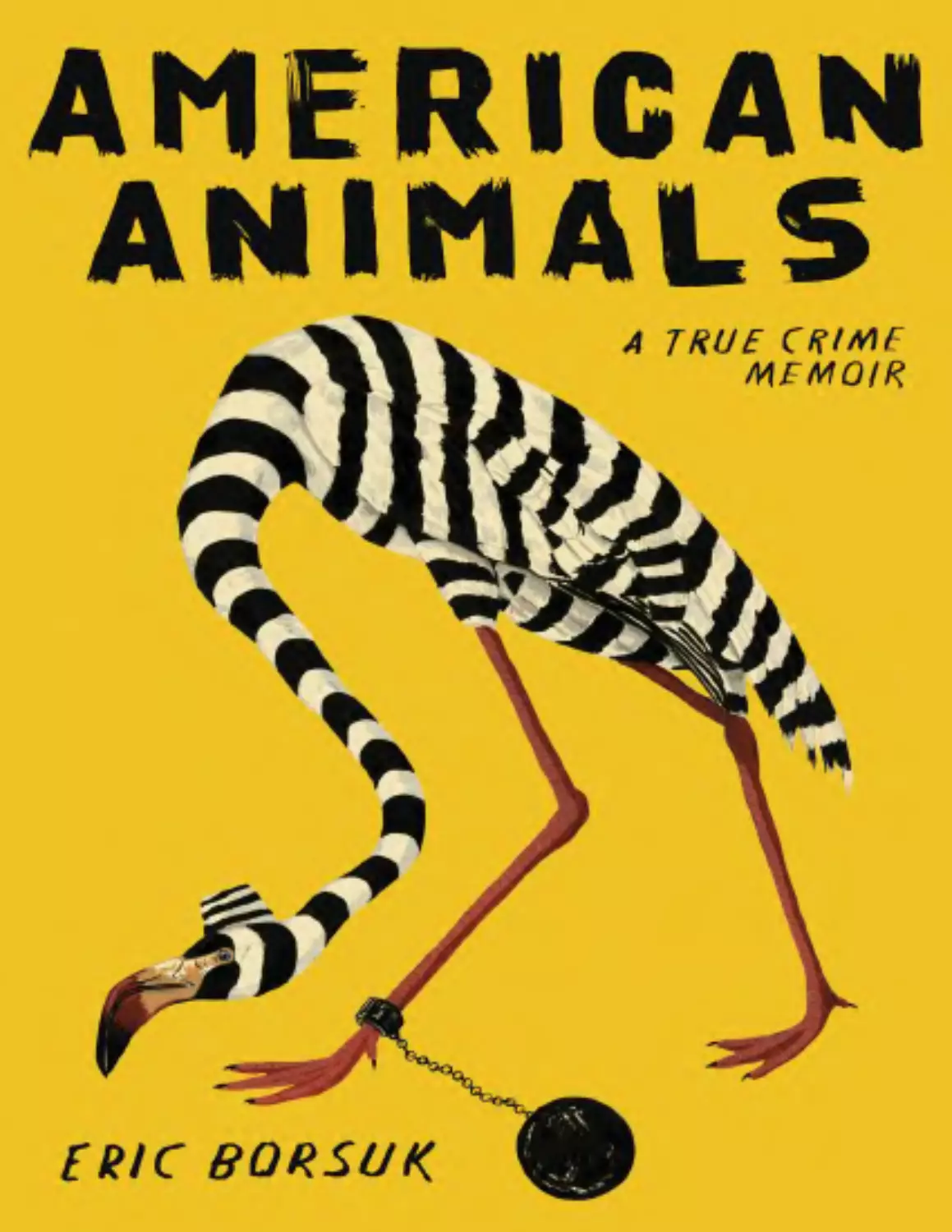
AMERICAN ANIMALS
OceanofPDF.com

AMERICAN ANIMALS
A TRUE CRIME MEMOIR
ERIC BORSUK
TURNER PUBLISHING COMPANY
OceanofPDF.com

Turner Publishing Company
Nashville, Tennessee
www.turnerpublishing.com
Copyright © 2019 Eric Borsuk
American Animals: A True Crime Memoir
No part of this publication may be reproduced, stored in a retrieval system, or transmitted in any
form or by any means, electronic, mechanical, photocopying, recording, scanning, or otherwise,
except as permitted under Sections 107 or 108 of the 1976 United States Copyright Act, without
either the prior written permission of the Publisher, or authorization through payment of the
appropriate per-copy fee to the Copyright Clearance Center, 222 Rosewood Drive, Danvers, MA
01923, (978) 750-8400, fax (978) 750-4744 . Requests to the Publisher for permission should be
addressed to Turner Publishing Company, 4507 Charlotte Avenue, Suite 100, Nashville, Tennessee,
(615) 255-2665, fax (615) 255-5081, E-mail: submissions@turnerpublishing.com .
Limit of Liability/Disclaimer of Warranty: While the publisher and the author have used their best
efforts in preparing this book, they make no representations or warranties with respect to the
accuracy or completeness of the contents of this book and specifically disclaim any implied
warranties of merchantability or fitness for a particular purpose. No warranty may be created or
extended by sales representatives or written sales materials. The advice and strategies contained
herein may not be suitable for your situation. You should consult with a professional where
appropriate. Neither the publisher nor the author shall be liable for any loss of profit or any other
commercial damages, including but not limited to special, incidental, consequential, or other
damages.
Cover design: Chris Walker
Book design: Tim Holtz
Library of Congress Cataloging-in-Publication Data
Names: Borsuk, Eric, author.
Title: American animals : a memoir / Eric Borsuk.
Description: Nashville : Turner Publishing Company, [2020] | Summary: “American Animals is a
coming-of-age crime memoir centered around three childhood friends: Warren, Spencer, and Eric”
–
Provided by publisher.
Identifiers: LCCN 2019025030 (print) | LCCN 2019025031 (ebook) | ISBN 9781684424511
(hardcover) | ISBN 9781684424504 (paperback) | ISBN 9781684424528 (ebook)
Subjects: LCSH: Transylvania University. Library. | Book thefts–Kentucky–Lexington. | College
students–Kentucky–Biography. | Borsuk, Eric.
Classification: LCC Z733.T76 B67 2020 (print) | LCC Z733.T76 (ebook) |
DDC 364.16/28002–dc23
LC record available at https://lccn.loc.gov/2019025030
LC ebook record available at https://lccn.loc.gov/2019025031
Printed in the United States of America
1718192010987654321
OceanofPDF.com

On my view we must suppose that American animals, having
in most cases ordinary powers of vision, slowly migrated by
successive generations from the outer world into the deeper
and deeper recesses of the Kentucky caves.
— Charles Darwin, On the Origin of Species
OceanofPDF.com

Contents
1 Aletheia
2 All That is Gold
3 Prerequisites
4 Mahamanvantara
5TheDayof
6 Second Chance
7 New Amsterdam
8 The Transition From Light to Darkness
9 Summe Potens & Callidus
10 Dixie’s Dead
About the Author
OceanofPDF.com

1
ALETHEIA
“Roughly fifty billion species have existed on Earth,” the geology
professor says, an old gray-haired man with tired eyes, “and almost ninety-
nine percent have gone extinct.”
Like a stand-up comic bombing on stage, the punchline falls flat.
The lecture hall is painfully silent.
The old man’s eyes desperately sweep the audience of aloof freshman
faces—yawning, checking their cell phones, thoroughly uninterested in the
study of rocks—searching for some sort of reaction to this staggering
figure.
“Ninety-nine percent!” he repeats, in case we didn’t hear him the first
time.
We’re in the late Cretaceous—
The Rocky Mountains are taking shape.
A flying reptile with a wingspan of fifty feet soars in the sky.
Much of the planet’s petroleum reserves are forming, along with other
mineral deposits which will be of commercial value to future civilizations.
Then, somewhere near the end, placental mammals start to evolve....
I scan the classroom for zombies. This is just the kind of place I’d run
into them, too. They’re usually easy to spot in their fluorescent, popped-
collar polos, but I don’t recognize anyone. In fact everyone looks about the
same. They’re all wearing the same self-imposed uniform—same khaki
pants, same New Balance running shoes—with the same deadpan
expression on their faces. It’s like we were packaged and distributed this
way, products of a Khaki Generation—bland, off-white, 100% cotton twill.
During the beginning of the semester, I made the mistake of joining a
fraternity. Some older guys I knew from high school offered me a bid at the

most sought-after frat on campus. I never really saw myself as a frat guy,
but I didn’t know how to turn it down.
Come on, man! It’ll be fun, they said. Parties, girls what’s not to like?
But it ended up being the crazy, Southern, racist frat—
Suddenly everything in my life was for the house, as they say. I became
a pledge, a bitch, relegated to long nights in basements being hazed—
punched, spit on, pissed on, forced to recite creeds and founding fathers in
front of Confederate flags.
When I quit, they put out some sort of mafia-like frat hit on me. Both
actives and pledges alike were instructed to fight me anytime they spotted
me on campus.
Now, wherever I go, these pastel preps hunt me like zombies.
“It’s sixty-six million years ago,” the professor excitedly blurts out.
“The asteroid is headed straight for us!”
The sky turns red and my blood starts to boil.
My cell phone rings to a rendition of Orff’s O Fortuna, illuminating the
otherwise pitch-black bedroom.
It’s late, or rather early.
Warren’s name is flashing on the screen.
At first, I think I’m still dreaming. We haven’t spoken since our
argument. It was over money, of all things. Long story short, some cash
went missing from my bedroom. When I questioned Warren about the
incident, he freaked out, as if I were accusing him of stealing from me. The
whole thing was a big misunderstanding. We grew up together—we were
like brothers. But that was all months ago.
When the voicemail alert chimes, I snatch up the phone—
Warren is drunk and rambling. After all this time, it’s strange listening
to him speak, like hearing the voice of a dead friend.
He quotes Villon: “In my own country I am in a far-off land. I am strong
but have no force or power. I win all yet remain a loser. At break of day I
say goodnight. When I lie down I have a great fear of falling.”

At the end of the message, Warren says he wants to meet.
The next day, I call Warren’s dorm room and his stoner roommate answers
—so rt of. He doesn’t bother to say hello, like most people. Instead he just
sits there in silence. At first I think it’s the answering machine, until I hear
breathing on the other end. Mind you, this isn’t the first time it’s happened.
Trying to have a conversation with him is like pulling teeth. The normal
components of social interaction go straight out the window.
After an awkward exchange, I’m able to gather enough information to
determine that Warren isn’t there. I ask the roommate to let the phone ring
when I call back. This way I can leave a message for Warren on the
machine.
When I call back, the roommate answers.
I explain again what I’m doing.
Warren is the only person I know who doesn’t own a cell phone. I used
to get calls all day long from unknown numbers—Warren calling from a
pay phone, Warren calling from a bar phone, Warren calling from a
stranger’s phone—most of which ended abruptly with unfamiliar voices in
the background demanding their phones back.
However, if it’s you who needs to get in touch with him, forget it. It’s
useless trying to track him down. Warren’s dorm-room landline is the only
way to reach him.
A couple hours later, I get a call from a number I’ve never seen.
“ Hey,” Warren says.
“You got my message?” I ask.
“Yeah,” he says. “I guess you got mine?”
“Yeah.”
The conversation drags on like this for a while—brief, empty utterances
—a s if we’re both waiting for the other one to make the first move, which
eventually he does.
“Want to meet?” he asks.
“ Meet?”

“Yeah, why not?”
I stutter, trying to think of an excuse, but nothing comes to mind.
“Oh ... I don’t know ... I just wasn’t expecting—”
“Meet me at Pazzo’s,” he says. “There’s something I want to talk to you
about.”
I’m sitting across the table from Warren. He’s wearing his signature brown
corduroy jacket and devilish grin. His hair is disheveled, as if he rushed
here from somewhere. But, then again, I’ve never known him to look any
different.
According to legend, Warren was born about the size of a radish in an
acutely premature miracle birth, and the universe has been trying to destroy
him ever since. Throughout the years, I’ve been a bystander when he was
struck by cars, and I’ve lost count of his broken bones and dislocated joints.
He’s a weasel-like creature, agile, hard to pin down. Somehow, he always
manages to escape.
From the start, our attempts at small talk are awkward—lots of toe-
tapping and feigned smiles. After not speaking to each other for so long, it
seems we’ve lost our timing.
Something about Warren’s demeanor seems different now, more
unhinged. Throughout the night, I repeatedly catch him peeking over his
shoulder and scanning the room, as if he’s worried someone is watching us.
Hoping to take the edge off, I order a round of beers with my fake ID.
Before our falling out, the two of us were running a lucrative little
dorm-room operation selling counterfeit driver’s licenses. Using my own
software and equipment, I designed and printed the IDs while Warren
peddled them to students on campus, of which, there was no shortage. It
seemed we had stumbled upon an untapped market and couldn’t produce
them fast enough.
Before I knew it, Warren started mingling with a shady crowd of
criminals who kept trying to pull us in deeper and deeper. That’s around the

same time my money went missing, and we all know where the story goes
from there.
Suddenly it all just disappeared, along with Warren.
After a couple of beers, we both start to loosen up. It’s not long before
we’re recounting old stories. Like that time we started a food fight in the
school cafeteria. Remember that? I still can’t believe Warren actually stood
up on the table and yelled “food fight!” It was like a scene straight out of a
John Hughes film, especially when the Dean of Students, Warren’s nemesis,
barged in and literally hauled us off by our necks.
“We need to put this nonsense behind us,” Warren says, still laughing
about the food-fight story. “Our friendship is too valuable.”
I agree.
“There’s something I want to tell you,” he says. “It’s big. It could
change our lives forever.”
“You can tell me anything.”
Warren peeks around the room to make sure that nobody’s
eavesdropping.
“Spencer and I have been working on something,” he says. “But, before
I tell you anything else, I need to know if you’re in.”
I laugh but quickly realize that he’s not joking.
“But, I don’t even know what I’m signing up for!”
“I just need a yes or no,” Warren says.
I’m not sure why—maybe friendship, maybe adventure—but I just
shrug my shoulders and say, “Yeah, sure, I’m in.”
Warren smiles and nods his head, as if he already knew what my answer
would be. After a long pause, he looks over his shoulder one last time and
takes a deep breath. Then he opens the floodgates—
“I just got back from Amsterdam,” he says. “I flew over there on a fake
passport that I got from our friend—you know, the guy. Spencer and I are
going to rob the Rare Book Room at Transy. My dealer in Amsterdam
wants Audubon’s Birds of America, which he thinks I already have. It could
be worth ten million dollars. After the heist, we’ll take the loot to Europe.
We may be on the run. We may never be able to return. We may never see
our families again.”

Late at night, I’m crossing a dark parking lot when I see them coming for
me—zombies, the fast kind. They’re rushing like rabid dogs, tripping over
each other to get to me.
Before I can react, I’m down on the pavement, all scraped up, fist-
fighting an old pledge brother I barely even know. He reeks of bourbon and
Polo cologne. I remember hearing once that he was an all-state wrestling
champion in high school, and it shows.
At some point in the fight my head bashes against the concrete, and
suddenly I am somewhere else. Strange, distant memories flash in my mind,
long forgotten, but preserved for some obscure purpose—
The ancient Greek word ἀλήθετα.
A portrait of Philippus Aureolus Theophrastus Bombastus von
Hohenheim. Alle dinge sind gift, he says. All things are poison.
Ten to the fortieth power.
I can be anywhere, I tell myself.
I am bleeding.
OceanofPDF.com

2
ALL THAT IS GOLD
Late-morning sunlight and the warbling of songbirds creeps inside my
tent, somewhere deep in the mountains of northern Georgia. Cocooned in a
sleeping bag, I plead with myself to get up off the ground, but my body is
stiff and sore from long days of backpacking on the Appalachian Trail. Not
to mention, I’m still recovering from my latest frat-boy beatdown.
Rubbing gunk from my eyes, I unzip the tent and slip on my boots,
carefully maneuvering around a raw-skinned heel blister.
On the opposite side of the fire pit, Warren is dangling between two
trees in a hammock, still asleep. Spencer, however, is nowhere to be found.
At first, I just presume he’s birdwatching. It’s not unusual for him to slip
off early in the morning with his binoculars and sketch pad in hand.
Sometimes you’ll be in the middle of a conversation with him only to find
that you’ve been talking to yourself the entire time. When you turn around,
he’s gone, tracking down a seductive trill. You hear that? he asks, even
though you never do. He points, but you can never seem to find it. Sounds
like a ... and he inevitably inserts some ridiculous-sounding name, like a
tufted titmouse or a white-breasted nuthatch, while hurriedly sketching the
bird and adding it to his register of sightings.
The only thing I can’t figure out is why Spencer would bring all of his
backpacking gear to go birdwatching.
Nearby, I scale a large boulder overlooking the mountainside, tiptoeing
around a group of rattlesnakes sunning themselves on the rocks. The
Appalachians span the horizon, draped in a plush, green Chattahoochee
carpet, while a sweet scent clings to the breeze. It’s a beautiful sight, but
there’s still no sign of Spencer.
Back at camp, I wake Warren and give him the news. After talking it
over, we both agree that Spencer never would have brought his fully loaded,

sixty-plus pound backpack with him to go birdwatching. That said, we can’t
figure out why he would’ve left without telling us, either. That’s
Backpacking 101: don’t abandon your best friends in the middle of the
woods. Not to mention, he took our only map and water pump.
With Spencer gone, everything feels off-balance. The three of us have
been close friends since our early teens when we each made the cut on a
local soccer team. From the start, we all just clicked. Something about our
three-sided friendship felt durable, like the sides of a triangle, the most
stable shape.
On the count of three.
Warren and I start packing and cooking breakfast, agreeing that if
Spencer hasn’t returned by the time we’re finished, then we’ll have no
choice but to leave without him.
Delaying the inevitable, I prepare for the day’s hike while dragging out
every little detail.
One.
I apply sunscreen.
Two.
I apply bug spray.
Two and a quarter.
I attend to my blisters.
Two and a half.
I stretch.
Two and three-quarters.
I stretch some more, all the while looking around for Spencer.
Three.
Having stalled for as long as possible, Warren and I reluctantly hit the
trail, leaving a note for Spencer under a rock, in case he returns to the
campsite. It’s a long shot, but we don’t have much of a choice.
All day long, the trail steeply climbs and descends, with no sign of flat
earth in sight. Before long it’s back to the same old grind, traipsing through
rough terrain in ungodly Southern heat, frequently questioning my decision
to embark on such a journey in the first place.
Dehydrated and exhausted, we go without speaking for long stretches of
time. It’s just me, my thoughts, and vast thickets of rhododendron.
Naturally, my mind wanders back home to Lexington—

Back to cul-de-sacs of McMansions in gated communities.
Back to strip malls and chain restaurants.
Back to soft white men sipping on small-batch bourbon while “playing
the ponies.”
Back to a life scripted like a character in a play.
Just do what you’re told, they say—
Pray this way.
Walk this way.
Talk this way.
Learn this way.
Think this way.
Work this way.
Shop this way.
Eat this way.
Dress this way.
Vote this way.
Fuck this way.
Love this way.
Hate this way.
Die this way.
After my initial meeting with Warren, I realized that he and Spencer
actually had no working plan for the robbery. Apparently it all started when
Spencer, along with other incoming art students, was given a tour of the
Rare Book Room, a special collections museum inside the library of
Transylvania University, also known as Transy, the private liberal-arts
college he attends. It’s just a few miles down the road from the University
of Kentucky, where Warren and I go to school. During the tour, the curator,
a friendly, grandma-like librarian named Betty, mentioned that an identical
set had recently sold at auction for nearly twelve million dollars. Then one
day, Spencer made an offhand remark about the millions of dollars’ worth
of artwork just sitting inside the museum, and a lightbulb went off in
Warren’s head.
After a cursory inspection of the premises, Warren deemed the robbery
doable and started asking around about how to sell stolen artwork. One of
his shady acquaintances hooked him up with an underworld go-between in
Manhattan, known only as “The Man in the Green Scarf.” Like a scene

straight out of a crime film, they met on a bench in Central Park, just
outside of The Plaza Hotel, while Spencer kept watch from a distance with
his birding binoculars. For a modest fee, the dapper dealer connected them
with his associates in the Netherlands.
Shortly after, Warren flew to Amsterdam and met with a black-market
art dealer at a coffee shop near Dam Square, claiming to be the
representative of a man named Walter Beckman, a private collector out of
Boston, who intended to unload some of his personal stash. Though
dismayed by Warren’s youth—and the fact that he hadn’t brought any
manuscripts, pictures, or documentation—the dealer maintained that if the
so-called Mr. Beckman could produce said artifacts, they would be in
business.
The only problem was that Warren and Spencer didn’t know how to
steal the books. That’s what they needed me for. They hoped that my
meticulous nature, along with an extensive knowledge of heist-film
minutiae, would help them formulate a plan. That’s ultimately why the three
of us decided to spend our summer break backpacking the Appalachian
Trail. It was supposed to be a team-building exercise. That is, until Spencer
disappeared.
Late in the afternoon, Warren and I come to a road crossing. It’s the first
sign of civilization in days. Drenched in sweat, we sit down on the guide
rails, while sipping on our last drops of water.
On the opposite side of the road, the trail recedes into the woods up a
steep and steady incline. At this rate, we won’t make it to the next shelter
until after nightfall.
Without thinking, I turn to Warren and say, “Want to hitchhike?”
What started as a joke, purely out of exhaustion, soon turns into an
actual plan. It’s completely unrealistic, but we decide to thumb it to the
nearest town in search of supplies. From there, we’ll work our way back to
the trail, hopefully ahead of Spencer (assuming he’s still heading north),
and travel south until we find him. That’s the plan, at least.
The first driver, a woman in a Subaru, actually accelerates when she
sees us standing on the side of the road, grinning with our thumbs in the air.
Assuming it’s an isolated incident, we continue to try our luck. But after a
few more unsuccessful attempts, I figure out the problem—it’s me.

I watch as a man in a truck slows down for Warren, but then, upon
spotting me, instantly speeds off.
Intrigued, I look Warren up and down. He’s your all-American boy
next-door—athletic, clean-shaven, spotless, and even wearing brand-new
hiking clothes.
Then, using an emergency signal-mirror, I proceed to examine my own
reflection—I’m bearded, about twenty pounds overweight, wearing dark
sunglasses, a boonie hat, and covered head-to-toe in dirt. I am the complete
opposite of Warren, and not someone you would want to pick up on the side
of a remote mountain road—or any road for that matter! It’s a troubling
discovery that leaves me with only one option: I’ll have to hide in the
woods, out of sight.
Peeking through tree branches, I watch Warren sluggishly kicking rocks
up and down the highway. It’s been about an hour since our last failed
attempt. I’m pouring sweat and losing hope. We might just have to accept
the inevitable, I think to myself, when suddenly I hear the faint hum of an
engine coming around the bend.
Wading through brush, I catch a glimpse of Warren huddled over the
window of an old hatchback. Before I know it, he’s waving me over.
Frantically, I gather my gear and stumble out of the forest, lumbering
toward the car like some mythical woodland beast. Warren is already settled
in up front, so I cram into the backseat.
“Thanks for stopping,” I say, while trying not to make eye contact.
The driver, a long-haired Hispanic man in a tank top, stares back at me
with a puzzled expression on his face, like he can’t figure out what is
happening. Clearly having second thoughts, the man sits there for a
moment, deliberating with himself. Then, surprisingly, he turns back around
and shifts the car into drive.
Once we’re coasting down the windy, mountain road, Warren tells him
that we have no idea where we are. “Just trying to get to the nearest town,”
he says. “Wherever that is.”
But the man says nothing, just glances back at me in the rearview
mirror, with a little teardrop tattoo visible underneath his right eye.
I’m racking my brain trying to remember what it means. Did he?
a) Kill someone?
b) Lose someone?

c) Do time?
d) All of the above
We drive for a while in silence, eventually turning onto a rugged, one-
lane backroad—then another, and another. Soon, we’re deep in the woods,
traversing creeks on rickety old bridges, and passing decrepit log cabins
barely withstanding the incursion of time.
“Some sort of shortcut?” I ask.
Still, the man says nothing. Yet as I shift nervously in my seat, the
teardrop-tattooed eye watches my every move.
In the passenger-side mirror, I see Warren shooting me a crazed look
and nodding his head down to the side, calling attention to an unsheathed
hunting knife in his right hand.
Suddenly, time slows to a crawl—
I brace myself for something terrible to happen, a scene of bloody
chaos. As usual, I do nothing—I don’t intervene. I just follow Warren’s lead
and remind myself to grab the steering wheel when shit goes down so we
don’t drive off the cliff.
Then, out of nowhere, the shady forest opens up to a bright, sunny sky,
and all of a sudden we’re driving down the main strip of a small mountain
town.
I panic and open the door while the car is still moving—the outside
world loudly rushes in.
As a result, the man swerves the car to the side of the road, shouting at
me in Spanish.
Flustered, Warren and I hurriedly drag our packs to the curb, waving
and thanking the man for the ride. But I don’t think he hears us over the
screeching tires as he speeds away.
As we set off down the sidewalk, our hope of finding supplies quickly
fades. The town is small, consisting of only a few basic shops. With no
choice but to keep moving, we top off our water bottles in a gasstation
restroom and stagger aimlessly along the highway toward the mountains,
engulfed in sweltering Southern heat.
At a roadside stand, Warren and I devour an entire bag of peaches like
wild animals. When the two of us catch glimpses of each other—our faces
plastered in pulp—we completely lose control. Undoubtedly, the outburst
had been building up for days, the culmination of endless hours of torment

and silence. As we laugh uncontrollably in the bright summer sunlight,
holding onto each other for balance, the old man who sold us the fruit
slowly backs away, keeping his distance in case whatever we have is
contagious.
Across the highway, deep in the forest, I spot lights—shiny, dancing
diamonds—flickering between the pine trees. At first, I assume it’s just the
heat getting to me. It takes a moment before I realize that I’m staring at a
lake.
Under the confused gaze of the peach vendor, Warren and I scamper off
into the forest, frantically pushing through dense undergrowth in search of
water.
We drop our packs on the shore, strip down to nothing, and plunge
heedlessly into the lake, as if the murky water could magically solve all of
our problems—and somehow it kind of does.
After setting up camp at the water’s edge, we devote the remainder of
the afternoon to swimming and smoking joints. All throughout the day,
gawking families in RVs drive by, berating us in southern accents for taking
up prime lakeside real estate with our tents. Nearby, they attach their
rattling beasts to electrical outlets. It’s not long before the simulcasted
clamor of NASCAR overtakes the campsite.
At dusk, we follow the crowds up a grassy hillside to find a field of
brightly-lit carnival rides enveloped in the stench of deep-fried meat and
sulfur from fireworks exploding overhead.
Wild-eyed carnies casually operate convulsing machines to haunting
tunes. They nod at us when we walk past, as if we’re kin.
“Lookin’ for work?” one of them asks, with a cigarette dangling from
his mouth. He says he’ll show us the ropes, though what the ropes consist
of is unclear. We could travel with him, he says, from town to town, living
as carnival folk.
I envision my carnie-self years from now, shirtless, in a denim vest,
with the obligatory cigarette wedged between my lips. Seated at the cockpit
of The Gravitron, I’m grinning and turning dials like some twisted maestro
in the eye of a violent storm. Hordes of hillbillies whirl around me, writhing
up and down the walls to extreme centrifugal force, while the southern rock
hit “Devil Went Down to Georgia” blares from my cassette boom box.

It’s the kind of opportunity that doesn’t come along every day, but after
careful consideration, we’re forced to decline the offer, explaining that our
friend is missing and we have to keep searching for him.
The next morning, we try our hands—or rather, our thumbs—at hitchhiking
once again. By late in the afternoon, not a single car has stopped, and a long
stretch of shimmering highway recedes from view. Struggling to stay
upright, Warren and I scour the woods for tree branches, using our
pocketknives to whittle walking sticks. We have fully accepted our fate of
camping alongside the road for the night, when suddenly a big, black tour
bus comes barreling past us. At the last second, I stick out my thumb, and
amazingly the bus pulls over to the side of the road.
At first, the two of us just stand there, stunned, staring at each other
with our mouths open. Then, instinctively, we both start running toward the
bus, in case they caught a glimpse of me and start having second thoughts.
Warren makes it to the door just before me. From inside the bus, I hear
his muffled voice blurt out, “Holy shit!” When I reach the top of the stairs, I
find a scene of hysteria unfolding. What starts as a faint reverberation
quickly turns into an entire bus-full of children pointing and shouting—
Awwwwwwww!—in response to Warren’s remark, much like the inevitable
uproar that occurs when a classmate is sent to the principal’s office.
The chaperone—a balding, overly animated thirty-something—uses
hand gestures to quiet the kids like an orchestra conductor, narrowly
avoiding all-out anarchy.
“It’s your lucky day,” he says, winking at us. “We don’t normally pick
up hitchhikers, but every Tuesday we try to do something nice for someone
in need. So, it’s Tuesday ... and you fellows sure look like you’re in need.”
The man, a local youth minister, is treating his church-camp group to a
picnic at a nearby state park. He can’t help with our supply needs but offers
to drop us off at a spot near the Appalachian Trail. Seeing how we’ve
already wandered this far, it seems like our best option.

As we drag our backpacks down the aisle, the children wait breathlessly
to see where we sit. There are only a few open seats, so Warren and I split
up.
Toward the back of the bus, I plop down next to a little boy with
glasses. Out the corner of my eye, I can see him staring at me, open-
mouthed, as if an alien just sat down next to him.
The Lord of the Rings is playing on an overhead monitor. Gandalf the
Grey is delivering one of his many eloquent monologues. The little boy
says he’s memorized all the books and movies word-for-word, which he
proves in excruciating detail.
Then, all of a sudden, in a raspy little southern accent, he turns to me
and asks, “Are you a wanderer?”
Exhausted, I slump down in the seat and close my eyes. The air
conditioning is blasting, ice-cold. Before I know it, I’m drifting in and out
of sleep with my head bobbling around uncontrollably. Every now and then
I wake to find the boy reciting passages that in my dreamy state sound more
like Eastern philosophy than fantasy film.
After sleeping for what feels like hours, I’m jolted awake by the bus
pulling to a halt on the side of the road.
“This is as far as I can take you boys,” the youth minister shouts back to
us.
Disoriented, I fumble together my gear while saying goodbye to the
children. Meanwhile, it’s clear that something has come over the boy. He
looks flustered, like he wants to tell me something but doesn’t know how.
As I turn to leave, the little bug-eyed Buddha grabs my arm, looks me
straight in the eye, and in quite possibly the most transcendent moment of
my entire life, quotes Tolkien:
“All that is gold does not glitter,” he says, like an oracle Opie Taylor.
“Not all those who wander are lost.”
There’s no telling how long we stare at each other—it could have been a
couple of seconds or a lifetime.

After sunset, a violent squall surges over the ridgeline, barraging us with
hail and fierce wind. We frantically gather our gear in the dark and scramble
down the mountainside for cover. With lightning and trees crashing down
all around us, Warren and I eventually reach lower ground in the midst of a
steady downpour.
Tired and wringing-wet, we slog along for hours in search of the nearest
shelter. At every murky bend, I think to myself, It’s got to be just around the
corner, only to find more dark, muddy trail. It’s a daunting cycle with no
end in sight, until finally, late in the night, I see moonlight reflecting off an
old tin roof.
Turning down a side trail, I hear what sounds like children laughing—
faint yelps obscured by the constant drumming of rainfall—but quickly
dismiss the thought. The woods are full of inexplicable noises. Just my
imagination, I assume, until I see inside the cabin.
The place has been overrun by a couple dozen prepubescent Boy
Scouts, most of whom are running around the cramped shelter playing tag.
Some of them are perched up in the rafters, carving their names into the
wooden beams with pocketknives. Meanwhile, a shady splinter group in the
corner is dumping bags of shredded mozzarella cheese onto the dirt floor
and shoving handfuls into their Kool-Aid-stained mouths. When they spot
us standing in the doorway—drenched and trying to make sense of the
chaotic, lantern-lit scene—the cabin falls silent.
An old man, dressed in a brown forest-ranger uniform, is seated cross-
legged on the floor, twisting the gray, wiry ends of his handlebar mustache.
He’s engaged in a lively conversation with himself, going back and forth,
weighing all the viewpoints like an impartial mediator, when the sudden
silence breaks his concentration.
“Good day, fellow woodsmen!” he shouts, staggering to his feet and
rushing toward us.
Suddenly we’re face-to-face with the old man, so close that I can smell
his breath, which reeks of mozzarella cheese; there are little globs of the
stuff plastered within the crevices of his yellow teeth. I have no idea why
he’s standing so close to us, or why he’s whispering now.
“This whole thing started as a favor for a friend,” he says, peeking over
his shoulder at the watchful children, as if he were their prisoner. “But I
seem to have bitten off more than I can chew.”

After a while, the little hellions return to their games, some switching
stations, others creating new ones on the spot.
Watching anarchy unfold in the background, I come to a devastating
realization: We can’t stay here. The place is packed to the brim, with no
extra space whatsoever. This means we’ll have to hike through the night, in
the dark and pouring rain, to the next shelter, nearly eight miles away.
When I whisper this to Warren (don’t ask me why I’m whispering now
as well), a fearful expression spreads over the old man’s face. It’s a look
that clearly says: Don’t leave me here with them! So, he attempts to lure us
in with bait.
“You boys fancy a smoke? I’ve got a pipe and some tobacco! How does
that sound?”
But it’s already late, and we have a long night ahead of us.
Before we leave, the old man asks us for advice, but neither one of us
can think of anything to say.
Back on the trail, things start to go downhill quickly, figuratively
speaking. My blisters have reached the point of no return—red, raw skin,
grating against my boots. Every step feels like searing needles stabbing into
my heels. To make matters worse, I feel a muscle cramp coming on,
something I’m familiar with from years of playing soccer. I was known as
the teammate who always got cramps. It would usually start in my calves,
first one, then the other, both muscles clenched in endless contraction,
inevitably spreading to my hamstrings, then quads, and eventually my
entire body. Without fail, I’d be on a breakaway, just me and the keeper, an
easy goal. Then, suddenly, it would be like a sniper had picked me off—my
body falling lifelessly to the ground. “Shooter in the clock-tower!” Warren
would yell from across the field, laughing uncontrollably.
I writhe around on the trail, convulsing in unnatural movements. Using
a rhododendron for support, I try to pull myself up from the ground, only to
come crashing back down into the mud when my whole body seizes up. I
flick on my headlamp and call for Warren, but he’s too far ahead to hear me.
I’ll just have to wait it out, I decide, while gnashing my teeth in pain.
Exhausted, I close my eyes and sink into the mud. Every time I think it
can’t possibly rain any harder, it does, causing large puddles to form around
my body. It’s uncomfortable at first, but once I stop resisting, it’s really not

so bad—soothing even, like dissolving into the earth. Eventually, I doze
off....
When I wake up, a thick fog has crept in, restricting my view to only a
few feet, while enclosing me in a cramped bubble of misty headlamp glare
and billions of beating raindrops.
Moments ago, I could’ve sworn I’d heard grunting sounds in the
distance, though it’s possible I dreamed it. I’ve nearly dismissed the thought
when suddenly I hear the noise again, this time louder and closer—abrupt
snorts and squeals flanking me in the darkness.
Lifting myself up off the ground, I stumble down the slippery trail,
trying to keep my legs straight to stave off cramps. Meanwhile, the puzzle
pieces are starting to come together. A little ways back I came across a
patch of upturned earth. I didn’t think much about it at the time, but now it
makes perfect sense: Wild boars are known to dig up soil in search of roots
and bulbs. Any moment now, one of the vicious, sharp-tusked beasts could
burst through the fog and take me out at the knees.
I turn off my headlamp and pick up the pace, adrenaline pushes me
through the pain. I’m practically running down the trail. Maybe running
isn’t the right word, rather, moving as fast as possible through complete
darkness with blisters, muscle cramps, and sixty pounds of gear strapped to
my back.
Carried along by some innate survival instinct, I lose track of time, and
the night turns into one long and foggy daze. In my mind, the boars have all
merged into one unified beast—a great amorphous, even-toed ungulate
surrounding me in the dark.
Just stay ahead of it, I tell myself, even when the squeals are far behind
me. Just keep moving and don’t look back.
It’s late in the night when I finally reach the shelter. By now the
adrenaline has worn off, and every part of me feels cold and waterlogged.
All I can think about is collapsing.
On the far side of the lean-to, a campfire flickers against the black
forest. Two bodies are sprawled out next to the flames, stained red like
bleary figures in an oil painting, unspeaking and still.
When I cross the threshold, one of the figures shoots upright. I
recognize his voice before anything else.

“Look who I found!” Warren says, pointing to the body lying next to
him.
The young man’s face glows red against the fire, gaunt and angular. I
stare at him blankly, but nothing registers. He grins and waits for me to say
something. It takes a moment before he finally comes into focus.
Every aspect of Spencer’s appearance is tweaked, as if he’s been
swapped for a scrawny look-alike. I’ve never seen him so thin. Even his
voice sounds different, deeper, and more strung-out. Apparently he’s been
pushing over twenty miles a day, which is how he lost so much weight. He
says that Warren and I were holding him back. We tend to move at a more
leisurely pace, taking in the scenery, while Spencer is more focused on
meeting the daily quota of trekked miles. As the days passed, Warren and I
kept waking up later and later, until finally one morning Spencer was gone.
He claims to have warned us that he would take off if we didn’t pick up our
pace, but neither of us recalls such a threat.
OceanofPDF.com

3
PREREQUISITES
I wake up early one morning to register for classes online, but there’s no
internet connection.
I restart my computer—nothing.
I reboot the router—still nothing.
Finally, I troubleshoot—You are not connected to the internet. The page
can’t be displayed.
I try everything, but nothing works.
I scream.
I panic.
I throw on some clothes and sprint through campus to the university
library, but by the time I find an open computer and log into my student
account, nearly all the classes have filled up. To keep my student loans, I
have to stay above a certain number of course hours per semester. As a
result, I’m forced to sign up for classes like Tennis and Jiu Jitsu, just to stay
enrolled, even though the credits won’t apply toward my major—which, by
the way, is Accounting, a subject I couldn’t possibly care less about.
Ever since I was young, when my uncle started working for the FBI, I
had been completely obsessed with the idea of one day becoming an agent
myself. This was around the same time that The X-Files first aired on
television, and instantly I knew it was the career for me. I read every book
about the Bureau that I could get my hands on, and I even wrote letters to
ex-agent authors asking for advice on how to follow in their footsteps. My
plan was to apply to the FBI immediately after graduation. Seeing how the
only bachelor’s degrees accepted straight out of college were Law and
Accounting, it made for an easy choice of a major.
Then, at some point, all of that changed.

As if the transformation occurred seamlessly overnight, I suddenly
found myself on the opposite side of the law, immersed in a life of crime for
no apparent reason. One day I came across an article about a study that
analyzed the brain scans of criminals in comparison to law enforcement
officers—the two were nearly identical. Maybe that has something to do
with it, I wondered.
Before I knew it, I was majoring in something I didn’t care about,
dedicating my life to something I didn’t believe in, forced into years of
pointless prerequisites, and, as a result, shackled to a disproportionate debt
that I’ll never be able to pay back. All that would still be fine and dandy,
except I can’t even enroll in the pointless prerequisites because I’ve
suddenly lost internet connection at the very moment that thousands of
other students are signing up for the exact same classes.
That’s how you find yourself standing on a tennis court, lined up side-
by-side with a couple dozen other hopeless undergrads. You’re practicing
your serve—actually, not even the serve, just the toss.
Tennis balls are flying everywhere, some too high, some too low, some
not even close—
Concentrate! Don’t take your eye off the ball ... watch it rising high in
the gray Kentucky sky ... lose yourself in the fuzzy, yellow felt ... nothing
else matters except this fleeting moment ... just make sure that you follow
through with your tossing hand.
The ball bounces a couple of times, then rolls away.
Up, down, up, down, up, down.
Chase and repeat.
Your footing changes, and you find yourself standing on a padded blue
mat, wearing a heavy cotton jacket called a gi. It costs one hundred dollars,
and you can’t take the class without it. You didn’t know that before you
signed up for the class—but, then again, you never really had much of a
choice, did you?
You’re still trying to figure out how to tie the belt when the instructor
shouts at you.
“Next up,” he says. “Forward roll.”
You dart to the line and execute a quick Daniel Larusso-like tuck-and-
roll, springing to your feet in fighting stance.
“Well done,” the instructor says, seemingly surprised.

Before long, you’re lying in the fetal position, practicing something
called “shrimping,” an evasive technique to avoid being mounted.
“Shrimp!” the instructor yells, as the entire class wiggles around the mat
like freshly caught crustaceans on the deck of a fishing trawler.
After the group demonstration, you’re paired up with a preppy-looking
white boy—
You’ve mounted him. You’re choking him.
He’s supposed to be using his newly acquired shrimping skills to escape
your grip, but he’s not strong enough.
You imagine he’s a zombie and start squeezing harder.
He squirms around, eyes bulging.
“You can do it,” you encourage him. “Just remember to control your
breathing. ”
Early in the morning, an erratic, crinkling sound trickles through the quiet
house, lingering in the background at first, then louder and louder, until it’s
the only thing I can hear.
Please stop. Please stop. Please stop.
I hate it. I want to destroy it, whatever it is.
I’m staring up at the white, popcorn ceiling, losing my mind. Just when
I think it’s over, and I fall back asleep, the mysterious racket starts back up
again.
Groggy and hungover, I force myself out of bed, tiptoeing around
bloated male carcasses, occasionally stepping in sticky puddles of spilled
hooch.
A porno is playing on the television. It’s one of those huge, boxy big-
screen TVs, which somehow found its way from the early ‘90s into our
living room. “Oh, God! Right there! That’s the spot!” the bushy, blonde-
haired actress moans on the screen. Judging by the image quality and excess
pubic hair, someone must’ve discovered our communal vintage-VHS
collection.

The house looks like a natural disaster site. There’s wreckage scattered
everywhere—pizza boxes, cell phones, beer bottles, disposable plastic cups,
wallets, random articles of clothing, and several motionless bodies. Not to
mention someone left the front door wide open, revealing a blast radius
extending all the way out to the street.
In the front yard, a disoriented young man is combing through the
debris like a shell-shocked survivor searching for remnants of his
belongings. Eventually he gives up and staggers off to some cockroach-
infested corner of campus to undoubtedly do it all over again tonight.
Lately it’s like our place has become a boarding-house for student
delinquents. The doors are never locked, and strangers come and go freely
at all hours of the day. For the right price, rooms are available to rent on a
month-by-month basis, and each deal is negotiated separately.
Chas, a classmate from high school, oversees the house. He’s a snobby
rich kid, raised on day-trading and get-rich-quick schemes. His hustler
father finances properties and occasionally allows him to manage them.
Chas’s bedroom, which occupies the entire second floor of the house, is
decorated with gangster film posters like Goodfellas and Scarface. A
knockoff katana sword rests on a wall rack, while pistols, shotguns, and
throwing stars are stashed in various nooks. Titles like The Art of War and
The 48 Laws of Power line the bookshelf. However, most of the space is
occupied by a top-of-the-line home theater system, a California king
mattress draped in mulberry silk, and a hefty freshwater aquarium that
seems to be stocked only with predatory fish. At odd hours of the day, the
old house rattles to the commotion of chaotic action-movie scenes blaring
from up above. Every now and then Chas emerges from his loft, dressed in
a robe and slippers, like some landlord mobster squeezing us for rent
money.
One of the other tenants, an obese country boy from Georgia known
only as “Cooter,” recently came home with a puppy. After spotting an ad in
the classifieds about a newborn litter, he hauled his rusty old Jeep out to a
nearby farm to investigate. The breeder couldn’t possibly have known any
details about Cooter’s life, or surely he never would have sold him a living
creature. From what I’ve heard, he hasn’t been to class in weeks, and his
GPA is hovering just a few tenths of decimals above zero. He’s a hulking,
sweaty beast of a Southern brute, whose migrations are trailed by various

nauseating odors. His appearance alone should have prevented the
transaction, but clearly that was not the case. To make matters worse, one
day Cooter called everyone into the living room for a house meeting to
announce that he had named the poor little brindle boxer “Dixie.”
Having tracked down the noise to the laundry room, I stand in the
doorway, watching a giant bag of puppy food shake erratically on the floor.
“What’s going on here?” I say in a booming voice.
Suddenly the bag stops moving.
After a long pause, Dixie slowly creeps out, cowering and wiggling her
little nub of a tail.
I stand over her, scowling, with my arms folded.
“Un-uh, I don’t think so, little missy! What do you think this is, an all-
you-can -eat buffet?”
Overwrought, her backside starts gyrating uncontrollably, propelling her
in circles around the room. Seeing that I’m not buying it, she hams up the
performance, making a whole production of it, convulsing and emitting a
high-pitched moaning sound before collapsing into the communal laundry
pile.
Heaving the heavy dog-food bag on top of the washing machine, I tell
her that she’s being unreasonable. Even in her underdeveloped puppy mind,
she should know that this eating arrangement is absurd.
Recently, it came to my attention that Cooter is pledging the zombie
fraternity. To my knowledge, they haven’t figured out that I’m one of his
roommates—not yet, at least. The point is, Cooter spends all of his time at
the frat house now, which means he’s never around to take care of Dixie.
Lately, he’s just been leaving the bag of puppy food open on the floor so
that she can feed herself.
Needless to say, I’ve been gradually taking over responsibilities—
I feed her.
I walk her.
I clean up all her messes.
I let her sleep in my bed (which, incidentally, often involves cleaning up
her messes as well, requiring, on more than one occasion, a trip to the dry
cleaner).
Not to mention, the biggest job of them all: knowing where she is at all
times.

This may seem like a trivial task, but I assure you it’s not. With people
constantly coming and going in and out of the house, oftentimes leaving
doors wide open, watching Dixie is a full-time job. She’s an escape artist
and hands down the most athletic creature I’ve ever seen. All day long she
bides her time, watching vigilantly as doors swing open and closed. Then,
when you least expect it, she bolts—
The alert goes out immediately—All hands on deck! We’re at
DIXIECON 1! This is the real thing, folks! This is not a drill.
Everyone drops what they’re doing and rushes outside. It takes multiple
people to catch her. By yourself, you don’t even stand a chance.
Right away Dixie hops a couple of fences and disappears into the dense,
suburban jungle of adjacent backyards. Honestly, in my opinion, your best
bet is to follow the screams. With so much pent-up energy releasing all at
once, it’s not uncommon for Dixie to be mistaken for a rabid marsupial,
which means that time is of the essence.
Sometimes I’m lying in bed and barely even clothed, when suddenly I
find myself running down the street in the middle of the night, as if I woke
up this way, transported from somewhere ill-defined, chasing an elusive
creature that only wants to be free.
I’m helping Warren carry boxes downstairs to the basement. It’s a dark and
dingy pit burdened by an ominous presence and an unsecured cellar door
that allows rodents to come and go as they please. The one night Spencer
slept down there, he suffered his old childhood nightmare. When I pressed
him for details, he clammed up, muttering something about evil spirits and
how it had been over a decade since he’d last had the dream.
Apparently, Warren finagled a deal with Chas to rent the room for
cheap, an arrangement that works out well for both of them. This way,
Warren gets a bedroom to himself while paying next to nothing (the
bargain-basement deal, if you will), and Chas collects revenue on an
otherwise unrentable space.

After descending the staircase, the first area you enter is the “living
room,” the centerpiece of Warren’s lair, decorated with an assortment of
mismatched bohemian furniture, coffee tables, lamps, and rugs—all of
which he stole from various thrift stores around town.
Throughout the basement, bedsheets hang from the rafters, crudely
dividing the open floor plan into a maze of ill-defined rooms carpeted with
artificial turf, while the concrete walls are lined with stacked bookshelves
and several pieces of original artwork on loan from Spencer as
housewarming gifts.
In the corner, next to the sump pit, Warren’s bedroom consists of
nothing more than a cheap mattress on the floor surrounded by piles of dirty
laundry and comic books.
Nearby, he’s converted an old workbench into a study space. The
contents of his backpack are spread out on the surface, mixing lecture notes
with dusty old tools and paint cans. A tightened bench vise holds up the
business end of a music stand, displaying an American government
textbook opened to an oddly-shaped map of the United States with each
state drawn in proportion to its number of electoral votes.
At the opposite end of the basement, buried behind storage boxes
belonging to Chas’s dad, we find an out-of-place washroom jutting out from
the otherwise rectangular foundation. Upon this discovery, it’s immediately
clear that we must use this space for some clandestine purpose. There’s
remarkably little discussion about the project, as if the concept were
inherent—a numinous voice commanding us to build.
We start hauling in lumber, and within a couple of days we’ve
constructed a door and vestibule around the threshold, secured by a
padlock. Just to be safe, we slide a bookshelf in front of the door and pile it
full of old National Geographic issues.
When our roommates ask about the noise, we say that we’re building a
bookshelf. The fact of the matter is, no one else can know about this, just
the three of us—Warren, Spencer, and me. This way, it exists only in our
world. But simply building the room is not enough. We have to put
something inside of it. Otherwise it’s just an empty room.
OceanofPDF.com

4
MAHAMANVANTARA
Spencer is staring out the window through his birding binoculars, spying
on the campus security station across the lawn. He says he’s been watching
them for weeks, not to mention following them around on his bicycle.
“They don’t do much,” he says. “Just a loop around campus every now
and then.”
His dorm room is littered with canvases, easels, and palettes.
Little gray kneaded-eraser sculptures are scattered everywhere—
A Bodhi leaf pressed to the mirror.
A fly agaric sprouting from the window sill.
A little gray lemur climbing up the bed post.
And a curious number of little gray penises.
Various drawings of songbirds and human anatomy are spread out on
the desktop. One in particular catches my eye: a pencil sketch of a naked
obese woman lying on her side, plopped on the paper like a glob of jelly.
Above it all, positioned on top of the dresser, a red clay sculpture-in-
progress overlooks the cluttered landscape like a desert butte.
Recently Spencer devised a fake art project centered around the
Audubon books, sort of a modern take on Birds of America. He pitched the
idea to the art department, asking for permission to photograph the pages.
Being an avid birder himself, as well as one of the university’s most gifted
art students, his story checked out, and he was granted access to the Rare
Book Room.
A few days later, he was first escorted through a fortified door with a
security keypad and then ushered around the museum by that same friendly,
grandma-like librarian named Betty. For the greater part of an hour, she
highlighted Transy’s most prized possessions, focusing mostly on Birds of
America.

Spencer spins around in his swivel chair and opens his laptop.
Throughout the tour, he was allowed to snap photos on a digital camera.
Scrolling through the files on his computer, the three of us marvel at the
vivid, life-sized, 19th-century watercolors of American birds in their natural
habitats. Some of the highlights include: a majestic barn owl perched on a
tree limb high above a meandering river, calmly staring forward (as if
looking directly at us) with a dead chipmunk dangling from its mouth; a
brown buzzard swooping down on a defenseless rabbit, illustrated in the
split second before its talons dig into the petrified prey; and of course
Audubon’s famous American Flamingo, with its vibrant pink body and
long, outstretched neck hunched over the water of a muggy lagoon.
Although Spencer kind of kills the mood when he informs us that Audubon
in fact shot and killed each bird before painting it.
To our surprise, Betty even gave Spencer permission to photograph
other works unrelated to Audubon. Like Hortus Sanitatis de Laten en
Francois, the first natural history encyclopedia, a two-volume Latin treatise
on herbs, medicine, and natural history, with ornate woodcut illustrations,
circa 1500, translated to French, and custom-made for King Henry VII and
Illuminated Manuscripts, a devotional calendar decorated with fancy
calligraphy and gold illuminations, written at Winchester in 1425. Not to
mention, one that needs no introduction, a first-edition of Charles Darwin’s
On the Origin of Species.
Throughout the course of the tour, Spencer was able to glean other bits
of useful information as well. For example, he learned that the staff elevator
leads directly into the museum, and that there are no alarms attached to any
of the pieces. However, an intricate after-hours security system pretty much
rules out breaking in at night.
“But during the day, there’s almost zero security—no cameras, no
alarms, nothing! Everything is guarded by a little old lady, and all it takes is
an appointment,” Spencer says, as he casually closes his laptop and strolls
out of the room to use the communal restroom down the hallway.
The moment he’s gone, Warren shoots up from his chair and rushes over
to the bookshelf. He slides out a notebook and shuffles through the pages,
searching for a particular spot.
“You need to read this,” he says, handing me the notebook. I’ve seen it
before—it’s Spencer ’s sketch pad from the Appalachian Trail.

“Hurry before he gets back!”
I skim over the page, struggling to decipher Spencer’s tangled, chaotic
words. The passage starts out normal enough, just mundane notes about the
weather. Then it takes an unexpected turn:
I have decided that Warren and Eric are trying to kill me. Large
outcroppings have interested them. Tomorrow I get out. Wake up and
leave. Don’t trust them. Trust your gut. Get out. Fast. They couldn’t
keep up with you if they tried. You must go and you must go fast. Get
up early. Grab your food, leave. They could never catch you.
I stare blankly across the room, struggling to make sense of what I’ve
just read. One of Spencer’s paintings is propped up against the wall—a
landscape of abstract chaos, blurred lines and commotion, a world in
disarray. If you stare long enough, eventually the dystopian wasteland fades
away and the separate scenes come into focus. Suddenly the labyrinth
appears less convoluted and lawless. Everyone is just going about their
lives, focused on themselves, unaware of the whirlwind circling around
them.
Crossing the atrium, we keep our heads down, eyes fixed on the polished
limestone floor of the massive, brand-new, twenty million-dollar UK
student library. Sunlight streaks across the marble from the skylight above.
Sponges.
Ammonites.
Belemnites.
Brachiopods.
Squiggles and doodles with geometric purpose.
Bright-white foraminifera in all their godlike glory.
The slabs were imported from Bavaria—no expenses spared, paid for by
a wealthy alumni from the zombie fraternity—here now for us lordly apes
to kill time on.

Students loaf in Bauhaus lounge chairs, hunched over cellphone screens
with necks bent like macaroni, crammed into endless alcoves and stacked
high on a half-dozen levels around a towering rotunda.
Blending into the crowd, we move up the main staircase to the
mezzanine, searching floors until we find a computer outside the view of
security cameras.
With the three of us squeezed into a cubicle, Warren—or rather, Mr.
Beckman—logs into an email account and types to his man in Amsterdam:
Dear Sir,
When we last corresponded, you were interested in acquiring my
Birds of North America. In addition, I now plan to offer more of my
collection, including: Hortus Sanitatis de Laten en Francois, two
volumes, 450 woodcut illustrations, Paris circa 1500; Illuminated
Manuscripts, Devotional Calendar, England circa 1425; and, last but
not least, a first-edition, On the Origin of Species by Means of
Natural Selection, by Charles Darwin. I have attached files
containing photographs of the aforementioned works. If interested,
please notify me at your earliest convenience.
W.B .
As the getaway driver, it’s my responsibility to find a car, so I call a guy
who owes me a favor. He’s a fast-talking cokehead, tormented by odd tics
and paranoias.
I find him in his usual spot at the horse track, crammed into a simulcast
betting booth with multiple television screens displaying live feeds from
other sites around the country. While eying a close finish at Pimlico, he
anxiously taps the spikes of his golf shoes on the floor and twists up a stack
of horse-statistics spreadsheets.
“Fuck!” he shouts as the results come in, beating the wad of papers
against the table like a riding crop.

“I need to borrow a car,” I say. “Something big, like an SUV.”
“Why, you moving?”
“No, just moving some stuff.”
“I want in,” he says, without hesitation.
I remind him that he still owes me a lot of money.
A few months ago, I loaned him some cash to supposedly settle a
gambling debt. He said he needed to square up with his bookie, otherwise
something “very bad” would happen to him. Based on his demeanor, I got
the impression that something “very bad” translated to something “very
painful.” But there’s no way of telling which parts of his stories are true, if
any. He borrows and steals from one person just to pay off another, as if his
life were an endless Ponzi scheme.
Suddenly he starts twitching and talking rapidly. “I could’ve s-s-sworn I
paid you back,” he insists, dumbfounded.
But I don’t buy it, especially since he’s already trying to feed me
excuses, each one more convoluted than the last. With great theatrics, he
narrates a long and complex tale of an ill-fated night when the universe set
out to get him. Apparently the all-knowing cosmos had nothing better to do
than mess with his late-night binger at Solid Platinum, the fully-nude strip
club off the interstate. Long story short, he claims to have lost his cell
phone (along with my number) and didn’t know how to reach me. This at
least would explain why he answered my call. He probably didn’t recognize
my number, otherwise he would’ve just avoided me for as long as possible.
Now I have to sit through the whole song and dance.
“I’ll get you that money by tomorrow,” he promises, but then
immediately starts backtracking. “ If not tomorrow, then by the end of the
week—next week at the latest!”
I’ve seen this act so many times. He’s just going through the motions.
The routine is second-nature to him. The truth is, we both know that he’s
not going to pay me back, so I have to make use of him in other ways.
“Besides, there’s nothing to be in on,” I say. “I’m just moving some
stuff.”
“Sure, man, whatever you need!”
He says he’ll be in touch, but I’ve learned to doubt everything that
comes out of his mouth.

As a backup plan, I start researching how to hotwire cars. Just a quick
internet search provides plenty of information. It seems simple enough:
Step 1: Remove steering column cover.
Step 2: Locate battery wires (usually red, but colors vary by
manufacturer).
Step 3: Strip battery wire insulation.
Step 4: Twist stripped battery-wire ends together.
Step 5: Connect ignition wire (probably brown) and battery wire.
Step 6: Strip starter wire (probably yellow).
Step 7: Touch stripped starter-wire ends to battery wire ends (should
spark).
Step 8: Break steering lock, and drive!
For weeks, I roam the streets around Transy, trying to recall getaway
scenes from popular heist movies while applying my own method of
inductive reasoning. I figure an effective getaway route should follow
backroads, with as few traffic stops as possible, allowing us to maintain
high speeds while minimizing course deviation.
Somewhere around the halfway point between Transy and the house, the
elegant, old-money neighborhoods surrounding campus abruptly change
from Colonial Revival mansions with pristine gardens to shotgun shacks
and broken sidewalks. It’s here, at a sharp bend in the road, I discover an
abandoned warehouse: the perfect drop spot.
Standing on the curb, I watch the getaway unfold in my head like a
movie scene—
Speeding around the corner, I pull the car into a covered portico.
Shielded from view, the three of us ditch our disguises for new clothes,
tossing all the evidence into trash bags.
While the two of them are transporting the books and evidence bags
into the building, I burn the fake temporary tag that was taped inside the
window, kicking dirt and gravel over the ashes. Before taking off, I screw in
the real license plate. This way if anyone caught our fake tag number
fleeing the scene, it won’t be an issue.
Meanwhile, Warren and Spencer will hang tight inside the abandoned
warehouse, effectively separating the suspects, the loot, and the evidence

from the getaway vehicle. Once I switch out the hot car for my own, I’ll
return to pick them up.
If the circumstances are too dicey for them to remain in the drop spot,
they can stash the books and leave on foot. It’s not ideal, but we can always
come back later to retrieve the loot.
Warren calls the Special Collections department from a pay phone outside a
liquor store and schedules a tour of the Rare Book Room under the
pseudonym Walter Beckman. Altering his voice, he speaks in a deep,
robotic tone, like an automated voice message. It’s hard not to laugh.
We do this a number of times over the course of a few weeks, calling
from different pay phones around town. Sometimes, just to switch it up, we
schedule by email, using fake accounts on computers at the UK library.
However, Mr. Beckman never shows up to any of his appointments.
Instead, the three of us wait downstairs in the Transy library, watching
staff members to see if any personnel or security changes occur during
museum tours. But it’s just business as usual.
Lately, we’ve been spending nearly all of our free time at the library.
Stationed in different sections, we hunch over books to make it look like
we’re studying. Before leaving the house, I always grab the largest tome
from my bookshelf, which, at the moment, is Ulysses.
Sitting at a study table, I open the book to one of the many dog-eared
pages and act like I’m cramming for an exam....
Reading two pages apiece of seven books every night, eh? I was
young. You bowed to yourself in the mirror, stepping forward to
applause earnestly, striking face. Hurray for the God-damned idiot!
Hray! No-one saw: tell no-one. Books you were going to write with
letters for titles. Have you read his F? O yes, but I prefer Q. Yes, but
W is wonderful. O yes, W. Remember your epiphanies on green oval
leaves, deeply deep, copies to be sent if you died to all the great
libraries of the world, including Alexandria? Someone was to read

them there after a few thousand years, a mahamanvantara. Pico della
Mirandola like. Ay, very like a whale. When one reads these strange
pages of one long gone one feels that one is at one with one who
once....
I sketch layouts and jot down information, anything that seems even
remotely useful. Most of it pertains to employees’ work schedules and
habits, like the days of the week they work, when they take their breaks,
how aware of their surroundings they are, how often they venture upstairs
to the Rare Book Room....
Pretending to be a Transy student, I explore every inch of the library,
pulling on every single door handle, sometimes the doors open up to
employees-only areas, in which case, I quickly scamper off, muttering
abrupt remarks like, “Sorry, just looking for the computer lab,” before they
can ask me any questions.
When it’s time to leave, I use the opportunity to test emergency exit
doors. They all read: Emergency Exit—Do not enter — Alarm will sound. If
I’m caught, I’ll just act oblivious, like I didn’t see the bright-red warning
sign directly in front of my face. I used to get really nervous when I
approached the doors. It wasn’t just the fear of setting off the alarm; it was
much more than that, like stepping into the unknown, opening a door that
can’t be closed.
Except nothing ever happens—the alarm never sounds, no one even
notices.
Instead, the door closes softly behind me, and I walk back home.
Sitting in Warren’s living room, the three of us present new information
we’ve collected. We used to meet once a week to work on the heist, but now
it’s almost every day.
Warren packs his bong, “Beelzebong,” and starts recording the
conversation on his tape recorder. With so much information lost in the fog
of drugs, we try to record every session.

After deliberations, we vote on the issues. Key amendments require a
majority decision. Depending on the outcome, we either discard an idea or
incorporate it into the working plan.
It’s strange how it all seems so normal now. The whole thing started as a
game, like playing Cops and Robbers as a kid. The gun isn’t real—it’s just
your finger. So, you string it along until it becomes an obsession, dancing
and slithering in front of you like a Chinese dragon. You want salvation? it
says. You must destroy to create; you must suffer to be reborn. The portal
has always been there, staring back at you like distant memories ... like
Catholic grade school, crammed into a box with some fat, sweaty priest,
confessing all the details of your prepubescent sins. I confess to Almighty
God, and to you, father, that I have sinned—I jerked off, father! Ten Hail
Mary’s is your punishment. They say he speaks for God, and you believe
them. Now look at what they’ve done to you. You’re an idiot child, praying
on your knees to some alien queen.
Lately I’ve been saying things that I don’t entirely comprehend. The
words just fall from my mouth as if they’re someone else’s. Oftentimes, it
feels like I’m floating outside of my body, watching an actor play me on
stage.
Actor Eric turns to Warren and Spencer: “Even if I knew that we were
going to get caught,” he says, “I’d still go through with the heist.”
They stare at me, puzzled.
Desperately trying to change the subject, I propose that we come up
with a code word for “abort mission,” and I blurt out the first thing that
comes to mind.
“How about, Dixie’s dead?”
For example, I might call Warren or Spencer and say something like: I
am sorry to inform you that Dixie is dead. She was struck by a car. I’m
terribly sorry. There was nothing we could do. Our sweet girl is gone, and
she’s never coming back.
What this would really mean is: Drop what you’re doing—as in now,
right now, this instant! Let go of whatever you’re holding onto. Loosen your
grip, and let it slip from your hand. It will fall and it will shatter—tiny
pieces will spread thin—but something stronger will be rebuilt. Take a deep
breath. You’ve prepared for this. About an hour’s drive away is a cave

beside a lake where the three of us once hiked. That’s where we’ll all meet
up.
Unless, of course, Dixie actually is dead, which is a scenario we’ve not
yet prepared for.
In the corner, Spencer is busy at the workbench developing our
disguises. Holding a hand mirror in front of himself, he carefully dabs
makeup on his face. Though still in the early phases, Spencer insists that
with a little prosthetics and artistry, he can transform us into old men.
“It has to look believable,” he says. “If Betty peeks through the window
and sees a couple of lunatics dressed up in Halloween costumes, she’ll
never let us inside.”
“Which reminds me,” Warren chimes in. “Our man in Amsterdam is
very much interested in the additional pieces.”
Based on Spencer’s reaction—or rather, his lack thereof—I take it that
I’m the last one to know, as usual.
“Everything is in place,” Warren says, while messing around with his
new stun gun.
“Actually, it’s called a stun pen,” he says. “The most nonlethal stun
device on the market.” He bought it at a nearby hunting supply store, which
apparently sells self-defense weapons as well.
Warren says it’s for intimidation, on the chance that Betty chooses not
to cooperate with our plan. The loud crackling sound alone should be
enough to keep her quiet.
Without warning, he presses the sparking device to my arm.
“God damn it, Warren!” I jump back, rubbing the spot where he
shocked me. The jolt was sort of like the static-electric shock you get from
touching a doorknob.
“I don’t want to hurt you,” Warren whispers in my ear. “I’m just here
for the books.”
He grabs my shoulder and lowers me down to the cold, concrete floor,
zip-tying my arms and legs. He’s hesitant at first. It takes some practice. So
we repeat the process over and over. “I don’t want to hurt you ... I don’t
want to hurt you,” Warren’s voice echoes in my head, until I believe him.

With D-day fast approaching, I call my guy to arrange a time to pick up the
getaway car, but he doesn’t answer his cell phone.
After hours of nonstop calling, I head to the race track to look for him.
Since he practically lives there, I figure I’m bound to run into him
eventually, but he never turns up.
All night long, I drive around town casing his usual bars and shady
gambling dens.
I sit in my car, watching people coming and going, but there’s no sign of
him anywhere. This goes on for days—me driving from one of his hangout
spots to another, all the while leaving him vicious, hate-filled voicemail
messages.
“You fucking conman ... cocksucker! ... no -good cokehead!” Most of
the messages trail off with me trying to come up with other demeaning C-
words.
Eventually, I just give up—it’s useless. I already know exactly what he’s
going to do anyway. I’ve seen it many times before. He’ll lay low for a
while, like the cockroach that he is. Then, when I finally find him, he’ll feed
me some bullshit story. That’s his thing, feeding people bullshit. He gets off
on it.
Wait ... cockroach ... that’s another C word!
I consider calling him back to use it, but it won’t make a difference. We
can’t change our true natures. Besides, these creatures were here long
before us, and will continue to survive after we are gone. In fact, they say in
the event of nuclear annihilation, cockroaches will inherit the earth.
Back at the house, I break the news to Warren and Spencer that we don’t
have a getaway car. So, I propose we move to Plan B: Stealing a car.
But now, suddenly, they don’t like the idea of grand theft auto.
“Too risky,” Warren says. “Just one more thing to worry about.”
Out of nowhere, he suggests that we bring in Chas.
“How is that a solution?” I ask.

“Chas is always into shady shit,” Warren says. “Plus he’s loaded, and
we could use a money-man .”
But I don’t trust Chas. He’s a deranged rich kid who’s always getting
into violent confrontations. Back in high school, he once tried to fight me at
a house party because he said I looked at him the wrong way.
The fact that I’m actually living under the same roof as Chas is a
testament to how badly I needed out of the fratboy-infested dorms. When I
heard a room had opened up in the house, I quickly jumped on the
opportunity. I thought that with just a little more time and space, I could
find a way out of this mess.
The detached garage is split into two rooms. In the front, where cars would
normally be, is a large party room consisting of a pool table, a ragged, albeit
spacious, floral-patterned sectional sofa, and a homemade bar built from
spare wood with the headboard of a bed as the countertop. Someone had the
bright idea to paint the bordering fabric a shiny Kentucky blue; but the paint
never quite dried, resulting in endless drunken college kids stumbling away
from our house baffled by their newly-painted torsos.
In the back, previous owners converted a storage area into an opium den
of sorts. It’s a narrow, dimly lit room, with an assortment of tattered
Rococo-style chairs on an Oriental rug, encircled by an unbroken wall
mural of crudely painted demons.
Crammed into the corner, Chas rhythmically whirls his arms, while a
nearly invisible speed-punching bag slams back and forth between the
platform and his fists. An old ESPN Jock Jams album is playing on the
boom box, blaring one of those overplayed pop songs you always hear at
sporting events.
Standing in the doorway, the three of us watch him quietly, as if he were
a foreign creature in his natural habitat. He tries to ignore us at first, but
eventually gives up.
“Can I help you guys?” Chas shouts over the loud music, still pumping
his fists.

We ask him to meet us in the basement when he’s done.
A little while later, Chas grudgingly moseys down the staircase, wearing
a black silk robe with his initials stitched into the chest pocket. Many of his
belongings are marked this way, as it is customary in affluent Southern
society for family members to bestow upon one another such gifts, usually
in the form of tanned leather hide (flasks, belts, wallets, etc.) emblazoned
with one’s initials or family crest.
“Is this going to take long?” he asks, collapsing onto Warren’s bright-
orange, thrift store-lifted sofa chair. “My bath is getting cold.”
Warren, the unofficial spokesman of the group, begins the conversation
with Chas the same way he did with me, by demanding allegiance before
anything else. A clever salesman, he has a way of getting you to sign up for
things you know nothing about. For me, the heist was like a sword dangling
over my head, as if rejecting Warren’s proposal also meant the end of our
friendship. Persuading Chas, on the other hand, would require a different
approach.
“We’ve been working on something,” Warren says. “It’s big—the
payout could be huge.”
“How huge?” Chas responds.
Warren leans in close and whispers, “Twelve million dollars.”
Chas instantly sits up straight in his chair.
“We’d like to bring you in on this,” Warren adds, “but first we need to
know that we can trust you.”
“Of course you can trust me!” Chas insists, even though everyone
knows that’s a lie.
In fact, Chas is the one who’d floated the unsubstantiated rumor that
Warren had stolen my money. Years ago, the two were close friends, but
over time Warren started hanging out with other people, namely Spencer
and me. Because of this, Chas resented Warren and seemed intent on
ruining his life in any way possible.
Nevertheless, Warren starts revealing the details of the heist, starting
from the beginning. To my surprise, he designates Chas as the new getaway
driver, and for his first assignment, charges him with the task of finding an
untraceable vehicle.
Although, at the moment, Chas’s mind is somewhere else. Throughout
the conversation, he continuously shakes his head in disbelief while

repeating the phrase, “Twelve million dollars!”
Moments ago, he was ready to walk out of the room (after all, his bath
is getting cold), but now he’s utterly captivated. It seems that Warren hit the
nail directly on the head: money is the only thing Chas cares about.
These days, I can hardly even look at him, as if one person could
embody pure, unadulterated arrogance. To me, Chas represents an elitist
Lexington crowd that I’ve grown to despise over the years. The moment I
see his face, anger starts boiling up inside me, and I have to look away—
that’s the only way to stop it. If we were outside during daylight, I could
just stare up at the sun, as I’ve found partial blindness to be the best remedy.
Since that option is out of the question, however, I desperately scan the
room for some sort of distraction.
One of Spencer’s drawings, titled, The Fruit Basket, is framed and
propped up on Warren’s dresser like a family photo. It’s a tasteful pencil
sketch of penis and testicles smooshed together, tucked between legs, and
viewed from behind.
I try to drown out the background noise—“Twelve million dollars! Do
you know what we could do with that kind of money?”—by fixating on the
lumpy goulash of genitalia. I remember the first time I saw it. At first, I
couldn’t figure out what I was looking at. I stared for a while, puzzled.
Then suddenly it came into focus like a Magic Eye image. “Whoa!” I’d
recoiled. “Whose junk is that?” To which Spencer replied, “Mirrors,” with a
wink.
With Mr. Beckman’s appointment fast approaching, we’re all rushing
around to put the finishing touches on our plan. Unfortunately, most of my
time is spent bringing Chas up to speed.
One day, while driving a test run, Chas mentions that he found the
perfect getaway vehicle. His aunt is selling a used minivan to an out-of-
state buyer, and the transaction is set to take place the day after the heist.
“As long as we have the van back beforehand, no one will even notice it
was missing,” Chas says. “By the next day, it will be in a completely

different state with a completely different owner. ”
I hate to admit it, but it actually sounds like a pretty good plan.
On the day of the heist, we’ll park the van outside of the library in the
closest spot to the fire exit, and the four of us will walk inside together.
Since it’s the day before winter break, the building should be nearly
empty. Most of the students will have already finished their final exams and
hightailed it out of campus.
No one will even notice when we enter the building, dressed up as old
men, and walk calmly across the lobby. Employees and students alike, will
just be going about their business, eager to get home for the holidays. That’s
when Warren, Spencer, and I will proceed up the staircase, while Chas waits
behind as a lookout. Halfway up, I’ll stop and hold my position, as they
continue on to the second level. In front of the Rare Book Room, they’ll be
greeted by Betty, the lone curator. Standing out of sight, I’ll hear the brief
encounter before they enter the museum, at which point a heavy security
door will close behind them.
Waiting nervously, I ’ll try to imagine the scene unfolding in an adjacent
room, but the prospect is unthinkable. The whole thing still feels like a
fantasy. Surely something will stop us, right?
What’s taking so long? I’ll wonder, until I hear the latch unbolting.
Peeking my head around the corner, I’ll see Spencer holding the door
open for me. That’s when I’ll give Chas the thumbs-up signal, which means
that I’m heading upstairs to help Warren and Spencer bring down the books.
Chas will shoot back the same signal, meaning he received my message
and will proceed accordingly, before exiting the building to prepare the van
for our escape. If Chas would have responded with a thumbs-down signal, it
would’ve indicated that the path was not clear, in which case we would hold
the position until further notice. However, if he, or anyone else for that
matter, were to make a throat-slashing motion, it would mean to abort the
mission completely.
A couple minutes later, the three of us will emerge from the staff
elevator on the main level, carrying the large Audubon manuscripts
wrapped in sheets for concealment, with the remainder of the books loaded
in our backpacks. We’ll skirt the edge of the lobby, momentarily in plain
view, before reaching the staircase to the fire exit.

Outside, Chas will be waiting for us in the driver’s seat of the van, the
doors already opened. We’ll hop inside and casually drive out of the parking
lot, following our established getaway route.
Everything will go smoothly.
That’s the plan, at least.
OceanofPDF.com

5
THE DAY OF
Spencer leans in close and smears a dab of makeup on my forehead. He’s
wearing a brown tweed suit and a gray wig, with foundation and prosthetics
covering his face. I can’t stop staring at his gnarled, latex nose. I hope mine
looks better than that, I think to myself, only to recall that he actually has to
go inside the museum and interact with Betty, face-to-face.
On the other side of the room, Warren is similarly disguised in a gray
suit, with a wig and flatcap on his head. He’s bent over the coffee table,
wiping his weird-looking face up and down the surface, snorting lines of
coke up his goblin-like nose-holes.
“We just have to do it,” he says to no one in particular, sniffing and
wiping his nose. “We just have to force ourselves!”
The sight of this should probably disturb me more than it does, but I
guess deep down I’ve always known that we would end up here. At least I
can take comfort in the fact that, one way or another, it will all be over with
today.
It’s not long before Chas arrives with the van, and the three of us pile
inside. While he’s unscrewing the license plate, I tape the fake temporary
tag to the inside of the rear window, just as we’ve practiced many times
before. We go through the motions like passive robots, each performing our
own particular function. That’s the only way to get through it, by detaching
yourself from reality and hoping that repetition carries you through.
No one says a word for the entire drive over to Transy.
I close my eyes and envision the heist unfolding the way we planned it,
as if by focusing hard enough my thoughts could manifest into reality.
As we pull off the main road, Chas mutters under his breath, “Shit.”
I open my eyes to see that the parking lot is full of cars, forcing us to
park on the very opposite side, in one of the farthest possible spots from the

library.
Why is it so crowded? Shouldn’t everyone be gone by now?
But there’s no time to think about it.
“It’s not a deal-breaker,” Warren says. “Just stick to the plan.”
The four of us quietly exit the van and walk two-by-two across the lawn
toward the library. I try to control my breathing and stay alert, but it feels
like it’s taking forever to reach the entrance.
When we finally start up the front steps, a student politely holds open
the door for what, at first glance, appears to be a group of elderly men out
for an afternoon stroll.
I hadn’t truly considered how ridiculous we might appear up close until
I see the look on the young man’s face: a silent, unblinking stare of
confusion. He must assume it’s some sort of prank, and he starts to smile—
the corner of his lip curling up ever slightly—but he’s not certain. As we
inch closer, he begins having second thoughts, and his half-smile fades.
Should I do something ... say something? he’s clearly asking himself.
Unable to decide, the young man ends up somewhere in between, gawking
awkwardly as we slide past him into the library.
We cross the lobby, and I try not to make eye contact with anyone, but
it’s difficult with people whispering and pointing at us.
Students cramming for final exams peer up from their textbooks,
assuming they are witnessing some sort of end-of-the-semester prank, or
worse, a performance art piece. Their eyes follow us around the library,
waiting for the show to start.
At the staircase, Chas remains behind, just as we planned. Halfway up, I
stop and hold position, while Warren and Spencer continue. But moments
later they return, walking back down the stairs toward me.
Confused, I join them.
“What’s going on?”I whisper.
Once Chas is in earshot, Warren explains that there are two women
waiting at the reception desk, and neither one of them is Betty. Since it goes
against everything we have planned, Warren and Spencer immediately
turned around.
The four of us are whispering to each other at the base of the staircase,
debating about what to do next.
“Who were they?”

“Where the fuck is Betty?”
“What should we do?”
Meanwhile, giggling spectators are gathering nearby, waiting for us to
do something, so we retreat downstairs to the basement and hide out in an
empty study room.
“Fuck it!” Warren says. “Let’s just do it!”
But it’s a major deviation from the plan. Instead of just dealing with
Betty, they would have to subdue two other strangers, and that’s not
something anyone feels comfortable with. There are too many unknown
factors.
Eager to get out of the building, we quickly climb the staircase. At the
top, a handful of students are waiting for us.
All I can think about is running. It doesn’t even matter where to, just far
away from here. Then I remember that I haven’t actually done anything
illegal, which instantly puts my fears to rest. As far as they know, we are
just some dudes walking around in costumes.
Just inside the exit, I pass a group of wide-eyed students. Hoping to ease
the tension, I tip my hat and say, “Good day!” As I’m waltzing out the door,
I can hear them laughing.
We drive home in silence. Again, no one says a word, except this time,
it’s for a different reason. We spent so much time conceptualizing the heist
that the thought of throwing in the towel never even seemed like an option.
It was all downhill from the start.
First off, the place was packed, and just to make matters worse, all the
good parking spots were taken.
Then, our disguises were a complete failure. We couldn’t even get past
the bystanders, which means that Warren and Spencer never would have
fooled Betty (who was nowhere to be found, anyway). Although, her
sudden disappearance may have saved us from a complete disaster.
Sure, we were all relieved to walk back out of the library, into the
sunshine, without having committed a major felony. But, there will always
be a lingering sense of obligation, like we won’t be able to live with
ourselves for not going through with it. Now it feels like we are stuck
somewhere in between, with nowhere to go.
Back at the house, everyone goes their separate way without speaking.

I wander around campus for a while before bombing a Geography
exam. All I could remember was a documentary we watched in class about
the archaic practice of foot binding, conjuring up grotesque images of
mangled Asian women’s feet, which served no purpose on the exam. I guess
I shouldn’t be surprised, though. It’s not like I’ve been to class much lately.
With everything that’s been going on, the prerequisites seem even more
pointless than before. Really, the only reason I’m even taking finals is to
keep up appearances. This way, if we’re ever questioned about the heist, we
can try to create an alibi.
Who ... me? You think I was involved in what? A rare book heist? At
Transy?During finals week? You can’t be serious! This must be a mistake.
Ask my roommates, they’ll tell you. I’ve just been studying and taking
exams—my professors will confirm that. A book heist ... at Transy? During
finals week?
Outside of the classroom building, I sit on a bench in the quad and stare
at an old, severed tree trunk embedded in cement and cordoned off by a
post-and-chain fence. Swarms of students rush in and out of the building,
mindlessly skirting the landmark. Like everyone else, I pass the spot every
day without even giving it a second thought. Now I come to find out that
it’s actually the oldest thing on campus.
Nearby, an easy-to-miss sign chronicles the tree’s history, replete with a
diagram titled, “Stages in the Development and Finding of the Stump,”
using terms like “swamp muck” and “shaly sandstone” to depict the many
stages of the stump’s long and fateful demise:
The Whitfield Stump
The fossil is the preserved stump and root system of a lycopod tree
that lived approximately three hundred million (300,000 ,000) years
ago in a swampy forest in what is now Harlan County, Kentucky.
The base of this tree was buried several feet deep in mud during a
flood and the tree died. The mud covering the roots and stump
hardened slowly in the next few years while the tree rotted away.
The pithy wood rotted and its place was taken by more mud which
washed in at the top of the stump. The tough bark did not rot
completely and eventually turned to coal. The stump as we now see

it is not “petrified wood” but sandstone that faithfully preserves the
shape of the old trunk and major roots.
Apparently the stump was discovered in the 1930’s when it fell from the
roof of a coal mine in Harlan, Kentucky, an impoverished Appalachian city
in the southeastern corner of the state along the Virginia border. Back in
elementary school, we used to hold canned-food drives specifically for the
residents of Harlan—that’s how bad it was there. Teachers would tell us
dreadful stories of poor, hungry children who weren’t fortunate enough to
eat dinosaur-shaped chicken nuggets like we were. Over time, in my young
mind, Harlan became a hellish netherworld where barefoot mountain kids
foraged through the forest on hands and knees, begging God for the life-
giving sustenance of Campbell’s Cream of Mushroom soup.
The tree’s story goes on to describe how the manager of the coal mine
widened the passageway and even built a special car to remove the massive
stump. Afterward, he cemented the roots and put it on display. It’s not clear
when, but at some point he donated the artifact to the university. At the
bottom of the inscription, a footnote adds that a pamphlet containing more
data can be obtained from the librarian in the Geology Department Library.
For a moment, I actually consider heading over there to check it out. It’s
only about a ten minute walk. But, on second thought, I think I’ve had
enough of university libraries for today.
Still, I’m reluctant to head back home. I just need to be away from them
for a while—away from all of that. I drive aimlessly around town until the
sun goes down. Before long, I find myself trapped in bumper-to-bumper
Christmas shopping traffic, a river of red and white beams steadily
careening toward various shopping malls. Eventually the current pulls me
into a busy parking lot where I stare blankly out the window, chain-smoking
cigarettes, while hordes of families file into department stores like they’ve
been given marching orders. The only other establishment I’ve seen them
flock so earnestly to is church, which, much like the shopping mall, is on
just about every other corner.
Without thinking, I end up driving to my parents’ house, on the outskirts
of town, where I grew up. Parked out front, I turn off the engine and stare
into the dark. There are no streetlights out here, just gradients of black. It’s
actually kind of soothing at first. I can’t remember the last time I felt so

hidden. But it doesn’t last long, as my mind concedes to paranoia, fixated
on the prospect of zombies lurking in the shadows.
What am I doing here? I ask myself.
Just as I’m about to leave, the garage light turns on, and my mom pops
her head out the side door. She squints for a second then rushes over to the
car, doing one of those rigid, winter shimmies suddenly induced by
venturing outside without a coat.
“Brrr!” she says, cracking open the door and rubbing her hands up and
down her arms for warmth. “Is everything okay?”
Seeing how I just showed up unannounced, she presumes that
something must be wrong—and understandably so, since I haven’t really
kept in touch lately, and I come around the house even less.
Every other week, she tries to make contact with me, but I’m usually
too drunk or high to speak coherent sentences.
Don’t answer the phone, I tell myself. It would be a disaster. I’d only
sound deranged.
I let the call go to voicemail.
I’ll text her back later. It’s better this way for everyone.
Finally, after a long and taxing mental debate, I’ll compose a proper text
—or
rather, what I think a proper person would say in such a situation, full
of all the appropriate pleasantries. Just a normal boy texting his mother.
But then I start second-guessing myself.
This isn’t how normal people talk, is it?
I’ll delete the text and start writing a new one, only to delete that and
end up back on the first one, before deleting that one again.
I’ll come back to this later with a fresh perspective, I tell myself.
But inevitably I pass out.
The next day, I’ll notice the text again and remember that I never
responded.
Now it’s been too long, I think, as if that makes sense.
This is how I rationalize not speaking to my own mother, the one who
brought me into this world.
“I was just in the neighborhood,” I say.
It’s such an absurd line. Not only is it word-for-word the exact phrase
that every movie character repeats when lying about their true intention for
showing up somewhere unannounced, but it’s also clearly not true. I would

never just be in the neighborhood. There’s nothing out here except for
churches and horse farms.
“Okay ...,” she says, shivering and confused. “You staying for dinner?”
The moment I set foot inside the house, my sister is immediately on my
case. “I hear you were just in the neighborhood,” she says, with a
suspicious tone.
A sophomore in high school, she’s going through that sassy, know-it-all
phase. But I know she’s just worried about me, like everyone else in my
family. I can tell by the way they look at me, like they know that
something’s wrong but can’t quite figure out what it is. I can only imagine
what they say about me when I’m not around.
It’s gotten worse since he left for college.
He seems angry now.
What’s with all the cuts and bruises?
I think he’s on drugs.
To be fair, none of these observations would be incorrect.
A little while later, my older brother walks through the door. Mom must
have invited him over for dinner when she found out I was staying, wasting
no time jumping at the opportunity. Despite the fact that everyone lives
within a ten-mile radius, these days it’s rare for all five of us to be together
under one roof.
When I was growing up, my parents always made a big deal about
eating dinner together, as if it were a sacred ritual. Back then, the etiquette
was more strict. Before eating, the television had to be turned off, and
everyone participated in communal prayer thanking God for the food we
were about to eat. But over the years, the decorum has eased. After 9/11, I
stopped praying, and the television stayed on.
We bow our heads as my parents quickly recite a prayer like they’re
retelling a story and rushing through the frivolous parts—
Bless us, O Lord, and these thy gifts ... yada yada yada ... Amen. Let’s
eat!
This is the part where everyone’s supposed to talk about their days. As
usual, I don’t have much to share.
My mom, a kindergarten teacher, complains about a rowdy addition to
her classroom. “I mean, this kid is out of control!” she says, laughing
despairingly to herself. “Honestly, I don’t know what I’m going to do.”

Meanwhile, my dad is staring across the room at the television screen,
watching the national news—another nightly ritual. He didn’t hear anything
my mom just said because he was focused on the TV. Every now and then
he nods and mumbles something like, “Oh yeah?”
In my father’s defense, the nation is in turmoil. As the news anchor
reports, Dick Clark was hospitalized after suffering a stroke and will not be
able to host his traditional New Year’s Eve television special. But that’s not
even the upsetting part—it’s that Regis Philbin is rumored to be taking his
place.
After repeating the joke a couple of times in my head, I give it a test run
on the table, but I only manage to get a snicker out of my brother.
As everyone passes around plates of meat and vegetables, I try to
imagine how different the scene would look if I’d been arrested earlier
today for attempted robbery.
“Why’d he do it?” my sister would ask between sobbing gasps, making
one of those horrible, scrunched-up cry-faces. (Even in this hypothetical
scenario, I can’t help but wince at the sight.)
My brother urges everyone to stay calm until they know more
information. He wraps his arm around my sister, an unusual gesture in our
family. We’ve never been big touchers, never really said I love you to one
another, although I think it was always implied.
Meanwhile, my parents are standing over the table, scouring the yellow
pages for criminal defense attorneys. Mom suggests calling her old friend
from back home. You know, the mythical lady with the fucked-up son who
supposedly got into a bunch of trouble once?
“It was probably just a prank,” my dad says. “I bet it was that fricking
fraternity!” Full disclosure: I never told my family I quit the frat. “Those
jackasses are always pulling these sorts of stunts!”
Who knows? Maybe this is a second chance.
Back at the house, I find everyone waiting for me in the basement.
“Where have you been?” Warren asks, clearly annoyed.

“I went home for dinner.”
“We’ve been calling you!” Chas snaps.
Earlier in the evening, I needed to disconnect for a little while, so I
turned off my cell phone. I couldn’t imagine why they would need to reach
me. After all, the heist is over—we failed! What else is there to talk about?
“I emailed Betty,” Warren says. “I wanted to apologize for missing the
appointment. But get this, apparently she missed it too—a personal matter,
or something. Can you believe that?”
They’re all just sitting there, staring, waiting for me to say something.
“Her coworkers filled in for her,” he adds, excitedly. “That’s who those
women were!”
“All right ...,” I say, turning back up the staircase. “Glad we cleared that
up.”
“So I rescheduled the appointment for tomorrow,” Warren blurts out.
“ What?”
“Betty was able to squeeze us in,” he says, grinning. “It’s our last
chance before everything shuts down for winter break.”
“Are you serious?”
“ We are going to do things a little differently this time, though,” Warren
explains, while Spencer and Chas nod their heads in agreement. “We’re
ditching the costumes. Obviously, they didn’t fool anyone. We’ll just bundle
up in winter clothes. We figure that Betty has never seen us before, so she
won’t be able to identify us. It’ll all be over with before she even knows
what’s happening.”
“Seeing how it went so smoothly last time,” I mutter.
“The only thing is,” Warren says, glancing over at the other two,
“without the disguises, Spencer can’t be anywhere near the library, or he
could be identified. Which means that you’ll have to come inside with me.”
“What do you mean by ‘come inside?’”
“I mean that you’ll have to rob the museum with me,” he says.
“That’s what I thought you were going to say.”
“Chas will stay in the van—no need for him to come inside,” Warren
says, casually brushing over the details. “He’ll be parked outside the fire
exit. This way we can just jump into the van and take off.”
“Yeah ... it’s just that, I don’t think I can tie someone up.”

“We’re not going to hurt anyone!” Warren says. “You’re overthinking it!
We’re just going for the books—that’s all! We’ll be in and out. Afterward,
we’ll place an anonymous phone call to the library to let them know she’s
up there. All right?”
But it’s all a little overwhelming. Just moments ago, I was mulling over
the details of my return to normal crime-free life. Now, I’m suddenly back
in the mix, with a heavy new burden to boot.
I try to picture myself doing it—grabbing the old woman by her arm,
forcing her to the ground, binding her limbs—but I just can’t. It feels like a
wall is standing in my way, and whatever lies on the other side is off-limits.
When I was young, my family’s local grocery store was robbed at
gunpoint. The thieves forced everyone into an office and tied them up. As a
child, hearing about the crime completely unnerved me. Before the incident,
it hadn’t occurred to me that these sorts of things could just happen to
innocent people, in broad daylight no less. From that point on, whenever
my mom went to the store, I would always volunteer to go with her. She
thought it was cute, like I wanted to spend more time with her—she called
me her “little helper”—not realizing that I was actually there to protect her.
What happens to boys as they get older that turns them into animals? I
wondered, while floating down frozen-food aisles and eying suspicious
customers from the prow of the shopping cart like a figurehead, as my
mother captained the ship.
“Yeah,” I say, exhaling loudly and shaking my head. “I just don’t think I
can do it.”
Judging by everyone’s reactions, they’re clearly annoyed with my
response, but I don’t know what else to say. Before, when I was just a
lookout, I’d somehow justified the harsher aspects of the robbery simply
because I wouldn’t physically be inside the room as it was taking place.
Now I’m being asked to do the one thing that I’ve always said I wouldn’t
do.
“Fine,” Warren blurts out. “I’ll do it myself!”
“What do you mean?”
He thinks quietly to himself, still working out all the details in his head.
After a long pause, he turns to me and says, “Okay, how about this? I show
up to the appointment alone. You stay downstairs in the library—just act
like you’re studying or something. Once Betty is, um, taken care of, I’ll call

your phone and let you inside. Then we just load up the books and take off.
That’s all you have to do. You won’t even see her!”
“And you’re okay with doing that on your own?” I ask.
“Sure,” he shrugs. “I’ll be fine.”
With no other objections, we spend the rest of the night hashing out the
details of the new plan. Tomorrow is the last day of the semester before
winter break. The minivan, our getaway vehicle, is being picked up by its
new owner in the early afternoon. For all intents and purposes, this is our
last shot. Surprisingly, everyone seems rejuvenated, as if this will set
straight our colossal failure from this morning.
I guess this is my second chance after all.
OceanofPDF.com

6
SECOND CHANCE
In the morning, we pile back into the van, this time minus one. Chas is
driving, while Warren’s in the passenger seat talking to Spencer on a cell
phone that I’ve never seen before. Earlier, when I asked him about it, he
replied that he’d nabbed it off some kid on campus. After that, I didn’t push
him for any more details.
Spencer, our lookout, is positioned in the top-floor window of a
building across the street from the library, equipped with his birding
binoculars. If anything goes wrong, he’ll be our eyes and ears.
The three of us are dressed in multiple layers of winter clothes—hats,
jackets, scarves—anything to alter our appearances. Plus we’ve each added
our own little finishing touches. For example, I usually wear contact lenses,
so today I wore my glasses; and since I always have a beard, I shaved my
face down to the skin.
Warren, on the other hand, got up early this morning and bleached his
hair blond. After the heist, he’ll immediately dye it back to its original
color, brown. This way, only witnesses to the crime will have seen him with
blond hair.
“We’re a couple minutes out,” Warren says into the phone, loud enough
for everyone to hear. “Get ready.”
The moment we turn off the main road, into Transy’s long U-shaped
parking lot, I can tell that things are completely different from the day
before. The majority of the spaces are empty, most importantly the ones
closest to the fire exit.
Wasting no time, Chas whips the van into the spot and parks it.
They both turn around and stare at me.
I expected there to be more of a hassle, like the day before, but so far
everything is going smoothly.

“Okay,” I say, taking a deep breath. “Here we go, I guess.”
“See you on the other side,” Warren says, somewhat ominously.
“Good luck,” Chas blurts out, as I close the door behind me.
One step at a time, I tell myself, while walking up the stairs to the
library entrance. It’s hard to believe that I’m back in the exact same spot as
yesterday, after everything that happened. For some reason, I just can’t stop
myself.
Once inside, I make my way across the lobby, brushing past a group of
students, while simultaneously shielding my face from the employees at the
front desk. No one seems to recognize me—not that I really expected them
to—but I’d be lying if I said it wasn’t in the back of my mind.
In a corner of the library, I find the perfect spot—a private, empty study
room with a window overlooking the staircase leading up to the museum.
I quickly take a seat at the table, whip out Ulysses from my backpack,
and open the book to its usual spot:
Reading two pages apiece of seven books every night, eh?
I scan the library—what I can see of it, at least.
I was young.
There are still a few stragglers doing some lastminute cramming, but it’s
nowhere near as crowded as yesterday. With just a few hours left before the
semester ends, surely the only thing on everyone’s mind is getting home for
the holiday break. The last thing anyone would expect is a robbery.
You bowed to yourself in the mirror, stepping forward to applause
earnestly, striking face.
Just then I see Warren stroll past the study room window. We make eye
contact but he doesn’t acknowledge me, not even slightly, as if we were
strangers. He looks completely different, and it’s not just the bleached-
blond hair. His demeanor, the way he carries himself, it’s all foreign to me.
Watching him ascend the staircase, I realize that I don’t know this person,
this alter ego who dabbles in fake passports and colludes with black-market
art dealers in Amsterdam cafes. Then it suddenly occurs to me that I’ve just

witnessed the transformation into Walter Beckman, as Warren recedes from
view.
Hurray for the God-damned idiot! Hray!
My heart races uncontrollably. Just stick to the plan, I tell myself,
turning back to the book. But I can’t concentrate; my mind is all over the
place. I end up scanning the same line over and over:
No-one saw: tell no-one .
Trying to keep my composure, I run down a checklist of objectives, like
an actor nervously rehearsing his lines before taking the stage.
When Warren calls, I’ll calmly exit the room and walk upstairs, where
he’ll be waiting for me with the door open.
From there, I’ll just head straight for the books. Warren—I mean, Mr.
Beckman—should already have them out of their cases and ready to go.
Don’t look at Betty! There’s no need for that. It won’t do any good. Try
not to think about her. She’ll be fine. Just act like she’s not even there.
All you have to do is load up the books and get to the elevator.
Books, elevator ... books, elevator ... books, elevator.
What’s taking so long? I wonder. More unforeseen problems, like
yesterday?
I try to imagine what’s going on up there, but really there’s no telling.
Any number of things could be taking place. For a second, I think I hear
something—a faint thud on the ceiling—but it’s probably just my
imagination. Besides, let’s be honest, this thing is probably never going to
happen anyway. I mean, who are we kidding? We’ve been living in a
fantasy world, delaying the inevitable anticlimactic end. Soon, I’ll see
Warren walking back down the stairs, disgruntled and shaking his head, and
that’s when I’ll know it’s finally over. Then we’ll all go back to living our
normal lives as if this never even happened.
No-one saw: tell no-one .
Years from now, when we’re all fat and married and living in the
suburbs, we’ll tailgate together at college football games on the weekend.
Every now and then someone will bring it up, usually when they’ve had too

much to drink. “Remember that time we almost robbed a museum?” they’ll
whisper. We’ll all laugh about it while peeking over our shoulders to make
sure no one else is listening, always wondering what would have happened
if we’d actually gone through with it, and how our lives would’ve been
different.
Suddenly my phone starts buzzing. It’s a number I’ve never seen before
—presumably Warren’s mysterious new cell phone—so I quickly answer
the call.
“Hey buddy,” Warren says. “Want to come on up?”
“Sure,” I reply, warily. “Is everything ... okay?”
“Yup,” he says, cutting the conversation short. “Just come on up.”
I try to walk calmly, but my legs are shaky from all the nerves and
adrenaline—
One foot in front of the other.
Calm down!
It’s not like we’re walking into a robbery or anything.
We are just helping Warren—fuck, Walter!—carry some books down to
the van. That’s all—no big deal! Just go straight for the books and get to
the elevator.
Books, elevator ... books, elevator ... books, elevator.
When I reach the top of the staircase, I freeze in my tracks, unable to
process what I’m looking at—
Betty is standing there, holding the door open for me.
Countless panicked thoughts run through my mind at once—
This doesn’t make sense.
What am I supposed to do?
Are we still going through with it?
“Mister Beckman tells me you’re an Audubon admirer as well,” Betty
says, smiling and holding out her hand to greet me.
I keep my leather gloves on while shaking hands, which she clearly
notices. But there’s no telling what Warren has planned, if anything, so I
still need to be careful.
Betty instructs me to sign into the guest book before entering the
museum, and immediately my mind goes blank. I hadn’t prepared for this.
Stalling for time, I act like I can’t find the pen, but she quickly points out
that it’s directly in front of my face. The only name I can think of is a

pseudonym we used to print on fake IDs: Harry Ballsagna. But obviously I
can’t write that, so I just scribble something down.
Betty leans in close and squints at what I’ve written.
“John Rutherford,” she reads aloud, seemingly surprised.
I have no idea where it came from.
“Walter Beckman and John Rutherford!” Betty laughs, remarking that
we both have doctor’s names, whatever that means.
Smiling awkwardly, I look away and try not to make eye contact. I told
myself that I wouldn’t have to look at her. That’s the only reason I agreed to
this in the first place. Yet here we are, standing face-to-face in
uncomfortable silence.
“Okay,” Betty says, sensing my discomfort. “Let’s start the tour!”
She leads us through a large, wood-carved double-door, with Warren on
her heels.
I linger behind, unsure of what to do.
Are we just taking a tour now?
What’s happening?
What are we doing?
I consider leaving while they’re not looking.
Then, from the other side of the threshold, Warren shoots me an
ominous glare. At first, I don’t know how to interpret it, but that quickly
changes as he wraps his arm around Betty and whispers something in her
ear.
Oh fuck, it’s happening!
I rush into the museum and pull closed the thick wooden doors in hopes
of containing the situation.
As I turn back around, Betty lets out a bloodcurdling scream—
It rattles something loose in me, something I know I’ll never get back.
Suddenly I’m outside of my body, paralyzed, watching the scene unfold.
Warren forces Betty down to the ground and tells her to be quiet.
“Help!” she cries out.
“We don’t want to hurt you!” Warren pleads. “We’re just here for the
books.”
He shouts something at me over and over, but I can’t tell what he’s
saying. His voice sounds distant and muffled. I try to fight through the fog,
clinging to his words like a lifeline pulling me back to the surface.

“Tie...up...her...feet!”
But I’m still just standing there, staring at him.
What is he talking about? Why would I do that? Her feet?
“In your bag!” he yells.
Then I remember that Warren slipped a bunch of zip ties into my
backpack before we left the house. Just in case, he said. You never know. I
didn’t think much about it at the time. It just seemed like he was being
thorough. But now, in retrospect, it all makes perfect sense.
Regardless, I don’t have time to reflect on it now. There are more
pressing issues at hand. Just because I wasn’t supposed to be inside the
room while the incident was taking place doesn’t mean I’m any less
culpable. Whether I like it or not, I’m a part of this. I helped create it.
Besides, I’ve already crossed the line. There’s no going back now.
I slide off my backpack and frantically rummage through the pockets
until I find the zip ties.
Warren kneels down on the ground, struggling to get Betty’s hands tied.
When I try to pass him the ties, he shoots me an aggravated look.
“Put them around her feet!” he snaps.
As I approach Betty, she begs me not to hurt her, which takes me by
surprise. Of course I’m not going to hurt her, I think. That’s ridiculous! But
she doesn’t know that. She doesn’t know anything about me. To her, I’m a
monster capable of unspeakable cruelty. And as I’m cinching the zip ties
around her ankles, that’s exactly what I feel like—a monster.
Once Betty’s feet are bound, I leave her behind with Warren and start
searching for the Audubons. Everything was supposed to be laid out in
advance, per Mr. Beckman’s request, but I only see the smaller items.
On the other side of the room, Warren props Betty up against the leg of
a table.
“Please don’t hurt me,” she pleads with him.
“We have no reason to hurt you,” Warren assures her. “We’re just here
for the books. It’ll all be over soon.”
With Betty out of the way, Warren rushes over to a display cabinet and
slides open the drawers. Inside, the massive, four-volume Birds of America
set is housed in its own special case, with each book measuring over 3 feet
tall and 2 feet wide, and weighing around 50 pounds.

I quickly pull out the bed sheet from my backpack and unfold it on the
floor. One at a time, we stack the giant folios in the center of the sheet,
wrapping them up like a present—a twelve-million-dollar present. This
way, if anyone sees us leaving the building, they’ll just think that we’re
moving something bulky, and not necessarily the university’s most prized
possession. It may still look suspicious, but not call-the-cops suspicious,
which is the only kind of suspicious we are concerned about.
With the Audubons ready to go, we move on to the smaller manuscripts,
which are spread out neatly on the table. Prior to the appointment, Mr.
Beckman asked that they be removed from their cases in advance to
facilitate the viewing process. Dividing the pile between us, we quickly
stuff the books inside our backpacks while trying not to damage the
exteriors.
Before leaving, Warren and I take one last look around the room to
make sure we didn’t miss anything. I can’t believe it’s already over. It feels
like there should be more to it, like we’re forgetting something.
We hoist the Audubons from opposite ends. Together as a set, the four
volumes are much heavier than we anticipated. There’s no shortage of
jostling and panicked remarks—
Hold on.
Just a sec.
Losing my grip over here.
Once inside the elevator, we rest the heavy load on our thighs and try to
catch our breaths. Wasting no time, Warren pushes the button to the main
level, and the elevator door closes.
“Here we go,” he says, breathing deeply, like a soldier ready to charge
into battle.
In the few moments remaining, I try to psych myself up for what is
coming next. There’s no telling what will be waiting for us on the other side
of the door.
“Whatever it takes,” I say. “Just get to the van.”
When the elevator door opens, a woman walking past glances up from a
clipboard and stops dead in her tracks. She stares at us for a moment,
confused. It doesn’t take long for her to put the pieces together. By the
looks of it, she’s definitely an employee and knows good and well that the

two of us should not be inside the staff elevator, coming from the Rare
Book Room, carrying large items wrapped in bed sheets.
“Stop!” the woman shouts, while moving toward us with her hand out.
Warren frantically hits the button to the basement level, and the door
closes just before she reaches us.
Fortunately, when the door slides back open in the basement, there’s no
one waiting for us on the other side. However, there’s also no exit down
here either. So, no matter what, we’ll have to get back up to the main level.
We set the books down for a moment to catch our breaths, blocking the
elevator door from closing. Breathing heavily and doubled over, I stare
down the hallway, waiting to see if anyone comes down the staircase
looking for us, but no one does. The employee who spotted us must have
rushed upstairs to the museum, which means that we need to get out of the
building as soon as possible.
After a quick discussion, we decide to ride the elevator back up to the
main level, where we first encountered the woman. By now she should be
gone, either upstairs attending to Betty, or heading down here to look for us
(the only other place we could be). Regardless, it’s our only shot, and our
window of escape is rapidly closing.
As the elevator starts moving, I try to psych myself up again. But now
that we’ve been spotted, it’s even more nerve-racking than before. No
matter what, I tell myself. Don’t stop moving.
When the door slides opens, no one is there.
Straining under the weight of the books, we rush out of the elevator,
briefly skirting the lobby before turning the corner to the fire-exit stairwell.
Struggling to keep the stack level, I crouch low, performing an awkward
duck-walk while Warren hesitantly shuffles backward down the stairs. My
biceps are burning, but I try to put the pain out of my mind.
One step at a time.
Just get to the van.
Don’t stop moving.
The moment we reach ground level, someone lets out a piercing scream
from the top of the staircase.
“What the hell are you doing?” she shouts.
It’s the woman who spotted us in the elevator—she’s tracked us down.

We’re all frozen, staring at each other, waiting to see who makes the
next move.
Suddenly, she barrels down the stairs toward us, screaming, “They’re
stealing the books!”
Out of options (other than a physical confrontation), we are forced to
drop the books. I stand there, clenching my fists, anxiously bracing for
impact, when all of a sudden Warren pulls me out the door—
Instantly, we’re outside in the bright morning sunlight running
frantically along the side of the building with a relentless middle-aged
woman on our heels.
Up ahead, I see Chas scrambling to get the van ready, caught off guard
by our frantic escape. He quickly slides open the side door for us, and then
jumps into the driver’s seat.
We dive inside the minivan and Chas instantly reverses out of the
parking spot, nearly running over the woman in the process. She screams
hysterically while pounding her palms on the back window.
As we peel out, the tires screech, capturing the attention of nearby
pedestrians. Speeding through the parking lot, I wrestle with the sliding-
door handle, finally getting it to shut when Chas slams on the brakes, before
wildly cutting into traffic on North Broadway.
Right away, we turn down a two-lane road, speeding around cars,
swerving in and out of oncoming traffic, narrowly missing an approaching
sedan at one point.
Warren moves up front to the passenger seat to help Chas navigate. At
least that’s what I thought until he rolls down the window and sticks his
head outside. Convulsing, he coughs up soup-bowl sized portions of vomit.
With each heaving discharge, the yellow-orange mush catches wind and
drivels down the side window in long streaks of what appears to have been
a breakfast combo of oatmeal and orange juice.
As we speed through the stop sign at a four-way intersection, I grip the
handle tightly and prepare for a head-on collision. Though somehow, time
after time, we narrowly escape disaster, as if it were a scripted movie scene.
Nothing about this world feels real anymore. The cars swerve just the right
way, at just the right time—the choreography is flawless.
Still, my mind keeps going back to the library. All I can think about is
how we left behind the Audubons, and that it was all for nothing.

“Fuck!” I yell, slamming my fist down onto the seat cushion.
“What?” Chas says, jerking the steering wheel back and forth, weaving
through traffic. “ What’s wrong?”
“ We didn’t get them!” I say.
“You didn’t get anything?” he shouts, infuriated at the thought of
walking away empty-handed.
“We had to drop them.”
Just then Warren pulls his head back inside the window and wipes the
leftover vomit from his mouth. “Backpacks,” he says, out of breath. “We
got the backpacks.”
I was so focused on the Audubons—not to mention, flustered by our
frantic escape—that I’d completely forgotten about the backpacks, or for
that matter, that I was even wearing one. I slide it off and take a quick
inventory of the contents: Origin of Species and both volumes of Hortus
Sanitatis. Meanwhile, Warren rummages through his pack and checks the
remainder of the items off the list: Illuminated Manuscripts and Audubon’s
pencil sketches for Birds of America, along with an autographed synopsis.
Even though we didn’t get the pièce de résistance—the Birds of America set
—there’s still about one-million dollars’ worth of rare manuscripts in our
backpacks.
Moments later, Chas makes a sharp right turn and parks the van in the
portico of the abandoned warehouse, shielding us from view of the street.
Immediately, the three of us jump out and get to work.
We dump a trash bag of spare clothes onto the ground, and Warren and I
start stripping down and changing outfits, tossing everything we wore
during the robbery back into the same bag.
Meanwhile, Chas reattaches the real license plate and burns the fake tag
with a lighter, stomping the ashes into the dirt. Within just a couple of
minutes, he takes off by himself, driving calmly and under the speed limit.
Once he drops off the van at his aunt’s house (to be handed over to its new
owner), he’ll return for us in his own car. Until then, we will just have to
hang tight inside the warehouse.
Slipping through the hole we’d cut in the fence, Warren and I scour the
building, room by room, checking to make sure that the place is empty.
Near the backside of the property, we stash the evidence bag among
piles of trash, where no one would ever notice it.

Peeking my head through a broken window pane, I scan the alley
behind the building. When I do this, a man cutting through the secluded
backstreet spots me.
“What y’all doin’ in there?” he shouts, staggering in our direction.
Right away, Warren and I start moving away from the windows, back in
the direction we came.
Outside, the man is yelling to someone down the street about, “Some
white boys fuckin’ around in the buildin’.” I can hear him rattling the fence,
trying to find a way inside.
Forced to make a quick decision, we opt to bail while there’s still an
escape route. It’s certainly not ideal for us to be outside wandering the
streets in broad daylight, but we don’t have much of a choice. We can’t
afford to get robbed while we’ve got the rare manuscripts in our backpacks
or draw attention to ourselves with the police searching for us. So, we slip
out the front while the men are still working on the fence in the back.
Across the street, Warren and I disappear into a vacant lot overgrown
with waist-high grass, staying low to the ground until we reach a cluster of
housing projects on the other side.
Surrounded by drab, plain brick buildings, we hurry down the block,
smiling awkwardly at gawking residents. It doesn’t help that our new outfits
are extra preppy (a deliberate act we hoped would, in the event of our
capture, dissuade law enforcement of our involvement in criminal activity).
We look like two straight-laced white boys who got lost in the ghetto on
their way to prep school.
As we walk past a group of guys hanging around a bass-thumping
sedan, they instantly stop what they’re doing and stare at us. One of them
asks if we’re lost, but I don’t think he means it in a menacing way. He
genuinely seems concerned for our safety. But we just keep moving and try
not to make eye contact.
Behind one of the buildings, we find a spot that’s mostly hidden. Facing
a wooded area, we sit down in the grass with our backs up against a brick
wall.
Now that we have a moment to spare, Warren calls Chas to set up a new
extraction point. But after a long, drawn-out debate about where to meet,
they finally decide to just pick up the conversation later, when Chas is
nearby with the car.

“He’s about to drop off the van,” Warren says, while dialing another
number. “Shouldn’t be too much longer.”
This time he puts the call on speakerphone so I can listen. I’m waiting
for it to start ringing on the other end, but that never happens. Instead the
line just clicks and Spencer starts rattling off everything he witnessed, as if
he’s just been sitting there, anxiously waiting for us to call.
“You guys burst out the door and some lady was chasing you!”
“Yes,” Warren says.
“Then you peeled out in the van and almost hit her!”
“Yes, I know,” Warren repeats.
“Holy shit, it was like something out of a movie!”
“Yes, I know. I was there!” Warren says. “I just need to know what
happened after. Have the police shown up yet?”
Spencer says it took a while for anything to happen, much longer than
he expected. Eventually the campus security showed up, but it was still a
while before the police arrived.
“Now, they’re everywhere,” Spencer says. “It’s turned into a big crime
scene.”
I can hear the anxiety in his voice. Having known Spencer for a while, I
don’t think he really wanted any of this to happen. The moment he told
Warren about the manuscripts, it was all over, and there was no going back.
He probably just assumed that Warren would inevitably abandon the
outlandish plan, like so many times before. But that’s clearly not what
happened.
“I’ll check back with you soon,” Warren says. “Keep me posted if
anything changes.”
As we sit silently in the grass, frantic, disjointed snapshots of the
robbery flash in my mind. The weight of what we’ve done is starting to sink
in. Our lives will never be the same again. From now on, we will always be
on the run, always looking over our shoulders.
Soon, Warren’s phone starts ringing.
“Chas is getting close,” he says. “Keep an eye out.”
I rise to my feet, edge along the building, and peek around the corner.
Across the vacant lot, directly in front of the drop spot, I see a police car
creeping down the street. Then, as I turn back, at the opposite end of the
block, I spot a second cruiser driving parallel to the other.

“Cops,” I whisper to Warren. “I don’t know if they saw me.”
He’s still on the phone with Chas, trying to navigate him to our location.
Dropping to my knees, I peek back around the corner of the building,
bracing myself for the sight of multiple police cars headed straight for us.
“Be ready to run,” I tell Warren. “Back through the woods.”
I wait anxiously, but nothing happens. Peering around, I check to make
sure that they’re not coming at us from another direction. Just then, at the
end of the block, I notice a gray Jeep turning onto our street.
“I think I see Chas,” I tell Warren. “Ask him to flash his lights.”
A moment later, the Jeep’s headlights flicker on and off.
“Tell him to keep driving straight.”
Tossing on our backpacks, we dart for the street, both of us frantically
scanning the horizon for patrol cars.
As the two of us come into view, the Jeep accelerates in our direction,
whipping a sharp U-turn in the middle of the street and screeching to a halt
at the curb.
Way to be discreet, Chas, I think to myself, while jumping inside the
car.
It’s a short drive back to the house. Even though the windows are tinted,
Warren and I recline low in the back seat, just to be safe. Lying there, face-
to-face, neither one of us says a word, although I suppose we’ll have plenty
of time to talk about what we’ve done.
Chas reaches back and pats our legs, insisting that we are home free, but
I don’t think we’ll ever truly be out of the woods.
When we get back to the house, everyone rushes off to handle their own
affairs.
Warren immediately locks himself in the basement and starts dying his
hair back to its original color. Luckily, only a handful of people saw him
with blond hair: Betty, the employee who chased us, and a few
eyewitnesses.
To avoid suspicion, I’ll have to maintain my normal routine, which at
the moment means completing my final exam for the semester. Thankfully
it’s the most meaningless one of all: tennis.
As I rush to class, cutting through the backstreets of campus, a steady
cascade of snow begins to fall. One after another, the puffy snowflakes stick

to my face until it’s dripping wet, but my mind is elsewhere, concocting
stories, rehearsing my performance—
What’s that, officer? I beg your pardon. You say I was involved in ...
what? A book heist? At Transy? During finals week? You can’t be serious!
This must be a joke.
I’m so lost in thought that I slip on a patch of ice outside of the Rec
Center, performing a panicked contortion while trying to regain my footing,
much to the amusement of fellow students passing by.
After whisking down a few flights of stairs, I rush into the classroom
and take a seat at the back just as the instructor is handing out tests. Sliding
the paper onto my desk, he shoots me a scolding glare for nearly missing
the exam and forcing him to actually flunk someone for an introduction to
tennis class. However, a quick scan of the questions leaves me feeling less
than confident....
If you hit the ball with enough backspin that it lands on your
opponent’s side of the court and then spins back over the net onto
your side without your opponent touching it, whose point is it?
I’m sure on any other day it’s a simple question with a simple answer,
but today is not a typical day. I can’t concentrate. My mind is racing. Any
moment now the police could burst through the door looking for me.
According to USTA rules, what are the dimensions of a singles court?
A)87ft.×32ft.
B)67ft.×23ft.
C)78ft.×27ft.
D)71ft.×22ft.
What is the maximum diameter of the net cord or metal cable?
A) 2⁄3 inch
B) 1⁄3 inch
C) 1⁄4 inch
D) 3⁄4 inch
How tall is the net at the center?

A)1ft.
B)2ft.
C)3ft.
D)4ft.
What is the duration of the longest singles match in recorded history?
A) 4 hours, 10 minutes
B) 6 hours, 33 minutes
C) 9 hours, 48 minutes
D) 7 hours, 22 minutes
Eventually, I just start marking down answers at random. Most of the
questions are multiple choice, so it’s not very hard. There’s no method to
my decisionmaking, just whatever option stands out first. More than
anything, I just need to get out of this classroom. It’s my last exam for the
semester, and I clearly have more important things to worry about than
tennis trivia.
As I walk to the front of the classroom with my test in hand, there’s no
shortage of puzzled stares. I can see it on their faces—vaguely recognizable
classmates whose names I never took the time to learn—they’re trying to
figure out how the guy who barely came to class could’ve possibly finished
so quickly. Sadly, it’s probably the only time in my life that I’ve been the
first one to turn in a test.
When I slide the exam sheet on the instructor’s desk, he glances up from
his newspaper, startled. It takes him a moment to process what’s happening.
He hadn’t expected anyone to be done so soon. I’m halfway out the door by
the time he musters a faint, “Happy holidays!”
Back at the house, I pound on Warren’s door using our secret knock, a
one-three-one rhythm—Knock ... knock-knock-knock ... knock—but
nothing happens. When I peek through the crack underneath the door, I
notice that all the lights are turned out. Just when I start to think that he’s
actually not down there, I hear footsteps slowly creeping up the staircase,
followed by the sound of the lock sliding open. By the time I get back up to
my feet and open the door, he’s already disappeared back down into the
darkness, like some slithering cave creature.

Carefully descending the creaky staircase, I ’m guided by faint flashes of
white light coming from Warren’s TV-VCR combo unit on the workbench.
When I reach the bottom, I see him standing naked in front of the
television, with his hair buzzed short.
“What happened to your hair?” I ask.
“Just in time,” Warren says, with his eyes glued to the TV. “They’re
getting ready to talk about it.”
I walk over to the bench and turn on the desk lamp, twisting the neck
around so the beam shines on his face.
“It didn’t look right with my hair long,” Warren says, squinting and
turning away from the light. “The color was all off.”
I run my fingers over his short, prickly scalp hairs. “It’s still got a bit of
a sheen to it though, doesn’t it?” I ask, while trying not to laugh.
“Trust me,” Warren insists, “this is way better than before.”
Just then the local news returns from commercials to a young reporter
live at the scene of the crime.
“I’m standing outside of the Transylvania University library,” she says,
“where earlier today two men robbed and subdued a Special Collections
librarian, before making off with some of the school’s most prized
possessions. Lexington Police are still combing over the crime scene, but at
the moment they appear to have very little to go on, indicating that this may
be the work of professionals.”
Upon hearing this, Warren and I burst into laughter.
The reporter goes on to say that eyewitnesses described seeing a gray
minivan flee from the scene, citing the make and model, along with our
approximate age, height, and build. Before sending it back to the studio, she
reads a tip-line phone number for viewers to call if they have any
information regarding the crime.
Chas returns from his exam, and the two of us head out to retrieve the
evidence bag from the warehouse. Meanwhile, Warren stays behind to fine-
comb the basement for anything incriminating that we may have missed.
Not to mention, considering the situation with his hair, everyone agrees that
he should probably just lay low for a while.
At the warehouse, we park around the block, just in case we’re walking
into some kind of ambush. After slipping through the fence hole, we creep
inside the building, peeking around corners and sending each other hand

signals like we’re commandos on a top-secret mission. In the faint evening
light, the heaps of trash look like curled-up bodies. Tiptoeing around the
dark mounds, I find myself staring distrustfully at the shadows, seeing
human qualities in bags of garbage.
In the back, buried among the many piles of debris, I dig out the plastic
bag exactly where I left it. Wasting no time, I sling it over my shoulder
while Chas leads the way back out of the building the same way that we
came, treading cautiously down dark and broken sidewalks.
The rest of the night we disperse the contents of the bag among different
dumpsters throughout the city. Chas drives while I spot the containers.
There’s nothing too scientific about it—some clothes here, a few zip ties
there—the only criteria being that the bins are far apart from one another
and not in view of security cameras. Everything is handled with leather
gloves, which are themselves the last items to be tossed.
Spencer is smoking a joint in the living room, staring off into space. He
jolts when we burst through the door, clearly startled, though he tries to
play it off like nothing happened.
“Warren’s gone,” he says, sinking back into the couch and coolly
tapping the joint onto an ash tray, as if he hasn’t been sitting here in a deep
state of paranoia obsessing over all the shady things that Warren could be
doing.
I start pounding on Warren’s door, but Spencer quickly stops me.
“Already tried that,” he says. “Trust me, he’s not down there.”
Obviously we can’t call him because he doesn’t own a cell phone, and
seeing how I just trashed his burner phone, that’s no longer an option.
Just as I sit down, Warren calmly strolls through the front door, wearing
a baseball cap over his newly auburn-colored buzzed hair, and lugging a
backpack over his shoulder.
“Hey guys,” he says, while casually walking through the living room
and searching his pockets for keys.
“Where have you been?” I ask.

“Just had to take care of a few last-minute things,” he responds,
unlocking his bedroom door and disappearing into the basement.
We all stare at each other, confused and racking our brains for a reason
to give Warren the benefit of the doubt. Then, without speaking, as if on
cue, we all get up and follow him downstairs.
“What kind of last-minute things?” I ask, before even reaching the
bottom of the staircase.
Flinging his muddy Wallabees onto the floor, Warren awkwardly spins
around, surprised to find us all standing there. Although that doesn’t stop
him from stripping off all of his clothes directly in front of us.
“Actually,” he blurts out, while stumbling around with his jeans pulled
down to his ankles, “I’m glad everyone’s here. We need to talk.”
Once he’s done changing into his Adidas track suit, Warren joins the rest
of us seated around the coffee table.
“So,” he sighs, searching for the right place to begin. “I was at the
library—the UK library,” he instantly clarifies. “ I had to send out some
last-minute emails before it closed for winter break.”
“What kind of emails?” I ask.
“To our friend in Amsterdam ... and others,” he mutters.
“ What others?”
“Well, you know, there’s been a lot going on,” he dithers. “I didn’t want
to worry you guys. I mean, everything is fine. It’s no big deal. It’s just, our
guy in Amsterdam is getting a little impatient, that’s all. I had to break the
news to him that Birds of America is no longer for sale. He wasn’t happy
about that. Now he’s starting to question everything I say. He thinks we’re
fucking with him. And if we can’t provide some kind of documentation
proving that we have the other items, I think he’s going to walk away.”
As the news sinks in, a wave of disappointment engulfs the room,
followed by a collective “Fuck.”
“Which is why I set up an appointment to get the books appraised,”
Warren says, dropping a bombshell.
“What?” We all erupt at once.
“I had to make an executive decision!” he pleads.
Completely stunned, we stare at each other in silence, trying to make
sense of it all.

“Also,” Warren adds, grimacing, “the appointment is in three days ... in
New York City.”
The hits just keep on coming.
I hadn’t imagined things playing out this way. The plan was to stash the
books away for a while, and then, when the time was right, we would
transport them to Europe.
Backtracking, Warren says that he can always cancel the appointment,
but he’s worried that we might lose our contact in Amsterdam, in which
case finding another buyer may not be so easy. The more he explains
himself, the more I see where he’s coming from. Still, with Warren, there’s
no way of ever really knowing the truth. The real story always lies
somewhere within a myriad of possibilities. Eventually you find yourself
just going along with him because you have no other choice.
The four of us hang out in the basement late into the night, drinking
bourbon and recounting the day’s dreadful events. It’s obvious that no one
wants to be alone right now, like some sort of coping mechanism, a way of
dealing with what we’ve done.
Lying on the cold floor, I stare up at the nail-covered joists, listening to
my roommates’ creaky footsteps on the wooden floorboards above. They
have no idea what’s going on down here, right under their feet, as if we’re
living side-by-side in parallel worlds.
After a while, the guys start to wonder if I’m all right.
“He hasn’t said anything in like an hour,” Chas mutters under his
breath.
I pretend not to hear them over the Beastie Boys blaring from the stereo
—
Got weight on my shoulders and things on my mind
The sky is falling and I’m falling behind
However, one distinct noise consistently rises above the rest, like the
gut-wrenching sound of a car crash echoing in my head, as if it just
happened moments ago.
When Betty screamed, I felt my path suddenly change course, like a
train switching tracks, crossing over into a new world, with no way of going
back.

Much of my recollection is hazy, but one fading, dreamlike memory
remains—an out-of-body vision of myself standing frozen inside the
museum during the robbery, with a glassy portal floating in front of me like
an upright puddle of water. All of a sudden it occurred to me that I’d been
searching for it my entire life, always hurtling toward it—whatever it is—to
this moment, right here, right now.
OceanofPDF.com

7
NEW AMSTERDAM
A couple days later, the four of us pile into my car for the long drive
north, telling our families that we’re going on a ski trip in West Virginia,
and we’ll be back before Christmas.
Early on, the trip takes an unexpected turn when Warren informs us that
his trusted appraiser in New York is none other than the multibillion-dollar
British auction giant, Christie’s.
“They’re very discreet,” Warren assures us, explaining that our business
is with the private sales department, and not the public auction house. “It’s
all confidential. ”
Coasting down the highway, I take my foot off the pedal, unsure of what
to do. Should I pull over? Turn the car around? We were supposed to keep
this secret close to the chest. Instead, we’re practically walking straight up
to the world’s most prominent art dealer with a suitcase full of stolen works.
For all we know, Christie’s could’ve already alerted the authorities. We
could be walking into a trap.
Warren says that we should act before word of the robbery spreads
outside of Kentucky, at which point everyone will be on the lookout for the
books.
“If we are ever going to do this, the time is now,” he says. “They don’t
know anything about me. All they have is a fake email address.”
This is just the kind of stunt that Warren would pull, yet somehow I
never see them coming. Of course, he already knows that we will go along
with his plan, seeing how we’ve been driving for hours now. The least we
can do is scope out the scene.
We stop for the night at a cheap motel off the interstate near Harrisburg,
opting to finish the last leg of the trip in the morning. Warren’s revelation
seems to have put a damper on group morale.

It’s cold and rainy outside, so we just have pizzas delivered to the room.
There’s not much to see around here anyway. Besides, it’s probably best
that we keep a low profile.
As we huddle around the television, I realize that this is the new life I
have to look forward to—lying low in shitty motel rooms, eating greasy
delivery food while watching re-runs of Seinfeld, always paying with cash,
always watching my back, always covering my tracks as if I don’t even
exist.
I guess it could be worse.
Sometime around noon we exit the Holland Tunnel to gridlocked
Manhattan traffic, looping around St. John’s Park, and inching our way
uptown through the tree-lined streets of Greenwich Village. After a while,
the historic red-brick townhouses turn into boxy, billboard-clad mid-rises,
while the sleek skyscrapers looming in the distance grow nearer and taller.
Before I know it, I’m driving straight through the center of Times
Square, gawking up at the patchwork of brightly-lit screens advertising
everything imaginable, from Broadway shows to multinational banks.
The sidewalks are jam-packed with tourists, forcing me to slam on my
brakes on more than once as someone suddenly darts into the street for no
apparent reason.
Meanwhile, taxis are honking at me from every direction, but I can’t
figure out why. It must be my Kentucky license plate, I think.
Amid the babel, unbeknownst to everyone else, I’m buzzing inside with
excitement. Ever since I was a kid, I’ve been completely obsessed with
New York City.
I was born upstate in Poughkeepsie, which is about an hour-and-a -half
train ride north along the Hudson. My dad, a mechanical engineer for IBM,
was routinely transferred from one location to another. He and my mother
first moved to Colorado (where my brother was born), then back to
Poughkeepsie (where I was born), then back to Colorado again, then to

North Carolina (where my sister was born), before finally settling in
Kentucky.
Still, every year, no matter where we were living, the whole family
would pile into our station wagon for the long cross-country trip back to
upstate New York. Every single time, I would beg my parents to take me
into the city, but they always refused. Sometimes we were so close that I
could actually see the Manhattan skyscrapers shimmering in the distance.
“Why would you want to go there?” they’d ask, disgusted at the very
idea of it. “The city is dirty and dangerous and expensive. You don’t want to
go there—trust us!”
It didn’t help that my grandparents backed them up, recounting stories
of being mugged in broad daylight or returning to find their cars tireless and
resting on cinder blocks. In time, I came to believe that whenever you drove
into the city, your tires would be stolen, that was just part of the deal.
Both sides of my family came from long lines of poor, working-class
European immigrants who moved to New York City long ago. They had
spent generations trying to get out of the city, so naturally the thought of
going back was inconceivable.
After a while, my obsession with the city became somewhat of a
sensitive subject, like the black sheep of the family, whose name we do not
speak—The city? Oh, gawd no! We don’t tawk about the city. Just the
phrase, “the city,” came to represent something I was supposed to fear, but
that didn’t keep me from dreaming about it.
To me, the city was a magical place where anything was possible. The
city that never sleeps—I just loved the sound of that, as if it were a living,
breathing entity all its own. You could find anything you wanted, at any
hour of the day. The city was the beatnik free-spiritedness I discovered in
Kerouac’s spontaneous prose and in the untamed adolescent exploits on
screen in The Basketball Diaries. The truth is, the city was anything you
wanted it to be—an endless world of possibilities.
Then one year, after being denied my request to visit Manhattan yet
again, I retreated to a corner of my uncle’s house in upstate New York to
sulk. From the other room, I could overhear my parents explaining the
story.
“What, the kid wants to go to the city?” my uncle demanded in his thick
New York accent, shocked that it was the first time he’d heard about it.

“Yeah, sure, I’ll take ‘em,” he said, without even being asked to do so. “I
gotta run down there in the morning anyway—some business I gotta take
care of.”
I was never really sure what he did for a living—some kind of
accountant, maybe? I just knew that he was a towering, smooth-talking
salesman who seemed to have a guy for everything.
“You in the market for a hot tub, my man?” he’d ask.
“No, Uncle Tony, I’m a child.”
“Well, just sayin’ ... I know a guy. He’ll give you a helluva deal. Just
somethin’ for you to think about.”
In reality, Tony was a big teddy bear who would do just about anything
for his family. If I needed a kidney, he would be the first one in line to
donate.
“What?” he’d say, brushing it off. “I wasn’t using mine anyway—
fuhgeddaboudit!”
When Tony heard that year after year I’d been begging my parents to
take me into the city, he didn’t hesitate to offer. No big deal, he would say. I
doubt he even had business there. He probably just said that so my parents
would accept his offer—and surprisingly, it worked. Just like that, thanks to
an offhand, adult comment, my many years of torment finally came to an
end, teaching me a valuable life lesson in the futility of adolescent dreams.
Joined by my brother and two cousins, we headed out the following
morning, driving south from Schenectady in my uncle’s old Cadillac for a
boys’ day out in the city.
I slept for the first couple of hours with my head wedged in a vibrating
crevice between the window and back seat, waking periodically to kidney
shots from my cousins wrestling in the seat next to me, as well as the
occasional roadside pit stop.
At Taco Bell, my cousin dared his little brother to eat an entire packet of
hot sauce—a challenge he promptly accepted and then vomited all over
himself.
After a quick wardrobe change, we were back on the road with only
about an hour to go.
My cousins insisted on playing the same song over and over on the car
stereo, from a new CD one of them bought by an oddly named band called
Chumbawamba. The first time around, the song was tolerable enough, but

after twenty minutes of it, I was beyond ready for the drive to be over—and
to my surprise, it nearly was.
I get knocked down, but I get up again
You are never gonna keep me down
I get knocked down, but I get up again
You are never gonna keep me down
I get knocked down, but I get up again
You are never gonna keep me down
I get knocked down, but I get up again
We were somewhere near Hackensack when smoke started pouring out
from underneath the hood, and Uncle Tony pulled the car over to the side of
the road.
From the back seat, I watched anxiously as he propped open the hood
and fanned away the billowing smoke, while the car rocked back and forth
from the swarms of vehicles on the interstate passing by, uncomfortably
close.
The engine probably just overheated, I told myself, trying to remain
optimistic. That’s a thing, right?
But as ten minutes turned into twenty, and then twenty into thirty, I
started to get concerned. Whenever we tried to find out what was
happening, Uncle Tony would tell us to get back inside the car. Finally,
when I heard him calling a tow truck on his cell phone, I knew that I’d have
to accept the sad truth—we would not be going to the city.
Eventually, when the truck arrived, I could tell that Tony was pissed
about how much it was going to cost him, which made me feel even worse,
seeing how the trip was entirely for me.
“Never had a single problem before this,” he grumbled, trying to
schmooze the driver, while loud, mechanized chains pulled the car onto the
flatbed. “Just tryin’ to take my boys out for a nice day in the city!”
Since Tony snatched up the only passenger seat in the cabin, the rest of
us had no choice but to ride inside the broken-down Cadillac on top of the
tow truck.
Climbing up onto the flatbed, I settled into the hot, sticky, leather
driver ’s seat for the long air conditioning-less drive back upstate.

As the truck rumbled to a start, I peered out over the steering wheel at
the Manhattan skyline glistening on the horizon. Little did I know, it would
be many more years before I finally made it there, as a nineteen-year-old
with a group of friends transporting stolen artwork.
We book a room at the Midtown Hilton, the same hotel that Warren and
Spencer stayed at a year ago when they met with the mysterious man in
Central Park. It’s hard to believe that we’re all here, a year later, in the same
spot, with the stolen books (most of them, anyway).
Since Christie’s is only a few blocks away, our first order of business is
to execute a dry run, just to make sure we’re all prepared for our meeting in
the morning.
We make our way toward Rockefeller Center, fighting fierce holiday
crowds and bone-chilling winds whipping between the high-rises of
Midtown. Shivering uncontrollably, the four of us rush down 6th Avenue,
twisting and shrieking past Radio City Music Hall in search of warmth.
At a sidewalk stand selling winter accessories, we cover our bodies with
hats, gloves, and scarves, desperately throwing our money at the vendor
without even asking for prices. The old man laughs and hands us our
change before moving on to the next shivering out-of-towner.
Soon, the sleek department stores of Rockefeller Center morph into a
stately limestone structure with tall multistoried windows displaying a
variety of artwork inside. Above the glass canopy of the entryway soar three
separate flags: The Stars and Stripes, The Union Jack, and the solid-red
banner of Christie’s.
On the other side of the gold-plated revolving door, we find a sterile,
polished lobby branching off into public galleries crowded with tourists.
Immediately, the four of us split up.
As I’m scoping the place out, it occurs to me that we may be in over our
heads. There are cameras and security personnel everywhere. Of all the
places to get an appraisal, why would Warren choose one of the most
renowned and well-guarded auction houses in the world? Then I recall that

he subscribes to a particular philosophy which holds that if you’re going to
break the law, you should do it in plain sight, because no one would expect
that. Like when he used to smoke joints directly underneath the school
security camera. Just act normal, he would say. If anyone sees us, they’ll
just presume we’re smoking cigarettes. By conditioning himself to believe
his own lies, Warren had mastered the art of deception. But just because
you’ve gotten away with something for a while doesn’t necessarily mean
that it’s foolproof. Eventually someone is bound to smell the smoke and
start looking for the fire.
After wandering around 30 Rock for a while, we eventually hail a town
car across the street from St. Patrick’s Cathedral.
Maneuvering into traffic, the driver—a balding, fast-talking New Yorker
—a sks us where we’re headed.
Without thinking, I just blurt out, “Ground Zero.”
The guys nod their heads in agreement, as if it just goes without saying
that we should pay our respects before anything else. It’s hard to believe
that it has already been three years since the attack.
Eying us in the rearview mirror, the driver tries to make conversation by
asking us the typical questions like “Where are you from?” and “What
brings you to the city?”
We respond with off-the-cuff lies, until Warren tactlessly rolls up the
divider window, muttering something about needing to talk with his
coworkers about business-related matters in private.
Once we’re alone, he pulls out a bottle of bourbon from his messenger
bag and starts passing it around. Chas cranks up the volume on the radio
and soon we’re all laughing and rapping along to Biggie Smalls while
taking swigs of the hometown brew. Every now and then, in short spurts,
we are somehow able to put the other stuff out of our minds—the guilt of
what we’ve done, how our lives will never be the same, and the mere fact
that we are being hunted by the police at this very moment.
When we step out of the taxi in lower Manhattan, crowds of onlookers
are lining the sidewalk, pressed up against tall, immovable, steel-wire
barricades cordoning off a square plot of empty land for multiple blocks.
We find an opening along the fence and stare down into the pit like somber
spectators at a sporting event. Down below, rumbling dump trucks move in
and out of the crater via makeshift off-ramps.

There are layers upon layers of activity taking place, but from up here it
just looks like they’re pushing around dirt. After all this time, it’s hard to
believe that more progress has not been made. By seeing the sight in
person, you start to get a sense of the scale of destruction caused that day.
September 11th, 2001, is one of those rare dates when everyone of a certain
age remembers exactly where they were and what they were doing when
they first learned of the attack.
I for one remember the scene like it was yesterday. It was my junior
year of high school, and I had accidentally left behind my graphing
calculator in chemistry class (one of those hefty devices they make students
buy every year and subsequently guard with their lives because they’re so
expensive). So I rushed through the bustling, locker-lined hallways,
dodging fellow students—including Warren, who in typical fashion tried to
knock my books out of my hand because he could tell I was running late—
while trying to retrieve my calculator before the next class started.
When I arrived, the classroom was empty, except for my teacher who
was staring up at the television mounted on the wall. I apologized for
interrupting, but she promptly shushed me. I didn’t think much about it at
the time. Maybe she’s busy preparing a video for the next class or
something—who knows? I was just focused on getting in and out of there as
quickly as possible. I went straight for my desk and found the calculator
exactly where I’d left it, in the book rack underneath the seat, as usual.
Turning back toward the door, I apologized a second time for the intrusion
—but she shushed me again. This time I took notice, because her behavior
was so out of character.
Peering up at the TV, I finally saw that she was watching live news
coverage of a terrible disaster in New York City, which stopped me dead in
my tracks. Aerial images showed one of the Twin Towers on fire, clouds of
black smoke pouring into the bright morning sky. Witnesses on the ground
reported seeing a plane fly into the building, but it hadn’t been confirmed
yet. For the longest time, my teacher and I just stood there, speechless,
staring up at the television screen in disbelief.
By the time I got to my next class, everyone was talking about the
incident, but no one seemed to have any answers. Classes were cancelled
for the day, and the entire school was corralled into the gymnasium. There
were rumors that a second plane had crashed into the other World Trade

Center building, and before long, we heard that a third plane had hit the
Pentagon. At that point, it was clear that we were under attack.
Then the unthinkable happened. Huddled around a TV in the cafeteria,
we watched in horror as the one hundred-plus floors of the South Tower
collapsed to the ground like a house of cards, sending monstrous plumes of
thick, gray debris down the corridors of lower Manhattan, engulfing hordes
of bystanders in the streets.
All around me, students and faculty alike gasped in shock. Some held
each other and wept. But every time we thought we’d seen the worst of it,
another horrible headline would flash across the screen. The latest reports
were that a fourth hijacked plane had crashed in rural Pennsylvania. For the
first time, US airspace was completely shut down and all domestic flights
grounded. There was no way of knowing when, where, or for that matter if,
there would be another attack. Even in central Kentucky, far away from the
tragedies and not exactly a prime target for terrorists, we were genuinely
concerned for our safety.
In the end, when the unthinkable happened yet again and the North
Tower collapsed, just like the other one had, leaving behind a scene of
devastation that would take years to recover from, that’s when everyone
exited the school building en masse, unsure of what the future held.
After visiting Ground Zero, we grab a drink at an old Irish pub on Beekman
Street that’s been around since the Depression era. Squeezing into a sticky
booth in the corner, the four of us start knocking back glasses of bourbon
while strategizing about our appointment in the morning.
Seeing how we don’t really know what we’re walking into, we decide to
split into two groups. Since Warren is the one who’s been in contact with
Christie’s, and Spencer has the most knowledge of the manuscripts’
provenance, the two of them will attend the meeting, while Chas and I
remain outside with the books. Assuming they’re not immediately arrested
in an undercover sting operation, Spencer will call to inform us that

everything is in order, at which point we’ll hand over the books in the
Christie’s lobby. After that, who knows what will happen?
It’s not long before Chas is slurring his speech and lecturing Warren and
Spencer about how to handle themselves in the meeting. He regurgitates
lines from business books he’s read, uttering phrases like, “Try not to
appear desperate,” and, “You’ve got the leverage. Let them know you’re
willing to walk away.”
I have to remind him that we are not here to sell the books—we’re just
getting them appraised.
Chas insists that he understands, but a moment later he’s off on another
tangent, fantasizing about all the things he could do with the money.
“You know,” he says, airily, “many economists have predicted a
depression within the next decade. Just imagine if we could ride into the
crash with that kind of untaxed cash—that’s how empires are built!”
Of course whenever Chas says “we,” the three of us know that he’s
really just talking about himself. He still has no clue that we’re in this for
something else, for something greater than money, which is something he
could never understand. What that thing is exactly, we haven’t quite figured
out yet—but whatever it is, I have no doubt that it’s the complete opposite
of Chas’s motivation.
Before I know it, I find myself hiding out in the bathroom, unable to
listen to Chas’s voice any longer. Staring at my reflection in the mirror, I
barely even recognize myself anymore. I feel like a stranger in my own
world. How did it come to this? I wonder. What am I doing here? I should
be at home celebrating the holidays with my family, not here listening to
Chas talk about how he’s going to build a dynasty. Or was it an empire?
As I’m leaving the men’s room, something comes over me. I can’t go
back to the table—I just can’t do it. Chas’s presence is chipping away at my
soul. Impulsively, I sneak out the opposite end of the pub without the others
seeing me.
Speed-walking down the street, I quickly turn the corner at the end of
the block. Before I know it, I’m rushing through a tree-lined park like an
escaped mental patient, briefly skirting the palatial exterior of City Hall.
What am I doing? I ask myself, while looking around to see if I’m being
followed. Maybe I’ve just had too much to drink. Am I being irrational? But

what’s right or wrong anymore? Just a few days ago, I robbed a museum
and helped tie up an old woman in the process.
Eventually they’re going to start calling and looking for me. Luckily,
my cell phone is already dead, so at least I have that as an excuse. But
moving forward, I don’t really have a plan. I just had to get out of there and
away from Chas as quickly as possible, like an itch desperately needing to
be scratched. The moment I stepped outside, the agony instantly melted
away.
Maybe, at least for a little while, I can try to forget about everything else
and just appreciate my time here in the city I’ve always dreamed about
visiting. The truth is, this is probably the closest to normal my life will ever
be again.
With no particular destination in mind, I continue heading uptown,
crisscrossing through the sett stone side streets of Soho, admiring the rows
of cast-iron façades dotted with art galleries and designer boutiques.
Finally, when I spot the violet flags of NYU draped from brown-brick
buildings—the first recognizable landmark in a while—I start scouring the
lively campus blocks for Washington Square Park.
With the sun nearly set, I sit down on a bench overlooking the famous
arch, towering above a giant, twinkling Christmas tree. Glancing around the
dusk-stained park, I try to envision the countless spectacles that have
unfolded here over the years, from Ginsberg reading Howl before packed
crowds and musicians like Dylan and Buddy Holly busking for fortunate
passersby to endless sunny Sundays of dancing hippies on roller skates and
chess players locked in silent battles in the shady, tree-covered corner.
Once I’m done daydreaming in the park, I swing through the Village for
a drink. Through an unmarked door on Bedford, I find a former speakeasy
and favorite watering hole among distinguished writers. The cozy pub’s
walls are lined with authors’ photographs alongside their books, from
Faulkner to Steinbeck to F. Scott Fitzgerald. Near the crackling fireplace, I
people-watch and sip on White Russians while jotting down thoughts in a
notepad. My most recent masterpiece: “Caucasians & dead writers on the
wall.” I know it doesn’t sound like much, but by the end of the night the
cryptic lines will form full verses.
Leaning over the bar, a young, baby-faced uniformed soldier asks me to
take a picture of him with his parents, and I gratefully oblige. As I focus the

camera, determined not to fuck up this important moment with my
drunkenness, they shoot each other concerned looks, puzzled as to why it’s
taking me so long.
“ Cheese,” I finally mutter, hesitantly, giving them the signal.
They hug each other tightly, while Mom and Dad do their best to fight
back tears.
To show their appreciation, they insist on buying me a drink. I politely
decline, but they won’t have it, so we order a round and raise our glasses to
the holidays. I learn that they live just around the corner, and that the young
man, who decided to join the Army after 9/11, is returning home from his
first tour of duty in Afghanistan. They haven’t seen each other in more than
a year.
Before long, they start asking me questions about myself—the usual,
like “Where are you from?” and “What do you do for a living?”
For some reason, I tell them that my name is Walter Beckman, an art
dealer from Boston. I don’t know why I say this; it just slips out.
Drunk and flustered, I excuse myself to use the restroom and hastily
sneak out the exit (my signature move, apparently), regretful that I never
thanked the young man for his service.
Continuing uptown, I stagger through dense, snow-dusted city blocks of
pizza shops, laundromats, and delis, while stopping at all sorts of bars along
the way for just long enough to finish a drink and jot down some more
thoughts in my notepad.
Leaving a dive bar in Hell’s Kitchen, it suddenly occurs to me that I
have no idea where the hotel is located, other than it’s in Midtown
somewhere between Rockefeller Center and Central Park. Whenever I ask
people on the street for directions, they lower their gazes and barrel past
me. Although, I realize I look like a deranged drunkard, and I can’t really
blame them. Occasionally someone is kind enough to point, and like a sad,
lost animal, I scamper off in that direction.
Eventually, when I pass the Lincoln Center, I realize that I’ve gone too
far, but at least now I know where I am. Turning down 65th Street, it’s not
long before I spot the wooded enclave of Central Park.
I follow a quiet walking path, passing under an old stone bridge, then
another, meandering in the direction that I think will put me somewhere
near the lower east side of the park.

At a rocky hillside, I climb up and lie down for a while on a powdery
outcropping, next to an odd, wooden lean-to, with the illuminated high-rises
of Midtown looming in the background. Gazing up at the wintry night sky, I
feel fluttering snowflakes settling on my face and dissolving into tiny
puddles. As I start to doze off, I can’t help but marvel at how peaceful it is
out here. For a moment, you can almost forget that you’re still in the heart
of the city.
In the morning, I let myself into the hotel room, hungover and reeking of
booze. The guys are getting ready for the meeting, and immediately they
start going off on me. Apparently they were worried I’d been arrested.
Now that the alcohol has worn off, I feel somewhat bad about ditching
them. While getting dressed, I do a sort of half-apology, pretending that I
just had too much to drink and wandered off, only for my phone to die later
on, before passing out in Central Park.
Though visibly annoyed, they seem to get over it pretty quickly,
apparently just relieved that I wasn’t arrested and managed to turn up in
time for the meeting.
Before leaving, we carefully arrange the books inside a rolling suitcase
while going over the plan one last time, though it’s clear that there’s a lot
we can’t prepare for. Once Warren and Spencer are inside Christie’s, there’s
no telling what will happen. For all we know, the Feds could already be
onto us.
Strutting down busy 6th Avenue, we receive our fair share of curious
looks. Dressed in black overcoats, suits, leather gloves, and sunglasses, we
look like baby-faced mobsters in training. Not to mention, the lone, black,
hardshell suitcase rolling at my side only seems to add to the mystique.
Turning the corner at 50th Street, underneath the vintage marquee of
Radio City Music Hall, we walk to the end of the block and make our way
into Rockefeller Center. At the opposite end of the plaza, Chas and I break
off, taking a seat on a bench overlooking the ice rink, while Warren and

Spencer continue on to Christie’s. Moments later, I watch as they’re greeted
by a doorman before disappearing inside the building.
The two of us sit in silence while scanning the crowd, surrounded on all
sides by towering art deco high-rises loaded with surveillance devices.
Considering Rockefeller Center is one of the most secure sites in Manhattan
—a nd for that matter, the entire country—it’s safe to assume that many of
those cameras are currently trained on us.
Meanwhile, scores of sightseers shuffle around us, vying for views of
the famous Rockefeller Center Christmas tree, with the statue of
Prometheus in the foreground, stealing fire from the gods for humanity.
Behind the gilded cast bronze sculpture, carved into a red, granite wall, an
inscription reads: Prometheus, teacher in every art, brought the fire that
hath proved to mortals a means to mighty ends.
Whenever the tourists catch sight of us, alarmed expressions spread
over their faces. Their eyes immediately focus on the closely guarded
suitcase wedged between us, which I haven’t let go of since we got here.
It’s only been a few years since the September 11th attacks, and these
days it seems like everyone is on edge, especially in New York City. You
see the slogan plastered everywhere, from billboards to subway cars: If you
see something, say something.
At first I think it’s just in my head, but the longer we sit there in silence,
frantically monitoring our surroundings, the more attention we seem to
attract. After a long and awkward interval, I’m beginning to worry that we
might actually have an issue on our hands. Just then, my cell phone starts to
ring.
“We’re good,” Spencer says, in his usual, deadpan tone.
He’s never really been much of a talker, so I have to squeeze him for
more information, in case he’s already been nabbed and turned by the
authorities. For all I know, this could be a setup, although I’m probably just
overreacting.
“So, everything is good?” I ask.
“Yeah, it’s all good.”
“ Is it though?”
“Yeah,” he says. “It is.”
“ Dixie’s not dead?”
“Not that I know of,” he says, starting to lose his patience.

“ What’s that supposed to mean?”
“I’ll meet you at the entrance,” Spencer says.
Nearby, anxious bystanders are eavesdropping on my conversation,
trying to figure out what kind of shady business we’re up to. It doesn’t help
that, after ending the phone call, I turn to Chas and say, “It’s time,” at which
point we both calmly stand up and walk away, with the mysterious suitcase
in tow. It’s just the sort of thing a criminal would say in a gangster flick,
right before walking into a dicey situation.
From the bench, it’s only a short walk over to Christie’s, where a
smiling attendant is holding the door open for me while Chas lingers behind
to keep watch.
Just inside the lobby, I find Spencer—unmistakable in his dapper
vintage suit—nervously waiting for me. With the doorman hovering nearby,
I try not to say much out loud. As I hand Spencer the suitcase, I stare into
his eyes, hoping to glean some sort of indication as to how the meeting is
going. But, as usual, he gives me nothing—he just turns and walks away.
The attendant, clearly surprised by our shady handoff, scurries ahead of
me to open the door, all the while politely smiling as if it were just business
as usual.
Outside, Chas and I try to blend in with the crowd and appear a little
less conspicuous than before. We stroll around Rockefeller Plaza, exploring
NBC Studios and the adjoining tourist shops, while keeping our eyes peeled
for Warren and Spencer.
A little while later, as I’m perusing Seinfeld merchandise, we spot the
two of them leaving Christie’s with the suitcase. Walking in the opposite
direction, they’re seemingly so engrossed in conversation that they forget to
call us, as we discussed.
When we catch up with them down the block, standing in front of the
Simon & Schuster building, they both immediately quiet down, their lively
exchange diminished to awkward half-smiles.
Assuming they’re just trying to be discreet, I suggest that we walk to
Central Park, where they can fill us in on the details.
Along the way, I’m dying for some information, even just a morsel.
Unable to contain myself, I start murmuring questions under my breath.
“Good or bad?” I ask. “Thumbs up or thumbs down?”

Warren and Spencer stare questioningly at one another, unsure of where
to start.
Before they can respond, I stop them. “No, no, no,” I balk. “It’s okay.
We can wait.”
Warren leads us to a bench overlooking a partially frozen pond, just
across the street from The Plaza Hotel, and says that it’s the exact same spot
where he met “The Man in the Green Scarf” over a year ago. He starts to
retell the story, but I quickly cut him off—
“Could you just tell us about Christie’s?”
After a moment of reflection, Warren starts from the beginning,
explaining that, Mr. Leckey, the rare book specialist we were scheduled to
meet with, couldn’t make the appointment, so his associate, an employee
named Melanie, filled in. She escorted Warren and Spencer to a conference
room, where they introduced themselves as Mr. Williams and Mr. Stephens,
respectively. They claimed to be the sole representatives of Walter
Beckman, a private collector from Boston, who recently inherited several
rare manuscripts he wanted to have appraised. When Melanie asked to
examine the books, Spencer called my cell phone. Moments later, we made
the handoff in the lobby. When Spencer returned with the suitcase, she
conducted an inspection of the manuscripts, while taking detailed notes for
the appraisal. According to Warren, she was “blown away” by the rareness
and exquisite condition of the pieces and apparently “not suspicious
whatsoever.” However, I find that hard to believe, seeing how everyone,
from the mysterious man in Central Park to the Amsterdam dealer has been
put off by our young age. Still, Melanie said that she would pass along the
information to Mr. Leckey, and someone would be in touch within the
coming weeks.
For some reason, when Warren finishes retelling the story, the
conclusion feels anticlimactic. Although I’m not really sure what I
expected. After all, it was just a preliminary appraisal meeting. I guess, in
the back of my mind, I was worried that the Christie’s representatives
would instantly see right through our charade. After all, a simple internet
search would reveal the details of the robbery. Our one saving grace is that
Christie’s only has security-camera footage of us, with no way of divulging
our true identities.

As swells of sunlight break through the clouds, cascading over the
snow-covered meadow, the four of us take one last stroll around the park
before we have to head back home to Kentucky.
Savoring my final moments in the city, I climb up a boulder overlooking
the pond, stepping cautiously in my dress shoes on the slippery surface. Just
days before Christmas, packs of sightseers are roaming about, reveling in
the holiday spirit. There’s something almost magical about Manhattan this
time of year, a feeling both palpable and contagious.
Peering down at the walking path, I see Warren and Spencer standing
off to the side, speaking quietly to one another. They’ve been acting kind of
strange ever since they left the meeting, although it’s probably just lingering
nerves. These tense situations tend to stay with you for a while, replaying
over and over in your mind as you analyze every little detail.
On the way back to the hotel, Chas and I start asking follow-up
questions as the details of the meeting begin to set in.
So, you really think it went well?
And you don’t think they were suspicious at all?
How long did they say it’ll take to hear back from them?
Finally, Chas asks the one question we should’ve asked from the very
beginning: “How are they going to contact you?”
Before this, I hadn’t really thought about it. I just presumed they would
remain in contact through whichever fake email address Warren used to set
up the meeting in the first place.
Warren and Spencer glance at each other out the corner of their eyes. A
long silence follows as we wait for one of them to respond.
Finally, Spencer speaks up. “I gave them my cell phone number,” he
says.
“What do you mean you gave them your cell phone number?” Chas
asks.
“At the end of the meeting, they asked for a contact number,” Spencer
continues. “I just sort of blurted it out.”
“You mean you gave them your real phone number?” I ask.
“As in the one that can be traced back to you?” Chas adds.
“Yes,” Spencer says, flustered. “That one.”
“What the fuck were you thinking?” Chas erupts, in the middle of a
busy Midtown sidewalk, forcing startled pedestrians to guardedly sidestep

around us.
“I don’t know,” Spencer groans, trying to defend himself. “They’d
already seen me talking on my phone when I called you. I don’t know what
I was thinking. It all happened so quickly. By the time I realized what I’d
done, it was too late... I think we might be okay though.”
“Oh, you think we might be okay?” Chas mocks him. “Great—that’s
just fucking great!”
Meanwhile, Warren is staring quietly at the ground, grimacing, still
reeling from the blow.
“Come on,” I say to everyone. “Let’s talk about this inside.”
Back in the hotel room, the four of us bitterly pack our bags while
arguing with one another. Even though it’s a big deal—a really big deal—I
try to downplay the gravity of the situation to take some pressure off of
Spencer. The truth is, he’s never really been cut out for this line of work. He
wouldn’t even be here if it weren’t for Warren. Then again, none of us
would.
The argument continues all the way down to the lobby while we’re
waiting for the car to arrive. When the valet pulls up, he hands me the keys
and awkwardly watches us hurl our bags into the trunk, bickering back and
forth the entire time. I’m so distracted that I peel out of the parking garage
without tipping—or even acknowledging—the driver.
As I’m navigating through Midtown traffic, inching toward the Lincoln
Tunnel, Chas demands that I turn the car around and head back to
Christie’s.
“We’ll give them an email address or something,” he pleads. “We just
have to make them delete the phone number—that’s all there is to it.”
“And you don’t think that would look even more suspicious?” Spencer
asks.
“I don’t care if it looks suspicious, Spencer! It’s better than going to
prison!” Chas snaps, turning to the rest of us for support. “We have to at
least try, right?”
I glance at Warren in the passenger seat, and in that moment there’s an
unspoken awareness between us: We are not going back to Christie’s. Chas
is the only one who’s actually angry about the situation—furious, even. For
some reason, the rest of us are oddly content with the outcome, as if it were
meant to be.

“I don’t think it’s going to happen,” Warren says, breaking the news to
Chas.
“Are you guys fucking kidding me?” he shouts, punching the back of
the headrest, demanding that I either turn the car around or let him out.
But I ignore Chas’s ultimatum and just keep driving. When we reach
New Jersey, on the other side of the Hudson, he finally gives up.
Once again, we take turns driving throughout the night, except for Chas,
who refuses to speak to us (although I can’t say that I’m too disappointed
about that). The ride back home is even more uncomfortable than it was on
the way up, when Warren first informed us that his trusted appraiser was
Christie’s—however, our latest predicament concerns a different set of
circumstances altogether. With the radio signal fading in and out, the
somber mood inside the car is only worsened by intermittent segments of
breaking news that the NSA has been spying on millions of Americans
without warrants, stoking our worst dystopian fears of government
surveillance.
After my shift at the wheel, I move to the backseat and eventually fall
asleep with my face pressed up against the cold window, waking
occasionally to blurred glimpses of black, frozen mountains and sweeping
tracts of illuminated oil-refineries like futuristic hellscapes. Adrift
somewhere between dream and reality, I envision myself lying on the deck
of a boat, paralyzed, unable to steer, floating deeper and deeper down a dark
and unfamiliar river.
OceanofPDF.com

8
THE TRANSITION FROM LIGHT
TO DARKNESS
Time seems slower underwater. Light bends and sounds are muffled. After
a while, the days just mix together. Booze, blotters, blunts, blow—and
that’s just the B’s. Above me, I hear the bass thumping, rippling on the
water’s surface. I want so badly to breathe, but I don’t remember how—
To the window, to the wall
To the sweat drop down my balls
To all these bitches crawl
To all skeet skeet motherfucker,
all skeet skeet god damn
Hundreds of college kids are crammed into our house, clutching red
Solo cups and grinding on each other while chanting the vile refrain. It’s the
same goddamn song I hear at every college party these days. It haunts my
dreams and follows me wherever I go. I even stopped going to parties just
to get away from it. Now, it’s blaring from the stereo system in my own
living room.
The whole thing started with my roommates inviting a few friends over;
but then one person told another person, who then told another person, and
before we knew it, word had spread like wildfire. The conditions were just
right—right people, right place, right night. Soon we had a perfect storm of
a house party on our hands, a force of nature so strong that nothing can halt
its path of destruction.
At some point in the night, I hear girls shrieking and spot a flurry of
camera flashes erupting within the crowd. Pushing through the sea of

bodies, I see Warren emerging from his lair, completely naked and sipping
on a giant snifter of brandy. With a goofy smirk on his face, he walks
around the party greeting guests as if he’s some high-society party host.
Everyone stares, speechless, with their mouths wide open. A frat bro shouts
out, “Yo, who invited the naked dude?” They obviously don’t realize he
lives here.
That’s when I recall that earlier in the night Warren asked me to keep an
eye on him. “I always get naked when I’m on benzos,” he said.
After a while, when everyone finally realizes that the naked dude is here
to stay, Warren is not only accepted by the partygoers, but celebrated as the
main attraction. Scanning the room, it’s bizarre to see him mingling with
the crowd—a bare-skinned beast, with blond-tinted buzzed hair, and sharp,
hornlike eyebrows—the master of ceremonies leading the lost sheep.
Soon, there are people everywhere, not just in the house, but outside
too, in the front yard, the backyard, the garage, and even spilling into the
street. Around every corner, I find scenes of drunken chaos.
A pudgy-faced prepster puking all over the clean-clothes pile in the
laundry room.
A couple of sloppy drunks making out on my bed.
Not to mention the mysterious puddles of liquid everywhere, most
likely originating from the buckets of homemade hooch stationed in the
kitchen.
That’s where I find Chas berating a couple of unwitting stoners—“Do
you have any idea how much it’s going to cost me to restore this
hardwood?”
In the corner, I spot Dixie lapping up one of the puddles, and that’s
when I finally decide that I’ve seen enough. I snatch up her little body and
cradle it like a football while pushing through the crowd. The basement
door is locked, but luckily I know another way inside.
As I carry Dixie outside to the backyard, she greets the guests with
wide-eyed excitement while vigorously licking leftover hooch from her
lips. Years ago, one of the previous owners built a doggy door into the cellar
hatch. If you know where the handle is on the other side of the opening, you
can easily reach inside and unlock the door.
Kneeling in the wet grass, I peek around to make sure that no one is
watching. Once the hatch pops open, I toss Dixie inside, and she

immediately scampers off into the darkness. Latching the door closed
behind me, I crawl on my hands and knees along the cold, concrete floor,
wiping thick spider webs off my face while maneuvering through stacked
heaps of storage boxes and old gardening tools. When I feel hanging
bedsheets brush against my face, I know that I’ve reached Warren’s living
room, and I gradually start making my way over to the work bench where a
desk lamp is located.
Suddenly, out of darkness there is light—
Squinting, I walk over to the bookshelf and remove volume three of
Gibbon’s six-volume classic, History of the Decline and Fall of the Roman
Empire, shaking loose a key hidden inside the book’s spine. Sliding the
shelf out of the way—revealing the hidden door—I open the lock with the
key.
Meanwhile, Dixie waits breathlessly, wagging her little tail-nub; she
already knows the routine. Once the door is open just enough, she squeezes
inside and darts through the murky vestibule. Weaving through layers of
crinkly, black plastic wrap draped from the ceiling (to block out light and
smells), I can already hear the humming of the machines.
Inside the room, Dixie is rolling around in piles of shriveled-up
marijuana leaves. Every now and then, as dead foliage falls off the plants,
we have to rake them out of the grow machines. One of Dixie’s favorite
things to do is flail around in the discarded heaps.
When Warren and I first built this room, before stealing the manuscripts,
we didn’t know what to put inside of it. Then one day we figured, Why not
grow some weed? So, we purchased three extra-large “vegetable grow
machines”—one each for Warren, Spencer, and me. Constructed in the
shape of elongated, octagonal prisms, with tinted, sliding glass panels, the
devices are completely self-automated. Inside is a climate-controlled
ecosystem, with internal fans to fluctuate airflow and temperature,
fluorescent lights hooked up to timers, and a ten-gallon, self-feeding water
tank piped directly into the soil.
Some days, I sit down here for hours just watching the plants,
mesmerized by the crystally fibers reaching up to an artificial sun god,
unaware that their entire world is a replication of another, existing within a
hidden room in some conman’s basement—universes within universes—
and I can’t help but think that our realities are one and the same.

Zipping open the suitcase, I carefully remove the books from their
protective blankets and place them on the floor in front of me. When I want
to be alone, I come down here and study the pages, using the glowing
machines as reading lights. I figure it’s not often I’ll have the opportunity to
peruse such priceless artifacts, some of which have traveled more than half
a millennia, passing through the hands of various nobility to finally rest
here with me on this dingy basement floor—like Hortus Sanitatis, the first
encyclopedia of natural history, which dates back to the 15th century, and
was made personally for King Henry VII. While leafing through the old
vellum pages, I’ve discovered ornate woodcut illustrations, along with
bizarre depictions of old-world creatures, like dragons, hydras, a pig-headed
fish, and even a woman petting a miniature unicorn as if it were a golden
retriever.
Although lately, little by little, I’ve been reading Darwin’s Origin of
Species. While the tone is considerably dry, the content is fascinating,
which explains why the book ultimately laid the groundwork for the
scientific theory of evolution. Currently, I’m in the section about variations.
Darwin writes that these variations in species do not occur by chance but
are somehow related to the conditions in which the species exists.
Advantageous variations are naturally selected over less advantageous ones
and imparted on successive generations. To support his argument, Darwin
refers to animals with unused organs. There’s one passage in particular that
I always come back to, about cave creatures in Kentucky that ceased to
evolve eyes after generations of disuse:
On my view we must suppose that American Animals, having in
most cases ordinary powers of vision, slowly migrated by
successive generations from the outer world into the deeper and
deeper recesses of the Kentucky caves.... ‘Animals not far remote
from ordinary forms, prepare the transition from light to darkness.’
Suddenly the booming bass upstairs stops, and the place turns eerily
silent. Moments later I hear a deep, muffled voice speaking. Though unable
to decipher the words, I already know what he’s saying, having heard the
sermon many times before. There’s only one thing that can stop a college
party of this magnitude: the cops.

Before long, I hear someone upstairs banging on the door to the
basement. I quickly bundle up the manuscripts and shove them back inside
the suitcase.
Grabbing hold of Dixie, I cradle her tightly against my chest. She stares
up at me with that ridiculous head-tilted, caught-lip face of hers, and I try
my hardest not to burst out laughing.
Seated inside the triangle of glowing machines—with the floor, walls,
and ceiling covered in black plastic wrap like infinite nothingness—I
imagine that I’m stationed in the cockpit of an interstellar spacecraft
hurtling through the cosmos. I can be anywhere, I tell myself, while
blocking out the noise from up above—the violent banging, the persistent
pulling on the door handle—until it fades away. Eventually, I’ll drift so far
that none of this will matter, and all there will be is all there ever was—
endless time and space.
One day, Warren asks me to drive him somewhere. When I ask where to, he
just says that we’re going on a “meat run.” Presuming it’s some new food-
dubbed slang term that I’m not familiar with, like how “dough” and
“cheese” refer to money, I just say, “Yeah, sure, whatever.”
A little while later he hops into my car, wearing jogging pants, a hoodie,
and clutching a wad of heavy-duty trash bags. As I’m driving, he navigates
—turn here, turn there—until finally instructing me to park the car in an
alley.
“Wait here,” he says. “This will only take a minute.”
Stepping out of the car, Warren slips on a semitransparent, plastic mask,
and pulls the hood over his head.
“Oh fuck,” I say out loud, watching in the rearview mirror as he
disappears through a nondescript door from the alleyway. I start having
flashbacks of the heist—What’s happening? Am I a getaway driver? Is this
what we do now?
Then, all of a sudden, Warren bursts back out of the door with the bags
fully loaded, running in the opposite direction, toward the street. Just as the

door closes behind him, a man wearing a butcher’s apron rushes into the
alley chasing after him with a large knife.
Oh fuck. Oh fuck. Oh fuck.
Shifting the car into drive, I speed down the alley to the end of the
block, hoping to cut him off.
As I pull up to the cross street, I roll down the tinted windows and
frantically search for Warren. That’s when I spot him high-step sprinting
toward me down the sidewalk, still wearing the creepy plastic mask, with
the heavy trash bags slung over his shoulder, and the knife-wielding butcher
on his heels.
Reaching across the passenger seat, I pop open the door to prepare for
our escape. Moments later, Warren frantically tumbles inside. As I peel a U-
turn in the middle of the road, he holds onto the overhead handles, trying
not to fall out of the car while the door swings violently on its hinges before
slamming shut as we speed away.
“What the fuck was that, Warren?” I shout.
Gasping for air, he points to the overflowing trash bags lying on the
floorboard. The only word he’s able to muster is, “meat.”
Back at the house, Warren empties the bags onto the living room floor,
creating a large mound of individually packaged frozen steaks. “You want a
sirloin or a brisket?” he laughs, while rolling around on the floor in his
plunder.
From that moment on, all we eat is meat. Eventually, we degenerate into
wild animals, renouncing even utensils and plates, resorting to eating the
steaks straight off the grill with our bare hands while writhing in pain from
the heat.
But before I know it, Warren is at it again.
One night we’re at the neighborhood grocery store looking for
condiments to put on our steaks. Sluggishly perusing the aisles, the two of
us drift apart. Later, at the checkout register, while I’m purchasing a bottle
of dry rub, I spot Warren in the frozen-food section talking with the security
guard. I can’t hear what they’re saying, but the old man keeps pointing to
Warren’s torso. They go back and forth for a while, exchanging words,
seemingly more and more confrontational.
I wait outside, watching the situation unfold from a foggy window. By
now, the standoff has moved to the front of the store near the checkout

lanes. Every time Warren tries to leave, the old man steps in his way. Soon,
another store employee, a middle-aged woman wearing a wrist brace,
arrives on the scene of what has now turned into a tense showdown.
Suddenly, Warren unzips his coat and pulls out a pre-packaged frozen
meal. Without hesitation, the security guard drags him by his arm to an
employees-only room behind the Customer Service station. At which point,
the other employee rushes around the desk and starts frantically dialing a
number on the phone.
With my back against the wall, I slump down to the ground in a dark
corner next to an out-of-order vending machine and try to process what I’ve
just witnessed. Why would he just give up like that?
Unsure of what to do, I wait—hunched over in the shadows, shivering
and smoking cigarettes—but nothing happens. A few customers walk in and
out of the store. That’s all. Still, I refuse to leave until I know what’s going
on.
Finally, a police car pulls up and a burly officer walks inside the store.
Moments later, as if it were just a routine pickup, he casually returns with
Warren in handcuffs and positions him in the back of the squad car.
And just like that, they’re gone.
The next day, Spencer picks Warren up from jail, and we all meet back at
the house. Apparently the stolen merchandise was valued so low that he’ll
only have to pay a fine. As Warren retells the story, he laughs about the
whole thing, brushing it off as if it were just a prank. Though I’m genuinely
curious about the ordeal—or more specifically, why he surrendered—I
never build up the courage to ask him about it (probably because I’m
worried that I already know what his answer would be). Lately, it seems
like the three of us have been wanting to get caught, and the shoplifting
incident is just another example of our deteriorating state.
It’s been weeks and still no word from Christie’s. Although we’re not
entirely sure if that’s a good or bad thing, the general consensus is leaning

toward the latter. With every passing day, we grow more paranoid, and each
of us has our own particular story to prove it.
For me, it’s the day the mail lady knocks on the front door and asks for
an updated list of all the occupants living in the residence.
With the door just slightly cracked, I interrogate her like a bearded,
strung-out junkie, although, I guess that’s sort of what I am now. “Where is
this coming from?” I demand. “On whose orders? Did someone put you up
to this?”
She claims it’s standard US Postal Service procedure. From time to time
they have to update their records to do their job effectively. “It’s in
everyone’s best interest,” she says.
“Everyone’s best interest?” I repeat. Why would she say that? Is that
code? Is she trying to tell me something? Like, it would be in my best
interest to cooperate with the authorities?Did they put her up to this? I
nearly ask her to blink twice if this is the case, but thankfully at the last
moment I reconsider.
Everyone’s best interest... ? I’m still repeating the phrase to myself as I
close the door in her face, promising to write down a list of occupants and
leave it in the mailbox, even though I have no intention of doing so.
“I think she’s up to no good,” I later say to Warren and Spencer, through
a cloudy veil of drugs, my voice muffled as if underwater.
But they’re not so sure. “She could just be doing her job,” they say.
In the end, there’s really no way of knowing. That’s how this whole
paranoia thing works. Gradually, over time, it eats away at your brain like a
parasite. It probably doesn’t help that I dropped out of college after winter
break.
When I broke the news to my family during Christmas dinner, no one
seemed that surprised. Earlier in the meal, I couldn’t even answer basic
questions about my alleged “ski trip” in West Virginia, which is where I was
supposed to have been instead of New York. Over time, it had become clear
to my family that I was living some sort of double life. Now, out of the
blue, I drop this bomb on them that I’m taking a semester off from college.
That’s how I worded it—taking a semester off—to soften the blow. I told
them that I needed to get my head on straight.
“Maybe I’ll backpack through Europe,” I said, that old chestnut.

In the end, it was kind of sad how quickly everyone endorsed my
decision, as if they didn’t think I was capable of graduating.
“You know, college isn’t for everyone,” my dad said, between heaping
mouthfuls of sweet potato casserole.
But I knew what he really meant by this.
Growing up, there was always a stigma about not going to college, as if
there was no other option after high school. It’s just what you were
expected to do. I remember hearing stories about friends’ older siblings
“taking a semester off” like it was code for having failed at life. Although it
was always followed by a cute little catch phrase of condolence: “College
isn’t for everyone,” they would say, while pitying them behind their backs.
At least now I have all the time in the world to sit around the house and
concoct paranoid plots, of which it would seem there is no shortage.
One day, Warren comes rushing into the house, completely out of
breath, saying that he spotted a suspicious character, dressed in a trench
coat and sunglasses, lurking around the house. Apparently, he chased him
down the street, where the mysterious man jumped into the back of an
unmarked van and sped off.
As Warren excitedly reenacts the story, Spencer and I shoot each other
smirks of skepticism. Maybe it’s due to the fact that the man was dressed
exactly like a stereotypical detective, or because the scene unfolded like a
hardboiled crime-fiction plot in an old pulp magazine. Either way, over the
years we’ve learned to take Warren’s stories with a grain of salt.
“I promise,” he says. “It really happened!”
To make matters worse, Spencer has a story of his own, which may
even take the cake. He maintains that the authorities have planted
undercover agents in Transy classrooms posing as students to investigate
the robbery. He doesn’t have any evidence to back up this theory, other than
that a couple new students were suddenly enrolled in courses after the
semester had already begun. It’s a small school, and these kinds of things
rarely go unnoticed. Plus, he says students have been asking around to see if
anyone knows anything about the robbery. Not to mention, the university
sent out a school-wide email appealing for information about the crime.
If true, the news is surely unsettling. Though with Spencer, you never
can tell. For as long as I’ve known him, he’s always been a paranoid
creature, often hatching elaborate plots out of thin air. Although, he

categorically denies these claims, alleging to possess, in his words, “a
healthy amount of paranoia.”
“A healthy amount of paranoia?” I ask. “Like, when you thought we
were going to kill you on the Appalachian Trail?”
He stares at me, speechless.
“Warren showed me your journal.”
“Why were you reading my journal?” Spencer demands, turning to
Warren.
“Well, uh,” Warren searches for an answer while staring me down. “You
kind of left it sitting out one day, so I took a peek.”
“Oh, you took a peek, did you?” Spencer mocks him, sarcastically.
“Well, if it was just a peek, then I guess that makes it all right!”
“Did you really think that we were going to kill you?” I ask, bringing
the conversation back to the matter at hand.
Spencer looks down at the ground, ashamed. “I may have thought that it
was a possibility,” he says.
“Why would you think that?” I ask.
“Well,” Spencer says, searching for the right words. “I thought that
maybe you guys didn’t think I had what it took to go through with the heist,
and seeing how I was the only other person who knew about it, and you
kept luring me up steep cliffs, I thought that maybe you were going to push
me off.”
“Push you off?” Warren and I erupt at once.
“You thought we were going to push you off a mountain?” I repeat.
“We were backpacking,” Warren adds. “That’s the whole point, to go up
mountains!”
“I know,” Spencer says, shaking his head in shame. “Maybe the drugs
got to me.”
“Like right now?” I ask. “With this whole thing about undercover
agents in your school?”
Still, Spencer maintains that it’s real.
Most nights, out of paranoia, he locks himself away in his dorm room
and paints, while Warren and I wander from bar to bar, popping painkillers
and downing large quantities of bourbon. Occasionally, we run into old high
school friends. Judging by the way they look at us, it’s clear that we’ve
crossed a line that there’s no coming back from.

On one such night, Warren is surfing on the roof of my car as I drive up
and down Main Street with the windows rolled down in thirty-degree
weather, smoking cigarettes and listening to Malian folk music. I honk my
horn and wave at the crowds of people standing outside of the bars. Some
of them cheer as we drive by, but most look visibly concerned.
While stopped at a red light, a man suddenly appears outside of my
window in the middle of the street.
“Take the key out of the ignition,” he says.
“Excuse me?” I respond, turning down the music and looking around to
see where he came from.
“I’m a police officer,” he says. “Now take the key out of the ignition.”
“Where’s your uniform?” I ask, looking him up and down. He’s dressed
in normal street clothes, jeans and a jacket.
Anticipating trouble, Warren climbs down from the roof, slips through
the window, and settles into the passenger seat. He startles me at first, I’d
forgotten he was even up there.
“I’m off duty,” the man says. “But I’ve already called it in. The police
are on their way.”
I stare at him, perplexed, as if I were trying to solve a difficult math
problem. I can’t figure out if he’s telling the truth or just bullshitting.
However, if he really did call it in, then I probably don’t have much time
left. The car is still running. All I would have to do is shift into drive and
peel out.
Sensing my thought process, the man grabs onto my door while his
other hand reaches for something out of view at his waist, presumably a
pistol.
“I’m not going to tell you again,” he says. “Take the key out of the
ignition. ”
Suddenly, two police cars round the corner with their sirens blaring and
screech to a halt in the middle of the street—seems like overkill, if you ask
me.
The man walks over and apprises the officers of the situation,
periodically pointing in our direction as he recounts the story, before
vanishing back into the night just as quietly as he appeared.
Three officers approach from behind, shining bright lights into the
windows and ordering us to show our hands while exiting the vehicle.

Once we’re outside, they tell Warren to sit down on the curb. Now that I
can see them up close, I’m shocked by how massive they are, like
contenders on the ‘90s TV show American Gladiators ready to battle in the
arena. At first, I didn’t even realize that one of them was a woman, on
account of her herculean frame. For identification purposes, I’ll call her
“Blaze,” and the two male officers “Turbo” and “Cyclone.”
They make me perform a series of ridiculous tests in the middle of the
street, like walking heel-to-toe in a straight line, standing on one foot while
touching my nose, and repeating the alphabet backward—all things that I
can barely even do when I’m sober. Still, somehow I pass all of their tests,
which seems to make them angry because I’m clearly drunk. So, they make
me repeat the tests over and over until finally they just say that I’ve failed.
When I ask for specifics, they refuse to give me an answer, only that I’ve
“exhibited signs of intoxication.”
After digging around in the squad car for a while, Turbo eventually
returns with a breathalyzer. He fumbles with the parts before getting it
assembled. Holding out the device, his only instruction is to “blow until it
beeps. ”
Easy enough, I think.
After taking a deep breath, I blow in the general direction of the
breathalyzer with my mouth about three or four inches away, assuming the
gadget can detect the alcohol on my breath. (You may be surprised to learn
that this is actually my first time taking a breathalyzer test; so naturally I
have no idea what I’m doing.) I keep blowing, but I don’t hear a beep.
Meanwhile Turbo’s face turns blood-red with rage.
“Put your lips on the fucking nozzle!” he snaps, causing me to flinch
(though I try to cut him some slack, presuming it’s just the steroids talking).
Now that I know what I’m doing, I put my lips on the nozzle, as
instructed, and blow—but again nothing happens. Turbo angrily tells me to
blow harder, even though I’m exhaling as much as physically possible. At
this point, I am about to run out of breath, but I’m terrified to think of what
will happen if I stop blowing. Growing dizzy, I push the remaining air out
of my lungs, and at the last possible moment the device finally beeps.
Oh, thank God!
As I’m catching my breath, I see a startled look come over Turbo’s face.
He slowly backs away and shows the other officers the indicator screen on

the breathalyzer, which I’m unable to see because it’s facing away from me.
While whispering to each other, the three of them form a football-like
huddle, keeping their eyes on me the entire time. Based on their reactions,
I’m now dying to know what my blood-alcohol level is—maybe I broke
some kind of record.
When they leave the huddle, it’s clear that their demeanor has shifted,
and they’ve formulated some sort of game plan. They approach cautiously,
talking in hushed tones, as if I’m a rabid animal they’re trying to capture.
“I’m going to need you to turn around slowly and put your hands behind
your back,” Blaze says, enunciating each syllable slowly, as if English were
not my first language.
So, that’s exactly what I do, careful to keep my hands visible the entire
time. As Blaze grabs my arm, I make one minor request. I’ve been
handcuffed before, so I’m familiar with the “wrist lock” technique in which
a police officer bends an arrestee’s wrist to such a degree that it induces
extreme pain. The tactic is supposed to be used only for subduing unruly
perpetrators, but more and more it’s applied in everyday arrests. Recently, I
got into a scuffle at a kegger when I ran into some fraternity zombies who
wanted to fight me on account of the whole “frat hit” thing. Long story
short, I was drunk and throwing wild haymakers, and now I can barely bend
my wrist. I tell Blaze that I think my wrist is broken and politely ask her to
be careful when securing the handcuffs. However, the moment I say this, a
menacing smirk spreads across her face.
“Yeah, no problem,” she says, while simultaneously bending my bruised
and swollen wrist to a ninety-degree angle.
A breathtaking, unimaginable pain shoots up my forearm and into my
body. Without thinking, purely out of reflex, I yank my arm away from her
and spin around. However, before I pulled away, Blaze was able to cinch a
few notches of the handcuff, which now dangles forebodingly from my
wrist.
Suddenly we’re all moving in slow motion, our brains playing catch-up
and trying to figure out how to proceed. Their eyes are fixed on the
dangling handcuff as they frantically reach for objects on their belts.
There’s no time for words, only actions.
With my arms in the air, I make a wincing face that says, Whoa, let’s
just hold on a second! I want to shout out the words, but I’m unable to

speak.
Blaze is the first to react (probably because she already knew what was
going to happen when she bent my wrist). With shaky hands, she pulls an
object from her belt and points it in my direction.
I brace for whatever is headed my way.
All of a sudden, a fine mist engulfs the air, but surprisingly I’m left
untouched. Apparently Blaze, having nervously fumbled around with the
pepper spray, managed to point the spigot in the wrong direction, shooting
Turbo directly in the face, while Cyclone suffered the residual aftermath.
The two hulking beasts double over, clutching their faces and writhing
in pain.
For a moment, Blaze stares quizzically at the mace canister, then
corrects her hold and proceeds to hose me down.
Choking on the fumes, I hold up my hands to protect my face. The red
fluid is everywhere—in my mouth, my nostrils, my eyes. The natural
inclination is to turn away, but I need to see what’s coming at me.
Without warning, Turbo plows me over like a grizzly bear, hard and
fast, pinning me down face-first in the middle of the street, with his knee
lodged deep between my shoulder blades.
Assuming they’re now going to take out their anger on me, I place my
hands behind my back. The way I see it, the faster they handcuff me, the
sooner this whole thing will be over with.
However, that’s not the case.
Turbo cinches the cuffs so tightly around my wrists that my hands swell
up like inflated balloons about to pop. Meanwhile, Blaze continues to
unload the remainder of the pepper spray in my face at close range, even
though I’m incapacitated, on the ground with my hands cuffed behind my
back. Cyclone, apparently feeling left out, shoves his elbow and forearm
into the back of my neck to keep my head in place against the concrete.
Just when I think I’ve suffered the extent of their assault, it gets even
worse. To buy themselves more time (in case any witnesses are watching),
they shake me around like a handcuffed rag doll, shouting, “Stop resisting!”
In reality, I gave up long ago.
By now, more patrol cars are pulling up to the scene (apparently three
body-building behemoths with deadly weapons weren’t enough to control
me), and the new cops want in on the action. They start taking turns on me,

subbing in the late arrivals for the tired officers. Soon, I feel closed-fist
punches landing on my torso from all directions.
“Get the fuck back on the curb!” one of them shouts, presumably at
Warren, who must surely be freaking out right now. “Unless you want to
end up like him.”
No matter how much I submit, they won’t stop. Suddenly it clicks in my
mind: So, this is what it feels like to be beaten! Upon realizing this,
something deep inside me snaps.
Dark urges like abysmal roots reach through me, through unending
time, spewing from my mouth in a rapturous deluge of fury and violence.
Using every bit of leverage possible, I scream and thrash about like a vile
beast until I’m disoriented.
Moments later, I’m dizzy and hovering over the earth, parallel to the
ground, with viselike hands grasping all over my body, adjusting their grips
like a group of friends moving an unwieldy sofa.
They toss me head-first into the back of a squad car, where I crash into
Warren, and then stuff my legs inside and close the door. Unable to use my
hands, I take a moment to work myself upright and into the seat.
Inexplicably, there’s a distinct smell of piss all around me.
Outside my window, the cops are laughing and slapping each other on
their backs as if they just won a softball game.
“Please tell me you saw all of that?” I ask Warren, still fuming with
rage.
But he just stares at me, stone-faced and unmoving, as if in shock. I’ve
never seen him like this before. I scan his body up and down, searching for
injuries. That’s when I notice his jeans are soaked through with urine,
allowing me to finally pinpoint the mysterious smell.
“I thought they were going to kill you,” Warren says, as he hangs his
head and turns away from me.
The police let Warren go, but book me on all kinds of charges, like DUI,
disorderly conduct, and resisting arrest. I spend the night in a jail cell,

rubbing my pepper-sprayed eyes, which burn increasingly more as the
alcohol wears off.
In the morning, I’m arraigned in court on a little video-conference
monitor inside the county jail. The judge suspends my driver’s license and
orders me to pay hundreds of dollars in fines, plus complete countless hours
of community service, adding a mandate to the ruling that only my parents
can bail me out of jail (which receives an uproar of laughter from the
roomful of shackled inmates).
With torn clothes, a bruised face, and red, swollen eyes, I argue that I’ve
just turned eighteen years old, and therefore I’m considered an adult in the
eyes of the law. But the judge has already deemed me an out-of-control teen
who needs his mommy and daddy to whip some sense into him (as they say
in the South), and isn’t having any of it.
When they finally release me from jail, late in the evening, my mother
is outside waiting for me. I didn’t want her to see me like this, but there was
no other alternative.
The drive home is uncomfortable, to say the least. My mom is clearly
disappointed in me. How could she not be? She pleads with me to talk to
her about what’s going on in my life.
There are so many things I want to tell her, but I don’t know how.
I want to tell her that I’ve been misled my entire life, and now I have no
idea who I am.
I want to tell her that I feel an irrepressible obligation to destroy myself.
I want to tell her that I’ve done unspeakable things, that this arrest isn’t
even the worst of it, not even close.
I want to tell her that I’ll be leaving this place soon, and that we may
never see each other again.
Most importantly, I want to tell her that none of this is her fault.
But I don’t say any of these things.
Instead, I just feed her the usual lines.
I fucked up.
I made a mistake.
I’m going to fix it.
When she drops me off back at my house, it’s already nighttime again.
The place is completely empty, and all the lights are turned off. Staggering
through the pitch-black living room, I bump into every object imaginable—

couches, tables, bookshelves—while trying to find a light switch. That’s
when I hear a distant whining sound coming from somewhere underneath
me.
Following the strange noise, I feel my way along the wall until I reach
the basement door. Creeping down the dark staircase, I grip the railing for
support, guided only by a faint flicker of light cast from down below.
When I reach the basement floor, I see Warren sitting in a chair, playing
his violin, illuminated by candlelight. He screeches along sadly—
performing Tchaikovsky, I think—stopping occasionally to sip on bourbon
and tune the strings, then tightly wedges the instrument between his jaw and
collar bone, before starting back up again.
“We must free ourselves of these inherent bonds,” he mutters over the
wailing notes, dragging the bow heavily up and down the strings. Although
he says the words aloud, it doesn’t seem like he’s speaking to me.
A framed picture of Warren’s longtime girlfriend is propped up on the
coffee table, facing him, as if he were playing the song to her. That’s when I
start putting the pieces together.
Recently the three of us—Warren, Spencer, and myself—came to the
conclusion that in order to carry on with this particular way of life, we
would have to sever all ties with family and friends, especially romantic
relationships. In our view, we’ve become slaves to evolutionary designs
inherently tailored to serve specific purposes of which we no longer need.
These bonds only weaken our resolve and keep us from doing what needs to
be done. The way we see it, if we can conquer our animal urges, then
sooner or later we’ll become masters of ourselves, capable of doing
anything we set our minds to.
In the end, everyone agreed to the arrangement: we would simply turn
off our emotions like a light switch. Warren had been grappling with having
to break up with his girlfriend, but it appears he finally resolved that issue.
“We can’t take them with us where we are going,” he says, staring at an
indeterminate corner of the basement, as if speaking directly to the
darkness.
OceanofPDF.com

9
SUMME POTENS & CALLIDUS
The days don’t begin and end like they used to, in neat organized
segments, one discernible from the other. Now it’s more like never-ending
static on a television screen—cosmic background radiation left over from
the big bang, infinitely sizzling my brain until the end of time.
Most nights I can’t sleep, so my solution is to do more drugs, which
plunges me deeper into the murky waters of an unnavigable dreamworld. In
this place, my limbs don’t work the way they’re supposed to. I’m always
off-balance, always reaching for something to hold onto.
At all hours, I find myself standing alone in my bedroom with the lights
turned off, peeking through the blinds, spying on the outside world.
Through a cloudy lens, I see and hear things that may or may not be there—
shadowy figures moving in the darkness, rustling in the bushes outside my
window.
I walk outside into the cold night. The screen door creaks and snaps shut
behind me, echoing down the quiet, deserted street.
“I know you’re out there!” I shout, laughing and pointing at black
shapes, always waiting for some hidden agent to appear out of nowhere.
But nothing ever happens.
These days I go to bed fully dressed in a hoodie and sweatpants, with
my running shoes tied on my feet. This way, if anyone comes for me in the
middle of the night, I’ll be ready to run.
I’ve already got the escape route planned out:
From my bedroom window, I’ll make a short jump down to the grass
and dart through the yard. In the back, I’ve cut a hole in the fence, which
leads to the UK Track & Field Complex. At night, all the lights are turned
off, so I can just slip into the darkness, running along the perimeter until I
reach the bleachers—hopping, ducking, weaving in and out of the metal

beams. After that, it’s just an easy jump over the main gate, on the opposite
side of the complex, where I’ll disappear into a labyrinth of campus
buildings.
They won’t be able to keep up with me. I know the athletics complex
like the back of my hand. Oddly enough, we used to practice soccer there as
kids, back when Warren’s dad was our coach. If I close my eyes, I can still
picture the three of us—Warren, Spencer, and me—running through fields
of freshly mowed grass, living moment to moment in naive bliss. I never
imagined that one day I’d be on the opposite side of the fence, cutting a
hole to get inside, so that I might run through those same fields, under the
cover of darkness, for a different reason entirely.
During the day, I walk around campus trying to spot if I’m being
followed. I stop in front of windows and stare at reflections, scanning the
backdrop for suspicious-looking characters. Like that guy over there sitting
alone on the bench. What’s he doing there? Does he look familiar? Or does
he just have one of those faces?
I slip into a lecture hall to see if the man follows me. Students are still
filing through the doors and taking their seats. It’s a large class—some sort
of philosophy course—so I shouldn’t stand out too much (for all intents and
purposes, I still look like a normal college kid). I watch the door closely and
wait until the last moment. Once the instructor starts speaking, I duck out of
the classroom and scurry down a marble-floored corridor, peering back to
see if anyone is following me, but no one is there.
I do this day after day, and eventually I even start sitting in on some of
the classes, just for entertainment, even though I’m not enrolled in the
university anymore. At first it was just a tactic to see if I was being tailed,
but then I found the course material rather interesting, so I ended up
staying.
In between classes, I wander around campus with no purpose or
destination, drugged-up, paranoid, frantically peeking over my shoulder, as
the days blend together and philosophy coursework devours my mind—
How do I know that my entire universe is not an illusion created by an
omnipotent demon only to deceive me?
The only way to know something is to eliminate the possibility of it
being false.

But what if my reasoning is also flawed, and therefore my thoughts
untrue?
After a while, I decide that I can’t take it anymore. I can’t stay in this
place with the same routine day after day. I’ve reached a tipping point, and
there’s no going back.
I rush to the library and sit down at the first open computer I can find.
Without thinking, I buy a plane ticket to London, departing next week.
While probably not the wisest destination choice, it was the most accessible
European city on the list, so I immediately booked the flight, shelling out
extra for round-trip airfare (to avoid suspicion), even though I have no
intention of coming back.
When I first tell Warren and Spencer about what I’ve done, they’re
taken completely by surprise, but eventually they come around to the idea.
Seeing how I’m the only one not enrolled in school, it seems like the perfect
opportunity. Plus, I’ve already mentioned to family and friends that I’m
planning on backpacking through Europe during my semester off, which
provides a cover story.
In reality, I’ll bring the manuscripts to London, while Warren arranges a
meeting for me with the Amsterdam dealer. If, for some reason, I’m unable
to make contact, I’ll start searching for new buyers on my own. After all,
how hard could it be? Warren was able to do it stateside with just an email
address. At any rate, this step—getting the books to Europe—was going to
have to be done at some point anyway. We might as well get it over with.
As the details of the plan sink in, Warren and Spencer struggle to
conceal their sadness. Things are moving quickly, and we have to adapt.
Warren promises to meet me in Europe at the end of the semester. Spencer,
on the other hand, makes no such promise. The truth is, there’s no need to
mention what’s really on everyone’s mind. They already know I’m not
coming back. It’s clear that we’ve reached the end.
OceanofPDF.com

10
DIXIE’S DEAD
I find myself standing alone in the darkness—The sound of an explosion
echoes in my head.
Outside my room, I hear an army of pounding footsteps pouring into the
house.
For some reason, I’m already dressed, with my shoes tied tightly on my
feet.
I don’t know how I got here. I don’t remember anything before this, just
remnants of a fading dream, floating like an asymptote in black ether,
forever approaching a lucent plane where curved horizons meet.
Suddenly it hits me—this is really happening.
Peeking through the blinds into the living room, I see crisscrossing light
beams and SWAT agents in tactical gear weaving through flash-grenade
smoke with assault rifles drawn. They break down the door leading upstairs
to Chas’s room, and instantly a voice yells out, “Drop the gun!”
I brace for a barrage of bullets that somehow never comes.
Underneath my feet, I hear them busting through the cellar door,
screaming, “Federal search warrant!” as they descend upon the basement
and Warren’s bedroom.
That’s when I realize that nobody knows I’m back here, otherwise they
would’ve come for me already. My solarium-turned-bedroom is an
extension of the house. From the inside, it just looks like a back door.
Dixie’s dead, I tell myself. You knew this day would come.
I look around the room one last time, wondering if I should take
anything with me. Laptop? Clothes? Money? Then I remember that I don’t
need those things anymore—not where I’m going—that life is over.
I’ve made up my mind: no more running.

Inhaling deeply, I unlock and open the door—not thinking about what
happened before this, or what will happen after—focused only on the
whirlwind of steadfast light intently closing in on me.
OceanofPDF.com

ABOUT THE AUTHOR
Eric Borsuk is the author of American Animals, the memoir featured in the
acclaimed motion picture of the same name. His work has appeared in such
publications as VICE Magazine and The Marshall Project. He currently
lives in New York City.
OceanofPDF.com