/





Текст
                    Born in Oxford, England in 1941 and educated at Newnham College,
Cambridge, MIRIAM MARGOLYES is an award-winning veteran of the
stage and screen, and an internationally acclaimed voice-artist.
Winner of the BAFTA Best Supporting Actress award for The Age of
Innocence, she received an OBE in 2002 for Services to Drama.

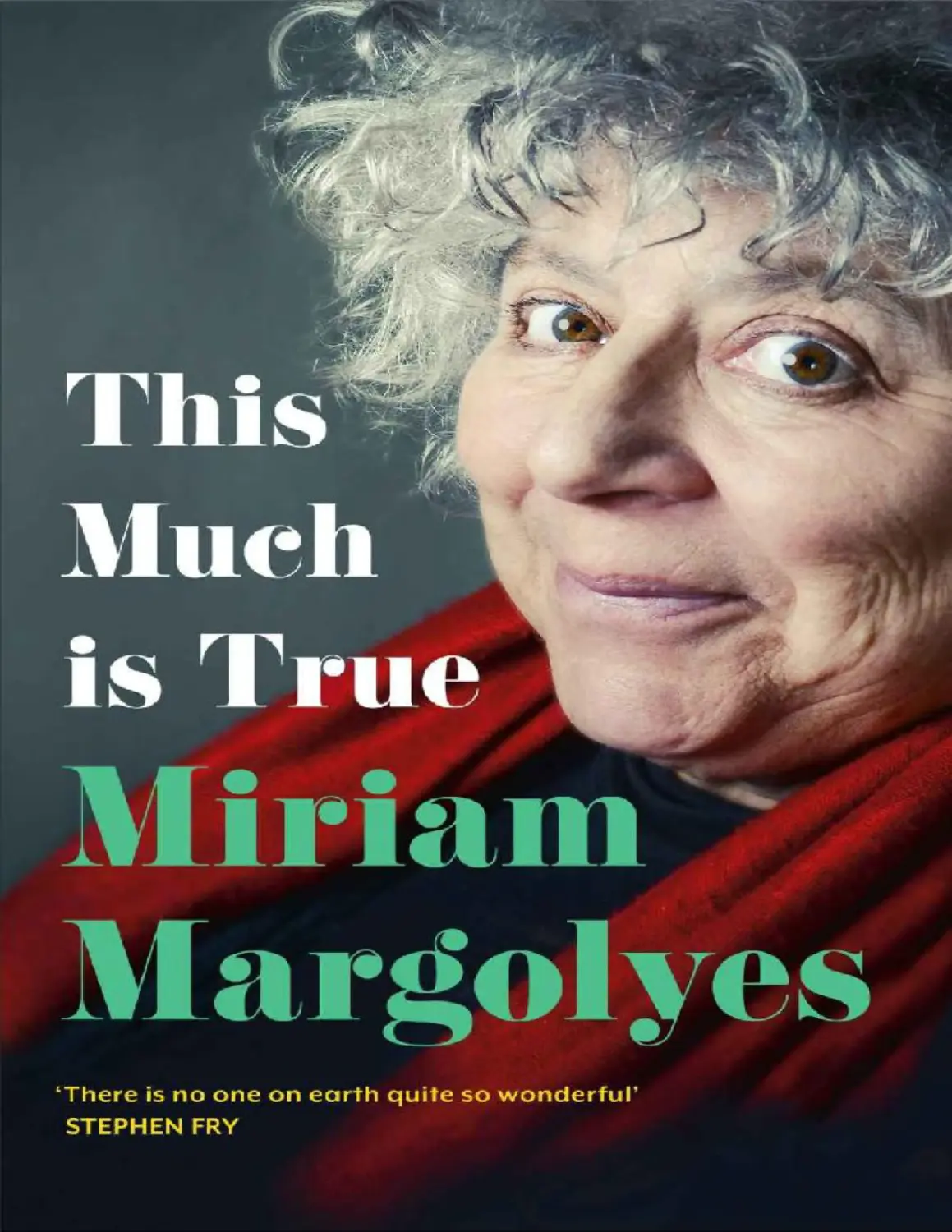
This Much is True

Miriam Margolyes

www.johnmurraypress.co.uk

First published in Great Britain in 2021 by John Murray (Publishers)
An Hachette UK company

Copyright © Miriam Margolyes 2021

The right of Miriam Margolyes to be identified as the Author of the Work has been asserted
by her in accordance with the Copyright, Designs and Patents Act 1988.

Cover image: Photograph © Claire Sutton

All rights reserved. No part of this publication may be reproduced, stored in a retrieval
system, or transmitted, in any form or by any means without the prior written permission of
the publisher, nor be otherwise circulated in any form of binding or cover other than that in
which it is published and without a similar condition being imposed on the subsequent
purchaser.

A CIP catalogue record for this title is available from the British Library

eBook ISBN 978-1-529-37991-4

John Murray (Publishers)
Carmelite House
50 Victoria Embankment
London EC4Y 0DZ

www.johnmurraypress.co.uk

For Heather
and
in memory of my mother and father

Contents
Introduction
Daddy
Mummy
Enter Miriam
We Are a Fortress Family
Going to School
Oh, Miriam!
Families
Showing Off
The Facts of Life
Latin Lessons
Dinner with Isaiah Berlin
Nude Modelling for Augustus John
Miriam Kibbutznik
Cambridge
Adventures in Academia
Footlights
Saved by the Beeb

Swinging London
The Importance of Voice
Sexy Sonia
Women Are Better than Men: Discuss
Heather
Coming Out
Life on the Road: Fiddler on the Roof
Going on the Stage: A Masterclass of Sorts
The Joys of Being an Understudy: The Threepenny Opera
When a Play Goes Wrong: The White Devil
Getting into Character: Endgame
PG Tips and the Caramel Bunny
To Dub or Not to Dub
Banged Up in Bow Street
Money Talks
Too Fat to Go to Bed With
My First Time on Broadway was . . . Wicked
Call Me Gert and Leave Out the Rude Part
In Therapy
Only Connect

Blood Will Tell
Two Spikes Would Be an Extravagance!
It is a Far, Far Better Thing
Taking America by Storm
Please Do Not Wear Shorts
My Turn to Fail
Adventures in Cinema
Working with Scorsese: The Age of Innocence

Romeo + Juliet
Would You Like to Go to Disney World?
Harry Potter
Down Under
A New Habit
Being Jewish
Choosing My Side
Speaking Out
A Right Royal Reception
Spliced
Getting Older
Dirty Talk

The Final Curtain

Acknowledgements
Credits
Footnotes
Picture Section 1
Picture Section 2

Introduction
Suddenly I am eighty. How can that possibly be? Eighty is OLD!
Eighty means maybe five, maybe ten years left. Where did my life
go? There’s much I still want to do. What have I learnt? Have I done
the best I could? Have I made a difference? Those are the questions
that rush at me.
I am writing this book in an attempt to make sense of my life, to
take stock. It’s been a full, if chaotic, eighty years. I was born in
1941 at the darkest moment of the war; my parents were convinced
that Britain was about to lose. Despite this, the Holocaust and its
horrors didn’t really impinge on my childhood; it’s only later I’ve
come to realise how powerfully and inescapably that shadow has
become part of my life.
Growing up in the post war period, with loving parents, I skipped
from moment to moment. I’ve travelled through every continent bar
Antarctica, I’ve slept with a curious variety of humans. I entered a
precarious profession where a short, fat, Jewish girl with no neck
dared to think she could stand on a stage and be successful. I’ve
completed over five hundred jobs and relished every minute of
them. But have I merely skimmed the surface? Why do I still feel so
unsure about things? Might a certain level of uncertainty be a good
thing? Complete confidence carries smugness alongside – and I do
not want that. Smugness shows on stage; when you can see a
performer admiring their delivery of a certain line, it kills the
performance stone dead. It’s possible that my insecurity is the very
quality that connects me to everyone else. I don’t hide my
vulnerability. I don’t know how.
From the beginnings of my coherent existence, a common thread
has been the ease with which I could connect with others. Latterly
I’ve found the joy of using that gift to make documentaries and
listen to others, rather than talking myself.

I’m quite sure you picked this book up hoping I’d make you laugh.
That’s what I seem to have become best known for. I lack the filter
others possess and out of my potty mouth pop filthy sexual
anecdotes, verbal and physical flatulence on a grand scale. I swear,
I fart, I draw attention to things best left unremarked – and it seems
it’s made me popular. Please don’t think I’m unaware of my duty to
both entertain and shock you, but I won’t allow my book to be just
dirty talk. Let me tell you the truth about myself, too.
When asked, I said I had never made an attempt to write
anything down before. This is not entirely true: when I was nine, in
1950, I wrote my autobiography in a large, blue book without lines. I
wish I could find it, but in one of the many moves of my life, that
youthful testament disappeared. Since then, I have simply lived my
life to its fullest – until 2020 trapped me in Tuscany for eight months
and I finally had the time to write it. With help from my loyal friends,
many of whom have known me for most of that life, I’ve been
piecing things together and teasing out memories from the deepest
recesses of my mind. It’s been a fascinating process.
My partner of fifty-three years, Heather, finds such spilling out of
all one’s deepest, most personal thoughts and fears, excruciating.
She said: ‘Now, don’t let this book be like one of your Graham
Norton interviews where all you do is talk smut – it’s got to be about
things that matter, Miriam.’ Heather is a serious person.
Well, I can’t please everyone all the time. But I honour the Truth.
And within these pages, you will only find Truth, or at least my
Truth. There will be some smut inevitably, and it might be a bumpy
ride, but I promise you the REAL Miriam Margolyes.

Daddy
Daddy was extremely handsome as a young man, despite being
below average height. He had a high forehead, glossy black hair, a
ravishing smile and a little moustache. He looked rather like Charlie
Chaplin. He was a very fine doctor, well-mannered, with a profound
sense of right and wrong, and a strong Glasgow accent he never
lost. He was an observant Jew and he had no vices – a dram of
whisky after the stars came out on Shabbos (Sabbath) was all he
ever drank. He smoked the occasional cigar, never cigarettes. But he
was a weak man. He was basically afraid: afraid of confrontation of
any kind, afraid of being overlooked, and yet unable to push himself
forward. Of course, he didn’t need to: my mother, Ruth, did all the
pushing. I think she crushed him a little with her energy and
ambition.
Genealogy is my passion: it’s being a detective in history. I have
no family, no children, no husband, no parents, no brothers and
sisters. Genealogy offers me the family I never had. I’m not a lonely
person, but I need to investigate the past and find out about lost
cousins. It’s how I discovered that Mummy’s fear of childbirth was
based on fact, not just family lore. And when Daddy ended up
with dementia he forgot everything from his past, and so it has
always been very important for me to remember where he came
from . . . Let me tell you about the Margolyes family.
Like many Scottish second-generation immigrant Jews, Daddy was
born in 1899 in the great Glasgow slum, the Gorbals. He grew up in
poverty in Govanhill, a short walk from the city centre on the south
bank of the Clyde. The first born child of Philip Margolyes and
Rebecca née Turiansky. I never met my paternal grandfather; he
died in 1937, but I did get to know my grandmother, Rebecca, quite
well, as she lived till 1959.

Grandpa Margolyes was born in 1874 in a small shtetl called
Amdur (now Indura) in Belarus, which at that time was part of the
Russian Empire. Anti-Jewish feeling started to gather and grow and
by 1880 large numbers of poor Jews had made their way across
Europe. Many European Jews arrived in Scotland as a stopping post
on their way to America. They spoke no English, had no idea about
Scotland and probably got out at the port of Leith in Edinburgh,
thinking it was New York, the goldene medina they dreamed of
reaching. The sea captains encouraged them to disembark so they
could return more quickly for another boatload of immigrants. They
ended up staying, settling mainly in Glasgow, and in particular in
Govanhill and the Gorbals.
When my grandfather came to Scotland around 1887, his first job
was as a peddler: a traditional Jewish trade, because it requires little
capital. Grandpa Margolyes was an itinerant seller of the small gems
and trinkets you might find in gift shops. We Jews call them
chatchkes. He used to put his wares in a pack on his back and
traipse around the lowlands of Scotland selling to the miners’ wives.
He was a quiet, sweet man, liked by his customers who sensed his
gentle integrity; they would save up and buy from him each time he
came their way. Eventually, after many hard, precarious years plying
his trade among the mining communities, he’d saved enough money
to be able to buy a small premises in Glasgow in St Enoch Square,
and he opened his own jewellery business. The shop was called
James McMenamin: he bought it from a Scotsman and never
changed the name. While the business did well, he was by no means
a millionaire. I still have the well-made wooden coin box from his
shop, with scooped holes for farthings, halfpennies, pennies,
shillings and sixpences, from before the time cash registers were
used, with their pinging drawers to hold the coins.
Philip and Rebecca married in 1897 when they were both twentythree, and Daddy was born two years later in 1899, when they were
living in a tiny, two-room tenement apartment in Allison Street,
Govanhill. Then followed Daddy’s three siblings: two sisters, Doris
(b.1901) and Evalyn, who was always known as Eva (b.1903), and a

brother Jacob (Jack), the baby of the family (b.1906). As the family
grew, they were sleeping six in a single, cramped room. My father
told me he suffered from rickets as a child, a disease of malnutrition
and lack of sunlight; he had bow legs as a result.
It was an orthodox Jewish upbringing. Philip and Rebecca were
‘frummers’FN1 – pious and observant people. Philip was in thrall to
the seriousness of his nature. He was deeply earnest, the kind of
man who would never have dreamed of being unfaithful – that
would have been unthinkable. (It was my maternal grandfather who
was the bounder and fucked about, but more on that later.) The
Margolyeses kept all the most rigorous strictures of the ultraOrthodox Jewish faith. It was a kosher home life – Shabbos began at
sundown on a Friday evening and ended only on the appearance of
three stars in the sky on the following night. During this time, no
work, including no cooking nor reading of any text other than the
Jewish scriptures was permitted, nor, later, when the family finally
had electricity, could anyone so much as switch on a light.
Daddy told me that as a young man in Glasgow, one Friday night
he arrived home and discovered that he’d left his front door key
behind. He couldn’t press the electric doorbell, which would have
infringed the Sabbath rule of not creating a spark, and so he had
stood outside in the cold for half the night, and nearly caught his
death with a very bad chill as a result. I hope he knocked on the
door, but these were big houses and no one can have heard him, so
he just stood there, shivering in the sub-zero Glasgow night. Of
course, to me that is extraordinary, but that’s what he and his family
were like.
He might have told me this story to try to explain the culture clash
between his family and ours. It would be a source of profound
sadness to him to know that I no longer believe in the Jewish faith,
although so powerful are the traditions I was taught that I still fast
on Yom Kippur, our Day of Atonement, observe the rules of Passover
and keep the dietary laws. I have never eaten bacon, although I am

told I would love it. I will live and die a Jew, with my culture intact
but minus the religion that is at the heart of it.
Daddy’s parents spoke and read Hebrew, but they were not
formally educated. They were poor but determined that their
children would enjoy every benefit of a Scottish education. Daddy
was especially bright; as a schoolboy, he won a scholarship to attend
Hutchesons’ Grammar School in Govanhill. He did so well that
he became ‘Dux of Hutchie’ (dux is Latin for ‘leader’) – a title given
to the highest-ranking student in academic, arts or sporting
achievement. He always intended to go to university; he was a
serious little chap, as you can see from his photo.
By the time Daddy’s secondary education came to an end,
Grandpa Margolyes’s jewellery shop was clearly successful, and the
family had moved out of the tenement building on Allison Street to
Aytoun Road, in the comparatively upmarket suburb of Pollokshields.
The family were still tenants, not well enough off to own their own
home, but clearly Grandpa’s determination to better the family’s
prospects and hard work had paid off, and his business was thriving,
if not booming. Some years later, Grandpa Margolyes did buy a
wonderful house just a short walk further up Aytoun Road. They
named it ‘Pearl House’ (Margolyes means ‘pearl’), and had the words
engraved on the gate-posts. My grandparents lived out the rest of
their lives and died at home in Pearl House. I went there for my
holidays as a child and it’s always been one of my favourite places in
the world.
As the eldest son, my father – Joseph – might comfortably have
stepped into his father’s shoes at James McMenamin. Daddy,
however, had never wanted to go into the family business; he
wanted to become a doctor. He had always known that this was his
vocation and in 1917, he took the entrance exam at Glasgow
University. So it was my father’s younger brother, Uncle Jack, who
went to work in the shop. Eventually, in 1937, when my grandfather
died, Jack inherited the business and he did very well. In fact, Uncle
Jack ended up dying an actual millionaire.

One morning in 1917, when Daddy was eighteen, he received his
call-up papers. It was three years since the beginning of the First
World War, and not one of the young men the family knew who had
gone off to fight had come back. My grandfather was all too aware
that the life expectancy of young officers in the trenches was about
six weeks. He was desperate to keep Joseph at home. He
telephoned to make an appointment with the commander of the 4th
Glasgow Battalion of the Highland Light Infantry, and went to see
him that afternoon.
Imagine this little man, a small Jew in his best suit, foreign-looking
with a darkish complexion, knocking on the door of the commander’s
office.
‘Come in.’
Philip entered and in front of him, behind a desk, sat a very
upright, Scots officer, in full uniform.
The officer said, ‘Sit down. What can I do for you?’
My grandfather spoke haltingly, in broken English: ‘Firstly, I want
to thank you very much for seeing me this afternoon. My son has
received his papers to join your regiment and go to France. Sir, he is
the thing I love most in the world, my firstborn, my beloved son.’ (It
always makes me cry when I tell this story.) My grandfather
continued, ‘I come here to ask for something. It is a very big thing.
But I must ask. I want you to take my son’s name off the draft. We
want him to grow up; he is a fine young man, the first member of
our family to go to university, to Glasgow University. He has won a
scholarship to study medicine, but if he goes to France that cannot
be, because you know and I know that he will not survive. But I
cannot just ask for something. I must also give.’
My grandfather paused, put his hand in his pocket, and when he
took it out, there was a glistening diamond lying in the palm. ‘This is
the most precious jewel in my warehouse. It is not completely

flawless, but it is nearly flawless. And I beg that you should take this
– please take this – please – in exchange for the life of my son.’
I tell this story in my one-woman stage performance, The
Importance of Being Miriam, and when I reach this moment in the
show I pause, and ask the audience, ‘What do you think happened?’
One night in Adelaide, I overheard two Scottish women talking after
the show. One said to the other, ‘Did you hear what she said about
the commander? That’s unthinkable! No Scottish officer would dare
to take a bribe.’
But he did and my father’s name was taken off the draft. And if he
hadn’t, I might never have existed. So Daddy survived and thrived
and became a doctor.
In those days, to be a doctor (or a lawyer) was the acme of
Jewish achievement. It was what every immigrant Jewish family
wanted for their child. University was a tough experience for Daddy.
Anatomy was a particular disaster for him and he had to take the
exam twice.
Daddy graduated in 1926, and then he left Scotland because he
wanted to experience life. His first job was as a ship’s surgeon, on
the Paddy Henderson line, plying between Glasgow and Rangoon.
He looked very dashing in the white merchant seaman’s uniform, but
no one had explained all the rules of shipboard life. Once the ship
gets into port, apparently it’s the captain’s job to issue the
command: ‘Haul down the yellow flag!’ – meaning that the ship is
free from disease. As ship’s surgeon, Daddy thought it was his job,
so in a very loud voice, on the top deck, he shouted, ‘HAUL DOWN
THE YELLOW FLAG!’ From the crew’s amusement and evident
derision, he realised he’d made a gross error. He never forgot the
shame he felt and was always severely shy in company, afraid to
stand out in any way. That was part of his temperament and he
could never understand my delight in being different. He wanted to
blend into his surroundings. I never did.

He said Burma (now Myanmar) was enchanting and beautiful, and
I think it was that trip that gave him the gentle attitude he always
had towards Asian people. Once settled in Oxford, he became the
doctor for all the Indian restaurants. His Indian patients particularly
appreciated his care of them and we were greeted as honoured
guests, we never had to pay; Daddy particularly appreciated that!
On his return to Scotland, Daddy decided to go to London as a
locum at a local surgery in East Ham. He got a house in Plaistow and
engaged a housekeeper, Miss Shrimpton, to cook and look after
him – she stayed with my father and later joined the marital
household, only leaving when the house was bombed and my
parents left for Oxford. In London, Daddy hoped to settle down and
lead the conventional life of a respected doctor.
He was never a sportsman and pointedly despised football and
cricket, but a sports club was a place to meet respectable girls. Jews
were not welcome at most sports clubs but in a huge place like
London he discovered that there were Jewish ones to join instead.
And so it was at a Jewish tennis club in south London that Joseph
met my mother, and everything changed.

Mummy
Without a doubt, the most important person in my life was my
mother. Perhaps she still is. She died in 1974 when I was thirtythree, but she has never left my side. She bound me to her, quite
deliberately, with emotional hoops of steel.
Mummy was short and stout, with wavy grey-white hair, piercing
blue eyes, a high forehead and a generous mouth. (She looked a lot
like Gracie Fields, whom she admired greatly.) Her hands were
expressive, with perfect nails and soft skin. Her wedding ring was
white gold; she had several beautiful diamond rings, the one I loved
best was a solitaire dazzler set in black onyx. She stood very straight
and was always telling me to do the same – shoulders back, head
erect, no slouching.
She was the most intelligent yet untutored woman that I ever
met. In other circumstances, she could have been the head of a
company or leading the government, but she came from a poor
background, and she was always conscious of that. Like Charles
Dickens, she had sprung from the lower-middle class. It’s an
uncomfortable situation: hampered by poverty and strongly
aspirational, she observed keenly the class distinctions which exist in
England. She wanted to speak well and meet ‘the best people’. She
was anxious always to separate herself from the ‘common’. The odd
thing was that she was endlessly generous to anyone poorer than
herself. But she was squeezed in the trap of ‘class’ – and feared
being at the bottom of the social scale. She was a passionate and
determined social climber. Her dictum: ‘It’s not what you know, it’s
who you know, that counts.’
My mother, Ruth Sandeman Walters, was born on 24 January
1905 in Walton Road, Kirkdale, Liverpool, where my grandfather
Sigismund ‘Siggi’ Sandeman had a second-hand furniture business,
although he put himself down on the census as an auctioneer.

Jews have lots of names: their birth name, their Yiddish name
and, sometimes, the name they chose when they came to England
and wanted to anglicise themselves. During the First World War, my
grandfather changed the family name from Sandeman to Walters, in
order to avoid anti-German feeling: this sentiment was so strong
that even the British royal family discreetly shifted their name from
Saxe-Coburg to Windsor.
Siggi’s parents, Simon and Hanna Sandmann (note the original
spelling), came from a small town, Margonin, in the lake district of
Western Poland. Grandpa Margolyes came from Amdur (now Indura)
in Belarus. I visited there in 2006 while making a BBC Radio 4
documentary called Sentimental Journey with Arthur Smith, to see if
any traces of my family remain. There are none. All the Jews were
obliterated in 1941, when the Nazis arrived and the Final Solution
was put into practice.
Grandpa Walters was born in Middlesbrough in 1867; in fact, he
has the distinction of being the first Jew to be born there. In those
days, Middlesbrough was in Yorkshire, and Siggi was very proud of
being a Yorkshireman. He was one of eight siblings: Doris, Rose
Rachel, Jacob, Elizabeth, Charles, Solomon and Augusta.
In April 1892, Siggi – a draper – married Flora Posner, the
daughter of Jacob Posner, a furrier. Flora was a teacher at the
famous Jews’ Free School in Bell Lane, Spitalfields, the Eton of the
East End. Siggi and Flora had four children: Mummy’s older sister,
Gusta (short for Augusta); Doris, second eldest; then my mother,
Ruth; and a brother, Jacob, who died as a baby because the nurse
dropped him out of the pram. Not intentionally, of course – it was an
accident.
Shortly after Mummy was born, the family moved to south-east
London where my grandfather was one of the founders and first
president of the South East London synagogue in New Cross. The
building still stands next to the old fire station, but it’s now a
Mormon temple. He opened a furniture shop in Church Street,
Camberwell, but I think he hoped for more. Much later on, Grandpa

Walters went into property, quite successfully, and their last house
in Underhill Road, Dulwich, is now worth two million. I wish we’d
kept it! Flora and Gusta opened a smart dress and hat shop called
Madame Flora in Rye Lane, Peckham. It was such a substantial
premises that it was later sold to C & A Modes.
My family story illustrates the archetypal trajectory of a workingclass Jewish immigrant family: first, a peddler, then in trade, then in
the professions, and then, with me – the third-generation immigrant
– in the Arts.
There was always, perhaps, the hint of a leaning towards
performance, all the way through my mother’s side, because
Grandpa not only fancied himself as an auctioneer, but was also
an amateur magician of great skill. He had many books on magic
and was always performing tricks. He would flourish an egg out of
my ear, throw a pack of cards in the air and catch the one I’d
named. Siggi was open, funny, handsome and disgracefully
charming. He had the same manipulative charm that I’ve got.
Apparently my great-grandfather also had it, and Mummy certainly
did. I think there must have been a ‘charm gene’ in my maternal
line. When you have it, you know you have it, and you must be very
careful not to misuse it. My great-grandfather did misuse it, and
most likely my grandfather did too, because everybody seemed to
adore him uncritically. (My grandmother Flora did not, however. She
was a little sour, perhaps because she knew her beloved Siggi had
an eye for the ladies. My cousin Ethel told me he was a devil with
the salesgirls in his wife’s shop, and ‘screwed everything that
moved’.)
Last year I discovered beyond all reasonable doubt that Siggi had
enjoyed an extramarital fling in 1918. This is how I found out: a man
in Swindon, Derek Austin, wrote to me suggesting that we were possibly first cousins: we had both shared our DNA on a genealogical
website, and a match had shown up. At first, I was bewildered at
this discovery of an unknown relative; I phoned and asked him if he
was Jewish. He and his brother had talked and as far as they both

knew, there was no Jewish blood in their family. We worked out that
his grandmother had lived around the corner from my grandfather
in south-east London. He had an affair with this woman, she had a
child, and that child had grown up and got married and had two
sons. So Derek and I are indeed half first cousins.
I invited him, his wife, Ingrid, and daughter to visit me in London;
we had a wonderful day together, bonding and sharing. I am sad to
say Derek died shortly afterwards, but I’m still in contact with
his family and intend to remain so.
Of course, my dear grandfather could never have imagined that
his peccadillo would be discovered over a hundred years later, long
after his death in London in 1945 at the age of seventy-eight.
Genealogy makes those kinds of family secrets much harder to hide.
There are more colourful characters in my maternal family line. I
was in the General Register Office looking for my grandfather’s
father, Simon Sandeman, on the 1881 census (the first indexed
census) and when I found him, next to the name were the letters
‘CONV’, for ‘convict’. It turned out that Simon had a shop in
Leicester. In the local directory of 1878 he was listed as a ‘wholesale
retail jeweller and clock dealer’, but in the previous year he had
been jailed for fraud and receiving stolen goods, and in the 1881
census, he was serving a seven-year sentence with hard labour, in
Parkhurst Prison on the Isle of Wight. Hard labour not only meant
the treadmill, just like Oscar Wilde, but that Hanna had to bring up
seven children all alone in London, far away from her husband.
Grandpa Walters was only ten years old when his father went to
prison.
When I first started tracing my family tree, my cousin Buffy,
Auntie Gusta’s daughter, brought me a couple of photographs from
a box she had found in her attic. One of them showed a man
dressed in a smart coat, sporting a diamond tie pin and a fine
Astrakhan fur hat. No one in my family could tell me anything about
him, nor did we have a date, nor know where the photograph was

taken. But when I saw my great-grandfather’s mugshot taken in jail
before his sentence, I realised it was him.
Many of my ancestors emigrated to South Africa in the nineteenth
century, so I got in touch with Paul Cheifitz, who comes from Cape
Town and who is a specialist on South African Jews. Paul confirmed
that shortly after his release from jail, Simon and his wife Hanna had
emigrated to South Africa. Two of his daughters had also gone to
live there with their husbands in the 1880s, and their families are
still there. Presumably he’d had his portrait taken in a studio in
Johannesburg and he had sent it home to England to show his
family how well he had done for himself – finally. There is also a
photograph of his wife, my great-grandmother Hanna, dressed
equally elegantly in black silks, pearl earrings and a fine black hat
with an ostrich feather.
Of course, some of my family were not thrilled to learn of our
great-grandfather’s criminal history. I, however, am absolutely
delighted. I am fascinated by the vagaries of my ancestors’ lives. I
found out that great-grandfather Simon was not the only person
with a dubious past. His son, my great-uncle Charles, a senior
member of the Durban Synagogue Committee, received a summons
for keeping whores in his room in a Johannesburg hotel, described
as a ‘resort for thieves, drunkards and unsavoury clients’.
On a slightly less sleazy note, I also discovered that four
granddaughters of ‘the criminal’ were music hall artists. The most
successful was Bertha, who moved with her German husband, Max
Otto Bierman, to Leipzig before the Second World War, where they
performed acrobatics and comic songs in a troupe called The Three
Ardos.

Doris, the second eldest of Flora’s children, was the angel of the
family. She was brilliant at school and won a scholarship to
Goldsmiths College. She would have been the first member of the

family to go to university, but she developed meningitis during the
First World War and died, aged just seventeen. Like her father,
Mummy never got over it; she talked about her sister Doris often,
with tears. It was the tragedy of the family. Her other sister, Auntie
Gusta (cousin Buffy’s mother), was absolutely beautiful – auburnhaired, willowy, and elegantly sexy. Mummy loved her too, but she
wasn’t special in the way that Doris had been.
When my mother left school at fourteen, she went to work as a
salesgirl in Flora’s shop. She relished her time working there,
delighting in her selling skills, cajoling and sweet-talking a customer
until they had to buy. One of her stories related how at the end of a
day when she’d sold nothing, a woman came into the shop. Mummy
was determined to make a sale. The woman tried on hat after hat;
Mummy was losing patience. Finally, she jammed a hat on the
customer’s head and twisted it harshly to get the decoration at the
front. The woman screamed, tore the hat off and shouted as she ran
out of the shop, ‘They do people in, here!’
Mummy was in her mid-twenties when she met Daddy at the
Jewish tennis club. She noticed this dapper Scottish chap with his
bright face and little moustache – but, more importantly as far as my
mother was concerned, she appreciated his status: he was not
merely Jewish, but a Jewish doctor. My mother confessed that she
didn’t love my father at first when she married him; she wanted him
because she wanted a doctor as a husband. I don’t know if he ever
knew that and, of course, I never told him, but Mummy told me
because we told each other everything. She told me that she grew
to love him and always said he was a good man and a good
husband. He was an honourable person and that was the thing that
she loved about him. He had complete honesty, decency and
integrity. Mummy recognised that. If he found money in the street,
for example, he would take it to the police. I’m not sure Mummy
would have, but he would. He was also always scrupulous about his
income tax. We weren’t particularly well off, but he always said to
me, ‘Never dodge the taxes! Never cheat the government.’ That was
one of his criteria for living a decent life.

They got engaged in 1930. At the crowded engagement party at
Siggi and Flora’s house, her beloved parrot, Polly, collapsed in the
heat and was found expired at the bottom of his cage the next day.
He used to squawk, ‘Polly wants a butty!’ (a Merseyside expression
for a piece of bread and butter), one of the few remnants of
Liverpool in my mother’s life.
The wedding reception was held in the Porchester Hall in
Bayswater, on the other side of London from the synagogue in New
Cross – an absurd expense. The music was supplied by Nat Gonella
and his band, the top Jewish orchestra for weddings. The theme of
the reception was ‘floral and coral’, while the bridal party’s clothes,
chosen by Mummy, were inspired by Little Lord Fauntleroy. The
honeymoon, chosen by Daddy, was in Norway, sailing up the fjords.
They spent their wedding night in the Grosvenor Hotel – very posh.
It was the only time in their lives that they went abroad together.
My grandmother Flora wasn’t happy. On the morning of the
wedding, Grandma said to Mummy: ‘Well, you’ve made your bed
and you must lie on it.’ She didn’t like my father, because she felt
he thought he was a cut above them socially, but that’s a spiteful
thing to say to your daughter on her wedding day. That’s what my
grandmother could be like, and yet she was all sweetness and light
where I was concerned. She adored me.
Mummy married Daddy and raised her social status in a single
stroke, which is what she intended to do. They went to live at my
father’s house in Terrace Road, Plaistow, where he was in singlehanded practice as a GP. Their household was completed by a wirehaired terrier called Bonny and Daddy’s loyal housekeeper, Miss
Shrimpton.
Mummy was the rock in my life. It was not that I didn’t love my
father, but he was quiet, and she was not. In some senses, they
were incompatible. They came from very different strands of Jewish
life. Mummy was the most vivid person I have ever known. She
was an overflowing, ebullient, seemingly confident and, if I’m honest
(and I must be), slightly vulgar person, while my father was totally

buttoned-up, very Presbyterian and hemmed in by all the orthodoxy
of Judaism to which his family subscribed. My mother was more of a
free spirit: accomplished and brave and fearless.
While undeniably much more like my mother, I remain a strange
mixture of them both to this day.

Enter Miriam
Daddy was forty-two when I was born, in 1941. Ruth, my mother,
was thirty-seven; they were relatively old to be having a first child.
But it was deliberate: most newly married couples try to have
children, but for ten years my parents tried not to. It was my
mother’s wish. Two of her cousins in South Africa had died in
childbirth, and she was terribly afraid it was a family curse and that
the same fate would befall her. So, for eleven years after their
marriage no child was born. But, eventually, at the beginning of the
Blitz, to Mummy’s despair, she conceived. I was told it was the terror
of an air raid pounding above the cellar where they were sheltering
that allowed Daddy in – and me to be born. Mummy always said that
was why I had curly hair. She wanted desperately to have an
abortion, but it was against the law and no one would do it. So, she
held on to me and never, for the rest of her life, let me go.
It was in early 1941, when Mummy was four months pregnant
with me, that my parents were bombed out. Their house in Plaistow
had a direct hit. They lost everything. They fled to Oxford, because
people said that Oxford would never be bombed. And it never was.
Apparently, Hitler had planned that it would be his capital when he
won the war, because it was such a beautiful city. The other, more
pragmatic, reason why we ended up in Oxford was that their car, a
Morris Oxford, was already in a garage there for repair, so they left
London on a train and came to Oxford with nothing but the clothes
on their backs. They found a room to rent on the Cowley Road for
£2/10s (two pounds and ten shillings) a night. That was a lot of
money in those days: Oxford people were greedy and exploitative
and fleeced the refugees and the people who had to escape from
London during the war.
My parents came to Oxford very much as ‘outsiders’, and it has
always been an unfriendly city to outsiders. It’s not a warm,
welcoming place. It’s a cold, assessing place, and it is also an

antisemitic one. As a Jew and a Scotsman with a strong Glaswegian
accent, Daddy must have felt especially incongruous.
Eventually, they found a flat in Banbury Road, North Oxford, and I
was born on 18 May 1941 in the Elizabeth Nuffield Maternity Home
on the corner of Beech Croft Road. It’s now an old people’s home.
The name Miriam means ‘bitter’, ‘star of the sea’ and ‘longed-for
child’, but the meanings were immaterial. Mummy named me after
her favourite aunt, her mother’s sister – a dark, pretty little woman,
who died a widow in 1933. I was a much prized, spoilt, golden child;
my parents’ only child, the centre of their worlds. They were
determined I should have every advantage they’d been denied. They
wanted to make sure I’d be accepted, that no door would be shut to
me. And it was a very secure upbringing. I never felt
underprivileged. I always felt that I was important, because I was to
my parents. Everything I did fascinated them: I always had their
undivided attention and their all-consuming, unconditional adoration.
Just the three of us: it was passionate, close, indulgent.
MummyFN2 often said, ‘We are a fortress family.’ That was her
expression, and I don’t for a second regret my closeness to them
because they gave me so much confidence. The umbilical cord was
never completely cut, metaphorically speaking: I still feel connected
to them long after their deaths.
My earliest memory is of sitting in my pram, sucking my thumb, in
the front garden of our flat on Banbury Road. A woman came up
and said, ‘If you do that, a bogeyman will cut it off.’ I was only two,
but I thought, ‘That woman’s mad. How stupid of her. Of course
there isn’t a bogeyman. No one’s coming.’ I was immediately
sceptical, and convinced I was right.
Nothing has changed.
I was four when the war ended, in 1945. Mummy decided that
Victory in Europe Day must be marked in some way. ‘We’ll make tea
and sandwiches for the bus crews,’ she announced. I had no idea

what this meant, but I was clearly involved. Trestle tables were set
up outside the house and all morning we made sandwiches; Mummy
was the best sandwich-maker I’ve ever known. She sliced tomatoes
and onions frighteningly thin, but cheese was generously applied.
Our home-made gooseberry jam from the garden was spread with
cream on delicious scones. The plates were piled high; we had cakes
too, bought from the Cadena Cafe in Cornmarket Street, whose
patisseries and cream-filled chocolate doughnuts were legendary.
She lifted me up to hand the goodies to the conductors and the bus
drivers in their cabs. It was a glorious memory; we were released
from the horrors of the war and everyone wanted to celebrate.
Mummy composed a song, the ‘Victory Song’. I remember only the
first line: ‘Now victory is here . . .’ One day we went to the New
Theatre, and the whole orchestra played her song. Daddy and
Mummy and I sat in the front stalls, rigid with pride.
Mummy used to say, ‘You don’t know what life was . . . what we
had before the war.’ That phrase ‘before the war’ implied a kind of
paradise time when everything was as it should be. It was clearly a
way of life that had disappeared for ever.

We Are a Fortress Family
Our ‘fortress’ was a ground-floor and basement flat on Banbury
Road, between Beech Croft Road and Moreton Road. It was awful –
very damp and dark; Mummy called it ‘the hovel’. She hated living
there and from the moment they moved in, she planned and
schemed to get out of it. But Daddy didn’t make enough on his own
to rescue them.
In those days, doctors in general practice were paid per capita;
leaving Plaistow had meant saying goodbye to a profitable practice.
It wasn’t easy to start from scratch. As soon as they arrived in
Oxford, Daddy put up his brass plate on the door of the surgery he
rented in Cherwell House, a fine Georgian residence backing on to
the river at St Clement’s, and hoped that patients would come.
Eventually, they did, but then Magdalen College decided to demolish
the house (Robert Maxwell’s publishing empire, Pergamon Press,
replaced it – a hideous concrete structure). For a while, Daddy had
no surgery at all and saw patients at our house, but Mummy fought
Magdalen College on his behalf and, after a fierce struggle, secured
a small but pleasant property opposite the back door of the college
at 4 Longwall Street. That was where Daddy practised medicine until
he retired.
Gradually, single-handedly, Daddy built up his practice. Later on,
in 1948, when the National Health Service came into existence, my
father welcomed it wholeheartedly. Despite voting Conservative, he
believed in the principle of social welfare, in the idea of looking after
his patients from the cradle to the grave. The hierarchy in private
medicine enraged him; everybody bowed down to the hospital
consultant. Daddy reaped satisfaction from treating his patients, and
had no further aspirations. He was an old-style family doctor
carrying a little Gladstone bag, complete with stethoscope and
otoscope; he took time to listen to his patients; he got up in the

middle of the night to attend house calls because it was his vocation
– making money was never Daddy’s objective.
Mummy might not have had a formal education, but she
understood people. She was shrewd; she was businesslike. Daddy
was none of those things. He was a high-minded physician with a
love of words and scholarship. So, while I was still a baby and they
were still trying to establish a proper living in Oxford, Mummy was
constantly thinking of ways to make money and escape from ‘the
hovel’. She asked herself: ‘What is it they have here that they don’t
have in other places?’ The answer? Students. Thousands and
thousands of students. She knew that not all students live in college,
and those that didn’t needed accommodation.
Mummy requisitioned the upstairs rooms in Daddy’s surgery at
Longwall Street for letting to students, carrying out her favourite
maxim: ‘Make every post a winning post.’ Then Grandpa Walters
gave her a loan and she started out with one house in Old High
Street, Headington, eventually going on to own about seven – all
rented out to students. Mummy was considered to be the best
landlord in Oxford. (She was adamant that she was never to be
called a landlady – she was a landlord.) Much later, when I was in
my teens, I became her cleaner. I used to have to go and scrub the
houses out between tenancies. Some of the students were tidy and
some were not. I remember that Tariq Ali left owing Mummy £100. I
keep meaning to tell him, and one of these days I’ll get hold of him.
(Or maybe he’ll pay up if he reads this book!)
We had a classy list of tenants, including the writer Ferdy Mount –
in his autobiography, Cold Cream, I feature, along with my mother.
We also housed Jacob Rothschild, 4th Baron Rothschild, OM, GBE,
CVO, FRCA, the British peer and investment banker; Rachel
Pakenham, the third daughter of the 7th Earl and Countess of
Longford, who became Rachel Billington (Mummy particularly loved
her); Paul Betjeman (son of John); and Robert Maclennan, the
future MP. There was also Francis Hope, a very wonderful writer,
who died in the Turkish Airlines plane crash in 1974.

Mummy always knew immediately if someone was lying, whereas
Daddy was more trusting of people’s inherent good character. She
was very canny in all sorts of ways: a fascinating mixture of business
acumen and emotional sensitivity.
Sympathetic, funny, sharp as a tack – Mummy loved business:
selling, making money, that was her pleasure. She was good at it,
and good at being the boss. And so, whenever they had any
difficulties, or if there was confrontation in any sort of situation,
Daddy would say, ‘You speak, Ruth.’ And she would. I remember the
rage I felt at his weakness. I used to despise him for that. It made
me furious that he wouldn’t stand up and speak for himself, but he
had no confidence and didn’t feel that he would prevail in any
argument. Mummy fought for all of us and made all the big decisions
in the family.

Mummy was extremely house-proud, and she did all the housework
in the nude. It was a tad discomforting for our maids and au pair
girls, but she liked to get it done, then have a bath. Mummy always
had somebody to help in the house. Even when she was a child
growing up in south-east London, my grandmother had employed a
maid, Lizzie. To Mummy, it was an essential part of modern life. She
was quite a tough employer, but always kind. When I went to
Cambridge in 1960, she wanted a young person in the house, and
started to have live-in au pair girls instead of maids. They were all
innocent young things from various European countries, and her
nudism most definitely upset them at first, but they got used to it.
There was Marie Claire from France, Boyte from Norway, Simone
from Sweden (we became friends and I went to stay with her family
in Stockholm – her father was the stadsfiskal), but the most
treasured one was Mummy’s first au pair, a sweet young girl from
Vercelli in northern Italy, Francesca Franco. Her father was a rice
farmer; I remember when he brought us a large sack of rice as a
present, it lasted for a year. Franca was quiet, studious and
ambitious. I was delighted when it was clear Mummy saw her as

another daughter. They remained close and even after Mummy’s
death, Franca became like a sister to me. In fact, I invited her to
represent my mother and join me and my beloved cousin on Daddy’s
side, Penelope Lerner, when Prince Charles presented me with the
OBE at Buckingham Palace in 2002. Franca is still one of my closest
friends; and her son Paolo is a glorious young man. I want them in
my life for ever.
As Daddy was far more straight-laced than Mummy, I don’t know
how he reacted when he first discovered my mother’s penchant for
dusting the picture rails nude. He joined the qualities of being Jewish
and being Scottish together – a formidable combination. A sombre,
emotionally reserved man, he was measured, entirely moderate in
every respect. He would always say, ‘Miriam, behave yourself.’ Of
course, I haven’t, alas. He was a man who found it difficult to
express joy, whereas my mother was a forthrightly joyous person.
She was also tempestuous, unmeasured and immoderate in almost
every aspect of her personality – and her habits.
They both agreed, however, that I must be educated. They
encouraged my reading and studying from an early age. I liked Enid
Blyton’s Sunny Stories and Miss Blyton’s oeuvre in general; I didn’t
have an elevated literary world. I joined a library; in those days,
local councils put money into libraries and the Oxford City Library
was magnificent. I used to get through about six books a week. I
loved stories set in girls’ schools; I think I read nearly all fifty-seven
of the Chalet School series: The Exploits of the Chalet Girls, The
Chalet School Triplets, Excitements at the Chalet School, A Genius at
the Chalet School, etc. etc. etc., by Elinor Brent-Dyer. I especially
enjoyed the ‘Dimsie’ books by Dorita Fairlie Bruce, or The Girls of St
Bride’s, That Boarding School Girl, and The Best Bat in the School,
etc., in her long-running St Brides and Maudsley series featuring
Nancy Caird.
Daddy was not artistic; he went to the theatre only because
Mummy insisted. He thought films and theatre were unnecessary,
slightly absurd. He was tone-deaf, a legacy he passed to me which I

could have done without. He didn’t notice pictures, or other works of
art. When he was in his nineties, living with me in London, I
commissioned Anne Christie to paint his portrait. He didn’t like the
finished picture – ‘I look so small,’ he complained. It hangs behind
me as I type – I love it. Daddy did enjoy the radio, and listened
every night when he came home from surgery. It’s That Man Again
was a great favourite and, later, when television was permitted to
enter the house,FN3 Dad’s Army. He never told jokes but he was a
terrible tease. I hated being teased, and he never stopped.
Mummy appreciated literature, but she especially loved going to
the ballet and the theatre. She insisted that she and my father
continued to go to the theatre in Oxford every week as they had
done in London, and they had permanent seats at the New Theatre
Oxford (now the Apollo).
When I was five, my parents took me to my first pantomime,
which was Aladdin. Of course I loved it, but I was very frightened of
the wicked wizard, Abanazar. I had nightmares every night for a
week. Finally, my parents decided to take me backstage to meet the
actor, so that I would see for myself that he was only pretending.
That’s the magic word – pretending. It is the beginning of
imagination.
Mummy also adored music. Her favourite singers were Conchita
Supervía, the Spanish mezzo-soprano, and Gracie Fields. My mother
insisted on having a piano, and she and I used to sing music-hall
songs together. We often sang ‘Sally’, Mummy sitting at our Blüthner
baby grand piano in the drawing room, tears rolling down her
cheeks. I used to ask her, ‘Mummy, why are you crying?’ and she’d
say, ‘I can’t help it. It’s so beautiful.’ And now I’m exactly the same:
I weep uncontrollably at a piece of music, an operatic aria, even a
military band marching past. She filled my memories. Filled my
heart. And she always will.
I loved Daddy, no question; he was a dear, dear man and it’s from
him that I get my love of words, but we never understood each

other. Mummy flooded me. She was fun to be with and so we were
always in cahoots, in that sense.
Every morning when I wasn’t at school – weekends, or holidays –
when Daddy was up and going off to work, I’d go to my parent’s
bedroom and climb into Mummy’s bed. They had two beds pushed
together. Mummy always slept naked and I liked hugging her
generous adipose tissue. We talked about everything. It was during
one of our bedroom talks that she told me she had not been in love
with Daddy when they married. We had unlikely conversations:
politics, people in synagogue and what they were wearing, what
furniture Mummy wanted to buy, or about the tenants in her houses.
I loved hearing about life in London before the war, and her days as
a sales girl in Madame Flora. I had no filter with her. We talked
about school and the people that I went to school with and what
they were doing. There was no subject that was taboo; we were
completely open with each other and we would often just lie in
helpless giggles. Mummy had big plans. She was always talking
about moving out of ‘the hovel’ and building our ‘family home’ –
what the bathrooms were going to be like and what the size of the
kitchen would be.
The time she spoke of most, though, was when her parents
moved to Underhill Road, in Dulwich. They had previously lived in
Camberwell, which was considered a lower-class area at the time –
Dulwich was a step up. From the beginning, Mummy instilled in me
who were the people to be friends with and who were ‘common’
(and so to be avoided). My ear became attuned early to the minute
gradations of class, indicated by a thickening and mangling of the
vowels, a dropping of the consonants. She also talked often about
who, amongst our acquaintances and Daddy’s patients, she
considered to be ‘the best people’. She had that concept in her
mind, which I think a lot of poor people have – that there actually is
such a thing as the best people, but by that she didn’t mean the
socially important. She actually meant the sort that I would call the
best people: the thinkers, the philosophers, the historians – because
the life of the mind was very important to my mother.

At the same time Mummy enjoyed making money. It allowed her
to indulge her passion for fine things. She always wore the original
4711 Eau de Cologne. She often wore a cape instead of a coat and I
remember my embarrassment sometimes when she came to school.
As a child, you want your parents to fit in with everyone else’s
parents – Mummy never did. Now, of course, I’m very proud of her
individuality. She liked to wear Cuban heels, duster coats, and in the
days when fur coats were politically acceptable (not that she would
have cared), she had minks, ermines and a glorious leopard-skin
coat, all made for her by one of my father’s patients, Sam Dimdore,
a furrier from London who had also settled in Oxford during the war
and had a shop in High Street. His wife Lil made the best
cheesecake I’d ever tasted. She had multiple sclerosis and was a sad
figure, always seated in the back of the dark shop. Later, their son,
Mervyn, contracted the same disease. I knew early of tragedy.
Mummy despaired of my lack of style. ‘Take a pride in your
appearance,’ she would say repeatedly. I never did. Growing up, I
hated our necessary, but often fruitless, shopping trips. I detested
the shopkeeper telling us, ‘I’m afraid we’ve nothing in her size.’ And
so we went to Miss Norridge, Mummy’s dressmaker just off Walton
Street in the centre of Oxford. More than anything, though, I wanted
to have a man’s suit, male in every particular. Was I ‘butch’ as a
little girl? No – I simply wanted not to have to wear dresses. Now, I
adore the little summer frocks I have, always made to the same
pattern. There is a subtle difference between a frock and a dress.
Mine are all ‘frocks’. They’ve all been made for me by various
wardrobe mistresses on every film and play I’ve ever done. I look
like a throwback to the 1950s, but they’re comfy and suit me and
they ALL have pockets. Pockets are essential in my life, and every
garment I own must have them.

When I look back to the 1940s when I was a child, it seems an
impossibly distant landscape, much simpler, less adorned. The only
times we left Oxford was to see family or to go on holiday. Most of

our times away were spent in Scotland with my father’s family.
These were not exactly relaxing breaks: my mother really didn’t like
my father’s family and they didn’t like her. She thought they were
hard and mean; they thought she was vulgar.
My father’s brother, Jack, had married an Irish girl called Muriel
and they had one daughter, my cousin Philippa, whom I adored for
most of my life. I think Auntie Muriel was far more vulgar than
Mummy. My mother called her ‘the scum of the Liffey’. And she was
a Jewish Irish girl! I remember Mummy saying to her once, ‘When
you go past a dustbin, you don’t lift the lid.’ I don’t know what that
means but it is obviously an insult.
Uncle Jack and Auntie Muriel came down from Glasgow to Oxford
to visit me when I was very little. I must have been about one and
still in my playpen in the back garden at Banbury Road. I wasn’t
wearing a nappy and I had done a poo on the ground. This nice
lady, Auntie Muriel (actually, she was a complete cunt, but I didn’t
know that because I was only a baby), came over to the playpen
and said, ‘Oh, what a sweet little lovely.’ I must have thought, ‘What
a nice, friendly lady!’ because apparently I toddled over to my
recently laid turd, picked it up and gave it to her. To her credit, she
was polite: she accepted my gift, saw what it was, gave a great
scream and then ran away. I think that was it, as far as Auntie
Muriel and I were concerned. She never showed me much affection
after that.
One holiday, when I was about nine, I stayed with Uncle Jack,
Auntie Muriel and cousin Philippa in their home in Albert Drive. My
parents were staying around the corner in Aytoun Road with Auntie
Eva, Uncle Harold and Grandma Margolyes. I was in my bedroom
and I remember vividly that Muriel came in and shut the door behind
her, then she stood in front of it, her back against the door, the way
they do in Hollywood movies. She said to me in her Irish accent,
smiling slightly: ‘Your mammy doesn’t love you.’
What a shocking thing to say to a child; I knew that even then. I
replied, ‘Of course she does. What do you mean?’ She said, ‘No,

your mammy doesn’t love you, because if your mammy loved you,
she’d buy you nice clothes, and she’d do your hair nicely and then
you’d look nice, but you don’t look nice. So your mammy doesn’t
love you.’ Such a statement could have been incredibly destructive
for a child, but I had complete confidence in my mother’s utter
devotion to me. I replied, ‘Oh, don’t be ridiculous. Of course, she
loves me. You’re quite wrong about that.’ The power of our ‘fortress
family’ meant that I knew she was talking rot and that for some
reason – beyond my childish comprehension – she wanted to hurt
me. Nothing more was said – then or ever. She opened the door and
I went out. I told my parents, and it merely confirmed their opinion
of Muriel Margolyes, née White. I never stayed there on my own
again.
This didn’t affect my friendship with Philippa, their much loved
only child who was a few years older than me. Our only wobble
came when I picked up the phone to her boyfriend who was so
taken with my educated voice and cut crystal tones, that he couldn’t
stop talking about it. I was around thirteen and seventeen-year-old
Philippa was not amused at all: ‘Och, what sort of conversation did
you have with him?’ I said, ‘I don’t know, I can’t remember, I just
answered the phone.’ She said, ‘Well, he thinks you’re pretty hot
stuff but you’re just a schoolgirl.’ But I found that so funny that
eventually she burst out laughing too.

My other aunt in Scotland, my father’s sister, Evalyn (always called
Auntie Eva) was wonderful. As a child, I loved staying with her and
her husband, Uncle Harold, who was also a doctor. He had a
charming personality, urbane and comical, with a little moustache
and smiley eyes. His great passion was watching wrestling on
television. We didn’t have a television when I was little, so it was a
great treat to watch the wrestling with him; he taught me all the
moves. He would point them out, and I remember that I was very
impressed by the Boston Crab. (It’s a hold that is very difficult to get
out of, in case you ever need it.) I became quite the expert; we

would sit together watching a match, and I would say, ‘Oh, look at
that, Uncle Harold! He’s just pulled off the Boston Crab! (Or the Half
Nelson Choke, Cobra Clutch, or Tongan Death Grip, or whatever feat
had just been performed.) And Uncle Harold would proudly say,
‘Yes, that’s it, Miriam. You’re right there. He’s got him.’
Auntie Eva was jolly and kind and had enormous breasts –
obviously a family trait. I can remember her washing her bosoms in
the bathroom at the basin, lifting up the pendulous flaps and
sponging beneath them. I gazed fascinated, but doubted I would
ever have such encumbrances. How wrong I was!
Once she asked me, ‘Miriam, do I have a Scottish accent?’
‘Yes, Auntie Eva, you do.’
She was a little put out. ‘Och, I do not,’ she replied.
How wrong she was!

Perhaps in response to these tense times in Pollokshields, in addition
to Mummy’s burgeoning property empire in Oxford, my parents
bought a small house by the sea in east Kent, in Kingsgate, a suburb
of Cliftonville, which is itself a suburb of Margate. My first holiday,
that is to say my first seaside holiday, was to set the pattern for all
my most enjoyable childhood excursions.
I was four and a half. We drove from Oxford to Kingsgate in the
Standard Eight car – a most unreliable and cluttered vehicle, it stood
for years in our front garden unused, until someone bought it for
£50 and called it ‘vintage’. It took six hours, going through the
Blackwall Tunnel, which had white tiled walls and a roaring sound
and went under the River Thames. On the way we stopped for fish
and chips in Lewisham; wrapped in newspaper (it always tasted
better, why did they change the law?) with liberal dashings of salt

and vinegar eaten sitting in the car. Then on to Percy Avenue, a long
ribbon of a road ending with a clifftop and THE SEA.
I’d been promised that I would see THE SEA, would swim in it,
and make sandcastles in the sand. Daddy had bought me a bucket
and spade and I was told to wait till the morning. But, of course, I
was up before my parents – I wasn’t going to wait for them to
awaken, I needed to see this phenomenon for myself. So, at about 8
a.m., having dressed myself, I opened the front door and down the
road I went.
Soon I couldn’t help noticing a huge, blue expanse facing me at
the bottom of the street. It seemed to go right up to the sky. I had
never seen anything like it before and I remember that blinding
moment of recognition, that light breaking into my brain: ‘Of course!
This must be THE SEA.’ I headed onwards to the edge of the cliff
and, at that moment, heard screams from behind me up the street,
and turned to see my distraught mother racing towards me. ‘Miriam,
Miriam, stay where you are, don’t move, you bad girl, what are you
doing, don’t move, don’t move!’
We both got over it, but I never forgot my first sight of the sea, its
immensity and sparkle, the sound and the smell. I’ve loved it ever
since. Much later, when I was thirty-six, I bought the nearest house
to France to gaze at it always: across that same English Channel, for
me as magical as any ocean.
And now I never get spanked for getting up early and rushing
towards it.

Going to School
When I was little I was ravishing. I was glorious – truly gorgeous,
impish and mischievous and adorable. I have no doubt at all that I
would have fallen in love with myself. When I look at photographs of
myself as that little girl, and then I look at myself now, I think, ‘Oh,
dear!’ but that’s what happens. You have to take the rough with the
smooth.
In 1945, when I turned four, I started at Greycotes School, which
was a good private day and boarding school for girls in north Oxford.
I was only there for half a year. It had a reputation, I learned
afterwards, of receiving girls who hadn’t got into Oxford High School
and might be classed as ‘slow learners’. Mummy may have known
this and been all the more determined to get me into Oxford High
School at the first opportunity.
The headmistress of Greycotes, Mrs Cunliffe, was tall and kind.
Greycotes had a meadow. I’d never heard that word before, but it
turned out to be a large patch of green behind the high wall of the
school, minutes away from ‘the hovel’.
I liked going to school; I have always needed other people around
me. We walked in a crocodile; I’d never heard that word, either.
Greycotes has receded from my mind, but there is still a Cunliffe
Close off Banbury Road. I think Mrs Cunliffe would be delighted
about that.
Later that year, Mummy removed me from Greycotes, as she had
heard there was a vacancy in the preparatory department of Oxford
High School. The war had just ended and times were hard, but
somehow my parents found the money to pay my school fees, first
in the preparatory department, which was in St Margaret’s Road;
and then in the junior school in another building; and then later I
moved into the ‘big school’ on Banbury Road.

The preparatory department of Oxford High School comprised
three forms: lower kindergarten (Miss Franklin), upper kindergarten
(Miss Farrands), and transition (Miss Fuller). Miss Franklin was a
dear woman. She had white hair and a broken nose; she always
wore a thick, blue tweed suit and seemed capable. Afterwards, we
discovered her lover was Miss West, the senior school games
mistress. They retired at the same time and stayed together until
they died.
We had a Swiss student supply teacher, with plaits wrapped
around her head like Heidi. Her grasp of English was insecure: I
giggled at her pronunciation of oven – ‘OFF-VEN,’ she said over and
over again. I was helpless with laughter. I’ve always loved accents.
There were only two boys in the prep department: Mark Turner, who
was ginger with big teeth, and very tall Robin Houghton. I saw Mark
having a pee when I opened a loo door once, thinking it was empty,
and was AMAZED to see him standing up with his back to me. ‘Boys
are odd,’ I thought.
The Prep. Dep (as it was known) was a happy place; they were
excellent teachers and took care of us. There was milk in little
bottles – we could have it hot or cold. The only drawback was that
every day after lunch, we had ‘rest’. We lay on the floor under
blankets and were supposed to sleep. I hated it. I couldn’t sleep –
I’ve always been a bad sleeper and we were boisterous and noisy,
pinching each other and sniggering.
In the transition year, we had a concert. I recited, ‘Some one
came knocking/At my wee, small door . . .’FN4 Apparently, I was
rather good, showing off at an early age.
In autumn 1948, my form moved to the junior school in Bardwell
Road, near the famous Dragon School. Miss Temple was the firstform mistress. Her worn, lined face topped with iron-grey hair could
have been formidable, but she was the sweetest soul; clearly, she
loved teaching and my memories of her are entirely positive.
However, Miss Chase, who took the lower second, was the one I

loved. I don’t know why I loved her so much. I can’t remember
anything about her, or any reason why I should have felt so
desperately, passionately involved, other than she had golden hair, a
white face and red cheeks, like an apple. It was Miss Chase who was
responsible for my first orgasm, when I was eight. I was walking
past her house in Banbury Road with my mother and as I
approached it, I felt this overpowering heat in my loins that was
deeply pleasant and rather exhausting. She wasn’t even in sight!
There was no friction – it was simply the power of longing and
desire. I don’t think you ever know why you feel such passion for
people. It is inexplicable. It’s been like that ever since.
Miss Plummer taught Scripture. I stayed for the Old Testament
lessons only, at my parents’ request. Everyone in her class
remembers Miss Plummer going up and down the rows of desks
intoning: ‘The Assyrian is the Lord’s rod, the Assyrian is the Lord’s
rod’ over and over again. Drama was part of her teaching method,
and she would re-enact the Covenant between God and Man,
clasping her hands tightly together; then to show how the Covenant
was severed, she pulled her clasped hands violently apart. I still
remember that the sign of the First Covenant is circumcision (but
Miss Plummer avoided any re-enactment of that).
The teacher I hated, truly loathed – and I suspect it was mutual –
was Miss Palser. Ugly, with a mouth too full of teeth and slightly
overweight, she was a cruel sniper of a woman. My parents
suspected she was an antisemite, although she treated my nonJewish form-mate, Valerie Rowe, with the same cutting sarcasm.
Valerie left after a term of Miss Palser. She took every opportunity to
make me feel small and inadequate, doled out frequent bad reports
and detentions, and often reduced me to tears. When I was asked to
donate to a retirement present for her, long after I’d left the school,
I refused.
From the junior school we moved to the lovely old buildings at
Banbury Road. This had been the original Oxford High School,
founded in 1875 but now it held only the senior school. There was a

tuck shop opposite: great excitement when sugar came off the
ration in September 1953. My favourite was sherbet with a liquorice
straw in the middle of the packet, through which the sherbet was
violently sucked.
It was in that old building in Banbury Road that the bulk of my
schooldays were passed. From the lower fourth to the third year
sixth I was with the same form-mates, the same teachers. It was a
powerful, female world and it satisfied every need I could have for
learning and for companionship.
Finally, while I was in senior school at Oxford High, we moved
from Banbury Road into the new buildings in Belbroughton Road.
(‘Belbroughton Road is bonny, and pinkly bursts the spray/ Of
prunus and forsythia across the public way.’ That, for your
delectation, is from a Betjeman poem about Belbroughton Road.)

Mummy was entirely right. Oxford High School wasn’t just any
school: it had pretensions. It would have been a difficult job to be
headmistress there because the parents would always have thought
they knew better: the dons of Oxford are a conceited bunch. But our
imposing headmistress, Vera Stack, had a proper respect for
academia. When Sir Arthur Norrington, Master of Trinity, came to
the school – his daughter, Pippa, was a pupil – Miss Stack practically
genuflected. Pippa was a very tall, slim, clever girl, who looked
rather like Virginia Woolf; she became head girl. One exciting day
her corsets were found in Lost Property. The news ran through the
school, inflaming everyone but only enhancing her popularity.
Miss Stack always put Gown before Town, and her social and
intellectual attitudes permeated the school. ‘Scholarship girls’ from
the county, who entered after passing the eleven-plus exam, were
conscious of being second-class citizens, although I’m ashamed to
say I never realised that until many years later when, at one of our

old girls’ reunions, Catherine Bowley said, ‘You never asked us to
your parties.’ Yes, I was a snob too.
The school also had a sense of itself as academically pre-eminent,
perhaps because many of the pupils were daughters of dons,
including J. L. Austin, the philosopher; J. R. R. Tolkien, the writer;
Russell Meiggs, whose subject was ancient history and who looked
like Wild Bill Hickok; and William Walsh, another philosopher, whose
daughter Catherine was in my form – she came to stay with us when
her mother was having a hysterectomy, and she was quite surprised
we didn’t wear gloves at teatime.
Catrina Tinbergen, in the form above me, became a good friend.
Her father, Niko Tinbergen, won the Nobel Prize in 1973 for
Physiology. Deh-I Hsiung’s father wrote a successful play Lady
Precious Stream performed in London and on Broadway. Teachers
told us later that our form was a remarkable year and I think it must
have been. It is those form-mates who made my life at Oxford High
School so glorious – I can name them all without a pause. I think of
them often and cannot ever express how happy their friendships
made me, how deeply I am in their debt for the fun we had – the
walks home from school with Catherine Pasternak Slater (niece of
Boris, the writer) and Anna Truelove, my particular chums – and the
discoveries of Life we shared.
After school, I would often go to Catherine’s house in Park Town,
full of her grandfather Leonid’s oil paintings, and listen to her mother
and her two handsome brothers, Michael and Nicholas, playing
Scriabin on the piano. Her mother, Lydia, would make us borscht
and I was allowed, for a while, a glimpse into the Russian intellectual
environment. Mrs Pasternak Slater was determined her children
would go to Oxford. They all went; they all got starred Firsts and
were brilliant and, to Anna and me, fascinating. Lydia was a
distinguished poet in her own right so she found me unbearably
trivial. But Catherine laughed at my jokes – she still does.
Anna’s parents were much racier: Anna called her parents by their
first names – Joan and Sidney (Mummy thought that was rather

shocking). They were remarkable personalities: Sidney Truelove,
jokey with a bushy moustache, was a specialist in ulcerative colitis at
the Radcliffe Hospital; Joan was larky and elegant and beautiful. She
lived to be nearly one hundred and never lost her humour and
vitality. Anna and Catherine continue to live in Oxford; they are still
precious to me.
I will be forever grateful to my parents for paying for my schooling
– I wasn’t clever enough to win a scholarship, and the gift they gave
me has lasted my entire life. It was a special place and it will always
hold a special place in my heart.
Despite this, my parents often had to visit the school and
apologise for me. I was a very naughty schoolgirl – more of which
later – and I was always being dismissed from class and sent to
stand outside Miss Stack’s office. Vera Stack was tall and bucktoothed, with a huge but controlled bust. We would say, ‘Ms Stack
was stacked.’ Her efficient brassiere held her gigantic bosom in
check – once encased, it didn’t budge. She wore severe, tailored
suits rather than dresses. I doubt she ever had a boyfriend in her
life; she was born to be a teacher and she knew it. Miss Stack had
been the head of studies at Holloway Prison and she brought some
of that penal institution’s techniques back to Oxford High School.
She was stern, and had genuine authority – you felt that you were in
the presence of a general. She didn’t chat to us, but she knew the
name of every child in the school. Her sister, Peggy Stack, had been
one of the founders of the League of Health and Beauty – one of the
first mass keep-fit systems to be devised and used in the UK.
(Mummy was a member and I think it was from there that she got
the idea of nude housework. ‘This “skin-airing” should be practised
daily with nothing on – in private,’ wrote Mollie Bagot Stack, the
leading light of the League.)
Peggy Stack used to give concerts at the school, singing songs like
‘There’s a Hole in My Bucket’ and ‘A Frog He Would a-Wooing Go’
(‘with a rowley, powley, gammon and spinach’), her fingers clasped
in front of her, both thumbs and index fingers lightly touching. But

Miss Stack’s true passion was for Robert Browning; on her
retirement she wrote an excellent book on the letters of Robert and
Elizabeth Browning. I was quite frightened of her, but not frightened
enough to be well-behaved – Miss Stack had grey hair by the time I
left. When Mummy died, she wrote me a most beautiful letter in her
immaculate, immediately recognisable handwriting.
Many years later I was highly entertained to read my own mock
obituary in our OHS form magazine of the time.FN5
And now we must say our goodbyes to M*R**M who has inflicted
the school with her presence since she was a happy member of the
lower kindergarten. She has offered the school many proofs of her
abounding energy and versatility. Her name has always been the
first one entered in the Report Book since she was eligible for
reports; her familiar face, framed in that flowing aura of raven locks
greeted the Detention Mistress on countless Thursday afternoons
and I myself have often had the pleasure of calling her to my room.
She was School Boxing Champion from 1953 – 1955 during which
time three of her challengers were sent to the Churchill [hospital].
Her merry voice booming along the corridors has cheered many a
despairing examinee and enlivened many a flagging Hockey team,
often at the same time. We send our best wishes and love to
M*R**M in her new career as Probation Officer and hope she will
often come and see us again in her official capacity.

I can’t imagine why the authors asked to remain anonymous.

I wanted to stand out, to be odd and talked about. It worries me
now that my behaviour may just have been a therapy for my
insecurities, but no such introspection deterred me then. I carried a
collection of stones around with me for a while and would spend a
long time, dramatically arranging them on my desk at the start of

lessons and loudly introducing them to the class. ‘This [half-brick] is
Methuselah, he’s sensitive, please don’t upset him.’ I had become
the form wag, and people laughed at my exploits; even at sports –
indeed, especially at sports – where I was spectacularly inadequate;
if a team were being chosen, I would always be the last to be
picked. I realised early on that making people laugh was as useful as
athletic skill. The only way I could score at hockey (I played in the
left inner position) would be to run in a funny way or shout out rude
things. My opponents would be forced to stop because they were in
paroxysms of laughter and then I’d be off with the ball, dribbling
clumsily in the direction of the goal. I didn’t have to engage in the
unseemly hurly burly of a tackle and I was quite fast. I’ve always
seen myself as a little, darting thing but now, alas, I have to admit
that vision is wholly incorrect.
I realised then, I suppose, that laughter was like love and, then as
now, I can’t get enough of it. When I asked Liz Hodgkin, still one of
my closest friends, what I was like at school, she said I was always
asking: ‘Do you like me?’ I desperately wanted to be liked. I’d do
almost anything to be liked.
I haven’t changed.

Oh, Miriam!
At school, I wore my hair in great glossy bunches on either side of
my head, and I was naughty. My hair was naughty, too. For the
whole of my life, my hair has caused comment – sometimes envy,
sometimes revulsion. Mummy used olive oil to try and tame it. It
certainly gave it a shine, but it could have imparted an odour. I
remember in the third form, Valerie Scott said loudly, ‘Your hair
smells.’ I punched her to the ground and she had to go to hospital.
Thankfully, she’s still a valued chum.
I answered back in lessons. When Miss Willetts came in and said
briskly, ‘Right!’, I said loudly and immediately, ‘Left!’ I was sent out
for that. Most teachers got used to it, and my classmates egged me
on to do the things they might not have dared to do themselves.
In the upper fifth, I decided to stage a ‘dare’. I pretended to faint
in the playground. It was a fine day, during our fifteen-minute
morning break, after which everyone went back up to the form
rooms. But not me. As I collapsed onto the asphalt and lay flat on
my back, I could see my form-mates above, peering out of the
windows, giggling, wanting to see the results of my ‘faint’. There
was a pause while teachers were summoned. Miss Jackson, the
maths teacher, arrived: ‘Get up, get up, Miriam!’ Then she kicked me
and said, ‘Oh, she’s just shamming.’ Miss Jackson, who was an
extremely nice woman apart from The Kick, was one of the teachers
you remember. She was very tall, straight up and down, no chest or
hips to speak of, legs like tree trunks encased in very thick lisle
stockings, and she always wore a light brown tweed suit.
But I continued to lie there on the ground, eyes closed, in my
pretend swoon. This went on so long that the teachers who had
gathered started to get really worried. By the end of break, it
seemed as if the whole school was standing at the windows,
watching to see what would happen next. I lay still, occasionally

moaning but, eventually, Miss Brown (biology – memorable for her
extraordinary hair style: two sharply etched rolls on each side of her
otherwise cropped head) who was wonderfully tender-hearted, came
and said, ‘Come and lie down, Miriam.’ I had to lie down in the quiet
room with a cup of hot water (I never drank tea and still don’t) until
it was decided I had suffered no ill-effects and could return to the
classroom. I was greeted with acclamation; and it seems everyone
who was there remembers this jape.
Another time, in Miss Willett’s French class, I dressed up as a
French lady who had come to inspect the school for her daughter. I
borrowed Mummy’s best fur coat and her court shoes, and I tripped
into the classroom, saying in a very thick French accent, ‘Oh, I’m zo
veery sorry to interrupt everyzing. I am veery interested in how you
teach ze French in ze school.’ I rolled my r’s in a pretty good
approximation of a French accent. The whole class was writhing with
laughter and even Miss Willetts tried not to smile as she said, ‘Come
along, Miriam, you’re wasting time.’ To which I replied, ‘Oh, zo you
do not vant me to stay? Well, zen, I will go.’ And with a flounce of
Mummy’s fur coat, I stepped out into the hall (and into yet another
detention).
On one frightful occasion, I saw a child bending over in the
corridor in front of me and, of course, I rushed up to the presented
bottom and gave it a resounding THWACK! The figure straightened
up and, to my horror, I saw it was not a child but Miss Maddron
(head of French). Miss Maddron was one of the special ones: she
was tiny and slim, but carried herself very straight and wielded
immediate and powerful authority. She wasn’t much taller than the
shortest child, but taught brilliantly and had everyone’s undivided
attention. The abject shock on my face was enough to clear me of
any impertinence, and not a word was said as I fled up the corridor.
I liked her tremendously; I wasn’t very good at French, but I did try.
Later, just as I was leaving to go to university, Miss Maddron told
me, ‘You were naughty, Miriam, but you were never wicked.’ I hope
that is true, although I remember once in the lower third putting up

my hand in the biology lesson and saying, in between hysterical
giggles, to Miss Keay, our rather buttoned-up teacher: ‘Please, Miss
Keay, what are [snigger, snigger, giggle] t-t-t testicles?’ Of course, I
knew what they were, but I just wanted to hear how she replied,
which was, unsurprisingly: ‘Miriam, don’t be silly.’
The school prank I enjoyed most of all happened in gym class. We
had been reading about the Greeks tricking the unsuspecting
Trojans during the siege of Troy and this had given me the idea for
my own wooden horse episode. Our school vaulting horse was
constructed in a pyramid shape in a series of wooden tiers, which
you could remove or add to in order to make it lower or higher, with
the padded suede-leather ‘saddle’ on the top for vaulting. My
accomplices and I took the saddle off, I climbed in and the top was
replaced, leaving me concealed and snug inside. By the time
Miss Leonard, the gym teacher, came into the gym hall asking
‘Where’s Miriam?’ my classmates were already in paroxysms, which,
of course, flummoxed the poor soul. I had a perfect view of the
unfolding scene from my hiding place, through the grab holes in
each of the wooden tiers. My chums could see my eyes darting
about, but Miss Leonard didn’t notice a thing – she had no idea I
was in there. It was exquisite fun. I moved the horse just an inch or
so. I could see that Miss Leonard was aware that it had moved, but
didn’t quite believe it. Every so often, I would shuffle the horse
forward a little more, inch by inch, watching her increasing
befuddlement at every movement. She couldn’t work out what was
happening.
Our lumbering game of Grandmother’s Footsteps was one of my
best bits of naughtiness. Miss Leonard did bear the brunt of a good
deal of my more boisterous behaviour. I can still remember the
weariness in her voice – despair tinged with resignation – as she
reacted to my antics: ‘Oh, Miriam! Oh, Miriam!’ In fact, it was the
usual response to most of my activities at school – ‘Oh, Miriam. Oh,
Miriam! Oh, Miriam!’

No other pupil would match me in my outrageousness until Tatty
Katkov came to Oxford High School. I was always in detention. I
always got caught. I remember when I was given a detention for a
Thursday afternoon for some transgression or other, I was obliged
to say truthfully, ‘Oh, I’m sorry I can’t do then, as I’m already
booked for a detention on Thursday. But I could fit Friday in . . . ?’

Families
Mummy loathed ‘the hovel’ passionately, and was so desperate to
have her own house, she decided she was going to build one. She
bought a patch of land at the top of Banbury Road and hired an
architect to draw up ambitious plans. We moved to it in 1951, when
I was ten, Grandma Walters (my maternal grandmother) coming
too. It was Mummy’s dream: she had been the driving force behind
the plan. Daddy merely followed in her wake – we all did.
It was an attractive mock-Tudor house at the top of Banbury
Road, right on the roundabout. For some years after the war, no
domestic building was allowed, but Mummy had hassled the
authorities so much that a building permit had been granted.
Unfortunately, the architect she chose, Major Knight, was an idiot.
He’d been recommended but he was hopeless. Construction had
been going on for some time before he noticed they’d forgotten the
staircase – so much for supervision, one of an architect’s main tasks.
Building materials were left unprotected in the rain and finally
Mummy realised the fireplace had been omitted. But, once
completed, it was a handsome property, fronting onto Banbury Road
but set back from its noise.
Outside the kitchen window was a wrought-iron garden seat,
which had belonged to my grandparents (it sits now in my south
London garden). There were apple trees and gooseberry bushes and
roses and it had a fine, broad driveway built by council workers
Mummy snaffled from their official duties one summer’s day. The
kitchen itself was far too small (again, post-war stipulations limited
kitchen size) but it contained enough cupboards and work surfaces,
a gas cooker and a fridge. There were bathrooms on both floors.
Just outside the kitchen, Mummy had made sure I had a little ‘den’
– my own personal work space. I decorated it with pictures of the
Queen from floor to ceiling. I was a huge fan of the Queen’s. I

remember on 2 June 1952, standing at my bedroom window and
saying, ‘This is Coronation Day, and you must remember this all your
life.’ And I have. It was a very important event in our family and,
lacking a TV, we went to watch it at Mrs Harwood’s house. She was
one of Daddy’s patients, a sweet lady who every year made Daddy a
huge and delicious Christmas cake.
At the top of the first flight of stairs, Mummy had designed a
large, stained-glass window of a shepherdess. When the sun shone
through the glass, it gave a rosy glow to the stairs and hallway. A
small bronze statue of a naked woman holding a glass lantern was
on a shelf by the window.
Daddy’s surgery was on the ground floor to the right of the porch,
full of books and his old-fashioned medicine cabinet. A hand basin
was inset in a little alcove. He put his plate up at the entrance, but
he continued to have a surgery at 4 Longwall Street until he retired
in 1969, at the age of seventy.
Upstairs there were four bedrooms: Grandma’s, mine, the au
pair’s and my parents’ – their bedroom suite was my mother’s
choice, fashioned in a garish bird’s eye maple hardwood, it was
hideous: a hectic yellow, and gigantic. A large bathroom was in pink
and blue terrazzo mosaic, modern then but definitely a period piece
now. For my bedroom, Mummy had gone to High Wycombe,
furniture capital of England, and had bought a conventional walnut
suite. I hated it: it bore no relation to what I needed or liked. The
headboard of my single bed was absurdly styled; I’ve always disliked
headboards. Nothing else there was to my taste. In the living room
there was an Esse stove, with little see-through doors giving the
room focus and considerable warmth. Eventually, we had a TV there
and a canteen of cutlery, a wedding present from Daddy’s parents.
The house was Mummy’s castle. We all enjoyed the space, the
garden, and having two lavatories. Her special delight was the
parquet flooring throughout – in a herring-bone pattern, and
partially covered in the drawing room by a Chinese blue and beige
carpet, made of a material that Mummy called ‘unwashed silk’.

That’s where the piano went – and The Cherub. The Cherub was a
six-foot-high Cupid in Carrara marble, on a turntable you could move
with one finger. Cupid was seated on a pair of doves, reaching for
an arrow from the quiver on his back. It was a piece of high
Victoriana which I imagine my grandfather had purchased in an
auction. Mummy loved it and so Daddy accepted it. Now I gaze at it
with pride in my kitchen in Clapham. At one time, I thought of
selling it and Phillips auction house advised me it would fetch
£50,000. I entered it in the auction, but then realised I couldn’t bear
to part with it. From America, I telephoned Phillips and withdrew my
cherub from their auction. They were furious and understandably
charged me for the publicity they’d arranged to help the sale. But I
never regretted it. Cupid will stay with me until I die. It represents
home.
After Daddy came to live with me in London, I decided to sell the
Oxford house. A local dentist, Mr Pick, bought it and subsequently
sold it on to a development company. It has now been pulled down
for horrible flats. If I’d known he was that sort of man, I would
never have sold it to him.

Just across Banbury Road from us was the Cutteslowe Estate. A
‘class wall’ was built between the bottom of Carlton Road and the
beginning of the estate, because it was not thought appropriate that
North Oxford should have to deal with ‘hoi polloi’ living in what they
considered to be vile council housing. That’s what Oxford was like
when I was growing up – and it hasn’t changed much. Oxford is a
place that pushes people away, which has divisions – divisions of
class, divisions of intelligence. It’s a place of harsh judgements and
little compassion. The wall was finally pulled down in 1959, but
snobbery is harder to demolish.
I know that my parents keenly felt discriminated against in many
situations, and yet I don’t think they ever considered moving away,

chiefly because I was at Oxford High School. They always put my
well-being before theirs and made many sacrifices for me.
When I started to become the person that the High School
created, it was a complicated situation for my parents. My mother
had come from a lower middle-class background, but by becoming a
doctor my father was now middle class, and so my mother had
remade herself. She did a lot of charity work, and gave parties for
the synagogue. And they always voted Tory. They wouldn’t, or
couldn’t, consider anything else.
Once I was at Oxford High School, however, I would confront
them about their voting Tory. Through school, I had formed strong
friendships with people like Anna Truelove, Catherine Pasternak
Slater and Liz Hodgkin, that have lasted all my life. The Hodgkins, in
particular, were an intellectual family: Hog’s grandfather (she was
called Hog at school) had been Provost of Queen’s College, and
spending so much time in the company of Liz’s large and
vociferously opinionated household led me to question aspects of my
upbringing.
I have been friends with Liz since we were eleven. After school,
we both went to Newnham College, Cambridge (Old Hall), and have
remained close ever since.
Liz lived with her parents, her two brothers, and her aunt
and five cousins, in one of those vast, Victorian houses close to the
school in Woodstock Road. Liz’s father was Thomas Hodgkin, the
Marxist historian of Africa at Oxford, while her mother was the Nobel
Prize winner Dorothy Hodgkin. There were only three female Nobel
Prize winners for chemistry: one was Marie Curie, one was IrèneJoliot Curie, and the other was Dorothy Hodgkin.
Dossie, as everyone called her, had been Margaret Thatcher’s
tutor at Somerville College. Like me, Dossie didn’t seem to care
about the clothes she wore or her appearance; her focus was
science. She would hum softly under her breath all the time, but in
addition to being a wife and mother of three children, she

discovered the structure of insulin and vitamin B12 and so cured
pernicious anaemia. She was gentle and hospitable, and I had no
idea till much later that she was a genius. I just liked her
enormously.
The Hodgkins were relaxed and liberal-minded parents; theirs was
an open house and I fell in love with the whole family, as only
children often do. One grandmother lived near Stratford-upon-Avon
so the Hodgkin family went to see Shakespeare quite often. One
time they invited me along, too. When I said, ‘Oh, thank you so
much for inviting me,’ Liz’s father, Thomas, laughed and said, ‘It’s
always nice to have a free seat in the front row.’ That’s what it was
like having me around, he said: you didn’t need to go to the theatre,
with me you already had a front row seat.
It was at the Hodgkins’ house that I first listened to music in a
room with other people. At home, we never listened to classical
music and I found the idea of doing so alarming. After supper, the
family would gather around the gramophone and play records. One
evening, I was told we were to hear Tchaikovsky’s sixth symphony,
the ‘Pathétique’. After supper I joined the circle of listeners. No one
spoke. That was the first frightening thing: not a word was uttered –
the idea of being in a room with people and NOT SPEAKING had
never even crossed my mind. No one spoke for the entire length of
the piece. I was amazed and discomfited. I didn’t know what to do,
where to look. Eventually, I tried to forget the absence of
conversation and concentrated on the music. It was lovely, and I did
enjoy it, but that initial embarrassment remains a powerful memory.
But what most drew me to the Hodgkins and has held me to Liz
ever since was politics. Liz and her family taught me that through
politics you could change things. They joked that I came into their
household as a far-right Conservative candidate, who believed in
hanging and capital punishment (like my parents) and eventually, by
the sixth form, they had transformed my way of thinking. They
educated me about Palestine, for example. And that was a difficult
one. It still is hard.

To Mummy, the Hodgkins exemplified ‘the best people’, and yet
they were Communists. When they met, my parents liked them very
much, but because Mummy and Daddy were aspiring middle class,
they were suspicious of anyone or anything with even a whiff of leftleaning sympathies.

Mummy’s sister, Auntie Gusta, died young in April 1950, at just fifty.
She had married an absolute shit of a man, a timber merchant called
Ben Tosh, originally Benjamin Toshinski. They had settled in Dulwich
and had three children. My cousins were all quite a bit older than
me: Doris Tosh who was born in 1926, Jack (Jacob) Tosh was born
in 1923, and the aforementioned cousin, Buffy, was born in 1928.
Subsequently, after they buried Gusta, Grandma Walters, who had
been living with Gusta and Ben, came to live in Oxford with us. It
was a sad time for Mummy, because she had lost her only surving
sibling and by this time Grandma had advanced bowel cancer and
was very frail. My mother looked after her and nursed her until her
death in January 1953, aged eighty-eight.
In her will, my grandmother left everything to my mother – she
inherited about £18,000, which was rather a lot back then. Uncle
Ben and his children, my first cousins, accused my mother of forcing
my grandmother’s hand in making her will and filed a civil claim of
‘undue influence’ against her.
From that point on, the case cast a shadow over my childhood.
While this nastiness was unfolding, Mummy and Daddy continually
went to London to consult lawyers; and my mother became stressed
and upset. She would come home quite broken after these days with
the solicitors, and it was awful to see. It aged her terribly, because
of course she was fighting a lie. Mummy didn’t use undue influence
in order to secure her mother’s estate. Mummy adored Grandma and
Grandma loved Mummy and when Gusta died, understandably she
wanted to live with us; just as it was natural to want to leave her
money to her only surviving child.

One of the accusations levelled at my mother was that she
prevented my cousins from visiting their grandmother. A lie! They
came once to see her and she refused to see them. She disliked
them because they made fun of her slowness, and mocked her. In
court they alleged that I was the gatekeeper, shoving them away at
the front door and that I was twenty-one years old. I was actually
eleven.
It was reported in the Oxford Mail, and Mummy was badly advised
by a solicitor who persuaded her to make a settlement, telling her:
‘If you go ahead with this case and you lose it, you’ll lose everything.
If you make a settlement, at least you’ll keep something.’ As I said,
it was about £18,000, so it was a considerable sum, but not an utter
fortune. Anyway, Mummy listened to this solicitor and so the case
never actually went to trial. The whole matter was eventually settled
but the judge told my mother that she had not been well served by
her solicitor. He actually said that in court.
It was a dark time; and afterwards I didn’t have much of
a relationship with any of my Tosh cousins. For over fifty years we
didn’t speak. I never forgave my uncle for accusing my mother; he
knew very well she had been a loving daughter and there was no
foundation for the charge. He didn’t like my mother because she
thought he had been a bad husband to her sister.
I found my cousins again because I wanted to sort out my family
history. I couldn’t do that if I didn’t speak to them, and so I went to
see Gusta’s daughter, Buffy, who had a dress shop in Conduit Street
in London, right next to the Westbury Hotel. I walked in one day
and said, ‘Do you know who I am?’ She looked at me and said, ‘Oh,
my God. Of course I do!’ And since then, we’ve been the closest of
friends. She’s in her nineties now and I love her.
Throughout my childhood and most of my adulthood, we were not
a united family in the wider sense. We three – Mummy, Daddy and
me – had to be together. My mother wanted us to be open only to
each other and to nobody else.

Of course, by writing this book, I’m doing exactly the opposite.
Mummy often quoted her grandmother’s warning, spoken in a
German accent: ‘Never trust anyone until hair grows in the palm of
their hand.’ As we all know, hair never grows in the palm of your
hand. It’s a shocking lesson to teach a child, and sadly it is one that
I have accepted. I trust everyone until they let me down, and then I
never trust them again. But I don’t close myself off from people and
I never have. Mummy and my father always felt that we were
surrounded by enemies. I don’t agree. I’ve accepted that there are
enemies, but I’ve always known that my friends are my fortress, and
for that I’m grateful.

Showing Off
I used to have huge pashes on people; we called it being ‘cracked’
on someone. The violence of the language is completely appropriate,
as this was much worse than a mere ‘crush’ – it was a pulverising
experience. I even wrote a little essay in 1954 on the subject
entitled, ‘People I Have Been Cracked On (or rather, People On
Whom I Have Been Cracked)’, which, happily, like my mock obituary,
has been preserved for posterity in our handwritten form magazine.
Nobody minded these infatuations of mine. We didn’t know much
about lesbians. We didn’t know what lesbians did, although we
speculated about the home life of Miss Mather and Miss Tilston.
They were known to be a couple, but what that actually entailed was
never specified; we didn’t talk about it much, we just knew that they
did things that shouldn’t be done by women to each other. We
giggled about it because we knew that sex was something you
giggled about. Miss Mather taught German and Miss Tilston taught
chemistry. Miss Tilston was pretty and had red hair and a bad
temper. Miss Mather was dour, with a triangular face and an
extraordinary hairstyle – a version of a 1950s Victory roll at the side
of her head. She really did look quite strange. I promise a chapter
on lesbians later.

My life revolved around school and my school friends and I was very
happy. Despite my continuing naughtiness, I was elected Form
Leader one term and when we got to the sixth form I was made a
prefect. I couldn’t understand why the dons’ daughters, who seemed
cleverer and much better behaved than me, were not afforded that
honour. But I wasn’t going to argue. Perhaps they thought that they
could turn the naughty person into, well, a good person – and it
would be a clever way of controlling me. The scheme worked: I

became as bossy as any gauleiter, ruling with a rod of iron,
demanding complete silence when the bell rang.
Our teachers were from the generation who could have lost their
boyfriends in the war. We speculated endlessly about their lives
outside the school gates. Miss Davis (History) was mimsy and prim
and wore white, ill-fitting blouses and a skirt. To our great delight,
she had the habit of storing her hankies in her knickers – we kept an
eye out for their swift retrieval when she had a cold. She was the
epitome of a spinster. Her passion was Charles the First. She
described his execution so vividly that we saw his shirt blowing in
the breeze as he ascended the gallows outside Whitehall. When she
evoked this scene, all her juices flowed and she sparkled. I think it’s
because of Miss Davis that I’ve always been a royalist, even though
my broader politics tend in the other direction. She made me see
kings and queens as real people, as flawed, interesting characters
and not as the representation of privilege and repression.
Our music teacher, Mrs Archer, was a burly, formidable woman,
one of the school’s few married teachers. Her husband ran a
profitable removal firm, Archer Cowley, so she didn’t need the
money, but taught for the sheer joy of it. Every morning, she would
oversee hymn practice. I have always been tone-deaf, which Mrs
Archer spotted. I was told firmly to mime during hymn
practice. Despite that, Mrs Archer liked me – I think she appreciated
my wildness and saw me as a free spirit.
English was always my favourite subject. Our first English teacher
was Miss Bartholomew. She loved Shakespeare so much that little
beads of spittle formed into froth at the corners of her mouth when
she read the plays aloud. She taught Dame Maggie Smith, who
remembers her well. When she left Oxford High School she became
headmistress of Norwich High School for Girls. I was in touch with
her until she died, a most splendid woman.
Joan Gummer succeeded her – tough shoes to fill, but she was
also an excellent teacher. In different times in her life, she had been
both a nun and an actress. She still looked like a nun, with a pale

face, an ethereal expression and light blue eyes. She had studied at
RADA, had a keen sense of drama and she directed the school play.
I had a rapport with her, I think because she could sense that I was
a performer and not just a show-off. Miss Gummer had a big
influence on my attitude to the theatre, because she loved it too,
although being deeply religious she had renounced it. She was a
devout Catholic and truly believed in its dogma and its strictures, but
her single-mindedness, her focus, is what I will always remember.
She talked with flair and joy about Keats and the Romantics and we
inherited her enthusiasm. She had a curious custom: when she
quoted poetry or read from a play, she would turn her head and
expose her noble profile to us, gazing into the middle distance. We
would giggle, because it was a self-conscious gesture that must have
come from her time as an actress. Perhaps somebody once told her,
‘Goodness, you’ve got a sensational profile.’ It was a dramatic thing
to do, though I don’t know if it would work in church. She was
inspirational.

I once described myself as ‘extremely unintelligent’, but I no longer
think it’s sensible for me to say that I’m extremely unintelligent. I
can’t do intelligence tests and I’m completely innumerate, for
example, but I can remember telephone numbers easily, so perhaps
a more accurate self-assessment would be that I am a little bit thick.
I did have some talents, though. Liz says that they all knew that if
there was a public speaking competition, our house at school (East)
would win because of me. I loved public speaking. And I always
wanted to win – desperately. One year my speech was about
Deirdre – the Jacob Epstein bronze torso that stood above the pool
in the courtyard outside the staff room. I thought my speech had
been very poor and I was in a paroxysm of despair, but we still won
the cup. Apparently, I did it almost without notes and that was how
I first realised that I could entertain by talking, and that was
pleasing.

In the sixth form, there were often soirées at Liz’s house. Even the
teachers would come to the Hodgkins’ parties and do charades. I
have a strong memory of Miss Jackson saying, ‘I don’t mind being
a camel.’ But charades made me nervous. I felt that a spotlight was
shining on me because I was supposed to be good at acting, and the
expectation spoilt it for me.
The school plays were, of course, my chance to shine. My school
friends now tell me that I was always a brilliant actress, and that
even then they knew that everything was going to work out. The
pleasure of making people laugh was exquisite and intense. And
school provided my audience from the beginning to the end.
Every day, I used to walk to and from school along Banbury Road.
Daddy insisted on it and my parents wouldn’t buy me a bicycle; I
didn’t own one until I went to Cambridge. It wasn’t a particularly
long journey, but trudging up and down that same stretch of road
every day, past Squitchey Lane, past the parade of shops, past
Lodge the Jewellers where Mummy had her rings cleaned, and
Axtell’s the Chemist (Gillian Axtell was in the form below), I would
invent little plays and voice all the characters, striding along, talking
animatedly to myself. People would notice me and I could see them
wondering: ‘What is she doing? What is she talking about?’ Without
knowing it, I was honing the improvisational skills often taught in
drama schools; I was flexing my imagination. It would stand me in
good stead later, when I went for my audition for BBC radio drama.
In 1958, I played Gertrude in our school play of Hamlet. Miss
Gummer directed, and Nina Katkov was Hamlet. Nina was
spellbinding – a true star. She was tall and beautiful, with dark eyes
and honey-coloured, curly hair. I was in love with her, but I knew I
had to keep that secret. I hope I did. She moved quickly and
gracefully; she had a natural feel for the text. When she was on
stage, no one else existed. I wasn’t jealous, just in awe. She was a
magical person, mercurial and compelling. She died aged twenty-five
in 1970. I mourn her still.

As Brutus in Julius Caesar, my toga kept slipping off, revealing
rather more bosom than Brutus was normally expected to have;
some parents in the front row showed alarm. On another occasion,
in the junior school, when I was Bottom in ‘The Dream’ I forgot my
words, but I didn’t crumble or hesitate – I just made up some
nonsense and carried on.
When I was young, acting was just showing off. As you grow
older, you realise the responsibility you have towards the writer and
their text, and to the audience. You come to understand it’s not all
about you.

The Facts of Life
I was the first person in my class to have periods; I was eleven. It
came as a surprise. Mummy wasn’t prudish (after all, she did her
housework in the nude) but she hadn’t expected menstruation to
erupt so early in my life and hadn’t yet mentioned it. I don’t know
when people are supposed to become aware of such things; Miss
Keay in upper third biology did cover sperm and testicles, ovaries
and fallopian tubes etc., although we never felt involved. It was not
our bodies under the microscope.
So I was worried when I found blood in my knickers; I told
Mummy at once. ‘Oh, my goodness, you’ve started your periods,’
she said, and rushed to tell Grandma. ‘Darling, you’re very young
but it’s all right. It’s perfectly normal, everybody has them and you
just have to deal with it.’ Mummy had never heard of Tampax
(invented in 1931!) – she decreed do-it-yourself sanitary towels. We
went to the chemist, Mummy bought masses of cotton wool and
gauze, and we had a practice session in the kitchen as she taught
me to make my first sanitary towel. ‘Just pop it in your knickers,’
Mummy said cheerfully, in a Joyce Grenfell voice. It was a nuisance;
a bloody awful business, in every sense.FN6 But Mummy had a
Dickensian solution for period pains – gin. Apparently, when she was
little, Grandma had supplied gin to help Mummy’s pains and she was
continuing the tradition. I developed a real taste for gin, which I’ve
never lost.
Mummy used to call it being ‘poorly’, so, of course, it always had a
negative connotation. It was worrying because when you were
playing hockey, you didn’t want blood to come through your clothes
and be seen. That was always the major anxiety when you had a
period. We used to worry about it a lot, and think, ‘Can people smell
it? Does it show?’ It was the thing you wanted to hide more than
anything. You didn’t want anyone to see you changing a sanitary

towel or dealing with its disposal. Eventually, I discovered I didn’t
have to make my own any more: ready-made sanitary towels were
available at the chemist. Much later on, after I left Cambridge,
Tampax arrived in my life. A friend shouted instructions through the
loo door in a Soho restaurant. Even with her help, I suffered greatly
as I inserted and left the cardboard sheath inside me, too; she
hadn’t explained it was merely the cover and the real deal was
inside.
Mummy wrote a note to tell the school of my startling female
development. Miss West, our games mistress, was extremely
embarrassed by the whole thing. It was her unfortunate duty to
discuss the matter with all who menstruated. She was one of the
Oxford High School lesbians and wore divided skirts. I was given a
note to go and see her. I turned up wondering what I’d done wrong,
as that was usually what a note to see a teacher meant. Miss West
gave an awkward snigger and said, ‘Miriam, I think we must have a
little chat about how to, er . . . manage your periods.’ I could see
she was embarrassed; I wasn’t at all. Miss West took a deep breath
and resolutely continued, ‘In the pavilion . . . there are no, er . . .
incinerators. So, on the days when we are playing hockey and you
have your, er . . . period, I am afraid you will have to bring some
newspaper to school and [snigger] wrap your . . . er . . . sanitary
towel in a newspaper and, er . . . take it home [snigger] . . . in your
satchel.’ (It was a sublime moment of high comedy. I related it to
Dawn French in her series on comedy, and when Jennifer Saunders
cast me in Jam and Jerusalem she allowed me to resurrect Miss
West and her snigger.) Possibly I was the first one that had to face
that conversation; before, when people had periods, they simply
didn’t play hockey. I’ve no idea how other girls dealt with the
problem until incinerators or those dreadful, smelly sanitary bins
were brought in, because no one ever talked about it.
Neither Mummy or Daddy ever talked to me about the facts of life
or any aspect of sex – that simply wasn’t discussed or mentioned. I
learnt about the facts of life in that famous teaching arena: the
school bike shed. SEX was the major topic. On certain days, our

sports pavilion was let out to a boys’ school and once, when walking
past, I saw a completely naked man walk across to the showers – in
profile, with his dick sticking out in front. I think that was probably
the first time I’d ever seen a penis, and I didn’t like it. And I never
have.
At school, I was with the more snobbish group that didn’t have
boyfriends, but we wanted them nonetheless. I used to spy on
couples going off for little snogs. There was a particular bridge near
Kidlington under which couples would lie and cuddle, and I used to
stalk them. I’d lie in the bushes quite close by so I could observe
their amorous scufflings. I suppose I got some pleasure out of it.
Often I’d go with another girl. I don’t think we ever actually
surprised anyone in flagrante, but it was close.
I was a well-developed girl – my breasts were large and lustrous,
thrusting my nipples through the school jumper to the consternation
of practically everyone. I remember an American soldier clapping his
hands over them in the street when I was about twelve. He didn’t
hurt or frighten me; I think he might have been drunk as his pals
pulled him away from me before anything got nasty. I was quite
flattered by the attention. Two of my father’s patients molested me.
One had a motorbike and took me for a spin into the country. He
stopped the bike, took me into a field and asked me to stroke his
inflamed member. I did so willingly, stirred by the experience but
not shaken. After I told my parents, I was never alone with him
again.
When I was in the sixth form, my first boyfriend was a portly
Indian gentleman who spotted me, a schoolgirl, collecting for the
blind in Cornmarket, and approached me – most respectfully. He
asked my father if he could take me to the pictures. Daddy
consented and we went to the Scala in Walton Street. He took me
out a few times; we never kissed, and I didn’t fancy him at all, but
the rest of my form at Oxford High School all seemed to have
boyfriends, so I think peer pressure was the initial motivator.

I then fell in with a group of other older men. I met them when I
modelled at the Ruskin School of Art. I used to go along and stand
or sit there, fully clothed, facing the class. Standing or sitting still for
a long time could, of course, sometimes get a bit boring, but I met
and had coffee with the artists, and I quite enjoyed that. One was a
retired army officer in his seventies, of impeccable bearing – my
parents thought he was delightful – called Major Harding. He was
aptly named as he was an experienced groper, but not scary. His
advances were gentle and almost affectionate. He talked about my
eyes a great deal, and then moved on to my breasts. He asked if he
could stroke them. I was seventeen, well brought up, but what
woman doesn’t like having her breasts stroked? I responded merrily
to Major Harding and when it became clear to him that I wouldn’t
fuck but I would suck, we were on a roll. We met often to go to the
cinema, or for Sunday tea parties. His pleasure gave me pleasure
and proved the template for my sexual activities until I was initiated
into the joys of lesbianism.
I did a great deal of sucking off because I seemed to be good at
it, and it was all I could do. I remember a lusty Hungarian student
who once achieved orgasm seven times in a session – so good for
him, so tiring for me. I wasn’t going to fuck, you see. I knew I
wasn’t going to do that, because I had promised my parents I
wouldn’t. They were highly conventional and deeply moralistic. They
couldn’t imagine a relationship outside marriage, and had impressed
on me that I mustn’t have sex: pregnancy would result, and their
hopes and dreams for my future happiness would be destroyed.
The subject of sex was difficult for my parents, especially where I
was concerned; and, indeed, possibly where they were concerned,
too. In those days, a respectable female could not give vent to
sexual longings; intercourse resulted in unwanted children, and
masturbation was ‘dirty’. That’s how it was in the fifties and
sixties. Jewish girls were known for sucking off: the man is satisfied
and we don’t get pregnant. Oral skill enhances your popularity and,
if I’m honest, I think I enjoyed the power it lent me.

Growing up, I had no fear of people. I would go up to strangers and
talk to them; I still do. I like taking the initiative and striking up
relationships with people who seem interesting. On my walk from
school one time, I noticed a beautiful woman: I think she worked in
Webbers, or Elliston & Cavell’s, one of the two old Oxford
department stores. I went up to her and I said, ‘I think you are the
most beautiful woman I’ve ever seen.’ I was in my school uniform
wearing my school hat; she looked at me with great pleasure: no
doubt it was a nice thing to be told. But I meant it: she was
beautiful, with perfect make-up. On other occasions, I used to meet
a local tramp who was often to be found on Banbury Road. I
remember noticing his pungent smell and dirty feet, but he smiled
amiably and was entirely unthreatening. Other people’s lives are
always gripping. I didn’t know I would one day make a living from
being inquisitive, but it stems from a genuine and powerful curiosity
about the world.
Another time, again coming home from school along the Banbury
Road, I noticed a handsome man walking in front of me. I accosted
him just beyond South Parade, and started talking to him. We talked
for a long time. He was a beautiful young Anglo-Russian called
Anton Vinogradov and I fell very much in love with him, almost
immediately.
He lived somewhere in North Oxford, and so, after that first
encounter, every day after school as I walked home, I would wait to
see if he was around; he was quite often. He didn’t approach me; I
picked him up. He was a passive volunteer in my pursuit.
Anton was a postgraduate student at Oxford – educated, Jewish,
English and, more importantly, he was actually a decent man. He
was the apotheosis of what my parents wanted for me and I was
very much my parents’ child so I longed to please them. And there
must have been some sexual feeling, though I doubt there was on
his part. However, I felt that I loved this man. His soul interested

me, and I have not been interested in very many men’s souls (but
more on that topic later). I thought about him obsessively, all the
time.
I threw myself at him in a way that must have been quite
alarming. Looking back, I’m not sure how much happened between
us, because it wasn’t real. It was merely a projection of my romantic
soul, and absurdly one-sided. To be precise, I’m sure that nothing
below the waist actually happened. He was in no way a groper; I
knew gropers, of course. Who doesn’t? (Groping is worth a whole
other chapter.)
As I said, I sucked off lots of people, but I didn’t suck off Anton.
All the bike-shed encounters with prick and mouth – as opposed to
foot and mouth – were totally sexual. They were not about
emotional connection, they were about sexual gratification, about
lust. With Anton it was emotional; it was romantic, and intensely so.
I had never experienced that before with a man and I never have
since. (There was a Chinese professor of journalism in Shanghai for
whom I felt a twang, but that’s it.) And I was in love with him
because, when he ended it, I can remember the feeling of being
annihilated – a pure, wrenching grief and loss.
I think he liked me and thought I was engaging and intelligent
but, obviously, I was a schoolgirl, not a particularly pretty schoolgirl,
and he was married. That clinched it; he felt at a certain point that
he had to put the kibosh on it, and he did. He took me to tea
somewhere in North Oxford and he told me that he thought it was
not right for me to feel so passionately for him.
When he said it, I knew it was sensible and final, and the fact that
he had a wife and a child confirmed the finality. I’ve always felt
slightly moral about that sort of thing; it’s pretty shitty to interfere in
a marriage. He was right to put an end to it, but that didn’t stop it
from hurting.
After that, I put the whole infatuation behind me. I didn’t fight the
decision. I didn’t chase him. I’ve often wondered what happened to

him. He’s not an important figure in my life, but in my memories he
is unique. He would probably be astonished if he ever reads this, to
think that I still hold a candle for him. Actually, I’ll rephrase that –
carry a torch, albeit a very dim, flickering one.

Latin Lessons
My education was the focus of my home life: Mummy and Daddy
desperately wanted me go to university. Ours was a Jewish
household: academic achievement was considered important; it had
always been a way to pull yourself out of the depths. In that city of
academics, Mummy wanted me to belong to that social and
intellectual elite to which they were clearly not given access. It
wasn’t just any university Mummy wanted me to attend; it had to be
Oxford or Cambridge, because, she said, ‘That’s where you meet the
best people.’
For Mummy, the most important thing was that I should be
educated, and the matter of my education was her decision; Daddy
kept quiet. Mummy would talk over everyone and everything. She
often said, ‘I know there are things that people will speak about and
I won’t understand. That’s why I want you to go to university.’ She
wanted me to be able to talk to anybody about anything. I hope she
would be proud now, because although I know I disappointed her in
some ways – I never took a pride in my appearance, I can’t sing, I
can’t dance and I never gave her the grandchildren a child should –
at least I can talk to anyone about anything.
Around the time I met Anton in the Lower Sixth, it was time for
college entrance. We had an excellent Latin mistress, Miss Frisby.
Her particular sartorial peculiarity were pockets outside her skirts.
She would put her hands in those pockets and flap them up and
down. She called people ‘deary’ when she was cross. I liked her but
she thought I was a frightful show-off. I wanted attention, just like a
child. I confess I have never lost that pathetic need to be the centre
of attention.
Everybody knew that my Latin wasn’t strong enough and that it
might be a stumbling block in my university ambitions, so Miss Frisby
advised my parents that I should get extra coaching. They made

some enquiries and arranged extra tuition with C. E. Stevens, the
professor of Latin and Greek at Magdalen College, who was
affectionately known as ‘Tom Brown’.
Tom Brown was a charming and interesting man who had got
married late in life to a fierce Russian lady. He had a set of rooms in
Magdalen College where I used to go every week. He was big and
burly, smoked a pipe and wore the sort of clothes that a country
gentleman would wear, including a good tweed jacket with leatherpatched elbows. He would stand in front of the fire, puffing his pipe,
and talk about the Greeks and Romans as if they lived around the
corner.
One day, some months after I had begun my tutorials, we were
sitting in his study, me tussling with my Latin exercises, and he said
he wanted to tell me something.
Naturally I thought that he was going to say that he’d fallen in
love with me, because that’s what you think when you’re a
seventeen-year-old girl. Instead, he said, ‘I want to be a woman.’ I
was flabbergasted. I had seen no sign of this and I couldn’t quite
believe it. He then said, ‘May I go on?’ Of course I said yes. He said,
‘Do you know what I’m wearing under my trousers?’ He pulled up his
trouser leg – he was wearing stockings. I showed my surprise, and
he said, ‘Have you noticed how smooth my skin is?’ I said, ‘Well, no,
not really.’ Though he did have a very good complexion.
He asked me to follow him. He took me to his bedroom, and
showed me his dressing table, ‘Look at all my creams, that’s why I
have such smooth skin, because I use all these lotions.’ His dressing
table was like the vanity table of an actress. It was covered with
emollients and perfumes and various unguents for the body, for the
face, for the eyes, anti-wrinkle preparations, and every possible
beauty formulation you could think of. I was astonished. Then he
said, ‘Haven’t you seen how small my feet are?’ And he showed me
his feet.

I didn’t quite know how I should respond to the sight of these
perfectly normal-sized feet, so I said, ‘Well, honestly, Tom, I’ve
never really thought about it.’ I wasn’t disgusted. I was fascinated
and rather surprised – very surprised, in fact.
He replied, ‘I want to be a woman. I’ve always wanted to be a
woman since I was a little boy. I used to go into my mother’s
cupboard and take out her dresses and wear them and look at
myself in the mirror. I know that I’m meant to be a woman. I
shouldn’t be a man, it’s all wrong.’ He was practically crying. ‘I have
this pole, which makes me a man, and I don’t want it. I want to cut
it off. I don’t want it.’
‘May I tell you my real name?’ He told me his true name was
Agatha.
At that point, it was really hard not to laugh because Agatha isn’t
exactly the most glorious female name, but he said, ‘May I write to
you as Agatha, Miriam?’ Naturally I said, ‘Of course.’ He wrote me
letters as Agatha and we were friends until he died.
Eventually, I told my parents about what Tom Brown had told me
and they were amazingly non-censorious. They accepted it; they did
ask if he had touched me inappropriately, though it wasn’t called
that back then. Obviously, the college authorities didn’t know, but I
think his wife did and she didn’t mind. She accepted it too. She
loved him, and he was a respected don and he made her a home.
I’m a repository of many confidences. People often tell me private
things about themselves or about things that have happened to
them that they haven’t told anybody else, because they trust me,
and this was one of those times.
Many women come to lesbianism later in life, after marriage and
children. I have been the confidante of a surprising number of
‘straight’ women, who fall in love with a person not a sex – and now
it’s easier for them to follow their emotions and find happiness. It
delights me.

Like Anton, Tom was someone whose soul interested me. I believe
he liked me very much and he wanted me to know the real Tom
Brown. I have always felt it an honour to be allowed to see into
another’s soul. I cherished my friendship with Tom until he died; it is
the vulnerabilities in people, rather more than their strengths, which
allow us to love them.

Dinner with Isaiah Berlin
When the time came to apply to university, a form was required
from school, and I had to find a sponsor – somebody who would
support my application and vouch for my academic promise and
moral repute. Very often it was the headmistress who fulfilled this
role. As Miss Vera Stack was perhaps not my biggest fan, Mummy
came up with an alternative solution to secure my sponsorship.
One evening, she said to Daddy: ‘Isn’t one of your patients Isaiah
Berlin?’
Daddy replied, ‘Yes.’
When Isaiah Berlin came to Oxford, he brought his parents
with him, and while his father, the erstwhile head of the Riga
Association of Timber Merchants, was fluent not only in Yiddish,
Russian and German, but also French and English, his Russianspeaking mother, Marie, was fluent in only Yiddish and Latvian. And
because Daddy was quite probably the only doctor in Oxford
who spoke Yiddish, he had become the Berlins’ family doctor.
She said: ‘Joe, I want you to invite Isaiah Berlin for supper and I
want him to sponsor Miriam for her college entrance.’ She couldn’t
have known that he was a Fellow of All Souls and Oxford’s most
important intellectual figure. Yet, with remarkable instinct, my
mother had fixed upon the perfect sponsor for her daughter.
Daddy said, ‘Don’t be ridiculous, I’m not asking him to dinner. I’m
a professional person. I can’t ask a patient to do that!’
But Mummy insisted: ‘You will, and I will cook a wonderful Jewish
meal’ – which she did. She was a good, plain cook. And so, Sir
Isaiah BerlinFN7 did come to supper, and I was there at the table
with Mummy and Daddy. It was just the four of us – and he was

utterly charming. I think he was amused to be invited, although I
don’t think Daddy had been able to bring himself to explain the real
reason for this impromptu dinner invitation. ‘Would you come to
supper? And by the way . . .’ That was simply against his nature:
Daddy was a moral person. Mummy was an opportunist.
We sat down to eat, and we soon found that Isaiah Berlin, though
friendly, was completely unintelligible. He was a brilliant man, but so
thick was his accent that you did not understand anything he said –
you simply couldn’t grasp a single word, not a word! Conversation
was difficult therefore (an understatement), but nonetheless he
was charming. So, there we were, all smiling and convivial, me
pretending to follow whatever in God’s name he was talking about –
and Mummy rose to the occasion. She just came straight out with it.
‘This is our daughter, Miriam. She’s leaving school, and obviously we’re
putting her in for college entrance. It would be wonderful if you could
be her sponsor.’
The meal was excellent, and we all had a very pleasant evening.
Before he left, Sir Isaiah signed the sponsorship forms that Mummy
had reminded me to bring back from school. It was done and
dusted.
Getting into university was (and is) a fraught process; all of us at
school knew we had to get a degree. I waited nervously for news
from my chosen colleges. But when the principal of
Somerville College, Oxford, and the principal of Newnham College,
Cambridge, looked at my form, and saw that Isaiah Berlin had
sponsored me, I was home and dry. No college principal in the world
would have turned down someone sponsored by the country’s
premier intellectual. Today it would be as if I was the protégée of
Simon Schama and Mary Beard.
And so, thanks to Isaiah Berlin (and Mummy), I braced myself for
the famously exacting grilling by the Oxbridge dons.
In those days, there was a direct train between the two towns;
you would do your interviews at Oxford, then get on the train to

Cambridge and do your interviews there. In my compartment on the
train going to Cambridge, I met an interesting girl, Diana Devlin. She
was going to Girton College and I was going to Newnham. We
immediately hit it off, and she said to me, ‘What do you think you’ll
do when you finish?’ ‘Well, I really would like to be an actress,’ I
replied. And she said, ‘Oh, my grandma was an actress,’ and I
thought, ‘How ridiculous.’ In an offhand way, I said, ‘Oh, yeah,
who’s that?’ And she said, ‘Sybil Thorndike.’ I shrivelled with
embarrassment; what a slap in the face. ‘That’ll teach you, Miriam,’ I
thought to myself. Diana recovered from my gaffe; we continued to
our respective colleges and remained close friends until she died last
year. We often laughed about that first meeting and my crassness. I
miss Diana deeply: after Cambridge, she had a distinguished career
as an arts administrator at the Guildhall School of Music & Drama
and was Sam Wanamaker’s partner in creating the Globe Theatre. A
rare and charming woman, irreplaceable in my life.
On arrival at Newnham, we were directed to the English
department’s Director of Studies. I was nervous but armed with the
information that if I used the word ‘ambiguity’ (that was a tip being
passed around at the time), I’d be certain to get in, I felt I could
deal with an oral examination. I’d stipulated that I wished to
specialise in Anglo-Saxon, so was interviewed by Dorothy Whitelock.
She was white-haired, a little fierce but seemed interested in why I’d
chosen this more obscure part of the English Tripos. I didn’t really
know – I wanted to understand the roots of the language, and I
enjoyed the narrative power of Beowulf, which was the only AngloSaxon text I’d read. Somehow, I convinced her I would be worth her
time.
Another scheduled interview was with the principal of Newnham,
Ruth Cohen, at the principal’s lodge. This modern house, built in
1958, is in Newnham Walk, a quiet road near Old Hall. My
appointment was for 3 p.m. The problem was that the house was so
modern, I couldn’t find the front door, nor any bell to announce my
presence. I banged for a while on what I thought might be a door, I
walked around peering in high glass windows, I called out nervously

and tapped on the walls, hoping to hear something hollow.
Punctuality is important; I was already late and somewhat
desperate. Finally, in an unexpected place, a door opened and Miss
Cohen emerged. ‘Oh, thank goodness,’ I said, ‘I couldn’t find the
front door.’ Luckily, she laughed. ‘It’s not the first time people have
got lost,’ she said. I immediately felt at home and the interview
became a genuine conversation.
At Oxford it was very different. My interviewer at Somerville was
Rosemary Syfret. If ever there were a masculine woman, she was it.
She had a loud bass voice, and wore tweeds. ‘Do you like Milton?’
she’d barked. I did like Milton and could honestly say so. ‘DAMN
GOOD POET’ she’d boomed, slapping her thigh like a principal boy in
pantomime. This convinced me Somerville would not be the place for
me. I may have been a lesbian without knowing it, but that kind of
academic was not to my taste.
Some months later, the day that we got the news was one of the
happiest of my life. All of us who had been successful were
summoned to the headmistress’s study to be told our fate. Miss
Hancock was Miss Stack’s successor, a pleasant woman from
Liverpool GPDST, but totally without her predecessor’s authority and
presence.
The telegram from Newnham College had come to my house but I
had already left for school. Mummy had opened it and seen that I’d
been accepted, but she rightly guessed that I would want to hear
the news with the other girls at school. So, instead, she rang the
school, unselfishly allowing them to tell me.
We stood in a line in front of Miss Hancock’s desk and, one by
one, she asked us to repeat our results aloud. We fully understood
the importance of the occasion. We knew that it was a door
opening, a moment of unalloyed happiness, undiluted by any other
anxiety, an amazing sensation of triumph and fulfilment that I shall
never forget. I had made it. I had got into university, alongside my
closest friends, Catherine Pasternak Slater and Anna Truelove, who
were the two cleverest girls in the class. I was never academically

bright compared to them; I knew that I was a poor third, but now I
could say, ‘Miriam Margolyes: Exhibition to Newnham, Cambridge.’
They were going to Oxford, I to Cambridge. But that separation did
not dim our friendship, which flourishes and nourishes me to this
day.
I was simply and purely proud of myself. And when I got home,
Miss Stack, from retirement, had sent a telegram saying, ‘Heartiest
congratulations’. She’d sent one to all of us – classy to the end.
I’d also, it turned out, been accepted at Somerville College,
Oxford, but Newnham had offered me an Exhibition, which is a
minor scholarship that meant I got to wear a longer gown than if I’d
come in as a commoner, and I would have more status. Thus, I
turned down Somerville and plumped for Newnham. I’m absolutely
sure I made the right choice.

Nude Modelling for Augustus John
In May 1960, just a few days before I turned nineteen, I watched a
television programme called Face to Face, in which a television
journalist called John Freeman interviewed the octogenarian Welsh
artist Augustus John.
The conversation with Augustus John was riveting because it was
filmed at his home in Fordingbridge, Hampshire, in rooms chock-ablock with half-finished oil paintings and rough sketches, and huge
rough-hewn sculpted busts. I was enthralled by him. He was a big
man, good to look at – he had an untidy, bushy beard and bright,
twinkling eyes. He would have been in his eighties then, but
vigorous and naughty, and he had a mischief about him which I
relished. He seemed the epitome of a great living artist.
I’d left school and was earning pocket money modelling for the
students at the Ruskin School of Art. But Augustus John was clearly
the real deal and suddenly I thought, ‘Why don’t I model for him?’
I found out the name of his house in Fordingbridge: Fryern Court.
I don’t know how I found his address; I probably looked it up in a
phonebook or something, because that’s how you found out about
things then – and I wrote him a letter. I said that I was writing to
suggest that I model for him, that I was eighteen, with experience in
modelling, and it would be such an honour to pose for him.
A few days later, my mother received a phone call from Dorelia
McNeill, Augustus’s common-law wife and model for both Augustus
and his sister, Gwen. You could tell within seconds (certainly
Mummy could) from Dorelia’s clipped, cut-glass tones that she was
from the upper classes and someone with social status. I hadn’t told
my parents that I was going to write to him, because I didn’t think
that anything would come of it, but as it turned out Mummy was
charmed by Dorelia; so charmed, that she didn’t demur when the

ground rules were firmly laid out: ‘You know, I think my husband is
doing a painting of some bathers, so it would have to be a nude
portrait.’
I have never understood why my parents agreed to let me do it. I
think Mummy must have found out that he was a very famous
painter, because as I have said, she was quite the social climber and
delighted by celebrities. Daddy might have disapproved but,
ultimately, when he saw the determined females ranged against
him, he gave way and he did as he was told.
I stipulated that my parents were to deliver me to the house in
Fordingbridge and then they must go away and come back a couple
of hours later to drive me back. That’s what we did.
Beforehand, I practised taking off my clothes quickly in my
bedroom. I remember that I wore a blue and white polka-dot dress,
which had, as it were, easy access and I could get it on and off
without fuss. I didn’t wear stockings, just some socks and my
sandals. So off we drove – it took over two hours to get there but
when we arrived at his beautiful old house – a big country manor –
my parents, at my request, dumped me on the doorstep and drove
away.
I rang the doorbell. Nothing happened for about ten minutes, and
I was beginning to get rather anxious, when suddenly from around
the side of the house came a very strange, tiny old lady with fine,
wispy, white-grey hair, wrapped in a Mexican blanket.
She saw me and said, ‘Oh, hello. Have you been waiting long?’
She rang the doorbell again, and Augustus John came to the door
and opened it. He was smoking a pipe, and he was tall and imposing
with that full white beard and the shock of straggling snow-white
hair I remembered from the television. He wore what I used to call
dungarees – it was a boiler suit made out of denim – and he had a
little, dark, flat cap like a beret on his head.
I said, ‘Hello, I’m Miriam.’

Augustus John said, ‘Oh, yes. Come in, come in!’
He seemed very well-to-do and commanding, with a great
booming voice. The house was dark, messy and muddled. Dorelia
insisted, ‘We must have some tea before we start.’ So, we three
went into the kitchen. I sat down nervously and Dorelia said, ‘Do
you like bread and jam?’ And I replied, ‘Yes.’ She carved me a
couple of slices of brown bread and covered them with jam – and it
was nice jam, homemade, although I was so anxious that I
remember finding it hard to swallow. Then – and this is the thing I
really remember – I noticed on the wall there was a painting of a
woman sitting in a chair with her back to us. Augustus John said, ‘Do
you like that painting?’ I said, ‘Yes, I do, I do like it. Very much.’ He
said, ‘Well, my sister Gwen painted that, and one day people will
come to realise she was a much better painter than I am.’ And he
was right, I think they have.
He asked me if I knew how to play shove-ha’penny. I’d never
heard of it and said so. He brought out a little board and taught me
how to play it. I’ve never played it since. He asked a bit about me –
what did I want to do, and what was I doing, but I can’t truly
remember much else of the conversation because I was so
wonderstruck. I was very much in awe of this man who seemed to
fill the landscape – he really was a big chap. Some people dwindle
with age, but he didn’t seem to: he was still immensely physical, and
very present.
After this slightly awkward chat, Augustus said, ‘Right, well, we’ll
take you into the studio now.’ We went out of the house and into
the studio, which was an extraordinary white modernist construction
at the bottom of the garden, with two storeys and a strange, curved,
snailshell-like staircase. His studio space was on the ground floor. It
had a high ceiling, tall windows with clean, white upholstered
window seats (where, I supposed, his models must have posed),
and lots of dazzling light. Like the house, it was higgledy-piggledy
and not at all tidy.

Augustus said, ‘I’m doing a study of bathers by the sea. You might
as well take your clothes off now.’ And so, without any curtain or
anything, I speedily divested myself of my polka-dot dress in front of
him. This was the moment I’d been waiting for; I was nervous but
excited too, in a good way. I’d never stripped for anyone before,
certainly not for a strange man. I wasn’t wearing a bra. I wanted to
keep everything simple. I took off my socks and shoes, then finally
my knickers, and I stood there naked, feeling quite embarrassed,
hoping my plumpness wouldn’t put him off.
Augustus John looked at me, stroked his beard contemplatively,
and said, ‘Very nice. Very nice.’ Then he said, ‘Your skin takes the
light.’ I thought that was a fine compliment; I treasure it still. Then
he said, ‘Good! Well, I think what I’d like you now to do is to climb
that ladder.’ And I thought, ‘Blimey, I wasn’t expecting that!’
I looked to where he’d indicated and there was a library ladder,
which had steps and a pole you could hold on to. He wanted me to
go up and down it. I walked over to the ladder and somewhat
awkwardly I clambered up and down. All the while, Augustus John
stroked his beard and stared at me. Then he started to draw. I
suppose I was there for a couple of hours doing different poses –
not all on the ladder. He didn’t talk much when he was drawing as
he was concentrating, but he was always avuncular, like a humorous
uncle, gentle and so sweet. It was a wonderful experience and I
cherish it, and one that I later recounted to Michael Holroyd, his
biographer.
I remember little of the journey back. Of course, my parents were
very interested to know if Mr John had behaved himself. And he had.
I had nothing untoward to report on that front, because he’d
comported himself quite impeccably. I’m not sure that I shouldn’t be
insulted that he didn’t attempt at least a quick grope, or whether it
was Dorelia’s watchful eye that ruled out any unseemly advances,
because I later discovered that Augustus John’s insatiable sexual
appetite had allegedly resulted in his fathering up to one hundred
offspring. Supposedly, whenever he walked down the King’s Road in

Chelsea, he would pat any passing ragamuffin on the head ‘in case
it’s one of mine’.
I wrote to him again afterwards, and very sweetly he wrote back
and said that it had been very nice to meet me and that he’d like to
do some more sketches. But shortly after that, in 1961, he died. I
have those letters somewhere. And I never did see the drawings. I
don’t know what happened to them. They must be somewhere in his
oeuvre.
I’m so glad I had the courage to do that. But possibly the thing
that clinched the deal was that I said I would do it for free, because
most people would have expected money in return. So, the lesson of
this story is, I suppose, that it’s sometimes worth taking off your
clothes for nothing.

Miriam Kibbutznik
Being Jewish, I’ve been lucky enough to have two distinct linguistic
influences in my life – English, obviously, because I was born and
brought up in Britain, but the cadences of Yiddish are also deliciously
familiar. As a little girl, I was always hearing the sounds of people
whose first language was not English. As the only Yiddish-speaking
GP in Oxford, the many refugees from London and abroad who
found my father did so with relief. For many, German was their
mother tongue, but they didn’t want to speak that language
anymore; it reminded them of the Nazis and how they had suffered
at their hands. They preferred to speak English, albeit brokenly, with
the German-Jewish accent which, whenever I hear it, brings back a
vanished milieu. My father’s patients would try hard to be English
and would say things like, ‘How are you? Very nice to meet.’FN8
When we brought Gertrude Stein and a Companion to the
Hampstead Theatre Club in 1985, I heard those same accents in the
theatre foyer and all over Swiss Cottage. Death has silenced those
voices now but I remember them and love to imitate them so they
live again.
Mummy and Daddy did talk about the war – not in huge detail,
but as a child you somehow glean things when something serious is
going on. There were ration books and lines of POWs in blue
uniforms marching down Cornmarket, but I didn’t really know what
had happened until much later on. Once I was old enough to
understand, it cast a shadow from which I have never escaped.
Obviously my parents’ friends and father’s patients weren’t all
Jewish but, nonetheless, I was steeped in Jewishness. Every time
somebody came on television, Mummy would say, ‘He’s Jewish.’ We
were thrilled when Frankie Vaughan got to number one in the hit
parade. He was called Vaughan because his grandmother said to
him, in her thick Yiddish accent: ‘Frankie you are my number vone

[Vaughan] grandson.’ I still look at every cast list at the end of
television programmes to see who’s Jewish.
I even had a Jewish penfriend, through the Jewish Chronicle’s
Children’s Page. We corresponded for some years. She lived in South
Wales, in a little town called Tonypandy. There was once a
flourishing Jewish community in South Wales. Merthyr Tydfil has one
of the loveliest synagogues in Britain, now disused, but do visit if
you can; sheep graze nearby high up, overlooking the town.
Whenever I can, I visit synagogues; as religion dwindles and
congregations age, the synagogues close. I want to keep alive the
past and support parish churches in the same way. Religion isn’t
important to me, but I want to acknowledge the people who took on
the challenge of continuing their heritage in a strange land.
When I started at Oxford High School, Mummy went to see Miss
Stack and announced: ‘We have our own religion and I don’t want
Miriam to attend lessons about the New Testament.’ Now I regret
that I’m ignorant of Book Two. I could have read it for myself – I
never did. During assembly, which was Christian where hymns were
sung, or during choir practice, the few atheists and Jews at the
school used to go to another classroom. We read poems, which the
teachers thought was a punishment, but actually it was a pleasure.
We were always very aware of being Jewish, and I never let anyone
forget it. That’s still true.
When I was in the First Form, one of the other children said to
me, ‘You killed Christ.’ I said indignantly, ‘I didn’t.’ And she said,
‘Yes, you did! You’re a Jew and you killed Christ.’ I was upset and I
went back home and told Mummy. Straight away, without a second’s
pause, she said, ‘Right, I’m going to the headmistress.’ She always
confronted things head on. She arrived at the school and marched
right up to the office. I don’t know what she said to Miss Stack. It
wasn’t the child’s fault, after all, she’d just heard it from her parents,
but she never said anything like that again.

From my earliest memory, a little blue collection box made of tin and
decorated with a star of David, marked ‘The Jewish National Fund’,
sat in our hallway. Every Jewish household had one, and everybody
put coins into it, and it all went towards the charity collection for the
building of the Zionist dream.
As soon as I was old enough I wanted to go to Israel; I bought
the lie that we were all taught as young Jews, that the Arabs had no
right to be in Israel, that Israel is an amazing country which should
belong only to the Jews, where clean water flowed in places that
had never had it before. European Jewry had been almost
obliterated, but here was a country where they survived, where they
flourished, where they were in charge of things – it meant life: it
was the future; it was hope.
I was in my late teens when I first went to Israel. It had become a
popular pastime for young Jews to volunteer for work on Israeli
kibbutzim. I had become friendly in Oxford with the niece of one of
my father’s patients, a girl called Naomi Assenheim, born in Israel of
Romanian parents. She was staying further up the Banbury Road
with her uncle during her holidays. She lived in the Galil (Galilee), on
a moshav (a less rigorous socialist construct than a kibbutz). She
completely believed in the system. The accepted version of the
kibbutz was that it was a rural settlement, peopled largely by
Russian immigrants, who worked hard on the land. Children were
separated from parents and brought up by other members of the
community. It was pure socialism in action, an experiment in
communal living. I wish the system had continued: the kibbutzniks
were idealistic, decent people. They didn’t hate Arabs, and perhaps
Israel would have developed differently if their energies had fuelled
the land.
Naomi suggested that I go to a kibbutz in the Negev desert called
Urim, so I did. I was frightened of flying, so I went by boat. I was
quite a larky girl, on my own on an intrepid adventure, and I loved
the experience of sailing, but my cabin was down in the bowels of
the ship and very noisy and smelly. All the officers looked handsome

in their white naval uniforms and one of them noticed me: travelling
solo, with big breasts. He came over to me as I was sitting on the
deck, reading. ‘Do you like this perfume?’ he asked, and showed me
an enormous bottle of scent. He sprayed a bit on my wrist. ‘It’s
lovely,’ I said. He smiled, ‘It’s yours.’ I demurred but he made me
take it. He insisted I spray it liberally all over myself. It was jolly
nice.
Then he said, ‘We have a cabin up on the top deck looking to the
sea, with its own porthole. Would you like this cabin?’ ‘Oh, is it
available?’ I asked. He said, ‘Sure, I’m an officer. I can arrange it.’
‘Oh, how lovely of him!’ I thought.
I asked an orderly to schlep all my luggage up several decks and
all that day I flounced about the cabin, enjoying its facilities,
luxuriating in my good luck.
After supper in the first-class dining room, I went to bed. At about
two o’clock in the morning, I woke with a start. The officer had let
himself into the cabin. ‘What are you doing?’ I cried. ‘Oh, darling,
you didn’t think I’d send you to this cabin and you would be all alone
. . .?’ he crooned. ‘But I thought that you were giving it to me . . .’ I
stammered. ‘Sure, it’s yours, but we share it, yes?’ he said, sliding
into bed alongside me. I said, ‘No, no, I don’t want that . . . that
wasn’t . . . I didn’t think that’s what you wanted.’ He said, ‘What do
you mean? I’m giving you a beautiful first-class cabin, and you think
it’s just like that?’ ‘Well, yes. I did,’ I said, firmly. Less pleasantly, he
said, ‘No. If you want the cabin, I have to share it with you.’
I got out of the bed, repacked all my things and returned to my
lowly cabin in the middle of the night. I didn’t feel scared; I didn’t
think he was going to rape me; I knew all I had to do was start
screaming and there would be people right next door – he would
have got into trouble. I was seventeen: it had never occurred to me
that there would be a price to pay! How naive of me: I felt angry
and embarrassed at my stupidity; I told nobody, I just thought

‘What a fucking creep.’ After that, I avoided him, and he avoided
me, and that was that. I was in steerage for the rest of the voyage.
The boat docked at Haifa. The arrivals hall was chaotic, packed
and boiling. The heat hit you, as if you’d walked into a wall – it
almost knocked you over. I looked up at the notice over the
entrance arch: ‘If you will it, it is no dream’ – a quotation from
Theodor Herzl, the founder of political Zionism. That’s what he said
about the state of Israel in 1880; it was eventually realised in 1948.
It took a long time for Zionism to achieve this result.
I was excited to be in Israel, eager to discover what escapades lay
in store for me at my kibbutz, and eagerly boarded the train for the
Negev. When I got there, they said, ‘Welcome. So, you are going to
wash and dry the dishes for five hundred people.’ That was my job.
I thought, ‘Fuck that!’ I hadn’t travelled across the world to be doing
dishes for my whole stay; I wanted a job in the open air. I told them
that, and I was transferred to the fields, picking oranges.
It was invigorating but hard work. I was intoxicated by the energy
of the kibbutz, at finding myself surrounded by fascinating, tall and
handsome young people. They are an extraordinarily good-looking
nation. I loved to see the girls in their army uniforms – they were
gorgeous. It was a place where new things were happening, where
the sea was being transformed into drinking water and used to
irrigate the land. The desert was blooming.
A lot of young Jews from England went out to be on a kibbutz and
make new things happen. That wasn’t me: I was not a pioneer. I’d
always assumed that Jews didn’t really do any kind of practical,
manual work, because Mummy said, ‘If you want a job done, get a
man in to do it.’ Daddy could no more put up a shelf than fly, so we
had proper workmen in to do jobs around our house. I wouldn’t
dream of digging the garden or doing woodwork or anything like
that. It’s not what we do. Other young Jews spent a year in Israel,
helping to build a nation. I hadn’t come to build Israel; I just wanted
to experience this thriving new country for a few months. I thought
of it as an alternative summer holiday.

I didn’t meet any Palestinians nor Arab-Israelis, but at that time I
didn’t have a consciousness. As my politics developed, I fell out of
love with Israel – and I didn’t go again, for a long time.

Cambridge
I went up to Cambridge in October 1960 and that’s when my life
started. That was the moment I knew I would have the chance to
become myself. I knew it was going to open a door of endless
possibilities. And it did. It was at Cambridge that I became who I
am.
I was determined to make an impression, not least sartorially. I
decided to smoke a pipe. I wore a circular blue fur hat and swore all
the time. That certainly got me noticed, although looking back I see
how silly and exhibitionistic I must have seemed.
My parents drove me to Cambridge in our Daimler Conquest
Century saloon. Daddy bought this wonderful car second-hand from
Organs Garage in North Oxford. It was his pride and I felt it was a
perfect car to transport me to my new life. Liz and I were at
Newnham together, which was and is an all-female college. It was
founded in 1871 by a group of radicals – philosophers, campaigners,
scientists, writers – who came together to create a Cambridge
college that organised ‘lectures for ladies’. They built their own
library in 1897, because at that time the women students couldn’t
use the university libraries. (It wasn’t until 1948 that Cambridge
allowed women to receive degrees.)
Newnham is divided into four halls; Liz and I were in Old Hall,
which was the oldest part of the college, and is the most elegant.
For three years I lived there in beauty and fellowship, some lust, a
little learning, and sowed the seeds of my career.
The friends I made at college remain dear to this day. I had no
brothers and sisters but suddenly I felt part of a family, of a
community – a much-used word these days, but so it was. We
undergraduates lived together on site, each in our own room, and
we breakfasted together. Breakfast makes a community. You arrive

fresh (or not) from sleep, you share your night thoughts, discuss the
day’s events, lectures in the offing, love and the lack of it. Plus,
there was always a proper cooked breakfast, and the scrambled
eggs were excellent. I’m told I used to come down to the breakfast
table each day and announce, ‘I have just had a wonderful bowel
movement.’ This is (alas) possible: every morning Daddy asked me if
I’d moved my bowels. I was merely continuing that tradition.
Going to Cambridge meant I was finally allowed to own a bicycle.
Mine had a little basket on the front for my books and shopping, and
a bell to warn people of my approach. As I am very short, I couldn’t
reach the ground by merely lowering my feet from the pedals; at
every traffic light, I was obliged to dismount fully – a nuisance. Now
that I’m a driver, I view cyclists with dislike – there are too many on
London roads and they are aggressive. But in Cambridge, sixty years
ago, it was a pleasant way to get about.
At night we used to sit in each other’s rooms, drinking hot
chocolate or tea and talking. I think I talked a lot. The confidences
we exchanged cemented our closeness.
The top floor of Old Hall above the gateway was our eyrie; there
were four rooms and the kitchen – called the Common Stock. That’s
where I kept my food.
When people came for tea and cakes, mine were always better
than anyone else’s. I’m a good hostess – learnt from Mummy – and
I’d prepare my speciality, which was fried mushroom stalks. I’d
discovered you could buy mushroom stalks more cheaply than
mushrooms in the market. And very often I’d have smoked salmon
and cream cheese. I’ve always felt that smoked salmon was an
essential ingredient of any social occasion. But it must, like a
woman, be MOIST!
The star of our year was blonde, caustic, brilliant Susan Andrews.
She died five years ago from Alzheimer’s – Liz Hodgkin, Annie
Whitehead, me and a few others scattered her ashes in the River
Lee. There were two other Jewish girls – Liz Miller from Hull: very

elegant and beautiful, a gentle soul; and Laura Kaufman, reading
Law: intense and nervous, unsatisfied, with a perfect, chiselled face.
Her family background was unhappy; I wasn’t surprised when I
visited her dark Mayfair home and met her tight-mouthed mother, so
different from mine, but in Old Hall Laura laughed a lot. And there
was glamorous Jill Corner, from Darlington, reading Modern
Languages: glowing dark eyes and a soft North East accent; all the
boys adored her. She was Catholic, plagued with stomach problems,
often fainting but always lovingly surrounded with admirers, a loyal
friend even now. And my closest friend, Sophy Gairdner, from a
magical Cambridge family of four sisters: calm, thoughtful,
compassionate. Sophy is still part of my life. My Newnham friends
became my family. I cannot imagine being without them. I honour
and cherish what they have given to me and continue to give.
First-year students to Cambridge, as with most universities, are
invited to attend the Freshers’ Fair, where the different societies
display their wares. Each society had a table with their leaflets,
programmes and badges, and the president of the society sits there
to answer questions and encourage the freshers to join. Mummy
always went to the Ideal Home Exhibition – it was similar and
equally mouthwatering. I knew I would join the Jewish Society and
as many drama clubs as possible, but the Cambridge University
Social Services Organisation (CUSSO) was a delightful surprise: their
leaflets explained that they visited prisons.
My OHS obituary in the Form magazine had predicted I would
become a probation officer rather than an actress. My delight in
criminals had started as a schoolgirl; one of my hobbies had been to
go to the Oxford County Court sessions and listen to the cases,
sitting in the public gallery. I saw and heard the details of crime
close up, and joining the social services organisation was a
continuation of that. I sometimes wonder if the appeal of the
criminal community might stem from the DNA input of my felonious
grandfather.

I went to visit Broadmoor (an institution for the criminally insane)
with CUSSO; I’ve never forgotten it. We were taken around the jail
to meet the inmates, and we were left alone with them. I can
remember this very vividly, because many of the incarcerated at
Broadmoor looked as mad as snakes. Sorry if that offends some of
you, but it is so. They looked vicious and deranged and of course I
knew that they were nearly all murderers. Our group was taken to
the carpentry workshop, full of saws, drills and screwdrivers – useful
tools for murder. And I was so interested in talking to the inmates
that I got left behind: everybody else continued the tour, and I was
left chatting to the men making cupboards and shelves and toys. I
suddenly realised that I was on my own in a room full of sharp
objects and mental patients; for the first time, I became scared.
I remember thinking: ‘I must not show that I’m terrified. That
would be very rude.’ So I said, ‘Oh, blimey, I am so sorry. It’s been
fascinating talking to you, but I’ve got left behind. I’d better hurry
up and join the others.’ And I left.
Naturally, at the Freshers’ Fair, I joined the drama societies: the
Mummers and the CUADC – the Cambridge University Amateur
Dramatic Club, which has its own theatre called the ADC.
It was then that I started to act regularly and, I suppose,
determined that I would become an actress. You had to audition to
join the ADC, and the piece I chose was Lady Bracknell’s interview
with Cecily Cardew. On stage, I wore trousers tucked into hockey
socks because it was so cold – perhaps unsuitable garb for Lady B,
but I must have made the right choice because Christabel KeithRoach (bless her) saw my audition and immediately said, ‘We’ll have
her. She’s good.’ So, I joined the Amateur Dramatic Club and
worked a lot with all the college drama societies, including Queens
and Trinity Hall (every college, apart from Newnham, had its own
drama group), doing Shakespeare and Marlowe and many obscure
modern plays too.
Acting became the focus of my Cambridge world. That, and my
crush on my moral tutor, Lesley Cook, on which more below. Oh,

and sucking people off.
I didn’t have sexual intercourse at Cambridge. Some did; I didn’t.
It was partly because my parents told me that I mustn’t, and also, of
course, because I didn’t know then that I was gay. (We called it
‘queer’.) But I had the usual hormones of a young woman, so I was
tearing around rather frustrated. It was imperative to have a
boyfriend – there was a competitive element in it. Other people were
pairing off, kissing and rubbing and ‘necking’ as it was called, and I
didn’t know what to do with myself. And so I just sucked people off.
My prowess at oral sex was well known in Cambridge. I felt it was
one of my best things – certainly the sexual activity I’d had most
experience of performing. It didn’t matter to me whose penis was in
my mouth, it was all grist to the mill; I knew I was giving pleasure,
which was what delighted me. One day, in my second year, I was
cycling along the cobbles and I stopped for the traffic lights. I looked
to my right; alongside me there was an open-topped car driven by a
handsome American soldier. I cannot explain my impulse but I called
over to him, ‘Would you like to follow me to my college and I will
suck you off?’ The young man blinked but he followed me; I parked
my bike, he parked his car, followed me to my room, and I
performed as promised. Afterwards, he seemed pleased and said,
‘What do you say I come back next week and bring some friends?’
I related this at breakfast the following morning, and everyone
seemed quite taken aback by my boldness, but I thought I was a
good girl – a bad girl would have had full intercourse. I hadn’t let
him anywhere near my vagina, after all. He was a pleasant chap,
from Texas.
My friends’ favourite story of my misdemeanours happened in the
Newnham bike shed. One evening, late after rehearsals, I was in the
bike shed sucking someone off. And Lesley Cook, my moral tutor,
was parking her bike and she saw me. She didn’t see the bloke as
he was in the shadows, but she saw me bending down over
something and said, ‘Goodnight, Miriam.’

‘Goo’ ’ight, ’iss ’ook,’ came my polite reply, my usual, clear diction
muddied as my mouth was full of cock.
I didn’t just suck off random strangers, however. In fact, I now
had a boyfriend. The first was a decent guy in his third year called
Ted. One of my Old Hall friends had been asked to bring another girl
along on a blind date. I joined her and her chap: Ted was with
them. The third-year males really were men, as they had done
National Service; this had ended in 1960, so our male
contemporaries had come straight from school and seemed boys in
comparison. Ted was clearly a man, an engineer – truly, I remember
little more than that about him. I didn’t love him but our sexual
fumbles were fun and it meant I had a boyfriend. The second was
David Bree, also studying engineering; he was the lighting man at
the ADC Theatre. He said he fell for me from his lighting box high in
the eaves. Once I came on stage, he didn’t look at anyone else. I
was in a nursery production of The Sport of My Mad Mother. He
didn’t see all the things that I think of when I think of myself: he
didn’t think I was fat; he saw someone he really fancied. He
thought: ‘That girl’s got oomph.’ He was from Norfolk and he invited
me, several times, to stay with his parents. They had boats on the
Broads and we went sailing – very Swallows and Amazons. David
and I spent a year as an ‘item’. It was easy to meet as we were both
at the ADC most of the time, rehearsing: me on the stage, David in
the lighting box.
I was cast as the Third Witch in the Marlowe Society’s production
of Macbeth, directed by Trevor Nunn. The make-up involved sticking
false beards on our faces, but it turned out that I was allergic to the
spirit gum and my usually excellent complexion bubbled up into a
swollen pus-filled expanse. I kept to my room for fear of running
into Lesley Cook. Thankfully, by the first night, the boils had
disappeared.
After the Cambridge run, the production travelled to the Theatre
Royal, Newcastle. At the first night party, an extremely drunken
affair, I met Jack Shepherd. We were to act together ten years later

in The Girls of Slender Means and then (less successfully) in The
White Devil.
Once in Newcastle, David and I had unfettered time together. We
spent hours in bed, enjoying the varieties of positions in our sexual
repertoire. David has a remarkable mouth – generous lips – and his
kissing technique was excellent. We also had our first major row:
when he wouldn’t let me bring fish and chips into the theatre. At the
time I couldn’t believe he would come between me and my food, but
our fight taught me an unbreakable rule of the theatre.
I had joined the Jewish Society because my parents wanted me
to, and I did, in fact, have a Jewish boyfriend too, called Michael. He
was studying Law, and in my second year he invited me to the Pitt
Club Ball. The Pitt Club was the Cambridge equivalent of the
Bullingdon Club in Oxford, full of snotty, ex-public-school boys.
Michael had been to public school; he was a tall, chunky Sephardi,
belonging to a good family. He spoke well and might have been
considered ‘a catch’ from the social point of view. But he also had
very bad breath. There was no groin excitement on my part. I knew
that my parents would have loved him, but it was never going to
happen. The Pitt Club, however, attracted me; I was my mother’s
daughter after all. I was curious to see for myself just how snobbish
it was. So I accepted his invitation.
That year of 1962, I actually went to three May Balls – the Pitt
Club Ball with Michael; the Kings May Ball, the grandest of all, with
Saam Dastoor (now Sam Dastor); and then to Caius, with David.
That was quite a good tally for a girl who didn’t sleep with any of
them. Saam was particularly gorgeous. He read English and wanted
to be an actor. He had fine dark eyes, a slender figure and a superb
speaking voice. The only drawback from an acting point of view – he
looked Indian. He was a Parsee and wore his Nehru suit – white and
high-necked. We stayed up all night and went down the river to
Grantchester in the early morning for breakfast. Sam is still my
friend; he constantly refers to his ‘disastrous career’ and feels
English racism deprived him of the roles his talents merited. He’s

quite right. He played the Fool opposite Paul Scofield’s Lear, but he
should have been Leading Man at the RSC and the National. Even
more frustrating was not being cast as Gandhi in the film. He would
have acted Sir King Bensley off the screen.
Liz, naturally, joined the Labour Club and CND. The shadow of a
nuclear war weighed heavily on all our imaginations. I remember the
Cuban crisis of April 1961 when the US invaded the Bay of Pigs. It
was spring term in my first year away from home. We were all
terrified, that weekend in particular, when the political
commentators really thought that an atomic armageddon was about
to be unleashed. Our considered reaction to the horror? We queued
up for the Newnham phone box to call our parents. That was the
measure of our political consciousness. Liz said of those days: ‘We
were certain that the world was going to end in a nuclear holocaust.
And when it didn’t, nothing has seemed quite so bad ever since.’
We undergraduates were not left to deal with our terrors alone,
however, as each college had a moral tutor, in loco parentis, whose
role was to support us. The aforementioned Lesley Cook was the
moral tutor of Old Hall. She was a dashing woman with vibrant,
strawberry-blonde hair, and was very tall and athletic: she sailed,
she rode – her Dalmatian, Rubble, bounding along behind. I thought
about her most of my time in Cambridge – I desired her fiercely. To
this day I still do not know whether Lesley Cook was of my
persuasion. I suspect that she probably was, and I did tell her
repeatedly that I loved her. The avowal of my passion must have
been awkward for her because she was a moral person; sleeping
with a student would have been unthinkable. My way of reaching
her was to bring her bags of fudge from the Copper Kettle, the
much-loved tea shop on King’s Parade. At midnight, I would knock
on her study door when I saw there was a light under it. She would
let me in and I would give her the fudge, then I’d sit on the floor,
and talk and listen. She dazzled me. She was an economist; her
specialist subject was cement. Cement was not particularly dazzling
to me, but we managed to range beyond it. We would talk about the
world, politics, Cambridge, sailing, drama – everything. I was never

happier than gazing up at her, trying to engage and amuse her. I
think she liked me but, alas, never more than that.
Towards the end of that first year, one of the third years, Susan
Earp, killed herself. Her friends had all been going to a party; she
had told them that she didn’t want to go and stayed behind. When
they went to fetch her for breakfast the next morning, her door was
locked and they smelt gas. They broke the door down and found her
lying there, dead. One of the girls gave a scream that resounded
through the whole building: I’ve never forgotten that sound. I knew
immediately that such a howl of despair and shock could only mean
that somebody had died. That day, I remember standing at the
bottom of the stairwell as the coffin was being carried down the
winding Old Hall stairs. That is when it hit me that she was really
dead, a few feet away from me in that coffin, and I felt guilty –
because I had known she had been unhappy. We all knew: when
she came down to breakfast, we could see from her expression that
this was a soul in torment, but we wouldn’t have dreamt of speaking
to her because she was third year and we were first year.
I decided that I must never let an unhappiness go unremarked or
uncomforted again, and if I saw anybody unhappy, I would talk to
them. From that time, I instituted coffee gatherings when people in
the third year would talk to people in the first and second years. We
deliberately cut across those barriers.
Lesley Cook felt responsible for Susan’s suicide. She told me: ‘I
feel I have let her down, and let the university down and her parents
and the college.’ She was not responsible, but she felt guilty because
Old Hall was in her charge. Not long after, she left Cambridge to go
to Sussex University and another tutor replaced her.
The last time I saw Lesley Cook was puzzling. It was years later
when I came to Brighton Theatre Royal with The Killing of Sister
George. To my delight she wrote, inviting me to stay with her on
Saturday night. I accepted with alacrity and drove there after my
two shows. She seemed extremely pleased to see me. We had a
light supper and then she said, ‘I’m sure you’re very tired. I want

you to have my room, I’ll sleep in my spare room.’ Of course, I tried
to argue, but she insisted.
As I was getting undressed, she came into the bedroom in her
underwear and said, ‘Sorry to barge in. I’ve left my nightie in here.’
She looked gorgeous, still a woman in her prime. I gawped at her,
stammered, ‘Oh, of course.’ There was the slightest of pauses – and
she left. Should I have launched myself at her? I wanted to but I
didn’t. I didn’t sleep a wink that night. Breakfast was very agreeable
and I left. It’s one of the might-have-been moments in my life. We
stayed in touch; she died some years ago. She was very dear to me.
I never felt alone or lonely at Cambridge. While I was surrounded
by my friends, Mummy and Daddy also loved coming to see me
there. So much so, that Ruth Cohen, my principal at Newnham,
remarked: ‘Your parents are here so often, Miriam, I could swear
they’re keeping terms.’
As you see, quite clearly, I have not separated myself from my
parents, and I probably never will, but I must admit that I was a
little bit embarrassed by their frequent presence. Daddy got quite
friendly with Ruth Cohen; I think he once asked her something
incredibly personal about her knickers. I’ve tried to forget what it
was.
In my second year at Newnham, my close friend and supervision
partner Sophy Gairdner and I had a joint twenty-first birthday party
on the banks of the Grantchester River. Nearly two hundred people
came and it was a roaring success. It went on from lunch to late. All
the food had to be carried across the meadows from the car to the
riverbank. People arrived by car, on foot and in boats. The Gairdners
brought masses of drink; Mummy had done the catering, but in the
haste to get to Cambridge early, she left 600 meatballs behind in
Oxford by mistake. Daddy drove all the way back to Oxford to fetch
them. That’s how much they loved me.
After the party, I stayed at Countess Elisabeth von Rietberg’s
house in Adams Road. She was a generous, rather lonely divorcée,

who seemed to enjoy spending time with students. In the morning,
the headline in the Sunday papers was ‘Marilyn Monroe found dead’.

Adventures in Academia
When I first arrived at Cambridge, my Exhibition to Newnham
College was for Anglo-Saxon. About three weeks into my first term, I
realised that Anglo-Saxon was not a language anybody spoke. I
thought, ‘What am I doing here? What the hell am I doing reading
Anglo Saxon? That’s bollocks. I want to communicate with people.’ I
don’t even know why I’d plumped for it in the first place. I think I
imagined it was special and different, whereas English seemed a
rather predictable subject, but I was wrong. I went to see Dorothy
Whitelock. I asked if I could change. Professor Whitelock was very
understanding. The college authorities even allowed me to keep my
Exhibition – and my long superior gown, the outward manifestation
of my award.
So I switched course and I never regretted changing. I was,
however, surprised by the level of academic vituperation that the
academics had for each other. I was always a Leavisite: Dr Frank
Leavis and his wife, Queenie Leavis (who was Jewish, by the way),
embodied the intellectual fulcrum of Cambridge for me, but they
were loathed by most of their colleagues.
Lady Lee, the wife of the Master of Corpus Christi and mother of
my great friend Susan, gave a party for the Faculty; and when the
Leavises walked into the room, everyone else walked out. It was a
demonstration of hostility and contempt the like of which I’ve never
heard. That was the sort of thing that could happen at Cambridge,
especially in the English department, which was riven with
bitterness, recrimination and back-stabbing.
I don’t know why people felt such animosity to Dr Leavis, although
he was caustic. He would make cutting remarks about the Master of
St Catherine’s College, Brigadier Tom Henn, who was very much an
army man. He’d seen active duty during the war, and used to give
his lectures with a swagger stick under his arm. He would point it at

the blackboard and say, ‘Today we’re on the Symbolists,’ and strike
the board with a resounding thwack. He and Leavis sniped at each
other in their lectures. Leavis was wittier: the hall was always
packed when he gave his lectures. He spoke with a curious, slightly
dying cadence to his sentences – the opposite of theatrical, but in its
very opposition to theatricality, it was unbelievably dramatic. He
fascinated me. It was when I was listening to Dr Leavis that I felt I
was drinking in knowledge, that I was with the best people, that I
had fulfilled my mother’s dream.
It was a heady time; I loved the Leavises: I think they knew it,
because they were always extremely nice to me. Queenie gave me a
photograph of them together, captioned ‘Creative Quarrelling’. Dr
Leavis had been her tutor. They had met when he was a young
academic and she was his student, and they fell in love and got
married. Of course, her family was against the union because he
wasn’t Jewish, and his family were against it because she was. They
were used to opposition from the very beginning, therefore, and
were never defeated by it.
My new supervisor, Jean Gooder, head of English at Newnham,
who is still alive, said that when I came up for my entrance exam,
the marks I got were Alpha Gamma, which are unusual marks,
because they’re both the top and the bottom mark. I think it means
they weren’t quite sure whether I was going to be very clever or
very stupid. I am never quite sure myself!
Jean Gooder was a Leavisite too, so she managed to get Queenie
to tutor our year: not everybody had that pleasure. We used to go to
their house in Bulstrode Gardens, and she would not only teach us,
but she also cooked for us: at the end of every term, there was
always a wonderful array of goodies to eat at teatime. As well as
being a renowned academic, Queenie Leavis was also a Jewish
housewife and, accordingly, the most fantastic baker. She fed us
scones and strudel and cheesecake.
All in all, the Leavises had a profound effect on me. They taught
me that literature has a crucial moral dimension, and I believe that

too. I wasn’t just a theatrical butterfly: I did concentrate on certain
aspects of my work, but I have to admit I didn’t spend hours in the
university library, because, more often than not, I was rehearsing: in
my three years at Newnham, I took part in twenty productions. But
I’m a more serious person than people give me credit for – I’m not
just a funny little bundle. In fact, quite recently Jean Gooder sent me
Queenie’s critique of me as a student and I was gratified to discover
it was extremely positive.
I remained in touch with the Leavises. Frank Leavis was never
made a Professor at Cambridge. He was never elected to a higher
status than Reader at the university, because there was such
combined opposition to him. He had to fight every step of the way.
But to his students, he was, and is, a hero. Dr Leavis was, above all,
a superb teacher. He opened the delights of English literature to me
and thereby enriched my life. At his final lecture, the hall was
packed, people standing in rows when all the seats had been filled.
His slight figure, gown billowing, came out. He gave the lecture, and
then paused. ‘I’ve come to the end,’ he said, with his characteristic
dying cadence. ‘And this is the End.’ Not a dry eye in the house.
I always felt that Cambridge belonged to me – to me, personally:
it was my Cambridge. Cambridge gave me everything that I have. It
gave me knowledge, friends, emotional excitement; it was an
extraordinary time – exactly as it should have been. And in a
professional sense, it was the study of Dickens that I undertook
whilst there that would prove vital to my career, leading to the show
I wrote with Sonia Fraser, Dickens’ Women.
I feel emotional about Cambridge and Newnham. Whenever I
return to the city I’m in tears, because I see around every corner the
ghosts of the people I knew, the ghost of myself riding down
Sidgwick Avenue on my bicycle. It was a time when I was fully alive,
when I became fully myself – it gave me the person I am.

Footlights
My Cambridge days were not a time of unadulterated joy, however.
I lost my smile a little when I performed in the Footlights review of
1962, which was called Double Take. I didn’t like the Footlights
boys, and they really didn’t like me. They made that obvious. At that
time, and indeed the whole time I was at Cambridge, a woman
could not be a member of the Footlights Club: girls were not
welcome; we attended as guests. The first female member of the
Footlights was Germaine Greer in 1964, the year after I left the
university.
It’s a club with a fine reputation and powerful professional
influence in the world of light entertainment. Many great comedians
started at Footlights: Stephen Fry, Peter Cook, John Cleese, David
Frost, Hugh Laurie, Eric Idle, all the Goodies. Every summer term a
revue is produced and goes to the Edinburgh Fringe, and often to
Broadway and further afield. Throughout the year, ‘Smokers’ are
held: informal concerts where students try out their material and
hope to be noticed for possible inclusion in the revue. It is intensely
competitive.
When I was asked to audition for the revue, I was delighted if
apprehensive. Mummy was overjoyed. She phoned the Oxford Mail
and gave an interview to them about my brilliance. That didn’t make
me popular with the lads! I wasn’t sure what my role could be. I
can’t sing or dance, I wasn’t beautiful, but I knew I could be funny.
The trouble was, they didn’t really want ‘the girl’ to be funny – and
that’s all I knew how to be. The publicity photo was of me emerging
from a gents’ loo with a finger to my lips. Good photo, silly idea.
I was the only girl in the show. I was a pert little madam and I
thought I was as good as they were – and they didn’t. They thought
I was a jumped-up, pushy, over-confident, fat little Jew. But I was
funny, and they didn’t like it. If you think about it, their Monty

Python programmes didn’t feature funny women, only the occasional
dolly bird. And I certainly wasn’t that.
Their attitudes towards women stemmed from the minor public
schools most of them had attended. They weren’t used to dealing
with strong, opinionated women. This was before feminism: women
were not meant to be funny; they were meant to be decorative.
These chaps wanted to sleep with women, not compete with them. I
was neither decorative nor bedworthy, and they found me
unbearable. The problem was exacerbated by my excellent notices,
which were resented. It was actually tangible – the level of
competition sharpened. They acknowledged each other’s cleverness,
but only just, and there was considerable class antagonism. David
Frost was looked down on, for example, because he was merely a
middle-class lad from Gillingham, and they were not happy when
Clive James arrived during the Sixties. His brilliance was
unstoppable, but they disparaged his Australian roots – a
shortcoming that allowed Clive to be the object of their disdain. But
it was like water off a duck’s back with Clive; he had no respect for
any of them. And they quickly changed their minds about his
acceptability.
Cambridge was a competitive place; in Footlights, that became
toxic. It was the first time in my life that I experienced that sort of
competition. During the entire run of that 1962 revue directed by
Trevor Nunn, they treated me as if I were invisible and did not speak
to me at all. I was sent to Coventry: someone had decided I was not
to be spoken to offstage. I would go on to do my bits, and then the
minute I stood in the wings, I was ignored: silence and cold stares.
Initially, I had no idea why. It hurt a lot. When I say ‘they’, I refer to
that most distinguished group of John Cleese, Graham Chapman, Bill
Oddie, Humphrey Barclay (who became the Head of Light
Entertainment for ITV), Tony Hendra and Tim Brooke-Taylor. Only
two cast members continued to talk to me: Robert Atkins and Nigel
Brown.

I’d not met studied cruelty like that before. I was nineteen and it
was painful. I used to go back to my Newnham room and weep, but
I got over it . . . sort of.
In truth, my dislike of that whole, largely male, world of comedy
has never left me. I feel awkward, admitting to such bitterness sixty
years later – it seems absurd, it shouldn’t matter; I should have got
over it. But I haven’t. The treatment I received by those boys at
Footlights was diminishing, pointed and vicious. On reflection, it is
they who diminished themselves. I admire the Monty Python
creation and I think they were men of genius but they were not
gentlemen. Cleese, Oddie and Graham Chapman were total shits –
and they have never apologised bar Tim Brooke-Taylor. All the
perpetrators went into light entertainment and I went into drama so,
thankfully, our paths were to seldom cross.
The crowning nastiness of that whole ghastly experience was that
I wasn’t invited to the traditional end of production cast party. I was
furious. I went to the then president of Footlights, a pleasant chap
called Chris Stuart-Clark. (The Monty Python team used his name
later for one of the characters in a programme they wrote.) I told
Chris that I hadn’t been invited. He seemed surprised but said it was
probably ‘an oversight’.
‘No, it isn’t an oversight. It’s completely deliberate. But I would
like an invitation.’ I got one and I went to the party. Oddly, I can’t
remember a single thing about the party, except for
my determination to attend. When I see a wrong, I will confront it; I
strongly believe in sticking up for what is right. Injustice offends me,
deeply.
And, nearly sixty years later, I haven’t forgotten.

Saved by the Beeb
I turned up to my Finals in a green ball gown carrying an apple – I
was determined to put a brave face on failing my exams. But I left
Cambridge with a 2:2 Bachelor of Arts in English (there’s a reason
it’s called the actor’s degree).
I like to think I missed out on my 2:1, or my first even, because I
did so much acting. By my second year at university, I knew that I
wanted to be an actress. I had not been sure of it before, but by
then I was resolved.
When I was in the Footlights, everybody said, ‘You must get
people down.’ I had no idea what they meant, but learned that I had
to ask agents and producers and directors of the BBC to come and
watch the show – ‘That’s how you will get work.’ The Footlights,
even then, was a known repository for future talent. So I sent a
letter to a radio producer at the BBC, John Bridges. He came down
and watched the show, and afterwards, kindly told me that he
thought I was talented. He gave me his card and said, ‘When the
time comes, will you write to me?’
And so, I wrote to John Bridges and said, ‘I’ve left Cambridge, and
I really would like to join the BBC Drama Repertory Company. Could
you help me?’ The company was so sought-after that you had to
wait a long time to get an audition. It wasn’t until some months later
that I actually got the call.
By then my TV career had already begun, in what would later be
seen as my trademark shocking style. In 1963, along with my
teammates Liz Hodgkin, Jinty Muir and Susan Lee, I represented
Newnham College in the debut series of Granada TV’s University
Challenge. We travelled up to Manchester by train, a happy group.
But Liz, Jinty and Susan were all completely oblivious to the man
masturbating opposite us. My masterstroke was to offer him a

peppermint, whereupon he promptly detumesced. I should have
kept one for myself. When during the show I couldn’t remember
something that was on the tip of my tongue, in frustration I swore
loudly and we lost the point. It was beeped out of the actual
transmission, but I believe I was the first person to swear on
national television. I was certainly the first woman to do so. (This
predates theatre critic Kenneth Tynan, then the literary manager of
the National Theatre, infamously using the F-word during a satirical
discussion TV show called BBC-3, which is the usual example cited.)
The tapes no longer exist sadly. We won our first round, but were
knocked out in the second by University College – despite the best
efforts of those dear girls. I met Bamber Gascoigne again last year
and he acknowledged that my ‘FUCK IT!’ has resounded in his
memory for almost sixty years now.
Before I left Cambridge, Tony Palmer had proudly announced that
he had set up a tour of Europe with three plays: Romeo and Juliet,
The Importance of Being Earnest, and a play of Zuleika Dobson. I
was going to be the star of the tour. I was to play the nurse in
Romeo and Juliet, Lady Bracknell in The Importance of Being
Earnest and something else in Zuleika Dobson. I felt on the
threshold of a great adventure. I was so excited I was finding it hard
to sleep. Then, suddenly, about a week before we were due to start,
Tony announced: ‘I’m sorry. I haven’t been able to get the money
going. It’s off.’ It felt like the end of everything. What was going to
be a thrilling time travelling around Europe doing these plays simply
evaporated. Tony is now a famous television director, and I still see
him occasionally; largely, these days, at the funerals of our mutual
friends. I’m friendly enough, and I think he quite likes me; secretly,
though, I’ve never stopped feeling resentment towards him, for the
two years of my life that were lost to acting as a result.

Having graduated, I didn’t know what to do with myself. I was doing
nothing, wasting time, so I went back home to Oxford. Later that
year, our fortress family fell apart when Daddy made a pass at our

au pair, Boyte, a winsome Norwegian. Nothing happened – in fact,
Boyte complained to Mummy, which is how she found out, but it
broke Mummy’s heart. Her ‘good man’ was good no longer. Mummy
told me, although he had begged her not to and, like Mummy, I
could never forgive Daddy. It cemented my view of men as flawed
and incomplete beings, incapable of sexual control. Nothing in my
life since has led me to change my mind.
There was nothing in my future. I didn’t get auditions easily
because I hadn’t been to drama school, but while I was waiting for
my anticipated glorious career to take flight, I had to do something.
So I got a job selling encyclopaedias from door to door. I hated it –
not the encyclopaedias – but because I had to manipulate people
into buying the Children’s Britannica by making them paranoid about
their children’s future education, implying that only a bad parent
wouldn’t sign up. It went against everything I believed in. And when
the atmosphere at home became unbearable, I decided to move to
London.
It was a strange time in many ways. I would take the tube from
Plaistow (where I was living in West Ham vicarage with a very nice
family called the Griffins), into the West End to see all sorts of
theatre productions, which I loved. I found a new job in market
research, which involved asking people questions about which
contraceptive method they used. I was working for a respected
company called Norland, which had offices in Soho Square. My
designated area was Henley-on-Thames. I had to approach people
on the street. The company gave me a card on which were listed six
or seven different methods of contraception, and I’d give it to people
and say, ‘Now, which one do you use? Is it number one? Number
seven?’ but they never gave a number – they’d always just say very
directly, ‘Oh, my husband withdraws.’ It was fun; it was a licence to
ask questions. I was getting paid to be a sticky-beak and nose into
people’s intimate sex lives.

After two years of selling encyclopaedias and probing passers-by
about their contraception strategies, I wrote again to John Bridges at
BBC Radio. He arranged an audition for me with the BBC Drama
Repertory Company. It involved a piece of narration, and then
something with characters in it, to show versatility. I decided on an
unscripted railway journey in which I played all the characters in the
compartment. That was when all those little dramas I had created,
walking up and down Banbury Road as a schoolgirl, finally came to
fruition.
I arrived at Broadcasting House in Portland Place, London W1A
1AA (I can never forget that postcode) and John came to fetch me
from reception. I was taken up and introduced to Norman Wright, a
staff producer, whose job it was that week to take the auditions. I
told them what I was going to do, saying: ‘I am now going to give
you an example of my astonishing versatility.’ No hiding my light
under a bushel! Then I was shown into the studio, and John and
Norman went into a separate little room to listen to me on
headphones.
I was excited, because it was a proper audition. I settled myself at
the microphone. I started with my improvisation set in the railway
carriage. I hadn’t scripted it; I’d just made a list of the accents that I
wanted to show them, and then had a conversation between all the
characters, making it up as I went along.
Many years later, they told me that it was the most astonishing
audition they’d ever heard because I switched between so many
voices – male, female, Scottish, Yorkshire, Brummie, Cockney, all the
regions, all the ages, French, German, Aussie, etc.
After a week, a letter arrived: ‘You did a very good audition and
we are sure that we are going to be able to offer you some work in
the future.’ True to their word, in early autumn 1963, I got my very
first radio job.
It was in an ‘Afternoon Theatre’ play called Defeating Mrs
Dresden. It went out at 3 p.m. on the Home Service in November

that year. I played the ‘Hotel Proprietress’, so not exactly a major
role, but I found it terribly exciting.
Norman was directing, but when he said, ‘Right, Miriam, you’ll
take a flick for that, and then on page seven you’ll take a flick for
that . . .’ I had no idea what he was talking about. ‘What does that
mean? What is a “flick”?’
Kevin Flood, one of the other actors, whispered: ‘See that little
light that’s on a stand by the microphone? Well, that light is called a
“flick”, and when that goes green, that’s when you have to start
talking.’ It was my very first lesson in radio.
After that I got a part in Howards End which was produced by
William Glen-Doepel, and then followed parts in lots more plays,
until in 1965 they offered me a full-time engagement for a year.
There were a lot more then than there are now, and so from that
point on I would be taking part in four or five radio drama
productions each week.
There were about forty members of the Rep, and it was
considered a fine job to have landed. You got to work with people
like Paul Scofield and Claire Bloom, Coral Browne, John Osborne and
Jill Bennett, Sir Donald Wolfit, Patricia Routledge and Wilfred Pickles.
Wilfred Pickles was famous for going around England interviewing
ordinary people in his show Have a Go (with Mabel at the table and
Harry Hudson at the piano) but he was a good actor as well.FN9
You did anything you were asked. If they wanted narration, you
did narration. If they wanted character work, you did character
work. You did announcements. You did anything and everything that
you were asked to do. We didn’t play leading roles (that came later):
we played the ‘other parts’, and because I was versatile, I was
useful and had lots of work. And so my career began in radio, which
was not at all what I had expected. And it looks as if it will end in
radio, too!

It was in the BBC Rep that I met my friend, Patricia Gallimore, a.k.a
Pat Archer, wife of Tony in BBC Radio 4’s The Archers, and we
remain really close. In the 1970s I went on holiday with her to Gozo,
near Malta. One of our friends in the BBC owned a house there and
we rented it. When we were leaving to fly back to London, we
needed to get the ferry over to Malta and the airport. We had rented
a car while we were staying in Gozo, and so I dropped her at the
harbour, told her to take all our bags and board the ferry, and I’d
return the car to the rental place. When I came back to the ferry, it
was just easing out of the harbour! I pelted down the quayside, my
bosoms hitting me on the chin, to try and jump onto it at the very
last minute. I was running and running, but it was too late and I
missed it. Pat was on the deck shouting, ‘Miriam, what are we going
to do?’
I had to get to Valletta because I was carrying the plane tickets.
No wonder Pat looked so anxious. I stood there, looking desperately
around the harbour, where there were, of course, a lot of rowing
boats and fishermen, who naturally had sat and watched the whole
farcical scene unfold. I went up to one of the fishermen and I said, ‘I
missed the ferry, is there any chance you could row me to Valletta?’
And this old chap said, ‘Sure, sure, get in.’
I jumped down into his boat. It was quite a big drop down to sealevel from the mooring place. When I landed in the little wooden
vessel it very nearly upended with the force of my significant bulk.
Once it, and I, had regained equilibrium, I sat in the stern and he
started to row.
It was quite a long way over to Valletta by rowing boat, and so we
chatted to pass the time. He was a nice, old fellow in dungarees and
he spoke good, albeit heavily accented, English. He said, ‘You see
this island?’ I said, ‘Oh, yes, I haven’t been there.’ He said, ‘That is
Comino. Nobody live there. We go to Comino, you and me, now.’ I
said, ‘No, darling, I can’t. I’ve got a plane to catch. Really, I’ve got to

get there because my friend is on the ferry with all our stuff and I
have the plane tickets.’ But he was insistent, ‘No, no, we go,’ he
said. ‘We go!’ I replied, ‘No, we can’t go! I’ve got to get that plane.’
Then I saw that he had taken his penis out of his dungarees and he
was enthusiastically masturbating. I thought, ‘Blimey, what am I
going to do? I don’t want to get raped. Not on the sea.’ So, I got up,
went over to him and tossed him off.
He was fine after that; he calmed down. The penis was popped
back inside the dungarees and then on he rowed, all the way across.
When we finally arrived, he helped me up and I asked him how
much I owed. He smiled. ‘No charge, Miss.’ Bless him, what a gent!
Later, when I was telling this story to a friend and said that I had
to toss him off, she replied, appalled, ‘You mean you threw him
overboard?’ I said, ‘No! I didn’t throw him overboard – I tossed him
off!’ She got it, eventually.

Radio, for me, is the most perfect performance medium. It’s the
most concentrated: there’s nothing else to do but get the voice
right. And you don’t have to learn the lines! But the creative process
remains the same. Acting for radio is no different from acting for the
stage, or any other medium, really; it’s an exercise in imaginative
travel. You journey from yourself into this other person that you
have crafted. You are using some of the bricks of your own
humanity and personality, and slowly stepping over into another
persona which you are inventing, based on the text that you’re given
and the backstory that you might imagine for yourself. It’s always
about creating the character with truth – that’s the job, whatever
medium you’re working in.
Radio drama taught me that you should always talk to an
audience as if it’s one person. Working in radio teaches you to focus
totally on the person you’re talking to. It was superb training. In my
early radio days, you could stand on either side of the mike and look

into the eyes of the actor opposite. But, later, microphones
developed and we actors found ourselves on the same side of the
mike. The sound might have been better, but the connection
between us was much harder to achieve.
Turning the pages of the script was another skill to be mastered.
It had to be done completely silently: a bunny dip away from the
microphone, holding one corner of the page between thumb and
finger, then turning back, having turned the page as you turned
away. Modern paper makes it almost impossible to achieve a silent
page turn.
The radio artists I worked with through the years were probably
the most skilled in the world. I’d grown up with their voices as a
child, and for me they were celebrities. Marjorie Westbury was the
queen of Radio in her day. She played Paul Temple’s wife, Steve, in
the famous detective series. She was small and dumpy like me, but
had a clear, warm sound and knew how to use it. She made such an
impression on one of her listeners that she was left £42,000 in their
will.
So far, this hasn’t happened to me.
The other great ladies of my radio days were June Tobin, absurdly
sexy and great fun; Grizelda Hervey, always smoking with a husky
voice (no wonder) – her Irene in The Forsyte Saga was one of the
greatest performances I ever heard. Mary Wimbush, who was loved
– especially by Tony Jackson, a gifted young actor, who won the
Carleton Hobbs radio prize at RADA and had a long affair with her,
despite her being very much his senior. They’re all dead now, but
their voices live on. The recordings in the BBC archives hold magic;
the Corporation should digitise them all and give us the chance to
listen again to the great voices of the past.
The engineers and studio managers also taught me the skills of
the medium; explaining that I shouldn’t talk straight into the
microphone, but speak slightly across it. That way, the voice is still
present, but not threatening the mike – you won’t ‘pop’ and distort

the sound. I discovered for myself that a smile is helpful for warming
the tone of the voice. I don’t know why, but the lift at the corners of
the mouth gives a ‘shine’ to your sound; there is an energy of some
kind, a warmth and pleasure, which communicates across the
microphone.
When working for radio, of course, you must also be keenly
conscious of time. Announcers require that particular facility when
they know the ‘pips’ are approaching, heralding the news. Once,
when a live radio production of Hamlet seemed in danger of
bumping into the ‘pips’, a resourceful announcer softly interrupted
Hamlet’s fight with Laertes with: ‘And there we must leave
Elsinore . . .’
I was lucky to work for many renowned radio directors in the
studios of Broadcasting House. David Thomson, for example, an
endearing eccentric who had came into drama from the Features
department. In 1968, he directed me as the ‘Old Gal’, an upper-class
woman in her nineties, in A Breath of Fresh Air, a play set during the
First World War. I still think it’s one of the best things I ever did.
I enjoyed working with Reggie Smith (also from the Features
department) whose productions may have suffered from the
rollicking lunch hours we spent in the George Tavern; Betty Davies,
tall and Welsh and sexy, who always wore hats, and lived to be a
hundred; and Audrey Cameron, Scottish and quite waspish. And the
late, great John Tydeman, of course, the immensely influential
director who became head of BBC Radio Drama. He directed me
‘down the line’ reading Sue Townsend’s The Queen and I in which I
played every member of the Royal Family sitting in a studio in Los
Angeles, while John was in London. That was made into a disc and
went platinum. John was at Cambridge with me and became a great
friend. We were both homosexual and fell in love with Australians.
Enyd Williams started as a studio manager and became one of the
BBC’s finest directors. She persuaded me to record Dickens’ Women
in the Paris Studio in Lower Regent Street for Radio 4. I didn’t
believe it could work, but her sensitive understanding of the piece

made it one of my most successful broadcasts. Enyd taught me so
much, for example: ‘When you take a breath, don’t let’s hear it,
Miriam. You have to snatch your breath, but softly and quietly.’ I
notice some newsreaders breathe heavily. They need Enyd to teach
them.
Radio is a civilised medium; you have only your voice to use but,
of course, when you’re acting a part, the whole body comes into
play. A voice is a person: if you’re just doing a voice, you’ve left the
humanity out – you’re only doing half the job.
Our producers in the 1960s were remarkable. The real oddballs
had come to the Drama department from Features. Former actors
David Thomson and Reggie (R. D.) Smith were huge characters.
Martin Esslin, a refugee from Nazism, was intellectual, precise but
with a great sense of humour; Ronnie Mason was always smoking,
full of mischief.
I remember when B10, the flagship studio, opened in the
basement of Broadcasting House. It looked like a moon landscape,
with a choice of acoustics, staircases which led nowhere and masses
of sound effect doors, full of different bells, knockers and planks.
They were covered with the wittiest graffiti, which should have been
preserved like Banksy’s work. Patricia Gallimore remembered one
that ran: ‘Miriam Margolyes thinks Clement Freud is a School of
Thought. Clement Freud thinks Miriam Margolyes is a School of
Porpoises.’ Others were far more scurrilous and while we were
waiting for our green light we used to read the doors – suppressing
our sniggers.
Radio is a particular world and I belong there. The great, glory
days have gone – that was in the fifties and sixties, before television
became the medium of choice. I was in the last generation brought
up entirely on radio: every night I listened to Children’s Hour with
Derek McCulloch, to It’s That Man Again with Tommy Handley,
Deryck Guyler, Jack Train, Joan Harben and Dorothy Summers. I
heard Dick Barton, The Brains Trust, Gilbert Harding, and The

Barlows of Beddington. Toytown with Ralph de Rohan and Norman
Shelley.
These voices are part of my youth and it is a source of high
delight to me to think I follow in their footsteps, in their voicesteps.

Swinging London
Despite my BBC contract, I wasn’t earning much, but it was a proper
salary at last, and Mummy decided it was time for me to move out
of Plaistow. She hated Plaistow; she felt happy, in one way, to have
arrived in Oxford, and my returning to a place she felt she’d escaped
from was a blow – an entirely class-based attitude. She said, ‘Well,
you can’t live there now, darling. It’s time to move to somewhere
else.’
I wanted somewhere within reasonable distance of Broadcasting
House, on the Central Line and perhaps near Hyde Park. I stayed in
rooms in Lancaster Gate, in Portland Road, Notting Hill and viewed
many flats in Rachman-land. (Peter Rachman was the unscrupulous
slum landlord who took over West London and exploited his tenants
outrageously.) After some looking, I found my flat in Gloucester
Terrace, a beautiful street of early Victorian, white, five-storeyed
houses resembling the terraces of Brighton, but in the heart of
London. Mummy always called it Bayswater, but it was Paddington,
really.
The house was owned by a Jewish lampshade-maker called Mr
Sagar, and his wife, Sibyl; they lived in the basement and were both
hunched, as if the house above pressed them down, like two little
moles that seldom came up from downstairs into the light. They
resembled people from a Dickens novel: Sybil was cadaverous, with
a deep voice; they had no children and seemed to lead entirely
solitary lives, but were educated and artistic. I wish now I’d asked
them more about themselves and why they became lampshademakers and what their backgrounds were. They were intelligent and
entirely benevolent, but in those days I didn’t see that – I laughed at
them and thought they were ‘odd’, instead of celebrating their
individuality. They had a tough cleaning lady, Mrs Morgan, who took
many years to get to like me.

My flat was on the ground floor. My bedroom at the back of the
house had a flat roof above it, and in the summer I could go out
there and talk and drink with friends. I decided to have a flatmate
and found a ‘nice Jewish girl’, Rosalind Stoll, who has remained a
dear friend. The rental was twelve guineas a week, which was
£12/12s. Imagine living in central London now for twelve guineas a
week!
I was never part of Swinging London. If I had been part of the
West End set, going out in Soho at night, that would have been
thrilling and fun, but I was always someone who read books and
went to the theatre. I knew the whole scene was going on, but I
never had anything to do with it – I didn’t like fashion and I didn’t
like the Beatles or the Rolling Stones, and I didn’t like pop music. I
disapproved of it. I also hated the mods and rockers and the
violence and Teddy boys: Swinging London left me cold. Apart from
Dusty Springfield, that is. Even then, she was my girl. Such an
astonishing talent and such a tragic life, all because she came from a
Catholic background. She was gay at a time when you couldn’t be.
However, I relished the loosening up of the sixties towards gay
people. The Sexual Offences Act of 1967 decriminalised homosexual
acts between two men over twenty-one years of age in private in
England and Wales. In 1965, I had joined a group called the Gay
Yids and wore my Gay Yids badge when I went to the BBC. People
found it rather shocking. I quite liked that, because I thought that
being gay was something that could make me more interesting. For
me, it was a plus, a feather in my cap. I held Gay Yid parties at the
flat and it was during one of them that Saul Radomsky, the great
South African theatre designer, met Israeli chef, Oded Schwartz. I
loved being a matchmaker for real.
Heterosexual swinging London seemed much less fun. It was
harder to help people. One night, I was walking home to Gloucester
Terrace from the theatre when I saw a woman lying in the gutter,
sobbing her heart out. My sympathies immediately aroused, I went
over and asked her if something was wrong. She sat up on the

pavement and wailed, ‘He threw me in the gutter! He threw me in
the gutter!’ She was quite a pretty woman in her thirties and she
was crying, her hair in a mess and her eye make-up smeared all
down her face. I said, ‘Look, it’s late now and I think you should go
home. This is my card. I live in Paddington. Come and see me
around eleven tomorrow morning. Let’s have a chat about this
because I’m sure it’s not as bad as you say.’
The next morning I looked up her boyfriend in the phone book. I
didn’t think about it, I just rang him and said, ‘Hello. You don’t know
me, but I met a friend of yours last night who was in a very
miserable state. I don’t exactly know the background of the story,
but you really can’t treat women like that, you know. It’s not right.’
His reply was eye-opening: ‘Oh, I know who you’ve been talking
to but you don’t know the full story. I met her in a gambling club.
She was the pretty girl dealing out the cards, and I fell for her and
we had an affair. I’m a married man, and I know that I shouldn’t
have done it. I just lost my head and I fell for her, and she fell for
me, and she got obsessed. One night she climbed up the drainpipe
at the front of my house, and my wife and I were in bed, and she
banged on the window and gave my wife a rotten fright. She’s lost
her marbles, this girl. She’s gone so bonkers that I had to take out
an injunction to stop her from coming round. She won’t leave me
alone. I used to love her, but I can’t stand her now. I don’t want her
anywhere near me.’
Just then, there was a ring at the doorbell and I thought, ‘Oh
Jesus! It’s her! What have I got myself into?’ I took a deep breath
and opened the door, and there she was, looking perfectly calm and
normal. I brought her in and made us both cups of coffee.
I really thought I was helping. I thought that she deserved to
know the truth. So, speaking tentatively, I said, ‘Well, you know,
people fall out of love – it happens.’ She wasn’t having any of that.
‘No, no, he’s in love with me, I know it. He hasn’t fallen out of love;
I know it. It’s just that everybody tries to make him get rid of me.’

‘Listen, you’re a pretty girl. Wouldn’t you be better off forgetting
about him and finding someone else, starting a new life?’
‘No, no, I don’t want that,’ she cried.
I decided to bite the bullet. ‘Look, darling, I’ve spoken to him.’
She went nuts. Her eyes widened, and she started to wail and
thrash about, as if I’d pressed a button: ‘What, you’ve spoken to
him? What did he say? What did he say?’
‘I think, to be quite honest, that it’s really over,’ I said, gently.
Then the dam broke. Her pain and neurotic rage burst its banks
and drowned her. She ran round and round the kitchen, screaming.
Then she snatched my bread knife from the counter. She came close
to me, the knife held high, her voice at scream level, her eyes mad
and wide, threatening: ‘Don’t you say that to me! Don’t you dare say
that to me!’
Well, now I was scared. I realised this woman was off her head
and dangerous and I had to get out of there. I ran to the kitchen
door which had a lock on it. I put the snib down and got out of the
door in a desperate panic. My phone was just outside the kitchen
door: I phoned a friend: ‘Michael, please come NOW. I’ve got a
lunatic in the flat and I’m scared.’ He promised to come straightaway
but didn’t turn up for another two hours. That was Michael all over!
After a bit, I couldn’t hear anything when I pressed my ear to the
door. Very carefully, I opened it. There she was, crouched and
sobbing, the knife on the table. I said, ‘Look, I’ve made a mistake. I
thought I could be helpful, and I’ve made it worse. So, I’m asking
you, please, please, just go home. Try to forgive me. I meant to do
well by you but I haven’t.’ She didn’t say anything; she just took her
handbag and left. I leant against the door, breathless with relief.
Most people, if they see a woman crying in the gutter, make sure
that she’s not injured, and then they go on their way. I tend to rush

towards the situation and tackle it head-on. I can’t help it. I am
fuelled by curiosity and thinking that I can somehow be a shining
light, a good Samaritan and help. But in this instance I made things
much, much worse. It was a real lesson. And it was yet more
evidence that Swinging London wasn’t nearly as much fun as
everybody said.

The Importance of Voice
My world has always been about speech. Voice is vitally important to
me. My professional life is often based on understanding and
replicating voices: identifying the subtle nuances of geography, time
and class; searching for a character’s background, and then mining
that rich seam to create them, using speech as my starting point.
Listening to the radio as a child, I remember hearing Dylan
Thomas intoning in his sonorous, South Walian voice, pulling me into
his world; the particularity of his vision excited me; he was a
magician. That’s why I chose his reading of an excerpt from ‘A Visit
to Grandpa’s’ when I was on the radio show Desert Island Discs.
Kirsty Young told me I’d chosen more speaking records than anyone
in the history of the programme.
Growing up, and well beyond that, BBC voices were almost
universally RP (received pronunciation), different from the beloved
imperfections of the voices of my family. In my parents’ push to
choose the best education they could for me, a big part of that
education was ensuring that I shouldn’t speak like Mummy – or like
Daddy, who never lost his Glasgow accent.
There is an Oxford High School voice; I have it, as did most of the
middle-class girls who went to my school. But accents separate
people: used as clues to a person’s background they enable and
reinforce snobbery. I thus acquired an accent that was different to
my mother’s: I could hear the difference and that sharpened my
awareness of class, and separation. I’m sad because I can’t hear my
mother’s voice in my head any more. Hers wasn’t a stereotypical
‘Jewish’ accent; it was powerful, and well-produced, but there was
an unpolished South London inflection to it, slightly different from
Cockney. Mummy wanted me to sound ‘posh’; my voice was an
important tool for social mobility, and so she sent me to elocution
lessons.

One of my father’s patients was an elocution teacher called Miss
Mary Plowman, who taught at the High School. I went weekly for
private lessons to her flat in Iffley Road. She was an eccentric but
lovable woman, who had whiskers and always (like my mother) wore
a cape. She suffered from narcolepsy and would fall asleep quite
suddenly in the middle of a diphthong. She taught me about
diphthongs and triphthongs and iambic pentameters and
diaphragmatic-intercostal breathing and the value of vowels and
consonants. In my occasional master classes to drama students, I
quote Miss Plowman: ‘Remember, vowels carry the emotion in a
word – consonants carry the sense.’ Dame Maggie Smith, another of
the High School’s illustrious former pupils, was also taught by her.
I enjoyed Miss Plowman’s lessons; she made me conscious of ‘lips,
tongue and teeth’. And breathing, was of course, VITAL. ‘Oddi-orrioddi-orri’ she would make me repeat very fast. ‘Breath is the
material of which voice is made.’ She entered me for the Guildhall
School of Music & Drama exams. I became the youngest person in
the country to have the letters ‘LGSMD’ after my name.
I don’t entirely approve of the concept of elocution. We should
judge people according to the purity of their morals: the purity of
their vowels is neither here nor there. And it’s a pity to iron out the
rich variety of accents available in the British Isles. We shouldn’t all
sound the same. Therefore, in some ways I regret that my vowels
are pure – because they are: I doubt you’ll hear a purer vowel in
Equity. That purity was due to Mary Plowman – she was my vowel
creator. However, when I want to approach a stranger, to ask the
time or to use their loo, I always use the Scottish accent inherited
from my father, rather than my own. Scottish has a pleasant and
trustworthy sound, and it relaxes people.
After I’d had a few lessons, Mummy entered me for poetry
competitions at music and arts festivals – competitive events in
places around the country: York, Leamington, Coventry, Warwick,
Banbury – all over England. I don’t know if such festivals still exist.
Mummy would teach me the set poem and I would recite it before

the judges. I was always placed in the top three. I have a collection
of medals from those times, stored in a drawer. Almost every
weekend, we were off somewhere in the Standard Eight to another
festival.
There was one drawback, however: the school did not approve.
Mummy was called to see Miss Stack, who felt that the festivals
were not helpful to my homework. She was wrong: the poems I
learnt and the experience of performing in public was extremely
useful. I’ve never lost my nerves, and I’m still often physically sick
before going on stage, but at least I do it.

My voice was also useful in another way. Whilst working at the BBC
Drama Repertory Company, I became aware that some of my
colleagues were making lots of money doing commercial voice-overs
for television, advertising various big-name brands of goods. Patrick
Allen was the first leading voice artist. Patrick was an actor, with a
distinguished career in British films, and he was blessed with a rich,
commanding, quite posh voice that enabled him to enjoy a
flourishing second career as the self-styled ‘grandfather of the voiceover’.
In the seventies, this was a booming growth industry, yet there
were fewer voice-over opportunities in TV commercials for women.
Generally speaking, people believed a male voice: the man was the
‘expert’; in fact, male voices accounted for 93 per cent of all
commercials. I asked my fellow actors how they’d got into it (I knew
it was an extremely lucrative area of the business). Somewhat
ungenerously, they would say, ‘It’s difficult. Almost impossible.’ The
people who were in the know wanted to keep it to themselves.
Mummy always said, ‘The world is big enough for everyone’ – but
then she’d no experience of commercials!
Marise Hepworth, one of my colleagues on the Rep, who was a
successful voice artist, told me to get in touch with Wendy Noel, who

worked at the Bryan Drew agency in Shaftesbury Avenue and
specialised in representing voice-over artists. Patrick Allen was one
of hers. If you got on to Wendy Noel’s books, apparently, you were
made. I sent Wendy a tape and she wrote back and said, ‘Well,
you’re good, but I’ve got a full stable at present, so I can’t really
offer you anything. But if I get a gap, I’ll get in touch.’
Eventually, many years later, she did.

Sexy Sonia
I have been in showbusiness for over half a century and in that time
I’ve done all kinds of jobs: many of which I remain immensely proud
of to this day, and others that, well, were somewhat less
glamorous . . .
In the early seventies, while I waited for the much-anticipated
phone call from Wendy Noel, imagining my carefully trained RP
tones ringing out of radios and television sets everywhere and
persuading people to drink a particular brand of tea, eat a certain
kind of chocolate bar or even smoke a cigar (more stories on all
those to follow), I got a call from Marise Hepworth.
My very first voice job was not what I had expected at all.
‘I’m doing some recordings for the Ann Summers sex shop. Would
you like to do one?’ Marise said.
‘Well, how much do they pay?’
‘You get £300 in cash. No repeat fees.’
I said, ‘I don’t deal in cash.’ (I’ve followed my father’s advice and
have always been ferociously careful. All my income is declared, so
I’ve never been in trouble with the Inland Revenue.) But at that
time, £300 was a tempting amount. ‘How do I get on to it?’
‘Go to the Ann Summers shop, make an appointment, and the guy
who runs it will sort you out with an audition.’
I wasn’t entirely comfortable about the pornography aspect –
Daddy already thought being an actress was akin to prostitution. I
rang the shop and asked: ‘This is voice only, isn’t it? We’re definitely
not on camera, are we?’

The woman reassured me that it was a porn audiotape – a takehome wanker’s kit, basically.
I duly went along to the shop on Tottenham Court Road. The chap
at the till sent me to the back of the shop. I pushed my way through
slightly greasy, pink and white, fringed plastic curtains, along a
murky corridor, and arrived in a cavernous warehouse space, set
right back behind the street. It was pitch-black in there and rather
eerie, because there were no windows. The shelves were piled high
with sex toys of every imaginable description: scrotum twisters,
ticklers, handcuffs, nipple clamps and dildos. I’d never seen anything
like it. I don’t go in for all that lark. I prefer natural to electrical
goods.
I introduced myself to the man, and he said, ‘Oh, yes. Miriam
Margolyes. Well, Miriam, I’ve written the script. Here it is, and the
microphone is over there.’
I said, ‘You want me to do it here? In the warehouse?’
‘That’s fine. I just need to know that you can handle it. We’ll do
the real thing in the studio.’
I gulped slightly and started to read out his appalling script, which
was full of heavy breathing, squeals, vocal intercourse and more. I
realise for all my dirty talk, I’m quite prudish, and I found it rather
unpleasant having to pretend to achieve orgasm in front of this
creepy bloke. However, it was a job, I gave it my all, and my moans
and squeaks echoed back convincingly from the walls of this urban
dungeon.
‘Yeah, that was good,’ the warehouse fellow said. ‘When are you
free?’
When I said I was quite free for the next week or so, he gave me
a date, and told me to report to Molinare studios in Foubert’s Place,
just off Carnaby Street (which still exists, but it doesn’t do that kind
of thing any more).

I turned up at the appointed hour to find that the engineer, David
Hodge, was someone I’d worked with before. He was one of the
very top sound engineers and I would go on to choose him later to
record my show reel. (The sex tape wasn’t on it.)
He seemed a bit taken aback to find that I was the voice on this
job, so I was all brisk and businesslike: ‘Yes, I’m not sure how we’re
going to do it, but I’ll just do the best I can.’
The script had no redeeming features: no characterisation, and it
didn’t even have a story. It was the account of schoolgirl called
Sonia meeting a man and then engaging in a prolonged fucking
session, all described in graphic detail. Not many words, but so
much panting and gasping and squelching. Simulating orgasms (and
there were a lot of orgasms) involved a significant amount of heavy
breathing, and I had a bad headache by the end. Truly, one climax
is much like another, but I was having to delve into my subconscious
to achieve the variety I felt was expected. And at least if you have
real sex, you have some fulfilment at the end – my only fulfilment
was the three hundred quid. But I wasn’t complaining: that was a
big pay cheque for those days.
When it was all finished and on sale, naturally my commercial
instincts came to the fore: I wanted to find out how it was doing. It
was called Sexy Sonia: Leaves from My Schoolgirl Diary. I went into
Ann Summers (the shop was full of browsing men all deliberately
avoiding eye contact) and said loudly to the chap behind the
counter, ‘Oh, hello, I wonder if you could help me. I’m “Sexy Sonia”
and I wondered how I was selling.’
Some of the customers’ heads turned but the salesman froze.
‘Shhhhh!’ he whispered. He didn’t want the customers to connect me
with the tape; I assume he thought that if the punters saw me, they
probably wouldn’t buy it.
I said, ‘Oh, sorry, I just want to know . . . how is my tape doing?
Is it selling?’

I was delighted to discover that Sexy Sonia: Leaves from My
Schoolgirl Diary was a nice little earner. Not that it made any
difference to me financially, because it was a buyout – in other
words they give you your flat fee of £300 and off you go. So, I didn’t
get any royalties or repeat fees, but it was a matter of pride to know
that my voice was stimulating ejaculation all over the United
Kingdom.
I just did two sexy tapes; nevertheless, I have been tarred with
the brush of pornography ever since. I used to have a copy of Sexy
Sonia, but sadly I don’t know what’s happened to it . . . If anyone
finds a copy in a charity shop, do let me know.

Women Are Better than Men: Discuss
I have twice fallen in love with males. There was Anton, of course. I
do remember feeling groiny about him. Then much, much later, I fell
for a professor of journalism when I was in Shanghai. I told him that
he was probably the only man that I’d ever really fancied. I think he
was, in equal measure, both appalled and surprised. But nothing
came of it. Nothing at all. Then there were the boyfriends in
Cambridge, and all those older men in Oxford, but we didn’t
copulate in the way that normal people do – only mouth or wrist
jobs. It wasn’t sex, it was kindness.
Such experiences were invariably speedy; with men you need to
seize the day. Take this story which amuses me even now, possibly
because of the coupling/uncoupling of both train and me. I was on a
train in Germany in the early sixties and noticed an attractive man
sitting opposite me. The train slowed down: I looked hard at him
and he returned my gaze. Then he got to his feet, looked at me
again and I followed him out into the corridor and down to the loo in
the next carriage. We locked the door and began (without words –
my German is poor) a vigorous sexual session. This did not include
penetration but enthusiastic hand jobs, and on my part, considerable
mouth work. After he came, I suddenly realised what the metallic
noise I could hear in the background was. In our coupling we hadn’t
realised that the train had uncoupled itself from our carriage. In a
flash I was running back up the tracks after my departing luggage.
My encounter had been absorbing, but not worth abandoning my
suitcase for! I managed to grab the last door of the last carriage and
drag myself on. I still wonder what happened to him, left in the
middle of nowhere with his trousers around his ankles.
I kissed Bob Monkhouse once. Forgive the non sequitur. It was in
a BBC television play, Enter Solly Gold, by Bernard Kops. I was
playing a small part and Bob Monkhouse had the leading role. In one
scene, he had to kiss me. It was the best kiss I think I’ve ever had:

slow, searching, not slurpy. I thought, ‘If I was straight, I would go
for Bob.’ He was interested in people – wise, kind, funny, generous,
all the things you hope a star will be. Most people saw him as just a
comedian, but he was much more than that. His eldest son suffered
from cerebral palsy and Bob campaigned for disabled charities all his
life and, famously after his death, in an advertisement to promote
awareness of prostate cancer, the disease which killed him. He is
one of my heroes and I’m glad to acknowledge him in this book.
In total contrast I name Terry Scott, who was the nastiest person
I’ve ever worked with. How the divine June Whitfield put up with
him, I cannot imagine. He was horrid to the chorus girls, tried to
grope and kiss them, and if they wouldn’t play, he rubbished them
publicly. Of course, he would have behaved himself with June.
I haven’t spent much time thinking about men, really. My world
has been largely female-centred, and I’m perfectly happy with that;
I don’t feel I’ve missed out. Women’s souls are fascinating and
compelling, not so with men. Of course, I retain some life-long male
friends and they are precious; but there is no groin excitement when
I’m with most men (nor they with me!), and as I’m not sexually
interested either in their bodies or in their souls, for me they become
peripheral beings. I am not hostile, but if they attempt to bully or
scorn me, I will instantly retaliate, usually verbally. I realise I’m
generalising but from my experience I find that the range of thought
and conversation in most men is limited. They’re not interested in
feelings. Many men react with horror and fear when a woman starts
crying. From this harsh judgement I exempt actors and
homosexuals. Perhaps because gay people have been oppressed and
scorned themselves, and still are in many places, they have an
awareness of the dark side of life and a corresponding capacity to
laugh, spread joy and express love. The gay world can be silly and
trivial and excluding, but I’m glad I’m gay; I relish and appreciate
my camp friends, I admire their style and panache, their energy and
bravery,

I wouldn’t want to be straight for the world. In the dreadful AIDS
time in the eighties, I lost thirty-four friends; beautiful, talented,
funny, warm gay boys – I mourn them, it was a terrible loss. What
the boys do in bed I’ve never understood. I can hardly bear the
thought of anal sex. I’ve never been fucked up the bum and I’m
happy to die wondering (as Mummy might say). But I won’t
castigate anyone for their sexual practices, unless they’re cruel or
violent.

I formally became a lesbian in the summer of 1966. At school, I’d
had crushes on girls and they were all-consuming. My father knew
the father of one of my ‘pashes,’ and had talked about it with him in
an amused way; they never realised that it was sexual. Men don’t
take lesbianism seriously, unless they want to watch. That’s not a
service I have ever provided. But my school ‘cracks’ generated
passion so intense that I felt cut in two, almost fragmented by it. I
was obsessed with the objects of my affection. I would follow them
and moon over them. (When I say moon, I don’t mean that I would
expose myself. I’ve only done that to Warren Beatty, and he
completely deserved it. The expression of shocked surprise frozen on
his face still tickles me even now – more of this later.) But up until
my mid-twenties, I’d never put two and two together. So, when it
did finally dawn on me that I must be a lesbian, it came as a bit of a
bombshell.
Early in 1966, I got picked up on the tube in London. There was
this girl: multicoloured trousers, short black hair, intense eyes. I
became conscious of her gaze, looking at me in a direct way,
unwavering and decidedly inviting. When I got off at Lancaster Gate,
she got off too, and somehow or other, and I’m really not quite sure
how, we ended up back at my flat and there it began. We didn’t
sleep together – but it was exciting. She was Norwegian; later, when
Heather and I had met and I was telling her about it, she called her
‘Norwegian Wood’, which apparently is a Beatles song about a
mysterious girl who turns up, sparks passion and then vanishes for

ever. This encounter stirred me up. Even when I went to synagogue,
all I could think about was sex, and how much I wanted to have love
affairs with other women. Let us say, I was ready.
My old Cambridge friend, Carey Harrison, had become a director
at the Phoenix Theatre, Leicester. He invited me to join the company
and take part in his first play, Dante Kaputt, but I was to start my
time there with the well-known potboiler The Cat and the Canary.
I arrived mid-season: the other company members had already
got to know each other, so I was on my own. The stage manager
was a surly girl with bleach-blonde hair in corduroys called Marion.
We hit it off instantly. After rehearsals one April evening, Marion and
I walked home together and I invited her in. We sat on the sofa and
had a cup of hot chocolate and a talk. I think she was lonely
too. Then I began to feel that feeling . . . a hot moistness in that
department. There was a pause and Marion moved closer to me –
and kissed me. I responded, my heart racing. Her second kiss was
rather different, more aggressive – she pushed her tongue into my
mouth. I pulled away and asked, ‘Is this sex?’ I couldn’t believe it.
And that was in 1966. ‘Is this sex?’ I remember quite distinctly that I
asked her. It was a genuine question, because it was so new to me.
Marion smiled. ‘Yes,’ she said. Well, it sure was.
I’d never felt as aroused as I did during that time in Leicester
with Marion. I think everybody but me guessed she was a lesbian,
but she was extremely reserved. And she definitely wasn’t in love
with me. I was there, I was handy – so to speak – but for me, the
moment was intense because it was unique; it was the first time in
my life when emotion and sex were coupled. Of course, I fell in love
with her.
I knew that I was not ‘the one’, but Marion and I embarked on a
relationship nevertheless. All went swimmingly against the backdrop
of The Cat and the Canary until another woman appeared on the
scene.

Anne Kristen was a fine actress, best known perhaps for her role
as Olive Rowe in Coronation Street. She was bisexual, and she and
Marion took one look at each other and that was it. I didn’t have to
ask, I just sensed it, and I was hurt. And maddened. I wanted
Marion to explain it to me. Were we ‘over’? She hadn’t come to sleep
with me for some days. I decided to confront her first thing one
morning – I had a key to her room, but she wasn’t there. It was
obvious where she was. I went straight to Anne’s hotel.
I said to the man on the front desk, ‘I need to give a message
to Anne Kristen. I’m from the theatre, it’s very urgent.’
He said it was a bit early to disturb a hotel guest in their room – it
was only 8.30 a.m., but I was adamant. ‘No, it’s extremely important
that I talk to her. I need to see her now.’ Reluctantly, he told me her
room number.
I went up and hammered on the door: ‘I know
you’re both in there and if you don’t let me in, I will make a shocking
row and you will be discovered.’ They knew it wasn’t an idle threat.
Anne opened the door. And there was Marion, lying in Anne’s bed. I
was incandescent with rage and jealousy. I jumped on the bed and
slapped and punched them both. ‘Don’t hurt her,’ Anne begged.
That maddened me further and I deliberately stamped hard on
Marion’s reading glasses. When my frenzy was spent, I left and went
straight back to Marion’s room, and scrawled on the
mirror, ‘LESBIAN CUNT’ in red lipstick. Although I was nominally a
grown-up, my reactions were those of a teenager on acid.
I had never experienced rejection like this before – the anguish
and fury and jealousy. I didn’t think I would ever feel as intensely
again. I went back to my digs and, all alone, watched England win
the World Cup. While the whole country went wild with joy, I felt like
my heart had literally broken. Later I was summoned to talk to Clive
Perry, the artistic director. He said coldly, ‘I’m sorry, we won’t be
requiring your services next season.’ He didn’t mention the reason
but I knew I was being sacked for violence. And justifiably so. I was
lucky not to have been arrested. And that would have meant a

lesbian drama in the Leicester Mercury. The last time one of my
family was in that paper was in 1877, when great-grandfather Simon
went to prison for fraud.
Of course, it was alarming for Anne, who kept out of my way; we
never discussed it. Years later I worked with her husband in
Scotland, the fine actor, Iain Cuthbertson. I don’t think he ever
knew: I hope not. And in the way of theatre, which is a merry-goround, with everyone coming across each other again at least once,
when Anne met me again and propositioned me, I refused. But
when I eventually got to know her, long after the Leicester Lesbian
moment, I found I liked and admired her and when she died I truly
felt sad. How strange life is.
I don’t know why I fancied Marion . . . because she was
there? Because she fancied me? Because she made the first move?
That kiss was the thing that set it off. I had never felt confident
enough to make the first move. Somebody once said to me, ‘You’re
a flirt, you are.’ That’s probably true, but I suspect it’s more about
wanting to evoke a reaction, rather than get into bed with someone.
Women are more subtle: we don’t trap people up against filing
cabinets; such behaviour seems peculiarly male, but there may be
exceptions.
The encounter with Norwegian Wood made me realise that my
sexual preference was obvious to other gay women, even if it hadn’t
entirely been obvious to me. I was ecstatic. Now I had a sexual
identity. Now I could say, ‘I am a lesbian.’ Everything fell into place.
And it was fun. I still think it’s a terrific thing to be, which is good,
because it’s not going to change.
But may I say strongly that being a lesbian is not enough – it’s not
all there is; it’s simply another adjective to describe a person. And
when people say, ‘Oh, you must meet X, she’s a lesbian too,’ I groan
with irritation. I don’t want to live in a lesbian world. I want to live in
The World, with everyone else. I would never deny my sexuality –
indeed I am often accused of trumpeting it far too stridently and
often – but please don’t shut me or anyone else in a lesbian cage.

Some gay women only want to be with gay women. I don’t. I pick
the people in my life because of who they are, not because of who
they sleep with. Let’s open the closet and take our place in the
world.

Heather
I didn’t have a mature, loving relationship until I was twenty-seven.
But once I found her, I knew. She and I have been a pair, in love
and in life, for fifty-three years.
Heather is my polar opposite. She is reticent, incredibly private
and reserved. I know this is her worst nightmare: to be exposed and
publicly known in a book. I have never given her full name in
interviews and I’ve asked her permission to write about her here. It’s
all right for me to be exposed: I quite enjoy the idea of exploring my
innermost self and handing it out in little parcels. But she doesn’t.
We sat down, and I said, ‘You know I’m going to have to
mention you, don’t you? You are the central person in my life. How
can I not speak about you? That would be absurd.’ And she said,
‘Yes, I see that. I wish it weren’t necessary, but I can see that it
is.’ I’ve made sure that I don’t overstep what she would want. But
celebrating the love of your life is important.
Let me tell you about how I met Heather.
It was all thanks to one of my dearest school friends, Katerina
Clark. When Katy went back to Australia to ANU – Australian
National University – and I went to Cambridge, we continued to
write to each other. During the five years after I’d left Cambridge,
Katy was at Yale doing her master’s degree. Two scholarships were
given annually to Australian women graduates: Katy had one, and
Heather was the other recipient. (Katerina and Heather were
both from Canberra, so when they went to Yale, naturally they
became friends.)
I wrote to Katy and told her my big news about being gay; she
replied, ‘Oh! My best friend here is a lesbian . . . you should meet.’

In the summer of 1968, Katy said that she was coming to London
for a research trip, and her friend, this lesbian called Heather, would
be coming with her. I replied suggesting we meet up. I thought it
might be quite exciting, but Katy told me: ‘Don’t tell Heather that
you know she’s a lesbian, because she wouldn’t like me betraying
her confidence.’
It was arranged that she, Heather and I would go with a couple of
other Australians to see The Charge of the Light Brigade, the film
about the Crimean War, directed by Tony Richardson. They picked
me up in a VW to go to the film; being the fattest, I sat in the front
and showed off noisily all the way there, talking about cock-sucking
and farting.
Behind me, I glimpsed this creature with white-blonde hair, which
I find devastatingly attractive, and I just knew. I can remember it as
if it were yesterday – the absolute knowledge that this was the
woman that I had always sought and longed for. And she, of course,
was in blind ignorance of how her life was about to change: I knew
that this was for ever, but she didn’t, she didn’t have a clue.
When we got to the cinema, I insisted on sitting next to her. I
didn’t look at the film at all, which Heather found disconcerting and
odd: for the entire movie I turned my whole gaze on her. I drank
her in, and she was discomforted by this, as you can imagine. I’m
not sure Katy enjoyed the film much either; she was worrying I
would let slip what she’d told me.
Years later, I saw the film. The violence of the war, guns, noise
and stiff-upper-lipped Englishmen were all a long way from the
passionate emotions I had been harbouring.
Afterwards, I said to Katy, ‘Bring Heather to lunch on Thursday,
and don’t tell her that you’ve told me that she’s gay.’ Of course, we
didn’t say gay then, the word was queer – and we were queer. Katy
said, ‘Miriam, I can’t not tell her.’ Katy’s got that thing, you see –
integrity – that gets in the way sometimes. Nevertheless, she
promised she wouldn’t tell her, and she didn’t. I then said, ‘Just say

you’ve got an appointment at two o’clock and you have to go, and
you leave us two alone.’
Katy was never comfortable with even the whitest of lies, but she
agreed and so, on the Thursday, they arrived. We sat down to eat.
Suddenly, in the middle of lunch, Katy leapt up and said, ‘Oh, God!
Is that the time? I’m really sorry but I’ve got to go.’
I saw her out, and at the front door she turned and sternly said,
‘Now, don’t you say anything because she’s going to be really . . .’
and I said, ‘No, of course I won’t!’
Perhaps it was knowing that Heather was gay that gave me the
courage to make my move. After I had bundled Katy out the door,
and returned to the kitchen, Heather said something like, ‘God! Why
on earth did Katy go off like that? I would have gone with her.’
I said, ‘But I didn’t want you to go with her, I wanted you to stay.’
There was a pause. I said, ‘I’m queer, and I think you are too . . .
aren’t you?’ She started to shake. I got up from the table, went
around behind her chair and stood and stroked her head. A
masterstroke, if I may say so. I have good massaging hands and I
think that calmed her down.
Heather and I started our relationship that very night – and it
never stopped. She phoned Jan Adams where she’d been staying,
and explained that she wasn’t coming home. I heard her say, ‘I like
Miriam.’ Next to getting into Cambridge, that was the best moment
of my life. It was a feeling of connection on a level completely
different to anything I had experienced before.
My emotions, my attention and my sexuality were totally focused
on
Heather.
She
engaged
my
interest
and
always
has. She’s powerful and enigmatic. She is also reserved, and feeling
her respond to me and realising that I could awaken
her affection and sexuality was an intoxicating experience.
We didn’t get out of bed for a week.

Later, Heather told me that she had said to herself at lunch that
day: ‘Miriam can’t be queer. She’s so noisy!’ For Heather, the whole
concept of being gay was shrouded in secrecy. She couldn’t imagine
that anybody could say, ‘I fancy you. I’m gay. Let’s fuck.’
My parents were two opposites attracting: Heather and I are the
same. Those early patterns are important – they form the paradigm
for your future relationships. I am a clone of my mother, whereas
my partner resembles my father – she’s a thoughtful person, a quiet,
undemonstrative scholar. Although theirs was a passionate
relationship in which they were often at odds, my parents adored
each other.
Being in a relationship with someone for fifty-three years is a big
achievement. It’s difficult to look at someone objectively when you
love them. And I love Heather. I get angry with her and she gets
very angry with me, but I recognise her complete integrity. Nearly
everybody has flaws of honesty; Heather has none. It doesn’t make
her an easy person to be with, but there is a complete decency
about her, which is refreshing and precious and rare.
Heather is an academic and a scholar: an Indonesianist. To begin
with, she was working in Malaysia at Kuala Lumpur University, then
she got a job at the Free University of Amsterdam, and she’s been in
Holland ever since. She would come to London, of course, and I
would go over to her seventeenth-century house on the
Prinsengracht. We used to keep a little day boat on the canal outside
the house. It had an outboard motor engine, which you started by
sharply pulling a string, like a lawnmower, and off this little boat
went. I loved that, but, eventually, because we didn’t use it enough,
we gave it away.
This last winter, all the Amsterdam canals froze over. It doesn’t
happen often nowadays – one winter, about twenty-five years ago,
all the canals were completely frozen, and everybody was out
skating, racing by, laughing, their breath in clouds. We watched
them for hours, sitting at the high glass windows overlooking the
canal: it was like looking at a painting in the Rijksmuseum.

After one of Heather’s research visits abroad, she caught a
respiratory virus. It developed into the illness called chronic fatigue
syndrome and has never left her. At one time in the nineties, it got
so bad she couldn’t walk or stand, and I had to feed her. Many
thousands of people never recover and doctors don’t yet know what
causes it. Indeed, for many years it wasn’t recognised as an illness.
Dr Ramsay was the only doctor who got it right. He told Heather she
would never recover. She never has. It meant she had to work parttime at the Free University in Amsterdam, but her half-time is equal
to anyone else’s full-time. Despite all the odds, she has continued to
teach, consult and write; her latest book, Seaways and Gatekeepers,
is a work of majestic scholarship about the trade routes of South
East Asia from the seventeenth century until today. I am deeply
proud of her.
She has been a huge influence on my life. People ask, ‘What is the
secret of your relationship?’ I reply it is love and trust, and telling
the truth. Never let the sun set on a quarrel. And communication –
that is paramount: you must talk to your partner. We don’t live
together, either – we have always led separate lives, which is
probably why we’ve lasted this long. She likes to work and I do, too.
The day after she completed her latest book, she began the next.
She said, ‘What would I do if I didn’t work? Who would I be?’
Normally, we see each other about eight times a year, but I speak
to her every day on the phone, sometimes more than once. We have
never lived together for long periods, except when we had holidays.
Our houses in Italy and Australia have filled our lives in the way
others have children.
Our farmhouse in Tuscany is where we really come together. It
has meant that when we do have that time, I am always happy to
say hello, and sad to say goodbye. And that’s still the case. I will try
as long as I can to have these two lives. Life’s like cheesecake: you
want to have as much as you can.
We often talk about whether to live together. We’ve been talking
about it more and more recently. Heather’s better in the kitchen

than me and she doesn’t mind my farting in bed (that’s how I knew
I had a keeper). We don’t know if it would work; we’d just have to
find out. I think it would, because we really do love each other. At
this age, I don’t so much feel physical lust – I mean, sex is not
important to me any more, although, of course, there was a time
when it was absolutely everything – but I feel mental lust for
Heather. I love her more and more. My happiest moments, really,
are just lying in bed with her and gazing at the ceiling and talking
about anything and everything. That’s my biggest joy.
It may be that we will only actually finally get to achieve that
when we’re both in an old people’s home together. I always had the
idea that we would build our own and gather all our friends
there, and that’s what I’d still like to do. There would be a library
and a garden and memories shared. And animals. And a swimming
pool, with easy steps down. I’m starting to plan.
We used to travel together. It was because of Heather I became
an Australian and travelled there first in 1980. She would explain
Asia to me and our visits to Indonesia and Thailand and Malaysia
revealed that continent in a way no one else could have. I doubt
we’ll do much travelling now, but the blessing of my life has been to
find the person who opened the world to me and was prepared to
share my world too; she has always been my fiercest critic. ‘Keeping
the options open’ is our mantra now; my home will always be where
she is. Life is sweeter shared.

Coming Out
My parents controlled my thought processes, or at least Mummy did,
and so, even though I was a grown woman of twenty-seven years
and I knew I had found the woman for my life, I didn’t immediately
shout it from the rooftops. I didn’t tell most of my friends, or even
my fellow housemates, about Heather at first.
It might seem that I’ve always been stridently ‘out’. Not so. I don’t
know how long it took me to feel confident about being openly gay
in every circumstance. I felt safe on the sixth floor at the BBC in the
Radio Drama department. I can remember working with Paul
Scofield, Patricia Routledge and Fenella Fielding in Noël Coward’s
Present Laughter in 1974, and I brought my copy of Gay News into
the studio. I came back from lunch once and found Dame Patricia
reading it, a look of distaste on her face.
In 1968, at the heady start of our relationship, when Heather
stayed at my flat, I was very much not ‘out’. Once, Billy Todd (that’s
the Hon. Hilary Todd, daughter of Lord Todd of Christ’s College,
Cambridge), who lived in the middle flat, came downstairs into the
hall where Heather and I were talking and I shoved Heather behind
the front door, because I was so embarrassed about anyone seeing
her. She was extremely offended – well, she was furious. And my
response was less than charming: ‘Sorry, but you look so much like
a lesbian.’ She says she can still feel the imprint of the door handle
on her tummy where, in my panic to hide her, I’d slammed it back
so firmly that she was pinioned right up against the wall.
Once I relaxed, I introduced her to the rest of the house. It so
happened that the people above me were a gay male couple, who
don’t wish to be named, and then above them, there was Hilary
Todd and Valerie Sarruf and Erica Eames, who were not gay, and
above them there was another gay couple, Alistair Durie and Colin
Del Paul, who in their nineties are still living happily together in Bath.

So, it was a house of much gaiety. One day, when Heather and I
were making love rather enthusiastically, I fell out of bed. I made
quite a noise. I was very worried about what Mr Sagar below us in
the basement would think was going on. Would the ceiling survive?
He came up and knocked on the bedroom door and said, ‘Is
everything all right, Miriam?’ I told him I was fine. ‘Oh, good,’ he
said, and went back downstairs. I’m perfectly certain he knew what
was going on. But, as most of the house was pullulating with
homosexuals, it was clear he and Sibyl didn’t mind.
It was only after I had slept with Heather that I told my mother
that I was gay. I went home to Oxford one weekend and told
Mummy, who immediately told my father. I don’t think they really
believed it. They were not sophisticated. They didn’t understand how
I could possibly love another woman in that way; it had no reality
for them – it was nonsense, it was a perversion. They couldn’t
regard it as an emotion worthy of mature consideration. My parents
knew that it was possible, but they didn’t think it was possible for
their Miriam. Miriam wasn’t going to be like that because Miriam was
perfect, and to be a lesbian was imperfection, and so it simply
couldn’t be entertained for one moment. It also meant that I would
never have a nice Jewish husband, and therefore they would never
have grandchildren. I think that was part of their sorrow, or
disbelief.
Mummy really couldn’t handle it. She was an extraordinary,
incredibly capable woman who loved theatre, opera and music; a
many-sided individual, but closed-minded about homosexuality
where her daughter was concerned: it was shameful – people
weren’t supposed to do that sort of thing. It wasn’t proper. She and
my father insisted I come into the drawing room and swear on the
Torah that I would never have relations with a woman again. I did
as they asked, but I broke my promise. I stayed with Heather
because I loved her, because my whole soul cleaved to her: it would
have been impossible to stop. And because, somewhere along the
line, I knew they were making an unreasonable request.

A few days later, Mummy had her first stroke. I always believed
that my coming out in some way caused it. Her second, devastating
stroke came three months later. This started the long period of her
appalling illness, and the blackest time of my life. The only good
thing was that I had Heather.
I still regret that I told my parents. It caused the person that I
loved most in the world a pain she could not bear. I didn’t do it to
hurt her, but it was a horrendous time and I was very unhappy. I
knew I couldn’t change what I was; I shouldn’t have told them.
I told them because my relationship with my mother was
completely loving and open – we had no secrets from each other,
we had always said everything – but I should have been aware that
that was something I could not say. I wasn’t angry with my parents
for not accepting what or who I was, because they came from a
world that could not adapt. It was their tragedy, but it didn’t become
my tragedy. I’m lucky that I wasn’t more damaged by their reaction:
I’m remarkably unbitter. But I am inexpressibly sad that my mother
didn’t live to see any of my successes, to know that I’d got
wonderful notices and won awards and acclaim, or to be there when
I received my OBE from Prince Charles.
In retrospect, I think that the stroke was an accident waiting to
happen and perhaps my telling her exacerbated it. Maybe also it was
the realisation that she couldn’t contain me any more. She was very
controlling and she trusted no one. She held me so powerfully within
her fortress, that if she hadn’t had a stroke, I might never have been
able to form a relationship with Heather. In some ways it was
fortuitous because I feel sure if my mother had been at full strength,
she would have so hated knowing that I was in love with Heather,
she would have done her best to end it.
I realise now that telling people things that they can’t deal with is
an indulgence. I believe that if people want to reveal their sexuality
they should, but the matter should not be forced. Some people
cannot accept their loved ones being homosexual. And if they can’t
accept it they shouldn’t have to. It’s indulgent of those of us who are

gay to say you’ve got to know this, you’ve got to share this. I don’t
think that’s right. Of course, it’s better if people can be open with
the people they love and talk about it with their family – it’s always
better if everybody can truly be who they are meant to be – but my
insistence on opening up hurt the people I loved most in the world.
My friend Ian McKellen and I have a constant difference of opinion
on this matter. He feels that you should come out as an
encouragement to others and be true to yourself. And I say, it
depends who you’re coming out to. It hurt my parents too much and
it didn’t please me particularly, so I think it was an error.
My beloved agent in America, the late Susan Smith, was terrified
that I would come out publicly there. She said, ‘We don’t understand
that sort of thing in Hollywood; don’t do it, just keep your own
counsel.’ She really didn’t want me to be gay. She said, ‘I don’t
mind, I don’t care, you can be whatever you want, but don’t be out
in Hollywood. Sei schtum. Don’t speak about it.’ So, I didn’t talk
about being gay when I went for interviews, but among my friends I
didn’t hide it. While I agreed with Susan that my sexual life was my
own business, I don’t see why anyone’s sexuality should be of any
concern to the suits in Hollywood. It really shouldn’t matter if you
are gay or straight: people should just get over themselves. When I
got my OBE, it was for services to drama. It wasn’t for services to
sex or to lesbianism. On the other hand . . .!

The night my mother had her stroke was the only time I ever saw
Daddy cry. She walked all over the house in a kind of state of
dementia and then, in the morning, she couldn’t move. He stood at
the end of the bed, and the tears fell out of his eyes. She went to
hospital then, but afterwards she came back to the house and Daddy
looked after her until she died, seven and a half years later.
Daddy couldn’t have been more loving and caring. The stroke took
away Mummy’s speech and paralysed her down one side. Daddy had

to do everything for her: feeding, bathing, dressing, and getting her
to the lavatory. He put her to bed and got her up again the next
morning, and he would cook and clean and wash. I would come
down from London once a week to do the shopping, and often
Heather would come with me. She found the whole situation very
distressing, so she would busy herself emptying the cupboards and
washing them out and scrubbing all the floors until the house shone,
while I stayed with Mummy, trying to cheer her.
Daddy looked after my mother on his own, without any help. It
was hard and relentless; there was no charity like Crossroads to
provide respite care and, after the seventh year, when Daddy was in
his eighties, he couldn’t cope. Mummy was taken to the dementia
unit in Littlemore Hospital. Daddy would visit her every day and I
would go when I came down from London. I used to sit with her,
and hold her hand and hug her. I weep as I remember the horror of
it, to see my mother like that, unable to speak or move. I remember
that her hair was all straggly and she kept saying over and over
again, ‘Flora, Flora.’ That was her mother’s name, and I knew then
that she wanted to die. She wanted to be with her parents. She
adored them in the way that I adored her and Daddy. It was the
bleakest time of my life.
Once Mummy went into Littlemore, I was aware that she would
die very soon, but it was Heather who answered the inevitable
phone call. It was 30 August, 1974. I was at an Equity meeting
when I was told there was a call.
Heather said, ‘Miriam, I’ve got something very sad to tell you.’
I knew. ‘Is it Mummy?’
Heather said, ‘Yes, she died.’
My immediate thought was, ‘Thank God. Thank God, she’s dead.’ I
wish I hadn’t thought that, but I must tell the truth. I felt grief, but
also relief; the agony was over; for Mummy and Daddy and for me.

In these pages I’ve described Mummy as she was – so full of life and
energy and love. She will always be there in my heart.
I believe Mummy’s illness and death had a positive impact on me:
I saw the dark side of life. Before her stroke, I’d seen only the sunny
side. But the personal experience of tragedy opened my eyes and
gave me a compassion I had lacked until then. I realised then that
life could get up and bite you – and now Covid has got up and bitten
us all. I know that kindness and gentleness are the most valuable
commodities. Now, more than ever, they demand distribution.

Life on the Road: Fiddler on the Roof
In 1970 I was cast as Yente the matchmaker in the UK tour of
Fiddler on the Roof. That was my first big job. My salary was £50
pounds a week. Actually, it wasn’t much more than I earned at the
BBC, but I wanted to be an actress using both my voice and my
body.

Fiddler on the Roof is a musical about Tevye, a poor milkman, his
acerbic wife Golde and their five daughters: Tzeitel, Hodel, Chava,
Shprintze and Bielke. Tevye wants to marry the daughters off and
turns to my character, Yente, the matchmaker, to find them suitable
– ideally wealthy – husbands. The matchmaker is both a gossip and
a philosopher, like all Jewish women – it’s a good part, with
opportunities for comedy.
I’d seen the London production at Her Majesty’s Theatre,
Haymarket. It had been running very successfully for three years
and I loved it. Topol and Miriam Karlin played the leads. Many years
later I made a film with Topol (Left Luggage with Isabella Rossellini)
and served on the Equity Council with Miriam. She was a truly
magnificent person – a terrific actress with powerful political
convictions. I honour her memory. But back to 1970.
I was asked to audition for the role of Yente, and it was a part I
was born to play, but she has a song, and I can’t sing. The fact that
I cannot carry a tune has been a blight on my career because I look
as if I can sing: I’ve got the breasts for singing; I’ve got the face for
singing; I’ve got the pipes . . . for spoken word, yes, but not for
singing, alas. Unlike Mummy, who had perfect pitch, I am tone-deaf.
I feel sure I would have had leading roles on the musical comedy
stage if I’d been able to hold a tune, but there it is. You have to
make the best of what you’ve got; and for this production, I could
become Yente, but the song had to be cut.

We were what’s called the Number One Touring Company and the
contract was for a year, going to Manchester, Bristol, Nottingham,
Birmingham, Liverpool, Newcastle, Glasgow, Aberdeen, Edinburgh
and Leeds, which for a young person is huge fun. Such tours don’t
happen much any more – they’re too expensive. We were a big
company – about forty of us – including dancers, plus the orchestra
on top. This makes for a significant financial undertaking.
We rehearsed in London at Her Majesty’s Theatre for five weeks.
Our director was not Harold Robbins, who’d directed it on Broadway,
alas, but Tommy Elliott, who was the company manager of the show
in London. His job was to copy exactly the London production; he
was grumpy and devoid of artistic flair. He shouted nastily at Mollie
Hare, our oldest company member, whenever she didn’t get
something right. The choreographer was Irene Claire, very good and
patient with people like me, who weren’t good dancers. I thought
that I was much better than Cynthia Grenville, who was playing
Yente in London – how ridiculous to cast a non-Jewish actress in this
most Jewish of parts. But then again she did sing well.
During rehearsals the cast got to know one another, working out
who we liked and who we didn’t. Then we were off on tour.
We played Manchester for two months, then to each city for two
or three weeks. The whole troupe went everywhere en masse by
train, and I immediately palled up with my understudy, a witty
Australian called Andonia Katsaros, also a lesbian. She had been
famous in TV in Australia for The Mavis Bramston Show. At the time,
I didn’t know I would also make a career in Australia. She and her
partner, Maureen, are still my chums. It was a great adventure,
meeting up on the station platform at Euston, getting our stuff
together in a babble of chaotic excitement and giggles. And a
wonderful opportunity to see the great cities of England and
Scotland, which we did on our days off. Some people travelled with
their spouses. Chris Saul brought his wife, Diana Eden, a blonde
actress from Darlington, with a deep voice and a wicked wit. She has
remained an important friend to this day. Enid Blackman brought her

chap, Nick, whom she later married. Julio Trebilcock from Chile
brought his wife and little baby. And Andonia brought Maureen.
We opened at the Palace Theatre in Manchester on 13 April 1970.
Of course, the unknown factor about touring is the accommodation,
and who you’re going to share with. For the Manchester run, five of
us rented a house in a quiet little country village called Handforth
(which is now apparently where all the footballers from Manchester
United live). I shared with Sean Hewitt, Kim Braden who was Chava,
one of the three eldest daughters, and Rita Merkelis who played
Tzeitel; Rita is Lithuanian-Canadian and married to Johnny Lynn, a
clever chap who wrote Yes, Minister and is the nephew of Abba
Eban, the Israeli politician. I had been at Cambridge with him, and
knew him from Footlights, where he was a gifted percussionist; I
didn’t like him then, and I don’t like either of them now. I had a little
kitten on the tour; I begged Rita to keep our dressing-room door
shut, and she never did. Typical! Luckily the kitten survived and
eventually came back to London with me. Rita had an inflated idea
of her own importance and was very snooty with the company. In
Manchester one day, at the swimming pool, I said to her, ‘Rita, if
you look down your nose much more, you’ll go blind!’ They live in
Beverley Hills now; Rita left the business and became a
psychotherapist; I believe she has a flourishing practice.
Sean Hewitt was an exceptional Canadian actor playing Motel the
tailor. He was mercurial, pixie-like in stature, with a ferocious temper
and a superb singing voice. He became my closest friend on tour; a
most adorable man who stayed in my life until he died in 2020.
In the Handforth house was also a repellent girl called Isobel
Stuart, who played another of Tevye’s daughters, Hodel; actually,
she was a fucking nutcase. Her stage name had been Sylvia
Jewison, but she changed it; no one quite knows why. She travelled
with her cat (nothing wrong with that) but she and I had a major
fight – and I mean an actual physical fight. I was clearing out the
fridge at the end of our tenancy and I threw away some yoghurt
cartons that belonged to Isobel. She lost her temper and hurled a

knife at me. I don’t think she meant to hurt me – she was probably
slightly deranged. She certainly had anger management problems
but then, so did I. The truth is that while we were playing a loving
family on the stage, we were at daggers drawn in Handforth. After
the incident with the knife, I complained about Isobel to Equity–
which is not what you’re supposed to do. You’re supposed to
manage the dispute within the company, but it wasn’t managed by
anyone and I was outraged. I don’t know what happened to her. All
I can remember now is that she had an affair with a trumpeter in
the orchestra and I never shared with her again. Our poor company
manager, Roy Astley, found us all quite a trial.
Madhav Sharma played Perchik in Manchester and then abruptly
left the company. He was in deeply in love with a girl in the London
chorus; the relationship was foundering through absence and when
he naughtily took a night off to visit her, he was sacked. But we
suspected there was an additional reason to let him go. Madhav had
a mellifluous speaking voice (still has), with rich tones, clear diction,
and a keen intelligence. But he couldn’t quite grasp the notes of
Perchik’s song. ‘Now I have Everything’ isn’t easy. I’m tone-deaf,
and I liked him a lot, but it had to be acknowledged he had
everything but the last note – it was nearly always flat. Not always;
our leading man, Lex, was a great supporter of Madhav’s and
championed his cause, but to no avail. And so, after Manchester, his
understudy Christopher Saul took over.
There were couplings on the road. Our Scottish stage manager,
Bill Hutchinson, was nuts about Kim Braden; Donald Proudfoot did
ask me for a kiss. Apparently, my lesbian predilection was not
generally known; it must have been before I broadcast the fact,
although Heather was safely installed at Gloucester Terrace. I think
she joined me once. But the main sexual activity took place among
the gay boys in the company (it was just before AIDS took so many
in our profession). Most of our male dancers were gay. I loved them
all – great characters, with the sense of fun and campery I still
relish. The chief of police was played by handsome, white-haired
Trevor Griffiths. He looked imposing in his uniform when he came

onstage to enforce the exodus from Anatevka, rather less so when
he was sitting in his dressing-room, knitting!
Lex Goudsmit, our leading man, had come from the London
production; he took over from Topol in London and was by far the
best Tevye I ever saw. He totally inhabited the character, had a
superb singing voice, and a sense of fun with both power and
gravitas in his performance. He was a delightful human being. His
wife came too, and the company loved them both.
Our Golda for six months of the tour was Thelma Ruby. She was a
wonderful company mother, intensely professional but she loved a
good laugh. She travelled with her wire-haired dachshund Candy
and we went on a dog-mating expedition together, another
extension of my role as the Matchmaker. The male dog in question
was called Guy: Thelma wanted to teach Candy to sing ‘I’m in love
with a wonderful Guy.’ She remembers my being very anxious that
Candy was enjoying the experience. (Did you know that the dog has
a bone in its penis? Unlike man . . .)
The show was hard work: we performed eight times a week.
There were two matinees, one either on Thursday or Wednesday,
and one on Saturday – but I was young and full of energy. I liked to
get to the theatre about two hours before curtain up; it takes me a
while to get into character. The best way I can describe that process
is that slowly you divorce yourself from what’s going on around you;
you think about the show and you think about moments that you
weren’t so happy with and how they can be improved. It’s a
continuous process of getting into focus as the run progresses.
The other cast members were housed in different
accommodations around the area, and after the performance we’d
usually end up heading off in different groups for dinner and drinks
– most actors don’t like to eat a big meal before a show, so we
tended to eat quite late. It was nearly always Indian, Italian or fish
and chips, rather than going back to our lodgings and having to cook
something from scratch at about midnight! On Sundays, when we

had a full, blissful day off, we would often find a special pub or fine
restaurant and go off in a group.
It was during the run at the Nottingham Theatre Royal that both
my understudy and I very nearly missed a Monday night
performance. If the main actor is a no-show, well, it’s not ideal but
the show goes on with the understudy; but for neither of us to turn
up would have spelt disaster. At the time Heather was on a research
trip to England and was living in my flat in Gloucester Terrace. I
tried to get back nearly every weekend to see her on the Saturday
night after the second show, and if the leg of the tour was within
reach of London, I could stay until the Monday morning. My
understudy, Andonia, had a Mini estate, and she would always give
me a lift, but one day when we were driving back on the Monday
afternoon to Nottingham, the Mini broke down on the motorway.
Andonia wanted to stay with her vehicle; I had no idea how I was
going to get to the theatre and, of course, she was my understudy,
so one of us had to get back. Nothing for it – I had to hitch a ride. I
flagged down a passing car and pleaded with the driver, ‘Now,
listen, you’ve got to take me to the stage door of the Theatre Royal.
I’m an actress and I’m appearing tonight in Fiddler on the Roof and
we have fifty minutes to curtain up.’ And that wonderful man took
me right to the door.
Apart from Manchester, where we had our Handforth bolthole,
and Glasgow where I stayed with my father’s family, I was mostly in
rented rooms. Back then, each theatre provided a list of approved
theatrical digs – of course, the list of ‘theatrical landladies’ is a
repository of real characters who have formed an intrinsic part of
theatrical lore.
All the established theatrical digs had a well-thumbed visitors’
book; it was fascinating to see who had just been staying there, or
had lodged there in the distant past. The visitors’ book also became
famous as an efficient and discreet way for lodging actors to pass on
information to the next incumbents – famously, ‘Quoth the Raven’
was code for the warning: ‘Don’t set foot here again’, because the

full line from Edgar Allan Poe’s ‘The Raven’ reads, ‘Quoth the Raven,
“Nevermore.” ’ Apparently, the letters ‘LO’ or ‘LDO’ would be a
cheering sight for the male visitors, alerting them to the possibility
that the ‘landlady obliges’, or ‘the landlady’s daughter obliges’! I
never came across those types of coded messages in any of the
places I stayed in, but I enjoyed getting to know my landladies – if
only purely in the strictly non-biblical sense.
My landlady in Leeds, for example, was an adorable Jewish lady
called Sadie Shooman. Sadie was the secretary to Dame Fanny
Waterman, the founder and director of the Leeds International Piano
Competition.FN10 Sadie made wonderful chicken soup and chopped
liver. Another of my landladies, Shirley Rubinstein, was married to
the playwright, Alan Plater. She loved theatre, enjoyed talking about
it and we remained friends until she died. Possibly the most famous
theatrical landlady was Mrs Mackay. I didn’t actually stay with her,
but Mollie Hare, the oldest member of our company did. On an
earlier occasion, Mollie’s sister, Doris Hare – a well-known musical
comedy actress – was staying with her, and Mrs Mackay knocked on
Doris’s door and came in. She said ‘Good morning’ to Doris. Doris
said, ‘Good morning’ in return. Then Mrs Mackay went over to draw
the curtains, turned to Doris and said, ‘Well, your mother’s dead.’
Mrs Mackay had taken the phone call and was meant to break the
news gently to her. Let us say she lacked finesse. On a more upbeat
note, Derek Nimmo told the story of when he was performing in
Bolton during rationing, his mother delivered some delicious steak
and asparagus to his landlady as a treat for him one day. When he
arrived back at his digs, the landlady proudly told him she had
cooked his steak, and ‘put the bluebells in some water’. Another of
my favourite landlady stories is one that Lionel Blair’s gifted sister,
Joyce, told me. Joyce was one of my best friends in Santa Monica.
Lionel arrived in new digs somewhere up north. He went to the loo,
and when he had done his business, he tried to pull the chain but no
flush was forthcoming. He was pulling and pulling and pulling when
his landlady, hearing the unsuccessful pulls, called up to him, ‘Mr
Blair! Mr Blair, you have to surprise it!’

For Christmas, we were at the King’s Theatre in Glasgow. We had
a full Christmas season there, which was for about two months, so I
stayed with Auntie Eva and Uncle Harold in Pollokshields. After that
we were in Aberdeen for January, then on the second-last stop of
the tour we played at the King’s Theatre in Edinburgh. The stage
was on a revolve – it had a mechanism which meant that it slowly
rotated a full 360 degrees – and that was how the scenes changed.
We were all on stage in Anatevka when it started its stately turn –
and then suddenly lurched to a halt. Several cast members fell off.
The mechanism had jammed and we were stuck on stage midscene, so they had to stop the show for about half an hour. Those
who had kept their balance had to sheepishly go off into the wings
and wait for the mechanism to be fixed.
Leeds was the last stop. By the end of a full year on the road we
were all extremely tired. It was Passover, and I had taken over the
role of the Jewish mother of the company when Thelma Ruby left.
As such, I decided that it was my job to find somewhere for me and
my fellow Jews in the company to go for our Seder night, the special
supper that we all have at Passover. I asked the theatre
management to put an advertisement in the local Jewish Echo.
A woman rang up. ‘Oh, hello, I saw your advertisement about
finding people to play host to members of your company for
Passover. I would like to offer a Seder night meal to Barry Martin.’
Barry had taken over from Lex and was now the star of the show
playing Tevye. I said to her, ‘I’m so sorry, Barry has relatives in
Leeds, so he will be going there for supper. However, I have got a
young lady in the company, she’s a violinist in the orchestra, and it’s
the first time she’s been away from home. So, it would be really kind
if you could offer her your hospitality.’ ‘Oh, no, I’m sorry. I only want
Barry Martin.’ ‘I didn’t realise your hospitality was so selective,’ I
replied, and put the phone down.
A few weeks later, when I gave a talk to the local Jewish ladies’
coffee morning, I told the story. Of course, everybody knew who she
was. They were suitably shocked. Some people thought I shouldn’t

have said anything, but she had behaved badly. If I think somebody
has done something wrong, I will expose it. In her case, it was a
positive pleasure to do it.
Quite a few of the Fiddler cast have stayed in touch, although it’s
fifty years since the show closed. Some have died, particularly the
male dancers. John Chester was our Fiddler until one night he was
on the roof and got drunk and fell off, and got the sack, God rest his
soul. He was a sweet boy. And then there was Rex Stallings, playing
one of the grooms. Rex and I kept in touch and when he died in
California I was living nearby. His ex-wife asked me if I would bring
his ashes back home to London. It was a strange, sad feeling to be
sitting on a plane, holding in this little box all that remained of my
tall, handsome friend.
During the tour I had been learning to drive. I took my first test in
Birmingham, and I failed: I remember my knickers fell off as I
opened the driver’s door. It wasn’t a ploy to distract the examiner:
the elastic gave out. Then I took another test in Liverpool and
passed. Right away I bought a brand-new car – a white Volkswagen
Beetle. It cost £850. Now I could leave a party when I wanted, no
more waiting around for lifts. This was true liberation.

Going on the Stage: A Masterclass of Sorts
Strangely enough, it was a film rather than a play that made me
think that acting might be the profession for me. I was sixteen when
I first saw Les Enfants du Paradis at the Scala Cinema in Walton
Street, Oxford. It intoxicated me.
Made in the early 1940s, while France was under German
occupation, the film deals with love and rejection and the passionate
rivalries between different nineteenth-century theatre companies.
Jean-Louis Barrault plays a mime hopelessly in love with the actress,
Arletty; we see behind his mask and sense the pain of rejection he’s
feeling – a most extraordinary piece of acting, with not a word
spoken. The film is not so much about individuals as the world they
inhabit; it leaves you with a great sadness at the end, a melancholy,
that’s very much in keeping with my own nature.
What I found thrilling was the way it portrayed theatre: it made
me realise that this was a place where art happened: it wasn’t
peripheral, superficial nonsense. It was about the development of
the soul: people spent their whole lives in the theatre and relished it
and grew in it. And I wanted to be a part of that world.
I love an audience. If I hadn’t been a professional actress, I would
have been a terrible show-off. Many would say I am! To have a live
audience of hundreds and hundreds of people, all looking at you –
that to me is heaven. I love contact. I love action and reaction. It’s
how I know I’m alive. I cherish my audiences and I’m grateful for
them.
My father was baffled by it. He said, ‘Oh, I don’t know how you do
that. It would frighten me to death. Who would do such a thing?’
The thing is, standing on the stage doesn’t frighten me to death, it
frightens me to life!

But Mummy understood. She had studied singing and dancing and
had wanted to be an actress. She almost had been – she was one of
twelve finalists in the Golden Voice Competition of 1936, which then
was the equivalent of Britain’s Got Talent. But a ‘nice Jewish girl’
didn’t go on the stage – certainly not in the twenties and thirties –
so her passion became a hobby. She used to entertain around
Oxford for charity, and for me in our front room. When I decided on
a career in acting, she was delighted that I had chosen the path she
longed to take and that she could perform vicariously through me.

What makes a good actor? I think it’s a talent, or should I say a
personality disposition, that you’re born with. However, I think you
can improve and refine your gift through attention to detail, careful
observation, a love of people and a desire to communicate. How
much of it is training, how much of it is innate? A mixture of both. I
have no formal training: I didn’t go to drama school, mainly because
I was already twenty-two when I left Cambridge and I didn’t want to
remain a student for another three years. I read quite a bit about
theatrical technique but mainly I have learnt on the job and through
observing others.
That’s why I admire Eileen Atkins so much, because her flawless
technique doesn’t get in the way of truth. She performs economically
according to that old dictum ‘Less is more’, which infuriates me
because although I know it is right, I always want to do more. I am
an over-actress. And technique must be the spark that ignites the
performance; truth is inside, but technique is the match that you
strike to allow that truth to glow. I avoid analysing my own
technique because I’m frightened that it’s a small, weak thing and
that if it hits the light and the sun shines on it, it might completely
fragment and disappear, so I tend to let my instinct guide me and
hope for the best.
When I read a text, I use the bricks of my own personality to
fashion a character. It’s the text that gives you the mortar, the other

elements of what you’re creating and what you have at the back of
your mind’s eye. When I get a play script, I want to see if the
character has changed at all during the course of the piece. Is there
an arc to the character? Or, if not, does she move in any way from
beginning to end? If there is no movement, I have to try to put it
there, because it’s boring to know everything about a character from
the minute they step onto the stage. The actor or actress must
surprise the audience in order to engage them and to entertain
them. That’s what I look for in the writing. But the surprise must be
organic, from within. Imposing it won’t work.
The great actress Edith Evans used to say, ‘Before I go on stage, I
say to myself, “I am beautiful. And I have a secret.” ’ That was her
method, but that’s not for me. First of all, I certainly don’t think I’m
beautiful. As for ‘I have a secret’ . . . well, I don’t have any secrets –
that’s my strength. But it certainly seemed to work for Dame Edith.
I try rather to discover what it is that opens the door to a
character for me, and it’s always different things – maybe a single
line of my script, or something that another character in the play
says. I see every rehearsal as an opportunity both to offer and to
glean something new from my fellow actors – as long as you are
receptive to that dialogue and you open yourself to the moment, the
process of finding your way into a character becomes a continual
foreplay. Every inch of your skin has got to be sensitive to the
moment, and if you’re lucky, the moment comes – but it can go
again just as quickly. It is a flash, and you can’t control it and you
can’t compel it – you just have to be available. That’s the most
important thing: you make yourself available for the moment. When
it happens, it happens and it is exciting when, suddenly, you can
forget yourself. That’s what occurs in the best moments when you’re
on stage – you’re not you any more: you’re the person you’re
playing.
I’ve worked with some fine actors in my time and one of the
greatest is Vanessa Redgrave. What I particularly admire is how she
is able to combine extraordinary technical ability with complete

truth. She doesn’t act; she just is. That’s rare. And she startles you.
When I was working with her in 1988 in Tennessee Williams’s
Orpheus Descending, we rehearsed in a church in Chelsea. One day
she was magical: everything seemed to gel and even the light
around her danced. It was an extraordinary experience and we all
felt blessed to have observed truly great acting – but there was only
us, there was no audience. She was always good after that, but I
don’t think she ever quite caught that light, that sparkle, that was in
the rehearsal room at that parish church again. It was pure blinding
magic.
I think that you see how you want to appear on the stage. And I
don’t mean physically: what I mean, rather, is that somehow you
‘see’ what you want to do with your character, how you want her to
be. What is her reality? You glimpse it, distantly, and as you
rehearse, and with the help of your colleagues and your director,
and the costume department and the make-up artist, and so on,
gradually, it all feeds into your ‘being’. Then the creation, your
character’s being, starts slowly and imperceptibly to take root, and
to be there for you to step into on the first night, or whenever the
first audience appears.
That’s why I hate it when people ask to watch a rehearsal.
Sometimes directors say, ‘Oh, I’ve asked a few people to come in to
see how we’re going.’ I can’t bear it, because a performance is a
fragile butterfly of a thing – and it has to be coaxed and nourished
and soothed. Exposure too early is scary and frightening, because an
actor’s nature is to perform – that is what we do. And that’s how we
think of ourselves – we are the performers and you are the
audience. When we see an audience, we will perform, but if we’re
not ready to deliver our performance, then something phony,
invented and inorganic is risked being laid onto the fragile structure
that is slowly coming into being. (I’m talking about acting for the
stage here, of course, and theatre is where I feel at home, and
where I feel I know what I’m doing. Acting for film is another beast
altogether.)

My stage fright has only increased as I’ve got older. The
expectations of the audience have become so much higher and I
don’t want to let them down. I now have a bucket in the wings
because I am so often sick before I go on stage. I’m not alone in
this regard: Maggie Smith told me in Australia, when she was
performing the Alan Bennett monologues in Sydney, how terribly
nervous she gets, to the point of vomiting.
When Stephen Fry ran away after everything went wrong with Cell
Mates, I knew just how he was feeling. I tried to tell him that all
would be well and that he shouldn’t be so hard on himself. I know
that feeling of despair, of feeling trapped, that horrible panic, and I
know that he suffers with an even deeper kind of depression. I
worried that he might kill himself. This calls forth the entirely
sensible question: why do we do it to ourselves? And keep doing it?
The thing is that once you’re on stage, you’re on, and when it works
there is no feeling like it; to inhabit your part and to hear the
audience gasp and know that they are catching their breath because
of you.
The dread of forgetting one’s lines, I think, is the basis of all
anxiety in the theatre, and it has been for me. As I get older, it feels
ever more perilous – even thinking about it now makes me feel
nervous.
In 1979, I was in the Snoo Wilson play Flaming Bodies at the ICA
with Julie Walters. I had an eight-page monologue and I just
couldn’t remember it. My panic built up during rehearsals and by the
afternoon of our first night, I was in a state of terror. I told Julie that
I knew I couldn’t do it and I wasn’t going to go on. She tried her
best to soothe me: ‘Don’t worry, Miriam. You’ll remember it. It’ll be
all right on the night. You’ll be fine.’
‘No, I fucking won’t,’ I wailed. ‘It’s hopeless!’ And I ran out of the
ICA, hailed a black cab on the Mall and jumped into it. Julie was hot

on my heels and she jumped straight in after me. We then spent the
next few hours driving around London as the taxi-meter clicked up
and she desperately tried to talk me round. Poor Julie, it was early in
her career and she must have been in flat despair. But I was
adamant: I’d had days to think about it and I knew I couldn’t
remember my monologue. On we drove until eventually we got the
cabbie to stop somewhere and we went for a cup of tea. I didn’t do
the performance that first night – but I did it on the second night
and it was fine: I remembered that bloody monologue after all and
survived to tell the tale. I believe Julie forgave me; I hope so.
To learn my lines, I often go off and lock myself away for a week
or two and do nothing except learn and properly get to know the
text, and I see no one and do nothing apart from that script. Then I
hire someone for another week to run through it again and again
with me until it is written deep into my brain. I then remember it
until the end of the last night of the show – then it’s wiped clean.
Forgetting one’s lines is only one of the potential pitfalls of
performing on stage. When I was in Sir Peter Hall’s 1993 production
of She Stoops to Conquer, I played Mrs Hardcastle with Donald
Sinden as Mr Hardcastle and David Essex as Tony Lumpkin.
Everybody adored David Essex. He had perfect manners and a
melting smile. Like Leonardo DiCaprio, he was safe with me but not
with anyone else. We laughed from morning to night. Donald was
another wonderful colleague. He very much enjoyed my dirty stories
and had a way with audiences. For example, one night somebody in
the audience had a hacking cough. They kept coughing and
coughing and coughing, and finally Donald stopped the
performance. He went to the front of the stage, leaving Squire
Hardcastle behind, and said in his ordinary voice (except that it
wasn’t an ordinary voice at all, but a magical one of strength and
masculinity), ‘I say, that’s a bad cough you’ve got there. Has
anybody near you got a throat pastille, or something?’ Somebody
passed the man a cough sweet, and Donald said, ‘Have a good suck
on that, that’ll help you.’ Donald was a delightful colleague. At the
curtain call one night, a particularly unresponsive audience – real

puddings all evening, suddenly erupted into a standing ovation.
Donald muttered to me: ‘Too late.’FN11
It was after one performance of She Stoops that Princess
Margaret came backstage. She was tiny and cool but had enjoyed
the show and congratulated us. Carl Toms, who was a friend of
hers, had designed the show. I knew he had been ill and, without
thinking, I asked if she would pass on to him our loving best wishes.
For a split second, her eyes narrowed and she stiffened: she was
deciding whether I had been guilty of massive impertinence. But she
saw from my concerned face that I only wanted to send Carl good
wishes. She relaxed and said, ‘Yes, I will. I enjoyed your
performance, rushing acraws the stage, backwards and forwards,
backwards and forwards.’ And she smiled. The danger was over.
I have only once broken character. I was doing Dickens’ Women
at the Hampstead Theatre Club and a lady in the audience had an
epileptic fit. At first, I didn’t know what it was: it was a continuing
snorting and growling sound. I thought, ‘Do I stop? What should I
do?’ The audience was becoming restive and clearly anxious. Finally,
I decided I must stop the show. I held up my hand, came to the
front of the stage and said something I never thought I would say:
‘Is there a doctor in the house?’ And, of course, because it was
Hampstead, nearly everybody stood up. The numerous doctors in
the house attended to the lady, the show resumed and, I’m pleased
to say, she fully recovered.
Mobile phones ringing and buzzing and beeping are another
hazard. It’s disgraceful that people are allowed to bring them into
the auditorium in the first place; they should be obliged to hand
them into the cloakroom. When I was playing Madame Morrible in
Wicked, I could see clearly when people in the audience were using
their mobile phones. In the interval I would report it to the ushers,
and ask them to find that person in the second row, or the upper
circle, or wherever, and remove the offending article. People don’t
seem to understand that if they are using their mobile they can be
seen – you can see the light on the phone from the stage and it’s

obvious if someone is photographing. It’s rude and horribly
distracting. As actors, we are trying to create a little world for those
on stage, and for the audience in the theatre. We have a pact not to
tear down the walls of the little room that we’ve built for each other.
The noisy munching of sweeties and incessant chitchat of some
audience members is another bugbear. Once I was in the audience
of a show in New York. I don’t remember which show it was, but
there were people talking and volubly snacking on a shared box of
Maltesers. They talked and rattled and crunched all the way through
the show. In the interval, I couldn’t help it: I burst out and said to
them, ‘You are barbarians!’ They looked at me, and I said, ‘You’ve
been talking and chattering right the way through the show, spoiling
it for everyone else. Have you no manners? Did your mother never
tell you how to behave in a theatre?’ One of the men said, ‘What the
fuck are you talking about? Get out of here, I’m a member . . .’ I cut
him off. ‘Shut up! Somebody else is talking, not you. I don’t want to
hear you talk, your talk is stupid. Behave yourself!’ And they did shut
up after that.
We’ve forgotten how to behave in a theatre. Maybe some people
talk all the way through whatever they are watching in their own
home and they don’t realise how much it impinges on others when
they do it in public. That excitement of being in a space with other
people all experiencing the same moment, that is the magic of
theatre. And talking kills the magic.
One of the funniest things that ever happened to me on stage
was in 1966 during the Leicester Repertory production of
The Widowing of Mrs Holroyd by D. H. Lawrence. The play is an
examination of the humiliations in a marriage. The husband, a
miner, is fed up with his wife for always behaving as though she is
somehow better than him. One night, he goes to the pub and brings
two tarts home with him and they’re all a bit tiddly. I was playing
one of the tarts and in the scene the husband is arguing with his
wife while the two tarts are drunkenly looking on. My direction was
to sit down on a chair and act sozzled.

We had our dress rehearsal, all was well. However, in the period
between the dress rehearsal and the first performance a few hours
later, the chippies – the carpenters of the theatre – had attached
castors to the bottoms of the legs of the armchair in which I was to
sit. But no one had told me that. So, when I plonked myself
down heavily, as if totally plastered, the chair seemed to be moving
downstage. It was a raked, sloping stage: I assumed it was the
power of my acting, that I had so perfectly embodied the drunken
tart, I was simply imagining my rolling progress – but no! I really
was moving! The chair (and I) slid slowly but inexorably down to the
edge of the stage. Then it rolled off, tipping me on top of
an unfortunate punter in the front row. Amazingly, I wasn’t hurt –
the punter luckily also largely survived – but neither of us could
speak we were laughing so much. Eventually, I somehow managed
to get back on stage, someone hoicked the chair up as well, and the
show went on.
Such malfunctions can happen to the great as well. In 1967, I saw
Laurence Olivier in Strindberg’s The Dance of Death. A dramatic,
serious piece – and a great actor. That night, a door in the scenery
would not open, so Sir Laurence made his exit through the fireplace.
When he re-entered through the door, he was carrying a large
sword. That’s the way things are done in the theatre.
Let me share with you one last theatrical malfunction. In 1963, as
a student, I played Mary Cavan Tyrone in Long Day’s Journey into
Night by Eugene O’Neill at the ADC Theatre, Cambridge. The abiding
memory of my performance was on the first night, the opening of
the third act.
Stage directions: ‘Dusk is gathering in the living room, an early
dusk due to the fog which has rolled in from the Sound and is like a
white curtain drawn down outside the windows.’ In order to achieve
this effect, the stage management had been working very hard in
the wings during the interval, using the fog machine. They were
surprisingly efficient.

When the curtain rose, I was onstage with Cathleen, the servant
girl. But I couldn’t see her. She couldn’t see me and the audience
couldn’t see either of us – though I could hear the front row was
coughing hard. Mary’s first line is: ‘That foghorn! Isn’t it awful,
Cathleen?’ In my anxiety, I said instead, ‘The fog is thick tonight,
Cathleen.’ There was a roar of laughter from the audience which
lasted a good minute, accompanied by clapping and foot-stamping. I
just about managed to keep from ‘corpsing’. It’s a searing, brilliant
play, but that was a moment of sublime comedy.

The Joys of Being an Understudy: The
Threepenny Opera
Everyone has landmark productions in their careers; The
Threepenny Opera by Bertolt Brecht with music by Kurt Weill was
certainly one of mine. Weill’s widow, Lotte Lenya came to see the
show; alas, she never came to our dressing room. I was not in any
way a star despite having the terrific Kate Feast as my agent.
The last theatre piece I’d done was Fiddler on the Roof, the
previous year; a few TV roles had followed. But this was the Prince
of Wales Theatre in the West End; a famous director, Tony
Richardson in charge; with huge stars like Vanessa Redgrave (Polly
Peachum) and Barbara Windsor (Lucy Brown) and Annie Ross (Ginny
Jenny, a whore) and Hermione Baddeley (Mrs Peachum) in the
leads. I was delighted. Among a big cast were also Joe Melia who
played Macheath – ‘Mack the Knife’ – and Arthur Mullard as ‘Crook
Finger’ Jake. My main role, Nelly, was called simply ‘Whore’ but I
also took on an understudy role for the first and only time. I
understudied Barbara Windsor (or ‘Ba’, as we all called her).
It was hard work for us all: a show of the size and complexity of
The Threepenny Opera would normally have two months of
rehearsals, but we opened on 10 February 1972 after only a month.
The show later transferred to the Piccadilly Theatre on 10 April.
Tony Richardson staged The Threepenny Opera as if in a
fairground, with a real carousel, painted in dark and light silver, in
the centre of the stage, designed by Patrick Robertson. The theatre
had a revolving stage and Nelly was one of four prostitutes (I have
played a lot of whores in my time) who sat on this merry-go-round
which, as the reviewer for the Stage noted, was ‘at once gay and
charming and strange and forbidding’.FN12 The three other whores
were formidable personalities: Patricia Quinn, who is now Lady

Stephens, widow of Sir Robert; Diana Quick; and Stella Courtney, an
older actress who smoked continuously.
We four tarts shared a dressing room and had a wonderful time,
gossiping and going off after the show to Gerry’s Club, run by Annie
Ross’s husband, Sean Lynch. I never went in for all that partying and
the Soho scene, but Annie knew all the late-night spots around Soho
and the West End, and we all followed her. They drank for hours. I
just ate. Annie was where the action was; she was part of that
world, and I enjoyed tagging along. She took us to the Buckstone
Club, an after-hours dining and drinking club in a basement behind
the stage door of the Haymarket Theatre on Suffolk Street in St
James’s, where Ronnie Barker met Ronnie Corbett. I had never been
anywhere like that. Famous jazz musicians who’d probably been
playing at Ronnie Scott’s and actors in all the West End shows came
and caroused, and I mixed with the glamorous people; that was a
taste of the highlife, but it’s not my natural habitat. Sometimes
Annie would sing; I knew her records from the Lambert, Hendricks &
Ross days; but when she did ‘scat’ singing . . . that was my
favourite.
Annie was surprisingly nervous about acting and had a respect for
Vanessa and her classical theatre work. She never hid her
vulnerability and perhaps never realised how magnetic she was as
Jenny Diver. Hearing her sing was one of the joys of that production.
We remained friends until she died in New York aged eighty-nine.
As Jenny Diver, Annie was the star tart and Diana, Pat, Stella and
I were her supporting blousy girls. Eleanor Fazan was the
choreographer. She was patience itself, as well as creating some
unusual dance numbers. I’m a terrible dancer, but Diana and Pat
were irritatingly brilliant. Stella died in 1985 but Pat and Diana are
still in my life. Pat later became famous as Magenta in Richard
O’Brien’s The Rocky Horror Show; and the marvellous Diana Quick
was superb in Brideshead Revisited and wrote a brilliant book, A Tug
on the Thread, about her discovery of family connections to the
British Raj. To my eyes, they were both frighteningly sophisticated;

they smoked pot and went to clubs and knew about jazz and
fashion. I had never even seen marijuana before and I was deeply
impressed and rather shocked; it was just something I’d never done.
I was quite po-faced with them about it, until they made it quite
clear that I was a pathetic idiot and I didn’t have to smoke if I didn’t
want to, but they were going to. I don’t think it made the slightest
difference to their work. Stella, who was sixty to our twentysomethings, was rather appalled too but she smoked like a chimney
and didn’t complain. For the record, I still know nothing about
marijuana or any drug, and don’t want to. My drugs are chopped
liver and cheesecake – probably equally damaging, but they taste
better.
Vanessa Redgrave and Ba got on like a house on fire. That
surprised me because they came from very different backgrounds.
They were also miles apart politically. Nobody else in The
Threepenny Opera company was the slightest bit interested in
Vanessa’s politics, nor the ideals of the Workers Revolutionary Party
– most certainly not Ba, who was an ardent Edward Heath fan. By
then, I was a convinced socialist; it was around this time that I
joined the WRP and leafleted people and signed petitions and
actually went to the Blackwater Estuary summer camp (but that’s a
story for another chapter). In fact, the whole cast was England in
microcosm: Joe Melia, whom I deeply disliked but at the same time
admired for his acting, was the son of Italian immigrants. He went to
Downing College, Cambridge, but never spoke about that to me. All
he wanted to talk about was football. At that time, and foolishly, I
scorned football (now I am a strong Arsenal supporter). One night
we were all on stage, waiting to begin the show in our places behind
the ‘Iron’ (the front stage curtain). Joe was bemoaning an Arsenal
defeat the previous night. I laughed scornfully; Joe snarled at me,
‘You silly cunt!’ and I slapped his face. Curtain up! I cannot
substantiate the widely held belief among the cast that he slept with
both Vanessa and Annie (I never dared ask either of them), but Ba
definitely wasn’t an admirer.

Victor Maddern was another cheeky chappie; a terrific character
actor in British films and a sweet guy. He had a mushroom farm and
every week brought punnets of mushrooms for the cast and left
them at the stage door for us to take home. Arthur Mullard, another
definitely working-class actor, I got to know better later, when we
did voice-overs. Every night after the show he went back to his
council flat in Islington, although he died a millionaire. Famously
cockney, he was once asked by a commercials director if he could
change his accent to be more upper-class. Silly request. He was
always begging me to suck him off. The excuse I gave was because
he had never changed his jumper, not once in the entire run and I
just didn’t fancy being that close to old wool. I read later that he’d
abused his daughter and his wife had committed suicide. We knew
nothing of that then but the news made me shiver.
Henry Woolf was the other Jew in the cast. Short like me, and
massively intelligent, it turned out he was Harold Pinter’s best
friend.One day he said, ‘You would do anything to live life on your
own terms’. I was shocked by his perspicacity. He was a good actor,
a brilliant critic, but left the business and became an academic in
Saskatchewan.
I became particularly fond of Hermione Baddeley; she would hold
court in her dressing room, before and after the show, sharing
memories of her life in theatre, always pouring out gin for me, wine
for the others. Hermione had been nominated for an Oscar for Room
at the Top; her older sister, Angela, played Mrs Bridges in Upstairs,
Downstairs. I liked her; perhaps because she was a (closet) lesbian;
her girlfriend Lady Joan Ashton-Smith hosted our first night party, in
her stylish all-white flat, designed by Sibyl Colefax. At that party I
met David Bailey, the photographer. He was short, cockney, with a
sharp grin and the air of someone who deliberately refused to show
respect for anyone. He said to me, ‘You’re an interesting bird. Come
to my studio, I’ll photograph you.’
I wish I had.

I used to walk home after the show, past all the prostitutes who
gathered outside the stage door in Denman Street. I became friendly
with one of them, a pretty Irishwoman, and used to talk to her every
night. I asked her, ‘Why are you doing this work?’ She explained,
‘Ah, well, I’ve got a little boy and I want to look after him. This way,
I can send him to a good school and he’ll have a proper upbringing
and a good education. I do it for him. It doesn’t matter to me one
way or the other.’ I said, ‘Do you do whatever they ask?’ She said,
‘Well, I just don’t like them kissing me. I won’t let them kiss me.
That’s one thing I don’t allow. But they can do whatever else they
like.’ I enjoyed talking to this lady, hearing news about her son – but
I never connected my encounters with this real-life prostitute with
my role in the show. She was light years away from my Nelly!
Barbara Windsor was fabulous. Of course, she’s famous for her
Carry On films, but before that she had been part of Joan
Littlewood’s company at Stratford East and loved theatre. She
announced at our first conversation: ‘Miriam, I’m a star.’ And pointed
to the gold star affixed to her dressing-room door. I asked her about
the Krays, whom she had known when they ran London crime. ‘They
were gentlemen,’ she said. ‘When I came into the room, they stood
up.’ She knew she was special but she worked hard and took her
work seriously. She gave an interview to the Observer during our
rehearsals. I love this extract: ‘ “Well, dear,” said Miss Windsor, “I’ve
always voted Conservative, if that’s what you mean. Most actors
do.” ’ She said that apart from Jennie Lee, Labour governments were
bad for the profession: they stuck the prices up. ‘ “Of course, we all
know Vanessa’s a raving socialist, but she’s a lovely girl, so you just
don’t mention E. Heath in her company.” “Brecht?” “No, dear, I don’t
know him. We used to call Joan Littlewood ‘Mother Courage’. ‘Barb,’
she’d say, ‘you must do me a bit of Brecht one day. It would be nice
for you.’ ” ’
I’d never been an understudy before, but I learnt my lines dutifully
and they made a costume for me, as I was much fatter than Ba. Our
understudy rehearsals were run by Keith Hack, whom I’d known at

Cambridge. He used to rehearse us in the Stalls Bar at the back of
the auditorium.
One day, as I turned up at the stage door on the Saturday before
the matinee, relaxed and happy, the stage manager grabbed me and
said, ‘Miriam, you’re on.’ I thought he was joking. I said, ‘Stop it.
Don’t do that to me.’ He said, ‘No, really, Miriam, you are. You have
to go now and get your costume sorted. Barbara has a sore throat.
She’s off till Monday, so you’ll have two shows to do.’
I wanted to die. I was terrified. I did know the part, but I nearly
shat myself. Then I thought, ‘Come on, you’re a professional.’ I
stopped shaking and started thinking fast. I said, ‘Right, I had better
run through the music.’ They offered me Ba’s dressing room with the
star on the door, but I wanted my own surroundings. Vanessa came
to my dressing room as I was getting dressed and said, ‘Miriam,
what would you like me to do? I’m here to help; just tell me
anything you need.’ I asked her if we could run through the songs
(never my strong suit), and we did. She was and is the loveliest
person, a superb colleague, a generous company member. I raced
through the songs and checked the costume still fitted, all the time
muttering the lines to myself as my dresser buttoned me in.
Standing in the wings just before the curtain went up, I heard that
awful groan when the front-of-house manager announced that
Barbara was indisposed and her understudy would take on the role.
I thought, ‘Fuck it. I’ve got to show them. They’ve paid! I’ve got to
give them something.’ And I did – I don’t know how I did it, but I
did whatever I had to do.
The audience is always told that an understudy is making their
first appearance in a role. At the curtain call, Vanessa led me
forward to take my own bow. She also brought a bottle of
champagne to my dressing room at the end of the evening. Vanessa
is like that; she takes people for meals, she cooks – she’s a proper
mother of a company. It’s true that her politics frighten some people
– not me. I know she’s not an antisemite, that she has a heart of

gold and a shrewd head. Ba loved Vanessa: ‘I know she talks posh
and all that, but she’s really nice!’
I did the show for the two performances. On the following
Monday, when Barbara came back, she came to my dressing room
and said, ‘I heard you was really good the other night, Miriam. I
better watch myself with you. I’m not going off again and no
mistake.’ And she never did.
Through the years I met Ba again – we were both friends of
Kenneth Williams – and she was always warm and loving to me. She
had an innocence and a vitality which was irresistible and when she
died recently, I wept. I felt, along with the rest of England, that I
had lost a friend. Her husband, Scott Mitchell, truly loved her and
took care of her. At last, she found the man she deserved.

Looking back, I don’t think it was a very good show. I phoned my
friend in Canada, Robert Cushman, who is a critic and was at
Cambridge with me. I knew he’d tell me honestly; he did. But the
show sold well, it was enormous fun to be in; and at last, I was a
working actress in the West End.

When a Play Goes Wrong: The White Devil
Sometimes a production goes wrong and nothing can fix it. In
interviews, if I’m ever asked about my worst-ever professional
experience, without any hesitation or deviation, I say: John
Webster’s The White Devil at the Old Vic with Glenda Jackson
in 1976.
It started promisingly. When my agent told me about the job, I
leapt at it. This was a rarely performed classic from one of the
greats of Jacobean drama; there was a staggering cast and we
would be playing at the Old Vic. The Old Vic is a theatre steeped in
theatrical history, especially for classical productions. It housed the
National Theatre for twelve years until the concrete structure on the
South Bank had been built. Our production was the first to take over
the Old Vic after its departure.

The White Devil (or, to give it its full original title), The White
Divel; or, The Tragedy of Paulo Giordano Ursini, Duke of Brachiano.
With The Life and Death of Vittoria Corombona the famous Venetian
Curtizan, is a difficult and strange revenge tragedy, which was first
published and performed in 1612. I knew the play from Cambridge
but had completely forgotten it. Webster’s best known work is The
Duchess of Malfi; but both plays are violent and complicated. With
actors like Glenda Jackson, Jonathan Pryce, Jack Shepherd, Madge
Ryan, James Villiers, Patrick Magee and Frances de la Tour, I was
joining a cast to die for, and so in the beginning I was thrilled.
I was playing Zanche the Moor (later I would come to call her
‘Zanche the Less’), servant to Glenda Jackson’s Vittoria Corombona.
I steal money from Vittoria and betray her brother Flamineo to my
new lover and things go downhill from there. I was the black devil to
her white. I regret to admit that I was ‘blacked up’ for this role, the
second time I’d done so; ten years previously, I was Mammy
Pleasant in The Cat and the Canary at Leicester Rep.FN13

y
p
Mammy Pleasant’s accent wasn’t in my repertoire and rather than
listen to a tape (the usual actor’s route), I decided to accost a West
Indian lady in Leicester market. I went up to a friendly-looking
woman at a vegetable stall and said ‘Excuse me.’ She looked up,
‘Yes?’
‘I’m an actress and I’m playing a West Indian part in the next play
at the Mercury Theatre. Would you be kind enough to give me some
lessons in your accent?’
She raised her eyebrows, ‘What accent?’
That was tricky. ‘Well,’ I said, ‘I want to sound Jamaican. Are you
Jamaican?’
‘Yes, I am Jamaican.’
‘Would you let me bring the text to your house? It would just be
an hour or so. I’ll pay you.’
‘Pay me for TALKING?! No. Just come.’ And I spent a couple of
hours with her, learning to sound like a voodoo queen. The line that
still rings through my head is: ‘I see spirits all around you.’
Back to The White Devil. The director was Michael Lindsay-Hogg,
the illegitimate son of Orson Welles. Michael is a charming man, and
now we are friends on Facebook after all these years, but Michael
thought that it was enough to get a fabulous cast together: he didn’t
have a vision for the play. He’d come from television, directing
Ready Steady Go! where improvisation was key. Perhaps he thought
that when these actors stepped onto the stage, the performance
would generate itself. He is definitely a non-interventionist director.
Well, it’s not like that in theatre. You can’t just throw people onto a
stage and expect them to make it work. Sure enough, it proved a
catastrophe of unparalleled horror from slow start to ignominious
finish.

I’ve talked to other cast members about our experience. Not all
hated it as I did. Tom Chadbon had a wonderful time; and it’s
important for me to say so, because my own misery obscured my
vision of the wider truth. Adam Godley, aged eleven, played
Giovanni, the child prince. He shared the role with Jonathan ScottTaylor (following Equity rules about child performers). It was his first
job and he stole the notices. He remembers Patrick Magee giving
him racing tips and treating him like a grown-up. He loved talking to
the old stage doorkeeper and once missed an entrance because of
it. Glenda fixed him with a steely glare: ‘Don’t worry, but don’t EVER
do it again!’ He never did, and went on to become a distinguished
actor, to be seen again on Broadway in The Lehman Trilogy.
The rehearsal room at the Old Vic is right at the top of the
building. It has a glass roof and 1976 was the hottest summer on
record. Everyone boiled, we poured with sweat all day; the physical
discomfort was intense; somehow that spilled over into the rehearsal
process. (Adam remembers Glenda buying everyone ice creams and
lollies to counteract the extreme heat we were suffering. Maybe she
missed me out on her run to the ice cream van.) There was bad
feeling from the beginning. The mood was unpleasant and rivalry
and discord amongst the cast members sporadically bubbled over in
little moments of irritation and nastiness. Jonathan Pryce was
particularly combative and scornful if anyone made mistakes. He
patrolled the set like a shark, eating up errors from other cast
members, although Tom Chadbon remembers Jonathan being larky
and fun, enjoying one of the longest corpses (which, in the business,
means laughing so much on stage that you can’t speak your lines)
he’d ever experienced.
The cast contained many strong and gifted actors but there was a
collision of acting styles. Some had come from the Bill Gaskill Royal
Court tradition; others from the Peter Hall Royal Shakespeare
Company way of doing things. I also sensed a rivalry among the
younger men vying for Glenda’s attention. Jonathan Pryce and Jack
Shepherd were openly contemptuous of James Villiers, a gentleman
of the Old School, with perfect manners and a plummy, posh

speaking voice. James refused to battle for a place on the stage; he
felt it would be beneath him to push himself forward. He fell for
Glenda in a big way; he was always susceptible to female charms
and couldn’t resist buying her a pair of flared jeans one day. His
then wife, Patricia Donovan, was my dresser.
It didn’t help that I was nervous of Glenda Jackson, a star actress
with a formidable reputation. My impression was that she liked
people to be frightened of her. At the best of times, Glenda has little
patience and no humility. She doesn’t suffer fools gladly. I admit I
behaved foolishly and I was certainly made to suffer later as a
result. She was horrid to me. I didn’t like her but I acknowledge her
considerable gifts – she has given great performances. Occasionally
she hits those heights, but she didn’t in The White Devil. I believe
she knew that she was rubbish, which made her even nastier.
Although it wasn’t just her – everybody involved behaved badly.

The White Devil contains incest and murder and cruelty expressed
in magnificent poetry, and Michael was all at sea. His production
wandered between various epochs – it was neither a costume
drama, nor was it a contemporary reimagining. There was no focus
or particularity to it, because although we were dressed in modern
clothes and smoking cigarettes, we carried old-fashioned pistols and
Jacobean swords. Even getting onto the stage was hard: there was a
revolving door stage left resembling a New York hotel entrance. It’s
easy to get stuck in a revolving door, especially when carrying a
sword. It seems for some time, in other productions, Michael had
wanted to use revolving doors; now he took his chance.
It’s never a good idea to take a production out of its location or
period: a play is set in a time and place for a reason. Occasionally it
can work: Baz Luhrmann’s film of Romeo + Juliet is an example, but
this was a mishmash – a hideous hodgepodge of absurdity. And we
knew it. I remember Patrick Magee getting so infuriated at just how
awful it was, that he slammed his hand into the brick wall of the
rehearsal room, tearing it badly on a nail, and ending up having to
go to hospital.

The rehearsals rapidly became acrimonious. There was no
generosity, no sense of collaboration or of comradeship in the cast,
just competition and rancour: they were fights, they weren’t
rehearsals. Every day was like that. Nobody wanted to come into
work. Glenda may have thought she was giving a good performance,
but no one else did. She and I had a falling out; I cannot remember
what it was about: I called her a cow, and she called me an
amateur. I think she won that one!
It became ever clearer that we were in the middle of disaster. On
the day of the opening night, Glenda called an impromptu meeting
with the girls – all the women’s dressing rooms were on one side of
the stage and the male dressing rooms were on the other. Once we
were gathered in Glenda’s dressing room, she said, ‘Look, I don’t
want to open the show tonight. I don’t think it’s ready and if we
open when it’s not ready, we’re not doing ourselves a favour. Do you
all agree?’ We did. Glenda then went to see Michael, who called a
full company meeting. All the women were keen to delay, all the
men wanted to go ahead. Jack Shepherd summed up the male view:
‘This putting it off is not a good idea. I want to get it under my belt.’
His part was huge, as Flamineo drives the plot and he saw the
attempted postponement as a female conspiracy. He was anxious to
do the play, psychologically ready to tackle it. It was put to a vote;
and Michael, determined not to upset Glenda, made the casting vote
ruling to cancel.
I was the Equity deputy (equivalent to shop steward) on the
production, so Michael told me to go to Andy Phillips, the lighting
designer and one of the producers (who happened to be Glenda’s
boyfriend) and tell him about the company vote; the wheels were
set in motion for the cancellation of the performance. Boards were
placed outside the theatre and the press was informed.
We were all devastated: not just about the first night, but at the
open division in the company, which the voting procedure had
exacerbated. A small, disconsolate group of women went to La
Barca, a local Italian restaurant, to have supper. When Jack

Shepherd walked in and saw me, he said loudly, ‘You cunt!’ The
whole restaurant went silent. I was shocked, not by the word but by
the venom in his voice. At the time, I was terribly upset. I’d always
liked Jack; we’d had previous great success in The Girls of Slender
Means. Now I realise it came from his frustration and misery at
having the moment of final resolution removed, as he saw it,
unfairly. It was a ‘coitus interruptus’. And you know how nasty men
can be when that happens.
The next night we opened. During the curtain call as we were
taking our bows, André Previn, who was in the audience, got up and
shouted, ‘Rubbish!’
In a change to Webster’s original text, I was allowed to live at the
end of the play (Edward Bond’s idea) but it was harder by far to face
the other kind of ‘dying’. It is agony to go on stage every night and
know that your work is poor.
Unsurprisingly, we got terrible notices and consequently the
audiences stayed away. The whole production had been set up to
test the waters for a new permanent company, along the lines of the
RSC, doing classical and modern plays to a high standard. It was the
flagship venture for Bullfinch Productions. But with the theatre more
than half empty every evening, it was clear that the law of the box
office had spoken and the show would have to come off. Bullfinch
Productions decided they must keep the show running to save face
and offered the cast a 30 per cent wage cut. A percentage wage cut
favours the higher-paid members of the company – when you’re
only earning £50 a week, as I was, a 30 per cent cut is a substantial
amount. Glenda was earning £350 a week, so it was considerably
less of a financial blow for her.
There are strict rules about wage cuts, because they change
contracts already signed with the employee. Equity called the crucial
meeting where the wage cut would be discussed and voted upon.
Only Equity members of the company were allowed to attend. I
made a passionate speech against the proposal: ‘You can’t ask
people to take wage cuts. After all, we still have to pay our rent and

pay our electricity bills in full, and you don’t say to the electricity
company, “Can you make a thirty per cent cut to my bill?” Actors are
being made expendable. And it’s wrong.’
It turned out that Glenda had concealed that she was actually a
member of the production company, Bullfinch Productions. She had
been involved in setting up the show and employing cast members.
Therefore, she had no right to attend the company meeting. But she
did, and knew exactly how everyone had voted, although Equity told
us that the management would never know who voted against a pay
cut. A book was presented for us to sign and express our choice – to
accept or not. It was one of the few occasions when I was deeply
ashamed of my Union.
The rule is usually that one dissenting vote negates the
acceptance of a wage cut. The ‘secret’ information was given to the
management; only two people voted against– myself and Frances de
la Tour. James Villiers didn’t like the situation and said so, but
needed the money and so he signed. He made a point of apologising
to Frankie. I’m sure everyone signed for similar reasons: we all had
rent to pay and bills to meet.
Frankie and I were sacked.
It should never have been known that we had voted a certain
way. Equity should not have let that happen. I’m a passionate trade
unionist; I was on the Equity council for many years, but at that
moment, my union let us down badly, and I will never forget it.
Frankie and I collected our things and walked out, and everybody
said their awkward goodbyes.
The show limped along for another six weeks and then closed. My
dresser, James Villiers’s wife, Patricia Donovan, played my part;
Fidelis Morgan played Frankie’s part. I’d had a rumbunctious affair
with Fidelis which had started in the dressing room, when she sat on
my knee to do my make-up. I’m afraid we now seldom speak to
each other.

Getting into Character: Endgame
The best moment for an actor is the phone call that tells you you’ve
got the job. For me, the second-best is the first read-through, when
you get to meet everybody. We all gather round a table in a big
room with the director, and in chairs behind us are the technical
crew: costume, hair, make-up and so on. I like to make an impact
on these occasions. So, when they go around the table and
everybody says who they are, I say, ‘Miriam Margolyes, eighty-yearold Jewish lesbian.’ That usually raises a smile. I’m sure some people
think, ‘Gosh, she’s brave!’ And the people who have heard it before
groan, ‘Oh, God!’ But I think everyone is nervous and a laugh helps
to dissipate the fears.
At that first gathering, you have to draw a careful line between
delivering a performance – because you haven’t found your
performance yet, so you shouldn’t be delivering – and giving an
indication of what your performance might be. I relish those
occasions and, once we start, I’m not nervous at all because I don’t
have to worry about losing my lines: I’ve got the text in front of me.
I also know that I’ve been cast for a reason and, in the first readthrough, the challenge is to show that reason and to be alive to
what the cast is offering – it’s a joint voyage of discovery.
The director’s role is vital but there are surprisingly few good
directors. It is both their vision of the play and their ability to unlock
an actor’s talent to achieve their full potential that marks a great
director. In 1978, Max Stafford-Clark directed Julie Covington in
Caryl Churchill’s great play, Cloud 9. Julie was having great difficulty
with a long and crucial speech in the second act. She spent hours on
it, and knew it wasn’t right. And then Max said, ‘Just sing it, Julie.
Don’t speak it. Sing it.’ He knew that she was a singer, the original
Evita. And it worked. She sang the whole speech and forever after
that the speech flew and was illuminating and a high point of the

play. I detest the man but I acknowledge his brilliance. The show
was a great success, one of the Royal Court’s triumphs.
Why do I detest Max? In 1978, I too was in Cloud 9 at the Royal
Court. The Joint Stock company, which Max had co-founded, had a
particular rehearsal technique. The writer would sit in, while various
improvisations were performed. The play was about sexual politics
(among other things) and the cast was selected for their sexuality as
well as their talent. I was the lesbian in the company, Tony Sher and
Jim Hooper were the gay men and everyone else was straight. Max
decreed that we should have a ‘truth’ session: one by one, members
of the company would sit in the middle of the circle and answer
questions posed by the other company members; the questions
were deeply personal, often sexual, often unsettling. Max would sit
in, taking notes. He insisted these sessions must be totally
confidential. Heather came to answer questions, and so did Julie
Covington’s mother.
In 2007, Max published a book, Taking Stock, a detailed account
of the plays he’d directed. In the chapter on Cloud 9 he used the
notes he’d made at the time, quoting great chunks from the
supposedly ‘confidential’ sessions he’d attended. He concentrated on
my remarks which were, as usual, totally uncensored and revealing.
He sent me the proofs, but only after I wrote him a letter of
sympathy following his severe stroke. I phoned the publisher, Nick
Hern, and demanded these passages be removed. It shocked me
then – as it does now – that Max felt entitled to use deeply personal
information obtained in a professional context to sell his book,
choosing to ignore completely the code of confidentiality he had
himself established. He is a fine director, but his personal morals
stink.
In 2009 I was cast in Samuel Beckett’s Endgame directed by
Simon McBurney (of Théâtre de Complicité) at the Duchess Theatre
in London. It’s a one-act play with just four characters, and I was
the only woman. Mark Rylance was Hamm; I was playing Nell,
Hamm’s mother; and Tom Hickey, an Irish actor, was playing Nagg,

husband of Nell and father of Hamm. Richard Briers was going to
play Clov, Hamm’s servant. I don’t know why, but Richard dropped
out after the first rehearsal and Simon McBurney took over the role.
Our first meeting for the read-through was enormously cordial,
but I felt uneasy. Mark Rylance is one of the greatest actors in the
world. He’s not ‘grand’; he is approachable, loves a laugh, listens
attentively and is generous with praise. I was nervous of working
with him, I knew he would spot my ignorance and ineptitude. But he
made me feel at ease because he shared his own anxiety. And when
you feel that you’re fellow-travellers, the panic subsides and the
creation can begin. Simon too, has that gift of instant democracy. It
is a blessing.
The problem was that I had always thought Beckett was a waste
of time and I didn’t have a clue what he was on about. For a start,
for most of this play I would be wedged in a dustbin. I really wanted
to work with Simon and Mark, however, so when I was offered the
role of Nell, I accepted like a shot – and then I panicked. I didn’t
have a clue about how to play this part. I sat there at the readthrough in dread. In the end, I just came out with it: I told Simon
that I felt completely at sea – I couldn’t understand where we were;
how and why were we in dustbins? (I still haven’t fathomed that
one, admittedly.) I said that he was going to have to tell me how to
play my role, and, luckily for me, he did. I was also a bit nervous
about the Irishness of my character. I’m good at accents, but a bad
Irish accent is an embarrassment. So, rather than launch into full
‘Oirish’, I decided that I would simply have a suggestion of Irishness.
It was carefully done, measured out, so it was perfectly obvious that
I wasn’t Irish, but at least nobody had occasion to accuse me of a
bogus brogue.
It was unlike any other rehearsal process I’ve ever experienced.
For the first week or more, we didn’t attend to the text at all: we
just played physical games. I had been brought up in a different way
– you start and finish with The Text; but Simon had us playing
football, and catch. In fact, I had seldom been so physical out of

bed, and I was the one who barely moved: I kept saying I’d go in
goal.
We also spent a lot of time improvising and playing status games,
where Mark, Tom and I would take turns coming into the room, and
we had to show our status: who’s up and who’s down, who’s the
boss and who’s the poor underling. If it’s used skilfully, that kind of
exercise can be enlightening and, happily, on this occasion, with
Simon’s direction, it was. It can also, however, be a total waste of
time. For example, if a director says, ‘Be an ostrich’, or ‘Be more
brown,’ (that was actually said to me) I know it’s not going to work.
I belong to a more conventional school of acting; I’m with Sir Noël
Coward, who said, ‘Learn your lines and don’t bump into the
furniture.’
But more than anything, rehearsals come to life when we connect
with the other people on stage; something happens when you work
together and it’s good – the performance grows, it flowers. The
moment of creation should be honourably shared, when no one is
trying to be more important or take the eye, because we make the
moment together. I don’t understand why Laurence Olivier said to
his fellow performers: ‘Don’t look at me.’ How do you work with
someone if you can’t look at them? As I said, on stage, every glance,
every moment, is telling me something and I must be ready to
receive it.
I have worked with actors who tend towards a less generous, less
democratic approach to the art, or the work, or whatever one calls
the job that we do. They keep moving while someone else is talking.
Start knitting in the middle of someone else’s speech, noisily open a
letter, or start sweeping. Quite wrong: if it’s someone else’s
moment, you have to allow it; you have to pass the baton, and
unfortunately some actors don’t like doing that. A good director
enforces baton-handovers.
Simon is a precise director, and his standards are high. He had a
way about him that made me want to try harder to please him. He
knew everyone’s part better than we knew them ourselves. He gave

me the single best piece of direction that I have ever had. In the
dustbin, Nell is recounting her memories, talking about herself as a
young girl and Simon said, ‘As you’re going back into your memory,
just stroke your hair.’ And as I was talking, I gently stroked my hair,
in that tender way that you might if you were conjuring up some
deep, long-forgotten memory of your youth. Suddenly, as I touched
my hair, it happened: I saw myself in the mirror, Nell as a young
girl, and all at once I embodied that look that you give yourself,
suffused with the pleasure of seeing your reflection when you’re
young and gorgeous. It was that simple gesture, a preening moment
of a young woman in her excitement, remembering . . . ‘Oh, I was
so beautiful!’ then, she, the character, was somehow back in that
moment of time.
When people talked to me afterwards, everybody spoke about the
moment when I touched my hair. That was Simon’s gift to me – he
opened the door. It was clever of him, because the instant I did
that, it was as if I had turned on a switch and the part itself then fell
into place. He might have said the same thing to some actors and
they would have just stroked their hair, but I knew what he meant: I
saw what he wanted me to convey in that moment. I remember it to
this day.
I wouldn’t say it was the hardest role I’ve ever taken on because,
to be truthful, I think every role I’m about to do is the hardest one
I’ve ever done. But this was particularly difficult. Within our
production we showed everything. It was a happy and completely
terrifying experience – testing and intellectually trying. Beckett
doesn’t write like other writers. He has a different vision of the
world. It takes a while to see it.
My part was the smallest part in the play, and sometimes I was
quite relieved about that, but for the moments that Tom Hickey,
who was in the other dustbin, and I were together on stage, I felt
that we were an old married couple, that we did have a history
together. Tom gave me that feeling; he was one of the ‘sharers’ and
so generous in his praise. I’d say, ‘I don’t know what the fuck I’m

doing.’ And Tom would tell me, ‘It’s great. Just keep doing what
you’re doing!’ He gave me confidence.
Tom died in Dublin in May 2021; I mourn his passing with all my
heart.

PG Tips and the Caramel Bunny
My voice-over work took off in 1974. I’ll always remember it,
because it started on the afternoon of Mummy’s funeral. At the
graveside I could hear somebody wailing. I thought to myself, ‘God!
How absurd to be carrying on like that! This is a private moment.
Why on earth would anyone do that?’ Then I realised; it was I who
was screaming.
We came back from the cemetery. We were in the sitting room at
home and now I had to be the hostess, politely handing out tea and
Jewish biscuits to all the mourners. Suddenly, the phone rang, and I
picked it up, because when the phone rings, that’s what you do; it
hadn’t occurred to me to take it off the hook.
A crisp, female voice said, ‘Hello, is that Miriam?’ It was Wendy
Noel, enunciating clearly down the phone. She had been an actress
once, and then became a voice agent, working for Bryan Drew. She
said, ‘I’ve got room for you in my stable now and I’ve got a booking
for you on Thursday next week.’ She told me the time and said I’d
have to be at a certain studio to do the voice-over. ‘Is that all right?
Can you do that?’
And I said, ‘Oh, yes. Thank you. I’ll be there.’ She told me to write
it all down, and not to forget. I was in grief but as I put the phone
down, I thought, ‘If only Mummy could know I’ve got the best voiceover agent in London.’ It was a major door opening because Wendy
was the queen of the voice agents and all the advertising executives
trusted her – if Wendy Noel suggested one of her voice artists, well,
you got the job.
Not for a second did I think of saying I wasn’t feeling up to the
work. It was my profession. I wanted to say yes. I wrote down all
the details, and I turned up on the day for my first gig. Punctuality is

a key factor in voice-over success. Where seconds count, you can’t
afford to arrive late. I never did.
I started slowly, but from that first job came more and more until,
eventually, by the middle of the eighties, I was the top-earning
female voice-over artist in the country – and it was extremely
lucrative work. At the top of my tree, I was doing about eight a day,
rushing up and down Soho, my pager affixed to my jumper.
In those happy days of voicing commercials, Soho was the hub of
the capital’s advertising and film world. The top sound studios were
mainly based there. The sound recording revolution was started by
Stefan Sargent and his business partner, Robert Parker. They were
the pioneers in commercial radio advertising. TV advertising had
been going for ages, of course. Now I was a regular at Molinare
where they trained many of the top engineers. Soon other studios
came into the expanding voice industry. There was the John Wood
Studios and Angell Sound, run by Nick Angell. It was in Angell Sound
I first met French and Saunders. I listened to their work, improvising
a radio commercial and knew, beyond doubt, that they would
become stars. Their timing was superb and they knew each other so
well, their work was instinctive.
At the John Wood Studios in Broadwick Street, I became friends
with John himself. He taught me a great deal about how to make
commercials believable, how to save seconds when needed. He had
built technically superb studios but more than anything, he created a
family atmosphere. All the engineers were lovely blokes, while
glamorous Maureen Lyons at the front desk knew how to make
clients feel special.
John reminded me of the first session I ever did with him: I was
running through the script in my little sound booth and he heard a
big bang. ‘What was that noise, Miriam?’ he asked. ‘Sorry, John,’ I
said. ‘I just put my tits on the table.’ Well . . . it broke the ice, if not
the table!

Often, there would be several other actors in the voice-over
booth; sadly, the days of large casts in voice-overs have gone now.
Many came via the BBC, because we knew how to use a
microphone.
When bookings started to increase, and my friends were as busy
as I was, a group of us clubbed together to rent a little flat in
Broadwick Street. Sharing the flat were me, Tony Jackson, Ray
Brooks (who was mainly a television actor); Martin Jarvis; John
Baddeley; David Tate (best known for his work in the original radio
series of The Hitchhiker’s Guide to the Galaxy); Patrick Allen, who
was probably the most well known; and Geoffrey Matthews, another
gifted pal from radio.
On any one day, there was a lot of time hanging about in between
jobs, and having the flat meant instead of having to go backwards
and forwards from Soho to home, we could wait there. It was Tony
Jackson’s idea. He was a working-class boy from Birmingham, with
black hair, black eyes, massive sexual energy and he was a terrific
voice-over artist with intelligence and artistic flair. As one of the
major male-voice success stories in the early seventies, Tony was
making about £50,000 per annum; that was a lot of money then. If
he hadn’t taken to drink, he would have been a big star but, sadly,
died too young.
It was a small world and we were much envied by other actors
because everybody knew that we were making money and having
fun. We weren’t all in the flat at the same time, of course, because
sometimes someone would have a job in theatre, or film, but we
chipped in and paid our share regardless. I suspect some of the men
may have used the bedroom for an afternoon fuck. It was
tremendous fun to be with my fellow actors and so convenient; I
used to have a swim at Marshall Street Baths, and then did my
shopping at Berwick Street Market. There were lots of little
restaurants and places to go. One of my favourite shops was Andrew
Edmunds in Lexington Street. Every time I got a good job, I bought
a nineteenth-century political cartoon from Andrew. Rowlandson,

Gillray and Heath were my favourites. The spur to purchase came
from the size of the ladies depicted. They are all remarkably fat,
stout, portly, roly-poly, substantial, heavyset, weighty, blubbery –
you get the picture? Well, so did I. It isn’t the politics that grabs me,
it’s the fecundity. They are the classical equivalent of the seaside
postcard, breasts and appetites barely contained, the full panoply of
Georgian excess in glorious colour.
We were getting so many bookings that Wendy Noel made us
have little pagers, and she would page us the details of the next job.
We sat and chatted in the flat waiting for our pagers to buzz; every
buzz meant money. We would have tea, coffee and pastries from
Cranks, the famous vegetarian restaurant next door to the swimming
pool. We’d bring in all the food and laugh and wait for the money to
roll in. It was an amazing time.
As with radio, there is an art to commercial voice-over work.
When you’re creating with your voice alone, the focus has to be
absolutely tight. I always ask the director to specify age and class. If
you can centre your character accurately in a class category, it will
be authentic. Then comes the geographical region. I always like to
offer several readings to give them a choice. I believe I was easy to
work with; I enjoyed a joke and loved to shock – I would change my
tights in John Wood’s foyer if Maureen would look out for me.
Sometimes, if annoyed with stupid directors, I’d pull up my jumper
and frighten them with my bra. But when I was in the booth and
working, I was totally focused. The skill is in the timing, which was
usually thirty seconds – the duration of most TV commercials. I was
famous for my accuracy. I could shave four seconds off if required.
Of course, commercials aren’t live, so the engineers can help you
a lot. My tips for doing voice-overs, are not to speak directly into the
mike and to breathe quietly (although with advertisements, the
sound engineers can cut out the breath so that it doesn’t get in the
way). I always made friends with my sound engineers. They are as
skilled as I am and their expertise can help me in so many ways.

They can clip your take to make it fit the time, they can make you
sound amazing. We are a team, the engineer and the voice.
I have always relished the detail needed in voice work for
commercials, because you only have your voice to create a whole
world. You have to pick out the words in the script which sell, and
you have to colour them, lean on them, elongate them, or make
them suddenly stand out in a certain way: words like ‘free’, or ‘you’,
or ‘love’ – these are words that have bubbles of excitement in them.
You use that emphasis and nuance when you’re delivering your text.
I was also renowned for being ruthless with the scripts; if I thought
that the grammar was bad, I would say so: ‘I’m sorry, I’m not saying
this. It’s incorrect – can we alter it, please?’ Those advertising chaps
always said yes.
I liked working with the creatives and directors, but every now
and again, somebody thought that they would show off a bit and
give you a bad time. There’s a famous tape of Orson Welles losing
his temper at an inane session director who was mucking him about:
the product was Findus frozen peas. Only once did I not complete
the recording session. I said to the director, ‘I’m sorry, you’re asking
me to do something that is undoable, and, frankly, not worth doing.’
And then I walked out of the booth.
When there were a few of us working together on a voice-over, it
was in a larger studio, and each of us had a mike; or sometimes you
had one for all of you, and you had to be sensitive and withdraw –
or ‘recede’ as it’s called – i.e. you back away from the mike in order
to let your colleague have it. But, more and more, it’s just me on my
own these days. I go into a little separate booth, put on my
headphones, they close the soundproof door so I’m sealed away
from the world, and I begin. It’s lonely, but you can keep the
pencils.
From about 1978 all the way through to the mid-eighties, I
recorded a good number of the famous PG Tips adverts with the
chimpanzees. I was Dolly, who had a charlady voice, while Ada, the
other chimp (whose real name was Choppers), was Stanley Baxter.

Nowadays you couldn’t do it because they used real chimpanzees
from Twycross Zoo, who were dressed up and filmed drinking tea
and so on. In one of our ads, Dolly was at the sink up to her elbows
in suds, when she says, ‘I’m fed up with this washing up. My Phil
always calls me his little dishwasher.’ Then Stanley, playing Ada,
replies, ‘What do you call him, then?’ and I reply, ‘Bone idle!’ At the
end of each commercial, Dolly would have a swig of Brooke Bond’s
PG Tips, and say, ‘It’s the taste.’ I loved doing it and we were
working with all the award-winning advertising chaps. Alan Copp,
the producer, for example, was also responsible for the famous dried
mashed potato SMASH advertising campaign, and the director,
Bernie Stringle, was the top TV commercial director at that time.
Often it was just me, Stanley Baxter and Bernie Stringle together
in the studio. It was difficult doing lip sync for a chimp, because the
mouth of a chimp doesn’t move in the same way as a human mouth.
They had somehow made the chimps’ mouths go up and down,
open and close, open and close, and we had to synchronise our
voices to that. So, we had to make sure that the words opened and
closed, exactly in time with their mouths. Normally, how it works –
and this is the same for doing lip sync for a chimp, or dubbing a
foreign language film – is that they run the bit of film which you are
to voice, and something called a ‘wipe’ goes across the screen. It’s
like a finger, and when this finger hits a certain point, in the middle
of the screen, that’s your cue to start to say your lines. But Bernie
didn’t depend on that: the moment you had to start to speak, he
used to touch you on the shoulder. He told me once how an anxious
actor had worried about getting the sync right. Bernie had said,
‘Don’t worry, I’ll give you a tap on your shoulder when you need to
start.’ The moment came, Bernie tapped his shoulder – and the
actor fainted dead away.
We also had the beeps: three beeps – beep, beep, beep: start.
That’s how you knew when to begin, because otherwise it’s quite
tricky.

It was great fun and the adverts were extremely popular –
probably the most popular and successful TV commercials ever
made, until the BT ones with Maureen Lipman. In those days we
were good friends and she recommended me for a part in the ‘ology’
series with Beattie, playing another Jewish housewife.
As well as regions and class, I can do sexy. Although I don’t have
a sexy voice normally, I can imbue it – to me, a sexy voice is an
exhausted voice, of somebody who’s had so many orgasms they’ve
hardly got the strength to speak. So, I would breathe through my
lines and I got known for being sexy. Although, of course, as a
person, sex is not the thing I project. I project energy. I don’t
project cunt, but exhausted cunt I can offer, vocally, when required.
That’s how I got the job to do the Manikin cigar advert, which was
a very sexy ad. The director of those ads was a wonderful character
called Terence Donovan, who was also a famous photographer,
noted for his iconic fashion photography in publications like Town
and Nova magazine in the sixties. (He also had a building firm and
would later become my builder when I was doing up my house in
Clapham.) I loved him. He was a great big fellow from a poor
background in Stepney. His father, Daniel, was a lorry driver and
Constance Violet, his mother, was a cook. Even when he became
famous, he never changed from being a down-to-earth, friendly,
unassuming, pragmatic, entrepreneurial East End lad.
Terence had branched out into film direction and television
commercials in the seventies, and I was the voice for the beautiful,
sexy girl with a sublime body, played by Carole Augustine, a young
British model and actress (who had made a brief appearance in
Confessions of a Window Cleaner). She tragically died soon after in
1975 of a drug overdose, aged twenty-one. In the ad she stood
beside a tropical waterfall, all in white, revealing a gorgeous tanned
midriff and cleavage. She was dipping a tobacco leaf in the water of
a rock pool and stretching it lasciviously across her lips, and I had to
say, ‘I come to show why Manikin flavour plenty enjoyable. I need

water, see? Water make leaf stretch. Wrap cigar well. Mouth enjoy
flavour, yes? Manikin flavour special.’
I did a whole string of these ads, several with Carole – presumably
all the different films shot on that one same trip to Antigua – with
the lines: ‘Manikin bring you best tobacco. Tobacco plant tall.
Manikin wrapped only with tobacco picked from middle. Middle leaf
best, make manikin cigar special.’
For the next campaign, there was a new stunning beauty in her
place, but I still voiced the ads in the same sultry tones: ‘Manikin
tobacco fermented . . . Make cigar smooth and mellow, so Manikin
flavour pleasing to man. Manikin flavour special.’ All ending with the
words ‘Sheer enjoyment’ sung to the familiar tune. It was one of the
most successful advertising campaigns of all time; look it up on
YouTube.
Another of my classics was the Cadbury’s Caramel Bunny ads,
which ran in the 1980s and 1990s. I don’t know where that voice
came from, but to some extent I was channelling Sexy Sonia, to
which I added an Oxfordshire spin and a hint of creamy West
Country sumptuousness for good measure; it seemed to suit the
voluptuous bunny’s sensually languorous demeanour.
It was a lovely experience taking part in all these big advertising
campaigns, and some people never wanted anything else. But I did.
I wanted to be doing more with my acting career.
Bryan Drew was my agent for everything, both for voices and for
what I would term ‘proper’ acting work, on stage or film. I was
getting the voice jobs all right, thanks to Wendy Noel. But then
Wendy retired and all I seemed to be getting was voice work. I
really wanted to act, to be a proper actress playing all sorts of parts
and I thought, ‘Well, maybe if I suck Bryan off, I’ll get better work.’ I
went to his office one day and did exactly that. I thought of it then
as a ‘career incentive’. I remember saying, ‘How do you think it’s all
shaping up, Bryan? Because I don’t seem to be doing much except
voice-overs.’ It must have been me that offered, because I don’t

think I would have been top of Bryan’s list for mouth sex. He was a
nice man, even if he was a bit lazy. Maybe the conversation stalled
and it seemed a good moment. I said, ‘Would you like me to suck
you off?’ And he must have said yes, because I did. But it didn’t
bring me any more work. Put that one down to experience.
Soon after, I left Bryan Drew; it left a nasty taste, I suppose.

To Dub or Not to Dub
The BBC provided the perfect training and diving board into the
world of voice-overs. My voice, thanks to all those years of elocution
and radio acting, is my not so secret weapon, but even I was
surprised at the lengthy list (stretching across several pages!) of all
the parts I’ve played. The Cadbury’s Caramel Bunny and PG Tips’
chimp are just the tip of the iceberg, as my voice is there embedded
in literally hundreds of TV series and films, many of which I’ve now
forgotten. Dubbed voices are never credited, and this anonymous
artistry and skill are known only to those of us who stood in
darkened studios years ago and tried to recreate, as best we could,
the passion and flair of the original performance.
My favourite adventures in audio all started with ‘Sexy Sonia’, of
course, after which I decided that, really, I preferred a script with
words, rather than panting and moaning. After the dubbed version
of a Japanese series called The Water Margin (I played all the
female roles except Princess Titicaca, who was my old Cambridge
friend Elizabeth Proud) became a surprise hit in 1976, I was booked
again to perform most of the supporting female characters in
another dubbed Japanese action TV series, Monkey, in 1978. We
were a voice cast of about seven: there was Burt Kwouk; along with
Andrew Sachs, of Manuel in Fawlty Towers fame; David Collings;
Maria Warburg; Peter Woodthorpe; and Gareth Armstrong. When I
went to Australia, that was one of the things that most impressed
the technical crews that I worked with: the camera and lighting and
all the gaffers and so on. They would say, ‘You did Monkey! Bloody
hell! I used to watch that every day when I came back from school.
That was my favourite programme!’ They were all just thrilled with
it, but the tragedy is that I don’t remember it at all.
When you’re dubbing, you don’t watch the whole thing; only the
scene that you are voicing. You go into a darkened room with a
huge screen, like a cinema, and you stand there, maybe five or six

of you behind your own individual mike. They play the loop, and we
look at it, though I always prefer to listen to the guide track, and
then you record your lines. I’m always so intent on getting the wipe,
and starting exactly on cue when the wipe goes across, that I don’t
really have time to think about the film itself. I just do my job, and
then we go to the next scene.
I don’t really approve of dubbing. I believe in subtitles. I never go
to a dubbed film: they always sound dead to me, because they don’t
have the acoustic of the original action. Although they do try to
reproduce it, and a great deal of time is spent doing that, in my
opinion it never works. I don’t like animation either, and I would
never go and watch a cartoon movie in the cinema. I want the real
thing. So, because I wasn’t interested in Monkey or the story, I took
no account of it, and that’s why I don’t remember it.
Perhaps foolishly, I’ve never seen the films I’ve voiced. I prefer
not to. It’s noticeable that I am often asked to be an animal; I’ve
been a snake, an owl and a glow-worm, but maybe that’s because
I’ve made many animated films for children. I’ve also been various
kinds of monsters: some requiring masses of make-up; in others, my
own face was deemed frightful enough.
My favourite voice of all was the mother dog, Fly, in Babe, the film
of Dick King-Smith’s 1983 novel The Sheep-Pig. (The film in a sense
changed my life, but more on that later.) Babe came out in 1995,
but I was working on it for several years. When the producer,
George Miller, rang up and asked if I could come out and record in
Australia and that he would fly me out first class, I thought he was
joking. His call came as I was in studio, narrating an extremely sad
documentary about the Holocaust. He said, ‘I want you to meet the
dog. You’ll enjoy it.’ I thought, ‘You’re not kidding.’ I wasn’t going to
tell him that I didn’t need to meet the dog; I could easily have done
the recording just as well in a studio in London.
So they flew me out to Australia; I was introduced to the dog and
we got on quite well. The film set was in a little rural village called
Robertson, about eighty miles south of Sydney, in the lush green

Southern Highlands of New South Wales. It’s more like Dorset there
than Dorset. Then I was driven back to the studio in North Sydney.
Chris Noonan, the director of Babe, was meticulous and
demanding, making me do take after take. But his attention to detail
created Babe, and he helped me to create Fly.
Chris co-wrote the film with George Miller, and yet George never
really acknowledged Chris Noonan’s part in creating Babe; whenever
prizes were won – and Babe received 7 Oscar nominationsFN14 – it
was George who would go and collect the prize, not Chris, and I felt
that was unfair. I’d also like to pay tribute to Christine Cavanaugh,
the voice of Babe, who died in 2014. I never met her, but I think her
work is sublime.
Australians, for the most part, are not tremendously
demonstrative, but Chris was extremely quiet, gently mannered and
reserved, and so for a long time I didn’t know if I was giving him
what he wanted. Then gradually he opened up a bit, then I knew
that I was delivering. We spent eight or ten hours each day in the
studio, just the two of us together, and I had to go over it and over
it ad infinitum, until Chris was satisfied.
On my first recording of Fly’s role, I did it in a Scottish accent –
because Fly was a Scottish border collie and I like to be literal – and
it was perfect. But then the big cheeses at Universal, the film
company, said they didn’t understand a word Fly was saying.
Americans just can’t deal with accents. I had just given Fly’s voice a
tinge of Scotland, but the suits said, ‘No, we want it mid-Atlantic.’
So, they flew me back again, all-expenses paid and first class,
naturally – and I obliged with the Fly you hear now. It’s good, but
Scottish Fly was truer.
The narration by the African American actor Roscoe Lee Browne
starts, ‘This is the tale of an unprejudiced heart . . .’ When you hear
those words in that inimitable rich, commanding and dignified voice,

you think, ‘Ah, this is a serious film.’ Babe is a film about prejudice
and about inclusiveness. I loved it, and I still love it.

Banged Up in Bow Street
It was a Thursday, the day of the State Opening of Parliament. I
wanted to deliver a voice-over tape to my agent. I parked the car on
a busy Shaftesbury Avenue and ran upstairs to deliver the tape; I
took, honestly, no more than a minute. When I returned to the car,
there was a motorcycle policeman in jackboots, writing a parking
ticket.
‘How dare you do that? I was only up there a minute!’ He slapped
the parking ticket under my windscreen wiper. ‘Well, you’ve parked
on a double yellow line,’ he replied. I lost my temper. I snatched the
ticket off the windscreen, tore it into little pieces and threw them in
the air. ‘You’ve got a dick that small!’ I shouted, indicating a very
small member with my index finger and thumb. The policeman’s
mood darkened. ‘Right. Now I’m doing you for parking on a double
yellow line – and for littering.’ He was writing more in his notebook.
I was enraged. ‘Go on, then! Arrest me! I don’t care what you do,’ I
bellowed. ‘Miss, I’m going to have to take you to a police station,’ he
said. ‘I demand to be taken to a police station!’ I retorted.
The policeman radioed for back-up. Because of the State Opening
of Parliament, there was a fleet of police cars in the area. Seconds
later, three panda cars flashing blue lights screamed up behind me.
Six more policemen climbed out and joined us. They shoved their
arms under my armpits and half-lifted, half-frog-marched me across
the road, my little legs wriggling in the air.
By this time, quite a crowd of curious onlookers had gathered. I
shouted out, ‘You see what happens in England?’ And I was pushed
into the backseat of a police car.
I was taken to Bow Street police station and led to the holding
area. I was still so angry, I wasn’t even frightened. The arresting
officer took me to the station sergeant’s desk, told him the nature of

my offence and the sergeant took down my name and address and
booked me in. Then the officer said, ‘We’re going to empty your
handbag.’ He opened it, turned it upside down, gave it a shake, and
the contents fell out onto the custody desk. Item by item, he picked
everything up and inspected it; then he picked up something
wrapped in silver paper. ‘Aha! Well, well, well. What have we got
here, Miss Margolyes?’ he said, triumphantly. Clearly, suspecting
drugs.
‘Well, officer, if you open it and look closely, you’ll see it’s a packet
of Trebor peppermints.’ The police officer looked a little deflated. My
middle-class confidence needled him. He thought, ‘I’ll show that
cocky bitch.’ (Yes, I am imagining that’s what he thought, because
of his next words.) ‘Well, nevertheless, you will have to be
examined.’ I looked at him. ‘Oh, really, why is that?’ ‘Well, we don’t
know who you are,’ came the reply. ‘But I told you my name.’
‘Yeah, but you can’t prove it, can you?’ ‘What are you talking about?
I’m an actress on television!’
‘Well,’ he said. ‘I’ve never seen you.’
There was nothing much I could say to that. My suggestion that
we call my agent, who would gladly verify my identity, was met
with: ‘I don’t have time for that, love, sorry. We’re very busy. This is
a busy station.’
The station sergeant took me into a private examination room and
told me to wait as he was going to call ‘the matron’, and locked the
door behind him. I guessed that the matron would give me an
intimate physical examination to look for drugs so, while I was
waiting, I took off all my clothes. I was completely naked. When the
matron walked in, she took one look at me, and said, ‘You been here
before?’ ‘I most certainly have not!’ I retorted. ‘Well, how did you
know to take your clothes off?’ ‘Because I knew very well that you
were going to give me an examination. And I’m not going to be
examined in my clothes,’ I told her. ‘I’m an actress. I’m used to
taking off my clothes.’

She asked me to lie on an examination table, and proceeded to
carry out a vaginal examination. And she also poked up my arse.
Obviously, she came away empty-handed. I put my clothes back on.
They thought being fingered in the vagina would distress me. How
wrong they were! I thought all my Christmases had come at once.
When the station sergeant returned, I asked again to make my
telephone call, but I was told that I couldn’t. I said, ‘I know my
rights: I’m allowed to make a telephone call.’ ‘Oh, no, you’re not,’ he
said. ‘We’re very busy. We can’t give you a telephone at the
moment, so I’m putting you in a remand cell.’
I asked him how long he was going to hold me. He said, ‘I don’t
know. Could be quite a long time . . . it might be overnight.’ ‘You
can’t be serious!’ ‘I’m sorry about that, miss, but that’s the way it is.
Anyway, you better come with me, and we’ll pop you in a cell.’
The prison officers were on strike which meant the remand cells
were full, because those on remand couldn’t be processed into the
jail. There was a three-week backlog. Despite this, as I followed him
down a long corridor of occupied cells, he eventually located an
empty one, and locked me up. In the cell there was a high, small,
single-barred window, a long, narrow bench from wall to wall topped
with a dirty mattress, and a lavatory with no seat in the corner.
I thought, ‘I’ve got to keep calm, I’ve got to stay sensible and not
get scared.’ I could hear people talking in the cells down the
corridor. To steady myself, I started to recite Wordsworth’s poem,
‘On Westminster Bridge’:

Earth has not any thing to show more fair:
Dull would he be of soul who could pass by
A sight so touching in its majesty:

This City now doth, like a garment, wear
The beauty of the morning; silent, bare, [. . .]

Then I heard someone say, ‘Blimey, there’s a woman in there.’
I put my head to the bars. I couldn’t see anything, but I said,
‘Hello, is somebody there?’ A man’s voice replied, ‘Yeah, what are
you doing here?’ I said, ‘I was caught parking on a double yellow
line.’ He then said, ‘Blimey, I didn’t know they could put you in for
that.’ I asked him what he was in for, and he said, ‘Burglary.’
‘Did you do it?’ I asked.
There was a long pause and he said, ‘No comment.’
We talked for a bit. He said, ‘You know, I’ve been three weeks in
this fucking cell. And there’s no hot water. We haven’t washed. It’s
not right.’ Well, it wasn’t right. I told him, ‘If I ever get out of here, I
will do something about it. And if you give me your phone number,
I’ll phone your wife and tell her that you’re all right.’ He said, ‘Would
you do that? I’ll write my number down.’ Then he said, ‘Do you want
a book to read?’
‘Well, yes, I suppose I do. I might be here a long time,’ I replied,
gratefully.
‘I’ll get the chap to give it to you.’ He called the policeman, who
was patrolling up and down outside in the corridor, and asked him to
pass me his book. It was a book of jokes! He’d written his wife’s
telephone number on the title page.
Time was ticking on by now, and I was growing desperate. I said
to the patrolling policeman, ‘Look, I’ve got a voice-over at four
o’clock, I’ve got to get out.’

He said, ‘What do you mean by “voice-over”?’ I explained: ‘Well,
I’m an actress, and I have a job to do in Soho.’ And he said, ‘You’re
not going to get out for that!’ ‘It’s my livelihood,’ I insisted. ‘Well, I
don’t know whether I’ll be able to sort that for you,’ he said. ‘But I’ll
bring you lunch.’
I was brought a meal – some godawful pudding and an
unrecognisable main – all slopped onto one plate. Revolting. I went
back to chatting to the men down the corridor, which passed the
time.
Eventually, the station sergeant came, unlocked my cell and took
me to the desk. He charged me with parking on a double yellow line,
littering and causing a breach of the peace – I imagine that was
because I said the motorcycle policeman had a small dick. I think
that was the thing that really irritated him.
He discharged me on bail, with instructions to attend Bow Street
Magistrates Court the following morning.
I made it to the voice-over, only slightly late. Everybody was
terribly amused by my tale, but when I got home, thinking about my
impending court appearance, I was quite shaken, mainly worried
that my father would find out.
I went to court the next morning. I was told to sit in a separate
waiting area with a bunch of people who’d also been arrested the
day before. Most were drunks, all either Irish or Scots. At least I
could work on the accents. When it was my turn, I stood before the
magistrate as the arresting officer read out my three charges. The
magistrate asked how I wanted to plead: I said, ‘Guilty.’ He asked if
I had anything to add in my defence. I said, ‘I’m very sorry. I know I
shouldn’t have said the police officer had a small dick, but I was
cross. I was only away from my car for a minute; I thought that to
give me a ticket was an over-reaction. However, I accept that I
shouldn’t have got angry; I shouldn’t have said that; I shouldn’t
have torn up the parking ticket and thrown it on the ground. But I
don’t think I should have been given a vaginal examination.’

There was an audible intake of breath from those assembled.
Taken aback, the magistrate said, ‘What do you mean?’
‘Well, the officer thought my peppermints were heroin or
something,’ I explained. ‘And I was given a vaginal examination
because he thought that I’d stuck some drugs up myself, which I
had not!’
The magistrate listened, and said, ‘Is it a first offence?’ I said, ‘Of
course it’s a first offence!’ Then he said, ‘I’m going to fine you £25
for causing litter because you tore up the notice, and you shouldn’t
have done that. All other charges dismissed.’

I often wonder what happened to the nice man in the next cell. As
promised, I did ring his wife, who was pleased to hear he was all
right.
The whole affair was a revelation to me. My spirit was unbowed
by it, because I just thought the police were silly to lock me up for
all those hours and to pursue charges. But I was protected by all the
things my parents had fought so hard to provide me with: the
confidence of my class, education and social status. It clearly
demonstrated how different life is for people without my
advantages.

Money Talks
When people say to me, ‘Oh, I never talk about money, religion or
politics,’ I say, ‘What the fuck do you talk about, then? Those are
the things that matter!’ Money is one of life’s essentials and there’s
no point pretending that it isn’t. It matters how you earn money,
what you do with it, and how you spend it.
I was always brought up to have a healthy respect for money, and
not to waste it. My parents personified two different reactions to
having been brought up in poverty. Daddy was naturally stingy –
turning off the lights everywhere; Mummy was naturally generous.
She liked to give; Daddy didn’t. He did give, in the end, but he never
made any payments gladly – and he had to be prompted, even for
synagogue dues. When we were getting out of a taxi, for example,
Mummy would always say, ‘Come on, Joe, give the driver a tip!’
He used to ask me, ‘How much are you earning now?’ Usually, in
the early days, the response would be, ‘Oh dear, oh dear.’ Later, as I
got wealthy, he’d respond with pleasant surprise: ‘Oh! Really?’
I’ve always tried to keep a balanced attitude, erring on the side of
generosity where possible, because I think meanness is horrible.
Like my mother, I’ve been canny with my investments. It was never
expensive clothes and cars with me – it was always houses. I didn’t
have any children (a lifetime’s investment in themselves); that
meant I could afford to buy property. Twice I’ve bought houses with
other people. I advise young people to pool their resources with
those they trust, and buy at auction, having had a surveyor’s report.
And have an agreement drawn up, with three important headings:
Usage, Maintenance and Disposal. This will lower the chances of a
breakdown in communication.
One of the main things that Heather and I have done together is
buy houses and restore them. You can’t do things like that when you

have children. You either have to have houses or children. Unless
you’re exceedingly wealthy. People have always said, ‘Oh, you must
be sensationally rich to have all those houses!’ Actually, no:
I’ve never made exorbitant amounts of money, but I have always
bought cheaply – and wisely.
The first house was a 300-year-old farmhouse with eighteen olive
trees in Tuscany, which we bought in 1973 for 12,500 Italian lira.
For our second holiday together (our first was on the Isle of Skye; I
was desperate to get into Heather’s bunk on the overnight sleeper
but it proved impossible: they’re not generous, width-wise), Heather
and I went to Rome. My mother’s favourite au pair, Francesca, had
become an air hostess and she invited Heather and me to stay in her
apartment while she was away flying for a couple of weeks. It was in
a lively part of the city and we had the place to ourselves. Rome was
gorgeous; we walked everywhere, never tiring of the buildings, the
statues, the noise, the life of the city. The Vatican offended me; I
stood there, thinking how wrong it was that so much money should
be spent on all that gilt and lavish decoration, while there were so
many poor Catholics in the world. I rejected the Holy City but I loved
everything else about Italy and the Italians.
I came into a bit of money when Mummy died. I said to Heather
and our friend Peter Lavery: ‘Let’s go and buy a house.’ She thought
it was insane but fun, and while Peter couldn’t join our Tuscan
house-hunting trip, he was in – sight unseen. I’d researched Tuscan
places for sale and we took the night train to Italy. We stayed in a
cheap hotel in Siena and took buses to the surrounding villages.
Once established in the village cafe, we asked people if they knew of
a good property. We had several exciting rides in the back of Fiat
500s, and eventually found the farmhouse of our dreams. We met
an American architect, William Broadhead. I gave him power of
attorney, so he could complete the contratto. He was in charge of all
restoration and La Casella, Montisi, has been the joy of our lives ever
since. William died two years ago; he was one of the most
honourable men I’ve ever known, and his perfect taste and honesty
made such a difference to our lives.

Then, I was on a roll . . . I was happily living in my rented flat in
Gloucester Terrace when, one day, Peter told me that he’d seen a
nice house just around the corner from where he was living in
Clapham, and suggested that I should have a look at it. I said, ‘Well,
I’m not living south of the river!’ (I have a silly habit of making kneejerk and somewhat dogmatic statements which are rapidly proved
wrong. For example, ‘I am not going to have a German car’; the first
car I had was a Volkswagen Beetle.) I went to see this house in
Clapham and I loved it immediately and I bought it. You see, I can
change my mind.
It’s a Victorian semi-detached house, built in 1856, with a big bay
window and steps up to the front door. In those days it wasn’t smart
at all; it was rather run-down, but I loved its big, spacious rooms
and garden. I had asked Jan Taylor’s husband (I’d done a puppet
show with her) to come along and view the house with me. He was
in property, and he said, ‘It’s a good house, Miriam.’ The asking
price was £21,500 (for a four-storey house), which he said was not
bad. I decided to buy it. I went to the estate agent in Streatham and
put in an offer. The agent said, ‘I ought to tell you, that a chap is
coming to see it with his surveyor this afternoon, and he’s told me
that if the surveyor’s report is OK, he’s going to pay the full asking
price.’
‘Well, in that case, I’m going to buy it now,’ I replied. The estate
agent was a bit taken aback and said, ‘But you haven’t had a survey
done!’ I said, ‘I don’t care. I can tell it’s OK, because my mother
used to buy houses.’ I knew the things that you look for, cracks and
all that, and it looked sound to me. He said, ‘But you haven’t
checked!’ I told him that I was buying it. Luckily, Halifax gave me a
mortgage, and the sale went through. I gave him the 10 per cent
deposit cheque there and then.
The house was in quite a bad state: the basement (where I’m
living now) had been condemned by Lambeth Council, but I didn’t
have the money to do it up. I installed five or six friends in the
house, all happily paying £2 a week. Every Friday, I would go and

collect the rent in cash, which I put into a pot to save up for the
building work.
In the basement flat next door were Mr and Mrs Smith, a couple
who’d lived there since the war. One day, when I was collecting the
rent, Mrs Smith was in her garden. She called out, ‘Mirian [she never
could say ‘Miriam’], I want to talk to you, come over here.’ I went
over to her side of the wall, ‘Listen, this is a nice road. We don’t
have rubbish on this street, Mirian.’ ‘No. I’m well aware of that,’ I
replied. ‘Well, those friends of yours . . .’ and she paused for effect.
‘Well, let me tell you something,’ she said, ‘cos I don’t think you
know this! The other day I was out doing the weeding ’ere in the
front garden, and I ’appened to look across into your front windows
there – the big bay window up there.’ She pointed up at my house.
‘You’d never guess what I saw . . . well, it was them two in there
[pause], stark naked [pause], eatin’ marmalade.’ I gasped with
horror, as I realised that that was expected. I don’t know if it was
straight out of the jar, but Mrs Smith must have had a very good
look to know it was marmalade and not jam. ‘Well, we can’t have
that in this street. I mean, people in the nood? I don’t want to see
nothing like that again,’ she concluded, folding her arms in outrage.
‘I quite agree, Mrs Smith. I’m so sorry, and I will tell them about it,’
I said, reassuringly.
I told my friends, ‘Please don’t eat marmalade naked in the front
window, because Mrs Smith doesn’t like it.’ And they never did it
again.
After two years I’d saved up enough money, and everybody
moved out so I could get the place fixed up. At the time, I was doing
a lot of voice-overs. One day, in the studio voicing the Manikin cigar
ad, I was talking to Terry Donovan. ‘I’ve bought a house but it’s in a
rough old state. I’m going to need a lot of building work.’
‘Oh, I’m a builder,’ Terry said.

‘What do you mean, you’re a builder? You’re a famous
photographer and a director of commercials!’
‘I’ve got a firm with all me old mates,’ he said. ‘I’ll do your place
up for you. We’re good, we are.’
It was a funny linking of the two worlds. Terry had a Rolls-Royce,
so he gave me a lift over to Clapham in his Roller, which now, of
course, are commonplace in the street, but they weren’t then. Terry
had a good look over the property and he said, ‘Yeah, it’s a nice
house. You done well there, Miriam. I’ll sort it out for you, no worry’.
He added, ‘I’ll get my man Slim to come over. Slim does all the
estimates for me.’
A few days later, Slim turned up. He was devastatingly handsome,
charismatic, a gorgeous bit of rough, probably a crim. If I’d been
straight I’d have sucked him off like a shot. Slim carefully inspected
the house from top to bottom and agreed that it needed a lot of
work. New staircase, complete central heating and rewiring and
replumbing. He named a figure and we shook hands on it there and
then. Terry and his team did a fantastic job – they were honourable,
decent, hard-working and reasonable.
I kept in touch with Slim over the years. Once, when I hadn’t been
paid for a voice-over job and was owed several thousand pounds, I
asked Slim if he would come round to see this advertising chap with
me and encourage him to cough up.
He said, ‘Yeah, that’s meat and drink to me. That’s easy.’
So, flanked by Slim, I marched into the man’s Soho office.
‘Hello, Adrian,’ I said.
‘Oh, Miriam, how lovely to see you.’
‘Well, I don’t know if it’s that lovely to see you. I’m a bit pissed off
because you haven’t paid me yet.’

‘Don’t worry, I’ll send you a cheque, Miriam. I’m sorry it’s taken so
long, sometimes these things get a bit delayed,’ he said. ‘I’ll do it,
honestly. I’ll send you a cheque, it’ll be coming soon.’
‘Do you know what? It’s going to come even sooner than that. It’s
actually going to come now, right now,’ I said, rather masterfully.
‘I can’t do it absolutely right now because—’ He stopped.
‘Oh, yes, you can. Do you know how I know you can? Because
Slim here . . .’ I turned to Slim, and continued: ‘He wants you to give
it to me now, don’t you, Slim?’
‘Oh, yeah, if you owe somebody money, you have to pay it, don’t
ya?’ Slim said, menacingly.
It had an instant effect. Slim was obviously not someone to mess
with and my debtor was visibly rattled.
‘Right. OK, then,’ he said, nervously, as he got up and fetched his
cheque book, hurriedly writing out my cheque.
It was quite useful knowing Slim, but that was the only time I had
to call upon him to put the screws on. Slim didn’t even do anything –
he just stood there, and I knew that would be enough. So, Clapham
was house number two.
Then, in 1977, I bought the Gun Emplacement, a cottage by the
sea in St Margaret’s Bay, Kent. My mother had left me two, small
farm-workers’ cottages, side by side in a little village called Minsterin-Thanet, three miles from Birchington-on-Sea. She had bought
them in the fifties to rent to holiday makers, but when Mummy died,
I decided to let them out to students at the University of Kent.
Within eight months, I had a letter from the Council to say that they
were having great difficulty with blockages in the septic tank: my
student tenants, it transpired, were using newspapers to wipe their
bottoms, and not lavatory paper. If this practice continued, the
Council informed me, I would be liable for the cost of unblocking any

subsequent obstructions. That was a headache I did not need:
having to tell tenants how to wipe their bottoms was not something
I thought a woman of my talent and experience should have to do. I
put the cottages on the market and sold them within a week. With
the money, I thought I must buy another place in the country. I
didn’t know quite how to go about it, so I enlisted the help of Peter
Ashenden, a retired surveyor who lived on a houseboat on the river
at Sandwich.
‘I want to buy a house, near the sea, totally unreconstructed but it
must be quiet; I don’t want any neighbours,’ I said.
Within a week, Peter had found me the Gun Emplacement. It
wasn’t on the market yet, but he had popped into the local estate
agent and they told him they’d just received the instruction to sell it.
Heather and I drove up to St Margaret’s Bay and Peter showed us
around. It was perfect: the sea view was exactly what I wanted, and
there were no other houses nearby. It was an ugly, little, flat-roofed
bunker, a one-storey concrete structure with a chimney, but its
selling point was the unique location: in unspoiled countryside,
perched on Lighthouse Down, overlooking the white cliffs of Dover
with fabulous uninterrupted views across the Channel to Calais. We
rushed all around it (that’s something, I realise, that Heather and I
do: when we see a house we like, we run; we run all around it and
up and down), and I bought it right there on the spot for £10,500.
It was constructed by the Army in 1910; Sir Peter Ustinov had
been billeted there during the Second World War and he later
bought the house from the Ministry of Defence as a writing retreat in
1946. I’ve had the Gun Emplacement as a seaside home for more
than forty years; because of its wartime history, when I’m in
residence there, I like to be addressed as ‘Bombardier Margolyes’.
Two years ago, and of course unbeknownst to me, a Merseyside
gang of drug smugglers rented it from me. They were using it as the
secret helicopter drop-off point for millions of pounds-worth of
cocaine; they had Dutch pilots who would fly in over the North Sea,
and drop the drugs onto the flat roof of the house or in the

garden.The gang escaped to Thailand before the police had cottoned
on to their ruse. The arms of the law are long, however, and they
were eventually arrested over there and flown back for trial.
The first I knew about it was when I was phoned by a policeman.
He said, ‘Do you own the Gun Emplacement?’ I said, ‘Yes.’ I had to
tell him that I’d rented the place out in all innocence, and certainly
was not a member of the drugs gang. I don’t like drugs at all: I
wouldn’t know if a gram of cocaine got up and bit me, so I was
upset – but it was also quite thrilling, like something out of a Bond
movie. Their trial was reported in the Daily Mail (‘The White Sniffs of
Dover’ was the headline). Everyone on Twitter thought that I must
be part of the gang, and I was renamed Miriam Escobar.

Too Fat to Go to Bed With
Actresses are often obsessed by the way they look and I’m no
different. I love my face; I’m disgusted by my body. I loathe it. If I
could migrate my whole personality and my face onto another body,
I would be delighted. My weight has been a constant in my life – a
negative constant. I bitterly regret it, but I haven’t done enough to
change it; it’s still a nuisance and medically unwise, and yet, here I
am, still fat: somehow over my eighty years I’ve managed to eat my
way to 94 kilos. And now, to add insult to injury, lengthwise, I’m
shrinking – I have lost an inch in height and am now 4ft 10ins.
I fully understand that most people would say: ‘Get over yourself
and stop overeating.’ But it’s not so simple. I worry about it all the
time. Whenever I shop for food I think, ‘I mustn’t have that.’ It’s a
constant battle. It’s a hard, miserable fate being fat. And there are
loads of fat people who would agree with me. They might not want
to be perfect, but they don’t want to be fat, either. And they’re right.
A lot of people say, ‘Oh, if you were skinny, Miriam, you wouldn’t
be the same.’ And, no, I wouldn’t be the same but, maybe, that’s
what I’d like. I sometimes feel it would be so nice to be the sharp,
nasty but devastatingly sexy, skinny person for a change. In my late
twenties, a lovely voice-over actress called Norma Mitchell said to
me, ‘Miriam, if you weren’t fat, I would jump into bed with you in a
minute.’ I know she meant it in a nice way. ‘Not much I can do
about that,’ I thought. I’ve never forgotten it; in fact, I nearly called
this book ‘Too Fat to Go to Bed With.’
Moderation has been something that I have shunned and run
away from, so mine is an appetite untrammelled. Greed is the flaw
in my make-up. A modicum of discipline, a reining in is needed, a
breaking of these desires and needs and longings. It makes me think
less of myself, so when people make fun of me, inside I’m shouting
along with them. I see what they mean and even though I think it’s

wrong to ‘fat-shame’ people, I almost want to do it to myself,
because I think I deserve it.
In this way, as in so many, I resemble my mother. Despite all her
style and passion for fine things, Mummy was too fat and she knew
it. She was an excellent cook and her suppers and lunches were
legendary. No one else I have ever known has made tomato and
onion sandwiches, lightly sprinkled with salt and pepper, with such
care and attention to detail. I can almost smell now her chicken soup
served hot as soup must be, with matzo balls, or vermicelli, lots of
carrots, onion, celery, and the feet, heart and gizzards of the bird,
and my favourite, the neck – all to be sucked dry. Every Thursday
she’d make delicious fish by dipping it in egg and matzo flour and
frying it in olive oil. I used to love watching her, but all that rich,
fried Jewish food wasn’t good for her, as it isn’t for anybody. She
loved all the wrong food, cooked it well, and rewarded herself with
it, for the things she didn’t have.
Daddy and I were always trying to stop her from having too many
potatoes. When I was about thirteen or fourteen, we were having
lunch one day – roast chicken. Mummy reached to take a second
helping and I said, ‘Mummy, please don’t, it’s bad for you.’ She
declared she hadn’t had that much, and so surely she could have
some more. And she spooned more potatoes onto her plate, greedily
shoving one into her mouth. Suddenly I snapped. I stood up from
the table, pushed all the plates so that they crashed to the floor and
I ran down Banbury Road – which is a very long road – all the way
down to St Giles’ Church at the bottom. I collapsed on a grave in the
churchyard and I cried and cried and cried. Eventually I walked
home, but I sat in the churchyard for hours. I remember that day so
vividly: the intensity of my feelings, my anxiety about Mummy, and
my disgust at her needing to have more potatoes.
She had once been a slender little thing, an amateur dancer, and
often showed me her ballet routines, and how to use my arms
gracefully, like the chorus in Les Sylphides. But once she stopped
dancing, the weight piled on. Her belly hung down, her breasts

drooped, and it affected her heart. Her weight ruined all our lives –
just as mine does now.
My mother was ambitious, for all of us. And in her lifetime, none
of her ambitions came to fruition. So there was perhaps an anger
behind her appetite. After she had her stroke in 1968, she could only
say, ‘I can’t afford a carriage’ – a line from the song ‘Daisy, Daisy’
and ‘Pouf, I want . . .’ – this last, over and over again. She thought
she was speaking sense and her frustration grew as we indicated we
didn’t know what she meant.
One day I was shopping with her in Oxford. There was something
she wanted me to buy, some item of shopping that she was
desperate for, but, of course, she couldn’t tell me what it was. So I
was wheeling her chair up and down the supermarket aisle and
pointing at various items, hoping that this might jog her mind and
make her able to communicate with me.
‘Mummy, look, is it that?’ I said, pointing at a box of cornflakes, or
something.
‘I can’t afford a carriage,’ she said.
‘Is it that?’ I asked again.
‘I can’t afford a carriage.’
She was so distressed and desperate that I felt the best thing to
do was to park her wheelchair in one of the aisles and go and finish
the shopping myself, and that’s what I did. After a few minutes, this
great cry came from the aisle where I’d parked her. Her brain had
for one moment relented and allowed her to find, for this one time,
the thing that she was searching for and with all her strength she
roared out to me, ‘JAM!’ It was both the funniest and the saddest
thing I ever heard.
I see the same lack of self-control, or self-respect perhaps, in me
now – the very same thing! Thank God, I’ve never had a drink or

drugs problem. I’ve always been uninterested in that, but whatever
I’ve wanted, I’ve wanted with an insane passion.
As a child, I was never skinny, but I was active. I first started
putting on weight when I was about eight or nine, and by the time I
was eleven, I had a 36-inch bust. As an adolescent, my everincreasing girth made me miserable. At the school dances, I was a
conspicuous wall-flower. Fat and short, staring angrily at the spotty
Magdalen College and St Edward’s schoolboys, who were the only
available males, I hugged the radiators all night while my friends
waltzed around with their beaux. In my fury and pain at the public
indignity, I went up to the domestic science room and hurled eggs at
the windows. The sight of the yolks sliding down the glass gave me
some relief. It’s a humiliation that you don’t forget, and even early in
life you learn the pain of rejection because your body isn’t wanted.
As a teenager, being fat made me quite aggressive on occasion,
because I won’t be bullied, but it also made me develop my sense of
humour: you can’t go around furious and miserable all the time, so
you have to make people laugh. At lunch, when I was at school,
friends remember me gleefully announcing, ‘A moment on the lips,
forever on the hips!’ as I took a second helping of stodgy, calorieladen, school-dinner pudding. I remember a less amusing incident
involving my immoderate appetite, however. One day I took four
helpings of chocolate semolina, and I couldn’t finish it, and the
teachers made me sit and look at it all afternoon because I was
greedy. I remember the shame, hot tears pricking at my eyes as I
stared queasily at the congealing pudding, so I suppose I did care. I
just didn’t care enough to stop eating.
Happily, my teenage years behind me, I went to university and
there I realised that I had a spark of something that was more
valuable than beauty: I had energy, and energy is always attractive.
Nevertheless, due to my shape, I have never achieved elegance. I
look at myself and I feel envious of people who have ‘normal’, slim
bodies, and I get annoyed that I can’t get ready-to-wear clothes; I
have always hated shopping for clothes. Those terrifying words ‘I

don’t think we’ve got anything in your size’ were like stabs in my
heart. It’s been the story of my life.
When I started appearing on stage and in film and television, I
spent a lot of time in corsets because I was often cast in period
drama. Like Dawn French, I’ve always been described as a ‘roly-poly’
actress, although even now when I read that, a rage rises in me.
Everybody that I do an interview with has to cope with the fact that
I’m overweight. They know it because when I walk into the room,
it’s the first thing they see – a fat person. It’s wrong and it’s unfair,
but it’s a fact that people are judged on their looks and on their
shape. It’s how people are conditioned into seeing people, and I
have a round shape. Roundness is my fate.
I have never been asked to lose weight for a part, but I have
always wanted to be slimmer, so I have often gone on diets and
tried various slimming treatments over the years. I first went to
Tyringham Hall in Newport Pagnell back in the seventies, which was
an erstwhile naturopathic health farm in a Grade I listed stately
home designed by Sir John Soane. It was an upmarket sort of place,
frequented by quite a few fellow thespians and ‘celebrities’, notably
Julie Christie, Rula Lenska and Roy Hudd. The treatments were
carefully tailored to each individual client, and I was put on a fairly
draconian regime, where I fasted for three weeks at a time.
One winter, I had checked myself into Tyringham Hall and it was
snowing heavily. They had various water treatments including icecold power showers, glacial plunge pools, cold-towel wraps and a
sauna. I had read that in Scandinavia, after their sauna, people
would go outside and cover themselves in snow. So, once I’d heated
myself up to a boil, I ran out buck-naked from the sauna and rolled
about on the snow-covered lawns. Suitably invigorated and tingling
pink all over, I got up – only to see that a party of visitors was being
shown around by Sidney Rose-Neil, the director of Tyringham, who,
rather curtly, said to me, ‘Can I see you later?’ I went to his office
and he said, ‘I quite understand that you wanted to experience the
sauna, but please don’t go cavorting in the snow again, because the

sight of a naked Miriam Margolyes is not something all our visitors
may appreciate.’ I took that on the chin(s), because sometimes the
sight of my unclothed flesh frightens even me.
Fasting for three weeks sounds physically impossible but I had
some raw foods and lots of liquids, like green juices and water. I
would feel raging hunger for about three days, then it passed; I
wasn’t thinking about food and it worked – I did lose many pounds.
The trouble is, alas, that I would put it back on again when I went
back to ordinary life.
Later, when I was preparing for my Dickens’ Women world tour in
2012, I knew I would need to be super fit; a one-woman show is
immensely exhausting. I decided to spend six weeks at an Ayurvedic
centre in Jaipur, called Chakrapani Ayurveda Clinic. There they
prescribed and administered an oil enema every day: they pumped
some oil up my arse and, after about half an hour, I’d go to the loo
quite copiously. I suppose it shifts everything that’s caked around
your intestines. I would absolutely recommend an Ayurvedic session
in one of those places – it’s a severe regimen, but marvellously
cleansing and it does somehow kick-start weight loss. I’ve never
done meditation though, and I don’t go in for those smart spas
where you go and get your eyebrows threaded.
In 2020, I did a programme about it: Miriam’s Big Fat Adventure
for BBC Two, a two-parter looking at the obesity crisis and the bodypositive movement, and exploring my own relationship with my
weight. After a lifetime of worrying about it, I wanted to come to
terms with my body. I wanted to work out why I am, and always
have been, overweight. Could I change? And I’m not the only one:
the whole country weighs more than it ever did. I was on a mission
to understand why we do it to ourselves, what it’s doing to us, and
how other people cope with it.
It was a surprising experience because I met some gorgeous,
empowered women of the body-positive movement, dancing about
and having a wonderful time, and I realised that non-skinny people
could be entirely at ease and happy in their own skin. I had never

really believed that until I met those people, and I admired them
and wished I could be like that. Making the programme helped me
to be much more compassionate towards myself. I’ve been fat all my
life; there it is. I have an endomorphic frame. You just have to face
who you are and deal with it, and for the most part I do.

My First Time on Broadway was . . . Wicked
In September 2006, I opened in Wicked at the Apollo Victoria
Theatre in London as the first British Madame Morrible. At the
audition, they’d said, ‘You know that Madame Morrible has a couple
of songs?’ ‘Well, I’m sorry but this Madame Morrible won’t have any
songs, because I can’t sing,’ I replied. Then they said, ‘Can’t you do
what Rex Harrison did in My Fair Lady?’ I said, ‘Well, I suppose I
could try.’ So that, in fact, is what I did. I just recited the lyrics in
time to the music in that classic Sprechgesang delivery.
In 2008, after a sell-out, Olivier-award nomination run in London,
I was asked to play the role on Broadway. When I arrived at the
rehearsals at the Gershwin Theatre in New York, the musical
director, Stephen Oremus, whom I’d worked with in London, said,
‘Miriam, Stephen Schwartz [the composer] would really like to hear
you sing Madame Morrible’s song.’ And I said, ‘Well, I’d love to hear
me sing it too, but I can’t sing, that is the only trouble.’ Stephen
said, ‘I don’t believe that, Miriam. I think you can sing – you’ve just
told yourself that you can’t. And I want you to come with me and
just kick it around. You’ll get there. I know you will. Just be brave.
Let’s go for it!’ I agreed, so we went to the rehearsal room. Stephen
sat
at
the
piano,
and
we
practised
and practised and practised and practised and practised. And at the
end of it, he put down the piano lid and said, ‘You know what,
Miriam? You’re right. You can’t sing.’
So, I continued doing my Rex Harrison version for five months
on Broadway. Every night the theatre was packed to the gunnels. It
was quite an experience to step out there, thinking, ‘I’m actually on
Broadway.’ I loved standing in the wings, watching the dancers, the
lights flickering on their beautiful bodies. They were larky and fun –
as the oldest person in the cast, to be on such good terms with all
those gorgeous, talented young people was a joy. I’m still in touch

with many of them and there’s a standing invitation for them to stay
with me if they come to London.
The company was very welcoming when I arrived: it’s a bit
daunting to join a fully formed company, and I was taking over from
a terrific actress – Carol Kane – who originated the role of Morrible.
But they took me to their hearts and couldn’t have been friendlier.
They wanted to know what I’d been paid in London. Now, I love
talking money, because the more information performers have, the
more powerful they are. And so when they asked me what my
London salary had been, I willingly told them. I wish I could
remember the exact sum now, I think it was £3,500 per week.
A few days later, I got a call from David Stone, the producer of
Wicked. It started as a friendly phone conversation but very quickly
turned nasty. He said, ‘The company has been complaining about
you: I hear you’ve been bragging to them about your London
salary.’ I couldn’t believe my ears! ‘Bragging? Not at all! They asked
me, naturally, for a comparison, and I told them the truth, as I
always do.’ There was a pause, then, ‘Do you want to destroy me?’
David Stone asked. I was baffled. How could I, a small-part actress,
destroy the most powerful producer on Broadway? He continued:
‘You know, of course, the new salary negotiations are underway?
You’re deliberately trying to destroy me.’ Nothing I said could shake
his assumption. I put the phone down. I sent him a huge bottle of
vintage whiskey – no response. We never spoke again until I left the
show five months later. The show is still a huge hit all over the
world. It deserves to be. David is a successful producer of immense
wealth. But I wouldn’t swap my reputation for his, any day.
I’d never seen myself as performing in musicals: I wanted to act,
to be in a play on Broadway, but it never happened. The closest I
got was to BAM, the Brooklyn Academy of Music, in Peter Hall’s
production of The Importance of Being Earnest, playing Miss Prism
to Lynn Redgrave’s Lady Bracknell, in 2006.FN15

I knew exactly how to play Miss Prism; she may be a Victorian
spinster governess of impeccable morals, but she is boiling with
sexuality. Her romantic soul is in a frenzy of love and longing for
Reverend Chasuble. She may not look it, but she is still moist.
Terry Rigby was my Chasuble. An excellent actor, but he didn’t
like me at all, and refused to accept that we were a parallel romantic
couple to the other young lovers. It was hard to play with him, so it
wasn’t a happy experience, but Lynn was magical – superb as
Bracknell, a loving company leader – and bravely fighting the cancer
which would kill her five years later. We all loved Lynn and trusted
her completely.
I looked up the reviews just now as I write this, which is the first
time I’ve ever read them. I strongly believe reviews should not be
read during the run of a show. Good reviews can make you smug,
bad reviews depress; and if a company member is singled out, it can
cause jealousy. I give strict instructions never to mention or discuss
reviews in my hearing while the show is running. But it was a long
time ago, and since mine were good, I reproduce them here!
‘Manoeuvring her stout form like a miniature battleship, Miriam
Margolyes is formidable and robustly funny as Cecily’s gently
censorious governess, the fatefully forgetful Miss Prism.’ That was
from The New York Times. From TheaterMania: ‘Giving Redgrave a
run for the money is Margolyes, whose Prism moves about with the
slow splendor of an ocean liner going out to sea. Miss Prism often
repeats the warning “You reap what you sow,” and what Margolyes
reaps is great appreciation for her performance.’
To be compared to one ship is unfortunate, but to be compared to
two looks like carelessness. I think I’ll sign out as Rear-Admiral
Margolyes.

Call Me Gert and Leave Out the Rude Part
In 1982, my cousin Esta Charkham asked me to read a script her
friend Silvio Narizzano had given her. The script was written by Win
Wells, about Gertrude Stein – the literary lioness of the twenties and
thirties – and her lover Alice B. Toklas. It was called Gertrude Stein
and a Companion and it was to change my life.
Lesbians are quite fashionable now, but it wasn’t always so. I
slightly preferred it when it was brave to be a lesbian – now it’s a bit
old hat. But Gertrude and Alice are icons to us dykes. They were
witty, successful geniuses; they had a long, loving relationship; they
survived Vichy France throughout the war although they were
Jewish; and they were both strong, fascinating and remarkable
women, whose contribution to twentieth-century literature was
profound. The play told their story.
Win wanted to hear it read, so a reading was performed at his flat
– for a free lunch I’ll do anything. At that point the play, which
explores the forty-year relationship between Stein and Alice B.
Toklas, was three hours long and written for eight characters.
Cut to a couple of years later, in 1984. I was looking around for a
new project when I remembered Win’s play. Gertrude was a brilliant
part for me, and I decided it had to be done. Since my radio
repertory days, Sonia Fraser had been a good friend. I respected her
opinion, especially since she had become a director, and I’d done
two successful productions for her. I loved working with Sonia: she
knew how to get the best out of me. I showed her the text. She
suggested we cut it down to a cast of two and pruned the original
script to an economical 100 minutes.
Although Win Wells is credited as the author, it is Sonia who is
responsible for the text that’s now performed all over the world. The
reason Sonia never insisted on her work being acknowledged was

that Win was dying of cancer when we started rehearsals, and
neither of us wanted to cause him any disquiet. Sonia herself died in
2013. I miss her every day; no one gave me such brilliant direction
and such loving support.

The final script provided a challenge, because each of the two
actresses – my Gertrude and whoever played my Alice – had to play
several parts. Among other characters, I would play Ernest
Hemingway; my co-performer would play Gertrude’s brother and
Alice’s first lover.
Sonia had cast Lesley Joseph in the role of Alice B. Toklas. Lesley
is famous now for Birds of a Feather, but few realise she is a superb
serious actress – and she was the image of Alice B. But then she got
pregnant. If there’s one thing Alice B. cannot be, it’s pregnant! So,
only a couple of days before we were leaving for the Edinburgh
Festival, we found Natasha Morgan. She was much more beautiful
than the real Alice, but spiritually she fitted the role.
Natasha was brilliant, but she was difficult. (She won’t like my
saying that, but it was true.) I find it interesting how you can work
opposite, indeed play the lover of somebody you dislike, and yet
show love on stage. Natasha infuriated me, but when I became
Gertrude the moment of theatre was so powerful it overrode any
personal animosity I might have felt.
I booked the Richard Demarco theatre in the Canongate Lodge off
the Royal Mile and some accommodation in the city. Sue Ayres
designed a brilliant set. Sonia hired Peter Jarvis to accompany us on
saxophone and clarinet and he wrote some superb music. It was
going to happen.
Before I took on the role, I wanted to see the portrait that Pablo
Picasso had painted of Stein, which was kept in her Left Bank

apartment in the Rue de Fleurus in Paris until she died. Gertrude had
bequeathed it to the Metropolitan Museum in New York.
I found the gallery catalogue: ‘Portrait of Gertrude Stein by Pablo
Picasso painted 1905 to 1906, oil on canvas, accession number
47106, on view in gallery number 911.’
I went to the reception desk.
Receptionist: ‘I’m sorry, ma’am, the Gertrude Stein portrait is not
on display today.’
Me: ‘What? You can’t be serious. I’ve come from England to see
this picture.’
Receptionist:
refurbishment.’

‘Ma’am,

I’m

sorry,

the

gallery’s

closed

for

Me: ‘I’m not accepting that. I’m an actress. I’m just about to play
the part of Gertrude Stein. Call the curator!’
Receptionist: ‘You want me to call the curator?’
Me: ‘Yes, please.’
Receptionist: ‘Yes, ma’am, just a second, please. Hello, Mrs
Cohen, this is front desk here. There’s a young lady who wants to
see the Gertrude Stein portrait. Yeah, I told her it’s not on display,
but she’s an actress. She’s kind of overexcited. Would you be able to
come out and talk with her? Thank you. You’re in luck! Mrs. Cohen
will be right out. She will meet you by the totem pole.’
Me: ‘What totem pole?’
Receptionist: ‘Ma’am, the totem pole. It’s right over there. It’s at
least thirty feet high. You can’t miss it.’
Me: ‘Oh, sorry. Thank you.’

I went and stood by the looming totem pole. In a few moments,
Mrs Cohen came out. She gave me a long look and said, ‘Good
morning, I understand you want to see the Gertrude Stein portrait.
Follow me.’ I followed her through the museum from one end to the
other, along corridors, through galleries. We came to the elevator.
We got in and went down, down, down, all the way to the subbasement, where they store the pictures not on display. And, again,
we walked from one end of the gallery to the other.
I turned a corner and there, leaning against the wall, was
Gertrude Stein. She was looking straight at me. The power of the
painting is immense; the pose was one I was to adopt for the play:
leaning forward, hands on her knees, with a thoughtful gaze – that’s
how the show opened. You could not escape the eyes, there was a
kindness in them I hadn’t expected. I shall never forget the
experience of seeing her there, ‘looking as if she were alive’, as
Robert Browning said in his poem, ‘My Last Duchess’.
Now I was ready to be Gertrude.

As anyone who’s been to the Edinburgh Fringe will attest, it’s no
picnic. The competition is immense, the fight to put up posters bitter
and sometimes violent. The theatre wasn’t ready when we arrived;
actually, it was not even built. Scaffolding poles were on the floor;
the posters we had sent weeks before were lying in the office,
undistributed. So we all had to go fly-posting, desperately seeking
publicity, chatting to strangers, handing out the flyers.
Sonia checked the booking in the Fringe Office. ‘What’re the
bookings like for Gertrude Stein and a Companion?’ she asked.
‘Oh, you’ve sold six,’ the lady said encouragingly.
‘For the first night?’ Sonia asked.
‘No, for the entire run!’

The first night was half-empty, but the next day our fantastic
reviews came out. From then on, it was a triumphant sell-out,
winning a Fringe First Award, then a transfer in January to the Bush
Theatre in London and another transfer in April to the Hampstead
Theatre; both theatres sold every seat for every performance.
The Sydney Festival then invited Sonia and me to do the show for
the tenth anniversary festival in 1986, again to sell-out audiences
and glorious critical acclaim. Sonia won the Green Room Award for
Best Direction. We opened in Sydney at the Belvoir St Theatre.
That’s where I first met Geoffrey Rush, who’s become a good friend.
(I played Peter Sellers’s mother – Geoffrey played Peter – in The Life
and Death of Peter Sellers in 2004.) We then opened in Melbourne
after the Sydney run, and had a similar triumph at the Universal
Theatre, Fitzroy.
Buoyed by the play’s reception Down Under, Sonia and I decided
to take Gertrude Stein and a Companion to America, during the
summer and early autumn of 1986, on a campus tour where we
played only to university audiences. We had hoped to play in
professional theatres, but two women, who should have known
better, stopped us.
Lucille Lortel in New York and Blanche Marvin in London had
snatched Sonia’s script idea and presented their own mangled
version of the play at the Lucille Lortel Theatre in New York in
January 1986. The only good thing to come out of their
machinations was that I hired an excellent lawyer, the late David
Latham, to protect our campus tour – yes, they tried to shut that
down as well, even attempting to bring in Actors’ Equity to stop us.
(Years later, Sonia’s daughter, Rachael, joined David’s firm and went
on to become a distinguished entertainment lawyer herself.) Ms
Lortel died in 1999; if Ms Marvin is still alive, I hope she will never
attempt to send me Christmas cards again, for two reasons: we’re
both Jewish, and I loathe her. The Colorado College was our first
American destination. The idea was that we would teach a semester

in theatre studies (Women in English Theatre) and perform Gertrude
Stein and a Companion at the end.
I enjoyed teaching, but Colorado College seemed to be full of rich,
stupid kids on drugs. I found that irritating, so I opened by laying
down the law. I said, ‘Now, in class you will not be necking with
each other. You will be paying attention to me and to Natasha when
we are speaking, and you will write an essay and hand it in without
this nonsense of computers.’ (I’m a computer person now, but I
wasn’t then.) They accepted my strictures, and I was quite popular
in the end. Those young Americans were completely different from
their English counterparts. How privileged they were, all with
wealthy parents; like Australians physically, but they lacked the
toughness of the Australian youth. They were flabby, both mentally
and physically – big and blue-eyed, but soft and lazy. I had no time
for laziness, then or now. I won’t have it.
At the end of term, we were in rehearsals for the first show. There
is a scene where we’re walking around the Luxembourg Gardens in
Paris, and Alice B. Toklas is holding a little basket with Tuscan herbs
in. Natasha suddenly announced: ‘I can’t do this. I can’t work here.
I’m sorry, I’m not doing the show.’ I said, ‘Why, what’s up?’ Natasha
said, ‘These herbs – they’re not Italian!’ I said, ‘Darling, we’re in
America. They can’t get Italian herbs. These are the herbs that she
would have had in America.’ She said, ‘No. I’ve got to be absolutely
authentic in my work. I can’t stand this!’ She stormed off, and we
had the devil of a job to get her to come back. In the end she did
agree to perform, but only after I had to practically go on my knees
and beg for her return.
The last performance with Natasha was in Kingston, Ontario, at
the university there. It had been a bumpy ride, but the work was
good.
In 1987, Sonia and I decided to take the show on a tour of
Australia, opening in Sydney, then back to the Universal Theatre in
Melbourne in December. As an English actress, it was unbelievably
difficult to get permission to do theatre work in Australia; I had to

find an Australian Alice B. Toklas. Luckily, my friend Chris Westwood
said that she knew the perfect person.
I arrived at Sydney Airport to meet my mail-order bride. I looked
up . . . and up. And there she was, Pamela Rabe – my perfect Alice.
Pamela is nearly 6ft tall – Alice B. Toklas was about 4ft 10ins – but
it didn’t matter. In her acting, Pamela encapsulated the brilliance
and the charm of the character.
We instantly had a terrific working relationship; what a relief, after
all Natasha’s tantrums. Pamela went on to win best actress of the
year.
A few years later, I returned to America to play Gertrude again.
Every year, in Michigan, there is a huge lesbian festival called the
Michigan Womyn’s Music Festival. The festival organiser had rung
me and said, ‘Miriam, we’d love to invite you to join our festival. It’s
just for five days, and women come from all over the world to the
Land.’
‘What’s the Land?’ I enquired.
‘A wealthy lesbian lawyer owns a large property in Cedar Rapids
and she welcomes our festival there for those five days. This year,
as usual, we are expecting thousands of lesbians and we would be
honoured if you would provide the entertainment. It’s often music,
but this year, for the first time, we thought we might have a play.’
‘Golly,’ I said, ‘that’s quite a tall order, but all right, I’m in.’ I called
Pam and she agreed to fly over and perform the shows.

Pamela and I were met at Grand Rapids airport by a sweet young
girl, all braids and hippyness. She said, ‘Hi! I’m River.’ That was the
first warning bell. Then she said, ‘Oh, WOW! It’s just so great that

you two are here.’ She explained that the land on which the festival
was held was ‘womyn’s’ land: no men were allowed on it.
River then drove us to the Land, which was a nice big meadow. It
was her job to show us to our accommodation. I looked across the
Land, which was a sea of tents. It looked like a Woodstock for
dykes. River said, ‘We have such a great tent for you, Miriam. Follow
me.’ ‘Tent?’ I shrieked. ‘Tent? Look, I don’t want to be difficult,
River, but I don’t sleep in tents. Mummy always said that Jewish
girls don’t sleep on the ground. [I have no idea if that’s true.] Is
there any other kind of accommodation that we could possibly
have?’ River replied, hesitantly: ‘Well, you could have a log cabin, I
guess . . .’ ‘That’s the one! Thank you,’ I cried.
River led the way across the Land; we followed sweatily, weaving
our way carefully through the legions of treacherous tent pegs.
Eventually, we arrived at our lovely log cabins – by a mosquitoinfested lake.
It was the middle of August, and it was hot – and I mean 40ºC in
the shade hot. Unfortunately, there was an illness going around the
Land: norovirus, an extremely unpleasant stomach bug that causes
vomiting and violent diarrhoea. We didn’t get it, but apparently
everybody else had a dose. So it was boiling hot, and the Port-aJanes (note: not Port-a-Johns – the American name for Portaloos)
were brimming with diarrhoea. The only time that men were allowed
on the Land was when they came to empty the loos. At this, a great
cry went up from all the womyn: ‘MEN ON THE LAND! MEN ON THE
LAND!’ What with the norovirus and the heat, this sole male function
was now a frequent necessity.
The next day was assigned for our shows. The matinee was to
take place at 2 p.m. in their open-air theatre. And I must stress
again that this was the middle of August, and it was boiling hot.
They picked us up and took us to the theatre. I put on my velvet,
long-sleeved, floor-length Gertrude Stein costume. I went out on
stage; I took my pose in the Gertrude Stein chair and looked out to

the audience. And that’s when I became aware I was being watched
by 4,000 nipples, give or take a few (most people had two): sitting
expectantly were over 2,000 enormous, and I mean ENORMOUS,
lesbians, each and every one stark naked! (I don’t know what it is
about lesbians, but we’re not known for svelteness. We’re quite a
chubby brigade.) There was A LOT of flesh on view. It was
completely overwhelming, but my main concern was, of course,
Pamela, because she was due on stage in a few seconds and there
was no way I could warn her.
On her cue, Pamela appeared, tall, beautiful, statuesque. I saw
her look down at the audience, and from side to side. I knew I
mustn’t look directly at her, because if our eyes met that would be
the end of everything. But I couldn’t resist taking a peek out of the
corner of my eye when I heard her come on. For a couple of
seconds, she was transfixed – not with horror or disgust – but with
huge surprise. Then, like the trooper she is, she gathered herself
together and went on with the show. We somehow controlled
ourselves – we never looked at each other, not once, because I
knew that would be curtains – and we performed.
The lesbians clapped and clapped and clapped. Well, of course,
they loved it. I mean, we don’t often get to see our own stories up
on stage. It was right up their alley, you could say. And at the end
they gave us a standing ovation. Quite an eye-watering experience.
After the applause had finished, we got off the stage and
collapsed into each other’s arms. We were quite hysterical. Pam
said, ‘Miriam, I love you very much but, please, NEVER bring me to a
place like this ever again!’
I’m as big a feminist as anyone, but now I always say, when you
see ‘women’ spelt with a ‘y’, run like hell!

In Therapy
I went into therapy because I wasn’t always faithful. Adultery is a
silly, tiresome thing and I’m sorry that it happened. But it did, and I
have to admit it. The problem for Heather and me has always been
that we have lived separate lives. Being apart so much, and being in
show business – which encourages speedy intimacy – can give rise
to infidelity.
I had an affair with a woman I met on the campus tour of
Gertrude Stein and a Companion. She was a professor. I’ve said
before I won’t fuck anyone without a PhD. She was my landlady and
she seduced me. It was quite exciting, but she was peculiar: she
liked to be hit. I’d never come across that before. Sexually, I’m
straight as a die. In the early days, Heather would tease me about
that. When we first got together, I said, ‘I’m not really experienced
at this.’ She said, ‘Don’t you have any chains?’ Somewhat aghast, I
said, ‘No!’ And Heather laughed and laughed. What I’m saying is
that I don’t come to bed armed with electrical goods. Or indeed
anything.
The Californian professor told me in a deep voice, ‘The repertoire
of love is wide.’ When I didn’t say anything, she enquired, ‘Have you
ever experienced pain in the course of love?’ Of course, I said, ‘No!’
because I hadn’t. Indeed, if anybody tried to hurt me (never mind
the repertoire of love), I’d biff them from here to Doncaster. She
then waxed lyrical about how magical and fantastic it was. I had no
idea what she meant.
‘Do you want me to hit you?’ I ventured.
She answered, yes: she would like me to hit her – with a
hairbrush. I got out of bed, went to the dressing table and picked
one up. ‘This one?’ I asked. ‘Yeah, why not. I want you to hurt me.’
She turned over and exposed her buttocks. I raised the hairbrush

high and gave them a good whack. She screamed: ‘Not that hard!’
Well, I didn’t know – did I? I’ll never make a good dominatrix.
It was a damaging relationship, and not just where the professor’s
tender buttocks were concerned. Heather found out and she was
angry, shocked and disgusted. We then separated for six months:
the worst six months of my life. The loss of Heather fragmented me;
I couldn’t bear it. I asked friends to help. Hodge suggested I needed
a therapist to put me back together. Roly Curram found me
Margaret.
If you get the wrong person, it can tear you apart. I was lucky: I
got Margaret Branch.
When I phoned to make the appointment for my first session,
Margaret said, ‘Now, I have to find out whether I like you, because if
I like you, I may be able to help, but if I don’t like you, there’s no
point in your coming.’ She explained that I had to pay for two
rounds of therapy in advance. She preferred cash. ‘I like it in
brownies.’ She meant ten pound notes.
After our conversation, she decided that she did like me and
would try to help. Margaret and her partner Camilla lived in a topfloor flat on Hamilton Terrace, St John’s Wood. She used to say,
‘Knock on any door in “the Wood” and you’ll find a therapist. “The
Wood” is full of therapists’ – and it is. When I first met Margaret, she
was in her early seventies, a bird-like little woman, staccato in her
speech patterns. Camilla was twenty years older, had a sepulchral
voice and would answer the door and usher customers in. Margaret
told me that when Camilla went wandering one day, a very nice
young man brought her home. He turned out to be Boy George.
Margaret had a lot of clients, or ‘customers’, which is what she
called us; if we were in show business, she called us ‘talented
toddlers’. She said that I had an emotional age of about four and if I
was exceptionally lucky, she’d help to get me to twelve. ‘But that
would be a triumph,’ she added. It was a long journey; we became
extremely close. She often said, ‘Miriam, don’t be glib! Don’t be glib!

DON’T BE GLIB!’ She used to say important things three times. If I
got worked up about something, she’d say, ‘Now, Miriam, you’re
splashing your yellow wellies in the puddles again.’ And always, after
I’d handed her the ‘brownies’, she’d sit in her chair opposite me and
stare into my eyes. ‘What about you, what about you, what about
YOU?’ she would enquire fiercely. And so the session would begin.
Margaret said that I must be objective about my parents. To make
any criticism of Mummy feels like treachery, but I must acknowledge
she had terrible moments. I don’t think it was bipolar disorder – she
was never calm enough to be depressed – but she was tumultuous,
and it seemed there was a blow-up almost every month. She didn’t
give any advance warning; you had to gauge her moods, and they
were ferocious. She would give my father a terrible time. Their
marriage was a loving and intense one, but it was marred by
shocking quarrels. Daddy simply became quiet; he didn’t speak; he
just stood passively, enduring the full force of her unbridled rage.
Those were the times I hated him. I wanted him to stand up to her
and be more assertive, but he never was. He just accepted it – I
used to run into another room and put my hands over my ears,
because I couldn’t stand to hear her shout at him, and see his
weakness.
I know that a few of my friends didn’t like Mummy at all. They
thought that she was controlling, possibly a rather dangerous kind of
woman. Margaret helped me to accept that, in some ways, she may
have been. But when you love people, you have to accept them in
their totality. Mummy was flawed, but she was also magnificent.
Margaret showed me the flaws, and showed me the flaws in myself.
She also asked Heather to come and meet her one day. I was
surprised when Heather agreed but, over the months of therapy, I
had been growing as a person; Heather thought it was worth it and
she found Margaret impressive.
After roughly two years, Margaret said to me, ‘I think I’ve done
enough for you now, Miriam. Your emotional age is now twelve.’ She
ended the regular weekly visits, but suggested ‘top-ups’ – refresher

sessions, when I felt I needed them. ‘Now you’re a friend, we can
talk as friends,’ she said. ‘It’s different.’ And so we did talk as
friends.
It was at one of the times when I visited her as a friend that
Margaret said, ‘I want to tell you something, and I don’t want you to
speak about it until after I’m dead.’ She told me that another of her
customers had been Jacqueline Du Pré, the renowned British cellist.
She asked if I had heard of her, which, of course, I had. Jacqueline
was one of the greatest cellists of all time; her great gift was like a
meteor flashing across the music world, which crashed to the ground
when she was stricken with multiple sclerosis aged twenty-eight; a
horrible, slow, debilitating decline. When you have a great gift like
that, I can’t think of anything more terrible than not being able to
use it.
‘We were friends for many, many years,’ Margaret said.
‘Jacqueline said to me, “Margaret, if I wanted to kill myself, would
you help me?” And I said, “Of course I would.” Because I would.’
One day, Jacqueline had telephoned her. She’d said, ‘Margaret,
remember what I said? What I asked you, and you said you
would . . .? I want to do it today.’
Jacqueline’s husband, the pianist and conductor Daniel Barenboim
had left her; he had a new relationship in Paris and had a child and
had more or less abandoned her. I think he just couldn’t bear to see
what had happened to Jacqueline; how the disease had transformed
the beautiful, gifted young woman he had married into someone
crippled, shaking and helpless.
Margaret told me, ‘Jacqueline said, “I’ve given my staff the day
off. I want you to come over.” I went to her house as she asked – I
had a key, and I took along a syringe and the liquid. I let myself into
the house. I went up to her room where she was in bed and we
talked for a bit. Then I said, “Are you absolutely sure that you want
me to do this?” And Jacqueline said, “Yes. I am. And I can only trust
you to do it for me.” I was a trained nurse during the war, I knew
what to do . . . If you want to help someone to die, or to murder

someone, without a trace,’ Margaret said, ‘you inject them above
their hairline.’ I always remember her saying that. She continued,
‘So, of course, I kissed her, and I injected her. Then I looked
around, checked that there was no trace of my presence, and I let
myself out of the house. Just hours later, of course, Jacqueline’s
close friends sat with her as she died, and nobody ever knew it was
me.’
I felt honoured that Margaret should tell me, but I found it
shocking; the most sobering thing I’ve ever heard. I suppose she
felt that she didn’t want that knowledge to go with her to her grave
without anybody knowing what Jacqueline had asked of her. And
yet, although she was obviously deeply affected by it, Margaret
related it to me entirely matter-of-factly. She believed that it was the
highest mark of love for Jacqueline that she could show, to release
her from the horrors of her illness. Perhaps telling me was the
ultimate proof of our friendship, because, obviously, if she had
been found out, she could have been charged with murder. I hope
by telling this now, I have kept my promise to Margaret.
Margaret told me that she had known Gertrude Stein and Alice B.
Toklas in Paris but she decided not to attend my show at the
Hampstead Theatre Club. ‘I wish I’d gone. I should have gone but I
thought you’d never get them right.’ She always regretted it.
I am forever grateful for her wisdom, her insight and her
friendship. The prospect of losing Heather nearly broke me. When I
came to Margaret I was in bits, but she put me back together again.
I am quite sure I would have lost Heather if I hadn’t gone into
therapy. I realised then that I can’t live without her and I never
gambled with my happiness again. Sometimes I jokingly say that I
think I’m perfect. Well, I’m not, but for a talented twelve-year-old,
I’m not far off.

Only Connect
One morning, at the beginning of term at Oxford High School, I saw
a strange, new girl in the playground. She had a quality of deep
solitariness. She had blonde hair and a long, pale face like a Viking
and was standing there all alone, her arms by her sides. Nobody was
talking to her, so I went up to her and I said, ‘Will you be my
friend?’ She looked at me, somewhat nervously – with reason – and
said, ‘Yes.’
My offer of friendship was borne out of two things: a genuine
sense of compassion because she was on her own, and a violent
curiosity to know who she was. To this day these remain my two
motivating factors, and they have served me well. From that
moment on, Katerina (Katy) Clark and I were friends. It was through
her I found Heather: my friends have enriched and deepened my life
immeasurably and in so many ways. Daddy, on the other hand, was
somewhat caustic about friendship. When I asked him why he didn’t
have any friends he snorted, ‘Friends?! Friends are people who drag
you down.’ How wrong he was.
I was popular at school. But I was also frightened of not being
popular. I would always ask people if they liked me. A sign of
insecurity, and yet at home with my parents I was surrounded with
love, so I don’t know why I was so anxious about it. Perhaps it’s
because I was an only child that, all my life, my friendships have
been my lifeline. From the age of eleven I had four lists: ‘Love and
Hate’, ‘Sometimes Love’, ‘Sometimes Hate’, and ‘Sometimes Love
and Sometimes Hate’. It was a moveable thing, because my
relationships were volatile.
Liz Hodgkin, Katy Clark, Catherine Pasternak Slater and Anna
Truelove are just a few of the many strong friends that I’ve kept
from school. Seventy years on, I can name every single girl in a form
photograph taken at Oxford High. There’s nothing more valuable

than friends who really know you and still like you. I take friendship
seriously: there are responsibilities and commitments involved. For
this reason, I’m the driving force in our school reunion group: I feel
responsible for keeping us all in touch, sending updates and
information about our get-togethers. When one of our number dies,
I tell everyone the funeral details.
I’ve always wanted to get close to people and understand them –
at times, perhaps, to extremes. I remember at Cambridge, my
friend, the late Susan Andrews, once shouting at me, ‘For God’s
sake, Miriam, just give me some space!’ Initially, I thought she
meant that I was standing too close to her, but she explained that I
crowded her soul. I got in the way, I now see that. I was always
asking questions: ‘Why do you like that piece of music? What makes
it important to you?’ I’ve always wanted to know people. It’s
curiosity partly, because I can’t imagine that people are different
from me, and yet I can’t imagine anyone being the same. This
paradox is at the heart of all our intercommunication: ‘Are you like
me?’ ‘Why are you not like me?’ ‘Could you be like me?’
I usually pick up a new friend or two on a production, which is
why my phone contains a list of 11,833 names. Take Patricia Hodge,
for example. Hodge has an icy, aristocratic hauteur about her, but
she loves filthy jokes. We met in 1974, when we were both in The
Girls of Slender Means for the BBC. The cast of the show, together
with the director, Moira Armstrong, became a team. We behaved like
schoolgirls from St Trinian’s. There’s a scene where we girls had to
escape through a narrow window and the only way to get through
was to take off all our clothes. I complained to the camera crew that
it wasn’t fair that we didn’t even know their names while they had
seen every last bit of us. They rose to the challenge. They arranged
for Don Smith to snap them all naked, bits covered by large placards
with their names on. Each girl was presented with their own copy of
this revealing photo in a brown envelope. We had to have the last
laugh. I asked Don to quickly take a nude picture of us for Camera
Crew 14. It was 13 February so we made it their Valentine. The
picture is in this book.

We have always met for reunions over the years and, at ninety
years old, Moira is still very much part of all our lives. She is a
cherished phenomenon of the golden days of television. And when
our beloved Mary Tamm died in 2012, thirty-eight years after we
first met, all the ‘Girls’ attended her funeral. I write this two days
after our latest reunion which was held at my house. Everyone
brought something wonderful to eat as they know I can’t cook. As
we talked and laughed for hours, the years fell away.
Hodge has been there when I’ve needed her, particularly when
I’ve got into scrapes. A confidence shared with Hodge would never
go any further. She’s much more private than I am – I’d trust her
with my life. When I had my disastrous affair in America and
Heather left me, it was she who suggested therapy, which, in turn,
led to meeting Margaret Branch.
And the best thing is that friendship is contagious. Once someone
is your friend, they bring new friends into your life. In Bali in 1983 I
got close to my guest-house cleaner, Mahardiker. He was a temple
dancer when not looking after guests. He had a natural physical
grace; carrying up my breakfast on a tray, he would check his
appearance in the mirror on the stairs – just a quick look to ensure
his ‘line’ was clean. One day he said, ‘Sister, [he always called me
Sister] what is your religion?’ Somewhat surprised, I said, ‘Well, I’m
Jewish, but I don’t really believe in God.’ He smiled and said, ‘We
have another Jewis [this was how he spoke] in the guest house.
You must meet.’ And so he introduced me to a young, shy,
Australian, Robert Green. He became my greatest chum and
eventually my lawyer; his family in Australia became my family; his
mother Beryl became my close friend and through her I met Robin
Amadio who then introduced me to Andrew McKinnon, who brought
Dickens’ Women to Australia and changed my life. Mahardiker died
of AIDS some years ago. He was a beautiful (if naughty) man.

I want to make people happy; I’ve always tried to smile and say
positive, complimentary things. In the theatre, that is sometimes
difficult. There is an art in going backstage after seeing a
performance. Certain formula responses can mask disappointment at
a production without destroying the person. Famous ones are, ‘What
about YOU!’ delivered with a big smile and a hug, along with, ‘You
really stood out tonight.’ With close friends, I say, ‘I thought you
were marvellous. Shall we talk about it tomorrow?’ because,
occasionally, you can say something useful, but not straight after a
show. I always mention if I can’t hear what people are saying, or if
their hair hides their face, because that’s something that can be
immediately rectified. We all should try to make people feel good: if
you can’t say something nice, then shut up and don’t say anything at
all. Of course, sometimes I can’t help saying horrible things about
people I don’t like, but it’s not, on the whole, to their faces.
We are all scared. We are all secretly shaking with fright inside,
uncertain of what we should be doing, saying and thinking; anxious
about what our lives are going to be. I believe that if you can allay
those fears, if you can soothe people, and hug them, and make
them feel it’s going to be all right, you’re doing a public service.
Often most of us are too busy, or worried, or tired, or just can’t be
bothered to take on the difficulties that another person is going
through. But if you can, it makes the most enormous difference to
try to understand the other person, to try to feel their pain, and to
see the world through their eyes. This is at the heart of acting.
People are hungry for affirmation, for validation, for a sense that
they matter: to know that their presence on earth is of importance
to somebody. When I was making Miriam’s Big Fat American
Adventure, I visited a well-run women’s prison in Virginia. I met two
young recidivist offenders – drug addicts who’d been convicted of
thieving. I talked to them for quite a long time; I told them the
truth: that they were both beautiful and intelligent, and that they
could and must do more with their lives than spend them in prison.
‘I know that you’ve got a contribution to make,’ I said.

These two young women told me that nobody had ever talked to
them as if they were human, or as if there was any potential there
for a better life. I found that remarkable and sad. I don’t know if it
made a difference to their fate after they were released: drugs were
the way of life there; they were addicts and it would have been very
hard for them to break away from their social environment – but
they were incredibly grateful that I had spent time with them, looked
into their eyes and talked to them about themselves. Many people
need that, and that’s why I still think that my early obituary was
right, I would have made a good probation officer. I like to think of
myself sitting behind a desk, looking into a criminal’s eyes, and
making him see that there was a future beyond prison.
My friends aren’t bound to me by blood or obligation, but through
affection, experience, shared interests and kindness. One of the
greatest pleasures of writing this book has been double-checking
memories, gossip and naughtinesses with my friends – and finding
out so many more. This book could have never taken shape without
them and it has made me miss them all the more keenly – especially
those who are no longer here. I grieve for them afresh. I’d like to
name those who have died before me, to thank them and honour
their memories.
My dear friend, Sonia Fraser, director, acting coach, confidante.
Together we wrote Dickens’ Women, toured the world and shared
our thoughts. I miss her terribly. My friend Liane Aukin, who died in
2016. Director, actress, thinker. She bought a house near mine, in
Kent. Liane was beautiful, articulate, argumentative and a wonderful
cook. We would talk for hours. Carol Gillies, my friend from
Newnham, who became an actress; we shared a dressing room in
Orpheus Descending. How we laughed. John Shrapnel, my lovely
chum from Cambridge, fine actor. Mark Lushington, best talker I
ever heard. Kay Daniels, Australian academic, cleverest, wittiest,
Heather’s first love. Beloved Roger Hammond, brother of my
Newnham friend Hilary, loyal, enthusiastic, very funny, a gifted
actor. Richard Shephard, composer, Director of Music at York
Minster, urbane and elegant, such a generous appreciator, died of

motor neurone disease too soon, I miss him dreadfully. Robin Park,
Scottish, a singer who lived in Amsterdam, so funny, a gentle man.
John Tydeman, my BBC radio drama mentor, a Titan and yet very
tender. Peter Sokole, a gifted viola player, struck down by COVID.
Laura Kaufman, my Newnham friend. Joan and Ken Harrison,
Heather’s cousins in Australia in their nineties, an inspiration on how
to grow old, and so good to us. Ruth Alboretti in Montisi, Irish, wise
and such a wonderful hostess. And most recently, Jack Palladino,
brilliant private detective, Heather’s brother-in-law, murdered by
thieves in San Francisco – he photographed them on the camera
they tried to steal.
Everyone I’ve known leaves footprints on my life. Thank you.
Friends bring out the best in me, and that’s what I cherish: they
make me feel that I am worth knowing. Maybe it’s a good idea, as
Shakespeare said, to bind your friends to you with hoops of steel.
They certainly are my armour and my fortress.

Blood Will Tell
Early in my career, I got the chance to audition for Crossroads, a
now defunct soap opera set in a hotel in the Midlands, which was
very popular and used to go out on ITV every day. It was hardly
distinguished television but it was a solid job, so I didn’t care.
I took the train up to Birmingham for the audition and arrived at
Pebble Mill Studios. A woman in reception with a clipboard greeted
me. She said, ‘Right, then. So you’re the three o’clock, are you?
That’s Miriam Mar . . . oh, that’s new.’ (Like many others, she had
difficulty with my last name.) ‘Well, just take your script, love, and
go in the waiting room and I’ll call you when we’re ready. All right?’ I
did as she asked.
I was just about to sit down when I felt that ominous trickle. Fifty
per cent of my readers will know what I’m talking about, and the
other fifty per cent won’t have a clue – my period had started. I
found the ladies’ room. In those days, and I’m talking about fifty
years ago, there used to be a big brown box fastened to the wall
called Southall’s Sanitary Towels. It was a vending machine and you
put your money in the slot, usually a two-pence piece, and pulled
open the drawer to retrieve the little carton containing the sanitary
towel. I had my money ready, so I put it in the slot and pulled open
the drawer – and it snapped back with my finger in it. I could not
get it out! I was pulling and pulling and I was in agony. Finally, the
drawer snapped open again and I was able to extract my finger,
bleeding, lacerated and extremely painful. I ran it under the cold
tap, I got the sanitary towel, fixed myself up, and finally I went back
to the waiting room.
After a few minutes the lady with the clipboard came out and said,
‘Right, that’s Miriam Mar . . . oh, dear . . . Miriam . . . Oh! I can’t
deal with that. Miriam, they’re ready for you now. It’s in there.’ I

took my script and I went into the room where they were waiting to
audition me.
At an audition there’s usually about four or five people sitting
stony-faced behind a desk. I stood in front of them and I was just
about to begin the reading when I saw that the script pages were
covered in blood. They were sopping, just seeping with it. I looked
up at the people sitting at the desk. Their mouths were hanging
open and they looked a bit green. I said, ‘Oh I’m terribly sorry, you
see, my period started.’
Well, that was altogether too much information. Now they looked
as if they might throw up. I hastened to explain: ‘No, no, it’s not . . .
umm . . . IT’S MY FINGER!’ and I quickly gathered my wits,
launched into the audition piece – and, period or no period, I got the
part.
The role was for a rather unpleasant woman, who wore a headscarf and was perpetually grumpy. The actress playing her daughter
was Jackie Holborough. Some years later, Jackie went to prison for
being involved in a conspiracy to kidnap a tobacco king in South
Africa. She also founded the feminist theatre group Clean Break. I
liked Jackie, we palled up in Crossroads. If she reads this, I hope she
gets in touch. I remember having a bit of a tussle with Noele
Gordon, the star of Crossroads. There was a green room where we
rested between takes. I sat in an armchair, Noele came in. ‘That’s
MY chair,’ she barked. ‘Oh, sorry,’ I said, ‘I didn’t see your name on
it.’ We reckoned she only had the job because she was sleeping with
the boss of the channel.

Two Spikes Would Be an Extravagance!
Some are born comic, some achieve comedy, while some have
comedy thrust upon them. I am definitely in the third camp. There’s
something about my face and my body which makes people laugh.
I’ve always known that. It’s professionally useful, socially perhaps a
bit limiting, but I’m asked to dinner parties because of it and I’m not
going to moan about looking different. We all have to deal with the
cards we’ve been dealt and make the best of it. And truly, I think I
have. And I cannot deny that I have always enjoyed a good bit of
slapstick and physical comedy – my farts are legendary amongst my
friends.
My loudest and most public fart was probably with Graham Norton
when we went to see Dolly Parton. Joe Mantello, who’d directed me
in Wicked and Dolly in her musical 9 to 5, had arranged tickets.
Graham loves Dolly (who doesn’t?) so I asked him along. The show
was magical and Joe set up a meet-and-greet moment afterwards. I
hadn’t realised that we would be two in a queue of about 150 people
waiting to see Dolly, shake her hand, have a photo and leave.
We started queuing quite merrily in the cavernous tunnel under
Wembley Stadium, on the way to Dolly’s dressing room. After fortyfive minutes, it became slightly wearisome. And I could feel a fart
gathering as the moments passed. I held it in for a long time. But
there came that moment when I knew I’d reached the end of The
Holding.
My fart, having gathered momentum during the wait, finally burst
forth like a bullet from Big Bertha, the wartime gun. I promise you it
came unaccompanied, but it was fierce because it had been
constrained for too long. It exploded gloriously with such a gigantic
boom, I fear the security guards thought it might have been a
terrorist attack.

Of course, the architecture of the tunnel helped to prolong and
amplify my wind break. The entire queue gasped and shook;
Graham, a slight figure, trembled and nearly fell; I was in a
paroxysm both of embarrassment and relief. It was a long fart,
joyous and unafraid, it must have lasted about four seconds – that’s
long for a fart. Finally, it ended – there was complete silence. And
then laughter rolled along the tunnel.
Thankfully it wasn’t smelly, just deafening. Meeting Dolly
eventually proved almost an anticlimax, it was so short and sweet.
Queen Elizabeth I said to the Earl of Oxford, when he returned to
court after his seven-year banishment following an inadvertent
breaking of wind, ‘My Lord, we had forgot the fart’. I don’t think I
ever will, not least because Graham reminds me of it frequently.

Let’s scroll back to a sweeter smelling time in my comic career. I had
assumed comedy wasn’t for me after the nastiness of Footlights had
revealed the boys’ club that controlled it. I knew I wasn’t likely to
get any work from them. But then in 1968, I was asked to join a
satirical BBC TV programme called At the Eleventh Hour. The cast
included Roger McGough, Richard Neville (notorious from the Oz
trial) and Ray Davies of The Kinks. I remember laughing a lot but
sadly at none of the actual jokes. My best sketches were a series of
five-minute monologues as ‘Valerie’s Mother’ written by Esther
Rantzen. She had based the character on her own mother. I wore a
fur hat and a crimplene dress and used the voice and mannerisms I
knew well from my visits to North London. Valerie’s Mother was
definitely larger than life: pushy, noisy and sometimes insensitive.
When both Marty Feldman and Larry Adler took offence at my
portrayal, calling it ‘antisemitic’, we were invited on to a TV news
programme called Talkback, to debate whether my character was
indeed a ‘stereotype which encouraged a kind of potted thinking’
about Jews. At the end of the debate the studio audience were
asked to vote and in the words of no less an authority than the
Jewish Chronicle: ‘Less than 10 per cent thought that such

characters helped to spread antisemitism – which is hardly surprising
with people like Miriam Margolyes and Esther Rantzen responsible
for it.’ (Phew!)
At a wedding I went to at the time, a fellow guest started by
praising my acting and then went on to say ‘I do love that Valerie’s
Mother sketch you do on TV. But why do you have to put on that
silly voice?’ I had to bite my lip; she was speaking to me in identical
tones but clearly didn’t recognise herself. And that proved my vision
of comedy to me. Comedy is life, built big perhaps, but always built
true. Anthony Smith, our director, believed in the show, but sadly it
was judged ‘too rude’ and it never even made it to the end of its first
series. As Esther said, ‘That’s life!’ And I’ve been doing comedy on
and off ever since.
Radio comedy is kinder than TV but I had to go through the
archives to recall these long-forgotten series: Oh Get On With It with
Kenneth Williams and Lance Percival and Things Could Be Worse
were both aired in 1976. I took part in one episode of Just a Minute,
which I didn’t enjoy at all because Clement Freud was so desperate
to win.
The greatest radio comedy series in my opinion was Round the
Horne in the late 1960s; there were 67 episodes and Kenneths
Horne and Williams were the stars. Ever after, the BBC has tried to
find a replacement – I don’t think they ever have. But Kenneth
Williams consequently became the master of radio and I was
delighted to work with him and Ted Ray in The Betty Witherspoon
Show in 1974. Ted was wonderful before lunch; afterwards his
timing slipped a bit. He had been a great star and perhaps radio felt
a little too small for him. Kenny became a dear friend. He was a
complex personality, both enjoying his power to evoke laughter and
yet filled with a deep melancholy nothing could assuage. He was the
cleverest and funniest man I had ever met, fiercely opinionated
about everything from the agonising dullness of his fellow Carry On
actors to why Doctor Zhivago was ‘a pain in the arse as a film’.

When I had supper with him and his mother, Louie, to whom he
was devoted, he often told vivid stories about his friend Joe Orton,
who had been murdered just down the road from where he lived.
Orton had written the character of Inspector Truscott in his 1966
play Loot for him.
The hugely successful Carry On films that made him famous were
packed with innuendo and smut. Yet when Kenny told me he was
celibate, I believed him. He pretended to be very shocked when I
talked about sex. ‘OOOooooh Stooopp!’ he would say with that
famous snigger when it was plain that he was loving every salacious
second.
I went to his surprise fiftieth birthday party which he hated. Some
friends had thought it would be a good idea – how wrong they were!
He opened the door, thinking he was going to a quiet dinner and
suddenly fifty people were shouting ‘SURPRISE!’ His face wobbled.
He whispered to me, ‘Oh God, Miriam, what a nightmare.’ But he
bravely and politely continued the pretence of loving it until he could
make an escape.
When Kenny died in 1988, an open verdict was recorded by the
coroner. But I think the bleak last words written in his diary the day
before were a giveaway: ‘Oh, what’s the bloody point?’ Kenny had
the gift of shifting the clouds away for other people, but not for
himself. I had recognised that pain in him from the beginning and so
had Maggie Smith. She phoned me out of the blue – it was probably
our first proper conversation – after seeing the tribute to Kenny I
had done on a TV programme. ‘You were the only one who saw his
sadness,’ she said. They were close friends, sharing the same dry,
merciless wit and drawling delivery. When she later joked that her
entire career had been an extended impression of him, I could
almost hear Kenny bashfully responding ‘Stoooppp it.’
I continued in radio comedy with Marks in His Diary, in 1979,
directed by the young Griff Rhys Jones. It was his first proper job.
That’s where I met David Jason, a lovely man. Our star was Alfred
Marks, who was one of the world’s best joke-tellers. But the jokes

took all day to tell, thus curtailing our rehearsal time to a frightening
degree. Alfred had a joke for all occasions and insisted on sharing
them with us. He should have had a show to himself, he didn’t need
us. His joke-telling is only outstripped by Barry Cryer. Now 86, he
still rings me up every few months with a new joke. I adore Barry,
he is a genius; I just wish I could remember the quips as he does.
In fact I only have two reliable jokes. When the lights failed at an
Evening Standard Theatre Awards dinner a few years ago, I rushed
to the microphone to fill the gap. Luckily my jokes stretched just
long enough for the lights to come back on.

I also worked with another legendary comic Kenneth: Ken Dodd, on
radio first and then on TV for years. His shows were divine, if nervewracking experiences. He liked to rewrite the script up to the last
moment; often I had no idea how a sketch was going to end, when
he would push a crumpled scrap of script into my hand as I
approached the mike.
How you look doesn’t matter on radio of course, but Ken was the
last of the great music hall stars and his hair on stalks, his toothy
grin and mad clothes (my favourite was a maroon maxi coat
allegedly made out of 28 moggies) definitely enhanced his comedy
on TV. He was very loyal and the radio cast – Jo Manning Wilson,
Michael McClain and Talfryn Thomas – were all brought over to
White City for the even more terrifying television recordings in front
of live studio audiences. He pulled you in front of the camera, saying
‘Tell this joke, Miriam’, and until I saw it unwinding on the autocue I
had no idea of the punchline.
Ken’s work seemed spontaneous but was deeply calculated and
crafted. Every joke and the reaction to it was scored and marked
down offstage in the notebooks he kept his entire working life. He
got into the Guinness Book of Records for the world’s longest joketelling session in the 1960s: 1,500 in three and a half hours (that’s

7.14 jokes per minute). Every time he introduced himself – ‘Good
evening, my name is Kenneth Arthur Dodd, singer, photographic
playboy and failed accountant’ – he was sharing the joke of his own
successful court battle. In 1989 Ken was accused of eighteen counts
of tax evasion. But what HMRC hadn’t realised was that no Liverpool
jury was ever going to convict their favourite comic, one who still
lived in the Merseyside home he’d grown up in, and the case was
dismissed.
Comics are special; the dangers of the job perhaps unrealised by
most people. It is terrifying to be responsible for audience laughter,
so perhaps my dislike of ‘comedy’ stems mainly from fear. Comedy
isn’t just slapstick, of course, and I loved every second of being in
Sue Limb’s wonderful literary radio creations. In The Wordsmiths of
Gorsemere, I played Stinking Iris, William Wordsmith’s extremely
chatty cleaning lady, in a somewhat unspecific north-eastern accent,
Newcastle by way of Sunderland. Here she is, assuming the
Wordsmith siblings are lovers: ‘My lips is sealed. Ye cunning pair of
lovebirds! No wonder your good man do look pale and peakie. I
heard say as this free love do take it out o’ ye.’ In Gloomsbury which
ran for five series, I was Vera Sackcloth-Vest, chatelaine of
Sizzlinghurst, while Alison Steadman played Ginny Fox, Nigel Planer
was Lytton Scratchy and John Sessions was everyone from Llewd
George to an extremely deep-voiced Gertrude Klein. Jonathan Coy
was Henry Mickleton, my long-suffering husband based, of course,
on bisexual Harold Nicolson. Jamie Rix was our director. In the
studio John used to fall into a deep sleep except when required to
act, which he did ferociously and immediately. We all played several
characters: one of the joys of this kind of radio comedy is that, if
you’re versatile enough, you can play with yourself (if you see what
I mean) and be all the characters in a scene. Alison was particularly
flexible at flicking between aggressive lesbian Ginny Fox and Mrs
Gosling the housekeeper. I would have played Gloomsbury for ever
if allowed.
My other comedy moments have included playing ‘Smelly
Photocopying Lady’ in The Hitchhiker’s Guide to the Galaxy; the

Mother in The Comic Strip Presents . . . whose chicken soup recipe is
desired by the Devil to serve at soirees in hell, and Right Eyeball in
Family Guy. My editor was wildly excited to discover I had been in
The Young Ones but then disappointed to discover that I couldn’t
remember a thing about it. Sadly I still can’t. Lovely Rik Mayall was
in it; at the time I thought it was frightfully silly and couldn’t quite
understand the fuss. (My student days were more about F. R. Leavis
and cock-sucking – though never together.) I’ve even asked Alexei
Sayle and Nigel Planer to jog my memory but they can’t remember
anything about my being in it either. If anyone out there does,
please do let us know.

In 1982, when I got the call to be a part of Blackadder working
alongside Rowan Atkinson, Tony Robinson, Tim McInnerny, Brian
Blessed and Elspet Gray, my interest was piqued. When I heard that
I’d be playing the ugly Spanish Infanta, and I’d be working with Jim
Broadbent as Don Speekingleesh, an interpreter, I felt I’d been given
a present, not just a job.

Blackadder was broadcast in early summer 1983. It was written by
Richard Curtis and Rowan Atkinson. In my episode, ‘The Queen of
Spain’s Beard’, the king (Brian Blessed) decides to cement an
alliance between England and Spain, by marrying his second son
Edmund Blackadder to the Spanish Infanta. Edmund is excited at the
prospect until, that is, my entrance as the Infanta – a short, plump,
sexually rampant princess with a monobrow and a hint of hirsutism
around the upper lip and chin. I often describe myself as an ‘overactress’, but I must say my appearance in Blackadder as the
irrepressibly lascivious Spanish Infanta is one of the performances in
my life which I can truly say is not understated. I delivered all my
lines in voluble and babbling Spanish (which I don’t speak), all the
while licking my lips and making eyes at a terrified Rowan Atkinson,
with his skinny little insect legs in black hose and that awful Henry V
bowl-cut hairdo.

Jim Broadbent, in a long, fringed, black wig, doublet and tights, is
brilliant as the Infanta’s translator. He was delightful company,
funny and clever (I was cast alongside him again on Blackadder’s
Christmas Carol when I was Queen Victoria to his Prince Albert).
Brian Blessed thoroughly enjoyed his psychotic characterisation as
Richard IV; on the set, he never knocked on a door, but just crashed
straight through them, sending the set carpenters scurrying to build
a replacement. The sound of his bellowing ripped through Television
Centre. Well, some things never change, but he’s a dear guy.
Although I didn’t know many of the other regular cast members
personally, I instantly liked Rowan Atkinson. The thing that
fascinated me most was his nervousness. I don’t know if he still is,
but he was extremely anxious and shy and he used to get angry
with himself for getting things wrong. His stammer is not evident
now – but he definitely had a faltering delivery then, and it used to
infuriate him. He was such a good actor: he was his own fiercest
critic. He was never nasty to anybody else, but he just couldn’t bear
it when he made mistakes and would work himself into a frenzy. It
was painful to see; his face would contort with rage at himself.
When I was in America, I went to the first night of his one-man
show at the Brooks Atkinson Theatre on Broadway, Rowan Atkinson
at the Atkinson. It was brilliant but I could feel that it wasn’t going
down well with the audience – people just couldn’t understand his
humour – and I knew he’d be terribly disappointed. After the first
night party, everybody went to Sardi’s restaurant on West 44th
Street. Rowan was already well known for Blackadder – the place
was packed. Then the reviews came out and they were bad. It was
fascinating to see how all the people at the party just drifted away –
one minute the room was full of babble and a great throng of
merrymakers, the next minute there were only about six people left,
and I was one of them. I can’t remember who else stayed on, but it
was a chilly experience because America does not like, cannot deal
with, and is afraid of failure. Rowan was a failure that night. He has
never been one since, but he was that night. I think it was the
audience who failed him.

After a two and a half year break, Blackadder returned in early
1986. The second series was set in England during the reign of
Queen Elizabeth I. I got the call to play a new character, Edmund
Blackadder’s aunt, Lady Whiteadder. Lady Whiteadder is one of my
most memorable and much-loved characters – but Blackadder II
almost didn’t get commissioned. Although the first series had
enjoyed something of a cult success, it had been outrageously
expensive to make, so expensive that Michael Grade, the BBC’s new
network controller, had needed a fair amount of persuasion to give
the new series the green light. But the terrifyingly charming
producer John Lloyd wound him round his little finger – and the rest
is history.

Blackadder II, however, was a much pared-back affair. The
episodes were all shot in the studios at the BBC’s Television Centre
in Wood Lane, using minimal rickety cardboard and wooden sets, in
front of a live audience. Ben Elton came on board as the new writer
and he also doubled-up as a (very funny) warm-up guy. We didn’t
really rehearse our scenes any more than for anything else I’ve
worked on – we did one rehearsal on camera, then we just went for
it. The show was presented as it was and I don’t think it changed
much from beginning to end.
Working for television with a live studio audience is a curious
thing, because the spectators help you to time the laughs, but it’s
not like acting for the stage: you have to act for the cameras. In
fact, quite often the audience members watch it on a screen rather
than actually being in front of the set itself, so while you are aware
of their reaction, it’s your performance captured on film which
matters. Filming on a small set, the camera men stand quite close to
the action, and can zoom in close to focus on your face; so often,
the real comedy comes as much from the close-up shots of the
cast’s facial expressions (especially Rowan’s, of course, whose facial
gymnastics are legend) as the fast-paced flow of the characters’
witty repartee. It’s a dual experience in that respect, and you must
rely on your director.

I relied on Mandie Fletcher, the clever young director with eight
years’ experience in theatre work, who had directed episodes of the
BBC hit shows Butterflies and The Fainthearted Feminist, whom I
hadn’t known previously but I grew to really respect and like. She
later said: ‘I was put onto Blackadder as some kind of punishment
by the Head of Comedy, I remember. I wasn’t that experienced
then, and arriving was like walking into a public school halfway
through the second term in the middle of a pillow fight.’FN16 It
reminded me rather of a much nicer version of Footlights so I knew
just what she meant.

In Blackadder II, my episode is called ‘Beer’. Over breakfast with
Lord Percy, Edmund receives a letter announcing the imminent
arrival of his aunt and uncle, Lord and Lady Whiteadder (my stonyfaced screen husband was played by Daniel Thorndike, nephew of
Dame Sybil and cousin of my lovely friend Diana Devlin), the two
most fanatical Puritans in the whole of the kingdom. Thus ensues a
catastrophic comedy of errors, with Edmund trying, unsuccessfully,
to keep his insalubrious drinking pals and Lady Whiteadder apart. I
loved every moment of it.

ady Whiteadder: Edmund! I trust you have invited no other guests?
lackadder: Oh, certainly not!
ady Whiteadder: Good! For where there are other guests, there are
people to fornicate with!

We had a lot of fun on the set because Lady Whiteadder was such
an amusing character. She gave me flashbacks to my caricatures of
the more ridiculous teachers at school. While I’m capable of

quite deft pieces of characterisation and Blackadder was a clever
comedy and a clever script, I will admit that my characters are
broadly drawn – I may draw big, but I draw true. It’s hard to be
subtle booming out lines like: ‘Wicked child!!! Drink is urine for the
last leper in Hell!’ I particularly relished repeatedly slapping Rowan
and Tim each time I boomed, ‘Wicked child!’
Lady Whiteadder resonated with people, particularly middle-aged
men; I don’t entirely know why, because she is – not exactly a
hypocrite – but a raving Puritanical nutcase. Perhaps it’s because
she was so bawdy, without intending to be of course, especially
when she’s getting her lips round that phallic turnip that reminds her
of her wedding night with such evident relish. That’s the brilliance of
Ben Elton’s comic writing; he is able to push something to the edge,
and over the edge – Lady Whiteadder is definitely over the edge.
Blokes often quote bits of script at me, more often than not: they
loom up and boom in my face: ‘Wicked child!’ Thankfully, they don’t
accompany that with Lady Whiteadder’s double thwack . . .
I loved the boys – they were a sweet, funny bunch – and I’m still
friendly with all of them, particularly Stephen Fry, of whom I’m
extremely fond, and the late Patsy Byrne (who played Nursie), for
whom I’ve often been mistaken. And, of course, I know Tony
Robinson from our time together in Leicester in 1968; I’ve seen him
again quite recently, because he was president of Equity and he was
knighted which was a bit of a surprise – Tony was as flabbergasted
as anybody.
The Blackadder atmosphere was totally different from the nailbiting competition of the Footlights. A generation or two later, there
was a pleasure in each other’s success and a generosity of spirit
between the lads that I hadn’t seen before. It was just as funny,
funnier even, but without the personal edge. I prefer Harmony
House – by which I mean I like people to get on – and my
Blackadder pals were gentlemen and gentle men.
Not least because this time I was allowed the last word:

lackadder: Right! Well, perhaps this time I might be allowed to
continue, and perhaps finish, with any luck . . .
[Suddenly, from under Queen Elizabeth’s dress, Lady Whiteadder
emerges, grinning.]
ady Whiteadder: ‘Luck’? Hah hah hah! Way-hey! Get it?
Everyone says, ‘No . . .’]
ady Whiteadder: Oh, come on! ‘Luck’! Sounds almost exactly like
‘f—’.

It is a Far, Far Better Thing
I discovered Charles Dickens when I was eleven, reading Oliver
Twist. I have loved the world Dickens demands you enter ever since.
With hindsight, it’s possible that his delight in the criminal world, his
compassion for the poor and his sense of mischief (the Artful
Dodger) meshed with my own emerging personality. ‘Please, sir, I
want some more.’
And I wanted more. After Oliver Twist, I went through all fifteen
novels – Dickens created over 2000 characters. And there is a lot
more – 14,000 letters (no, I haven’t read all of them) and novellas,
journalism, speeches. Words poured out of him. More than any other
writer I can think of, Dickens distilled his life into his work. Though a
genius, I can’t help thinking that he was a complete bastard, or I
should say rather that he was an incomplete bastard, because he
wasn’t totally shitty. Dickens was a wonderful friend; he was a good
father; he was a good employer. But when he turned against you,
he had a cruelty and viciousness that was almost unhinged. All this
runs through his books.
Throughout his life he felt underprivileged. He overcompensated
by being a dandy. With his big, flouncy neckties and the flourishes of
his hands, when he went to America some people thought this
foppish figure terribly vulgar. His signature was absurdly pretentious;
rather like that of Queen Elizabeth I’s, or any twelve-year-old’s,
wandering all over the page. In that respect he’s as grotesque,
humorous, tragic and as manifold as any of his creations. The man
interested me as much as the writer. Unsurprisingly, I chose Dickens
as my special subject at Cambridge.
If I was damaged by my mother, it was because she made me
over-confident rather than the opposite, because she believed in me
so totally and gave me so much love. Dickens’s mother, however,
never made him feel that he was important. Most men get over it,

but Dickens didn’t; he never got over anything that happened to
him. His attitude towards women always remained ambivalent. I find
his preference for a certain type of pre-pubescent heroine, whom he
invariably describes as ‘little’, or ‘slight’, ‘tiny’, ‘small’ or ‘slender’ –
and all aged seventeen – more than a bit iffy. I am not little – and I
am quite sure he would not have liked me.
But Dickens is the poet of the extraordinary; he pushes reality to
extremes. I don’t think there are many other actresses who are as
temperamentally suited to interpreting his work as I am. As I said,
I’m an over-actress; I’m at home in extremes: that’s my weakness
and my strength. Dickens is my element.
In the late eighties, I was lucky enough to win the role of
Flora Finching in Christine Edzard’s film, Little Dorrit. Flora was
based on Dickens’s first love, Maria Beadnell. Maria led him on and
then spurned him; he took his revenge by creating Flora, when
twenty-five years later Maria came back into his life, hoping to reinflame his love. Alongside the pity and disgust Dickens felt for
Maria, so physically altered: ‘toothless, fat, old and ugly’, he also
allowed her pathos to come through in the character. That is his
artistry.
The film had an enormous effect on my life. I had the chance to
interpret a character using all my knowledge of that novel, and I was
working with a brilliant cast: Derek Jacobi, Joan Greenwood, Alec
Guinness, Patricia Hayes, Max Wall and Cyril Cusack (the complete
cast numbered 242 actors – extras not included) in a unique
environment which stimulated all of us to give our best work. And
when I won an LA Critics’ Circle Award for Best Supporting Actress
(with Geneviève Bujold) it brought me to America – but that’s for
later in my story.
Christine Edzard is an extraordinary woman, one of the best
directors I’ve ever worked with, and I must take this opportunity to
hail her achievements and those of her company, Sands Films, and
especially her indefatigable colleague, Olivier Stockman, my
favourite Belgian. The interview for the part took place in the

ramshackle warren of the old warehouse by the Thames in
Rotherhithe that is the home of Sands Films. Christine is
exceptionally quiet; and that day she hardly spoke. This always
frightens me, so I kept talking, frenetically, without pausing – just as
Flora Finching would have done.
She gave me the part and, in the film, the lines I speak are exactly
as Dickens wrote them; Christine had the wisdom and the
confidence not to change Flora’s stream-of-consciousness speeches.
But there is also a sadness beneath the comedy of Flora Finching. As
a fat person, I know what she went through; Flora wanted to be
desirable still, and thought she was. On the outside, there is all the
coquettish pantomime; inside there is the desperate, longing
woman.
Every scene was filmed inside the studios. Delightful dressingrooms were created in the old warehouse; every morning there was
a vase of flowers in everyone’s room. Cast and crew ate lunch and
supper together in the canteen prepared by Molly, an expert chef;
we became the Little Dorrit family. Hair and make-up were brilliantly
done by ex-BBC Pam Meager. Harry Ellam sewed the embroidery for
the costumes, based entirely on original pictures. He called it
‘painting with threads’ and did his exquisite work on countless
shawls, waistcoats, purses, braces, flounces, collars, ribbons, and
even the slippers worn by Sir Alec Guinness. Marion Weise was my
dresser. Every day she had to lace me into my corset. She’d never
done it before and her face, the first time I had to strip off, was a
picture. She did recover eventually. There has never been a
production like it: Christine was nominated for a screenplay Oscar;
Derek Jacobi and Alec Guinness won awards for their brilliant work –
and so did I!
It wasn’t the first time I’d played a Dickens character: I had been
Mrs Corney (who becomes Mrs Bumble) in the 1985 twelve-part BBC
dramatisation of Oliver Twist. But it was the critical acclaim for my
portrayal of Flora Finching that made me think it was the right time
to try to put my ideas on Dickens into theatrical shape.

Sonia Fraser and I went to see Frank Dunlop, who was then
running the Edinburgh Festival, with the idea for a one-woman show
telling the story of Dickens’s life through his characters. This was
certainly the most respectable production I’d ever proposed to
Edinburgh Festival. The first time I had appeared at the Festival was
in Ubu Roi at the Traverse in 1963, directed by Gordon McDougall. I
played Ma Ubu. I remember the costumes were designed by Gerald
Scarfe in the shape of the male and female genital organs. So I
really was a cunt, and wore the costume! It caused a great fuss at
City Hall – the usual uproar from the Edinburgh aldermen trying to
protect their citizens from filth.
I made lists of the female characters I wanted to play: there had
to be Miss Havisham from Great Expectations, of course; and
drunken midwife Sarah Gamp from Martin Chuzzlewit. But I also
included the lesbian Miss Wade, from Little Dorrit, a figure of twisted
power and pathos; Miss Mowcher, the dwarf manicurist from David
Copperfield; Mrs Corney, the workhouse matron from Oliver Twist;
and Dickens’s tenderest portrait, Miss Flite from Bleak House, a crazy
little old lady – a ward of the court and victim of the interminable
lawsuit Jarndyce v. Jarndyce – who goes every single day to the
High Court of Chancery, awaiting a judgement on her inheritance.
There was also a trio of blokes: the beadle Mr Bumble from Oliver
Twist; Towlinson from Dombey and Son; and Pip from Great
Expectations. In total, I played twenty-three Dickens characters.
Then Sonia and I started to piece the script together, linking the
characters with the figures from Dickens’s life who had inspired
them, with lots of cutting and pasting, and printing. Remember, we
didn’t have a computer then. We also talked to Claire Tomalin, who
was writing her biography of Dickens. Claire was incredibly generous
and talked openly and without reserve, not withholding any of her
insights for her own book. We also spoke to the great Dickensian
scholar and professor of Victorian literature at Birkbeck, Michael
Slater, whose book Dickens and Women provided so much meat for
our play. Michael gave me hours of his time and vast knowledge.
We’ve become close friends and never stop talking Dickens.

It was clear that Dickens’s relations with women informed his
work: the damage caused by his mother; his unsuccessful first great
passion, Maria Beadnell; his Scottish wife Catherine Hogarth, whom
he married in 1836, and with whom he fell out of love; Mary
Hogarth, his seventeen-year-old sister-in-law, who died in his arms.
His sorrow at losing Mary was so great that he wanted to be buried
with her ashes; and finally, in 1857, his meeting with Ellen Ternan,
his last love, who was to be his mistress until his death.
Michael doubted that Dickens’s relationship with Ellen Ternan was
consummated; he is convinced she never allowed him to sleep with
her. I said, ‘Michael, I can’t agree with you. Of course they slept
together!’ It is unproven that Ellen may have had a child who
died, but of course they had sex. It took us nine months to finish the
script. We worked all hours – sometimes, I was so overwhelmed and
exhausted that I would fall asleep on the floor: that’s always my
escape when I’m frightened of something, but that’s how we did it.
It was a true collaboration; without Sonia, it could never have
happened.
I had never wanted to do a one-woman show; it’s lonely and
frightening being on stage alone, never hearing another voice. So
when the time came to take our show to the Edinburgh Festival, I
asked David Timson to play Dickens and Mr Bumble, and to sing the
haunting contemporary songs Michael Haslam had found. And Sonia
engaged Helen Crayford to play the piano.
The show was originally called Wooman, Lovely Wooman, What a
Sex You Are!, which is a quote from the ballet master Mr Turveydrop
in Bleak House. We performed at the old university medical lecture
theatre in Teviot Place. We had no idea whether the show would
work until I said the last lines – and there was utter silence in the
theatre. I stood there in the dark and I thought, ‘Oh my God – they
don’t like it.’ Suddenly, there was an explosion of applause that
came roaring out from the auditorium and people were on their feet,
stamping. It was a moment of unalloyed triumph. There was just me
on the dark stage, then the lights went up and I could see Sonia in

the wings, joy across her face. It was an extraordinary moment.
That was when we knew we had a show. It sold out immediately
and later we were asked to transfer to the Bush Theatre in
Shepherd’s Bush and then to the Hampstead Theatre Club in Swiss
Cottage.
In 1990, Sonia and I took the show to America. David didn’t want
to come with us because he had just got married so we had to find a
replacement. Norman Lear – who had me on a retainer (more of
which later) – wanted to show me off to the Hollywood community
in readiness for the upcoming sitcom he’d planned; so he put up the
money. I asked my friend Susan Loewenberg, who ran LA Theatre
Works, to help, as Norman knew everything about television but not
much about theatre. We did a try-out performance. Unfortunately,
our replacement for David hadn’t learned his lines. Norman wasn’t
impressed. ‘It’s a bit heavy, isn’t it?’ he said. Then he had a bright
idea. ‘I know. Why don’t you get a ladder in the interval? Go
onstage, climb the ladder and tell some Jewish jokes.’ He thought
that might lighten the mood. Honestly!
Susan Smith, my beloved American agent, had a better idea:
‘Ditch the guy, he’s hopeless, doesn’t know the lines, waste of time.
Do it yourself, all alone, as a one-woman show. You’ll be terrific.’
The idea scared the living daylights out of me, but I took her advice.
We changed the text a bit, I learnt the lines and when we opened at
the lovely Tiffany Theater on Sunset, I played all the parts including
Mr Bumble. The proposal scene was such a hit, people swore there
were two actors on stage. Our little one-woman show has had a long
life. I went to London first, back to the Bush Theatre, then to
Hampstead and then to the Duke of York’s Theatre in the West End
with one of the best sets (by Kendra Ullyart) I’ve ever seen, based
on a giant reproduction of Dickens’s books. Our show was
nominated for an Olivier Award, in the Best Entertainment category.
In 1993, the British Council invited us to tour India with Jonathan
Rutherford on piano and a terrific production manager, Mark
Pawsey. Whatever the drama, Mark could deal with it. Even when

our luggage and the travelling set disappeared in Bombay, he was
calm. Around India we went, it was a tale of ten cities: Delhi,
Chennai, Bangalore, Visakhapatnam, Agra, Patna, Lucknow, Bombay
(Mumbai), Allahabad and Hyderabad. In Patna, the set and
costumes again didn’t arrive; they had got stuck on a train. So I
performed in the open air on a sandy floor in my own clothes,
without lighting and it was one of the best shows I’ve ever done.
The Indian audience was intelligent and responsive. They know and
love their Dickens, and the Q and A sessions were a delight. At one
in Delhi, I wanted to give the blind members of the audience a
chance to ‘feel me’ so they would know more about the show and
the texture of my Victorian trouser suit. I took one blind patron’s
hands and placed them on my chest. He quickly pulled his hands
away – ‘Oh, you are fat!’ he exclaimed. I may have smashed his
dream.
In Kolkata (Calcutta) we arrived on the same day as Mother
Teresa. I hoped I’d be able to meet her and our driver assured me I
would. He would take me to her ashram at 4 a.m. when she prayed
at the service and met those, like me, who wanted to talk to her. I
got up early the next morning and was driven to her ashram. A nun
welcomed me and guided me to a huge hall, with many worshippers.
It was a Catholic service; my driver urged me to take Communion,
but I felt that would be wrong. After the service, we lined up to
meet Mother Teresa. It resembled a Papal audience; she was all in
white, very small and brown, with an intense gaze. When she looked
at me, I felt she saw into my soul; it was a disquieting experience.
‘How is it in England?’ she asked me. And then we dispersed. She
had such tremendous authority you could be in no doubt that you
had met someone very special.

In the year of Dickens’s bicentenary, 2012, I was determined to
revive the show – almost twenty-four years after its Edinburgh
Festival debut. In the middle of 2011, Richard Jordan, who had seen
the show when he was sixteen, took over with remarkable speed

and I embarked on a ten-month tour. Starting in Australia and New
Zealand, I returned for the Edinburgh Festival, then after the British
run I went to Canada and America.
I had some narrow escapes on tour: I got furious with delays in
the airport in Florida, and when being herded about interminably, I
shouted angrily at the security officer: ‘How big’s your dick?’ My
group shrank with horror: he looked up, smiled slightly and said,
‘Well, I prefer mine percolated.’ I just let it go. Another drama was
losing the antique stool I used for Miss Mowcher, when returning
from our presentation at the Lincoln Center. I’d brought the stool
with me from London – it was my grandmother’s, and very precious.
The Lincoln Center took great care of it; it was stored in a safe
overnight and two security officers carried it to and from the stage.
Afterwards, I was rushing back to catch the plane to London for a
Harry Potter film shoot and left the stool in the taxi. I was in
hysterics: Richard Jordan remembers my phoning him seventeen
times and when he asked me to describe the New York cab, I said,
‘It was yellow.’ Amazingly, I got it back, thanks to the lovely taxi
driver.
The world tour took in forty cities in England, America, Canada,
Australasia. Andrew McKinnon, the distinguished Australian
impresario, took over the Antipodean leg of the tour, and with a
wonderful pianist, John Martin, who is a precious friend, we had
seasons in Sydney and Melbourne and went all over Australia.
Andrew introduced me to Bob Hawke. He and his wife, Blanche, who
is also a real corker, invited Heather and me to a dinner party at
their Northbridge home. It was the occasion of Bob’s rapprochement
with Paul Keating, with whom he’d been on bad terms for some
years. A nice-looking man was sitting opposite me. When I asked
him what he did, he said, ‘I’m the premier of South Australia.’ It was
Mike Rann. I felt I was at the centre of Government.
After dinner, Bob and Paul Keating went downstairs to talk. When
you were in Bob’s presence, it felt as though the air fizzed around
him. He made me think of David Copperfield: ‘We must meet

reverses boldly and not suffer them to frighten us. We must learn to
act the play out. We must live misfortune down.’ Dickens would have
loved him. If only there were politicians now to match his greatness
– they’re such puny men these days.
We took our play all over the world, people admired it; my love of
Dickens has made me much more famous as an actress, we even
published the book. But then Sonia got sick and died, tragically
before her time, in 2013. And while I remain passionately proud of
Dickens’ Women, I haven’t the heart to do it again, without her.

Taking America by Storm
When I went to Los Angeles in 1988, it was on a whim. Just like
Charles Dickens’s trip to America in 1842, I was taking a chance: ‘If
not now, when?’ I’d received a Los Angeles Critics’ Circle Award for
Little Dorrit. This was the prod I needed. I was in my late forties and
I thought to myself, ‘They’re prepared to give me, a completely
unknown English woman, an award and they’ve never heard of me?
There will never be a better moment. I’m off!’
I had never thought of working in America; it was the glittering
centre of the entertainment industry, way out of my reach. Many
actors go ‘on spec’ – few succeed. But if you can piggy-back on an
award, you have a better chance of standing out from the crowd of
hopefuls.
I made a systematic plan. I wrote to Menahem Golan, the Israeli
film producer and director whose company, the Cannon Group, had
distributed Little Dorrit in the States. I made him a proposition: if
Menahem Golan would pay for me to have three nights in a top-rate
hotel in New York, I would pay all other expenses. ‘I won’t ask for
any travel money,’ I wrote, ‘and I will find a publicist.’ Naturally he
agreed. I went straight to my beloved friend, Hodge. She knows her
clothes.
She took me to a shop called Wardrobe in Marylebone, where the
smart proprietor, Susie, grasped the challenge and kitted me out in
an array of stylish garments for the fuller figure. I remember she
said, ‘Black stockings, always wear black stockings.’ I bought a
trouser suit, a smart overcoat and several tops. Hodge found me a
make-up artist and hairdresser, and I had myself ‘zhuzhed’ up. That
was the first part of the plan sorted.
A week later, looking presentable, I landed in Newark (far better
than JFK for Manhattan), and took a yellow cab straight to the Plaza

Hotel where Menahem Golan’s company had booked me in. At that
time, the Plaza was a super luxury hotel – one night there cost as
much as my flight over (I, of course, had flown economy class).
Using my friend Stella Wilson’s contact, I immediately hired a
publicist, and within a matter of hours she got me on to NBC’s Today
Show, which was America’s most-watched, daily morning news
programme. I was interviewed by Katie Couric; she was delightful
and made me feel that she was interested in what I had to say, and
I felt quite at home. Johnny Carson in Los Angeles saw that
appearance, and invited me onto his NBC prime-time
The Tonight Show. That was big! It meant that my personality was
marketable in America.
I flew to Los Angeles, where they put me up in a hotel in Burbank.
I was nervous at the thought of the TV show, but I behaved
naturally, with a certain amount of naughtiness. America is a prudish
country; they don’t like smut. I don’t think they even laugh at the
word ‘knickers’. It’s hard to do business with people like that.
Mr Carson was not a warm man: he was more interested in
himself than in me. But he saw that the studio audience liked me
and that was useful. I did my voices. The Scottish-Jewish one
(basically, Grandma Margolyes’s accent) went down very well.
People rang in from all over America. Everyone who spoke like
Grandma is now dead, so it revived memories. The transmission
went so well that he asked me to come back. In fact, subsequently
I’ve been on The Tonight Show several times, not only with Johnny
Carson, but later twice with Jay Leno. Jay was lovely and open, and
a listener. He took me to his home to see his car collection.
After that first Tonight Show, I decided I needed an American
agent. At the time, I didn’t have a green card, and it was difficult to
get a visa for theatre work, whereas it was much easier to get one
for films. My British agent, Lindy King, suggested various film agents
in LA to me. I went to see them all: two women and four men.

It’s an odd relationship, that of artist and agent; sometimes closer
than marriage, but ultimately it has to be based on a shrewd
assessment of the worth of each to the other. They all wanted me to
join them; that’s the only time in my life I had such an experience.
They wooed me. Lindy’s pick (how right she was, and has always
been) was Susan Smith. Susan thought I was fresh and funny – she
said it was like the Queen talking Yiddish. Thus began my foray into
Hollywood. Susan was one of the most extraordinary and important
people of my life, and whatever I write about her cannot convey the
wonder and ferocity and sheer class this woman showed. Her
language was bluer than mine, her politics were liberal, her cooking
and hospitality legendary.
Susan had a New York flavour; she was plain, with a ferocious
intelligence and a way with words. She was that rare bird: a
Hollywood agent of taste. As Charles Dance said, she could smell
bullshit a mile off and would have none of it. Susan was a discerning
appreciator of talent – and you didn’t have to be beautiful: she
championed actors and actresses that she felt were interesting and
different. So much in Hollywood is about externals, but not for
Susan. She wanted to see inside the actor. And once she took you
on, she was a passionate, loyal supporter. She cooked for you,
designed your apartment, chose your lover. No holds barred. But if
you fell from her favour, WALLOP! It was over.
I remember our first meeting. I was terribly nervous, but she sat
me down, looked hard at me, barked questions for about thirty
minutes, and then said, ‘OK, I want you to join.’ No messing about.
If I got a job, she phoned with the words: ‘Good news for the Jews.’
We just hit it off. I was probably the fattest person that she’d ever
had on her books. She had an impressive stable of clients; to be
alongside Hollywood stars such as Kathy Bates, Charles Dance, Brian
Dennehy and Greta Scacchi was an accolade in itself. She loved
talent – quirky, off-the-wall, no matter. She encapsulated the pursuit
of excellence. Her word was her bond; is that what they call ‘old
school’? Pity such honour has vanished from our business. But she
had a respect for money and was a ferocious negotiator – boy, could

she land a deal. I loved her to bits and I think of her with the
greatest affection, gratitude and respect.
Almost immediately, Susan Smith introduced me to Norman Lear,
the American television writer and producer who created or
developed many of the big sitcoms of the seventies, including All in
the Family (the American spin-off of Till Death Us Do Part), Sanford
and Son, Good Times and Maude. It was a fortuitous and highly
profitable meeting: Norman put me on a retainer of $350,000; that
was for a year – and I didn’t have to do a thing. I just had to be. I
couldn’t quite believe it.
The most onerous demand Norman made of me was to be
introduced to his stable of writers, among whom, I remember, were
Marta Kauffman and David Crane, the creators of Friends. That was
the way comedy worked in LA: a group of writers was corralled into
a room from nine to five and just wrote or tried to write; it was
competitive and nerve-racking. I hate comedy: I don’t like anything
that’s called ‘comedy’. Let’s just go with LIFE, eh? Norman would
gather all these comedy writers in a room and I would go along and
talk to them. They were then supposed to think up a character for
me. Marta and Dave suggested a series based on the ghastly
hotelier Leona Helmsley, who went to prison for fraud. I would have
enjoyed that role, but it never happened. I think they were intending
to make a TV movie with Anne Bancroft instead of me. She’s dead
now so it’s still possible . . .
Once I had that great wad of money from Norman, the first thing
was to find a permanent place to live. When I first arrived in LA, I
stayed with Wendy Murray, an old friend whom I met in the health
farm in Newport Pagnell, who had become a personal assistant for
various film people. And my old friend, the great director Waris
Hussein, gave me his West Hollywood apartment for months, and
refused any rent. What a sweet generous man he is; I’ve never
forgotten that kindness. Now, however, I had the money to get
myself a swish apartment and I found the perfect place on iconic
palm-lined Ocean Avenue in Santa Monica.

My apartment was on the twelfth floor, and my balcony
overlooked the beach, Malibu, the Santa Monica mountains and,
most importantly, the ocean. I loved watching the sun set over the
Pacific. There were two bedrooms, a huge central living room with a
sliding wall of glass onto the balcony, and there was even a
swimming pool in the building. The pool was too small for me,
however, so I joined the Palisades YMCA pool in Temescal Canyon,
and the locker room of that lovely pool became my social centre.
The other swimmers were my friends; I’m still in touch with Cassidy,
who ran the place. She and her girlfriend Michelle were forgiving of
my hopeless swimming ability. I did my forty laps every morning,
stripped naked in the locker room and that’s where we had the best
chats. All the women were bright, friendly and funny; I miss them.
Back at the apartment at Santa Monica Bay Towers I felt like a
film star; I believe Julie Andrews now lives in the same building. It
was across the road from the Fairmont Miramar, where Bill Clinton
always stayed when he came to LA. On one of the presidential visits,
snipers were deployed on the roof of our building: one afternoon, I
looked up from my balcony to see a man with a sub-machine gun up
there, lying in wait. Terrified, I said, ‘What’s going on?’ To which he
replied, ‘Oh, don’t worry about it. We’re just here for the President.’
LA is not my favourite place in the States; I much prefer San
Francisco. LA is a strange mix of the exotic and the naff. It’s not a
city: it’s a collection of neurotic neighbourhoods. But it does give you
the opportunity of reinvention. They say you can be whatever you
want to be there; I embraced that freedom wholeheartedly, but I
had no intention of adopting any of the Californian lifestyles or fads:
I don’t believe in all their New Age nonsense. I might have dyed my
hair once or twice for parts when I was in LA, but I never had any
plastic surgery or tooth-whitening. I tried to steer a course between
the Yiddisher Momma and the Venice Beach Girl – between Shelley
Winters and Jane Fonda. I would say, on the whole, Shelley Winters
won.

One of the joys of my time in California were the suppers Eric
Harrison organised in his Gloria Avenue bungalow in Van Nuys. Eric
was a retired wardrobe master born in Derbyshire, who came to
America with Soldiers in Skirts, a drag show first devised during the
Second World War for the troops. Then he’d been a dresser on
Broadway to Sir John Gielgud when he came to America. Eric was
very large in height and width, he had a broad Derbyshire accent, he
was a brilliant cook and demonstrated a boundless generosity. He’d
become friendly with many great names in entertainment and every
few weeks he’d throw a dinner party. His little house was crammed
with British memorabilia: it was a hymn to the Old Country. The
table was set with gold plates, Crown Derby and Wedgwood, and
fancy Sheffield cutlery. On the walls were theatre posters and
autographed photographs of stars from old shows, all lovingly
inscribed to Eric. Those lucky enough to be invited squeezed into our
chairs, and were regaled with fabulous showbiz gossip of the most
scurrilous and unmissable kind. The food was lavish, masses of
cashew nuts, caviar, always smoked salmon, succulent lamb, great
sides of beef, loads of vegetables, spectacular puddings, at least
three; it was utterly delicious. I’d sit with husband and wife Vincent
Price and Coral Browne; and Norman Lloyd (who died in May 2021
aged 106) and his wife Peggy; and Jeannie Carson (Finian’s
Rainbow) and her husband, Biff McGuire; and Patricia Morison, the
original Broadway star of Kiss Me Kate and The King and I. Eric
never sat with us: he hovered round the table, serving everyone
(reminding us he’d been a steward on the Queen Mary) and adding
stories of gay secret love in Hollywood.
It is to Waris Hussein that I owe the joy of Eric’s suppers. He
brought me along one day and thereafter I became a regular. Waris
remembers Coral’s story about Angela Lansbury, with whom he was
working: ‘Do you know why Angela always looks so surprised and
bewildered,’ she asked. ‘Well, it’s because she came into the
bedroom on her wedding night and found the groom in her nightie!’
I’ve no idea if that’s true, but Coral certainly knew that Vinnie
backed both teams. Never mind, they were deeply in love and that
Hollywood marriage worked.

Please Do Not Wear Shorts
Santa Monica is the beachside suburb of Los Angeles, and when
you’re at the beach, you wear shorts. Everybody in LA wore shorts,
so I did too – all the time. I don’t think other people wore theirs to
interviews though. I often had to drive down the motorway (I
refused to call it the freeway) into Burbank to see the film people in
the studios there and I wouldn’t bother to change out of my beach
attire: blue-and-white striped T-shirt, canvas shoes with little
embroidered anchors on them, and my baggy shorts.
I admit shorts are not a flattering garment on anyone of my size
and age, but it was left to my agent Susan to give it to me straight.
I’d just got back from one of my meetings in Burbank and had
barely got my foot inside the apartment when the telephone rang. It
was Susan. The director I’d just met had obviously called her
immediately I’d left to say, ‘This Miriam Margolyes you sent to see us
turned up in her shorts, Susan. That doesn’t work for us.’ Susan
said,
‘Miriam,
you’re
my
favourite
client.
Absolutely
my favourite client!’ Then she continued, ‘I’ve just got one thing to
say to you: don’t wear shorts, Miriam, OK? In an interview, a
meeting or an audition: please, just Do. Not. Wear. Shorts!’
I never did wear my shorts to interviews after that. I did what I
was told and put on one of my smart new outfits. That was Susan all
over; there was no filter, she told you the absolute truth
unvarnished. She was also often terribly rude and abrasive,
especially to her junior staff who were always leaving; she went
through assistants like diarrhoea.
Susan was constantly sending me for auditions. Quite quickly I got
a job on Lawrence Kasdan’s 1990 black comedy movie I Love You to
Death, starring Kevin Kline and Tracey Ullman, with William Hurt,
River Phoenix, Joan Plowright and Keanu Reeves. I played Kevin
Kline’s mother. Norma Aleandro, the celebrated Argentinian actress,

was originally cast in the role, but the part was for an ugly old bag;
Norma Aleandro was a very beautiful woman, and one day at
rehearsal she decided she didn’t want to be an old bag. Susan sent
the director a tape of my work and I landed the part. I didn’t mind
being an old bag.
Kevin Kline was delightful. He called me from his hotel shortly
after he arrived and asked if I’d mind rehearsing the one scene we
had together. In it, I had to slap his face. It’s a funny scene and
worth rehearsing but few stars would have bothered to take such
pains to get it right. I went over to his hotel and we rehearsed. I
seldom watch my own scenes, but I did watch that. We worked well
together, and I was very good, so was Kevin.
River Phoenix was another cast member. What a lovely young
man, very polite and gentle. He showed no signs of a drug habit and
I was terribly sad when I heard he’d died from an overdose. William
Hurt was quite the opposite: surly and self-involved. When I was
introduced, I put out my hand to shake his. He simply turned
away. I wasn’t worth shaking hands with. What an arsehole.
The other two English actresses on the film were Tracey Ullman
and Joan Plowright. I’d known Tracey years ago, when we shared a
flat in Glasgow during the filming of A Kick Up the Eighties in 1981.
It was clear from the start that Tracey was a gigantic talent. And
Colin Gilbert and Tom Gutteridge had got together quite a starry
cast: Rik Mayall and Ron Bain and Roger Sloman and Robbie
Coltrane. And me. Tracey had a boyfriend, a nice electrician, but
when Allan McKeown, a famous producer, came on the scene, they
became a couple and got married. Tracey bought her ex-boyfriend a
house; she was very generous to him.
Joan Plowright was worried about her husband, Sir Laurence
Olivier, who was too ill to travel from England. I remembered
meeting him outside the stage door of the New Theatre Oxford
when I was at school. The power of his physicality brought a rush of
moistness to my area. That’s when I creamed in my knickers as I
later told Graham Norton.

Of course, I didn’t tell Joan that; it would have offended her, but I
asked her about Sir Laurence. ‘What was he like when you met?’
I’d taken her for supper to a good Malibu restaurant one Saturday
night. She gazed out of the window at the ocean. She looked
reflective and a little sad. ‘He was . . . animal,’ she said. There was a
wealth of memory in that enigmatic sentence.
Larry Kasdan was fun and smart and very hospitable. He invited
the whole cast for a party at his Beverley Hills house. We swam in
the pool and laughed a lot. I felt I was really up there with the stars.
While I did a lot of voice-overs in LA, it was much harder to get
work there than it had been in Soho. Everyone had to test,
sometimes several times. I resented that; I expected to be given the
job because I knew I could do it. I had ideas above my station.
At one casting session I recognised an elderly woman sitting
opposite me and I thought, ‘That’s Carol Channing. What the fuck is
she doing sitting in a casting pool with everyone else?’ I went to the
reception desk, and I said firmly, ‘You have one of the greats of all
time sitting here, completely unheralded. You will give her a
separate room, a coffee and biscuits, and you will show her huge
respect. She is a great lady. Her name is Carol Channing.’ The
receptionist said, ‘Oh, my God, is she here? I hadn’t realised.’ And I
said, ‘Well, realise now.’ I don’t know about the coffee and biscuits,
or even whether she got the job, but they took Carol Channing to a
separate room after that. I did the right thing.
There’s a lot of fear in LA. When you go for a casting session, you
are herded into a waiting room full of other hopefuls; it’s like a zoo –
full of other actors; you have to sign a register and sit there, waiting
to be called. You sit until someone summons you in for your
audition. You stand in front of a desk full of people who look at you
coldly. One of them barks, ‘OK, what’s your piece? What have you
done before?’ As a rule, they are not interested. They are extremely
tough on actors; they don’t care how scary it is.

I had one too many of such casting ordeals. I thought, ‘I’m not
going to be made to feel like a piece of dirt under their feet.’
The crunch came at an interview with Steven Spielberg, who is
actually a most courteous and pleasant man. I brought with me
copies of the brochure of my Tuscan farmhouse, and before they
said anything to me, I said, ‘Good afternoon. Thank you so much for
inviting me to this audition. Before we start, may I show you my
farmhouse near Siena, in case any of you would be interested in
renting it?’ I handed them each a brochure. ‘I’ve had copies printed
for you, so you may take them home to show your family, and put
them in the office.’
I needed to feel confident, and once I took control of the
interview, they weren’t able to make me feel small. How could they
make somebody who owned a house in Tuscany feel like a piece of
dirt? They couldn’t. They would look at the brochure, then they
would open up and we would have a conversation. They would say,
‘Oh, my God, it’s gorgeous. How long have you had that?’ They saw
me as a human being, not just somebody who desperately wanted a
job. That’s important, because when you’re at a disadvantage, you
can’t do a good audition. I’ve always wanted to be taken seriously.
Don’t dismiss me. You think I’m a little, roly-poly person? No: you’d
better pay attention. And it worked. I can’t say that I ever actually
rented the house to any of the casting people, but they were
impressed.
I was still channelling Shelley Winters: when a casting director
asked her what she’d done before, she leaned down into her bag
and took out one Oscar, then the other Oscar and thumped them
down on the desk. ‘That’s what I’ve done,’ she said. I also love the
story about the brilliant actress Athene Seyler. When a director
asked her what she had done, she said: ‘Do you mean this morning?’
On another occasion when she was asked, ‘What parts do you like
playing?’, she looked at them with a curled lip and said, ‘Scornful
parts!’

I’d advise young actors: ‘Remember that when you go into an
audition you have the right to be there. Your talent gives you the
right to be there and don’t let anyone put you down. Make them see
you as a person. Engage. Make the first move: take control.’
Sometimes I went too far. There was one occasion that I
particularly remember. The part was for the secretary of a detective,
who was the lead role in the TV series. I was called in and as usual
there was a panel of producers facing me. They told me a bit about
the series and then asked if I knew who would be playing the lead
role. ‘No, I don’t know,’ I replied. ‘Oh, it’s James Woods.’ I blinked.
‘James Woods. Oh, I see. He’s a bit of a cunt, isn’t he?’ You should
have seen their faces. (Because he is!) I didn’t get that part.

My Turn to Fail
The thing about living in LA is that everybody is afraid of Failure.
And Fatness. And I was afraid of neither. They’re so in thrall to
success and celebrity that they’re terrified it might not happen. You
shouldn’t fear failure. It’s not something that we relish – no one
wants to fail – but it may be something we have to endure in order
to improve and succeed.
I was lucky; in LA, thanks to Norman Lear’s extraordinarily
generous retainer, every door was open to me. I’d never had so
much money in my life and I didn’t have to do anything for it. But
eventually, the work had to start. The show that we finally landed
was Frannie’s Turn, created and written for me by Chuck Lorre. CBS
picked it up and it was first aired in September 1992. Chuck was a
former professional guitarist and songwriter turned scriptwriter; now
he’s one of the richest and most successful producers and writers in
Hollywood, with hit shows including The Big Bang Theory, Two and
a Half Men, Grace Under Fire, Young Sheldon, Dharma & Greg and
the Cybill Shepherd series Cybill. I didn’t like Chuck much; he was
too desperately focused on succeeding and it was an angry focus;
you were always conscious of his presence as a smouldering,
choleric intensity which might erupt into rage at any moment.
The producers, Marcy Carsey and Tom Werner, were delightful,
however. We first met at Art’s Deli in Studio City. The LA delis were
bliss for me, a Jewish girl brought up on chicken soup. Art’s Deli was
the power-meeting place of choice for many Hollywood executives.
But I knew most of the delis around. I ate my way in chopped liver
from Zucky’s and Izzy’s and Fromin’s in Santa Monica to Canter’s
(24-hour chicken soup and matzo balls) and Nate ’n Al’s, and
Junior’s nearer to the studios. Marcy and Tom were unfailingly
supportive and human. Despite the show’s failure, they never made
me feel it was my fault. (It wasn’t!) I honour them still. A third
producer, Caryn Mandabach, came to London and produces the

wonderful show, Peaky Blinders. She’s never asked me to be in it.
Pity.
We shot our sitcom in one of the many huge, sand-coloured,
concrete hangars on the CBS Burbank lot. In the studio next door,
they shot Roseanne, the hit sitcom at the time, on which Chuck had
been a writer and was also co-executive producer. People who
worked on Roseanne were always escaping to our studio, telling us
about how ghastly Roseanne Barr was, and how frightened everyone
was of her. They all loved John Goodman, who played her husband.
He visited too one day, a glorious chap. Our set was a happy,
inclusive one, unlike theirs.
Chuck Lorre’s work on Roseanne had impressed the producers and
Norman gave him the opportunity to make his first sitcom –
Frannie’s Turn. He desperately needed it to succeed, so perhaps
that’s why his attention to every aspect and detail of the production
seemed overbearingly intense. Naturally, he came to every readthrough, pre-shoot rehearsal, camera run-through and network runthrough. The latter is a fearsome thing, a weekly rehearsal early in
the production schedule, attended by all the big cheese executives.
They write copious notes; anything which doesn’t get a laugh gets
cut and they demand instant rewrites. Then there’s the live taping.
The series was my show: designed and built around my comedic
talents and vocal versatility. I played an Irish-Italian seamstress
called Frannie Escobar, a happy, gregarious woman muddling
through a mid-life crisis: at work she has her arrogant couturier boss
Armando to deal with; at home in Staten Island, Frannie has to
contend with her cantankerous, old-school Cuban husband Joseph,
his eccentric mother Rosa, a dimwit son Eddie, and a headstrong
daughter Olivia, who seems destined to make the same bad choice
in marriage as her mother. Frannie is a middle-aged woman finding
herself, a late-blooming feminist. I felt it was a role any woman of a
certain age could relate to; I knew what it was like to be plain and to
be fat and to be overlooked. I lived with that all my life; in a sense,
coming to America was the same transformational journey for me.

My routine during the run was unvarying. Round about 2 a.m., the
new script would be pushed under my apartment door. Each version
came in a different colour, and it was useless to learn the first
offering, as pink, blue and yellow amendments would follow nightly
– that was the worst part. Then the early morning swim followed by
the long drive from Santa Monica to Burbank in traffic which was
bumper-to-bumper the whole way. It was gruelling, we earned the
money and I truly wouldn’t want to spend my life in that world.
Stress and tension were overwhelming, the gossip was poisonous,
and yet I met dear people there too.

Frannie’s Turn was taped in front of a live audience, who filed in
shortly before we appeared. No deviation from the script was
allowed. Each episode took about six hours to film; Chuck constantly
sent in new lines to be learned, sometimes seconds before
recording. If anything went wrong, or we paused, the tireless standup hired to maintain the energy of the studio audience would restart
his stream of banter. I was worried that he was funnier than we
were. Sometimes I joined in – I can’t resist a live audience.
There’s a terrible hierarchy in television, especially in America.
They’re so up the bums of celebrity over there that if you’re the star,
they’ll do anything to keep you happy – but they treat any
underlings and extras like dirt. On Frannie’s Turn we often had
extras; I would make a point of talking to every single person,
laughing and joking with them, ushering them into the backstage
kitchen for a sandwich or some M&Ms, and sitting with them at
lunchtime. I always said, ‘Hello. You’re joining the mad scenes, are
you? Where are you from? I’m from England.’ I talked with
everybody, not in a deep way, but so that they felt comfortable and
confident, because if you’re eaten up with nerves and fear, it
prohibits the creative process. I’ve been there: I know what terror is.

Frannie’s Turn premiered on 13 September 1992 – and ended
barely four weeks later, on 10 October. It was meant to be thirteen
episodes, but CBS, principally Jeffrey Katzenberg, cancelled it after
five! I rang Jeff to try to change his mind. He wouldn’t. The

cancellation did seem somewhat random; other shows at that time
were no better than ours; the show was gaining traction and we
were finding a loyal audience as the series ended. Chuck Lorre was
incandescent with rage. Some American TV sitcoms don’t seem to
reflect real life; Frannie’s Turn did feel believable. It didn’t gloss over
things, it was about good people who were having a rough time and
trying to work it out, but for some reason we were axed and other
shows were signed up.
There was the usual round of pre-publicity interviews for the
show. The CBS publicist in charge double-booked the LA Times (the
most important interview) with another much less prestigious one.
When I asked him to rearrange it, he just brushed me aside. I
thought ‘No mate, I’m not having that.’ So I phoned his voicemail
and left this message: ‘This is Harry Margolis, Miriam’s manager, the
LA Times interview WILL go ahead. You WILL alter the schedule and
if you don’t, you’re fired!’ Amazingly he rushed to obey and I got the
interview. He didn’t find out till much later that the gruff, rude Harry
was me. Don’t mess with the Margolyes!
In my interviews the reporters kept saying to me, ‘Don’t you
realise you’re gonna be incredibly wealthy? You won’t even know
what to do with all the money you make!’ I never believed them. I
didn’t think it would happen, so when it didn’t, I wasn’t cast down. I
minded for my lovely cast, who were all adorable, especially Tomas
Milian, who played my husband; he and I had a real rapport and
kept in touch long after the show ended. I worked for Chuck one
more time: in 2002, I played Chloe in an episode of Dharma & Greg.
It was written by Dottie Dartland, who’d also written some of
Frannie’s Turn.
I have to say I wasn’t very good But this quote from it makes me
laugh:
Dharma: [reading a book about pregnancy] Set aside time each
day to dialogue with your vagina.
Greg: Is that the new Harry Potter book?

My whole American adventure never truly entered into my soul; it
was a superficial experience, so when my sitcom bombed, I wasn’t
consumed with feelings of catastrophe. However, I noticed that the
day after Frannie’s Turn was cancelled, everybody stopped calling: I
did not receive a single phone call. Before I had been positively
overrun with invitations, but the minute I became a failure,
everybody ran a mile.

My agent, Susan Smith, could be caustic, and she told the unfiltered
truth. Much later she said to me, ‘Miriam, you’ve gone cold in
Hollywood. When you came in, you were hot, and you’re not hot
now: you’ve gone off the boil.’ I knew she was right. They always
want the new, the different. I was highly regarded, but now I was a
known quantity, therefore I was no longer remarkable nor
passionately interesting to anyone. I could have told Susan that it
was her job to make me hot again, but I didn’t. I realised that the
moment had come to leave America, but it was a hard decision. It
was such an easy life; I had a five-star apartment overlooking the
ocean and a car and friends I didn’t want to leave behind. Special
among them were writers Hal and Lilian (Lil) Hara. They’d escaped
the McCarthyist purges in New York to start a new life under new
identities. (Hal even became a jeweller: a very Margolyes thing to
do.) They held an open house for passionate and articulate
intellectuals of all stripes, who argued politics and ate Lil’s amazing
food with equal relish. When the truth about Stalin was revealed,
both renounced Communism, dedicating the rest of their lives to
working for true democracy in America. With the Haras I could leave
behind the nonsense of Hollywood and competitive television, and
talk about books, ideas and things that mattered. It was like having
a Hodgkin family in LA. They kept me sane.
So I stayed for a few more years.

I don’t quite know how I weathered that storm, what reserves I
had within me, but maybe I had other priorities. I’m not interested
in the trappings of celebrity. I like the money but nothing else. If I’d
been building all my hopes on the sitcom working out, I might have
crumbled, but happily I hadn’t.
And other things happened quite quickly: I recorded the BBC radio
version of Sue Townsend’s The Queen and I in LA, for example. On
its subsequent release on cassette, the audio recording proved a
stunning success – in fact, it sold so well that it was between Elton
John and Patsy Cline in the pop charts. I was gobsmacked.
A year after Frannie’s Turn flopped, in 1993, I was in the ‘comedy
horror’ film Ed and His Dead Mother, directed by Jonathan Wacks. I
played Mabel Chiltern, a resurrected corpse and mother of Ed
(played by glorious Steve Buscemi) who runs around killing people
with a chainsaw. That’s become a cult film and can be seen in the
small hours, on minor TV channels. Then, barely a year after
receiving my BAFTA for Best Supporting Actress in The Age of
Innocence, in 1994, I was cast as the Nurse in Baz Luhrmann’s 1996
Hollywood production of Romeo + Juliet.
That’s show business.

Adventures in Cinema
I’m not a film actress. Acting on film is completely different to acting
for the stage. On stage, it’s all about talent. In films it’s luck. On
stage, we actors have some measure of control, but on screen, the
director calls the shots. You can act away for all you’re worth; but if
you’re not in shot, forget it.
My first major film role was as Elephant Ethel, a Chinese prostitute
at the Golden Grape whorehouse in Stand Up, Virgin Soldiers (1977).
(I did say that I’ve played a lot of tarts in my career!) The film’s
tagline was: ‘England expects every man to do his duty.’ The women
don’t even get a mention . . .! It was quite fun being in this film
because my make-up made me quite unrecognisable. It was a
substantial if politically incorrect stab at becoming Chinese. Ninety
minutes in make-up, fish-scales at the side of my eyes to drag them
upwards into an Asiatic slant, very heavy red lips and two wigs, one
on top of the other. Tits corralled under my chins and the tightest of
revealing costumes. When I came on set, I was greeted with
piercing wolf whistles and howls of desire from the crew. When I left
in the studio car to return home, I was unheralded and ignored. No
one had a clue who I was.
My first brush with Hollywood, though, wasn’t until 1980 when I
was called to audition for Warren Beatty for a small part as the
secretary of the Communist Party. I didn’t even have a line but it
wasn’t a bad role. The film was Reds, and it was about the life and
career of John Reed, the American journalist and communist activist.
Mr Beatty who, according to his biographer, has had sex with 12,775
women (a number he disputes), insisted that he could only meet me
in his trailer at lunchtime. I knocked at the door, he said, ‘Come in.’
He then looked at me up, down, up, quite slowly and said, ‘Do you
fuck?’ ‘Yes, but not you,’ I replied. ‘Why is that?’ he asked. ‘Because
I am a lesbian,’ I said. He grinned and said, ‘Can I watch?’ I replied,
‘Pull yourself together and get on with the interview.’

I rather regretted what I’d said afterwards. For one thing it wasn’t
accurate. We lesbians don’t do anything as simplistic as ‘fuck’, and
for another thing it brought me down to his level. But he was trying
to intimidate me and I wasn’t going to be intimidated. And it
worked: I got the job. I’m pleased that I’ve met him and he’s in my
life – he is Hollywood royalty, after all – but Warren remains a
naughty boy who needs a smack.

Reds was his obsession: he co-wrote, produced and directed,
whilst also starring in it. He wanted to control every aspect of the
film. During the making of it, he would go around surprising people
and filming them unawares. He would suddenly call out, ‘Miriam!’
and, as I turned around, startled, he would take a shot of me. He
did it to everyone and they all hated it but only I was prepared to
call him out on it: ‘Warren, please. I don’t like you doing that. We
are actors; we should be able to simulate whatever it is that you
want us to do.’ He said, ‘Well, I don’t have time, and a lot of you
can’t do that.’
One thing I noticed: when on screen, he would mouth the lines of
the other actor or actress acting alongside him. He had written the
script, so of course he knew it all off by heart. I found it extremely
distracting and irritating: ‘Warren, in that scene, were you aware
that you were mouthing the words of the other characters?’ ‘What
do you mean?’ he snapped. ‘Well, you obviously know all the script
and when the actors are speaking their lines, you’re saying them
too; we can see that your lips are moving.’ He did not like my
pointing that out at all. He looked at me with real rage and said
between clenched teeth, ‘Thank you.’ No one else had had the balls
to tell him and he was furious, but he knew it was true, so he
accepted it from me though he clearly hated the fact that I’d shown
him up. What a good thing I did; he’d have looked a right muffin if it
had gone into cinemas like that.
I mooned at him once; he completely deserved it. I can’t
remember why, but probably because he made Diane Keaton do fifty
takes of a shot she did perfectly well the first time. Mooning is a

powerful tool; a bottom is not threatening; it’s rude, amusing but
unmistakeable. Diane had refused his marriage proposal and he took
it out on her. She was completely delightful, totally without grandeur
and joined us ‘contract featured extras’ (that’s what the small parts
were called) for supper one night, with friendliness and a sense of
fun. She’s one of my top ‘faves’.
I was busy in 1989–1990, albeit in non-starring roles: I played a
realtor (an estate agent) on Pacific Heights, an American yuppie
psychological horror film directed by John Schlesinger, starring
Melanie Griffith, Matthew Modine and Michael Keaton, shot in San
Francisco and Palm Springs. In 1990, I was also, as said, a late
replacement stand-in for Norma Aleandro in I Love You to Death and
was delighted to fly back to London to work with Sands Films,
Christine Edzard, Derek Jacobi and an amazing British cast on The
Fool.
In 1991 I had fun with Demi Moore on The Butcher’s Wife; I was
thrilled when she shared with me the nugget that Bruce Willis farts
in bed. Then I had the pleasure of working with Kenneth Branagh
and Emma Thompson in Dead Again, playing a mad medium. The
film had a rocky start as the crew seemed to lack respect for Ken’s
directing and were noisy and uncooperative. It was his first foray
into Hollywood and he was determined not to be messed about so,
tightening his already thin lips, he sacked the lot of them. He meant
business and wanted all to see that he was fully in charge. His shock
tactic worked and the film was a success. Although my part was tiny,
I was always treated with complete warmth and there was a real
family atmosphere on set. Ken takes the work immensely seriously
but loves camp jokes; referring to the male leads of his films as ‘She’
which is something Americans can find confusing.
We were far from the only Brits in Hollywood of course. In Henry
Selick and Tim Burton’s Disney production of Roald Dahl’s James and
the Giant Peach (1996) wonderful Joanna Lumley and I played the
orphan James’s sadistic and tyrannical aunts, sisters Spiker and
Sponge. Joanna was the beautiful, thin, nasty one with a vicious

tongue, and I was the fat, vain one, who delights in admiring herself
in the mirror. The film was a combination of stop-motion animation
and live action scenes. Henry wasn’t used to working with live
actors, only with puppets and in animation. He was forever asking us
to perform impossible tasks, like running backwards uphill. One
particular stunt I remember was when he asked me to fall
downstairs onto my back, and let a tarantula walk across my face. I
said to Henry: ‘Darling, I’ll give you one shot at this.’ I insisted on a
stunt double to do the fall downstairs, and I spoke to the spider
wrangler beforehand: ‘Is he sedated?’ I asked. ‘Oh, yes,’ said the
wrangler. ‘But the poison sac is intact, or he won’t move.’ I lay on
my back, the tarantula was carefully placed on my forehead, and the
cameras rolled. His little, cold feet walked slowly across my face. I
gave Henry his one shot. He got it and it’s in the film.
Another stunt Joanna and I did together was being winched sixty
feet up, strapped back to back with ropes, standing on a tiny round
manhole cover, being spun centrifugally in the air and drenched with
water. Our stunt captain was called Rocky. He was a sweet guy; he
knew we were scared and said, ‘The minute you want to come
down, just shout “Rocky” and I’ll have you brought down carefully.’ I
think we lasted fifteen seconds, then we both screamed ‘ROCKEEE!’
at the tops of our voices. And down we came. Never again.
Less fun was working with Arnold Schwarzenegger in the 1999
supernatural thriller End of Days.FN17 What a pig of a man! Although
he was relatively professional with me – because he didn’t fancy me
– he was awfully gropey with women he was interested in. He
thought a lot of himself, but I wasn’t surprised: he was a
bodybuilder from Austria who had gone on to become a huge star.
In my whole acting career, this is the only fight I can remember –
I was playing Mabel, Satan’s sister, and I had to tussle with Arnold,
a prospect I did not relish, but on the day he was professional – he
taught me how to punch and scratch. My main and most lingering
memory of being in that film, however, is of Schwarzenegger’s
bottom. My character was killed by having my throat sliced by a

glass table at the end. The scene ended – and Schwarzenegger
farted right in my face when I was down on the floor, trying not to
move. It was such a noxious cloud I shouted, ‘Fuck you, Arnie!’ I
think he did it because I’d farted on set and he felt a tit for tat was
due.
It was good to be back in England for my next film and Ladies in
Lavender was a more fragrant experience, not least because I was
now working with Charles Dance, Judi Dench and Maggie Smith
rather than the Terminator. ‘Lavender Bags’, Maggie’s nickname for
the film, caught on and soon that was what everyone was calling it.
It was Charlie’s first directing job and he was outstanding, managing
to get a tenderness out of Maggie that I had never seen from her
before. Like Scorsese he was subtle and polite. One day he called
me over for a discreet comment on my acting; but when I turned
round and caught the rest of the cast looking at us, I couldn’t resist
calling out: ‘Charles Dance has the biggest erection I’ve ever felt!’
Whilst it’s certainly true that I know more about cocks than cooking,
I would like to stress that I have no knowledge of the Dance
genitals, but he undoubtedly has big feet . . .
The two dames were playing sisters who both fall in love with a
much younger man who washes up on their Cornish beach one day.
They were the ladies; I was their housekeeper. It was an ‘apron’ role
– and I give good apron. I made stargazy pie and beat carpets (Judi
still remembers the ferocity of my thwacks) and peeled potatoes and
occasionally gave the two sisters a homely piece of my mind. (Of
course, I never do any housework in real life. I was ACTING!)
In the middle of shooting, a major investor pulled out and it was
touch and go whether the film could continue. When word finally got
out, I volunteered to suck off the money men if it would help. There
were no takers. I don’t think the dames were asked.
We three shared a sitting-out space. Judi knitted or crocheted,
Maggie did the crossword. They were always welcoming, but I felt
intimidated, desperately reaching for increasingly unnecessary topics
to keep the conversation going. My worst blunder was when I

brightly said, ‘Shall we talk about acting?’ After a beat of disbelief,
they lowered their knitting and crossword simultaneously and stared
at me. ‘Oh no, let’s NOT!’ said Maggie firmly. They have probably
never thought about it again but the memory of that moment still
makes my toes curl almost twenty years on.
Although Susan kept me busy working in all these movies, in film
– then as now – I have to admit I lack screen technique. In fact, it
wasn’t until I worked with Annette Bening (Warren Beatty is very
lucky to have ended up married to her) and Jeremy Irons on Being
Julia (2004) that I began to get an insight into the art of acting for
the camera. Jeremy Irons offered me some notes and rather than
resenting it, ‘Who the fuck do you think you are, telling me how to
act?’ I just thought, ‘Oh, please, yes! Thank you!’FN18
I don’t quite remember what Jeremy’s exact words were, but it
was about not doing too much too quickly, to reserve something
different for each take. On set, you particularly shouldn’t turn fast;
for film work, you have to move more slowly so the camera can
capture your movements and gestures. Another nugget was, ‘Closeups are everything. Always reserve your best stuff for the close-ups,
because when the character is looking into the camera, or the
camera is close, that’s when your audience can see inside your soul,
when they look into your eyes. And don’t blink.’ He encouraged me
to think about my advantages and build on them. I have big,
expressive eyes and my face mirrors a lot, it expresses what I feel,
and that can be useful. I tend to do things to excess, so it was a
valuable insight to realise that it’s not a bad idea to rein it in, to save
it for later. Jeremy gave me good advice – people are always more
interesting if they’re hiding something.
I would love to be enigmatic. It hasn’t happened. My need for
constant attention is the seat of the overacting. It is really saying,
‘Me, me, me, me! Don’t look at the others: look at me. I’m more
interesting!’

Let me tell you about working with Streisand. The first time I met
Barbra was in the early eighties when she was casting her 1983
movie Yentl, an adaptation of Isaac Bashevis Singer’s story about a
Jewish girl who pretended to be a boy in order to study the Talmud.
She had spent over a decade trying to get this film made, eventually
producing, co-writing (with Jack Rosenthal), directing and starring in
the film herself, which went on to earn three Oscar nominations.
I had to go out to Wembley where she was holding the casting.
Barbra is a prima donna, but she has a right to be, so I was
fascinated and excited to have the chance of meeting and maybe
working with her. My agent told me that I was being seen for the
part of a village woman, so I thought about how I wanted to appear
to Barbra at our meeting. I decided to look the part. I came dressed
in the sort of clothes one might wear to do the housework,FN19 and
laden with two well-worn shopping bags.
I went into the casting room and there was this tiny little person
sitting cross-legged on a sofa, a cap completely covering her hair so
you saw just her luminous face. I plonked my shopping bags on the
floor and then I sat down heavily, as if exhausted by life.
Barbra was extremely friendly. She said, ‘How old are you?’ I said
forty-one. At that she exclaimed, ‘Oh, you’re forty-one! I’m fortyone!’ I looked at her and said, ‘Well, fucking hell, you look fantastic
for forty-one. How incredible!’ I meant it, and she was quite pleased.
Then she asked me what I’d been doing, so I told her about filming
Reds with Warren Beatty. She asked what that had been like, and I
said, ‘Well, he’s an absolute bastard.’ I told her about our meeting in
his trailer and the ‘Do you fuck?’ story. Barbra loved all that gossip. I
liked her; she was a huge star even then but she was approachable
and fun, and I got the part.

Yentl was primarily shot in the small town of Žatec (northwest of
Prague), which filled in for rural Poland in the early twentieth
century. It was the first American production that had been filmed in
the Czechoslovak Socialist Republic in almost a decade and when the

plane touched down, there was a mass of expectant fans thronging
the airport to catch sight of Barbra Streisand. Barbra is shy and
nervous; she didn’t want to exit the plane with all those people
there. She said to me, ‘You go.’ I said, ‘What do you mean?’ She
said, ‘You go out, Miriam.’ I said, ‘You think they want to see me?
Come on, Barbra, they want you! You’re the one they’re waiting for.
Now, go out there and be Barbra Streisand.’
And she did: she stood up, took a deep breath and then she
visibly became Barbra Streisand, the world-famous actress and
singer. Thus transformed, head held high and face beaming, she
walked down the steps from the plane and the crowd roared and
cheered in welcome. It was fascinating to observe: before she went
down those steps, she had to become another person – she had to
become ‘Barbra Streisand’. She couldn’t be the Barbra Streisand that
she was, because that wasn’t enough. So, she gathered herself, she
summoned up her film-star image to face the curious public. I think
that her authentic, natural ‘self’ is quite small and shy, not wanting
all this fuss, but she knows she has to do it, so she gets out there.
When I told this story to Heather, she said that in Indonesia
people consciously present themselves in public, so they actually
have a phrase in Dutch to convey that moment when people have to
gather themselves up in readiness to perform: ‘drempelvrees’ – ‘fear
of thresholds’. That’s what Barbra was doing. We all do it to a
certain extent, of course. Perhaps we don’t think that we officially
present ourselves in public; we think that we are carrying our
persona inside and outside – but we don’t. I know that I don’t: I am
a different person in public – I’m more upbeat, more fun, more
outgoing than I really am in private.

Yentl was Barbra Streisand’s pet project – it was an important
work, dedicated to her beloved dead father. She was completely in
charge of every aspect of the production; every detail had to be
absolutely right, and she never relaxed. Consequently, she was
tough on all involved. When she came on set, she looked around
with a gimlet eye, checking that everything was just so. She was

hands-on and sharp as a tack. I remember her arriving on set on
one occasion, spotting a book that was upside down and instantly
correcting it.
The next time I met Barbra was about ten years ago, on The Guilt
Trip (2012) in which she starred with Seth Rogen. An offer arrived at
my agent from the director: ‘Could you come over? It’s only a day’s
filming and we’ll give you $1,000 and a first-class trip.’ I asked my
agent to reply as follows: ‘Thank you so much for the offer. Make it
$25,000 and I might come.’ And they did. They were just trying it
on. They flew me out first class and it was all extremely enjoyable.
Barbra said, ‘Oh, I remember you!’ It was a long time ago and she’s
met a lot of people, so it was nice to be remembered, but she’s not
really interested in other people and, at the end, she left the set
without saying goodbye to anybody. She read her lines from the
autocue, which had been placed behind the person she was acting
with. One of the other actresses wanted a photograph with her and
she refused. And I thought, ‘What a pity?’ The only time I’ve
spurned a member of the public was once when, desperate to go to
the loo, a lady got in my way demanding a selfie. And I said, ‘Get
out of my way or I’ll pee on your foot.’ She moved aside with some
alacrity, but I felt a bit mean.

Working with Scorsese: The Age of Innocence
One director I longed to work with was Martin Scorsese. In 1993,
Susan told me he was casting The Age of Innocence, Edith
Wharton’s study of manners and morality in 1870s New York, and
that there might be a good part for me. I was thrilled. The interview
would be held at his house in Manhattan.
I flew over to New York and, one morning, took a cab to his
brownstone house on the Upper East Side. I was nervous but
excited. I rang the bell, a maid answered and ushered me into a
library, filled not with books but with tapes and videos of films –
thousands of them.
Mr Scorsese came in and greeted me. He’s a short man, with a
kind smile and an intense gaze. He told me why he wanted to cast
English actors in the film: the novel examines American society at a
particular time when judgements were made about women, often
cruelly. He wanted actors who could be authentically upper class,
whose speech and bearing demanded respect and who carried
themselves with confidence. He felt English actors were more at
home depicting ‘class’ – we inherit it with our mother’s milk.
My part, Mrs Manson Mingott, was an elderly lady of wealth and
shrewdness, a loving grandmother, but a realist, keenly aware of the
practicalities of life. (She is an upper-class version of the Nurse in
Romeo and Juliet who knows the ways of the world and respects its
rules. She is the voice of Society.) I asked Mr Scorsese why he was
tackling a very different milieu from the ones we associate him with
– the tough gangsters and mobsters of Little Italy. He replied, ‘I’m
interested in brutality, which can occur in the highest as well as in
the lowest.’ I felt we had connected and liked each other and I got
the part.

Even before filming began, I found an unorthodox way to break
the ice among cast and crew. I was the last person the crew saw
during the make-up and costume tests, and I came at the end of a
very long day. I could see at once how tired everyone was. I did
what I often do to show my appreciation: I made a small speech. I
said I was grateful that they’d all been so kind to stay so late, and
that the best thing I could do to show my appreciation was ‘to show
you my breasts’. I lifted up my top, pulled up my bra and let them
have it. Their faces were a picture. No one could be serious after
that. It cheered them up no end. I think most crews are breast
people.
I had read the book and I saw in my mind’s eye how I wanted Mrs
Mingott to be. When I asked Mr Scorsese, ‘Shall I be more serious?’
he said, ‘Absolutely not. I want her to bubble.’ She was a woman
after my own heart. Upon recovering from a stroke, Mrs Mingott,
rather than retire into ladylike convalescence, organises a party.
‘People were expecting a funeral,’ she says, with a hoot of laughter.
‘We must entertain them.’
Fat as I am, I was not fat enough for Mrs Mingott. So they had to
design a kind of bodysuit which I was then buttoned into. It was
such fun putting it on that the dressers used to compete as to who
would dress me, because we all died laughing. There were definite
drawbacks, however, as it meant that I couldn’t go to the loo. On
the other hand, I have terrible nails. I’m nervous and I bite them, so
they gave me false nails as Mrs Mingott, because she wouldn’t be
nervous, would she?
I think it was a distinguished film, better than it was given credit
for at the time. When I was introduced to Michelle Pfeiffer for the
first time I said ‘Hello, Fatty’ because she was so beautiful, I couldn’t
stand it. Bless her, she laughed. And I also got to work with Daniel
Day-Lewis playing Newland Archer, scion of one of the most socially
prestigious families in New York. I knew Daniel’s mother, Jill Balcon,
because we’d both had our wombs out in the same ward, on the
same day, at King’s College Hospital in 1974. She was the daughter

of Sir Michael Balcon, she was Jewish and read poetry superbly, a
delightful woman. I also liked Daniel a lot. It was fascinating to work
with him as he really does hold his character off-screen and that can
be disconcerting. The rumour is that when he played Christy Brown
in My Left Foot, for example, he expected Fiona Shaw to wipe his
bottom. Rest assured, she wasn’t having any of that! He’s a serious
man, thoughtful, but he responds to female charms and Winona
Ryder and Daniel were often intertwingled in the make-up trailer. He
was quite shocked when I asked him if they were sleeping together.
‘You can’t ask questions like that, Miriam,’ he said. Well, frankly, I
didn’t need to.
Much of the filming was on location in Troy and Albany in New
York State, where they had found an old mansion that I would have
happily moved into. Because we were depicting a family of some
opulence and grandeur, we were treated to lessons by an etiquette
specialist: table manners, handshakes, posture were all closely
monitored. And the ‘tony’ (‘high-toned’) accents of the characters
were taught us by the greatest dialect coach in America, Tim
Monich. He schooled me in the drawling accent of the period; my
performance owes a great deal to his insight. The word ‘pearl’ was a
helpful start in finding the affectation of their speech. It was almost
Southern in its elongation.
As always, the delights of filming lie in the other people you work
with: Siân Phillips, Richard E. Grant, Stuart Wilson, Geraldine
Chaplin, Mary Beth Hurt, Alec McCowan – what a glorious bunch.
I was anxious when filming started because I admire Mr Scorsese
so much, but I needn’t have worried. He turned out to be a gentle
soul, driven by his love of film. He was intense, focused and
nervous, totally fixed on the moment. And when he gave me notes,
he whispered: he would take me to one side, away from the others
so no one else could hear what he was telling me, and he would oh
so quietly murmur his directions. It was as if he distilled something
into my ear. He is discreet in that way. And it was always right and

always helpful. Indeed, it was for this performance that I won my
BAFTA for Best Supporting Actress.
However many times people scorn awards and say they’re
nonsense (as I have done myself), when you get one it’s a gorgeous
feeling. I was amazed I’d been nominated, as I’d certainly never
expected it and had not mounted any sort of campaign – unlike
Winona, who had written personally to every member of the
Hollywood Foreign Press Association, who nominate the Golden
Globe awards. I admit to being irritated because she’d been
nominated as a Supporting Artist and therefore in competition with
me, and she should have been put in the Leading Actress category.
So, she got the Golden Globes and the Oscar as a Supporting Artist.
The studio didn’t nominate me for the Oscars, but I won a BAFTA
and I’m terribly proud of it.
The ceremony was held at Drury Lane Theatre. I hired a smart
ballgown for the occasion and took Stella Wilson, my dear friend and
publicist, to hold my hand. It was enormous fun. I knew I wouldn’t
win (Maggie Smith was another nominee), so I just enjoyed being
there, seeing famous people. When my category came up, I thought
I heard my name, but knew it was probably because I’d hoped so
much to win. I didn’t get up. Stella dug me in the ribs and said, ‘Go
on, Miriam, you’ve won!’ I was in a daze as I tottered down the
auditorium. Tony Hopkins, in an aisle seat, clutched my arm as I
went past and said, ‘I voted for you.’ I got myself onto the stage and
Sam Neill was there to present me with the surprisingly heavy
trophy. I made a silly speech of which I’ve thankfully no memory; I
was totally unprepared and wobbly with happiness. I’m sure it was
thanks to the LA branch of BAFTA for voting for me en masse, but
when Maggie Smith came up to me later and said, ‘I’m delighted you
won. You deserved to,’ it was one of the crowning moments of my
career. I only wished Mummy had been alive to see it, but Daddy
was. He was proud of me enough for two.

Romeo + Juliet
Susan arranged the interview with Baz Luhrmann. The Nurse in
Romeo and Juliet is Shakespeare’s most Dickensian character:
energetic and chaotic, funny and tragic all at once. She is the
tragedy’s alternative comic heart. While the studio wanted Kathy
Bates, Susan and I both knew this was the part I was born to play.
But Baz threw me a real purler when he said, ‘Look, Miriam,
[Australians always begin their sentences with the word ‘look’], I’ve
got a particular vision for this film; it has to be set in a totally
corrupt society; I want it to have the brutality and viciousness of a
vendetta. That’s what I want to show, so for my purposes, it’s got to
be South American. Do you think you could play the role in a Cuban
accent?’
My jaw dropped, ‘Cuban? What do you mean “Cuban”? She was
written in Warwickshire!’
He said, ‘Yes, but I want her Cuban. Can you do Cuban?’
I quickly said, ‘Of course I can!’ No actor is ever going to say they
can’t do something if they really want the part. And I really wanted
the part, and it turned out Baz wanted me. And despite the studio’s
strongly expressed preference otherwise, he fought for me and won.
Of course, I didn’t have a clue what a Cuban accent was like –
Yorkshire I can do off the top of my head, but who knows Cuban,
for God’s sake? I went to the brilliant dialect coach Joan Washington
(Richard E. Grant’s wife by the way – he’s a clever lad) and got my
Cuban accent up to speed. It was quite a gear-shift to say these
lines – ‘Now, afore God, I am so vexed, that every part about me
quivers. Scurvy knave!’ – so that they sounded straight out of
Havana, but Joan made it work.FN20

Baz was riding high on the success of Strictly Ballroom, his
wonderful first picture. But this was a film on an entirely different
scale: the budget was over $14 million. He immersed himself in the
text of Romeo and Juliet. He shifted Shakespeare’s play from
Renaissance Italy to an imagined Verona Beach, full of drug gangs,
drag queens and ruthless warlords. As the lovers from two rival
business families, he cast Leonardo DiCaprio, a beautiful young actor
then aged twenty-one, as Romeo, and Claire Danes as Juliet. Claire’s
great quality was her innocence. She wasn’t, apparently, Baz’s first
choice, but her vulnerability was heart-rending.

Romeo + Juliet was a huge and important project that became an
obsession. That’s how Baz works. And he knew the play back to
front. I remember his saying to me when we started: ‘The play is a
comedy until the death of Tybalt.’ So he used the brilliant computer
guys, who were given their own section in the studio, to shade the
tones of the sky in different scenes, to reflect the changing,
darkening mood as the play develops. Baz would often leave the set
to go to the computers and be shown the various options available.
His partner in life and in the film was Catherine Martin – CM. She’s
one of the most remarkable designers I’ve ever known; quiet and
unassuming, she’s not a ‘performer’ in any way, but her ferocious
imagination is able to call into being the most amazing sets and
costumes. CM is Baz’s parallel genius and, to his credit, he knows
that.
We flew en masse to Mexico – many of the scenes were shot at
the famous Churubusco Studios.
I fell in love with Mexico City. It’s a fascinating, colourful and
frenetic place, full of museums, art galleries, concert halls, and a
vibrant culture of music and dance and art – and superb restaurants.
Fossicking around flea markets, and junk and antique shops, is one
of my favourite hobbies and Mexico City is a paradise from that point

of view. Everyone on set fell head over heels for Leonardo DiCaprio,
from Baz to Claire. I liked him tremendously and admired his work,
but luckily I was immune to his groin charms. And I think he might
have found that refreshing. He preferred me as a shopping
companion. Like me Leo was into bling in a big way. We’d spend
hours going through the markets together – I don’t know that I’ve
ever had such fun. Now, he’s grown into a fine actor but, back then,
he was just a handsome boy who didn’t always wash; he was quite
smelly in that very male way some young men are. Sometimes he
wore a dress. I said to him: ‘Leo, I think you’re gay.’ He burst out
laughing and said, ‘No, I’m not, Miriam. I’m really not gay.’ I
insisted, ‘I think you’ll find you are.’ But I was wrong. He did it to be
talked about – much as I did when I smoked my pipe at Cambridge.
Of course, he had far more money than anybody else, but he was
always generous. He was a kid who wanted to have his young
friends around, so he invited them to come and stay at the hotel at
his expense. There was a whole group of boys and girls hanging out
there, laughing and joking, and he was the leader of the gang. I
remember Sara Gilbert (from the Roseanne show) coming to stay.
Claire wasn’t invited to join their shindigs however; I guessed she
felt a bit left out, but always conducted herself with dignity. Her
parents came to Mexico and stayed for the whole shoot to keep her
company. They were delightful people.
Baz was completely committed to the project and determined to
get every single thing that he’d asked for on his production. For
example, he had ordered a huge glass tank of water to be built at
the studio at vast expense. In the film, there are some beautiful
shots of Romeo and Juliet looking through that tank. One day, while
they were filming, it cracked and all the gallons of water poured out.
Baz demanded that it be replaced just as it was. The big cheeses
from 20th Century Fox had been getting increasingly agitated about
the mounting bills, and they came down to the set from LA to
remonstrate: ‘We just can’t run with this, Baz. This schedule is way
over; you’re going to have to moderate your requests.’ But Baz was
implacable: ‘If you don’t give me what I want for this essential

scene, I’m walking.’ From that point on, he had free rein. And he
was right: that scene with the tank became iconic and is what
people remember.
Claire Danes was only seventeen and, just by the way she looked
at him, it was obvious to all of us that she really was in love with her
Romeo, but Leonardo wasn’t in love with her. She wasn’t his type at
all. He didn’t know how to cope with her evident infatuation. He
wasn’t sensitive to her feelings, was dismissive of her and could be
quite nasty in his keenness to get away, while Claire was utterly
sincere, and so open. It was painful to see. When I was bingewatching Homeland later, I kept thinking about her as that lovesick
young girl. She was so guileless. Recently, I was in a restaurant and
she came up to me and said, ‘I hope you don’t mind my saying
hello. We worked together on a film once, I don’t know if you
remember me? My name is Claire Danes.’ It was the opposite of the
arrogant behaviour of some stars, and so typical of her. I have seen
Leonardo since too. We met up when he was in Australia making
The Great Gatsby and had a great chat. Also, this time he smelt
divine, I’m happy to report.
It could be scary in Mexico City. Our hairdresser Aldo – six foot
four and camp as a row of tents – was held up at gunpoint, forced
into a taxi then taken outside the city and threatened until he went
back to his hotel safe and handed over everything he had. It was
highly unusual to shoot a big budget Hollywood movie there for
obvious reasons, but it definitely gave the film its strong, exotic
flavour and an edge. I loved the people of Mexico. I particularly
loved my driver. For Romeo + Juliet I was assigned my own car and
chauffeur – I am not always afforded that luxury; it depends how
big your part is. I always think drivers are among the most
important people on the set, because they’re the first ones you meet
in the morning and their attitude to you can make a difference to
your day. My driver, Gilberto Pulido Chavez, was heavenly. I loved
him; I hope I see him again.

Everyone’s favourite on set was Pete Postlethwaite, who played
Father Lawrence.FN21 It’s a difficult part, long and rambling, and
you’re never quite sure where his morality is, but Pete was
magnificent. He and Leonardo became great friends. Pete insisted
on text study, which wasn’t Leo’s favourite thing but, through Pete’s
influence, he became a much better Romeo. They had a beautiful
relationship. That’s one of my most poignant memories of that
experience. Pete died too young in 2011; I honour his memory.
I didn’t know that it was going to be a great film, but it is. I never
watch myself until the films are long over; then, perhaps only years
and years later. It’s partly self-preservation, because when you
watch yourself, you’re only conscious of the mistakes. Other people
don’t see those things; they see the whole scene – the whole film –
of which you are but a part. When I watch things that I’m in, I only
see myself – the untruths, the fluffs, the double chin. It’s not an
accurate response.
When I did eventually watch Romeo + Juliet, I felt unusually
satisfied. Even Alec Guinness, who was hard to please, told me, ‘I
thought you gave a good performance.’ Baz helped me a lot with the
part; the Nurse’s bawdy humour and garrulousness is easy to
portray, but she is utterly devoted to Juliet; she was her wet nurse
and their bond of trust runs very deep. The Nurse is also deeply
pragmatic. She gives Juliet what she sees as solid advice: be
practical – the families don’t get on; forget Romeo, don’t mess about
with him – you can’t do that; go for a nice boy . . . take Paris! Now
he’s a gorgeous fella – if you go with him you’ll be fine. The Nurse
doesn’t have the sensitivity in her soul to see how passionately Juliet
is involved, and so she doesn’t recognise its importance.
The Nurse loves Juliet with all her heart, but in the end she lets
her down.
Alas, alas! Help, help! my lady’s dead!
O, well-a-day, that ever I was born!

And thus the play’s most comic character turns the love story into a
tragedy. Forget the leads, it is character actors who are the true
engines of plot.

Would You Like to Go to Disney World?
I’ve done several big cartoon features – or ‘animation features’, as
they like to call them now – for Disney and DreamWorks. I enjoy
animation because of the detail and art involved in creating a
character’s voice.

Mulan was made in Orlando, Florida. Of course, I had to audition
for the part (that of the Matchmaker) in California. You go to the
Disney lot in Burbank, which is much cleaner than some of the
studios. Every street on the lot is named after a Disney character –
clearly Mickey Mouse is the foundation of their fortunes.
At the audition, you’re shown several drawings of the character
you’re attempting to voice. I love that part of it: it’s creative because
you’re digging into your repertoire, trying to find the sound which
will match the picture. It can take hours, or you can hit on it very
quickly.
I was flown down to Disney World Florida to record the
Matchmaker. (It was not the first time in my career I had played a
matchmaker.) The animation people are totally swept up into the
Disney fantasy. And they were sure I’d love a tour of Disney World
before we started recording. I’m not one for theme parks, and
definitely not one for queuing. I couldn’t believe the long lines of
people so desperate to see a mock-up of the Eiffel Tower that they
were prepared to queue for two hours or more.
I explained as politely as I could that there was nothing I’d like
less. Puzzled, they said, ‘But, wouldn’t you like to see EPCOT? It’s
the Experimental Prototype Community of Tomorrow. It’s a
technical, interesting, knowledgeable place, like an encyclopaedia of
the whole world.’ ‘How ghastly!’ I replied tersely. They thought I was
joking. They just couldn’t believe I didn’t want to go. But when they

said we wouldn’t need to queue because I’d be with them, and we
could go straight to the front of the line, I decided to give it a whirl.
They hurled me into a phoney space ride, which I was informed
would soon be leaving Earth. They were all trying to jolly me along,
cajoling me: ‘Oh, come in, Miriam. You’re in a flying saucer!’ I stood
there in this ‘flying saucer’, swaying and jiggling. I’m not good on
‘rides’, and I quickly began to feel queasy. I explained to the lady
astronaut who was in charge that I needed to get off. She tried to
stay in character: ‘Oh, I’m sorry, ma’am, the spaceship is on its
course now; we can’t deviate and we’re already three miles above
Earth.’ I felt her grasp of reality was shaky. ‘If you don’t let me exit
immediately, I’m afraid I’m going to be sick on your foot.’ Cue an
immediate emergency landing and I was able to get out.
I thought it was one of the most crass and untruthful places I’d
ever been to. For example, they have scaled-down replicas of all the
great wonders of the world, like the Leaning Tower of Pisa, the
Palace of Versailles, the pyramids at Giza and so on. But the Leaning
Tower of Pisa hardly leans at all; it’s just ten foot tall. Then, next
door to it, they have a restaurant, selling the food produce of the
place that you’re looking at: a pizza restaurant next door to the
Tower of Pisa; a sushi restaurant next door to a model of Mount
Fuji. Visitors go in their tens of thousands and then declare they’ve
seen the Leaning Tower. No, of course they haven’t! They’ve seen a
reproduction of it in the most vulgar way. I really hated it. And I said
I did. I’m afraid I voiced my profound scorn for Disney World.
I did get close to a real spaceship in Florida later, when a space
shuttle returned to the Kennedy Center and we were invited to
watch it land. At 4 a.m. we sat in the bleachers and this incredibly
tiny little space module, so much smaller than I would have
imagined, came down from the sky, and then just went bump,
bump, bump along the ground right in front of us, coming to rest in
the field. From it, four weary white-suited spacemen emerged, a
little wobbly. The shuttle didn’t look like a plane, or a rocket – in

fact, it resembled a large hair-dryer. I couldn’t believe it had made
such a momentous journey.
I did find that exciting. It was real and it beat EPCOT any day. For
me, reality is the key. I’m not interested in the phoney. I don’t want
it in any part of my life. Disney World is a colossal waste of money. I
think it’s shameful – the fake, giant Mickey Mouses; the awful food;
the endless queues; the shops full of overpriced junk that, of course,
all the children must have so the parents end up bankrupt.
Everything pumped up with sugar. The world can be a shit place
sometimes.

Harry Potter
I’ve been a working actress for over fifty years so it is a decidedly
odd feeling to know that, whatever else I do, however acclaimed or
successful I am, I will go to my grave best-known for being
Professor Sprout. I acted in those films twenty years ago, but I am
still stopped in the street by kids and Harry Potter fans all the time.
My agent Lindy called to say that I was being considered for a
part in the second of the series of films and she had scheduled an
interview with the director and the producer. She was really excited
about it. I was less so: I have never enjoyed, and am not interested
in, fantasy or science fiction: as I said, I like reality; I like the here
and now.
Lindy assured me that everybody was reading the books and this
could well be the next Big Thing. She was right. It’s always
fascinating to be part of a movement and, of course, Harry Potter
did become an extraordinary wave that swept the world.
I was told that I was being seen for Pomona Sprout, the Professor
of Herbology and Head of Hufflepuff House, which at the time meant
nothing to me, because I hadn’t read the books – and I didn’t have
time to read them before the interview. I know it was naughty not to
have read at least Harry Potter and the Philosopher’s Stone, the first
(and shortest) book of the series, before the interview, but I wasn’t
going to pretend I’d read every word; I was either right for the part,
or I wasn’t.
I went to meet David Heyman, the producer and founder of
Heyday Films, and the director, Christopher Columbus. They were
charming, friendly and made me feel very welcome. I confessed that
I didn’t know much about the series, but if they wanted somebody
who could act a teacher, there was no question that I could play the
part. ‘I give good teacher,’ I told them. (I didn’t tell them that I don’t

particularly like children though. That would have been
unnecessary.) They gave me a page of script to read; I didn’t think
that it was terribly distinguished writing, in some ways it was rather
banal, actually, but I read it, and that was that.
A few days later, Lindy rang in great excitement to tell me that I’d
got the part of Pomona Sprout in Harry Potter and the Chamber of
Secrets. She was cock-a-hoop. I always want to know about the
money. It was £60,000, with residual payments according to the
American Screen Actors Guild agreement. This was important,
because it carries medical insurance with it and, at my age, I was
mindful of the cost of treatment if you didn’t use the NHS.
Production started on 19 November 2001 – only three days after
the general release of the first Harry Potter film, which had been a
huge success. It was filmed mostly in the cavernous Warner Bros.
Studios, Leavesden, a converted aircraft factory and airfield just
outside Watford, where they had built all the colossal sets, from the
impressive Great Hall that could seat more than four hundred
children, to the Dickensian Diagon Alley, home to Gringotts Bank and
Ollivanders wand shop, where Harry’s wand chose him.
We also went on location to shoot scenes: to the cloisters of
Gloucester Cathedral, and to Alnwick Castle in Northumberland,
which is actually Hogwarts (and was also home to the ‘Black Adder’
himself, Edmund, Duke of Edinburgh). Location is fun. They put me,
Maggie Smith, Richard Harris, Alan Rickman, Kenneth Branagh and
Warwick Davis in the same lovely hotel. At the end of a long, often
freezing-cold day’s filming, Richard Harris liked to be welcomed by a
roaring fire in an open grate, so the hotel staff had to keep it blazing
all day because no one knew what time we might finish. And Maggie
Smith got the room with the four-poster bed but she thoroughly
deserved it. On the first morning, when I came down to breakfast,
Richard Harris was having his toast and marmalade at another table
with Maggie Smith. I said to him, brightly, ‘Good morning,’ and he
growled, ‘Fuck off.’ I later found out that he had leukaemia, but I

didn’t know that then, and I was quite offended. I kept myself to
myself after that, at least where Dumbledore was concerned.
My memory of the whole experience comes in flashes of scenes
and moments. In one scene we had to play Quidditch; a bizarre
experience, because it was all done on ‘green screen’. We had to
stand stock still by a pole against a green background. We each had
a number, and when somebody called your number, you had to
make a gesture of some kind, as if the elusive and darting Golden
Snitch was right there at the end of your nose. I was decidedly noncommittal about Quidditch, the sport didn’t make my blood race at
all. I remember determinedly swiping with my Quidditch stick at an
imaginary Golden Snitch and becoming quite red in the face and
sweaty with my exertions. Funnily enough, my next door neighbour
is the president of the UK Quidditch Society. He’s nuts about the
game, but I can’t get the hang of it at all.
The fun part of it, of course, was talking to the other actors when
we weren’t on camera. As the cast list was a roll call of the British
acting elite, it was exciting to see who was on set each day, and to
say hello to everyone and have a chance to catch up with old
friends, like Julie Walters and David Bradley and Robbie Coltrane, at
lunch. It was always a little scary to be working with Maggie Smith. I
am very fond of her, but her reputation is justified; she is a great
actress with a distinguished career, she loves to laugh and she’s
deliciously witty, funny and jokey, but there is that other side to her,
which is biting. The stories are legendary. When one night Laurence
Olivier criticised her vowel purity, she riposted the next evening
looking pointedly at his blackface Othello make-up, enunciating with
punishing clarity: ‘How Now Brown Cow’; and when asked if she’d
like to see Fiona Shaw as Richard II she said, ‘I’d rather drink ink.’
Luckily Maggie and I got on. Sometimes she would say, ‘Oh, come
and sit with me, Miriam, I’m bored.’ I would go and sit with her and
we would talk and laugh. She also had a much nicer trailer than I
did.

I can’t say if Maggie Smith, Richard Harris, Robbie Coltrane or
Alan Rickman felt similarly underwhelmed by Harry Potter, but even
if the main actors didn’t consider these the greatest works of
literature in the world, they took the work seriously. They’re rattling
good stories. Even if they didn’t lift cinema into another sphere, they
were unbelievably popular, which is something that we actors
respect. The law of the box office is the first law of the movie
industry.
Before we did our scenes together, I was introduced to the three
youngsters – Daniel Radcliffe, Rupert Grint and Emma Watson – who
at that time, right at the beginning of the film series, were extremely
young. But they were three well-brought-up, beautifully behaved
middle-class children. J. K. Rowling was determined that the films be
shot in England, with English actors. I think she was right; there’s a
knowing, precocious quality about American child actors which I find
unpleasant. Our trio were refreshingly unspoiled.
All the children on set were impeccably behaved and as I can’t
help my foul language, they decided that every time I said ‘fuck’, or
some other ‘bad word’, I had to put ten pence into a swear jar, the
proceeds of which would go to the World Wildlife Fund. I don’t know
how much the obscenity fund amounted to in the end, but it was an
appreciable sum. Daniel claimed not to remember this when we met
recently on The Graham Norton Show; I was probably careful
around him, a nice Jewish boy, but with the other kids I didn’t
bother.
Even though I don’t go dewy-eyed over children, I’ve always got
on with them, perhaps because they think I’m more or less one of
them: I’m short, so I don’t tower over them like most grown-ups,
and I’m also quite naughty, which they appreciate.
Our big scene together was in the greenhouse, where Professor
Sprout is teaching her second years how to re-pot mandrake plants.
Pomona is responsible for growing the mandrake crop to maturity, at
which point their juice is used to revive petrified victims of
the monstrous, serpentine Basilisks. Those screaming mandrakes

were quite frightening because, even though all the sound effects
were added afterwards, the animatronic plants moved in a lifelike
fashion, and actually breathed as if emitting an ear-shattering
scream. They were vile and scary and I cringed when I had to lift
one out of its pot. The animatronics are controlled by off-camera
engineers, who make them seem alive. The creatures were brilliantly
realised in the Leavesden workshops. The basilisk was equally
horrifying and huge. I remember thinking, ‘Well, that’s what cinema
is all about now. It’s not really about acting any more.’
The mandrake lesson scene took all day. It was quite tiring, so I
tried to make the kids laugh. You must do if you’re working with
children; and realise that they are not going to be as focused as you
are. You’ve got to discipline them too, so I was bossy and would tell
them, ‘Now shut up. You’ve got to be quiet, or we’ll never get to the
end of this shot.’
I was in Australia just before the filming started, and they
contacted me to say that they needed me to come over for a
costume fitting and they’d fly me back the same day. I told them
that that would be tricky, as I was in the middle of rehearsals for a
play in Melbourne, but they insisted. They booked a business class
ticket for me; I flew in, a car met me at Heathrow and took me to
Leavesden. I did the costume fitting, then flew back to Melbourne
the same night. All in all, I came back to England for about eight
hours: I didn’t even spend a night there. It was exhausting, but
that’s what you do for films.
I gave a good performance as Pomona Sprout; I enjoyed it and I
liked the people, and it made a great difference to my career.
There’s no question about that – it made me famous; more famous
than I ever thought possible. Fans followed me in the street; people
asked to have their photograph taken – selfies, as they call them –
standing next to Professor Sprout. I still have to get photographs
printed to sign and send out to my Harry Potter devotees. I even get
recognised abroad – sometime after this, I went to Lithuania for
another film role. I was at a ballet matinee, enjoying the show and,

suddenly, I was mobbed by screaming schoolchildren! Usually when
Jews are mobbed in Lithuania, it’s to kill them, but this was because
of Harry Potter.
I don’t bother to reconcile the difference; it’s just how it is. I’m
proud to have been a character, if not a particularly important
character, in an iconic series that will mean generations of children
will know who I am; I am grateful for that. The only strange thing
for me is being fixed as a certain character at a certain age, as
Professor Sprout – or Lady Whiteadder – despite all the hundreds of
other things I’ve done. But it could be worse: after all, in people’s
heads, poor Daniel Radcliffe is forever fixed as an eleven-year-old
boy. And he’s a very good adult actor.
I had to wait a long time before I rejoined the world of Harry
Potter. Despite the fact that my character is in every book, I wasn’t
asked to reprise my role until the very last film: part two of the
Deathly Hallows. It was lovely coming back to Leavesden, finding
the trio grown up and gorgeous. I palled up again with Gemma
Jones, an actress I admire greatly. The superb design work on the
destroyed Hogwarts took my breath away. This time, the writing had
a sombre tone; I thought it was more distinguished.
My contract was only for twelve days, but they said I’d completed
all that was required after nine, and sent me home. Two nights later,
the Evening Standard Theatre Awards dinner was held. Maggie
Smith was with Norma Heyman, the mother of the Harry Potter
producer. She waved me over to their table. ‘Miriam, why aren’t you
on set? I’m sitting there, talking to myself, and you’re supposed to
be in the scene. Where were you?’ she enquired forcefully. I
explained that I had been let go. Maggie was cross. She turned to
Norma: ‘Norma, I can’t work like that, talking into the air. Please tell
David he must bring Miriam back so I’ve got someone to talk to.’
The next morning, they asked me to return to the set. I said of
course I will, but it means a new contract, as you sent me home.
They argued backwards and forwards. But I was right; they’d let me

go, so I got my new contract and more money. Bless you, Maggie. It
was entirely thanks to you, and I am very grateful.
Speaking of contracts brings up another Harry Potter story which I
heard directly from Alan Rickman. He played Snape, and his
charismatic presence on screen made him the most powerful
character in the series. The final, very long, book, Harry Potter and
the Deathly Hallows was being filmed in two parts. Warner Bros
decided that both parts would be filmed together – and therefore he
was only due one fee. His gifted agent, Paul Lyon-Maris, pointed out
that if the films were separately released, Warner Bros would receive
two incomes. Therefore, Alan Rickman should also get two fees for
appearing in both parts. Warner Bros refused and said they would
have to recast. Recast Snape? Alan smiled. ‘Go ahead,’ he said. The
day before shooting was due to start on part two, they agreed to
pay Alan both fees. You do wonder sometimes about the mental
acuity of Hollywood moguls.
When I went to the premieres, if I’m honest – which I must be – I
fell asleep. I’ve never, therefore, watched any of the Harry Potter
films right through; even when I have glimpsed moments on
television, I’m never absolutely sure what’s happening – even in the
ones I’m actually in! For that reason, I can honestly say that I’ve
never seen a single Harry Potter film and I’ve still never read the
books. J. K. Rowling is a terrific writer. I like her detective novels
under the name Robert Galbraith, and I love the fact that she has
become the richest woman in Britain through books. I’m sure that
Harry Potter’s world is a good world. But it’s not my world. It’s like
this: I have to step gingerly over the gap between the Harry Potter
world and mine, and hope that you’ll understand that despite the
fact that I’m head of Hufflepuff and you’re in Gryffindor, I don’t
really want to talk about Harry Potter any more.

Down Under
Australia first came into my life as an eleven-year-old, when Katerina
Clark started at my school. Her father, the historian Manning Clark,
came to Oxford on a year’s sabbatical and brought his family.
Through Manning, I met his friend Barry Humphries. The Clarks and
Barry Humphries symbolised Australia to me for a long time.
The next manifestation of Australia was revealed at Cambridge
when I met Clive James and Germaine Greer. They were dazzling. I
had never heard such caustic, confident criticism, such insolent wit,
such coruscating verbal dexterity in my life. It was clear English
snooty attitudes towards the Antipodes had to change.
Transportation had been reversed: Australia had arrived to take over
the UK.
Apparently, when Sir Noël Coward went to Australia to direct his
musical Sail Away in Sydney in 1963, he was caught in the lift with
two gushing old ladies. One of them said to him, ‘Oh, Mr Coward,
say something funny.’ He looked at her coldly and replied, ‘Australia.’
He wouldn’t get away with that now.
Clive and Germaine were mammoth personalities: opinionated,
confident and untrammelled. They were not having any of the Great
British Empire; they were not going to be cowed or made to feel
small by Cambridge. They knew that they were bigger than all of it,
and they were. Clive was a member of the Footlights: I liked him a
lot. I didn’t much like Germaine. I didn’t see her often, because
although she was at my college, she had quickly switched to the PhD
programme. There was always a slight edge to our relationship. She
was competitive and I got the impression that she didn’t like me
because I was the competition. She was quite spiky and still is: she
likes a good scrap. As a Shakespearean scholar and a teacher of
English, she is extraordinarily gifted. We’ve never become friends
and I’m sorry for that; I would have relished it.

Clive and I knew each other up until the time he died. He was
gravely ill, but still writing – and better than ever. When I wanted to
perform his poem ‘Japanese Maple’ in The Importance of Being
Miriam in 2015, and asked permission, he replied, ‘With pleasure.’
Many years earlier, Clive gave me my first good notice in 1974 when
he was TV critic of the Observer, and it helped. He liked my work in
The Girls of Slender Means. I like people who give me good notices
– can’t help it.
Australia always seemed to be a far-away country, filled with
endless possibilities. It’s much grittier than America: Australia is hard
and sun-baked, threatening and on a grand scale, whereas America
to me represented a kind of soft entertainment. After falling in love
with Heather, it became clear that Australia was a country of
impressive people, different from the English; tougher, unadorned
and somehow – as Heather indicated – more honest. Some
Australians think of England as the home country, and that they
belong to England, but many other Australians feel that England has
exploited Australia long enough and the time has come to pull the
plug. Heather is definitely in that category – the ‘blessed
Commonwealth’ was not at all the way she saw things. I realised
that Australia could be quite a ‘bolshy’ place, a nation of people with
unusual attitudes, possibly slightly uncouth. They had a different
sheen from the English: Australians don’t bother with superficial
politeness. They dislike ‘bullshit’. They provide more honest social
encounters, although you can find the most absurd pretensions in
the suburbs.
I made my first trip to Australia with Heather to meet her parents
in 1980. She has a sister, Sandra, who had disappeared from the
family. This was a source of sadness for Heather. There had been a
rift: Sandra had been going to get married, but, at the last minute,
she called it off because she’d fallen in love with somebody else.
Heather remembered Sandra throwing the wedding cake out of the
car window; it rolled down the road in front of them like an iced
spare tyre. There was a huge row, Sandra didn’t want to be in touch
with her family, and so she left the continent and went to live in

California. I was curious to see where Heather came from, who her
people were.
My first greeting on landing in Australia was when the immigration
clerk said to me, painfully slowly, ‘Can . . . you . . . read?’ I looked at
her, and thought, ‘What the fuck is this all about?’ I said, ‘Y-e-s,’
quite slowly. She had in her hand some documents and, pointing to
one of them, she said again, ‘Can you read?’ ‘Yes,’ I replied, again
slowly. ‘Can you read this?’ I looked at the document and said, ‘Yes!’
Then I got a bit irritated and said, ‘Look here, is there a problem?
I’ve actually got a degree in English from Cambridge University!’ The
woman took a step back and said, ‘Ahh, sorry, miss. You haven’t
signed your form. I thought you was an ethnic.’ That was my
welcome to Australia. And of course, she was right, I AM an ‘ethnic’.
We went to stay with Heather’s parents, in the entirely invented
city of Canberra. It had been designed for civil servants to bring up
their children in safety and comfort, by an American architect,
Walter Burley Griffin. Heather’s father, Traill, was the retired
professor of mathematics at the military college of Duntroon
(Australia’s Sandhurst), a pleasant, cultivated man; her mother,
Beatrice, always called Bea, was known as a ‘party girl’. I didn’t
know then that she was an alcoholic. I saw no signs of it, but her
habit had caused havoc in the family. They had no idea about our
relationship. I had told my parents that I was a lesbian, but
Heather’s parents didn’t have a clue – and this visit was definitely
not a ‘coming out’ occasion. Heather had impressed on me that that
was not to happen. Indeed, when her mother did find out, some
years later, she was furious; she felt I’d seduced her daughter and
taken her away. Consequently, relations between her and me were
icy for a very long time. To Heather’s mother and father, therefore,
on this first visit to Australia, I was just Heather’s ‘friend’. I had my
own room, and they were terribly nice to me.
I loved Australia. I felt at home immediately – I didn’t have to
think about it at all. The first thing that strikes you is the quality of
the light: more blinding than you can imagine. It simply astonishes

you. It’s so bright that most people’s eyes are crinkly from
continually squinting against the glare of the sun. And then there’s
the mind-boggling vastness of the sky, bigger than any sky I’d ever
seen.
After our stay in Canberra, we spent some time in Sydney with
friends of Heather’s. Sydney was glorious then; it hadn’t become too
crowded, dirty and busy like it is now. Recently, I was trying to cross
the Harbour Bridge from the Eastern Suburbs to the North Shore.
The psychological divide is similar to that in London between north
and south. There are pockets of Jews right across Sydney, and I’ve
got relatives on both sides of the bridge. My cousin, Ann Sarzin, a
renowned cook, had invited me for supper on the North Shore; I
was desperate to eat her famous fried fish but I couldn’t get across
the bridge. I waited in the traffic jam for two and half hours, and
then I went home in despair. After that, I fell out of love with
Sydney.
Back when I was young, Australia felt full of promise, excitement
and confidence. It was all the positive things that you could imagine.
The people looked beautiful; all the young Australians were
physically gorgeous, blond and blue-eyed and slender and
athletic. And Sydney was gay-friendly; that’s an understatement. I’d
never seen such outrageous campery, such glittering, gorgeous drag
queens shopping in the streets around Kings Cross.
In Australia, I know that Man is young, and it is Nature that’s old
and powerful. You feel the power of the land in the red rocks, you
marvel at the huge, twisted trees. When you’re in Europe, by
contrast, you feel that Man is ancient and has created timeless
works of art and built great churches and cities, that Man has been
around for a long time. Not in Australia; it’s another dimension of
existence, and it’s had a profound effect on me.
I get angry now when I see unchecked racism in the current rightwing government. They are following the sad trends in the rest of
the world. The socialist legacies of Gough Whitlam and Bob Hawke
are being whittled away by greed and corruption.

I returned to Australia in 1984, when I brought Gertrude Stein and
a Companion to the Sydney Festival and I realised this was a place I
wanted to know much better.
In 1993, I bought a two-bedroomed, Federation semi in Bondi, a
sweet little bungalow with pressed tin ceilings and a mantel over the
fireplace, and then in 1998, after I worked on Babe, Heather and I
and her sister, Sandra, built our dream home in Robertson, NSW,
where the film was made. It’s a country town, unspoiled and
genuinely rural. We clubbed our finances together and hired an
architect, Mark Jones.
Yarrawa Hill is our dream home. It’s built on steel poles, with glass
instead of bricks, and the material much used in Australia,
Colorbond, which is painted corrugated steel and looks terrific. We
furnished it with antique Indonesian furniture and had the best fun
going to Indonesia and finding old things in warehouses and getting
them shipped over. Heather and I have gone back and forth – until
the 2019 pandemic locked us in and curtailed all movement.
On Australia Day in 2013, I became an Australian citizen. I stood,
with about a hundred other people by the lake in Canberra, and
heard my (then) prime minister – Julia Gillard – say, ‘This is your
new country. You will never want another. Welcome to citizenship.
Welcome to Australia. Welcome home.’ I blew a grateful kiss at the
PM. It was a day of supreme happiness and real joy. It also made
me realise how little I’d seen of the real Australia.
I wanted to travel outside my little bubble of people who think like
me and sound like me and so, in 2019, as an overweight, unfit, but
extremely gung-ho seventy-eight-year-old, I embarked on a
10,000km, two-month journey across the country to make a
documentary, something I love doing.
For Almost Australian I clambered into a camper van and set off in
search of the heart of this vast nation. I spoke to struggling farmers
affected by drought; I met First Nation elders, indigenous activists,
off-grid nomads and transgender Tiwi islanders, and spent time

listening to the stories of refugees from Afghanistan and Myanmar. I
tackled the Australian concept of ‘mateship’, visiting a trucker stop
where I joined the blokes for a pint and the footie on TV; then on to
Alice Springs itself, reputedly the lesbian capital of the world. When I
first went to the Alice, it was a hardy, pioneer kind of town. First
Nation people lay in the street, drunk. They were invisible – people
just stepped over them. And now it’s lesbians all over the place! I
also ventured out of my comfort zone: I got quite vocal at an Aussie
Rules football match; I tried fiery new cuisines and even stronger
drinks; my public dislike of children was challenged, when much to
my shock I met a couple of kids I actually liked; and if that wasn’t
enough, I even went camping for the very first time and had to
handwash my humungous navy-blue knickers, a spectacle that was
gleefully captured by my cheeky cameraman.
I learned a lot in making that series, particularly about the
troubled relationship between white Australians and First Nation
people. Australia is a complicated country, with allegiances to
England but strongly influenced by America, and it’s not going in the
direction that I want. The Australia that the visionary Labour prime
minister Gough Whitlam envisaged is the Australia that I love. I was
absolutely shattered when the Liberals won the 2019 federal
election. I voted in London at the Australian Embassy; I was so sure
that Labour would make it. It broke my heart when their defeat
became clear.
I fear the country is in danger of becoming a colony of America,
just like us. One only has to look at the rise of the right wing and the
growing cruelty to migrants. When I first came to Australia in the
1980s, it wasn’t like that. I’m also critical of the wholesale import of
American trends and culture, most particularly on Australian TV – I
want more Australian content. I want to see more of the highly
gifted, home-grown Australian artists and actors: they’re not being
given a fair suck of the sauce bottle.
When Almost Australian was recently broadcast, I was interested
in the reaction. Some of my observations on the documentary ruffled

feathers Down Under, and rightly so. I’m quite aware of the uproar
in Australia when I make any negative comment – Australians are
sensitive to criticism, particularly from the English. Understandably
people say, ‘Who the fuck is she – she comes in, builds a house,
enjoys it, then trashes the place?’ But I want Australia to be better.
And Australia is a country that can be improved. Unlike England, it’s
still got energy – it can go down a different, better path.

A New Habit
Every actress tries not to be typecast but I’ve played a lot of whores
and matchmakers in my time. The nearest I’d got to the other side
of things was in 1980, when I played an Egyptian gynaecologist in
Mike Newell’s first film, The Awakening, with Charlton Heston, a
lovely big boy. They had to dig a trench for him when we were in
the same shot. He was too tall! But I dropped the forceps on the
floor when trying to deliver Jill Townsend’s baby.
Undeterred, for years I had been a fan of Call the Midwife, the
long-running BBC series adapted by Heidi Thomas from the memoirs
of Jennifer Worth, about her days in the East End of London in the
late fifties; the acting was of a high order, the stories were gripping
and the attention to period detail formidable. It was exactly the kind
of show I loved. I could see myself in it as a Jewish grandmother
living in Poplar, a throwback to my immigrant roots. I knew my
agent had mentioned me to them, to no avail. Every time I appeared
on a TV talk show, I’d look straight at the camera and say, ‘Please
cast me in Call the Midwife.’ Not a dickie bird.
Then one day, I went on the ITV programme This Morning and
encouraged by the skilled and charming hosts, Phillip Schofield and
Holly Willoughby, I made my plea again. I do like Holly and Phil. To
my joy, my agent got an offer a few days later. But I was not to be
a Jewish grandmother; quite the reverse!
To my amazement, I was to play Mother Mildred, a loquacious,
energetic senior nun, who was bringing orphan babies to England
from Hong Kong. I am not a lover of babies: I never wanted
children, which was lucky because my womb and I parted company
in 1974 and that was the end of that. But my first entrance to
Nonnatus House was to be with an armful of babies, lovely to look
at, but heavy to carry and often uncooperative.

My feelings about children haven’t altered; I’m constantly warned
to keep my language pure when the under tens are on set. It was
both a delight and a relief when Mother Mildred became Mother
Superior and had slightly less to do with babies and more with being
a fount of irascible wisdom at the service of the order. It was the
beginning of a delightful professional experience which is still
continuing. I hadn’t known Jenny Agutter, who is the mother of the
company. She welcomes all new cast members with warmth and
humour.

Call the Midwife was a reunion with Judy Parfitt (Sister Monica
Joan), whom I first met in Los Angeles at Eric Matthews’ dinners in
the Valley. She is a larky girl when not dressed as a nun – and
politically miles away from me. Usually I steer clear of the Brexit
divide, but Judy is different; I have to have her in my life. She’s
eighty-five and from Yorkshire. More active than I am, sharp as a
button, she continues to delight me both as herself and when she
enters her character, playing with compassion and gentleness the
ageing nun the nation has taken to its heart.
I based my character of Sister Mildred on a nun I met as a child in
Oxford. There was a Carmelite convent just around the corner from
‘the hovel’ and I often met the two lay sisters, Sister Anthony and
Sister Aloysius, on my daily walk to school. Curious about their lives
inside the order, as was my wont, I had struck up a relationship with
Sister Anthony.
One day, she told me she had mentioned me to her Mother
Superior and then asked if I would like to meet her. I was only nine
and said I'd better ask Mummy and Daddy first. My parents agreed
and one afternoon I was invited for tea at the convent at four
o’clock.
Carmelites are strict, closed-order Catholics, not like the Anglican
Nonnatus House. I was led into a small room with a set of bars right
across one wall. After a few moments a lady in full habit entered and
sat down on a chair behind the bars. I moved my seat closer to see
her better and we started to talk. She was totally practical and

completely normal, a middle-class lady, very professional, like a
lawyer or counsellor, with considerable authority. She told me she
came from Liverpool and had been to the Liverpool GPDST High
School, the sister school of my Oxford High.
I noticed her shoes were rather strange and I commented on it.
She told me that the nuns of the order made all their own. I laughed
and showed her my smart Clarks sandals; ‘I couldn’t make shoes for
anything,’ I told her. I remembered that because I thought it was
the weirdest thing. But she herself was utterly direct, down to earth,
without any sort of spiritual nonsense. I never forgot her and I
modelled my Mother Superior on her.
I turned up to the first day of filming with a bag of my snack of
choice – whole, raw Spanish onions. When I first peeled then
chomped into one, everyone grimaced, imagining, I suppose, how
ghastly it must taste. But I just munched away. I couldn’t
understand what all the fuss was about. I have eaten raw onions all
my life – I like the taste. I like radishes too. The sharper the better
in my book. They make my eyes water but I don’t mind (same with
curries). I don’t know if it’s good for the constitution or not, but it’s
sensible in winter because my onion habit tends to keep people
away from me, so I catch fewer colds. True, I’m slightly less popular
in the make-up trailer.
I had to be taught everything about Christianity and midwifery.
Ann Tricklebank, our endlessly conscientious producer, arranged for
on-set ‘nun tutorials’. Being Jewish, I didn’t know how to cross
myself properly. Mummy had stopped me from reading the New
Testament. Plainsong was quite beyond me, so I mimed when we
were in chapel, just like when I was on Broadway. And getting
dressed was a marathon; who knew that under those dark blue
habits there were so many layers of costume? Thank goodness I was
allowed a dresser; she knew which bit went where. The programme
is scrupulously accurate in every department. I’m still wearing the
wedding ring on my right hand (nuns are the brides of Christ) so
that I’m ready for the call when it comes again.

As the benignly bossy Mother Mildred, I did shake things up a tad
at Nonnatus House. For a start, I asked Ann to provide a loo on
wheels, close to set, to placate my frequent micturition. I also
commandeered handyman Fred Buckle’s van – Ann immediately
understood I was unlikely to ‘do’ bikes like the young nuns and
midwives. Anyway, I think a Mother Superior would travel around
the Poplar cobbles more decorously than that – and I couldn’t ride a
bike in a nun’s habit without breaking my neck; it’s a long time since
Cambridge when I cycled everywhere.

A particularly memorable episode was the Christmas one in 2019.
Usually, we shoot at Longcross Studios, an old speedway test track
in Surrey, where Nonnatus House has been cleverly adapted from a
lovely Edwardian manor house. Heidi had thought of Malaysia as the
location for this Christmas special. But probably for logistical
reasons, it was moved to the Isle of Harris in the Outer Hebrides.
She is nothing if not flexible! That was fine, I love Scotland and we
were going in March, far from the months of the midges.
What no one had reckoned on were the freak storms and
cloudbursts which descended. The wind really whipped across the
island, and the frigid temperature made it feel like December. Acting
is hard at the best of times, but dripping wimples proved a definite
health hazard. A sodden habit is a particularly dreary garment to
spend the day in. One of the many places we shot in was a church
at the top of a steep hill, looking out to sea. The tempest roared, the
rain poured, as I struggled up the path fully costumed, only to arrive
in the sublimely beautiful but freezing church. I’ve only been colder
when I walked along the Great Wall of China one December.
In another scene, the midwives visit the late-Neolithic Callanish
Stones but we could hardly see in front of our own faces for the
howling storm. None of us could hear the other speaking, so Jenny
Agutter and I had to look carefully to see if the other’s mouth was
still moving before we spoke the next line through chattering teeth. I

don’t think I’ve ever laughed as much at being so uncomfortable for
such a long time – not a loo in sight. However, after work we stayed
in unusual luxury at Amhuinnsuidhe Castle. This amazing place was
built in 1865, but the dining hall fulfilled every fantasy of gracious
living and for a week we midwives, erstwhile of Poplar, thoroughly
relished the delicious food and frequent drams served to us after
work. One teatime, I asked for an onion with my Welsh rarebit and
they just sprinkled bits on top. I had to explain I wanted a whole
one, raw, on the side. Happily, such was the level of service at this
extraordinary retreat that the chef complied with alacrity and good
grace. (I discovered that a previous chef working there had been my
darling Rosemary Shrager from The Real Marigold Hotel.)
It was a glorious, if rain-soaked, week and Harris is the most
beautiful place I’ve ever been to. Despite the appalling weather,
when you’re with good people the sun always shines and every one
of my dear midwives warms my atheist soul.

Being Jewish
What is an English Jew? And does it matter? It’s no exaggeration to
say that every day of my adult life I’ve thought about the Holocaust.
When I was seven years old, my father’s refugee patients would
show me the numbers on their arms. ‘What is that?’ I asked them. I
don’t remember their answers; they said nothing that stays in my
mind or hinted at horror. But, of course, inevitably, I learnt as I grew
up about the camps, the Nazi infamy, the lines at Auschwitz where
Mengele made his selections of left and right. It’s part of my life. It
fuelled my genealogical hobby, now an obsession. It has also
coloured my feelings about the world that let it happen, and makes
me sharp at spotting antisemitism, even in a mild form. (Thought: is
there a ‘mild’ form?)
I feel intensely Jewish. It’s the first adjective I apply to myself, it’s
how I introduce myself to new people. I watch the reaction, always
primed to notice a flinching, an embarrassed smile, or a little laugh,
unusually high-pitched. It is my belief that the English don’t like
Jews and never have. After the Second World War, it wasn’t possible
to express antisemitism, but some eighty years on, once again,
antisemitism has become quite common. Most English Jews (and we
number less than 0.57 per cent of the population) are law-abiding,
middle-class and fit seamlessly into the suburban world. Yet,
because of Israel, because of Netanyahu and the way he’s behaved,
the band-aid over antisemitism has been ripped off. Watching events
in Israel, people feel that it’s all right now to voice antisemitism.
Violence against Jewish graves and shops and synagogues is on the
rise, and so I have become more strident in talking about being
Jewish, forcing people to absorb it, challenging them to deny their
prejudice.
I’m militantly secular – religion has caused so much horror in the
world – but I believe in tradition; I want to honour the past, honour
my parents, my ancestors and all those who died, and so I follow

many of the Jewish practices. To this day, I am a member of two
shuls (the Yiddish word for ‘synagogue’) in South London: an
Orthodox synagogue in Streatham with friendly Rabbi Myers, plus I
can’t resist the delightful Chabad rabbi of Battersea, Rabbi Moshe
Adler, a young American, and his family of three children and sweet
English wife, who wears a sheitel.FN22 They have treated me with
warmth and frequent offers of hospitality, as I am a woman alone –
most people are in couples.
I fast on Yom Kippur (and always have), maintain the dietary
restrictions during Passover (no leavened bread etc.), and have
never eaten bacon, shellfish of any kind, ham or pork in any guise –
not even at a restaurant. I may not believe in God, but I’m very
proud of my roots: they nourish me. I’m fascinated by the pull of
Judaism and its culture – the food, the jokes, the vitality, the
suffering, the guilt and the history – it’s all part of who I am and
what I’ve inherited. The fact of my being Jewish informs the whole
of my life. It informs connections with people. More than anything
else, being Jewish informs my actor’s aesthetic: emotion is always
trembling on the brink for every Jewish woman. It comes with the
territory, and it’s very useful as I don’t have to delve to find joy,
despair, laughter and tears.
Why, being so militantly atheist, do I want to be Jewish? Why do I
still belong to a synagogue everywhere I live? In LA, I was a
member of Beth Ohr, a liberal reconstructionist synagogue in the
Valley with the most delightful rabbi. Straight out of Central Casting.
Rabbi Michael Roth was an elderly Hungarian exile, with a wise face
and a strong accent. When I confided in him about my lack of faith,
he said, ‘Miriam, don’t worry, I don’t know if I believe in God, either.
Who knows? But for me, it’s better that I do, so I carry on.’ That’s
unusual; I don’t know any other rabbi who would say that. He was
insightful and compassionate. He had a wisdom and openmindedness that was both reassuring and illuminating. That’s what
you hope for in a rabbi.

As a secular Jew, I can’t accept the beliefs but I love the rituals. I
asked Rabbi Adler to bless a mezuzah for my front door: a piece of
parchment inscribed with a specific Hebrew prayer from the Torah,
enclosed in a slim, rectangular, decorative case and affixed to the
doorpost of Jewish homes to fulfil the mitzvah (Biblical
commandment) to ‘write the words of God on the gates of your
house’. As you go into your house, you’re supposed to put your hand
on it and kiss it. (If you watch the TV series Shtisel, you’ll be very
familiar with this tradition.) I wanted to demonstrate to the outside
world that I was a Jew.
My parents were, of course, believers. They were not Orthodox,
but they were observant: Judaism was part of the armour that
helped them to deal with the problems of the world. We belonged to
the Oxford Hebrew congregation and I attended the synagogue
school, where I learnt about the Torah, and Hebrew. A lot of the
members of the synagogue were London refugees like my parents,
and yet the Jewish community in Oxford was not a warm one. It was
a curiously split community, mirroring the rest of the city: you had
the Jewish intellectuals, the dons, people like Cecil Roth who was a
very important member of the synagogue, but the actual president
was a trader in the market called Mr Bloom. Indeed, snobbishly, my
mother regarded a lot of the Jews of Oxford as rather common
people.
We had Friday night dinners at home. Mummy sometimes lit the
Sabbath candles. We didn’t observe the Sabbath the way that really
Orthodox people do, so it was like a normal Friday night and
Saturday in every respect – we listened to the radio, went shopping,
or I went out with friends – and we could ring our doorbell
whenever we wanted.

Shabbos lunch was usually a roast chicken, and Mummy also fried
fish in olive oil and matzo meal, instead of the more usual flour
which non-Jews use. Matzo meal is made of very finely ground
crackers – if you ever fry fish, you should always use either matzo
meal, or matzo flour, not real flour, because it’s much finer. I like

chopped liver, smoked herrings, smoked salmon. And cheesecake.
And something that Mummy used to do called gribenes: scraps of
fatty chicken, and the skin fried up to a crisp in olive oil with onion
and garlic and bits of fried egg and fried vegetables – it’s absolutely
delicious. So, in that sense, being Jewish was part of our lives. I am
neither a good nor frequent cook – but if I do cook, it will always be
something Jewish – soup or chicken. I’m primarily a culinary Jew.
I have always relished being Jewish. We went to synagogue on
the three holy days in the Jewish calendar: Yom Kippur which is the
Day of Atonement and the holiest day of the year; Rosh Hashanah,
the New Year; and Passover. Passover was the most important
event of the year. Passover celebrates the deliverance of the Jewish
people from slavery in Egypt and is the equivalent of Christmas, and
a similarly family orientated occasion, but with less over indulgence
and slumping – it’s a much more active, communal event. If you like
– and if you believe – Passover is a party with God attending.
My friends and cousins invite me for Passover. Everybody wants to
make it festive and delightful, the food to be as good as possible:
along with the ceremonial fare, there’s a feast, usually involving
matzo ball soup, gefilte fish, baked salmon, roast beef, or some
delicious chicken recipe, accompanied by all manner of scrumptious
vegetable side dishes. And, of course, there’s invariably a choice of
several exquisite puddings.
During lockdown, I joined a Zoom Seder, but it’s not the same,
because it is in essence a very intimate, sharing, joyous event. There
are prayers throughout the meal, interspersed with stories and lots
of songs; you clap, it’s gay, it’s happy. Everybody present at the
Seder is supposed to contribute (it’s difficult to be a passive Jew),
and the youngest child at the table asks four questions. The first is,
‘Why is this night different from all other nights?’ Another is, ‘Why
on this night do we lean, and on all other nights we don’t lean?’ to
imply that we are safe together, we can relax. If a rabbi is hosting
the Seder, they invite each of the guests to talk about something
meaningful that’s happened to them in the last year. Even though

I’m a secular Jew (and now most Jews in England are secular), we
draw on the memory of rabbis of the past and on our joint history.
We remember the shtetels, where our ancestors came from, where
people eked out an existence, yet they always celebrated Passover.
When the communities were destroyed during and after the
Second World War, those who survived would club together, find
each other wherever they were, and write a memoir of their village,
a Yizkor book. They listed the names of the people they
remembered; what the main street was like, the people in the shops
and what the shops sold; what market day was like; and the name
and description of the landlord who owned most of the property in
the area. They tried to recreate, in these memory books, everything
that had been destroyed, the world that they knew as children that
had now been lost for ever.
They couldn’t bear the thought that all the people they had known
had disappeared without trace, and nobody knew their names, and
nobody knew that they lived, they were just obliterated. That’s what
these books are to prevent. The Jews have become the people of
these books of memory, and in nearly every village, or shtetel, that
was destroyed, even if there was only one person left, they would
create the memory book.
Through the Jewish Genealogical Society, I organised the
collection of money for the Grodno (my paternal family town)
memory book to be translated. That’s how a lot of people find out
about their ancestors; you look up the ancestral village online and
see that there is a memorial book for that place. In England, you
have parish registers; but the Jewish people who lived in those
villages – and there were millions of them – are gone: the towns laid
waste, the inhabitants murdered, even the gravestones of their dead
destroyed. Those who were not Jewish remained, often annexing
the properties that were left by the Jews. When you visit those little
towns now, some of them are terrified because they think you’ve
come to take back their houses.

We Jews have always been outsiders. That gives you a certain
energy and also, of course, a certain insecurity. Most Jewish families
are traditionally very close-knit, something the Jewish community
encourages. But now people are ‘marrying out’, as we call it, and
there are fewer and fewer of us. Under threat, we Jews tend to stick
together in order to try to preserve a Jewish community and its
traditions. There are many Jews who don’t know anybody who isn’t
Jewish. They interact with other people in the course of their day-today lives, but the people who come to their homes, who they count
as friends, who they go to football matches with, who they play
bridge with, are all Jews. That’s why many Jewish people send their
children to a Jewish school. They don’t want them to be assimilated
– whereas my parents did. Thanks to my school and my university,
my friends come from all walks of life. In that sense, I grew up with
one foot in each camp.
The insularity of some Jewish communities, of course, is a reaction
to our people being destroyed. Christians are under threat in many
places, I know that, but they haven’t been under threat in the way
that the Jews were. Jewish people have always felt that others
wanted us dead and ‘disappeared’. Why Hitler, in particular, wanted
that I don’t know. And millions joined him in his crusade to eradicate
Jews from Europe. Like most Jews, my family lost relatives in the
Holocaust. It’s something I cannot forget, it’s there all the time.
People were murdered in their millions because they were Jews, and
you can’t ‘get over’ that: you can’t forget it. It has been a shadow
across my entire life, and I think nearly all Jews would say that.
Every time I go in a train, every time I have a shower . . . I think
about those people, and I am torn with horror and rage and pity for
them.
When we were filming Yentl, Barbra Streisand arranged a coach
trip to Theresienstadt. It was the most sobering and overwhelming
experience. Theresienstadt had been a concentration camp, not an
extermination camp. It looked like an out-of-season caravan park: a
memorial to the banality of evil. There was nothing there that could

alarm you or make you realise how people suffered there. In fact, I
later found out that some of my relatives had died there.
Much, much later on, about five years ago, I went to Auschwitz. It
made me extremely angry and feel helpless at the same time. Of
course, like Theresienstadt, the long barracks, where people were so
cruelly housed, were all cleaned, but the manifold tragedies that had
occurred there weigh on you. It was a hateful place. It left me
feeling as if I didn’t want to laugh ever again. There are collections
of hundreds of thousands of suitcases and umbrellas, and shoes –
millions of pairs of shoes – behind windows, and you realise that
each is a skeleton of a person: a human being wore those shoes and
carried that case and that umbrella, and within hours of arriving at
Auschwitz, they were just ashes. It was an efficient death factory.
It had also been made into a tourist destination. People were
eating ice creams and looking at the death chambers, walking
around taking snapshots of each other. ‘There’s no business like
Shoah-business,’ as they say. I wanted to scream at them, ‘My
cousins died here. How would you like that?’ It is as if the horror of
what happened doesn’t sink into people, they try not to see it, but
they must: that’s why it’s there – for us to be aware, and not let it
happen again. This is what can result when some people become
‘less important’, when it’s frighteningly easy to take life away.
Neither Hitler, nor the many previous centuries of pogroms,
succeeded in our eradication, however, and that’s one of the reasons
why I’m so outspoken. I push being Jewish down people’s throats;
it’s my way of saying: ‘Hitler didn’t win, I’m still here and I’m still
saying I’m a Jew, so you can’t ignore me. I’m here.’ I can’t let it be.
Why should I let it be when, in my lifetime, six million people were
murdered, because of it? How can I hide my head and duck down
behind the parapet?
So much energy has been focused on the concept of Israel, the
return to Zion, the ‘Homeland’; and when people are trying to
destroy you – and not just trying but succeeding in destroying you –
you cling on to the chance of life and hope, and a continuation of

the family and the people and the nation. But when the Zionists
reclaimed Israel, they didn’t take into account the Palestinians who
were already living there. What were they supposed to do? Were
they supposed to disappear? That’s where, as a people, we Jews fell
down, and where Hitler won. He changed us from being a
compassionate nation into a destructive, uncaring and inhumane
one. The tragedy of the Palestinians is just as much the tragedy of
the Jews.

Choosing My Side
Since I met the Hodgkin family, I’ve always been political – now
more than ever. I thought I was a middle-of-the-roader, but I veer
towards the left. Since Brexit, politics consume me; I never thought
that I would feel so alienated from my own people, from my
country.
We have now in power a government, chosen by a relatively small
number of people, of almost unparalleled incompetence, whose
probity is in doubt, whose lack of diligence has killed thousands of
people, and whose majority in Parliament prevents their being held
to account.
Like Alastair Campbell, in his recent article in the New European, I
am puzzled by the lack of rage in the country. Racial prejudice
fuelled the Brexit blindness. And my heart bleeds for Britain,
particularly for the young. We are part of Europe; the knaves who
bamboozled the nation into thinking otherwise will deserve the
damning verdict of history, but I won’t be there to see it. This is
truly Scoundrel Time.
I don’t look back on the British Empire with any sense of pride.
We were taught at school that the Empire was marvellous, giving
India trains and cricket and saving the savage Africans from the
eternal fires of damnation and all that – and that was simply wrong.
Some British people don’t like facing the truth of our colonial past
and that’s part of the problem; they don’t want to be re-educated
about our long history of exploitation and cruelty. Those people have
always thought of England as the best country in the world. Well, it
isn’t. It was cruel and greedy and unjust, much like the rest of the
world, and the aftermath of Empire has given rise to a hateful legacy
of racism.
The English are not open to the outside, or to outsiders.

My parents were good people, but they were conservatives. They
believed in Winston Churchill and thought Ernest Bevin was a terrible
man – they thought he was an antisemite, and that may have been
true. They weren’t extreme right-wingers but always voted Tory.
They brought me up to be a good Tory too.
After spending so much time in the company of Liz Hodgkin’s
large, vociferous and opinionated household, I challenged my
parents – although I knew they wouldn’t change. As soon as I could
vote, I voted Labour and with only one exception, on which more
later, I’ve been a Labour voter all my life.
I engaged in politics when I was at Cambridge. I was active in the
Anti-Apartheid Movement, even more so than in nuclear
disarmament, which was the major ‘cause’ of my generation. The
appalling injustices and deliberate cruelty white South Africans
imposed on their black countrymen was what first ignited my
activism. Even my parents agreed with me about that. Our cousins
from South Africa had stayed with my grandparents before Mummy
got married. She remembered the way they threw their clothes on
the floor, expecting a servant to pick them up.
I have always felt an outsider – as did my parents, and they
passed it on to me; it’s one of my most powerful emotions growing
up. I felt I knew well what it would be like to be black and to be shut
out from the world that everybody else was enjoying. The unfairness
of the apartheid regime enraged me and that’s why I volunteered to
work in the campaign office in London and went to demonstrate
outside South Africa House, something I did many times. Many years
later, after Mandela had been released, Antony Sher and I were
invited to a function at South Africa House; it was strange to be
walking as a guest into the place that had become a symbol of
everything I hated.
After Cambridge, as soon as I got my first professional acting jobs
in theatre, I became a member of the actors’ union Equity. When I
first joined the BBC Radio Drama Repertory Company, I was elected
to the audio committee and served on it for over thirty years.

Eventually, I was elected to the Council. Since then, I have always
been an active and vocal participant in my trade union.
At that time, in the late sixties and throughout the seventies,
Equity was sharply divided on how best to fight apartheid. A growing
list of international playwrights, including Daphne du Maurier,
Samuel Beckett, Tennessee Williams, Muriel Spark and Arthur Miller
signed a declaration through the Anti-Apartheid Movement in
London, refusing performing rights for their plays to all theatres in
South Africa where discrimination was practised on grounds of
colour.
I agreed, I felt that artists and sports people should refuse to
work there – we had to name and shame the South African
government by boycotting all commercial artistic engagement in the
country.
As an Equity Council member, I attended all the meetings.
Vanessa Redgrave was never a member of the Council, but she and
her brother, Corin, regularly spoke at the annual general meetings
with fire and fluency – both superb speakers without notes. I first
worked with Vanessa in 1972. Ted Heath was in Number 10; in
Equity likewise, the right wing was in power: people like Marius
Goring and Nigel Davenport and Leonard Rossiter. Leonard was a
bastard: a good actor, but a nasty, spite-driven man. With all those
right-wing actors flexing their muscles, the Workers Revolutionary
Party faction were the great opposition, and so Vanessa became an
important element in the deliberations.
Vanessa was quite retiring, except when there was anything
political going on, and then she would harangue you from morning
till night. I didn’t know her well but, intoxicated by her articulate
conviction, I started to join her at the WRP meetings.
When you were interested in politics in those days – and I
suppose for some people it is still the case – you had to go to
meetings. You wanted to stand up and be counted, and I was no

different. I soon became a signed-up member, though whether I
joined the WRP literally because of Vanessa, I don’t know.
Not long after I became a member, the WRP annual summer
camp was held in an enclosed field by the Blackwater estuary in
Essex; naturally I went along. Gerry Healy, the leader of the WRP,
was an unpleasant, devious chap; he was dangerous in fact. There
were talks and discussions in a big tent and Gerry would lecture us
all about how to move England to the extreme left. I’d never been to
that sort of political meeting before, and it was not appealing. Most
of the other camp attendees clearly found it rousing: I found it
threatening and nasty. I realised then that this wasn’t my idea of a
left-wing revolution, but the summer camp was in a beautiful place,
and Vanessa and people like Frances de la Tour were there, so I
stayed. In the morning, I thought I’d go for a walk with a chum.
When we arrived at the fence enclosing the camp, a man with a gun
was guarding the gate. He said, ‘Where do you think you’re going?’ I
said, ‘For a walk.’ He said, ‘Oh, no. You can’t leave.’ I said, ‘What do
you mean we can’t leave? We want to go for a walk.’ ‘Well, you
can’t. That’s against the rules,’ he said. ‘No one can leave the camp.’
And he put his hand firmly on his gun. ‘All right, love, keep your hair
on,’ I said and we went back to the Red House, our revolutionary
hostel. Although I stayed to the end of that particular jamboree, that
incident marked the end of my workers’ revolution.

I couldn’t stand Thatcher but she fascinates me. I always say she
did more harm to England than Hitler, she certainly destroyed our
Union but she had a unity of vision, a commitment to her perception
of the world, that was remarkable in many ways. I hate her for what
she did to England, but I would like to have met her and talked to
her. She thought that Britain could be run like a grocer’s shop. Well,
it can’t.
I’ve become more political as I’ve got older; I haven’t mellowed –
I’ve billowed. I don’t feel like being accepting and understanding, I

want to fight more. I’d prefer not to be political, but how can one
help it with such a collection of nasty people in charge?
Until Brexit, in elections, I always voted Labour; then, in a local
election, I voted for the Lib Dems, because they were against
leaving the European Union. For me, that was the great failure of
the Labour Party, and of Corbyn. The result was legions of voters in
the north of England turning out for Brexit – which meant voting for
Boris Johnson – and these were people who had always voted
Labour. They bought the Tories’ Brexit lies wholesale and look where
it’s got us.
It’s upsetting to feel out of touch with people you thought you
understood. Somehow, we on the left have to reach them again.
And I don’t know how you do that. It’s the injustice of things that
infuriates me. I can’t bear it when I see people doing well who ought
not to be – Philip Green, for example, should be kicked, and instead
he’s in Monte Carlo living the high life. I particularly mind about him
because he’s a Jew.
Corbyn not only made gross mistakes in his stance on Brexit but
also in his attitude to the antisemitism row within the party. Of
course there is antisemitism in the Labour Party but nowhere near as
much as people say. Undoubtedly Corbyn handled it badly and I
regret it, because he’s a good man and no antisemite. Antisemitism,
however, is widespread in the Tory party, but that’s never
mentioned. The actions of the Israeli government have exacerbated
British antisemitism. Now people can express anti-Jewish opinions
with impunity, conflating anti-Jewish and anti-Zionist sentiments as if
they were the same. It is cunning and deliberate, and I will continue
to oppose it with all my strength.
Brexit is the biggest catastrophe of my adult life. The fact that my
European citizenship has been taken away from me by this crowd of
charlatans and rascals is appalling. I cannot understand it; it’s a
madness that has overwhelmed the nation. Prejudice and racism
abound. There could easily be a pogrom in this country now. It could
be against Jews, or more likely against Muslims; it could even be

against the traveller community. There are too many people boiling
with hate and resentment, and it is alarming.
I’m getting angrier and more disappointed with the world as I get
older. I’m shocked at the effect that Johnson and his cronies have
had on our lives. I love British culture but the beauties of our
country are being corrupted and destroyed. I am particularly
horrified by this government’s vindictive attacks on the BBC, under
the guise of protecting free speech. Boris Johnson is like Trump: a
ruthless, dangerous narcissist, drunk with power.

To some extent, my documentaries have allowed me to connect to
people at the opposite end of my political spectrum. They have
helped me to see people in their entirety. My 2017 documentary
Miriam’s Big American Adventure, for example, took me on a road
trip through the American heartland from Chicago to New Orleans,
meeting real people from both sides of the tracks.
The American South is a courteous place, but many of the people
are still racist and abusive. Many of them call themselves Christians
– evangelicals. I call them ‘evil-gelicals’. The true message of that
great socialist Jesus Christ hasn’t got through to them. Why are
some Americans afraid of Mexicans? Why do they not see them the
way that I saw them – as a clever, artistic, funny, proud people?
Why do they believe the lies? I always try to reconcile the two
halves of the people I meet. I am compelled to do it, especially
when I profoundly disagree with them; I have to try to understand.
Many of the people I met were sweet, but lacked powers of
analysis. We need to encourage people to think critically about their
country and its relation to the world. I am still in touch with the
Flanders, one of the American families I met in 2017. They are
evangelical Christians and creationists yet nonetheless I know that
they are good people. Jennifer Flanders cried real tears for me
because I’m an atheist and I’m going to hell. How can I explain to

her that not only am I not going to hell, but that there is no such
thing? But I keep trying, and so does she.
More recently, I did a conversation piece with Vanessa Redgrave
in the Guardian. We talked about theatre mostly but of course
politics came into it. After the piece was published, I looked at the
comments online. Most were complimentary, but one said: ‘Two
antisemites talking to each other. No, thank you.’ I am not an
antisemite, and neither is Vanessa. That, however, is what happens
when you criticise Israel; you’re instantly persona non grata. You’re
not allowed to be critical of Israel, although Israel deserves criticism
of the most severe kind. The Law of Return states that any Jew,
born anywhere in the world, can go and live in Israel. No Palestinian
can. That is wrong. Let us see the humanity in the Other; let’s not
start with terror and murder. When you go to Israel, visit Palestine
too. See for yourselves how Israelis behave to the Palestinians. It is
not acceptable.
I believe that people have to face up to the moral implications of
their actions, and not sit on a fence, and I’ve made my choice. I
don’t sit on the fence. I don’t want to be somebody who says, ‘On
one hand . . . and then on the other hand . . .’ My country right or
wrong doesn’t work for me. I’m on the side of Humanity; if I see a
wrong, I feel I must do my best to right it. That is who I am.

Speaking Out
Four days before my eighth birthday, David Ben-Gurion, the head of
the Jewish Agency, proclaimed the creation of the State of Israel. I
remember the cautious celebrations at home.
My parents were troubled by Zionism, more because they felt that
Jews having their own country would increase antisemitism, rather
than from a sense of the wrong done to the Palestinians. Because of
my public refusal to support the State of Israel, I have become
unpopular with other Jews. It’s difficult not to be a Zionist when
you’re Jewish; there are many who think I’m betraying my people.
I’ve been vilified on social media, labelled a fascist, an antisemite, a
terrorist, a self-hating Jew. I’m not welcome in certain parts of North
London, where my relatives live. Eyes narrow, heads turn away
briskly when I enter the synagogue or the kosher restaurant;
conversation stops. Last year, my lovely cousin, Rabbi Roderick
Young, invited me to his Zoom Seder. Another participant, when she
noticed my name, put on the Zoom chat that she couldn’t stay at the
same table as me. And she left. Roderick was upset, so was I. I’m
not sure what she gained by her action.
My position on Israel has lost me friends. Naturally this makes me
sad, but I have to tell the truth: I’ve seen with my own eyes how the
State of Israel is abusing the Palestinians. I doubt the removal of the
accused ex-prime minister Netanyahu will change the situation. He is
on trial for corruption charges. He is not alone: since 1948, one
president, one prime minister, eleven ministers, seventeen Knesset
members and one chief rabbi have been found guilty of various
offences, from rape to bribery, and been fined or imprisoned. It is a
shameful record; it proves that the wrong people are being elected
into government. Israel is not alone in that!
About twenty-five years ago, when I performed Dickens’ Women
at the Jerusalem Festival, I went to Gaza. When I left the safety of

the UN vehicle, I was stoned by the children in the streets. I wasn’t
hurt and I wasn’t angry. I understood that to them I was part of the
reason they lived in squalor in this overcrowded prison. I have met
many wonderful people in Israel then and since, who work hard to
try and make things better, but in Gaza I saw the terrible fate of the
Palestinians who live there. The poverty is shocking. I was told that
Israeli settlers come down from their concrete houses up in the hills
into the valley where the Palestinian farmers were working their land
and throw dirt in their water system. I saw the results of their
deliberate vandalism. The brutality of their attitude towards the
Palestinians was appalling. I didn’t think Jews could treat others in
this way, but sadly the abused have become the abusers.
When I left the country, I was interrogated unpleasantly by Israeli
security. It was a frightening experience – they wanted me to name
my Palestinian friends. Of course, they have a right to protect their
country, but those methods are unacceptable.
In 2012, I went back to Palestine for ten days with Karl Sabbagh,
a half-Palestinian friend from my Cambridge days. On the West
Bank, we went to Birzeit University near Ramallah, where I met
students in a faculty room with their professor. It was a strange
experience because, of course, Palestinians nearly always guess that
I’m Jewish, so automatically think of me as Israeli. They seldom get
the chance to see an ordinary Jew, because the only Israelis they
encounter are armed and wearing a helmet, a visor or some sort of
uniform. A student looked at me and said, ‘You are Jew?’ I said,
‘Yes.’ She said, ‘And you are here? Are you not afraid?’ I told her
that I wasn’t frightened. ‘I am sympathetic. I am somebody who is
pro-Palestinian and trying to help. I don’t believe you would attack
me just because I’m a Jew.’ The students looked at me with
amazement.
Hebron was a sad place. The Jews who live in the houses above
the market throw rubbish down onto the Palestinians below, so
they’d had to rig up a kind of net above the market stalls. It was a
Jewish holiday when I was being shown around, and the ultra-

Orthodox males – decked out with their shtreimels (fur hats) and
their side curls, and those old-fashioned black satiny overcoats with
a belt – were strutting like peacocks down the middle of the
pavement. They walked right through any Palestinian who was
coming their way, pushing them off the pavement and into the
gutter. I saw this with my own eyes.
My hope is that if I can get Jewish people, my people, to see the
Palestinians as human beings, people with longings and
disappointments, and fears and joys, maybe they can cross that
divide. It’s about understanding how you would feel if soldiers came
and pushed you out of your home, destroyed your orchard and the
farm that your family had owned for hundreds of years, and made
you feel like vermin in your own country. I keep saying to British
Zionists: ‘Please – just go and look for yourself.’
Compassion has always been a Jewish tradition. We are urged to
be a compassionate people, but when it comes to the Palestinians,
all our compassion evaporates. Jews are taught, like Christians, to
love your neighbour as yourself, to treat the stranger with respect
and kindness, and yet, here, the opposite is true.
The appalling acts of Palestinian and Arab terrorism are not
ignored by me. I loathe them and will never defend such things.
Their cruelty, insanity and continual murder are facts. But ask
yourselves: Why? I don’t acknowledge the claims of history. I care
about now, the present. That land must be shared, people must be
treated equally. It is possible, if the will is there; if the Diaspora Jews
brought pressure to bear on the Israeli government, attitudes could
change. Jews in Europe and America are beginning to realise what is
going on. Slowly, too slowly, the tide is turning. Israel must change,
or it will destroy itself.
It would be much easier not to speak out. My support for Palestine
has brought me great heartache, but I can only speak my truth.
Whenever I raise money for Jewish causes, which I do frequently,
people say to me, ‘Now, Miriam, don’t be controversial.’ How can I
not be controversial? It’s like my parents not wanting me to be a

lesbian: they’re asking me to be another Miriam. I can’t accept that
something wrong is being done in my name. I am a proud Jew, I
fight antisemitism wherever I see it. I’m not a believer, but I adore
the culture I spring from, and honour it.
I believe people can change; Truth is not hard to see if you open
your eyes.

A Right Royal Reception
The funny thing is that I am a socialist, but I get excited by royalty.
I know it’s inconsistent, but it’s always been about people for me. I
don’t believe it when people say they don’t care about the royals.
The Queen is almost exactly fifteen years older than me and I
clearly remember her Coronation. At the time I told myself I’d never
forget it and I never have. Over the years I’ve played various
queens, including her great-great-grandmother, Victoria – more than
once. But that was the nearest I had got.
So when the invitation arrived to attend the reception for British
Book Week at Buckingham Palace, I was thrilled. Everyone
connected with the world of books was invited; I was there in my
capacity as a reader of audio books. As always, when lovely things
happen, I wished my parents had been alive to kvell. Everything
they had worked for, every sacrifice they had made, was to make
my life better. At last, despite my rackety choice of profession
(Daddy never did quite come to terms with acting), despite my lack
of Jewish doctor husband and children, despite my odd friends and
unusual lifestyle, I was finally fulfilling Mummy’s dream of ‘meeting
the best people’.
My old schoolfriend Brigid Davin had been invited too and we
went by taxi to the palace. One of her colleagues, a Scottish
representative of the Booksellers Association, came also. I had
dressed more thoughtfully for once; it was an indoor party so I felt it
would not be impolite to forgo wearing a hat (I look like a
mushroom in a hat).
We had a sticker for the taxi windscreen, so we were waved in by
the policeman on duty and sailed through the famous gates and
rolled up to the entrance in the courtyard behind. Smiling equerries
opened the taxi door and we stepped out, to be guided to the very

large reception hall where hundreds of people thronged and buzzed.
I felt this might be my opportunity to fulfil a dream: I approached
one of the equerries lining the red and gold walls and said, ‘Excuse
me, do you think it would be possible for me to meet the Queen? I
would so love to.’ He looked down at me (they are all tall) and said,
‘Oh, yes, it’s perfectly possible. You simply locate Her Majesty in this
melee, form a semicircle, smile, and if Her Majesty sees you smiling
in her direction, she will approach and talk to you.’
You can understand that however portly one is, forming a semicircle on one’s own is challenging. Brigid wasn’t interested in
meeting Her Majesty, and she went off to find an ashtray and a seat,
so I went with her Scottish friend to hunt down the Queen.
The crowd was huge and noisy but, despite her being tiny, about
my height, we immediately spotted the Queen, looking exactly as
she should, with a helmet of iron-grey hair and her handbag
clamped like a grenade to her elbow. We quickly shuffled into a
semicircle, using a Trooping the Colour technique, and pasted rictus
smiles on our faces. In a few moments, Her Majesty turned in our
direction, saw that we were smiling and came towards us; others
soon followed to join our semicircle.
Unbelievably, Her Majesty the Queen was standing in front of me.
‘And what do you do?’ she asked.
That was where I made my first mistake: meeting the royals does
tend to make people daft. Instead of saying like any normal person,
‘Your Majesty, I am an actress who records audio books,’ I took a
deep breath, and declared, ‘Your Majesty, I am the best reader of
stories in the whole world!’ Her Majesty looked at me wearily, rolled
her eyes heavenwards, sighed and turned away to my Scottish
friend, who was standing next to me. She said to him, ‘And what do
you do?’ He replied, ‘Your Majesty, I’m an academic trying to help
dyslexic children to read. We’ve discovered that if the letters on the
page are printed in different colours and if the pages themselves,
the paper, is of different colours, it helps the children to absorb the
information more quickly and easily.’ Listening beside him, I couldn’t

help joining in: ‘How fascinating!’ I said. ‘My goodness, I didn’t know
that.’ At which, Her Majesty turned back to me and said sharply, ‘Be
quiet!’ The ‘t’ of ‘quiet’ was especially crisp.
Everyone looked down, trying to contain their embarrassment at
my gaffe. Undeterred, I spoke again: ‘I’m so sorry, Your Majesty, I
got carried away with excitement.’ The Queen rolled her eyes –
again – sighed and, deciding to ignore my remark, started to talk to
our semi-circle: ‘This morning I went to a girls’ school in North
London, and I was most fascinated to attend the literature class
there, and watch the girls being taught by a most expert teacher.
And clearly her passion for the subject was what illuminated it for
them. They were not particularly interested in literature. Indeed,
sadly, very few people are these days. But I could tell that it was
what she was communicating to the class that was holding their
attention . . .’
I was keen to respond so, once more ignoring her request for my
silence, I blurted: ‘But, you see, Your Majesty, we are so lucky to be
born English and to have English as our first language, because we
have the finest literature in the world. And we can read it in the
original. We don’t need translations to read Shakespeare and
Dickens and Keats and Wordsworth and Shelley and Browning and
Mrs Gaskell and the Brontës and Jane Austen . . .’ I was going right
through the syllabus. I could sense the Queen was getting a bit
restless. I stepped closer to Her Majesty, recklessly warming to my
theme: ‘You see, Your Majesty, we are so lucky that we’re born
English, that English is our language. Imagine, for example, Your
Majesty, if we had been born’ – I paused, searching for a country
that I assumed didn’t boast much of a literature and I came up with
– ‘Albanian!’
Well, that was altogether too much for the Queen. I supposed it
smacked of the political. Alarm crossed her face and she moved
away, anxious to put some distance between herself and this clearly
crazed woman. Clutching the handbag even more closely and

murmuring ‘Yes, yes’ vaguely to herself, she disappeared into the
throng.

In 2002, another thick, creamy-white envelope, embossed with the
royal insignia, was delivered, announcing that I had been awarded
an OBE for Services to Drama.
A lot of people were quite surprised, none so more so than me.
Some people think that because of my political views, I shouldn’t
have accepted my OBE. Of course, I shouldn’t have; I know that. It
goes against everything I believe in, but I most certainly wasn’t
going to turn it down.
When you get ‘the nod’, you’re not supposed to tell anybody, and
I didn’t. But the only way I could keep it to myself was to go
swimming; I swam on my back and whispered happily into the
chlorine-scented air, ‘I’ve got an OBE. I’ve got an OBE!’ Against all
the odds I had made it, I had been honoured by the Establishment.
As the Queen was observing mourning for her mother who had
just died, it was Prince Charles who performed the presentation at
Buckingham Palace that day. And as he pinned on my gong, he said,
‘Oh, I am so delighted to be able to give you this.’ I was delighted
too, because we have got to know each other a little over the years.
I think perhaps he enjoys my enthusiasm more than his mother did:
he has done more than anyone to make me a royalist.
I have to say I think Australia should choose to be a republic, but
I would be very happy to have King Charles. It all started when HRH
wrote me a lovely letter out of the blue about my 1998 unabridged
audiobook of Oliver Twist. It was four pages in his own handwriting.
Of course, I wrote back. I always write in pen, on good writing
paper. I never take a copy.

I feel protective about Prince Charles. We have met a handful of
times over the years but I was amazed when Lindy my agent rang to
say, ‘Prince Charles has invited you to go and spend three nights at
a house party in Sandringham.’ I said, ‘Give over, that’s nonsense.’
She said, ‘No, really, they contacted us because they didn’t know
your home address. They’ve sent a long list of all the things that you
might need to wear.’
I decided to go by train – I wasn’t going to take my Nissan to
Sandringham with all those Rolls Royces. Then I thought, ‘Well, I’d
better go First Class, because that shows that I know how to
behave.’ I had decent clothes to wear on the journey, but decided to
wear my trainers on the train. I thought, ‘I’ll just wear those and
then when I get out, I’ll put on smart shoes.’ Thanks again to
Hodge, I was properly kitted out, even down to the required
ballgown. She had even upgraded my handbag to one of those posh
Longchamp totes, and I put the court shoes and my bits and bobs in
that.
As we approached King’s Lynn station, I changed my shoes,
putting my trainers in the Longchamp bag. I teetered down the
platform in my uncomfortable, polite heels to be greeted by a
gentleman in a dark suit and an elegant, smiling lady. I shook hands
with the gentleman. ‘How kind of you to meet me, thank you so
much.’ That was my first mistake: he was the chauffeur.
The smiling lady and I got into the car. She introduced herself. I
didn’t catch her name and asked again. I didn’t catch it the second
time, but let it pass. The whole way to Sandringham, which was
about twenty-five minutes, she chatted away to me in the friendliest
way imaginable, but her upper-class accent was so inpenetrable that
I couldn’t understand a single word. I just kept nodding, looking
interested and saying, ‘Oh, goodness, yes!’
Eventually we passed through some imposing, iron gates and
along an immaculate gravel drive to the house itself, a Victorian
country mansion, three storeys high, with a sloping tiled roof and
lots of windows, the pointing in the red brickwork in perfect

condition. A line of uniformed members of staff stood waiting to
receive us. They took the luggage out of the boot of the car, and my
Longchamp bag with my trainers and socks, and somewhat shabby
wheelie case, were whisked off.
We were ushered inside to a drawing room, which had a lovely,
cosy, country-house feel. All the other guests were assembled.
There were about eighteen of us. I immediately recognised Stephen
Fry, Michael Morpurgo, Jeremy Paxman, David Hockney, Sir Antony
Sher and his partner Greg Doran, Peter Shaffer, Lord Gowrie and his
wife, and Mrs Drue Heinz – of the 57 varieties of Heinz. I was
particularly thrilled to see David Hockney; I’d always wanted to meet
him.
After about half an hour or so, Prince Charles and Camilla joined
us, and the prince went in turn to every single person and welcomed
them. When he came to me, I got a hug, then he said, ‘There’s
something I want to show you. Here, come with me.’ I followed him,
and there in the entrance of the house was a curious chair. It was a
big leather chair, but it wobbled – it seemed not to be properly
stable on the ground. He said, ‘I want you to have a look at that.
What do you think it is?’ So I said, ‘Well, it looks like a big fireside
seat, or a sofa, or something.’ He said, ‘No, it’s a weighing machine.’
Prince Charles explained that when Edward VII, his great-greatgrandfather, had his house parties, he would weigh each of his
guests when they arrived, and then he would weigh them again
when they left: and if they hadn’t put on weight during their stay, he
felt that he had failed as a host. He showed me the original weighing
book with all the famous people, their weights noted alongside.
What a terrifying thing to see as a guest! I said, ‘I hope you’re not
thinking of weighing me!’
The next day was the annual flower show at Sandringham.
Thousands of people come from all over England to see the royal
party at the flower show. It was a blisteringly hot summer’s day.
After breakfast, I went back up to my room but I couldn’t find my
sunglasses. And I couldn’t find my trainers. I hunted all around in

my room and realised then that they must have been in my
Longchamp bag, which obviously hadn’t come up with the rest of my
luggage. The staff had made a judgement: the smart luggage goes
with the smart lady, and not, alas, with me. I didn’t know quite what
to do about it, but everyone was waiting downstairs to go off to the
flower show, so I rushed to join the rest of the party.
The flower show was great fun and I was delighted to hear people
shouting, ‘Miriam, Miriam!’ And I waved back in regal fashion,
because I was part of the royal party, after all. After the show we
had an al fresco lunch in the grounds. At the long table I sat next to
Prince Charles, and opposite the smiling lady with the white-blonde
hair and the elongated vowels I’d met at the station. It turned out
that she was Lady Solti, widow of Georg Solti, the music director of
the Royal Opera. And she was wearing my sunglasses. Yes, my
sunglasses! I was dumbfounded, but not for long. I realised the only
thing to do was to say straight out, ‘Where did you get those
sunglasses?’ Lady Solti took them off, and said, ‘$@%^$£&?’ which
in translation (I believe) was, ‘Oh, are they yours?’ I replied, ‘Well,
yes. I think they are.’ It turned out that I was correct: the servants
had made a judgement about me and my tatty suitcase and decided
that my smart Longchamp bag couldn’t possibly belong to me and
had taken it to Lady Solti’s room instead. They’d unpacked
everything, and she had assumed sunglasses were provided for
guests. Once she realised they were mine, she immediately handed
them over. I liked her very much, and knew that in other
circumstances we would have been quite friendly. She had no ‘side’.
The weekend continued swimmingly, so much so I even went
swimming with Camilla at Holkham Sands. Prince Charles and
Camilla are cracking good hosts; the food is spectacularly good – I
went to the kitchens and was given a doggie bag of the grouse to
take home. I will never forget it, especially a supper under the stars,
sitting with Stephen Fry and Tony Sher, after which Prince Charles
entertained us in the drawing room with a monologue written by
Barry Humphries. The prince is a fine actor, he had a superb Aussie
accent and he made us all laugh.

I think he’s a good man who cares a great deal for the country,
and I can’t bear the horrid things people write about him and the
other members of the royal family. I don’t talk politics with him, I
don’t think it’s fair, but I’d a damn sight rather he ran the country
than the incompetent buffoon who sits in Number 10.

Spliced
Bastille Day 1968 was the First Fuck – for Heather and me, that is.
It’s fifty-three years ago and the joyous memory ignites me still.
Through the years we have made our lives together and apart. It
was essential for me to live in an English-speaking country and
essential for Heather to live in a Dutch-speaking country, accessing
the archives for her work. She and my old Cambridge ADC lightingman beau, David Bree, met and liked each other and they bought a
house together on Amsterdam’s Prinsengracht canal. And the years
went by and the laws got sharper and we realised that although we
didn’t believe in ‘marriage’ as such – and the thought of referring to
one another as ‘wife’ makes me feel sick – without a formal civil
partnership, should one of us fall ill, no hospital or doctor would
release information to the other. It seemed the obvious thing to do
and we decided that doing it in England was probably easiest.
Lambeth Town Hall was to be the venue for our nuptials. I had
decided the date should be 26 June 2013, seventy years to the day
after my parents’ wedding. Heather would come over shortly before
and I had to leave for a job in Australia on 17 July. Our very close
friends, my Australian lawyer and his wife, Sandy and Dianne
Rendel, who happened to be visiting London at the time, would
meet us at the town hall and be our witnesses. My favourite
restaurant is Brasserie Zédel, opposite the Piccadilly Theatre in
Sherwood Street, and I invited Denise, my beloved assistant, and my
best friend, Carol Macready, to join us after the ceremony. I had no
idea what was involved but I went to the register office and booked
the day and the table at Zédel. It was deliberately low-key.
On the appointed day, my long-time driver, Dave Pask, arrived at
my house, beautifully suited and booted to take us to the town hall.
On arrival, we waited in the anteroom until someone asked us which
fiancée was the bride and which the groom? Heather is intensely
private and found the whole thing mortifying rather than moving.

She nearly expired with horror at the question, and I tried to explain
that we didn’t quite see it like that and it was myself and the other
lady who were getting a civil partnership. We were led into another
room and the extremely courteous lady registrar explained that this
was NOT to be our Splicing Day but only our Answering Questions
Day, preparing for another future date to be arranged. ‘But I’ve
booked a table, can’t you do it today?’ I asked. ‘No, I’m so sorry.
This is the process we have to observe,’ the registrar said kindly. I
contained my rage; no point in fighting with officialdom, especially
such a pleasant example of it, but what it meant was that after we
had gone through the history of our relationship from 1968 to the
present day, showed our passports and birth certificates and signed
various documents, my little ‘Unwedding Party’ went to Zédel,
claimed our table and had a merry time. To say I felt a right twat
doesn’t quite convey the depths of my squirming; of all things to
fuck up, this was the worst. At least I’d been able to rearrange the
Actual Day for two weeks hence, according to the rules. It had to be
16 July, the latest possible date before my departure for Australia.
The Rendels wouldn’t be there, alas, they’d already have had to
return to Australia, but Dave Pask and Denise and Carol bravely
agreed to attend Take Two. Carol and Denise were the new
witnesses.
Dave turned up punctually, again suited and booted, and he drove
us four ladies to the town hall. We were all hysterical with laughter.
We went together into the main room – there were flowers
everywhere. The same nice lady was officiating. She made a very
good speech, not religious at all (we were glad of that) but
expressing a pleasure in our happiness, and wanting us to realise
the seriousness of what we were doing. She shook hands with
Heather and me, wishing us every happiness, and off we scooted for
the Second Lunch at Zédel, just Heather and me and Carol and
Denise. As it turned out, on my arrival in Australia I was taken
straight to hospital with a wandering gallstone and given intravenous
antibiotics. But it didn’t matter: all I could think about was the fact
that we were well and truly spliced – TWICE!

Getting Older
Getting older is a hideous experience. I’m not someone who believes
old age is a blessing – bollocks! It’s fucking awful and you get
through it as best you can. I’m glad I only have to do it once.
No one ever tells you about how things change as you get older.
It’s one of those topics that people avoid talking about until it’s too
late and you are old too. That’s when you realise that it’s going to be
such an effort bending over to pick something up, you might as well
not bother. You change, and what you want changes. I get
extremely irritated by it – I don’t mean in the superficial sense of
mourning my youthful good looks: I refer to the general sagging and
wrinkling, the age spots and skin tags, the sprouting of facial hair.
Some of my friends have had plastic surgery and Botox, but that’s
not for me. My face has always been a pleasant one; I have a
winning smile and good eyes. The wrinkles which have appeared are
the honourable traces of my life: laugh lines rather than frown lines.
My body is taking its revenge. The years of overeating and underexercising have resulted in a belly of gargantuan proportions. I am
ashamed of it. And my bladder is weak, or is it my sphincter? All I
know is that I have about ten seconds to get to the loo. I always
carry a spare pair of knickers: when this book is finished, I’ve
promised myself a course in pelvic firmness. Apparently, it can be
done, so I live in hope.
Although I was never sporty, as a young person I was not unfit.
Until the inexorable passage of time took its toll, I had health, vigour
and stamina. I’ve always loved water, and for forty years I swam
every day. I wasn’t a good swimmer; I was, in fact,
a pathetic swimmer, but at least I did it.
When I was a child, my parents forbade me to join in school
swimming lessons: they were frightened of polio as many believed

that swimming was where children caught the disease. In 1955,
Jonas Salk invented the polio vaccine and the world breathed more
easily, much as we’re doing now facing the horrors of COVID-19 and
the sensible ones rushing to get their jabs. (Don’t mention antivaxxers to me; that is not a sane opinion to hold.) Eventually,
however, I persuaded my parents to let me learn to swim – at
school, we had our lessons in the River Cherwell. From that moment
on, swimming was my sport. In London, I used to swim in the
Marshall Street Baths in Soho, or sometimes at the Queen Mother
Sports Centre in Victoria. Mary Wilson, Harold Wilson’s widow, used
to swim there, and also Jennifer Paterson, one of the ‘Two Fat
Ladies’. We always knew when she was in, because she was a
baritone and she sang, ‘Pomty pom, pomty pom’ in stentorian tones
as she dried herself in the cubicle.
My local pool, on Clapham Manor Street, is one of my favourites,
as it’s easy to step into. I hate pools where they have only
perpendicular metal ladders, so you are required to be a climber as
well as a swimmer. And I prefer to swim in the open air; if Tooting
Bec Lido and Brockwell Lido were heated in the winter, I would be
so happy. My favourite pool in the world is the Carnegie Memorial
Pool in suburban Melbourne, but alas, it’s being redeveloped (a word
which strikes terror into me – next to ‘cancer’, my least favourite
word is ‘developer’), until at least May 2023.
My daily swim was marred only by selfish swimmers. Pool Nazis
are usually men, who pound up and down the lane, ignoring anyone
nearby while they splash, hit and kick with impunity. There is no
excuse for not looking around to see who else is in the pool.
In my seventies, I was diagnosed with benign positional vertigo
(BPV) perhaps caused by water getting into my ears. That sadly
brought an end to my daily dips. My poor body was used to
swimming, so when I stopped, it gave up too and went to pot. I’ve
had skeletal problems, osteoarthritis, and a knee replacement
operation since. The latest blow is spinal stenosis, a debilitating

condition which makes it difficult to walk or even stand for any
amount of time without severe pain.
Consequently, I’ve become physically nervous, though I think
that’s something that comes to all of us with age: while I never liked
my body much, I used to trust it, and now I worry it’ll let me down
and so I move about the world, anxiously and carefully. I walk with
a stick, and if people get too close, and their droplets could infect
me, I wave the stick in their faces – and mostly, they keep away.

The worst thing about ageing, obviously, is the great sorrow of
losing friends – as you grow old, people you have loved and
imagined would always be there start, with wretched regularity, to
leave your life. I’ve loved writing this book, but the saddest part has
been revisiting the losses.
It’s not all doom and gloom, however. There are perks of age.
People listen to you more. They don’t see you – you’re invisible
when you’re in the street – but if they’re sitting talking to you, they
think you’re wiser and you’re going to be talking sense because
you’re old. It may not be true, but still . . .
Also, you stop giving a damn. When I get into a tube train and I
want to sit down and there are no seats, I say: ‘Please, may I sit
down?’ Once I was so exhausted and a man was sitting down right
in front of me. When he didn’t stand up to offer me his seat, I just
plonked myself on his lap! He was surprised, then really quite angry,
but he got up pretty quickly. He didn’t stay under the Mighty
Margolyes for long!
On another occasion, quite recently, I was at Waverley Station in
Edinburgh when my back went into spasm. The pain was too much
to bear but there were no empty seats nearby, so I asked this young
guy for his seat. He was on the phone and I shouldn’t have
interrupted, I realise that, but there was nowhere for me to sit and I

really needed to rest my back. I said to this young man, ‘Would you
mind if I had your seat?’ ‘What? What? I’m on the phone, for Christ’s
sake,’ he snapped. ‘There are seats over there. Go over there!’ Then
he went back to his phone conversation.
I had a bottle of water with me. I took off the cap and I poured it
on his head. He got up then! A woman saw; she came over and she
said, ‘I saw what you did. That’s a common assault! You assaulted
that man!’ I said, ‘Madam, I’m in pain and I needed somewhere—’ ‘I
don’t care,’ she interrupted. ‘You assaulted that boy. I’m going to
get the police.’ She returned with a transport police officer. By now,
the young man, just a little bit damp, had disappeared, but I
explained what had happened: that I’d emptied some water on the
man’s head when he had refused to offer me his seat, to which the
officer said, ‘Oh, dear, that doesn’t help matters, does it?’ I agreed,
and then I saw that my train was coming in, so I just got up and
walked away. The policeman didn’t come after me, and I wasn’t
arrested, so in a sense, I got away with it.
Usually I’m quite sweet, but I was so angry with that young man.
How dare he! He was at least fifty years my junior. I’ve noticed that
the people who do offer their seat are usually women. Men rarely
bother; they pretend to be too engrossed in a newspaper to notice if
someone needs to sit down. But good manners still matter. You
should always be as polite, careful and caring to people as you
possibly can be. But if people are nasty and cruel, then fuck it –
they’ve got it coming.

My spine may be unstable and my knees are giving up, but I’m not.
That’s the benefit of being a character actress. My looks have
changed over the years, but as I was never beautiful, I’m no less
beautiful now. I get more work, if anything. In the last five years,
I’ve co-starred in Frog Stone’s BBC Four sitcom Bucket, in which I
played a foul-mouthed and flatulent septuagenarian from hell (NAR
– No Acting Required), ticking off my daughter and my bucket list of

must-dos before I snuff it. (By the way, that’s an example of the
literary term ‘zeugma’, which I’ve always longed to use.)
More recently, I’ve been busy on stage at the Park Theatre in
London playing Sydney and the Old Girl, and in Melbourne taking on
Maggie Smith’s great hit, The Lady in the Van. (I was so nervous
about taking on the role that I went round to Alan Bennett’s house
to get his blessing. He reassured me that it didn’t matter I was so
short. I’m also realising what is now not possible for someone of my
age. There is a sadness in accepting I will now never play Masha
in The Three Sisters, for example. But I’d advise everyone to look at
the footage of Gwen Ffrangcon-Davies reciting Juliet on TV when
she was nearly one hundred years old. It will give you hope.

I’m too old for a lot of things, but I’m not too old for everything. I’ve
been fortunate my career has opened up surprisingly well in the last
fifteen years. Documentaries have become an important new strand
in my professional life. I enjoy talking to complete strangers. When I
need to sit on a park bench, I go to where someone’s sitting. Most
people like to pounce on an empty bench, but I long for human
communion – that to me is Holy Communion. I love talking to
people, and asking them questions. They’re giving me a present of
their stories. Talking, listening, learning what it’s like to look through
the eyes of another soul. That’s what I relish about being a
‘documentary person’.
It started in 2005 with Dickens in America: ten episodes for BBC
Two directed by Richard Shaw.
Both Dickens and I had
unexpectedly gone to America in the middle of our careers and
following in his footsteps, I felt I understood the man and the writer
better than before. And it seemed we shared an opinion about
America. He had written: ‘this is not the Republic of my imagination’.
His delight in the new democracy had soured. But I had to wait for
eleven years before my next foray into dockos. In 2016, I did a little
morning programme about the NHS in Scotland and got a smashing

review in the Guardian (the headline ran: MORE MIRIAM
MARGOLYES PLEASE)FN23 and I took part in the first The Real
Marigold Hotel documentary. The BBC sent me, singer Patti Boulaye,
former newsreader Jan Leeming, chef Rosemary Shrager, dancer
Wayne Sleep, former Doctor Who Sylvester McCoy, comedian Roy
Walker, and former World Darts champion, Bobby George, to live for
three weeks in a luxurious private mansion in Jaipur, to see if we
could contemplate retiring there.
E. M. Forster wrote that when you go to India you come face to
face with yourself and I hoped that would happen, but I found that
the heat proved too difficult for me. I wasn’t keen on the lack of
flush toilets beyond the confines of our hotel. The caste system and
the disparity of wealth was equally hard to stomach. In one day we
visited both the slums and the palace of the royal family in Jaipur.
The striking thing was that the standard of politeness and grace was
exactly the same in both milieux. The people of India – their
courtesy, energy and intelligence – are remarkable; I’d love to go
back, despite my disgust at their prime minister, Modi. He’s one of
the evil men of the world.
When we won the Grierson Award for Best Constructed
Documentary Series, it opened the door for more series, and I have
travelled to many more foreign places since, meeting geishas and
tango dancers and pandas, making many new friends along the way.
The documentary-makers threw me together with an unusual
selection of vintage celebrities, mostly delightful.FN24
And I
discovered I loved making documentaries. You don’t have to learn
lines, you have a licence to be inquisitive and to travel the world –
with somebody else paying.
And in learning more about the world, I’ve learnt much more
about myself, which has led to documentaries about fatness and
death, subjects that most people avoid talking or even thinking
about. But for me, no subject is off limits. I believe strongly that
being able to talk about everything is the only way to face our
demons and it is why I decided to confront the subject of dying. I

went to see my parents’ grave in Wolvercote Cemetery. Jews are
pragmatists. We don’t bring flowers when we visit a grave; we bring
a stone. Flowers die like people, stones don’t. As soon as I arrived at
Mummy and Daddy’s burial place, however, I realised that, stupidly,
I’d only brought one stone; so with real chutzpah, I had to nick one
from a nearby grave. I hope Daddy doesn’t mind that it was just a
little stone, but it was like that in life too – Mummy was big and he
was little. I think they would have approved of Miriam’s Dead Good
Adventure, which I made precisely because I’m terrified of death. I
hoped it would help me to be less frightened. And to some extent, it
did.
A good death, to me, means that you die in bed, hopefully without
pain, surrounded by people you love, and you can smile at them,
close your eyes and go. That’s what I long for. But, as the last
eighteen months have shown, you can’t count on anything. So many
people have died in isolation wards, without being able to see their
loved ones. The pandemic has even removed the therapeutic side of
funerals. Funerals don’t work on Zoom: the whole point is the living,
breathing people. I want to see all my friends and fellow mourners
and be able to talk and sing and cry together, sharing our memories
of the person we are there to honour. And experience the black
humour, finding joy in those shared memories of the dead, that’s
what I love most about funerals. I think laughter is better than God.

I think of myself as in the autumn of my life – it’s my
favourite season. I like the idea of ripening, maturing into my prime.
I hope I have learned on my journey, but I still want to keep
improving. I have always resisted any kind of meditation, selfcontemplation or spirituality as an indulgence. But now I’ve reached
eighty, however, this might be an appropriate moment to look into
my soul rather more critically – and learn. The goal of life is to end
up wiser. But more importantly, I think it should be to end up
kinder, both to yourself and everyone around you (unless, of course,
their surname happens to be Johnson).

Dirty Talk
I hope this isn’t the first chapter you turn to, but I wouldn’t blame
you if you did. I realised while writing this book that I haven’t
directly tackled the thing that has brought me the most notoriety
late in my career: dirty talk. I am now better known for my naughty
stories than almost anything else.
It’s not out of character. As you may have picked up from this
book, I’ve always enjoyed talking about sex. In Newnham Old Hall
dining room at breakfast, I could be relied on to spill the beans on
whomever I had sucked off the night before. While no penis has
ever been inside me, I have always been amused by them. Even
now, I find myself looking at where the penis bulges in men’s
trousers. It’s such an odd dangler to have – something hanging
outside yourself. Our naughty areas are contained, for the most
part, within our bodies, but men have to deal with this extra
stalk. It’s a fascinating subject that people simply don’t discuss
enough.
When I had my first proper lesbian relationship with Marion, she
was mortified to find out that I was discussing everything (all our ins
and outs!) with the rest of the cast. She thought that a private life
should remain just that. But it was such a gobsmacking revelation to
me that I wanted to share everything I’d learned. Sex isn’t so much
part of my life now, but I like remembering it and talking about the
things I used to do when I had it.
From the very beginning, I always wanted to connect with people
using language and humour and sometimes naughtiness. I hope
people will like me, but if they don’t, I want them to notice me. I’ve
always asked, ‘How old were you when you had your first fuck?’ It’s
a good way of getting a reaction: because sometimes, if you prick
people, they respond genuinely, and that’s what I seek: a genuine
response.

I delight in the whole physical aspect of life, and find sex and
penises, vaginas and knickers, and lavatories and farting, hugely
funny. And breasts. I love talking about breasts. They make me
laugh. In general, when I’m at a loss for conversational gambits, I
fall back on a subject I know people enjoy hearing about, which is
SEX, even when it is slightly dirty – which it almost always is with
me. I know I’m capable of being outrageous, but I don’t do it all the
time; at home I’m quiet and boring, preferring to subside into a
book or into the computer. I do not have a public persona. I don’t
assume sweetness for the camera; I’m the same person no matter
where I go or what company I’m in. But, like everyone else, I judge
which facet of my personality will suit a particular situation and
present it. To that extent, I am calculating – but never to conceal,
only to reveal.
My friends, of course, knew exactly what I was like, but it only
dawned on the wider world when I started appearing regularly on
chat shows. The first time I was invited on The Graham Norton
Show was in 2012. Beside me on the sofa was a charming young
man called will.i.am. I didn’t know who he was, but he was a lovely
fellow and I was pleased to meet him. When will.i.am started using
the word ‘like’ in the way that Americans do – unfortunately
everybody’s doing it now – I gently pointed out that the continual
repetition of the word was a waste of time and proceeded to give
him
a
short
grammar
lesson
on
the
subject.
Thankfully, will.i.am took it well. I didn’t set out to be funny, though.
I just wanted to explain why that word should not be used in that
way. It still grates when I hear it misused so often. I’ve lost the
battle to stop people saying it, but I won’t stop fighting. (I joined the
Apostrophe Protection Society, as that little mark is also rapidly
becoming another lost cause. It’s a war I’m still fighting but on my
own now as, sadly, the society has closed down.)
will.i.am practically fell off the red sofa when, at Graham’s
prompting, I told the story of an incident during my last show in
Edinburgh. I was walking home late after work one night, through
the Meadows – the large open field just behind the university area –

when I heard a rustling above me (I’m so short, almost everything is
above me, actually). I looked up and in the tree I saw a young man
in military uniform, vigorously masturbating. I watched him for a
moment, just to make sure I had fully grasped the situation, and
then said, ‘What on earth are you doing?’ I felt concerned for him,
so I asked, ‘What is your occupation?’ I thought a few questions
might take his mind off it. He replied, ‘I’m a soldier.’ I asked, ‘In the
military Tattoo?’ ‘Yes,’ came the reply. I said, ‘Come down at once.’
He clambered down. I said, ‘What’s the matter with you? You can’t
do that. You know you can get into trouble doing what you’re doing?
You could destroy your career. What rank are you?’ I think he was a
corporal. I said, ‘Now look, I will help you out with this one, but you
must go home after, and remember you are a soldier. You’ll get into
a lot of trouble if anyone catches you up a tree doing that again. Or
indeed anywhere.’ I then gave him a helping hand, so to speak, and
off he went. He was charming and, I must also say, grateful.
I’m going to add to this story something I didn’t say on TV,
because I thought it might brand me as a sex maniac, which I’m
not. But after the soldier had said cheerio, I was cleaning my hand
when I heard someone saying, ‘Miriam, do you remember me?’ I
turned around and, sitting on the bench nearby was a sweet boy I’d
known in Oxford, a Nigerian called Winston. He said a bit cheekily, ‘I
saw how you helped that young man; what about me?’ Well, I didn’t
want to be accused of discrimination, and I liked Winston, so it
turned out that night I killed two birds for the price of one. I felt
good, they felt good; truly, what’s the harm? No animals were hurt
in the process.
Back to Graham Norton. When one of the other guests exclaimed,
‘Jesus, Miriam!’ I simply said, ‘He was a soldier, and you’ve got to
support the troops.’ Their assumption that because I care about
correct language that my days of thinking and talking dirty would be
far behind me, was not only erroneous, but downright offensive.
It is the absolute truth that when I go on that show, I genuinely
do not know what I’m going to say. We have a telephone chat with

a researcher a few days before and they ask me what I want to talk
about, but I’ve no idea then and I tell them so. I prefer things to be
spontaneous; I like the freedom Graham gives his guests. He is the
most charming host, genuine, quick-witted and generous. All his
guests feel the same – he makes it into a party. Perhaps I do go a
little far; I remember the lovely Stanley Tucci saying plaintively, after
one story: ‘I just want to be on a programme that airs!’ As an
American actor, he’s used to much more buttoned-up chat shows
where people go on to plug something, but are determined not to
give too much of themselves away. He couldn’t believe the BBC
would actually broadcast the words I was speaking. My appearances
on all the talk shows are fraught with danger because my language
is often foul. I’ve been reported to Ofcom several times. I know I
swear too much and I’m constantly being reminded to keep it clean.
I regret I offend – it’s a bad habit I got into very early. But saying
‘fuck’ and ‘shit’ and ‘cunt face’ isn’t as bad as racism or selling drugs.
Get real!
I enjoy a chat, and if I can pop a bit of sex into it, I don’t think
there’s any harm. Not a lot of gay women front up on TV, so I hope
I give courage to young dykes to be proud and confident. If you tell
the truth – and I always do – you shame the devil.

The Final Curtain
My grandmother Flora gave me a gold brooch shaped like a star that
was almost like a talisman – an emblem of what my family thought
of me. My mother always believed in me; when I was starting out,
she gave me strength. She said, ‘Go forward. Don’t look at what
other people are doing. Think about the road ahead. What matters is
what you’re doing. You are gifted. You will go far; have faith.’ And
because I believed and trusted her, I did.
One of the best moments of a performance is waiting in the wings
after the curtain has descended, when you know you have given
your all, remembered every line and cue and the audience has
responded as you hoped, laughing at the right moments and being
moved at others. There is always a hush and a caught breath as you
wait for their reaction. It’s not like that with books. I don’t have a
clue how the various acts and scenes of my life have gone down
with you, my dear reader – I hope you’ve enjoyed reading it. I’ve
enjoyed living it. But now I realise my days, like these pages, are
numbered.
William Saroyan wrote: ‘Everybody has got to die, but I have
always believed an exception would be made in my case . . .’ Given
its inescapable nature, therefore, I want to do it well. In interviews
now, I’m always asked, ‘Are you scared of Death?’ Of course, I
fucking am! Absolutely shit-scared most of the time. But death itself
is just the end of things; it’s the dying that’s the problem. The last
two years have been particularly difficult to bear. As a fat, old
person, the threat of the pandemic is immediate and real. During
lockdown, I wouldn’t even leave the house to go to a shop; I was
too nervous. That may be why I’m so rude and noisy a lot of the
time – I’m trying to keep the Grim Reaper away. And so far, it’s
working.

When I became the patron of the Coffin Club, based in Hastings,
they persuaded me to try their one-size-fits-all coffin to prove the lid
would stay on, even over my enormous breasts. It did. I am happy
to confront the things that many people prefer to overlook. In The
Life and Death of Peter Sellers, my lovely stand-in, Margery Lyons,
awkwardly asked me if I’d mind actually getting into my character’s
coffin as she couldn’t face it. I didn't mind at all. I will mind when it’s
no longer optional, however.
Let me tell you though, I’m not even close to being done. At
eighty years old I’ve kept (most of) my marbles and my career is still
going strong. And if my work has entertained people, that makes me
happy. I’m determined to keep stretching myself. I mustn’t fall back
on the easy things. That’s my main aspiration, because after a
certain point, people think you can’t do it, so you have to prove you
can. So, for instance, while I love reading biographies, I left writing
my own till this year and it turned the house arrest of lockdown into
a great adventure, remembering all the people and experiences,
good and bad, naughty and nice, I’ve come across in the last four
score years.
One of the problems about being old today is that with the
advances of technology, if you’re not computer literate you are
excluded from modern life and thereby disenfranchised. A lot of my
friends don’t use Zoom, WhatsApp and the other connecting
technology because they don’t know how to – some of them can’t
even turn on their smart televisions. My pet project, which I’ve tried
to start a few times, is to present a government-run initiative on TV,
to help older people use computers. I believe, in addition, that there
should be a nationwide army of young people who volunteer to go in
and help us oldies to set up our technology and teach us to use it
properly. ‘Sponsor a Nanna’ is what I’d call it. It’s vital to have some
technology for everyday life and it’s scandalous that those big, rich
tech giants haven’t started one. If you read this, Bill Gates or Mark
Zuckerberg, get in touch.

I’m still new to a lot of technology but for an eighty-year-old I’m
not bad. I have a desktop computer, a laptop, and an iPad. I have
my own website and I visit Facebook; it’s proved useful in my
genealogical quest, allowing me to track down distant relatives. And,
of course, being stuck in Italy during the pandemic, I was an
enthusiastic Zoomer; at the moment I’m doing twenty Zoom calls a
week. It’s difficult to keep track sometimes.
I won’t have anything to do with Twitter, though. Limit myself to
280 characters? Ridiculous.

As long as my body holds out, I would love to travel the British Isles,
tracking down as many of my old friends as I can, not descending
on them – I’d find a hotel – but just seeing again the people I’ve
loved and worked with. I want to do more dockos in Australia and
I’d love to visit the elephants and rhinos I’ve adopted in Africa and
give them a hug. And I long to make a programme about Israel and
Palestine, getting enemies to meet and discover their humanity
together.
Yes, as I hurtle towards incontinence and immobility, there is still
fun to be had. Extraordinary proof of this was given to me on my
eightieth birthday this 18th of May. I had intended to spend it
quietly, with Mahnaz, my dear friend of over sixty-five years, and
have a delicious Persian supper and a videocall with her sister,
Shanaz, in Vancouver. After the meal Saleem, Mahnaz’s son,
connected his computer to my TV. Shahnaz appeared, we had a
grand talk and then, quite suddenly, without warning, eighty-five of
my closest friends bubbled up right in front of me on the screen,FN25
all laughing and talking at once (try telling actors to mute
themselves). I couldn’t believe it, especially when Richard E. Grant
made an adorable speech, everyone shouted ‘Hear hear’, then
Bobby Crush tuned up his piano and Stephen Fry led the crew into a
heartfelt (if not wholly tuneful – it’s very hard for eighty-five people
to sing in time) chorus of ‘Happy Birthday’ and I overflowed with

happiness and realised that my life’s achievement was there on
screen, in the friends I’d made and kept through the years.
Best of all, my beloved Heather, has remained my rock and anchor
throughout the roller-coaster ride of my life. Now you’ve read the
stories (those the lawyers have allowed me to retain) of my
adventures across the last eighty years – you might be as surprised
as I am, that she has chosen to stick by me. I have been blessed.
This much is true.

Acknowledgements
Georgina Laycock and Rose Davidson must be first in this list. They
guided me through the writing of this book, gently but firmly. They
call themselves editors, in reality they have needed to also be
babysitters and care workers. No words can express my gratitude.
My mistakes are mine, all the good bits they honed and burnished.
Dear ladies –thank you.
All the other names here have been kind to me over the last
eighty years. It’s a long list, and horribly incomplete, but I want to
pay tribute to those who have particularly helped me along the way:
Jan Adams, Stefania Alboretti, Sally Alekna, Ann Alexander,
Bernice Alexander Jones, Robin Amadio, Irma Anita & Remo Ricci,
Moira Armstrong, Jane Asher, Rowan Atkinson, Caroline Barker, Glen
Barnham, Libbie Barr, Sheila & Laura Benson, John Bett, David Bitel,
Joyce Blair, Becky Brand, Jo Brand, David Bree, Simon Brett, Juliet
Brightmore, Sheila Brill, William Broadhead, Simon Callow, Gabriella
Capisani, Macey Carsey & Tom Werner, the casts of Wicked and Me
and My Girl (you know who you are), Daniela Cesarei, Kathy
Chalfant, Paul Cheifitz, Greg & Julie Chittick, Ann Churchill-Brown,
Katerina Clark, David Clews & all at Two Four, Mike & Linda
Cochran, Denise Coffee, Sarah Collier, Justin Coober-Lake, Suzanne
& Walter Coppenrath, Jill Corner, Deb Cox, Laurie Critchley and all at
Southern Pictures, Nora Crook, Blanche D’Alpuget & Bob Hawke, Kay
Daniels, Lucy Darwin, Luca Deidda, Judi Dench, Ken & Tina
Danziger, Essie Davis, Hugues Delage, Marian Diamond, Lady Anne
Dodd, Simon Draper & Alicia Kerr, Fiona Eagger, Diana Eden,
Barnaby Edwards, Ros Edwards, Ben Elton, Kate Feast, Helen Ford,
Francesca Franco, Stephen Fry, Sophy Gairdner, Robb Gardner,
Diane Gelon, Marie & Bobby George, Jo & Ellen Gerber, Peter
Geschiere, Jon Gilbert, Joy & Don Glover, Jean Gooder, Joan
Goodman, Dean Grant, Richard E. Grant & Joan Washington, Beryl
Green, Waris & Shama Habibullah, Jackie Haliday, Lady Nickie & Sir

Peter Hall, Paul Hamman, Roger Hammond, Margo Harley, Ken &
Joan Harrison, Michael Haslam, John Henshall, Patricia Hodge Owen,
Liz Hodgson, Ong Hok Ham, Olivia Homan, Jennifer & Don Howard,
Charlotte Hutchinson, John Hyslop, Gloria Jacobson, Jonathan
James-Moore, Martin & Ros Jarvis, Peter Jarvis, Marie & Dan Jessel,
Mark Jones, John Jordan, Richard Jordan, Joel Keating, Rabbi
Jonathan Keren-Black, Michael Kilgarrif, Lindy King, Tom & Kate
Kinninmont, Neil & Glenys Kinnock, Robert Kirby, Alan Knight, Peter
Lavery, Jeremy Lawson, Iain Leighton, Ruth Leon, Penelope Lerner,
Annabel Leventon, Sue Limb, Mrs Lipsey, John Lloyd, Susan
Loewenberg, Sylvester McCoy, Andrew McKinnon, Leigh, Margi &
Elaine McLaughlin, Leith McPherson, Carol Macready, Ruth McVey,
‘Chuck’ Mallett, Jill Margo, Natasha Morgan, Robin Morgan-Bentley,
Mary Murnane, Genni Nevinson, Michele & Graham Newstead,
Graham Norton, John Norton-Smith, Valda & Ronnie Norwitz, Biddy
O’Brien, Rohan Onraet, Judy Page, Jack Palladino, Dave Pask, Jose
Patterson, Robert Paul, Mark Pawsey, Christine Payne, Biddy Peppin,
Stewart Permutt, Rose Pickthall, Nigel Planer, Rosella Pugliese,
Pamela Rabe, Saul Radomsky & Oded Schwartz, Esther Rantzen,
Carol Regan, Sandy & Dianne Rendel, Griff Rhys Jones, Vanessa
Robb, Michael Robinson, Rabbi Michael Roth, Karl & Sue Sabbagh,
Susan Sampliner, Valerie Sarruf, Alexei Sayle, Gerald Scarfe, Phillip
Schofield, Arlene & Larry Schwartz, Kenneth See, Paolo Serafini,
Wendie Shaffer, Alan Shallcross, Roy & Ann Sharples, Tony Sheffield,
Richard Simpson, Professor Michael Slater, Don Smith, Susan Smith,
Ellinor Sokole, Peter Sokole, Nancy Stieber, Sandra Sutherland, Louis
Theroux, Marina Thurairatnam, David Timson, The Hon. Hilary Todd,
Janet Todd, Claire Tomalin, Jenny Topper, Ann Tricklebank, Selwyn
& Carol Turiansky/Torrance, Mahnaz Vaillancourt & Shahnaz
Amanat, Kerry Washington, Philip & Wendy Watson, Dudley Werner,
Ann Whitehead, Sallie & Dave Wille, Enyd Williams, Holly
Willoughby, Dan & Sallie Wolsoncroft, Rabbi Roderick Young . . . And
last, but by no means least . . . my wise, kind, generous and
infinitely patient personal assistant of twenty-two years, Denise
Wordsworth.
Thank you so much. I couldn’t have done it without you.

Credits
Text

Extract from ‘May-Day Song for North Oxford’ by John Betjeman
from John Betjeman, Collected Poems, reproduced by permission of
John Murray (Publishers). Extracts from Blackadder, reproduced by
permission of Richard Curtis and Ben Elton.

Pictures

Author’s collection: inset 1, pages 1–7 above; inset 2, pages 2 above
left, 3 above left; inset 3, page 8 above. Drawings from the Form
Magazine produced by Miriam’s year at OHS © Biddy Peppin: inset
1, pages 4 top left and 5 above right.

Alamy Stock Photos: inset 2, pages 2 middle and below/Donald
Cooper, 3 below/Donald Cooper, 5 above right/AF Archive, 6 above/
©TriStar Pictures/Everett Collection, 6 below/Geraldine Overton ©
Carsey-Werner/Everett
Collection,
7
below/©
Columbia
Pictures/Everett Collection, 8 above/Photo12, 8 below/AF Archive;
inset 3, pages 1 below/© Warner Brothers/Everett Collection, 2
below/Everett Collection, 5 above and middle/PA Images. BBC Photo
Library: inset 2, page 4 above. Conrad Blakemore/ArenaPAL: inset 2,
page 5 above left. Henrietta Butler/ArenaPAL: inset 2, page 5 below.

Getty Images: inset 2, page 4 below/Don Smith/Radio Times; inset
3, pages 3 above/Ken Hively/Los Angeles Times, 3 below/Robbie
Jack/Corbis, 4 below/Anwar Hussein Collection. Photo by Charles
Green: inset 3, page 2 above. © Tristram Kenton: inset 3, page 4
above. Neal Street Productions/BBC One: inset 3, page 5 below.
Jennifer Robertson and Lynne Fletcher/Kyte Photography: inset 3,
page 8 below. © Gerald Scarfe: inset 2, page 1 below. Shutterstock:
inset 1, page 8 below/ITV; inset 2, pages 1 above/ITV, 7
above/Alastair Muir; inset 3, page 6 above/Lukas Coch/EPA. © Vinod
Singh Photography: inset 3, page 7 above. © Don Smith: inset 2,
page 3 above right. © Southern Pictures: inset 3, page 6 below.
Stearn’s Cambridge: inset 1, page 7 below. Duncan Stewart: inset 1,
page 8 above. Still © Company Pictures: inset 3, page 7 below.
WILLIAM SHAKESPEARE’S ROMEO + JULIET © 1996 Twentieth
Century Fox. All rights reserved: inset 3, page 1 above.

Footnotes
FN1 Not meshuganeh frummers – there is a difference.

FN2 I would never have said ‘Mum and Dad’ – it was always ‘Mummy and Daddy’. It was
North Oxford, you see.

FN3 We didn’t have a television for a long time: my parents felt it would distract me from
study and so deprived themselves and me.

FN4 ‘Some One’ by Walter de la Mare.

FN5 An archive lovingly preserved by Biddy Peppin, another valued old school chum.

FN6 I was lucky, in a way, because for most of my life I haven’t had periods. I had fibroids
and so my womb was removed when I was thirty-four. I was thrilled – I didn’t want to have
periods, I thought they were awful, and then after that that was the end of them.

FN7 He had been knighted the previous year.

FN8 One of them, Mrs Kemp, used to say, ‘Dr Margolyes, I put my leg down!’ – instead of
‘I put my foot down.

FN9 He played Tom Courtenay’s father in the 1963 film Billy Liar, and Hayley Mills’s uncle
in The Family Way (1966).

FN10 Since that stay in Leeds, I’ve always wanted to meet Dame Fanny Waterman, and
just last year, soon after her one hundredth birthday, I achieved my ambition, thanks to my
dear friend, the late Dr Richard Shephard, who used to be the director of music of York
Minster.

FN11 Sheridan Morley described me in the New York Times as ‘rattling and quivering
around [Donald Sinden] like a vast plum pudding filled with firecrackers’.

FN12 R. B. Marriott, The Stage, 17 February 1972.

FN13 Almost as bad as blacking up, in a film called Stand Up, Virgin Soldiers, I played
Ethel, the Chinese whore, and for that part I had my eyelids pulled towards my temples
with a kind of sticky transparent tape so that it supposedly made me look Chinese (more on
this later). It’s very embarrassing to have to admit that, but I did.

FN14 Babe ultimately won the award for special effects. Other awards include the 1996
Golden Globe award for Best Picture.

FN15 The cast was Terence Rigby, Bianca Amato, Charlotte Parry, Robert Petkoff, James
Waterston, Geddeth Smith, James Stephens, Greg Felden, Margaret Daly and Diane
Landers.

FN16 Quoted in The True History of the Black Adder,

Publishing, 2012.

by J. F. Roberts, Preface

FN17 Not surprisingly, End of Days was nominated for three Golden Raspberry Awards
(Razzies) – Worst Actor, Supporting Actor and Director, but ‘lost’ to Adam Sandler (Big
Daddy), Ahmed Best (Star Wars Episode I: The Phantom Menace) and Barry Sonnenfeld
(Wild Wild West) respectively.

FN18 He and Sinéad own a castle in Cork. One day, I hope they’ll invite me there. No harm
in mentioning it.

FN19 My normal attire although I am allergic to housework.

FN20 I eventually got to play the Nurse in broad Warwickshire in Peter Hall’s production of
Romeo and Juliet in Los Angeles in 2001.

FN21 In Shakespeare’s play, he’s Friar Lawrence of course.

FN22 A wig – Orthodox Judaism forbids a married woman to show her natural hair to
anyone other than her husband.

FN23 The only one I definitely wouldn’t want to stay in touch with, was Stanley Johnson,
Boris’s father, who has achieved a surprising eminence, but, sadly, proved the adage that
the rotten apple doesn’t fall far from the tree.

FN24 Thank you, Julia Raeside. We’ve never met but you made me very happy.

FN25 Masterminded by my amazing assistant of over twenty years, Denise Wordsworth.