/
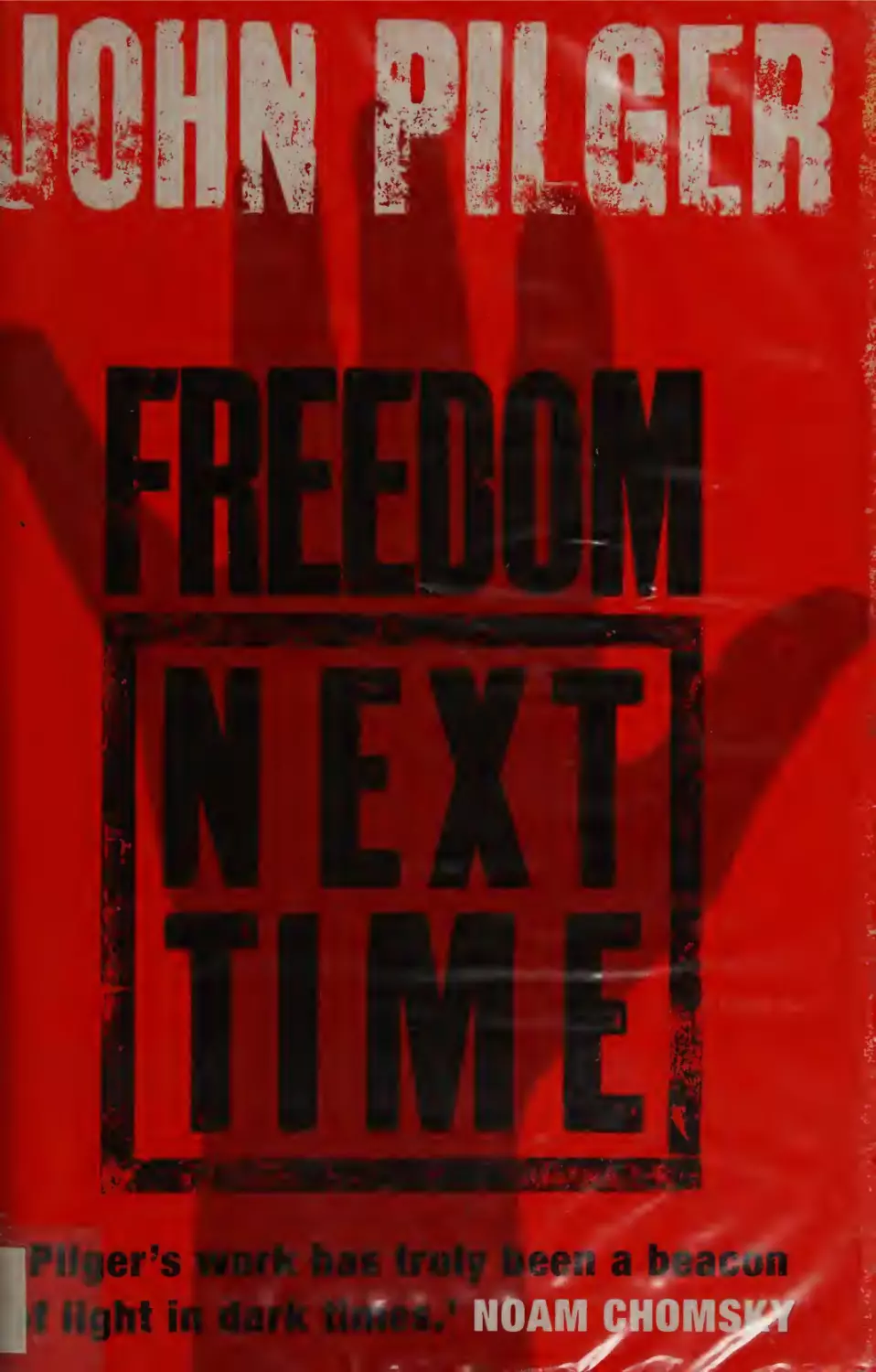


Автор: Pilger J.
Теги: imperialism historical literature political history empire crimes against humanity
ISBN: 0-593-05552-7
Год: 2006
Текст
                    When Nelson Mandela stepped out of prison
to freedom in 1990, the elation in South Africa
and around the world was palpable. But true
freedom for his people remains a distant
dream. Why? From South Africa to India
and beyond, a rapacious economic system
condemns millions to poverty while men in
faraway decorous offices impose a ruthless
political order with tariffs and embargoes,
bombs and bullets, distorting the very language
of freedom, causing suffering they never know,
• ®

spilling blood they never smell.
In Freedom Next Time, renowned journalist
and film-maker John Pilger describes how
courageous people battling to free themselves
' often glimpse freedom, only to see it taken
away. He challenges us in the West to‘look in
the mirror-at-the actions of‘our’ governments
for the trie source of much of tffe~world’s fear
and inselod^^-and terrorism. In our name,
often dupKekously, theyTSpaw&te a secret
da, as in Diego Garcia, a paradise island
e Indian-Ocean whose entire population
expelljfd_clandestinely and brutally by the
jSsh government to make way for a huge
ierican%Hftary base from which Afghanistan
Iraq were attacked.
M

lestirte, India, South Africa, Afghanistan,
in ancrthe United States, John Pilger’s vivid
itness reporting and tenacious interviews
the powerful, backed by meticulous
arch, blow away the secrets and lies of
| rulers and turn a searchlight on to events
c*|esigned to the shadows by an unrecognised
virulent censorship. With humanity, wit and
-passion, he salutes people who refuse to be
~ims and defiantly demand their freedom.
’They could soon be us.

FREEDOM NEXT TIME

www.booksattransworld.co.uk

ALSO BY JOHN PILGER
The Last Day
Aftermath: The Struggle of Cambodia and Vietnam

(with Anthony Barnett)
The Outsiders

(with Michael Coren)
Heroes
A Secret Country
Distant Voices
Hidden Agendas
The New Rulers of the World
Tell Me No Lies: Investigative Journalism
and Its Triumphs

(editor)

FREEDOM NEXT TIME

JOHN PILGER

BANTAM PRES
LONDON

•

TORONTO

•

SYDNEY

•

AUCKLAND

•

JOHANNESBURG

TRANSWORLD PUBLISHERS
61-63 Uxbridge Road, London W5 5SA
a division of The Random House Group Ltd
RANDOM HOUSE AUSTRALIA (PTY) LTD
20 Alfred Street, Milsons Point, Sydney,
New South Wales 2061, Australia
RANDOM HOUSE NEW ZEALAND LTD
18 Poland Road, Glenfield, Auckland 10, New Zealand
RANDOM HOUSE SOUTH AFRICA (PTY) LTD
Isle of Houghton, Corner of Boundary and Carse O’Gowrie Roads,
Houghton 2198, South Africa
Published 2006 by Bantam Press
a division of Transworld Publishers
Copyright © John Pilger 2006
The right of John Pilger to be identified as the author of this work has been
asserted in accordance with sections 77 and 78 of the Copyright, Designs
and Patents Act 1988.
A catalogue record for this book is available from the British Library.
ISBN (tpb) 0593055535
9780593055533 (from Jan 07)
ISBN (cased) 0593055527
9780593055526 (from Jan 07)
All rights reserved. No part of this publication may be reproduced, stored in a
retrieval system, or transmitted in any form or by any means, electronic,
mechanical, photocopying, recording, or otherwise, without the prior
permission of the publishers.
Typeset in ll/14pt Sabon by
Falcon Oast Graphic Art Ltd.
Printed in Great Britain by
Clays Ltd, Bungay, Suffolk.
5 7 9 10 8 6 4
Papers used by Transworld Publishers are natural, recyclable products made from
wood grown in sustainable forests. The manufacturing processes conform to the
environmental regulations of the country of origin.

For Louis,
bom as this was being written

Contents
Acknowledgements
Introduction

ix
1

1

Stealing a Nation

19

2

The Last Taboo

61

3

Shining India

161

4

Apartheid Did Not Die

175

5

Liberating Afghanistan

262

Notes

313

Picture Acknowledgements

342

Index

343

*

.

Acknowledgements

This book could not have been completed without the help and
support of the following people, to whom I give my warmest
appreciation: Anthony Amove, Terry Bell, Patrick Bond, Jill
Chisholm, John Cooley, Ania Corless, Ann Cunningham, Cosmas
Desmond, Roger Diski, Helen Edwards, Mona El-Farra, Sally
Gaminara, Richard Gifford, Amira Hass, Jane Hill, Mike Holderness,
Jacqueline Korn, Sheila Lee, Nur Masalha, Ray McGovern, Chris
Martin, Gavin Morris, Ilan Pappe, Sam Pilger, Zoe Pilger, Nida
Rafa, Jaine Roberts, Vicki Robinson, Stephen Rudoff, Laura
Sherlock, Gil Sochat, Gillian Somerscales, Margie Struthers.

...

Rise like lions after slumber
In unvanquishable number.
Shake your chains to earth like dew.
Which in sleep has fallen on you.
Ye are many - they are few.
Percy Bysshe Shelley
The Mask of Anarchy

.

>

.

Introduction
This book is about empire, its facades and the enduring struggle of
people for their freedom. It offers an antidote to authorised versions
of contemporary history that censor by omission and impose double
standards. It is, I hope, a contribution to what Vandana Shiva calls
‘an insurrection of subjugated knowledge’.1
When I began as a journalist, there was something called ‘slow
news’. We would refer to ‘slow news days’ (usually Sunday) when
‘nothing happened’ - apart, that is, from triumphs and tragedies in
faraway places where most of humanity lived. The triumphs, the
painstaking gains of people yearning to be free, were rarely acknowl¬
edged. The tragedies were dismissed as acts of nature, regardless of
evidence to the contrary. Our terms of reference were those of great
power, such as ‘our’ governments and ‘our’ institutions. The ‘view
from the ground’ had value only if it reinforced that from on high.
Whole societies were described and measured by their relationship
with ‘us’: their usefulness to ‘our interests’ and their degree of compli¬
ance with (or hostility to) our authority. Above all, they were not ‘us’.
These colonial assumptions have not changed. To sustain them,
millions of people remain invisible, and expendable. On September
11, 2001, while the world lamented the deaths of innocent people in
the United States, the UN Food and Agricultural Organisation
reported that the daily mortality rate continued: 36,615 children
had died from the effects of extreme poverty. This was normal in the
age of ‘economic growth’.2
The expendable people of impoverished Nicaragua fed this
statistic. In the early 1980s, the historian Mark Curtis surveyed
five hundred articles in the British press that dealt with Nicaragua.
He found an almost universal suppression of the triumphs of
the Sandinista government in favour of the falsehood of ‘the
threat of a communist takeover’, which was then Anglo-American
propaganda. ‘It would take considerable intellectual acrobatics,’ he
wrote, ‘to designate Sandinista success in alleviating poverty remarkable by any standard - as unworthy of much comment by

FREEDOM NEXT TIME

2

objective indicators . . . One might reasonably conclude that the
reporting was conditioned by a different set of priorities, one that
conformed to the stream of disinformation from Washington and
London.’3
Meanwhile,

the

atrocious

misadventure

known

as

the

‘Iran-Contra affair’ was represented in Washington as a domestic
embarrassment for the Reagan administration rather than a
conspiracy to bleed to death the Nicaraguan government, whose
only threat was that of a good example. That countless innocent
people were killed or denied the opportunity to free themselves from
poverty, disease and illiteracy was never an ‘issue’. A subsequent
ruling by the International Court of Justice distinguished the Reagan
administration as the only government the court has ever
condemned for ‘terrorism’, calling on it to pay the Nicaraguan
government $17 billion in reparations. This was ignored and the
matter long forgotten, for it was the slowest news.4
The following year, 1987, the UN General Assembly passed a
resolution that all member states should combat ‘terrorism wherever
and by whomever it is committed’. Only two states voted against it:
the United States and Israel. At the time, this was unreported. When
Ronald Reagan died, he was lauded as a ‘great communicator’, a
leader of magnetic personal charm. His terrorism and lawlessness
were unmentionable.5
The current occupation of Iraq is seen from the same parallel
world. When the BBC’s Director of News, Helen Boaden, was asked
in January 2006 to explain how one of her ‘embedded’ reporters in
Iraq could possibly describe the aim of the Anglo-American invasion
as ‘bringing] democracy and human rights’ to Iraq, she replied with
sheaves of quotations from Tony Blair that this was indeed his aim,
as if his now notorious mendacity and the truth were compatible.
No other evidence was required.6 Such matter-of-fact servility to the
state used to bemuse Soviet journalists visiting the West during the
Cold War. ‘How do you achieve that?’ one of them once joked. ‘In
our country, to get that result, we tear out fingernails!’7
On March 28, 2003, during the attack on Iraq, sixty-two
people were killed by an American missile that exploded in the
al-Shula district of Baghdad. That evening, Newsnight, the BBC’s
only regular televised current affairs programme, devoted forty-five

INTRODUCTION

3

seconds to the massacre - less than one second per death. Contrast
that with July 7, 2005, when the terrorist bombing of London killed
almost the same number of people and received such coverage that
overnight we became intimate with the lives of the victims, and
could mourn their loss or salute their courage.
In other words, for the men, women and children blown to
pieces in Baghdad, the solidarity we extended naturally to the
London victims was denied; we were not allowed to know them.
Why? Certainly, they were not ‘us’, but they were ‘our’ victims that is, they had died at the hands of forces in collusion with our
government, and in our name.
As I write this, early in 2006, three families in three different
towns in Iraq have been wiped out by American missiles and bombs.
One family had seventeen members and the others fourteen and
seven; the victims were mostly women, the elderly and children.
Their violent extinction caused not a ripple in that man-made
phenomenon known as the ‘mainstream’, the main source of what
we call news. Browsing the internet, I happened to read all seventeen
names of the dead of the first family. Their names and ages had been
meticulously collected and posted by an independent American
reporter, Dahr Jamail, whose outstanding eye-witness and in¬
vestigative work never appears in the ‘mainstream’.8
The innocent people killed in London were worthy victims. The
innocent people killed in Iraq were unworthy victims. Put another
way, the London massacre was worthy of our compassion; the Iraqi
outrages were not.
This logic does not always follow a true course. When Saddam
Hussein was in power and being courted and armed to the teeth by
‘us’, notably with the technology to build weapons of mass destruction,
Iraqi Kurds massacred by him were slow news. When, in 1988,
Saddam attacked the Kurdish village of Halabja with nerve gas, killing
five thousand people, the British and American governments did their
best to discourage coverage of the atrocity; the Americans went as far
as blaming it on Iran. When I enquired at the time, I was told by the
Foreign Office in London that it was ‘far too easy’ to blame Saddam.
However, in 1991, when Saddam displeased his sponsors in
Washington and London by attacking another of their clients,
Kuwait, and was now an official enemy, the plight of Iraqi Kurds

FREEDOM NEXT TIME

4

suddenly became a great charitable cause in the West. Headlines and
TV footage were lavished on them. They were made worthy victims
par excellence. Alas, this change of status did not apply to the Kurds
across the border in Turkey, even though they were part of
the same dispossessed nation and were being slaughtered in far
greater numbers by the Turkish military. The Ankara regime is a
member of NATO and beneficiary of Anglo-American, World Bank
and IMF ‘aid’. Indeed, at the height of the Turkish Kurds’ agony, the
Turkish military received $8 billion worth of American gifts of
tanks, planes, helicopters and ships.9 In 2006, Turkey’s Kurds
remain unworthy victims.
By the same rule of thumb, a crime is only a crime if the per¬
petrators are ‘them’, not ‘us’. In his epic acceptance of the 2005
Nobel Prize in Literature, Harold Pinter referred to ‘a vast tapestry
of lies, upon which we feed’. He asked why ‘the systematic brutality,
the widespread atrocities, the ruthless suppression of independent
thought’ of Stalinist Russia were well known in the West while
American imperial crimes were merely ‘superficially recorded, let
alone documented, let alone acknowledged’.
He was referring to a great silence, unbroken by the incessant
din of the media age. Across the world, the extinction and suffering
of countless human beings could be attributed to rampant America.
‘But you wouldn’t know it,’ said Pinter. ‘It never happened. Nothing
ever happened. Even while it was happening it never happened. It
didn’t matter. It was of no interest.’10
To its shame, though unsurprisingly, the BBC ignored Pinter’s
warning. All that drawing-room flatulence about the arts, all that
preening for the cameras at Booker prizegivings, yet the national
broadcaster could not make room for Britain’s greatest living
dramatist, so honoured, to tell the truth. For the BBC, it never
happened.
Soon afterwards, bereft of irony, the newsreader Fiona Bruce
introduced, as news, a Christmas propaganda film about George W.
Bush’s dogs. The film showed how kind the President and his family
were. That happened. Now imagine Bruce reading this: ‘Here is
delayed news, just in. From 1945 to 2005, the United States
attempted

to

overthrow

fifty

governments,

many

of them

democracies, and to crush thirty popular movements fighting

INTRODUCTION

5

tyrannical regimes. In the process, twenty-five countries were
bombed, causing the loss of several million lives and the despair of
millions more.’11
One of the striking features of the post-Cold War era has been
the public rehabilitation of the concept of empire. Like Prime
Minister Harold Macmillan secretly in the 1950s, a new crop of
imperialists now openly laments the ‘loss of white prestige’ that was
the old imperialism and the denigration of ‘our’ culture.12 ‘Culture’
has become the code for race and class; revisionism is all the rage.
The Wall Street Journal has lauded Britain’s and France’s disastrous
imperial adventure in Suez in 1956, describing American opposition
as ‘perhaps the biggest strategic mistake in the post-war era’.13 The
Cambridge academic John Casey has rejoiced that the Western pow¬
ers now ‘can do what they like [in the developing world]’.14
‘It is easy to forget,’ wrote Frank Furedi in The New Ideology of
Imperialism, ‘that until the 1930s the moral claims of imperialism
were seldom questioned in the West. Imperialism and the global
expansion of the Western powers were represented in unambiguously
positive terms as a major contributor to human civilisation ... To
be an imperialist was considered a respectable, political badge.’15 As
the United States emerged from the Second World War and shed
what ‘Atlanticists’ like to call its ‘age of innocence’ (forgetting the
slaughter of the Native Americans, slavery, the theft of Texas from
Mexico, the bloody subjugation of Central America, Cuba and the
Philippines, and other innocent pursuits), ‘imperialism’ was dropped
from American textbooks and declared a European affair. One of
the difficulties for proud imperialists in the immediate post-war
period was that Hitler and fascism, and all their ideas of racial and
cultural superiority, had left a legacy of guilt by association. The
Nazis had been proud imperialists, too.
A serious, if farcical, campaign to expunge the word from the
language followed ‘on the grounds that it falsely attributed immoral
motives to Western foreign policy’. The term was deemed to no
longer have ‘relevance’. Those who persisted in using it as a
pejorative term were ‘disreputable’ and ‘sinister’. They were, wrote
one American historian, ‘inspired by the Communist doctrine’, or
they were ‘Negro intellectuals who had grievances of their own
against white capitalism’.16

6

FREEDOM NEXT TIME

In the best Stalinist tradition, imperialism was airbrushed out.
‘The Cold War intelligentsia,’ wrote Furedi, ‘by denying the
centrality of the imperial identity to Western society, were denying
their own past. They did not deny that imperialism was something
to be ashamed of, they merely denied all association with it.’17
That changed in the 1990s. With the collapse of the Soviet
Union, the imperialists took heart. The economic and political crises
in the ‘developing’ world, caused by the collapse in commodity
prices and the ravages of debt, would now serve as retrospective
justification for imperialism. Once again, the ‘third world’ needed to
be saved from itself. Imperialism’s return journey to establishment
respectability had begun.
Written up by Bush’s ideological sponsors shortly before he
came to power in 2000, a messianic conspiracy theory called the
‘Project for the New American Century’ foresaw his administration
as an imperial dictatorship behind a democratic facade: ‘the cavalry
on the new American frontier’ that could ‘fight and win multiple,
simultaneous major theatre wars’.18 The attacks on the United States
on September 11, 2001 ensured the theory became practice; a
fraudulent ‘war on terror’ became a war of terror.
A Pentagon plan entitled ‘Vision 2020’ had already identified
the goal as ‘full spectrum dominance’. This would allow ‘the
medium of space, the fourth medium of warfare - along with land,
sea and air - to close the ever-widening gap between diminishing
resources and increasing military commitments’.19 General John
Jumper of the US Air Force predicted that the planet could be easily
mastered because American forces enjoyed ‘God’s eye’ from
satellites and commanded ‘the global information grid’.20 He had a
point. More than 725 American bases are now placed strategically
in compliant countries, notably at gateways to sources of fossil fuels
and encircling the Middle East and Central Asia.21
No longer whispered, ‘empire’ is a word to be embraced again.
The British treasurer Gordon Brown has told the Daily Mail, ‘The
days of Britain having to apologise for the British empire are over.
We should celebrate.’22 The historian Andrew Roberts insisted in the
Daily Express that for ‘the vast majority of its half-millennium-long
history, the British empire was an exemplary force for good’.23 In the
Daily Telegraph, the military historian John Keegan declared the

INTRODUCTION

7

empire ‘highly benevolent and moralistic’.24 Applauding Blair’s
moral gunboats and Gladstonian convictions of superiority, Niall
Ferguson, professor of politics at Oxford, said, ‘Imperialism may
be a dirty word, but when Tony Blair is essentially calling for the
imposition of Western values - democracy and so on - it is really
the language of liberal imperialism . . . imposing your views and
practices on others.’25
Ferguson’s honesty is provocative to the ‘liberal realists’ who
dominate the study of international relations in Britain and teach
that the new imperialists are the world’s crisis managers, rather
than the cause of a crisis. With honourable exceptions, these scholars
of ‘geopolitics’ have taken the humanity out of the study of nations
and congealed it with a jargon that serves great power. Laying out
whole societies for autopsy, they identify ‘failed states’ and ‘rogue
states’, inviting ‘humanitarian intervention’ - a term used by impe¬
rial Japan to describe its bloody invasion of Manchuria. (Mussolini
also used it to justify seizing Ethiopia, as did Hitler when the Nazis
drove into the Sudetenland.)26
There are minor variations. Michael Ignatieff, former professor
of human rights at Harvard and an enthusiastic backer of the West’s
invasions, prefers ‘liberal intervention’.27 From the same lexicon of
modern imperial euphemisms have come ‘good international citizen’
(a Western vassal) and ‘good governance’ (a neo-liberal economy
run by the World Bank/IMF). Once noble concepts have been appro¬
priated:

‘democracy’

(pro-Washington

regime)

and

‘reform’

(dismantling genuine social reforms) and ‘peacemaking’ (war).
Remarkably, academics and commentators still describe Tony Blair
and Bill Clinton as ‘centre-left’, a denial of the historical record.
The ‘centre’, of course, is liberal and reasonable, because liber¬
alism is non-ideological. That is the mythical touchstone of the
world’s most powerful ideology. Tony Blair, wrote the Guardian
columnist Hugo Young in 1997, ‘wants to create a world none of us
have known, where the laws of political gravity are overturned [and]
ideology has surrendered entirely to “values” \28 That Blair would
commit, in pursuit of these ‘values’, the crime of invading, un¬
provoked, a defenceless country, which the Nuremberg judges
described as ‘the paramount war crime’, was unthinkable. ‘It’s a nice
and convenient myth that liberals are the peacemakers and

FREEDOM NEXT TIME

8

conservatives the warmongers,’ wrote Hywel Williams, ‘but the
imperialism of the liberal may be more dangerous because of its
open-ended nature - its conviction that it represents a superior form
of life.’29
It is not surprising that the ‘liberal’ Blair has taken Britain to war
more often than any Prime Minister in the modern era, or that his
closest ally, or mentor, is George W. Bush, considered by a large
section of humanity the most dangerous man on earth. What unites
them is not their extremism, but a time-honoured orthodoxy, cele¬
brated relentlessly in the ‘mainstream’. This, wrote Richard Falk,
professor of international relations at Princeton and a distinguished
dissenter, ‘regards law and morality as irrelevant to the identifica¬
tion of rational policy’. Thus, Western policies and actions have long
been formulated ‘through a self-righteous, one-way, legal/moral
screen [with] positive images of Western values and innocence
portrayed as threatened, validating a campaign of unrestricted
political violence . . .’ This ‘is so widely accepted ... as to be
virtually unchallengeable’.30
Freedom Next Time pushes back this one-way moral screen to
demonstrate that imperialism, in whatever guise, is the antithesis of
the ‘benevolent and moralistic’. Each chapter is set in a country with
which I have had long association as a reporter and film-maker.
Along with a sense of history, I have tried to convey something
of what I have seen and what has moved me - the everyday pain,
dark humour and generosity of lives lived a long way away and
conveniently dehumanised in a surreal assembly line of ‘sound¬
bites’, from the children playing among cluster bombs in Kabul to
the ritual humiliations forced upon Palestinians, to the determina¬
tion of impoverished South African women in erecting their
own modern homes. The stories are those both of eye-witnesses
and of the powerful, including voices that speak from the bunkers
of British imperialism where they wrote their true intentions, not
intended for our eyes.
These phantom truth-tellers appear in chapter 1, ‘Stealing a
Nation’. Knowing this story as I do, I still find its criminal audacity
almost incredible. In high secrecy, during the late 1960s and early
1970s, British governments tricked, coerced and finally expelled the
entire population of the Chagos Islands in the Indian Ocean in order

INTRODUCTION

9

to give the principal island, Diego Garcia, a paradise, to the
Americans for a military base. From here, Iraq and Afghanistan
have been attacked. That the islanders were British citizens and had
roots in the islands that went back to the eighteenth century, that
they spoke their own language and practised their own culture,
made no difference. Methodically, they were kidnapped by their
own government and sent into exile to the slums of Mauritius,
where untold numbers have wasted away, including children who
died ‘simply of sadness’, as their mothers told me.
The ruthlessness was explicit - ‘the object is to get some rocks
which will remain ours\ The United Nations was lied to, as if none
of this was happening. While Margaret Thatcher and the British
media cheered on the Royal Navy as it sped to the rescue of two
thousand white Falkland islanders in 1982, not a word was uttered
about the brutal dispossession of two thousand Chagos islanders,
who are black. When, eighteen years later, the islanders glimpsed
their freedom in a High Court judgement that ruled they had been
wronged and could go home, they were tricked again by the Blair
government; a decree passed by ‘royal prerogative’, an archaic,
secretive mechanism, was used to circumvent the law and justice.
At the time of writing, the High Court is conducting a ‘judicial
review’ and its latest ruling is anxiously awaited by the islanders.
The injustice already done is a metaphor for the great piracy begun
more than five hundred years ago when European buccaneers were
granted the privileges of ‘discovery and conquest’ in a world the
Pope and kings considered their property, to be disposed of according
to their divine right. This assumption of divinity has not changed.
The title of chapter 2, ‘The Last Taboo’, is taken from an essay
by the Palestinian-born writer and scholar Edward Said, published
shortly before his death in 2002. He wrote, ‘The extermination of
the Native Americans can be admitted, the morality of Hiroshima
attacked, the national flag [of the United States] publicly committed
to the flames. But the systematic continuity of Israel’s 52-year
oppression and maltreatment of the Palestinians is virtually un¬
mentionable, a narrative that has no permission to appear.’31
The narrative begins almost forty years ago when I arrived in
Palestine as a young correspondent and listened to Palestinians and
Israelis, and saw the barren refugee camps. In describing the

10

FREEDOM NEXT TIME

‘destructive role’ of foreign journalists who ignored the history and
context of Palestinian frustration and violence, Edward Said under¬
stood the taboo many of us saw and privately deplored while
nourishing and prolonging lethal myths.
In 2002, a Glasgow University study found that barely 9 per
cent of young British viewers of television news knew that the
Israelis were the occupying force and that the illegal settlers were
Jewish: many believed them to be Palestinian. The term ‘Occupied
Territories’ was rarely explained, and people were not told that the
Palestinians were the victims of an illegal military occupation.
Language was used selectively, terms such as ‘murder’ and ‘atrocity’
applied exclusively to the deaths of Israelis. Only they were worthy
victims. The deaths of Palestinians were not so much slow news as
non-existent news.32
At the end of 2005, when Israeli Prime Minister Ariel Sharon fell
seriously ill and was hailed as a ‘man of peace’ whose ‘hope for a
Palestinian state’ might be ‘lost’ should he die, it seemed the ghost
of Lewis Carroll had finally made off with the forbidden narrative.
And when, soon afterwards, Hamas was elected to office in the
Occupied Territories and Gaza, the news was received in the West
through the same looking-glass. The wrong kind of democracy had
spoken and a Brechtian solution was surely called for: ‘To dissolve
the people / And elect another’. That the ascent of Hamas was due
in no small part to the secret, machiavellian support of Israel and to
an Anglo-American campaign to destroy secular Arabism and its
‘moderate’ dreams of freedom was unmentionable.33
In his 2001 history, Late Victorian Holocausts, Mike Davis
writes that as many as twenty-nine million Indians died un¬
necessarily in famines wilfully imposed by British policies. He relates
how in 1876 the Viceroy, Lord Lytton, insisted that nothing should
prevent the export of surplus wheat and rice to England and that
officials were ordered to ‘discourage relief works in every way’. As
millions starved, the imperial government launched ‘a militarised
campaign to collect the tax arrears accumulated during the
drought’. In the north-west provinces alone, which had brought in
record harvests in the preceding three years, at least one and a
quarter million people died.34
Stalin in the Ukraine would subsequently match this, in-

INTRODUCTION

11

famously; and this was Harold Pinter’s point: we know of Stalin’s
crimes; we know next to nothing of our own. It is a tribute to the
elite promotion of that ‘exemplary force for good’ that the India of
the Raj remains mainly a source of nostalgia. While young Britons
are taught modern history largely conditioned by the evils of Hitler
and the ‘good war’ — that ‘ethical bath where the sins of centuries
of conquest, slavery and exploitation were expiated’, as Richard
Drayton wrote - the story of how the British Raj brought its own
dimension of imperial suffering to India is, at most, a footnote.35
In my chapter 3, ‘Shining India’, the legacy of the Raj is present
in independent India: in the elite denial of enduring poverty. I first
went to India in the 1960s, at the height of a famine in Rajasthan.
As in the time of the Raj, the term ‘famine’ was officially frowned
upon; ‘emergency’ was preferred. Those who enquired too deeply
into the criminal absurdity of Indian mass impoverishment were
unwelcome; several foreign film-makers were banned. In 2004, after
a long absence, I returned to India’s greatest city, Bombay, where the
mighty freedom movements had rallied and Gandhi had lived
and, today, a new empire has arrived: that of Bushite ‘free trade’,
bourgeois consumerism, call centres, a ferocious meritocracy and a
new struggle for freedom.
In 1967,1 was banned from apartheid South Africa. Thirty years
later, I flew back. Nelson Mandela was President, the ‘rainbow
nation’ had been declared and apartheid was dead. Great men and
great events had convinced the outside world that freedom had
arrived, and black South Africans felt the thrill of freedom as they
queued patiently to vote for the first time in their lives.
The betrayal of their struggle, goodwill and optimism is
described in chapter 4, ‘Apartheid Did Not Die’. This was the title
of a documentary film I made on my return, which stirred spirited
debate in South Africa. Apartheid took its name and mysticism
from the first Boer regime, but its lifeblood flowed from the British
imperial legacy of Cecil Rhodes and other ‘men of commerce and
industry’, who at the turn of the twentieth century stole the land,
resources and economic birthright of the majority. The poverty they
created has not been turned back in ‘free’ South Africa, as the
African National Congress solemnly pledged. In the ‘townships’,
conditions are described as ‘desperate’, with more than five million

FREEDOM NEXT TIME

12

hungry children and a health system unable to cope with epidemic
disease, such as AIDS and tuberculosis.36
A new elite has emerged, the product of ‘black empowerment’ and
the beneficiary of nefarious deals with the white power that still runs
South Africa. ‘We seek to establish’, said Trevor Manuel, the Finance
Minister, ‘an environment in which winners flourish.’37 However,
members of the tribe known sardonically as the ‘waBenzi’ (the
Mercedes Benz is their preferred means of transport) are beginning to
look over their shoulders at the great struggles of the past, for their
compatriots are stirring again and demanding more than symbols.
Community uprisings are common again as townships and squatter
camps are torched, along with the buildings of authority. In the global
apartheid created by modern economic imperialism, today’s South
Africa provides both a spectre and a warning.
As the first American bombs fell on Afghanistan in October
2001, retribution for the attacks on America five weeks earlier,
President Bush broadcast the following message to his far-off
victims: ‘The oppressed people of Afghanistan will know the
generosity of America. As we strike military targets, we will also
drop food, medicine and supplies to the starving and suffering men
and women and children of Afghanistan. The United States is a
friend of the Afghan people.’38
The previous week, Tony Blair had said memorably: ‘To the
Afghan people, we make this commitment. We will not walk away
... If the Taliban regime changes, we will work with you to make
sure its successor is one that is broad-based, that unites all ethnic
groups and offers some way out of the poverty that is your
miserable existence.’39
In the final chapter, ‘Liberating Afghanistan’, their words are set
against the consequences of their actions. The attack on Afghanistan,
said to be the first ‘victory’ in the ‘war on terror’, caused the deaths
of almost seven times the number that died in the Twin Towers. As
the Taliban melted away, the country was taken over by some of the
world’s most brutal men, the same warlords America had nurtured
during the Soviet occupation, who had reduced Kabul, the capital, to
rubble. The ‘liberal intervention’ in Afghanistan is today a surreal
concoction. The American-arranged ‘democracy’ includes, for
example, Mulavi Qalamuddin, the Taliban’s head of the Department

INTRODUCTION

13

for the Prevention of Vice and the Promotion of Virtue, who enforced
Sharia law through unusual forms of punishment and physical abuse.
The liberation of women is a mirage. While al-Qaida is nowhere to
be found, American patrols flying outsized Stars and Stripes and
playing rock music at full volume attack isolated villages and ‘render’
their ‘suspects’ to a CIA gulag.
When I heard Donald Rumsfeld describe Afghanistan today as a
‘model’ of democracy, I thought how my favourite chronicler of the
absurdities of war, Joseph Heller, would appreciate this assessment.
In chapter 5, I relate a conversation I had with a colonel on an
American base, who resembled uncannily ‘Major Major’ in Heller’s
Catch-22. Tony Blair’s Defence Secretary, John Reid, also seemed to
step from the pages of Catch-22 when he announced that the ‘war
on terror’ in Afghanistan was ‘absolutely interlinked to countering
narcotics’.40 The main export of the ‘model’ democracy is heroin,
which the Taliban had successfully banned and from which the
current, democratic warlords are making their fortunes. The drug
ends up on the streets of cities like Glasgow. Such is the ‘great
game of nations’ which pith-helmeted Englishmen evolved and their
successors do proud.
After leaving Afghanistan, I flew to the United States, where a
rebellion within the ‘old’ establishment is under way. I met Ray
McGovern, a former CIA analyst who had once prepared the daily
briefing for the White House. When I said to him that Norman
Mailer believed that America had entered a ‘pre-fascist’ state, he was
silent, then said, ‘I hope he’s right, because there are others saying
that we are already in a fascist mode. When you see who is control¬
ling the means of production here, when you see who is controlling
the newspapers and periodicals, and the TV stations, from which most
Americans take their news, and when you see how the so-called war
on terror is being conducted, you begin to understand where we are
headed ... so yes, we all ought to be worried about fascism.’41
Another establishment voice, Paul Craig Roberts, a former
associate editor of the Wall Street Journal and Assistant Secretary of
the Treasury under Reagan, wrote,
The United States is starting to acquire the image of Nazi
Germany. Knowledgeable people should have no trouble

FREEDOM NEXT TIME

14

drawing up their own list of elements common to both the
Bush and Hitler regimes: the use of extraordinary lies to
justify military aggression; reliance on coercion and threats
in place of diplomacy; total belief in the virtue and
righteousness of one’s cause; the equating of factual
objections or ‘reality-based’ analysis to treason; the re¬
direction of patriotism from country to leader; the belief
that defeat resides in debate and a weakening of will.42
‘Fascism’ is too easily used as abuse or as a neat label for all the
world’s evils, but what is striking about the debate in America
today is the recurring warning of conservatives who believe in the
separation of powers under the constitution. ‘In effect,’ wrote
Roberts, ‘Bush is asserting the powers that accrued to Hitler in 1933
. . . Thus has the US arrived at the verge of dictatorship.’43
In 2005, the US Senate, in effect, voted to abolish habeas corpus
when it passed an amendment that overturned a Supreme Court
ruling allowing Guantanamo Bay prisoners access to a federal court.
Without habeas corpus and the ‘due process’ provisions of the Bill
of Rights, a government can lock away its opponents and implement
a dictatorship. A not untypical case is that of an American doctor
who was punished with twenty-two years in prison for founding a
charity, Help the Needy, which helped children in Iraq stricken by
the economic blockade enforced by America and Britain in the
1990s. In raising money for infants dying from diarrhoea, Dr Rafil
Dhafir broke this siege which, according to UNICEF, had caused the
deaths of half a million infants under the age of five.44 The then
Attorney-General, John Ashcroft, called Dr Dhafir a ‘terrorist’, a
description derided by even the judge in what was a transparently
political trial.45
Secretly, Bush has assumed the power of a variety of ‘signing
statements’. These are little-known decrees that circumvent laws
passed by Congress and allow him to ignore legislation, not to
mention the Geneva Convention, forbidding torture of prisoners.
After all, blurted out the President, the US Constitution ‘is just a
goddamned piece of paper’.46
Along with the intelligence agencies, the Pentagon has expanded
its domestic surveillance to ‘investigate crimes within the United

INTRODUCTION

15

States .47 In the CIA gulag, torture and murder are admitted. In Iraq,
the true extent of the slaughter and the punishment of the civilian
population, notably the massacres and use of white phosphorus
weapons in the city of Fallujah, is masked by a successful,
‘embedded’ system of reporting. In 2004, a peer-reviewed study by
the Johns Hopkins School of Public Health, published in the British
medical journal The Lancet, suggested a ‘conservative’ figure of a
hundred thousand killed by mostly American firepower.48 Four
other studies estimate a higher figure.49
A once bountiful land is being poisoned by an invisible weapon
of mass destruction: radiation from uranium-tipped weapons
(known as ‘depleted’ uranium) and equivalent to many times that
released by the Hiroshima and Nagasaki bombs. Children are
especially vulnerable because they play in heavily polluted areas,
where cancers have increased thirty-fold. More than half of Iraq’s
cancer sufferers are under the age of five. I have seen the hospital
wards filled with these little, mutated ghosts.50
Once I believed that if only those with power and responsibility
had seen what I had seen, the horror and degradation of war, they
would act otherwise. That was naive, for only the power of popular
dissent changes their course, or rids us of them. They understand
that. That is why,' as the legal powers of the state are criminalised,
so is dissent.
In Britain, from January 1, 2006, you can be arrested for the
most minor offences. This is clearly directed at peaceful protest.
Maya Evans, a vegan chef aged twenty-five, will have a criminal
record for the rest of her life. She was arrested under the new Serious
Organised Crime and Police Act for reading aloud at the Cenotaph
in London the names of ninety-seven British soldiers killed in Iraq.
So serious was her crime that it took fourteen policemen in two vans
to arrest her.51
Eighty-year-old John Catt, who served in the Royal Air Force
during the Second World War, was stopped by police in Brighton for
wearing an ‘offensive’ T-shirt which suggested that Bush and Blair
be tried for war crimes. He was arrested under the Terrorism Act
and handcuffed, with his arms wrenched behind his back. The office
record of his arrest says the ‘purpose’ of searching him was
‘terrorism’ and the ‘grounds for intervention’ were ‘carrying a

FREEDOM NEXT TIME

16

plackard and T-shirt with anti-Blair info’ (sic). At the time of
writing, he is awaiting trial for refusing to accept a police caution.52
This capture of the law for political ends is no different from
the subversion of the High Court’s judgement in favour of the
Chagos islanders. Is this the beginning of a kind of fascism in which
great goose-stepping rallies are quite unnecessary? George Orwell
warned that totalitarianism did not require a totalitarian state.
The consequences of decisions taken by respectable, ‘democratic’
politicians are now evocative of decisions taken by fascists.
The difference is distance. The entire population of the British
archipelago of Chagos was rounded up and expelled, the women
and children forced into the hold of a ship without fresh water in a
fashion reminiscent of slavery. While that was going on, Britons at
home remained free, protected by laws. Now that is changing. The
distance is diminishing.
I have written Freedom Next Time to warn against these dangers
and to celebrate those who challenge them. It takes up the theme
of my previous books, such as Heroes, Distant Voices and
Hidden Agendas, the last having been recently distinguished with
a ‘denied’ stamp by the censors of Guantanamo Bay.53 This is not a
pessimistic book. In my experience, most people do not indulge the
absurdity of rapacious power’s ‘rules’. They do not contort their
morality and intellect to comply with double standards and the
notion of approved evil, of worthy and unworthy victims. They
would agree wholeheartedly with Robert Jackson, Chief Counsel
of the United States at the Nuremberg trials of the Nazi leaders.
‘If certain acts of violation of treaties are crimes,’ he said, ‘they are
crimes whether the United States does them or whether Germany
does them, and we are not prepared to lay down a rule of criminal
conduct against others which we would not be willing to have
invoked against us.’54
In Britain, opinion polls show that the majority oppose the
invasion and occupation of Iraq and believe the Prime Minister has
lied to them. In the 2005 British general election, barely a fifth of the
adult population voted for the Blair government in the second
lowest turnout since the franchise. This was not apathy; it was an
undeclared strike that reflects a rising awareness, consciousness
even, offering more than hope.

INTRODUCTION

17

Since the crusaders in Washington squandered the sympathy of
most of humanity for the victims of September 11, 2001, in order to
accelerate their own dominance, a critical public intelligence has
stirred. Witness the spectacular response of people in the West to the
tsunami of December 26, 2004. While Bush offered less than
the cost of his inauguration party and Blair one-twentieth of a loan
given to the Indonesian regime so that it could buy British military
aircraft, ordinary people gave millions. More than charity, this was a
reclaiming of the politics of community, morality and internationalism.
The celebrated American commentator Walter Lippmann once
described the public as ‘a bewildered herd’.55 This contempt is
shared by those who fear the unmasking of their apparent in¬
vincibility when the ‘herd’ suddenly changes direction. During
the 1960s, in the United States, the civil rights campaign ended the
vestiges of slavery. It was allied to a movement that stopped an allout military mobilisation which would have set alight Asia and
beyond. Like the Chartists and the other crusaders who fought for
the freedoms many of us enjoy, they knew that if power was truly
invincible it would not fear the people so much as to expend vast
resources trying to distract and deceive them.
I offer none of this as rhetoric; human renewal is not a
phenomenon. The continuation of a struggle may appear at times
frozen, but is a seed beneath the snow. Look at Latin America, long
declared invisible, almost expendable in the West. ‘Latin Americans
have been trained in impotence,’ wrote Eduardo Galeano. ‘A
pedagogy passed down from colonial times, taught by violent
soldiers, timorous teachers and frail fatalists, has rooted in our souls
the belief that reality is untouchable and that all we can do is
swallow in silence the woes every day brings.’56 Galeano, dissident
and poet, was celebrating the rebirth of democracy in his homeland,
Uruguay, where people had voted ‘against fear’. In Venezuela, Hugo
Chavez heads the only government on earth sharing the nation’s oil
wealth with its poorest. In Bolivia, poorest of them all, the
indigenous people, having forced out foreign corporations that
‘owned’ their water, have elected the continent’s first indigenous
leader.
These forces are part of a worldwide movement against poverty
and war and misinformation that has arisen in less than a decade,

18

FREEDOM NEXT TIME

and is more diverse, enterprising, internationalist and tolerant of
difference than anything in my lifetime. It is also unburdened by
Western narcissism, which has no part in freedom, as the wisest
know. The wisest also know that just as the conquest of Iraq is
unravelling, so a whole system of domination and impoverishment
can unravel, too.

1

Stealing a Nation
The object of the exercise is to get some rocks
which will remain ours.
Foreign Office, London, 1966
The struggle of people against power is the struggle
of memory against forgetting.
Milan Kundera

In long-forgotten archives in London and Mauritius is rare film of a
community of contented people. The grainy, flickering images, full
of movement of children playing on sandy beaches, and proud
young women presenting their newborn for christening, and men
setting out to fish, their dogs swimming alongside, are glimpses of
a true paradise. There are thriving villages, a school, a hospital, a
church, a light railway, set in a phenomenon of natural beauty:
strings of coral atolls, floating in turquoise, that were once the peaks
of a Gondwanaland mountain range known as Limuria, long
covered by 21,000 square miles of the Indian Ocean.
Sixty-five of these limestone specks, arranged in groups, make
up the Chagos archipelago: the Salomon Islands and the Peros
Banhos atoll to the north, the Egmont Islands to the west and,
200 miles to the south, an atoll the shape of a tiny Italy, 14 miles
long and 6 miles wide. This is Diego Garcia. Free of serious tropical
storms and with a large protected natural harbour, Diego Garcia lies
almost exactly midway between Africa and Asia.
Some two thousand people lived on the Chagos archipelago,
the majority on Diego Garcia. A gentle, Creole nation, their ancestry
went back to the eighteenth century when the French brought slaves
from Mozambique and Madagascar to work a coconut plantation.
After Napoleon’s defeat in 1815 the islands passed from French to
British rule; just under twenty years later, slavery was abolished.
Chagossian society continued to grow with the arrival of
indentured labourers from India in the 1840s and 1850s. Many

FREEDOM NEXT TIME

20

stayed and converted to Catholicism, together with the settled
population, and by the twentieth century they had developed a
distinct language that was a lilting variation of French Creole.
There were now three copra factories, supplying the coconut oil
that lit street lamps in London, and a coaling station for ships en
route to and from Australia; by the 1960s, there were plans for
tourism. The workers received a small wage or payment in kind with
commodities such as rice, oil and milk. They supplemented this by
fishing in the abundantly stocked coastal waters, growing tomatoes,
chilli, pumpkins and aubergines, and rearing chicken and ducks.1 In
one film, shot by missionaries, a boy plays with a pet duck and a dog
dives for fish. As if celebrating a perfect vision of empire in such
a place, a Colonial Office film from the 1950s describes the popula¬
tion as ‘born and brought up ... in conditions most tranquil and
benign’. The camera pans across a laughing woman hanging out
clothes to dry in a coconut grove while her children play around her.
This is Charlesia Alexis.2
I met Charlesia the other day, fifty years after she was filmed.
She was sitting in the shade of her small, sparsely furnished house
on the edge of Port Louis, the capital of Mauritius, over a thousand
miles from her home. I asked her for her fondest memories of Diego
Garcia. ‘Oh, everything!’ she replied. ‘The sense of well-being is my
fondest souvenir. My family could eat and drink what they liked; we
never lacked for anything; we never bought anything, except
clothes. Can you imagine that?’
‘Why did you leave?’
‘I left in 1967. My husband was very ill and I decided to take
him to Port Louis to get the special treatment he needed. When we
were ready to return, we went to Rogers and Company - they ran
the boats - and asked for our tickets. They said they had
instructions not to let us go back. They said Diego had been
sold.’
‘Sold?’
‘Yes, that’s what they said. We were tricked. Looking back, the
day before we left, the administrator told us to take a lot of fruit
with us. They tricked us in so many ways, and when this game had
run its course, they deported everyone, just like that. I was the
fourth generation. Diego was my bird in the sky that was taken from

STEALING A NATION

21

me. I was sent to live in a slum, in rooms previously inhabited by
goats and pigs. That’s how they saw us.’
Something similar happened to Rita Bancoult. In 1968, one of
her six children fell seriously ill, and Rita and her husband had to
take her and the rest of their family to Mauritius. When the sick
child died, they, like Charlesia, went to the shipping agent in Port
Louis harbour to collect their tickets home and were also told they
could never return. ‘I’m very sorry for you, Rita,’ said the agent, ‘but
your island has been sold.’ At that, her husband, who was sitting
beside her, suffered a stroke; his arms and mouth were paralysed,
and he died a few days later.
Like all the Chagossian women I met in exile in Mauritius,
Charlesia Alexis and Rita Bancoult are remarkable simply for
having endured; for what happened in the Chagos Islands was so
searing, it may seem barely credible. Indeed La Lutte, as the
Chagossians call their struggle for justice and freedom, arose from a
crime that allows us to glimpse how great power works behind its
respectable, democratic facade and helps us to understand how
much of the world is run for the benefit of the powerful, and
how governments justify their actions with lies.
During the 1960s and 1970s British governments, both Labour
and Tory, tricked and expelled the entire population of the Chagos,
a British colonial dependency, so that their homeland could be
given to a foreign power, the United States, as the site for a military
base. This ‘act of mass kidnapping’3 was carried out in high
secrecy, along with the conspiracy that preceded it. For almost a
decade, neither Parliament nor the US Congress knew anything
about it, and no journalist revealed it. When the base had been
established, a group of ‘defence’ correspondents were flown out by
the Ministry of Defence and reported as expected, as if no-one had
ever lived there; BBC newsreaders still refer to US aircraft flying
out to bomb Afghanistan and Iraq from the ‘uninhabited’ island of
Diego Garcia.
The Chagossians were treated like Australia’s Aborigines in the
nineteenth century: they were deemed not to exist. Not only was
their homeland stolen from them, they were taken out of history.
Until recently, the Foreign Office website denied their very existence.
Only a handful of MPs have referred to them in parliamentary

FREEDOM NEXT TIME

22

debates on Britain’s remaining ‘overseas territories’. Not a single
politician whose policy-making had brutal consequences for the
islanders has ever referred to them in his or her memoirs. I know of
no work of scholarship on British foreign policy that describes what
happened to them, with one admirable exception: the books of
Mark Curtis, who has called them ‘unpeople’.4
Having abandoned them, seven British governments watched
their vulnerable, faraway citizens live a nightmare in shanties in the
Seychelles and, mainly, Mauritius, where they had been discarded,
while ministers and their officials in London mounted a campaign of
deception that went all the way up to the Prime Minister. This
scandal continues today - even after the High Court in London
ruled in 2000 that the islanders’ ‘wholesale removal’ was an ‘abject
legal failure’.

The year was 1961. Two men strode up the jetty on Diego Garcia,
filmed by missionaries unaware of the significance of their visitors.
One of them was Rear Admiral Grantham of the US Navy, the
leader of an American advance survey team whose objective was to
find an island suitable for a military base that would allow
Washington to dominate the Indian Ocean and beyond. For the next
three years, British and American planners and engineers inspected
the Chagos group. Finally they selected the nearby island of Aldabra.
Their secret decision leaked out to the scientists of the Royal Society
in London, who were horrified. Aldabra has a unique population of
Giant Land Tortoises, nesting seabirds and the last surviving flight¬
less bird in the Indian Ocean; it is a treasure-store of wildlife.
Together with the Smithsonian Institution in Washington, this
formidable establishment body mounted a campaign that saw off
the Ministry of Defence and Admiral Grantham. The Giant Land
Tortoise and the last flightless bird were safe. The second choice,
however, was not. This was Diego Garcia which, although rich in
terrestrial and marine life, was not unique enough to excite the
indignation of naturalists.
As for the presence of a flourishing human population, this was
‘not an insurmountable problem’, advised the Foreign Office, for

STEALING A NATION

23

people could be ‘removed’ and ‘the outside world [presented] with a
scenario in which there were no permanent inhabitants on the
archipelago’. This was essential, ‘because to recognise that there are
permanent inhabitants will imply that there is a population whose
democratic rights will have to be safeguarded’.5 Winston Smith in
George Orwell’s 1984 could not have put it better.
In February 1964, a secret Anglo-American conference was held
in London, at which the final decision was taken. Again, Parliament
was not informed. The following April, Anthony Greenwood, the
Colonial Secretary in Flarold Wilson’s Labour government, flew to
Mauritius, then a British colony that included the Chagos Islands.
Greenwood spelled out the terms for granting independence to
Mauritius. Despite United Nations Resolution 1514, which held
that all colonial peoples had an inalienable right to independence
without conditions, Greenwood offered it with strings. Mauritius
could be free as long as Britain could keep the Chagos archipelago.
The bribe was a mere £3 million, together with a promise to support
Mauritian sugar preferences.
Thus Charlesia’s and Rita’s homeland was ‘sold’. On November
8, 1965, in the twilight of its colonial era, Britain created a new
colony, the British Indian Ocean Territory (BIOT), whose principal
territory was the Chagos Islands. It was a ruse of which perhaps
only Britain’s ancien regime was capable; for the new colony was a
fake, an entity created for the sole purpose of handing it over for the
use of the American military. This was made possible by using
the archaic powers of the royal prerogative, a throwback to the
divine right of kings.
The British Indian Ocean Territory was brought into being by an
order-in-council, a decision approved not by Parliament but by the
monarch, acting on the advice - in effect, the instructions - of a
secretive, unaccountable group known as the Privy Council. The
members of this body, the Privy Councillors, include present and
former government ministers. They appear before the Queen in
Buckingham Palace, standing in a semi-circle around her, heads
slightly bowed, like Druids; they never sit down. Items for the
Queen’s rubber-stamping - the ‘orders-in-council’ - are read out by
title only. There is no discussion; the Queen simply says, ‘Agreed.’
This is government by fiat: the use of a royal decree by politicians

24

FREEDOM NEXT TIME

who want to get away with something undemocratically. Most
British people have never heard of it; British prime ministers use it
to take the nation into unpopular wars, such as the invasions of
Egypt in 1956 and Iraq in 2003. Dictators do the same, but without
the quaint ritual. The Wilson government used it to deport an entire
population so as to hand their country to the Americans. Almost
forty years later, the Blair government used it to thwart the High
Court’s attempt to allow them back.
Although barely reported in the press, word of this manoeuvre
reached the United Nations in New York, spurring the General
Assembly to pass Resolution 2066, which called on the British
government ‘to take no action which would dismember the territory
of Mauritius and violate its territorial integrity’. This was ignored.
In December 1966, Lord Chalfont, a Foreign Office minister,
signed a contract in Washington giving the Pentagon a fifty-year
‘lease’ on Diego Garcia with an automatic extension of twenty
years. Declassified State Department documents obtained under the
US Freedom of Information Act in 2005 reveal that Washington
wanted the entire population expelled; as one official put it, the
islands were to be ‘swept’ and ‘sanitised’. This was described in a
secret file as ‘a neat, sensible package’.6
Robin Cook, who in 1966 had not yet begun his parliamentary
career, told me in 2004 that the scandal was not raised in the House
of Commons for almost a decade because MPs ‘knew nothing about
it; the keeping of that secret was amazing’. It was indeed. In
December 1974 - the year Cook was first elected as an MP - a joint
UK-US question-and-answer primer for officials and embassies
around the world asked: ‘Is there any native population on the
islands?’ The reply was: ‘No.’ A Ministry of Defence spokesman
denied this was a lie, in the process uttering perhaps the most amaz¬
ing lie of all. ‘There is nothing in our files,’ he said, ‘about
inhabitants or about an evacuation.’7
It was not until 1975, following an expose in the Washington
Post, that the US Senate revealed that the British government had
been secretly ‘compensated’ for the Chagos with a discount of $14
million off the price of a Polaris nuclear submarine. This itself was
illegal, as it was never submitted to Congress for approval; and the
document Chalfont signed stated falsely that the US would pay no

STEALING A NATION

25

rent for acquiring ‘base rights’. There was no mention of a
population.8
Lizette Talate is also in the Colonial Office film. She was four¬
teen years old at the time and remembers the producer saying to her
and her friends, ‘Keep smiling, girls!’ Sitting in her kitchen in Port
Louis, she said, ‘We didn’t need to be told. I was a happy child,
because my roots were deep in Diego. My great-grandmother was
born on Diego, and my grandmother was born there, and my
mother was born there, and I was born there. I made six children
there. Maybe only the English can make a film that showed we were
an established community, then deny their own evidence and invent
the lie that we were transient workers. That’s why they couldn’t
legally throw us out of our own homes; they had to terrify us into
leaving or force us out.’
‘How did they terrify you?’
‘They tried to starve us. The food ships stopped arriving, and
everything was scarce. There was no milk, no dairy products, no oil,
no sugar, no salt. When they couldn’t starve us out of our homes,
they spread rumours that we would be bombed, then they turned on
our dogs.’
The Chagossians love their dogs; they are inseparable. A
Chagossian home is a profusion of steps-and-stairs children and
fawn-coloured, tail-wagging mongrels and pups. The plan to kill all
the dogs on the island - with its unsubtle implication that humans
might be next - came from Sir Bruce Greatbatch, KCVO, CMG,
MBE, then Her Majesty’s Governor of the Seychelles, who was
responsible for the ‘new’ colony of the BIOT.
‘At first they tried poisoned fish balls,’ said Lizette. ‘That killed
a few and left many in terrible agony. Then they paid a man to walk
around with a big stick, beating them to death, or trying to.’
‘What year was this?’
‘Spring 1971. It was very hot. American soldiers had already
begun to arrive to build the base. They backed several of their big
vehicles against the brick shed where the coconuts were prepared;
hundreds of dogs had been rounded up and imprisoned there. Then
they gassed them through a tube from the truck’s exhaust. You could
hear them crying.’
The bodies of the dogs, many still alive, were thrown on to a

26

FREEDOM NEXT TIME

shelf that usually held the flesh of coconuts as it was cooked above
husks burning below. This was their pyre. Children listened to the
howls of their pets being burned to death and watched a few trying
to escape on to the beach, and being driven back into the flames by
whippers-in. It took more than a ton of husks to complete the
slaughter.
‘The children cherished their dogs,’ said Lizette. ‘Nothing was
the same after that. We were covered in sadness.’
Robin Mardemootoo, the islanders’ Mauritian lawyer, told me:
‘The relationship with your pets ought to be the same whether you
are Chagossian or British. They were absolutely destroyed by the
fate reserved for the dogs, and many of them told me that it was
clear to them that if they offered any objection to the depopulation
they would suffer the same fate. And if this was not enough,
American military helicopters and planes flew very low over the
island and people were told the whole place would be bombed very
soon. I’ve listened to women crying, remembering how they ran
from the noise when all of a sudden they would see a helicopter, and
they would take their children in their arms, terrified.’
Those

who

refused

to

leave

were

summoned

to

the

Administrator’s office and told they had no choice because their
‘removal’ was ‘legal’ under the rules of the new colony. This was a
big lie. A senior judge, Lord Justice Sedley, noted thirty years later
that ‘legal powers designed for the governance of the islands [were
misused] for the illicit purpose of de-populating them’.9
The assembled people were told they would be loaded on to
ships and deported. There is a photograph of this meeting. A white
man wearing shorts and long socks is standing on the steps, address¬
ing the crowd; children are looking up at the adults, who look
stunned. Several appear to have dropped down with shock; others
seem stricken with grief.
‘Magistrate Todd delivered the news,’ said Lizette. ‘There was a
sort of hint that what they did to our dogs they were going to do to
us. They were without pity.’
Along with 180 others, Lizette and her family were forced on to
the vessel Nordvaer, which had plied between the Chagos and
Mauritius and the Seychelles, transporting copra and taking supplies
back to the islands. The uneventful coming and going of this ship

STEALING A NATION

27

had helped give the Chagossians their best-known name, Ilois,
meaning ‘islanders’. As a means of transporting this number of
passengers across 2,500 miles, it was hopelessly inadequate. They
were allowed to take with them only minimal personal possessions;
they had to leave behind their furniture, which they had bought with
savings from their work in the plantations, and their precious
chickens and ducks, donkeys and goats. The descendants of goats
and donkeys that were not shot now run wild in the vegetable
gardens and graveyards long claimed by bush.
Sir Bruce Greatbatch’s military-style commands were sent by
satellite from the Seychelles. ‘Destroy the dogs and save the horses,’
he had ordered Marcel Moulinie, the plantation manager. He now
insisted that the horses took pride of place on deck of the
Nordvaer}0 For five days, the horses were fed and the people were
not. The men were herded onto the bridge and had to stand or
crouch in very rough weather; the women and children were made
to sleep in the hold on a cargo of fertiliser - bird shit. People vom¬
ited and suffered diarrhoea; two women miscarried.
‘Even water was scarce,’ said Lizette. ‘What I can’t forget is the
fear and uncertainty for myself and my family. When we got to
the Seychelles, the police were waiting for us. They marched us
up the hill to a prison, where we were kept in cells until the boat was
ready to take us on to Mauritius.
‘I suppose we took some hope in the promise that in Mauritius
we would be granted a house, a piece of land, animals and a sum of
money. We got nothing. When the ship got to Mauritius, the only
kind person was the captain who let us stay on his ship until he had
to go.’
The former President of Mauritius, Cassam Uteem, who has
championed the Chagossians’ rights, told me: ‘You can’t imagine
how bewildered and terrified they were. Some of them camped on
the docks, waiting for the next ship to take them back home. No
British official was there to ease their way, even though the British
had done this to them and they were British citizens. They needed
help to integrate themselves into Mauritian society, which is very
different from the society they were used to. For them, life had been
simple: they had a house of their own, they grew their own food,
they fished from the sea and they worked on a plantation. They

28

FREEDOM NEXT TIME

were very close to nature, whereas in Mauritius, it’s a sophisticated
life by comparison. You go out and look for a job; and there is
unemployment. What happens to someone who doesn’t have any
skills besides those of fishermen?
‘Many had never seen traffic; at home, they wouldn’t think of
using even a bicycle to go from one place to the other. These were a
people who would sing their way through life; and here they were,
weeping their way through life, and they are still weeping. I know of
one lady who lost two children within two or three months, and she
wasn’t able even to perform their funerals because she didn’t have
any money. The children were taken from the hospital straight to the
cemetery. That lady is still weeping.’
Lizette is that lady. She lost Jollice, aged eight, and Regis, aged
ten months. Her husband died soon afterwards. She is a wiry,
fiercely intelligent woman who wears a mask of grief and determi¬
nation. ‘When the ship docked, Mauritian officials didn’t know
what to do with us,’ she said. ‘They eventually took us to an
abandoned housing estate called Beau Marchand. Mauritians we
met told us this place was not habitable, and we could see why.
Goats from Rodriguez Island had been put in the houses, which had
no electricity and water, and rubbish and filth were everywhere. It is
accurate to say we were treated like animals.
‘That was November - I’ve forgotten the year; I hope I have! - I
was so sick I was in hospital and both my children were, too. They
died in the January, within eight days of each other.’
‘What did they die of?’ I asked.
‘They died of sadness. When I received the news, I knew the
youngest had my milk, which was the milk of sadness. The eightyear-old had heard all the talk, and he’d seen the horror of what had
happened to the dogs. He knew he was leaving his home.’
‘What did the doctor say about him?’
‘The doctor said he could not treat sadness.’
‘Do you have photos of them?’
‘When I came to Mauritius, I didn’t have the opportunity to
have their photos taken. I just sat and cried and had no time to take
photos . . . But, listen to me, I am going home; we all are going
home. We are not here to be pitied, we are here to fight.’
Waving away her pups, Rita Bancoult welcomed me into her

STEALING A NATION

29

home in the Cassis district of Port Louis, where most exiled
Chagossians live. Born on the island of Peros Banhos in 1925, she
says her ‘will never to forget’ her previous life has sustained her
since her family was tipped on to the dock with ‘a bunch of clothes
tied in a pillowcase and a straw mattress’. Among family snaps she
showed me was a picture of the royal family, from around the
1970s. I asked her why she kept this.
‘That’s the what?’ she said.
‘That’s the Queen and the Duke. Didn’t you know?’
‘I didn’t think about it. It’s one of the pictures my husband’s
mother kept. . .’
‘What are you doing with it, Rita?’
‘I’m putting it in the toilet! They have caused us too much
suffering. I’m tearing it into pieces and putting it down the
toilet.’
And so she did.
‘When we arrived in Mauritius,’ she said, ‘we were not even
recognised as human beings. My children had nothing to eat, so I
went from house to house in a good-looking street. I got a
domestic’s job, but when the lady found out I was from the Chagos,
she sacked me. All I could do was search bins in the street for plastic
bags containing stale bread. In Mauritius, the well-off throw out
most of their bread. It would take me all day to collect a meal of this
for the children; it’s how we lived.’
Four of Rita’s children died in Mauritius: first, the baby they had
brought over with a gangrenous wound to be treated; then, in the
years of exile, Reno, Alec and Eddie.
‘What did they die from?’ I asked.
‘Sorrow.’
I had brought an official British document to show Rita. It was
written in 1968 by one Anthony Ivall Aust (pronounced oarst), then
a high-flying legal adviser to the Foreign and Commonwealth
Office, aged twenty-six. Headed ‘Maintaining the fiction’, it advised
the Wilson government to ‘argue’ the ‘fiction’ that the Chagossians
were ‘only a floating population’ because ‘this would bolster our
arguments

that the

territory

has

no

indigenous

or settled

population’. When it was translated into Creole for Rita, she
dropped her head in her hands.

FREEDOM NEXT TIME

30

‘But that’s not true!’ she cried out. ‘All our generations are
buried on Diego. How could he write that?’
I did not read her Aust’s piece de resistance. ‘We are able to
make up the rules as we go along,’ he wrote, ‘and treat the in¬
habitants of BIOT as not “belonging” to it in any sense.

Aust

was subsequently awarded the CMG in the Queen s Birthday
Honours.11
By 1975, the Chagossians in exile began to die from their
imposed poverty. Most were unemployed and penniless and either
sharing a slum or sleeping rough. A survey by the Comite Ilois
Organisation Fraternelle in Port Louis told of twenty-six families
that had ‘died together in poverty’, nine suicides, and young girls
forced into prostitution merely to pay for food. The following is an
extract from the report:
Eliane and Michele Mouza: mother and child, committed
suicide.
Leone Rangasamy: drowned herself because she was
prevented from going home.
Terenne Chiatoux: committed suicide, no job, no roof.
Daisy Volfrin: obtained no food for three days. Died
through poverty.
Josue and Maude Baptiste: no roof, no food, committed
suicide.12
This was merely a snapshot of the suffering inflicted by the British
government, whose callousness en passant was expressed in a letter
to a Member of Parliament from a Foreign Office official. ‘Although
we have no information about deaths,’ he wrote, ‘some deaths are
bound to have occurred in the normal course of events.’13
That was a lie. The Foreign Office had sent a senior official,
A. R. G. Prosser, to investigate; he had sent back a graphically
detailed report on the islanders’ living conditions and advised that
‘something needs to be done’.14 The government’s response was to
offer a minuscule £650,000 in compensation to the entire population.
Even this did not arrive until 1978, five years after the last islander
had been deported; and even this was dispatched grudgingly. A note
from the British High Commission in Port Louis had emphasised,

STEALING A NATION

31

We must be satisfied that we could not discharge our obligation . . .
more cheaply.’15
In 1975, a group of desperate people presented the following
petition to the High Commission:
We, the inhabitants of the Chagos islands . . . have been
uprooted from these islands because the Mauritius govern¬
ment sold the islands to the British government to build a
base. Our ancestors were slaves on those islands but we
know we are the heirs of those islands. Although we were
poor we were not dying of hunger. We were living free . . .
Here in Mauritius . . . we, being mini-slaves, don’t get any¬
body to help us. We are at a loss not knowing what to do.16
The response of the High Commission was that this had nothing to
do with the British and the islanders should address their ‘concerns’
to the Mauritian government, which had assumed responsibility
for their resettlement.17 This was another lie; most of the
Chagossians were citizens of the United Kingdom and Colonies.
However, as the files disclose, it was all part of the official British
strategy towards the islanders, which was to ‘grant as few rights
with as little formality as possible’.18
On March 16, 1981, several hundred Chagossian women
converged on the British High Commission in Port Louis, sat down
and sang, and demanded proper compensation. Having tried in vain
to speak to the High Commissioner, they occupied the entrance hall,
and eight women began a hunger strike in the gardens opposite. One
of them was seventy-seven years old. Charlesia Alexis was arrested
and beaten; a newspaper photograph of her being dragged into the
back of a police van sent an embarrassing ripple to London. When
the hunger strike was in its eighteenth day, the British agreed to
‘talks’ - not with the Chagossians, but with the Mauritian
government.
In the first few months of 1982, it appeared that progress was
being made on compensation. On March 27, a group of the most
impoverished islanders accepted a ‘full and final’ settlement of £4
million - less than half the estimated minimum they could survive
on. Rita Bancoult showed me a strange, pseudo-official document

32

FREEDOM NEXT TIME

that bore her name and her thumbprint. In exchange for a
‘settlement’ amounting to around £1,000, and unaware of what she
was agreeing to, Rita unwittingly ‘signed’ an agreement to renounce
her rights to return to the Chagos.
‘I can’t read or write,’ she said. ‘I was told that if I signed this I
would get some welfare assistance in Mauritius. I later realised it
allowed the British government to say they had compensated us.
They didn’t; they tricked us. The money we got didn’t begin to pay
our debts.’
Robin Mardemootoo, their lawyer, said, ‘It was entirely
improper, unethical and dictatorial to have the Chagossians put
their thumbprint on an English legal document, where the
Chagossian, who doesn’t read or speak any English, is basically
made to renounce his rights as a human being.’
Compounding deception with confusion, a Foreign Office
delegation to Mauritius, led by Sir Leonard Allison, announced, ‘We
shall not insist upon renunciations,’ while leaving unchanged both
the terms of the settlement, which required renunciation, and the
documents, which could not be read by those desperate for some
compensation.19
Such a crude expedient may well have been a product of the
Falklands War. In 1982, Britain’s treatment of the Chagossians was
being contrasted in the United Nations with its expenditure that
year of £2 billion defending the rights of the Falkland islanders.20
The Falklands and the Chagos each had a population of 2,000
British citizens. One population was white, the other black. While
the Argentine invasion of the Falklands was furiously resisted by
British forces sent 8,000 miles for the purpose, the American
invasion of Diego Garcia was accommodated in every detail by the
British government, which even arranged for the inhabitants’
expulsion.
In 1982, the Financial Times called the Falklands invasion an
‘illegal and immoral means to make good territorial claims’, as well
as an ‘outrage’ that should not be allowed to ‘pass over the wishes
of the Falkland islanders’.21 Echoing Margaret Thatcher, the Daily
Telegraph said that ‘the wishes of the [Falkland] islanders were
paramount’, that ‘these islanders’ must not be ‘betrayed’, and
‘principle dictates’ that the British and American governments could

STEALING A NATION

33

not possibly ‘be indifferent to the imposition of foreign rule on
people who have no desire for it’.22 Such fine indignation applied
precisely to the people of the Chagos, but was never expressed.
I asked Marcel Moulinie about this. A ruddy, Buddha-shaped
man, at ease with a pink gin, a billowing shirt and a tropical sunset,
he was the last manager of the plantation on Diego Garcia which his
family had owned. He had moved in the pith-helmeted milieu of Sir
Bruce Greatbatch, and now he was a troubled man.
‘First, let’s set the record straight,’ he said, ‘Operation Stampede
- getting those people off the islands - was a faux pas of Sir Bruce.’
‘A faux pasV
‘I don’t think he meant it. He had some wonderful ideas for
developing the islands for tourism. That’s why he wanted to get the
horses off and try it somewhere else.’
‘Yes,’ I said, ‘he put them on deck and the women and children
in the hold.’
‘Oh, he did that without really thinking. But it wasn’t good; it
was terrible actually. In giving the horses priority, we had to put
wooden stables on board and, God, as the ship rolled, you had horse
dung everywhere; it was disgusting actually.’
‘What else disgusted you?’
‘The invention in London that the Chagossians were mere
contract workers who could be sent back to places they had never
come from. The man who looked after my cattle on Diego was fifth
generation.’
‘Why did they do it?’
‘Let’s face it: do any of these boys in the Colonial Office, do they
really care about this? Come on . . . You had your standard of living
and you kept to it . . . your pink gin at lunchtime . . .’
‘So the people were just “the natives”?’
‘The natives, yes. That was the truth of colonial life, whether
you were in Kenya, Uganda, the Seychelles; and who cared about the
Chagos? Oh, just bung them on a ship, you know. That was the
situation. It was hell. One young fellow jumped overboard to his
death. I’ve read about the slave ships from Africa to America. This
was the same. The only difference was the absence of chains. I
couldn’t get the people out of my mind; I still can’t. In their first few
years in Mauritius, I went to see them. They had no water and no

34

FREEDOM NEXT TIME

sanitation, and the children had no clothes; they looked as though
they had been rolled in ash and earth.’
‘You sound full of regret.’
‘I am.’
‘What do you regret most?’
‘Where does one start? Getting rid of the dogs; I did that for Sir
Bruce. It was not fun. We had about eight hundred dogs on Diego.
I’m sorry to say I tried to poison them. I used strychnine, which the
Americans used to poison coyotes back home. The moment I saw
the poison having an effect I would shoot them in the head. The
Americans helped, but a platoon of us couldn’t shoot all the dogs.
So I talked to the American medical boys, who suggested carbon
monoxide. That did it. Then we burnt them, eight or nine hundred.
We didn’t do the cats . . . couldn’t catch them.’
‘While all this was going on, did anyone express any regrets?’
‘Well, my uncle, who owned the plantation, was very annoyed
about the whole thing.’
‘Annoyed?’
‘He wasn’t happy with the price he got for the plantation.’
‘What do you think of the compensation the people got?’
‘You call that compensation? Now come on, these things should
be done properly, not brushed under the carpet.’
‘Do you remember the Royal Navy going to the rescue of the
Falkland islanders?’
‘Ha! How many times I’ve thought of that.’
‘What was the difference?’
‘Can’t you hear her, the Queen, in her Christmas broadcast and
birthday broadcasts? “My people,” she would say. So you go to the
rescue of two thousand of her people in the Falklands, and you kick
out two thousand of her people in the Chagos.’
‘What’s the difference?’
‘I wouldn’t like to answer that.’
‘Why not?’
‘I love the British.’
‘Go on, answer it.’
‘I think we both know the answer.’

STEALING A NATION

35

Olivier Bancoult is Rita’s surviving son. At dawn every morning he
puts on his green overalls and cycles down a stony dirt path past
corrugated shacks, from which people greet him warmly. During the
day he is an electrician with Port Louis city council. In the evening,
from a small lock-up beneath a hand-painted sign, ‘CHAGOS
REFUGEE GROUP’, he takes La Lutte to the world. Of the four
thousand Chagossians on Mauritius, only Olivier speaks fluent
English. A paragon of patience and grace, he leads a community
dominated by matriarchs who intend to go home before they die.
As you enter the lock-up, there is a ‘picture of paradise’, as
Olivier calls it. It is an incandescent, wall-sized mural, green and
lush and dream-like. (It is not unlike the mural tapestries that hang
in Palestinian refugee homes.) Above it are photographs of Olivier
with Nelson Mandela and Olivier with the late Pope. ‘We compare
our struggle to Mandela’s,’ he said. ‘It is almost forty years since
they stole our country and imprisoned us here. We are all like
Mandela.’
The lock-up contains a computer: ‘My messenger to the world,’
says Olivier. ‘We send our press releases out from here.’
‘Does anyone publish them?’
‘Sometimes, but I keep sending them anyway; I keep explaining
who we are, and what was done to us. I remember the words of
Martin Luther King: “With this faith, we will be able to hew out
of the mountain despair, a stone of hope.”’
‘Do you get angry?’
‘Yes, I get very angry when I think of the Americans on Diego,
with their bombers coming down a two-mile runway, and their
swimming pools and bars and barbecues, and their Miss Diego
Garcia contests.’
‘What upsets you the most?’
‘The lie that we didn’t exist.’
The 1975 Ministry of Defence lie that ‘there is nothing in our
files about inhabitants [of the Chagos] or about an evacuation’ has
special notoriety. For the truth was, there was everything in their
files.23
In the 1990s the islanders’ struggle took a dramatic turn when a
treasure trove of declassified official documents was discovered in
the National Archives at Kew in south-west London. This provided

36

FREEDOM NEXT TIME

the narrative of a conspiracy between two governments to carry out,
in the words of Article 7 of the Statute of the International Criminal
Court, the ‘deportation or forcible transfer of a population ... a
crime against humanity’.24
For the conspirators, secrecy and deception were vital. In May
1964, a Foreign Office ‘memorandum of guidance’ warned that
‘these steps [the depopulation of the Chagos] should be timed to
attract the least attention and should have some logical cover where
possible worked out in advance [otherwise] they will arouse sus¬
picions as to their purpose’.25 The ‘logical cover’ was the invention
of the BIOT, which would be presented to the world as ‘temporarily’
populated by ‘contract workers’ who could be ‘returned’ to
Mauritius and the Seychelles. A senior Foreign Office official,
T. C. D. Jerrom, called this a ‘solution to the population problem’.
On July 28, 1965, Jerrom wrote to the British Representative at
the United Nations, F. D.W. Brown, instructing him to lie to the
General Assembly that the Chagos Islands were ‘uninhabited when
the United Kingdom government first acquired them’. This Brown
did on November 16, 1965. He also misrepresented the population
as ‘labourers from Mauritius and the Seychelles’ for whom Britain’s
obligations under the United Nations Charter ‘did not apply’, and
he lied that the ‘new administrative arrangements’ had been ‘freely
worked out with the . . . elected representatives of the people
concerned’.26
In a secret memorandum, a Colonial Office official, K. W. S.
MacKenzie, spelt out the truth. ‘One of the things we would like to
do in the new Territory’, he wrote, ‘is to convert all the existing
residents into short-term, temporary residents by giving them
temporary immigration permits, describing them as inhabitants of
Mauritius or the Seychelles.’27
Reading the files, it is clear that the British government did as it
was told by Washington. Mass deportation, wrote a Foreign Office
official, ‘was made virtually a condition of the agreement [with the
Americans] when we negotiated it in 1965’. Another official,
I. McCluney, wrote, ‘I smell trouble here ... I don’t see why the
Americans shouldn’t allow some to stay. Could they not be useful?’28
At the British Mission to the United Nations in New York, C. E.
King fretted about the ‘risks of damaging publicity’. He wrote to

STEALING A NATION

37

London: ‘It would be desirable, in any necessary publicity about the
proposed installations, to avoid as far aS possible the use of the
word “base”.’ At the Foreign Office, J. H. Lambert warned that ‘if
interest in [the Chagossians] became strong enough, the press may
well discover that they exist in significant numbers’.29
Secretly, among themselves, the officials recognised they were
open to ‘charges of dishonesty’ because they were planning to ‘cook
the books’. One expressed ‘old fashioned’ concerns about telling
‘whopping fibs’. But even ‘fib’, however whopping, hardly describes
the lie of the message from Sir Bruce Greatbatch to the Foreign
Office in which he described those he had been unable to trick into
leaving as ‘all contract expired [who] have exercised their right to
leave Chagos.’30
From 1965, instructions issued by the Foreign Office and
Commonwealth Relations Office, as it was then called, to British
embassies around the world emphasised the need to avoid all
reference to ‘permanent inhabitants’. Anthony Aust, the young
Foreign Office legal adviser who had written that ‘we are able to
make up the rules as we go along’, advised that the official line
should be ‘to maintain the fiction that the inhabitants of Chagos are
not a permanent or semi-permanent population’.31
A debate was conducted between these appointed officials,
clearly aware of their power. One commented, ‘[On Diego Garcia]
there is a civilian population. In practice, however, I would advise a
policy of “quiet disregard” - in other words, let’s forget about this
one until the United Nations challenge us on it.’32 The gravity of
this apparently cavalier remark is evident when it is set against
Article 73 of the United Nations Charter, which obliges colonial
powers like Britain not only to protect the human rights of their
dependent peoples but ‘to develop self government’. This is called ‘a
sacred trust’.33 H. G. Darwin wrote, ‘This is all fairly unsatisfactory
... we propose to certify [the] islanders, more or less fraudulently,
as belonging somewhere else. This all seems difficult to reconcile
with the “sacred trust” of Article 73.534
Perhaps with this problem in mind, Eleanor Emery, head of the
Pacific Dependent Territories Department at the Foreign Office,
wrote the following ‘secret and personal’ letter to Sir Bruce
Greatbatch: ‘We shall continue to try and say as little as possible to

38

FREEDOM NEXT TIME

avoid embarrassing the United States Administration . . . We would
not wish it to become general knowledge that some of the in¬
habitants have lived on Diego Garcia for at least two generations
and could, therefore, be regarded as “belongers”.’ The Foreign
Office, she wrote, would therefore advise government ministers to
say ‘there is only a small number of contract labourers from
Mauritius and the Seychelles engaged to work on the copra
plantations’ and that ‘should a Member [of Parliament] ask about
what would happen to these contract labourers in the event of a
base being set up on the island, we hope that, for the present, this
can be brushed aside as a hypothetical question.’35
What these files reveal is a trail of lies, yes, but also an imperious
attitude of brutality and contempt. On August 24, 1966, Sir Paul
Gore-Booth, Permanent Under-Secretary at the Foreign Office,
wrote: ‘We must surely be very tough about this. The object of the
exercise is to get some rocks which will remain ours. There will be
no indigenous population except seagulls who have not yet got a
Committee (the Status of Women Committee does not cover the
rights of birds)’ (original emphasis).
At the bottom of the page is a postscript handwritten by D. A.
Greenhill, another senior official, who became Baron Greenhill of
Harrow. ‘Unfortunately,’ he wrote, ‘along with the Birds go some
few Tarzans or Men Fridays whose origins are obscure, and who are
being hopefully wished on to Mauritius etc. When this has been
done, I agree we must be very tough.’36
In the early 1970s, Andrew Stuart was head of the Hong Kong
and Indian Ocean Department at the Foreign Office, a very senior
position. In 1973, he proposed that he go to Diego Garcia to see for
himself if the population had been ‘temporary or permanent’. More
than thirty years later, in August 2004, we met in London and I
asked him what he had found.
‘I found what had been a regular community,’ he said, ‘. . . a
church and shops and all that, and I reported back that there had
been a permanent community.’
‘What happened then?’
‘I assumed they were properly compensated . . .’
‘When you look at official documents now, here you have
some of your former colleagues talking about needing some

STEALING A NATION

39

rocks and getting rid of a bunch of Tarzans and Man Fridays . .
‘Actually, I knew the person you’re referring to, and I have the
greatest respect for him; he’s dead now. I’m sure that if he had any
clue that his throwaway remarks would become public he would
never have written that . . . You know, people put things in minutes
on official papers they don’t really mean.’
‘Really? . . . Did any of your colleagues ever say that what was
being done to the Chagos was wrong?’
‘No, I don’t think so . . . There was a need in the West for a base
in the Indian Ocean in the post-Vietnam situation. I didn’t feel that
it was wrong, provided that the inhabitants were properly com¬
pensated. Do you find that shocking?’
‘Having spoken to many people from the Chagos who are
suffering terribly, I would like to say I find it shocking, but I am not
surprised. It’s how undemocratic power works, isn’t it?’
‘Supposing,’ he said, ‘. . . sorry, I’m quizzing you . . . supposing
they had been offered a tropical paradise to live in, and money to
live on, and that the whole thing had been carried out sensitively
and generously, would you regard that as shocking?’
‘Well, it would be up to the Chagossians, but in fact they were
prepared to live on the outer islands, Peros Banhos and Salomon,
and they were prevented from going there, and they are still
prevented from going there, even though these islands are two
hundred miles from Diego Garcia. They offered that as a solution
and it was denied them.’
‘The Americans would have regarded that as unacceptable.’
‘But this was British territory, and these people were British
subjects. Why should their basic rights be suspended because the
Americans found something unacceptable?’
‘There were overriding defence needs . . . and a lot of Cold War
paranoia.’
‘These days there is no Cold War, no Soviet Union, and this is an
American base far from America, yet the British government is still
putting American interests above the rights of its people. You were
one of a group of retired British ambassadors who recently signed a
letter opposing the invasion of Iraq. If attacking Iraq was wrong,
why wasn’t the Chagos episode wrong?’
‘Attacking Iraq was stupid. I’m not against the United States as

FREEDOM NEXT TIME

40

the policeman of the world, but they’ve got to be more sensible
about it. On Iraq, I was not making a moral judgement. It was a
pragmatic judgement of the unwisdom of their action.’
‘Do you think morality plays a part in foreign policy?’
‘Oh yes, sure. I mean, if there is no moral basis to what you are
doing, then you are no different from the dictators.’
‘The Chagos must have slipped by that principle.’
‘Why do you keep on bringing me back to a moral judgement?’
‘The United Nations Charter says that Britain held what it calls
a “sacred trust” towards looking after the people of the Chagos . . .’
‘I’m sorry; you keep on bringing me back to the same point. I
don’t personally use words like sacred trust.’
‘The United Nations Charter does, and Britain is a signatory.’
‘I know that, but when people start talking about sacred trust, I
turn off. I spent my whole colonial life working for the in¬
dependence first of Uganda, then the Seychelles and the New
Hebrides, and that was my sacred trust ... of course, I realise you
have an agenda and that you are unlikely to give a huge amount of
strength to my point of view.’
‘The only agenda here is the agenda of a number of British
governments whose behaviour has caused such suffering to people.
Otherwise, I wouldn’t be asking you these questions. We wouldn’t
like it done to us, would we?’
‘No, of course not.’

The cover-up went to the top of government. On November 5 and
8, 1965, the Colonial Secretary, Anthony Greenwood, wrote two
secret minutes to Prime Minister Harold Wilson, in which he
described the problem of a ‘population of one thousand inhabitants’
living in the Chagos. He urged that the Queen quickly approve the
‘order-in-council detaching the islands’ so that the new colony could
be declared and ‘we should be able to present the UN with a fait
accompli’.37
So when Prime Minister Wilson gave the green light to the orderin-council, he was aware he was overriding the legal and human
rights of British citizens. He was stealing their country and ignoring

STEALING A NATION

41

the risks of ‘dumping unemployables in heavily over-populated
Mauritius’, as one honest Foreign Office official warned, not to
mention the incalculable suffering this ensured.38
The Foreign Secretary, Michael Stewart, a quiet, grey-haired,
grandfatherly-looking man, took charge of the cover-up. Writing
secretly to Wilson on July 25, 1968, he proposed that the govern¬
ment lie to the world that there was ‘no indigenous population’ even
though he had signed a memorandum circulating in the Cabinet
which said, ‘By any stretch of the English language, there was an
indigenous population and the Foreign Office knew it.’39
Not only did the Foreign Office know, it was busily working out
how ministers should lie about it. ‘We would not wish it to become
general knowledge’, said one memorandum, ‘that some of the
inhabitants [were] “belongers”. We shall therefore advise ministers
in handling supplementary questions about whether Diego Garcia is
inhabited to say there is only a small number of contract workers
from the Seychelles and Mauritius engaged in work on the copra
plantations on the island. That is being economical with the truth.’40
In his letter to Wilson, Stewart wrote: ‘Officials have examined
closely the possibility of giving them [the Chagossians] some
element of choice, but have advised that this would seem wholly
impracticable.’41
Compare his words with those of Britain’s Representative to the
United Nations, F. D. W. Brown, who told the General Assembly
that ‘the new administrative arrangements’ for the Chagos had been
‘freely worked out with the . . . elected representatives of the people
concerned’. Stewart also wrote that ‘it would be helpful if we can
present any move as a change of employment for contract workers
. . . rather than as a population resettlement’.42
On April 26, 1969, Wilson’s private secretary wrote to Stewart
that the Prime Minister approved the ‘plan’.43 Seven successive
British governments have - to recall the memorable expression of
the Foreign Office legal adviser in 1969 - maintained the fiction.44
Richard Gifford has read all these documents since he first
visited Mauritius on holiday in 1997 and became aware of the
Chagossians’ plight. Since then, he has been their indefatigable and
brave lawyer. ‘It was quite shocking to find there was a policy being
formulated in flagrant breach of international law,’ he told me. ‘The

42

FREEDOM NEXT TIME

documents show that it was decided at the highest level, by the
Prime Minister, most particularly Harold Wilson. He knew very well
there was a population and they were going to be removed. This is
policy made almost on the back of an envelope. There is no
democratic input, nobody was asking questions, nobody was knock¬
ing on the door, nobody was there to represent the interests of the
islanders. They just didn’t exist as a political factor to take into
account.’
In his two autobiographies, totalling more than a thousand
pages, Denis Healey, who was Defence Secretary in the Wilson
government and responsible for turning Diego Garcia over to the
Pentagon, makes not a single mention of the expulsion of the popu¬
lation. In 2004 I asked Healey for an interview. He replied, ‘I fear I
have no memories of the Chagos archipelago. Sorry.’
On May 6, 1969, Healey’s private secretary wrote to 10
Downing Street, confirming that the Defence Secretary had read
Stewart’s plan and ‘agrees with its recommendations’. Healey even
queried the cost of expelling the population and sought an assurance
that any ‘excess’ above £10 million would not be borne by his
department.45
Wilson sought the approval of all his senior Cabinet ministers,
including the Attorney-General, his principal adviser on inter¬
national law, and they all gave it in writing. From the mid-1960s to
1974, three prime ministers and thirteen Cabinet ministers had
personal knowledge of the expulsion of the population of the
Chagos Islands. None of them raised an objection.
‘It’s very difficult to accept that British cabinets would do this,’
said Gifford. ‘I couldn’t begin to justify it, for it was known to be
illegal under international law, and it’s now accepted as an inter¬
national crime against humanity. We have since then had the
problems of ethnic cleansing in the Balkans, and although the degree
of force may not have been the same, it is nonetheless the same
objective, to clear a group of people by reason of their ethnic origin
from a territory because they are not wanted. I don’t see how any¬
body in their right mind could have conceived or executed that
policy.’
I asked him why he thought they did it.
‘One can only say they were looking at another prize, and that

STEALING A NATION

43

this was considered a price worth paying, because in reality there
would be no objections in this country, and they would get away
with it. The documents show this quite clearly; they only cared
about being found out.’
‘How did they get away with it?’
‘By moving smartly and removing the population before anyone
was aware of their existence. It’s very shameful.’
The silence of most journalists for most of three decades also
allowed them to get away with it. John Madeley, a freelance
journalist and broadcaster, wrote a powerful, erudite report for the
Minority Rights Group, Diego Garcia: A Contrast to the Falklands,
which first alerted me to the plight of the Chagossians.46 To show
that the islanders had not been completely forgotten in Britain,
Madeley described the astonishing lone campaign of George
Champion, an English teacher from Kent, who set up the 1966
Society for Diego Garcians in Exile, and dedicated himself to
explaining the crime to the British public.
Changing his name to ‘Chagos’, Champion made contact with
Members of Parliament, American senators and the public. Once a
month, he would stand outside the Foreign Office, holding a placard
bearing only the words ‘Diego Garcia’. People would stop and
ask him who Diego Garcia was. ‘Once they knew,’ he said, ‘they
supported the cause.’47 This reminds me of the courageous Brian
Haw, who is currently camped in Parliament Square for the fifth
consecutive year, displaying a small sign that says ‘Stop Killing Kids.
Let Iraq’s Infants Live’.

A parallel conspiracy was under way in Washington in the 1960s
and 1970s, also in high secrecy. The object was to keep the scandal
of the depopulation from Congress, along with the aggressive nature
of the proposed base on Diego Garcia. On December 14, 1966, a
Foreign Office official alerted the Foreign Secretary to ‘the American
insistence that the financial arrangements must remain secret. The
US government has, for cogent reasons of its own, chosen to conceal
from Congress the substantial financial assistance which we are to
get in the form of a remission of Polaris [nuclear weapon] dues.’48

44

FREEDOM NEXT TIME

The British were only too pleased to co-operate. A Foreign
Office cable to the Washington embassy promised that ‘ultimately,
under extreme pressure, we should have to deny the existence of a
US contribution in any form, and to advise ministers to do so in
[Parliament] if necessary’.49 The officials were terrified that ‘if the
Americans, under pressure, reveal the existence of the financial
arrangement, then we should be in acute parliamentary and con¬
stitutional difficulties’.50
This collusion demonstrates where elite loyalty so often lies not with the home country, its citizens or its democratic institutions,
but with a rapacious foreign regime seeking to occupy sovereign
territory for reasons it wishes to conceal from its own people.
Three years later, Foreign Secretary Stewart met the Prime
Minister of Mauritius, Seewoosagur Ramgoolam, whose govern¬
ment had accepted independence and a pittance of a bribe in
exchange for the ‘detachment’ of the Chagos. The subject of the base
came up. The minutes of their conversation record this assurance
from Stewart. ‘Base’, said the Foreign Secretary, ‘is a misleading and
inaccurate word to use in this context. All that is involved
is a modest naval communications facility. It will in no way
constitute a base, as there are no plans to station operational forces
there, nor will the facility provide logistic support for such
forces.’51
Every word was false; the opposite was true. The ‘modest naval
communications facility’ which ‘will in no way constitute a base’
today accommodates four thousand service personnel and support
contractors, two of the longest bomber runways in the world,
anchorages for thirty ships, two nuclear berths, space weapons
tracking domes, shopping malls, nightclubs, a golf course, tennis
courts, swimming pools and more. It is one of the four biggest
‘expeditionary’ American bases outside the United States.52
The administrations of President Johnson and President Nixon
kept these plans secret for more than a decade. Today, the National
Archives in Washington yield truths as scandalous as those hidden
in the London files. Documents describe the ‘re-location of former
copra workers’ as a ‘neat, sensible package’, justified by the cover
story agreed with London that Diego Garcia ‘has no permanent
population’.53

STEALING A NATION

45

One of the authors was Jonathan Stoddart, who served in US
embassies in Port Louis and London and in the State Department. In
2005, I arranged to meet him in a hotel in Washington. Now in his
eighties, he said he had agreed to talk to me because of his strong
belief in ‘free and open expression’. I asked why he had written that
there was no permanent population in the Chagos.
‘The Foreign Office and the Ministry of Defence in London
assured us those people were itinerant workers from Mauritius,’ he
replied. ‘But, yeah, we heard all these stories.’
‘Surely, you knew the truth as early as 1972.’
‘What do you mean?’
‘In 1972, the US Ambassador in Mauritius, William Brewer,
wrote this to Washington: “It is absurd to state that Diego Garcia
has no fixed population. There is no question that the island has
been inhabited since the eighteenth century.” Did you see that?’54
‘Yes, I was aware of it. Bill Brewer was a graduate school class¬
mate of mine, and a very highly qualified foreign service officer. The
problem was, the British were sticking to their line.’
‘In one of your reports, you wrote that the US insisted that
Diego Garcia be “swept” and “cleaned” of people. You also referred
to the threat of bad publicity, so you were aware of the con¬
sequences of what you were doing. Did any of it trouble you?’
‘I was troubled by the conflicting stories. Look, we sent a
colleague, John Kelly, over there to see if there were any natives
floating around on the island.’
‘Were there?’
‘Fie said no.’
‘What year was that?’
‘It must have been 1974.’
‘But they had all been deported by then.’
‘You know, I don’t find this shocking. We have an expression
for this in a democracy. It’s called “CYA”. Are you aware of
that?’
‘Remind me please.’
‘Cover your arse.’
‘Do you think the islanders should be allowed to go home?’
‘Yes, if you can establish without question that . . . wait a
minute, that’s a sort of loaded question.’

FREEDOM NEXT TIME

46

‘CYA ?’
‘You’ve got to be pragmatic, John.’
A taxi took me across to midtown Washington, to the offices of
Lehman Brothers, the investment bankers, where James Schlesinger
is an associate. I had arranged to interview Schlesinger about the
Chagos. As Defense Secretary under Presidents Nixon and Ford,
then Director of the CIA, he was ultimately responsible for the
American takeover of Diego Garcia and the building of the military
base. The embodiment of what is known in the US as the ‘national
security state’, Schlesinger is the hawk’s hawk, with an abiding belief
in imperial America. He is tall and has a granite-like, apparently
impenetrable face that exudes the power of the mighty.
‘During the 1970s,’ I said to him, ‘most countries bordering
the Indian Ocean - twenty-nine of them actually - opposed the
establishment of an American base on Diego Garcia. Was that
opposition ever taken into account?’
‘Well, they publicly opposed it, presumably because they had
opposition among their own peoples. But these governments under¬
stood the Soviet threat following the 1973 Middle East war, and
they said to us, “We have to oppose this publicly, but go ahead with
the base.” ’
‘In defiance of their own people?’
‘They were being pragmatic
‘When you became Defense Secretary, were you aware that the
population of Diego Garcia had been forcibly expelled to make way
for the base?’
‘I was not aware of that.’
‘But at that time, it was known to Congress, and Senator Henry
Jackson said, “The whole episode stank with deceit and lies.”
Reading the official record in Washington and London, it’s clear that
the US and the British governments did a secret deal in the mid1960s, and the key element was American insistence that the islands
be depopulated.’
‘That’s not accurate.’
‘It is accurate, because the record shows it to be, and the
American Ambassador to Mauritius advised the State Department in
writing that up to two thousand people had been living there since
the eighteenth century.’

STEALING A NATION

47

‘I suggest that is not the case.’
‘Well, it’s there on the record. I can show it to you if you wish.’
‘Actually, when this issue came up some years ago, I went back
over the record, and I found no indication of what you are saying.’
‘As a principle, do you think it’s right to kick people out of their
country to make way for a military base?’
‘The notion of military necessity, I believe, usually takes priority,
except in peacetime.’
‘This was peacetime.’
‘It was the Cold War, and we, and European governments, felt
we were under threat.’
‘What has that got to do with people living peacefully on their
islands in the middle of the Indian Ocean?’
‘My recollection is that the British government compensated the
natives that they moved off to wherever it was . . . the Seychelles?’
‘To Mauritius, most of them. I have seen them there; their lives
have been wrecked and they have been barely compensated. Let me
ask you this. Is there ever a time when people in power consider the
consequences of the imposition of that power? In this case, it was
disastrous.’
‘How many people were involved?’
‘Two thousand people, most of whom had roots going back to
the eighteenth century.’
‘Well, a fair number of them were external labourers.’
‘That’s been shown to be untrue and the episode hidden from
history. What if something like this had happened to you and me?
What if we were told we were about to be made instant refugees
because someone wanted to put a military base in our country?’
‘I suggest you look back on several centuries of the British
Empire. This is modest relative to what else occurred; there was an
indifference to natives.’
‘No-one would argue with that, but haven’t we moved on since
then?’
‘Sure, and people in the twenty-first century can look back and
criticise, but that’s the privilege of protected people.’
‘Protected people?’
‘Yes, people who criticise the past, even though the past has
something to do with the liberties they enjoy today.’

FREEDOM NEXT TIME

48

‘Aren’t we meant to learn from the past: that if we find some
great wrong has been committed, we say: not again?’
‘Sure.’
‘That’s what happened. People’s lives were devastated, and you
were in power. Isn’t this something that concerns you?’
‘I missed the punch line.’
‘The punch line is that if you take a decision in Washington and
London and it devastates the lives of several thousand people on the
other side of the world, shouldn’t you be called to account?’
‘This was a relatively small matter. If one goes back to British
behaviour, for example, in World War Two, the attack on Dresden,
the attack on the French Fleet, all under Winston Churchill, whom
we so much admire, and rightly so, this is a very small matter that
is being pinpointed now for reasons that I cannot ascribe to any¬
thing other than the quest for a certain publicity.’
‘But the Chagossian islanders are not the Nazis, and from their
point of view, it’s a quest for justice.’
‘And what is your motivation, if I may enquire? Purely the quest
for justice, I’m sure.’
‘Yes, it is. Do you not think these questions are valid?’
‘I think the questions are based on a refusal to acknowledge the
context of the times and to critique them when they have become far
less relevant.’
‘Dr Schlesinger, not for the Chagos islanders have they become
less relevant. They’re still barred from going home, and they’re still
not compensated.’
‘I see. Well, I can only say I retain an open mind on whether this
should have happened or not.’
Schlesinger stormed away, accusing me of not ‘playing by
the rules’.

In London in 1971, the latest big lie meant concealing the fact that
the islanders had British nationality. That January, a senior official
at the British High Commission in Port Louis cabled the Foreign
Office prior to a meeting with the Mauritian prime minister, at
which the Chagos were to be discussed. He wrote that he did not

STEALING A NATION

49

intend to raise the issue of the islanders’ nationality, but that it
was ‘always possible that [he] might spot this point, in which case,
presumably, we shall have to come clean’.55
The Foreign Office replied that it was not ‘HMG’s policy’ either
‘to advise “contract workers” of their dual citizenship’, or to inform
the Mauritian government, because British policy was a ‘policy of
concealment’.56
The policy of concealment ran almost to the end of the century,
with all possible precautions taken to preserve it. A Foreign Office
minute recommended to Foreign Secretary Douglas Hurd that ‘no
journalists should be allowed to visit Diego Garcia’ and that visits
by MPs should be discouraged in order to keep out those ‘who
deliberately stir up unwelcome questions’.57
In the late 1990s, however, a sarcophagus of official files at Kew
had been cracked open. Armed with this extraordinary evidence,
Richard Gifford and his legal team headed for the courts. In October
2000, Olivier Bancoult and a group of his compatriots, including
Lizette Talate and Charlesia Alexis, flew to London to give evidence
in a High Court action that challenged the legality of their
dispossession.
While the case was prepared, they huddled together in a base¬
ment room in a cheap hotel; the Blair government contributed not
a penny to their subsistence. Although the proceedings were
conducted in a language none of them, except Olivier, understood,
they each gave moving testimony of their vandalised lives and
La Lutte.
The government had feared this, and in the three months prior
to the hearing the Foreign Office mounted a disinformation
campaign, led by Peter Hain, the former anti-apartheid campaigner
now metamorphosed into the very model of a Blairite minister. ‘The
outer islands’, Hain told the House of Commons, ‘have been unin¬
habited for thirty years so any resettlement would present serious
problems, both because of the practical feasibility and in relation to
our treaty obligations.’58
A ‘treaty’ implied an agreement scrutinised by Parliament. There
was no treaty: only a secret, criminal deal. The nature of the crime
is spelt out in the Rome Statute of the International Criminal Court,
which recognises forced depopulation as a crime against humanity.59

50

FREEDOM NEXT TIME

Moreover, it was demonstrably untrue that the islands had been
uninhabited since the expulsion. Colonies of ‘yachties’ lived for
months on the outer islands, and for more than twenty years four
thousand American service personnel and foreign contractors had
enjoyed living conditions on Diego Garcia that the US Navy described
as ‘outstanding’ and ‘unbelievable’.60 Nevertheless, the Foreign
Office commissioned a study of the ‘feasibility’ of the population
returning to the islands. Not a single islander was consulted, and the
world’s leading scholar on the Chagos described it as ‘a charade .61
On November 3, 2000, in the High Court, Lord Justice Laws
and Mr Justice Gibbs stunned the government. Citing the Magna
Carta, which proscribed ‘Exile from the Realm’ without due
process, they unanimously squashed the 1965 ordinance used to
deport the islanders as unlawful. Referring to the governments
responsible, the judges quoted Tacitus, ‘They make a desert and call
it peace,’ and added: ‘He meant it as an irony; but here, it was an
abject legal failure.’
Olivier, Lizette, Charlesia and Rita at last could go home, it
seemed.62
The press suddenly discovered the Chagos. ‘Islanders going
home after thirty years in exile’, said the headline in The Times, and
‘ “Men Fridays” vexed Foreign Office’.63 Olivier was photographed
striding out of the High Court into the Strand, his arms held high in
a victory salute. This picture, with the headline, ‘Thirty years of hurt
ends’, hangs over the doorway of his lock-up in Port Louis, and still
brings tears to his eyes.64
‘It’s something I will never forget,’ he told me. ‘When I came out
of the court, I knew I had a victory. A small people had beaten a big
power.’
Charlesia said, ‘We were ecstatic. We thought the British had
some feelings after all.’
Lizette said, ‘Victory meant that I felt at ease for the first time,
because I thought I would return to my motherland, and to the
cemetery where my ancestors are. I thought I would see my lovely
beaches again, and the beautiful sea, where we were born.’
The Blair government had other ideas. That afternoon the
Foreign Office published a new immigration ordinance that banned
the islanders from returning to Diego Garcia, where most of them

STEALING A NATION

51

had come from. Once again, ‘treaty obligations’ with Washington
were cited.
However, the High Court judgement meant the government had
no choice but to give the islanders British passports; and there
seemed to be nothing to stop them returning to the outer islands.
The first to test this were six Chagossian fishermen who set out in a
small boat from Port Louis for Peros Banhos. ‘When they landed,’
said Robin Mardemootoo, ‘it was so emotional for them to walk on
their homeland and the land of their ancestors. But would you
know, within five minutes, a British patrol boat found them and told
them to leave? They said, “Wait a minute; here are our passports;
this is our country; here is the High Court judgement; please read
it.” The British policemen said, “We’re not going to talk to you; you
have to get out.” A hundred yards along the beach, a colony of
yachties and sailors, most of them not British, played volleyball on
the beach. No-one disturbed them.’
In June 2002, the Foreign Office published its ‘study’ of the
‘feasibility’ of the islanders returning home. This claimed that
‘flooding, storms and seismic activity’ would ‘make life difficult’ and
that there would not be enough water, arable soil or fisheries to
support the population. The cost of resettlement would be
‘prohibitive’.65
Two international experts studied the ‘study’: Jonathan Jenness
of Harvard University, an expert on resettlement of populations, and
Professor David Stoddart, of Cambridge and Berkeley, the world’s
leading authority on the Chagos and coral reef islands.
Jenness noted that the Chagos had not experienced a single
cyclone in thirty years of weather reporting; the last great storm was
in 1891. ‘To be frank,’ he wrote, ‘the Chagos is blessed with being
free of major tropical storms. Most atolls don’t have that blessing
. . . The Chagos has a benign environment [where people] have lived
for eight generations.’ He described the official study as ‘a distortion
of the evidence at hand . . . and not objective ... It is fatuous to
imagine the islands cannot be re-settled.’66
David Stoddart first visited the Chagos archipelago almost forty
years ago. No scientist knows them better. ‘The Foreign Office
actually tried it on with three so-called studies,’ he told me. ‘This
made an impressive-looking volume. In fact, what they’ve produced

52

FREEDOM NEXT TIME

is absurd. Page after page is devoted to establishing that the beaches
are made of sand! They make much of the scarce water supply, i
have published papers that show that these islands are among the
wettest in the world, and the rain remains on the surface for three
days. The whole enterprise is worthless, a waste of time, an
expensive charade.’67
Cassam Uteem served as the first President of Mauritius for ten
years from 1992. A courtly, eloquent man, he spoke to me as I have
never known a former head of state to speak about a friendly
government. ‘I must remind you,’ he said, ‘this was done in violation
of the United Nations Charter by using lies; I am not mincing my
words: they were lies, damn lies. By throwing people out of their
land, the British government knowingly led many of them to a
certain death. No human being would treat another human being
the way the British treated the Chagossian people. For a com¬
parison, we have to go back to the days of slavery. And for this,
Britain received a thieves’ ransom; and still they refuse to obey the
court and let people go even to the outer islands.’
I said, ‘When you ask the Americans about this, they always say,
“Well, ask the British.” ’
‘This is very interesting. I went to the Foreign Office and was
received by Baroness Amos, the minister responsible in the House of
Lords. I asked for permission for the islanders to go and lay wreaths
on the tombs of their ancestors. She replied, “We have no objection.
On the contrary, we are going to help them. We are going to put at
their disposal a ship. I assure you we ourselves are agreeable . . . but
we don’t know if the US is agreeable.”
‘I said to her, “So, Baroness, do you allow me to take the matter
up with President Bush?” She said, “By all means.” And this is what
I did. I wrote to President Bush, asking him for authorisation for the
Chagossians to visit their own islands and lay wreaths. The reply
came back [from the State Department], “Yes . . . but the British are
not agreeable.” So that’s the game. They are playing ping pong with
the lives of the islanders.’
Baroness Amos prides herself on her Afro-Caribbean origins.
She makes many liberal-spirited speeches, such as a major lecture in
2003 entitled ‘Nailing the Lie and Promoting Equality’, in which she
‘identified with vulnerable minorities and the underdog’.68 When I

STEALING A NATION

53

asked her for an interview, she initially agreed. When I said it was
about the Chagos, she withdrew, via an underling.
In March 2003, Robin Cook resigned from the government in
protest against the invasion of Iraq. I interviewed him the following
year; he died in 2005. He told me he had first raised the scandal of
the Chagos with Prime Minister James Callaghan at the 1975
Labour Party conference in Brighton.
‘I was actually in his bedroom in the Grand Hotel and I said to
him, “Look, Jim, I ask you every month the question of Diego
Garcia and you never once told me there had been people living on
the island.” I vividly remember him spreading his hands on the bed¬
clothes and saying, “Well, Robin, you never asked the question.” ’
I said, ‘That was cynical, wasn’t it, when you consider what was
done to the people?’
‘Yes, it was. The episode was one of the most sordid and morally
indefensible I have ever known.’
‘Then why didn’t you seize the opportunity to right the wrong
when you became Foreign Secretary? After the High Court found in
their favour, all you did for the islanders was grant them the
nationality they had a right to anyway. You still prevented them
from going home.’
‘It was never a political possibility to return them. The
Americans were there, and they had an agreement with us.’
‘What if you had said to the Americans, “The highest court in
our country has said a great injustice has been done and we have to
give these people the opportunity to go home and reconstruct their
lives.”’
‘Well, I did say that, more or less.’
‘But you left out Diego Garcia.’
‘Oh yes, because that was never achievable politically with the
Americans.’
‘That’s where it all stopped?’
‘Yes.’
In 2002, travelling with their new British passports, the
Chagossians began to arrive in Britain, to bring their campaign to
London and to escape the poverty of Mauritius. Flying into Gatwick
airport, they staged a protest in the airport lounge, refusing to move
for several days until they finally agreed to go to cheap hotels and a

54

FREEDOM NEXT TIME

housing estate in Crawley, Sussex. ‘If we were allowed to go back to
the Chagos, then none of us would want to be here,’ said Allan
Vincatassin, their spokesman.69
The following year they were back in the High Court, this time
seeking compensation. But this time, the spirits of the Magna Carta
and Tacitus were absent as they faced a very different kind of judge,
Mr Justice Ouseley, who from the bench referred to the British
government as ‘we’ while describing the case as ‘unmeritorious’ and
‘hopeless’.70 He awarded the islanders not a penny, a decision
‘welcomed’ by Bill Rammell, the Foreign Office minister responsible
for the Chagos. ‘We have always maintained’, said Rammell, ‘that
the proceedings [for compensation] were misconceived.’71
Five months later, Rammell made a stirring speech to the United
Nations Commission on Human Rights in Geneva. ‘I would like to
recall’, he said, ‘the opening words of the Universal Declaration of
Human Rights, which state that “recognition of the inherent
integrity and of the equal and inalienable rights of all members of
the human family is the foundation of freedom, justice and peace.”
In other words, without the observance of human rights by all
states, freedom, justice and peace are fundamentally threatened.’ He
pledged to ‘work to remove this threat’.72
Three months later, Rammell did the diametric opposite.
Employing the same sleight of hand that the Wilson government had
used to expel the islanders in the 1960s, he sent an order-in-council to
the Queen for her rubber-stamped approval. This overturned the
Chagossians’ High Court victory of 2000 in its entirety and banned
the islanders from ever returning home. ‘Not in my wildest dreams’,
said Richard Gifford, ‘did I think that the government would simply
set aside the High Court judgement and act in such flagrant disregard.’
The order-in-council was tucked away on a list of innocuous
royal decrees, between an amendment to the Royal Charter of the
College of Optometrists and the appointment of four of Her
Majesty’s education inspectors for Scotland. No reasons for the
repudiation of the court’s ruling were given; the brief text referred
dishonestly to the ‘departure’ of the islanders. A Privy Councillor
simply read out the fate of thousands of Her Majesty’s most vulner¬
able, abused and wronged subjects and, in that curious high-pitched
voice, she said, ‘Agreed!’73

STEALING A NATION

55

That took place on June 10, 2004, election day in Britain,
when the government reckoned no-one would notice, and the bad
publicity would be minimal or non-existent. By and large, they were
right. Two weeks later, just one Member of Parliament, Llew Smith,
asked Rammell if any Chagossian had been consulted beforehand.
The reply was an unadorned, ruthless ‘no’.74
Rammell agreed to see me at the Foreign Office in King Charles
Street, off Whitehall. I began by asking him why the British govern¬
ment had not complied with the High Court judgement and the
United Nations and allowed the Chagossians to go home. He replied
that the official ‘feasibility study’ showed that the islands were no
longer habitable, that there were concerns about the sea level, flood¬
ing and fresh water.
I said, ‘There are four thousand American service personnel and
contractors, two bomber runways, each two and a half miles long,
anchorages for a fleet of ships, living conditions the US Navy
describes as “indispensable”, “outstanding” and “unbelievable”,
and they want to extend their so-called lease beyond 2016. Are you
asking us to believe these islands are really uninhabitable, even
sinking?’
‘No, no, of course they’re inhabitable, but at a cost . . . and this
cost is based on specific financial recommendations in the experts’
report.’
‘Here’s a copy of their report,’ I said. ‘On page three, it says,
“This report has not been tasked with investigating the financial
costs of resettlement.” Forgive me for saying so, but it sounds to me
that what you’ve just said was made up.’
‘If I say to you, Mr Pilger, that we have contingent financial
liabilities, it means that if you have an earthquake, if you have a
volcano eruption, if you have a tidal wave, the British taxpayer picks
up the bill.’
‘Mr Rammell, there isn’t a snowball’s chance in hell that there’ll
be an earthquake, a cyclone or a tidal wave in the Chagos. It is a
totally benign environment. That’s why the Americans have a huge
base there and call the environment “unbelievable”. Have you seen
the living conditions of the Chagossians in Mauritius?’
‘No ... but I have no doubt that some people, as in many parts
of the world, live in poverty. However, looking at the overall

56

FREEDOM NEXT TIME

situation, the Chagossian community is now integrated in both
Mauritius and the Seychelles.’
‘They are clearly not integrated. I have seen this for myself,
and former President Cassam Uteem has described how much they
are not integrated. If you haven’t been there, how can you be
sure?’
‘Please look what we’ve done for them. This government has
legislated to give them British nationality.’
‘But that was their right. Look at the compensation you’ve given
them. Former President Cassam Uteem calls it peanuts. I’ve seen
plenty of poverty in the world, and these people don’t look to me in
the slightest compensated.’
‘The Chagossians have been given thirteen and a half million
pounds at today’s prices.’
‘As you know, they’ve actually received no more than one
thousand pounds per family, at the very most. That’s why they are
terribly poor and why they are disaffected from the population
around them.’
‘You can’t manufacture money; you have to make choices about
how you spend your money. As for repopulating the islands, the
money would probably have to come out of aid we would give poor
people elsewhere.’
‘Does this government, do you, not feel any shame for what has
been done to these people?’
‘I’m not seeking to justify the decisions that were taken in the
sixties and seventies.’
‘No, I mean shame now. You have used the same archaic powers
to ban them from going home.’
‘No, I don’t feel shame. But I do understand the historical
attachment that the Chagossian community have to these islands,
and we are prepared to support a visit to their ancestral graves.’
‘Historical attachment? Let me ask you a personal question.
What if you and your family were thrown out of your home, put on
a ship, dumped on docks somewhere, destitute? How would you
like it?’
‘If I hadn’t been compensated, I would be very angry . . .’
‘Those leading this struggle are very spirited old ladies, whom
you won’t allow to go home to die. Isn’t that shameful?’

STEALING A NATION

57

‘I am not going to be ashamed. As I’ve said, the money that
would finance their move back could actually be spent on poor
people.’
Rammell has admitted to Parliament that the cost of resettling
the islanders is far from ‘prohibitive’. It would be £5 million to set
up and £5 million a year to maintain. As Richard Gifford points out,
there is a wealth of income to be gained from the fisheries, and the
European Union would support resettlement. That aside, £5 million
is no more than the cost of maintaining a British embassy, such as
that which flies the Union flag in Mauritius.75
When I was in Mauritius, the High Commissioner, David
Snoxell, was being served by four tennis courts, lavish gardens, a
full-sized swimming pool, a Jaguar car and a colony of staff, all paid
for by the British taxpayer for whom Bill Rammell had expressed
such concern.
Down the hill, no more than fifteen minutes’ drive away, is the
home of a family deemed unworthy of British taxpayers’ money,
according to the minister, even though they, too, are British citizens.
I first glimpsed this family of Chagossian exiles in a 1982 television
film, which compared their treatment with that of the Falkland
islanders. In one sequence, the camera panned across fourteen peo¬
ple sleeping in shifts in one squalid room, with the baby in a
cardboard box.76
Twenty-two years later, I found the same family living in the
same squalid place. They still slept on the floor, the rain still poured
in, the lavatory was still a hole in the ground, there was still no
kitchen and they were still so poor they often went hungry.
I asked the father, Louis Onezime, what had changed since they
were filmed.
‘Nothing,’ he said.
‘I remember in the film your wife, a striking-looking woman,
looking out the window.’
‘She died after a heart attack. She was a young woman. Actually,
she died of sadness.’
‘She was very sad?’
‘Very sad indeed. We were so happy in Diego.’
‘Can you describe something of your life there?’
‘Well, we had no need for money there. We had modest

58

FREEDOM NEXT TIME

possessions, but everything we needed. My wife was sad we had to
leave all that behind, as well as our animals. We were even told to
hurry up as the boat had to leave. Imagine running from where you
were born and grew up, not knowing if you might ever see it again.’
‘Do you suffer from the sadness your wife suffered?’
‘Yes, I do. I am getting older, and my family is so poor one of my
daughters must pay a fine because she can’t afford to send her
children to school. We eat only rice and bits of papaya from that tree
over there. We buy green leaves whenever there are any in the shop.’
I asked Louis and his daughters if they had been compensated.
They could remember a few debts being paid off for them ‘years
ago’, and they looked puzzled at the question.
On January 14, 2005, Bill Rammell finally flew into Port Louis,
to inspect the homes of Chagossians. Accompanied by a dozen
policemen, he arrived at the Baie du Tombeau community centre at
7.30 a.m. Members of the Chagos Refugee Group, their supporters,
and a few local and foreign reporters were waiting. The officials
accompanying the minister had asked the police to keep the press
outside, and baton-wielding officers guarded the door.

‘No

cameras,’ they said. Chagossians crowded around the small, barred
windows in order to witness the twenty-minute encounter.
Rammell opened the meeting by announcing that, although he
was in favour of Chagossians visiting their homeland, unfortunately
the Mauritian government had prevented the British from contract¬
ing a boat to take them. To his audience, this sounded like the
London-Washington ping pong game.
Olivier Bancoult replied, ‘You say, Mr Rammell, that you
support our visit and its financing, but the only problem is the boat.
Well, we have a boat.’ He handed the minister a dossier on the
boat, which was based in Dubai. ‘It is ready to take us to the Chagos
archipelago,’ he said.
Taken aback, Rammell said he would ‘consider’ the dossier.'"'' He
then left hurriedly to visit Chagossian homes, where journalists were
told by the police they were not welcome. Emerging to announce that
the refugees lived ‘no differently’ from Mauritians, he said it was
* In April 2006, the British government allowed 102 islanders, led by Olivier Bancoult,
to sail to the Chagos for a strictly conrolled twelve-day visit. As for their permanent
return, ‘it is not practical’, said Foreign Secretary Jack Straw.

STEALING A NATION

59

clear their poverty had ‘absolutely nothing’ to do with their enforced
exile. Then he drove away, accompanied by police outriders.
There were two questions a persistent reporter had managed to
ask as Rammell strode through the community. The first was about
the tsunami of Boxing Day 2004, which, according to the Guardian,
had been accurately predicted by the American base on Diego
Garcia; but this vital information had remained the ‘best kept secret
in the US Navy’, and one of the few places in the Indian Ocean the
tsunami missed was the Chagos archipelago.
If Diego Garcia was British territory, why was this information
not shared with the rest of the world, and did not the tsunami’s wide
berth of the islands make a mockery of the dire warnings in the
British government’s ‘feasibility study’?77
The second question was about a report in the Washington Post,
which alleged that Diego Garcia was part of America’s gulag, and
that ‘al-Qaeda suspects’ were held at ‘Camp Justice’ on the island,
and tortured.78
Rammell fended off the first question, saying he would ‘look
into it’, and denied outright that there were prisoners on this British
territory. The Washington Post has repeated the allegation.79

As I write this, Olivier and Lizette and their compatriots have
arrived in London for the High Court’s long-awaited judicial review
of the government’s use of the royal prerogative to stop them going
home. This is their last chance in the courts in Britain. The European
Court of Human Rights will be next. Their case is being put by Sir
Sydney Kentridge QC, a distinguished human rights advocate who
represented Nelson Mandela and the family of Steve Biko in his
native South Africa.
It is difficult to describe the determination of the islanders to win
justice and freedom. This, and their refusal to be cast as perennial
victims, are firm in my memory. I need think only of the tragedy
carved in Charlesia’s face and her pledge that ‘we fight, and fight!’;
and of Olivier standing over the graves of his brothers and sisters,
whispering, ‘No more!’ I need only listen to their haunting songs,
such as ‘Afghanistan’, which tells of bombers launched from their

60

FREEDOM NEXT TIME

paradise against men, women and children like them, and recall
their frequent expressions of generosity to the British, always
separating ordinary people from the elite, and a warmth of humanity
that comes only from people who lived as they once lived and who
have had to struggle almost unbearably to survive.
On my last day with them, Olivier, Lizette, Charlesia and Rita
took me to the monument overlooking Port Louis harbour that
marks where they came ashore and commemorates those who died.
They each threw stems of roses into the oily water. That evening, I
went with Charlesia and her grandchildren to the seashore. It was
dusk and a blazing sun descended on a horizon beyond which lay
the Chagos archipelago. Huddled together on the sand, they listened
as Charlesia sang:
When I was living on Diego, I was like a beautiful bird up
in the sky.
Since I am here, I am living a worthless life.
So give me your hand, my friend. We will cry and send our
message to the world that the military base is in our ocean.
Yes, I have regrets in my heart.
Look at my child who is growing He does not know the native land of his mother.
When we seek justice, don’t beat us, Mr Policeman . . .
When I was living on Diego, I was like a beautiful bird up
in the sky.

2

The Last Taboo
An ideology that divides the world into those who
are worth more and those who are worth less, into
superior and inferior beings, does not have to reach
the dimensions of the German genocide to be
wrong.
Amira Hass, Israeli journalist
There was no such thing as Palestinians; they never
existed.
Golda Meir, Israeli Prime Minister

The pilgrims trudged up the Via Dolorosa, past a toothless vendor
of Pontius Pilate underarm deodorant (‘Judge It For Yourself’) and
Holy Sepulchre egg-timers. At each station of the cross, a Franciscan
friar led their prayers, and when they reached the Church of the
Holy Sepulchre, a smog of incense, sweat and drains descended
upon those able to elbow their way inside. Here, the countdown of
anguish was completed and ritual bells were fired like artillery at
heaven and the word was wailed forth that God was dead and had
not yet risen.
It was Easter 1968, my second visit to what the friars call the
Terra Sancta, the Holy Land, a term now bereft of meaning to all
but the devout. ‘Arabs lived here,’ the foreigners would whisper, and
it was even said they had lived here longer than anyone. But this
truth was now subversive, and ‘the Arabs’, so comprehensively
defeated in the ‘Six Day War’ ten months earlier, would themselves
barely whisper it lest they be roused in the middle of the night and
expelled from the city of their birth and their home given by the
Custodian of Properties to an American or a Dutchman recently
converted to Judaism. Officially, ‘the Arabs’ were now ‘the demo¬
graphic problem’; the word ‘Palestinians’ was used only by them.
In Israel, I had listened to those of a Jewish generation who
remained prisoners of their myths and fears and felt for them a

62

FREEDOM NEXT TIME

natural empathy, even admiration. Some had fought in a people s
army, the Haganah, inspired by a humanism that was the stuff of
legend in Western countries eager to relegate guilt in Europe and
truth in the Middle East. As a young reporter I accepted such
myths; I remain in awe of their stamina and an Orwellian lexicon
of opposites that until recently has protected the epic injustice in
Palestine.
In the preceding months I had stayed on a ‘socialist’ kibbutz and
listened to how the land of Palestine, while it may have been in¬
habited by a few Arab nomads, was mostly desert, and one of the
great feats of Zionist enterprise was to turn the desert green. The
Jaffa orange, grown on kibbutzim like mine and exported to the rest
of the world, was said to symbolise this proud endeavour against the
odds - when, in truth, it confirmed the opposite. The orange groves
and vineyards were stolen from Palestinian peasants who had been
tilling the soil and exporting oranges and grapes to Europe since the
beginning of the eighteenth century. The former Palestinian town of
Jaffa is still called ‘the land of sad oranges’.
It was only when my gracious Israeli hosts, driving along the
corniche at Tel Aviv, reached the clock in the middle of a square that
marked where Jaffa began, that they spat out the word ‘Arabs’.
Then, I felt something familiar. The unexplained hatred reminded
me of South Africa, from which I had just been banned. As for the
source of Israeli fears, they were like phantoms. The Palestinians
were there but not there: employed as labourers and servants, but
excluded from any context other than those inviting contempt.
Dan Hadarni, a photographer who had survived the Holocaust,
travelled with me. A Pole and one of the ‘human dust’ of the
Diaspora, he remembered, as a boy in Poland, the ‘long black vans’
of the Gestapo cruising the streets, and men in long overcoats
getting out of them, enticing children to come for a ‘joy ride’. The
rear compartments of the cars were sealed and the windows were
opaque, and when each joy ride began, gas would pour from nozzles
under the seat; it would take no more than a block or two for half
a dozen Jewish children to die. He had heard about the cars, so he
ran fast when they came. Most of his family were gassed by the
Nazis.
After he and I had driven the length of Israeli-occupied Palestine,

THE LAST TABOO

63

and were returning to Jerusalem from the refugee camps at
Qalandiyah and Aqabat Jabr, he said suddenly, ‘I am full of
confusion. I wish I had not seen what I saw today. It is better for an
Israeli like me not to be confused, because then we are at our
weakest. At the camp, I looked into a mirror: the people there were
us, once again in the Diaspora; their bitterness was expressed with
the words we used; their determination was our determination,
which we grew up with in the ghetto. In my heart, I want them to
be free, to go home, but I know I have to stop them.’
It was a bitterly cold and wet Easter. I had not worn a coat, and
at Qalandiyah the wind spun off the large rocks on the bare side of
the valley and carried the stench of the sewer that had overflowed
and merged with the mud. Of the thousands of foreign Christians
besieging Jerusalem, only two, a Canadian Lutheran couple, had
driven the 10 miles across the valley, their Land Rover laden with
blankets.
Some three thousand people lived in this camp, refugees in their
own land, some within sight of homes that were no longer theirs,
now incarcerated in dwellings of mud, sacking and corrugated iron.
Water trickled brown, if at all, from communal taps, and there were
communal lavatories and communal illnesses, such as madness,
blindness and gastro-enteritis. Each person was issued 2,300
calories of rations per day, which would drop to 1,500 in the
summer. These figures were calculated by the United Nations Relief
and Works Agency (UNRWA) as precisely the amount a human
being needed to survive, no more and no less, and precisely the
amount the agency could afford on its minuscule handout from the
‘international community’.
The main meal at Qalandiyah was a tin plate of gruel in which
a variety of nutrients were said to be expertly balanced, plus a brick
of bread and a vitamin pill. Children under fifteen were supposed to
receive a supplement of protein - rice, powdered egg, a vegetable but this seldom reached all of them as UNRWA’s money frequently
ran out; and those who managed to get the food would hurry back
to the huts with it, where it was shared or put up for sale as the only
defence against destitution. A quarter of the children were mal¬
nourished: a figure that has not changed for nearly forty years.
Two-thirds of Qalandiyah’s men were unemployed; a generation

64

FREEDOM NEXT TIME

had grown up who had never known work. They went nowhere.
They walked up and down the camp’s one undulating street. They
huddled

outside

the

administration

block,

listening to

the

broadcasts from Amman in which Palestinians throughout their
Diaspora - in the Arab world, America, Europe, Latin America sent messages to their families. These were inevitably followed by
the melancholy songs of Oum Kalthoum, the beloved ‘Star of the
Orient’, and the men hummed the refrains they knew word for
word. Then they would walk some more or sit on small
promontories jutting above the mud, which also served as places to
scrub clothes and, when the weather allowed, to dry them. All of
them exuded a listless humiliation, as if waiting for a deity to come
to their aid while they watched their women suckle the next
generation.
‘I have seen only two children in shoes,’ I said to Mohammed
Jarella, a gentle, sardonic Jerusalemite who had come with me to
Qalandiyah and who, like most of the UNRWA people, was himself
a Palestinian.
‘I have seen the same two,’ he said.
‘But it is very cold.’
‘Yes, I can feel it.’
‘Well, what are you doing about it?’
‘Well, my friend John, I have our budget in my briefcase . . . here
it is . . . you see, in this column is the money we have. In this next
column is our expenditure . . . food for everybody and blankets for
almost everybody. The two columns balance, you see. Three years
ago we spent on food and roofs. In another three years . . . maybe
we shall spend on shoes. That is our progress after twenty years.’
The highest hill above the camp rises in a mass of eroded lime¬
stone. As it began to rain, a lone figure walked down the slope
towards us, with his son holding the tail of his long tattered coat. He
extended his hand and gripped mine and did not let go. ‘I am Ahmed
Hamzeh, street entertainer,’ he said in measured English. ‘In Jaffa, I
would play many musical instruments; I would sing in Arabic,
English and Hebrew, and because I was rather poor, my small son
would sell chewing gum while the monkey did its tricks. When we
lost our country, we lost respect. One day a rich Kuwaiti stopped his
car in front of us. He was one of those who came to Ramallah for

THE LAST TABOO

65

the summer. He shouted at my son, “Show me how a Palestinian
picks up his food rations!” I made the monkey appear to scavenge
on the ground ... in the gutter . . . And my son scavenged with him.
The Kuwaiti threw coins and my son crawled on his knees to pick
them up. This was not right; I was an artist, not a beggar ... I am
not even a peasant now. Never mind.’
‘What do you feel about it now?’ I asked him.
‘Do you expect me to feel hatred? What is that to a Palestinian?
I never hated the Jews. Frankly, I don’t remember them much in
Haifa . . . yes, I suppose I hate them now, or maybe I pity them for
their stupidity. They can’t win, because we Palestinians are the Jews
now and, like the Jews, we will never allow them or the Arabs or
you to forget. The youth will guarantee us that, and the youth after
them ... is that not the truth, Jarella?’
‘My friend,’ said Mohammed Jarella, ‘I am here for the United
Nations. I am meant to be neutral.’
‘Neutral?’ said Ahmed Hamzeh. ‘What is neutral? Are you a
Palestinian?’
‘Yes, I am,’ said Jarella.
‘Then do I or don’t I speak the truth?’
‘You speak it.’
When he walked away, I noticed he was leading his son, who
stumbled.
‘It is trachoma,’ said Jarella. ‘In the early days it blinded
hundreds of children in the camps. We have it under control now.’
The rain beat down. In the camp’s one substantial building,
concrete and unbearably cold as if the walls and floor were made of
ice, a group of teenage girls was learning to sew. The faces ignored
us; they had been pitied many times by foreigners. However, one girl
followed my eyes, then without warning she stood up and began to
shout. The girl beside her pulled at her apron and admonished her
in whispers, but still she shouted, and sobbed, and her anguished
voice reverberated in the freezing room.
Mohammed Jarella put his voluminous overcoat around her
shoulders, as if to protect her from the cold. ‘Ah, this is difficult,’ he
said, shaking his head. ‘She is asking you why she can’t go home.
She is saying, “Why? Why?” She is sixteen and was born here. You
know, this is the only place she has known; I doubt if she has even

66

FREEDOM NEXT TIME

been to the mosque in Jerusalem. But she still believes this is not her
home. In her imagination, she has a home elsewhere.’
Dan Hadarni and I drove on to Ramallah, a few miles away.
With its Christian majority, Ramallah was at the matrix of the Holy
Land seized from King Hussein’s Jordan the previous June; already,
there were voices in Israel claiming it as Israeli territory. To its
six hundred thousand inhabitants, the West Bank of the Jordan
was Palestine, or Falastin, the Arabic translation of the Roman
Palaestina, although some Israeli historians insisted the Romans
only used this name to wipe Judaea off the map. Whatever the
biblical claims of convenience, the Palestinian Arabs had been
the continuous majority here, living in flinty valleys terraced with
olive and orange groves and vineyards over which minarets rose and
people moved about like butterflies in the fields; only the oak forests
were missing and, Jew and Arab were agreed, it was the damn Turks
who cut them down.
In Ramallah, the big clock in Mukhtaribine Square was stopped at
seven minutes past ten. On June 6, 1967, it was one of the first targets
hit by shells a few hours before Israeli troops occupied the town as the
prelude to their conquest of the West Bank. The streets were almost
empty now. In a side road, a distraught family picked over the ruins of
their house, blown up by the Israelis. It seemed a ‘terrorist suspect’ had
slept there. The demolitions were a common sight in the towns and
villages of the West Bank and Gaza. Palestinians were ‘suspects’ if they
had previously been members of a political party, a trade union, a
student society or a cultural association, all of which were banned.
If they uttered a word of protest against the occupation, they
could be arrested; striking, or even closing their own shops during
normal business hours, was forbidden. And before they were
tried or even charged, their families and often their neighbours people they might have barely known and innocent even in the
eyes of the authorities - would be collectively punished. They
would be bundled into the street regardless of the hour or the
weather - women, children, the old, the sick - and marshalled
to watch the destruction of their homes. This was to be their
‘lesson’. It is not known if the Jewish soldiers who planted the
explosives reflected upon the irony of their actions; few peoples
had known more collective punishment than the Jews, merely for

THE LAST TABOO

67

being Jews. Today, merely being a Palestinian made you ‘suspect’.
Beneath the stopped clock in the square and outside a travel
agent’s where ‘Israel’ on the globe in the window had been carefully
covered with Plasticine, a queue extended into the street. These were
people going to America, where there was a Palestinian community
of some five thousand. The Israelis allowed them to take out their
money in foreign currency on condition that they signed a form
declaring that their departure was voluntary and they would never
return. Under international law, this was illegal, but both sides
conspired in it, and most of the faces in the queue turned away when
I approached them; their bitterness was touchable.
We drove south to Jericho, where a mile beyond the walls of the
world’s first city, now swept into a neat Neolithic pile, sprawled
the world’s largest ghost town: Aqabat Jabr, formerly a camp of
twenty-five thousand refugees from Jerusalem, Nazareth and Haifa,
all of whom had fled in a horrific stampede on the night of June 12,
1967, believing the advancing Jewish soldiers would slaughter them.
By dawn the next day they had gone, all twenty-five thousand of
them, across the Allenby Bridge to what was left of the Hashemite
Kingdom of Jordan. All but one.
He was the mayor of the camp, and he approached me march¬
ing stiff-backed and with a broom on his shoulder as if it were a
rifle. For these past ten months he had marched the empty streets,
guarding the empty houses with his broom, shouting orders to noone. The convulsion of that night, caused by the contagious fear,
apparently had left him in this state.
Inside the mud-walled houses there had been no alteration since
the night of June 12. The Israelis had left the camp as they had
found it, returning only to sweep the streets for mines. In one house
were a crib, unfinished basketwork, a table laid. In another a wed¬
ding album lay open, perhaps dropped in the scramble, and two shy
faces peered up, smiling, and beside it, a copy of First Steps in
English Grammar flapped its pages; doors opened and shut in the
wind skidding off the scabrous hills; flies vibrated over cans of yeast
which, said the label, were ‘a gift of the American people, not to be
sold or exchanged’.

FREEDOM NEXT TIME

68

In ‘The Last Taboo’, an essay published shortly before his death, the
Palestinian-born Edward Said wrote:

‘The extermination of

the Native Americans can be admitted, the morality of Hiroshima
attacked, the national flag [of the United States] publicly committed
to the flames. But the systematic continuity of Israel’s 52-year
oppression and maltreatment of the Palestinians is virtually un¬
mentionable, a narrative that has no permission to appear.’1
As I write this chapter, a crowd of world leaders is visiting the
new Holocaust History Museum at Yad Vashem in Israel.
‘The pilgrimage to Jerusalem of so many European leaders,’
reported the Israeli journalist Amira Hass,
shows that they are not deterred by the criticism of Israel they are taking part in a media event that can only be inter¬
preted as support for Israel... At best, the visit can be seen
as encouragement to both sides to stick to the ‘renewed
peace process’. But encouragement for what? . . . For the
separation barrier, whose construction is continuing with
vigour, contrary to the verdict of the International Court of
Justice? For the continuing mashing of Palestinian East
Jerusalem and severing it from the rest of the Palestinian
territory, in violation of the international demand that East
Jerusalem serve as the Palestinian state’s capital? Are the
German foreign minister and the Dutch and Swedish prime
ministers - after crossing themselves and proving they
remember the Holocaust - planning to remind Israel that
all the [Jewish] settlements, not only the outposts, are
illegal? Will they demand that Israel evacuate them? Which
of the participants in the ceremony will go to see the
roads for Jews only and for Palestinians only? Will
any of them protest the laws discriminating against
Israeli citizens, only because they are non-Jews - Arabs and threaten to impose sanctions until these laws are
revoked?
She then addressed the ‘fading memory’ of the Holocaust.
Memory is reclaimed, she wrote,

THE LAST TABOO

69

not merely with memorial monuments and ceremonies. It is
done mainly with an uncompromising rejection of the
master race ideology, which divided the world into superior
and inferior races . . . We [Jews] were placed at the bottom
of the ladder in Nazi ideology. Would this ideology not
have been criminal had we been ranked in the upper
rungs?2
Amira Hass is one of a small group of remarkable Israelis who
have made the Palestinians mentionable in Israel. In 1993, she did
what no Israeli journalist had ever done: she went to live and report
from among the people of the Gaza Strip, the 147-square-mile ‘open
prison’ where a million and a quarter Palestinians are forced to live
in almost destitute conditions.
To most Israelis, Gaza, like the occupied West Bank, is terra
incognita, a breeding ground for terrorism and Islamic extremism.
For three years Amira lived among Gaza’s taxi drivers and farmers,
doctors and housewives, activists and Islamic leaders. In a daily dis¬
patch to her newspaper Ha’aretz, she illuminated a world in which
ordinary people were denied basic personal and economic freedoms,
justice and dignity; in which they were terrorised by the world’s
best-equipped soldiers and by unseen bureaucrats: the custodian of
this, the controller of that. She described how a doctor in Gaza
could not get permission to accompany his terminally ill
mother to the hospital . . . she died alone. The doctor’s
brother was not allowed to leave the West Bank to attend
his mother’s funeral in Gaza ... A young man from the
Meghazi refugee camp got engaged to a woman from
the Jelazun camp in the West Bank and was unable to visit
her for five months. Another young man, whose fiancee
was in Jordan, was denied a travel permit ... A couple
undergoing fertility treatment . . . received one permit for
the day of their appointment - for the wife only.3
When I first met Amira, she was anxious to explain how
evocative of the Jewish past Gaza was. ‘My desire to live there’, she
said, ‘stemmed from the dread of being a bystander.’ She described

70

FREEDOM NEXT TIME

the moment her mother, Hannah, was being marched from a cattle
train to the concentration camp of Bergen-Belsen on a summer’s day
in 1944. ‘She and the other women had been ten days in the train
from Yugoslavia. They were sick and some were dying. Then my
mother saw these German women looking at the prisoners, just
looking. This image became very formative in my upbringing, this
despicable “looking from the side”.’
Amira’s parents survived and came to Israel, ‘naively’, she said.
‘They were offered the house of a Palestinian family in Jerusalem but
refused it. They said, “We cannot take the house of other refugees.” ’
Their moral determination has been passed to their daughter. For
some of Amira Hass’s readers, she is a traitor, and worse. ‘I get
messages’, she said, ‘saying I must have been a kapo [a Jewish camp
overseer for the Nazis] in my first incarnation.’
In 2002, her book, Drinking the Sea at Gaza: Days and Nights in
a Land under Siege, inspired me to return to Palestine and make a
sequel to my 1974 documentary film, Palestine Is Still the Issue. I
phoned her from London; she was in Ramallah, covering ‘Operation
Defensive Shield’, Ariel Sharon’s frontal attack on the West Bank towns
in March and April of that year. We conducted our conversation as she
crouched on the floor of a house with gunfire in the background.
‘If I go out, the army will kill me,’ she said.
‘But you’re an Israeli.’
‘Makes no difference. Everybody here is a target.’
I arrived in the West Bank soon afterwards. The Israeli army had
just attacked the refugee camp at Jenin, using fifty tanks, armoured
bulldozers, helicopter gunships and F-16 fighter-bombers. Every day
for a week, the F-16s had fired an average of 250 missiles against
less than one square mile of shacks housing fifteen thousand people,
half of them children. Fifty-four people were killed and hundreds
wounded. The camp was defended by a few dozen men armed with
rifles and crude booby traps. They killed twenty-three Israeli
soldiers. This resistance, and its bloody cost for the invading army,
sent Sharon into a fury. Describing the defenders as ‘terrorists’, he
approved the demolition of the homes of four thousand people,
some with the occupants inside.
Thousands of Palestinian men were rounded up and effectively
kidnapped. Many Palestinians, according to Amnesty International,

THE LAST TABOO

71

are ‘systematically tortured’.4 Israel, says Amnesty, ‘is the only
country on earth where torture and ill-treatment are legally
sanctioned’. In Jenin, the homeless were again made homeless: for
some of the elderly, it was the fifth time since the Nakbah, the
‘catastrophe’ of the establishment of Israel on May 14, 1948. There
was little food and water, and no power and emergency medical
help; foreign volunteers who tried to enter Jenin were fired at; Iain
Hook, a 54-year-old Briton with UNRWA, was shot in the back and
bled to death while the ambulance carrying him was delayed by the
Israeli army.
In the Israeli media, there was outrage at accusations abroad of
a massacre. The London correspondent of Ha’aretz wrote to the
Guardian to complain, and definitions of ‘massacre’ were debated in
the letters columns. That civilians were killed in cold blood, includ¬
ing children murdered by military snipers and a severely disabled
man crushed in his home by a bulldozer despite a warning that he
was inside (see page 75), was not debated. Such detail was too
atrocious even for those whose reflex defence of Israel was once
regarded as irrefutable.
While General Sharon’s stated aim in attacking the West Bank
was to ‘smash the infrastructure of terror’, his real aim was to mark
indelibly the perimeters of his apartheid state and its colony. Would
Jenin prove his undoing? For a moment, it seemed the ‘international
community’ would stand up to Israel. In Geneva, the United Nations
Commission on Human Rights began taking evidence; the first
witness was the representative of Amnesty International, speaking
with a public anger normally eschewed by that organisation.
‘Grave breaches of the Geneva Conventions’, he said,
have been committed daily, hourly, even every minute, by
the Israeli authorities against Palestinians. Israeli forces
have consistently carried out killings when no lives were in
danger. More than 600 Palestinian homes have been
systematically demolished, making thousands homeless, the
vast majority children . . . Amnesty delegates investigated
the Israeli army’s recent attacks on towns, including refugee
camps. In each instance tanks had entered the area, rolling
over cars, running over walls, breaking down house and

72

FREEDOM NEXT TIME

shop fronts . . . Heavy fire was used against denselypopulated

residential

telephones

[were]

areas .

. electricity,

water

and

cut off . . . In treatment apparently

intended to hurt and degrade the population, Israeli soldiers
who occupied apartments had systematically trashed them.
[Troops] killed six medical aid workers, including two doc¬
tors. Ambulances, including those of the ICRC [International
Committee of the Red Cross] have been consistently shot at.
He called for ‘an end to the paralysis of the international
community’ in protecting lives in Palestine.5
The UN body, representing fifty-three governments, condemned
Israel for ‘mass killings’ of Palestinians and ‘gross violations’ of
humanitarian law, and affirmed the ‘legitimate right of Palestinian
people to resist’. This resolution was passed by forty votes to five,
with seven states abstaining; most European Union states voted in
favour. A stronger draft had equated the ‘state terrorism’ of Israel
with the ‘terrorism’ of Palestinian suicide bombers. The removal of
the words ‘state terrorism’ was not enough for the British govern¬
ment which, in voting against the resolution, demanded that more
be made of Palestinian suicide attacks, which had ‘provoked’ the
Israeli attack and ‘set off the cycle of violence’.6
Britain is a principal architect of the historic disaster in Palestine.
In 1917, with an eye to establishing a client state in the Middle East
to watch over the Suez Canal and Britain’s trade routes to India, the
Foreign Secretary Arthur Balfour promised a ‘national home for
the Jewish people’ in Palestine, adding that ‘nothing shall be done
which may prejudice the civil and religious rights of the existing
non-Jewish communities’. Some historians regard it as the Zionist
lobby’s greatest victory.
Today, the Balfour Declaration invests the British government
with a special responsibility to honour its commitment, and those of
its predecessors since 1967, to support international action aimed at
ending Israel’s illegal occupation of the West Bank and Gaza.
Statements by Tony Blair and his Foreign Secretary, Jack Straw,
constantly give this impression. In 2001 and again in 2005, Blair
held much-hyped ‘international conferences’ on Palestine in
London. Both events produced nothing of value. They were public

THE LAST TABOO

73

relations stunts that gave Blair, who has taken Britain to war more
times than any other modern prime minister, spurious ‘peacemaker’
headlines. More importantly, they disguised the fact that British
support for Israeli repression was secretly accelerating.
Understanding this deceit is vital in appreciating the scale of the
injustice done to the Palestinians: what Nelson Mandela has called
‘the greatest moral issue of our time’. In May and July 2001, the
authoritative Jane’s Foreign Report disclosed that Britain and France
had given Israel ‘the green light’ to attack the West Bank. The Blair
government was shown a top-secret plan for an all-out invasion and
reoccupation of both the West Bank and Gaza, which were then
administered by Yasser Arafat’s Palestinian Authority under Israeli
sufferance. The plan was to use ‘the latest F-16 and F-15 jets against
all the main installations of the Palestinian Authority [and] 30,000
men or the equivalent of a full army’. However, this plan needed ‘the
trigger’ of a suicide bombing which would cause ‘numerous deaths
and injuries [because] the “revenge” factor is crucial’. This ‘would
motivate Israeli soldiers to demolish the Palestinians’.7
What had alarmed Sharon and his inner circle, notably the
author of the plan, Brigadier-General Shaul Mofaz, the Israeli Chief
of Staff, was a secret agreement between Arafat and Hamas, the
Islamic organisation responsible for numerous suicide attacks, that
these attacks should stop. Following September 11, 2001, Sharon
and the Likud regime worried that a Middle East ‘solution’ would
be a by-product of America’s newly-minted ‘war on terror’,
especially when George W. Bush blurted out a non sequitur that he
had always backed the ‘dream’ of a Palestinian state. Something had
to be done.
On November 23, 2001, Israeli agents assassinated the Hamas
leader, Mahmud Abu Hunud. Twelve days later, the inevitable
response came in co-ordinated suicide attacks against Israel.
‘Whoever decided upon the liquidation of Abu Hunud knew in
advance that would be the price,’ wrote Alex Fishman, the wellconnected intelligence writer of the Israeli daily Yediot Aharonot.
‘Whoever gave a green light to this act knew full well that he was
thereby shattering in one blow the gentleman’s agreement between
Hamas and the Palestinian Authority [which was] not to play into
Israel’s hands by mass attacks on its population centers.’8

74

FREEDOM NEXT TIME

On cue, within weeks the Israeli army attacked the Occupied
Territories with unprecedented force. For Mofaz, who knew Arafat
was striving for a negotiated settlement, this ‘victory’ would avenge
what he saw as Israel’s shameful withdrawal from Lebanon.9 The
result was all but the destruction of the Palestinian Authority and
Arafat’s political base. The Bush regime issued the usual anodyne
statement about ‘ending violence’ and placed the responsibility on
Arafat. ‘Peacemaker’ Blair said nothing.
The assault was brutal. When the UN Middle East envoy, Terje
Roed-Larsen, was finally allowed into Jenin by the Israelis, he
described what he saw as ‘a sad and disgraceful chapter in Israel’s
history’. He said the Israeli army had prevented humanitarian aid,
including food convoys, from entering the camp. Along with the
foreign ministers of four European governments, he demanded an
international investigation.10 So unusually outspoken were the
Europeans (less Britain) that Resolution 1405 was swiftly passed by
the UN Security Council, establishing an investigative team of
‘distinguished experts’ with a brief to find out the truth about Jenin.
For thirty-five years, the Israelis had successfully manoeuvred
Washington into ensuring that the only UN agency allowed into the
West Bank and Gaza was the impoverished UNRWA, whose remit
was strictly humanitarian aid. As the UN team prepared to fly out,
Kofi Annan, the UN Secretary-General, met senior American
officials and thereafter cancelled the investigation because of ‘the
Israeli government’s refusal to co-operate’. That the atrocity had
taken place outside Israel, in illegally occupied territory, was
apparently not a factor.
It was the UN at its most craven, with Annan affirming his role
as a placeman for the United States. The disgrace was illuminated
the following November when Amnesty International published
what it described as its most thorough investigation anywhere.
Extraordinarily, the human rights organisation called on govern¬
ments that were signatories to the Geneva Conventions to put on
trial Israeli soldiers ‘responsible for war crimes’ in Jenin. These
were: unlawful killings, using civilians as human shields, blocking
medical help to the wounded, the torture of prisoners, and the
wanton destruction of four thousand homes in which many died as
they were bulldozed.

75

THE LAST TABOO

The case of Jamal Fayed, a 38-year-old severely disabled man,
was cited. His family, said Amnesty,
had shown [his] ID to the soldiers, who were preparing to
demolish the house, to prove he was paralysed and could
not get out of the home without their help. The soldiers
refused

to

help

and

soon

afterwards

a

bulldozer

approached the house. The family yelled at the driver to
stop. He didn’t, and Jamal Fayed, still trapped inside, was
killed.
Amnesty also described how two boys, aged six and twelve, were
killed by Israeli tank fire as they went to buy sweets after the army
had announced that the curfew had been lifted. The Israeli govern¬
ment ignored Amnesty, just as it had dismissed the United Nations.11
No other country on earth enjoys such immunity, allowing it to
act without sanction, as Israel. No other country has such a record
of lawlessness: not one of the world’s tyrannies comes close. Israel is
the undisputed world champion violator of international law - an
international law founded as a consequence of the crimes of the
perpetrators of the Jewish Holocaust.
Having been born in contempt of a UN Security Council
Resolution (46) that required Jews and Arabs to ‘refrain . . . from
any political activity which prejudices the rights, claims or position
of each community’, Israel has since defied 246 Security Council
resolutions and more than twice that number of UN General
Assembly resolutions.12 The right of Palestinians to return to their
homeland, enshrined in UN Resolution 194, says one study, ‘has
been reaffirmed by the international community 135 times in the
period 1948-2000. There is nothing like it in UN history, elevating
this resolution from a “recommendation” to an expression of the
determined will of the international community.’13
Israel has defied the UN each time. The wording of this
resolution and others is strikingly similar to that of the Security
Council resolution in 1990 demanding that Saddam Hussein get out
of Kuwait. When he did not get out, he was attacked by an
American-led force and his country’s infrastructure crippled. When
Israel regularly ignores UN orders to get out of the Palestinian lands

76

FREEDOM NEXT TIME

it occupies illegally and brutally, it is rewarded with largesse and
armaments from the United States and Britain. In one year, 2003,
Israel asked the United States for $8 billion in loan guarantees. The
Israeli official sent to Washington to negotiate this was Amos Yaron,
who was the military commander in Beirut in 1982 when several
thousand Palestinians were slaughtered in the Sabra and Chatila
refugee camps. The funds were granted.
This acceptable lawlessness is woven into the fabric of Israel.
There have been many Jenins. On the eve of the establishment of the
Jewish state in 1948, the Irgun and the Stern Gang, Jewish terrorist
groups, massacred 250 civilians, including more than a hundred
women and children, in the Palestinian town of Deir Yassin.
Twenty-five survivors were paraded around the streets of Jewish
west Jerusalem before they were taken to a quarry and murdered,
while other survivors were expelled from their homes.14 Such
atrocities were common - indeed, were regarded as essential in
forcing the Palestinians to flee their land - although the Zionist
leadership in pre-Israeli Palestine wanted the world to believe they
were the work of ‘dissidents’.
In 1948, a leading ‘dissident’ was Menachem Begin, a follower
of the fanatical Zionist Ze’ev Jabotinsky who believed in the Jewish
right to the entire biblical land of Israel ‘from the Nile to the
Euphrates’.15 In 1941, Begin’s deputy, Yitzhak Shamir, proposed that
the Stern Gang co-operate with the Nazis to help defeat the British,
sending a letter expressing its sympathy for the ‘German conception’
of a ‘New Order in Europe’ and offering to protect Nazi interests
in the Middle East.16 After the Irgun was outlawed, Begin estab¬
lished the Herut, an organisation denounced by Albert Einstein and
other prominent Jews as ‘closely akin in its organisation, methods,
political philosophy and social appeal to the Nazi and Fascist
parties’.17
Both Begin and Shamir went on to lead the Likud Party and
become Prime Minister. In 1982, Begin launched a bloody invasion
of Lebanon, which resulted in the deaths of eighteen thousand
people, mostly Palestinian refugees.18 Of the assault on civilians,
including the continuous bombing of Beirut and the saturation
bombing of all major Palestinian refugee camps in southern
Lebanon, Begin said, ‘Not for one moment would I have any doubts

THE LAST TABOO

77

that the civilian population deserves punishment.’19 He described
Palestinians as ‘two-legged beasts’.20 As for the massacre in the
Sabra and Chatila camps in Beirut, for which the Israelis were held
responsible, Begin dismissed this shame as the anti-Semitism of
‘goyim’, a pejorative term for gentiles.21
The most famous ‘dissident’ is Ariel Sharon, at the time of
writing still the current Prime Minister of Israel, though seriously ill
after a stroke. In 1953, Sharon commanded Unit 101 of the Israeli
army, whose ‘mission’ was to ‘carry out special reprisals across the
state’s borders’. Its first operation, in August 1953, killed twenty
refugees in Bureij camp, Gaza, including seven women and five
children. On the night of October 14, Sharon laid siege to the village
of Qibya. His orders from Central Command were ‘to attack and
temporarily to occupy the village, carry out destruction and
maximum killing, in order to drive out the inhabitants of the village
from their homes’. He passed this on to his men with these words:
‘Objective: to attack the village of Kibiya [sic], occupy it and cause
maximal damage to life and property, signed Major Ariel Sharon.’
The emphasis in the original document is his. Sixty-nine civilians
were killed, of whom the majority were women and children. As
a result, the UN Security Council voted to record the ‘strongest
censure’ of Israel.22
Like all the other resolutions, it was ignored - even though,
extraordinarily, the US Department of State expressed its ‘deepest
sympathy’ for the victims and demanded that those responsible for
the massacre ‘should be brought to account’.23 Sharon was now
notorious. In 1971, his troops destroyed some two thousand homes
in the Gaza Strip, uprooting twelve thousand Palestinians and
deporting hundreds into exile in Jordan, Lebanon and Israelioccupied Sinai.24
In June 1982, General Sharon, now defence minister, ordered the
invasion of Lebanon to destroy ‘the terrorist infrastructure’ of the
Palestine Liberation Organisation, which was based in Beirut. This
was a terrible, murderous episode. Laying siege to Muslim west
Beirut, the Israelis cut off water, electricity and food supplies and
bombed the city, using phosphorus shells and American-supplied
cluster bombs in the warren of streets. During the first two weeks,
an estimated fourteen thousand Palestinians and Lebanese were

FREEDOM NEXT TIME

78

killed and twenty thousand wounded, the vast majority of them
civilians. According to UNICEF, ten children were killed for every
Palestinian fighter.25
By September, the PLO had decided to evacuate Beirut and,
overseen by an international force, thousands of Palestinian fighters
boarded ships that would take them to other Arab countries, while
their women and children remained behind. With the evacuation
complete, Sharon claimed that ‘2,000 terrorists’ remained in the
refugee camps; offering no evidence, he ordered the ‘encircling and
sealing’ of Sabra and Chatila camps. On September 16, he allowed
the Phalangists, who were fascists trained, armed and paid by Israel
and with a history of brutality and hatred of Palestinians, into these
two camps. They systematically murdered the elderly, women and
children.26
The massacre took just under forty hours. The Phalangists were
in constant communication with the Israelis, who could see into the
camps from a watchtower and fired flares to light their clients’
advance, while forcing escaping refugees back into the camps. The
Israelis put the death toll at 700; other estimates rise to 3,500;
the true figure is probably about 1,700.27
Robert Fisk of The Times was one of the first to enter the
Chatila camp after the killers had left. He recalled the experience in
his

book Pity the Nation.

‘Each time I took a

step,’

wrote,
the earth moved up towards me. The whole embankment
of muck shifted and vibrated with my weight in a dreadful,
springy way and, when I looked down again, I saw that the
sand was only a light covering over more limbs and faces.
A large stone turned out to be a stomach. I could see a
man’s head, a woman’s naked breast, the feet of a child. I
was walking on dozens of corpses which were moving
beneath my feet . . . families had retreated to their bed¬
rooms when the militiamen came through the front door
and there they lay . . . many of the women had been raped,
their clothes lying across the floor, their naked bodies
thrown on top of their husbands or brothers, all now dark
with death.28

he

THE LAST TABOO

79

The horror of Sabra and Chatila probably was the beginning
of the end of the moral immunity which Israel had demanded
and exploited in the West, especially Europe. Reading Pity the
Nation, Fisk’s reporting of the massacre, which was devastating
for Israel, was all the more powerful for his dogged attempts to
give the Israelis every chance to answer the charge sheet of their
crime - a crime other journalists were prepared to gloss over,
or excuse in some semantic contortion, even debating among
themselves whether a massacre had actually taken place: a ‘debate’
that would find its echo following the ‘mass killing’ in Jenin twenty
years later.
On December 16, 1982, a resolution by the UN General
Assembly called the massacre at Sabra and Chatila ‘an act
of genocide’.29 The following February an Israeli commission of
inquiry, headed by Yitzhak Kahan, President of the Supreme Court,
offered no evidence that a single terrorist was present in Sabra and
Chatila when the camps were attacked.30 The commission heard
how Israeli forces had allowed the Phalangists to take away
prisoners, who then ‘disappeared’, and it found that Ariel Sharon
bore ‘personal responsibility’ for the massacre.31
All over the world, the pro-Israel or Zionist lobby’s propaganda
sought to control the damage by insisting that the Kahan Com¬
mission’s report demonstrated the strength of Israel’s ‘democracy’;
but the commission’s findings changed nothing. Sharon was not
disgraced in Israel. To many of his compatriots, he remained a hero.
Begin, for his part, publicly threatened journalists who pointed out
Israel’s complicity in the massacre as the bearers of a ‘blood libel’
against all Jews.32
What’s more, the commission failed to identify the obvious: that
a crime against humanity had been committed. Even the word
‘massacre’ was sanitised into ‘events’ and, crucially, the term
‘Palestinians’ was never used. The sophistry had a serious purpose,
of course. As a former prime minister, Golda Meir, had said, the
Palestinians ‘never existed’; they were merely ‘the terrorists’.
This dehumanising runs through Israeli state propaganda and,
with honourable exceptions, scholarship and journalism. By con¬
signing a whole nation to ‘the other’, as Fisk pointed out in Pity the
Nation, the Israelis are able to ‘describe] their enemies as evil rather

FREEDOM NEXT TIME

80

than hostile [so that] no sane individual would dare regard their
political claims as serious’. Moreover,
anyone who expressed sympathy for the Palestinians was
evidently anti-Semitic — and therefore not just anti-Israeli or
anti-Jewish, but pro-Nazi ... If Israel called the PLO its
enemy, then the Middle East dispute involved two hostile
parties. But if the world believed that the Palestinians were
evil, then the dispute did not exist. The battle was between
right and wrong, David and Goliath, Israel and the
‘terrorists’.33
At the height of the atrocities in Lebanon, Dr Schlomo
Shmelzman, a Holocaust survivor, wrote a letter to the Israeli press,
announcing that he was going on hunger strike until Israel stopped
the killing. ‘In my childhood,’ he wrote,
I have suffered fear, hunger and humiliation when I passed
from the Warsaw Ghetto, through labour camps, to
Buchenwald. Today, as a citizen of Israel, I cannot accept
the systematic destruction of cities, towns and refugee
camps. I cannot accept the technocratic cruelty of the
bombing ... I hear familiar sounds today ... I hear ‘dirty
Arabs’ and I remember ‘dirty Jews’. I hear about ‘closed
areas’ and I remember ghettos and camps. I hear ‘twolegged

beasts’

and

I

remember

‘Untermenschen’’

[‘subhumans’] . . . Too many things in Israel remind me of
too many things . . .34

Qalandiyah camp is today the main Israeli checkpoint on the road
from Jerusalem to Ramallah. I had been back in the 1980s and early
1990s, but returning once more in 2002 I recognised little of it.
Surrounded by trenches fortified with coil upon coil of barbed wire,
the tents had been replaced by sturdy hovels. The queue at the tap
was unchanged; the roads and alleyways choke with dust in the
summer and run to caramel in the rain.

THE LAST TABOO

81

At the UNRWA office I asked for Mohammed Jarella, but he
was dead, and Ahmed Hamzeh, the street entertainer, had been
‘taken away . . . very ill’. No-one knew about his son, who was
surely blind now. Another generation kicked a punctured football in
the dust and took their place behind the same sewing machines in
the concrete administration block; they wore cheap trainers now.
In the zig-zag of sandbags, oil drums and breeze blocks at the
military checkpoint, people stood in a conga-line, many jammed so
tightly together their hands could barely swat the flies. Families held
each other, the babies silent. The elderly appeared more at ease,
perhaps because they had endured this over and over again. That
said, I watched a frail old man fall in the crush; he was caught and
held aloft by a young woman. There was no space for him to sit on
the stones and gather himself, and pleas to a soldier nearby, who
was bursting with acne beneath his helmet, came to nothing. He
looked away, affecting the role of bystander.
My camera crew and I were in a van. The driver, a Palestinian,
waited his moment, then leapt out and spoke to an Israeli officer;
and we were waved through.
‘What did you say to him?’ I asked.
‘I pretended to be an Israeli. My Hebrew is good.’
‘How often do you do that?’
‘Every day ... I drive a taxi in Jewish west Jerusalem, picking
up at the hotels. If my foreign Jewish passengers thought I was an
Arab, they wouldn’t hire me. I listen to them laughing about the
“niggers” - that’s us.’
It had been ten days since the Israeli army had withdrawn from
its three-week occupation of Ramallah, the de facto capital of the
Palestinian Authority. I have seen many places in the wake of an
invasion, but this was different. The destruction was selective. Far
from ‘destroying the infrastructure of terror’, its aim clearly was
to destroy the infrastructure of organised society. Gross acts of
vandalism and spite seemed systematic. I followed the route of a
tank that had veered from one side of the road to the other in order
to crush small family cars and flowerbeds and, one after the other,
children’s playgrounds, leaving swings and climbing bars mangled.
At the Aziz Shahen girls’ school, ten tanks smashed into the
playground and stayed there while snipers used the upper

82

FREEDOM NEXT TIME

classrooms. When the children were allowed to return, they found
everything trashed: their desks and chairs and textbooks and, as one
girl pointed out, a tapestry in a broken glass frame saying ‘Peace and
justice in Palestine’. Irreplaceable musical instruments had been
looted.
At the education ministry, soldiers had blown open the doors
and gone to work on the computers, stripping them of their hard
drives, which contained data for courses, examinations, graduation
lists. Nothing was left. In the land registry office, all the records
were stolen or destroyed, including deeds dating back to the
Ottoman Turks. At the Peace and Love Radio Station, which broad¬
cast to young people, the founder, Mutazb Seiso, said, ‘It didn’t take
them long. The soldiers clearly had orders. They destroyed our
transmitter, all our tapes, mini-discs, mixers: everything. We are fin¬
ished unless we get help from abroad.’
At the Palestinian Cultural Centre I met the director, Liana Badr,
an acclaimed novelist, in the street, wiping away ‘my tears of rage’.
The original manuscript of her book, The Shadow of the Spoken
Words, lay scattered and torn across the floor of her office, from
which the hard drive of her computer had been taken; it contained
her fiction, plays, poetry. Almost everything else was smashed, or
defiled; not a book survived with all its pages; not a master tape
from one of the best collections of Palestinian cinema.
Day after day, the soldiers who camped here during the invasion
vandalised them all: lifetimes of work such as the voluminous oral
history, Zetounat, in which generations of Palestinian villagers
described how the olive tree had been ‘the source of light, fire,
nourishment and healing’ since ancient times and their efforts to
save the hillsides of olive groves from Israeli bulldozers.
There were two toilets on each floor of the three-storey centre,
yet the soldiers made a point of urinating and defecating everywhere
else: on the floors, in flowerpots, even in drawers pulled out of
desks. Someone had managed to shit into a photocopier. Shit-filled
plastic bags and mineral water bottles filled with urine had been
deposited where they would do the most damage: on open books
and art objects, such as hand embroideries.
Upstairs, in the children’s section, ‘the department for encourag¬
ing children’s art’, almost everything had been urinated on. Four

THE LAST TABOO

83

walls of children’s paintings had been vandalised with gouache
paints the soldiers had found, and smeared with faeces.
‘This’, said Liana Badr, ‘is an entire art project, which was to be
taken on a tour of schools. Look at it now, covered in shit and piss.’
Above it were scratched the candelabrum symbol of Israel, a Star
of David and the words: ‘Sons of bitches - you fuckers. I was born
to kill.’ A video recorder lay on its side, the inside torn out; beside
it was a pile of pornographic tapes in Hebrew.
Where was the ‘terror infrastructure’ General Sharon said his
soldiers were seeking? The Cultural Centre is situated in a residential
district of elegant stone houses surrounded by gardens thick with
cypresses and fruit trees. Tanks or bulldozers had systematically run
over a row of cypresses. People living here told reporter Amira Hass
that there had been so much shooting when the centre was first
occupied that they assumed there had been gun battles with
Palestinians. But no armed Palestinians ever appeared; it seemed
that the soldiers were shooting at arbitrarily chosen targets as
‘nightly entertainment’. ‘One night,’ she reported, ‘the neighbour¬
hood awoke to the sound of barking: they saw that someone had
attached a speaker to a tape recorder and was playing a recording of
barking dogs. Within a few minutes, all the dogs in the neighbour¬
hood woke up and joined the racket. Very soon the barking reached
more distant neighbourhoods.’ The people fled.35
‘This is the holy war of Sharon against terrorism,’ said Liana
Badr. ‘It is against the memory and the culture of the Palestinian
people. They know how we value learning and culture. In occupied
Palestine, we have established sixty libraries for children. Compare
that with Egypt, which has in total sixty-five libraries. Now we
don’t have anything to supply them; we have to begin again, and we
are left with this feeling of humiliation; young men ate and defecated
on our work, our memory, our art. Can you imagine the feeling this
leaves? It is the feeling of rape.
‘This culture, these works by our children, are our being. We
have been raped; and all the while, the perpetrators are crying that
they are victims, demanding the world’s sorrow and perpetual
silence about us while their powerful army demolishes our culture:
our lives.’
Operation Defensive Shield left hundreds dead and wounded.

84

FREEDOM NEXT TIME

Many were shot when the army-imposed curfews were ‘lifted’.
Several times, Israeli government radio reported that the curfew hau
been lifted until six that evening, even as soldiers in the city were
reimposing it at noon. At other times, army jeeps with loudspeakers
drove through the streets at two in the afternoon telling people to
return home within ten minutes, even though another announce¬
ment had ‘lifted’ the curfew until five o’clock.36
The psychological warfare succeeded. People did not know if
they should risk going to the shops, work, school or university or
stay in their homes. Weedad Safran, described in press reports as ‘a
grandmother in her 50s’, lived alone and was hard of hearing. She is
believed to have heard one curfew announcement, but not that
which countermanded it. She decided to walk to the hospital to have
a cast removed from her leg. She could barely hobble with a walk¬
ing stick. She was shot dead by an Israeli sniper at the gates of the
hospital.37
Dr Hamed Massri, a neurosurgeon at the hospital in Nablus,
said two patients would have lived if ambulances had been allowed
to reach them. They were Amar Ali Salamah, a carpenter, and
Sakher Mohammed, a baker. The baker had been shot through the
window of his home, where he bled to death before an ambulance
was allowed to collect the body. That was not unusual.38
In Bethlehem, I met a former Palestinian UN official, Amjad Abu
Laban, whose father had died at home from natural causes; because
Amjad was refused permission to arrange collection of the body, he
was forced to bury it in his small garden. ‘Let me tell you what
would have happened if we had tried to take him to the cemetery,’
he said. ‘On the eighth of March, a friend of mine, the director of a
clinic, was driving to get medical supplies. He had done everything
correctly. He had contacted the Israeli liaison officer. His car was
well known to the army. He had even described what he would be
wearing that day. He was told he could get the supplies. He was
killed by a high-velocity bullet straight through the forehead.’
Palestinians see this violence as continuous and rarely acknow¬
ledged internationally for its murderous intent, its ‘terrorism’, and
the disproportionate impact on their community, compared with
Israel. Since the beginning of the second intifada in September 2000,
an estimated 3,300 Palestinians have been killed by Israeli forces,

THE LAST TABOO

85

more than half of whom were killed unlawfully, says Amnesty
International. That is to say, they were not participating in armed
clashes or attacks. Some 650 were children.39 While I was in
Ramallah, Qossay Abu ’Aisha, aged twelve, was playing in his
garden when two Israeli soldiers shot him dead. A death like that
occurs almost every day.40
Dr Mustafa Barghouti, the director of the Palestinian Health
Policy Institute in Ramallah, studied an eight-month period to May
2001. He wrote: ‘More than 500 Palestinians were killed and
23,000 injured. One third of the casualties were children; more than
60 per cent were shot while in their homes, schools or workplaces.’41
In 2003, the Palestinian Centre for Human Rights reported that
408 children had been killed since the beginning of the second
intifada in 2000. As I write this, thirteen-year-old Iman al-Hams
has just been shot by Israeli soldiers, despite having been identified
as a little girl, wearing a school uniform. She had seventeen bullets
in her body and three in her head. The PCHR describes victims
like her as evidence of a shoot-to-kill policy and the deliberate
targeting of children.42 Yet the reputation of the Israeli army at
home in Israel, and among many Jews abroad, is that of ‘the most
humanitarian in the world’, in the words of Britain’s Chief Rabbi,
Jonathan Sacks.43
In 2002, Chris McGreal, the Guardian’s reporter in Jerusalem,
revealed that the Israeli army had ‘shot or blown up’ fifty children
under the age of eight in Gaza alone. The Israeli human rights
organisation, B’Tselem, had obtained an internal military report
confirming that the army had a policy of covering up its crimes. ‘The
message that the [army’s] judge advocate general’s office transmits
is clear,’ said the organisation: ‘. . . soldiers who violate the “Open
Fire Regulations”, even if their breach results in death, will not be
investigated and will not be prosecuted.’
When challenged by McGreal about the killing of four children
in Gaza, the Israeli commander made a rare admission: ‘that his
soldiers were at fault to some degree or other in the killing of most
- but not all - of the children’. However, by the end of the interview
he had changed tack. ‘I remember the Holocaust,’ he said. ‘We have
a choice, to fight the terrorists or to face being consumed by the
flames again.’

FREEDOM NEXT TIME

86

McGreal asked the military spokesman who sat in on the inter¬
view if he could name the commander. ‘No,’ said the spokesman.
‘He has admitted his soldiers were responsible for at least some of
the killings. In this day and age, that raises the prospect of war
crimes, not here but if he travels abroad he could be arrested some
time in the future. Some people might think there is something
wrong here.’44
What was

striking

about

this

encounter

was

not

the

commander’s admission, however unusual, but his invocation of
the Holocaust. I asked Mustafa Barghouti about this. ‘What has it
to do with us?’ he said. ‘Anti-Semitism has nothing to do with this
region. Palestine was always a very tolerant society. For centuries,
Palestinians, Jews, Arabs and Christians lived together with no big
problems. This dilemma we face began when the Zionists decided
they wanted a state at the expense of the Palestinians. The
Holocaust has nothing to do with this; it was a European
phenomenon. The word almost never heard in Israel is “injustice”.
It’s as if the Jewish suffering can blank this out. So what has
happened is that the very discourse of the injustice is reversed.
‘This is very strange. I was at an international conference
recently and the prevailing mood, even among people of liberal
reputation, was that we, the Palestinians, have to apologise to the
Israelis for being occupied by them. We have to apologise because
we’re forcing them to oppress us by just being here for thousands of
years. We have to apologise to the Israelis who want to look civilised
and democratic. It is as if the historical fact of our presence has
forced them to oppress us, forced them to kill us: and of course
killing our children is all part of this. They want us to apologise for
being alive; and if this was a mistake, then it was God’s mistake.
Frankly, I don’t think we have to apologise for God’s mistakes, in
the same way I don’t believe we have to suffer because of a
European crime, the Holocaust . . . Jewish blood is precious, but so
is Palestinian blood. We two peoples are equally precious. I always
say how sorry I am, not only for the seventeen hundred Palestinians
killed in this intifada but also for the four hundred Israelis killed. All
of us, Arabs and Jews, are the victims of this occupation.’
The belief that the army of occupation is ‘the most humanitarian
in the world’ is remarkable. Written regulations that feign a

THE LAST TABOO

87

propriety of lawfulness and humanity are supplied to journalists by
military spokespersons - in the same way that British army in¬
formation officers extol the sanctity of the Geneva Conventions, ‘the
rules of proper behaviour’, while their soldiers behave as brutally as
their colonial role demands.
In Jerusalem, I was handed an Israeli army document,
‘Regulations for response to residents of the West Bank arriving at a
roadblock in urgent emergency medical condition’. This, an army
spokesperson assured me, was the product of a High Court of Israel
ruling and contravened by soldiers at their peril. It reads, in part:
As a rule, the commander of a roadblock shall enable the
passage of a person for the purposes of receiving medical
care, even if he does not bear the necessary permit, if the
case is one of an urgent emergency medical condition . . .
in, for example, cases in which a woman on labor [sic]
arrives at the roadblock . . . The commander of the road¬
block shall consider the possibility of accompanying
a resident in urgent emergency medical condition with a
vehicle . . .
Fatima and Nasser Abd Rabo live in a village near Jerusalem
that has a permanent roadblock. Residents cannot leave or return
without showing their permits. Theirs is a form of house arrest
common on the West Bank and in Gaza. When there is a curfew,
they simply cannot leave for any reason; their daughter, Arij, aged
five, cannot go to school; they dare not even go out onto their
balcony. The military will cut the electricity from time to time, and
they are left with candles. Archbishop Desmond Tutu came here,
and was struck by the similarity to the worst strictures of South
Africa’s infamous pass laws.
‘We hear our village has been designated “Zone A and B”,’ said
Fatima, as she sat in her kitchen with Arij on her lap. ‘That means
it is Jewish land, and we cannot use it any more, and they want us
out. They have marked red lines to forbid us using it. They want
foreigners to have it; they told us that s what they are planning to
do.’
‘How long have you lived here?’

88

FREEDOM NEXT TIME

‘All our lives. We are not refugees. My parents and grandparents
lived here.’
Fatima and Nasser had been trying for a second child and had
undergone fertility treatment. During two years in Israeli prisons,
Nasser says he was abused and suffered sexual problems. When
Fatima became pregnant, he celebrated by borrowing enough to
replace the tin sheeting on their home with a concrete roof. She
described to me what happened on the night of October 22, 2001.
‘It was seven o’clock, and I felt sharp labour pains, even though
I was only seven months pregnant. Arij had been born two months
premature, so we were apprehensive, and my husband asked a
friend to take us to the hospital in Bethlehem in the truck he used
for transporting chickens. When we drove up to the checkpoint, the
soldiers looked at our permits and said we needed another docu¬
ment. I told them I was bleeding badly. All of us started arguing and
they pushed my husband and hit him with the butt of a machine
gun. He tried to placate them, then we decided to all stand quietly,
hoping they would show us kindness.
‘I had known in my heart that this would happen. When I was
about to give birth to Arij, the soldiers at the checkpoint looked at
me and laughed and said I was just fat . . . “Go home!” they said.’
‘What did you do in this second crisis?’
‘We went home and decided to try again when they had calmed
down. We got a taxi this time, hoping they would allow it to pass.
But still they refused. It was now about two in the morning. I was
in the back seat and in final labour. One soldier looked in the
window and imitated my moans. It was then that I had my baby; my
mother-in-law cut the umbilical cord with a razorblade. I heard
my son cry for the first time, and even then I thought about how
happy I was [when I got pregnant] and how happy I was preparing
for my son to arrive and looking forward to hearing his voice.’
With the baby wrapped in his jacket, Nasser told the taxi driver
to drive back, and stop around a bend. From there, they set out for
Bethlehem by foot, across the fields and rocky hillsides. It was cold.
After an hour, they reached a road and flagged down a car, which
drove them to the Holy Family Hospital. The baby was blue and in
a critical condition. Seven hours later, he died from exposure. They
called him Sultan and buried him near their home.45

THE LAST TABOO

89

Fatima spoke with the blunt eloquence of ordinary people who
have struggled and learned somehow to live with their anger. Nasser,
however, would not be interviewed. ‘He is too angry,’ she said.
‘Why do you think the soldiers behaved that way?’
‘Because it’s normal. That’s how they treat all Palestinians. They
would rather help a dog than an Arab. Aren’t you aware of this?
Everybody in every country seems to know about us. Everybody is
watching, but nobody is helping.’
From Fatima’s home, which is built on a steep incline, you can
see the modern Hadassah Hospital in Jewish west Jerusalem. She
was the second woman in her village to lose her baby after being
stopped by soldiers at a checkpoint. A woman in a nearby village
lost hers in similar circumstances. A Palestinian Health Policy
Institute survey over two years recorded the deaths of seventy-three
babies at ‘military checkpoints, barriers and trenches’ and found
that many women facing difficult deliveries had no choice but to
give birth at home with no medical help.46
An ambulance makes little difference. During an eighteen-month
period, the Israeli organisation Physicians for Human Rights
monitored Palestinians seeking urgent medical care, such as women
in labour and patients needing kidney dialysis and cancer treatment.
It found 221 instances of ambulances being turned back at check¬
points, resulting in twenty-nine deaths.47
The Israeli army says that Palestine Red Crescent ambulances
are used to transport explosives. In Israel, I found that people
regarded this as a given. In fact, there has been one allegation that a
bomb was found in an ambulance, and the Red Crescent has
vigorously denied the authenticity of the reported incident, describ¬
ing it as a conspiracy to discredit it. The Israeli human rights
organisation B’Tselem says that ‘despite repeated requests by human
rights organisations and others, the [Israeli military] spokesperson
has never provided any evidence supporting his claims that the
Palestinians make “cynical use” of ambulances . . . documentation
has never been disclosed’.48
From Geneva, the International Committee of the Red Cross,
which normally remains aloof from such controversy, issued an
extraordinary statement. There is, says the ICRC,

90

FREEDOM NEXT TIME

an ongoing campaign of disinformation and slander against
the Palestine Red Crescent Society. The ICRC has expressed
on many occasions to members of the Israeli Government
and Defence Forces its grave concerns about the repeated
accusations against the PRCS that are being conveyed
through the media. Despite numerous ICRC requests, the
[Israeli military] has never presented any concrete evidence
implicating PRCS members in acts of violence against
Israelis when carrying out their missions . . . The accusations
amount to a systematic propaganda campaign which
threatens the entire humanitarian mission as they cast a
shadow of suspicion and mistrust on those seeking to
deliver badly needed assistance.49
On the day I visited Fatima, I arranged to meet Salim
Shawamareh in a cafe near his home in Anata, an outer suburb of
Jerusalem. I had been told: ‘His story alone speaks for what others
cannot imagine.’ Salim has an Israeli ID card. This shows that he
was born in Jerusalem and theoretically means that he has some
protection from the brutalities of the occupation. In 1994, he
applied for planning permission to have his land classified for
agriculture. For this, he was told, he would have to pay $25,000, a
fee that applied only to Palestinians. Over four years, he was refused
permission three times, and twice he was told that two signatures
were missing on a form where neither was specified.
‘On July 9, 1998,’ he said, ‘my family and I were eating lunch
when suddenly there was shouting, and the house was surrounded
by soldiers. One of them said, “It’s not your home now; it’s our
home. You have fifteen minutes to get out.” When I challenged this,
they arrested me, and started smashing the windows and throwing
teargas inside, where my wife and kids were. My wife passed out;
my kids were in a terrible state. Jeff Halper, the wonderful Israeli
anthropologist who leads the Israeli Committee against House
Demolitions, arrived and threw himself in front of the bulldozers.
The soldiers beat up everybody; one boy lost a kidney; and my
house was flattened. Seven years of working in Saudi Arabia, where
I’d gone to save for a home, were wasted.
‘I moved the family into a tent in the backyard, then I watched

THE LAST TABOO

91

a miracle: Palestinians and Jeff Halper’s people, Arabs and Jews
together, rebuilt my home in twenty-three days. Hundreds came to
help from all over Israel. It was finished on August 3. The very next
day, my wife and I were woken at four in the morning with machine
guns pointing at our faces. We were ordered out into the street
where we watched our home destroyed for the second time. They
destroyed the trees we planted. They even took the tent we’d been
living in.
‘Once more, I went to the Civil Administration where they said
the house would not have been demolished if I had had the two
missing signatures. But whose signatures? For two months, a lawyer
tried to find out for me, with no luck. So, yes, we rebuilt my home
again. It was finished on April 3, 2001. And at eight o’clock the
following morning, the soldiers came again and destroyed my home
again!
‘Back at the Civil Administration, they kept moving the “zone”
line. Was I in the zone meant only for Jews? I was never sure,
because I was never told. Yes, we rebuilt it again, and the soldiers
came again, this time with a tank. I couldn’t stop my ten-year-old
daughter running out in front of it, and the doctors say the shock to
her nervous system was such that she’s now going blind, a bit more
every day. All my children don’t sleep without wetting their beds and
crying out with nightmares. That happens every night. What does
this mean for me? It means that, as a father, I can’t protect them, I
am powerless. Now I must give up.’
When a friend of mine finally located the department that had
dealt with Salim’s case, he asked an official why this had happened.
Was Salim a suspected ‘terrorist’?
‘No,’ came the reply, ‘he didn’t come to us for planning
permission.’
‘But he did, three times.’
‘We’ll look into it.’
We heard nothing more, but were assured unofficially that
Salim’s house would not be demolished a fourth time. This, of
course, was no guarantee. When I last heard, soldiers had begun
bulldozing the homes of his neighbours. Since Israel occupied the
West Bank and Gaza, an estimated eleven thousand Palestinian
homes have been demolished. This is a strategy learned from the

92

FREEDOM NEXT TIME

British who, as collective punishment for resistance to their rule in
Mandated Palestine, demolished hundreds of homes.50

‘Like every occupation before it,’ wrote Amira Hass in Drinking the
Sea at Gaza, ‘Israel - despite having controlled the territories since
1967 - had still not learned that resistance and terror are responses
to occupation itself and to the form of terror embodied by the
foreign ruler.’51 Most Palestinians would agree, though perhaps not
with the proposition that Israel ‘had still not learned’ that its
terrorism beckoned terrorism. Israel, they might say, deliberately
drove the ‘cycle’ of terrorism and cynically exploited it, and
Palestinian suicide bombing was no more than a consequence of
this.
Edward Said addressed this in his essay ‘Punishment by Detail’:
Suicide bombing is reprehensible, but it is a direct and, in
my opinion, a consciously programmed result of years of
abuse, powerlessness and despair. It has as little to do with
the Arab or Muslim supposed propensity for violence as
the man in the moon. [Ariel] Sharon . . . does everything in
his power to create the conditions for [terrorism]. But for
all its horror, Palestinian violence, the response of a
desperate and horribly oppressed people, has been stripped
of its context and the terrible suffering from which it
arises.52
Suicide attacks are a recent phenomenon (as they are in Iraq,
where they were unknown before the Anglo-American invasion). In
the first intifada (1987-93), there was none. Palestinians defended
themselves against bullets, tanks and helicopter gunships with small
arms, mostly with slingshots. The first Palestinian suicide bomber
struck in the Israeli town of Afula on April 6, 1994. This was in
direct response to the Zionist fanatic Baruch Goldstein’s mass
murder of twenty-nine Muslim worshippers at the Cave of the
Patriarchs in Hebron on February 25 of that year. ‘Baruch wasn’t a
psychopath,’ his widow Miriam told the Israeli newspaper Yediot

THE LAST TABOO

93

Abaronot. ‘He knew what he was doing. He planned on doing what
he did in order to stop the peace talks.’53
Thus began the ‘cycle of violence’. Hamas, reported Yediot
Abaronot, ‘has distributed a circular in the [Occupied] Territories
warning of five major actions in revenge for the massacre at the
Cave of the Patriarchs.’54 The suicide attack at Afula followed.
‘Appalling and unjustifiable, like all lethal attacks on innocent
civilians,’ wrote the Palestinian journalist Sa’id Ghazali, ‘[suicide
bombings] are a strange and shocking phenomenon, not only
for Israel, but for the Palestinians, too . . . Waiting, complaining,
begging, appealing and resisting for more than fifty-four years,’ they
had found a weapon that struck a kind of equivalence of fear.55 They
also handed Israel a propaganda weapon unlike any other; such a
barbaric act, Israel’s spokespeople would repeat incessantly, proved
that the Palestinians were congenital terrorists.
As I climbed the stairs of breeze blocks, stepping over the
exposed wires and curious children, I was confronted by a giant
poster of the latest suicide bomber, whose family I had arranged to
meet in the dusty warren of the Amari refugee camp near Ramallah.
‘Suicide bomber’ is a term unrecognised here; they know only
‘martyr’. ‘Wafa, Wafa,’ chanted the children, pointing to the heroic
image in the poster. A little girl stood beside it, hand on her heart.
‘Me!’ she said. The Palestinians had their first female martyr.
An attractive young woman of twenty-eight, Wafa Idrees was an
inspiration to her family and friends. She was a carer devoted to
helping people. As a volunteer ‘first aider’ with the Red Crescent,
she was a stretcher bearer on the front line of Palestinian resistance.
When the Israeli tanks came, and young men and boys confronted
them with stones, she was there, witnessing ‘terrible things’, said a
clinical psychologist who counselled her and other Red Crescent
staff. ‘The psychological effect on these very young people who are
evacuating the dead and injured can be profound. They are taking
away bodies that are quite literally in pieces.’56
Wafa was shot twice in the leg with plastic-covered bullets. She
worked while injured, becoming more and more activist and angry.
On Sunday, January 28, 2002, she hurried to work, telling her
family she would see them that evening. Instead, she picked up 10kg
of explosives in a rucksack, strapped it to her back and went to

94

FREEDOM NEXT TIME

Jewish west Jerusalem. Rushing into a lunchtime crowd in Jaffa
Street, she detonated the bomb, killing herself and a bystander and
wounding a hundred others.
‘This was a surprise to all of us,’ her eldest brother Khalil told
me. ‘We cannot comprehend that she did this. She loved life so
much; she would care for the smallest creatures, such as little birds;
and she was the one who would calm me whenever we disagreed;
she was a peacemaker. Of course, we knew what was happening to
her. She was under fire a lot of the time; she was shot twice and
beaten up by the soldiers when she came to help the injured. She
would watch someone’s stomach being splashed out. She would
watch people die who might have been saved if the Israelis had
allowed her ambulance to pass the checkpoints; she would tell us
ambulances were made to wait in a line of cars for one or two hours
while a patient bled to death. She was deeply upset about pregnant
women losing their babies at checkpoints, and mothers dying, too.
Because she experienced all that, I can assure you my sister was not
going to die for anything trivial.’
I asked, ‘Would you have tried to stop her had you known what
she was planning?’
‘I am thirty-two years old and I have spent ten years in Israeli
prisons because I have defended my homeland. So it is not that I
don’t have feelings for my people - I would sacrifice myself for
Palestine - but the answer is, yes, I would have tried to prevent her
in any way I could, because I couldn’t let such a dear person do that;
she was my only sister and I am full of grief that she left the house
and did not return.’
Khalil and Wafa were born in a refugee camp. Their father died
when they were children; their mother has a deformed leg caused by
an Israeli bullet. As we talked (against a wall mural of a tropical
island, like a dream place far removed from the camp), Khalil’s fouryear-old daughter, Milana, played at his feet; she wore a sunflower
in her hair.
‘As an activist, how do you deal with your sister’s death?’
‘If you are asking: do I want to avenge her death, frankly, yes.
But I won’t, because our aim is not to kill Israelis; it is to establish a
Palestinian state and live in peace with Israelis and be friends and
visit each other. Speaking personally, I don’t ever want another

95

THE LAST TABOO

Israeli pulling a gun on me, and I don’t want to pull a gun on any¬
one, ever again.
‘Wafa, my sister, belonged to the Palestinian liberation move¬
ment [Fatah], the same movement that was involved in the peace
process with the Israelis, including the Oslo Agreement that was
supposed to lead to a Palestinian state within five years, and didn’t.
Sharon and his extremists have no interest in this: in real peace.
Don’t you know we are the only people in the world the United
Nations

says

have

a

right to

independence, who

are

not

independent? We are unique in the worst possible way. Please, I
don’t want to be unique. I don’t want Wafa’s memory to be unique.’
‘What has shocked people in other countries,’ I said, ‘is that
suicide bombings are aimed not at Sharon and those like him, but
mostly at civilians, people like those your sister killed. What do you
say to that?’
‘I want to say I am sorry for the killings, Israelis and
Palestinians. But when I am sitting at home with my family and our
house is being bombed, and I search the wreckage for loved ones and this happens in every camp - then I will have a reaction because
I am suffering; I will want the Israelis to suffer, too. Palestinians are
not the first to feel like this, are they? The European media will
always hear from the Israelis about their civilians being killed, but
they do not see or want to see the everyday, overwhelming violence
of the Israelis against us.
‘With mere rifles, we face American Apache helicopters and
American F-16 bombers. Why? Because we are on our own. A UN
fact-finding mission wants to come here to examine the massacres
ordered by Sharon, but the United States steps in and blocks them
on Israel’s behalf. So what can we do? How can we not feel
completely isolated? How can we not feel despair? How can we not
strike back? But what do we strike back with? All we have is our
own bodies.’
‘What does life mean to you now?’
‘I will be frank with you: life has no meaning for me. I believe I
have no feelings any more, knowing that any day now my house will
be hit by rockets from the air. Even when I am driving, I search the
sky for an Apache [gunship]. I have become a living martyr.’
The Palestinian poet Mahmoud Darwish, an opponent of all

96

FREEDOM NEXT TIME

kinds

of

attacks

on

civilians

and

a

persistent

voice

for

Israeli-Palestinian co-existence, wrote: ‘We have to understand - not
justify - what gives rise to this tragedy . . . Palestinian people are in love
with life. If we give them hope - a political solution - they’ll stop killing
themselves.’57 The following are lines from his poem ‘Martyr’:
I love life
On earth, among the pines and the fig trees
But I can’t reach it, so I took aim
With the last thing that belonged to me.
For Rami Elhanan, an Israeli graphic designer, the sacrifice by a
Palestinian of ‘the last thing that belonged to me’ caused the death
of his fourteen-year-old daughter, Smadar. There is a home video¬
tape of Smadar that is difficult to watch. She is playing the family
piano, and throwing her head back and laughing. She has long hair,
which she cut two months before she died. ‘It was her way of
making a statement of her independence,’ Rami told me with a
smile. ‘Her brothers used to tease her because she was such a good
student. But she knew what she wanted. She wanted to be a doctor,
and she loved to dance.’58
On the afternoon of September 4, 1997, Smadar and her best
friend, Sivane, had auditions for admission to a dance school.
Smadar had argued that morning with her mother, Nurit, who was
anxious about her going to the centre of Jerusalem to buy books she
needed for school. ‘I was worried about the increase in suicide
bombings,’ said Nurit. ‘But I didn’t want to row, so I let her go.’
Rami was in his car when he turned on the radio at three o’clock
to listen to the news and heard reports of a suicide bombing in Ben
Yehuda shopping precinct. Three Palestinians had walked into the
crowd and turned themselves into human bombs. There were nearly
two hundred injured, and several dead. Within minutes, Rami’s
mobile phone rang. Nurit was crying. She had received a call from
one of their son’s friends, who had seen Smadar making her way
into the Ben Yehuda mall shortly before the bombs went off. For
hours, Rami and Nurit toured hospitals, looking for her. ‘Finally,’ he
said, ‘a policeman gently suggested we go to the scene of the bomb¬
ing, where we were referred to a morgue.’59

THE LAST TABOO

97

Their ‘descent into darkness’, as Rami describes it, was also the
beginning of an inspirational campaign for peace. I have not met
anyone like Rami, and the interview I conducted with him in the
sunny sitting room of his Jerusalem home moved me deeply.
Sometimes, solutions to apparently intractable political problems
seem closer at hand when there is a Rami Elhanan engrossed in
them, saying the unsayable.
‘It’s painful to acknowledge, but it really is quite simple,’ he said.
‘There is no basic moral difference between the soldier at the check¬
point who prevents a woman who is having a baby from going
through, causing her to lose the baby, and the man who killed my
daughter. And just as my daughter was a victim [of the occupation],
so was he.’
On the shelf behind him was a photograph of Smadar at the age
of five, holding a placard. ‘Stop the occupation,’ it said. Rami calls
her ‘a child of peace’. Her parents were both brought up to believe
that the establishment of Israel as a Jewish national homeland was
an act of self-preservation. Rami’s father had survived Auschwitz.
His grandparents and six aunts and uncles perished in the
Holocaust. Nurit’s father, Matti Peled, a general, was a hero of
the 1948 war. Rami describes him as ‘one of the true pioneers of
making peace with the Palestinians’. He was among the first Israelis
to visit Yasser Arafat in his exile in Tunisia. Nurit herself has been
awarded the European Parliament’s peace prize.
Rami dates his own ‘awareness of the truth we dare not speak’
to his time as a young army conscript. The 1967 war had just
happened and was not, he says, the ‘divine intervention’ it was
portrayed as in Israel, particularly among the ‘settlers’ who built
their illegal fortresses on newly occupied land. He describes it as ‘the
beginning of a cancer at the heart of Israel’. Later, as a soldier in
the 1973 Yom Kippur war, he said he realised ‘I had blood on my
hands, too.’
Rami and Nurit are among the founders of the Parents’ Circle,
or Bereaved Families for Peace, which brings together Israeli and
Palestinian families who have lost loved ones. They include the
families of suicide bombers. They jointly organise educational
campaigns and lobby politicians to begin serious negotiations.
When I met Rami, they had just placed one thousand coffins outside

98

FREEDOM NEXT TIME

the United Nations building in New York, each draped in an Israeli
or Palestinian flag. ‘Our aim’, he said, ‘is not to forget or forgive the
past, but to find some way of living together.’
I asked him: ‘How do you distinguish the feelings of anger you
must have felt as a father at losing your daughter from the feeling of
wanting to reach out?’
‘Very simple. I am a human being; I am not an animal. I lost my
child, but I didn’t lose my head. Thinking and acting from the guts
only increases an endless circle of blood. You have to think: our two
peoples are here to stay; neither will evaporate. We have to
compromise in some way. And you do that by the head, not by the
guts.’
‘Have you made contact with the parents of the suicide bomber
who killed Smadar?’
‘That was tried once; someone wanted to make a film about it,
but I wasn’t interested. I am not crazy; I don’t forget, I don’t forgive.
Someone who murders little girls is a criminal and should be
punished, and to be in personal contact with those who did me
wrong, it’s not the point. So you see, I sometimes have to fight
myself to do what I’m doing. But I’m sure what I’m doing is right. I
certainly understand that the suicide bomber was a victim the same
as my girl was. Of that, I am sure.’
‘Have you made contact with the parents of other suicide
bombers?’
‘Yes. Very warm and encouraging contacts.’
‘What is the point of that?’
‘The point is to make peace, and not to ask questions. I have
blood on my hands, too, as I said. I was a soldier in the Israeli army
... if you are digging into the personal history of each and every one
of us, you won’t make peace, you’ll make more arguments and more
blame. Tomorrow, I am going to Hebron to meet bereaved
Palestinian families. They are living proof of the willingness of the
other side to make peace with us.’
‘Isn’t the public mood in Israel quite different?’
‘I have a friend who says that what I am doing is like taking
water out of the ocean with a spoon. We [in the Parents’ Circle] are
very few, it’s true, and the world is being led by very stupid people:
that’s also true. I’m talking about the American President and my

THE LAST TABOO

99

own Prime Minister. To take this word “terrorism” and build every¬
thing around it, as they do, you only make more misery, more war,
more casualties, more suicide bombers, more revenge, more punish¬
ment. Where does that go? Nowhere. Our task is to point out the
obvious. George Washington was a terrorist, Jomo Kenyatta was a
terrorist, Nelson Mandela was a terrorist. Terrorism only has mean¬
ing for those who are weak and who have no other choice, and no
other means.’
‘What has to be done to end this suffering?’
‘We have to start by fighting ignorance. I go to schools and give
lectures. I tell the children how the conflict began by asking them to
imagine a house with ten rooms where Mohammed and his family
are living in peace. Then, one stormy night, there’s a knock at the
door, and outside stands Moshe and his family. They are sick,
beaten, broken. “Excuse me,” he says, “but I once used to live in
this house.” This is the whole Arab-Israeli conflict in a snap; and I
tell the kids that the Palestinians gave up seventy-eight per cent of
the country which they are sure is theirs, so the Israelis should give
up the twenty-two per cent that was left [following the 1967 war].’
He shows the schoolchildren maps of the offer Prime Minister
Ehud Barak made to Yasser Arafat at Camp David before the ‘peace
process’ broke down. The maps reveal that swathes of the West
Bank were held back from the Palestinians and kept for Jewish
settlers. ‘This was the greatest secret of all,’ he said, ‘because Barak
never allowed any [official] maps to be made. He was proposing
something he knew the Palestinians would not, could not, accept.’
‘What kind of reaction do you get: in schools, at public events?’
‘I watch the faces of the kids when I show them the maps and
tell them that we had seventy-eight per cent, and the Palestinians
had twenty-two per cent, and that’s all the Palestinians want now,
and I see ignorance lift. You know, in Israel, the bereaved are said to
be sacred. People give them respect because they have paid the price.
I am due that respect, but of course there are people who don’t want
to hear what I say.’
Every ‘Jerusalem Day’ - the day the modern State of Israel
celebrates its conquest of the city - Rami has stood in the street with
a photograph of Smadar and sought to persuade people of his
mission for peace. The last Jerusalem Day, he stood in front of

100

FREEDOM NEXT TIME

crossed Israeli and Palestinian flags, and people told him it was a
pity he wasn’t blown up, too. ‘That is the dimension of the
problem,’ he said.
‘Will you do that this Jerusalem Day?’
‘Yes, and I will be spat and cursed at by some, but I know that’s
only one part of the human equation; it’s the other part we must
solve, and I and other parents are making a start.’
‘What is the price that a society pays when it runs a military
occupation?’
‘It’s an unbearable price. The list begins with moral corruption.
When we don’t let pregnant women through checkpoints, and their
babies die, we have reduced ourselves to animals and we are no
different from the suicide bombers.’
‘What do you say to Jewish people in other countries, like
Britain: people who support Israel because they feel they must?’
‘I say they should be loyal to real Jewish values, and support the
peace movement in Israel, not the state at all costs. It’s only pressure
from outside - from Jews, from governments, from public opinion that will end this nightmare. While there is this silence, this looking
away, this profane abuse of our critics as anti-Jew, we are no
different from those who stood aside during the days of the
Holocaust. We are not only complicit in a crime, we ensure that we
ourselves never know peace, and our surviving children never know
peace. I ask you: does that make any sense?’
‘But they might say the Jews are in danger of being pushed into
the sea by the Arabs, that Israel must stand firm?’
‘Pushed into the sea by whom? We are the most powerful power
in the Middle East. We have one of the greatest armies in the world.
In this latest operation [Sharon’s attack on the West Bank in April
2002], we sent four armoured divisions against some five hundred
armed people. It’s a laugh. Who will push us into the sea? Who can
push us into the sea? . . . The real issue is played out every day at
the checkpoints. The Palestinian boy whose mother is humiliated
in the morning will be a suicide bomber in the evening. There is no
way that Israelis can sit in their coffee houses and eat and drink
while two hundred metres away desperate people are humiliated
and Palestinian children are beginning to starve. The suicide bomber
is no more than a mosquito. The occupation is the swamp.’

THE LAST TABOO

101

The chairman of the Parents’ Circle is Yitzhak Frankenthal,
whose son Arik, a conscripted soldier, was kidnapped and killed by
Hamas. His generosity of spirit was expressed in his address to a
peace rally in Jerusalem. ‘Let all the self-righteous who speak of
ruthless Palestinian murderers take a hard look in the mirror,’ he
said.
[Let them ask themselves] what they would have done had
they been the ones living under occupation. I can say for
myself that I, Yitzhak Frankenthal, would have un¬
doubtedly become a freedom fighter and I would have
killed as many on the other side as I possibly could. It is this
depraved hypocrisy that pushes the Palestinians to fight us
relentlessly - our double standard that allows us to boast
the highest military ethics, while the same military slays
innocent children ... As much as I would like to do so, I
cannot say the Palestinians are to blame for my son’s death.
That would be the easy way out [for] it is we who are
unwilling to make peace with them. It is we who insist on
maintaining our control over them. It is we who feed the
cycle of violence ... I regret to say it.60
Israel’s dissidents are among the bravest I have met. Apart from
the remarkable Mordechai Vanunu, who spent nineteen years in
prison, mostly in solitary confinement, and who today lives under
effective house arrest, most of those who take on the Israeli state
remain in the community, where their punishment is often unrelent¬
ing. To many, they have betrayed not only their country but their
family and their Jewishness and the memory of the victims of the
Holocaust. Shopkeepers refuse to serve them; lifelong friends cross
the road rather than speak to them. Without warning, they are
shouted at and spat upon - like Rami with his flags.
At the time of writing, 635 Israeli soldiers have refused to serve
in occupied Palestine. Hundreds have been sent to prison. Others
have made public declarations that have worried the regime; they
include paratroopers, tank officers and members of the Special
Forces, Sayeret-Matka. In September 2003, twenty-seven air force
pilots, including Brigadier-General Yiftah Spector, a hero of the

102

FREEDOM NEXT TIME

1967 war, announced they had refused to carry out ‘illegal and
immoral’ raids ‘on civilian population centres’. The majority are
young conscripts who must serve three years with the military. Their
organisation is ‘Courage to Refuse’.
I spent an afternoon with one of them, former Sergeant Ishai
Rosen-Zvi, an orthodox Jew. We met in a Tel Aviv park, away from
unfriendly eyes. I asked him what had made him a ‘refusenik’.61
‘It took me longer than I wish to think. When I arrived in Gaza
with my unit, I could see what we were doing was horrible, but I did
my job; I felt uneasy and embarrassed, but I did my job. On leave,
at home, I never talked about it; I became a kind of Jekyll and Hyde
character. Then I began to realise I was on the wrong side of the
checkpoint, the roadblock we had to man day after day. The real
story of the occupation is there at the roadblocks. Your job there is
nothing, you stand around, and you think that if you could phone
home, you would say, “This is boring.” Then it dawns on you what
this nothingness really is. It is keeping thousands of people in
frustration, in humiliation, in hunger, in anger.
‘Imagine it. You are standing there and it’s five in the morning,
and you see their eyes - some of the people could be my grandfather
- and you glimpse the humiliation and the hatred. You want to take
them aside and say, “Look, I’m a good guy; I’ve got nothing against
you.” But of course that has no point. For them, you are the
occupation. And nobody gives you their liberty for nothing.’
I said, ‘The government insists the roadblocks are there to stop
the suicide bombers coming.’
‘The roadblocks were there thirty-five years before suicide
bombing began. They are there to control, always control.’
‘Did Palestinians waiting under your control ever want to debate
this with you?’
‘You have all the power; they have no power. You can, at any
moment, take their ID, and then they have nothing, because without
ID, they can be arrested at any time. So they take no risks; they don’t
debate; they may even be deferential, but that’s not how they are in
their hearts.’
‘How do other Israelis regard you, people you meet every day,
who know you are a refusenik?’
‘Some look on me as an extreme leftist, which is funny, because

THE LAST TABOO

103

I am a religious person. For them, the whole question of morality
doesn’t come into it; they think I am twisted in the head. One of my
best friends told me, “OK, it’s a stupid war, but it’s a war, and we’ve
got to fight it.” ’
‘And your family?’
‘We don’t talk about it, or we try not to. My wife is speaking all
the time about other things, because it’s too hard . . .’
‘So you’ve done this on your own?’
‘Yes. I am alone on this.’
‘What is the price you’ve paid?’
‘I am no hero, believe me. I am a hurt person; I am hurt when I
am in the market and someone I don’t know says, “I read in the
newspaper what you’ve done. It’s horrible. People like you are ruin¬
ing our country.” That is like a knife attack and I am plunged into
a personal battle in my head and heart; how do I say it. . . ?’
‘You mean you have to keep explaining it to yourself?’
‘Yes, yes, and not just explain; I have to reassure myself. I have
to say, “Ishai, you are not a traitor.” It is hard saying this to your¬
self, on your own.’
‘What do you say to those Jewish people abroad who associate
criticism of Israel with anti-Semitism?’
‘Well, this is a huge bluff. It is the worst kind of propaganda.
Jewish people in Britain, all over the world, who play this game of
bluff are perpetuating the occupation and all its horrors. They
should not contribute to such a device that desecrates the memory
of Jewish suffering, and use it to justify the oppression of another
people. It is profane.’
‘What would you like to say to your compatriots?’
‘I would like to say they should think hard about patriotism,
because criticising our government on this issue is the only patriotic
thing we have left.’
The price of such critical patriotism can be very high. An elderly
woman, Yaffa Yarkoni, holder of the Israel Prize, decided to speak
her mind the day before Memorial Day 2002, a day when Israel
remembers its fallen soldiers and her own patriotic songs are played
on the radio. Since 1948, not a year has gone by without Yarkoni
standing on a stage before an adoring audience and singing her most
popular songs. At seventy-five, she was Israel’s Vera Lynn, and when

104

FREEDOM NEXT TIME

she spoke out, it was two weeks before a national tribute to her
iconic place in the nation’s mythology.
On Memorial Day 2002 she was due to give an interview on
army radio, just as she had done every year. She was the singer of
Israel’s wars and her name was synonymous with volunteering for
military service. Then Sharon launched ‘Operation Defensive Shield
and his tanks blasted their way into the West Bank. Yaffa Yarkoni
watched the television news and read the newspapers; she saw the
demolished homes in Jenin and women crying in the rubble and lines
of handcuffed Palestinians being marched through the streets. A
photograph of an Israeli soldier inscribing numbers on the arms of
Palestinian ‘suspects’ moved and enraged her.
At the army radio station, they were expecting her. She would
appear in a programme entitled ‘Volunteerism and Solidarity with
the Soldiers’; she would say a few encouraging words for the troops,
then they would play her song, ‘Ha’amini Yom Yavo’ - ‘Have faith,
the day will come’. When the interview began, Yarkoni was clearly
not in the mood for any of this. She ignored the questions and
instead talked about ‘the absence of leadership’ in Israel, and why
she hoped her grandchildren would emigrate. Of the soldiers who
refused to serve in the Occupied Territories, she said, ‘It’s their right
to do what their conscience tells them to do.’
The switchboard jammed. A wave of incredulous hostility swept
over her. That afternoon, she was asked to explain herself on
another, popular radio programme. She said, ‘When I saw [the
soldiers] leading [the Palestinians] with their hands behind their
backs, I said, it’s like what they did to us and to children in the
Holocaust.’
The principal of the school where she was due to speak that day
phoned to cancel her appearance; when she stood up to sing at the
Tzavta Club in Tel Aviv, she was booed and abused, and people
walked out. Her business agents drafted an apology they hoped she
would sign. They wrote that she sought ‘the nation’s forgiveness’. It
backfired. The right-wing daily Yediot Aharonot reported that an
apology had been ‘forced’ on Yarkoni, who, it claimed, had com¬
pared Israeli soldiers to Nazis. This falsehood was never corrected,
and the tribute to more than half a century’s ‘heroic service’ was
cancelled. Like Rami Elhanan and Ishai Rosen-Zvi, she was abused

THE LAST TABOO

105

in the street and called a ‘Holocaust denier’. The editor of the masscirculation paper Ma’ariv wrote: ‘Yaffa Yarkoni has joined the new
anti-Semites in Europe.’
She refused to back down. ‘The [Occupied] Territories should be
given back and that’s it,’ she told Yossi Klein, a sympathetic
journalist on Ha’aretz. ‘The writing of numbers on their arms .. . .
really shocked me. Isn’t that what the Germans did?’ She said she
had received a message from a Holocaust survivor, thanking her for
what she had said, because ‘we should learn from the Holocaust not
to abuse and humiliate other peoples’.
‘With no regard for the trouble she could cause herself,’ wrote
Klein, ‘Yarkoni raised questions that are not considered acceptable:
Were the Nazis and their actions a unique entity or is there such a
thing as “Nazi-like actions”? Are we, the Nazis’ victims, capable of
such actions?’62
For Jews, merely to raise these taboo questions requires a moral
and intellectual courage, and imagination, reminiscent of Judaism’s
great humanists and reformers and revolutionaries. One such voice
was Israel Shahak, survivor of the Warsaw Ghetto and BergenBelsen, professor of organic chemistry at the Hebrew University in
Jerusalem and a founder of the Israeli peace movement.
In the 1970s I paid several visits to his small, cluttered flat in Tel
Aviv. He would offer me a chair and sit on a pile of books, each
sprouting sprigs of scrawled notes. His face was terribly scarred by
Nazi tortures; his bifocalled gaze was unerring and his squeaky
voice would rise, and rise, then burst into laughter. Two of his
favourite words were ‘unspeakable’ and ‘peace’.
‘Peace!’ he declared, rolling it around his tongue. ‘Peace will
come only when Jewish rights are no longer placed above human
rights. That’s unspeakable! We never had a Martin Luther or a
Calvin who said, “Wait a minute, we’ve been wrong about some
basic principles for thousands of years.” If Israel is a democracy,
why are we so afraid to change? Why are we locked in this perma¬
nent introspection? Only when people speak out for Jewish interests
are they regarded as people who have seen the light.
‘When Zola defended Dreyfus he was not regarded by Jews as a
man who loved justice, but as a Jew-lover! Today [1974], you only
have to look in the Yearbook of Israeli Statistics, and you can see

106

FREEDOM NEXT TIME

that everything in Israel is classified in Jewish and non-Jewish
categories . . . vegetables! melons! babies! . . . non-Jews, who happen
to be the majority here, are unspeakable/’
I asked him if he believed Jews and Arabs would ever live
together in peace.
‘Yes!’ he replied, ‘but only if there is security for both of us. We
will never have security if we think only as Jews.’63
In recent years, ‘unspeakables’ have been uttered by Israel’s ‘new
historians’, who have refused to accept the birth of the Jewish state
as a miraculous coming. In Haifa I met Ilan Pappe, one of the most
courageous of the revisionists. His scholarship has a disarming
moral sense, as if he is making up for time lost by others. In The
Making of the Arab-Israeli Conflict, 1947-1951, he challenges
the claim by Zionist historians that the 1948 war with the Arabs,
which led to the establishment of Israel, was fought to prevent
‘another Holocaust’. He sets this ‘myth of annihilation’ against the
ruthlessness of the Jewish leadership towards any Palestinian resist¬
ance to their expulsion from their homelands.
One of the most contentious issues about 1948 is the cause of
the flight of hundreds of thousands of Palestinians from their homes
in the months and weeks before Israel’s declaration of independence.
While Arab politicians and historians have long argued that this was
a deliberate policy of ethnic cleansing, the Israeli ‘patriotic version’
maintains that Arab leaders ordered and encouraged the exodus
from Palestine. The revisionists opened previously unseen Hebrew
records and intelligence files that describe a detailed military plan
for the conquest of Palestine, including a deliberate policy ‘demand¬
ing the surrender of the [Palestinian] population’ and the destruction
of villages and their takeover by Jewish settlers. This was known as
‘Plan Dalet’, or ‘Plan D’.64
In A History of Modern Palestine, Pappe says that massacres
and atrocities, such as the murder of two hundred people at Deir
Yassin, were ‘not randomly committed, but part of a master plan to
rid the future Jewish state of as many Palestinians as possible’.65
This was the Nakbah, the ‘catastrophe’ mourned by Palestinians.
‘Roughly 900,000 people’, wrote Pappe, ‘were expelled by force . . .
Israel’s creation was thus enabled by military power, ethnic cleans¬
ing and the de-Arabisation of the country.’66 ‘We should be

THE LAST TABOO

107

merciless, and kill the women and children as well,’ wrote BenGurion’s adviser on Arab affairs.67
Together with Amira Hass and other Israeli dissidents, Pappe
has been viciously attacked. He has been called ‘highly politicised’
and ‘another self-hating Jew’. Haifa University threatened to sack
him after he defended one of his students whose research for a
master’s thesis revealed that two hundred Palestinians had been
murdered by the advancing Jewish militia in Tantura, a town south
of Haifa, in 1948. Having read the transcripts of more than sixty
hours of evidence which his student, Teddy Katz, had taken from
some forty eye-witnesses, Pappe was convinced of their authenticity.
‘They include’, he wrote, ‘horrific descriptions of executions, of the
killing of fathers in front of children, of rape and torture.’68
However, Katz had made four minor mistakes and, even though he
was awarded a top grade by the Middle Eastern department
of the university, his degree was annulled. The episode got
into the newspapers and Katz, a devout Zionist, was pressured to
apologise.
Pappe also came under intense pressure. Supported by the threat
of an international academic boycott, he kept his job. The Katz
affair was a catalyst; Pappe’s heresy had been his outspoken opposi¬
tion to the occupation and, in particular, his debunking of the myth
of the Oslo ‘peace process’ and why it had ‘failed’.
This is Israel’s most important contemporary myth. It says that
Sharon’s predecessor, Ehud Barak, offered the Palestinians the return
of ‘90 per cent’ of the Occupied Territories at Camp David in 2000
and that Yasser Arafat turned him down. Arafat’s alleged rejection
of this ‘unprecedented act of generosity’ became a catch-cry for
renewed abuse of the Palestinians and Arafat, and the principal
justification for ‘Operation Defensive Shield’ and the building of an
apartheid wall.
There was no ‘90 per cent’ offer. At Camp David, Barak
promised a token military withdrawal from no more than 12 per
cent of the Occupied Territories. He also made clear that Israel had
no intention of giving back any part of Greater Jerusalem, which
covers some of the best Palestinian land and is the administrative
and cultural heart of Palestine. Most of the illegal settlements, which
controlled 42 per cent of the West Bank and Gaza, would stay,

108

FREEDOM NEXT TIME

leaving the Palestinians with fragments of their original homeland,
or 15 per cent of pre-Israel Palestine.69
‘In practice,’ wrote Barak’s chief negotiator at Camp David,
Shlomo Ben-Ami, before taking up his negotiator’s role, ‘the Oslo
agreements were founded on a neo-colonialist basis, on a life of
dependence of one on the other forever.’70 While Jews abroad lauded
Barak’s perceived munificence, many Israelis knew better, wrote
Noam Chomsky. They understood that a dependent colony, ‘a
Bantustan proposal of the kind that South Africa instituted in the
darkest days of apartheid’, was being created. This would concen¬
trate Palestinian life in three ‘cantons’ under Israeli control, virtually
separated from one another and from the fourth canton, a small
area of east Jerusalem. ‘That is presumably the reason why maps
were carefully avoided in the US mainstream.’71
Instead of the Palestinian capital returning to Arab Jerusalem,
the centre of all Palestinian life was assigned to a nearby village,
Abou Dis, which the Israelis used as a rubbish dump. Only a tiny
proportion of refugees would be allowed back and the Palestinians
would have to relinquish for ever their right of return - a right
declared inviolable under the Universal Declaration of Human
Rights. Not only would Israeli power prevail, but Israeli courts,
reported Ha’aretz, would retain veto powers over any Palestinian
legislation ‘that might jeopardise major Israeli interests’.72
I asked Ilan Pappe about this. ‘By the summer of 2000,’ he said,
‘the Palestinians were left with an offer of 10 per cent of what used
to be Palestine: what I would call a stateless state with no genuine
sovereignty, with no independent foreign economic or political
policies, with no proper capital and at the mercy of the Israeli
security services. In return for this, Arafat was asked to declare the
end of the conflict, that there would be no more demands for
independence.’
‘President Clinton, the host at Camp David, presented himself as
even-handed,’ I said. ‘Is it too strong to describe his role as a
betrayal?’
‘I don’t think that’s too strong. The term “peace process”
belongs in an American dictionary; there was no genuine diplomatic
effort for peace. [Clinton] accepted the Israeli concept of peace,
which is to dictate to the Palestinians, and wrap it in the discourse

THE LAST TABOO

109

of peace and present it to the world as a true peace effort. For a
while, the Palestinians accepted this perception, and with the
ceremony on the White House lawn in 1993 [with Clinton, Arafat
and Israeli Prime Minister Yitzhak Rabin], the whole thing was
staged in such a way that it was very difficult to object to it, because
you would be labelled as “anti-peace”. The truth was that they
signed a document that did not relate even to one of the central
issues about which they had been struggling for more than a
hundred years.’
‘Are comparisons of Palestinian gains with the bantustans of
apartheid South Africa valid?’
‘I must say that, from my personal point of view, [the analogy of
apartheid South Africa] is something new and recent. . . but I think
it helps clarify the situation. There is a clear policy of segregation
and apartheid on the West Bank and Gaza. Towards the Palestinian
minority inside Israel, about one million people, it is a more subtle
version of apartheid, implemented at every level: legislative, legal,
economic. Then there is the position of people like myself. We [who
object] are totally alienated from our own society, which means that
we are very much like those whites in South Africa that decided to
join the ANC. Like them, we appear to run against everything that
is cherished or sacred in the eyes of our own society. Like those
whites who opposed apartheid, we have to be prepared to go to the
very extreme: to ask others to impose sanctions on our own society
because we believe there is no other way to change that which is
fundamentally destructive to Israel and its neighbours.’
‘What’s the solution?’
‘I think eventually we will have to have here one state. We may
have to go through the stage of two states, therefore I don’t oppose
the idea of a two-state solution, provided people understand that
should lead to a state that will be democratic and secular, which will
contain a large number of refugees. This is the only way for the six
million Jews and the six million Palestinians, who will be here in ten
to fifteen years’ time, to be able to live in this tiny area, between the
River Jordan and the Mediterranean Sea. They may need separate
political structures, a confederation, but it has to be a state of all the
people.’
‘Is that possible?’

FREEDOM NEXT TIME

110

‘It’s not possible in the short term. Such a solution is a utopia in
the short term, but it is possible - and I say this with great sorrow only after a calamity, I hope not a catastrophe, but some sort of
event or development that would be an eye-opener. This is why I
support sanctions against my own country; and I pay a high price
for saying this. I explain to my friends and colleagues that I would
rather pay an economic price than a price in human lives. This is
very similar to the South African situation, where the ANC on its
own could not have brought about an end to apartheid. There was
the need for an orchestrated campaign of sanctions and, in the end,
that worked.’
‘How do you deal with the zealots in government: Sharon and
the present Israeli establishment? They have such power.’
‘They have a lot of power, and you can’t work within that. This
is where Europe is important. These zealots have a self-image of
belonging to Europe and not the Middle East. They’re wrong; Israel
has a future only if it realises that it is part of the Middle East and
not a bastion for European culture. Therefore, European pressure
on them, that condemns Israel from a European perspective, can
have an effect. Then there is the United States. Those like myself
tend to think of America as a lost cause, but the American political
scene is much more complex than meets the eye; and I don’t think
the Palestinians and their supporters have explored enough the
avenues open to them there. They have allowed a vacuum, and that
is why the Israel lobby is so strong, not because it is strong in
essence, but because there is no-one there to oppose it.’
‘What about the immunity that Israel still seems to enjoy in
international affairs, and the power of the memory of the
Holocaust?’
‘Holocaust memory is central to the way Israel is treated and the
way Israelis see themselves. The Holocaust allows Israelis to do any¬
thing: genocide even, and there is no internal criticism. Europeans,
and the rest of the outside world, are not allowed to criticise Israel,
so that anything between a genocide and a benign occupation is not
open to criticism, and if you break that rule, you are charged with
anti-Semitism.
‘Then there is the very interesting manipulation of the Holocaust
in the demonising of the Arabs, in general, and the Palestinians, in

THE LAST TABOO

111

particular. It began with Begin likening Arafat to Hitler in 1982. Of
course, you can dehumanise the Palestinians by comparing them to
Nazis, and thereafter you are entitled to do to them things that very
sensitive Israelis would protest against if they heard about it in other
parts of the world.’
‘Isn’t this charge of anti-Semitism a deliberate confusion of valid
criticism of Israel with the anti-Semitic attacks by far-right groups in
Europe?’
‘Anti-Semitism plays a very important role in the attempt by
Israelis to manage criticism from abroad. At the same time, the
European far right exploits the justified rage in European civil
society about the Israeli occupation. Israel’s manipulation of this is
very cynical. What Israelis do is take the marginal phenomenon of
anti-Semitism and claim that this is the main phenomenon. Some
governments in Europe play along with this game: for example, the
British government.
‘Any attempt to have a concerted European policy opposed to
Israeli policies as a genuine precondition for peace is thwarted by the
British government - and by Germany. In Germany’s case, it will
take another generation for the Germans to be totally liberated in
being able to separate the two issues of anti-Semitism and criticism
of Israel.’
‘Doesn’t a lot of this come back to the fear in Israel that they will
be “thrown into the sea”?’
‘It’s a genuine fear of Israelis and Jews alike. It comes from
ignorance, first and foremost, and from manipulation by Israeli
governments. It is a fear that was justified at the beginning of the
Zionist project, because Zionist colonisation was rejected by
the indigenous population and by the [wider] Arab world, and there
was an attempt to end it. But that was sixty years ago and Arab
governments and people alike have reconciled to the fact that there
is a living organism here, which is Jewish society in Israel; nobody,
either out of pragmatism or ethical consideration, refuses to
contemplate it any more. What is important is that in the past fifty
years, the victims have been the Palestinians, not the Israelis, and the
victimisers have been the Israelis, not the Palestinians. The real
danger today is not that the Jews will be thrown into the sea, but
that the Palestinians will be thrown out of their homeland - there is,

112

FREEDOM NEXT TIME

after all, the example of the millions who have already been thrown
out.’
‘Does war propaganda play a major role in Israel?’
‘Yes. Look at the language used. Palestine is not Palestine; it’s
“the terrorist infrastructure”. Because the Israeli army influences
most of the media, all discussion of a war of liberation, even a
guerrilla war, is avoided. You’re not allowed to say in the Israeli
media “guerrilla fighters”. You’re not allowed to say “occupation .
You’re not allowed to say “the West Bank” and the “Gaza Strip”;
you have to say “Judaea” and “Samaria”. This is all part of the
distortion of the past and of the criminalisation of the other side.
Ending the occupation would have a lot of popular support in Israel.
But we are conditioned to see only “terrorists” and criminals, and
an Islamic culture which tries to kill as many Jews as possible. After
September 11, 2001, the Israeli media understood it could jump on
the wagon and include the Palestinians in the “war on terror”,
justifying all sorts of connections that were unsubstantiated or just
wrong.’
‘Isn’t it true that Israel is the only democracy in the Middle East
and, for all its faults, is worth protecting?’
‘First of all, it’s a democracy for the Jews. In no way is it a
democracy for the Palestinians who live in Israel and who make up
twenty per cent of the population. The main test of any democracy
is the way it treats a minority; and a state that imposes a very nondemocratic suffering on an occupied area fails as a democracy. Yes,
there used to be a game of democracy in Israel, but they’ve given up
on that. Now it’s a game that allows the government and the army
to do whatever they want. They can discriminate against and kill
Palestinians as they want. They can harass and intimidate people
like myself who are non-Zionist Jews.’
‘What is the price of speaking out?’
‘As long as the game of democracy was played, the price was
isolation. My promotion in the university was affected, and there
was a mood that translated to threatening telephone calls. But I was
never physically attacked, nor was I imprisoned for my views. I am
worried now that there is a new game in town, starting with
Sharon’s election in February 2001, whereby people like myself will
be treated without kid gloves. A certain group of Jews, like myself,

THE LAST TABOO

113

who up to now were immune because of their colour, so to speak,
should now be very careful, because I think we are about to be
treated the same way as the Palestinians.’
‘What’s the effect of all this on Israeli society?’
‘In the next ten or fifteen years, we shall have here a society of
zealots, run according to the rules of a theocracy rather than a
democracy, with a lot of violence, domestically and externally. It will
become difficult to distinguish between the violence imposed on the
Occupied Territories, on the Palestinian minority in Israel, towards
people like myself and the overall violence of the society. There is an
interesting study that shows the rise of domestic violence - of
violence between couples and violence in the public space in Israel.
People who serve in the army cannot liberate themselves from the
mentality of force when they come home to civilian life.’
‘Aren’t the differences between the humane traditions of
Judaism and the nationalism of Zionism confused regularly, almost
wilfully?’
‘Yes, and there is a world of difference. And it is this that helps
me to keep regarding myself as a Jew and not a Zionist, and not
to give in to anyone who says to me you cannot be a Jew because
you are an anti-Zionist. Judaism is a universal approach to life.
It ran contrary to every notion of nationalism; it was the Ten
Commandments; it was making society a more reasonable place to
live. Zionism took this universal message and narrowed it right
down, as if what Judaism was about was a territory, a flag, a hymn;
and although I don’t absolve anyone from anti-Semitism, I believe
this distortion of Judaism as colonialism created a new kind of
anti-Semitism.’

It was dusk when I walked through the ‘no man’s land’ of the
military checkpoint between Israel and the Gaza Strip. The method
of control here, sullen and efficient, contrasted with the mayhem of
the West Bank, reminding me of Checkpoint Charlie, which
separated East and West Berlin. The only human traffic seemed to
be foreigners and officials. ‘They’ve managed to make the Arabs dis¬
appear,’ Avi Mograbi, the Israeli film-maker who made the mocking

114

FREEDOM NEXT TIME

documentary How I Learned to Overcome My Fear and Love Arik
Sharon, once said of Tel Aviv.73 The same sleight of hand has been
achieved at the gates of the most densely populated corner of the
Arab world. The Israelis call this ‘closure’: put another way, they
have walled in and locked up a million and a quarter people.
Once inside, I found myself consumed by a melancholia, as if I
were a trespasser in a secret place of mourning. Skeins of smoke
from wood fires hung over the same Mediterranean Sea that free
peoples know; and the same fire-red sun descended on those who
have never known freedom. Along beaches that tourists would
regard as picturesque trudged some of the incarcerated of Gaza;
lines of sepia figures became silhouettes, marching at the water’s
edge, through lapping sewage that poured from the Jewish ‘settle¬
ment’ at Netzarim. They struggled and leaned and often fell into the
sand and stones.
Up on the embankment ran Gaza’s only main road, Salah el Din,
which once went all the way to Cairo. The Gaza Strip is barely 25
miles long and 3 miles wide, and this is its spine. Yet here it was
severed by Israeli soldiers, forcing people and vehicles onto the
beach. This was to ensure ‘security’ for the ‘settlers’ of Netzarim,
who inhabited a parasitic oasis inside the Gaza prison, where they
imagined they were in a place called Judaea. It was at the Netzarim
checkpoint

that

twelve-year-old

Mohammed

al-Dura

was

infamously shot to death as his mortally wounded father tried vainly
to protect him from Israeli gunfire. Iconic murals on walls pock¬
marked by bullets commemorate them.
Abu Raed al-Soltan, a farmer, stood on the other side of the road
where we had agreed to meet. His daughter, Tagrid, was beside him
and welcomed me in English. ‘My father is not well,’ she said. ‘He
finds what has happened almost impossible to believe.’ The family,
she explained, had had a small citrus orchard, which had brought
her generation ‘the first prosperity since before 1948’. She was the
first girl to go to university. One morning in March 2002, her father
had arrived at the orchard with his brother and found an Israeli tank
crushing grove after grove. Their land had been declared part of the
‘security zone’ for the ‘settlers’.
There was no warning; the soldiers shouted at them that if they
continued to work the land, they would be in danger of being shot.

THE LAST TABOO

115

Pillboxes were built. ‘My father was reduced to selling imported
Israeli oranges in the market,’ she said.
‘How much does he make from this?’ I asked.
‘The Israelis have swamped the market. Ten kilos of oranges will
bring less than a dollar. He supports a family of thirteen children,
and he buys my books for university. He is very upset that I will have
to drop out. He wants us all to be lawyers and doctors with the
education he never had.’
She explained to her father what she had said, and he
remonstrated. ‘He wants you to know,’ she said, ‘he will sell his own
blood to keep our family going.’
When we met, the only way they could reach the land was
through a cemetery, al-Shuada, ‘the martyrs’ graveyard’, where
fighters of the Lijan al-Muqawwam al-Sha’biyyeh, the Popular
Resistance, are buried. Suicide bombers are buried here, and their
fresh faces look out from a ribbon of white headstones. Among
these is buried the farmer’s father, whose land was confiscated in
1948 in a similar, arbitrary way. The second time it happened he
slept among the oranges and lemons, hoping his presence would
ward off the bulldozers. He died soon afterwards.
Through a gap in the perimeter fence, we watched people work¬
ing the land, overlooked by soldiers in a pillbox. ‘They shoot when
they feel like it,’ said Tagrid. ‘Now and then, before the dawn, tanks
come and roll over newly planted land.’
‘Why does your family keep it going in these conditions?’ I
asked.
‘My father and my uncle are very determined. My uncle refuses
to go to the market to sell Israeli oranges.’
As we watched, shots rang out, forcing us back behind the head¬
stones. Just then the farmer’s brother arrived, a large man so
incandescent with anger that conversation with him was impossible.
He strode into the field, shouted something at us, then turned and
bellowed his rage and defiance at the soldiers in the pillbox. In
1974, I filmed an olive farmer in the grip of an almost identical
experience. In more than a quarter of a century, nothing had
changed.
Dr Mona El-Farra is a physician at the al-Awda hospital in
Gaza’s Jabalya refugee camp. She speaks rapid English, the words

FREEDOM NEXT TIME

116

tripping ahead of her. ‘I can catch [save] a life here,’ she said, ‘but I
must be attentive; I must be quick.’ Her passion is raising money for
plastic surgery on children wounded by plastic bullets. I asked her
to describe when this last happened.
‘Three months ago,’ she said, ‘two tanks stopped in front of the
hospital, and opened fire. Seventeen people were killed and eightyeight injured, including children with terrible wounds. That
happened a hundred metres away; it would have taken one minute
to get them to hospital, but no-one was allowed through, and the
medical staff watched people bleed to death in the streets. The para¬
medics, in their white uniforms, were fired on every time they sent
out rescuers. In this hospital, we have lost one hundred and sixty
medical personnel, injured or killed. We tried to get our people
bullet-proof vests and were told this was not allowed; only inter¬
national workers could have them.’
‘Where were you born?’
‘I was born in Khan Yunis, in the far south of the Gaza Strip.
More than sixty thousand people live there now, in a refugee camp
surrounded by settlers and tanks. They are the heartland of our
suffering and resistance, and the world knows nothing about them.
I want to show you.’
I drove with Mona to a road junction where a mile-long queue of
traffic waited at a military checkpoint on the way to Khan Yunis:
trucks carrying animal feed, flour and oranges; taxis with schoolgirls
trying to get home. They would probably spend the night there: noth¬
ing moved in the heat and dust. The worried driver of a truck filled
with live chickens poured water over the cages. In a few hours, unless
the queue moved, he would begin to throw dead birds to the roadside.
Ahead was a set of traffic lights and a pillbox. When the green
light flashed, it lasted only long enough for a dozen cars to pass.
Sometimes it flashed in bursts of ten seconds. When the lights were
not working, the soldiers fired shots in the air: one to begin, another
to stop. No Palestinian could walk across, and no vehicle was
allowed through with only a single occupant, for fear, say the
Israelis, of a suicide attack. So local boys hired themselves out to
lone drivers who wanted to avoid being shot at. Rubbish trucks
were given priority, and people hid in the rubbish; the symbolism
was lost on no-one.

THE LAST TABOO

117

Why was there this waiting and congestion? Not a single vehicle
passed by on the intersecting road during the hour and a half I was
there. It was a ‘security road’ for ‘settlers’ only; a Jews-only road.
Mounted video cameras surveyed the surrounding fallow land,
which, before the settlers arrived, was lush with orchards and crops.
‘See beyond that line of palms,’ said Mona, ‘see where the bridge is.
That’s where my home was. I have photographs of it, the day after
the bulldozers came. It was one of twenty-six houses demolished
at the start of the intifada. They came at eleven o’clock at night and
uprooted the trees and destroyed our water well, then our house.’
‘Who was in it at the time?’
‘No-one. My mother was away visiting friends in Gaza City. She
wasn’t allowed to return to salvage anything. All the memories of
our life were there. My childhood, my parents’ childhood. Our
history went back hundreds of years . . .’
‘Where is your family now?’
‘My mother is living in a hovel in Khan Yunis refugee camp. My
sister is there, too. I cannot get a permit to visit them, or even to
bring my sister, who is seriously ill, to hospital. I think about them
all the time; I think of my life being controlled all the time. I can’t
even go to Jerusalem or Ramallah without a permit issued by the
Israeli occupation army, and I have been refused this permit for eight
continuous years now. During that time, my son was studying at Bir
Zeit university on the West Bank. He was one hour and a half’s drive
away, and I could never go and see him.’
‘What reason did the Israelis give you?’
‘They would say, “We are not entitled to give you the reason.” ’
‘Did they accuse you of being a terrorist?’
‘They know I am a doctor! Think of the anger this causes. Think
of how our young people feel. To go to school you need permission
from the Israelis. To have an ID you need their permission. To get
married, you need their permission. We live in an open prison - no,
it’s not open, because they have divided the prison into many small
prisons. Blockaded streets become prisons; houses become cells. It’s
like a maze in a dream where you never reach the exit.
‘For basic emergency medical supplies to reach this hospital, we
waited five months. They were donated by friends in Egypt and
impounded on the border, and they were allowed through only after

118

FREEDOM NEXT TIME

they had spoiled in the Sinai heat. I am talking about urgently
needed solutions, medications, painkillers . .
‘Why do so many of the children have distended bellies?’
‘Because they are desperately hungry. Before this siege of
Sharon’s, the Palestinian family was surviving, even doing OK. It’s
my job to talk to people and find out who is suffering, and I must
be frank with you: starvation is everywhere. Families almost never
see meat; if they are lucky, they will get one chicken every fortnight.
They don’t know fruit, and this is a land of fruit. The children get
tea and sugar, and little else. Almost all of them are suffering
nutritional anaemia. Most of the tap water is controlled by the
settlers and what comes to us is undrinkable.’
In the British Medical Journal of October 2004, Dr Derek
Summerfield reported on a field study of Gaza and the West Bank.
He wrote that, over the previous four years,
two-thirds of the 621 children killed at checkpoints, in the
street, on their way to school, in their homes, died from
small arms fire, directed in over half the cases to the head,
neck and chest - the sniper’s wound. Two-thirds of the
children were under fifteen. Clearly, soldiers are routinely
authorised to shoot to kill the children in situations of
minimal or no threat. These statistics attract far less
publicity than suicide bombings.
He cited a World Bank study showing that 60 per cent of the
population of Gaza were barely subsisting at poverty level, and a
study by Johns Hopkins and al-Quds universities that almost
a quarter of infants under the age of five were acutely or chronically
malnourished. ‘The coherence of the Palestinian health system is
being destroyed,’ he wrote.
The wall [currently being built across the West Bank by the
Israelis] will isolate 97 primary health clinics and 11
hospitals from the populations they serve.

Qalqilya

hospital, which primarily serves refugees, has seen a 40 per
cent fall in follow-ups because patients cannot enter the city
. . . The checkpoint at the entrance to some villages closes

THE LAST TABOO

119

at 7pm ... a man in a now fenced-in village near Qalqilya
approached the gate with his seriously ill daughter in his
arms, and begged the soldiers on duty to let him pass so
that he could take her to hospital. The soldiers refused, and
a Palestinian doctor summoned from the other side was
obliged to attempt a physical examination and to give the
girl an injection through the wire.
Dr Summerfield concluded his report by asking: ‘How are we to
affect this shocking situation, one which to this South African-born
doctor has gone further than the excesses of the apartheid era?’74
While I was in Gaza, UNRWA food supplies to the majority of
families in the refugee camps were suspended. ‘The main warehouse
is empty,’ an official told me. ‘We have appealed to the European
Union for direct support; otherwise we’ll soon have nothing.’
Israeli utility companies and, until their evacuation in September
2005, fewer than seven thousand Jewish ‘settlers’ controlled Gaza’s
resources, especially its water distribution. In the record high
temperatures of summer 1995, the Israeli national water company,
Mekorot, cut supplies to most of Gaza for twenty days because
people had no money to pay their bills. The eight thousand in¬
habitants of the village of Ubaydiya were deprived of running water
for eighteen months while the nearby Jewish settlements were
‘flourishing in the desert’.75
Gush Qatif was one of ten Jewish settlements that surrounded
Khan Yunis refugee camp, where Dr El-Farra could not visit her
mother and sister. Following the 1967 war, when the Gaza Strip was
captured by Israel, Moshe Dayan is said to have put his open hand
in the sand and said, ‘My palm is Israel, my fingers are Arab; we
must take back the fingers.’ Whether or not this story is apocryphal,
it has become the quest. And Dayan was said to be a liberal. ‘Jewish
villages’, he said in a lecture in 1969, ‘were built in the place of these
Arab villages. You do not even know the names of these Arab
villages, and I don’t blame you, since the geography books no longer
exist. Not only do the books not exist, the Arab villages are not
there either.’76
For ten years, Gush Qatif was surrounded by an electrified
fence; there was a partially built wall, and fifteen army tanks were

FREEDOM NEXT TIME

120

mounted on sand platforms and pointed directly into Khan Yunis
camp. Palestinians whose homes faced the settlement would open
their windows in the morning to heavy machine guns and army tank
nozzles within 150 metres. Others lived in the rubble of their ruined
homes.
‘It is simply not enough to say that “Israel shells Khan Yunis”,’
wrote the Palestinian American journalist Toufic Haddad in Behind
the Lines.
The Israeli army uses heavy automatic machine guns that
when fired at such proximity easily pierce through the
shabby asbestos and cheap concrete of the refugee homes
built by the United Nations Relief and Works Association
in the late 1950s. Furthermore, Israel uses inflammatory
tracer ammunition which causes fires to break out once the
shelling begins. In one instance, 30 different houses were
set ablaze in one night . . . Additionally, the shells lobbed
into the camp from army tanks based in Gush Qatif and
from navy vessels posted at sea, send hundreds of shards of
shrapnel upon explosion liable to maim or kill all within
a 30 meter radius . . . Israel has recently begun usage of a
robotic-crane arm that extends to a position that overlooks
the alleyways of the camp. At the end of its full extension
is an armoured stronghold within which three Israeli
soldiers equipped with heavy artillery fire upon the camp.77
Moshe Dann, an Israeli-American tour guide, agreed to take me to
Gush Qatif. He wore a baseball cap, aviator glasses and a .45 calibre
pistol. With Moshe at the helm we were waved through military check¬
point after checkpoint. When we passed a Palestinian family on their
donkey, he said, ‘Arabs,’ as if pointing out the local fauna.
‘Why do you think this land is disputed?’ I asked.
‘Primarily because the Jews, the Israelis, came to live here. The
ironic thing is that the Arabs here have benefited tremendously from
the fact that the Jews have built up the Gaza Strip. There is
tremendous prosperity [among the Palestinians] as a result of Jewish
settlement . . . Look at this bridge, this overpass, coming up ahead.
Now that’s very controversial . . .’

THE LAST TABOO

121

We were passing the junction where Mona El-Farra had taken
me. Through the heat haze, I could just make out the endless queue
of Palestinian vehicles, in the potholes and sand, watching us pass.
Beneath the overpass was the rubble of Mona’s family home.
‘Why is it controversial?’
‘This road can only be used by Tews.’
‘Why?’
‘In order to protect settlers from terrorists. They have to
separate the communities; they have no choice. See these barriers;
there used to be homes there. They had to be bulldozed to stop the
terrorists.’
‘Aren’t these settlements provocations, dropped on Palestinian
land, and joined by Jews-only roads?’
‘Well, this situation is relatively recent. It’s only since Arafat
started his terrorist attacks on the Jews. There was really nothing we
could do to prevent it, except to bomb the cities.’
‘What would happen if the Jews moved out?’
‘I think, in terms of raising their families, this is one of the best
solutions for them.’
‘How?’
‘Economic co-operation is the best way to create peace. That’s
what’s going on here: economic co-operation between Jews and
Arabs . . .’
As we pulled up at the gates of Gush Qatif, I said, ‘Moshe, there
are a lot of angry-looking people standing around here with guns:
an interesting model of economic co-operation.’
Two young settlers began screaming at us and waving their auto¬
matic weapons. ‘There’s a small problem,’ said Moshe. ‘Stay calm.’
‘What are they saying?’
‘Fuck off.’
David Reishe, a settler who had agreed to see us, was summoned
and, after a tense wait, he arrived and spoke to the screamers. ‘Drive
through quickly,’ he said. Faces scowled as we passed them.
Then another country unfolded. Sprinklers played on fresh green
lawns and flowerbeds bloomed in row upon row of suburban
cottages, many with swimming pools. Healthy children played in the
quiet streets; a man trimmed his hedge; a woman strolled by with
her twins in a baby buggy. We nodded greetings.

FREEDOM NEXT TIME

122

David Reishe, a gentle-faced man in his forties, introduced me to
his family and friends, who laid out sandwiches and pitchers of
orange juice on a long table. Their friendliness was disarming; I
liked them. I was shown around.
‘Ah, the Middle East sun!’ said David, reaching for a cap to
cover his pale white pate.
‘We are both fair Europeans . . .’ I said.
Smiling at the irony, he said, ‘I was born in Haifa.’
‘An Arab city . . .’
‘Yes, Jews and Arabs lived there together.’
‘But your parents came from Europe.’
‘From Europe, yes . . . But I grew up with Arabs. You could say
I was friends with Arabs until Arafat stirred up all this trouble.’ It
was as if the Nakbah of 1948 had not happened and Dayan had not
spread his hand in the sand. Arafat, the devil incarnate, had
obliterated all that, corrupting the docile Arabs, once happy on their
donkeys.
Walking beside a ‘security wall’ three times our height, taking
care to hurry past the gaps, David Reishe struggled to answer my
questions, bemused at my failure to comprehend his constant point
of reference: the Bible. ‘Once you understand that everything that’s
going on today is determined by a bigger force than all of us,’ he
said, ‘then you see the obvious.’
‘What is the obvious?’
‘OK, my parents came from Europe, but I’m here because it’s
our place. That’s obvious. I cannot give back something that’s not
for me to give back; and no-one can give it back: no politician, no
parliament. Ours is a movement that goes back three thousand years
when Moses brought us here and we had the dream of building a
temple in Jerusalem.’
‘Isn’t that a religious belief?’
‘No, it’s stronger than religion. It’s something a lot bigger. I
mean, maybe the feelings are the same as religion, but it’s something
we believe in. My kids are educated to believe it. On their side, the
religious Palestinians feel the same. Ask the Hamas people. I
understand what they are saying. They also have this belief. But it’s
not in our hands; it’s not in theirs. It’s bigger than all the people
here.’

THE LAST TABOO

123

‘Where will it end if there is no compromise and no justice for
an aggrieved people? Perpetual conflict?’
‘Well, life is full of conflicts. Maybe I’m saying something too
strong. I mean, it’s one zero game. We will fight. It’s either us or
them. One zero, and we’ll win it.’
‘Doesn’t that mean that one side must always control the other?’
‘Please don’t ask me about politics.’
‘But all this is about politics. If we’re to speak about taking
territory in the name of a faith, a belief, that’s an extreme form of
politics. Where does it end? Does it go all the way to Damascus?’
‘Well, that’s a good question. But listen, we’re building the
Jewish country, all the Jewish country right here. And that includes
Jerusalem. We would like to give our cousins, the Arabs, everything,
but we can’t give them Jerusalem. There was never in three thousand
years another country here. There was only one country, the Jewish
country. The Palestinians never had any country, OK? Neither did
the Turks nor the Romans.’
‘Do you really mean that the Palestinians were not here?’
‘Only as singles. There was no country: no king, no power. The
true borders were written in the Bible. There are no other borders.’
‘What about the large numbers of human beings who don’t
believe what is written in the Bible?’
‘Well, I believe it, and I am responsible only for my view.
Anyway, the Qur’an or any other Muslim book does not speak
about a country here. Only terrorists claim a country on the other
side. Ours is a war against them.’
‘Are Jews terrorists, too?’
‘No, once you are fighting for Jewish rights, you are not like
that. It’s different. We are different.’
As we spoke, we could see in the distance an area known as alMuwasi, where twelve thousand Palestinians were completely
enclosed by the perimeters of Gush Qatif. There was nothing like it
anywhere in Gaza, or indeed Palestine. It was ‘a concentration camp
within [the] concentration camp [of Khan Yunis camp].’78
These were the people Mona El-Farra had spoken about: ‘the
heartland of our suffering and resistance and the world knows
nothing about them’. Al-Muwasi was shut off from the outside
world. For months at a time, no cars or carts were allowed to enter

124

FREEDOM NEXT TIME

or exit. Residents could bring in only that which they could carry in
their hands. Non-residents were banned, and the local schools and
clinics were crippled because the only professionals in Gaza were
elsewhere. Even the dead needed special permission to be buried in
the main cemetery of Khan Yunis.
On January 15, 2001, after a settler was killed by the Popular
Resistance - which had nothing to do with al-Muwasi - 150 settlers
crossed the perimeter and went on a rampage, burning and firing
their weapons into houses, as Israeli soldiers watched. Three days
later, a leaflet in broken Arabic was circulated in al-Muwasi: ‘Arabs
of Muwasi, beware of the Jews and clear out to Khan Yunis.’ This
was a glimpse of what had happened during the Nakbah. I found it
hard to imagine David Reishe doing this.
After the rampage, the Israeli Directorate of Governmental
Properties ordered twenty families to evacuate their homes in prep¬
aration for their demolition. Only the intervention of human rights
groups stopped the demolition of thirteen of the houses.79
Those tormented made repeated appeals to the International
Red Cross and other human rights organisations to protect them,
but to no avail. ‘After all,’ reported Behind the Lines, ‘even the
International Investigative Committee for Human Rights Violations
in the Occupied Territories headed by the UN visited Khan Yunis
. . . and came under Israeli military fire that injured five people,
forcing the delegation’s prompt retreat.’80
While I was there, Sharon threatened to attack Gaza as part of
‘Operation Defensive Shield’. People built pyramids of sand in the
streets, as if this would stop the tanks. The queues for purified water
grew longer. Fear was masked by bravado: children pointed their
wooden Kalashnikovs at the sky; young men swaggered with knives
and a few with pistols. A wedding shop displayed a poster of an
Israeli F-16 crashing in flames and the mythical Palestinian rifleman
who brought it down.
In the centre of Gaza City is an incongruous cluster of high-rise
blocks built with European Union grants to the Palestinian
Authority during the years of the Oslo ‘peace process’. They have
dilapidated as quickly as the dream of Palestinian autonomy, leading
to independence, has faded. I took a lift to the eighth-floor apart¬
ment of Tama al-Hourani, a Palestinian lawyer who grew up as a

THE LAST TABOO

125

refugee in Beirut and returned to Gaza to marry. I found her rejoicing
that she was pregnant with her first child after fourteen years, and
terrified.
‘People ask me when I am expecting the baby, and I say, well, it
depends on Sharon. Will he allow me to continue my pregnancy
peacefully? He even controls my fear, turning it up when he wants
to. Waiting for his invasion is worse than the invasion itself. In these
high buildings, we are a target for the F-16s. You hear them flying
low right through the night. You hear them coming in and you wait
to hear the missile. You hear them going round again, looking for
the target, whatever it is. The first time they bombed in Gaza, all the
children in my building started crying. The electricity was cut, we lit
candles and I sang to the little ones.’
‘Do you think it compares with the fear of suicide bombing?’
‘It’s the same.’
‘How did you feel when you first saw on TV the carnage caused
by a Palestinian suicide bomber in Israel?’
‘I cried. I saw children and women terribly hurt. I used to call
my Jewish friends in Israel and tell them I needed to talk to a Jew
frankly, to feel that I was still a human being: that I still had
principles. I don’t agree with the suicide campaign, morally or
politically; it doesn’t help the Palestinians. But now my reaction is
different. I still don’t agree with it, but I don’t cry any more; I have
seen too much on our side.’
‘Why don’t you still cry for the women and children?’
‘Of course, they should not be killed. But I don’t cry. That is
what the occupation has done to me, to all of us.’
‘Do you ever talk to Jewish friends in Israel about the ironies the fact that they, too, come from a background of humiliation, of
home demolitions?’
‘Yes, I speak to them about it, but they are so sensitive. They say,
“Please don’t compare it with the Holocaust.” I say, why shouldn’t
I? You do many of the same things that were done to you . . .
horrible things . . . walling us in, forcing us out. We have this now
in Gaza. “Closure” they call it. Listen to their officials and you can
hear the echo of their own history. They say, “Look, we are allowing
them food supplies, and medicines . . . See how well we treat them.”
That’s what Hitler told the world. But it wasn’t true. Now they are

126

FREEDOM NEXT TIME

doing what Hitler did: destroying our land, confiscating our
property, putting us in concentration camps, even stamping numbers
on our hands. They, the victims, have become the victimisers. It’s
very strange to see that. And please don’t say I am anti-Semitic,
because I am a Semite, too. We Arabs are Semites. If Hitler had come
to Palestine, he would have done the same to us.’
‘What upsets you most of all?’
‘The fact that in 1988 we, the PLO, took the initiative and
recognised Israel and, in effect, said they could have seventy-eight
per cent of Palestine. Eighty per cent of Palestinians still agree with
that compromise. All we asked for was to be recognised, too: that
we, too, could have our own state on the remaining twenty-two per
cent of the land. In Israel, those who said they believed in justice, the
left, were never frank with the Israeli public, who continued to be
fed on propaganda that we didn’t recognise them.
‘Even today, Israelis are ignorant of the huge compromise we
made. In those days, the media concentrated on a few hijackings,
just as they now give the impression we are all suicide bombers.
They never explain the frustration and the sense of betrayal
that caused these things. Who ever points out that, in the first
intifada, when suicide attacks were unknown, Israeli snipers shot
at the heads of children who were only throwing stones? This
one-sidedness upsets me deeply. If I go to Europe, I need hours and
hours to convince people of our position, but an Israeli can do it in
five minutes.’
‘What do you ask of the outside world?’
‘I ask only that international law is upheld, and we have back
our occupied lands: the twenty-two per cent. That’s the only way to
save my people from Israel and to save them from going to extremes
. . . I’ve been working on having a child for fourteen years now; I
don’t want my child to want to go to a Jewish settlement and kill
people at the age of ten. That’s what’s happening now. Our children,
aged ten, twelve, thirteen, are wanting to kill themselves. You should
see the mothers cry.’
‘What will you teach your child?’
‘I will teach my child not to hate the Jews, but, like all
Palestinians, I will need help from the world.’
Forty per cent of Gaza’s population are under the age of fifteen.

THE LAST TABOO

127

They are what Mohammed Jarella called ‘children of the dust’: that
is, children of consuming poverty and big families who, having
somehow survived their first few years, seem able to endure
extraordinarily. Their wonderful childishness, their rowdiness and
giggles and charm, belie their nightmare. Not only are 60 per cent
of child intifada victims shot at on their way to school, or at home,
or at play, but unseen violence ravages their inner selves.
Dr Khalid Dahlan, a psychiatrist, heads one of several children’s
community health projects in Gaza. He showed me the results of a
recent study. ‘The statistic I personally find unbearable’, he said, ‘is that
99.4 per cent of the children we studied, in camps exposed to constant
attack, suffer trauma. Once you look at the rates of exposure to
trauma, you see why: 99.2 per cent of the study group’s homes were
bombarded; 97.5 per cent were exposed to tear gas; 96.6 per cent
witnessed shootings; 95.8 per cent witnessed bombardment and
funerals; almost a quarter saw family members injured or killed; more
than a third saw their neighbours killed or injured.’
Other research shows that almost all Palestinian children suffer
unrelenting nightmares and ‘night terrors’, insomnia and bed¬
wetting. Young children face the dichotomy caused by having to
cope with these conditions. On the one hand, they dream about
becoming doctors and nurses ‘so they can help others’; then this is
overtaken by an apocalyptic vision of themselves as the next
generation of suicide bombers.
They experience this invariably after an attack by the Israelis,
when playground conversation turns to ‘martyrdom’, because ‘not
even the schools are safe’. For some boys, their heroes are no longer
football players, but a confusion of Palestinian ‘martyrs’ and even
the enemy ‘because Israeli soldiers are the strongest and have
Apache gunships’.81
Dr Dahlan invited me to sit in on one of his clinics. Thirty boys
aged between ten and thirteen sat at tables arranged in a horseshoe.
‘Each one’, he said, ‘is traumatised. Each one has acute anxiety or
depression or a sense of loss and isolation. Many suffer from all
three. Today the activity is free drawing. They will put on paper
what is in their minds. I give them no subject: no suggestions. My
object is to help them release their fear.’
After half an hour, the children produced pictures on the same

128

FREEDOM NEXT TIME

theme: violence and war. They depicted Israeli F-16s bombing
schools, tanks firing at children, ambulances at checkpoints and
women crying streams of tears. One boy’s page was coloured
entirely black except for a blood-red scribble in the middle. ‘We
Palestinian adults’, said Dr Dahlan, ‘often feel that all this violence
and fear has taken away our capacity and our right to protect
our young, who no longer trust us to care for them: to keep them
safe.’
Driving back along the beach road, I stopped near the check¬
point overlooking the Netzarim settlement. It is a ghostly strip, with
the giant toothless faces of unfinished and bomb-damaged buildings
collared in white, gusting sand. Several were planned as tourist
hotels. Overlooking the sea is a carnival, a fun fair, empty and
ruined. Riddled with bullet holes, the brightly coloured equipment
hangs precariously on its rusted hinges, swaying and clanking in the
wind. The ferris wheel leans as if falling slowly; dodgem cars lie
blown on their side, surrounded by live 50-calibre shells, each of
which holds enough explosive to extinguish a human form. The fun
fair was the only one of its kind in Gaza; it became one of the most
dangerous places in Gaza.
From behind a brick building announcing itself as ‘The Wedding
Hall’ emerged a tall, thin and frightened man. This was the care¬
taker, Walid al-Derawi. As we spoke, he kept looking behind me,
towards the road. ‘Although I feel safer standing with a foreigner,’
he said through my interpreter, ‘we may be shot at.’ He said that the
carnival was built in 1997 and was so popular that the Palestinian
Authority believed it could recoup its investment of a million
dollars. On holidays, families would come at sunrise and queue
joyfully.
‘One day in summer 2000,’ he said, ‘bullets suddenly pinged
against the whirling ride over there. Children screamed and there
was panic. More bullets came in, and several people were injured.
That was the end of it. After that, the settlers over at Netzarim, and
the soldiers, used this place as a shooting gallery. For a week or two,
couples still came to get married in the Wedding Hall, but the
snipers waited for them, then opened fire.’
Leaving Gaza, I was rewarded with a spectacle of Palestinian
flags fluttering from inside the walled compounds of Jabalya camp.

THE LAST TABOO

129

Children are responsible for this, I was told. No-one tells them to do
it. They make flagpoles out of sticks tied together and loose power
lines and one or two will climb on to a wall and hold the flag
between them, silently. They do it when there are foreigners around,
and they believe they can tell the world.

Dori Gold is a senior foreign affairs adviser to Israel’s prime
ministers, notably Ariel Sharon. A former ambassador to the United
Nations, he runs a ‘think tank’ in Jerusalem, the Centre for Public
Affairs. He travels a great deal to the United States, where he pro¬
motes Israel in lecture tours. Television viewers around the world
will recognise him as one of Israel’s fluent, American-accented
government spokesmen.
I arranged to interview him in his office overlooking a leafy
street of whitewashed suburban villas. He is an avuncular, selfassured figure with refined, rehearsed arguments. He began by
talking a great deal about Israel as part of the ‘democratic Western
alliance’, standing shoulder to shoulder as equal partners in a ‘war
on terror’. He compared what he called ‘Israel’s regional difficulties’
with the hardship of Britain during the Blitz.
I said: ‘Israel is the fourth most powerful military nation in the
world, certainly the regional superpower. It can deal with any
military threat. Isn’t the real cause of your people’s insecurity the
fact that you run a military occupation that holds captive another
people?’
‘That argument doesn’t hold up,’ he replied. ‘Yes, up until 1993,
the Palestinians were under us. But then we withdrew our military
government and established a Palestinian Authority under Yasser
Arafat. The Palestinians were no longer under Israeli military occu¬
pation, although it’s true they didn’t have an independent state,
either. The only reason Israeli forces returned to the West Bank in
September 2000 was because of the intifada that Arafat imposed on
us. Had there been no intifada there would have been complete
Palestinian self-government.’
‘A lot of Palestinians did not want the kind of self-government
that was a de facto colony of Israel. They knew that all Israel had to

130

FREEDOM NEXT TIME

do was roll its tanks across the green line. So wasn’t the intimidation
of an occupation always there?’
‘A military occupation is very carefully defined in the Hague
Conventions of 1907. It means you have a military government . . .
one reason why Palestinians speak about being under an occupation
is because they have to face the charge that they are engaging in
terrorism. When a young Palestinian straps dynamite to himself and
walks into a crowded Israeli cafe, killing thirty Israeli teenagers, that
is called terrorism. You don’t need to be a lawyer to figure that out.’
‘What about Israeli terrorism?’
‘You have to be very careful with the language . . . Terrorism
means deliberately targeting civilians. That’s what IRA ter¬
rorism was all about in Northern Ireland. That’s what happened on
September 11, 2001; and that’s what happens to Israeli schools,
coffee shops, malls. Israel does not engage in terrorism. Israel
specifically targets, to the best of its ability, Palestinian terrorist
organisations.’
‘How do you explain an Israeli sniper deliberately shooting an
old lady hobbling along with a cane, trying to get to hospital for
chemotherapy treatment? We’d be here all day citing other
examples. Isn’t that terrorism?’
‘Unfortunately, in every kind of warfare, there are cases of
civilians who are accidentally killed. Terrorism means putting the
cross-hairs of the sniper’s rifle on a civilian deliberately.’
‘That’s what I’ve just described.’
‘No. I can tell you that did not happen.’
‘It did happen just the other day and in front of the world’s
press. You see, that’s the problem with your argument that terrorism
exists only on one side. Don’t you see that?’
‘If you mix terrorism and counter-terrorism, if you create some
kind of moral obfuscation, if you get muddled and say, well, the
Americans and British operating in Afghanistan hurting an Afghan
civilian are engaged in terrorism, then you will pull the rug out from
beneath the entire Western alliance.’
‘What rug?’
‘The rug of keeping our societies safe.’
‘Aren’t you aware that many people in Western countries regard
the bombing of Afghan civilians, any civilians, as terrorism?’

THE LAST TABOO

131

‘Mr Pilger, do you regard the bombing of civilians by accident
by the British as terrorism?’
‘By accident?’
‘I said “by accident” because I don’t believe British troops would
ever put civilians in danger deliberately.’
‘That’s a very touching belief.’
‘Touching?’
‘Britain has a rapacious imperial record in the Middle East, in
your own country, and yes, I do regard the bombing of civilians as
terrorism.’
‘Mr Pilger, the reason I don’t believe that would happen is that
the British government is a democracy and has to be accountable.’
‘May I ask how you justify your soldiers’ violent behaviour at
checkpoints, where they frequently humiliate people: the very kind
of humiliation the Jews suffered?’
‘I don’t know what you’re referring to . . .’
‘I interviewed a woman who was not allowed through a check¬
point to hospital and lost her baby as a result. There are many
similar cases.’
‘I have seen with my own eyes the Palestinian Red Cross [sic]
and ambulance carrying a young suicide bomber with a suicide belt
around his body.’
‘Where?’
‘I have referred to it in writing. Please check the record.’
(I checked the record. In August 2001, Dori Gold told Agence
France-Presse that four Palestinians had jumped from a Red
Crescent ambulance in Nablus after shooting at Israeli troops. The
four men were shot dead. Later, in an unusual admission, an army
spokesman said the men had not been anywhere near the
ambulance. ‘There was a mistake in the field report of the event,’ he
said.82)
I said: ‘The checkpoint deaths have been verified by respected
Israeli human rights organisations, such as the Physicians for
Human Rights.’
‘Checkpoints will end the moment that terrorism ends.’
‘You must be aware that the overwhelming majority of civilians
killed are Palestinian, that sixty per cent are killed in their work¬
place, at school or at home.’

132

FREEDOM NEXT TIME

‘I haven’t seen the data. There are many NGOs

[non¬

governmental organisations] operating here, and some are funded
by all kinds of strange organisations.’
‘But there is a clear pattern in these killings, which, if it was
happening to Israelis, you would call terrorism.’
‘You know, Winston Churchill used to say: don’t confuse the
arsonist with the fireman. Yasser Arafat imposed a war of terrorism
on Israel, and Israel responded. You have to understand there is a
propaganda battle going on and it’s no less intense than the actual
warfare on the ground. We all have a responsibility to be aware
of lies.’
‘Does Amnesty International lie?’
‘What do you mean?’
‘Amnesty has documented Israel’s use of “systematic torture and
almost total impunity for unlawful killings of Palestinians, collective
punishment, the use of human shields, people imprisoned without
trial, the demolition of homes”. Are they simply putting out
propaganda?’
‘Well, every case has to be examined and we have to respond.’
‘But have they got it wrong?’
‘I know of terrible abuses of human rights on the Palestinian
side . . .’
‘Have they got it wrong about Israel?’
‘We have a system of laws. We have a justice system and a
Supreme Court, which protects Palestinians . . .’
‘Then why are so many Palestinians in prison without having
been tried for any crime?’
‘I tell you, we apply the law in this country.’
‘Article 49 of the Geneva Convention says that no state is
allowed to put its own civilians as settlers into occupied territories.
That’s the law of nations, and Israel has defied it. Isn’t that correct?’
‘Article 49 of the Geneva Convention was intended to deal with
situations like the Nazi occupation of eastern Europe, not the case
of Israel allowing Israelis and [other] Jews to live on the West Bank.’
‘Mr Gold, that can’t be right, because in October 2000
the United Nations Security Council called on Israel to respect the
Geneva Convention, and the vote was unanimous.’
‘We have a dispute over this question. We say it’s a distortion to

THE LAST TABOO

133

apply the Geneva Convention, which dealt with Nazi conditions in
Europe, to the situation here.’
‘In the UN General Assembly, the vote against Israel on this issue
was one hundred and fifteen to two. Is the whole world wrong?’
‘Look at what the General Assembly votes against! It even voted
against the United States proceeding with a missile defence
programme!’
‘Are you saying that was foolish?’
‘What I’m saying is that the General Assembly includes countries
from the Non-Aligned Movement, so you’re sharing your position
with Zimbabwe, Cuba and Yemen.’
‘That’s only three countries, and I’m not sharing my position
with anybody. The United Nations is the arbiter of international
law, Israel is a member of the UN and the Security Council has
delivered two hundred and forty-five resolutions about Israel’s
behaviour and the General Assembly’s score is over five hundred.
Isn’t that an amazing record?’
‘Here’s the real question: does this attention of the Security
Council and the General Assembly to Israel reflect the enormity of
the problem here, or the politicisation of the UN system?’
‘Doesn’t it reflect, on the basis of Israel’s record, that you are a
rogue state?’
‘The answer is this: did the signatories to the Fourth Geneva
Convention ever meet to discuss the Soviet invasion of Czechoslovakia,
and the Soviet invasion of Afghanistan, and Vietnam’s invasion of
Cambodia?’
‘Are you saying the world has ganged up on Israel?’
‘I’m looking for a fair standard. If the signatories to the Geneva
Convention ignore so much and meet only when Israel builds
condominiums in east Jerusalem, something is wrong with the
functioning of the international community.’
‘When will Israel agree to negotiate with the Palestinians, not for
a colonial annexe but for a homeland as secure and independent as
Israel itself?’
‘Prime Minister Sharon has said he would accept a Palestinian
state.’
‘What kind of Palestinian state?’
‘Do you want Israel to concede the terms of that negotiation

134

FREEDOM NEXT TIME

in this public interview? Or is it better to agree the general principle?’
‘What about the general principle of a state as independent as
Israel?’
‘We don’t need a string of adjectives . . .’
‘How can negotiations begin if the principle of an independent
state is not a precondition?’
‘Negotiations must not have preconditions.’
‘But you already have preconditions. What about all those tanks
and F-16s aimed at Palestine?’
‘And what about the Palestinians?’
‘Yes, they have suicide bombers, and they have some small arms
and kids with slingshots . . .’
‘No, no, no, no. That is not a proper comparison. The
Palestinians have an alliance with the Arab states.’
‘Can I ask you: have you yourself ever seen and experienced
what life is like in a refugee camp?’
‘Absolutely. And the camps should have been dismantled years
ago, especially in Syria and Jordan, and the refugees brought into
those societies. We took refugees from all over the Arab world:
Jewish refugees. We integrated them into Israeli society.’
‘What gives an American or a Russian the right to settle here
when a Palestinian ,has barely any rights at all?’
‘After centuries of anti-Semitism against the Jewish people, the
international community recognised that the Jews have a right to a
Jewish state in this, their historic homeland.’
‘But didn’t Israel come about at the expense of the Palestinian
people who had nothing to do with the medieval traditions of
Christianity, the source of anti-Semitism, and who weren’t part
of the Nazi project? They were simply the indigenous population.’
‘A bargain was struck after World War One and confirmed by
the Allied powers, that the Jews would have their state in this area
and the Arabs would be free from the yoke of the Ottoman Empire.
The Arabs got their states. All we want is a Jewish democratic state
living in peace.’
‘But should the Palestinian people pay the price for this by losing
the very thing that the Jewish people asked for - a homeland?’
‘We are willing to create a Palestinian self-governing entity.
Some might call it a Palestinian state . . .’

THE LAST TABOO

135

‘Mr Gold, you used the words “We are willing to create”. What
right have you to create somebody else’s homeland?’
‘We are being asked to negotiate that. We are willing to make a
contribution.’
‘The other day, I interviewed the father of a fourteen-year-old
Israeli girl who was killed by a suicide bomber. He said the only way
to stop the violence was to deal with the cause, not the symptoms.
And the cause was an end to the occupation. Has he got a point?’
‘He has a point that he is right to raise. But most Israelis voted
for Prime Minister Sharon and we have a unity government that
encompasses ninety per cent of the Israeli body politic. We believe
that symptoms do matter: that terrorism must be eradicated. There
is no grievance, no sense of deprivation that can possibly be
articulated by strapping dynamite to a young Palestinian . . .
nothing justifies that.’
‘When those famous Israelis, like the late Prime Minister
Menachem Begin, committed acts of terrorism just before the birth
of Israel - such as blowing up the King David Hotel and killing
ninety-one people - you could have said the same of them. What’s
the difference?’
‘We have a new understanding now. After September 11, the
world got a wake-up call. We have to remove this scourge [of
terrorism] from the earth, whether you are talking about the
struggle here or in Northern Ireland or Sri Lanka: all those places
where terrorism has been used. The three democracies [Israel, the US
and Britain] must make a global commitment to eliminate this threat
from the world. Period.’
‘Does that include state terrorism?’
‘No country has the right to target civilians. We risk the lives of
Israeli soldiers in counter-insurgency operations, so that we do not
have to cause any damage, any losses on the Palestinian side.
Twenty-three Israelis died in Jenin so that Palestinian civilians could
live.’
‘Are you serious?’
‘All militaries today call in air strikes, use artillery, use all kinds
of weaponry that we refuse to use. In the operation in Jenin, we took
the decision to send in ground forces. Our soldiers died so that we
wouldn’t call in air strikes . . .’

136

FREEDOM NEXT TIME

‘That’s an incredible statement. The Israeli military attacked the
refugee camp at Jenin with tanks and planes and armoured bull¬
dozers that demolished homes with people in them.’
‘I repeat: Israelis died so that Palestinian civilians could live.’

Tanks destroying Palestinian homes so that Israelis might feel secure;
fairgrounds echoing to the sound of target practice rather than
laughter; sprinklers drenching lawns in Jewish fortresses while the
refugee camps run dry: I experienced many such dizzying inversions
of the natural order on my journeys to the West Bank and Gaza to
make a documentary film entitled Palestine Is Still the Issue. It was
the second film to carry the title; the first I made twenty-eight years
earlier.
The truth itself about Palestine has been inverted for so long,
and so successfully, by Israel’s friends in foreign governments and
promoters in the media and elsewhere that any attempt to break
Edward Said’s ‘last taboo’ is met with orchestrated smear and
disinformation.
The second film - whose interviews and research form the basis
for this chapter - was broadcast in September 2002 on the inde¬
pendent television network in Britain and in other countries. It cast
the conflict in Palestine as an historic injustice, which is the taboo.
In broadcast journalism in Britain and other Western countries,
the Israeli occupation of Palestine is reported, at best, as a ‘conflict’
between two warring factions, each possessed of right and wrong
and responsibility. Tim Llewellyn, a former BBC Middle East corres¬
pondent, calls this ‘the tyranny of spurious equivalence’.83 With
exceptions, the media coverage is a variation of the state propa¬
ganda of both Israel and its Western backers.
The second Palestine Is Still the Issue showed the daily humili¬
ation and cultural denigration of the Palestinians, the victims,
and featured Israelis and Palestinians who were not stereotypical
and expressed a desire for justice and reconciliation. Israel’s leaders
were called to account, as was Yasser Arafat; I described the
Oslo ‘peace process’ as ‘a classic colonial fix in which Arafat and
his elite got the trappings and privileges of power while the mass of

THE LAST TABOO

137

the people got what an Israeli journalist called the “autonomy of a
PoW camp”
The official Israeli position occupied a significant part of the
film; the longest interview was with Dori Gold, speaking for
the Sharon government. Finally, virtually every word and frame was
subjected to a forensic legal examination both for accuracy and to
ensure compliance with the balance and fairness regulations in the
UK Broadcasting Act.
The film was broadcast at eleven o’clock at night when most of
its potential audience had gone to bed. Still, a million and a half
people watched it, and many others read about it. Of the fifty-odd
films I have made, only those on Cambodia and East Timor
generated a greater response. Several thousand emails arrived at
Carlton Television, the ITV production company. Most of those
that were critical of the film came from the United States and
other countries where it had not been shown. Many were abusive
to an unusual degree. I was described variously as a ‘demonic
psychopath’, ‘a purveyor of hate and evil’, ‘an anti-Semite of the
most dangerous kind’. My murder or that of my family was
considered ‘not a bad idea’.
Many of the emails were strikingly similar, having come via an
organisation in New York called Honest Reporting. An investi¬
gation by the Guardian in February 2001 followed a similar blitz of
accusations of ‘anti-Israel bias’ against the paper’s Middle East
correspondent, Suzanne Goldenberg (herself a Jew). This revealed
that Honest Reporting, with subscribers all over the world, was a
prime mover of the hyperactive outrage that seems to distinguish the
pro-Israel lobby. It drafted complaints, provided generic material
and coached people on how to attack allegedly ‘anti-Jewish’ work
they had not seen.
Honest Reporting is run by a fanatical Jewish group called Aish
HaTorah, which, reported the Guardian,
verge on the colourful in their antics. Founded by Rabbi
Noah Weinberg, who complains that ‘20,000 kids a year’
are being lost to Judaism by marrying out, Aish invented
speed-dating - eight-minute sessions in cafes to help New
Yorkers find compatible Jewish partners. They’re widely

138

FREEDOM NEXT TIME

regarded as right-wing extremists. And they’re certainly not
people entitled to harass the media into what they call
‘objectivity’.84
The vociferous campaign did not stop at the internet. A letter
from the Board of Deputies of British Jews, which describes itself as
‘the representative body of the British Jewish community’, repeated
the wording supplied by Honest Reporting. Carlton’s switchboard
operators and duty officers were roundly abused and threatened; I
received a number of death threats at home. The angry voices often
bore English middle-class accents. A Jewish doctor in Cheshire said
he was ‘left wondering how much of Arafat’s personal fortune has
been transferred into John Pilger’s personal fortune’.85
Farce intruded. Michael Green, the Jewish chairman of Carlton,
publicly attacked his own company’s film. In an interview with the
Jewish Chronicle, he described Palestine Is Still the Issue as ‘a tragedy
for Israel as far as accuracy is concerned’ and said he ‘intended to
make sure there is a programme that shows the Israeli point of
view’. Having been alerted by the Israeli Embassy and the Conservative
Friends of Israel, he had seen the film before it was broadcast
and was ‘extremely unhappy with it’.86 Green had told no-one in
Carlton’s production department that he had seen the film or was
unhappy with it. Neither did he have the right to commission a
‘balancing’ programme - that was the responsibility of the ITV
network.
The next day, under the headline ‘Carlton rebukes own chair¬
man for attacking documentary’, the Independent published a
statement by Carlton’s Director of Factual Programmes, Richard
Clemmow, and Executive Producer Polly Bide. ‘Carlton stands by
John Pilger’s programme and its accuracy,’ it read.
The film went through the normal channels of editorial
scrutiny prior to completion and senior executives at both
Carlton and the ITV Network Centre approved its trans¬
mission. Michael Green’s opinion is his own. He had no
involvement in the programme or its transmission. The film
sought to give a voice to people in the Palestinian and
Israeli communities who are seldom heard.87

THE LAST TABOO

139

I wrote to Green asking for an explanation for his attack on my
film. I received no reply. The day his Jewish Chronicle interview
appeared, his assistant paid a visit to the company’s press office and
instructed staff to say that Carlton had received only complaints
about the film. When it was pointed out that at least half the
responses had praised the film, the assistant’s reply was that Green
had demanded that the company say they were all negative. Asked
what inaccuracies Green had identified, he replied that ‘this was
Michael’s opinion’.88
The press officer who looked after my films was Laurelle
Keough, a feisty compatriot of mine. Green called her to his office
on high in the Carlton Communications building in Knightsbridge.
‘What newspapers do you read?’ demanded the chairman (which
Laurelle interpreted as a question about her politics). ‘What do you
think of Pilger? Isn’t it true that everyone is hostile to this film?’ She
replied that this was not true and she asked him to substantiate his
charges, which he declined to do. An Israeli government document
subsequently turned up on her desk with a compliments note from
Green. Shrill in tone, it dealt in generalisations.
As the head of a public broadcaster, Green’s intervention was
unprecedented in British television, and it had an immediate effect.
I received more personal threats, including death threats. The
Carlton chairman had not only provided inflammatory ammunition
to an unjustified, orchestrated campaign against the film, but
ensured that the positive public reaction was overshadowed. After
two weeks, a majority of the emails, letters and phone calls received
praised ITV for showing the film, complaining only about the late
hour of its transmission.
This included a significant Jewish response. The distinguished
London literary agent Jacqueline Korn (who is my agent) wrote to
Green:
That people should write disgustingly objectionable and
threatening letters to John Pilger, both Jews and funda¬
mentalist Christians from the Mid-West, and make
threatening and abusive phone calls to members of staff at
Carlton, seems to me quite evil and as far removed from
any moral sense as anything could be ... it is about time

140

FREEDOM NEXT TIME

that Jews in the Diaspora stopped being so defensive . . .
I find your position in all of this extraordinary.89
The playwright Harold Pinter described the film as ‘both
powerful and balanced, and necessary’. The actress Miriam Karlin
wrote to the Guardian: ‘Did the Board of Deputies and the Israeli
embassy only see parts of the programme which made them feel,
quite rightly, uncomfortable? We believe that three of the Israelis
interviewed represented the best of Israel, humanity and true
Judaism.’90 The film’s historical advisers, Ilan Pappe of Haifa
University and Nur Masalha, Director of Holy Land Studies at
the University of Surrey, wrote that it was ‘accurate, balanced and
admirable’.91
I was commissioned by the Guardian to describe the episode in
a piece for its opinion pages. The day after this was published, and
without consulting or alerting me, the paper ran a piece attacking
both the film and the article under the headline ‘Massacre of the
truth’. The author was Stephen Pollard, a trenchant Zionist.92 Such
is the power of the pro-Israel ‘lobby’ - which, I should add, is not
the ‘Jewish conspiracy’ that Zionists often use to invoke the red
herring of anti-Semitism.
After itself receiving 116 complaints, the Independent Television
Commission, the official body regulating commercial television in
Britain, decided to investigate - even though 553 viewers had
written to the commission praising the film. Of all my films, includ¬
ing those that have drawn fire from governments, Palestine Is
Still the Issue has been the only one subjected to an official inquiry.
For two months, the producer Chris Martin, Carlton’s senior lawyer
Stephen Rudoff and I toiled on a defence, the equivalent of a
thesis.93
We replied in detail to the charge that the film had been ‘highly
selective of, if not distortive of [historical] facts’. We agreed that it
had challenged what is known as the ‘Israeli and patriotic version
of history’, which underpinned the great injustice done to the
Palestinians. This was perhaps the most important part of the film;
for no other modern state has been established by means of the
expropriation and expulsion of an entire people.
The objections concentrated on my commentary that, in the

THE LAST TABOO

141

months and weeks before the establishment of Israel in May 1948,
the Palestinians ‘were expelled from their homes or forced to flee in
a blitz of fear and terror’. This directly contradicted the ‘patriotic
version’, which denied there was a wholesale expulsion and main¬
tained that Palestinians fled their homes at the urging of Arab
leaders.94
I have dealt with this in earlier pages, acknowledging the work
of a group of ‘new’ Israeli historians who have opened previously
inaccessible Hebrew archives and government files. These reveal
that the flight of the Palestinians was the consequence of a tactic
planned and executed by the Haganah (Jewish army) before the
Arab states reacted to the declaration of the State of Israel specifically ‘Plan D’, which aimed at gaining control of principal
Palestinian towns. Avi Shlaim, professor of international relations at
Oxford and author of The Iron Wall, wrote: ‘Palestinian society dis¬
integrated under the impact of the Jewish military offensive that got
under way in April [1948] ... by ordering the capture of Arab cities
and the destruction of villages, [Plan D] both permitted and justified
the forcible expulsion of Arab civilians.’95
We produced evidence that 369 Palestinian towns and villages
were depopulated or destroyed prior to Israel’s declaration of
independence.96 Drawing on official records, the Israeli historian
Benny Morris documented massacre after massacre of Palestinian
civilians, in such places as Deir Yassin, al-Dawayima, Eilaboun,
Jish, Sfasaf, Majd al-Kurum, Hule Sasa and Lydda. In Lydda and
Ramie, the scene of total expulsions, the authorised accounts
refer to ‘ethnic cleansing’. A Jewish brigade was ordered: ‘Flight
from the town of Ramie of women, the old and children is to be
facilitated. The males are to be detained.’97 Arriving at the scene,
David Ben-Gurion, Israel’s first Prime Minister, was asked by
General Allon, ‘What shall we do with the Arabs?’ Ben-Gurion,
wrote Morris, ‘made a dismissive, energetic gesture with his hand
and said, “Expel them.”’ The order to expel the entire population
‘without attention to age’ was signed by Yitzhak Rabin, a future
Prime Minister.98
Morris reported the feelings of guilt that some expressed over
this strategy. The Mapam Party co-leader Meir Ya’ari said,

142

FREEDOM NEXT TIME

Many of us are losing their [human] image . . . How easily
they speak of how it is possible and permissible to take
women, children and old men and to fill the roads with
them because such is the imperative of strategy. And this
we say . . . who remember who used this means against
our people during the [Second World] war . . . we are
appalled."
In Palestine Is Still the Issue, I had said, ‘In 1967, Palestinians
once again fled their homes during the Six Day War when Israel
occupied the remaining 22 per cent of Palestine, describing this as an
act of self-defence.’ This was described by complainants as wrong
and offensive. That the Arab states attacked first, they said, was ‘a
matter of historical record’. Although Zionist propaganda had made
much of six hundred thousand Jews pitted against five Arab states,
the historical record offers a very different interpretation. Arab
League armed forces, representing the five countries, had mustered
merely twenty thousand men. Their heaviest armour consisted of
twenty-two light tanks and ten ancient Spitfire aircraft. The Jews
had fifty-two thousand active fighting troops, many of them highly
mobilised, and a thirty-thousand-strong home guard, along with the
Irgun, a ‘special operations’ or terrorist group.
The historian Patrick Seale wrote that the Egyptian army was far
from threatening, with most of it bogged down in a civil war in
Yemen. President Nasser, for all his bluster, had no wish to invade
Israel. This was demonstrated by his decision to send only two
divisions into Sinai, which he knew would be no match for the
Israelis. It was a myth that the Arabs attacked first. While there was
a single attack by Jordan, this came after ‘so-called “pre-emptive”
Israeli action’.100
On the Syrian border, it was Israel that invaded the demilitarised
zone. In The Iron Wall, Avi Shlaim wrote that the war was
‘unleashed by [Israel] issuing a series of threats ... to occupy
Damascus and overthrow the Syrian regime’.101 In his classic text¬
book A History of the Modern Middle East, William L. Cleveland
wrote that ‘the legend of a defenceless new-born Israel facing
the onslaught of hordes of Arab soldiers does not correspond to
reality’.102

THE LAST TABOO

143

In January 2003, the Independent Television Commission
announced that it rejected all complaints against Palestine Is Still the
Issue. The commission praised the film’s ‘journalistic integrity’, the
‘care and thoroughness with which [the film] was researched’ and
the ‘comprehensiveness and authority’ of its historical and other
factual sources.103
The judgement was a landmark, accepting not only that a docu¬
mentary film about the justice of the Palestinian cause was
‘balanced’ within the terms of the Broadcasting Act, but also that it
sought to redress an overall imbalance in the television coverage of
Palestine and Israel.
Included in our submission was a study by Glasgow University’s
pioneering Media Group, which concluded that the public’s lack of
understanding of events in Palestine and their origins was actually
compounded by television news reporting: in other words, the more
people watched, the less they knew.
Viewers were rarely told that the Palestinians were victims of an
illegal military occupation; the term ‘Occupied Territories’ was
almost never explained. Only 9 per cent of young people inter¬
viewed by the researchers knew that the Israelis were the occupying
force and that the illegal settlers were Jewish; many believed them to
be Palestinian. The selective use of language by broadcasters was
found to be crucial in maintaining this confusion and ignorance.
For example, words such as ‘murder’, ‘atrocity’ and ‘savage,
cold-blooded killing’ were used only to describe the deaths of
Israelis. ‘The extent to which some journalism assumes the Israeli
perspective’, wrote Professor Greg Philo, ‘can be seen if the state¬
ments are “reversed” and presented as Palestinian actions. [We] did
not find any reports stating that “the Palestinian attacks were in
retaliation for the murder of those resisting the illegal occupation”.’
The study concluded that news on British television reflected ‘an
overwhelming bias towards the policies of the State of Israel .104
It was a glimpse of the truth and of why the injustice in Palestine
endures.
The BBC is subjected to ‘unremitting’ pressure from Israel and
its friends, says former BBC Middle East correspondent Tim
Llewellyn. The corporation’s management ‘is by turns schmoozed
and pestered’ by a ‘skilful embassy and by Israel’s many influential

144

FREEDOM NEXT TIME

and well-organised friends’. This is ‘productive, especially now that
accusations of anti-Semitism can be so wildly deployed’. He describes
an inbuilt cultural tendency in broadcasting newsrooms,
easily exploited, to see the world in terms of “them” and
“us” ... The carnage in an Israeli shopping mall is some¬
how more evocative and impressive in news terms than the
bomb that devastates the shabby apartments in an Arab
slum. The words broadcasters so often use to explain those
images stand in the way of them, as if to try and block them
or ameliorate them, rather than tell of the horror they
signify.105
The day after I returned from Palestine, I watched on the main
BBC news a report from Gaza, which had been attacked by Israeli
F-16 fighters and helicopter gunships. The casualties included
children from three families. Standing in the blood-spattered rubble
of an apartment, a BBC reporter described the attack as part of
‘Israel’s war on terror’. No irony resonated in his voice as he
inverted the evidence all around him.
Shortly afterwards, the BBC’s Correspondent series broadcast a
report about the siege of the Church of the Nativity in Bethlehem,
in which several hundred Palestinian fighters had taken refuge. ‘The
Israelis were determined not to damage the building,’ began the
narrator. ‘The international press were cleared from Manger Square,
but we were allowed to stay and observe the Israeli operation.’ With
this privileged access unexplained, the film introduced its star, an
Israeli colonel who had ‘guaranteed medical treatment to anyone
wounded’. He spoke fluent English and was seen saying a cheery
hello on his mobile phone to friends in London.
Without evidence or challenge, he described the Palestinians
inside the church as ‘killers’ and ‘terrorists’. His stated right to
‘arrest’ the foreign peace protesters who were also in the church
drew no query from the BBC producer with him. And as the sun set
behind his fine profile, the good colonel was given the film’s last
word. ‘The issues’ between Israelis and Palestinians, he said, ‘were
personal points of view.’
When the credits revealed that the film was actually made by an

145

THE LAST TABOO

Israeli production company, I phoned Fiona Murch, the executive
producer of Correspondent. She assured me that there had been a
BBC producer on location. Had he asked ‘real journalistic
questions’,

she

said,

the

Israeli

company,

Israel

Goldvicht

Productions, would not have won the ‘trust’ of the Israeli army.
That was the way of ‘fly on the wall’, she said. ‘[The film] was
breaking a stereotype; it was about a good, decent man.’
I asked her why no reference had been made to the illegal occu¬
pation of Bethlehem and the rest of the Occupied Territories, and
why no Palestinian was interviewed. She said I ought to have seen
an earlier Correspondent film, which ‘had Palestinians in it’. It is
impossible to imagine the BBC employing a Palestinian production
company to make a film that broke the stereotype and showed the
‘good, decent men’ who defended their homeland against the often
brutal occupiers.106
This is not to suggest the BBC never looks critically at Israel. The
reports of Jeremy Bowen from Israeli-occupied Lebanon come to
mind. (The Israeli government refrain is that the corporation is
permanently ‘biased’ against them.) But these are exceptions, and
getting rarer. In 2001, a bold edition of Panorama examined
the well-documented part Sharon played, as defence minister, in the
massacres in the Sabra and Chatila refugee camps in Lebanon in
1982. The Israeli reaction was apoplexy, including threats of legal
action, all of which came to nothing, except perhaps for the
immeasurable effect on BBC managers; no comparable programme
has since been made.
Orla Guerin, a BBC correspondent with a maverick’s reputation
as fearless and candid, came under intense scrutiny by the Israelis.
From time to time, she showed the true suffering of the Palestinians.
Like the Guardian's Suzanne Goldenberg, she was the recipient of
a stream of hate mail and the BBC of ‘official’ complaints whenever
her reports suggested that the Palestinians were victims of an
occupation. It was striking to observe the gradual change in her
approach.
On May 12, 2005,1 watched her report on Israeli Independence
Day which, to Palestinians, is a day of grief as they remember the
horrors of the Nakbah. She made no mention of the Nakbab and
she interviewed no Palestinians. Illegal Jewish settlers in Gaza were

146

FREEDOM NEXT TIME

given generous airtime in which to complain about ‘being thrown
out of our homes’ should Ariel Sharon go ahead with his plan to
‘disengage’ from Gaza. Over close-up images of Sharon crying at a
flag-waving event, she said: ‘The next few weeks will be traumatic
for him [Sharon] and his people.’
So ‘embedded’ is the BBC that at times it appears to be trying to
compensate for any fleeting recognition of the Palestinians as peace¬
makers. On June 7, 2005, BBC radio news reported that British
officials were to meet the Islamic organisation Hamas at ‘low levels
. . . mayors not implicated in the violence’. Most of the report was
devoted not to the significance of the meeting (Hamas had agreed to
be part of a Palestinian ceasefire) but to an Israeli government
official repeatedly complaining about ‘dealing with terrorists’. Not
a single Palestinian was interviewed.
The report was an example of how secret history is kept secret,
for no mention was made of the fact that the Israelis themselves had
actually helped to set up and fund Hamas as part of ‘a direct attempt
to divide and dilute support for a strong, secular PLO by using a
competing religious alternative’, in the words of a former Middle
East CIA official. His and other evidence is in documents obtained
from the Israel-based Institute for Counter Terrorism.107
What Peter Beaumont of the Observer calls the ‘psychological
harassment’ of journalists is matched by physical threats, and worse.
Year after year, the Foreign Press Association in Jerusalem docu¬
ments the intimidation, wounding and murder of its members by the
Israeli army. To my knowledge, no foreign journalist has been
deliberately harmed by the Palestinians. In a period of eight months
as many journalists, including the CNN bureau chief, were
wounded by the Israelis, some of them seriously. In each case, the
FPA complained. In each case, there was no reply.108
Shortly before he died, Edward Said bitterly reproached foreign
journalists for their ‘destructive role’ in ‘stripping the context of
Palestinian violence, the response of a desperate and horribly
oppressed people, and the terrible suffering from which it arises’.109
Some journalists will argue that the nature of their job is ephemeral
and historical meaning is not their remit. But Jean-Paul Sartre was
surely right when he wrote that ‘historical conditioning exists every
minute of our lives’. It makes no sense to suggest that journalism,

THE LAST TABOO

147

unlike any other human activity, is devoid of consequence and
absolved of responsibility. Just as the invasion of Iraq was a ‘war by
media’ - caused perhaps as much by the neglect, silence and com¬
plicity of journalists as it was by politicians - so the same can be said
of the one-sided ‘conflict’ in Palestine. In both cases, the con¬
sequence is the spilt blood of thousands of innocent human beings.
Censorship by omission, conscious or not, plays a major part.
The intifada has almost never been reported in the ‘mainstream’ as
a legitimate war of national liberation, an uprising against
oppression, like any other. Real causes are omitted, like the over¬
riding strategic importance of Israel to the United States and the
related repression of a pan-Arab movement capable of challenging
Western control of Middle Eastern oil, and the use of Israel as a test¬
ing ground for new American weapons and as a channel to
anti-democratic clients the US is (or was) reluctant to support
publicly.
In 1981, Yacov Meridor, chief economic co-ordinator of the
Israeli Cabinet, said,
We are going to say to the Americans, ‘Don’t compete with
us in South Africa, don’t compete with us in the Caribbean
or in any other country where you can’t operate in the
open. Let us do it.’ I even use the expression, ‘You sell
the ammunition and equipment by proxy’, and this would
be worked out with a certain agreement with the US where
we will have certain markets, which will be left to us.110
Israel helped apartheid South Africa to develop nuclear
weapons, and was a ‘conduit’ for American arms despite a UN
embargo. The South African military used Israeli Uzi and Galil
weapons, and its armoured vehicles were modernised by Israel.
Israeli kibbutzim even manufactured helmets for the apartheid
police. ‘Israel is a source of inspiration for us,’ said Prime Minister
B. J. Vorster.
In Central America, Israel and the CIA armed and trained the
Nicaraguan Contras, and the Guatemalan death squads, and the
fascist military in El Salvador. Between them, they left at least a
hundred thousand dead. Little of this was reported. It took the

148

FREEDOM NEXT TIME

bravest of whistleblowers, Mordechai Vanunu, to tell the world that
which correspondents in Jerusalem knew: that Israel had developed
one of the world’s most formidable nuclear arsenals.
The ‘Oslo Accords’ in the 1990s are an exemplar of the misreporting and omission of the real aims of Israeli and American
power in Palestine. The ‘peace process’ was never about peace, but
principally about greater Israeli control of the Occupied Territories,
given international respectability. In 1997, Israel Shahak wrote, A
tacit understanding exists between Israelis and Palestinians who
attended the secret negotiations [in Oslo] to the effect that no auton¬
omy in the West Bank and the Gaza Strip can possibly materialise
even if the Oslo Accord mandates it.’111 In 1995, one of the ‘archi¬
tects of peace’, Shimon Peres, reassured the Israeli public: ‘The deal
kept the following in Israeli hands: 73 per cent of the lands of the
[occupied] territories, 97 per cent of the security, and 80 per cent of
the water.’112 Many Palestinians understood this and suspected the
collusion of Yasser Arafat and his elite, who would receive un¬
accountable petrodollars from the Gulf states and at least $100
million from the US for a ‘security’ apparatus that had all the trap¬
pings of a pampered palace guard that also acted on Israel’s behalf.
Orchestrated by an American president eager to be remembered
for something other than his affair with Monica Lewinsky and
whose Zionist connections would help him pay off his debts, the
‘peace process’, wrote John Steinbach,
provided perfect cover to implement the policy formulated
by Ariel Sharon in 1977 called the ‘Matrix of Control’.
This called for the establishment of strategic hilltop settle¬
ments throughout the West Bank, to be connected by
‘bypassing roads’ and reserved for the exclusive use of
settlers [and the Israeli army] . . . the Matrix of Control
was the tail that wagged the entire Clinton ‘peace process’.
It brought Israel seven years of feverish settlement activity
(the number of settlers more than doubled during the years
of the ‘peace process’) and enabled the construction of a
web of Israeli army forts and twenty-nine highways, on
which Palestinians were banned, funded by the Clinton
administration.113

THE LAST TABOO

149

Only when the Oslo project was near completion, with the West
Bank already transformed into a series of South African-style
‘bantustans’ (ghettoes is probably more accurate) and Israeli
military control assured, did Prime Minister Ehud Barak present his
‘generous offer’ to Yasser Arafat at the final meeting in Camp David
in July 2000 (which I have dealt with earlier in this chapter). The
only new land he offered consisted of stretches of desert next to the
Gaza Strip that Israel used for toxic waste dumping. The rest was
a maze of settlements and military bases, which meant that a
cantonised Palestine would have no direct access to its international
borders and its citizens would continue to be subjected to more than
three thousand Israeli military orders that overrode any Palestinian
legislation.114
The absurd claim that Barak had offered ‘90 per cent’ of the
West Bank was reported without challenge across the Western
world. Typical headlines were: ‘Israel agrees to quit West Bank’ and
‘Israel ends Jews’ Biblical claim to the West Bank’. When Barak
finally walked out, he accused Arafat of ‘rejection bordering on
sabotage’. This was echoed by Clinton and became the official truth
and the media’s truth; it was also false.
‘The facts do not validate that claim,’ wrote Clinton’s chief
negotiator, Robert Malley, two years later.
True, the Palestinians rejected the version of the two-state
solution that was put to them. But . . . Israel rejected
the unprecedented two-state solution put to them by the
Palestinians [that provided for] a state of Israel incorporat¬
ing some land captured in 1967 and including a very large
majority of its settlers; the largest Jewish Jerusalem in the
city’s history; preservation of Israel’s demographic balance
between Jews and Arabs; security guaranteed by a US-led
international presence.115
The omission of this truthful account from the American and
British media, together with the demonising of Arafat (for the
wrong reasons), laid the way for the election of Sharon in 2001 and
the implementation of the plan he had called Greater Israel s next
stage’. In 2004, he announced that Israel would ‘disengage’ from

150

FREEDOM NEXT TIME

Gaza and dismantle the settlements there. Hey presto, the war
criminal was a peacemaker! ‘I’m backing Sharon’, said the headline
over an article by the Guardian’s liberal Zionist Jonathan Freedland,
who anointed Sharon ‘the unlikeliest standard bearer for those who
yearn for progress in the Middle East’.116
The opposite was true. Sharon’s closest adviser, Dov Weinglass,
who had invented the ‘disengagement plan’, disclosed that its aim
was to distract attention from international criticism of Israel’s con¬
struction of a wall across the West Bank, which the International
Court of Justice had ruled illegal. ‘It is designed to freeze the peace
process,’ he said, ‘[and] prevent the establishment of a Palestinian
state [together with] discussion about the refugees, the borders and
Jerusalem.’ The settlements would be relocated rather than dis¬
mantled, so that the annexation of the West Bank and the apartheid
wall would be approved by the Bush regime. ‘Effectively,’ he said,
‘[it means that] this whole package that is called the Palestinian
state, with all that it entails, has been removed from our agenda
indefinitely. All with a [US] presidential blessing and the ratification
of both houses of Congress.’117
And that is what happened.
For three weeks in August and September 2005, the Israeli
government and its promoters successfully distracted much of the
world with a theatrical display called ‘disengagement’. Given
saturation television coverage, night after night, ‘settlements’ of
messianic zealots, many of them foreigners and many wailing and
disporting themselves for the cameras, their children told by their
parents to wrap themselves in prayer shawls and sob and shriek
defiance, were removed from Gaza.
‘Those who claim, genuinely or dishonestly,’ wrote Jonathan
Steele, ‘that the world’s media are biased in favour of Palestinians
had their argument collapse this week.’ In making their ‘painful
sacrifice’ for peace, as Sharon called it, the ‘settlers’ were evicted by
Israeli soldiers given ‘sensitivity training’ to ensure their actions
caused minimal ‘pain’. Proper notice was given, transport was pro¬
vided, generous compensation was paid in advance and new
government-subsidised homes awaited them in Israel proper.118
Some 8,500 ‘settlers’ were removed. By contrast, in the first ten
months of 2004, as many as 13,350 Palestinians were made

THE LAST TABOO

151

homeless by giant American-supplied armour-plated bulldozers. No
warning was given; families often had no time to go upstairs and
gather precious belongings. If they did not move immediately, the
loudspeakers woke them up in the middle of the night; they risked
being arrested or shot. There was no round-the-clock television
coverage of this, indeed, hardly any coverage at all; no compen¬
sation was paid.119
Sharon was congratulated by George W. Bush for his ‘historic
and courageous actions’, and for his ‘boldness’ by the chairman of
the Democratic National Committee, Howard Dean, a liberal.120
Blair said something similarly effusive, as did most of the editorials
in the American and British press. However, warned Jonathan
Freedland in the Guardian, if there were more evictions of ‘settlers’
from the West Bank, ‘Sharon would be a hero no more’.121
He need not have worried. There was, effectively, no ‘dis¬
engagement’. Up to mid-October 2005, at least 5,500 more ‘settlers’
had been moved to the West Bank than were removed from Gaza.
Secretly, Israel has expanded its presence in the Occupied Territories,
seizing more land than it gave up in Gaza. At the same time,
Palestinian east Jerusalem is being surrounded by a frenzy of Jewish
home-building. A new municipal boundary extends 45 miles into
the West Bank, cutting off fifty-five thousand Palestinian families.
Through this will run the apartheid wall which Israel is building in
defiance of the International Court of Justice, dividing families,
people from their places of work, children from their schools.122
For Sharon, wrote Jeff Halper, head of the Israeli Committee
against House Demolitions, ‘it’s a done deal. [He] has finally ful¬
filled the task with which he was charged thirty-eight years ago by
Menachem Begin: ensure permanent Israeli control over the entire
Land of Israel while foreclosing the emergence of a viable
Palestinian state.’123
Having rejoiced in the departure of the ‘settlers’, the people of
Gaza are still being cut off from the outside world. According to
James Wolfensohn, the former president of the World Bank and spe¬
cial UN envoy to the region, Israel is ‘almost acting as though
disengagement had not happened’.124 The Israeli army, reported the
Israeli news agency, ‘is to build another security fence around
the Gaza Strip. In the end, the system will comprise three fences,

152

FREEDOM NEXT TIME

state-of-the-art electronic and optical sensors as well as remote con¬
trol machine guns. This system should be completed in less than a
year for a total cost of $220 million [paid for by the US taxpayer].’
The writer Israel Shamir described this as ‘entombment’.125
An Israeli geographer, Arnon Soffer, who advises the govern¬
ment on the ‘demographic threat’ posed by the Palestinians, told the
Jerusalem Post, ‘ The pressure at the border will be awful. It’s going to
be a terrible war. So, if we want to remain alive, we will have to kill
and kill and kill. All day, every day.’126
Since the settlers’ departure, a new terror has begun. The Israeli
air force is attacking the people of Gaza by releasing deafening
‘sound booms’ that cause widespread fear, induce miscarriages and
traumatise children. Flying at low altitude after dark, aircraft create
sonic booms that send shock waves across the territory and sound
like earthquakes or huge bombs. The UN refugee agency said the
majority of patients at its clinics were under sixteen and suffering
from anxiety attacks, bedwetting, muscle spasms, loss of hearing
and breathing difficulties. At Gaza’s Shifa hospital, the number of
miscarriages had increased by 40 per cent.127
One sonic boom was unintentionally heard in Israel. ‘It was like
a heavy bombardment,’ reported Ma’ariv, the Tel Aviv daily. ‘The
noise that shook the Israeli skies was frightening. Thousands of
citizens leapt in panic from their beds . . .’ For this error, the military
was forced to apologise to the Israeli public - while continuing its
terrorism of Gaza.128
There was no apology for the murder of Iman al-Hams, a
Palestinian schoolgirl aged thirteen who lived in Gaza’s Rafah
refugee camp. On November 15, 2005, an Israeli military court
acquitted an army officer who had shot Iman seventeen times after
he had been warned she was just a child and ‘scared to death’.
Flaving shot her as she walked away, the officer, who was not
identified, ‘confirmed the kill’ to his soldiers, then emptied an entire
magazine into her head. On a tape recording, he ‘clarifies’ why he
killed Iman. ‘Anything that’s mobile, that moves in the zone, even if
it’s a three-year-old, needs to be killed,’ he said. At no point had his
troops come under attack. The court acquitted him of minor charges
such as ‘conduct unbecoming an officer’.129
As I have been writing this, two events have again placed

THE LAST TABOO

153

Palestine back on the front pages. First, Ariel Sharon suffered a
stroke, giving rise to a wave of propaganda to rival that of the
settlers’ exit from Gaza. Overnight, Sharon was beatified. The man
whom the Kahan Commission said bore ‘personal responsibility’ for
the Sabra and Chatila massacres, who had already achieved infamy
in the massacre at Qibya, the man who destroyed Lebanon and
deliberately ignited the second intifada, was now the embodiment of
‘peace’ and ‘hopes hanging by a thread’.130 For Jonathan Freedland
of the Guardian, whose heart did ‘plummet’ at the news that Sharon
was mortal, Israel had ‘lost its grandfather’. For behind that murderous
front was actually a dear old chap busily planning ‘greater progress the partial ending of the occupation and the dismantling of illegal
settlements - than at any time for four decades.’131
In response to these fevered inanities, Karma Nabulsi, a
Palestinian, wrote of Sharon:
His fate for us was a Hobbesian vision of an anarchic
society: truncated, violent, powerless, destroyed, cowed,
ruled by disparate militias, gangs, religious ideologues and
extremists, broken up into ethnic and religious tribalism,
and co-opted collaborationists. Look to the Iraq of today:
that is what he had in store for us, and he has nearly
achieved it.132
While Sharon lay in a coma, a majority of Palestinians dismayed
his backers by voting for Hamas to run their ‘Authority on the West
Bank and in Gaza. Washington and the European Union immedi¬
ately threatened collective punishment of a people who had
exercised the very democratic rights Bush had claimed he was
bringing to the Middle East. The irony is ephemeral; the West and
Israel will have to deal with Hamas, which, aside from its closet
affair with the Israelis, has long offered a negotiated, long-term
truce.133 On February 27, 2006, the Hamas leader, Ismail Haniyeh,
said, ‘If Israel declares that it will give the Palestinian people a state
and give them back all their rights, then we are ready to recognise
them.’134 This ground-breaking statement received minimal coverage
beneath headlines of the latest American, European and Israeli
threats.

154

FREEDOM NEXT TIME

From Gaza, Dr Mona El-Farra emailed me: ‘We continue to
struggle against this great injustice, and with the support of all
people who are struggling against injustice, we might be able to
succeed. I think so. I hope so. Please, don’t forget us.’

In 1983, the Palestinian artist Mona Hattoum exhibited in London
an extraordinary installation she called ‘The Negotiating Table’.
When I saw it twenty years later, I was reminded that the injustice
done in her country was like a spectre: unmoving and watchful,
regardless of the manipulations and deceit of the oppressors and
their backers. ‘The Negotiating Table’ links deception with truth,
illuminating both. This is how the artist herself describes it:
The room is dark, lit only by a light bulb over a table on
which the artist lies motionless. Empty chairs surround the
table. Her body is bloodstained, covered with entrails,
wrapped in plastic, and her head is firmly covered in
surgical gauze. On the soundtrack news reports about civil
war and speeches of western leaders talking about peace
can be heard.
The droning, insincere, incessant voices of Western broadcasters
and politicians, one merging with the other, clip upon clip, produced
an unforgettable heightened reality. Art succeeded where journalism
had failed; I don’t believe anyone looking at this, transfixed as
I was, would fail to grasp how the injustice in Palestine has been
perpetuated.
I understood immediately the inhuman effect of the wall Sharon
is building like a snake across the Occupied Territories. I recalled
Palestinian villages I had seen on the Israeli side of the wall. Each is
now surrounded by a separate, ring-like wall, making it an island
and stranding the villagers in a kind of concentration camp. There
is a tunnel through which they have to go to reach the rest of the
West Bank. In the tunnel there is a portcullis, which the Israeli
government can bring down at any moment, trapping them. The
designers of the wall say this is more ‘cost-effective’ than the kind of

THE LAST TABOO

155

manned checkpoint that trapped Fatima and caused the death of
her baby.
I would add to Mona Hattoum’s spectral work the voice of the
unnamed author of this press release issued by the Department of
Trade in London:
Israel is a remarkable success story for British taxpayers.
Although the country is only about the size of Wales,
UK exports to this lively market have grown steadily.
British exporters feel at home in Israel, and Israelis are very
well disposed towards British business people. Moreover,
our two prime ministers are in regular contact and have a
good working and personal relationship. They brief each
other and consult on recent political developments
regularly.
A significant section of the British Labour Party once supported
justice for the Palestinians. The massacres at Sabra and Chatila in
Lebanon in 1982 reinforced this support, and Ariel Sharon was
reviled for his part in the crime. This worried the Israelis, and in
the 1990s a high-ranking official, Gideon Meyer, was posted to
the London embassy with instructions to make contact with the
new Labour leader, Tony Blair. Meyer invited Blair to dinner
with Michael Levy, a London businessman with close links to
the Israeli establishment. They got on extremely well. ‘We both
play to win, there are no prisoners,’ said Levy of his tennis
partner.135 It was not long before Blair and his wife, Cherie, were
flying first-class to Israel, all expenses paid by the Israeli
government.
Levy returned disaffected members of the Jewish community to
the party and raised the sort of money that would free the leadership
from dependence on the unions, and Blair moved New Labour
away from the Palestinians and sided with Israel. Front-benchers
like Robin Cook, then the shadow Foreign Secretary, were
obliged to clear their statements on the Middle East with
Jonathan Powell, a former Foreign Office official who became
Blair’s chief of staff. One of Blair’s first acts as Prime Minister
was to reward Levy with a peerage and make him his special envoy

156

FREEDOM NEXT TIME

to the Middle East. Thus the British government accredited a
passionate Israel supporter as its representative: an absurdity Mona
Hattoum would appreciate.

On September 11, 2001, an arms fair was held in London’s
Docklands, backed by the Blair government. Many public events
were cancelled that day, out of respect for the victims in the Twin
Towers, but not this showcase for the latest weaponry. The Israelis
had a whole pavilion there; one Israeli company, Raphael, exhibited
its Gil-Spike missile, which had a proven record of use against
civilians in south Lebanon and the occupied Palestinian territories
and which the British Ministry of Defence wanted to buy.
The following year, Britain doubled arms exports to Israel after
the Sharon regime had broken a written assurance that it would not
use British military equipment in the Occupied Territories. BAe
Systems was allowed to export vital military components for
American-made F-16 aircraft and Apache helicopters, in which
Israeli pilots frequently attack civilian areas.136 Arming Israel,
secretly and deceptively if necessary, was now British policy.
In April 2004, Baroness Symons, minister at the Foreign Office,
replied to an article of mine in the New Statesman which said the
government had licensed torture equipment for export to Israel. ‘I
can confirm that this was not the case,’ she wrote.
The last public accounting of arms exports approved by the
Foreign Office, the United Kingdom Strategic Export Controls
Annual Report for 2002, confirms that a category of arms exports
known as PL 5001 had been licensed for sale to Israel. This category
includes ‘leg irons, gang chains, electric shock belts, shackles, hand¬
cuffs’ together with ‘specially designed’ equipment for riot control
vehicles. As Amnesty International has reported frequently, torture
is common in Israel’s political prisons.137
Britain’s arming of Israel is tiny compared with America’s. F-16
fighters, Apache and Blackhawk gunships, a variety of missiles and
other equipment: indeed, almost everything new on America’s
high-tech military drawing board seems to reach Israel. Ha’aretz
noted in spring 2005 that the Pentagon’s proposal to supply the

157

THE LAST TABOO

Sharon regime with a substantial number of bunker-busting
bombs ‘prompts concerns about a unilateral strike against Iran’.138
Thanks to Washington, Israel’s military is now the fourth largest in
the world, with an air force more than double the size of the Royal
Air Force and the French air force combined.
Israel’s weapons of mass destruction are another taboo.
American

and

other Western

leaders

never

mention them.

Developed under American sponsorship, chemical and biological
weapons, including nerve gas, are manufactured at a top-secret
research institute at Nes Ziona, near Tel Aviv.139 With between 200
and 500 thermonuclear weapons and an advanced delivery system,
Israel has supplanted Britain as the world’s fifth largest nuclear
power and may rival both France and China in the size and
sophistication of its nuclear arsenal.140 ‘Arabs have the oil, but we
have the matches,’ boasted Sharon.141
The prime responsibility for this lies in Washington. The struggle
in Palestine is an American war, waged from America’s most heavily
armed foreign military base, Israel. In the West, we are conditioned
not to think of the Israeli-Palestinian ‘conflict’ in those terms, even
though the evidence is overwhelming. This is not to understate the
ruthless initiatives of the Israeli state; but without F-16s and
Apaches and billions of American taxpayers’ dollars, Israel would
have made peace with the Palestinians long ago. Instead of
normality, its assigned role has been clear: the destruction of Arab
secularism and nationalism.
The American and Israeli ‘projects’ have become virtually indis¬
tinguishable. When Israel attacked the Jenin refugee camp in 2002,
US ‘observers’ were there. Two years later, when the US attacked
Fallujah in Iraq, its marines used Israeli-instructed techniques, such
as bulldozing homes and firing wire-guided missiles from helicopters
and ‘specially armed tank rounds to punch holes in buildings with¬
out totally collapsing them, as in Jenin’, wrote John Cooley.142
Television pictures of Iraqi prisoners hooded and trussed might have
been taken in Palestine following an Israeli sweep. Methods of inter¬
rogation are shared: American abuses at Abu Ghraib prison in Iraq
closely resemble those reported in Amnesty’s reports on Israel.
The asymmetry of American ‘aid’ to the ‘Israeli-Palestinian
conflict’ is revealing. With a population of six million, representing

158

FREEDOM NEXT TIME

0.1 per cent of humanity, Israel receives nearly 10 per cent of
America’s ‘aid’ budget - for arms and war equipment alone. This
figure is due to rise to $2.4 billion by 2008. According to the
Congressional Research Service, the same ‘aid’ budget includes
$28 million ‘to help [Palestinian! children deal with the current
conflict situation’ and to provide ‘basic first aid’. So America arms
and equips the Israelis, who bomb and shoot the Palestinians, who
are then given American ‘first aid’.143
Strategically, US and Israeli planning are almost identical. It was
distorted Israeli intelligence channelled through a special unit in the
Pentagon (the ‘Office of Special Plans’) that formed the basis for
the Bush administration’s lies about Iraq’s non-existent weapons
of mass destruction. Following the invasion, Sharon urged the
United States to turn to Iran. In 2006, an attack on Iran is a real
possibility, with Israel having taken delivery of some five thousand
American ‘smart air-launched weapons’, including five hundred
‘bunker-buster’ bombs.144
For those inspired by the great international movement that
helped to bring down apartheid in South Africa, the parallels with
Israel, however imprecise, offer a way forward. ‘Apartheid is a crime
against humanity,’ said Nelson Mandela. ‘Israel has deprived
millions of Palestinians of their liberty and property [and]
perpetuated a system of gross discrimination.’ The claim that Israel
is a democracy is not dissimilar to the fiction shared by white South
Africans. Elections, a parliament, courts of justice, even a certain
freedom of speech were, and are, said to be the necessary trappings.
Like the apartheid state, which enshrined racist white supremacy
behind a democratic facade, the Israeli state is based on Jewish
supremacy.
Jews in any country can come to live as full citizens in Israel
while the indigenous population is denied the right of living in its
homeland. Non-Jews are restricted in how much land they can own
and where they can build their homes. Eighty per cent of land
owned by Israeli Arabs has been confiscated. Along with Jews-only
roads, there are now Jews-only leisure facilities, including beaches.
‘More than 1,100 were detained, including children on school trips,’
reported the Guardian, since ‘the operation to create Jewish-only
beaches’.145

THE LAST TABOO

159

Since 1948, the Israeli Supreme Court has dismissed all cases
that deal with equal rights for Palestinians who are citizens of Israel,
who comprise 19 per cent of the population (as distinct from
Palestinians whose homes are in the Occupied Territories, or who
were driven there). Forty-two per cent of these Israeli citizens live
below the poverty line and are discriminated against in employment
and education. It is a crime publicly to question Jewish supremacy
in the state, and those who do so are prevented from standing for or
holding public office.
On May 15, 2005, the Israeli parliament voted to extend racist
amendments to the Law of Citizenship and Entry, preventing the
reunion of up to twenty-one thousand families of Palestinians with
Israeli citizenship and Palestinians from the Occupied Territories.
According to the Adalah Legal Centre in Israel, the amendments
‘create three separate ethnic tracks for citizenship in Israel: a track
for Jews, a track for Arabs and a track for foreigners’.146 As a result,
families are permanently separated: wives from husbands, children
from parents, some only a few miles from each other, kept apart by
the razor wire, by guns at arbitrary checkpoints and now by a
‘Berlin’-style wall. During Christmas 2005, for the first time,
Bethlehem was walled off, its people corralled, its streets almost
silent.
This systematic separation of families was a feature of South
African apartheid, which United Nations sanctions and a worldwide
economic, cultural and academic boycott helped to overcome. What
country other than Israel would have enjoyed a complete absence of
such international opprobrium while oppressing another people
over four decades? And why, whenever there has been a call for a
boycott of Israeli universities, has the cry of ‘academic freedom’
gone up from those who have never spoken out about Palestinian
freedom? Why, whenever there has been a call for a boycott of
Israeli cultural institutions, has the cry of ‘artistic freedom’ gone up
from those who have said nothing about the systematic smearing of
shit on children’s paintings at the Cultural Centre in Ramallah, the
trashing of original manuscripts, the theft of musical instruments,
the prevention, day after day, of children going to school?
Why, whenever there has been a call for a boycott of Israeli
sporting teams, has the cry of ‘keep politics out of sport’ gone up

160

FREEDOM NEXT TIME

from those aware that Palestinians are often denied a real football
to kick in the dust of their prison camps? Why, whenever there has
been a call for a boycott of Israeli products, has the cry of ‘freedom
to trade’ gone up from those who have remained silent while
thousands of the same children, their societies wilfully cut off from
any trade, suffer acute malnutrition?
‘While there is this silence, this looking away, this profane abuse
of our critics as anti-Jew,’ said Rami Elhanan, the Israeli father who
lost his daughter to a suicide bomber, ‘we are no different from those
who stood aside during the days of the Holocaust. We are not only
complicit in a crime, we ensure that we ourselves never know peace,
and our surviving children never know peace. I ask you: does that
make any sense?’

3

Shining India
Starvation is the inevitable result of globalisation
and its policies, which have transformed food from
a basic need to which everyone has a right into a
globally traded commodity.
Vandana Shiva

The crows beat their wings against the bay window, waiting to
ascend and dive. Their cries are incessant; it is their apocalyptic
swarm that is different in India. They dance in the black rain as the
monsoon envelops Bombay, hovering above the sea with its
putrefied flotsam of sewage and fish entrails; they perch on a bill¬
board image of young businessmen, who are light-skinned and
joyful and celebrating their ownership of a mobile phone that
features a TV screen. The young businessmen and the fat crows
overlook a pyramid of rubbish, which is inhabited by a scabrous dog
and darting rats (with an eye to the crows) and by a tiny human
being, her sari glued to her by the rain, digging methodically with
her hands.
Bombay is India’s richest city. It handles 40 per cent of the
country’s maritime trade; it has most of the merchant banks and two
stock exchanges and a population density rising to one million
humans per square mile. Delight and shock are simultaneous
responses. Raise your eyes and the magnificent gothic edifices of the
British Raj seem hardly real: the Rajabai Clock Tower, which once
chimed Rule, Britannia! on the hour; and epic indulgences, the
greatest railway station in the world, through which a million
workers pass each day, with its stained-glass elephants overlooked
by a British lion and an Indian tiger sculpted by the students of John
Lockwood Kipling, father of the poet who was born here; and the
Prince of Wales Museum (it is still called that on the streets, just as
Bombay’s new name, Mumbai, is all but ignored), with its
collections that whisper a cultural history few Westerners know,

162

FREEDOM NEXT TIME

its perfect dome dominating the Crescent Site that leads to the
Gateway of India, which was built to welcome the British emperor
and oversaw his exit.
In Victoria Garden, the rain sheets down on Prince Albert on his
steed, and people walk as if in an exercise yard, round and round,
past the incredulous reindeer and the listless tigers. An ice-cream van
plays ‘Things go better with Coke’ in Hindi. Nearby is what is called
the ‘rail roads’ district, which foreigners rarely see; it says nothing
has changed. People here have fled their land tenancies in utter
hunger. Once, the city offered work in and around its textile mills,
but these have been replaced by ‘ITES parks’ (call centres and other
IT ‘enabled services’).
The conditions these latest refugees live under are barely describable: an extended family of twenty is squeezed into a packing case,
the sewage ebbing and flowing in the monsoon; in the dry season it
stays. Fat crows wait, as ever, or ride on umbrellas; skeletal dogs
chew at nothing. Yet glimpse inside this stricken Lilliput and there is
new-pin neatness, clothes wrapped in plastic and the children in
vivid colours. It is both haunting and humbling, always, to see such
dignity: that of a poor man, wrote Nissim Ezekiel in his poem
‘Island’, ‘taking calm and clamour in his stride’.1
But why should they? I met a man from Bengal who has been
saving weeks for the equivalent of six pounds, which would buy him
a shoeshine stool; he discussed his predicament with me; he asked
for nothing. He, and they, are aliens to the beaming faces on the bill¬
boards, and the question is always the same: why should such a rich
and resourceful and culturally wise society, with its democracy and
memories of great popular struggle, live like this? When I was last
in Bombay a generation ago, I asked the great Bollywood film
director Raj Kapoor why poverty was so resistant in India.
‘Outsiders misjudge us,’ he replied. ‘We are a dynamic society.
But most of us are forced to live a life preordained by powerful
groups for their benefit. The point is, they need the poverty, which
is very good for their enrichment, for raising political hopes, for
passing out food parcels, so to speak, and for reinforcing divisions
of religion and caste. However, all that is distraction: just as my
movies are distractions. When people fully understand this and act,
things will change in India.’

163

SHINING INDIA

Two years earlier, in 1971,1 had put the same question to Prime
Minister Indira Gandhi. She and the Congress Party had just been
re-elected by a huge majority. Her campaign had been one of
promises, and the poor voted for her. ‘After independence,’ she said,
‘I realise that somewhere along the way our direction changed. We
had a choice. Either we bought foreign goods or we helped the
industrialists grow rich. So now we have a middle class and we have
poor people who know they are poor. That is the beginning of our
great change.’
The ‘great change’, apart from her disastrous imposition of
martial law followed by her own assassination, never happened.
Rather, it happened in the 1990s, when the steady enrichment of ‘the
industrialists’ under Congress governments gave way to a strain of
imperial capitalism, designed in England in the late eighteenth cen¬
tury. In The Discovery of India, written in 1944, Jawaharlal Nehru
foresaw this latter-day version of the ‘corruption, venality, nepotism,
violence and greed of money of these early generations of British
rule in India [that] passes comprehension’. It was, he added,
‘significant that one of the Hindustani words which has become part
of the English language is “loot” ’.2
He was referring to the East India Company, or the ‘Honourable
East India Company’ as it was known in the imperial legends taught
to my generation. We were not to know that it would be the model
for the multinational corporation and the ‘global economy’. Today,
a revisionist respectability is being awarded it by popular histories
and exhibitions at the British Library and the Victoria and Albert
Museum. Yet, like modern India itself, this most rapacious arm of
empire and pioneer of modern consumerism, observes the historian
Nick Robins,
has more profound and disturbing lessons to teach us.
Abuse of market power; corporate greed; judicial impunity;
the ‘irrational exuberance’ of the financial markets; and the
destruction of traditional economies . . . none of these is
new. The most common complaints against late twentieth
and

early

twenty-first

century

capitalism

were

all

foreshadowed in the story of the East India Company two
centuries ago.3

164

FREEDOM NEXT TIME

The East India Company’s ‘CEO’ was Robert Clive. ‘Clive of
India’ looted, literally, Bengal’s treasury of all its gold and silver and
loaded it onto a fleet of more than a hundred boats. The ‘profit’ to
the company was £2.5 million (more than £200 million today), of
which Clive’s cut was £234,000 (£20 million). The ‘multinational
was born, conceived by a breed known as speculators, who in 1784
drove up the price of food beyond the reach of India’s poor.
‘Estimates vary,’ wrote Robins, ‘but up to ten million people may
have died of starvation.’4 In a country which, in the seventeenth cen¬
tury, was the ‘agricultural mother of Asia and the industrial
workshop of the world’, where the weavers of cotton enjoyed a
higher standard of living than their counterparts in England, life
under British rule became a lesser commodity.5
On December 12, 1876, The Times confined its report of a
cyclone that killed an estimated quarter of a million Bengalis to
the following: ‘The calamity is not likely to give rise to much
material distress among the people. Government relief centres have
been opened [but] no large sums of money will be spent and care
will be taken to leave everything as far as possible to private trade.’
Of the legacy of empire, Nehru wrote prophetically: ‘Entangled
in its meshes, we have thus struggled in vain to rid ourselves of
this past inheritance and start afresh on a different basis.’6
Today, the legacy has new life in the modern imperial cult of
‘neo-liberalism’.
With the rise of the Hindu nationalist BJP-led government in the
1990s, India was shorn of Nehru’s paternalism, and the divided
society described by his daughter was licensed by the International
Monetary Fund. The barriers erected by the Congress Party to pro¬
tect Indian industry and manufacturing were demolished. Coke and
Pizza Hut, Microsoft and Rupert Murdoch entered what had been
forbidden territory. The slogan ‘Shining India’ (or ‘India Shining’)
was invented by an American advertising firm, Grey Global Group,
for the same class of illusionists who now celebrate Clive of India
and his looters: Shining India would catch up China as an economic
power, the Indian middle classes would grow rich and poverty
would be eradicated.
Indeed, the official ‘truth’ in Delhi at the close of the twentieth
century was that the number of Indians living in absolute poverty

SHINING INDIA

165

had fallen by as much as 10 per cent. In his landmark study Poverty
and Inequality in India: Getting Closer to the Truth, Abhijit Sen
reveals that the Indian poor actually increased, and that for them the
1990s was a ‘lost decade’. In 2002, those in absolute poverty made
up more than a third of the population, or 364 million people.
‘Inadequate nutrition is actually far more widespread than either
hunger or income poverty,’ he wrote. ‘Half of Indian children are
clinically undernourished and almost forty per cent of adults suffer
chronic energy deficiency.’7 India is home to more people living
in poverty than any other country in the world.8 ‘It is better to
be a poor person in Botswana or the Occupied Territories of
Palestine than one in India,’ wrote the Hindu journalist Palagummi
Sainath.9
For the poor, denied the few ‘safety nets’ of the old era, life was
harder. For most of the rest, little had changed. In India’s most
modern city, 40 per cent of the population have no access to safe
drinking water. ‘The food and water in Bombay’, wrote Suketu
Mehta in Maximum City: Bombay Lost and Found,
are contaminated with shit. Amoebic dysentery is trans¬
ferred through shit. We have been feeding our son shit. It
could have been in the mango we gave him; it could have
been in the pool we took him swimming in. It could have
come from the taps in our own home, since the drainage
pipes in Bombay, laid out during British times, leak into the
fresh-water pipes that run right alongside. There is no
defence possible. Everything is recycled in this filthy
country, which poisons its children, raising them on a diet
of its own shit... In other countries, there is a kingdom of
the sick and a kingdom of the well. Here, the two are one.10
Certainly, India’s growth rate has leapt above 6 per cent, but this
is about capital, not labour, about liberated profits, not people. The
hype about a high-tech India storming the barricades of the first
world is based largely on myth. This is not to diminish India’s rise
to pre-eminence in computer technology, with its computer-literate
generation in Delhi and Bombay and Bangalore, and distinguished
alumni (such as the inventor of Hotmail); but this new technocratic

166

FREEDOM NEXT TIME

class is tiny and, looked at from the peaks of India’s struggle for
freedom, it becomes an almost melancholy curiosity.
The famous call centres (known in India by their Orwellian
moniker, Business Processing Outsourcers, or BPOs), where
educated Indians affect knowledge of British and American
‘lifestyles’ and speak in American accents and call themselves ‘Jerry’
and ‘Sonia’ in order to service the likes of American Express, employ
only about 245,000 people. For those reaching higher, the most
ruthless meritocracy in the world awaits them. Out of the two
hundred thousand applicants for places in the network of elite
universities that make up the Institute of Technology, only forty
succeed.11
Since 1993, the so-called consumer boom in India has embraced,
at most, 15 per cent of the population, for whom the new prosperity
has meant the acquisition of basic modern living amenities, rather
than cars and mobile phones. For the majority of Indians, the ‘global
market’ has a meaning familiar to the majority of humanity. As the
billboard images of role models with white skin and good teeth have
gone up, so already fragile public services have deteriorated.
According to United Nations figures, India spends less than 1 per
cent of its gross domestic product on health and, in the health
services available to most people, ranks 171st out of 175 countries,
just ahead of Sudan and Burma. Yet spending on private health,
which only the well-off can afford, is among the highest in the
world.12
Indian newspapers reflect this gulf in striking ways. The Indian
Express presents a searing investigation into appalling hospital con¬
ditions, then trumpets India’s inclusion in a facile ‘best countries in
the world’ list drawn up by the American magazine Newsweek,
based entirely on the country’s ‘neo-liberal reforms’.13 The Times of
India reports that Maharashtra’s Director of Health is off on ‘a
plum assignment’ with the World Health Organisation. He will be
absent for four months, conducting a health survey in South-East
Asia. During 2003-4, in his domain, some nine thousand tribal
children - the very poorest - died from malnutrition and a
lack of medical care. The state’s Acting Chief Justice has criticised
him for ‘negligence’ of duty. ‘The deaths are common,’ the
Director replies, ‘and I have done enough in the past ten years.’14

SHINING INDIA

167

There is much about this story that explains why the majority of
Indians shocked their betters by voting out the BJP-led government
in 2004. With its $100 million ‘Shining India’ campaign, the
government saturated the media with messages and images of
consumerism: the young men with good teeth and the cleverest
mobile phones became symbols of a ‘feel-good factor’, another
Americanism. The absurdity of this became apparent when people
tried to translate it into a native Indian language. ‘Good’ became gur
(cane sugar) in Hindi, and farmers would ask: ‘What is this sugar
that is made from “feel”?’15
A majority of Indians voted against this version of corporate
globalisation, which the BJP had blended with its communalist and
xenophobic Hindutva ideology. The peasant farmers driven to
contemplate suicide by the spiralling rise in the price of food grains,
whose availability had fallen to a level lower than that recorded in
the great Bengal famine of the 1940s, the women who carry water
great distances and whose children die unrecognised by the state, the
youths with no hope of work, let alone a mobile phone that takes
pictures, voted for swadesbi: economic justice that affirms basic
needs and the right to human dignity. Although aimed at a funda¬
mentalist regime whose economic ‘reforms’ had reinforced their
poverty, their votes were an angry scream against an elite that has
made them all but invisible since independence.
Like Indira Gandhi, her daughter-in-law Sonia Gandhi led
the Congress Party to its unforeseen victory by speaking against
poverty, though rarely against the elitism that controlled and
entrenched it. When she stepped aside as the new prime minister,
the man who replaced her, Manmohan Singh, made it clear there
would be ‘no rollback’ of the ‘new market’. India, rejoiced
Newsweek, ‘is headed in what the smart money believes is the right
direction’. The magazine offered a glimpse of this ‘right direction’
by devoting two pages to an attack on India’s pharmaceutical
industry for having produced life-saving drugs cheaply. The ‘expose’
lauded the new government’s decision to obey the World Trade
Organisation and ‘spell an end to quick and cheap generic drugs’
for the poor.16
This has meant a gold rush of foreign companies conducting
clinical tests on poor Indians. Given the rise of the cost of research

168

FREEDOM NEXT TIME

in the West, India is suddenly a profitable location. Offering a poor
person $100, a small fortune, for using an untried drug, makes a
mockery of the spirit of informed consent. ‘Third world lives are worth
less than European lives; that is what colonialism was all about,’ said
Srirupa Prasad, a professor of medical history and bioethics.17
In its election campaign, the Congress Party used the slogan
‘What did the common man get?’ It is a question the party of
freedom might ask itself. For example, since the beginning of 2005,
the

Congress-controlled

Maharashtra

state

government

has

demolished ninety thousand homes of Bombay’s poorest, adding
three hundred and fifty thousand to the street population. The city’s
authority has announced its intention of making Bombay ‘the next
Shanghai’ by 2010. This is known as ‘Vision Mumbai’ and is the
invention of the American consultants McKinsey.
The people made homeless lived in Ambujuradi and Bhimchaya,
on the edge of a mangrove belt. They had been moved there in 1992
from another slum demolished in a previous scheme. They are the
people on whose backs modern Bombay was built. The new middle
classes have depended on them as cheap builders, cheap cleaners,
cheap nannies, cheap messengers. ‘There is no alternative,’ said the
state chief minister, Vilasrao Deshmukh, apparently unaware of
the notorious echo in his words. ‘Many people will be in¬
convenienced and will have to make sacrifices.’18

My first sight of India was in the summer of 1966, an inferno. The
monsoon had failed completely and the yellow heat had turned
unyielding farmland to dust. Crows perched on the walls of the
mission hospital at Nasirabad, a hamlet in the state of Rajasthan,
which was officially in ‘a situation of great need’: the euphemism for
an extreme drought beckoning famine. Unable to sleep in the heat,
I listened to human noises, thin and distant, laments rather than
cries for help. Who were they? A woman facing the loss of her first¬
born? Another drawing her sari over an empty breast, while her
baby clawed blindly at it? A fatalist decreeing that his people’s
miseries be atoned for by his own death? Or simply someone who
was hungry and who was dying?

SHINING INDIA

169

There was no water, except that left muddy and polluted at the
bottom of the few remaining wells, and that brought by camel and
lorry. People came to Nasirabad like nomads to an oasis, and at
night they lay outside the hospital: leather heads in fiery red turbans,
brown mites with bent backs and limbs as wide as the pigtails that
hung down their backs, their hands torn from heaving on a rope for
half a pail of brackish liquid. No-one begged. Supplicants out of
desperate need, there was a grace to their wretchedness as each
accepted four ounces of wheat, which was said to be enough to exist
on.
Twenty miles to the south were several villages that had not been
abandoned. A light shower had fallen during the night and people
had been up since four o’clock scooping the puddles into clay water
carriers, the indispensable matkas. Most of the water was given to
two valuable goats while families prepared to walk three miles
to another village which had a working well; they would make this
journey in temperatures reaching 42 degrees Centigrade three times
a day. All the men had a tell-tale hump on their left shoulder: a
purple misshapen swelling caused by lifetimes of carrying matkas.
‘Does it ache?’ I asked one of them. ‘Head hurts, feet hurts,’ he
replied, ‘but not this; it’s dead.’ The boys had the beginning of the
hump. In good times, they said, when the rain came, they lived on
roti and chilli paste and water; without water, the youngest had
begun to die. ‘What do you want to be when you grow up?’ I asked
a twelve-year-old. ‘A soldier of India,’ he replied, drawing his bent
body to attention and saluting.
More than 70 per cent of Indians live in villages and depend on
agriculture. The conditions I found forty years ago have not
changed. Not only is malnutrition rife among the minorities, the 70
million tribal people and 150 million Dalits (untouchables), but the
‘lost decade’ has laid waste the lives of small farmers of all ethnic
groups. Almost every day the newspapers carry a village suicide
story. In the Guntur district of Andhra Pradesh, reported the Indian
Express, fifty-five farmers had taken their own lives in two
months.19 ‘The suicides are our hidden scandal,’ the environ¬
mentalist Vandana Shiva told me. ‘They are an epidemic, running
into many thousands. Governments dare not admit the true
figure.’20 Debt, often owed to moneylenders at interest rates of up to

170

FREEDOM NEXT TIME

120 per cent, is aggravated by the neo-liberal ‘free market’ in the
patenting of seeds and natural fertilisers by foreign bio-science
companies: ‘the piracy of our life source’, as Shiva calls it.
‘All across India,’ she writes, ‘farmers are pushed into debt,
destitution and suicide as they are sucked into the global markets for
costly seeds and chemicals. These global markets increase pro¬
duction costs by 100 per cent, while imports of highly subsidised,
artificially cheap products force the crash of prices for indigenous
products in a skewed market.’ The ‘liberalisation’ of seed imposed
by the World Bank has forced farmers into buying expensive hybrid
seeds and chemicals they cannot afford. ‘Pollinated seed varieties
that can be saved and replanted’, writes Shiva, ‘are instead replaced
by hybrid seeds that must be purchased every year from [foreign]
corporations.’
She cites two cotton-growing regions where suicide levels are at
their highest: Bhatinda in Punjab and Warangal in Andhra Pradesh.
In both regions, ‘opening up the market’ for seeds has pushed
farmers into terminal debt.
Not all the indebted farmers took the ultimate step of
suicide. Bobby Ventaka Reddy, for example, fell deeper into
debt as spurious seeds and chemicals ruined his crops year
after year. Continuously harassed by moneylenders, he
heard of a broker who helped farmers to earn money by
selling their kidneys . . . this was a better option than
suicide, so he took it.
The surgery has left him weak and unable to work. While the
government will not admit it, thousands of ‘globalised’ Indian
farmers sell their kidneys in order barely to survive.21
But people are not still; alternatives exist. Since the nineteenth
century, mass movements in India have demonstrated that the
Indian poor need not be weak, embodying Shelley’s rallying cry: ‘ye
are many / they are few’. It was the unarmed masses that forced the
British out, and their organisations remain the touchstone of
progressive political life, from the million-strong all-female Self
Employed Women’s Association (SEWA) to the socialists who run
West Bengal. Elected in 1978, the popular communist government

171

SHINING INDIA

has introduced and administered Operation Barga, which keeps
track of and registers every one of the state’s 2.3 million share¬
croppers. Each tenant farmer is sought out and his rights are
explained to him, and the government’s political organisation in his
village ensures that he can get long-term loans and is not intimidated
by landowners. Operation Barga is regarded throughout India as a
success, especially as rice production in the state has soared.22
The antithesis of this is to be found on the fringes of the cities,
which offer an apocalyptic warning of what happens when people
are

driven

off their

land.

The

Indian

countryside

is

not

overpopulated; its population density is less than the Netherlands.
But its cities, the likes of Bombay and Calcutta, seem about to
explode.

As my plane approached Calcutta, the progress of events during the
five months since I was last in Bengal was clear. It was November
1971. Beyond Dum Dum airport’s sprawl of permanently in¬
complete terminal buildings lay a city of refugees that had grown
almost to the size of Calcutta itself. Three million more had come
from

East

Bengal

(then

East

Pakistan),

the

equivalent

of

Birmingham erected virtually overnight. They lived in large water
pipes awaiting installation, in tents or huts, or under corrugated
iron, hessian and straw. The cholera epidemic that had broken out
among the first arrivals had been contained, and the children
were now dying from common diseases like chicken-pox. It
was the eve of the war between India and Pakistan that created
Bangladesh.
Satire was close at hand. Calcutta, which lives at night in an
unrelieved brown haze caused by smoke from thousands of little
wood fires mingling in the humidity with unchecked industrial filth,
had been ordered to ‘brown out’ in the event of an aerial attack by
Pakistani forces. Civil defence units in soup-plate helmets and lungis
toured the streets announcing an air-raid warning practice during
which, they said, ‘everybody must stay indoors and remain in the
face-down position until the siren has ceased to operate’. The fact
that a third of the population had no doors to stay inside, let alone

172

FREEDOM NEXT TIME

roofs to stay under or walls to stay between, apparently had not
occurred to the relevant authorities. I set out for Flower Street in Taltolla, the poorest, most crowded
district. Flower Street was a microcosm of Calcutta. Most of the
people there lived under the sky and without work, sanitation,
education or adequate nutrition. The water pipes, which Messrs
Jessop & Co. had laid beneath Flower Street a century earlier, had
long passed their life expectancy and had burst and were surrounded
with sewage. The street’s only water pump was inscribed, ‘WASTE
NOT, WANT NOT - 1914’.
My friend Dudley Gardiner worked in Flower Street. A rum¬
bustious tank of a man, Dudley was a former sergeant-major in the
Royal Fusiliers who had come to Calcutta after taking part in
the 1956 Suez invasion, which he saw as an attack by a rich
country on a poor country and which so distressed him that he set
out to make his own amends. Every day, in his battered Land-Rover,
he brought essential supplies to people in Flower Street. ‘Call it
political charity if you like,’ he would say, gruffly.
Dudley had an uncommon view of Calcutta. He saw it as a vivid
expression of humanity and its citizens as immutable heroes; merely
to survive in such a place was, he argued, heroic. He never saw him¬
self in the same light. My memory of him is standing over a disabled
boy called Pabul Ran, whom he fed in the street where the boy lay
and lived, his umbrella at the ready to ward off pariah dogs and the
sky assault of crows. ‘He was born on my birthday and Eve been
feeding the little bastard ever since,’ he said. ‘The bloody trouble is,
when I go, he’ll go.’
Dudley suffered from a blood disease which caused gross
swelling of his legs and he suffered in the heat. When I called at his
home, which was a room bare except for a bed, a chair and a few
snapshots from his army days, the door was bolted. Someone came
up the stairs and said he had been ill and had been taken away; he
did not know where. I left a note under his door and walked to the
corner of Flower Street, where Pabul Ran, the little bastard, lived.
But he was not there either.
I shall always appreciate Dudley’s sense of history. The heroism
of people, he said, had been ‘passed down’ since Clive of India
began stripping Sonar Bengal - Golden Bengal - of its ‘inexhaustible

SHINING INDIA

173

riches’ and since the Victorian trading masters established on the
banks of the Hooghly an Asian Manchester, where people who
previously had had enough to eat were enticed off their land so that
fortunes in manufacturing could be made on their labour.
Clive of India’s heirs could be glimpsed less than half an hour’s
drive away. The Tollygunge Club, which had been considered
slightly but significantly inferior to the Calcutta Club until the latter
‘went native’ after independence, was preoccupied with prepar¬
ations for the Ladies’ Rose Bowl swimming competition and the
brains trust in the writing room and the poolside dance and bingo.
The times had not mitigated the exclusiveness of the club, whose
membership now included local Congress politicians aspiring to be
the new Raj. Maoist guerrillas had hurled a bomb at the gymkhana
horses, which was bad enough; then one of the bombers turned out
to be ‘that agreeable little wallah’ who had held aloft an umbrella
on the green for the members. Naturally, all the ‘umbrella boys’ had
to go.
Now and then, an Indian Army brigadier would appear on the
terrace of the club or in the foyer of the Grand Hotel, which faced
the maidan and from which it was possible to discern the pear shape
of the Empress Victoria rising through the filthy haze. I found these
former KCIOs - King’s Commissioned Indian Officers - exotic
hybrids. They strutted and spoke as Sandhurst and its Indian off¬
shoots had taught them, and they commanded sanitised nations
within the nation: vast military cantonments in which hunger and
disease did not exist. India has more than a million men under arms
in three brigades, thirty divisions, thirty-five squadrons and forty-six
warships, consuming almost half the national budget. Since
independence, arming India has been an article of faith for the
former Raj. Tony Blair’s government spent almost six years
persuading Indian politicians to buy sixty-six Hawk fighter jet air¬
craft, worth billions, in a country where, as Abhijit Sen wrote, ‘half
of Indian children are undernourished’.

Walking along Chowpatty Beach, the concave figures huddled
beneath rattan and hessian are barely noticeable. The property

174

FREEDOM NEXT TIME

rising above them is worth more than in London or Paris. The
speculators call it ‘brown gold’. This is where the rich and the
upper echelons of the new middle class live. On some days, they
seem an illusion made real by the advertising directed only at them
and by a press that sends more than four hundred reporters to
cover a fashion show, yet all but ignores the agricultural crisis that
affects 70 per cent of the population. At dinner parties, people
speak longingly of the authoritarian rule in Singapore, Malaysia
and China. Democracy, they believe, ‘causes disunity and waste in
India’.23
Down below their apartments is where the Quit India movement
once held its great freedom rallies; Laburnum Road is nearby, and
the house where Gandhi lived and learnt spinning and devised his
great non-violent movement. Today, it is a museum; there is a letter
from the Mahatma to Hitler, urging him to mend his ways, but no
sign of my favourite Gandhian quotation: ‘First they ignore you,
then they fight you, then you win.’
At the Oxford Book Store in Churchgate, I attended the launch
of a book by the Mahatma’s grandson, Rajmohan Gandhi, a biog¬
raphy of Ghaffar Khan, the inspirational ‘Muslim Gandhi’ and
opponent of Partition. ‘India is in many ways a violent country,’ he
told me. ‘The fact that we have democracy today is largely due to
the non-violence of the freedom movement.’
Democracy perhaps, but freedom waits.

4

Apartheid Did Not Die
We, the people of South Africa, declare that our
country belongs to everyone and that all our people
shall share in the wealth.
Freedom Charter, African National Congress
Just call me a Thatcherite.
Thabo Mbeki, President of South Africa
If the ANC does not deliver the goods, the people
must do to it what they have done to the apartheid
regime.
Nelson Mandela

A watchtower stood silhouetted against Table Mountain, lit by
spokes of early morning sunlight; gulls floated on the wind and two
ostriches strolled beside the gently rolling surf. Beneath us was the
summit of an ancient mountain long submerged in the brackish
waters at the tip of Africa, a place of limestone and granite and
twenty-two shipwrecks. ‘Apparently that’s the quarry where they
worked,’ said the Afrikaner helicopter pilot as he banked, unaware
that one of ‘them’ was sitting next to him. Kathy - Ahmed Kathrada
- looked down and nodded, his dark glasses covering eyes damaged
by the glare of the limestone where he and Nelson Mandela and
Walter Sisulu and other dangerous men had wielded a pick, year
upon year, decade upon decade.
On March 21, 1960, a massacre changed almost everything in
apartheid South Africa. When police shot dead sixty-nine people in
the town of Sharpeville, an ‘armed struggle’ was declared by the
African National Congress and the Pan African Congress; house
arrests followed and the leaders went underground. The eventual
arrest of Mandela, Sisulu and Kathrada, together with Govan
Mbeki, Denis Goldberg, Raymond Mhlaba, Elias Motsoaledi and
Andrew Mlangeni at the Rivonia farmhouse, the ANC’s secret head¬
quarters, led to the ‘Rivonia treason trial’.

176

FREEDOM NEXT TIME

On June 12, 1964, they were found guilty of sabotage against
the state (even though the armed struggle was barely in its planning
stage) and sentenced to life in prison. The following day, all but
Goldberg, who was sent to a prison with a whites-only section, were
flown to Robben Island to begin their sentences. ‘It was a bitterly
cold winter’s day,’ recalled Kathy as we landed on the same asphalt
strip thirty-three years later. A sign on an arch says ‘We Serve to
Work’, and when Kathy first saw it, it reminded him of Arbeit
Macht Frei (‘Work Makes you Free’), which he had seen on the gates
at Auschwitz.
‘I was thirty-four years old and the only non-African. [He is of
Indian descent.] For this reason, I was the first to be issued with a
prison uniform. Race determined every action. I was given the
regulation shirt, jersey, canvas jacket, trousers, socks, shoes. It was
so cold; yet Mandela and the others were given short trousers, no
socks and, as a special favour, shoes instead of the rubber-tyre
sandals normally given out to Africans. But they had to wear short
trousers, and there could be no concession, not even in winter. The
rationale of apartheid was quite simple: Africans were regarded as
children. And that’s still true. You’ll find, in whites’ homes, they talk
of their garden boy and their kitchen girl.’
He led me along the battleship-grey corridors, which were silent
except for the sound of the wind and the ocean and our footsteps
echoing on the buffed floor. ‘We Serve With Pride’, said another
sign. Kathy shook his head. ‘This is it,’ he said, turning the key in
the door of what looked like a stone closet, five feet by five feet. We
entered and the two of us all but filled it. ‘I slept on that floor for
the first fourteen years. I had no bed, just a raffia mat. That’s all. I
got a bookcase and eventually I was allowed to make a table.’
‘How long were you in this cell?’ I asked him.
‘Almost eighteen years . . . with the light always on, always burn¬
ing bright.’
‘It was never off?’
‘Never.’
‘Did this place always stay a cell, to you, through all those
years?’
‘No. I was in it often twenty-three hours a day and I suppose I
gave it a bit of me. I tried to give it colour. I used to order Christmas

APARTHEID DID NOT DIE

177

wrappings and paste them on the wall and all over my bookcase:
anything but the grey. Life is not grey.’
‘What did you miss most of all?’
‘The presence and sound of children, their laughter, even their
crying. I didn’t have children myself . . . The system understood this
longing, and the comfort of even a suggestion of normality, and
when the warders brought their families, we were made to turn our
backs. That was hard.’
‘How did you get news?’
‘In the first few years, we were allowed one letter and one visit
every six months, and the letter had to be not more than five
hundred words. My first letter was withheld from me because they
objected to the contents. Eighteen years later, I was finally given it,
and the objectionable part was: “There has been a change of
government in Great Britain. Harold Wilson and the Labour Party
are now in power.” That was considered dangerous. More than any¬
thing, they feared us having information.
‘In 1976,1 needed medical treatment that was only available on
the mainland. Once off the ferry, the route our car took, I was told,
was to avoid newspaper posters. At the doctor’s surgery, we sat in
the waiting room, and to the horror of my guards, other patients
arrived and opened up their newspapers. They were told to put them
away, and some refused, of course, and so the warders formed a
human wall around me so that I couldn’t read the headlines.’
During a raid on his cell, the warders found a photograph of a
white woman, Sylvia Neame. The senior warder, Lieutenant Fourie,
declared, ‘Kathrada is an Indian and I can see no reason why he
wants a photo of a European woman . . . He is not allowed to be in
possession of a photograph of a European woman in his cell.’ He
tore it up and threw it at Kathy’s feet. Sylvia Neame was Kathy’s
lover. Under apartheid, intimacy between the races was a crime. She,
too, was a member of the resistance and later imprisoned.
. He took me to Mandela’s cell and I stared in awe at its confine¬
ment; then we walked out into the sunshine and laughed about idle
things and reflected on what Kathy called the ‘amazing luck’ of the
white population as the beneficiaries of a generosity called
‘reconciliation’. I wondered how it was possible for him to emerge
from a quarter of a century of incarceration (only two years fewer

178

FREEDOM NEXT TIME

than Mandela) as a sane, rounded, tolerant and humorous human
being.
He said the influence of Gandhi had taught him to avoid bitter¬
ness; in a letter from prison, he had written, ‘Unfortunately, my
nature will not allow me to harbour hatred for anybody, no matter
how deeply he may have wounded my feelings.’1 When I asked
him how he endured, the three reasons he gave were the inner
strength he drew from his loved ones, his communism and, above
all, the struggle he shared with his Robben Island comrades.
‘I’ll give you an example,’ he said. ‘When one of us became
demoralised, we were never alone. The senior people, Sisulu and
Mandela, regardless of their own personal problems, were always
there to help those of us in need. They would bring toothpaste and
soap to those who had run out of money. When an epidemic of
influenza hit us, Mandela and two or three others cleaned and
emptied our latrine buckets, brought us water and food. Once, I had
a bad back, I couldn’t move and empty my bedpan. The others just
appeared, Mandela and the rest, and took it and cared for me and
saw that I was all right.’
In his letters from prison, Kathy refers affectionately to Mandela
and Sisulu as ‘the geezers’, because they didn’t approve of the pop
culture that interested him. ‘You see,’ he wrote in 1988, ‘the geezers
are generally mission-educated men . . . They tend to be rather strait¬
laced, which immediately restricts conversation to kosher subjects,
absolutely forbids the telling of “rude” jokes, as well as the use of
four-letter expletives - even in anger!’
Mandela’s self-control and reluctance to show emotion,
especially after visits by Winnie or old friends, exasperated Kathy.
‘We are convinced (and told him so)’, he wrote, ‘that if he were to
be called to the office and told that he would be released, he would
return to the cell and tell us after an hour or two as if it is simply
one of those everyday things.’
I asked him how the geezers regarded him. ‘Not once was there
a show of ill-feeling toward me,’ he said, ‘because, as a non-African,
I was treated slightly better by the system than they were. I had
slightly better food: more sugar and a quarter loaf of bread, whereas
Mandela and the others were not allowed bread. After protests for
a year or two, African prisoners were allowed to purchase bread at

APARTHEID DID NOT DIE

179

Christmastime. That is how struggle in prison works. After three or
four years, we succeeded in equalising clothing, so the African
prisoners could wear long pants. Equalising food took longer - over
a decade actually - but eventually we succeeded. In our way, we
were continuing the fight against apartheid.’
The exercise yard at Robben Island has a long wall, which Kathy
touched almost reverentially. ‘Before this went up,’ he said, ‘we had
a garden here. It took years to get permission for it, and it was a real
gain, particularly as it played such a part in the writing of Mandela’s
autobiography, which was written on the island, secretly and
illegally. Mandela would write ten or twelve pages at a time, give it
to me for my comments, and to Walter Sisulu for his comments, then
he would do the final version, and hand it over to another ANC
prisoner, Mac Maharaj, to transcribe into small handwriting. Mac
was brilliant at that, and would reduce six hundred pages to fifty
pages or less, which he concealed, and I won’t go into where. As for
the original, it was buried in the garden in plastic containers. The
idea was that as soon as Mac was released after twelve years, he
would take the copies to London and send me a signal to say it had
arrived safely with the publishers. Then we could destroy the
originals.
‘But all of a sudden they started building this wall, and one
Sunday morning, there was Mandela and me and one or two others
digging furiously to rescue the originals. We got some of it before we
were caught. Our offence was that we had abused the privilege of
study, and our books were taken away and our studies suspended.’
‘For how long?’
‘Four years.’
He spoke as if years were months, even weeks. Meeting Robben
Islanders like Kathy, and glimpsing their life, is to understand how
the struggle against apartheid in South Africa and around the world
drew such strength from their example of moral and physical
courage and limitless ingenuity. For this reason, Robben Island
became known as the ‘university of the struggle’. It was also a
hell-hole.
Johnson Mlambo, ‘a twenty-year-stretch man’, wrote a fellow
prisoner, ‘was made to dig a pit big enough to fit him. Unaware of
what was to follow, he was still digging when he was suddenly

180

FREEDOM NEXT TIME

overwhelmed by a group of convicts. They shoved him into the pit
and started filling it up . . . When they had finished, only Mlambo s
head appeared above the ground. A white warder, who had directed
the whole business, urinated into Mlambo’s mouth. The convicts
tried to open his tight-locked jaws, but could not . . . The warder
pissed and pissed . . . When [he] had finished . . . vicious blows of
fists and boots rained around the defenceless head sticking out of the
ground.’2

Humiliation and brutality, at once systematic and arbitrary,
exemplified apartheid, as I soon found out as a young reporter on
assignment to South Africa in the 1960s. On my first day I was
taken to a bar in Johannesburg, typical of the smoky, sweaty, almost
sinister, wood-panelled holes-in-the-wall where the clientele con¬
sumed vicious varieties and quantities of local brandy. Everyone was
drunk; most were legless. A formidable native journalist and muckraker, Meish Levin, had taken me to this place: to ‘initiate you,
man’. Meish, who hated apartheid, had distinguished himself a few
weeks earlier by walking up to Johannes Vorster, the State President,
at Jan Smuts Airport and shouting, ‘You’re nothing but a fucking
Nazi, man!’
Once inside this rotting place, we were snared by a barfly who
insisted on telling us about his Scottish heritage, which apparently
made him superior to ‘the Boer’. He also wanted us to know how
well he treated blacks. ‘You don’t buy that bullshit of the kaffir
being badly off, do you?’ he said, and without waiting for an
answer, he shouted to the Greek landlord, ‘Hey, Nick, bring out
your kaffir!’
A black man, of indeterminate old age, emerged, and the barfly
crooned at him, ‘Here, boy, get me some Rothmans from the
machine over there.’ The old man got the cigarettes and handed him
the change, which the barfly threw on the floor. ‘That’s yours, boy,’
he said, ‘all of it! See my friends, see how good we treat kaffirs!’ The
old man went down on his knees and scooped up the change.
The year was 1967. I flew down to Cape Town on a South
African Airways aircraft whose blinding tangerine and gold

Lizette Talate, a Chagos islander, whose family ‘died of sadness’ following
their expulsion by the British government.

A United Nations Palestinian refugee camp following the birth of Israel. 1948

181

APARTHEID DID NOT DIE

upholstery matched the Bavarian-style hats of the stewardesses. The
woman sitting next to me asked what I thought of South Africa, as
many whites did, especially those who regarded themselves as
liberals. ‘Isn’t it a beautiful country?’ she said, not bothered whether
I replied.
The taxi from Cape Town airport was driven by a thin, tooth¬
less man who chain-smoked and had the sallow skin and hollow
eyes of South Africa’s poor whites. ‘No view like it in the world, eh?’
he said, with a touch of menace, as Table Bay spread before us. ‘See
Lion’s Head? And that shape out there, that’s Robben Island, where
we keep the terrorists.’ Mandela and Kathy had barely begun their
quarter of a century in the limestone quarry.
Cape Town reminded me a little of Sydney, where I had grown
up: its face turned towards the ocean and the wind, the bleached,
surfy, apparently relaxed way of the whites, many of them ‘trying to
get a colour up’ on fine beaches, from most of which people whose
colour was

already

up were

banned.

The

difference

from

Johannesburg, I was told, was that some people with ‘mixed’ on
their birth certificates lived almost as whites. They broke the law
every day by sitting in whites-only seats on buses, attending whitesonly cinemas and even cohabiting with whites.
For those who found this continuing round of deceit too much
and wanted to put the final official seal on their honorary white
status - those who, in a poignant local expression, decided to ‘try
for white’ - there was an incredible apartheid institution called
the Race Classification Board: incredible, that is, to outsiders,
but both credible and vital to those who had thrown their life’s
gambling chips on white. If they could convince a tribunal of three
that their appearance was white and they were generally accepted by
‘the public’ as white, the Board might exercise its power to alter the
race classification on their identity card. The prospect was a lifetime
of privilege, or humiliation. Black-skinned people, of course, need
not apply.
A few weeks before I arrived, the South African parliament had
passed the Population Amendment Bill, which tightened apartheid
by requiring, in an appeal for race reclassification, not only appear¬
ance and acceptance’ but also ‘proof of descent’. Only a fool tried
for white now, for the new law said that ‘coloured’ descent meant

182

FREEDOM NEXT TIME

‘coloured’ for life, no matter the ‘whiteness’ of one’s skin. With
typically meticulous devotion to detail, the legislators of apartheid
made the amendment cover the 353 people then waiting for their
race to be ‘reclassified’.
This obsession with race was the dark heart of apartheid, and its
victims were the saddest people. I came to meet one of them, a boxer
called Ronnie van der Walt, who had received a letter from the
Ministry of the Interior that was to change his life. The letter began,
‘In terms of the Population Distribution Act, you are hereby
classified as a Coloured Person.’
Ronnie van der Walt was a local hero, the welterweight who had
beaten Willie Ludock, the South African champion and leading
contender for the world title. He was widely tipped to be the next
champion. And he was an Afrikaner; his name and language were
the products of Afrikanerdom; he was the proud grandson of
Johannes van der Walt, one of South Africa’s greatest wrestlers. He
had gone to whites-only schools, fought on the lucrative whites-only
circuit - ‘coloured’ boxers, no matter how good, were lucky to get
the equivalent of £5 a fight - and, most important, he regarded him¬
self as a white man invested with the Afrikaner’s ingrained sense of
exclusivity. Naturally, he was a lifelong supporter of Dr Hendrik
Verwoerd’s National Party.
To official eyes that had followed his career and the rapid rise of
his popularity, however, Ronnie van der Walt was suspect. He was
swarthy, as my taxi driver was and as many Afrikaners are: the
result, more often than not, of prolific sexual contact between their
white settler ancestors and Hottentot and Khoisan in Cape Town
and blacks in the isolated farming areas. That aside, someone in the
boxing world probably bore Ronnie a grudge, and this was a sure
way to get rid of him. On the day he received the letter from the
ministry, a copy of which had gone to the Cape Boxing Control
Board, he was due to fight in a tournament at Cape Town’s Green
Point Stadium. His name was promptly deleted from the programme
and posters with his picture were torn down.
‘We had to do it,’ the secretary of the Board, Sydney Beck, told
me, ‘or Ronnie would have been fined or gaoled. The law says
coloureds and whites can’t step into the same ring and Ronnie, the
poor bastard, is now a coloured.’

APARTHEID DID NOT DIE

183

I met Ronnie and his wife Rachel in their Dutch colonial farm¬
house, eight miles from the city. The walls were full of Ronnie in his
glory: Ronnie after this knockout, Ronnie receiving that trophy. And
there was an oval portrait of grandfather van der Walt, his face very
stern and very white. ‘I apologise for my red eyes,’ said Ronnie. ‘To
be honest, I’ve been anxious and confused for months, ever since I
received a letter from the Race Classification Board.’ This had
summoned him to Room 33 in the Old Training College Building
and instructed him, in a handwritten ‘PS’, to ‘bring your wife and
children’.
‘I saw two men at different times. They tried to be polite, but it
was difficult because they asked me questions like, “Who are your
friends? Are they white?” One of them said, “All right, then, what
are your fans? Aren’t they your friends?” I said some of them were,
but, man, I can’t help it if coloured people like to watch a good fight.
Why shouldn’t they? The second man walked round Rachel, my
wife, and the kids, peering at them from every angle like you do
when you buy an animal. He said nothing, just peered. Then he
whispered, “Don’t worry, I’ll do my best for you.” The children
didn’t understand, of course, but, I tell you, we all cried when we
got outside.’
To Ronnie, the shame of being declared a coloured man meant
wearing a hat for the first time in his life, wide-brimmed and pulled
down over his eyes. ‘In the bus today, I compared my bare arm with
the man in the seat next to me. If I’m black, I must be dreaming . . .’
The van der Walts’ ordeal in Room 33 was mild compared with
that of others summoned before the Board’s Star Chamber. Theirs
was also one of the few cases which, because of Ronnie’s standing
in the sporting world, reached the press. Even when a case went to
the Supreme Court for further appeal, no names were published
and the hearings were secret - out of respect, claimed the govern¬
ment, to people who, in their desperation to be classified white, were
forced to renounce everything of which their ancestors might have
been proud. Such professed humanitarian concern was charlatanry;
the proceedings in Roorp 33 were secret because, as Meish Levin put
it, ‘it’s there that apartheid presents its arsehole’.
After transacting a bribe, I was smuggled into the Old Training
College Building in Queen Victoria Street, and to the second floor

184

FREEDOM NEXT TIME

where I took a seat at the back of Room 33. Here was apartheid’s
horrific quackery on display, its moral and intellectual mutation
made to appear normal with ‘procedures’ and ‘guidelines’ and
decision-making based on ‘criteria’. Laid out like a magistrate’s
court, with a witness box and tables for counsel representing the
‘applicants’ and the Ministry of the Interior, it was presided over by
three officials, whose dour, fraudulent respectability was expressed
in an exaggerated courtesy that was both bizarre and brutal.
The first family to be ushered in was a middle-aged man, his
wife and their two sons, aged ten and eight. They were veld
Afrikaners and their case was not uncommon: the youngest son had
been born with negroid features and, although he had been
registered at birth as white and baptised in that citadel of apartheid,
the Dutch Reformed Church, the whispers in the town had reached
such a pitch that the principal of the boy’s school was moved to
write the following to his parents: ‘I can no longer ignore the con¬
cerns of other parents and, with the authority invested in me by the
Education Department, I must inform you that your son must be
withdrawn from this school until the status of his European race has
been made clear.’
The ‘magistrates’ began their interrogation, asking the boy’s
father, ‘To your knowledge, did your father or grandfather cohabit
with a Bantu?’ (Bantu: the apartheid term for African.) The
reply was barely suppressed anguish, becoming outrage when the
mother was asked, ‘Have you ever gone with a Bantu?’
‘Have I what?’ she cried.
‘Have you ever been impregnated by a Bantu?’
‘Stop this! What are you saying?’
‘Madam, we have to establish if there has been some intrusion
into your genes?’
‘Genes? I don’t know what these genes are . . .’
The questioning lasted three-quarters of an hour and the couple
called on the Lord to help them. Then the three officials stepped
down from the bench and called to the son to come forward. One
of them produced a comb, which he ran through the boy’s hair, over
and again, after dipping it in a clear solution in a labelled bottle.
When he had finished, he lifted the boy’s eyelids and peered at the
whites of his eyes, and inspected his gums. Finally, he ran both

APARTHEID DID NOT DIE

185

hands round the base of his skull. The three muttered solemnly
among themselves and concluded the proceedings by thanking
‘everyone concerned’ and wishing them ‘all the best’.
In the lunch break, I asked the father what he would do if his
son was classified coloured. ‘What can I do,’ he replied, ‘but make
him a house servant or something like that, otherwise he won’t be
able to live with us, will he?’
Three months later, the Board upheld the family’s appeal ‘on the
basis of descent’ and the son retained his white classification. However,
such were the whispered stigma and hostility that the family had to
move away from the place where all of them had been born.
Ronnie van der Walt also lodged an appeal with the Board, and
his friends began to prepare a case they hoped would prove his
white descent. They were aware, however, that Rachel, his wife, had
‘mixed’ ancestry that could be traced. So even if Ronnie was
classified white, he would no longer be allowed to live with his wife,
because they would be contravening the Immorality Act, which pro¬
hibited cohabitation between people of different racial classification.
With his fight career ruined, Ronnie did not wait for the appeal
hearing and took his family to live in Britain.3
Apartheid had what its apologists would call ‘anomalies’. The
most vivid anomaly was District Six, in the centre of Cape Town.
Perched between the foot of Table Mountain and the Atlantic,
District Six was a maze of winding streets and cobbled lanes, with
tenement versions of the flat-roofed ‘Cape Dutch’ houses of the late
eighteenth century. More than fifty-five thousand Asians, Africans,
mixed-race ‘coloureds’ and whites lived there, generally speaking in
harmony. It was a vibrant legacy of the original Cape Town which
for centuries had been home to sailors from Portugal, farmers from
Holland and England, labourers from India and the Malay states,
and native Africans. Those of mixed race, the so-called coloureds,
were as much the boast as the product of District Six: such, it was
said, was the tolerance at the centre of institutionalised intolerance.
‘People who never really knew District Six dismissed it as a
slum,’ wrote Brian Barrow in The Spirit of District Six:
They never cared about the quality and vivacity of the
people who were its life blood. They would reinforce their

186

FREEDOM NEXT TIME

beliefs with invidious remarks about dirty streets, peeling
walls and drug trafficking. They saw the district only from
the outside without ever caring about its soul. This
approach had the seeds of inevitable tragedy because the
spirit of District Six was in the hearts and minds of its
people . . . While so many other South Africans found pride
and esteem in their cultural bonds with Europe and other
parts of the world, the people of District Six were quite
happy to be uniquely themselves and, in doing so, they
fitted the definition of ‘South Africans’ more genuinely
than anyone else.4
I was taken to District Six by Basil D’Oliveira, then the greatest
all-rounder in English cricket, who had grown up there and learned
his cricket in the streets and dusty playgrounds. Dolly, as he was
known in District Six and in England, was staying in his boyhood
home with his wife Naomi and two children. Seven years earlier, he
had accepted an offer from Middleton Club in the Central
Lancashire League, knowing he would never play for South Africa
because of his race. He became a sensation, batting, bowling and
fielding his way into the heavy type of Fleet Street’s sports pages:
hitting a century in twenty-five minutes and two hundred in sixtyfive minutes. Having applied successfully for British citizenship, he
was selected to play for England against the West Indies.
When I met Dolly in Cape Town, the apartheid regime and the
Marylebone Cricket Club were embroiled in secret ‘negotiations’
over whether he could tour South Africa for England in the 1968
Test series. This was a critical time for the growing campaign to
boycott South African sport, at the centre of which was a modest,
highly talented cricketer with a message that was all the more
powerful for its understatement. ‘I am not saying anything,’ he
would say. ‘I am just trying to play cricket with the best of the
world.’5
During the English winter of 1966-7, Dolly had returned to
District Six to coach young coloured players, ‘to give back to my
people what they gave me and maybe help the best get out,’ he told
me. We first met in the lounge of my hotel in the city centre.
Something was clearly wrong. His good-looking confidence had

Kabul’s buses, scrapped by Western-backed warlords. 2005.

Dr Sima Samar is sworn in as Afghanistan’s first Women s Affairs Minister.
She was soon hounded from office and today fears for her life. 2001.

foi/LL DC GLAD TO
KMooj THAT ACGoeDlMG
Jo THJ ANALYSTS, THE
ECONOMIC FUNDAMENTALS
AR.C IN PLACE .

Jonathan Shapiro (‘Zapiro’), Mail&C Guardian, Johannesburg. 2000.

rap

South Africa’s new black rich, Durban Derby. 2005.

ik «

■gjV;;

1
4

The ‘new’ India. 2004

l

US soldiers give orders to Afghanis outside Bagram base, near Kabul. 2005.

Afghanistan has more uncleared landmines than any country. 2001

A Palestinian youngster, Gaza. 2002

Israel’s apartheid wall separating the Palestinian town of Ram from an Israeli
road. 2006.

South African boxer Ronnie van der Walt, whose career was ruined when the
apartheid regime ‘re-classified’ his race from ‘white’ to ‘coloured’. 1967.

John Pilger interviews Nelson Mandela, Cape Town. 1997.

APARTHEID DID NOT DIE

187

gone; he seemed terrified. ‘I’ve got out of the habit in England,’ he
said. Tve made a mistake. We’re breaking the law. If they catch me
here with you I could end up in prison.’
We were about to leave when a waiter came to take our order.
He was an African, and, recognising Dolly, he slapped him on the
back. ‘Listen,’ he whispered, ‘I’ll serve the great Basil D’Oliveira
even if it means risking my job. What’ll it be, man? A beer?’ Sitting
with a white in a whites-only hotel was one thing; drinking alcohol
with him was pushing his luck. Dolly ordered a fruit juice, but
continued to glance over his shoulder. ‘I’m sorry,’ he said, ‘I never
thought I would feel this again.’
We almost ran the few blocks to District Six, as if to safety. We
entered at Harrington Street, the Jewish quarter with its nine
synagogues, passed Vernon Terrace, lined with its great palms whose
seeds had been brought by pilgrims from Mecca, and the curry
shops, and shops with curtains of sausages, and hawkers, and the
Grand Canyon Barbershop, and the Moravian Chapel and the
Muir Street Mosque, in which hung the inscription: ‘Enthusiasm is
the vehicle of my life . . . Sorrow is my friend . . . Knowledge is my
weapon.’
And children. Streets of children, most of them shouting, ‘Dolly,
Dolly, the wonderman! Play with us, please, man!’ A bat and an old
tennis ball materialised, and the man who had recently struck fortysix runs - 6, 6, 6, 6, 6, 6, 4, 6 - from an eight-ball over batted one
down the hill, which was expertly fielded by a man in a fez. The
throng followed us to St Joseph’s, where Dolly had gone to school,
and the headmaster, Mr Finnan, greeted us. ‘Just in time for prayers,
Basil!’ he said. ‘Have you heard? They’re going to pull down the
school next. The whites are taking over. Everything is going out to
the sand flats . . . out of the way.’
In 1950, the Group Areas Act categorised people by race and
made it illegal for those of different races to live in the same area.
District Six remained an unspoken exception. In 1966, the Housing
Minister, P. W. Botha (later State President), declared it a ‘whites
only’ area. The announcement at first was not taken seriously by
many residents, who said, ‘They’ll never do it. Where would they
put people like us?’ The officials who appeared in the streets,
surveying and studying plans, became the butt of increasingly

188

FREEDOM NEXT TIME

faint-hearted jokes. The blackest joke was that they came from the
‘Department of Community Development’.
The first bulldozer arrived soon afterwards and the last left in
1980. Every house and shop and playground was turned to rubble.
People fought back, many refusing to leave their homes until they
were forcibly evicted and ‘removed’ to the windswept, sandy
peninsula between Table Mountain and the ‘Hottentot s Holland
mountains that define the hinterland. As if to mock their expulsion,
they were allowed to take the street names with them. All that
was left standing was the Moravian Chapel, two churches and a
mosque.
Basil D’Oliveira flew back to England after his winter in District
Six and was selected for the England team to play Australia for the
Ashes. Immediately after scoring 158 in the final Test, he was told
he was to be left out of the Test side to tour South Africa in 1968.
It was a decision that spared the apartheid regime the ‘embarrass¬
ment’ of having to ban him from his homeland rather than allow
a coloured man to play cricket with whites. A BBC investigation
subsequently produced compelling evidence that the British estab¬
lishment, exemplified by the MCC and its chairman, the former
Tory prime minister Alec Douglas-Home, had colluded with the
apartheid regime to keep Dolly out of the side while maintaining
that ‘sport should be kept out of politics’.6
On my return to London, I received a letter from the South
African Embassy banning me from the country ‘for the indefinite
future’. No reason was given. Eight years later, an embassy official
phoned me to say he would like to meet. His name was Christopher
van der Walt, Ronnie’s name. It is a common surname among
Afrikaners, but how ironic. We met three times, during which he
told me how much he loathed both apartheid and the ‘old Boer
guard’. He assured me that young, enlightened Afrikaners, like him¬
self, were taking power. Then he came to the point. ‘Journalists like
you who have been naughty in the past,’ he said in the curiously coy
South African way, ‘should have a go and apply for a visa. And
when you get your visa, I shall give you a list of names of the right
people, the enlightened people, to interview.’ He said I would not
know South Africa from the 1960s. ‘The situation has changed out
of all recognition.’

APARTHEID DID NOT DIE

189

I was awaiting a reply to my visa application when Soweto, led
by its schoolchildren, rose up against its oppressors. The reaction,
on June 16, 1976, was a massacre. The Ratid Daily Mail published
499 names of black people known to have been killed. Most of
them were shot by the police, some were children as young as four
years old and, as at Sharpeville, many had been shot in the back.
The wounded were thrown into heaps by the police together with the
dead, and deliberately left to die.
The uprising flared again throughout South Africa in the 1980s
and protests spilled over from the townships. Strikes and boycotts
were met with brutal, politically ineffectual states of emergency.
South Africa was becoming a state of siege; the apartheid regime
began to panic. White privilege, which conferred one of the highest
standards of living on earth, was at risk, especially as Englishspeaking capitalists decided secretly to get out of bed with the white
supremacists, whose rapidly growing status as international pariahs
was becoming bad for business. A series of meetings, both
clandestine and well-publicised, between white businessmen and
ANC leaders in exile would be critical in turning the ‘struggle’ to the
advantage of white business and beckoning the ANC’s embrace of
the ideology of international capital, neo-liberalism.
On February 2, 1990, F. W. De Klerk, who had taken over from
P. W. Botha as State President, announced, ‘The prohibition of
the African National Congress, the Pan African Congress and the
South African Communist Party ... is being rescinded.’ Soon after¬
wards, Nelson Mandela was freed. In 1994, millions of South
Africans queued, some for several days, to vote in the country’s firstever democratic elections.
It was the end of the forced, ‘legal’ division of people by the
colour of their skin, leaving intact the equally rigid division of
people by economic means. ‘We, the people of South Africa, the
ANC’s Freedom Charter had declared in 1955, ‘declare that our
country belongs to everyone and that all our people shall share in
the wealth. The land shall be shared among those who work it.
There shall be houses, security and the right to work . . . ’

190

FREEDOM NEXT TIME

After an absence of thirty years, I returned in October 1997. The
South African Airways stewardesses now included a ‘coloured’ face
and they no longer wore tangerine Bavarian-style hats. When my
passport was inspected by a black woman who bade me ‘Welcome
to South Africa’, there was a pinch-me effect. It was a time of hope
and talk of a ‘rainbow nation’, along with mounting concern about
the direction of the liberation government.
For a few miles, as you leave Cape Town airport, the N2 high¬
way gently rises and falls, and at each peak a wall has been built that
was not there during apartheid. I was told it was to protect tourists
and businesspeople from the ‘eyesore’ of a landscape of shanties.
This concern for the sensitivities of foreigners became known as
‘Operation Shack Attack’. What is unusual about Cape Town is not
its physical beauty but the way many whites present it to the rest of
the world as a European garden city with little connection to Africa.
It is as if the majority of the population does not exist, which in
many respects under apartheid they do not. Little had changed.
The Property Times is a supplement of the Cape Times. It reads
as if Cape Town were Surbiton or Melbourne. It describes ‘sheer
luxury’ on the beach at Clifton and overlooking Hout Bay and
‘delightful duplexes’ at Pinelands; and ‘after all, life begins at 50’ in
Helderberg Village, with its croquet lawns, swimming pools and
four restaurants. The ‘opportunities cry out’ from the exclusive golfcourse estates and resorts along the Cape Garden Route (‘Nature’s
Valley is the top rater’) to the mock Tudor houses of Constantia,
above Cape Town, one of the richest places on earth.
At the Brit & Boer in Constantia, there are few Boers to be seen;
the voices are from the Home Counties and occasionally the Thames
estuary. They deny they are soutpiels, the Afrikaans slang meaning
saltdicks: those with one foot in Africa and the other in Britain.
Their racism is expressed, as ever, in code: ‘civilised’ and ‘cultural’
and ‘criminal elements’ and, after a few drinks, ‘boys’, meaning
African men.
Up the road lived Sir Mark Thatcher - before he ran into some
bother funding a coup d’etat in Equatorial Guinea. I stopped outside
his gate, on which was a written warning that I would be shot if I
tried to enter. A transplant of thatched Devon was visible, then large
men with wires in their ears came running.

APARTHEID DID NOT DIE

191

Thatcher was sold this edifice by Pam Golding, who runs
Pam Golding Estates, South Africa’s poshest real-estate chain. She
showed me over a mock Tudor mansion nearby, which she was
hoping to sell for £2,500,000.
‘Will you get that?’ I asked.
‘Oh, yes. Buyers, particularly from England, like something with
character.’
‘Does it have servants’ quarters?’
‘Yes . . . staff quarters we call them now . . . they’re at the back,
tucked away: no problem. Quite a few gardeners are needed,
actually a team. The gardens have been likened to Kew, you see.
They’ve been created so that a little bit of England took root here.’
‘Has life changed for you and your clients since the end of
apartheid?’
‘Well, we’re very much aware of disadvantaged people and
everybody is doing their best to become one rainbow nation. It’s
certainly changed from a business point of view. When sanctions
were applied, it was pretty tough in this country.’
‘Tough?’
‘Tough in business. We were isolated. Since the ANC has been in
power, business has looked up and it’s booming. I think people are
forgetting about the baggage of the past.’
‘What has changed?’
‘Attitudes. There is no doubt that firms want affirmative action
to work: you know, bringing in black executives, sharing our
experience with them.’
‘What about sharing the wealth, redistributing it?’
‘Yes, well . . . it’s not ... I mean, the joint ventures are very
interesting because there’s a getting-together, and there is wealth
among black people, definitely.’
‘Do you ever see the other side of Cape Town, you know, the
Cape Flats and the shanties?’
‘Seldom . . .’
‘You must marvel at the contrast of a vast mansion like this, and
the wretchedness of people’s homes not far away.’
‘I don’t know about marvel .. . look, one day, Utopia would be
that everybody has their own little house and their own little piece of
ground, but it’s going to take time. There’s a definite plan in place.’

192

FREEDOM NEXT TIME

‘You sold Mark Thatcher his house . .
‘Oh, yes!’
‘What kind of house is it?’
‘It’s a very lovely house; it’s what I would call a top executive
house. It’s thatched, yes, but not what we call in this country overthe-top. Actually, it has a sort of ... a bit of an African flavour.
But of course it’s a luxury property. The thing is, he wanted some¬
thing sensible . . . and I was particularly pleased to meet Baroness
Thatcher.’
‘She has been a great friend of you people in South Africa, over
the years, hasn’t she?’
‘Oh, yes, she is fantastic and we have welcomed her to our
Mount Nelson 100 Club dinners. It’s a club of women like myself,
busy people . . .’
‘You didn’t by any chance sell Earl Spencer his house, did you?’
‘Yes I did! It was also thatched in the English style and very laid
back. I think he’s exceptionally happy there.’ (A few months later,
Spencer’s wife divorced him and got the house.)
‘Are we in Britain losing some of our important celebrities to
South Africa? Is that something we should be worried about?’
‘I don’t think so at all. I think people come for the season; they
love Cape Town and they buy and they invest ... I mean, take this
house . . . yes, it’s eighteen million rand, but it’s right up to English
standard. It’s all imported: all the oak, the beautiful doors.’
‘Do people long for the good old days before 1994?’
‘Oh no, we’re thrilled to be part of the world again! We can go
anywhere, to Europe, wherever, with the weight off our shoulders,
the stigma gone . . .’
On the way to Clifton Beach, Robben Island shimmered in the
distance. ‘This is Cape Town’s Riviera,’ said Pam. She wanted to
show me her ‘prize property’, which overlooked the gently rolling
surf. The entrance on the street, which faced Africa, was a phalanx
of iron bars. It was full of grotesque black and gold lacquered
furniture.
‘Now this house is fantastic,’ she said. ‘Your beach is your
garden. It will go for eighty million rand, at least.’ (In 2005, a similar
house went for 150 million rand.)
Up to 1995, many of the foreigners who bought places like these

APARTHEID DID NOT DIE

193

used ‘FRs’: financial rands that were sold cheaply on the money
markets in the 1980s by a regime desperate to attract investment
and circumvent sanctions. They meant that property was auto¬
matically discounted by up to a third, making buyers the
beneficiaries of apartheid twice over. Since then, the depreciation of
the rand against sterling has again made South African property
seem a bargain. Moreover, the owners’ wealth and privilege are now
guaranteed by the new democracy, which offers legitimacy: the
lifting of the ‘stigma’. For the residents of Clifton and Constantia,
life is unchanged. On our tour, several of the majority population
were to be seen: servants on their way to and from the fortresses of
wealth.
‘Do you know,’ said Pam Golding, ‘this house is actually wind
free? And the Oriental furniture comes with it. Just put your Porsche
in the garage and, hey presto, you have an absolute bargain, a real
yuppie pad, right here in the jewel of Africa.’7
I thanked her and drove down the hill to the city centre, along
De Waal Drive, which skirts a wasteland I did not recognize the day
I arrived. It is a strange place, as if an earthquake had struck there
long ago and the land had never been reclaimed. This was District Six.
The Moravian Chapel, the mosque and the two churches still
stand, and there is a featureless building that is a technical college.
Otherwise, the unruly lines of the foundations of houses and streets
and playgrounds remain, covered in grass, like an undisturbed
archaeological site. Flaving been cleared of its community, District
Six remained for many years a ghost town. Try as it did, the regime
could not sustain the interest of white ‘developers’, who found their
plans stalled in numerous court challenges. There was something
defiant here, in the stubble of people’s homes and lives, as if spirits
were on guard.
Certainly, defiant voices rose from behind Table Mountain, where
they had been dumped, which the writer John Matshikiza called ‘the
dark side of the moon’: places called Langa (the sun) and Nyanga (the
moon), and Athlone, Manenberg, Guguletu, Khayelitsha and Mitchells
Plain. This was the Cape Flats, where streets bore the old names of
District Six - Hanover Park, Tyne Court and Lavender Hill - and
atomised families, many in ‘temporary dwellings’, were buffeted by the
north wind and a permanent state of fear and siege and alienation.8

194

FREEDOM NEXT TIME

The Flats bred poverty, serious drugs and crime. The names of
its gangs are now infamous: The Americans’, the ‘Hard Livings’ and
the ‘Sexy Boys’. Their authority is such that Cape Town’s unsuc¬
cessful 2004 Olympic bid team asked them for ‘support’ in keeping
the peace when the Olympic Committee visited. For many people,
the police are discredited by their behaviour during the apartheid
years when they used gangs to mete out punishment beatings.
Thus a once-lively culture has become a derivative shell of itself.
The Flats could be east Los Angeles, with its murals eulogising dead
American gangsta-rappers and

‘don’t mess wit me’

graffiti

and woman-hating rap music and American ghetto-speak, like ‘yo’
and ‘mudder-fucker’. The journalist Hazel Friedman wrote that ‘the
legacy of District Six, like Sophiatown in Johannesburg [an expelled
black community], might have been cultural integration in the face
of apartheid. The legacy today is of blood and tears with pretty little
to die for and plenty to die from. If little else, there remains a culture
of aspiration ... to get out at any cost.’9
On December 10, 1994, the year of democracy, former residents
of District Six opened the District Six Museum in the Central
Methodist Mission in the centre of Cape Town. On the floor is a
giant map on which residents have written, and still write, their
names on the spot where they lived. Alongside, in a bundle on the
floor and hanging from a first-floor gallery, is a linen scroll on which
they write their comments. ‘The gates of memories never close,’
wrote Edna Brown. In the 1970s, a city official was given the job of
taking the old tin street names out to Table Bay and dumping them
in the Atlantic; instead he kept them in his home, and when the
museum plans were announced, he revealed his haul, and the rusted
signs now hang over the map along with Langston Hughes’s verse:
Hold fast to dreams
For if dreams die
Life is a broken-winged bird
that cannot fly
At the museum, I met Noor Ebrahim, a Muslim who was
classified ‘coloured’ because his grandfather was Indian and grand¬
mother Scottish. ‘District Six was a vision of what South Africa

APARTHEID DID NOT DIE

195

might have been,’ he said. ‘That’s why they destroyed it. I cried the
day the bulldozers came.’ He was moved to Athlone on the Flats in
1975 and took his racing pigeons with him. That evening, as he recalls
in his memoir, Noor’s Story, there was no sign of his birds. After a
sleepless night, he drove to Caledon Street in District Six, where ‘I saw
a sight which shook me to my core: my pigeons, all 50 of them, were
congregated on the empty plot where our home had stood.’10
After 1994, the restoration of District Six was delayed by acri¬
mony among the people themselves, who divided between former
tenants and property-owners interested in gentrification, and former
residents and the descendants of those removed. In one sense, it was
apartheid’s last stand.
On February 11, 2004, the first two new residents of a reclaimed
District Six, octogenarians Ebrahim Murat and Dan Mdzabela,
were handed the keys to their new houses in Chapel Street by
President Thabo Mbeki. It was thirty-eight years to the day since
P. W. Botha had declared District Six for whites only and the very
idea of returning seemed, for most, an implausible dream.

Some 3.5 million South Africans were forced from their homes and
land between 1960 and 1982. This is a conservative estimate. Most
still await justice and restitution for this most enduring crime of
apartheid. Tens of thousands of children died as their families
were dispossessed and wrenched apart. ‘South Africa had its own
Final Solution,’ Michael Lapsey, an ANC activist and Anglican
priest, told me. His hands and one eye were blown away by a
security police letter-bomb.11 Verwoerd, Vorster and Botha sent
a whole African nation to a gulag that was hidden from the rest of
the world and remains largely hidden from history. Botha has never
been prosecuted for his crimes and, at the time of writing, is living
out his life in comfort.
The apartheid regime’s ‘removals’ policy reached its nadir with
the terrible farce of the ‘bantustans’, the so-called ‘tribal home¬
lands’, where ‘separate development’ could proceed with the fake
trappings of self-government. In 1970, the Bantu Citizenship Act
established ten ‘bantustans’ in the most infertile and wretched parts

196

FREEDOM NEXT TIME

of the country. Most people sent to these ‘homelands’ had no
connection with them; at the same time, their South African citizen¬
ship was cancelled. The ultimate goal was the transfer of the entire
black population from South Africa.
The ‘bantustans’ were not merely dumping grounds. Like the
native reserves set up in 1913 and 1936, they were designed to
provide the cheapest possible labour. Their existence - four were
designated ‘foreign countries’ - allowed white industrialists to
pretend they had no responsibility towards their black workers,
who, hey presto, were now ‘migrant workers’. Not even the most
miserly sick pay and pensions, let alone medical care and schools for
their children, were now necessary. ‘The central lesson from this cru¬
cial aspect of apartheid,’ wrote Patrick Bond in Talk Left, Walk Right,
‘was that capitalism systematically looted the “bantustan” areas.’12
East of Cape Town, in a former ‘bantustan’ known as Ciskei, is
Dimbaza. In December 1967, the first seventy families were dumped
here. More than ten thousand people were to follow, mostly women
and children packed into trucks like animals. They arrived at night
and faced a windswept hillside, without water, power, shelter. One
of them was Stanley Mbalala, who was twelve years old. He told me
he remembered a forest becoming firewood during the first winter.
People lived in tents and some built wooden huts with zinc roofs and
dirt floors. Later arrivals had boxes made from asbestos and cement
that were so hot in summer and cold and damp in winter that the
very young and old perished in them. In 1969, a spokesman for the
Chief of Bantu Affairs Commissioner’s Office explained the policy:
‘We are housing redundant people [in Dimbaza]. These people could
not render productive service in an urban area.’13
Physically, Dimbaza is remarkable. In the centre is a children’s
cemetery, as if an entire community has been arranged around the
graves of its young, mostly of infants aged under two. There are no
headstones. There are plastic toys among the weeds and the broken
glass of shattered flower holders; emaciated cattle graze there. I
tripped over aluminium pipes embedded in pieces of broken
concrete, which served as headstones. On one of them is scratched,
‘Dear Jack, aged six months, missed so bad, died 12 August 1976’.
Most died from preventable illness like diarrhoea, or they starved to
death. At least five hundred children are buried here, or were.

APARTHEID DID NOT DIE

197

Stanley told me that in the 1970s heavy rains washed away many of
the graves, and little skeletons appeared at the bottom of the hill.
‘There has never been the money to make anything of this sacred
ground,’ he said.
In 1978, this rural concentration camp became, in the words of
the regime, a ‘showcase of investment opportunity’(cheap labour);
and factories were laid out like a grandstand surrounding the
children’s graveyard. Since then, most of them have closed down
and most people are unemployed. Stanley, the survivor, lost his job
in 1996, two years after he gained the vote.
I first learned about Dimbaza in 1972 after reading The
Discarded People, by Cosmas Desmond. A fiercely independent
voice who spoke for South Africa’s homeless and landless, Cosmas
was then a priest on secondment from Liverpool in Britain. He chose
to stay and left the priesthood; it was not long before he was
arrested for his activism. Today, he continues to challenge, as he
says, ‘the shibboleths of power, whoever is in charge’.
In March 1969, Cosmas set out to find the gulag. He travelled
twenty-four thousand miles, criss-crossing South Africa and entering
a ‘hidden world ... the labyrinth of broken communities, broken
families and broken lives which is the South African government’s
removals policy’.14 At first, he had difficulty locating what were
called ‘resettlement camps’. ‘One of the most distressing features [of
the journey]’, he wrote, ‘was the ignorance, apathy, fear and
suspicion of so many of the white people to whom I spoke. Often,
the white clergy, for example, were not even aware of the existence
of resettlement villages within their parish; others knew about them
but saw nothing wrong.’15
In 1968, the first of almost thirteen thousand people were
dumped at Limehill in Natal (now KwaZulu-Natal). Like those at
Dimbaza, according to the regime, they had ‘become, for some
reason or another, no longer fit for work or superfluous in the
labour market’. In The Discarded People, Cosmas described his
shock at seeing Limehill:
... a wretched and desolate place. There is not enough
water and not enough land for even a meagre subsistence
farming. There is no industry and no work within daily

198

FREEDOM NEXT TIME

reach. The inhabitants struggle against disease on the edge
of starvation. It is impossible, to say whether the physical
degradation or the mental torture of living in such a place
is the more terrible.16
The regime lied about an outbreak of typhoid, even denying that
anyone had died in the ‘transfer of volunteers’. In one month, wrote
Cosmas, thirty-three people died from gastro-enteritis alone. He
photographed sixty new graves in the cemetery; most were of
children. ‘I saw the emaciated, fevered children and their heart¬
broken parents, yet officially there was no cause for alarm or
action.’17
Thirty years later, I travelled with Cosmas back to Limehill. We
drove through countryside that seemed a giant quarry; in the
distance were the silhouettes of wrecked cars and women filing
across the saddle of a hill, carrying water from where cattle
drank and defecated. The small shadows we passed on the road
belonged to stunted children and their mothers, walking, carrying.
In the ‘new’ South Africa, undernourishment and malnutrition
are widespread. Almost half the population lives in poverty,
with twenty-two million people described as ‘desperate’ and
‘5.3 million South African children suffering from hunger’.
According to the United Nations Development Programme, all the
indicators of poverty and unemployment have shown significant
increases since 1995.18 Limehill is an emblem of this, as it was of
apartheid.
The ANC government guarantees a child support grant of 180
rand a month to poor children under the age of fourteen. This was
increased from 160 rand which, according to the Alliance for
Children’s Entitlement to Social Security, was only enough to buy a
small packet of sugar, beans, salt, mielie-meal, powdered milk, a
brick of margarine, a loaf of bread, a jar of peanut butter, four small
cans of pilchards, a packet of soy mince, one apple, one orange, one
onion and one potato, every month.19
For children to qualify for this grant, they must have a birth
certificate. Many rural children have no birth certificate and the cost
of getting one - of having affidavits sworn, of travelling to the
nearest welfare office - is beyond the income of many mothers, who

APARTHEID DID NOT DIE

199

are usually lone carers. And most cannot read the application form,
let alone complete it. They are the successors to the ‘discarded
people’.
In July 2003, the party journal ANC Today announced that
‘MASSIVE PROGRESS [sic] has been made in building a democratic
state, tackling poverty and neglect, setting the economy on a sustain¬
able growth path, entrenching safety and security, and placing South
Africa at the forefront of Africa’s development and equitable global
relations . . .’
Charles Meth and Rosa Dias of the University of KwaZuluNatal cite this claim in their landmark study of poverty in South
Africa. On the contrary, they say,
about four million people joined the ranks of those in
poverty over the period 1999-2002. [This is] almost twothirds as much again as the population increase over the
three years. Such an outcome is not unexpected, given
the large increase in the number of unemployed . . .
Government claims to have made ‘massive progress in tack¬
ling . . . poverty and neglect’ look a little weak in the face
of this massive rise in human misery.20
It was raining when Cosmas and I arrived at Limehill, and
the rain clattered into pots and pans that lined the streets of mud.
People waited in a long queue for their turn at a water standpipe;
many had given up and gone to where they could fill their buckets
with contaminated water. There was no sanitation, and the power
came and went.
A big man of energy and frustration, Sabelo Molefe, met us at
the Limehill Advice and Resource Centre. He wore a T-shirt that
said, ‘Let’s talk!’ For a year he ran his office from a public payphone.
‘We are supposed to be free,’ he said, ‘but where is the spirit of
freedom? Victims of forced removals should be treated uniquely.
Even the apartheid regime in its last years promised free water and
housing. Now the people here are caught in a vice; the government
won’t give them legal title to their homes, and without it, they can t
borrow from the banks. So their poverty is assured. That’s not what
they voted for.’

FREEDOM NEXT TIME

200

These are the people to whom Mandela said on his release,
‘Your hopes and dreams are about .to be realised.’ For South Africa’s
rural poor, who are the very poorest, hopes and dreams were
systematically set aside. The ANC constitution says that land
restitution must date from the Land Act of 1913, which took away
most of South Africa from the majority of its people and gave it to
whites. Blacks were allotted just 7 per cent of all agricultural land in a country where barely 13 per cent was arable. Another 6 per cent
was added in 1936. White farmers then held more than 86 per cent
of farmland. In the first decade of democracy, less than 4 per cent of
white-owned agricultural land was given back.21
‘What the constitution did was entrench the right to private
property,’ said Cosmas. ‘Those owning the land were given the right
to hand it on, to sell it or to hold on to it. Blacks have the right to
buy land, but they have to find someone willing to sell it to them,
quite apart from having to find the money. That means that fewer
than sixty thousand white farmers continue to own the country’s
best land. Actually most of them don’t really own it, because
their properties are mortgaged to the Land Bank, which is basically
the government. If the government foreclosed on them, the land
would be handed over. But the government says, No, we need
these people to produce ... In fact, most of our agriculture comes
from just three per cent of arable land, which is owned by a tiny
group of extremely wealthy white commercial farmers. That’s how
the system was under apartheid, leaving rural blacks imprisoned
in poverty.’
Driving down the mountain, away from the land of the very
poor, we could see the land of the very rich. The hunched, scabrous
terrain that surrounded Limehill gave way to a vast white-owned
garden, as if we had been spirited to the lush green fields of southern
England.
In September 2005, a comprehensive study was presented to the
South African parliament that compared the treatment of landless
black farmers under apartheid and today. During the final decade of
apartheid, 737,000 people were evicted from white-owned farm¬
land. In the first decade of democracy, 942,000 were evicted. Almost
half of those forcibly removed were children and almost a third were
women.22 A law meant to protect these people and put an end to

APARTHEID DID NOT DIE

201

peonage, the Security of Tenure Act, was enacted by the Mandela
government in 1997. That year, Mandela told me, ‘We have done
something revolutionary, for which we have received no credit at all.
There is no country where labour tenants have been given the
security we have given them . . . where a farmer cannot just dismiss
them.’
The law proved a sham. Ninety-nine per cent of evictions never
reached the courts. Some white farmers continue to abuse their
black workers with the impunity that apartheid gave them. In 1997,
I asked one farmer, Wayne Kretzman, who then had 920 hectares in
Natal, why the evictions continued. ‘These people have alternative
work,’ he said, ‘but they don’t want it. I give them a year’s notice
before I evict.’
‘Why do you evict?’ I asked.
‘They must pay the rent of the accommodation they get, and if
they don’t pay, you have to get rid of them.’
‘But their accommodation is basic, to say the least. Why do you
charge them rent for this when their wages are so low?’
‘I pay the going rate. It’s not my problem if they can’t afford
these things.’
‘There is now a law against summarily evicting people.’
‘Look, it’s easier to evict today than it ever was.’
I found Mfenda Geza living with his family of eight in a shack
with Spar cardboard boxes as walls and a dung floor and an open
stove in the middle. He described his journey from feudalism. ‘I was
employed by the father of the white farmer,’ he said. ‘I was there
almost forty years; the graves of my family are on the hillside. When
democracy came, I decided to better myself, for my family s sake. I
went back to school and was at last able to read and write properly.
I contacted the Food and Allied Workers Union, and it was when I
was elected as a councillor on the transitional rural council that the
trouble started. We were all thrown off; we can t get the farmer even
to reply to lawyers’ letters.’
In the report to parliament, a rural woman says, ‘My husband
was killed and I had to leave because the farmer did not want
women without husbands or fathers who could not work. Another
woman says, ‘The white farmer wanted my kids to look after his
goats and sheep and I refused, so he beat me and said I had to get

FREEDOM NEXT TIME

202

off the farm.’ One of the report’s authors, Marc Wegerif, said, ‘The
dispossession of black South Africans has continued unabated in
post-apartheid South Africa . . . consolidating farm ownership in
fewer hands.’23
The ANC’s Freedom Charter states, ‘Restriction of land owner¬
ship on a racial basis shall be ended and all the land divided among
those who work.’ When the ANC came to power in 1994, the
‘priority’ of land restitution was allocated 0.3 per cent of the
national budget. In 2005, it is still less than 1 per cent.24 When
Zimbabwe’s president, Robert Mugabe, attended the ceremony to
mark Thabo Mbeki’s second term as president of South Africa, the
black crowd gave him a standing ovation.
‘There was considerable surprise and great consternation in some
quarters,’ noted the writer Bryan Rostron, ‘yet this was probably less
an endorsement for Mugabe’s despotism than a symbolic expression
of appreciation for an African leader who, many poor blacks think,
has given those greedy whites a long-delayed and just come-uppance.’
It was also a warning.25

Johannesburg sunsets are spectacular: they glow furnace-red, then
an orange is painted in broad brush strokes across the vast African
sky. ‘They’re like that because of the pollution and dust,’ say the
residents. The bitter-sweetness of the ‘new’ South Africa is ever
present in humour that is at once self-mocking and heartbreaking, if
it is humour at all.
When I met Edith Venter, a Johannesburg ‘socialite’, she was vis¬
iting her couturiers, The Boys, in the Rosebank Mall. For the ‘trying
on’, she wore jewellery estimated to be worth £100,000.
‘I was nominated Best Dressed Woman of South Africa and, you
know, people wait to see what I’m wearing because there’s always
something different,’ she said.
I enquired, ‘You don’t have one of those Imelda Marcos
wardrobes, do you, you know, with all the shoes?’
‘Yes, I do, yes, I do. I have all the dresses and all the shoes. I have
the lot.’
‘So another world record has gone?’

APARTHEID DID NOT DIE

203

‘Absolutely.’
‘Why is it difficult to find any white person who supported
apartheid?’
‘We were all there . . . and a lot of people supported it, but to
find them, you’re going to look under every bed and under every
bush, every rock. Yeah! . . . Personally, I didn’t support it. I always
felt uncomfortable.’
‘Do white people know how black people live now?’
One of The Boys interrupted: ‘We know but we don’t go!
I mean, are you crazy?’
‘Actually,’ said Edith, ‘you will find a lot of black people, who
can afford it, have now moved into the whites’ areas, which is
fabulous for them.’
Houghton is fabulous for them. It is one of the richest suburbs
in Johannesburg, and is memorable for its walls: long, high, white
walls that bring to mind Breyten Breytenbach’s remark about
‘painting our windows white to keep the night in’. The ubiquitous
servants hurry to and fro; as in Constantia, there are no white
people on the streets. The walls are topped with razor wire, which
is claimed as a South African invention, and display signs: ‘YOU
HAVE BEEN WARNED - 24-HOUR ARMED RESPONSE’. Behind
them are Alsatian dogs as big as wolves.
It was an early spring evening in St David’s Road, and the grass
was glistening from the spray of many sprinklers as the first guests
arrived. Chauffeur-driven Mercedes and BMWs with black faces in
the back converged on a garden party at number 50. The guests
were mostly men in business suits, both white and black men who
seemed to know each other and affected an uncertain bonhomie
across the old racial divide. The party was given by an organisation
called BusinessMap which, according to its brochure, gives
‘guidance on . . . Black Economic Empowerment’.
The guest of honour was Cyril Ramaphosa, former secretarygeneral of the National Union of Mineworkers and the man who
held the microphone for Mandela when he told the black nation on
the day of his release, ‘Your hopes and dreams are about to be
realised.’ The principal negotiator of the ANC’s ‘historic com¬
promises’, Ramaphosa is now a multi-millionaire businessman.
When I arrived at Johannesburg airport, there was a large poster

204

FREEDOM NEXT TIME

with a picture of him grinning and the words: ‘Cyril invites you to
share our interest in beer, food, property and newspapers.’ This was
a share issue for a company called New Africa Investments, which
soon after Cyril issued his invitation lost more than half its share
value.
Cyril’s message on the lawn in Houghton was that black people
needed to ‘empathise with their former opponents’. Now empathis¬
ing with rich white businessmen, for his metamorphosis he had
received an accolade from Baroness Thatcher: she who once
described Mandela and the ANC as ‘terrorists’.
Cyril is a champion, some would say the embodiment, of ‘Black
Economic Empowerment’, or BEE, which he describes as a
‘philosophy’ for the new South Africa. What this means is the
inclusion of a small group of blacks in the country’s white corporate
masonry, which continues to dominate economic life. From banking
to mining, manufacturing to media, white-owned companies, since
democracy, have taken on black ‘partners’, the most prominent of
whom are former liberation heroes, known as ‘the struggle
aristocracy’. Thus, the same black faces pop up in boardroom
photographs. This co-option has allowed white and foreign capital
to fulfil its legal obligations under new corporate charters and, more
importantly, to gain access to the ANC establishment.
When a tender for a major development project is proposed, or
a merger is announced, it is often a black executive at the top table
who appears to be taking the initiative. The rewards are substantial.
When Standard Bank cut in Cyril Ramaphosa and another million¬
aire and ANC power-broker, Saki Macozoma, the pair netted
millions in equity. ‘Two people who are already very wealthy have
got themselves a nice little stake in South Africa’s biggest bank
without, apparently, having to put down any cash,’ reported
Business Report. ‘And depending on the dividend stream from their
Standard Bank shares over the next fifteen to twenty years, they may
not ever have to pay anything at all.’26
In November 2005, Nicky Oppenheimer, chairman of De Beers,
the world’s largest diamond producer, announced the sale of 26 per
cent of the company to a black empowerment group, Ponahalo
Investment Holdings. ‘De Beers is here to make a profit,’ he said,
‘but we must benefit the people and communities where we operate.’

APARTHEID DID NOT DIE

205

The people who will benefit lavishly are half a dozen ANC
luminaries, including Manne Dipico, chairman of Ponahalo and a
former premier of Northern Cape province, whose slice is 343
million rand, Moss Mashishi, a leading figure behind South Africa’s
Olympic Committee, and Cheryl Carolus, the former South
African high commissioner in London.27
For the first five years of democracy, seldom a week passed
without a magazine or newspaper celebrating beneficiaries of the
‘empowered’ class. They ranged from Ramaphosa, now one of
the richest men in South Africa, and his brother-in-law Patrice
Motsepe, a mining magnate, and Motsepe’s sister Bridgette, also a
mining tycoon (she is married to an ANC government minister), to
the lesser known, such as ‘business whiz’ Tumi Modise, described as
‘South Africa’s most brazen and outspoken capitalist’.
There is Tumi in the glossy pages of Femina leaning on her white
Mercedes outside her Avant-Garde Cleaning company. The problem
with her fellow blacks, she says, is that they have ‘no work ethic’.
She pays only the minimum wage to her female workers, and is
proud that her ‘street fighting’ toughness sees off the unions.28
Thabo Mbeki is an economist, trained at the University of
Sussex. Before he took over from Mandela as president, he told me
that BEE was an ‘essential goal’ of the new South Africa. But for
whom? I asked. ‘There has to be a gradual process,’ he said.
‘For example, I think major corporations understand that it’s in
their own interest that a genuine independent black business class
should emerge, in much the same way that they helped empower
Afrikaner political power by bringing Afrikaners into the [Britishdominated] economy.’
I said, ‘Didn’t that arrangement merely help to unite the white
minority in oppressing the black majority?’
‘Yes, okay, I understand that. Let’s say the de-racialisation of the
South African economy is going to take time . . .
I said I had met a black businessman who told me that a whiterun company had hired him to get tenders from the government. He
described himself as the black ham in the white sandwich. ‘Isn’t this
process you mention about personal enrichment and black tokens?
I asked.
‘That certainly is happening. We have the same solid block of

206

FREEDOM NEXT TIME

white faces coming to see Nelson Mandela. So they need a black
face. That’s how co-option works, and it will have to change. We
need time, you see.’
That was in 1997, and time has seen co-option and enrichment
spread right across the new black elite. ‘The Left Goes Right into
Business’ said the headline above yet another glossy magazine s
gallery of former ‘struggle comrades’ who ‘bring new values and
insights to the corporate sector, shifting its ethos and developing
new ways for business to negotiate the rapids of South Africa s
economic transition . . . The same verve that cracked apartheid is
now helping business crack the growth conundrum.’ This uneasy
reference to the past matched the slightly sheepish poses of those
who, in their new designer suits and striped executive shirts,
lamented how ‘difficult it was to cross the line between activism and
business’. They spoke about inspiring the poor to ‘work towards
their goals’.
One who also speaks about ‘goals’ and ‘leading by example’ is
ANC secretary-general Kgalema Motlanthe, who lives in a ‘sixfigure mansion’ in the Blue Valley Golf and Country Estate where,
says its website, ‘reflections of cobalt skies, elegant Tuscan estate
homes and limpid dams and streams’ abound. Indeed, it is no less
than a ‘secure, serene haven’ with its own ‘Gary Player-designed golf
course’.29 The estate is ‘gated’ and surrounded by ‘rapid-response
security’ and dogs.
There is the salutary story of Mamphela Ramphele. When she
was appointed to a senior position in the World Bank, she was
described as ‘epitomising black empowerment’. A ‘renaissance
woman’ from the heart of the struggle against apartheid, she was
banished for seven years as a Black Consciousness activist and the
comrade/lover of Steve Biko. In 1999, she was co-opted to
Washington. ‘It is historic to have an African appointed to the post
of managing director,’ said the president of the World Bank.30
In South Africa, her appointment received a chorus of praise in
the media and academic world. She had been vice chancellor of the
University of Cape Town, where she had carried out a series of
retrenchments among low-paid workers: action the World Bank
would admire. Was it out of respect for her distinguished past that
no-one said publicly what her new ‘empowerment’ actually meant?

APARTHEID DID NOT DIE

207

The notorious history of the World Bank in South Africa and
throughout the continent is documented. Run by the richest govern¬
ments and dominated by the US Treasury, it makes clear there is ‘no
alternative’ for Africa other than a rapacious ‘free market model’.
In 1950, within two years of the formal declaration of apartheid,
the World Bank was supporting the white supremacist regime with
huge infrastructure loans. For example, energy loans supported
electric power only for business and white people. The Sharpeville
massacre in 1960 was no deterrent; soon afterwards a loan of $45
million was granted. From its support for the mass-murdering
Mobutu in Zaire to its demand that Africans must pay the ‘odious
debt’ of their World Bank-supported tyrants, the Bank has been a
principal agent of Africa’s oppression. As for its ‘development’
projects such as privatised water supply, even by its own internal
evaluation, the Bank considers 51 per cent of its African ventures to
have failed.
In the year Mamphela Ramphele was appointed, 1999, a World
Bank consultant to the South African government declared that
wages of the poorest workers in the public sector were too high and
recommended that they not be paid at all and instead given ‘food for
work’.31 None of this interrupted the accolades. A friend of
Ramphele told the Sunday Independent, ‘It’s an affirmation of the
BC [Black Consciousness] ideal that we can get to the top of the
world if we are determined to.’ Like Cyril Ramaphosa’s director¬
ships and the grand, ‘Tuscan’ homes of the Blue Valley Golf and
Country Estate, joining Africa’s institutional enemy is the ‘top of the
world’.32
Long before democracy, magazines like Ebony, Tribute and
Enterprise celebrated the tastes and interests of a black bourgeoisie
whose two-garage Soweto homes were included on tours for
foreigners the regime sought to impress. Like the ANC government
today, the apartheid regime in its last decade understood the
value of a black ‘middle class’ as a buffer in a brutally unequal
system. Of course, there never was a ‘middle’ - and that has not
changed.
Faced with a growing popular resistance in the mid-1980s, P. W.
Botha offered black businessmen generous loans from the Industrial
Development Corporation. This allowed them to set up companies

208

FREEDOM NEXT TIME

outside the ‘bantustans’. In this way, a black company like New
Africa Investments Limited was able, to buy part of Metropolitan
Life from the Sanlan corporation. Within a decade, Cyril Ramaphosa
was deputy chairman of what was effectively a creation of
apartheid.33
According to the ANC, the wealth ‘generated’ by the newly
empowered would ‘trickle down’ and ‘create jobs’. The opposite
happened. As black capitalists proved they could be as ruthless as
their former white masters in labour relations, cronyism and the
pursuit of profit, hundreds of thousands of jobs were lost in mergers
and ‘restructuring’.

Between

1995

and 2000,

as the black

‘empowered’ moved into white enclaves of wealth and privilege,
unemployment almost doubled and the majority of South Africans
fell deeper into poverty.34 While the gap between the wealthy whites
and newly enriched blacks began to close, the gulf between the black
‘middle’ class and the majority widened as never before. The new
apartheid was one of class, not race, although some would say it
was merely furthering class divisions that had long existed within all
the races.
In the early years of democracy, much of the inspiration for the
new cronyism came from Mandela himself, who formed close
personal relations with powerful white businessmen, regardless of
whether they had profited during the apartheid years. The South
African writer Mark Gevisser chronicled this, often drily, describing
how Mandela fostered and clearly enjoyed the company of ‘the
captains of industry’: from Harry Oppenheimer, the mining
magnate, who had opposed one-man-one-vote, to Raymond
Ackerman, the head of the retail giant Pick ’n’ Pay, whose
‘generosity [to Mandela] played a significant role in getting the
president to effect a speedy resolution to the 1994 Pick ’n’ Pay strike
soon after he was elected’.
Mandela’s immediate aim was to get money for the ANC and
his charities. With the president at his side, the electronics
multi-millionaire Bill Venter, the former husband of Edith, described
his company as having been ‘consistently committed to both human
rights and the empowerment of disadvantaged people’. The occasion
was the opening of a library named after the great anti-apartheid
fighter Bram Fischer, to which Venter had given money. Fischer’s

APARTHEID DID NOT DIE

209

daughter, Ruth Rice, commented: ‘It was all a bit off; all this stuff
about this great philanthropist Bill Venter ... It left me wondering
where he had been fighting, and why I hadn’t heard of him.’
As for Mandela, wrote Gevisser, he
set himself up as a father-confessor of sorts for the private
sector: unlike soldiers or politicians, however, businessmen
don’t need to ’fess up - they just need to cough up . . . It’s
very canny indeed . . . kids get schools, rural folk get clin¬
ics and big business gets a salve to its conscience, a boost to
its corporate responsibility portfolio, a brush with great¬
ness and a photo to prove it . . . After Bert Wessels of
Toyota gave an ANC official a cheque for 250,000 rand
following Mandela’s appeal to the business sector to help
the party gear up for elections, the cheque was returned to
him at a business lunch, by Mandela himself. It was
apparently not big enough.
This, wrote Gevisser, ‘carries great risks: Mandela may not be for
sale, but that doesn’t mean big business won’t try to buy him’.35
In October 2005, the funeral of the mining magnate Brett
Kebble in Cape Town illuminated the shadows of ‘black economic
empowerment’. Kebble, who was murdered, probably by a hit man,
had set up numerous BEE front companies. More than a billion rand
in deals were funded by his mining company, JCI, from which
Kebble resigned shortly before he was killed. At the time of his
killing, both JCI and another of the companies he controlled,
Randgold Resources, were suspended by the South African stock
exchange and large numbers of shares were reportedly ‘missing’,
according to the Johannesburg Mail and Guardian.j6
Kebble was doing deals with or on behalf of important people in
the ANC, including the ‘investment arm’ of the ANC Youth League.
Members of the League formed a guard of honour at his funeral; his
coffin was flag-draped and the national anthem revei berated
through the magnificent St George’s Cathedral. Famous and newly
enriched faces from the ‘struggle aristocracy’ were there. President
Mbeki was represented; the Western Cape Premier, the Mayor of
Cape Town, the Speaker of Parliament, a clutch of MPs and a

210

FREEDOM NEXT TIME

former ANC Chief Whip and convicted fraudster were there, along
with members of the white elite, not least the property doyenne Pam
Golding, she of the thatched Tudor castles of Constantia and Camps
Bay. Outside, black fists were raised, and people called out Kebble’s
name as ‘umlungu wethu’: ‘our white man’. It had all the drama of
a 1980s funeral of a fallen resistance hero, reported the Mail and
Guardian, the T-shirts and berets having been replaced by the
accretions of the new bourgeoisie: Gucci dark glasses and suits to
match and, for the women, expensive black hats.37

In the 1970s, the ANC declared: ‘It is a fundamental feature of our
strategy that victory must embrace more than formal political
democracy. To allow the existing economic forces to retain their
interests intact. . . does not represent even a shadow of liberation.’38
In 2001, George Soros told the Davos World Economic Forum:
‘South Africa is in the hands of international capital.’39
In the South African winter of that year, Henrietta Mqokomiso
stood outside her home in Alexandra township in Johannesburg. It
was dawn and bitterly cold. She and her children knew what was
coming. Three yellow crosses were painted on her door, which
meant that, in a few hours, her house would be demolished: a house
that had precious electricity, water, a bathroom and a toilet. Along
with thousands of others, she would be forcibly removed to a barren
plot, where, if she was lucky, there would be a shack with no power,
no water, no bathroom and no toilet. ‘Apartheid was better than
this,’ she said.40
Forced removals, the signature of apartheid, are common again
in South Africa. Henrietta was told that her street was to be
‘upgraded’; no other explanation was given to her. If her removal
was part of a scheme to clear slums along the polluted Jukskei river,
the bleak alternative she was given was no justification. She was not
consulted and there was no appeal; and the river remains polluted.
This kind of brutal treatment, at worst, state vandalism, is not
very different from that which drew the West’s opprobrium to
Robert Mugabe in Zimbabwe - but not to South Africa, where
foreign capital investment has returned to the record levels of the

APARTHEID DID NOT DIE

211

apartheid years. The modest ‘new beginning’ Henrietta expected
when she stood for almost two days waiting to vote for Mandela
and the ANC did not materialise. She says she is poorer and less
secure now than she was under apartheid, a view often heard in the
townships.
While average white household income has risen 15 per cent,
according to government statistics, average black household income
has fallen by 19 per cent: a descent from one level of poverty to
another. Power and water bills have risen so fast they now consume
almost a third of the income of the poorest families.41 Unable to pay,
an estimated ten million people have had their water and electricity
cut off. In 2004, the Landless People’s Movement accused the
government of reneging on its ‘liberation pledge’ to redistribute 30
per cent of the country’s agricultural land from sixty thousand white
farmers to the rural and urban poor. Little more than 2 per cent of
land had been transferred in the decade since liberation.42
‘Just call me a Thatcherite,’ said Thabo Mbeki at a press con¬
ference in June 1996, at which the two-year-old ANC government
presented its economic strategy, known as Growth, Employment
and Redistribution, or GEAR.43 Behind a facade of ‘wealth and job
creation’ was, in all but name, a World Bank ‘structural adjustment
programme’ in thrall to an orthodoxy known as the ‘Washington
Consensus’, which had devastated the economies of poor countries
all over the world, notably in sub-Saharan Africa.
Public services would fall in behind privatisation, often in ‘pub¬
lic-private partnerships’; foreign investment would receive generous
‘tax breaks’; low tariffs would entice foreign imports; low inflation
would preside over low wages and high unemployment (known as
‘labour flexibility’); controls on capital flight would be lifted and the
rand would be subjected to the vagaries of the market. Above all,
the rules and disciplines of the institutions set up by the United
States and its collaborators - the World Bank, the International
Monetary Fund, the World Trade Organisation - would be imposed.
Tariffs were lifted at a rate faster than that urged by the World Bank,
and the Bank’s ‘recommendation’ that the government devote a
quarter of its budget to paying off apartheid’s debt was, said Finance
Minister Trevor Manuel, ‘non-negotiable’.
It was as if the ANC aspired to be whiter than white in its

FREEDOM NEXT TIME

212

relations with the rulers of the world. As for the democracy at home,
neither the national executive committee of the ANC, nor
parliament, nor the unions, nor the public was consulted. Old allies
were shunned or treated to we-know-best truculence; the ANC’s
partners in a ‘Tripartite Alliance’, the Congress of South African
Trade Unions (COSATU) and the South African Communist Party
(SACP), were shown only the section headings of democratic South
Africa’s first economic plan.
‘We seek to establish’, said Manuel, ‘an environment in which
winners flourish.’44 Having metamorphosed from long-haired biker
and Cape Flats activist to the very model of a born-again capitalist,
Manuel boasted of a deficit so low it had fallen almost to the level
of European economies, with minimal public spending to match and
a dedication to ‘economic growth’, the euphemism for a profitinspired economy.
There was something surreal about all this. Was this a country
of corporate hustlers celebrating their arcane

deals

in the

voluminous business pages: of Harvard-trained technocrats break¬
ing open the champagne at the latest credit rating from Duff &c
Phelps in New York? Or was it a country of deeply impoverished
men, women and children without clean water and sanitation,
whose infinite human resource was being repressed and wasted, yet
again?
One of my favourite cartoons of South Africa’s great political
artist Jonathan Shapiro is of a black child in a township slum read¬
ing the financial pages to his mother, who is attempting to wash
their clothes in a filthy pit. ‘You’ll be glad to know’, he says, ‘that
according to analysts, the economic fundamentals are in place.’45
How did this happen? ‘I think the reason behind the ANC lead¬
ership going for the IMF approach is because they are ashamed that
most of their people live in the third world,’ said the Africa analyst
Peter Robbins. ‘They don’t like to think of themselves as being
mostly an African-type economy. So economic apartheid has
replaced legal apartheid with the same consequences for the same
people, yet it is greeted as one of the greatest achievements in world
history.’46
In its early years, the ANC government was subjected to an
‘ideological barrage’, as the writer Hein Marais describes it, with

213

APARTHEID DID NOT DIE

‘incessant’ pressure from the United States to accept the message of
a ‘plethora of research projects launched by the IMF and World
Bank’.47 A seduction of the ANC and its allies was well under way.
‘Why did “pacts”, “compacts”, “accords”, “social contracts” and
the like occupy so much of the Democratic Movement’s energy in
the early 1990s?’ asked Patrick Bond in Elite Transition. ‘How did
mediocre hucksters of neo-liberalism flatter and cajole so many for¬
merly tough-minded working-class leaders and progressive thinkers
into abdicating basic principles?’48
At first, a few spoke out. Mary Metcalf, the education minister
in Gauteng province, wrote, ‘The only benefit of the discredited
system we inherited is the opportunities it provides for radical
change.’ She described schools that were ‘built deliberately without
toilets’ and ‘with no access to running water within walking
distance’. For every four teachers, there was only one classroom,
and no library, no laboratory, no staffroom, no desks. ‘What is
difficult’, she told me, ‘is that these historic distortions are being
addressed in impossible conditions of financial austerity . . . that
make the provision of acceptable conditions for teaching and
learning an absolute impossibility.’
Financial austerity - ‘neo-liberalism’ - was now policy. South
Africa’s liberators had inhaled the hot air of corporate-speak, and
within three years of taking power, the ANC government was being
invited to the top table at Davos and to G-8 meetings, where its
‘macro-economic achievements’ were offered as inspiration to the
rest of ‘developing’ humanity. And from GEAR came another awful
acronym, NEPAD, the New Economic Partnership for African
Development. Ordained by Bush and Blair, this was dreamt up
at Davos as the ANC government’s contribution to the spread of
‘neo-liberalism’ throughout Africa.
At home, the people in the townships had not forgotten. The
ANC’s

‘unbreakable

promise’

was

the

Reconstruction

and

Development Programme, or RDP. This was one of the ‘solemn
pledges’ in the manifesto of the first democratic election. Based on
the Freedom Charter, it was regarded by millions of South Africans
as honouring a declaration of rights that had been a beacon for the
removed, the detained, the tortured and all those fighting
the apartheid state.

214

FREEDOM NEXT TIME

In April 1996, shortly before GEAR was announced, the RDP
office was quietly closed down and. its budget transferred to the
finance ministry and the office of Thabo Mbeki, the deputy
president. ‘Sadly, it’s out of date,’ a ministry adviser told me. Two
years later, the United Nations Development Programme described
GEAR as basically ‘no different’ from the economic strategy of the
apartheid regime a decade earlier.49
The African visionary Amilcar Cabral wrote that for Africa’s
new bourgeoisie to serve the people, they would have to commit
‘class suicide’.50 That is to say, they would have to turn their
backs on the seductions of power: the Mercedes in the driveway,
the directorships, the ‘Tuscan’ homes in the Blue Valley Golf and
Country Estate, the fawning of white technocrats in thrall to
capitalism’s latest super-cult. They would have to think of their own
people first, and not as agents of forces beyond their control, but
as true representatives.
Frantz Fanon had this in mind when, in The Wretched of the
Earth, he warned of the danger of liberated Africa’s new middle
class
discovering] its historic mission: that of intermediary.
Seen through its eyes, its mission has nothing to do with
transforming the nation: it consists, prosaically, of being
the transmission line between the nation and a capitalism,
rampant though camouflaged, which today puts on the
mask of neo-colonialism. The [new] bourgeoisie will be
quite content with the role of the Western bourgeoisie’s
business agent, and it will play its part without any
complexes in a most dignified manner. But this same
lucrative role, this cheap-jack’s function, this meanness of
outlook ... is in fact beginning at the end.51
Was it simply a matter of the ANC having been in exile so long
it was willing to accept power at any price? Although there were
those who had flirted with radical change, it was mission
Christianity, not Marxism, that left the most indelible mark on the
ANC elite in exile and prison. Certainly, Mandela never seemed to
spell out a coherent vision, not like a Cabral or a Nehru. Even the

APARTHEID DID NOT DIE

215

revered Freedom Charter, a ‘rights of man’ document, was an
expression of hopeful liberalism rather than a blueprint to transform
a repressed society. It was the Black Consciousness Movement that
inspired many people in the townships to confront the bullets
and tear-gas: people who, since 1994, have been forced back into
the shadows.
Dramatic and hopeful as the events of February 1990 were F. W. de Klerk’s lifting of the ban on the ANC, followed by
Mandela’s release from prison - they raised worrying questions for
many in the resistance. What exactly was the deal struck between
the ANC leadership and the fascist Broederbond which stood
behind the apartheid regime? What had Mandela and Mbeki and
the other exiles in Zambia offered? What role had the Americans
and international capital played?
In 1985, apartheid suffered two disasters: the Johannesburg
stock market crashed and the regime defaulted on its mounting
international debt. The chieftains of South African capital took
fright; and in September that year a group led by Gavin Relly, chair¬
man of the Anglo American Corporation, met Oliver Tambo, the
ANC president, and other resistance officials, in Mfuwe, Zambia.
Their message was that a ‘transition’ from apartheid to a blackgoverned liberal democracy was possible if ‘order’ and ‘stability’
were guaranteed. These were euphemisms for a capitalist state in
which social justice would not be guaranteed.
A deal was put together in high secrecy between November 1987
and May 1990, when ANC officials led by Thabo Mbeki (who had
attended the Lusaka meeting as Tambo’s political secretary), met
twenty prominent members of the Afrikaner elite at a stately home
near Bath, in England. Around the fireplace at Mells Park House,
they drank vintage wine and malt whisky. They joked about eating
‘illegal’ South African grapes, then subject to a worldwide boycott.
‘It’s a civilised world there,’ recalled Mof Terreblanche, a corpulent
Afrikaner stockbroker and close friend of De Klerk. ‘If you have a
drink with somebody and you argue and you sit, and you sit and
talk, and have another drink, it brings understanding. Really, we
became friends.’52
So secret were these convivial meetings that none but a select
few in the ANC knew about them. Mbeki feared that his plans for

216

FREEDOM NEXT TIME

a deal - he preferred ‘historic compromise’ - would be rejected as
a sell-out by those of his comrades facing the full fury of the regime
in the townships. This was understandable as the prime movers
behind these meetings were those who had underpinned and
profited from apartheid — such as the British mining giant
Consolidated Goldfields. The company picked up the bill at Mells
Park House, where it was clear that the most important item to be
decided around the fireplace was the economic system that would
accompany ‘democracy’.
At the same time,

Mandela

was

conducting

his

own

negotiations. In 1986, he was moved from Robben Island to
Pollsmoor prison, where he was given three rooms and the oppor¬
tunity to receive and entertain people in privacy. A white chef and a
wine list were provided. Later, he was moved to the chief warden’s
house at Victor Verster prison, which had a phone, a fax and a
swimming pool.
The regime’s aim was to split the ANC between the ‘moderates’
they could ‘do business with’ (Mandela and Tambo, together with
Mbeki) and the majority who made up the UDF and were fighting
in the streets. Mandela’s principal contact with the regime was Neil
Barnard, an apartheid true believer who ran the National
Intelligence Service. Barnard and his colleagues called Mandela ‘the
Old Man’; a relationship of mutual opportunism, if not dependence,
developed, with Mandela constantly offering reassurances that
whites had nothing to fear from black liberation. He went so far as
to phone P. W. Botha on his birthday.
On July 5, 1989, Mandela was given a suit and tie and shiny shoes
and taken to meet the ‘Groot Krokodil’ (Big Crocodile) himself, as
P. W. Botha was known. This was the man who had caused more
suffering among the South African people than almost any of the
verkramptes (extremists; literally, ‘narrow ones’). After small talk,
Mandela asked for the release of political prisoners; Botha refused.
However, the Big Crocodile did something that mattered a great deal
to Mandela. He stood and poured the tea. ‘I came out feeling’, said
Mandela later, ‘that I had met a creative, warm head of state who
treated me with all the respect and dignity I could expect.’53
Botha’s successor, De Klerk, met Mandela on December 13,
1989. He did not pour the tea. Contrary to the myths about him,

APARTHEID DID NOT DIE

217

De Klerk was no liberal or reformer. During the 1980s he had
rejected even Botha’s evolving position and argued against the very
idea of blacks in parliament; a black president was anathema to him.
At a public meeting in 1987, recalled Patti Waldmeir, the Financial
Times correspondent, De Klerk ‘urged whites to report people of
other races living in segregated white areas - even though govern¬
ment largely turned a blind eye to informal integration by then. He
fought to keep blacks out of white universities. And he repeatedly
stressed his commitment to “group rights” - the guiding principle of
neo-apartheid.’54 It was ‘group rights’ that the white negotiators
demanded at Mells Park House.
What was forcing ‘pragmatism’ on De Klerk were the signals
from Washington. American companies pumped 40 per cent of the
oil that powered apartheid, and supplied the computers that ran
the police state and the trucks and armoured vehicles that
attacked the townships. At the United Nations, the US had protected
South Africa by vetoing hostile Security Council resolutions. And
when the regime developed nuclear weapons, Washington winked.
Although the Reagan administration had given the white
supremacists every benefit of the doubt - a policy known as ‘con¬
structive engagement’ - the American business establishment
decided in the mid-1980s that the regime was becoming a liability;
provoking a people’s uprising in the most important market in
Africa was ‘counterproductive’. Declassified US files make this clear.
On October 24, 1985, a top secret report of a White House meeting
describes the urgent need to set up a ‘US Corporate Council on
South Africa’ that would co-ordinate business pressure on Pretoria
to ‘move more rapidly away from apartheid’. Full-page newspaper
advertisements were agreed; in thinly veiled language, they would
say that Washington had decreed that apartheid was now bad for
business.55
In 1985, the Chase Manhattan Bank recalled its South African
loans and announced it was ‘divesting’; others followed. The US
Congress passed the Comprehensive Anti-Apartheid Act. When De
Klerk came to power in 1989, capital was haemorrhaging at such a
rate that the country’s foreign reserves would barely cover five weeks
of imports. The declassified files leave no doubt that De Klerk and
the Broederbond were on notice to rescue capitalism in South Africa.

218

FREEDOM NEXT TIME

At 4.16 p.m. on February 11, 1990, Mandela walked free. He
had wanted an extra week in prison to prepare himself, but De Klerk
said no. He was bundled out. When he stepped out onto the balcony
of Cape Town City Hall, he reached for his spectacles and realised
he had left them in prison. Wearing his wife’s glasses, and with Cyril
Ramaphosa supporting him, he spoke to millions in South Africa
and around the world.

‘Now is the time to intensify the

struggle . . .’, he said, warning the regime that if its orchestrated
violence continued, ‘the people will not hesitate to fight back . It was
a proud and angry statement and perhaps the most militant speech
Mandela ever made.
The next day he appeared to correct himself. Reassuring the
white establishment he was ‘not a communist’ and that majority rule
would not result in ‘the domination of whites by blacks’, he repeated
his earlier description of De Klerk as ‘a man of integrity’.56 This
upset many in the resistance; and when word spread that he and
Mbeki had been secretly negotiating for more than two years,
there was widespread disappointment and dismay. This turned to
anger when it was revealed that Mandela had written to P. W. Botha
offering special constitutional protection for whites.
‘Do you recognise,’ I asked Thabo Mbeki, ‘that many people
saw this as a betrayal?’
‘Had we not made the historic compromises,’ he replied, ‘there
would have been a bloodbath and a great suffering across the land.’
He was referring to the threat from the ‘far right’. Did such a
threat ever exist? The rout of an armed group of AWB (Afrikaner
Resistance Movement) fascists as they retreated from their farcial
‘invasion’ of Bophuthatswana prior to the 1994 elections indicated
the emptiness of the threat. Certainly, it turned out to be far less im¬
portant than the more expert and sinister machinations of de Klerk
and his colleagues. As for the averted ‘great suffering’, while it is
true there was no civil war, the political decisions made by Mandela,
Mbeki and their fellow ‘moderates’, relegating the needs of the
poorest, have allowed the continuation of suffering by exclusion:
apartheid by other means.
The black majority were misled. The ANC had promised that,
once in government, it would honour the spirit of the Freedom
Charter. The Reconstruction and Development Programme was

APARTHEID DID NOT DIE

219

adopted as official policy before the 1994 election. The liberation
government, Mandela had pledged, would take over the mines,
banks and monopoly industries and ‘a change or modification of
our views in this regard is inconceivable’.57 However, on his first
triumphant travels abroad, he spoke very differently to audiences of
businessmen.
‘The ANC’, he said in New York, ‘will reintroduce the market
to South Africa.’ With Mandela’s reassurances, foreign capital, led
by American companies, surged back into southern Africa, tripling
its stake to $11.7 billion.58 The unspoken deal was that whites
would retain economic control in exchange for black majority rule:
the ‘crown of political power’ for the ‘jewel of the South African
economy’, as Professor Ali Mazrui put it.59
Over the course of three years, half a dozen critical decisions
were made by a small group around Thabo Mbeki (who was advising
Mandela), Finance Minister Trevor Manuel and Trade Minister Alec
Erwin. These were: in 1992, to drop nationalisation, which had
been an ANC pledge reiterated by Mandela: in 1993, to endorse
the apartheid regime’s agreement to join the General Agreement on
Tariffs and Trade (GATT), which effectively surrendered economic
independence and, in the same year, to repay the $25 billion of
apartheid-era inherited foreign debt, grant the Reserve Bank formal
independence, and accept loans from the International Monetary
Fund; and in 1995, to abolish exchange controls which allowed
wealthy whites to take their capital overseas. Incredibly, Finance
Minister Manuel later allowed South Africa’s biggest companies to
flee their financial home and set up in Fondon.
When I met De Klerk in Fondon in 1998, I asked him if the
ANC’s fears of a civil war were justified, and about his own role in
the state terrorism that sought to sabotage the 1994 elections.
He makes good use of the cigarettes he chain-smokes. He
stubbed one out and lit another, and seemed to be smiling. He began
a series of brief sentences with the words ‘I deny . . .’ and ‘I knew
nothing . . .’
He denied he knew anything about the murderous, covert
operations confirmed by two cabinet committees which he chaired.
He denied knowing about the death squads of Vlakplaas, the head¬
quarters of a South African Gestapo, even though one of its

FREEDOM NEXT TIME

220

commanders, Dirk Coetzee, had publicly confessed. He denied
receiving a letter from Coetzee alerting him to assassination orders
given in his name.
‘How could you know nothing?’ I asked. ‘You were at all the
meetings, you were privy to all the planning, all the documents. You
were the President of South Africa.’
‘I knew nothing,’ he interrupted.
‘About any of it?’
‘Any of it.’
Smoke and silence. Finally, he said, ‘I remind you; I have been
awarded, with Mr Mandela, the Nobel Peace Prize.’
‘Mandela regards you as duplicitous,’ I said. ‘He can barely
speak your name.’
He shrugged and took a drag. ‘That is for him . . .’
‘Mandela says you were no more than the head of an illegal, dis¬
credited, violent minority regime.’
‘You must understand there is a difference between illegal and
illegitimate.’
‘You described “separate development”

[apartheid]

as an

“idealistic mission”.’
‘That is a complex issue. . . and I believe history has moved
forward. We are now at peace.’
‘Didn’t you and your fellow white supremacists really win?’
His expression changed as if a secret truth had been put to him.
He waved away the smoke.
I said, ‘You ensured the white population had to make no sub¬
stantial changes; in fact, many are better off, and white corporate
power has never been stronger.’
Smiling, he replied, ‘It is true that our lives have not fundamen¬
tally changed. We can still go to the cricket at Newlands and watch
the rugby. We are doing okay . . .’
‘For the majority, the poverty has not changed, has it?’
He clearly warmed to this implied criticism of the ANC and agreed
that his most enduring achievement was to have handed on his regime’s
economic policies, including the same Reserve Bank governor, the same
finance minister in the post-1994 ‘government of national unity’, the
same corporate brotherhood. He spoke about blacks who ‘now live in
big houses’ as the beneficiaries of ‘affirmative action’.

APARTHEID DID NOT DIE

221

‘Isn’t that the continuation of apartheid by other means?’
‘You must understand, we’ve achieved a broad consensus on
many things now.’

Driving into the black township of Msobomvu in the Eastern Cape
the view ahead was spectral. Burning drums on the roadside spread
skeins of ash, and neat pyramids of tyres and hubcaps were guarded
by silent men. Litter, cascading from a truck, fluttered with the dust.
The sense of separation from the ‘new’ South Africa of the shopping
mall seemed complete. Children in pressed school uniforms smiled;
those a few years older did not.
‘Many people here have no reliable source of survival,’ said
Charity Kondile, very precisely, ‘and no expectation of justice in its
various forms.’
Charity is a schoolteacher. She lives opposite the school in a
house that is more solid than many in Msobomvu, although it
perches on the side of a hill given to earth movement in heavy rain.
We sat on big comfortable chairs in her small sitting room, and she
made tea. On the shelf were photographs of her children, mostly of
Sizwe, her son, in black-and-white and faded colour. He looked like
so many young men on melancholy display in their mothers’ sitting
rooms, long lost in the ‘struggle’.
Sizwe Kondile was twenty-four when, some time between May
and July, 1981, he was never seen again. As an ANC activist, he had
been taken to Jeffreys Bay police station in the Eastern Cape where,
the security police claimed, he had tried to jump from a window
with his hands cuffed behind his back. Captain Dirk Coetzee said
that a colleague had told him ‘they had brought in a doctor friend
[to look at Kondile]. He told them there was blood on the brain and
that if they wanted to avoid a second Steve Biko case, they would
have to do something about it.’
Coetzee described how he and colleagues from the Vlakplaas
‘special unit’ had driven Sizwe to Blomfontein and ‘made a show’ of
intending to release him. They tied him to a tree and used ‘knock¬
out drops’ on him so that they ‘did not have to look him in his eyes’
when they murdered him. ‘I supplied the drops and we put them in

222

FREEDOM NEXT TIME

his beer or cold drink,’ said Coetzee. ‘Two drops would anaesthetise
you, eight drops could kill you. Kondile seemed confused and dis¬
orientated. He fell flat on his back. One of the men shot him in the
head with a Makarov pistol fitted with a silencer.’
He spared no detail. The body, he said, was burned for seven
hours on a pyre of wood and tyres. ‘The buttocks and upper parts
of the legs had to be turned frequently to ensure they were reduced
to ashes.’ At the same time, he and his colleagues ate barbecued
meat and drank brandy and beer. ‘It is easier to eat while the bodies,
which take seven to nine hours, burn. In every field workers vehicle
was a braai [Afrikaans for barbecue], meat and liquor. The jobs
were unscheduled, but after each one we always had a braai. When
a soldier is in war, he must eat.’60
Coetzee said this in front of Charity Kondile one summer’s morn¬
ing at a hearing of the Truth and Reconciliation Commission. As
usual, a hymn had opened the proceedings and Archbishop Desmond
Tutu had said a prayer. A big white candle was lit, evoking the
Christian liturgy and symbolising ‘the bringing of truth’. Then the
names of those among the killed or tortured or disappeared whose
cases would be examined that day were read out. At the end of her
testimony, Charity was asked, as all the witnesses were, if she could
forgive the perpetrators of their crimes. She remained silent.
Twenty-one thousand witnesses gave evidence at the commission’s
hearings. Those who had committed crimes on behalf of the
apartheid state were granted amnesty if they could persuade
the commission their actions were politically motivated. Of seven
thousand who sought amnesty, a third were successful. Captain
Coetzee was one of them. Although convicted of the murder of
another activist, he is free today.
‘Whether people told the truth or not,’ wrote the historian Tom
Lodge, ‘or whether or not [the victims] could feel themselves recon¬
ciled to their former tormentors, the TRC was a crucial agency in
reconstructing the South African state’s moral authority, in remak¬
ing the body politic.’61
Charity Kondile has yet to see evidence of the ‘state’s moral
authority’. A form of sacrament was offered her, but no com¬
pensation. The paltry sum of 30,000 rand (£2,700) went to the
mother of Sizwe’s child. There was no justice. ‘What does re-

223

APARTHEID DID NOT DIE

conciliation matter to me and my family?’ she said. ‘And reconcilia¬
tion for whom? Who makes the sacrifices? How is it possible for the
victims of a form of genocide to reconcile with their oppressors, who
don’t even have to express their regrets?’
Although the notion of a confessional was powered by Desmond
Tutu, the politics of a Truth and Reconciliation Commission came
out of the deals Mbeki and his colleagues struck around the fireplace
at Mells Park House and Mandela’s secret meetings in Pollsmoor
prison. ‘Reconciliation’ was the apartheid regime’s escape clause.
I asked Charity what she would say to Mandela and Tutu, who
insisted that criminal justice was not necessary, that amnesty and
reconciliation were ‘enough’.
‘One has the feeling’, she replied, ‘that if Mandela’s son had been
killed in the way our children were killed or Archbishop Tutu’s son
had been killed, they wouldn’t be talking like that. They have every
right to forgive their own torturers and jailers, but they have no right
to forgive and protect Sizwe’s killers and deny his family justice.’
‘What is justice to you?’
‘Justice is bringing the murderers to court, trying them, convict¬
ing them, punishing them. I don’t want them hanged. That is not the
point. That is not justice: that is retribution.’
‘What did you feel seeing Coetzee tell his gruesome story at the
hearing?’
‘I felt angry, of course, but I thought to myself, “You are
pathetic.” All that stuff about fighting communism. Pathetic.’
‘Have you ever confronted him?’
‘At the amnesty hearing he wanted to meet me and “look me in
the eye”, he said, and say a pathetic sorry. Without justice, that was
an insult. I am not sitting with the murderer of my son, who is going
free . . . This is a man who said that while he was burning the body
of my son, the flesh was smelling good and they were having beers
at

that

time.

This

was

tantamount

to

cannibalism,

even

Satanism ... We might get some reconciliation in this country if
there was true justice for the victims of criminals like this, and social
justice for all of us, because we were all victims.’
‘How do you remember Sizwe?’
‘He was a highly principled young man, one of those who didn’t
give us any trouble in the family. He didn’t like anything that was

224

FREEDOM NEXT TIME

corruption, he always wanted to go straight. He was soft spoken, a
thinker. He would say he should go. to the front, you know, the
frontline of our struggle, to help make us free. For nine years, I
didn’t know what had happened to him. I looked at the faces in the
street; I was always searching, hoping. I went to where I thought he
had been killed and took some earth; and I was so happy to hear
from his friends that he had said the two most important people in
his life were his mother and sister. You are never sure, and when
something terrible happens you hang on to that. It’s not justice, but
it heals the heart.’
Shortly after I met Charity, I was sent a tape of a programme
shown on television by the South African Broadcasting Corporation,
called People of the South. The ‘celebrity guest’ was Dirk Coetzee,
introduced by the show’s host as ‘the honourable assassin’.
‘So Dirk,’ said the host, ‘welcome, welcome.’
‘Thank you very much. Thank you for the honour of being on
your show. I appreciate it.’
‘Dirk, our honour entirely. What would you say to a young man
thinking of a career in the police force? You know, he’s saying to
himself, “Mmmm, I want to be a copper”.’
‘I’d say, well, it’s adventure, it’s adventure that turns one on . . .’
‘Adventure, eh? Well, thank you, Dirk!’
Dirk Coetzee was given amnesty for the murder of six people.
Not only is he free; in 1995, he was re-employed by South Africa’s
National Intelligence Agency. He retired in 2003 and at the time of
writing, he is working for a private security company in Pretoria - a
black empowerment company. His unctuous host on TV was Dali
Tambo, son of the late Oliver Tambo, president of the ANC.
At Vlakplaas, Coetzee’s deputy killer was Joe Mamasela, who
publicly boasted that he could ‘remember killing forty-four people’.
He, too, is free, having worked for the attorney-general’s depart¬
ment until his retirement, on a pension.62

On October 8, 1997, I took a taxi to the Truth and Reconciliation
Commission hearing in the centre of Cape Town. It was the day of
the generals and could not be missed. In order to qualify for

225

APARTHEID DID NOT DIE

amnesty, applicants had to make a full disclosure of their crimes and
show they had been acting with authorisation: that they were ‘only
taking orders’. Yes, but surely apartheid’s generals gave the orders.
Through a crooked smile, the taxi driver said, ‘You enjoy yourself in
church, man.’
Major-General Joep Joubert was the first to take the stand. He
had a prize fighter’s flattened nose and the sheepish eyes of an
untoward child. As head of South Africa’s special forces, he was a
killer of distinction. His victims were not soldiers, but civilians and
activists. He sought amnesty for the murder of ten youths near the
Botswana border, a Bantustan cabinet minister Piet Ntuli, and ANC
activist Dr Fabian Ribeiro and his wife Florence: thirteen people in
all.
‘I was authorised,’ he said, ‘to send troops out to kill perceived
enemies of the state by the then Chief of the Defence Force,
Lieutenant General Jannie Geldenhuys.’
‘How was this authorised, general?’ he was asked.
‘One evening at a function I explained the plan in broad terms
to General Geldenhuys. He told me he thought it was good.
I accepted it like that. With that remark [he] authorised implement¬
ation . . . The principle that people should be “eliminated” was
“accepted” at the highest level.’
‘Does eliminate mean kill?’
‘I think we should be very careful when we look at the word
eliminate. I can eliminate a person by arresting them. I can neutralise
a person by arresting him. Each case must be dealt with on its merits.
If you could eliminate a person by not killing him then you could
arrest him. I don’t think the generally accepted term “eliminate”
means kill.’
Next was

General

Johan

Coetzee,

the

former

police

commissioner, who brandished two Afrikaans dictionaries which, he
said, showed that ‘eliminate’ meant ‘removed’ to a place of
detention. He reckoned his subordinates might have ‘misconstrued
the meaning’, because they did not have dictionaries ‘to understand
these type of things’.
Next was General Johan van der Merwe, who put it all down
to ‘an unfortunate choice of words’ and did not know if the word
eliminate was meant to ‘convey a subtle message’. He agreed that

226

FREEDOM NEXT TIME

people had been killed, alas, because the word was understood by
‘subordinates’ to authorise murder. .
This ‘debate’ went on for most of two days until Brigadier
William Schoon took the stand. The brigadier was regarded as an
‘authority’ on the meaning of ‘eliminate’, having run Vlakplaas, the
death squad headquarters of Dirk Coetzee and Joe Mamasela.
Breaking ranks and the semantic impasse, he said, ‘Words like
“eliminate” and “take out” . . . referred only to killing people.’63
General Joubert was granted amnesty for the murder of thirteen
people.
One telling argument intruded on this farce. It came from a
notorious security police spy, Craig Williamson, who took part in a
series of terror bombings, including the 1982 bombing of the
London offices of the ANC, and numerous political murders. Why,
he asked, should the perpetrators of apartheid’s crimes shoulder all
the blame? ‘Our weapons, ammunition, uniforms, vehicles, radios
and other equipment,’ he replied,
were all developed and provided by industry. Our finances
and banking were done by bankers who even gave us
covert credit cards for covert operations. Our chaplains
prayed for our victory and our universities educated us in
war. Our propaganda was carried by the media and our
political masters were voted back into power [by whites]
time after time with ever-increasing majorities.64
None of those on Williamson’s list sought amnesty, because the
‘reconciliation process’ did not require it. The Truth and
Reconciliation Commission’s terms were defined so narrowly that
the ANC’s ‘historic’ political compromise became an historic moral
compromise. Not only was Dirk Coetzee allowed to brag about his
‘adventures’ on television and disingenuous generals to drone about
the meaning of ‘eliminate’, most South African whites and their
institutions were allowed to pretend, like good Germans, that they
had opposed apartheid all along. With her nice sense of irony and
£100,000 necklace, Edith Venter said as much.
‘No serious examination was made of the system that gave rise
to some of the most horrific, racist social engineering of modern

APARTHEID DID NOT DIE

227

times,’ wrote Terry Bell in Unfinished Business: South Africa,
Apartheid and Truth. ‘Instead, there was a concentration on a
proportion of the individual victims who came forward and on
their immediate torturers, killers and persecutors. This narrowly
focussed litany of bloodshed and brutality often obscured more
than it revealed. Apartheid was presented as a caricature . . . [not] a
crime against humanity.’65 And yet the Afrikaner Broederbond
‘made the nature of the apartheid administration probably
unique’. It included most of the leading government politicians, the
generals, judges and senior police officers in apartheid South Africa.
The Broederbond was not even approached to appear before the
commission.66
The message of the ‘reconciliation process’ was that the
perpetrators of state crime would be held neither accountable nor
responsible, and their impunity was protected. ‘Imagine that a truth
commission had been appointed in the Soviet Union after Stalin and
this commission had said nothing about the Gulag,’ wrote
Mahmood Mandani, the author and academic. ‘What credibility
would it have had? The South African equivalent of the Gulag
was called forced removals [whose] 3.5 million victims comprise
faceless communities, not individual activists. They constitute a
social catastrophe, not merely a political dilemma. Were these
removals not gross violations within the terms of reference set by
the law?’67
The rural concentration camps at Dimbaza and Limehill,
where tens of thousands of children perished, were the product of
policies carefully constructed by Broederbond fanatics, yet, as Bell
points out, ‘the records of the [Broederbond] remained intact.
Its motto, “Our strength lies in secrecy” was rigorously followed;
this ensured that, unlike state records, its history, which is the
underlying history of a system known as apartheid, was never under
threat.’68
On June 9 and 10, 1998, Dr Schalk Janse van Rensburg gave
evidence to the Truth and Reconciliation Commission about the
Roodeplaat Research Laboratory, of which he was a director. This
was a top secret, military-run organisation that developed lethal
toxins for use against ‘South Africa’s enemies’. The laboratory
manufactured cholera organisms, anthrax to be deposited on the

228

FREEDOM NEXT TIME

gummed flaps of envelopes and in cigarettes, and walking sticks that
fired fatal darts that would feel like a bee sting. The following is
from the transcript of his evidence:
Jerome Chaskalson (for the commission): Why don’t we
have a look at one of the lists of the Roodeplaat projects?
Document TRC-30 may be a useful place to start.
Van Rensburg: [This] is a list of 163 projects commenced by
the laboratory in 1985, 1986, and from 1990 onward. Of the
163 projects, 66 per cent concerned potentially lethal toxins.
Chaskalson: Can I refer you to another document ... On the
first page of this list we have three beer bottles with botulinum
and three beer bottles with thallium. We’ve got sugar and
salmonella, we’ve got some whisky and paraquat, we’ve got a
baboon foetus, we’ve got cigarettes with B-antheral, we’ve got
five coffee chocolates with B-antheral, some peppermints with
aldicarb, peppermint chocolates with cyanide, whisky with
colchicines - and the list seems to go on. Would you consider
this to be a list that could have been used for some form of
scientific research, or is it a list of murder weapons?
Van Rensburg: Undoubtedly a list of murder weapons, no
value for research whatsoever.
Chaskalson: Doctor, are you aware that at least two of the
substances on this list cause acute heart failure and also have
the dubious merit of not being traceable?
Van Rensburg: That was a very highly sought-after merit . . .
Chaskalson: Can you elaborate as to why you say that?
Van Rensburg: [Our] most frequent instruction . . . was to
develop something with which you could kill an individual
that would make his death resemble a natural death, and that
something was to be not detectable in a normal forensic
laboratory . . . There was an incident of a black dissident
whose shirt was laced, probably with paraoxon or one of the
nerve poisons. This was their standard way to get rid of those

APARTHEID DID NOT DIE

229

fellows. He lent his shirt to his friend and his friend died.
[There were also] plans to contaminate medication used by
Mandela with heavy-metal poison, thallium. Dr Basson
[Wouter Basson ran the programme] mentioned that if you
give just the right dose, you can cause what appears to be an
outbreak of meningitis or encephalitis. And in doing so, he
mentioned in passing that he had given some thallium actually he said ‘we’ - to Steve Biko.

Van Rensburg said he was ordered by Dr Basson to develop a
vaccine to make blacks infertile. This was his major project, which
was ‘population control’ to combat a ‘black tidal wave’. The ‘big
dream’ at the laboratory was to develop a race-specific biochemical
weapon, a ‘black bomb’ that would kill or weaken blacks and not
whites. The reason, he said, was fear of ‘insurrection and
communism’. He had taken the job in the laboratory in the belief
that his work would protect South African soldiers defending their
country against communists.
‘Within two weeks of joining,’ he said, ‘I realised this is not
defensive work; this is offensive work. It was a shock to me. There
was an incident in which they claimed to have murdered a young
white conscript who was an ANC supporter by simulating a
snakebite.’
He was asked why he did not leave. ‘If you let the side down,’
he replied, ‘you’re dead, right? So what do you do? You try and
leave quietly and hope they don’t kill you.’ He said he was
eventually fired ‘after being confronted by Basson about my liberal
views’ - but only after he had risen to be director of the
laboratories.69
Van Rensburg was waiting to hear if he had been granted
amnesty when I arranged to visit him on his farm in Mpumalanga
province, formerly part of the Orange Free State. The nearest town
is Standerton, whose Pietretief Street is named after a Boer general
killed by Zulus; the great siege of Blood River happened not far
from there. In the Hotel Toristo, the ‘private bar’ is for whites only;
there is no need for signs. There are three pawnshops and a bold,
permanent sign on a bridge: ‘Jesus loves you’.

FREEDOM NEXT TIME

230

Van Rensburg’s farm overlooks land that sweeps down to the
River Vaal. ‘Once, if the blacks came over that hill, they were
shot,’ he said, as a half-joke. ‘Now, white farmers are murdered
all around here.’ This reminded me of the ‘black tidal wave’ he
had mentioned at the hearings. A large, quiet man, he described
the Truth and Reconciliation Commission as ‘a superb way to clean
the country of unpleasant undercurrents, grudges, grievances,
rumours, imagined and unimagined feelings’. He was clearly
hopeful.
‘Did you find giving evidence traumatic? You were very frank.’
‘Yes, it was like mixing a pudding with a cloud off my shoulders
[sic]. You know, we’d been hiding . . . There was a real threat of
assassination and death.’ The ‘we’ was himself; he used the first
person plural a great deal, like others seeking amnesty for crimes.
‘Did you try and warn any of the potential victims?’
‘I tried to get to Bishop Tutu, and tell him, but it was
difficult . . .’
‘What was to happen to Tutu?’
‘They got into his home and tried to lace his food, but then he
got wind of something and he would not accept laced food that was
given to him on an aircraft. He pushed it aside, and said, “I’m not
happy with that.” ’
‘Why did you work at the laboratories?’
‘There was the carrot of an annual [salary] agreement, the travel
card and all that. [He had pointed out a Mercedes in his garage,
which had come with the job.] And maybe I’d be working on the
cause of cancer.’
‘But you became the director, overseeing all that was going on
there.’
‘Well, I was Director of Laboratory Services . . .’
‘One of your colleagues who gave evidence said you agreed with
him on most of the work being devoted to making murder weapons.
You also told the commission you were part of a programme aimed
at black fertility.’
‘You find my position hard to reconcile?’
‘Yes.’
‘Well, if I had walked out and said “yah” to the world, I’d be
dead now.’

APARTHEID DID NOT DIE

231

‘How does it seem to you now, living under a black government,
which was the nightmare of your organisation?’
‘A contradiction, yes, a contradiction . . . you must remember, I
knew blacks as a child; I played with them; I knew them to be as
human as I was.’
Dr Schalk Janse van Rensburg was eventually refused amnesty.
Although he had admitted making toxins that killed people, he told
the commission he never knew exactly who was killed by them. The
commission’s rules were that amnesty could be granted only in
specific cases of human rights abuse. It is possible that one day he
can be charged as an accomplice to murders; but that is unlikely. He
gave evidence for the prosecution in the trial of his former boss, Dr
Wouter Basson, the head of the apartheid regime’s chemical and
biological programme, who denied all wrongdoing and was
acquitted. Regardless of a parade of witnesses and apparently
boundless evidence, it was ruled that he could not be tried for
murders committed outside the country, notably in Namibia.
Known as ‘Dr Death’, Basson is now a ‘motivational speaker’ and in
demand by groups such as the South African Council for
Businesswomen.
Near the end of its life, the Truth and Reconciliation
Commission held what were called ‘institutional hearings’. The first
invited leading members of the judiciary to give evidence. Not a
single judge turned up. ‘I must express my distress,’ said Archbishop
Tutu. As he was about to move the proceedings to the next stage, a
young anti-apartheid campaigner, Paula McBride, took the witness
stand and delivered a J’accuse for which no-one was prepared.
Having married the activist Robert McBride on death row in the
1980s in an attempt to save his life [he had bombed a bar in Durban,
killing two people], she knew something about apartheid, the law
and judges.
‘The judiciary,’ she said, ‘enforced every aspect of apartheid
from the most petty and degrading to the most murderous and
genocidal. They sent people to jail for walking the streets of their
own country without a pass; for using “white” facilities; for loving
someone of the wrong colour; for trying to live, or set up business
outside of ghettos and bantustans. They sent people to the gallows,
knowing full well they had not had a competent defence. They

232

FREEDOM NEXT TIME

gladly accepted statements that had obviously been secured through
torture . . . They upheld the grand theft of the homes and lands of
black people. They punished opponents of their system - for theirs
it was - with the harshest array of cruelties . . . Yet, even up to
now, they have managed to preserve and propagate the absurdity
that they were somehow above it all - impartial.’
Noting that leaders of the liberation movement had been
subpoenaed to appear before the commission, she asked, ‘Why are
the judges not being subpoenaed by the Truth and Reconciliation
Commission to account for what they have done in our history?’
Tutu and the shaken commissioners met during the lunch
adjournment to discuss her challenge. ‘No decision was reached,’
reported the Guardian, ‘but it is believed that sentiment was in
favour of confronting the bench if it proved necessary.’ However, no
subpoenas were issued, and there was no confrontation.70
Some seventy companies, business organisations and individuals
made written submissions. The words of some reflected their
contempt of the commission. The Chamber of Mines, representing
the most voracious, ruthless, profitable and lethal industry in the
world, summed up a century of mining in South Africa in just
six-and-a-half pages. Mining had been ‘largely instrumental’ in
developing South Africa, said the document, providing employment
for people from ‘deep rural areas’ and ‘contributing to economic
activity in those areas’.
Black people in the gallery shook their heads; someone said,
‘Shame.’ The places where South Africa’s miners come from, such as
the Transkei and neighbouring Lesotho, remain the most forsaken,
impoverished on earth. Tens, perhaps hundreds, of thousands of
miners and their families are racked by the effects of untreated and
uncompensated occupational diseases.
‘Since 1960, the wages of black employees have increased in real
terms by 492 per cent,’ said the Chamber of Mines document. In
fact, up to the late 1970s, miners were paid less, in real terms, than
they were in the nineteenth century. Missing from the six-and-a-half
pages was any mention of the sixty-nine thousand miners killed on
the job, which was described merely as inherently ‘dangerous’.71
For the Chamber of Mines, not much had changed in eighty-five
years. In 1912, its president declared, ‘What is wanted is surely a

APARTHEID DID NOT DIE

233

policy that would establish once and for all that outside special
reserves the ownership of the land must be in the hands of the white
race, and the surplus of young men instead of squatting on the land
in idleness . . . must earn their living by working for a wage.’72 The
following year, the Land Act drove Africans into ‘native reserves’
where they were to be a cheap source of labour for the mining
industry and agriculture. The mining ‘houses’, such as the tentacular
Anglo American, pioneered the prison-like compounds that all but
enslaved the workforce, taking away the miners’ humanity and
devastating their families and communities.
Once apartheid was legalised in 1948, Anglo American’s power
was unstoppable. The relatively small South African economy had
four main pillars: the three insurance-based groups and Anglo
American, which, with its shares often accounting for half the deal¬
ing on the Johannesburg stock exchange, was apartheid capitalism’s
‘final arbiter’. To the world, the company promoted itself as an
opponent of apartheid, and various charities and foundations were
established to demonstrate this ‘liberalism’.
During the 1960s, the South African economy boomed, regard¬
less of worldwide opprobrium following the Sharpeville massacre in
1960. Gross domestic product rose by 9.3 per cent, more than in
any country in Europe or North America. It was Anglo American,
with its vast international influence, that did most to staunch the
withdrawal of foreign investment in the wake of Sharpeville and
effectively rescue apartheid.73
Within South African society, the company is royalty. It was
founded by Sir Ernest Oppenheimer, father of Harry and successor
to the landlords’ who sucked the gold and diamonds out of
Johannesburg; the family seat is Brenthurst, fifty manicured acres in
the wealthy, walled northern suburbs of Johannesburg. ‘Their
births, marriages and deaths’, wrote the authors of South Africa
Inc., ‘are an endless source of media fascination.’
During the

1950s, Johannesburg newspapers would

solemnly announce: ‘Mrs. Harry Oppenheimer will leave
Johannesburg for London on Friday, January 18 ... to take
her two children back to school.’ Johannesburg whites will
long remember Mary’s first wedding in 1965, when a riot

234

FREEDOM NEXT TIME

took place among the thousands of people fighting for a
glimpse of the young bride, fresh from her debutante
season in London. There were 500 bottles of champagne
for the 1,000 guests, not one of whom was an African . . .
Harry’s present to his son-in-law was a Maserati sports
coupe, the first such car in Africa.74
Now it was 1997. Sitting at a long white-clothed table in
Johannesburg’s Carlton Hotel, where the Truth and Reconciliation
Commission was meeting that day, was Anglo American’s triumvirate:
Nicky Oppenheimer, Harry’s grandson, Bobby Godsell and Julian
Ogilvie-Thompson. They looked relaxed, even bemused. Godsell
told the commission that mining has been a ‘creator of wealth which
benefited many’. In an accent from the era of pith helmets, OgilvieThompson described Anglo American as ‘a torch bearer’ against
apartheid. ‘Surely no one wants to penalise success,’ he said. ‘Do
you really think South Africa would have been better off if Ernest
Oppenheimer had gone to Australia?’75
This same imperviousness was evident in my interview with
Michael Spicer at the time of the hearings. Spicer was Executive Vice
President of Anglo American. Under apartheid, the company felt no
compulsion to explain itself publicly. With democracy came ‘public
relations’, and the gaunt, unsmiling Spicer was put in charge.
‘Oh, it’s you,’ he said. ‘Had I known it was you, I wouldn’t have
agreed to this.’
‘There was no conspiracy, Mr Spicer. Your secretary was given
my name. Shall we begin? ... It has been estimated that the human
cost of every tonne of gold mined is one life and twelve serious
injuries . . .’
‘Those are statistics of great concern ... all mining has risk,
South African mining has the most risk. What one has to do is
mitigate the risk and that requires a number of interactions:
technical interactions, human interactions and, I think we would
gladly accept now, management/employee interactions, which
may not perhaps have always been there to the degree that was
desired.’
I quoted an industry report that said, in one year, Anglo
American had the highest gold-mining fatality rate in South Africa.

APARTHEID DID NOT DIE

235

‘I can’t find any response from the company,’ I said. ‘Would you like
to respond now?’
‘Highly regrettable . . . highly regrettable ... My final word is
that we are concerned about mine safety, we are working with the
union, we are doing all we can . . .’
I quoted the government mining engineer, Mr Bakker: ‘In almost
every accident, one can find underlying causes. There is a lack of
management, supervision and training, and [there is] negligence: a
lax enforcement of standards.’ I asked if he had it wrong.
‘No, I think that’s certainly part of a much broader issue.’
‘What do you mean? What’s your company’s response?’
‘I’ve given it to you . . .’
‘Research has shown that a third of all miners are suffering a
serious occupational disease, and end their working life with very
little compensation.’
‘The amounts have been increased.’
‘By how much? Can you give me an example?’
‘I don’t have the figures, no . . .’
‘Don’t you find it extraordinary that someone in your position
in a mining company is unable to answer a simple question about
miners’ compensation?’
‘I don’t find that extraordinary at all.’
Contrary to his reformist reputation, Harry Oppenheimer,
according to his official biographer, Anthony Hocking, ‘never sub¬
scribed to the view that apartheid was morally wrong. In his view, it
was at root an honest attempt to cope with overwhelming racial
problems.’ In 1967, the South Africa Foundation, a business organ¬
isation to which Oppenheimer belonged, took out a full-page
newspaper

advertisement imploring South Africans to

stop

apologising for apartheid and instead ‘substitute a tone of confident
self-assertion which publicised the opportunities of apartheid’
(original emphasis).
When Oppenheimer retired in 1982, his successor, Gavin Relly,
said that he, like Oppenheimer, did not favour ‘one man, one vote’
as that ‘would simply be a formula for unadulterated chaos at this
point in time in our history’.76 He supported as ‘necessary’ the im¬
position of vicious states of emergency by the apartheid regime in its
attempts to stem a popular uprising.77

236

FREEDOM NEXT TIME

As the 1980s progressed, and the old methods of repression
were failing, Anglo American directors privately discussed their fear
that the company would be ‘remembered as the I. G. Farben of
Apartheid’, an allusion to the German company that used slave
labour during the Third Reich and the part played by German
business in underpinning the Nazis.78 Today, having removed its
share base to London, Anglo American has never been richer. In
October 2005, the company announced that its shareholders would
receive profits amounting to $1 billion.79
South African mining companies have greeted democracy by
sacking half their labour force, many of the men stricken with
diseases such as silicosis and tuberculosis, the result of the hot,
silica-filled, dusty and insanitary conditions in the gold mines. The
fortunate have been compensated with a pittance. In most cases,
their ability to walk and breathe has quickly diminished to the
point where they begin to choke. Most cannot afford an oxygen
tank and die in their forties. Many of the families are too poor to
pay for a burial.
No research into the health of miners has ever been made avail¬
able by the companies, if undertaken at all. A 1997 study by the late
Professor Neil White at the University of Cape Town found no
significant reduction of dust levels in the gold mines in fifty years,
and a silicosis epidemic without equal anywhere in the world.80
Richard Spoor, a lawyer who has led the fight against the
companies for compensation, estimates that five hundred thousand
gold miners have been abandoned penniless after contracting
silicosis.81 ‘The mining houses knew perfectly well that their
mines were killing and maiming workers on an industrial scale,’
he wrote.
[This] required that black people be dehumanised so that
they could be killed and maimed without evoking outrage.'
Racist ideologies fomented and given currency by the
mining industry helped bring this about. It also required
that, in collaboration with the apartheid state, the industry
should devise a statutory regime without cost or legal
consequence . . . which conferred civil immunity on
employers.82

APARTHEID DID NOT DIE

237

In the early years of democracy, when nationalisation and other
promises of the Freedom Charter were still being spoken about, the
names of black empowerment ‘partners’ were added to the boards
of the mining companies. Their function was not merely to
schmooze the new black government, but also to mask a regime of
impunity. Today, death from occupational disease is classified as
‘natural’ in South Africa - unlike in Britain, where an inquest
determines blame, and compensation follows. The government has
shown no real interest in justice for the miners, as if it is an
embarrassment.
‘Although thousands of workers die every year as a direct
consequence of their exposure to excessive levels of dust in the
mines,’ wrote Spoor, ‘no inquest has ever been held into one of
these deaths, no formal enquiry has ever been held into the cause
of any one of these deaths and no employer has ever been
prosecuted for exposing his workers to harmful quantities of dust
in the workplace. These circumstances make a mockery of our
constitution.’83
This story has a sinister postscript. In 2002, the Mineral and
Petroleum Resources Act became law, giving the government the
power to grant mineral rights regardless of land rights. This means
that mining companies no longer need to spend huge sums acquir¬
ing new mineral rights. As long as a business-friendly minister
approves, the companies can mine anywhere free of charge,
effectively making all of South Africa ‘up for grabs’ by the same
businessmen who drove people off the land a century ago.84
Swathes of South Africa were turned into the equivalent of
Chernobyl. In the Northern Cape, asbestos tailings discarded by the
mining companies - Gencor, Gefco and the British multinational
Cape pic - poison the air, water and food of countless people, not
least the men who once worked in the asbestos mines. Typically, a
dump of asbestos tailings overlooks a village near Postmasburg,
where the prevailing wind delivers disease. One microscopic fibre
can cause mesothelioma, a cancer that attacks the lining of the
lungs, or other parts of the body, and kills very painfully. Children
are especially vulnerable. The disease can take up to thirty years to
manifest itself, so the effects of ‘unrehabilitated’ dumps like the one
near Postmasburg will be felt indefinitely.

238

FREEDOM NEXT TIME

In 2002, after it was taken to court in London, Cape pic agreed
to pay out a total of more than £7 million to seven thousand victims
over ten years. The company has since breached the agreement,
citing financial difficulties, and most of the victims have received
nothing. Moreover, the South African government waived all claims
against Cape requiring it to clean up the environment. In 2003,
Gencor and Gefco agreed to a settlement; while promising to
contribute to a government clean-up fund, the company also won a
waiver on all further claims for removing asbestos dumps and clean¬
ing up the environment.85
No company has offered reparations: not in mining, nor in
any industry. Appearing before the Truth and Reconciliation
Commission, an Afrikaner business group proposed that a fund be
set up; this was the only practical offer from the South African
‘private sector’ to right the wrongs of the past. Other suggestions
were short-lived. Professor Sample Terreblanche, an economist,
proposed a wealth tax that would ‘lift’ the majority made poor by
apartheid. He said only a modest 0.5 per cent tax on incomes over
two million rand was needed. This was described in the press as
‘controversial’ and not heard about again.86
In any case, said Finance Minister Trevor Manuel, the liberation
struggle was not for money, and compensation was not necessary
because government policies were ‘uplifting’ the poor. He noted that
some of those who had gone before the Truth and Reconciliation
Commission seeking compensation were ‘Oscar contenders’.87
Most people who poured out their grief before the commission
asked for nothing but justice. A few sought no more than a grave¬
stone or a wheelchair. The commission directed that some twenty
thousand victims should each receive a single payment of 30,000
rand, the equivalent of £2,700. With that, epic crimes were swept
aside and millions of South Africans were denied justice. Like the
judges who enforced apartheid, not one multi-billionaire business¬
man applied for amnesty, no doubt confident none would be
required. They were right.
However, a group of victims of apartheid is taking action in an
American court against companies they say aided and abetted gross
human rights violations in South Africa in defiance of United
Nations sanctions in the 1980s. They are suing the companies under

APARTHEID DID NOT DIE

239

America’s 200-year-old alien tort statute, which allows foreigners to
bring human rights claims in American courts. What is striking
about this case is that the South African government is astonishingly
backing the companies against the victims.
In 2003, President Mbeki and his justice minister, Penuell
Maduna, asked the court to drop the case on the grounds that it
would deter ‘much-needed foreign investment and delay the
achievement of the government’s goals. Indeed, the litigation could
have a destabilising effect on the South African economy as invest¬
ment is not only a driver of growth, but also of employment.’88
The former chief economist of the World Bank, Joseph Stiglitz,
replied on behalf of the claimants that this argument had ‘no basis’,
because ‘those who helped support that system, and who con¬
tributed to human rights abuses, should be held accountable . . .
If anything, it would contribute to South Africa’s growth and
development.’89
At the time of writing, the court action is proceeding and the
government’s attacks on the claimants have become hostile and
vitriolic. A senior official in Mbeki’s office, Frank Chikane, a former
liberation theologian, said, ‘I have seen [apartheid] victims being
organised by interest groups who make them perpetual victims.
They will never cease to be victims because they [the “interest
groups”] need victims to advance their cause. I think it is a
dehumanising act.’90
As if that was not enough, those seeking justice for the horrors
of apartheid were ticked off by Nelson Mandela himself, now a
defender of the ‘rights’ of international capital. At an event attended
by leading businessmen and hosted by South Africa’s richest man,
Nicky Oppenheimer (Harrow, Oxford and Anglo American),
Mandela gave his name to a new foundation, ‘Mandela Rhodes’,
and used the occasion to deride the court case in New York as
‘outside interference’. Bereft of irony, he said of Africa’s most
rapacious imperialist, ‘I am sure that Cecil John Rhodes would
have given his approval to this effort to make the South African
economy of the early twenty-first century appropriate and fit for
its time.’91
As the Truth and Rconciliation Commission approached its
final hearing, Archbishop Desmond Tutu pleaded to businessmen,

240

FREEDOM NEXT TIME

journalists and others. ‘Please, I beg you to take this last opportu¬
nity to rid yourselves of the burden of the past,’ he said.92
None replied. By concentrating on perpetrators - those who
took orders instead of those who gave them and benefited from
them - Tutu and his fellow commissioners effectively let off the
white population of South Africa, the undisputed beneficiaries of
apartheid. Their exclusion allowed them to be horrified by the
confessions of the hit men and torturers and to feel betrayed and
violated by the system they supported, even to cast themselves
as victims.
The Truth and Reconciliation Commission was never meant to
bring about reconciliation and justice itself. That ‘unfinished
business’ is the state’s responsibility, which the ANC government
has given every sign of abandoning in favour of its new business
‘partners’. Faced with official and institutional hostility, the
commission worked hard and often courageously under extreme
pressure. Denied proper funding, it could deploy only twelve
investigators; yet its outstanding achievement is to have publicly
exposed and discredited apartheid, so that no-one can now say they
‘didn’t know’. This was due to a parade of brave people stricken by
the brutalities of the system, yet prepared to speak out, and to the
tireless Desmond Tutu and his fellow commissioners and terrierinvestigators, like Jan Ake Kjellenberg and Piers Pigou, and to a
remarkable summary of the hearings called Special Report which
the South African Broadcasting Corporation put to air every Sunday
night between 1995 and 1997.
The presenter of Special Report was a blunt, eloquent journalist,
Max Du Preez, whose native tongue had produced the word
‘apartheid’ and who refused to allow his white viewers to escape
complicity; he pointedly referred to them as ‘you’. When he himself
gave evidence to the commission, he was unsparing of his
colleagues. ‘If the mainstream media had reflected and followed
these [death] squad confessions, and revelations,’ he said, ‘the
government

would

have

been

forced

to

stop

the

torture,

the assassinations. It would have saved many, many lives.’93 In try¬
ing to make moral and political sense of the crime of apartheid,
voices like those of Max Du Preez, Charity Kondile, Desmond Tutu,
Paula McBride and many others had to compete against forces eager

APARTHEID DID NOT DIE

241

to promote a cosmetic, ‘reconciled’ order in South Africa. The result
was a diminished truth.

In the ‘new’ South Africa, as in the old, the symbiotic relationship
with Britain has a special place. It was British capital that ‘opened
up’ South Africa in the nineteenth century and laid a foundation of
racial division and white supremacy. With apartheid legally enforced
in the 1950s and 1960s and the black resistance progressively
crushed, British investment rose correspondingly, doubling between
1956 and 1970.94
At Sharpeville in 1960, two British-supplied Saracen armoured
vehicles mounted with machine-guns were used against peaceful
protestors. Sixty-nine people were killed and hundreds wounded.
After a brief pause, foreign investment poured into South Africa,
with British companies accounting for 61 per cent. Profits were
huge. In the eight years after Sharpeville, the return on investments
was 12 per cent, a third more than throughout the rest of the
world.95 By the end of the 1980s, despite a United Nations embargo,
British investment in South Africa accounted for as much as 50 per
cent of all foreign investment in that country.96
With democracy, it was business as usual. The week the Truth
and Reconciliation Commission opened its hearings into the
collaboration of business with apartheid, nine foreign companies
tendered for the contract to supply South Africa with arms and
military equipment worth £3 billion. The orders were for fighter
aircraft, helicopters, battle tanks, ships and submarines. South
Africa has no external enemies. It has, however, poverty described as
‘desperate’, with more than five million hungry children, and a
health system unable to cope with epidemic disease, such as AIDS
and tuberculosis.97
The British arms industry won the choicest tender for a dozen
Hawk aircraft, for which the ANC government agreed to pay £17
million each - twice the price quoted by an Italian aircraft builder
and ‘by far the most expensive option’, according to a British
parliamentary report.98 In keeping with its policy of arms sales to the
‘third world’, the government of Tony Blair offered the ANC a

242

FREEDOM NEXT TIME

South African ‘Marshall Plan’ to ‘compensate’ for the exorbitant
cost of the aircraft, with BAe Systems agreeing to a ‘package of
industrial participation’. This comprised a £270 million scheme to
make power-plant parts, a £93 million titanium plant and a £16
million ‘industrial park’. In addition, BAe and its Swedish
collaborator, Saab, promised to generate £1.3 billion worth of
foreign investment.
In January 1999, Blair flew to South Africa, paid a fulsome
tribute to Nelson Mandela and told people in a poor township, ‘The
whole world wills you to succeed.’99 The unpublicised purpose of his
visit was to put pressure on the South African government to buy
the Hawks at their inflated price and accept the ‘package’. He
succeeded. The ANC’s then Minister of Trade and Industry, Alec
Erwin, hailed the deal ‘as a clear demonstration of South Africa’s . . .
ability to leverage economic benefits from the state’s procurement of
goods and services’.100
The £270 million power plant scheme never happened and the
£93 million titanium plant is unlikely to happen. ‘Without these two
projects, BAe had virtually no industrial participation package,’ says
the parliamentary report. The £1.3 billion foreign investment has
yet to be ‘generated’, although a Swedish firm, Swedish Match,
has bought into two tobacco companies in South Africa, including a
firm making a chewing tobacco called ‘Taxi’, about which there are
health concerns.101
The ANC government was suckered and is today immersed in a
scandal of the kind that accompanies almost every major British
arms deal. Bribes of more than £160 million were paid, as revealed
by the Guardian and confirmed by Blair’s then Trade Secretary,
Patricia Hewitt. Known as ‘commissions’, these are legal under
British law. Following allegations that he had taken a bribe of
£500,000, Joe Modise, the South African Defence Minister,
announced that he was retiring because of ill-health.102
The bank assigned to finance the British ‘package’ is Barclays,
which famously profited from apartheid (and the slave trade). At the
time of writing, the South African parliament is examining the
default clauses in the Barclays loan agreement, which appear to cede
control over much of the country’s economic life to the bank, the
British government and the International Monetary Fund.

APARTHEID DID NOT DIE

243

How could this happen? The answer may lie in all those ANC
pilgrimages to the World Bank and IMF in Washington, all those
‘presentations’ at Davos, all those ingratiations at the G-8, all
those paid-for tours of ‘private finance initiative’ (PFI) projects in
Britain, all those foreign advisers and consultants coming and going,
all those pseudo-academic reports with their ‘neo-liberal’ jargon
and all that atmosphere in which ‘winners flourish’.
Through its Department for International Development, a
euphemism, Britain has shown the ANC government how to deal
with its poor. ‘DfID’ is required by British law not to spend money
other than for the purpose of poverty reduction. It breaks this law
constantly, for it is, in reality, a privatising agency. In 2004, the
minister, Hilary Benn, admitted giving £6.3 million to the Adam
Smith Institute, an extreme right-wing lobby group, for proposals to
‘reform’ the ‘public sector’ in South Africa.103 DfID funds the
‘British Investment in South Africa Promotion Scheme’. This
promotes ‘business-to-business’ links between British and South
African companies, which have little to do with the reduction of
poverty.104
Local authorities and non-governmental organisations in South
Africa have learned that in order to secure British ‘aid’, they must
demonstrate a preference for the private sector. Thus, the ANC-run
Johannesburg City Council has assigned its ‘business partners’, the
British company Northumbrian Water and the French company
Suez, to install pre-paid water meters in the black townships of
Orange Farm and Phiri. People there are so poor they cannot afford
the cost of a regular water supply, which has soared since the end of
apartheid. When pre-paid meters were installed in KwaZulu-Natal,
the poorest drew their water from the rivers, and cholera infected a
hundred thousand and killed 260.105
On his return to South Africa, where he was born and grew up,
Peter Hain, the Blair government Cabinet minister and former anti¬
apartheid campaigner, said, ‘Where South Africa was once the
reactionary pariah of Africa, now it is the radical and progressive
model [pursuing] visionary leadership and modern economic
policies.’106
Shortly after Hain said this, thirty-five prominent Afrikaner
businessmen, all of them underwriters of the apartheid regime,

244

FREEDOM NEXT TIME

wrote an open letter in support of the ANC’s ‘modern economic
policies’. At the same time, Pik Botha, the old regime’s longestserving foreign minister, who travelled the world defending the
racist system and its atrocious wars and the terrorism against ANC
activists, announced he was joining the ANC. ‘I think I can associ¬
ate myself’, he said, ‘with the ANC’s fundamental principles [such
as] the protection of private property.’107

On my wall in London is my favourite photograph from South
Africa. Always thrilling to behold, it is of a lone woman standing
between two armoured military vehicles, known as ‘hippos’, as they
rolled into Soweto. Her arms are raised, fists clenched, her thin body
both beckoning and defiant of the enemy. It is May Day, 1985; the
uprising has begun and she is an emblem of her people.
The photographer Paul Weinberg described to me how he was
crouched in a ditch as a column of hippos invaded Soweto. People
fought back with stones, facing rubber bullets and live ammunition.
‘There in the ditch beside me,’ he said, ‘was this bird-like woman,
who pulled out a bottle of gin, took a swig, then went over the top
and marched straight into the moving line of vehicles. It was one of
the bravest things I’ve seen.’
When I returned to South Africa after an absence of thirty years,
I discovered that much of this spirit of resistance had survived.
Among people I met in the townships, it was expressed by those,
dignified and resolute, forming a human wall around the house of a
widow threatened with disconnection of her electricity, and in
people’s rejection of demeaning government ‘RDP houses’ they
called ‘kennels’. It was expressed by Rose Mkhangeli and twentyfive other women who built their own modern houses with their
own hands. ‘These are our dream,’ said Rose. ‘The first time I
flushed my toilet I was frightened!’
Today, it is expressed in the pulsating mass demonstrations of
the ‘social movements’ and allied organisations that are among the
most numerous, sophisticated and dynamic in the world. They are
the

Anti-Privatisation

Forum,

the

Soweto

Electricity

Crisis

Committee, the Education Rights Project, the Landless People’s

APARTHEID DID NOT DIE

245

Movement, Jubilee South Africa, the Coalition against Poverty,
the Treatment Action Campaign, the Centre for Civil Society, the
Concerned Citizens Forum - to name a few. Although some may
wax and wane, their political value can be measured by the way they
have forged links with the international human rights and anti¬
capitalist movement that, together with independent trade unionists,
expresses that amorphous power called ‘public opinion’.
What South Africa has in abundance is a force called ubuntu, a
humanism that is never still, having survived the brutalities of indus¬
trialisation and apartheid and now the dismay of renewed economic
apartheid. Ubuntu is a subtle concept from the Nguni languages that
says a person’s humanity is expressed through empathy and
solidarity with others: through community and standing together. A
Xhosa proverb is '‘Ubuntu ungamntu ngabanye abantu’ - ‘People
are people through other people.’ Steve Biko called it ‘authentic
black communalism’.
This is not to deny it is idealistic and that it carries the usual
frailties, most of them the product of poverty; but the evidence of its
resilience seems, to me, almost everywhere in South Africa. In its
embrace of a rigid order, the ANC has underestimated and under¬
valued the imaginative genius in its own people.
As we walked through Limehill, where the ‘discarded people’
were dumped, Cosmas Desmond mentioned ‘something far greater
than survival against the odds’. He said, ‘People here have come
through changes in climate, colonisation, apartheid, and they’ve
emerged with an essence of humanity and skills of life that we barely
know about. And yet, the elite in South Africa, white and black,
assume the people here know nothing, because they have no respect
for that which is African and no understanding that we can learn so
much from the African experience. They confuse knowledge and
wisdom. The West has a lot of knowledge; Africa has a lot of wis¬
dom. Each needs the other, though what are we without wisdom?’
The generosity is astonishing. I failed to meet a black South
African who dreamt of revenge: of persecuting whites, as whites had
persecuted blacks. Yes, crime is a huge problem, not surprisingly,
given the great state crimes that devastated whole generations and have
gone unpunished, and not excusing the heists and crimes of greed.
Behind their walls and dogs, those whites who neither expected nor

246

FREEDOM NEXT TIME

deserved so painless a transition from the atrocities of apartheid have
yet to appreciate the second chance they have been given.
To listen to young white medical students bitterly complaining
about their legal obligation to spend two years in a rural clinic is to
test tolerance. South Africa’s doctors were complicit in apartheid.
One of the doctors who saw the fatally injured Steve Biko and did
nothing was struck off only years later, then allowed to practise.
Pathologists who supplied reports that allowed coroners to reveal
nothing

about

people

tortured

to

death

have

continued

to draw their pensions.
Mbuyi Ngwenda was thirty-six when he took over as general
secretary of the National Union of Metalworkers of South Africa.
Like many of the black trade union leaders, he was born in the
impoverished Eastern Cape. He won an apprenticeship as a fitterand-turner at Volkswagen, and joined the union and both the
ANC and the South African Communist Party. A resistance fighter
in the 1980s, he was imprisoned and tortured. When we met, I liked
him instantly. I remarked on his reputation as a ‘firebrand’ and a
‘snappy dresser’.
‘Well, Pm a townboy,’ he said, laughing. ‘I guess you have to
look the part. I am a firebrand, certainly, for the wealth and
education of this country being shared among all of us. What is free¬
dom if we don’t have that? These terms are so foolish. What I want,
and the majority of people want, is the gates to their economic
prison to open. Life is hard, but it shouldn’t be this hard. We have
fought and we’ve endured, and now we have our right to dignity.’
‘What if this government doesn’t deliver dignity?’
‘First, we have to convince the people in power that they are
mistaken: that taking on an economic structure that excludes the
majority and rewards a few is wrong. So we’ll keep talking and
debating and arguing and, if that fails, we’ll rise: peacefully but with
such power we can’t be stopped. Actually, nothing can stop us now.’
On March 10, 1999, Mbuyi Ngwenda died after a sudden
illness. He was thirty-nine.
South-west of Johannesburg, the slag heaps rise like Mayan
monuments. The white miners’ houses are neat, their gardens trim;
their black servants come and go. The black miners’ compounds
resemble late Victorian prisons, where twenty men share a room and

APARTHEID DID NOT DIE

247

one tap. At the Carltonville pit-head, Franzi Baleni, the National
Union of Mineworkers’ representative, began his day by calling
around to find out how many men had been killed or injured
overnight. ‘Last night, there were no fatal incidents,’ he said. ‘On
Friday two people were killed. It was negligence. Work was allowed
to go ahead in the faulty seam above, causing a rock fall. The
company wants every man to produce another ninety tons. If we
don’t, the jobs are lost. If we do, lives are lost.’
‘Is South Africa free yet?’
‘We are half free.’
The phone rang. He spoke to a union official about an injured
miner. Shaking his head, he hung up and leaned forward. ‘Actually,
a quarter free.’
From the highest point in Alexandra township, I could see the
glass peaks of Sandton City, Johannesburg’s wealthiest shopping
and residential municipality. ‘Alex’ supplies Sandton’s servants,
gardeners, chauffeurs, security guards. Down the road was the
African Children’s Feeding Scheme malnutrition clinic. It is not
known how many malnourished children live in Alex as the popu¬
lation shifts between half a million and eight hundred thousand,
depending on when and where there is work.
‘There are people in Sandton who never knew Alex existed,’ said
Mzwanele Mayekiso, ‘even though we’re only a mile or two apart.
They thought Alexandra was a place in the Middle East somewhere.’
Mzwanele was a leader of the National Civic Organisation,
which fought apartheid as part of the United Democratic Front. He
has since studied in the United States. I asked him what he had
learned from being in America.
‘I learned that we in South Africa are the model for a global
apartheid: I mean, right here - Alex up against Sandton: very poor
and very rich side by side, but really a world apart. Look at
American cities. They’re like Jo’burg now, and Jo’burg is becoming
more and more like them. Detroit is almost identical, with the black
majority tied down by poverty in ghettos, and the whites in their
glass mountains and gated suburbs, and a few rich blacks allowed
on the golf course. That’s a lot more effective form of apartheid than
the Boers dreamt up. Behind the rainbow and reconciliation slogans,
we’ve been slotted into the new world order.’

248

FREEDOM NEXT TIME

In August 2001, more than five million workers, students
and poor people went on strike and filled the streets of the major
cities for two days. There has since been an explosion of community
uprisings across South Africa, with people again torching their
shacks and squatter camps and local government buildings. In
2005, the Congress of South African Trade Unions formed a new
movement, said to be inspired by the United Democratic Front,
which led the uprising against apartheid. However, the unions
are reluctant to let go of their official ‘alliance’ with the Mbeki
government; and while their leaders face both ways, they prevent
the emergence of a party to challenge the single-party and single¬
ideology state that South Africa has become. If there is no challenge,
frustration will grow in one of the most politicised populations in
the world.
This is not to suggest that people fail to recognise the achieve¬
ments of the ANC government, such as water and power
connections, child support grants and the passage of enlightened
legislation like the Choice of Termination of Pregnancy Act,
which made abortion legal and has saved thousands of lives.
Since 1994, as freedom of speech and association have flourished,
calcified assumptions and attitudes have changed. All that is unde¬
niable and admirable.
But the most basic freedom, to survive and to survive decently,
has been withheld from the majority of South Africans, who are
aware that had the ANC invested in them and the ‘informal
economy’ by which most barely survive, it could have actually
transformed the lives of millions. Land could have been purchased
and reclaimed for small-scale farming by the dispossessed, run in the
co-operative spirit of African agriculture. Millions of houses could
have been built, better health and education would have been
possible. A small-scale credit system could have opened the way for
affordable goods and services for the majority. None of this would
have required the import of equipment or raw materials, and the
investment would have created millions of jobs. As they grew more
prosperous,

communities

would

have

developed

their

own

industries and an independent national economy.
Roger Ronnie is one of South Africa’s most outspoken union
leaders. As general secretary of the huge South African Municipal

APARTHEID DID NOT DIE

249

Workers’ Union, he has campaigned against the return of apartheidera evictions and the takeover of the water supply by foreign
companies. When we met at my hotel in Cape Town, he said, ‘Next
door is where my home was. I was six years old when my family was
forcibly removed and sent down the N2 highway to a slum near the
airport. The moment we were gone, a shopping mall was built.’
‘What recompense would you accept?’
‘I don’t want anyone to apologise for their sins. I want true
reconciliation, which is the redistribution of wealth from those who
benefited under apartheid to those who suffered. The more things
have changed, the more they have stayed the same. Look at the way
the police and the whole machinery of the state are coming down
heavily on townships. People have not forgotten that apartheid and
capitalist exploitation were two sides of the same coin. Because of
the loyalty of people to the democratic government, it may take up
to ten years for the sense of alienation and betrayal to come home.
But it will come home.’
Steve Biko’s memory remains a touchstone. As I write this, it is
twenty-eight years since he died, after having been abducted and
driven hundreds of miles, naked and in a coma, from a police cell in
Port Elizabeth to another in Pretoria. His death intensified the oil
and arms embargo against the apartheid regime and rallied young
people all over the world. On a wall in Tembisa township, in large
letters, are his spine-tingling words: ‘You are either alive and proud
or you are dead, and your method of death can itself be a politicising
thing. So if you can overcome the fear of death, which is irrational,
you’re on your way.’108
Reading again Biko’s interview with Donald Woods in 1976 eighteen years before an elected black government - I am struck by
his prescience. ‘For the white man,’ he said, ‘[one man, one vote]
would be the greatest solution! It would encourage competition
among blacks, you see, and it would eliminate the most important
ground for critique from abroad of the present regime. But it would
not change the position of economic oppression of blacks. That
would remain the same’ (original emphasis).109

250

FREEDOM NEXT TIME

A memorial to Cecil Rhodes stands at the base of Table Mountain
in Cape Town. Coated in graffiti and seagull droppings, it is
surprising it is still there. Long before the Boers declared racism
official policy, Rhodes planted the roots of a more durable form of
apartheid. ‘I prefer land to niggers,’ he declared. As prime minister
of the Cape in the late nineteenth century, he was the driving force
behind the Glen Grey Act, which established the first ‘native reserve’
and prepared the way for the 1913 Land Act that took South Africa
from most of its people and confined them in pools of cheap labour.
‘We must adopt a system of despotism,’ he wrote, ‘. . . in our
relations with the barbarians of Africa.’ Rhodes was, above all, a
businessman, and the ‘British’ business he helped build in southern
Africa produced an undreamt-of balance sheet of profit, and
suffering.
That was not how Rhodes was seen by imperial historians. For
well over half a century, he was a celebrated hero of English liberal
beneficence, initiating such good works as the elite Rhodes
Scholarships. He was the exemplar of those English Christian
gentlemen who oversaw a piracy across the world while ‘taming’
and ‘reforming’ the natives ‘towards the standards of European
civilisation’.
This was how the Manchester Guardian expressed its liberal
view on May 26, 1948, the eve of the National Party victory, after
which apartheid was legalised:
The Bantu [African] cannot be confined to the Reserves,
because these are neither big enough nor fertile enough to
maintain them. They cannot be excluded from the towns,
because they are needed there; South Africa’s industry
cannot grow without them . . . The one inescapable fact
that dominates the African continent is the slow - often
painfully slow - but ultimately irresistible movement of the
African peoples towards the standards of European
civilisation.
Thus, the English-speaking bourgeoisie in South Africa (and
Britain) could cast the Boers as ‘irresponsible’ zealots and them¬
selves as bearers of an enlightened ‘non-racialism’. It was a myth

APARTHEID DID NOT DIE

251

very much alive when I first arrived in South Africa in the 1960s.
The revisionist historian Timothy Keegan describes it as a ‘liberal
humanitarianism [that] turned out to be a shallow, tawdry, deceptive
thing’.110
The tarnished legacy of Rhodes helps explain the passion
aroused by the part played by white liberalism in South Africa. A
liberal icon very different from Rhodes is Alan Paton, the author of
Cry, the Beloved Country, published in the tumultuous year
of 1948. Paton was leader of the multi-racial, though whitedominated Liberal Party. ‘South Africa will eventually reject the
Liberal Party,’ he predicted, ‘but accept its policies.’ He was
probably right, as liberalism has determined the limits of South
African democracy.
Cry, the Beloved Country sold fifteen million copies and was
considered ‘the single most important force’ that brought what
was known politely as ‘Dominion misrule’ - racist oppression - into
international disrepute. Yet in Paton’s world, the liberation of black
people offered no African renaissance, but rather white redemption.
African women would sing and clap over their daily chores; rich
men, like Sir Ernest Oppenheimer, were benign white elders; and
capital punishment was the answer to black crime.111
The Alan Paton Centre stands in the grounds of the University
of KwaZulu-Natal in Pietermaritzburg, where he lived. There is a
hush; pleasant women offer cups of tea and brochures of coming
events. In a replica of Paton’s study, his walking jacket is slung
across his chair, and on the wall is his favourite cartoon, entitled
‘The Gentleman of the Lamps’. This depicts two express trains
about to have a head-on collision. One is ‘Black Power’ and the
other ‘Afrikaner Nationalism’ and Paton is waving lamps, trying to
make them stop. It is the quintessential liberal position.
Helen Suzman gave the Alan Paton Lecture on the fiftieth
anniversary of the publication of Cry, the Beloved Country. The
foremost liberal of the apartheid era, she was for thirteen years
the lone Progressive Party MP in the whites-only parliament.
‘Liberalism’, she said, ‘evoked vehement negative responses among
those struggling for liberation in South Africa. Many people accused
me of giving legitimacy to an illegitimate government simply by
sitting in parliament. My answer was that I used parliament to best

252

FREEDOM NEXT TIME

advantage by putting probing questions which provoked answers
that, I might add, were freely used by my critics.’
She eulogised Paton, who, like herself,
was also on the receiving end of criticism from people in
the liberation struggle, especially for his uncompromising
opposition to the use of violence in the anti-apartheid
campaign and to economic sanctions and disinvestment. . .
Had he been alive in

1995 and observed the wild

enthusiasm of the entire nation at [democratic] South
Africa’s success in world rugby, he would have thought that
his ‘one hope for our country’ had indeed come to pass - as
he put it in Cry - ‘that is when white men and black men
desiring neither power nor money, but desiring only the
good of their own country, come together to work for it’.112
The World Cup rugby final in 1995, which South Africa hosted
and won, was white South Africa’s celebration of the ending of its
international pariah status. Nelson Mandela presided, wearing an
ill-fitting Springboks jersey, for many the symbol of white
supremacy. It seemed an unnecessary, almost embarrassing gesture.
But many liberals approved in the spirit of Paton’s notion of
powerful whites and impoverished blacks ‘desiring neither power
nor money’ and coming together for ‘the good of their own country’,
no matter that the country is still dominated by injustice.
Liberals were a vital, courageous part of the liberation move¬
ment. In 1983, I made a film about Helen Suzman and described
her as South Africa’s ‘voice of decency’. She was tenacious; in one
period of 104 days, she made 66 speeches, moved 26 amendments
and put down 137 questions, in the cause of social justice - in a
‘parliament’ that was otherwise a forum for fascism and its
collaborators. She also brought hope to Mandela and the other
prisoners

she

visited,

and

she

was

unrelenting

in

letting

the world know of the iniquities of the oppression in South Africa.
I asked her then how she dealt with the charge of hypocrisy that
said that liberal privilege helped to shore up apartheid. ‘I do what I
can do,’ she said, ‘but it’s limited. I’m a privileged white. I could
have left, but I decided to stay. People who think that the revolution

APARTHEID DID NOT DIE

253

is coming live thousands of miles away. We won’t get a complete
change of regime. That’s not going to happen.’ She was right.
Biko was unsparing of liberals. To them, he wrote, apartheid
was an ‘eyesore spoiling an otherwise beautiful view’, an eyesore
they could ‘take their eyes off’ whenever they wanted to.113 That was
true of those South Africans who muttered darkly about the
iniquities of the ‘Nats’ (the ruling National Party) and otherwise
remained silent and complicit. It was not true of those who, like
Suzman, fought the regime skilfully and bravely.
When I first went to South Africa, I asked to see Lawrence
Gandar, editor of the now defunct Rand Daily Mail. Gandar had
been a solitary voice raised against apartheid in signed editorials,
which his successor, Raymond Louw, described as ‘exhorting
white South Africans to make the inevitable, ineluctable choice.
Whites could not have the best of both worlds, enjoying the fruits
of economic integration and ignoring their political obligations.
They had to make a choice.’ The Rand Daily Mail's expose of the
appalling conditions for blacks in South African prisons reverber¬
ated around the world, earning him and the reporter, Benjamin
Pogrund, an eight-month trial that ended in fines and a suspended
jail sentence for Pogrund.
The black journalist Thami Mzwai wrote of Gandar: ‘From
one’s high school days, the Rand Daily Mail had a special place in
the hearts of the black community. It was the first paper to regard
them as human beings. It fought for them. Its blend of inspirational
and aggressive writing was the talk of the times.’114 In contrast,
many of the Rand Daily Mail's white readers resented the light he
shone in their eyes, as did key members of the board of SA
Associated Newspapers, which owned the Mail and eventually
sacked him as editor.
When I met Gandar, he was editor-in-chief, a powerless position.
I asked him how an outspoken journalist endured such a state of
fear as South Africa. His opaque face looked and looked at me
before saying: ‘You wait until the door is opened and they push you
through it. You never open the door for them.’
Donald Woods is the most famous of this group. A fifthgeneration white South African who spoke Xhosa, Woods grew up
as a believer in apartheid. After hearing an especially hypocritical

254

FREEDOM NEXT TIME

debate in parliament, he was incensed, and realised apartheid was a
‘great obscene lie’. As editor of the Daily Dispatch he met, was
challenged by and befriended Steve Biko, whose champion he
became. Perhaps as only a liberal might, he sought tirelessly to
persuade members of the regime to speak to Biko.
When Biko was kidnapped and killed, Woods’s outrage led to
his own ‘banning’ for five years, which prohibited him from writing
and from being in the company of more than one other person. He
eventually escaped to London and a movie, Cry Freedom, was made
about him and Biko. When we met in Johannesburg in 1998, he
helped me to understand the reluctance of great liberals to criticise
the ANC government, ‘their’ government. ‘I could never imagine it,’
he said, ‘and sheer delight has got in the way of my critical eye.’
Biko’s complaint was that white liberals had the presumption to
speak for blacks. ‘[They] acted as the spokesmen for the blacks,’ he
wrote. ‘But then some of us began to ask ourselves, “Can our liberal
trustees put themselves in our place?” Our answer was twofold:
“No! They cannot,” And: “As long as the white liberals are our
spokesmen, there will be no black spokesmen.” ’115
The World was an irrepressible black paper, based in Soweto,
which declared beneath its masthead: ‘Our own, our only paper’.
The World invited the regime’s fury when it backed the Soweto
children’s uprising in 1976, and columns like ‘Joe’s Burg’ mocked
the attempt to impose Afrikaans on schools. At the Truth
and Reconciliation Commission hearings into the press, black
journalists angrily complained that their work and courage went
unrecognised.
Hugh Lewin, a celebrated white journalist and author, told me
he understood the bitterness of ‘forgotten’ black journalists. ‘They
are right,’ he said. ‘Those on Drum and The World established a
very strong tradition of not being pushed around, no matter the
risks. That survives today among black journalists, some of whom
have a very healthy disrespect for politicians and authority. They
don’t trust the black government; they’ve never trusted governments
and see no reason to trust this one.’
Lewin was both a journalist and a resistance fighter, one of
the white members of the African Resistance Movement, a group
largely forgotten today. He was caught and spent seven years in the

APARTHEID DID NOT DIE

255

notorious Pretoria Central Prison as a political prisoner. His mem¬
oir, Bandiet (bandit), a classic of the anti-apartheid struggle, touched
me deeply.116 He describes black Death Row prisoners singing
through the night before a hanging, and the humiliation of having
to sit, day after day, in a circle, sewing rotten mailbags with tarred
string, then trying to rub the tar off their hands with ice-cold water.
He rarely saw visitors.
On his release, he went into exile for twenty-one years. When he
returned to South Africa, he joined the Truth and Reconciliation
Commission, whose work he came to admire. ‘It allowed us to
forgive, though not as a gesture of reconciliation,’ he told me.
‘Reconciliation was for Desmond Tutu, not me.’
He reminded me of Max Du Preez, whose weekly Special Report
of the commission’s hearings told white South Africans that which
many of them did not want to hear. Max is highly critical of the
‘white’ press under apartheid. ‘They did not pursue the stories we
broke,’ he said, ‘and they left us to take the rap. They could have
saved lives.’ Max and a group of Afrikaners and others published
Vrye Weekblad (‘Free Weekly’), whose fearless exposes connected
figures in the regime with its death squads.
That Vrye Weekblad was an Afrikaans newspaper made it
especially dangerous, and endangered. For four years, it was one of
the most read and most persecuted newspapers anywhere. Its offices
were bombed, staff received daily death threats, and the regime
showered it with criminal and civil prosecutions. The end came
when an accused senior policeman sued for defamation and won on
appeal. Ordered to pay damages, the paper was forced to close in
January 1994, a few months before South Africa’s first democratic
elections.
In 1999, Max publicly declared himself an ‘African’ in a
book entitled Pale Native.117 The response of several black
compatriots was fury, as if his Afrikaner bloodline could never be
forgiven. A few years later, I asked him if he still regarded himself
as an African. ‘Of course,’ he replied. ‘My skin colour has nothing
to do with it.’

256

FREEDOM NEXT TIME

The Groote Schuur Estate sits on the slopes of Devil’s Peak near
Cape Town. Originally a granary attached to one of the earliest
Dutch farmhouses, it was rebuilt in the late seventeenth century as a
mansion and furnished as an extravagant folly; seven giltembroidered, eighteenth-century standing clocks chime eerily in
rooms that are kept dark. In 1893, the house was bought by Cecil
Rhodes, then Prime Minister of the Cape, who ordered enough
period furniture from Maples in London ‘to fill it up’. ‘No
Victorianism!’ he ordered. ‘I like it big and barbaric.’ Rhodes
remains a presence today. The sweeping staircase is fixed with
wooden replicas of the Zimbabwe bird he kept in his bedroom,
where nothing has been altered since he slept there and a cabinet
displays his death mask.
When I first came to South Africa in the 1960s, Johannes
Vorster, Nazi admirer and former assistant commandant of the
Stormjaers or stormtroopers, was ensconced in the prime minister’s
residence at Groote Schuur. Now, as I waited at the gates, it was as
if the guards had not changed. White Afrikaners all of them, they
checked my ID with the confidence of men in secure work. In
Afrikaans, ‘Bevil is Bevel’ loosely translates as ‘We were only taking
orders.’ One of them carried a dog-eared copy of Long Walk to
Freedom, Nelson Mandela’s autobiography. ‘I’ve almost finished it,’
he said. ‘It’s very eenspirational.’
Mandela had just had his afternoon nap and looked sleepy;
his shoelaces were untied. Wearing a bright gold shirt, he meandered
into the room where Mrs Vorster and Mrs Botha and Mrs de Klerk
had held tea parties with the bone china that is still on display.
‘Welcome back,’ he said to me, bursting into a smile. The sheer
grace of the man makes you feel good. ‘You must understand,’
he said, ‘that to have been banned from my country is a great
honour.’
The township hero of the 1950s, the aristocrat, the boxer,
dancer, ladies’ man and lawyer all seemed evident. To a woman
waiting to see him, he said, ‘Aren’t you married yetV Her protest¬
ing, ‘But I am married!’ was lost in his laughter. When I asked him
how it felt to be regarded as a saint, he replied, ‘Saints aren’t allowed
to trip up. That’s not the job I applied for.’
He is well used to deferential interviews. Several times, I was

APARTHEID DID NOT DIE

257

ticked off - ‘You completely forgot what I said’ and ‘I have already
explained that matter to you’. He would brook no criticism of the
ANC and listed the government’s achievements: the constitution,
the supply of water to more than a million people, the building of
clinics, the free health care to pregnant women and children. He
quoted an array of statistics about inflation, deficit and economic
growth, ‘which is up, and going up’.
I asked, ‘Weren’t there two kinds of apartheid and the more
entrenched kind was economic, which hasn’t changed?’
‘You must remember that the best way to introduce transform¬
ation is to do so without dislocating any aspect of our public life. We
do not want to challenge big business that can take fright and take
away their money.’
‘But what about the rich getting richer and the poor . . . ?’
‘As for poor people, here’s an example for you. There is no
country where labour tenants have been given the security we have
given them, where they now have a right to the land they occupy,
where a farmer cannot just dismiss.’
‘But they are evicting them, regardless of the new legislation. For
most tenant farmers, little has changed.’
‘No, no, that’s an exaggeration. We have set up a process and
proper structures . . . ’
‘The Freedom Charter said the people of this country would
share in all its wealth. Is that still possible?’
‘Why not? They are beginning to share in that wealth. You now
have blacks, coloureds and Indians involved in companies that com¬
mand billions in assets, something totally new in this country. You
see in Johannesburg many blacks now buying properties in the
wealthy suburbs.’
‘Many?’
‘Compared with before . . .’
‘A government minister called the ANC’s policies Thatcherite,
complete with privatisation and deregulation . . .’
‘You can put any label on it you like; you can call it
Thatcherite but, for this country, privatisation is the fundamental
policy.’
‘That’s the opposite of what you said before the first elections,
in 1994.’

258

FREEDOM NEXT TIME

‘There is a process. You have to appreciate that every process
incorporates change.’
‘Where is there a country that has satisfied the needs of the
majority, the poor people, with policies similar to South Africa’s?’
‘Why do we have to compare ourselves with any part of the
world? We need not even compare ourselves with Western countries,
because they are lagging behind countries in the Middle East, like
Saudi Arabia, where students enjoy benefits I have not seen any¬
where in the world, where they study free and are even paid three
hundred dollars a month for studying free. You don’t find a thing
like that in the West.’
‘Saudi Arabia has an appalling human rights record. It has
extra-judicial executions, torture and political prisoners - like you
were.’
‘What does “human rights record” mean? I don’t share the view
that narrowly defines human rights. Does a country [like the United
States] have human rights when a large section of its people are poor
and are ill and can’t afford medicines? You mustn’t think only of
countries that have the vote.’
‘Reconciliation has been your constant theme. Do you reflect on
the fact that not a single leading figure in the old regime - from the
military, business, judiciary - has shown any genuine remorse for
apartheid?’
‘That’s going too far. The Dutch Reformed Church was publicly
commended by Archbishop Tutu for apologising. You have in¬
dividuals, like Leon Wessels, and a city mayor and some others who
have apologised generally. What the public wants is for those on
high to confess they authorised the crimes of apartheid. That has not
been forthcoming . . . and yes, it’s a tragedy that de Klerk has
avoided accepting responsibility for what he authorised.’
The ambiguity of Mandela is expressed in his dealings with
other governments. As the first liberation president, he ordered a
ridiculous and bloody invasion of tiny Lesotho. He allowed South
African armaments to be sold to Algeria, Colombia and Peru, which
have notorious human rights records. He invited the Indonesian
mass murderer General Suharto to South Africa and gave him the
country’s highest award (Suharto had given money to the ANC in
exile). He recognised the brutal Burmese junta as a legitimate

259

APARTHEID DID NOT DIE

government, even though the plight of its legitimate leader, Aung
San Suu Kyi, who is under permanent house arrest, reflected his own
struggle. When I asked him about this, he replied merely that
apartheid was ‘unique’ - which contradicted his unswerving support
for the Palestinians and the parallel he draws between Israeli
apartheid and South African apartheid.
Yet

his

government

led

the

international

anti-landmine

campaign to victory at the United Nations in 1997. In retirement, he
has been more outspoken than he was as president; his sense of
injustice seems more acute, as though he feels free at last to spend
his moral inheritance. In 2002, he made a dramatic political gesture
that showed disapproval of his successor’s apparent indifference to
the AIDS disaster; he embraced an AIDS activist, Zackie Achmat,
who was HIV-positive. Many South Africans have died of AIDS
without their families admitting the cause. He also revealed that
three members of his own family had died of AIDS. ‘There is no
shame,’ said Mandela, putting his arm around Achmat.118
Perhaps no international figure has alerted the world to the
dangers of the Bush regime as Mandela has. Although he later back¬
tracked somewhat, he said that Bush is ‘introducing chaos into
international affairs’. (When Bush did not return one of his calls, he
called Bush senior and asked him to ‘do something’ about his son.)
He described Dick Cheney and Donald Rumsfeld as ‘dinosaurs who
do not want [Bush] to belong to the modern age ... it is a tragedy
what is happening, what Bush is doing in Iraq. What I am con¬
demning is a president who has no foresight, who cannot think
properly, who is now wanting to plunge the world into a holocaust.’
His description of Tony Blair as ‘Bush’s foreign minister’ was finely
timed; Thabo Mbeki, his successor, was about to visit Blair in
Downing Street.119
When my interview was over, Mandela leaned forward and
asked if I thought he had been ‘too soft’ on Indonesia over East
Timor. I said yes, he had been too soft. ‘It’s a dilemma,’ he said.
‘They helped the ANC during our struggle.’ Walking with him to the
door, past Mrs Vorster’s bone china and Cecil Rhodes’s wooden
Zimbabwe birds and the seven standing clocks, I said, ‘You must at
times be struck by the irony of your situation.’ He gripped my
forearm. ‘All the time,’ he said. As he climbed into his silver

260

FREEDOM NEXT TIME

Mercedes, he had still not tied his shoelaces, and his small grey head
was barely visible in a bevy of white men with paunches and huge
arms and wires in their ears. One of them gave an order in Afrikaans
and the Mercedes and Mandela were gone.

Denny from King Taxis drove me to Soweto. ‘I don’t like being
here,’ he said. ‘It is a place of tears and blood.’ Soweto is 20 miles
from Johannesburg, which the city council considered the minimum
‘respectable distance’ from the white suburbs. An outbreak of
bubonic plague in 1904 was used as an excuse to herd blacks out
of the city and on to a ‘native’ location in the scrub of a farm called
Klipsruit.
We drove through Kliptown, past the Wonderful Hair Salon and
Nana’s Liquor Store and patches of stubbled ground on which
second-hand clothes were spread for sale. It was here that the
Freedom Charter was presented to the people of South Africa on
June 26, 1955. More than seven thousand people watched 2,884
ANC delegates adopt the Charter, then intone it as a prayer, seeking
‘for our people . . . their birthright to land, liberty and peace
[robbed] by a form of government founded in injustice and
inequality’.
On the approach to Soweto, an army watchtower stood empty,
the barbed wire cut and strewn, rusting, in long grass. It was on this
road that the thin woman had stood between the armoured ‘hippos’,
her fists clenched. When I said to Denny this was surely a place of
heroes, he shook his head and said, ‘Tears and blood . . .’
I had arranged to meet Sifiso Mxolisi Ndlovu at his old school,
Phefeni Senior Secondary, where South Africa’s greatest black
uprising began. In 1976, Sifiso was one of the organisers of a
student boycott of Afrikaans as a teaching language. The regime had
decreed that English would be replaced with what Sifiso called ‘the
language of the oppressor’. The Deputy Minister of Bantu
Education, Dr Andries Treurnicht, told the white parliament, ‘Why
should blacks be allowed in schools if they do not want to be taught
in the language chosen by the Government?’120
Sifiso met me at the gates of the school, which was surrounded

APARTHEID DID NOT DIE

261

by coils of barbed wire ‘to keep out the criminals’. Diagonally oppo¬
site is the flat-roofed house where Nelson and Winnie Mandela lived
in the 1950s. For £1.70 you can look around and inspect grainy
family photographs and read the Christmas cards Nelson sent his
children from Robben Island.
‘I was fourteen,’ said Sifiso. ‘The older boys were excluded from
the pilot programme [to impose Afrikaans], so all those in the
boycott were very young. It soon spread to the other schools and a
march was planned for June sixteenth. We made signs that said, “To
hell with Afrikaans”. We were angry, but we were light-hearted as
well. We didn’t want a confrontation. We wanted to be heard.’121
By eight o’clock on that morning, as many as ten thousand
children were marching from Orlando Fligh School. Ahead were
hundreds of armed police. The regime had known nothing like this.
Exuberant boys and girls sang and ‘toy-toyed’ (danced), their arms
linked. ‘Away with Afrikaans!’ they shouted over and over. The
police opened fire and forty children were killed in the first volley.
Among them was Elector Pietersen, who was thirteen. There is a
famous photograph of his body being carried by an anguished
friend, with his sister running alongside. This became the symbol of
a resistance that would suffer many more years of ‘tears and blood’
in a struggle for freedom not yet won.

5

Liberating Afghanistan
The people there are dead because we wanted them
dead.
Pentagon spokesman on the bombing of a village
that killed 93 civilians
Traffic jams are a sign of prosperity and this is
what my government has managed to achieve.
Harmid Karzai, US-installed President of
Afghanistan, 2003

Kabul has contours of rubble rather than streets, where people live
in collapsed buildings, like earthquake victims waiting for rescue.
They have no light or heat; their apocalyptic fires burn through the
night. Hardly a wall stands that does not bear the pockmarks of
almost every calibre of weapon. Cars lie upended at roundabouts.
Power poles built for a modern fleet of trolley buses are twisted like
paperclips; the buses are stacked on top of each other, reminiscent
of the pyramids of defunct vehicles erected by the Khmer Rouge at
the dawn of ‘Year Zero’.
There is a sense of Year Zero in Afghanistan. On the edge of
Kabul, my footsteps echoed through the once grand Dilkusha
Palace, built in 1910 to a celebrated design by an English architect,
whose circular staircase and Corinthian columns and stone frescoes
of biplanes lie in ruins. From its cavernous, bombed-out shell
emerged reed-thin children like small phantoms, offering yellowing
postcards of what it had looked like thirty years ago: a vainglorious
pile at the end of an Afghan Champs-Elysees. Beneath the sweep of
the derelict staircase were the blood and flesh of two people blown
up by a bomb the day before. Who were they? Who had planted the
bomb? In a country in thrall to mass murderers, or ‘regional
commanders’, as the Americans prefer to call the mujahedin
warlords, the question itself is surreal.
A hundred yards away, men in blue moved stiffly in single file:

LIBERATING AFGHANISTAN

263

mine-clearers. Mines are like litter here, killing and maiming, it is
calculated, every hour of every day. Through a line of red flags
fluttering in the haze, the silhouette of a man marched, waving his
arms and shouting. A refugee recently returned from Pakistan, he
was determined to reclaim his home even though it was surrounded
by mines. ‘It is my right!’ he shouted. Two days earlier, another man
and his family had done the same, and the men in blue collected
their remains in a sheet.
Nearby are the remains of Kabul’s famous art deco cinema,
where the masonry crackles and falls on children playing in its
rubble. There are posters warning that unexploded cluster bombs,
‘yellow and from the USA’, are in the vicinity. The children chased
each other into the shadows, watched by a teenage boy with a stump
and part of his face missing. People still confuse the cluster canisters
with the yellow relief packages that were dropped by American
planes in October 2001, after the invading ‘coalition’ had stopped
relief convoys crossing from Pakistan.
‘Does anyone read the posters?’ I asked a policeman.
‘They can’t read,’ he replied.
While the number of civilians killed directly by the postSeptember 11 US bombing and invasion of Afghanistan is
conservatively estimated at between thirteen hundred and eight
thousand, as many as twenty thousand Afghanis ‘may have lost their
lives as an indirect consequence’, wrote Jonathan Steele in an
investigation for the Guardian. ‘The bombing . . . caused massive
dislocation by prompting hundreds of Afghans to flee from their
homes. It stopped aid supplies to drought victims who depended on
emergency relief. It provoked an upsurge in fighting . . . leading yet
more people to flee . . . They, too, belong in the tally of the dead. 1
As the first bombs fell, President Bush spoke to his victims
from the Oval Office: ‘The oppressed people of Afghanistan will
know the generosity of America. As we strike military targets, we
will also drop food, medicine and supplies to the starving and
suffering men and women and children of Afghanistan. The United
States is a friend of the Afghan people.’ He pledged a repeat of the
Marshall Plan that followed the ‘moral victory’ of the Second World
War.2
The previous week, at the Labour Party conference, Tony Blair

264

FREEDOM NEXT TIME

had said memorably: ‘To the Afghan people, we make this commit¬
ment. We will not walk away ... If the Taliban regime changes, we
will work with you to make sure its successor is one that is
broad-based, that unites all ethnic groups and offers some way out
of the poverty that is your miserable existence.’3
Almost every word Bush and Blair spoke was false. Their
declarations of concern were cruel illusions that prepared the way
for the conquest of both Afghanistan and Iraq. As the AngloAmerican occupation of Iraq unravels, the forgotten disaster in
Afghanistan, the first ‘victory’ in the ‘war on terror’, may prove an
even more shocking testament to the true consequences of modern
imperial power.
Through all the great humanitarian crises in living memory, no
country has been abused and suffered more, and none has been
helped less, than Afghanistan. In the international league of worthy
and unworthy victims, Afghanis are the unworthiest. Bosnia, with a
quarter of the population but embraced as a liberal cause of the
West, receives $356 per person; Afghanistan gets $42 per person.
Only 3 per cent of all international aid spent in Afghanistan has
been for reconstruction. Eighty-four per cent goes to the US-led
military ‘coalition’. This has paid for the invasion, the establishment
of military bases and the training and equipping of a compliant
army.4
Other foreign ‘aid’ has furnished the modern offices of the 1,025
United Nations agencies and international ‘NGOs’ in Kabul’s only
exclusive suburb, noted for its outrageous rents, air-conditioned
jeeps, foreigners-only imported food shops and alcohol warehouse.
A foreigners-only Irish Club is guarded by men with AK-47s, and
the Afghan staff have been given Irish names: Sean, Kevin, Jimmy
and George.
Some NGOs do valuable work, and many do not. British aid
workers Chris Johnson and Jolyon Leslie describe how an American
NGO called Creative Associates International Inc., with no previous
experience in Afghanistan, won a major education contract as part
of a consortium that had little to show in the field of education
compared with the second, rejected bidder. Creative Associates is
now ‘developing education’ in occupied Iraq with a contract that
could be worth $157 million. As the manager of another company

265

LIBERATING AFGHANISTAN

bidding for a slice of this pie put it: ‘We cannot lose - the guys in
Washington have not only insured our assets in this place, but also
our profits.’5
In January 2002, with the Taliban on the run, the leaders of the
rich world met in Tokyo and pledged $4.5 billion for Afghanistan
over five years. This was less than half the $10 billion spent on
bombing and invading the country. Three years later, little of it had
reached the Afghan government, whose placeman-president,
Harmid Karzai, flies regularly to Washington to beg for more. What
is then announced as ‘new reconstruction aid’ is the same honeypot
from which American multinationals sup contracts in Afghanistan
and Iraq worth more than $8 billion. In 2003, Karzai was promised
an

extra

$50

million

by

the

Overseas

Private

Investment

Corporation, a US government agency, on condition that $35
million went on the construction of a five-star Hyatt hotel in Kabul.6
The profits from the hotel, which will be mostly for foreigners,
will be repatriated from Afghanistan. A few blocks away, the
American Embassy in Kabul is being rebuilt at a cost of $300
million, a figure which, coincidentally, Washington and other rich
‘donor countries’ have allotted for the reconstruction of all
Afghanistan’s main roads, which barely exist; $300 million will
build just 50 miles of road. Illuminating how America exported
‘democracy to the world’, the head of USAID, Andrew Natsios,
described ‘aid’ as ‘a key foreign policy instrument’. Wishing to leave
no doubt about what he meant, he said, ‘Foreign assistance helps
developing and transition nations move towards democratic systems
and market economies; it helps nations prepare for participation in
the global trading system and become better markets for US
exports.’7
The Karzai government is a facade. Hand-picked by the United
States and duly ‘democratically elected’ in farcical elections in 2004,
it has no control of the economy and is denied a proper budget.
Omar Zakhiwal, an adviser to the Minister of Rural Affairs, told me
that the government received less than 20 per cent of the aid
promised to Afghanistan by its ‘donors’. ‘We can’t even pay wages,’
he said.
‘How much do you have for reconstruction?’ I asked.
‘Nothing.’

266

FREEDOM NEXT TIME

‘Nothing?’
‘The government of Afghanistan has no money. Period.’8
However, the opium trade, which was banned by the Taliban, is
in full swing. Millions of dollars pass through Kabul as drugs
money, much of it acquired as CIA bribes to the mafiosi warlords
who hold real power in the ‘new democracy’, as Bush called it.
These are the former mujahedin whose guerrilla army was
effectively created by the Americans in the 1980s as an instrument
of the Cold War. As the Bush administration prepared to attack
Afghanistan in the wake of September 11, 2001 - despite all the
evidence linking the attack on the Twin Towers to Saudi Arabians CIA agents secretly met their old clients on the border with Pakistan
and handed them millions of dollars in cash. ‘We were reaching out
to every commander that we could,’ a CIA official told the Wall
Street Journal.9
By ‘reaching out’, he meant bribing them to stop fighting each
other and instead fight the Taliban. In his semi-official history, the
Washington Post reporter Bob Woodward reports that the CIA
spent $70 million in bribes.10 He describes a meeting between a
CIA agent known as ‘Gary’ and a warlord called Amniat-Melli:
Gary placed a bundle of cash on the table: $500,000 in ten
one-foot stacks of $100 bills. He believed it would be more
impressive than the usual $200,000, the best way to say
we’re here, we’re serious, here’s money, we know you need
it . . . Gary would soon ask CIA headquarters for and
receive $10 million in cash.11
Calling themselves the Northern Alliance, the warlords, and the
American bombing, drove their former mujahedin comrades, the
Taliban, into the mountains. Today, regardless of the claims of
the Karzai government, whose writ runs no further than the gates
of Kabul, the Taliban is returning by stealth. Meanwhile, the CIA’s
warlords rule Afghanistan by fear and extortion.
America’s favourite client-warlord is General Rashid Dostum,
an Uzbek factional leader who rules his fiefdom from the northern
city of Mazar-I-Sharif. His reputation for brutality includes chaining
his enemies to the tracks of tanks; and he is infamous for the siege

267

LIBERATING AFGHANISTAN

of Konduz in November, 2001. This ended in a dirt fort, Qala-IJhangi, where thousands of Taliban prisoners-of-war were herded
by Dostum’s men, then cluster-bombed by American aircraft. Those
who survived had oil poured on them, and were set alight, or were
shot with their hands tied behind their backs. According to a
documentary film by the former BBC director Jamie Doran, three
thousand prisoners, out of eight thousand who had surrendered,
were suffocated or died of their wounds in closed containers, and
their bodies were buried in mass graves. One of Dostum’s soldiers
says in Doran’s film: ‘I was a witness when an American soldier
broke one prisoner’s neck and poured acid on others. The
Americans did whatever they wanted. We had no power to stop
them.’12
Isobel Hilton, a Guardian columnist, wrote:
Surely the point about civilisation is that it does not
descend lightly into terror and barbarism? . . . The Afghans,
we hear, have a bent for savagery and it would be absurd
to

expect

a

war

in

Afghanistan to

be

fought

by

Queensberry rules. But whose war is this? . . . Were [the
Americans] fighting by Dostum’s rules or by their own? Or
do we no longer bother with the distinction?13
Nothing has changed: not the cluster bombs, which were tested
in Vietnam; not the barbaric clients, whose lineage goes back to the
British in Afghanistan; and not the enduring shock to the liberal
conscience when forced to acknowledge that ‘terror and barbarism’
are altogether standard practice on ‘our’ side.
General Dostum has since declared himself a pillar of the ‘new
democracy’, even standing for the presidency in the 2004 elections.
His power is money, mostly dollars, and his militia, which is
deployed at the border checkpoint with Uzbekistan, plundering a
fortune in customs revenue. He has added a Roman-style indoor
swimming pool, complete with chandeliers, to one of his mansions;
he inaugurated this by swimming with his buddies from US Special
Operations Forces, known as ‘Team Tiger 02’.
Afghanistan today is what the CIA in its Vietnam days
called ‘the grand illusion’ of the American ‘cause . According to

268

FREEDOM NEXT TIME

George W. Bush, the country has entered ‘a new era of hope’. For a
few Afghanis, there is some truth in this; in Kabul, certain freedoms
denied by the Taliban have tentatively returned: the playing of music
and sport, and the reopening of girls’ schools, together with a new
constitution that gives women basic rights such as the vote. In the
2004 elections, the first vote was cast for the television cameras by
a nineteen-year-old woman; pictures of women queuing to register
their votes appeared on the front pages of American newspapers.
The Karzai government claimed that 40 per cent of voters were
women. In truth, as observers reported, the figure was as low as
10 per cent, and many women who had registered were prevented
from voting.14
In the 2005 elections - for parliament and provincial councils farce took over. Having banned political parties from taking part,
Karzai reduced the voting to a popularity contest among 5,800
individuals. More than half the seats in the Wolesi Jorga (Lower
House) went to warlords, jihadis and former Taliban chieftains,
many at war with one another. They include the likes of Al-Haj
Mulavi Qalamuddin, head of the Taliban’s Department for the
Prevention of Vice and the Promotion of Virtue and source of the
Taliban’s harshest decrees, such as the closing of girls’ schools and
the stoning to death of adulterous couples. During the campaign,
female candidates were intimidated and attacked; in Helmand
province, a $4,000 reward for killing them was posted. The chaos is
said to ensure the Americans keep ultimate control. Rather, it
ensures they are blamed and make new enemies.
For the 90 per cent of the population who live beyond the cities,
there is no liberation. For many, it is as if the Taliban had never
departed; for some, the ultra-puritanical Taliban mullahs in black,
who punished banditry, rape and murder, are missed. In their wake,
the warlords have ‘essentially hijacked the country’, say human
rights groups. Soldiers and police kidnap villagers with impunity
and hold them for ransom in unofficial prisons. The rape of women,
girls and boys, robbery and arbitrary killing are widespread. As
soon as they open, many girls’ schools are burned down. ‘Because
the soldiers are targeting women and girls,’ reports Human Rights
Watch, ‘many are staying indoors, making it impossible for them to
attend school [or] go to work.’

LIBERATING AFGHANISTAN

269

In the western city of Herat, women are arrested if they drive.
Prohibited from travelling with an unrelated man, even a taxi driver,
they are subjected to a ‘chastity test’ if they are caught, squandering
precious medical services to which, says Human Rights Watch,
‘women and girls have almost no access, particularly in Herat,
where fewer than one per cent give birth with a trained attendant’.
According to UNICEF, the mortality of Afghani mothers giving birth
is the highest in the world. Men are banned from teaching women
and girls. Girls and boys are not allowed to be in school buildings
at the same time.15 Until 2004, Herat was ruled by the warlord
Ismail Khan, whom Defense Secretary Donald Rumsfeld described
as ‘an appealing man . . . thoughtful, measured and self-confident’.16
‘The last time we met in this chamber,’ said George W. Bush in
his State of the Union address in 2002, ‘the mothers and daughters
of Afghanistan were captives in their own homes, forbidden from
working or going to school. Today, women are free, and are part of
Afghanistan’s new government. And we welcome the new minister
of women’s affairs, Dr Sima Samar.’17
A slight, middle-aged woman in a headscarf stood and received
the choreographed ovation. A physician who studied medicine after
she married at eighteen, she was active in the resistance during the
Soviet invasion. When her husband was arrested in 1984, never to
be seen again, she and her small son fled to Pakistan, where she
established the first hospital for refugee women forbidden to visit
male doctors. She became a passionate critic of purdah and the
wearing of the burqa and revealed that many women suffered from
osteomalacia, a softening of the bones caused by inadequate diet
and reduced exposure to sunlight, a consequence of their domestic
imprisonment. Returning audaciously to Afghanistan, she set up
four hospitals and ten clinics in rural areas and ran literacy pro¬
grammes and medical training courses for twenty thousand female
students, often in secret. Even when the Taliban closed two of her
hospitals, they baulked at silencing her.
Her appropriation by Bush was short-lived. No sooner had the
applause in Congress died away than she was smeared with a false
charge of blasphemy and forced out of Karzai’s interim Cabinet. The
warlords were not tolerating even a gesture of female emancipation.
Today, she lives in Kabul, in constant fear for her life. She has two

270

FREEDOM NEXT TIME

fearsome bodyguards armed with automatic rifles, one at her gate,
the other at her office door. She travels at speed in a blacked-out
van. ‘For the past twenty-three years, I was not safe,’ she told me,
‘but I was never in hiding or travelling with gunmen, which I must
do now . . . There is no more official law to stop women from going
to school and work, and there is a [new] law about dress code; but
the reality is that even under the Taliban there was not the pressure
on women in the rural areas that there is now.’18
Gender apartheid may have legally ended, but for as many as 90
per cent of Afghani women, the paper ‘reforms’ are as meaningless
as Bush’s gesture to their champion. The burqa remains ubiquit¬
ous. As Sima Samar says, the plight of rural women is often
more desperate now because, unlike the Taliban, who punished
crimes against women, the warlords now commit these crimes
‘with impunity on an enormous scale’, according to Amnesty
International.19
One evening, at a bombed-out shoe factory in west Kabul, I
found the population of two villages huddled on exposed floors
without light and with one trickling tap. They were like a
community in hiding, guarded at each access point by steadfast
elderly men, the young men having been kidnapped by the
‘commanders’ to fight in the militias. Small children squatted
around open fires on crumbling parapets: the day before, a child had
fallen to his death; on the day I was there, another child fell and was
badly injured. A meal for them is bread dipped in tea. Their owl eyes
are those of terrified refugees in their own land. They had fled their
homes, they explained, because warlords robbed them and
kidnapped their wives and daughters and sons, whom they would
rape and ransom back to them. They pointed to a woman squatting
like a wounded bird.
‘Raped,’ said an elderly man.
‘Who by?’
‘A commander ... he took ten women from our village.’
‘What will happen to her?’
‘We watch her, but she may kill herself.’
‘Did this happen under the Taliban?’
‘No. We had nothing, no rights, but our homes were secure, the
roads were safe.’20

LIBERATING AFGHANISTAN

271

Marina corroborated this. ‘Marina’ is the code-name for a lead¬
ing member of Rawa, the Revolutionary Association of Afghani
Women, which since 1977 has alerted the world to the suffering of
Afghani women. Rawa women still travel secretly throughout the
country, with cameras concealed beneath their burqas. During the
Taliban time, they filmed an official execution and other atrocities,
and smuggled the videotape to the West. ‘We took it to all the main
media groups,’ said Marina. ‘Reuters, ABC Australia, for example,
and they said, “Yes, it’s very nice, but we can’t show it because it’s
too shocking for people in the West.” ’
That was before September 11, 2001, when George W. Bush
and the American media discovered the women of Afghanistan.
‘The Taliban suddenly became the official enemy of America,’ she
said. ‘They persecuted women, yes, but they were not unique, and
we have resented the silence in the West over the atrocious nature
of the Western-backed warlords, who are no different. In some
ways, we were more secure under the Taliban. You could cross
Afghanistan by road and feel secure. Now, you take your life into
your hands.’
We met clandestinely and she wore a veil to disguise her identity.
‘This is what happens in the countryside under these so-called
commanders,’ she said, opening a thick file. ‘In March, two girls
who went to school without their burqas were killed and their
bodies were put in front of their houses. Last month, thirty-five
women jumped into a river along with their children and died,
just to save themselves from commanders on a rampage of rape.
That is not uncommon; it is Afghanistan today; the Taliban and
the warlords of the Northern Alliance are two faces of the
same coin. If America had not built up these warlords, Osama
bin Laden and all the fundamentalist forces in Afghanistan during
the Russian invasion, they would not have attacked the master on
September 11, 2001.’21

At the height of the British Empire, in 1898, Lord Curzon, Viceroy
of India, wrote:

‘I confess that [countries]

are pieces on a

chessboard, upon which is being played out a great game for the

272

FREEDOM NEXT TIME

domination of the world.’22 He was referring in particular to
Afghanistan, whose strategic trade routes the British regarded as
vital to their holding sway over Central Asia and the Caspian basin.
The ruthlessness and ‘grand illusions’ of the ‘great game’ are etched
on the pages of Afghanistan’s modern history, telling us much about
the origins of the ‘war on terror’. A secret chapter is America’s and
Britain’s support for and collusion with tribal groups known as the
mujahedin, and the critical part they played in launching and
stimulating the jihad that led to the attack on ‘the master’ on
September 11, 2001.
The Afghani mujahedin - and the Taliban and al-Qaida were effectively created by the CIA, its Pakistani equivalent the
ISI, and Britain’s MI6. In admitting this, Zbigniew Brzezinski,
who was President Jimmy Carter’s National Security Adviser in
the late 1970s, has disclosed Carter’s secret directive to bankroll
the mujahedin and America’s collaboration ‘with the Saudis, the
Egyptians, the British, the Chinese [to start] providing weapons
to the mujahedin’ P Regarded in Washington as something of a guru
of Pax Americana, Brzezinski believed that the post-colonial
liberation movements and their gains throughout the ‘third world’
presented a challenge to the United States, as demonstrated by
the recent American humiliation in Vietnam. Moreover, the AngloAmerican client regimes in the Middle East and the Gulf, notably
Iran under the Shah, were vulnerable to gathering forces of
insurrection.
The immediate problem, however, was the coming to power
of Afghanistan’s first secular, modernist government, which
promised unheard-of social reforms. This was formed by the
People’s Democratic Party of Afghanistan (PDPA), which had
opposed the autocratic rule of King Zahir Shah and, with
progressive military officers, had overthrown the regime of the
king’s cousin, Mohammad Daud, in 1978. Most foreign journalists
in Kabul, reported the New York

Times, found that ‘nearly

every Afghan they interviewed said [they were] delighted with the
coup’.24
This may have been true in the cities, but in the countryside the
coup provoked bitter resistance from Muslim traditionalists,
especially when the new government outlined a reform programme

LIBERATING AFGHANISTAN

273

that included the abolition of feudalism, freedom of religion and
equal rights for women. So radical were the changes that they
remain vivid in the memories of those who were their beneficiaries.
Saira Noorani, a female surgeon who escaped the Taliban in
September 2001, recalled:
Every girl could go to high school and university. We could
go where we wanted and wear what we liked . . . We used
to go to cafes and the cinema to see the latest Indian films
on a Friday ... It all started to go wrong when the
mujahedin started winning . . . They used to kill teachers
and burn schools ... It was funny and sad to think these
were people the West had supported.25
For Washington, the problem with the PDPA government was
that it was supported by the Soviet Union. At Brzezinski’s urging,
and unknown to the American public and Congress, President
Carter authorised $500 million to fund and arm the mujahedin: in
effect, to set up what the Americans would now describe as a
terrorist organisation. The aim was to overthrow the Afghan
government and to draw the Soviets into Afghanistan.
In an interview in 1998, Brzezinski said:
According to the official view of history, CIA aid to the
mujahedin began during 1980, that is, after the Soviet
Union invaded Afghanistan on 24 December 1979. But the
reality, secretly guarded until now, is completely otherwise.
Indeed, it was on 3 July 1979 that President Carter signed
the first directive for secret aid to the opponents of the proSoviet regime in Kabul. And that very day, I wrote a note
to the president in which I explained to him that in my
opinion this aid was going to provoke a Soviet military
intervention ... We didn’t push the Russians to intervene,
but we knowingly increased the probability that they
would.
Brzezinski was asked if, having seen the consequences, he had any
regrets. ‘Regret what?’ he replied.

274

FREEDOM NEXT TIME

The secret operation was an excellent idea. It had the effect
of drawing the Russians into the Afghan trap . . . The day
that the Soviets officially crossed the border, I wrote to
President Carter: ‘We now have the opportunity of giving
the USSR its Vietnam War.’ Indeed, for almost ten years,
Moscow had to carry on a conflict that brought about the
demoralisation and finally the break-up of the Soviet
empire.26
For seventeen years, the United States deliberately cultivated an
extremism against which it would later proclaim a ‘war on terror’.
‘Central to the US-sponsored operation’, wrote Nafeez Mosaddeq
Ahmed in The War on Truth: 9/11, Disinformation and the
Anatomy of Terrorism,
was the attempt to manufacture an extremist religious
ideology by amalgamating local Afghan feudal traditions
with Islamic rhetoric . . . The extremist religious ‘jihadi’
ideology cultivated in CIA-sponsored training programs
was interspersed with tribal norms, giving rise to a
distinctly distorted system of war-values garbed with
‘Islamic’ jargon . . . Among the myriad of policies designed
to generate the desired level of extremism, the US funded to the tune of millions of dollars - the production and
distribution in Afghanistan of school textbooks promoting
murder and fanaticism.27
These primers, disclosed the Washington Post in 2002, ‘were filled
with talk of jihad and featured drawings of guns, bullets, soldiers
and mines. [They] have served since then as the Afghan school
system’s core curriculum. Even the Taliban used the Americanproduced books.’ According to candid American officials, the
textbooks ‘steeped a generation in violence’.28
American administrations poured $4 billion into the pockets of
some of the world’s most brutal fanatics. Men like Gulbuddin
Hekmatyar received tens of millions of CIA dollars. Hekmatyar’s
speciality was trafficking in opium and harassing women who
refused to wear the veil. Invited to London in 1986, he was lauded

275

LIBERATING AFGHANISTAN

by Prime Minister Thatcher as a ‘freedom fighter’. Following the fall
of the PDPA government in 1992, mujahedin warlords attacked
Kabul with such ferocity that an estimated fifty thousand people
were killed. ‘In 1994 alone,’ reported Fluman Rights Watch, ‘an esti¬
mated 25,000 people were killed in Kabul, most of them civilians, in
rocket and artillery attacks. One-third of the city was reduced to
rubble.’29 Hekmatyar, the West’s favourite warlord at the time,
rained American-supplied missiles on Kabul, killing two thousand
people in two days, until the other factions agreed to make him
Prime Minister.
Brzezinski’s ‘great game’ coincided with the ambition of the
Pakistani dictator, General Zia ul-Haq, to dominate the region. In
1986, CIA Director William Casey approved a plan put forward by
Pakistan’s intelligence agency, the ISI, to recruit people from around
the world to join the Afghan jihad. Some hundred thousand Islamic
militants were trained in Pakistan between 1982 and 1992; these
were taliban, which means students. Mujahedin camps were run by
the CIA and Britain’s MI6, with British special forces, the SAS, train¬
ing future al-Qaida and Taliban fighters in bomb-making and other
black arts. In the United States, CIA operatives who would
eventually join the Taliban and Osama bin Laden were recruited at
an Islamic college in Brooklyn, New York - within sight of the Twin
Towers - and given paramilitary training at a CIA camp in Virginia.
This was code-named Operation Cyclone.
Osama bin Laden’s notoriety was the product of this. In
Afghanistan, wrote John Cooley in Unholy Wars: Afghanistan,
America and International Terrorism, he operated
with the full approval of the Saudi regime and the CIA . . .
He brought in engineers from his father’s company and
heavy construction equipment to build roads and ware¬
houses for the mujaheddin. In 1986, he helped build a
CIA-financed tunnel complex, to serve as a major arms
storage depot, training facility and medical center for the
mujaheddin, deep under the mountains close to the
Pakistan border . . . The CIA gave Usama [bin Laden] full
rein

in

Afghanistan,

generals.30

as

did

Pakistan’s

intelligence

276

FREEDOM NEXT TIME

According to Michael Springmann, former head of the US Visa
Bureau in Jeddah, it was policy ‘to. bring recruits, rounded up by
Osama bin Laden, to the US for terrorist training by the CIA’.31
Operation Cyclone, wrote Nafeez Ahmed,
provided the CIA with the ability to recruit, finance and
train terrorist groups throughout the Muslim world. The
goal of these policies was to destabilise nationalist and
communist movements that threatened US interests . . .
Extremists in Pakistan were thus mobilised by the CIA in
tandem with the Saudis to proliferate extremist sects in
Afghanistan, Pakistan, Algeria, Yemen, Indonesia, the
Philippines and elsewhere. Simultaneously, organised
criminal financial centers intertwined with the latter were
established in Malaysia, Madagascar, South Africa,
Nigeria, Latin America, Switzerland, the United Kingdom,
Turkestan and elsewhere.32
During NATO’s assault on Serbia in 1999, al-Qaida militants
joined up with and fought alongside the Kosovo Liberation Army
(KLA), which was also funded and armed by the United States - and
al-Qaida. The Clinton administration’s quarry then was Slobodan
Milosevic and its goal the final break-up of multi-ethnic, ‘socialist’
Yugoslavia. This was achieved by enduring bedfellows: American
foreign policy (bombing) and ‘Islamic terrorism’. Such an important
irony, which helped to explain the rise of the jihadis, eluded the
media reporting of Kosovo’s ‘liberation’.
In his 1997 book, The Grand Chessboard: American Primacy
and its Geostrategic Imperatives, Brzezinski writes, ‘Ever since the
continents started interacting politically, some 500 years ago,
Eurasia has been the center of world power.’33 He defines Eurasia as
all the territory east of Germany and Poland, stretching through
Russia and China to the Pacific Ocean and including the Middle
East and most of the Indian subcontinent. The key to controlling
this vast area of the world is Central Asia. Dominance of
Turkmenistan, Uzbekistan, Tajikistan and Kyrgyzstan ensures not
only new sources of energy and mineral wealth, but a ‘guardpost’
over American control of the oil of the Persian Gulf.34

LIBERATING AFGHANISTAN

111

The first priority has been achieved, says Brzezinski. This is the
economic subjugation of the former superpower. Once the Soviet
Union had collapsed, the United States looted some $300 billion in
Russian assets, destabilising the currency and ensuring that a
weakened Russia would have no choice but to look westward to
Europe for economic and political revival, rather than south
to Central Asia. What Brzezinski calls ‘local wars as responses to
terrorism’, such as the invasion of Afghanistan, are the beginning of
a final conflict leading inexorably to the dissolution of national
governments and world domination by the United States. Nation
states will be incorporated in the ‘new order’, controlled solely by
economic interests as dictated by international banks, corporations
and ruling elites concerned with the maintenance (by manipulation
and war) of their power. ‘To put it in a terminology that harkens
back to the more brutal age of ancient empires,’ he writes, ‘the grand
imperatives of imperial geostrategy are to prevent collusion and
maintain security dependence among the vassals, to keep tributaries
pliant and protected and to keep the barbarians from coming
together.’35
Surveying the ashes of the Soviet Union he helped to destroy, the
Islamic jihad he helped generate and the terrorism he supported,
Brzezinski mused: did it matter that all this had created ‘a few stirred
up Muslims’?36 On September 11, 2001, ‘a few stirred up Muslims’
provided the answer. When I met Brzezinski in Washington in 2003,
I asked him if he regretted the consequences. He became very angry
and did not reply.
The potential of the oil and gas reserves of the Caspian basin has
excited imperialists since the discovery of oil there at the end of the
nineteenth century. It is not only America and the European powers
that have wanted the Caspian oilfields. Hitler, in his invasion of
Russia, and before running short of fuel and being defeated at
Stalingrad, planned ‘to take the saving prize of Caspian resources,
then drive south for the even greater prize of Persia and Iraq’.37 For
the West, the Soviet Union barred the way to the Caspian, the vast
inland sea that was said, perhaps optimistically, to contain a third of
the world’s oil and gas.
With the Soviet Union gone, dominion in the ‘great game’ and its
‘chessboard’ passed to the administration of Bill Clinton. The former

278

FREEDOM NEXT TIME

Soviet republics of Central Asia, declared Energy Secretary Bill
Richardson, ‘are all about America’s energy security. We would like
to see them reliant on Western commercial and political investment
in the Caspian, and it’s very important to us that the pipeline map
and the politics come out right.’38
What he meant was that the region’s oil and gas were worthless
without the means to carry them to deep-water ports. There were
three routes a pipeline to the West could take: through Russia, Iran
or Afghanistan. For Washington, dependence on Russia was
anathema, and Iran was the country America had spent more than
two decades isolating. It was not surprising that when the Taliban,
the latest mutation of America’s mujahedin clients, took power in
Kabul in 1996, they found themselves courted by the American oil
lobby and its friends in the administration and the media.
Following September 11, 2001, none was more fervent in call¬
ing for the overthrow of the Taliban than the Wall Street Journal.
However, five years earlier, the authentic voice of American capital
struck an entirely different note. The Taliban, the paper declared,
‘are the players most capable of achieving peace in Afghanistan at
this moment in history’. Moreover, the success of these ultra¬
fundamentalists was crucial to secure Afghanistan as ‘a prime
trans-shipment route for the export of Central Asia’s vast oil, gas
and other natural resources’.39
In February 1998, John J.

Maresca, Vice-President

for

International Relations at the Union Oil Company (Unocal), re¬
assured a congressional inquiry that ‘the Taliban does not practise
the anti-US style of fundamentalism practised by Iran’. He made no
mention of the Taliban’s extremism, notably its persecution of
women. Unocal had secretly signed a contract to export $8 billion
worth of natural gas through a $3 billion pipeline which the com¬
pany would build from Turkmenistan, through Afghanistan to
Pakistan.40 The Taliban would get fifteen cents for every thousand
cubic feet the company pumped through Afghanistan.41 The prob¬
lem of the Taliban’s reputation was foreseen; shortly after the
mullahs seized power in 1996, the State Department dropped
Afghanistan from its list of governments that ‘protect and promote
terrorists’. That the Taliban were then harbouring Osama bin Laden
was not a factor. When asked about their appalling human rights

LIBERATING AFGHANISTAN

279

record, a senior American diplomat said that it was likely that ‘the
Taliban will develop like the Saudis’, running an oil colony with no
democracy and ‘lots of Sharia law’, such as the legalised persecution
of women. ‘We can live with that,’ he said.42
In his Yale University study Taliban, Ahmed Rashid wrote that
‘the State Department and Pakistan’s Inter-services Intelligence
Agency agreed to funnel arms and funding to the Taliban in their
war against the ethnically Tajik Northern Alliance. As recently as
1999, US taxpayers paid the entire annual salary of every single
Taliban official.’43
The initial plans for the pipeline were drawn up by Enron, the
world’s largest energy company, which was to collapse in 2002
under the weight of its corruption. According to an FBI official,
‘when Clinton was bombing bin Laden camps in Afghanistan in
1998, Enron was making payoffs to Taliban and bin Laden
operatives to keep the pipeline project alive. And there’s no way that
anyone could not have known of the Taliban and bin Laden
connection at that time, especially Enron.’44
In 1997, with a pipeline ‘memorandum of understanding’
agreed, Taliban leaders were flown in high secrecy to the United
States, where they were courted and entertained lavishly. Their visit
was so secret that a search of TV news archives failed to reveal a
single item on it. Yet the Taliban themselves were not so shy, and
hired a public relations consultant, Laila Helms, the part-Afghan
niece of the former CIA Director Richard Helms. Dressed in the
traditional flowing salwar khameez and loose, black turbans, men
accustomed to a life without electricity and running water dined in
the luxurious homes of Texan oil barons. At a party in their honour
hosted by Unocal Vice-President Marty F. Miller, they expressed awe
at his vast swimming pool, six bathrooms and views over a golf
course. ‘The first day, they were stiff and cautious,’ said Miller. ‘But
before long, they were totally relaxed and happy. They asked what
the Christmas tree was for. They were interested to know what the
star was. ’ It was this ‘good old Texas hospitality’ that clinched
the pipeline deal.45
At a ceremony at Unocal headquarters, the visitors were
presented with their first-ever fax machine, along with a generator
to power it. The first document to come cranking out predicted that

280

FREEDOM NEXT TIME

the pipeline could net them at least $100,000 a year. To complete
their American experience, the Taliban were flown to the NASA
space centre and Mount Rushmore, where the profiles of presidents
of the United States are carved in the hillside, and finally to a vast
shopping mall, where they went on a spree in a cut-price Target
store, buying toothpaste, soap, combs and, interestingly, women’s
stockings.46
For the American ‘oil and gas junta’, as the oil lobby is known
these days in Washington, everything was going swimmingly. When
Unocal cut its deal with the Taliban, it did so on behalf of a
consortium of Enron, Amoco, British Petroleum, Chevron, Exxon
and Mobil. The principal deal-makers were Dick Cheney, former
Defense Secretary and future Vice-President, then chairman of
Halliburton, the giant oil facilities company, and James Baker,
former Secretary of State under George Bush Senior. Condoleezza
Rice, future National Security Adviser to George W. Bush and now
Secretary of State, was then a vice-president of Chevron Oil with
responsibility for Central Asia.
Enter Osama bin Laden, already a sworn enemy of the United
States living in Afghanistan. Worried that if the pipeline deal
progressed the Taliban might end up in the American camp, bin
Laden is reckoned to have planned the bombing of two American
embassies in East Africa in 1998 as a warning to the Americans to
get out of ‘Islamic countries’, specifically Afghanistan. The
American response was not to attack Afghanistan, where bin Laden
was ensconced, but to send missiles into his former sanctuary,
Sudan. The target of this ‘smokescreen’ attack was the al-Shifa
pharmaceutical plant, which Washington described as a ‘chemical
weapons facility’.
This was absurd; al-Shifa was famous throughout the continent as
the manufacturer of chloroquine, the most effective treatment for
malaria, and anti-tuberculosis drugs that were lifelines to a hundred
thousand patients in sub-Saharan Africa. It was also the only regional
source for veterinary drugs that killed the parasites passed from cattle
to people, one of the main causes of infant mortality. As a direct result
of the American attack, according to the Near East Foundation,
‘tens of thousands of people - many of them children - have suffered
and died from malaria, tuberculosis and other treatable diseases’.47

281

LIBERATING AFGHANISTAN

At the same time, the Clinton administration curiously declared
that al-Qaida was ‘not supported by any state’. This meant it was
attempting to rescue its relationship with the Taliban, and the
pipeline deal.48 Once again, invitations were flashed to Kabul, and
in March 2001 - shortly after the Taliban had outraged interna¬
tional opinion by blowing up the ancient Buddhas of Bamiyan - an
adviser to the Taliban leader Mullah Omar, Sayed Rahmatullah
Hashimi, was flown to Washington. Like a close ally, he was
welcomed to the CIA’s headquarters in Langley, Virginia, where he
met

members

of

the

high-ranking

Directorate

of

Central

Intelligence. At the State Department, he conferred with the head of
the Bureau of Intelligence and Research.49 Asked about Osama bin
Laden, he replied that he ‘is our guest’ and ‘there are no terrorists’.50
When September 11, 2001 had finally ended America’s affair
with the Taliban, a US Justice Department prosecutor, John Loftus,
revealed that a captured member of al-Qaida described in detail ‘a
cover up [that] US energy companies were secretly negotiating with
the Taliban to build a pipeline’ and that ‘multiple sources confirm
that American law enforcement agencies were deliberately kept in
the dark and systematically prevented from connecting the dots
before 9/11 in order to aid Enron’s secret and immoral Taliban
negotiations’.51 Enron was a major bankroller of George W. Bush’s
presidential campaign.
The reason given by the United States for its invasion of
Afghanistan in October 2001 was ‘to destroy the infrastructure
of al-Qaida, the perpetrators of 9/11’. However, there is evidence
that the invasion was planned two months earlier, and that the
most pressing problem was not the Taliban’s links with Osama bin
Laden, but the prospect of the mullahs losing control of Afghanistan
to other mujahedin factions in the Northern Alliance. With each
hectare of territory they conceded, the Taliban were deemed in
Washington to lack the ‘stability’ required of an important client.
It was the consistency of this client relationship, not the Taliban’s
aversion to human rights, that exercised the Bush administration.
Believing it was the presence of Osama bin Laden that was sour¬
ing their relationship with Washington, the Taliban tried to get rid
of him. Under a deal negotiated by the leaders of Pakistan’s two
Islamic parties, bin Laden was to be held under house arrest in

282

FREEDOM NEXT TIME

Peshawar. The plan was said to have been approved by bin Laden
himself and Mullah Omar. An international tribunal would then
hear evidence and decide whether to try him or hand him over to the
Americans. Under pressure from Washington, Pakistan’s President
Musharraf vetoed the plan.52 According to Pakistani foreign
minister Niaz Naik, a senior American diplomat told him on July
21, 2001 that it had been decided to dispense with the Taliban
‘under a carpet of bombs’.53

The dust blew in gusts as I drove into the village of Bibi Mahru.
Under the Taliban, it was possible to travel outside the cities in
relative safety. Now, the countryside is a dangerous maze of check¬
points and banditry. As our convoy of two vehicles arrived, villagers
stood framed in the shadows of their mud doorways; they looked
away and several hurried inside. They are the poorest of the poor.
Their graves are marked only by pieces of shale, and ragged green
flags. Here knelt Orifa at the graves of her husband, Gul Ahmed, a
carpet weaver, seven other members of her family, including six
children, and two children who were killed next door.
It was midday on October 7, 2001 when an American F-16
aircraft came out of a clear blue sky and dropped a ‘precision’ Mk82
500-pound bomb on the small mud, stone and straw house. The
crater that replaced it is 50 feet wide. Orifa was away visiting
relatives; when she returned, she was told to go to the mosque and
collect the pieces of their bodies.
‘I couldn’t remember what happened next,’ she said. ‘I became
unconscious with shock. When my eyes opened, I was at the mosque,
where I had been taken by taxi. My husband lay on a charpaie
[a special bed for carrying corpses]. There was no space there for
washing the bodies, and my sons and daughter were in a terrible
state. One was burnt all over and the other was so crushed I didn’t
recognise her. One of the other girls was almost headless. On another,
all the back flesh had gone. I found myself collecting pieces of flesh,
and bagging and naming it for burial. I worked until midnight when
at last we buried them. Only then I realised I was homeless; I had
nothing, just the hand of my surviving son, and God.’

LIBERATING AFGHANISTAN

283

The son who lived, whose name is Jawad, was fourteen at the
time. Pieces of shrapnel had to be hand-picked from his face, which
is now permanently pocked. He is silent, sitting with his chin on
his hand behind Orifa as she works at her ancient sewing machine
in their hut behind the crater. She rents the sewing machine,
which gives her an income of less than a dollar a day. Her only
possessions, she said, were the photographs of her dead husband
and children arranged on a window ledge around an almost-empty
bottle of blue-coloured hair shampoo.
‘Did you get any compensation?’ I asked.
‘I got [about $400] which has all gone on medical care for
Jawad.’
‘The Americans gave you that?’ I asked.
‘No, the Taliban. They came and offered prayers and gave me
the money in a cloth bag . . . Later, eleven Americans came and
surveyed the crater where my home had stood. They wrote down the
numbers on pieces of shrapnel and each one spoke to me and took
notes. As they were leaving, their translator gave me an envelope
with fifteen notes: fifteen dollars. That’s less than two dollars for
each of my family killed.’
‘Had you heard what happened in America on September 11,

2001?’
‘Yes. I don’t know all the details because I am an illiterate
person. I heard many were killed: children included. But why should
my family die, too? What is this freedom the Americans say they
have brought us? Please explain this to me.’54
At 7.45 a.m. on October 21, 2001, Gulam Rasul, the head¬
master of New Project School in the town of Khair Khana, had just
finished eating breakfast with his family. He walked outside to chat
to a neighbour. Inside the house were his wife, Shiekria, aged thirtyfive, his four sons aged three to ten, his brother and his wife, his
sister and her husband. There was an explosion and the headmaster
turned to see rising smoke 100 metres away, and an aircraft weaving
in the sky, coming towards him. The house exploded in a fireball
behind him. Nine people, including a boy killed nearby, died in this
attack by an F-16 dropping another ‘precision’ 500-pound bomb.
The only survivor was Gulam’s nine-year-old son, Ahmad Bilal.
I sat with the headmaster and his son on the balcony of a house

284

FREEDOM NEXT TIME

nearby. He spoke quickly, fluently, looking directly at me as he
called out the names and ages of his dead sons . . . ‘Ahmad Khalid,
aged ten, Ahmad Haris, aged six, Ahmad Tamir, aged five, Ahmad
Sahil, aged three . . .
‘Most of the people killed in this war they call a liberation were
not Taliban; they were innocents. If we think deeply about the
revolution of the Taliban we realise it was America that developed
and nurtured them; and it was America that destroyed their
authority, which was a terrorist act, because it is us, the people, who
pay the price. Was the killing of my family a mistake? No, it was
not. They fly their planes and look down on us, the mere Afghan
people, who have no planes, and they bomb us for our birthright,
with all contempt.’
‘What compensation did you receive?’
‘Nothing. No-one came. No-one sent anything. My friend, the
police chief, even went to the American Embassy. They didn’t under¬
stand him, and shut the door.’55
On December 29, 2001, the village of Niazi Qala was holding a
wedding party for the son of a respected farmer, Bahram Jan.
Members of the bride’s family had travelled across the great arid
south-eastern plain. By all accounts, it was a boisterous affair, with
music and singing and old rifles being discharged at the night sky. In
the morning, there was devastation: on a fence, torn clothing and
pieces of human flesh flapped in the wind; houses were demolished
with, amid the bricks, more flesh and tufts of children’s hair.
The roar of the planes had started at three in the morning, long
after everybody had retired for the night. Then the bombs began to
fall - 500-pounders leading the way, scooping out the earth and
felling a row of houses. According to neighbours watching from
a distance, the planes flew three sorties over the village and a
helicopter hovered close to the ground, firing flares, then rockets.
Women and children were seen running from the houses towards a
dried pond, perhaps in search of protection from the gunfire, but
were shot as they ran.
The American commander at Bagram military base, near Kabul,
said that two Taliban leaders were among the wedding guests and
were a ‘legitimate military target’. An investigation by the United
Nations found no evidence of this, and concluded that the allegation

LIBERATING AFGHANISTAN

285

that planes had pursued women and children was ‘well-founded’.
During two hours of attack, said the UN report, fifty-two people
were killed: seventeen men, ten women and twenty-five children. An
elderly man, Sher Khan, who lost seven relatives, told the investi¬
gators that forty-eight people were still missing.
What was unusual about that atrocity was that it was reported
in the West.56 Like the slaughter of the families of Orifa and Gulam
Rasul, countless other attacks on isolated villages have not been
reported and no compensation has been paid. A bus carrying fleeing
refugees was blown up by American planes and thirty-five people
died. The village of Karam was repeatedly bombed, killing at least
160. Low-flying AC-130 aircraft, designed to destroy tanks, strafed
two villages, Bori Chokar and Chowkar-Karez, killing ninety-three.
The few journalists able and willing to collect the evidence and
present it were repeatedly told in Washington, ‘It did not happen.’
In the case of Chowkar-Karez, a Pentagon spokesman expressed
frustration with his script. ‘The people there are dead,’ he said,
‘because we wanted them dead.’57 While murderous tactics have
been recognised in the assault on Iraq, a similar pattern of atrocities
in Afghanistan has not. At the time of writing, independent
investigators are denied entry to areas classified ‘operational’ and
the Western media have lost interest.
At Kabul University, I met Professor Kazem Ahang,

a

sociologist. I asked him about the lack of compensation for civilians
killed. ‘You must understand,’ he replied, with dry-as-dust irony,
‘that many foreigners have come to help us. There are eleven
thousand international non-government agencies here. Many of
their staff get ten thousand dollars a month. To keep just one official
here for a year, the United Nations spends two hundred and fifty
thousand dollars.’
I stopped outside the Ghazi High School in ruined west Kabul to
talk to students. One said: ‘Tell me please, where have you ever seen
a school like ours?’ The school was mostly rubble, with strips of
hessian and sheets of plastic covering classes in progress. As I
chatted to the students, a man strode out of the gate.
‘Who are you?’ he demanded.
‘I am a journalist from Britain.’
‘What salary do you earn?’

286

FREEDOM NEXT TIME

‘Why?’
‘Well, I get thirty-eight dollars a month, and I am the principal
of this establishment. I ask you: why should you get more than I get,
why should you eat every evening when I miss a meal so that my
family can eat? We are both human beings, are we not?’
‘Yes.’
‘I am sorry if I insult you.’
‘You don’t insult me: you are right. May I see your school?’
‘Yes, please, you are my guest, come inside
Children sat on mats and shared a single exercise book; here and
there was a textbook, old and yellowing and torn and with pages
missing. When the principal rang a big brass bell, the children
exchanged one derelict site of learning for another. I watched as he
and his small staff read to them, persisting heroically. ‘These wars
have had a truly momentous effect on the morale of all of us,’ he
told me. ‘Take myself: a few years ago, I was able to speak fluent
English, but now I have forgotten everything. Wars make one forget
one’s language, one’s education, one’s teachings. A student today
needs a subject repeated and repeated to him, or he will not under¬
stand, because the young have been emotionally invaded and left
with only anguish. They constantly worry about shell or bomb
attacks, or stepping on a mine; they are terrified of aircraft. These
wars have taken away our minds, and the spirit of our lives, and left
us with only the shells of our bodies.’
I have seldom heard anyone as fearful, eloquent and brave as
this principled man. With his square shoulders and fine moustache,
he had what was once known as bearing. Yet his shoes had burst
open at the seams. I offered him money ‘for the school’, which he
refused while extending his hand to shake mine. I regret that I have
mislaid his name, which he had written for me in a copperplate
hand, ending with ‘Peace to you’.58

On the drive to Bagram base, snow-capped mountains rose from a
moonscape through which ran an empty ribbon of road, laid by the
Soviet military when they built the base in the 1980s. It is now an
American bubble, with air-conditioning, movies, email, all imported

LIBERATING AFGHANISTAN

287

food and water. Military vehicles sweep in and out, flying vast
American flags. There is a sense of Catch-22: of sullen, faintly
mutinous, hog-sized soldiers and career officers who either affect a
certain comic madness or are indeed troubled.
‘How did you get here?’ said a soldier on the gate.
‘We drove from Kabul.’
‘Where’s that?’
‘It’s the capital of the country, one hour away.’
‘Gotcha.’
In the base’s briefing room there was a blackboard on which was
scribbled: ‘There is nothing I detest more than the stench of lies Kurtz, aka Marlon Brando’. Beside this was draped a bright yellow
banner that read, ‘James Buchanan High School loves the 109th.
We’re proud to be American. Thanks for protecting our rights.’
Beneath this was: ‘No pornography in laptops!’ An officer with a
shiny head and an unusually wide and unfaltering grin skipped into
the briefing room and up to the lectern.
‘Good morning! I am Colonel Rod Davis, director of public
affairs for CJTF 180. This morning I am going to take you on a tour
of Bagram airbase, starting at what we refer to as Bagram High School,
where the local Afghan youth attend. It’s the only school in the area
and is supported by the US government. The school is part of our civic
action commitment, our humanitarian work. We call it our CAC work.
That’s C-A-C, which stands for Civic Action Company.’
‘Is it like a WHAM unit?’ I asked.
‘Sir?’
‘Winning hearts and minds, like the army had in Vietnam.’
‘Hey, I like WHAM: like the sound of it, the ring to it.’59
‘Come on out, we’re your friends!’ Sergeant Melvin Murrell
had shouted through a bullhorn; not a shadow moved.
‘Come on out everybody, we got rice and candy and tooth¬
brushes to give you. ’
Sergeant Murrell had brought his WHAM unit to the
village of Tuylon in central Vietnam. Now he cooed into
the hot silence, ‘Listen, either you gooks come on out from
wherever you are or we’re going to come in there and get
you and maybe kill you!’

288

FREEDOM NEXT TIME

So the people of Tuylon came out from wherever they
were and queued to receive packets of Uncle Ben’s Miracle
Rice, chocolate bars, party balloons and 7,000 tooth¬
brushes; and in a separate ceremony befitting his station,
the district chief was presented with four portable, batteryoperated, yellow flush lavatories.60
‘The people of Afghanistan are grateful to us,’ said Colonel
Davis as he led me, at a cracking pace, through ‘Bagram High
School’. Opaque faces watched us intently; no-one spoke. The
colonel’s aide carried an M-16 automatic rifle. ‘Hey, we get shot at
every time we leave the base,’ said Colonel Davis. To illustrate this,
he took a pistol from a holster strapped to his thigh and cocked it.
‘I like to have my finger on the trigger at all times.’
‘But, Colonel, you said these people are grateful . . .’
‘Sir, we liberated them. We gave their women freedom . . . Sure,
we’ve got a lot more CAC work to do. Or WHAM. Hey, I like that:
less bang more WHAM!’
As we accelerated away from the school, the colonel seemed to
relax. I asked him, ‘Can I see the interrogation centre?’
‘Woo-ah! . . . you must be referring to the detention facility.’
‘Who do you have in there?’
‘We refer to them as personnel under custody, definitely not
prisoners-of-war.’
‘Aren’t many of them innocent people, caught up in the war on
terror, who are not terrorists, who disappear into this place, then
end up in Guantanamo Bay?’
‘These people are illegal.’
‘Under what law are they illegal?’
‘It’s rather complicated and I guess there is some kind of
continuum or spectrum, if you will, with prisoners-of-war off to
the far left or right depending on your political perspective, and
something less than that off to the far other end . . . America is
somewhere on that spectrum.’
‘Colonel, I didn’t understand a word of that.’
There was an extended silence.
‘I am a Christian, sir.’
‘Yes?’

289

LIBERATING AFGHANISTAN

‘I will kill but I am a Christian.’
We were now standing outside the ‘detention facility’, a
windowless converted hangar. ‘Al-Qaida suspects’ are interrogated
here before they are flown to Guantanamo Bay or, to use the CIA
jargon, ‘rendered’ to a country, such as Egypt, where they can be
tortured beyond the reach of American law. Two former prisoners,
Abdul Jabar and Hakkim Shah, have described how as many as a
hundred inmates were made to stand hooded, their arms raised and
chained to the ceiling, their feet shackled, unable to move, day
and night. Abdul Jabar suffered this torture for sixteen days, stand¬
ing for ten consecutive days until his legs became so swollen that the
shackles around his ankles stopped the blood flow. He was naked
the whole time, and the air-conditioning, turned full on, kept him
awake, along with the American guards who kicked and shouted at
him to stop him falling asleep. He was released suddenly, without
explanation. The fate of the others is not known.61
During a year incarcerated here, Moazzam Begg, the Briton
released from Guantanamo Bay in January 2005, reported witness¬
ing the deaths of two fellow prisoners ‘at the hands of US military
personnel’.62 Internal military reports obtained by Human Rights
Watch revealed that a 22-year-old farmer called Dilawar was so
severely beaten during two days in Bagram’s interrogation ‘facility’
that ‘even if he had survived, both legs would have had to be
amputated’. A death certificate dated December 13, 2002, signed by
Major Elizabeth Rouse, a US military pathologist, says he died as a
result of ‘blunt force injuries to lower extremities complicating
coronary artery disease’. She described his death as ‘homicide’.63
‘We treat the people in here humanely and fairly,’ said Colonel
Davis. ‘There is no abuse or torture . . .’
‘Colonel, there is the evidence of one of your own pathologists,
who

described

how

an

Afghan

man

called

Dilawar

was

murdered. Two former prisoners saw him naked, hooded and
shackled, and deprived of sleep for days on end. You know that
case?’
‘I am aware of the allegations and what I’ll say to you is that we
aren’t known for committing atrocities. That’s not the way we do
business.’
‘But the CIA has described its methods here as “gloves off”.’

290

FREEDOM NEXT TIME

‘All allegations are investigated.’
‘Why don’t you allow Amnesty. International to inspect the
facility?’
‘Let me explain our position this way. One of the tough things
about modern-day warfare, this era of terrorism, is that the lines are
grey. Terrorists are not officially sanctioned operators; they aren t
provided all the rights in the Geneva Convention . . .’
‘Who says they’re terrorists?’
‘We do.’
‘Colonel, I interviewed the brother of a man whose name is
Wasir Mohammed. He was a taxi driver who enquired at a check¬
point about a friend, another taxi driver, who had disappeared into
Bagram. For that alone, he was arrested, detained here and he is
now in Guantanamo Bay. A former minister in the present Afghan
government knows this man well. He has told me that not only is he
an innocent man, he’s well known as an opponent of the Taliban
and was imprisoned by them. But now he’s in an American cage in
Guantanamo . . .’
‘Sir, what’s your point in telling me this?’
‘The point is that his family have been told nothing; they are
beside themselves with worry. All of them have been denied the most
basic human rights. What do you say to them and to all those like
them?’
‘Sir, I’m not questioning your credibility or the credibility of that
individual; I just can’t comment . . .’
‘How would you like it if a foreign army invaded the United
States and you and your family were treated this way, and denied
even information?’
‘I don’t understand your questions . . .’
‘How would you like to be locked up and no-one on the outside
knew or was told anything about you?’
‘I don’t get the motive behind these questions.’
‘It’s simple: how would you like it?’
‘I’m an American, and I’m a Christian.’
The repartee of numerous ‘public relations’ colonels has served
to distract journalists’ attention from the most important stage of
America’s ‘war on terror’ since its invasion of Afghanistan. This is
the establishment of a gulag of detention and torture ‘facilities’

LIBERATING AFGHANISTAN

291

across the world with Afghanistan as its hub. Bagram is the model
of a system in which as many as ten thousand prisoners have been
and are being ‘processed’ and ‘rendered’ unprotected by interna¬
tional or any country’s law.
As in Latin America in the 1970s and 1980s, many are ‘dis¬
appeared’. According to the director of the Afghan independent
Human Rights Commission, ‘many thousands of people have been
rounded up and detained. Those who have been freed say they have
been held alongside foreign detainees who’ve been brought to this
country to be processed. No-one is charged. No-one is identified.
No international monitors are allowed into [these] US jails.’ These
people are known as ‘ghost detainees’.64 An Afghan BBC corres¬
pondent who was arrested without explanation said, ‘Every time I
was moved, I was hooded again. Every prisoner has to maintain
absolute silence. I could hear helicopters whirring above me.
Prisoners were arriving and leaving all the time. There were also
cells beneath me, under the ground.’65
On secret CIA flights, the prisoners are shuttled between
Afghanistan

and Egypt, Jordan,

Syria, Malaysia, Thailand,

Indonesia, Pakistan, Uzbekistan and, it is believed, the American
base on the Indian Ocean island of Diego Garcia, a British colony.
Here they are handed over to American ‘contractors’ or to local
interrogators with fearsome reputations. ‘What has been glimpsed
in Afghanistan is a radical plan to replace Guantanamo Bay,’ wrote
Adrian Levy and Cathy Scott-Clark in their investigation for the
Guardian. ‘Evidence we have collected, however, shows that many
more of those swept up in the network have few provable con¬
nections to any outlawed organisation: experts in the field describe
their value in the war against terror as “negligible”.’66

I flew to New York and took a taxi down First Avenue in
Manhattan to what used to be a working-class neighbourhood, the
Lower East Side; it is now the fashionable East Village. Rita and Ted
Lasar moved into a small fifteenth-floor apartment here soon after
they were married. Rita came from an orthodox Jewish family and
Ted’s background was secular. ‘My family never really forgave me,’

292

FREEDOM NEXT TIME

said Rita. ‘Ted and I were a political couple in the sense that we
cared about this life, about our country and the world.’
On the shelves, among family photographs, was a fine collection
of books: Hiroshima, the Vietnam War, Nixon, titles by Gore Vidal,
Kingsley Amis’s Lucky Jim, Germaine Greer’s The Female Eunuch,
Gibbon’s The Decline and Fall of the Roman Empire.
One of the photographs was of a big, beaming man, his head
resting on Rita’s shoulder. This was her brother Abe, who worked
for the Blue Cross medical insurance company on the twentyseventh floor of the World Trade Center, the Twin Towers.
‘On September 11, 2001,’ she said, ‘I was sitting at my kitchen
table, like every other morning, having my first cigarette and my
first cup of coffee and listening to the radio, and a little before nine
a newscaster broke in and said a plane had just hit one of the towers
of the World Trade Center. I ran across the hall to my friend’s apart¬
ment and her windows looked out on the World Trade Center. I got
there in time to see the second plane hit the second building. And
strangely enough, it was only then that I said, “Oh my God, my
brother’s in that building.”
‘I ran back and called my elder brother, with whom Abe lived,
and he said he had been talking to Abe on his cellphone and shout¬
ing for him to get out, and Abe had said, “I’m gonna stay because
Ed, my friend, is a quadriplegic in a wheelchair and he can’t get
out.” Abe kept insisting he wouldn’t leave his friend, and everybody
kept shouting back at the phone, “Get out of there!” And he hung
up on them. And the day went on; it’s impossible to describe what
it was like here in New York on that day, especially for people who
had somebody in the buildings. Then the smell started coming
through my terrace door, then the buildings collapsed. That moment
is the only thing I’m not coherent about. . .’
‘Did you have a sense of time?’
‘I don’t think so. I seemed to be on the phone constantly, calling
all the hospitals, here, New Jersey, all over, looking for my brother.
Danny, my son’s best friend, called and said, “Did you watch the
President’s speech?” And I said no. And he said, “He mentioned
your brother.” And I said, “What are you talking about?” And then,
I thought, gee, there must have been a lot of people who stayed
behind with their friends in wheelchairs. You don’t think that it’s

LIBERATING AFGHANISTAN

293

your own brother; but it was my brother. And immediately,
immediately, I knew that my country was going to use my brother’s
death to justify killing innocent people in Afghanistan and wherever
else they would look.’
‘What did President Bush say?’
‘He said our national character was tested. He used flowery
words and said, “One man who could have saved himself chose
instead to stay behind to help save his friend who was a quadriplegic
in a wheelchair,” or something like that. I hadn’t paid much
attention. But I paid attention to the deviousness, the gall to use my
brother to justify killing others when I knew that our country had
been trying to have a pipeline through Afghanistan for gas and oil
and that anything we were going to do would not be to avenge my
brother’s death, but to acquire some of the resources that this
country seems to think God says it should have. You know, there’s
something so similar between our administration and al-Qaida in its
certainty that God is on its side, that it’s laughable.’
Rita was one of the founders of a group of the bereaved called
‘September 11 Families for Peaceful Tomorrows’. They took the
name from a speech by Martin Luther King in 1967 in which he said
that ‘wars are poor chisels for carving out peaceful tomorrows’.
‘When Bush began to bomb Afghanistan, I knew I had to go
there. I was seventy at the time. I had never seen war. My elder
brother said he would disown me if I went. He said, “If you’re going
to drop an atom bomb on them, that’s fine.” I went, and it changed
my life completely. First of all, when I got off the UN plane at the
makeshift airstrip, it looked as if I was landing on the moon. It was
all dust and rubble. Then I began to meet people who had lost
family members in our bombing.
‘I met so many who had lost loved ones. I met one woman who
had lost her entire family. She was standing in a field, crying; she
said she had taken a letter seeking compensation to the American
Embassy in Kabul and had been told, “Go away, you’re a beggar.”
Every American should go where our bombs fall. In Afghanistan,
the generosity of the poorest people in the world overwhelmed me;
I was given a beautiful carved box inscribed “To Rita” by the wife
of a man who, a few weeks earlier, had been bombed to death as
they lay in bed. How do you explain this generosity when it has

294

FREEDOM NEXT TIME

nothing to do with money and status and power, just the best of
people?’
I walked with Rita down First Avenue to a place next to Burger
King where we had a cup of sour coffee. The day was hot and sticky;
delivery men and taxi drivers sounded their horns, boys skate¬
boarded past us.
‘Do you think people in the street will come to share your view?’
‘Yes, eventually, because there is no alternative. If there is, I’d
like to know what it is. All we have is the promise, as Vice-President
Cheney said, of endless war.’67
I caught a shuttle flight to Washington, where I had requested
appointments with leading members of the Bush administration. I
wanted to ask them about the unreported thousands who had been
killed in the invasion of Afghanistan, and now Iraq. I had asked to
see Donald Rumsfeld, the Defense Secretary, but was told he gave
journalists no more than five minutes. This was to ensure, said his
candid spokeswoman, that he would not say something he might
regret.
All those I had asked to see were ‘neo-conservatives’, or
‘neo-cons’, the jargon description of far-right Republicans who had
served Ronald Reagan. As founders of an alliance between the
fundamentalist Christian Moral Majority, the ‘Greater Israel’
Zionist lobby and the ‘oil and gas junta’, they subscribe to the
ideological goals of the ‘Project for a New American Century’, set
out in a policy document written by their acolytes shortly before
George W. Bush came to power in 2000. Deploying irony, the
dissident Israeli writer Uri Avnery described these goals accurately
as ‘a US world empire as well as a Greater Israel [emerging
from] a struggle between the Children of Light, the United
States and Israel, and the Children of Darkness, the Arabs and
Muslims’.68
Douglas Feith, Under-Secretary of State for Defense and
Rumsfeld’s senior policy adviser in the Pentagon, had agreed to see
me. A young, outspoken militarist in the Reagan administration, he
opposed the ABM (anti-ballistic missile) Treaty, the Comprehensive
Test Ban Treaty, the Chemical Weapons Convention and the
establishment of the International Criminal Court.69 As an advocate
of the war policies of Israel’s Likud party, he opposed the Camp

LIBERATING AFGHANISTAN

295

David Agreement, indeed any plan for a national home for the
Palestinians, even the term ‘Palestine’.
The son of Dalck Feith, a leading member of the extreme Zionist
militant organisation Batar, whose members wore dark brown
uniforms and chanted fascistic slogans, he and his father were
honoured by the far right Zionist Organisation of America in
1997.70 In 1982, he resigned from the National Security Council
under the shadow of accusations that he was too closely associated
with Israel.71
Reinstated at the Pentagon by Donald Rumsfeld in 2000, he set
up the secretive Office of Special Plans, which ‘competed’ with the
CIA by gathering ‘second track intelligence’ on Iraq, much of it
the manipulative fiction provided by the expatriate Iraqi National
Congress, now discredited, and disinformation supplied by the
Israelis. This furthered the myths that Iraq was planning to use
nuclear, chemical and biological weapons and had links with alQaida: misinformation - lies - that were regurgitated by 10
Downing Street and supplied to the British press.72
The Pentagon is the biggest single office block in the world,
employing twenty-six thousand people, one of whom is Colonel
Mike Flumm. Portly, pressed, fussy and resembling the 1950s tele¬
vision character Sergeant Bilko, though without the humour,
Colonel Humm has the job of approving, supervising and, if
necessary, terminating interviews with senior officials.
‘You have twenty minutes, no more,’ said Colonel Humm, as we
marched, literally, along the polished corridors of American military
power. Our steps echoed until we reached the offices of the Joint
Chiefs of Staff, which luxuriate in deep-pile blue carpet. Along the
walls, beribboned, bemedalled American warlords looked down,
stern, genial, blank, like a parade of Norman Rockwell covers for
the Saturday Evening Post.
‘Twenty minutes, do you understand?’ said Colonel Humm. ‘I’ve
turned down seventy requests for interviews with Mr Feith. We’ve
agreed, however, he should see the British, our comrades in arms.’
We marched into a windowless, cell-like room, which was bare
except for three theatrical ‘props’: a map of the world, an outsized
wooden seal of the Department of Defense and a furled Stars and
Stripes.

296

FREEDOM NEXT TIME

‘You will wait here, understand?’ said Colonel Humm. ‘Do not
move to another location. Do not traverse that door.’
After a long wait, I heard whispering outside the non-traversable
door. It was Colonel Humm and another. ‘We are restricting this,
sir,’ said Colonel Humm. ‘We have this under compatible control.’
He then marched in, followed by Douglas Feith, a somewhat
distracted-looking middle-aged man in a pin-striped suit. Sitting
directly in front of the Great Seal of the Defense Department and
flanked by the map of the world and the Stars and Stripes, he faced
me and Colonel Humm, who loomed at my shoulder.
‘Vice-President Cheney’, I said, ‘has spoken about the war on
terror lasting fifty years or more. What did he mean by that?’
‘The idea that the war on terror could go on for decades refers
to the fact that there are two major parts to it. One is destroy-anddisrupt: that is, attacking terrorists and their infrastructure . . . the
other is the battle of ideas . . . addressing the kinds of thoughts that
make people believe they should be terrorists, that the purposeful
targeting of civilians is good, is moral. . . and so it is crucial that we
[work on] changing the way people think, and that is a project for
decades.’
‘Why is it wrong for dictators and terrorists to kill innocent
civilians and right or excusable for the United States to do exactly
the same?’
‘The United States does not target civilians like that. The essence
of terrorism is that the terrorists obliterate this enormously im¬
portant distinction between combatants and non-combatants . . .
the law of war. That distinction is fundamental, a pillar of
civilisation.’
‘That’s why I brought it up, Mr Feith. I was in Afghanistan
recently and I interviewed a number of people who had lost up to
eight members of their family because they had been bombed by
American planes which targeted their homes. Three thousand people
died on September 11, but many more have since been killed by
America. Isn’t there a double standard there?’
‘The numbers you are talking about are questionable.’
‘Why are they questionable?’
‘I don’t accept that we’ve killed thousands of innocent
people . . .’

297

LIBERATING AFGHANISTAN

There are now plenty of studies that suggest [in Afghanistan
and Iraq] about ten thousand; certainly thousands seems a fair
assessment.”’'
Let me say this. What our military does is most impressive.
They always make careful calculations that weigh the military
values, the risk to innocent people. This is a very meticulous process
and the result, as in the case of Iraq, is an enormous military
achievement with very little damage to civilian infrastructure and to
innocent people.’
‘Mr Feith, that sounds fine sitting here in Washington, but in
Iraq and in Afghanistan, which is my most recent experience, that’s
not how it looks at all.’
‘iStop the tapeT ordered Colonel Humm. ‘Let me know when
you have stopped the tape. Have we now stopped the tape? I was
not under the impression that this was going to be confrontational.’
The interviewee looked aghast. ‘Mr Feith,’ I said, ‘you seem
fully equipped to answer my questions. I’m surprised somebody
at your level
questions.’

should

feel

intimidated

by

straightforward

‘I am not intimidated. I am not a wallflower!’
‘I made the decision!’ said Colonel Humm, already feeling his
isolation.
‘I am not interviewing you, Colonel.’
‘You were being confrontational,’ said Colonel Humm.
‘Maybe badgering . . .’ said Feith, who added, with mock nobility,
‘I am prepared to continue.’
So I continued.
‘Mr Feith, in Afghanistan, the United States has produced a
group of warlords that are considered as bad as the Taliban. Would
you describe these warlords as terrorists?’
‘I would not.’
‘United Nations investigators have found these people guilty of
massacre, rape and all sorts of crimes against humanity.’
‘There are good people in leadership positions. But it’s a mixed

* A 2004 study by the British medical journal The Lancet and Johns Hopkins University
in the US estimated at least 100,000 civilians had been killed in Iraq, the great majority
by Anglo-American military action.

298

FREEDOM NEXT TIME

bag we’re working with ... I can assure you we are working towards
democracy in Afghanistan.’
‘Time magazine conducted a poll across Europe, asking two
hundred and fifty thousand people which country they considered
the greatest threat to peace. Eight per cent said Iraq, nine per cent
said North Korea and eighty-three per cent said the United States.
Do you understand that fear?’
‘Well, our history is an open book, a history of which Americans
can be very proud, which people around the world admire. Our role
in the world has not been to grab things that don’t belong to us. Our
role has not been to enslave and colonise. We have become a major
force for promoting respect for all human beings and the principle
that all men are created equal. We are a benign player that has
helped liberate countries . . .’
‘How does that square with constant American threats and
attacks on other countries, from Afghanistan to Iraq, Syria, Iran and
North Korea?’
‘Those countries that are nervous should not pursue weapons of
mass destruction.’
‘Hasn’t the whole issue of weapons of mass destruction
descended into farce?’
‘We see the Iranians [building] a nuclear programme. We see the
North Koreans repudiating the non-proliferation treaty . . .’
‘The governments of the United States and Britain lied to us
about weapons of mass destruction in Iraq. Why should we believe
you?’
‘I don’t think that was a lie. We went to war in the large part
because of our concern that weapons of mass destruction in the
hands of the Saddam Hussein regime, a regime that used nerve
gas ... ’
‘. . . Which was supplied by the United States and Britain.’
‘No, that’s not accurate.’
‘Yes, it is. Most of Saddam Hussein’s weapons of mass
destruction weren’t built by him. The machine tools and the
ingredients for his biological weapons all came from other countries,
many of them from America and Britain.’
‘I don’t think that’s right.’
‘It’s on the record. Just look in the Library of Congress.’

LIBERATING AFGHANISTAN

299

‘You’ve got to understand the threat to the United States, the
threat. .
‘But surely the greatest threat, and the greatest source of
weapons of mass destruction, is right here in the United States?’
‘I’m not sure I understand your question.’
‘Thank you, Mr Feith.’73
On the other side of Washington is the Department of State, the
bureaucracy of the American imperium. I had an appointment with
John Bolton, whose title, Under-Secretary of State for Arms Control
and International Security, was an Orwellian creation of the Bush
administration; its function clearly was the antithesis of this.
Probably the most driven and dangerous ‘neo-con’, Bolton almost
single-handedly led the United States on a path to nuclear war with
North Korea.
Bolton is a product of the very far right of the Republican Party.
As a lawyer in the Justice Department under Ronald Reagan, Bolton
promoted the ideological goals of the shadowy Federalist Society.
These were to ‘roll back’ the purported ‘hold’ of the ‘liberal
establishment’ on the judiciary. Graduating to the National
Enterprise Institute, another extreme right-wing lobby group, he
opposed the very principle of international agreement. ‘There is no
such thing as the United Nations,’ he said. ‘There is an international
community that can be led by the only real power left in the world,
and that is the US, when it suits our interests and when we can get
others to go along ... If the UN building in New York lost ten
storeys, it wouldn’t make a bit of difference.’74 However, his hostility
to the UN did not prevent him from calling for an invasion of Iraq
because of its alleged failure to respect UN resolutions.
Known as the ‘treaty killer’, Bolton was largely responsible for
the Bush administration’s withdrawal from the ABM Treaty and its
embrace of the ‘Star Wars’ missile ‘shield’, whose purpose is to give
the United States ‘full spectrum dominance’. He opposed agreements
to ban chemical and biological weapons and to limit the spread of
small arms. In a speech entitled ‘Beyond the Axis of Evil’, he
claimed, without evidence, that Cuba was developing biological
weapons and sharing its research with America’s enemies, a claim
investigated and dismissed by former President Jimmy Carter. He
renounced any American role in the International Criminal Court

300

FREEDOM NEXT TIME

and ‘celebrated’, as he put it, the demise of the Comprehensive Test
Ban Treaty on underground nuclear testing. ‘John Bolton’, said
Senator Jesse Helms, doyen of the lunar right, ‘is the kind of man
with whom I would want to stand at Armageddon, if it should be
my lot to be on hand for what is forecast to be the final battle
between good and evil in this world.’75
Bolton is a man of striking appearance; he has a 1970s-style
drooping Zapata moustache and he wears a curiously old-fashioned
toupee, which moved perceptibly down his forehead during our
interview. I began by reading him Jesse Helms’s tribute to him as
‘Armageddon Man’.
‘I am very flattered,’ he said.
‘You have extended President Bush’s definition of an “axis of
evil” to a number of countries. How do you and your colleagues
divide up the world between good and evil?’
‘First, we identify where we think the gravest threat to our
liberty is coming from. We know that threat comes from weapons of
mass destruction: from chemical, biological and nuclear weapons,
and the means to deliver them.’
‘But you have opposed a treaty to limit these weapons.’
‘That treaty was aimed at the United States, not at rogue states.’
‘The United States is exceptional?’
‘Yes.’
‘Many now regard the United States as a rogue state.’
‘Well, they are just flatly wrong. We have done more throughout
our history to create conditions in which individuals can be free
around the world than any other country in history.’
‘Let’s get back to good and evil. Take Afghanistan. The Taliban
were described as evil, understandably, but the warlords, who are
considered just as bad, are not regarded as evil here in Washington.
Why?’
‘Afghanistan is a difficult country. We didn’t expect Jeffersonian
democracy to spring up overnight. But I can assure you: we are not
funding warlords.’
‘Yes, you are, and you have been doing it for almost twenty-five
years.’
‘We assisted the mujahedin when they were fighting the Soviet
Union.’

LIBERATING AFGHANISTAN

301

‘They are the same warlords, and the assistance never stopped.
In 2001, they were bribed by the CIA to stop fighting each other and
to overthrow the Taliban. If both sides commit terrible crimes, why
is only one side classified as evil?’
‘The concentration of American assistance today is intended to
create an effective central government in Afghanistan. We are not in
a position to debate who is evil. It’s not an issue.’
‘I had in mind Osama bin Laden, who is surely America’s
apotheosis of evil. He came from the mujahedin, which was backed
by the United States.’
‘Let’s be clear about what we were backing. We were providing
assistance to the mujahedin until the Soviet Union withdrew. Osama
bin Laden represented a different strain; he was part of the
resistance to the Soviets, yes, but he had quite a different agenda.
The idea that somehow or another we are responsible for Osama bin
Laden is an extraordinary historical inaccuracy.’
‘He came out of the massive support the United States gave to
the Islamic fundamentalists who were fighting another Americanordained evil, the Soviet Union.’
‘Yes, we gave backing to a variety of political factions, and some
were fundamentalist. But we never intended to strengthen them. The
tragedy of Afghanistan is chaos, the chaos that resulted after
the Soviet withdrawal.’
‘The other day, you promised to reveal convincing evidence of
Iraq’s production of weapons of mass destruction. Where is the
evidence?’
‘I don’t think I ever promised to reveal evidence. What we are
showing now is that the Saddam Hussein regime was inextricably
linked to the capacity to use weapons of mass destruction, including
nuclear weapons.’
‘According to President Bush, the United States invaded Iraq
because the world was threatened by its weapons of mass
destruction.’
‘It was absolutely not the reason. The threat came from
Saddam’s dictatorial regime.’
‘So all those very clear statements by Bush and Blair about, for
example, a forty-five-minute threat from Iraq . . . they were not the
reason?’

302

FREEDOM NEXT TIME

‘They weren’t the premise on which we went to war, that’s right;
yes, that’s right . . . that’s right.’
‘You have made a number of threats against North Korea. Is it
the next target?’
‘What threats! List them!’
‘Well, you have threatened what you call the interdiction of
North Korean ships. You’ve said often, using veiled language
of course, that if North Korea doesn’t do what it’s told, it’s going to
be attacked.’
‘What we’ve said is that, along with like-minded countries, we
are prepared to take measures to interdict shipments of weapons of
mass destruction or ballistic missiles at sea, in the air and on land,
where we have the authority to do so.’
‘Who will give that authority?’
‘That is a matter for discussion.’
‘Couldn’t that trigger nuclear war?’
‘I don’t think there’s the slightest chance that will happen
‘But if you stop ships, isn’t there more than a faint echo of what
almost happened, in 1962, in the Cuban missile crisis? Isn’t there the
risk that the North Koreans will be moved to defend themselves
against a superpower with their only means, which are nuclear
weapons?’
‘We stopped one of their ships, the Son San, and they did
nothing in response.’
‘What if they take action next time?’
‘We can’t afford not to interdict. Think of the innocent civilians
that will die if we wait for their mushroom cloud.’
‘I would like to ask you about the civilians that have died in
Afghanistan and Iraq . . .’
‘One of the stunning things about the quick coalition victory [in
Iraq] was how little damage was done to Iraqi infrastructure, how
low casualties were.’
‘Well, it’s quite high if it’s ten thousand civilians.’
‘Well, I think that’s quite low if you look at the size of the
military operation we undertook.’
‘Ten thousand deaths is low . . . ?’
‘Sure is.’
He got up, undipped his microphone and secured his toupee.

303

LIBERATING AFGHANISTAN

‘Say,’ he said, ‘are you a member of the British Labour Party?’
‘No, they are now the conservatives in Britain.’
‘So you’re a communist?’
‘No.’
‘Well, what are you?’
‘Thank you, Mr Bolton.’76
William

Kristal

is the

editor

of the

New Standard,

a

Washington-based magazine owned by Rupert Murdoch and
regarded as the house journal of the neo-cons. He is an author of the
principal document of the Project for a New American Century,
whose offices he shares behind vault-like doors. Short of stature and
flushed of face, he sits at a desk overlooked by a bust of Saddam
Hussein and a framed article from a French magazine with the head¬
line, ‘America: apres Irak, le monde!’ On the walls are photographs
of himself with his heroes, Ronald Reagan and Margaret Thatcher;
and there he is, sitting with Vice-President Dan Quayle, for whom
he worked. During my interview any notion that the neo-cons have
an intellectual, rather than an emotional and deeply ideological,
base slipped away. I • asked him what he meant by the ‘New
American Century’.
‘What is it? What is it? It’s American strength and American
aggressiveness on behalf of American principles that advance liberty
and democracy . . .’
‘Isn’t it more than that? The policy document, which you helped
write, refers to America as the “cavalry on a new frontier that will
fight and decisively win multiple, simultaneous major wars”. What
does that mean?’
‘It’s saying we need a military big enough to fight in Iraq and
Afghanistan and deal with threats in North Korea and all over the
world.’
‘On your desk you have a framed article from a French
magazine with the headline, “America: apres Irak, le monde!” ’
‘That’s a little joke.’
‘Is it true?’
‘Afghanistan and Iraq are just the beginning of the threats we
have to deal with. It would be foolish to think that, having liberated
those countries, we can go back to assuming we are protected by the
Atlantic and Pacific Oceans.’

304

FREEDOM NEXT TIME

‘Isn’t that paranoia?’
‘That’s ridiculous.’
‘Or a paranoid excuse for interfering in other countries?’
‘That’s also ridiculous.’
‘You call yourself an American imperialist, is that right?’
‘No, but if what we do looks imperial, so be it. . . The problem
with America is not that we go marauding around the world,
imposing ourselves. The problem with America since the end of the
Cold War is that we have been too slow to get involved in conflicts.
Lots of people have died, hundreds of thousands have been killed,
because Americans stayed home. The problem Europeans should
worry about is that America will come home.’
‘People all over the world are worried that the United States is
conducting unprovoked attacks on sovereign countries.’
‘Are they? Are they?’
‘Yes, they are.’
‘Really, we’re going to attack Britain, France, Germany? Any
democracy? Any decent regime?’
‘Well, the United States doesn’t usually attack strong countries.’
‘Do we attack decent countries?’
‘I said strong countries.’
‘Are people really worried that the United States is going to go
to a decent, law-abiding country and is going to come in and say,
“We don’t like the look of you, we’re going to depose you.” Is that
what the US has done quite often? How many countries has the US
attacked in the last fifteen years?’
‘Well, since World War Two there have been seventy-two inter¬
ventions by the United States.’
‘Oh, is that right?’
‘Yes.’
‘That’s ludicrous.’
‘It’s not ludicrous, it’s true.’
‘It’s not true. It’s a fatuous and ridiculous statement.’
‘It’s a fact. There have been seventy-two interventions, including
the overthrow of governments that have been democratically elected
social democracies, the kind you might describe as decent, such as
elected governments in Guatemala, Brazil, Iran, Chile, to name just
a few . . . Others have simply got in the way of American designs.’

LIBERATING AFGHANISTAN

305

‘So what are you saying, that there is no manageable distinction
between decency and indecency?’
‘No. Many people now regard the present regime in Washington
as indecent, but no-one is going to attack it, are they?’
‘Ludicrous . .
‘What gives the United States the right to decide matters of life
and death around the world: which country is decent, which country
will be attacked or not?’
‘What countries are you talking about?’
‘Afghanistan and Iraq.’
‘So that’s the grand total of aggressive American wars, is it?’
‘Two countries attacked in two years: not a bad record.’
‘It’s two good wars.’
‘That’s more than most countries have done . . .’
‘It is and I’m very proud that America was able to do it.’77

In the years I have been coming to Washington, I have learned to
respect a group of uniquely American whistle-blowers. These are
former CIA officers who ‘turned’ and have spoken out against
America’s secret machinations in the world. They are not all
renegades; some leave the CIA with institutional plaudits, but some¬
thing already has changed them. Having joined the agency with a
sense of idealism, of ‘service to my country’, they leave it with ‘the
burden and demands of conscience’, as one described it.
In 1981, Ralph McGehee, recipient of the CIA’s highest com¬
mendation medal, exposed the Vietnam War as a series of ‘deadly
deceits’ used to justify the American invasion.78 Philip Liechty, a
former CIA operations officer based in Jakarta, revealed how
President Gerald Ford and his Secretary of State, Henry Kissinger,
had given the green light to the Indonesian dictator Suharto to
invade East Timor in 1975, then secretly armed his invading
forces.79
Ray McGovern also left the CIA with the high praise of his
superiors, notably George Bush senior, who was then President. A
fluent Russian-speaker, he was chief of the Soviet foreign policy
branch, Directorate of Intelligence, in the 1970s before becoming

306

FREEDOM NEXT TIME

the author of the President’s daily intelligence brief. When George
W. Bush came to power, McGovern warned of the danger of ‘the
crazies’.
‘What did you mean by crazies?’ I asked him.
‘I meant the people who are running the administration of
George W. Bush. You have to understand how different they are.
They have a set of beliefs a lot like those expressed in Mein Kampf;
it’s all laid out there. The Project for a New American Century
makes it abundantly clear that when Paul Wolfowitz produced his
first defence posture document in 1991, it was so extreme that
General [Brent] Scowcroft, the National Security Adviser, and Jim
Baker, the Secretary of State, swallowed hard, and went to the
President [Bush senior] and said, “We’ve got to disallow this; we’ve
got to put this in the circular file,” and the President did precisely
that. Now we have the son of that President captivated by these
ideologues, and these are the same people who were referred to in
the circles in which I moved, at the top, as “the crazies”. You talked
then about “the crazies” and everyone knew who they were:
Richard Perle, Paul Wolfowitz, Doug Feith . . .’
‘Who referred to them as “the crazies”?’
‘All of us.’
‘In the CIA?’
‘Yes. Policy circles as well as intelligence circles.’
‘The cliche is that September 11 changed everything? Is that
your view?’
‘No, but it was an incredible boost to what the crazies wanted
to do. Our response should have been a police action. Instead, the
crazies played on the fears of the population, introducing distasteful
elements of vengeance, so that at least as many people perished in
the attack on Afghanistan as on 9/11. Everything that followed was
PR, public relations, black propaganda. This administration has
shown itself to be incredibly adept at this. Look at the way they
connected Saddam Hussein with al-Qaida, a monumental task
under normal circumstances, because there was no connection;
September 11 allowed them to achieve that.’
‘Is there evidence that a great deal of this was planned before
September 11?’
‘Yes, there is, in documents I have seen. Some of them actually

LIBERATING AFGHANISTAN

307

say that what they are doing is a long-term process, a strategic plan,
and there could be intervening events which would be great bless¬
ings and would accelerate the implementation of their plans; 9/11
was exactly that kind of event. Now I’m not a conspiracy type of
person so I shy away from a lot of the conspiracy theories that are
going around.’
‘Having spent a lot of your life in the CIA, you must have a
respect for conspiracy?’
‘I do indeed. If you look back to the assassination of President
Kennedy and Martin Luther King, you need to respect the
conspiracy element. I have read persuasive evidence that this Bush
administration knew chapter and verse as to what was happening on
September 11 and allowed it to happen. I take the charitable inter¬
pretation that it was gross incompetence.’
‘Is the war on terror a fraud?’
‘I think fraudulent is not too strong a word. Being at war enables
us not only to throw our weight around abroad but to clamp down
very tightly on those who would dissent and to paint them as un¬
patriotic. That’s what has happened.’
‘Was the episode of Iraq’s weapons of mass destruction merely a
charade?’
‘It was ninety-five per cent charade.’
‘How did they get away with it?’
‘The press allowed them to get away with it. Here’s just one
example. I was asked to be on Fox News to discuss weapons of mass
destruction. The interviewer said, “Now, Mr McGovern, we just
completed a poll here and this shows that sixty-seven per cent of the
American people don’t care whether weapons of mass destruction
are found, or not. So why do you care?” I said. “Sir, you really have
to ask yourself why sixty-seven per cent don’t care. And why it is
that Fox News and your comrades in the rest of the mainstream
media don’t tell the American people what’s going on? How can
they care if they don’t know?” ’
‘Are Americans aware of the significant role the United States
played in backing Osama bin Laden and the role the CIA played,
going back to President Carter?’
‘Again, how can they be if their government doesn’t educate
them? And the media has equally zero incentive because they are

308

FREEDOM NEXT TIME

embedded, captives, completely domesticated by their wish to serve
not only the government but the corporations that own them.’
‘Are you worried about the policy of pre-emptive attack? Where
will it lead?’
‘I am worried about it very much. We thought we left the
nuclear threat behind with the end of the Cold War, but now
President Bush and indeed Prime Minister Blair have said they are
willing to consider pre-emptive strikes with nuclear weapons. It’s
quite something . . . that the nuclear threat today should be seen first
and foremost as coming from the United States of America and
Great Britain ... If I were a North Korean, I would be very, very
worried.’
‘Norman Mailer wrote the other day that he believed America
had entered a pre-fascist state. What’s your view of that?’
‘Well, and I’m not saying this to be cynical, but I hope he’s right,
because there are others saying that we are already in a fascist mode.
When you see who is controlling the means of production here,
when you see who is controlling the newspapers and periodicals,
and the TV stations, from which most Americans take their
news, and when you see how the so-called war on terror is being
conducted, you begin to understand where we are headed. Josef
Goebbels had this dictum that if you say something often enough,
the people will begin to believe it; and that strategy has been
applied with great success by this administration . . . weapons of
mass destruction, al-Qaida, Iraq ties, other evidence being deduced
to justify an unprovoked war ... so yes, we all ought to be worried
about fascism.’80
In January 2003, Ray McGovern and other former intelligence
officers established Veteran Intelligence Professionals for Sanity.
VIPS now includes more than forty-five former senior officers of the
CIA, the Defense Intelligence Agency, the State Department’s Bureau
of Intelligence and Research, Army intelligence, the FBI, the
National Security Agency and other intelligence agencies. It was an
unprecedented act of rebellion from within.
On February 5, 2003, the dissident officers sent a paper,
‘Memorandum for the President’, to the White House. It was a
demolition of Secretary of State Colin Powell’s address to the United
Nations Security Council that day, in which he lied that intelligence

309

LIBERATING AFGHANISTAN

had

‘proved’

that

Saddam Hussein

had weapons

of mass

destruction. The paper complained about the ‘politicisation’ of
intelligence that accompanied ‘a drumbeat for war’.81
‘Our concern,’ said Ray McGovern, ‘is that this is only the
beginning: that we have already lost control.’

I left ‘liberated’ Afghanistan on a not untypical day. As my car drove
to

Kabul

airport,

a

bus

carrying

German

soldiers

of the

International Security and Assistance Force (ISAF), a mile ahead,
was blown up, killing six. Who did this? Was it Taliban ‘remnants’?
Or a ‘regional commander’, one of the West’s new allies, expressing
his arcane displeasure? At the scene, Western military technology, its
buzzing helicopters, armoured vehicles and automatic weapons, dis¬
played both the power and the impotence of the powerful, salvaging
the blackened bus and leaving pools of blood in the dust of the road.
The Germans ran Kabul airport, and so incensed were they that
they closed it and set up a machine-gun on the main runway. The
mayhem in the decrepit terminal building seemed a microcosm of
life outside. As the midday heat made itself felt, people struggled for
space to stand and sit. Ariana, the Afghan airline, distributed foilwrapped meals whose eat-by date had slipped away long ago;
several of these had fallen on the concrete floor, leaving a gravybrown slick. Outside, two old Airbus aircraft stood side by side
while one had its nose-cone cannibalised so that the other ‘might
fly’, said a disconsolate pilot.
Following an announcement I mistook for the call to prayers, a
stampede to the aircraft ensued. And there we stayed as night fell.
The Germans refused to budge from behind their machine-gun. Our
aircraft, which had once plied domestic routes in India, was visibly
falling to bits: festoons of superstructure hung down in the cabin;
seats were broken-backed, and the lavatory doors had long
surrendered, leaving an airborne hole-in-the-ground. Then the
sound of a siren interrupted the fetid air of fatalism, and President
Karzai swept into the airport to plead with the Germans to let us go.
They relented, and with the Prophet’s assistance, we subsequently
reached Dubai.

310

FREEDOM NEXT TIME

Meanwhile, it was announced that the pipeline deal, originally
agreed between the Taliban, the Clinton administration and the
Unocal company, was going ahead.82 A brief ceremony was held at
the American Embassy in Kabul, attended by Karzai, who himself
had negotiated pipeline deals as a consultant to the Unocal oil com¬
pany. He was accompanied, as usual, by his twenty-four American
Special Forces bodyguards.83
The American and British invasion of Afghanistan in 2001
brought to an end an almost total ban on opium production which
the Taliban had achieved. An aid worker in Kabul described the ban
to me as ‘a modern miracle’. The miracle was quickly rescinded. As
a reward for supporting the Karzai ‘democracy’, the Americans
allowed their warlords to replant the country’s entire opium crop in
2002. Twenty-eight of thirty-two provinces were instantly under
cultivation, and refining factories were re-established. The result is
that 87 per cent of world trade in opium now originates in
Afghanistan.84 Today, the victims are mostly young people in the
West. In 2005, a British government report estimated that thirty-five
thousand children in England were using heroin.85 At the time of
writing this, the radio news reports that an eleven-year-old girl in
Glasgow has collapsed at her school desk from the effects of heroin.
It does not say she is, in all probability, a victim of the ‘war on
terror’ and its ‘great game’ in Afghanistan.
For the ordinary people of Afghanistan, everything and nothing
have changed. Sharia law and its strict rulings are being reinstated.
The Chief Justice, Fazl Hadi Shinwari, a cleric in his eighties with no
training in secular law, has ruled that television performances by
modestly clad women singing about rural life are illegal, along with
popular Bollywood movies.86 The burqa has returned even to the
fleetingly libertarian enclaves in Kabul.
In Washington, the Afghans, having ‘walked freedom’s road’
(George W. Bush) and embraced ‘a model’ of democracy (Donald
Rumsfeld), are of little interest now. Since the invasion of
Afghanistan, the United States has established thirteen bases in nine
countries in the region, with more than sixty thousand troops guard¬
ing pipeline routes and the gateways to fossil-fuel sources. Mission
accomplished, as Bush might have said. A report by the CIA says
Afghanistan has been replaced by Iraq as the training ground for the

LIBERATING AFGHANISTAN

311

next generation of ‘professionalised terrorists’. The report’s 119
pages contain not a single reference to the leading role played by the
United States throughout a quarter of a century, in creating and
sustaining these ‘professionalised terrorists’.87
Among the rulers of the world, stars have fallen and risen.
Douglas Feith has resigned from the Pentagon, having been
described by General Tommy Franks, the American commander in
Afghanistan and Iraq, as ‘the fucking stupidest guy on the face of the
earth’.88 Paul Wolfowitz has been appointed President of the World
Bank. Using an eighteenth-century constitutional loophole, George
W. Bush has ignored the opposition of Congress and appointed John
Bolton to represent America at the United Nations, which he
loathes.
Afghanistan, where the ‘great game’ began, is no longer a ‘story’.
The following was a minor BBC news item as these words were
written:
The US military in Afghanistan has revealed that six
children died in a raid on suspected militants . . . News of
the deaths came shortly after the US apologised for killing
nine children in a separate raid in the neighbouring
province . . . However, the US warned it would not be
deterred by civilian casualties. A US spokesman said [the
dead children] were partly to blame for being at a site used
by militants . . .89

-

.

.

Notes
Introduction

1

As told to the author in an interview, London, July, 2001.

2

Michael McKinley, ‘Approaching America Again: Seeing and
Understanding the USA as Just Another Country in War and Peace’,
paper presented at Annual International Studies Association
Convention, Montreal, March 18, 2004.

3

Mark Curtis, The Ambiguities of Power: British Foreign Policy since
1945, Zed Books, 1995, pp. 166-7, 172.

4

Cited in In Our Name: US Intervention in Nicaragua,
www.stanford.edu/group/arts/nicaragua/discovery_eng/timeline and
Counterpunch, September 13, 2002.

5

UN press release GA/7603, December 7, 1987.

6

Letter from Helen Boaden to David Edwards, co-editor of Media
Lens, forwarded to the author January 20, 2006.

7

As told to the writer Simon Louvish and relayed to the author.

8

See Dahr Jamail’s dispatches on www.dahrjamailiraq.com; also Al
Jazeera, January 3, 2006 and October 31, 2005.

9

John Pilger, Distant Voices, Vintage, 1994, pp. 178-9.

10

Guardian, December 8, 2005.

11

William Blum, Rogue State, Common Courage Press, 2005.

12

Letter from Harold Macmillan to Robert Menzies, February 9, 1952,
cited by Frank Furedi, The New Ideology of Imperialism, Pluto Press,
1994, p. 79.

13

Furedi, The New Ideology of Imperialism, p. 99.

14

Evening Standard, August 20, 1990.

15

Furedi, The New Ideology of Imperialism, p. 79.

16

M. Perham, ‘African Facts and American Criticisms’, Foreign Affairs,

314

FREEDOM NEXT TIME

vol. 22, April 1944, p. 449; cited by Furedi, The New Ideology of
Imperialism, p. 88.
17

Furedi, The New Ideology of Imperialism, p. 88.

18

www.newamericancentury.org.

19

United States Space Command, Vision for 2020, Director of Plans,
Petersen AFB, Colorado: www.spacecom.af.mil/usspace.

20

Cited by Richard Drayton, Guardian, December 28, 2005.

21

Chalmers Johnson, Sorrows of Empire, Henry Holt, 2005.

22

Daily Mail, January 15, 2005.

23

Daily Express, July 13, 2004.

24

Daily Telegraph, July 14, 2004.

25

Guardian, October 31, 2001.

26

Cited by Noam Chomsky, 9-11, Seven Stories Press, 2001, p. 15.

27

Observer, January 10, 1993.

28

Guardian, May 7, 1997.

29

Guardian, October 24, 2001.

30

Richard Falk, ‘The Terrorist Foundations of Recent US Policy’, in
Alexander George, ed., Western State Terrorism, Polity Press, 1991,
pp. 107-8.

31

See chapter 2, note 1.

32

Glasgow University Media Group, TV News and Public Understanding
of the Israeli/Palestinian Conflict, Causeway Press, October 2002.

33

Richard Sale, ‘Hamas Tied to Israel’, UPI, June 18, 2002.

34

Mike Davis, Eate Victorian Holocausts: El Nino, Famines and the
Making of the Third World, Verso, 2001.

35

Guardian, May 10, 2005.

36

See chapter 4, note 97.

37

See chapter 4, note 39.

38

See chapter 5, note 2.

39

See chapter 5, note 3.

NOTES

40

Cited by Simon Jenkins, Guardian, February 1, 2006.

41

See chapter 5, note 80.

42

‘America Has Fallen to a Jacobin Coup’,

315

www.informationclearinghouse.info/articlel0303.
43

‘Bush Has Crossed the Rubicon’,
www.informationclearinghouse.info/articlell578.

44

United Nations Children’s Fund (UNICEF) and the Government of Iraq,
Child and Maternal Mortality Survey 1999: Preliminary Report, 1999.

45

Katherine Hughes, ‘Crime of Compassion’,
www.informationclearinghouse.info/articlell646.

46

Richard Ackland, ‘If the Law Doesn’t Suit, Just Ignore It’, Sydney
Morning Herald, January 13, 2006.

47

Mike Whitney, ‘Bush’s Fascist Valhalla’,
www.informationclearinghouse.info/articlelll75; WXIA TV, Atlanta,
‘ACLU Releases Government Photos’, January 27, 2006,
www.truthout.org/docs_2006/012706A.shtml.

48

Dr Les Roberts, Johns Hopkins School of Public Health, The Lancet,
www.globalresearch.ca/articles/LAN410A.

49

Correspondence from Dr Les Roberts to Media Lens, August 22,
2005. See also Les Roberts, ‘Do Iraqi Civilian Casualties Matter?’
AlterNet, February 8, 2006, www.alternet.org/story/31508/.

50

Abel Bult-Ito, ‘Nothing Depleted about “Depleted Uranium” ’,
University of Alaska, Fairbanks,
www.globalresearch.ca/PrintArticle.php?articleId=1777. See also John
Pilger, The New Rulers of the World, Verso, 2001, pp. 45-97.

51

Independent, December 10, 2005.

52

Ibid.

53

Clive Stafford Smith, New Statesman, November 21, 2005.

54

Cited by Noam Chomsky, Amnesty International Lecture, Trinity
College, Dublin, January 18, 2006.

55

Herbert Aptheker, History and Reality, Cameron Associates, New
York, 1955, pp. 49-72.

56

Inter Press Service, cited ZNet, www.zmag.org, November 18, 2004;
Also New Internationalist, no. 376, March 2005.

316

FREEDOM NEXT TIME

Chapter 1: Stealing a Nation
1

Mark Curtis, booklet to accompany Stealing a Nation, A Special
Report by John Pilger, Granada Television UK (broadcast ITV
network October 2004, July 2005), p. 4. See also Curtis, Web of
Deceit: Britain’s Real Role in the World, Vintage, 2003.

2

Stealing a Nation.

3

Washington Post, September 11, 1975, cited by John Madeley, Diego
Garcia: A Contrast to the Falklands, Minority Rights Group, report
no. 54, 1982.

4

Curtis, Web of Deceit, pp. 414-31.

5

Foreign Office minutes 1966, cited by Curtis, Web of Deceit, p. 421.

6

US Department of State, confidential memorandums, ‘US-UK
Agreement on Diego Garcia’, from Jonathan D. Stoddart: December,
16, 1970; May 9, 1972; September 14, 1972; author’s interview with
Jonathan Stoddart, former State Department official responsible for
Diego Garcia, July 2005. See also Simon Winchester, ‘Diego Garcia’,
Granta no. 73, www.granta.com/extracts/1225.

7

Guardian, September 10, 1975.

8

US Congressional Records, Senate, 94th Congress, vol. 121, no. 133,
September 11, 1975, pp. S15865-8.

9

10

Lord Justice Sedley, an Appeals Court judge, was cited by Tam Dalyell
MP in Hansard, House of Commons, July 7, 2004, col. 281.
Marcel Moulinie, statement to the High Court, November 22, 1999,
CO/3775/98, para. 14.

11

Anthony Aust, Foreign Office Legal Adviser, Foreign Office internal
minute, October 23, 1968; second minute, ‘Maintaining the Fiction’
(advise, ‘Secret’), reads: ‘Purpose of Immigration Ordinance, (a) To
provide legal power to deport people who will not leave voluntarily;
(b) to prevent people entering; (c) to maintain the fiction that the
inhabitants of Chagos are not a permanent or semi-permanent
population . . .’ Objective (c) is addressed in paragraph 6, headed
‘Maintaining the fiction’, cited in R. (Bancoult) v. Foreign Secretary
(DC), litigation chronology, pp. 1233-4.

12

Document prepared by the Comite Ilois Organisation Fraternelle, Port
Louis, 1980, cited by John Madeley.

NOTES

317

13

Stealing a Nation.

14

Guardian, January 26, 1976.

15

High Commission, Mauritius, to Administrator, BIOT, May 11, 1973,
in Chagos Refugee Group High Court litigation chronology, p. 46.

16

Cited by Madeley.

17

A petition to the High Commission in 1974 drew this response: High
Commission to petitioners, November 11, 1974, in Chagos Refugee
Group High Court litigation chronology, p. 47.

18

Foreign Office minutes, 1966, cited by Curtis, Web of Deceit, p. 422.

19

Communication to author from Richard Gifford, the islanders’ lawyer,
December 15, 2005.

20

John Madeley.

21

Financial Times, April 5, 1982.

22

Daily Telegraph, April 19, 1982.

23

Guardian, September 10, 1975.

24

Rome Statute of the International Criminal Court, Part 2:
‘Jurisdiction, Admissibility and Applicable Law’, Article 7,
‘Crimes against humanity’, (d). Available at
www. un. or g/1 a w/icc/ statute/9 9_corr/2.

25

Curtis, booklet for Stealing a Nation, p. 6.

26

Letter from T. C. D. Jerrom to F. D. W. Brown, 140/52/01 ‘Secret’,
July 28, 1965; United Nations General Assembly, Official Records,
vol. 20: 4th Committee, November 16, 1965, p. 240.

27

K. W. S. MacKenzie, Colonial Office, minute, January 6, 1966.

28

Foreign Office memorandum, September 23, 1964, cited in Chagos
Refugee Group High Court litigation chronology, p. 2; letter from
I. McCluney to D. A. Scott, FO, February 10, 1971, ‘Secret’.

29

Letter from C. E. King, UK Mission to the United Nations, to C. M.
Rose, Foreign Office, 10510/G15/64, May 30, 1964; cable from J. H.
Lambert, Foreign Office, to UK Mission to the United Nations,
February 21, 1969.

30

Guardian, July 18, 2000; Foreign Office memorandum, September 23,
1964, cited in Chagos Refugee Group High Court litigation

318

FREEDOM NEXT TIME

chronology, p. 2; Foreign Office minutes, March 18, 1966, and
February 8, 1971, cited in litigation chronology, pp. 7, 33.
31

Aust, ‘Immigration legislation for BIOT’, Foreign Office
memorandum, January 16, 1970.

32

Ibid.

33

Charter of the United Nations, Chapter 11, Article 73, available at
www.un.org/aboutun/charter/chapterXI.

34

H. G. Darwin, Foreign Office internal minute, 4/2020 ND, May 24,
1973.

35

E. J. Emery, Letter to Sir Bruce Greatbatch, ‘Secret’, HPN 10/1,
November 13, 1970.

36

Sir Paul Gore-Booth’s comments were passed to D. A. Greenhill in a
letter from his secretary, P. R. H. Wright, ‘Confidential’, August 24,
1966.

37

Anthony Greenwood, letter to Harold Wilson, ‘Defence facilities in the
Indian Ocean’, ‘Confidential’, November 5, 1965 (embargoed
November 10, 1965).

38

Foreign Office minute, February 20, 1969, in Chagos Refugee Group
High Court litigation chronology, p. 20.

39

Michael Stewart, letter to Harold Wilson, ‘Diego Garcia’, PM/68/68,
‘Secret’, July 25, 1968; Foreign Office minute, May 24, 1965, cited in
Chagos Refugee Group High Court litigation chronology, p. 7.

40

Cited by Tam Dalyell MP, Hansard, House of Commons, January 9,
2001, cols 182-3.

41

Stewart, letter to Wilson, ‘Diego Garcia’, PM/68/68.

42

Ibid.

43

Approval came in two letters from the Prime Minister’s Office: letter
from Prime Minister’s Office to Michael Stewart, ‘Secret’, April 17,
1969; letter from Prime Minister’s Office to Foreign and
Commonwealth Office, April 26, 1969.

44

See note 11 above.

45

Letter from J. F. Mayne, Defence Secretary’s Office, ‘Secret’, to
J. A. N. Graham, Prime Minister’s Office, May 6, 1969.

NOTES

319

46

Madeley.

47

As told to John Madeley, 1977.

48

Foreign Office minute to the Foreign Secretary, December 14, 1966, in
Chagos Refugee Group High Court litigation chronology, p. 8.

49

Cited by Ewen MacAskill and Rob Evans, Guardian, November 4,

2000.
50

Ibid.

51

Record of conversation between the Foreign and Commonwealth
Secretary and the Prime Minister of Mauritius, ‘Secret’, DP 15/1,
London, July 4, 1969.

52

Guardian, November 4, 2000.

53

US Department of State airgram from US Embassy, Port Louis, to
Washington, ‘Confidential’, A-77, May 2, 1972; airgram from
Department of State, Washington, to US Embassy, London, ‘Secret’,
CA-6087, December 7, 1970; Simon Winchester, ‘Diego Garcia’,
Granta no. 73, www.granta.com/extracts/1225.

54

Letter from William D. Brewer, Embassy of the United States, Port
Louis, Mauritius, to James K. Bishop, Jr, Department of State (AF/C),
Washington, ‘Official-informal-secret’, February 1, 1972.

55

High Commission, Mauritius, to Foreign Office, January 13, 1971,
in Chagos Refugee Group High Court litigation chronology, p. 32.

56

Foreign Office to High Commission, Mauritius, March 12, 1971,
ibid., p. 34, cited by Curtis, Web of Deceit, pp. 424-5.

57

Guardian, November 4, 2000.

58

Hansard, House of Commons, July 24, 2000, col. 423.

59

See note 24 above.

60

Hansard, House of Commons, July 7, 2004, col. 282.

61

Letter from Professor D. R. Stoddart, University of Berkeley, to
Senator Edward M. Kennedy, June 20, 2004.

62

Lindsey Collen and Ragini Kistnasamy cite the full text of the judg¬
ment in ‘Diego Garcia in Times of Globalisation’, available at
www.lalitmauritius.com.

63

The Times, November 4, 2000.

320

FREEDOM NEXT TIME

64

Eastern Daily Press, November 4, 2000.

65

Royal Haskoning for the British Indian Ocean Territory, ‘Feasibility
study for the re-settlement of the Chagos Archipelago, Phase 2B’,
executive summary, final report, June 2002.

66

Jonathan Jenness, ‘Chagos islands resettlement: a review’, Harvard
University, PO Box 100, 04108 USA, September 11, 2002.

67

See also letter from Professor D. R. Stoddart, University of Berkeley,
to Senator Edward M. Kennedy, June 20, 2004.

68

Baroness Amos, ‘The Jim Rose Lecture: Nailing the Lie and Promoting
Equality’, October 15, 2003.

69

Observer, July 27, 2003.

70

Guardian, October 10, 2003. Relevant court transcript cited to author
by Richard Gifford, October 11, 2004.

71

Foreign and Commonwealth Office press release, ‘British Indian
Ocean Territory: Statement by Bill Rammell on High Court judgment’,
October 19, 2003.

72

Foreign and Commonwealth Office press release, ‘Bill Rammell
addresses UN Commission on Human Rights’, March 18, 2004.

73

Official Report, Hansard, cols 32-4WS, June 15, 2004.

74

Hansard, House of Commons, col. 58W, July 19, 2004.

75

Cited by Richard Gifford in Stealing a Nation.

76

World in Action, Britain’s Other Islanders, Granada TV, June 21,
1982.

77

Richard Norton-Taylor, ‘Bulletins sent to Diego Garcia “could have
saved lives” ’, Guardian, January 7, 2005.

78

Washington Post, December 26, 2002.

79

Ibid., December 17, 2004. See also Toronto Star, July 2, 2005.

Chapter 2: The Last Taboo
1

Edward Said, ‘The Last Taboo’, www.zmag.org/meastwatch/saidtaboo,
December 22, 2001.

NOTES

321

2

Ha’aretz, March 22, 2005. (See also www.zmag.org.)

3

Amira Hass, Drinking the Sea at Gaza: Days and Nights in a Land
under Siege, Metropolitan Books/Henry Holt, 1999, pp. 235-6.

4

Amnesty International press release, AI Index MDE: ‘Torture Still
Used Systematically as Israel Presents its Report to the Committee
Against Torture’, May 15, 1998.

5

Amnesty International press release, AI Index MDE 15/027/2002,
News Service no. 56, April 2, 2002.

6

British notes to the UNCHR via author’s communications with UN
delegates; see also Morning Star, April 16, 2002.

7

Jane’s Foreign Report, May and July 2001; see also Akivar Eldar, ‘Big
Pines II - Rumors are Rife of an Invasion Plan’, Fia’aretz, July 10, 2001.

8

Cited by Alexander Cockburn, ‘The War They Wanted’, Creators
Syndicate, Znet, www.zmag.org.

9

Raviv Drucker and Ofer Shelah, Boomerang, Keter, 2005, pp. 41-58.

10

Agence France-Presse, April 3, 2002.

11

Guardian, November 4, 2002.

12

Mohammad Tarbush, ‘Give Palestinians International Protection’,
International Herald Tribune, May 3, 2002; Geoff Simon, ‘Israel: All
You Wanted to Know?’ New Statesman, November 7, 2005.

13

Dr Salman H. Abu Sitta, From Refugees to Citizens at Home,
Palestine Land Society publication, 2002.

14

Noam Chomsky, The Fateful Triangle: The US, Israel and the
Palestinians, South End Press, 1983, p. 236.

15

Tom Segev, One Palestine Complete: Jews and Arabs under the British
Mandate, Abacus, 2000, pp. 456-7.

16

Chomsky, The Fateful Triangle, p. 95. See also Seymour Hersh, The
Samson Option: Israel’s Nuclear Arsenal and US Foreign Policy,
Vintage, p. 298; Tom Segev, The Seventh Million (in Hebrew), p. 29;
Yossef Heler, The Lehi, Keter, 1979, p. 125; Nathan Yelin Mor, The
Lehi, Shikmona, 1975, pp. 71-81.

17

New York Times, December 4, 1948, cited in Patrick Seale, Asad of
Syria: The Struggle for the Middle East, University of California Press,
1988, p. 299.

FREEDOM NEXT TIME

322

18

Begin justified the invasion of Lebanon as a response to the attempted
assassination on June 3, 1982 of the Israeli Ambassador in London by
the Abu Nidal group, knowing that they were sworn enemies of
Yasser Arafat’s Palestine Liberation Organisation.

19

Seale, Asad of Syria, pp. 377-8, citing Israel Home Service, August 12,
1982, and BBC Summary of World Broadcasts, August 14, 1982.

20

Amnon Kapeliouk, Sabra and Shatila: Inquiry into a Massacre,
AAUG, 1984, p. 34.

21

Ibid., p. 61.

22

Benny Morris, Israel’s Border Wars 1949-56: Arab Infiltration, Israeli
Retaliation and the Countdown to the Suez War, Clarendon, 1993,
pp. 242, 245-6. A photograph of Sharon’s original orders was
published on the front page of Ha’aretz on September 9, 1994.

23

Department of State Bulletin, October 26, 1953, p. 552, cited on
www.electronicintifada.net/forreference/keyfigures/Sharon.

24

Independent, January 21, 2001.

25

Kapeliouk, Sabra and Shatila, pp. 45, 53.

26

Commission of Inquiry into the Events at the Refugee Camps in
Beirut: Final Report by Yitzhak Kahan, President of the Israeli
Supreme Court, Aharon Barak, Justice of the Supreme Court and
Yona Efrat, Reserve Major-General, IDE [hereafter Kahan
Commission], Government of Israel, 1983, pp. 12-13. See also
Kapeliouk, Sabra and Shatila, p. 27.

IT

Kapeliouk, Sabra and Shatila, pp. 35, 39. See also Robert Fisk, Pity
the Nation: Lebanon at War, Oxford University Press, 1991, p. 371.

28

Fisk, Pity the Nation, pp. 363-5.

29

United Nations General Assembly Resolution 37/123D.

30

Fisk, Pity the Nation, p. 383.

31

Kahan Commission, p. 104.

32

Fisk, Pity the Nation, p. 157.

33

Ibid., pp. 388-9.

34

Chomsky, The Fateful Triangle, p. 257.

35

Ha’aretz, May 6, 2002.

NOTES

323

36

Middle East Research and Information Project, www.merip.org/.

37

Reports of B’Tselem, the Israeli human rights organisation; author’s
interviews with doctors; also Guardian, April 27, 2002.

38

Guardian, April 27, 2002.

39

Correspondence with Donna Rovera, researcher on Israel and the
Occupied Territories, Amnesty International, February 16, 2006.

40

Guardian, April 27, 2002.

41

Mustafa Barghouti, ‘Palestinians Won’t Be Forced Out Again’, May
31, 2001, www.pqasb.pqarchiver.com/latimes/index.

42

Chris McGreal, Guardian, July 28, 2003.

43

Ibid.

44

Ibid.

45

With thanks to Christine Toomey, Sunday Times magazine, March 3,
2002; also B’Tselem and Physicians for Human Rights, Israel.

46

Palestine Monitor, December 17, 2002: www.palestinemonitor.org.

47

Toomey, Sunday Times magazine, March 3, 2002.

48

B’Tselem, Impeding Medical Treatment and Firing at Ambulances by

IDF Soldiers in the Occupied Territories: A Special Report, March

2002.
49

International Committee of the Red Cross, ‘Memorandum: Tack of
Protection and Respect for Ambulances in the Occupied Territories’,
Geneva, March 7, 2002.

50

Since 1967, when Israel occupied the West Bank, Gaza and east
Jerusalem, more than eleven thousand Palestinian homes have been
demolished and seventy thousand people made homeless. Source: the
Israeli Committee against House Demolitions,
www.icahduk.org/hd/hdstats, February 25, 2006.

51

Hass, Drinking the Sea at Gaza, p. 247.

52

Al-Ahram Weekly, www.ahram.org.eg/weekly/2002/598/op2.

53

Yediot Aharonot, March 8, 1994.

54

Ibid.

55

By email from R. S. Skellington, Open University, March 28, 2002.

FREEDOM NEXT TIME

324

56

Peter Beaumont, Observer, February 3, 2002.

57

Cited in ‘Profile’, The Review, Guardian, June 8, 2002.

58

Toomey, Sunday Times magazine, March 3, 2002.

59

Ibid.

60

Extracted from a speech by Yitzhak Frankenthal, Jerusalem, July 27,
2002. Cited in Guardian, August 7, 2002.

61

Interviewed Tel Aviv, May 2002. For an update on refuseniks, visit
‘Courage to Refuse’, www.seruv.org.il/defaulting.asp.

62

Yossi Klein, ‘Enemy of the People’, Ha’aretz magazine, May 3, 2002.

63

From an extended interview by the author with Israel Shahak in April
1974. For an abridged version, see John Pilger, Heroes, Vintage Books,
2001, p. 374.

64

Ilan Pappe, The Making of the Arab-Israeli Conflict, 1947-1951,1. B.
Tauris, 1992, pp. 45-6, 82-3.

65

Ilan Pappe, A History of Modern Palestine: One Land, Two Peoples,
Cambridge University Press, 2004, pp. 129-31.

66

Ilan Pappe, ‘Break the Mirror Now’, Al-Abram Weekly, April 17,

2002.
67

Pappe, The Making of the Arab-Israeli Conflict, pp. 82-3, 93.
(The adviser to Ben-Gurion he cites was Gad Machnes, quoted in
Ben-Gurion’s War Diary 1, January 1948.)

68

Pappe, ‘What Happened in Tantura?’, article sent to the author May

20, 2002.
69

B’Tselem study, Ha’aretz.

70

Cited by Noam Chomsky, Red Pepper, May 11, 2002.

71

Interview with Noam Chomsky, Znet, April 2, 2000, www.zmag.org.

72

Ha’aretz, cited in Chomsky, The Fateful Triangle.

73

Le Monde Diplomatique, December 2004.

74

Dr Derek Summerfield, British Medical Journal, October 16, 2004,
www.bmjjournals.com/cgi/content/full/329/7471/924Peaf.

75

Chomsky, The Fateful Triangle, pp. 550-1.

NOTES

76

325

Moshe Dayan, lecture given to the Israel Technological Institute,
Haifa; see Ha’aretz, April 4, 1969.

77

Toufic Haddad, ‘A Portrait of Sociocide: The Challenge of Khan
Yunis, the Gaza Strip’, Behind the Lines, March 2001.

78

Ibid.

79

Ibid.

80

Ibid.

81

Statistics drawn from a study group of 121 mothers and 121 children,
aged 3 to 16, by Gaza Community Mental Health Programme
Research Centre, over a four-month period in 2002. See also research
by clinical psychologist Dr Shafiq Masalha, psychiatrist Dr Eyad
Sarraj and Dr Rita Giacaman, of Bir Zeit University; Sydney Morning
Herald, February 20, 2002; West Australian, April 15, 2002;
Guardian, September 17, 2004.

82

‘Israel Backs Off from Top Israeli Official Accusation about PRCS
Ambulance in Nablus’, Agence France-Presse, August 23, 2001.

83

Observer, June 20, 2004.

84

Guardian, February 22, 2001.

85

These emails and other records are included in Carlton Television’s
submission to the Independent Television Commission, October 28,

2002.
86

Jewish Chronicle, September 20, 2002.

87

Independent, September 21, 2002.

88

Statement to the author by Carlton press officer Faurelle Keough.

89

Fetter from Jacqueline Korn to Michael Green, October 17, 2002.

90

Personal communication to the author from Harold Pinter. Miriam
Karlin’s letter was published in the Guardian, September 23, 2002.

91

Independent, September 23, 2002; email communication from Nur
Masalha, September 30, 2002.

92

Guardian, September 23 and 24, 2002.

93

Fetter to Stuart Patterson, Independent Television Commission,
October 28, 2002.

FREEDOM NEXT TIME

326

94 Letter to Carlton Television from Stuart Patterson, Independent
Television Commission, October 3, 2002.
95 Avi Shlaim, The Iron Wall: Israel and the Arab World, Penguin, 2000,
p. 31.
96 Benny Morris, 1948 and After: Israel and the Palestinians, Clarendon,
1990, pp. xiv-xviii.
97 Ibid., p. 22.
98 Benny Morris, The Birth of the Palestinian Refugee Problem 1947-8,
University of California Press, 1987, pp. 204-5.
99 Ibid.
100 Seale, Asad of Syria, p. 129.
101 Shlaim, Iron Wall.
102 William L. Cleveland, A History of the Modern Middle East,
Westview Press, 2000, p. 261.
103 UK Press Gazette, January 17, 2003; Broadcast, January 31, 2003.
104 Glasgow University Media Group, TV News and Public Understanding
of the Israeli/Palestinian Conflict, Causeway Press, October 2002; Greg
Philo, ‘Missing in Action’, Guardian, April 16, 2002. See also Greg
Philo and Mike Berry/Glasgow University Media Group, Bad News
from Israel, Pluto, 2004.
105 Observer, June 20, 2004.
106 Correspondent, BBC Television, June 9, 2002; New Statesman, July 1,
2002.
107 Richard Sale, ‘Hamas Tied to Israel’, United Press International, June
18, 2002. (Documents obtained from Institute for Counter Terrorism,
Israel, analysed by Center for Strategic Studies.)
108 Observer, June 17, 2001.
109 Ha’aretz, August 25, 1981.
110 Benjamin Beit-Hallahmi, The Israeli Arms Connection: Who Israel
Arms and Why, Pantheon, 1987.
111 Israel Shahak, Open Secrets: Israeli Nuclear and Foreign Policies,
Pluto, 1997, p. 125.
112 Jerusalem Post, August 26, 1995.

NOTES

327

113 John Steinbach, ‘Palestine in the Crosshairs: US Policy and the
Struggle for Nationhood’, CovertAction Quarterly, no. 72, Spring
2002; Jeff Halper, www.informationclearinghouse.info/article 10566.
114 ‘Israel Military Orders in the Occupied Palestinian West Bank:
1967-1992’, Jerusalem Media and Communications Centre report,
2nd edn., 1995, p. 241, www.jmcc.org.
115 Robert Malley and Hussein Aga, ‘A Reply to Ehud Barak’, New York
Review of Books, June 13, 2002.
116 Guardian, October 27, 2004.
117 Kim Bullimore, ‘Sharon Adviser Admits Gaza Plan a Fraud’, Green
Left Weekly, October 20, 2004.
118 Guardian, August 19, 2005.
119 Ibid.
120 Toufic Haddad, ‘The Great Spectacle’, International Socialist Review,
September-October 2005.
121 Guardian, October 12, 2005.
122 Guardian, October 18, 2005.
123 Halper, www.informationclearinghouse.info/article 10566.
124 Guardian, November 2, 2005.
125 Israel Shamir, ‘Much Ado About Gaza’, www.rense.com, May 5,
2005.
126 Cited by Chris McGreal, Guardian, February 7, 2006.
127 Guardian, November 3, 2005.
128 Ibid.
129 Guardian, November 16, 2005.
130 Sydney Morning Herald, January 6, 2006.
131 New Statesman, January 16, 2006; Guardian, January 6 and 11, 2006.
132 Guardian, January 6, 2006.
133 Guardian, January 31, 2006.
134 Sydney Morning Herald, February 27, 2006.

328

FREEDOM NEXT TIME

135 Guardian, September 15, 2005.
136 Guardian, May 29, 2002; Campaign against the Arms Trade,
newsletter, September 2002.
137 New Statesman, March 18, 2004; United Kingdom Strategic Export
Controls Annual Report, Foreign and Commonwealth Office, 2002,
p. 470; Letter from Baroness Symons to Stephen Pound MP, April 13,
2004.
138 Ha’aretz, April 27, 2005.
139 Chomsky, The Fateful Triangle, p. xiii.
140 John Steinbach, ‘Israeli Weapons of Mass Destruction: A Threat to
Peace’, Mid-East Realities, Washington DC, March 1, 2002,
www.MiddleEast.org; Ha’aretz, April 16, 2002.
141 Mark Gaffney, Dimona, The Third Temple: The Story Behind the
Vanunu Revelation, Amana Books, 1989, p. 165.
142 John K. Cooley, An Alliance Against Babylon: The US, Israel and
Iraq, Pluto, 2005, p. 219.
143 CRS Report for Congress, An Introductory Overview of US Programs
and Policy, Congressional Research Service, April 15, 2005; cited by
Mark Thomas, New Statesman, June 20, 2005.
144 Michel Chossudovsky, ‘The Anglo-American War of Terror: An
Overview’, www.globalresearch.ca, December 21, 2005.
145 Guardian, June 3, 2001.
146 US State Department, Human Rights Report, 2001; Report to the UN
Committee on the Elimination of Racial Discrimination, March 1998.

Chapter 3: Shining India
1

Nissim Ezekiel, Collected Poems, 1989; Bombay, meri jaan, writings
on Mumbai, ed. Jerry Pinto and Naresh Fernandes, Penguin Books
India, 2003.

2

Cited by Nick Robins in ‘The World’s First Multinational’, New
Statesman, December 13, 2004, with thanks to Nick Robins for his
excellent essay as a resource. His book Imperial Corporation:
Reckoning with the East India Company was published by University
of Michigan Press in 2004.

NOTES

329

3

Robins, ‘The World’s First Multinational’.

4

Ibid.

5

Radha Kamal Mukherjee, The Economic History of India 1600-1800,
Kitab Mahal, 1967, p. 1.

6

Robins, ‘The World’s First Multinational’.

7

A. Sen and Himanshu, ‘Poverty and Inequality in India: Getting Closer
to the Truth’, Ideas, December 5, 2003. Cited by Chris Harman in
‘India after the Elections: A Rough Guide’, International Socialism,
Summer 2004, p. 52.

8

Edward Luce, New Statesman, January 30, 2006.

9

The Walkley Magazine (Sydney), no. 28, August/September 2004.

10

Suketu Mehta, Maximum City: Bombay Lost and Found, Penguin
Books India, 2004, pp. 26-7.

11

Randeep Ramesh, Guardian, January 11, 2006.

12

‘India Hits Rock Bottom on Public Health Spending’, The Times of
India, July 28, 2004.

13

Indian Express, July 25, 2004.

14

The Times of India, July 29, 2004.

15

Vandana Shiva, India Divided: Diversity and Democracy under
Attack, Seven Stories Press, 2005, p. 165.

16

Newsweek, November 22, 2004.

17

Scott Carney, Wired News, December 20, 2005,
www.truthout.org/issues_05/123005ha.

18

Guardian, March 1, 2005; The Times, February 17, 2005.

19

Indian Express, July 30, 2004.

20

Interview with the author, May 2001.

21

Shiva, India Divided, pp. 95-7.

22

See Abheek Barman, ‘Barga Works, OK’, Sunday Times of India,
August 1, 2004.

23

Pankaj Mishra, New Statesman, January 30, 2006.

330

FREEDOM NEXT TIME

Chapter 4: Apartheid Did Not Die
1

Ahmed Kathrada, Letters from Robben Island 1964-1989, Mayibuye
Books and Michigan State University Press, 2000.

2

Mosibudi Mangena, On Your Own, Johannesburg, 1989, pp. 101-5,
cited in Harriet Deacon, ed., The Island, A History of Robben Island
1488-1990, Mayibuye Books and David Philip, 1996, pp. 105-6.

3

This story was first published in the Daily Mirror, February 6, 1967,
and expanded in my book Heroes, first published by Jonathan Cape,
1986, pp. 291-300.

4

Brian Barrow (photographs by Cloete Breytenbach), The Spirit of
District Six, Human & Rousseau, 1997, pp. 6-7.

5

Not Cricket: The Basil D’Oliveira Conspiracy, directed by Paul Yule,
BBC Four, June 22, 2005.

6

Ibid.

7

Pam Golding was interviewed for Apartheid Did Not Die: A Special
Report by John Pilger, Carlton Television, UK, broadcast April 21, 1998.

8

Mail and Guardian, Johannesburg, August 28-September 3, 1998.

9

Saturday Star, March 28, 1998.

10

Noor Ebrahim, Noor’s Story, My Life in District Six, District Six
Museum, 1999, cited by Bryan Rostron, New Statesman, February 16,
2004.

11

Interviewed by the author, October 14, 1997.

12

Patrick Bond, Talk Left, Walk Right, University of Kwazulu-Natal
Press, 2004; en.wikipedia.org/wiki/Bantustan.

13

Daily Dispatch (South Africa), January 16, 1969, cited by Cosmas
Desmond, The Discarded People, Penguin, 1971, p. 82.

14

The Discarded People.

15

Ibid., p. 1.

16

Ibid., p. 14.

17

Ibid., p. 1.

18

United Nations Development Programme, South Africa Human

NOTES

331

Development Report 2003: The Challenge of Sustainable
Development: Unlocking People’s Creativity, pp. 19-20, 42, 48, 186;
South African Institute of Race Relations, Fast Facts, no. 9/September
2005. www.sairr.org.za/publications/pub/ff/200509/poorer; COSATU,
‘End of Year Statement’, Johannesburg, December 22, 2003, p. 2;
Patrick Bond, Talk Left, Walk Right, University of KwaZulu-Natal
Press, 2004, p. 14.
19

South African Medical Journal, April 2001; Alliance for Children’s
Entitlement to Social Security (Acess), cited in Mail and Guardian,
July 6-12, 2001.

20

Charles Meth and Rosa Dias, ‘Increases in Poverty in South Africa,
1999-2002’, paper presented at DPRU/TIPS Forum, September 8-10,
2003, Johannesburg. For a 2005 conclusion, see Joege Aguero and
others, ‘Poverty and Inequality in the First Decade of Democracy:
Evidence from Kwa-Zulu-Natal’, paper presented at Mostertdrift,
Stellenbosch, October 28-29, 2005. The authors describe ‘the sharp
upward drift in market-generated inequality . . . which is in line with
global patterns of inequality’.

21

Ruth Hall, Edward Lahiff and Ben Cousins, University of the Western
Cape’s Programme for Land and Agrarian Studies, ‘Charting a new
course’, Mail and Guardian, July 22-28, 2005.

22

Ibid.

23

Nkuzi Development Association and Social Surveys Africa,
www.nkuzi.org.za, cited in Mail and Guardian, September 2—8, 2005.

24

Observer, February 27, 2005.

25

Ibid., November 13, 2005.

26

Cited New Statesman, August 23, 2004; see also Business Day,
January 26, 2006.

27

Business Day, November 9, 2005.

28

David Goodman, Fault Lines: Journeys into the New South Africa,
University of California Press, 1999, extracted in Femina, July 1999.

29

Mail and Guardian, August 19-25, 2005.

30

Sunday Independent, September 26, 1999.

31

Patrick Bond, Elite Transition: From Apartheid to Neoliberalism in
South Africa, Pluto Press, 2000, pp. 158, 162, 183, 186.

332

FREEDOM NEXT TIME

32

Sunday Independent, September 26, 1999.

33

Sipho S. Maseko, ‘The Real Rise of the Black Middle Class’, Mail and
Guardian, May 21-27, 1999.

34

Statistics South Africa, South Africa in Transition, 2001, and
Labour Force Survey, September 2002. Cited by Bond, Talk Left,
Walk Right, p. 14. He wrote, ‘The official measure of unemployment
rose from 16% in 1995 to 31.5% in 2002. Add to that figure
frustrated job-seekers and the percentage of unemployed people
rises to 43%.’

35

Sunday Independent, December 1, 1996. Mark Gevisser’s articles are
collected in Portraits of Power: Profiles in a New South Africa, David
Philip, 1996.

36

Mail and Guardian, October 7-13, 2005.

37

Marianne Merton, Mail and Guardian, October 7, 2005.

38

Quoted by Dale McKinley, Mail and Guardian, October
31-November 6, 1997.

39

Patrick Bond, International Socialist Review, August-September 2001.

40

Mail and Guardian, June 22-28, 2001.

41

Statistics South Africa, Earning and Spending in South Africa, 2002,
and ‘Database on Expenditure and Income, 2000’; Business Day,
November 22, 2002, cited by Bond, Talk Left, Walk Right, p. 14.

42

Landless People’s Movement press statement, Johannesburg, January
8, 2004.

43

Cited by Patrick Bond, Green Left Weekly, April 7, 2004.

44

Bond, International Socialist Review.

45

Bond, Talk Left, Walk Right, p. 192.

46

Peter Robbins, briefing paper for Roger Diski, Apartheid Did Not
Die, Carlton Television UK, broadcast April 21, 1998.

47

Hein Marais, South Africa: Limits to Change. The Political Economy
of Transformation, University of Cape Town Press, 1998, pp. 150-1.

48

Bond, Elite Transition, p. 55.

49

United Nations Development Programme, ‘Poverty Elimination,
Employment Creation and Sustainable Livelihoods in South Africa’,

NOTES

333

paper prepared by the National Institute for Economic Policy,
Johannesburg, cited in Sunday Independent, May 24, 1998.
50

Cited by Jimi Adesina, ‘NEPAD and the Challenge of Africa’s
Development’, unpublished paper, Rhodes University Department of
Sociology, South Africa, 2002, cited in Bond, Talk Left, Walk Right,
p. 211.

51

Frantz Fanon, The Wretched of the Earth, Grove Press, New York,
1963, pp. 152-3.

52

Patti Waldmeir, Anatomy of a Miracle, Penguin, 1997, pp. 78-9.

53

Ibid., p. 105.

54

Ibid., p. 111.

55

Memorandum, Assistant Secretary of State Chester Crocker to
Secretary of State George Shultz, October 24, 1985, cited in South
Africa and the United States: The Declassified History, National
Security Archives, New Press, 1993, p. 103.

56

Waldmeir, Anatomy of a Miracle, pp. 157-8.

57

Bond, Elite Transition, p. 15.

58

Mail and Guardian, July 15-25, 1995.

59

Lecture by Ali Mazrui at Stamford University, California, January
2000, cited by Chris Landsberg, ‘South Africa Entrapped: Global
Interests and Actors in South Africa’s Democratic Transition,
1984-94’, doctoral thesis, Oxford University.

60

Star, Johannesburg, October 6, 1997.

61

Mail and Guardian, March 20-27, 2003.

62

Correspondence with Terry Bell, author, Unfinished Business: South
Africa, Apartheid and Truth, RedWorks, 2001.

63

Cape Times, October 8 and 10, 1997.

64

Cape Times, October 10, 1997.

65

Bell, Unfinished Business, p. 1.

66

Ibid., pp. 21-2.

67

The Star, December 16, 1998.

68

Bell, p. 29.

334

69

FREEDOM NEXT TIME

Testimony to the Truth and Reconciliation Commission by Dr Schalk
van Rensburg, June 9 and 10, 1998,
www. do j .gov.za/trc/amntrans/index.

70

Guardian, October 28, 1997.

71

Ibid.

72

Sunday Independent, November 16, 1997.

73

David Pallister, Sarah Stewart and Ian Lepper, South Africa Inc. The
Oppenheimer Empire, Simon & Schuster, 1987, pp. 2, 7, 15.

74

Ibid., p. 18.

75

Business Day, November 14, 1997; Sunday Independent, November
16, 1997.

76

Cited by Kader Asmal, Louise Asmal and Ronald Suresh Roberts,
Reconciliation Through Truth: A Reckoning of Apartheid’s Criminal
Governance, David Philip, 1996, pp. 156-7.

77

Business Day, October 29, 1997.

78

Asmal, Asmal and Roberts, Reconciliation Through Truth, p. 156.

79

Guardian, October 27, 2005.

80

Neil White, ‘Prevalence of Occupational Lung Disease among
Botswana Men Formerly Employed in the South African Mining
Industry’, South African Medical Journal, January 1997, pp. 19-26,
and 1998, pp. 577-8.

81

Mail and Guardian, February 7-13, 2003.

82

Sunday Independent, August 28, 2005.

83

Ibid.

84

Richard Spoor, ‘New Order Mining Rights and Informal Land Rights’,
paper presented to the South African Mineral Development
Association conference, Cape Town, September 20, 2005.

85

Mail and Guardian, February 7-13, 2003. See also Business and
Human Rights Lawsuits and Regulatory Actions against Companies:
Selected Major Cases 209.238.219.111/Lawsuits-Cases; Laura KazanAlien, International Ban Asbestos Secretariat,
www.btinternet.com/IBAS/IKA_comp-forgn-pla-030.htm, March 15,
2003. The Gencor settlement is ‘Settlement between Herman Kubari
[and 1,600 others] versus Gencor and others, March 12, 2003’.

NOTES

335

86 Business Day, November 12, 1997; Star, November 14, 1997;
author’s correspondence with Richard Spoor, November 11, 2005.
87 Mail and Guardian, November 23, 2000.
88 Sunday Independent, July 25, 2003.
89 Sunday Independent, August 9, 2003.
90 Sunday Independent, June 15, 2003.
91 Sowetan, August 26, 2003. (Thanks to Patrick Bond, Talk Left, Walk
Right.)
92 Sowetan, February 19, 1998.
93 John Pilger, ed., Tell Me No Lies: Investigative Journalism and its
Triumphs, Vintage, 2005, p. 191.
94 Geoff Berridge, Economic Power in Anglo-South Africa: Simonstown,
Sharpeville and After, Macmillan, 1981, pp. 34-5.
95 William Minter, King Solomon’s Mines Revisited: Western Interests and
the Burdened History of Southern Africa, Basic Books, 1986, p. 216.
96 Memorandum submitted by the United Kingdom-South Africa Trade
Association to the House of Commons Foreign Affairs Committee, in
UK Policy towards South Africa and the Other States of the Region,
June 20, 1990, HMSO, p. 38.
97 See note 17.
98 Guardian, July 17, 2002.
99 Guardian, January 8, 1999.
100 Mail and Guardian, August 8-15, 2002.
101 Ibid., and Guardian, July 17, 2002.
102 Guardian, June 30, 2003.
103 Hansard, House of Commons, parliamentary reply by the minister,
Hilary Benn, January 26, 2004. Cited by George Monbiot, Guardian,
October 20, 2004.
104 Monbiot.
105 David Hall, Kate Bayliss and Emanuele Lobina, ‘Water Privatisation in
Africa’, paper presented at Municipal Services Project Conference,
Witwatersrand University, Johannesburg, May 2002.

FREEDOM NEXT TIME

336

106 Peter Hain, speech in Cape Town, February 3, 2000, www.fco.gov.uk.
See also Fairlady, April 26, 2000.
107 Bryan Rostron, New Statesman, May 15, 2000; Green Left Weekly,
February 2, 2000.
108 Cited by Donald Woods, Observer, September 7, 1997.
109 Donald Woods, Biko, Penguin, 1987, p. 124.
110 Timothy Keegan, Colonial South Africa and the Origins of the Racial
Order, David Philip, 1997, cited by Ronald Suresh Roberts, Sunday
Independent. See also Antony Thomas, Rhodes: The Race for Africa,
Jonathan Ball, 1997.
111 Mail and Guardian, August 14-20, 1998.
112 The Fifth Alan Paton Lecture, delivered by Helen Suzman at the
School of Law, University of Natal, Pietermaritzburg, September 3,
1998.
113 Aelred Stubbs, Steve Biko - I Write What I Like, Heinemann, 1987,
p. 22, cited by Alister Sparks, The Mind of South Africa, Mandarin,
1997, p. 259.
114 Cited by Dennis Cruywagen, ‘A Story of Courage in South African
Journalism’, Nieman Reports, The Nieman Foundation for Journalism
at Harvard University, vol. 54, no. 3, Fall 2000.
115 Woods, Biko, p. 116.
116 Hugh Lewin, Bandiet, David Philip, 1981. This was updated as
Bandiet Out of Jail, Random House, 2002.
117 Pale Native: Memories of a Renegade Reporter, Zebra Press, 2003.
118 Observer, July 6, 2003.
119 Ibid.
120 Sowetan, June 16, 1995.
121 Sifiso Mxolisi Ndlovu is the author of The Soweto Uprisings: CounterMemories of June 1976, Ravan Press, 1998.

NOTES

337

Chapter 5: Liberating Afghanistan
1

Guardian, May 20, 2002.

2

George W. Bush, televised speech, October 7, 2001.

3

Blair’s speech to Labour Party conference, October 2, 2001.

4

New York Times, December 8, 2002; CARE, www.care.org; UNICEF
Humanitarian Action, ‘Afghanistan Donor Alert’, March 17, 2003,
p. 6; email correspondence between the author and Department for
International Development, London, November 9, 2004.

5

Chris Johnson and Jolyon Leslie, Afghanistan: The Mirage of Peace,
Zed Books, 2004, pp. 99-101. See also Brooke Williams, the Center
for Public Integrity, Washington, ‘Creative Associates, Inc.’, 2005.

6

OPIC press release 3-16, March 4, 2003; US Department of State
press release, March 7, 2003.

7

Johnson and Leslie, Afghanistan, p. 101.

8

Interviewed by the author, May 2003.

9

Wall Street Journal, April 15, 2002.

10

Bob Woodward, Bush at War, Simon & Schuster, 2002, pp. 316-17.

11

Woodward, Bush at War, p. 143.

12

Massacre in Mazar, a documentary film by Jamie Doran, Atlantic
Celtic Films, UK, 2002.

13

Guardian, November 29, 2001.

14

Guardian, October 12, 2004.

15

Human Rights Watch, ‘Killing You is a Very Easy Thing For Us’,
www.hrw.org, July 29, 2003; International Herald Tribune, January
21, 2003.

16

Department of Defense, Washington, April 27, 2002.

17

Bush’s 2002 State of the Union address, January 29, 2002.

18

In an interview with the author, Kabul, May 2003.

19

Amnesty report, cited in the Guardian, October 6, 2003.

20

Interviewed by the author, May 2003.

338

FREEDOM NEXT TIME

21

Interviewed by the author, May 2003.

22

Cited Observer, August 22, 2004 from historical sources.

23

CNN, cited by Kurt Nimmo, ‘From Afghanistan to Iraq:
Transplanting CIA Engineered Terrorism’, Centre for Global Research,
January 15-21, 2005, www.globalresearch.ca/articles/NIM501A.

24

New York Times, May 6, 1978.

25

Observer, September 30, 2001.

26

Le Nouvel Observateur, January 15, 1998.

27

Nafeez Mosaddeq Ahmed, The War on Truth: 9/11, Disinformation
and the Anatomy of Terrorism, Olive Branch Press, 2005, pp. 8-9.

28

Washington Post, March 23, 2002.

29

Human Rights Watch, New York, October 6, 2001.

30

John K. Cooley, Unholy Wars: Afghanistan, America and International
Terrorism, Pluto Press, 1999, pp. 119-20.

31

Newsnight, BBC2, November 6, 2001.

32

Nafeez Mosaddeq Ahmed, The War on Truth, pp. 11-12.

33

Zbigniew Brzezinski, The Grand Chessboard: American Primacy and
its Geostrategic Imperatives, HarperCollins, 1997, p. xii.

34

Ibid., p. 53.

35

Ibid., p. 40.

36

Ibid., p. 73.

37

John Rees, ‘Imperialism: Globalisation, the State and War’,
International Socialism, no. 93, p. 13.

38

International Herald Tribune, November 9, 1998.

39

Wall Street Journal, May 23, 1997.

40

John J. Maresca, Capitol Hill Testimony, Federal Document Clearing
House, February 12, 1998.

41

Cited by George Monbiot, Guardian, October 23, 2001.

42

BBC News, December 4, 1997.

43

Ahmed Rashid, Taliban, Yale University Press, 2001.

NOTES

339

44

Cited by Nafeez Mosaddeq Ahmed, The War on Truth, pp. 20-1.

45

Washington Post, November 5, 2001.

46

New York Daily News, October 28, 2001; Daily Telegraph, December
14, 2001.

47

Guardian, October 2, 2001; Noam Chomsky, 9-11, Seven Stories
Press, 2001; Boston Globe, August 22, 1999; Werner Daum,
‘Universalism and the West’, Harvard International Review, Summer

2001.
48

William O. Beenan, Sun-Sentinel, August 25, 1998.

49

Lara Marlowe, Irish Times, November 19, 2001.

50

Washington Times, October 31, 2001.

51

Attorney John J. Loftus, press release, ‘What Congress Does Not
Know About Enron’, May 31, 2002,
www.john-loftus.com/enron3.htm#congress.

52

Financial Times, September 20, 2001; Daily Telegraph, October 3 and
4, 2001.

53

Jean-Charles Brisard and Guillaume Dasquie, Forbidden Truth:
US-Taliban Secret Diplomacy and the Failed Hunt for Osama bin
Laden, Thunder’s Mouth Press/Nation Books, 2002, cited by Damien
Cave, ‘The Conspiracy Theory that Wouldn’t Die’, Salon.com,
August 16, 2002; BBC World Service, September 22, 2001.
See also BBC News, ‘US Planned Attack on Taleban’, September 18,

2001.
54

Interviewed by the author, May 2003.

55

Interviewed by the author, May 2003.

56

Los Angeles Times, January 8, 2002; also interviews by the author
with UN personnel in Kabul.

57

The details and references for all these and other attacks have been
collected by Professor Marc W. Herold of the University of New
Hampshire, and can be viewed on
www.cursor.org/stories/civilian_deaths.

58

Interviewed by the author, May 2003.

59

Interviewed by the author, May 2003.

340

60

FREEDOM NEXT TIME

John Pilger, Heroes, Vintage Books, 2001 (first published by Jonathan
Cape, 1986), p. 194.

61

New York Times, March 4, 2003.

62

Guardian, January 25, 2005.

63

New York Times, March 4, 2003 and March 12, 2005.

64

Adrian Levy and Cathy Scott-Clark, ‘One Huge US Jail’, Guardian,
March 19, 2005.

65

Ibid.

66

Ibid.

67

Interviewed by the author, July 2003.

68

Green Left Weekly, April 23, 2003, abridged from
www.avnery-news.co.il.

69

The Nation, August 15, 2002.

70

‘News Release’, Zionist Organisation of America, October 13, 1997.
See also profile of Douglas Feith,
www.rightweb.irc-online.org/ind/feith/feith.php.

71

CounterPunch, Special Report, February 28-29, 2004.

72

The Nation, July 7, 2003.

73

Interviewed by the author, July 2003.

74

Council for a Liveable World press release, cited
www.rightweb.irc-online.org/ind/bolton/bolton.php; Guardian,
September 12, 2002.

75

Foreign Policy in Focus,
www.fpif.org/republicanrule/officials_body.html.

76

Interviewed by the author, July 2003.

77

Interviewed by the author, July 2003.

78

Pilger, Heroes, pp. 188-9.

79

John Pilger, Distant Voices, Vintage, London, 1994, pp. 297-9.

80

Interviewed by the author, July 2003.

81

‘Memorandum for the President’, included in correspondence between
Ray McGovern and the author, February 2005.

NOTES

341

82

Reuters, February 25, 2003.

83

Unocal has denied the connection with Karzai. This is rebutted by the
published investigations of former US National Security Agency
official Wayne Madsen, cited by Nafeez Mosaddeq Ahmed, The War
on Truth, p. 321.

84

Simon Jenkins, Guardian, February 1, 2006.

85

Department of Health, ‘Smoking, Drinking and Drug Use among
Young People in England in 2004’, August 28, 2005.

86

Guardian, November 11, 2004; Independent, November 11, 2004.

87

Washington Post, January 14, 2005. With thanks to Kurt Nimmo,
www.globalresearch.ca/articles/NIM5 01 A.

88

Woodward, Plan of Attack-, Los Angeles Times, January 27, 2005;
‘Dumb, but Smart Feith’, United Press International, October 24,
2005.

89

BBC News, South Asia, ‘More Afghan Children Die in Raids’,
December 10, 2003.

Picture
Acknowledgements
Endpapers: the army moves in after vigilantes attack residents in Soweto,
South Africa, February 1986: © Paul Weinberg/Panos Pictures.
Lizette Talate: © John Pilger.
Palestinian refugee camp, 1948: United Nations Relief and Works Agency;
little girl, Gaza, 2002: © John Garrett; Israeli security barrier in Ram on
the West Bank, 20 February 2005: © Reuters/Goran Tomasevic.
Ronnie van der Walt, 6 February 1967: Mirrorpix; author and Nelson
Mandela: © Guy Tillim; cartoon, 23 February 2000: © Zapiro; Durban
races, July 2005: © Martin Parr/Magnum Photos.
Scrapped buses, Kabul, November 2005: © Ahmad Masood/Reuters/Corbis;
Dr Sima Samar, 22 December 2001: © Luke Powell, 2002 (LP18k07-05);
US soldiers on the road near Bagram, 11 July 2005: ©Ahmad Masood/
Reuters/Corbis; men trying on prostheses, Kabul, December 2001:
Abbas/Magnum Photos.
Disabled woman passing a mobile phone advertisement, New Delhi,
September 2004: Prakash Singh/AFP/Getty Images.

Index
Abd Rabo, Arij 87, 88
Abd Rabo, Fatima 87-9
Abd Rabo, Nasser 87-9
Abou Dis, near Jerusalem 108
Abu ’Aisha, Qoossay 85
Abu Hunud, Mahmud 73
Abu Laban, Amjad 84
Achmat, Zackie 259
Ackerman, Raymond 208
Adalah Legal Centre (Israel) 159
Afghan Human Rights Commission 291
Afghanistan
American bombing (2001) 12, 263,
277, 281,282-5, 293,311
casualties 12, 262, 263, 275, 282,
283-5, 294, 296-7
CIA activities 266, 272, 273-4,
275-6, 279, 281, 310
‘democracy’ in 12-13, 263, 310
international ‘aid’ 264-5, 285
International Security and Assistance
Force (ISAF) 309
opium trade 13, 266, 310
People’s Democratic Party (PDPA)
272-3, 275
reconstruction 265-6
Revolutionary Association of Afghani
Women (Rawa) 271
US military bases 284, 286-91, 310
and US-Taliban pipeline deal
277-80, 281, 310
warlords 12, 13, 262, 266-7, 270,
271, 274-5, 297, 300-1, 310
women 268-71, 273, 274, 278, 310
African National Congress (ANC)
achievements 248, 257
activists and leaders 175—80, 195,
221-2, 246; see also Kathrada,
Ahmed; Mandela, Nelson; Mbeki,
Thabo; Ramaphosa, Cyril
apartheid under 110, 189, 217,
218-19, 220-1
and ‘Black Economic Empowerment’
(BEE) 191, 204-5, 206-10, 237
and British arms sales 241-3
child support grant 198-9
constitution 200
criticisms of 245, 248, 254, 257; see
also apartheid under (above)
economic strategy (GEAR) 211-14,
219

in exile 189, 214-15
Freedom Charter 11, 175, 189, 202,
214, 215, 219, 237, 257, 260
and ‘historic compromises’ 203, 216,
218, 219-20, 227
and land restitution and
redistribution 202, 211
London offices bombed 226
prohibition rescinded 189
Reconstruction and Development
Programme (RDP) 213-14, 219, 244
secret meetings with Afrikaner elite
189,215-16
Security of Tenure Act 200-1
and Truth and Reconciliation
Commission 177, 227, 240
white membership 109, 176, 243-4
African National Congress Youth
League 209-10
African Resistance Movement 255
Afrikaner Broederbond 215, 217, 227
Afrikaner Resistance Movement (AWB)
218
Afula, Israel: suicide bombing (1994) 92
Agence France-Presse 131
Ahang, Professor Kazem 285
Ahmed, Gul 282
Ahmed, Jawad 282-3
Ahmed, Nafeez Mosaddeq: The War on
Truth 274, 276
Ahmed, Orifa 282-3
AIDS, in South Africa 12, 241, 259
Aish HaTorah (Jewish group) 137-8
Aldabra, island of 22
al-Dawayima, Palestine: massacre (1948)
141
al-Derawi, Walid 128
al-Dura, Mohammed 114
Alexandria township, near Johannesburg
247
Alexis, Charlesia 20-1, 31, 49, 50,
59, 60
al-Hams, Iman 152
al-Hourani, Lama 125-6
Allison, Sir Leonard 32
Allon, General Yigal 141
al-Muwasi, Gaza 123-4
al-Qaida 13, 59, 272, 275, 276, 289,
295, 306
al-Shifa pharmaceutical plant, Sudan: US
bombing (1998) 280

344

FREEDOM NEXT TIME

Amari refugee camp, West Bank 93
Amnesty International 290
on Israeli atrocities 70, 71-2, 74-5,
85, 132, 156-7
Amniat-Melli (Afghan warlord) 266
Amoco 280
Amos, Valerie, Baroness 52-3
ANC see African National Congress
ANC Today 199
Anglo American Corporation 215,
233-6
Annan, Kofi 74
Anti Privatisation Forum (South Africa)
244
apartheid (South Africa) 11, 177, 180,
250
under ANC government 110, 189,
217,218-19, 220-1
and Anglo American Corporation
233,234-6
and court action for human rights
violation 238-9
economic 189, 191, 199-200, 208,
212-13, 219, 249, 257
‘global’ 12, 247-8
and Group Areas Act 187
and judiciary 231-2
offers of reparation 238
and Population Amendment Bill
181-2
in prison 176, 178-9
and Race Classification Board 181,
182 183—5
‘removals’ policy 195-8, 199, 210,
248
Aqabat Jabr refugee camp, West Bank
63, 67
Arab League 142
Arafat, Yasser 97, 111, 121, 122, 129,
132
and Camp David negotiations 99,
107, 108, 109, 149
and Israeli attack on Occupied
Territories (2001) 73, 74
and Oslo ‘peace process’ (1993) 108,
129, 136-7, 148, 149
arms industries
British 156-7, 241-2
Israeli 147, 156
South African 258
Ashcroft, John 14
Aung San Suu Kyi 259
Aust, Anthony Ivall 29, 30, 37
Avnery, Uri 294
AWB see Afrikaner Resistance
Movement

Badr, Liana 82, 83
BAe Systems 156, 242
Bagram, Afghanistan: US military base
284,286-91
Baker, James 280, 306
Baleni, Franzi 247
Balfour Declaration (1917) 72
Bamiyan Buddhas blow up 281
Bancoult, Olivier 35, 49, 50, 58, 59, 60
Bancoult, Rita 21, 28-30, 31-2, 35, 50,
60
‘bantustans’ 109, 195-8
Baptiste, Josue and Maude 30
Barak, Ehud, Prime Minister of Israel:
and Oslo Agreement 99, 107-8, 149
Barclays Bank: loan agreement with
South African government 242
Barghouti, Dr Mustafa 85, 86
Barnard, Neil 216
Barrow, Brian: The Spirit of District Six
185-6
Basson, Dr Wouter 229, 231
Batar (Zionist organisation) 295
BBC
and Afghanistan 291, 311
bias towards Israel 143-6
coverage of invasion of Iraq 2-3
and Diego Garcia 21
ignores Pinter’s Nobel Prize
acceptance speech 4
investigation into collusion over
D’Oliveira 188
Beaumont, Peter 146
Beck, Sydney 182
Begg, Moazzam 289
Begin, Menachem 76-7, 79, 111, 135,
151
Behind the Lines (periodical) 120, 124
Beirut, Israeli bombing (1982) 76, 77-8
Bell, Terry: Unfinished Business: South

Africa, Apartheid and Truth 227
Ben-Ami, Shlomo 108
Ben-Gurion, David 107, 141
Bengal 171, 172-3
Benn, Hilary 243
Bethlehem 84
Christmas (2005) 159-60
siege of Church of the Nativity
(2002)144-5
Bhatinda, Punjab 170
Bibi Mahru, Afghanistan: US bombing
(2001)282-3
Bide, Polly 138
Biko, Steve 59, 206, 245, 246, 249, 253,
254
bin Laden, Osama
as CIA operative 275-6, 301, 307

INDEX

and the Taliban 278, 279, 280,
281-2
BIOT see British Indian Ocean Territory
BJP (Indian political party) 164, 167
Black Consciousness Movement (South
Africa) 215, 249
Blair, Cherie (Booth) 155
Blair, Tony/Blair government 6-8
and Afghanistan 12, 13, 263-4
arms sales to India 173
arms sales to Indonesia 17
arms sales to South Africa 241-2
as ‘Bush’s foreign minister’ 259
and Chagos islanders 9, 24, 49-57
invasion of Iraq 2, 7, 8, 16, 295
and occupation of Palestine 72-3, 74,
155-6
response to tsunami victims 17
and South African economy 213
support for Israel 73, 155-6
Boaden, Helen 2
Board of Deputies of British Jews 138,
140
Boers, the 250-1
Bolivia 17
Bolton, John 299-303, 311
Bombay 11, 161, 171
computer-literate generation 165
demolition of homes 168
‘ITES parks’ 162
monsoon 161, 162
poverty 162-3
Prince of Wales Museum 161-2
‘rail roads’ district 162
railway station 161
Rajabai Clock Tower 161
unsafe drinking water 165
Victoria Garden 162
and ‘Vision Mumbai’ 168
Bond, Patrick
Elite Transition 213
Talk Left, Walk Right 196
Bori Chokar, Afghanistan: US bombing
(2001)285
Bosnia 264
Botha, Pik W. 187, 189, 195, 207, 216,
217, 244
Bowen, Jeremy 145
Brewer, William 45
Breytenbach, Breyten 203
Britain
and Afghanistan 267, 271-2, 274—5
arms industry 17, 173, 241-2
and Chagos islanders see Diego
Garcia
Department for International
Development 243

345

Falklands War 9, 32-3, 34
imperialism 6-7
and India 10, 11, 163—4, 172-3
and Palestine 72-3, 76, 91-2, 100,
103,111, 155-7
Serious Organised Crime and Police
Act 15
Terrorism Act 15-16
see also Blair, Tony
British Army 87
British Indian Ocean Territory (BIOT)
23, 25, 30, 36
British Medical Journal: report on Gaza
(Summerfield) 118-19
British Petroleum 280
Broederbond see Afrikaner Broederbond
Brown, Edna 194
Brown, F. D. W. 36
Brown, Gordon 6
Bruce, Fiona 4
Brzezinski, Zbigniew 272, 273-4, 275
The Grand Chessboard 276-7
B’Tselem (Israeli human rights
organisation) 85, 89
Bureij refugee camp, Gaza: Israeli
murders (1953) 77
Bush, George, senior 280, 305, 306
Bush, George W./Bush administration
and Afghanistan 12, 263, 264, 266,
269, 271, 281-2, 285, 292-3, 294
and Blair 8, 259
and Bolton 299, 300, 311
and Chagos islanders 52
Christmas (2005) propaganda film
about 4
and circumvention of Congress laws
14
comparison with Hitler and Nazis
13-14
and election of Hamas 154
and Enron-Taliban negotiations 281
invasion of Iraq 15, 158, 301
and Israeli occupation of Palestine
73, 74, 150, 151
McGovern warns against 306
Mandela warns against 259
response to tsunami victims 17
and South African economy 213
BusinessMap (South African
organisation) 203—4
Cabral, Amilcar 214
Calcutta 171—4
Callaghan, James 53
Camp David talks (Maryland, 2000) 99,
107-9, 149, 294-5
Cape Boxing Control Board 182

346

FREEDOM NEXT TIME

Cape Flats 188, 191, 193-4, 195, 212
Cape pic 237, 238
Cape Times: Property Times 190
Cape Town 180, 181, 190, 248-9
Clifton Beach 190, 192-3
Constantia 190, 192, 193, 203
District Six 185-8, 193, 194-5
District Six Museum 194
Olympic bid (2004) 194
‘Operation Shack Attack’ 190
Rhodes memorial 250
Carlton Television 136, 137, 138, 139,
140
Carolus, Cheryl 205
Carter, Jimmy, US President 272, 273,
274, 299, 307
Casey, John 5
Casey, William, CIA Director 275
Caspian oil and gas reserves 277-80
Catt, John 15-16
Centre for Civil Society (South Africa)
244
Chagos archipelago see Diego Garcia
Chalfont, Alun Jones, Baron 24
Chamber of Mines, South African 232-3
Champion, George 43
Chase Manhattan Bank (USA) 217
Chaskalson, Jerome 228
Chatila refugee camp, Lebanon: 1982
massacre 76-7, 78, 79, 145, 155
Chavez, Hugo 17
Cheney, Dick 259, 280, 294, 296
Chevron Oil 280
Chiatoux, Terenne 30
Chikane, Frank 239
children
in Afghanistan 263, 282-4, 286, 311
Chagossian 26, 28, 29
in India 165, 166, 169, 172, 173
in Iraq 14, 15
Palestinian 85, 86, 118, 126, 127-9,
152,153
in South Africa 187, 189, 195,
196-7, 198-9, 227, 238, 247, 261
Chomsky, Noam 108
Chowkar-Karez, Afghanistan: US
bombing (2001) 285
Churchill, Winston 48, 132
CIA (Central Intelligence Agency)
activities in Afghanistan 266, 272,
273-1, 275-6, 279, 281, 301, 310
activities in Central America 1-2,
147
disillusionment and whistle-blowing
13, 146, 305-6
and occupation of Diego Garcia 46,
291

‘renditions’ 13, 15, 289, 290-1
Clemmow, Richard 138
Cleveland, William L.: A History of the
Modern Middle East 142
Clinton, Bill/Clinton administration 7
and bombing of Serbia (1999) 276
and Caspian pipeline deal 277-8,
279, 281, 310
and Israel-Palestine ‘peace
negotiations’ 108-9, 148, 149
Clive, Robert (‘Clive of India’) 164,
172-3
Coalition against Poverty (South Africa)
244
Coetzee, Captain Dirk 221—1, 226
Coetzee, General Johan 225-6
Concerned Citizens Forum (South
Africa) 244
Consolidated Goldfields (mining
company) 216
Cook, Robin 24, 53, 155
Cooley, John
An Alliance against Babylon 157
Unholy Wars . . . 275
Creative Associates International Inc.
264
Cry Freedom (film) 254
Curtis, Mark 1, 22
Curzon, George Nathaniel, Lord 271-2
Dahlan, Dr Khalid 127-8
Daily Dispatch (South Africa) 254
Daily Express 6
Daily Mail 6
Daily Telegraph 6
Dann, Moshe 120-1
Darwin, H. G. 37
Darwish, Mahmoud 95-6
‘Martyr’ 96
Daud, Mohammad 272
Davis, Mike: Late Victorian Holocausts
10
Davis, Colonel Rod 287-90
Davos World Economic Forum (2001)
210, 213, 243
Dayan, Moshe 119
Dean, Howard 151
De Beers 204—5
Deir Yassin, Palestine: Israeli massacre
(1948) 76, 106, 141
De Klerk, F. W. 189, 215, 216-17, 218,
219-21, 258
‘democracy’ 2, 7, 16, 17, 131, 174
in Afghanistan 12-13, 263, 265,
310
Deshmukh, Vilasrao 168
Desmond, Cosmas 197, 198, 199, 200

INDEX

The Discarded People 197-8, 245
Dhafir, Dr Rafil 14
Dias, Rosa see Meth, Charles
Diego Garcia/Chagos Islands 8-9,
19- 20, 21-2
British nationality of islanders
concealed 48-9
British passports granted to islanders
51, 53
and CIA ‘renditions’ 291
Colonial Office film 19, 20, 22, 25,
57
compensation of islanders 30-2, 47,
54, 56
court cases and reviews 49, 50-1, 54,
59
discovery of records on 35-8, 49
expulsion of population 8-9, 16, 21,
20- 4, 25, 26-7, 32, 33
extermination of dogs 25-6, 34
Falkland Islands, contrast with 32-3,
34
Foreign Office ‘feasibility’ studies 50,
51-2, 55
islanders tricked by British
government 8, 22-3, 24, 29-30,
40-4, 49-57, 177
population in exile 20-1, 22, 27-30,
33-4, 35, 47, 55-8, 59-60
and US bribe to the British 24-5,
43-4
as US military base 8-9, 21, 22-3,
35, 55, 59
Dilawar (Afghan farmer) 289
Dimbaza, South Africa 196-7, 198, 227
Dipico, Manne 205
D’Oliveira, Basil 186-7, 188
D’Oliveira, Naomi 186
Doran, Jamie 267
Dostum, General Rashid 266-7
Douglas-Home, Alec 188
Drayton, Richard 11
Du Preez, Max 255
Pale Native 255
Special Report 240, 255
East India Company 163-4
Ebrahim, Noor 194-5
Education Rights Project (South Africa)
244
Egypt 83, 142
Eilaboun, Palestine: massacre (1948)
141
Einstein, Albert 76
El-Farra, Dr Mona 115-18, 121, 123,
154
Elhanan, Nurit (nee Peled) 96, 97

347

Elhanan, Rami 96-100, 104, 160
Elhanan, Smadar 96-7, 98, 99
Elizabeth II, Queen 34
and ‘orders-in-council’ 23, 40, 54
Emery, Eleanor 37-8
Enron 279, 280, 281
Erwin, Alec 219, 242
Evans, Maya 15
Exxon 280
Ezekiel, Nissim: ‘Island’ 162
Falk, Professor Richard 8
Falklands War 9, 32-3, 34
Fallujah, Iraq: US attack (2004) 15, 157
Fanon, Frantz: The Wretched of the
Earth 214
fascism 5, 13-14, 16
Fatah (Palestinian liberation movement)
95
Fayed, Jamal 75
Feith, Dalck 295
Feith, Douglas 294—5, 296-9, 306, 311
Ferguson, Professor Niall 6-7
Financial Times 32, 217
Fischer, Bram 208-9
Fishman, Alex 73
Fisk, Robert: Pity the Nation 78, 79-80
Ford, Gerald/Ford administration 46,
305
Foreign Press Association (FPN),
Jerusalem 146
France: and Israeli attack on West Bank
73
Frankenthal, Arik 101
Frankenthal, Yitzhak 101
Franks, General Tommy 311
Freedland, Jonathan 150, 151, 153
Friedman, Hazel 194
Furedi, Frank: The New Ideology of
Imperialism 5-6
Galeano, Eduardo 17
Gandar, Lawrence 253-4
Gandhi, Indira 163, 164, 167
Gandhi, Mohandas (‘Mahatma’) 11,
174, 178
Gandhi, Rajmohan 174
Gandhi, Sonia 167
Gardiner, Dudley 172
GATT see General Agreement on Tariffs
and Trade
Gaza 69, 114
children 85, 86, 118, 126, 127-9,
152,153
ghettoisation of 151-2
Israeli atrocities 77, 85, 86, 116, 120,
124, 152

348

FREEDOM NEXT TIME

Israeli destruction of homes and
farms 77, 91, 114-15, 124
Israeli ‘disengagement’ (2004) 146,
149-52
Israeli occupation 87, 102, 109,
113-14, 125-6
Israeli terrorisation of 152
Jewish settlements 114, 119-20,
121-2, 128
poverty and water deprivation 118,
119
refugee camps 115, 116, 117, 119,
123-4, 128-9, 153
Gaza City 124-5
Gefco (mining company) 237, 238
Geldenhuys, Lieutenant-General Jannie
225
Gencor (mining company) 237, 238
General Agreement on Tariffs and Trade
(GATT) 219
Geneva Conventions 71-2, 87, 132-3
Gevisser, Mark 208, 209
Geza, Mfenda 201
Ghazali, Sa’id 93
Gibbs, Mr Justice 50
Gifford, Richard 41-3, 49, 54, 57
Glasgow University Media Group 143
Glen Grey Act (South Africa) 250
Godsell, Bobby 234
Goebbels, Josef 308
Gold, Dori 129-36, 137
Goldberg, Denis 175-6
Goldenberg, Suzanne 137, 145
Golding, Pam 191-3, 210
Goldstein, Baruch 92-3
Goldstein, Miriam 92-3
Goldvicht (Israel) Productions 145
Gore-Booth, Sir Paul 38
Grantham, Rear Admiral Jack 22
Greatbatch, Sir Bruce 25, 27, 33, 34, 37
Green, Michael 138-9
Greenhill, Denis A. (later Lord) 38
Greenwood, Anthony 23, 40
Grey Global Group (advertising group)
164
Groote Schuur Estate (near Cape Town)
256
Guantanamo Bay 14, 16, 288, 289, 290
Guardian 7, 59, 71, 85, 137-8, 140,
150, 151, 153, 158, 232, 242,
263, 267, 291
Guerin, Orla 145-6
Gush Qatif (Jewish settlement) 119-20,
121-3

Ha’aretz (Israeli newspaper) 71, 105,
108, 157

Amira Hass articles 68-9
Hadarni, Dan 62-3, 66
Haddad, Toufic 120
Haganah (Jewish army) 62, 141
Hain, Peter 49, 243
Halabja massacre (1988) 3
Halliburton (oil company) 280
Halper, Jeff 90, 91, 151
Hamas 10, 73, 93, 101, 122, 146, 153-^4
Hamzeh, Ahmed 64-5, 81
Haniyeh, Ismail 154
Hashimi, Sayed Rahmatullah 281
Hass, Amira 61, 68-70, 83, 107
Drinking the Sea at Gaza . . . 70, 92
Hattoum, Mona: The Negotiating
Table’ 154-5
Haw, Brian 43
Healey, Denis 42
Hebron, West Bank: Cave of the
Patriarchs massacre (1994) 92-3
Hekmatyar, Gulbuddin 274-5
Heller, Joseph: Catch-22 13, 287
Helmand province, Afghanistan 268
Helms, Senator Jesse 300
Helms, Laila 279
Helms, Richard 279
Herat, Afghanistan 269
Herut, the 76
Hewitt, Patricia 242
Hilton, Isobel 267
Hitler, Adolf 5, 7, 11, 14, 111, 126, 174,
277
Hocking, Anthony 235
Holocaust and its memory 62, 68-9, 70,
75, 80, 85, 86, 100, 110-11, 160
Holocaust History Museum, Israel 68
Honest Reporting (Zionist pressure
organisation) 137-8
Hook, Iain 71
Hughes, Langston: ‘Hold Fast to
Dreams’ 194
Hule Sasa, Palestine: massacre (1948)
141
Human Rights Watch 268-9, 275, 289
Humm, Colonel Mike 295-6, 297
Hurd, Douglas 49
Idrees, Khalil 94-5
Idrees, Wafa 93-5
Ignatieff, Michael 7
IMF see International Monetary Fund
imperialism, Western 4-8, 304-5
Independent 138
Independent Television Commission
140-1, 143
India
BJP party 164, 167

INDEX

British Raj and its legacy 10, 11,
163—4, 172-3
call centres 162, 166
computer technology 165-6
Congress Party 163, 164, 168
democracy 174
drought and famine 11, 168-9
health services 166-7
mass movements 170
Operation Barga 171
pharmaceutical industry 167-8
population densities 171
poverty 162-3, 165, 166, 167
Self Employed Women’s Association
170
selling of kidneys 170
sewage systems 161,162, 165,
172
suicide among farmers 167, 169-70
see also Bombay; Calcutta
Indian Army 173
Indian Express 166, 169
Indonesia 17, 258, 259, 305
International Committee of the Red
Cross (ICRC) 72, 89-90, 124
International Court of Justice 2, 150,
151
International Monetary Fund (IMF) 4,
7, 164,211,213,219, 242-3
intifada (1987-93) 92, 117, 126, 147;
(2000) 84, 85, 127, 129,153
Iran 1-2, 158, 272, 278, 298
Iraq, Anglo-American invasion of 2, 18,
39-40, 158, 301
casualties 2-3, 15, 297 and
302
and the media 2-3, 147, 307
dishonest reasons for 295, 301-2,
306, 307
opposition to 16, 53
and US NGOs 264-5
Iraqi National Congress 295
Irgun, the 76
Israel
and accusations of anti-Semitism 86,
110, 111, 113, 134, 140, 144
arms 147, 148, 156-7
atrocities see under Palestine
attacks on Occupied Territories see
under Gaza; West Bank
attitudes to Palestinians 61-2, 79-80,
110-12, 122-3
British support for 73, 155-6
comparisons with South Africa 87,
109, 147, 149, 158-60, 259
as democracy 112-13
‘disengagement’ from Gaza (2004)
149-52

349

dissidents and peacemakers 90-1,
97-106
expulsion of Palestinians (‘Plan D’,
1948) 76, 106-7, 122,140-2,145
future peace with Palestine 105-6,
109-10
and Hamas 73, 153
Institute for Counter Terrorism 146
invasion of Lebanon 76-8, see also
Chatila; Sabra
and the media 112, 143-7, 149
‘new historians’ 106-7, 108-9, 141
occupation of Palestine see under
Palestine
Physicians for Human Rights 89, 131
Six-Day War (1967) 61, 66, 97, 119,
142
and United Nations 71, 74, 75-6, 77,
79, 95, 132-3
and United States see under United
States
see also Zionists
Israeli Committee against House
Demolitions 90-1, 151
Jabalya, Gaza: refugee camp 115-16,
128-9
Jabar, Abdul 289
Jabotinsky, Ze’ev 76
Jackson, Senator Henry 46
Jackson, Robert 16
Jaffa, Israel 62, 64
Jamail, Dahr 3
Jan, Bahram 284
Jane’s Foreign Report 73
Jarella, Mohammed 64, 65-6, 81, 127
JCI (mining company) 209
Jenin refugee camp, West Bank: Israeli
massacre (2002) 70-1, 74-5, 79,
104, 135-6, 157
Jenness, Jonathan 51
Jericho, West Bank 67
Jerrom, T. C. D. 36
Jerusalem 61, 89
Centre for Public Affairs 129
east (Palestinian) 68, 108, 151
suicide bombings 93-4, 96-7
Jerusalem Day 99-100
Jerusalem Post 152
Jewish Chronicle 138, 139
Jish, Palestine: massacre (1948) 141
Johannesburg 180, 202-3, 234, 257
Alexandra township 210-11
Brenthurst 233
Houghton 203
installation of water meters 243
Sandton City 247

FREEDOM NEXT TIME

350

Johannesburg cont.
Sophiatown 194
Johannesburg Mail and Guardian 209,

210
Johns Hopkins School of Public Health:
study (2004) 15, 118, 297n.
Johnson, Chris 264
Johnson (Lyndon B.) administration 44
Jordan 67, 77, 134, 142
Joubert, Major-General Joep 225, 226
Jubilee South Africa 244
Jumper, General John 6
Kabul, Afghanistan 12, 268, 270, 278,
309
American bombing 262, 263, 293
American Embassy 265, 293, 310
Ghazi High School 285-6
Hyatt Hotel 265
mines 263
mujahedin bombing 12, 275
NGOs 264
United Nations agencies 264
Kahan, Yitzhak 79
Kalthoum, Oum 64
Kapoor, Raj 162
Karam, Afghanistan: US bombing
(2001)285
Karlin, Miriam 140
Karzai, Harmid, President of
Afghanistan 262, 265, 266, 268,
309,310
Kathrada, Ahmed (‘Kathy’) 175-9, 181
Katz, Teddy 107
Kebble, Brett, 209-10
Keegan, John 6
Keegan, Timothy 251
Kelly, John 45
Kennedy, John F., US President 307
Kentridge, Sir Sydney, QC 59
Keough, Laurelle 139
Khair Khana, Afghanistan: US bombing
(2001)283-4
Khan, Ghaffar 174
Khan, Ismail 269
Khan, Sher 285
Khan Yunis refugee camp, Gaza 116,
117, 119, 120, 124
King, C. E. 36-7
King, Martin Luther 35, 293, 307
Kipling, John Lockwood 161
Kissinger, Henry 305
Kjellenberg, Jan Ake 240
Klein, Yossi 105
Kondile, Charity 221, 222^1, 240
Kondile, Sizwe 221-4
Konduz, Afghanistan: siege (2001) 267

Korea, North 298, 299, 302, 308
Korn, Jacqueline 139-40
Kosovo, ‘liberation’ of 276
Kretzman, Wayne 201
Kristal, William 303-5
Project for a New American Century
294,303, 306
Kundera, Milan 19
Kurds 3-4
Kyrgyzstan 276
Labour Party, British 155, 156, 177
Lambert, J. H. 37
Lancet, The 15, 297n.
Lapsey, Michael 195
Lasar, Rita 291-4
Lasar, Ted 291-2
Laws, Lord Justice 50
Lebanon, Israeli invasion of (1982)
76-8, 80, 145
see also Chatila; Sabra
Lepper, Ian see Pallister, David
Leslie, Jolyon 264
Levin, Meish 180, 183
Levy, Adrian 291
Levy, Michael (later Lord) 155-6
Lewin, Hugh 254—5

Bandiet 255
Liechty, Philip 305
Likud party (Israel) 73, 76, 294
Limehill, South Africa 197-8, 199-200,
227, 245
Lippmann, Walter 17
Llewellyn, Tim 136, 143-4
Lodge, Tom 222-3
Loftus, John 281
London bombings (July 7, 2005) 2, 3
Louw, Raymond 253
Ludock, Willie 182
Lydda, Palestine: massacre (1948) 141
Lytton, Robert Bulwer-Lytton,
1st Earl 10

Ma’ariv (Israeli newspaper) 105, 152
McBride, Paula 231-2, 240
McBride, Robert 231
McCluney, I. 36
McGovern, Ray 13, 305-9
McGreal, Chris 85-6
MacKenzie, K. W. S. 36
McKinsey (US consultants): ‘Vision
Mumbai’ 168
Macmillan, Harold 5
Macozoma, Saki 204
Madeley, John: Diego Garcia:
A Contrast to the Falklands 43
Maduna, Penuell 239

INDEX

Maharaj, Mac 179
Mailer, Norman 13, 308
Majd al-Kurum, Palestine: massacre
(1948) 141
Malley, Robert 149
Mamasela, Joe 224, 226
Manchester Guardian 250
Mandani, Mahmood 227
Mandela, Nelson 11, 35, 99, 229, 261
achievements and failures 201, 211,
214,218-19, 257-8, 259
and apartheid victims 239, 258
author’s interview with 256-60
on Bush and Blair 259
and De Klerk 216-17, 220, 258
on Israeli occupation of Palestine 73,
158, 259
Long Walk to Freedom 256
meeting with Botha 216-17
in prison 59, 175-6, 177-9, 181,
216, 252, 261
release from prison 189, 200, 203,
218
secret meetings in prison 216, 223
and Security of Tenure Act 201
and Suharto 258-9
and Western business leaders 206,
208-9, 219, 239
Mandela, Winnie 178, 261
Mandela Rhodes Foundation 239
Manuel, Trevor 12, 211, 219, 238
Marais, Hein 212
Mardemootoo, Robin 26, 32, 51
Maresca, John J. 278
‘Marina’ (member of Rawa) 271
Martin, Chris 140
Marylebone Cricket Club 186, 188
Masalha, Nur 140
Mashishi, Moss 205
Massri, Dr Hamed 84
Matshikiza, John 193
Mauritius 23
Chagossian exiles in 20-1, 22,
27-30, 33-4, 35, 55-8, 59-60
Mayekiso, Mzwanele 247
Mazrui, Professor Ali 219
Mbalala, Stanley 196, 197
Mbeki, Govan 175-6
Mbeki, Thabo 195, 202, 259
and apartheid victims’ court case
239
and ‘Black Economic Empowerment’
205-6, 210
economic policies 175, 211, 214,
218-19
at Mells Park House meeting 215-16
Mdzabela, Dan 195

351

media, Western, complicity in invasion
of Iraq 2-3, 147, 307
Mehta, Suketu: Maximum City: Bombay
Lost and Found 165
Meir, Golda 62, 79
Mekorot (Israeli water company) 119
Mells Park House, nr Bath: ANC
meeting with Afrikaner elite
(1987) 215-16,217, 223
Meridor, Yacov 147
Metcalf, Mary 213
Meth, Charles, and Dias, Rosa:
‘Increases in Poverty in South
Africa, 1999-2002’ 199
Meyer, Gideon 155
Mfuwe, Zambia: meeting between ANC
and Anglo American (1985) 215
Mhlaba, Raymond 175-6
Middleton Cricket Club, Lancashire 186
Miller, Marty F. 279
Milosevic, Slobodan 276
Mineral and Petroleum Resources Act
(South Africa, 2002) 237
Mkhangeli, Rose 244
Mlambo, Johnson 179-80
Mlangeni, Andrew 175-6
Mobil (petrol company) 280
Mobutu Sese Seko 207
Modise, Joe 242
Modise, Tumi 205
Mofaz, Brigadier-General Shaul
73, 74
Mograbi, Avi 113-14
Mohammed, Sakher 84
Mohammed, Wasir 290
Molefe, Sabelo 199
Morris, Benny 141-2
Motlanthe, Kgalema 206
Motsepe, Bridgette 205
Motsepe, Patrice 205
Motsoaledi, Elias 175-6
Moulinie, Marcel 27, 33-4
Mouza, Eliane and Michele 30
Mqokomiso, Henrietta 210, 211
Msobomvu, South Africa 221
Mugabe, Robert, President of
Zimbabwe 202, 210
mujahedin 262, 266, 272, 273, 275,
281,300-1
Murat, Ebrahim 195
Murch, Fiona 145
Murdoch, Rupert 164, 303
Murrell, Sergeant Melvin 287
Musharraf, Pervez, President of Pakistan
282
Mussolini, Benito 7
Mzwai, Thami 253

352

FREEDOM NEXT TIME

Nabulsi, Karma 153
Naik Nia7 282
Nakbah (‘catastrophe’, 1948) 71, 76,
106-7, 140-2, 145
Nasirabad (Rajasthan, India, 1966)
168-9
Nasser, President Gamal 142
National Civic Organisation (South
Africa) 247
National Enterprise Institute (USA) 299
NATO (North Atlantic Treaty
Organisation) 4, 276
Natsios, Andrew 265
Ndlovu, Sifiso Mxolisi 260-1
Neame, Sylvia 177
Near East Foundation 280
Nehru, Jawaharlal 164, 214
The Discovery of India 163
NEPAD see New Economic Partnership
for African Development
Nes Ziona, Israel: research institute 157
Netzarim (Jewish settlement) 114, 128
New Africa Investments Limited 204,
208
New Economic Partnership for African
Development (NEPAD) 213
New Standard (magazine) 303
New Statesman 156
New York Times 272
Newsweek 166, 167
Ngwenda, Mbuyi 246
Niazi Qala, Afghanistan: US bombing
(2001)284-5
Nicaragua 1-2, 147
Nixon, Richard, US President 44, 46
Noorani, Saira 273
Nordvaer (ship) 26-7
Northern Alliance (Afghan warlords)
266, 271, 279, 281
Northumbrian Water (company) 243
Ntuli, Piet 225
Observer 146
Occupied Territories see Gaza; West
Bank
Ogilvie-Thompson, Julian 234
oil and gas pipeline, US-Taliban 277-80,
281,310
Omar, Mullah 281, 282
Onezime, Louis 57-8
Operation Cyclone 275-6
‘Operation Defensive Shield’ (2002) 70,
83-4, 100, 104, 107, 124
see also Jenin refugee camp
Oppenheimer, Sir Ernest 233, 251
Oppenheimer, Harry 208, 233, 234, 235
Oppenheimer, Nicky 204, 234, 239

Orwell, George 16, 23, 62
‘Oslo Accords’ (1993) 95, 108, 124,
129, 136-7,148-9
Ouseley, Mr Justice 54
Pakistan 171, 279, 281-2
intelligence agency (ISI) 272, 275
mujahedin camps 275, 276
Palestine/Palestinians
expulsion and Nakbah (1948) 71,
76, 106-7, 122, 140-2, 145
intifada (1987-93) 92, 117, 126,
147; (2000) 84, 85, 127, 129, 153
Israeli atrocities 70, 71-2, 74-5, 76,
84-5,132,135-6, 156-7, 158
Israeli occupation 9-10, 62-3, 66-7,
69, 72-3, 86-91,129-30, 132-5,
143
refugee camps 63-6, 67, 69, 80-1,
93, 134, see also Jenin
suicide bombers 73, 92-100, 115,
125
see also Arafat, Yasser; Gaza; Hamas;
Lebanon; Ramallah; West Bank
Palestine Liberation Organisation (PLO)
77, 78, 126, 146
Palestine Red Crescent Society (PRCS)
89-90, 93, 131
Palestinian Authority 73-4, 124, 128,
129-30, 154
Pallister, David, Stewart, Sarah, and
Lepper, Ian: South Africa Inc. The
Oppenheimer Empire 233—4
Pan African Congress 175, 189
Panorama 145
Pappe, Ilan 106, 107, 108-13, 140
A History of Modern Palestine 106
The Making of the Arab-Israeli
Conflict, 1947-1951 106
Parents’ Circle (Bereaved Families for
Peace; Israel) 97-101
Paton, Alan 251, 252
Cry, the Beloved Country 251, 252
PDPA see People’s Democratic Party of
Afghanistan
Peled, General Matti 97
People’s Democratic Party of
Afghanistan (PDPA) 272-3, 275
Peres, Shimon 148
Perle, Richard 306
Peros Banhos, Chagos archipelago 19,
29,51
Phalangists, the 78, 79
Philo, Professor Greg 143
Physicians for Human Rights (Israel) 89,
131
Pick ’n’ Pay (company) 208

INDEX

Pietersen, Hector 261
Pigou, Piers 240
Pilger, John
Apartheid Did Not Die 11
Palestine Is Still the Issue (1974) 70;
(2002)70,136-43
Pinter, Harold 4, 11, 140
PLO see Palestine Liberation
Organisation
Pogrund, Benjamin 253
Pollard, Stephen: ‘Massacre of the truth’
140
Ponahalo Investment Holdings 204, 205
Port Louis, Mauritius
British High Commission 30-1,
48-9, 57
Chagossian exiles see under
Mauritius
Postmasburg, South Africa: asbestos
dump 237
Powell, Colin 308-9
Powell, Jonathan 156
Prasad, Professor Srirupa 168
Prosser, A. R. G. 30
Qalamuddin, Al-Haj Mulavi 12, 268
Qalandiyah refugee camp, West Bank
63-6, 80-1
Qalqilya hospital; and Israeli apartheid
wall 118-19
Qibya, West Bank: Israeli massacre
(1953) 77
Quayle, Dan 303
Rabin, Yitzhak 109, 141
Raed al-Soltan, Abu 114-15
Raed al-Soltan, Tagrid 114-15
Rafah refugee camp, Gaza 153
Rajasthan, India: famine 11, 168-9
Ramallah, Palestine 64, 66-7, 70, 81-4,
85
Palestinian Cultural Centre 82-3
Palestinian Health Policy Institute 85,
89
Peace and Love Radio Station 82
Ramaphosa, Cyril 203-4, 205, 207,
208,218
Ramgoolam, Seewoosagur, Prime
Minister of Mauritius 44
Ramie, Palestine: massacre (1948) 141
Rammell, Bill 54, 55-7, 58-9
Ramphele, Mamphela 206-7
Ran, Pabul 172
Rand Daily Mail 189, 253
Randgold Resources 209
Rangasamy, Leone 30
Raphael (Israeli arms company) 156

353

Rashid, Ahmed: Taliban 279
Rasul, Ahmad Bilal 283
Rasul, Gulam 283—4
Rasul, Shiekria 283
Reagan, Ronald/Reagan administration
1-2, 13, 217, 294, 299, 303
Red Crescent see Palestine Red Crescent
Society
Red Cross see International Committee
of the Red Cross
Reddy, Bobby Ventaka 170
Reid, John 13
Reishe, David 121, 122-3
Relly, Gavin 215, 235-6
Rhodes, Cecil 11, 239, 250, 251, 256,
259
Ribeiro, Dr Fabian 225
Ribeiro, Florence 225
Rice, Condoleezza 280
Rice, Ruth 209
Richardson, Bill 278
‘Rivonia treason trial’ (1963—1) 175-6
Robben Island, South Africa: prison
175,176-80,181,192,216
Robbins, Peter 212-13
Roberts, Andrew 6
Roberts, Paul Craig 13-14
Robins, Nick: ‘The World’s First
Multinational’ 163-4
Roed-Larsen, Terje 74
Ronnie, Roger 248-9
Roodeplaat Research Laboratory, South
Africa 228-9, 230-1
Rosen-Zvi, Ishai 102-3, 104
Rostron, Bryan 202
Rouse, Major Elizabeth 289
Rudoff, Stephen 140
Rumsfeld, Donald 13, 259, 269, 294,
295,310
Russia/Soviet Union 4, 6, 277
and Afghanistan 273-4, 277-8, 300,
301
Sabra refugee camp, Lebanon: 1982
massacre 76-7, 78, 79, 145, 155
Sacks, Jonathan, Chief Rabbi 85
SACP see South African Communist
Party
Saddam Hussein 3, 75, 298, 301, 306,
309
Safran, Weedad 84
Said, Edward 146
‘Punishment by Detail’ 92
‘The Last Taboo’ 9, 10, 68, 136
Sainath, Palagummi 165
Salamah, Amar Ali 84
Samar, Dr Sima 269-70

354

FREEDOM NEXT TIME

Sartre, Jean-Paul 146
Saudi Arabia/Saudi Arabians 258, 266,
272, 275, 276, 279
Schlesinger, James 46-8
Schmelzman, Dr Schlomo 80
Schoon, Brigadier William 226
Scott-Clark, Cathy 291
Scowcroft, General Brent 306
Seale, Patrick: Asad of Syria 142
Sedley, Lord Justice 26
Seiso, Mutazb 82
Sen, Abhijit: Poverty and Inequality in
India 165, 173
‘September 11 Families for Peaceful
Tomorrows’ 293
Sfasaf, Palestine: massacre (1948) 141
Shah, Hakkim 289
Shahak, Professor Israel 105-6, 148,
152
Shamir, Yitzhak 76
Shapiro, Jonathan 212
Sharon, Ariel 92, 95, 110,118, 146,
157, 158
alarmed by Arafat-Hamas agreement
(2001) 73
and Chatila and Sabra massacres
(1982) 78, 79, 145, 155
election as prime minister (2001)
112,135
and Gaza ‘disengagement plan’
(2004)149-51
Gold speaks for 129, 133, 135, 137
invasion of Lebanon (1982) 77-8
and Israeli apartheid wall 154-5
Jenin massacre (2002) 70, 71
‘Matrix of Control’ policy 148
‘Operation Defensive Shield’ (attack
on West Bank, 2002) 70, 83, 100,
104,124
Qibya massacre (1953) 77
stroke and beatification (2005) 10,
153-4
Sharpeville massacre (South Africa,
1960) 175, 189, 207, 233, 241
Shawamareh, Salim 90-1
Shelley, Percy Bysshe: The Mask of
Anarchy xi, 170
Shinwari, Fazl Hadi 310
Shiva, Vandana 1, 161, 169, 170
Shlaim, Professor Avi: The Iron Wall
141, 142
Singh, Manmohan, Prime Minister of
India 167
Sisulu, Walter 175-6, 178, 179
Six-Day War (1967) 61, 66, 97, 119,
142
Smith, Llew 55

Smith (Adam) Institute 243
Snoxell, David, British High
Commissioner 57
Soffer, Arnon 152
Soros, George 210
South Africa 11-12
Bantu Citizenship Act/‘bantustans’
195-8
community uprisings 12, 248
Congress of South African Trade
Unions (COSATU) 212, 248
crime 193-4, 245, 251
diseases 12, 237-8, 241, 259
doctors 246
evictions of landless black farmers

200-2
foreign capital investment 210, 211,
217-18,219,239,241,242
Industrial Development Corporation
208
journalists 253-5
Land Act (1915) 200, 233, 250
Land Bank 200
Landless People’s Movement 211,
244-5
mining industry 209, 232-3, 236-8,
246-7, see also Anglo American;
Cape pic; Gefco; Gencor
Olympic Committee 194, 205
poverty 198, 199-200, 208, 211,
220, 232, 243
‘resettlement camps’ see ‘bantustans’
‘social movements’ 244-5
trade unions 203, 212, 245, 246,
247, 248
ubuntu 245
United Democratic Front (UDF) 216,
247, 248
and the United States 211-12, 213,
217-18,219, 238-9
water supply taken over by foreign
companies 243, 248
white liberalism 251-3
and the World Bank 206-7, 211,
212, 213, 239, 243
see also African National Congress;
apartheid; Cape Town;
Johannesburg; Truth and
Reconciliation Commission
South African Airways 180-1, 190
South African Broadcasting Corporation
224
Special Report (1995-7) 240, 255
South African Communist Party (SACP)
212,246
South African Foundation 235
Soviet Union see Russia

INDEX

Soweto, South Africa 207, 260
massacre (1976) 189, 260-1
uprising (1985) 244
Soweto Electricity Crisis Committee 244
Spector, Brigadier-General Yiftah 101-2
Spencer, Charles, 9th Earl 192
Spicer, Michael 234—5
Spoor, Richard 236-7
Springmann, Michael 276
Stalin, Joseph 10-11
Standard Bank (South Africa) 204
Standerton, South Africa 229-30
Steele, Jonathan 150, 263
Steinbach, John 148
Stern Gang 76
Stewart, Michael 41, 44
Stewart, Sarah see Pallister, David
Stiglitz, Joseph 239
Stoddart, Professor David 51-2
Stoddart, Jonathan 45-6
Straw, Jack 72
Stuart, Andrew 38-40
Suez (French water company) 243
Suez invasion (1956) 5, 172
Suharto, General 258-9, 305
suicide bombers, Palestinian 73, 92-100,
115, 125
Summerfield, Dr Derek: report on Gaza
118-19
Sunday Independent (South Africa) 207
Suzman, Helen 251-3
Swedish Match (company) 242
Symons, Elizabeth, Baroness 156
Tajikstan 276
Talate, Lizette 25-6, 27, 28, 49, 50, 59,
60
Taliban, the 12, 266, 267, 268, 271,
283 290
backed by the US 272, 274, 284,
300-1
and opium trade 13, 266
and Osama bin Laden 275, 278,
281-2
treatment of women 268, 270-1
and US pipeline deal 277-80, 281,
310
Tambo, Dali 224
Tambo, Oliver 215, 216, 224
Tantura, Palestine: massacre (1948) 107
Tel Aviv 62, 104, 113-14
Terreblanche, Mof 215-16
Terreblanche, Professor Sample 238
terrorism 15-16, 310-11
definitions 99, 130
and Israel 92, 130-2, 135
in London 2, 226

355

Reagan administration condemned
for 2
see also ‘war on terror’
Thatcher, Baroness Margaret 9, 32, 192,
204, 275, 303
Thatcher, Sir Mark 190, 192
Time magazine 298
Times, The 50, 78, 164
Times of India, The 166
TRC see Truth and Reconciliation
Commission
Treatment Action Campaign (South
Africa) 260
Treurnicht, Dr Andries 260
Truth and Reconciliation Commission,
South African (TRC) 222-3,
224-33, 234, 238, 239-40, 241,
254, 255
tsunami (December 26, 2004) 17, 59
Turkey/Turks 4, 66
Turkmenistan 276
Tutu, Archbishop Desmond 87, 223,
230, 232, 239^10, 255, 258
Tuylon, Vietnam 287-8
Ubaydiya (Gaza Strip) 119
UNICEF 14, 78, 269
Union Oil Company (Unocal) 278,
279-80, 310
United Nations
Bolton’s hostility to 299
and Chagos islanders 9, 23, 24, 40
and Israel 74, 75-6, 77, 79, 95,
132-3
see also below
United Nations Commission on Human
Rights, Geneva 71-2, 87, 132-3
United Nations Development
Programme 198, 214
United Nations Relief and Works
Agency (UNRWA) 63, 64, 65, 71,
74, 81, 119, 120
United States of America
accusations of fascism 13-14
and Afghanistan see under
Afghanistan
civil rights movement 17
and Diego Garcia as military base
8-9, 21, 22-3, 24-5, 35, 43-8,
55, 59
imperialism 4-6, 304—5
invasion of Iraq see Iraq, AngloAmerican invasion of
and Israel 73, 74, 76, 95, 147, 148,
150, 151,154, 157, 158, 294,
295; see also Camp David talks
Office of Special Plans 158, 295

356

FREEDOM NEXT TIME

United States of America cont.
‘Project for a New American
Century’ 294, 303, 306
and South Africa 211-12, 213,
217-18, 219, 238-9
‘Vision 2020’ 6
‘Washington Consensus’ 211see also Bush, George W.; Clinton,
Bill; Ford, Gerald; Johnson,
Lyndon; Nixon, Richard; Reagan,
Ronald
Unocal see Union Oil Company
UNWRA see United Nations Relief and
Works Agency
uranium, ‘depleted’ 15
Uruguay 17
Uteem, Cassam, President of Mauritius
27-8, 52, 56
Uzbekistan 276
van der Merwe, General Johan 225-6
van der Walt, Christopher 188
van der Walt, Johannes 182, 183
van der Walt, Rachel 183, 185
van der Walt, Ronnie 182-3, 185
van Rensburg, Dr Schalk Janse 227-31
Vanunu, Mordechai 101, 148
Venezuela 17
Venter, Bill 208
Venter, Edith 202-3, 208, 226
Verwoerd, Dr Hendrik 182, 195
Veteran Intelligence Professionals for
Sanity (VIPS) 308
‘Memorandum for the President’
308-9
Vincatassin, Allan 54
VIPS see Veteran Intelligence
Professionals for Sanity
Vlakplaas (South African secret police
HQ) 219, 221, 226
Volfrin, Daisy 30
Vorster, B. Johannes 147, 180, 195, 256
Vrye Weekblad (newspaper) 255
Waldmeir, Patti 217
Wall Street Journal 5, 13, 278
‘war on terror’
Israeli 144, 158
US and British 6, 73, 158, 290-1,
296
Warangal, Andhra Pradesh 170
Washington Post 24, 59, 266, 274

Wegerif, Marc: report to South African
parliament 201-2
Weinberg, Rabbi Noah 137
Weinberg, Paul 244
Weinglass, Dov 150
Wessels, Bert 209
Wessels, Leon 258
West Bank 66
attacks on 66-7, 71-2, 73, 83-5,
100, 104, 107, 124; see also Jenin
•
refugee camp
construction of Israeli apartheid wall
. 118, 150, 151, 154-5
Israeli occupation 72-3, 86-92, 100,
109
Jewish ‘settlers’ 99, 151
and Oslo Accords 148-9
see also Ramallah
White, Professor Neil: study on lung
disease 236
William, Hywel 7-8
Williamson, Craig 226
Wilson, Harold/Wilson government:
and Chagos islanders 23, 24, 29,
40-3, 177
Wolfensohn, James 151-2
Wolfowitz, Paul 306, 311
Woods, Donald 253-4
interview with Biko (1976) 249
Woodward, Bob 266
World, The (Sowetan newspaper) 254
World Bank 4, 7, 170, 311
and South Africa 206-7, 211, 213,
239, 243
World Cup rugby final (1995) 252
World Trade Center, attack on (‘9/11’)
6, 17, 266, 272, 277, 281, 292-3,
306
World Trade Organisation 167, 211
Ya’ari, Meir 141-2
Yarkoni, Yaffa 103-5
Yaron, Amos 76
Yediot Aharonot (newspaper) 73, 92-3,
104
Young, Hugo 7
Zahir Shah, King of Afghanistan 272
Zakhiwal, Omar 265-6
Zia ul-Haq, General Mohammed 275
Zionists 62, 72, 76, 79, 86, 106, 111,
113, 140, 142, 150
American 148, 294, 295

John Pilger grew up in Sydney, Australia. He
__

. iy; jjp.

has been a'war correspondent, author and film¬
maker. He has twice won British journalism’s
highest award, that of Journalist of the Year, for his
work all over the world, notably in Cambodia and
Vietnam. He has been International Reported
of the Year and winner of the United Nations
Association Peace Prize and Gold Medal. For his
broadcasting, he has won France’s Reporter Sans
Frontieres, an American television Academy
Award, an Emmy, and the Richard Dimbleby
Award, given by the British Academy of Film and
Television Arts. In 2003, he received the Sophie
Prize for ‘thirty years of exposing deception
and improving human rights’.
His website is www.johnpilger.com.

Author Photograph: © John Garrett • Jacket design by Gavin Morris/TW

‘John Pilger unearths, with steely attention to facts,
the filthy truth and tells it as it is. I salute him.’

‘Pilger’s gift is for finding the image, the
instant, that reveals all - he is a photographer
using words instead of a camera.’

‘John Pilger is the antidote to easy, comfortable
thinking, to smugness, to ignorance.’

‘Pilger is the closest we have to the great correspondents
of the 1930s ... The truth in his hands is a weapon,
to be picked up and brandished and used in the
struggle against evil and injustice.’

‘What makes John Pilger a truly great
journalist is his conscience and bravery.’

ISBN 0-593-05552-7
ISBN 978-0-593-05552-6