

Теги: buddhism spirituality ethics spiritual practice discipline monastic vows three vows buddhist conduct moral principles mahayana vinaya bodhisattva vows
ISBN: 0-86171-083-5




PER.FECT CONDUCT
Ascertaining the Three Vows
Commentary by
HI HOLINE DUDJOM RJNPOCHE
Translated by Khenpo Gyurme Sam drub & Sangye Khandro
PERFECT CONDUCT
Ascertaining the Three UJws
NGARI PANCHEN, PEMA WANGVI GVALPO
Commentary by
HIS HOLINESS 0UDJOM RINPOCHE,
]!GORAL YESHE DORJE
Translated by
I<.HENPO GVURME SAMDRUB AND SANGYE I<.HANDRO
Wisdom Publications • Boston
WISDOM PUBLICATIONS
361 Newbury Street
Boston, Massachusetts 02115
USA
© Sangye Khandro 1996
All rights reserved.
No part of rhis book may be reproduced in any form or by aJty means, t:lecuonic or
mcch:tnical, induding photocopying. recording, or by any inform2tion storage and retrieval system or tedtnologies now known or later
devdoped, without permission in writing from the publisher.
Library of Congress Cataloging-in-Publication Data
Mna'-ris Pa!f-chen Padma-dban-rgyal, 1487 or 8-1542 or 3.
[Sdom gsum rnam nes. English]
Perfect conduct: ascertaining the three vows I Ngari
Panchen Perna Wangyi Gyalpo ; with commentary by Dudjom Rinpoche
Jigdral Yeshe Dorje ; translated by Khenpo Gyurme Samdrub and Sangye
Khandro.
p.
em.
ISBN 0-86171-083-5 (alk. paper)
1. Trisarp.vara (Buddhism)-Early works to 1800. 2. Vows
(Buddhism)-Early works to 1800. 3. Buddhism-Discipline-Early
works to 1800.
I. Bdud- 'joms 'Jigs-bral-ye-ses-rdo-rje, 1904- .
IV Title.
II. Gyurme Samdrub, Khenpo.
III. Khandro, Sangye.
BQ6135.M5713 1996
294.3'444-dc20
96-20917
0 86171 083 5
01 00 99 98 97
6 5 4 3 2
Designed by: LJSAWLit'
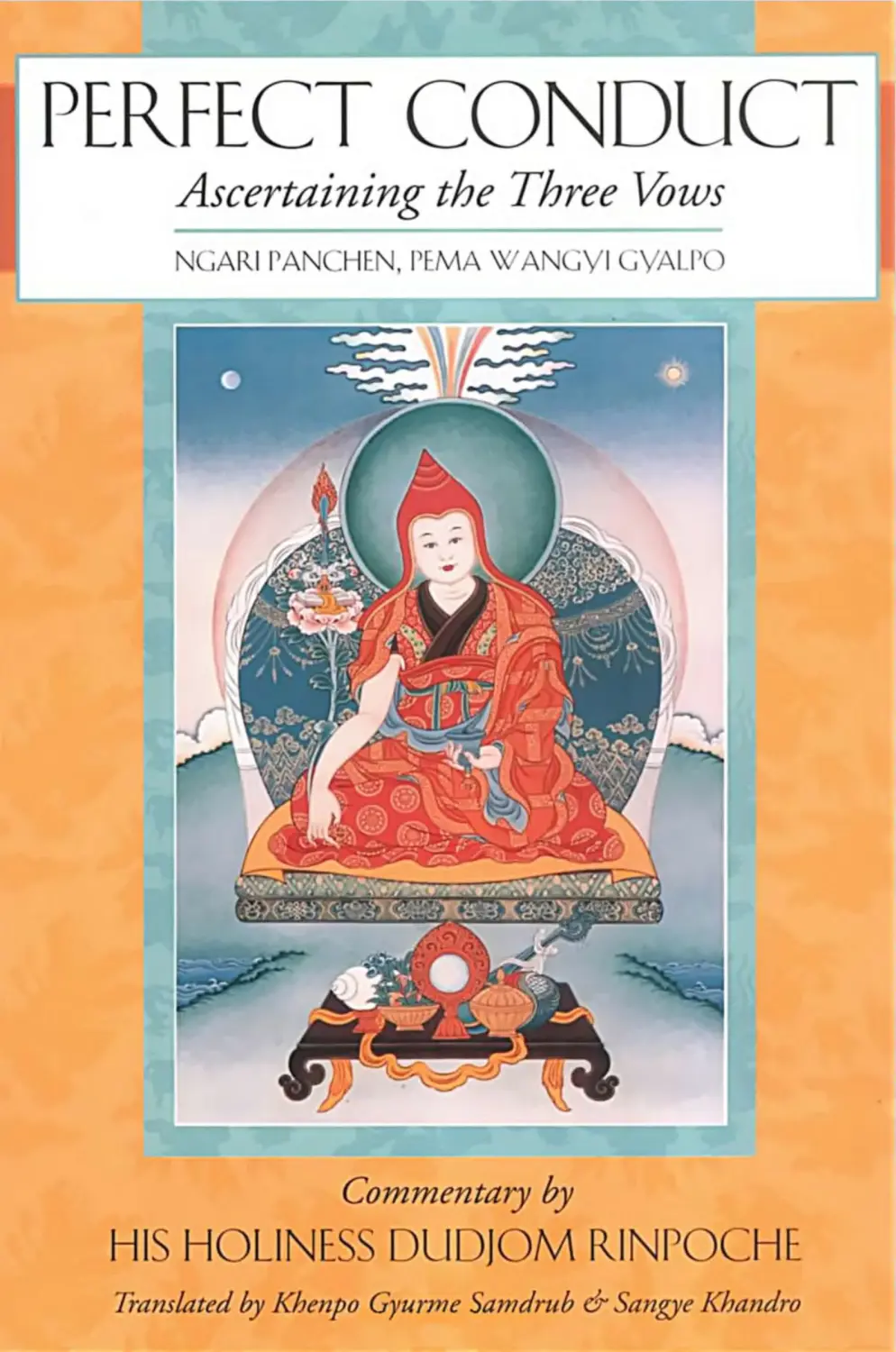
Cover: thangka painting of Ngari Panchen Pema Wangyi Gyalpo by Kunzang Dorje;
photograph courtesy of Pacific Region Yeshe Nyingpo.
Wisdom Publications' books are primed on acid-free paper and mcer the guidelines for
permanence :tnd durabiliry of rhc Committee on Production Guidelines for Book Longevity of the: Council on
Primed in the United States of America.
Libr:~.ry R~ourccs.
CONTENTS
Preface vzz
Introduction xv
Translator's Note xzx
1
First: The Initial Virtue 3
Second: The Intermediate Virtue 7
Chapter One: A BriefExplanation ofthe Stages ofthe Main Teaching 7
Chapter Two: An Explanation ofthe Priitimok!a-vinaya 14
Chapter Three: The Bodhisattva Vows 63
Chapter Four: Secret Mantra I 00
Chapter Five: An Explanation ofHow to Practice the Three Vows Together
without Conflict 141
Third: The Concluding Virtue 149
Commentator's Note 153
THE COMMENTARY, INCLUDING THE ROOT TEXT
TRANSLATION OF THE ROOT TEXT, ASCERTAINING THE THREE VOWS
OUTLINE OF THE COMMENTARY
Notes
175
191
v
155
PUGLISHER.'S ACKNOWLEDGMENT
The publisher gratefully acknowledges the generous help of the Hershey
Family Foundation in sponsoring the production of this book.
PF(EFACE
Commitment, as the essence of the Buddhist vows, demonstrates the dedication
of one's life to refraining from harmful deeds and to fostering peace and joy in
oneself and others. These aims are accomplished by disciplining the mind, which
is the key to all spiritual actions, ,experiences, and attainments. Lord Buddha said:
Not committing any evil deeds,
fostering all that is virtuous, and
taming one's own mind
are the teachings of the Buddha.
Buddhist discipline begins with taming the mind, because the mind is the source
of all mental events and physical actions. If a person's mind is open, peaceful, and
kind, all his or her thoughts and efforts will benefit self and others. If a person's
mind is selfish and violent, all his or her thoughts and physical actions will manifest as harmful. Lord Buddha said:
Mind is the main factor and forerunner of all (actions).
If with a cruel mind one speaks or acts,
misery follows, just as the cart follows (the horse) ...
If with a pure mind one speaks or acts,
happiness follows, as the shadow never departs.
Although the mind is the main factor, for those whose spiritual strength is limited,
the physical discipline of living in solitary peace and refraining from indulgence
in violent actions is crucial. Mental attitudes and concepts are formed by habits
that are totally conditioned by physical and external circumstances and are
enslaved by those circumstances. We cannot think, act, or function independently
of them. Physical disciplines protect us from becoming prey to the so-called
sources of emotions, such as enmity, beauty, ugliness, wealth, power, and fame,
which give the mind a craving and aggressive nature, resulting in harmful
physical reactions. Thus, physical discipline is an essential means of avoidance
and a mechanism of defense.
In order to refrain from committing any negative deed, one must persistently
follow the guideline of physical and mental disciplines. There are different sets of
disciplines in Buddhism, especially in tantra, but their classification into three
vows is universal in the Tibetan Buddhist tradition. For the Nyingma school of
VII
Vlll
PEIUECT CONDUCT
Tibetan Buddhism, Ascertaining the Three Vows (sDom-gSum rNam-Nges) by
Panchen Perna Wangyal (1487-1542) ofNgari province has for centuries been the
root text for learning the codes of the three vows. In this text, the author elucidates
each vow together with its history,. nature, and divisions: how to receive the vow,
how to observe the vow, how to repair a broken vow, and the result of observing
the vow. The three vows are the vows of priitimokfa, bodhisattva, and tantra.
The priitimokfa vow: The vow of pratimokp (individual liberation) mainly
emphasizes disciplining one's physical behavior and not harming others.
Pratimok~a discipline is called the foundation of Buddhism, because for ordinary
people physical discipline is the beginning of spiritual training and the basis of
spiritual progress. The aspiration of the pure pratimok~a discipline is the
achievement of liberation for oneself, as it belongs to the friivaka training.
However, since Tibetan Buddhists are automatically followers of the Mahayana,
they emphasize taking the pratimo~a vows with the attitude of bodhicitta. Thus,
the vows are taken and observed so that all beings may know happiness and
achieve enlightenment.
In pratimo~a there are eight precept categories. The upaviisika observes eight
vows for twenty-four hours. The upiisaka (male lay householder) and upiisikii (female
lay householder) observe five precepts. These three are the precept categories for lay
householders. The friimal}era (male novice) and friimal,lerikii (female novice) observe
ten, thirteen, or thirty-six vows. The sikfamtina (female novice in training) observes
twelve vows in addition to the precepts of a srimat].erika. The bhikfU (fully ordained
monk) observes 253 vows, and the bhikfUl}i (fully ordained nun) observes 364 vows.
These five are the precept categories for those who are celibate and have renounced
the lifestyle of lay householders. In Tibetan monas.tic practice, the last seven
.pratimo~a categories are taken for the duration of one's life. Some do not count the
upavasika vow as a pratimo~a category since it is a temporary precept.
In essence, the training in observing the pratimo~a vow is to avoid any cause
for negative action, which is the source of mental affiiction and of pain for oneself
and others. In this way, the chain of negative causes and habits is broken,
establishing a spiritual basis, which is the source of peace, joy, and benefit for
oneself and all parent sentient beings. It is important to remember that unless we
can improve our own life, step by step, we will not be properly equipped to be a
perfect tool for bringing true joy to others.
As long as one's mind is weak and attracted to the sources of emotions, it will be
easily influenced or overwhelmed by anger, lust, and confusion. Thus, it is most
important to hold back from the sources of emotions by observing the pratimo~a
vows. For example, if we are weak, it is wiser not to confront powerful enemies but
to avoid them. The pratimok§a vows are a way to defend ourselves from
encountering the mental afflictions or their sources. These vows are easy to
observe, because they are apparent as physical disciplines such as refraining from
killing and stealing. Then, when one's mind is strong enough to stand on its own
P~R.F~CT CONDUCT
IX
with less influence from physical activities or external influences, one can put more
emphasis on the disciplines of the bodhisattva.
The bodhisattva vow: The vow of the bodhisattva (adherent of enlightenment)
mainly emphasizes observing bodhicitta, or the mind of enlightenment.
Bodhicitta is the mental attitude of taking responsibility for bringing happiness
and enlightenment to all beings, with love and compassion free from any trace of
selfish interest, as well as putting this into practice.! So here we are not just
refraining from harming others, but dedicating ourselves to serving them.
The bodhisattva precept has three major divisions. The first is "refraining from
harmful deeds," which has two traditions. According to the tradition of
Nagarjuna, there are eighteen major precepts to observe. According to the tradition
of Asatiga, for the vows of aspirational bodhicitta, there are four general precepts
for not losing the vows and eight precepts for not forgetting them. For the vow
of practical bodhicitta, there are four root downfalls and forty-six auxiliary faults
from which to refrain.
The second division is "the amassing of virtuous deeds." This is the training
in the six perfections: generosity, moral discipline, patience, diligence, contemplation, and wisdom.
The third division is "the service of others." This is the practice of the four
means of gathering or bringing others to Dharma. These four are the practice of
generosity, pleasing speech, leading others to the meaningful path of Dharma,
and remaining oneself on the same path.
According to Longchen Rabjam, 2 the vow for the bodhicitta of aspiration is
to contemplate the four immeasurable attitudes: love, compassion, joy, and equanimity. The vow for the bodhicitta of practice is to train in the six perfections.
The bodhisattva vow should be maintained until one reaches enlightenment.
Unless we abandon bodhicitta, it will remain in us through death and birth, pain
and joy. Its force of merit increases in us, even in sleep or distraction, as trees grow
even in the darkness of night. Here, people might have a problem with the concept
of maintaining the vows after death. According to Buddhism, physical attributes
such as body, wealth, and friends will not accompany us into our next lives; but
mental habits, convictions, strengths, and aspirations-together· with their effects,
their kanna-will stay with us until they are ripened or destroyed. So if we make
powerful aspirations and efforts, the vows will remain with us and will form the
course of our future lives.
The bodhisattva vow is much harder to observe than the vow of pratimok~a,
as its main discipline is maintaining the right mental attitude and understanding,
which is subtle and difficult to control. However, it is also more powerful and
beneficial, since if we have bodhicitta in our mind, we cannot do anything
harmful to anyone and can only be of benefit. This is not a matter of avoiding
mental afflictions or their sources, but of destroying or neutralizing them. For
example, a compassionate attitude pacifies anger, seeing the impermanent nai:ure
X
PERFECT CONDUCT
of phenomenal existence ~lleviates desire, and realizing the causation and/or
absence of a "self" ends ignorance. When an aspirant with true bodhicitta awareness is exceptionally intelligent and diligent, full of energy and enthusiasm, and
totally open and appreciative, then he or she qualifies to enter and put more
emphasis on the disciplines of tantra.
The tantric vow: The vow of tantra (esoteric continuum) mainly emphasizes realizing and perfecting the union of wisdom and skillful means and accomplishing
simultaneously the goal of oneself and others.
Tantric training begins with receiving empowerment (abhi!eka) from a highly
qualified tantric master. In the transmission of the empowerment, the master's
enlightened power causes the disciple's innate primordial wisdom nature to
awaken, which is the meaning of empowerment. Such wisdom, although inherent
in every being, remains hidden like a treasure buried in the walls. With the power
of awakened wisdom one trains in the two stages of tantra, the development stage
and perfection stage, and accomplishes the goal: the attainment of buddhahood
for the benefit of oneself and others. In order to preserve, develop, and perfect
such awakened wisdom, one must observe the samayas (esoteric precepts), as these
are the heart of tantric training. Breaking tantric samaya is more harmful than
breaking other vows. It is like falling from an airplane compared to falling from a
horse. Tantric realization and transmission are full of power, depth, and greatness.
There is no way of giving up tantric vows except to break them and fall.
For tantric samaya there are numerous precepts to observe, but Ngari Panchen
presents the main ones. These include the precepts of twenty-five esoteric activities,
the five buddha families, the fourteen root downfalls, and the eight auxiliary down~alls of tantra in general. In addition, he presents the twenty-seven root downfalls
and twenty-five auxiliary precepts unique to the vehicle of the Great Perfection.
Without taking and maintaining samaya, there is no way of accomplishing
any tantric attainments. Lord Buddha said:3
For those who have impaired the samaya,
the Buddha never said that they could accomplish tantra.
Je Tsongkhapa writes:4
Those who claim to be practicing tantra without observing the
samaya have strayed from it, since in anuttara tantra it is said,
"The tanna will never be accomplished by those who do not
observe samaya, who have not received proper empowerments,
and who do not know the suchness (the meaning of empowerment, the wisdom), even though they practice it."
The three vows are steps that lead to the same goal, enlightenment. The stream
PERFECT CONDUCT
XI
·of lower vows merges into the higher vows, and the higher vows embody all the
vows and the merits of the lower ones. Furthermore, when we are empowered in
tantra, we are also ordained in the pratimok~a and bodhisattva disciplines. Ngari
Panchen writes:5
By receiving empowerment, all three vows are born simultaneously.
Tibetan Buddhists, as followers of tantra, must observe all three vows. Most lay
practitioners observe the upasaka or upasika vows of pratimokp, the bodhisattva
vows, and tantric vows. Most monks physically observe each moral code of the
vinaya in order to tame the mind. Mentally they uphold the aspiration of bodhisattvas, the aspiration to be of benefit to others·with love and compassion. With
wisdom awareness, they are also tantrics accepting all appearances as the path of
pure perception. Longchen Rabjam writes:6
With the unconflicted three vows of
sravaka, bodhisattva, and vidyiidhara,
tame your mind stream, benefit others,
and transform every appearance into the path of pure nature.
Highly accomplished tantrics, through their power of realization, can maintain
the vow of celibacy even if they have consorts, but such claims of attainment are
authentic only if they are also able to bring the dead back to life. So for a highly
perfected trainee of higher tantra, all other vows are perfected. The Miiyiijalatantra states:?
In the vow of unexcelled tantra,
all the disciplines of vinaya and
the disciplines of the bodhisattva
are entirely embodied and are pure.
Many of us, who are so-called Dharma followers, are mediocre with respect to
true discipline and realization but have the tendency to boast about our wisdom.
We become lax about the guidelines of the precepts and indulge in craving for
sensual phenomena under the guise of transmuting everything into the means of
training. Some of us adopt this attitude intentionally in order to polish our ego
or for the sake of worldly pleasures. Others have deviated into these wrong
notions because they are confused by the darkness of ignorance. Rather than
being like eyes searching out others' faults, we should strive to be like a mirror
that sees our own inadequacies.
The lineage of the three vows: The pratimo~a lineage came to Tibet in three different traditions from the Sarvastivada school of ancient India, in the same way
XII
PmRCT CONDUCT
--·----------------------~·---
that it went to Thailand, Burma, and Sri Lanka from the Theravadin school.
The first tradition is the Lower Lineage of Vinaya (sMad-'Dul). This lineage
was passed from the Buddha down to my teacher through the following succession: Buddha, Sariputra, Prince Rahulagupta, Brahman Rahulagupta, Nagarjuna,
Bhavaviveka, Srigupta, ]fianagarbha, and Santar~ita (who brought the lineage to
Tibet in the 9th century C.E.), Ba Ratna, Tsang Rabsal, Lachen Gongpa Rabsal,
Lume Tsultrim Sherab, Dorje Gyaltsen, Newo Trakpa Gyaltsen, Ore Sherab Bar,
Cha Duldzin Tsondru Bar, Zhonu Senge, Tromo Chewa Dudtsi Trak, Chimchen
Namkha Trak, Trakpa Sherab, Chimton Lobzang Trakpa, Kunga Gyaltsen, Trupa
Sherab (the last six masters were throneholders ofNarthang monastery), Gendun
Trub (the first Dalai Lama), Kunga Gelek of Nenying, Gendun Gyatso (the second Dalai Lama), Gelek Palzang of Dewachen, Paljor Gyatso, Konchok Chopel
(the last three masters were throneholders of Ganden monastery), Konchok
Tendzin, Loch en Dharmasri (16 54-1717), 8 Chokyi Trakpa, Gyurme Choden,
Orgyen Tendzin (the last four were abbots of Mindroling monastery),9 Rigdzin
Zangpo, Sengtruk Perna Tashi (both were abbots of Dzogchen monastery),IO
Domtsa Khenpo of Shechen monastery, Sershul Khenpo Ngawang Kunga of
Dodrupchen monastery, and Khenpo Choyak (living) of Shukchung monastery.
Additionally, after Sengtruk Perna Tashi, a lineage of vrnaya ordination descended
through Gyalse Zhenphen Thaye (1800-?) of Dzogchen monastery, Lingtul
Gyaltsen Palzang, Khenpo Dorje Palzang of Kathok monastery, Khenpo Kalzang
Wangchuk of Nyakrong, Situ Chokyi Gyatso (1880-1925) of Kathok monastery,
and Choktrul Chokyi Dawa (1894-1959) ofTarthang monastery to Kyabje Jigme
Thubten Shedrub (1932-), the Third Perna Norbu, who is the current head of the
Nyingma school. Nyingmapas and most of the Gelukpas are ordained in the
Lower Lineage. II
The second tradition is the Middle Lineage ofVinaya (Bar-'Dul), also known
as the Khache or Panchen Lineage. This lineage came from the Buddha through
Sariputra, Prince Rahulagupta, Brahman Rahulagupta, Nagarjuna, Gul).ajfiana
(Gul).amati), Ramamitra, Dharmabhadra (Dharmapala), Gul).apati (Gul).asagara),
Dharmamala, Santakaragupta (Akaragupta), and Panchen Sakyasribhadra of
Khache (Kasmir), 12 who brought it to Tibet and ordained Sakya Pal).9-ita
(1181-1251), Dorje Palzang, and others. Most of the Sakyapas and Kagyupas are
ordained in this lineage.l3
The third tradition is the Upper Lineage of Vinaya (sTod-'Dul), brought to
Tibet by an Indian scholar named Dharmapala. However, this lineage no longer
exists 14 in Tibet so that the Middle Lineage has become popularly known as the
Upper Lineage.
As mentioned earlier, the bodhisattva vow has two major lineages. The
Lineage of Nagarjuna came from the Buddha to Mafijusri and then to
Nagarjuna, and the Lineage of Asanga came from the Buddha to Maitreya and
then to Asanga. 15 These lineages later came to Tibet from the Mahayana masters
of ancient India.
PE"FECT CONDUCT
Xlll
Tantras of various types appeared in the world and also came to Tibet through
numerous lineages. But the major tantras of mahiiyoga and anuyoga of Nyingma
came from Samantabhadra of the dharmakiiya through the buddhas of the five
families of the sambhogakiiya, the three bodhisattvas, the five classes of beings,
and King Dza of O<;l<;liyana, the first human recipient. Later, Vimalamitra, Guru
Padrnasambhava, and Nub Sangye Yeshe brought them to Tibet. Nyingthik
Tantras, the innermost teachings of atiyoga, carne from Sarnantabhadra of the
dharrnakaya through the peaceful and wrathful deities, Vajradhara, Vajrasattva,
Vajrapal)i, and Garab Dorje, the first human recipient. Later, Virnalarnitra and
Padmasarnbhava brought them to Tibet.
Maintaining the vows: It is essential to learn each code of law of the three vows, as
explained in Ascertaining the Three Vows, and to observe them accordingly.
However, because of limitations of knowledge, time, atmosphere, dedication, and
energy, it might be hard for many of us to observe them. I like to quote the
advice of H. H. Dodrupchen Rinpoche given at the end of the empowerment of
the Nyingthik Yabshi, bestowed in 1989 in the temple of the Mahasiddha
Nyingrnapa Center in Massachusetts. He said: "It is difficult to learn the names
of the vows, let alone observe them. So at least you should strive to be loving to
people, especially those who are close to you such as friends, relatives, Dharma
brothers and sisters, and neighbors. Try to avoid harming them. Be respectful to
them, as all are enlightened in their true nature. Then, in a simple way, you are
moving toward fulfilling the pratirno~a v~w of not harming others, the bodhisattvas' vow of being loving to others, and the tantric vow of pure perception."
Restoring the vows: After taking the vows, we must learn how to repair any decay
and ruptures of the vows, for we will undoubtedly be causing these to happen.
Otherwise, it will be like an explosive in the hand of a deranged person. Each of
the three vows has irs own methods of purification. However, since the followers
ofTibetan Buddhism are rantric practitioners, it is proper to use a tantric means
of purification, as this is more powerful and purifies the faults committed in any
of the vow categories. For many of us, the purification through Vajrasattva recitation is familiar. It is· also one of the most powerful means of purification. This
purification must be practiced with "the four forces." "The force of the source of
the power of purification" is total reliance on Vajrasattva with convinced faith,
devotional warmth, and one-pointed concentration. One should see Vajrasattva as
the embodiment of the power of purification of all the buddhas, who possess perfect wisdom, infinite power, and ceaseless compassion. "The force of sincere
regret" is the strong feeling of remorse for whatever faults one has committed,
knowingly or unknowingly, as if poison had been consumed. "The force of
promising not to repeat the fault again" is the determination from the depths of
one's heart that now, even at the cost of one's life, one won't commit such a fault
again. If we have strong, sincere regret and determination nor to commit faults
XJV
PEIUECT CONDUCT
again, like using brakes and steering when driving, this will gradually force us to
change the direction of our life. "The force of purification" is the actual recitation
and meditation ofVajrasattva. One should visualize Vajrasattva and consort above
the crown of one's head and repeat prayers and mantras with faith and devotion.
With sincere regret for past misdeeds and a total commitment not to repeat them,
one should pray for their blessing, which is the power of purification. One should
feel devotion and openness and the compassion and power of Vajrasattva and his
consort. Then, as the result, the purification power descends from the body of
Vajrasattva in the form of streaming nectar, washing down all impurities of our
body, speech, and mind without leaving any trace. Feel certain that you are then
free from all defilements. Finally, fill your body with the nectar and the feeling of
peace, bliss, and openness, the blessing power of Vajrasattva. Confession and
purification is not just the act of telling the person involved, even if it's a lama,
that (for example) "I hate you" or "I did hate you," but is the meditation and
experience of the four forces experienced from the depths of one's heart.
The benefits of observing the vows: The achievement of happiness and
enlightenment is the result of maintaining vows. Remember that maintaining a
vow is making a·strong commitment to live only with proper and virtuous deeds
and to refrain from wrong and evil deeds. In this way, we will create good karma
or, in the case of tantra, pure samaya, and this will result in happiness, wisdom,
and buddhahood, the source of joy for all. Ngari Panchen Perna Wangyal writes:
Then one will spontaneously achieve the goals of oneself and of
others.
This timely book is composed of a translation of the root text, Ascertaining the
Three Vows, and the wonderful commentary on it by H. H. Dudjom Rinpoche. It
fulfills a crucial !leed for serious Western students of Tibetan Buddhism. Sangye
Khandro, with her gift for language and knowledge of Buddhist wisdom, has made
evety word of these most important texts available to English readers. At last we
have a handbook in English that explains the full code of discipline of the
pratimok~a, bodhisattva, and tantric trainings, along with an elucidation of
their philosophical principles and historical background.
Tulku Thondup
Buddhayana, Massachusetts
INTRODUCTION
With the coming of the fourth Buddha into this world of human beings, in
order to reveal the mode through which one may accomplish buddhahood and
in accordance with the needs and responsibilities of the limitless beings to be
tamed, Lord Buddha turned the Dharma wheel on three great occasions.
Although inconceivable numbers of methods to reach freedom were revealed,
these teachings are grouped into eighty-four thousand categories, which comprise
the four baskets.16 These four baskets are further condensed into the pratimok~a,
bodhisattva, and mantra vehicles, each of which has been the basis for innumerable
commentaries written by many learned scholars and accomplished masters since
the time of the Buddha. Of these many commentaries, there are few that reveal
the manner through which an individual can engage in the vows and practice of
pratimok~a, bodhisattva, and mantra by incorporating the essence of all three.
Also, few commentaries have .been able to present an accurate overview of all three
vehicles (within which the nine vehicles exist) unmistakenly and withour confusion
in as stainlessly clear a way as the root text, Ascertaining the Three Wiws.
In fact, Ascertaining the Three Wiws came about exactly in accordance with the
intention of the great Maiijusrl. It was written by an emanation of the royal line of
King Trisong Detsen: the powerful scholar, realized master, and holder of the rare
title Maha Pal)<;iita known as Ngari Panchen Perna Wangyi Gyalpo (1487-1542).
This great Maha Pal)<;iita wrote this text to clarify how an individual can indeed
embrace all three vows by simultaneously incorporating them into practice without
conflict. In addition, the text presents an unmistaken and detailed description of
each vow category, arranged like a wish-fulfilling jewel. All followers of the
Dharma will regard this text as a lamp that illuminates the true path and will utilize it in the same way that they would pur on a beautiful ornament. Indeed, this
presentation, which unites the three vows, is the mother source of the practice of
all three vows, as well as the supreme crown ornament of all vehicles of practice.
Concerning the life of the illustrious author, Ngari Panchen was himself the
ninth emanation of the Dharma King Trisong Detsen. He emanated into chis
world for the general welfare and purpose of mankind, and specifically, to further
the propagation of the doctrine in the land of Tibet. He was born in the region
known as Ngari Lowo, and his father, Jamyang Rinchen Gyalrsen, a great scholar
and practitioner, was the last in the line of the ancestral religious heritage of
Marpa Lotsawa. His mother's name was Drompa Gyen. At the time of his conception both parents received marvelous signs in their dreams, as well as the
appearance of a rainbow over the roof of their house. In addition, the sound of
XV
XVI
PEIUECT CONDUCT
----···--------------------------
roaring dragons was heard arising from the natural elements. The child was born
in the Female Fire Sheep year ( 1487) and was given the name Perna Wangyal. In
his eighth year he received the precepts of lay ordination from his own father.
After taking bodhisattva vows, uncontrived bodhicitta spontaneously awakened
in him. Then, again from his own father, he received all the transmissions for the
three inner yogas of maha, anu, and ati, which included the entire transmission
of the Chido Gongdu (sPyi-mDo dGongs- 'Dus) [The Siitra that Gathers All
Intentions]; Gyutrul Drawa (sGyu- 'Phrul Dra-wa) [Net of Illusory Manifestations];
and Semde (Sems-sDe) [MindC/4.ss]. Following this, through his diligent enthusiastic effort and training, he fully mastered everything contained in the Nyingma
lineages of kama and terma. He realized all essential instructions in exact accordance with the scriptures. He received teachings from countless scholars and
meditation masters, and he contemplated and proceeded through the stages of
training without any laziness or hesitation. By his twentieth year he had fully
realized the pratimo~a vinaya, madhyamaka, and hundreds of scriptures, and
had mastered all the major and minor sciences. Then, after impartially accomplishing each of the later translation schools, he was given the title Maha Pal).c;lita,
and his fame spread in the ten directions.
At the age of twenty-one he began an extensive retreat of Red Yamantaka,
completing both the generation and completion cycles. The wrathful Mafi.jusri
Yamantaka appeared directly before him. At age twenty-five he received full
ordination from Lowo K.henchen K.henpo Sonam Lhundrub and embraced all
two-hundred and fifty precepts, which he immaculately guarded from deterioration. It was at that time in Tibet that Ngari Panchen became known far and
wide as the purest upholder of the pratimok~a discipline. From then onward,
having completely forsaken the eight worldly attitudes, he never remained in any
one location for very long. As a true renunciate he roamed from one uncertain
place to another, traveling to all the sacred power places where he remained in
retreat performing various accomplishment ceremonies.
After this practice pilgrimage he journeyed to Nepal, where he studied under
and received transmissions from the greatest lamas in the region. After this, there
was nothing in the early and later translation schools that he had not received, so
he entered into an extended retreat. While in retreat, Ngari Panchen received
unceasing visions of each deity that he accomplished. In particular, Guru
Padmasambhava came to him in both visions and dreams time and time again to
bestow empowerments and blessings. It was then that he was fully able to recall
his past life as King Trisong Detsen, along with many others.
During the construction of Samye monastery, at the time when Guru
Padmasambhava was bestowing empowerment upon the twenty-five great disciples, King Trisong Detsen's flower fell in the mm;uj.ala's center. This destined him
to accomplish all eight wrathful meditational deities in the practice known as
Deshek Dupa (bDe-gShegs 'Dus-Pa) [Gathering of All the Sugatas]. This is why
during his life as Ngari Panchen he received the Deshek Dupa empowerment
PERFECT CONDUCT
XVII
some twenty-five times. The twenty-fifth time, he received it from the unequaled
great mahasiddha of Lodrak Gonkar, Namkhai Naljorpa, who himself was a lineage holder of the ancestral heritage of the king. With that transmission, Ngari
Panchen felt satisfied that the lineage he was holding was perfectly pure. Having
received all that this great yogin's mind contained, Ngari .Panchen then entered
into seclusion to practice until he had visions of each of the eight herukas. He
went on to accomplish both. common and supreme attainments.
At age thirty-eight he himself began to give many transmissions from the early
and later traditions. With a pure, impartial attitude he performed enlightened
activities like a downpour of Dharma rain that brought countless aspirants to
fruition. In this way he began the period of his life known as "accomplishing the
purpose of others extensively in all directions."
At this time in central Tibet, both the early and later traditions had deteriorated, so Ngari Panchen traveled there to restore the doctrines of both, bringing
immeasurable benefit.
At age forty-six he began to reveal his own profound treasures, beginning with
the entire cycle of Rigdzin Yongdu (Rig- 'Dzin Yongs- 'Dus) [Condensed Essence of
the Pure-Awareness Holders], revealed from within the upper palace of Samye
where it had been buried in a secret casket between the four images ofVairocana.
At age fifty-six he demonstrated the signs of passing into nirviil}a, after which
many relics issued from his body and all regions of space were filled with marvelous rainbows and various signs of the highest level of attainment. An orb of
light then arose from his body and traveled into the southwestern direction of
space, where it disappeared. This was witnessed by the many people who had
gathered, who then recalled that prior to his passing he had proclaimed: "Now it
is time to depart for the copper-colored mountain" (Guru Rinpoche's southwestern
pure realm). The gathered disciples then realized the significance of the mysterious
orb of light.
Ngari Panchen, Perna Wangyi Gyalpo, having fully accomplished the deeds of
a great scholar and realized being, is praised by those of nonsectarian views as the
greatest scholar and master of his time.
The path of the three vows brings all eighty-four thousand categories of the
precious Dharma together as one path. This is certainly the supreme path if
practiced accordingly. This text, Ascertaining the Three Vows, is the very source of
all commentaries written on the subject of the three vows. By understanding how
to utilize all three vows simultaneously, one is able to maintain the moral ground of
the Vajrayana, which transforms the essence and increases all noble qualitites. This
is just like finding a wish-fulfilling jewel. For those who truly wish to obtain freedom in this life, this text is a cause for joyful celebration.
Initially by emerging from the mark of the three realms of existence, and eventually by possessing the wealth of the awakened mind of aspiration and practice,
and finally by arriving in the pleasure-garden continent of the mantra precepts
and training, the purpose of oneself and others is spontaneously fulfilled and one
XVIII
PERFECT CONDUCT
·---
arrives at the stronghold of all the conquerors.
For all who wish to travel to. this continent of all-knowing omniscience, this
text is the guide to that unmistaken path. It is my wish that all fortunate aspirants
whose minds are renounced will study this text with great diligence.
Yangthang Tulku Rinpoche
Tashi Chafing, Oregon
TRANSLATOR'S NOTE
Although I possess few qualities, due to some small knowledge of the Tibetan written and oral language and the sincere wish to bring benefit to those of Western
countries who desire to learn the precious Dharma, I have attempted to translate
this invaluable text into English. This book contains a translation of the root text,
Ascertaining the Three Wlws, as well as a commentary to the root text based primarily
on H. H. Dudjom Rinpoche's commentary and the explanations given by Khenpo
Gyurme Samdrub. The commentary explains each word found in the root text,
which is outlined in five chapters. The first chapter gives an overview of the stages of
the main teaching, which is, of course, the subject of the three vows. It also clearly
points to the view that this teaching is based on, which is the ultimate goal of
Vajrayana practice, the achievement of the starus known as vajra-holder of the three
categories, or vidyadhara (intrinsic-awareness holder). The status of a vidyadhara is
no minor accomplishment; it is the ultimate goal of those who practice the
Nyingma tradition of the Great Perfection. It is therefore extremely important for
sincere aspirants on this path to possess the basic knowledge that this book presents
as the very ground of their spiritual pursuit. The three vows and the many commentaries written on them by such celebrated masters as Lochen Dharma5ri, Kunzang
Sherab, and Je Mipham is the first course of study pursued in Nyingma scholastic
institutions. The second, third, and fourth chapters offer in-depth explanations of
the pratimok~a precepts, the bodhisattva vows, and i:he words of honor of secret
mantra. These explanations elaborate how the vows are obtained and who is qualified to receive them, what the vows are, how they a:re damaged or lost, how they are
restored, how they a:re maintained, and what their benefits are. The fourth chapter,
on secret mantra, provides an in-depth explanation of the specific words of honor of
the Great Perfection Vehicle. Finally, the fifth chapter explains the manner in
which all three categories are practiced simultaneously and without conflict so
that the status of a vidyadhara may be attained.
We are now experiencing the rapid spread of the profound traditions of
Vajrayana Buddhism in countries where they were previously nonexistent. As a
result, many questions arise concerning the different vows and modes of practice.
Many are interested in ordination, yet do not understand how this fits into the
broader perspective ofVajrayii.na practice. Others intend to maintain their lives as
householders, yet wonder if this disqualifies them to practice and accomplish the
advanced methods employed in Vajrayana. Many simply wonder why some
teachers have vows as monks and nuns and why others are householders. This
text is written to lay out the ground for the path of Vajrayana practice and to
XIX
XX
i'ERFECT CONDUCT
elucidate the methods through which one is able to develop the skillful means
necessary to simultaneously uphold all three vows. As this is the path that leads
to perfect liberation in one body and in one lifetime, knowledge of the basis for
this accomplishment is essential.
The commentary on the three vows written by His Holiness Dudjom
Rinpoche was chosen for this book because of Dudjom Rinpoche's unrivalled
scholarship and the profundity of the blessings derived through any connection
established with his enlightened awareness and aspirations. In addition, Dudjom
Rinpoche dedicated a great part of the latter years of his life to the establishment
of Vajrayana Buddhism in the West. In fact, this was one of the last commentaries that he wrote and was one of the major works included in his revision of
the Nyingma Kama.
I would like to thank Khenpo Gyurme Samdrub for all the help he has rendered in giving clear explanations of the root text and commentary. His excellent
command of English Dharma vocabulary has been extremely useful throughout
all stages of this translation. I would also like to thank Rick Finney for his editorial
assistance, Kay Henry for her help in preparing this manuscript for publication,
Vesna Wallace for checking all the Sanskrit terms and for entering the correct diacritical marks, and, finally, Ani Yeshe Lhamo for her many hours of work preparing
the original rough draft of the manuscript. Although there are always many tireless
helpers to acknowledge, I think it is more important that we all share prayers that
the virtue from this translation and its propagation may increase and expand the
Buddha's doctrine and bring long, firm lives to all the great practitioners who
uphold it. We pray for there to be happiness in this world, as well as for the
pacification of all disease, famine, war, and unrest.
In dependence upon this excellent text and all the desirable qualities that arise
from it, may all beings see with clear faith the true path of knowing what to
accept and what to reject and be swiftly led to the paradise of omniscient freedom.
From this life onward may we and all others always obtain the precious
human rebirth; and by unmistakenly ascending the stages on the path, together
may we pick the fruit of permanent peace.
Sangye Khandro
T~hiChohn~ o~gon
THE COMMENTARY
FIRST: THE INITIAL VIRTUE
The initial virtue, the intermediate virtue, and the concluding virtue are the
three divisions in this and in all commentaries that are written based on the
Buddha's spoken teachings. These three divisions are similar to the three pure
recollections: those of motivation, nonconceptual awareness during the actual
practice, and the concluding dedication of merit. In the initial virtue there are
the three divisions tha:t explain the tide of the text, the homage, and the commitment to compose.
I. The Title of the Text:
A Branch on the Path of the Natural Great Perfection Called
Ascertaining the Three Vows
Within the profound expanse of the innate, unaltered, natural mind, all meanings, including the foundation, path, and result, are originally perfected. This
spontaneous presence, which is unsurpassed by any other, is called "great." The
unmistaken actualization of this nature is the ultimate fruit of all paths, the
atiyoga. From anuyoga on down, all the paths of sutra and tantra are practiced in
order to realize this nature. In this way they are established as "branch~s" of the
path. The three vows, the essence of the practice of all these paths, are the main
subject at hand. To establish an accurate understanding of the view of the three
vows through the three investigations-actual, inferential, and scriptural-is the
meaning of"ascertaining."
Siistra literally means that which has the potential to sever all negative emotions and grant refuge from rebirth in the three lower realms. Specifically, a sastra
is a commentary on the Buddha's teachings written by a perfect follower. There
are three levels to be considered here. Ideally, the author of a sastra must have realization of the nature of the dharmatii. To qualify as average the author should
have had a vision of the deity. At least, the author should be perfectly learned in
the five major sciences.l7 In addition, the commentary must be eloquently written with the qualities and ability to alleviate the causes of delusion, as well as to
produce the results that grant protection from inferior rebirths in cyclic existence.
The purpose of the title will vary according to the sensibility of the reader.
Those of superior sensibility, just by reading the title, will be able to realize the
entire meaning of the text. Those of average sensibility will derive a general idea
of its contents, and those of common sensibility will become interested and
inspired to begin to study the text.
3
4
PmFECT CONDUCT
II. Homage:
A. General homage to the supremely kind guru:
Namo Guruve!
Homage to the Guru-Lama!
"Namo" means to pay homage. "Guru" describes an individual whose noble
qualities are limitless, whose wisdom-knowledge is unsurpassed, and whose great
loving-kindness is unequalled. To such a guru-lama, with great admiration and
respect from the three doors of body, speech, and mind, homage is rendered.
B. Specific homage
to
the great master, Padmasambhava:
By churning the treasure ocean of the glorious two accumulations,
the white light of knowledge and loving-kindness brings forth the allpervasive rain of the definitive secret vehicle. To the supreme crown
jewel of all scholars and accomplished masters of Tibet's Land of
Snow, to the guide of all sentient beings, the Lake-born Vajra (Guru
Padmasambhava), I pay homage!
It is believed by the Vedic school of Hinduism that by churning the ocean the
moon arose. The author draws from this example to poetically illustrate the qualities
of G~ru Padmasambhava. By chllrning the va~t ocean of the accumulation of
ordinary and wisdom merit, supreme wisdom and loving-kindness arise indivisibly,
forming the maJ].c;lala of the moon with irs cooling, moist, illuminating rays. The
all-pervasiveness of a rain shower is likened to the spontaneity of the concerned
action that arises from such a "moon" to reveal the secret mantra teachings in
order to tame the minds of beings.
This analogy exemplifies the object of specific homage, the great master
Padmasambhava, who is the very embodiment of the great ocean of the two
accumulations of merit, the source from which all enlightened qualities of wisdomknowledge and compassion arise. As the supreme crown jewel of all scholars and
accomplished masters in the three realms, including the snow land ofTibet, he is
well known as the Lake-born Vajra.l8
The Lake-born Vajra, Padmasambhava, was born from the center of a lotus
without depending on parents. The word "vajra" refers to this transcendence of
the concept of birth and death. Because he possesses the wisdom to guide all
beings on whatever level is necessary according to their specific needs, he is
known as the supreme guide of beings.
III. The Commitment
to
Compose:
This sage, skilled in knowing how to cleanse the mental stains of
beings and upholding the lapis lazuli vase of supreme intelligence,
PERFECT CONDUCT
5
bestows the ambrosia-like explanations of the three vows. May all
those with sincere interest gather here to partake of this!
The author, Ngari Panchen, refers to himself as a sage, defined as one who is wise
in the worldly knowledge of what to accept and reject. As is the case with all scriptural commentaries, the author's "commitment" must reveal with superiority the
four necessities of this Dharma. The first necessity is the subject, in this case the
three vows. The second necessity is a superior explanation of the subject so that the
meaning and purpose can be fully understood, leading readers to embark upon the
path to liberation. This bestows temporary benefit. Third, once the path is entered
and perfected, perfect awakening is revealed as the ultimate benefit. Fourth, the
interdependent relationship between each of these four is demonstrated, in that
one arises in dependence upon the other and is accomplished accordingly.
SECOND: THE INTERMEDIATE VIRTUE
The actual text is divided into three sections:
I. A brief explanation of the stages of the main teaching
II. An extensive explanation of the nature and precepts of each of the three vows
III. A concise explanation of the manner in which an individual practices the three
vows together without conflict
CHAPTER ONE:
A BRIEF EXPLANATION OF THE STAGES OF THE MAIN TEACHING
I. Chapter One: A Brief Explanation of the Stages of the Main Teaching, in three
subdivisions:
A. Recognizing the basis for purification and the ultimate result:
The general expression of primordial wisdom is the Great Perfection
atiyoga. The perfectly pure embodiment, kaya, of the great
Vajradhara is ultimate fruition, the oneness of buddha.
Generally, the Great Perfection is considered in three divisions: foundation, path,
and result. The foundational Great Perfection is the fundamental nature of all
living beings as the essential nature of the realized ones. The path of Great
Perfection is the ultimate result sought by all the vehicles, namely the cleansing
of the two obscurations and all habitual propensities, which overshadow the
buddha nature. The resultant state of the Great Perfection is separation from all
obscurity, and dwelling in the inner lucency of the ever-youthful vase presence,
the unsurpassed nature of pure presence and primordial wisdom. This nature of
truth, known here as the "general expression of primordial wisdom," is otherwise inexpressible, yet prevalent throughout existence and beyond.
The basis for the purification is the buddha nature itself. The object of the
purification is the temporary veil through which all that appears as cyclic existence
is perceived. The purification is the essence of the path of the three vows, the profound path of mantra, practiced by those who uphold pure awareness, the
vidyadharas. Although the path itself is not inherently "true," it exists in order to
fully purify the sudden stain of the two obscurations as well as all residual habitual
propensities. The result of this purification is the spontaneous accomplishment of
the two purposes, which manifests as the five states of pure presence, kayas, and
7
8
PErtFECT CoNDUCT
---------------------------------------------------
the five primordial wisdoms,l9 the nature of which is the Buddha. This buddha
nature is also referred to as Samantabhadra or Mahavajradhara. This is the result
of all vehicles, the 'ultimate fruition, the oneness of buddha."
B. A general explanation of the different aspects of the path to accomplish, in three
subdivisions:
1. A brief revelation of the one and only path:
Although the ways of entry into the profound and extensive Dharma
are beyond number, without relying upon the great secret path of
maturation and liberation .(Vajrayana}, there is no attainment, the
perfected Buddha said.
The reference to the profound Dharma indicates its ability to reveal the ultimate
nature of emptiness, as it is. The reference to extensive Dharma indicates all conventional paths that comprise the multitudes of entranceways. However, without
reliance upon the great secret vehicle of ripening empowerments, as well as the
supreme paths· of liberation, generation, and completion stage practice, enlightenment will never be obtained, because what binds us to cyclic existence is the
extremely subtle red and white bodhicitta and the vital air, through which the
three appearances20 are generated at the time of transition from this life to the
next. The methods that clear the obscurations created by these three appearances
are found only in the Vajrayana. This was clearly taught by the perfected
Buddha, who actualized the primordial wisdom of being unimpeded by, and
unattached to, all knowable things.
2: A specific explanation of how vehicle distinctions are merely steps on the path, in
two subdivisions:
a. An explanation of the general characteristics of the foundational vehicles:
Just as mental engagements are unceasing, one cannot possibly
engage in all the inconceivable numbers of vehicles. As places to rest
leading to the only true path, each one possesses its own corresponding
pinnacle and result. Although these are obtainable as the individual
renunciations of each vehicle, what result will be obtained without
entering the one path of all vehicles?
Here it is clearly stated that it is characteristic of the foundational vehicles to serve as
rest stops that eventually lead the aspirant to embark upon the only true path.
Although each vehicle does bring its result, unless one enters and practices the
Vajrayana, the ultimate result ofbuddhahood remains unobtained.
b. A specific explanation of how all paths leading to liberation are included in the nine
vehicles:
PeRFeCT CoNDUCT
9
Here, according to the tradition of the Great Perfection, the fravakabuddhayana, pratyekabuddhayana, and bodhisattvayana are the three
causal vehicles of characteristics; kriyatantra, ubhayatantra, and
yogatantra are the three outer tanrras; and the unsurpassed father
tantra of mahayoga, that known as the mother tantra (anuyoga), and
the nondual tantric class of atiyoga are the three inner tantras (completing the nine vehicles).
The sravakayana is generally characterized as the path of reliance upon the
teacher's words, which, when understood, are th~n taught to others. The
pracyekayana is the path carried out independent of a spiritual mentor. Here, the
aspirant seeks alone to achieve the result of victory over cyclic existence.
Bodhisattvas aspire to accomplish perfect awakening by actively fulfilling the
purpose of others without ever becoming fainthearted or apprehensive. This type
of courageous intent and effort qualifies such aspirants as "brave awakened ones,"
the meaning of "bodhisattva."
The results obtained from practicing these three vehicles are similar to the
ultimate result of buddhahood, but are not the ultimate result. Therefore, they
are known as paths that possess "characteristics" (similar to those that produce
awakening). They are also known as the three causal vehicles, because although
each respective vehicle produces its own corresponding result, it is not the result
of buddhahood.
The kriyatantra focuses primarily upon action and the upatantra (also known
as the ubhayatantra) upon view and conduct. The yogatantra places emphasis upon
internal meditation. These three are similar to the three vehicles below them
because they seek for spiritual attainment to be received from an external source.
Thus they are called the three outer tantras.
Although there are many ways in which the inner tantras are more exalted than
the outer, the concise difference lies in the view, meditation, and conduct of the
inner tantras. These possess uncommon power, qualifying them as unsurpassed
tantras. The first inner tantra is the father tantra, mahayoga, which focuses primarily upon the method of the generation stage. The mother tantra, anuyoga,
focuses upon the wisdom nature of the completion stage. The nondual tanrra,
atiyoga (also known as binduyoga), focuses upon the stages of nondual clear light.
Each of these three vehicles actualizes the view that realizes the equal nature of
sa1J1Siira and nirva.t:Ja; hence, spiritual attainments are not searched for externally.
This is the reason theyare well known as the three inner tantras.
All paths that lead to liberation are found within these nine vehicles.
3. Revealing the manner in which the pratimolqa and bodhisattva categories are
branch precepts of mantra vows, in three subdivisions:
a. Showing how upholders of each of the three categories qualify
of mantra:
to
enter the path
10
PERFECT CONDUCT
It is taught that the individual upholders of the sravakabuddhayana,
pratyekabuddhayana, and bodhisattvayana can enter the path of the
vajra-holders. This is clearly documented in the Tantra of Five
Hundred Thousand U?rses (Paftcafatasahasra).
Although beings whose minds are still untamed possess myriad sensibilities, it is
generally agreed that those of lower sensibility qualify as sravakas, those of middling sensibility as pratyekas, and those of superior sensibility as bodhisattvas.
Each of these individuals may enter the Vajrayana to become a vidyadhara.
For example, if you liken these differences in sensibility to types of metal,
the inferior would be like iron, the middling would be like copper, and the
superior would be like silver. If you add a chemical preparation that converts
all metals into gold, each will become gold regardless of what its original status
was. Likewise, after individuals enter the vajra-maifqala, there is no distinction
among them, for they all attain the status of a vidyadhara.
b. Although the path of mantra has many entranceways, this is not the present
subject of discussion:
Since the mode of entering mantra depends on distinctions of sensibility, there exist many entranceways. However, this is not the principal
subject of discussion.
Bearing in mind the immense varieties and differences in intelligence, receptivity,
and faculties of all living beings, there must be a variety of modes through which
they are able to enter the Vajrayana. Nevertheless, those of superior sensibility
may enter Vajrayana directly without ever having engaged upon the paths that
precede it.
Others may enter each path individually, ascending in progressive order as the
ultimate result of each path is actualized.
Due to the different needs of each and every sentient being still on the path,
there are countless ways to engage and eventually meet with the Vajrayana. To
elaborate upon this here would be to stray from the main subject of the three categories of vows.
c. Recognizing and establishing the purpose of this subject, in two subdivisions:
1. A general explanation of the manner in which the superior, average, and ,
common receive the vows
2. A specific explanation of how the average aspirants receive the vows
1. A general explanation of the manner in which the superior, average, and
common receive the vows, in two subdivisions:
1.a. Briefly revealed:
P~RFECT CONDUCT
11
Here, those of superior, average, and common sensibility, ...
l.b .. An extensive explanation in three parts:
l.b.l. The manner in which the superior receive all three vows simultaneously:
... those fortunate ones of superior intelligence who have previously
perfected all training, by receiving empowerment, instantaneously
develop all three vows. As was the case with lndrabhuti, realization
and liberation are simultaneous.
Superior aspirants of supreme intelligence are those who possess the fortunate
karma of having perfected the two accumulations of merit in previous lifetimes. Therefore, the necessary purification has already been completed. Such
individuals with fortunate karma no longer need to rely upon the common
paths for purification. Just by receiving empowerment, all three vows develop
instantaneously. Such individuals then realize the purpose of the empowerment
and are simultaneously liberated. This was the case with the king of Oc;lc;liyana,
Indrabhuti. Prior to his realization, King Indrabhuti asked Lord Buddha if
there was a method to achieve buddhahood without having to abandon desirable objects. Omnisciently perceiving that the king possessed fortunate karmic
propensities, the Buddha manifested the empowerment-ma.Q.c;lala at that very
moment. While receiving the empowerment, the king realized the nonduality
of the two kayas. In the context of the Vajrayana vows, the total abandonment
of harming others constitutes the pratimok~a. The total accomplishment of the
purpose of others constitutes the activity of a bodhisattva. And the essence of
the mantra vow is the maintenance of the method of the great pure equality.
l.b.2. The manner in which the average receive the three vows individually:
The average rely upon the individual ritual for each of the three
vows, obtaining them progressively like Nagarjuna.
An individual of average sensibility qualifies as a suitable vessel for the seven categories of precepts according to the pratimo~a-vinaya. After embracing one or
more of these seven categories, the individual then qualifies to receive bodhisattva vows from one or both of the two traditions (those of Nagarjuna and
Asanga). With these two vows (pratimokp and bodhisattva) as the basis, the
individual may then receive mantra words of honor through empowerment in
accordance with his or her capacity. In this way the three vows are received progressively, in dependence upon their respective rituals. This is exemplified by the
life story of the great spiritual master Nagarjuna.
l.b.3. The manner in which the common aspirants are led to gradually engage
in the three vows:
12
PERFECT CONDUCT
The less fortunate common aspirants, whose minds are more difficult
to tame, must gradually familiarize themselves with the purification
training of the ten precepts, the four philosophical doctrines,
kriyatantra, ubhayatamra, and yogatamra, after which they engage in
the unsurpassed. This is taught in the Tantra of the Two Investigations
(br Tag-pa gNyis-pa).
"Less fortunate common aspirants" refers to individuals who from the past and
in the present life have a weak accumulation of the two merits. As a result of this
lack of merit, their minds are more difficult to subdue, thus producing the need
to be introduced to each path before being led to the next.
Initially the mind is prepared for practice by listening to teachings on the faults
of cyclic existence and the benefits of liberation. Mter familiarizing oneself with
the discipline of the eight twenty-four-hour precepts, the vows of lay ordination
are taken. This is followed by embracing the ten precepts of a novice and, later,
the precepts of full ordination. The stages of study include an investigation of the
four Buddhist philosophical schools through which, according to the Vaibh~ika
and Sautrantika, the lack of a truly existing self is proven and realized. Afterwards,
with the taking of the bodhisattva vows, the views of the Cittamatra and
Madhyamaka are established. Mter practicing the outer tantras of kriya, upa, and
yoga, one may enter the unsurpassed tantras.
C. A specific explanation of how the average receive vows, in five divisions:
1. An explanation of the higher and lower supports as well as the exception:
Now, the specific method for the average will be discussed. Upholders
of full, novice, and lay ordination qualify as superior, average, and
common vajra-holders respectively. This is taught in the Vajrakilaya
and Ktilacakra-tantras. However, those who possess primordial wisdom
are held as foremost.
In this treatise, Ascertaining the Three Vows, the methods for those of average
sensibility are the main subject of discussion. This is because the vast majority
of practitioners fall within this category and embark upon the path accordingly.
The basis for entering the mantra path is pratimokp. This means that
pratimo~a precepts of either lay, novice, or full ordination must be embraced.
Then, according to these three levels of precepts, an individual will qualify as a
common, average, or superior vajra-holder upon entering mantra. The lay
vajra-holder is inferior, the novice is mediocre, and the fully ordained is superior.
This point is agreed upon in both the Vajrakilaya and Kiilacakra-tantras.
However, there is one exception. Even if an individual is a lay vajra-holder but has
realized the primordial wisdom of the level of the path of seeing,21 he qualifies as
"absolute fully ordained" and is respected as "foremost."
PERF~CT CONDUCT 13
2. Revealing the individual philosophies of each of the three vows:
According to the root text of the earlier translation tantric class, the
Sarvasamudita-siitra: "One's -own purpose, the purpose of others, and
great benefit" are explained as the nature of pratimo~a, bodhicitta,
and abhi~eka respectively. The individual upholders are well known
among the learned as sravakas, bodhisattvas, and vidyadharas.
According to pratimok§a, the motivating force is one's own personal attainment of permanent peace. According to the bodhisattva training, it is both the
wish that all others may obtain perfect awakening and the motivation to prac•
tice for their sake. Then, after receiving empowerment into mantra, one must
constantly maintain skillful means and wisdom, bringing great waves of benefit
to oneself and others alike. The individuals who uphold these moral principles
as their spiritual pursuit are known first as sravakas, then as bodhisattvas, and
finally as vidyadharas.
3. The manner in which the lower two are branches of the higher:
Therefore, the two lower, common vows are understood here to be
branches of the unsurpassed anuttara empowerment. This is taught
according to the ocean-like explanations of the tantric classes.
If a pratimokp precept-holder obtains mantra precepts, the pratimo~a vow of
mantra becomes the vow to abstain from harming others. Likewise, the bodhisattva vow of mantra is the samaya of Buddha Vairocana. In fact, the essence of
all precepts for the pratimok~a and bodhisattva trainings are perfectly complete
within mantra. In addition, even if the two lower vows of pratimo~a and bodhisattva have not been previously taken, in order to become a vajra-holder one
needs only to receive empowerment in which the pratimo~a and bodhisattva
vows are automatically received.
4. In order to easily understand each of the three vow categories, the following three
chapters set forth each vow as follows:
Penetrating the inner meaning and source of each of the three vows;
initially, the way to receive vows that have not been previously
obtained; afterwards, how to protect them from deterioration; and
finally, if they become impaired, the way to restore them: These are
the four steps that apply to each vow.
An extensive overview of each of the three vows is given in the next three chapters. "The four steps that apply to each vow" refers to the way in which each
will be explained in its respective chapter. Initially, the source of the vow and its
14
PERFECT CONDUCT
nature and distinctions will be discussed. Then, the manner through which one
may obtain the vow for,rhe first time, including the ritual for bestowing the precepts, will be discussed. Next, the different enumerations of vows and the methods
through which to guard them from deterioration will be presented. Finally, in the
case of a downfall or damaged vow, the methods of restoration will be revealed.
5. A recapitulation of the first chapter:
This general explanation of rhe srages of the main reaching completes
the recapitulation of the first chapter.
This recapitulation is simply a way of reiterating the theme of the first chapter,
which serves the purpose of preparing the reader for the main subject to be covered
in the remaining four chapters.
II. An extensive explanation of the nature and training of each of the three vows in
three divisions, which comprise the second, third, and fourth chapters:
A. Chapter Two: Pratimo~a
B. Chapter Three: Bodhisattva
C. Chapter Four: Secret Mantra
CHAPTER Two:
AN EXPLANATION OF THE PRATIMOK$A-Y1NAYA
A. Chapter Two: An Explanation of the Pratimo~a-vinaya, in three subdivisions:
1. The manner in which Lord Buddha taught the precious doctrine of the vinaya:
In Varanasi, the Buddha primarily taught the Four Noble Truths and
the practice of higher morality to the Five Excellent Ones.2 2
The basket of morality, the Vinaya Pi~aka, was the subject of the first turning of
the Dharma wheel, which occurred within the context of the five fully endowed
circumstances. These five are the fully endowed teacher, the unequaled Lord
Buddha Sakyamuni; the fully endowed place, the central land of the arhats,
Varanasi, India (Varanasi is a sacred land, where many realized saints have vanished without leaving ordinary human remains); the fully endowed time, seven
weeks after the Buddha achieved perfect awal<ening, on the fourth day of the sixth
month of the lunar calendar; the fully endowed Dharma, the training in extraordinary discipline and the first Dharma discourse on the Four Noble Truths; and
the fully endowed assembly, the gathering of eighty thousand celestial beings and
the Five Excellent Ones of the human race.
2. After the teachings were compiled, the way in which the teachings and accomplishments were upheld:
Pm.Fr.CT CoNDUCT
15
The teachings were compiled by Kasyapa and others. The arhats
composed the Treasury of Particular Explanations and other texts,
which were propagated by Yonten Od (Gul)aprabha) and Shakya
Od (Sakyaprabha). The precept lineage of the earlier translations was
propagated by Santarak§ita and, later, by Sakya SrL
On three great occasions the spoken teachings of Lord Buddha Sakyamuni were
compiled. The first council came about when the Buddha's foremost disciples,
Sariputra and Maudgalyayana, along with countless arhats, passed into
parinirviil;a along with Lord Buddha. Many celestial beings proclaimed that
since all the fully ordained disciples of Lord Buddha had passed into parinirval)a
alon'g with their teacher, the Dharma was like an extinguished fire, with only
smoke remaining. In order to correct this view, shortly after the parinirval)a, in
the Nyagrodha cave at Rajag:ha (in central India) and under the sponsorship of
King Ajatasatru, the great Kasyapa along with five hundred arhats convened during the summer rainy retreat known as yarney (vilrfika).23 It was during this gathering that Ananda recalled from memory the entire teaching Lord Buddha had
given on the Sutra Pi~aka. Upali recalled froin memory the Vinaya Pi~aka, while
the great Kasyapa immaculately recited the Abhidharma Pi!aka. Afterwards, these
three "baskets" were compiled with the assistance of the gathering of arhats.
The second council occurred some one hundred and ten years after Lord
Buddha's parinirval)a. In Vaisali seven hundred arhats, under the sponsorship of the
Dharma king ASoka, gathered in the Kusmapuri monastery to clarify what had
become known as the "ten prohibitions."24 The entire Tripi!aka was recited to clarify that these ten were indeed not permitted, and afte1wards the sojong (uposatha)25
(purification) rite was performed to create conducive, auspicious circumstances.
After the reign of King ASoka's grandson, King Virasena, several bhi~us-such
as Mahadeva, Bhadra, Sthavira, Nagasena, and others-became possessed by
demonic forces. Due to this there came to be five major points of discrepancy26
concerning the pratimok§a training. The discrepancy originated with the bhik§us
whose minds were possessed by demonic forces so that their actions were not in
accordance with the true teachings of Lord Buddha Sakyamuni. As a result of this,
these wrong views became accepted as doctrine even though they were prohibited
according to the Buddha's teachings. For four generations of anarchical leadership,
the sangha was thrown into turmoil and conflict. Since the Buddha had never
allowed the vinaya to be put into writing, the debate persisted for a very long
time. Eventually there emerged four major systems that became known as the four
root schools of the sravakas. From these four roots eighteen minor schools
emerged. The four root schools are the Sarvastivada, the Mahasanghika,. the
Sthavira, and the Saf!1mitiya. Seven of the eighteen minor schools follow the
Sarvastivada school's principles, five follow the Mahasanghika, and three each
follow the final two root schools.
The Sarvastivada is the basis of all four schools. The philosophy of this tradition asserts that there are five knowable things: that appearances are the basis of
16
Pf.IUtCT CONDUCT
form; that the basis is the mind, accompanied by secondary mental events; the
existence of nonassociated compositional factors; the existence of uncompounded
factors (those that exist without cause or condition); and that all of these constitute substantial reality or existent things. This lineage originates with R.ahula, the
Buddhas son, and the Sanskrit language is used during recitation of the vinaya.
The patched saffron robe, indicating full ordination, must be made of more than
nine sections and fewer than twenty-five, with the symbols of a Dharma wheel
and lotus sewn on the top corner. The Sarvastivada school's followers assert the
view that the phenomena of the three times are substantial reality, yet that all
compounded phenomena are self-destructing in each moment. They also believe
in the nonexistence of the "self." After three countless eons of time, according to
this system, buddhahood is attained.
The second school, the Mahasati.ghika, derives its name from the fact that
originally the majority of the ordained sati.gha belonged to this school. The lineage originated with Maha Kasyapa. The robe of full ordination must have at
least seven sections and no more than twenty-three. The symbols sewn on it are
the endless knot and white conch shell. The language used to recite the vinaya is
the Prakrit dialect.
The founder-abbots of the Sthavira school were Katyayana and the arhats.
While reciting the vinaya in this school the Pisacika dialect is used. The saffron
robe must have at least five and no more than twenty-one partitions. The symbol
sewn upon it is the white conch shell. The philosophy maintained is that during
the experience of the "absorption of cessation" there is mind but no incorrect
(deluded) awareness. Through this school, buddhahood is achieved in no fewer
than ten and no more than thirty eons of time.
The Sarpmitiya school derives its name from the fact that its followers displayed
tremendous devotion over an extended period of time. The vinaya is recited in the
Apabhrarpsa dialect, and the founding abbot was Upali. The style and manner of
preparing and wearing the saffron robe is in accordance with the Sthavira tradition.
The philosophy asserted is that the "self" exists but is inexpressible. All knowable
things are included in that which can and cannot be expressed.
The vinaya tradition that was propagated in Tibet is that of the Sarvastivada
school.
After four generations of kings had come and gone, the conflict began to
decrease. During the reign of King Kani~ka, the sponsor for the third great council, there were still many differences of opinion. Then, in the Kasmir Temple,
Kuvana Vihara, five hundred arhats, four hundred bhik~us, and five hundred
bodhisattvas gathered. ~ccording to the prophetic dream of King Krkin, quoted
in the sutras, it was agreed that all eighteen schools upheld the Buddhas utterance. All volumes that comprise the Vinaya Pi~aka were written down, and all
remaining volumes of the Sutra and Abhidharma Pi~akas were put into writing.
The authorized commentaries based on the Buddhas spoken teachings originated and were maintained as follows:
PF-RFECT CONDUCT
17
In northern India, the arhat Upagupta, together with five hundred arhats,
composed the extraordinary commentaries of the sravakas, such as the
Mahavibhtifa (Treasury of Particular Explanatiom) and others. In addition, many
great sravakas with qualities similar to those of the Buddha, such as Guru Krti
and his assembly of arhats, composed additional commentaries. In particular the
spiritual master Gugaprabha, attainer of the third bhiimi, composed the
Vinayamiila-siitra (Root Text on the Vinaya) and further commentaries upon it,
such as.the Twelve Thousand Verses.
The spiritual master Sakyaprabha wrote the advice to the novice called
Srama1Jeratrifata-karika (Three Hundred Verses ofthe Novice) and the commentary
Prabhavati, further propagating the doctrine. Due to the kindness of these two
spiritual mastets, countless upholders of the victory banner of full ordination
filled the land from the southern reaches of India to as far north as Sambhala.
Then, in accordance with the wishes of the great Dharma King Trisong
Detsen, the vinaya tradition known as Sarvastivada was first brought into Tibet
by Abbot Santara4ita. This was passed down to Ba Ratna and others, becoming
the only vinaya tradition to enter Tibet. Later, after the evil King Langdarma
nearly destroyed the presence of the Buddhadharma in Tibet, three men called
Mar, Yo, and Tsang carried the entire vinaya by mule pack to the place called
Riwo Dentik. It was there that the great lama Gongpa Rabsal bestowed the vows
of full ordination upon ten men from central and upper Tibet. Lume Tsultrim
Sherab and others propagated this lineage, which became known as the "vinaya
lineage of the lower region ofTibet." It remains undeteriorated tO the present day.
When Dharmapala, the great paru;lita from eastern India, came to Ngari in
Tibet, he brought with him the pure vinaya lineage, which he propagated extensively. This in turn became known as the "vinaya lineage of the upper region of
Tibet." Again, at a later time, the lineage that became known as the "vinaya lineage of the central region of Tibet" was brought by Khache Panchen Sakya Sri at
the invitation of Trophu Lotsawa Champa Pal. This lineage was passed on tO
Sakya Pagc;lita Kunga Gyaltsen Pal Zangpo, then to Changchub Pal and Dorje
Pal, and down the line to the present day.
3. The main topic of discussion, in two subdivisions:
a. A general explanation of the nature and distinctions of vows
b. A specific explanation of the format for the vow-receiving ritual
a. A general explanation in two additional subdivisions:
1. The nature of the vows:
The nature is to take up the thought of renunciation; the foundation
is to abstain from harming others. If born from the body and speech,
it is objective by belie£ In addition, it is believed to be the seed of the
continuum of the "abandoning mind." In our school, this is according to individual views of higher and lower traditions.
18
PERFECT CONDUCT
The nature of the pratimok~a vows is total renunciation and abstinence from
harming others. This is called the morality of abandoning harm, a discipline that
is practiced by a human being of the desire realm. All philosophical doctrines
agree that this constitutes the abandonment of nonvirtue that is accumulated
through body and speech (comprising seven of the ten nonvirtues). Regarding
what actually qualifies as the vow itself, there is a point of conflict as to whether
this is a. perceivable or mental form. The sravaka philosophical doctrine of the
Vaibha~ika asserts that the nature of the vow arises as both a perceivable and mental form at the moment it is received. In the second moment after the vow is
received, it remains as a mental form. The sravaka philosophical doctrine of the
Sautrantika asserts that the nature of the vow is complete mental transformation.27 The Mahayana school of Cittamatra asserts that the nature of the vow is
the mental continuum that has rejected impure or immoral conduct, as well as the
seed or source from which it arises. The Madhyamaka school asserts that the
nature of the vow is the "abandoning mind," which means that the primary and
secondary consciousnesses (subtle mind) have attained full renunciation. On the
Buddhist path there exist higher and lower philosophical schools with differing
views that ultimately meet the needs of the intellectual differences of the aspirants.
2. The distinctions of the vows:
The twenty-four-hour and lay ordination for male and female are the
categories for laymen. Novice (male and female), female novice in training, and full ordination (male and female) are the five categories for the
completely renounced. These are the eight divisions of pratimok~a.
According to the Abhidharmakosa tradition, if condensed according to
type, there are four categories.
The cause for accomplishing each of these vow categories must be perfectly complete. The moraliry of total renunciation is the very ground upon which all
pratimok~a precepts are built. To abandon all negativity, and specifically to
promise to maintain eight precepts for the duration of twenty-four hours, is the
time-based discipline of the twenty-four-hour precept (upaviisa).
If the aspirant has already received lay ordination, then this twenty-four-hour
vow becomes known as the tal<ing of sojong upavasa (to restore and purify the
unwholesome). To take from one to five precepts for the duration of one's lifetime is known as upasaka and upasika (lay ordination for both male and female
aspirants). In the vinaya texts, mention is made only of the perfectly complete lay
ordination, which is to accept all five precepts. In the abhidharma 28 scriptures, the
various distinctions of lay ordination are mentioned, such as refuge and so forth.
To promise to maintain ten precepts for the duration of one's lifetime is to
become a sramaJJ.era or sramaJJ.erika (novice male or female). Upon that basis, to
promise twelve additional precepts for a duration of two years is to become a
PERFECT CONDUCT
19
si~amana
(female novice in training). To abandon the seven categories of defeats
and so forth for the duration of one's life is to become fully ordained as a bhik~u
(male or female). These are the categories for ordination. To condense these eight
categories of pratimo~a into types, the fully ordained male and female catego1y
is the first, the male and female novice as well as the female novice in training are
the second, male and female lay ordination are the third, and the twenty-fourhour vow constitutes the fourth. Thus, although technically there are eight
pratimok~a categories, they are condensed into these four. Since these categories
exist due to dis,rinctions of gender, there is no contradiction in condensing them
according to type.
b. The specific explanation of the format for the vow-receiving ritual in five additional subdivisions:
1.
2.
3.
4.
5.
The manner in which to receive vows previously unobtained
The methods that guard the vows from deterioration
The physical support necessary to receive the vows
The methods for restoring damaged vows
The benefits of guarding the vows
1. The manner in which to receive vows previously unobtained, in two subdiVISIOns:
1.a. Briefly revealed:
First, the manner for receiving vows not previously obtained is
explained according to two traditions.
The two traditions for obtaining vows refer to the rituals of the past and the present day. The ritual of the past was a specialized way of receiving vows based on
previous realization and the extraordinary powers of the preceptors. Those who
depend upon symbolic indication, which is the nature of the present-day ritual,
must first know the manner in which to receive vows not previously obtained. In
the ritual of the past, full ordination occurred effortlessly. In the ritual of the present time, hardships are a necessary factor in receiving ordination.
l.b An extensive explanation, in two subdivisions:
l.b.I The ritual of the past
l.b.2 The present-day ritual
I.b.I
The ritual of the past:
In the ritual of the past, through self-origination, primordial wisdom
realization, a message, promising the Buddha, coming forward, the
four requests, in response to the questions, taking the promise of the
20
PmF~CT CONDUCT
heavy dharmas, and so forth, the aspirants had pure minds and the
preceptor was an arhat.
The time frame of the existence of what is· termed the "ritual of the past" was
prior to the birth of Lord Buddha Sakyamuni, during his life, after his enlightenment, and until his parinirva!fa. According to the sravaka school of the Vaibh~ika,
there were ten ways in which ordination was received. The first, "through sdfordinution," refers to both the "fully awakened" and the "personal victor" higher
levels of realization, at which time ordination self-originated simultaneously.
The second, "through primordial wisdom realization," refers to the level of
accomplishment of the Five Excellent Ones, who were on the path of seeing.
On that level of accomplishment their primordial wisdom nature was realized.
The Buddha himself, the pratyekas (personal victors), and the Five Excellent
Ones-these three-all received their status of ordination due solely to their
level of realization. Because of this, the ordination they received is called
"absolute" ordination.
The third, "a message," refers to a circumstance during Buddha's life when
the bhik~u!fi Utpala was refused permission by her parents to take ordination.
The Buddha sent a messenger with a message through which she became
ordained. "Promising the Buddha" refers to the promise Kasyapa made as he
declared to the Buddha, "You are my teacher. I am your disciple." With this
statement his ordination was received. "Coming forward" refers to the incident
with Sariputra and several others of pure karmic propensities whom the Buddha
commanded to come forward and to uphold pure conduct. At that very
moment, each of them became fully ordained. "The four requests" refers to asking four times for full ordination in the presence of ten other fully ordained, if
ii: is a Buddhist country, or at least in the presence of five. After this request is
repeated four times, full ordination occurs instantaneously. "In response to the
question'' refers to when Buddha asked Lekchin (Sudatta), "What is the sole
state of ultimate bliss?" and Lekchin replied, "Liberation." The Buddha then
asked, "What is the path that leads to this state?" "Faith," was the answer. At the
moment that the Buddha felt pleased with this response, full ordination was
received. "Taking the promise of the difficult dharmas" originated when
Mahaprajapati (Sukyegui Dakmo) and five hundred women of the Sakya clan
were asked by the Buddha to promise to accept the eight difficult dharmas.29
"And so forth" refers to the occasion when Ore Zangde and a group of sixty disciples took the vows of refuge and became fully ordained as well.
Nine of these ten are independent of ritual, whereas "making the four requests"
is dependent. The disciples of this time had few delusions, negative karma, or
obscurations. They possessed wisdom, intelligence, and pure character.
Furthermore, the abbots and preceptors were exclusively on the level of arhatship,
which itself is the sublime characteristic of the preceptors, constituting the tenth
way through which ordination was received in the past.
PERFECT CONDUCT
-----
21
l.b.2 The present-day ritual, in three divisions:
l.b.2(a)
The qualifications of the individual practitioner:
In the present-day ritual one must be free from the five certain circumstances (as well as from the obstacle of birth, such as birth as a
neuter and so forth), and of circumstances such as not receiving permission from the ruler and so forth; in particular, not having the
potential to drive away a crow; and the obstacle of appearance, such
as having blond hair and so forth. Those with excellent karma have
developed renunciation.
According to the present-day ritual, the fully ordained and the novice in training
must be free from five certain conflicting circumstances. The first is the erroneous view of believing that ordination can be maintained in the country in
which it is taken, but that if one travels elsewhere it may not be possible to maintain the precepts in a different environment. The second, concerning the certainty
of time, is to hold the view that ordination can be maintained for several years or
months, but not necessarily for a lifetime. The third, concerning situations, is to
take the vows with the view that they need not be maintained during times of
war. The fourth, concerning sentient beings, is to believe that an enemy's life can
be taken as long as one abstains from killing anyone or anything else. The fifth
concerns the auxiliary precepts and the view that one does not need to uphold
the minor 'precepts in the same way as the major ones.
In addition, there are four conflicting circumstances that cause obstacles to
ordination, and so must be avoided. The obstacle of birth is to be born as a
neuter, because even if one wishes to take vows there is then no basis for the birth
of the vow. The obstacle of circumstance is to take vows without first receiving
the ruler's or one's parents' permission. Although the vows will be born, this may
result in a circumstance where one's personal freedom can be lost, in which case
it may become impossible to maintain the vows. The particular obstacle referred
to as "not having the potential to drive away a crow" means being too young,
physically disabled, or in extreme pain. Although the vows will be born in the
mind stream, they cannot be cultivated if these obstacles exist such that it
becomes impossible to develop the higher qualities through training. The obstacle of appearance, such as "having blond hair and so forth," includes having severed limbs, birth in the caste of butchers, and so forth. In such cases, although
the vows will be born and will develop, one's appearance (being either displeasing
or extremely unpleasant), may create the condition that ordinary laymen are
unable to develop faith toward the doctrine. It should be noted that blond hair
was extremely rare in India during the time in history that the vinaya originated.
Presently, this is no longer an obstacle in a world where men and women of all
races are taking Buddhist ordination and wearing the robes of the sangha.
Furthermore, in the case of these latter two-the particular obstacle and the
22
PERFECT CONDUCT
··------------- - - -
obstacle of appearance-if there is some specific benefit to taking the vows, then
the taking of the vows will not be restricted. In addition, to receive ordination
one must not have any remaining broken vows from a previous ordination and
must be twenty years of age, mentally sane, in possession of the three robes and
begging bowl, and fully able to recognize the meaning of the symbolic indication
given when ordination is received.
In short, it is not enough merely to wish to be protected from fear or to hope
for better circumstances. One must have true renunciation and the wish to quickly
reach any of the three states of nirva1.p.30 A fortunate aspirant with this motivation and all the qualifications mentioned above is considered a suitable vessel.
Lb.2(b)
The qualifications of the preceptors, abbots, and others:
The abbots and others must possess knowledge of the excellently spoken vast and perfectly complete vinaya and be well versed in all of the
one hundred and twenty-one disciplines.
Those who qualify as preceptors of ordination must themselves embody the perfectly pure morality of honorable and noble qualities. They must not have even
the slightest infraction of pure morality -and should be knowledgeable in the
Tripi~aka, as well as accomplished in their own personal practice. There should
be no doubt in the minds of others concerning their noble qualities. They must
have been fully ordained for at least ten years in order to be qualified to bestow
ordination upon others.
Lb.2(c)
The manner of accomplishment:
Full ordination is received in progressive stages. However, permission
is granted in the sutras to "receive without doing the former." At the
conclusion of three repetitions, the vows are obtained.
The first line of the root text, "full ordination ·is received in progressive stages,"
refers to the usual step-by-step procedure whereby, ordinarily, one will take refuge,
lay ordination, novice ordination, and full ordination in that order. However, even
if lay or novice precepts have not been received, the Buddha clearly taught that
the vows of full ordination can still be bestowed and received. At the time of
receiving full ordination, all preceding vows are simultaneously embraced. The
moment the vows are received is at the conclusion of the third repetition.
2. The methods that guard the vows from deterioration, in two subdivisions:
2.a Briefly revealed:
In the interim, the obtained must be guarded from deterioration.
PERFECT CONDUCT
23
It is not enough simply to receive vows. Afterwards, one must guard and maintain them according to the corresponding advice. If vows are unguarded, the
faults that arise can be very great, whereas if they are guarded and maintained the
benefits are just as great. Recognizing this, one must then understand the methods
by which to guard vows, which is the training of knowing what to accept and
what to reject.
First, the training in what to reject will be explained in detail.
2.b An extensive explanation, in two subdivisions:
An extensive explanation of the actual training in what to reject and
accept
2.b.2 Briefly revealing what is thereafter considered acceptable
2.b.l
2.b.l
An extensive explanation of the actual training in what to reject and
accept, in two subdivisions:
2.b.l(a)
2.b.l (b)
Training for lay householders
Training for the fully renounced
2.b.l (a)
The first, training for lay householders, in three categories:
2.b.l(a.l)
2.b.l (a.2)
2.b.l (a.3)
The refuge vows
The twenty-four-hour vows
The lay householder vows
2.b.l (a.l)
The refuge vows are twofold:
2.b.l (a.l.l)
The, uncommon training for each of the Three Jewels of
Refuge:
The three uncommon refuge preceptS are to not search for refuge else"where, to abandon harming sentient beings, and to not accompany a
heretic. Respect must be generated for each.
After raking refuge in the Buddha, one must discontinue searching for refuge elsewhere, such as from worldly gods and others. After taking refuge in the Dharma,
one must abandon any harmful intention toward other living beings. After taking
refuge in the Saitgha, one must no longer accompany heretics, those who uphold
and assert incorrect views. These three must be rejected. The three trainings to
accept are the following: after taking refuge in the Buddha, one must respect any
image or likeness of the Buddha; after taking refuge in the Dharma, one must
respect all scriptures and syllables of the Dharma; after taking refuge in the Sangha,
one must see the robes of ordination as symbolic of the Buddha himself. These
three are to be recognized and respected as the Three Jewels of Refuge.
2.b.l (a.l.2)
The common training for each of the Three Jewels of Refuge:
24
Pf.RFECT CONDUCT
To never forsake the Three Jewels, even for one's life or rewards; to noc
search elsewhere, regardless of how pressing the need may be; to not fail
to make offerings at the correct time; to actively establish oneself and
others,in refuge; and, before traveling, to bow to the buddha of that
direction: These are the five common precepts as taught by Lord Atlsa.
2.b.l(a.2)
2.b.l (a.2.1)
The twenty-four-hour vows, in two subdivisions:
An actual explanation of these vows, based on restriction of time:
The abandonment of the four roots establishes morality. The abandonment of liquor establishes conscientiousness. To establish uncontrived conduct is to abandon three things: expensive and high beds,
dancing and ornamentation, and eating after noon. These are the
twenty-four-hour precepts. Because these eight branches do not
remain permanently, they do not qualify as a pratimo~a support for
noble qualities. Only the seven precept categories qualify.
The "four roots~' are the four root precepts: not to kill, steal, have sexual intercourse, or lie. Any action that even approaches these four must be abandoned.
This assists in the establishment of stable morality. So that one may remain
mindful, drinking liquor must be abandoned. To establish pure conduct, expensive or high beds, dancing, wearing ornaments to adorn the body, and eating
after midday are all abandoned. These eight vows are taken for the duration of
one day and night (twenty-four hours) only, so they do not qualify as a permanent discipline. Because they are not a permanent discipline, these vows are not a
suitable support for the development of the noble qualities that arise from receiving
permanent, lifetime vows in any of the seven pratimok~a categories.
2.b.l (a.2.2)
If taken as permanent vows, the manner in which they become
known as gomi lay ordination:
Although guarding these eight branches for the duration of one's life is
goma lay ordination, according to the explanations of Vasubandhu in
the Sthavira (gNe-brTen sDe-pai) tradition, this does not exist in the
Sarvastivada tradition.
These eight precepts( were embraced for the duration of his life by the great
iicarya Candragomin. Thereafter, this became known as gomi lay ordinatioti.
This tradition was carried on by the Theravadan tradition according to
Vasubandhu. However, gomi lay ordination does not exist in the Sarvastivada
tradition.
2.b.l (a.3)
The lay householder precepts, in three subdivisions:
PERFECT CONDUCT
2.b.l(a.3.1)
25
Recognizing the five abandonments of lay ordination:
The precepts of lay ordination are to abandon killing, stealing, lying,
adultery, and all intoxicants.
One must guard against taking life, stealing, speaking an "unsurpassed" lie, and
committing adultery. These are the four root precepts. For each, with the exception of stealing, it is necessary that the object be another human being. If the
object is not a human being, then although there is fault, the action will not have
the potency to completely damage the vow. The root precept to abandon adultery has taken the place of the abandonment of sexual intercourse in order to
simplify the precept for lay householders. The branch precept to abandon all
intoxicants is included because if intoxicants are allowed, the potential to guard
against damaging other precepts is lost.
2.b.l (a.3.2)
An explanation of the divisions of lay ordination based on enumeration in two divisions:
(1) The tradition of the Vaibh~ika:
To wish and promise according to enumeration is to maintain one vow,
several vows, almost all, and complete training. This means the abandonment of either one, two, three, or five.
According to this system of lay ordination, one may decide to take only one or
several of the four root precepts to qualify. For example, if one feels that the
abandonment of killing is the only precept one is able to maintain, then by
embracing that precept, the status of lay ordination is obtained. In addition, if one
decides to take another precept, then several precepts are held. If yet one more is
added, this is categorized as almost all of the four root precepts. If, in addition to
these three, one decides to abandon adultery and intoxicants, this is the complete
training of lay ordination.
(2) The tradition of the Saurrantika:
In addition, to abandon sexual intercourse is to hold "lay ordination of
pure conduct." Scholars assert that both this and gomi lay ordination
qualify as neither lay nor full ordination.
To hold the five root precepts of lay ordination and, in addition, to abandon sexual intercourse is to accept the lay ordination of pure conduct, tsang chad genyen
(gsang spyod dgen bsyan; brahmacaryupiisaka). For both this and gomi lay ordination, the aspirants have abandoned a spouse and the sexual conduct of laymen
and so are no longer of the ranks of ordinary lay householders. On the other
26
l'mFECT CoNDUCT
------------------------------
hand, they have not yet received the saffron robes or other signs of ordination for
the fully renounced. Therefore, the wise agree that they qualify neither as lay nor
as fully renounced and remain in a category of their own.
2.b.l (a.3.3)
The corresponding training, in two subdivisions:
(1) The actual corresponding training:
The six remaining nonvirtues and similar activity must be abandoned.
Of the four root precepts for lay ordination, three concern the nonvirtues that
correspond to the body. Lying is one of the four nonvirtues corresponding to
speech. This leaves six remaining nonvirtues that must also be abandoned. The
three remaining that relate to speech are slander, harsh speech, and idle gossip,
and the three that relate to ,the mind are craving, ill will, and incorrect view. In
addition, one must also abandon killing animals or any living creature, including
insects. Although failure to fully comply with this advice does not constitute the
loss of one's root precepts or lay ordination, faults must be confessed and vows
restored in turn.
(2) Instructions concerning the training of a tanrric lay householder
must follow:
An upholder of lay ordination who is also a pure-awareness holder
must, except for the signs and rituals of complete ordination, practice
all that remains. This is explained in the Subtihuparifrcchti-siitra.
An upholder of lay Buddhist ordination who has entered mantra becomes known
as a pure-awareness holder, or a vidyadhara. Although it is not necessary for such
an individual to display the outer signs of full ordination such as robes, begging
bowl, or shaved hair--which are the result of receiving the specific ritual--all
remaining precepts in the vinaya system must be upheld and practiced.
This was clearly taught by Lord Buddha himself in the Subiihupariprcchti-siitra.
2.b.l (b) Training for the fully renounced, in three divisions:
2.b.l (b.l) An explanation of novice precepts for male and female
2.b.l (b.2) An explanation of the precepts for the female novice in training
2.b:l(b.3) An explanation offull ordination precepts for male and female
2.b.l (b.l) The novice precepts, in three subdivisions:
2.b.l (b.l.l) The actual precepts of the novice
2.b.I (b.1.2) Corresponding practice to avoid deteriorations
2.b.l (b.l.3) Corresponding precepts received at the time of preparatory
ordination
PERFECT CONDUCT
2.b.l(b.l.l)
27
The actual precepts of the novice, in two subdivisions:
(1) The four root precepts:
The abandonment of killing, stealing, lying, sexual intercourse, ...
Taking the life of a human or a fetus in the womb qualifies a5 killing. Removing
a valuable articJe3 1 without permission qualifies as stealing. Having intercourse
in any of the three orifices qualifies as sexual intercourse. Telling an "unsurpassed" lie qualifies as lying. Guarding against committing any of these four
becomes the practice of morality. Failure to guard oneself tears morality apart,
and this is termed a "root" defeat. If a root defeat occurs and is not concealed,
the vow may be restored. However, if it is concealed, then as in the case of the
fully ordained, the breach is irreparable.
(2) The six branch precepts:
... drinking alcohol, dancing, wearing ornaments and so forth,
sleeping on expensive or high beds, eating after noon, and possessing gold and silver are the ten basic precepts (condensed as such to
avoid discouragement).
Abandoning drinking alcoholic beverages, which have the power to intoxicate
the mind; acting wildly and unconscientiously by dancing and singing; and
blowing and playing musical instruments for enjoyment and so forth are the
three precepts that correspond to entertainment. Abandoning trying to make
oneself more attractive by wearing earrings, flowered and jeweled necklaces, and
other ornamentation; anointing the body with perfumed scents; and applying
makeup are the three that correspond to personal adornment. Abandoning sleeping on an expensive, ornate bed made of gold, silver, or brocade silk or on a bed
that exceeds the height of a cubit and eating a meal after noon (according to the
time of the country where one is residing) are the fourth and fifth precepts.
Although touching gold and silver is permitted, the possession of it is not. Of
these six branch precepts, 'the one concerning alcohol is the branch corresponding to conscientiousness, while the remaining five correspond to conduct.
Because one may become discouraged if many precepts are imposed, and in
order to reverse the tendency to refrain from taking vows altogether, the novice
ordination has been condensed into these ten basic precepts. Otherwise, there are
actually thirty-three precepts that the novice accepts. The three that correspond
to killing are to refrain from killing animals, throwing grass containing living
beings into water, and using water that has sentient beings in it. The vows that
correspond to lying are the following: to refrain from baseless slander, slander
based on an insubstantial reason, slandering rhe sangha, agreeing with and contributing to slander (thus causing laymen to lose faith), knowingly telling a lie,
28
PmFt.CT CoNDUCT
making fun of one's teacher, teasing the disciplinarian, making fun of another by
claiming they are teaching only to receive food, accusing someone of committing a
"remainder," ignoring or disregarding the precepts, and concealing food in order to
receive more. These total fifteen. Adding the four root precepts to these fifteen
totals nineteen. Adding the precepts against drinking alcohol, singing and dancing,
playing music, wearing ornaments, wearing necklaces, applying makeup, using an
expensive bed, using a high bed, eating after noon, and possessing gold and silver
total thirty. If one includes the three rules that guard against these failures (mentioned below), this totals the thirty-three precepts of a novice male or female.
2. b.l (b.l.2)
Corresponding practice to avoid deteriorations:
Separating from the saffron robe and begging bowl, digging the
earth, touching jewels and touching fire, eating after stopping, climbing trees, cutting trees, taking offerings, urinating or defecating upon
grass, eating stored food, and destroying seeds are the thirteen exceptions permitted without fault. Otherwise, the practice of acceptance
and abandonment is identical to that of the fully ordained.
Similar to "owning," possessing unstitched fabric for thirty days;
similar to "separating," separating in the monastery; similar to "harboring," harboring is permitted.
Abandoning owning an extra saffron robe, owning two begging bowls, being apart
from one's saffron robe, digging in the soil, touching precious jewels, touching
fire, eating after completing a meal, climbing a tree higher than a human, cutting
grass or a growing tree or plant, eating food that has not been offered, urinating or
defecating upon grass, eating stored or leftover food, and destroying seeds that are
unsuitable for planting (but that have been blessed or offered) are the thirteen precepts that a novice is exempt from maintaining. Otherwise, a novice must accept
all remaining precepts of the fully ordained. However, a novice may mentally confess a fault and purifY it accordingly.
In addition, concerning the fully ordained category known as "owning," the
novice is permitted to possess fabric longer than thirty days. In the category "separating," the novice may be separated from the saffron robe within the confines
of the monastery. Concerning the fully ordained category known as "harboring,"
a novice may also harbor or store food if this is done for the purpose of health
and physical sustenance.
2.b.l (b.l.3)
Corresponding precepts received at the time of preparatory
ordination:
Failing to reject the sign of a layman, failing to maintain the sign of a
renunciate, and disrespecting the abbot are the three downfalls.
Renunciation is to train in the precepts of a novice.
PERFECT CONDUCT
29
A novice training to be fully ordained is called barma rabjung (barma rab byung). If
such a novice wears long-sleeved or white or black-colored clothing for one full day
with attachment, this constitutes the downfall of failing to abandon the sign of a
lay householder. If a novice in training fails to wear the robes of ordination, this
constitutes the downfall of failing to accept the sign of ordination. Disrespecting
the preceptor abbot is the third downfall. These three downfalls cause the precepts
of a novice in training to be lost. A novice must uphold these three precepts, as
they are the final three of the thirty-three precepts outlined earlier.
2.b.l (b.2)
2.b.l (b.2.1)
The explanation of the precepts for the female novice in training
in two divisions:
Briefly revealed:
In addition to novice ordination, ...
A female novice in training for full ordination must accept, in addition to her ten
novice precepts, twelve additional precepts for the duration of two years.
However, even if she does not lose the four root vows but damages any of the root
precepts by committing a fault, she must then retake all the vows for the duration
of another two years. She would not lose her status as a novice in training.
2.b.l (b.2.2)
Extensively explained, in two subdivisions:
( 1) The six root precepts:
... to refrain from traveling alone, swimming, touching a man, ;raying together, arranging a marriage, and concealing faults are the six
root precepts.
To refrain from traveling on a road or path alone, swimming in water, touching
the body of a male, sitting together with a male, arranging the uriion or marriage
of a male and female, and concealing the faults of another female novice in training are the six root precepts.
(2) The six corresponding precepts:
To abandon possessing gold, shaving pubic hair, digging in the
earth, eating unoffered or harbored food, and ·cutting grass are the
six corresponding precepts.
To refrain from possessing gold or other precious metals or jewels, shaving one's
pubic hair, digging in the earth, eating unoffered food or harbored food, and cutting fresh grass are the six corresponding, additional precepts for the female
novice in training.
30
PERFeCT CONDUCT
----------------------------2.b.l(b.3)
The explanation of full-ordination precepts for male and female, in
two subdivisions:
2.b.l (b.3.1) That which muse be rejected
2.b.l(b.3.2) That which must be accomplished
2.b.l (b.3.1)
That which must be rejected, in two subdivisions:
(1) Briefly revealed:
The bhilqu precepts coral two hundred and fifty-three.
The full-ordination precepts for a male total two hundred and fifty-three.
(2) Extensively explained in six categories:
The following six categories are the precept divisions for the fully ordained
male:
(2.a)
(2.b
(2.c)
(2.d
(2.e)
(2.f)
(2.a)
(2.a.l)
(2.a.2)
(2.a.3)
The category of root downfalls
The category of remainders
The category of rejected downfalls
The category of solitary downfalls
The category of individual confession
The category of faults
The category of root downfalls has three divisions:
Revealing the basis in brief
An extensive explanation of the basis
Summing up
(2.a.l) Revealing the basis in brief:
The four root downfalls are known as che basis for all precepts.
To carefully maintain the vows that guard against these four is the very basis for
all other vows, which identifies their status as "root" vows. If a root vow is damaged, it cannot be rescored through a remedial force. The vow is thus destroyed,
and this is termed a "defeat" of moral discipline.
(2.a.2) An extensive explanation of che four root defeats:
(a) The root downfall of sexual intercourse:
The basis is the body. All parts capable, in the birth canal, with a
capable male organ, with an attached mind devoid of shame and fear,
and engaging in the activity with the ultimate obtainment of satisfaction are the factors that comprise the total loss of pure conduct.
PERFECT CONDUCT
31
In the case of sexual intercourse, the basis is the body of a female (with all limbs
intact) who has the potential to experience the feeling of intercourse. Intercourse
consists of a healthy, capable male organ entering into any of the three orifices: the
mouth, the anus, or the vagina. A shameless attitude, a desire with attachment to
experience sexual bliss, a dependence upon the activity of joining into union with
the object, and the ultimate completion of the act by experiencing physical bliss
and satisfaction complete the four branches. If these four are complete with the
object, intent, action, and result, the vow of pure conduct is completely lost, constituting a defeat.
(b) The root downfall of stealing:
The basis of stealing is the wealth of another human being. The
thought is to benefit oneself through the intention to steal. The
object is one of value in its country of origin; and the activity is stealing with the ultimate thought to steal or to receive the object, even if
another is engaged to obtain it.
The basis, the object to steal, must be wealth possessed by another human that is
of substantia.! material value. One's own intention must be to steal in order to
benefit oneself through possession of that object, no matter what it is. The object
must be of significant value. To physically confiscate the object and experience the
result of personal possession, thus acknowledging that object's separation from its
original owner, constitutes the second defeat. In addition, if you employ someone
else to steal for you or use your power or force to coerce someone to steal for you,
this also constitutes the defeat of stealing.
(c) The root downfall of killing:
The basis of killing is an unmistaken awareness of the object as
another human being. The intention is to kill, with recognition of
the object, and the activity is killing without hesitation or reversal,
ultimately bringing about the cessation of life. This includes the condition of engaging another to kill, or expressing delight.
The basis for killing must be another human being, which includes an unborn
fetus. There must be no mistake or confusion as to whether the object is someone other than oneself. The intention must be the certain conviction to take the
life of that object. The physical activity of using a weapon, or some other means,
to irreversibly end the life of the object is then effected so that ultimately the
death of the object occurs before one's own death. In addition, the defeat occurs
if you engage or employ a second party to carry out the act or if you are party to
the encouragement of the act. In addition, if many monks were to confer and
32
PER.FECT CONDUCT
decide that someone's life should be taken, and only one monk carries out the
act, all the monks together would accrue the same negativity.
(d) The root downfall of an "unsurpassed" lie:
The basis for a lie is a human being with the ability to comprehend the
meaning of words. The intention is to say something that will affect
and change their understanding. The subject is one's own clairvoyance
or noble qualities, which, although nonexistent, are promoted as an
"unsurpassed" lie. Ultimately, if the object hears the lie, the vow is lost.
The basis for an unsurpassed lie is another human being with the potential to
hear and understand the meaning of words being spoken. This means that the
mentally impaired do not qualify; nor do neuters or hermaphrodites. The basis
must be a human being who is free from these conditions. The intention must be
to affect that individual's understanding so that he will come to believe that
which you know to be untrue. The subject must be one's own spiritual status or
level of development: for example, to claim to possess the five types of clairvoyance or to have transcended the desire realm, to have attained the first level of
meditative absorption, to possess the noble qualities of the buddhas, and so
forth, when you know this to be untrue. Ultimately, even if the object's mind
does not change after hearing these words, if the meaning is understood, the
defeat occurs. This qualifies as an unsurpassed lie of four characteristics. The four
characteristics are that the speech is one's own, the words are unmistaken, their
meaning is clear, and the words are heard directly by the object.
(2.a.3) Summing up:
Since any of these four root downfalls will defeat a bhi~u, they are
known as the four root downfalls or defeats, as taught by the AllKnowing One.
This clearly indicates that the success of one's training and status as fully
ordained is dependent upon the pure maintenance of these four root precepts.
Therefore, one should create the outer condition of studying the vinaya with a
fully qualified lama who can unmistakenly and clearly define the path of what to
accept and what to reject. The inner condition is to practice this path with joyous fortitude, to become fully endowed with skillful means, to remain conscientiously patient during any onslaught of adversity, to examine one's mind to
observe whether or not a fault has developed, and to immediately weed out such
shortcomings with mindfulness and alertness unceasingly applied.
(2.b) The category of remainders, in two divisions:
PERHCT CONDUCT
33
(2.b.l) Briefly revealed:
The thirteen remainders of the sangha are the following:
A remainder is defined as a fault concerning what remains of what was once a
pure vow. If one commits a remainder, then although one's vows are no longer
perfectly pure, they are not completely lost. Nevertheless, the vow must be
restored in the presence of the sangha. The thirteen remainders are divided as follows: five that correspond to attachment to other beings, two that correspond to
desire for material objects, two that correspond to harm, and four that correspond to advice.
(2.b.2) Extensively explained:
emitting seminal fluid apart from the previously mentioned orifices;
holding any part of a woman's body with attachment; due to attachment to a female, openly discussing sex; encouraging a female to
engage in sexual contact with oneself as a form of offering; encouraging sex in order to arrange a marriage between a male and a female;
for personal welfare, constructing a dwelling place larger than the
permitted size; building a large house; uttering baseless or factual
slander about a bh.i~u; dividing the sangha; supporting a schism and
opposing one's precepts; causing laymen to lose faith; ignoring expulsion; and disregarding advice given to restore downfalls.
The first remainder is to lose one's semen and experience physical bliss. The root
text mentions "excluding the three orifices" (anus, mouth, or vagina), because
these three orifices are mentioned already in the category of root downfalls. The
remainder occurs if, through masturbation or contact with the body of another,
one loses one's semen with a desirous mind and a capable male organ. The second is to experience bliss by touching, with an attached mind, the bare skin or
hair of a woman. The third is to openly speak about sex with a female who has
the ability to understand what is being said. The fourth is, out of attachment, to
encourage a female to engage in sexual contact by convincing her that this is an
offering or service. The fifth is to personally make arrangements to unite a male
and female that lead to a sexual encounter. These are the five remainders that
correspond to attachment to another sentient being.
The sixth is to beg-without permission from the sangha and for one's own
welfare-for materials from others in order to build a house that is eighteen by
eleven cubits in width and length on land that is disputed or that has an abundance of insects or dangerous conditions. Even if you contract with someone else
to build for you, this constitutes a remainder when the construction is complete.
The seventh is to construct a house larger than seventy-six by forty-four cubits,
even if it is an offering to the Three Jewels, without the sangha's permission or
on unsuitable land that is disputed, overrun by insects, or unsafe. Once the roof
34
PERFECT CONDUCT
has been laid, the remainder occurs. These two correspond to amichment to
material things.
The eighth occurs when the object is another fully ordained monk. If one slanders his conduct concerning the four defeats when one has not directly seen,
heard, or known of such facts, and when the person spoken to understands what
is said, the remainder occurs. With only the slightest proof as a support, and
another fully ordained monk as your object of contempt, to slander him by saying
he has committed a defeat so that another person hears it is the ninth remainder.
These two remainders correspond to harmful intent.
Singling out two groups from among a group of the ordained with the intention to divide them and persisting after being told not to do this three times constitutes the tenth remainder. To agree with and support a monk who has caused a
schism, knowing that this conduct contradicts the precepts but continuing
nonetheless, is the eleventh remainder.
The twelfth is to involve oneself in conduct such as drinking liquor, accompanying women, and other activities that contradict the training, so that lay householders are caused to lose faith in the sarigha. To be expelled from the ranks of the
sarigha due to· this behavior and yet to ignore the expulsion and accuse the sarigha
of prejudice constitutes a remainder.
Further remainders are committed if a monk commits a downfall and is being
punished by the sarigha (so as to assist him to restore his vow), yet disregards this
advice altogether, retaliates, and disregards the command of the sarigha. These
final four are the remainders that correspond to advice.
(2.c) The category of rejected downfalls, in two divisions:
(2.c.l) Briefly revealing the enumerations:
The thirty abandoning downfalls are explained as:
The meaning of the term "downfall" implies that the cause of the downfall must
be abandoned. After abandonment, the downfall must be confessed for the vow
to be restored. If the vow remains unrestored, the ripening result will be a fall to
lower states of rebirth. There are thirty corresponding precepts.
(2.c.2) An extensive explanation of the divisions has three categories.
Each category has ten precepts:
(a) The category concerning clothing:
keeping extra cloth for personal use for longer than ten days; separating
from the saffron robe for the duration of one night; keeping
unscitched robe fabric for longer than one month; allowing a
bhilquJ]i to wash the robes; receiving fabric from a bhilquJ]i; asking
for and receiving fabric from an unrelated lay householder; if offered,
P[IU'[CT CONDLICT
------------------
35
accepting more than one upper or lower garment; with the hope of
receiving a saffron robe, enquiring as to measurements and value;
begging for cloth by indirectly reminding others to offer; and receiving valuable jewels for the purchase of robes.
The first of the ten precepts that correspond to clothing is the abandoning downfall of keeping an unblessed cubit of fabric in one's own possession for more than
ten days, even if one does not hope or expect to receive more. The second concerns
the downfall of separation from one's Dharma robes for the duration of one night.
The third is to retain cloth for a month. "Cloth" in this context refers to unblessed
fabric that is larger than a cubit in size and that is kept specifically with the hope to
receive more cloth in order to make one of the three robes. If thirty days pass while
this fabric is in a monk's possession, then at sunrise on the thirty-first day the
downfall occurs. The fourth abandoning downfall is to allow a fully ordained
female who is not a family relation to wash one's ordination robes. The fifth is to
receive fabric larger than a cubit in size from an unrelated, fully ordained female.
The sixth is to ask for and receive fabric larger than a cubit from an unrelated lay
householder when you already possess the three robes. The seventh is to receive
more than an upper or lower garment from an unrelated lay householder (in the
case of having an incomplete set of robes). The eighth is to enquire about the price
and dimensions of fabric with the hope of having it offered to oneself. The ninth is
to remind an unrelated lay householder to offer cloth, after hearing that it will be
offered. The tenth is to personally receive precious metals or jewels, given by a
sponsor to make robes, which must be given to the disciplinarian. To ask the disciplinarian three times to be given the new robes is permitted. It is further permitted
to go to the disciplinarian three more times without asking. If the monk goes again
after that, and receives the robes, the downfall occurs.
(b) The category concerning cushions and seats:
Making a cushion with expensive silk; making a cushion solely composed of rare black wool; making over half of a cushion out of rare
black wool; before six years of use, making a new seat cover; although
owning a suitable cover, making a new one; accepting black wool and
carrying it beyond three miles; allowing a fully ordained female to
spin and wash wool; accepting gold or silver; receiving interest payments or profit; intentionally engaging in business.
The first abandoning downfall of this category is to make a cushion for oneself
that is filled with the most expensive material. The second is to make oneself a
cushion out of a rare and valuable substance, such as black wool. The third is to
fill over one-half of one's cushion with a rare and valuable material. (Previously,
in India, both silk and black wool were very rare and valuable.) The fourth is to
36
Pf.RFf.CT CONDUCT
~~~------------------------
make a new cushion for oneself without permission from the sa.ti.gha or before
one's old cushion has been used for six years' time. The fifth is to make a new
seat cover that does not have a patch at least one and a half cubits in size; this
patch must be taken from one's old suitable cover. The sixth is to carry, with
attachment, a large load of black wool farther than three miles. If one has a
helper who carries it more than five hundred human armspans, the downfall
occurs. The seventh is to allow an unrelated, fully ordained female to spin or
wash one's wool. The eighth is to own, or ask someone else to keep for oneself,
unblessed gold, silver, or any precious metal or jewel without the sa.ti.gha's permission. The ninth is to receive interest or profit from an unrelated layman as a
result of doing business or selling goods. The tenth is to conduct a business
transaction with an unrelated layman in order to gain profit.
(c) The category concerning the begging bowl and so forth:
Keeping an unblessed begging bowl for longer than ten days; keeping
a pair of begging bowls; asking others to weave cloth without payment
or gift; extending the size of the loom; taking back cloth given to a
bhil~u; receiving cloth before the given time; remaining more than
seven days in a secluded, frightful place without the three robes; keeping the rainguard for more than one month after gagyei (dgag dbye;
pravarm:za) [the ceremony that concludes the traditional rainy season
retreat]; personally receiving and keeping offerings dedicated to the
sa.ti.gha; harboring medicine for longer than seven days.
'"fhe first of the two abandoning downfalls of holding and seeking a begging bowl
is to possess a suitable but unblessed begging bowl for longer than ten days. At sunrise on the eleventh day, the downfall occurs. The second is to receive a pair of
unblessed begging bowls from an unrelated lay householder and to keep them in
one's possession for longer than ten days. The third and fourth abandoning downfalls are to engage an unrelated lay householder to weave cloth for oneself without
payment and to extend the size of the loom (withourc-permission from the owner)
in order to weave the cloth given to one by an unrelated lay householder. The fifth
is to take back cloth that one had previously given to another fully ordained monk.
The sixth is to receive and possess cloth and other material before the second day of
ga.gyei (Skt. pravara~a),32 the conclusion of the rainy season retreat.
The seventh is to stay in an isolated place without the three robes of ordination for longer than six days. At sunrise on the seventh day, the downfall occurs.
The eighth is to keep the rainguard, which is given to be worn during the summer season rainy retreat, one month before the retreat or fifteen days after gagyei.
The ninth is to personally possess any article that has been dedicated by the
sponsor to the sangha in general. The tenth abandoning downfall is to harbor
medicine intended for illness for longer than seven days.
l'~RF~CT CONDUCT
37
(2.d) The category of solitary downfalls, in two divisions:
(2.d.l) Briefly revealed:
The ninety solitary downfalls are:
Again, the term "downfall" is used because if its corresponding precept is damaged, this will cause one to fall to the lower realms. These particular downfalls are
termed "solitary" because if the downfall occurs in the case of these ninety precepts, the corresponding vow is restored only through confession. Confession is
the sole method to restore these vows.
(2.d.2) Extensively explained:
(a) The category of intentional action:
knowingly lying; expressing the faults of a bhi~u; slandering a
bhik~u in order to create a schism (although an intermediary has
established harmony); reviving a quarrel; reaching Dharma to a laywoman; practicing Dharma with the unordaineq; verbalizing another
bhi~u's downfall (that leads to lower realms); truthfully expressing
unsurpassed spiritual development; making accusations; ignoring the
foundational training.
The first solitary downfall, to knowingly lie, does not refer to the type of lie that
qualifies as a root downfall, a remainder, a transgression, or a fault. Here, one
need only knowingly lie about any subject, and the object must clearly understand
the lie. The second is taking as one's object a fully ordained monk and expressing
the fact that he has committed some negativity, with the explicit intention of
bringing harm to him. The third is to slander fully ordained monks who are harmonious in order to cause a division among them. If the object hears and understands this, the downfall occurs. The fourth concerns the circumstance of two
fully ordained monks who have been quarrelling and who have been reprimanded
by an intermediary (a senior disciplinarian). To again aggravate the situation so as
to divide these two monks, and to have this understood by a third party, constitutes the downfall. The fifth is to speak more than five or six words of Dharma to
an unaccompanied laywoman who wishes to hear and understand. The sixth is to
speak about Dharma in the company of lay householders in an unruly or unconscientious manner. The seventh is to senselessly express the faults, defeats, or
downfalls of another fully ordained monk to a layman so that the object hears and
understands. The eighth is to describe to a lay householder, without a specific reason or purpose, one's own unsurpassed spiritual qualities so that the object hears
and understands. The ninth is to accuse, out of favoritism, a monk who is working for the sailgha of giving extra materials to another monk, and for the object to
hear and understand this accusation. The tenth is to disrespect any aspect of the
38
PW.. FECT CONDUCT
vinaya (for example, to say during sojong that the minor precepts can be disregarded and to have the object hear and understand this).
(b)The category of seeds and so forth:
Destroying viable seeds; blaming to avoid personal abuse; not listening to instructions and responding incorrectly when one's. downfalls
are told; failing to put away tl1e seats; leaving the cover spread out;
expelling a bhilqu; overpowering to harm; puncturing with the bed
stand; tossing water and grass that contain living beings; knowingly
consrructing a temple with two layers of bricks.
The first in this second category of solitary downfalls is to destroy any seed that is
not already ruined or to cut grass, trees, or any other growing or potentially growing
plant. The second is to claim, though the disciplinarian is acting in accordance
with the Dharma, that he has unfairly mistreated one, so as to take the blame or
shame away from oneself and place it upon another. The third is to pretend to not
hear or understand when told of one's downfall by another monk (who has the
intention to benefit) and, in addition, to knowingly respond incorrectly. The
fourth solitary downfall occurs if, after using a throne or seat of the sari.gha, one
fails to put it away and walks beyond forty-nine armspans' length from that
object. The fifth is to fail to gather up the monks' seat covers after use if there is
grass growing nearby or if other conditions are present that potentially provide a
habitat for insects. The downfall occurs if one fails to remove the mats, whether
they are damaged or p.ot, and then walks beyond forty-nine armspans' length
from the mats. The sixth is, out of anger, to personally expel or engage another to
expel a monk from the temple. The seventh is to have harmful thoughts toward
and to physically or verbally suppress another monk previously admitted to the
monastery. The eighth occurs if, while on the floor above the temple, one drops
forcefully onto a bed that has pointed legs, causing the legs to puncture holes in
the temple ceiling. The ninth occurs if one throws water that is known to contain
insects or living beings so that they die, or throws water on grass or trees where
insects may die. The tenth occurs if one personally engages in, or employs another
to begin, constructing a temple on land that is geographically unstable and dangerous. If there is a potential for the temple to collapse due to conditions, yet one
knowingly begins the building, the downfall occurs after two or three levels of
bricks go up.
(c) The category of unauthorization and so forth:
What follows pertains to relationships with fully ordained females.
Teaching Dharma without authorization; although authorized, teaching after sunset; teaching Dharma for food; having cloth sewn; giving
PERFECT CONDUCT
39
away the saffron robe; traveling rogether for the same purpose; traveling here and there, rogether, in a boat; sitting together in solitude;
standing together in solitude; and eating food requested to be made.
These are the actions to abandon.
The downfalls in this category pertain to a fully ordained male's relationship with
a fully ordained female.
The first is for a fully ordained male to teach Dharma to a fully ordained
female without permission, and for it to be heard and understood. The second is,
with permission to teach, to do so in a fearful place after sunset so that the
ordained female hears and understands the teaching.
The third is to accuse another fully ordained monk of teaching to a fully
ordained female in order to acquire food, and for the accusation to be heard by
another monk and understood.
The fourth is to allow an unrelated, fully ordained female to sew and complete an article of clothing for oneself. The fifth is to give away one's own suitable
saffron robe to an unrelated fully ordained female who is simply an acquaintance.
The sixth is to travel together for the same reason with an unrelated, fully
ordained female farther than the distance of five hundred armspans. Each. distance of five hundred armspans qualifies as a downfall. If the distance reaches
two-hundred-fifty armspans only, this constitutes a fault. The seventh is to enter
into the same boat with an unrelated, fully ordained female and to travel here
and there, with no particular goal, beyond five hundred armspans' distance. Each
additional five hundred armspans constitutes an additional downfall.
The eighth is to sir together in an isolated place with an unrelated female
whose companion is not present, even if the distance between the two of you is an
armspan's length. The ninth is to stand together in an isolated place with any
female, and in particular with a fully ordained female. The tenth downfall occurs
if an unrelated, fully ordained female has previously boasted about one's noble,
exalted qualities to a family and made arrangements for food to be prepared and
offered at an appropriate time, and to then partake of the food.
(d) The category of repetitive behavior and so forth:
Eating repeatedly; staying and eating with a heretic for longer than
one day; eating the contents of two full begging bowls; eating after
completing a meal; intentionally lying concerning a downfall about
rejected food; without permission, gathering and eating at the incorrect time; untimely eating in _the afternoon; eating harbored food;
swallowing any of the four medicines of unoffered food; and begging
to receive delicacies.
The first downfall of eating repeatedly is, after begging for the noon meal from an
unrelated layman, to partake of that meal and again go out to beg for food at two
40
PERFECT CONDUCT
or three more households and to receive and partake of it. However, a downfall
does not occur in the case of illness, famine, or strenuous labour performed for the
sangha, such as building stiipas, temples, and so forth.
The second downfall occurs if, while in the house of an unrelated layman
where there are heretics and without a specific invitation, one stays more than
one day and partakes of the noon meal on the second day. The third occurs
when, begging at the house of an unrelated layman at the appropriate time, one
receives more food than the contents of a large begging bowl, two full mediumsized bowls, or three small bowls and carries it elsewhere to eat it.
The fourth occurs if, at the appropriate time and when not suffering from illness or famine, one partakes of the noon meal and claims to be finished and later
takes more food and eats again. The fifth is to state that another monk has completed eating his meal (when he has not) and uses this untruth to claim that the
monk has therefore committed the downfall of eating repeatedly.
The sixth is for more than three fully ordained monks to gather separately
without permission to eat food at the appropriate time. The seventh is to eat
food at an inappropriate time if one is not suffering from an illness or another
specific condition that permits an exception. (The appropriate time to eat is from
dawn to midday, according to the time in one's country of residence.) Even if one
is suffering from an illness, the appropriate time to eat must still be considered.
The eighth downfall occurs if, when one is ill or suffering, one harbors any of
the four medicines beyond the designated time for consumption, fails to discard
them, and partakes of them. The ninth downfall occurs if, when one is not sick
or starving, one helps oneself to any of the four medicines without their being
offered, and allows just one swallow to enter one's system. Each additional swallow constitutes an additional downfall.
The tenth occurs if, while free from illness or other adverse conditions, one
specifically begs for delicious food, such as milk, from unrelated lay householders.
To receive and partake of this food constitutes the downfall. The "four medicines" referred to in precepts eight and nine are food allowed to be eaten during
the appropriate time because they are recognized as medicine meant to sustain
the body; beverages that are taken at specific intervals throughout the day for
sustenance; medicine that is designated for use for a period of seven days, such as
medicine for the wind humor (for example, butter); and medicines that are permitted for use for the duration of one's life to improve health in general.
(c) The category corresponding to water and so forth:
Utilizing water containing living beings; sleeping close to cohabitation; standing in isolation; naked dwellers; watching the military;
staying more than two days in a military camp; making arrangements
for the military; beating a bhi~u; attempting to strike another; concealing downfalls leading to lower rebirth.
PERFlCT CONDUCT
41
The first downfall is to use water for barhing, washing, drinking, or any other use
which contains living beings without first carefully examining it. The second is to
enter, stay, or sleep close to a dwelling where a male and female are cohabitating.
The rhird is to stand in an isolated place where a male and female are cohabitating. The fourth is to give food to an ordained naked dweller33 and for it to be
received. The exception here would be if rhe individual is a relative or is physically
ill, or if you are able to lead rhe individual to rhe parh of virtue. The fifth is to venture away from the proximity of one's residence in order to 1Vatch the military
without first receiving an invitation or order from the ruler or officer in charge.
The sixth is, without circumstance or reason, to spend more than one or two
nights wirh the military. The sevenrh downfall occurs if, due to some circumstance,
one stays with the military for a specific purpose and, while doing rhis, touches any
weapon or makes any strategic arrangements. The eighrh is to beat or strike another
fully ordained monk out of anger or to engage someone else to do so.
The ninth is to attempt to strike anorher monk out of anger. The tenth occurs
if, amongst a gathering of the sangha, one knows beyond a trace of doubt that
anorher monk has committed a defeat or a remainder and; without an important
reason, one conceals this knowledge. If you know the monk has committed a
downfall and conceal that fact, you acquire a fault.
(f) The category corresponding
to
dwelling places and so forth:
Obstructing a bhi~u from receiving food; causing (oneself or another
monk) to touch fire; speaking incorrectly about affiliation with the
sangha's activities; sleeping more than the duration of two nights with
the unordained; failing to reject the views of negative traditions; making friendly conversation; sleeping near a novice who has failed to
reject negative views; wearing cloth of an unsuitable color; touching
jewels, weapons, and musical instruments; unnecessarily bathing.
The first downfall of this category occurs when, begging together for food at a
layman's house at the appropriate time, one speaks in such a way as to stop the
family from offering food to the other monk. The downfall occurs when your
words are heard. The second is, due to unconscientious behavior and attitude, to
touch fire or to cause another monk to touch fire (other than at the time of a
specific religious ceremony). The third is, if while meeting with the sangha, one
agrees with their position and later changes one's mind and expresses contrary
ideas that are heard by another. The fourth is to sleep three nights in the same
house with a layman without a specific reason. At sunrise on the fourth morning,
the downfall occurs. The exception is if one's sleeping place is eight-and-one-half
cubits away from the layman.
The fifth is to claim that drinking liquor, eating after noon, and other breaches
of precepts are harmless so that you are actually maintaining the spiritual views of
42
PER.FECT CONDUCT
negative traditions and refusing to give them up. The sixth is to exchange friendly
conversation and stories with an excommunicated monk and, out of friendship, to
stay together with him for more than one night. The seventh is to stay for more
than one night with a· novice who has failed to reject negative views, and to
become overly friendly.
The eighth is to willingly wear white fabric, with the exception of muslin
cloth (natural fabric), larger than a cubit's width and length. To wear such cloth
that is black or of a mixed color also qualifies as a fault. The ninth downfall
occurs if one touches precious jewels, weapons, or musical instruments or tells
another fully ordained monk that he may do so. The exception is if this is done
to protect another, for the welfare of the sponsor, or as an offering for teaching.
Dharma. The tenth is to unnecessarily bathe or submerge more than half of one's
body in water (for example, when it is not the summer season or when one is not
suffering from a physical illness).
(g) The category corresponding to intention and so forth:
Taking the life of animals; causing a bhik§u to develop regret toward
ordination; tickling; playing with water; sleeping in the same area as
a woman; frightening a bhik§u; hiding a bhi~u's possessions; with
uncertainty, again using previously given objects; baseless abuse; traveling with a female who is unaccompanied by her spouse.
The first downfall here is, with the intention to kill, to take the life of any animal or
insect or to engage another to do so. Each life taken qualifies as an individual downfall. The second is to tell another fully ordained monk that his vows were never
really received or that they have deteriorated, so that he develops regret upon hearing this. The third occurs if, in order to make contact with another monk's body,
one touches under the arms or elsewhere and tickles.
The fourth is, with an undisciplined, uncontrolled mind, to submerge half of
one's body in water to play, or to encourage another to do so. The fifth is to sleep
near a female who is unaccompanied by her husband and to allow the entire
night to pass.
The sixth is to intentionally frighten another monk or to engage someone else
to do so. The seventh occurs when, with the intention to steal and devoid of any
beneficial motive, one takes articles that belong to another monk, such as his begging bowl, robes, and so forth, and hides them or engages someone else to do so.
The eighth is, if having previously given another monk some article, one
reclaims it and uses it without being absolutely certain that it was the monk's intention to give it back. (This does not mean having the intention to steal the article.)
The ninth occurs if, without the basis of having actually seen, heard, or
unmistakenly knowing it to be true, one slanders one monk to another by accusing him of committing any of the thirteen remainders, and to have this be heard.
PERFECT CONDUCT
43
The tenth is to travel together with an unrelated female, whose husband is not
present, for a distance of five hundred yards. Two hundred and fifty yards qualifies as a fault.
(h) The category corresponding to visitors, thieves, and so forth:
Similarly, accompanying a thief; bestowing full ordination before age
twenty; digging the earth; although invited, staying and eating more than
four months; claiming not to know; listening to discord; leaving without
saying one has committed no harm; disrespectfully contradicting; drinking liquor; and, during the incorrect time of afternoon, going to town.
The first of these downfalls occurs if one travels five hundred krofa (4,500
armspans equal one krosa) without paying the required toll tax or if one travels
that same distance in the company of a thief.
The second is to give full ordination to someone who has not yet reached
twenty years of age (including the time spent in the womb). At the conclusion of
the third repetition, the preceptor abbot acquires the downfall. In addition, for
the spiritual mentor and other monks present, this qualifies as a fault.
The third occurs if, without specific reason, one digs more than four finger
widths into the earth or engages someone else to do so. The fourth is to stay longer
than previously invited by a sponsor or to stay longer than four months without
having established a definite time frame. The fifth is, while being given valid spiritual advice by another monk, to interrupt and tell that monk he doesn't know what
he's talking about or to chastise him as to why he didn't consult someone else about
the matter first (so as to imply that he doesn't know what he's talking about).
The sixth is to intentionally listen to two or more monks' conversation;
because of one's adverse relationship with one of them, with the intention to
continue quarrelling. Hearing the conversation qualifies as the downfall. The seventh is, while attending the purification ceremony, to suddenly leave without
telling one's associates and companions the reason for leaving and, specifically,
failing to mention that no faults have been accrued prior to leaving.
The eighth is to disrespect, contradict, or claim that someone is incapable of
accomplishing the words of the Buddha, the sati.gha, or the disciplinarian without any explanation.
The ninth is to drink or eat any substance that has the power to intoxicate the
mind, whether it is made from grain and yeast (beer), fermented fruit (wine), or
any other substance. There is no fault if the substance has been boiled so that the
potency is lost or if one takes it for medicinal reasons or as a body salve .. The tenth
occurs according to the time of one's location and involves going to the town or
marketplace in the afternoon, or at any time before the sun rises the next morning,
unless one has a specific reason for doing so. Walking out the door without telling
anyone and going beyond one's own dwelling place qualifies as the downfall.
44
PmFECT
CoNoucl'
-------------------------------------------------
(i)
The category of teaching Dharma and so forth:
Accepting food in the afternoon from more than three families;
sleeping in the palace of the king and queen; during sOtra recitation,
claiming to understand; making an expensive needle-sheath; making
a seat higher than the required measurement; with a harmful intent,
spreading cotton on a cushion; making a seat cover, undergarment,
rainguard, or saffron robe larger than the required measurement.
The first downfall occurs if one goes to more than three patrons to beg for the
noon meal, or to more than three households in the afternoon to beg for food.
The second occurs if, without a specific reason (such as being summoned for a
religious service) one goes to the palace of the king and queen at night or stays for
the duration of the night. The third occurs if, after two repetitions during the
time in which the pratimok~a-vinaya is being recited, one claims to know the
meaning, as though one has complete understanding of the vinaya, showing disrespect. When this is heard by another, the downfall occurs.
The fourth is to make oneself a needle-sheath out of an expensive material, such
as ivory, or to engage someone else to do so. The fifth is to personally build oneself
a seat or throne higher than a cubit's length or to engage someone else to do so.
The sixth is, with a negative intention, to knowingly spread cotton on another monk's cushion, seat, or throne. The seventh is to make oneself a seat cover
that is larger than three cubits' length by .two cubits and six finger widths.
The eighth is to make oneself an undergarment larger than six cubits' length
by three cubits' width. The ninth is to make oneself a rainguard larger than nine
cubits' length by three cubits' and eighteen finger widths. The tenth is to make a
saffron robe for oneself of the same size as the Buddha's body or larger. 34
If any of these downfalls occurs, one must confess it and eliminate the cause
for its development. For example, if the robes and so forth are larger than the
required measurements, they must be cut down to meet the requirements. The
expensive needle-sheath must be destroyed. While in the presence of the object
to whom one is confessing, when asked if this downfall has occurred, one must
be able to confirm it in order to complete the confession. If not, this qualifies as
a fault.
(2.e) The category of individual confession, in two divisions:
(2.e.l) Briefly revealed:
In the category of individual confession, there are four:
In this category, a broken or damaged precept is repaired by confessing with
strong mental remorse.
(2.e.2) Extensively explained:
PF.RF~CT CONDUCT
45
in town, receiving and eating food received from a bhilqul).i in a
household; eating without reversing a bhilqul).i's order; receiving and
partaking of unfit food (according to the precept training); receiving
and eating food in the monastery, rather than guarding the forest.
These are the four.
The first occurs if, while in town begging for food at the appropriate time, one
receives food from an unrelated fully ordained female that was intended for her
own consumption. The second occurs if, when by invitation from the patron,
one partakes of the food prepared and served according to the orders given by a
fully ordained female without first reversing her order. The order for partaking of
the food must be given by the seniormost monk, and no fully ordained female
must be allowed to interfere. To ignore her interference and to go ahead and eat
creates the need for an individual confession.
The third occurs if, when the sangha has agreed that a particular food is
unsuitable to be received from a householder and makes a rule that it is to be
avoided, one then ignores the rule, receives the food, and partakes of it. The
fourth occurs when a monk who has been appointed to stay away from the
monastery in order to guard the forest returns in order to receive food from a
patron in the monastery and then partakes of it. These are the four precepts
restored through individual confession.
(2.f) The category of faults has two divisions:
(2.f.l)
Briefly revealed:
The one hundred and twelve faults are known as:
The meaning of "fault" is that it is a minor failure of morality, producing minor
harm, thus qualifYing as a personal fault rather than as a breach of a vow. Faults
do, however, lead to an eventual breach of the vows when accumulated and,
although they are initially less weighty than the downfalls, must be guarded
against diligently and with mindfulness. The extensive explanation of the one
~
hundred and twelve faults is divided into nine categories.
(2.f.2) Extensively revealed:
(a) The one hundred and twelve faults are divided into nine categories. The first category concerns the wearing of clothing:
wearing the lower garment unevenly, too high, roo low, like an elephant's trunk, with uneven folding, with bulging, and unnecessarily
protruding. These are the seven corresponding to the lower garment.
Uneven, too long, and too short are the three corresponding to the
upper garment. These total ten.
46
PERFECT CONDUCT
The first seven precepts of this category relate to the lower garment worn by a
monk. When worn, it must not hang unevenly so that one side is higher than the
other and must not be worn as high as the knees or as low as the ankles. The rop
of the garment must not be folded down over the belt and must not bulge out
from under the belt. The top of the belt must not protrude or stick out unnecessarily. These are the seven.
The precepts that correspond to the upper garment are that the two robes
(symbolic of full ordination) must not be worn unevenly so that they hang in a
manner that is not symmetrical. They must not be allowed to hang too long or
too short. These three bring the total to ten precepts concerning how the fully
ordained wear the robes of ordination, and demonstrate the emphasis placed
upon the proper representation of the sangha.
(b) The category concerning conduct while traveling:
Undisciplined, improperly dressed, chattering, gazing distractedly,
gazing at a distance, covering the head, hiking up the garments,
hanging over shoulders, clasping hands behind one's head, clasping
hands at the nape of the neck, jumping, striding, walking on the balls
of the feet, walking on the heels, embracing the hips, twisting the
body, tossing the arms, twisting the head, embracing the shoulders,
and holding hands. These comprise the twenty behaviors to avoid
when going to a layman's home.
The first is t,o lack awareness of one's body and speech while traveling to, and
remaining in, the households of laymen. The second is to travel without wearing
both the upper and lower robes or wearing them carelessly.
The third is to chatter or be unnecessarily noisy. The fourth is to distractedly
look from side to side while walking. The fifth is to look ahead in the distance
(in other words, farther than the length of an ox's yoke). The six,th is to cover
one's head while traveling. The seventh is to hike up one's robes in such a way
that the genitals are exposed. The eighth is to allow the upper robe to hang over
both shoulders. The ninth is to clasp one's hands behind one's head. The tenth is
to clasp the nape of one's neck while walking. The eleventh is to jump around.
The twelfth is to take large strides while walking. The thirteenth is to walk on
the balls of one's feet. The fourteenth is to walk on one's heels. The fifteenth is to
place one's hands on one's hips and then walk with one's elbows extended out.
The sixteenth is to twist one's body around. The seventeenth is to toss one's arms
while walking. The eighteenth is to twist one's head from right to left while walking. The nineteenth is to embrace another monk around the shoulders while
walking. And the twentieth is tO hold hands with another monk while walking.
(c) The category concerning sitting on cushions or seats:
P~RF~CT CONDUCT
47
Sitting without permission; sitting without checking; dropping forcefully; stretching with legs crossed; crossing legs at the thighs; placing
one ankle upon the other; hanging legs below the seat; sitting with
legs spread; exposing the genitals. These are the nine to abandon
while sitting.
This category concerns the nine actions to avoid while sitting. The correct position for a monk to assume is to sit with legs crossed in full or half-lotus position
or tucked under the body. The first action to avoid is, while visiting a household,
to sit without being asked or without receiving the patron's permission. The second is to sit down before checking to see if there are any living beings on the seat
or cushion. The third is to sir down forcefully, allowing the full weight of the body
to drop. The fourth is, while sitting, to stretch one's legs out and cross them. The
fifth is to sit with one leg hanging over the other thigh. The sixth is to sit with one
ankle upon the other. The seventh occurs if, while on a throne, one's legs hang
down in front. The eighth is to sit with legs spread apart. And the nimh is to
expose one's genitals while sitting.
(d) The category concerning receiving food:
Receiving improperly; receiving to the brim; receiving together; not
receiving in order; glancing sideways at the begging bowl; opening
the bowl too early; hiding the received and reopening; opening over
another's bowl. These are the eight to abandon when receiving food.
In this category there are eight faults. The first is to receive food in a way that disrespects the vinaya. The second is to receive so much that the begging bowl is filled
to the brim. The third is, if two or more dishes are offered, to discriminate about
the quantity of a certain type of food over another (for example, if only rice is
being offered, nor accepting it because of wanting to receive vegetables or another
dish instead). The fourth is to receive food out of the proper order of distribution.
The fifth is to glance our of the corner of one's eye rather than concentrating on
one's own begging bowl. The sixth is to uncover the begging bowl before the sponsor has arrived to offer the food. The seventh is to receive additional portions (out
of desire) or to hide the food already received in order to receive more. And the
eighth is to place the bowl over another vessel or bowl while receiving food.
(e) The category concerning partaking of food:
Eating inappropriately, too much, too little, improperly, with an open
mouth, or while talking; swishing; snapping; sucking; blowing; licking;
eating individual grains; complaining about the food; shifting a mouthful around; smacking the lips; regurgitating; licking the hand; licking;
shaking the hand; swirling; shaping the food like stupas. These are the
twenty-one to abandon while eating.
48
PEIUECT CONDUCT
The following explains the twenty-one precepts concerning conduct while partaking of food. The first is to refrain from any manners that contradict or disrespect
the viilaya. The second is to refrain from eating very large amounts of food. The
third is to refrain from eating very small amounts of food. The fourth is to refrain
from eating with poor manners according to worldly etiquette. The fifth is to
refrain from opening the mouth before the food is brought up to it. The sixth is to
refrain from eating while speaking to others. The seventh is to refrain from making
swishing sounds with food in the mouth. The eighth is to refrain from snapping
one's tongue in delight. The ninth is to refrain from sucking in with food in the
mouth if the food is too cold. The tenth is to refrain from blowing out if the food
is too hot. The eleventh is to refrain from eating while extending the tongue
from the mouth. The twelfth is to refrain from eating grains individually (for
example, picking at individual grains of popcorn or puffed grain). The thirteenth
is to refrain, while eating, from finding fault with the food. The fourteenth is to
refrain from swishing the food around in the mouth from one side to the other.
The fifteenth is to refrain from smacking the lips while eating. The sixteenth is to
refrain from regurgitating and then re-eating the food like an animal. The seventeenth is to refrain from licking food off one's hand with the tongue. The eighteenth is to refrain from licking clean the begging bowl or one's plate after eating.
The nineteenth is to refrain from shaking the hands with food on them. The
twentieth is to refrain from swirling food or drink around in the begging bowl.
And, lasdy, the twenty-first is to refrain from playing with the food by forming it
into shapes, such as stupas and so forth.
(f) The category concerning begging bowls:
Looking at a begging bowl so as to poke fun; touching a water vessel
with food stuck to the hand; sprinkling water; throwing dirty water
without permission; keeping leftover food; placing the bowl on the
bare earth, an edge, a steep hill, or steps; washing the bowl at an
edge, a precipice, a steep hill, while standing, or in a strong current.
These are the fourteen to abandon.
The first corresponding precept is to refrain from looking at another monk's begging bowl in such a way as to poke fun or show disrespect. The second is to
refrain from touching the water vessel if food is stuck to one's hand. The third is
to refrain from sprinkling water that has food in it on other monks sitting close to
you. The fourth is to refrain from throwing out the dirty dish water without first
asking the owner of the house for permission to do so at a suitable place. The fifth
is to refrain from storing leftover food in one's begging bowl. The sixth is to
refrain from placjng one's bowl on the ground without its stand, so that it may tip
over. The seventh is to refrain from carelessly placing the bowl by an edge. The
eighth is to refrain from placing it on a steep hill or incline. The ninth is to refrain
PERFF.CT CONDUCT
49
from placing it on steps where it may fall. The tenth is to refrain from washing the
bowl by the edge of a cliff, where there is a danger of the bowl falling over. The
eleventh is to refrain from placing it by a precipice. The twelfth is to refrain from
placing one's bowl on a steep hill. The thirteenth is to refrain from washing the
bowl while standing in the middle of the road. The fourteenth and final precept
in this category is that one must not get water from a strong waterfall or current
of rushing water, where there is a danger that the bowl may slip from one's hands
and be carried away.
(g) The category concerning teaching the Dharma:
Teaching Dharma while standing or (while listeners are) lying down;
while sitting too low; while following behind others; at the path's
edge; with a listener's head covered or with clothing hiked up; with
cloth hanging; with hands crossed at the neck or behind the head;
with hair tied up; while wearing a hat, a diadem, or a miila on the
head; on an elephant; while riding a horse or in a palanquin or carriage; while wearing shoes; while carrying a staff, umbr~lla, weapon,
sword, fighting materials, or arrows; or while wearing armor. These
are the twenty-six to abandon while teaching.
This category explains the twenty-six precepts to uphold while teaching or discussing the Dharma. The first precept is to refrain from teaching the Dharma
while standing up, if the listeners are seated. The second is to refrain from teaching if the listeners are lying down on a bed. The third is to refrain from sitting
lower than the listeners. The fourth is to refrain from teaching if the disciples are
walking in front of you. The fifth is to refrain from teaching while walking on
either side of the listeners. The sixth is to refrain from teaching if any listener has
his head covered by cloth when he is not ill. The seventh is to refrain from teaching Dharma if a listener's robes or garments are hiked up too high. The eighth is
to refrain from teaching if a listener has cloth hanging over· his shoulders. The
ninth is to refrain from teaching if a listener's hands are crossed at the neck. The
tenth is to refrain from teaching if a listener's hands are behind his head. The
eleventh is to refrain from teaching if a listener's hair is worn tied in a knot at the
top of his head. The twelfth is to refrain from teaching if a listener is wearing a
hat. The thirteenth is to refrain from teaching Dharma if a listener is wearing a
diadem or crown. The fourteenth is to refrain from teaching if a listener's head is
adorned with a flower lei or wrapped with a rosary of beads. The fifteenth is to
refrain from teaching if a listener's head is wrapped in cloth (like a turban of white
cloth). The sixteenth and seventeenth are to refrain from teaching if a listener is
riding an elephant or a horse. The eighteenth is to refrain from teaching Dharma
if a listener is in a palanquin. The nineteenth is to refrain from teaching if a listener is in a carriage. The twentieth is to refrain from teaching if a listener is wearing
50
P~R.FECT CONDUCT
shoes. The twenty-first is to refrain if a listener is holding a staff. The twentysecond is to refrain if a listener is holding an umbrella. The twenty-third is to
refrain if a listener is holding a spear or any weapon. The twenty-fourth is to
refrain if a listener is carrying a sword. The twenty-fifth is to refrain if a listener
is carrying a bow and arrow, and the twenty-sixth is to refrain from teaching
Dharma if a listener is wearing any type of armor. Dharma should not be taught
in any of the above cases except, of course, in the case of illness.
(h) The category concerning etiquette to establish:
The three manners to accomplish are to avoid the emission of feces
and urine while standing; to avoid the emission of feces, urine, or
mucus in water; and to avoid emission on grass.
The first manner to establish is explained as the avoidance of eliminating feces or urine
while in a standing position. The exception is if one is ill or if there is a particular
necessity. The second precept is to avoid eliminating in water. The third is to avoid
eliminating upon grass. This also includes mucus or sputum. If there is no other place
to eliminate one's waste, it is permitted.
(i)
The single precept concerning movement:
To avoid climbing a tree higher than a human is the single vow pertaining to movement.
If there is no danger from wild animals or others, one must avoid climbing a tree
nigher than the lengt,h of a normal human body. This is the sole precept in the
fault category that is unrelated to any other category.
This completes the explanation of the one hundred and twelve precepts
regarding faults.
2.b.l (b.3.1)
The explanation of what a fully ordained female must train to
abandon:
A fully ordained female has eight root downfalls, twenty additional
remainders, thirty-three rejected downfalls, one hundred and eighty
downfalls, eleven individual confessions, and one hundred and twelve
faults. The total, therefore, is three hundred and sixty-four.
The precepts for a fully ordained female are categorized in the same way as those
for a fully ordained male. However, a female has three hundred and sixty-four precepts as compared with a male's two hundred and fifty-three. In the category of
root downfalls, the female has the same four root downfalls as the male, with four
P£RF£CT CONDUCT
51
added. These are the following: touching a male's body, sleeping on one's back,
concealing a root downfall of another fully ordained female, and using one's body
and speech to refuse another female reentry into the saitgha (after a proper confession has been made).
A fully ?rdained female has twenty remainders as compared with a male's thirteen. Seven of these are the same as those in the male's category and are therefore
considered common, whereas the thirteen additional remainders are considered
uncommon.
In the category of rejected downfalls, the fully ordained female must observe
thirty-three precepts. The first nineteen of these concern the owning of, separation
from, and storage of possessions. These precepts are the same as those for fully
ordained males. There are fourteen remaining precepts (beginning with keeping
an additional begging bowl for more than twenty-four hours and so forth). The
fully ordained female has one hundred and eighty downfalls, seventy-two of
which are the same as those for males. There are one hundred and eight additional
precepts, the first of which is not being allowed to become an abbess of a
monastery or saitgha unless one has been fully ordained for twelve years.
In the category of individual confession, a female observes eleven precepts. Of
these, the precepts common to both males and females relate to the breaking of
rules established by the saitgha and to entering a layman's house in order to partake of food. There are ten remaining precepts (which include not begging for
milk or yogurt, etc.) that belong only to the categories for fully ordained females.
As for the fault category, both males and females have one hundred and twelve
precepts. Two of these one hundred and twelve (to not be seated without permission in the sponsor's home and to not defecate or urinate upon grass) are already
included in other categories for females. The remaining one hundred and ten are
the same as those foi males. The additional two are that a female must not wear
her robe in such a way as to expose her waist, nor should she enter a layman's
house with a sense of attachment. These precepts for fully ordained females,
which total three hundred and sixty-four, were not propagated in Tibet, and it is
for this reason that they are not elaborated upon in the root text.
2.b.l (b.3.2)
The corresponding training
to
accomplish is in three divisions:
(1) The three foundations for all training:
The manner through which to purify all lapses in discipline is sojong
(so sbyong; uposatha) [confessional ceremony], yarney (g. yar gnas;
varfika) [rainy season retreat], and· gagyei (dgag dbye; pravarm.zii) [the
ceremony that concludes the rainy season retreat).
Sojong means to purify the faults in one's precept training so that the pure nature
of that training can develop and increase. In addition, sojong is the method
through which to restore any deterioration of vows so that the "unwanted object
52
PERFECT CONDUCT
abandon" as well as any negativity can be fully eliminated. There are two ways to
practice sojong. The first is foundational sojong (upofadha), which is practiced by an
individual who is able to uphold moral discipline, whose desires are few, and who is
easily satisfied. While on the path, by listening to teachings on the Tripipka and by
contemplating its meaning and meditating, conflicting circumstances are avoided
and conducive conditions are produced. For such an individual, the main meditation
methods employed on the path are quiescence (famatha) and heightened awareness
(vipafyana).35 By applying antidotes to mental afflictions and delusions, the individual trains on the five paths36 and in the thirty-seven limbs of enlightenment.37
The result is the achievement of the fourfold accomplishment of the sravakas.38
The second method of practicing sojong is specifically to reconcile one's faults.
Here, there are five different types of formal sojong purification practice. The first
is the sojong of the fourteenth day of the waning moon. This is practiced six times
in one year on the twenty-ninth day of the second, fourth, sixth, eighth, tenth,
and twelfth lunar months. The second is the sojong of the fifteenth day, which is
practiced eighteen times per year. This sojong is performed on the full-moon day
of all twelve months in the year, as well as on the thirtieth day of the month on
the first, third, fifth, seventh, ninth, and eleventh months.
The third is the sojong of good fortune, which is practiced in order to consecrate a ceremony or any other Dharma activity so as to bring blessings and auspicious conditions. The fourth is the sojong practice that reverses harm, which is
practiced in order to remove or avert illness, war, or other calamities and potential
disasters. The fifth is the sojong to consolidate the sangha, which is practiced to
bring unity and conformity to the congregation. These final three types of sojong
practice are performed whenever necessary.
The second training is the foundational yarney practice, better known as the
tliree-month _rainy season retreat. Yarney is practiced primarily to enhance one's
spiritual practice by cloistering with the sangha and by maintaining certain
restrictions for a duration of time. The yarney practice was begun because many
of the non-Buddhists of that time would ridicule Buddhist monks for being
active during the summer season. In Asia, the summer season is a time of abundant rainfall, many insects abound, and it is easy inadvertently to kill an insect
by just walking around outside. Such a lack of mindfulness appeared to contradict a monk's principal precept not to kill. To correct such views and to avoid
harm to living beings, yarney was e~tablished. There are two time frames for
yarney. The first begins on the full-moon day of the sixth lunar month and ends
on the full-moon day of the ninth. The second begins and ends one month later.
After commencement on the morning of the sixteenth day, the monks
assemble to consecrate the environment by the repetition of certain mantras.
During the following ninety-day period, the monks must remain cloistered
within the confines of specifically defined boundaries. They spend the majority
of this time hearing, contemplating, and meditating according to the vinaya and
bodhisattva precepts and training.
to
PERFECT CONDUCT
53
The third foundational training is gagyei, the ceremony that concludes the
yarney retreat. Gagyei means to "lift the restrictions," referring specifically to the
restrictions and limitations imposed during yarney. There are two types of gagyei,
one that is time-determined and one that is not. Seven days before the concluding gagyei ceremony, the monks must be informed as to where the ceremony will
be held so that preparations can be made. All yarney participants ml,lst then leave
the boundaries of the retreat in order to perform gagyei in a different location. If
any monk is unable to attend because of illness or some other unfortunate circumstance, he must let it be known that he is in agreement with the gagyei location. During the several-hour ceremony, kusa grass is distributed to the monks,
and mantras are recited. Many siltras are also recited, including the Triskandhaka
(Treatise on the Three Aggregates). 39
The second type of gagyei is of undetermined timing. For example, if
yarney has been conducted for only one and a half months and is disturbed
because of war or the necessity of abandoning the retreat's location, the gagyei
must still be performed as the concluding ceremony.
(2) The five foundational conditions for staying comfortable:
The foundations of cloth, dwelling places, medicine, and so forth are
taught elsewhere.
Although these five conditions are not elaborated upon in detail, they are briefly
mentioned here. All clothing must be worn in accordance with the vinaya. The
thirteen necessities for a monk include the following: the patched yellow robe of
the fully ordained (or another robe for the novice), an undergarment, a sweat
shawl, a shawl to be worn over the sweat shawl, a lower robe, a shawl for the
lower robe, a protective cloth for shaving the head, a face towel, a regular towel, a
mat, a bandage, a rainguard, and a cloth bag. These possessions are allowed for
the necessity of basic comfort.
The use of leather or fur is permitted if one is in a very cold climate.
Otherwise, the ordained must not wear leather even as shoes. If, when visiting a
household or temple the only place to sit is upon leather, it is permitted to sit but
not to sleep upon it. A monk suffering from an eye or cold disease is permitted
to wear the hide of a bear, as this is considered to be of medicinal value. In an
extremely cold environment one may wear a fur hat, boots, or other articles of
clothing in order to keep warm.
Concerning dwelling places, a monk should make use only of places where
pure discipline is maintained. He must always take care of his surroundings, and
if they are loaned to him to use he must return them in excellent condition.
The four types of medicine that a monk is allowed to utilize were elaborated
upon earlier. These include food taken for sustenance and medicines necessary to
maintain good health.
54
PeRFECT CoNDUC...I
(3) A concise, indirect revelation of what is permitted and conducive:
In brief, originally there were no sanctions or prohibitions. If something is suitable, it is permitted. If it is unsuitable, it is prohibited. If it
corresponds to the unsuitable and contradicts what is right, it is taught
to completely reject it.
At the time that Lord Buddha Sakyamuni was passing into parinirval)a, he gave
this final advice to the fully ordained monks who had gathered: "I have revealed
the training of the vinaya to all of you in great detail. Listen now, though, to the
essence of this training. Originally, there were no sanctions or restrictions. If there
is ever any question as to whether a deed is close to that which is prohibited, then
it must be rejected. If a deed is conducive to that which is permitted, then it
should be accepted. This is a matter of intelligent discrimination."
3. An explanation of the physical support necessary for the vows to talce birth:
With the exception of heretics, committers of heinous crimes, human
inhabitants of the northern continent, nymphs, hermaphrodites, the
five classes of neuters, those who change sex three times, and manifestations, the desirable supports for the vows to take birth include all
male and female human inhabitants of the three continents.
The exceptions are, first, those beings who, because of their obscurations, are not
suitable physical supports for the development of the precepts. These include
heretics (defined as those who maintain incorrect views) a'nd those who have
accrued the weightiest negative karma possible by killing their own father or
mpther or an arhat, spilling the blood of a realized being with a negative intention,
or causing a schism in the sarigha. Other exceptions include those born as inhabitants of the northern continent Uttarakuru, where, due to karmic propensities,
the obscuration of delusion is particularly heavy; those born as neuters or spontaneously arisen hermaphrodites of any of the five types;40 those who experience
spontaneous sex transformation more than twice; or nonhumans manifesting in the
form of humans (spirits who temporarily assume a human form). Concerning
such cases, even if the vows are given there would be no basis for development.
Otherwise all male and female inhabitants of the eastern continent Videha,
the southern continent Jambudvipa, and the western continent Avaragodaniya
are suitable supports for the birth of the pratimolq;a vows.
4. An explanation of the restoration of vows in the case of deterioration, in rwo
divisions:
4.a
Briefly revealed:
Afterwards, in case of damage, the explanation of precept restoration
follows:
PmF~CT CONDUCT
55
After a suitable support for the development of the precepts receives them, they
must be guarded accordingly. However, if, due to an abundance of delusion or
other causes, the precepts are allowed to deteriorate, these methods are revealed
in order to restore them.
4.b
Extensively explained:
4.b.l The causes for losing precepts
4.b.2 The actual restoration
4.b.l
The causes for losing precepts, in two subdivisions:
4.b.l (a)
The common causes:
For the precepts to be lost, they are offered back, death occurs, two
sex organs simultaneously develop, or sex change occurs three times.
The weightiest cause of all, severing the vows from their root, is to
hold the view that there is no cause and result.
There are four causes that completely eliminate the pratimok~a precepts. First,
one must approach an individual who possesses the ability to understand one's
intention to offer back the precepts. The person returning the vows must do so
from the depths of his or her heart. Then, in the presence of that individual, the
vows are offered back, at which time they terminate. The second cause is death,
wherein they automatically terminate since they were taken only for the duration
of a lifetime. The third cause is if two sex organs develop simultaneously or one
experiences a sex change more than twice. Finally, the weightiest cause of all is to
develop incorrect view, such as disbelieving in the infallible law of cause and
result. In each of these cases, since the root of virtue has been severed, there is no
longer any foundation or basis to support the precepts. The twenty-four-hour precepts are an exception in that they automatically terminate when that time
expires. This was explained earlier.
4.b.l(b)
4.b.l (b.l)
The uncommon causes, in three categories:
Specific individual causes for the loss of the precepts:
Receiving ordination before age twenty and learning of it later terminates the vows of full ordination. A female novice in training
who transgresses her promise in order to serve (beyond one night)
loses her precepts. Each of these is uncommon.
There are three specific cases that also cause the precepts to terminate. The first
concerns a male who has received full ordination and later learns of the age
requirement of twenty years. If his age does not total twenty years (including the
56
PmFECT CoNDUCT
-------
time spent in the mother's womb), the vows automatically terminate. The second concerns the female novice in training for full ordination. Although one of
her defeats is sexual intercourse, if she so much as promises to engage. in sexual
intercourse and yet doesn't actually perform the act, the vows still terminate after
the passing of a night. The third concerns the observance of the twenty-fourhour vow. After the passing of a night, the vows automatically terminate.
4.b.l (b.2)
The specific differences of opinion concerning the loss of precepts:
If a root downfall occurs or the Dharma vanishes, the precepts are
lost. According to the Vaibha~ika of Kasmir, a vow-holder who commits a root downfall "possesses two," like having both wealth and
debts. Some say that all vows deteriorate if one root downfall is
committed.
According to the Sautrantika school of Buddhist philosophy, if a root defeat
occurs and is concealed, all the precepts are lost. In the second moment after
the vow is broken, if there is no sense of shame and the damaged precept is not
immediately recognized and openly confessed, it becomes irreparable.
According to the Tamrasatiya school of the sravakas, when the transmission
tradition of the Buddhist Dharma declines to the point that it no longer exists,
the vows will also cease to exist and will naturally terminate. This would mean
that a valid description of the vinaya training (in other words, of what to
accept or reject) will no longer be available. However, according to the teachings of Asariga and Vasubandhu, if vows were previously received, even though
th.e Dharma vanishes, those vows will not be lost. This is because the realization already achieved will not vanish due only to external circumstances.
However, if vows were not previously received, after the Dharma vanishes they
will not develop, because of the nonexistence of the precept-granting rituals
and guidelines.
According to the Vaibha~ika school as it came to qe practiced in Kasmlr, if a
root defeat o~curs the other vows are still not entirely lost. The individual concerned would then qualify as one who has committed a root defeat and yet still
possesses the other vows. This is likened to the situation of one who owes a
large debt yet still has some wealth.
Other schools assert that all vows deteriorate when any one of the four root
defeats occurs. The vows do not terminate, though, because the remaining vows
are still possessed. However, the deterioration affects the potency of the other
vows and postpones accomplishment and realization. If a root defeat occurs and,
in the second moment, the individual feels shame and remorse, the other vows do
not deteriorate and the vow may be restored. If there is no sense of shame, and
the defeat is concealed, the individual loses all other precepts and may no longer
join the ranks of the sangha, accept offerings, or wear the robes of ordination.4 1
I'ERFECT CONDUCT
4.b.l (b.3)
57
An explanation of the causes that disqualify the development of
a precept in order to discern whether or nor this qualifies as a
root defeat:
Beginners, mental instability, intense illness, and inability to accomplish are without fault.
The term "beginners" refers to the original monks at the time of Lord Buddha
Sakyamuni's life. It has already been stated that initially there were no restrictions
or rules. Then, as time passed and different mistakes were made, the Buddha
established the rules of pure morality according to each specific situation and the
capabilities of the ordained. For example, when the monk Zangchin had sexual
intercourse, this did not constitute a root downfall because the corresponding precept had not yet been established. It did, however, become the cause for the establishment of that precept. Because of Zangchin's status as a beginner and, in a
sense, a "pioneer," there was no foundation for the fault to develop. Similarly, an
individual whose mental state is unstable due to intense pain and suffering does
not have the basis for a fault to arise. In addition, even if one has tremendous
respect for the precepts and a sincere wish to maintain them, if one lacks the
potency to actually accomplish them, there is also no basis for fault. This is like
having a dream in which one experiences sexual intercourse; because one is powerless in a dream, the act does not qualify as a defeat. All of these are exceptions
that disqualify conduct as root downfalls.
4.b.2 The actual restoration, in three subdivisions:
4.b.2(a)
4.b.2(b)
4.b.2(c)
4.b.2(a)
An explanation of the restoration divisions
Revealing the manner in which all methods of purification are
condensed into the four powers
Instructions on how to carefully guard the precepts by recognition
of faults
An explanation of the restoration divisions, in two subdivisions:
4.b.2(a.l)
'
Recognizing the fault of concealment:
Concealment is defined as not expressing a secret.
Concealment means to wish to keep a downfall or broken precept secret from
another and to then intentionally fail to mention it. In addition, it means to
carry out one's actions in such a way so as to conceal any wrongdoing or fault. If
one commits a defeat, and if there is even one moment's intention ro hide it, this
constitutes concealment.
4.b.2(a.2)
4.b.2(a.2.1)
An explanation of the actual distinctions, in two subdivisions:
Restoration ofvows pertaining to root downfalls
58
PERFECT CONDUCT
4.b.2(a.2.2)
Restoration of vows pertaining to remainders and so forth
4.b.2(a.2.1)
Restoration of vows pertaining to root downfalls, in two subdivisions:
(1) A concealed root downfall cannot be made good:
It is not possible to make g()od a concealed root downfall in this life.
If one fails to offer one's vows bad~ if any of the four defeats occurs, and intends
to conceal this from others for even a moment, this becomes a concealed defeat,
which cannot be restored again in this lifetime. Such an individual must be
expelled from the ranks of the ordained sarigha. However, if that individual confesses the concealed root downfall with heartfelt remorse and makes a vow to
never repeat the action, the fully ripening karma of lower rebirth may be averted
and transformed. Confession is therefore extremely important. If there is no
remorseful confession because of an individual's failure to realize the gravity of
his fault, that individual must experience rebirth in the hell realms for fourteen
million fourteen thousand years. If, after an individual has been expelled from
the sarigha, he maintains the discipline of training in the scriptures by way of
hearing, contemplation, and meditation, the sarigha must relocate him and
maintain his support. He is not allowed, however, to stay with and enjoy the
benefits of the sarigha. If he has requested forbearance, and the sarigha refuses,
from then onward if his share of sust~nance reaches considerable value and is
kept by the saiJ.gha rather than being distributed to him, all of the saiJ.gha members accrue a root downfall.
(2) If not concealed, it can be made good:
If there is no concealment and the act is openly revealed through
confession to the saiJ.gha, recognition of the fault, and a vow not to
repeat it, the fault is purified and the vow is retaken.
If any of the four defeats occurs, but the individual develops instant remorse
without even a moment's thought to conceal it and immediately verbalizes the
defeat in the presence of a fully qualified member of the sarigha, if he is then
asked whether or not he recognizes this fault, he must reply in the affirmative. If
he tells the truth with heartfelt recognition of his failure, openly reveals it, and
promises he will not repeat the act in the future even at the cost of his life, it is
then considered to be confessed. Then, for the duration of his life, that individual must maintain a humble status by performing the five lower behaviors and
abstaining from the five higher behaviors of fully ordained monks. The five lower
behaviors to perform are, first, to arise before the other monks to open, clean,
and prepare the temple; second, during teachings, to fan the room in order to
make it comfortable for the others; third, if there is an assembly, to prepare the
PER.FECT CONDUCT
59
seats and cushions and to ring the gong to call the sangha to gather; fourth, to
prepare incense and other offerings; and fifth, during the evening, to prepare
water and wash the feet of the senior monks. At all times and in all situations, the
individual must never do anything that even inclines toward nonvirtue, and he
must always remain at the perimeter of the sangha with an attitude of humility
and respect.
The five higher behaviors to abstain from are, first, to receive respect and veneration together with other fully ordained monks; second,. to place one's sleeping
mat together with those of other fully ordained monks; third, to discuss downfalls
with the fully ordained; fourth, to penalize or punish monks; and fifth, to travel
together with the fully ordained. This tradition is practiced by the Cittamatra,
Madhyamaka, and Vajrayana schools.
4.b.2(a.2.2)
Restoration of the vows pertaining to the thirteen remainders:
The vows pertaining to the thirteen remainders and others are gradually restored through confession according to their weight.
If any of the thirteen remainders occurs, and if, without allowing one day to
pass, the individual confesses this in the presence of the sangha, the corresponding precept is restored. If the individual allows several days or more to pass without confession, he must step down in his rank and position within the sangha for
an equivalent number of days. Thereafter, he must also perform actions to please
and serve the sangha, such as cleaning the monastery and so forth. If the individual feels shame and truly upholds the Vinaya, Surra, and Abhidharma Pitakas, he
may confess in the presence of one sangha member. The vow is restored according to the weight of the failure. For example, if the fault is a defeat, this must be
confessed before five or six fully ordained monks. If it is a remainder, a major
transgression, or a weighty fault, this must be confessed in the presence of four
(or at least one) fully ordained monks. It is extremely important to confess and
make good any deterioration of precepts so that at the time of one's death there is
no remaining fault. If death does arrive and the fault remains, then, although it is
no longer possible to confess through verbal or physical means, the fault must be
mentally confessed and restored. If heartfelt remorse accompanies the confession,
the fault is removed. If one is unable to meet with the necessary object before
which to confess, the confession will not be complete. In such a case, a blessing
ceremony must be performed so that the downfall does not increase, and as soon
as possible one must find an object before which to complete the confession.
Otherwise, to confess by merely mouthing words and to claim that the weight of
one's nonvirtue has thereby been purified is considered to be equivalent to a
"great" lie, and carries with it the corresponding negativity.
4.b.2(b)
Restoration through the application of the four powers:
60
PERFECT CONDUCT
In brief, without bringing together the four powers there can be no
confession. The power of remorse consists of a remorseful confession of
previous deeds: a regret from one's heart, as though one had taken poison. The power of the antidote, like a medicine for poison, consists of
an intensive activation of virtue in order to purifY the fault. The power
of restoration consists of the strength of the conviction never to repeat
the fault, like never drinking poison again. Like reliance on a doctor,
taking refuge and making confession (and so forth) with intense faith
comprise the power of the support. These are the four to apply.
In case of any accumulation of negativity or downfall of morality, all remedial
forces and methods are condensed into the four powers, without which there
can be no confession. The first power, the way in which to remorsefully confess
a previously committed downfall, is likened to mistakenly drinking poison and
then experiencing the intensity of that pain as well as the threat to one's life. At
such a time it is certain that one will feel extreme remorse and attempt to expel
the poison from one's system. This experience of heartfelt remorse, which is not
merely a mouthing of words, is the experience of the power of remorse.
Just as it would be necessary to rely upon a skilled physician to cure an illness
caused by poison, in order to purify one's faults one must engage the full attention
of body, speech, and mind to diligently train in the antidote, virtue. This is the
experience of the second power, the power of the antidote. Just as one would
never intentionally drink poison again, once a downfall has been fully acknowledged, the vow that one takes to never repeat this kind of behavior is the power of
restoration. The purging of poison from one's system is a process that takes time
and is dependent upon the support and guidance of one's physician. In the same
way, in order to restore one's mind stream as a suitable vessel for the precious
Dharma, one should depend entirely on the lama and the Three Precious Jewels.
Going for refuge, generating the supreme bodhicitta, and reciting the sutras of
confession in the presence of a suitable support for one's refuge-and doing this
.with confidence and determined faith-is the power of the support.
According to this tradition, one must be -certain that all powers are present in
confession. If they are not, then not only does one lose the potency to recover
from the downfall, but the effects of the fully ripening karma accrued from the
downfall will be particularly intense. Maintaining awareness of the infallible
ripening effect of karma and of the need for always applying all four powers in
confession are the most important points to keep in mind.
4.b.2(c)
Instructions on how to guard the precepts through recognition of
faults:
However, if even one powerful negative downfall occurs, the obtainment of a bhumi is indefinitely postponed. The precepts must be
guarded like one's eyes!
PtRFECT CONDUCT
61
Although it is considered that faults may be purified by effecting confession
accordingly, and that even a root downfall may be made good if it is unconcealed
and confessed, until one achieves the level of arhatship the imprint of a defeat can~
not be fully purified. In addition, because of that very imprint, it becomes even
more difficult to achieve arhatship. This is due to the obscuration impressed upon
one's mind stream as a result of the accumulation of negativity. Although one may
diligently persevere in the remedial forces required to remove this nega~ive karma,
the ability to actualize the noble qualities of the stages of higher realization will certainly be impaired, thus delaying one's accomplishments. Thus, the need to guard
even minor precepts and subtle thoughts and deeds must never be underestimated.
Just as one's eyes are guarded at all cost, all vows, large or small, must be protected!
Even though a fault may seem small, it possesses the potency to contribute to the
production of a much greater fully ripening result.
If one attempts to conceal or hide faults from others, this becomes known to
the spiritual guides and deities. In addition, one's bad reputation will spread
everywhere, and one will become an object of ridicule and disregard by worldly
gods, as well as an embarrassment in the company of the khenpo (mkhan po) or
vajra teacher. One will also feel uneasy among the sangha, despondent, and
guilty about receiving offerings from patrons. The virtuous local deities and protectors will no longer look after one. Negative spirits and the vliious classes of
demons will be attracted to one, and all that is nonconducive will come one's
way in that very life. Noble qualities will fail to develop, previous knowledge will
be forgotten, and at the time of one's death strong regret will arise with no escape
but the inevitable experience of unbearable suffering in the lower realms.
In brief, if one desires bliss and happiness in this and future lifetimes, extreme
care should be taken in the practice of guarding morality and restoring deteriorations with a sincere and complete confession.
5. The benefits of guarding the precepts have three divisions:
5.a The benefits of morality alone:
Receiving precepts in order to cure an illness or escape punishment,
although clearing these conditions, is. the morality of protection
from fear. Receiving precepts for the sake of future lifetimes is the
morality of excellent aspiration. Although the result-the bliss of
gods and humans-is obtained, liberation is not.
The benefits of protecting precepts from deterioration accrue in accordance with
one's motivation. If one does this in order to be free from illness, to escape punishment, or to experience conducive circumstances in this life, this is the practice
of morality to protect oneself from fear. In essence, it is a morality that is practiced in order to receive protection. To practice morality with the intention of
escaping the fears of lower rebirth and of achieving the bliss of rebirth as a god or
62
P~RFlCT CONDUCT
--------------------------------------
human being is the practice of morality with an excellent aspiration. Although
the result that is wished for may be obtained, unless cyclic existence itself is fully
renounced there can be no hope of obtaining liberation.
5.b The benefits of the pratimo4a precepts:
If the vows are held with the morality of full renunciation, arhatship42
is obtained, as in the life story ofNanda.
If pure morality is practiced together with a true renunciation of cyclic existence
and the wish to achieve nirva!)a, then by embracing one of the eight categories of
pratimo4a training and guarding those precepts from deterioration (according
to one's aspiration), the corresponding level of arhatship will be obtained.
For example, when the Lord Buddha Sakyamuni's younger brother, Nanda,
first took ordination, he was forced to do so by the Buddha. Later, by his miraculous powers, the Buddha led his brother to a god realm, where he developed a
strong wish to be reborn among the beautiful goddesses in that wondrous place.
After returning to the human realm he diligently practiced morality with this
aspiration for a higher rebirth. Later, the Buddha led him to the hell realms to
show him their sufferings, and the thought of total renunciation then developed
in his mind. Thereafter, Nanda's observance of the pratimok~a precepts became
pure and fully empowered to produce the result of arhatship, which he did
indeed obtain. Other temporary benefits include becoming an object of the veneration of all practitioners of pure morality and all wise ones; having a peaceful
and stable mind at the time of death; and in future lifetimes taking rebirth in
higher god realms such as Paranirmitavasavartin, Nirmal)arati, Tu~ita, and Yama,
where extreme enjoyment and miraculous powers prevail. Ultimately, through
the practice of pure morality alone, single-pointed meditative absorption is
accomplished. In dependence upon that, the innate wisdom, free from conceptualization, develops to sever the root of existence, grasping at a "self," which
results in the realization of nirval).a "without traces."43
5.c
The benefit of how the precepts' are the basis for all noble qualities:
The noble qualities of refuge in the Three Jewels and others are
supreme in the latter (precepts). Since the initial precepts are the foundation of the later ones, the aspirants of bodhicitta and mantra must
follow them accordingly. Thus, they are the basis for all noble qualities.
As is stated in the Nirviil:za-siitra, "Whoever takes refuge in the Three (Jewels)
will swiftly become a buddha." The benefits of refuge ordination, though profound, are multiplied as one embraces the higher categories of pratimok~a training. The benefits of full lay ordination are one hundred times greater than refuge
PmFI:CT CONDUCT
63
----------·-------·--------~-------
alone. The benefits of novice ordination are one hundred times greater than lay.
The benefits of full ordination are one hundred times greater than ·novice. The
first categories become common disciplines of the following categories, and so
serve as steps on the path to the latter. Likewise, the pratimok~a precepts serve as
support for the bodhisattva vows. Both serve as the basis of support for secret
mantra. Thus it should be clear that practitioners of secret mantra must have the
foundation of having established and ascended the two preceding paths.
In the past, when the Buddha's doctrine was all-pervasive, there was time to
practice pure morality and to perform all the various aspects of training. Now, at
the time of the doctrine's decline, to maintain pure discipline for even one day is
considered to be of even greater benefit. As is stated in the Samiidhiriija-sfitra,
"For as many grains of sand exist on the banks of the river Ganges for ten million
eons of time: if you make, with a sincere heart, that many offerings of food,
drink, incense, flowers, and light to the millions of buddhas who come and go,
and if you compare this to the practice of pure morality during the time- of the
decline of the doctrine of the sugatas, the merit accumulated in one day of pure
morality is far more sublime."
Having completed this subject, the conclusion of the chapter follows:
This explanation of the stages of the
the second chapter.
pratimo~a-vinaya
completes
Of the five chapters of this commentary, the principal subject of the second
chapter-the common training_ of the sravakas, the pratimokp, and the categories of vinaya training for male and female practitioners-is now complete.
This is taken from the Buddha's teachings of the four great scriptures of vinaya:
the Vinayavastu, Vinayavibhiiga, Vinayiigama, and Vinayottama.
CHAPTER THREE:
THE BODHISATTVA VOWS
B. Chapter Three: The Bodhisattva Vows, in three divisions:
1. The manner in which the Buddha taught the Paramita Pi!aka:
Maha Muni, the guide of sentient beings in this fortunate eon, at
Vulture's Peak and elsewhere, boundlessly taught the extremely extensive pipka to those of the class of Mahayana.
Although Lord Buddha Sakyamuni achieved full awakening as a buddha many
countless eons prior to his life as Sakyamuni, for the purpose of alleviating the
suffering of cyclic confusion and guiding all beings to permanent peace, he reentered this world to demonstrate the twelve miraculous deeds44 and, specifically,
64
PERFf.CT CONDUCT
to reveal the path to freedom from suffering. Through this intentional manifestation he was able to reveal the manner in which all beings may achieve the great,
unsurpassed stare of full awakening. In the previous chapter on the pratimok~a,
explanations were given on the manner in which the Buddha first introduced the
Vinaya Pi~aka and how it was compiled, propagated, taught, and practiced. This
chapter explains the bodhisattva vows and conduct, the principal subject of the
second and third turnings of the Dharma wheel. The path of bodhisattvahood
was revealed within the extraordinary context of the five states of perfect certainty.
The "certainty of the teacher" was the fourth Buddha of this eon, Sakyamuni.
The "certainty of the place" was Vulture's Peak, India, and elsewhere. The "certainty of the assembly" was the gathering of those of the class of Mahayana,
including gods, ntigas, humans, demigods, spirits, and others of the common
assembly. The uncommon assembly was composed of countless bodhisattvas.
The "certainty of the Dharma'' was the extremely extensive discourse focusing
upon mental development within rhe context of rhe Surra Pi~aka, with emphasis
on each of the three pi~akas respectively. The vinaya aspect of the surra reaching
includes a description of the bodhisattva vows. The surra aspect reveals the extensive profundity of meditative absorption. The abhidharma aspect of surra reveals
the ~ivisions of the stages and paths, as well as the distinctions between dhyiina
and samiidhi, or mindfulness and meditative absorption.
During the third turning of the wheel, the meaning of ultimate truth was
revealed so extensively that it was beyond ordinary conception. Here, the "certainty of the time" was experienced according to the aspiration of the recipients.
Some understood instantaneously, while others comprehended gradually, according
to their own level of understanding.
It is agreed by all Buddhist schools that the first turning of the wheel primarily
revealed the teachings according to relative truth. Although the second and third
turnings revealed both relative and ultimate explanations, there is much disagreement concerning this. In the Nyingma tradition, we assert that the second turning
revealed the nature of both relative and ultimate truth, bur with an emphasis on the
temporary ultimate, whereas the third turning revealed the ultimate, absolute truth.
2. After it was compiled, the manner in which it was taught and practiced:
The Gambhiradarfanaparamparii (Tradition ofthe Profound View) was
compiled by Mafijusri, elaborated upon by Nagarjuna and others,
and propagated by Sanrideva. The UdiiracaryiiJ;aramparii (Tradition of
Extremely Vast Conduct) was compiled by Maitreya, elaborated upon
by Asanga and his brother, and propagated by Atisa. Our tradition of
Padmasambhava follows that ofNagarjuna.
The common teachings presented during the first turning of the wheel were
compiled on three separate occasions. The teachings of the second turning were
PERFECT CONDUCT
65
compiled through uncommon and extraordinary means. According to the
uncommon tradition of Mahayana, in the southern direction of Rajagrha, India,
on the peak of Bimasambhava, one million bodhisattvas gathered to receive the
teachings of the Tripi~aka, which were then compiled by Maitreya, Mafijusr!, and
VajrapaJ;~i. These teachings are found in the two great traditions of Arya
Nagarjuna and Arya Asanga.
According to the tradition of Nagarjuna, the teachings on the profound
nature of emptiness were compiled by Arya MafijusrL Following this, and in
accordance with the Buddha's prophecy, the great spiritual master Nagarjuna
composed the six categories of explanations concerning the Middle Way, based
on the second turning of the wheel, which established svafiinyatii, the reality
that all phenomena are empty of any inherent nature.45 Nagarjuna then composed the Vigrahavyiivartanikiirikii and other texts (based upon the third turning) that serve to establish parafunyatd, the view that although all phenomena
are not empty of their own nature or reality, they are asserted as being empty
according to conventional reality. With this; the Tradition of the Profound
View,, Gambhiradarsanaparampara, came into existence. Following Nagarjuna,
the great propagators of this tradition include such highly realized masters as
Candrakirti, Aryadeva, and others. (The great Santideva and Jetari were responsible primarily for propagating the teachings on the generation of the awakened
mind, bodhicitta.)
According to the tradition of Arya Asanga, known as the Tradition of Great
Extensive Conduct, Udaracaryaparampara, the teachings were originally compiled by Maitreya. These teachings, which are contained in the Five Great
Commentaries of Maitreya, essentially elucidate the empty nature of objective
appearances.46 Later, Arya Asanga elaborated upon these works by composing
his own commentaries, which were then further elaborated upon by such celebrated masters as the supreme scholar Vasubandhu, who composed the eight
categories of the PrakaratJa.47 These teachings were further pr?pagated by the
great Dignaga, Dharmakirti, Candragomin, and Oiparp.kara Srijfi.ana (Atisa),
who was responsible for bringing this lineage of bodhisattva vows into Tibet.
In our Nyingma tradition, which follows the lineage of Acirya Padmasambhava
and the earlier translation school, the bodhisattva vows and rituals are received and
practiced primarily according to the tradition of Nagarjuna. The view, however, is
maintained in accordance with both traditions.
3. The principal subject, in two subdivisions:
a. A general explanation of the nature and distinctions of the vows to be received
b. A specific explanation of how to receive the vows
a. A general explanation of the nature and distinctions of the vows
two further subdivisions:
1. The nature of the vows:
to
be received, in
66
PERFECT CONDUCT
The nature is a mind moist with love and compassion that wishes to
obtain full awakening for the sake of others, together with the intention
to abandon all faults of the three doors.
The essence of the principal subject concerns the nature of bodhicitta, the spirit
of "awakening." Here, love is defined as the kind of unconditional love a mother has for her only child, directed toward all living beings by viewing them all
with loving-kindness joined with the strong desire to see them established in
true, permanent happiness. A "mind moist with compassion" refers to the undiminishing wish to see that all beings are set free from suffering and the causes of
suffering. The desire to achieve full awakening is the wish to engage in activities
solely for the purpose of benefitting others. With this attitude, one desires to
unite method and wisdom in the practice of aspirational and practical bodhicitta and to actualize the nature of the six transcendent virtues.48 In addition,
this desire includes the intention to abandon all nonconducive circumstances
that obstruct one from accomplishing the purpose of others, as well as all faults
of the three doors (body, speech, and mind) that produce obstacles to one's
accomplishment of full awakening.
According to Arya Vimuktasena and Acarya Haribhadra, in terms of the primary
consciousness, the awakened mind is the consciousness of mental activity.
According to Arya Asanga and his brother Vasubandhu, the awakened mind arises
as a mental event (secondary consciousness). As it says in Arya Asanga's
Bodhisattvabhumi (Stages ofAwakenin~, the aspiration of the bodhisattvas is the
supreme intention, explained as the secondary consciousness that strives after
virtue. It is stated in Vasubandhu's Alankafika that "the awakened mind is the mind
that maintains as its focus the two purposes."
. The Nyingma school asserts that when the mind performs the activity of
developing within itself the awakened attitude, this becomes the principal mind.
Secondary mental events are also considered to be part of the awakened mind, as
they arise from the principal mind. Both are called the awakened mind.
2. The distinctions of the vows, in three subdivisions:
2.a Briefly revealc:;d
2.b Extensively explained
2.c Summing up
2.a
Briefly revealed:
The distinctions are well known as the two traditions of Nagarjuna
and Asanga. Each has from one to six, with two each.
The two general distinctions are the well-known traditions of Nagarjuna and
Asanga. The specific distinctions include the six categories that exist in each of
these two traditions. In addition, each tradition has the two categories of the
development of awakened mind: aspirational and practical.
PERFECT CONDUCT
67
2.b The extensive explanation, in two subdivisions:
2.b.l
The divisions ranging from one to six:
First, compassion as the essence of emptiness; second, training in the
two accumulations of merit, relative and absolute; third, the three
trainings of morality, meditative equipoise, and wisdom, the motivation engaged in the aspiration of accumulation and preparation; and
fourth, the seven impure stages with residual purity, full maturation
of the three pure stages, and great loving-kindness as the complete
abandonment of obscurations, the awakened mind of the state of
buddha. These constitute four. The fifth is the five paths, and the
sixth is the six transcendent virtues.
These six categorize the different divisions of the awakened mind. The awakened
mind arises at the moment that the nature of emptiness is realized. The innate compassion that spontaneously arises from within is the awakened mind of the essential
nature of emptiness. The second distinction occurs during the training and development of the two accumulations of merit, relative and absolute. The awakened mind
that develops from external elaborations, such as the vow-receiving ritual, is !mown as
relative awakened mind. The subtle awakened mind that arises from awareness of the
nature of truth is known as the ultimate awakened mind. The third level occurs while
training in pure morality, single-pointed meditative absorption, and self-liberating
wisdom. These three levels of training are known as the awakened mind of abstaining
from harm, amassing virtue, and accomplishing the purpose of others.
The fourth distinction occurs on the paths of accumulation and preparation,
where one engages in conduct with the aspiration to realize the nature of emptiness free from' limitation. The result of this is the development of the awakened
mind that concentrates solely upon the purpose of others. While one ascends the
first seven bodhisatrva stages of impure development, one realizes the total
equality of self and others by developing the extraordinarily pure awakened
mind. Then, on the three pure levels of bodhisatrvahood, one'spontaneously
gives rise to primordial wisdom free from conceptualization and, by means of
this, accomplishes the purpose of others. This is called the fully ripened awakened
mind. When nonconceptual, great loving-kindness develops by one's having completely removed the two obscurations and all habitual propensities, this is called
the awakened mind of the status of buddha. These are the four initial distinctions
of the awakened mind.
The fifth distinction includes all five paths of Mahayana practice and the various levels of awakened mind that develop respective to them. The initial awakened mind arises when one enters the first of the five paths, the path of accumulation. Then, as one continues on to the second, the path of preparation, the awakened mind continues to develop. On the path of seeing, the meaning of the
nature of truth is directly perceived, and on the path of meditation one is fully lib-
68
PERFECT CoNDUCT
eraced from all coemergent obscuracions. Upon reaching the path of no more
learning, uncompounded primordial wisdom is actualized in its place. Within this
ultimate state of fruition, one possesses the ability to spontaneously accomplish the
purpose of others. This potential is not actualized on the preceding levels. This,
the highest level of awakened mind, is termed "inconceivable awakened mind."
These are the five progressive levels developed in dependence upon the five paths.
The sixth distinction includes the levels of development in conjunction with
the progressive development of the six transcendent virtues.
2.b.2 The analogies that exemplifY the stages of awakened mind:
Earth, gold, the moon, fire, and so forth are the twenty-two examples of the levels of accomplishment within the ten bhumis.
The aspiration of awakened mind is likened to the earth, for it is the wery basis of
all virtue, particularly the state of full awakening. The undiminishing, ever-constant aspiration of awakened mind is likened to gold in that it remains strong and
unwavering until full awakening is reached. The ever-increasing virtue chat continues to manifest and develop as the awakened mind itself develops is like the
moon. These three stages of the development of awakened mind are experienced
during the first of the five paths, the path of accumulation. Then, on the path of
preparation, when the six transcendent virtues are actualized, awakened mind is
likened to fire because it burns away the gross, coarse obscurations in the same
way that fire burns dry wood. As one embarks upon the path of seeing, the spontaneity of the awakened mind is like a treasure that satisfies the needs and desires
o~ sentient beings. This is the awakened mind of generosity, which is experienced
on the path of seeing. This awal{ened mind is the very source of pure morality,
from which all precious and noble qualities arise. Thus, it is likened co a precious
jewel. This gives rise to innate patience so that undesirable circumstances canno~
disturb the mind~ This awakened mind of patienc~ is likened to a lake.
The enthusiastic effort that arises from this awakened mind averts all demonic, negative forces. :rhus, it is likened to a vajra. This unmovable state of concentration is likened to a mountain. The wisdom nature of this awakened mind is
like ;1 medicine that pacifies the illness of the two obscurations. The skillful application of method combined with wisdom to accomplish the purpose of others is
likened to a virtuous mentor who demonstrates chat the root of virtue is inexhaustible. This awakened mind completely fulfills all the aspirations, hopes, and
prayers of oneself and others and so is likened to a wish-fulfilling jewel. Like the
sun, chis awakened mind has the power to cause the crops of virtue to fully ripen
in the minds of the faithful. Finally, the awakened mind is like a melodious song
because it reveals the primordial wisdom nature of truth to aspirants striving on
the path of virtue. These nine perfections, from morality to primordial wisdom,
are all levels of the accomplishment of awakened mind that occur on the path of
PERFECT CONDUCT
69
meditation. The final, fifth, path is that of no more learning. On this path, initially there are five pure levels of awakened mind development, which correspond
to the eighth, ninth, and tenth bodhisattva stages. The first level is likened to a
king because on this level clairvoyance arises, giving one the power to unimpededly
accomplish the purpose of others. The second level is likened to a storehouse of
treasures because this awakened mind inexhaustibly gathers the two accumulations of ordinary and wisdom merit. The third level is like a great highway
because the· thirty-seven wings of awakening are perfected as the very path that
the noble ones of the three times follow. The fourth is like an excellent courier
because, here, the accomplishment of samatha and vipasyana together lead one
on the perfectly pure path that is free from the two extremes of eternalism and
nihilism. The fifth level is likened to a deep well of water, which refers to one's
ability to fully retain the original purity and understanding of words and to
unobstructedly teach the path to others.
The fmal three levels are the ultimate three levels of the realization of awakened mind. They can be understood in terms of preparation, the actual path, and
completion. Preparation is like a pleasing musical instrument, which symbolizes
the great pleasure garden that allows all aspirants who desire liberation to hear
the words of truth. Actual practice on this level is likened to a riv~r that leads to
the great ocean of all-encompassing omniscience. This is the very source from
which one accomplishes the purpose of others without any effort. Finally, a great
lofty cloud symbolizes the ultimate completion or fruition, which is the
dharmakaya. From this embodiment of absolute reality, all beings whose minds
are untame are brought to maturity.
These are the twenty-two analogies that exemplifY the levels and qualities of
the development of the supreme awakened mind in terms of one's progression on
the five great paths to omniscience.
In addition, there are other distinctions that exist on the bodhisattva levels of
progression. There are three levels of striving toward virtue on the path of preparation: common, average, and superior. To strive toward virtue with superior
intention in conduct is to practice on the level of the path of preparation. The
transcendent virtue of generosity is the path of seeing. Morality, patience,
enthusiastic effort, concentration, wisdom, method, aspiration, strength, and
primordial wisdom are the nine levels accomplished within the path of meditation.
Extraperceptive abilities, common and transcendent primordial wisdom merit, the
thirty-seven limbs of enlightenment, quiescence and heightened awareness, and
retention and teaching are the five specific levels that arise on the three pure
bodhisattva levels (the eighth, ninth, and tenth bhumis). The festival of the
Dharma, the sole path that leads ro awakening and the dharmakaya, is accomplished on the level of buddhahood itself. These are the ten stages of progression
of the Mahayana conquerors, which include the preparatory state, the actual
practice, and the conclusion. Once the path is entered, one continues until the
ultimate fruition is realized: the status ofbuddhahood itself.
70
PERFECT CONDUCT
2.c Summing up:
All are condensed into the two categories of aspirational and practical
awakened mind, within which the wish and action are complete, like
wishing to go and actually embarking.
Since all distinctions of the levels of development of awakened mind can be con·densed into the aspirational and practical, the distinction between the two should
be clearly understood. The wish to obtain full awakening for the sole purpose of
benefitting and liberating others is aspirational awakened mind. To actualize that
wish, and to directly engage in the corresponding conduct of the practice of the
six transcendent virtues, is practical awakened mind. Within the context of this
practical application, one must understand that all six transcendent virtues are
maintain~d in the perfection of any one transcendent virtue. For example, if one
practices the transcendent virtue of generosity by giving material aid to another,
by giving protection from fear, or by giving the gift of Dharma, then the act of
giving with the four immeasurables (love, compassion, joy, and equanimity) as
one's driving force constitutes the transcendent virtue of generosity. The transcendent virtue of_morality is engaged by performing this act of generosity with
mindful attentiveness and with pure morality of body, speech, and mind. The
transcendent virtue of patience is practiced by maintaining patience at the onset
of any adversity surrounding one's practice of generosity. The transcendent virtue
of enthusiastic perseverance consists of maintaining this generosity with irreversible effort and joy. The transcendent virtue of concentration consists of
single-pointedly focusing upon one's training, free from mental distraction. The
transcendent virtue of wisdom consists of maintaining awareness of the empty
nature of the subject, object, and activity of the practice.
· The two awakened minds are likened to wishing to travel to a particular place
and actually embarking on that journey. As is stated in the Bodhicaryiivatiira,
"This awakened mind is understood, in brief, as the understanding of the two
distinctions, namely the aspirational awakened mind and the practical awakened
mind. This is like the wish to go and actually embarking. Just as this distinction
explains, those who are wise must discern the distinction between these two levels."
b. A specific explanation of how to receive the vows, in five subdivisions:
1. How to receive unobtained vows
2. Guarding obtained vows from deterioration
3. The physical support for the generation of the vows
4. If they deteriorate, the method of restoration
5. The benefits of guarding the vows
1. How to receive unobtained vows is taught in two subdivisions:
La An explanation of the ritual for developing relative awakened mind
l.b An explanation of how it is not necessary to perform a ritual to develop
ultimate awakened mind
PERFECT CONDUCT
l.a
l.a.l
71
An explanation of the ritual for developing relative awakened mind, in
rwo further subdivisions:
Briefly revealed:
Initially, the manner in which to receive unobtained vows is ...
In order to naturally establish the awakened mind, initially one must understand
the manner in which to obtain the vows.
l.a.2
Extensively explained:
... from a virtuous, vow-upholding spiritual mentor, ...
Relative awakened mind is developed in dependence upon external conditions,
which include the strength of the presence of a virtuous spiritual mentor or
friend, the strength of one's own inner awakening, the strength of the root of
one's virtue, the strength of having heard the Mahayana teachings, and, finally,
the inner experience of meditation. The awakened mind that develops in dependence upon a spiritual friend is considered to be unstable, because one cannot be
certain about the spiritual friend's stability. The remaining four conditions are
considered to be stable because they will not deteriorate in the face of adversity.
The principal point is that relative awakened mind arises in dependence U:pon
external forces. Accordingly, there are four ways to give rise to it: first, the obtaining
of a qualified spiritual preceptor; second, the actual mode of receiving relative
awakened mind; third, the exception of receiving it from a mental support, if
necessary; and, finally, recognition of the moment that constitutes the obtainment of the bodhisattva vows.
With regard to the first, a qualified teacher means one who purdy upholds
either or both traditions of the bodhisattva vows and who possesses loving-kindness
and compassion. As it says in the Bodhicaryavatara, "The spiritual teacher must be
one who is learned in the meaning of the Mahayana, who has supreme uncontrived
conduct based on the awakened mind, and who at the cost of life itself would
never abandon the awakened mind."
l.a.2(a)
The manner in which to receive the vows is explained according to
the rwo traditions:
l.a.2(a.l} The tradition ofNagarjuna
1.a.2(a.2) The tradition of Asanga
l.a.2(a.l)
l.a.2(a.l.1)
The tradition ofNagarjuna, in rwo subdivisions:
The type of individual qualified
to
receive the vows:
... a disciple who is a suitable vessel for the Mahayana, inspired by faith.
72
Pt.RFtCT CONDUCT
According to Arya Nagarjuna's tradition, if a disciple has the sincere wish to
receive the vows and the ability to understand the ritual, it is not essential to possess a human body as the sole support. The siitras clearly document countless
examples of gods and nagas who developed the supreme awakened mind. Thus,
whoever has the wish and the ability to receive these vows automatically qualifies
as a suitable vessel for Mahayana practice.
l.a.2(a.l.2)
The vow-receiving ritual:
After the seven-branch offering, both aspirational and practical awakened mind are simultaneously received. Then, the meditation upon
joy for oneself and others follows, in the tradition ofNagarjuna.
The vow-receiving ritual includes the preparation, the actual ritual, and the conclusion. First, for the preparation, one must specifically reject an extreme feeling
of despair toward the predicament of cyclic existence and should reject a strong
attraction toward the state of permanent peace. Instead, one must develop great
joy in the thought and development of the awakened mind. Examining one's
mind and checking to see if these three methods are established is the preparation.
Then, in the presence of a fully qualified preceptor, a m;u:t<;lala offering and supplications must be made. Following that, refuge is taken in the Three Jewels, and
the specific method of reciting the seven-branch offering prayer is performed.
One is then ready for the ritual through which the bodhisattva vows are received.
While generating intense, heartfelt compassion for all parent sentient
beings-those who have shown us tremendous, irrepayable kindness in the past
and who are suffering such pain in the present-one intends to take the vow to
both temporarily and ultimately offer all of one's own happiness and bliss to benefit to all beings. Further, one prays to take upon oneself all of their suffering and
discontent, regardless of the difficulties involved. This is the way to train one's
mind. Then, requesting forbearance, one begins the recitation: "0 buddhas, bodhisatrvas, and gurus, please listen to what I now say from the depth of my heart.
Just as all buddhas of the past developed the thought of enlightenment, the spirit
of awakening, and then practiced the stages of gradual development by following
the training of all the Buddha's sons and daughters, so may I too, for the sake of
all beings, develop the awakened mind and follow the training exactly as all bodhisatrvas have done in the past."
In taking the vow and repeating this verse, one recalls the manner in which the
buddhas and bodhisattvas of the past generated the awakened mind. One then
makes the promise to practice exactly in accordance with their example by fully
embracing the vow to develop both aspirational and practical awakened mind.
After one repeats these verses three times, the actual bodhisattva vows are received.
In conclusion, one rejoices in one's own virtue, as well as in the virtue of others. To rejoice in one's own virtue, the following verses are repeated: "At this
PERFECT CONDUCT
73
moment my life has become truly fruitful, for, having attained a fully endowed
human body, today I have developed the true essence of the buddhas, the awakened mind, and thus have become a member of the family of all the buddhas."
Then, to rejoice in the virtue of others, repeat these verses taken from the
Bodhicaryavattira: "Today, in the presence of all the objects of refuge, I invite the
world to be guests at this festival of ultimate and temporary delight. May gods,
demigods, and all be joyful!"
Finally, to express one's gratitude, benediction prayers and offerings are made.
A brief explanation of the vows is then given, which concludes the vow-receiving
ritual in the tradition ofNagarjuna.
1:a.2(a.2)
l.a.2(a.2.1)
The tradition of Asati.ga, in two subdivisions:
An explanation of the type of individual who qualifies to
receive the vows:
Asati.ga's tradition is explained in this way: Although it is not necessary to have pratimok~a ordination in order to receive the vow of the
aspirational awakened mind, in order to fully receive all the vows,
one of the seven categories of pratimok~a must be received first.
According to the tradition of Arya Asanga, one may receive the aspirational
awakened mind vow without the pratimo~a precepts as a basis. However, in
order to receive the practical awakened mind vow, one must hold at least one of
the seven precept categories of pratimo~a.
l.a.2(a.2.2)
The vow-receiving ritual:
By enquiring about obstacles, promising to train, and so forth, aspirational and practical awakened mind are received through their individual rituals.
The preliminaries for Arya Asari.ga's tradition are identical to those of Nagarjuna's.
The ritual itself involves receiving the aspirational awakened mind vow and then
the practical awakened mind vows. After inviting all the buddhas and bodhisatrvas
to bear witness, one repeats the verses in the ritual after the presiding preceptor.
First, state your name and repeat: "From this moment on, until I am enlightened,
may I never give up, though my life be at stake, the attitude of wishing to gain full
enlightenment for the sake of all sentient beings in order to free them from the
fears of sarp.sara and nirval).a's calm apathy. Buddhas, bodhisattvas,. and gurus,
please' listen to what I now say from the depth of my heart! Just as all buddhas of
the past developed the thought of enlightenment, true awakened mind, and then
practised its stages of gradual development by following the training of all the
Buddha's sons and daughters, so may I too, for the sake of all beings, develop
74
PERFECT CONDUCT
awakened mind and follow the training exactly as all bodhisatrvas have done."
These verses are repeated three times, and the vows are perfectly received at the
conclusion of the third repetition. At the conclusion of the ritual one generates
joy, the vows are revealed, and offerings and auspicious prayers are made to
express gratitude. Following this, in order to receive the practical awakened mind
vow, as stated earlier, one must first hold one of the seven pratimokp precept categories. Then, if one fully intends to train in the bodhisattva way of life according
to the teachings in the Bodhisattva Piraka, one must faithfully generate the
strength to accomplish this. The preliminary to this ritual begins with supplication, examination of intention, prayers for the swift accomplishment of the awakened mind, enquiries as to one's ability to overcome obstacles, and enquiries as to
one's enthusiasm for the training. Following this, the actual ritual begins with the
spiritual preceptor calling you by name and enquiring three times as to whether
you consider yourself a suitable vessel to accomplish the purpose of this discipline.
When one replies in the affirmative by proclaiming this promise three times, the
vows are received. In conclusion, one offers prayers to the noble ones, the benefits
of the vows are explained, the vows themselves are revealed, and gratitude is
expressed by the making of offerings and prayers.
l.a.2(b) The explanacion of receiving vows from a support (as an excepcion):
Both traditions agree that it is appropriate
support.
to
use the conquerors as a
Usually the vows are taken in the presence of a qualified preceptor toward whom
one has respect and faith. If one is unable to meet with such a qualified mentor,
the vows may be received before an image of the Buddha as a support. Both traditions agree that this is permissible. One may also receive the vows by visualizing
the presence of buddhas and bodhisatrvas in the space in front of oneself. This
method is clearly stated in Pa!).4ita Atisa's Bodhipathapradipa (The Light that
Illf~-minates the Path to Awakening).
l.a.2(c)
Recognizing the margin that indicates that the vows have been
received:
The vows are received at the conclusion of the third repetition.
Both traditions agree that the vows are received through the symbolic indication
of repeating the verses three times. At the conclusion of the third repetition, the
vows are instantaneously received.
l.b An explanation of how it is not necessary to perform a ritual to develop
absolute awakened mind:
PERFtCT CONDUCT
75
The development of ultimate awakened mind through ritual occurs
in the tradition of secret mantra. If explained according to slitra, it
is the nature of the promise that develops through the force of
meditation.
Ultimate awakened mind is defined as the primordial wisdom of the nonconceptual, direct perception of the nature of truth. It is the actual meditative equipoise
of the bo9.hisattvas and arhats, as well as the nondual nature of the equipoise and
post-meditational experience of the stare of buddha. To define this for the sake of
understanding, within the context of ptiramitd practice it is the sphere of truth,
the dharmadhtitu, as well as the primordial wisdom that actually realizes the
sphere of truth. In order to realize this, one must meet a qualified spiritual
teacher who has the power to reveal the path to liberation. One must also have a
great accumulation of ordinary and primordial wisdom merit, as well as some
personal realization of the nature of truth. These are the three causes for the realization of ultimate awakened mind.
The vehicles of secret mantra define ultimate awal<ened mind as the foundational primordial wisdom of sheer lucency, free from grasping and clinging. As is
stated in the Mtiytijtila (Net of Illusory Manifestations) and root Guhyasamtija (Secret
Assembly) Tantras, "Free from all substantiality and having fully abandoned all
aggregates, elements, sense fields, and grasping or clinging to subjective and objective appearances, the equality of the identirylessness of phenomena, the nature of
one's own mind, originally unborn, is the very nature of emptiness." According to
the secret mantra vehicle, this ultimate awakened mind as just defined can be
received through a vow-bestowing ritual. This is clearly documented in the
Mtiytijtila, Abhisa1J1bodhi, and other tantras.
It is believed that the development of the resultant state of primordial wisdom
is dependent upon the path of relative practice and development. Just as the
bodhisattva qualifies to enter the path of secret mantra, similarly, by giving rise to
the aspirational awakened mind, the strength to develop and meditate upon the
ultimate awakened mind is developed. In the secret mantra tradition it is necessary to practice meditation after receiving initiation and words of honor. The
ritual alone does not have the power to bring about results. The results are totally
dependent upon one's own effort applied to practice.
According to the surra tradition, ultimate awakened mind is born from the
very nature of one's commitment and wish to give rise to it. It is the characteristic of ultimate awakened mind that it will develop through the strength and force
of meditation.
According to the Sa1J1dhinirmocana-siitra, "Ultimate awakened mind transcends this world, is free from all boundaries and limitations, and is exceedingly
luminous, ultimately true, stainless, and unmoving, like a still candle burning in
motionless space. It is accomplished through the ongoing meditation practices of
quiescence and heightened awareness."
76
PERFt.CT CoNDUCT
2. Guarding the obtained vows from deterioration, in three subdivisions:
2.a Briefly revealed
2.b Extensively explained
2.c Summing up
2.a
Briefly revealed:
After receiving the vows, the methods for guarding them from deterioration are the three moralities of the bodhisattvas: namely,
refraining from harm, amassing virtue, and fulfilling the purpose of
sentient beings.
Initially one must penetrate the inner meaning of how to guard the precepts from
deterioration. As a basis, the necessary personal condition is to meet with and never
abandon a virtuous spiritual guide of the Mahayana. One must then establish the
conditions through which to study, learn, and sever all doubt about the truth of the
great ocean of sutras and the stainless commentaries written upon them.
Scholarship alone being insufficient, the teachings must be enthusiastically internalized and brought to fruition according to one's own potential. All conflicting
circumstances that may bring the result of damaged vows must be abandoned. All
conducive causes that fortifY the precepts must be utilized and increased.
Nonconducive causes include having no interest to listen, mental distraction,
and slothful meditation. These are the three obstacles to accomplishing one's own
purpose. Great laxity in action, conduct that causes others to lose faith, a motivation
lacking compassion, and mistaken actions are the four faults that obstruct one's
ability to accomplish the purpose of others. Since these seven causes bring deterioration and failure to accomplish one's own purpose and that of others, they must
cewiinly be rejected.
As for establishing the necessary causes, one must first recall the benefits of
developing the awakened mind, then the fault of allowing vows to deteriorate,
and finally the difficulty of obtaining the precious human rebirth. These are the
three recollections. Upon this basis one must establish the firm conviction to
never allow the precepts to deteriorate in this lifetime. In addition, one should
always practice the seven-branch offering prayer, make regular supplication
prayers to the buddhas and bodhisattvas, and abandon all negativity that contradicts true Dharma practice. These are three methods to unmistakenly ensure that
the vows will not deteriorate in the future.
In addition, there are "five ways to cherish," which ensure that in the present
and future one's vows will remain pure: to cherish sentient beings more than oneself, to cherish one's Dharma practice more than the greatest wealth, to cherish
the awakened mind more than one's heart, to cherish the spiritual mentor more
than one's parents, and to cherish the obtainment of buddhahood more than any
enjoyment. These twelve causes should be regarded as additional vows that give
rise to conducive circumstances so that one may purely guard the bodhisattva vows.
PERFECT CoNoucT 77
To ~nc~ease these cond~ti?ns, one must view mindfulness as one's own eyesight,
enthusiastic effort as the ndmg of an excellent horse, renunciation as the reins and
w?ip, and the citadel of liberation as the goal or destination. As the great, omniscient Longchenpa said, "With constant mindfulness, alertness, and conscientiousness, abandon nonvirtue and accomplish the great ocean of goodness."
Excep: ~or certain practices that beginners do not yet possess the capacity to
perform, It IS necessary to perform all other training that is within one's potential.
Once the vows have been purely received, to then allow them to deteriorate is to
deceive all sentient beings and to accumulate extremely negative karma. On the
other hand, to guard and maintain them is to accumulate positive karma, bringing about great benefit for others.
In general, the morality of bodhisattvas is described as the practice of the
three moralities. The first is to refrain from all harmful conduct of the three
doors that may impair one's bodhisattva training. The second is to accomplish
the practice of the six transcendent virtues, amassing only virtue and merit. The
third is to fulfill and accomplish the purpose of others through the four means of
assembling disciples.49 These three are actually of one nature, just as the nature
of a wish-fulfilling jewel is threefold in that it illuminates darkness, amasses all
desirable wealth, and cures disease and illness. By training in and perfecting these
three moralities, at the time of obtaining buddhahood the first two moralities
become the total endowment of abandonment and realization, whereas the third
becomes the obtainment of fully endowed concerned activity.
2.b
2.b.l
2.b.2
2.b.3
Extensively explained as the three divisions of morality:
The morality of refraining from harm
The morality of amassing virtue
The morality of accomplishing the purpose of others
2.b.l
An explanation of the moraliry of refraining from harm is given first and is
explained according to the rwo traditions ofNagarjuna and Asanga.
The surra tradition of Nagarjuna follows the Akafagarbha and Mahaguhyaupiiyakaufalya and the distinction of precepts elaborated upon in the Sik_siisamuccaya (Compendium of Precepts) by Santideva. The tradition of Asanga follows the
Bodhisattvabhiimi and the Sarrzvaravirrzfika (Bodhisattva vows in Twenty verses) as
taught by the master Candragomin.
2.b.l(a) Nagarjuna's tradition,, in rwo subdivisions:
2.b.l (a.l) An explanation of the root downfalls
2.b.l (a.2) The auxiliary faults are explained elsewhere
2.b.l(a.l) An explanation of the root downfalls, in three further subdivisions:
2.b.l (a.l.l) An explanation of the actual root downfalls
78
fF-RFECT CONDUCT
2. b.l (a.l.2)
2.b.l (a.l.3)
2. b.l (a.l.l)
A concise categorization of the supports for the vows and of
their downfalls
Revealing how the abandonment of common aspirational and
practical awal<ened mind qualifies as a root downfall
There are three divisions of actual root downfalls:
(1) The first division, the five that are closely related to rulers:
To embezzle the property of the Three Jewels, to abandon the
Dharma, to punish or'expel a moral or immoral bhi~u, to commit a
heinous nonvirtue, and to hold incorrect views are the five pertaining
to rulers.
These first five root downfalls are categorized as closely relating to rulers or
heads of state because they are easily committed by an individual of that stature
in such a position of authority. However, this is merely a way of categorizing
and should not be interpreted as pertaining exclusively to rulers. These are root
downfalls for all practitioners who have taken bodhisattva vows according to
Nagarjuna's tradition.
To embezzle the property of the ThreerJewels means to steal or embezzle
images of the Buddha, articles that belong to stupas, Dharma books, facilities
and articles that belong to the spiritual teacher, or any articles that belong to or
are meant to be utilized by the sati.gha (such as their property or the property
of others, whether it is considered to be of value or not). Stealing these properties oneself, or engaging another to do so, constitutes the root downfall.
Second, the abandonment of Dharma is to claim that any of the teachings that
constitute the three vehicles of the Buddhist path-or any corresponding training, precepts, or methods-are invalid and therefore do not lead to permanent
happiness and liberation. To then personally reject a practice based on this
view, or to directly cause someone else to do so, constitutes the second root
downfall.
The third root downfall is, out of anger and aggression, to disrobe, expel,
strike, punish, or imprison a monk, whether he is a pure upholder of morality
or not. To cause the monk to be reduced to lay status, or to instigate others to
do this, constitutes the downfall.
The fourth is to kill one's own father or mother or an arhat; to cause a
schism in the sati.gha; or, with ill intention, to spill the blood of a buddha.
These are the five heinous nonvirtues. To commit any one of them constitutes
the fourth root downfall.
The fifth, to· hold incorrect view, is to disbelieve in the infallible truth of the
law of cause and result and to claim that virtue and nonvirtue do not produce
the results of happiness and suffering respectively. To commit even a minor
unwholesome deed with an incorrect view such as this accumulates extremely
heavy negative karma.
PERFECT CONDUCT
79
(2) The second division, the five that are closely related to administrators:
The destruction of a dwelling, village, city, metropolis, or nation are
the five that pertain to administrators.
The first downfall is to destroy a dwelling place, defined as an abode where only
one family lives. The second is to destroy a village, defined as a place where four
or more families live. The third is to destroy a city, which means a place where at
least eighteen different businesses are being carried out. A metropolis is a place
where more than eighteen businesses are being practiced, and a nation is an
entire country or race of people. The destruction of any of these five constitutes a
root downfall. Like the first category of five that relates to kings, these five are
easiest for administrators or people in speciftc positions of authority to commit
(for example, a minister of defense). However, they pertain to all practitioners on
the bodhisattva path.
(3) The third division, the eight that closely relate to ordinary people:
Prematurely talking about emptiness to the untrained, thus causing
them to take interest in the sravaka path; turning from full awakening in order to develop the Hinayana motivation; abandoning the
pratimokp in order to train in Mahayana; as a sravaka, failing to
reverse attachment and so forth and reversing, yet bringing no
results; overpowered by jealousy, praising oneself and disparaging
others; promoting oneself for the sake of gain and respect; instigating
the punishment of a bhik~u; taking the possessions of a renunciate
and giving them to someone merely reciting prayers, thus causing
someone to give up samatha practice. These are the eight root downfalls that relate to common people.
The first of these eight root downfalls is to speak to someone about the fundamental view of the nature of emptiness, which is free from all limitations of ordinary mind, without first examining to see if that individual has received any
preparatory training, or to speak of emptiness to those whose sensibilities are only
capable of the views that correspond to Hinayana training. If, as a direct result of
one's words, the listener then seeks the views of the lesser spiritual pursuit, this
constitutes a root downfall.
The second is to tell someone who has already entered the Mahayana path that
this path does not have the potential to result in full awakening, thereby encouraging them to practice the Hinayana path instead. If this causes an individual to
reject the Mahayana in order to enter the Hinayana, this constitutes a toot downfall.
The third is to cause someone to abandon their Hinayana practice (whether
they are ordained or not) by saying it is useless, thereby influencing them to
enter the Mahayana path instead.
80
PtRFECT CONDUCT
The fourth is to tell a Hinayana practitioner that this path will not reverse
attachment or other delusions and, with the specific intention of turning their
mind from this path, to claim that it does not lead to permanent peace.
The fifth is, due to jealousy and the wish to receive profit and praise from
others, to boast of one's own qualities and to belittle other bodhisattva practitioners by telling lies.
The sixth is, with the motive to achieve profit and praise from others, to
publicly claim that one has realized the profound meaning of the nature of
emptiness when, in fact, this claim is an unsurpassed lie.
The seventh is to intentionally slander a monk in order to impose some
financial punishment upon him and to take his property or share of the sangha's
offerings and give it to someone else to use or use it oneself.
The eighth is to steal any possessions used by a practitioner of meditative
concentration and to give these articles to someone who is merely engaged in
prayer-recitation ceremonies. When the meditator's practice becomes disrupted
because of this action, the downfall occurs.
2.b.l (a.l.2)
A concise categorization of the supports for the vows and of
their downfalls:
Although the vows are specifically categorized, they pertain to everyone. They are mentioned as eighteen and classified as fourteen.
These three categories of root downfalls that are closely related to rulers, administrators, and laymen total eighteen. These eighteen are vows that all bodhisattva
vqw upholders must guard. Though counted as eighteen, four of the vows that
pertain to ministers can also be counted as one, making the total fourteen.
2.b.l (a.l.3)
Revealing how the abandonment of common aspirational and
practical awakened mind constitutes a root downfall:
To forsake the aspirational and practical mind constitutes a root
downfall.
The motivation of the lesser spiritual pursuit, or the abandonment of the mind
to be of benefit to other sentient beings, is to give up the aspiration of awakened
mind. As it states in the Mahiiguhya-upiiyakaufalya, "Oh, sons and daughters of
the family, the attitude of sravakas and pratyekas is a heavy root downfall for a
bodhisattva." Therefore, giving up one's aspiration becomes the nineteenth root
downfall. To then abandon the practical application and to fail to engage in specific virtuous actions for the benefit of others becomes the twentieth. Each of
these twenty is a root failure in the practice of the morality of bodhisattvas.
Since bodhisattva practitioners are clearly delineated with regard to the
PmF~CT CONDUCT
81
different levels of practice, it should be understood that those of superior sensibility will guard themselves perfectly and not commit any of these twenty root
downfalls. Those of middling sensibility should at least refrain from completely
abandoning the awakened mind, feeling ill-will toward others, striking or physically ha~ming others out of anger, or giving incorrect or erroneous teachings out
of deluswn.Those of inferior sensibility, whose minds are unruly and far more
difficult to tame, must solely concentrate upon never losing the aspirational
awakened mind. If the aspirational vow is allowed to deteriorate, then rhe practical vow will also be lost, creating even heavier harm and negativity.
2.b.l (a.2)
The auxiliary faults are explained elsewhere:
The eighty auxiliary faults and others are minor in comparison. and
are not explained here. Refer to the Sikfasamuccaya (Compendium of
Precepts).
There are eighty remaining auxiliary faults in this tradition of bodhisattva training. Since the results are minor if the faults are committed, they have not been
elaborated upon in Ngari Panchen's root text. Reference is made to Santideva's
Compendium ofPrecepts, where an extensive explanation is offered. They are listed
here in brief for the reader's information.
The auxiliary faults are as follows: The first is, in spite of knowing that someone
is suffering or mentally distressed, failing to alleviate their suffering when you have
the potential to do so. The second is failing to help others to develop bliss and
mental peace. To fail to comfort others physically and mentally in the first two
instances constitutes four faults. Further, making a distinction of rime of present
or future with each of these four brings the total to eight. In addition, making no
effort to create the causes and conditions of benefit for others, and ignoring the
application of antidotes for each of the eight faults, totals twenty-four.
Ignoring the methods that establish happiness and the methods that .uproot
suffering in order to avoid great suffering; failing to apply the antidotes for minor
suffering to oneself or others; failing to experience great bliss and mental peace
and allowing minor vows to deteriorate; and including the present and future
rimes for each of these, as well as applying them to self and others, totals sixteen.
If you then consider the two distinctions of "temporarily" and "permanently" for
each, the total comes to eighty. In addition to these minor offenses, one must
refrain from the ten nonvirtues, the eight worldly dharmas, the five wrong livelihoods,SO and all other activities that fall in the direction of nonvirtue.
2.b.l(b) The tradition of Asari.ga is explained in two subdivisions:
2.b.l(b.I) Training in aspirational awal<ened mind
2.b.l (b.2) Training in practical awakened mind
2.b.l (b.l)
Aspirarional training is explained in two further subdivisions:
82
Pt.IU:ECT CONDUCT
2.b.l (b.l.l)
A general explanation:
Aspirational training according to the tradition of Asanga is to never
mentally forsake any sentient being, to recall the benefits of the
awakened mind, to accumulate merit and .persevere in purifYing the
mind, and to aspire to correctly accept and reject the eight white and
black dharmas.
According to the tradition of the great bodhisattva Asanga, methods of practice
are employed so that one never loses the root training of the development of
aspirational awakened mind. Thus, one should never ignore or forsake any sentient being who is unhappy and who can be uplifted or benefitted through one's
own efforts. Whether that being is a suitable vessel for Mahayana practice or not,
one must never abandon the mind ofcompassion, even if one is unable to render
actual support, assistance, or benefit.
The method to guard bodhicitta from deterioration is to recall its benefits. In
the Ga'(lr/avyuha-sutra, an explanation of the unsurpassed benefits of the awakened mind is given in two hundred and thirty examples. If one is unable tci study
this, one should a:t least be perpetually aware of the benefits as mentioned in the
well-known prayer ofMaitreya Buddha.
The methods to develop the strength of the awakened mind include having
the wish to accomplish virtue and then bringing that wish into action that accumulates merit, such as generosity and so forth, and simultaneously accumulating
primordial wisdom merit through awareness of the empty nature of subject,
object, and activity. One should be diligent in bringing these two levels of accumulation into union.
The methods to increase the awakened mind include cleansing one's continuum by medita~ing upon love and compassion, training the mind by giving rise
to the awakened mind during the six times of day and night, and training in
conduct by dedicating one's own happiness and virtue to others and taking on
the negativities and suffering of others through the practice of taking and sending. These three trainings should be practiced regularly.
Finally, the basis of aspirational training for never forgetting the awakened
mind is to unmistakenly practice the four white dharmas and abandon the four
black dharmas.
2.b.l (b.l.2)
A specific explanation of the eight white and black dharmas:
To deceive an object of veneration, to develop unnecessary regret, to
abuse the exalted, and to behave with an ulterior motive toward sentient beings are the four black dharmas to abandon. The opposite are
the four white dharmas to fully accept.
The four black dharmas are the following: to intentionally lie to one's object of
veneration, such as the spiritual teacher, abbot, and others; to develop, with a
PERFECT CONDUCT
83
negative attitude, regret toward any deed or action that is actually positive in
nature; to blatantly disrespect, with verbal criticism or negative thought, a bodhisattva or another truly spiritual being who possesses the awakened mind; and to
deceive other sentient beings through one's negative behavior. These four black
dharmas must be abandoned. The four white dharmas are the opposite: to intentionally refrain from speaking falsely, to attempt to place all beings on the pure
path of the greater pursuit, to recognize and respect all bodhisattvas as buddhas,
and to have. even more compassion for sentient beings who are poor, needy, or
lacking material wealth.
2.b.l (b.2)
2.b.l(b.2.1)
The training in practical awakened mind, in two subdivisions:
An explanation of the root downfalls:
Out of attachment to personal gain and respect, to praise oneself and
belittle others; out of avarice, to not give ordinary material wealth and
Dharma; out of anger, to harm others and fail to reverse the harm; and
to teach impurely, fabricating the Dharma. These are the four root
downfalls of practical training.
All conduct that is not conducive to the pure practice of practical awakened mind
qualifies as a root downfall according to this tradition of AsaiJ.ga. The1 first root
downfall is, out of personal attachment, to receive profit, gain, or respect from
others as a result of praising oneself and blaming or belittling others. The second
downfall is, out of avarice, to fail to give material assistance that one is capable of
giving to those who are suffering, alone, or downcast, or failing to give Dharma
teachings or spiritual assistance to those who are sincerely interested and who are
suitable vessels when one has the potential to help them. The third downfall is,
out of intense anger or aversion, to not only speak harshly to others but to also
physically harm or strike them and to then fail to develop any regret or remorse
over one's conduct. The final downfall is to claim, out of delusion, that true
Mahayana scriptures are not actually the Buddha's direct utterance, disrespectfully
rejecting them, and then creating one's own version of the teaching by fabricating
the Dharma and proclaiming this to be the actual Dharma. These four are root
downfalls of practical awakened mind training because, if any one of them occurs,
it has the negative strength to completely eliminate all the other bodhisattva vows.
The most important training according to both traditions is as follows: Those
inferior bodhisattvas, as well as laymen, who are still developing their training
must never forsake or abandon a single sentient being. This alone must be practiced. In the same way that if there is no surface there will be nothing for a drawing to remain on, if there is no aspirational awakened mind there will be no
method through which to guard the bodhisattva training. However, if one were
to think that the abandonment of sentient beings constitutes the abandonment
of all trainings, it wo~ld be impossible to carry on any further. Sravakas,
84
f'ER.FtCT CONDUCT
pratyekas, and even hawks and wolves have concern for the living beings that
they care about, such as their offspring and others. Bodhisattvas of middling
sensibility, as well as the ordained, must definitely abandon the four black dharmas, but those of superior sensibility must never forsake even a single sentient
being, in addition to guarding all eighteen root precepts as taught by the
Akiifagarbha-siitra. These variations of requirements do not present any conflict,
as they correspond to the abilities of the aspirant. Simply put, whatever one is
capable of doing must be done.
2.b.l (b.2.2)
The auxiliary faults are mentioned elsewhere:
The forty-six minor auxiliary faults are explained elsewhere.
Although the root text does not explain the forty-six minor vows, they are mentioned in brief in the explanation of the Bodhisattva Vows in Twenty Verses.
Thirty-two of these vows relate to the morality of amassing virtue, and twelve
relate to the morality of accomplishing the purpose of others. The forty-six auxiliary faulrs are further divided into six categories: seven that contradict generosity,
nine that contradict morality, four that contradict patience, three that contradict
enthusiastic effort, three that contradict concentration, and eight that contradict
wisdom. The seven that contradict generosity are the following: failing to make
offerings each day ro the Three Jewels of Refuge with one's body, speech, and
mind by offering prostrations and praise and by meditating upon their positive
qualities in order ro develop respectful belief and confidence in them; out of discontent, following and acting upon thoughts through which you desire ro grasp
aQ.d possess things; not showing respect ro older monks who may be bodhisattvas;
not answering questions you are capable of answering; not accepting invitations
from others because of your own anger or because of wanting ro hurt the other
person's feelings or, out of pride, considering yourself of too exalted a rank to be
with more humble people, or thinking that other people of more respected rank
will look down on you if you are seen with humble people; not accepting gifts of
money and so forth from others because of anger, pride, or jealousy; and not
teaching the Dharma to those who wish to learn it.
The nine that contradict morality are the following: ignoring, not forgiving,
and not helping those who have broken their discipline of moral self-control; not
teaching someone an aspect of the Dharma that he wishes ro learn and that you
are qualified to teach, but which is not your own personal practice or interest;
not committing, if circumstances deem it necessary, one of the seven nonvirtuous
actions of body and speech with an awakened-mind motivation by saying that to
do so would be against the vowed rules of moral conduct; again, though circumstances require it, not committing one of the seven nonvirtuous actions of body
and speech with an awakened-mind motivation because of a lack of compassion;
accepting things from others who have obtained them by one of the five wrong
Pt.RFECT
--·---- - - - - - - - - - - - - - - - - - - - - - - - -
CONDUCT
85
livelihoods-namely, flattery, extortion or blackmail, contrivance, bribery, or
deceit; being interested mainly in frivolous activities such as entertainment,
sports, drinking, and being silly and so forth, causing your mind to wander and
your time, which you could be using more constructively for the. practice of
Dharma, to be limitlessly wasted; holding an attitude of wishing to escape from
sarrsara by yourself alone; not keeping these awakened-mind vows because you
think this will make you unpopular; and if you have broken one of your vows
because of defilements, not doing the opposing virtuous actions assigned to you.
The four that contradict patience are the following: while you are practising
virtue, still becoming angry and retaliating if you are hit, scolded, called a
derogatory name, or are the object of someone's anger; neglecting ro help those
who are angry with you; refusing to accept the apology of others who admit they
have wronged you; and following and acting out thoughts of anger.
The three that contradict enthusiastic effort are the following: gathering a circle
of disciples and followers because you wish to obtain such things as profit, praise,
love, and security from them; not eliminating from yourself such obstacles as
laziness, procrastination, and delusions of incapability, as well as wasting your
time and energy on the trivial matters of sarrsara; and being addicted to frivolous
talk and gossip about sex, drink, drugs, sectarianism, and so forth because of
your attachment and desire for them.
The three that contradict concentration are the following: not making an
effort to study the means for attaining single-minded concentration; not eliminating the distractions that block your meditation; and seeing the exhilaratingly good
feelings and other benefits you obtain from meditation as being ends in themselves and being attached to them.
The eight that contradict wisdom are the following: neglecting to study the
Hinayana teachings; turning to another means of practice when you already are
following an effective means for yourself, for this would be like changing teachers
and vehicles in midstream when you are already on a steady and sure course to
enlightenment; spending all your time and energy on reading non-Buddhist
teachings which, though permitted and even beneficial for enabli,ng you to
understand and help others, should not be pursued to the neglect of studying the
Dharma; favoring and becoming attached to non-Buddhist teachings, even when
merely reading about them; rejecting the Mahayana teachings; praising yourself
and belittling others due to personal arrogance or anger; not attending religious
discourses, meetings, ceremonies, and so forth; and despising your guru and not
relying upon his words.
The twelve remaining auxiliary faults oppose the morality of accomplishing
the purpose of others. The first four arise from allowing the purpose of others to
deteriorate. These are the following: not giving help to those who need it; avoiding taking care of sick people; not working to alleviate the physical suffering of
others; and not showing the teachings of the Dharma to those who are unaware
of them and who therefore work only for this life.
86
Pf.RFf.CT CONDUCT
The next six faults arise by failing to be of benefit to others. These six are the
following: not repaying the kindness that others have shown you; not working to
relieve the grief of others; not giving material aid to the poor and needy; not taking
care of your circle of disciples, relatives, attendants, and friends by refusing to give
them teachings or material aid; not encouraging and supporting the practice of
Dharma and the virtuous actions of others; and not praising and encouraging
others who deserve praise.
The final two are faults arising from failure to put an end to negativity. They
are, first, not preventing those who are committing harmful actions in generaland specifically those who are a menace to the Dharma-from continuing their
harm by whatever means are deemed necessary by the circumstances and, second,
if you possess ex trap hysical powers, not using them at a time of need.
Concerning that which opposes the morality of abstaining from harm, if the
pratimokp support for the bodhisattva vows is that of full ordination, then the
occurrence of any of the four root downfalls constitutes a root bodhisatrva downfall and the loss of all vows. Otherwise, all other downfalls would constitute the
loss of the auxiliary bodhisattva vows. The same holds true for all vow-holders of
the pratimo~a categories. For example, if a lay Buddhist commits a root downfall, he in turn loses the root bodhisattva vows.
2.b.2 An explanation of the morality of amassing virtue, in two subdivisions:
2.b.2(a)
Briefly revealed:
The amassing of virtue is the training in the six transcendent virtues.
Tq amass the profound accumulations of virtue and merit for the sake of oneself
and others, one must purely train in the actual practice of each of the six transcendent virtues.
2.b.2(b)
2.b.2(b.l)
Extensively e:Xplained, in six subdivisions:
The transcendent virtue of generosity (dana-paramita):
In order to alleviate poverty, give wealth, Dharma, and protection
from fear.
The essence of generosity is the giving mind of the four qualities motivated by the
seed of virtue. In Sanskrit, generosity is dana, defined as that which meets the
needs of another. The different types of generosity include giving the gift of
Dharma teaching or instructive assistance to those whom one has carefully examined to determine if they are suitable recipients. Motivated by compassion, one
then offers them the best explanations one is capable of giving. The giving of material aid means to give others ordinary possessions, such as food, clothing, shelter,
and animals. The "great" giving of material aid would be to give away one's own
------------
PERFECT CONDUCT
87
-----···------------·--~-----
son, daughter, spouse, or kingdom. The most difficult act of generosity would be
to give a part of one's own body, such as an organ or a limb. Here it is considered
unsuitable to give away one's parents, one's three ordination robes, or one's body if
the in.tent. is impure. It is taught that laymen should primarily focus upon giving
matenal atd, whereas the ordained must give the gift of Dharma. The giving of
protection. from fear is to temporarily relieve others from illness, disease, possession
by malevolent spirits, or distress arising from thieves, robbers, wild animals, hierarchical punishment, or the unknown and so forth. Ultimate protection is to grant
others protection from the fears of cyclic existence, including the lower realms.
2.b.2(b.2)
The transcendent virtue of morality (fila-paramita):
With a renounced mind, train in the three moralities.
The essence of morality is a renounced mind that possesses the four specific qualities and that wishes to abstain from all harm, motivated by the seed of virtue. The
original Sanskrit word is fila, defined as cooling relief from the heat of discontent.
The different distinctions of morality include abstaining from harm while
maintaining the awakened-mind attitude, amassing virtue so that the Dharma
may ripen in one's mind stream, and, finally, accomplishing the purpose of others
so as to bring all sentient beings to maturity. These three moralities must be practiced with skill so that one does not confuse what to accept with what to reject
and so that-with the purest intention and practical application-one is able to
carry out the sole purpose of truly benefitting others.
The first morality constitutes the common path of acceptance and rejection
according to the seven categories of pratimo~a training. (The uncommon training is to never allow one's root and branch bodhisatrva precepts to deteriorate.)
The second morality is to cause virtue that has not previously arisen to develop in
one's mind stream. This is done by amassing the rno accumulations and by developing the wisdom of hearing, contemplating, and meditating, including the six
transcendent virtues and so forth. To increase the development of virtue, one must
ensure the complete rejection of all that is nonconducive and detrimental to practice. The third morality is the skillful means of equalizing one's intention and
actions so that they are directed solely for the purpose of others. In order to avoid
any personal liabilities, one must constantly examine the three doors of body,
speech, and mind by applying mindfulness and mental alertness.
2.b.2(b.3)
The transcendent virtue of patience (kfiinti-paramita):
Patience is the endurance of anger, suffering, and the profound.
The essence of patience is a mind that disengages itself from conflict while maintaining the four specific qualities, still motivated by the seed of virtue. In
Sanskrit, k!iinti is defined as the ability to disengage from conflict when presented
~8_P~~-[C_T_~_N_D~_IC_T_ __
----------
with an object that imposes suffering or presents that which is undesirable. The
three types of patience are the forbearance to not retaliate when harmed by an
object, the ability to willingly endure suffering, and the ability to remain patient
concerning difficulties involved in understanding the meaning of absolute truth.
Tolerance is necessary as a practice when oneself or one's colleague,
compatriot, or loved one is the object of another's aggression and is being abused
or physically harmed. In such a circumstance one must consider the faults of
anger and retaliation and must strive to maintain a peaceful mind that does not
wish or need to retaliate. In addition, not only must one not bear a grudge or
hold a bad feeling toward this object of patience, one must also cultivate compassion and mercy as the antidote.
The ability to willingly endure suffering is necessary during the difficulties
and hardships of Dharma practice. If one has an illness and needs surgery in
order to be cured, one will endure the temporary suffering of surgery in order to
receive the result.
The third type of patience is the dauntless ability to maintain faith in the
Dharma of absolute truth, and particularly the explanations on the nature of
emptiness, when cine has not yet realized this. One must never become discouraged and lose enthusiasm to accomplish the purpose of others due to one's own
inability to personally realize the view of emptiness. To realize that, in ·achieving
the ultimate state of unsurpassed great bliss, difficulties and s11ffering are a necessary aspect of the Dharma path, one should be willing to accept them with a tolerant attitude until the goal is achieved. One should never become discouraged
while facing these difficulties.
2.b.2(b.4)
The transcendent virtue of ceaseless effort (virya-piiramitii):
Bring together the ceaseless effort that is armor-like, that amasses
virtue, and that benefits others.
The essence of ceaseless effort is the mind that takes great joy, with the four specific
qualities, in the accumulation of virtue and goodness. In Sanskrit, virya is defined
as undiminishing courage directed toward the supreme goal. The distinctions are
armor-like ceaseless effort, the ceaseless effort of amassing virtue, and the ceaseless
effort that benefits others.
'rumor-like" connotes the irreversible conviction to never give up until all sentient beings are established in the state ofliberation, without allowing any obstacle
to intervene. In order to accomplish the state of great awakening-liberationand to do this without concern for one's own body or life, one must enthusiastically amass all accumulations of virtue without ever becoming discouraged or
distracted by adversity, and must constantly persevere toward this goal. The third
aspect of ceaseless effort is to be motivated by the joy that arises from aspiring to
accomplish the two purposes (of self and others).
PERFECT CONDUCT
2.b.2(b.5)
89
The transcendent virtue of concentration (dhyiina-piiramitii):
Practice meditative concentration that is both worldly and transcendental.
The essence of concentration is the mind of the four specific qualities singlepointedly directed and motivated by the seed of virtue. In Sanskrit, dhyiina is
defined as the.mental continuum that maintains a point of focus without distraction. The distinctions are both mundane and transcendental. The mundane distinction is practiced by non-Buddhists as well as being a common practice on the
Buddhist path. The four types of worldly concentration include the four levels of
concentrations of the form realm, which are four successive levels of development,
and the four types of formless meditative absorption, whi~h include the meditation of infinite space, infinite consciousness, nothingness, and neither discrimination nor nondiscrimination. The three vehicles of the sravakas, pratyekas, and
bodhisattvas each have their own methods of meditative concentration, all of
which are transcendental. According to the teachings in the Lankiivatiira-sutra,
they can be placed in three categories: first, the ordinary practice of meditative
concentration that does not enter the path; second, the meditative concentration
of the two paths of accumulation and preparation; and third, the meditative concentration of the path of meditation and that which transcends meditation practiced by the arhats and all who have passed beyond cyclic existence.
2.b.2(b.6)
The transcendent virtue of wisdom (prajfzii-piiramitii):
Maintain the profound wisdom of hearing, contemplation, and
meditation.
The essence of supreme cognition is a mind with the four specific qualities possessing unmistaken knowledge, motivated by the seed of virtue. In Sanskrit,
prajiiii is defined as the most excellent realization or actualization of wisdom. The
distinctions of wisdom are the wisdom of hearing, contemplation, and meditation. The wisdom of hearing arises from the study of the scriptures and commentaries as a basis for inner knowledge. In addition, in order to be of assistance to
others, one also studies the branch sciences, such as the mechanical arts, healing
or medicine, the science of language (grammar and so forth), and dialectics
(philosophical reasoning). The spiritual knowledge of the Tripiraka forms the
higher science of study.
The Sutriila1J'Zkiira states: "If one is not knowledgeable in the five sciences,
although one may become a supreme bodhisattva, the two states of omniscience
will not develop. Therefore, to annihilate negativity, to teach and guide others,
and to realize all that there is to know, one must persevere in hearing."
This is especially important to the penetration of the inner meaning of the
three aspects of the siltras: relative understanding, definitive understanding, and
90
Pt.R.Ft.CT CONDUCT
indirect analysis. In the case of indirect analysis, it is stated in the siltras that one
should kill one's father and mother, which means to eliminate the principal delusions from the mind stream. There are many such passages in the siltras that cannot be taken literally.
In order to develop the wisdom that realizes the fundamental nature of reality as
it is, one must investigate this reality in order to sever the cord of doubt and misunderstanding concerning the actual nature of phenomena, thereby setting the mind
free from holding on to the concept of true inherent existence. In addition, one
must examine the cause of this misconception, as well as the result, in order to
eradicate attachment to the dogmas of existence, nonexistence,. neither existence
nor nonexistence, or both conjointly. Just as profound explanations were presented
by Lord Buddha Sakyamuni in the second turning of the Dharma wheel in order
to sever grasping at the concept of existence or nonexistence, the great interdependent origination of the play of relative activity is established and ascertained as the
state of absolute inactivity.
The final turning of the wheel revealed the sheer luminosity of the primordial
wisdom of the ultimate nature of truth, beyond the conceptualizing intellect.
This causes one to· discover if this primordial truth is empty of self-inherent
being or not and to realize the inconceivable essential nature, which is far
removed from mental investigation. The tantras necessitate the internal realization of this nature. The type of wisdom that arises from concentration occurs
.through the thorough mental investigation of what one has heard and understood. It is important to note here that this investigative wisdom allows one's
outer faith to develop as fully convinced, irreversible faith. This is an essential
step on the path, a step that is brought about through one's own efforts and
through the severing of all doubts. The meaning of ultimate truth is realized
through elimination and acceptance. In particular, when one experiences the wisdom of extraperception (the primordial wisdom free from conceptualization as
taught in the second and third turnings and on the path of secret mantra), one
must establish the view accordingly by severing all mental constructions and fabrications. As is stated in the Prajfiiipiiramitii-siitra, "The perfection of wisdom is
without word, thought, or expression. It is unborn, unobstructed, of the nature
of space, the activity of one's own primordial-wisdom intrinsic awareness. I bow
down to this, the mother of the buddhas of the three times."
Just as the luminous mai].<;iala of the sun is omnipresent beneath the layers of
clouds, in meditative equipoise upon the nature of mind, without attempting to
accomplish anything, primordial wisdom-free from the intellect, a naked
freshness of its own-will naturally arise as sheer luminosity. The force of the
continuity of this meditation will give rise to great compassion for all beings
who fail to realize their own primordial wisdom nature. This is the nature of
truth. This union of the nature of emptiness and compassion is the very basis of
the Mahayana path of siitra and tantra and must be established through the
development of threefold wisdom. The "three pure recollections" should also be
PERFECT CONDUCT
91
i~herent in all practice. The first pure recollection is the preparation forall practice, the development of the awakened mind; the second pure recollection is the
actual practice joined with nonconceptual awareness; and the third pure recollection is the concluding dedication of merit for the benefit and liberation of all
beings.
2.b.3 The morality of accomplishing the purpose of sentient beings, in two subdivisions:
2.b.3(a) The actual practice
2.b.3(b) An explanation of the vows that correspond to the three moralities
2.b.3(a)
2.b.3(a.l)
The actual practice, in two further subdivisions:
Briefly revealed:
The morality of accomplishing the purpose of sentient beings is the
practice of the four means of gathering
The morality of accomplishing the purpose of sentient beings is the active practice
and application of the six transcendent virtues, as well as the ability to selflessly
serve all others impartially. Through the four means of gathering, one continues
to establish this purpose.
2.b.3(a.2)
Extensively explained:
Initially, through generosity, the objects to tame are brought together.
Then, through pleasing speech, their attentiveness is captured. They
are then led through the nine vehicles, and their purpose is fulfilled.
In order to guide them, one's own discipline is upheld.
This bodhisattva's practice of the four means of gathering is performed when
one's mind is already mature and is therefore able to bring others' minds to the
same level of maturity. First, through generosity, one brings together those whose
minds are difficult to tame and who are difficult to attract. After attracting them,
one teaches Dharma in a pleasing way, using rhetoric to further attract and stimulate their interest. Gradually, by introducing them to the precious Dharma
through skillful means, their confidence is established, and their interest develops
with regard to practice.
In that it is not possible for all beings to be able to begin practice on the same
level, one must discern the three distinctions of common, average, and superior
sensibilities. Those of common sensibility will relate to one of three paths: those of
the sravaka, pratyeka, or bodhisattva. Those of average scope will relate to the
three outer tantras of kriya, upa, and yogatantra. Those of superior scope will
relate to the three inner tantric paths of maha, anu, and ati. One must know how
to skillfully lead such disciples onto the progressive stages of the nine vehicles. In
92
PmF~CT CoNDUCT
order to guide beings whose minds are untamed, it is absolutely necessary that
one's own mind be tamed and one's own conduct be in accordance with what one
propagates. In this way, one's own accomplishment will be a great inspiration to the
field of disciples. If one has no personal accomplishment and one's actions contradict one's words, disciples will become disillusioned with listening and practicing.
2.b.3(b)
An explanation of the vows relating to all three moralities:
Train in all that is wholesome. Completely abandon all that is contrary.
Continually rely upon mindfulness, alertness, and conscientiousness in
the four activities of moving about, remaining still, eating, and sleeping.
PurifY all conduct in accordance with the sutras, and pray to accomplish
all that is conducive.
The method to obtain the state of full awakening is to develop and accumulate all
virtue that has not yet been developed and to increase all that has been. Therefore,
one should never allow even the slightest nonvirtue to develop, and one should
uproot and fully abandon all negativities. In addition, constant mindfulness of
one's vows is necessary so that they are always guarded from deterioration. One
should be mentally alert as to whether a negativity has arisen in one's mind stream
or not. Conscientiousness is necessary so as to not confuse what to accept and
what to reject. If mindfulness, alertness, and conscientiousness are constantly present, daily life easily becomes the path of virtue.
For example, when eating, the first portion of food should be offered to the
Three Jewels. One then consumes the food as nourishment for all the parasites
and living creatures within one's body. The food is eaten without craving or
attachment. At the conclusion of the meal, one dedicates the merit accumulated
through this expression of generosity. While sitting, one should sit straight and
carefully focus the mind. When sleeping, one should liedown on the right side
with the head pointed to the north. Then fall asleep while recalling the noble
qualities of the Three Jewels of Refuge. In these ways, virtue and merit are continually amassed.
2.c
2.c.l
Summing up, in two divisions:
Repeating what other scholars assert:
According to the sovereign of supreme knowledge, Longchenpa
(Kiong chenpa), the vows for aspirational awakened mind are the meditation of the four immeasurables, and the vows for the practical
awakened mind are the practice of the six transcendent virtues. In
brief, it is taught that these are condensed into the eight white and
black dharmas.
PERFECT CONDUCT
93
The great, omniscient Longchen Rabjam possessed suprelfle knowledge and
became the sovereign realized master of the words and meaning of all scriptures
and the commentaries upon them. He possessed the wealth of all noble qualities
that arise from hearing, contemplation, and meditation upon .rhe Tripi~aka, as
well as the practice of the three trainings. According. to this great master, the
essential instructions for training in aspirational awakened mind are condensed
into the practice of the four immeasurables, because this ensures that the depth
and quality of one's commitment to all sentient beings will never dissipate. These
four are immeasurable equanimity, love, compassion, and joy. Practical training
is, in actuality, the six transcendent virtues, the practice of all bodhisattvas who
have gone before. To further condense this, it is the practice of abandoning the
four black dharmas and practicing the four white, as mentioned earlier.
2.c.2
Establishing our own assertion:
Here, practicing all activities that bring benefit and bliss and rejecting everything that is nonbeneficial and harmful is the essence of the
training of both traditions that disregards nothing.
If one has developed immeasurable love, all one's endeavors will qualify as practice
because one will be striving to be of true benefit to. oneself and others in this life, as
well as working toward the establishment of ultimate bliss in the future. Whenever
there is conflict between two parties, or whenever someone is expressing anger or
aggression toward another, one must realize at that very moment that to retaliate is
to become involved in negativity, to establish causes for lower rebirth, and to defile
all of one's previously established virtue. All such negative involvement must be
abandoned from the base. This advice is the heart practice of all the buddhas and
bodhisattvas and is the essence of the surra teachings of the Mahayana path. The
two methods for this training are the two great chariots of Nagiirjuna and Asanga.
There is nothing that is not condensed into these two traditions.
3. The suitable support for the development of the vows:
The support for development includes gods, nagas, spirits, and others.
Nagarjuna taught that development occurs even in great sinners.
Asanga taught that the pratimo~a is a necessary support. In general,
it is taught in the Ratnolkaniimadharm:zi that, with faith in the Buddha
and the Dharma and belief in the resultant unsurpassed awakening as
well as the ocean-like pure conduct of the bodhisattvas, the awakened
mind will be born.
The root support for the development of these bodhisattva vows is one who can
understand the indications and implications of the vow-bestowing ceremony:
94
PmFF.CT CONDUCT
that is, one who can comprehend the meaning of these vows and who wishes to
receive them. Gods, nagas, and the various types of cannibal demons are not
considered suitable supports for the pratimo~a precepts. However, according to
this tradition of Nagarjuna, all of the above, including even those who commit
the most heinous nonvirtue, ma:y receive the bodhisattva vows if they aspire to
do so. The sole prerequisite is that they must have the aspiration to develop the
awakened mind.
According co the tradition of Asailga, in order to receive the practical awakened mind vow it is necessary to be a human being of one of the three world systems (ocher than the northern continent of Utcarakuru) and to have the mental
capacity to understand the meaning of the vow. In addition, one must hold one of
the seven categories of the pracimo~a precepts as a support. Although one of the
two traditions is more open chan the o'ther concerning requirements, the essential
meaning is the same. If an individual has no interest in abandoning even one negativity, the awakened mind will not develop.
For example, the bodhisattva vows will never develop if there is harmful
intent toward others. One must embrace the bodhisattva vows and way of life
until enlightenment itself is reached. After passing from this life, it is not necessary to again meet with a compassionate spiritual guide and retake the vows.
However, one must approach the path of practice according to one's own capacity
and sensibility, be it small, medium, or great.
If by chance the vows are not maintained with mindfulness and alertness, and
so are allowed to deteriorate, one should recall that such faults have the strength
to destroy one's progress, purpose, and status as a bodhisattva in this life, and
that in the future this may cause one to fall to the lowest hell realm. The fault is
particularly heavy if one returns the bodhisattva vows. As it says in the
Bodhicaryiivatiira, "To this state of unsurpassed great bliss I have invited all sentient beings as my guests. If I then deceive and disappoint them, just where can
I expect to go?"
4. If the vows deteriorate, the manner in which co restore them, in two subdivisions:
4.a
Briefly revealed:
If che vows deteriorate after they are received, chis will explain how to
rescore them:
Initially, instructions were given on how to receive the bodhisattva vows.
Afterwards, how to guard the precepts from deteriorating and the methods of
restoration, if they have deteriorated, will be taught.
4.b Extensively explained in three subdivisions:
4.b.l
The description of a downfall is given by revealing the "four dogmas."
PEIUECT CONDUCT
---
95
Whoever fails to examine what. is correct or incorrect, whether to do
something or not, or whether to be indifferent contradicts what is
correct and commits a downfall. In order to accomplish a greater
purpose, the lesser may be forsaken. This is a reflection.
If there is no potential, there are no downfalls. To apply effort
when there is no potential is also a reflection.
The four dogmas are practical guidelines for evaluating one's own behavior to
determine whether or not the vows are being damaged. First, one must check to
see if one has the potential to actually uphold these vows and training. Then, one
must check to see if something is correct or not. After knowing something is correct, to then contradict it, fail to accomplish it, or remain indifferent to it is to
reverse the activity of acceptance and rejection. Each one of these shortcomings
constitutes a downfall.
As it says in the Ratnakiifa-siitra, "If one were to compare the making of offer•
ings with great joy and pleasure for one hundred years to the maintenance of
pure discipline for just one day, the latter is far more sublime." This quote clearly
reveals the power of maintaining pure morality.
The greater purpose of training and guarding pure morality at the expense of
forsaking a small act of generosity does not constitute a downfall. Although from
the outer point of view it may appear to be a downfall, it really does not qualify
as such and is therefore termed "a mere reflection." In addition, if a beginner
who has not developed the potential to perform certain acts of generosity then
fails to do so, this also does not constitute a downfall. On the other hand, if one
offers, for example, the parts of one's body without the potential to really do this
or with a negative, impure motivation, then although this may appear to be an
astonishing act of generosity, it actually constitutes a downfall.
4.b.2 Revealing how the seven nonvirtues of body and speech are permitted if
they accomplish the purpose of others:
If they benefit others, the seven nonvirtues of body and speech are
permitted because the purpose is virtue.
If, for the purpose of benefitting others, it is deemed necessary to commit any
of the nonvirtues of body or speech, it is then permitted to do so. It is the
higher conduct of bodhisattvas to consider the essential needs of sentient
beings over everything else. For example, killing is permitted if it is done in
order to protect many lives which would otherwise definitely be lost. It is permitted to steal if this helps beings who are poor and needy and who are truly
suffering from hunger and thirst in a way that threatens their lives. In this circumstance, one may steal from the wealthy to give to the poor and needy. It is
permitted to commit adultery if a woman or man is suffering tremendously
96
PF.Il..FECT CONDUCT
from desire and claiming they will surely die if they do not have such sexual contact. In order to temporarily alleviate their suffering and ultimately lead them to
the path of virtue, adultery is permitted as an act of compassion. Lying is permitted
to save a life. For example, if a killer is pursuing someone with the intention to
k.i.ll or harm them, and you intervene, lying about their whereabouts, this does not
qualify as a nonvirtue. Slander is permitted if you know that someone who is a
Dharma practitioner is associating with a negative friend who will eventually lead
the practitioner to the lower realms. To intentionally divide them by slandering
one against the other is permissible. Harsh speech is permitted if it is spoken to
reverse nonvirtue. If someone is suffering intensely or experiencing mental depression, one may engage in idle chatter, storytelling, or gossip in order skillfully to
lead them to the path of Dharma and the establishment of virtue. These nonvirtues of body and speech are permitted temporarily to help others avoid the
accumulation of heavy nonvirtue. They are truly virtuous practices if done with
the purest bodhicitta intention.
4.b.3 The general way to restore damaged vows, in rwo divisions:
4.b.3(a)
"The tradition ofNagarjuna:
If vows are allowed to deteriorate beyond a session, make prayers to
Akasagarbha in the predawn. Confess all downfalls that occur in
dreams. To purifY remainders, recite the Triskandhakaniimamahayiinasiitra three times in the day and in the night. This is the tradition of
Nagarjuna.
The conditions for the deterioration and loss of vows are these: to lose the foundational support of the aspirational mind, to contradict the vows by allowing a root
downfall to occur, and to reject the vows by offering them back. If the first or last
of these occurs, then, at that very moment, the vows are uprooted and must be
completely retal<:en in order to be restored. In the case of a root downfall that
occurs during one of the three sessions in the day or night, to allow the session to
end before confession is rendered constitutes a downfall. If such a deterioration
occurs, one of middling sensibility must confess it before their meditation deiry.
In general, it is advised to make strong prayers to Akasagarbha and to unceasingly
practice cleanliness and reliance upon external purity throughout the day and
night. One should call out the name of Akasagarbha, make prostrations, and
beseech him to reveal his presence and acknowledge the purification of your negativities. Pray to be purified of all negativity associated with a downfall that has
actually occurred or that has occurred in the dream state.
If a sign of purification does not arise (acknowledgement from the buddhas,
auspicious dreams, and so forth), then, in the predawn hours, praying as before,
beseech Akasagarbha to arise with the first light of dawn to fill this entire world
with the greatness of his loving-kindness and compassion. With these pure words
of invocation, the signs that one's downfalls are cleared will then swiftly arise.
P~RFECT CONDUCT
97
Those of inferior sensibility should confess through the application of the four
po~ers. The power of the support is found in a virtuous Mahayana preceptor and
~e mner support of refuge and awakened mind. Those of superior sensibility may
mvoke the presence and awareness of the buddhas and bodhisattvas abiding
throughout space, like an illusion or dream, and then repeat words of confession
followed by meditative equipoise upon the ultimate purpose.
OtherWise, if one has committed a remainder, the repetition of the
Triskandhaka-siitra three times in the day and three times at night will purify.
Retaking the bodhisattva vow is not like the pratimok~a system. One may retake
the vow each and every day, which also causes the vows to continue and to
increase. Even if a root downfall occurs, if it is caught before the conclusion of
the session it occurs in, then through confession alone the vow is restored.
Although the mode of restoration is uncertain and dependent upon the circumstance, whenever a fault does occur there is a remedial force that may be applied to
restore it. This is a brief explanation of the restoration tradition of Arya Nagarjuna.
4.b.3(b)
4.b.3(b.l)
The tradition of Asail.ga, in two divisions:
Recognizing what constitutes che loss of a vow:
The causes for losing aspiracional awakened mind are che four black
dharmas and che hearcfelc abandonment of any sentient being. With
unceasing shameless conduce and joy regarding che deed, to chink
that it is positive is a great delusion char destroys the vow. This is
known as a defeat. Ic is nor so if small or medium.
The causes for losing the bodhisattva vows include the conduct of the four black
dharmas, and especially the abandonment of a sentient being from one's heart.
This would also diminish one's practical aspiration. The four black dharmas of
praising oneself and belittling others and so forth, with the four branches intact,
constitute a defeat. The four branches are the following: repetitive conduct, no
sense of shame, respect for and joy taken in the action, and believing the action
has good, noble qualities or attributes. If these four branches are complete with
the action, it is a great delusion, which constitutes a downfall. Because it has the
power to destroy the vows, it is also called a defeat. If at the time the action
occurs the four branches are complete, but afterwards one feels shame and the
wish to quickly reverse it, it is only a minor delusion. If the action occurs with
che four branches and one feels some sense of shame about it, chen, after being
reprimanded by another and reversing the action, it is a middling delusion.
Neither of these lacrer two constitutes a downfall.
4.b.3(b.2)
Restoration of a downfall:
If a defeat occurs, the vow must be received again. State and confess
che fault in front of three if medium, one if small. If there is no suitable
98
P~RFF.CT CONDUCT
person, confess with the mind. This is the incomparable tradition of
Udiracaryaparamparii (Extremely Vast Conduct).
If aspirational awakened mind is abandoned, a great deluded defeat or root
downfall occurs. In the presence of four qualified Mahayana preceptors, one
must confess and then persevere in the practices of purification and accumulation.
The vows must be retaken by repeating them three times. If it is a middling delusion that has occurred (similar to that of a defeat) it is confessed in the presence of
three preceptors. If it is a minor delusion (for example, breaking one of the fortysix auxiliary precepts or a breakdown in one's motivation), then all such faults may
be confessed in the presence of just one preceptor. If one is truly unable to find a
qualified Mahayana vow upholder to confess before, then one may mentally
imagine being in the presence of all of the buddhas and bodhi-sattvas and confess
accordingly. This tradition, which requires a stricter conformation to the rules and
more difficult steps of restoration, was especially created by the enlightened ones
in order to suit the needs of beginners on the bodhisattva path. Because of this, it
is unequaled by any other for the needs of beginners.
5. The benefits of guarding the bodhisattva vows, in three divisions:
5.a
The benefit of the development of unceasing merit:
If the awakened mind is maintained accordingly, even while sleeping
and during unconscientious behavior, the strength of merit unceasingly
anses.
By the power of purely generating the awakened mind aspiration, the result of
temporary rebirth as a cakravartin ruler51 may occur. Other results include
rebirth in the higher realms and as powerful gods of the highest realms. As the
Bodhicaryavatara states, "If this type of awakened mind aspiration is coupled
with the practical application, it will bear the fruit of unceasing merit even during times when one is not intentionally practicing virtue, such as while sleeping
or acting inattentively."
5.b The benefit of the transformation of name and purpose:
One becomes a bodhisattva, and ...
At the very moment that the awakened mind takes birth in one's mind, one's
ordinary identity bcomes that of a bodhisattva, and one becomes an object of the
veneration of gods and humans. Thereafter, if a small fault occurs but one's aspiration is not forsaken, one's identity as a son or daughter of the buddhas will not
decline. In addition, the power and blessing of the bodhisattva's aspiration splendidly suppresses all the qualities of the sravakas and pratyekas. This alone will
save one from all the suffering and pitfalls of cyclic existence.
PERFECT CONDUCT
5.c
99
The benefit of attaining the unsurpassed status of awakening:
... in three, seven, or thirty-three countless eons, enlightenment is
obtained.
The manner in which to obtain the ultimate result is explained as follows: By
practicing the four mindfulnesses, the four perfect abandonments, and the four
legs of miraculous transformation, one obtains the five types of clairvoyance as
well as the stable continuity of deeper meditative absorption. This is i:he path of
accumulation. From this, the four levels of the path of preparation arise, beginning with heat, the peak, forbearance, and the supramundane.52 On the first two
levels, the five powers are achieved, and on the final cwo levels, by meditation on
the four strengths, all discursive grasping and clinging cease. One's noble qualities then develop beyond those of the path of accumulation.
Upon one's first direct perception of the nature of truth or, dharmata, the two
obscurations that arise from grasping at inherent existence are abandoned, and all
one thousand cwo hundred noble qualities are obtained. At this point, one enters
the nine stages of the path of meditation, and through the direct perception of the
nature of truth, one maintains omnipresent awareness of primordial wisdom.
Through this accumulated strength, the simultaneously arising obscurations are
gradually abandoned.
On the three pure bodhisattva stages, all obscuration-based afflictions are
exhausted, and even the subtlest underlying obscurities gradually fade away. It is
on this level that all twelve thousand relative qualities are increased and expanded.
Ultimately, on the tenth and final level, the vajra-like meditative absorption
destroys all remaining and extremely subtle habitual propensities, and the state of
fully perfected enlightenment occurs. Here there are differences in the progress of
bodhisattvas of common, average, and superior sensibilities.
Those of sharpest scope and capability are like sheepherders who have previously vowed to first place all parent sentient beings in the state of perfect enlightenment and only then achieve liberation for themselves. For such individuals,
enlightenment will occur after three countless eons of time. In the first eon, they
will pass through the first cwo paths of accumulation and preparation. In the second eon, they will attain the seven impure bodhisattva stages. In the third eon,
they will ascend the three pure stages to achieve the state of perfect buddhahood.
Those of average sensibility are like oarsmen who have the aspiration that they
and all other parent sentient beings may become enlightened simultaneously. For
them, enlightenment will occur after seven countless eons. The first two paths will
take two eons each. The path of seeing will take one, and the path of meditation
two eons of time.The aspirant of common sensibility is like a king who, at the
time of generating the awakened mind, aspires to achieve liberation first and then
to liberate all others. For such individuals, it will take thirty-three countless eons
to achieve enlightenment. The paths of accumulation and preparation will take
three eons each, and after that each of the ten bodhisattva stages will take three
100
PERFECT CONDUCT
eons of time each to accomplish.
Having completed the principal subject, the chapter is complete.
This completes the third chapter, the explanation of the bodhisattva's
training in the awakened mind.
In dependence upon relative method~ and indications, and in order to meet the
needs of all beings, the manner of developing, maintaining, guarding, and restoring both the aspirational and practical awakened mind has been taught according
to the two great traditions of practice.
CHAPTER FOUR:
SECRET MANTRA
C. Chapter Four: Secret Mantra, an explanation of the third root, the vajra vehicle of
secret mantra, the training of all the vidyadharas, and the progressive stages of the
samaya words of honor.
The vajra vehicle is taught in three divisions.
1. An explanation of how the doctrine of the vajra vehicle originated:
The sovereign teacher, the vajra-holder Samantabhadra, taught the
ocean-like classes of tantra in the great Akanigha. Later, at
Dhanyakapka and elsewhere, the teachings were once again revealed ...
Originally, the Buddha revealed the tantras through the mode of the five fully
endowed circumstances. The fully endowed teacher, our own Lord Buddha
Sakyamuni, has remained from beginningless time as the foundational, originally
pure sphere of the primordial wisdom of intrinsic awareness. In this state of actual awakening, spontaneous presence and primordial wisdom are one. From within this, the one taste of the enlightened intentionality of all the buddhas of the
three times remains as the appearance of the embodiment of complete enjoyment, the sambhogakaya.
All objective appearances are in actual nature the self-expression of primordial
wisdom, the pure primordial buddha (Samantabhadra). The nonconceptual state,
free from grasping and clinging, is the "vajra." The indivisibility of the sphere of
truth and primordial wisdom is the "holder." The pure sovereign ruler of all
mal)<;ialas is the teacher. Thus, the fully endowed teacher is the vajra-holder,
Samantabhadra.
The fully endowed place is self-awareness, exceedingly pure and under~tood as
the Akani~~1a pure realm. 53 The fully endowed assembly, one's own self-projection,
appears as the immeasurable mal)<;ialas of peaceful and wrathful deities. The fully
PERFtCT CONDUCT
101
endowed Dharma is the inexpressible nature of the lucid radiance of primordial wisdom's enlightened intentionality. The fully endowed time is the unchanging sphere
of spontaneous, self-originating purity.
Within these five endowments, the ocean-like classes of tantra were unceasingly
taught through symbolic indication in the Akani~~ha pure realm. Accordingly,
only bodhisattvas on the eighth and ninth levels were able to hear the teaching. At
this same time, for the benefit of extremely unruly beings, the Buddha manifested
as the glorious Heruka (in wrathful aspect) and displayed the entire supporting
mal).<;l.ala of wrathful deities in the five pure realms of manifestation, nirmai].akaya,
and in the pure and impure ordinary worldly realms in order to tame the minds
of sentient beings. Similarly, Buddha Vajradhara sent many mind-emanations to
the realms of gods, nagas, yakfas, and others to reveal and propagate the tantras.
Specifically in our human realm, the supreme emanation Lord Buddha Sakyamuni, while meditating for six years in austerity, sent his mind-emanations to the
peak of Mount Meru and beneath the ocean in order to reveal the doctrine of
secret mantra. Again returning to his body, he completed his display of the twelve
miraculous deeds. In general, all of the secret mantra tantras were compiled by
Vajrapal).i and transcribed primarily into the languages of Sanskrit, Prakrit,
Apabhrarpsa, Qakil).i, those of barbarians, and others.
When the king of O<;l.<;l.iyana,54 Indrabhuti, saw the Buddha and his assembly
of sravakas flying in space, unsure of what he was seeing he called his ministers to
observe the phenomenon and asked them if it was a flock of red-colored birds.
They replied that it was the Buddha and his disciples. The king, wishing very
much to see the Buddha, prayed to him to come down. The Buddha then
appeared to him and asked him this question: "Can you firmly maintain the three
precepts of total renunciation?" King Indrabhiiti replied, "In this pleasure grove of
the southern continent it is easy for me to take rebirth as a lowly fox if need be.
However, to abandon desirable objects in order to achieve liberation-this, Lord
Gautama, I cannot do." At these words, the assembly of sravakas disappeared.
Then a voice was heard from space, saying, "What appeared to be sravakas and
pratyekas was actually the great miraculous display of bodhisattvas." After this, the
Buddha revealed the primordial wisdom mal).<;l.ala and bestowed empowerment
upon King Indrabhuti, who later accomplished the kaya of nonduality.
The Buddha manifested to reveal the Vajrayana mal).<;l.alas at other power
spots, such as in eastern China at Parvata Pakkhipada, in central India at the
Sma5ana Sitavana charl'\el ground, and in Sri La~].ka at Dakpo Dradrok, and so
forth. In addition, Lord Buddha taught many of the tantras in unknown places
at uncertain times. At times, Lord Buddha himself manifested as the principal
deity, and at other times he bestowed empowerment as the Buddha himself.
After revealing all three vehicles in this world, the Buddha then manifested at
Dhanyaka~aka Caitya, where he opened the great mal).4ala of the Kalacakra and
revealed the tantras to the assembly of male and female yogins and yoginis. On
other occasions, he appeared as a fully ordained monk to reveal the outer tantras,
102
PmFECT CoNDUCT
including most of those of the kriya and upa classes. When revealing to King
lndrabhuti the Guhyasamiija-tantra, and to Vajragarbha the Hevajra-tantra, he
manifested as the principal deities of those mal).<_lalas surrounded by the entire
assembly of deities. In this way, just as the tantras had previously been fully
revealed in the great Akani~rha, they were also introduced in their entirety into
many other realms and world systems.
2. Mrer rhe teachings were compiled, rhe manner in which they were practiced and
upheld:
... and compiled by Vajrapa!fi and rhe retinue of recipients, and elaborated upon by the eight great mahasiddhas and scholars of India
and Tibet.
The manner in which the tantric teachings were compiled and propagated
began in the celestial palace of Vajrapa!fi known as Alakavatl. Vajrapa.Q.i convened with nine hundred and ninety-six million bodhisatrvas to teach all the
tantric classes and categories without exception. The disciple Candrabhadra
compiled the root Kalacakra-tantra, and Vajragarbha compiled the Diviparikfii,
and so forth. Although the retinue of recipients compiled various tantras that
appeared to be distinct from their teacher, Vajrapa!fi, from the ultimate point of
view they were nondual.
The secret Vajrayana vehicle was not predicted to enter the world of human
beings until a later time. According to prophesy, Vajrayana entered this world in the
following way. In the original translation school of the Nyingma there are two
tantric distinctions, those of tantra and accomplishment. The coming of the tantra
class was clearly prophesied by Lord Buddha Sakyamuni. Twenty-eight years after he
passed into parinirva!fa, five great sages-Deva Ya5asvi Varapala of the gods' realm,
Nagaraja Takpka the naga king, Yak~a Ulkamukha of the yak~as, Rakp
Matyaupayika of the cannibals, and Vidyadhara Vimalakirti the Licchavi of the
human realm55-convened through their clairvoyant powers on the peal< of Mount
Malaya. In twenty-three verses, they made heartfelt prayers to receive the tantric
transmissions. It was then that Vajrapa!fi directly appeared to them and revealed the
essence of secret mantra, just as he had revealed it before in Al<ani~rba, in Tu~ita, and
in the thirty-third gods' realm. Ra~a Matyaupayika of the cannibals wrote the
teachings down on golden parchment with lapis lazuli ink and buried them in the
expanse of space.
Then, by the force of these blessings, King Ja of Sahor had seven auspicious
dreams, indicating that all the scriptures of the tantric class would descend into
this human world; and, in fact, shortly thereafter, all the scriptures of the tantric
class of mahayoga descended upon the roof of his palace. The kriya class descended
in Varanasi, the yogatantra class descended on the peak of Almiparyata Ujjavala
mountain, and the anuyoga class descended in Sri La!fka in the Singali forest.
PtRFECT CONDUCT
103
These teachings then progressively spread into the countries of India, Nepal, and
Dru~a.56
Later, Nubchen Sangye Yeshe accomplished these tantras under the guidance
of the great pa!).sJ.itas of these various countries and brought them into Tibet,
where they were propagated. The atiyogatantra class was received in the country
of OsJ.sJ.iyana by Garab Dorje through his direct visions ofVajrasattva. Compiling
the teachings into volumes of scriptures, he then passed the lineage on to his disciple Mafi.jusrimitra. Mafi.ju5rimitra passed it to Sri Sirp.ha, and SriSirp.ha passed
it to the second Buddha, Padmasambhava. Padmasambhava passed the teachings
to Vimalamitra, who then passed them to the translator Vairocana. Thus, the
atiyogatantra was extensively propagated through this line of great realized beings.
The second category of the Vajrayana vehicle, the accomplishment class, came
into the human world in a manner similar to the way in which it was originally
revealed in the Akani~~a pure realm. Through the wrathful manifestation of divine
presence and with the speech of the natural sound of the nature of truth, Vajra
Dharma, a manifestation of Vajrapal).i, revealed his own self-nature as nine
ma1).9alas. The teachings were revealed and the scriptures were compiled. Five commentaries were then written by Vajra Dharma: Thukje fang Thakne Kyi Lung
(Thugs-rje dPyangs Thag-gNas Kyi Lung), Dzepa Chotrul Hlayi Lung (mDzad-Pa
Chos 'Phrul Lha-Yi Lung), Trinley Tharchin Drubpai Lung (Phrin-Las mThar-Phyin
sGrub-Pa'i Lung), Sang-Ngak Ngepa Dongyi Lung (gSang-sNags Nges-Pa Don-Gyi
Lung), and Sangwa Goje Dronmai Lung (gSang-Ba sGo- 'Eyed sDron-Ma'i Lung).
As it was not yet time to bring these teachings into the human world, they
were given over to their caretaker, Qakil).i Lekyi Wangmo (las kyi dbangmo;
Mahakarmendrib:zi). The {iakil:zi then placed the five general tantras of the eight
herukas as one mal).sJ.ala in a small case made of eight precious metals and jewels.
She placed the ten individual tantras in ten separate little caskets, sealed them,
and hid them in the stupa called Ukhakara Ityasyastupa in the charnel ground
known as Smasana Sitavana (Cool Forest). Then, at the appropriate time,
through their clairvoyant powers of awareness, the eight great mahasiddha
pa!).sJ.itas gathered together at this stupa. By the force of their strong invocation
in meditative absorption, Qakil).i Lekyi Wangmo appeared directly before them.
She then brought out the individually sealed cases and distributed them in the
following way: The golden case containing the cycle for the accomplishment of
Maha Uttama Heruka was given to Vimalamitra; Hurp.kara received the silver case
of Samyak Heruka; Mafi.jusrimitra received the iron case of Yamantaka;
Nagarjuna received the copper case of Hayagriva; Padmasambhava received the
turquoise case ofVajrakila; Dhana Sarp.skrta received the golden case of Sarp.skfta
Pre~aka; Rambuguhya received the multicolored gem case ofLokapuja Stotra; and
Santigarbha received the stone case of Vajra Mantrabhiru. This distribution was
according to prophecy, and each went off to practice and fully realize their individual accomplishments. The small case made of eight precious jewels and metals containing the Sugatasa1Jlnipdta (Gathering ofall the Sugatas), the combined mal).sJ.ala of
104
f'EIUECT CONDUCT
the eight herukas, along with the secret essential instructions, was not revealed but
was instead resealed and prophesied to be discovered and revealed at a later date.
Later, the great vidyadhara Padmasarnbhava, according to his own prophetic
indication, came to the land ofTibet, where he bestowed all the empowerments
and essential instructions upon his own nine heart-sons and the twenty-five disciples. They in turn were prophesied to reincarnate over the centuries to reveal
the empowerments and instructions to the karmic aspirants of future times.
Moreover, the tantric teachings were extensively propagated throughout India
and Tibet through the kindness of many realized mahasiddhas and scholars.
3. Establishing the main subject, in two divisions:
a. Briefly revealed:
Although the original translation tradition is known for the lineages
of kama and terma, and though the latter tradition has boundless systems, a general explanation of the samaya of the tantric classes will be
explained here.
The earlier translation school is well known for its two traditions of kama and
terina. The kama is the "distant" tradition, whereas the terma is "near." Both originate through the three extraordinary lineages of mind-to-mind transmission, symbolic indication transmission, and oral transmission. The terma tradition also has
three additional lineages: prophetic indication, empowerment through aspiration,
and the lineage sealed and entrusted to the 4aki!).iS.
The later translation school teachings were placed into scriptures by the king
of 044iyana, lndrabhuti. By introducing these teachings to his kingdom, it carne
to pass that every living being within 044iyana without exception achieved spiritual attainment and vanished in the rainbow body. Later, the country became a
great lake filled with serpent beings. Vajrapa!).i traveled there, taught the doctrine,
and gradually ripened the minds of the serpents. Eventually they took rebirth as
human beings living around the banks of the lake and, through their efforts in
practice, later achieved realization. All of them becoming ¢iikas and 4aki!).iS, they
flew here and there throughout space so that the place became known as
044iyana Khandro Ling, the land of space travelers. Later, when the lake evaporated, a self-originating palace of Heruka arose that was filled with the original
treasury of scriptures. Later still, each of the great mahasiddhas, such as King
Bipukawa, Nagarjuna, Qombi Heruka, Kukkuripa, Lalita Vajra, the mahasiddha
Tilopa, and others propagated the teachings. Other great realized beings propagated the teachings in other pure realms, such as Sarnbhala. In short, the eight
great and eighty minor mahasiddhas and countless other scholarakra
sand realized beings composed commentaries and extensively propagated the
doctrine. The boundless descriptions of their enlightened deeds will not be presented in detail here. However, readers may refer to the many translations of
PERFECT CONDUCT
105
their inspiring lives and the accounts of their liberation. In this commentary, a
general description of the morality practiced by the outer tantric traditions will
be given, along with a detailed explanation of the inner practice of morality.
b. Extensively explained, in seven subdivisions:
1. The essential nature of the mantra words of honor
2. The ,distinctions
3. Obtaining the unobtained
4. Guarding the obtained from deterioration
5. The support for generation
6. The methods of restoration
7. The benefits of guarding the words of honor
1. The essential nature of the mantra words of honor:
The essential nature is to maintain awareness of method and wisdom
with the three doors and the morality of the vows according to the
individual traditions.
The objective of the words of honor is to guard the mind from discursive grasping
at the concept of inherent existence, including all subtle habitual propensities arising through the three doors. The way of enacting the words of honor is to maintain
the skillful application of the method of great bliss and the wisdom of emptiness.
The words of honor are dependent upon receiving empowerment, at which time
the initial discipline of the practice is received. Maintenance of primordial wisdom
awareness during the blissful experiences of gazing, smiling, joining hands, and
union is taught according to each of the four individual tantric distinctions .57
2. The distinctions, in two divisions:
2.a
The general distinctions of the four tantric classes:
The distinctions are four: kriya, upa, yoga, and anuttara. Each has individual enumerations of the fourteen root downfalls. These are explained
in the Ka!acakra-tantra and elsewhere.
The divisions of kriya, upa, yoga, and anuttara yoga each have their individual
enumerations of the fourteen root downfalls, which are elaborated extensively in
the Sri Kiilacakra-tantra. Briefly, the fourteen root words of honor of the
kriyatantra are the following: faith in the Three Jewels, faith in mantra, regard for
the Mahayana, respect for the lama and vajra family, never despising another
worldly or wisdom deity, making offerings to one's own deity at the appropriate
times, not offering to other traditions, making offerings to uninvited guests,
never forsaking love, making effort to accomplish the purpose of others, perseverance in mantra recitation, maintaining all words of honor according to one's
1 06
PERf[CT CoNDUCT
own capacity, not giving secret mantra teachings to immature recipients, and
guarding one's own words of honor and realizing their meaning. If one opposes
these fourteen, they become root downfalls.
In upa tantra the fourteen root words of honor are to abandon the ten nonvirtues and the four roots. The four roots are the rejection of Dharma, the rejection of bodhicitta, a lack of generosity due to avarice, and harm to other sentient
beings. In yogatantra the words of honor correspond to the five buddha families.
The buddha family words of honor are the three vows of refuge. Those of the
vajra family are to maintain a vajra, bell, mudrii, and the vajra master. Those of the
ratna family are to never forsake the four generosities: the giving of love, material
aid, protection from fear, and Dharma. Those of the padma family are to maintain the Dharma in its entirety. Those of the karma family are to maintain all
vows and words ofhonor received and to persevere in making offerings. To persevere in the training and maintenance of these fourteen is to uphold samaya, the
words of honor. To oppose any of them is to commit a root downfall.
2.b The specific distinction of the anuttara tradition:
The anuttara tradition adheres to the twenty-five uncontrived activities, the vows of the five families, the fourteen root downfalls, the
major transgressions, and the tradition of the Great Perfection.
The principal subject and explanation given here are for the words of honor of the
anuttara yoga tradition. They are distinguished as the common rwenty-five
uncontrived activities, the specific words of honor of the five buddha families, the
fourteen general root words of honor, the eight auxiliary major transgressions, and
the root and branch words of honor of the atiyoga Great Perfection tradition.
3. Obtaining the unobtained mantra words of honor, in two divisions:
3.a
Briefly revealed:
First, to explain the manner for receiving the unobtained:
When empowerment is received for the first time, it is characterized as the
"causal" initiation. Afterwards, when one receives empowerment from a lama, or
if self-initiation occurs, it is the "path" initiation. By purifying the subtle habitual
propensities so that the teacher and assembly are realized to be nondual, the
"resultant" empowerment occurs. Here, an explanation of the causal and path
empowerments will be discussed.
In order to receive empowerment, one must meet with a spiritual master who
has the necessary qualifications. Mainly, the teacher must have great respect for
his or her teacher and no deterioration of samaya. The teacher must have unfailing love and compassion for all parent sentient beings, as well as the potential
PF.RFECT CONDUCT
1 07
and strength to unfailingly uphold the Buddha's doctrine. In addition, the disciple must have faith, diligence, wisdom, generosity, meditation experience, pure
samaya, a joyful attitude toward practice and meditation, constant faith in the
lama, the ability to make offerings to the lama during the three times, and noble,
excellent qualities. In order to bestow empowerment upon such a suitable disciple, the teacher must be skilled in the knowledge of how to unmistakenly arrange
and bestow empowerment.
3.b The extensive explanation, in five subdivisions:
3.b.l
A description of mat;t~alas:
The four types of mal}qalas are those of colored sand, the bhaga, relative bodhicitta, and absolute bodhicitta.
In order to reveal the outer maq.q.ala of characteristics to beginning disciples, an
external maq.q.ala is created. For those of superior scope, the maq.9ala is made of
mounds; for those of middling scope, it is drawn on cloth; and for those of inferior scope, it is made out of colored sand. All these are in accordance with the
instructions given for the particular deities to which they correspond. The inner
empowerments and maq.q.alas are revealed without elaborations. The second
empowerment corresponding to the essential nature of mantra is bestowed by
drawing the bhaga syllable to indicate the secret center of the consort. (The ultimate bhaga is the sphere of truth.) The third empowerment is the essential
nature of the deity as relative bodhicitta, the essence of the male deity. The
fourth empowerment is the essential primordial wisdom as ultimate bodhicitta,
the essence of which is the mat;t4ala of primordial wisdom vital air. Empowerment
is bestowed in dependence upon these four maq.q.alas.
3.b.2 A description of the four empowerments:
The vase, secret, wisdom, and fourth empowerments are progressively
bestowed upon qualified disciples.
The vase empowerment is preceded by the ritual for preparing the place, the
vase, the deities, and, finally, the disciples. In order to prepare the disciples so
that they are suitable vessels to receive the empowerment, they are initially
allowed to enter and then must promise to keep all commitments and words of
honor. As the actual empowerment begins, the initiating master is recognized to
be indivisible with the meditation deity and maq.q.ala. After the master invokes
the primordial wisdom maq.9ala, the primordial wisdom deities dissolve into the
disciples and the empowerment substances, consecrating them with blessings.
Then the empowerments for each of the five buddha families are bestowed.
These are the water, diadem, vajra, bell, and name empowerments. The sixth
1 08
PERFECT CONDUCT
empowerment is the vajra method, and the seventh is the source of the method,
the vajracirya empowerment. The vase empowerment includes these seven parts
(with auxiliary concluding sections), through which the nondual primordial
wisdom of appearance and emptiness is experienced.
The second, secret empowerment is bestowed by the vajra master in his
sambhogakaya presence in union with the wisdom consort. All the buddhas and
bodhisattvas are invoked to dissolve into their union, from which the red and
white bodhicitta nectars are received and experienced by the disciples. Otherwise,
the nectar may be taken from the face of a small mirror and placed· upon the
tongue of the disciples so that it dissolves down into their hearts. From this, they
experience the inexpressible primordial wisdom of clarity and emptiness.
The third, primordial wisdom empowerment is bestowed by the vajra master
who resides in the vajra nature of the dharmakaya mind. With the support of the
disciples in union with consort, the four joys are realized through the descent and
ascent of the wisdom nectar as it moves through the networks of wisdom channels. Here, the nondual primordial wisdom of bliss and emptiness is experienced.
The fourth empowerment of the precious ultimate word is bestowed as the vajra
master remains in the actual nature of vajra-like primordial wisdom and, through
the use of the method, perfects all sixteen joys in order to realize spontaneously
arising primordial wisdom.
Introduction to empowerment through rhetoric is the introduction to primordial wisdom through words, whereas the ultimate empowerment is the development
of the supreme meditative absorption of the primordial wisdom of great bliss. The
experience derived through dependence on the mudra of union is the supportbased empowerment. Meditating upon this is the path, and perfection is the result.
Whoever bestows these four empowerments must have the personal power of
these accomplishments so that others are inspired with faith, as well as the power
to accomplish the purpose of others with great diligence. In addition, the vajra
master must have the power to use, without accepting or rejecting, the specific
samaya substances such as the five meats and the five nectars. Finally, the four
empowerments may be bestowed individually if necessary. For example, only the
outer vase empowerment may be given at one time.
3.b.3 A description of separating and obtaining:
During the four periods of wakefulness, dreaming, deep sleep, and
meditative absorption, subtle stains arising in the three doors are
cleared. During generation stage and tummo (gtummo; cardali) [mystic heat] practice, the potency to meditate on both illustrative and
definitive primordial wisdom and to realize the four kayas occurs.
The bestowal of the four empowerments also corresponds to four periods of
time. The first is wakefulness, when appearances are coarse or rough. The second
is the dream state, when appearances are subtle due to the distribution of the
PERFECT CONDUCT
109
essential fluid by the vital air. The third is the state of deep sleep, devoid of
thoughts, which is the sole experience of the nonconceptual essence of the mind.
The fourth is the state of meditative absorption, when all discursive thqughts are
arrested within bliss. These four periods correspond first to the body when
appearances are rough, second to the speech, third to the mind, and fourth to the
extremely subtle, all-pervasive foundation. Otherwise, the four empowerments
correspond to the four maras and their elimination. The mara-demon of the
aggregates corresponds to the coarse (body), the demon of delusion corresponds
to the sub~e (speech), the demon of death corresponds to the very subtle (mind),
and the demon of grasping at objects corresponds to the extremely subtle (allpervasive foundation). In addition, obscurations categorized as karmic, deluded,
subtle, and extremely subtle habitual propensities are cleansed, and the potential
to fully purify them is awakened.
When the vase empowerment is received, this authorizes the initiate to
practice the generation stage. The secret empowerment corresponds to the
completion stage, tummo, and so forth. The wisdom empowerment introduces
illustrative primordial wisdom, whereas the word empowerment introduces ultimate primordial wisdom. The result of all four empowerments is as follows: The
vase empowerment ripens as the nirmaQ.akaya, the embodiment of manifestation;
the secret empowerment ripens as the sambhogakaya, the embodiment of complete enjoyment; the wisdom empowerment ripens as the dharmakaya, the
embodiment of ultimate truth; and the word empowerment ripens as the
svabhavikakaya, the embodiment of the essential nature. The potential to realize
these four kayas is ultimately actualized.
3.b.4 A description of how the words of honor are received:
First, give rise to the three places as the three vajras. Later, at the time
when the four empowerments are fully complete, the words of honor
of a vidyadhara are received.
The very moment that the mantra words of honor are obtained occurs when the
disciple visualizes the three doors marked by the three vajra syllables. The three
vajra syllables
are a white OM (c!:j) in the crown, a red AH ((Slg)
in the throat, and a
~
Q
blue HUM (~) in the heart. This blesses and transforms the ordinary three doors
into the three vajra states. As the empowerment begins, the vase and other
empowerments are progressively bestowed. At the conclusion of all four empowerments, the vidyadhara words of honor are obtained in their entirety. From that
point on, one should recognize that all the words of honor are received and that
they must therefore be guarded and maintained.
3.b.5 A description of the margin of receiving:
Thereafter, persevere in the training of commitments and words of
honor.
110
PERFECT CONDUCT
------~----------------~-----------------------
After obtaining the words of honor of a secret mantra vidyadhara, the disciple
must clearly discern what to accept and what to reject.
4. Guarding the obtained from deterioration, in three subdivisions:
4.a Briefly revealed
4.b Extensively explained
4.c Summing up
4.a
Briefly revealed:
In the interim, an explanation of the methods through which to
guard the vows from deterioration is as follows:
Just receiving mantra words of honor is not sufficient. Thereafter, one must
guard the mind from any deteriorations. All Vajrayana training is dependent
upon the purity of the words of honor. If they are allowed to deteriorate, all further. training becomes meaningless. As an analogy, if one's life force is lost, all
other sense organs become dysfunctional. Because the methods through which to
guard the words of honor are crucial to one's success and development on the
mantra path, this is the principal subject of this chapter.
4.b
4.b.l
4.b.2
4.b.3
4.b.4
4.b.5
Extensively explained, in five subdivisions:
The twenty-five uncommon activities
The vows of the five buddha families
The fourteen root downfalls
The major branch downfalls
A specific explanation of the words of honor taken according to the
Nyingma tradition of the Great Perfection
4.b.l
The twenty-five uncommon activities, explained in two further subdivisions:
4.b.l (a)
Briefly revealed:
First, according to the Kalacakra, the uncommon activity is as follows:
According to the Sri Kiilacakra-tantra, the basis for all mantra training is the
practice of the twenty-five uncommon words of honor ofVajrasattva.
4.b.l (b)
4.b.l (b.l)
The twenty-five are explained in groups of five each:
The five to abandon:
Killing, lying, stealing, adultery, and drinking liquor are the five basic
actions to avoid and abandon.
Within the context of mantra, killing means to take the life of even the smallest
insect and includes harboring, even for one ·instant, any harmful intent toward
P~RF~CT CONDUCT
111
another living being. Lying means to deceive someone else because of one's own
desire or needs. Stealing means to take the wealth or possessions of another, even
if it belongs to animals. Adultery means to take the wife or husband of another
for oneself. Finally, drinking liquor is seen as the basis for the development of all
faults. Any activity or thought that even comes close to these five must be abandoned. Guarding oneself with the vajra lasso of awareness so as not to become
ensnared in the trap of sarpsara, one should recognize that broken words of
honor naturally destroy all virtue.
4.b.l (b.2)
The five
to
avoid:
Gambling, eating unwholesome food, engaging in negative speech,
and training in the spiritual traditions of elementals58 and titans are
the five activities to avoid.
Gambling means to spend one's time using dice, cards, or other methods to
squander money and time in the pursuit of meaningless pleasure. Eating
unwholesome food refers specifically to any food that is acquired through nonvirtuous means: for example, food that has been stolen or animal meat that has
been butchered for one's own consumption. Engaging in negative speech means
to unnecessarily discuss subjects that have to do with war, killing, harming others, and so forth. Following the rituals of spiritual traditions that make sacrificial
offerings and training in the philosophies of titans or barbaric spiritual traditions comprise the fourth and fifth activities to avoid. Any of these five activities
causes one to be diverted from the path of virtue and thus produces harmful,
negative karma.
4.b.l (b.3)
The five killings:
The killing of cows, children, men, and women and the destruction
of stu pas are known as the five killings.
These five killings are meant to be abandoned, as specific words of honor,
because of the beliefs employed by non-Buddhist schools of thought. In certain
non-Buddhist Hindu traditions it is believed that, in order to be reborn in heaven, these killings are performed as. offerings that please the gods and thereby
cause one's wishes to be fulfilled. They are the following: the sacrificial killing of
cows in order to obtain higher rebirth, the killing of children in order to offer
their blood to the deity Kali, the killing of men in order to be reborn as a man,
and the killing of women in order to be reborn as a woman. The fifth "killing" is
to destroy, desecrate, or otherwise put an end to the supports or images of
enlightened body, speech, and mind such as stupas, temples, statues, and so forth
due to holding a barbaric view. These five killings must be completely rejected.
112
PERFECT CONDUCT
4.b.l (b.4)
The five not co have aggression coward:
The five to avoid feeling aggression coward are virtuous friends,
elders, the buddhas, the sangha, and one's spiritual mentor.
This category involves any expression of anger or aggression directed toward five
specific objects: a virtuous friend with whom either a worldly or spiritual relationship has been established, someone who has greater qualities than oneself
and is therefore worthy of veneration, enlightened beings, fully ordained monks,
and one's own teacher or khenpo. Feeling anger coward any of these five must be
abandoned.
4.b.l (b.5)
The five nonattachments:
The five nonattachments are to have no attachment with the five
organs (eyes, ears, nose, tongue, and body) coward form, sound, smell,
taste, and couch. These are the twenty-five uncommon activities.
These remaining· five correspond to form, sound, smell, taste, and touch, the five
objects of the five sense fields or consciousnesses, which, when experienced with
attachment, are the condition through which the five mental afflictions arise. If
one allows attachment and compulsory attraction to occur, the experience of
cyclic existence is intensified. It is an objective of generation stage practice to
transform objective appearances into awareness of the primordial wisdom deity.
At the completion stage, all objective appearances dissolve into oneself and are no
longer pursued externally. One must persevere in the antidote of mindfulness
and mental alertness so as to prevent the deterioration of any of these twenty-five
words of honor that correspond to the Buddha Vajrasattva.
4.b.2 The words of honor of the five families, in two divisions:
4.b.2(a) The common words of honor
4.b.2(b) The specific words of honor
4.b.2(a)
4.b.2(a.l)
The common words of honor, in two subdivisions:
Briefly revealed:
According co the common explanation, there are five words of honor
for the five families.
The relative explanation of these words of honor is common, whereas the specific,
definitive understanding is extraordinary. Here there is a strong foundational
emphasis on the training in aspirational and practical bodhicitta, as well as on
the three moralities that are general Mahayana practices, thus qualifying them as
common. Although all upholders of the Vajrayana must maintain all words of
PERFECT CONDUCT
113
honor of the five buddha families, it is particularly important to take special care
in maintaining the words of honor of the family of one's own tutelary deity.
4.b.2(a.2)
Extensively explained:
The practice of the buddha family is to train in aspirational and practical bodhicitta and the three moralities. The practice of the vajra family
'is the vajra, bell, mudra, and reliance upon the lama. The practice of
the ratna family is the giving of wealth, Dharma, fearlessness, and
love. The practice of the padma family is to maintain the outer, inner,
and secret vehicles. The practice of the karma family is to maintain
offerings, torma (gtorma; bali), and the stages of action.
Each of the five buddha family words of honor will be explained in progressive order.
The words of honor of the buddha yoga or central buddha family include the development of aspirational and practical bodhicitta, the three moralities, and training in
the practice of refuge. According to the hidden meariing, the Three Jewels are recognized as the originally pure nature of the awakened mind of the indivisibility of
emptiness, bliss, and the nature of the mind. Since the lord of the buddha family is
Buddha Vairocana, this family corresponds principally to the body. It .is upon this
body that all realization depends. It is the sup'port, as well, for the noble qualities that
arise from pure morality. Thus, refuge is taken in this physical support.
The words of honor of the vajra family are to keep in one's possession the
samaya objects of vajra and bell and to maintain awareness of one's nature as the
deity with the great mudra. According to the hidden meaning, the vajra is the
nature of the method, the wish-fulfilling jewel of the male. The nature of wisdom is the lotus of the female, symbolized by the bell. The mudra is the joining
of these two into union. When the secret elements of the white and red bodhicitta mix together through the heat and melting, the unchanging nature of great
bliss, indivisible with the nature of emptiness, is meditated upon. This experience
of nondual. primordial wisdom is the great mudra. One must maintain tremendous respect for the lama who reveals this nature as it is. The vajra family of
Buddha Ak~obhya corresponds primarily to the mind, whose nature is illustrated
by bringing together the outer objects of vajra and bell, as well as by the secret
union of method and wisdom, which introduces the nature of mind.
The words of honor of the ratna family are the four expressions of generosity:
the giving of material wealth, spiritual teaching and assistance, protection from
fear, and the root perfection of generosity, the giving of great love. These four
must be practiced six times during the day and night. According to the hidden
meaning, during union practice, when the mystic heat ignites to melt the white
bodhicitta which then descends and ascends through the major networks of
channels, the experience of the four joys is the generosity of primordial wisdom.
Buddha Ratnasambhava is the source of all noble qualities, so this is known as
114
PERFECT CONDUCT
the ratna or jewel family. The nature of generosity is that it is the source of both
material enjoyments and endowments.
The words of honor of the padma family include all words of honor of the
three outer vehicles of characteristics and the three inner tantric vehicles.
According to the hidden meaning, by maintaining the vital air in the central
channel, perpetual, unobstructed enlightened speech is accomplished. Buddha
Amitabha represents speech as the essence of the lotus family. In addition,
Dharma itself is of the nature of speech.
The words of honor of the karma family include maintaining all words of
honor previously mentioned, as well as regular outer, inner, and secret offerings,
torma and fire offerings, and the activation of the four concerned activities.
According to the hidden meaning, all vows are sealed in the nondual union, and
through the bliss of the descent of the bodhicitta, all the deities residing in one's
aggregates, elements, and organs are satisfied through this offering. Buddha
Amoghasiddhi is the essence of all concerned activity, and action is thus the
esse~ce of the samaya of this buddha family.
4.b.2(b)
The specific words of honor of the five buddha families:
The specific words of honor of the vajra family are the raking of life
with the ten prerequisites, authorization, and realization established.
Taking what is nor given belongs to the rama family. Ir is taught that
with the pure intent to accomplish the purpose of oneself and others,
one may steal wealth, another's wife, or the profound Dharma of the
Mahayana. For the padma family it is taught to rely upon a female
for action, Dharma, samaya, and mudra. For the karma family it is
taught to speak what is untrue, indicating the nonconceptuallack of
true existence of self and sentient beings. The cakra (buddha) family
must rely upon liquor, the five meats, and all objects. Upholding
pure conduct of the outer, inner, and secret stages of the vehicles is
the tradition of the unsurpassed (anuttara).
According to the uncommon, extraordinary words of honor of the five buddha
families, first, in terms of the generation stage commitment that corresponds to
relative truth, killing is required of those who possess the specific power acquired
through the depth of meditative realization, or who have received permission
from the deity or the lama, and who have the certain motivation of compassion.
With these prerequisites, it is the samaya of the generation stage to then perform
the activity of killing and liberating the consciousness of an entity who is seriously
obstructing the propagation of the Dharma. If a practitioner does not have these
prerequisites, the way of understanding this samaya changes. This is why this category of samaya is termed "specific." Otherwise, without the full potency to actually
maintain the specific samaya, the practitioner must bring the understanding of
PDU~CT CONDUCT
11 5
each of the five words of honor onto the level of the three inner empowerments
and the completion stage level of practice. For example, literally and from the relative point of view, the first vow of killing corresponds to the purified nature of
hatred as the samaya of the vajra family, the Buddha Al~obhya. With the complete
ten prerequisites, wrathful concerned activity is activated in order to liberate the
consciousness of an obstructor who is unable to be benefitted or tamed through
peaceful means. Not only is there no fault, the purpose is a profound expression
and actualization of immeasurable mercy. From the ultimate point of view, life is
understo.od as the vital air that moves through the two principal side channels. The
method to cut off or obstruct this flow so that it will enter into the central channel
and ascend to the crown cakra is the meaning of "to kill." Otherwise, the mind is
the very life essence of discursive thoughts. By cutting off or "killing" the mind, the
unborn nature of mind is actualized in the sphere of truth.
The second word of honor is the purified nature of pride as the samaya of the
ratna family. This word of honor requires one to steal and is understood according
to both relative and ultimate truth. Relatively speaking, so that others .may accumulate merit and with the objective of alleviating the suffering of poverty, one may
take the wealth of another, either physically or through the power of mantra. Such
an expression of generosity brings no harm because of its greater purpose.
From the ultimate point of view, in order to realize primordial wisdom
through mantra practice, one steals the female of another through the metho4 of
summoning and receives the bodhicitta through the strength of one's vital air.
Otherwise, according to ultimate truth, the meaning of "consort" is the ultimate
meaning of the greater spiritual pursuit, the nature of emptiness. Stealing the
essence refers to realizing the nondual primordial wisdom nature through the
strength of one's meditation. This gives one the power to accomplish the two purposes, those of self and others.
The purified nature of desire is the essence of the samaya of the lotus family.
An individual who has accomplished the depth of meditative realization and who
maintains the view of recognizing nonduality must maintain the "three recognitions" during the practice of union. Both male and female are recognized as wisdom deities, the two secret places are recognized as the vajra and lotus, and great
bliss and wisdom are recognized as the Dharma. By meditating with the three
recognitions, the methods of the three modes of conduct are employed. These
three are the ability to cause the essential fluid to descend, ascend, and be evenly
redistributed through the networks of channels throughout the body. The action
mudra is a physical consort, while the Dharma mudra is a visualized consort.
The samaya of practicing tummo is the samaya mudra, through which the
bodhicitta melts to realize illustrative as well as primordial wisdom. Ultimately,
the term "to rely upon a consort" means to realize the union of unchanging great
bliss and the nature of emptiness as the great mudra.
The fully purified nature of jealousy is the nature of the samaya of the karma
family. According to relative truth, a lie may be spoken in order to bring benefit
116
Pr:R.F~CT CONDUCT
to another. From the ultimate point of view, the liberator and the object to liberate, the sentient being, are both realized to be nonconceptual. Within that nonconceptual nature all sentient beings are understood to have no true inherent
existence. With that understanding, one aspires to liberate them from cyclic existence. As it states in the Guhyagarbha, "All dharmas are like an illusion. Names,
words, and mental labels are false. To make use of that which is a lie is itself a
label, and not really true."
According to ultimate truth, when the vital air dissolves into the heart cakra
and the unceasing perpetual nature of sound arises, this is the sound of the ultimate nature. Otherwise this is perceived from the point of view of relative truth
as the simultaneous revelation of the various Dharma entryways through which
all sentient beings are brought to the path.
The fully purified nature of delusion is the samaya of Buddha Vairocana, the
cakra family. According to relative truth, this means to drink liquor without the
fault of intoxication and, in order to eradicate caste or class arrogance, to partake
of the five types of flesh from animals that are usually not killed for consumption. If these five types of animals die a natural death, their flesh becomes a suitable samaya substance. The five are human flesh, elephant flesh, ox flesh, dog
flesh, and horse flesh. Similarly, the five nectars are to be partaken of as samaya
substances without repulsion or attraction. The five nectars are feces, urine, menstrual blood, marrow, and semen.
From the ultimate point of view, to partake of the five meats is to maintain the
pure essence of the five organs. Drinking liquor refers to the descent of the fluid
and the experience of coernergent bliss without emission. Partaking of the five
nectars refers to maintaining the pure essence of the five elements and to melting
the essential fluid to fully purify even the subtlest molecules. The pure essence of
the essential fluid must be maintained and brought up to the navel center.
By maintaining these practices as a support, all discursive proliferations are
experienced as the one taste of the sphere of equality.
In short, all of these words of honor are to be engaged in the order they are
given. Initially, one must maintain and depend upon the twenty-five words of
honor corresponding to uncommon activity. The first five words of honor correspond to the abandonment of harming others. The final five correspond to not
becoming attached to the objects of one's sense fields by knowing the cause for the
development of delusion. These are the outer characteristics that are practiced in
the three outer tantric schools of kriya, upa, and yogatantra. Then, in dependence
upon these common words of honor, the specific words of honor of the anuttarayoga are embraced. Here, one begins the practice of maintaining the specific
extraordinary samaya of the five families. Understanding the two distinctions of
relative and absolute is specific to the tradition of the unsurpassed secret vehicles.
In order that all beings with karmic affinities may engage on these stages of
practice without suffering from damaged samaya, they are led upon the path
according to the level they can maintain.
PERF~CT CONDUCT
117
4.b.3 The explanation of the root downfalls, in two divisions:
4.b.3(a)
Briefly revealed:
The fourteen root downfalls are explained as follows:
The fourteen root downfalls are likened to the trunk of a fruit-bearing tree. In
dependence upon the trunk, all the branches and leaves develop. If the trunk
deteriorates, the entire tree will tum,ble down. Likewise, the root vows are like
the trunk, and if they are guarded it is through them that all the noble qualities
of the path develop. Otherwise, if the trunk is damaged, this becomes the root
cause for falling to the lowest hell realm, where there is no chance for liberation
and where unbearable suffering is endured. To avoid this, it is necessary to carefully guard against these fourteen.
4.b.3(b)
An extensive explanation of the fourteen:
4.b.3(b.l) Disrespecting the vajra master:
The first concerns heartfelt disrespect for the vajra master who has
been kind in the three ways. To belittle him or disturb his mind is the
first downfall because of its weight.
The vajra master is one who has bestowed empowerment, transmission, and
pointing-out instructions. These are the three expressions of kindness because
they make transmission complete according to inner tantric practice. In addition,
the vajra master is one who has given a direct introduction to the nature of the
mind. Being disrespectful to such a master, either directly through body and
speech or indirectly through one's mind, or opposing the advice given by him or
harming or disturbing those who are in the lama's immediate retinue, qualifies as
the first and heaviest downfall. This is the first of the fourteen root downfalls
because of the strength of the weight of negative karma it carries.
The vajra master should be cherished as the essential nature of all buddhas
and should, therefore, be the principal object of one's devotion, admiration, and
respect. Moreover, in dependence upon one's relationship with the vajra master,
all noble qualities of the path, as well as the resultant qualities, are ,developed. If
one allows the precious relationship between oneself, as the disciple, and the irreplaceable vajra master to deteriorate in the ways mentioned above, then whatever
meditation one aspires to accomplish will only be the cause for rebirth as a
rudra.59 One must therefore be extremely careful.
4.b.3(b.2)
Contradicting the Buddha's words:
The second concerns the utterance of the sugatas, who reveal what to
accept and what to reject. This includes the lama's speech. To knowingly contradict it by engaging in unwholesome conduct is the second
downfall.
118
f'ERFECT CONDUCT
The words of the sugatas clearly reveal the path of what to accept and what to
reject in accordance with the advice given by one's lama. The Tripi!ika and the
four tantras all qualify as the sugatas' utterance. Ignoring these teachings, acting
In opposition to the three trainings (pratimok~a, bodhisattva, and Vajrayana),
and displaying such conduct in front of others trangresses the Buddha's speech.
This downfall is second in weight to directly disrespecting the vajra master.
4.b.3(b.3)
Expressing contempt toward the vajra family:
The third is becoming angry toward general, distant, close, and
immediate relatives; holding a grudge; and showing jealousy, disrespect, and so forth.
In general, all sentient beings are considered to be our relatives. Even closer are
those who have entered the path of Dharma. Closer still are those who have
entered the Vajrayana, since those who have the same lama are considered to be
children of the same father. Those who have received empowerment together at
the same time are children of the same parents. Those who received empowerment first are the elders, and those who have received it at the same time are
likened to twins born into the mai].gala simultaneously. To express or to hold
anger in one's mind toward any of tl1ese near or distant vajra relatives, or out of
jealousy to harm them with body and speech, to speak harshly to them, or to
argue with them and express their faults, constitutes the third root downfall. It is
especially important to be careful toward the innermost vajra family, because to
fight with or abuse them in any way accrues extremely negative karma that is
very difficult to remove.
4.b.3(b.4)
Abandoning love:
The fourth is wishing that any sentient being should be separated
from happiness and losing heartfelt love for them.
To wish that any sentient being should be separated from happiness and to stop feel~
ing heartfelt love for them is the fourth root downfall. The object can be one sentient being or many. To wish for them to be separated from happiness and to meet
with suffering or misfortune, dms forsaking them and giving up any love for them
at all, constitutes the fourth downfall.
4.b.3(b.5)
Abandoning bodhicitta:
The fifth is, with a desirous mind and at an inappropriate time,
intentionally emitting semen, thus forsal{ing the bodhicitta generated
for sentient beings.
PERFECT CONDUCT
119
The appropriate times to allow seminal fluid to leave the body are during the
secret empowerment as an offering to the deities, when increasing the family line
of ancestral heritage, and when making special pills or other medicines.
Otherwise, and especially out of desire, to ignore the words of honor and
training and emit semen for one's own personal satisfaction outside the context of
higher anuyoga practice constitutes the downfall. This also includes the abandonment of bodhicitta for any sentient being, because bodhicitta and the essential fluid
are seen as one on the level of generation stage practice (of inner tantra). If aspirational bodhicitta is abandoned, practical bodh.icitta is automatically forsaken.
4.b.3(b.6)
Disrespecting other religious philosophies and doctrines:
The sixth is criticizing the philosophical doctrines of heretics searching for a path, sraval<as and pratyekas on the path, and the great path
of Mahayana.
The first aspect of this downfall is to disrespect any Buddhist or non-Buddhist,
especially if they are searching for a spiritual path and are practicing methods
through which they can achieve spiritual understanding or freedom and if one
has no intention of guiding them to a higher pursuit. The second is to disrespect
those who have entered upon the path that renounces cyclic existence, such as
the sravakas and pratyekas. In addition, this sixth root downfall concerns those
who are on the great path of Mahayana, which eliminates the two extremes. To
claim that the philosophies of these spiritual pursuits are untrue and pointless,
and to then show blatant disrespect toward their practices, constitutes the root
downfall.
4.b.3(b.7)
Revealing secrets:
The seventh is openly revealing secret teachings to unsuitable vessels,
to those with incomplete and unperfected ritual, or to those with
deterioration or who fear the profound.
Teaching certain aspects of secret mantra to spiritually immature individuals is a
root downfall. Spiritually immature individuals are those who have not completed
prerequisite training; who have not been empowered; who have incomplete practice; who have not received the three higher initiations; who, although having
received empowerment, have allowed the words of honor to deteriorate; who are
afraid of the profound path; and who, like the sravakas and pratyekas, are not
mature enough to receive the secret teachings. To intentionally expose such individuals to the uncommon substances and materials of secret mantra and their
secret meaning so that they lose faith constitutes the seventh downfall.
4.b.3(b.8)
Disrespecting the aggregates:
120
PERFECT CoNDUCT
The eighth is physically abusing oneself out of disrespect for the five
aggregates, which are in actuality the five buddhas.
In inner Vajrayana practice, the five aggregates are viewed as the five buddhas. At
the time of empowerment, the body itself becomes a support for the offering of
all desirable objects and the increase of bliss. In dependence upon the body, primordial wisdom is actualized. Not knowing this and so maintaining the view
that the body is a source of suffering, and further belittling the body verbally or
physically-such as by actually severing one's own limbs and so forth-constitutes the eighth downfall.
4.b.3(b.9)
Doubting the Dharma:
The ninth is explained as doubting the innate purity and liberating
nature of the foundation, path, and result.
The foundation, path, result, and all meanings are explained as the natural, perfectly
pure nondual clear light bodhicitta, which is the originally pure fundamental
essence of the sugatas. To believe that this path of Dharma is merely meant to lead
one to a happier state but does not have the ultimate potential to bring about full
awareness of one's buddha nature, and to then doubt it so that faith and confidence are lost, constitutes the ninth root downfall.
4.b.3(b.l 0) Failing to liberate if the ten prerequisites are mer:
The tenth is failing to liberate or express love when there is potential
and when the ten prerequisites are complete.
This word of honor concerns that which brings harm to the doctrine, namely the
physical enemies of the Three Jewels and more specifically the physical enemies of
one's own lama, those who have failed to restore deteriorated words of honor, those
who have embraced the view and conduct of mantra and who have then developed
incorrect view or have rejected the view and conduct, those who have hatred or
anger toward the lama or the vajra family, those who have entered the secret teachings without authorization, those who have brought harm to sentient beings or
who are harming pure upholders of samaya, and those who continue to accumulate
extremely negative karma. Such individuals qualify as objects of liberation through
profound compassion. Any one of these nine causes for suffering must be present,
along with the fact that these individuals will surely fall to the three lower realms
and experience unendurable suffering as a result of their conduct. Including the
point that the results of their negative karma will surely be fatal constitutes the ten
prerequisites. If any of these ten are complete, and especially if the potential to liberate exists, failure to accomplish this constitutes the tenth downfall.
PERFECT CONDUCT
121
4.b.3(b.ll) Measuring the Dharma through logic:
The eleventh is intellectualizing the understanding of substantiality,
lack of substantiality, and mental labels as the truth.
This downfall occurs if one attempts to measure or realize the uncontrived, fundamental nature of emptiness, with or without substance, only through the conceptualizing intellect. Believing intellectual understanding to be absolute understanding,
when it is only the measure of one's own conceptualizations and mental limitations,
constitutes the eleventh downfall.
4.b.3(b.l2) Causing someone to lose faith:
The twelfth is failing to accomplish the needs of any sentient being
who possesses the three levels of faith, failing to guard one's own
mind, and being deceitful.
The three levels of faith are these: inspired faith, which arises upon recalling the
noble qualities of the lama and the Three Jewels; emulating faith, which is the
wish to achieve those same qualities; and convinced faith, which is single-pointed
devotion. If someone who possesses these three levels of faith needs or asks for
spiritual assistance, to then ignore them when one has the potential to help them
constitutes the twelfth downfall. In addition, failing to guard one's mind and acting immorally, speaking unkindly, or deceiving someone so as to impair, damage,
or reverse their faith also constitutes the twelfth downfall.
4.b.3(b.l3) Failing to rely upon the appropriate samaya substances:
The thirteenth is failing to rely upon necessary word of honor substances at the required time.
During Vajrayana ceremonies, such as at the gal}acakra feast and on other specific
occasions, the gathered disciples are seen as 4akas and 4aki~is. Those 4akas and
4akil)is possess mantra materials such as the vajra and bell, partake of the five
mears and five nectars, sing special songs of invocation, and dance according to
the samaya requirements. Holding the view of the sravakas or pratyekas during
these times, and thus failing to partake or participate because of that view, constitutes the downfall.
4.b.3(b.l4) Disrespecting a wisdom female:
The fourteenth is both generally and specifically disrespecting a wisdom
female, directly or indirectly, in such a way that the female comes to
know about it.
122
PERFECT CONDUCT
·-------·-----------
This downfall occurs if one tries to trick or blatantly disrespects any female or
disrespects one's own wisdom consort. To do this directly or indirectly, to feel
satisfaction about it, and for it to then be heard by the woman concerned constitutes the fourteenth downfall.
These fourteen root downfalls are delineated according to gravity. The first
carries the heaviest karmic weight, with each decreasing in weight thereafter.
However, since they are all root downfalls, the consequence of a break or deterioration is considered to be a failure of mantra morality. The way that these precepts
relate to the four levels of mantra empowerment is as follows: the thirteenth relates
to each of the four empowerments and the substances that one promises to utilize
during each empowerment respectively; the fifth corresponds to the secret empowerment; the fourteenth corresponds to the wisdom empowerment; the ninth and
eleventh correspond to the fourth empowerment; and the remaining nine correspond to the vase empowerment. After one receives the vase empowerment, these
nine root precepts must be guarded, or they constitute root downfalls. However, if
only the vase empowerment has been received, the remaining five, if allowed to
deteriorate, do not constitute downfalls. Mter the remaining three secret empowerments are received, all fourteen root precepts must be guarded.
4.b.4 An explanation of the major branch downfalls, in three divisions:
4.b.4(a) Briefly revealed
4.b.4(b) Extensively explained
4.b.4(c) Summing up
4.b.4(a)
Briefly revealed:
Now the major auxiliary transgressions are explained:
Although similar to the root downfalls in weight, these transgressions do not
qualify as causes for the loss of the words of honor. They do, however, create
obstructions to. the swift accomplishment of spiritual attainments. It is for this
reason that they are called major transgressions. For example, if the main branches
of a fruit-bearing tree fall, this affects the ability of the tree to bear fruit and may
in fact be fatal to the tree.
4.b.4(b)
4.b.4(b.l)
Extensively explained, in two subdivisions:
The eight major transgressions:
Relying upon a consort who has not matured through empowerment
and samaya; physically or verbally fighting during the ga9acakra;
receiving the nectar of an unauthorized consort; failing to reveal the
secret mantra to a qualified recipient; teaching something other than
what has been requested by a faithful aspirant; staying seven complete
PmFf.CT CONDUCT
123
days together with a sravaka; proclaiming oneself to be a tantric
adept when the yoga of primordial wisdom has not been realized;
and teaching unsuitable recipients. These are the eight auxiliary
transgressions.
The first transgression is relying upon an unqualified consort. An unqualified
consort refers to one who has not received the necessary empowerments, who
does not purely uphold the words of honor, or whose mind stream is not properly matured. The second transgression occurs if during the ga!facakra feast or
other special Vajrayana ceremonies one argues with or physically abuses any
members of one's vajra family. This transgression occurs even if one does not
feel strong aggression or hatred toward them. Displaying any animosity, even in
jest, constitutes the transgression. The third transgression refers to reliance upon
a consort who does not possess the necessary qualifications, as stated in the
scriptures, and who is therefore only an ordinary male or female. Relying upon
such a consort without the specific purpose of making relics or realizing the
nature of bliss according to sadhana practice, but merely using the power of
one's vital air to receive the nectar for making pills and so forth, constitutes the
downfall. The fourth transgression occurs if, due to avarice, one fails to reveal
the secret mantra teachings to a disciple who is a suitable vessel and who has a
strong interest to learn. The fifth transgression occurs if a faithful and sincerely
interested disciple asks a question about the Dharma, and one not only fails to
answer but gives an unrelated or incorrect answer. The sixth transgression
occurs if one stays as long as seven days together with someone who blatantly
disrespects and disregards Vajrayana view and conduct, whether this is a sravaka
or merely one who is a logician.
The seventh transgression occurs if one claims to be a tantric adept when in
fact one's self nature has not been actualized as innate primordial wisdom. The
eighth and final transgression occurs in the circumstance of a teaching given
either to a public gathering or privately to a few disciples. In either case, the
transgression occurs if there are students present who are not suitable vessels to
receive secret explanations and yet, as the teacher, one openly reveals these explanations regardless of who is present to receive them.
4.b.4(b.2)
An explanation of the other enumerations:
Bestowing empowerment without performing the root recitation;
consecrating and engaging in action; showing the body mudra to
someone interested in the outer Dharma; and unnecessarily transgressing the two words of honor based on rules.
There are other faults that qualify as major transgressions. The first is giving
empowerments to disciples before one has performed and accomplished both the
124
P~RF~CT CONDUCT
root and accomplishment mantra recitations of the deity. The second is consecrating supports of the Buddha's body, speech, and mind (such as statues, prayer
wheels, stiipas, and so forth) before one has fully accomplished the mantra of the
deity and then engaging in spiritual activities such as fire-offering ceremonies and
other rituals when one's personal qualifications and requirements are not complete.
Moreover, it is a fault to openly reveal secret physical mudras, postures, and exercises
to others who, though unafraid of the profundity of mantra, have a stronger aspiration toward the outer causal vehicle of characteristics, the Sutrayana. If one has
received pratimokp precepts, bodhisattva vows, and Vajrayana words of honor, it
is a major transgression to ignore the first rwo vow categories such as those prohibiting drinking liquor and eating meals after midday. (The exception to this is a
specific Vajrayana occasion, such as the gat).acakra feast.)
4.b.4(c)
Summing up:
Although there are many enumerations of major transgressions, the
Kiilacakra explains them as minor faults.
According to this system, there are many other enumerations of the major transgressions. Except for the eight specifically mentioned, the rest are all considered
to be less weighty and equal to the degree of harm caused through the deterioration of words of honor. The reasons for this are explained in detail in the great
Kdlacakra commentary. This completes the explanation of the common words of
honor of the Nyingma and Sarma traditions.
4.b.5 A specific explanation of the words of honor according to the Nyingma
tradition of the Great Perfection, in rwo divisions:
4.b.5(a)
Briefly revealed:
Specifically in me earlier translation tradition of the Great Perfection, ...
"Specifically" refers to the Great Perfection tradition, which is virtually unknown
in the tantric systems of the later translation schools. Thus, this explanation of
words of honor belongs exclusively to the early translation lineage of the Great
Perfection. Generally, "words of honor" means that one is literally bound by the
honor of verbal commitment. A word of honor is also described as that which
brings ultimate benefit through honorable maintenance and which brings ultimate destruction through deterioration. As is stated in the Heruka Sa1J!cayatantra, "If upheld, it is a cause of the greatest honor; if allowed to deteriorate, it is
a cause for one to burn in hell." The uncommon divisions of the Nyingma
tantric system are presented according to the tantra class, the transmission class,
and the essential oral instruction class. Words of honor, samaya, are further
defined in terms of being general, specific, and extraordinary.
PERFECT CONDUCT
125
First, the general samaya is to guard and maintain all the words of honor that
correspond to the pratimok~a and bodhisattva paths and to the three outer
tantras of kriya, upa, and yoga.
The second, specific samayas are the five root and ten auxiliary words of honor,
explained according to the root tantra Miiyajala (The Net of Illusions). The five
root vows have already been included in the explanation of the fourteen root
downfalls. The ten auxiliary vows are explained within the context of the twentyfive words of honor. Specifically, these are the five that are not to be abandoned
and the five that are to be practiced.
According to the root text of the transmission class Sa111dhisa1!lniptita, there are
three root and twenty-five auxiliary words of honor. This enumeration has already
been incorporated into this (Ngari Panchen's) system. The principal focus of this
commentary is to reveal the third, uncommon division, the essential oral instruction class of the atiyoga words of honor. This is the third category of extraordinary
samaya, which will be the principal subject of the following explanations.
4.b.5(b) Extensively explained in two divisions:
4.b.5(b.l) The root words of honor:
... concerning the root lama's body, speech, and mind, each of these
three has nine categories, totalling twenty-seven.
The samaya of the Great Perfection includes two divisions: the simultaneously
arising samaya of "nothing to guard" and the progressive stages of samaya maintenance. The first, the simultaneously arising samaya, refers to the primordial nature
of all dharmas having transcended the need to accept or reject, an object to protect
from, the activity of protecting (vows), and a protector. In the expanse of great bliss
where sarp.sara and nirvai;~a are the very nature of equality, this profound awareness
of the all-pervasive equality is actualized, and all appearances are nothing more
than the play of the great primordial wisdom. Accordingly, there is nothing to
guard, since all words of honor are simultaneously perfected.
The second division concerns the progressive stages of samaya maintenance,
which are necessary because, although one may have received the profound
pointing-our instructions, in order to fully realize the depth of the view and
meditation, a faithful, diligent, and wise aspirant must enter the common door
of knowing how to guard body, speech, and mind through the stages of progressive development on the path. In this way, the words of honor correspond exactly
to the levels of progression as taught in the tantras.
The root words of honor correspond to the root lama's body, speech, and
mind. For body, speech, and mind there are outer, inner, and secret words of
honor respectively, bringing the total to twenty-seven.
In actuality, the essence of these root words of honor is to realize the indivisibility
of one's three doors with the condensed essence of all the buddhas. This is likened
126 PERFtCT CONDUCT
----------------
---
to realizing the root lama's body, speech, and mind to be nondual as the three
vajras. The very word "guru" implies weight, which can be incerpreted here as the
weight- of the words of honor corresponding to the guru and how, if they are
allowed to deteriorate, they will be difficult to restore. The Tibetan equivalent of
the word "guru" is "lama," which means "unsurpassed."
Of the nine words of honor that correspond to the body, the first three are
outer: to abandon stealing, sexual intercourse, and killing. The three inner words
of honor are to abandon abusing one's vajra family, as explained earlier, including
one's own body; abusing the Dharma and other individuals and striking one's own
body; and forcing oneself to undergo unnecessary hardship, such as extreme
ascetic discipline. The three secret words of honor are to abandon striking, or even
attempting to strike, the body of a vajra relative (this includes verbal abuse or criticism of ornaments or adornments they may be wearing); making sexual advances
toward the lama's consort; and walking on or over the lama's shadow or acting
unconscientiously with body and speech in the presence of the lama.
The nine words of honor that correspond to speech begin with the three
outer: to abandon speaking falsehoods, slander, and harsh words. The three inner
words of honor are to abandon verbally disrespecting a Dharma teacher, anyone
who contemplates the meaning, and anyone who meditates upon the fundamental
nature. The three secret words of honor are to abandon disrespecting the speech
of the vajra family, speaking negative words about the conduct of the lama, and
disregarding any of the lama's teachings or advice as well as the words of those in
his immediate entourage.
There are nine words of honor that correspond to the mind. The three outer
are to abandon craving, ill will, and incorrect view. The three inner are to abandon any unconsciemious and incorrect activity, to abandon incorrect meditation
practice (practice distorted by dullness, agitation, mental wandering, and other
obscurations), and to abandon the incorrect views of eternalism, nihilism, and
grasping at the view. In addition, the secret words of honor include the abandonment of failing to maintain awareness of the view, meditation, and conduct
throughout the three times of the day and night, as well as of not recalling one's
own meditation deity and maintaining deity awareness, not practicing guru yoga,
and not striving to develop loving-kindness toward the consort and vajra family.
These are the twenty-seven root words of honor corresponding to body,
speech, and mind on the outer, inner, and secret levels.
4.b.5(b.2)
4.b.5(b.2.1)
The auxiliary words of honor are explained, in rwo subdivisions:
Briefly revealed:
The rwenty-five auxiliary words of honor are the following:
The auxiliary words of honor are methods through which the root words of
honor are guarded and maintained on the path. This is why they are auxiliary or
PF.RFECT CONDUCT
127
branch supports. They are divided into five groups of five vows each, totalling
twenty-five.
4.b.5(b.2.2)
Extensively explained, in five divisions:
(1) The five actions to practice:
liberating, union, stealing, speaking untrue words, and idle speech
are the five actions to practice.
Concerning each of these five actions to practice, one must be unbound by any
personal attachment or grasping. If one has realized the depth of the view arising
from meditation, these actions will be performed solely to accomplish the purpose of others. Directly revealed, these five actions called liberating, union, stealing, and speaking untrue words are all performed to bring the minds of those
who are extremely unruly and wild to the true spiritual path so as to restore
awareness of their inherent buddha nature. This is also the outer meaning of utilizing idle speech. The hidden meaning is that the erratic flow of subtle air is set
free as it is sent into the central channel. The desirous conduct of union ignites
the heat and melts the essential fluids, which then descend through the major
networks of channels to bestow the accomplishment of unchanging great bliss
and emptiness. Stealing means to take the nectar from the consort. Speaking
untrue words means to give explanations according to relative truth in order to
avoid the extreme of nihilism. Idle speech means to speak openly about inexpressible realization.
(2) The five that are not
to
be rejected:
Desire-attachment, hatred, delusion, pride, and jealousy are the five
not to reject.
Desire, hatred, delusion, pride, and jealousy are well known as the five mental
afflictions. Unlike on the path of Hinayana, here they are not viewed as threatening, so it is not necessary to reject them. Just as the nature of all dharmas is
empty, since an object to reject is unestablished, likewise one need not erect a
fence around a mirage of water. As it says in the Vajra-tantra, "The nature of all
mental afflictions is that they are empty like an illusion. Recognizing the nature.
of impure awareness is to be liberated. If the method is skillfully maintained, it is
not necessary to be bound by the mental afflictions. One can proceed directly on
the swift path where rejection itself is unnecessary. If water penetrates inside the
ear, adding more water will flush it out."
The primordial nature of the five mental afflictions is in actuality the nature
of the five buddhas, expressed as the five primordial wisdoms. There is no need
to reject their nature. If sesame oil is needed, one must first acquire sesame seed.
Likewise, delusion is the samaya of Buddha Vairocana in that lack of awareness is
128
PERFECT CONDUCT
-----------------------------------------
not to be rejecte.d, just as pure awareness cannot be accomplished, since in the
sphere of truth they are both of one taste. Here, the hidden meaning is to understand the pure nature of the five mental affiictions. Similarly, the pure nature of
delusion means to realize the nature of equality of all dharmas so that there is no
partiality in the view and thus nothing to accept or reject. Desire then means
attachment to the pursuit of nonconceptual loving-kindness and compassion.
Aggression or hatred means the destruction of incorrect understanding concerning
one's own pure primordial wisdom nature. Pride means uncultivated realization of
the view of the nature of equality. Jealousy means the truth that dualistic view and
conduct cannot be contained in the vortex of total equality. These are the five
samayas of nonrejection.
(3) The five to accept:
Feces, urine, blood, marrow, and semen are the five to accept.
According to direct revelation, if urine, feces, menstrual blood, marrow, and
semen are accomplished according to the nature of truth, the essential nature is
naturally accomplished, along with the potency of strength and blessings. These
five substances also serve as medicines to remove the five illnesses60 and are the
substances through which the mundane and supreme attainments are achieved.
Individually, it is understood that feces is Vairocana, urine is Amoghasiddhi,
menstrual blood is Amitabha, marrow is Ratnasambhava, and semen is
Ak~obhya. The five buddhas are the nature of the five primordial wisdoms, and
through these substances the nature is revealed and realized. The hidden meaning is to realize that these five are the pure, inexhaustible, essential nature of the
five aggregates, which qualifies them as the five to accept and utilize.
(4) The five objects to recognize:
The five aggregates, five elements, five objects, five organs, and five
colors are the five to be recognized as the deity.
All dharmas primordially exist as the Buddha: the five aggregates are the five
male buddhas, the five elements are the five female buddhas, the five objects are
the five female bodhisatrvas, and the five sense organs and the five corresponding
consciousnesses are the five male bodhisatrvas. The five colors are the awareness
of the five primordial wisdoms. All appearances are the arising of the deity in
that all kayas (pure embodiment) and qualities of primordial wisdom are recognized as the mal)c).ala. Recognizing these five objects severs all doubt concerning
pure awareness.
(5) The five to accomplish:
PERFECT CONDUCT
129
The buddha, vajra, ratna, padma, and karma families are the five to
accomplish. At the appropriate time, practice by embracing the enlightened intention.
By as~e~tainin~ the ~ert~inty o.f the vie:-v o.f the five objects to recognize, and by
co.mbmmg thts realtzatton wtth medttatlon, one must experience one's own
mmd as the nature of the buddha, vajra, ratna, padma and karma families. The
direct understanding of these five, as well as their enactment, depends upon
whether or not one is a beginner, has some degree of experience, and has realized the depth of the view. This would determine how to proceed, in terms of
conduct, if one is in a group of people or in isolation. Otherwise, according to
the hidden meaning, one must ascertain the enlightened intention and maintain
conduct with skillful awareness.
Additional words of honor correspond to those times when an upholder of
general and specific words of honor is proceeding with accomplishment practice
or participates in an accomplishment ceremony. There are twenty additional
words of honor, explained in indirect analogies, that must be maintained during
such times. As it says in the Mrtyu~tantra, "According to the scriptural explanation of the additional words of honor, guard them as extraordinary additions to
the samaya!"
"Do not destroy the throne of the king of wild animals" means to never harm
1the body of the vajra master or disobey his or her words. "Do not pour poison on
the rare Zamatok flower" means to not have intercourse with the lama's consort.
"Do not cut down a precious new bush" means to not disillusion a faithful new
aspirant. "Do not .drink boiling lava" means to not use offerings made to the
Three Jewels or to scholars and to not drink intoxicating beverages. "Do not
expose the pollen heart of a lotus flower" means to not have intercourse with a
vajra relative's consort. "Do not pour the essence into a bottomless pot" means to
not rely upon a consort with negative characteristics. "Do not rely upon meaningless substances" means to not utilize unqualified and impure substances for
practice. "Do not insert a crystal into mud" means to not abuse the noble qualities
of the wise. "An impure vessel is not to be considered pure" means to not reveal
the secret Dharma to immature recipients. "Do not cut a wish-fulfilling jewel"
means to not abandon a qualified consort and suitable qualified disciples. "Do
not separate the wings of a garur;la" means to never be separate from the sign of
bliss and emptiness (the union of male and female). "Do not strike with a sharp
meteorite weapon" means to not fight with one's vajra brothers and sisters, even
in jest. "Do not eat the leftovers of wild animals" means to not partake of the
leftovers of others. "Do not destroy a great vajra rock" means to not aspire to
control the lama's position or seat. "Do not cross the boundary of the corral"
means to not enter into the boundaries of another's retreat or leave the boundaries of one's own retreat. "The wind cannot extinguish a butter lamp" means to
not allow dullness or agitation to overpower one's meditative absorption.
130
P~RF~CT CONDUCT
'~bandon cutting off the flowing river of primordial wisdom" means to not cut
off the flow of mantra or sadhana practice by speaking ordinary words. "Do not
openly disclose the utterance, indications, and mudras" means to not transgress
the mudra signs of empowerment or express the indications. "Do not destroy the
diamond house" means to not disturb the ma~4ala of a mantra practitioner. "Do
not bring the wish-fulfilling crown down to a low place" means to. never lose
awareness of carrying the vajra master upon the crown of one's head.
The activity of guarding all of these is the maintainance of the additional,
extraordinary words of honor.
4.c
Summing up:
Although these and many other descriptions of words of honor have
been taught, there is nothing that is not condensed into the root and
branch words of honor described herein. In brief, if the three vajras
are understood as one's own nature, then all one hundred thousand
million classes of mantra samaya are complete.
According to the Maytijtila, there are fifteen root and auxiliary words of honor,
from which three hundred and sixty are derived. According to the Akhytitatantra there are ninety-seven words of honor. In the Samtinya-siitra there are four
basic words of honor, twenty-eight common words of honor, four additional
words of honor, twenty-three of uncontrived conduct, twenty to accomplish,
four corresponding to behavior, the abandonment of the five demonic forces,
the destruction of the four enemies, and further elaborations of the words of
honor that correspond to the view. In addition, each tantra elaborates on individual
root and branch words of honor to be guarded.
Further, there are words of honor corresponding to meditative equipoise,
behavior, the partaking of food, objects from which never to be separated, and
many other countless enumerations. However, concerning all of those root and
branch words of honor, there is nothing that has not been condensed into the
system of explanations described herein. (The two categories of root and auxiliary refer to that which constitutes the loss or total failure of one's mantra vows
and that which causes deteriorations.)
The fourteen root words of honor of the Sarma and Nyingma traditions do
not conflict with the specific words of honor of the Nyingma. The fourteen root
words of honor are already inherent within the specific root words of honor, so
there can be no conflict. The essence is to realize that the innate nature of one's
body of channels, winds, essential fluids, and primordial wisdom is originally
indivisible as the three vajra states of body, speech, and mind. Self-nature remains
as vajra-like primordial wisdom. Recognizing this with wisdom awareness severs
all traces of doubt. Here, all of the one hundred thousand million classes of
mantra words of honor are spontaneously accomplished, and all faults are purified in the nature-as-it-is.
PERFECT CONDUCT
131
5. An explanation of the suitable support for the development of the words of
honor:
The support for development includes those who murder a Brahmin
daily, those who commit the five heinous nonvirtues, and all others.
Those who qualify as suitable supports for the development of the vidyadhara
words of honor are primarily those human beings with all six sense faculties comph;te. To compare the path of mantra with t\"lat of si.itra is like comparing a sharp
ax to a dull one. If one wishes to cut down a tree with a dull ax, it will take quite
some time to complete the task. On the other hand, if one's ax is very sharp, it is
possible to cut the tree down instantly. The si.itra path of characteristics takes
many countless lifetimes of merit accumulation before the ultimate result is
obtained. On the path of mantra, not only is it unnecessary to first perform the
two accumulations of merit, but one can engage in mantra without first specifically
engaging in other vehicles. Even those who have killed human beings of high
status on a daily basis or who have committed any of the five heinous nonvirtues61 still qualify as suitable vessels for the development of mantra vows. In
particular, through the profound methods found in mantra, individuals with
sharp sensibilities, great mental strength, pure fervent regard, and keen aspiration
will be able to realize buddhahood in one lifetime.
In addition, those who possess fortunate karmic conditions do not necessarily
need the basis or support of a human body. In the tantras it clearly states that devas
and titans may also qualify as suitable vessels. When the secret mantra was first
brought into this world by Vajrapiil).i, who appeared to the five sages convening on
the peak of Mount Malaya, four of those sages were nonhuman beings. In the land
of 044iyana, mantra was broadly propagated to all the nagas residing there, and
even arhats of extraordinary attainment must eventually enter the path of mantra.
Therefore, it is taught that all beings with fortunate karmic causes inherently
possess the cause for the development of the secret mantra words of honor.
6. If the words of honor deteriorate, the mode of their restoration is explained in
two divisions:
6.a
Briefly revealed:
Later, if the words of honor are allowed to deteriorate, the manner of
their restoration is taught.
After receiving mantra empowerment, one must persevere in guarding the words of
honor from deterioration. If the cause for losing the words of honor results in the
deterioration of samaya, the mode of their restoration must be clearly understood.
6.b Extensively explained in two subdivisions:
6.b.I
The methods for restoration
132
PERFECT CONDUCT
6.b.2 The faults of failing to restore broken words of honor
6.b.l The methods for restoration are fivefold:
6.b.l (a)
An explanation of the antidotes to pe applied to the causes that
produce downfalls:
Not knowing what qualifies as a downfall, disrespecting the lama and
others, unconscientious behavior, and an abundance of delusion are
the four causes of do~nfalls, as explained by Asanga. The antidotes
are to train in the words of honor, to develop respect for all, to constantly rely upon mindfulness and awareness, and to diligent!); train
in the antidote for whichever delusion is predominant. In addition to
the four actions to abandon, forgetfulness and dullness are included,
bringing the total to six causes of deterioration. This is clearly taught
in the Sri Sarrzvara-tantra.
Although one may have every good intention of maintaining the words of honor,
if there is no study or understanding of the limits of what to accept and what to
reject in order to avoid a downfall, downfalls will be difficult ·to avoid. If one has
disrespect for the lama and others who hold the words of honor, one's own samaya
will have no basis from which to develop. Even if one has respect, if one I fails to
see one's own faults, one will lack mindfulness and will thereby become careless
and conduct oneself unconscientiously. Because of this, deteriorations will occur.
Furthermore, although one may be careful, if one allows oneself to be overwhelmed by delusion, deteriorations will again occur. These are explained as the
four root causes for deteriorations or downfalls according to the bodhisattva
ASailga. Therefore, one must know the antidotes to apply to these four causes.
First, if one clearly understands the meaning of the words of honor and
thereafter knows what to accept and what to reject, one can train accordingly.
By developing joy in the beneficial qualities of both the lama and the disciples,
respect for all of them will arise. Like knowing the threat of danger when confronted by enemies, by fearing one's faults and taking control of the mind one
must consistently depend upon mindfulness, alertness, and conscientiousness. If
one's mind stream becomes deluded in any way at all, immediately recognize this
and apply the appropriate remedial force to transform it. Since forgetfulness and
mental dullness are both strong causes for the deterioration of samaya, they are
included with the four to total six root causes, as taught in the Sri Sarp.varatantra. The antidotes for the final two are to know and to clearly recall what is
permitted and prohibited. One should be able to discern whether words of
honor have been transgressed and should have a strong sense of personal shame
and concern for how others will react if one allows the words of honor to deteriorate. Furthermore, all of the bodhisattvas of the past, as well a.S one's root lama,
possess extraperceptive powers through which they are able to know what we do
PERFECT CONDUCT
133
and think, so it is very necessary to be careful about faults and to have a sense of
shame while in the presence of others, as well as when alone. As it says in the
S~rrzvarodaya (Source of the vows), "If the supreme attainment is truly desired, it
wrll ~e. easy to forsake one's life to achieve it. If the words of honor are pure, the
transmon of death will be easy as well."
G.b. I (b)
The degree of the weight of the downfall:
A defeat is defined as a combination of object, intention, action,
and ultimate deluded motivation; as knowingly contradicting any
words of honor; as physically and verbally contradicting the actual
practice with clearly recognized behavior and with no remorse; and
as exceeding the time for confession. If all these prerequisites are
incomplete, it is defined as a "downfall of exceeding the session,"
which is similar to a remainder. A stage below that is called a major
transgression. A fault should be understood to be like a reflection of
a downfall.
Here, the difference between a downfall and that which does not qualifY as a
downfall is explained. A defeat must have four branches to be complete. These
four are the object through which the downfall occurs, the intention, the actual
activity, and the ultimate fruition of the action, whether this occurs through body,
speech, or mind. The three additional prerequisites are to .possess a very deluded
motivation, such as the certain knowledge that one's physical or verbal action will
contradict the words of honor; performance of the action (either physically or
verbally) until the nonvirtue is fully established; and clear recognition of the
nonvirtue with no regret, thereby allowing the time for confession to pass. If these
seven are complete, this constitutes a root defeat, as well as a total loss of samaya.
With regard to all root downfalls, if one does not apply antidotes throughout the
six times of the day and night, the obstacle of the "duration of the session" will
occur. Failing to confess the downfall and allowing the time of the session to pass
constitutes a defeat. This means that all antidotes for nonvirtue will have been
destroyed or defeated.
A root downfall is defined as the loss of a root word of honor and a confession
that is not performed before the session passes by. This is similar to a remainder,
according to the pratimok}a. Next to a defeat, a downfall carries the heaviest
accumulation of nonvirtue. The next heaviest karmic negativity is a major transgression. This is defined as a deluded act without all branches complete. All
branch failures are similar to downfalls, and all minor faults are similar to the
fault category of pratimok)a. For example, if one expresses anger toward a vajra
relative with a truly beneficial intent, this is a mere reflection of a downfall.
6.b.l (c)
An explanation of causes that do not constitute a downfall:
134
PER.FtCT CONDUCT
Illness, loss of control, involvement in other activities, an important
purpose, firm realization of the unborn nature, an important reason,
finding potency, receiving permission, being under command, and
avoiding an obstacle: these are all without fault according to the
Garbhii!ankiira.
These causes include ill health such that practice cannot be maintained, being
overpowered by someone else, becoming involved in an activity that is great and
necessary for accomplishing the purpose of others, firm accomplishment of the
unborn absolute nature of truth, being led by others to accomplish something
extremely meaningful, having accomplished power through meditative realization, having special permission granted by the meditation deity or another
extraordinary object such as the root lama, having been given special orders by
one's own lama, and avoiding a life-threatening obstacle. According to the
Garbhiilankiira, if what seems to be a downfall occurs, and the cause was any of
those mentioned above, this does not even constitute a fault.
6.b.l (d)
Exceeding the time allowed for confession:
Therefore, six times during the day and evening sessions, one must
strictly examine the discipline of the words of honor of acceptance
and rejection. If one of the six times passes, it is said that the duration
of the session has expired. If one day, one month, one year, or two
years pass, this is called a contradiction, a deterioration, a transgression,
and a tear. However, in all cases, if confession is made from the heart,
restoration is possible. The last category is the heaviest. If three years
pass, restoration is impossible.
The six times refer to three times during the day and three times during the
night. During each of these, one should examine to see whether or not one has
contradicted the words of honor concerning what should be accepted and
rejected. If any of these six times passes without checking and applying the remedial power if necessary, this qualifies as a transgression of the session. If a downfall occurs and remains unconfessed for one day, this is called a contradiction. If
one month passes, this is called a deterioration. If one year passes, this is called a
transgression. And if two years pass, this is called a tear. The more time passes,
the heavier the negative karma becomes. Still, if any of these are truly confessed
from the heart, restoration is possible. However, if three years pass with no, confession, restoration is impossible. It is taught that if an individual with broken
samaya comes to a teacher after three years and tries to confess the downfall, and
if the teacher accepts the confession, both will be reborn in the lowest hell realm
to endure endless suffering.
6.b.l (e)
The actual restoration has four divisions:
PERFECT CONDUCT
6.b.l (e.l)
135
The restoration method that relies upon the four empowerments:
If one has received the seven empowerments, each deity's mantra is
repeated thirty-six thousand times to purify. If one has received the
vase and secret empowerments, if deterioration occurs, first purify
through the appropriate method. Afterwards enter the mandala and
receive the four empowerments. If one has received the wi;dom and
word empowerments, if deterioration occurs, except for the generation stage, impeccable morality, the completion stage, and blessing of
the mind stream, other methods will not purify.
According to the Kiilacakra-tantra, for each individual empowerment there are different methods for purifying downfalls, each corresponding to the requirements for
that particular empowerment. Within the vase empowerment alone there are seven
categories, all of which contain the same antidote to be applied if a downfall
occurs. The mantra of each deity in the mai}9-ala must be recited thirty-six thousand times. If the words of honor deteriorate after one receives the vase or secret
empowerments, then along with the mantra recitations mentioned above one must
follow the specific advice for purification given by one's lama. If a deterioration
occurs after one receives the fourth empowerment, one must confess the fault and,
when a sign of purification is seen,62 reenter the mai}4ala and again receive the four
empowerments from the lama or through self-generation. In particular, if deteriorations of the wisdom and ultimate word empowerments occur, nothing will have
the power to effect purification unless one retreats to an isolated place to meditate
upon the nondual stages of generation and completion, the untransferable
uncommon morality of the completion stage with and without characteristics, and
the spontaneous blessing of one's mind. When signs of purification are observed,
one should reenter the mai).9-ala and once again receive the vows ari.d empowerments. However, while receiving these empowerments and reestablishing the vows,
one must not sit together with the senior students or receive offerings from others.
6.b.l (e.2)
Restoration based on time:
If opposition occurs, offer a ga!)acakra. If deterioration occurs, fulfill
with possessions. If transgression occurs, offer one's son, spouse, or
wealth. If a tear occurs, it is taught "that one's life will restore it.
If the fault of a conflict with words of honor occurs, confession should be made
while offering the ga!)atakra feast during the gathering of 9-akas and 9-akiQ.IS. If
the fault of a deterioration occurs, one must offer all of one's possessions to the
lama or to the object involved. Confession occurs through this offering. If the
fault of a transgression occurs, one's son, spouse, wealth, precious jewels, gold,
and so forth should all be offered to the deities of the maQ.9-ala and to the lama.
136
PERFECT CONDUCT
If the fault of a tear occurs, then, with no concern at all for one's life,. all effort
must be directed toward serving the lama and the doctrine. In this way, one's
own life becomes an offering-strengthened with intense remorse for one's mistakes-to the lama. This method of restoring the words of honor, which depends
upon the degree of one's breakage, is clearly taught in the tantras.
6.b.l (e.3)
The method of restoration as taught in the Garbhtilanktira:
The restoration ritual found in the Garbhalanktira is as follows: confessing before the field of refuge; purifying with mantra, mudra, and
the stages of cleansing, with the burning tummo fire, and with nonconceptual meditation; receiving the four empowerments; confessing
to the gathering; speaking to the supports; offering m~c;lalas; constructing stupas; offering fire and smoke; giving torma and reciting
secret mantras; entering into profound meditative concentration; saving lives; reading the Buddha's words; relying upon the lama; practicing self generation; reciting the hundred syllables of the Buddha at
auspicious times; reciting the Triskandhaka; and meditating on Guru
Vajrasatrva and the yoga of the subtle essence. All these methods will
bring restoration.
According to the Garbhabiktira, the mode of restoration is explained according to
sadhana practice. After invoking the field of refuge, confession is made in their
presence through the application of the four powers. Another method for purifying mantra deteriorations is to use mantra and mudra. The Vajra-atta-tantra says
that the six syllables for rebirth in the six classes are cleansed through mantra.
Consider that there is a syllable YA¥ (~)on the sole of each foot and a RA¥ (.£_)
at the entrance to one's secret place. At one's navel are the six syllables of the six
classes, and on a seat in one's heart is PHAT (1<1('), the essence of body, speech, and
mind. From YA¥, primordial wisdom wind arises, igniting the primordial wisdom
fire from the YA¥ in one's navel. This burns the seed syllables and all habitual
propensities of the six classes, thus transforming the three doors into enlightened
body, speech, and mind. As one recites PHAT, they dissolve into the sphere of
truth. This is an extremely profound essential instruction.
Another method is to visualize that from the syllable BA¥ (q), the essence of
water, the l;)akii).i Mamaki arises. With the aspiration that all negativities may be
cleansed, one then bathes in the water.
Another method for ordinary individuals on the path to avoid all faults and
obscurations is the recitation of the Vajra Vidarai).i mantra. This is to be recited
and accomplished with the vase water, which is then used to cleanse one's body.
By giving rise to the appearance of all empowerment deities in the space in front
of one and by receiving the five empowerments, the stages of purification occur.
Also, one may consider the syllable KHA¥ ([~) in one's navel, while in the heart
PERFECT CONDUCT
137
one's negativities are visualized as a mass of flesh. By igniting the tummo fire,
all negative karma and obscurations are burned. Another method is to meditate
upon the wisdom of the three rounds: the nonconceptual awareness of subject,
object, and action. By considering one's lama, one may also receive the four
empowerments, or during the stages of the gavacakra feast one may make offerings and confession to the gathering of <;lakas and <;lakiiJ.Is. Yet another method
is to offer the seven-branch prayer in front of an extraordinary fully consecrated
support and to then confess through mantra recitation. This recitation may be
performed out of intense sorrow, with a wailing tune. By offering to the
maiJ.<;iala one's body, wealth, endowments, and all useful possessions-including
the root of all virtue-confession is rendered. Restoration is also possible by
building or helping to erect stiipas or clay images of the Buddha and by offering large and abundant peaceful ftre-offering ceremonies. One may also offer
torma, which is symbolic of offering all of saf!1slira and nirvava to the deities in
the mav<;lala.
Other methods include reciting the essence mantra of one's own personal
deity; meditating with profound concentration and the application of the meditative absorptions of quiescence and heighte~ed awareness; saving the lives of
insects, animals, and fish in springs and ponds; saving bees from honey farms;
saving trapped animals; paying hunters not to hunt; assisting people who are ill;
protecting others who are under sentence of death; assisting beings who are controlled by weapons; reciting the mantra that is an antidote for negativity and
obscurations that is found in the Mahiimokfa (Siitra of Great Liberation); reciting
the profound Vimaladefanii (Tantra of Stainless Confession); and relying on the
lama's presence at the crown of one's head. These are all methods that restore
samaya. Still other methods include meditating upon Amoghasiddhi with consort in one's heart, while from the seed syllables in their hearts nectar descends to
cleanse all negativity and obscurations; reciting OM Al;l KHA¥ HONG and receiving empowerment either from the mav<;lala in front or from oneself; reciting the
heart essence mantra of all buddhas or the one-hundred syllable mantra of
Vajrasattva at least five thousand times or more; reciting many repetitions of the
essence mantra that purifies negative karma during the auspicious lunar days of
the eighth and fifteenth; reciting the Triskandhaka during the six times of day
and night; reciting the one-hundred. syllable mantra while visualizing Vajrasat~a
above the crown of one's head; visualizing self nature a~ the deity and clearly
visualizing the principal channels and cakras in one's body; performing the yoga
of igniting heat and bliss by visualizing in the center of the five cakras a tiny
hand implement of the corresponding buddha; and performing, with strong
awareness, the yogic breathing exercises of the five buddhas. These latter methods
are those of the meditation of profound yoga.
6.b.l (e.4)
Restoring through the general cleansing of the three yogas:
138
PmFECT CoNDUCT
As is taught in the Hasti-upapravefya-tantra, the general cleansing
yoga of the nest of remorse is the "Stirring the Depths." By confessing in this way, there is nothing that cannot be purified. Practice this
accordingly.
According to the tantra called Hasti-upapravefya and the Vimaladefanii contained
within it, this is the sole text for practitioners of all three yogas who, having
engaged on the path and then allowed their samaya to deteriorate, wish to' confess
and perfectly restore it. The king of all confessions is Narakakhadiipraviisaprasphotana (Stirring the Depths ofVajra Hell). Here, it is clearly
taught that by offering the external gathering of offering substances, the internal
gathering of one's own aggregates, and the secret gathering of the awakened mind
of bodhicitta on the fifteenth, thirtieth, or eighth day of the lunar month, all
deterioratio!ls will be fully purified. If that is not possible, but one still makes
prostrations and recalls the deity in order to confess, purification will occur. It is
important to persevere in this practice as much as possible.
As is said in this text, "To all the enlightened peaceful and wrathful deities
and to their maq.<;lalas, I pay homage. I pray that I may cleanse all of my broken
commitments without exception. There is no doubt that the five limitless nonvirtues can be cleansed and that even the lower realms can be emptied from
their depths. and that beings will be led to the well-known pure realm of the
enlightened beings of pure awareness. Since Vajrasattva is the essential nature of
secret mantra and cleanses all of our karmic obscurations and obscurations
caused by broken commitments, in order to empty the realms of cyclic existence,
recite the mantra."
Accordingly, if one just hears the names of the deities in this maq.<;lala, all
deteriorations of one's root and branch words of honor can be repaired. Signs of
accomplishing the purification through confession include indications in the
dream state; indications from the lama or deity; and dreams of bathing, putting
on white clothing, ascending to the peak of a mountain, and the arising of the
sun and moon and so forth. Until such signs arise, one should continue to make
confession and apply the four remedial powers.
6.b.2 The faults of failing
to
restore broken words of honor:
If one fails to make confession in this life, extremely unpleasant
consequences will ensue. In the next life, one will be born in the
vajra hell of irreversible torment and suffering.
If mantra words of honor are left unconfessed, this becomes a cause for rebirth in
what is called "vajra hell." There is no place of greater suffering. As it says in the
Guhyagarbha, "If the root or branch words of honor deteriorate, the result is that
one falls to the lowest realm."
PEIUECT CONDUCT
139
In the Prakafitavicitra-tantra, it states: "If a root word of honor deteriorates
and no effort is made to restore it, one wilJ. fall to the vajra hell. If all the suffering
of the ordinary hells were to be combined, that suffering would not equal one
fraction of one hundred-thousandth of the suffering experienced in vajra hell."
It can thus be understood that even an association with an individual who has
accrued this degree of negativity can cause one's own words of honor to deteriorate. Strong adverse effects may occur for those who even come into contact with
such an individual. As it says in the Sarvasamudita, "Just as spoiled milk will taint
all pure milk with which it mingles, a single mantra practitioner who has allowed
his words of honor to deteriorate can spoil the words of honor of everyone with
whom he comes into contact." Even if one precedes the breaking of samaya by
discussing this with others as a means to communicate one's intention, this too
must be immediately confessed. As it says in the Mahiinyuha, "If one harms the
lama, his or her retinue, or the vajra brothers and sisters by casually speaking negatively or by just a subtle sign of dissent, even if only in the dream state, this must
be confessed and cleared from the mind. Actual and inadvertent neglect of samaya
that remains unconfessed will cause one to fall headfirst to the hells."
According to these teachings, it is clear that the loss of any root or branch
word of honor is a cause for rebirth in vajra hell. However, there are differences
in the degree and duration of suffering experienced, which vary according to the
severity of the downfall.
7. The benefits of guarding the words of honor:
With no deterioration, the maximum will be sixteen consecutive
rebirths; the minimum will be in this life, at death, or in the intermediate period. Other benefits include accomplishment of the eight
common powers; the eight sovereign qualities; supreme spiritual
attainment; and obtainment of the seven features of a divine
embrace. For this purpose, spontaneously accomplish the twofold
purpose of self and others.
The words of honor are the source of all noble qualities and are the very support
for the stability and presence of such qualities. As it says in the Samiinya-siitra,
"Just as the planting of a seed is dependent upon the earth in order for the result
to mature, the life essence of the Dharma remains within the words of honor,
which fully mature into the unsurpassed state of awakening as the precious lifeessence of virtue."
Temporary benefits include the accomplishment of all that one aspires to
obtain; an appearance that is pleasing to all; becoming an object of the veneration of others, including the most powerful worldly gods; and being blessed by
the buddhas, bodhisattvas, <;lakas, <;lakil)is, and all objects of refuge, who guard
one like their own child. Having understood the importance of pure samaya by
140
PmF~CT CONDUCT
entering the path of all the buddhas, one will quickly ascend the stages of
vidyadharahqod to realize enlightenment.
If in one's immediate life one is unable to persevere in the accomplishment of
the two stages, yet never allows the words of honor to become defiled, then after
taking sixteen successive rebirths enlightenment will be realized. This is the longest
possible period of time it will take just through the force and purity of the words of
honor alone. After at least seven rebirths, one will meet with the profound path of
the two stages and gradually be liberated. The speediest result occurs if one maintains pure words of honor coupled with diligence in the two stages of practice,
resulting in the realization of nondual vidyadharahood in chat very life. Those of
average sensibiiity will realize the illustrative clear light, which will become the
actualization of absolute clear light at the rime of their death, and che obtainment
of the nondual kaya that arises from training. If the absolute clear light itself is realized, then at death the nondual kaya (arising from no-training) will be obtained.
Those of common sensibility, due to their practice, faith in the lama, and strong
aspiration for the pure realms, will be liberated in the bardo (antarabhava) [intermediate state] by arri~ing in the natural nirma!).akaya pure realm.
These are not the only noble qualities that arise from pure samaya. In addition,
both extraordinary and mundane spiritual attainments are obtained. The eight
mundane spiritual attainments include the power to make an eye medicine,
which, when applied, allows one to see without impediment or physical obstruction; speed walking; the sword accomplishment; seeing underground; making
power pills; flying in space; disappearing; and extracting the essence. These eight
powers are called mundane, or common, because they are still of this world and
can also be accomplished by non-Buddhists. They qualify as accomplishments
belonging to paths that are both worldly and transcendental. According to
Vajrayana, these qualities are developed during the two yogic stages and are thus
termed common because they are not the ultimate result. In addition, the eight
sovereign qualities are achieved.63
The supreme spiritual attainment is the attainment of self nature as the four
kayas, the five primordial wisdoms, and the nondual kaya that occurs without
training. The different aspects of this attainment include the seven features of a
divine embrace: the ability to completely utilize all aspects of the Mahayana
doctrine; the perception of all form and all appearances as pure presence; the
experience of unchanging great bliss; seeing that all dharmas are naturally without
existence and beyond elaborations, and hence are of the nature of emptiness; the
all-pervasive origin of mercy as nonconceptual great compassion; the experience
of unchanging loving-kindness and constant engagement in the activation of its
nature; and the ability, in accordance with the aspirations of each individual
being, to ceaselessly manifest limitless embodiments of pure presence and entryways to the Dharma. The first four of these supreme spiritual attainments
accomplish one's own purpose, whereas the latter three are expressions of the
fully endowed ability to accomplish the purpose of others.
PERFECT CONDUCT
I41
Summing up the chapter:
This completes the fourth chapter, the explanation of the different
levels of the vidyadhara words of honor of secret mantra.
The description of the vidyadhara words of honor and how to practice the
uncommon extraordinary vehicle of secret mantra has now been explained
according to the progressive stages of development.
CHAPTER FIVE:
AN EXPLANATION OF How TO PRACTICE THE THREE Vows
TOGETHER WITHOUT CONFLICT
III. Chapter Five: A Concise Explanation of the Manner in which an Individual May
Practice the Three Vows Together without Conflict, in three divisions:
A. Briefly revealing the main subject
B. A detailed examination and explanation of the six branch categories
C. In conclusion, a brief explanation of how to practice all three vows
A. Briefly revealing the main subject:
An individual who upholds all three vows must not confuse their distinctions, must fully perfect what to reject and what to accept, and
must transform the nature, as the noble qualities increase with the
higher vows. The crucial point is never in conflict when what is most
important is maintained according to circumstances.
An individual who wishes to uphold and who purely maintains the pratimo~a,
bodhisattva, and secret mantra vows at the same time must know how to practice
all three without conflict. The explanation given here is based on the sutras,
tantras, commentaries, and unmistaken teachings of the greatest scholars and
realized masters of India and Tibet.
One must take care not to confuse one's understanding of the distinctions of
the three vows. In addition, one must be knowledgeable concerning what to
avoid and how to practice. One's practice must be fully perfected. One must also
understand how it is that the essence of the lower vows transforms into that of
the higher vows and the manner in which lower qualities are elevated as the higher
vows are obtained. Although there may at times appear to be a conflict, the
essential point will never be in doubt if one's practice is pure and complete. At all
times and in all situations, one must examine to see whether it is suitable to
employ the m~thod of the lower or higher vow.
As it says in Longchenpa's Samten Ngalso (bSam-gTan Ngal-gSo) [Relaxing in
Concentration], "The pratimo~a, bodhisattva, and vidyadhara vows are purely
142
PmFECT CONDUCT
kept without conflict by binding one's own mind, accomplishing the purpose of
others to the best of one's ability, and recognizing whatever appears to be the
path of pure perception."
Here, what is most important is an awareness of the six points, which will
now be explained in detail:
B. A detailed examination and explanation of the six branch categories:
1. The method through which the three vows are understood, without confusing
their distinctions:
Without confusing their distinctions, the vows, the intention, and the
rituals are all individually accomplished.
Each category of vows is received according to the intention maintained while
receiving them. The rituals through which the vows are received are all different.
At the time that one receives a vow, one embraces the nature of that vow. Then, as
the next vow is received, the essence of what one already holds transforms into the
next, without presenting any conflict. Each vow category will never deteriorate if
it is maintained according to its own status. For example, the pratimo~a precepts
are taken for the duration of a lifetime, whereas the bodhisattva and mantra vows
are taken until the essence of enlightenment is realized.
2. Perfect awareness of what to abandon and what to practice:
Delusion is to be abandoned, and one's purpose should be uncontrived
so that total perfection of the essence of each individual path prevails.
Although there exist the individual paths through which to abandon
and transform, all learned ones agree: that which is characterized as
delusion must be abandoned.
According to all three vows, the object to abandon is the deluded state of mind
from which all unwholesome accumulations arise. Dharma is that which serves
the function of eliminating desire and attachment from the mind stream; and if
something is introduced that does not eliminate desire, it is not Dharma. That
which is understood to be necessary is the disassociation of the mind from deluded mental afflictions. For example, in pratimok~a, sexual intercourse must be
abandoned, whereas the two higher vow categories view sexual intercourse as a
method. However, as a method, intercourse must be unstained by desire so that
it is performed as a practice. Each vow category is maintained without conflict so
that the qualities of each path concerning what to accept and what to reject can
be fully perfected. According to the vehicle of the sravakas and the pratimo~a
precepts, delusion must be abandoned. The bodhisattvas recognize that delusion
has no true inherent existence and thus transform it into the nature of truth,
PU~fECT CONDUCT
143
dharmata. In secret mantra, the primordial wisdom nature of delusion is recognized and is thereby maintained as the path. In this way, while all agree that
delusion itself must be abandoned, each individual approach and method is
employed. For example, poison can be used in three different ways: it can be
rejected, used as a component for making medicine, or blessed by mantra and
partaken of. All three methods seek to make the poison harmless.
3. The essence transforms:
If the pratimo~a is practiced with the motivation of bodhicitta, this
is known as the morality of abstaining from harmful deeds. Upon
one's obtaining empowerment, it then becomes the vajra training. Its
essence transforms accordingly, as is clearly established in the transmission of the Pafzcafatasahasra.
If delusion is left in its place, it will arise to affect the three doors, such that the
karma that binds one to cyclic existence continues to accumulate. For this reason, one takes the vow to abstain from harmful conduct, which brings the temporary result of higher rebirth and ultimately leads to liberation. This is the
pratimok~a vow. Then, when one gives rise to the bodhicitta intention and great
wisdom and engages in activities that are beneficial to others, this· brings the
result of the great awakened state. This is the bodhisattva s morality of abstaining
from harmful activities, which brings together the essence of both pratimokp
and bodhisattva practice.
With this practice as the basis, one then receives empowerment and maintains
the great combination of method and wisdom to spontaneously accomplish the
unsurpassed great awakening, and one's practice is transformed into the training
of a vidyadhara. At this time, both pratimo~a and bodhisattva practices-for
one's own purpose with ordinary perception and to benefit others-transform
into the nature of the mantra words of honor. This is clearly explained in the
transmission known as the Pafzcasatasahasra.
Accordingly, once the mantra vows have been received, the two lower trainings are brought into the awareness of extraordinary wisdom and method.
Ordinary perception is no longer present, and the essence of the vows becomes
the general words of honor of Buddha Vairocana, which include the vows of all
five buddha families.
4. The higher possess noble qualities:
Due to the different intellectual capacities of the worldly, the practiced,
and the fully practiced, the higher are capable of what is below. They
possess noble qualities that suppress through splendor all that is below.
144
PERFECT CONDUCT
Just as there are differences between ordinary worldly people, practitioners with
some experience, and advanced practitioners in the three trainings, those who
have developed extraordinary abilities to skillfully employ the great method and
wisdom give rise to the noble qualities they inherently possess. The display of
this advanced level of skillful means is an expression of the development of qualities that are primordially perfected.
As it says in the Guhyagarbha, "In the supreme words of honor of the unsurpassed, the morality of the pratimo~a and bodhisattvas is completely perfected
without exception."
5. The essential point is not in conflict:
If a yogin performs intercourse with the three recognitions, then the
object, intent, action, and result are incomplete like a dream. It is
impossible for this to oppose the essential point.
Here again, we must consider how the two lower vow categories are absorbed
into the higher. According to pratimo~a, the four defeats must be abandoned;
bodhi-sattvas, while abandoning harming others, aspire only to bring them benefit. Although externally it may seem that the five words of honor to accomplish
according to mantra are in conflict with this, in actuality they are not.
For example, one of the four root downfalls is sexual intercourse. If, according
to the mantra words of honor, one engages in the practice of the three recognitions, although externally the activity appears to be intercourse it does not qualify as such. A qualified mantra practitioner has transformed both object and subject into the recognition of male and female wisdom deities, so that the first of
the four prerequisites is incomplete. If any of the four prerequisites is incomplete,
die act does not constitute a defeat. If ordinary desire is transformed into the
recognition of great bliss, the intention is incomplete. The activity of union is
incomplete because one is maintaining the words of honor concerning method
and wisdom. Ultimately, the loss of seminal fluid and the experience and attachment that arise from sexual satisfaction are transformed into the experience of
primordial wisdom awareness, within which the essential fluid is maintained as
the ultimate result. The prerequisite of the result is thereby incomplete as well.
When one recognizes that all dharmas arise from the nature of the mind, like
the experience of a dream, it will be impossible to contradict the essential point of
mantra practice. As it says in the Guhyagarbha, "Unattached attachment, the
nature of which is unattached, is the supreme king of all desire, the experience of
great bliss."
6. That which is most important is maintained according to circumstances:
When one is in a gathering or public circumstance, the lower vows
have precedence concerning any negative action or nonvirtue. When
PERFECT CONDUCT
145
free from desire, at the appropriate time and in isolation, practice
secret mantra. If there is no internal conflict, perfectly guard them
all. The wise teach that if there is a conflict, weigh what·is necessary
with what to abandon. Concerning beginners, the advanced, the
accomplished, and even the all-knowing, their activities must be carried out with appropriate timing. This is explained in the Kalacakra.
As an ~pholder of all three vows, whenever one is in a gathering of others who
are b~gmners on t~e path, one should refrain from activity that may appear to be
neganve. At such umes, the code of pratimok~a morality and behavior should be
applied. Otherwise, if one is in isolation, and solely for the benefit of others, a
bodhisattva is permitted to commit the seven nonvirtues of body and speech.
The secret mantra practitioner is permitted to engage in secret practices which,
although they externally appear as one thing, are only the reflection of a downfall
and consequently bear no fault at all. In fact, these modes of conduct are necessary as methods on the path. As Guru Rinpoche said, "To internally maintain the
conduct of the common tradition of secret mantra, it is necessary to connect
with the absolute meaning of the generation and completion stages. Secretly, in
order to be liberated in the body of light in one lifetime, it is necessary to maintain the tradition of the great secret atiyoga."
It is always taught to be extremely careful concerning one's conduct in the
presence of others. Any conduct that would cause others to lose faith must be
abandoned, and all conduct that is suitable to accept and incorporate must be
perfected without conflict or confusion. If, in one's own mind, a conflict does
arise concerning what is to be rejected and what is to be accepted, one must
apply the antidote to remove delusion from one's mind stream. In such cases, it is
important to consider the most appropriate action to take, depending upon the
weight of the action and its result. For example, if one decides to abandon a certain response, this decision should be made by considering the potency of the
effect. That response with the most potent result should be employed. If, by
rejecting nonvirtue and harm, virtue and other qualities arise, it is then absolutely
necessary to abandon the negativity. Understanding the general approach and the
flexibility of exceptions is extremely important.
A vajra holder of the three vows does not behave thoughtlessly or casually. All
actions are intentionally performed according to the appropriateness of the circumstance. A beginning vajra holder of the three vows is one who is still unable to
transform the potency of alcohol through mantra or meditative absorption and
who has not developed the power to transform poison. Even an advanced practitioner must approach the words of honor according to his or her level of development. If one has firm realization arising from the accomplishment of ~he two
stages, one is then permitted to engage in conduct without acceptance or rejection.
One who has achieved these results has the temporary accomplishment of
conduct free from the need to accept and reject, whereas one who has actualized
146
PERFECT CONDUCT
the ultimate result of the primordial awareness of full awakening experiences
every action as the natural expression of bringing boundless benefit to others. All
of these individuals on their various levels-beginner, experienced, accomplished, or fully awakened-must still engage in conduct with appropriate and
conducive timing and care. This. is clearly explained in the Kalacakra-tantra,
which states, "Beginners should not perform the conduct of yogins. Yogins
should not perform the conduct of mahasiddhas. Mahasiddhas should not perform the conduct of the fully awakened."
C. In conclusion, a brief explanation of how to practice all three vows:
The foundational support of all noble qualities is the pratimok~a;
according to potential, the awakened mind is generated upon that.
These are branches of mantra practice. After receiving the ripening
empowerment, the three vows must be guarded like one's eyes. With
the generation stage of the recognition of the three seats as the deity,
meditate upon the completion stage with characteristics and without.
By uniting the stages of the conduct of close causes, in this life, at
death, and in the bardo, perfect enlightenment will occur in the natural manifestation realm.
By clearly recognizing the faults of cyclic existence, the sravakas and adherents of
the common path will develop renunciation as the basis for the seven categories
of the pratimok~a training. At least one of these vow categories must be taken as
the basis for all further Buddhist training. Upon that ground, by recognizing the
suffering of all sentient beings and wishing to accomplish the ultimate purpose by
establishing them all in full awakening, the bodhisattva vows are received. Both of
these categories are branches of the secret mantra words of honor. Although the
nature of all sentient beings is originally pure, by failing to recognize their own
nature they are caught in the snare of the suffering of negative causes and results.
Recognizing this, and through the strength and depth of mercy and compassion
for all sentient beings and in dependence upon the ripening empowerment, the
words of honor of a vidyadhara are taken. Thereafter, one must understand the
essential points of what to accept and what to reject as an upholder of all three
vow categories, and must guard this training like one's own eyes. With awareness
of the actions to guard against and the basis of the purification and the purification
itself, and without separating from the view of the awareness of the three seats of
the deity, one then meditates on the profound generation stage. Following that,
one meditates upon the channels, winds, and essential fluids, which is the path of
the method, the completion stage with characteristics.
After accomplishing each of these stages, one then meditates on the completion
stage without characteristics. When the inexhaustible result is swiftly achieved
through meditation, this is called the practice, or conduct, of close causes. In the
PERFECT CONDUCT
147
case of one with superior sensibilities, the nondual kaya will be realized in this
very life. The average practitioner will give rise to the nondual kaya at the
moment of death. The common practitioner will be blessed by the truth of the
dharmata in the intermediate period between lives and will take rebirth in the
natural pure realms of the nirmal).akaya buddhas. One will then meet directly
with Vajrasattva and the five buddhas and so forth, receive empowerment and
prophecies concerning one's own time of enlightenment, and from there swiftly
achieve the state of perfected buddhahood.
This completes the fifth chapter, a general examination of the progressive stages of the three vows.
THIRD: THE CONCLUDING VIRTUE
Ha:'i?? comple~ed t?is ex_planation of the three vows, there are five remaining
actlv!Ues chat w11l bnng thts text to perfect completion.
I. The cause for composition-great loving-kindness and compassion, how it was
born in the mind scream:
These days, without training, there is much talk about great accomplishments. This is a dme when, without realizing even an atom's
worth of their own primordial wisdom nature, deluded ones are satisfied with their own fabricated rituals. Thinking of the true source of
refuge, tears arise from my heart.
These days, it is a common practice for chose with great delusion to claim to be
scholars and to boast of their abilities without first training well in hearing and
contemplating che meaning of the scriptures and commentaries. In these times,
many who have absolutely no realization of their own fundamental primordial
wisdom nature, which arises only through practice, cake great joy in practicing
fabricated sadhanas they have created for themselves. To even think of these victims of these degenerate times, who have lost sight of the true and only refuge of
themselves and others, causes unbearable piry and compassion to arise in the
hearts of those with great realization. For the author, Ngari Panchen, uncontrollable tears well up from the depths of his heart.
II. The necessity of chis composition:
Although the paths of surra and cancra are seemingly without end,
the Buddha taught them all as unmistaken paths to enlightenment.
In chis Land of Snow, chis is unanimously agreed upon. However, the
three vows still remain as rriere names.
The limicless paths of surra and cancra relate to sentient beings' various receptivities and capabilities so that they may be led on the path to perfect liberation.
Although this is the teaching of Lord Buddha, here in Tibet there are many with
empty heads who say that sutra and tantra contradict one another, like putting
fire and water together, and who assert that one cannot maintain both without
conflict. Even though the learned, who have investigated, unanimously agree that
149
150
P~RF~CT CONDUCT
the three vows can be practiced by one individual, the ability to actually train in
all three without conflict is still so rare that it remains a mere name. It is for this
reason that these comprehensive explanations have been compiled.
III. The manner in which it was composed:
Here, drawing from the many excellent explanations given by scholars
and accomplished ones, I have arranged this with an attentive singlepointed mind. It is for this reason that I can boast that not even the
scent of a fault is present here!
This composition was prepared by fully ascertaining the meaning of the siltras
and tantras according to the excellent explanations given by great scholars and
mahasiddhas and was done without any personal fabrication or bias. Therefore, I
am certain that this text does not conflict with anything found in the siltras,
tantras, or essential instructions. Furthermore, I can claim that nothing explained
here is misunderstood or mistakenly stated. Because of this, I do not possess even
the slightest trace of the stain of remorse. All fortunate followers of this, the
supreme path, can have total, heartfelt confidence in this text as an excellent treasure of unrivaled wealth.
IV. Dedication of the virtue obtained:
By this virtue, may the status of the primordial buddha be swiftly
obtained!
May the space-like mass of merit and virtue arising from the composition of this
marvelous Ascertaining the Three Vows bring about the swift obtainment of the
self-originating original state of the primordial buddha, indivisible as the five
states of pure presence and the five primordial wisdoms, for the purpose of all
sentient beings as limitless as space.
V. Finally, revealing how and where this commentary was composed:
This explanation of the stages of Ascertaining the Three Vows was composed by the renunciate Ngari Panchen Perna Wangyal, born in the
southern part of the snow-capped mountain range land of Tibet. At all
times and in all directions, may there be the potency to engage .in the
activity of spreading the doctrine of the natural Great Perfection!
This commentary in five chapters is short and concise as a treasure of knowledge,
transmission, and essential instruction. At the time that this text was perfectly
completed without obstacles, all deities throughout space acknowledged their joy
PERFECT CONDUCT
151
by sending a rain of flowers that fell from all directions. The place of composition was the cool land of snow mountain ranges. Within this land of Tibet, in
the south in a place called Ngari Lowotang, a learned scholar of unequalled wisdom and compassion was born with the purest motivation of establishing all
beings in the unsurpassed state of awakening. He was versed in all methods that
accomplish the purpose of others and was fully accomplished in the five major
and minor sciences. He became well known as Ngari Pa1).4ita, Perna Wangyi
Gyalpo, Dorje Drakpa Gyaltsen Palzangpo.
All individuals who wish to be liberated should immediately take up. and
wholeheartedly practice this expertly composed commentary, which is based
entirely on the supreme speech of the Buddha himself.
May whatever virtue has been gained by this work contrib~te to. the propagation of the doctrine of the Buddha throughout all realms m th1s world and
throughout the three times and the ten directions. In particular, may the activities
of the pinnacle of all paths, the natural Great Perfection atiyo~, be like po~er.ful
great waves of benefit, bringing ultimate bliss to all who come m contact w1th lt.
COMMENTATOR'S NOTE
The following prayer is made by the author of this commentary, Jigdral Yeshe
Dorje, His Holiness Dudjom Rinpoche.
By distinguishing the initial, intermediate, and final virtues of the path,
like an all-pervasive wish-fulfilling treasure,
this is the supreme tradition of the fourth Buddha to come.
If not for you, King Trisong Detsen, who would have upheld it?
The initial virtue is to abstain from causing harm through the three doors.
The intermediate virtue is the primary accomplishment of the purpose of others.
The final virtue is the spontaneous accomplishment of the two purposes,
the great breath of the stage of unfailing invincibility.
Although still dwelling in delusion myself,
I have unerringly understood the meaning of this text.
Accordingly, I am able to make some small contribution of clarity
to this, your superior path.
By this, may the continuity of this unmistaken supreme path
perfectly remain until the fifth incarnation, Maitreya, appears.
By accomplishing this profound tradition of teaching, hearing, and meditation,
although the time of the five dregs has arrived,
this Dharma, never declining, will again illuminate this world with clarity
to bring the great fortune of benefit and happiness.
May there be the glorious auspiciousness of this doctrine
prevailing throughout all realms of existence!
At the age of twelve, I received an in-depth teaching on the root text Ascertaining
the Three Vows from my lama of unequaled kindness, Orgyan Chojor Gyatso, one
of the principal lineage holders of dzogchen, Paltrul Jigme Chokyi Wangpo (Dza
Paltrul Rinpoche). At the time ofreceiving these teachings, I made notes in the
manner of a word-for-word commentary, and although my understanding of the
meaning was unerring, some sections were somewhat obscured and repetitive.
Because of this, when I reread the notes, their meaning was unclear and incomplete. Generally, due to my young age, the strength of my training and wisdom
qualities were still underdeveloped. Then, as I was overcome by other circumstances
and commitments, the writing of this commentary was postponed indefinitely.
153
154
I'F.I\.fi:CT CONL)LICT
Much later, due to the persistent requests of several lamas and tulkus who are
disciples of mine, I decided while I was engaged in the revision of the Nyingma
Kama to write this commentary as an addition to the Nyingma Kama with the
hope that it would be of some benefit, although I myself have no such capabilities. In my eighty-first year, the Year of the Wood Rat, during the tenth month,
I, Jigdral Yeshe Dorje, lay yogin of the Sakya family of the Devas, completed this
in a Western country at Gawa Kyilwai Jang (the Center of Joy). My attendant
Losal Sonam Norbu initially wrote it down, and the final copy was later completed by my disciple Ngaktsun Kunzang Wangdu, who possesses the fortunate
karmic ripening of past virtuous habits.
May the supreme secret tradition of Padmasambhava never deteriorate,
and by continually increasing and expanding, may it arise to spontaneously and permanently prevail everywhere!
Sarva Mangalam
TR-ANSLATION OF THE R.OOT TEXT
Ascertaining the Three Vows
A Branch on the Path ofthe Natural Great Perfection
Called Ascertaining the Three Vows
Namo Guruve!
Homage to the Guru-Lama!
By churning the treasure ocean of the glorious two accumulations, the white light of
knowledge and loving-kindness brings forth the all-pervasive rain of the definitive
secret vehicle. To the supreme crown jewel of all scholars and accomplished masters of
Tibet's Land of Snow, to the guide of all sentient beings, the Lake-born Vajra (Guru
Padmasambhava), l pay homage!
This sage, skilled in knowing how to cleanse the mental stains of beings and
upholding the lapis lazuli vase of supreme intelligence, bestows the ambrosia-like
explanations of the three vows. May all those with sincere interest gather here to partake of this!
The general expression of primordial wisdom is the Great Perfection atiyoga. The
perfectly pure embodiment, kaya, of the great Vajradliara is ultimate fruition, the
oneness of buddha.
Although the ways of entry into the profound and extensive Dharma are beyond
number, without relying upon the great secret path of maturation and liberation
(Vajrayana), there is no attainment, the perfected Buddha said.
Just as mental engagements are unceasing, one cannot possibly engage in all the
inconceivable numbers of vehicles. As places to rest leading to ihe only true path, each
one possesses its own corresponding pinnacle and result. Although these are obtainable as the individual renunciations of each vehicle, what result will be obtained without entering the one path of all vehicles?
Here, according to the tradition of the Great Perfection, the sravakabuddhayana,
pratyekabuddhayana, and bodhisattvayana are the three causal vehicles of characteristics; kriyatantra, ubhayatantra, and yogatantra are the three outer tantras; and the
unsurpassed father tantra of mah~yoga, that known as the mother tanrra (anuyoga),
and the nondual tanrric class of atiyoga are the three inner tanrras (completing the
nine vehicles).
It is taught that the individual upholders of the sravakabuddhayana, praryeka-buddhayana, and bodhisattvayana can enter the path of the vajra-holders. This is clearly
documented in the Tantra of Five Hundred Thousand Verses (Pafzcafatasahasra). Since
the mode of entering mantra depends on distinctions of sensibility, there exist many
entranceways. However, this is not the principal subject of discussion.
Here, those of superior, average, and common sensibility, those fortunate ones of
superior intelligence who have previously perfected all training, by receiving empowerment, instantaneously develop all three vows. As was the case with Indrabhiiti,
157
158
PeRFECT CoNDUCT
realization and liberation are simultaneous.
The average rely upon the individual ritual for each of the three vows, obtaining
them progressively like Nagarjuna.
The less fortunate common aspirants, whose minds are more difficult to tame,
must gradually familiarize themselves with the purification training of the ten precepts, the four philosophical doctrines, kriyatantra, ubhayatantra, and yogatantra,
after which they engage in the unsurpassed. This is taught in the Tantra of the Two
Investigations (br Tag-pa gNyis-pa).
Now, the specific method for the average will be discussed. Upholders of full,
novice, and lay ordination qualifY as superior, average, and common vajra-holders
respectively. This is taught in the Vajrakilaya and Kiilacakra-tantras. However, those
who possess primordial wisdom are held as foremost.
According to the· root text of the earlier translation tan eric class, the Sarvasamuditasiitra: "One's own purpose, the purpose of others, and great benefit" are explained
as the nature of pratimok~a, bodhicitta, and abhi~eka respectively. The individual
upholders are well known among the learned as sravakas, bodhisattvas, and vidyadharas.
Therefore, the two lower, common vows are understood here to be branches of the
unsurpassed anuttara empowerment. This is taught according to the ocean-like explanations of the tantric classes.
Penetrating the inner meaning and source of each of the three vows; initially, the
way to receive vows that have not been previously obtained; afterwards, how to protect them from deterioration; and finally, if they become impaired, the way to restore
them: These are the four steps that apply to each vow.
This general explanation of the stages of the main teaching completes the recapitulation of the first chapter.
In.Varanasi, the Buddha primarily taught the Four Noble Truths and the practice of
higher morality to the Five Excellent Ones. The teachings were compiled by Kasyapa
and others. The arhats composed the Treasury of Particular Explanations and other
texts, which were propagated by Yonten Od ( Gu!Japrabha) and Shakya Od
(Siikyaprabha). The precept lineage of the earlier translations was propagated by
Santara~ita and later by Sakya Sri.
The nature is to take up the thought of renunciation; the foundation is to abstain
from· harming others. If born from the body and speech, it is objective by belie£ In
addition, it is believed to be the seed of the continuum of the "abandoning mind." In
our school, this is according to individual views of higher and lower traditions.
The twenty-four-hour and lay ordination for male and female are the categories for
laymen. Novice (male and female), female novice in training, and full ordination (male
and female) are the five categories for the completely renounced. These are the eight
divisions of pratimok~a. According to the Abhidharmakofa tradition, if condensed
according to type, there are four categories.
First, the manner for receiving vows not previously obtained is explained according
to two traditions.
PERFECT CONDUCT
159
In the ritual of the past, through self-origination, primordial wisdom realization, a
message, promising the Buddha, coming forward, the four requests, in response to the
questions, taking the promise of the heavy dharmas, and so forth, the aspirants had
pure minds and the preceptor was an arhat.
In the present-day ritual one must be free from the five certain circumstances (as
well as from the obstacle of birth, such as birth as a neuter and so forth), and of circumstances such as not receiving permission from the ruler and so forth; in particular, not having the potential to drive away a crow; and the obstacle of appearance,
such as_ h~ving blond hair and so forth. Those with excellent karma have developed
renunciation.
The abbots and others must possess knowledge of the excellently spoken vast and
perfectly complete vinaya and be well versed in all of the one hundred and twenty-one'
disciplines.
Full ordination is received in progressive stages. However, permission is granted in
the siltras to "receive without doing the former." At the conclusion of three repetitions, the vows are obtained.
In the interim, the obtained must be guarded from deterioration.
The three uncommon refuge precepts are to not search for refuge elsewhere, to
abandon harming sentient beings, and to not accompany a heretic. Respect must be
generated for each.
To never forsake the Three Jewels, even for one's life or rewards; to not search elsewhere, regardless of how pressing the need may be; to not fail to make offerings at the
correct time; to actively establish oneself and others in refuge; and, before traveling, to
bow to the buddha of that direction: These are the five common precepts as taught by
Lord Atisa.
The abandonment of the four roots establishes morality. The abandonment of
liquor establishes conscientiousness. To establish uncontrived conduct is to abandon
three things: expensive and high beds, dancing and ornamentation, and eating after
noon. These are the twenty-four-hour precepts. Because these eight branches do not
remain permanently, they do not qualify as a pratimo~a support for noble qualities.
Only the seven precept categories qualify. Although guarding these eight branches for
the duration of one's life is gomi lay ordination, according to the explanations of
Vasubandhu in the gomi Sthavira (gNe-brTen sDe-pai) tradition, this does not exist in
the Sarvastivada tradition.
The precepts of lay ordination are to abandon killing, stealing, lying, adultery, and
all intoxicants.
To wish and promise according to enumeration is to maintain one vow, several
vows, almost all, and complete training. This means the abandonment of either one,
two, three, or five.
In addition, to abandon sexual intercourse is to hold "lay ordination of pure conduct." Scholars assert that both this and gomi lay ordination qualify as neither lay nor
full ordination.
The six remaining non virtues and similar activity must be abandoned.
160
PERH:CT CONDUCT
An upholder of lay ordination who is also a pure-awareness holder must, except for
the signs and rituals of complete ordination, practice all that remains. This is
explained in the Subiihupariprcchii-siitra .
The abandonment of killing, stealing, lying, sexual intercourse, drinking alcohol,
dancing, wqring ornaments and so forth, sleeping on expensive or high beds, eating
after noon,;and possessing gold and silver are the ten basic precepts (condensed as
such to avoid discouragement).
Separating from the saffron robe and begging bowl, digging the earth, touching
jewels and touching fire, eating after stopping, climbing trees, cutting trees, taking
offerings, urinating or defecating upon grass, eating stored food, and destroying seeds
are the thirteen exceptions permitted without fault. Otherwise, the practice of acceptance and abandonment is identical to that of the fully ordained.
Similar to "owning," possessing unstitched fabric for thirry days; similar to "separating," separating in the monastery; similar to "harboring," harboring is permitted.
Failing to reject the sign of a layman, failing to maintain the sign of a renunciate,
and disrespecting the abbot are the three downfalls. Renunciation is to train in the
precepts of a novice.
In addition to novice ordination, to refrain from traveling alone, swimming,
touching a man, staying together, arranging a marriage, and concealing faults are the
six root precepts.
To abandon possessing gold, shaving pubic hair, digging in the earth, eating unoffered or harbored food, a'nd cutting grass are the six corresponding precepts.
The bhik~u precepts total rwo hundred and fifty-three. The four root downfalls
are known as the basis for all precepts. The basis is the body. All parts capable, in the
birth canal, with a capable male organ, with an attached mind devoid of shame and
fear, and ~ngaging in the activiry with the ultimate obtainment of satisfaction are the
fa~tors that comprise the total loss of pure conduct.
The basis of stealing is the wealth of another human being. The thought is to benefit oneself through the intention to steal. The object is one of value in its country of
origin; and the activiry is stealing with the ultimate thought to steal or to receive the
object, even if another is engaged to obtain it.
The basis of killing is an unmistaken awareness of the object as another human
being. The intention is to kill, with recognition of the object, and the activiry is killing
without hesitation or reversal, ultimately bringing about the cessation of life. This
includes the condition of engaging another to kill, or expressing delight.
The basis for a lie is a human being with the abiliry to comprehend the meaning of
words. The intention is to say something that will affect and change their understanding. The subject is one's own clairvoyance or noble qualities, which, although nonexistent, are promoted as an "unsurpassed" lie. Ultimately, if the object hears the lie, the
vow is lost. Since any of these four root downfalls will defeat a bhi~u, they are known
as the four root downfalls or defeats, as taught by the All-Knowing One.
The thirteen remainders of the sangha are the following: emitting seminal fluid
apart from the previously mentioned orifices; holding any part of a woman's body
PERFECT CONDUCT
161
with attachment; due to attachment to a female, openly discussing sex; encouraging a
female to engage in sexual contact with oneself as a form of offering; encouraging sex
in order to arrange a marriage between a male and a female; for personal welfare, constructing a dwelling place larger than the permitted size; building a large house; uttering baseless or factual slander about a bhik~u; dividing the sari.gha; supporting a
schism and opposing one's precepts; causing laymen to lose faith; ignoring expulsion;
and disregarding advice given to restore downfalls.
The thirry abandoning downfalls are explained as: keeping extra cloth for personal
use for longer than ten days; separating from the saffron robe for the duration ofone
night; keeping unstitched robe fabric for longer than one month; allowing a bhil~ur:.i
to wash the robes; receiving fabric from a bhi~ul).i; asking for and receiving fabric
from an unrelated lay householder; if offered, accepting more than one upper or lower
garment; with the hope of receiving a saffron robe, enquiring as to measurements and
value; begging for cloth by indirectly reminding others to offer; and receiving valuable
jewels for the purchase of robes. Making a cushion with expensive silk; making a cushion solely composed of rare black wool; making over half of a cushion out of rare
black wool; before six 'years of use, making a new seat cover; although owning a suitable cover, making a new one; accepting black wool and carrying it beyond three
miles; allowing a fully ordained female to spin and wash wool; accepting gold or silver;
receiving interest payments or profit; intentionally engaging.in business.
Keeping an unblessed begging bowl for longer than ten days; keeping a pair of
begging bowls; asking others to weave cloth without payment or gift; extending the
size of the loom; taking back cloth given to a bhi~u; receiving cloth before the given
time; remaining for more than seven days in a secluded, frightful place without the
three robes; keeping the rainguard more than one month after gagyei (dgag dbye;
praviirarzii) [the ceremony that concludes the traditional rainy season retreat]; personally receiving and keeping offerings dedicated to the sari.gha; harboring medicine for
longer than seven days.
The ninery solitary downfalls are: knowingly lying; expressing the faults of a
bhi~u; slandering a bhi~u in order to create a schism (although an intermediary has
established harmony); reviving a quarrel; teaching Dharma to a laywoman; practicing
Dharma with the unordained; verbalizing another bhi~u's downfall (that leads to
lower realms); truthfully expressing unsurpassed spiritual development; making accusations, ignoring the foundational training.
Destroying viable seeds; blaming to avoid personal abuse; not listening to instructions and responding incorrectly when one's downfalls are told; failing to put away
the seats; leaving the cover spread our; expelling a bhilqu; overpowering to harm;
puncturing with the bed stand; tossing water and grass that contain living beings;
knowingly constructing a temple with two layers of bricks.
What follows pertains to relationships with fully ordained females. Teaching
Dharma without authorization; although authorized, teaching after sunset; teaching
Dharma for food; having cloth sewn; giving away the saffron robe; traveling together
for the same purpose; traveling here and there, together, in a boat; sitting together in
162
PtRFF.CT CONDUCT
solitude; standing together in solitude; and eating food requested to be made. These
are the actions to abandon.
Eating repeatedly; staying and eating with a heretic for longer than one day; eating the contents of two full begging bowls; eating after completing a meal; intentionally lying concerning a downfall about rejected food; without permission, gathering and eating at the incorrect time; untimely eating in the afternoon; eating harbored food; swallowing any of the four medicines of unoffered food; and begging to
receive delicacies.
Utilizing water containing living beings; sleeping close to cohabitation; standing in
isolation; naked dwellers; watching the military; staying more than two days in a military camp; making arrangements for the military; beating a bhi~u; attempting to
strike another; concealing downfalls leading co lower rebirth.
Obstructing a bhilqu from receiving food; causing to touch fire; speaking incorrectly about affiliation with the sangha's activities; sleeping more than the duration of
two nights with the unordained; failing to reject the views of negative traditions; making friendly conversation; sleeping near a novice who has failed co reject negative
views; wearing cloth of an unsuitable color; touching jewels, weapons, and musical
instruments; unnecessarily bathing.
Taking the life of animals; causing a bhi~u to develop regret toward ordination;
tickling; playing with water; sleeping in the same area as a woman; frightening a
bhilqu; hiding a bhilq;u's possessions; with uncertainty, again using previously given
objects; baseless abuse; traveling with a female who is unaccompanied by her spouse.
Similarly, accompanying a thief; bestowing full ordination before age twenty; digging the earth; although invited, staying and eating more than four months; claiming
not to know; listening to discord; leaving without saying one has committed no harm;
disrespectfully contradicting; drinking liquor; and, during the incorrect time of afternoon, going to town.
Accepting food in the afternoon from more than three families; sleeping in the
palace of the king and queen; during sutra recitation, claiming to under~tand; malcing
an expensive needle-sheath; making a seat higher than the required measurement;
with a harmful intent, spreading cotton on a cushion; making a seat cover, undergarment, rainguard, or saffron robe larger than the required measurement.
In the category of individual confession, there are four: in town, receiving and
eating food received from a bhik~ui).I in a household; eating without reversing a
bhik~ui).I's order; receiving and partaking of unfit food (according to the precept
training); receiving and eating food in the monastery, rather than guarding the forest.
These are the four.
The one hundred and twelve faults are known as: wearing the lower garment
unevenly, too high, too low, like an elephant's trunk, with uneven folding, with
bulging, and unnecessarily protruding. These are the seven corresponding to the
lower garment. Uneven, too long, and too shore are the three corresponding to the
upper garment. These total ten.
Undisciplined, improperly dressed, chattering, gazing distractedly, gazing at a
PERFECT CONDUCT
163
distance, covering the head, hiking up the garments, hanging over shoulders, clasping
hands behind one's head, clasping hands at the nape of the neck, jumping, striding,
walking on the balls of the feet, walking on the heels, embracing the hips, twisting the
body, tossing the arms, twisting the head, embracing the shoulders, and holding
hands. These comprise the twenty behaviors to avoid when going to a layman's home.
Sitting without permission; sitting without checking; dropping forcefully; srretching with legs crossed; crossing legs at the thighs; placing o~e ankle upon the other;
hanging legs below the seat; sitting with legs spread; exposing the genitals. These are
the nine to abandon while sitting.
Receiving improperly; receiving to the brim; receiving together; not receiving in
order; glancing sideways at the begging bowl; opening the bowl too early; hiding the
received and reopening; opening over another's bowl. These are the eight to abandon
when receiving food.
Eating inappropriately, too much, roo little, improperly, with an open mouth, or
while talking; swishing; snapping; sucking; blowing; licking; eating individual grains;
complaining about the food; shifting a mouthful around; smacking the lips; regurgitating; licking the hand; licking; shaking the hand; swirling; shaping the food like
stiipas. These are the twenty-one to abandon while eating.
Looking at a begging bowl so as to poke fun; touching a water vessel with food
stuck to the hand; sprinkling water; throwing dirty water without permission; keeping
leftover food; placing the bowl on the bare earth, an edge, a steep hill, or steps; washing the bowl at an edge, a precipice, a steep hill, while standing, or in a strong current.
These are the fourteen to abandon.
Teaching Dharma while standing or (while listeners are) lying down; while sitting
too low; while following behind others; at the path's edge; with a listener's head covered or with clothing hiked up; with cloth hanging; with hands crossed at the neck
or behind the head; with hair tied up; while wearing a hat, a diadem, or a mala on
the head; on an elephant; while riding a horse or in a palanquin or carriage; while
wearing shoes; while carrying a staff, umbrella, weapon, sword, fighting materials, or
arrows; or while wearing armor. These are the twenty-six to abandon while teaching.
The three manners to accomplish are to avoid the emission of feces and urine
while standing; to avoid the emission of feces, urine, or mucus in water; and to avoid
emission on grass.
To avoid climbing a tree higher than a human is the single vow pertaining to
movement.
A fully ordained female has eight root downfalls, twenty additional remainders,
thirty-three rejected downfalls, one hundred and eighty downfalls, eleven individual
confessions, and one hundred and rwelve faults. The total, therefore, is three hundred
and sixty-four.
The manner through which to purify all lapses in discipline is sojong (so sbyong;
uposatha) [confessional ceremony], yarney (g. yar gnas; vtir1ika) [rainy season retreat],
and gagyei (dgag dbye; pravtirat~a) [the ceremony that concludes the rainy season
retreat].
164
PERFECT CONDUCT
-----------------------------
The foundations of cloth, dwelling places, medicine, and so forrh are taught elsewhere.
In brief, originally there were no sanctions or prohibitions. If something is suitable, it .is permined. If it is unsuitable, it is prohibited. If it corresponds to the
unsuitable and contradicts what is right, it is taught to completely reject it.
1With the exception of heretics, comminers of heinous crimes, human inhabitants
of the northern continent, nymphs, hermaphrodites, the five classes of neuters, those
who change sex three times, and manifestations, the desirable supports for the vows to
take birch include all male and female human inhabitants of the three continents.
Mterwards, in case of damage, the explanation of precept restoration follows: For
the precepts to be lost, they are offered back, death occurs, two sex organs simultaneously develop, or sex change occurs three times. The weightiest cause of all, severing
the vows from their root, is to hold the view that there is no cause and result.
Receiving ordination before age twenty and learning of it later terminates the vows
of full ordination. A female novice in training who transgresses her promise in order
to serve (beyond one night) loses her precepts. Each of these is uncommon.
If a root downfall occurs or the Dharma vanishes, the precepts are lost. According
to the Vaibha~ika of Ka.Smir, a vow-holder who commits a root downfall "possesses
two," like having both wealth and debts. Some say that all vows deteriorate if one
root downfall is commined.
Beginners, mental instability, intense illness, and inability to accomplish are without fault. Concealment is defined as not expressing a secret. It is not possible to make
good a concealed root downfall in this life.
If there is no concealment and the act is openly revealed through confession to
the sari.gha, recognition of the fault, and a vow not to repeat it, the fault is purified
and the vow is retaken.
The vows pertaining to the thirteen remainders and others are gradually restored
through confession according to their weight.
In brief, without bringing together the four powers there can be no confession.
The power of remorse consists of a remorseful confession of previous deeds: a regret
from one's heart, as though one had taken poison. The power of the antidote, like a
medicine for poison, consists of an inten;ive activation of virtue in order to purify
the fault. The power of restoration consists of the strength of the conviction never to
repeat the fault, like never drinking poison again. Like reliance on a doctor, taking
refuge and making confession (and so forrh) with intense faith comprise the power of
the supporr. These are the four to apply.
However, if even one powerful negative downfall occurs, the obtainment of a
bhumi is indefinitely postponed. The precepts must be guarded like one's eyes!
Receiving precepts in order to cure an illness or escape punishment, although
clearing these conditions, is the morality of protection from fear. Receiving precepts
for the sake of future lifetimes is the morality of excellent aspiration. Although the
result-the bliss of gods and humans-is obtained, liberation is not.
If th~ vows are held with the morality of full renunciation, arhatship is obtained,
Pm.FECT CONDUCT
165
as in the life story ofNanda.
The noble qualities of refuge in the Three Jewels and others are supreme in the
latter (precepts). Since the initial precepts are the foundation for the later ones, the
aspirants of bodhicitta and mantra must follow them accordingly. Thus, they are the
basis for all noble qualities.
This explanation of the stages of the pratimok~a-vinaya completes the second
chapter.
Maha Muni, the guide of sentient beings in this fortunate eon, at Vulture's Peak and
elsewhere boundlessly taught the extremely extensive pi~ to those of the Mahayana
class. The Gambhiradarfanaparamparii (Tradition of the Profound View) was compiled
by Manju5ri, elaborated upon by Nagarjuna and others, and propagated by Santideva.
The Udiiracaryiiparamparii' (Tradition of Extremely Vast Conduct) was compiled by
Maitreya, elaborated upon by Asanga and his brother, and propagated by AtiSa. Our
tradition ofPadmasambhava follows that ofNagarjuna.
The nature is a mind moist with love and compassion that wishes to obtain full
awakening for the sake of others, together with the intention to abandon all faults of
the three doors.
The distinctions are well known as the two traditions of Nagarjuna and Asariga.
Each has from one to six, with two each.
First, compassion as the essence of emptiness; second, training in the two accumulations of merit, relative and absolute; third, the three trainings of morality, meditative
equipoise, and wisdom, the motivation engaged in the aspiration of accumulation and
preparation; and fourth, the seven impure stages with residual purity, full maturation
of the three pure stages, and great loving-kindness as the complete abandonment of
obscurations, the awakened mind of the state of buddha. These constitute four. The
fifth is the five paths, and the sixth is the six transcendent virtues.
Earth, gold, the moon, fire, and so forth are the twenty-two examples of the levels
of accomplishment within the ten bhiimis. All are condensed into the two categories
of aspirational and practical awakened mind, within which the wish and action are
complete, like wishing to go and actually embarking.
Initially, the manner in which to receive unobtained vows is from a virtuous,
vow-upholding spiritual mentor, a disciple who is a suitable vessel for the Mahayana,
inspired by faith. After the seven-branch offering, both aspirational and practical
awakened mind are simultaneously received. Then, the meditation upon joy for oneself and others follows, in the tradition ofNagarjuna.
Asanga's tradition is explained in this way: Although it is not necessary to have
pratimo~a ordination in order to receive the vow of the aspirational awakened mind,
in order to. fully receive all the vows, one of the seven categories of pratimo~a must
be received first. By enquiring about obstacles, promising to train, and so forth,
aspirational and practical awakened mind are received through their individual rituals.
Both traditions agree that it is appropriate to use the conquerors as a support.
The vows are received at the conclusion of the third repetition.
166
PERFECT CONDUCT
The development of ultimate awakened mind through ritual occurs in the tradition of secret mantra. If explained according to surra, it is the nature of the promise
that develops through the force of meditation.
After receiving the vows, the methods for guarding them from deterioration ire
the three moralities of the bodhisattvas: namely, refraining from harm, amassing
virtue, and fulfilling the purpose of sentient beings.
To embezzle the property of the Three Jewels, to abandon the Dharma, to punish
or expel a moral or immoral bhik~u·, to commit a heinous nonvirtue, and to hold
incorrect views are the five pertaining to rulers.
The destruction of a dwelling, village, city, metropolis, or nation are the five that
pertain to administrators.
Prematurely talking about emptiness to the untrained, rhus causing them to rake
interest in the sravaka path; turning from full awakening in order to develop the
Hinayana motivation; abandoning the pratimolqa in order to train in Mahayana; as a
sravaka, failing to reverse attachment and so forth and reversing, yet bringing no
results; overpowered by jealousy, praising oneself and disparaging others; promoting
oneself for the sake of gain and respect; instigating the punishment of a bhilqu; taking
the possessions of a renunciate and giving them to someone merely reciting prayers,
thus causing someone to give up samatha practice. These are the eight root downfalls
that relate to common people.
Although the vows are specifically categorized, they pertain co everyone. They are
mentioned as eighteen and classified as fourteen.
To forsake the aspirational and practical mind constitutes a root downfall.
The eighty auxiliary faults and others are minor in comparison and are not
explained here. Refer to the Sikftisamuccaya (Compendium ofPrecepts).
Aspirational training according to the tradition of Asailga is to never mentally forsake any sentient being, to recall the benefits of the awakened mind, to accumulate
merit and persevere in purifying the mind, and to aspire to correctly accept and reject
the eight white and black dharmas.
To deceive an object of veneration, to develop unnecessary regret, to abuse the
exalted, and to behave with an ulterior motive coward sentient beings are the four
black dharmas to abandon. The opposite are the four white dharmas to fully accept.
Out of attachment to personal gain and respect, to praise oneself and belittle others; out of avarice, to not give ordinary material wealth and Dharma; out of anger, to
harm others and fail to reverse the harm; and to teach impurely, fabricating the
Dharma. These are the four root downfalls of practical training.
The"forty-six minor auxiliary faults are explained elsewhere.
The amassing of virtue is the training in the six transcendent virtues. In order to
alleviate poverty, give wealth, Dharma, and protection from fear. With a renounced
mind, train in the three moralities. Patience is the endurance of anger, suffering, and
the profound. Bring together the ceaseless effort that is armor-like, that amasses
virtue, and that benefits others. Practice meditative concentration that is both worldly
and transcendental. Maintain the profound wisdom of hearing, contemplation, and
PmF~CT CoNDUCT
167
meditation. The morality of accomplishing the purpose of sentient beings is the practice
of the four means of gathering. Initially, through generosity, the objects to tame are
brought together. Then, through pleasing speech, their attentiveness is captured. They
are then led through the nine vehicles, and their purpose is fulfilled. In order to guide
them, one's own discipline is upheld. Train in all that is wholesome. Completely abandon all that is contrary. Continually rely upon mindfUlness, alertness, and conscientiousness in the four activities of moving about, remaining still, eating, and sleeping. Purifjr
all conduct in accordance with the siitras, and pray to accomplish all that is conducive.
According to the sovereign of supreme knowledge, Longchenpa (Klong chenpa),
the vows for aspirational awakened mind are the meditation of the four immeasurables, and the vows for the practical awakened mind are the practice of the six transcendent virtues. In brief, it is taught that these are condensed into the eight white
and black dharmas.
Here, practicing all activities that bring benefit and bliss and rejecting all that is
nonbeneficial and harmful is the essence of the training of both traditions that disregards nothing.
The support for development includes gods, nagas, spirits, and others. Nagarjuna
taught that development occurs even in greai: sinners. Asanga taught that the
pratimo~a is a necessary support. In general, it is taught in the Ramolkiiniimadhiirm:zi
that, with faith in the Buddha and the Dharma and belief in the resultant unsurpassed
awakening as well as the ocean-like pure conduct of the bodhisattvas, the awakened
mind will be born.
If the vows deteriorate after they are received, this will explain how to restore
them: Whoever fails to examine what is correct or incorrect, whether to do something
or not, or whether to be indifferent contradicts what is correct and commits a downfall. In order to accomplish a greater purpose, the lesser may be forsaken. This is a
reflection.
If there is no potential, there are no downfalls. To apply effort when there is no
potencial is also a reflection.
If they benefit others, the seven nonvirtues of body and speech are permitted
because the purpose is virtue. If vows are allowed to deteriorate beyond a session,
make prayers to Akasagarbha in the predawn. Confess all downfalls that occur in
dreams. To purifjr remainders, recite the Triskandhakaniimamahiiyiina-sutra three times
in the day and in the night. This is the tradition ofNagarjuna.
The causes for losing aspirational awakened mind are the four black dharmas and
the heartfelt abandonment of any sentient being. With unceasing shameless conduct
and joy regarding the deed, to think that it is positive is a great delusion that destroys
the vow. This is known as a defeat. It is no.r so if small or medium.
If a defeat occurs, the vow must be received again. State and confess the fault in
front of three if medium, one if small. If there is no suitable person, confess with
the mind. This is the incomparable tradition of Udiiracaryiiparamparii (Extremely
Vast Conduct).
If the awakened mind is maintained accordingly, even while sleeping and during
168
PERFE.CT CONDUCT
~~~~--------------------------------
unconscientious behavior, the strengrh of merit unceasingly arises.
One becomes a bodhisattva, and in three, seven, or thirty-three countless eons,
enlightenment is obtained.
This completes the third chapter, the explanation of the bodhisattva's training in
the awakened mind.
The sovereign teacher, the vajra-holder Samantabhadra, taught the ocean-like classes
of tantra in the great Akanigha. Later, at Dhanyaka!aka and elsewhere, the teachings
were once again revealed and compiled by VajrapaQ-i and the retinue of recipients, and
elaborated upon by the eight great mahasiddhas and scholars oflndia and Tibet.
Although the original translation tradition is known for the lineages of kama and
terma, and though the latter tradition has boundless systems, a general explanation of
the samaya of the tantric classes will be explained here.
The essential nature is to maintain awareness of method and wisdom with the
three doors and the morality of the vows according to the individual traditions.
The distinctions are four: kriya, upa, yoga, and anuttara. Each has individual enumerations of the fourteen root downfalls. These are explained in the Kiilacakra-tantra
and elsewhere.
The anuttara tradition adheres to the twenty-five uncontrived activities, the vows
of the five families, the fourteen root downfalls, the major transgressions, and the tradition of the Great Perfection.
First, to explain the manner for receiving the unobtained:
The four types of maQ-4alas are those of colored sand, the bhaga, relative bodhicitta, and absolute bodhicitta. The vase, secret, wisdom, and fourth empowerments
are progressively bestowed upon qualified disciples.
During the four periods of wal(efulness, dreaming, deep sleep, and meditative
absorption, subtle stains arising in the d1ree doors are cleared. During generation stage
and tummo (gtummo; caiJt/iili) [mystic heat] practice, the potency to meditate on both
illustrative and definitive primordial wisdom and to realize the four kayas occurs.
First, give rise to the three places as the three vajras. Later, at the time when the
four empowerments are fully complete, the words of honor of a vidyadhara are
received.
Thereafter, persevere in the training of commitments and words of honor.
In the interim, an explanation of the methods through which to guard the vows
from deterioration is as follows:
First, according to the Kiilacakra, the uncommon activity is as follows: Killing, lying,
stealing, adultery, and drinking liquor are the five basic actions to avoid and abandon.
Gambling, eating unwholesome food, engaging in negative speech, and training in
the spiritual traditions of elementals and titans are the five activities to avoid.
The killing of cows, children, men, and women and the destruction of stiipas are
known as the five killings.
The five to avoid feeling aggression toward are virtuous friends, elders, the buddhas,
the sarigha, and one's spiritual mentor.
PERFECT CONDUCT
169
The five nonattachments are to have no attachment with the five organs (eyes,
ears, nose, tongue, and body) toward form, sound, smell, taste, and touch. These are
the twenty-five uncommon activities.
According to· the common explanation, there are five words of honor for the five
families.
The practice of the buddha family is to train in aspirational and practical bodhicitta and the three moralities. The practice of the vajra family is the vajra, bell, mudra,
and reliance upon the lama. The practice of the racna family is to give wealth,
Dharma, fearlessness, and love. The practice of the padma family is to maintain the
outer, inner, and secret vehicles. The practice of the karma family is to maintain offerings, torma (gtorma; bali), and the stages of action.
The specific words of honor of the vajra family are the taking of life with the ten
prerequisites, authorization, and realization established. Taking what is not given
belongs to the ratna family. It is taught that with the pure intent to accomplish the
purpose of oneself and others, one may steal wealth, another's wife, or the profound
Dharma of the Mahayana. For the padma family it is taught to rely upon a female for
action, Dharma, samaya, and mudra. For the karma family it is taught co speak what
is untrue, indicating the nonconceptual lack of true existence of self and sentient
beings. The cakra (buddha) family must rely upon liquor, the five meats, and all
objects. Upholding pure conduct of the outer, inner, and secret stages of the vehicles is
the tradition of the unsurpassed (anuttara).
The fourteen root downfalls are explained as follows:
The first concerns heartfelt disrespect for the vajra master who has been kind in
the three ways. To belittle him or disturb his mind is the first downfall because of its
weight. The second concerns the utterance of the sugatas, who reveal what to accept
and what to reject. This includes the lama's speech. To knowingly contradict it by
engaging in unwholesome conduct is the second downfall. The third is becoming
angry toward general, distant, close, and immediate relatives; holding a grudge; and
showing jealousy, disrespect, and so forth. The fourth is wishing that any sentient
being should be separated from happiness and losing heartfelt love for them. The fifth
is, with a desirous mind and at an inappropriate time, intentionally emitting semen,
thus forsaking the bodhicitta generated for sentient beings. The sixth is criticizing the
philosophical doctrines of heretics searching for a path, sravakas and pratyekas on the
path, and the great path of Mahayana. The seventh is openly revealing secret teachings
to unsuitable vessels, to those with incomplete and unperfected ritual, or to those with
deterioration or who fear the profound. The eighth is physically abusing oneself our of
disrespect for the five aggregates, which are in actuality the ftve buddhas. The ninth is
explained as doubting the innate purity and liberating nature of the foundation, path,
and result. The tenth is failing to liberate or express love when· there is potential and
when the ten prerequisites are complete. The eleventh is intellectualizing the understanding of substantiality, lack of substantiality, and mental labels as the truth. The
twelfth is failing to accomplish the needs of any sentient being who possesses the three
levels of faith, failing to guard one's own mind, and being deceitful. The thirteenth is
170
PERFECT CONDUCT
failing to rely upon necessary word of honor substances at the required time. The
fourteenth is both generally and specifically disrespecting a wisdom female, directly or
indirectly, in such a way that the female comes to know about it.
Now the major aillciliary transgressions are explained:
Relying upon a consort who has not matured through empowerment and samaya;
physically or verbally fighting during the gal).acakra; receiving the nectar of an unauthorized consort; failing to reveal the secret mantra to a qualified recipient; teaching
something other than what has been requested by a faithful aspirant; staying seven
complete days together with a sravaka; proclaiming oneself to be a tantric adept
when the yoga of primordial wisdom has not been realized; and teaching unsuitable
recipients. These are the eight auxiliary transgressions.
Bestowing empowerment without performing the root recitation; consecrating and
engaging in action; showing the body mudra to someone interested in the outer
Dharma; and unnecessarily transgressing the two words of honor based on rules.
Although there are many enumerations of major transgressions, the Kiilacakra
explains them as minor faults.
Specifically in the earlier translation tradition of the Great Perfection, concerning
the root lama's bqdy, speech, and mind, each of these three has nine categories,
totalling twenty-seven.
The twenty-five auxiliary words of honor are the following: liberating, union,
stealing, speaking untrue words, and idle speech are the five actions to practice.
Desire-attachment, hatred, delusion, pride, and jealousy are the five to not reject.
Feces, urine, blood, marrow, and semen are the five to accept. The five aggregates, five
elements, five objects, five organs, and five colors are the five to be recognized as the
deity. The buddha, vajra, ratna, padma, and karma families are the five to accomplish.
At the appropriate time, practice by embracing the enlightened intention.
Although these and many other descriptions of words of honor have been taught,
there is nothing that is not condensed into the root and branch words of honor
described herein. In brief, if the three vajras are understood as one's own nature, then
all one hundred thousand million classes of mantra samaya are complete.
The support for development includes those who murder a Brahmin daily, those
who commit the five heinous nonvirtues, and all others.
Later, if the words of honor are allowed to deteriorate, the manner of their
restoration is taught.
Not knowing what qualifies as a downfall, disrespecting the lama and others,
unconscientious behavior, and an abundance of delusion are the four causes of downfalls, as explained by Asanga. The antidotes are to train in the words of honor, to
develop respect for all, to constantly rely upon mindfulness and awareness, and to diligently train in the antidote of whichever delusion is predominant. In addition to the
four actions to abandon, forgetfulness and dullness are included, bringing the total to
six causes of deterioration. This is clearly taught in the Sri Sarpvara- Tantra.
A defeat is defined as a combination of object, intention, action, and ultimate
deluded motivation; as knowingly contradicting any words of honor; as physically and
PERFECT CONDUCT
1 71
verbally contradicting the actual practice with clearly recognized behavior and with no
remors~; :md as exceedin~, the time for confession. If all these prerequisites are incomplete, It IS defined as a downfall of exceeding the session," which is similar to a
remainder. A stage below that is called a major transgression. A fault should be understood to be like a reflection of a downfall.
~lln~ss, loss of control, involvement in other activities, an important purpose, firm
re~1~anon ~f the unborn nature, an important reason, finding potency, receiving permiSSIOn, bemg under command, and avoiding an obstacle: these are all without fault
according to the Garbhalankara.
Therefore, six times during the day and evening sessions, one must strictly examine the discipline of the words of honor of acceptance and rejection. If one of the six
times passes, it is said that the duration of the session has expired. If one day, one
month, one year, or two years pass, this is called a contradiction, a deterioration, a
transgression, and a tear. However, in all cases, if confession is made from the heart,
restoration is possible. The last category is the heaviest. If three years pass, restoration
is impossible.
If one has received the seven empowerments, each deity's mantra is repeated thirty-six thousand times to purify. If one has received the vase and secret empowerments, if deterioration occurs, first purify through the appropriate method.
Afterwards enter the mat;~qala and receive the four empowerments. If one has
received the wisdom and word empowerments, if deterioration occurs, except for the
generation stage, impeccable morality, the completion stage, and blessing of the
mind stream, other methods will not purify.
If opposition occurs, offer a gat;Jacakra. If deterioration occurs, fulfill with possessions. If transgression occurs, offer one's son, spouse, or wealth. If a tear occurs, it is
taught that one's life will restore it.
The restoration ritual found in the Garbhalankara is as follows: confessing before
the field of refuge; purifying with mantra, mudra, and the stages of cleansing, with the
burning tummo fire, and with nonconceptual meditation; receiving the four empowerments; confessing to the gathering; spealcing to the supports; offering mat;~qalas;
constructing stu pas; offering fire and smoke; giving torma and reciting secret mantras;
entering into profound meditative concentration; saving lives; reading the Buddha';
words; relying upon the lama; practicing self generation; reciting the hundred syllables
of the Buddha at auspicious times; reciting the Triskandhaka; and meditating on Guru
Vajrasattva and the yoga of the subtle essence. All these methods will bring restoration.
As is taught in the Hasti-upapravefya-tantra, the general cleansing yoga of the nest
of remorse is the "Stirring the Depths." By confessing in this way, there is nothing that
cannot be purified. Practice this accordingly.
If one fails to make confession in this life, extremely unpleasant consequences will
ensue. In the next life, one will be born in the vajra hell of irreversible torment and
suffering.
With no deterioration, the maximum will be sixteen consecutive rebirths; the
minimum will be in this life, at death, or in the intermediate period. Other benefits
172
PERFECT CONDUCT
include accomplishment of the eight commol). powers; the eight sovereign qualities;
supreme spiritual attainment; and obtainment of the seven features of a divine
embrace. For this purpose, spontaneously accomplish the rwofold purpose of self and
others.
This completes the fourth chapter, the explanation of the different levels of the
vidyadhara words of honor of secret mantra.
An individual who upholds all three vows must not confuse their distinctions, must
fully perfect what to reject and what to accept, and must transform the nature, as the
noble qualities increase with the higher vows. The crucial point is never in conflict
when what is most important is maintained according to circumstances. Without
confusing their distinctions, the vows, the intention, and the rituals are all individually
accomplished. Delusion is to be abandoned, and one's purpose should be uncontrived
so that total perfection of the essence of each individual path prevails. Although there
exist the individual paths through which to abandon and transform, all learned ones
agree: that which is characterized as delusion must be abandoned.
If the pratimokp is practiced with the motivation of bodhicitta, this is known as
the morality of abstaining from harmful deeds. Upon obtaining empowerment, it
then becomes the vajra training. Its essence transforms accordingly, as is clearly established in the transmission of the Pafzcafatasahasra.
Due to the different intellectual capacities of the worldly, the practiced, and the
fully practiced, the higher are capable of what is below. They possess noble qualities
that suppress through splendor all that is below.
If a yogin performs intercourse with the three recognitions, then the object, intent,
action, and result. are incomplete like a dream. It is impossible for this to oppose the
essential point.
When one is in a gathering or public circumstance, the lower vows have precedence
concerning any negative action or nonvirtue. When free from desire, at the appropriate
time and in isolation, practice secret mantra. If there is no internal conflict, perfectly
guard them all. The wise teach that if there is a conflict, weigh what is necessary with
what to abandon. Concerning beginners, the advanced, the accomplished, and even the
all-knowing, their activities must be carried out with appropriate timing. This is
explained in the Kalacakra.
The foundational support of all noble qualities is the pratimo~a; according to
potential, the awakened mind is generated upon that. These are branches of mantra
practice. After receiving the ripening empowerment, the three vows must be guarded
like one's eyes. With the generation stage of the recognition of the three seats as the
deity, meditate upon the completion stage with characteristics and without. By uniting the stages of the conduct of close causes, in this life, at death, and in the bardo
(antarabhava)[intermediate state], perfect enlightenment will occur in the natural
manifestation realm.
This completes the fifth chapter, a general examination of the progressive stages of
the three vows.
PERFECT CONDUCT
173
These days, without training, there is much talk about great accomplishments. This
is a time when, without realizing even an atom's worth of their own primordial wisdom nature, deluded ones are satisfied with their own fabricated rituals. Thinking of
the true source of refuge, tears arise from my heart.
Although the paths of surra and tantra are seemingly without end, the Buddha
taught them all as unmistaken paths to enlightenment. In this Land of Snow, this is
unanimously agreed upon. However, the three vows still remain as mere names.
Here, drawing from the many excellent explanations given by scholars and
accomplished ones, I have arranged this with an attentive single-pointed mind. It is
for this reason that I can boast that not even the scent of a fault is present here!
By this virtue, may the status of the primordial buddha be swiftly obtained!
This explanation of the stages of kcertaining the Three Vows was composed by the
renunciate Ngari Panchen Perna Wangyal, born in the southern part of the snowcapped mountain range land ofTibet. At all times and in all directions, may there be
the potency to engage in the activity of spreading the doctrine of the natural Great
Perfection!
OUTLINE OF THE
COMMENTA~V
OUTLINE OF THE COMMENTARY
This outline is divided into three major sections:
THE INITIAL VIRTUE
THE lNTERMEDIATE·VIRTUE
THE CONCLUDING VIRTUE
Within these three distinctions of virtue there are five chapters that comprise the
commentary:
Chapter One:
Chapter Two:
Chapter Three:
Chapter Four:
Chapter Five:
A Brief Explanation of the Stages of the Main Teaching
An Explanation of the Pratimo~a-Vinaya
The Bodhisattva Vows
Secret Mantra
A Concise Explanation of the Manner in which an Individual May
Practice the Three Vows Together without Conflict
FIRST: THE INITIAL VIRTUE
I. The title of the text
II. Homage
A. General homage to the supremely kind guru
B. Specific homage to the great master, Padmasambhava
III. The commitment to compose
SECOND: THE INTERMEDIATE VIRTUE
The actual text is divided into three sections:
I. A brief explanation of the stages of the main teaching
II. An extensive explanation of the nature and training of each of the three vows
III. A concise explanation of the manner in which an individual practices the three
vows together without conflict
I.
Chapter One:
A Brief Explanation of the Stages of the Main Teaching, in
three subdivisions:
A. Recognizing the basis for purification and the ultimate result·
B. A general explanation of the different aspects of the path to accomplish
177
178
PEI\FECT CONDUCT
C. A specific explanation of how the average receive vows
A. Recognizing rhe basis for purification and rhe ulrimare result
B. A general explanation of the different aspects of the path to accomplish, in three
subdivisions:
1. A brief revelation of the one and only path
2. A specific explanation of how vehicle distinctions are merely steps on the path, in
two subdivisions:
a. An explanation of rhe general characteristics of rhe foundational vehicles
b. A specific explanation of how all paths leading to liberation are included in the nine
vehicles
3. Revealing the manner in which the pratimok~a and bodhisattva categories are
branch precepts of mantra vows, in three subdivisions:
a. Showing how upholders of each of the three categories qualify to enter the path
of mantra
b. Although the path of mantra has many entranceways, this is not the present subject of discussion
c. Recognizing and establishing the purpose of this subject, in two subdivisions:
1. A general explanation of the manner in which the superior, average, and common receive the vows
2. A specific explanation of how the average aspirants receive the vows
1. A general explanation of the manner in which the superior, average, and com-
mon receive the vows, in two subdivisions:
l.a Briefly revealed
l.b An extensive explanation in three pans:
l.b.1 The manner in which the superior receive all three vows simultaneously
l.b.2 The manner in which the average receive the three vows individually
l.b.3 The manner in which the common aspirants are led to gradually engage
in the three vows
C.
1.
2.
3.
4.
A specific explanation of how the average receive vows, in five divisions:
An explanation of the higher and lower supports as well as the exception
Revealing the individual philosophies of each of the three vows
The manner in which the lower two are branches of the higher
In order to easily understand each of the three vow categories, the following three
chapters set forth each vow as follows
5. A recapitulation of the first chapter
II. An extensive explanation of the nature and training of each of the three vows in
rhree divisions, which comprise the second, third, and fourth chapters
A. Chapter Two:
Pratimo~a
PERFECT CONDUCT
179
B. Chapter Three: Bodhisattva
C. Chapter Four : Secret Mantra
A. Chapter Two: An Explanation of the Pratimo~a-vinaya, in three subdivisions:
1. The manner in which Lord Buddha taught the precious doctrine of the vinaya
2. Mter the teachings were compiled, the way in which the teachings and accomplishments were upheld
3. The main topic of discussion, in two subdivisions:
a. A general explanation of the nature and distinctions of vows
b. A specific explanation of the format for the vow-receiving ritual
a. A general explanation in two additional subdivisions:
l. The nature of the vows
2. The distinctions of the vows
b. The specific explanation of the format for the vow-receiving ritual in five additional subdivisions:
1. The manner in which to receive vows previously unobtained
2. The methods that guard the vows from deterioration
3. The physical support necessary to receive the vows
4. The methods for restoring damaged vows
5. The benefits of guarding the vows
1. The manner in which to receive vows previously unobtained, in two subdiviSIOns:
l.a
l.b
l.b.l
l.b.2
Briefly revealed
An extensive explanation, in two subdivisions:
The ritual of the past
The present-day ritual
l.b.l The ritual of the past
l.b.2 The present-day ritual, in three divisions:
l.b.2(a) The qualifications of the individual practitioner
l.b.2(b) The qualifications of the preceptors, abbots, and others
l.b.2(c) The manner of accomplishment
2. The methods that guard the vows from deterioration, in two subdivisions:
2.a Briefly revealed
2.b An extensive explanation, in two subdivisions:
2.b.l An extensive explanation of the actual training in what to reject and
2.b.2
accept
Briefly revealing what is thereafter considered acceptable
2.b.l
An extensive explanation of the actual training in what to reject and accept,
in two subdivisions:
180
f'ERFECT CONDUCT
2.b.l (a)
Training for lay householders
2.b.l (b)
Training for the fully renounced
2.b.2 Briefly revealing what is thereafter considered acceptable
2.b.l(a) The first, training for lay householders, in three categories:
2.b.l (a. I) The refuge vows
2.b.l(a.2) The twenty-four-hour vows
2.b.l (a.3) The lay householder vows
2.b.l (a.l) The refuge vows are twofold:
2.b.l (a.l.l) The uncommon training for each of the Three Jewels of
Refuge
2.b.l (a.1.2) The common training for each of the Three Jewels of Refuge
2.b.l (a.2) The twenty-four-hour vows, in two subdivisions:
2.b.l (a.2.1) An actual explanation of these vows, based on restriction of
time
2.b.l (a.2.2) If taken as permanent vows, the manner in which they become
known as gomi lay ordination
2.b.l(a.3) The lay householder precepts, in three subdivisions:
2.b.l (a.3.1) Recognizing the five abandonments of lay ordination
2.b.l (a.3.2) An explanation of the divisions of lay ordination based on enumeration in two divisions:
(1) The tradition of the Vaibha~ika
(2) The tradition of the Sautrantika
2.b.l (a.3.3) The corresponding training, in two subdivisions:
(1) The actual corresponding training
(2) Instructions concerning the training a tantric lay householder must
follow
2.b.l (b) Training for the fully renounced, in three divisions:
2.b.l (b.l) An explanation of novice precepts for male and female
2.b.I(b.2) An explanation of the precepts for the female novice in training
2.b.l (b.3) An explanation of full ordination precepts for male and female
2.b.l (b.l) The novice precepts, in three subdivisions:
2.b.l (b.l.l) The actual precepts of the novice
2.b.l (b.1.2) Corresponding practice to avoid deteriorations
2.b.l (b.l.3) Corresponding precepts received at the time of preparatory
ordination
2.b.l (b.l.l) The actual precepts of the novice, in two subdivisions:
(1) The four root precepts
PERFECT CONDUCT
181
(2) The six branch precepts
2.b.l (b.1.2) Corresponding practice to avoid deteriorations
2.b.l (b.1.3) Corresponding precepts received at the time of preparatory
ordination
The explanation of the precepts for the female novice in training
in two divisions:
2.b.l(b.2.1) Briefly revealed
2.b.l(b.2.2) Extensively explained, in two subdivisions:
(1) The six root precepts
(2) The six branch precepts
2.b.l (b.2)
2.b.l(b.3)
The explanation of full-ordination precepts for male and female,
in two subdivisions:
2.b.l(b.3.1) That which must be rejected
2.b.l (b.3.2) That which must be accomplished
2.b.l(b.3.1) That which must be rejected, in two subdivisions:
(1) Briefly revealed
(2) Extensively explained in six categories:
(2.a) The category of root downfalls
(2.b) The category of remainders
(2.c) The category of rejected downfalls
(2.d) The category of solitary downfalls
(2.e) The category of individual confession
(2.f) The category of faults
(2.a)
(2.a.l)
(2.a.2)
(2.a.3)
The category of root downfalls has three divisions:
Revealing the basis in brief
An extensive explanation of the basis
Summing up
(2.a.l)
(2.a.2)
(a)
(b)
(c)
(d)
(2.a.3)
Revealing the basis in brief
An extensive explanation of the four root defeats:
The root downfall of sexual intercourse
The root downfall of stealing
The root downfall of killing
The root downfall of an "unsurpassed" lie
Summing up
(2.b)
(2.b.l)
(2.b.2)
(2.c)
The category of remainders, in two divisions:
Briefly revealed
Extensively explained
The category of rejected downfalls, in two divisions
182
PERFECT CONDUCT
----------·--------·--------------------
(2.c.1)
(2.c.2)
(a)
(b)
Briefly revealing the enumerations
An extensive explanation of the divisions has three categories:
The category concerning clothing
The category concerning cushions and seats
<52 The category concerning the begging bowl and so forth
(2.d)
(2.d.1)
(2.d.2)
(a)
(b)
(c)
(d)
(e)
(f)
(g)
(h)
(i)
The category of solitary downfalls, in two divisions:
Briefly revealed
Extensively explained
The category of intentional action
The category of seeds and so forth
The category of unauthorization and so forth
The category of repetitive behavior and so forth
The category corresponding to water and so forth
The category corresponding to dwelling places and so forth
The category corresponding to intention and so forth
The category corresponding to visitors, thieves, and so forth
The category of teaching Dharma and so forth
(2.e) The category of individual confession, in two divisions:
(2.e.l) Briefly revealed
(2.e.2) Extensively explained
(2.f)
(2.£1)
(2.£2)
(a)
(b)
(c)
(d)
(e)
(f)
(g)
(h)
(i)
The category of faults has two divisions:
Briefly revealed
Extensively revealed:
The one hundred and twelve faults are divided into nine categories. The first category concerns the wearing of clothing.
The category concerning conduct while traveling
The category concerning sitting on cushions or seats
The category concerning receiving food
The category concerning partaking of food
The category concerning begging bowls
The category concerning teaching the Dharma
The category concerning etiquette to establish
The single precept concerning movement
2.b.1(b.3) An explanation of full ordination precepts for male and female
2.b.1 (b.3.1) The explanation of what a fully ordained female must train to
abandon
2.b.1 (b.3.2) The corresponding training to accomplish is in three divisions:
(1) The three foundations for all training
(2) The five foundational conditions for staying comfortable
(3) A concise, indirect revelation of what is permitted and conducive
- - - - - - - - - - - ____________________ _J~tiUECT CONDUCT
183
3. An explanation of the physical support necessary for the vows to take birth
4. An explanation of the restoration of vows in the case of deterioration, in two
divisions:
4.a Briefly revealed
4.b Extensively explained:
4. b.l The causes for losing precepts
4.b.2 The actual restoration
4.b.l The causes for losing precepts, in two subdivisions:
4.b.l(a) The common causes
4.b.l(b) The uncommon causes, in three categories:
4.b.l(b.l) Specific individual causes for the loss of the precepts
4.b.l(b.2) The specific differences of opinion concerning the loss of precepts
4.b.l (b.3) An explanation of the causes that disqualify the development of
a precept in order to discern whether or not this qualifies as a
root defeat
4.b.2 The actual restoration, in three subdivisions:
4.b.2(a) An explanation of the restoration divisions
4.b.2(b) Revealing the manner in which all methods of purification are
condensed into the four powers
4.b.2(c)
Instructions on how to carefully guard the precepts by recognition
of faults
4.b.2(a) An explanation of the restoration divisions, in two subdivisions:
4.b.2(a.l) Recognizing the fault of concealment
4.b.2(a.2) An explanation of the actual distinctions, in two subdivisions:
4.b.2(a.2.1) Restoration of vows pertaining to root downfalls
4.b.2(a.2.2) Restoration of vows pertaining to remainders and so forth
Restoration of vows pertaining to root downfalls, in two subdivisions:
(1) A concealed root downfall cannot be made good
(2) If not concealed, it can be made good
4.b.2(a.2.2) Restoration of the vows pertaining to the thirteen remainders
4.b.2(a.2.1)
4.b.2(b)
4.b.2(c)
Restoration through the application of the four powers
Instructions on how to guard the precepts through recognition of
faults
5. The benefits of guarding the precepts have three divisions:
5.a The benefits of morality alone
184
P~RF~CT CONDUCT
------------------------------------
5.b The benefits of the pratimo~a precepts
5.c The benefit of how the prec~pts are the basis for all noble qualities
B.
l.
2.
3.
a.
b.
Chapter Three: The Bodhisattva Vows, in three divisions:
The manner in which the Buddha taught the Paramita Piraka
After it was compiled, the manner in which it was taught and practiced
The principal subject, in two subdivisions:
A general explanation of the nature and distinctions of the vows to be received
A specific explanation of how to receive the vows
a. A general explanation of the nature and distinctions of the vows to be received, in
two further subdivisions:
1. The nature of the vows
2. The distinctions of the vows, in three subdivisions:
2.a Briefly revealed
2.b Extensively explained
2.c Summing up
2.a
2.b
2.b.1
2.b.2
2.c
Briefly revealed
The extensive explanation, in two subdivisions:
The divisions ranging from one to six
The analogies that exemplify the stages of awakened mind
Summing up
b. A specific explanation of how to receive the vows, in five subdivisions:
1. How to receive unobtained vows
2. Guarding obtained vows from deterioration
3. The physical support for the generation of the vows
4. If they deteriorate, the method of restoration
5. The benefits of guarding the vows
1. How to receive unobtained vows is taught in two subdivisions:
l.a An explanation ~f the ritual for developing relative awakened mind
l.b An explanation of how it is not necessary to perform a ritual to develop
ultimate awakened mind
An explanation of the ritual for developing relative awakened mind, in
two further subdivisions:
l.a.l Briefly revealed
l.a.2 Extensively explained
l.a.2(a) The manner in which to receive the vows is explained according to
the two traditions:
l.a.2(a.1) The tradition ofNagarjuna
1.a.2(a.2) The tradition of Asanga
l.a
P~RFECT CONDUCT
185
l.a.2(a.l) The tradition ofNagarjuna, in two subdivisions:
l.a.2(a.l.l) The type of individual qualified to receive the vows
l.a.2(a.l.2) The vow-receiving ritual
l.a.2(a.2) The tradition of Asanga, in two subdivisions:
l.a.2(a.2.1) An explanation of the type of individual who qualifies to
receive the vows
l.a.2(a.2.2) The vow-receiving ritual
l.a.2(b)
l.a.2(c)
The explanation of receiving vows from a support (as an exception)
Recognizing the margin that indicates that the vows have been
received
l.b An explanation of how it is not necessary to perform a ritual to develop
absolute awakened mind
2. Guarding the obtained vows from deterioration, in three subdivisions:
2.a Briefly revealed
2.b Extensively explained
2.c Summing up
2.a
2.b
2.b.l
2.b.2
2.b.3
Briefly revealed
Extensively explained as the three divisions of morality:
The morality of refraining from harm
The morality of amassing virtue
The morality of accomplishing the purpose of others
2.b. i
An explanation of the morality of refraining from harm is given first and
is explained according to the two traditions ofNagarjuna and Asanga:
2.b.l (a) Nagarjuna's tradition, in two subdivisions:
2.b.l (a.l) An explanation of the root downfalls
2.b.l (a:2) The auxiliary faults are explained elsewhere
2.b.l(a.l)
An explanation of the root downfalls, in three further subdivisions:
2.b.l (a.l.l) An explanation of the actual root downfalls
2.b.l (a.1.2) A concise categorization of the supports for the vows and of
their downfalls
2.b.l (a.1.3) Revealing how the abandonment of common aspirational and
practical awakened mind qualifies as a root downfall
2.b.l(a.l.l) There are three divisions of actual root downf~ls:
(1) The first division, the five that are closely related to rulers
(2) The second division, the fiv~ that are closely related to administrators
(3) The third division, the eight that closely relate to ordinary people
2.b.l (a.l.2) A concise categorization of the supports for the vows and of
186
PERFECT CONDUCT
2.b.l (a.l.3)
2.b.l (a.2)
their downfalls
Revealing how the abandonment of common aspirational and
practical awakened mind constitutes a root downfall
The auxiliary faults are explained elsewhere
2.b.l (b) The tradition of Asanga is explained in two subdivisions:
2.b.l(b.l) Training in aspirational awakened mind
2.b.l (b.2) Training in practical awakened mind
2. b.l (b.l) Aspirational training is explained in two further subdivisions:
2.b.l(b.l.l) A general explanation
2.b.l (b.l.2) A specific explanation of the eight white and black dharmas
2.b.l (b.2) The training in practical awakened mind, in two subdivisions:
2.b.l (b.2.1) An explanation of the root downfalls
2.b.l (b.2.2) The auxiliary faults are mentioned elsewhere
2.b.2 An explanation of the morality of amassing virtue, in two subdivisions:
2.b.2(a) Briefly revealed
2.b.2(b) Extensively explained, in six subdivisions:
2.b.2(b.l) The transcendent virtue of generosity (diina-piiramitii)
2.b.2(b.2) The transcendent virtue of morality (fila-piiramitii)
2.b.2(b.3) The transcendent virtue of patience (kfiinti-piiramitii)
2.b.2(b.4) The transcendent virtue of ceaseless effort (virya-piiramitii)
2.b.2(b.5) The transcendent virtue of concentration (dhyiina-piiramitii)
2.b.2(b.6) The transcendent virtue of wisdom (prajfiii-piiramitii)
2.b.3
The morality of accomplishing the purpose of sentient beings, in two subdivisions:
2.b.3(a) The actual practice
2.b.3(b) An explanation of the vows that correspond to the three moralities
2.b.3(a) The actual practice, in two further subdivisions:
2.b.3(a.l) Briefly revealed
2.b.3(a.2) Extensively explained
2.b.3(b) An explanation of the vows relating to all three moralities
2.c Summing up, in two divisions:
2.c.l Repeating what other scholars assert
2.c.2 Establishing our own assertion
3. The suitable support for the development of the vows
4. If the vows deteriorate, the manner in which to restore them, in two subdivisions:
PERFECT CONDUCT
187
4.a
4.b
4.b.l
4.b.2
Briefly revealed
Extensively explained in three subdivisions:
The description of a downfall is given by revealing the "four dogmas."
Revealing how the seven nonvirtues of body and speech are permitted if
they accomplish the purpose of others
4.b.3 The general way to restore damaged vows, in two divisions:
4.b.3(a) The tradition ofNagarjuna
4.b.3(b) The tradition of Asanga, in two divisions:
4.b.3(b.1) Recognizing what constitutes the loss of a vow
4.b.3(b.2) Restoration of a downfall
5. The benefits of guarding the bodhisattva vows, in three divisions:
5.a The benefit of the development of unceasing merit
5.b The benefit of the transformation of name and purpose
5.c The benefit of attaining the unsurpassed status of awakening
C. Chapter Four: Secret Mantra, an explanation of the third root, the vajra vehicle
of secret mantra, the training of all the vidyadharas, and the progressive stages of
the samaya words of honor. The vajra vehicle is taught in three divisions:
1. An explanation of how the doctrine of the vajra vehicle originated
2. Mter the teachings were compiled, the manner in which they were practiced and
upheld
3. Establishing the main subject, in two divisions:
a. Briefly revealed
b. Extensively explained, in seven subdivisions:
1. The essential nature of the mantra words of honor
2. The distinctions
3. Obtaining the unobtained
4. Guarding the obtained from deterioration
5. The support for generation
6. The methods of restoration
7. The benefits of guarding the words of honor
1. The essential nature of the mantra words of honor
2. The distinctions, in two divisions:
2.a The general distinctions of the four tantric classes
2.b The specific distinction of the anuttara tradition
3. Obtaining the unobtained mantra words of honor, in two divisions:
3.a Briefly revealed
3.b The extensive explanation, in five subdivisions:
3.b.l A description of maJ].4alas
3.b.2 A description of the four empowerments
3.b.3 A description of separating and obtaining
3.b.4 A description of how the words of honor are received
188
PERFECT CONDUCT
3.b.5 A description of the margin of receiving
4. Guarding the obtained from deterioration, in three subdivisions:
4.a Briefly revealed
4.b Extensively explained
4.c Summing up
4.a
4.b
4.b.l
4.b.2
4.b.3
4.b.4
4.b.5
Briefly revealed
Extensively explained, in five subdivisions:
The twenty-five uncommon activities
The vows of the five buddha families
The fourteen root downfalls
The major branch downfalls
A specific explanation of the words of honor taken according to the
Nyingma tradition of the Great Perfection
4.b.l The twenty-five uncommon activities, explained in two further subdivisions:
4.b.l {a} Briefly revealed
4.b.l (b) The twenty-five are explained in groups of five each:
4.b.l(b.l) The five co abandon
4.b.l (b.2) The five to avoid
4.b.l (b.3) The five killings
4.b.l (b.4) The five not to have aggression toward
4.b.l (b.5) The five nonattachments
4.b.2 The words of honor of the five families, in two divisions:
4.b.2(a) The common words of honor, in two subdivisions:
4.b.2(a.l) Briefly revealed
4.b.2(a.2) Extensively explained:
4.b.2(b) The specific words of honor of the five buddha families
4.b.3 The explanation of the fourteen root downfalls, in two divisions:
4.b.3(a) Briefly revealed
4.b.3(b) An extensive explanation of the fourteen:
4.b.3(b.l) Disrespecting the vajra master
4.b.3(b.2) Contradicting the Buddha's words
4.b.3(b.3) Expressing contempt coward the vajra family
4.b.3(b.4) Abandoning love
4.b.3(b.5) Abandoning bodhicitta
4.b.3(b.6) Disrespecting other religious philosophies and doctrines
4.b.3(b.7) Revealing secrets
4.b.3(b.8) Disrespecting the aggregates
4.b.3(b.9) Doubting the Dharma
4.b.3(b.10) Failing to liberate if the ten prerequisites are met
PERFECT CONDUCT
4.b.3(b.ll)
4.b.3(b.12)
4.b.3(b.l3)
4.b.3(b.14)
189
Measuring the Dharma through logic
Causing someone to lose faith
Failing to rely upon the appropriate samaya substances
Disrespecting a wisdom female
4.b.4 An explanation of the major branch downfalls, in three divisions:
4.b.4(a) Briefly revealed
4.b.4(b) Extensively explained
4.b.4(c) Summing up
4.b.4(a) Briefly revealed
4.b.4(b) Extensively explained, in two subdivisions:
4.b.4(b.l) The eight major transgressions
4.b.4(b.2) An explanation of the other enumerations
4.b.4(c) Summing up
4.b.5 A specific explanation of the words of honor according to the Nyingma
tradition of the Great Perfection, in two divisions:
4.b.5(a) Briefly revealed
4.b.5(b) Extensively explained in two divisions:
4.b.5(b.l) The root words of honor
4.b.5(b.2) The auxiliary words of honor are explained, in tw'o subdivisions:
4.b.5(b.2.1) Briefly revealed
4.b.5(b.2.2) Extensively explained, in five divisions:
(1) The five actions to practice
(2) The five that are not to be rejected
(3) The five to accept
(4) The five objects to recognize
{5) The five to accomplish
4.c
Summing up
5. An explanation of the suitable support for the development of the words of
honor
6. If the words of honor deteriorate, the mode of their restoration is explained in
two divisions:
6.a Briefly revealed
6.b Extensively explained in two subdivisions:
6.b.l The methods for restoration
6.b.2 The faults of failing co restore broken words of honor
6.b.l The methods for restoration are fivefold:
6.b.l (a) An explanation of the antidotes to be applied to the causes that
produce downfalls
6.b.l (b) The degree of the weight of the downfall
190
PEfUECT CONDUCT
6.b.l (c) An explanation of cau~es that do not constitute a downfall
6.b.l (d) Exceeding the time allowed for confession
6.b.l(e) The actual restoration has four divisions:
6.b.l(e.l) The restoration method that relies upon the four empowerments
6.b.l (e.2) Restoration based on time
6.b.l(e.3) The method of restoration as taught in the Garbhiibuikiira
6.b.l (e.4) Restoring through the general cleansing of the three yogas
6.b.2 The faults of failing to restore broken words of honor
7. The benefits of guarding the words of honor
III. Chapter Five: A Concise Explanation of the Manner in which an Individual May
Practice the Three Vows Together without Conflict, in three divisions:
A. Briefly revealing the main subject
B. A detailed examination and explanation of the six branch categories:
C. In conclusion, a brief explanation of how to practice all three vows
A. Briefly revealing the main subject
B. A detailed examination and explanation of the six branch categories:
1. The method through which the three vows are understood, without confusing
their distinctions
2. Perfect awareness of what to abandon and what to practice
3. The essence transforms
4. The higher possess noble qualities.
5. · The essential point is not in conflict.
6. That which is most important is maintained according to circumstances.
C. In conclusion, a brief explanation of how to practice all three vows
THIRD: THE CONCLUDrNG VIRTUE
Having completed the explanation of the three vows, there are five remaining
activities that will bring this text to perfect completion.
I. The cause for composition-great loving-kindness and compassion, how it was
born in the mind stream
II. The necessity of this composition
Ill. The manner in which it was composed
IV. Dedication of the virtue obtained
V. Finally, revealing how and where this commentary was composed
COMMENTATOR'S NOTE
NOTES
1. Commentaries of sDom-gSum rNam-Nges by Tulku Tsultrim Zangpo, p. 695, and
by Dzogchen Khenpo Yonten Gyatso, p. 84a/5-6.
2. See Sems-Nyid Ngal-gSo by Longchen Rabjam, p. 33b/5.
3. Lam-Rim Chen-Mo by Je Tsongkhapa, p. 518a/5.
4. Lam-Rim Chen-Mo by Je Tsongkhapa, pp. 518a/5.
5. sDom-gSum rNam-Nges by Panchen Perna Wangyal, p. 2b/2.
6. bSam-gTan Ngal-gSo by Longchen Rabjam, p. 4b/2.
7. Aurocommentary of bSam-gTan Ngal-gSo by Longchen Rabjam, p. 14a/4.
8. Names up to this point are according to the sDom-rGyun rNam-Thar by
Dharma.Sr!, Vol. ga, Lochen Sungbum (The Collected Works of Lochen Dharma
Sri), and Chos-'Byungby Guru Trashi, p. 349/9.
9. Chos-'Byungby Guru Trashi, p. 715.
10. Chos- 'Byung by Shechen Gyaltsab, p. 209b/2.
11. Chos- 'Byung B!o-gSal mGrin-Pa'i mDzes-rGyan by Kongcrul Yonten Gyacso, p. 5a/5.
l2.These names are from the gSang-Yig by Zhuchen Tsultrim Rinchen, p. 59b/4,
Deb~Ther sNgon-Po by Golo Zhonupal, pp. 1-57/17, and Chos- 'Byung by Pawo
Tsuglak Trengwa, p. 505/11.
13.sDom-gSum Nam-Thar by Dharma.Sri, p. 29a/2 and Chos-'Byung Blo-gSal mGrinPa'i mDzes-rGyan by Kongtrul Yonten Gyatso, p. Ga/5.
14. sDom-gSum rNam- Tharby Dharma.Sr!, p. 29a/2 and Commentary of sDom-gSum
Nam-Nges by Dzogchen Khenpo Yonten Gyacso, p. 22b/3 and ochers.
l5.Nagarjuna and Asariga received the transmissions from Mafijusr! and Mairreya
191
192
PERFECT CONDUCT
directly and in person, not in ):mman forms but in wisdom bodies.
16. The four baskets are the following: the basket of moral discipline, vinaya; the basket of general discourses, slitra; the basket of metaphysical instructions, abhidharrha; and the basket of secret mantra (cqmbining the essence of the preceding
three). The eighty-four thousand categori~s correspond to these four in the following way: twenty-one thousand are concerned with the elimination of desire,
vinaya; twenty-one thousand are concerned with the elimination of hatred, slitra;
and twenty-one thousand are concerned with the elimination of delusion, abhidharma. The remaining twenty-one thousand serve to equally eliminate all three.
17. The five major sciences are the following: the mechanical arts, healing or medi.cine, language, logic, and spiritual knowledge of the four baskets.
18. The term "vajra" is synonymous with space. There are seven qualities possessed by
a vajra that qualify it as being of the nature of emptiness or space. A vajra is
invulnerable, indestructible, authentic, incorruptible, stable, unobstructed, and
invincible.
19. The five states of pure presence are the following: dharmakaya, the embodiment
of ultimate reality; sambhogakaya, the embodiment of rapture; nirmiit].akaya, the
embodiment of manifestation; svabhavikakaya, the embodiment of the absolute
nature; and vajrakaya, the embodiment of the unchanging vajra nature. The five
primordial wisdoms are the following: adar5ajiiana (me-long ye-shes) [mirror-like];
samatajiiana (mnyam-nyid) [the nature of equality]; pratyave~at].iijiiana (sor-rtog)
[discriminating awareness]; krtyanughanajiiana (bya-grub) [fully accomplished
action]; and dharmadhatujiiana (chos-dbyings) [the sphere of truth].
20. The three appearances are the appearance of the white flash of light, the arising of
the red flash of light, and the near-attainment of the experience of blackness.
These are the three final appearances just prior to the moment of death.
21. The path of seeing is one of five paths that lead to perfect liberation. When aspirants reach the level of spiritual development whereby they are able to see the
meaning of absolute truth, they enter the path of seeing. This qualifies as the first
level of the achievement of arhatship. Specifically, they realize the identitylessness of
"self" according to the wisdom-knowledge that ascertains the nature as it is.
However, on this level there is only a partial realization of the wisdom-knowledge
that ascertains all knowable things. The principal meditation practice is the seven
branches of awakening. These seven are the following: mindfulness, discriminating
awareness, diligence, joyful gratitude, physical and mental suppleness, meditative
absorption, and equanimity. The abandonment is the level of delusion corresponding to this level of spiritual development. The result is freedom from the five states
PERFECT CONDUCT
193
of fear and the development of the one hundred and twelve noble qualities. These
are elaborated upon in the Abhisamayiilankiira (Ornament ofDirect Realization).
22. The Five Excellent Ones are Ajfiatakaur.u;linya, .ASvajit, Va~pa, Mahanaman, and
Bhadrika. These five were the direct recipients of the Buddha's first Dharma discourse at Varanasi, India (present-day Sarnath).
23. Yarney (g. yar gnas; viirfika) is explained extensively in the corresponding training
section of the fully ordained.
24.According to the Vinaya-kfudraka, the ten basic activities that were not permitted
are the following: exclamations of astonishment; rejoicing if a sari.gha member
commits a remainder; partaking of a small amount of intoxicating beverage if one
is sick; digging in the earth with one's hands only; using salt at an inappropriate
time of eating; after completing a meal, walking one kilometer's distance and partaking of food again; taking and eating food with both hands; mixing solid food
with liquids and partaking of this at an inappropriate time; making a new cushion without a patch from a cushion that is at least six years old; and begging for
gold or silver.
25. Sojong (so sbyong; uposatha) is explained extensively in the corresponding training
section of the fully ordained.
26. The five foundational discrepancies originated with a monk who was actually a
de-mon appearing in monk's robes, and who claimed that to answer others' qu~s
tions (in other words, to take satisfaction in giving incorrect answers), to have
ignorance, to have doubt, to imagine, and to nourish one's concept of a "self" are
the five foundations of the Buddha's teaching. Other monks whose minds were
influenced by his demonic energy believed in this, and for a time the sari.gha
community adhered to these five points.
27. Within the Hinayana school are the two vehicles of the sravaka and pratyeka. The
sravaka school includes the four root schools mentioned earlier as well as the eighteen minor schdols that arose from the original four. The sravaka philosophical
doctrine includes the tenets of the Vaibh~ika and Sautrantika philosophical systems. The Mahayana school includes the causal vehicle of the bodhisattvas, which
maintains the tenets of the Cittamatra and Madhyamaka philosophical doctrines.
28. Abhidharma is defined as all aspects of inexhaustible wisdom, including the scriptures on developing the wisdoms of hearing, contemplation, and meditation in
order to actualize inexhaustible wisdom. The spoken teachings of the Buddha as
well as the commentaries that reveal the training in wisdom all fall under the category of abhidharma.
194
PEIUt.CT CONDUCT
29. These eight are the following: receiving ordination from a male member of the
sangha; seeking advice from a fully ordained male every half month; participating
in yarney (g. yar gnt¥; vtirsika) [summer rainy retreat] with fully ordained males;
participating in gagyei (dgag dbye; pravtirm:zti) together with fully ordained males;
not speaking out when a fully ordained male has impaired his morality; not teasing or ridiculing a fully ordained male; even though a fully ordained male is new,
prostrating and showing due respect; confessing before a fully ordained male if
any of the eight heavy dharmas have been committed.
30. The three states of nirval).a are the nirval).a of a sravaka, praryeka, or bodhisattva.
31. "Stealing a valuable article" is basically an undetermined point in terms of what is
considered to be of value. Usually this would be determined by the country of
residence at the time in question. The value of the object under consideration
should be according to the place and time it exists, so that it would be considered
valuable enough to be missed if stolen or taken from one's pos~ession.
32. Gagyei (dgag dbye; pravtira7Ja) is one of the three principal ceremonies performed
in order to purify the pratimolqa precepts. (The other two are sojong (uposatha)
and yarney (var~ika)). During the time of yarney the bhilqus are not allowed to
speak of the .faults or downfalls of other bhi~us, to be punished for downfalls, or
to distribute the offerings received. In addition, they are not allowed to spend
one night outside the confines of the monastery. When all of these rules are lifted
at the conclusion of yarney this is called gagyei (to lift the restrictions). There is a
special ceremony performed at this time that the entire sangha participates in.
Gagyei itself has three divisions. The first of these is time-based, the second is
uncertain, the third is a gathering of bhi~us.
33. The term "naked dweller" refers to one of the non-Buddhist philosophical schools
known as Jain. The Jain do not think nakedness is shameful. They must go out
begging for alms in any and all directions, at which time they do not cover their
bodies with any garments.
34. It is said chat the Buddha's body was extremely large, some three times larger than
an ordinary human being's body of the present day. (An ordinary height would
be considered to be roughly five feet five inches.) The length and width of the
Buddha's saffron robe was five by three cubits measured according to his own
arm's length. Therefore, if an ordinary bhik~u were to make a robe the same as
these measurements it would be fifteen by nine cubits in size. This would be to
commit the tenth downfall.
35. Samatha (quiescence) is the basis for any meditation that employs single-pointed
absorption. Samatha is practiced in order to reverse the mind from pursuing
PERFECT CONDUCT
195
objective appearances with distraction and to allow the mind to remain upon its
object of meditation. The mind that remains single-pointedly absorbed upon its
object is. called samatha. Vipasyana (heightened awareness) is the ability to perceive the true nature of substances with the eye o(penetrative insight.
36. The five paths are the following: the path of accumulation, the path of preparation, the path of seeing, the path of meditation, and the path of no more learning.
37. The thirty-seven limbs of enlightenment include the four close contemplations,
the four perfect abandonmems, the four miraculous legs of transformation, the
five purified mental faculties, the five forces, the seven limbs of enlightenment,
and the eight noble paths. The four close contemplations are visualizations
employed while meditating on vipa5yana (heightened awareness). This involves
visualizing the body, feeling, mind, and all knowable things. The four perfect
abandonments are to purely abandon all nonvirtue that arises in the mind, to
prevent any nonvirtue from developing, to develop virtue that is undeveloped,
and to increase all virtue that has been developed. The four miraculous legs of
transformation are achieved on the first stage of the most advanced level of the
path of accumulation. They are the absorption of aspiration, perseverance,
thought, and analysis. The five purified mental faculties are faith, virtuous effort,
mindfulness, concentration, and wisdom. The five forces are the force of faith,
enthusiastic perseverance, mindfulness, concentration, and wisdom. The seven
limbs of enlightenment are the practice of nondual concentration and wisdom,
which are auxiliaries to enlightenment. They are mindfulness, wisdom, effort,
joy, suppleness, concentration, and equanimity. The eight noble paths are perfectly pure view, thought, speech, action, livelihood, effort, mindfulness, and
concentration.
38. The fourfold accomplishment of the sravakas refers to the level of constantly
abiding on the path as an enterer, the level of an enterer who is a once-returner,
the level of an enterer as a never-returner, and abiding as a foe-destroyer (arhat).
39. The Treatise on the Three Aggregates is a collection of slitras that deal with the three
subjects of homage, confession, and dedication.
40. The five types of hermaphrodites are the following: an individual who possesses
neither male nor female genitals; an individual who changes sexual gender every
half month (after fifteen days, changing from male to female or from female tO
male); an individual who at the time of a sexual encounter changes gender spontaneously; a male individual who, overcome by jealousy when seeing a female,
experiences a transformation of sexual gender or a female, or who, overcome by
jealousy upon viewing a male, experiences a spontaneous sex transformation;
and an individual who initially possesses genitals and later loses them.
196
PERFECT CONDUCT
41. The Nyingma school follows the vinaya tradition of the Sarvastivada school of the
sravakas. Accordingly, the vows are lost according to the common and uncommon
causes elaborated upon in the text.
42.Arhatship is defined as the total elimination of the four maras (negative forces),
resulting in the achievement of the status of a foe-destroyer, or arhat. A sravaka
arhat is one who has completely eliminated all gross or coarse deluded obscurations. A pratyeka arhat is one who has actualized a partial realization of the identirylessness of "self" and appearances based on his or her own personal practice
without reliance upon a spiritual guide. This is done by investigating the nature
of truth based on interdependency. A fully awakened arhat is one who has fully
abandoned the two obscurations (gross and subtle) and all habitual propensities
that remain. In addition, the two states of omniscient wisdom knowledge are
fully developed.
43. Nirv3.!].a "without traces" occurs at the very moment that all deluded obscurations
are eliminated. Simultaneously, life terminates and the consciousness no longer
relies upon the aggregates, thus passing beyond the suffering of cyclic existence.
44. The twelve miraculous deeds of the Buddha are the following: descending from
the Tu§ita pure realm, entering the womb of his mother, taking birth, displaying
his skill in the worldly arts, enjoying pleasure with the women of the harem,
renouncing the world and receiving ordination as a monk, practicing arduous
asceticism, meditating under the Bodhi tree, defeating the host of maras (demonic
forces), attaining perfect enlightenment, turning the wheel of the doctrine, and
finally passing into the state of permanent peace, parinirva.Q.a.
45.The six treatises on the Middle Way are the following: Prajfianamamiila madhamaka-fiistra (The FundamentaL Treatise on the Middle way), Ratnavali (The
Precious Garland), Yuktifaffika (The Sixty Verses of ReasoniniJ, Siinyatasaptati
(Seventy Verses on Emptiness), Vigrahavyavartani (The Refotation of Wrong Views),
and Vaidalyasiitra (The Thorough Investigation).
46. These Five Great Commentaries are the following: Mahayana Siitrala1pkara (The
Ornament of Mahayana Discourses), Abhisamayala1pkara ( The Ornament of Clear
Realization), Madhyantavibhanga (Clear Distinction Between the Middle way and
Extremes), Dharmadharmatavibhanga ( Cle~r Distinction Between Phenomena and
Reality), and Uttaratantra (The Sublime Continuum).
47. The eight Prakara!las (works of Vasubandhu) are the following: Mahayana
Sutrala1pkarabhajya (Explanation of the Ornament of Mahayana Discourses),
Madhyantavibhangapika (Commentary on the Clear Distinction Between the Middle
way and Extremes), Dharmadharmatavibhangavrtti (Commentary on the Clear
PtRFECT CONDUCT
197
Distinction between Phenomena and Reality), TriiJlfikaktirikii (The Thirty Verses),
Vi1pfatikakiirikii (The Twenty Verses), Paiicaskandhaprakara7Ja (Clear Distinction of
the Five Aggregates), Vyakhyayukti (Distinctions of Knowledge), and Karmasiddhiprakara7Ja (Clear Distinction ofAccomplishing Action).
48. The six transcendent virtues are generosity, discipline, patience, enthusiastic perseverance, concentration, and wisdom.
49. The four means of assembling disciples are the following: generosity expressed
whenever necessary, pleasant speech, assistance given to others, and consistency
between words and deeds.
50. The ten nonvirtues are killing, stealing, adultery, lying, slander, harsh speech, idle
speech, craving, ill will, and incorrect view. The eight worldly concerns are concern for gain, loss, pleasure, misery, praise, degradation, fame (reputation), and
infamy. The five wrong livelihoods are based on incorrect motivation. They are
the use of flattery, hinting, seeking reward for favor, pretentious behavior, and
contrived means.
5l.A cakravartin ruler is a rebirth chat occurs only when the life span of human
beings of the four continents is from eighty thousand to coundess years. Such a
rebirth has the power to overcome, conquer, and rule all inhabitants of the four
continents. In ancient times this was considered an example of the most powerful
rebirth possible within cyclic existence.
52. On the path of preparation, the four levels chat arise are temporary levels of
accomplishment. The heat experience refers to the initial sign of the development'of the fire of the primordial wisdom on the path of seeing. The peak refers
to the level of the development of the root of virtue, which reaches its highest
point of expansion at this stage of preparation. Forbearance refers to the state of
mind on this level that no longer has any fear or restraint coward the profound
meaning of the nature of emptiness. The supramundane refers to the fact that
on this level the highest possible accumulation of worldly merit and virtue is
accrued. This is the last state of practice that is still mundane.
53. The Akanigha pure realm is the pure realm of Buddha Samantabhadra appearing
,in the aspect of the sambhogakaya in order to display the five certainties. The certainty of the place is the Akanigha pure realm. (This is not the Akanigha of the
seventeen regions of the form realm.)
54. Orgyan refers to OMiyana, which literally means the land of "travel by flying."
Over time the original sound of 094iyana began to be pronounced as Orgyan.
This was the kingdom of the well-known ruler of India, King IndrabhiitL
198
PERFECT CONDUCT
55. The five great sages came from five different realms. The y~a realm is within the
desire realm, and its inhabitants are a variety of.harmful spirit. The r~a realm is
inhabited by a type of cannibal demon. The naga realm contains a variety of serpent spirits, regarded as belonging to the animal class and residing in subterranean realms.
56. Dr~a is the name of a region close to present-day Tibet and Turkestan.
57. These four stages correspond to the inner practice of deity generation as practiced
according to kriya, upa, yoga, and anuttara. The kriya practice corresponds to
"gazing," upa to "smiling," yoga to "joining hands," and anuttara co "union." For
further information one must receive empowerment, authorization, and oral
instructions.
58. The word "elementals" refers co beings who are unable to discern the truth of
what should be accepted as the true spiritual path and what should be rejected.
Elementals are considered co be a type of negative spirit.
59. The term "rudra'' refers to the type of rebirth taken by those who have entered
the path of Dharma and accumulated considerable merit and potential and who
then break their words of honor with the vajra master by developing wrong view
towards the master or by developing an incorrect view of emptiness. In their very
next lifetime, such individuals will be reborn in the desire realm as very powerful
negative spirits with an uncertain appearance. From the ultimate point of view,
the actual stage of"rudra'' arises from the intensity of grasping at a "sel£"
60:The five illnesses are the imbalances that arise from energies, bile, phlegm, all
three together, and two together.
61. The five heinous nonvirtues are to kill one's father, mother, or an arhat, co divide
the sangha by creating a schism, and, with a negative intention, to draw blood
from the body of a buddha.
62.A sign of purification may be an actual or dream experience of any of the following: to experience the healing of an illness or disease or to have pus or unclean
substances issue from one's body in the form of sores, blisters, or oozing liquid.
In the dream state one may dream of such a purging or purification occurring or
of white nectar or light entering one's body and removing illness, obscurations,
and nonvirtues in the form of black, dark liquid or other substances. Otherwise,
one may dream of donning white or new clothing, taking a shower, or cleansing
the body in other ways.
63. The eight sovereign qualities are those of body, speech, mind, miracles, free
movement, abode, wish-fulfillment, and noble qualities.
WISDOM PUBLICATIONS
is a non-profit publisher of books on Buddhism,
Tibet, and related East-West themes. We publish our titles with the appreciation of Buddhism as a living philosophy and the special commitment of
preserving and transmitting important works from all the major Buddhist
traditions.
If you would like more information, a copy of our mail order catalogue, or
to be kept informed about our future publications, please write or call us at:
WrsDOM PUBLICATIONS
361 Newbury Street
Boston, Massachusetts, 02115
USA
Telephone: (617) 536-3358
Fax: (617) 536-1897
THE WISDOM TRUST
As a non-profit publisher, Wisdom is dedicated to the publication of fine Dharma books for
the benefit of all sentient beirigs. We depend upon sponsors in order to publish books like the
one you are holding in your hand.
If you would like to make a donation to the Wisdom Trust Fund to help us continue our
Dharma work, or to receive information about opportunities for planned giving, please write
to our Boston office.
Thank you so much.
Wisdom Publications is a non-profit, charitable 501 (c)(3) organization and a part of the Foundation for
the Preservation of the Mahayana Tradition (FPMT).
CARE OF DHARMA BOOKS
Dharma books contain the teachings of the Buddha; they have the power to protect
against lower rebirth and to point the way to liberation. Therefore, they should be
treated with respect-kept off the floor and places where people sit or walk-and not
stepped over. They should be covered or protected for transporting and kept in a
high, clean place separate from more "mundane" materials. Other objects should not
be placed on top of Dharma books and materials. Licking the fingers to turn pages is
considered bad form (and negative karma). If it is necessary to dispose of Dharma
materials, they should be burned rather than thrown in the trash. When burning
Dharma, first recite OM, AH, HUNG. Then, visualize the letters of the texts (to be
burned) absorbing into the AH, and that absorbing into you. After that, you can burn
the texts.
These considerations may be kept in mind for Dharma artwork, as well as the written teachings and artwork of other religions.
Also available from Wisdom Publications
THE NYINGMA SCHOOL OF TIBETAN BUDDHISM
Its Fundamentals and History
His Holiness Dudjom Rinpoche
Translated and edited by Gyurme Dorje
with the collaboration ofMatthew Kapstein
The first English translation of the master work of His Holiness Dudjom
Rinpoche, the late supreme head of the Nyingma tradition, The Nyingma
School ofTibetan Buddhism is presented in two volumes, available only as a
set, and constitutes the most complete and exhaustive
reference work of its type in the West.
"Every once in a while there comes a work which, by its breadth of vision and
attention to details, becomes the standard and classic in its field. [This] is
such a work."-Tricycle: The Buddhist Review
"The appearance of these two volumes is ... a landmark in the history of
English-language studies ofTibetan Buddhism. The Nyingma School has
been much less well known in the West than many of the other Tibetan
schools .. . and the material presented here will go a good way toward remedying that lack."- History ofReligions journal
1568 pages, 132 drawings, 110 color plates, 12 maps, 10 x 6G, $240. cloth, 2 volumes,
ISBN 0-86171-087-8
For orders call Wisdom Publications at (BOO) 272-4050.