/
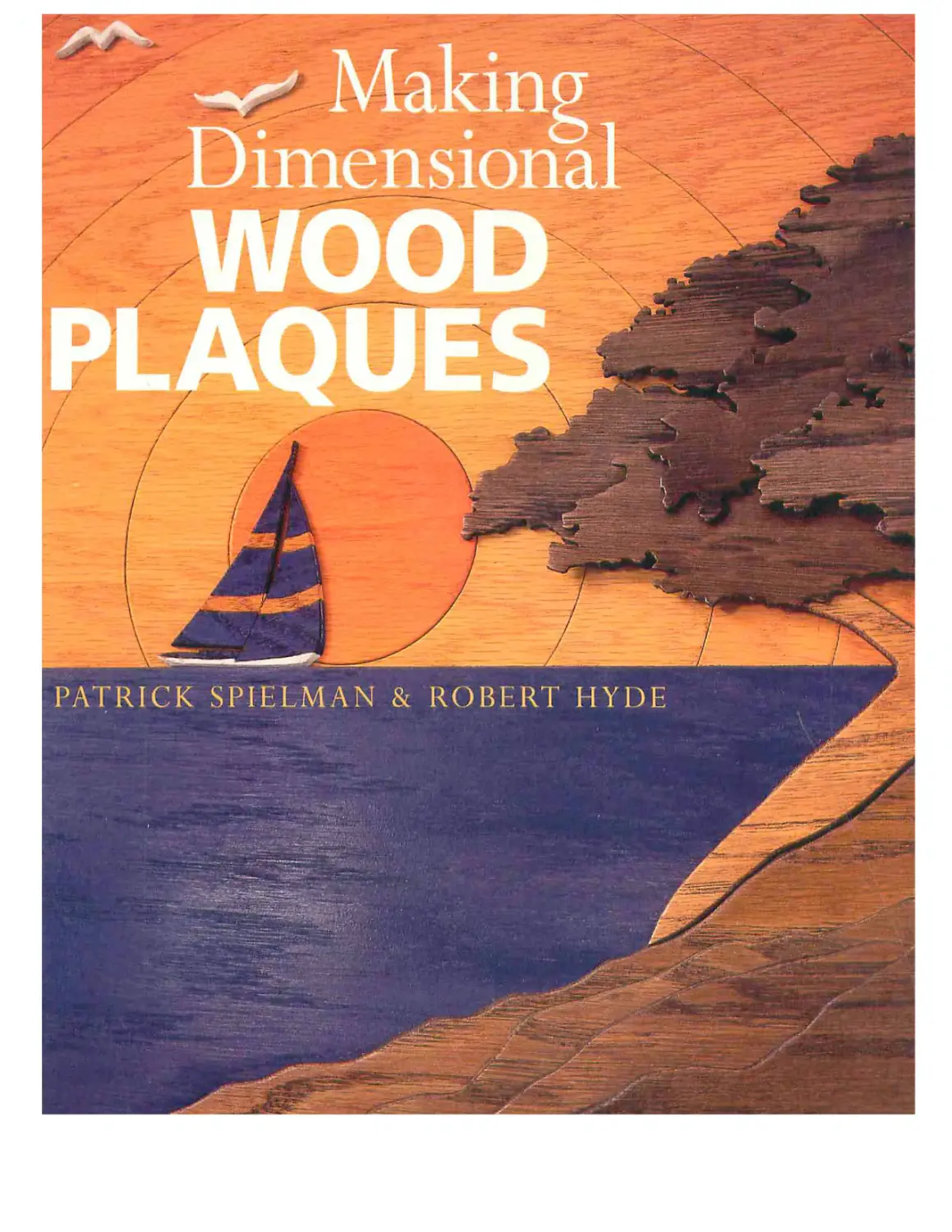


Автор: Spielman P.
Теги: woodworking making dimensional wooden plaques woodcraft diy wood projects wooden plaque designs 3d wood art
ISBN: 1-4027-0692-8
Год: 2004




Текст
Making Dimensional
Wood Plaques

Making Dimensional
Wood Plaques
Patrick Spielman
Sc Robert Hyde
Ж
Sterling Publishing Co., inc. New York
A sterling/Chapelle Book
Chapelle, Ltd.:
Jo Packham
Sara Toliver
Cindy Stoeckl
Editor: Kelly Ashkettle
Art Directors: Karla Haberstich,
Mackenzie Johnson
Copy Editor: Marilyn Goff
Graphic Illustrator: Kim Taylor
Staff: Areta Bingham, Donna Chambers,
Emily Frandsen, Lana Hall, Susan Jorgensen,
Jennifer Luman, Melissa Maynard,
Barbara Milburn, Lecia Monsen,
Suzy Skadburg, Linda Vendirci,
Desiree Wybrow
Cover and finished project photography:
Barry Stahl, Ovation, Inc., La Crosse, W1
Library of Congress Cataloging-in-Publication Data
Spielman, Patrick E.
Making dimensional wood plaques / Patrick Spielman & Robert Hyde,
p. cm.
ISBN 1-4027-0692-8
I. Jigsaws. 2. Woodwork—Patterns. I. Hyde, Robert. II. Title.
TT186 .S6656 2004
684’.08—dc22	2003025172
10 9 8 7 6 5 4 3 2 1
Published by Sterling Publishing Co., Inc.
387 Park Avenue South, New York, NY 10016
©2004 by Patrick Spielman and Robert Hyde
Distributed in Canada by Sterling Publishing
c/o Canadian Manda Group, One Atlantic Avenue, Suite 105
Toronto, Ontario, Canada M6K 3F.7
Distributed in Great Britain by
Chrysalis Books Group PLC, The Chrysalis Building,
Bramley Road, London WK) 6SP, England
Distributed in Australia by Capricorn Link (Australia) Pry. Lui.
P. O. Box 704. Windsor, NSW 2756, Australia
Printed and Bound in China
All Rights Reserved
Sterling ISBN 1-4027-0692-8
Every effort has been made to ensure that all
information in this book is accurate. However,
due to differing conditions, tools, and indiv-
idual skills, the publisher cannot be responsible
for any injuries, losses, and/or other damages
which may result from the use of the information
in this book.
This volume is meant to stimulate woodcrafting
ideas. If readers are unfamiliar or not proficient
in a skill necessary to attempt a project, we urge
that they refer co an instructional book specifical-
ly addressing the required technique.
Due to limited space, we must print our patterns
ar a reduced size in order to give our patrons the
maximum number of patterns possible in our
publications. We believe the quality and quantity
of our patterns will compensate for any incon-
venience this may cause.
If you have any questions or comments, please
contact:
Chapelle, Ltd., Inc.
P.O. Box 9252
Ogden, UT 84409
(801) 621-2777
(801) 621-2788 Fax
e-mail: chapclle@chapelleltd.com
web site: www.chapelleltd.com
Contents
6 Acknowledgments
Introduction
9 Chapter 1 :
Making die Frames
15 Chapter 2:
Makins die Backgrounds and Backers
29 Chapter 3:
Basic Layer Cutting and Coloring
106 Chapter 6:
Advanced Projects
107 Setting up Housekeeping
113 Morning Stretch
118 Racing the Wind
124 October in the Woods
131 Springtime on the Lake
138 Always on Guard
145 Two Bumps on a Log
150 Fall Pheasants
1 57 Metric Equivalency Chart
159 Index
39 Chapter 4:
Introductory Projects
40 Cattails
44 Silver Dollar Arrangement
48 On the Wing South
52 Apple Tree
58 California Coast
62 Chapter 5:
Intermediate Projects
63 Monterey Sunset
70 The Gathering
76	Lake Regatta
82	Balloon Race
86 Back to the Garden
93 Serenity
99 Prairie Windmill
Acknowledgments
We express our thanks and appreciation to our
typist Jennifer Blahnik and to our assistant
woodworker Dan Jahnke.
We also wish to acknowledge our spouses,
Patricia Spielman and Carole Hyde, tor their
steadfast support and helpful assistance.
Acknowledgments
by Robert Hyde
When a hobby turns into a full-time occupation,
it can be overwhelming. 1 was lucky that my wife
Carole was able to devote both her time and
creative skills to what became our business. As
our workload grew, my friend Daniel Jahnke was
able to take on the production of all the frames
that I needed.
1 was again lucky a few years later when a high
school acquaintance built a home near me. His
three bright and energetic children worked
with us for several years. Without the help of
Greg, Jeff, and Stacy Heezen we would have
been unable to keep up with the workload.
Last but not least is Irene Treadway (Caroles
aunt) who helped with coloring and detail
work, and in many other ways.
6
I INTRODUCTION
The beautiful pieces of wall art in this book are
the exclusive creations of scroll-saw artist and
coauthor Robert Hyde. The projects are selected
from rhe best-sellers of Mr. Hydes numerous
wooden pictorials, developed over a 20-year peri-
od of making and marketing more than 10,000
of these compelling designs.
Layered wall art involves three areas of work:
making frames; making and coloring the back-
grounds; and making, coloring, and mounting
the layered cutouts. (See Fig. i-1.)
finishing, and assembly. The techniques are easy
to learn. The projects essentially consist of indi-
vidually scroll-sawn and painted cutouts from X"-
thick plywood that are systematically arranged in
as many as six layers within a frame to create
stunning dimensionality. (See Fig. i-2.)
Fig. i-1 : Layered, colored, and mounted wall art.
In the following pages, Mr. Hyde provides the
original patterns and reveals his techniques, tips,
and shortcuts so anyone can make these appeal-
ing wall hangings. Permission is hereby granted
to produce unlimited quantities not only for per-
sonal enjoyment, but for resale as well.
The 20 projects in this book effectively combine
several areas of woodcrafting, including simple
frame joinery, scroll-sawing, wood-burning,
1 he finished works appear more detailed and
complex to make than they actually are. Most
projects are easily completed using acrylic paints,
marking pens and a coloring system that is
almost as fundamental as “painting by numbers."
The tools and materials necessary to get started
are primarily a scroll saw, a flap sander mounted
onto a used motor, a narrow belt sander, and a
wood-burning tool. These are readily available
and need not be expensive. In fact, Roberts ini-
tial power tool investment was less than SI 50 for
the economy grade of bench-top tools which he
still uses today. (See Fig. i-3 on page 8.)
7
Larger pieces arc colored with a “wash” of acrylic
paint and water, which allows the wood grain to
show. A variety of different woods in their natu-
ral or augmented colors could be substituted.
(See Fig. i-5.)
You may already possess the necessary tools and
skills. Once involved in this fascinating work,
you may wish to embellish the designs by creat-
ing them in various sizes; substituting different
materials, colors, or framing designs, or infusing
other ideas to give these projects your own dis-
tinguishing stvle.
Most of the pieces in this book are made from
multiple layers of/T-thick oak plywood, stained
or painted to obtain attractive colors. Bright col-
oring of small areas is done quickly using felt-tip
markers. (See Fig. i-4.)
Fig. i-4: Small, brightly colored areas.
However you elect to use the patterns and
information in this book, you have before you
some of the most luxurious designs available
for the discriminating scroll-sawyer. They are
designed to allow you co deliver projects with
the most visual impact and with the least
amount of effort. It will be difficult to find any
other scroll-sawing activity that will provide
more pride and satisfaction or be more daz-
zling to friends, family, or customers.
— Patrick Spielman, 2004
8
Chapter 1
Making the Frames
Most works of art are framed after completion.
Creating layered scroll-saw art, however, requires
fitting some pieces against the inside edges of the
frame as the work progresses. (See Fig. 1-1,
below, and refer to Fig. i-2 on page 7.)
Each project consists of a %" or thicker solid
wood frame, a one-piece or a segmented plywood
background, and up to six layers of %"-thick ply-
wood cutouts finished in realistic colors.
Techniques for making special frames designed
for this purpose are discussed in this chapter.
Purchased wood moldings and framing stock of
various sizes and shapes may also be used.
The section drawing shows how the background
is attached behind the frame and how many of
the layered pieces butt against the inside edge.
Note: The background is nor considered one of
the layers within the frame. (See Fig. 1-2.)
Making the Frames. All of the frames illustrated
in this book are made of red oak, but other
woods may be used. Red oak is easily obtained
and it stains well.
Projects that consist of five or more layers of
thick plywood require a framing stock that is
surfaced to a minimum of X" thickness. If it is
available, %”—%"-thick wood is a better choice
for the five- or six-layer projects. Projects with
five or fewer layers will be framed nicely using
standard stock of %>”—X”-thick material.
10
Frame Styles. The frames are categorized by
their overall shape. These are: square, rectangular,
round, and oval. The recommended width of
the frame stock is 2X”, but it may vary plus or
minus X”. The outside lengths, however, should
be cut as specified. (See Figs. 1-3, below, and 1-4
on page 12.) Any changes made to the frame will
require changes to the backer, background, and
fitting of the “inside” layers. Insure that all of the
frame pieces are as uniform as possible in color
and figure. Prepare the wood to uniform width
and thickness, favoring a finished thickness of %"
or more. Miter the ends according to the lengths
and angles specified.
Fig. 1-3: Basic frame styles:
square and rectangular.
11
12
Cut a test piece on a power miter saw. Check
angles and lengths. For making identical lengths,
use a power miter saw or a table saw with stops.
(See Fig. 1-5.)
Fig. 1-5: Plywood stop clamped to saw table to
insure identical lengths.
Tip: First make test cuts from inexpensive wood
to test the saw setup.
Check the cuts with a large square. Assure that
the cut surfaces will be vertical. (See Fig. 1-6.)
Fig. 1-6: Three practice pieces, comprising 'A of a
round frame.
Once the pieces have been cut to size, make a
dry-run assembly using a ratchet-type band
clamp and no glue to assure that the angles are
cut perfectly. (See Fig. 1-7.)
Next, incorporate a suitable method to strength-
en the glued joints. This may be as simple as
exposed finishing nails or concealed framing bis-
cuits or splines that fit into prepared slots. The
recommended way to strengthen joints is to use
biscuitlike splines scroll-sawn from solid wood
with the grain running perpendicular across the
joint. Be certain that the edge-decorating bit to
be used later will not cut into the slots. (See Figs
1-8 and 1-9, and Fig. 1-10 on page 14.)
Fig. 1-8: Slot cutter, one of several kinds and sizes.
13
With all machining, fitting, and checking com-
plete, make the final glued assembly. (Refer to
Fig. 1-7 on page 13.) An extra set of hands to
assist with glue spreading (or nailing) and han-
dling the band clamp will be helpful.
After the glue has cured, clean off excess glue and
sand all surfaces until level before machining the
outside edges. (See Figs. 1-1 1 through 1-14.)
Figs. 1-13 and 1-14: Decorative edge-routing
with a hand-held router or a router/shaper table.
Apply a suitable stain, such as medium oak or
walnut, that is neither too light nor too dark. A
clear protective topcoat will be applied later, as
the final step, after all layers have been cut, col-
ored, and assembled. (See Fig. 1-15.)
Fig. 1-12: Decorative edge options: routed profiles
(top), sawn bevel (bottom).
14
- Chapter 2
Making the Backgrounds
and Backers
One-piece Backgrounds. Backgrounds arc
exposed on one side to the viewer and the vari-
ous cut-out layers and/or shims are glued onto
the background. Backgrounds are made from
or X”-thick plywood; and they are made as either
a one-piece painted background or as one that is
cut into irregular segments. Most of the back-
ground and layer pieces for the projects in this
book were made from Xo"- or %"-thick red-oak
plywood. Painted backgrounds do not require a
backer. (Sec Figs. 2-1 and 2-2.)
Fig. 2-2: fhe Gathering project: segmented back-
ground, finished by adding progressively greater
amounts of blue acrylic to a whitewash.
Fig. 2-1 : The Cartail project: one-piece plywood
background with horizontal grain, colored with
acrylic whitewash (paint and water).
Segmented Backgrounds. The segmented back-
grounds arc stained or painted, then glued onto
another piece of uncut low-quality plywood
called a “backer.” (See Figs. 2-3 and 2-4, and
refer to Fig. 1-2 on page 10.)
Fig. 2-3: Red-oak plywood for layers and backers.
Fig. 2-4: Both surfaces of recycled wall-paneling,
which makes an economical backer material. (The fin-
ished surface on the right, glueable back surface on
the left).
16
The outside shapes of the backgrounds corre-
spond to the basic shapes of the frames. Back-
grounds and backers are about 1" larger all
around than the inside opening of the frame.
There are five basic segmented background
styles used on the projects in this book. (See Fig.
2-5, and Figs. 2-6 through 2-9 on pages 18-21.)
17
. 2-6: Horizontal Segmented Rectangular Background Pattern.
Enlarge pattern 400%.
Background pattern and layout detail for The Gathering project on page 70.
Fig. 2-7: Hound Segmented Background Pattern.
19
. 2-8: Oval Segmented Background Pattern.
Background pattern and layout detail for The Two Bumps on a Log project on page 145.
Background layout details for Monterey Sunset on page 63.
Note: For illustrative purposes, this drawing is not in scale.
Fig. 2-9: Compass-drawn layout and pattern for segmented round background of concentric circles.
21
Selecting the Background Wood. There are sev-
eral variables that affect the final look of the one-
piece and the segmented backgrounds and the
various layer pieces such as land and water.
Firstly, the grain pattern or figure of the wood
itself can have a major effect. The range of differ-
ent natural colors and grain patterns of rotary-cut
plywood available can be quite extensive. Choose
open-figured wood to simulate waves of water
and wispy cloud formations. The face grain of
the plywood is essentially either “rotary cut” or
“sliced.” This refers to the two methods of cut-
ting face veneers from the log. Sliced veneers
have a much finer texture and straighter lines.
Pay attention to grain quality. (See Fig. 2-10.)
Fig. 2-10: Various natural colors and grain patterns.
Avoid seams when possible because they detract
from the natural look. Secondly, the type of fin-
ish obviously influences the final look of your
project. Yellow reds can simulate a sunset, where-
as a white-gray paint will represent dusk and the
like. The intensity of the colors applied can also
affect the visual results. Dark colors and/or mul-
tiple coats can be employed to create a silhouet-
ted look. It is entirely up to the taste and efforts
of the individual artist.
Making Segmented Backgrounds. Laying our
rhe irregular segmented cutting lines is, in most
cases, best done freehand. The sample patterns
shown in Figs. 2-5 through 2-8 on pages 17-20
require enlargement and the use of a photo copy
machine. The layout for each background is
somewhat different for every project.
Mark the top on the rear with an “up arrow” for
future orientation when fitting various layers to
the inside edges of the frame. Use the inside of
the frame as a reference and lay out the outside
cutting lines approximately 1" greater all around
than the inside opening. (See Fig. 2-11, below,
and Fig. 2-13 on page 23.)
Refer to the project photos if you need some
guidance, and note how the lines relate to the
joint locations of the frame, using them as refer-
ence points. By and large, rhe layouts for seg-
mented backgrounds shown in this book were
determined by the grain patterns of the particu-
lar piece of plywood used.
Divide the sky area into as many irregular hori-
zontal pieces as you wish, with 5—9 pieces being
a good range.
22
The background for the Monterey Sunset project
on page 63. however, has specifically spaced con-
centric circles which must be compass-drawn.
Lay out segmented concentric circles, using a
strip of wood with a series of pencil-hole spacing
IJT apart. (See Fig. 2-12, below, and refer to Fig.
2-9 on page 21.)
This work is best done with a variable-speed
scroll saw or a band saw. Select either %”- or
thick plywood for your particular background
project. Almost any scroll saw that will carry
plain-end blades is useable to make the projects
in this book. (See Fig. 2-14).
Cut the outside profile and make the segment-
ed cuts using a fine-skip-tooth blade in the
No. 4-No. 6 size range. (See Fig. 2-15.)
Sawing Segmented Backgrounds. Usually a
more artistic background effect can be achieved
by making the irregular curved segmentation
cuts freehand more or less following the grain
or the natural figure lines of the wood. (See
Fig. 2-13, below, and refer to Figs. 2-10 and
2-11 on page 22 and Fig. 2-2 on page 16.)
Fig. 2-13: Background cutting lines and layouts lor
larger landform layering pieces can he drawn freehand.
Fig. 2-15: I .eft to right: No. 2 and No. 5 blades for
fine work and a thick-wood blade useful for scack-
sawing six or more identical pieces simultaneously.
The throat capacity of most scroll saws will not
allow the background segment cuts to be made in
one continuous pass. Cut inward to approximate-
ly halfway, pull the piece out, and begin the cut
again from the opposite end.
23
An alternative way co make long cuts on rhe scroll
saw is co twist the ends of the blade 90° so the
cuts can be made band-saw fashion. Refer to
Spielman’s New Scroll Saw Handbook for this and
ocher basic scroll-sawing techniques.
Cutting the segmented concentric circular back-
ground demands precise cutting skills. Since it is
more difficult co control cuts in thin stock, add a
sacrificial piece of waste paneling under the work-
piece to provide additional feed resistance and
better overall sawing control. (See Figs. 2-16 and
2-17, below, and refer co Fig. 2-13 on page 23.)
Fig. 2-16: Making perfect circular cuts in X"-chick
plywood is made easier with a slow blade speed.
The desired result is smooch, flowing curves of a
true radius. (See Fig. 2-17.)
See the Monterey Sunset project on page 64 for
more information and tips for finishing the con-
centric circle background. Shown below are two
segmented backgrounds that are easier to cut
with the scroll saw. (See Figs. 2-18 and 2-19.)
Fig. 2-18: Scroll-sawn segmented backgrounds ready
for edge rounding over and color application.
Fig. 2-19: If the layout is not cut perfectly, no one
will ever know.
The edges of all segment pieces should be round-
ed over co a Xg”—X2” radius. This can be done by
hand, using a folded piece of 60- or 80-grit abra-
sive sandpaper. (See Fig. 2-20 on page 25.)
24
Fig. 2-20: Rounding over the mating edges of seg-
mented background pieces.
Coloring Background Segments. Generally,
background coloring is done with acrylic paints.
(See Fig. 2-21.)
Fig. 2-21: Acrylic paints, water, and paintbrushes.
Most are thinned with water to make a lightly
pigmented “wash.” When applied and immedi-
ately wiped off, the wood takes on just the right
amount of color while still allowing the patterns
of the wood to show through. Gradually increas-
ing the amount of pigment as each adjoining seg-
ment is finished creates a dramatic graduated
color scheme. (See Fig. 2-22.)
Beautiful sky backgrounds in graduated blue,
white, and red-orange colors are surprisingly easy
to create. Each successive piece will require a
greater proportion of red pigment as you progress
from the light-colored pieces to those with deep-
er tones. Test color mixture on pieces of scrap
wood. Wipe off excess with paper toweling. (See
Fig. 2-23, below, and Figs. 2-24 through 2-27 on
page 26.)
Fig. 2-23: 10:90 mixture of yellow paint and water
plus a small amount of red applied to first piece.
25
Fig. 2-24: Increased color intensity applied co sec-
ond work piece.
Fig. 2-27: Graduated results, similar to the back-
ground pieces shown in Fig. 2-22 on page 25.
Gluing Background Segments to a Backer.
Use any conventional woodworker’s adhesive
such as yellow carpenters glue to adhere the
background segments onto your backer piece,
(Sec Fig. 2-28.)
Fig. 2-26: Intensified red-tinted acrylic wash.
Fig. 2-28: Flat strips of wood and cans containing
sand or concrete provide clamping pressure.
Apply pressure to the glued flat surface.
Tip: It may be helpful to tack the first piece
at the edges with brads to keep it from shifting
as successive pieces are pushed tightly against
each other.
26
Painting One-piece Backgrounds. Three proj-
ects feature one-piece backgrounds that are sim-
ply painted with a wash of white acrylic paint.
Seven projects have white backgrounds painted
with streaks of blue that blend softly into the sur-
rounding whitewash. This sounds easy enough to
achieve, but it is still best to practice on scrap
before undertaking a full-sized background piece.
The first step when painting a nonsegmented
background is to apply whitewash. Allow to par-
tially dry. White backgrounds are generously
coated with a 50:50 mixture of water and white
acrylic paint. (See Fig. 2-29.)
Use a dry brush to remove excess paint and
brush marks. This will smooth and even out the
coating. Allow it to set a few minutes, then wipe
or brush off the excess to achieve the wash look
so the grain is barely visible. If too much paint is
removed, simply recoat and repeat the process
until the desired look is attained. The entire
painting process should take 10-15 minutes.
Painting White with Blue Streaks. Use three
different paintbrushes for the following proce-
dure. Use one brush for the whitewash and apply
it as previously described. It is important to keep
the whitewash wet so blending can occur in the
next step. Using a smaller brush, apply the
unthinned blue acrylic paint to two or three areas
of the wet background. Let dry for two or three
minutes. (See Fig. 2-30.)
Fig. 2-30: Random streaks of blue acrylic paint.
Finally, use a clean, dry brush and blend the
edges of the blue paint into the white. (See Figs.
2-31 and 2-32.)
Continue blending the edges of rhe blue, adjust-
ing its intensity with the white area until the
desired effect is achieved. Keep at least 75% of
the background white. (See Fig. 2-32.)
Fitting Visible Layers Inside the Frame. Think
ahead. Once the background is completed, use
the inside of the frame to trace the edges of rhe
various layered pieces that must fit perfectly
against the inside edge of the frame. Pick those
pieces out and concentrate only on cutting and
fitting those areas or edges that will be visible in
the finished project. Use a sharp pencil to trace
the inside edges and angles of the frame onto
those layering pieces that will be landforms or
water. (See Fig. 2-33.)
Sometimes only one corner or edge must fit per-
fectly. Be certain these are prepared to fit perfect-
ly before attaching the background and backer (if
required) to the frame. Sawing close to the layout
line and finishing with a small hand plane works
well. Remember to orient the fitting pieces to the
same frame edge. Notice that the top of the
frame is referenced with a piece of tape and the
fitted piece will be visible only on the two edges
indicated by the red arrows. (See Fig. 2-34.)
Fastening the Background to the Frame.
First, assure that rhe painted background is fairly
smooth. The acrylic wash may raise the grain
fibers. Use 400-600-grit sandpaper and hand-
sand very lightly. Do not sand through the color.
Orient the background correctly to the frame.
Drill pilot holes for the wood screws to secure
the background to the frame. (See Fig. 2-35.)
After all interior pieces are glued, anchor a wire
between two of the screws for hanging. (See Fig.
2-36.)
28
Chapter 3
BAsic Layer Cutting and Coloring
This chapter covers some basic techniques that
apply to all of the projects. Also included here
are instructions for creating the cattails that
are found in five projects and instructions for
creating the small geese which appear on the
sky backgrounds in five projects. Tips for creat-
ing and coloring deer, which are featured in three
о	о
projects, rounds out this chapter.
Patterns, Layout, and Cutting Layers. Enlarge
and copy the patterns from this book onto paper
or transparency film as necessary, using either a
fine-point marker or a photocopy machine. Most
photocopy machines distort enlarged copies
somewhat, so some hand-corrections may be
required where fitting is necessary. Transferring
rhe pattern lines onto the wood for sawing and
subsequent coloring can be done in either of the
following ways: First, use carbon paper to trans-
fer the enlarged pattern. (See Figs. 3-1 and 3-2.)
Fig. 3-2: Tracing with a fine-point marker.
The film can then be traced over carbon paper
or used to make a reverse copy for use with rhe
transfer tool. The transfer tool provides just the
right amount of heat concentration to activate
the toner delivered to the surface of the paper
pattern with a photocopy machine. Depending
upon the type of toner used, this technique may
not work with computer printers. (See Fig. 3-3.)
A regularly photocopied pattern will transfer
onto the wood in a reverse position. That is, a
bird facing right on the original pattern will be
flipped and face left when transferred. This is
where the transparency film comes into play.
First, copy the pattern onto transparency film.
(Refer to Fig. 3-2.) The transparent copy can
then be flipped on the photocopy machine to
make a reverse copy so that, when transferred,
the pattern made on the wood will be facing in
the right direction. Use %”-thick plywood and
check the grain direction when preparing pieces
for cutting. (See Fig. 3-4.)
30
Fig. 3-4: Pattern transferred onto wood. Notice that
the transferred copy is a reverse of the pattern.
Paper patterns of pieces with no interior wood-
burning or coloring lines can be bonded directly
onto the wood for scroll-sawing. Use a tempo-
rary bonding aerosol spray. (See Fig. 3-5.)
Fig. 3-6: Auxiliary hardboard table with a small
blade-entry hole is held in place with double-faced
tape. This setup is ideal for sawing small parts and
supporting fragile pieces.
A number of pieces may be stack-sawn all at the
same time, using one pattern. Make identical
parts by stack-sawing multiple pieces simultane-
ously. Layers can be held together with tape or
tacked together with small brads in the waste area
го hold the stack intact during sawing. (See Figs.
3-7 and 3-8.)
Scroll saws with a variable-speed control are very
helpful when sawing thin and small pieces. (See
Fig. 3-6.)
31
Tip: When nailing thin layers together for stack-
sawing, set the workpieces on a flat steel plate,
then drive the brads through the workpieces. The
nails will peen themselves over, holding the bot-
tom Layer secure with no worry of nail points
scratching the scroll-saw table.
Many of the cut-out pieces will look more realis-
tic if the outside edges are rounded over. This can
be done in the usual wav by hand-sanding with a
J J	о
coarse-grit sandpaper, followed by finer grits to
achieve smoothness.
Wood-burning Details and Coloring Lines.
Wood-burning is a key process because it creates
detailed texturing such as feathering, and identi-
fies or separates areas for coloring and/or staining
with felt-tip markers and/or acrylic paints.
Always continue burn lines over rounded edges
on pieces that have them. (See Fig. 3-9.)
Fig. 3-9: Wood-burning detail lines.
Fig. 3-10: Burning feather outlines on duck cutout.
Wood-burning detail lines helps to provide very
sharp definition between adjoining colors and
stains applied with felt-tip markers. The burned
line acts as a dam, keeping the color dispensed by
markers from bleeding across the line. This is
clearly demonstrated when comparing a pencil
line to a burned lines ability to contain bleeding.
(See Fig. 3-11.)
Fig- 3-11: Marker ink bleeding across the pencil
line at left but not the burned line at right.
Finishing with Felt-tip Markers. (Refer to Fig.
3-11 and see Fig. 3-12.)
Almost any wood-burning tool can be used.
Better mid-priced units, however, offer adjustable
electronic dial-controlled heat and power. They
also have a wide selection of interchangeable tips
that create very fine lines. If using a typical inex-
pensive “burning pen,11 file the end to a fine
point. (See Fig. 3-10.)
32
Markers are excellent for coloring and staining
small areas of wood. They arc available in a wide
array of colors and many shades of stains. They
come with various-sized tips ranging from an
ultrafine point to a broad point that covers larger
areas quickly. They can help achieve sharp defini-
tion without obliterating the natural figure of the
wood. (See Figs. 3-13 and 3-14.)
Fig. 3-13: Staining with transparent brown marker.
Fig. 3-14: Notice how a second coating with a green
marker around the outside edges increases the intensity
of the color.
Almost any conventional line of markers sold
in discount stores will work. Better markers and
greater color selections can be found at art supply
stores or through mail-order catalogs. Markers
come with either felt or fiber tips, with the latter
seemingly more durable on wood surfaces.
Tips: New markers are “juicier,” in that they send
more ink to the surface. When working two col-
ors side by side, always put down the lighter
color first. Thus, if there happens to be any
bleeding across the line, the darker color will
cover. Deeply burned lines, however, are best to
keep colors contained in the intended areas.
Creating Cattails. Cattails are the focal point of
Project No. 1 on page 40, and are secondary
components in four other projects. Cattails can
be made in two ways: by using built-up pieces of
scroll-sawn plywood, or by using round dowels.
Plywood cattails are made from two layers of%"-
thick material. The internal cross-grain ply of the
finely pointed ends tend to crumble when sawn.
(See Fig. 3-15, below, and Figs. 3-16 and 3-17 on
page 34.)
Fig. 3-15: Two-layer plywood cattails. Notice rhe
rounded edges.
33
Fig. 3-16: Stack-cutting sharply pointed end, with
two wraps of tape holding the layers together.
The fine points are probably best dealt with by
simply cutting off the last inch or so. Alterna-
tively, you can strengthen the point by saturating
the fragile tip area with glue after one side of it is
sawn. Use a coarse-grit sandpaper and a sanding
block to round over the edges of the upper piece
and the edges of the stems and pointed ends.
Dowel Cattails. These look more dimensionally
realistic; but they require a V-block jig and a drill
press to make them properly. (See Fig. 3-18.)
Fig. 3-18: A simple V-block, when set up on a drill
press as shown, makes perfectly centered and straight
holes into the dowel ends.
To make large dowel cattails, use %"- or
diameter dowels, and %s"- or ^’’-diameter
dowels for the stems and points. Sharpen the
dowels by rotating them against a power belt or
disc sander. Flatten the cattail heads on one side
of the larger dowels to provide a gluing surface.
Tip: Cut extra reeds and grasses that go with
the cattails. This provides more flexibility and
options during assembly. The grasses can be
sawn off at their bottoms to adjust their heights.
Painting the Small Geese. Geese appear in five
projects and require three colors of acrylic paints
in separate containers and three small paint-
brushes. Add a little water to make the paint eas-
ier to blend. (See Figs. 3-19, below, and Figs.
3-20 through 3-27 on pages 35-36.)
Fig. 3-19: Painted geese.
34
Fig. 3-20: Three containers of acrylic paint: black,
gray (black and white mixed), and white. Notice the
wide dry brush for blending in the foreground.
Fig. 3-22: Step 2: Add some gray.
Fig. 3-23: Step 3: Blend gray and black with a
wider dry brush.
Fig. 3-25: Using another dry brush, blend white
into gray and paint other areas white where needed.
35
Although these small geese are actually part of the
first layer, it is best to glue them to the back-
ground after all other layers have been glued, so
that they may be more artistically placed.
Making and Coloring Deer. When selecting the
ЙГ-thick plywood for deer, it is generally recom-
mended to avoid tight, vertically grained wood
that can create a zebra look. It is also a good idea
to cut all the deer in a project with similarly
grained wood.
Cut out the deer, observing the direction of the
grain. Be very careful when sawing the narrow
tips of the antlers. Be certain to use an auxiliary
saw table with a zero-clearance blade opening.
(Refer to Fig. 3-6 on page 31.) This will support
very small or delicate cuts over the table opening.
Carefully round over all edges slightly.
General Coloring of Deer. Study Figs. 3-28 and
3-29 below, and Figs. 3-30 through 3-32 on page
37 for examples of partially-colored deer and
close-ups of the coloring.
Fips: When coloring animals and birds, obtain
some good color photos from books and maga-
zines to use as a guide for coloring and shading.
I he instructions that follow pertain to the use of
felt-tip marker colors that are applied after the
wood-burned details are completed.
Fig. 3-29: Completely colored cut-out deer.
36
Fig. 3-31: Closeup showing wood-burned detailing
and marker-applied coloring.
Warm
Gray
White
Blend into brown.
White
Acrylic
Blend to
brown.
Black
Body
Base
Coat
Double coat
darker areas.
White
Blend into brown.
Fig. 3-32: Coloring details.
Gray or
Lighter
White
Blend into
brown.
Black
White
Black
Marker colors labeled as “warm” contain red
pigment which is good for deer tones. Colors
labeled as “cool” have a bluish base and are not
the best choice for coloring deer.
The base color for all deer should be a medium
tan. (Refer to Fig. 3-28 on page 36.) At this
point, do not color the antlers, hooves, nose, or
the obvious white areas. The antlers are colored
with a medium warm gray.
Shadows and Highlights. Always start with the
lighter colors and then darken them as necessary.
Attempt to simulate the shadows and highlights
shown in the photos. Use a dark gray marker to
make the darker shadow lines under the body,
legs, etc. Keep a wet edge for blending colors.
Next to the dark gray, add some medium gray
and blend the two together. To achieve subtle
darkening, recoat with the same marker color.
Next, paint all white areas with acrylic. The
hooves, nose, eye pupil, and chin areas are color-
ed with a black marker. (Refer to Fig. 3-32.)
Ear Detail. The inner-ear area is painted with
acrylic paint, blending the wet edges into the
brown using a “blender marker”—a clear finish
without any pigment. Apply a darker brown
around the edge of the ear and use the blender
marker to make the color transitions. Apply the
blender marker to the wet acrylic, blending it
into the brown/tan color. (Refer to Figs. 3-31
and 3-32.) Clean the blender tip frequently to
remove any acrylic paint by rubbing it off while
still wet.
Eye Detail. Use the same techniques employed
for the ear. Paint white acrylic around the eye
and blend with a blending marker into the
brown. (Refer to Figs. 3-31 and 3-32 on page
37.) When the paint has dried, use an ultrafine-
point permanent black marker to add the line
37
details around the eye. This is somewhat like
putting on cosmetic eyeliner to enhance eye
details. Add black lashes and a dot of white in
the upper left of the pupil to simulate the “glint”
or flash of light.
Black and White Details. Apply white acrylic
to the underside of rhe tai) and belly, and use a
black marker to color the hooves, nose, pupils,
and shins.
Assembly of Layers. Along with the patterns for
cutting and wood-burning pieces for the various
layers, a sequential assembly plan is given layer
by layer for each project. These give the approxi-
mate placement for each layer or level. Some
parts are raised with small shim pieces positioned
out of the viewers sisht. Particular instructions
о
for such details are given with other specific
instructions pertaining to each project.
Tip: After all pieces have been cur, fit, and
colored, make a dry assembly to assure that all
layers are artistically positioned.
Adhesives. Several types of glue can be used to
adhere the various layered pieces onto the back-
ground. Although the strongest structural glue
joints are made by gluing raw wood to raw
wood, the authors have not experienced any glue
failures using typical woodworker’s adhesives on
surfaces coated with acrylic paints or markers. It
is, however, advised that the reader make his or
her own tests, judgments, and determinations of
the best performance for any particular types or
brands of glue. It may be practical to use a com-
bination of two types of glue on larger pieces.
For example, use hot-melt or instant glue, which
set quickly, to temporarily hold the piece in posi-
tion while another glue applied to the same piece
sets up. One of the disadvantages of hot-melt-
type glues is the generally thick glue lines associ-
ated with their use. This may elevate the pieces
too much, resulting in raising the final layer(s)
above the thickness of the frame.
Apply the glue X”-X” from the edge of the work-
piece and do not apply glue so heavily that it cre-
ates “squeeze out” problems. Should there be any
glue squeeze out, remove it immediately with a
damp rag or paper towel. (See Fig. 3-33.)
When all parts are glued in place, remove all dust
particles and visually inspect for any problems
that may need correcting or touch-up. Using an
aerosol, spray the first coat of vinyl or poly-
urethane finish over the entire project. Sand
lightly again, reaching all accessible areas. Attach
the wire hanger to the back. Remove sanding
dust and apply a final coat of finish.
38
Chapter 4
Introductory Projects
Project Nd. 1
Cattails
40
Project No. 1, Cattails, as shown in Fig. 4.1-1 on
page 40, requires a vertically rectangular frame as
specified in Frame Styles, Fig. 1-3 on page 11.
The white painted background is one piece of
XT- or XT-thick plywood, 18XT x ЗОХ" with hori-
zontal grain. Apply a wash solution of white
acrylic paint as discussed in Painting One-piece
Backgrounds on page 27. Review Assembly
Drawing, Fig. 4.1-2, to familiarize yourself with
the lavers.
J
Stack-cut three sets of the Cattail Heads, and cut
one set of Reeds and three Stems, using Cattail
Patterns, Fig. 4.1-3 on page 42. Stack-cut two
sets of the Grasses, using Cattail Pattern,
Fig. 4.1-4 on page 43, from two pieces of
thick plywood approximately 9X?" x 16X>". Stain
the various pieces.
Assemble the cattails as discussed in Creating
Cattails on pages 33-34, and glue them to the
backer as shown in Layer 1 below. The stems,
reeds and grasses pieces can be cut off at their
bottoms to achieve the desired height. The pre-
cise placement and sizing of these parts is up to
the crafter.
Tip: Wooden skewers can be used for stems and
pointed ends. This may require sawing a slot into
the upper end of cattail heads bottom layer.
Fig. 4.1-2: Assembly Drawing.
41
Reeds
Enlarge 200%.
Cut one set.
Cattail Heads
Enlarge 200%.
Stack-cut three sets.
Cattail Stems
%" thick, %" wide.
Make three. Cut lengths
of 18", 16", and I4!4".
Fig. 4.1-3 : Cattail Patterns.
42
Grasses
Stack-cut two sets,
then cut to length
as desired.
Enlarge pattern 200%.
Fig. 4.1-4: Cattail Pattern.
43
Project No. 2
Silver Dollar
Arrangement
44
Project No. 2, Silver Dollar Arrangement, Fig.
4.2-1 on page 44, involves making the same one-
piece style of painted background and cattails as
those in Project No. 1, Cattails, on page 40.
Featured in this project, however, is the addition
of silver dollar pieces cut from И?”- or Хб’’-thick
balsa wood which is available from craft and
hobby stores. Review Assembly Drawing, Fig.
4.2-2, to familiarize yourself with the layers.
Stack-cut outside profiles of the vase from two
pieces of /Г-thick birch or oak plywood with
horizontal grain. (See Fig. 4.2-3.)
Cattail Heads
Stack-cut three sets.
White Painted
Background with
Horizontal Grain
Layer 3
Fig. 4.2-2: Assembly Drawing.
Vase
Dollar
Stems
Enlarge all patterns 400%.
Fig. 4.2-3: Silver Dollar Arrangement Patterns.
45
Separate to complete the sawing of the neck open-
ing in the bottom vase piece. Glue the layers
together. Round over the edges and wood-burn the
horizontal straight and irregular lines, continuing
over the rounded edges. (Refer to Wood-burning
Details and Coloring Lines, Fig. 3-9 on page 32.)
Stack-cut 8-10 Silver Dollar Pieces at a time,
using the patterns in Silver Dollar Arrangement
Patterns, Fig. 4.2-4.
Silver Dollar Pieces
Patterns are full size. Stack-cut approximately
60 imperfect circles of various sizes.
Fig. 4.2-4: Silver Dollar Arrangement Patterns.
46
Lightly wood-burn the seed pod definition
around the inside edge of each silver dollar piece.
Stain and color the vase. Use markers to give it
colors similar to those shown in Fig. 4.2-5.
Fig. 4.2-5: Vase section showing wood-burning,
natural wood, and stained areas in various shades of
brown with the yellow-gold sun.
Glue-assemble all pieces in layers as indicated.
(Refer to the Assembly Drawing, Fig. 4.2-2 on
page 45.)
Place the silver dollars so there are some open
spaces and some of the stem pieces are somewhat
visible. (See Fig. 4.2-6.)
Fig. 4.2-6: Closc-up of final assembly.
47
Project No. 3
On the Wing South
Fig. 4.3-1 : This square-framed project features a segmented background, two cut-out geese with fairly detailed wood-
burned surfaces, and more cattails and grasses.
48
Layer I
Fig. 4.3-2: Assembly Drawing.
Project No. 3, On the Wing South, Fig. 4.3-1
on page 48, features a square frame and a
horizontally segmented background painted
white with slightly graduated blue tints toward
the top. (Refer to Frame Styles, Fig. 1-3, on
page 11, and the Segmented Square Background
Pattern, Fig. 2-5 on page 17.) Again, we find cat-
tails and grasses, made as discussed in Project
Nos. 1 and 2.
Review Assembly Drawing, Fig. 4.3-2, to famil-
iarize yourself with the layers. Review the tech-
niques in Making Segmented Backgrounds on
pages 22—23. Notice how this background con-
sists of blue water at the bottom under irregular
green land and white to light blue sky pieces. A
graduated white-blue sky can be achieved by
gradually adding some blue acrylic to the white-
wash, increasing the percentage of blue for each
successive piece.
When dry, glue the segments to a backer and
attach the cured assembly to the back of the
frame. (Refer to Fastening the Background to the
Frame on page 28.)
49
Fig. 4.3-3: On the Wing South Patterns.
Enlarge all patterns 200%.
Cattail Heads and Stem
Cut three sets. Cut stem
lengths of 8", 7”, and 6И”.
Geese
Cut and paint one set.
50
Cut out the Geese and Cattail Heads and Stems,
usin^ On the Wins; South Patterns, Fig. 4.3-3 on
page 50. Transfer all lines to %”-thick plywood.
(Refer to Patterns, Layout, and Cutting Layers on
pages 30-32.) Round over the edges and wood-
burn the detail and definition lines. The burning
must be well done so visual texture shows
through the brown and white coloring. Notice
how the wing tips, shoulders, and neck graduate
to deep browns, colored with markers. White
areas are painted with full-strength white acrylic
paint. (See Fig. 4.3-4.)
Grasses
Enlarge pat-
tern 400%.
Stack-cut two
sets, then cut
bottoms to fit.
Fig. 4.3-5:
On the Wing
South Pattern.
Fig. 4.3-4: Close-up of typical painting details.
Cut the Grasses, using the On the Wing
South Pattern, Fig. 4.3-5. Finish as shown in
Fig. 4.3-6.
Fig. 4.3-6: Cattails and grasses. The bottoms of all
grasses must be cut oft for lengths and fitting.
Gluing down the various parts is pretty
straightforward. The wing of the larger goose
in Layer 2 is placed over a %”-thick shim.
51
Project Nd. 4
Apple Tree
Fig. 4.4-1: The Apple Tree project involves many easy-to-make pieces. The guided assembly illustrations simplify
this process as well.
52
Project No. 4, Apple Tree, Fig. 4.4-1 on page 52,
has more parts than most projects, and its assem-
bly is somewhat complicated. The parts, however,
are all easy to make and finish. The Assembly
Drawing, Fig. 4.4-2, and the accompanying pho-
tos will be helpful during the assembly process.
Layer 5
Layer 2
Fig. 4.4-2: Assembly Drawing.
Overall, this project is not difficult; it is labor-
intensive but well worth the effort. You may elect
to color the apples as you wish. The color brown
was selected to create a little visual excitement.
An interesting option is to make the tree without
the apples.
The project requires a round frame and a one-
piece plywood backer, X" or %” thick, with hori-
zontal grain and a 50:50 acrylic-whitewashed
surface. (See Fig. 4.4-3, and refer to to Frame
Styles, Fig. 1-4 on page 12 and Painting One-
piece Backgrounds on page 27.)
53
Cut out the Apple Tree Pattern, Fig. 4.4-4, from
%”-thick plywood. The project requires 18 apples,
all X” thick with vertical grain and rounded
edges. Use %"-thick plywood or make them
from two layers of %"-chick plywood approxi-
mately 10” x 12” glued together, face to face.
Approximately 200-225 leaves of different sizes
cut from %”-thick straight-^rain plywood are
required. (See Apple Tree Patterns, Fig. 4.4-5,
on page 55.)
54
Apples
Fig. 4.4-5: Apple Tree Patterns.
55
Tip: Го save time, stack-cut as many layers of
apples and leaves as your scroll saw will cur easily.
The grain of the leaves should always run point
to point. To save time, after slightly rounding
and sanding the edges, dip rhe apples and leaves
into two pans containing walnut and lighr oak
stains respectively.
Assembly. After attaching the painted back-
ground to the rear of the frame, prepare the tree
for assembly by gluing several X”-thick shims to
the back side. (See Fig. 4.4-6.)
Fig. 4.4-6: Tree, finished and prepared with
thick shims glued co its back, ready co be glued down.
Glue rhe tree down. Next, place 10 apples with
X”-thick shims under each. The purpose of this is
to allow some leaves to slide under portions of
the apples. (See Fig. 4.4-7.)
Fig. 4.4-7: Layer 1 in X” relief. Also shown on rhe
Ira me are /’’-thick shims.
Next, add more leaves, 2-3 for each apple, with
the leaf point pointing toward an imaginary
apple stem. Use shims under the leaves of Layer
2, filling in spaces between the branches. Do not
cover any apple entirely. (See Fig. 4.4-8, below,
and refer to Assembly Drawing, Fig. 4.4-2 on
page 53.)
56
Now, glue down the last eight apples of Layer 3,
along with more leaves. (See Fig. 4.4-9, below,
and refer to Assembly Drawing, Fig. 4.4-2 on
page 53.)
Fig. 4.4-11 : Layers 4 and 5. Apples have more of
their surfaces covered than actually exposed.
The leaves should be arranged in groups of 3—4
with their points together, pointing toward rhe
stem of the apple. Remember to use small shims
wherever necessary to provide an inconspicuous
and elevated gluing surface. Since the apples are
X” thick, add more leaves to complete a level
equal to the top surface of the apples. (See Figs.
4.4-10 through 4.4-12.)
Fig. 4.4-12: Leaves applied in groups of three or
four. More layers of leaves are applied to the central
area of the tree.
Fig. 4.4-10: Assembly about 80% complete.
57
Project Nd. 5
California Coast
Fig. 4.5-1: The California Coast project features colorful sailboats with layered landforms and trees.
58
Project No. 5, California Coast, Fig. 4.5-1 on
page 58, is easy to make. It requires an oval
frame and a one-piece painted background made
from %”- or И’’-thick plywood with horizontal
grain. (Refer to Frame Styles, Fig. 1-4 on page
12.) The layered pieces are all cut from %"-thick
plywood. Review Assembly Drawing, Fig. 4.5-2,
to familiarize yourself with the layers.
Fig. 4.5-2: Assembly Drawing. Notice in Layer 2
that the edge of the tree and landform patterns have
the same irregular cuts.
The background is a painted white acrylic wash
with blue streaking. (Refer to Painting White
with Blue Streaks on page 27.) Attach the paint-
ed background to the frame. (Refer to Fastening
the Background to the Frame on page 28.)
Cut the Water and Landform pieces, using the
California Coast Patterns in Fig. 4.5-3. The water
should be cut from horizontal grain.
59
Select rotary-cut open or wide grain to simulate
waves of water. (See 4.5-4, below, and refer to
Fig. 4.5-1 on page 58.)
Fig. 4.5-4: Notice the grain of the piece selected for
the water.
The grain of the landforms can run somewhat
obliquely, depending upon the plywood patterns
available. Notice in Fig. 4.5-6, and the Assembly
Drawing, Fig. 4.5-2, Layer 2, on page 59, that
the lower edge of the cypress tree matches the
upper edge of the landform. This is cut simulta-
neously from the same piece to achieve a perfect
fit. Also notice that the left edge of the water and
the right edge of the smallest landform piece
must be fitted to the edges of the frame as indi-
cated by the “key fit” notes and arrows on the
patterns. (Refer to California Coast Patterns, Fig.
4.5-3, on page 59.)
It is best to cut all of the Treetop Layers from the
same or similar-figured wood for uniformity,
using the California Coast Patterns, Fig. 4.5-5.)
Enlarge patterns 400%. Round over all edges.
Fig. 4.5-5: California Coast Patterns.
60
Use a small rotary tool and burr, a flap sander, or
a round file to roughly round over the edges of
the various tree pieces.
Cut out the Boats and Gulls, using the California
Coast Patterns, Fig. 4.5-7. Wood-burn the detail
О
lines of the sailboats. Stain and color all pieces.
(Refer to Fig. 4.5-4 on page 60 as a guide.) Use
acrylic paint lor the boat hulls and colored mark-
ers for the sails. Glue down all pieces.
61
Chapter 5
Intermediate Projects
Project No. 6
Monterey Sunset
Fig. 5.6-1 : This project incorporates the same layered tree as the California Coast project, and features a segmented
background of concentric circles with graduated coloring shown here in red-orange tones.
63
Project No. 6, Monterey Sunset, Fig. 5.6-1 on
page 63, is much like rhe California Coast proj-
ect, with the same tree patterns and the same
style of landforms. Review Assembly Drawing,
Fig. 5.6-2, to familiarize yourself with the layers.
Fig. 5.6-2: Assembly Drawing.
Fig. 5.6-3: Blue sky tones are an alternate back-
ground choice.
This project requires a segmented round back-
ground cut from a piece of %" or X” x 17X” x 26"
plywood. (Refer to Segmented Backgrounds, Fig.
2-7 on page 19.) Cut the background from
or X"-thick plywood with horizontal grain. This
project will also require a backer of thin plywood
26" square.
Layout the Background. Trace the inside of the
frame lightly with a pencil and add 1" all around.
Locate the center point of the sun and the circles
by measuring from the edges of the background.
(See Fig. 5.6-4 on page 65, and refer to Seg-
mented Backgrounds, Fig. 2-9 on page 21, for
complete layout details.)
The visual emphasis of this project, however, is
the dramatic segmented background within a
round frame. (See Fig. 5.6-3.)
64
Fig. 5.6-6: Rounding over segment edges with
coarse abrasive.
Color the Sky Pieces. Begin with a yellow-gold
mixture of water and acrylic paint for a red-
orange sky. (Use a white-and-blue mixture for a
background with a blue sky). Mix two teaspoons
of bright yellow paint into one cup of water for
for the first ring around the sun. (See Figs. 5.6-7
through 5.6-10, below and on page 66.)
Use a snip of thin wood, with pencil holes
spaced 1И" apart, to lay out the segmented
circles. (See Fig. 5.6-5.)
Fig. 5.6-5: Layout circular segments.
Carefully saw each ring. Refer to Sawing
Segmented Backgrounds, Fig. 2-16 on page 24.
Round over all mating edges with а 14" radius.
(See Fig. 5.6-6.)
Fig. 5.6-7: Preparing to paint rhe graduated yellow
to red-orange segments.
Fig. 5.6-8: Scraps for testing color mixture ratios.
65
Fig. 5.6-10: First piece completed.
Apply the diluted colors on test pieces and wipe.
Adjust color mixture ratios if necessary. After
color is established for the first ring, begin to add
red pigment beginning with X of a teaspoon. Add
more pigment, increasing the ratio for each suc-
cessive piece until the last piece is painted. The
final piece should be a vivid red-orange color.
(Refer to Fig. 5.6-11.)
Glue the segmented pieces to a full plywood
backer. (See Fig. 5.6-12, below.)
Make and finish all of the layer pieces. (See the
Monterey Sunset Patterns, Figs. 5.6-13, 5.6-14,
and 5.6-15 on pages 67-68.)
66
Fig. 5.6-13: Monterey Sunset Pattern.
67
68
Lightly trace the cutting lines for water piece, fol-
lowing the inside frame edge.
Fig. 5.6-16: Lightly trace cutting lines.
The water and landform layers are similar to
the ones used in the California Coast project,
Fig. 4.5-3, on page 59. Before attaching the
background (with the backer) to the frame, cut
and make the key fits on the left edge of the
water piece and the right edges of the fifth layer
of the hillside.
The tree top patterns are exactly the same as
those used in Project No. 5, California Coast,
and are found in Fig. 4.5-5 on page 60.
Tip: When finishing the landforms, use four
different shades of brown acrylic or oil stains
and randomly blend in a little green. The tree-
tops are stained a dark brown and the trunk a
light brown.
(See Figs. 5.6-17 and 5.6-18, and refer to
Monterey Sunset Patterns, Fig. 5.6-14 on page
67 and Fig. 5.6-15 on page 68.) .
Fig. 5.6-17: The water overlaps rhe sky and rhe sail-
boat covers rhe “compass” nail hole made in the center
of the sun and butts against the top edge of the water.
It is a good idea to leave the gluing of the gulls
for last so they can be more artistically placed.
Position the Tree Pieces. First, place all pieces
without glue on the background. Then remove
all but the Layer 1 pieces and glue them down
in their established locations. Glue down the
remaining treetop layers and the landform
pieces. Assure that the edges of those pieces
that will be visible fit tightly against the inside
edges of the frame.
69
Project Nd. 7
The Gathering
Fig. 5.7-1 : The specific features of this project arc the segmented background simulating twilight and the realistic
coloring of the deer.
The key co Project No. 7, The Gathering, Fig.
5.7-1, is coloring the deer realistically.
Make the rectangular frame. (Refer to Frame
Styles, Fig. 1-3 on page 11, and Segmented
Backgrounds, Fig. 2-6 on page 18.)
Review Assembly Drawing, Fig. 5.7-2 on page
71, to familiarize yourself with the layers. Cut
the moon from the same piece as the background
and align the grain for continuity. Finish the
background to simulate dusk. Paint the moon
bright white. Color the bottom landform piece a
deep brown. Color the bottom skyline piece with
a wash of 25:75 white acrylic and water with
some blue added for the first piece. Then add
proportionally more blue pigment with each suc-
cessive piece with the darkest coloring at the top.
70
Cut out the tree pieces, using The Gathering
Patterns, Fig. 5.7-3 at right and Fig. 5.7-4 on
page 72. Notice that patterns in 5.7-3 are en-
larged 400% and those in 5.7-4 on page 72 are
enlarged 300%. Round over all edges. Color the
treetops deep brown.
Fig. 5.7-3: The Gathering Patterns. Arrows indi-
cate visible edges that must fit against frame.
71
Enlarge all patterns 300%.
Fig. 5.7-4: The Gathering Patterns.
72
Cut Figs. 5.7-5, below, and 5.7-6 on page 74.
Color the bushes a dark green. Plan to cut out a
few extra deer or use some scraps on which to
practice painting. It will be well worth the time
and effort because the deer in other projects
require the same techniques.The correct coloring
and the wood-burned detailing of the deer are
о
very important. Review the instructions and fig-
ures given in Making and Coloring Deer on
pages 36-37. It is suggested that a few practice
deerhead cutouts be made and painted before
undertaking the seven required for this project.
When confident the coloring is correct, paint
each step on all seven at once as appropriate.
73
All patterns are full size.
Fig. 5.7-6: The Gathering Patterns.
74
Tips: Study Fig. 5.7-7. Place J4”-thick shims
under the tree trunk to support the other tree
pieces as necessary. Also place small shims under
the Deer #1, #2, #5, and #6.
75
Project Na. 8
Lake Regatta
Fig. 5.8-1: Vivid transparent colors highlight this nautical scene.
76
Project No. 8, Lake Regatta, Fig. 5.8-1 on page
76, features bright colors and some detailed
wood-burning. The experienced scroller may
elect to use a 2/0 blade and cut out some of the
fine, detailed spacings at the top of the light-
house or simply burn-in all details.
(Refer to Frame Styles, Fig. 1-3 on page 11 and
Painting One-piece Backgrounds on page 27.)
Review Assembly Drawing, Fig. 5.8-2, to famil-
iarize yourself with the layers.
Cut out and wood-burn the detail on all of the
parts according to the patterns. (See Fig. 5.8-3 at
right and Figs. 5.8-4 through 5.8-6 on pages
78-80.)
Enlarge all patterns 200%.
Fig. 5.8-3: Lake Regattta Patterns.
77
78

All patterns are full size.
Fig. 5.8-6: Lake Regatta Patterns. Arrows indicate visible edges that must fit against frame.
80
Cut all three water pieces from the same piece of
wood so they have the same color intensity when
painted. Use horizontal grain for the sailboats.
Remember that s;ood wood-burned detail lines
are necessary to prevent the marker coloring from
bleeding across the line. The boat hulls are paint-
ed with undiluted acrylic paint. (Refer to Wood-
burning Details and Coloring Lines, Figs. 3-9
through 3-11, on page 32, and Finishing with
Felt-tip Markers, Figs. 3-12 through 3-13 on
pages 32-33.)
Use a brownish or gray acrylic wash for coloring
the two shoreline pieces and a dark blue for the
water pieces. The lighthouse is diluted white
acrylic paint and all else is colored with markers.
Glue down the parts following the sequence
given on the Assembly Drawing, Fig. 5.8-2 on
page 77. Place well-hidden shims under the four
larger sailboats.
See Figs. 5.8-7 and 5.8-8 for some additional
assembly hints.
Fig. 5.8-8: Notice how the sailboats sit on the top
edge of the three water pieces.
81
Project No. 9
Balloon Race
Fig. 5.9-1: This is truly a fun project to make because rhe eye-catching coloring is so easy to achieve with markers
and the assembly is not complicated. Notice the open grain used on the land area.
82
Fig. 5.9-2 : Assembly Drawing.
All of the bright colors of Project No. 9, Balloon
Race, Fig. 5.9-1 on page 82 came from school-
type markers. The project is built with the rec-
tangular frame and a one-piece painted backer.
(Refer to Frame Styles, Fig. 1-3 on page 11 and
Painting One-piece Backgrounds on page 27.)
Review Assembly Drawing, Fig. 5.9-2, to famil-
iarize yourself with the layers.The nine balloon
and sailboat patterns are given at half size. Notice
that each pattern has the balloons basket pattern
connected to rhe bottom, which must be cut free.
Use J4"-thick plywood with vertical grain. Round
the edges and burn in the color-separating detail
lines continuing over the rounded edges. Assure
that the wood-burned detail lines are deep
enough to prevent rhe marker colors from bleed-
ing across the line. (See Fig. 5.9-3 on page 84
and refer to Wood-burning Details and Coloring
Lines, Figs. 3-9 through 3-11, on page 32, and
Finishing with Felt-tip Markers, Figs. 3-12
through 3-13 on pages 32-33.)
83
		Balloon #3 / Balloon yT	(ГТ 1 1 1	II//) #1 tZJ	\\\\ \ I	/ //// Balloon\_T /тт/L hAaw	#2 ° wA \Ш/ Balloon tj	kJ | | 'Чч\7\| I ] 1 | #5	нАч	1 XT./ / / Balloon #6	—f Balloon #8		j Enlarge all patterns 200%. Fig. 5.9-3: Balloon Race Patterns. Notice the bottom horizontal line is a cut line which separates the baskets from each balloon.	В al 1 о о n уПГ #4 \	] Balloon	/	j #7	\	]	^==aSCg	 B O t ВаИооп^^ШШ^ ТУР‘,са| Cut Line #9 A I Typical Basket 84
Color the balloons using vividly-colored markers.
It may be necessary to coat more than once to
achieve higher color intensities. Remember that
new markers are “juicier” than used ones and to
always apply the lighter colors first. Should there
be any bleeding across the burned lines, darker
colors are more likely to cover. (See Fig. 5.9-4.)
Use three different shades of deep browns to color
the landforms and dark blue to color the water.
Finally, glue down the layers.
Tips: The large landform piece of layer one does
not need to fit perfectly against the frame because
the pieces in layers two and four will cover the
ends. The landform piece in layer two must fit well
on the right side and laver four must fit well
against the frame on the bottom and left side.
The large balloon (Balloon #9) must have a
thick shim under its right side.
Fig. 5.9-5: I he large balloon (#9) overlaps Balloon
#4 on the left and requires a /"-chick shim, located
under the right half.
85
Project No. 1 □
Back to the
Garden
Fig. 5.Ю-1: Typical rural barn scene.
86
Fig. 5.10-2 : Assembly Drawing.
Layer 3
Project No. 10, Back to the Garden, Fig. 5.10-1
on page 86 involves making a rectangular frame
and a segmented background. (Refer to Frame
Styles, Fig. 1-3 on page 11, and Segmented
Backgrounds, Fig. 2-6 on page 18. The back-
ground is painted in shades of blue, and dark
green grass with a little brown added to mute the
green. Review Assembly Drawing, Fig. 5.10-2, to
familiarize yourself with the layers. Use rhe pat-
terns for all layering pieces given in Figs. 5.10-3
through 5.10-6 on pages 88-91.
87
Enlarge all patterns 200%.
Fig. 5.10-3 : Back to the Garden Patterns.
88
Fig. 5.10-4: Back го rhe Garden Patterns.
Right Tree,
Layer I
Enlarge all patterns 200%.
Fig. 5.10-5 : Back to the Garden Patterns.
90
Select tight vertically grained wood for the barn.
This will lessen the need for intensive wood-
burned details. Select material for the roof that
does not have distinct grain patterns or figure
that would visually conflict with the shingle tex-
turing. The shingle details are wood-burned and
then given a transparent gray coloring with an
acrylic wash of gray (white mixed with black).
The red of the barn is a wash of 50:50 red acrylic
and water. The underside of the roof along the
left of the barn should be colored a darker red to
indicate shadows.
The grain of the left tree trunk runs vertically
with horizontal grain for the cops. (See Fig.
5.10-7 on page 92.)
91
Fig. 5.10-7: Trees in Layer 1 with barn temporarily
in place. Notice the horizontal grain of the treetop.
The right tree has ail horizontal grain with some
wood-burning detail and applied overlays. The
trunks of the trees are partial shims for rhe land-
form of Layer 2. (Refer to Fig. 5.10-5 on page 90
and see Fig. 5.10-8.)
The left tree can be any fall color. Notice that the
treetops of both trees have darker colored edges.
This is achieved by applying a second coat and
blending it into the first coat.
Color rhe fence pieces a weathered gray, and
duplicate the coloring of the horses and pump
pieces as closely as possible to Fig. 5.10-1 on
page 86. Use six or seven marker colors including
reds, browns, grays, and tans to color the stone
work. Apply a final light gray over the stonework
with a marker to blend all of the “stones.”
Though rhe geese are small, they should be col-
ored with care and as realistically as possible.
Refer to Painting the Small Geese on pages
34—36 for step-by-step instructions and photos
illustrating this important process.
Assemble the barn as one unit. Use the pieces
that replicate the dark interiors of the door and
window openings as visible shims to raise the
barn to rhe level of the animals and the tree of
rhe first glued-down layer. The visible shims
behind the barn openings should be glued so
their bottom edges extend under the landform
pieces of Layer 2. (See Fig. 5.10-9.)
92
Project No. 1 1
S ERENITY
Fig. 5.11 -1: The covered bridge is always popular, especially when it has individual shingles and a segmented background.
93
Fig. 5.11 -2: Assembly Drawing.
To make Project No. 11, Serenity; Fig. 5.11-1
on page 93, first make the frame and segmented
background. (Refer to Frame Styles, Fig. 1-3 on
page 11 and Segmented Backgrounds, Fig. 2-6
on page 18.) Paint the background sky pieces in
graduated tones of blue, and paint the landform
a deep green.
Pierced Cutting
Stack-cut two bridge-side pieces.
Review Assembly' Drawing, Fig. 5.11-2, above, to
familiarize yourself with the layers. Make two
identical Pierced Cutting pieces of the bridge.
(See Fig. 5.11-3 ar right.)
p1' Bridge-side Frame Overlay
Enlarge all patterns 400%.
Fig. 5.И -3: Serenity Patterns.
94
Begin by selecting vertically grained oak or
mahogany. Wood-burn rhe board lines and
optional texturing details. Finish with a dark
brown or deep gray stain. Cut the Bridge-side
Frame and Bridge-bottom Overlay pieces. Cut
the lower-shingle edge for rhe wood-burned
roof option or make the base for applying
the individually cut shingles, using the Sere-
nity Patterns, Fig. 5.1 1-3 on page 94 and Fig.
5.11-4, below.
Water, Layer 3
Enlarge all patterns 250%.
Fig. 5.11-4: Serenity Patterns. Arrows indicate visible edges that must fit against frame or other pieces.
95
Color the stonework, using six or seven marker
colors including reds, browns, grays, and tans.
Apply a final light gray with a marker over the
stonework to blend.
1'he roof is either a wood-burned texture or
made with individual shingles cut from oak
veneer or X/' birch plywood found at hobby
stores. Cut the roof shingles, using scissors so
they are angled to match the perspective shown
in Fig. 5.11-1 on page 93 and Fig. 5.11-3 on
page 94. The top row of shingles must be cut to
half the length of the other shingles. (See Figs.
5.1 1-5 through 5.11-9.)
Fig. 5.11-8: Placing (he first row of shingles on a
bead of glue with their bottom edges extending
slightly over the lower edge of the plywood base.
This project uses the same geese as the Back to
the Garden project, on page 86. (Refer to Back
to the Garden Patterns, Fig. 5.10-6 on page 91
and Painting the Small Geese on pages 34—36.)
The trees and fence are also made and colored
essentially the same as those in the Back to the
Garden project. (Refer to Back to the Garden,
page 92, and see Fig. 5.11-10 on page 97.)
96
Fig. 5.11-10: Serenity Patterns.
97
Assemble the wooden bridge as a single unit.
The bridge back side piece is positioned laterally
approximately %" to the left of the front piece, at
the same level as the front side piece. By off-
setting the two side pieces, the detail of the back
side piece is visible through the fretted open-
ings.(See Figs. 5.11-11 through 5.11-13.)
Fig. 5.1 l-l 1: Bridge back side piece.
Fig. 5.11-12: Detail of (he back side piece visible
through the fretted openings.
Fig. 5.11-13: Position the roof piece over the front
side piece so the top edge tips or slants toward the
background, creating a cavin' under the roof.
The stone pillars and the landform to each side
arc level to each other and shimmed X". Place
the assembled bridge so it rests on the two land-
form pieces to each side of it. (See Fig. 5.1 1-14.)
Fig. 5.11-14: Notice that this photo shows three
levels of water pieces.
Both tree trunks and the lower fence pieces on
the far side slip under these landform pieces.
The uppermost water piece is longer than
visually exposed, thus the ends provide a
partial shim under each of the two stone pil-
lars. The middle water piece butts against the
stone pillars (Layer 2) and slips under the bot-
tom of the lower water piece, serving as a shim.
98
Project No. 1 2
Prairie Windmill
99
Old windmills are a vanishing sight and affec-
tionately remembered in Project No. 12, Prairie
Windmill, Fig. 5.12-1 on page 99. Review
Assembly Drawing, Fig. 5.12-2 to familiarize
yourself with the layers.
Begin making the vertically rectangular frame,
then cut and paint a one-piece background with
horizontal grain. (Refer to Frame Styles, Fig. 1-3
on page 1 1 and Painting One-piece Backgrounds
on page 27.)
Fhe windmill consists of many scroll-sawn open-
ings, some wood-burned details, ladder rungs,
and brace pieces which are overlaid onto the
basic cutout. Use the Prairie Windmill Patterns
provided in Figs. 5.12-3 through 5.12-6 on pages
101-104.
100
Fig. 5.12-3: Prairie Windmill Patterns. Arrows indicate visible edges chat must fit against frame or other pieces.
101
Enlarge all patterns 200%.
102
Fig 5.12-5 : Prairie Windmill Patterns.
103

104
One small shim is required at the very top of the
tower to keep it in the same plane as Layer 2.
Making the various layered pieces and coloring
them is pretty straightforward. (See Figs. 5.12-7
and 5.12-8.)
Fig. 5.12 -7: Notice how lower portions of most
pieces slip between the layers of landforms and pro-
vide partial shimming.
Fig. 5.12-8: Overlays on the ladder rungs and X
braces add dimension.
The ground pieces are muted green with a little
brown added. Some shims will be required under
the landforms of Layers 3 and 5. Notice how the
vane is slipped through the opening from the
back of the blades. Consequently, the left end of
the vane and the right portion of the blades
become elevated. The gluing of the assembly to
the background is done with a gap-filling glue at
the areas indicated by red arrows in Fig. 5.12-9.
Fig. 5.12-9: The blade and vane assembly is such
diac che only contacting gluing surfaces arc at the
arrows. Notice how the wood-burned detail of each
blade radiates from the center.
Use glue and small shims as necessary at all con-
tacting points. Color the geese. (Refer to Painting
the Small Geese on pages 34-36.) Finally, glue
down all parts.
105

Project No. 1 3
Setting Up
Housekeeping
Fig. 6.13-1 : Ocher than wood-burning all of the feather lines on this eagle, this is a relatively easy project co cm,
color, and assemble.
107
Layer 2	Layer 3
Fig. 6.13-2: Assembly Drawing.
Project No. 13, Setting Up Housekeeping, Fig.
6.13-1 on page 107, uses shims to elevate various
parts, giving the wall piece an interesting dimen-
sion. Build a square frame and segmented back-
ground. (Refer to Frame Styles, Fig. 1-3 on page
11 and Painting Segmented Backgrounds on page
25.) Paint the background sky in graduated tones
of blue. Color the bottom water piece blue, and
the segment above it green for the shoreline.
Glue the background pieces to a backer and
mount the assembly to the frame.
Review Assembly Drawing, Fig. 6.13-2, to famil-
iarize yourself with the layers. Use the Setting Up
Housekeeping patterns provided in Figs. 6.13-3
through 6.13-5 on pages 109—111.
108
Enlarge all patterns 200%.
Fig. 6.13-3: Setting Up Housekeeping Patterns. Arrows indicate visible edges that must fit against frame.
109
110
111
Fit and place the three wood-burned and colored
trees of Layer 1. (See Fig. 6.13-6.)
Shim the third tree from the left %”. The lame
о
tree at the right with the branch for the nest is
made in two pieces to save stock and better ori-
ent the grain. This tree also is raised with incon-
spicuously placed X”-chick shims. The tree on the
right of Layer 1 will serve as a shim.
Saw out and round over the edges of the various
pieces before staining them a deep gray. Glue
down the strips in a random pattern with an
effort to make it appear as realistic as possible.
Build up the central area so the nest has more
thickness than ar its outer edges. It would be very
helpful to refer to a photo of a real eagles nest.
The eagle requires good wood-burning and col-
oration of the talons, beak, and eye. Otherwise,
the eagle is easily finished, using gray markers.
(See Figs. 6.13-8 and 6.13-9.)
Building the nest begins with a single base piece
that is a combination of scroll-sawn and wood-
burned definition lines. (See Fig. 6.13-7, below,
and refer to Fig. 6.13-5 on page 111.)
Fig. 6.13-9: Completed eagle.
The darker areas of the eade are obtained with
©
the application of a second or third coat. The
eagle requires small %"-thick shims to elevate it
from the background.
112
Project No. 1 4
Morning Stretc
113
Project No. 14, Morning Stretch, Fig. 16.14-1 on
page 1 13, is certain to attract everyone’s atten-
tion. The project features a round frame and seg-
mented background. (Refer to Frame Styles, Fig.
1-4 on page 12 and Segmented Backgrounds,
Fig. 2-7 on page 19.)
Review Assembly Drawing, Fig. 6.14-2, to famil-
iarize yourself with the layers. Cut out Fig. 6.14-
3 at right, and Fig. 6.14-4 on page 1 15. Stack-
cut 6—7 layers of each leaf pattern on the scroll
saw. About 25 leaves are required. (Refer to
Patterns, Layout, and Cutting Layers on pages
31-32.)
Coloring the Mallards. The wood-burned defi-
nition lines of the mallards make distinct color
separations and also provide feather texturing on
both birds. (See Fig. 6.14-4. on page 115.)
Note: The Leaves in Fig. 6.14-3 are different
sizes and have stems that curve in different direc-
tions. Also, the leaf stems are tapered and can be
cut off at any point to match rhe cut width of
the branch to which it will be connected.
114
Enlarge all patterns 200%.
Fig. 6.14-4. Morning Stretch Patteins.
115
The mallards are finished with an acrylic white-
wash and markers. Outline the feather tips with
an ultrafine black marker. Apply brown body
color over black defined areas to blend the black
with the brown. For the male, Duck #2, make
the green back darker by applying several coats.
Paint the mallards’ eyes black, and paint the
white areas with acrylic appropriately thinned
with water. The wood-burned feather outlines
should still be visible through the white.(See Figs.
6.14-5 through 6.14-9.)
Fig. 6.14-7: Applying brown over the black defined
areas of Duck #1.
Fig. 6.14-8 : Applying green to Duck #2.
Fig. 6.14-9: Close-up showing wood-burned feather
outlines visible through white of wing and tail.
Coloring the Leaves. The reddish tip and the
edge blending of the leaves should be done one at
a time.
116
Paint all rhe leaves (nor the stems) with a mixture
of 20:80 yellow-gold acrylic and water. Wipe oil
the excess. When about 95% dry, apply full-
strength red acrylic paint to the tips and allow it
to partially dry for only a minute or two. (See
Fig. 6.14-10.)
Fig. 6.14-10: Applying fall colors co an oak leaf.
Using an old cotton cloth, blend the red paint
for the leaf tips into the yellow-gold areas. (See
Fig. 6.14-11.)
О	'
Fig. 6.14-11: Blending red leaf tip paint into
yellow-go Id areas.
Use a clean portion of the cloth for blending
each leaf. Do not forget to cover and blend in the
edge of each leaf.
Glue a few very narrow %”-thick shims to the
back of the branch. Additional support to the
branch will be provided by six leaves that will be
placed under the branch. Place these leaves so the
ends of their stems are hidden by the branch.
The leaves of Layer 2 will connect directly to the
ends of the branches. Cut the stems of the leaves
to match the width where it connects to the
branch. Most, if not all, of the leaves of Layer 2
will require a shim. Cut the leaves to fit against
the frame and fill in open areas.
Place the acorns in pairs where the leaf stems
meet the branch. Use tiny shims as necessary.
(See Fig. 6.14-12.)
Fig. 6.14-12: Transition of leaf stems to branch and
two acorns placed where stem meets branch.
Place mallards so their wing tips are partially
overlapped with several leaves as shown in Fig.
6.14-13.
Fig. 6.14-13: Close-up of mallards glued directly
to background with layers of leaves overlapping the
wing tips.
117
Project No. 1 5
Racing the Wind
Fig. 6.15-1 : A buck on the “move” could not look more realistic.
118
Project No. 15, Racing the Wind, Fig. 5.15-1 on
page 118, is built upon a painted background
within an oval frame. (Refer to Frame Styles, Fig.
1-4 on page 12 and Coloring One-piece
Background Segments on pages 27-28.)
Review Assembly Drawing, Fig. 6.15-2, at left,
to familiarize yourself with rhe layers. Cur our all
pieces rising the Racing the Wind Patterns in Fig.
6.15-3, below, and Figs. 6.15-4 through 6.15-6
on pages 120-122.
Layer 3
Fig. 6.15-2: Assembly Drawing.
119
Fig. 6.15-4: Racing the Wind Patterns. Arrows indicate visible edges that must fit against frame.
120
121
Use horizontal o;rain for the seven birch trees.
Rotary-cut red oak lor the trees can be used but
birch may be better. Copy as much detail on the
fallen tree as you feel necessary, then wood-burn
the suggested detail onto all pieces. The birch
trees are given a wash of 50:50 white acrylic
and water and applied so the wood-burned
lines are visible.
122
Finish and color the deer. (Refer to Making and
Coloring Deer on pages 36—37 and sec Figs.
6.15-6 through 6.15-7, below.)
о
Fig. 6.15-6: Colored buck. Notice the vertical grain
and transparent whitewashed areas, allowing wood-
burned details to show through.
Note: Most of the birch trees will need to be cut
to fit at their top ends. The bottoms will be cov-
ered. The trees in Layer 3 will require top shims
or can be glued directly to the upper background
(See Fig. 6.15-8.)
Fig. 6.15-8: Notice how the bottoms of rhe first
and third trees from the left serve as partial shims for
the landform.
A %"-thick shim provides gluing support under
the deer. The buck is placed so his front legs are
to the tar side of the fallen tree and the rear legs
are on the near side. (See Fig. 6.1 5-9.)
Fig. 6.15-9: Notice how the center birch tree is
glued to the landform layer at the bottom and to the
background at the top.
123
Project Nd. 1 6
October in the
Woods
Fig. 6.16-1 : Another version of a deer scene somewhat similar to the Racing (he Wind project on page 118.
124
Fig. 6.16-2: Assem b I у LD rawi ng.
Project No. 16, October in the Woods, Fig.
6.16-1 on page 124, involves similar components
and employs exactly the same techniques as
Project 15» Racing the Wind, on pages 118-123,
but creates a setting that is much more dimen-
sional. This project has a rectangular frame and a
white-and-blue painted background. (Refer to
Frame Styles, Fig. 1-3 on page 11 and Painting
One-piece Backgrounds on page 27.)
Review Assembly Drawing, Fig. 6.16-2, to famil-
iarize yourself with the layers.
Use the patterns in Fig. 6.16-3 at right and Figs.
6.16-4 through 6.16-7 on pages 126-129.
	Landform Pattern, Layer 2			Landform Pattern, Layer 4
Enlarge	\ both pat-	I terns	I 300%.	; Fig. 6.16-3: / October in the 1 Woods Patterns. \ Arrows indicate \ visible edges	\ that must fit	\ \ against frame.	\
125
Enlarge all patterns 200%.	' J *	|
Fig. 6.16-4: October in rhe Woods Patterns.
126
Fig. 6.16-5: October in rhe Woods Patterns.
Arrows indicate visible edges that must fit against frame.
4
127
128
Fig. 6.16-8: ( 'ompleted buck. Notice the deeper
tan color under the chin, belly, and far leg.
Fig. 6.16-9: Close-up of head. Notice the darker
brown coloring on the right side of the face and ear.

Trace the bottom frame edges and fit the land-
forms, then attach the background to the frame.
Freehand the irregular curves on the top edges of
the landforms or use Fig. 6.16-4 on page 126.
Color the deer. (Refer to Making and Coloring
Deer on page 36, and see Figs. 6.16-8 through
6.16-10 at right and 6.16-11 on page 130.)
Fig. 6.16-10: Completed doc. Notice the darker
coloring along the front edge of the legs.
129
Fig. 6.16-11: Close-up of blended whites and
darker perimeter of near cars, lower and top edges.
The birch trees are cm to fit against the top edge
of the frame. Their lower ends will be covered
with landforms as will be the hooves of the buck.
The three birch trees of Layer 5 with bottoms
glued to the Layer 4 landform have their tops
either glued directly to the background or over
small, X '-thick shims. The feet of the buck tuck
under the Landform in Layer 4 and serve as par-
tial shims.(See Figs. 6.16-12 and 6.16-13.)
Some trees may be supported with %”-thick
shims and the buck requires one or two /’’-thick
shims. A /’’-thick shim is also required between
the buck and die doe.
130
Project No. 1 7
Springtime on
the Lake
Fig. 6.17-1: Loon family enjoying “Springtime on the Lake.”
131
Layer I	Layer 2
2
Layer 3	Layer 4	Layer 5	Layer 6
Fig. 6.17-2: Assembly Drawing.
Loon-related art is always popular. This version is
no exception and it is one of the best-selling
projects. Project No. 17, Springtime on the Lake,
Fig. 6.17-1 on page 131, consists of six layers of
%”-thick cutouts. Thicker plywood or thick glue
lines may add up to more than the %"of working
space. Using plywood Xo”-thick is recommended.
It may be necessary to thin down some of the
layers or begin with a frame thickness greater
than X”. If necessary to reduce the thicknesses,
use a thickness planer with the workpieces sup-
ported on a plywood carrier. The best way to
reduce material thickness is to use a thickness
drum sander.
The project features a round frame. (Refer to
Frame Styles, Fig. 1-4 on page 12.) The segment-
ed background is drawn freehand or enlarged
with a photocopy machine. (Refer to Segmented
Backgrounds, Fig. 2-7 on page 19.) The back-
ground can either be colored in graduated shades
of white-blue or yellow-orange. Both create a
dramatic backdrop for the loons and other com-
ponents. Paint the sun of the red-orange back-
ground a vivid, fluorescent yellow-gold. Paint the
sun a white color when a blue sky is selected.
Review Assembly Drawing, Fig. 6.17-2 to famil-
iarize yourself with the layers. It is best to cut all
four of the water pieces from the same piece of
plywood for consistency of color and pattern.
Use vertical grain for the tree line and horizontal
grain for the water pieces. The cutting details for
the water layers and the tree line are given in Fig.
6.17-3 on page 133.
Note: The water piece in Layer 2 is actually a
shim and only its very top edge is visible. This
edge surface is flush and level to the top edge of
the water piece of Layer 3.
132
I
- 24" -
23"-
Fig. 6.17-3: Details For rhe shoreline and water pieces. Draw the shoreline freehand. All dimensions are only
approximate. Since frames may vary in size, trace and hand-fit all pieces. Arrows indicate visible edges that must fit
against frame.
135
All of the dimensions given are only approximate
and suggestive. Before attaching the background
and backer to the frame, trace and fit all water
pieces to the inside on the frame.
Cut out all other parts, using patterns in Fig.
6.17-4, below, and Figs. 6.17-5 through 6.17-6
on pages 135—136.
Fig. 6.17-4: Springtime on the Lake Patterns.
134
Fig. 6.17-5: Springtime on the l ake Patterns.
135
Fig. 6.17-6: Springtime on the Lake Patterns.
Round over the various parts as appropriate.
Refer to Creating Cattails on page 33 for more
information about making two-layer cattails.
These small cattails are very fragile, so use care.
muddv gray mess. Verv small “dots” are best
painted using a round-pointed toothpick. The
baby chick is painted a dark brown. Study Figs.
6.17-7 through 6.17-10 on page 137.
Refer to Painting the Small Geese on page 34 for
painting the five small geese. Set them aside and
glue them in place as the final step.
Painting the Loons. The painting of white over
deep gray or black coloring is a little tricky. First,
paint everything a dark charcoal gray (almost
black) except the bill and eyes. Now, spray a thin
coat of acrylic clear finish over the dark color.
This acts as a sealer and will prevent the black
paint from bleeding into the white and making a
136
Fig. 6.17-7: Painted loons, ready For assembly.
Fig. 6.17-10: Painted loons glued against top edges
of Layers 4 and 5.
Fig. 6.17-8: Painting white over dark gray after scal-
er is sprayed over surface.
Fig. 6.17-9: Adding "dots” with a round-pointed
toothpick.
Paint the water layers blue. Remember to paint
the tree line edges and the top edges of the vari-
ous pieces because they are visible. The two trees
of Layer 2 sit on %’’ shims.
Assembly. The small landform piece of Layer 3
covers the bottoms of the trees. Place the grasses,
one loon, and the chick of Layer 4. Add the sec-
ond loon in Layer 5 (See Fig. 6.17-11.)
Fig. 6.17-11 : Close-up showing cattails and grasses
butting against top edges of Layers 3 and 4.
Add the grasses to complete Layer 6. Cut, fit and
glue down the final clumps of grasses. Finally,
glue the small geese to the sky background.
137
Project No. 1 S
Always on Guard
Fig. 6.18-1 : This loon project involves many of the same techniques used in previous loon projects.
138
Painted White
with Blue Background
Layer 2
Layer 4
Fig. 6.18-2: Assem b 1 у Draw i ng.
Project No. 18, Always on Guard, Fig. 6.18-1 on
page 138, depicts a Northern Loon ready to pro-
tect its chick from a hungry eagle. The picture is
showcased in an oval frame with a painted back-
ground. (Refer to Frame Styles, Fig. 1-4 on page
12 and Painting One-piece Backgrounds on page
27.) Review the Springtime on rhe Lake project
on pages 131-137 because many of the elements
and techniques are very similar. Also refer to
Painting the Loons on page 136 for directions on
painting the loons.
Review Assembly Drawing, Fig. 6.18-2 to famil-
iarize yourself with the layers. Use the Always on
Guard Patterns in Figs. 6.18-3 through 6.18-6 on
pages 140-143.
139
— 27"
140
Fig. 6.18-4: Always on Guard Patterns. Arrows indicate visible edges that must fit against frame.
141
Fig. 6.18-5: Always on Guard Patterns.
142
Fig. 6.18-6: Always on Guard Patterns. Arrows indicate visible edges that must fit against frame.
Cut out all parts and wood-burn the detail lines
for texture and painting. Notice that the female
loon and chick are three parts. The chick fits into
a pocket on its mothers back and a wing piece is
laid over the body. Notice the unpainted area.
(See Figs. 6.18-7, right, and 6.18-8 on page 144.)
143
Fig. 6.18-8: Close-up of chick riding on its moth-
ers back.
Refer to Creating Cattails on page 33 for tips and
options about making two-piece cattails. They
are very fragile and need to be made and handled
with care. The eagle is simply painted a deep
gray-brown and white. (See Fig. 6.18-9.)
The assembly is relatively simple. The two out-
side birch trees are placed on Layer 2 and the
center tree is placed on Layer 3. The male loon is
placed first on Layer 2. The loon with the chick
is placed on Layer 3, butting against the top edge
of Layer 4. A %"-thick shim is placed under the
eagle. (See Figs. 6.18-10 and 6.18-11.)
Fig. 6.18-11 : Layering of the loons.
144
Project No. 1 9
Two Bumps
on a Log
Fig. 6.19-1 : Coloring the wood ducks presents the major challenge of this project.
145
Scroll-sawing and assembly are the easy tasks
involved in making Project No. 19, Two Bumps
on a Log, Fig. 6.19-1 on page 145. The challenge
is to simulate rhe realistic coloring on this pair of
wood-duck cutouts as closely as possible. This
project is made with an oval frame and a seg-
mented background. (Refer to Frame Styles, Fig.
1-4 on page 12 and Segmented Backgrounds,
Fig. 2-8 on page 20.)
Review Assembly Drawing, Fig. 6.19-2, to famil-
iarize yourself with the layers. Cut out the pat-
terns, using Fig. 6.19-3 at right and Fig. 6.19-4
on page 147.
146
Fig. 6.19-4: Two Bumps on a Log Patterns.
Refer to Creating Cattails on page 33 for helpful
information about making the cattails. About
27-30 pieces of grass are required. Since they are
various lengths, it is best to cut off the bottoms
as you place and fit each piece into rhe picture.
The male wood duck and the log are at the same
level (Layer 2) and must be cut so the feet fit into
the top edge of the log. (See Fig. 6.19-13 on page
149.) Cut the log profile carefully first. Next, use
the log cutout as a pattern to cut the exact
matching profile along the bottom of the ducks
feet. Cur out and color all other parts. (Refer to
Painting the Small Geese on page 34.)
One of the trickier jobs when coloring rhe wood
ducks is to achieve the realistic coloring of the
cheek and the blended area around the eye of the
female. Make practice tests of the blending colors
on scrap before attempting it. Apply a base coat
with a light brown marker. Brush white acrylic
around the eye and cheek. Blend the white to the
basecoat brown color, using a blending marker (a
special marker that contains no pigment). Apply
147
some darker brown co che cop of che head and
lower cheek as shown. Blend with a blending
marker or use a very lighc brown marker as a
blender. The compleced cheek should appear
rounded, almosc like a billiard ball. Complete
che coloring using shades of brown and white
markings. (See Figs. 6.19-5 through 6.19-10.)
Fig. 6.19-5: Finished female wood duck, with
wood-burned details and blended coloring.
Fig. 6.19-8: Blending white to the base-coat color.
Fig. 6.19-9: Applying darker brown to the top of
the head and lower cheek.
Fig. 6.19-6: Applying light brown base coat around
the eye and cheek area.
148
Coloring the male is done primarily with markers
except for the white acrylic markings which are
applied after coloring with the markers is done.
Begin with shades of browns and green. (See
Figs. 6.19-11 and 6.19-12.)
Notice the blending of the red-violet to blue on
the middle side feathers and the red to a yellow-
ish brown on the chest. These blended areas are
all colored using markers.
The assembly is fairly routine. Use very small,
inconspicuous shims to support delicate parts.
The feet of the male wood duck fit into a match-
ing cut opening of the log, making their surfaces
flush to each other. The foot of the female,
however, is just slightly behind the log and serves
as a partial shim. Cattails made with plywood
stems are glued directly to the background. Also,
notice that about five pieces of grass are placed
with them as the Layer 1. The log and the male
wood duck make up Layer 2. (See Figs. 6.19-13
and 6.19-14.)
Fig. 6.19-13: fhe male ducks feet fit into match-
ing profiles cut out of the log.
Fig. 6.19-14: Cattails made with plywood stems
glued directly to the background.
149
Project No. 2D
Fall Pheasants
Fig. 6.20-1: T he selection and blending of the male colors are the major challenges of this project.
150
Like the wood ducks in Project 19, Two Bumps
on a Log, Fig. 6.19-1 on page 145, creating the
most realistic coloring possible is the key to die
visual intensity of Project No. 20, Fall Pheasants,
Fig. 6.20-1 on page 150. It features a square
frame and a segmented background. (Refer to
Frame Styles, Fig. 1-3 on page 1 1 and Segmented
Backgrounds, Fig. 2-5 on page 17.)
The sky is colored a very light blue at the hori-
zon, graduating to a darker blue at the top. 1 he
ground is colored a green brown. The flower col-
ors are optional. Yellow and purple were chosen
to simulate an autumn scene.
Review Assembly Drawing, Fig. 6.20-2 to famil-
J	О с»
iarize yourself with the layers. The fence post,
like rhe cattails, is made of two glued layers with
the edges of the top layer well-rounded over. 1 he
amount of burned detail is optional. The burned
knots give the project more visual appeal. Cut
using Fall Pheasant Pattern Fig. 6.20-3.
Fence Post,
Layer 2
Enlarge both patterns 300%.
Fig. 6.20-3: Fall Pheasants Patterns
Cut out and wood-burn all details on the birds
and flowers, and other patterns. (See Figs. 6.20-4
through 6.20-6 on pages 152-154.)
151
Flower
152
153
Fig. 6.20-6: Fall Pheasants Patterns. Arrows indicate visible edges that must fit against frame.
154
Coloring the Pheasants. Well-burned feather
detailing adds color as well as texture. 1 he female
is basically marker-stained a two-tone brown.
(See Figs. 6.20-7 and 6.20-8.)
The male requires color blending in the chest
and belly areas. Testing of this blended color
technique first on scrap is strongly recommend-
ed. (See Fig. 6.20-9.)
Fig. 6.20-9: Blended colors of che belly and chest of
che male.
Apply a yellow-gold color to this area first. Add
some red to the upper chest and blend downward
toward the middle of the chest, creating a new
color in the blended area. All other areas are
straight from the marker colors. The eagle is
essentially two different tones of dark gray.
Assembly. The placement of the Layer 1 pieces
of the post, daisies, and grasses is best done
using the pieces of Layer 2 co help position them.
Assure that attention is given to making the key
fits of those edges of the landforms identified on
the patterns with small arrows. Use shims under
Layer 2 and under the eagle. (See Figs. 6.20-10
and 6.20-11 on page 156.)
155
Fig. 6.20-10: Daisies and four leaves are glued
directly to the background.
156
Metric Equivalency Chart
mm-millimeters cm-centimeters
inches to millimeters and centimeters
inches	mm	cm	inches	cm	inches	cm
/»	3	0.3	9	22.9	30	76.2
/ч	6	0.6	10	25.4	31	78.7
/2	13	1.3	12	30.5	33	83.8
7s	16	1.6	13	33.0	34	86.4
-Xl	19	1.9	14	35.6	35	88.9
%	22	2.2	15	38.1	36	91.4
1	25	2.5	16	40.6	37	94.0
1/4	32	3.2	17	43.2	38	96.5
1/2	38	3.8	18	45.7	39	99.1
1/4	44	4.4	19	48.3	40	101.6
2	51	5.1	20	50.8	41	104.1
2/2	64	6.4	21	53.3	42	106.7
3	76	7.6	22	55.9	43	109.2
З/2	89	8.9	23	58.4	44	111.8
4	102	10.2	24	61.0	45	114.3
4/2	114	11.4	25	63.5	46	116.8
5	127	12.7	26	66.0	47	119.4
6	152	15.2	27	68.6	48	121.9
7	178	17.8	28	71.1	49	124.5
8	203	20.3	29	73.7	50	127.0
yards to meters
yards	meters	yards	meters	yards	meters	yards	meters	yards	meters
/s	0.11	2/8	1.94	4/8	3.77	6/8	5.60	8/s	7.43
/4	0.23	2/4	2.06		3.89	6/4	5.72	8/	7.54
%	0.34	2%	2.17	4/s	4.00	6%	5.83	8%	7.66
/2	0.46	2/2	2.29	4/	4.11	6/2	5.94	8/2	7.77
5/s	0.57	2-Xs	2.40	47s	4.23	67s	6.06	87s	7.89
X	0.69	2/4	2.51	4/	4.34	6Z	6.17	8/4	8.00
'/a	0.80	27s	2.63	47s	4.46	678	6.29	87s	8.12
1	0.91	3	2.74	5	4.57	7	6.40	9	8.23
l/s	1.03	3/8	2.86	5/8	4.69	7/8	6.52	9/s	8.34
1/4	1.14	3/4	2.97	5/	4.80	7/4	6.63	9/	8.46
1%	1.26	3/8	3.09	5/s	4.91	77s	6.74	9/s	8.57
I/2	1.37	3/2	3.20	5/	5.03	7/	6.86	9/2	8.69
1%	1.49	37s	3.31	57s	5.14	77s	6.97	97s	8.80
174	1.60	3/4	3.43	5/4	5.26	774	7.09	9/4	8.92
17s	1.71	37s	3.54	578	5.37	77ч	7.20	97ч	9.03
2	1.83	4	3.66	6	5.49	8	7.32	10	9.14
157
About the Authors
Patrick S pielman is the
world’s leading wood-working author, with over
75 books published, including the best-selling
The New Router Handbook and Scroll Saw
Pattern Book, which have each sold over one
million copies. The New Router Handbook won
the National Association of Home and Workshop
Writers award for Best How-To Book in 1994.
A graduate of the University of Wisconsin-Stout,
he has taught high school and vocational wood-
working in Wisconsin schools for 27 years.
Patrick, with the assistance of his family, owned
and operated a wood product manufacturing
company for 20 years. Most recently, he pub-
lished and distributed Home Workshop News, a
bimonthly newsletter/magazine dedicated to
scroll-sawing. Patrick and his wife Patricia own
Spielmans Wood Works and Spielmans Kid
Works, two gift galleries located in northeastern
Wisconsin that feature quality wood products.
Over rhe course of Patrick’s teaching and wood-
working careers, he has invented hundreds of
jigs, fixtures, and woodworking aids. He has
served as a technical consultant and designer for
a major tool manufacturer and he continues to
pioneer new and exciting techniques for wood-
workers as he has done for more than 45 years.
ROBERT HYDE was born and
raised in Green Bay, Wisconsin. He began wood-
working 25 years ago after he and his wife,
Carole, built a house with extensive wall space
that needed to be decorated.
He started by adapting stained glass patterns for
wood. They looked like two dimensional puzzles
and were much harder to make than he expected.
In searching for an easier construction process, he
decided to layer the individual pieces, which he
found much easier than making the exact fit for
each piece. Everything grew from there. He
added colors and wood-burned details to his pic-
tures to increase their appeal. At the suggestion of
a friend, he tried selling them at local craft
shows. With Carole’s help, this experiment
exploded into a full time business. After three
years, they were selling 700 pictures a year at
craft shows and through consignment at retail
shops in Wisconsin and Illinois. They found it to
be a lot of time, a lot of work, and a lot of fun.
Five years ago, Robert and Carole retired to their
lake home in northern Wisconsin. Robert still
makes some wood-working pieces to sell locally,
but enjoys having more time to explore variations
and to be creative with new ideas.
158
N DEX
Acknowledgments............................6
adhesive(s) ...........................26,	38
Advanced Projects........................106
Always о n G uard ...................138-144
Apple Tree ............................52-57
Assembly of Layers........................38
Back to the Garden.....................86-92
Balloon Race...........................82-85
Basic Layer Cutting and Coloring..........29
California Coast.......................58-61
Cattails...............................40-43
coloring.....................32,36,63,70-71,
73, 81, 83, 91-92
Coloring Background Segments ..........25-26
Creating Cattails......................33-34
Dowel Cattails ...........................34
Fall Pheasants.......................150-156
Fastening the Background to the Frame.....28
Finishing with Felt-tip Markers........32-33
Fitting Visible Layers Inside the Frame ..28
Frame Styles...........................11—12
Gathering, The ........................70-75
General Coloring of Deer...............36-37
Gluing Background Segments to a Backer . . .26
Intermediate Projects ....................62
Introduction...............................7
Introductory Projects ....................39
Lake Regatta.........................76-81
Making Backgrounds and Backers.......15-28
Making the Frames.....................9-14
Making Segmented Backgrounds.........22—23
Metric Equivalency Chart...............157
Monterey Sunset......................63-69
Morning Stretch....................113-117
October in the Woods...............124—130
On the Wing South ...................48-51
One-piece backgrounds...................16
painting .................26,	34, 53, 73, 105
Painting One-piece Backgrounds..........27
Painting the Small Geese.............34—36
Patterns, Layout and Cutting Layers . . . .30-32
Prairie Windmill....................99-105
Racing rhe Wind....................118-123
Sawing Segmented Backgrounds.........23—24
Segmented Backgrounds................16—21
Selecting the Background Wood ..........22
Serenity ............................93—98
Setting up Housekeeping............107-112
Silver Dollar Arrangement............44-47
Springtime on the Lake.............131-137
staining.............................32-33
transfer tool .......................30-31
Two Bumps on a Log ................145—149
Wood-burning Details and Coloring Lines . .32
159
160
WOODWORKING/CRAFTS
Break out of the frame
by making dimensional wood plaques
created by Patrick Spielman and Robert Hyde.
Move away from two-dimensional thinking and try your hand al layered
wall art, in which woodworked pictures seem to spring to life. A
renowned scroll saw artist provides original patterns and reveals techniques,
tips, and shortcuts for cutting, assembling, coloring, and framing 20 eye-
catching, multilayered pieces. The finished designs are enjoyable to fashion with
just a few simple tools, and they look remarkably realistic.
ISBN
III Illi III Hill III 90000>
9H781402
oil II49725"50692