/
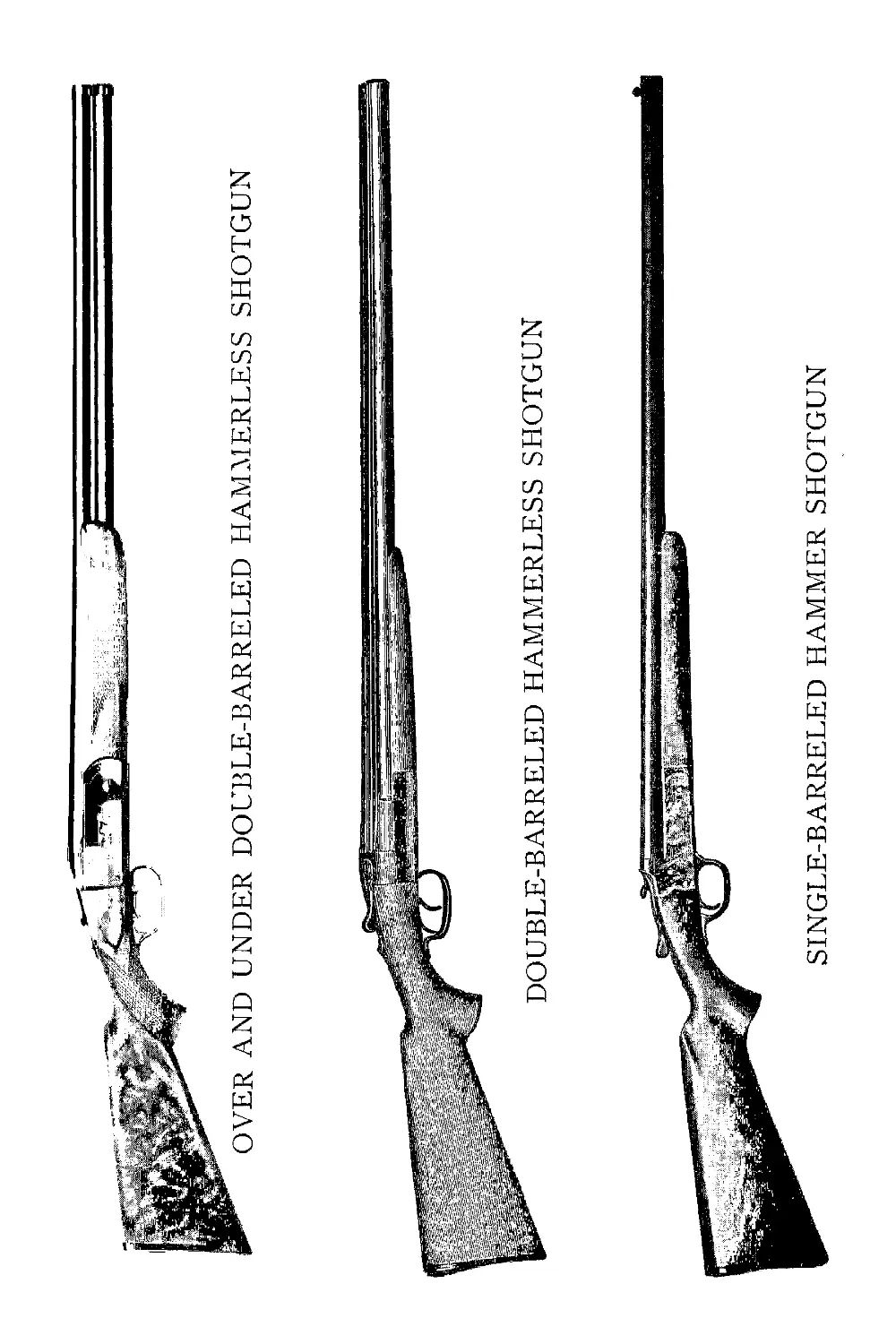

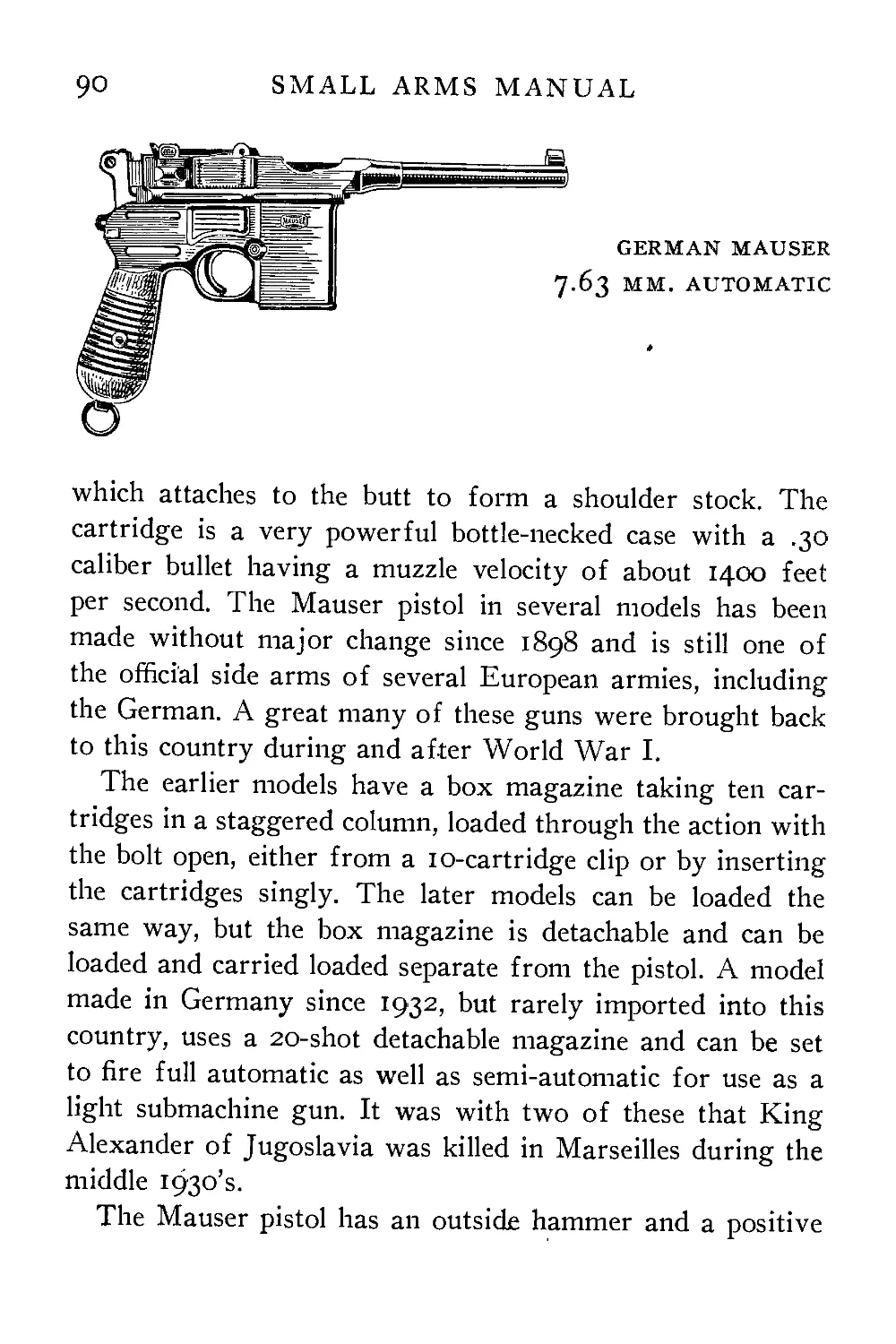
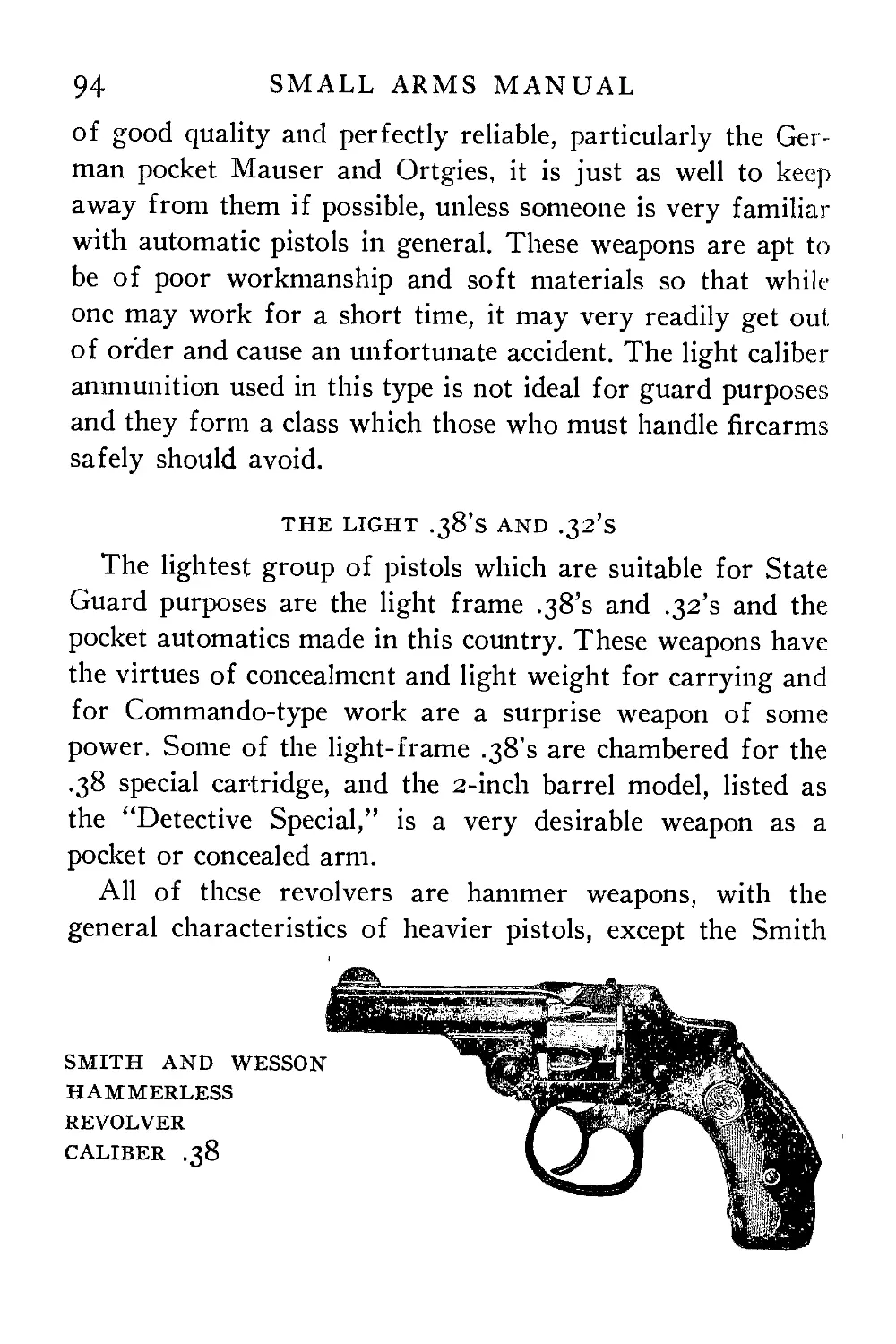
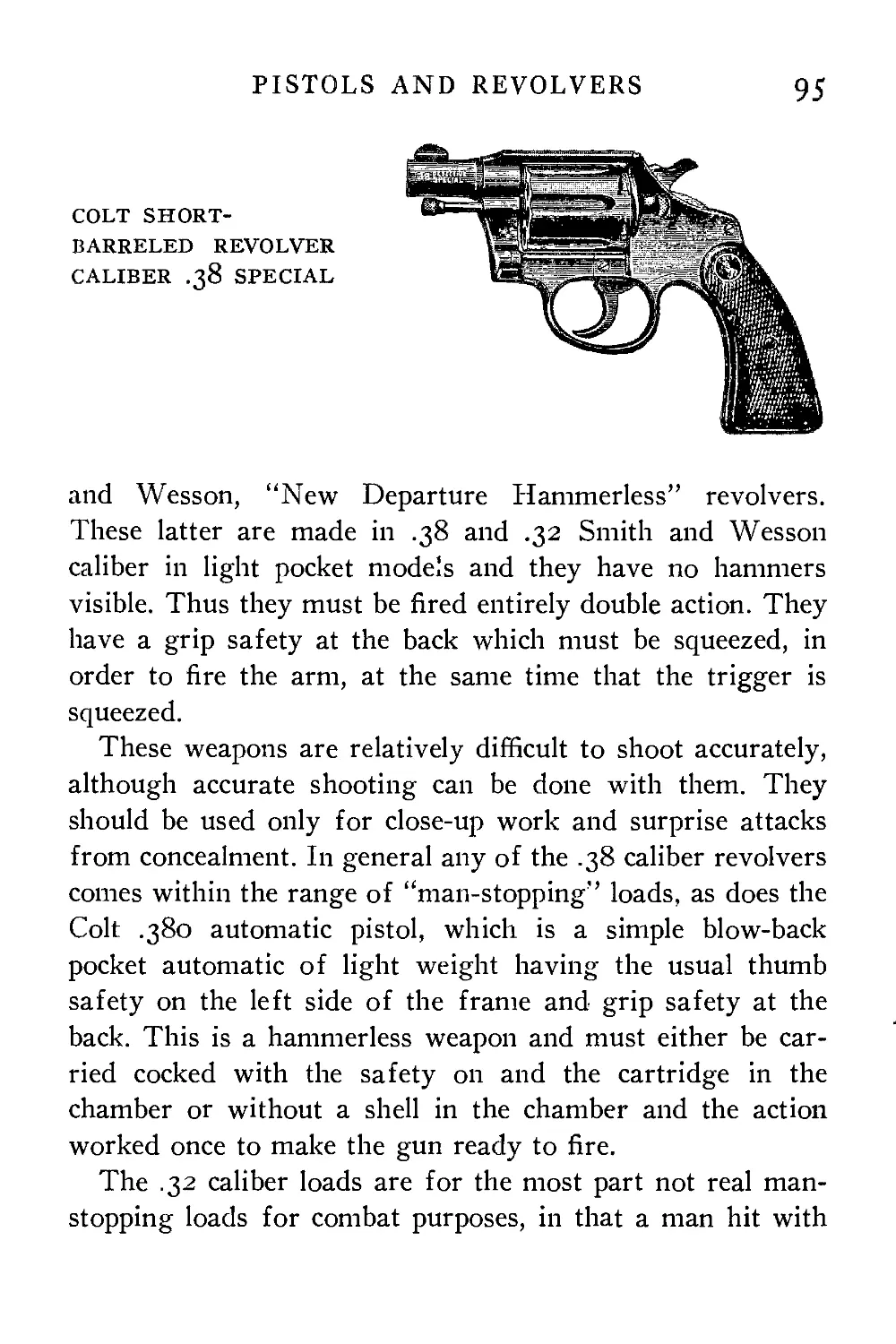
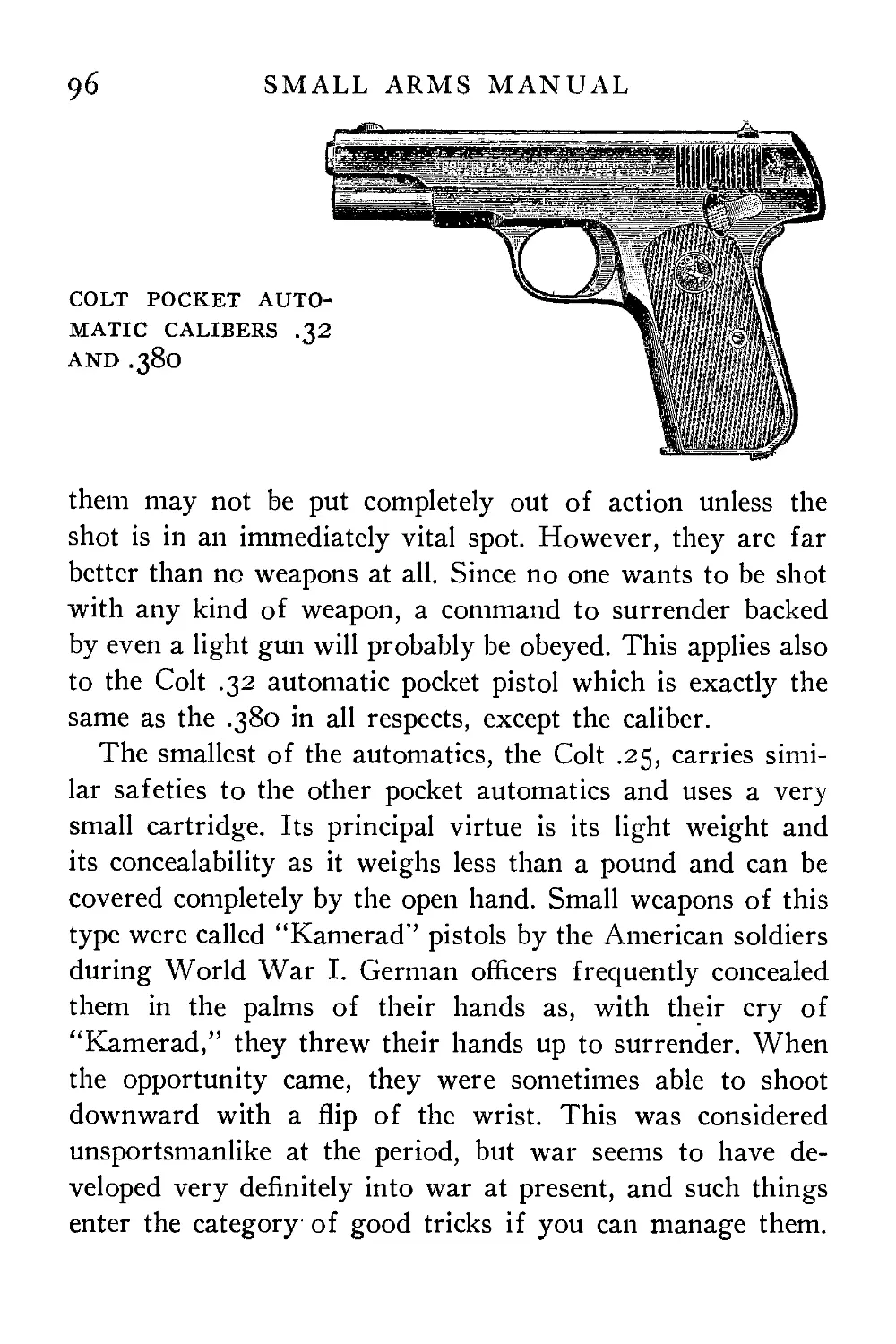

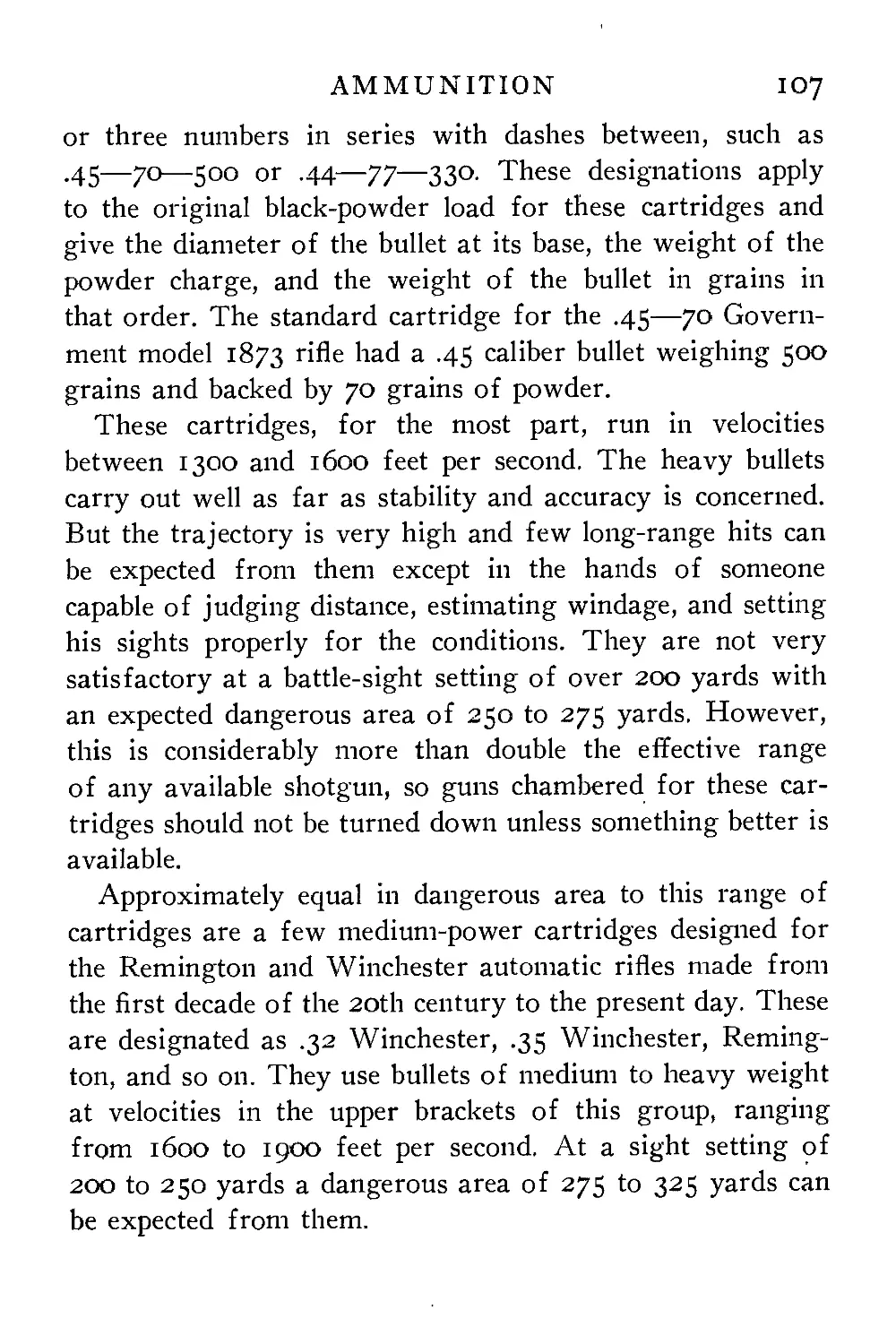
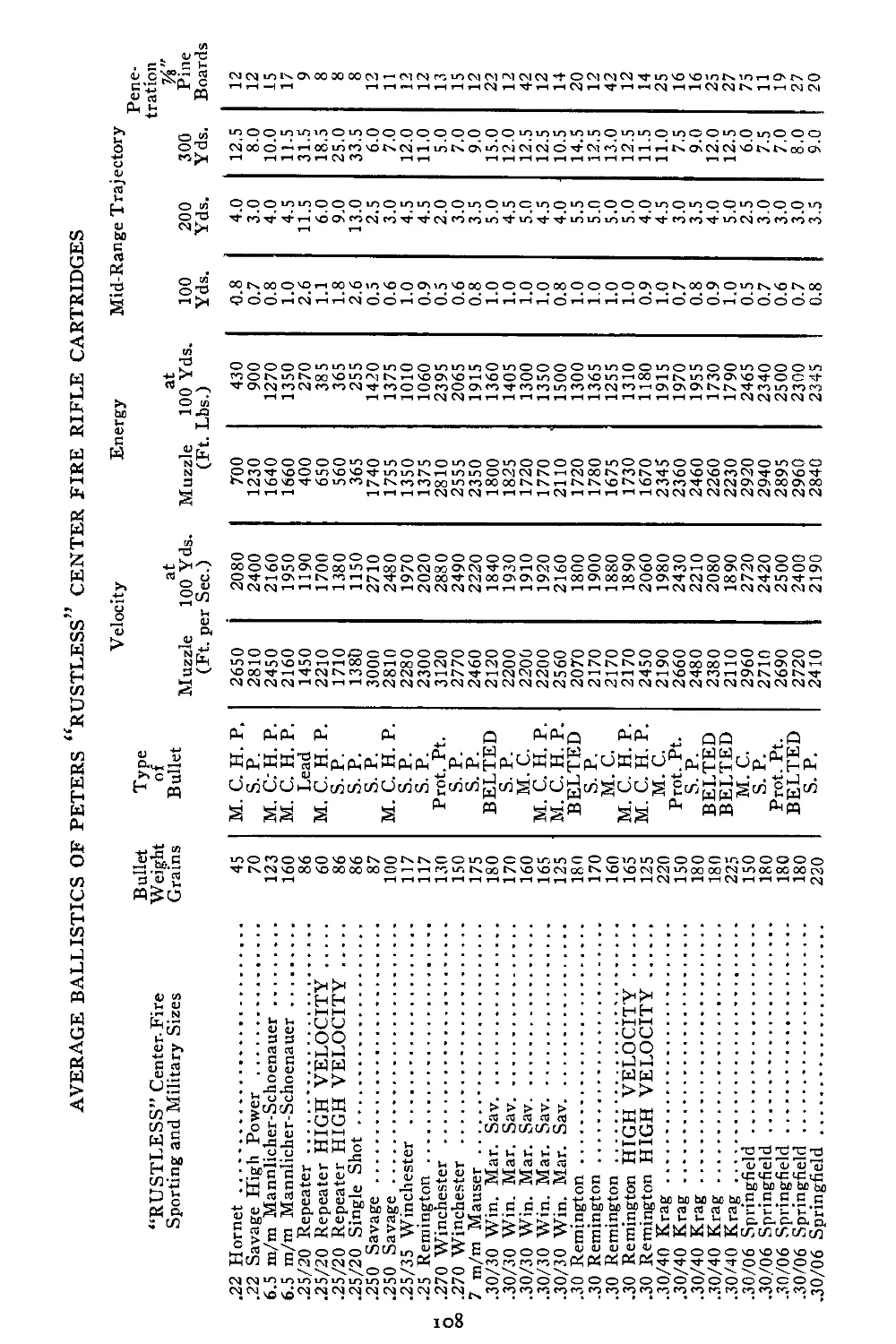
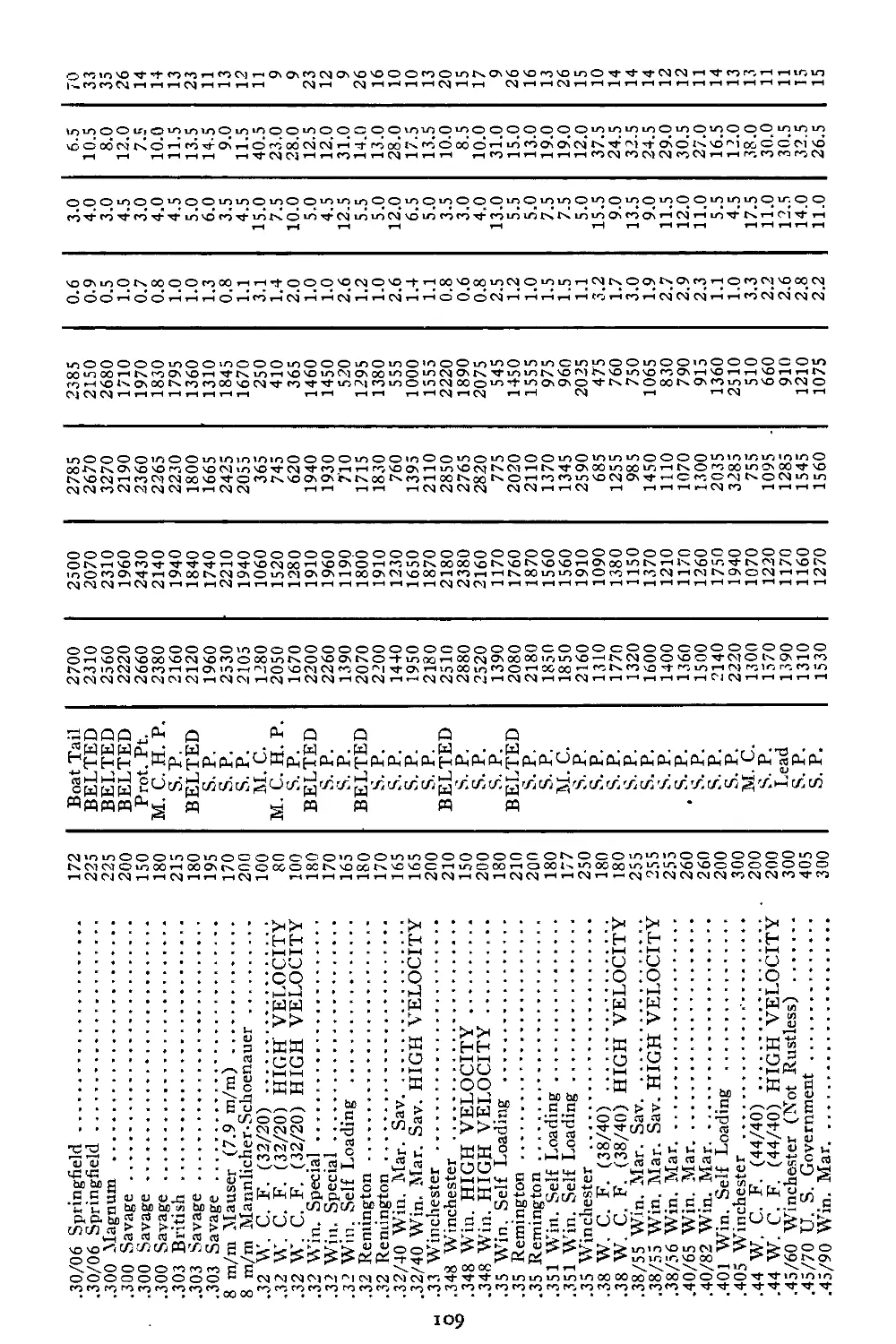
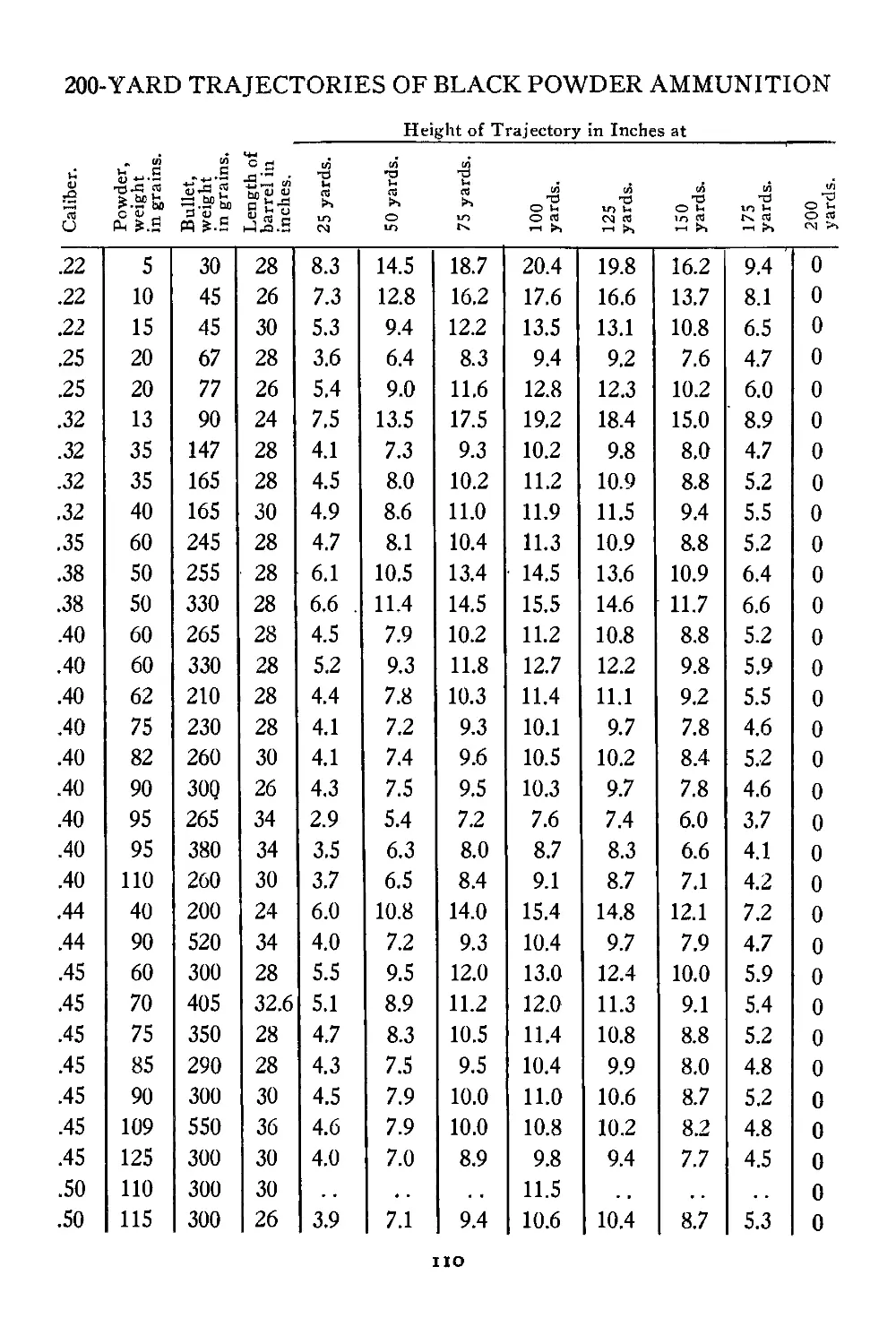
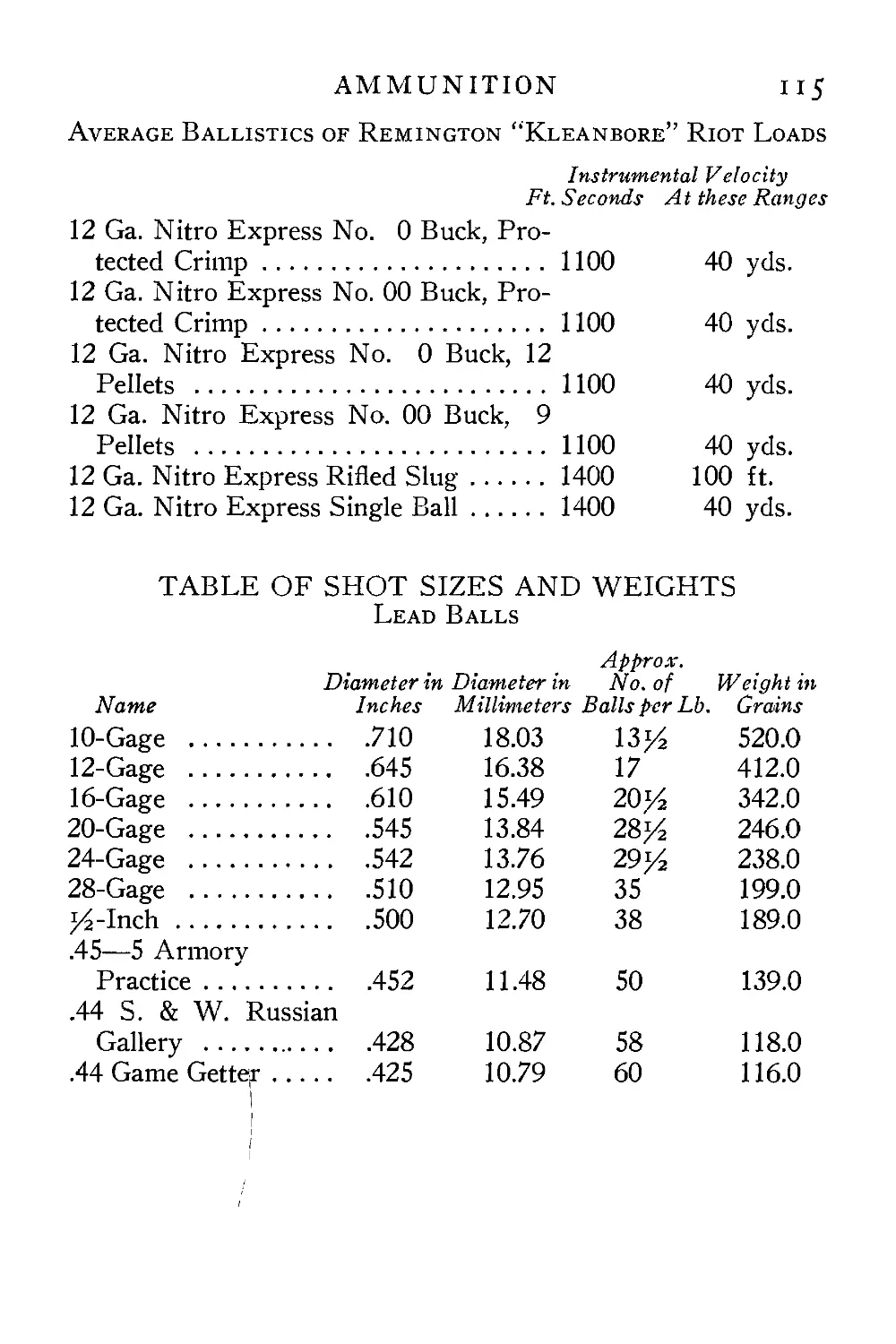
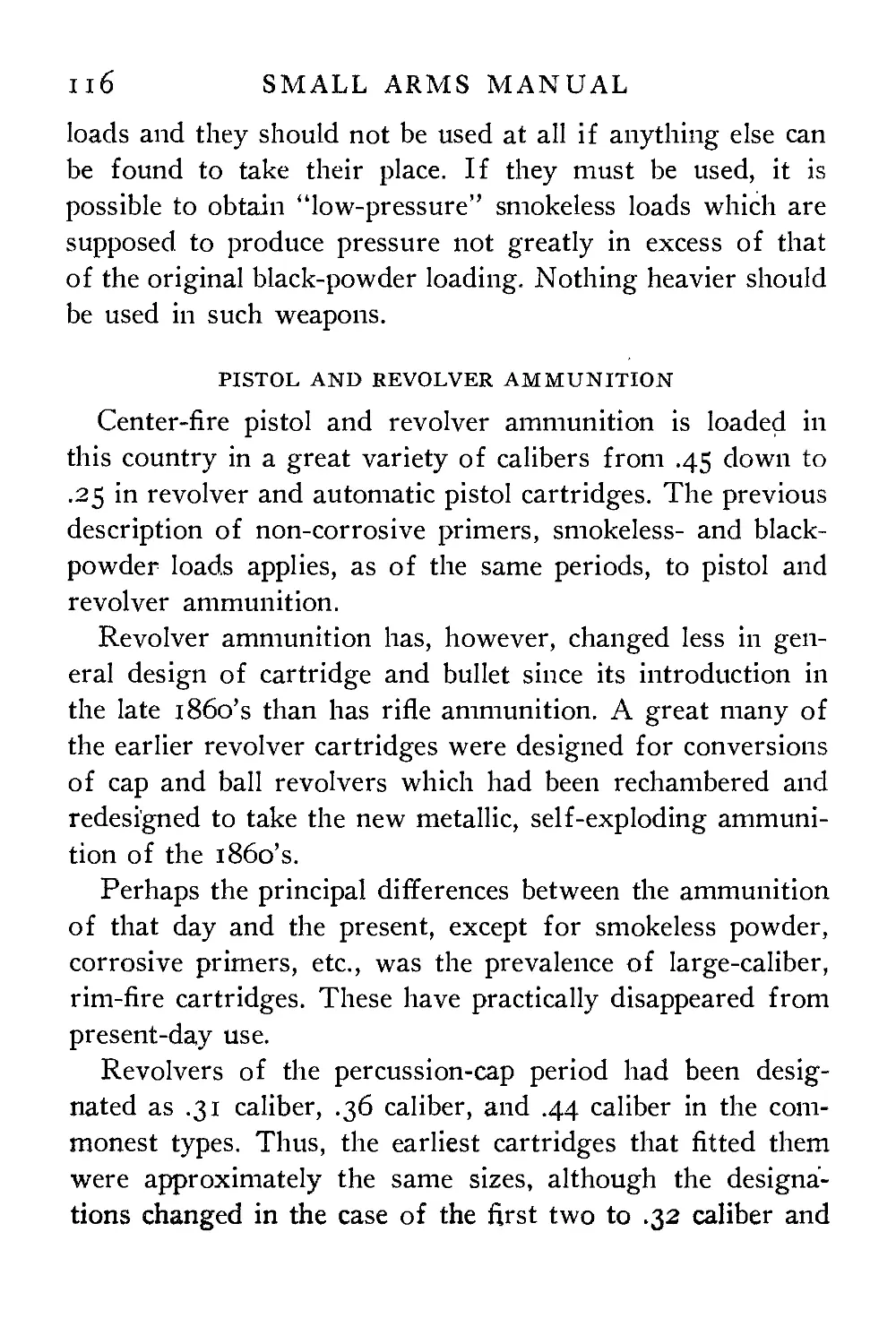
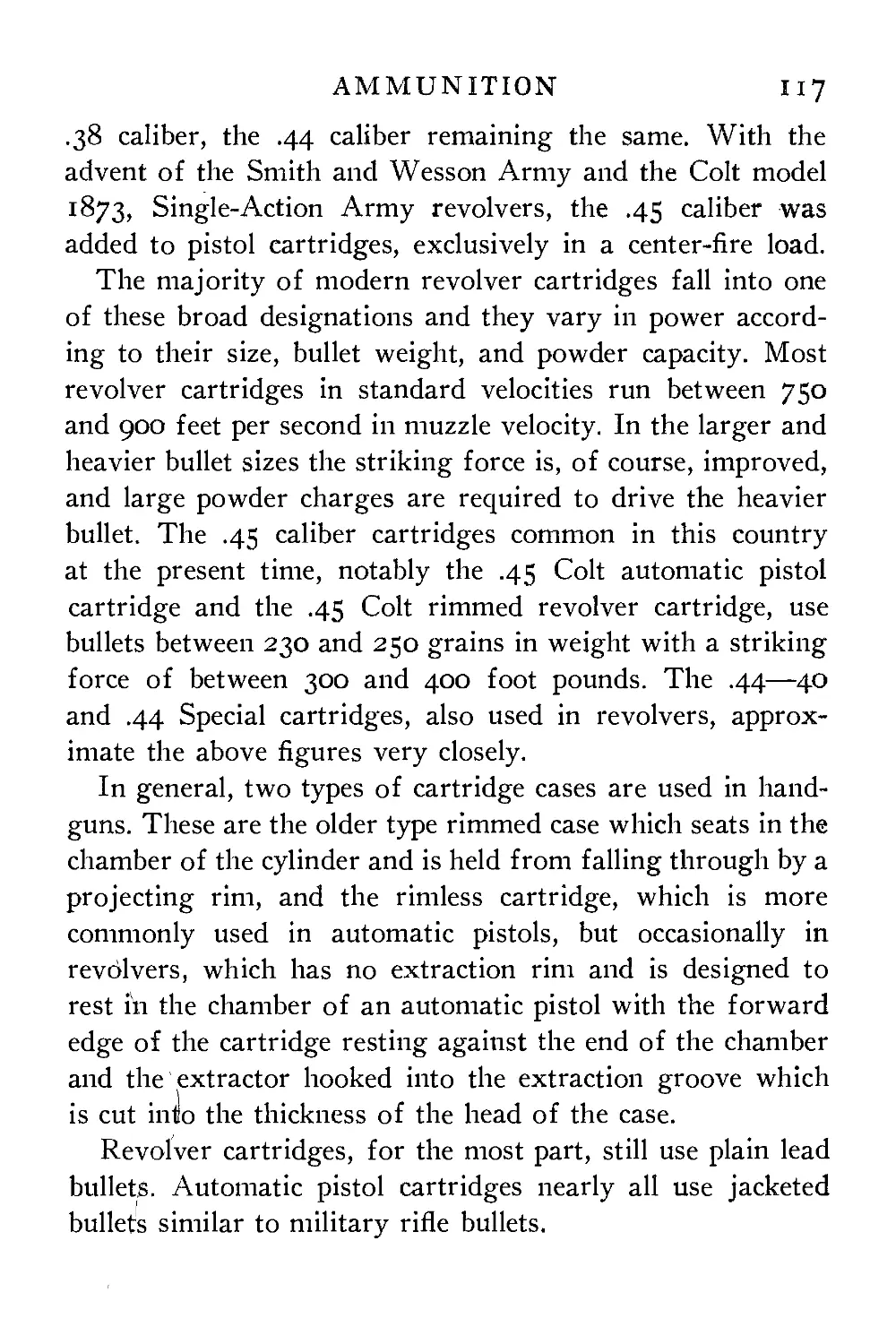
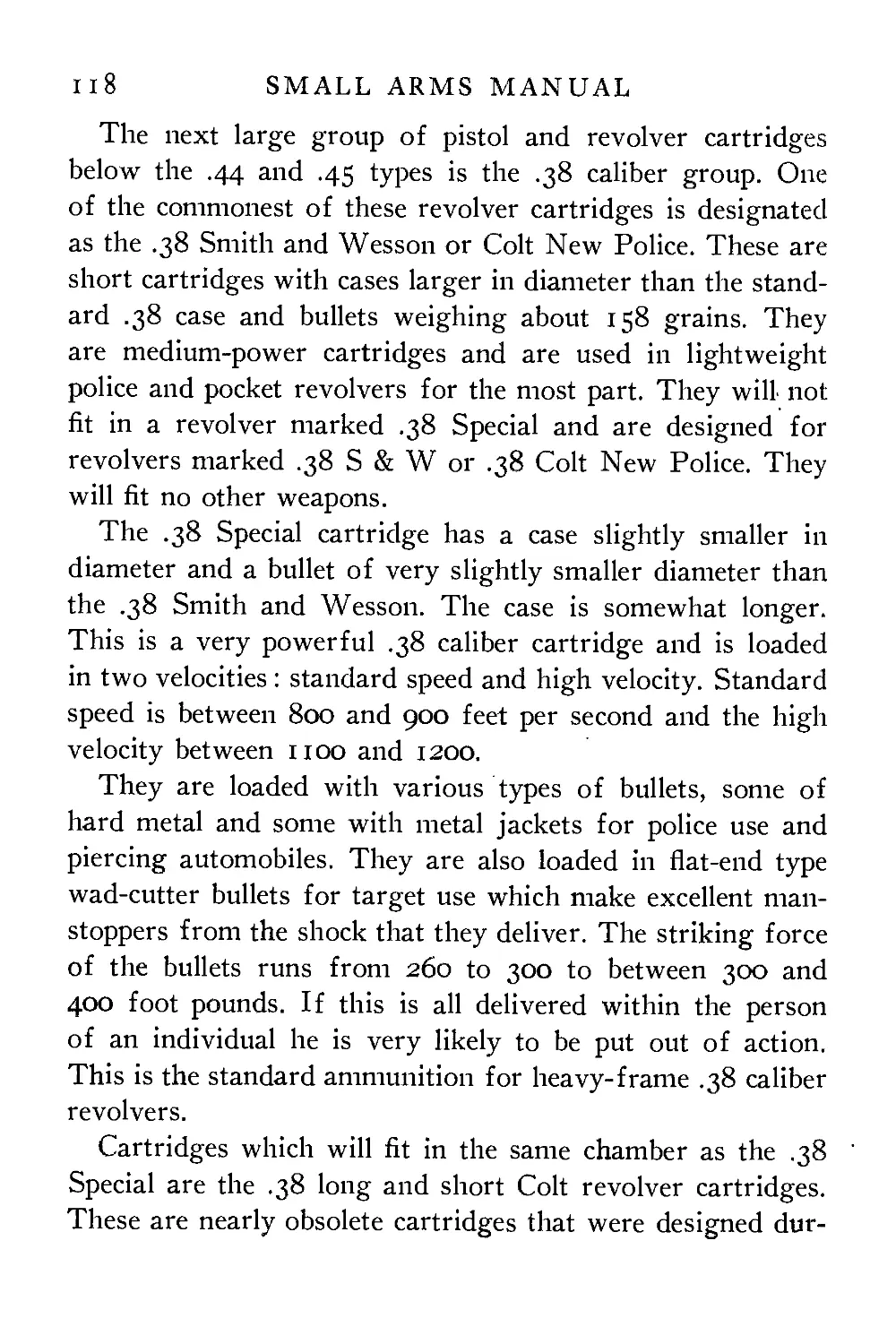

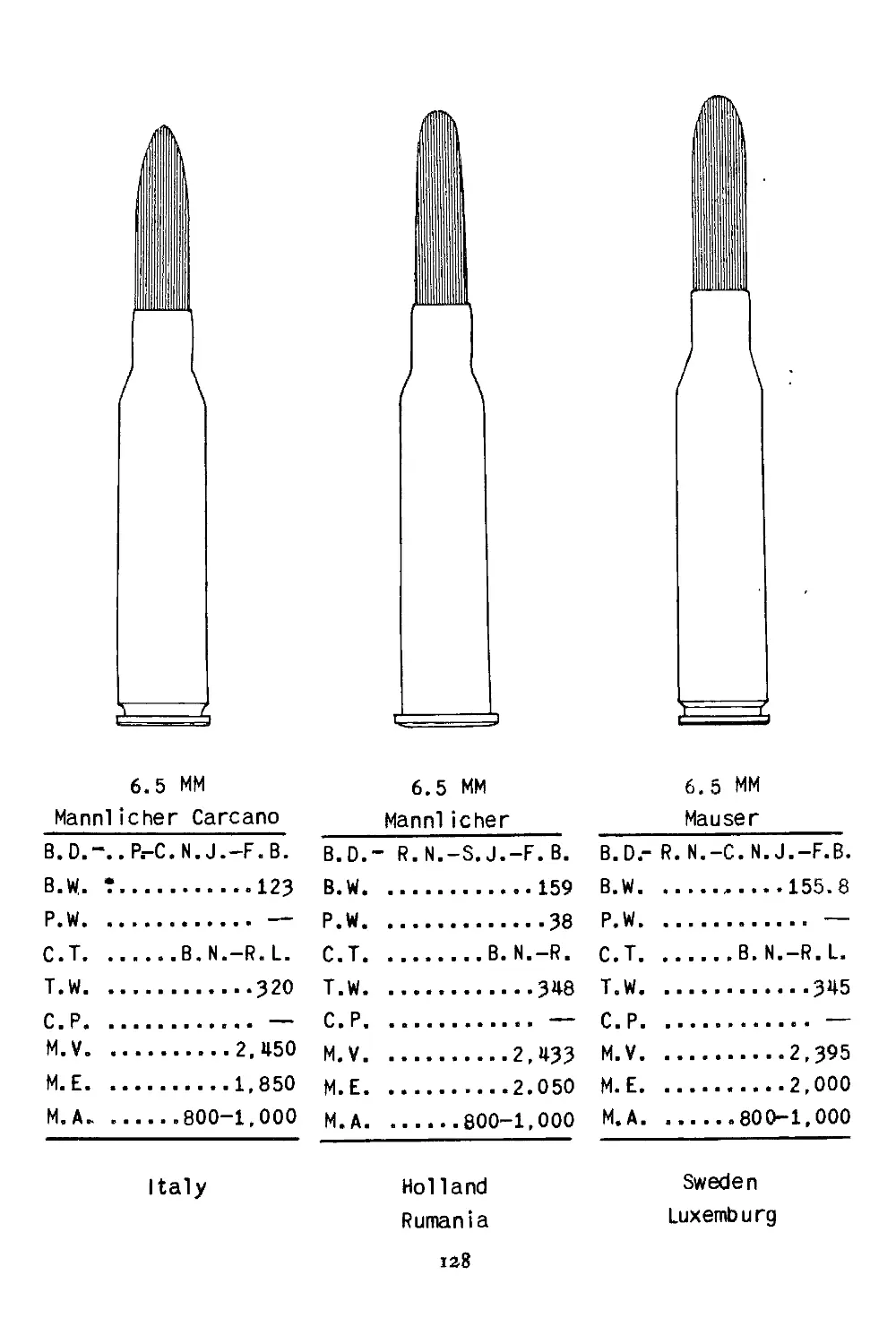
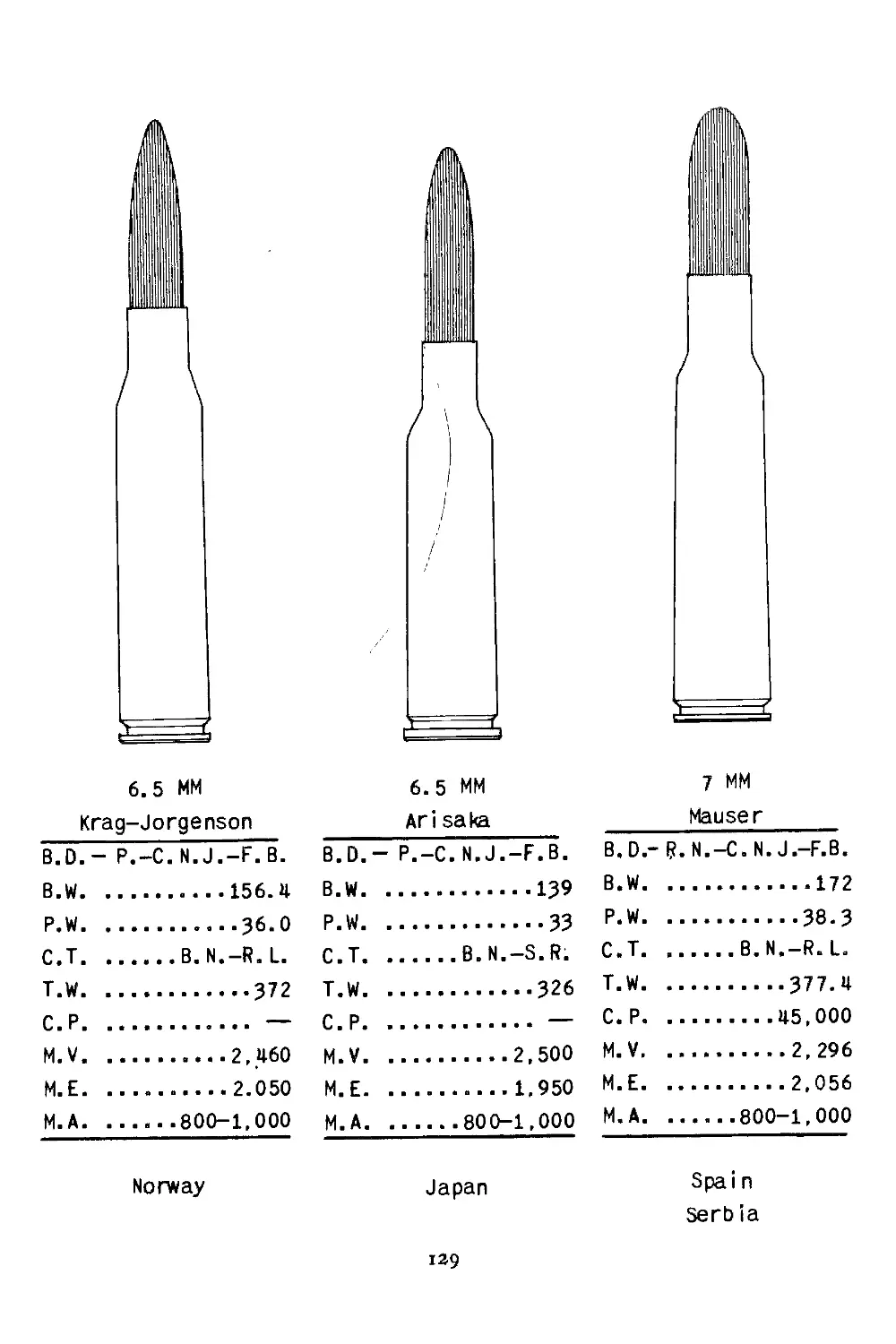
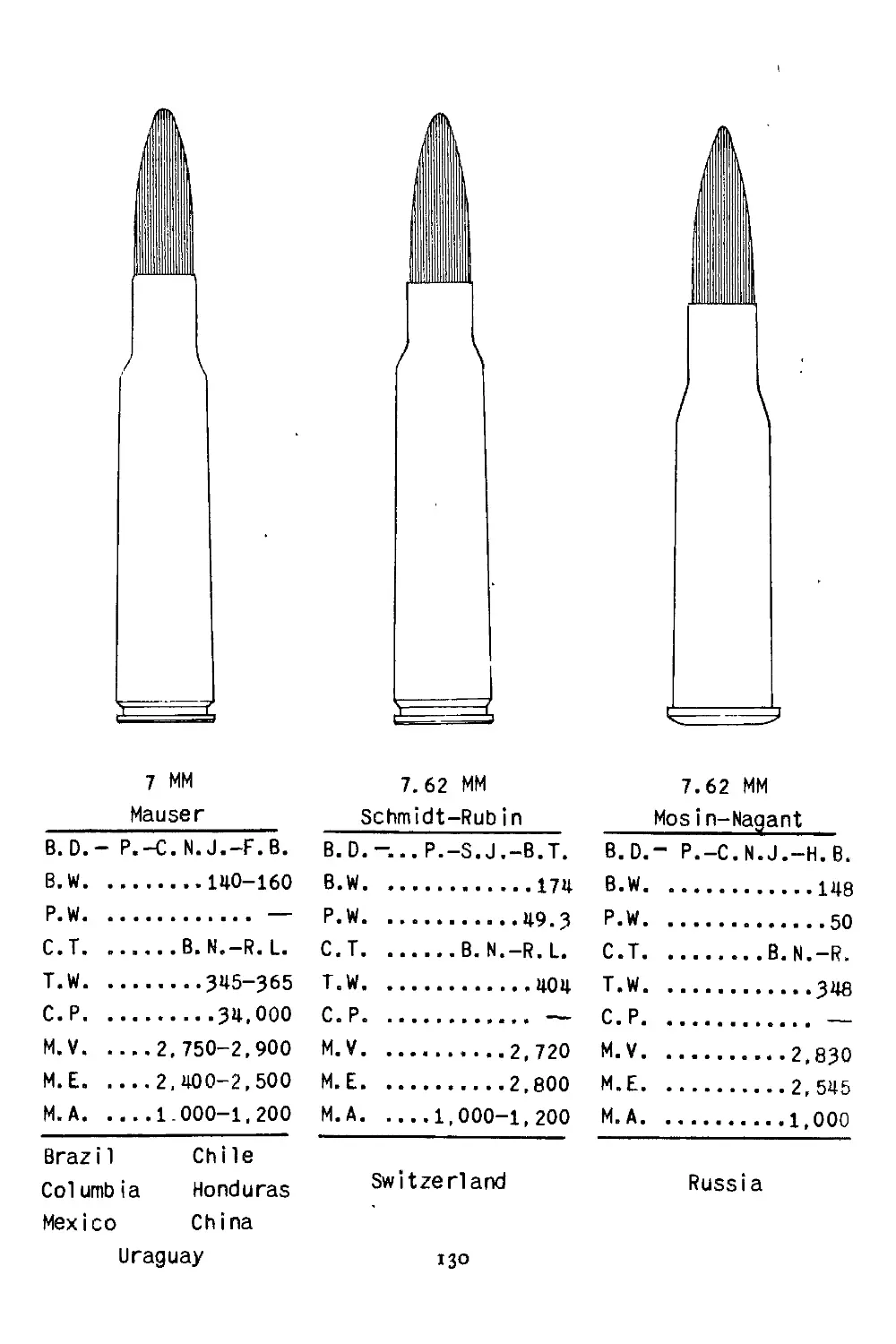
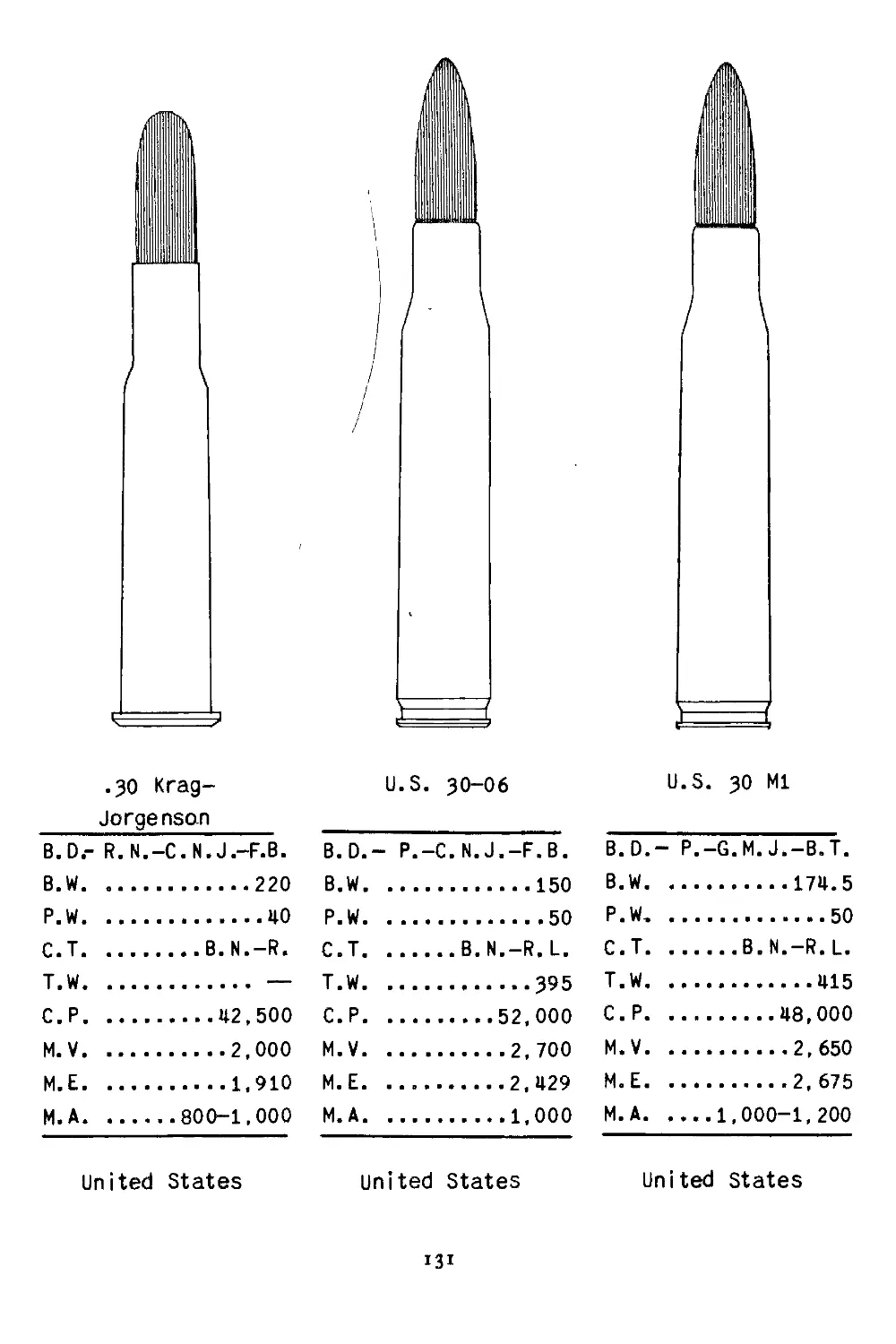




Текст
                    A Comprehensive
SMALL ARMS MANUAL
for
State Guards • Regular Police Departments
Auxiliary Police Departments • Coast Guard Auxiliaries
Plant Guards and Civilians
By CHARLES T. HAVEN
Co-author of A HISTORY OF THE COLT REVOLVER,
AUTOMATIC ARMS, FOR PERMANENT VICTORY
NEW YORK 1 943
William Morrow & Co.
ACKNOWLEDGMENT
I wish to thank Johnson Automatics, Incorporated, in which
firm I am employed as Technical Assistant, for permission
to reproduce illustrations from the Military Ammunition
Chart published by the Company, and also for the use of
the Company’s technical library and other facilities.
Published, January 1943
Second Printing January 1943
All rights reserved
This book, or parts thereof, must not be reproduced
in any form without permission of the publisher.
copyright 1943
BY CHARLES T. HAVEN
PRINTED IN THE UNITED STATES OF AMERICA
CONTENTS
PREFACE		5
I.	PROBLEMS AND POSSIBILITIES	7
II.	GENERAL INSTRUCTION Safety Measures, Shooting Instruction.	19
III.	MILITARY TYPE RIFLES General Characteristics, The Springfield 1903 and Mauser Rifles, The U. S. Rifle Model 1917, Mannlicher Rifles, The S.M.L-E., The Krag- Jorgensen, The Russian Remington, The Lebel, The .45-70, Model 1873, The Vetterli, The Sharps and Remington, The Martini-Henry.	26
IV.	SPORTING RIFLES Heavy Bolt-Action Types, Medium Bolt-Action Rifles, Lever and Slide Actions, The Winchester ’95 and Savage ’99, Remington Slide Actions, Semi-Automatic Rifles, Single-Shot Rifles.	44
V.	SHOTGUNS Issue Types-Single Barrel, Issue Types-Double Barrel, Riot Guns, Automatics, Lever Actions, Trap Guns, Damascus Barrels, Loads.	57
з
4
CONTENTS
VI.	SUBMACHINE GUNS The Thompson Gun, The H and R Reising Gun.	70
VII.	PISTOLS AND REVOLVERS The .45 Auto, The Model 1917 Revolver, .44’s and .45’s, The Heavy .38’s, The .357 Magnum, The .38 Automatics, Foreign Automatics, The Mauser, The Luger, Pocket Models, The Light .38’s and .32’s, Revolver Instruction.	8l
VIII.	AMMUNITION General, Rifle Ammunition, Shotgun Ammuni- tion, Pistol and Revolver Ammunition, Military Ammunition.	IOI
IX.	KNIVES AND ROUGH AND TUMBLE Knife Fencing, Guards, Attacks, Available Types of Edged Weapons, Rough and Tumble, The Garrote.	I36
X.	GENERAL FIREARMS TACTICS	151
	BIBLIOGRAPHY	156
PREFACE
we are engaged in an “all out” war. Not only are there
actual battle fronts all over the world but this war is one that
reaches into the homes of all of us. American soldiers are
now fighting the forces of the Axis on many foreign fronts
in order that our way of life may continue. Still more
Americans are staying at home to produce the sinews of war
for the fighting men who need them so badly and know how
Io use them so effectively.
We, the stay-at-homes, have, however, the added problem
of guarding our homes and those of our countrymen fight-
ing overseas while the regular armed forces are away.
The saboteur, the rioter, the possible invader, must be
met and conquered in this country without impairing the
effectiveness of our overseas forces. For this purpose State
(luards and other local protective units have been organized.
With the thought that a general knowledge of all avail-
able small arms, their effectiveness and use, and an under-
standing of methods of training in the proper utilization of
them may help to carry out the aims of State Guard and
other local defense organizations, this manual has been writ-
ten. It is largely composed of material used by the author in
lectures to State Guard units and the answers to questions
asked in the course of those talks. He hopes it will answer
the questions of many State Guardsmen whom he cannot
reach personally.
5
6
PREFACE
While this manual has been written with the State Guard
primarily in mind, it is designed to bring together and
correlate such information on all types of firearms as is
necessary for intelligent and efficient handling of them by
any local defensive units. Relatively little detailed reference
has been made to strictly modern military weapons, as the
training manuals covering them are readily available, and
this work is not intended, to duplicate easily obtainable
material.
As it covers mainly the “civilian’’ or “peace officer” type
of arms, police officers, auxiliary police, Coast Guard auxil-
iaries, auxiliary firemen, plant guards and civilians who
have occasion to use firearms should find in it much of inter-
est and value.
References throughout are to State Guards and State-
guardsmen as they will form the largest individual group of
users under present circumstances, but a large part of the
material included will apply to any organization whose duties
include defending our communities from attack or main-
taining the civil peace.
As President Wilson said during the last war, “We are
confronted with facts and not theory.” We must take what
we have, both in men and equipment, and get the most and
the best out of it. Several months’ study of this manual will
not make a man the winner of the Wimbledon Long Range
Target Match, Pistol Champion of the United States, or an
Olympic Team Fencer, but it is sincerely hoped that a few
days’ study will give him a better knowledge and ability
to use whatever equipment he may obtain under present
circumstances for the defense of the community in which
he lives.
Chapter i
PROBLEMS AND POSSIBILITIES
state guards and similar organizations under present condi-
tions may, to a certain extent, be classed among the orphans
of war.
They have taken the place of the National Guard which
is now a part of the regular army. They are made up, for
(he most part, of men exempted for one reason or another
from regular military service. They must be recruited from
the ranks of men whose regular business occupies a large
percentage of their time, men who, in most cases, have
had no previous military experience. They must compete for
membership with all the other defense organizations which
are so necessary at the present time, such as the air-raid
wardens, Red Cross, auxiliary police, etc.
Although the conditions which confront State Guard units
necessarily vary from state to state and community to com-
munity, their duties may run all the way from police-type
guard work and the control of civil disturbance to actual
battle with military invasion forces.
Thus the State Guardsman may never have to do anything
more than sit up all night and listen to the frogs in the local
reservoir. But he certainly should be able to cope with riots
firmly enough to prevent unnecessary bloodshed or meet an
invader in a delaying action with sufficient knowledge of
7
8
SMALL ARMS MANUAL
guerrilla or Commando-type tactics and sufficient arms and
training in the use of them to hold the invader to a minimum
advance until additional force can be brought to bear.
To all these problems is added the further one, that the
great majority of weapons of the best and latest military
types in this country must go to the soldiers of the United
Nations who are engaged in or training for actual battle on
the various battle fronts of the world. And with those
weapons must go most of the ammunition available or being
manufactured for them.
While the arms manufacturers of America are doing a
colossal production job, there is still no surplus of most
military small arms for the, at present, less important work
of local defense groups. Nor is there any surplus of ammu-
nition for either practice or regular supply for these groups.
This situation may improve if production meets and sur-
passes requirements, but in the meantime need for equip-
ment may arise. The Government is meeting the situation
by the issue to State Guard troops of 12-gage shotguns
of various types and a small number of two types of sub-
machine guns manufactured in this country, accompanied
by limited supplies of shotgun cartridges loaded with 00
buckshot and .45 caliber automatic pistol cartridges for the
submachine guns.
This equipment presumes that most State Guard activity
will be in connection with civil disturbances, plant riots,
street fighting in towns and cities and similar types of
engagement where short-range weapons like shotguns and
submachine guns are most effective.
It is always possible, however, that a State Guard unit
PROBLEMS AND POSSIBILITIES	9
may be faced with a situation in which a shotgun or a lim-
ited-range submachine gun is not the ideal answer. For this
reason, if for no other, it seems desirable to attempt to bor-
row or acquire, by every possible means, all rifles of reason-
able power and any additional shotguns of better quality or
greater capacity than those issued by the Government. Many
State Guard organizations are now doing this. Aside from
the benefit accruing to the individual unit which follows this
policy, there is a larger reason. Weapons so borrowed will
replace issued weapons and allow the issued weapons to go
to less fortunate State Guard companies which are unable
to borrow weapons from their local communities.
In general it may be said that the American citizen, and
especially the rural American citizen, has always owned and
used sporting firearms. Hunting, in one form or another,
is probably more popular in America than it is in any
country in the world, and hunting is perforce done with
lirearms which are as capable of killing enemy soldiers as
they are of killing game birds and beasts. The average State
(Iuard unit in a rural, semi-rural or suburban community
lias, therefore, a very good chance of borrowing sufficient
weapons to arm itself completely.
A further source of weapons available at the present time
are those left over from World War I. Frequently these are
in the hands of veterans now too old to fight again, men who
arc, in many cases, members of the present State Guard or
wholeheartedly in support of it. The average American
Legion Post has a number of military rifles of some type,
and individual members of the post or individuals through-
out the town may have World War I rifles brought home
or acquired as relics which are still far from the relic stage
10	SMALL ARMS MANUAL
as far as practical shooting is concerned. Old ammunition
is better than no ammunition, especially for practice, and a
surprising amount of it may be located by a careful search.
In general, the small arms equipment to find for State
Guard use, in the order of its desirability, is as follows:
I.	United States military rifles of World War I. There
are two of these: the Springfield rifle, model 1903, and the
United States rifle, model 1917, commonly called the Enfield.
These rifles are still being used in World War II, but some
individuals may own them or they may be part of Legion
equipment and be available for State Guard use.
2.	Heavy bolt-action sporting rifles chambered for the
standard Government .30—06 ammunition. Such weapons
are equal in every respect and in some cases superior to the
standard military rifles of the present day.
3.	Modern foreign military rifles such as the German
7.9 mm. Mauser, or the British Enfield, caliber .303. These
again may be held as souvenirs of the last war and may
well be in good condition, although a trifle rusted from
hanging on the wall. If ammunition is available, they make
very satisfactory weapons and, of course, are still in use
throughout Europe.
4.	Another United States rifle which during World War
I was in the hands of many State Guard organizations is
the Krag-Jorgensen, models 1892 to 1898, or, as it is
commonly called, the “.30 Army.” This rifle uses a rimmed
cartridge of somewhat less power than the present .30—06,
but is very effective at ranges of 600 yards or less. These
were commonly sold throughout the country twenty-odd
years ago for three or four dollars apiece, and many of
them are still around, some altered to sporting rifles and
PROBLEMS AND POSSIBILITIES II
others in their original military form. They are very de-
sirable for State Guard use under the present circumstances.
5.	Hunting rifles of medium or high power. There are
a great many rifles in the deer-hunting class in both bolt-
and lever-action models using cartridges having an effective
range between 300 and 700 yards. There are also several
automatic rifles of medium power that have been made for
li tinting purposes for the last thirty-odd years which are
very effective. These various types of rifles in non-United
States military calibers run from such popular hunting
cartridges as the .270 Winchester, .250—3000 Savage, .348
Winchester, down to the older hunting cartridges, .38—40,
and .44—40, or the automatic rifle cartridges, .30, .32, .35,
351 auto, etc. They will all increase the range of the activ-
ities of a company far beyond the possibilities of a shotgun
lor accurate fire.
6.	While it is an obsolete weapon, as far as any regular
military use is concerned, the old .45—70 Springfield single-
Jiot United States rifle, in use from 1873 to the time of the
Spanish-American War, is still an effective weapon. It had
in its day, a range of nearly 1000 yards. The 500-grain
bullet backed by 70 grains of powder, while it was slow
.ind the trajectory was high, was an effective man-stopping
hiad at extremely long ranges. It was also reasonably accu-
i.ilc, if the range was known. The .45—70 was standard
issue for State Guards in World War I.
In this same class are also the various foreign military
lilies of the same period, always assuming there is some
.inmiunition to go with them. Among them may be men-
Imiied the Swiss Vetterli, which is fairly common in this
loiintry in a .41 caliber rim-fire, repeating type, the English
12	SMALL ARMS MANUAL
Martini-Henry .577—450, and the German model 1871
single-shot 1 г mm. bolt-action Mauser rifle.
7.	This class would include any single-shot sporting or
target rifle of the past fifty or sixty years which is in good
enough condition to shoot and of an effective caliber to give
reasonable range. There were many of these single-shot
hunting rifles made up to and including the late nineties in
calibers from .32—20 to .45—70 and .45—90, which make
very effective weapons today.
Most of the shotguns issued to State Guard units are
either single- or double-barreled guns of medium quality
and 12 gage, so that the search should also endeavor to
bring to light any shotgun better adapted to military use
than the issued weapon. There are a number of types of
repeating and automatic shotguns which have been fairly
popular and common in this country for many years. Any
one of these is better than a single- or double-barreled gun
for military use for a number of reasons. Double-barreled
guns of better grade will probably be easier to use, more
completely broken in and consequently more desirable than
issued guns—as well as having the virtue of releasing issued
guns for other uses.
Shotguns of other than 12 gage are perfectly practicable
to use if there is any heavy loaded ammunition available.
Sixteen- and 20-gage guns will take a fairly heavy load of
shot somewhat smaller than buckshot and can be used
effectively. Ten-gage guns, if buckshot cartridges are avail-
able, are more powerful than 12 gage but they also kick and
weigh more. Wherever possible stick to 12-gage guns, but
in the case of particularly good weapons, don’t turn down
PROBLEMS AND POSSIBILITIES 13
one in a gage approaching 12, as all these guns are reason-
ably effective.
The same search should be made for sufficient pistols and
revolvers to arm noncommissioned officers, and, if it is
deemed advisable to plan on something approaching Com-
mando or guerrilla tactics, it would not be amiss for every
man in the company to have, and be familiar with, a hand
or belt gun in case he was in a position where he could not
use his rifle. Here again handguns may be divided into
classes by their desirability.
First, of course, comes the .45 automatic pistol, U. S.
Government model 1911, which is the official side arm of the
United States forces. These are also relic weapons of
World War I and may often be found in the hands of
returned soldiers as may, also, many foreign military pis-
tols such as the 9 mm. Mauser and Luger of the Germans,
and occasionally a 9 mm. Austrian Steyr-Mannlicher. These
are all powerful automatic pistols, effective and well-made
weapons.
In side-arm class 2 might be placed any Colt or Smith
and Wesson revolver chambered for the .45 automatic
pistol cartridge. Both of these revolvers were made at the
time of World War I and listed as U. S. revolvers, caliber
.45, model 1917.
Side-arm class 3 would include all other Colt or Smith
and Wesson revolvers chambered for cartridges of .38 spe-
cial caliber or over, up to and including the standard .45
Colt revolver cartridge as distinct from the automatic pistol
cartridge. Both Colt and Smith and Wesson have made
revolver models for the last fifty-odd years which are satis-
U
SMALL ARMS MANUAL
factory and fall into this class. These include the Colt single-
action Army model 1873 which has been manufactured with
but little change since that date to the present.
Several military model .38 caliber and a number of mili-
tary model .44 caliber revolvers have been made by both
companies. In this class also should be placed the various
model Colt automatic pistols of military type and .38 cali-
ber which were made between 1900 and 1928 but never used
as military weapons in this country although the cartridges
were powerful ones. Also the Colt Super .38 automatic.
In class 4, among side arms, would fall the lighter frame
Colt aijd Smith and Wesson revolvers of .38 caliber new
police, .32 caliber and the Colt pocket automatics in .32
and .380 caliber. This last group of definitely light weapons,
except for concealment or pocket use, should give way to
any weapon in the heavier category that can be obtained.
However, they will all do an effective job under reasonable
conditions and should by no means be turned down if noth-
ing more powerful is obtainable.
Insofar as possible it is advisable to stick to Colt and
Smith and Wesson arms as far as pistols and revolvers
made in this country are concerned. Other good revolvers
have been made here, but there are many poorer quality
weapons also. Anything made by Colt or Smith and Wes-
son is sure to be good and very reliable.
Ammunition for all small arms should be sought after as
eagerly as the weapons themselves. There are a number of
ways of augmenting issued supplies. The standard military
load for shotgun shells, as issued, is 00 buckshot. But a
canvass of the average town will turn up a considerable
quantity of 12-gage shotgun shells loaded with all sizes and
PROBLEMS AND POSSIBILITIES
IS
types of shot. These should be sorted and the heavier shot
irtained for close-range riot work. It is still possible to
obtain buckshot from some of the larger lead companies,
.ind with it, any 12-gage cartridge can be very readily
converted to a buckshot load. It is only necessary to unfold
I lie crimp of the shell, lift out the wad, shake out the
.'.mall shot, replace it with nine 00 buckshot, and put the
wad back into place. The crimp of the shell can be turned
in by hand or a standard shotgun crimping tool may be
lound somewhere in town which will handle a great many
shells in the course of an evening.
It is also advisable to try to get at least a limited
supply of cartridges for every rifle or pistol that is bor-
rowed. Never turn a rifle down for lack of ammunition
until you are sure that none can be obtained from any other
source. But try to get ammunition with a gun whenever
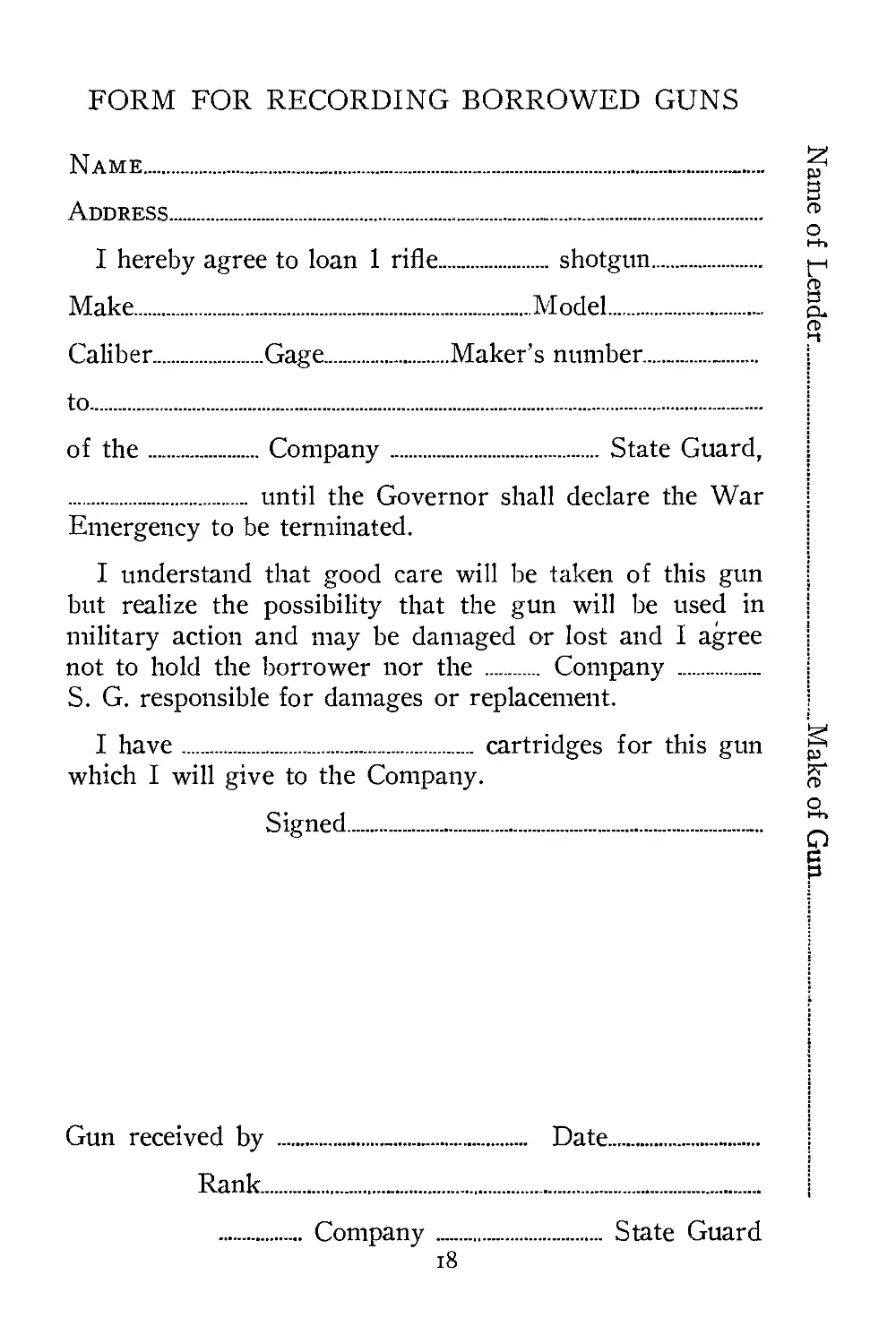
possible. We give herewith a reproduction of a form letter
sent out by one State Guard company asking the citizens of
its town to lend rifles, and a form of receipt and acceptance
lor rifles and ammunition received which another company
is using at the present time.
Assuming that everyone has made his best effort to obtain
any and all suitable weapons, we will now consider that our
State Guard company has in its ranks the single- and double-
shotguns and Thompson or Reising submachine guns issued
to it by the State, a few rifles of good military type (Spring-
field, Model 1917, etc.) a scattering of rifles of the various
other types mentioned, plus a number of shotguns of better
grade or cartridge capacity than the standard issue, and
enough pistols and revolvers for arming the officers, non-
coms and special weapons squad. A number of problems
l6	SMALL ARMS MANUAL
then arise. What shall the company do with them? What
are their potentialities in range and accuracy? How can
careful and efficient users of firearms be made out of men
who have been plumbers and bank presidents? And how—
above all—be sure that no accident occurs in the course of
training, guard duty or maneuvers?
THIS LETTER HAS BEEN USED IN
SOLICITING GUNS
Dear Sir:
You indicated your interest in this organization when it was
formed early in 1941. For a year and one-half the Unit has
trained faithfully: weekly drills, bi-monthly non-com schools,
Sunday maneuvers, range practice, week-end camps, nightly
guard duty at the Armory, and a tour of active guard duty for
six days after December nth.
We face a situation now in which you can help us again. The
War Department has ordered us to turn in our rifles. In their
place we are being issued Thompson submachine guns and
single- and double-barrel shotguns. It is undoubtedly true that
these weapons may be better than rifles for some missions that
the State Guard might be called upon to perform, but Tommy
guns and shotguns are only effective at a very short range. It
seems imperative, therefore, that we should have some rifles
in the Unit.
Our arms are being sent where they are more urgently needed
at this moment. If the citizens of the town have arms that we
could use, it seems reasonable that they should loan them to us
for the duration.
They will receive the best of care. The soldier is continually
trained in this. We have a patented hot oil bath which removes
all rust and keeps arms in good condition. We cannot of course
give any guarantees, but we hope they may be returned safely
to the lenders when it is over. The loaning of your arms will
not only be a definite contribution to local defense, but will
PROBLEMS AND POSSIBILITIES
17
alleviate to some extent the disappointment to the men in part-
ing with the guns that they have been training with for a year
and one-half. Standing in a closet they benefit no one but
the enemy.
Will you let us know what you have to loan and ask your
friends and neighbors.
The following is what we would like, but let us know about
any equipment that is available.
1—Springfield or Enfield Military Rifles or Hunting Rifles
that will take .30 caliber service ammunition.
2—Hunting Rifle of other caliber if ammunition is available
or can be purchased.
3—Twelve-gage pump shotguns.
4—Revolvers and automatics .32 caliber and over.
5—.22 caliber rifles (for fire control practice).
6—Extra clips for automatic pistols and rifles.
7—Ammunition: The State furnishes us with very little.
Many Units of the Guard are buying their own.
We would welcome contributions to a fund to purchase a
supply to be held in reserve for an emergency. Some of
our members have bought their own, but we can’t ask
them all to.
We also have need for the following:
Field glasses.
Compasses (prismatic or with radiolite markers).
We still need recruits: both as active members and for our
reserves.
It is hoped that others may become sufficiently interested in
this problem to offer to form a committee to help us with it.
Sincerely yours,
FORM FOR RECORDING BORROWED GUNS
Name..................................................
Address...............................................
I hereby agree to loan 1 rifle.......shotgun........
Make.................................Model............
Caliber........Gage..........Maker’s number...........
to....................................................
of the.........Company...................State	Guard,
............... until the Governor shall declare the War
Emergency to be terminated.
I understand that good care will be taken of this gun
but realize the possibility that the gun will be used in
military action and may be damaged or lost and I agree
not to hold the borrower nor the ..... Company	......
S. G. responsible for damages or replacement.
I have....................... cartridges	for this gun
which I will give to the Company.
Signed..................................
Name of Lender..............Make	of Gun.
Gun received by ...............   Date............
Rank.....................................
...... Company.............State	Guard
18
Chapter 2
GENERAL INSTRUCTION
SAFETY MEASURES
state guard companies are in a particularly vulnerable
position in the matter of the safe handling of their firearms.
They are always in and a part of the community where they
live. They must handle their firearms not only in the pres-
ence of each other, but in the presence of their friends and
lellow citizens. They are always in the position of requiring
aids of various sorts from the townspeople and the town
government. It is the worst possible advertising if a firearms
accident occurs in such a company. Men will drop out,
others who would have joined will not, and civic aid that
might readily be given will be withheld, if someone is badly
wounded or killed as a result of carelessness in the handling
of weapons in a place where everyone knows what everyone
else is doing.
The possibility that there will be the need for the effec-
tive use of weapons on an enemy is, of course, always in
the background of the situation. But the obvious fact that
the weapons are being handled in the presence of everyone
in town is always definitely in the foreground. Safety should
come first and training for accuracy second.
Having collected a sufficient assortment of weapons, some
19
20
SMALL ARMS MANUAL
issued and some gathered from any and all sources, the first
thing to do is to make sure that each weapon to be used is,
in itself, safe. In other words, that it is not- of such poor
quality or so badly worn that proper handling of it will
cause an accident merely from some mechanical failure.
There should be at least one member of the community who
is reasonably familiar with firearms of most types. Some-
times local police officers can be of assistance, or if there is
a near-by army post it is always possible to obtain someone
familiar with ordnance for long enough to make an in-
spection.
Assuming that the weapons are adequate and of reason-
able quality and condition, the next thing is to be sure that
every man who is issued a given weapon knows just how it
works—at least to the extent of knowing its safety features.
All teaching should stress first and foremost that the breach
or action of all weapons should be opened whenever possible
when the guns are being handled or inspected. A weapon
with its breech open and its chamber clear cannot go off.
A weapon with its breech closed may be loaded and may
go off.
The individual peculiarities of each type of weapon should
be explained to the man who is to use that weapon, and he
should be made to explain them in turn to the instructor to
make sure that he has understood what he has been told.
It should be stressed that in case of guard duty before fur-
ther training, except under extreme conditions, no cartridges
should be in the chamber of any weapon. Repeating weapons
should be loaded in the magazine, but not in the chamber.
Unless something of a very extreme nature is expected, and
unless the guard is well away from public contact, even a
GENERAL INSTRUCTION
21
single-shot weapon is safer unloaded as it can be loaded
Irom the belt or pocket in a few seconds if it seems neces-
sary. The effective range and the extreme carrying range of
each weapon should be explained thoroughly to the man who
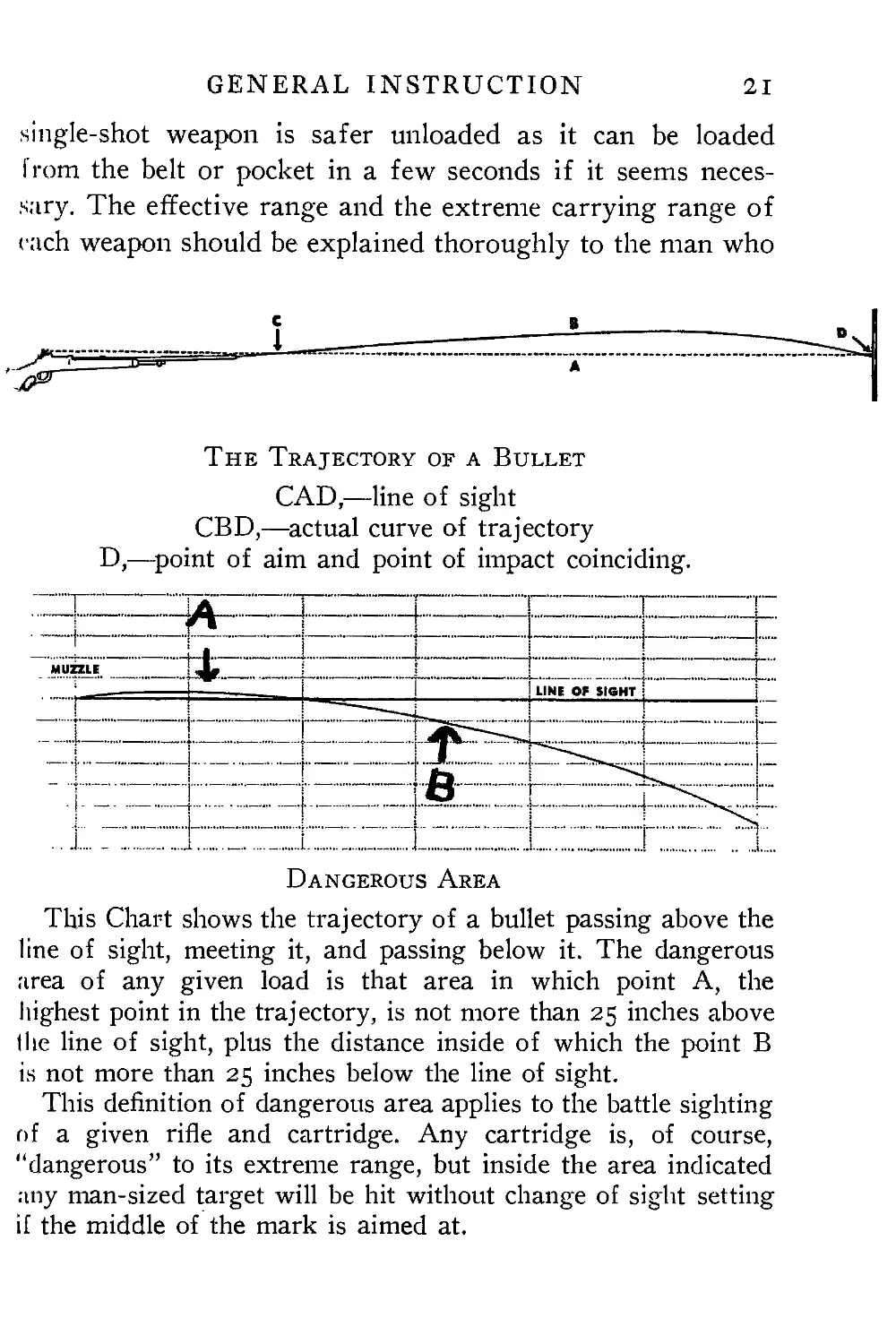
The Trajectory of a Bullet
CAD,—line of sight
CBD,—actual curve of trajectory
D,—point of aim and point of impact coinciding.
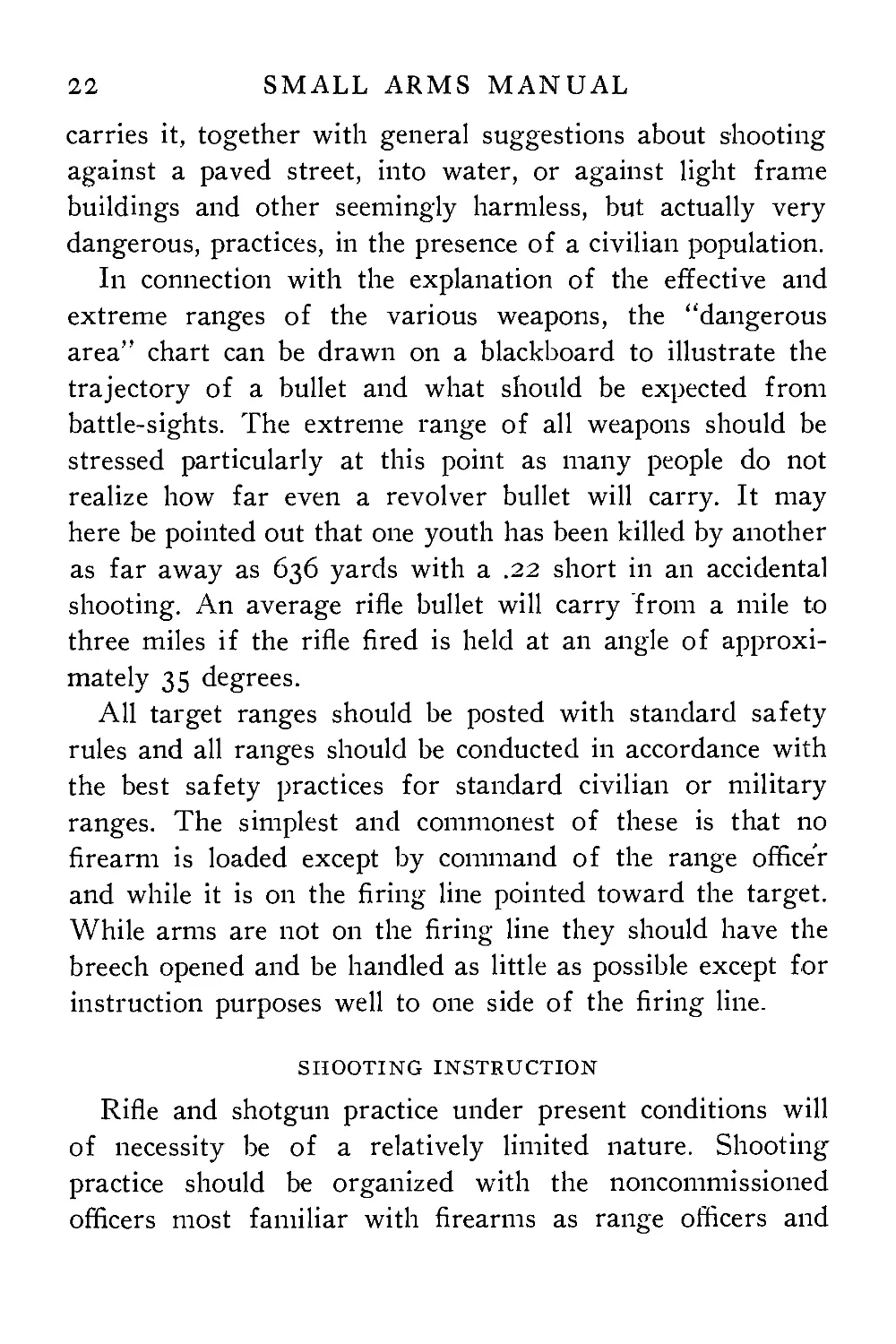
This Chart shows the trajectory of a bullet passing above the
line of sight, meeting it, and passing below it. The dangerous
area of any given load is that area in which point A, the
highest point in the trajectory, is not more than 25 inches above
the line of sight, plus the distance inside of which the point В
is not more than 25 inches below the line of sight.
This definition of dangerous area applies to the battle sighting
of a given rifle and cartridge. Any cartridge is, of course,
“dangerous” to its extreme range, but inside the area indicated
any man-sized target will be hit without change of sight setting
if the middle of the mark is aimed at.
22	SMALL ARMS MANUAL
carries it, together with general suggestions about shooting
against a paved street, into water, or against light frame
buildings and other seemingly harmless, but actually very
dangerous, practices, in the presence of a civilian population.
In connection with the explanation of the effective and
extreme ranges of the various weapons, the “dangerous
area’’ chart can be drawn on a blackboard to illustrate the
trajectory of a bullet and what should be expected from
battle-sights. The extreme range of all weapons should be
stressed particularly at this point as many people do not
realize how far even a revolver bullet will carry. It may
here be pointed out that one youth has been killed by another
as far away as 636 yards with a .22 short in an accidental
shooting. An average rifle bullet will carry from a mile to
three miles if the rifle fired is held at an angle of approxi-
mately 35 degrees.
All target ranges should be posted with standard safety
rules and all ranges should be conducted in accordance with
the best safety practices for standard civilian or military
ranges. The simplest and commonest of these is that no
firearm is loaded except by command of the range officer
and while it is on the firing line pointed toward the target.
While arms are not on the firing line they should have the
breech opened and be handled as little as possible except for
instruction purposes well to one side of the firing line.
SHOOTING INSTRUCTION
Rifle and shotgun practice under present conditions will
of necessity be of a relatively limited nature. Shooting
practice should be organized with the noncommissioned
officers most familiar with firearms as range officers and
GENERAL INSTRUCTION	23
coaches. If it is possible, most of the shooting should be
done with .22 caliber weapons.
Here again it is advisable to borrow all possible .22 cali-
ber rifles of reasonably close to target type for practice
shooting as well as to obtain any .22 caliber ammunition of
any size that is available. These rifles will vary from heavy
target rifles of Remington, Winchester and other makes,
down to the lighter weight bolt-action single-shot pl inking
rilles. If possible it is advisable to obtain some of the lever-
action .22 rifles for practice and familiarizing the men with
the lever action in case there are some heavy caliber rifles
of this sort in the organization. There is also a miniature
skeet, shot with .22 caliber cartridges, small smooth-bore .22
caliber weapons of the shotgun type, and miniature clay
pigeons, which is very good practice for shotgun shooting.
This can be used in a relatively small area, as the very fine
shot does not carry an appreciable distance. There are many
good books available on .22 and larger caliber military and
target rifle shooting. It is advisable to work from these with
reasonable adaptation to the problem at hand.
There will be neither time nor ammunition to make small-
bore champion target shots or skeet shooters out of State
Guardsmen, nor is there the need. The small-bore target for
50 and 75 feet presents a bull’s-eye not much larger than a
lead pencil at the maximum. This is a very discouraging
target for a shooter to begin on, or to shoot on, if he has
a limited supply of ammunition. For the purposes of State
Guard training, it is far better to use some larger type.
There are several such targets available: the 25-yard
standard American pistol target carries a generous-sized
bull, but sufficient scoring rings so that some competition
24
SMALL ARMS MANUAL
can be established. The silhouette type target showing the
form of a man, such as the Colt silhouette target, or the
New England Police Revolver League V-Defense target
gives the added incentive of shooting at a man-type mark,
and noting where the bullets hit. It can be used on indoor
ranges at short distance as well as outdoors.
The ideal, of course, is to turn out every shooter so that
he can handle every kind of weapon safely and hit a 20-inch
bull’s-eye at 1000 yards. The practical is to do as much as
possible with the material, men, arms, and ammunition that
is on hand. This can best be done by keeping up interest
and not discouraging shooters by trying to do the impossible.
In general, get one or more good books on military and
target-type shooting, keep your targets big, especially at
first, insist that the safety rules be followed absolutely, and
approach target shooting and marksmanship procedure as
closely as possible under the circumstances.
If an outdoor range is available, it may be possible to
simulate actual combat targets by setting up small silhou-
ettes or representations of trucks, tanks, artillery, etc., re-
duced so that at 50 or 100 yards they will appear as they
might if they were actually 3 to 500 yards away. Simulate
fire under battle conditions, making the shooters take cover
and shoot at objects partly concealed by the surrounding
terrain and foliage.
This is war and every individual should, of course, do as
he is told because he is told to do so, if he is a part of any
military organization. But, particularly in units of the State
Guard type, a man will certainly do things better if his
interest in them is kept up as well as it can be. The more
varied the type of shooting that can be offered, the more
GENERAL INSTRUCTION	25
interest will be maintained. To anyone except the dyed-in-
I lie-wool small-bore shot, punching holes in an infinitesimal
bull’s-eye under very artificial conditions probably loses at-
tractiveness fairly rapidly. Vary this as much as possible at
all times as soon as the men show a reasonable familiarity
with the rifles they are using.
If a man is not progressing, check back over the standard
instructions procedure and make sure that he has understood
all that has been told him, particularly about sight alignment
and trigger squeeze. These two features seem to be the most
bewildering of the many things that a man must learn, to
become a reasonable target shot. Any of the mechanical aids
to instruction such as sighting bars or other equipment that
are recommended by standard works on military instruc-
tion, and can be obtained, will be a help in this respect. A
list of standard books on the subject of target shooting and
military instruction will be found in the Bibliography.
Chapter 3
MILITARY TYPE RIFLES
GENERAL CHARACTERISTICS
with the exception of the Garand, or Mi, and Johnson
semi-automatic rifles, the military rifles of the nations of the
world, at present and for the past fifty years or so, have
been bolt-action repeating rifles using bottle-necked car-
tridges with metal-jacketed bullets of .25 to .^caliber giving
muzzle velocities between 2500 and 3000 feet per second.
The great majority of these rifles fall into two types: the
Mauser, invented by Paul Mauser of Germany; and the
Mannlicher, invented in Austria. Both rifles were developed
in the early 1890’s.
The Mauser action, which is in use by a great many
countries, including the United States, where it is the basis
for our model 1903 Springfield, is a repeating rifle taking
a clip of cartridges into the magazine vertically downward,
parallel to the path of the bolt. It can be loaded only while
the bolt is open. The clip fits into clip guides in the receiver,
and the cartridges are stripped from the clip into the maga-
zine by a single pressure of the thumb. The cartridges are
pushed into the chamber one at a time by pushing forward
on the handle of the bolt, which is similar in general to the
bolt on any common door. The bolt has lugs at its forward
26
MILITARY TYPE RIFLES	27
<nd, which, when it is turned down, lock into the recesses
of the receiver and form a support for the base of a cartridge
during the explosion. After the cartridge has been fired,
the handle of the bolt is turned up and the bolt is pulled back.
This throws out the empty shell and allows the magazine
spring to press another cartridge up so that the top of its
base is in the path of the bolt and it in turn can be driven
forward into the chamber.
The firing-pin or striker is a straight-drive pin traveling
through the center of the bolt to strike the primer of the
cartridge as it rests against the face of the bolt head. The
pin is impelled by a spiral spring which is usually around the
pin in the hollowed-out center of the bolt. As the bolt is
opened or closed, the spring is compressed and the pin held
back by the trigger or sear, engaging in a notch in the pin.
When the trigger is pulled, the pin drives forward to strike
the primer of the cartridge. Some firing-pins have a knob
outside the back end of the bolt so that they can be cocked or
let down by the thumb and forefinger of the firing hand.
The various types of safeties applied to bolt-action rifles
lock the firing-pin out of engagement with the trigger and
sear so that pulling the trigger will not release the pin. There
is no half-cock point on any straight-drive firing-pin for
military bolt-action rifles. All pins are automatically cocked
when the bolt is closed and locked.
This is one of the very good reasons for leaving the
chamber of a bolt-action repeating rifle empty with the
cartridges retained in the magazine except when the rifle is
to be fired. Lowering the pin by hand with a cartridge in
the chamber is not very satisfactory, as in some cases the
shape of the rear end is such that it cannot be reached any-
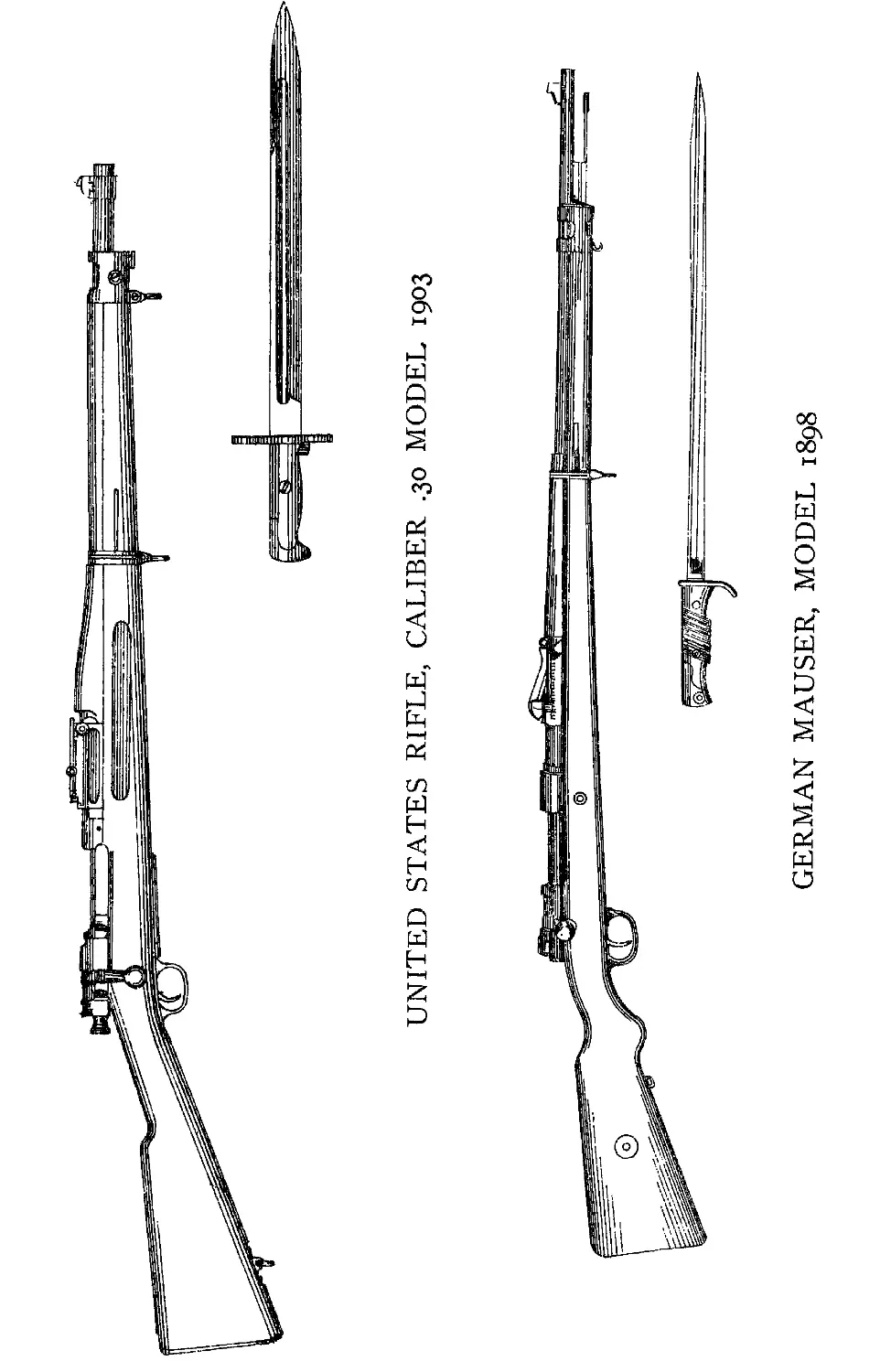
UNITED STATES RIFLE, CALIBER .30 MODEL 1903
GERMAN MAUSER, MODEL 1898
MILITARY TYPE RIFLES	29
way, and, if it is lowered, the point of the pin rests on the
cartridge where a jar might fire it. Then, too, it is relatively
awkward to pull back or cock a straight-drive firing-pin
in a hurry.
Some of the bolt-action rifles have a magazine cut-off,
which, when in use, holds the cartridges in the magazine in
reserve and allows the rifle to be loaded and fired as a single-
loader with cartridges remaining in the magazine for use
when they are wanted. This cut-off usually is situated on the
left-hand side of the receiver and near its rear end.
THE SPRINGFIELD I903 AND MAUSER RIFLES '
To describe briefly our most familiar examples of this
type weapon: the Springfield model 1903 holds five car-
tridges loaded from a small clip surrounding the heads of the
shells only. The Springfield model 1903 rifle is 43 and a
fraction inches long over-all with a 24-inch barrel and a
weight of 8.69 pounds. Its safety is at the rear of the bolt
and throws from side to side. This rifle is typical of the
group of Mauser-type bolt-action rifles in use the world over.
The German military rifle of the present day is the model
1898 Mauser, using a 7.92 mm. rimless cartridge similar in
design to the American cartridge but different in size and
shape. Great care should be taken, when a Mauser rifle is
encountered, to be sure that any ammunition available for
it is the correct German military 7.92 mm. Mauser ammu-
nition. This Mauser rifle is commonly called an “8 mm.”
Mauser—a somewhat misleading description, as there are
other foreign 8 mm. cartridges which are not correct for this
rifle and which may cause an unfortunate accident if they
are used with it.
30	SMALL ARMS MANUAL
Other Mauser rifles in 7 mm. caliber are used in Spain
and in Mexico and throughout a number of the South
American republics. These rifles are similar in general char-
acteristics and in action to the standard Mauser or the United
States Springfield. They are usually clip-loaded and use
ammunition of military characteristics. The Japanese Ari-
saka “year 38” is basically the 6.5 mm. Mauser, model 1907.
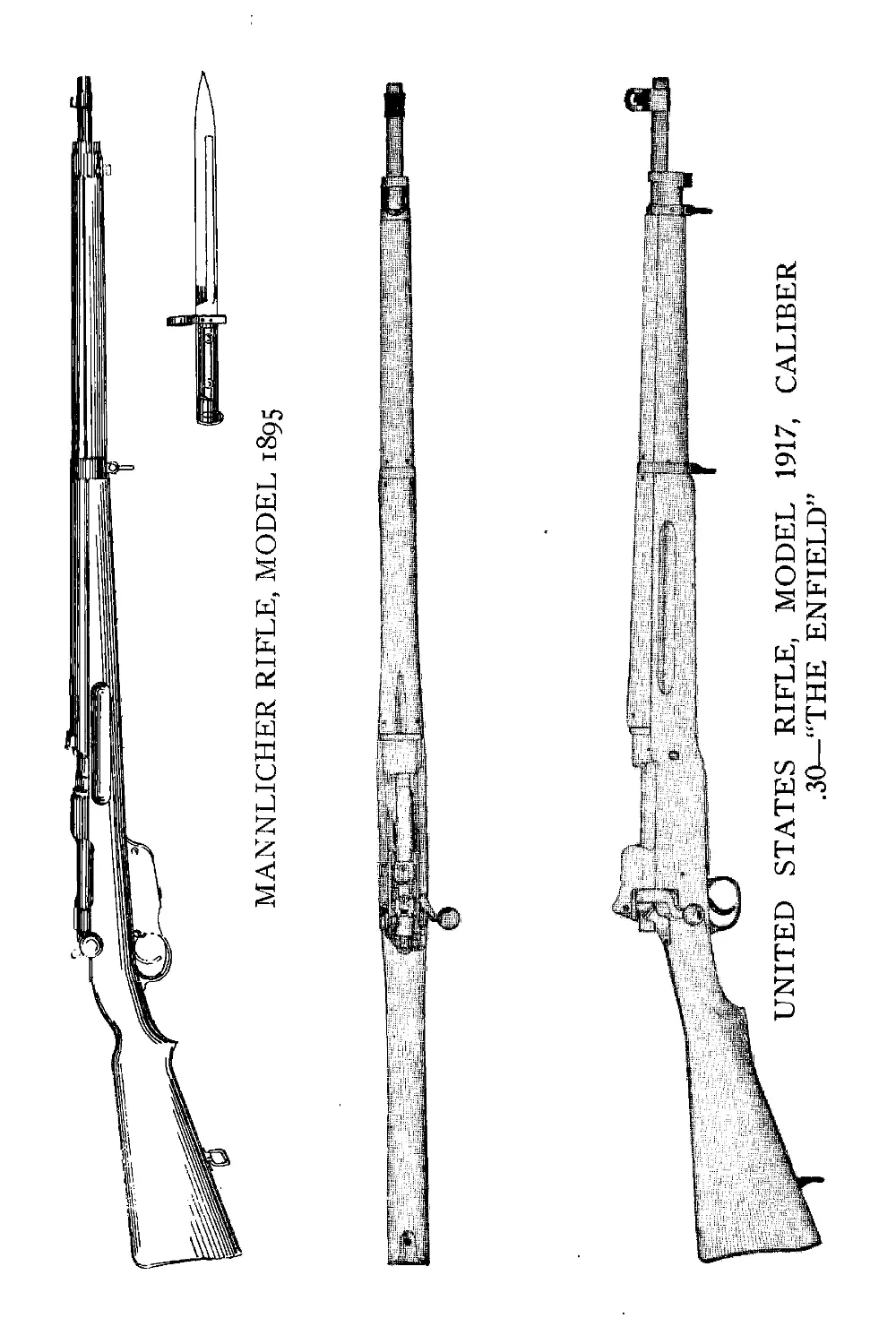
THE U. S. RIFLE MODEL 1917
The other official U. S. bolt-action rifle is the U. S. rifle,
caliber .30, model 1917. This rifle was originally developed
by the British before World War I and was, as soon as it
could be put into production, to replace the Short Model
Lee-Enfield, which had been the standard British arm for
some years. But World War I ended that possibility as far
as England was concerned.
England, however, placed contracts in this country for
great quantities of rifles and, as it was necessary to start
from the beginning, they chose a modified form of the
new rifle designed to take their standard .303 rimmed am-
munition. The new rifle had been planned to take a smaller
caliber rimless cartridge, but it was thought inadvisable to
have two cartridges in service at the same time so the new
rifle was modified for the old cartridge and large numbers
of them were manufactured in this country by Winchester,
Remington, and Eddystone for the British.
At the time we entered the war in 1917, most of these con-
tracts had or were about to expire and the United States
Government needed rifles in quantities. Therefore, it was
deemed simpler to reconvert the new Enfield model to a
rimless cartridge for United States service, chambering it
MILITARY TYPE RIFLES
31
lor the standard U. S. ball cartridge, caliber .30, model
1906, which was and is the standard United States small
arms cartridge.
This rifle, originally designed for a rimless, redesigned
for a rim case, and converted back to rimless cartridge, be-
came known as the U. S. Rifle, caliber .30, model 1917. It
was made to the number of several million guns between
1917 and November 11, 1918. Many are in use today in the
lighting services but there are also some privately owned
throughout the country as they were sold by the Director of
Civilian Marksmanship after World War I through the
National Rifle Association.
The action is similar to the Springfield in its basic prin-
ciple, but there are some features which are different.
The safety on the model 1917 is located on the right side of
the rear end of the receiver and pushes forward and back.
The safeties of all military bolt-action rifles are in a position
where they can be reached by the thumb of the shooting hand
of the user, but this placement allows some latitude as to
the exact position.
The sight of the model 1917 rifle is on the rear of the
receiver instead of forward of the receiver on the barrel as
in the Springfield. The battle-sight is a peep instead of an
open sight. The rifling is the British left-hand twist instead
of the 4-groove, 10-inch right-hand twist of the Springfield.
The bore diameters are the same. This rifle is loaded either
singly or from the standard Springfield clip with regular
U. S. military ammunition. It loads from the top of the
action past the bolt path in the usual way.
The United States military rifles, and foreign weapons
of similar ballistic characteristics, are “battle”-sighted for
32	SMALL ARMS MANUAL
400 to 550 yards, giving them a “dangerous area” of 550
to about 630 yards.
The term “dangerous area” means a distance in which a
bullet fired from a rifle aimed at the belt buckle of a standing
man will neither pass over his head nor fall short of his feet.
Depending on the trajectory of the rifle, this distance varies
from 250 yards in old-fashioned weapons to 600 to 650
yards in the best modern weapons.
The highest point of trajectory of any bullet is just be-
yond mid-range. The dangerous area is an area in which the
trajectory of a bullet is not higher at any point along it than
some 20 to 25 inches, plus the distance beyond the point of
aim at which the bullet does not fall more than another 25
or 30 inches below the point of aim.
In-the case of the Springfield rifle and .30—06 ammuni-
tion, this is about 500 yards between the rifle and target and
about 125 yards beyond the target. Other rifles approach
this in varying degrees, depending upon their ballistic ap-
proach to the .30—06 ammunition.
For general guard purposes and except in actual battle,
all bolt-action rifles should be carried and the bolt closed on
the empty chamber and five shots in the magazine. The
safeties may be brushed off in handling, and a shot might
be fired accidentally. It takes very little time to work the
bolt and place the cartridge in the chamber when necessary.
MANNLICHER RIFLES
The second large group of military rifles in use at the
present time is based on the Mannlicher action. This has a
bolt action similar to the Mauser, but it receives its car-
tridges in a clip which remains in the action until the last
MANNLICHER RIFLE, MODEL 1895
UNITED STATES RIFLE, MODEL 1917, CALIBER
.30—“THE ENFIELD”
34
SMALL ARMS MANUAL
cartridge has been fired. The clip then drops out through
the bottom of the action. This clip or charger has sides
which come down about half the length of the cartridge
case in its large section. Otherwise the Mannlicher rifles are
the same as the Mauser rifles, as far as the operator is
concerned. The bolt can be closed on an empty chamber
with the magazine loaded. A safety of some type is located
within thumb-reaching distance of the firing hand and the
ammunition is of standard military type and power.
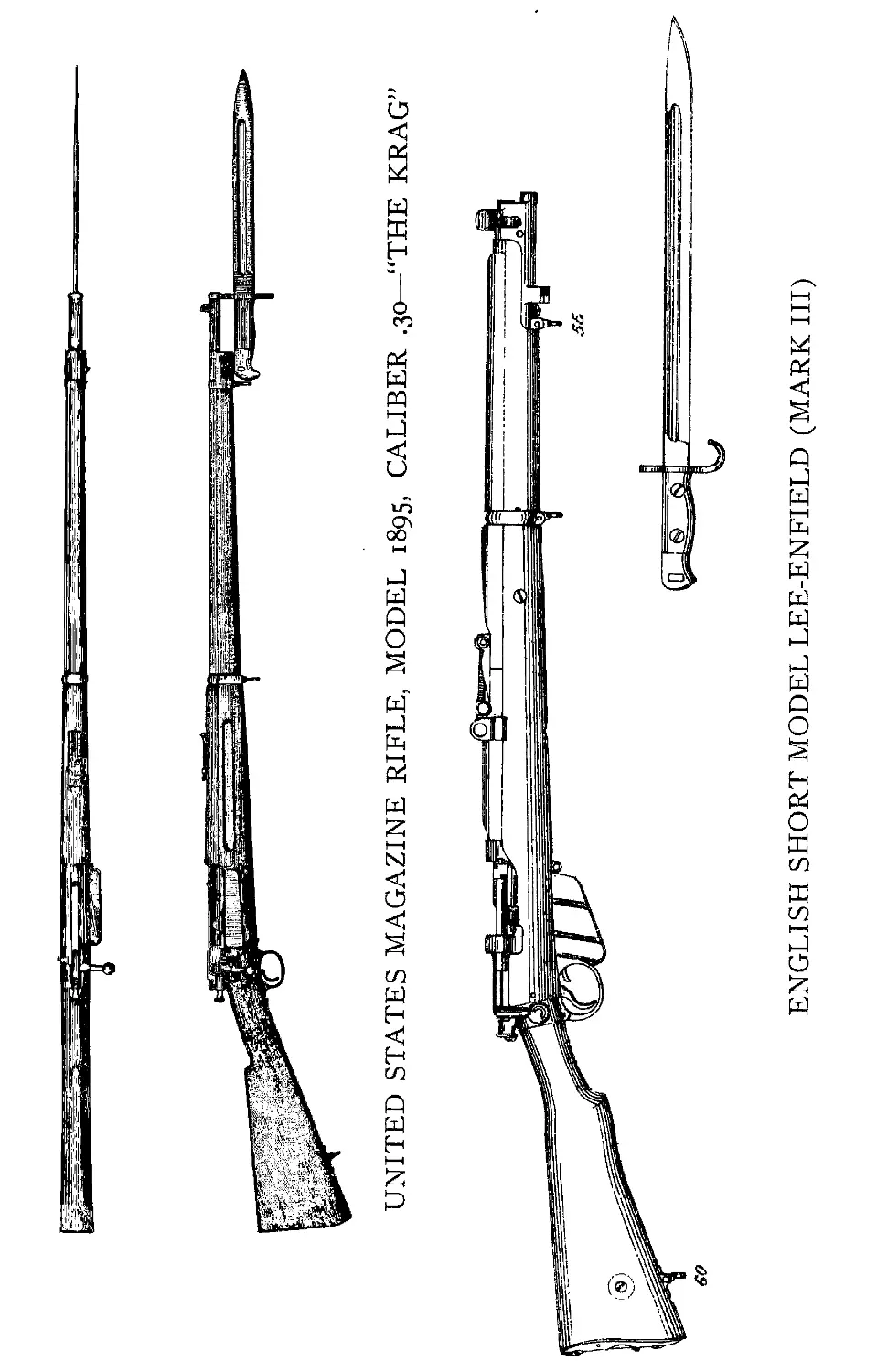
THE S.M.L-E.
There are in use at the present time a few bolt-action
rifles which do not partake very closely of either the Mauser
or Mannlicher actions. The English Short Model Lee-Enfield
and its preceding models of similar type form one example
of this group. The Lee-Enfield is a bolt-action rifle with a
safety in the usual position at the rear of the bolt, but it
loads through the action with two five-shot clips for a total
of ten shots in the magazine. The locking lugs on the bolt
are placed further back than is common with other rifles, and
the receiver goes entirely through the stock with the butt
stock being attached to the back end of it by a bolt passing
through the butt from the grip to the butt plate.
The English Short Model Lee-Enfield uses a type of
ammunition designated as .303 British. This is still the
rimmed case which was used before the war with a bullet
approximately the diameter of the U. S. service ammunition
but weighing slightly more. It uses a peculiar type of British
powder called Cordite and has a muzzle velocity somewhat
less than that of the LL S. cartridge. Its battle-sight and
dangerous area are slightly less than those of the .30—06.
ENGLISH SHORT MODEL LEE-ENFIELD (MARK HI)
зб	SMALL ARMS MANUAL
THE KRAG-JORGENSEN
Another military rifle that was in use at one time in the
U. S. and is still used in some of the Nordic countries is
the Krag-Jorgensen. This was manufactured at Springfield
Armory from 1892 until the development of the Model 1903
Springfield.
It was the regular army issue rifle with which the Spanish-
American War was fought. The Krag-Jorgensen is a bolt-
action rifle with a very smooth and pleasant turning-bolt
action. Its safety is on the back of the bolt in a very con-
venient position. The ‘‘Krag” rifle uses a rimmed .30 caliber
cartridge somewhat similar to the British .303 in general
appearance, but in its original military form is made with a
round-pointed bullet of 220 grains. This cartridge is vari-
ously designated as the .30 Krag, .30 Army, and .30—40.
The cartridges are not fed into the action by clips as the
magazine is peculiar to this rifle. It is a box on the right
side of the frame, hinged and dropping open under hand
pressure. Five cartridges are inserted singly into the box.
They feed below the action and up into the path of the bolt
from its left side. With the closing of the box a spring-
actuated arm forces the cartridges around into the path of
the bolt.
The Krag action is designed for cartridges of somewhat
less power than the present U. S. cartridge, as the locking
lugs are not as strong as those of the Mauser action, but
the cartridge is a very good one for ranges to 600 or 700
yards. A number of models of the Krag were made between
1892 and 1900 in both full length and carbine size.
MILITARY TYPE RIFLES	37
It is still an efficient military arm and with the proper am-
munition should answer admirably the purposes of State
(luard ynits. A number of hunting loads as well as the
military load have been made for this arm by the arms
manufacturers for many years, as it has been a popular
hunting rifle both in military models and in sporting types.
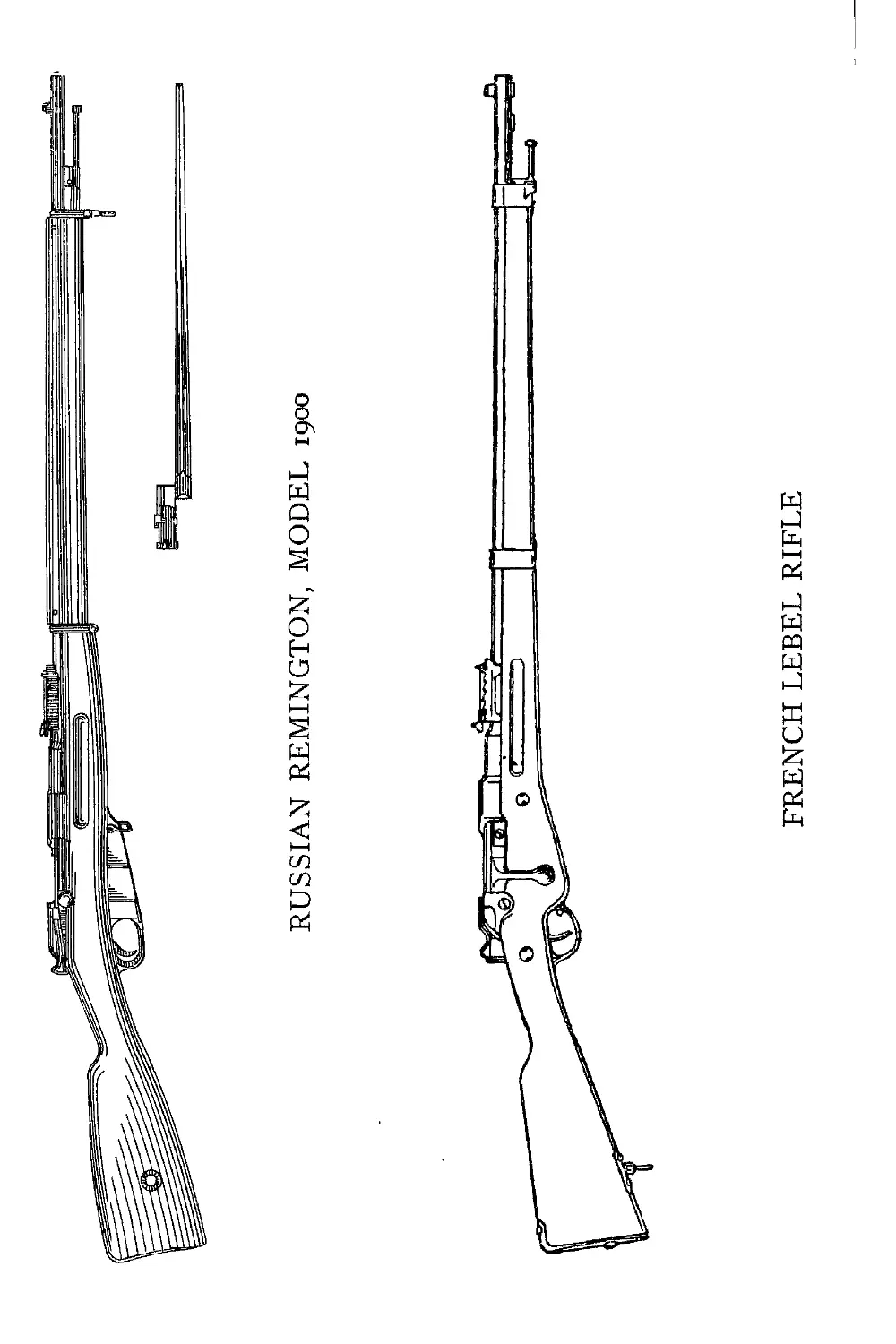
THE RUSSIAN REMINGTON
Another rifle made in this country at the time of World
War I and still sometimes found here is the so-called
Russian Remington. This is the Russian military rifle of
World War I period as manufactured in this country
on Russian contracts by the Remington Arms Company.
The Russian name for this rifle is the Mosin Nagant. It is
a turning-bolt rifle with a very large striker head at the back
so that it can be cocked or the striker let down readily by
hand. The rifle is loaded with single rounds through the
action with a rimmed “7.62 mm. Russian Cartridge,” also
commonly made in this country in hunting and military
loads, to the capacity of the magazine which is five.
A great many of these rifles were left in the hands of the
Remington Arms Company by the collapse of the Russian
monarchy during World War I, and, after the war, they
were sold for hunting rifles all over the United States. With
their own ammunition they are an excellent military weapon,
but they were occasionally altered in manner which, for the
sake of safety, must be mentioned.
Some concerns cut off the barrel of this rifle an inch or
two at the breech, rechambered it for the standard U. S. cali-
ber .30, model 1906 ammunition, and sold the result for sport-
RUSSIAN REMINGTON, MODEL 1900
FRENCH REBEL RIFLE
MILITARY TYPE RIFLES	39
mg purposes to take standard American ammunition. This
was a very dangerous procedure. The Russian Remington
cartridge was never made with as high a breech pressure
us the standard .30—06 in the first place,, and the whole
action was undoubtedly weakened by the butchering and
((•cutting necessary to chamber it for the .30—06. This
makes a dangerous combination, and many of these weapons
have blown up in the hands of their users. It is usually
apparent that this has been done by the poor fit of the barrel
and the woodwork at the point where the barrel and receiver
join and by an obvious shortening of the barrel at this point.
Any of these Russian Remingtons which will chamber .30—
06 ammunition should be discarded as absolutely unsafe for
use.
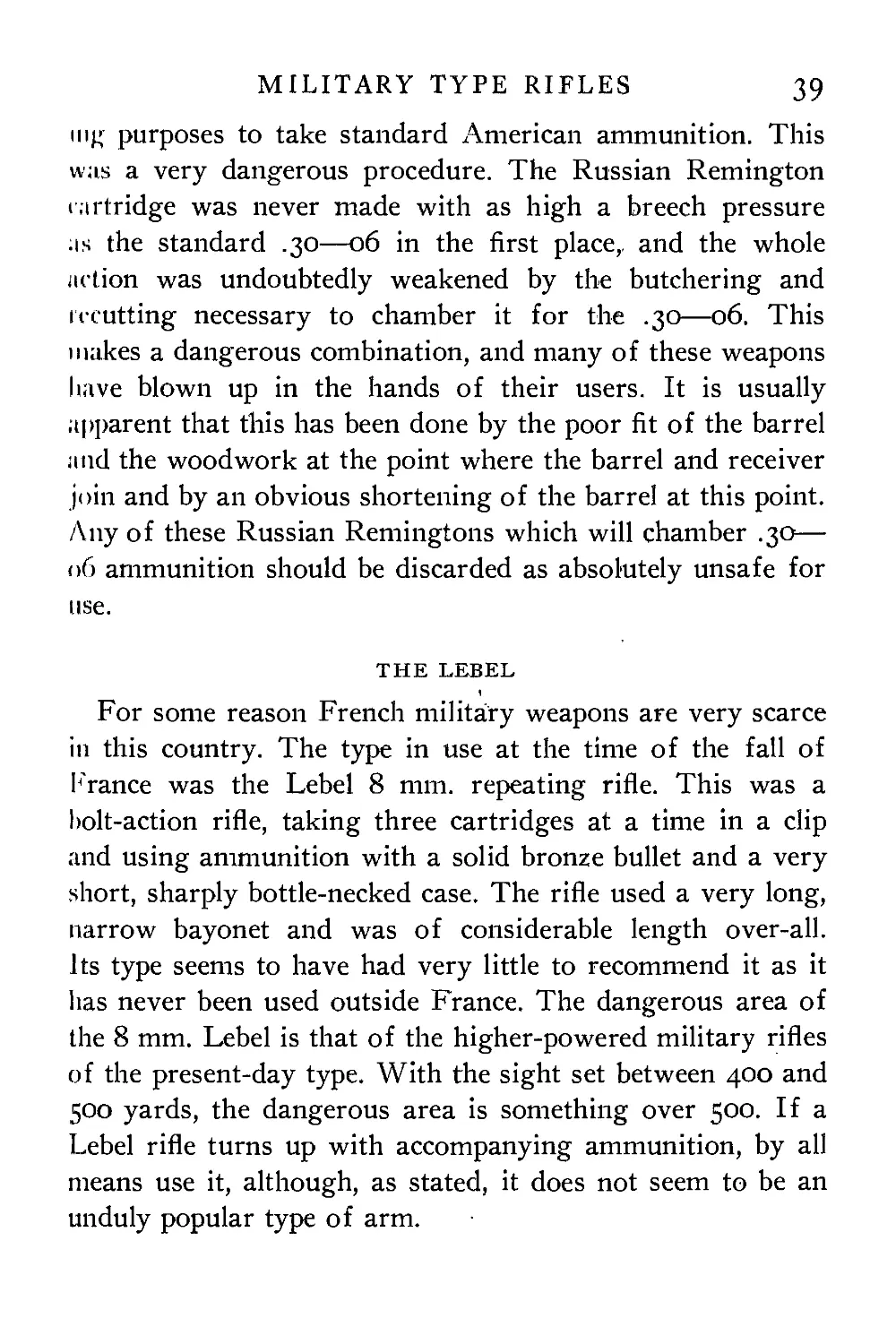
THE LEBEL
For some reason French military weapons are very scarce
in this country. The type in use at the time of the fall of
Prance was the Lebel 8 mm. repeating rifle. This was a
bolt-action rifle, taking three cartridges at a time in a clip
and using ammunition with a solid bronze bullet and a very
short, sharply bottle-necked case. The rifle used a very long,
narrow bayonet and was of considerable length over-all.
Its type seems to have had very little to recommend it as it
has never been used outside France. The dangerous area of
the 8 mm. Lebel is that of the higher-powered military rifles
of the present-day type. With the sight set between 400 and
500 yards, the dangerous area is something over 500. If a
Lebel rifle turns up with accompanying ammunition, by all
means use it, although, as stated, it does not seem to be an
unduly popular type of arm.
40
SMALL ARMS MANUAL
THE .45---/О, MODEL 1873
To go even further back in our military arms, the single-
shot .45—70 Springfield rifle, which was standard in our
services from 1873 until the time of the Spanish-American
War, is still prevalent in considerable quantities. It was the
standard weapon of the State Guards during World War I
and many of these rifles issued at that time are still in the
towns to which they were issued. While this rifle is, of
course, very old today, it is and was an excellent military
weapon within its scope and range. The .45—70 cartridge
is a powerful cartridge, shooting a heavy bullet, with an
effective range of well over 1000 yards. The limit of its
effectiveness is determined more by the high trajectory of
the bullet than by its lack of ability to arrive at a given
point. The bullet travels at only 1350 feet a second and has a
point-blank or dangerous-area range of not over 300 yards,
although if the exact range can be determined, accurate
shooting can be done with it at three times that distance.
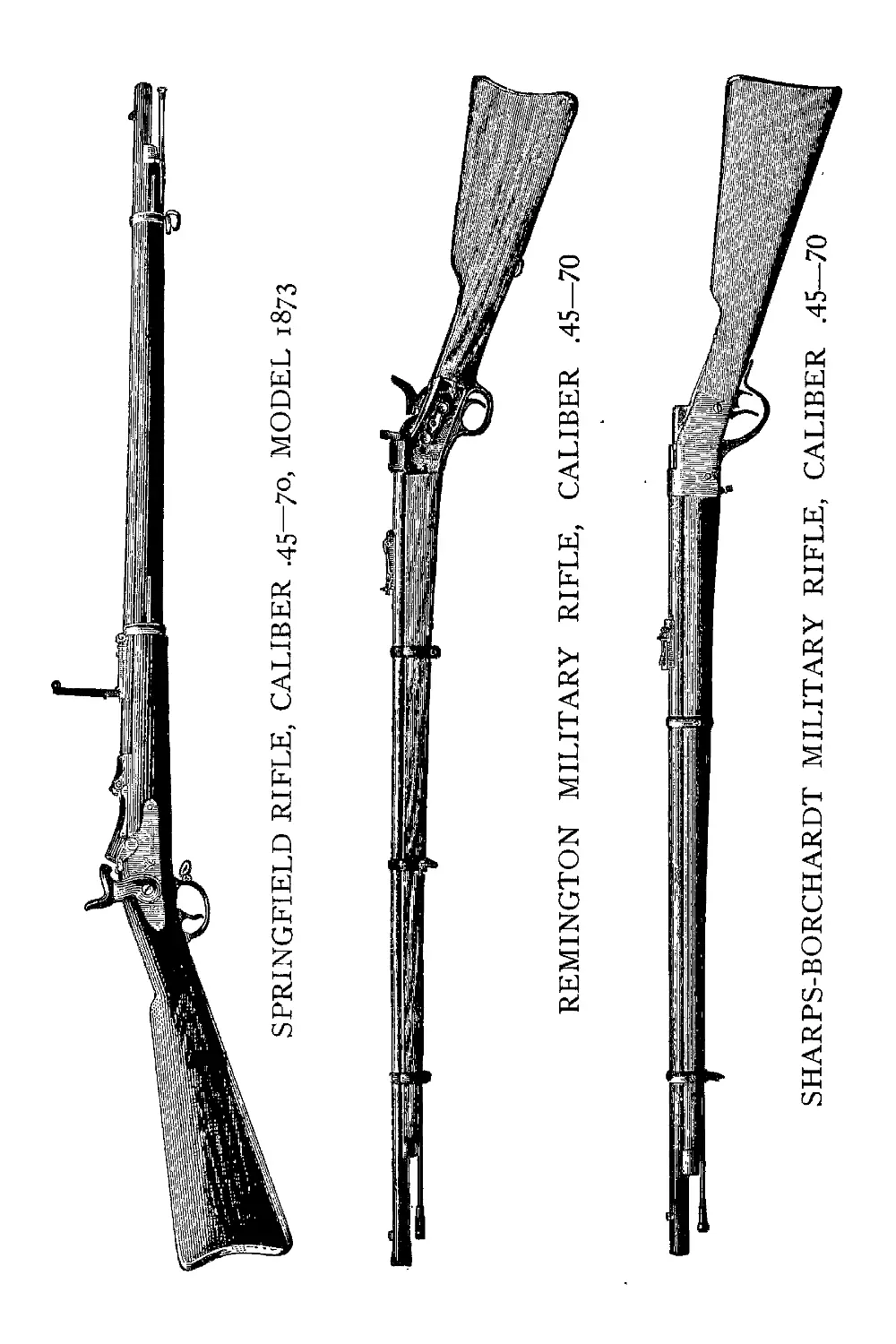
The .45—70, Model 1873 Springfield was a typical single-
shot action of its day. The hammer was brought to half-cock
and a lever thrown up on the right side of the action which
opened a trap door breech, allowing a shell to be placed in
the chamber. After the gun had been fired, the act of
throwing open the breech again automatically threw out
the shell. The gun was made in several models and in car-
bine sizes as well as full musket lengths.
There is no safety on the .45—70, Model 1873 Spring-
field with the exception of a safety notch intermediate
between half-cock and fully-down in which the hammer can
be set after the gun. has been loaded. This holds the breech
SHARPS-BORCHARDT MILITARY RIFLE, CALIBER .45—70
42
SMALL ARMS MANUAL
lever shut and keeps the hammer away from the firing-pin
in case the gun is dropped. This is the safest position in
which the hammer can be placed when the gun is loaded.
THE VETTERLI
A number of foreign weapons of the same period and
the same general type may possibly be met with and are
equally effective if they are available. The Swiss Vetterli
for some reason seems to be fairly common in this country.
This was one of the first of the bolt-action military rifles.
It was chambered for a .41 caliber, rim-fire cartridge with
about the same ballistics as the .45—70, using an early type
bolt action with a magazine under the barrel loaded through
a loading gate in the side of the receiver. Ammunition is
still manufactured for these rifles by the larger ammunition
companies and, when it is obtainable, they may still make
an effective combination.
THE SHARPS AND REMINGTON
Less common are the American Sharps-Borchardt and
Remington Rolling-Block single-shot military rifles in .45—
70 and .50—70 caliber. These were in use in this country,
particularly in State Militia, during the 1870’s, ’8o’s and
’90’s. The Sharps-Borchardt is a falling-block action, ham-
merless weapon with a safety behind the trigger. The action
is opened by pulling down on the trigger guard, the car-
tridge is pushed straight into the chamber, and pulling up
on the trigger guard closes and locks the action and also
sets the safety. In order to fire the weapon it is necessary
first to pull back on the safety and then pull the trigger.
This rifle was made in caliber .45—70 and in rifle and car-
bine sizes.
MILITARY TYPE RIFLES
43
The Remington Rolling-Block was an action that was
very popular from the time of the Civil War for the next
lifty-odd years in military and sporting rifles in various
parts of the world. It was not used as a military rifle by the
U. S. Government after the Civil War but several State
Militia did use it. In this rifle the hammer is first brought
Io full-cock, then a tab on the right-hand side of the breech
is pushed back and down which allows the rolling block to
open and expose the breech. Then a cartridge is pushed in
and the rolling block closed. The hammer can be lowered
to half-cock or all the way down on the block. With the
hammer down, the block cannot be opened. The action is
safe for cartridges of the old type for which it was made,
although it is not a very strong action as military weapons go.
THE MARTINI-HENRY
Less common in this country are the English Martini-
Henry .577—-450, the standard English single-shot weapon
of this early period, and the German single-shot, bolt-action,
11 mm. Mauser, Model 1871. Both of these rifles take a
cartridge, in general, similar in ballistic characteristics to
our .45—70 and are strong and serviceable weapons if they
can be obtained with any ammunition to go with them.
These are the military type rifles which will most likely
be encountered. They are all effective weapons and vary in
range from the old black powder guns, whose trajectory at
longer ranges is so high as to limit them for practical pur-
poses to some 300 or 400 yards, to the more modern types
of military arms, which are capable of giving serviceable fire
up to and over 1000 yards. Any one of them, if obtainable,
will add to the range and fire-effectiveness of any guard
organization.
Chapter 4
SPORTING RIFLES
the group of available sporting rifles is far larger than
that of military weapons and offers a much greater variety
to State Guard units. Sporting rifles are, and have been for
many years, used in this country for everything from long-
range, big-game hunting to woodchuck and squirrel shooting.
HEAVY BOLT-ACTION TYPES
The nearest approach in this category to the military type
rifles are the bolt-action sporting rifles made for military
ammunition or ammunition of power comparable to it.
Many of these weapons are actual conversions from military
arms to sporting-type rifles or weapons made by various
manufacturers on military-type' actions. The heaviest of
them are the target-type rifles for long-range target shoot-
ing. These can be very well adapted for sniping use as they
are finely accurate up to ranges exceeding 1000 yards.
The Winchester Models 70 and 54 and the Remington
Models of the 30 series are the best-known weapons of the
type in this country. There are also many similar custom-
built and foreign rifles of equal quality and desirability.
As far as action, safeties and barrels, they do not differ
appreciably from corresponding military weapons. Their
main difference is in the fineness of finish, the type of stock,
44
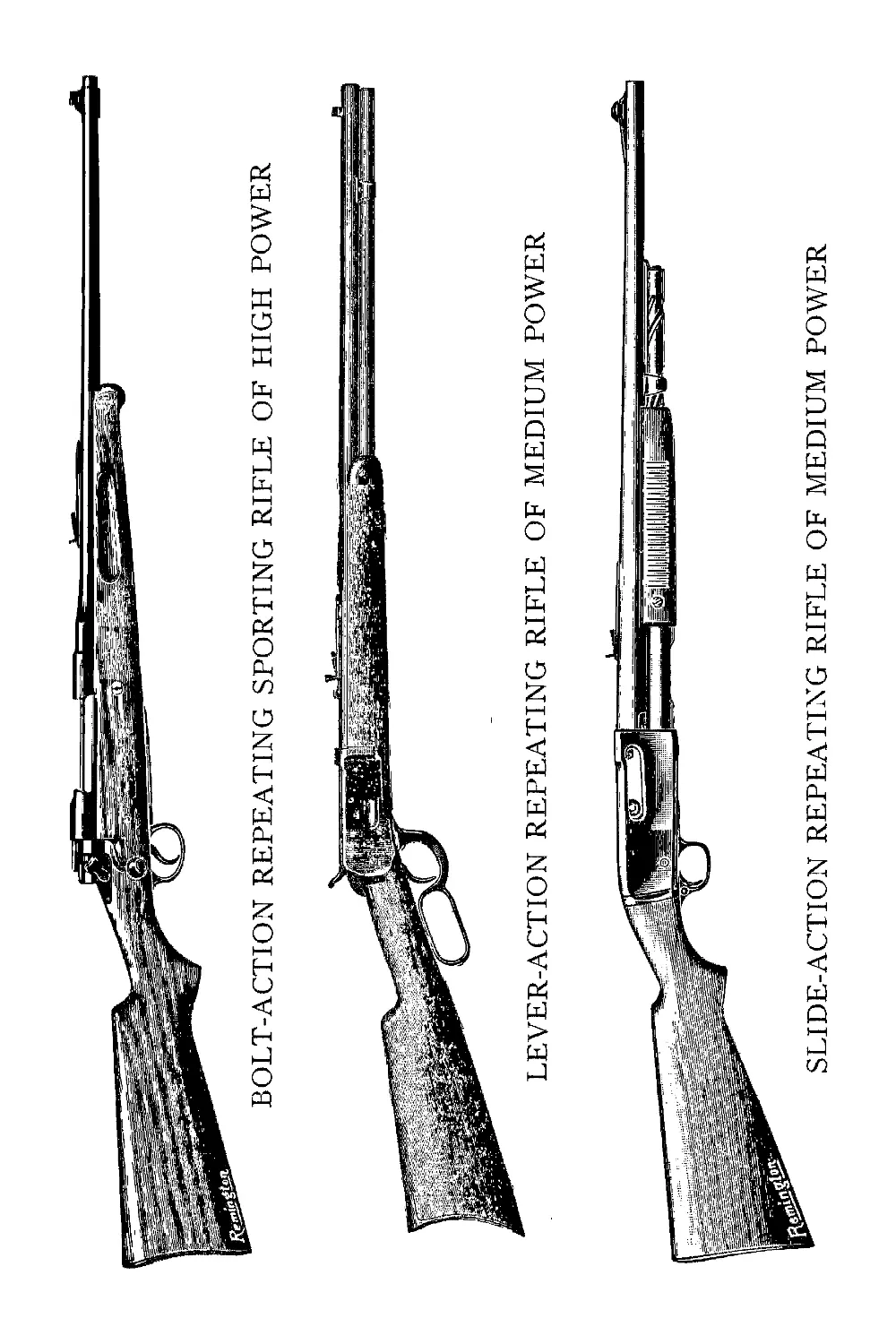
SLIDE-ACTION REPEATING RIFLE OF MEDIUM POWER
46	SMALL ARMS MANUAL
weight and length of barrel, and the sights which are applied
to them.
The Lyman sights are the commonest and these are ad-
justable in peep-sight types to a very fine degree of adjust-
ment for accurate long-range shooting. Weapons fitted with
them are even more adaptable to sniping-type work than the
standard military rifles, as their sights are better and in all
other features they are equally good.
Occasionally a rifle with a telescopic sight will be found,
and this, of course, is the acme of the sniper’s equipment.
Telescopes vary in power and type from 3- or 4-power
hunting scopes to high-powered, finely-adjustable target
scopes. When such a rifle is obtained, it is best to write to
the maker or consult a large sporting goods store for accu-
rate information as to just how to use the form of sighting
equipment with which it is fitted, unless the owner is thor-
oughly familiar with it and can use it himself or transmit
the information.
Many custom-built rifles on Mauser, Mannlicher, and
Springfield actions also partake of the same general char-
acteristics as the Winchesters and the Remingtons. When
any of these rifles is encountered in any of the more power-
ful calibers, from .30—06 down to .257 Roberts or .250—
3000 Savage caliber, it is reasonable to consider them at
the least equal to a good modern military rifle as far as
range, accuracy, and dangerous area are concerned. The
sights should be set between 400 and 500 yards for “battle”
purposes, and hits may be expected between 500 and 600
yards as in the case of the standard modern military rifle.
However, if possible, these rifles should be placed in the
hands of specially trained riflemen who know how to use
SPORTING RIFLES
47
I he sights, allow for different ranges, estimate distance,
windage, and so forth, and can get hits at nearly twice that
distance. Effective sniping is a very discouraging type of
attack for the enemy, as it is exceptionally hard to meet.
MEDIUM BOLT-ACTION RIFLES
Bolt-action rifles are also made by Winchester, Reming-
ton, Savage, and other concerns in the “medium-power”
cartridges, many of which were developed for earlier type
rifles. For the most part these rifles have less accurately
adjustable sights than the heavier and more expensive
weapons, but cartridges such as the .30—30, .32 special, and
the various medium-range deer cartridges are very effective
at ranges between 250 and 400 yards. A battle-sight setting
for this type of rifle of about 300 yards will give a danger-
ous area inside the 300-yard mark and for another hundred
yards or so beyond it, as most of these cartridges have a
trajectory of not more than 20 inches above the line of sight
up to that distance.
LEVER AND SLIDE ACTIONS
Rifles of an older type but which are still made in con-
siderable quantities by most of the arms companies are the
lever- and slide-action repeating rifles. Lever- and slide-
action repeating rifles have never been accepted as military
weapons since the time of our Civil War for a number of
reasons. These reasons are adequate from a military point
of view, but they do not militate against such weapons for
general use. In most weapons of this type the cartridges are
fed into a magazine below the barrel through a loading
gate on the right side of the frame, one at a time. Most
48
SMALL ARMS MANUAL
magazines in this type of rifle hold from five to twelve
cartridges. These rifles are operated by throwing down and
forward a lever which includes the trigger guard and accepts
the last three fingers of the shooting hand. This brings the
cartridge into the chamber and cocks the hammer. After
the rifle is fired, another motion of the lever throws out the
fired cartridge, replaces it with a loaded one, and again cocks
the hammer.
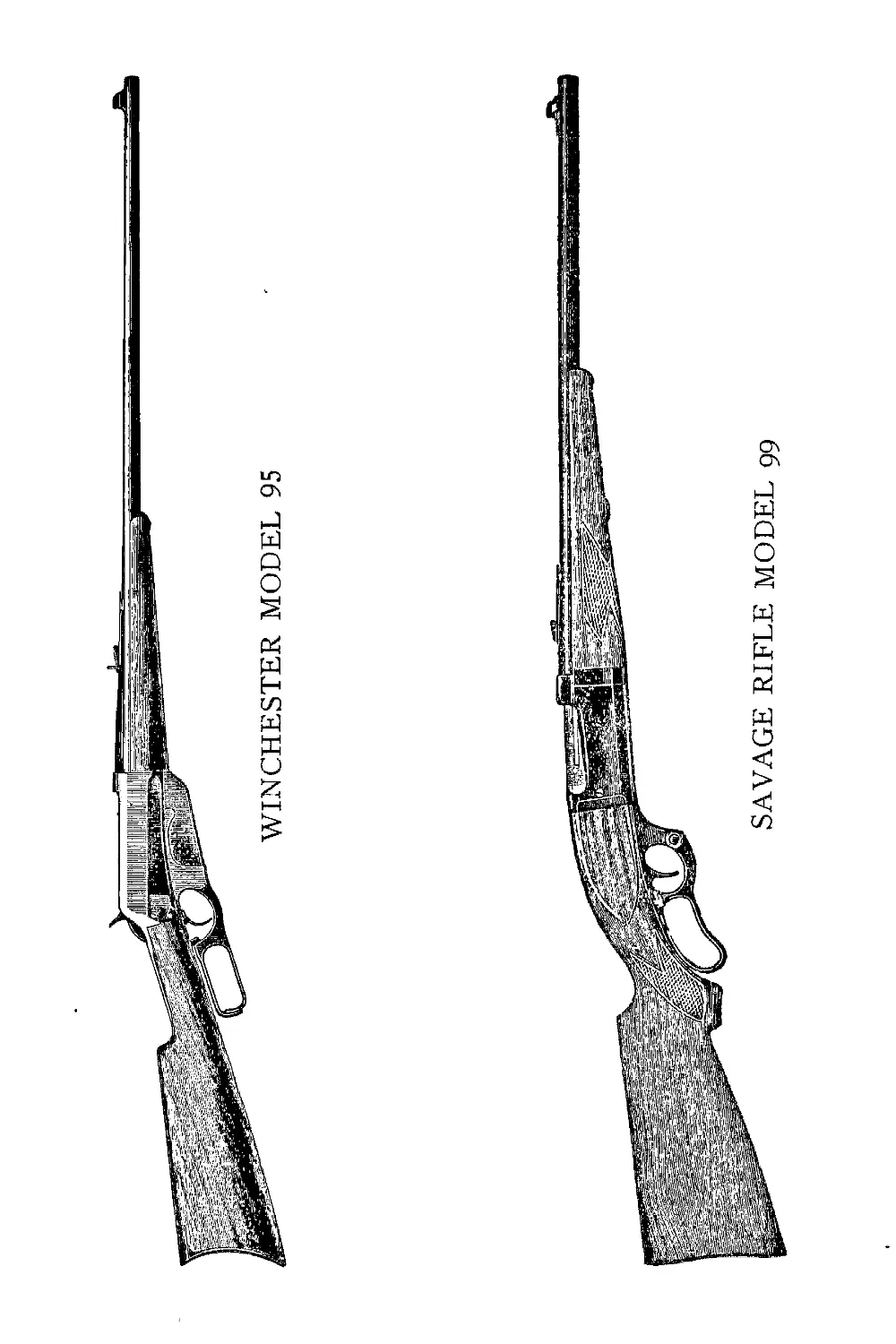
THE WINCHESTER ’95 AND SAVAGE ’99
Two exceptions to the general run of lever-action rifles
may be noted. The first is the Winchester model 1895
which is a very heavy and powerful lever-action rifle and is
chambered for some of the most powerful cartridges used
in this type of arm. In this rifle the cartridges are loaded
down through the action with the lever thrown back and
five cartridges may be put in a vertical box magazine, like
those on the bolt-action rifles, being inserted one at a time
and not from a clip.
The Savage model ’99 lever-action rifles use the rotary-
type magazine similar to some of the sporting Mannlichers
and the action is a hammerless one. The cartridges are in-
serted through the action with the lever thrown open and are
carried around the rotary magazine against spring pressure.
The bolt can be closed with five cartridges in the magazine
and the chamber emptied by holding down the last cartridge
as the bolt is started home. There is a safety on this rifle
at the rear of the trigger guard and also an indicator in
the form of a pin protruding at the rear of the top of the
receiver, which shows whether or not the rifle is cocked.
SAVAGE RIFLE MODEL 99
50	SMALL ARMS MANUAL
The Savage rifle is chambered for the cartridges usual to a
lever-action rifle of high and medium power.
Care must be taken with hammer rifles of the lever type
to lower the hammer when it is not necessary to fire im-
mediately after placing a cartridge in the chamber. On
Savage rifles the safety should be set. The hammer is then
re-cocked by hand for a shot when it is needed, or the safety
thrown off. On most occasions it is advisable to carry any
of these rifles with cartridges in the magazine but none in
the chamber. When it is necessary to fire, a quick movement
of the lever loads and cocks the weapon for immediate use.
If a cartridge has been levered into the chamber and it
is desired to remove it without firing the gun and without
replacing another shell in the chamber from the magazine,
this can be accomplished by moving the lever only part way
forward and picking the cartridge out of the open breech
action before the carrier has been lowered to pick up a
second one from the magazine. The removed cartridge can
then be placed in the magazine through the loading gate after
the action has been closed on an empty chamber.
The cartridges used in lever-action hunting rifles range
in power from cartridges of the type of the .348 Winchester,
.30 Army or Krag cartridge, the .303 British, and the other
cartridges of just under high military power down to very
light loads. Rifles in this category using cartridges of the
medium- to high-power type should have an approximately
300-yard battle-sight setting with an expected dangerous
range of something over 400 yards, as many of these car-
tridges are the same as those found in the medium-power
bolt-action rifles.
Lever-action rifles are also still found in many of the
SPORTING RIFLES	51
old calibers of fifty or sixty years ago. These are usually
designated by two fairly low numbers in sequence such as
.38—40, .44—40, .40—60 or some similar designation.
( artridges in this group for the most part use a fairly
heavy, large-diameter bullet of the short stubby type. They
are low-velocity loads, ranging in muzzle velocity from
1300 to 1700 feet per second. This group of cartridges gives
fairly high trajectories and the battle-sight setting for them
should be approximately 200 yards with an expected dan-
gerous range of 250 to 275 yards, although they will actually
carry considerably over 1000 yards, as will most rifle car-
tridges regardless of their power.
REMINGTON SLIDE ACTIONS
A small group of rifles in this general category are the
slide-action rifles put out by the Remington Arms Company
in “medium deer” calibers. These partake of the general
characteristics of the medium-power rifles except that they
operate similarly to a slide-action shotgun. Instead of work-
ing with a lever, the forestock is attached to a movable rod,
and pressure on this throws the action open, ejects the car-
tridge, and replaces it with a fresh one from the tubular
magazine underneath the barrel. These rifles are all ham-
merless and have some form of safety either on the receiver
forward of the small of the stock or below and in front of
or behind the trigger guard. They should be examined very
carefully, and it should be made clear to whoever uses them
just what the safety features are, as all hammerless weapons
are more dangerous for the beginner than weapons with
hammers which immediately show whether or not they are
cocked.
52	SMALL ARMS MANUAL
As in the lever-action repeating rifle, these rifles should
be carried with cartridges in the magazine but preferably
none in the chamber. The type of cartridges which they use
is on the low side of the medium-power range. Average
battle-sight settings at around 275 yards will give dangerous
areas of 75 to 100 yards over that figure.
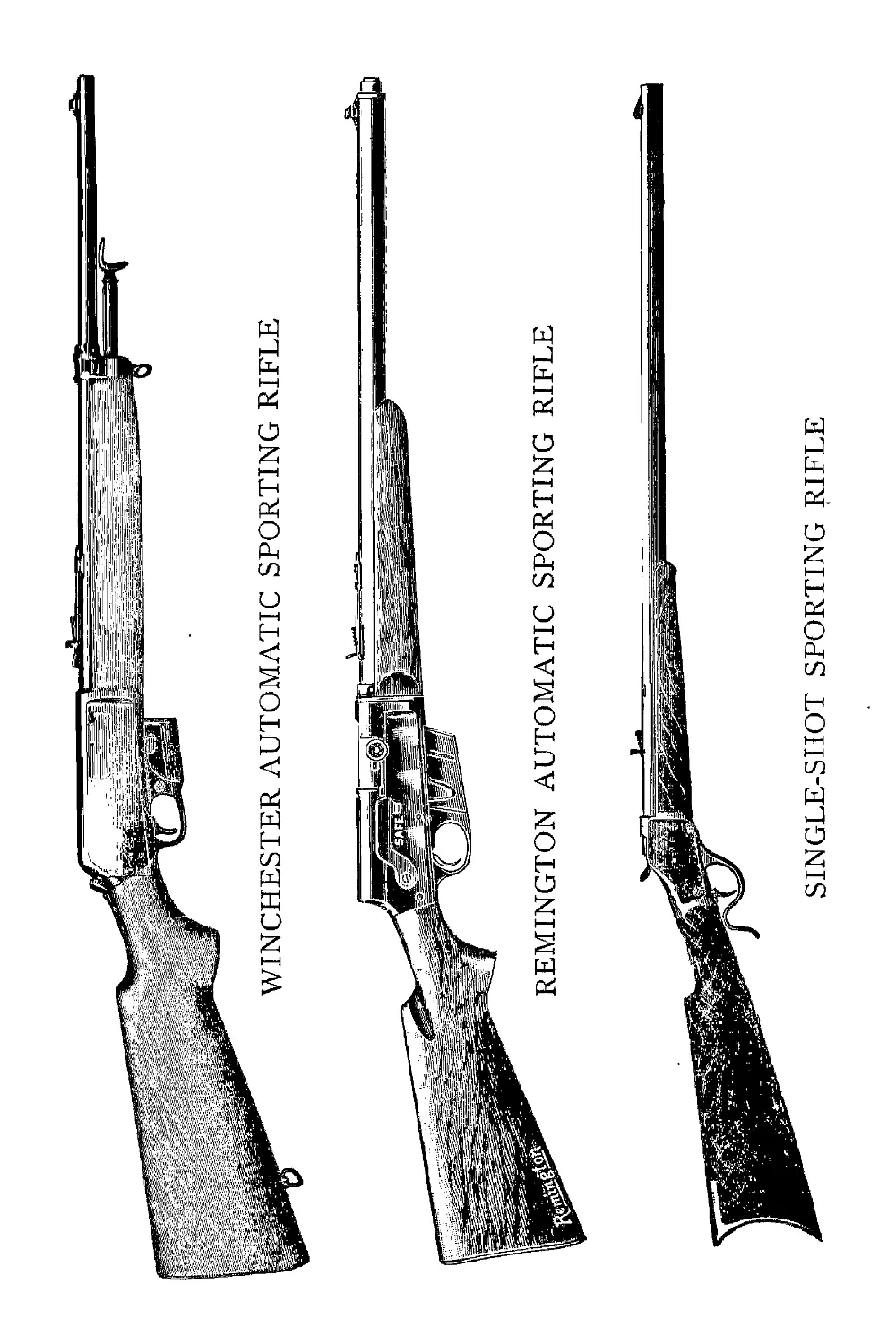
SEMI-AUTOMATIC RIFLES
Another group of rifles which may be available are the
Remington and Winchester semi-automatic hunting rifles.
Both are made for several medium-power cartridges of the
approximately 250- to 300-yard battle-sight range. They load
with detachable box magazines and may be carried with
loaded magazines but with no shell in the chamber as in
the case of the lever- and slide-action rifles. The Winchester
is operated by pushing down on the operating rod at the
front end of the forestock, while the Remington is loaded
by pulling back on the bolt handle which is on the side of the
receiver.
These rifles are well-made, medium-power weapons and
most of their cartridges are very similar in general char-
acteristics to the newly adopted army carbine cartridge
designated as the .30 S.R.M.i, giving effective accuracy and
hitting power up to 300 yards or slightly more.
Both of these rifles are equipped with safety bolts; the
Remington on the right side of the receiver behind the oper-
ating handle, and the Winchester on the upper part of the
trigger guard. Automatic rifles, like all automatic weapons,
are, for persons unfamiliar with firearms, the most danger-
ous type to handle. Particular caution should always be
taken in impressing anyone who uses them with the fact
SINGLE-SHOT SPORTING RIFLE
54	SMALL ARMS MANUAL
that each time they are fired they are automatically reloaded
and ready to fire again on the first pull of the trigger. The
magazine must be withdrawn before the action is operated
to throw out the cartridge in the chamber or another one
will be replaced as the first one is thrown out.
As with any automatic weapon, it is advisable to have as
fresh ammunition as possible for actual service, although
old ammunition will do for practice use. The older the am-
munition the more variable its quality and the more likely
that an automatic action will jam. This applies to any
automatic.
SINGLE-SHOT RIFLES
In addition to the repeating rifles, there are in existence
in this country many single-shot rifles made for target and
hunting use over the period of the past seventy-five years.
They include weapons chambered for some of the relatively
modern target cartridges. The best of them were made by
Remington, Winchester, Sharps, Ballard and Stevens. For
the most part these weapons are relatively heavy. They have
strong breech actions of one of several popular types. The
falling block, operated by a trigger-guard lever, is the com-
monest, but several others will be encountered. It is rela-
tively simple to discover how they operate, but caution
should be taken, particularly with the Winchester single-
shot rifle, as some of these actions leave the hammer cocked
when they are closed. Of course, in these rifles it is only in
the chamber that the cartridge can be retained, so when it
is there, it is ready to fire. If an arm of this type must
be used, it is perhaps best to carry it unloaded, particularly
in populous areas. It can be loaded very quickly with a car-
SPORTING RIFLES
55
liidge from the belt or pocket when it is necessary to do so.
An accident with this rifle, as with all other rifles, is far
less likely to happen when no cartridge is in the chamber.
I lie dangerous areas and battle-ranges correspond to repeat-
ing rifles using similar ammunition and vary all the way
horn cartridges that are just under modern military classi-
fications with dangerous ranges of 400 or 500 yards down
in the lowest power weapons which it is feasible to use,
whose sights should be set at 200 yards with an expectation
id less than 300 for reasonably certain hits.
For the most part these weapons have no safety features,
with the exception of the Sharps-Borchardt, which has an
action similar to the Sharps-Borchardt military rifle previ-
ously described. Users should understand them and note
whether or not the hammer is cocked by the closing of the
action, learning how to bring the hammer safely to half-cock
when the gun must be carried loaded.
Some of these rifles with finely adjustable sights or tele-
scopes will also qualify as sniping equipment. A rifle cham-
bered for a fairly high-powered cartridge, such as the Krag,
and fitted with a good telescope sight should be a very deadly
weapon at up to 500 or 600 yards.
These various lion-military repeating and single-shot rifles
of high, medium, and low power are the largest group which
I he State Guard, when looking for equipment, will have to
select from. In general, any of them that is well made and
in good condition will be far superior, both in accuracy and
range, to a shotgun, 110 matter what type of ammunition’
is used with it. Care should be taken that, if rifles which
are known to be over 25 or 30 years old are used, ammuni-
tion of the low-pressure, smokeless type is used with them.
56	SMALL ARMS MANUAL
Particularly in the earlier type, such as the .38—40, .32—20,
and so forth, there are modernized loadings available. These
use a lighter bullet than standard and drive it at a compara-
tively high velocity in an attempt to bring up to date the
old-type cartridges.
While the chances are that any rifle in good condition
has a sufficient margin of safety to handle this ammunition,
when there is any doubt, or if the rifle is obviously old
enough to have been built for black powder in the first place,
it would be wise to turn it down if no low-pressure or old-
type black powder ammunition is available and if anything
else can be obtained to take its place. The science of metal-
lurgy has forged ahead tremendously in the last few years,
and modern ammunition has built its pressures up to take
advantage of the superior strength that is available to fire-
arms today. The early arms are doubtful possibilities under
the highest pressure modern loads. It is wiser to avoid the
combination when possible.
Chapter 5
SHOTGUNS
ISSUE TYPES—SINGLE BARREL
лт the present time the majority of weapons issued by
the Ordnance Department to State Guard units are 12-gage
shotguns, single- or double-barrel, and of medium grade.
These are new weapons purchased by the Service of
Supply for issue to State Guard units in place of the rifles
that are more urgently required elsewhere. They are modern
weapons of simple action and adequate design. The single-
barreled models are, for the most part, hammer guns opened
by throwing the locking bolt lever on the small of the stock
below the hammer to one side, and pressing the barrel down
on its hinge in the frame. Some have what is called an
automatic ejector and some do not. In the automatic-ejector
models, when the gun has been fired, the shell is thrown
clear as the breech is opened by an ejector which has a
spring-driven piston, somewhat similar to a gun-lock in
itself, that is tripped by a sear as the breech is opened.
Thus, in opening such a gun, it is advisable not to have the
breech pointed exactly at the face of the user.
These guns are the rebounding-hammer type. That is,
when the gun is fired, the hammer, having struck the firing-
pin, rebounds to a position similar to the old half-cock and
57
58	SMALL ARMS MANUAL
is held there by the trigger when it is released. It also, of
course, maintains this position when the gun is reloaded.
Thus a gun dropped is not so likely to be accidentally
fired by the hammer being driven against the firing-pin and
consequently exploding the primer.
Opening the breech does not cock this type of gun. So a
gun may be opened, a shell inserted, and the breech closed
without making the gun ready to fire. When it is necessary
to fire the gun, the hammer is pulled back by the thumb of
the shooting hand and the trigger pulled in the usual way.
There is no safety on this gun except that of the hammer
being locked in the rebounded, or half-cocked, position.
Preferably, such guns should be carried empty when possi-
ble, as a shell in the chamber is, of course, a shell under the
hammer, and accidents can happen.
ISSUE TYPES---DOUBLE BARREL
Some double-barreled, hammerless guns are being issued
as well as the single-barreled models. These guns differ
from the single-barreled weapons in that the hammers are
inside and consequently concealed. Throwing open the lock-
ing-bolt lever on these guns opens the breech in the same
way that it does in the single-barreled guns. But opening
them cocks the hammers at the same time and also throws
the safety, which is on the tang of the action just forward
of the small of the stock, to the safe, or lock, position. When
the gun is closed the shells are in the chambers and the
hammers are cocked, but the triggers cannot be pulled until
the safety is pushed forward to the “off” or “fire” position.
Usually in double-barreled shotguns the forward trigger
controls the right barrel and the rear trigger the left barrel.
OVER AND UNDER DOUBLE-BARRELED HAMMERLESS SHOTGUN
DOUBLE-BARRELED HAMMERLESS SHOTGUN
a

SINGLE-BARRELED HAMMER SHOTGUN
6о
SMALL ARMS MANUAL
The same precautions should be taken with these weapons
as with the single-barreled gun. There is no way of carrying
them with the shells in except ready to fire, and it is far
safer to carry them empty whenever possible.
Double-barreled shotguns may be either side-by-side or
over-and-under barrels. The general mechanism, safety fea-
tures, and so forth are the same whatever the arrangement
of the barrels.
Most shotguns of the* double- or single-barreled type are
taken apart by pulling off the wood forestock which is either
held by a spring snap or attached by a catch let into the
wood near the center of the forestock. After the forestock
has been removed, breaking the gun in the usual way by
throwing open the locking bolt and pushing down on the
barrel will allow the barrels to be removed from the hinge.
The gun is then in three pieces ready for packing or
cleaning. The forestock should be replaced on the barrels
before the gun is put away so that it will not be lost.
Some shotguns are coming through at the present time
with plastic or tenite stocks. These stocks are in some re-
spects inferior to wood but they are not as fragile as some
of the reports make them out to be. They can be handled
pretty much as wood stocks are handled, but all gun stocks
should be treated as well as possible under the circumstances.
The sights on these guns, as on all shotguns, are relatively
simple and sketchy. They consist of some sort of bead at the
muzzle and a groove at the breech of the barrels. Shotguns
are, of course, primarily designed for wing shooting, where
little sight is-taken. However, it should be the practice of
State Guardsmen, in the use of all military weapons, to
aim a shotgun or any other weapon as nearly as possible at
the center of the mark, regardless of what type of ammu-
SHOTGUNS
6l
nil ion is being used in it. The military mark will rarely move
with the speed of a flying bird, and the average State
< -ttardsman is not as familiar with a shotgun as the skeet
J looter or upland game hunter, therefore any aim which
I here is time to take is advisable.
RIOT GUNS
Numerous other shotguns of varying types and gages
will probably be available. There has been some State and
Military issue of repeating shotguns of several types. Per-
haps the nearest approach to the actual military weapon is
I he riot gun, or trench gun, which was developed during
World War I. These, in their most military form, carry a
perforated guard over the barrel and also a place for locking
on a standard model 1906 U. S. bayonet. The riot or trench
shotgun is a 12-gage, repeating shotgun of the slide-action
(ype with a cylinder-bored 20-inch barrel. It is designed to
receive five loads in the magazine and put them into the
chamber successively by sliding the trombone action back-
ward and forward. This is a hammer gun. And like the
lever- and slide-action rifles, the hammer is cocked at the
same time that a shell is placed in the chamber by the oper-
ation of the action.
Thus, the hammer should immediately be let down very
carefully to the half-cocked position if the gun is not to be
fired, and like other repeating weapons of the tubular maga-
zine type, it is possible to lift out the shell in the chamber
and replace it in the magazine while the gun is still partially
loaded. Police riot guns are similar in size, type and action
to the trench shotguns, but they do not have the guard over
the barrel or take a bayonet. These guns are made by both
the Winchester and Remington Companies in “Police” or

тЬШййЙЬ^
HAMMER RIOT SHOTGUN WITH PUMP ACTION
HAMMERLESS REPEATING SHOTGUN WITH PUMP ACTION

64	SMALL ARMS MANUAL
“Riot” models, some of which are hammerless and should
be treated with the precautions desirable for all hammer-
less arms.
Sporting shotguns in the same general type of slide action
are made in all the popular gages by most of the companies
manufacturing shotguns. They work similarly to the riot or
trench gun, except that a number of them are of the hammer-
less type, and consequently are provided with safeties, either
just forward of the small of the stock, on top of the receiver,
or the top of the front or rear of the trigger guard.
AUTOMATICS
Another type of shotgun which may be readily available
is the automatic shotgun. These weapons have been made
in this country for some thirty years or so by Winchester,
Remington, Savage, and other makers, and also imported
in the original Browning manufacture from Belgium. In
common with all automatic weapons, they fire successive
shots simply by pulling the trigger. For the most part they
are loaded through loading gates in the action into a tubular
magazine, five-shot capacity, located under the barrel. They
are made in both the long and short recoil types of action,
and are hammer less, well-balanced weapons.
Safety devices for locking the action in the cocked position
with the shell in the chamber are present on all of them,
in most cases in the rear or forward parts of the top of the
trigger guard, as in the slide-action models.
In common with the other repeating weapons, they should
be carried with the chamber empty, and the action manipu-
lated once to put a shell in the chamber when firing is ex-
pected. They should be issued to men who are thoroughly
SHOTGUNS
65
buniliar with their action and with their safety features, as
they have the common danger of all automatic weapons of
being always ready to fire with a pull on the trigger as long
.is any ammunition remains in them.
LEVER ACTIONS
There are in existence a few repeating shotguns of the
lever-action type similar to the lever-action rifles. They
usually have outside hammers. In one or two models, the
hammers are very small and are hard to let down without
having the thumb slip off and fire the cartridge. As these
are, for the most part, relatively old guns, it is advisable
to avoid them when possible, but if they must be used, they
partake in general of the characteristics of the lever-action
rifle and should be treated in much the same fashion. In
these guns, particularly, it is advisable to leave shells out of
the chamber until firing is imminent on account of the diffi-
culty of letting down the hammer without firing the gun.
In general, any sporting shotgun of good quality is desir-
able for State Guard work. It is preferable to have a 12 gage
because the 12-gage gun takes 00 buckshot which is the
standard military load, with the best packing in its cartridge.
But other gages, if ammunition is available and the need is
present, should not be turned down. It is advisable to try to
pick up repeating shotguns of the various types mentioned
as improvements on the single- and double-barrel guns
usually issued.
TRAP GUNS
There is, however, one type of shotgun that was made for
some years and in very fine quality for the most part, which
66	SMALL ARMS MANUAL
it is advisable to avoid. This is the hammerless, single-
barreled trap gun of the trap-shooting days of some years
ago. These guns were designed for trap shooting, and trap
shooting only. Consequently they have no safety devices
whatever. As soon as the gun is closed with a shell in the
chamber, a touch on the trigger will fire it off. No way of
preventing this is available. For State Guard purposes, such
a gun is about the last gun that is desired and should be
taken only as a last resort.
DAMASCUS BARRELS
Other shotguns that are advisable to avoid are any shot-
guns of the older types which have “twist” or “damascus”
barrels. These barrels are made of a combination of iron
and steel twisted together and etched with acid to bring out
a very pretty pattern of different colors on the surface.
While they look like watered silk, twisted rope, or some
other ornamental design, they are extremely dangerous with
modern ammunition.
The twist barrels were designed for black powder only,
and they are too soft to stand up under modern loads, espe-
cially military-type buckshot, ball, and slug loads. Sporting
magazines have been writing against the use of these guns
for the last ten or twelve years, and it cannot be said too
often or too strongly: keep away from them with any kind
of modern load. If one is available with old-type ammuni-
tion, and it must be used, use it, but don’t use it if it can
be avoided. A gun of the twist-barrel type that cost $1000
forty-five years ago is more dangerous to shoot than a
modern steel-barreled gun which cost $10 last week.
In using shotguns in any populous area, it is advisable to
caution the men as to what can be expected from the various
DAMASCUS BARRELS
(Do not use these)
68	SMALL ARMS MANUAL
loads available. There are three standard loads of a military
nature which are used in shotguns.
LOADS
The so-called “rifled slug” is a hollow-based slug with
cylindrical sides cut in curved grooves on the outer surfaces
to spin it against the barrel and the air for accuracy and
stability. It weighs one ounce in 12-gage size. This is a very
powerful missile and will penetrate the average frame house
and go through an automobile to the extent of wrecking the
motor or killing passengers after going through the body
of the car. It will shoot into a ten-inch circle at 100 yards,
and is reasonably accurate at 200 yards. Its extreme range is
nearly a mile.
The old-fashioned round ball load for shotgun shells
is nearly as deadly as the slug at close ranges, but it.
soon loses accuracy and velocity. It would be difficult to hit
a man with it consistently at more than 50 or 60 yards, and
it probably would not carry more than 500 or 600 yards.
Buckshot of the 00 size, which is the common load, is
packed nine pellets to the cartridge, each pellet being .34 inch
in diameter. It has a spread of about 1 inch to the yard and
an extreme range of some 500 or 600 yards. It has a pene-
tration of about 4 inches in pine, but not sufficient to go
through the body of a car or through the walls of a well-
built house at any distance. The spread of its nine pellets
is relatively uneven, and this means that at over,10 or 12
yards some of the charge would miss a man-sized mark
and at over 60 or 75 yards it would be very doubtful if any
of the pellets would hit one individual, although they would
undoubtedly land in a fair-sized group of people. If possible
ammunition of at least two types should be provided: buck-
SHOTGUNS
69
«Iiot and rifled slugs or balls, preferably the rifled slugs.
One of the chief uses of the shotgun is for night guard
duty, particularly in areas where firing a charge of buck
will do no harm if it misses its mark. The spreading qualities
of buck make shooting in the dark less of a gamble. Where
л tin was so poor that a rifle bullet would miss by 2 or 3 feet
.it 30 or 40 yards, one or more buckshot pellets would prob-
ably strike home.
I?or a great many of the duties which State Guard units
will perform, the shotgun is an excellent and an adequate
weapon. Its capabilities and its limitations, as well as the
dangers of its use, should, however, be fully explained and
understood by every man who carries one. Certainly in a
riot or other civil disturbance the sight of the muzzles of
fifty or sixty 12-gage shotguns in the hands of a determined
company and the knowledge that those guns could spray
some 5000 or 6000 pellets of buckshot a minute into the
average crowd should be a potent factor in the restoration
of law and order.
Shotgun barrels are smooth bored and in some cases
“choked,” or bored smaller for about two inches from the
muzzle than the rest of the barrel. This is done in sporting
arms to give a closer shot pattern for game shooting. Choke-
bored shotguns are perfectly safe to use with small shot or
buckshot and, usually, all right with round ball as round
balls are apt to be loaded one size smaller than the bore of
the gun for which the cartridge is intended as a safety
precaution.
Rifled slugs, however, are sized to fit the bore closely and
caution should be exercised in using them in inexpensive
choke-bored guns. They will sometimes split a gun barrel
at the muzzle.
Chapter 6
SUBMACHINE GUNS
one type of weapon which the present war has brought
into great prominence is the submachine gun. This is a
weapon capable of either full or semi-automatic fire, of a
weight convenient for carrying and operating by one man,
and chambered to shoot pistol ammunition. There are prob-
ably a dozen different examples in use in the various foreign
armies at the present time. Some of each of the two types
most commonly manufactured in the United States, the
Thompson submachine gun or “Tommy gun” and the
Harrington-Richardson Reising submachine gun, have been
issued to various State Guard units. Both use the standard
.45 automatic pistol cartridge which is used in the .45 Colt
automatic pistol, U. S. Government model 1911 and the
U. S. revolver, caliber .45, model 1917. This cartridge in
the submachine gun has a slightly higher velocity than in
the pistol, running approximately 900 feet a second in the
11-inch barrels of the submachine guns. The bullet weighs
about 235 grains and the striking force is between 300 and
400 foot pounds.
THE THOMPSON GUN
The Thompson submachine gun weighs approximately
11 pounds and is designed for either full or semi-automatic
70
SUBMACHINE GUNS	71
fire. The bolt is cocked open. When the trigger is pulled the
bolt goes forward, picking up a cartridge from the magazine,
chambering it, and firing it in one movement. The recoil
from the discharge drives back the delayed-blowback action
and re-cocks the bolt, if the weapon is being used for semi-
automatic fire, or allows it to drive forward, repeating the
lire cycle if the fire-control switch is set for full automatic.
In either case the bolt stops back between shots, or bursts
of shots, when the trigger is released. The weapon has a
detachable butt stock. A 20-shot box magazine is commonly
issued with it. Fifty- and юо-shot circular drum magazines
which go into the same position below the action as the
20-shot magazine are also made for it. The commoner model
being issued at the present time is the so-called Navy model
with a forestock similar to a rifle.
An earlier type which may also be met with has a fore-
stock which is another pistol-type grip situated roughly
under the center of the barrel. This model weighs slightly
over a pound less than the present one. The safety lever
and fire-control switch are situated on the left-hand side of
the receiver just above and behind the trigger and trigger
guard. They are plainly marked with the “safe” and “fire”
positions and the full and semi-automatic fire positions.
This weapon is thoroughly covered in the State Guard
Manual and also in the regular army training manuals which
are obtainable from the Superintendent of Documents at
Washington, D. C. A few points may, however, be made
concerning it. As the weapon fires from the cocked-bolt
position, it is safest when the bolt is closed on an empty
chamber. Therefore, to carry the gun loaded but safe, while
it can be done by setting the safety lever on safe with the
THE THOMPSON SUB
fACHINE GUN MODEL 1921
74
SMALL ARMS MANUAL
bolt cocked, it is perhaps more advisable to lower the boll
to the forward position by pulling the trigger and releasing
the actuator knob gently with the other hand, and then
insert a loaded magazine, as a pull on the trigger has no
effect whatever on the action when the bolt is down. No
shot can be fired until the bolt has been deliberately pulled
back to the cocked position, but the weapon is ready for
immediate fire as soon as this is done.
Full directions for disassembling the gun are in the
various training manuals on it, but two tricks that may
make the operation easier for those unfamiliar with the gun
may be mentioned. After the trigger and grip assembly has
been removed it is necessary to take out the mainspring,
mainspring guide, and so forth from the rear of the receiver.
This can be done by reaching in with the thumb and pushing
down on the guide until the rounded end of it clears the
hole in the back of the receiver which keeps it in place. As
this is somewhat hard on the thumb, an easier procedure is
to reach in with the head of a standard .45 caliber cartridge,
hook it over the mainspring guide and pull it down with
the cartridge until the guide knob clears the hole in the
receiver.
A great deal more pressure can be brought to bear this
way than with the unaided thumb. It is also possible to push
the small portion of the mainspring guide which comes out
through the back of the receiver, through it with the point
of a .30 caliber pointed-bullet cartridge, but this is less
desirable as the bullet point may slip off the end of the guide
and mar the back of the receiver.
The mainspring of the present model Thompson gun is
a relatively long and powerful spring. When it is necessary
SUBMACHINE GUNS	75
Io replace it in the receiver it is advisable to compress the
spring along its guide as far as possible by hand then put
;i paper clip or some similar small round wire into the hole
in the guide provided for the purpose. This holds the spring
compressed and with the guide it can be dropped into the
section of the receiver intended to take it with relatively
little further compression. In doing this, be careful to hold
the flat section of the back end of the mainspring guide
downward so that the paper clip or other nail or pin enters
from a point opposite this flat section, otherwise it will be
impossible to get the flat section in against the top of the
receiver where it should go.
In use the Thompson gun should be treated as a weapon
of medium range and power. Its .45 caliber, automatic
pistol ammunition has an extreme range at maximum eleva-
tion of nearly a mile, but the general type of the weapon
and the work that this cartridge is intended to do limits its
accuracy in semi-automatic fire for individual targets to not
much over 100 yards.
As there is and will be relatively little ammunition avail-
able for extensive practice, most State Guard units will be
advised to use the submachine gun purely as a semi-auto-
matic weapon. Used as a semi-automatic the gun can be fired
very rapidly as it is only necessary to pull the trigger for
each shot and a rate of one aimed shot a second is perfectly
possible.
Accurate fire on personnel from 50 to 100 yards away
may be expected from the gun with relatively little training
as it is a two-hand weapon and easier to learn to shoot than
a pistol or revolver. Barrage-type fire, even though fired
semi-automatic, can be made effective on groups of per-
j6	SMALL ARMS MANUAL
sonnel or on areas suspected to contain personnel up to
ranges of 300 to 500 yards, far beyond any possibility of
individual accuracy. For riot work and the controlling of
crowds, one or more Thompson guns, in addition to massed
shotguns, present a very substantial argument for peace and
quiet. They look as deadly as they are at short range under
crowded conditions and no average crowd would try to rush
a group of them backed up by shotgun fire, at least not more
than once.
THE H AND R REISING GUN
The Harrington-Richardson Reising submachine gun, as
far as its ammunition and use go, partakes of the general
characteristics of the Thompson gun. It is also made in two
models: one with a shoulder-type stock and 11-inch barrel
with an over-all length of 35% inches and a weight of 6^2
pounds.
Another model is made with a pistol grip-shaped stock at
the rear and a folding wire butt stock which lies along the
left side of the wood below the receiver when it is folded.
It folds out to make a butt stock of normal length. This type
of gun is issued to some of the United States parachute
troops.
Either model can be fired either full or semi-automatic
as can the Thompson gun and they also feed from a detach-
able 20-shot Ьохй magazine. The regular Reising gun looks
more like a miniature rifle than does the “Tommy gun” in
that the stock is the conventional, one-piece rifle type stock
which is common to many rifles.
The Reising gun differs in action from the Thompson
gun in a number of respects. Although it fires both full and
SUBMACHINE GUNS	77
semi-automatic, both types of fire are executed with the bolt
closed between shots or series of shots. The fire-control
switch on the right-hand side of the receiver is safe or locked
in its extreme rearmost position. Pushing it forward into
I he first notch gives semi-automatic fire and into the second
notch gives full automatic fire both, as already mentioned,
with the bolt closed between shots or series of shots.
The 20-shot box magazine is pushed up from below simi-
lar to that of the Thompson gun. In the Reising, if it is
desired to carry the gun with a chamber empty but the
magazine in place, it is only necessary to push a magazine
into an empty gun as the bolt will be closed whether the
trigger has been pulled and the hammer released or not. On
the other hand, it is always necessary to examine and clear
the chamber to make sure that the gun is empty because the
bolt may be closed on a live round in semi-automatic fire
ready to be discharged by a pull of the trigger. There is no
way of locking the action with the bolt open.
This weapon has the same uses as the Thompson gun and
should be handled in the same manner as far as safety pre-
cautions are concerned. Both weapons are usually fitted with
a compensator at the muzzle which tends to hold the muzzle
down in full automatic fire and prevent excessive kick or
rising of the gun in the course of a burst of shots delivered
full automatic. With the pistol-type ammunition both guns
are heavy enough so that they can be controlled readily in
full automatic fire without a great deal of practice. However,
use of them by State Guard units should be at semi-auto-
matic fire the large majority of the time except under ex-
treme conditions.
A general booklet on the Reising gun, giving its char-


DISCONNECTOR SPRING ® 1
DISCONNECTOR® J
AUTO. CONNECTOR LIFT PUN ®
AUTO. CONNECTOR SPRING
AUTOMATIC CONN. PIN
RECEIVER
It)FIRING PIN SPRING
I) ACTION BAR
BUMPER PLUGCS
TRIGGER SPRING
DISCONNECTOR AN
SEAR. * TRIGGER PINS
TRIGGER
TRIGGER GUARD
BUTT PLATE SCREWS
TOCK
BUMPER RUG PLUNGER
BUMPER PLUG PLUNGER SPRING
SAFETY SCREWS
SAFETY SPRING
SELECTOR S SAFE
REAR SIGHT ELEVATO
TRIGGER GUARD SCREWS
DISCONNECTOR SPRING (U)
SEAR
AUTO. CONNECTOR.
ESCUTCHEON NAILS
ESCUTCHEON
-НАММВ» SPRINGX
HAMMER
REAR SIGHT'
FIRING PIN
2) BARREL
FRONT SIGHT
COMPENSATOR
RETRACTING SPRING GUIDE
RETRACTING SPRING
RECEIVER STUDS
RETRACTING SPRING GUIDE WASHER
MAGAZINE GUIDE PINS
MAGAZINE GUIDE
MAGAZINE CATCH
MAGAZINE CATCH LOCK STUD
i MAGAZINE CATCH SCREW
FAKE-DOWN SCREW
H AND R REISING GUN
80	SMALL ARMS MANUAL
acteristics, field stripping and so forth, is available from
the Harrington-Richardson Arms Company as well as by
Government issue. The gun is a simple one to take apart
by following the directions, and there are no particular tricks
in the handling of it that are not common to all weapons of
this type.
Chapter 7
PISTOLS AND REVOLVERS
while the handgun or side arm has been looked on by
military authorities for many years as a weapon primarily
intended for guard duty or as a weapon of opportunity in
battle which should be used only under special conditions
at ranges of less than 20 yards, Americans as a whole, and
especially in our western frontier areas during the last half
of the 19th century, have probably been the largest owners
and users in the world of handguns as offense, defense, and
hunting weapons.
At the present time the sport of revolver and pistol shoot-
ing at targets is very popular and widespread all over the
country. It is carried on by thousands of members of organ-
ized clubs as well as by individuals who merely shoot occa-
sionally and for fun. The importance of proper revolver
practice has been recognized by police departments for the
past twenty years or more, and police revolver training has
increased tremendously all over the country during that
period.
A good pistol or a revolver is a weapon capable of being
used accurately by an expert shot against man targets up to
at least 100 yards. It is a powerful and readily portable
weapon of defense and offense which can be carried either
81
82
SMALL ARMS MANUAL
concealed or on the belt on many occasions when it is im-
practical to carry anything as large as a rifle or shotgun.
THE .45 AUTOMATIC
The official military side arm of World War I, the .45
Colt automatic, United States Government model 1911, is
fairly common as a civilian weapon, as many were brought
back from the war or otherwise got into civilian circulation.
Great quantities of them have been sold commercially by
the Colt Company.
This is an 8-shot, short-recoil action, locked-breech auto-
matic pistol with its hammer on the outside. Its 235-grain
bullet, traveling in a pistol length barrel at about 800 feet
a second, is a very thorough man-stopper, and at ranges up
to 50 yards no allowance for drop need be taken on a man-
sized mark. At 100 yards it is advisable to aim at about the
level of the head of a man rather than the belt buckle as some
drop is apparent at this distance. This pistol is thoroughly
covered as to functioning, disassembling, etc., in the standard
United States Government publications on it. Publication
Number FM 23-35 is the basic Field Manual, obtainable
PISTOLS AND REVOLVERS
83
from the Government Printing Office in Washington.
The .45 Colt automatic has a grip safety similar to most
automatics plus a thumb safety on the left side which locks
the hammer cocked so that it can be carried cocked with a
cartridge in the chamber and the safety on. This practice is,
however, inadvisable, as the gun should be carried with the
chamber empty and the hammer down with the safety off.
A slide lock on the left side of the frame locks the slide
back when the magazine is empty and the gun should be
left this way, with the magazine also removed, when it is
being handled on the range or for training purposes.
One trick in disassembling that does not appear in the
manual is, however, a great saving on the thumb. One of
the first operations to disassemble the pistol is to press in on
the recoil spring plug just under the muzzle of the barrel
and turn the barrel bushing to one side. This can be done
with the thumb, but the recoil spring is strong and the plug
will sometimes slip from under the thumb and jump a con-
siderable distance.
However, the magazine floor plate has a projection at its
forward end which can be used to press down the main-
spring plug very easily and securely. Hold the magazine in
the hand, bottom uppermost, with the tip of the floor plate
forward and away from the body. Place the pistol, muzzle
up, with the back of the butt resting on any convenient solid
surface and press down the plug with the forward end of
the magazine floor plate, hooking it over the plug at an angle
to hold it there securely. Then turn the barrel bushing to
one side and release the plug slowly and carefully. All other
features of the .45 are thoroughly covered in the Army
Manual.
84
SMALL ARMS MANUAL
THE MODEL 1917 REVOLVER
Another United States handgun of World War I, which
is obtainable occasionally and very desirable, is the United
States Revolver, caliber .45, model 1917. These revolvers
are the result of a compromise somewhat similar to that of
the model 1917 rifle. At the time the facilities of the arms
makers were overtaxed, as they are today, and all possible
weapons were required. The Colt Company facilities for
making automatic pistols were pushed to their limit, but
there were also machines adapted to making revolvers which
could not readily be converted to automatic pistol use. The
Smith and Wesson Revolver Company had never made
military automatic pistols and all its machinery for heavy
military model revolvers was available. So a revolver was
developed from the standard heavy-frame military revolver
put out by these two companies but differing from them in
that it was chambered for the .45 Colt automatic pistol car-
tridge of the rimless type. The clearance of the rear end of
the cylinders of these revolvers from the frame was made
sufficient so that two semi-circular metal clips holding three
rimless cartridges each could be inserted in the chambers.
Two of these clips made a full load for the six chambers of
PISTOLS AND REVOLVERS
85
the revolver and the cartridges in them could be thrown out
by operating the hand ejector which was designed for a
rimmed revolver cartridge and would not eject the rimless
cartridges if they were inserted singly, although they could
be so inserted and fired if clips were lacking.
The model 1917 revolvers are perhaps easier and more
comfortable to shoot than the .45 automatic pistol using
the same cartridge. For military purposes, they are not con-
sidered as good, as it takes longer to load the cylinders than
it does to change magazines in an automatic pistol, assuming
there are extra magazines. But for the individual who is not
very familiar with hand firearms the revolver is easier and
safer to operate than an automatic pistol.
.44’s and .45’s
The next class of handguns below the 1917 revolvers
comprises the other heavy-framed revolvers shooting car-
86
SMALL ARMS MANUAL
SMITH AND WESSON
HEAVY FRAME
TARGET REVOLVER
CALIBER .38 SPECIAL
tridges of .44 and .45 caliber. These include the Colt New
Service and Single Action Army and Smith and Wesson
military model .44 and .45 caliber revolvers and their target
variations. Any of these arms and cartridges are accurate
and have man-stopping power up to any reasonable revolver
range.
the heavy .38’s
Below these in desirability come the heavy-frame revolvers
chambered for .38 special cartridges. Some of these re-
volvers are on frames peculiar to the .38 special and some
are made on the heavy .44 frames. Either is of adequate
weight and size for accuracy, and the .38 special cartridges
are powerful and efficient loads. For man-stopping purposes
the wad-cutter type bullets are desirable. These arms include
the Colt Official Police, the old Colt new army, and the
Smith and Wesson Military Police .38.
PISTOLS AND REVOLVERS
87
The earlier models of these weapons, notably the Colt
new army and new navy models as manufactured from 1889
to 1916 or 1917, and the early issue of the Smith and
Wesson military and police models, should not be used with
the high-speed .38 special loads, as they were designed for
the .38 long Colt cartridges and the earlier version of the .38
special, and are not sufficiently strong to stand the present
highest-speed loads. These are variously designated as .38
High Speed, .38—44, .38 Super X, etc., by different com-
panies, and have muzzle velocities in the neighborhood of
1200 feet per second as against those of 800 to 900 feet per
second in the standard .38 special loads.
THE .357 MAGNUM
In the .38 caliber class but transcending all revolvers in
range and power are the Smith and Wesson Magnum,
shooting the .357 magnum cartridge and the Colt New
Service, or Shooting Master, chambered for the same
cartridge.
This cartridge has a muzzle velocity of over 1500 feet a
second with a striking force of better than 700 foot pounds.
It has penetration beyond that of any other revolver car-
tridge and for long-range hunting and flat trajectory target
work its power is almost unbelievable.
Either of these revolvers, although chambered for this
cartridge, may also be used for any standard .38 cartridge
and should be so used in thickly populated sections since the
•357 magnum loads will penetrate wood almost like a rifle
bullet and ricochet from hard surfaces for long distances.
88
SMALL ARMS MANUAL
THE .38 AUTOMATICS
In the heavy .38 caliber group may also be numbered the
.38 Colt automatic pistols. There are four models of .38
Colt automatic pistols, three of them made between 1900 and
1928, and the fourth a .38 caliber version of the standard
model 1911 automatic originally designed for the .45 caliber
cartridge. The early .38’s include a military model with a
6-inch barrel, 8-shot magazine and lanyard ring in the butt
to attach to the belt, a sporting model of the same length
barrel but with a 7-shot magazine and no lanyard ring, and
a pocket model with a 7-shot capacity and a 4%-inch barrel.
The sporting model was made with a few minor differ-
ences from 1900 to 1902 as the Colt automatic pistol, cali-
ber .38, with no other designation. It was the first automatic
made in this country.
These three weapons as made from 1902 to 1928 have no
safety features whatever except that the firing-pin is shorter
than the distance from the hammer to the primer and con-
sequently will not fire the cartridge if the pistol is dropped
with the hammer down against the firing-pin. When the
hammer falls from full-cock, it drives the pin forward with
sufficient force so that the inertia carries it far enough to
strike the primer and fire the cartridge. This is the same
action as that of the present .45 Colt automatic pistol and
makes all of these weapons perfectly safe to carry with a
cartridge in the chamber and the hammer down as far as
any possibility of their being discharged by falling is con-
cerned.
All of these pistols have a typical automatic pistol action
of moving slide with barrel locked to the slide. They are
PISTOLS AND REVOLVERS
89
equipped with a detachable butt magazine and in the case of
the military model, a slide lock which locks the action open
after the last shot has been fired. The .38 Colt automatic
cartridge is a powerful pistol cartridge, having a muzzle
velocity of about 1100 feet a second.
In 1928, at the time of the discontinuance of the three
earlier models, the standard .45 model was chambered for
the .38 caliber cartridge. Owing to the stronger and heavier
action of the .45, the .38 caliber cartridge was increased in
power to some extent, and called the “Super .38.” It is
inadvisable to use “Super .38” automatic cartridges in the
early models of Colt .38 automatics as they were not de-
signed to stand the breech pressure which this cartridge
develops. The proper cartridges for them are marked Colt
.38 Automatic Pistol cartridges on the box.
All of these models are powerful and accurate weapons
and with the proper ammunition are efficient military side
arms. The cartridge compares very favorably with that of
the common European automatic pistol cartridges such as the
9 mm. Luger, Mauser, Steyr-Mannlicher, etc.
FOREIGN AUTOMATICS
The foreign military automatics met with in this country
are also in the same general group of medium- to high-power
handguns. In their knock-down effect they are limited more
by their small-diameter bullets than by their power.
THE MAUSER
The earliest of the European automatic pistols in modern
use is the Mauser holster automatic. This pistol is a rather
clumsy-appearing weapon contained in a wooden holster
90
SMALL ARMS MANUAL
which attaches to the butt to form a shoulder stock. The
cartridge is a very powerful bottle-necked case with a .30
caliber bullet having a muzzle velocity of about 1400 feet
per second. The Mauser pistol in several models has been
made without major change since 1898 and is still one of
the official side arms of several European armies, including
the German. A great many of these guns were brought back
to this country during and after World War I.
The earlier models have a box magazine taking ten car-
tridges in a staggered column, loaded through the action with
the bolt open, either from a 10-cartridge clip or by inserting
the cartridges singly. The later models can be loaded the
same way, but the box magazine is detachable and can be
loaded and carried loaded separate from the pistol. A model
made in Germany since 1932, but rarely imported into this
country, uses a 20-shot detachable magazine and can be set
to fire full automatic as well as semi-automatic for use as a
light submachine gun. It was with two of these that King
Alexander of Jugoslavia was killed in Marseilles during the
middle 1930’s.
The Mauser pistol has an outside hammer and a positive
г
PISTOLS AND REVOLVERS	91
thumb safety on the left side of the frame. It is cocked and
the cartridge fed to the chamber by retracting the bolt, by
pulling backward on the knurled thumb pieces at the top
rear of the frame. It can be carried loaded with the chamber
empty and made ready to fire by retracting the bolt or car-
ried loaded and cocked with the safety on, or loaded with the
hammer down, although the first method is the safest. Accu-
rate shooting at considerable distances can be done with a
shoulder stock attachment, but as this attachment is out-
lawed for civilian use by Federal Government regulations at
the present time, it is not commonly found in pistols in the
possession of civilians.
Without the shoulder stock the weapon is an awkward
and badly balanced pistol with a small bullet which is not
particularly efficient at short ranges as a man-stopping mis-
sile. Other handguns should be given preference over it
when possible.
THE LUGER
The other popular European military-type handgun is the
Luger pistol, originally invented by a Connecticut man by
the name of Borchardt and manufactured by the Loewe
Weapon-Making Company of Berlin. This was the first
automatic pistol that was ever made. It was manufactured
from 1893 to 1900. Then it was improved by George Luger,
an engineer of the firm, and appeared as the Luger or
Parabellum pistol about 1900.
It has the usual detachable butt magazine and a toggle-
joint action with locked breech so that the barrel and receiver
move back locked together for a short distance, then the
toggle takes effect and the breech flies back by itself, ejecting
92
SMALL ARMS MANUAL
the shells straight up and over the head of the shooter. The
Luger pistol is also furnished with a holster stock attach-
ment.
The Lugers are made in a number of models in both .30
or 7.65 mm. caliber and 9 mm. or approximately .35 caliber,
the 9 mm. being a cartridge very similar to our .38 auto-
matic. Lugers are made in barrel lengths from 3% to 9
inches and in varying grades. Those stamped DWM or
marked with a date prior to 1917 are apt to be good quality
weapons. This is especially the case with Luger pistols
marked with the United States eagle and thirteen stars on
the top of the breech of the barrel, as such weapons were
imported for use and sale in this country before World War
I and are all of fine quality.
However, toward the end of the war and after it, a great
many Lugers of extremely poor quality were made and
many of them were imported for sale in this country. As the
Luger cartridges are very powerful, it is advisable to exam-
ine Luger pistols with some care. If they appear to be crudely
and badly made, it is best to keep away from them.
PISTOLS AND REVOLVERS	93
The Luger has the usual thumb safety on the left side of
the frame and, being a hammerless pistol, cannot be carried
uncocked. In order to load for immediate use, it is advisable
to leave the chamber empty and work the action once by
pulling up and back on the knurled knobs at the top of the
frame, thus drawing a cartridge from the magazine into the
chamber.
A further safety device on the Luger is the cartridge
extractor which appears in the top center of the bolt. When
a cartridge is in the chamber, this extractor protrudes slightly
above the surface of the bolt and the German word Geladen
(loaded), can be read from the left side of the extractor.
Even in the dark, a finger rubbed over the top of the bolt
and extractor will determine immediately whether or not
a Luger pistol is loaded. Some of the Luger pistols not fitted
for shoulder stocks also have a grip safety similar to the
.45 Colt automatic on the back of the grip. The Lugers in
general are powerful and efficient weapons and perfectly
satisfactory for military use.
Less common European military automatics are the
Bayards, Bergmans and several models of Steyr-Mannlieher,
Austrian pistols. All these pistols are approximately 9 mm.,
but they all take slightly different cartridges and trouble
might result from using the wrong cartridge. Pistols of this
type should be avoided unless there is absolute certainty that
the right ammunition is being used with them.
POCKET MODELS
In the period shortly after World War I, this country was
flooded with a great quantity of foreign pocket automatic
pistols, mostly of .25, .32 and .380 caliber. While some were
94
SMALL ARMS MANUAL
of good quality and perfectly reliable, particularly the Ger-
man pocket Mauser and Ortgies, it is just as well to keep
away from them if possible, unless someone is very familiar
with automatic pistols in general. These weapons are apt to
be of poor workmanship and soft materials so that while
one may work for a short time, it may very readily get out
of order and cause an unfortunate accident. The light caliber
ammunition used in this type is not ideal for guard purposes
and they form a class which those who must handle firearms
safely should avoid.
THE LIGHT .38’s AND .32’s
The lightest group of pistols which are suitable for State
Guard purposes are the light frame .38’s and .32’s and the
pocket automatics made in this country. These weapons have
the virtues of concealment and light weight for carrying and
for Commando-type work are a surprise weapon of some
power. Some of the light-frame .38’s are chambered for the
.38 special cartridge, and the 2-inch barrel model, listed as
the “Detective Special,” is a very desirable weapon as a
pocket or concealed arm.
All of these revolvers are hammer weapons, with the
general characteristics of heavier pistols, except the Smith
PISTOLS AND REVOLVERS
95
COLT SHORT-
BARRELED REVOLVER
CALIBER .38 SPECIAL
and Wesson, “New Departure Hammerless” revolvers.
These latter are made in .38 and .32 Smith and Wesson
caliber in light pocket models and they have no hammers
visible. Thus they must be fired entirely double action. They
have a grip safety at the back which must be squeezed, in
order to fire the arm, at the same time that the trigger is
squeezed.
These weapons are relatively difficult to shoot accurately,
although accurate shooting can be done with them. They
should be used only for close-up work and surprise attacks
from concealment. In general any of the .38 caliber revolvers
comes within the range of “man-stopping” loads, as does the
Colt .380 automatic pistol, which is a simple blow-back
pocket automatic of light weight having the usual thumb
safety on the left side of the frame and grip safety at the
back. This is a hammerless weapon and must either be car-
ried cocked with the safety on and the cartridge in the
chamber or without a shell in the chamber and the action
worked once to make the gun ready to fire.
The .32 caliber loads are for the most part not real man-
stopping loads for combat purposes, in that a man hit with
96
SMALL ARMS MANUAL
COLT POCKET AUTO-
MATIC CALIBERS .32
AND .380
them may not be put completely out of action unless the
shot is in an immediately vital spot. However, they are far
better than no weapons at all. Since no one wants to be shot
with any kind of weapon, a command to surrender backed
by even a light gun will probably be obeyed. This applies also
to the Colt .32 automatic pocket pistol which is exactly the
same as the .380 in all respects, except the caliber.
The smallest of the automatics, the Colt .25, carries simi-
lar safeties to the other pocket automatics and uses a very
small cartridge. Its principal virtue is its light weight and
its concealability as it weighs less than a pound and can be
covered completely by the open hand. Small weapons of this
type were called “Kamerad’’ pistols by the American soldiers
during World War I. German officers frequently concealed
them in the palms of their hands as, with their cry of
“Kamerad,” they threw their hands up to surrender. When
the opportunity came, they were sometimes able to shoot
downward with a flip of the wrist. This was considered
unsportsmanlike at the period, but war seems to have de-
veloped very definitely into war at present, and such things
enter the category of good tricks if you can manage them.
PISTOLS AND REVOLVERS
97
REVOLVER INSTRUCTION
Any pistol or revolver of .38 caliber or over is capable of
reasonably accurate shooting and sufficient power to kill a
man at 100 yards or more. While target positions are desira-
ble for target shooting, for military purposes it is perfectly
all right and sometimes preferable to hold a revolver in both
hands, to rest the hands or arms on any convenient object,
or to lie or sit down for a steadier aim when there is time.
When possible, any revolver should be cocked and the
trigger pulled single action. This is easier and more accurate
than trying to pull the trigger with the hammer down, as
the trigger then has to cock the hammer and revolve the
cylinder, as well as release the hammer.
There are no safeties on any American hammer revolver,
but all good makes of American revolvers have an automatic
block of some sort which prevents the rebounding hammer
from striking the primer or firing-pin unless the trigger is
pulled. Thus, it is perfectly safe and advisable to carry
revolvers fully loaded with cartridges in all the chambers.
The old-fashioned method of leaving the chamber under
the hammer empty applies only to single-action weapons such
as the single-action Army Colt or .44 Russian Smith and
Wesson, which are relics of an older period. Safety in
handling should be stressed, if anything even more than in
connection with shoulder guns because a revolver can be
moved so much more quickly than a heavy rifle that the
lives of near-by people are very readily endangered by it.
When carrying a revolver in the hand, walking or running,
never put the trigger finger inside the trigger guard until
you are ready to fire, and then stop moving, cock the revolver
98	SMALL ARMS MANUAL
if there is time, and squeeze the trigger, supporting the gun
in any possible way.
When shooting a revolver from a support, do not rest
the gun on the support, but rest the gun hand or hands.
Otherwise the point of impact of the bullet in relation to the
point of aim will be affected. Ballistic flip does occur in a
revolver or pistol, particularly in a revolver.
Ballistic flip is a term applied to the movement of the
barrel of a pistol or revolver after the shot has been fired
and before the bullet has left the barrel. This is a positive,
although a very small, movement. It is allowed for in the
sights of all pistols and revolvers, so that the shooter does
not have to consider it. This can be demonstrated by placing
the sights of the revolver against a flat surface such as that
of a wall. It will be noted that the barrel points outward
from the wall when the sights are level against it, or in
other words downward when the sights are on the top as the
weapon is held in the hand. As the support of the hand is
below the line of recoil of the handgun, the muzzle kicks
upward as soon as recoil begins to take place. The sights
are so arranged that this kick brings the line of the bore
into the approximate line of sight before the bullet leaves
the muzzle. Actually the center line of the bore is pointed
about 20 inches below the point of aim at a distance of 20 to
25 yards when the sights are properly lined up. Thus, though
there is movement before the bullet leaves the barrel, it
need not ordinarily concern the shooter.
However, if the butt of the pistol is firmly supported on
a hard surface, there will be less ballistic flip, and the bullet
will strike low. This is the reason for supporting the revolver
by the arm that holds it rather than by the revolver itself.
PISTOLS AND REVOLVERS
99
All revolvers and automatic pistols should be checked to
make sure they are not loaded or to determine that they are
loaded when men are using them or going on or off guard
duty. At the range, pistols and revolvers should be carried
with the action open. In the case of pistols the slide should
be locked back if possible and the magazine removed. In the
case of revolvers, the cylinder should be open and swung
downward on its crane.
For teaching handgun shooting there are available a
number of .22 caliber revolvers on the heavy .38 caliber
frame, as well as several units for converting the .45 caliber
automatic pistol to use .22 caliber long rifle ammunition.
All these weapons are excellent for practice use as they save
both noise and ammunition and can be used with relatively
light backstops in crowded areas. Pistol practice should be
along the same lines as rifle practice; in other words, from
a practical, rather than a target, point of view. Bull’s-eyes
should be large and ranges should be short, as close as
5 yards if necessary for beginning, and never more than
15 yards at the outside. There are a number of books on
target pistol shooting and several on practical pistol shooting
which should be consulted and followed as closely as is
practicable.
Alignment of sights and trigger squeeze are again the
all-important features of pistol shooting and hitting the
mark. Shooting with both hands and with a rest should be
encouraged if necessary for a man to hit his mark. Such
positions as sitting down with both elbows on the knees,
both hands supporting the gun, and the back against a tree
or wall, or a perfectly flat prone position with both arms
holding the pistol directly in front of the shooter and as
100
SMALL ARMS MANUAL
close to the ground as possible are very good for State
Guard purposes.
The prone position is especially good at night in that it
reveals anyone else against the skyline but conceals the
shooter as much as possible. In firing at night it is advisable
either to jump or roll from behind the flash after each shot,
as an opponent may fire back at the place he presumes the
shooter to be.
In the various books on pistol shooting there are sections
on practical police shooting which include a great many
suggestions that should be studied and followed as much as
possible. Bair’s Police Revolver Manual, Shooting by J. H.
Fitzgerald, and the revolver instruction manuals put out by
the National Rifle Association are among the best available
books on this subject for State Guard use.
The standard army instruction manuals on the automatic
pistol are very good for automatic pistol training and are
available from the Government Printing Office in Wash-
ington.
Handguns are extremely effective weapons in the hands
of men who know how to use them and dangerous weapons
in the hands of men who do not. Do not neglect either their
potentialities or their dangers. See that everyone who carries
one is as familiar with it as can possibly be managed.
Chapter 8
AMMUNITION *
GENERAL
in general there are three periods of ammunition develop-
ment, shotgun and pistol as well as rifle, as far as the present-
day user is concerned.
The latest ammunition is all loaded with smokeless powder
and with non-corrosive primers. Most military rifle ammuni-
tion is also loaded with metal-jacketed bullets.
This means that a gun fired exclusively with one brand
of so-called non-corrosive or “Kleanbore” ammunition need
not be cleaned after it is fired. As a matter of fact, the
residue of the discharge leaves a preservative coating in the
bore. This type of ammunition has been in use for about
fourteen years and if one brand, and one brand only, of it
is used exclusively in the gun, nothing more need be done
about the gun as far as cleaning bore and chamber are con-
* Much of the ammunition available from sportsmen, including the
rifled slugs for shotguns, is in strict interpretation prohibited for military
use by International Law. However, police use of such ammunition, espe-
cially the rifled slugs, is widespread in this' country, and insofar as the
duties of defense units partake of police work, such ammunition is desir-
able. It is also always useful for practice firing. It is also possible, that
by the time foreign invasion of this country occurs, if it ever does,
disregard of the tenets of International Law will be even more widespread
than it is1 today, and it is just as well to be prepared for all eventualities.
IOI
102
SMALL ARMS MANUAL
cerned. However, if more than one brand, even of non-
corrosive ammunition, is used, it is advisable to clean the
weapon as soon as possible after firing, as different chemical
compounds are used by different manufacturers, and the
combination of two of them may result in rust in the bore.
From the first decade of the 20th century to 1928, most
of the ammunition made was smokeless-powder ammunition
but with corrosive primers. As a State Guard may have to
accept anything that it can get in the way of ammunition,
some of this ammunition may turn up. It can be detected
by the fact that the boxes do not carry any reference to
non-corrosive or clean-bore qualities and by the apparent
age of the boxes. This ammunition is perfectly safe to shoot,
as smokeless-powder ammunition is apt to deteriorate and
lose a certain percentage of its power after it becomes old.
For automatics, it is best to get fresh ammunition whenever
possible because such guns are designed to operate at the
pressure for which the ammunition is loaded and a lowering
of pressure will throw out the balance of the automatic
mechanism, causing occasional malfunction.
Ammunition of types made prior to 1900 is very likely
loaded with black powder and, of course, always has cor-
rosive primers.
There is one danger attendant on the use of old black-
powder ammunition: the powder may have pulverized in
the case over a period of years. Normally grains of black
powder are of one of several sizes depending on the size
and type of cartridge being loaded. Black powder was
always loaded under pressure; that is, in loading, the bullet
was squeezed down on the powder in the cartridge. But
this pressure occasionally will reduce all the grains of powder
AMMUNITION	103
to dust and cause a detonation rather than an explosion
when the cartridge is fired.
This will build the pressure up far above normal for a
given black-powder cartridge and if the action of the weapon
being fired does not have a margin of safety in its strength,
it is possible that the action may blow up.
When black-powder cartridges of doubtful age and quality
are being used in any weapon, the weapon should be care-
fully inspected for condition to make sure it is strong enough
to stand any pressure that may be developed. Doubtful
weapons and doubtful ammunition should be discarded ex-
cept as a last resort.
As has been said in a previous chapter, guns that are
designed for black powder should not be used with the
higher-pressure, smokeless loads that are now available in
some of the old-type cartridges. Some of these old-type
cartridges and rifles chambered for them are still being
made, but loads have been pepped up to compare with more
modern cartridges. The pressure has been built up to a point
which earlier type actions could not stand. This is particu-
larly the case in early lever-action rifles of various makes,
such as Winchester, Marlin, Colt, and so forth.
Another caution is to make sure that any foreign rifle is
used with the cartridge intended for it. Foreign markings
are not always easy to understand. If there is any doubt,
questionable combinations of foreign rifles and rifle ammu-
nition should be avoided as they are fairly certain to cause
accidents.
The ammunition which State Defense forces are likely to
see falls under three general heads: rifle ammunition, shot-
gun ammunition, and pistol ammunition.
104	SMALL ARMS MANUAL
RIFLE AMMUNITION
Rifle ammunition will vary in power from the standard
military cartridges of the .30—06 type to the “varmint”
and the lightest feasible loads of the .38—40, .32—40, .32
Winchester automatic class. The characteristics of the
standard military cartridges of the world today are, in
general, similar. Since the development of the present-type
ammunition during the 1890’s most countries have adopted
rifles chambered for bottle-necked cartridges using metal-
jacketed bullets and smokeless powder. The cartridges vary
in size from the 8 mm. loads which are approximately .315
inch in diameter at the bullet, the bullets weighing from
175 to 220 grains, down to 6.5 mm. cartridges of approx-
imately .25 caliber with bullets weighing from 125 to 150
grains. The muzzle velocities of the various military car-
tridges run between 2300 and 2800 feet per second.
Among them may be mentioned the U. S. Cartridge, ball,
caliber .30, model 1906, Mi and М2. These two cartridges
are loaded to a muzzle velocity of approximately 2750 feet
a second. The Mi uses a 172-grain boat-tailed bullet; the
М2, a 150-grain flat-based bullet. The breech pressure of the
Mi is about 48,000 pounds; that of the М2 about 38,000.
The battle-sights of rifles using them are set at between
450 and 500 yards and the dangerous area at battle or point-
blank range is given as 636 yards. The extreme range of
these cartridges is nearly three miles. Their penetration in
pine is 72 inches for the Mi and 60 inches for the М2. They
will penetrate brick or sand for nearly 10 inches and go
through 15 or 20 inches of solid oak.*
* See page 124.
AMMUNITION	105
These are the typical characteristics of most military
cartridges of the present day. The majority of them use a
rimless-type case so that they will feed better in automatic
weapons and from the magazines of bolt-action rifles. Their
breech pressures will average from 35,000 to 50,000 pounds
and their dangerous areas from between 400 and 500 to
slightly over 600 yards. Comparable to them are the more
powerful hunting cartridges such as the .300 Savage, .270
Winchester, and cartridges of similar bullet weight and
ballistics.
There is a broad group of medium-power hunting car-
tridges which have been developed from the late ’90’s to the
present day which fall only slightly below the military-type
ammunition and have ballistic characteristics, bullet types
and general cartridge shapes very similar to the military
cartridges although they are usually somewhat smaller.
These include the Krag-Jorgensen or .30 Army, the .32
Special Winchester, .250—3000 Savage, the .348 Win-
chester, down to the .30-30 Winchester on the low side,
and the foreign sporting cartridges of medium power such
as the 6.5 mm. Mannlicher Sporter and other similar car-
tridges. Their dangerous area with a sight setting between
300 and 400 yards will be on the average between 400 and
500 yards. They are designed to go in modern-type rifles of
either bolt- or lever-action models and are a powerful and
very useful group of cartridges, especially for the short
ranges at which most State Guard work will probably be
done. Some of these cartridges will probably carry as much
as two miles and possibly a little over. They are certainly
unsafe to fire in any thickly populated area or against any
frame building which the shooter does not want to penetrate
io6	SMALL ARMS MANUAL
as they have penetration in wood that is probably from one-
half to two-thirds that of the standard military cartridges.
The lighter-calibered group of modern cartridges, the so-
called “varmint” cartridges such as the .22 Hornet, .219 Bee,
and similar loads should be avoided for State Guard pur-
poses. They have excellent accuracy at relatively short range
and man-killing power, since they are mostly expanding type
bullets, but the bullets are so light that long-range work is
not satisfactory with them and they have no penetration
qualities whatever. They go to pieces as soon as they hit
almost anything with any resistance.
The older type cartridges, most of them developed between
1870 and 1900, form a large group of which considerable
use can be made. The most powerful of these cartridges
are the heavy-caliber hunting and military cartridges of the
last quarter of the 19th century. These range from the
.45—70 and .45—90 through the various large hunting
calibers such as .40—82, .38—56, .38—72, .44—77 and
similar loads down to the short, stubby cartridges designed
for the early repeating rifles such as the .44—40, .38—40
and the like. Some of the very long target cartridges of
relatively small caliber, such as the .38—55 and .32—40,
have power enough to be useful at 200 yards and slightly
over.
This whole group of cartridges has several characteristics
in common. They usually have either a straight or slightly
tapered rimmed case. The bullets are, for the most part,
of large diameter in relation to their length and the length of
the cartridge overall. Especially in the large calibers, they
are apt to be several times as heavy as the present run of
military bullets. The designations nearly always carry two
AMMUNITION
107
or three numbers in series with dashes between, such as
.45—70—500 or .44—77—330. These designations apply
to the original black-powder load for these cartridges and
give the diameter of the bullet at its base, the weight of the
powder charge, and the weight of the bullet in grains in
that order. The standard cartridge for the .45—70 Govern-
ment model 1873 rifle had a .45 caliber bullet weighing 500
grains and backed by 70 grains of powder.
These cartridges, for the most part, run in velocities
between 1300 and 1600 feet per second. The heavy bullets
carry out well as far as stability and accuracy is concerned.
But the trajectory is very high and few long-range hits can
be expected from them except in the hands of someone
capable of judging distance, estimating windage, and setting
his sights properly for the conditions. They are not very
satisfactory at a battle-sight setting of over 200 yards with
an expected dangerous area of 250 to 275 yards. However,
this is considerably more than double the effective range
of any available shotgun, so guns chambered for these car-
tridges should not be turned down unless something better is
available.
Approximately equal in dangerous area to this range of
cartridges are a few medium-power cartridges designed for
the Remington and Winchester automatic rifles made from
the first decade of the 20th century to the present day. These
are designated as .32 Winchester, .35 Winchester, Reming-
ton, and so on. They use bullets of medium to heavy weight
at velocities in the upper brackets of this group, ranging
from 1600 to 1900 feet per second. At a sight setting of
200 to 250 yards a dangerous area of 275 to 325 yards can
be expected from them.
go I
AVERAGE BALLISTICS OF PETERS RUSTLESS CENTER FIRE RIFLE CARTRIDGES
“RUSTLESS” Center. Fire Sporting and Military Sizes	Bullet Weight Grains	Type of Bullet	Velocity		Energy		Mid-Range Trajectory
					Muzzle (Ft.	at 100 Yds. jbs.)	100 Yds.	200 Yds.	Pene- tration
			Muzzle (Ft. p<	at 100 Yds. :r Sec.)
									300 Yds.	/8 Pine Boards
.22 Hornet 		45	M. C. H. P.	2650	2080	700	430	0.8	4.0	12.5	12
.22 Savage High Power 		70	S. P.	2810	2400	1230	900	0.7	3.0	8.0	12
6.5 m/m Mannlicher-Schoenauer		123	M. c.- H. P.	2450	2160	1640	1270	0.8	4.0	10.0	15
6.5 m/m Mannlicher-Schoenauer		160	M. C. H. P.	2160	1950	1660	1350	1.0	4.5	11.5	17
.25/20 Repeater		86	Lead	1450	1190	400	270	2.6	11.5	31.5	9
.25/20 Repeater HIGH VELOCITY ...	60	M. C. H. P.	2210	1700	650	385	1.1	6.0	18.5	8
.25/20 Repeater HIGH VELOCITY ...	86	S. P.	1710	1380	560	365	1.8	9.0	25.0	8
.25/20 Single Shot 		86	S. P.	1380	1150	365	255	2.6	13.0	33.5	8
.250 Savage 		87	S. P.	3000	2710	1740	1420	0.5	2.5	6.0	12
.250 Savage 		100	M. C. H. P.	2810	2480	1755	1375	0.6	3.0	7.0	11
.25/35 Winchester 		117	S. P.	2280	1970	1350	1010	1.0	4.5	12.0	12
.25 Remington 				117	S. P.	2300	2020	1375	1060	0.9	4.5	11.0	12
.270 Winchester 		130	Prot. Pt.	3120	2880	2810	2395	0.5	2.0	5.0	13
.270 Winchester 		150	S. P.	2770	2490	2555	2065	0.6	3.0	7.0	15
7 m/m Mauser 		175	S. P.	2460	2220	2350	1915	0.8	3.5	9.0	12
.30/30 Win. Mar. Sav		180	BELTED	2120	1840	1800	1360	1.0	5.0	15.0	22
.30/30 Win. Mar. Sav		170	S. P.	2200	1930	1825	1405	1.0	4.5	12.0	12
.30/30 Win. Mar. Sav		160	M. c.	2200	1910	1720	1300	1.0	5.0	12.5	42
.30/30 Win. Mar. Sav		165	M. C. H. P.	2200	1920	1770	1350	1.0	4.5	12.5	12
.30/30 Win. Mar. Sav		125	M. C. H. P.	2560	2160	2110	1500	0.8	4.0 	10.5	14
.30 Remington		180	BELTED	2070	1800	1720	1300	1.0	5.5	14.5	20
.30 Remington		170	S. P.	2170	1900	1780	1365	1.0	5.0	12.5	12
.30 Remington 		160	M. c.	2170	1880	1675	1255	1.0	5.0	13.0	42
.30 Remington HIGH VELOCITY ....	165	M. C. H. P.	2170	1890	1730	1310	1.0	5.0	12.5	12
.30 Remington HIGH VELOCITY ....	125	M. C. H. P.	2450	2060	1670	1180	0.9	4.0	11.5	14
.30/40 Krag 		220	M. c.	2190	1980	2345	1915	1.0	4.5	11.0	25
.30/40 Krag		150	Prot. Pt.	2660	2430	2360	1970	0.7	3.0	7.5	16
.30/40 Krag		180	S. P.	2480	2210	2460	1955	0.8	3.5	9.0	16
.30/40 Krag 		180	BELTED	2380	2080	2260	1730	0.9	4.0	12.0	25
.30/40 Krag 		225	BELTED	2110	1890	2230	1790	1.0	5.0	12.5	27
.30/06 Springfield 		150	M. c.	2960	2720	2920	2465	0.5	2.5	6.0	75
.30/06 Springfield 		180	S. P.	2710	2420	2940	2340	0.7	3.0	7.5	11
.30/06 Springfield 		180	Prot. Pt.	2690	2500	2895	2500	0.6	3.0	7.0	19
.30/06 Springfield 		180	BELTED	2720	2400	2960	2300	0.7	3.0	8.0	27
.30/06 Springfield 			 .. .	220	S. P.	2410	2190	2840	2345	0.8	3.5	9.0	20
.30/06 Springfield......................... 172
.30/06 Springfield......................... 225
.300 Magnum ............................... 225
.300 Savage ............................... 200
.300 Savage ............................... 150
.300 Savage ............................... 180
.303 British .............................. 215
.303 Savage .......................... 180
.303 Savage .......................... 195
8 m/m Mauser (7.9 m/m) ............... 170
8 m/m Mannlicher-Schoenauer .......... 200
.32 W. C. F. (32/20)	............... 100
.32 W. C. F. (32/20)	HIGH'	VELOCITY	80
.32 W. C. F. (32/20)	HIGH	VELOCITY	100
.32 Win. Special............. 180
.32 Win. Special.................... 170
.32 Win. Self Loading	............... 165
.32 Remington ........................ 180
.32 Remington ........................ 170
.32/40 Win. Mar. Sav.................. 165
.32/40 Win. Mar. Sav. HIGH VELOCITY 165
н	.33 Winchester ....................... 200
О	.348 Winchester ...................... 210
40	.348 Win. HIGH VELOCITY .............. 150
.348 Win. HIGH VELOCITY .............. 200
.35 Win. Self Loading ................ 180
.35 Remington ........................ 210
.35 Remington......................... 200
.351 Win. Self Loading................ 180
.351 Win. Self Loading................ 177
.35 Winchester ....................... 250
.38 W.	C.	F.	(38/40)	................ 180
.38 W.	C.	F.	(38/40)	HIGH	VELOCITY	180
.38/55 Win. Mar.	Sav.................. 255
.38/55 Win. Mar.	Sav. HIGH VELOCITY 255
.38/56 Win. Mar.....................   255
.40/65 Win. Mar....................... 260
.40/82 Win. Mar....................... 260
.401 Win. Self Loading ............... 200
.405 Winchester .....................  300
.44 W.	C.	F.	(44/40)	................ 200
.44 W.	C.	F.	(44/40)	HIGH	VELOCITY	200
.45/60 Winchester (Not Rustless) ..... 300
.45/70 LT. S. Government ............. 405
.45/90 Win. Mar....................... 300
Boat Tail
BELTED
BELTED
BELTED
Prot. Pt.
M. C. H. P.
S.T.
BELTED
M. C.
M. C. H. P.
S. P.
BELTED
S. P.
S. P.
BELTED
S. P.
S. P.
S. P.
S. P.
BELTED
C D
BELTED
S. P.
S. P.
M. c.
S. P.
S. P.
S. P.
S. P.
S. P.
S. P.
. S. P.
S. P.
CL ± .
Lead
S. P.
S. P.
2700
2310
2560
2220
2660
2380
2160
2120
1960
2530
2105
1280
2050
1670
2200
2260
1390
2070
2200
1440
1950
2180
2510
2880
2520
1390
2080
2180
1850
1850
2160
1310
1770
1320
1600
1400
1360
1500
2140
2220
1300
1570
1390
1310
1530
2500
2070
2310
1960
2430
2140
1940
1840
1740
2210
1940
1060
1520
1280
1910
1960
1190
1800
1910
1230
1650
1870
2180
2380
2160
1170
1760
1870
1560
1560
1910
1090
1380
1150
1370
1210
1170
1260
1750
1940
1070
1220
1170
1160
1270
2785
2670
3270
2190
2360
2265
2230
1800
1665
2425
2055
365
745
620
1940
1930
7'10
1715
1830
760
1395
2110
2850
2765
2820
775
2020
2110
1370
1345
2590
685
1255
985
1450
1110
1070
1300
2035
3285
755
1095
1285
1545
1560
2385
2150
2680
1710
1970
1830
1795
1360
1310
1845
1670
250
410
365
1460
1450
520
1295
1380
555
1000
1555
2220
1890
2075
545
1450
1555
975
960
2025
475
760
750
1065
830
790
915
1360
2510
510
660
910
1210
1075
0.6	3.0	6.5	70
0.9	4.0	10.5	33
0.5	3.0	8.0	35
1.0	4.5	12.0	26
0.7	3.0	7.5	14
0.8	4.0	10.0	14
1.0	4.5	11.5	13
1.0	5.0	13.5	23
1.3	6.0	14-5	11
0.8	3.5	9.0	13
1.1	4.5	11.5	12
3.1	15.0	40.5	11
1.4	7.5	23.0	9
2.0	10.0	28.0	9
1.0	5.0	12.5	23
1.0	4.5	12.0	12
2.6	12.5	31.0	9
1.2	5.5	14.0	26
1.0	5.0	13.0	16
2.6	12.0	28.0	10
1.4	6.5	17.5	10
1.1	5.0	13.5	13
0.8	3.5	10.0	20
0.6	3.0	8.5	15
0.8	4.0	10.0	17
2.5	13.0	31.0	9
1.2	5.5	15.0	26
1.0	5.0	13.0	16
1.5	7.5	19.0	13
1.5	7.5	19.0	26
1.1	5.0	12.0	15
3.2	15.5	37.5	10
1.7	9.0	24.5	14
3.0	13.5	32.5	14
1.9	9.0	24.5	14
2.7	11.5	29.0	12
2.9	12.0	30.5	12
2.3	11.0	27.0	11
1.1	5.5	16.5	14
1.0	4.5	12.0	13
3.3	17.5	38.0	13
2.2	11.0	30.0	11
2.6	12.5	30.5	11
2.8	14.0	32.5	15
2.2	11.0	26.5	15
OXI
.45 .45 .50 .50	.40 .40 .40 .40 .44 .44 .45 .45 .45 .45 .45	.40 .40 .40 .40	о	Со Со Со		Со Со Со СО to to to							Caliber.
				ОС	00 СП	to	to	to	to	Cn Cn to	to	to
	1—1												Powder,
ь- ь- to о	ЧОСО'М'МОччф.^.н-чф'фчф	00	Оч Оч	Сч	с л	СП 04		Ch)	Ch)		bo bo ь-
Си О Си VO	ССпСлОООООСлСлО	tO Cn to О	О	< ;	о о	о	f п	t n	Ca)	о O Cn	4*"^
													in. grains.
СО СО СО СП	Со tO Со 4^ Со Сл tO ГО Со ГО Со	ГО ГО ГО Со	го	Ch)	го го	1__1		1	1					Bullet,
1	:	t"; t" : С Л	ОчОСлООГООООСОчо	О' Со »—‘ Со	Сч	Ch)		Сч	04		Ю	04 4)h	pK	Ch)
О О О с	11	/ 5 С i Г 1  t ' Г) С ' С Л t 1 C_J L tC J		f л	? 21	f л ? л	f л	f л				n
													in grains.
tO Со Со Со	CotOtOtOtOCotOCocoC4>tO	Со ГО tO (О	го	го	го го	611	to	bs)	bs)	bo bo Ch)	bO	to	Length of
сл о о сч	сооосмссд^сдАс'.	с оо оо оо	00	00	оо оо	(_ J	оо	oo		Оч 00 о	04	00	barrel in
	b\												inches.
Со .	-р“- 4^-	ДДД<л<л4чО>С1С)!ч)-^	Сп	_рь.	04	04 4^				Vj	СП Ch) СП	vj	00
<О  О СЧ	СлС*><41—>iziOO"'4Cn'©C*>	н- о- 4. Ьо	СП	04	Ь- *М	ю	СП		Cn	4^ 04 Gq	Ch)	Ch)
										i
vj - vj '**0	•М-МООрОчф'МОрчочОл'М	VJ VJ >1 \о	VJ	ь—	о оо	00	оо	VSJ	Ch)	ЧО Оч 40	to		50 yards.
ь- . СЮ	iodncoMDCntobcCnco-^-tn	4^ C\J СС Са)	40	4^	Си	04	О	Cs)	Cn	О 4^> 4*«	bo	Cn		И
														ft

	1—1	*	*					1__1		b—		i		i	i
чо . оо о	C'OC^tM'O-^COoo^'O	Ю Ю Р к-	t		Сь> о			Ю		H- oo to	СЧ	00	75 yards.
4^ • <О О	OCncntoOCoO^-O^dn	Оч со со оо	to	Си			to	Ch)	Си	ОЧ Co to	to	VJ		2.
														H
		1—1	1—1	1	1	1__1	i__i	1—1	I	1	 .1		1	1			)—*	bo		s
О Ь- МО О	н-Оо-ГОСоОСпчсоо^ЛО	О О	tO		Си					Ю	to 40 CO			100	n
Оч Сл 00 ос		(л	Д xj	to	Си	СЛ Со	ЧО	to	to	to	bo 4^ Cn	04	4^	yards.	0
1—1——>	l—l	l—l	l—l	1	1	1—1	1—1	1	1	1—1	1—1	1—1	1—1	1	1								5'
О . чО О	OMDOb-tQMD^.OOOOv4'C>	О МО	to	<*Тч		Со о			Ю	oo	to 40 CO	04	Ю	125	M
4^ 	4^ to	^voboUjxvi'ooMU^N	tO <4 Ь- tO	оо	Ь\	04 Ю	СП	o	do	4^	Co to ь-	04	bo	yards.	3 n (D
	1	1			«—I	1—1									Cfi 0)
00 . VJ 00	XXOC'OOVlNxiO'O'Xi	ОО xj Ю ю	оо		о оо	Ю	oo	oo	С Л	C-4	Ch)	04	150
^4 •	<4 tO	<4оЬоь-ОчОь-ь-ОчООО	4ь оо Ьо оо	до	*М	мо оо	4^	oo	<=>	О	to 04 bo		to	yards.
Сп	4^ 4^		Сп	Си Си	СП	Оч	О' Сл	СП	Cn		oo	ОЧ 4^ Оч	oo	VO	175
со • сл оо	t000t04^40^4t0t0i—i V4 OS	to Ьч сл \о	to	04	4^ to	СП	b4		VO	О ^4 Cn		4^	yards.
О О О О	ОФООООООООО	f““> С“) {"“ч (““ч	4—-',	4»“»,	<^*Ч		4»“»,	4»“»,	4«—»,	»,	»,	4<—•,	4«—»,		200
													yards.
200-YARD TRAJECTORIES OF BLACK POWDER AMMUNITION
AMMUNITION
III
SHOTGUN AMMUNITION
Shotgun cartridges for State Guard use will fall generally
into four categories. What has been said previously con-
cerning smokeless loads, corrosive and non-corrosive prim-
ers, and black-powder loads applies to shotgun shells as it
does to rifle cartridges.
Shotgun shells loaded with the various sizes of small shot
are useful only for close-range riot work where it is not
desired to do any real damage to the crowd fired upon.
Small shot rapidly loses its momentum and effectiveness and
is incapable of delivering a serious wound to a person except
under unusual circumstances beyond the distance of 40 or
50 yards.
The three loads which are most commonly used for police
and military shotgun work are buckshot, ball loads and
rifled slug loads. There are two standard buckshot loads in
general use by police and the military: one carries a load of
twelve single о buckshot and the other nine 00 buckshot.
The nine 00 buckshot is the better load because the 00 buck
are heavier and will carry further and do more damage than
the o. Single о buckshot has a diameter of .32 inches and a
weight of approximately 48 grains. Double о buck has a
diameter of approximately .34 inches and a weight of 67.5
grains. Both of these loads have a muzzle velocity of ap-
proximately 1100 feet per second and a penetration in pine
of about 4 inches.
The spread as they travel forward is at the rate of about
one inch to the yard. The extreme range with the gun held
at an angle of about 35 degrees is in the neighborhood of
500 yards as a round ball is the poorest ballistic shape for a
given weight of lead.
112
SMALL ARMS MANUAL
Buckshot in general are very uncertain against an indi-
vidual at more than 60 or 70 yards but can be fired effec-
tively at a group at ranges up to 100 yards or more and can
be used for area fire to the distance of their extreme range.
The round-ball loads for shotgun cartridges in 12 gage
use a round lead ball approximately .645 inches in diameter
and weighing about one ounce. As far as accuracy and range
goes, this round ball fired from a smooth-bore barrel is
subject to the same objection as buckshot. It is a poor type
missile and at over 50 or 60 yards a hit on an individual
00 Buckshot
Rifled Round
Slug	Ball
MILITARY AND POLICE SHOT LOADS
AMMUNITION
113
cannot be expected from it consistently. Its extreme range
is not much over that of buckshot, some 500 or 600 yards.
This also is obtained with the gun held at an angle of about
35 degrees. It has, however, great smashing power at any
distance at which it can be controlled. It will penetrate the
body of a car, smash up the engine, or do fearful execution
upon hitting an individual. It has a muzzle velocity of
approximately 1400 feet per second in the high velocity
police and military loads.
The best individual shotgun missile which is loaded in
this country is the so-called rifled slug. The rifled slug is a
cylindrical projectile with a rounded nose and a deeply hol-
lowed base. It weighs one ounce in the 12-gage shotgun
load. Slanting grooves on its surface are supposed to take
effect on the steel of the barrel and also in the air and spin
the slug for stability and accuracy at longer ranges than a
round ball. Both from this feature and from its better bal-
ance, owing to the hollow base and cylindrical sides, the
rifled slug is accurate over more than twice the range of the
round ball. Ten-inch groups at 100 yards are perfectly possi-
ble with it and a man can usually be hit considerably further
away than this. It has even greater smashing effect on
automobiles and other solid surfaces than the round ball,
and its extreme range is nearly a mile. It has approximately
the same muzzle velocity as the round-ball load, 1400 feet
a second, but is a far more efficient projectile.
As has been said before, modern smokeless loads for any
cartridge or shell are far too powerful for definitely and
obviously bld-type weapons. Shotguns with twist barrels,
old hammer guns, and guns that are obviously in poor con-
dition should not be used with any of the powerful modern
SHOT SIZES UP TO ООО BUCK
STANDARD SIZES, SOFT AND CHILLED
BUCKSHOT------
	3.s	®.S	.S fj	il			®.S	«•a lib	il
<5 Z	3l	Sz	J'S Й °	si		<5 Z	oZ	fill	si
Duet		4565	.04	1.02	e	4	136	132 .13	3.30
12	2385	2326	.05	1.27	®	3	109	106 .14	3.53
11	1380	1346	.06	1.52	0	2 1	88 73	86 .15 71 .16	3.78 4.06
10	868	848	.07	1.78	ф	В		59 .17	4.32
9	585	568	.08	2.03	9	Air Rifle		55 .17И	4.44
8	409	399	.09	2.28	Q	BB		50 .18	4.57
7И	345	338	-09И 2.41		g	BBB		42 .19	4.83
					9	T		36 .20	5.08
7	299	291	.10	2.54		TT		31 .21	5.33
6	223	218	.11	2.79	Q	F		27 .22	5.59
7i	172	168	.12	3.02	Q	FF		24 .23	5.84
341
299
238
175
144
122
103
I?
I3
©
AMMUNITION	115
Average Ballistics of Remington “Kleanbore” Riot Loads
Instrumental Velocity
Ft. Seconds At these Ranges
12 Ga. Nitro Express No. 0 Buck, Pro-
tected Crimp........................ 1100	40 yds.
12 Ga. Nitro Express No. 00 Buck, Pro-
tected Crimp........................ 1100	40 yds.
12 Ga. Nitro Express No. 0 Buck, 12
Pellets ............................ 1100	40	yds.
12 Ga. Nitro Express No. 00 Buck, 9
Pellets ............................ 1100	40	yds.
12 Ga. Nitro Express Rifled Slug.... 1400	100	ft.
12 Ga. Nitro Express Single Ball.... 1400	40	yds.
TABLE OF SHOT SIZES AND WEIGHTS
Lead Balls
Approx.
Name	Diameter in Diameter in No. of		Weight in Grains
	Inches	Millimeters Balls per Lb.
10-Gage 		... .710	18.03	13^2	520.0
12-Gage 		... .645	16.38	17	412.0
16-Gage 		... .610	15.49	20^2	342.0
20-Gage 		... .545	13.84	28j4	246.0
24-Gage 		... .542	13.76	29y2	238.0
28-Gage 		... .510	12.95	35	199.0
J4-Inch		... .500	12.70	38	189.0
.45—5 Armory Practice		... .452	11.48	50	139.0
.44 S. & W. Russian Gallery 	428		10.87	58	118.0
.44 Game Getter ..	... .425	10.79	60	116.0
116
SMALL ARMS MANUAL
loads and they should not be used at all if anything else can
be found to take their place. If they must be used, it is
possible to obtain “low-pressure” smokeless loads which are
supposed to produce pressure not greatly in excess of that
of the original black-powder loading. Nothing heavier should
be used in such weapons.
PISTOL AND REVOLVER AMMUNITION
Center-fire pistol and revolver ammunition is loaded in
this country in a great variety of calibers from .45 down to
.25 in revolver and automatic pistol cartridges. The previous
description of non-corrosive primers, smokeless- and black-
powder loads applies, as of the same periods, to pistol and
revolver ammunition.
Revolver ammunition has, however, changed less in gen-
eral design of cartridge and bullet since its introduction in
the late 1860’s than has rifle ammunition. A great many of
the earlier revolver cartridges were designed for conversions
of cap and ball revolvers which had been rechambered and
redesigned to take the new metallic, self-exploding ammuni-
tion of the 1860’s.
Perhaps the principal differences between the ammunition
of that day and the present, except for smokeless powder,
corrosive primers, etc., was the prevalence of large-caliber,
rim-fire cartridges. These have practically disappeared from
present-day use.
Revolvers of the percussion-cap period had been desig-
nated as .31 caliber, .36 caliber, and .44 caliber in the com-
monest types. Thus, the earliest cartridges that fitted them
were approximately the same sizes, although the designa-
tions changed in the case of the first two to .32 caliber and
AMMUNITION
117
.38 caliber, the .44 caliber remaining the same. With the
advent of the Smith and Wesson Army and the Colt model
1873, Single-Action Army revolvers, the .45 caliber was
added to pistol cartridges, exclusively in a center-fire load.
The majority of modern revolver cartridges fall into one
of these broad designations and they vary in power accord-
ing to their size, bullet weight, and powder capacity. Most
revolver cartridges in standard velocities run between 750
and 900 feet per second in muzzle velocity. In the larger and
heavier bullet sizes the striking force is, of course, improved,
and large powder charges are required to drive the heavier
bullet. The .45 caliber cartridges common in this country
at the present time, notably the .45 Colt automatic pistol
cartridge and the .45 Colt rimmed revolver cartridge, use
bullets between 230 and 250 grains in weight with a striking
force of between 300 and 400 foot pounds. The .44—40
and .44 Special cartridges, also used in revolvers, approx-
imate the above figures very closely.
In general, two types of cartridge cases are used in hand-
guns. These are the older type rimmed case which seats in the
chamber of the cylinder and is held from falling through by a
projecting rim, and the rimless cartridge, which is more
commonly used in automatic pistols, but occasionally in
revolvers, which has no extraction rim and is designed to
rest i'll the chamber of an automatic pistol with the forward
edge of the cartridge resting against the end of the chamber
and the extractor hooked into the extraction groove which
is cut iido the thickness of the head of the case.
Revolver cartridges, for the most part, still use plain lead
bullets. Automatic pistol cartridges nearly all use jacketed
bullets similar to military rifle bullets.
118	SMALL ARMS MANUAL
The next large group of pistol and revolver cartridges
below the .44 and .45 types is the .38 caliber group. One
of the commonest of these revolver cartridges is designated
as the .38 Smith and Wesson or Colt New Police. These are
short cartridges with cases larger in diameter than the stand-
ard .38 case and bullets weighing about 158 grains. They
are medium-power cartridges and are used in lightweight
police and pocket revolvers for the most part. They will not
fit in a revolver marked .38 Special and are designed for
revolvers marked .38 S & W or .38 Colt New Police. They
will fit no other weapons.
The .38 Special cartridge has a case slightly smaller in
diameter and a bullet of very slightly smaller diameter than
the .38 Smith and Wesson. The case is somewhat longer.
This is a very powerful .38 caliber cartridge and is loaded
in two velocities : standard speed and high velocity. Standard
speed is between 800 and 900 feet per second and the high
velocity between 1100 and 1200.
They are loaded with various types of bullets, some of
hard metal and some with metal jackets for police use and
piercing automobiles. They are also loaded in flat-end type
wad-cutter bullets for target use which make excellent man-
stoppers from the shock that they deliver. The striking force
of the bullets runs from 260 to 300 to between 300 and
400 foot pounds. If this is all delivered within the person
of an individual he is very likely to be put out of action.
This is the standard ammunition for heavy-frame .38 caliber
revolvers.
Cartridges which will fit in the same chamber as the .38
Special are the .38 long and short Colt revolver cartridges.
These are nearly obsolete cartridges that were designed dur-
AMMUNITION
119
ing the last third of the 19th century and are used relatively
little today. The .38 long Colt is about halfway in power
between the .38 Smith and Wesson or New Police and the
.38 Special. The .38 short Colt is a little less powerful than
a .38 Smith and Wesson or New Police. They have no
particular use at the present time as any revolver chambered
for them will take the more powerful .38 Special which has
numerous advantages.
The present-day .38 caliber automatic pistol cartridge, the
Colt Super .38 Automatic Pistol cartridge, is one of the
most powerful pistol cartridges available so far as actual
foot pounds of blow is concerned. It has a muzzle velocity
of 1300 feet per second. It lacks knock-down power as the
bullet is metal jacketed and relatively small in diameter so
that its better than 400 foot pounds of energy is, in a great
many cases, wasted on the air behind the shoulder blades of
the person hit.
However, it has remarkable penetration qualities and a
very flat trajectory for long-range shooting. The old .38
automatic Colt cartridge, not marked Super .38, which
should always be used in the old-type .38 Colt automatics,
is less powerful than the Super .38 but is one of the more
powerful .38 caliber cartridges in its own right. It has a
muzzle ^velocity of around 1100 feet per second and a strik-
ing force of better than 300 foot pounds.
The most unusual of the .38 caliber cartridges is the
“.357 Magnum,” Smith & Wesson cartridge. This cartridge
is the sarrie diameter as the standard .38 Special and takes
the same diameter bullet, as the bullet of the .38 Special is
actually .357 of an inch in diameter, but the case is some-
thing over 1/10 of an inch longer than the .38 Special.
120
SMALL ARMS MANUAL
The bullet is a semi-wad-cutter type with a flat nose and
a shouldered conical front section. It is driven at over 1500
feet per second by a very powerful charge of smokeless
powder. As this bullet is of plain lead and going fast enough
to mushroom, it is a tremendously effective bullet for any
kind of man-stopping or hunting work. The bullet will
spread to a diameter of larger than .45 caliber on meeting
reasonable resistance and it will penetrate most surfaces to
a far greater depth than any other pistol or revolver bullet.
There is one feature of this ammunition which should
be watched very carefully. While all modern revolvers in-
tended for the .38 Special cartridge are shouldered at the
forward part of the chamber so that the Magnum cartridge
cannot be put into them, some of the very early military
.38 caliber revolvers, made prior to 1900, have no shoulders
in their chambers and it would be possible to put a .357
Magnum cartridge into such a gun and fire it once. As it is
extremely unlikely that enough of the revolver could be
found to fire another round, the procedure should be avoided
very carefully.
The shortest .38 caliber automatic pistol cartridge made
in this country is the .380 automatic Colt pistol cartridge,
designed to be used in a .380 caliber Colt automatic pistol on
the same frame that is also chambered for the .32 Colt
automatic pistol cartridge. This cartridge is about the length
and has about the ballistic characteristics of the .38 New
Police or the .38 Smith and Wesson cartridge. It is a
medium- to light-power pistol cartridge and just about on
the border as a man-stopping load.
Below the .38 caliber cartridges is the group of .32 caliber
pistol and revolver cartridges. These include the .32 Colt
AMMUNITION
121
New Police or .32 Smith and Wesson, the .32 long1, and the
.32 Colt automatic types. These are relatively low-powered
cartridges and have a striking force in the neighborhood of
100 to 130 or 140 foot pounds for the most part. They are
perfectly satisfactory for killing purposes but they are a little
light for combat as a man hit with one of them may well
retain sufficient of his faculties to shoot back or escape, even
though mortally wounded.
The smallest of all the center-fire cartridges is the .25 Colt
automatic pistol cartridge and this, even more than the .32’s,
is too light for combat work although perfectly effective for
killing purposes. In the hands of an extremely good shot,
these light cartridges can be used to kill quickly enough to
avoid any unpleasant returns, but, whenever possible, weap-
ons of .38 caliber or above should be obtained for any form
of serious work.
All revolver and automatic pistol cartridges, while they
are difficult to shoot accurately at ranges of more than 100
yards because of the limitations of the weapon in which
they are, used, are capable of carrying from half a mile to a
mile if fired at an angle into the air. Pistols or revolvers
should not be regarded as relatively harmless weapons simply
because they are usually used at short range. The round-
nosed lead bullet of fair weight and medium velocity will
glance from a hard surface or a pond and ricochet amazing
distances. The feature and type of these weapons make it
advisable that extra care be taken with them.
Average Ballistics of Remington Oil Proof Pistol and Revolver Cartridges
122
CALIBER	Type of Bullet	Weight of Bullet	Muzzle Velocity	Approx. Muzzle Energy	Penetrat’n %" Pine Boards
.25 (6.35 m/m) Automatic Pistol		M.C.	50	820	75	3
.30 (7.63 m/m) Mauser Automatic Pistol		M. C.	85	1420	380	11
.30 (7.63 m/m) Mauser Automatic Pistol		S. P.	90	1420	400	11
.30 (7.65 m/m) Luger Automatic Pistol 		M.C.	93	1250	325	11
.30 (7.65 m/m) Luger Automatic Pistol 		S. P.	93	1250	325	11
.30 (7.65 m/m) Luger Automatic Pistol 		H. Pt.	93	1250	325	11
.32 Smith & Wesson* 			88	720	100	3
.32 Smith & Wesson 		.... Lead	88	720	100	3
.32 Smith & Wesson, Long*		.... Lead	98	820	146	4
.32 Smith & Wesson, Long				.... Lead	98	820	146	4
.32 Smith & Wesson, Long		M. Pt.	95	820	142	4^
.32 Short Colt		Lead ’	80	800	114	3
.32 Long Colt 		.... Lead	82	800	117	3
.32 Colt New Police (Police Positive) 		.... Lead	100	795	139	3
.32 (7.65 m/m) Automatic Pistol 		M.C.	71	980	152	5
9 m/m Luger Automatic Pistol		M.C.	124	1150	365	10
.357 Magnum 		M. Pt.	158	1510	800	12^
9 m/m Luger Automatic Pistol		H. Pt.	124	1150	365	10
.380 (9 m/m) Automatic Pistol		M.C.	95	970	199	5^
.38 Super Automatic Colt Pistol		M.C.	130	1300	488	10
.38 Super Automatic Colt Pistol				H. Pt.	130	1300	488	10
.38 Colt Automatic Pistol 		M.C.	130	1070	331	9
.38 Smith & Wesson*		.... Lead	146	745	180	4
.38 Smith & Wesson 		.... Lead	146	745	180	4
* Not KLEANBORE.
.38 Smith & Wesson 		N. Pt.	143	745	177	4/
.38 Smith & Wesson—Special* 		Lead	158	870	266	7
.38 Smith & Wesson—Special 		Lead	158	870	266	7
.38 Smith & Wesson—Special 		Lead	200	745	247	5
.38 Smith & Wesson—Special 				M. Pt.	158	870	266	7/2
.38 Smith & Wesson Special Sharp Shoulder Bullet .	Lead	146	770	193
.38 Smith & Wesson Special Targetmaster 		Lead	146	770	193
.38 Smith & Wesson Special Targetmaster .........	Lead	158	870	266	7
.38/44 Smith & Wesson—Special Hi-Speed 		.7	г — M. Pt.	158	1115	436	10
.38/44 Smith & Wesson—Special Hi-Speed ..		Lead	158	1115	436	7/
.38 Colt New Police (Police Positive) 		Lead	150	695	161	4
.38 Short Colt		Lead	125	770	165	4
.38 Long Colt 		Lead	150	785	205	6
.38 Colt Special 		. Lead	158	870	266	6/
.38 Colt Special Hi-Speed		M. Pt.	158	1125	445	10
.38 Colt Special Hi-Speed		Lead	158	1115	436	7/
.41 Short Colt 		Lead	163	720	186	4
.41 Long Colt 		. Lead	195	745	241	5
.44 Smith & Wesson—American 		Lead	218	695	235	4
.44 Smith & Wesson—Russian 			Lead	246	770	324	4
.44 Smith & Wesson—Special 		Lead	246	770	324
.44 Smith & Wesson—Special 		M. Pt.	246	770	324
.45 Colt		Lead	250	870	421	6
.45 Colt Automatic Pistol 		M.C.	230	860	378	6
.45 Colt Automatic Targetmaster 							M.C.	230	750	288
.45 Automatic Rim 		M.C.	230	820	343	6
.45 Automatic Rim 		.	. Lead	230	820	343	6
.455 Webley Mark II		. Lead	265	600	210	< . .
♦Not KLEANBORE
MILITARY AMMUNITION
The following drawings of military cartridges are as accurate
to size as reproductive facilities permit. They are reproduced
here by courtesy of Johnson Automatics Incorporated.
U.S.-30-S.R. Ml
B.D.- R. N.-G.M.J.-H.B.
B.W..............110
P.W.............14.1
C.T..........S.-R.L.
T.W..............194.	2
С. P..........41.000
M.V............1,780
M.E..............775
M.A................—
United States
7.5 MM
Nagant Revolver
B.D. —..F. N.-L.-F.B.
B.W..............108
P.W. ..............5
C.T.............S.-R
T.W................—
C.P................—
M.V..............725
M.E..............122
M.A................—
Russ i a
Norway
7. 6? Mauser
Auto Pistol
B.D.- R. N.-C.N.J.-F.B.
B.W...............85
P.W. ..............7
C.T........B.N.-R.L.
T.W................—
C.P................—
M.V............1,300
M.E..............329
M.A................—
Germany
ETC.
124
KEY TO ABBREVIATIONS
B.A.—Bronze Alloy.
B.D.—Bullet
Description.
B.N.—Bottle
Necked.
B.T.—Boat Tailed.
B.W.—Bullet
Weight (in
grains).
C.J.—Copper Jacket.
C.N.J.—Cupro
Nickel Jacket.
C.P.—Chamber
Pressure (in lbs.
per sq. inch).
C.T.—Case Type.
F.B.—Flat Base.
F.N.—Flat Nosed.
G.M.J.—Gliding
Metal Jacket.
H.B.—Hollow Base.
L —Lead.
M.A.—Maximum
Accuracy Range
(in yards).
M.E.—Muzzle
Energy (in foot
pounds).
M.V.—Muzzle
Velocity (in feet
per second).
P.—Pointed.
P.W.—Powder
Weight (in
grains).
R.—Rimmed
R.L.—Rimless.
R.N.—Round
Nosed.
S.—Straight.
S.J.—Steel Jacket.
S.R.—Semi-
Rimmed.
T.W.—Total
Weight of Car-
tridge (in
grains).
7.65 MM Luger
Auto Pistil
B.D.-R.N.-C.N.J.-F.B.
B.W. ...........p.93
p.W.................i	.5.9
C.T........B.Nj-R.L.
T.W.............1. —
c.p.................0	—
M.V............1,200
M.E..............300
M.A................—
8 MM Nambu	9 MM Luger
Auto Pistol	Auto Pistol
B.D.- R.N.-C.N. J.-F.B.	B.D.- F. N.-C. N. J.-F.B.
B.W.................102	B.W.............125
P.W...................4	P.W.............5.5
C.T........B.N.-R.L.	C.T..........S.-R.L.
T.W...................~	T.w..............—
C.P...................—	C.p.........24,000
M.V.................— ।	M.V..........1,075
M.E.................— I	M.E............32O
M.A...................—	M.A..............—
Germany
Etc.
Japan
Germany
ETC.
125
9 MM Steyr	.45 A.C.P.	.455 М П
Auto Pistol	Webley Revolver
B.D. -R.N.-S.J.-F.B.	B.D.-R. N.-G.M. J.-F.B. B.D........P.-L.-H.B.
B.W..............116'	B.W...............230	B.W.............265
P.W...............6.2	p.w.................5	P.W...............7
C.T...........S.-R.L.	C.T...........S.-R.L.	C.T...........S.-R.
T.W.................—	T.W...............325	T.W...............—
C.P................--	C.P............12,000	C.P...............—
M.V.............1,200	M.V...............800	M.V.............600
M.E...............370	M.E...............329	M.E.............220
M.A.................—	M.A.................—	M.A...............—
Austria
Hungary
United States
_ ... . r .	British Empire
British Empire	H
126
.455 Webley
Auto pistol
B.D.-R.N.-C.N. J.-F. B.
B.W..............220
P.W.............../7
C.T..........S.-S.R.
T.W................—
C.P................—
M.V..............750
M.E..............270
M.A................—
6.5 MM
Mannl icher
B.D.- R
B.W. ..
P.W. ..
C.T. ..
T.W. ..
C.P. ..
M.V. ..
M.E. ..
M.A. ..
N.-S.J.-F.B.
........159
........ 36
...B.N.-R.L.
........348
......40,300
......2,223
......1,900
...800-1,000
6.5 MM
Mannlicher Carcano
B.D.-R.N.-C.N.J.-H.B.
B.W............161.8
P.W..............Л34
C.T.......B. N.-R.L.
T.W.......’......350
C.P................—
M.V............2,296
M.E............1,925
M.A.......800-1,000
British Navy
Greece
Italy
127
6.5 ММ
Mannlicher Carcano
B.D.-.. P-C.N. J.-F.B.
B.W. ?...........12?
P.W...............—
C.T........B.N.-R.	L.
T.W..............320
C.P................—
M.V.............2.	450
M.E............1,850
M.A........800-1,000
6.5 MM
Mann! icher
B.D.- R. N.-S. J.-F. B.
B.W..............159
P.W...............38
C.T..........B. N.-R.
T.W..............348
C.P................—
M.V............2,433
M.E............2.050
M.A........800-1,000
6.5 MM
________Mauser_______
B.D.- R. N.-C. N. J.-F.B.
B.W............155.8
P.W................—
C.T.........B.	N.-R. L.
T.W..............345
C.P................—
M.V............2,395
M.E............2,000
M.A........800-1,000
Italy
Hol land
Rumania
128
Sweden
Luxemburg
6.5 ММ	6.5 ММ	7 ММ
Krag-Jorgenson
B.D.— Р.-С. N.J.-F. В.
B.W............156.4
P.W.............36.0
С.Т........В. N.-R. L.
T.W..............372
С.Р................—
M.V............2,460
М.Е............2.050
М.А........800-1,000
Arisaka
B.D.- Р.-С. N.J.-F.B.
B.W..............139
P.W...............33
С.Т........B.N.-S.R.
T.W..............326
С.Р................—
M.V............2,500
М.Е............1,950
М.А........800-1,000
Mauser
B.D.- R.N
B.W. ...
P.W. ...
С.Т. ...
T.W. ...
С.Р. ...
M.V. ...
М.Е. ...
М.А. ...
С. N.J.-F.B.
......172
......38.3
.B.N.-R.L.
.....377.4
....45,000
.....2,296
.....2,056
.800-1,000
Norway
Japan
Spai n
Serb ia
129
7 ММ
_______Mauser_______
B.D.— Р.-С. N. J.-F.B.
B.W..........140-160
P.W................—
C.T........B. N.-R. L.
T.W..........345-365
C. P..........34,000
M.V......2, 750-2,900
M.E..... 2,400-2,500
M.A......1.000-1,200
Brazil	Chile
Columbia Honduras
Mexico	China
7.62 MM
Schmidt-Rubin
7.62 MM
Mos i n-Nagant
B.D.
B.W.
P.W.
C.T.
T.W.
C.P.
M.V.
M.E.
M.A.
.P.-S.J.-B.T.
..........174
........49.3
....B.N.-R.L.
..........404
.......2,720
........2,800
..1,000-1,200
Switzerland
B.D.- P.-C.N.J.-H.B.
B.W.
P.W.
C.T.
T.W.
C.P.
M.V.
M.E.
M.A.
....149
.....50
B. N.-R.
... .348
..2,830
..2,545
..1,000
Russia
Uraguay
130
.30 Krag-
Jorgenson
B.D.- R.N.-C.	N.J.-F.B.
B.W.................220
P.W..................40
C.T.............B.N.-R.
T.W...................—
C.P..............42,500
M.V...............2,000
M.E...............1,910
M.A....800-1,000
U.S. 30-06
B.D.- P.-C. N.J.-F.B.
B.W...............150
P.W...............50
C.T........B.N.-R. L.
T.W..............395
С. P...........52,	000
M.V............2, 700
M.E............2,429
M.A............1,000
U.S. 30 Ml
B.D.- P.-G.M. J.-B.T.
B.W............174.5
P.W...............50
C.T........B. N.-R. L.
T.W..............415
C.P...........48,000
M.V............2, 650
M.E............2, 675
M.A......1,000-1,200
United States
United States
United states
U.S. 30 М2
B.D. P.-C.N. J.-F.B.
B.W .............150
P.W................—
C.T........B.N.-R.L.
T.W..............395
C.P...........38.000
M.V............2,700
M.E............2,429
M.A............1,000
7.65 MM
Mauser
7.65 MM
Mauser
United States
B.D - R. N.-C. N. J.-H.B.
B.W.
P.W.
C.T.
T.W.
C. P.
M.V.
M.E.
M.A.
.....215
.....42.5
.....B. N.-R. L.
.....441
.....39,400
.....2,034
.....2,000
.....800-1,000
Be 1 g i um
Ecuador
B.D. - P.-C.N.J.-F.B.
B.W.
P.W.
C.T.
T.W.
C.P.
M.V.
M.E.
M.A.
154
. .B.N.-R.L.
........390
......2,788
......2,700
......1,000
Turkey
Argent i na
Peru
132
.303 м и	-303 м ш	7.9 ММ
____________________ Mauser
В. D.- R. N. -С. N. J .-F.В.	B.D.- Р.-С.N.J.-F.В.	B.D.- R. N.-S. J.-F.B.
B.W...............215	B.W...............174	B.W.............227
P.W................30	P.W..............37.5	P.W...........40.75
C.T...........B.N.-R.	C.T...........B.N.-R.	C.T.......B.N.-R.L.
T.W...............425	T.W...............384	T.W.............431
C.P............35.000	C.P............39.000	C.P..........42,000
M.V.............2,000	M.V.............2,440	M.V...........2,093
M.E.............1,950	M.E.............2,350	M.E...........2,100
M.A.........800-1,000	M.A..............1,000	M.A.......800-1,000
British Empire	British Empire	Germany
133
7.9 ММ
Mauser
B.D. -.. P.-S. J.-H.B.
B.W...............154
P.W..............49.5
C.T........B.N.-R. L.
T.W...............369
C. P...........35,000
M.V.............2,882
M.E'. ..........2,800
M.A.............1,000
8 MM
Mannl icher
B.D. -R.N.-S.J.-F.B.
B.W..............244
P.W.............43.2
C.T..........B.N.-R.
T.W................—
C.P...........39,400
M.V............2,034
M.E............2,200
M.A........800-1,000
8 MM Krag-
Jorgenson
B.D.- P.-C. N. J.-H.B.
B.W..............196
P.W...............50
C.T..........B.N.-R.
T.W..............450.	6
C.P................—
M.V............2.530
M.E............2,750
M.A............1,000
Germany
Czechoslovak ia
Poland
Belgium
Aust ria
Bulgaria
Hungary
134
Denmark
8 ММ
Lebel
B.D. ...P.-B.	A.-B.T.
B.W		..197.6
P.W		...46.3
C.T		B.N.-R.
T.W		..426.2
C.P		35,500
M.V		..2,380
M.E		..2,600
M.A		..1,000
France
U. S. 50 Ml
B.D. -P.-G.M.J.-B.T.
B.W..............753
P.W..............240
C.T........B.N.-R.L.
T.W............1,876
C.P...........54,000
M.V...........2, 500
M.E...........10, 765
M.A................—
United States
135
Chapter 9
KNIVES AND ROUGH AND TUMBLE
more than ever before, owing in great part to the publicity
received by the Commandos and other guerrillas, hand-to-
hand fighting with edged weapons or with fists and feet has
become a part of training for modern warfare.
How far the average State Guard unit chooses to go in
this direction is in large part dependent upon the capabilities
of the personnel and their officers. But it is certainly reason-
able in view of the lack of some types of weapons to take
advantage of every possible form of fighting, particularly
as most of the weapons issued to State Guards do not have
any provisions for bayonets.
One of the hardest fighting groups in the world, the
native, but Dutch-trained, soldiers of the Netherland East
Indies, carry as standard equipment a carbine and a short
heavy knife or sword. Their regular training includes the
use of the carbine in the left hand as a shield while the knife
or sword is used with the right for both attack and defense.
This is a regular and recognized form of fencing exercise
with them and a very deadly form of combat in serious
fighting.
136
GOOD GUARD POSITION, FRONT VIEW
GOOD GUARD POSITION, SIDE VIEW
KNIVES AND ROUGH AND TUMBLE 139
KNIFE FENCING
Most of the present-day fencing books do not take into
consideration any use of the left hand, or the hand opposite
to that holding the edged weapon, but again, fighting is not
fencing, play, or sport; it is marbles for keeps and anything
goes that tends to overcome the opposition.
One tenet of fencing, however, is a very good one for
any type of edged-weapon fighting. This is that a straight
line is the shortest distance between two points. Get behind
HOW TO HOLD A DAGGER FOR ANY TYPE
OF COMBAT
140	SMALL ARMS MANUAL
your edged weapon and push it. Don’t try to hold it with
the thumb on the pommel and stab with it or grip it by the
hand grip like an ax and use it only for hacking. A blade
should be held point out with the thumb just behind the
guard and thrusts should be as straight as possible. Cuts
should be made with a flicking turn of the wrist without
swinging the weapon so wide as to uncover the body. '
GUARDS
The principle of guarding the person with any edged or
striking weapon is very simple. The weapon is held in front
of the body and more or less equidistant from all the parts
HOW TO HOLD A BOLO, MACHETE, OR OTHER
CUTTING WEAPON
KNIVES AND ROUGH AND TUMBLE 141
of the body that are to be guarded, or in the (center line of
the body and slightly above the waist. The body should be
turned somewhat edgewise and the weight balanced between
the feet with the weapon out and pointing toward the enemy.
In the case of fighting with a knife in one hand and the
other hand unarmed, the other hand should be carried palm
out about in front of the face. It should be used, in jumping
in, to seize any convenient part of the enemy’s clothing or
equipment when the occasion arises, or to help parry an
attack, as a cut on the hand is far better than a cut across
the throat.
This position gives an orientation point for all guarding
activities. Considering the weapon hand the center of the
guard, all attacks must come above or below it or inside or
outside of it.
In general, in knife fighting, there are two ways of ward-
ing off an attack. One is to cross the line of attack with
your own weapon in such a way that the attack is deflected.
If your own weapon has a substantial guard then this can be
done with the point up and out. If your own weapon has not
a substantial guard it should be done with the point bent
backward and away from the attack in such a way that the
weapon will be deflected down the blade and not into the
knife hand of the parrier.
The strong parries are those made when the weapon is
pushed in the direction of the knuckles of the hand holding
the guarding weapon. Thus a parry taken above the guard
and on the inside should be pushed inward to the left with
the nails up, whereas a parry taken high on the outside
should be pushed out to the right with the hand turned over
and the nails down.
142
SMALL ARMS MANUAL
Parries taken on the side of the blade toward the thumb
and upper edge of the hand were called in fencing “false
edge” or weak parries as opposed to the right edge or strong
PARRY OF QU ARTE (GOOD)
WEAPON POINT UP CLOSES
INSIDE UPPER LINE AREA
AGAINST CUT OR THRUST.
PARRY OF PRIME (GOOD)
BLADE OF WEAPON WITH
NO GUARD HELD DOWN-
WARD AND SLANTING OUT
PROTECTS SAME AREA AND
DEFLECTS ATTACKING
WEAPON FROM BLADE AND
HAND OF USER.
KNIVES AND ROUGH AND TUMBLE 143
parries in the other direction. These parries were made with
light fencing weapons against thrusts from similar weapons,
but they should not be tried against any weapon of any
weight or against a cut.
PARRY OF TIERCE
(strong)
STRONG EDGE OF BLADE
CLOSES OUTSIDE UPPER
LINE AND PUSHES AT-
TACKING BLADE OUTWARD.
PARRY OF SIXTE (WEAK)
FALSE EDGE OR EDGE NEAR-
EST FRONT CLOSES SAME
AREA BY PUSHING ATTACK-
ING BLADE OUT. SHOULD
NOT BE USED IN HAND-TO-
HAND COMBAT.
144	SMALL ARMS MANUAL
Another way of avoiding an attack is to move the body
out of its line by jumping to one side, ducking, or leaping
over the attack. This is possible for a man armed with a
knife against a man armed with a gun and bayonet, because
the gun and the bayonet is a relatively heavy, thrusting
weapon, and it can be avoided by what was called in the
fencing days “body evasion.” Body evasion was practiced
in the fencing days against heavy weapons of the old, large,
broadsword and long rapier type. It became of much less
importance when the small sword or fencing foil weapon
came in; as the light weapons could be moved faster than the
body of a man.
ATTACKS
In general, in attacking with an edged weapon always try
to do it in such a way as to cover your own body with your
attack. Thrust straight with the weapon between you and
your opponent or cut with a swinging, flicking motion so
that the wrist and guards still cover part of your body. Make
all your movements fast and sure. Knife work is no good
unless it is faster than the other fellow’s defense or attack.
In close-up and rough-and-tumble fighting, the pommel of
a knife is also an effective weapon if the blade is swung
upward or downward and the pommel dashed into the face
of your opponent.
AVAILABLE TYPES OF EDGED WEAPONS
There are usually available a number of types of knives
and other cutting weapons. Sporting goods stores carry a
large variety of so-called “hunting” knives, running all the
way from the short Boy Scout models up to fairly long,
heavy knives for rough work. These are not ideal fencing
<3
GUARD POSITION USING RIFLE AND MACHETE
TYPE WEAPON
146
SMALL ARMS MANUAL
weapons as their guards are small and the blades are apt to
be too short for comfort, but they are far better than
nothing.
Old army bayonets of any type that happen to be available
either as relics or in use as garden tools, as they are some-
times found, are excellent weapons to work with. They
should be sharpened as sharp as possible on both edges of
the blade and brought to a sharp point.. There is sufficient
guard on them for considerable parrying work and they have
good weight and balance for either thrusting or cutting.
The ideal thrusting weapon is a double-edged dagger with
a blade seven inches or more in length and a reasonable
guard.
All short, edged weapons fall into three classifications:
single-edged short weapons are classed as knives; double-
edged short weapons as daggers; and weapons with three
or more edges, or round with a point, are stilettos. Stiletto-
type weapons are not as suitable for general combat as either
of the other types, as they have no cutting edges and are
usually relatively light and short. They were primarily de-
signed for assassination by stabbing between the shoulder
blades when no opposition was expected, and that is about
all they are good for.
In the absence of available daggers or knives of suitable
type, it is possible to take a leaf out of the book of old
frontiersmen and make very satisfactory weapons out of
files. The steel in a file is very tough and its shape is such
that with a minimum of grinding it can be made into a
double-edged dagger of convenient size and shape without
much trouble.
A simple cross guard is not a very complicated machine
KNIVES AND ROUGH AND TUMBLE 147
shop job and can be macle out of any piece of scrap metal.
A plain oval hilt of wood can be driven on like a regular file
handle. In fact, the regular file handle can be used if the
sides are flattened slightly and scored to give firmness of
grip.
Another available group of edged weapons is the “bolo”
or “machete” type of cutting knives. These are used more
or less as garden tools and brush knives, especially in the
South American countries, but they may be found in the
average town. These weapons run between 15 and 25 inches
in length and are characterized by blades wider and heavier
at the point than at the hilt.
Their technique is definitely a cutting play, although after
a cut has been parried, a flip of the wrist will take the point
over the parrying weapon and drive it home in a straight
thrust. They are not balanced for long thrusting, and parries
with them should be taken on the blade with the hilt up so
that the parried weapon will slide down the blade. Another
swing of the wrist drives home the riposte, preferably at the
side of the neck.
Play of bolos and machetes should be similar in general
to the saber play of fencing except on,a closer-up scale with
the use of the left hand both for guard and seizure whenever
possible and also as an auxiliary defense with a gun or any
other convenient implement held in the left hand.
Any of the standard works on fencing which are available
will give a pretty good idea of general fencing principles.
The Book of Fencing, by E. L. Cass, contains an historical
section of about four chapters which I wrote at the time
and which covers the early styles of fighting with daggers
and heavy weapons perhaps more completely than most
fencing books.
148	SMALL ARMS MANUAL
ROUGH AND TUMBLE
Along with the increasing use of knives and other edged
weapons has come a tendency to teach simple and easily
learned rough tricks of hand-to-hand fighting which employ
no weapon or at most a short stick or billet. Such books as
Get Tough and Guerrilla Warfare advocating this system
of fighting, point to its very general use in Europe. In gen-
eral this “rough and tumble” employs only simple tricks
that can be taught in a very short time and really require
only to be explained and demonstrated once or twice to be
understood. The basic idea of this school of combat seems
to be, “Anything goes, and the further it goes the better.”
All kinds of foot kicks are recommended as well as the
simple throws and holds of wrestling and jiu-jitsu. There
is no need of any complicated course in either boxing,
wrestling, or jiu-jitsu as they take too much time and effort
on the part of both pupil and instructor.
Some cardinal points of hand-to-hand combat may be
stressed. The first is to keep your feet and regain them as
rapidly as possible if you do go down. Second, use the edge
of your hand for striking all blows rather than the clenched
fist. Blows applied to the opponent’s wrist, sides, back and
front of the neck, and so forth are far more deadly with
the edge of the hand than any blow that can be struck with
the clenched fist. Do everything fast and do it faster than
your opponent. Get in and strike and get out again whether
you strike home or not.
The simple trick of scooping up a handful of dust, sand,
or dirt and throwing it into the face and eyes of your op-
ponent will create a useful diversion if the terrain is such
that convenient material is available.
KNIVES AND ROUGH AND TUMBLE 149
A short stick not over 30 inches in length can be used
held in both hands as a thrusting or a striking weapon. It is
primarily for close work, as a wide swing with a piece of
equipment is an invitation for opposition to step inside of it.
A stick driven with the force of both hands, body and
shoulder behind it upward into the solar plexus, even though
it travels not more than 5 or 6 inches, is apt to have a
devastating effect, and a short cross blow at the neck or face
should also be effective.
Never do the thing which is the first impulse of the aver-
age person with a stick or billy, that is, swing it up at full
arm’s length and try to hit your opponent on the top of the
head with it. In the first place this is a relatively ineffective
blow, and in the second place you are left wide open while
you are doing it. Strike crosswise at the face, temples, neck,
upper arm muscles, or thrust short into the stomach or solar
plexus. Keep yourself covered and move ahead of the other
fellow.
THE GARROTE
The quaint old-fashioned trick of garroting is still effec-
tive on lone sentries, though not strictly combat as the
opposition should never realize he is involved until he is
hopelessly overcome. It is an effective maneuver under those
circumstances. A length of any convenient material such as
rope, strong cord, twisted cloth, or something of similar
size or shape, about three feet long with a loop in one end
is all the equipment necessary.
Slip the loop over the first finger of your right hand and
allow the cord to lie across the palm of the hand and down
beyond the little finger. Close the hand and pick up the end
of the cord in the left hand by its upper end, holding the
150
SMALL ARMS MANUAL
hand so that the thumb and fingers are on the inner side of
the cord and the end of it is level with the little finger. As
you approach the sentry from behind, open the right hand
and throw the cord around his neck from the back with the
left, drawing it through the right hand, palm up, until it is
nearly taut. Close the right hand and turn the wrist over
to form a tourniquet effect at the back of the neck.
If necessary, duck under your arm and turn once more,
holding the arm out stiff so that your opponent is held at
arm’s length with a cord he cannot reach tightened around
his neck and your fist forward against the back of his neck.
You are at arm’s length away from him and there is rela-
tively little that he can do about it. A sharp pull at this point
will dump him over backward and fold his chin down on
the cord, thus enhancing the strangling effect.
This is garroting as practiced by the thugs in India for
countless generations, and the mortality records of unfortu-
nate passers-by in their districts attest to its considerable
success.
This Commando-type work can be carried as far as any
given unit chooses to take it. A dozen or so simple tricks
of knife fighting, hand-to-hand combat, and the like make
a pretty fair stock in trade. They can be selected and taught
without too much trouble. Care should taken in teaching to
emphasize the danger and deadliness of nearly every trick
used in this type of work. They are all designed for slaugher
and mayhem and should be practiced with the greatest possi-
ble care.
Chapter io
GENERAL FIREARMS TACTICS
given an assortment of the weapons previously described
and a reasonable amount of training with them, a logical
course of action for the command can and should be planned
for any normal occurrence within the area for which it is
responsible.
Some State Guard units are motorized battalions which
assemble at a given point and then travel by car as reserves
to any necessary situation that needs to be covered. Such
units must perhaps give more thought to general problems
than the units which are designed to operate primarily in
their own territory.
The problem of getting the men together and armed and
equipped for rapid action is one that again depends to a
considerable extent upon the circumstances of the individual
unit. Organization varies all the way from the unit oper-
ating from a centrally located armory and drawing its men
from several towns in a radius of five to ten miles to the
Minute Man type of organization which a number of State
Guard units have already adopted. It is obvious that the
larger unit cannot meet any sudden situation with a full
company, so some plan of operation for members nearest to
the organization point should be thought out in advance.
151
1$2	SMALL ARMS MANUAL
The Minute Man plan provides for localized sub-units in
the form of squads to the number of one carload of men
who live close together. Their squad leaders and car drivers
are designated and one or more substitutes are arranged for
so that absences of key men can be covered.
At a given signal or series of signals each carload of men
assembles in its car fully armed and equipped from equip-
ment kept at home. The unit proceeds either to one of sev-
eral designated meeting points that can be readily indicated
by an alarm signal system, or else to a point designated by
a company commander by telephone. In this case it is neces-
sary for the company commander to arrange with the tele-
phone company that on his giving a particular call all car
unit leaders, or several lieutenants at least, will be plugged
in on the one call and a repeat of directions three or four
times will carry to most of the drivers. The sub-unit leaders,
lieutenants and non-commissioned officers, can continue to
call any driver who has not answered the first call, while
those who have answered first drive to the designated point.
This system will get at least the nucleus of a defense
force to any point within the average town, armed and
equipped, within fifteen or twenty minutes of the time that
an alarm is given, and will have available cars to block roads
or bring headlights to bear for night use on beaches or other
landing points and to cut off attack areas by concentration
of light or rapid patrol.
In the field a definite program for the use of the various
types of firearms should be planned out. Knowledge of cover
and of vulnerable points for attack is very important in this
connection. In general the shotgun men should form the
advance line which lies nearest to the enemy but cover should
GENERAL FIREARMS TACTICS is {
be used in such a way as not to expose this line to fire Loin
beyond its own range when it can possibly be avoided. Here
the barrage type of fire is very useful into areas which it is
suspected are occupied by the enemy. A shotgun barrage
with the guns held at varying angles up to 35 degrees will
be effective at from 200 to 500 yards.
The riflemen from behind the shotgunners can support
them with accurate and longer-ranged fire and do sniping
work to pick off exposed members of the enemy or enemy
equipment such as light machine guns, troop carriers, etc.
Submachine guns, where they are present, will have to take
the place occupied by light and heavy machine guns in
regular army units. They should operate as far as possible
from the flanks, using their fire power to search suspected
areas and exert a crossfire on any enemy advance.
Machine guns are always most effective in supporting
each other in general attacks. If there are four or five guns,
a pair of them can be placed in the center of the fine and
one at each end, the center pair to shoot outward toward the
flanks and the pair on the end to shoot inward across the
line of the advance.
Never fire a machine gun straight ahead at the enemy
unless his concentration is very deep, or unless it is impossi-
ble to get into flanking position. Under most conditions the
submachine guns can be used semi-automatic with a series
of rapidly fired single shots as opposed to a burst of auto-
matic fire which is harder for inexperienced shooters to
control.
This barrage type of fire from the submachine guns will
be as effective at least as shotgun fire in the area type of
problem. Individual targets, of course, cannot be hit con-
154	SMALL ARMS MANUAL
sistently at much over 100 yards with single shots, but shots
are worth trying at two to three times that distance at groups
or such targets as machine guns and mechanized equipment
when the men being carried are in the open and exposed.
The .45 pistol bullets used by the submachine guns will not
penetrate any type of armor so they should not be wasted
against armored vehicles when the riders are thoroughly
enclosed.
In fighting through the streets and buildings of a town
or city, shotguns and submachine guns are at their best.
Distances here are seldom outside their extreme range, and
their scattering power is most effective on groups such as
are met with in this type of combat.
In placing men on guard or sending small groups out for
special purposes, it is best to mix shotguns and riflemen in
the same squads or use them in assorted pairs so that they
will have some chance of scoring hits under any conditions
they may meet.
For riot work a somewhat similar grouping of weapons
should be used if possible. Shotguns to the front, tommy guns
at the flank and riflemen in support make a very impressive
combination. Here again the use of cars to bring up units
is very desirable as riflemen can use them to stand on and
deliver a plunging fire from a range outside that at which
they can be reached by return fire from the mob. The main
aim of a State Guard unit endeavoring to control a mob
should be to avoid bloodshed. The best way to avoid blood-
shed is to set up a show of force which will prove to any-
thing but the most crazed mob that an attack is hopeless.
Massed shotguns at a reasonable distance from the crowd,
riflemen back where the crowd cannot possibly get at them,
GENERAL FIREARMS TACTICS I H
Thompson guns at clanger points and a group of men armed
with sticks and sidearms to go into the crowd and cut out
leaders should he the most effective combination if no bay-
onets are available. Sticks should be used as suggested in
the section on Rough and Tumble, not to strike aimlessly at
the heads of the opposition, but to cut and jab where they
will do the most hurt and the least real harm. A mob or riot
situation is always a bad one, and full-armed clubbing, while
it is the least effective procedure with a stick, always looks
the worst from the point of view of the newspaper photog-
raphers and the general public. If firearms are not carried
into the crowd by the members of the troop who are at-
tempting to arrest leaders, the crowd cannot take the fire-
arms away from them and use them against the unit. The
general police practice of using tear gas is, of course, very
desirable if tear gas is available. But, if fifth-columnist
activities reach the point of real Nazi-fomented rioting, it
is probable that the usual endeavors of the forces of law and
order to treat a crowd as gently as possible in trying to con-
trol it, will be abrogated for the duration and as much force
brought to bear and actually used as may be necessary to
keep any situation under control.
BIBLIOGRAPHY
the intent of this manual has been not to provide specific
information or material that is otherwise readily available
but to correlate and bring together the general information
on all types of small arms and their use which is normally
scattered about in a great many places and not easy to find.
The author has suggested that under each particular item
of instruction or training, reference be made to particular
works on that subject, and this should be done whenever it
is possible to obtain them.
The greatest assistance that can be obtained from one
source is undoubtedly the material available from the
National Rifle Association at 1600 Rhode Island Avenue,
Washington, D. C. At least one officer from every State
Guard company should be a member of the National Rifle
Association. It offers unlimited services of all types in con-
nection with firearms and their use.
In addition to all kinds of technical advice which can be
had merely by writing for it, the National Rifle Association
publishes a magazine, The American Rifleman, which is
devoted to arms subjects and under present circumstances
carries a very high proportion of articles interesting to
military readers. The Association is also at present offering
a series of manuals on all phases of rifle, pistol, riot gun,
and other small arms training, Home Guard organization,
infantry training, air-raid defense, hand grenades, and all
the other allied subjects. Most of these manuals are sold at
156
BIBLIOGRAPHY
। S7
the nominal price of twenty-five cents and they (otil.iiti
excellent and thorough treatment of their subjects from a
very practical point of view. A list can be obtained from the
National Rifle Association for the asking.
The Superintendent of Documents, U. S. Government
Printing Office, Washington, D. C., is also a source from
which all U. S. Training Manuals, Infantry Regulations,
etc., can be obtained. The price list describing military ma-
terial is listed as Price List 19, Army and Militia, Aviation
and Pensions. A list of publications relating to the above
subjects for sale by the Superintendent of Documents, U. S.
Government Printing Office, Washington, D. C. One of
these lists should be obtained and studied carefully for the
varied material it offers. A large part of the pamphlets
offered sell for from ten to fifty cents.
The Infantry Journal, 1115 17th Street, N.W., Washing-
ton, D. C., is also a very worthwhile publication for State
Guard units. It lists and sells a great many books on military
subjects. The Infantry School at Fort Benning, Georgia,
also prints publications of various military types and their
book list is sent free to any interested party.
Several book companies specialize in small arms books.
In particular the Small Arms Technical Publishing Company
of Plantersville, South Carolina, under the direction of Mr.
Thomas Samworth, has for the last fifteen or twenty years
been publishing books on all types of small arms. Some
specific books on small arms are:
Modern Gunsmithing, by James V. Howe, Funk & Wag-
nails, New York. This is a very large and complete work
on the making of guns and the sort of work that can be
done, on them by amateur and professional gunsmiths. Par-
158	SMALL ARMS MANUAL
ticular attention should be paid to the supplement which has
recently been published.
Handloading Ammunition, by Philip Sharpe, Funk &
Wagnails, New York. This is a very complete work on the
subject of ammunition of all types and the business of
handloading.
The American Rifle, by T. Whalen, published in 1920 and
The Hunting Rifle by the same author, published in New
York in 1940. These are standard reference works on hunt-
ing rifles of all types, by an expert of long standing.
Rifles and Rifle Shooting, by Charles Askins, New York,
1926. Another good work on rifles by a well-known firearm
authority.
The Rifle in America, by Philip Sharpe, William Morrow
& Co., 1938. This is a very complete work on all kinds of
rifles, ancient and modern and their ammunition. Mr. Sharpe
is recognized the country over as outstanding in his field.
The Gun Book, by T. H. McKee, H. Holt & Company,
New York, 1918. This is a very good general book, dealing
with the principles underlying the various types of firearms
and the obstacles which had to be overcome in order to make
our arms what they are today.
Modern Shotguns and Loads, by Charles Askins, New
York, 1929. This is a good reference work on shotguns,
although, of course, all shotgun books available treat shot-
guns from a sporting rather than a military point of view.
Aside from the pistol books which will be found in the
lists of the publishers already mentioned, a few more should
be listed.
The Pistol in War, by Captain С. H. Robinson, published
in London, 1940. This book gives an Englishman’s idea of
BIBLIOGRAPHY	159
the modern and practical use of pistols in the present type
of warfare.
Shooting, by J. H. Fitzgerald, Hartford, Conn., 1930.
This is an authoritative work on handguns by the well-
known expert of the Colt Company.
Fast and Fancy Revolver Shooting, by Ed. McGivern,
King Richardson Co., Springfield, Mass., 1938. This is a
recent book on trick revolver shooting and quick draw work
for close range combat.
Two books, of which I am co-author, also may be of
interest:
A History of the Colt Revolver, by С. T. Haven and
F. A. Belden, William Morrow & Co., New York, 1940.
This details every Colt revolver and automatic pistol ever
made.
Automatic Arms, Their History, DezHopment and Use,
by С. T. Haven and Captain Melvin M. Johnson, William
Morrow & Co., New York, 1941. This is a full description
of the automatics as used in modern warfare and goes into
the early history of their development.
In the field of rough-and-tumble fighting and guerrilla
tactics are the following:
Guerrilla Warfare, by Yank Levy, published by Penguin
Books, Inc., and the Infantry Journal, 1942. This book
covers its subject as thoroughly as it has been covered by
any publication in the country.
Get Tough, by Captain W. E. Fairbairn, published by
D. Appleton-Century Co., New York, 1942. This is full of
very practical suggestions for rough-and-tumble fighting of
all types—with knives, sticks or other weapons.
The Book of Fencing, by E. B. Cass, Lothrop, Lee &
Shepard, Boston.