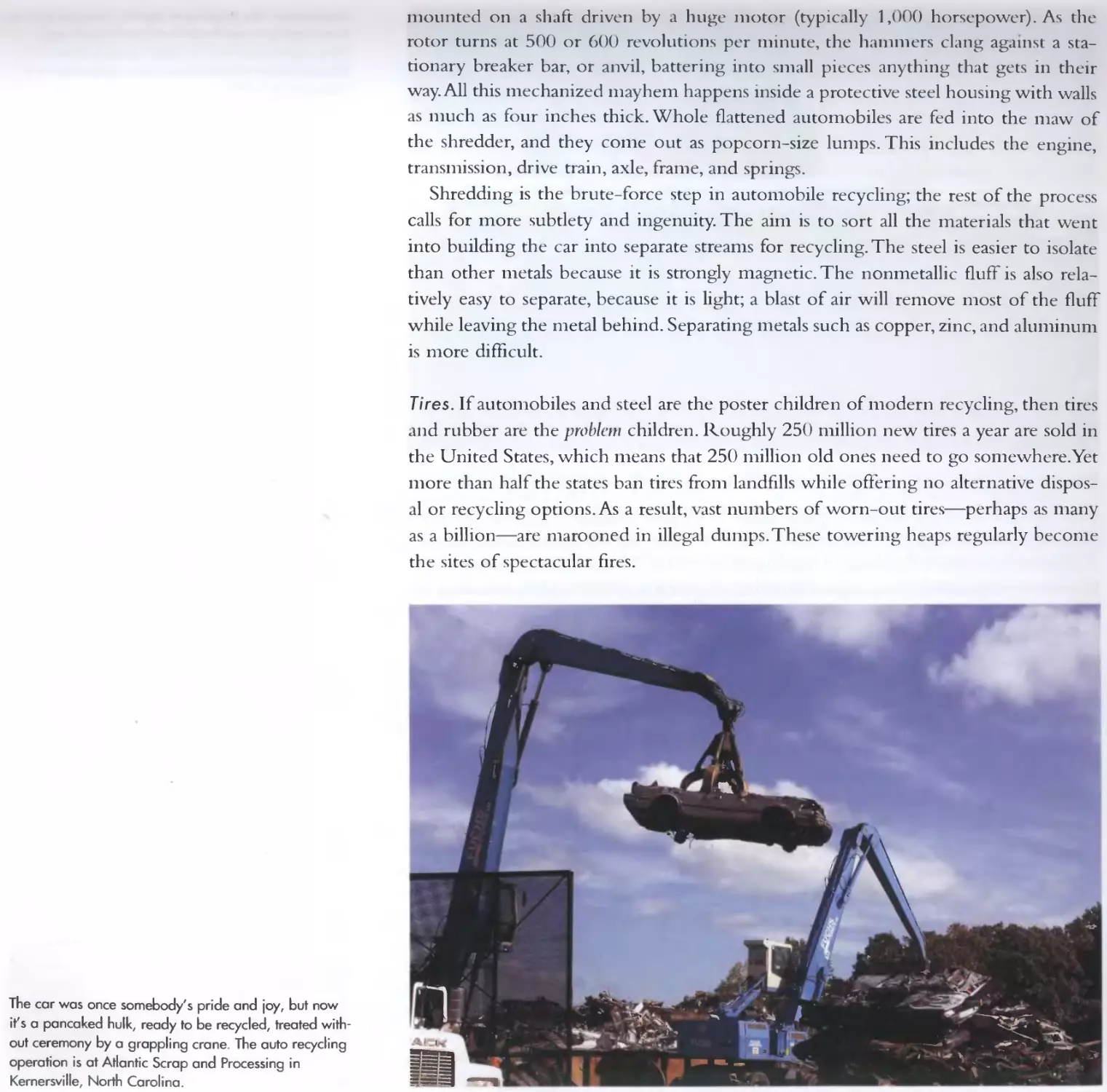
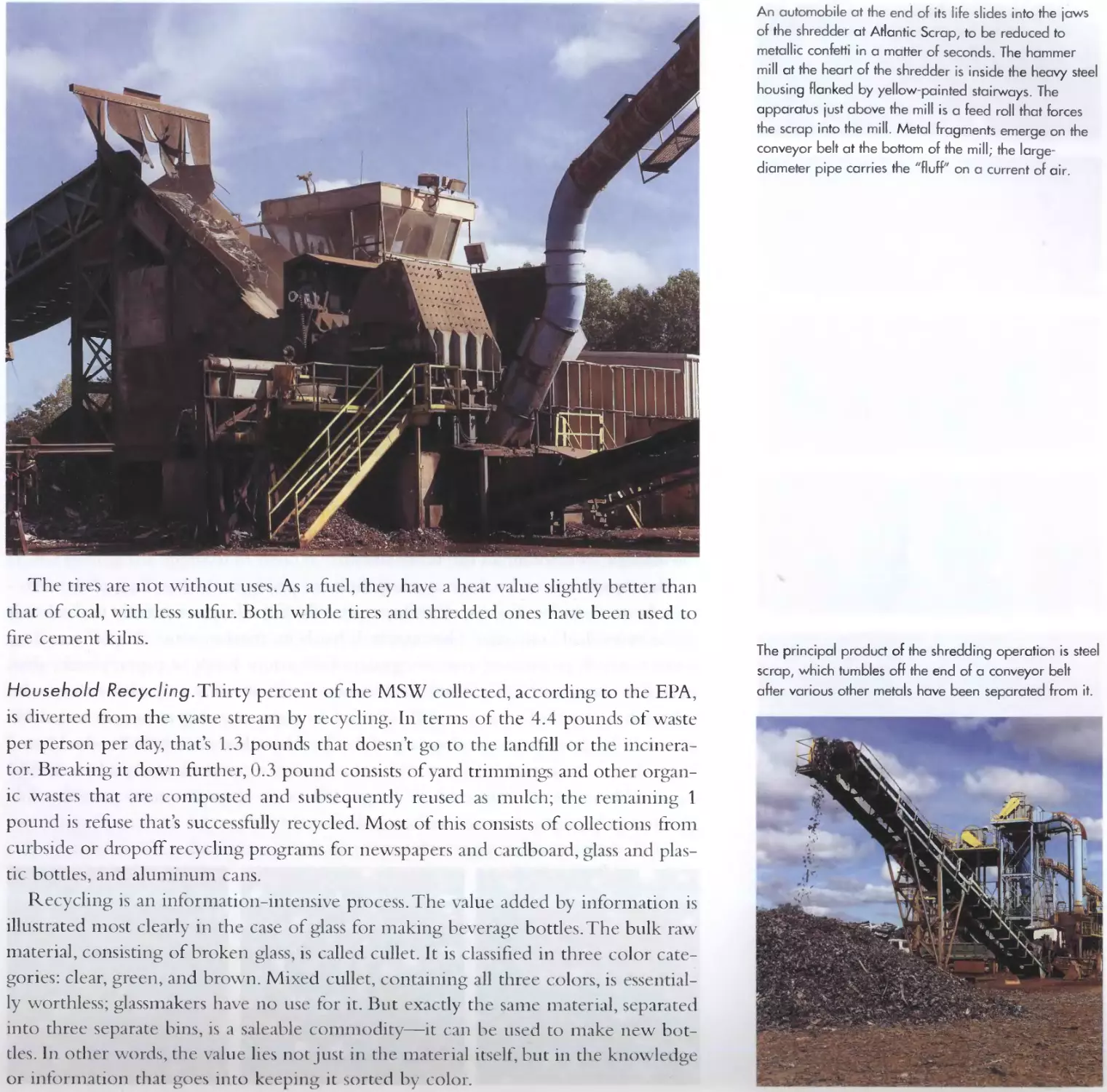
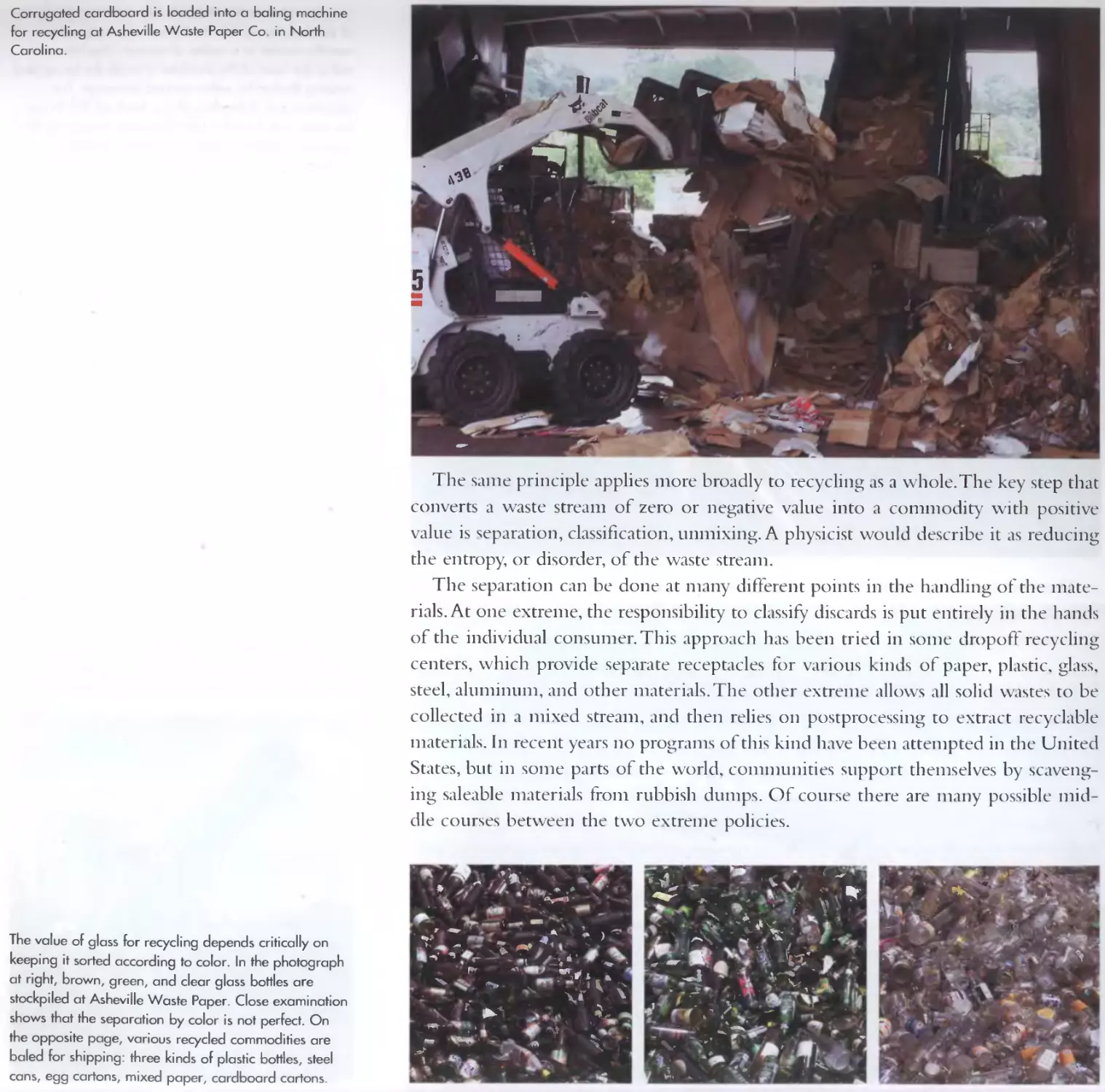
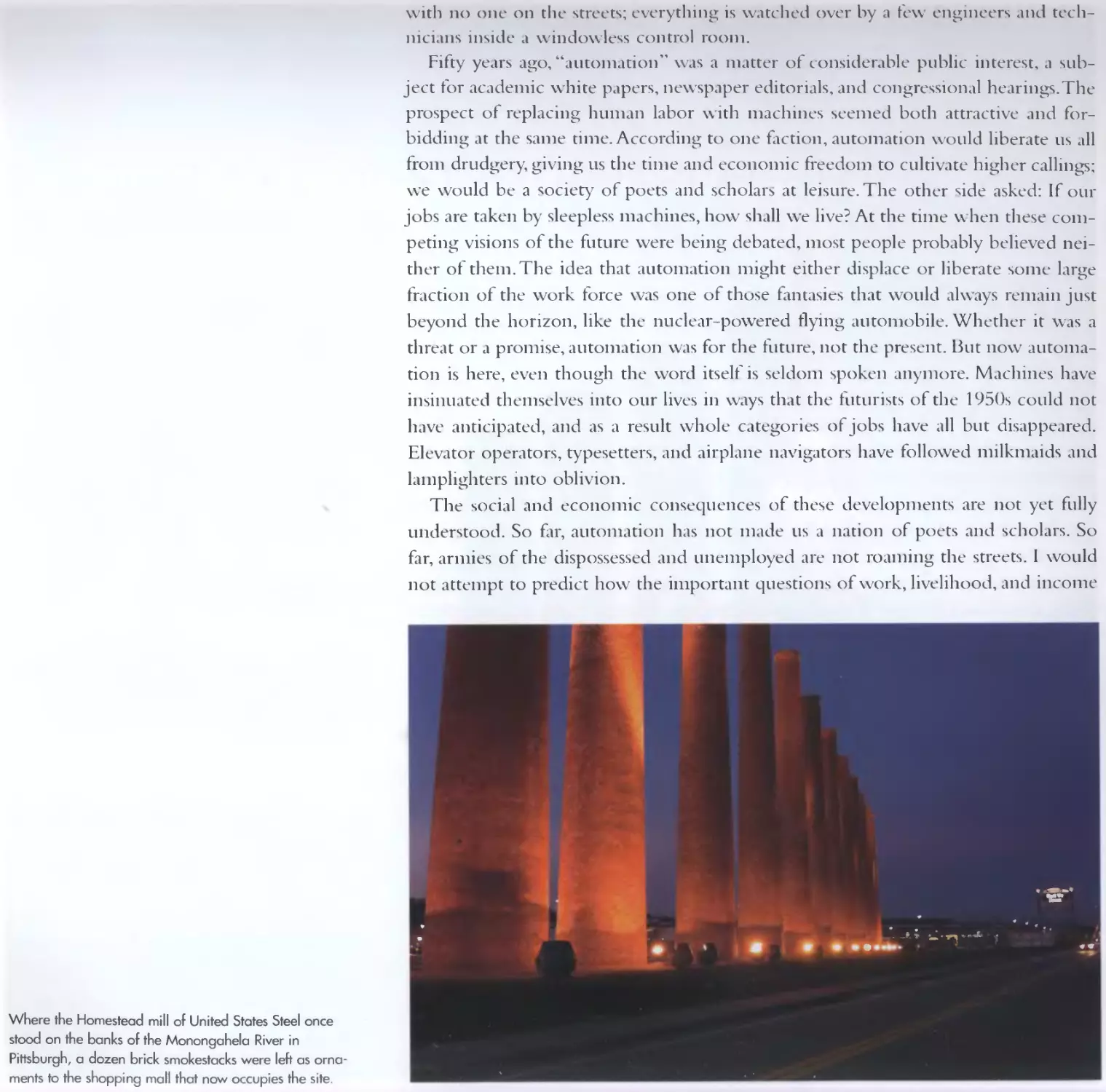
/


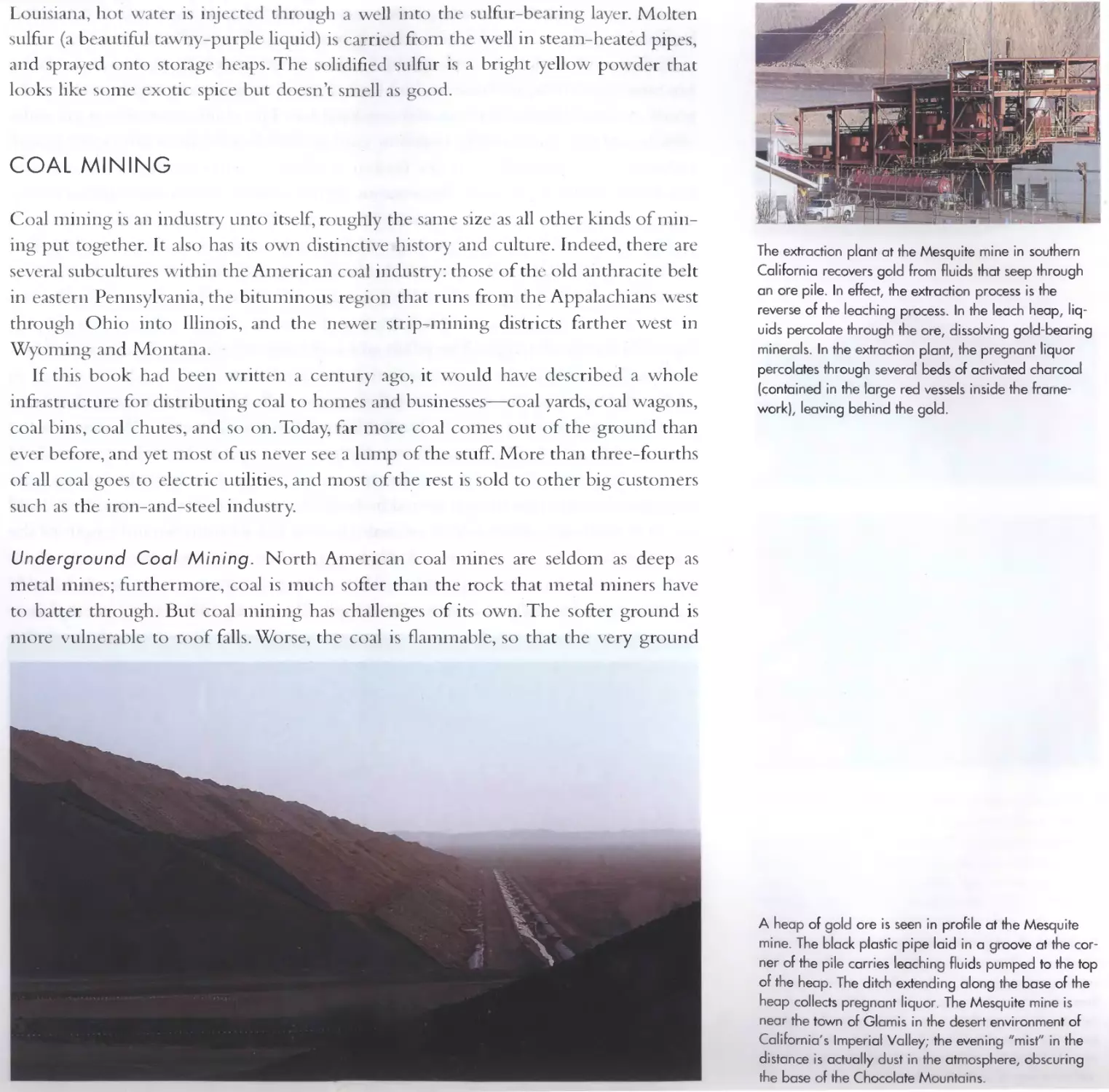
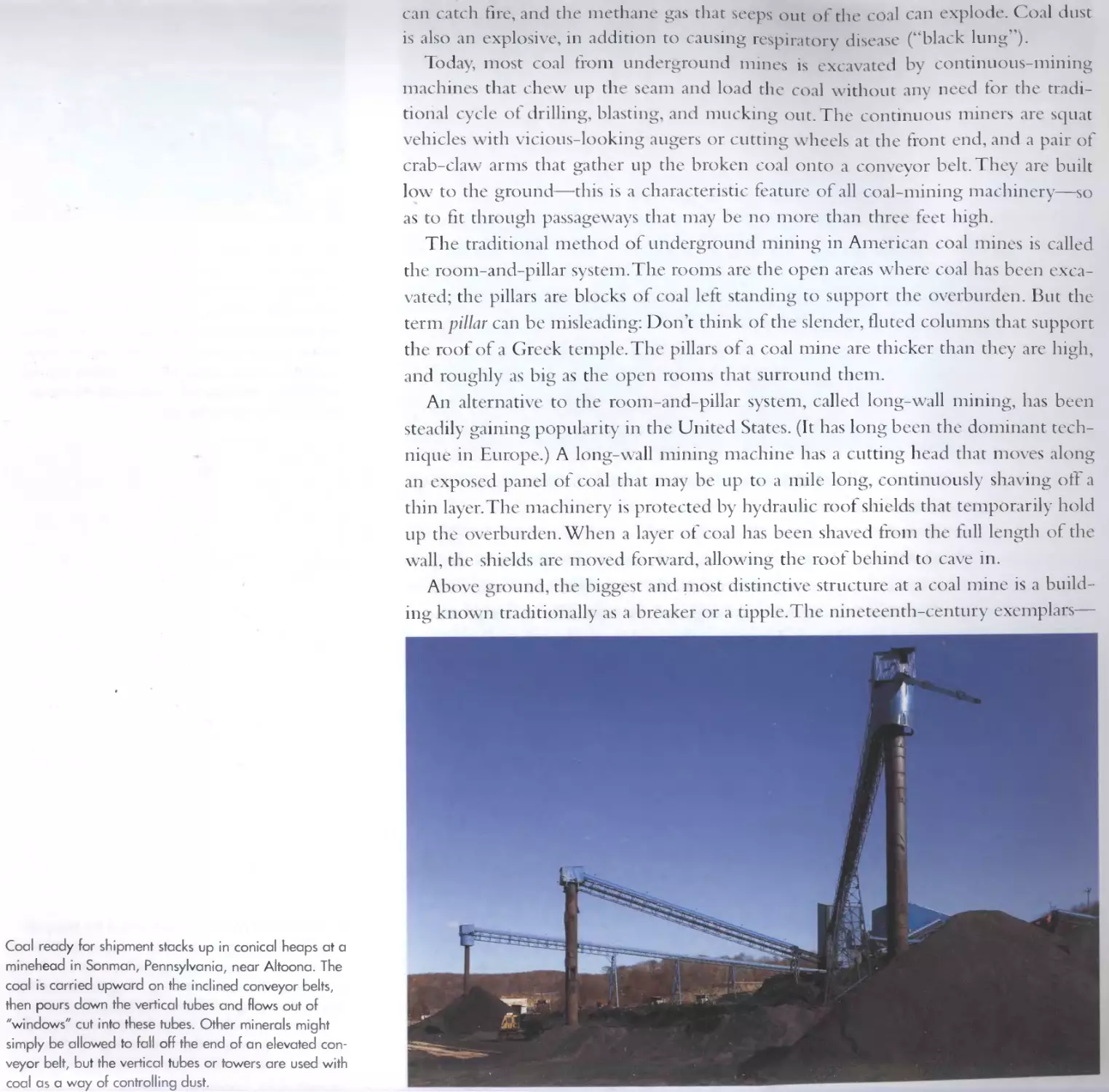
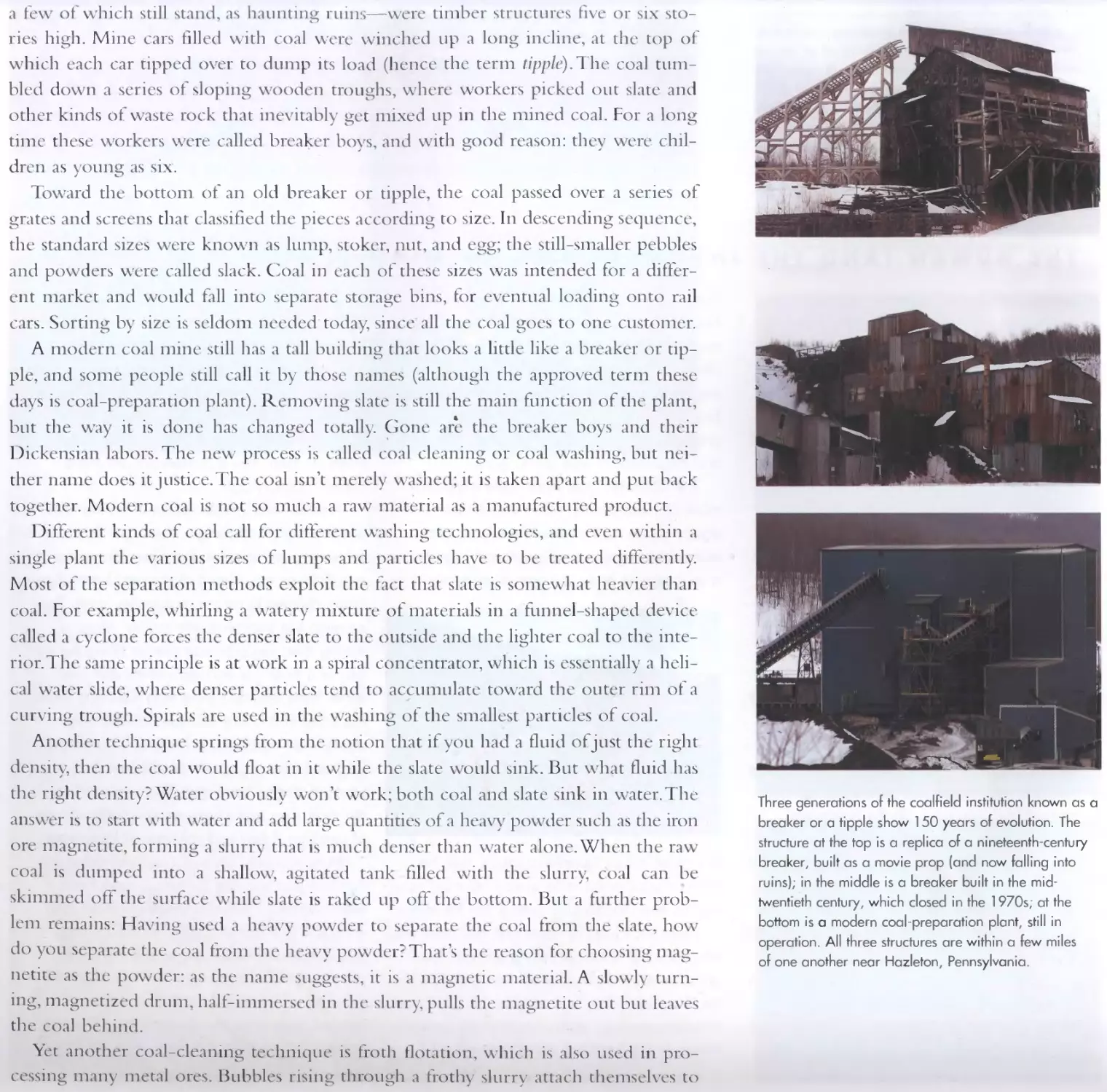
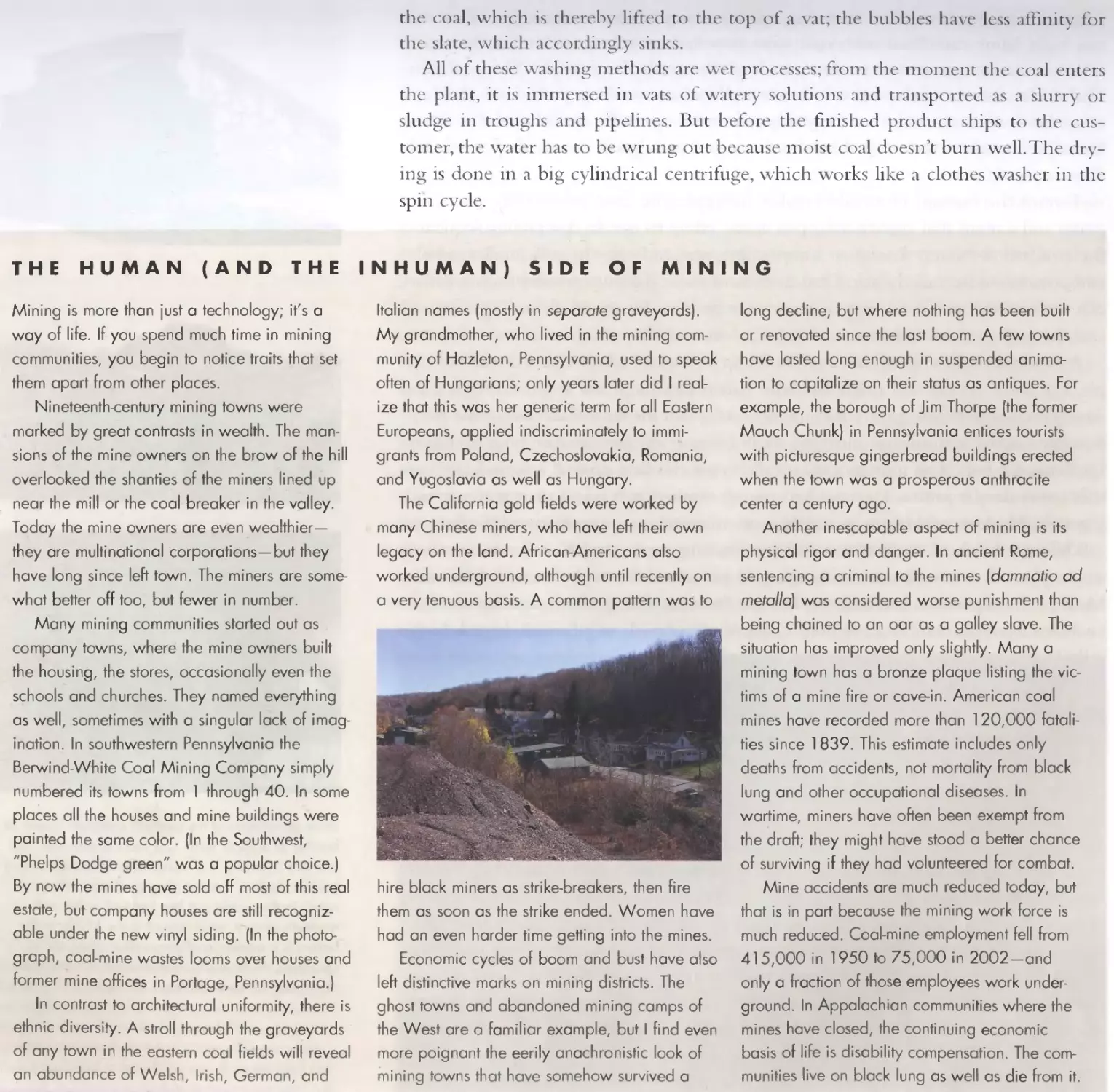
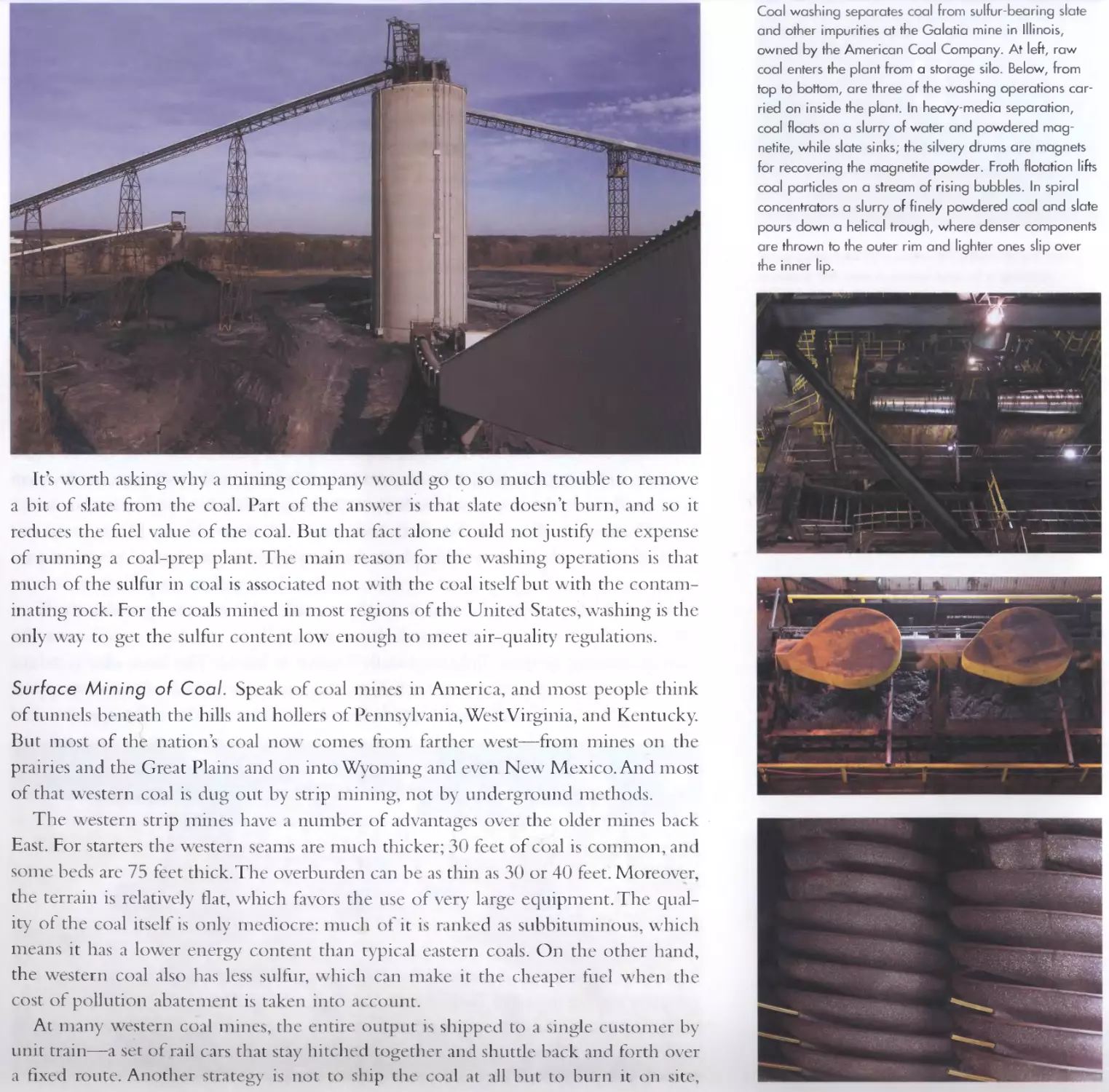
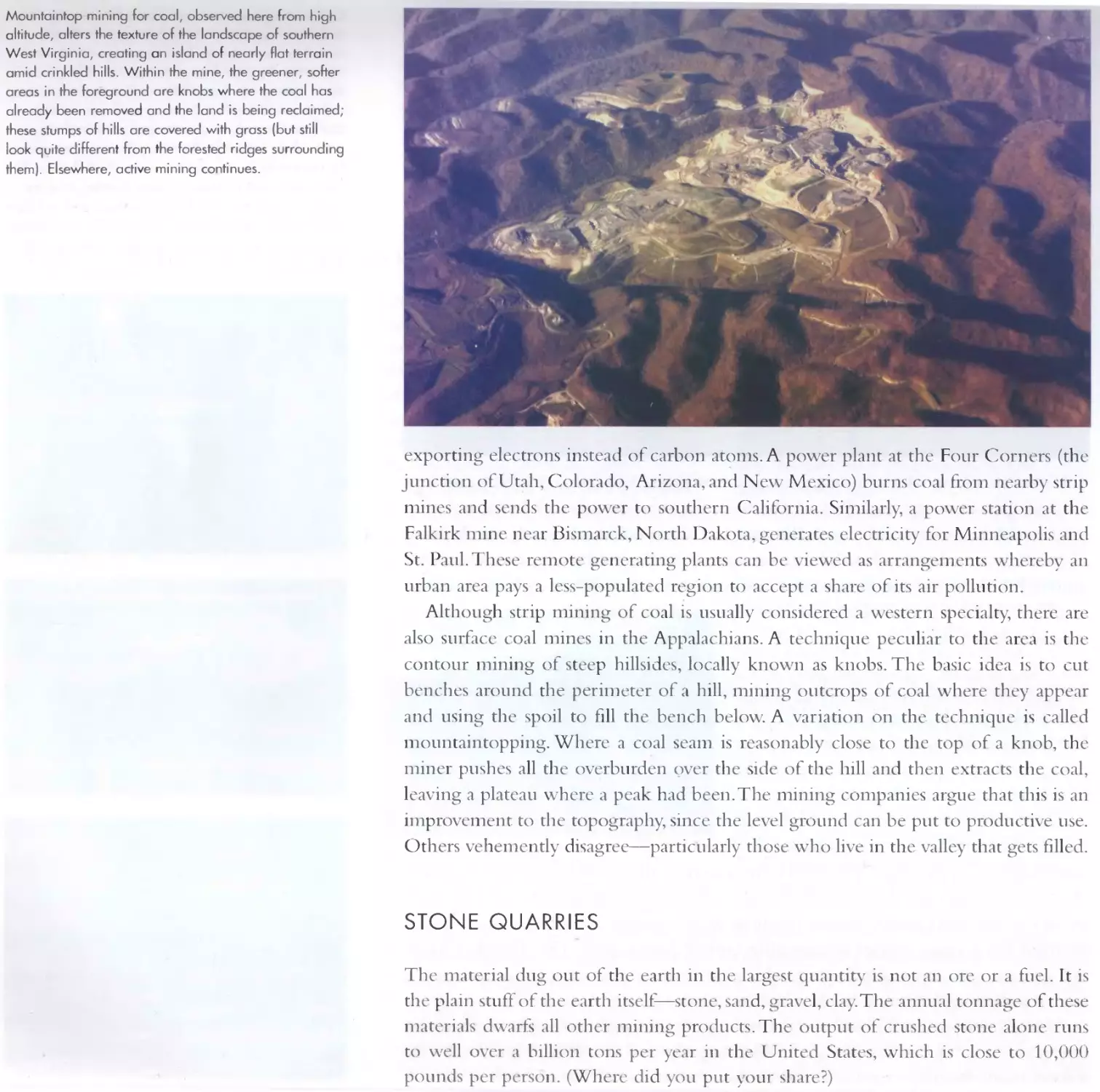
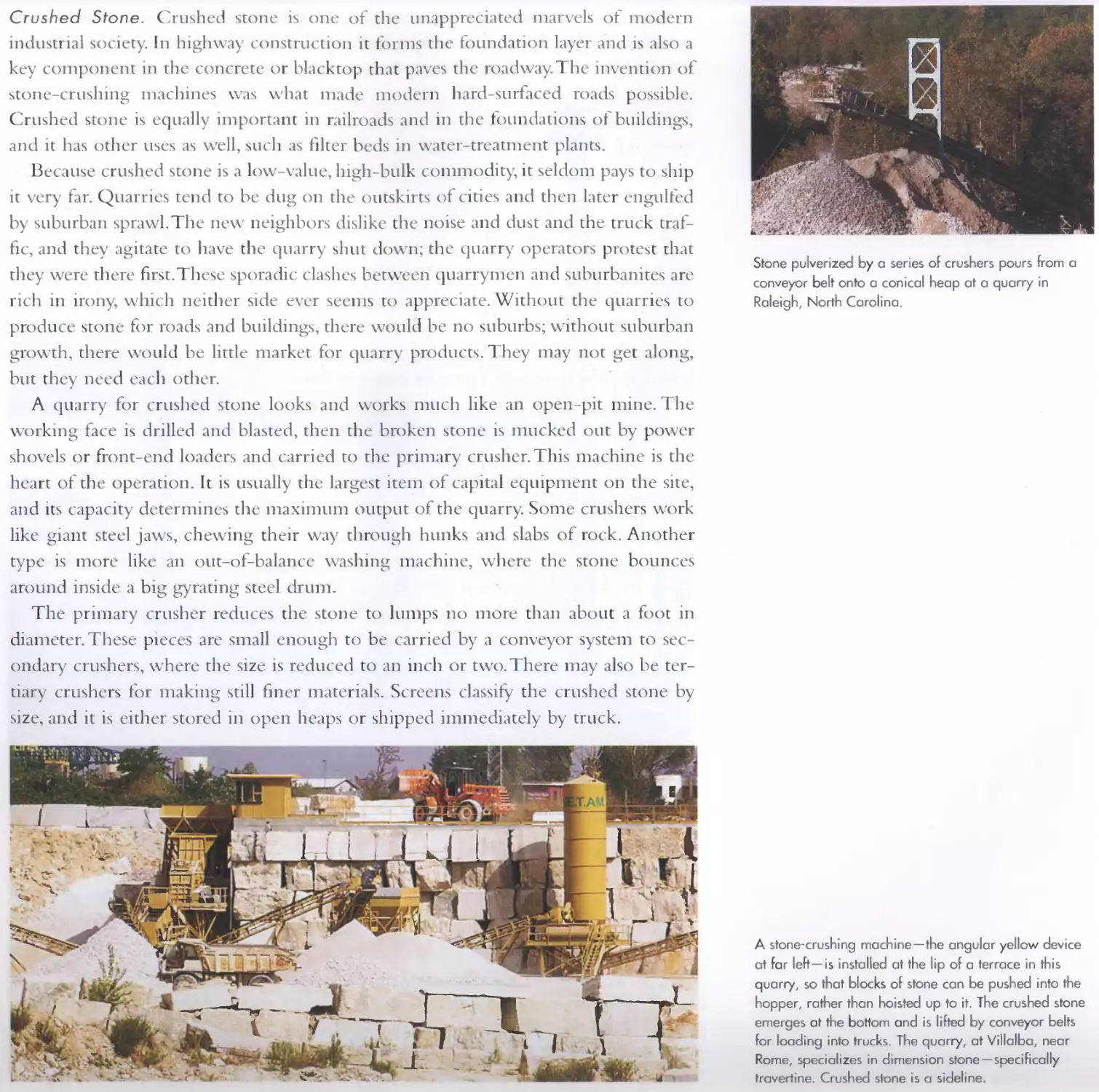
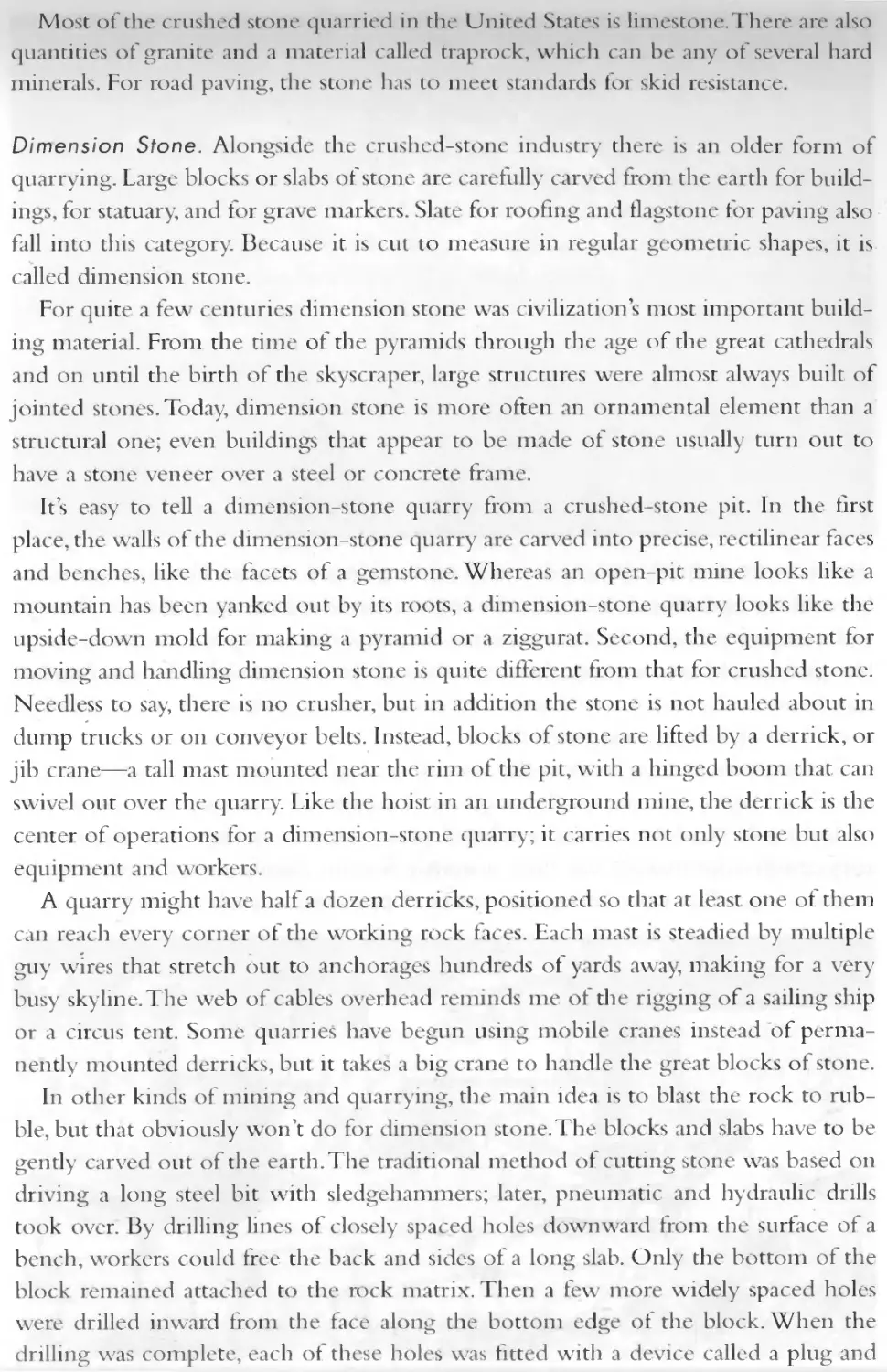

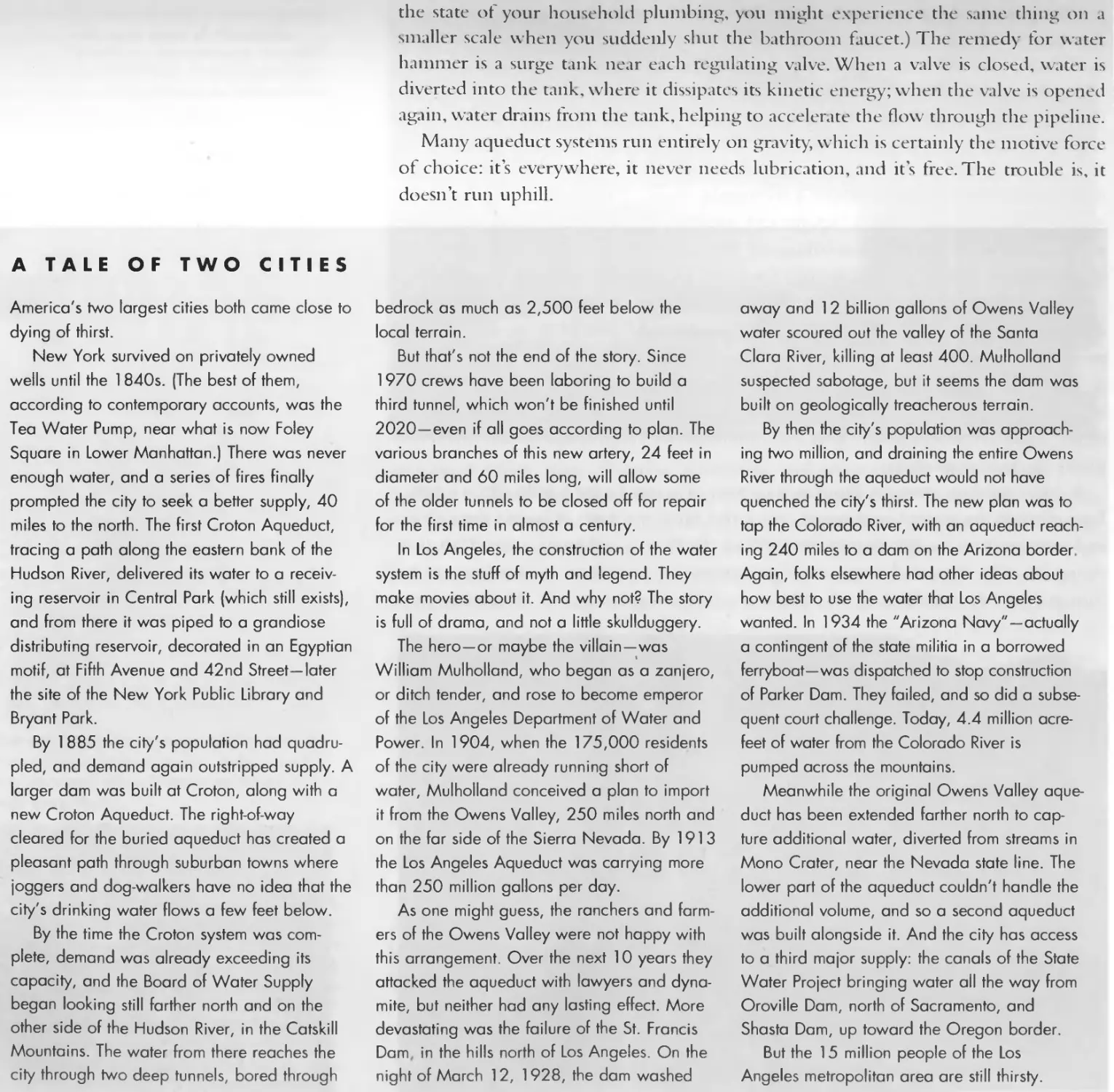
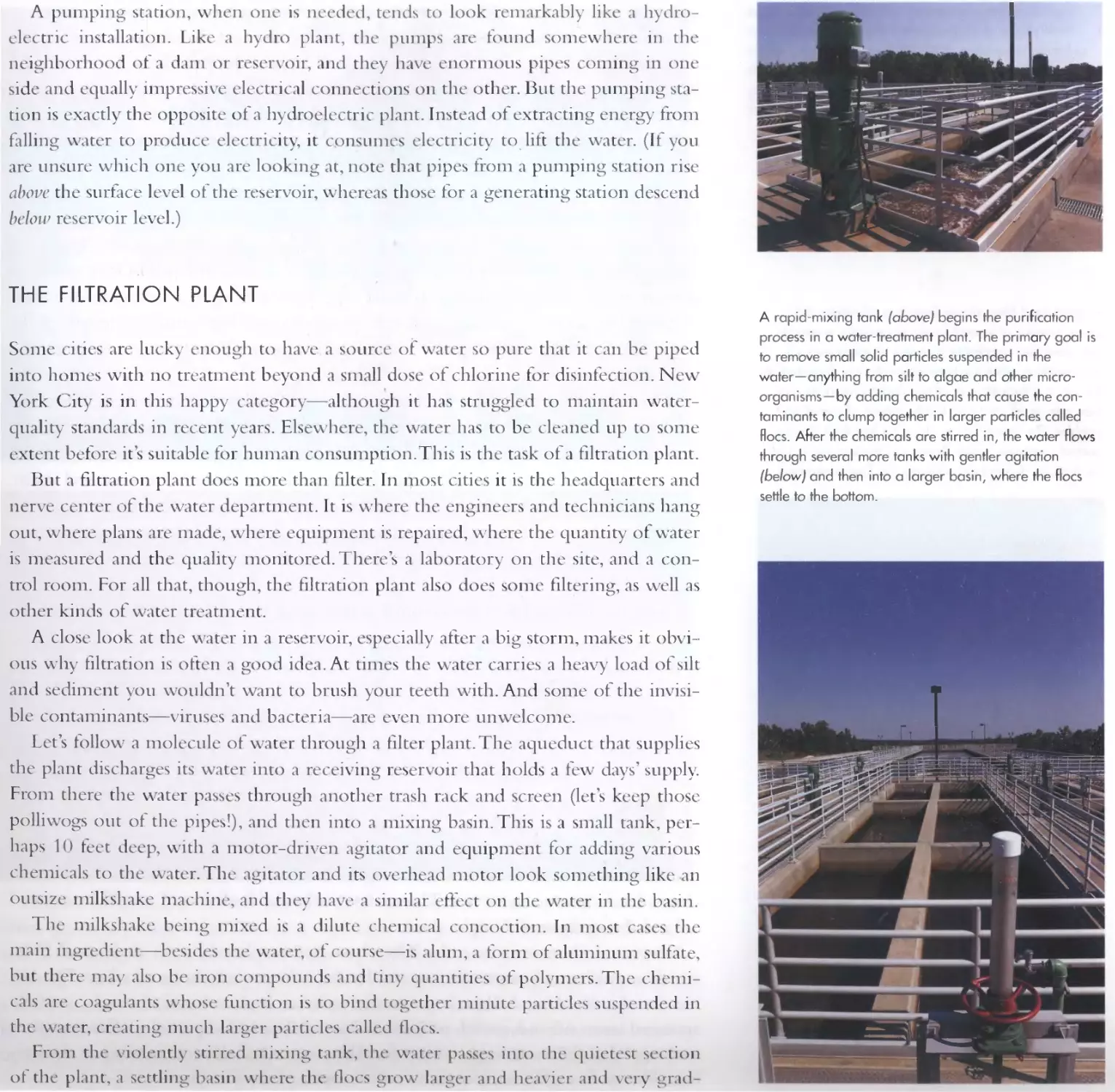

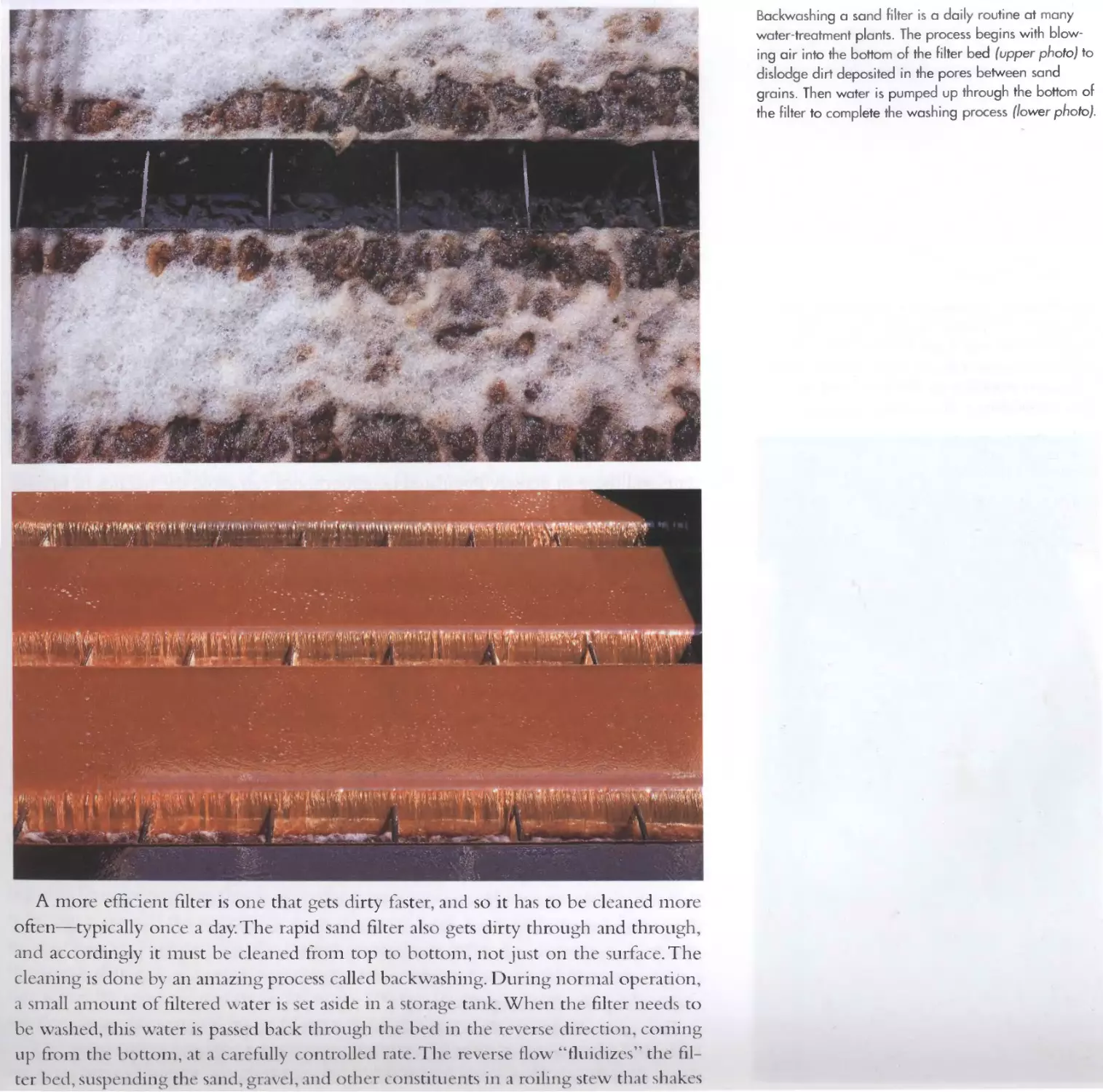
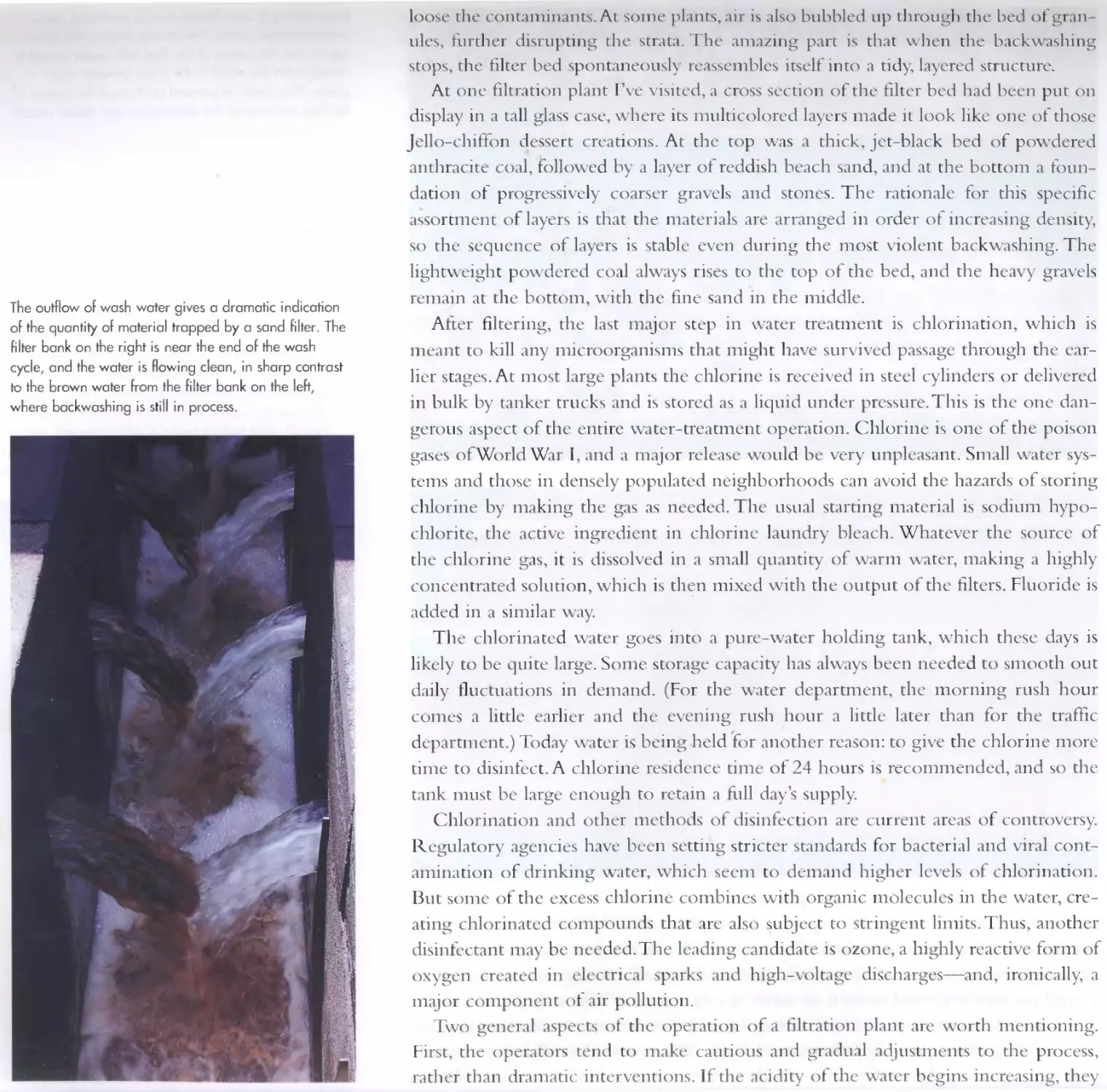
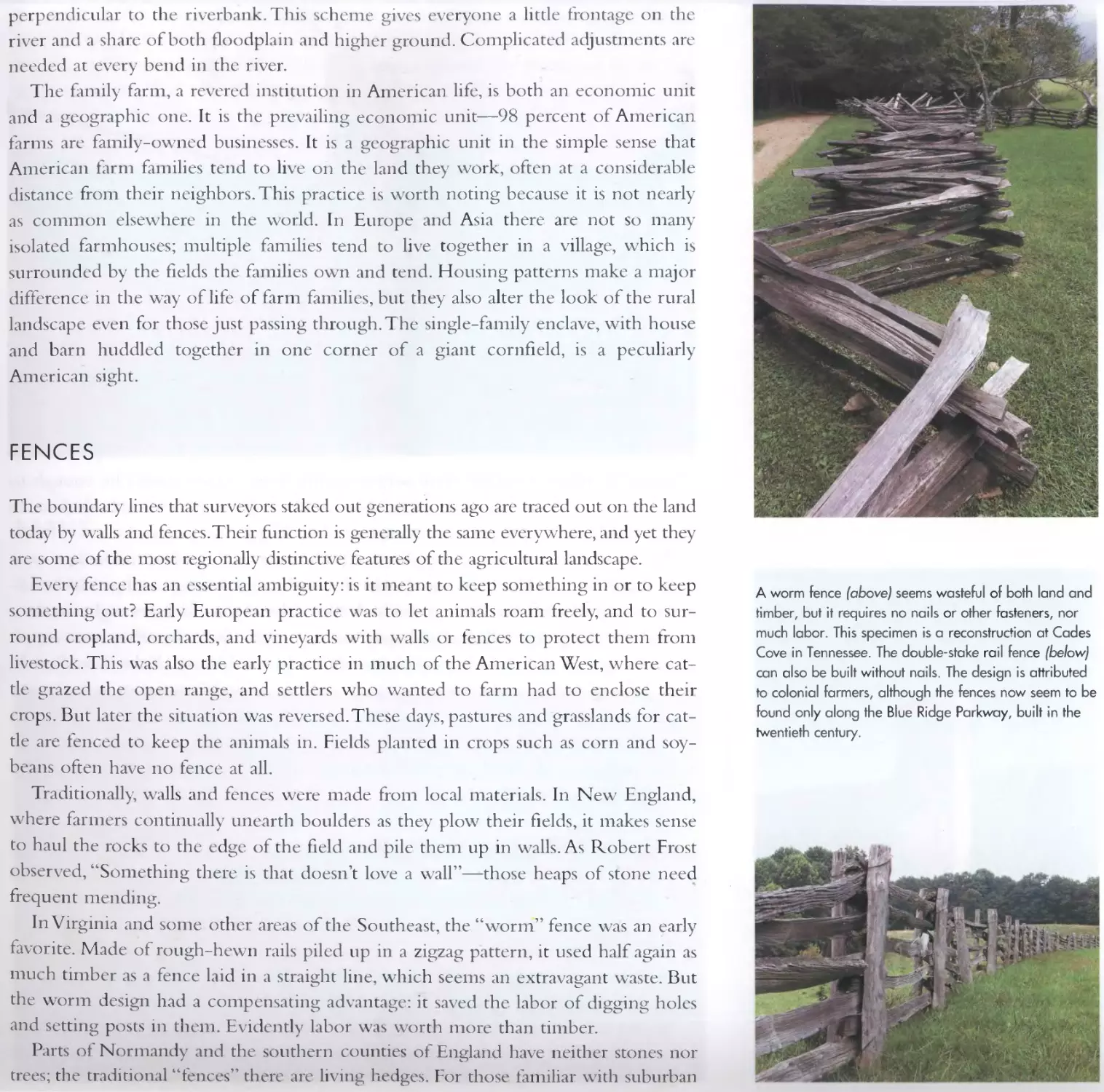
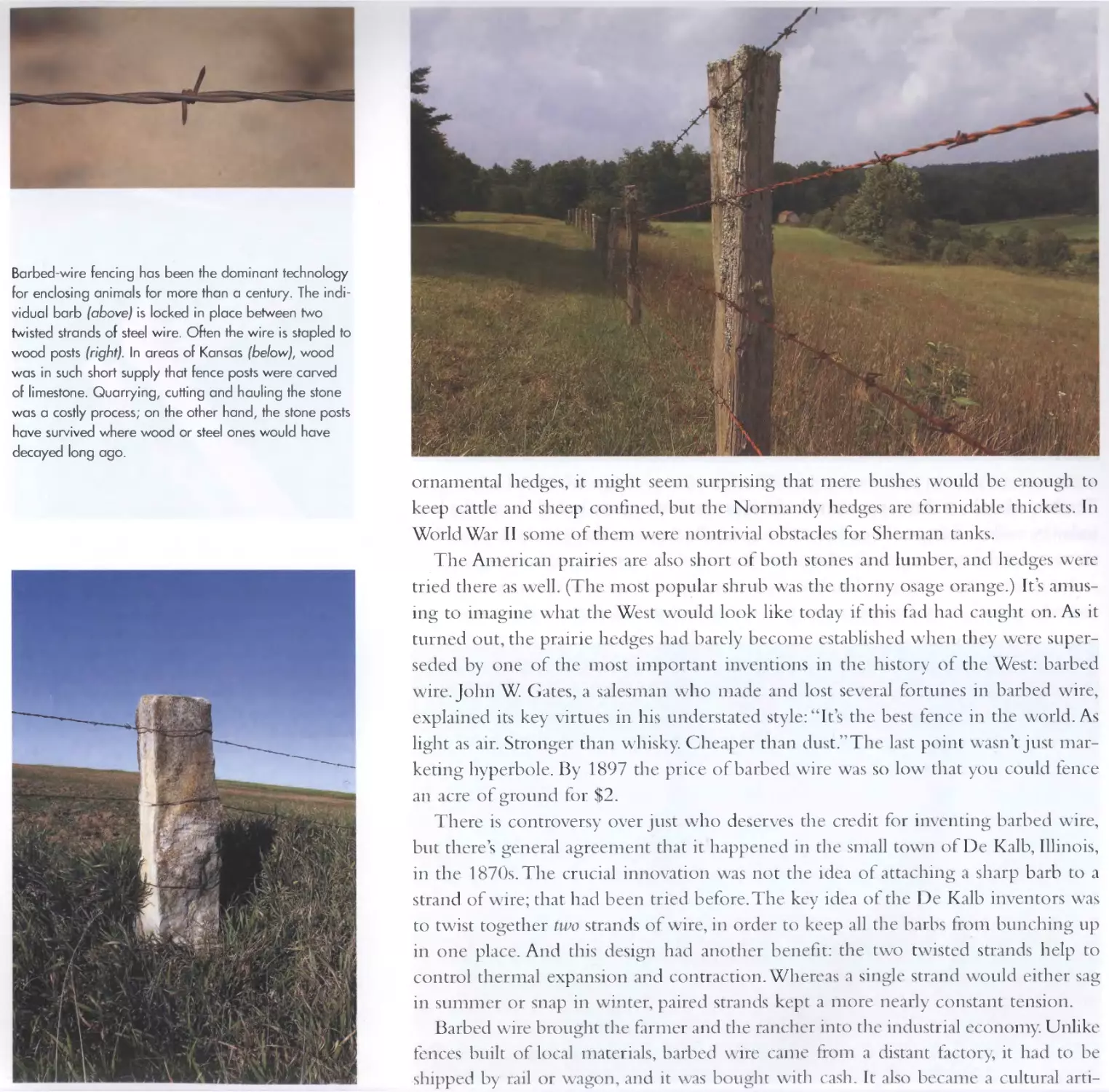
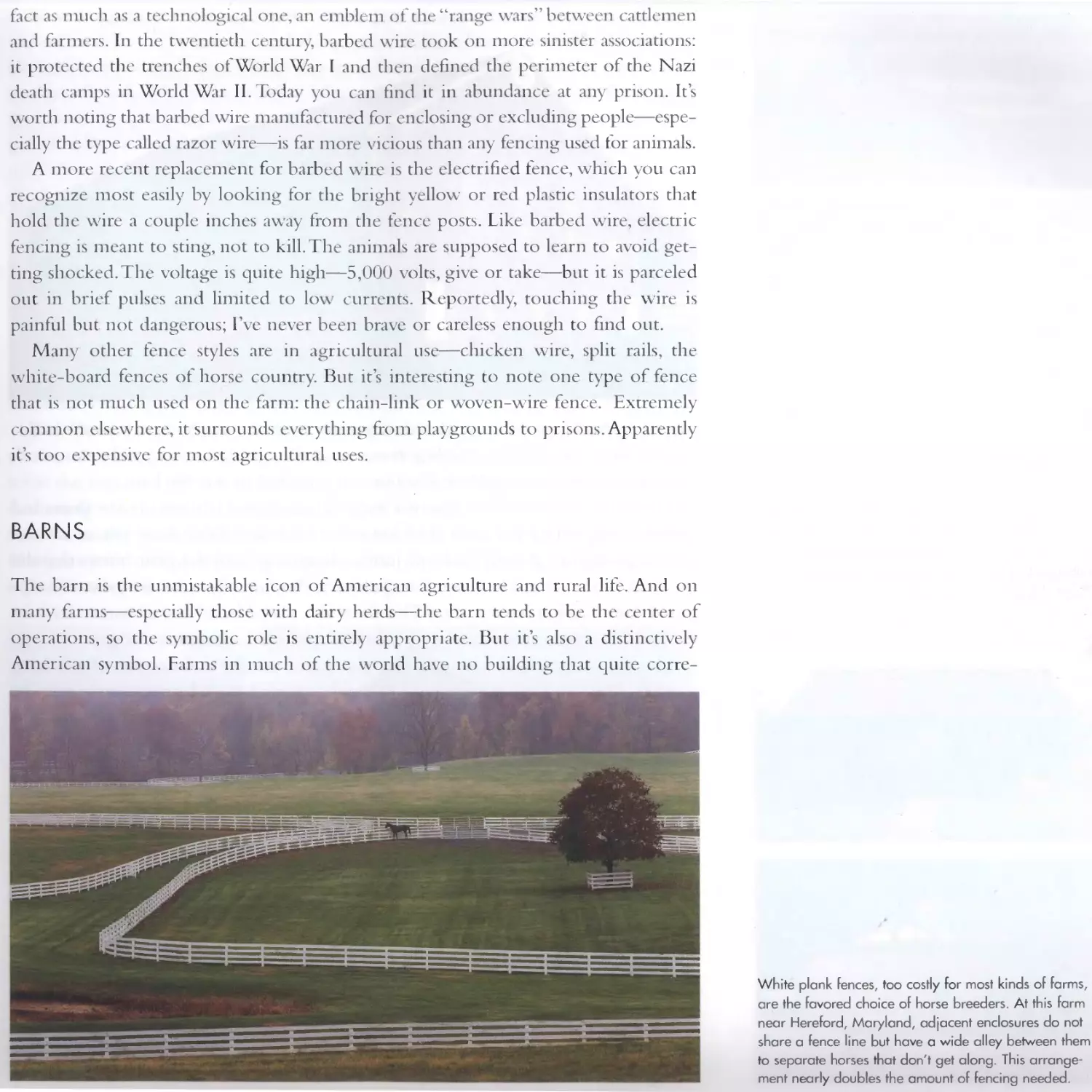
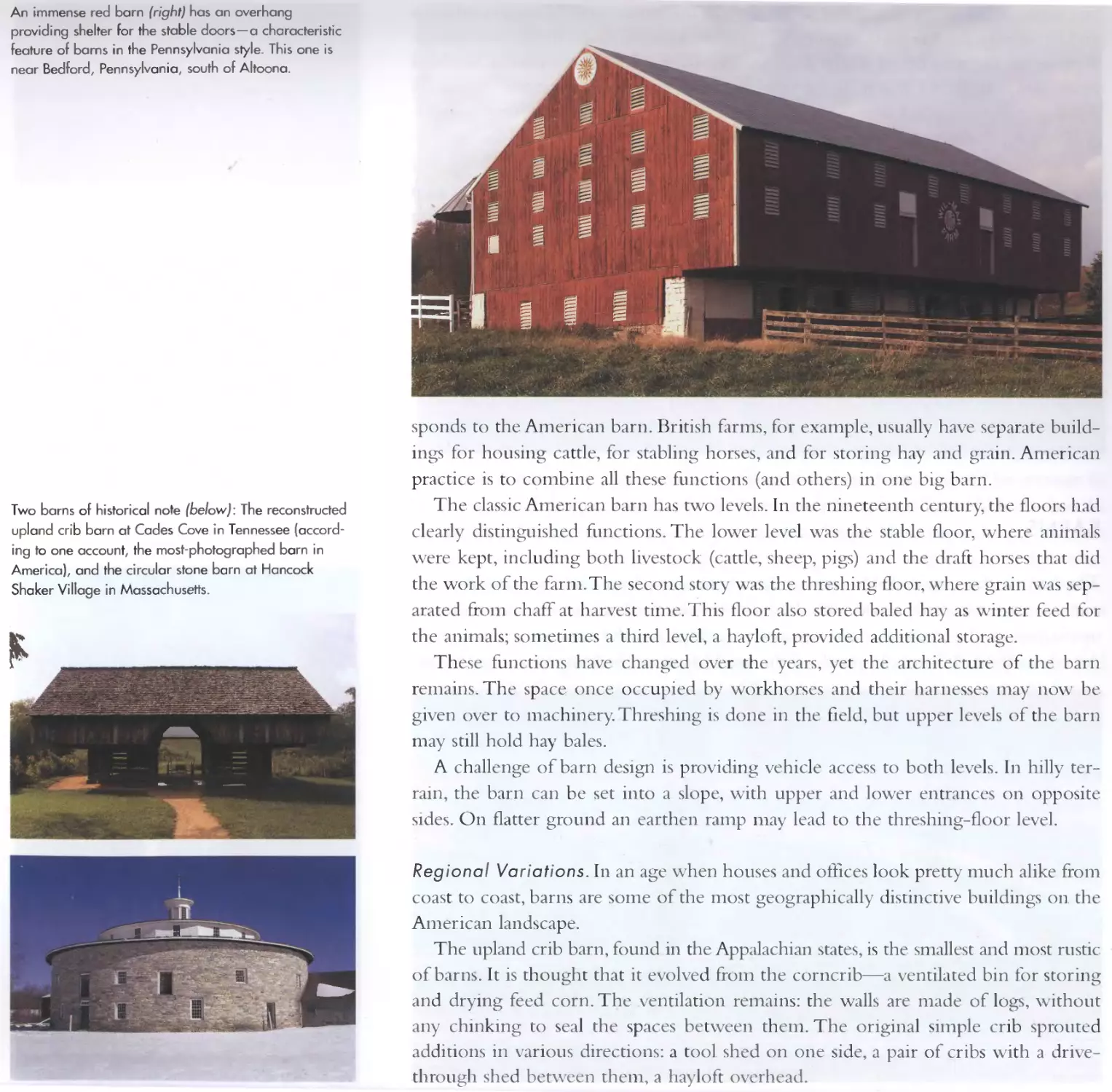

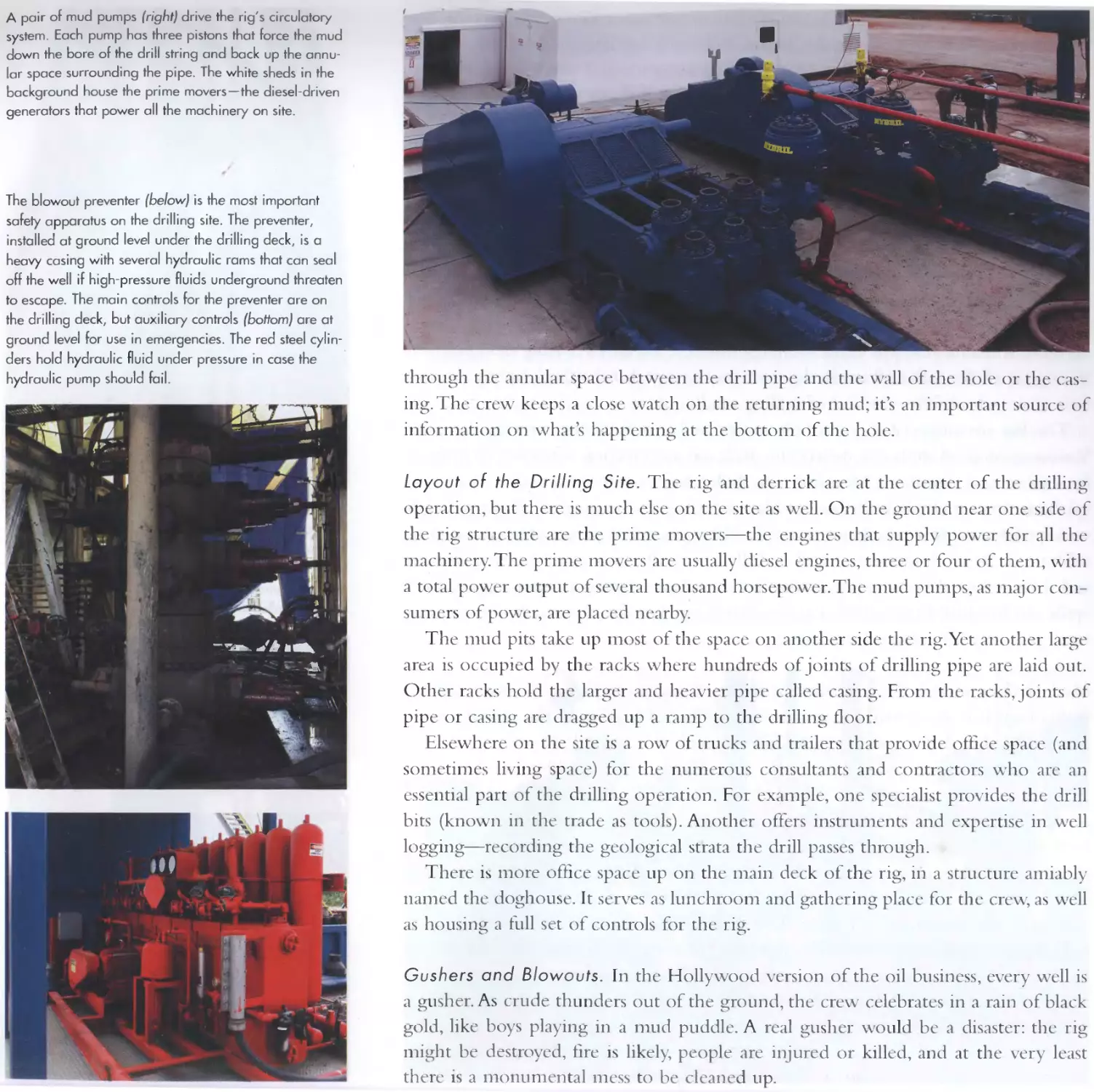
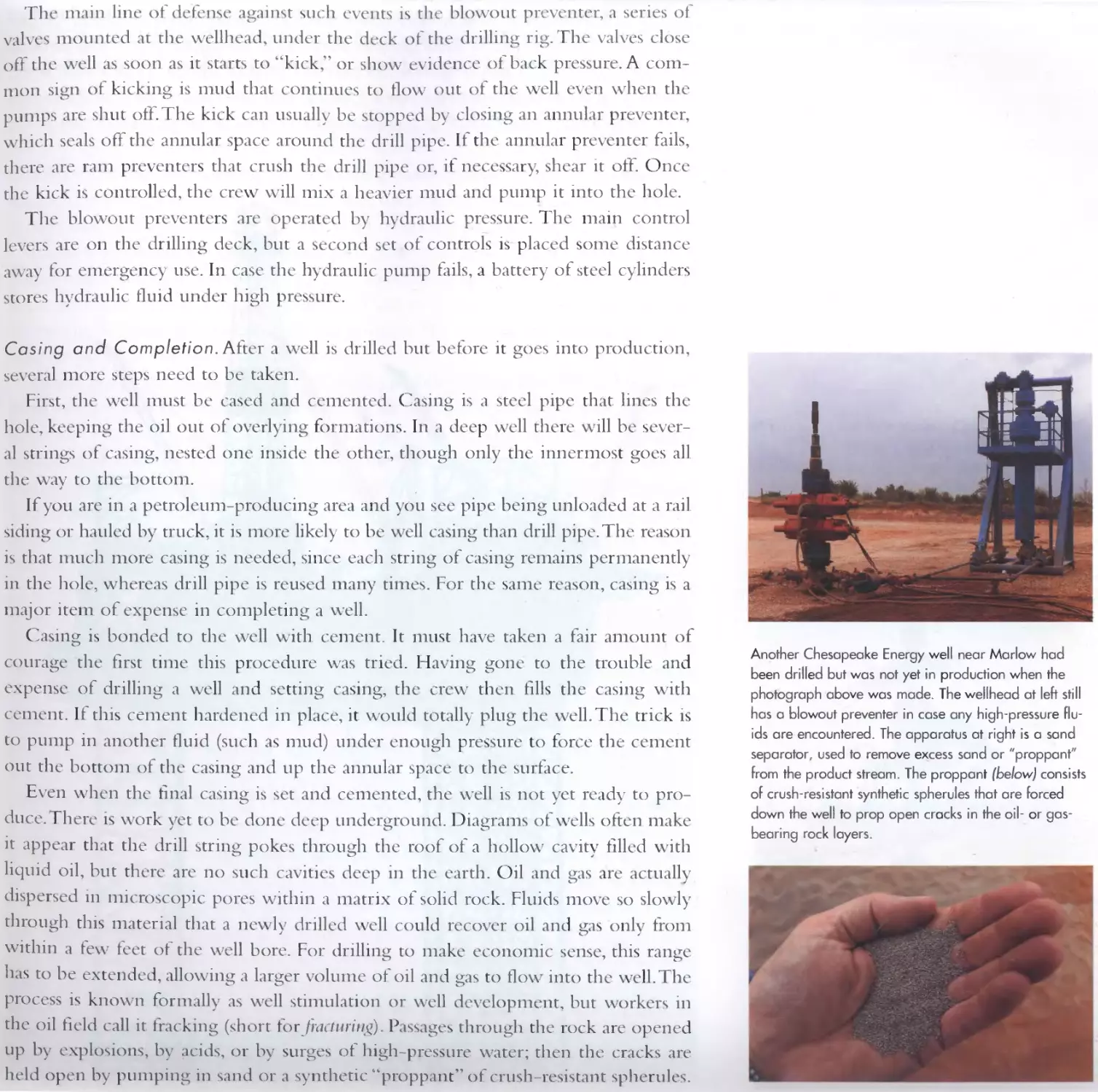
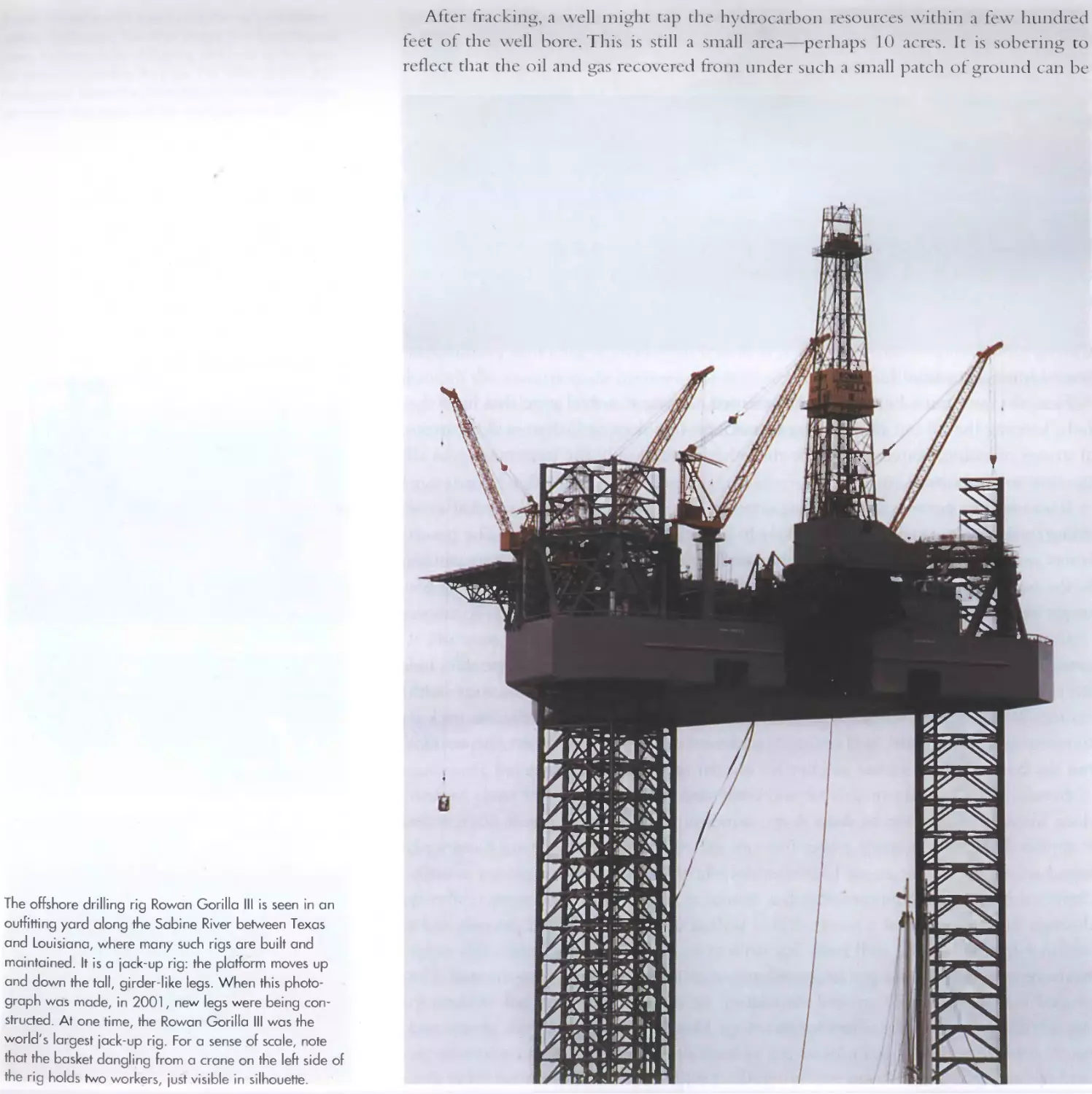
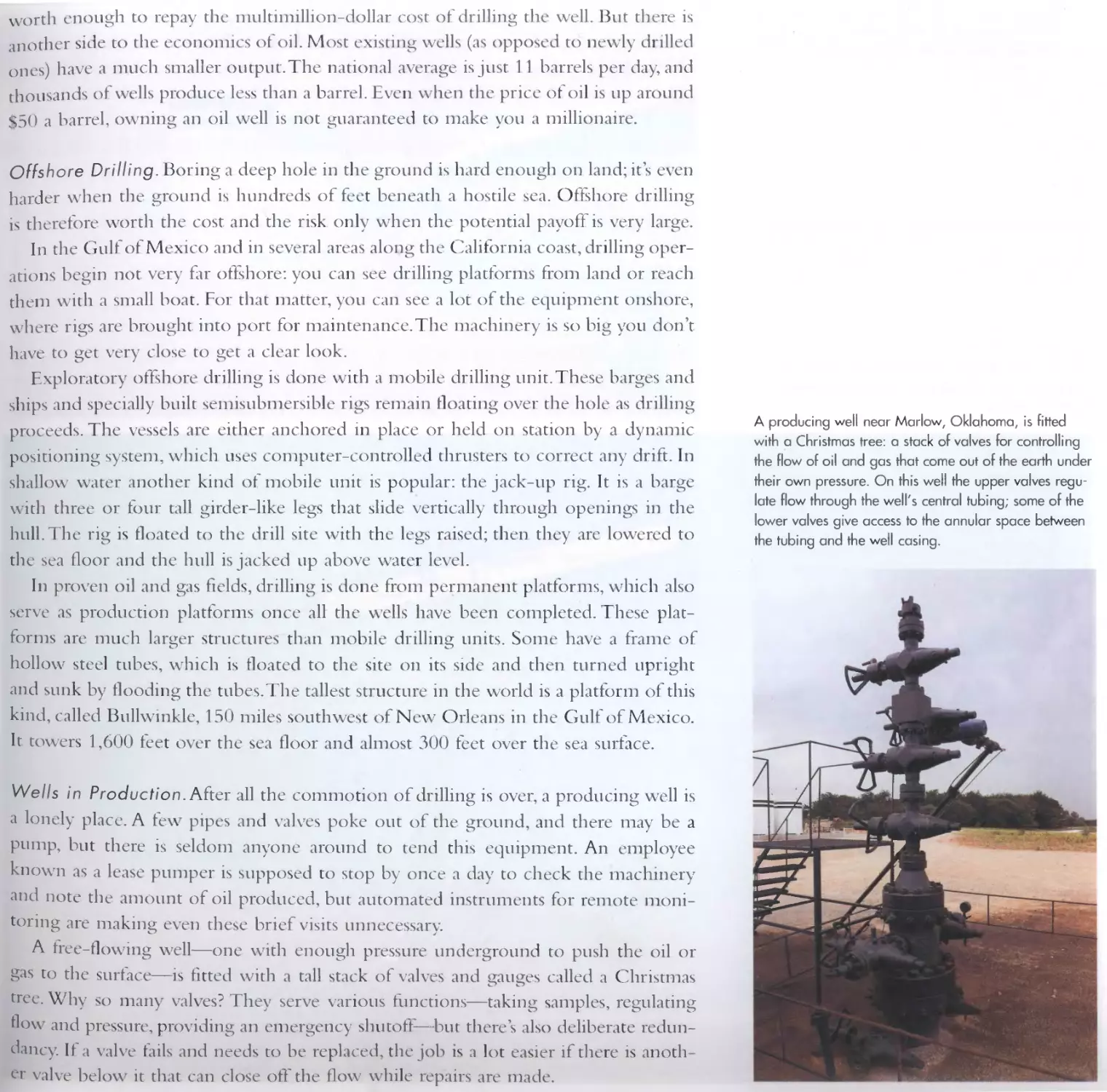

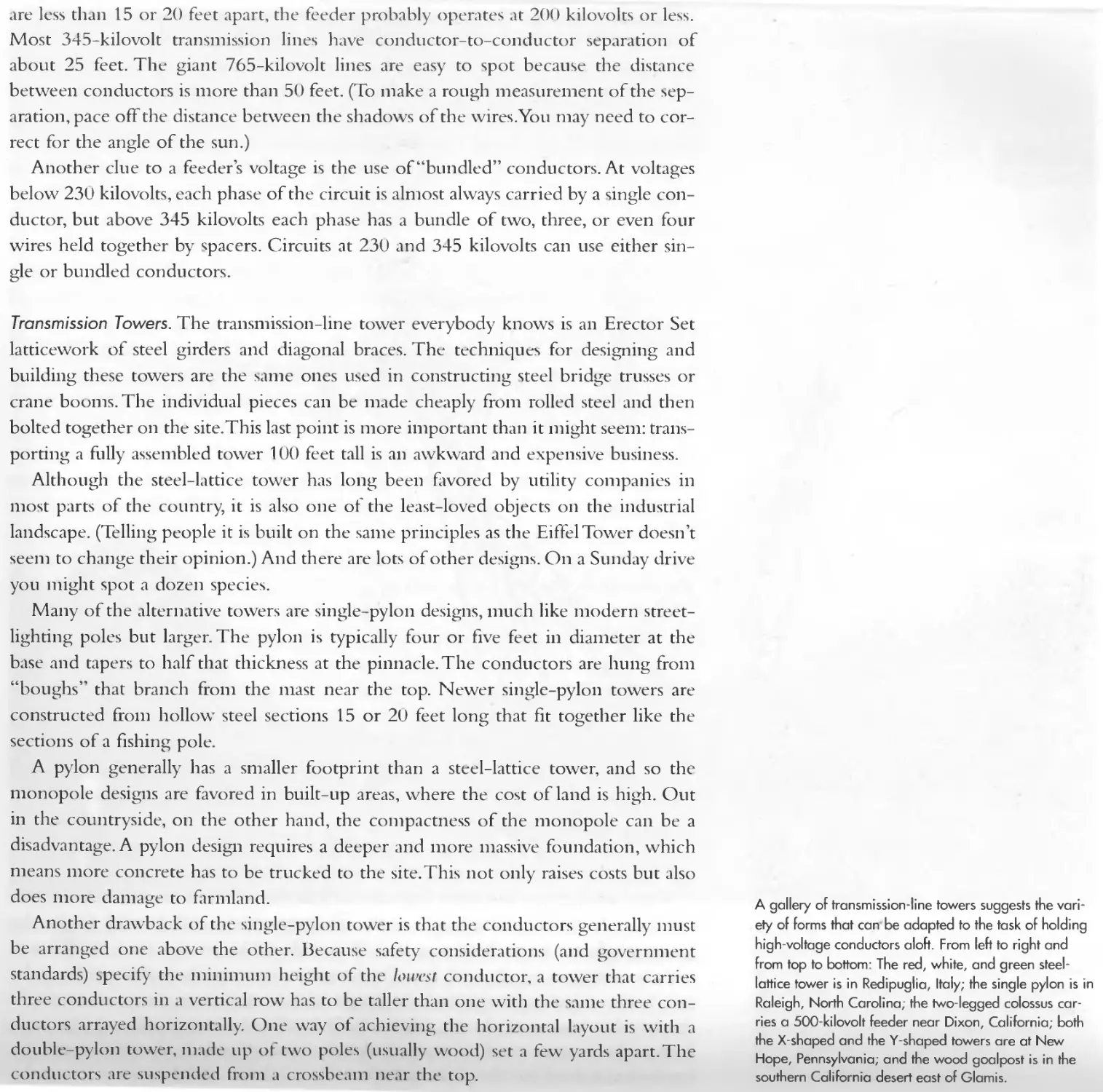
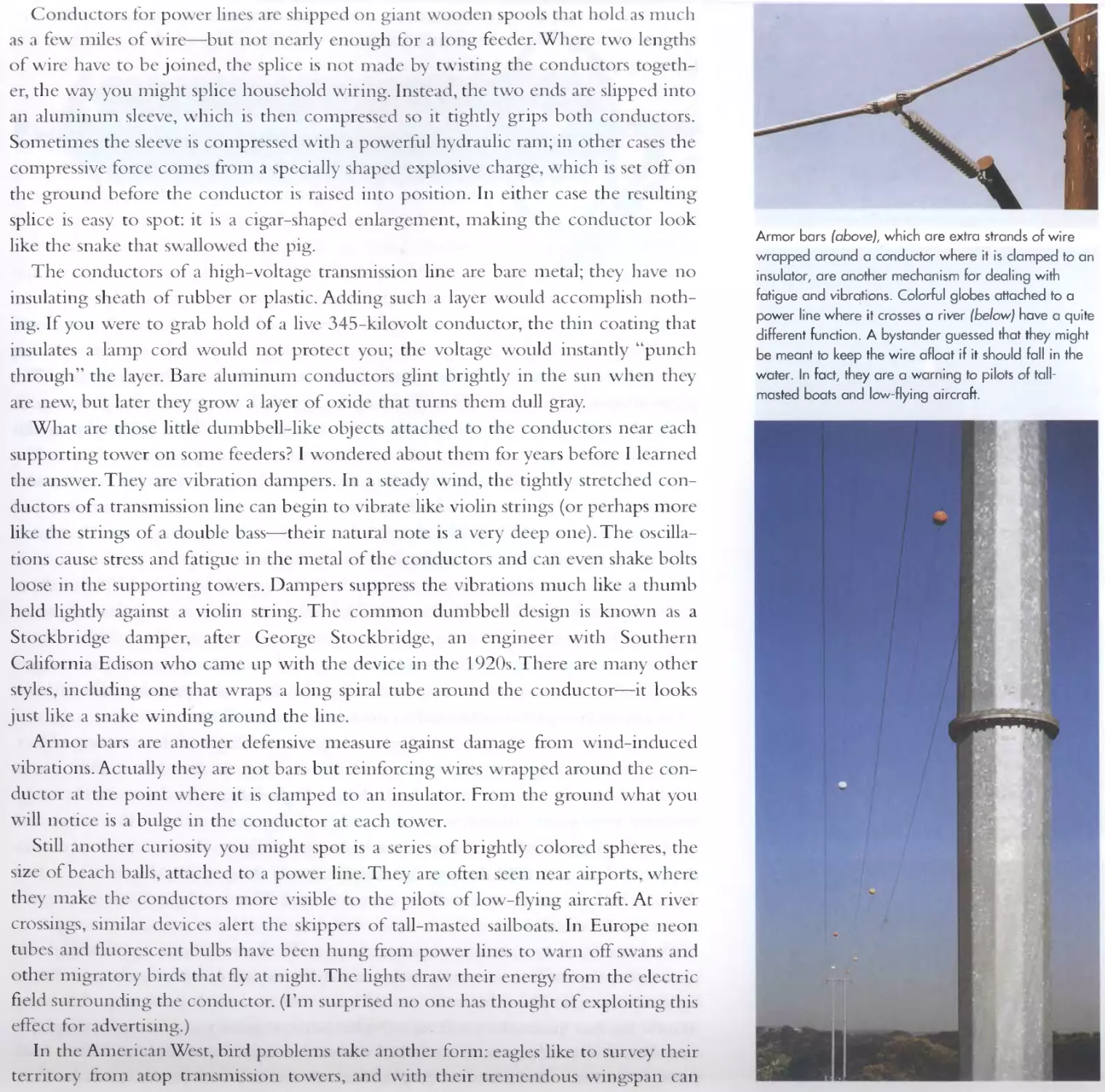



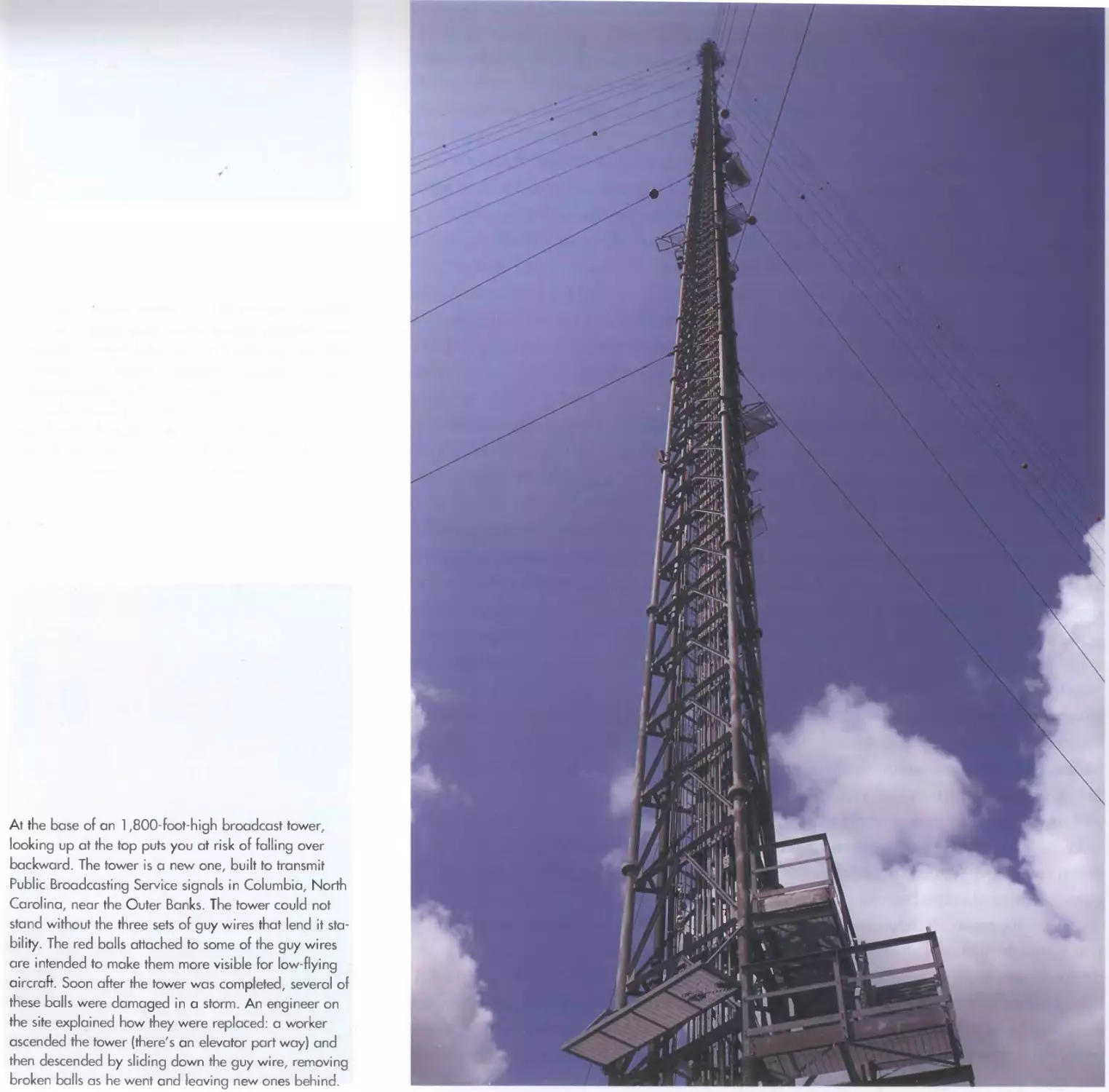
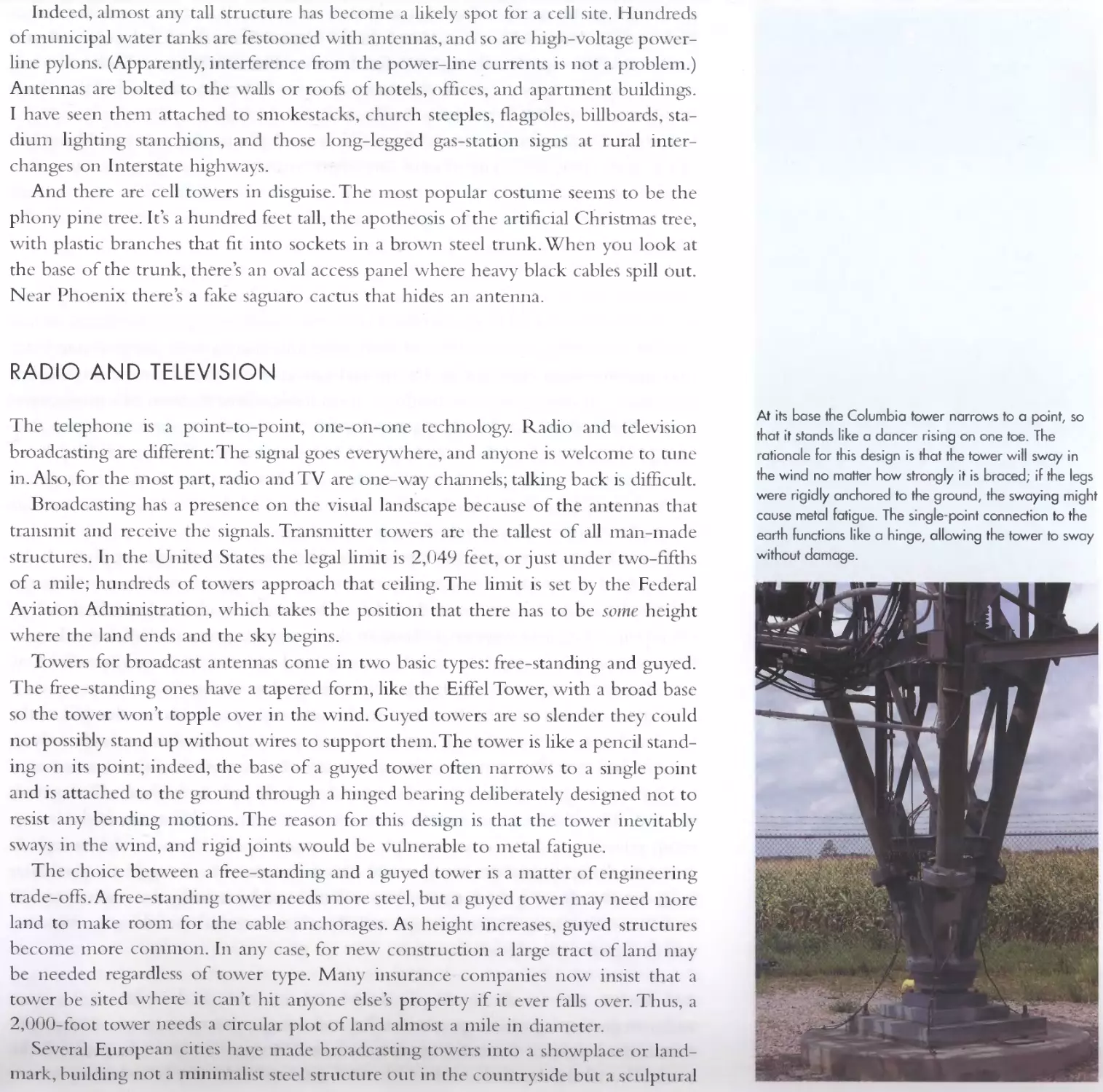
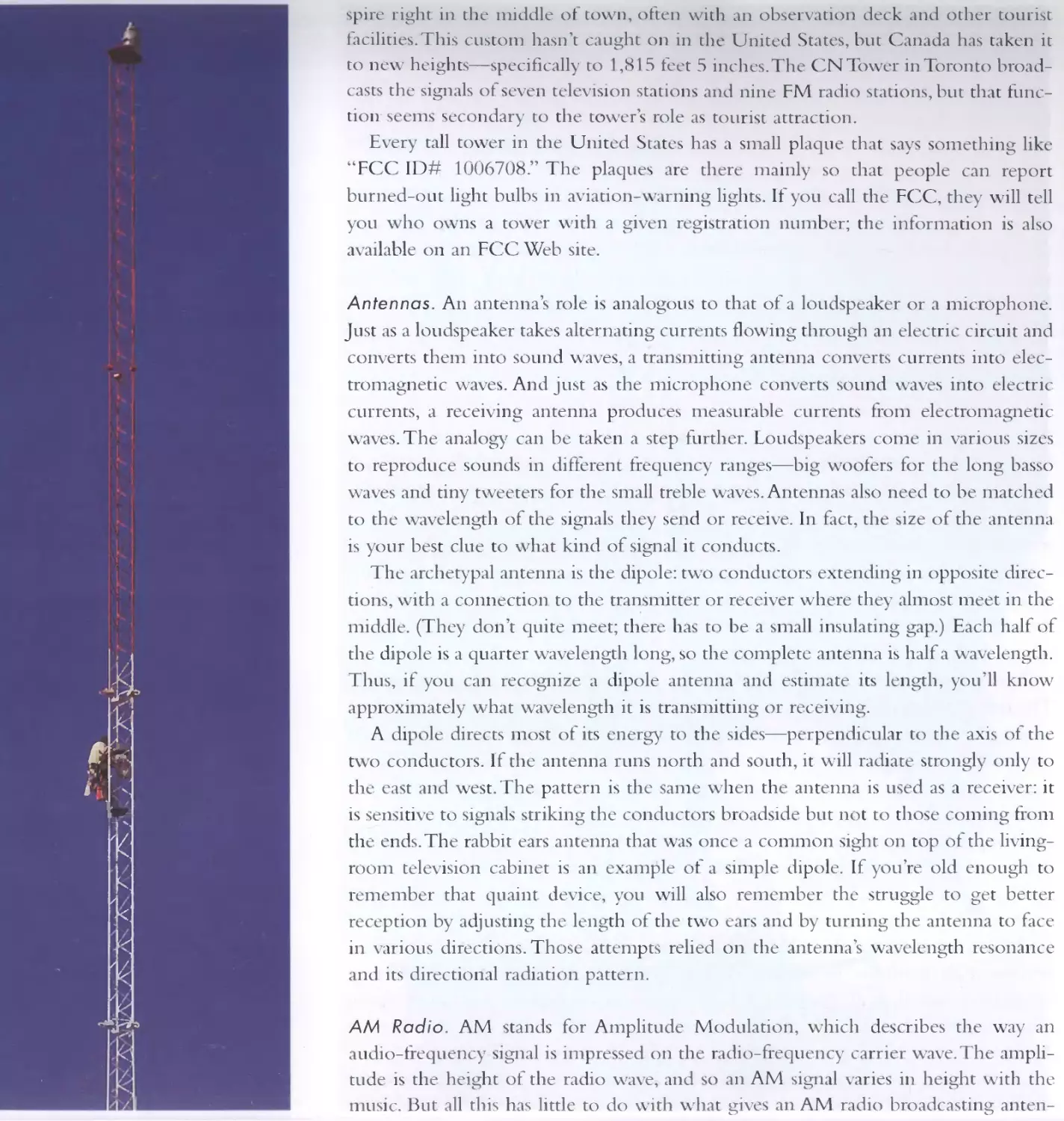
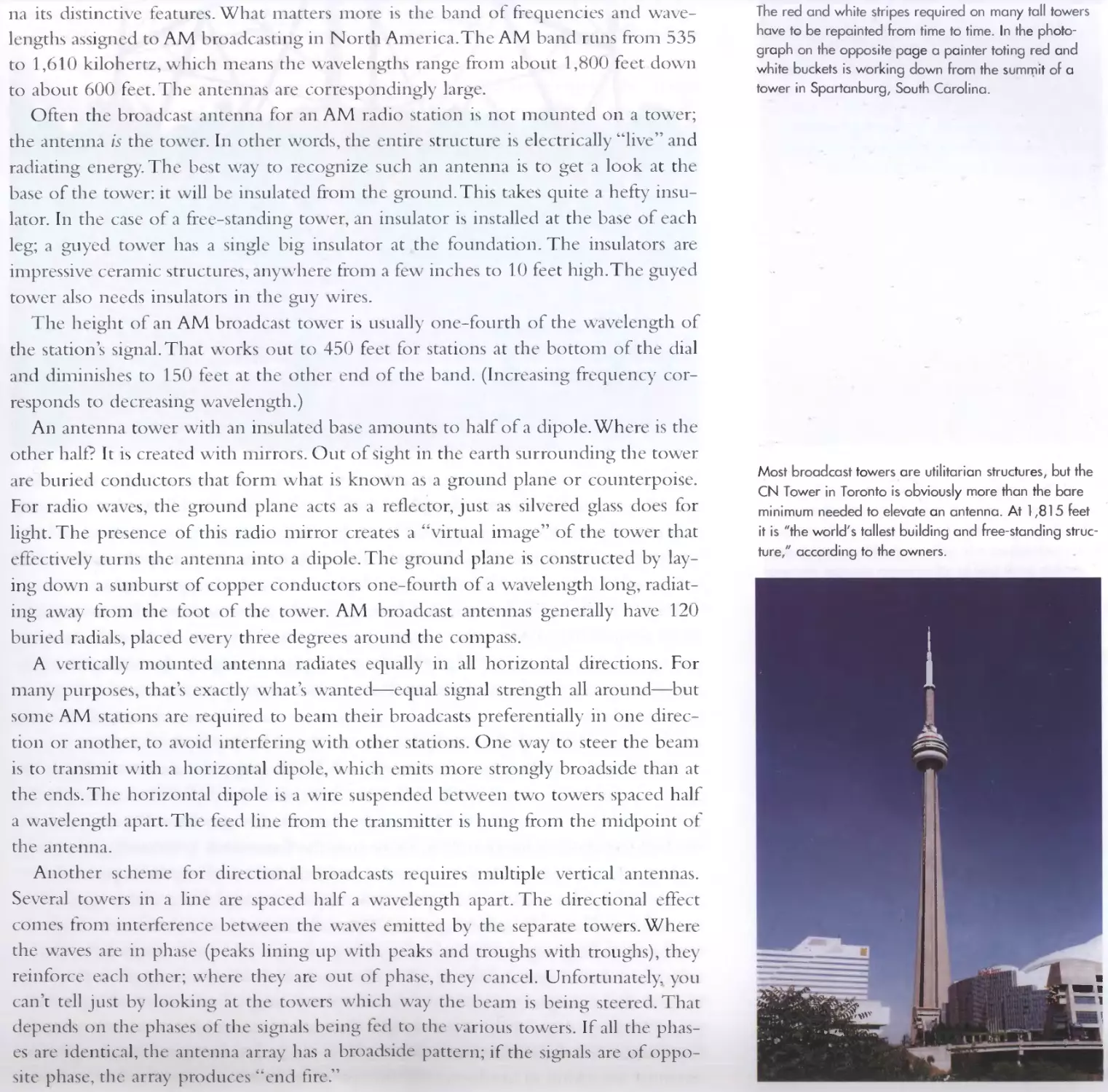

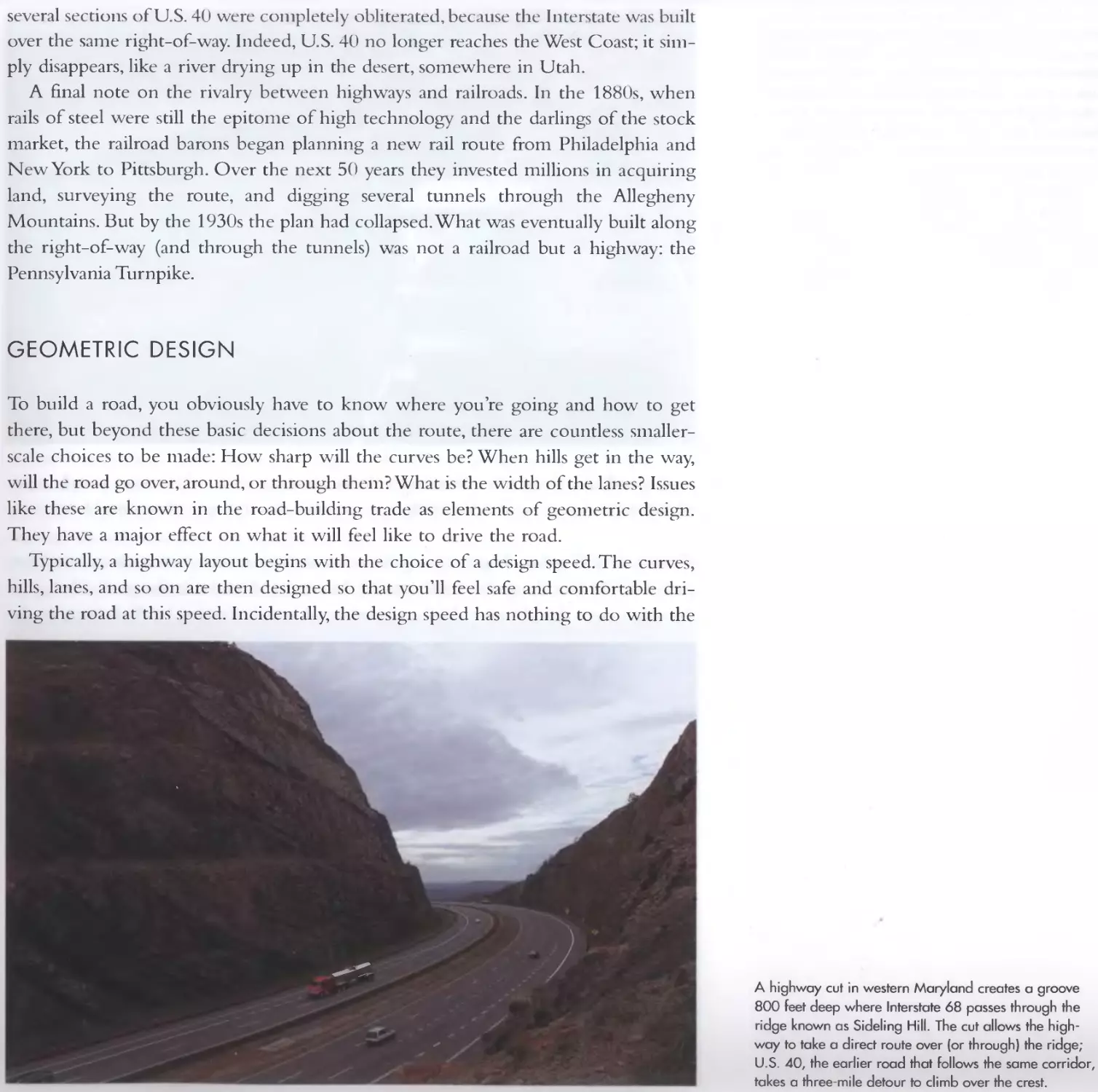
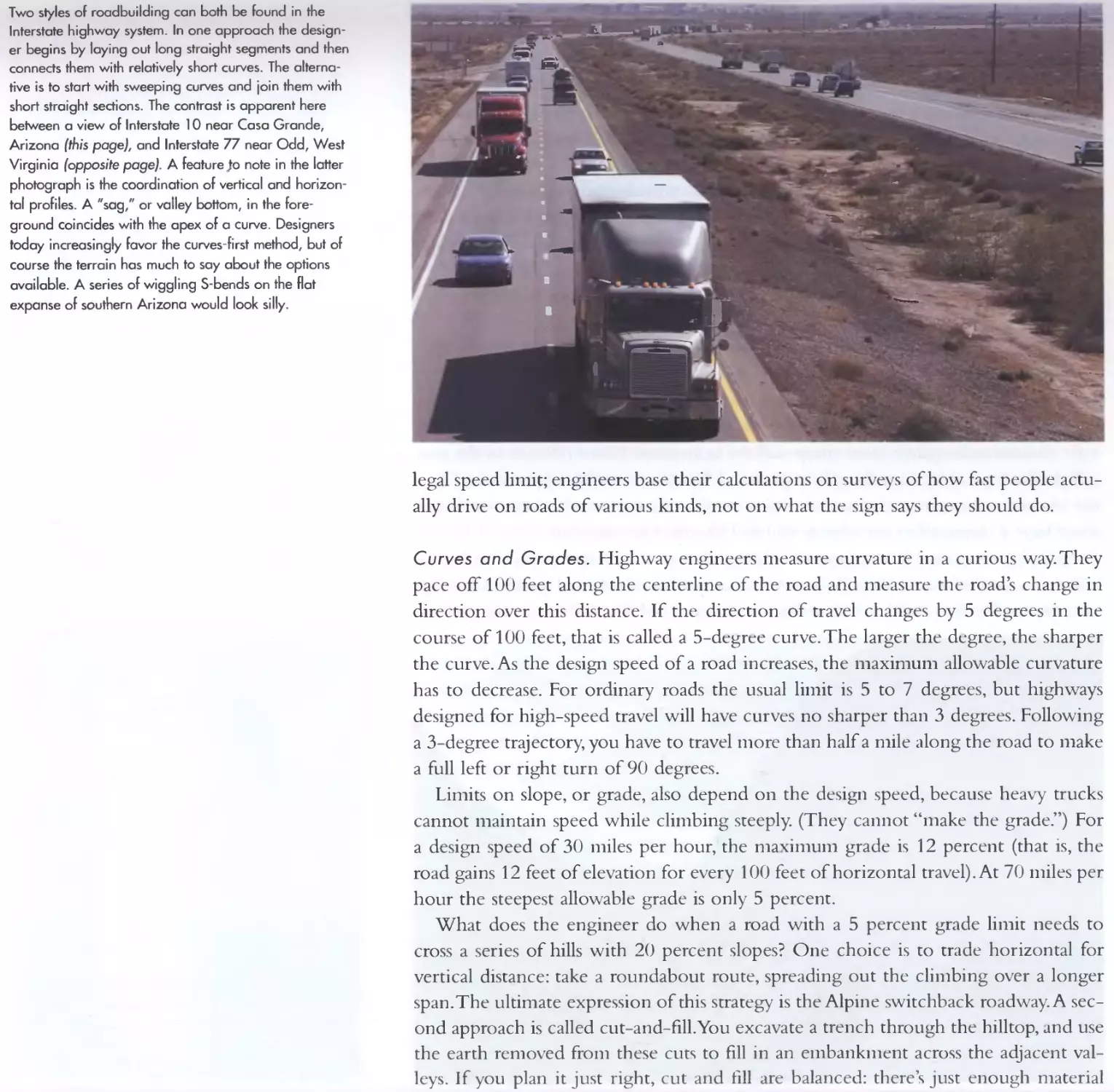
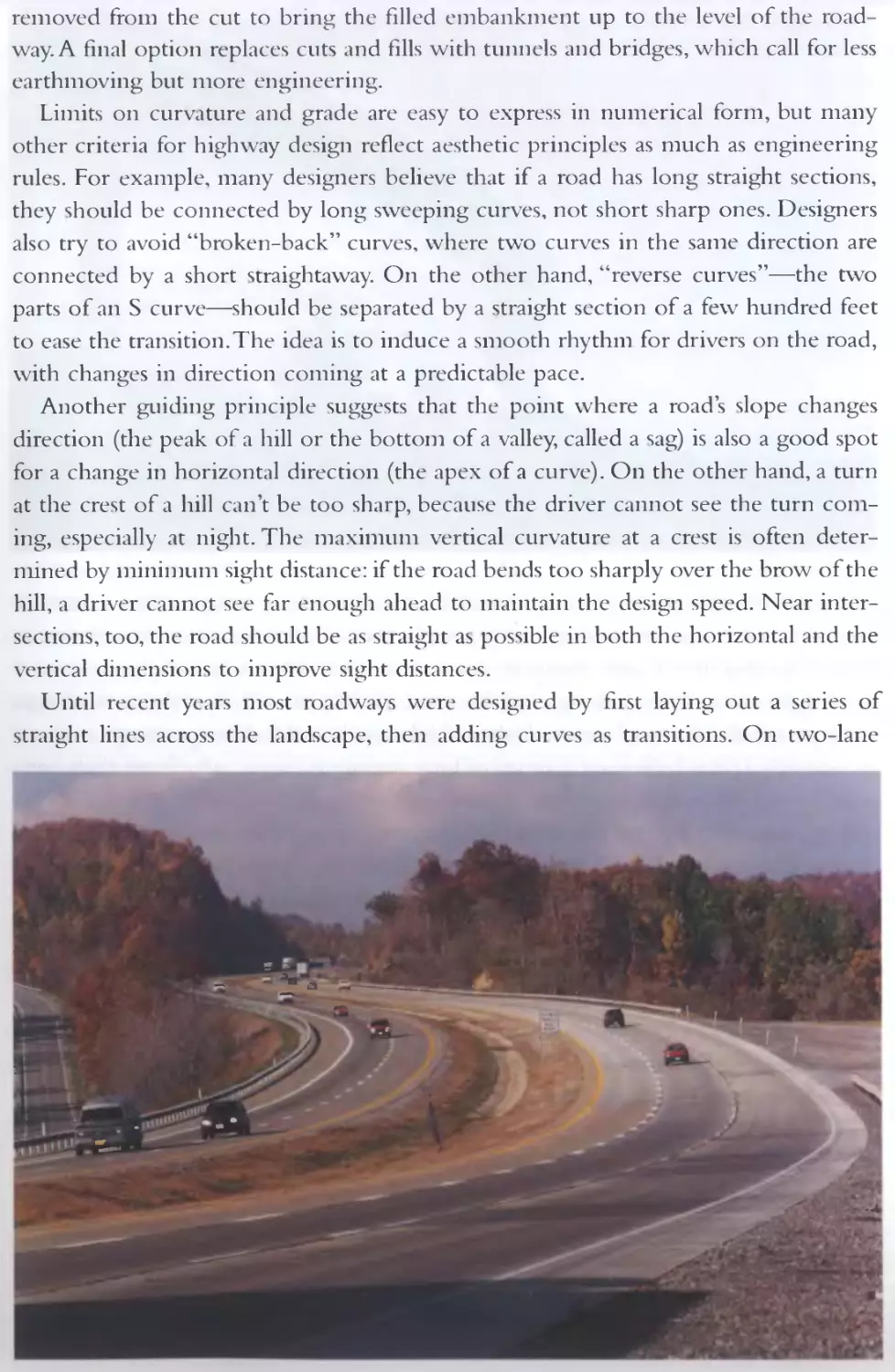
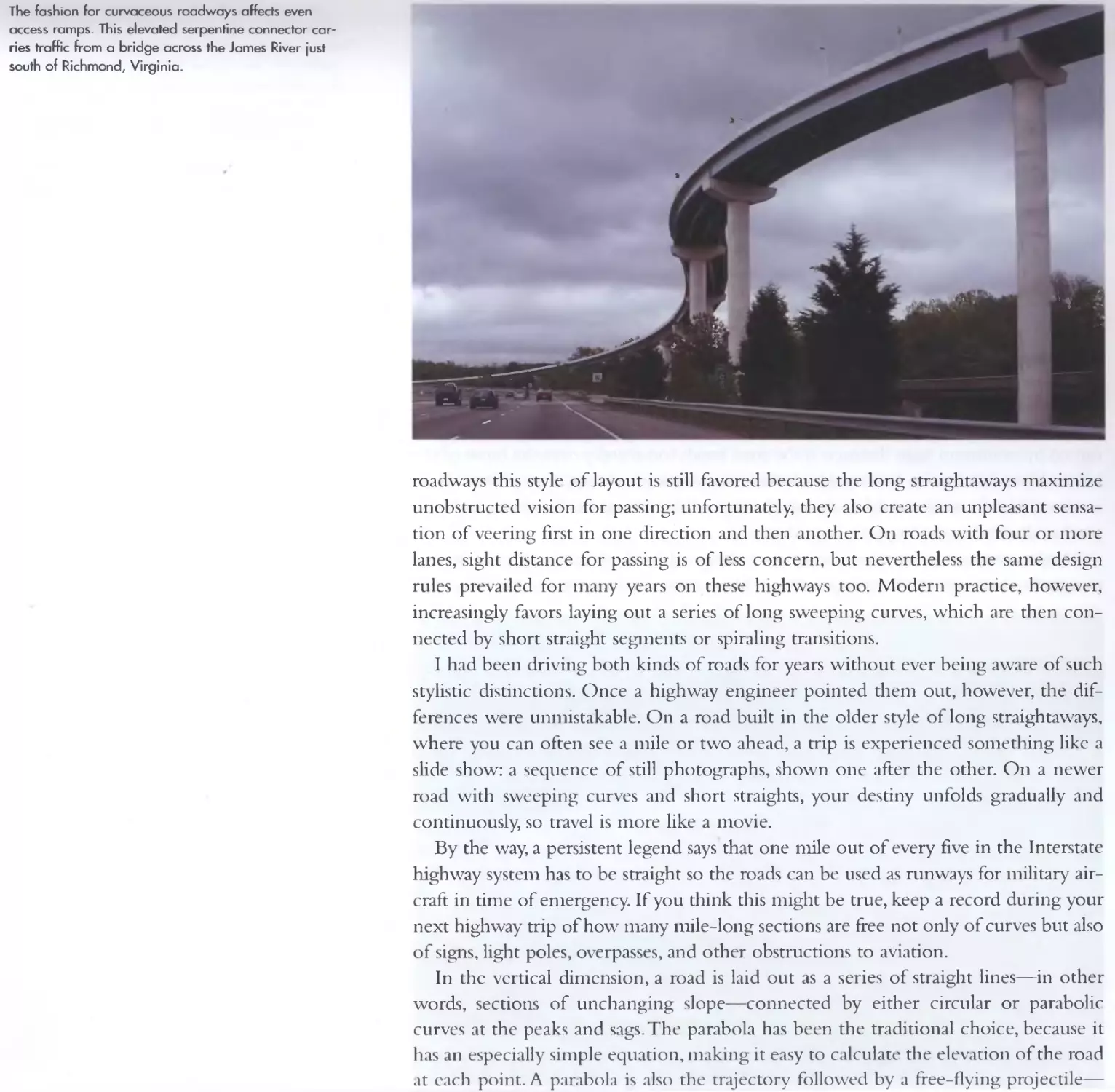
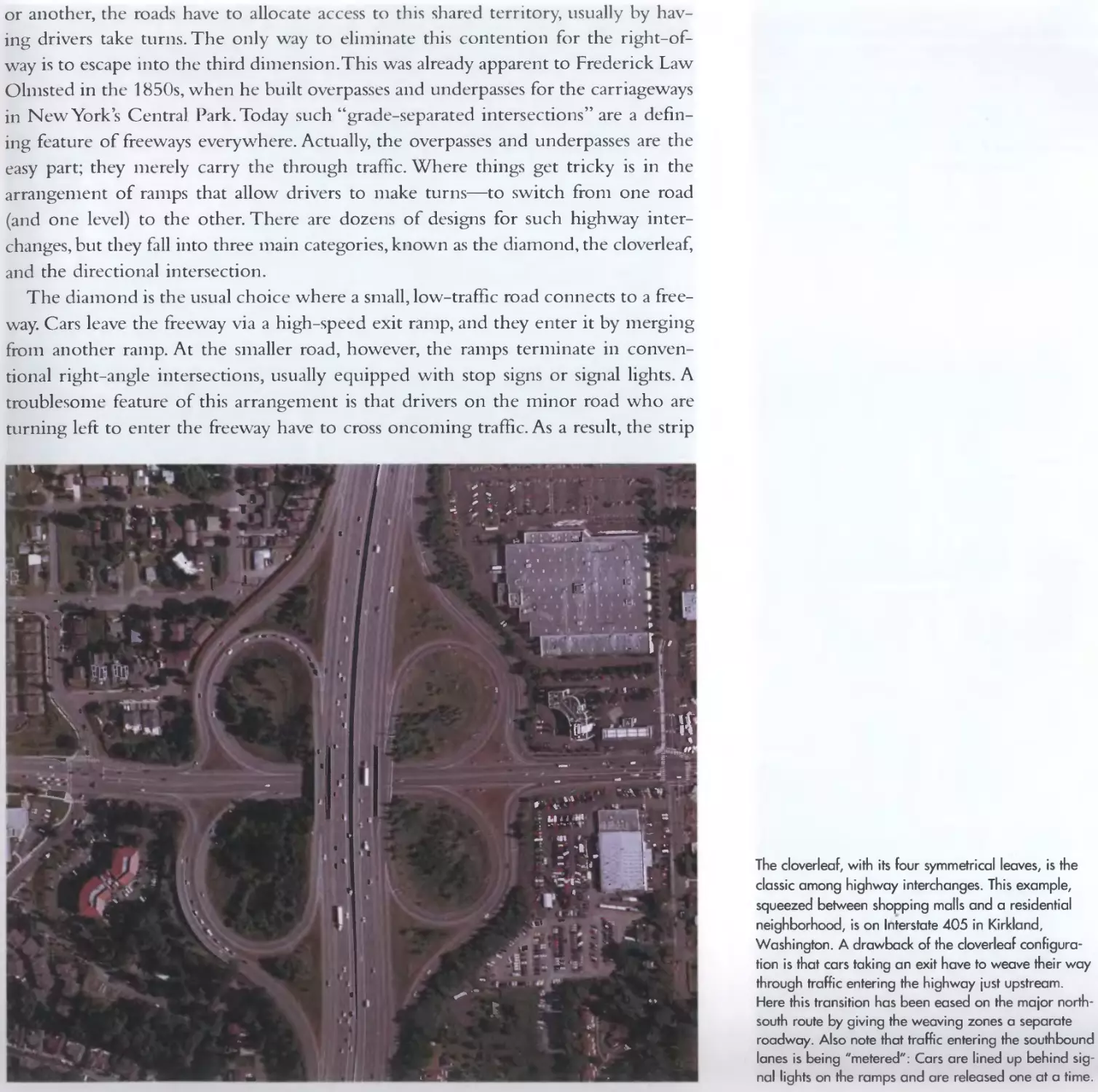
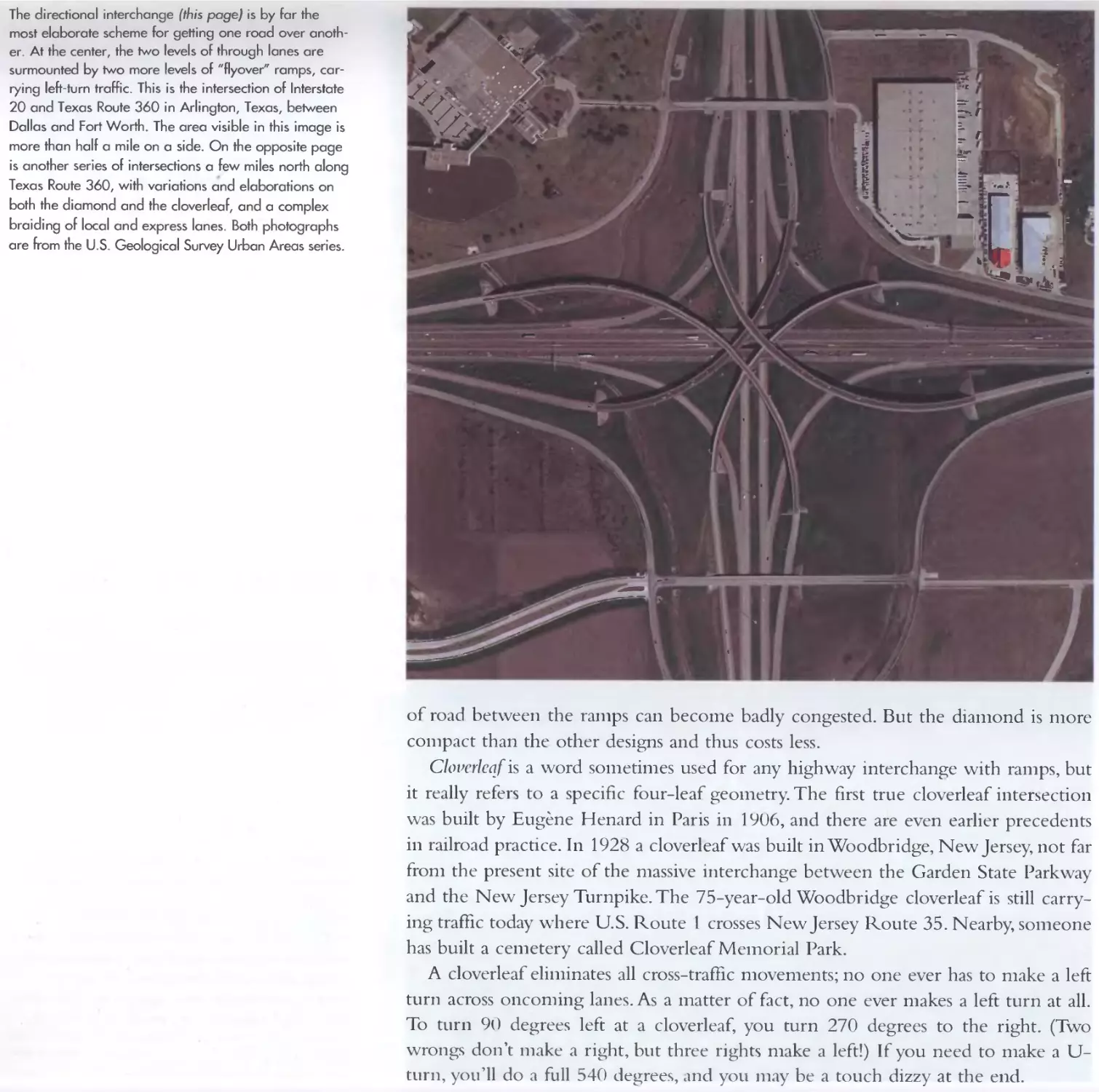
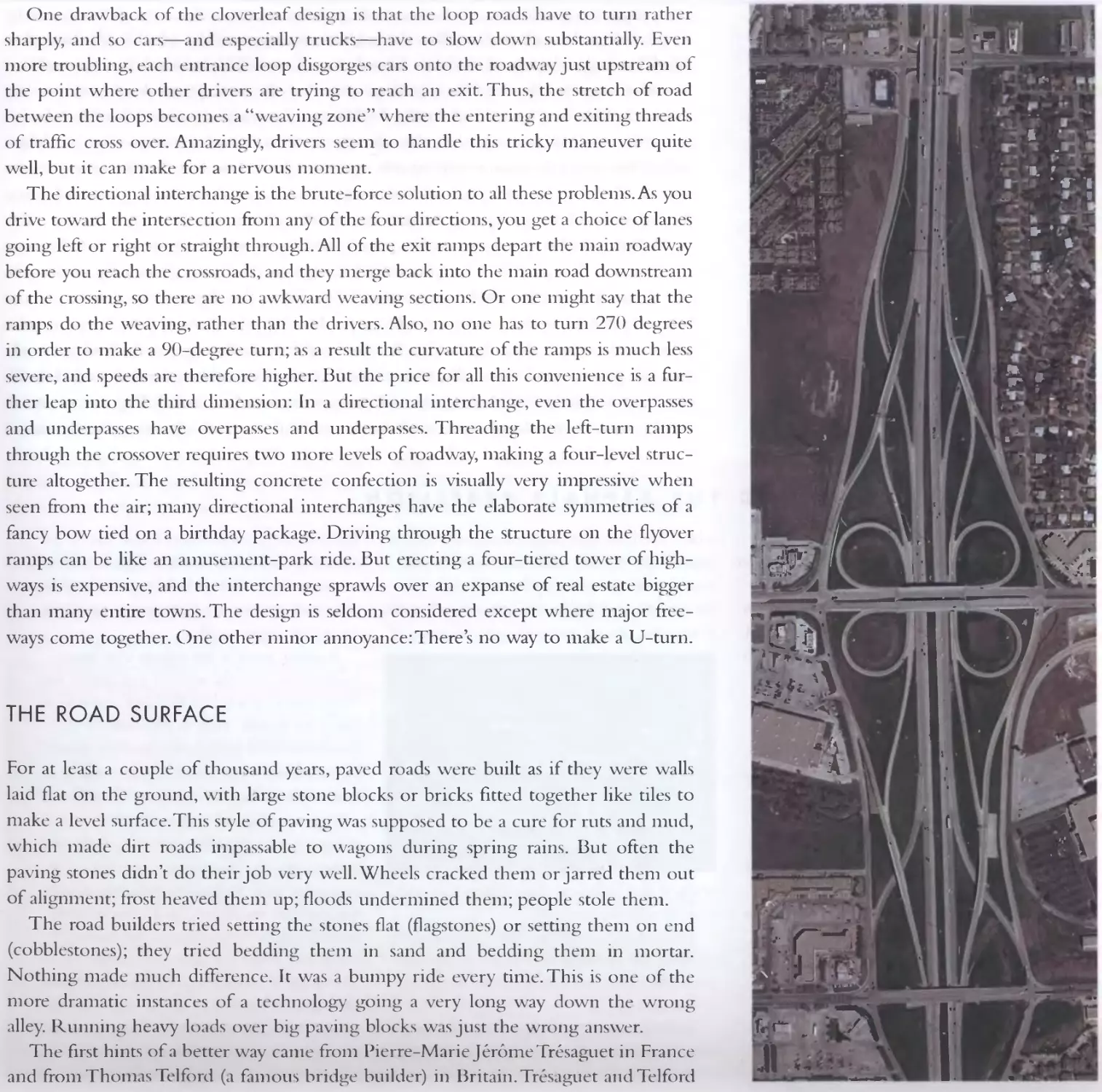
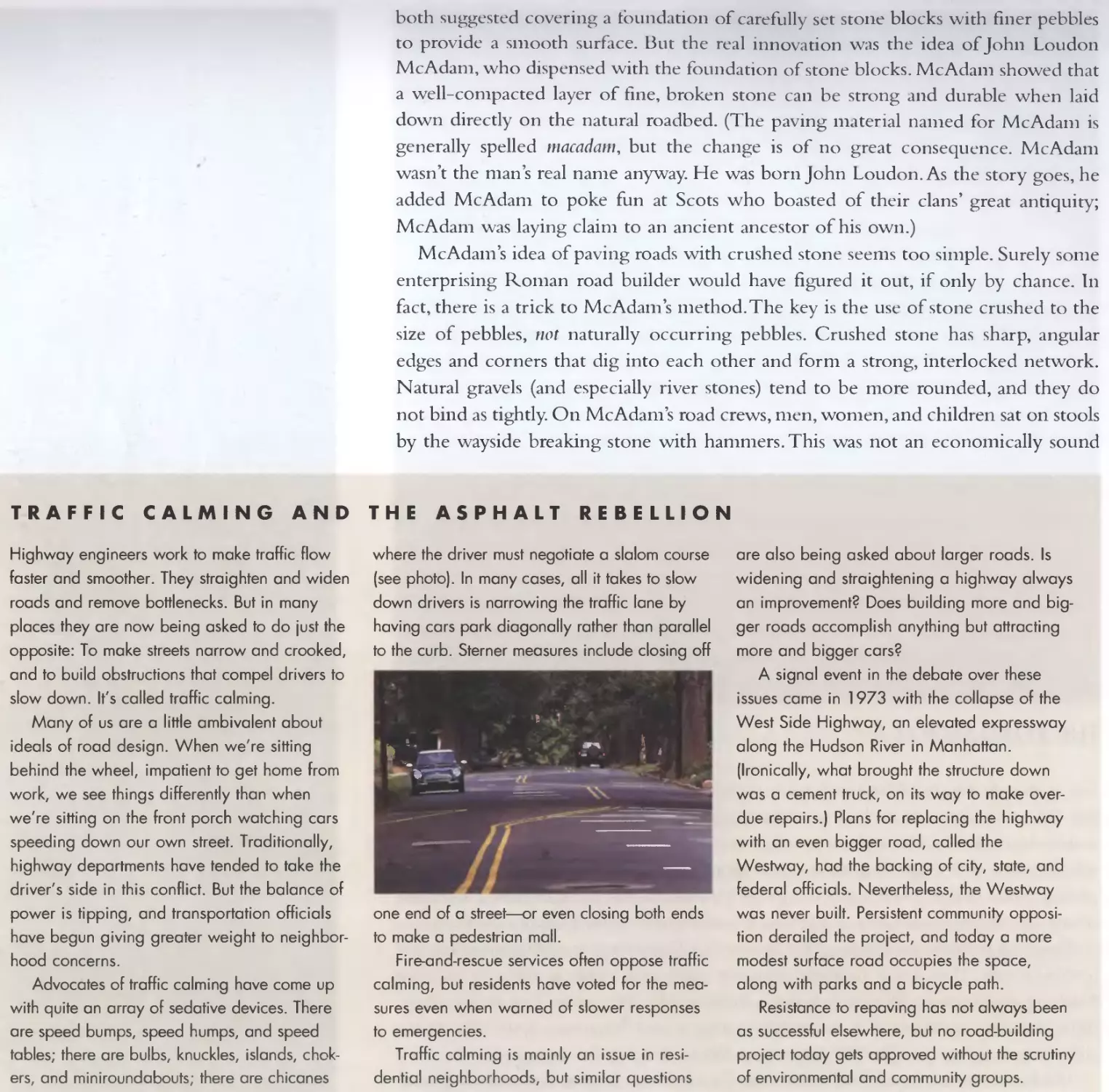
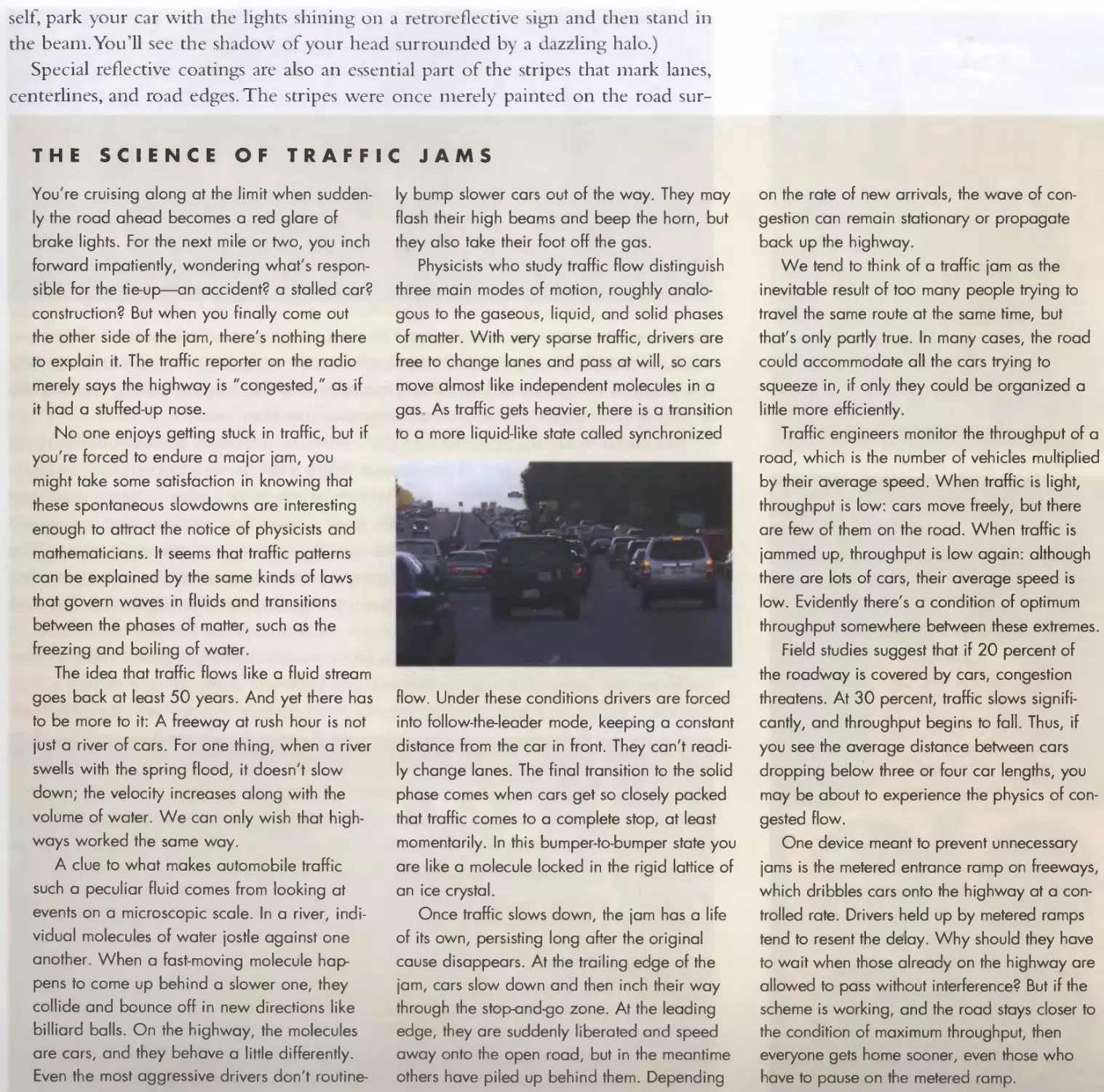
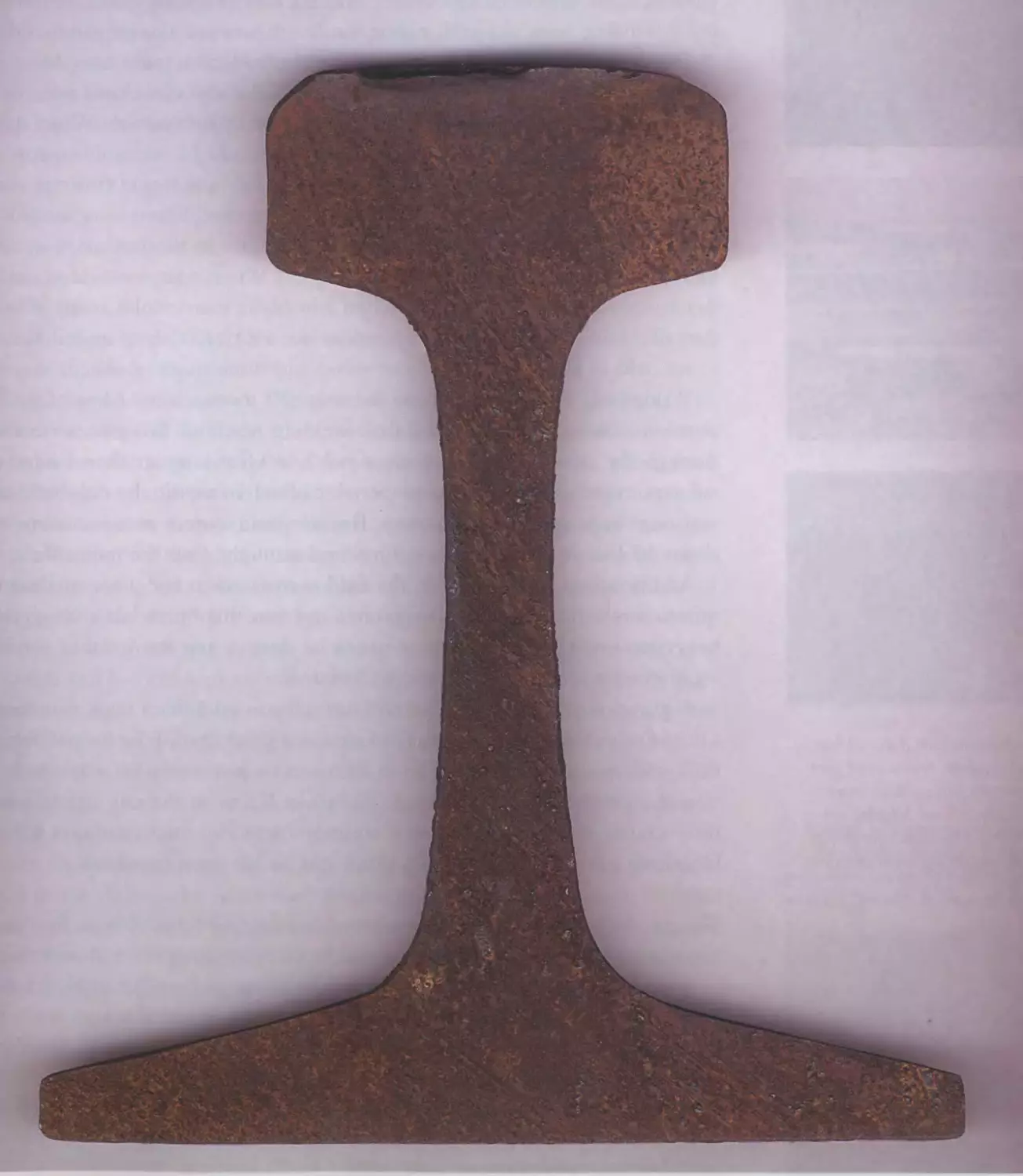
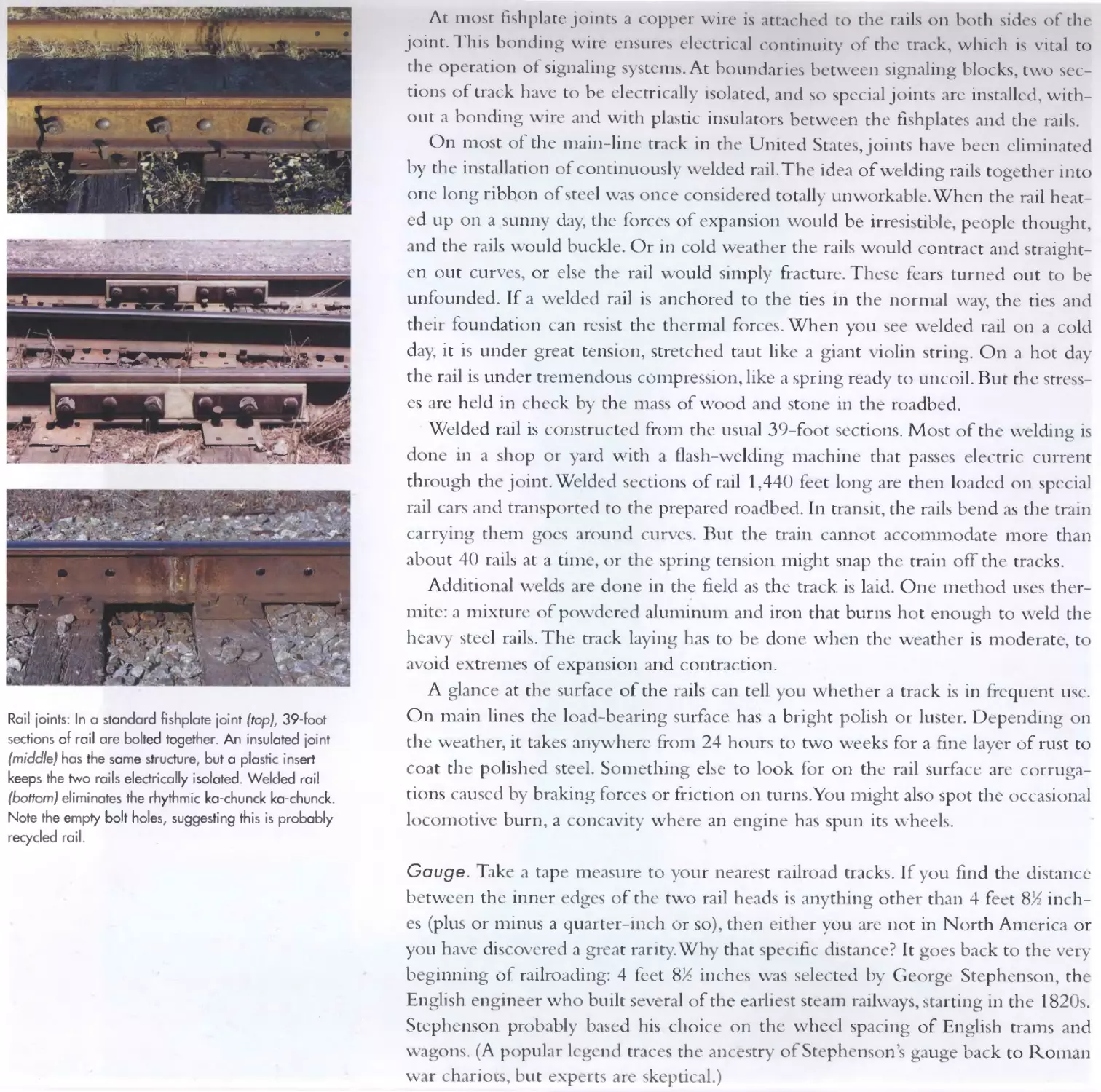
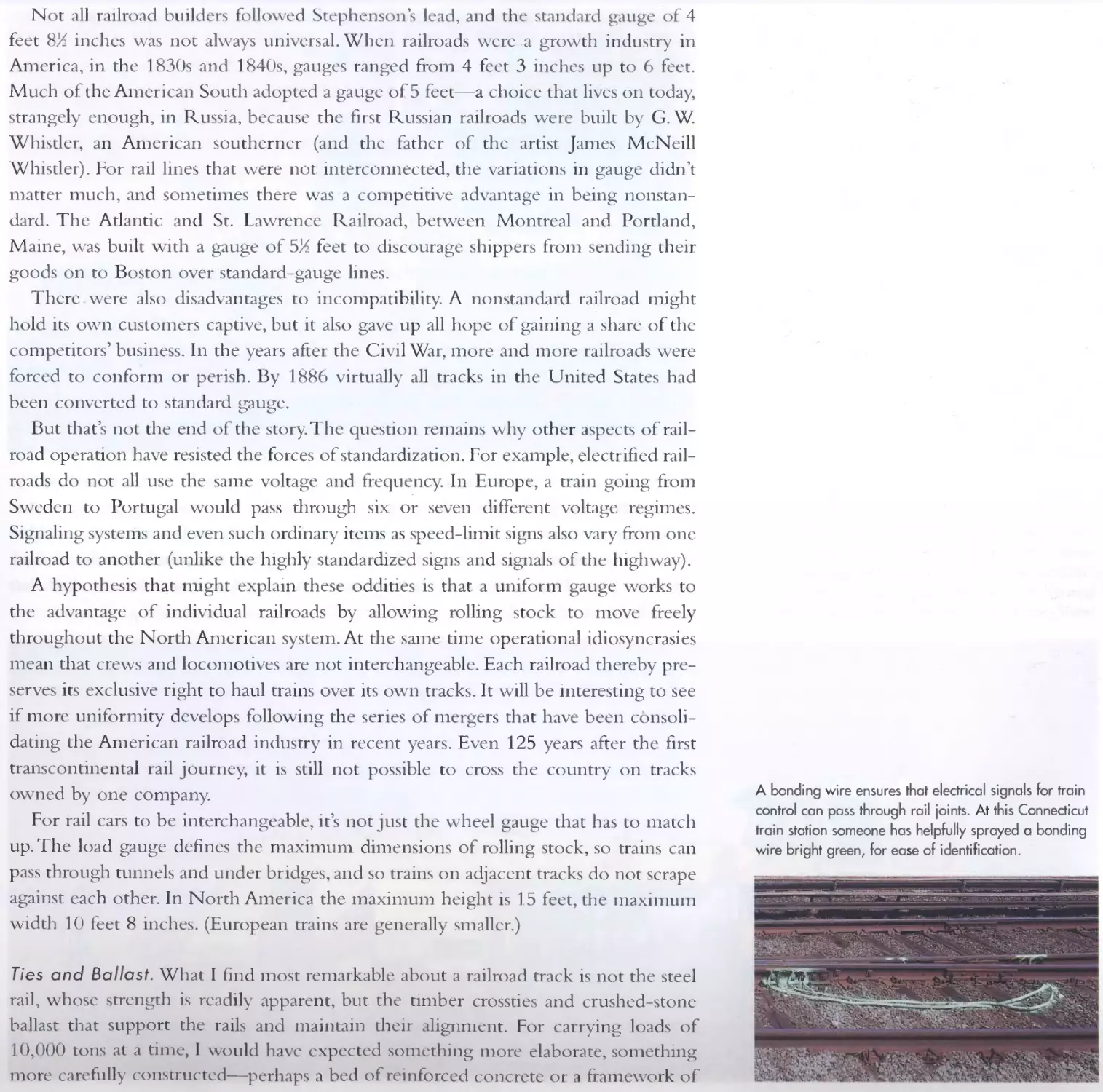
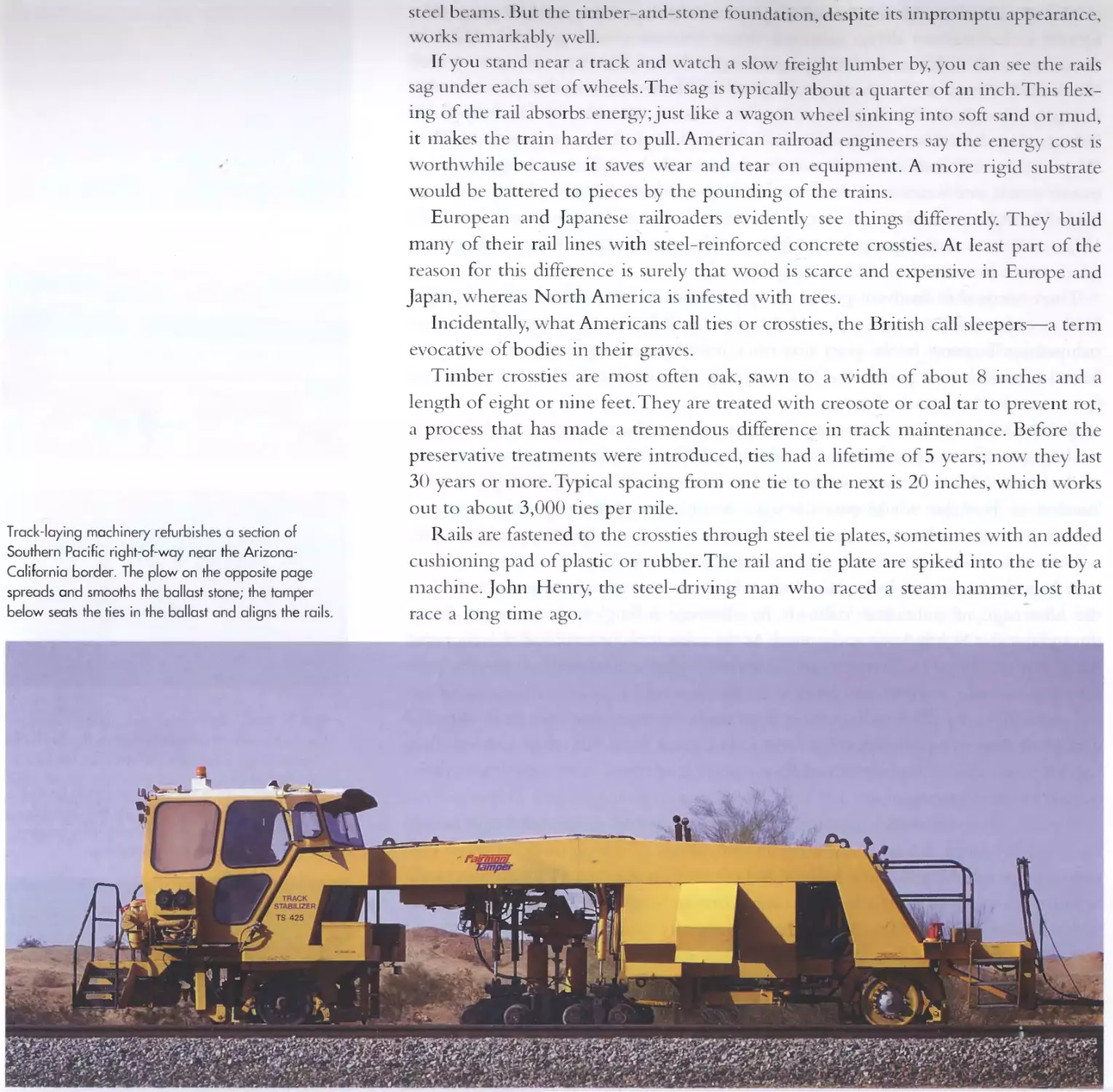


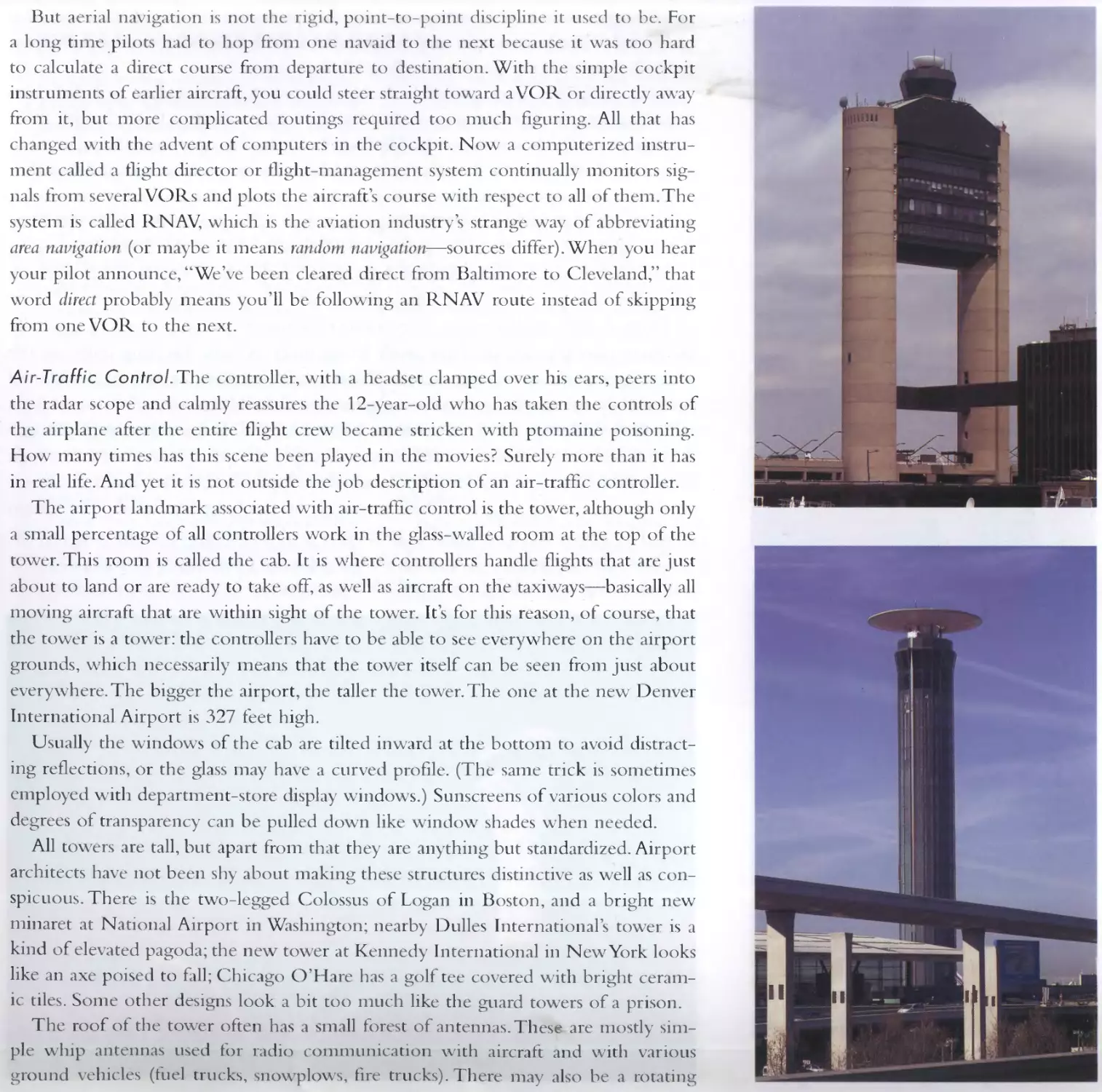
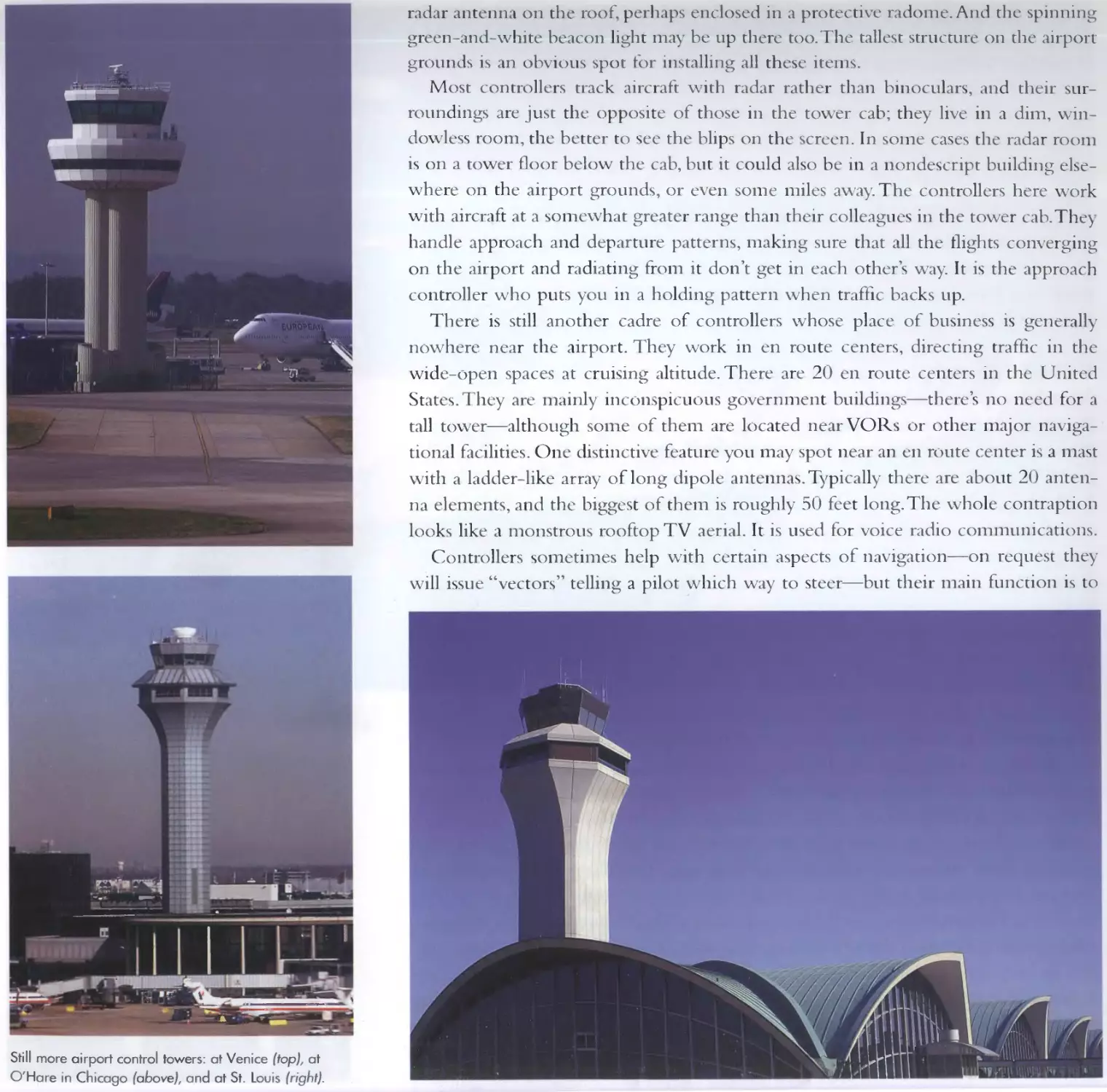

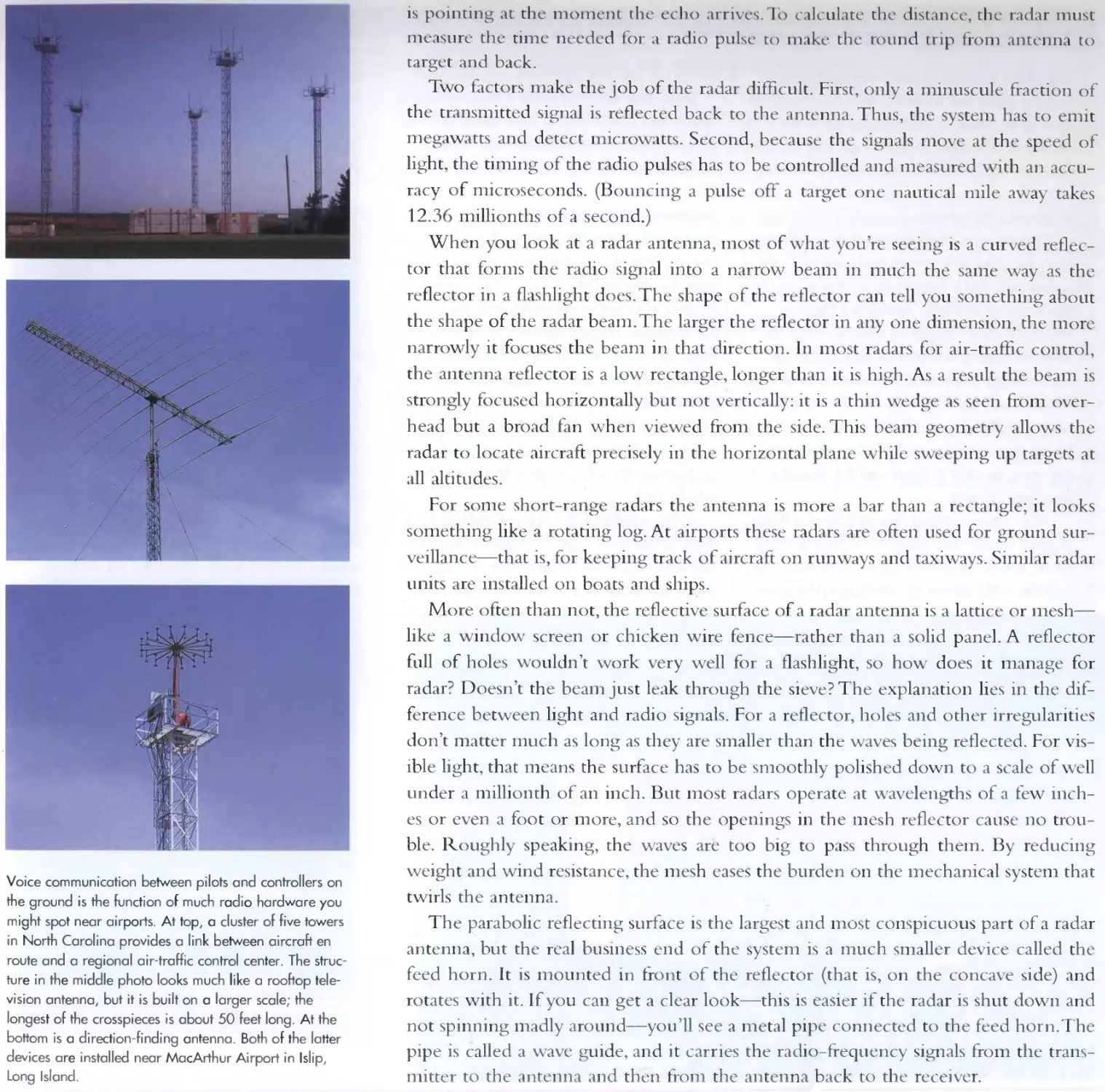
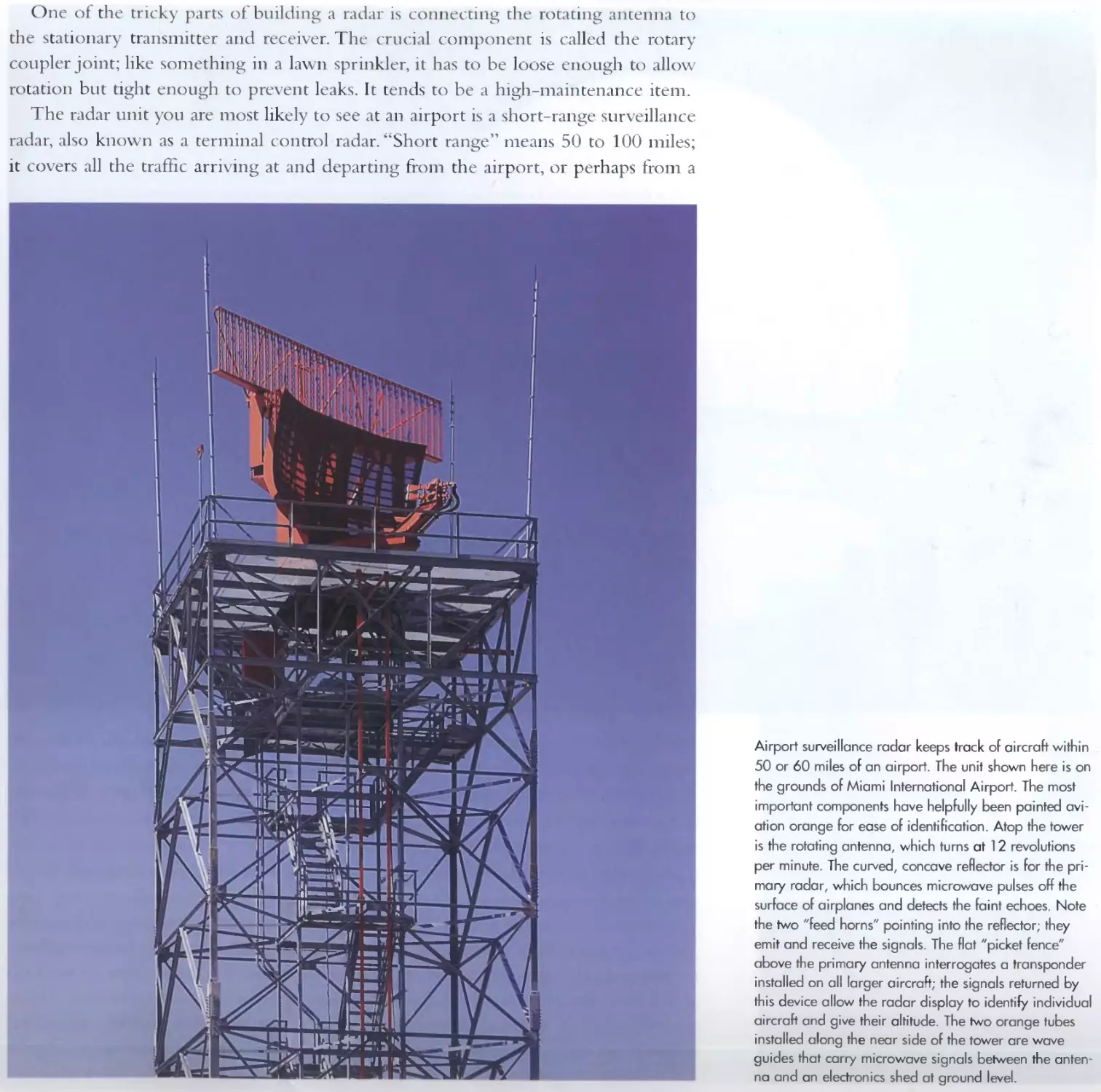
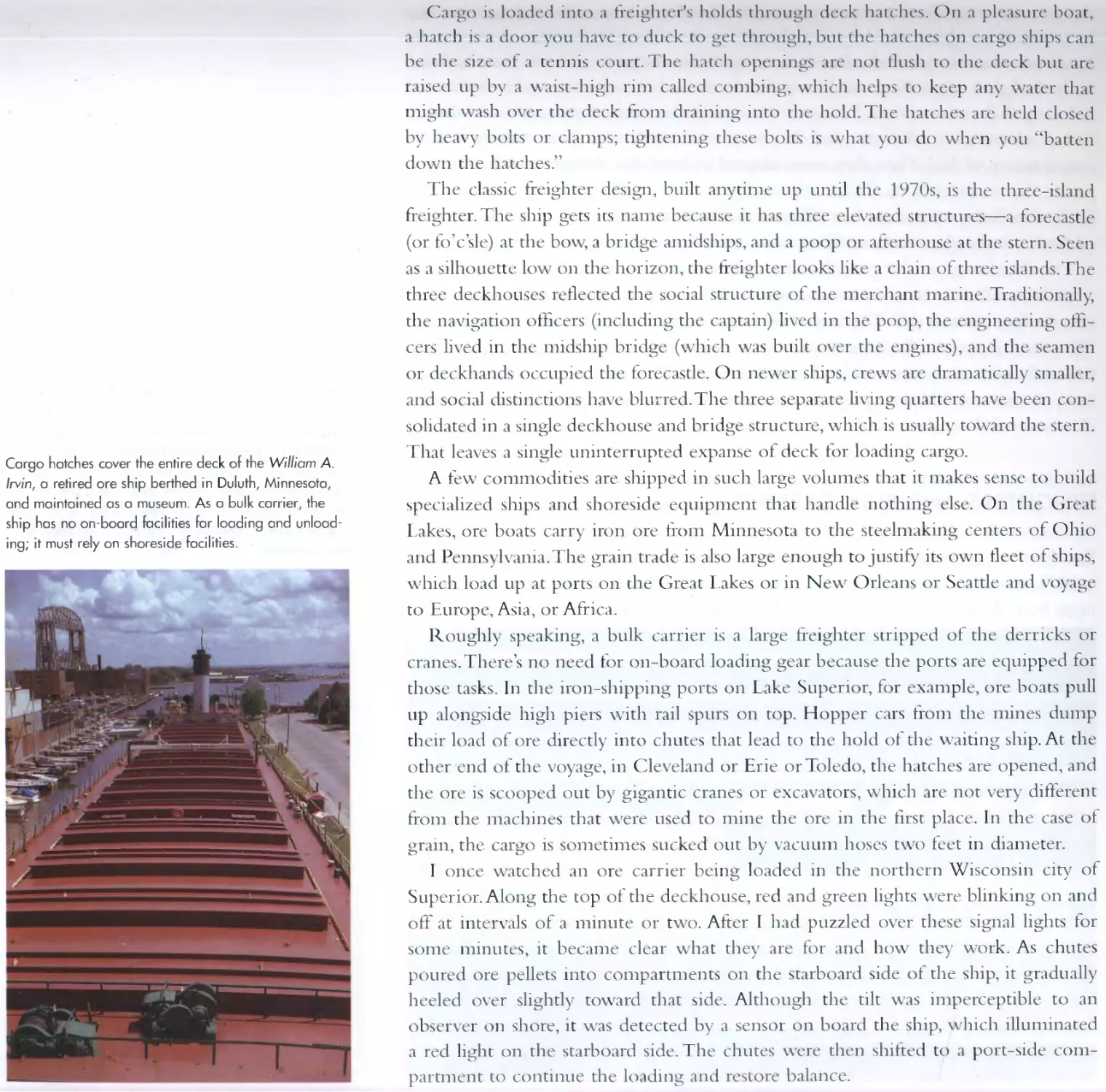
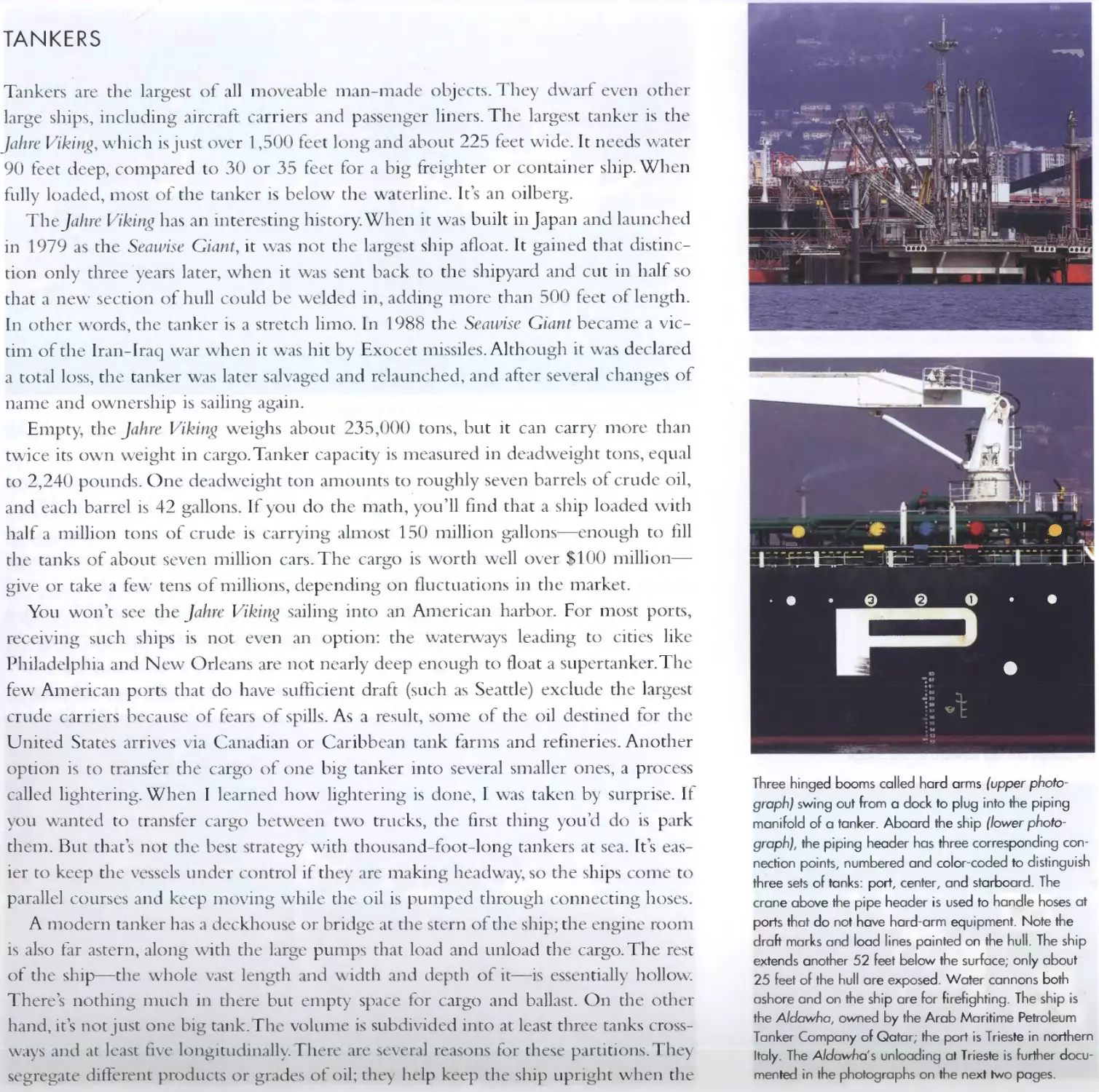
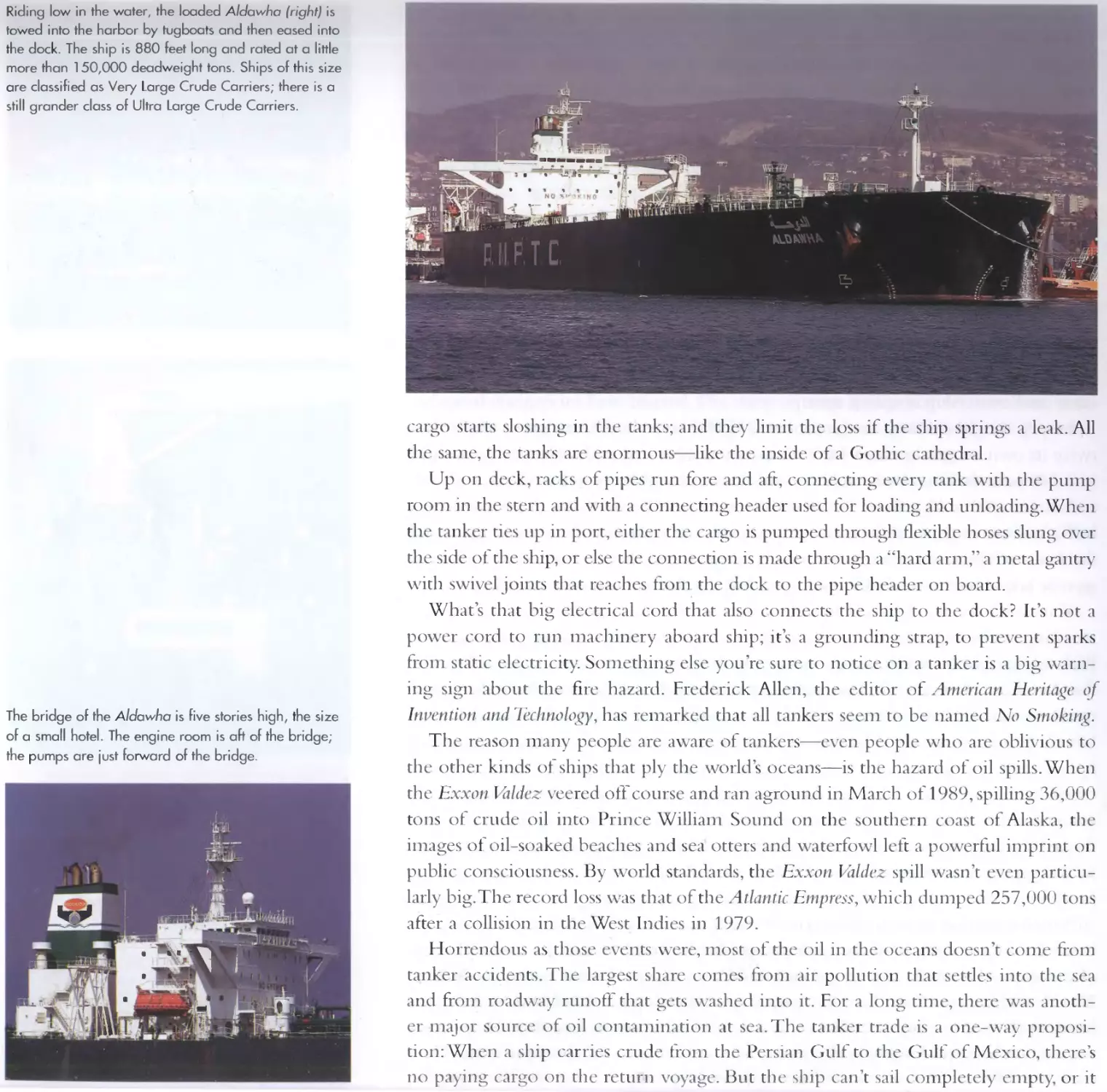
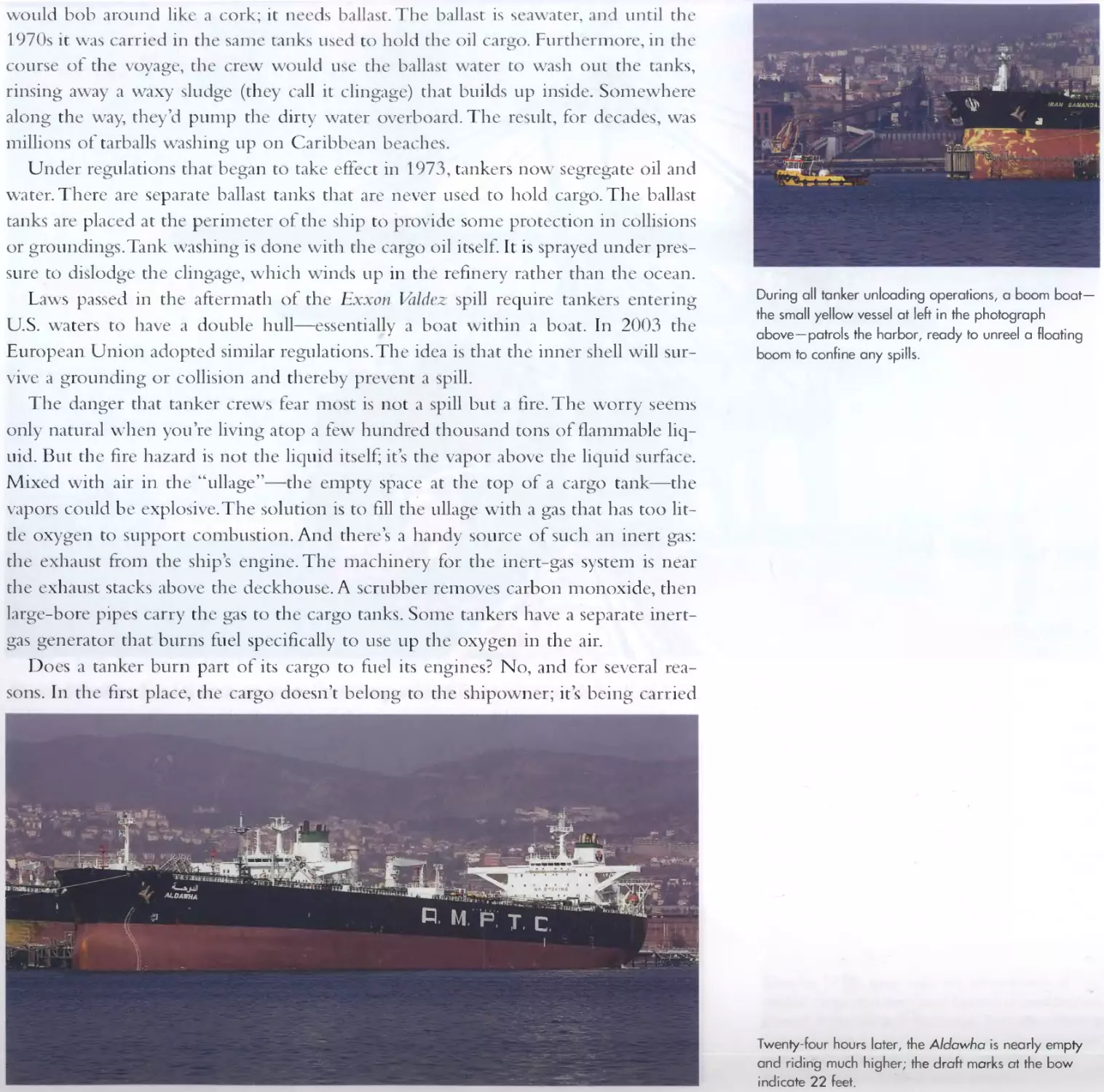

























Текст
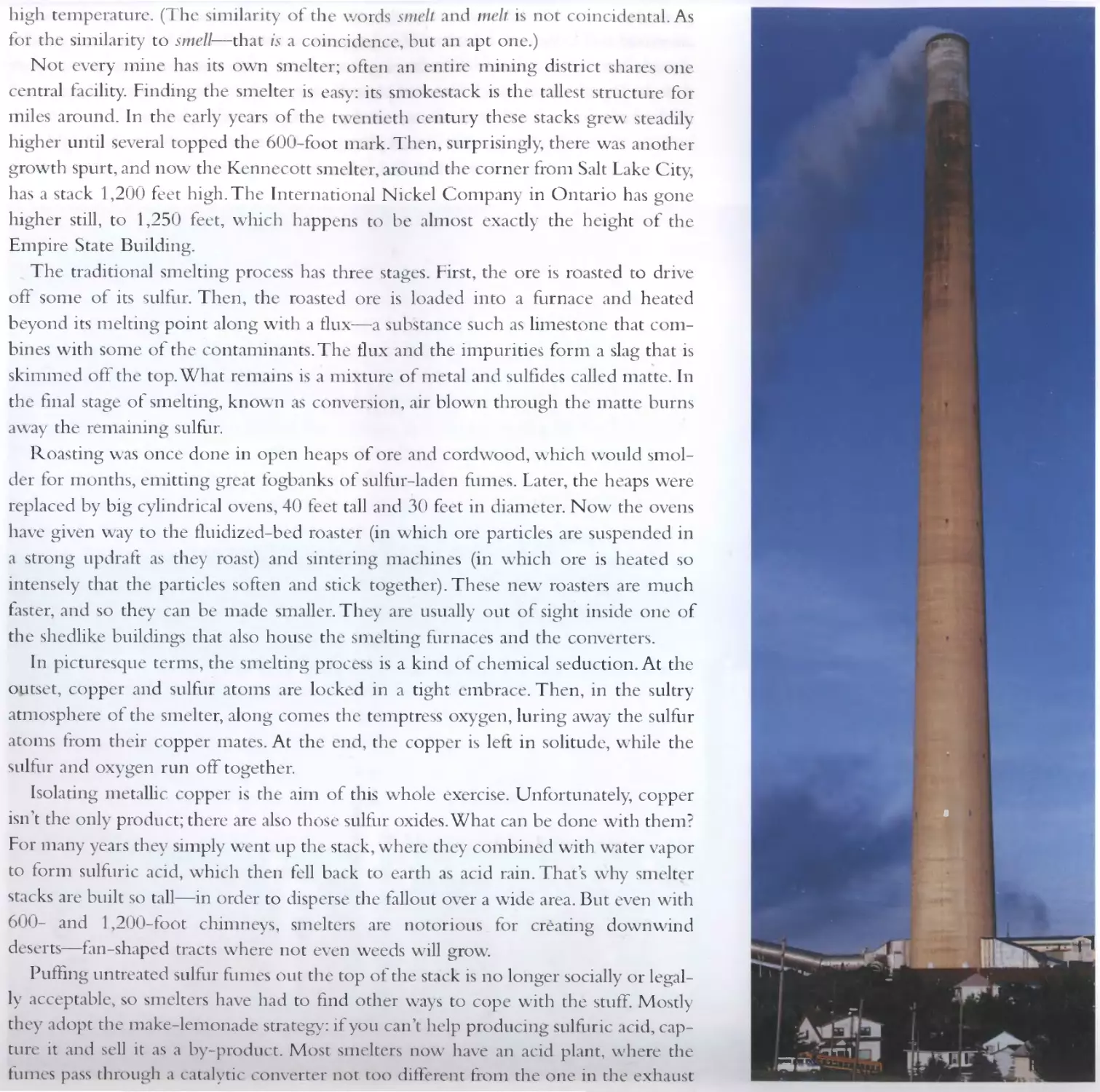
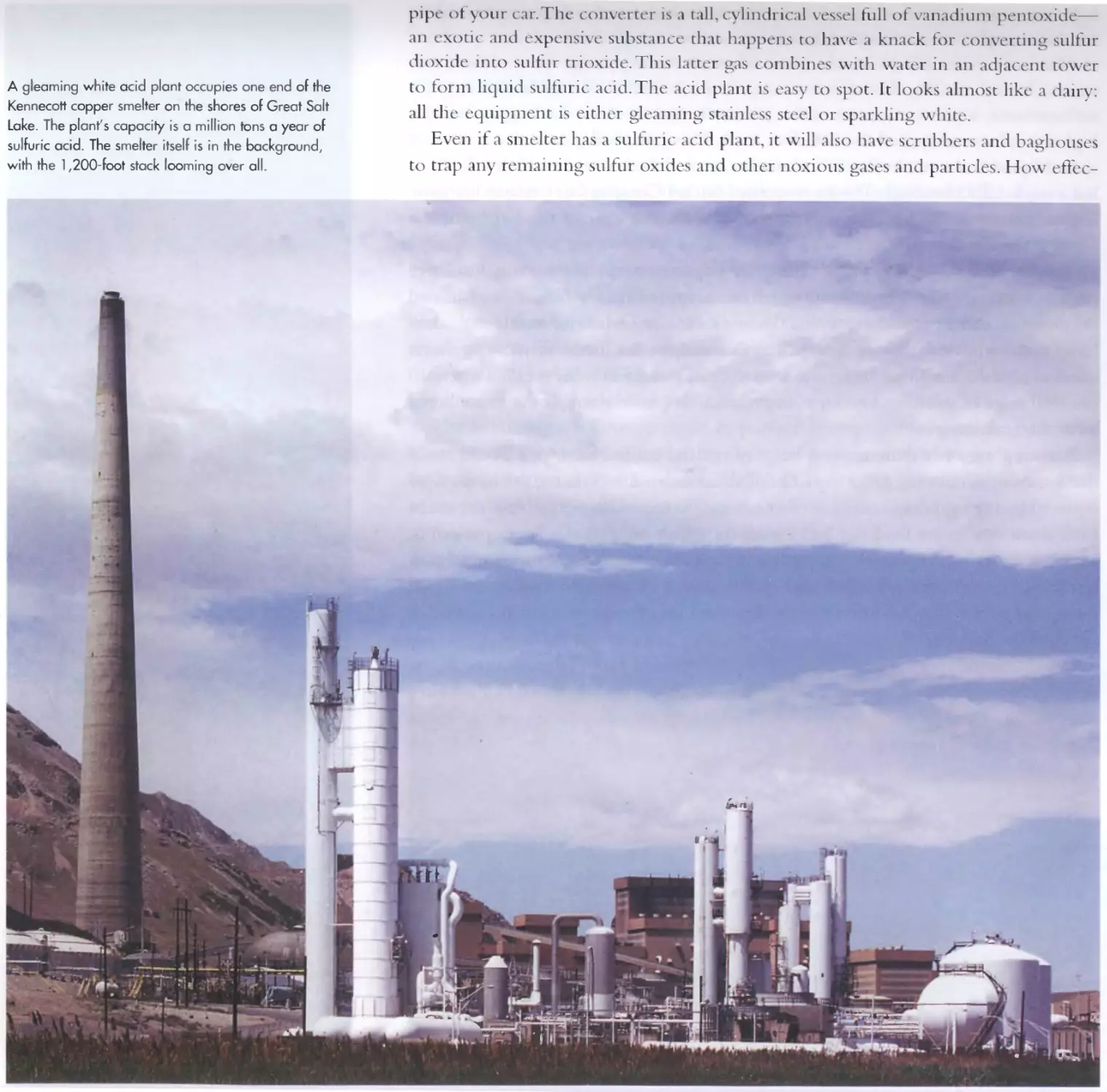
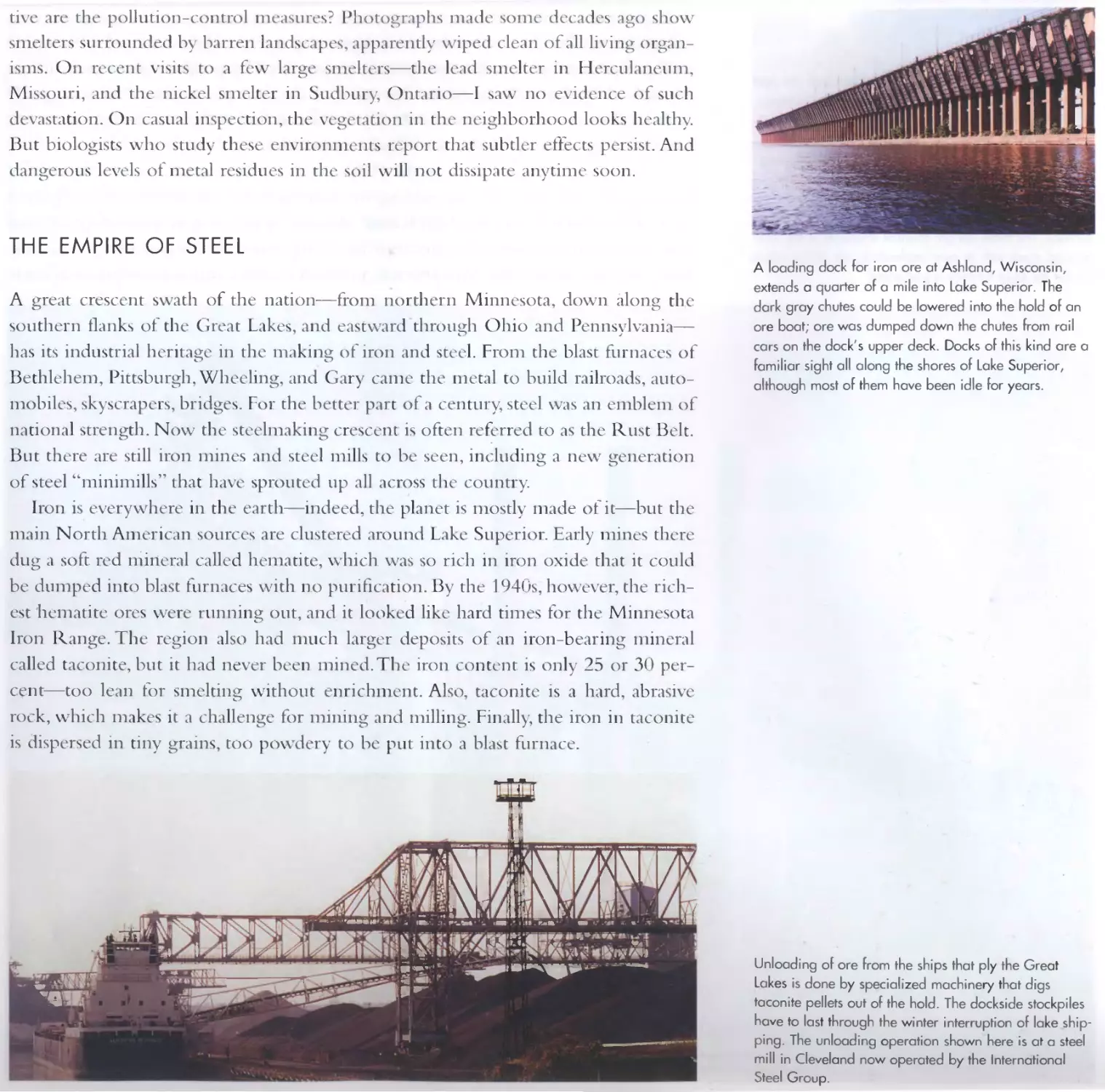
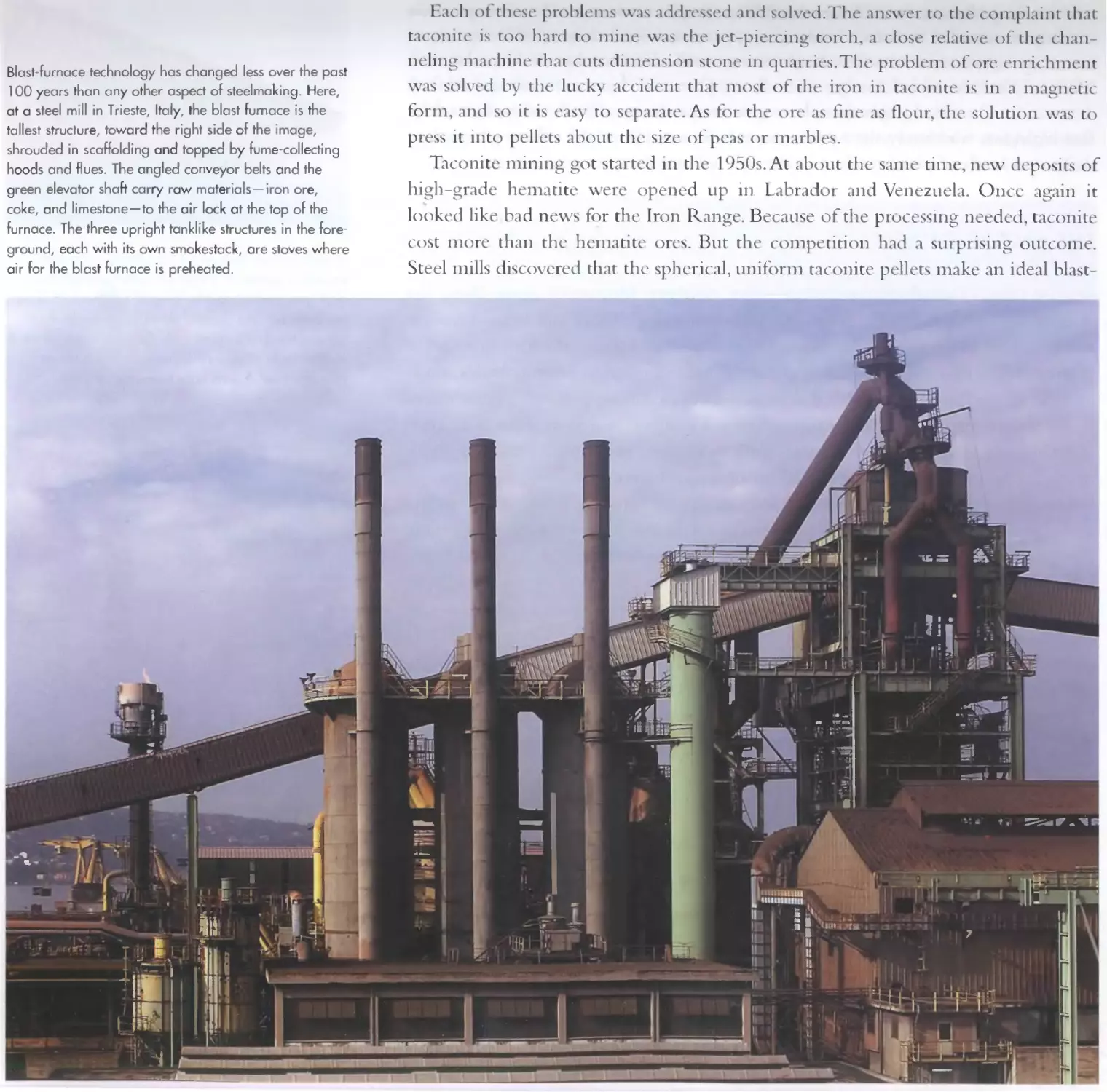
NATURE GUl DE IS A U SEF UL COMPA NION when you venture
into the deep woods or the nlountains. For better or worse, however, few of us spend
n1uch tinle in the wilderness; we live in an environnlent where lllost of what we see
is 11lan-ll1ade. Perhaps on your SUn1111er vacation you have a chance to hike the
Appalachian Trail, but the rest of the year you drive through refinery row on the
New Jersey Turnpike. Once in a lifetillle, if you are incredibly lucky, you might look
up a tree and spot an ivory-billed woodpecker, but on 11l0St days you are more likely
to look up a utility pole and see the finned steel casing of an electricai transfofll1er.
This book adopts the fornl of a nature guide, but its subject nlatter is everything
that isn J{ nature. I t is a guide to the con1nlon sights of the built enVirOlll11ent-the
power lines, water tanks, street lights, nunholes, trafIic signais, cellular-telephone
towers-that we pass by every day and yet seldon1 really notice. In these pages I iden-
tify and classify SOllle of the species that inhabit this fallliliar urban ecosystenl. Farther
afield, there are n10re exotic industrial habitats to explore: coal 111ines, oil refineries,
railroad freight yards, power plants, garbage incinerators. These Jre places that nlost
of us never see close up; n1any of us would go out of our way to avoid seeing thenl.
But they are nonetheless a part of nlodern life-and worth a visit. There can be just
as nluch of interest happening on a factory roof top as there is in the forest LUI 0 py,
just as nluch to n1arvel at in the operation of a strip-lllining dragline as in the geo-
logical carving of a river canyon.
Sonle n1ay find puzzling or distasteful the parallel I anI drawing between the study
of nature and the study of technology. Af ter all, nature is good and good for you,
whereas everyone knows that technology is ugly, evil, and dangerous. The ll1ention
of nature brings to nlind nlajestic landscapes: Yoseluite, Yellowstone, the Grand
Canyon. The nlention of industrial technology brings to nlÏnd a long list of disasters:
PREF ACE
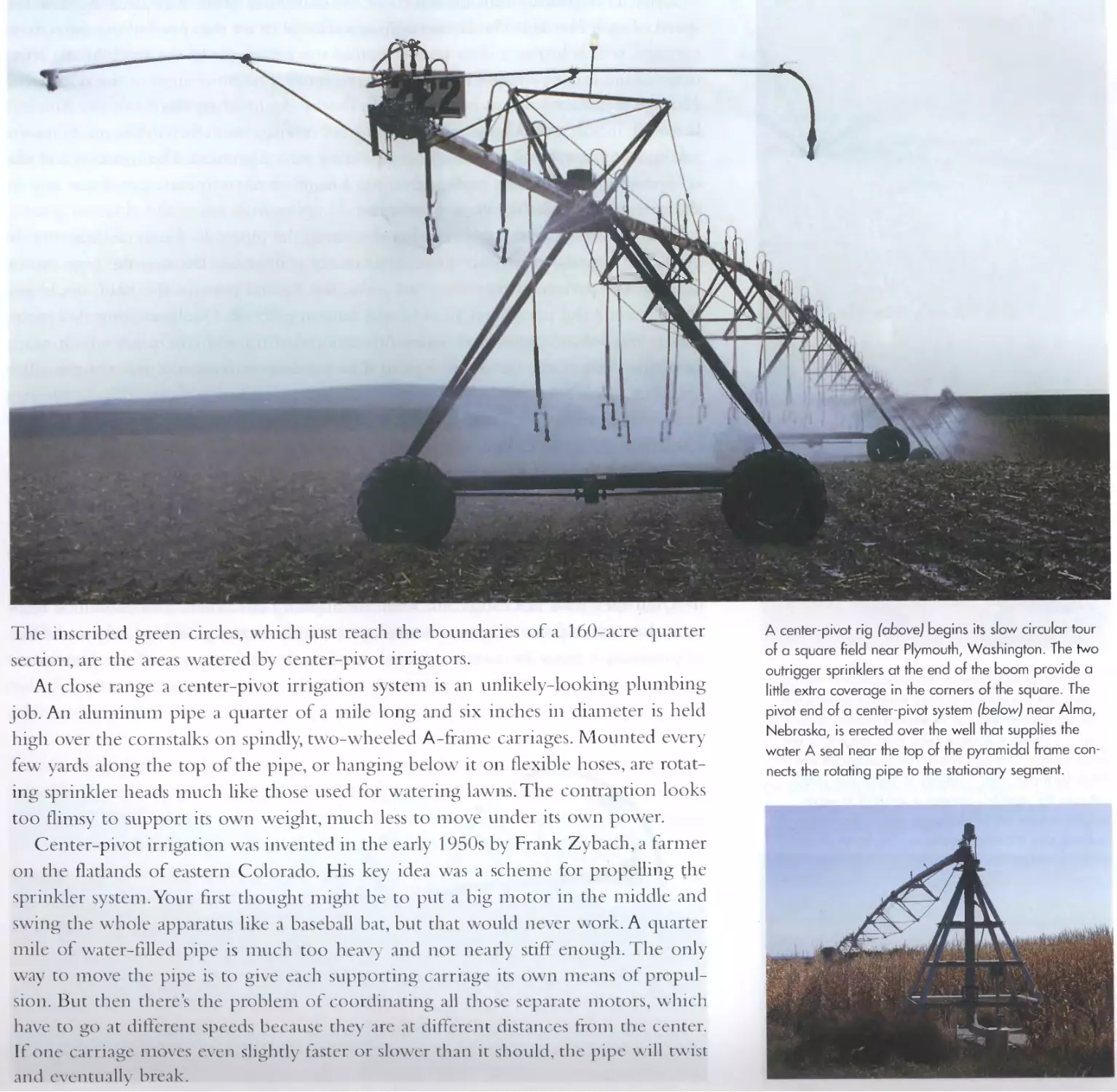
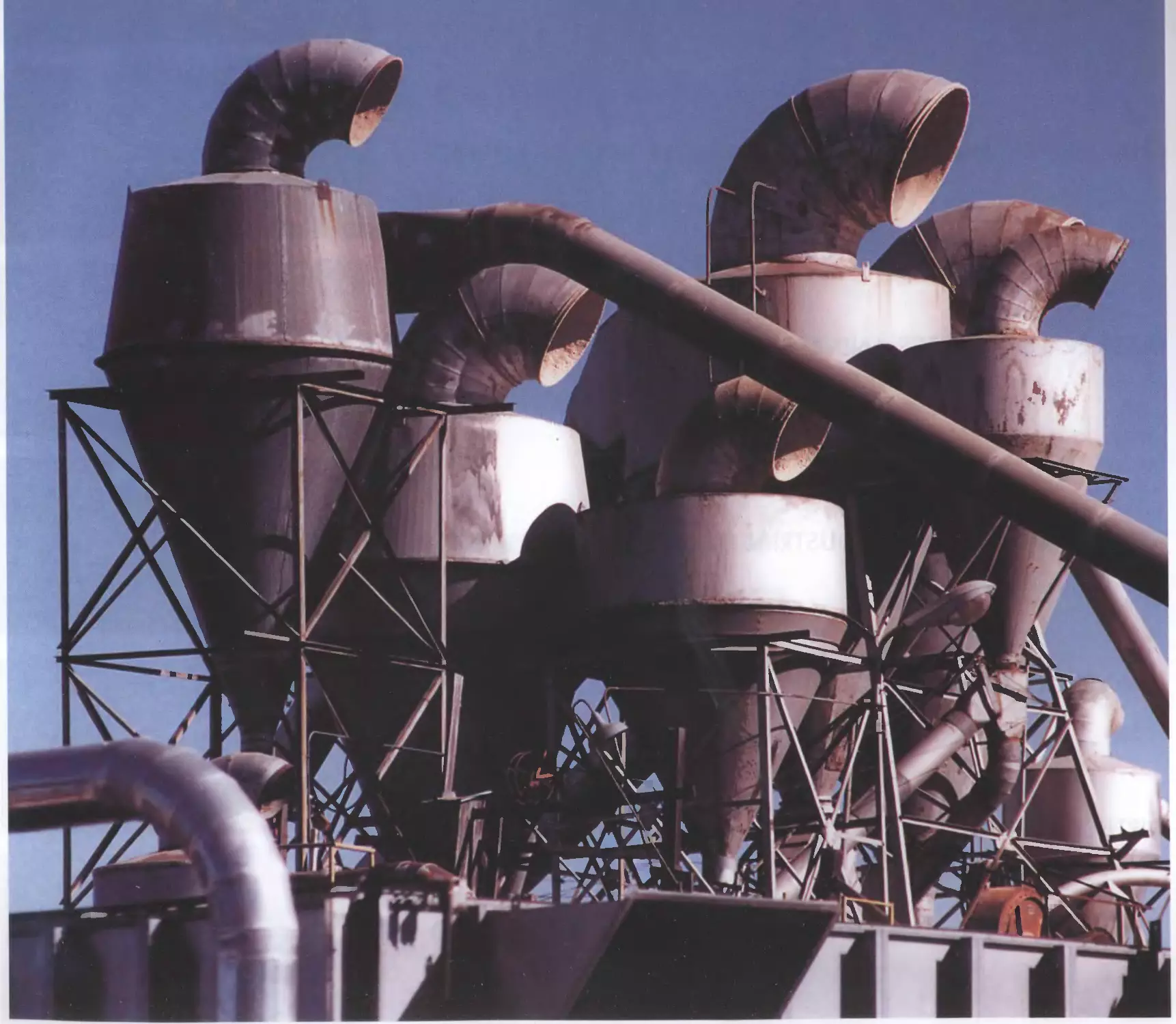
What is it and what does it do? We live in a world
cluttered with industrial artifacts whose purpose and
principles of operation are often unknown to those who
see them. The curious rooftop structures on the opposite
page are devices called cyclones, mounted atop a lum-
ber yard and sawmill in Sacramento, California. Their
function is to separate sawdust from a moving stream
of air. The dust-Iaden air enters each funnel-like vessel
tangentially, creating a whirlpool wind that spins the
sawdust to the outside; the dust trickles down the walls
of the funnel into a bin below, while the air exits
through the question-mark vent at the top. The telltale
shape of a cyclone is something you can expect to
encounter not just at a sawmill but in many other indus-
trial environments, from coal mines to flour mills.
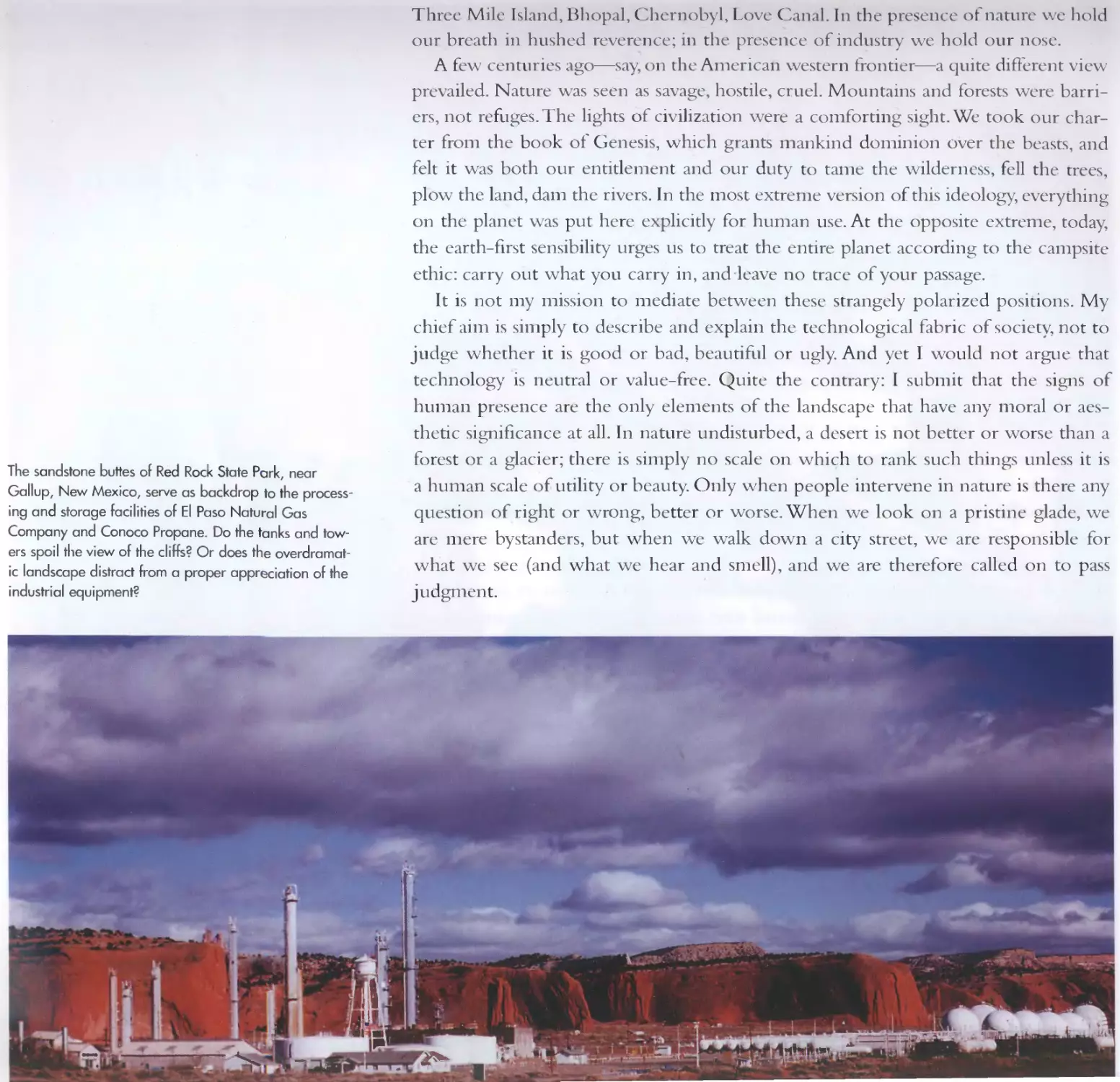
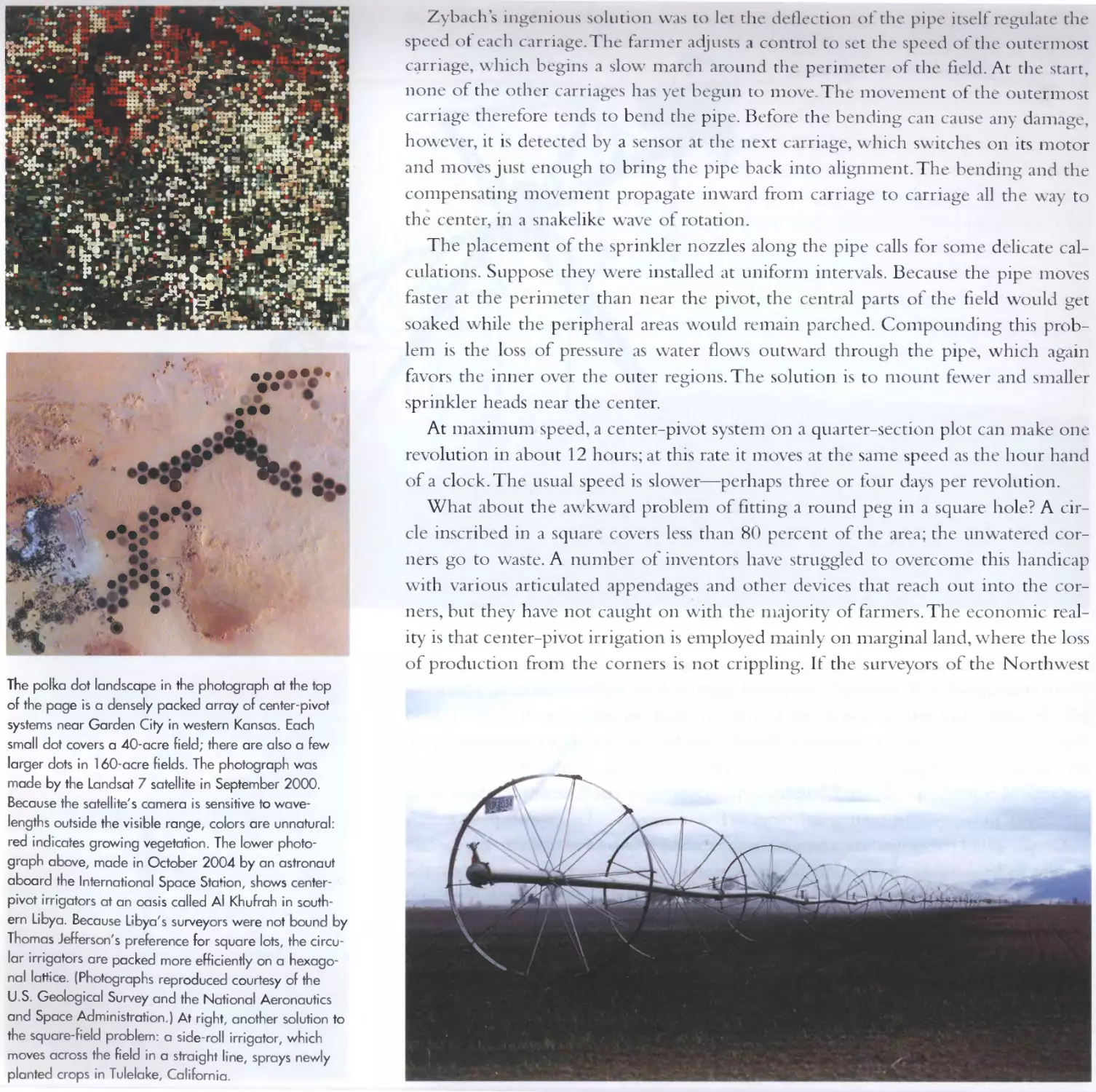
The sandstone buttes of Red Rock State Park, near
Gallup, New Mexico, serve as backdrop to the process-
ing and storage facilities of EI Paso Natural Gas
Company and Conoco Propane. Do the tanks and tow-
ers spoil the view of the cliffs? Or does the overdramat-
ic landscape distract from a proper appreciation of the
industrial equipment?
,
Three Mile ["bnd, 13hopal, <.. 'hernobyl, Love (' lIUI. In the pre...ence ofluture we hold
our breath in hushed reverence; in the presence of industry we hold our nose.
A few centuries ago-say, on the Alnerican western frontier-a quite different view
prevailed. Nature was seen .IS saV<lge, hostile, cruel. Mountains and fore"ts were b<lrri-
ers, not refuges. The lights of civilization were a cornforting sight. We took our char-
ter frorn the book of Genesi", which grants lnankind dorninion over the beasts. and
felt it wa both our entitlenlent and our duty to talne the wilderness, fell the trees.
plow the land, daln the rivers. In the 1l10St extrelne version of this ideology, everything
on the planet was put here explicitly for hun1an use. At the opposite extrelne, today.
the earth-first sensibility urges us to treat the entire planet according to the can1psite
ethic: carry out what you carry in, and leave no trace of your p<lssage.
It is not n1Y lnission to lnediate between these strangely polarized positions. My
chief ain1 is silnply to describe and explain the technological fabric of society. not to
judge whether it is good or bad. beautiful or ugly. And yet] would not argue that
technology is neutral or value-free. Quite the contrary: [ subnlit that the signs of
hUlnan presence are the only elen1ents of the landscape that have any n10ral or aes-
thetic significance at all. In nature undisturbed, a desert is not better or worse than a
forest or a glacier; there is silnply no scale on 'which to rank such things unless it is
a hun1an scale of utility or beauty. Only when people intervene in nature is there any
question of right or wrong, better or wor"e. When we look on a pri"tine glade, we
are lnere bystanders, but when we walk down a city street, we are responsible for
what we see (and what we hear and sn1ell), and we are therefore called on to pass
judgn1ent.
!,
Ij
a .1
... ..,
...--
One winter afternoon a few yee1rs ago I stood by the side of a highway near
Gallup, New Mexico, looking on a classic vista of the Atnerican West: red sandstone
buttes rising fronl a valley floor. It was the kind of landscape Blade (1nlous by fihns
and paintings and postcards, not to mention e111 those Marlboro Man advertisen1ents.
But this particular vista had sOlnething tnore. In fi-ont of the cliffs, and towering over
then1, were several cylindrical spires that I recognized as petroleunl fractionating
colmnns; off to one side was a grove of gleatuing white "pherical tanks. The towers
and tanks belonged to a plant tor processing and storing propane, or liquefied petro-
leUlu gas. I suspect the1t l1lost viewers of this scene would consider the industrial hard-
ware to be an intrusion, a distraction, perhe1ps even a desecration of the landscape. I
lllight offer the counterargunlent thc1t the juxtaposition of naturallandfoflns with the
geollletrically sill1pler cylinders and sphere" adds visual interest to the composition,
but I don't expect to win tnany converts to that view.
When looking on that scene west of Gallup. the obvious question is: Why did they
have to build it here? Couldn't the gasworks have been put sotuewhere less conspic-
uous? There is an answer. The propane plant was put below the buttes because that's
where the pipeline runs. carrying petrolemn products frotn Texas to California. And
the pipeline takes that path because it follows the highway and the railroad. And
before the highwe1Y and railroad were built. a ste\gecoach line followed the satue
route. And before that, there We1S a trail used by the native peoples who have 111ain-
tained c1l1 urban culture in this region for ell least e1 tuillennimn. In other word'i, thi
is c1 land....clpe that hels l1een put to hunun lht' tl)r e1 very long titne. Today. many of
us Blight prefer to see it put to some otlter use. hut tlut is still e1 matter of impressing
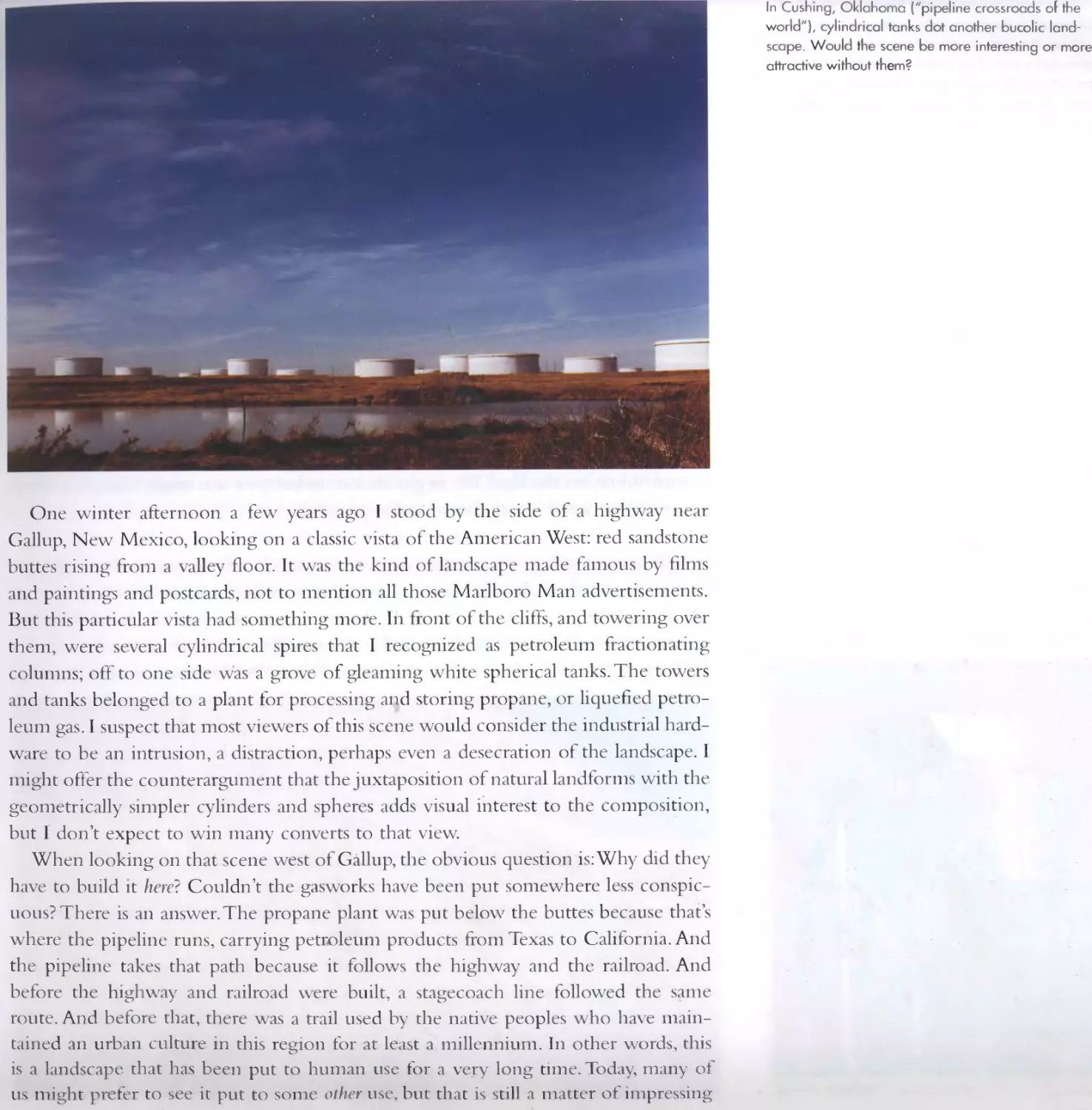
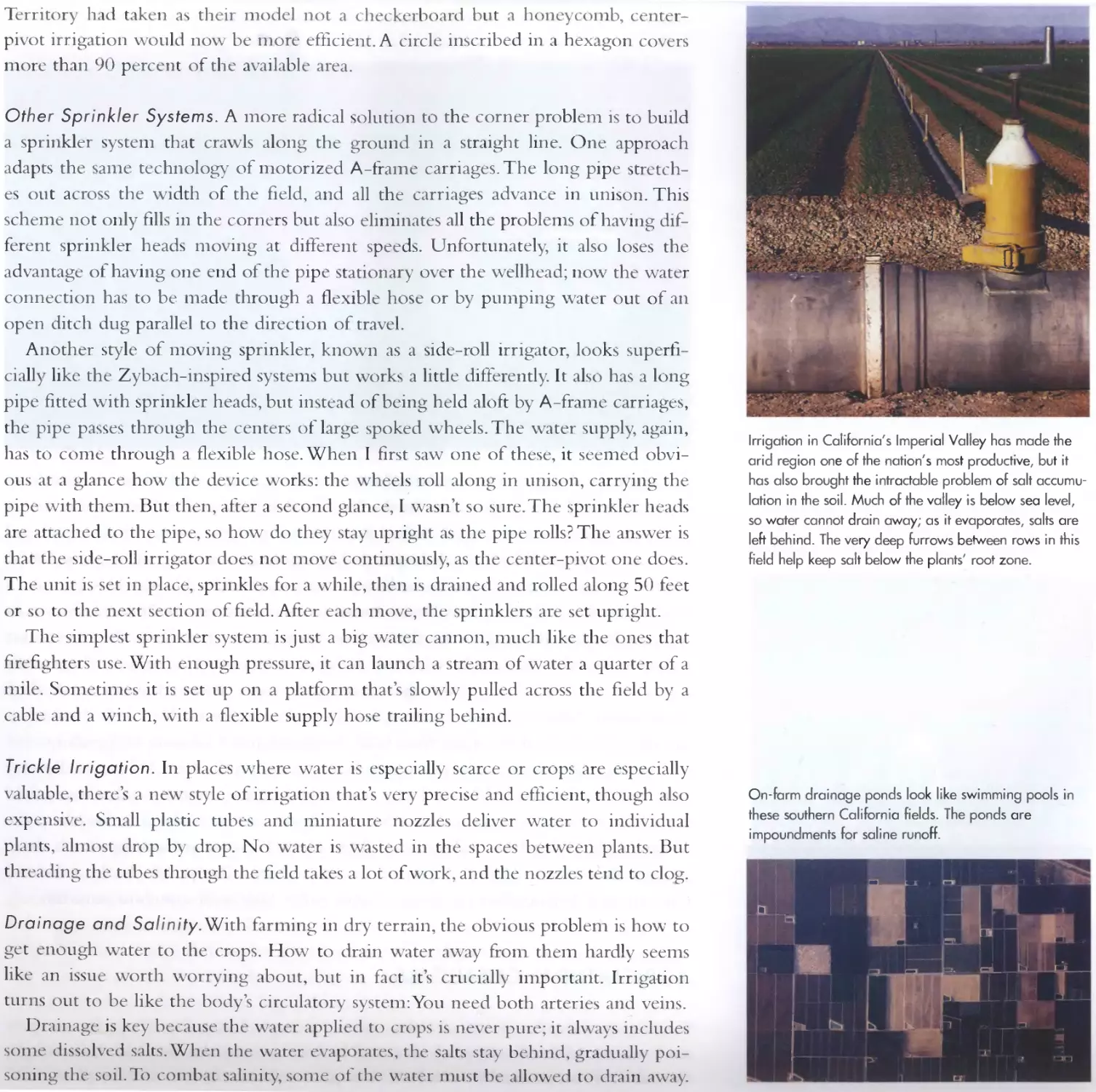
In Cushing, Oklahoma ("pipeline crossroads of the
world"), cylindrical tanks dot another bucolic land-
scape. Would the scene be more interesting or more
attractive without them?
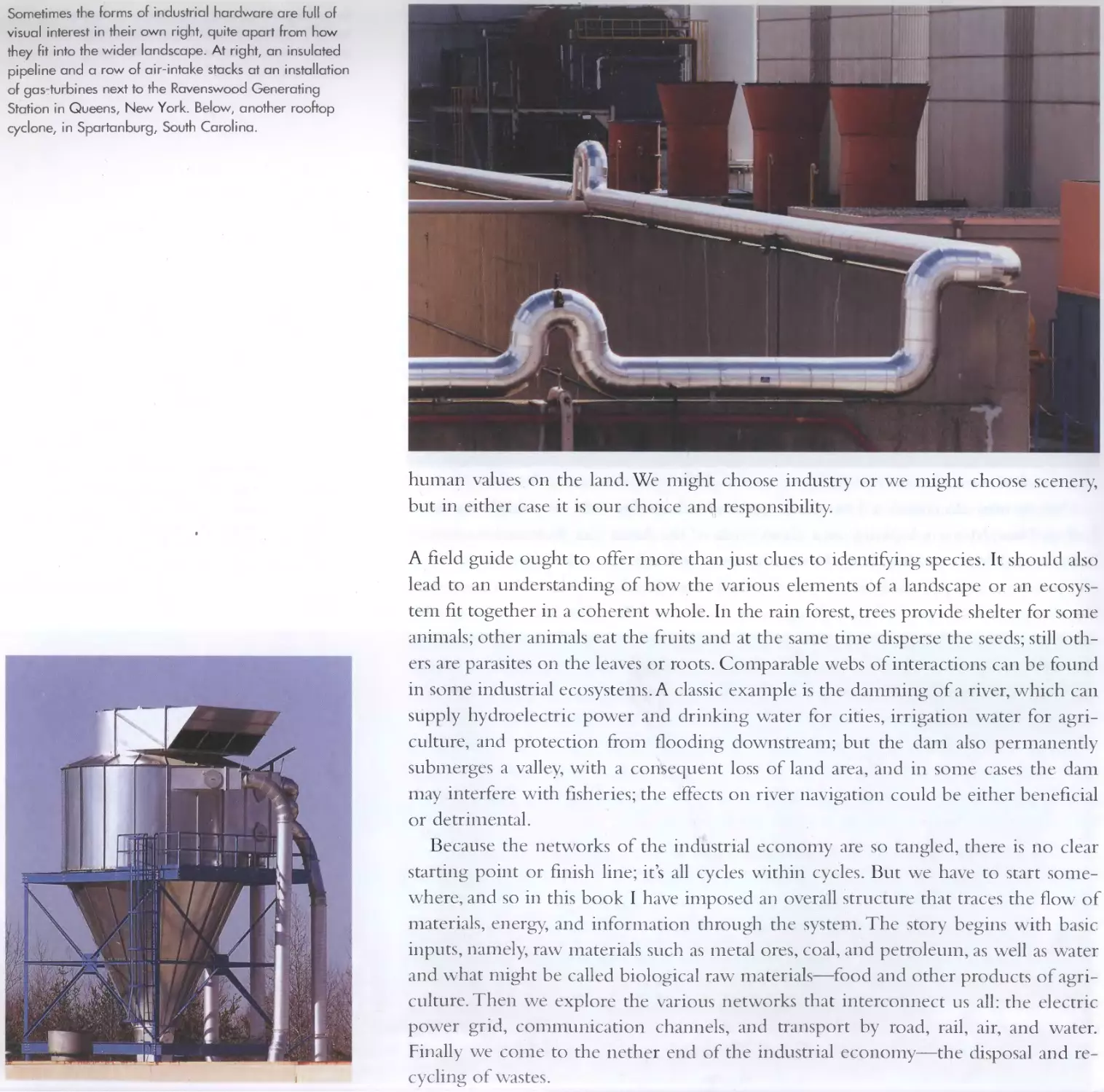
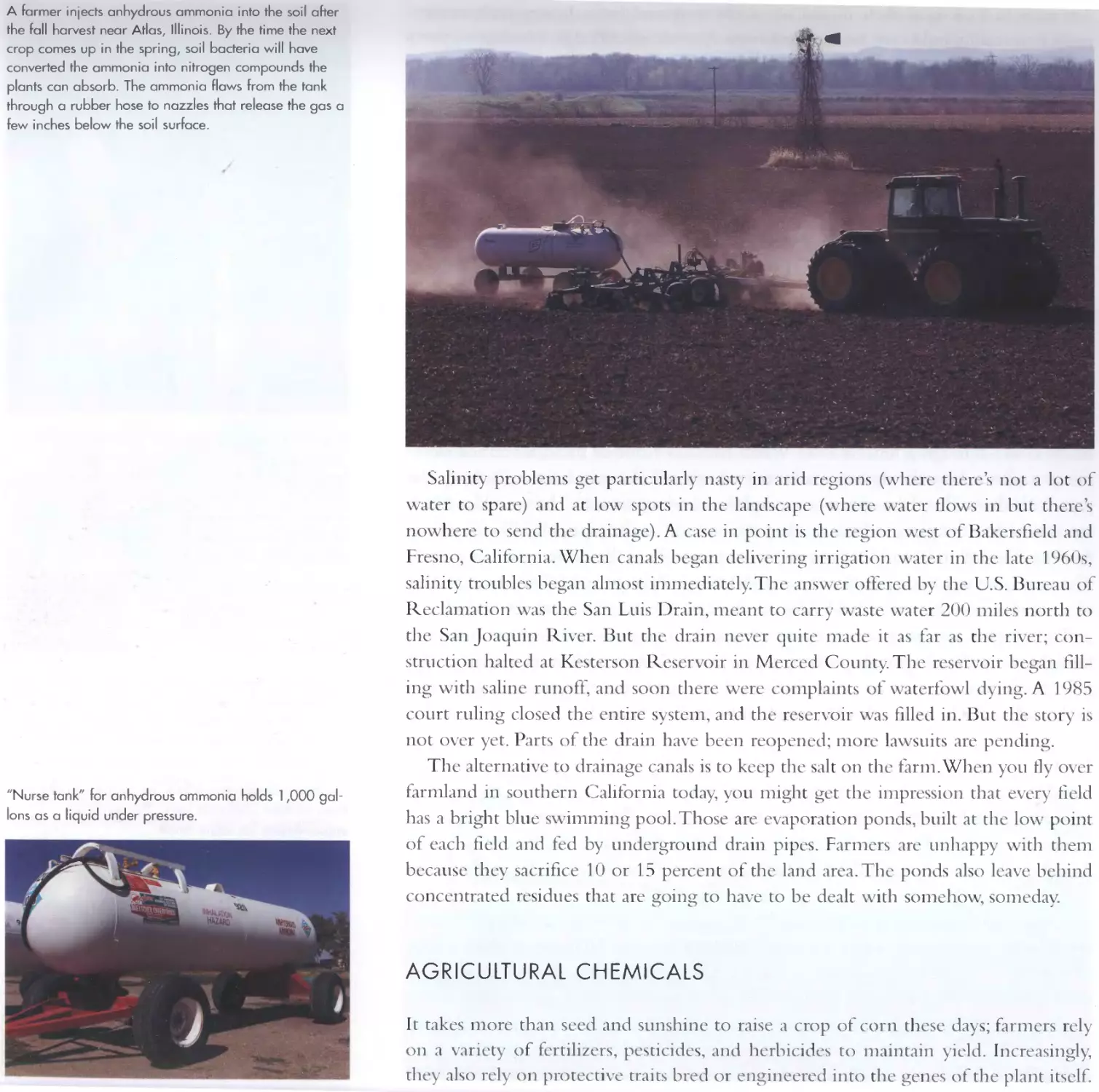
Sometimes the forms of industrial hardware are full of
visual interest in their own right, quite apart from how
they fit into the wider landscape. At right, an insulated
pipeline and a row of air-intake stacks at an installation
of gas-turbines next to the Ravenswood Generating
Station in Queens, New York. Below, another rooftop
cyclone, in Spartanburg, South Carolina.
-
A'
I I
I i,
I
-
I
. .
i
r
----
----- .-----
'-
- ----
---
hmnan values on the land. We nlight choose industry or we nlight choose scenery,
but in either case it is our choice and responsibility.
A field guide ought to offer nlore than just clues to identifying species. It should also
lead to an understanding of how the various elenlents of a landscape or an ecosys-
tenl. fit together in a coherent whole. [n the rain forest, trees provide shelter for SOllIe
anin1als; other aninlals eat the fruits and at the saIne tiine disperse the seeds; still oth-
ers are paral\ites on the leave or roots. COlnparable webs of interactions can be found
in Olne industrial ecosystellls. A classic exainple is the dalluning of a river. which can
upply hydroelectric power and drinking water for cities. irrigation water for agri-
culture, and protection from flooding dowllstreaIn; but the dain al o pennanendy
ubinerges a valley, with a consequent loss of land area. and in some cases the dain
may interfere with fisheries; the effects on river navigation could be either beneficial
or detriinental.
Because the networks of the industrial econOlny are so tangled. there is no clear
starting point or finish line; it\ all cycles within cycles. But we have to start sonle-
where, and so in this book [ have iinposed an overall structure that traces the flow of
Inaterials, energy. and infonnation through the systenl. The story begins with basic
inputs, namely, raw Inaterials such as Inetal ore . coal, and petroleulll. as well as water
and what nlight be called biological raw Il1aterials-food and other products of agri-
culture. Then we explore the various network that interconnect us all: the electric
power grid, conul1unication channels, and transport by road, rail, air. and water.
Finally we COlne to the nether end of the industridl econOlny-the disposal and re-
cycling of wastes.
Not everything indu\tri<11 or technologic1) will be f()lmd within these p<lgC'\ My
emphasis is on landscape, l11e<ming thing you can ee out of doors. I luve had to
ignore a nl11ltitude of £ul1iliar hou'\ehold technologie'\; thus, you will hdve to turn
elsewhere to learn how a dishwasher or a l11icrowave oven works. With regret, I hdve
also had to leave out m<my manufacturing operations. I would have greatly enjoyed
learning and describing what goes on inside a pharmaceutical plant or <1 fabrication
line for silicon chips. but <11] the action in '\uch places i'\ hidden away; £i-0111 the out-
side, you would have a hard tinle telling whether a (tetory nuke, a'\pirin or l11icro-
processors. The manuf.1.cturing operations that do appear in these pages are tho'\e
where the nlachinery is more or less visible from out'\ide the chain-link fence, a\ \\"ith
oil refineries and steel mills. (In fact, nlany of the photographs in this book were
taken fr0111 outside the fence-or by poking the lens of the call1era through it.)
Other excluded topics nuy seenl nlore or less arbitrary. I decided not to attenlpt <1
'\urvey of l11ilitarv technolob'Y, partly because poking a call1era len\ through those
fences could get 111e in trouble. I also had no room for the con truction industry.
Final]y, I should note that this i largely a guide to the North American industrial land-
scape, with sonle attention to Europe but a11110'\t nothing dbout the rest of the world.
The writing of this book Ius been an education and an <ldventure. [ have criss-
cros')ed North Anlerica as a technotourist taking in the highlights of the industrial
landscape. Friends looked at l11e strangely when [ announced that I was going to
New Orlean not for Mardi (;ras but to look at the drailuge pumps, that I was dri-
ving to Vermont not for the skiing but to see a granite qU<lrry, that nlY vacation in
the \outh of Italy was spent photogr<lphing highways and harbors. At least I avoided
the crowds.
My hope is th<lt this book will cultivate greater <lW<lreness of all the l11iscellaneous
h trdware that goes into making a civilization. and perh<lps even S0111e enthusi<lsm for
, 1-"-
"
"\ : --..... ....
. .....-"\ . _J.===-- "- , ... "
- ' ''':'t . ,-\- · '-"" .""
-- , \.,
, .
-"',
,- '\
. : " '\
'-
\
\
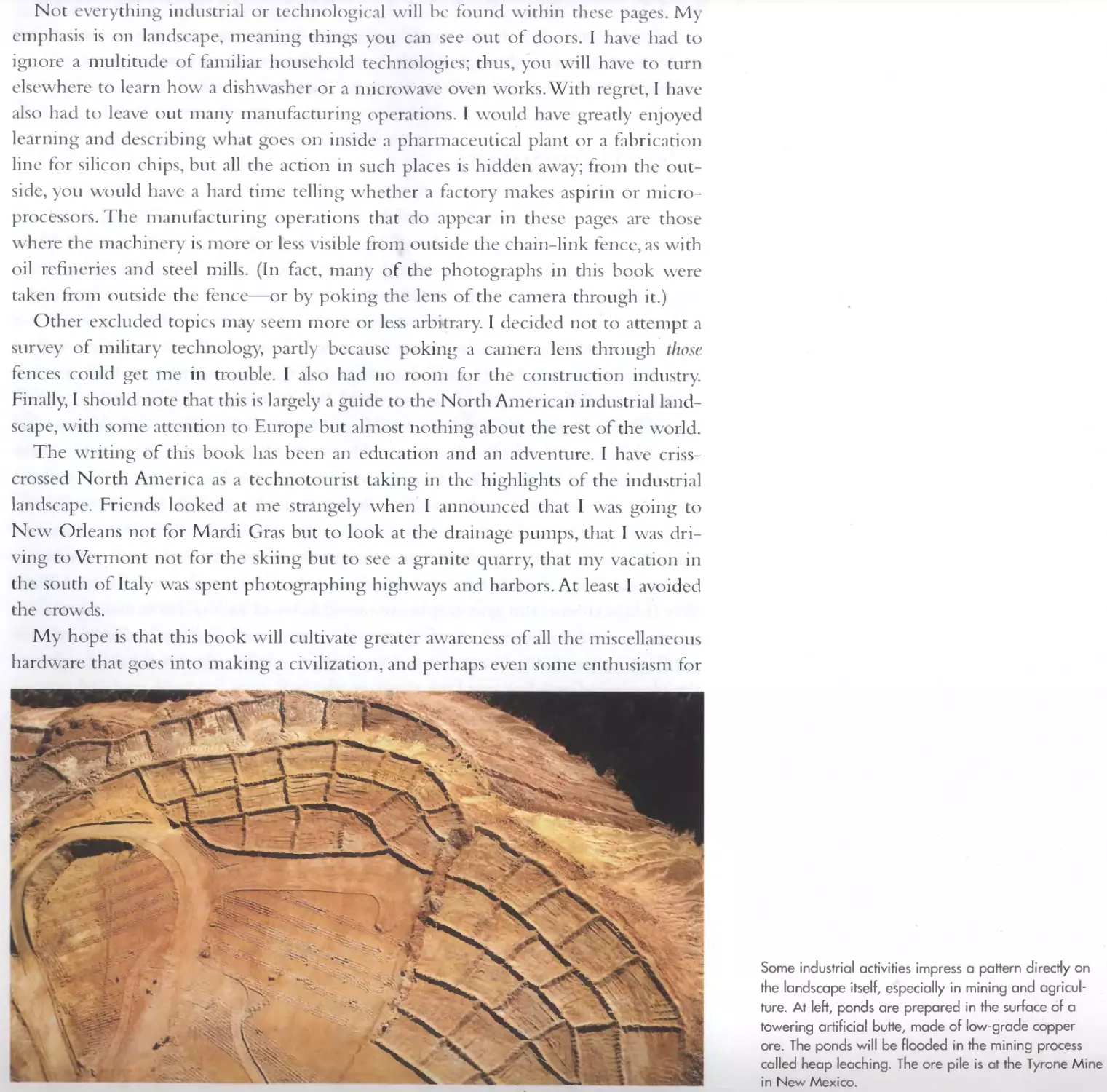
Some industrial activities impress a pattern directly on
the landscape itself, especially in mining and agricul-
ture. At left, ponds are prepared in the surface of a
towering artificial butte, made of low-grade copper
are. The ponds will be flooded in the mining process
called heap leaching. The are pile is at the Tyrone Mine
in New Mexico.
the industriallandscape. It's all around you; you Illight as weIl get to know Wh<lt it's
called and wh<lt it does. If you would pull off the highw<lY to admire a nlolmtain vista
or a waterfall, you nlight also consider pausing for a nline or a power plant.
WelcOllle to the world we have nlade for ourselves.
ACKNOWLEDGMENTS
This is a book that springs from at least three sources. One point of departure was
the question that my daughter, AnlY Hayes, used to ask fronl the back seat: "What's
that thing?" I th ank her both for asking the question and for letting nle know when
nlY answers grew toa pedantic to endure.
Looking further back, nlY own interest in the artifacts of the industrial world was
awakened in adolescence, when I was fortunate to have an older friend, Dave Fell, an
engineer and an urban-industrial counterpart of the wise woodsnun. One sunlnler
we explored the back roads near Cape May Point, New Jersey. The locale is signifi-
cant. Witnler Stone's Bird Studies at Old Cape A/ay was a founding work of Alnerican
nature writing, and Lily Pond at Cape May Point still attracts an interesting popula-
tion ofbirds and birders. When RogerTory Peterson, the dean of field-guide authors,
11lade his first ornithological expedition, his destination was Cape May Point. But the
area is also a rich one for the technophile. Less than a mile from Lily Pond, Dave and
I found a vast, hUllln1Ïng plant that extract'\ nlagnesiU1n from seawater; nearby we
watched a dredge deepen the canal that crosses the cape; we clambered over a World
War II blockhouse and gun enlplacement, abandoned by the Coast Guard; and we
puzzled over rusted renlnants of bygone industries, such as a steanl-driven nlill for
crushing oyster shells into powdered lime. Dave-sadly, now deceased-taught 1l1e
the pleasure of puzzling out how things work.
The third influence was Dennis Flanagan, the editor of Scientific A m erica 11 through
all its best years, who educated a generation of science writers, including nIe. In a
conversation two decades ago, Dennis pointed out that although a great deal is written
about technology, alnlost all of it focuses on a few fashionable topics such as conlput-
ers and genetic engineering; the technologies that run nlost of the world's industries
have beconle almast invisible. His relllark inspired this book, and his continuing
guidance helped to shape it. Dennis died in January 2005.
I alll grateful to nlany others for help and support. Diana Lutz and her parents,
Josephine Lutz and the late John Lutz, were the project's first enthusiasts. The late
Philip and Phylis Morrison offered encouragenlent and a streanl of suggestions that
were pure gold. Joseph Wisnovsky, a friend and collea6'1le, helped l11e refine nlY ideas
and shared nuny of his own; then he arranged for publication at WW Norton and
for seven years was my editor there. Af ter Joe's retirement, Angela von der Lippe and
Alessandra l:3astagli taak over. Barbara Willianls Flanagan offered valuable counsel.
Bonnie Auslander has been nlY loyalest reader and critic. And, through a decade of
PREFACE
wandering the industrial landscape, Rosalind Reid has been nlY conlpanlon and
feIlow-traveler. She has a presence in these pages.
This book would not exist without the financial support of the Alfred P Sloan
Foundation, where Arthur L. Singer, Jr., rescued me fronl an early crisis and Doron
Weber provided sustained support over a period of years. The grants were adlninis-
tered by Sigma Xi, the Scientific Research Society.
FinaIly I wish to acknowledge the assistance of a great nlany helpful and thought-
ful people who invited me into their corners of the industriallandscape, showed nle
the sights, and helped nle teIl their stories: Asheville Waste Paper COInpany; Frank
Brenner of Atlantic Scrap and Processing in KernersviIle, North Carolina; Reagan
Gentry, Aubrey K. McClendon, TOIll Price, Jr., Ron E. Voth, and Roger Wilson of
Chesapeake Energy Corporation in Oklaholna City; Ken Deffeyes of Princeton,
New Jersey; R. S. Renfroe of the ChevronTexaco refinery in Pascagoula, Mississippi;
,
Glenn Madehneyer of Covanta Energy Corporation in Lorton, Virginia; Mike
Adcock, Renee Lawrence, Jalnes Minor, Terry Rolan, David Sineath, and Willianl
Telford of the Departnlent of Water Managenlent in Durhanl, North Carolina;
Duane Klabunde and Doug Stoltz of the Falkirk Mining Conlpany in Underwood,
North Dakota; Tonl Spain of the Water Redanlation Facility in Henderson, North
Carolina; H. L. Hinles of Silver City, New Mexico;joe Hirschi of the Illinois Clean
Coal Institute; the Galatia Mine in Galatia, Illinois, operated by American Coal
Conlpany; Linda White of the Kern Wind Energy Association in Bakersfield,
California; Dave Rib of the Kramer Junction Operating COIupany in Kramer
Junction, California; Sara Moriarty and the late Judi Scioli of the Maryland Port
Adnlinistration;Alan R. Blatecky and Eileen Sarro of the Microelectronics Center of
North Carolina; David G. Finley of the National Radio AstrononlY Observatory in
Socorro, New Mexico;Joe Puglia of the New Orleans Drainage Conll11ission; Frank
Feeney, Michael Marotta, John Palllpelone, Steve Violetta, and Paula Young of the
New York City Department of Sanitation; Susan Terpay, C. T. Sansbury, Jr., J L.
Thonlas, and DarneIl Wood of Norfolk Southern Corporation; Scott A. Andrews,
GiffDaughtridge, Mike D. Fox,Johnny E.Jacobs,Joe Rutkowski, and RayWright of
Nucor Corporation; Woodrow Boyd, Sharon Hall, Robert Sisson, and Robert Yanity
of Progress Energy;John Hubbard of the Roanoke VaIley Resource Authority; Todd
Paton of the Rock of Ages Granite Quarry in Barre, Vermont; Matt Saindon and
Melvin Saindon of Zurich, Kansas; Michael B. Gwynn of Texasgulf; Michael D.
O'DeIl of UUNET Technologies; Bill Roser of the Wheeler Brothers Feedyard in
Watonga, OklahOlna.
,
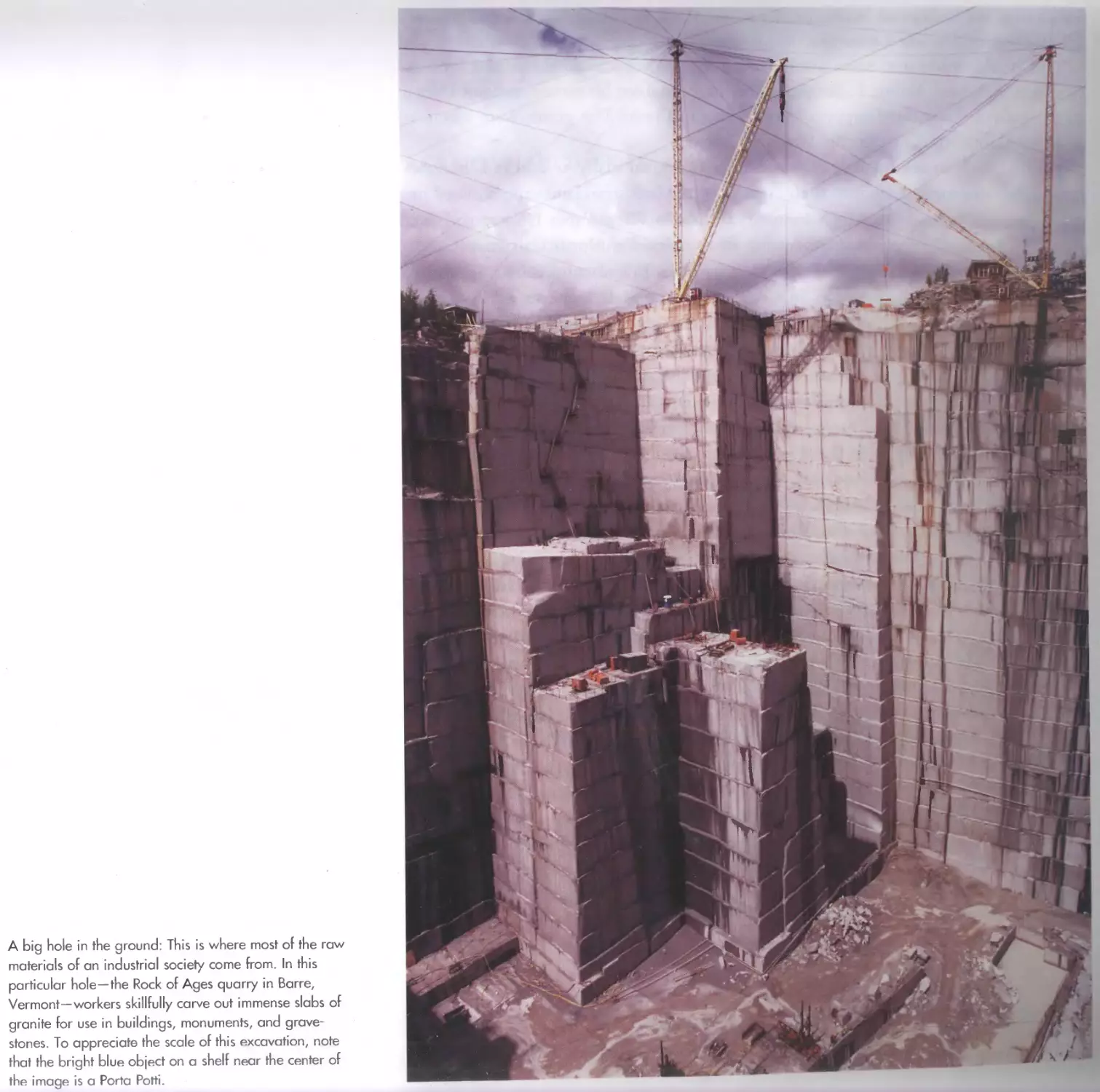
A big hole in the ground: This is where most of the raw
materials of an industrial society come from. In this
particular hole-the Rock of Ages quarry in Barre,
Vermont-workers skillfully carve out immense slabs of
granite for use in buildings, monuments, and grave-
stones. To appreciate the scale of this excavation, note
that the bright blue object on a shelf near the center of
the image is a Porta Potti.
..
-r
.,...
I
'I
. f
i
--.,
"--.
1
,.
I
\
t
I
t
I r
CHAPTER
1
OUT
HER A W MAT ER I ALS FOR B U I L DIN G a civilization are 11lainly things we dig
up out of the ground: fuels such as coaL UraniUlll. and petroleUlll; the ores of iron.
copper. alUlllinUlll, and dozens of other 111etais; stone, sand, and clay for building; and
a nliscellany of other 11linerals such as sulfur and phosphates. These things are basic
inputs of the world econonly-the ingredients for nlaking everything else-and so
they seenl like a good place to begin an exploration of the industriallandscape.
This chapter describes what econOlllists call the extractive industries-the various
ways of scraping and drilling and blasting and digging to claw useful stuff out of the
earth. We'll visit pit nlines, strip nlines, and underground mines, hard-rock nllnes,
coal nlines, and stone quarries. And we'lllook at what happens to a few of these
conlnlodities atter they are retrieved froll1 underground: the snlelting of copper, the
conversion of iron ore into steel, the 11lanufacture of Ce111ent and concrete. (Two
other vital resources-water and petroleu111-nlight have been discussed in the same
context, but they are so inlportant they deserve chapters of their own.)
To begin our tour of the industrial landscape with titanic nlines and nlills is to
confront imnlediately the nlost spectacular ways that industry can transfornl the ter-
rain. Over a period of a few decades. a big open-pit nline can blast away an entire
nlountain, leaving a deep crater in its place and filling nearby valleys with waste rock.
Inside the 11line, everything biological-the whole veneer of grass. trees. and soil that
shapes and softens the contours of the hunIan habitat-is peeled back to expose the
ra\-v, rocky heart of the planet. Critics of the industry describe such nlines as wounds
or scars. Miners, of course, see nothing so sinister or destructive in what they do. On
the contrary. they are proud of the grandeur of their art: for the first time in hUlllan
histor we have it in our power to nlove nlountains.
Mining seems like a simple job: first you find pay dirt, and then you dig it out. Uut
there are 11l3ny ways of going .Ibout it. Different kinds of deposits LIn for diflt..'rcnt
OF
THE
EARTH
GETTING A LOOK
Mine operators have a certain reputation for
wariness, secrecy, and occasionally even hos-
tility. Think of the solitary prospectors of west-
ern legend, always chasing off "claim
jumpers." Superintendents of modern mining
operations have other reasons for shutting out
visitors. Mines are dangerous places, and
when you wander onto the property, the own-
ers will worry about your safety-or about
their legal liability for your safety. If you are
snooping around with binoculars or a camera,
they may think you are looking for violations
of environmental or worker-safety regulations.
mining trategie\, .tI1J .1 ...ingle deposit might be worked in st'ver.ll \\.I O\L. thL
course of its lifetime.
Suppose you strike gold. You nlight start Inakin g Y our fc ort b
"- , . L lIne ) tr"mg [0 n
er loose flakes of metal in s.lndy tredm beds-a techm q u k I . "
. . t' no\\ n .h p dl er m1l1111 !
Later you nllght dIg a mall underground mine followI ng a ." t - .
. L \eln C lore It lIlt' '1I-
ders through the rock. With a bigger capital investment th t I "
.L. ., e unlIe 1116 0per LnOII
could e replaced by an open-pIt nllne, with enonnou, earthmc,v1l1g nldlhin
Then,.lf the ore. body continues still deeper, you might return tn under round meth-
ods wIth a erncal shaft nline. FinallY,Ju t when YOll think the depo it is played )ut
t last, the dIscarded wastes frOln earlier operations becOllle a resource \vurth L "\:ploit-
lng. In sonle Inining districts all these activities are going on at once.
PLACER MINING
The rnention of placer mining evokes im.lges of forty-niner panning for gold in the
streams near Sutter's Mill in northern California. A placer (pronounced "plah- er") i
just a deposit of sand or gravel with a concentration of sonk u ef111 mineral. Most
placers are created by the action of rivers or glaciers (the word I.... Spdlllsh for .....hoal")
and they are Inined by using water to separate the mineral from wa te nlatt'ricd
In panning for gold, the Ininer digs gravel fronl the stream bed and s\Virl it in .1 hal-
low pan until the lighter wastes escape and the denser flakes of" color" .Ire left behind.
As mining processes go, Pdnning is inefficient, recovering only the most accessible min-
erals. On the other hand, the only eguipnlent needed is a pie pan and .1 hovel.
When d placer-mining operation grows too big for panning. the next step is a
sluice box or riffle box, in which larger quantities of gravel are w.llihed over curru-
Then there are all the usual concerns about
theft and vandalism.
probably best at the largest quarries and open.
pit mines, some of which welcome visitors and
offer tours, or at least put up a sign explaining
what's going on down below. Underground
mines are harder to get into, but there are a
few where you can strap on a hard hat and
ride a hoist or an ore train into the depths of the
earth. In any case, the biggest mines are so vast
in scale that they can't be hidden from view.
You'll see them whether you want to or not.
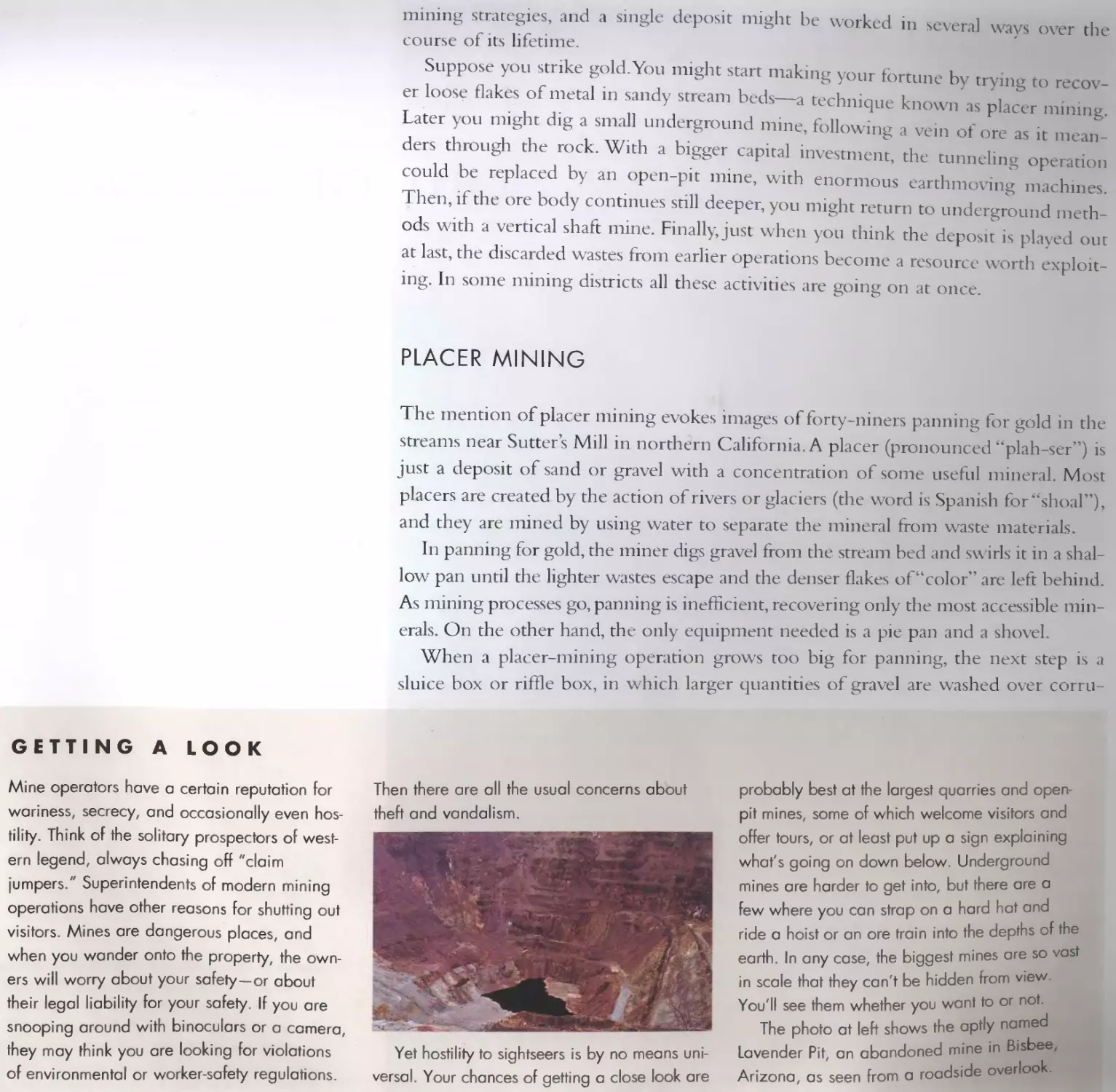
The photo at left shows the aptly named
d . . Bist-
lavender Pit an abandone mrne In
. ' f dS . l de oVNIc ,k.
Anzona as seen rom a roa
Yet hostility to sightseers is by no means uni-
versal. Your chances of getting a close look are
t.
" \.
.
".
<, .
_... .'1;
.,.. J-
'.
.
\.
:.'
- ..
- ....,
g,ltion, by rapidly tlowing water, ,lg,lin le,lVing behind the heavier gold particles.
These fornI' of pbcer mining ,Ire not econolllically illlportant today, but in gold-
lllining districts there are pknty of ro,ldside mu...eum, where you can <lee old equip-
ment on display. For ,1 t e, you CUI ,11'0 try your luck ,It panning. (The owners of the
nll1 eum Il.lve recognized dl.lt more wealth tloW<l by on the highway out tJ:ont dun
in the stre,llll out back.)
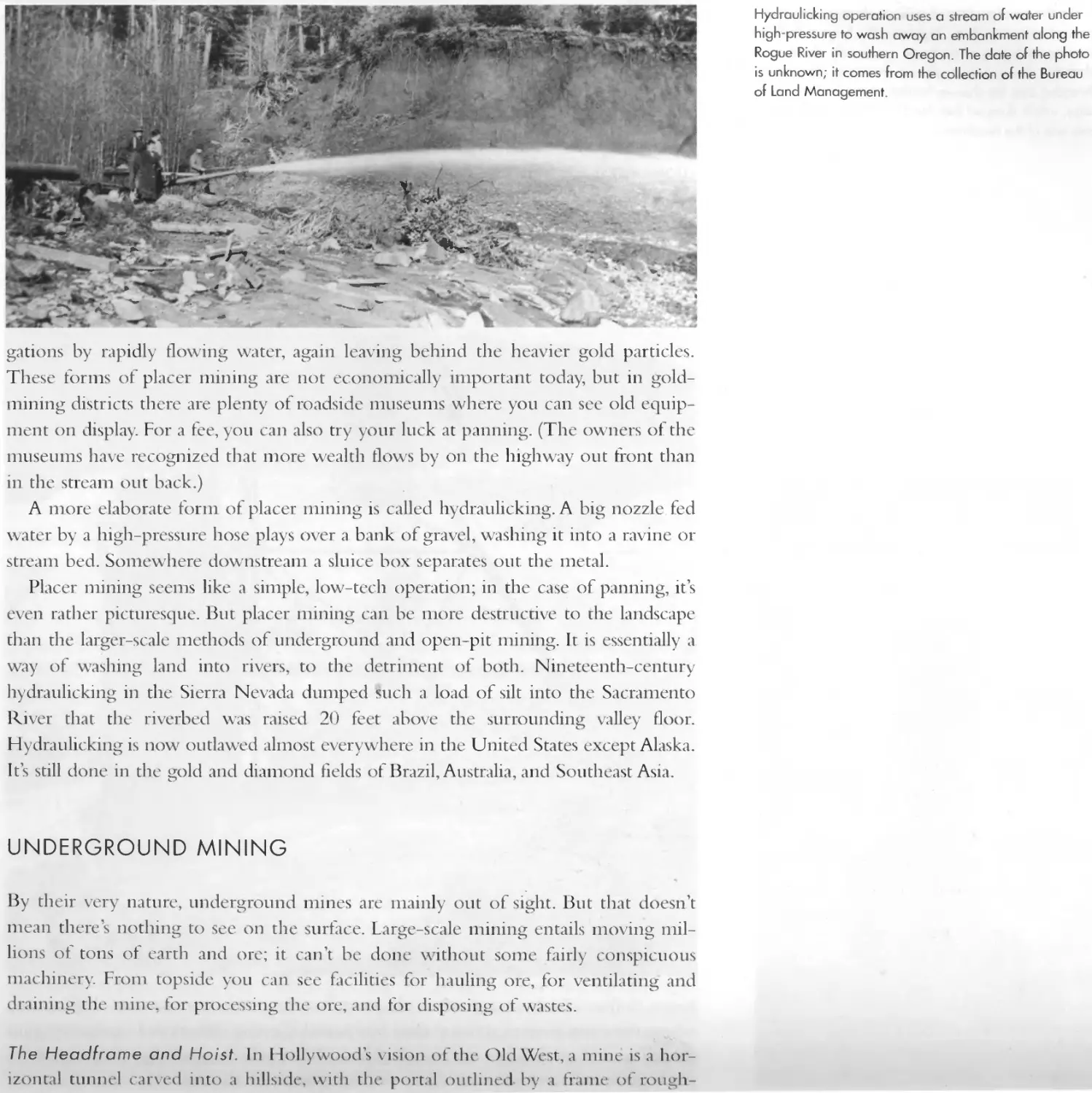
A more ebborate form of placer lllining is called hydr,ll1licking. A big nozzle fed
\V,lter by a high-pre<.;sure hose pby<.; over ,I bank of gravel, washing it into a ravine or
streanl bed. Sonll'where downstre,lm ,1 <lluice box <.;ep,lrate<.; out the met,l!.
Placer mining seems like ,I sinlple, low-tech operation in the case of panning, it's
even rather picturesque. UUf placer mining can be more de<ltrucrive [0 the landscape
than the larger-sLlle nlethods of underground ,md open-pit mining. I f is essentially a
\\,IY of w,lshing land into rivers. to the detriment of both. Nineteenth-century
hydraulicking in the Sierra Nev,H.b dumped such a load of silt into the Sacralllento
River tlut the riverbed was raised 20 feet above the surrounding valley floor.
Hydraulicking is now outbwed almost everywhere in the United St,ltes except Alaska.
It's <.;till done in the gold ,md diamond field of Brazil, Au,trali,l, ,md Southeast Asi,l.
UNDERGROUND MINING
By their very nature, underground nline... ,Ire nuinly out of ight. Uut tlut doe n't
me,m there', nothing to ee on the \urtace. L1rge-sLlle mining ent,lils moving mil-
lion of tons of e,Irth ,md ore; it c,m't be done \\ ithout \ome [lirly conspicuous
nl.lchinery. F-rom top<';lde you can ....ee [lCilitie for hauling ore, tor ventilating ,l1ld
dr.Iining the mine. fOt processing the ore, ,llld fc)r di'po,ing of \\',lste .
The Headframe and Hoist. In lollywood\ vi<.;ion of the ()Id West. ,1 mine is ,1 hOl-
izunt,tl tunnel c,Irved intu ,1 hillside. with the purt,ll outlined by .1 ti-,mIl' of rough
Hydraulicking operation uses a stream of water under
high-pressure to wash away an embankment along the
Rogue River in southern Oregon. The date of the photo
is unknown; it comes from the collection of the Bureau
of land Management.
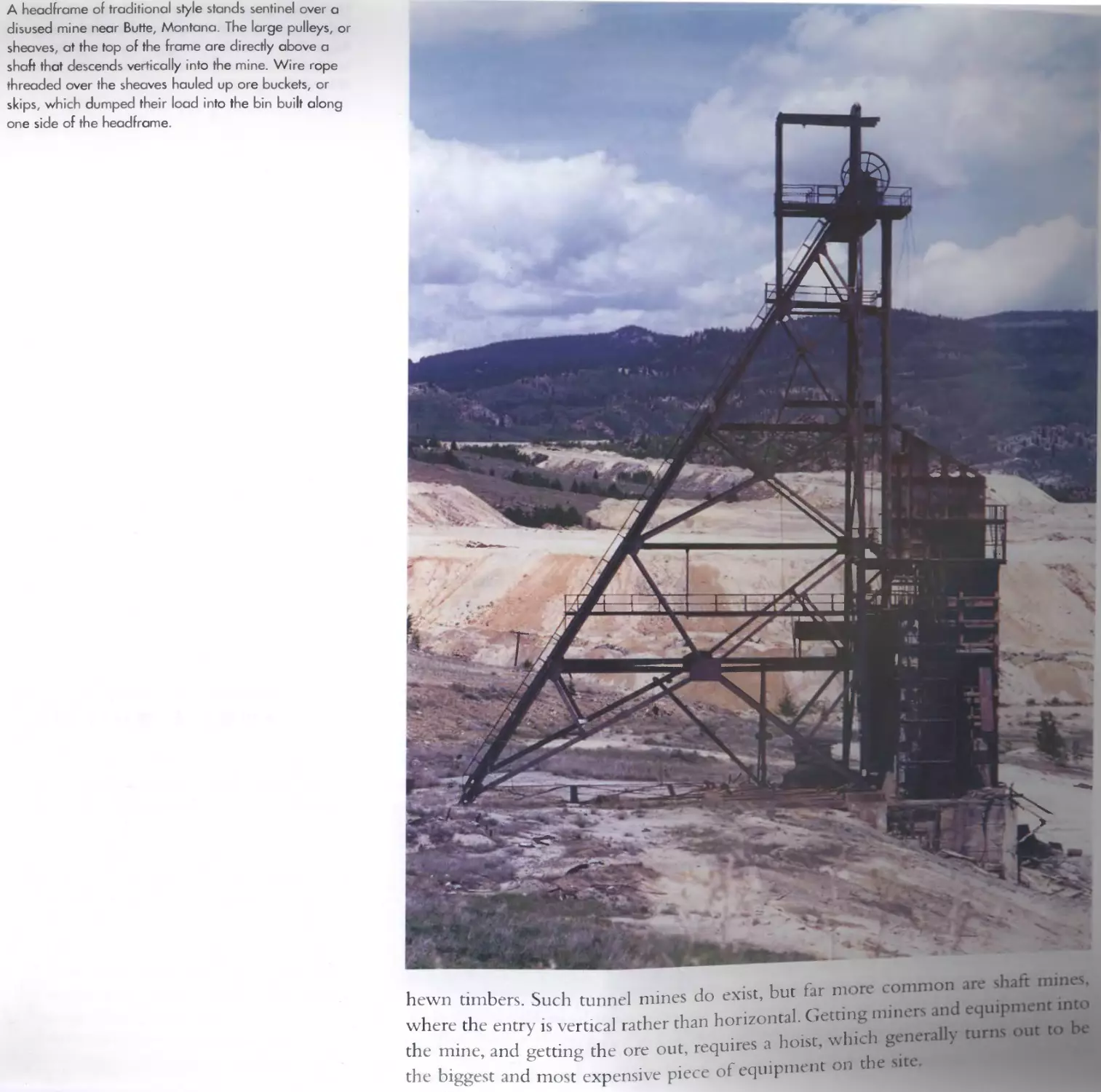
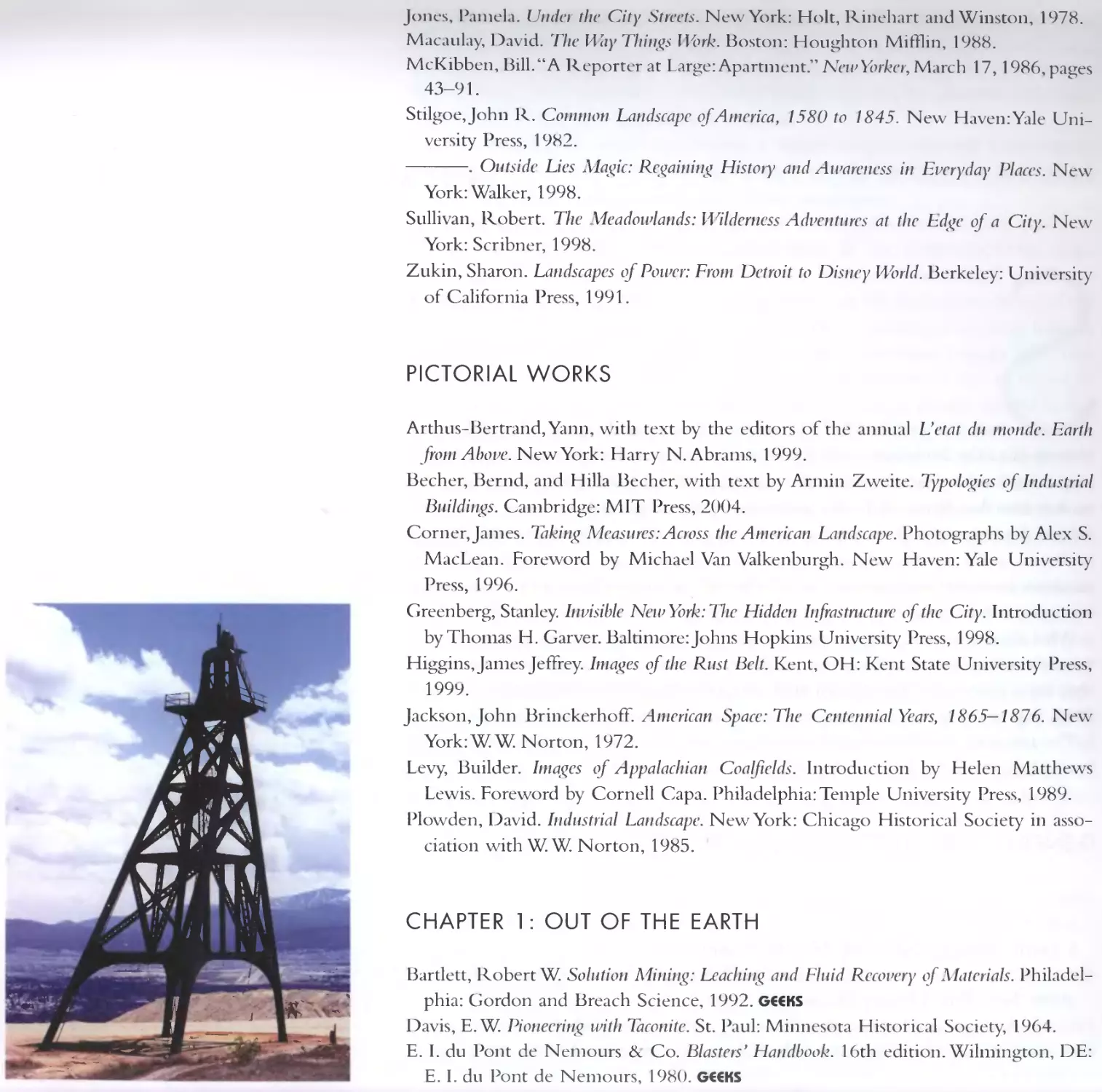
A head frame of traditional style stands sentinel over a
disused mine near Butte, Montana. The large pulleys, or
sheaves, at the top of the frame are directly above a
shaft that descends vertically into the mine. Wire rope
threaded over the sheaves hauled up ore buckets, or
skips, which dumped their load into the bin built along
one side of the head frame.
rt,
-"
jiiiiiii
:A
g a!'
-
....
...
I ".
." . . -.
... ...,, ..
-,-
.I- "
--
.-
-
r
,.
<'
hewn timbers. Such tunnd nline do e I t, but flr me
h h . h h h . t II (J trm m1l1t
were t e entry I'; vertical rat er t an OrIzon .
. hoi -l '''hI4 h
the nline, and getting the ore out, rt'yUlrt' d ...
h b . . . f q ui p Incnt, III th
t e 19gest and most expensIve pIece a L
,
.
I
--.
.........
The p,lrt of the hoist you cm see on the I\urface is c,llled the headfr,li11e. At older
and snl,lller mines it is likely to be a frame in the literal r.;ense-thJt is. an open frame-
work of wood or steel beams, 20 or 30 feet high. Most often it is an A-franle (or
actually ,1I1 A -fralne. with one r.;traight r.;ide and one sloped side). In some of the tra-
ditional lnining districts of the western states-placer.; like Butte, Montana. and
Tonopah. Nevada-dozens of headfrJmes in this sryle dot the hillsides.
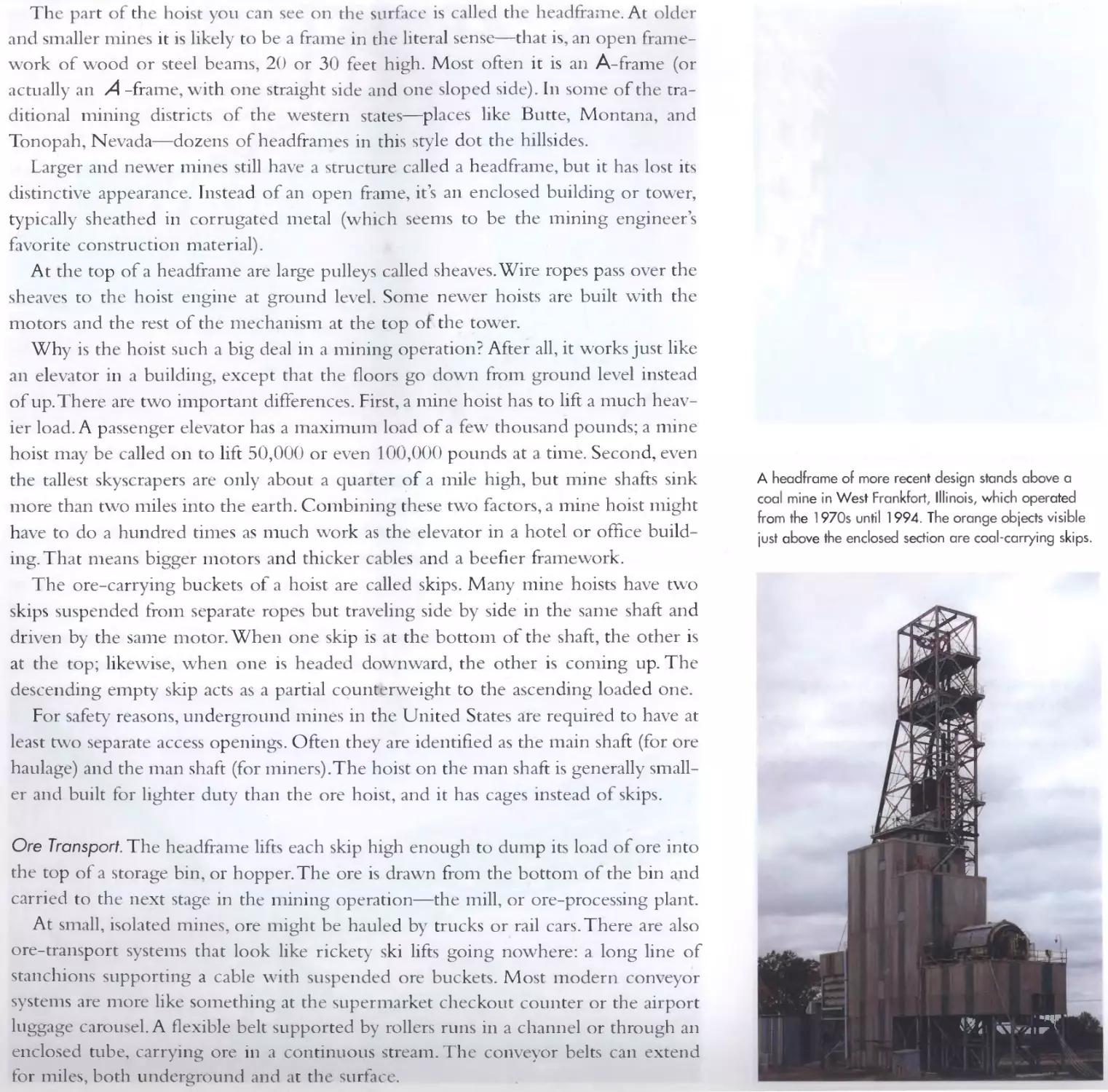
Larger and newer mines still have a structure called a headfralne, but it has lost its
distinctive appearance. Instead of an open fralne. it's an enclosed building or tower.
typically r.;heathed in corrugated lnetal (which r.;eems to be the 111ining engineer's
['lvorite construction material).
At the top of cl headtl-alne are large pulleys called sheaves. Wire ropes pass over the
sheaves to the hoist engine at ground level. SOlne newer hoists are built with the
Inotors and the rest of the ll1echanism at the top of the tower.
Why is the hoist such a big deal in a lnining operation? After all. it works just like
,In elevator in a building. except that the floors go down frOln ground level instead
of up. There are two ilnportant differences. Firr.;t. a lnine hoist has to lift a nluch heav-
ier load. A passenger elevator has a nl.lXimUln load of a few thousand pounds: a Inine
hoist nl.lY be c,llled on to lift 50,000 or even 1 un,ooo pounds ,It a tilne. Second. even
the tallest skyscrapers are only ,lbout a quarter of a Inile high, but lnine shafts sink
nlore than two lnilel\ into the earth. C0111bining these two factors, a 111ine hoist nlight
have to do a hundred tillles as nluch work al\ the elevator in a hotd or office build-
ing. That nleans bigger nlotors and thicker cables and a beefier fralnework.
The ore-carrying buckets of a hoist are called skips. Many 111ine hoists have two
skipl\ suspended trOln separate rores but traveling side by side in the sall1e shaft and
driven by the sanle nl0tor. When one skip i at the bottonl of the shaft, the other is
at the top; likewise, when one is headed downward, the other is conling up. The
descending eillpty skip acts as ,1 partial counterweight to the ascending loaded one.
For r.;,lfety reasons, underground Inines in the United States are required to have at
least two sep,lrate accesr.; openings. Often they are identified as the 111ain shaft (for ore
haulage) ,111d the l11.1n sh,lft (for 111iners). The hoisr on the nlan shaft is generally sll1all-
er and built for lighter dury than the ore hoisr. and it has cages instead of skips.
Ore Transport. The headfr,l1ne lifts each r.;kip high enough to dU111p its lo,ld of ore into
the top of a storage bin. or hopper. The ore is drawn frOln the bottonl of the bin and
carried to the next stage in the lnining oper,ltion-the lnill, or ore-processing plant.
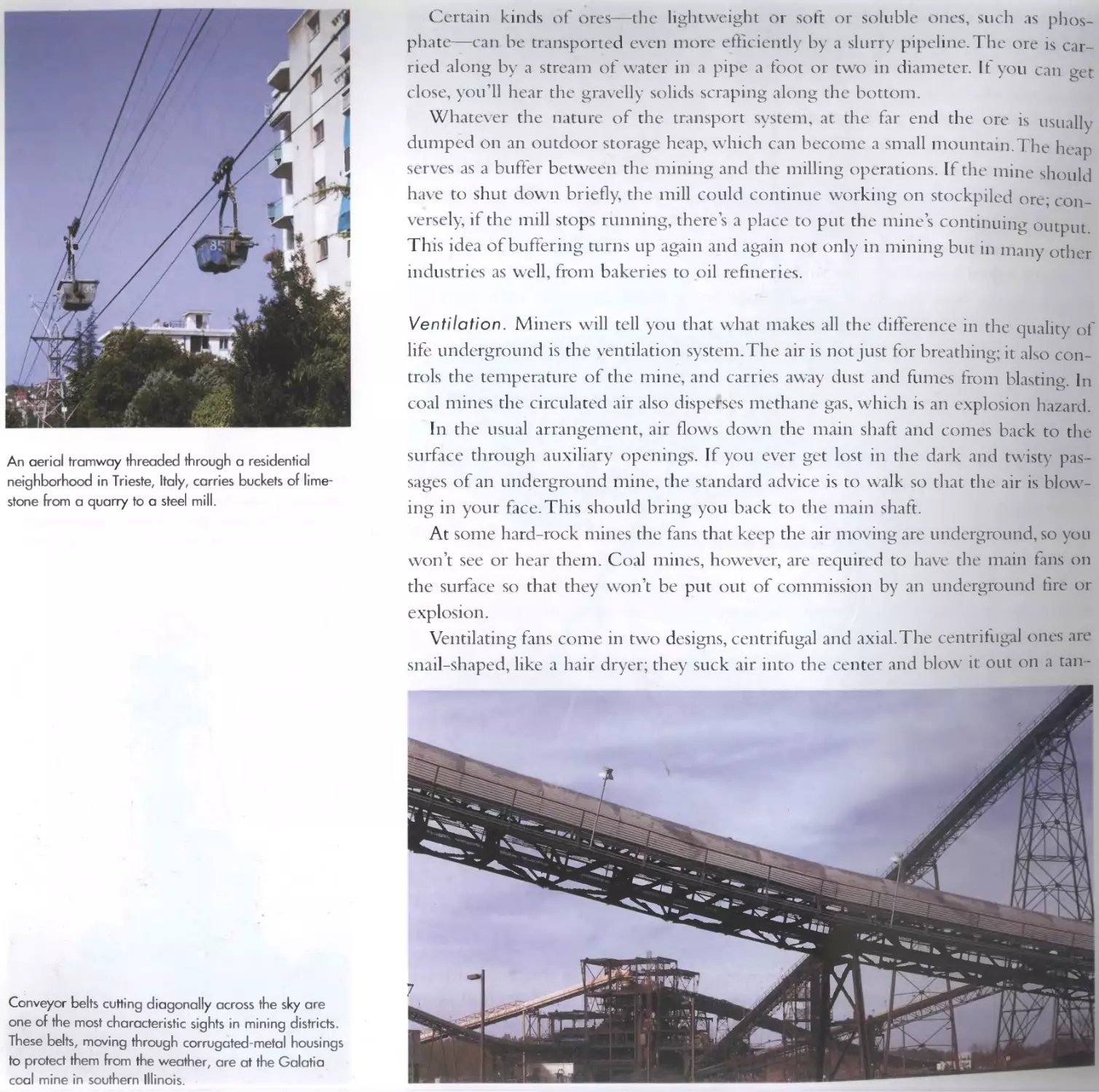
Ar I\lnall, isolated Inines. ore lnight be hauled by trucks or rail cars. There are also
ore-transport r.;yr.;tenls rhat look like rickery ki lifts going nowhere: a long line of
stanchions supporting a cable with suspended ore buckets. Most 1110dern conveyor
syr.;tenls ,1re nlore like r.;Olnething ,It the supenn,lrket checkout counter or the airport
luggage clrousel. A flexible belt ')upported bv rollers runs in a channel or throu h an
endo:'\eJ tube, carr) ing ore in a continuou "tre..ln1. The conveyor belts can extend
for miles, both underground ,111d ,H thL' l1rt:lCe.
A headframe of more recent design stands above a
coal mine in West Frankfort, Illinois, which operated
from the 1970s until 1994. The orange objects visible
just above the enclosed section are coal-carrying skips.
...
.. - ...."
. :;.,r;...
, -, "
, -4
4.'
. , .. .. :-
. I':
, ,$ ft, ...
jt."
.,
.
AI.
_: I
I I .,
-t
1
i
I , ..;;'r
"Y
)/
,
.,. ./
. '').
{II
.
- ,
An aerial tramway threaded through a residential
neighborhood in T rieste, Italy, carries buckets of lime-
stone from a quarry to a steel mill.
Conveyor belts cutting diagonally across the sky are
one of the most characteristic sights in mining districts
These belts, moving through corrugated-metal housings
to protect them from the weather, are at the Galatia
coal mine in southern Illinois.
('ert.lin kmds ot ore -the Iight\\l.'lght tH- '\oft or '\oluhlt' one..., ,uch .. pho'\
ph.lte-c.lI1 be tran'\ported even more etliClently hy .1 '\lu1TY pipeline_ rhe ore is Ir-
ried .llong by .1 stre.l111 of w.lter in .1 pipe .1 toot or t\\ 0 in di.lmeter. I f you cm ' el
close, you'll he.lr the gr.lVelly '\olid'\ "cr.1ping .llong the bottom.
WI1.1tever the nature of the tran"port system, .H the (u end the ore i" usu.dl)
dumped on .In outdoor "torage he.1P, which LlI1 become .1 SI11.111 mount.1in. The he.1P
serves a a buffer bet\\-een the mining dnd the milling oper.ltion<;. If the mine should
have to hut down briefly, the IHill could continue working on stockpiled ore- Ct In-
versely, if the mil] -;tor running, there'<; a place to put the mine\ continuing output.
This Idea ofbuftering turns up again and ag.1in not only in mining but in n1.1n) otlwr
industries a well, frUI11 bakeries to oil refineries.
,I
Ventilation. Miners will tell you that what make al] the difference in the gu.llit) of
life underground is the ventilation system. The .1ir is not just for breathing; it .1lso cun-
troIs the tenlperarure of the mine, .lI1d carries .1\vay dust and fumes from blastmg. In
coall11ines the circulated air also disperse" methane gas. which is .1n explo"lon h.lz.1rd.
In the usual .1rrangement, air flow" down the main shaft and come" o.lck to the
surtlce through auxili.1ry opening . If you ever get lost in the d.lrk and tWhty p.l"
sages of an underground l11ine, the stand.lrd advice is to w.1lk so that the .1ir is blow-
ing in your (lce_ This should bring you back to the main shaft.
At ,onle hard-rock mine, the (lns th.1t keep the air moving .1re underground, ,n VOLl
won't see or hear them. Coal l11ines, however, are required to have the main t.U1 on
the ,urface so that they won't be put out of commi"slon by an underground tlre or
explosion.
Ventilating (lns come in two de-;igns, centrifugal .ll1d axi.tl. The centrifllg.11 one" .1rL
snail-sh.1ped, like a hair dryer; they suck .lil into the center .U1d blow it Illt on .1 t.lI1-
..
,.
'. ::- .- -..
. ; . - . ,, ---------
, --- -
-...:....' ., ..., - -- ...." -----
....... .. ":. .........---
- :.....-.. .. .IP -__.
- ''-. " -----.. .
_. .......... .
-- "'-"" _..,.....4Ii -.":" -...-
... . . ....
- .- -....i.
.... ,.
"" ¥ \
., "
'I':
111I-
"Ii' r
,
.' -.:, ,-...
- - --
- :..-....._ ....' 'i.
.j - -=: -.-..
, r , - .....
.....""" .
e._ .....
, -
7
: I
f!.11
''''11
1
II' .."
' ,.
-- ...
r
, . ...\
1\
"""
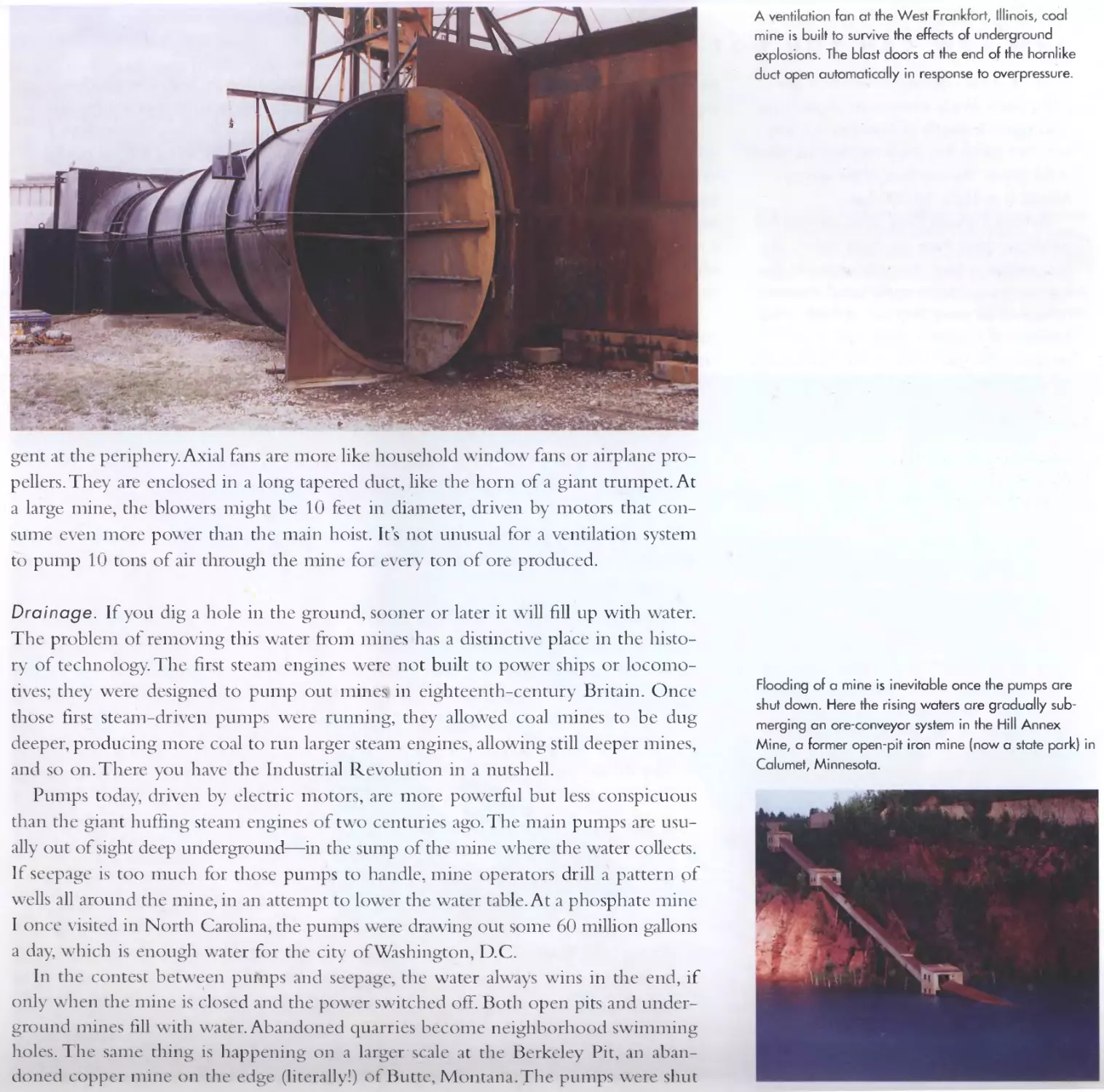
gent at the periphery. Axial (ms are more like household window f..ms or .1irplane pro-
pellers. They are enclosed in a long tapered duct, like the horn of a giant trumpet. At
a brge mine, the blowers tllight be 1 () feet in diameter, driven by motors that con-
Sl11ne even tll0re power than the main hoi"t. It'" not unu"ual for a ventilation systen1
to pump 1 () ton... of air through the tnine tor every ton of ore produced.
Drainage. If you dig a hole in the ground, "ooner or later it will fill up with water.
The problen1 of retnoving this water frOln tnines has d di"tinctive rlace in the histo-
ry of technology. The first stean1 engines were not built to power ships or IOCOlll0-
tives; they were de'\igned to pl1111p out mines in eighteenth-century Britain. Once
those tIr"t "team-driven pumps were running, they allowed coal tnines to be dug
deeper. producing more coal to run brger stean1 engines. allowing still deeper mines.
and so on. There you 11.lve the Industrial Revolution in a nutshell.
Pumps today. driven by electric motors. are tnore powerful but less conspicuous
than the gi.mt huftIng ste.un engines of two centuries ago. The main pl11nps are usu-
ally out of "ight deep underground-in the sump of the mine where the water collects.
If seep.lge is too much for those pumps to handle. mine oper.ltors drill a pattern of
well" .111 dround the tnine, in an .lttetnpt to lower the water table.At a phosph.lte tnine
I once visited in North ('.lrolina, the pumps were drawing out some hO Inillion gallons
a (hy. which is enough \v.lter for the city ofW.lshington, D.C.
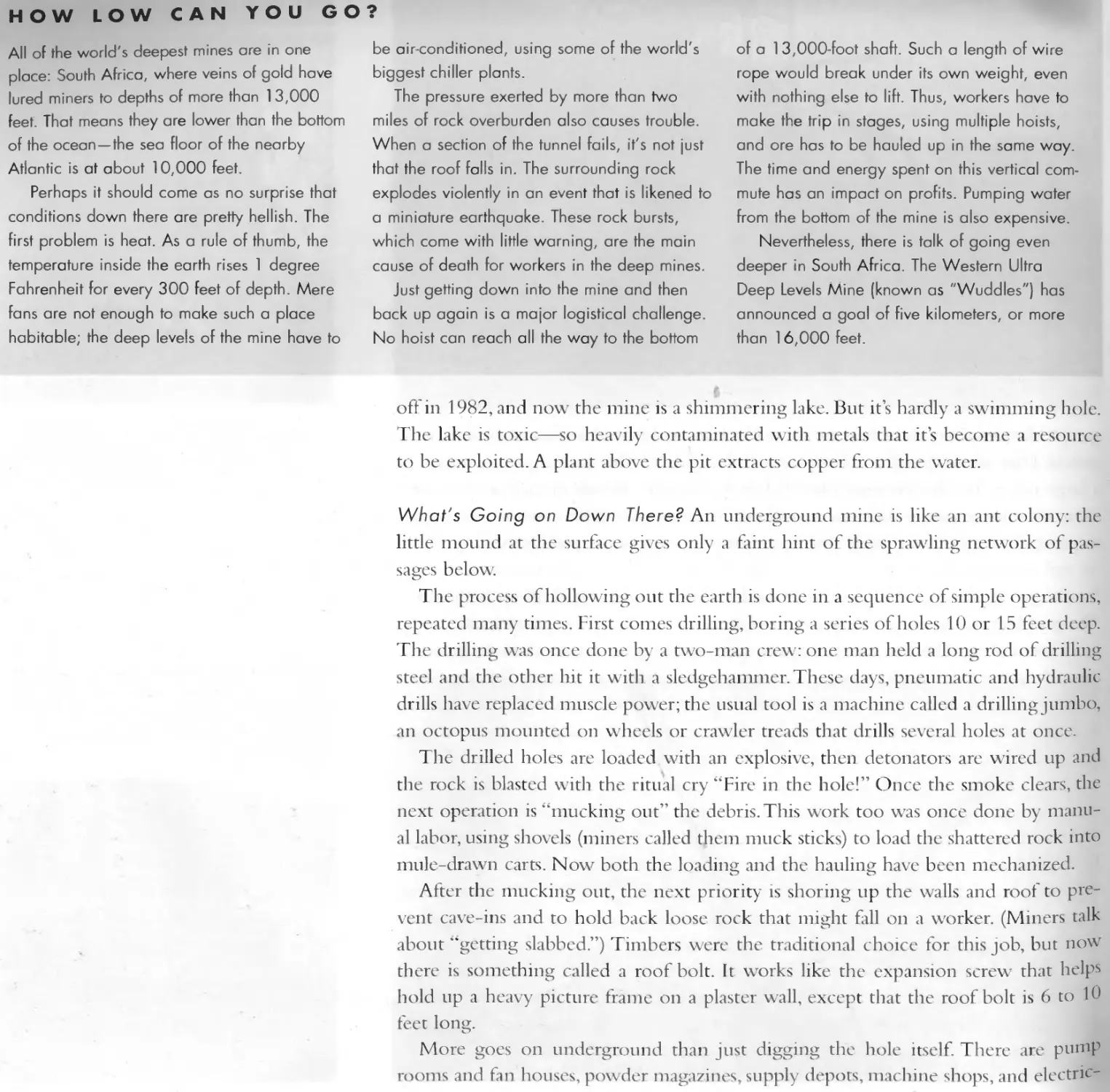
In the conte"t between pump .md seep.lge. the water always win... in the end, if
only when the mine is closed .md the power "witched off. Both open pits and under-
ground mines tIll with w.lter. Ab.mdoned qu.lrrie" become neighborhood '\winl1ning
hole". The .1l11t' dung i l1.lppening on .1 l.1rger sClle .It the Berkele)- Pit..l11 .lb.m-
doned copper mine on the edge (litcr.lllv!) uf Butte. MOl1t.lt1J The pump were hut
A ventilation fan at the West Frankfort, Illinois, coal
mine is built to survive the effects of underground
explosions. The blast doors at the end of the hornlike
duct open automatically in response to overpressure.
Flooding of a mine is inevitable once the pumps are
shut down. Here the rising waters are gradually sub-
merging an ore-conveyor system in the Hill Annex
Mine, a former open-pit iron mine (now a state park) in
Calumet Minnesota.
II
HOW LOW CAN YOU GO?
All of the world's deepest mines are in one
place: South Africa, where veins of gold have
lured miners to depths of more than 13,000
feet. That means they are lower than the bottom
of the ocean - the sea floor of the nearby
Atlantic is at about 10,000 feet.
Perhaps it should come as no surprise that
conditions down there are pretty hellish. The
first problem is heat. As a rule of thumb, the
temperature inside the earth rises 1 degree
Fahrenheit for every 300 feet of depth. Mere
fans are not enough to make such a place
habitable; the deep levels of the mine have to
be air-conditioned, using some of the world's
biggest chiller plants.
The pressure exerted by more than two
miles of rock overburden also causes trouble.
When a section of the tunnel fails, it's not just
that the roof falls in. The surrounding rock
explodes violently in an event that is likened to
a miniature earthquake. These rock bursts,
which come with little warning, are the main
cause of death for workers in the deep mines.
Just getting down into the mine and then
back up again is a major logistical challenge.
No hoist can reach all the way to the bottom
of a 13,OOO-foot shaft. Such a length of wire
rope would break under its own weight, even
with nothing else to lift. Thus, workers have to
make the trip in stages, using multiple hoists,
and ore has to be hauled up in the same way.
The time and energy spent on this vertical com-
mute has an impact on profits. Pumping water
from the bottom of the mine is also expensive.
Nevertheless, there is talk of going even
deeper in South Africa. The Western Ultra
Deep levels Mine (known as "Wuddles") has
announced a goal of five kilometers, or more
than 16,000 feet.
off in ll)X , <lI1d now the mine i'\ a shinl111ering lake. But it\ hardly a 'iWinl111ing hole.
The lake i toxic- o heavily contanliluted with metals tlut it's becOllle a resource
to be exploited. A plant above the pit extracts copper fronl the water.
What' 5 Going on Down There? An underground mine is like an ant colony: the
little nl0l1l1d <It the surf:lCe gives only <1 Elint hint of the '\prawling network of pas-
sages below.
The process of hollowing out the earth is done in a sequence of simple operations.
repe<lted m<lI1Y time'\. First comes drilling, boring a series of holes 1 () or 15 feet deep.
The drilling was once done by a two-man crew: one m<lI1 held <1 long rod of drilling
steel <md the other hit it with <1 sledgelunllller. These d<IY"', pneUlllatic and hydr<wlic
drill<\ have replaced nlllscle power; the l1'\ual tool i'\ <1 l11achine Ll11ed <1 drilling jumbo.
<1I1 octopu... mounted on wheels or cr<1\vler tread<; tlut drill<; several holes <It once.
The drilled holes <Ire loaded with <1I1 explosive, then detonators are wired up and
the rock i'\ bb<;ted with the ritu<11 cry "Fire in the hole!" ()nce the smoke dear..., the
next operation i<; ""n1Ucking out" the debri:-.. This work too wa:-. once done by nunu-
<11 Llbor, using <;hovel"\ (nliners called them n1Uck "\ticks) to load the hattered rock into
l11ule-dr<lwn carts. No\\ both the 10<lding <lI1J the h<wling have been l11echanized.
After the l11ucking out, the next priority i... 'ihoring up the \yalh and roof to pre-
vent cave-ins and to hold back loo'\e rock th<lt might (111 on a worker. (lVliner... ulk
about ""getting slabbed.") Timber... were the traditional choice tor thi... job, hut no\\
there i<\ <;oll1ething called a roof bolt. It work, like the exp<lI1:-.ion SCfe\V th<1t helps
hold up <1 heavy picture trame on a pbster w<I11, e"cept that the roof bolt i... () to 1 ()
feet long.
More goes on underground dun ju<;t digging the hole itself. There are pump
rool11<\ and (m hou'\e'\, powder magazines, <;upply depot..., nl.1chine shops, <md electric-
power "witching Sl.1tions. ()nce upon ,. time there were b,.rns ,1I1d t.1bles for the
hundred" of ,1I1inl.lls dut pulled ore c.lrs. spending their entire lives in the dark. The
modern counterp,lrts of the st.lble" ,ire underground m,.intenance yards for mining
equipment, much of which is too large to bring to the "urf,lCe without di",.ssembly.
Someti111e... there's a lunchroom. Everywhere there's gr,ltliti. A" tor toilet f.1cilitie'\-
ye , modern 111ine... have tho e too.
SURFACE MINING
Underground mining Ius the advant.tge of surgical precision: You dig out wh,1t you
want ,1l1d leave everything else in place. Surface mining, in contr,l"t, is .1 brute-torce
atfair. You luve to rip open the earth ,md "hove ,lside vast quantities of worthle')s rock
before you even re.tch the l11ineral you're ,lfter. Uut surt:lCe 111ines ,lho have a not-so-
., \
t"'\
-
..-
't..
'-.
\.\ "
, /.
'" "
-
.
)
{
\
,
.-.
..:
-,, ..
\
'--
........
,
'"
,
---
,
Jh
,-.
..
,'-
"
,
t
"\
"',
\
"
"
".
,
t
.'-.
'" .
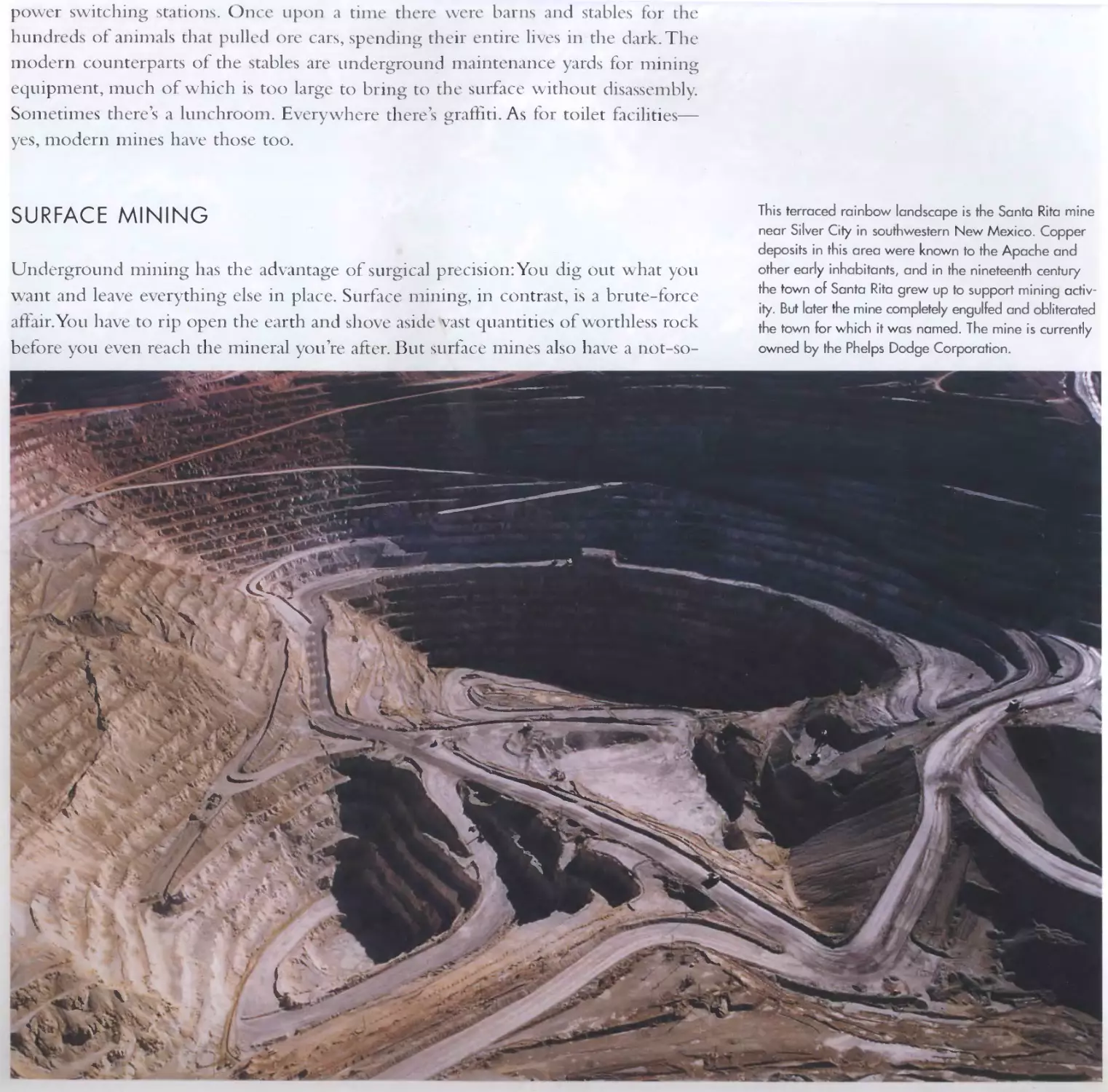
This terraced rainbow landscape is the Santa Rita mine
near Silver City in southwestern New Mexico. Copper
deposits in this area were known to the Apache and
other early inhabitants, and in the nineteenth century
the town of Santa Rita grew up to support mining activ-
ity. But later the mine completely engulfed and obliterated
the town for which it was named. The mine is currently
owned by the Phelps Dodge Corporation.
-------
-:.
....
""
, :'f.
..,
-
...
"
,-'
,."
..-.
....
-
,.: ... :-, '-
. ..
..
..
"
\ _.'
" ...
"'
._.
-
.... .
.. , :--.. ,,\ . ....
. - "
\.,...... ," .. '');.. .
, 1.1 .'-.
-. .......
'.
.."
...
. ".
, .... "
,"
.., ..
...... "\..
. , '\
-
'",, -;,.
''c;
.'
..
"
',- -
'-
.. ''- ..
. . - ", .., ." -,... , '.
, \.. :... S'. ....
"''1It.- - . -
\. ,!t. ... "" .
""'... ',,-. .... .:
..:. .---.... . . ..
..
:.'I
-
...,
. .
." . ,....'
-
." ..\.' . .....
. . t ..'o.!I"" .
. .."
_. "J ;-. '
;II
\ '. ,
...
._:
.
"-
: ..""
\
"'v..
.t'L
.l-
....
...
....
:...
'- I
"
'"
..."'-
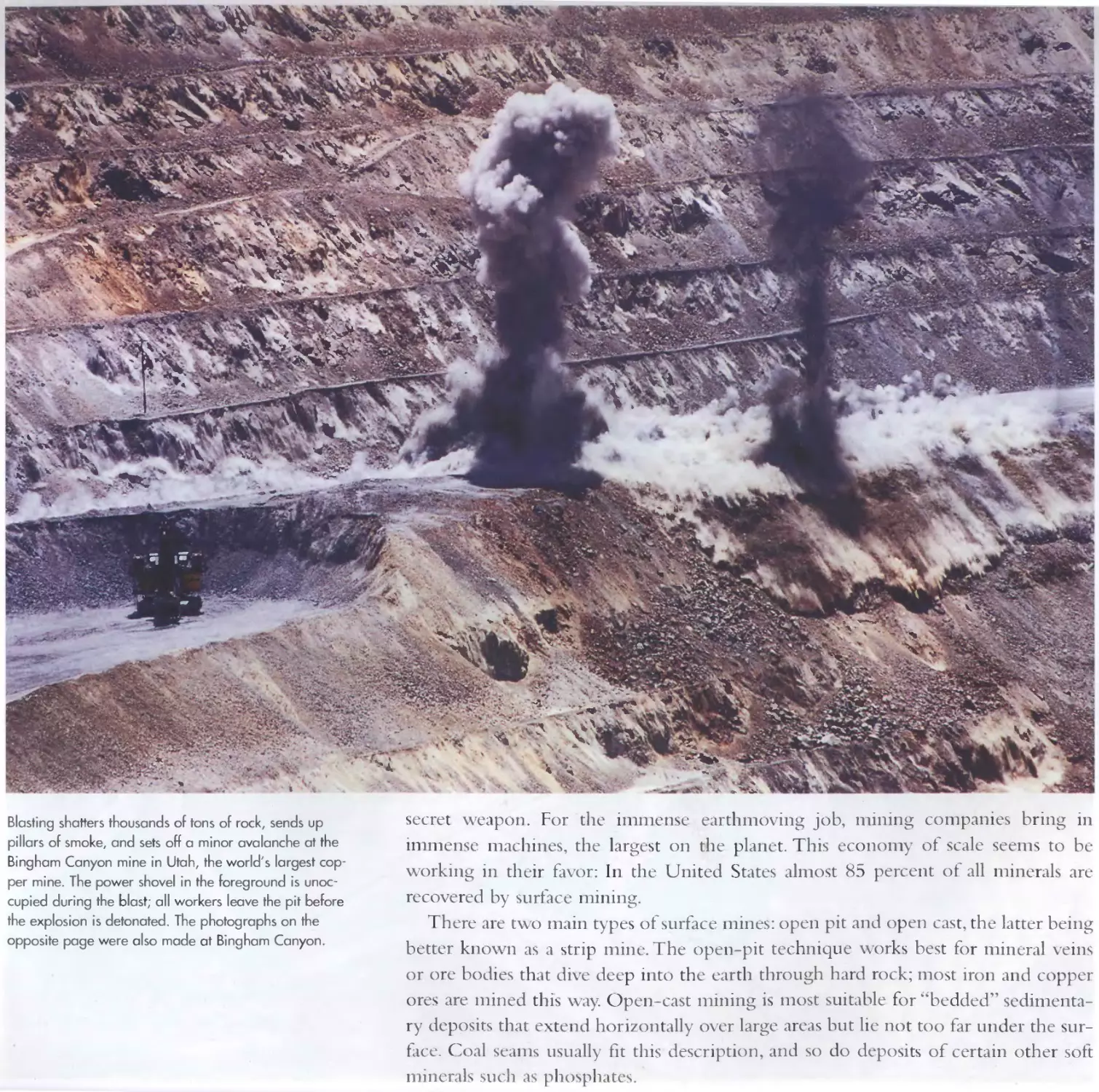
Blasting shatters thousands of tons of rock, sends up
pillars of smoke, and sets off a minor avalanche at the
Bingham Canyon mine in Utah, the world's largest cop-
per mine. The power shovel in the foreground is unoc-
cupied during the blast; all workers leave the pit before
the explosion is detonated. The photographs on the
opposite page were also made at Bingham Canyon
- ........'"
....
.
A '
" ..
,
.. '"-t...
.. t'
... 'L. .-
...
....
.....
..
\' ' :
"
,.
...
""
.. ....
., .'
. II.
..
...
'-
-\.
.
\.
... i--'
-
. ---
"'
..,.
-\.,
,
..,
"'"
...... "'-
e.
.
".,. . .'
.
....'
- .
'"t.
,.
. ..
,,'
"\1
\t:' -
""",.
-;:..
;\- .,
... '
'It. .
.....
;.,
.' "':\:
, .
-..
-....-
.... .
.,.'
4
"
"
.. ...:
.....
ecret weapon. For the iIl1mense eartllIl10ving job, Il1ining comp,lnie bring 111
immen e m.1chine'\, the Ltrge'\t on the planet. This econOIl1Y of scale seenb to be
working in their £1Vor: In the United States almost H5 rercent of all Il1inerals ,Ire
recoyered by '\urt 1Ce mining.
There ,ire two n1.1in type'\ of surface mines: open pIt ,lnd open cast, the latter being
better kno\\ n .IS a '\trip mine. The open-pit technique work'\ best for nlineral veins
or ore bodies that dive deep into the earth through hard rock; most iron and copper
ore are mined thi'l way. Open-c.l'\t nlining 1'1 mo'\t '\uitable for "bedded" sediIl1ent,l-
ry depo...it'\ tl1.1t extend horizontally over large areas but lie not too far under the \ur-
t 1Ce- CO,11 \eaIll'\ u u,tlly fit thi description, and so do depo it'\ of certain other soH:
miner.lb such ,i phospl1.1tes.
Open-Pit Mining. An open-pit mine is rem,lrkHble most of ,Ill f()r wlut is Hot there.
At thl' Hull-Rust-J\t1.lhoning iron mine in Ilibbing, Minne'\ot.l, f()r ex,l111plc. \Vh,lt is
not there i... 35 million cubic y,lrds of rock ,1Ild ore. The chasm cut into the earth is
three Illile... long ,lnd ,1 mile \Vide- o big it t,lkes three names to cover it. And yet ,m
open-pit mine is not just a void, a hole in the ground. It Ius ,1 ,\tructure, even an
architecture It Ius to be desIgned '\0 th,lt the w,dls don't coll.1pse, o tl1.lt the nl.lxi-
IllUllI allIount of ore call be extr,lCted with the least ,llll0unt of W,lste, and-the most
challenging p,lrt-so tl1.lt enormou ore-h,mling trucks and other heavy equipment
CUI drive into and out of the pit.
The b,lSlC design element in the ,lrchitecture of an open-pit mine i'\ the terr,lce,
or bench. The wall of the pit IS not a sheer clift nor is it .1 slope descending '\mooth-
ly frmll the rim to the f1oor instead, it is ,1 giant tair\Vay or GIS CH.i e, formed of
benche'\ roughl) 50 feet high. The nearly verticIl walls between the benche'\ ,Ire
c,llled t lCe\. The benche help to 'It,lbilize the w,dl ,lgainst landslides ,md also provide
working pbtforms for miner ,1Ild equipmcn[. When the minc is to be exp,mded,
work begins on the topmost bench, which i'\ widen cd by exclV,lting the [ICe above
it (a m,lIleuver called a pushb,lCk). Then the next bench below is likewise pushed
b,lCk, and then the next deepl''\t, continuing ,Ill the \V,l)' to the pit floor. whcre a new
bench m,lY need to be created. 13ecause the benches generally f()llow lines of con-
st,mt dev,ltion, they ,Ire equivalent to contour line on ,I topographic m,lp. If you
know the height of ,1 typical bench. you cm estimate the tot,ll depth of the pit just
by counting benches.
, .
. ..
"
.,.. ,,.
.........
"\
<#.
....
,
),.
-
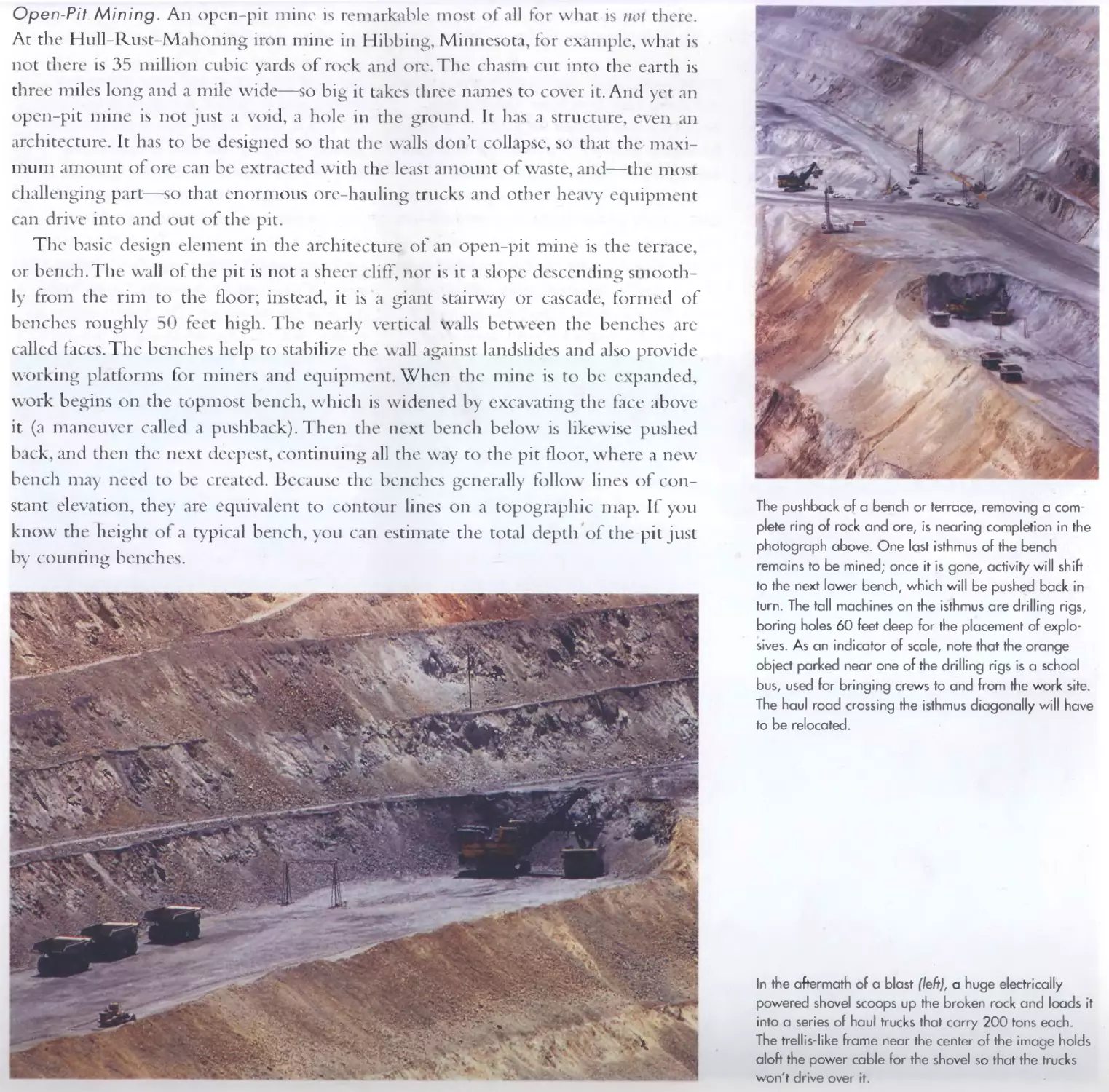
The pushback of a bench or terrace, removing a com-
plete ring of rock and ore, is nearing completion in the
photograph above. One last isthmus of the bench
remains to be mined; once it is gone, activity will shift
to the next lower bench, which will be pushed back in
turn. The tall machines on the isthmus are drilling rigs,
boring holes 60 feet deep for the placement of explo-
sives. As an indicator of scale, note that the orange
object parked near one of the drilling rigs is a school
bus, used for bringing crews to and fram the work site.
The haul road crossing the isthmus diagonally will have
to be relocated.
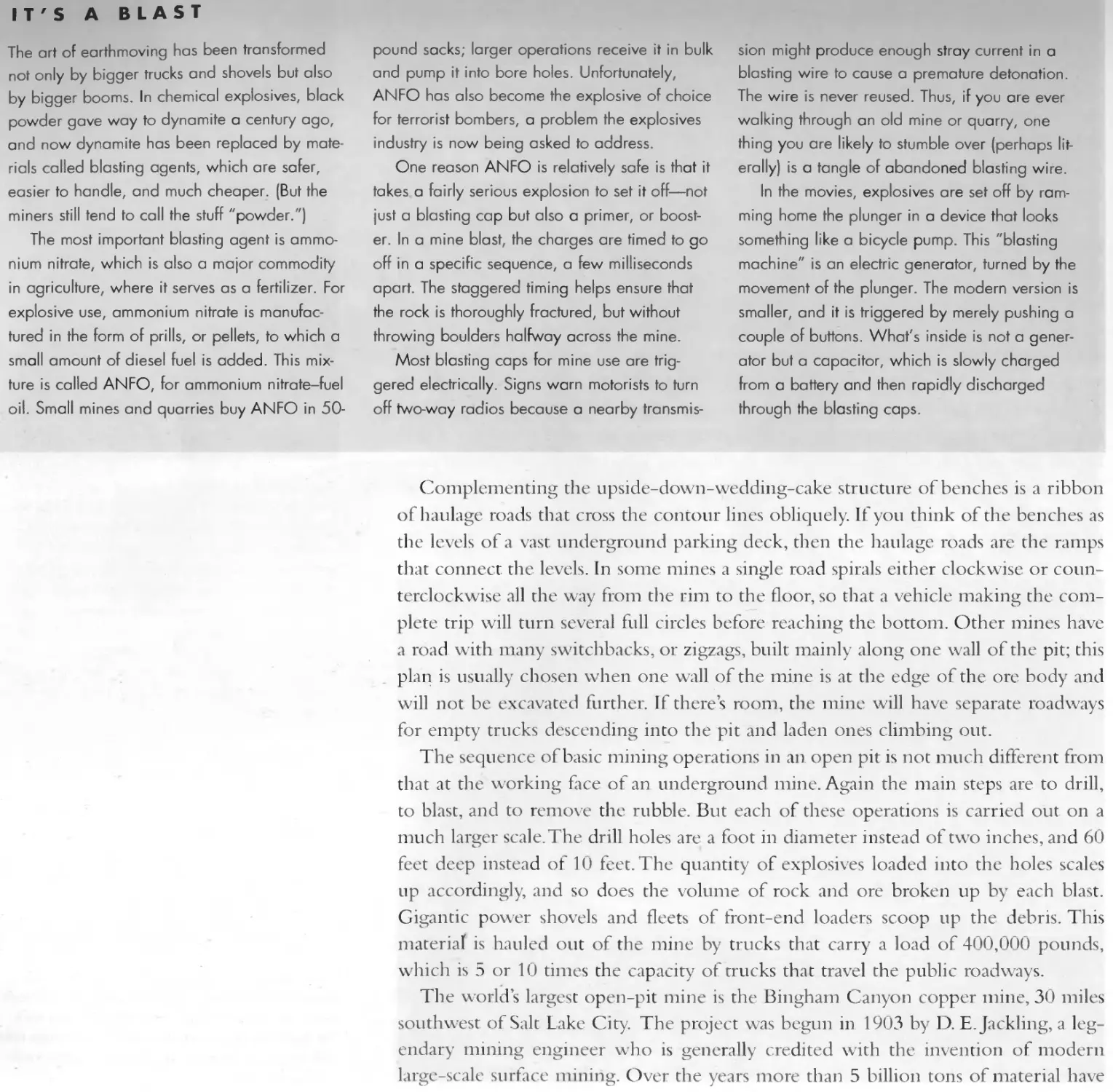
In the aftermath of a blast (left), a huge electrically
powered shovel scoops up the broken rock and loads it
into a series of haul trucks that carry 200 tons each.
The trellis-like frame near the center of the image holds
aloft the power cable for the shovel so that the trucks
won't drive over it
IT'S A BLAST
The art of earthmoving has been transformed
not only by bigger trucks and shovels but also
by bigger booms. In chemical explosives, black
powder gave way to dynamite a century ago,
and now dynamite has been replaced by mate-
rials called blasting agents, which are safer,
easier to handle, and much cheaper. (But the
miners still tend to call the stuff "powder.")
The most important blasting agent is ammo-
nium nitrate, which is also a major commodity
in agriculture, where it serves as a fertilizer. Far
explosive use, ammonium nitrate is manufac-
tured in the form of prills, ar pellets, to which a
small amount of diesel fuel is added. This mix-
ture is called ANFO, for ammonium nitrate-fuel
oil. Small mines and quarries buy ANFO in 50-
pound sacks; larger operations receive it in bulk
and pump it into bore holes. Unfortunately,
ANFO has also become the explosive of choice
for terrorist bombers, a problem the explosives
industry is now being asked to address.
One reason ANFO is relatively safe is that it
takes a fairly serious explosion to set it off-not
just a blasting cap but also a primer, or boost-
er. In a mine blast, the charges are timed to go
off in a specific sequence, a few milliseconds
apart. The staggered timing helps ensure that
the rock is thoroughly fractured, but without
throwing boulders halfway across the mine.
Most blasting caps for mine use are trig-
gered electrically. Signs warn motorists to turn
off two-way radios because a nearby transmis-
sion might produce enough stray current in a
blasting wire to cause a premature detonation.
The wire is never reused. Thus, if you are ever
walking through an old mine or quarry, one
thing you are likely to stumble over (perhaps lit-
erally) is a tangle of abandoned blasting wire.
In the movies, explosives are set off by ram-
ming home the plunger in a device that looks
something like a bicycle pump. This "blasting
machine" is an electric generator, turned by the
movement of the plunger. The modern version is
smaller, and it is triggered by merely pushing a
couple of buttons. What's inside is not a gener-
ator but a capacitor, which is slowly charged
from a battery and then rapidly discharged
through the blasting caps.
(:0l1lple11lenting the up ide-down-wedding-cake structure of benches is a ribbon
of haulage ro,lds that cross the contour lines obliquely. I f you think of the benche ,1S
the levels of a vast underground p,lrking deck. then the haulage roads are the ral1lpS
that connect the levels. [n SOl1le mines a single road spirals either clockwise or coun-
terclockwise all the way {i'om the rim to the floor. so that a vehicle making the con1-
plete trip will turn several full circles before reaching the bOttOl11. Other mines h,we
,1 road with many switchb,tcks. or ZigZ,lgS, built nuinly along one w,l11 of the pit; this
plan is usu,llly chosen when one wall of the 11line is at the edge of the ore body and
will not be excavated further. If there's room, the mine will have separate roadways
for el1lpty trucks de cending into the pit and Liden one'\ clil1lbing out.
The '\equence ofba'\ic 11lining operation in ,1l1 open pit is not n1uch ditferent {i'om
that at the working [tee of an underground 11line. Ag,lin the n1ain '\tep are to drill,
to hla'\t, and to remove the rubble. But each of these operation i'\ carried out on a
11luch larger 'cale. The drill holes are a foot in di,l11leter in tead of two inches, and 6()
feet deep in'\tead of 1 () feet. The quantity of explo ives loaded into the hole '\clle
up accordingly, and '\0 does the volun1e of rock and ore broken up by each blast.
Cig,lntic power hovel" dnd fleet'\ of fi-ont-end loaders <;coop up the debri . This
nuteriaT i'\ hauled out of the mine by trucks that carry d 10dd of 4()(),()()() rounds,
which i'\ 5 or 1 () til1le the capacity of truck th,lt travel the public roadway'\.
The worlJ\ largest open-pit 11line is the 13inghan1 Canyon copper 11line, J() 11lile
'\outhwe'\t of Salt Llke City. The project was begun in 1 Y()3 by I ). E. Jackling, a leg-
end,lry mining engineer \vho i gener,l11y credited with the invention of 11lodern
large-scale surf:lce mining. ()ver the years 11l0re than 5 billion tons of l11.1terialluve
been eXLlV,lted ,lt Binglum C,myon. lea\ ing ,1 pit t\\o-,md-,l-h,llf miles ,lCross ,1t the
rinl and h,llf d mile deep. I Lnd,lge ro,lds that climb both the north ,md the south walls
of the mine ,1re used mainly for tr,msporting \\"lste rock to dUlnp heaps in a(lj,lCeIH
gorges. The ore exits Vi,l three large tunnels dug through the '\urrounding mOUlH,lins.
Two of the tunnels have tr,leks for st,md,lrd rail cars; the third has a conveyor belt C1r-
rying ore directly to ,1 mill in the nearby town of Copperton. Along the highest wall
of the mine there are more than 50 benches dt vertical intervals of 50 feet. Excavating
a complete sequence of pushbacks. enlarging the mine from the top down. take'\
,1hnost a decade. The IHine Ius a visitor center and an overlook on the rim.
Strip Mining. In open-pit mining. nothing is ever put back in the pit: ore goes to
the IHill for refining. ,1I1d waste rock is piled up in towering heaps ,md emb,lI1kments
whose skyward growth IHatche'\ the downward progress of the pit itself. In strip min-
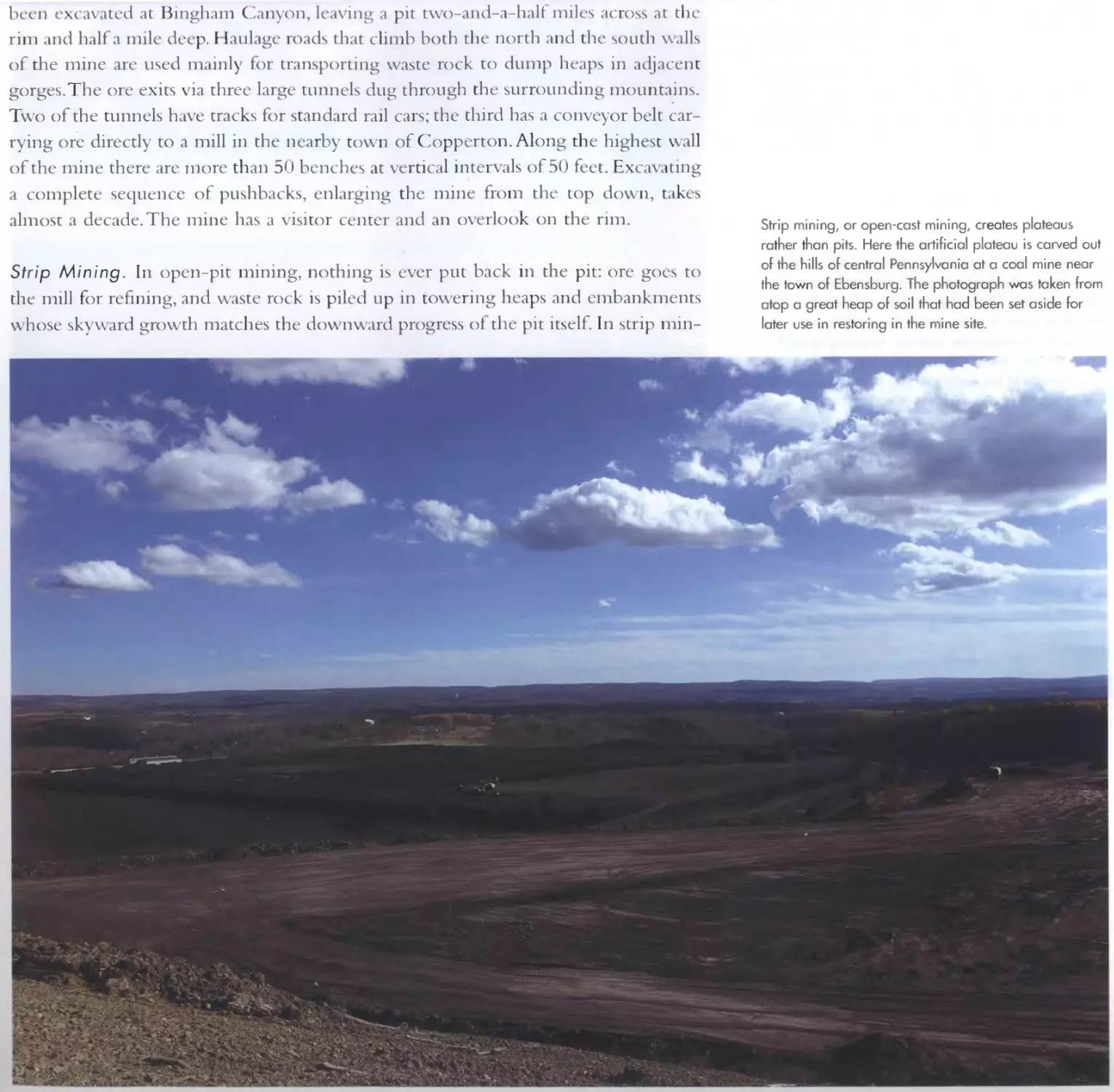
Strip mining, or open-cast mining, creates plateaus
rather than pits. Here the artificial plateau is carved out
of the hills of central Pennsylvania at a coal mine near
the town of Ebensburg. The photograph was taken from
atop a great heap of soil that had been set aside for
later use in restoring in the mine site.
-,.
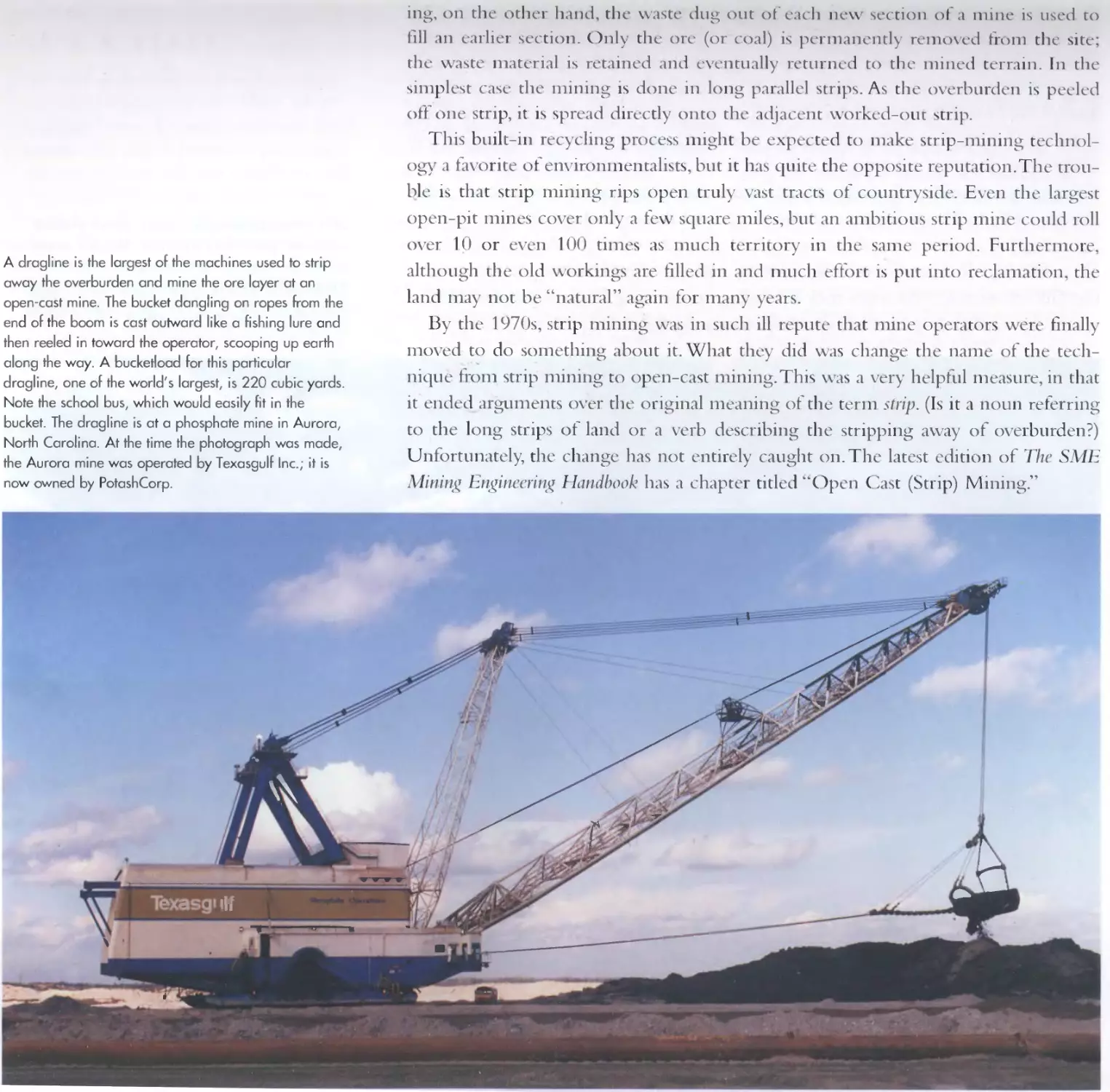
A dragline is the largest of the machines used to strip
away the overburden and mine the ore layer at an
open-cast mine. The bucket dangling on ropes from the
end of the boom is cast outward like a fishing lure and
then reeled in toward the operator, scooping up earth
along the way. A bucketload for this particular
dragline, one of the world's largest, is 220 cubic yards.
Note the school bus, which would easily fit in the
bucket. The dragline is at a phosphate mine in Aurora,
North Carolina. At the time the photograph was made,
the Aurora mine was operated by T exasgulf Inc.; it is
now owned by PotashCorp.
...
\,
- r. . II
-r
,
ing, on the l)ther ]und, the W,l\te dug out of e,lCh Ill'\\ section of ,1 111ine is u-;ed ro
tll1 ,111 e,lrlier section. l )n]y the ore (or CO,l]) h pern1.1nently rC111lwed t)-om the ,ite
the W,lste m,lteri,l] is ret,lined ,111d eventu,l11y returned to the mined terr,lin. In the
simplest Llse the mining is done in long p,lr,l11e1 '\trips. A-; the overburden is peeled
otT one ...trip, it is spre,H.i directly onto the ,H:lj,lCent worked-our srrip.
Thi" built-in recycling process l11ight be expected to make '\trip-mining technol-
o ') a tavorite of envirOnnlel1t,Ili-;ts, but it Ius quite the opposite reput,nion. The rrou-
ble i-; tlut strip mining rip') open truly vast tract'\ of countryside. Even the Llrge'\t
open-pit mines cover only a few '\quare miles, bur ,m ,u11birious strip l11ine could rol1
over 111 or even 100 tinle'\ a'\ much rerrirory in rhe S,ll11e period. Furthen11ore.
although rhe old workings ,Ire filled in ,md much eft<Jrt is put into reclamation. the
Lmd nuy nor be "n,ltura]" ,Ig,Iin tor nl.lny ye,lr'\.
By the 1970s. strip mining was in such ill repute tll.lt mine operators were fil1.1lly
moved to do something ,1bout it. Wl1.1t they did was cl1.1nge the l1.1me of the tech-
nique fi-0111 strip mining to open-LIst mining. This wa'\ a very helptll1 mea'\ure, in that
it ended arguments over the origil1.1lmeaning of the term strip. (Is it ,\ noun referring
to the long '\trips of Lmd or ,1 verb de'\crihing the stripping away of overburden?)
Unfortunately, the change Ius not entirely Lmght on. The btest edition of The S.\1E
.L\1ill;' r.!. l:" r.!.illccril1g Htllidbook ha'\ ,1 chapter titled "( )pen ('ast (Strip) Mining."
/
1".... :-
,
..
.
-
.
........
, - ...
.. II. _ ...
l::Jiliiii._ !IIi.
..,.:; -Z :;- C" ...'
-Ie. _...uau. ..J.,.... ....... ......; ".
....." .
. . ........
!. ':""-
.. .... .......
- I 'tli!.. I:= .
II
Whatever you choose to clll the technique, .md whether or not you want .1 strip
mine in your own b.lCkyard. YOll cannot help being impressed by the grandeur of the
operations. It is like plowing the e.lrth on a g.lrgantuan scale. turning over furrows a
hundred y,lrds wide, a mile long, and .1 hundred feet deep.
The oa'\ic steps in '\trip mining ,lre somewhat different from tho e in hard-rock,
open-pit mining. In many ca es no blasting i done; the overburden is '\oft enough to
be chewed up by earthmoving nlachinery without the help of explo,ive . When ,1
new parcel i being opent'd up, tht' fir t stage i "grubbing," which is the removal of
top oil and veget,ltion. Then the stripping of overburden begins, along \\ ith the
silTIultaneous ca ting of poil into the worked-out adjacent strip. ()ften the tripping
is done in layer , corresponding to different geologicll '\tr.lta. For e ,lIllple, a byer of
gravel or clay might be stripped off with a nl.lchine called ,1 bucket-wheel eXclVator.
which can h.mdle large volumes of soft nl.lterial. I hrder deposits clll for a stripping
shovel or a dr,lgline. The tlnal operation is the mining of the coal or miner.ll Lwer.
J )epending on the size of the mine. completing a ingle strip can take .1 few weeks
or a few years.
WhiJe excavating is under W.1Y III one strip. reclamation gets started in the previ-
ou ones. At most American strip mines the operator is required to restore the Lmd
to ib "approxinl.lte original contour." which means that a great deal of leveling and
grading needs to be done with a fleet of bulldozers .md cr.lper . The spoil. Il.lving
been dredged up from deep underground. is biologic.dly sterile. .md so topsoil h.ls to
be L.id down. (Most of it is recl.1imed from tilt' grubbing oper.ltion.) Mulch .md fer-
tilizer .lre .11 o needed. followed by '\eeding \Vith gr.lsses or other cover crops.
Like other capit,ll- intl'n'lvt' Illdu'\tne,. 'trip mine, u u.ll1y opl'r.lte 24 hour... .1 O.lY
and 7 tLtys .1 week. A mint' ,lt night IS .1 specucle. B.l1Ik of floodlight, C,lst .1 h.lr,h
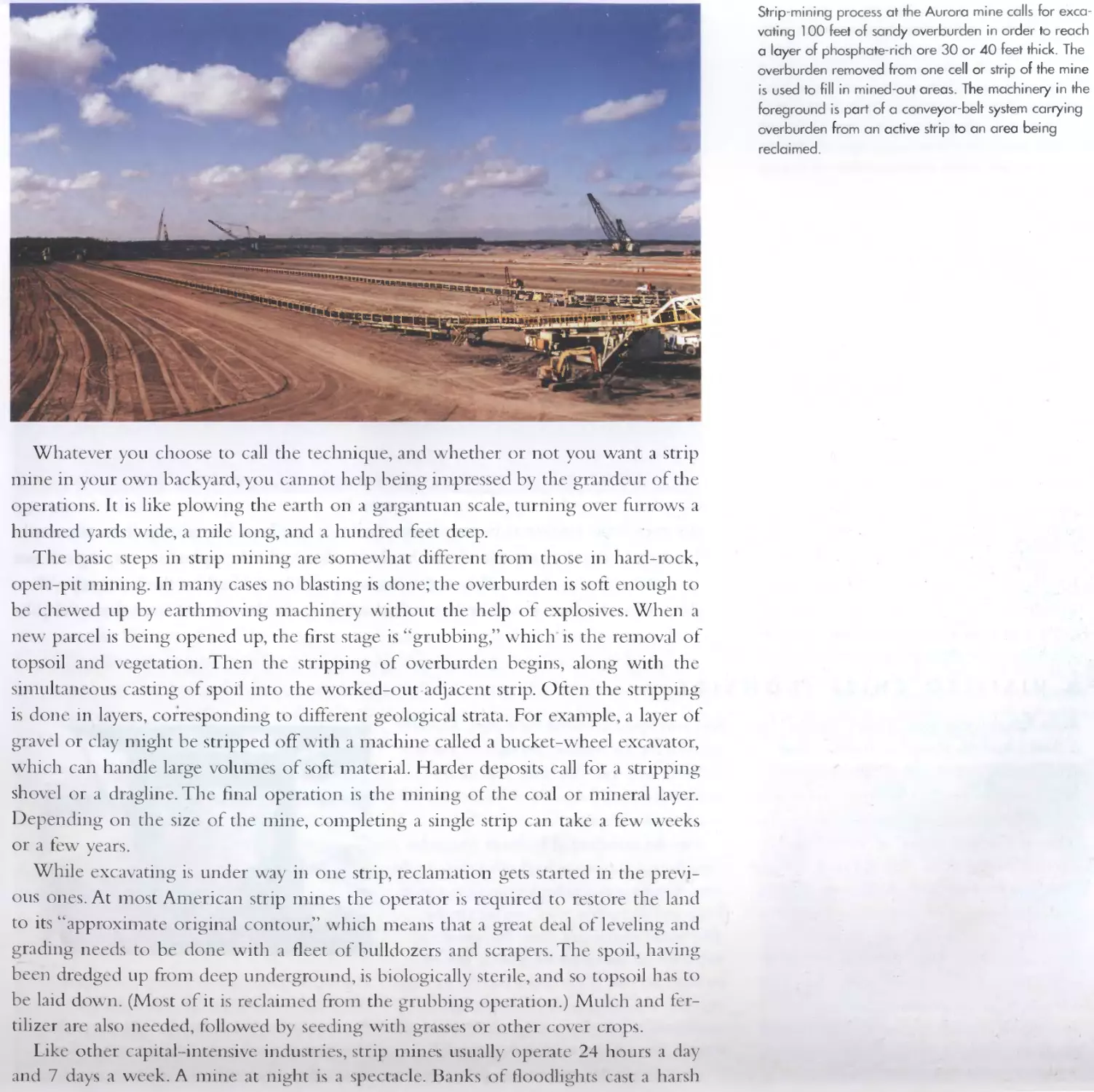
Strip-mining process at the Aurora mine calls for exca-
vating 100 feet of sandy overburden in order to reach
a layer of phosphate-rich ore 30 or 40 feet thick. The
overburden removed from one cell or strip of the mine
is used to fill in mined-out areas. The machinery in the
foreground is part of a conveyor-belt system carrying
overburden from an active strip to an area being
reclaimed.
gLlrl' on the working .lredS but le.l\;e other corners in eerie gloom. rhe t.11l booms of
the sho\-eIs .llld dr.lglines .Ire .llso festooned with li dlts, .llld they swoop through the
d.lrk ...ky like the twirling neon m.l"t of ...ome m.lni,lCal amu"ement-p.\rk ride; but
there is no cuni\'.ll nll1sic or 'que.lling of children, just the rhythmic thud and roar
of nl.lchinery,
Surface-Mining Machinery, looking ,It a Jragline or a stripping shovel ti-mn a dis-
t.lnce, you Inight be fooled by the ,cale of the 111,lchine, In basIc fOrIn it look" nluch
like equipment you see ,It .my construction "ite. But then you notice .l CJr parked
nearby or a hun1.ln figure clilnbing up to the control cab, and c;;uddenly the true size
of the n1.lchine sinks in. The control cab i an inconspicuou .1Ppendage at the front
of the "house," the enclosure tl1.lt fonns the n1.1in body of the n1.lchine. The house
is, in [lct, the size of ,I slllall hotel-almost ISO feet long and 50 feet high. And the
house in turn is dw,lrfed by the boom and its rigging, which extend a tll11 footb.lll
field out in front. I )raglines .lre the largest self-propelled devices on I.md. They .lre
big enough to be nalned individually. like ships.
At the end of the dragline's long boom. .1 bucket swings frmn ,1 hoist rope. ,md .m
,Idditional drag rope trail under the bOOln fi-om the bucket to a point ne.u the con-
trol Clb. What the operator does with this appar.ltl1s is just like clsting a fishing line
into the ...urf .md then reeling it in again, 13y .ldroit manipulation of the boom .md
the ropes, the bucket is "wung t(:)[ward ,lnd then ,111 owed to plunge into the earth.
R.eeling in the drag rope h,llll, the bucket b,lck toward the oper,ltor, ,craping out ore
or lwerburden ,IS it goes. When the hucket is full, it io; lifted hy the hoist rope, then
the entire dragline pivots horizont.llly, swinging the bOOln out over the spoil pile,
A VISIT TO CHIEF IRONSIDE
At the Falkirk lignite mine in North Dakota I had
a chance to climb aboard a dragline called
Chief Ironside, which has a 120-cubic-yard
bucket and a boom 215 feet long. You enter by
first climbing a few stairs onto the upper surface
of one of the giant "shoes" on which the
machine shuffles along, then up two more flights
of stairs to the main deck. A doorway leads
inside the house, which turns out to be a dim
cathedral-like space filled with the hum of elec-
trical machinery and the whoosh of ventilating
fans. Half a dozen large motors turn the drums
that reel in the hoist rope and the drag rope,
slew the house on its pivoting axis, and propel
the shoes. Along the walls, tall steel cabinets
hold switchgear to control the motors. Also con-
spicuous are the sheaves and reels for the two-
inch-thick wire ropes. But even with all this
heavy equipment, the inside of the house is still
mostly empty space.
From the main area of the house you go for-
ward through a passage lined with lockers for the
crew, then through a galley kitchen (with a small
fridge and microwave oven) and out into the
glass-walled control cab. There the operator is
enthroned 30 feet above the ground, with an
unobstructed view of the bucket and the surround-
ing mine. The cab is heated in winter and air-
conditioned in summer, and the audio system is
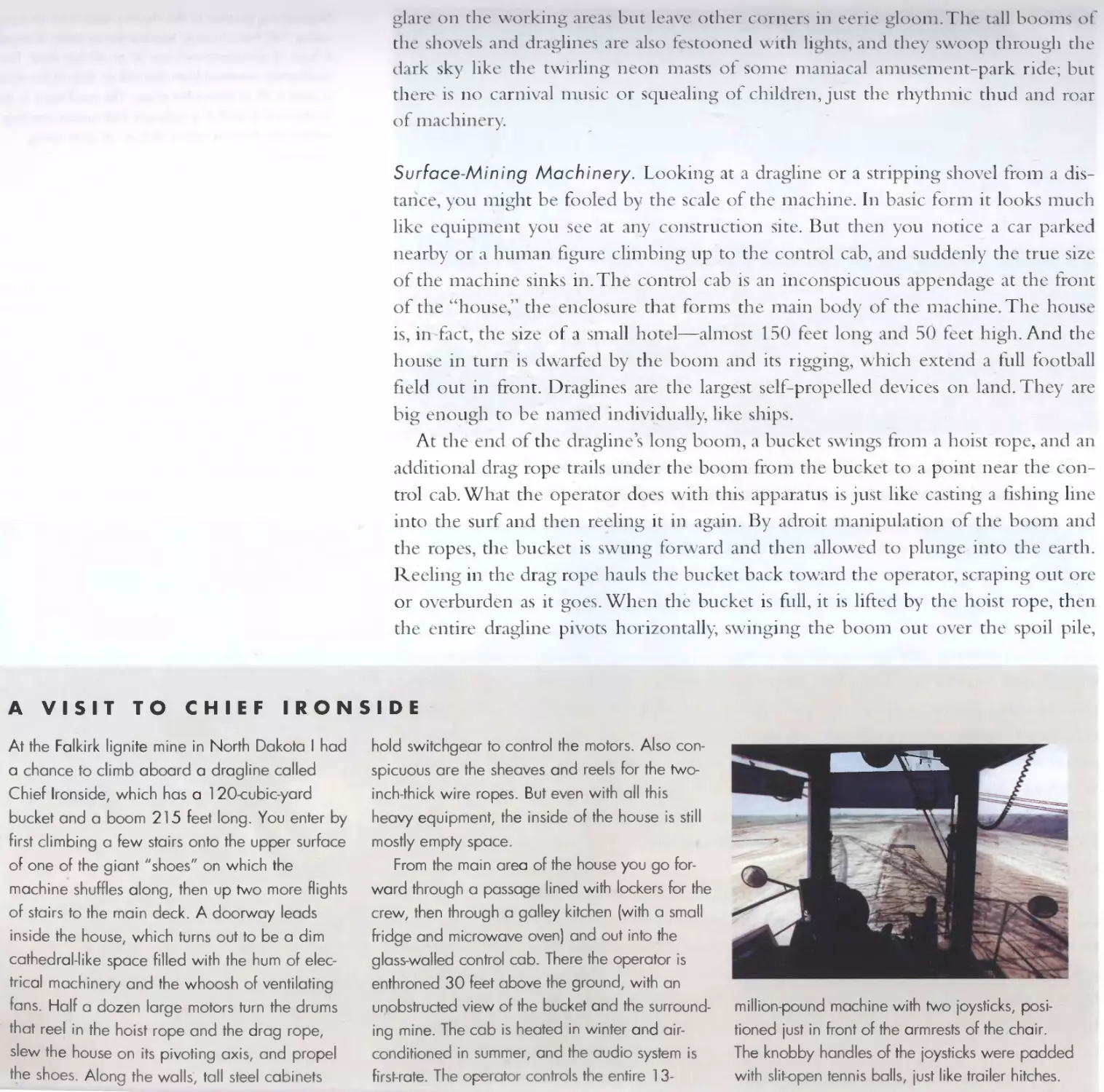
first-rate. The operator controls the entire 13-
.... '....
\'
million-pound machine with two joysticks, posi-
tioned just in front of the armrests of the chair.
The knobby handles of the joysticks were padded
with slit-open tennis balls just like trailer hitches.
4
I
J
I
J
/____ I
f f
h
.......
\ :I ':-
" "Aj\ ...
\ ,.f \,
" II __ I
\ ;-
\.
t
,
....... - -
.,.
. - :i. .... .
' " :" ,_-4
J" :(, ..' '.".
""'.t!' .., J ,
. '.. 'A. f."':
:W f' " \.",,___, ,,,
... .4:........,... .. .. ..
..._; '.
..... ."...':. '-4" .
"""!::; :
: .
. '"?A'ii:.. .
. .. fl"
.
... IR" ..'MI", ,
t1IEtI"'" rr....
1
A
y..
I!..
.
'-
,
.
. -..
where the bucket i tipped to dump the 10.1<.i. Under the control of a skilled oper.1-
tor. this inl1nense nuchine Com be nude to move with surpri ing grace .md agility.
The brgest draglines 11.lve bucker capacitie of () cubic yanh, which i enough
to hold a couple of Creyhound bu,e,. A bucketful of den')e rock could weigh a mil-
lion pOlll1lh. The weight of the dragline it,elf can appro.teh J() million pound,. Thi
i, too much to be supported by wheels or by the kind of crawler tre.1d:\ found on
hulldozers .1nd other edrthmo\'ing machinery. In-;te.1d, when the dragline wants to
move, it gets up on ib feet .md \V.dk. ! l)r perhap I hould ').IY it w.1ddle .
The mode of locomotion i... the mech.mical equiv.1lent of ,itting on the floor,
rbnting your feet, and ...liding b.1ckw.1rd on your butt. The dragline's two feet, which
dre actually called shoes, are bro.1d ')teel platforms on either ,ide of the machine's
b.\ e. They .1re lifted in uni,on by a ,imple Collllshafr mech.mism. .11l0wing the nussive
body of the dr.1gline to settle onto the earth between them. Then the shoe are
moved a few feet b.tekward, set down <lg<lin with gre.lt force. .md driven forw<lrd (that
i..., toward the boom). In response to this force. the body of the m.1chine is pushed or
dr<lgged b.lCkward over the ground. le<lVing .1 dino <lUr trail with <\ bro<ld centr.1l kid
n1.lrk .llld tl<lI1king pair of footprint . Ahe.1d of the slowly moving behemoth, water
tanker ,0<lk the ground to lubricate the p.lth. Even so. friction Com he<lt the e<lrth to
the ;;te.lllling point. fhe m.\chine h<l' on Iv thi, one ge.1r-reverse. To go the other
way. it h.h to turn .1round .1I1d continue scootll1g l1.lckward.
Big dr.\glilH.:' .lre po\\ered hy electrIcity. ,upplinl through <I Llble the si7e Of.l fire
hose th.lt tr.lils behind the 1ll.1Chine like the curd of.1 V.KUlIlll ele.mer. fhere 's u u.1l-
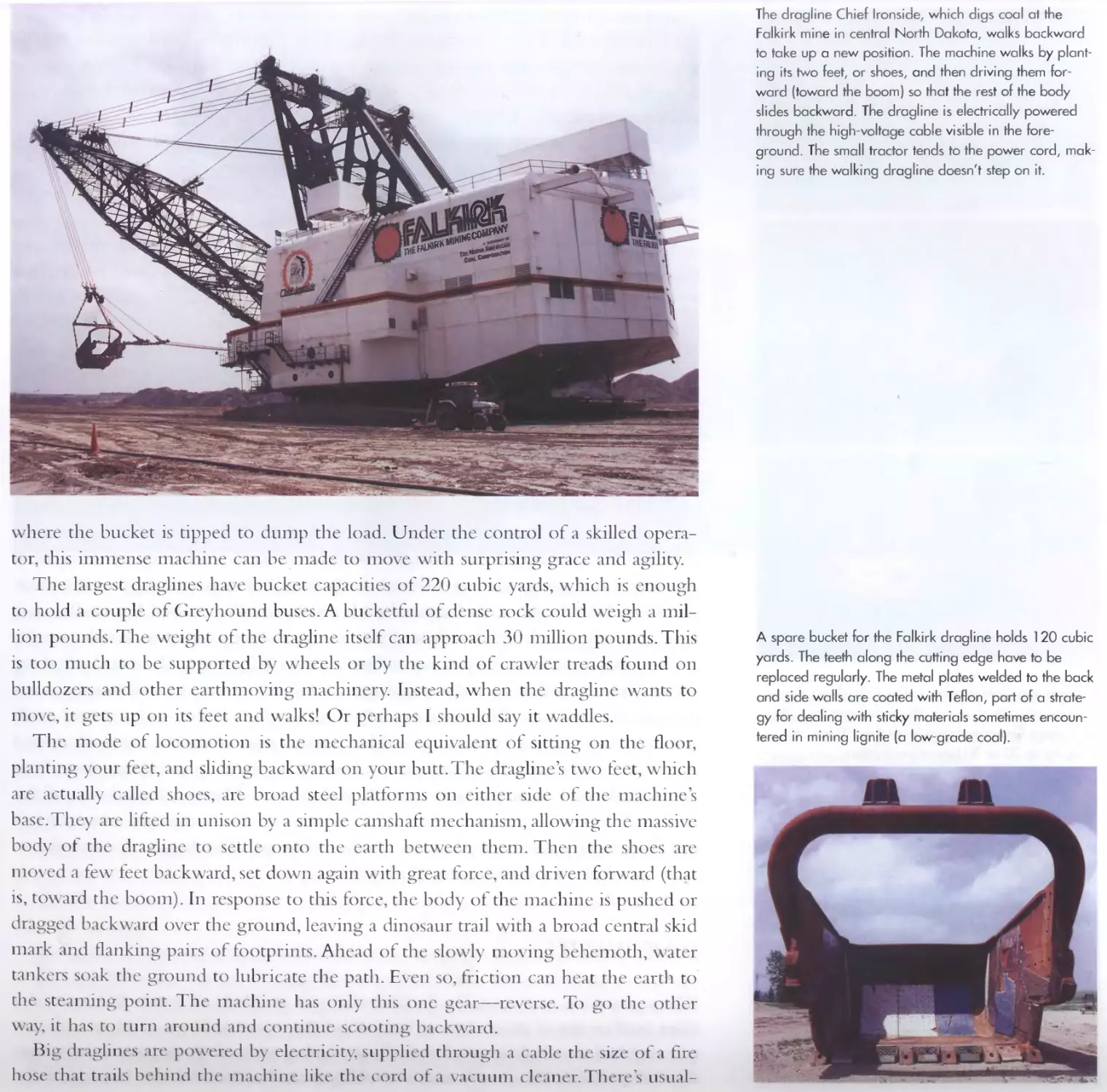
The dragline Chief Ironside, which digs coal al the
Falkirk mine in central North Dakota, walks backward
to take up a new position. The machine walks by plant-
ing its two feet, or shoes, and then driving them for-
ward (toward the boom) so that the rest of the body
slides backward. The dragline is electrically powered
through the high-voltage cable visible in the fore-
ground. The small tractor tends to the power cord, mak-
ing sure the walking drag line doesn't step on it.
A spare bucket for the Falkirk dragline holds 120 cubic
yards. The teeth along the cutting edge have to be
replaced regularly. The metal plates welded to the back
and side walls are coated with Teflon part of a strate-
gy for dealing with sticky materials sometimes encoun-
tered in mining lignite (a low-grade coal).
..
..
,
\
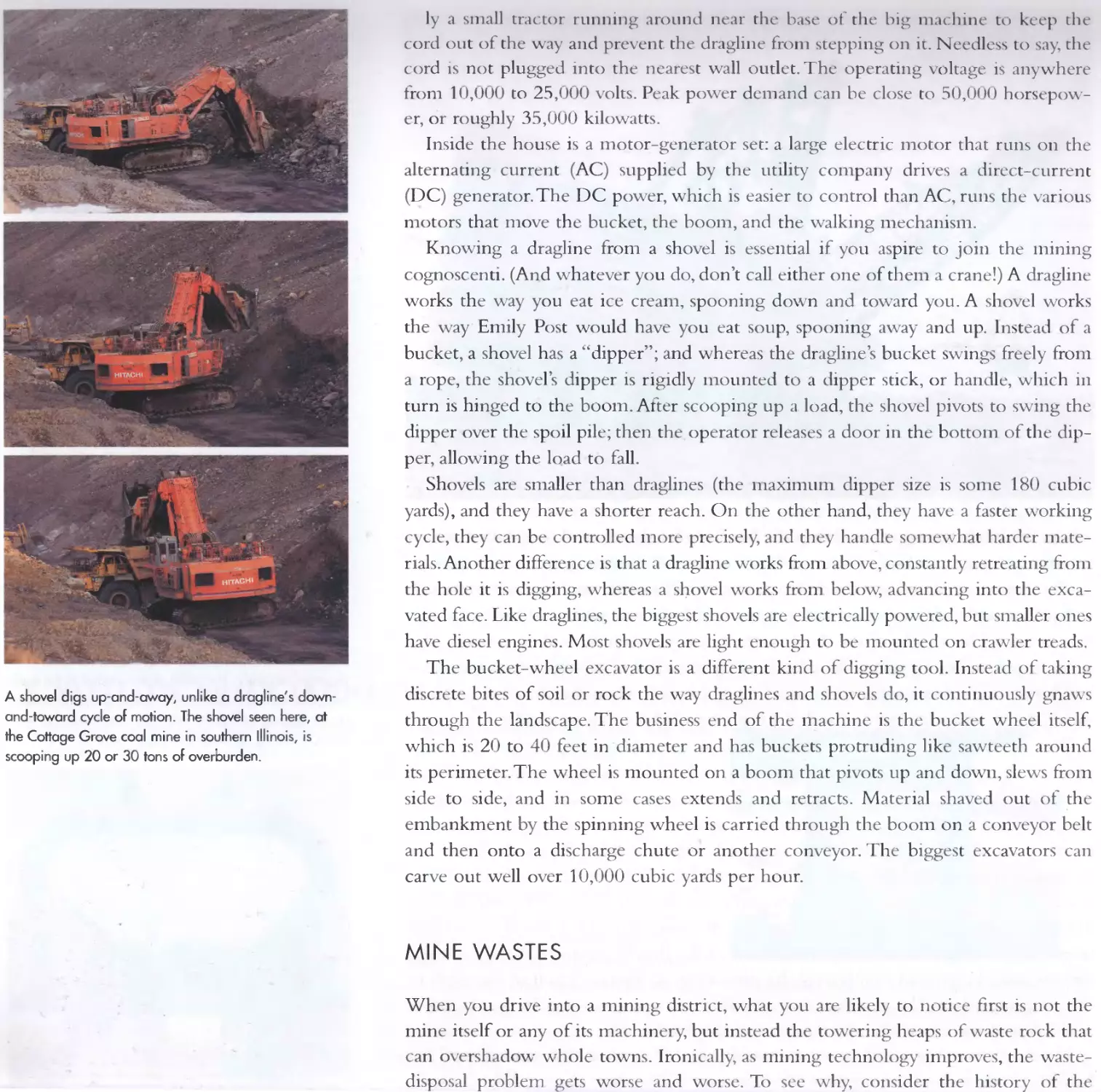
A shovel digs up-and-away, unlike a dragline's down-
and-toward cycle of motion. The shovel seen here, at
the Cottage Grove coal mine in southern Illinois, is
scooping up 20 or 30 tons of overburden.
ly d m,dl tractor running .1rol1nd ne.lr the base of the big n1.\chine tu k.eep the
cord out of the WdY and prevent the dr,lgline from tepping on it. Needle s to .lY, rhe
cord is not plugged into the neare,t wdll uutlet. The operating voltage is anywhere
fronl 10,O()() to 25,()()() volt,. Peak power demand Cdn be clo\e to 50,()OO hor\epow-
er, or roughly 35,fJ()() kilowatts.
Inside the house is a motor-generator set: a large electric rl1otor that runs 011 the
alternating current (AC) supplied by the utility company drives a direct-current
(DC) generator, The DC power, which is easier to control thdn At:, runs the variou,
nlotors that nl0ve the bucket, the boml1, and the walking mechdni,l1l.
Knowing a dragline fronl a shovel i, e""ential if you aspire to join the mining
cognoscenti. (And whatever you do, don't ca!] either one of them a crane!) A dragline
works the way you eat ice Creall1, spooning down and toward you. A shovel works
the way Enlily Post would have you eat soup, spooning away and up. Instead of ,1
bucket, a shovel hcls a "dipper"; clnd whereas the dragline's bucket swings freely fr0111
a rope, the shovel's dipper is rigidly 1l1ounted to cl dipper stick, or handle, which in
turn is hinged to the bomTI. Aiter scooping up a load, the shovel pivots to swing the
dipper over the spoil pile; then the operator releases a door in the bott0111 of the dip-
per, allowing the load to fall.
Shovels are snuller than draglines (the maximum dipper size is sonle I HO cubic
yards), and they have a shorter reach. On the other hand. they have a faster working
cycle, they can be controlled 1l10re precisely, and they handle s01l1ewhat h,lrder mate-
rials. Another difference is that a dragline works from above. constantly retreating from
the hole it is digging, whereas a shovel works from below, advancing into the exca-
vated face. Like draglines, the biggest shovels are electrically powered, but sll1aller ones
have diesel engines. Most shovels are light enough to be mounted on crawler tread"
The hucket-wheel excavator is a different kind of digging tool. Instead of taking
discrete bites of soil or rock the way dragline and shovels do, it continuously gnaws
through the landscape. The business end of the 1l1achine is the bucket wheel itself,
which is 20 to 4() feet in dianleter and has buckets protruding like sawteeth ,lround
its perimeter. The wheel is nl0unted on a boonl that pivots up and do\\ 11, slews fr01TI
side to side, and in ,orne cases extends and retracts. Mdteridl shaved out of the
embankment by the spinning wheel is carried through the bOO1l1 on cl conveyor belt
and then onto a discharge chute or another conveyor. The biggest excavators can
carve out well over 10,000 cubic yards per hour.
MINE WASTES
When you drive into a nlining district, what you are likely to notice first is not the
mine itself or any of its machinery, but in,tead the towering heclps of waste rock that
can overshadoVv' whole towns. Ironically, as nlining technology inlproves, the waste-
disposal problem gets worse and worse. To see why, consider the hi tory of the
.......
American copper industry. Nineteenth-centurv copper mines exploited only the
richest ores, which were 30 percent or even 60 percent nletal. l3v 1915, Ininers were
digging ores with only 5 percent copper, .Ind by the 1940s ju'\t 2 percent; tOd,IY the
average grade is about ().5 percent. This "hift to lower-grade sources has had a dra-
nlatic ilnpact on the econ0111ics ,HId technology of illining, and also on the wa"te
budget. To produce 1 ton of copper fronl 5() percent are, you h.Ive to mine 2 tons of
are, dnd you leave 1 ton of "vaste. With 0.5 percent are, you hayt' to mine 2UO tons,
and you leave 199 ton of waste. Thl1'o., even though copper production hds been
sluwing in recent dec,ldes, the production of copper-l11ining "vaste'\ ha'\ been boonl-
ing like never before.
Many of the wastes di'\cdrded during edrlier gener .Itions of mining are richer than
any of the ores coming out of the ground today. The wastes helve therefore bec0111e
a vdlu,lble resource for secondary mining, particularly by v,lrious methods known as
solution l11ining.
Just ,IS the Eskimo luve nuny words for snow. l11iners have an ebborately reunified
vocdbubry for mine wastes. Gangue is the generic term for everything in the are
other than the de'\ired 1Hiner,ll. In the CO,l] fields, the sLue and other rock sep,lr,lted
fi-nm the co,ll i Jumped in hedps c,lBed gob pile, or culm banks. Le,ul ,U1d zinc min-
ing le,lVe... ,1 (brk, S,lIldy nuterial Cc1Bed dur, \v}uch torm "teep. conicll he,lp.... Slag
fl-om ,mdter , which '\olidittes into ,1 gLtssy or cindery 1l1,lteri,d. ,ilso t()rll1s steep-
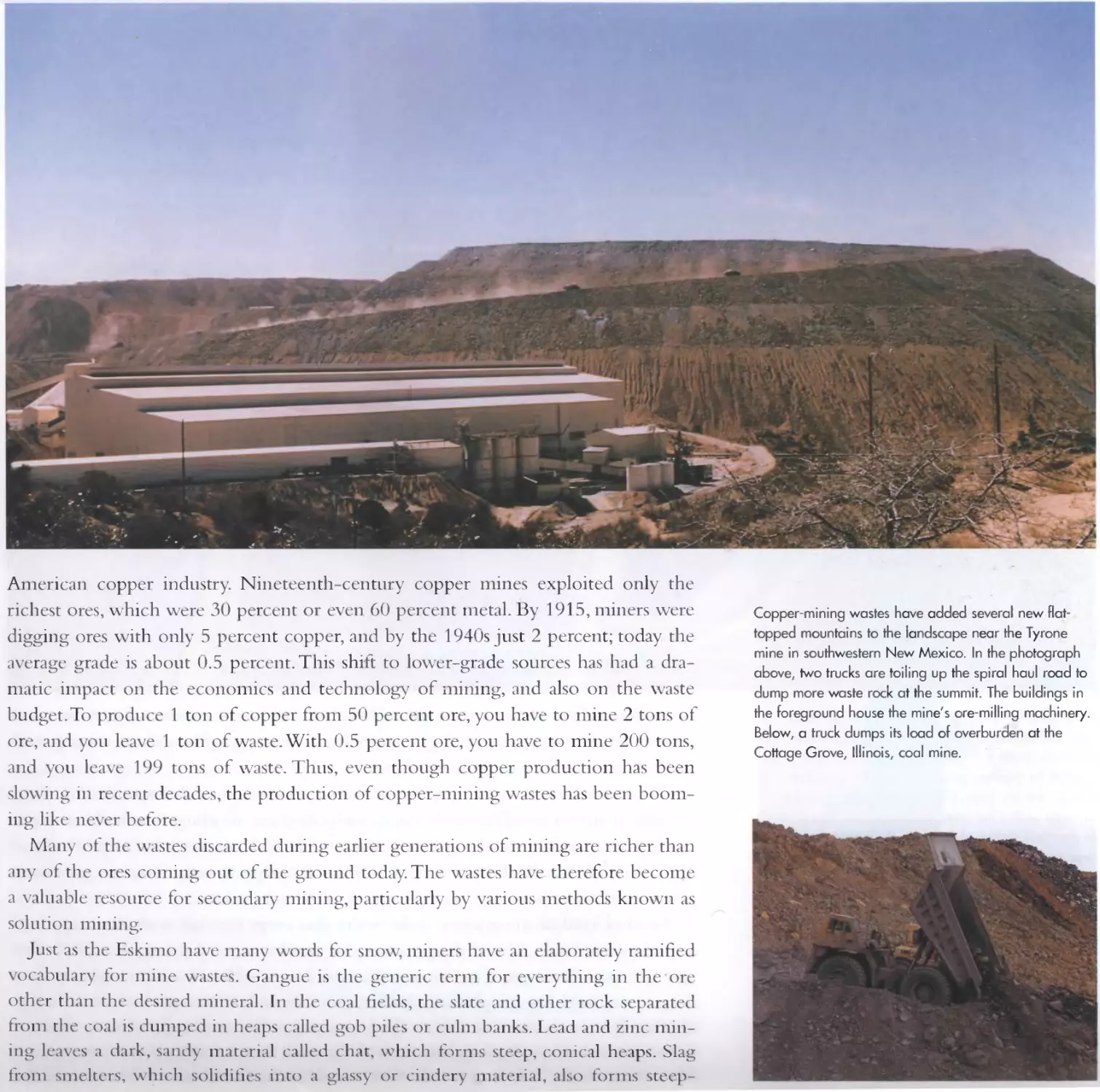
Copper-mining wastes have added several new flat-
topped mountains to the landscape near the Tyrone
mine in southwestern New Mexico. In the photograph
above, two trucks are toiling up the spiral haul road to
dump more waste rock at the summit. The buildings in
the foreground house the mine's ore-milling machinery.
Below, a truck dumps its load of overburden at the
Cottage Grove, Illinois, coal mine.
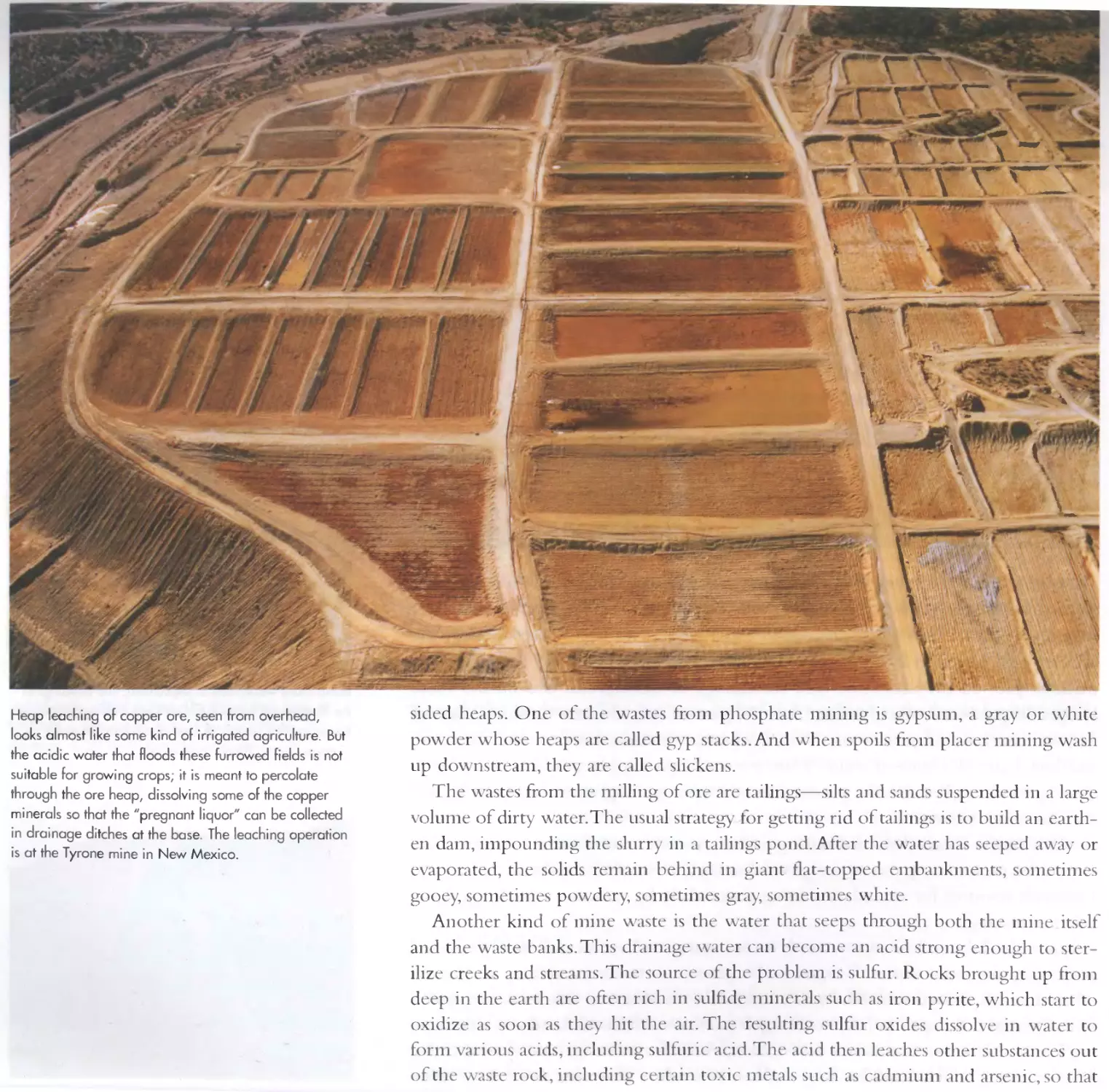
Heap leaching of copper ore, seen from overhead,
looks almost like some kind of irrigated agriculture. But
the acidic water that Roods these furrowed fields is not
suitable for growing crops; it is meant to percolate
through the ore heap, dissolving some of the copper
minerals so that the "pregnant liquor" can be collected
in drainage ditches at the base. The leaching operation
is at the Tyrone mine in New Mexico.
,'-
,
--
\ , \ ....
\ \ ,
\
\
\
-
'"
\
\
,
'-
\
,
\
\
ided heaps. One of the W<Iste from phosphate mining i" gyp\um, <1 gray or white
powder whose heaps are called gyp stack . And when spoib trom placer mining wa,h
up downstream, they are called slickens.
The waste... from the Inilling of ore <Ire t<liling\- ilt, <md s<lnd ,u"pended in a large
volume of dirty W<Iter. The usual "trategy tor getting rid of tailings is to build an earth-
en dam, impounding the "lurry in a tailing pond. After the water ha, ,eeped <l\vay or
evaporated, the olid" renuin behind in giant tbt-topped embankment..., ,ometinleS
gooey, ,ometilnes powdery, \Ometinle, gray, sometimes white.
Another kind of mine waste is the water that seeps through both the Inine itself
and the wa\te bank . This drainage water LIn become an acid ..,trong enough to ster-
ilize creek" and "tre<ml . The ource of the problem i sulfur. Rock" brought up from
deep in the earth are often rich in sulfide mineraI... uch a... iron pyrite, which tart to
oxidize as soon as they hit the <lir. The resulting "ulfur oxide, dis\olve in water to
form v<lriol1s acid,,_ including sulfuric <Kid. The acid then leaches other \ub"tance\ out
of the W<1ste rock, including certain toxic met<lls "l1ch a" Lldmium and <lrsenic, o that
the fluid oozing out of the bottom of the hill i a rather unple,l ,mt brew. Mine ,1re
required to remove both the ,lCidity ,md the 111etals. The water-treatment plant looks
"omething like ,1 "null version of a municip,ll sewage plant. To neutralize the acid.
lin1e is ,Idded to the \V,lter in a 111ixing basin. then the water is aerated and pumped
to d settling pond, or thickener, where the contami1unts settle out ,1" a "ludge.
Can a 111ined-out landscape ever be restored to natural beauty? There are many
places in the de'iert Southwest where 111ining topped decades ago, but the landscape
is still d0111inated by spoil piles, old pit , dnd rusting machinery, which leave the
i111pres...ion that the earth 's car'i will never heal. But there are also counterexamples.
Consider Morris County, New Jer ey,just 30 miles we t of New York City. Throughout
the eighteenth ,Ind nineteenth centurie thi" are,l was a thriving iron-mining district.
By the 1 R70 there were more than 200 operdting 111ine , producing 600,000 tons of
ore per year-which was a lot in those days. The landscape was dotted with the
smokestacks of ore 111ills and crisscrossed by the tracks of a dozen ore-hduling rail-
roads. But if you visit the ,1rea no\\, you need to know where to look and what to
look for if you want to tInd dny evidence of the former mining industry. Most of the
county is given over to very pricy suburban housing and corporate headquarters.
There are lush lawns, woodlots. horse [lrn1s. and shopping malls. but nary a s111oke-
stack. The only telltale remnants of the mining era are place n l111es. such as the towns
of Ironid dnd Ferromonte.
SOLUTION MINING
The late"t fad in the metals-mining industry is solution 11lining, a low-cost dnd lo\v-
labor "chen1e tor recovering 111etal tr0111 low-grade ores. You nlight think of it as a
trick tor putting to good uSe the problem of 111ine drainage waters that beC0111e con-
ta111inated \\ ith l11etdls. Sonle 3() percent of the copper 111ined in the United State ,
as well as 35 percent of the gold ,l11d 75 percent of the uranium, comes fi'om olution-
11lining operations of variou kinds.
One fort11 of solution 111ining is the heap leaching of copper ore. The crushed ore
is piled up into fldt-topped n10unds, then water ,md sulfuric acid are sprayed or
dripped onto the top of the heap. The ,lCidic liquid percolates through the 1110und
dissolving various copper c0111pounds and forming copper sulf.1te. which is carried off
in solution. The t1uid th,lt seeps out of the botton1 of the heap is called pregnant liquor
or pregn,mt leach olution (but it is l10f full of bloodsucking org,misms about to give
birth!). The pregnant t1uid is run through a processing plant to extract the copper. then
it p,lsses into dnother pond, as b,lrren liquor. before being pumped up onto the heap
again for ,mother cycle of leaching. The process goes on for everal yedrs.
With l)me copper ores. the 'iu!tllric ,lCid i'in't needed; water ,110ne will ')tart the
le,lChing proce'i'i. In thc'ie minc' the conver,lOn to oluble ulfltes i... done by b,lCte-
ri,l (nuinly ,1 species Llllcd "I1I;obIlCilllls ./l'rroox;d/lIIS) tlut grow on sulfides within the
A haul truck backs up to the perilous edge of a leach
heap and dumps another load of low-grade ore. The
scene is the Santa Rita mine in New Mexico.
. .!,i. i.
Santa Rita leaching operation relies on sprinkler heads to
spray the leach solution, producing a distinctive pattern
of round, wet spots on the surface of the leach heap.
,z
4f/Ii
.
--.
moist heap. It's as if the leach he,lp were a c01npost pile. where all the real work is
done by lnicroorganislns. The job of those tending the he,lp is lnerelv to create ,1 suit-
able habitat for the bacteria. The biologically aided process is important not only for
leaching newly Inined ore but also for recovering any tnetal relnaining in gangue and
lnill tailings fr01n earlier generations of tnining.
The heap leaching of gold and ,ilver i, done on a stnaller scale and on a quicker
tinletable than the ,olution mining of copper. l)ften a heap is built and then leached
out within a few months. Moreover, the active chelnic1l agent in gold and '\ilver
leaching is nothing '0 innocuous a, lnere sulfuric acid; it i oJiUln or potassium
cyanide (ye" the '\tuff once used in the gas chalnber at San Quentin). The presence
of cyanides nlakes enviromnental protection a sticky probleln in precious-metab.
leaching. The heap i, built on em imperviou:-. p,lJ to keep the leclching olution:-. out
of the water table, and sonle provi:-'lon ha:-. to be maJe for hclnJling exces<; runotf dur-
ing stornlS or the spring nownlelt. You n1aY ,llso notile ebborate fencing, which is
nleant not onl) to keep out people but also to protect wildlife.
A typicllleach dunlp i recognizable (and distingui,hable trom a nlere waste pile)
by the plastic pipe, clinlbing the sides and the prinkler heads at the top. At a gold
nline the processing plant will include tall cmi,ter'\ full of activated ch,lrcoal, where
the metal i extracted from the olution. At copper Inine you may notice big rusty
piles of scrap iron, on whIch the copper is precipitated.
For uranium mining, the leaching is done without even digging the ore out of the
ground. A leaching tluid i pUlnped down ,1 well into the ore hody, and the pregn,lnt
liquor is recovered trotH ,mother well. Another miner,ll extr,lCted by bore-hole nlin-
ing is sulfur. In this process, invented ,lbout 19()() by I krm,lIl Frasch in southern
Loui<;ian.l, hot water is injected through a well into the sulfur-be.lring layer. Molten
sulfur (a beautiful tawnv-purple liquid) is carried frOln the well in steam-heated pipes,
and sprayed onto storage he.Ips. The solidified sulfur is a bright yellow powder that
looks like some exotic spice but doesn't smell .IS good.
COAL MINING
COell mining is .11l industry unto itself. roughly the sanle size as all other kinds of min-
ing put together. It also hels its own distinctive history and culture. Indeed, there are
several subcultures within the Anlerican coal industry: those of the old anthracite belt
in e.Istern Pennsylvani.l. the bitl1lninous region that runs from the Appalachians west
through Ohio into Illinois. and the newer strip-mining districts £:lrther west in
Wyoming and Montelna.
If this book had been WrItten a century .lgO. it would have described a whole
infi-astructure for distributing coal to homes and businesses-coal yards. coal wagons,
co.11 bins, coal chutes. and so on. Today. £:Ir nlore coal comes out of the ground than
ever before, and yet most of us never see a 111lnp of the stuff. More than three-fourths
of all coal goes to electric utilities, and most of the rest is sold to other big customers
such as the iron-and-steel industry.
Underground Coal Mining. North American coal nunes are '\e1dOl11 as deep as
metelllnines; furthennore, coal is nluch softer than the rock that 111etal miners have
to batter through. But coal Inining has challenges of its own. The softer ground is
n10re vulnerable to roof falls. Worse, the coal is flalnmable, so that the very ground
\
,,"<2.1 "
j 1
I-If 1
h -fli
E' ! .
, }
,V"-
I .
I
"II
l
-
C!
..
\
-
..
The extraction plant at the Mesquite mine in southern
California recovers gold from fluids that seep through
an ore pile. In effect, the extraction process is the
reverse of the leaching process. In the leach heap, liq-
uids percolate through the ore, dissolving gold-bearing
minerals. In the extraction plant, the pregnant liquor
percolates through several beds of activated charcoal
(contained in the large red vessels inside the frame-
work), leaving behind the gold.
A heap of gold ore is seen in profile at the Mesquite
mine. The black plastic pipe laid in a groove at the cor-
ner of the pile carries leaching fluids pumped to the top
of the heap. The ditch extending along the base of the
heap collects pregnant liquor. The Mesquite mine is
near the town of Glamis in the desert environment of
California's Imperial Valley; the evening "mist" in the
distance is actually dust in the atmosphere, obscuring
the base of the Chocolate Mountains.
Coal ready for shipment stacks up in conical heaps at a
minehead in Sonman, Pennsylvania, near Altoona. The
coal is carried upward on the inclined conveyor belts,
then pours down the vertical tubes and flows out of
"windows" cut into these tubes. Other minerals might
simply be allowed to fall off the end of an elevated con-
veyor belt, but the vertical tubes or towers are used with
coal as a way of controlling dust.
Lm L\tch tIre. ,md rhc mctlLlnl' g,\'\ tlut 'iCCp" our oj thl cc 1,\1 (,\11 c:\.plodc. ( o,d du"t
i .l1 o ,\11 e\:plo ive. in ,\dditi()n to LllI,ing re'\pir,\tor di'\e,\se ("bbck lung ).
Tod,\y. mo,t co,II 6-om underground mine'\ i'\ e\:L\\.,Hed by continuou'\-mining
nLlchines tlLlt chew up the '\e,lJll ,m<.1 lo,ld the co,tl without ,m\' need tor the tr,\di-
tiOlLlI cycle of dril1ing. bb'\ting. ,md mucking out. The continuou" miner'\ ,Ire '\(.IU,H
\Oehicle'\ with vicious-looking ,1lIger'\ or cutting wheel" ,It the fi-ont end. ,md ,\ p,\ir of
cr,1b-claw arms dLlt g,\ther up the broken co,tl onto ,\ con\"eyor belt. They ,Ire built
low to the ground-this is ,\ ch,lracteristic fe,Hure of ,\11 co,\l-mining nLlchinerv-so
,\S to fit through p,\ssagew,\)''i th,\t m,\)' be no more dun three feet high.
The traditional method of underground l11ining in AmeriLm co,\1 mines is clned
the room-,md-pilLu system. The rooms ,Ire the open ,ueas where cO,1111.1s been eXLI-
vdted; the pill,lr'i ,1re blocks of coal lett st,mding to support the o\Oerburden. But the
tcTm pille"o can be mi'ile,lding: ] )on 't think of the slender. fluted columns dLlt support
the roof of a Greek temple. The pil1ar'\ of d (oal mine ,Ire thicker than they ,Ire high.
and roughly as big ,is the- open room, that "lllTOlllH.i them.
An ,lltern,ltive to the room-and-pilbr sy,tenl. Lll1ed long-wall mining. h,I' been
ste,1dily gaining popularity in the United St,1te'i. (It has long been the domin,mt tech-
nique in Europe.) A long-wall mining nl,lChine- has a cutting he-ad that move, ,\Iong
,m exposed p,mel of co,\1 that n1.l)' be up to a mile long. continuou'ily 'ih,wing ofT .1
thin byer. The nl.1chinery is protected by hydraulic roof shields tll.lt tempnrarily hold
up the overburden. When ,\ byer of coal Ius becn shaved trom the fi..l11 le-ngth of the
wall. the shields ,Ire moved forward. ,\llowing the roof behind to cwe in.
Above ground. the biggest ,md most distinctive structure at ,\ co,\lmine i... ,1 build-
ing known traditionally as ,1 bre,\1-..er or a tipple. The nineteenth-century exemplal 'i-
.
,1 fL'\\ of \\ hich "till "und. ,1S h,Hll1ting ruin \-werc timber structurc" five or si sto-
rie" high. Mine Clr<; filled with CO,l] wcre \yinched up ,1 long inclinc. .It the top of
which e,lCh Clr tipped oyer to dump its ]o,ld (hence the term tipple). The CO,l] tum-
bled down a scries of sloping wooden troughs. where workcrs picked out ,,]ate ,md
other kinds of w,lste rock tlut ineviub]y get mixed up in the mined CO,11. For ,1 long
time these worker<; were cllled bre,l er boy<;. ,md with good re,1son: they were chi]-
dren as young as six.
Toward the bottom of ,m old bre,lker or tipple. the co,ll p,l"...ed oyer ,I <;ene<; of
grate"i ,md <;creen<; th,lt classified the piece"i ,1Ccording to "iize. In de<;ceI1<.iing <;equence,
the <;tand,lrd size"i were known ,IS lump. stoker. nut, ,md egg; the still-smaller pebb]e<;
,md po\nkr"i were cllled slack. CO,l] in e,1Ch of these "iizes was intended for a ditfer-
ent nurket ,111d \you]d f.d] into sep,lr,lte <;tor,lge bins, for eventu,1] ]o,H.iing onto rail
C1r"i. Sorting by "iize i" "ieldom needed to thy. since .111 the coal goe"i to one customer.
A modern cOLd mine still h,l"i ,1 t,lll building th,lt looks .1 little like a bre,lker or tip-
ple. and <;ome people "till cd] it hy tho"e names (,llthough the approved term the"e
days is coa]-prep,ll-,ltion pL111t). Removing <;Llte is "till the nuin function of the pL111t.
but tllt' \\a)' it is done Ius clunged toully. Gone ,1r the bre,lker boys ,111d their
] )ickensi,111 Lthor<;. The new proCt'<;s i<; called nu] cleaning or coal w,lshing. but nei-
ther n,lme does it justice. The CO,l] isn't merely washed: it i... taken ,1p,lrt and put b,1Ck
together. Modern CO,l] i... not so much a r,l\\" materia] ,1S ,1 m,111uf.1Ctured product.
] )ifferent kinds of CO,l] call for ditferent wa...hing technologies, and even within a
single pLlllt the v.1rious sizes of ]ump... .md p.lnicle... ]1.1ve to be tre.lted differently.
Mo,t of the sep.lration methods exploit the t.let tlut slate is somewhat he.wier tlun
coal. For e:-",ll11p]e, whirling .1 w.ltery mixture of m.lterials in .1 tl1llnel-"h.1ped device
c.llled ,1 cyclone force' the den...er sLtte to the out"iide and the lighter co.d to the inte-
rior. The ,",.lllle principle i, .It wl)rk III ,1 spiral concentrator, which IS es,enti.llly .1 heli-
cal W.1ter ,lide. \\'here den...er p.lrticle... tend to .KcumuLlte toward the outer rim of.1
curving trough. Spir.l].., .1re u...ed in the w.....hing of the sm..lle"it panicle... of CO.11.
Another technique " 1rings fi-om the notion tlut if you ]ud ,1 tluid ofju...t the right
density, then the CO.l] would tlo,lt in it whi]e the sLlte wou]d "iink. But wlut tluid has
the right density? W.lter obviou"i]Y won't work; both CO,l] .111d "iLtte sink in \\'.Her. The
answer is to <;tart with W.Her and .1dd Lll'ge qu.mtities of a he.l\"Y po\nier such ,1<; the iron
ore m,lgnerite. forming .1 slurry th.H is much denser th.m w.1ter .Ilone. When the r.1W
CO.1] i"i dumped into .1 s]ullo\\', .Igit.lted t.mk filled \yith the slurry, coal can be
skimmed off the "urf.1Ce while sLtte is Llked up off the bottom. But a tllrther prob-
lem renuins: H.l\"ing used .1 he,iVY powder to sep.1Llte the co.11 trom the slate. ho\\"
do you sep.lr,lte the co.l1 t'i'om the he.lv)' po\nier? Tlut's the re.1son tor choosing nug-
netite .1S the po\nier: ,.... the n.lI11e suggests. it is ,1 m.lgnetic nuteri.11. A slowly turn-
ing. m,lgnetized drum. lu]f-immersed in the slurry, pulls the nugnetite out but le.iVes
the CO.l] behind.
Yet ,mothcr co,l]-de,ming techniquc i... ti'oth tlot.ttion. which is ,1]SO u"ed in pro-
cessing m,mv met.d ores. Bubb]es ri"lllg through ,1 ti-uthv slurry .ltt.tch tlh.'nhdve... to
.:- ..
.<4 .
'-
.,
,-.
, . (
... .
._:_. r... f
.: .
.t. .
-
.....-
rr
.
"
.
-i.....
:"
--
--
III. ..
/
,............
.>
. I
. -I
"
..'l
-
Three generations of the coalfield institution known as a
breaker or a tipple show 150 years of evolution, The
structure at the top is a replica of a nineteenth-century
breaker, built as a movie prop (and now falling into
ruins); in the middle is a breaker built in the mid-
twentieth century, which closed in the 1970s; at the
bottom is a modern coal-preparation plant, still in
operation. All three structures are within a few miles
of one another near Hazleton, Pennsylvania.
the co,ll, which is thereby lifted to the top of ,i v,n: the huhhle l1.1ve les" .1tlinity for
the "I.tte, which ,lCcordingly "inks.
All of the"e w,lshing InethoJ ,ire wet proce e...; from the nl0ment the co,d enters
the plant, it l immer...ed in vat" of watery solution ,1l1d transported ,is d "Iurrv or
sludge in trough<\ and pipeline<\. But before the finished product <\hip to the cus-
tomer, the water ha<\ to be wrung out hecau"e nloist coal doesn't burn well. The dry-
ing i done in ,1 big cylindrical centrifuge, which works like ,1 clothes washer in the
spin cycle.
THE HUMAN (AND THE INHUMAN) SIDE OF MINING
Mining is more than just a technology; it's a
way of life. If you spend much time in mining
communities, you begin to notice traits that set
them apart from other places.
Nineteenth-century mining towns were
marked by great contrasts in wealth. The man-
sions of the mine owners on the brow of the hill
overlooked the shanties of the miners lined up
near the mill or the coal breaker in the valley.
Today the mine owners are even wealthier-
they are multinational corporations-but they
have long since left town. The miners are some-
what better off too, but fewer in number.
Many mining communities started out as
company towns, where the mine owners built
the housing, the stores, occasionally even the
schools and churches. They named everything
as well, sometimes with a singular lack of imag-
ination. In southwestern Pennsylvania the
Berwind-White Coal Mining Company simply
numbered its towns from 1 through 40. In some
places all the houses and mine buildings were
painted the same color. (In the Southwest,
"Phelps Dodge green" was a popular choice.)
By now the mines have sold off most of this real
estate, but company houses are still recogniz-
able under the new vinyl siding. (In the photo-
graph, coal-mine wastes looms over houses and
former mine offices in Portage, Pennsylvania.)
In contrast to architectural uniformity, there is
ethnic diversity. A stroll through the graveyards
of any town in the eastern coal fields will reveal
an abundance of Welsh, Irish, German, and
Italian names (mostly in separate graveyards).
My grandmother, who lived in the mining com-
munity of Hazleton, Pennsylvania, used to speak
often of Hungarians; only years later did I real-
ize that this was her generic term for all Eastern
Europeans, applied indiscriminately to immi-
grants from Poland, Czechoslovakia, Romania,
and Yugoslavia as well as Hungary.
The California gold fields were worked by
many Chinese miners, who have left their own
legacy on the land. African-Americans also
worked underground, although until recently on
a very tenuous basis. A common pattern was to
,
hire black miners as strike-breakers, then fire
them as soon as the strike ended. Women have
had an even harder time getting into the mines.
Economic cycles of boom and bust have also
left distinctive marks on mining districts. The
ghost towns and abandoned mining camps of
the West are a familiar example, but I find even
more poignant the eerily anachronistic look of
mining towns that have somehow survived a
long decline, but where nothing has been built
or renovated since the last boom. A few towns
have lasted long enough in suspended anima-
tion to capitalize on their status as antiques. For
example, the borough of Jim Thorpe (the former
Mauch Chunk) in Pennsylvania entices tourists
with picturesque gingerbread buildings erected
when the town was a prosperous anthracite
center a century ago.
Another inescapable aspect of mining is its
physical rigor and danger. In ancient Rome,
sentencing a criminal to the mines (damnatio ad
metal/a) was considered worse punishment than
being chained to an oar as a galley slave. The
situation has improved only slightly. Many a
mining town has a bronze plaque listing the vic-
tims of a mine fire or cave-in. American coal
mines have recorded more than 120,000 fatali-
ties since 1839. This estimate includes only
deaths from accidents, not mortality from black
lung and other occupational diseases. In
wartime, miners have often been exempt from
the draft; they might have stood a better chance
of surviving if they had volunteered for combat
Mine accidents are much reduced today, but
that is in part because the mining work force is
much reduced. Coal-mine employment fell from
415,000 in 1950 to 75.000 in 2002-and
only a fraction of those employees work under-
ground. In Appalachian communities where the
mines have closed, the continuing economic
basis of life is disability compensation. The com-
munities live on black lung as well as die from it.
i
It
'I
.-
--
It's WOl th asking whv a mining comp,my would go to <;0 much trouble to remove
a bit of slate from the coal. P,lrt of the ,lI1swer is tlut slate doesn't burn. and so it
reduces the fuel value of the coal. L3ut tlut f;lCt ,llone could not justify the expense
of running a coal-prep plant. The main reason h)r the washing operations is that
HlllCh of the "ulfur in coal i" ,l""ociated not with the coal itself but with the contam-
inating rock. For the coals nlined in mo<;t region" of the United States, wa<;hing i the
only way to get the <;ulfur content lo\v enough to meet air-quality regulations.
Surface Mining of Coal. Spe,lk of coal nlines in Anlerica, and lllOSt people think
of tunnels beneath the hills and holler of Pennsylvania, West Virginia, ,lI1d Kentucky.
But nlost of the nation \ coal now comes fi-om tarther we t-fi-Olll lllines on the
prairies ,lI1d the Gre,lt Plains and on into Wyoming and even New l\1e"\:ico.And mo<;t
of th,lt western coal is dug out by strip mining, not by underground methods.
The western strip mines have a number of advantages over the older mines b,lCk
East. For st,lrters the western se,llllS are much thicker; 3U feet of cO,ll is common. and
some beds are 75 feet thick. The overburden cm be as thin ,1S 30 or 4U feet. Moreover.
the terrain is retnively tllt, which [wors the use of very large equipment. The qu,ll-
ity of the coal itself is only mediocre: much of it is ranked as subbituminous. which
means it Ius a lower ener JY content dun typic.ll eastern coals. ()n the other hand,
the We<;tern coal ,llso has le<;s suIttlr, which Lm nuke it the che,lper ttle! when the
cost of pollution ,1b,ltement is t,lken into ,lccount.
At nuny \\estern coal mine , the entire output is shipped to ,1 single customer by
unit tr,lin-,l set of r,lil Cll"', dut 't,l) hitched together ,ll1d shuttle luck ,1l1d forth over
a tl\:ed route. Another str.1tegy 1\ Ilot to ...hip the co,11 ,lt ,111 but to burn it Oil ,ite,
Coal washing separates coal from sulfur-bearing slate
and other impurities at the Galatia mine in Illinois,
owned by the American Coal Company. At left, raw
coal enters the plant from a storage silo. Below, from
top to bottom, are three of the washing operations car-
ried on inside the plant. In heavy-media separation,
coal floats on a slurry of water and powdered mag-
netite, while slate sinks; the silvery drums are magnets
for recovering the magnetite powder. Froth flotation lifts
coal particles on a stream of rising bubbles. In spiral
concentrators a slurry of finely powdered coal and slate
pours down a helical trough, where denser components
are thrown to the outer rim and lighter ones slip over
the inner lip.
Lf
\
J
-r:r
.............
Mountaintop mining for coal, observed here from high
altitude, alters the texture of the landscape of southern
West Virginia, creating an island of nearly flat terrain
amid crinkled hills. Within the mine, the greener, softer
areas in the foreground are knobs where the coal has
already been removed and the land is being reclaimed;
these stumps of hills are covered with grass (but still
look quite different from the forested ridges surrounding
them). Elsewhere, active mining continues.
"
,
exporting electrons instead of carbon ,Homs. A power pLlI1t ,lt the Four Corner'\ (the
junction ofUt,lh. Colorado. Arizona. ,lI1d New Me\..ico) burns co,ll fi'om nearby strip
mine'\ and sends the power to '\outhern C,llifornia. Similarly. a power st,ltion at the
Ellkirk mine near 13ism,m.-k, North I),lkota. generate'\ electricity for Minneapolis and
St. P,ml. These remote generating plants can be viewed ,lS arrangements whereby an
urb,lI1 area P,lYS ,1 less-popubted region to ,lCcept a share of its ,Iir pollution.
Although strip mining of co,tl i'\ usually considered a we'\tern '\pecialty, there 3re
aho \Urf:lce coal mine'\ in the App,llachian'\. A technique peculi,lr to the are,l 1 the
contour mining of '\teep hilhide'\, locdlly known .1'\ knobs. The ba ic idea IS to cut
benche, ,lround the perimeter of ,1 hill. mining outcrop, of lO,ll where they appe,lr
and u ing the spoil to fill the bench below. A vari,ltion on the technique I called
mountaintopping. Where ,1 coal -.eam I rea'\Ol1.lbl) dose to the top of a knob, the
miner pushes ,111 the overburden over the ide of the hill ,l11d then extr,lct'\ the coal,
leaving ,1 pL1teau where a peak had been. The mining companie\ argue th,\t thi is an
improvement to the topography, ince the level ground LlI1 be put to productive use.
Other'\ vehemently di agree-pdrticuLuly those who live in the valley th,H get'\ filled.
STONE QUARRIES
The n1.lteri,ll dug out of the e,lrth in the large'\t qu,lI1tity i'\ not ,ln ore or a fuel. It is
the pLtin stuff of the earth itseH:-- tone. sand, gr,weI, clay. The .111nual tOl1luge of these
material'\ dW,lrt"\ all other mining products. The output of cru hed tone alone runs
to well over ,1 billion tons per ye,lr in the United State , which i do e to 10,000
pOlllH.h per pl'r on. (Where did you put your slure?)
Crushed Stone. Crushed ...tone is ont' of the l1I13ppreci,lted m,lrvels of modern
indu'\tri,11 society. In highw.ly construction it f()rm... the tC:Hllld,ltion layer and is also ,1
kev component in tht' concrete or blacktop th,lt p,lve'\ the roadw,lY, The invention of
'\tone-crushing m,lCllines was wh,lt m,KIe modern h,lrd-surfaced rO,H1s possible.
('fll'\hed '\tone is equ,llly import,l11t in r,lilro,H1s ,111d in the foundation'\ of buildings.
,md it has other uses as \\-ell, '\ucll ,1'\ filter bed... in w,ner-tre,ltment plant'\.
Bec.ll1se crushed stone i'\ ,1 low-v,due. high-bulk commodity, it seldom pay'\ to ship
it vt'ry far. Qu,lrrie'\ tend to be dug on the outskirts of cities ,111d then 1.ner engulfed
by suburb,m sprawl. The new neighbors dislike the noi'\e and du'\t ,lnd the truck traf-
fic. and they ,1git,lte to l1.1ve the quarry '\hut down; the qu,lrry oper,ltors prote'\t that
they were there fir'\t. Thest' spor,ldic clashes bet\\-een quarrymen and suburbanites are
rich in irony. which neither side ever seenlS to ,1Ppreciate. Without the quarries to
produce stone for ro,lds ,1I1d buildings. there would be no suburbs; without suburb,m
growth, there would be little m,uker for qu,lrry products. They m,lY not get along.
but they need each other.
A quarry for crushed stone looks ,111d works much like an open-pit mine. The
working f,lee is drilled and blasted, then the broken stone is mucked out by power
shovels or frotH-end 10,H1ers and carried to the primary crusher. This machine is the
heart of the operation. It is usu,dly the largest item of capital equipment on the site.
and its capacity determine'\ the l11aximum output of the quarry. Some crushers work
like giant steel jaws, chewing their way through hunks and "Llb" of rock. Another
typ is more like an out-of-balance w.lshing machine, where the "tone bounces
around in'\lde J big b'Yrating steel dnll11.
The primary crusher reduces the stone to hunp' no nlore than .1hout ,I foot in
dial11eter. The'\e piece... are nl,lll enough to be c.lrried by a conveyor sy'\tenl to '\ec-
ond.lry crushers, where the size is reduced to an inch or two. There nl.1Y also be ter-
ti.lry crushers tor nuking still finer materi,lls. Screens cl,l'\sity the crushed '\tone by
size, and it is either stored in open heaps or shipped immediately by truck.
.... I i"
'.'
l .
I
I
-.-,
1 -- \ i
,
-
!
J
.....j
t.
."
I
"
l
_ . _1
': {
-
.....
....
'.
./
1.
i
. -\1
:r:J
'- :r ...11
. ......
, - -',
'U,!
l'
S'
"
:.-
I :
j I,
t
1
'\..
.t.
I
.t
- --
.. \. V
-, n L
J. _
'*
.....
-,
l'
'-l .
"
...." .o'..... ... -
Stone pulverized by a series of crushers pours from a
conveyor belt onto a conical heap at a quarry in
Raleigh, North Carolina.
"
A stone-crushing machine-the angular yellow device
at far left-is installed at the lip of a terrace in this
quarry, so that blocks of stone can be pushed into the
hopper, rather than hoisted up to it. The crushed stone
emerges at the bottom and is lifted by conveyor belts
for loading into trucks. The quarry, at Villalba, near
Rome, specializes in dimension stone-specifically
travertine. Crushed stone is a sideline
Mo\t of the lTlI,hed ,tone qll.lrried in the United SLlte\ i\ limestonL'. rhere .lre .llso
qll.mtitie, of gr.mite .md .1 nureri.ll Lllled rr.lprock, \\ hich Lm he .my of ,everal l1.\rd
lniner,lls. For ro.ld pa\ ing, the ,tone h.1'\ to meet 't.\11d,lnh f<x \kid re,i,unce
Dimension Stone. Alongside the crtbhed-stone industry there is ,m older tonn of
qu.lrrying. Llrge blocks or sbbs of ,tone ,Ire clrefully carved ti-OJl1 the e,lrth for build-
ing , for tatuary, ,lnd tor gr,l\'e marker . SLtte for roofing and tlag\tone t()r pa\Ting also
fall into this category. Bec,ll1,e it is cut to me,lsure in regubr geometric sh,lpes, it is
called dimenqon 'tone.
For quite a few centurie, dimen ion ,tone \\',lS civilization'" 1110"t import.lnt build-
ing n1.\teriaI. Flom the time of the pyramids through the ,Ige of the great c,lthedrals
Jnd on until the birth of the skpcraper, Luge '\tructure, were ,llmo'\t alway built of
jointed stonell. Tod,lY, dimen ion ,tone is more otten ,111 orn.nnental element than ,I
,tructural one; even buildings that .Ippe,lr to be m.lde of stone u,u,llly turn out to
have ,I stone veneer over a steel or concrete frame.
It's e,lSY to tell a dimension-stone qu,lrry fi"om a cru,hed-stone pit. In the first
place. the w,llls of the dimension-stone qu,lrry ,1fe clrved into preci e, rectilinear ('lces
and benches. like the f..leets of ,I gemstone. Whereas .lll open-pit mine looks like a
mot1l1t,lin has been vank.ed out by its roots. J dimension-stone qU,lrrv looks like the
upside-down mold for making a pvr.1l11id or .1 ziggurat. Second. the equipll1ent for
moving and h,mdling dinlension stone is quite diHl'l-enl f)-om th.lt for crushed tone.
Needle , to ',1Y, there is no cru,her, but in addition the stone is not 11.\uled about in
dump trucks or on conveyor belts. [n,tead, blocks of stone are lifted by a derrick, or
jih crane-,l tall m,lst mounted ne.Ir the rim of the pit, with a hinged boom that can
swi\"d out over the qu,lrry. Like the hoi,t in ,111 underground mine, the derrick is the
center of operations tor ,I dimen ion-stone qu,lrry; it c.Irries not only tone but .11,0
equipment .1I1d workers.
A qu,lrry might have h,llf.1 dozen derrick\, Plhitioned so that at le,1st one of them
can reach every corner of the \\orking rock flce.... Each m,1st IS ,te,ldied by multiple
guy \V res that stretch out to ,111chorage, hundred... of y,1rds .lW,lY, nuking for d very
bu"y kyline. The web of clble, overhe,H1 remilH.i.., me of the rigging of a ...ailing hir
or a circus tent. Some qu,lrries 11.\ve begun u,ing mobile cr.1I1e\ inste,ld of pern1J-
nently mounted derricks, but it t,lkes ,1 big cr,me to h.mdle the gre,lt block... of stone.
In other kinds of mining ,1I1d qu,urying, the m,lin ide,l is to bLlst the rock to rub-
ble, but tl1.\t obviously won't do tor dimension tone. The blocks and slabs have to be
gently carved out of the earth. The tr,ldition,ll method of cutting ,tone \\as b,lsed on
driving ,I long steel bit with ledgelummer ; bter, pneunutic ,111d hydr.1ulic drill
took over. [3y drilling lines of closely ,p,lCed hole, do\\ nW,lrd from the surt lCe of a
bench, worker" could free the back ,md sides of ,1 long ,Lib. ()nly the bottonl of the
block renuined att,lched to the rock n1.ltri . fhen a few more widely '\p,leed holes
were drilled inw,1rd from the t lCe ,llong the bottom edge l)f the block. When the
drilhng wa, complete, L',lch ot the,e hole W,l tItted wIth ,1 devIce c,llled ,1 plug .Ind
fe.lther . rhe feathers were two t.lpered steel b.lrs. .llld the plug W.IS .1 wedge that fit
between them. ] )riving the plug with a ledgehammer plit the block of tone aw.1Y
from the matrix, in much the saIne way that .1 wedge "plits .l log for firewood.
-----
.
i
t. ...
I"
. ,
..... ..
"
't II!
. 1
I
' ,: . t
--
---- . /
------- -
-
'I '
.......
-
-, T
"
.......
o
Derricks and their guy wires form a canopy over the
Rock of Ages granite quarry near Barre, Vermont. The
derricks are arrayed so that one or another of them
can lift stone from any point within the quarry.
Two stonecutting technologies nibble away at the gran-
ite on the floor of the Rock of Ages quarry. The white
machine mounted on a skid on the lowest level is a wire
saw; it turns a diamond-studded abrasive wire thread-
ed through holes bored in the stone, The orange device
on the higher bench is a channeling machine, which
cuts with a high-temperature flame,
....
.
--
" -----
""""-
---
...
oft
Nl'\\ tnol" h,lve rcpl.H L'd thL'''L' ,1IKICIH technique". \01l1L'tI1l1C" thL' "tone i.... l LIt \\ ith
,I wire ",1\\. which nl1ght be lk"cribL'd .1" .1 l ross bL'tWL'L'n ,I ch,lin....,\\\ ,md dL'nt,11 tloss.
A \\'Ire ,lblnJt ,I l}u,lrtt.'r l)f ,111 l1lch thld.. ....tudded \\ ith ,lhr,I"lve di,l1111md,. 1.... thre,Hl-
ed through holes bored into the tone, t<Jr1l1ing ,I loop ,Iround the p1.111t' of stone to
be '\,I\\'n through: then ,I 1l1otor routes the loop undcr tension.
Some kinds of stone C1I1 be cut with ,I torch. A de\'ice c.llled ,I ch,1I1neling 1l1,lChine
burns fuel oil \\'ith pure oxygen to produce ,I high-temper,ltun:' tl.tme, "ome\\'h,lt like
the oxY,lcetylene torch used f(Jr cutting met,11. but the mech,111ism of cutting stone is
ditferent. The stone doe not burn or melt: the torch cut by ,I proce"s c.dled sp,llling.
The surtace of the stone exp,1I1d so r,Ipidly under the tll111t' tlut chip" bre,lk ,1\"a\'
trom the ,ub...trate. On e,teh P,IS, ,tero" the ...tone. the ch,1I1neling m,tehine cuts ,I slot
,Ihout t\\"o inche... wide ,1I1d ,111 eighth of ,111 inch deep. A motorized drive mo"es the
tlune steadily h,ICk ,md forth through the e'ver-de'epening cI1.1nnel. The tll1ne looks
like the exh.1ust of ,I Jet engine. ,111d tlut', ,llso \\'Iut it ...OllllLh like.
I )rilling Ius latd) Ill,lde ,I comeb,lCk ,l a ....tonecutting technology. with the devel-
opment of di,l111ond-tipl'ed bits tlut Ltst longer ,md bore through the ..;tone t:l ter. At
the Rock of Ages gr,mite qu,ln) near U,lrre. Vermont. I ...a\\ all three cutting tech-
niques ,It work sinlUltaneou.;,ly. None of the mt'thods is t:lst. It can t,lke ix weeks to
liberate a single block of stone.
The bottom edge of ,I cut block is "till fi-eed by splitting rather dun drilling or
cutting. but the splitting is no longer done with plug ,md fe.1thers. The tools [lVored
tod,IY .Ire hydr,wlic wedges. intbt,lhle ,Iir h,lgs. or "m,1I1. precise e plosive clurges.
BRICKS AND MORTAR, CONCRETE AND BLACKTOP
.<\... if our rocky old p1.1I1et didn't luve enough ,tont's alre,ldy. people luve expended
,I gre,lt deal of d10rt and ingenuity coming up with nt'\\'-and-improved v,lri,nions on
the' theme of ...tony building l11,neri,lls. Think of brick, ,IS ..;rone.;, nude reguLtr ,md rec-
tiline,lr. ,Ill the S.1111e SIze ,l1ul ...Iupe. (:oncre'te' I" l110kbble stone. re,ldy to ,IS Ul11e any
....Iupe the desIgner choo...e.... And bLtcktop i ,pre,HLtble 'lone. Ltid do\\ n in .1 uniform
co,ning. like pe,lnut butter.
Bricks. Uricknuking IS ,111 ,1I1cie'nt cr.tft ,lCcording to Exodus. the Isr,lelite.;, did it in
E ') pt. There .Ire place's in the world \\.here hricks ,Ire ,tilln1.1de the old \\"ay: digging
cby with ,I pick ,md ho\.eL kne.lding it with lure feet in ,I ,,'ood tub. throwing the
wet ('by into .1 wood mold. drying the' brick" in the .;,un. ,md tIn,tlly tIring theI11 in a
wood-burning kiln.
Modern 1l1du tri.11 brickn1.1king 1" not very ditlt'rl'nt in it.;, fund,llllent,d . ,Ilthollgh
b,lre feet ,Ire no longer P,lrt of the pnKe,... The digging of the clay (aeru,dly. they c.11I
it "\V1I1ning" rather dun digging) is done with b,tekhoes ,lIld power hovels. (;rinding
mills reduce the c1,tY to ,I powder. which i, turned into Illud ,tg,lin hy blending ,md
111
II 1111
...
II '.
........ I
I
..
r
...
.
,.
"-
kneading with water in another kind of mill. SOlne bricks are still made by packing
the wet clay into nl0lds, but most of them are sliced from an extruded ribbon of clay
by a fine wire, like a cheese cutter.
The heart of the brickmaking yard is the kiln. where soft clay is transfonned into
stony brick. The "green" (unfired) bricks are loaded onto \vheeled carri.Iges and
pulled slo\vly through a long tunnel, which ha a series of temper.lture zones. The
bricks have to be dried tor a d.IY or two at Ion to "",-o() degrees Fahrenheit; then the
tenlperature is slowly raised to 2,1)()( I degrees or nl0re and held .It that level for t\VO
or three days; finally there's d cooling period of another day or two.
More tlun other building nlaterials, bricks Jitfer frmn place to place. Partly that's
beclllse the raw m.lterials differ. Georgia clay cdn't be treated the sanle as the clay in
Iowa. But there are .Ilso differences in taste and tradition that help to maintain diver-
sity: builders in Chicago don't choose the '\ llne bricks dS builders in Seattle.
Concrete and Cement. Concrete is the engineer's dreanl of what stone ought to be.
lt is heavy .111d lurd.just like the natural product, but it nl0lds itself to fit the 1itraight
lines .111d smooth curves of ro.ldways. bridges. dams. and buildings. Gone are all the
ilnperfections and irregularities of qu.Irried stone. Gone too. some would S.lY, .He the
charm and ch.uacter of stone-but others dis.lgree. The builders of smne concrete
structures-the Sydney ()per.l House. for example-have made concrete soar
through the .lir in way tlut stonem.lsons would not d.He.
Concrete is not quite .IS .111cient .1S bricks. but it is not new either. The dome of
the P.mtheon in Rome i a thin concrete "hell, 1 () feet .1crO'\S, '\till st.1l1ding strong
.lfter .llmost 2,1 II I() ye.lP.,. Indeed, the .mcient Rom.l11 nude lots of concrete, both tor
n..Md p<lving .lI1d t()r building. Then LIme the I ).lrk Ages, or so the story goes, .md the
.......,
. t
,
.
....
A portland cement plant in Mobile, Alabama, manufac-
tures the crucial ingredient in concrete. The heart of the
plant is the rotary kiln-a long, slightly inclined steel
tube, rust brown in color, that extends from just behind
the cylindrical silos along the waterfront almost as far
as the larger silos on the inland side. It is worth noting
that almost the entire plant is built of concrete.
The batch plant is the local installation where cement
powder is mixed with sand, aggregate, and water to
make concrete. The ingredients are weighed and
assembled in the two towers, but most of the mixing
happens in the conical drum of a truck as the batch is
en route.
It
ft
...
."".,.
...........-- ::
--- :;,- ...
. ".. .,-
"",.. .
J
r'i'
.' . .- .. -_..
., --
-"'" - .
"
.....
..... \ :...,--
I
,_ ,f
I,
j
I
'-,
}',
j
,-
.....
secret of concrete wa" lo"t for nlore than a thou"and year", to be redi"covered in
England in the 1 X2( Is. The story 11lay even be true. It seell1S pretty clear that the 11l0d-
ern concrete industry traces its origin to the nineteenth-century ill\"ention of port-
land cenlent by builders in the English Midlands. The n,lme portlalld {(''''Cllt, by the
way, is an early instance of clever nurketing. The nanle refers to the Isle of PortLmd,
off the I )orset coast of EngLtnd, which was the source of the white linlestone tlut
Christopher Wren chose for St. Paul's Cathedral in London. PortLmd cement doe"
not come frol11 the [sle of Portland, but the name was thought to suggest qu,llity.
Before going any further, let us clear up the perenni,ll confu'lion between cenlent
and concrete. Cel11ent is the gray powder dut comes in 50-pound sacks. Add W,lter
and you get cement paste. which is not good for nlllch of ,mvthing. Add 'land as well
as water and you get morur, the grav slop used to set tiles ,md bricks. Now ,ldd
crushed stone-known in the tr,lde ,lS ,lggregate-,md filully you get concrete.
The nlost £.ul1iliar emblem of the concrete business is the re,ldy-mix or transit-l11ix
truck, with it rot,lting, conical drum. The biggest of these trucks hold nine cubic vards
of wet concrete, which weighs some 36,()()U pounds-an intimidating load when it
100111S up in your rearview mirror. And if the drivers of thO'...e truck seem ,llw,lYS to
be in a hurry, they have a reason: in dbout C)() minute" the concrete will begin to set,
and the driver wil] be hauling drolmd a "olidifying 36,()( II I-pound nightll1are.
Pay attention to the twirling of the drum. If it'" ....pinning rapidly clockwi"e (1" '1een
fronl the rear), it'" bu"y nlixing the concrete. If it'" turning "lowly clockwi"e, the con-
crete is already nlixed; the ....low rotation is just to keep the aggregate tr0111 "ettling
out, the way that blueberrie" have a habit of sinking to the bottom of a 111uffin. At
the job 'lite, the driver will run the drum at high "peed for a fina] tew minute, ot
nlixing. Then-and thi" i" the cleverne"" in the de"ign ot the l11ixer-the drum is
turned counterclockwise to deliver the concrete. Inside the drum i a screw-sh,lped
blade. which forces the concrete luck down into the drum when the rotation is
clockwise but pumps it out when the drum spins the other W,lY.
Hume ba e for ,I Heet of re.ldY-lllix truck'i i'i the b HCh pLlIlt, which in 1l10 t towns
i in the ",llne neighborhood th.lt attr,lCts w.lrehoust''i .1Ild hl1nberyards, often .llong .I
rJilro.ld siding. Even fairly '1111.111 town are likely to h.lve a batch pLmt; given the <)0-
minute iInperative, a "ingle plant cJn't Cover too much territory. For brge construc-
tion projects, such as repaving a n1Jjor highw.lY or ,Ul airport runway, the contractor
may set up a portable batch plant close to the action.
The batch plant is essenti,llly a c.lke-mix operation. The dry ingredienb are stored
in open heaps or covered silo... ,1l1d then 10Jded .IS needed into an elevated hopper.
An empty transit-Inix truck drive" under the outlet of thi.... hopper, and the batch
pours into a tunne] above the open end of the drum, ,1long with a nleasured an10unt
of \Vater. In many case" the whole plant IS run by one person, who sits in a control
room near the mixing hopper, talking with customers on the telephone, talking "yith
drivers on the two-WdY radio, dnd Ineanwhile weIghing out bdtche of ingredient
with the nlouse and keybodrd of ,1 cOlnputer.
Although nlixing a batch of concrete i fairly straightforward, nuking the cement
powder that goes into the concrete i ,1 more elaburate proce'is. The life cycle of
ceIllent is d curiou one. The I11,lin idea i to t.lke lime'itone and clay and drive ,Ill the
wdter out of thenl; cement powder is b.lsicll1y dehydrated rock. Then when it's time
to JlliA concrete, the WJter i'i .l(1ded b.lCk .lg,lin-.U1d it stays in. The setting or 11.1rd-
ening of concrete is not a drying proce'iS; the W.lter doesn't evaporate or drain away.
Instead, it combines chemically with the w.lter-st.lrved components of the cement.
knitting the grains of pov.nkr together into .l solid m.ltrix.
At a cen1ent plant, the water is burned out of the limestone and clay in a giant
high-temperature kiln. The kiln looks nothing like the boxy oven that a potter would
U'ie to fire ceramics, or even like a big brickm.lking kiln. A cement kiln is a "tee] tuhe,
....
./
"""\
ad
.'P
.,.
A rotary kiln supplies intense heat for driving the water
out of various mineral products. The heat comes from
fuel burned at the lower end of the inclined tube. Raw
materials enter at the upper end and tumble toward the
bottom as the tube slowly turns. The shiny ring near the
..r ."- middle of the kiln is a bearing that supports its weight;
",. the somewhat larger ring nearby is a sprocket for the
.i.. ,. . chain that drives the rotation. This particular kiln, in
.., .
Ir Port Costa, California, processes shale to make light-
weight aggregate for concrete.
...
"
..
.- _I
'
.,. ...
';. .
,,"'- .-
...JIo
.'"
A hot-mix plant coats crushed stone with bitumen-the
sticky, bottom-of-the-barrel fraction left over from petro-
leum refining-to make the paving material called
blacktop or macadam. The plume of vapor in this chilly-
morning photogroph is steam, driven out of the crushed
stone as it is hooted before mixing with the bitumen.
I
.
I . .
-, .
,,,
j ......
I I
1() or 12 teet in di,ll11cter ,1Ild ,1Ilywhcrc frol11 1()() to 5()(/ tL'Ct long; thc intcrIor IS
lined with firebrick to re-.i t high tel11per,ltllres. Thc tube is \llpportcd on roller\ ,It
interv,lls ,Ilong it length, ,1l1d ,I 1110tor turns it ...lo\dy-one revolution every nlinute
or two. rhe kiln is not quite horizont,ll but Ius ,I ...Iope of a few degree,. Fre...h mgre-
dients continually enter the upper end of the tube. and fuel i burned at the lower
end. As the nl,lterials tumble in the slowly turning kiln. they drift do\\ n the lope,
getting hotter .Ilong the way as they approach the tll111e zone. The peak temperature
is about 2,700 degrees Fahrenheit-hot enough to soften the dried limestone-clay
l11i\:ture into a gooey semiliquid. When the product finally el11erges fr0111 the lower
end of the kiln, it cool... and h,lrdens into glassy lumps and be,ld called clinker. The
clinker is then ground to ,I powder in big revolving dn1111'\ full of teel balk
The long rotary kiln is the l11o t di,tinctive element of a cenlent-Inaking plant, but
it Inay not be the nl0 t con picuou . 13in... for raw Inaterial .Ind silo... for fini...hed
products tend to dwarf everything ehe on the site. l>I11ewhere ne,lr the high end of
the kiln .Ire Hue... and moke...tacks for exhaust ga-;e , with b,lgholhes tor trapping dust.
Asphalt. For road paving, the m,lin rival of concrete is the sub tance known vari-
ously ,IS blacktop or asphalt or macad,l111. Purist insist that these n,l111eS don't refer to
the ame material, but the distinction seem to be blurring as the ye,lrs go by. The
people who actually nlake and sell the snltT Colll it hot mix. Whatever the name. it
consists of aggreg,lte-cru hed tone and gravel-held together by a black. tarry goo
called bitumen. which is basically the dregs of the oil-refining process. The mi:-.. is
kept hot so that the bitumen will flow fi-eely enough to coat the aggreg,lte; after the
mi:-.. is spread out on the rO,ld surf.lce, the bitumen cools and h,lrdens.
A hot-mix P\.l11t is about the sanle size a... a ready-miA concrete plant. Again you
are likely to find one in any but the sm,lllest town, and for roughly the .Ime reason:
like pizza, hot Inix ha to he delivered hot. The mo...t conlmon tyle of plant ha, three
or four elevated met.Il bill<., that hold v,lriou, sizes of ,lggregates, or one large bin with
everal internal compartments. 13efore the tone .Ire loaded into the bins, they are
hedted and dried in a hurner .It the base of the tower. Then, ,It the top of the tower,
.I vibrating creen orts the ....tones according to ize and drops theI11 into the appro-
priate bin. The stone tU111bling through the drier dnd the haking screen produce a
distinctive noi...e. Belo\\ the bin...-but till 15 feet above ground level-med...ured
.Imount... of aggregate and hot bitumen are mixed tor a few minutes in a mill. Finally
.I truck drive... under the tower, ,1nd the I11i\: i... 10,lded tor delivery.
ORE MilLING AND SMELTING
Unlike coal and tone, which come out of the ground ready to use, 1110-;t metal... need
further proce sing betore you would even recognize them for wl1.lt they ,Ire With the
exception of gold nugget... ,1Ild the occ.lsioIl,lllump of native copper, 111etals in nature
.1re never pure. They .1re combined chemic.111y with other elements-nlOst otten sul-
fur or o\:ygen-and the chemic1l compound .1re mi\:ed up phy'\ically with grdins of
other miner.1ls. Uoth the chemical .md the phvsical mi ing need to be undone. 1\10st
of the physical unscrambling happen'\ in a process c.1lled ore milling, which separ.lte<;
individual grains of the <;ought-.1fter mineral from everything el'\e in the rock. The
chemical isolation is done in the proces<; of smelting: tor most Inetals it is a fiery rite
of purific.1tion.
Ore Milling. SOlnewhere in the neighborhood oL1lmost any met.111nine you will find
a Inill, also known as cl concentr.ltor. A century .1gO this was a £lirly simple in talbtion.
The high-grade ores mined in those day<; needed little tre.1tment before they went to
the "melter; the ore was merely ground up into p.1rticles of the appropriate "ize.
Grinding is still .m essenti.11 p.1rt of milling. but tod.1Y some degree of enrichment-
c1lled dressing or benefici.1tion-is .11so usual. If .m ore includes only 1 percent of the
desired mineral, there's no sense h.1l1ling the other 99 percent to the <;lnelter.
The prototypic11 mineral mill is .1 series of buildings or sheds tlut casc1de down d
hillside in half-story steps. There is .1 reason for this design: it .11l0ws gr.lVity to do the
work of moving the ore fi'om one st.1ge of processing to the next. Even when the
mill is built on t11t ground. the rootline may h.lVe a stairstep profile. Another com-
mon sight is a long, loping conveyor line. which moves material frGln the bottom of
one processing st.1ge to the top of .mother.
The first step in ore processing is crushing, which u"Llally begins at the Inine, reduc-
ing multiton boulder" to IUlnp" the <;ize of bowling balls, baseballs, or golf balls. Then
the lumps are reduced to powder in a prOles<; c.1lled grinding, done in the mill. A ball
.
'"
The bold diagonal is a distinctive identifying mark of
ore-mill architecture, where conveyor belts and chutes
move hundreds of tons of materials. The celebration of
angularity shown here is part of a mill in eastern
Missouri that processed lead ore until the mines closed
in the 1970s. The shed roofs and the corrugated sheet-
metal sheathing are also common elements of mining-
industry architecture.
The world's tallest smokestack (opposite page) towers
1,250 feet over the INCO nickel smelter-and the little
neighborhood of houses surrounding it-in Sudbury,
Ontario. For scale, note the school bus.
The cascading roofline is yet another common feature
of mill buildings, allowing the ore to move by gravity
from one stage of grinding and sorting to the next. This
small mill, built directly adjacent to the mine head-
frame, is in the little town of Goldfield, Nevada.
mill i-; .1 hori70nt.tl cvlinder h.llf-tllled \\ ith -;teel b.lll . ()n.' i poured in through .1
h.ltchwa), .md then the C) hnLier is rot.lted, not too r.lpidly, -;0 t1l.lt the b.1ll'\ tumble over
one .mother, nushing the lump' of orc. There .1re .11 0 rod milk which .Ire '\imil.tr in
design but filled with loo e steel rods or b.1rs in'\te.1d ofb.1lkAnd latelv there is a vogue
for "autogenous mills." in which the tumbling of the ore dlone does the grinding. Thi
spares the cost of steel b.1lls or rods. but the mills need to be brger.
Ideally, grinding breaks the ore down into individu.1l grains that .ue either all metal-
be.1ring mineral or .11l g.mgue. The next t.lsk is to ep.1rate the two kind, at particle'\.
The most popu1.1r method i froth flot.1rion, in 'which ore particle, ri e to the top of
a W.lter tank while g.mgue sinks to the bottonl. Thi, ,chelne ,olmds as it it might be
based on differences in density, but th.lt" not how it works. 130th ore and gangue are
too heavy to float in water; the ore ri,es to the surface only through the nlagic ofbub-
ble,-lot, of tiny buhhles. Chelnical added to the water Inake the ore partide water-
repellent, with the result that they .1ttach thelnselves to air bubbles and are cclrried to
the '\urtace. (Jne tlotation-tank .1dditive IS pine oil. which can give .1 whole l11ill the
fragrance of a freshly scrubbed public bathromn.
The bubbles in the froth are nude by pumping compressed .lir into the bottOln of
a trough or by violently .lgitating the l11ixture. The tefIll froth may give a sonlewhat
mi-;leading impression in this context. It doesn't look n1l1ch like the foam .HOp a cup
of cappuccino; it's more like pond scum.
Smelt; ng. Where.ls l11illing is n1.linly a phvsical process. sl11elting is he.lVy-dut)' cheln-
istry. The traditional .lgent of smelting is fire-the nld.ll is cooked out of the are at
j r I' ,
. L
' I '
I
t \ \
,
:\.
.
JY
high tcmper.lture. (The simiL1rity of the word.. slI/ell ,md 1IIclr i not coincident,lI. As
for the \imi]arity to slI/cll-tl1.1t is ,1 coincidence, but ,m ,lpt one.)
Not every lnine 11.1 ih oVo. n \melter; often an entire mining district hares one
central facility. Finding the smelter is e,lsy: its mokest,lCk i the tallest structure for
n1ile\ ,lround. In the e,ll.ly years of the twentieth century these o;tacks grew steadily
higher until \everal topped the (}()( I-foot mark. Then, \urpri ingly, there was another
growth spurt, and now the Kennecott smelter, .lround the corner fronl Salt Lake City,
Ius a stack 1,2()() feet high. The Internation..] Nickel ('01npany In ()ntario hao; gone
higher ,till, to 1,25() feet, which h,lPpens to be ,lhnoo;t exactly the height of the
EInpire State Building.
The tradition,ll "lnelting proce s has three stage\. FIrst, the ore is roasted to drive
ofT '!01ne of its suIfilr. Then, the rO.lsted ore is loaded into a furnace and heated
beyond its melting point .llong with .1 tlux-a substance such as lilnestone that C01n-
bine\ with \On1e of the cont,l1nin,l11ts. The flux .1lH.i the iInpuritie fonn a o;lag th,lt is
kinllned ofT the top. WI1.1t ren1.lins is ,I mixture of met,l] ,lnd sulfide called lnatte. In
the tlna] st,lge of sn1elting, known ,IS conversion, air blown through the nutte burns
aw.lY the relnaining sulfur.
Ro,lsting was once done in open he,lps of ore ,llld cordwood, which would smol-
der for months, el11itting gre,lt fogbanks of o;ulttlr-L1den fl1l11es. Later, the heaps were
replaced by big cylindricll ovens, 40 feet t,lll ,md 30 feet in dian1eter. Now the ovens
11.1ve given way to the fluidized-bed roaster (in which ore p,lrticles are suspended in
,1 strong updraft ,lS they ro,lst) ,1I1d sintering machines (in which ore is heated so
intensely th,lt the p,lrticles soften ,llld stick together). These new roasters are much
f lster, ,md so they can be made snuller. They are usu,llly out of ight inside one of
the shedlike buildings that also house the smelting furnaces ,1l1d the converters.
In picturesque terms, the smelting proce is a kind of chelnical seduction. At the
outset, copper and suIttlr c1tom are locked in a tight elnbrace. Then, in the sultry
,1tI11osphere of the melter, along C01nes the tel11ptress o ygen, luring away the sultiu
,Homs fr0111 their copper nutes. At the end, the copper is left in solitude, while the
suIttlr and oxygen run off together.
l oLlting n1etallic copper i.. the ,lil11 of thi whole e ercise. Unfortl1lutely, copper
isn't the only product; there .1re ,1]SO those suIttlr oxides. What em be done with them?
For l11an)" Ve,lr they \in1ply went up the st,lck, where they c0111bined with w,Her vapor
to fOrIn ulfuric ,Kid, which then fell back to earth as ,lCid rain. That's why sl11elter
st,lCks ,Ire built so tall-in order to disperse the t:lllout over a wide area. But even with
6( I()- ,llld l,2()O-foot chiI11neys, melter ,Ire notorious for creating downwind
deserts-f lll- hared tr,lcts where not even weeds will grow.
Putling untreated 5uItill- fumes out the top of the st,lck is no longer socially or ]eg,ll-
ly ,lCcept,lb]e, so melter l1.1ve had to find other W,lY to cope with the stuff. Mostly
the) ,ldopt the nuke-]emon,h1c- tr,ltegy: if you C,lI1't help producing ulfuric ,lCid, C,lp-
ture it ,md el1 it ,IS ,1 b) -product. Most smelters now have ,m ,Kid plant, whc-re the
flllne P,lSS through ,1 c.lulytic l.onvt'rtL'r not too ditlt.TL'llt tl"om the one ill the exh.ll1st
....
....,., ,
.
. -1'
-
.. . I
A gleaming white acid plant occupies one end of the
Kennecott copper smelter on the shores of Great Salt
Lake. The plant's capacity is a million tons a year of
sulfuric acid. The smelter itself is in the background,
with the l,200-foot stack looming over all.
-
...
--: .a.
:J
L
pipl' of your L1r. fhl' convener i'\ .1 [.111. ( vlindri( .11 vessel flill of \'.m.1di UIH pentu,",lde-
.m exotic .md expen....lve '\ub<;t.mce tl1.lt h.lppl'ns to h.we .1 kn.ld, t()r convening '\ulfur
dio ide into suIttlr trioxide. This l.1tter g.1'\ combinl.'s with W.1ter 111 .m .1llj.Kent tower
to form liquid sulttlric .Kid. rhe ,Kid pL111t is e.1 Y to spot. It look'\ .dmo'\[ like .1 d.liry:
.111 the equipment is either gle.l111ing st.1inles '\teel or sp,1rkling white.
Even if a smelter Ius a sulfuric acid plant. it will ,11'\0 h,lVe scrubber'\ and b,lghou...e-;
to tr.lp .my ren1.lining sulfur oxides .1I1d other no,ious g,lses .md p,1rticles. How etTec-
j
".."
tt
..
--- .
.....
J._ I...
. I" -
tive .lre thc pollution-control mt' hurcs? Photogr.lphs nude some dec.H.les .lgo \ho\\
smelters surroundcd by b.11Tcn L11H.isclpe\. .1Pp.lrenrly \\ iped cle.m of .lllliving org.m-
isms. ()n reccnt visits to .1 fe\\ brge smclter,-the le.ld smeltcr in I krcuLmeum.
Missouri, and the nickel ,melter in Sudbury. ()ntario-I ".lW no evidence of ,uch
dev.lstation. ()n casu.ll in\pection, the veget.1tion in the neighborhood look, he.1lthy.
But biologists who "tudy these environment, report tll.lt ,ubder et1ects per,ist. And
d.mgerous le\'els of meLll re"idues in the soil will not dis"ip.lte anytime soon.
THE EMPIRE OF STEEL
A great crescent "w.lth of the n.ltion-fi-om northern I\1innesot.l, down along the
southern tlanks of the Gre.n L1ke" .md e.1stw.lrd through ()hio .md Pe1ll1,ylv.mi.l-
Ius its industri.ll herit.lge in the making of iron .md ,teel. From the bL1st furn.lces of
13ethlehem, Pittsburgh, Wheeling, and (;.lr)' C1me the meul to build r.lilro.l<.h. auto-
mobiles, skyscr.1pers. bridges. For the better p.lrt of.l century. steel \Vas .m emblem of
n.HiOlul "trength. Now the steelnuking crescent is oftcn re erred to .1\ the Rust 13elt.
13ut there are still iron mines .md steel mills to be seen, including a new generation
of steel "minimills" tll.lt have ,prouted up .111 .lCrOS\ the country.
Iron is everywhere in the e.lrth-indeed. the pLmet i\ mostly nude of it-but the
nuin North American sources .lre clustered .lround LIke Superior. Early 11line\ there
dug a soft red mineral called hem.nite, which \\'a" ,0 rich in iron oxide that it could
be dumped into bla\t furnace, with no purific.ltion. 13y the 194( ;<;, however, the rich-
est hem.ltite ore, were running out, and it looked like h.ud ti1l1e t()r the Minnesot.1
Iron R.mge The region .11<;0 Iud much tn-ger depo<;its of .m iron-be.1ring mineral
c.1lled t.Konite, but it h.ld never been Inined. The iron content i\ only 25 or 3() per-
cent-too le.m tor '\melting without enrichment. A]\o, taconite i" .1 hard. .lbr.l\ive
rock, which 111.1ke it a challenge for mining .md milling. Finally, the iron in taconite
is disper ed in tiny grain\, too pO\Hierv to be put into .1 bLht fUrIuce.
.,
I
-----r-r
I I I
i I
=- lr i I .- 'a - 'y
'. - :- . t..t Iti I ,i
.. ....... ,.-_-.a"._ . ..... . _.. ..... .J ,
-Ii"
, .'
.._......._ .
... '0\
..
, .
ii-.
.
....
.. ., . . III.
IV' . 10. , .. -': '.' 'I\'
'.i .. . -
f
. \ - .}
, ,,,,,,, ' \ j , t . t
i I
I I ,111I
A loading dock for iron ore at Ashland, Wisconsin,
extends a quarter of a mile into Lake Superior. The
dark gray chutes could be lowered into the hold of on
ore boot; ore was dumped down the chutes from roil
cars on the dock's upper deck. Docks of this kind are a
familiar sight all along the shores of Lake Superior
although most of them have been idle for years.
Unloading of ore from the ships that ply the Great
Lakes is done by specialized machinery that digs
taconite pellets out of the hold. The dockside stockpiles
have to lost through the winter interruption of lake ship-
ping. The unloading operation shown here is at a steel
mill in Cleveland now operated by the International
Steel Group.
Blast-furnace technology has changed less over the past
100 years than any other aspect of steelmaking. Here,
at a steel mill in T rieste, Italy, the blast furnace is the
tallest structure, toward the right side of the image,
shrouded in scaffolding and topped by fume-collecting
hoods and flues. The angled conveyor belts and the
green elevator shaft carry raw materials-iron ore,
coke, and limestone-to the air lock at the top of the
furnace. The three upright tanklike structures in the fore-
ground, each with its own smokestack, are stoves where
air for the blast furnace is preheated.
1::.lch ot the"e problem" \\ .1'\ .lddres"ed .lIld ...olved. I he .1Il...wer tl) tht' compLtint th.lt
t.!Conite is too h.lrd to mine \V.IS the jet-piercing torch. .1 dose rd.uive of the ch.lIl-
neling nl.lchine th.u cut'; dimension stone in lIu.IITies. The problem of ore enrichment
\\'.lS ...oIved bv the lucky .lCndent dut mo...t of the iron in t.1conite is in ,I m.l netic
torm, .md '0 it i, easy to ,ep,lrate. As tor the ore as fine ,I'. flour, the solution \\,is to
pre'\S it into pellet' .lbout the ,ize of pedS or nurbles.
T,lConite mining got ,tarted in the ]95( ),. At ,1bout the ""une tilnt\ new deposits of
high-gr,lde hematite were opened up in Labrador ,md Venezuela. ()nce .1g,lin it
looked like bad new" for the Iron Range. 13ecalhe of the proce "ing needed. t,lConite
co t nl0re dun the henl.Hite ore.... L3ut the competition Iud .1 surprising outcome.
Steel mill... di covered d1.lt the spheric.lI, unif(Xl1l t.lconite pellets m,lke ,In ide,lI bl.tst-
"i!. -.,.
. :sI .. ..J- I
,...
--
4'
.. e
1 - I
.1
.
.
, '
'I!
-
T ...' t I
II
+.\
, I
I
t-i
,
---
. I
-I
..1'
;I'
J
"t5. ;; "...
PI HI
-
J.-
'J
. '
, i 1 _,
liJ
. l
''"::I
I
..r,
.. ......
j
. !
-;-
.
1. r....
Ii II
..
, . ., [
[
--. [
[
I
r
fUrIl.lce clurge, ,l11owing ,1ir to circullte more fi-edy tlun the powder)' natllr,11 ore\.
I )e pite the higher co t, t,lConite h,l become the predomin,ull iron are worldwide.
Still. the taconite Illines ,md mill ,1re not ex,lctly buoming. One reelson is tlut Iron
R.ange worker today compete not only ,1g,tinst miners elsewhere but ,1lso ,1g,lin t
their own parents clnd grandrelrents. The m,lin r,1\\' m,tterial tor nuny modern teel
l11ills i recycled steel, nude from ore dug out of the ground by eeldier generations.
Steel Mills. When the poet Willi,ull 13L1ke wrote of "dark Sat,lIlic l11ill ," he couldn't
have been looking elt a steel I11ill beCcll1se there were none in 1 X04. Nevertheless,
whenever I visit a teelI11ill, 13lake \ phr,lse alw,lYs COme\ to nlind. What with the heat
and the pounding noi e, the dust ..lIld smoke, the red glow ,Igain t the night sky ,md
the pyrotechnic showers of p,lrk\, it's h..lrd not to see the e places as infernal. And yet
the proce\s of I11aking steel ..l1so produces some of the mo t l1.1untingly beautiful
iI11age\ found anywhere in the world of indu'itry.
The big steel mills ,ue called "jntegr,ued" p1.1I1t'i bec1l1se they handle the entire
process: iron ore COI11es in one end, ,md fInished teel goes out the other. At the input
end, ships unlo,ld taconite pellets onto long stockpiles. Smaller heaps hold the other
ingredients in the recipe tor ironn1.1king: coke ,1I1d linlestone. (Coke is roasted coal-
,1 fuel th,u's ah110st pure c,lrbon. like ,1 cl1.1rco,tl briquet except lurder.)
Not Elr fi-OIIl the are stockpiles rise the towers of the bLtst furnaces. Each fUrI1.1ce
unit is a cluster of tall structllres, including el moke t,1Ck ,1I1d several silo-like "stoves"
as well ,1S the furnace itself. The furn,1Ce is ,1 gig,Ultic piece of equipment. 100 feet
high or more. but nevertheless you n1.1Y h,lVe ,1 l1.1rd time seeing it because it i\ so
thickly enshrouded in auxiliary equipment-tlues and duct tor pollution control,
scaffolding ,Uld st,lirw,lYs for workers, hoi\ts or elev,ltor" tor loading raw nlateriak
The b,lsic idea of the hLtst fUrIlclce is not much ditferent 6"0111 that of the bLtck-
smith \ forge, where a bellows force air through a bed of burning coal to produce a
dr,lft of superheated air. The b1.1st furn,lCe just doe it on ,1 Llrger \cale and with greater
inten\ity. Instead of a bellows, the blast fin nace ha powerful fan\, ,1nd the air is he,it-
ed to a seelring teI11perature before it even re,lChe the tllrIUce. The preheating is done
in the tall stoveS ddjacent to the tllrIUCe tower. Each blelst tllrn,lCe Ius at le,lst two
stoves, and "OI11etiI11e four or tlve. At any given nloment some of the stoves ,lre "on
gas," or heating up, while others ,ue "on b1.1st," upplying hot ,lir to the fUrI1c1ce.
The heated air is delivered through ,1 Eu duct th,lt encircles the furnace about 211
feet above the base. This encircling duct is cl11ed the bustle. ,1 n,lIl1e that hels lost \ome
of it de\criptive power with ch,mges in \\.omen's £:.lshion. The pressurized hot ,1ir
rises through the mix of are ,md coke ,md lime tone, igniting the coke ,1nd thereby
rai\ing the teIl1perature even tllrther.
Roughly speaking, the recire t()r nuking iron i three cups of t,lConite to one cup
of coke ,md half ,I cup of lime",tone. The chemhtr'y tlut goe on when the e ingre-
dient.., ,Ire brought together 1.., ditlerent ti-om wll.1t l1.1ppen\ III the smelting of cop-
per. As described e,lrlier. ,1 lopper \mdter u es <y\. ygen to lure sulfur ,1\V,IY ti-om the
Pugh cars transfer pig iron fram the blast furnace to a
basic-oxygen steelmaking furnace at the International
Steel Group mill in Cleveland. The heat radiated by the
cars is easily felt from the distance at which this photo-
graph was made.
--
I .
I
.
-- ... .. .
An electric arc furnace is at the heart of steelmaking
operations at the Nucor plate mill in Hertford County,
North Carolina. The furnace itself is the giant cooking
pot at right; the boxy apparatus at left preheats steel
scrap and feeds it continuously into the furnace. In
about 20 minutes the electric furnace can melt 250 tons
of steel and heat it to 3,000 degrees Fahrenheit.
.
I"
"1-'
.'"
,
l_
r
. II
'(]I;
I
:1
, .f
L- .Ii....
.,
nlet.d. But th.lt can't work. 111 the LI\e of iron bc'clu\e the iron 1" .11re.ldy bound to
oxygen. rhe oxygen is wlut need\ to be removed. .1I1d it i L1rbon tlut .lets .1 the
educer, carrying oxygen .l\.vay in the form of g.1seous carbon monoxide. l\1e.1I1while,
the lime tone, the third ingredient, combines with other impuritie to form .1 "lag.
Once d blast furnace i tarted up, or «blo\\ n in:' the mill will keep it running 24
hour d day, 7 days a week, for month at a time. Fresh ore, coke, and limt'\tone have
to be .1dded at frequent interval through a hatch at the top of the furnace. But there'
a problenl here: BeCdu e air i... being blown in under pressure, opening the hatch
would release a volcanic eruption of fiery debris. The 'iolution is .1n dir lock, just like
the one in a space station. The top of the furnace is ealed by t\VO conical plugs called
bells. The upper bell is opened fir"t, allowing the fresh ore to (1)] into the spdce
between the bells. Then the upper be)] is closed and the lo\ver one is opened, dl1111p-
ing the ch,lrge into the body of the furnace.
\\
1 \'
\ ,
,
\\
=
-
--
At the bottom of the furnace, which is called the he.1rth, molten iron collects in a
puddle four or five feet deep, topped with a frothy head of sl.1g. Every few hours the
fUrIuce is t.1Pped to draw off these liquids by drilling out two plugs in the wall. The
higher plug drain" aw.1Y the "lag into a bucket called a "lag pot or, more quaintly, a
C)t1g thiIl1hle. The lower plug is where the iron pours out-an orange streclll1 so bright
you have to C)hield your eyes to look at it.
The product of the bl.lst finnace is pig iron. Suppo"edly, it got thi n.lIl1e because it
\Va cast into a \eries of mold\ lined up perpendicular to a central channel like a litter
of piglets uckling at .1 ow. Whether or not this cute story i\ true, that is not the W.lY
it's done anymore. Instead of casting the iron into ingots (which would have to be
relnelteu to lluke "teel), it is poured into cl str.mge railro.1d car called a Pugh car, with
a heavy-duty tank "luped something like a football. The tank i" pivoted .1t the pointy
ends "0 that it c.m dump its 10.H.1 of molten met.11. The Pugh car never travels (1r; it
C)huttle" b.lCk .md forth from the bla'\t furnace to the steellluking furnace.
From Iron to Steel. People "ometimes think of steel .1" if it were iron with something
added. The truth is just the opposite: steel is iron with something removed, namely,
carbon. Pig iron frGln the blast fUrIuce is about -t- percent carbon, which makeC) the
Inet.l] weak and brittlc. Steelnuking burn" out the c.Irbon and other impurities.
The fir'\t indu"tri.II-"c.Ile "teelm.Iking machine W.IS the Bessemer converter, where
air is blown through liquid iron in a goblet-like ves'\el. When the b.1tch is done, the
ve d tilt\ .111d pouro;, out the "teel in .I catady\mic ,hower of "p.lrks. But you'll only
see thi'\ h.Ippen in old mOVIe,. r he Be..,emer converter W.1S replaced e.lrl} in the
twentieth LClltury hy .lIlother \tedlll.1king m.lChillL' L.ll1cd thl' opl'n-hc.Hth furn.lcc.
Flames erupt fram the Nucar electric furnace when a
laad af scrap is added ta the melt with the lid remaved
A carban electrade glaws brightly with residual heat as
it is reinserted inta the freshly charged furnace. The
main furnace at the Nucor Hertford mill operates on
direct current and so has just one electrode; many other
furnaces use three-phase alternating current and have
three electrodes.
\
\
Melted steel pours into a ladle as a worker observes
{above}. After further adjustment of the steel's chem-
istry, the ladle is lifted by an overhead crane and trans-
ferred to the continuous casting machine {be/ow}.
You \\on't tInd ,I11Y of them in opcr,ltion cithcr. I hc\ 'vc bccn rl'pLllcd in turn by thc
b,l\il 0)0. ygen fUrI1.lce ,l11d the electric ,Irc tllrn,\( e.
The b,I IC 0)0. ygen tllrn,lCe lurb b,Kk to Hem y 13e l'I11er\ ide.1 of blowing ,Iir
through the iron. 13ut by using pure oxygen inste,ld of pLlln ,Iir, the proce goe')
much f:'1ster; inste.ld of sever,II hour'\. ,I batch of steel cook in 11.1]( ,In hour or le" .
Oxygen is deliYered through a lance. a tube ]o\\"ered from overhe,ld so dut its mouth
is a few inche'\ ,Ibove the '\urf:1Ce of the liquid. It might seem surprising that ju'\t
b]o\\'ing oxygen over the surf:1Ce of the iron would be enough to make .111vthino-
Cr..- "..... "--". b
interesting happen. but if your menul im.lge is th,lt of SOll1eone blowing gently over
a bowl of hot soup, that's the wrong image. The blast of high-pressure oxygen conle
out of the 1.111ce at supersonic speed, .1l1d it penetr,ltes the liquid metal like a 'olid
rod, thoroughly stirring it up.
When a batch of steel is re.ldy, the whole fUrI1.1ce tilts over on hinge pins and pour'\
the hot metal into a ladle. (Thill1bles, buqles, ladles-yes, one begin, to wonder about
the burly image of '\teelworkers.) In years gone by, the 1.ldle would pour out the metal
lIno mgot molds, but now the molten steel goe directly into a continuous casting
machine-cl device o unlikely I can hardly believe it works, even though I've seen
it in ,lction. Think of it ..lS .1 pLtyground sliding bo,lrd with a water-cooled copper
funnel ,It the top. Liquid met.II drops vertiLll1y into the ftmne1, and by the time it
reaches the bottom of the slide, it is moving horizont.ll1y .md has bec0111e a solid slab.
At cl Nucor steel mil1 in eastern North C,lrolina I stood on the deck of a contin-
uous casting m,lChine, which throbbed gently bene.lth m)' feet. The LIsting supervi-
sor eAplained that the funnel-like mold is kept in continuous motion to prevent the
steel fi'om sticking to the copper lining, in 111l1ch the same way that one might jos-
tle .1 fi-ying P,1l1 t? keep eggs fi'om sticking.A glassy, lubricating powder is poured into
the mold for the S,ll11e re.lson. M,lking sure the teel tlow through the nl0ld smooth-
ly ,md steadily is w}1.1t the ,Irt of continuous c.lsting is all about. A major blockage
could destroy the l110ld ,111d ...pil1 tons of hot steel. Thi W,IS an interesting thought as
I stood .1 few teet fi-Olll the lip of the mold.
The tongue of glowing l11eta] th,lt emerges fr0111 the bott0111 of the LIsting
machine b about h inche, thick .1l1d h to 1 () feet wide At thi" point it h.ls not yet
tillly olidified: it ha" .1 hardened crust but a tafty-like interior. A torch cuts the cast-
ing into lab') about ,2() feet long, which move on to the rolling l11ill.
The rolling mill is the longe t building on the site of a ')teelmill; it may well stretch
out for half a mile. Why ...0 long? hl\lde, there \ a ort of p.lsta-n1aking operation,
\\"here thick steel slabs .1fe tlattened into long, Ja.....lgna-]ike ,heet or pulled into
p.lghetti-like b.1f .md wires. When .1 ')lab IS rolled down to a tenth of its original
thickne s, it grow... to ] () tinles it original length. Further rolling to produce the thin
sheeb .mit.lble for .ll1to1110bile body p.lnel brings .mother tenfold elongation.
Minimil/s. Until the 1 <')7U" integr.lted milh fed hy hlast ftlrnaces were the only W,IY
to m,lke steel. And then the minimil1 beg.111 to Lltch OIL In ,I sense, minimi]b don't
m<lke ...ted <It <Ill; they take old ...led. melt it do\\-n. <1I1d reroll it into new t()}-ms. There
i, no iron ore, no coke, no bLt"it furn<ICe. The r<IW l11<lteri<.I come fi'om the junkY<lrd
r<lther dun d mine; it con'lst of <lUtomobile"i. old <lppli<1I1ces, <md [lCtory Wd"ite"i. A
minimill i"i d recycling operation.
J\Jilli is cl relative term. The mill... may he tin) compdred with the behemoth"i of the
industrv. but they still cover enough land to build <1 major ,hopping l11all or <1 toot-
I 10 at ,
-- f
.
Slabs of hot steel, still soft in the middle, roll away from
the casting machine (left); they will pass through a
gas-fired oven to equalize their temperature before
moving on to the rolling mill. Below is a spare mold for
the continuous caster. The molten steel passes through
the copper-lined slot in the middle; pipelines carry
cooling water.
...;;
- ......
. ".-- i;.
---
e
-;j
......
- I
..,.
""
Entering the rolling mill (above), a slab goes through a
high-pressure water spray to remove scale, producing
clouds of steam At the far end of the rolling mill
(be/ow), the plate is roughly 1 0 times its original length.
. ..
JI
lull ...t,ldium. In"\tl.",ld of dnck... f()r nre bn,H... ,1I1d nllHll1t,lln"\ uf t,lllHlItL' pdkb, thl.'
input end of ,1 minimill fe,Hure.... r,lil sidings ,ll1d he,lp", of ,ted SCr.lp. Cr,1I1es unlo,H.i
the scr,lp fi'om gondola elr" ,on it by type, ,1I1d eventu,ll1y 10,ld ir into the furn,Ke.
Most mil1imill... u...e ,111 electric ,UT furnace. This ....1l1cepot-sI1.11'ed ve,sel is filled to
the 11.1lfway l11.1rk \\ ith <;teel ...cr,ll' ,md fitted with ,1 he,lvy lid. Poking through the lid
,1re c.1rhon electrodes, much like pencil le,ld... except they're ,1t le,1st ,1 toot thick. fhe
electrodes connect to ,1 hig electric.tl tran tonller out behind the furn,lce building,
,md the tran...former connects to ,1 high-voltage power line 6-0111 ,1 ne,1rby utility
pl.1nt. When the po\\er i... ...\vitched on, alT... ]e,lp 6-0111 the electrode... to the 10,1d of
scrap, producing enough heat to melt I no ton... of teel in 15 or 20 minute....
(Jnce the teel i n1elted, oper,ltions ,1t ,1 minimi]] ,1re not n1l1ch ditferent trOl11 those
,1t ,m integr.1ted mill. A typical minimil1 h,l, ju t t\Vo 1.1rge buildings. The t.111er one
houses the electric tllrnace .1nd a continuous c.lsting m,tchine; the long and thin one
is the rolling mill. Most l11inimi11s n1,lke only ,1 few kind, of products, such ,1... heavy
steel pLltes. be,lms. ,md girders. as well as rebar-the steel reintorcen1elH buried in the
concrete of buildings and roadways. So tu. minimi11s l1.1ve not been .1ble to m,1ke cer-
t,lin types of ...teel, such ,IS st,lin]es... steel or impurity-fi-ee sheet steel. because there's not
enough control over the composition of the scrap that serves ,IS ra\\ n1.lterial.
The proliferation of l11inimil1... has tr.1nsformed the economy and ecology of steel
,crap. Integr,lted mi11... ,1],0 u"e ,on1e ,crap, but they could never take in a n1l1ch ,teel
as they put out, with the result tl1.1t ,crap \V,l' never worth much, ,md generation" of
worn-out C,11"'\ and ,lppli,mce... \Vere left to rust on rural hi11s1del,. The l11inil11ilh have
brought ,1 b,llance to upp]y ,l1H.i demand. There i... a m,lrket for ,tln1o,t .111 ,teel ,cr,lp.
The minlmil1... l1.1ve ,1]...0 ,dtered the geography of steel. No longer is ,teel n1,1de just
where App,lLlchi,m CO,l] n1eets Mlnne ot,l iron; scrap i... everywhere, ,lnd ...0 are the
minim ills. It's worth noting t11.1t Nucor ('orporation, ,1 minlmi11 operator, I... no\\
A111erica's l.1rgest ,teel producer.
ALUMINUM SMELTING
A century ,1gO, aluminu111 was a r,UT ,md expensive IHetal. I )rinking a beer out of it
,md then crumpling the em \Vou]d have seelHed a wildly extravag,mt ge,ture.
The ore fix a]u111inu111 i, h,ll1'\.ite, which i, n,u11ed tor the French town of Le 13,ll1X
de Provence. (13ut no one in the English-spe,lking world pronounces the word in the
French way: over here it" "b,lwks-ite," nor "bo-zite.") Very little bau ite is mined in the
United States, and yet thi, country is the world'" leading producer of met,l]]ic ,llu-
111inu111. The expLm,ltion is that the critic,l] input to .m ,1]uminu111 sl11elter is not ore but
electricity. The smdter, go where the power is. A lot of b,lUxite come, out of sunny
J.Ul1,lic.1, but it gets refined near the hydropower pLmts of the mi...ty Pacific Northwest.
13dore 'imelting c.m begin, the b,ll1xite h,l'" to he proce,...ed ,md purified to yield
.1Iu1111l1,1, ,1 t()nn of .1luminu111 o ldc. Alumll1,l 1... .1 commodity in it... own nght. Small
gr.lin of it torm the grit on ...l11dpaper; big cry-;tals of it, LIced with just the right
impuritie" are known by nlore glamorous n l1lles: rubies .lnd 'Iarrhire .
To make the nler.!l tor a beer cm, the 'Imelter nm,t decOlllpose the alunlina, break-
ing up the n1.lrriage of .lluminum .111d o ygen. This turns out to be an even harder
ta<;k than meddling in the rOlluntic att.lChments of copper .1l1d iron. lleat WOll't do
it; what it t.lkes is electricity. In the s.l1ne way that an electric current can <;plit a mol-
ecule of water (hydrogen oxide) into hydrogen and o Y'gen atolll" electricity can
separate aluminum oxide into aluminum and oxygen. But it', not an experilnent
you'd W.ll1t to try on your kitchen table.
Before the proces Cln even st.lrt, the aJl11nina has to be di"olved in nl0Jten s.tIts
at a temper.lture of 1 ,HU() degrees Fahrenheit. This is done in carhon-lined iron pots
the size of.l backyard swimming pool. Then a carbon electrode i, lowered into the
Iniddle of the pot, and the power is "witched OIL Not nmch voltage is needed: rough-
ly five volts, the output of three or t()llr flashlight batteries. But the current drawn is
con<;ider.lble: between 50,()()() and 15(),()()() .1l11peres. The heat evolved by the pas age
of this current i-; .111 that" needed to keep the S.llt olution nl0lten. All11ninum metal
collects in a pool at the bottom of the pot.
In the .1lUlninl11l1 smelting pLl11t, dozens of the'le electrolytic cells are arranged in
long rows called potlines, linked by he.lVY copper t-onductors that c.llTY the electric
current frOlll one cell to the next. The potline') are housed in long shedlike buildings
with a lot of ventilation. Fl11l1es captured from the cell'l .lre carried by Llrge ducts [0
a Y'ltenl of scrubbers. The fl11nes include clrbon monoxide .111d carbon dioxide as
-
.....
-
...-
. ')OIao..
-
- ........ -
-
.w:.
--
_.
,r
- \
- - - .A
..... -J
4fII'#' -..;. ...' --=--..,.
"""'
-
.1.. ., , i\
':
-l. '
II . ..,! .
:...... _.
,
. rttft I
An aluminum smelter sprawls on the banks of the
Columbia River at Goldendale, Washington. The long
buildings house potlines-rows of electrolytic cells
where metallic aluminum is extracted from the oxide by
the action of electricity. silos at the for end of the plant
hold raw materials. Much of the other equipment
between the potlines is for collecting and neutralizing
hazardous fumes given off by the smelting process. In
the foreground is the electrical substation that powers
the plant, including banks of transformers and rectifiers
to convert high-voltage AC into low-voltage DC. The
source of the electricity is the John Day Dam, just to the
right of the photograph. Not surprisingly, the buildings
at the site are sheathed in aluminum.
-
t:........
-...
- ...,'. ..
- .- ---- -
- - " -
..
--.
....
'r:'i- '..
---
r-r
-I
1 I
.
."..
-.0 , ,
I...
1 I
-
. "
--+-
...--
Insulated storage tanks for liquid nitrogen and liquid
oxygen (below) are painted bright white to reflect solar
heat and reduce evaporation-but the liquids boil con-
tinually nonetheless. Relief valves (detail above) prevent
any buildup of pressure. The liquefaction plant, operat-
ed by Air liquide, is in Spartanburg, South Carolina.
4'"
=--
l'
I......
.,... - .",
':...- .
.;]'
.
.L t ¥. .. -4
4- _
--. ,
-'.
- -
111
f
..,,
. , ', , '. .
.." , .'
'I.... ' '.'
... ., . . . .
"'" -1. 4 4
"
I
. /' .
..,..--.., ....
well ciS hydrogen tluoride trom the ore.lkdo\,\ n of the clltS_ The List of the\e g,l\e\ IS
particuLtrlv worrisome: dissolved in w,lter it form\ hydrofluoric ,Icid. the stronge\t of
all acids. Air-pollution tdnd,lrds ,.llo\\. the release of very little hydrofluoric acid.
Another conspicuous part of an aluminUll1 smelter is the power connection. A big
plant going full blast con unles everal hundred Il1egawatts of electricity-the full
output of a fairly l.lrge generating station. Hence, there \\ ill be at least one large
power line entering the plant, and a substation that would be adequate for a mediunl-
size city. Because of the extraordinary power denl.lnds, nlo t alUlllinunl sInelters are
built near a major hydroelectric power Jevelopnlent. In the United States, the .llu-
minUln industry has grown up along the Colunlbia River .lnd in the territory of the
Tennessee Valley Authority. C.lnada's ellunlinum Inelters are Inainly ne.lr the hydro-
electric resource') of northern Quebec and .llong the St. Lawrence River.
MINING THE AIR
I suppose it's a sign of economic sophistication when even the aIr we bredthe
beCOll1eS an item of conU11erce-a re ource to be exploited and 111.1rketed. Uut. of
course, no one is really selling air. When the corner gas st.ltion annoyingly charges
you a quarter to fill up your tires, what they're elling is air pressure. And as for those
who nIine the air, and who call thenIselve the air-product industry, what they ell
is the separation of air into its cOlllponent parts-nitrogen, oxygen, and l11all quan-
tities of a few other gases.
The separation is done by di tillation, the saIHe process used to make whisky. In
each ca e you bring .l Illixture of liquids to its boiling point. The 1110re volatile frac-
tions boil off first, thereby separating alcohol frOI11 water in the case of whisky, and
oxyrgen fraI11 nitrogen in the case of dir. The difference is that you helve to light a fire
to boil alcohol and water, but the boiling point of oxygen is ,lh11ost JOO degrees
below zero on the Fahrenheit scale, and the boiling point of nitrogen is even lower,
by another 20 degrees. Thus. air separation requires not a fire but a refrigerator; it's a
cryogenic process. done under supercold conditions.
Unlike mines that have to go where the ore is. .1ir-separation plants can be built
almost anywhere. They tend to follow their cUstOlller ; if you find a steel mill. there's
probably an oxygen plant nearby. to help run the basic oxygen furn,lces. Every large
city has a separation plant, if only to upply oxyrgen to hospitals ,lnd welders.
The heart of a separation plant is the coldbox. an insulated building that houses all
the parts of the systenl that have to be kept chilled. Typic.l11y the coldbox is boot-
shaped: the upright part of the boot is a tower eight or ten stories tall. with a much
lower extension jutting ofT to one side. The tower i where the distillation is done;
in ide the heathing and everal thick layers of insulation is a distillation colunln
nIuch like tho e that define the skyline of an oil refinery. Liquefied air boib dt the
bdse of the colunln, and the Vdpors drift upwdrd through a eries of perforated nletal
tray'\; ,1t the -;,lme time, cooled vapor conJen ing into droplets on the tr.1Ys drips b,lCk
do n into the pool .It the bottom. In thi, W.1Y, gradu.llly, the .1ir molecules sort them-
,elve'\ out. Most of the nitrogen, which boil<:. off ,1 little more readily. \-"inds up near
the top of the tower. while most of the oxygen collects ,1t the bottom.
The low wing of the coldbox houses all the equiplnent needed to liquefy the air
in the fir'\t place and feed it into the distillation colunm. The basic scheme for doing
this is the same one that runs a household refrigerator. When a g,lS is cOlnpressed. it
heats up: when the s,une gas is .1llowed to expand. it cools off. The cooling effect is
obviously what you want in a refrigerator, but you need ,1 little ingenuity to make
use of it. If you just compress SOlne air and then inl1nediately let it expand again. the
air will Inerely he.lt up as it cOlnpresses ,md then cool down ,1S it expands. and ,1t best
you'll be right back where you started. The trick. is to compress the air and then draw
off the heat while the air renuins under pressure: then, when the ,11ready cool ,1ir
exp.llH1s, it cools still further, to a temperature well below the ,\t.lrting point. In the
liquid-air plant, thi'\ compress-cool-exp,md cycle yields a temperature some 300
degree, Fahrenheit below zero.
The Inachinery needed to produce the,e temperatures includes large cOlnpressors
and yalves ,1nd 'IOllletillle, turbine, where the air expands, but the real heart of the
operation is a deyice c.llled a he.lt exchanger. llere, the warIn incOlning air is chilled
by clo e contact with colder gase'\ .1nd liquids trom further along in the process. The
heat eAchanger is .I stainle s-steel contraption the size of a bus, with a dozen or lllore
fl.mged pipe connected to it. Inside, the variou streams of liquids and gases How
through miles of labyrinthine p.lssages. The fluids are separated frOln one another by
thin menlbr.me'\ of nletal, so that the subst,mces don't miA but heat Hows readily.
Apart fi-Olll the coldbox, the biggest itenls .1t ,1 sep.1r,ltion plant are storage tanks.
Big <;phericl1 tanks hold tluids under pressure. There may also be rows or racks of
long cylindrical tanks with rounded ends ("bullet tanks"); these too are de'\igned to
withstand pressure. But the biggest t,mks are insulated vessels for holding low-
temperature liquids ,1t ordilury atmospheric pressure. Inside these tanks. the oAygen
or the nitrogen is always boiling off.1t a low rate, and it escapes through a vent in the
roof-returning to the atmosphere it came from.
The coldbox ,md storage tanks of ,In air-separation plant are often painted bright
white to reflect away .1S much he,1t a possible. Equipnlent that isn't painted i'\ likelv
to glint with the cool sheen of stainle'\s '\teel; the reason tor choo,ing this expensive
nuterial i th.1t ordinary steel gets brittle .1t the temperature of liquid air.
Ironically. after the pLll1t expend'\ ,0 nllIch trouble and energy ,ucking the hedt out
of air in order to nuke it a liquid. in the end the he.lt ha, to be put back in, to COll-
vert the liquid into ,I gas ag.lin. If the volume of liquid to be vaporized i not too
Ltrge, it c.m be done with ,1 big finned uinless-steel radiator. which dr,lw,;; heat from
the surrounding air. You'll prol1.1hly find <;tICh ,1 v,lporizer-p,lrdy encrusted with
ice-next to the u\:.ygen ,tor.lge t.ll1k. .1t your 10c.l1 hospit,ll. Llrger consumer, (S,lY, .1
sted lllill) h.1ve to burn fuel Ju t to rehe.1t wh.1t W.IS so expenslvdy c()()le\.L
, I
iu
'!ff
If A
lUrk
,.
. r j ).
'
i,'lr
-... I,
. ./
I .
.1
'oJ
L
.= iIt A'
, ,
i1 ' '
= - .. .. ,
'i(]" '
,,>
I t
IJ
(
J ..
I ;-
I I a
oJ'. .
. ,
- Jr
Y N; r ' l
....- I
-----
.,.j
- I
, . 1 ' ,:..
..6 ,'"'' - -- -
t.' '- t 11; -
_ - h t1 1,
}!1I,j :
I i- it'! 'j . i: l
tl ·
r--
The coldbox and distilling tower of the Spartanburg
plant liquefy the air and separate the components.
Nitrogen, which is a little harder to condense collects
at the top of the tower, oxygen below. The rectangular
structure at the base is a complex heat exchanger.
'-'
II I '
_IIIJ
_ "II, iI,( r
j' 1
I ,*'f..
.t .
. .
..
....
.
\.
I
q T
t..,. !
t - r . -
J - .
\
it _I_hl .. 11- .
. I t4lb1
,
"'
r.
F 3 -
1--
1:,r
...
I. I
....,. J . I ,- II
I -'
I
.-
CHAPTER
2
OUT WI S T THE TAP, and a stream of pure water glints briefly in the
light before twirling down into the dark hole of the drain. Most of us give little
thought to where tlut water comes from or where it goes to. but there's no ques-
tion it'<\ one of the essentials of civilization. No hunun settlement can last long
without a water <\upply-not a city or a village or a fann or even a cllnpsite.
Thus, the infra<\tructure for delivering fre<\h water and disposing of waste water
is found wherever people li\Oe.
Almo'lt all of the earth's water-SaIne 97 percent-i in the oceans. The ice sheets
of Antarctica and Greenland <1Ccount for <ll1other 2 percent. That leaves only 1 per-
cent for liquid fre'lh water, and mO'lt of tlut is deep underground, in the invisible
reservoirs called aquifers. It eems hard to believe-especially \vhen you're cro<\sing
the Mississippi or standing on the shores of Lake Superior-but all the rivers and
lakes on earth hold only 0.1 percent of the world's welter supply.
That small fi-action of the water, however, is extraordinarily ilnportant bec<ll1se it
circulates. Solar energy powers a planetary-scale distillery, in which water evaporates
from the ocean surface and t 111s to e<1rth <1gain as rain or snow. The water is purified
by this process, since evaporation leaves behind salts and other contaminants.
Furthermore, when the water is raised above sea level. it acquires potenti,ll energy-
a strong urge to flow back downhill <lgain. That urge is exploited in canals, aqueducts,
pipelines, and other structures dut divert the water to \vhere it's needed. Also, some
of the gravitation,11 energy can be converted into electriciry when t111ing water is
nlade to turn turbines ,md gener,1tors.
Thi chapter describes three broad c,1tegories of watenvorks: first, dams, levees, and
other 'Itructures for controlling natural watercouro;;es: second, systt'nls for collecting,
storing, puritying. and diqributing drinking w,1ter; ,1nd third, the corresponding <\ys-
tems for collecting, tre,lting, ,1nd di<\posing of st'\V,lge. W,1ter lu such ,I central role.in
WATERWORKS
A small dam and a spectacular red, white, and blue
water tank (opposite page) are part of the municipal
utility system of Idaho Falls, Idaho.
GETTING A LOOK
For many years, water projects were among
the most welcoming of large industrial installa-
tions. Most of them are publicly owned.
Reservoirs were open to fishing and boating,
and many of the larger dams offered tours.
Water-filtration plants and sewage-treatment
plants got fewer visitors, but you could usually
arrange to see your hometown facilities if you
called ahead.
Since September 11, 2001, the situation
has changed. Fearing sabotage, the authori-
hU11l,1I1 litt.' tll.1r \\,ncrwork. ,dso rurn up in \cVCLd orhcr p,lrr" of rhis hook.. Irrig,nion
i di cus ed in CIl.1pter 3. on ,Igriculrure; hydroelectric plants ll.1ve their pl.Ke in
Chapter 5. on power ,lI1d energy; \\",Iterway n,l\"lg,ltion ,lI1d ,111 things n,Hltic.l1 are
t,lken up in ('hapter 12, on shipping.
DAMS
At . [oover Oaln. d stone pLlgue carved by sculptor Oskar H,lnsen portrays five uses
of dams: controlling flood , inlproving n,lVig,ltion, providing W,lter tor irrig,lted ,lgri-
culture. storing drinking w,lter, and gener,lting electric power. 13ur whatever the
blessings nlay be, dams have been a source of continual controversy in the United
States. There ha been gu,lbbling between the two nlain d.lm-building .Igencie of
the federal govermnent, the Ann)" Corp of Engineers Jnd the 13ureau of
H..ecldlnation (known as "Ace" ,md "BuRec"). There h,l' been ideological conflict
over govermnent sales of hydroelectric power in cOlnpetition with private comp,l-
nie . There have been bitter di"putes over the environment,ll effect'\ of d,lIns. Even
the recredtional uses of dam'i h,lve generated their share of '\trife, ,1\ white-water
canoers do battle with water-skiers. [n recent years the opponents of d,lIns have not
only opposed building new ones but ,llso camp,ligned to te,lr down some of the
existing ones.
Gravity Dams and Arch Dams. For the explorer of the industri,ll l.1ndSc.lpe. d,uns
,Ire hard to nliss. They are an long the largest of all nun-made structures. They conle
in two nlain types: gr,lVity dams and arch (Luns. A gr,\\'ity dam relies on its nlass to
resist the torce of the W,lter penned up behind it; the structure is silnply too he,w)'
for the water to shove it aside or push it downstrean1. An ,lrch danl. in contrast, resists
ties have discontinued tours of some dams and
other installations, and closed off public access
But the public is not totally shut out. One
notable case is Hoover Dam, the most famous
and photogenic of all American dams.
Although officials worry that it might be a
tempting target for terrorists, it remains open to
visitors and receives about a million a year.
The tour through the powerhouse has been
slightly curtailed, and large trucks are forbidden
to drive over the dam. Some of the facilities of
the Tennessee Valley Authority also continue to
welcome visitors.
(
tp
to many drinking-water reservoirs. A visit to a
water-treatment plant is harder to arrange.
4
y..
\
. ..'-
..,
...,..
...
l" .
,
..
-
..
..
"-
\
. "-
'.'
-:
'.- _.- --r .::
:-
.
'"
:'1
-,
.. .
. ,-:
;... ;,i-'
. -t.
.. .,
.
..:-t
r c .
. ..
\. -,'"
the thrust of the water by bracing itself again"it the adjacent wall of the valley. An
arch dain works like an arch bridge laid on its side, with the convex surface £'King
upriver. Arch danIs can be built only in canyons or steep-sided valleys where strong
rock faces .mchor the ends of the arch.
An arch d.Hn is easy to recognize by the graceful curve of the structure. The purest
exainples are reinarkably light and sp,ire. like a curved sheet of paper holding b,1Ck a
river. Most arch danIs, however. .1re really hybrid designs that rely on nlass as well as
eleg.ll1t geOlnerry. lloover Danl is the best-kno\vn exainple. [t has an arch fOrIn and
is c1refully nlorrised into the sandstone walls of its site in Black Canyon. on the
Color,ldo River 30 mile5 frOln Las Vegas. L3ut the danI also gains st,1bilitv from its sheer
mass-some 7 million tons of concrete.
Gr,lVity d.llns have ,I distinctive sh,lpe in cross section. being nIuch thicker at the base
than .1t the crest. SOlnetimes the upstre.l1n tace is ne,ll-ly vertical ,1l1d the downstreanl
£lee slope5 aW,l). 50 that the d,lln looks like .1 gi.mt door5top or bookend. I\.lore often
ooth £lees ,Ire inclined; the d.lm h.15 the fOrIn of d berm or emb.U1kInent. SometIlnes
the down"itre.lll1 £Ke i "iupported hy huttre5 e..., like tho e of.l Gothic cdthedral. The
bro.H1 t()UnJations ensure that the water c.mllot topple the d.lIn.
.. .... c
,
.I
,.
'..
. "'"
.....
"'):
Shasta Dam, near Redding in the far north of California,
is classified as a gravity dam: the great mass of the
structure is what holds the water back_ The mass is some
15 million tons of concrete. In cross section such dams
have a characteristic wedge shape, much thicker at the
base than at the crest. Shasta Dam was completed in
1945, mainly to impound water for the Central Valley
Project, which supports irrigated agriculture in the cen-
tral and southern parts of the state. The dam also has a
hydroelectric generating station; the five large pipes,
called penstocks, emerging from the face of the dam
carry water to the power turbines.
Monticello Dam, west of Sacramento, California, is a
concrete arch that relies on geometry rather than mass
to resist the force of the impounded water. Seen in this
photograph is the concave downstream face of the
dam (and a small hydroelectric installation al the base)
The curved form allows the thin concrete membrane to
transfer stresses to the adjacent walls of the canyon.
Hoover Dam has the shape of an arch dam, but it is
actually a hybrid structure, gathering strength from both
mass and form. The dam is often ranked as one of the
most exquisite of all engineered structures. It is fitted to
its site so well that the gnarly canyon wall looks like an
organic growth engulfing the mass of concrete.
7'1-..
""-
....4
If'
...'"
'10--
.
T
........
.
Concrete Dams. I )anlS .1re distinguished b) their building materials .IS well as by
their geOIlletril- form. Although there are lot of v.ui,ttions .md hybrids. the two main
group' are concrete dams .md earth d,nl1s. All modern ,uch dams .Ire built of con-
crete, but gravity dal11s L1n be m.lde of concrete or e,lrth or ,1 c0111bin.ltion.
A 1.uge concrete d,lll1 is not one big lump. A d.Ull Llst ,1S ,t single piece would crack
open as the concrete cured. To .!Void such f..lilures. engineer'\ design contraction joints
" I I
I
I
: I
I ,
into the "tructl11T every 51) teet or so_ A contraction joint i" ,1 deliberately we,lkelled
section of the concrete \\'here cracks cm develop in .1 controlled \\',lY. <.. )nce the con-
crete is tlllly set. the contraction joints are grouted with ,1 special cement rumped in
under pressure through pipes embedded in the concrete for just this purpose. If you
can get dose to the [lee of a (1.\111. you m,lY be able to see the grouted joints.
W]1.lt's inside .1 concrete dam? The sm,lllest ,md thinnest ones ,lre solid concrete
,1]] the way through. but n1.1jor d,lms have .1 network of g,l]]eries .md s]1.lfts r,lther like
the secret pass,lgeways of ,m Egypti,m pyr,\111id. These interior rooms ,md corridors
provide ,lCcess tor inspection ,md maintenance of the structure itself and of v,lrious
instruments ,md mecl1.lnic1] systems.
Among the instruments installed in concrete dams ,lIT plumb lines hundreds of
feet long. Each line is suspended in ,1 n,lITOw vertical wel] something like ,1 laundry
chute. The position of the weighted line with respect to the surrounding structure is
monitored with ,1 microscope ne,lr the base of the well. Since the plumb line ahv,lYs
points straight do\\ n. any ch,mge in its position indicltcs movement of the dam. perhaps
cllIsed by settling of the fi)lmdation or flexing of the structure. ()ther instruments
embedded in the dam include strain g,ll1ges ,md temper,lture sensors: seismometers
are ,mother common device. since e,lrthquakcs are ,1 h,lz,lrd to dam".
<")n the exterior sur[lce of the daI11. look for m,lrkers and monuments used in
high-precision surveys that check for ,my movement of the structure. Sometimes red-
.lnd-white surveyor's targets are attached to the downstre.l111 [lce, where their posi-
tions can be monitored with instrument" set up ,1 fe\\' hundred yard, [ll-ther down
the v,llley. Today the sighting targets n1.1Y he repLlCed by reflectors tC)}- laser distance-
me,lsuring equipll1ent.
Earth Dams. An earth dam may eenl un"ophi"ticlted--:lust ,1 pile of dirt to hlock
the river's How-but in [let it requires very clreflII engineering. Intern.1]]y, the dam
probably h,l" several layers ,lrranged in wedgelike forms. Typictlly there is .1 core of
hard-packed cl,lY, whose main tlmction is to prevent seepage through the dam. The
core is tlmked by shoulders of s.md or rock. which ofter mechanical support ,md
added mass. The exposed sur[lees of the d,llll need protection fium waves (on the
upstre.1m side) and fi-om rain (on the do\\"nstream side). The usu,ll .lrmor .lg.1inst \V.we
action is a layer of broken stone. cllled riprap. The do\Ynstre.lIll [lee is often pLmted
with grass.
An e.lrth d.lll1 h.1s to be even thicker in cros" section tlun a concrete gravity d.lIll.
Resist,mce to overturning is not the only re.1son. The slopes must ,1]SO be gLldual
enough to resist slumping .11ld erosion. Thus. .m e.1rth d.lm 1ll.1Y \Ye]] be five times as
wide .1S it is high. .11ld it consumes much more n1.1terial th.111 .1 concrete d.lm of the
S,lIl1e height. ()n the other hand. tlut m,lteri.l] is Illuch che.1per.
The greate'it mel1.1ce to .\Il e,lrth dam i, W.lter .,eeping through or under the
emb.l1lkment. In .ll.iditinn to building thL' d.lm \\ ith .111 lI11pcrviou" CI..)re. the fuund.1-
tion is se.1led by grouting or by digging .1 cutotr trench under the d,ml .\Ild filling it
A WASHOUT
Teton Dam was built partly for flood control,
which soon seemed a bitter irony. The towns
and farms along the Teton River in south-
eastern Idaho had always been plagued by
high water in the spring, often overflowing
onto roads and fields. The new dam was
going to end that annual inundation. Instead,
it unleashed a roiling deluge that washed
away whole neighborhoods and killed a
dozen residents.
The Bureau of Reclamation built the dam in
a steep-walled canyon a few miles upstream
from the little town of Wilford. The dam was a
wedge-shaped earth embankment 300 feet
high and more than half a mile long at the
crest, with a powerhouse nestled at the bottom
on one side of the river and a concrete over-
flow spillway along the other bank. The reser-
voir of 260,000 acre-feet began filling in the
winter and spring of 1976. The plan was to
bring the water level up slowly, at about a foot
a day, but the rains were heavy that year, and
the level actually rose by three feet a day. By
early June the water was approaching the inlet
of the spillway. But it never quite got there.
Early on the morning of Saturday, June 5,
workers noticed seepage on the downstream
face of the dam, near the western abutment.
Within an hour the flow was muddy-always
a danger sign. The work crew brought in bull-
dozers to push more earth into the leak, but
the machines were lost as gaping cavities
opened up beneath them; the drivers barely
escaped in time. A whirlpool formed in the
with w.1tL'rtight d.1Y. fhe motive behind the<;e me.lsures is not .1 m.mi.1C.tl desire to
ho.ln1 every ia<;t drop of water. The d.llH builder<; would be quite willing to let a lit-
tle w.1ter go. The prohlenl ] th.lt the e-.c.lping W.lter 11l.1Y t.lke part of the d.llll with
it. l)nce .l streanl begins tlm.ving through .1H earthen structure, it Cdn wa h out fine
particles. thereby opening the channel for a <;tronger current, which in turn c.lrries
aw.1Y more nlaterial, .md so on. The effect is called piping, dnd if it is not controlled,
it c.m quickly destroy the danl.
. j
"" / r . 11
, - t h-.' !
I ' J --
I J " · ; 1' f;"I; l Ir\H ,:t!.r\ \ \ ' \ \ (it "\\l \\\
I p' n, r "}ll\ \\\ \\\ \ ':\\\ \
f' ill" .t l' I . U! : 1
\ . \..
\ .. . .' \._ 1- -
reservoir. Radio and TV reporters arrived, and
alarms were sounded downstream. Then, just
before noon, the whole western third of the
dam gave way suddenly, disintegrating in a
matter of seconds and releasing 80 billion gal-
lons of water that scoured out the canyon
below. The flood obliterated Wilford, then
went on to destroy most of Sugar City and
Rexburg, and caused substantial damage 30
miles downstream in Idaho Falls.
The ruin of the Teton Dam is still standing
(but it's not easy to find-ask directions at the
Flood Museum in Rexburg). During one of the
investigations of the failure, part of the embank-
ment was carved away to expose the inner
1 . J!
,
I; ;
I I
,
d I
structure. This is the only place in the world, as
far as I know, where you can see a full-size
dam in cross section (see photo).
What caused the collapse? Blame has
focused on two geological factors. First, the
floor and walls of the canyon were full of
cracks, which were not completely sealed off
with grout. Second, the core of the dam,
which was supposed to provide a watertight
seal, was made of a silty soil called loess,
which turns out to be great for growing pota-
toes but not so good for building dams.
Teton was the largest dam ever to fail cata-
strophically. No dam that large has been built
in the United States since the collapse.
\ -;-1
I \-\,"
j -4 . i } 1 :\ 1 _
,
"
If you ,ee a snu}] quantity of water leaking through .1 danl, don't panic. Even in a
well-built and well-maint.lined earth elnbankment, a little seepage i, conlnlon .md
nothing to he alanned about. The danlkeeper should be checking to nlake ,ure the
water continues to run clear; a nluddy tlow ,uggests erosion.
Ne.1r the b.1se of the downstreanl £:lee you nuy find drains that carry off both
seepage frmn the reservoir .Ind rainwater that so.lks into the danl itself. Without .1n
exit, the seepage water would build up pressure in the oil, \\ hich nlight gro\\- high
enough to ilnply float the (Lun away. There m.1Y also be capped vertical pipes called
piezOlneters; me.Isuring the height of the water colU1nn in these tubes gives an indi-
cation of the pore pressure.
Spillways and Outflows. The focus of attention .It l11.my large dalns is the spillway.
where flood waters are channeled over the dam or aw.1Y from it. Even at an earthen
danl, the spillway is usually a concrete structure bec.mse w.lter pouring oyer an earth
elnh.lllkInent would quickly wash it away. Floodgates control the entrance to the
spillw.1Y and thereby regulate the water level in the lake behind the dan1.
Often the spillway looks like a giant water ,lide. The concrete i, formed into a sen-
suous, snlooth curve so water will flow over it in snlooth ,heets with little turbulence;
this kind of flow nlininlizes d.llllage during period, of heavy tlood. SOlnetimes a ",ki
jU1np" at the bottOlll of the spillw.1Y helps to di ,ipate the energy of the falling water.
The deep pool that the w.lter plunges into i c.llled a stilling basin.
One ,ty1e of floodgate works like a rolltop desk. Each gate is a ection of a cylin-
der, Inounted horizontally .md pivoted on the axis of the cylinder. Raising the gate
.11l0w'i w.lter to flow underne.lth. This de'iign. Lllled .1 t.linter gate. is nmch in t 1Vor
tod.l)". but nun)" other g.lte type, .1re .1bo 111 ll'-e. Perlup'i the most common (e"pe-
Cl.1lly in sn1.1ller d.UllS) IS .I l111ple lift g.1te. .1 'iteel pLlte th.It l r.u'\ed like .1 window
Watauga Dam in eastern Tennessee is an embankment
of earth and rock even broader in cross section than a
concrete gravity dam. At Watauga the thickness of the
dam at the base is four times the height. The view in the
photograph is of the terraced downstream face.
The spillway of Shasta Dam (right) is built into the mid-
dle of the dam's concrete face. The spillway provides a
safe path for overflow in floodtime. The Shasta spillway
is three times the height of Niagara Falls.
The spillway at Oroville Dam, a hundred miles south of
Shasta, is a structure separate from the dam itself It's a
supersize waterslide or ski jump
""
. f '''' '\
. I
.J. \ '
,t; &
':::::1
. ..,
, \
...
, "\ ,
\
\
" '\ " \
\ \\
\ \ \
\
\
4
, -
I .
'\ash to open a channel into the pillw.lV. SOl11etimes each gate has its own winch,
which can be hand-cranked or electrically driven. ()ther dam have a traveling hoist
tll.lt nloves on .1 tr.H:k fr0111 g.1te to gate, making adjustnlent' a needed to regulate
the level of the re'\ervoir .lhove the d.ull .mJ the rate of flow in the treanl below.
Every d.lm needs SlJI1lC provi,ion tor handling exce,'\ water, but it is not alway ..
,pillw.lY on the f.lce of the nl.lin danl. Sometinle"l an auxiliary dam else\\ here in the
v.llley, called .1 .lddle dam, handles overtlo\\". Another solution i .1 drop-inlet spillway,
aho c.llled .1 morning-glory '\pillway: .1 vertical tube that carries water into a conduit
under or .lround the d.u11 to .1 discharge below. The drop-inlet '\pillway works like the
overflow protector of a b.lthroom sink.
A word of caution:The stre.llll bed below a dam is .1 dangerous place. If the tlood-
gate .lre opened, the W.lter level C.lll ri'\e very quickly. Some d.U11 operators '\ol11ld a
horn or siren before opening the gates, but you m.1Y not hear it through .111 the noi e
of rushing w.1ter.
Other Dam Sights. The turbine and generator of hydroelectric power plants are
often ne.lr the base of a d.lllI, or inside it, but they can .llso be miles .l\vav. with water
conveyed to them by conduits called penstocks. All this is de'\cribed in Chapter 5.
()n a n.lVigable river, every danI must have .m associated lock where bo.lts are
r.lised .md lowered. These interesting mech.lllisms are covered in Ch.lpter 12.
Fish bdders .md fish elev.ltor do for t1 h wh.lt locks do for hips: provide a navi-
g.lble route around the d.ull. In essence, .1 fish I.1dder is a eries of m.my tiny d.lms
that l"OVer the '.mle vertic.lI drop .1'\ one big dam. Fish th.1t '\Willl upriver to breed,
uch .1 .llmon .md shad, .lre .lble to le.1P the m.tll w.lterEllls; the young fingerlings
C1I1 likewise m.lke their W.l)' down the l.1ddcr to the se.l. The slope of tlsh l.1dders is
usually gradu.l] enough to nuke them look more like stairw.1Ys th.1I1 l.1dder . In
North Americl the most el.1borate system of tlsh I.lddl'r i on the Co]umbi.l River
in the Pacitlc Northwest, supporting the s.dmon fishery. The 130nneville ] )am, near
Portland, h.ls t\Vo l.1dders .1S well as .1 tIsh lock. Fish heading upo.;tre.lll1 enter the lock
from the lower \Vaterw.1Y; the lock then tI]l<;, .1I1d the fi h swim out into the upper
reservoir. On the Sn.lke River tl<;h .lre tr,lpped .1I1d trucked around .1 eries of d.lll1S
instead of climbing l.1dder . ])e<;pite theo.;e me,lsure<;, 5,1]mon runs continue to decline.
1300l11s, fence , clb]es, .111d nets tretched .Kross a re ervoir a few hundred y.lrds
above a dam .1re me.111t to keep large tlo.lting object -not to mention boater<; and
swinl111er<;-from p.lssing through the tloodg.lte<; ,111d down the spillway or into the
intake of power pl.111ts ,111d drinking-water <;)'<;tem<;.
Somewhere ne.lr ,1 dam you will often tInd gauge<; to l11e.l<;ure water depth in the
reservoir or the elevation of the W.lter surtlCe. The g.lt1ge may be ,1S simple as a pole
marked in feet or meters, or it n1ay be ,111 eLtborate instnul1ent tl1.lt communicates by
radio with a centra] monitoring station. The more sophisticlted g.lt1ges ,lre housed in
,I shelter on the riverbank; the shelter is built over a well th.lt is connected to the river
through buried pipes. You might think th.lt all lak.e .111d river levels wou]d be measured
with respect to sea level, but it isn't done that way. E,lCh river system has its own
benchl11ark level, so th.lt comparing the offici.l] levels of two reservoir , even nearby
ones, will not necessarily tell you much ,lbout the true 1.1Y of the land.
The gre.lt enenIY of the d,llll builder io.; ...ilt, which fi]]o.; up the re ervoir .1I1d there-
by renders the danI usele<;s. <')n American river , the thre,lt is most worrison1t' at the
high dam on the Colorado, which i one of the worId\ dirtiest river.... When you
...
\
\ I
\.
The morning glory inlet is another kind of overflow
device. When the water level in the reservoir rises to
the lip of the flower-shaped inlet, the overflow is carried
through a pipe to an outlet below the dam. The struc-
ture is at Watauga Dam
Floodgates regulate the flow of water over a spillway
and thus control the level of the reservoir. In the upper
photograph at right are tainter gates at the Old River
Control Structure on the Mississippi 80 miles upriver
from New Orleans. Each gate is a section of a cylinder,
which pivots around the axis of the cylinder. The lower
photograph at right shows the floodgates of the
Bonneville Dam near Portland, Oregon; they are flat
panels that lift vertically. In the photograph below is an
unusual small dam in Oklahoma City, where Roodgates
raised and lowered by hydraulic rams make up the
entire structure of the dam.
. ...
&...... . . .
---
\'11...
1-
g
... II'" IIII
a- , .
, \ -
\" f ,;
, . ' '
,
,... ,.-
"1111
» J
I
'\ i
-
I
?-
/If;. IP
, ,--..
II
II
look out over the Grand Canyon, ponder th,1t everything you don °t see there h,ls
been washed downriver. In its natuf.l1 st,1te, the ('olorado carried 17 times ,1S nIucn
silt as the nlUddy Mississippi. Now n10st of the Colorado's silt settles out in the still
water behind danIs. The reservoir behind the hnperi,l] I ),1111 on the lower Colorado
is equipped with settling b,lsins where silt is deliberately collected and then "(Taped
out and piped back into the river below the d,1l11. Other d,lIns have Kour sluices-
gates that are briefly opened every few weeks to ,1llow a "urge of f,lst-lll0ving w,lter
to carry dway SOllIe ot the accul11ubted solids.
Ne.1r the Ltrgest dams you m.W be .11"'1 to find remn.mts of the con....truction
proce<;s. A large earth-filled d.ull will prob.lbly l1.1ve .m equally Ltrge borrow pit near-
by, where the matenal tor the dam was excavated. Uuilding .1 concrete dam requires
.1 concrete pI.mt, erected ,1S dose to the <.bm .1S possible. The pLtm itself n1.1Y have
been disn1.1ntled, but look for sign<; of hoist<;, traIllWay<;, or conveyor belts. l)ne of the
more surpri<;ing .mcilLtrie<; to concrete-dam construction is a refrigeration plant.
Concrete gives off he.It as it cures, and a solid <;tructure as large .1<; 1100ver 1 )am
would take decades to reach a <;teady temperature if the builders relied on natur.11
cooling alone. To <;peed the proce<;s, the body of the dam is l.1ced with pipes through
which chilled water or brine is pumped. At the Glen Canyon 1 ).1l11 the refi-iger.1tion
pLtnt produced more tlun a million pound<; of ice per day. Like the concrete pLmt,
the refriger.ltion pLmt is broken down .md hauled .1\vay when it is no longer need-
ed, but you nuy be .1ble to <;pot some of the piping in the fini<;hed d.l111.
The relics of dc1m con<;truction sometime<; include whole towns. Uoulder City,
Nevc1da, near Hoover I )am, was built to house construction crews: so was Page,
Arizona, nec1r the Glen C.myon 1 )am. .md Norris. Tennessee. near the Norri I ).1m
(the first of the Tennessee Vc1lley Authority projects). At Grand (:oulee three towns
were built-one for engineers. one for foremen, and one for laborers.
LEVEES AND FLOOD CONTROL
When the rains C.1nle in 1993, the whole country kept an eye on the levee of the
Mississippi and Missouri River<;. All through that <;unl111er we wdtch d p opl bat-
tling the water with sandbags and boards. Most of th In lo<;t the contest. Uy the end
of the smnmer, two-thirds of the levees .110ng the upper Mi ls ippi had failed.
A levee has the same ba'ilC job a.., a d.l1n-to hold \\<ater back-but it labors under
Inore difficult working conditions. When you build a danl, you Cdn pick the best spot
for it, where a <;trong foundation will support its weight; a levee ha<; to be r.1ised on
loose and soggy riverbottom soils. Furthermore, a relatively small dam can plug up an
entire river channel, but levees have to e,,:tend along hundreds of mile<; of riverb.mk.
The placement of the levee is a tricky decision. If you build it too dose to the
river itself, there will be nowhere for the floodwater to go. On the other hand. if you
nlove the levee back, you are sacrificing some of the land it was Ineant to protect.
The traditional way of erecting a levee is to scoop <;oil out of shallow pits and pile
it up into d benn, or emb.mkment. The borrow pits are on the river side of the levee;
after a few year<; they fill with silt from floods and may be hard to spot.l\lodern prac-
tice is to include as much s.llld in the <;oil .1S possible. Although the s.md is more
porou<; than other materi.tl.., it hold<; it<; fonn better when wet .md is less inclined to
slump. (Think of the ditference between dnd C.1Stlt <; and mud pies.)
The completed emh.mkment 1<; u u.1lly pl.1nted with gra , which help'i to prevent
erosion. Trees .lre seldom .lllowed to grow bec.1lIsc their roob would cre.1te d.lnger-
A fish ladder at the Bonneville Dam is meant to provide
a route around the dam for migratory salmon on the
Columbia River. Each step in the cascade is about a
foot high.
A river gauging station on a branch of the Potomac
River measures the water level and automatically sends
reports via satellite relay to a central monitoring ser-
vice. The measuring instrument is in a well dug beneath
the concrete enclosure. The station is near Franklin,
West Virginia.
.' .
'\..
..,,"J,
..
;
l(i: .
I '.'-
,. ',
--
'C.
---
,,'
"
"
"
'"
. '.
. 1'-';
.:
'If
")
\J
. . II
,, -
, '"\
-.
..
. .]1- .....
.....
;:.
-
#
.' ....
.... ..
j, + " .
"'
.... - .
..
An earthen levee protects the New Orleans suburb of
Algiers, Louisiana, from the lower Mississippi River.
Above, a passing freighter looms over the embankment
Below, a water pipe crosses over the levee to avoid the
risk of tunneling through it.
L.:.-
--
L
"'
A long concrete barrier fitted with floodgates forms part
of the Old River Control Structure at the point of closest
approach between the Mississippi and the Atchafalaya
Rivers. The structure regulates flow between the two
river basins, not only for Rood control but also to pre-
vent the Atchafalaya from "capturing" the Mississippi.
()lt p.t .1ge.... through the h.\I1k. F\L'n I1lprc h.ll'.m.tou .IIT the burrow'i of rodL'nts .\I1d
Llhhit'i. A '\ingle fll11ily uf groundhog... could be the undomg \)1 .111 entire tloodpI.1in.
(In the legend of the little I )ukh boy, the hole in the dike tlut he plugged with hi
thumh \\.h .1 mole hole.)
Drainage. A le\.ee b huilt to e.ll otT the I.\I1d tl"om the river. but unfonun.ltel} it 11.l
the oppo'\ite efTect .1) well. People living behind the emb.1I1kment .ue cut off trom
the water\. edge, ,lnd trouble ome .I1T,mgements are needed wherever ro.lds or
pipeline.; cro the levee. 1V10.;t import.me the levee blocks the flow of floodw.ltcr ;l1to
the river ,I'" well a (lilt of it. Where .1 sm.l11 stream needs to cross ,I levee. it C1I1 be car-
ried through bv .1 culvert pipe. equipped \\ ith ,1 g.lte or check valve that e1l1 be closed
in times of flood to prevent the river fi-om b,H.-king up through the culvert. In other
cases. pump'i lift the -;rre.l111tlow over the levee. Uut culverts .1I1d pumps .lre practiell
only tor the ,\nl.l11e-;r 'itre.lms. Where Ltrger \v.ltercour'ie'i join the river. the levee mU'it
be e'\tended back ,llong the b.1I1ks of the tribut.lry. often for miles, until the tllld ri'ie....
.lbove the height of the main levee. In this \\ .IY ,1 svstem oflevees along a ri\"er is bro-
ken into segment... th.lt sp.\I1 the interv.lls between tribut.lrie'i. The ....egmentation h.l
the .1dv,lIlt,lge that if.l levee t:liJ..., the tlooding \\ ill be confined to the area protected
by tlut ...egment, r.lther tlun spreading over the entire river valley_ As .I m.ltter of t:lCt,
hre.lChing one levee tend" to relieve the pre"....ure on others, since onle of the tlood-
w,lter i" thereby drained otT TIm" one per....on '" mi,tortune i.; another\ good luck, .1
...itu,ltion th.lt le.lLl... to .1I1ti"'(k-ial tempt.ltion....
Levee egment... ,ll o defIne convenient .Idmini trative boundaries. In rur,ll are.l"
.llong many AmericlIl river , levee... ,lre built .lIld n1.lint.lined by quasi-public com-
mis ions or ,h ociatiOlh. Along ro.tdsidt''i you might notice ,1 sm,lll '\ign ,mnouncing
tl1.lt you .Ire entering the Sny I'iLtnd I )r.lin.lge I )istrict or the territory of the Ferrier
.
\\1'1 _
l1.1P ' l }l \\ ij1W l WHwlqaJi. .... - - &...... :-.-1. . I.
))lll u.- =- eA..... .... . . - -- .
}:WJ - - - .11 .. ..l . c_ . a\.... ....'-' - -...
...., .. :'. "- -. ;,;;. . ... -.-
..... ,... .....w.... ..... ...._ ,.._ ......
, ,&.I . . ,..... _ . '_ '.__ .'_
.' '- -- .. ' .. .- ,-_ ,e., . -
- ....... ....... '_ .-...:i . _. ._, ___ .
_. , . ...
_. " - .) ...a..._"' ........ . ..
. '\ -.. '" ""
-- .
..
"
.;i
I \1<.-
"!
I
. r
.
I
I . .
..i.. to . --J,
,m""" J . ..
, , - "....
--- -
.......;:
River Levee ('ommission. And .It election time you might find people running for
offices such .1S ditch wardl'n .md dr.lin.lge commissioner.
When .1 levee is thre.ltl'nl'd by tlood. overtopping of the emb.mkment isn't the
only luz.lrd. W.lter .llso seeps through .md under the structure, .md crews must keep
a lookout for sand boils-pLtees where the seepage is so [1st tlut it liquefie" the ,oil.
Ironically. levee t:lilures otten h.lppen oon t!ftcr the river reaches it highe,t cre t,
when the water start" to recl'de-in other words, just when re idents are congr.ltu-
bting them"elve, for luving withstood the on Ltught. The re.hon 11.1'1 to do with the
flow of \Vater through the levee emh.mkment. Ri ing w.lter. seeping into the oi1.
pbqer ,ilt .lg.lin'it the river-"ide [lee of the levee, which help' to seal it. But when
the river £111..., the direction of ,eep.lge rever'\e'i. .md the ilt is dislodged ti"OI11 the sur-
f..tee. Thi" nuke, the levee more perme.lble and l110re "usceptible to slumping.
F/oodwal/s. Where .1 river p.l"Sl''' through .1 city. thl're is seldom room for .m e.lrthen
levee, \\"hich might require .1 ()()-t()()t-wide srrip of Lmd. The alternative is .1 flood-
wall. .l concrete b.lrrier .1S high .1S .1 levee but only about .1 foot thick. Even though
the tlood\\ .111 takes up less Lmd. ir srill blocks .lCcess to the waterfi"ont. .lnd this is like-
ly to be e\ en more incon\"enienr in the city dun in the countryside. C.1bles and
pipeline, c.m be routed through or unlkr the flood\\ .111. but de.lling \\"ith tribut.lry
stre.ll11, .md ton11 runoff renuins .1 c1ullenge. Thl're \ not much sense in protecting
the city fi'om the river if neighborhoods .lre going to be inund.lted by storm drain.lge
b.lCked up on the Lmdward "ide of the floodw.lll. Getting rid of the storm w.lter often
im.:olve" pumping it over the w.lll. which i" expellsive.
It\ not only pipe' .md \\ire, .md ..ir.lilh tlut nl'ed to lTO"S.l floodw.l]]. bur .1]SO peo-
ple .lIld vehicles. <.. )pellillg t()r ,tred" .md r.lilro.ll.i tr.lcl" .1re equipped with m.ls,ivt:
"tee] door" th.lt either "wing closed on 11lIlgL' ur ,,]id... on 1".li]" ]ik.e .1 gbss p.ltio door.
A Hoodwall with a sliding gate protects Morgan City,
louisiana, from the rivers and bayous that surround it.
During a flood, the gate would be closed, and the
spot from which the photograph was made would be
under water.
THE MAN-MADE COUNTRY
In a book about man-made elements of the
landscape, the Netherlands deserves a special
place, for there the land itself is man-made.
Almost the entire nation was reclaimed from
the sea by human labor.
The site of the Netherlands is a great river
delta, where the Rhine and several other rivers
have piled up a bed of sediments in the North
Sea. Early inhabitants of the marshes and
sand banks built their homes on mounds-a
few of which still exist-for refuge from high
tides. But by about AD 1200 the building of
dikes had begun, and it has remained a
national obsession ever since.
The Dutch dikes not only protect existing
land from storm surges but also, more remark-
ably, have created new land where once there
was sea. The largest of the reclamation pro-
jects, the enclosure of the luider lee, was
begun in 1918. A 15-mile dike of clay and
sand was laboriously constructed in open water
between Holland and Friesland. The closing of
the last passage through the dike in 1932 was
a frantic effort to dump earth into the breach
faster than the tide could wash it away. The fin-
ished structure dwarfs even the massive levees
of the lower Mississippi. It is 300 feet wide,
with a four-lane highway running along the top
and space reserved for a rail line.
After the luider lee was closed off, the
inflow of river water gradually converted it to
a freshwater lake (the Usselmeer). Within the
lake five giant tracts were diked off and
pumped dry to become new land, or polders,
with a total area of some 850 square miles.
Much of the rest of the Netherlands had been
created in the same way, albeit generally in
smaller parcels. (Schiphol Airport, the interna-
tional gateway to the Netherlands, lies on the
Haarlemmermeer polder, reclaimed in 1852.)
Polders are already below sea level at the
time they are created, and as water is pumped
out of them, the soil collapses and they sub-
side further. In some polders the land surface
is now 30 or even 40 feet below the tide line.
Keeping them dry requires constant pumping.
Most of the Dutch windmills were built for this
purpose, and 2,000 of them are still working
at it, now supplemented by an even larger
number of electrically driven pumping stations.
In the photograph below, made from the
International Space Station in 2001, three
large polders stand out in shades of brown
and tan. The photograph was made in early
spring, when much of the polderland had
been plowed, whereas most other land nearby
is pasture that was already green The dike
enclosing the Usselmeer is at the upper right,
-.
, . \
,\. -..
...
...
J
..
# .
,
,
.
the city of Amsterdam at the upper left. The
three large polders, clockwise from the top,
are the Wieringermeer, enclosed in 1930; the
Noordoost, enclosed in 1942; and the
Flevoland, enclosed in two stages in 1957
and 1968. The silty water above the Flevoland
polders is the Markermeer, enclosed by the
Markerwaard dike; eventually this area will be
pumped dry to become another polder.
You don't have to go to the Netherlands to
see polderlands. In California, where the
Sacramento and San Joaquin Rivers empty into
San Francisco Bay, 1,100 miles of levees
enclose 260,000 acres of polder. The region
has all the same problems as the Dutch pold-
ers, including continuing subsidence.
f'
...
.
. ..
)'
.'&
Mo'\t of the time, the doors renl.lin open-indeed. they nl.lY be peldlocked open to
di courelge mischief. If the river Urts to rise, there's u ually plenty of time to close
the geltes.
Like dell11s, floodwellls emd levees luve become el subject of controversy. The argu-
Inent is that putting e1 river in a bo'\. 111elY prevent minor flooding but nlake') the biggest
floods worse. A river \\ ithout elrtificiell levees will graduellly spread out over its flood-
plain: you get your feet wet. but the house isn't washed aWe1Y. By confining a river, lev-
ees force it to climb upwelrd instee1d of spreelding out. When the levee ultinutely gives
way. the sudden onrush is cltelstrophic. According to this view, the right response to
floods is not to raise the levees but to chemge Lmd-use policies. People should not
build houses on floodpLlins. emd sonH of the land ellong rivers should be restored to
naturalnl.lrshes. which elet as .1 buffer. slowly elbsorbing emd releasing Welter.
On the other lund. e1 riverfi'ont city tlut decides not to build e1 t100dwall will drel\v
criticism from another ['Jction. In the spring of 2(J() 1. floods hit Davenport, Iowa, the
last m or town on the upper 1\1ississippi without perm.ment riverfront barriers. The
Federal Emergency Me1llagement Agency threeltened to withhold aid because the city
had refused a 1 <JH4 proposell to build a floodwall.
DRINKING WATER
We call it drinking Welter, hut very little of it gets drunk. The rule of thumb fi)f esti-
n1ate of municipell water consumption is 15() gallons per per'\on per day-nlore than
enough to overt1ow the elVerage luthtuh. ()bviously no one drinks thelt quota; m0st
of it flu\\ s through the k.itchen sink, the Lnmdry tub, the dishwasher, the toilet, the
shower, or the g.lrden huse.
A typic1l municipell water system Jus tour nuin cumpunents: a ource of supply, .1
pipeline or elqueduct to carry the water trom the source to the city, a facility for treelt-
nlent and puritlcation, .md e1 distribution network. Often there are also reservoirs or
tanks within the city clpable of holding a few delYs' supply.
The Source. Some cities elre fortunate to have a ready and reli.1ble source of water they
can simply dip into. PhiL1(1dphiel draws its water fi'om the I )el.lware River without
any need for cl dell11 .uld reservoir: Chic1go telpS LIke 1\1ichigan. (Jther citie need to
inlpound water to ensure an eldequelte supply during dry spells. New York has reser-
voirs in the Celtskills; Boston reaches out 60 miles west to the Quabbin Reservoir in
centr.1l Melssachusetts; and Los Angeles slurps up W.lter wherever it can get it.
A drinking-welter reservoir is much like any other elrtifici.1l Ltke. but the snlelller
one require specietl Clre ,md feeding. (Jr LIther unfeeding. A m, or problem in reser-
voir\ i... the uvergrowth of ,llg,le ,md other .ll]U,lt c pLmts. which give the welter .m
unple,I ,mt t,l'\te. r he root c.llI e of ,uch hl(h)m i em e)o.ce ... of nutrient , usu,llly
w,l hed in with the runotf ti-om fIrms or 1.1\\ n . r he Idcell solution IS to control Ltnd
Machinery for aerating a reservoir, normally out of
sight under the water, is exposed to view when the
reservoir is drained. This concrete-lined basin is near
Santa Barbara, California.
t J
.
--=-
u e on the W,ltel hed, but th,lt i not ,1hv,lYS fe,lsible. Hence. you will occ.l ion,llly see
workers puttering ,lbout on the reservoir in ,1 sm,1l1 bo,lt, to\\ ing ,1 s,lCk of copper sul-
fate, which kil1 the ,llgae.
Another reservoir aih11ent 1'\ ,1l10 I,l, in which the water below a certam depth
becOl11es depleted of oxygen. Ano\:i,l kill... otf fish ,md 11lanV other living things, while
encouraging the growth of a different group of org,ll1ism , called ,111.lerobic b,lCteria.
The nlain trouble with an,lerobic b,lcteri,l. trom ,1 human point of view, is th,lt they
stink. (For ,111 [ know. they may fed the same W.1Y about us.) They give the W,lter J
taint of sulfur. The solution is aeration. or in other won.h getting the oxygen b,lCk into
the water. For a long time the f,lVored method of aer,lting drinking w,lter was to build
a fountain, and so n1any reservoir... have impressive jets ,lnd orl1,l111ental Ccl\cade'\.
More recently, engineers have discovered th.1t it's more efficient to bubble air
directly into the reservoir. The equipment used to create the '\treanl of bubbles 1 just
like that in a hOlne aquariU1n. A compressor on shore force air through a pipe or
ho e to a "header" installed on the bottOl11 of the re...ervoir; the header h,1'\ l11any tiny
oritlce... that break the airstreanl into bubble , which drift to the urface. When the
systenl is working, you'll ...ee a spot out in the water th,lt look like it\ boiling.
Contrary to what you might think, the oxygenation does not come nuinly fi'om the
bubbles thel11selves; instead, they create ,m upward current that "turns the lake over,"
bringing the anoxic bottOlll W.1ter to the surtlCe.
Intake Structures. The point where w,lter enter... the mtmicip,ll system can be ,IS sinl-
pIe as an open-ended pipe or as elabor,lte ,IS ,1 multistory tower and gatehouse.
The intake is generally placed well ,1W,lY fr0111 shore to avoid collecting silt and
other contaminants washed off the land. In a river. the best spot is usu,llly in the nl.1in
channel where the flow is greatest and the water is deepest. [n l.lkes the intake struc-
ture l11ay stand well offshore. Chicago's int,lke is an octagOll.lI, fortress-like tower two
tnile'\ out in lake Michigan, reachable only by bO.1t; it doubles as a lighthouse. Eight
intake ports aclInit water into the center of the tower, where it is pumped to ,1 purifi-
cation plant onshore. At artiticial reservoir\ the intake '\tructure i, u'\ually near the
dan1 or incorporated into it.
Every intake has to be protected in ome way from foreign nlatter that could be
ucked into the port. The largest objects ,ue '\topped by a "tra h rack:' which is Illade
of hea\)' iron bar or grating.... Finer creen are Illeant to exclude leaves, aquatic
plant..., and other n1all objects, not to I11ention fi...h. Fouling of the'\e screens is a con-
tinual problen1, which i'\ olved mainly by limiting the velocity of the intlowing water
so nldterials are neither plastered against the creen nor sucked through it. If the flow
i kept to less than one foot per econd, fish can e care it. To limit the velocity while
'\till taking in a sufficient volume of water, the area of the screen has to be large. In
cold regions, ice fouling is ,Il o troublesome. And the latest nui'\,ll1ce in ome p,lrts of
the country is the zebra l11u'\ el, an iI11ported mollusk dut can clog an intake port
with ,I single season's growth.
And wh<lt <lbout the ,tone we've <111 hedrd of fi h tlut come Hopping out of the
kitchen t ll1cet into the ICe cube tr<lYs, or that wiln pLlcidly around the toilet howl?
They <He f()od for the <Illigator that make their hOll1e in city I\ewer I\Yl\tenll\.
Wells. Although LIkes and rivers \upply water to the majority of large cities, SOll1e
municipal water svstem draw part or all of their supplv trOll1 wells, as do mo<;t hOll1es
in rur<11 areas.
A cOll1pleted well is not much to look at. With old-('1shioned dug wells-the kind
with a bucket on a rope-you could at least peer down into the subterranean gloonl
and time the descent of a dropped stone. A modern household well is nothing but a
concrete slab covering a snull-bore steel cal\ing. Sometimes even the slab is Oll1itted,
1\0 there is only a LIpped steel pipe.
Lll-ger wells, suitable for nmnicip<11 or community W<lter I\uppliel\, '\Oll1etinlel\ have
a I\hed erected over the wellhead; it hou\el\ the pUll1p nlotor al\ well al\ electrical
..
\ .
l' \:' , j "
It,
J I
f. '. I
I ,
1.-
'.
""
r I r
,
I
Intake towers at Hoover Dam rise almost 400 feet from
the floor of the reservoir. Note the bright white "bathtub
ring" on the banks of the reservoir; it consist of mineral
deposits left behind as the water level has fallen during
recent dry years, (The photograph was made in 2004,
when the water level was at its lowest since the reservoir
first filled in the 1930s.) Because of the low water, the
screening that keeps debris and fish out of the intakes is
exposed on the lower part of the towers.
-" >
A large well with a tank and pumping station is part of
the municipal water supply system of Albuquerque,
New Mexico. The elaborate electrical supply is needed
to run pump motors that lift water from an aquifer that
can be as much as 1 ,800 feet below the surface. In the
background are the Sandia Mountains.
Smaller wells supply drinking water in Xenia, Ohio. The
pumps themselves are underground; a bullet-shaped
electric motor atop each wellhead drives the pump
through a long shaft.
.l
.- .-. \
"t:',
-J
PW"':' ...
I I
, 11 M_l..
T
1
1"
I
1
I
....
-# .-..""'
switchgear, valves, water-nletering equipment, and lCcess t.lpS for water-quality test-
ing. The building may look like little more dun .m outhouse, but on closer ex.l1uina-
tion you'll tlnd th.1t the electric-power service is adequ.1te for a medium-size factory.
The most interesting parts of a well are out of ight underground. People some-
tilue inlagine that a well is like a straw sucking up water from .111 underground river
or pond. ActU.1lly, except in caves. groundwater does not flow through open chan-
nels; it percoLttes through a Ltyer of s.111d. gr.lVeI. or porou rock. The business end of
the well h.1S d screen th.H allows the water to pass into the well but holds b.lCk most
of the s.md or gravel.
In almost all nlodern w.lter wells, the pump is at the bott0111 of the sh.1ft. For '>luall
wells the electric nlotor that drives the pump i also subluersible. L 1rger pUlUp
nlotors are installed .H the sur(lce and drive the pUlUp through a long rotating haft.
Aqueducts. Getting the water fr01u the re,>ervoir to the city is \olnetilues a bigger
engineering project than building the danl 1I1d reservoir in the fir t pl.1ce.
The Romans built aqueduct,> that worked like artificial rivers, following the
"hvdraulic grade line," the slope of naturally flowing water. This slope IS t) pically about
a foot per mile, which is so gradual that it can be hard to tell which diredion is down-
hill. The g,..om.m aqueducts had to follow the grade line bec.lU e they were open
troughs and therefore could not descend into valley'> or clilub over hills.
Grade-line .1queducts still have 1 pI.lCe in nlodern water '>y'>tem . When the terr lin
is £lVorable-for ex.l1nple, when the route is p lr.1llel to an exi'>ting river cour e,
which necessarily follo\V the hydr.lUlic grade line-they have the lnwe,>t con,>truc-
tion cost. 13ut when necess.lry, 1 modern aqueduct Lm cross hills .md v.llleys with
siphons .md inverted siphons-se.l]ed pipes dut flow fitll under either neg.ltive or
positive pressure. A siphon climbs .Ibove the hydr.lUlic gr.Ide line an inverted siphon
dips below it. Many aqueducts are cOll1posed entirely of pressure pipe from end to
end o they can folIo\\> the terrain freely .md ignore the hydr.wlic grade line.
Aqueducts (whether open canals or clo ed conduits) .Ire u ually designed to keep
the water moying at about 5 feet per second, which is equivalent to roughly seven
nliles per hour-a (l,t jog. Knowing thi velocity and also the cros -sectional area of
the channel, a little back-of-the-envelope arithnletic will tell you how nluch water
the aqueduct deliver,. For exall1ple, a rectangular canal 1 () feet wide and 5 feet deep
has a cro,s-sectional area of 51) square feet. Multiply that by the flow rate of 5 feet
per s cond and you get a water volul1le of 250 cubic feet per second. That's rough-
ly 16() I1lilliol1 gallons per day, nough for a city of a Inillion and .1 half people.
Flow through an open canal is usually regulated by an adjustable weir, a ledge that
the water nlust flow ov r. R..aising or lowering the weir controls how Inuch water
enters the channel. Pressuriz d pipelines are controlled by valves, which are general-
ly plac d n ar high points along the route. These sUlnmits divide the conduit into
section'! that can be op ned up for mainten.lI1ce without enlptying the entire length
of the aqueduct. Also, pressure is at a Ininimum at the sunllllit and so the valves are
under the least stress there.
A large pipeline cont.lins thousands of tons of water in each Inile of its length.
Even though the water is Inoving .It only a few llliles per hour. it carries the energy
and 1ll0lnentulll of a (1st freight train. When the flow is suddenly stopped, all that
energy mu,t be dissipated sonlehow. If precautions ,Ire not taken, the pipeline can be
torn .Ipart by the resulting shock. which is called a water h.lIl11l1er. (Depending on
!
A pumping station on the California shore of Lake
Havasu lifts water over the Whipple Mountains and into
the Colorado River Aqueduct, which carries it more
than 240 miles to the outskirts of Los Angeles. The
pumping station consumes half the power output of
Parker Dam (a few miles downstream) and has the
capacity to lift a billion gallons a day. The pumps are
in the large building at the water's edge; they push
water upward through the three large steel conduits to
a concrete structure where the aqueduct begins as a
tunnel through a range of hills.
A TALE OF TWO CITIES
America' s two largest cities both came close to
dying of thirst.
New York survived on privately owned
wells until the 1 840s. (The best of them,
according to contemporary accounts, was the
T ea Water Pump, near what is now Foley
Square in Lower Manhattan.) There was never
enough water, and a series of fires finally
prompted the city to seek a better supply, 40
miles to the north. The first Croton Aqueduct,
tracing a path along the eastern bank of the
Hudson River, delivered its water to a receiv-
ing reservoir in Central Park (which still exists),
and from there it was piped to a grandiose
distributing reservoir, decorated in an Egyptian
motif, at Fifth Avenue and 42nd Street-Iater
the site of the New York Public Library and
Bryant Park.
By 1885 the city's population had quadru-
pled, and demand again outstripped supply. A
larger dam was built at Croton, along with a
new Croton Aqueduct. The right-cf-way
cleared for the buried aqueduct has created a
pleasant path through suburban towns where
joggers and dog-walkers have no idea that the
city's drinking water flows a few feet below.
By the time the Croton system was com-
plete, demand was already exceeding its
capacity, and the Board of Water Supply
began looking still farther north and on the
other si de of the Hudson River, in the Catskill
Mountains. The water from there reaches the
city through two deep tunnels, bored through
the state of your houo;ehold plul1lbing, you might e:\.perience the S.lI11t' thing on ..1
]11aller seale when you '\udJenly sllUt the bathro01n f..1ucet.) The rel1ledy tor W..1ter
11.1nl1ner is a surge t.mk nc.lr e.lCh regtll.lting v.llve. When a v.llve is closed, w.lter is
diverted into the t.mk.. where it dissip.nt's its kinetic energy; when the v.llve is open ed
ag.lin, water dr.lins ti-0111 the t.mk, helping to aeceler.ne the flow through the pipeline.
Many aqueduct systenls run entirely on gr.lVity, which is eertainly the 11l0tive force
of ehoiee: it's everywhere, it never needs lubric.ltion, .md it's ti-ee. The troubIe is, it
doesn't run uphill.
bed rock as much as 2,500 feet below the
local terrain.
But that' s not the end of the story. Si nce
1970 crews have been laboring to build a
third tunnel, which won't be finished until
2020-even if all goes according to plan. The
various branches of this new artery, 24 feet in
diameter and 60 miles long, will allow some
of the older tunnels to be closed off for repair
for the first time in almost a century.
In Los Angeles, the construction of the water
system is the stuff of my th and legend. They
make movies about it. And why not? The story
is full of drama, and not alittie skullduggery.
The hero-or maybe the villain-;was
William Mulholland, who began as a zanjero,
or ditch tender, and rose to become emperor
of the Los Angeles Department of Water and
Power. In 1904, wh en the 175,000 residents
of the city were already running short of
water, Mulholland conceived a plan to import
it from the Owens Valley, 250 miles north and
on the far side of the Sierra Nevada. By 1913
the Los Angeles Aqueduct was carrying more
than 250 million gallons per day.
As one might guess, the ranchers and farm-
ers of the Owens Valley were not happy with
this arrangement. Over the next 10 years they
attacked the aqueduct with lawyers and dyna-
mite, but neither had any lasting effect. More
devastating was the failure of the St. Francis
Dam in the hills north of Los Angeles. On the
night of March 12, 1928, the dam washed
away and 12 billion gallons of Owens Valley
water scoured out the valley of the Santa
Clara River, kill ing at least 400. Mulholland
suspected sabotage, but it seems the dam was
built on geologically treacherous terrain.
By then the city's population was approach-
ing two million, and draining the entire Owens
River through the aqueduct would not have
quenched the city's thirst. The new plan was to
tap the Colorado River, with an aqueduct reach-
ing 240 miles to a dam on the Arizona border
Again, folks elsewhere had other ideas about
how best to use the water that Los Angeles
wanted. In 1934 the "Arizona Navy"-actually
a contingent of the state militia in a borrowed
ferryboat-was dispatched to stop construction
of Parker Dam. They failed, and so did a subse-
quent court challenge. Today, 4.4 million acre-
feet of water from the Colorado River is
pumped across the mountains.
Meanwhile the originalOwens Valley aque-
duct has been extended farther north to cap-
ture additional water, diverted from streams in
Mono Crater, near the Nevada state line. The
lower part of the aqueduct couldn't handle the
additional volume, and so a second aqueduct
was built alongside it. And the city has access
to a third major supply: the canals of the State
Water Project bringing water all the way from
Oroville Dam, north of Sacramento, and
Shasta Dam, up toward the Oregon border.
But the 15 million people of the Los
Angeles metropolitan area are still thirsty.
A pumping '\t.1tiol1, \\ hen one i ntTded, tend'\ to look rem.1rk.1bly like .1 hydro-
electric 111.;t.111.1tion. Like .1 hydro pL1I1t, the pump .1re found ...ome\\-here in the
neighborhood of a dam or n....ervoir, .1l1d they luve enormou'\ pipe, coming in one
,idt' and equ.llly impre'\,ive electricil connection" on the other. 13ut the pumping ,t.l-
tion i" ex.1Ctl the oppo'\ite of.1 hydroelectric pL1I1t. In'\tL'.H.i of extr.1Cting energy ti-om
[illing water to produce electricity, it con...ume... electricity to litt the w.Her. (If you
.lre l11l\ure which one you .lre looking .1t, note tlut pipe'\ tl-om a pumping ....t.Hion ri....e
al1lll'c the ....urtace level of the n:''\ervoir, where.l'" tho'\e tor a gener.1ting ...t.ltion de...cend
beloll' re,ervoir level.)
THE FILTRATION PLANT
Sonle citie... .1fe lucky enough to luve .1 ,ource of W.lter so pure that it Cdn be piped
into home, \vith no tre.ltment beyol1d .1 ,null do...e of chlorine tcx disintection. Nt'\\
York ('ity i in this luppy cltt'gory-although it Ius ,truggled to m.lint.1in water-
qu.1lity t.md.1flh in recent ye.1r . El ewhere, the \Y.lter h.l to be cleaned up to ...ome
e'\.tent before it'.., ')uitable f()r hum.m con umption" Thi.; IS the ta')k of a filtratIon 1'l.mt.
But a filtration pLmt doe... more th.m filter" In most cities it is the he.H.iqu.lrters and
nerve center of the water dep.lrtment. It is where the engineer'\ .md technician lung
out, where plath .lre nude, where equipment is rep.lired, where the qU.1I1tity of water
is me.lsured .1I1d the qu.llity monitored. There \ .1 l.tboratory on the site, .md .1 con-
trol room. For all th.1t, though, the filtr.ltion pLlIlt .11so does ,ome filtering, .1S well .1S
other kinds of water treatmeJl(.
A close look .It the water in .1 re,ervoir, especi.11ly .lfter .1 big storm, makes it obvi-
ous why filtration is often .1 good ide.l. At times the W.lter clITies .1 heavy 10.ld of silt
.md ,ediment you \HHlldn't \\.1I1t to brush your teeth with. And sonle of the invisi-
ble contamin.1I1ts-viruses .1IH.I b.lcteri.1-.lre even more un\\"elcome.
Let's f()l1ow .1 molecule of w.Her through .1 filter pL1I1t. The aqueduct th.1t supplie....
the pL1I1t disch.1rges it... \\".lter into .1 recei\"ing resen"oir tlut hold a few day,' ,upply.
From there the \hlter p.l'\'\es through .mother tra,h rack .Hld "creen (let\ keep tllo...e
polliwogs out of the pipe'\!), .md then into ,1 mixing h.1"il1. Thi... i, .1 "null tank, per-
h.1ps 1 () feet deep, with .1 1llotor-driven .1git.Hor .md equipment fOf .1dding V.1fious
chemiclls to the \\-ater fhe .1git.Hor and it, o\.erhe.1d motor look omething like .m
outsize milksh.lke m.lchine, .1Ild they h.1ve .1 ,iIl1ilar effect on the \\ .Her in the b.hin.
The milksluke being mixed i... .1 dilute chenHctI concoction. In most Lhe the
n1.1in ingredient-beside') the w.lter, of course-I'\ .llum, .1 form of .11uminum u1t:lte,
but there m.1Y .1ho be iron compol11H.I.... .1Ild tiny qu.lIltitie, of polymer,. The chemi-
c11s .1re co.lguLmts whose function is to bind together minute p.H-ticles sw,pended in
the w.lter, cre.Hing much Lu-ger p.lrticles Lllkd tloc'\.
I--rom the \"iolcntlv '\tirred mi'\.ing t.mk, the W.1ter p.l'\...es into the quierest section
of the pLlIlt, .1 ,ettling b.l'\in \\ here thl... tll)l' gro\\ LII.ger .1Ild he.1vier .1I1d ver} gr.1d
.....
;..- I'"
--
Ie
..
"-
--- ,
A rapid-mixing tank (above) begins the purification
process in a water-treatment plant. The primary goal is
to remove small solid particles suspended in the
water-anything from silt to algae and other micro-
organisms-by adding chemicals that cause the con-
taminants to clump together in larger particles called
Aocs. After the chemicals are stirred in, the water flows
through several more tanks with gentler agitation
(be/ow) and then into a larger basin, where the floes
settle to the bottom.
f
-
.,,-_....
'\
"'-;::-
,-
"
"
",
,
..... -
A rapid sand filter. shawn here in a schematic dia-
gram. cansists af several layers af granular materials
that have the remarkable praperty af spantaneausly
reassembling when the layered structure is disrupted. At
the tap is a thick stratum af powdered anthracite coal,
then a layer of sand and finally a base of gravel and
pebbles. The entire filter is about six feet thick. During
normal operation. water flows in at the top and out at
the bottom; during backwashing. the flow is reversed.
lull) t\ll to the bOttOl11. rhere ,ire two tyle\ L)f <;ettling b,\stll . In the circular one".
w,\ter flows in at the center and progresses tow,nd the ril11. slowing down ,IS it goes.
until fin,\lly it escape\ over a weir tl1.\t runs ,\11 ,\round the perimeter. In rectangular
basins the water enter at one end ,md tlows ,l( const,mt velocity until it is withdrawn
at the other end. In both types of ba<;ins it is cruci,ll th.It the flow be <;11100th and
sed.Ite and without turbulence. which would bredk up the flocs and prevent them
frOl11 settling.
Walking along the deck beside a rectangular settling b.Isin. you can \vatch coagu-
lation. flocculation, .Ind settling going on before your eyes. At first the water i\ S0I11e-
what I1lUrky and discolored, with its IOdd of fine silt .Ind organic nlatter. Then, ten
steps farther on. the water begins to cbrit)r, but it is <;uddenly full of tiny white or
gray or brown flake<;. the <;ize of dandruff. Still f.\rther along. the H.Ikes becOlne larg-
er but fewer. as they coalesce. Then. very gradually. over the renl.lining length of the
basin. the flocs begin to sink. like a slow-I110tion <;nowf.llL until at the f.Ir end clear
water flows out of the basin.
In sonle settling basins the floes accumulate as a sludge on the bottOlll: every few
weeks or months the basin has to be shut down, dr,lined. and nlUcked out. More
conlnlonly today the sludge is continuously and autonutically collected. Circular
basins have slowly rotating rakes th.It gentlv push the sludge into .I central drain.
Rectangular basins have conveyor belt that carry the sludge to one end of the t,lnk,
where it is scraped off into a hopper. The sedilllent drie<; to a gray cake that's not haz-
,\rdous or slllelly, but it's not good for llluch of .Inything either. Generally it winds up
in ,1 landfill.
Frotll the settling basin the cl,1rified water passes into a bank of 61ters. These are
nothing like the paper tllters that you put in your cotTeelllaker. They are beds of sand
,md gr,wel and rock. six or eight feet thick. The water must find its way through the
filter lllediUlll from top to bottom.
The earliest such filter<;. now known .IS slow sand filters. h,ld a tightly packed bed
of fine beach sand. W.Iter forced through the filter would le,\ve most of its brger p.Ir-
ticle<; at the surf.:"lce or within the first few inches of sand. This deposit would clog
the pores in the top of the sand bed. nuking it even more likely that ,lliditional solids
would be tr,lpped there. After a few day<;. alg.Ie and b,\Cteri,\ would begin growing on
the rich. llloist organic nutter. cre,lting a <;limy film known by the wonderfully redo-
lent German tenll Sc/lIIl11t::ncckc (filth L1yer). Eventu,\lly the filter would becOlne too
clogged to continue in service. Then a few inche<; of fouled S,111d would be <;eraped
off and the cycle would begin ,mew.
Slow sand filters are rare tod,IY, They have been replaced by the r,lpid sand filter,
which is snuller and nlore efficient ,md ha<; no Sdllllllt.::::ncckr to be r.Iked up. The key
ide,\ in the rapid <;,md filter is to pump water at high velocity through carefully
arr,mged lavers of s,md. gr,\VeL pebbles. and rocks. Suspended particles of various sizes
,1re tr,\pped at ditTerent levels within the filter. inste,H.i of al] accunmlating at the sur-
t \Ce. This nlakes etlicient use of the entire depth of the filter bed.
1
\
\
A more efficIent filter i one that gets dIrty faster. ,Ind ';;0 it h,ls to be cleaned nlore
often-typically once a d.l). The rapid ,l1ld filter ,Il o gets dirty through ,Ind through.
and accordingly it 11lUst be cleaned tr0111 top to bOtt01ll. not just on the surface. The
cleaning i done by an .ll11.1zing proce called b,Kkw,l hi11g.1 >uring 110rn1.1l operation.
a snull ,1l110unt of filtered w,lter i et ,I ide in ,1 stOf.lge t,Ink. When the filter needs to
be \\",Ished. this \\-,iter is p,1ssed b,iCk through the bed in the reverse direction. coming
up £i-om the bottom. ,it ,1 caretlilly controlled r,lte. fhe reverse How "tluidizes" [he fil-
ter bcd, suspending the s,lI1d. gr,lvd. ,md othcr constitucnts in ,1 roiling -;tew tll.lt sll.lke
Backwashing a sand filter is a daily routine at many
water-treatment plants. The process begins with blow-
ing air into the bottom of the filter bed (upper photo) to
dislodge dirt deposited in the pores between sand
grains. Then water is pumped up through the bottom of
the filter to complete the washing process (lower photo).
The outflow of wash water gives a dramatic indication
of the quantity of material trapped by a sand filter. The
filter bank on the right is near the end of the wash
cycle, and the water is Rowing clean, in sharp contrast
to the brown water from the filter bank on the left,
where backwashing is still in process.
loo-;c the cont.ullin.mb. At ...OIllC p\.mt.... .lir 1-; .11-;0 bubbled up through the bcd of gr.m-
ules. further disrupting the -;trat.t. The .m1.lzing p.lrt is d1.lt when thc b.ICk\\ .\shing
stops. the filtcr bed spont.meously re.\ssembles it-;elf into .1 tidy. I.tyered -;tructure.
At one filtr.ition plant I've visited. alTo...... "ection of the filter bed Iud been put on
di-;play in ,1 t,\ll gl.....:-. case. where its multicolored Llyer nude it look like one of tho...e
jello-chiffon de'isert creations. At the top was ,1 thick. Jet-hl.ICk hed of po\vdered
anthracite coaL followed by a layer of reddish beach sand. and .1t the bottom ,1 toun-
d.1tion of progressively coarser gravds ,HId stones. The rationale for thi ...pecific
as...ortment of l.\yers is th,lt the materials are arr,mged in order of increasing den'iity.
so the equence of layers IS st,lble even during the mo"t violent backwashing. The
lightweight powdered co,d alway" rises to the top of the bed. and the he.lVY gravel...
remain at the bottoI11. with the fine sand in the I11iddle.
After filtering. the last nujor step in w,\ter tre.\tI11ent is chlorination. which is
meant to kill any Il1icroorg.misms th,lt nlight have survived pa-;sage through the e,\r-
lier st,\ges. At most large plants the chlorine is received in sted cylinders or delivered
in bulk by t.mker trucks and is stored as a liquid under pressure. This is the one d.m-
gerous ,\spect of the entire water-treatment operation. Chlorine is one of the poison
gases of World War I. and a major release would be very unplea-;ant. Small \vater sys-
tems .md those in densdy populated neighborhoods can avoid the luz.\rds of storing
chlorine by making the gas .\S needed. The usu.11 starting I11ateri,\1 is sodiUll1 hypo-
chlorite, the active ingredient in chlorine laundry bleach. Wh.ltever the source of
the chlorine gas, it is dis...olved in .1 sm.\ll quantity of warm w.\ter, m.\king a highly
concentrated ,olution, which is then mixed with the output of the filters. Fluoride is
added in a similar way.
The chlorinated water goes into a pure-water holding tank, which these days is
likdy to be quite l.lrge. SOll1e storage cap.\city h.." always been needed to snlooth out
daily tluctuations 111 deI11,md. (For the water dep,utment. the morning ru,h hour
come... .1 little e,lrlier and the evening rush hour a little l.lter than for the traffic
dep,lrtment.) Tod.\y water i... being held for ,mother re,hon: to give the chlorine nlore
time to disinfect. A chlorine re...idence time of 24 hour:-. i... reconl111ended, ..nd so the
t,mk must be Ltrge enough to retain a full d..y.... supply.
("hlorin.\tion .md other method... of di...infection are current areas of controversy.
ReguL\tory .\gencies h.lve been ...etting stricter 'itandards for bacterial and viral cont-
.u11ination of drinking water. \\ hich 'ieenl to dem,md higher levels of chlorin,ltion.
13ut some of the e,cess chlorine cOlllbine-; with org,mic molecule... in the \yater, cre-
,\ting chlorin,lted compound... th,lt .ire also -;ubject to stringent liI11its. Thu..., ,"mother
disinfect,uIt m.\y be needed. The le.\ding c.l11didate i... ozone, a highly reactive form of
oxygen cre.lted in dectric.\l ...p,\rk... ,md high-voltage di...charges-,md, ironically, a
m. or component of .\ir pollution.
Two general aspects of the oper .1tion of a 6ltr.1tion plant ,ue worth I11entioning.
First, the operator... tend to make cautiou, ..nd gradu,ll ,1djustments to the proce",
rather dun dr,ul1,ltic interventions. If the ,lCidity of the W.lter begins increasing, they
"
,
,
\
\
.... \
.,.
might .1dd a very mall do e of .1lkali to correct the imb.1lance, then wait hdlf an hour
to gauge the et1ect of thi:'l action before nuking any further changes. The ided is to
keep the system .1t .1 point of "itable equilibriUln rather th.1n constantly tlddling to
nuintain an unst.1ble balance. The ...econd distinctive trait i dn emph.l is on redun-
dancy and reserves. There is more th.1n one of everything at the pLl11t, ...0 th.1t no
single t1ilure can shut down the entire operation. One large pUlIlp or mixer might
be che.lper, but two snull ones .1re more reliable.
WATER TANKS AND TOWERS
On the fbtlands thev are .1 familiar sight and almost .1 civic institution. If you w.l11t
to know where you are, you look for the name of the town blazoned on the water
tower. There\ a tair chance you'll .tho find the "ipray-painted nickname of the high
school football te.un Jnd the n.une of I\omeoody's I\weethe.1rt.
Elevated water tank" .U1d towerl\ ...erve two purpo\e... (apart trOtIl their role .11\ bill-
bo.lrds). They "tore water that i reddy for consumption, .1nd they pre "urize the di -
tribution "y"tem. It the water were kept Jt ground level, it \vould h.lVe to be pUlnped
to your tmcet. Furthennore, the pump'" would h.lVe to be big enough to keep up
with pe.lk den1.lnd, and every interruption in their oper.ltion would le.lVe you with-
out w.lter. 13y using the pump" to lift w.1ter 1 (J( I teet in the .lir, .t city can get by with
n1.1ller pumps th.lt run .1ll night. Moreover, brief outage go unnoticed.
The p.1"t century h.l"i seen .1 Cl"icin.tting styli"iric evolurion in w.uer [.1J}ks. fhe old-
e"t one" .1re cylindrical wooden b.lrreb, with vertic.11 t.lVn held together by "ited
Rooftop tanks made of wood staves bound by iron bar-
rel hoops are the most traditional choice for water stor-
age, still found in many large cities. These specimens
are atop a building in Midtown Manhattan.
The standpipe, a cylinder set on end, is another type of
water tank with a long history. This tricolored one is on
a hill in Winthrop, Massachusetts.
....
[] I
" I
In a gallery of multi legged, elevated water tanks (oppo-
site page), older forms with conical roofs are in the
upper row and more rounded shapes in the lower row.
From top to bottom and from left to right the tanks were
photographed in Red Rock, Arizona; Gulfport,
Mississippi; Percival, Iowa; Platte City, Missouri;
Greensboro, North Carolina, and Keokuk, Iowa.
The water tank as monumental architecture: The impos-
ing brick and masonry structure in the photo below
holds the water supply for the town of Manistique, on
the Upper Peninsula of Michigan.
1
-
[
-,
I
hoop . NotiLt' th,lt the hoops .IIT more closely "p,lLed to\v,lrd the bottom of the t,1I1k.
where the pressure 1" greate"t. The be'\t pLtce to look for these t.l1lks is on the root..
of older city buildings. I\L1I111.ltt,111 11.1') J splendid collection of thein.
The wooden t.mks \Vere later dispbced by riveted or bolted steel. Typically a '\teel
cylinder is mounted on '\pindly Erector Set-legs and topped with a conical lut like
the one the Tin Woodn1.1n wear'\. You'll find ex,lInple'\ of this style at many an .lb.l11-
doned factory.
In the 1930s a less angular design beeline popular. The tank itself has slnooth
curves where the '\ides meet the roof ,lnd the floor. and the curvaceous motif is con-
tinued in supporting legs. which are tubular colUlnns rather than .mgular girders. The
steel panels are welded rather than riveted. Tanks in this basic style .lre still being built.
They COlne in sizes £i'om .lbout 50.000 gallons to three Inillion g.lllons. The bigge'\t
ones have a squashed look. since the tank is nude wider but not nluch higher.
The most dramatic innovation in the evolution of water tank'\ W.1S the sudden
,lppearance of the 1110l10pod-the spherical or ellipsoidal tank supported by a single
flaring stalk. The first of these was built in 1939 (in Longnlont, Colorado), but they
didn't begin to catch on until the 195()s. Since the 1lJ7()s they've been prouting like
mushroOlns. (They even look a little like mushroOlns.)
The Watersphere and Waterspheroid, as they are offici.tlly called, are creations of
Chicago Bridge and Iron (CUI), J cOlnpany that dOlnilute') the world Inarket for
water tanks. CBI is also the inventor of the fluted colUlnn, in which J t1at cylindri-
cal tank with a funnel-shaped bottonl is perched .HOp a bro,ld column tl1.lt looks like
it's nlade of corrugated cardbo.lrd. The corrugations. or t1uting. are functional: they
improve the rigidity of the thin-shelled tube. Waterspheres r.l11ge in size frOln 25.000
to 150.000 gallons W.uerspheroids go up to two Inillion gallons. and fluted colunms
can hold up to three Inillion.
Wh,u's inside a water tank? "Water" is not .1 sufficient answer; there's nlore to it
than th,lt. In all the CUI monopod designs, the column. or pedestal, is dry. PUlnped
water reaches the tank ,lt the top of the structure through a riser pipe, perhaps a foot
or two in dialneter, inside the st<llk. There is also an overflow pipe,just in case. A Lld-
der inside the pedestal ascends to the base of the water t<mk and then continue'\
through a tube that passes right through the Iniddle of the tank to a hatch in the roof
(Topologists will recognize th<lt because of the tube through the Iniddle, the Water-
sphere is really a Watertorus.)
The fact is, most of the volUlne in'\ide the ba'\e of nlo'\t water towers is totally
vacant. Some towns have installed pU1nps and v<llve'\ there; '\onle U5e the '\pace tor
storage; at least one fluted cohunn tower ha'\ a fire station in it'\ pedestal.
A selling point of the Inonopod towers is security. Uecau'\e the Lldder is in'\ide the
pedest,ll. behind a steel door, the t<mks are less vulnerable to unauthorized decora-
tion. Some of the lllltllOr;;:cd decoration is bad enough. There is the ineviuble golf
ball on a tee. as well as at least one baseb<lll. .In eight ball, ,md <1 yellow slniley face.
There are two ne,lrly identicil Peachoids, one in C1.l11ton, Alalum,l, <lnd the other in
'I
II"
II
I; -
I
CK
,',
jj
(
"
SAPP ,-.!-
BHOS i
y j r...
,
J. I
---
.---...
..
..". ------ ....... "';
., .. ...
' . .t,
t) KEO ..UK '1
. ) I
- ..
,
"'"
-
'«
-
i
I I \
I L_ I \
I
F-
I I .;
-r . \
I f\ i
I f I
I f
..
j , ,
I r \
I ,
I J I. Il
-- I -.
The largest water tanks tend to be fat and flat rather
than tall and thin. For a tank of any given storage
capacity, the horizontal configuration yields a more
nearly uniform pressure in the water supply line.
Monopod water tanks (opposite page) seem to invite
whimsical decoration. From top to bottom and left to
right the tanks shown are in Rosemount, Illinois; Rend
lake, Illinois; Gaffney, South Carolina; Germantown,
Maryland; Monrovia, Maryland, and Deer Island,
Massachusetts.
/ ,t
,
-.................
,
,.
,
.."
\
"')J
G.lffiley, South CarolilU. Uut I prefer any of the,e f:mtasy motif, to towers p,linted
in,ipid swimming-pool blue. The towers .lre interesting structures, and they ,hould
st,md out against the sky. not hide in its gLue.
WATER DISTRIBUTION
Suppo,e your hou,e i, on the other "ide of town trom the w.Herwork , at the end of
a long pipeline that "erve'" everyone el...e before it get.;, to you. In the llIiddle of the
night, when no W.lter i, flowing, the pre sure .H your [lucet i... the ....lIlIe .1S it is every-
where else in town. Thi, i the static pre sure, detenlIined entirely by the "head": the
ditference in elevation between the torage re ervoir ,Illd the point of me.lsurement.
But \\ hen your neighbor... get up in the morning ,Illd flush the toilet .md turn on the
shower, you nuy get only a feeble trickle fi-om your tap. As W.lter flo\\'s through the
pipe, pre... ure i u...ed up in overcoming the tl-iction tlut opposes the flow. The gre.ltl'r
the flow rate ,lnd the gre.lter the ti-iction, the gre.lter the loss of pressure.
Avoiding problenls like this one is Wh,lt the de,ign of water-distribution ,y,tems
is all about. ()ne ,olution i, to build .1 w.Her tower or re,ervoir .H e,Kh end of the
line. This layout is very conlmon for qlI.lll municipal W,Her ,ystems: the nuin pump-
ing ...t,1tion ,md reservoir ,1re on one ,ide of town, .md .m elevated tank is on the
opposite side. I )uring the night, W.Her is pumped ,1cross town into the t,lIlk. then dur-
ing periods of high clem.md, water flows into to\\ n ti-OllI both end, of the pipeline.
The pressure in .1 re,identi.ll w.lter ,y,tem is .lbout the ,.lme .1S it i, in .m ,nItomo-
bile tire- omewhere between 3() .md 40 pounds per Sl)u.lre inch. rhe minimum
.dlo\V.lble pressure i usu,llly considered 2() poun(h per Sl)u.1re inch, which corre-
sponds to ,1 he.ld of 4() feet. The m.lximunl pre ure i .1bout ()() pounds; beyond that,
plumbing fi'\.tures begin le.1k.ing.
.' ' f
. '. - ..
,
. .'"
, .:.....", .
"'.).". "
.\
. . t
. .
-
"
RENd LAKE
r n,rT C l
. . 0 ..
p
\ , U
B
L
I
C
G
0
L
F
0
...... . U
.... R
!..
5
''" .
>
U.I
Z L
u.. u.
u.
CJ ..
'\
-
"-
. a .
)
I:
. '
Shutoff valves are an essential component of every water
distribution system, but in most places they are hidden
underground; these exposed valves are in San Diego,
where freezing is not a concern. The valves are the tall
red devices with threaded shafts at the top. The blue
objects between the valves are backflow preventers,
which ensure that water flows through the pipe in one
direction only.
Cryptic metal placards fastened to a wall in Budapest,
Hungary, are markers indicating the location of valves
and other utility equipment under the adjacent street.
'00
13r-
1 .
h-l
160
37
_L
Z
93
17
--
L
,.
,.
I
... .... ---'
..,.........---....".....
-4
..
.........c.=.
.;'
. oj
, ..
-.
, ,
c ,
Keeping pressures within the allowable rdnge gets tricky in a hilly are<l. The pre -
sure needed to get water to the hilltop house could burst pipes in the valley. Lots of
water systen1s are divided into pressure zone . with connections between them
through pressure-reguLlting valves.
Almost all the components of the water-distribution sy tenl are out of sight
underground. They are protected from many hazards there. but the main reason for
burying theln is to avoid freezing. The depth varie with latitude, from 3 or -t- feet in
southern U.S. states to 6 or H feet in northern st<ltes and 12 to 15 feet in AL1 ka
(where the pipes freeze <my way). Textbook on water-systenl engineering I\tate that
supply mains are generallv installed on the north side of the I\treet in the Northern
Helnisphere and on the south side in the Southern I Iemi phere, 1\0 the un will
warm then1. [n both helnispheres they are I\uppo ed to be on the ea...t Ide of north-
south I\treets, on the premise that the afternoon sun is wanner than the Inorning sun.
I have not been able to confinn that the e principles are actually followed in prac-
tice. My sample is I\lnall dnd confined to the Northern Henllsphere, but I have found
roughly as nlany cities that violate the rule as follow them, along with a great l11any
ll1i ddle-of-the- roader .
Water nlains are out of sight and l11inJ until they break-at which point the
evening news ha<:, film of geysers in the street and caverns that wallow up parked
cars. How does it happen? ] )oes a big pipe jm.t get tired anJ uddenly blov. open like
a bursting balloon? That can happen, but it\ not the usual wa). More often, a mall
leak developl\ and remainl\ undetected for week or Inonth . The e cdping water
wal\hes away the I\oil supporting a ection of the l11ain. Eventuall} the un upported
pan of pipe is so long that it break . That'l\ when the I\low leak becomes <1 tlood.
At each intersection in a w<lter-supply grid, valves are inst<llled to i olate the seg-
l11ent in case there i a break or it need... to be clo ed for repair. L3ut v<llves on large
pipelines <He expensive <111d troublcsomc (they stick <111d they leak, <111d they need
periodic m<linten<111ce), so the watn coml'<lIlY doesn't inst<lll any more dun <lre
<lbsolutely needed. There is <1 '\imple rule of thumb fix solving this problem. At <lIlY
"+"-sl1.lped intersection, three of the f(mr bLlIlches should be protected by valves;
and at a T - luped intersection, two of the three branches h<lVe v<llves.
Occ.1 ion<11ly you m<lY '\ee w<lter-comp<111Y worker'\ driving long steel '\t<lkes into
the ground and then pulling them UF'. They <lre looking for le<lks by testing for soft.
moist ground. They n1.1)' <11 0 '\inlply li'\ten for the '\ol11ld of water running under-
ground \\ ith .1 ...en itive microphone <lIld amplifier. ()ther signs ofle<lks are high flows
of water in the middle of the night, e"cessive flows in sewer'\, <lnd are<lS of unusually
green vegetation.
Fire Fighting. To <1 largcr extent th<lIl you might guess, the de'\ign of water sy'\tems
is influenced by the needs of tIre tIghting r<lther than hou'\ehold '\upply. <.Jfi:en. what
provoked <1 city to build its first Ltrge-sc.1Ie w<Iter system was a fire. And fire fighting
prob<lbly dict<lte'\ the maximulll perfornl.lnce of the s)''\tem.
Fighting a fire requires both <1 Ltrge volume of water <lIld high pressure. Inst<llling
big enough pipes is <11l that is necess<lry to deliver the Ltrge volume. Getting the pres-
sure right is more difficult. If the pressure <It the hydrant is high enough for etfective
fire fighting. household fi"tures spring leak . One solution is boo'ter pUlllp' th<lt are
turned on only when needed, thu minimizing the damage to re,idential plumbing.
For a long tinle New York (:ity Iud a completely '\epJrate high-pressure distribution
system used only fi)r fire fighting. There were high-pres ure zones in Manhattan and
Urooklyn, with their own heavy-duty tIre plugs. The ,ep<lrate high-pre ure system
W<lS shut do\\"n in 1957, becau,e pumper truck had 111<lde it obsolete.
The kind of fire hydrant seen <It the nlrbline in lllost North American cities is
called <1 dry-barrel hydr<111t. The v<llve tlut huts ofT the flow of w<lter is not in the
expo'\ed part of the hydr<lIlt but i '\eveLll feet underground, where the barrel of the
hydrant connects to the W<lter main. This design Ius two <ldvantages. Fir'\t, because
the barrel i dry, there is no problem with tJ:eezing. Second, the hvdrant can be
. ,
'
. r
. r
. '
"
Q
Fire hydrants differ considerably in shape and even
more so in paint scheme, but most of them have the
same functional parts. There are usually three connec-
tion points: a large hose fitting for supplying water to a
pumper truck and two smaller outlets for fire hoses. The
hydrants below, from left to right, were found on
the streets of San Diego; Tryon, North Carolina; New
Orleans; Ljubljana, Slovenia; and Chicago, Illinois. The
brass hardware in the photo above, mounted on the
facade of a New York City office building, is a connec-
tion point where fire hoses can pump water into the
building's sprinkler system and the standpipe that sup-
plies hose connections on each floor.
.
.
.
UJI
,
,
("
,
Early sanitation works: above, a drain discovered in the
ruins of the Greek and Roman town of Velia in southern
Italy; below, a privy at Eckley Miners Village, near
Hazleton, Pennsylvania. (The untrammeled snow sug-
gests the outhouse is strictly for show.)
,: . . , .:-
,'" ,,'
! .
',' .. .'.
':
."
..:
. . ......;
4
, \
t,
;.-.
$,
... .-
...,
...
designed so th.lt even if it brt.'.lk off .It the grollnd line. the v.llve will rem.tin dosed.
In the movies, .1 Clr running into .1 fire hydr.U1t never f lih to produce .1 geyser. but
in redl life thi i'i r.lre.
MO'it hydrants today have three outlet"-two for a t\vo-and-a-h.1If-inch tire hO'ie
and one tor a four-inch ""uction ho...e "The larger ho:--e get connected to <1 pre' L1re-
boo...ting pumper truck.
In many areas hydrants .1re color-coded to indicate their flow cap<Kity. In one
"chel11e the barrel of all hydrants is painted chrome yellow .md the bonnet color give"
the capacity. green tor hydrants capable of delivering 1,1)()() gallons per l11inute or
I1lore, orange for 51)() to 1,1)()() gallons per t11inute, al1d red for les" th.1n 51)() g.lllon"
per minute. There are also various ways of t11arking the location, of hydrants, 'iuch a,
colored band" hIgh on utility pole and reflectors embedded in the centerline of the
street. Years ago on a visit to upstate Ne\v York, I was puzzled by the pennant" on tall
nletal poles planted next to all the hydrants. That was in October; I under'itood their
function when ] returned in snowy February.
WASTE WATERS
The .u11azing thing about modern 'iewers i" how 1110dern they are. Although large-
scale projects for bringing drinking water into the city go back to antiquity. pipes to
carr) it out again are d compar.ltively recent ide<l. In the 1750s the btest high-tech
fad-and the epitome of fashion for middle-class New Yorkers-w.ls the b.1Ckyard
privy. It elinlinated the need to el11pty chamber pots .U1d "ordure tubs."The first san-
itary 'iewers were not built until a hundred year" later. (Ancient Rome had ewers,
and so did nledieval Paris, but they were primarily for "torm runoff.) Sewage-treatl11ent
plants became common only dfter World War I. Thus, in many place "ewer "y"tel11
were an dfterthought that L1gged behind such other l110dern convel1ience as electric-
ity and the telephone.
Sewer Lines. In many ways, a sewer is hdrder to de"ign and build than a water-supply
systenl. The water-distribution pipe that COl11e into yoUl hOl11e operate under pre -
sure, which l11eans they can go uphill and downhill as nece'isary. Uut sewer'i, with rare
exceptions, flow only Pdrtially full, which l11eans the ewer engineer i entirely at the
l11ercy of gravity. The starting point for a sewer is typically even or eight teet under-
ground-where an iron pipe exits through the tounddtion of a building-and it' all
downhill from there. In a ystem that works trictly by gravity How, the pipe nlust
slope continuously downward all the way to the 'iewage-treatment plant.
The exact 'ilope of the pipes i al o 1110re important than it would be 111 a drink-
ing-water conduit. Sewers transport not jU'it water but .ll o nlaterials that are polite-
ly known in the trade a" "solids."To keep the "olid... moving, the water h.1\ to tlow at
a speed of two or three feet per second. To nl.1intain that speed, a large sewer need'i
to dip bv dbout 50 teet per mile oflength. ,111d sl1ldll ....ewer ,ue even '\teeper. The pro-
file of the whole sy tem has to be Cc1refully pLl11ned before construction begins: if a
cert,lin ewer turns out to be a couple of feet higher them one that's supposed to
dump into it. th,1t\ big trouble. And det,lil count. For ex,unple, where the ')treanl of
sewage i.... forced to nuke a turn. the curvature cause a little extra friction that tends
to slo\y the t1uid down. and ....0 the '\Iope needs to be increased slightly where the
pipeline turns d corner.
Becdu....e sewer line start ,It toundation level ,md descend frOln there. you shouldn't
expect to 'lee nluch of thenl except during construction dnd repdir. They are gener-
ally the most deeply buried of all utilities. It ,llso follows that if you go looking for a
Se\Y,lge-treatl11ent rLmt, you're not going to find it on a hilltop. Often it\ on the very
lowe t land in town.
The '\111all tributarie"i of a ....ewer systenl are called later,lls. They dump into ub-
nuin..... which in turn lead to nlains and trunk'\ and interceptors. The entire system is
arranged in d branching p,lttern. like a tree. Not coincidentally. it is the sanle kind of
p,lttern formed by a lutural drainage y ten1 made up of '\trean1S ,1l1d rivers.
Snull sewer pipes ,1re generally made of vitrified cby. which is a gbzed. bricklike
material. The smooth surtlCe helps to speed the tlow and prevent dogging. and it also
resi ts erosion by all the ,1brasive grit swept along. L1rger sewers are made of cast con-
crete, which lacks these speci,ll propertie but is cheaper and stronger. Both materials
are brittle, so they need to be finnly supported underneath dnd protected overhead.
If you watch a crew laying ,1 sewer line. vou'll see that they treat the sections of pipe
very gently as they lay them in a bed of crushed stone.
'!',)o .
"', . , ,- .
1E
( ,".dj;i'.
-.. . "::
'
I' A
....
*'
, .(
.
-
: .,
.
-
J
'S- I'tlf. '; r:rJPY' r-,;
'Srf. --r:'"
... "
"
A sewage pumping station in Superior, Wisconsin, is
helpfully labeled for easy identification. (Many others
are deliberately disguised.)
Sewer lines and access manholes, generally subter-
ranean structures, are exposed here where a sewer
crosses a streambed near Butner, North Carolina.
STREET ART
Mimi Melnick and her late husband, Robert A.
Melnick, were Los Angeles art collectors who
wanted a manhole cover to hang above their
sofa. After some preliminary investigation, they
- ..
· 0.'0..
/) · 10.\
9 . ....'
' 0 \
Q ,
....
--.JQ'
decided that sitting beneath a 300-pound slab
of cast iron wasn't such a good idea after all,
and they settled for a photograph instead.
Over the years they collected hundreds of
photographs, publishing many of them in their
book Manhole Covers (MIT Press, 1994). A
worldwide community of "drainspotters" car-
ries on the tradition.
The raised patterns on manhole covers are
not merely decorative. They are there to
improve traction, originally for horses but now
for automobiles and pedestrians. They also
help to identify the manhole to utility crews. For
Pumps and Lift Stations. In hvdraulic hc.I\'cn. evcrv city i'i built on .1 hill'iidc. with
the drinkmg-water re ervoir .1bove .md the 'l.'\\'.lge-tre.ltml.'nt pl.mt helo\\'. W.lter
flo\\s str.1ight through by gr.lvity .donc. The geogr.lphy of citie'\ in thi.... \\'odd IS not
.1Iw.lYS '\0 convenient. .lI1d se\V.1ge sometimes Ius to be lifted fi-om .1 low-lying neigh-
borhood to .1 sewer .1t .1 higher elevation.
Se\V.lge pl1l11pS f:1ce some clullenge'i rll.1t don't .1ri'ie for \V.lter-supply pumps. It's
those "solids" ag.1in. Sand and grit erode the metal of the pump. .md the occ.lsioI1.11
chunk of wood c.m get j.mll11ed in the impeller. But the biggest problem is r.1gs.
which get wrapped .uound drive shafts.janll11ed into crevices. and snagged on guide
v.mes. llow do rags get into sewers? Do people flush old clothes down the toilet? Do
socks get sucked into the dr.1in of the w.1shing n1.1chine? Who "-no\\''\.
example, a beehive pattern of hexagons (photo
at left) has been adopted by telephone compa-
nies since the 1920s. Other commonly seen
markings include waffle-iron, basketweave, and
diamond-shaped patterns. Most of the designs
are standardized, but the Melnicks found some
real collectors' items, and several cities have
commissioned artists to produce special decora-
tive covers,
Many covers identify not only the utility
.
company that owns the manhole but also the
foundry that made the lid. The Neenah
Foundry in Wisconsin has its name on man-
holes in hundreds of U.S. cities. In recent years
there has also been a blooming of manhole
covers labeled "Made in India" (photo above).
You might think that any advantage in labor
costs would be wiped out by shipping
charges, but evidently not.
Manhole covers are manufactured as sand
castings; that is, molten iron is poured into a
mold made of moist sand. The cover and the
seating ring in which it rests are then
machined individually so that they mate with-
out rocking. (A loose cover clatters annoyingly
every time a car runs over it.)
The vast majority of manhole covers are cir-
cular, supposedly because lids of other shapes
could fall into their own hole. (Also, a round
cover can be rolled out of the way instead of
carried.) Nevertheless, nonround lids do exist.
A good place to look for equilateral triangles
is Nashua, New Hampshire (photo above),
although Nashua has recently caved in to the
round-lid standard.
The typical sewage lift st,ltion doesn't look like much from the outside. [t'.... a '1llall
brick or cinderblock building, usu,llly unattended. [mmedi,ltely inside the door are
the motor that drive the pumps, ,1l1d a control panel: this electrical equipl11ent i kept
,1bove ground level to minimize damage when the station is flooded. And the hazard
of flooding i almost unavoidable; lift stations have to be built in low-lying areas.
bec,ll1se t11.1t\ where the ewage need to be pumped out.
What you can't ee from outside the little brick building is that it has a ba ement
going down two or three tories.13eneath the motor room, the tructure is divided into
a wet well (which receives the incoming sewage) and a dry well (which houses the
pumps, driven by long shafts fr0111 the nl0tors above). With the two-well arrangel11ent,
no one has to dive into a pit full of e\Vage when a pump needs nlaintenance.
Another piece of equipment to be found at most sew,lge pumping stations is a
die el generator. The pumps c.1l1not be allowed to qOP for more than a few hours ,H
a time, lest sewage back up into omebody's base111ent.
[n residential neighborhoods S0111e sewage-pumping stations are trompe l'oeil f:1n-
tasie , dressed up to look like the split-level or colonial houses that surround them.
[f you look closely, It's not hard to spot these disguised pU111phouses: the heavy-duty
power connections. the big ventilating f:ms, and the diesel generator in the backyard
are all tip-off . Furthen11ore. the "windows are often f:1kes, w,ith curtains and shutters
,1dorning a blank wall.
Manholes. At the urf:1ce, the only vi ible ign of nl0st ,ewers is a line of 111etal 111al1-
hole covers every hundred yards or ,0. But 110t all 111anholes give access to ewer ;
S01ne open into vaults tor water pipes, gas 111ains, or electrical and telephone cables.
The lids of "mitary-sewer 111anholes tend to have l110re vent holes than other kinds
of 111anhole cover . There is a rea,on for this: decompo"ing sewage gives off methane
gas, which i, f1anl111able. So it\ not ,1 Sl11art idea to drop lighted n1.1tches into a 111an-
hole to ,ee what's do\yn there.
The main function of "ewer manholes is to provide access points for cleaning out
the deposited olid . In earlier year thi W,lS a routine chore. Workers would clin1b
down one manhole and push brushes through the sewer pipe to the next 111anhole.
using long iron rod . P,lris still has a cadre of I!OllT;crs to flush out its famous sewers.
but el,ewhere in the world manual cleaning is uncon1mon. Nowadays. robotic vehi-
cles roll through the pipes carrying TV call1eras. And the e111phasis is on designing
ewers with enough lope th,lt the solids keep moving and the pipes SeldOll1 need
cle,l11ing. everthele'is, the place111ent of 111anholes is still detenl1ined by the 111axi-
mum reach of the cle,lning rods. A a rule. there is a manhole wherever the ,ewer
pipe cl1.1nge' direction or lope, and every 31 II I or 4()() feet on straight runs.
\X/I1.1t\ life like down a manhole? I've onlv vi ited two, and perl1.1ps they've been
sho\\ pL1ce m,1l1holes, specially ...elected to make a good impre sion, but for \Vh,H it's
\\urth [ found them not unple,I",mt. Temperature... were moder,lte, ,1lthough the
humiditv W,IS high. [ c1imbed do\\ 11 ,\ l.1dder of ,\luminum rUllgs '\et into the 1llJ....Oll-
Fancy manhole covers are from ljubljana, Slovenia
(upper photo), and Budapest, Hungary (lower photo).
-
,j? -
rl
-J!
#
J
J
)
, \ "-
\>/<
'
,
, ... -
I....
...( P .,
\. 1 .
...
"I...
l I..::
..'
I .,
.,.
--::"11I.
.......-
, ..
. ,\-i
;.
.-
---
If'
A sewage-treatment plant operated by the Metropolitan
St. Louis Sewer District is seen in an aerial photograph
made as part of the Urban Areas series of the U.S.
Geological Survey. The circular vats at the bottom of
the image and the rectangular tanks at the far right are
clarifiers, or settling basins, where solids fall out of sus-
pension. Just above the circular clarifiers are reactors
for the activated-sludge process; half of the reactors are
full of roiling, aerated fluids and half have been
drained for maintenance. The tanks at the top of the
image, with glinting metal roofs, are sludge digesters.
. .
---
-
_" .
. . .---
iJ
r
I
f
I
f
I
. 1
.-
a..
.: - .
. : --
" 111111 ....
--
l
, I
ry \\,111 like gial1t st.lples. ounlh \\ere de,1del1cd. rhe tr,1gr,mu' \\,IS ...trol1g but l10t
overpowering. I S,1\v 110 creepy-crawlies-l1o ,1I1ig,ltors, no r,1[S, 110t even ,1 spider.
The Sewage-Treatment Plant. If \e\\er, ,1re modern, then ...ewage-treannent pLmts
must be postnlodern. Although the basic concept... luve been known tor decade , the
plant... luve been ch.lnging dr,unatic.11ly in the P,lst 23 ye,1r.... Even the nanle of the
place Ius been evolving too £:'1st for the sign painters to keep up. Although I per\lst
in t.llking about sewage treatl11el11. the preferred term long ago becal11e waste-water treat-
111el11. and now it's w(lter rCclal11clt;ol1. At one town in New Jersey the ,ite of the I)ewage
plant and the garbage dUlnp is offici,111y an el1(1;r011111el11(11 pclrk. By ,my naIne it "l11dh.
as sweet.
A sewage plant has much in conl1110n with ,1 filtration plant tor drinking water.
They are both In the busine,s of purifying, dnd they u,e Il1uch of the same equip-
. .
. I .., 6
, '.. --
,
I t -::- ..
.
.. i- I JI
.1- ."1- =
'! I
\ I t .. ttt t.
'.
," . _IIU
';' -I - - ""--1
.( ":
-.
..
:11
...,
I'
I I '---'
"---
.===_1
--- I
1 '---
--- I
· .' I : I '===r
,__-I
'___I
L L
-L
U L
" .
It
If:
-
[1- 1 ___
II :E==
._- ==
--
--- I
---
-- f
It I --
- '-- =
---
.--==
11. == =
J
f.
,----
,II
I C : - J ..
.. .
I
.
. _:' c..
--I
1
J
. r
'--'- -...
II'" ___, ......
------
"
-
Ii \ \I'
\ -,
,
.'-
, ....
. ,
,;.
'-,
(
ll1t'nt to do it. But wht're.ls the trt'.ltll1t'nt of drinking \\.ltl'r i" nl.linlv .1 chcll1iclI .md
phy\ical proce\ , \ew.lge tre.ltll1cnt is very biologicl!.
Before con Idering the det.lih of tre.ltment, we hould p.1l1"e to ex.lmine thl'
nature of the materi.ll being tre.lted. S.mitary engineer r.lte \e\\agl' a" "trong. medi-
unl, or we.lk, like coHee, .Iccording to the concentration of \olids. Thev .11,,0 cL1ssify
sew.lge according to ,Ige and color. L3y all .lccounts, fI-e h \ew.lge IS the best "ew.lge;
it'... gr.1Y. When "ew.lge goe "t,lle, it tenlh to turn bL1ck beellhe of the ,1ction of .m.ler-
obic b.Kteria. Dt:'...pite wh.lt'-- on t'verybody's mind \\-hen fir"t looking into .1 50,()()()-
gallon v,lt of r,lW "ewage, the Luge"t contributions come not tI-om the toilet but ti-om
the kitchen "ink and the Lllmdry.
The overall ,1im of tre,Hment is to separ,lte the ...olids 6"0111 the liquid. Method... v.lry,
but the device" mentioned here can be een in .lny regIOn of the United St.lte .
The trash wd>? Sep.lr.ltion begins by intercepting the gro debri,,: two-by-f<Hl1-", old
galo he , oggy tennis b.lll..., lost poons, goldtl"h. The tr.lsh rack i" .1 grill or CO.ll-"e
me h of iron b.lp:" inst.llled where the ew,lge stream fir t enter" the pLmt. Inste,ld ot
a rack, ...ome plants h.lVe ,1 comminutor-.1 g,ll-b.lge grinder tough enough to chew
up and spit out ,my thing tlut comes down the pipe.
The . ,.it (htllllber. You know .lll tll.lt .md you \\.Ished otT in the shower ,lfter you
LUBe in fi-om the beach? [ere it is. The grit clull1ber is .1 t.mk or ch.mnel where the
incoming ewage p.1u'\e" just long enough to deposit the densest of the p.lrticle it
has carried through the sewer system. The trick is to segregate out the .md .md grav-
el-also eggshells, (oHee grounds. .md w,uermelon seeds-without collecting too
much fine org.mic m.Uter. l )ne W.1Y to accomplish this is to gentlv ,lgit.ue the sew.lge
with .1 stre,1111 of air bubbles injected into the bottom of ,1 tank. Another method i...
to run the ew,lge through .1 long sloping flume ,1t just the right speed to "ettle out
the grit but keep the finer matter in su pension.
These fi"ont-end devices-the trash rack and the grit dumber-are very imple,
but they L1l1Se ,1 disproportion,ue ,hare of trouble f()r pLmt oper,uor . The grit em't
be .lllowed to flow through the re,t of the plant becll1se it could d.muge pump... .11H:I
other equipment, .md "0 it has to be di'ipo ed of else\\-here. For the grit it el( th.lt\
nota problem; it\ mo"tly ",l11d ,md could go to .m ordinary Lmdtill. Unfortunately
the grit is contamiI1.lted with wh.lt the anit,lry engineer describes .1" "putrescibk
matter," me.ming th,u if it doe\n 't tink now, it will 'ioon.
Scrrlill. ttlllks_ From the grit ch,11Bber the 'iew.lge flows into .1 erie of settling
b,l'iins, much like tho,e of.l drinking-w.lter puritleHion plant. Here the p.Ke slow....
There i no .lgit.1tIon to di turb the pe,1Cettll. retlective w,uers. At the surt;Ke of e.Kh
t.1n1-., ,1 kimmer collen, buov,mt, gre,l Y ...cum. l\tk.l11while, ,I rake or COl1\"eyor belt
inching .110ng the bottom collect" the he.wier ludge th,lt ,ettll's out. (Scum ,md
sludge: no sweet-smelling euphemi m, here.) When the liquid le.lVl''i the settling
b,hlll, ,1tter ,1 te\\" hours in residence. it Ius lo...t mo't of the ...u pended F'.lrticle".
The ettling b.lsin'i .Ire usu,llly the I.1rgest structures in .1 "e\V.lge pLmt. rhere ,liT
.1l\\.lY ,lt le.l t t\\o. .md .1 LlI-ge flciliry m.IV l1.lve dozL'n". (L ot of little onL'S ,Ire prc-
Primary clarifiers, at the input end of a treatment plant
receive raw sewage and perform preliminary separa-
tion of solids and liquids. Heavy solids are raked off
the bottom of the tank, and Roating scum is skimmed
from the surface. The two clarifiers below are identical
in structure; one of them has been drained for repair.
The photographs were made at the North Durham
Water Reclamation Facility in North Carolina.
- t
,1
1-
.
--
-
,
.
A'"
_..._ _ .'..""""'!::ii
. .j -..;\!"! !I'
, \
\
,
d
A trickling filter is a bed of crushed rock, providing a
substrate for a community of living organisms that thrive
on the nutrients in sewage_ The filters shown are at the
water reclamation facility in Henderson, North Carolina.
.
,,--
"' .
,.
\.
, "
;7";-
---
-=--- .
....
,-
-
--
---
---/_:
..........
\ \ ..:s ,. ,
t f
. - ',--
.
../'
. "
,.
:;..;
/:'"
'\
".'\
,,"-
'.'
"\
"
"
.
.. .\ .
..
,,- :
ferred to one big one o that ,1 t,1I11<.. L1I1 be 'dnIt down for maintenance without crip-
pling the whole operation.) M,1I1Y older pL1I1t\ have round "ettling b,bilh, ,m)"\\"here
from 21) to 21)() feet in di,lIlleter. W,Iter well up in the center ,md gently overf1o\\' ,It
the edge ; the ,ediment t:llb to the bottonl, where ,1 rotating rake "crapes it mto the
central pit. TOLl1y\ ta hion in ettling basin 'I i nlore "traight-edged. R.ectanguL1r tank\
,aye pace '1ince they can be ne tled together more dIicientl), and they '1,1Ve concrete
ince JLlj,1cent t,1I1k C,1I1 shart> ,1 wall. Some of the b,hins ,1fe ,b long ,1 a tootb,dl field.
The ettling proces" i known in the '1ewage tr,1de ,1" primary tre,Itment. Some
plant, do nothing more. though that\ becoming rare. SeCOndL1f)" tre,Itlllent c,m take
either of two f()rlll : trickling filter, and the ,lCtivated-\ludge proce, .
'/i-icklillgfiltcrs. A trickling filter looks like ,I giant\ lawn '1prinkler. Four long ,lrIlh
extend r,ldi,1I1y ti'OIll ,I centLl1 n];l t, turning slowly ,11ld pr,lying ,ew,1ge from nozzle,
,\11 ,llong their length. The liquid [11].., onto ,I hed of CO,lrse broken stone, cont,lilled
in ,I circubr concrete ve'....d X or 1 () feet deep. The d11uent trickle... through the ,tone....
to drain... underneath.
From ,111 engineering point of view, it doesn't look like there's much going on in a
trickling filter. All the ,lCtion is at the microscopic level. in the film of ,lime (tlut's the
technicll tenn) that builds up on the stone. This byer is. in [let, ,I whole ecological
community tlut thrive... on the nutrient broth r,lining down fi-om ,lbove. lhcteri,l ,liT
the nuin <;usuiner, of this ecosy,tem. but there are also nuny protozoa and .1 few .ll ,le,
fungi. ,l11d insects, as well ,IS various worm... and even sn,lils. ()ne insect likes the envi-
ronment so much it is known as the filter fly. It become<; ,I pe,t in the summer.
Aa;,',ltcd sllt{ '.!c. The biology of the .lctiv,ued-sludge process is simibr to that of tile
trickling filter. but it takes place in ,I ditferent setting. Instead of r,lising a crop ofbac-
teri,l on a solid sur['lce. the .lCtiv.lted-sludge process allows the microorg,lllisms to
,\\"im fi-ee in .1 deep vat. cllled .1 rc,lctor. To keep them growing. it', neccss,lry to sup-
ply lots of air. ,llld in some case, pure oxygen.
The vigorous ,leration m,lke... it easy to pick out an ,lctiv.ued-sludge re,lCtor .Ullong
the nun)' other w,uer-filled vessels in a sew,lge plant. There are two kinds of ,lerators.
Mech.l11ical units work like .1 w,lshing-nuchine ,lgitator. whipping the sew.lge up
into roiling, frothy mound" like the Colorado River in tlood, only browner. The
alternative is to pt1lllp brge volt1llles of ,lir or oxygen to diffuser heads at the bottom
of the tank ....0 th.u stre,l1llS of bubble, ri,e up through the liquid, ,I' in ,lll .H-Juarium.
Either process Ius a heavy energy dellland tor the large motors tlut drive the agita-
tor \Jr run the COlllpres...or<;.
Concrete partition... di,-ide .In .letivated-sludge re.lctor into everal cells, which the
sew.lge p.....se... through in sequence. Each cell hosts a ome\vh,U different conulluni-
.-
I .
, .
r
I
I
-
-
The activated sludge process has replaced the trickling
filter at most sewage-treatment plants. The biological
community consuming the sewage is kept in suspension
rather than forming a film on a solid substrate.
Vigorous aeration, as seen in the nearest of the tanks
here, helps to maintain an appropriate environment for
the microorganisms. At this installation sewage flows
slowly from the far end to the near end through a series
of concrete cells. Each cell has a somewhat different
complement of organisms, which digest different com-
ponents of the sewage. In some cells a heavy froth col-
lects on the surface-which can become solid enough
to support the growth of grass. The system shown is at
the North Durham facility in North Carolina.
,
1
-
.-
"..
-1
.,..'
-.'. ......... ...""
-'
""
. f L,
-..
-
...,
....
.:;; ....
."
... .....¥
:-
.
........
l
: ,
.
---
.....
-,
Final stages of sewage processing: a secondary clari-
fier; sand filtration; ultraviolet disinfection; the outfall,
where reclaimed water returns to the stream.
t) ot org.1I1i..;m , which con ume diHL'JTnt nutricnt..; in the ..;cw.lgc. ror e'\..lmple, une
group of h.Kteri.l brL".lk, down prntem, .1I1d other nitJogen-cont.tining molecule,
Into .111111l0ni.l: another group convert, the .1111mom.l mto nitr.lte compol11h.b,; .1I1d a
third group decomposes nitr.1te into element.l1 nitrogen .1I1d o )'gen. An outward
,ign of the biochemistry going on in the re.lctor is the development of froth on the
urface. The fi-oth begins as a light fO.l111, like the head on a mug of beer: as it ages, it
grows darker .md tit1er, becoming more like a meringue. Sometimes the troth
becomes olid enough to support the growth of grass and weeds.
Cltlr[{iers. After the turmoil and turbulence of the ,lCtivated-sludge reactor, the
sewage returns to meditative tranquility. The clarifier is another settling basin where
ludge lowly settles to the bottom and is gathered into a hopper. Compared with the
gray soup in the first ettling basin. the water here is nurvelously transfonned. You
can see clear to the bottom. 10 feet below, where green .llgae wave serenely as if in
a meadowland streanl. In some cases, the clarifier is followed by ,1 ,and filter, Inuch
like the one at a drinking-water filtration plant. The filter\ job is to renl0ve any solids
that remain in suspension.
In the .lctivated-sludge procel\I\, 'Olne of the ludge collected from the clarifier or
the ,and filter is recycled back to the reactor. That's Wh,lt nukes the <;ludge "activat-
ed." As in making yogurt or bread, you have to S,lVe a bit ii-om eelch batch to inocu-
late the ne t one.
Disil!f('{(allfs. The water that comes out of the clarifier looks clean, but it still has a
high titer of bacteria and other organi..;ms, ,ome of which you wouldn't want to go
..;wimming with. Most sewage plants add a heavy dose of chlorine or chlorine-based
bleach ,1S the final step in water reclamation. Another option for disinfection is ultra-
violet light. The tre.lted eHluent runs through a chamber fitted with hundred of
high-inten,ity ultraviolet lamps-a tanning parlor for sew.lge. The radiation is strong
enough to kill nlost of the microorganisms.
Sl/{ {!c d({!CSTioll. The watery part of the ewage is now on ib way downstream. but
we .1re not yet finished with the solids. The sludge collected fi-om the settling basins,
claritlers. .1I1d filter needs further treatment. The heart of the process is digestion.
!ere. the c.lst of microbi.l1 good guys and bad guys exchange hats: Digestion is an
anaerobic process: it can take place only in the absence of o )'gen. It also requires ele-
vated temperatures. It is therefore done in tanks with a sealed roof to keep out air
and with some means of temperature control, such .1S coils heated bv warm water.
The main products of digestion are heavier solids, which ,ettle to the bottOln of the
vessel, and gases such as carbon dio'\:ide and nlethane, which rise to the surface and
are carried otT through a pipeline. The production of fbmmable metlune is the tell-
tale trademark of a sludge-digestion operation. You will generally see a flare near the
digester for burning e cess gas. Larger plants collect the gas and use it as fuel-if only
for warming the digester-but the flare is usually present anyway. as a safety measure.
The fare (?f solids. Even digestion can't m,lke sludge go aW.1Y altogether. At this
point, the nl.lterial is ti.1rk brown or t.1rry, bubbling with gas .11ld still saturated with
\vater. The gLl'i 'ioon di'isipLltes, but the \VLlter Ius to be removed. In 'iome pbce'i, the
sludge i'i 'ipread out on drying bed..., where it gr<H1u<1Ilv comes to look like thick
cracked nmd. Thi... drying proce is ...low, especiLllly if the weather doe n 't cooper<lte.
A quicker method "'queeze the water out in <1 filter or <1 centrifuge.
Fil1.llIy, Lit the very end of thi" long chain of concentration <lnd eparation ...tep...,
sOIl1ething must be done with the re idue from the ludge dryer. [t make d £urly
good fertilizer and ...oil conditioner, but not for field... \\ here edible crop\ will be
gro\\ n. The other cholCe are to bury it in <1 landfill or burn it in <H1 incinerator.
STORM-WATER DRAINAGE
Early ewer ...ystem were meant to carry Llway both hou ehold waste water... <1I1d rain-
water. And why not? It Llll wound up in the 'iLlll1e place any\\ay-dumped directly
into the neLlrest Like or river. But now thLlt sewage i... being treLlted, we need to 'iep-
arLlte the two stre<lll1S.
.::::--
.:r;:-
i ,
.. ....1....
T 1
. ,I r
Sludge digesters at Deer Island, the treatment plant that
handles sewage for the city of Boston and many sur-
rounding communities, are immense egglike vessels.
Sludge digestion is an anaerobic process, and so the
vessels must seal out air.
-
t
J
\
A curbside storm-water inlet in Toledo, Ohio, has an
aptly Fluid decorative motiF.
,
'\1
.'n
,,'
.,
.. .....,
I i
. I -
"
.J
.-, ,
I ,{
The "olution ,ldopted in Ill.my citic" is ,1 hybrId .11T.mgelllcnt. A "ingle n t\\ork 1.)(
drainage pipes c,lrries both "ew,lgc ,md rainw.lter nmot[ but l.trge "tor111 tlow .lre
diverted ,1W.IY 6-om the tre,ltlnCIlt pLmt ,md dUlllped direcrlv into wh.never body of
water gets the outtlow. The diver<;ion isn't lurd to ,lCcomplish ,md doesn't require
<;omeone to go out and turn ,1 valve every tilne it St,lrt<; raining. Think of .m under-
ground ch.Hnber with a snull outlet pipe at the nottonl and ,1 much larger outlet sev-
er,ll feet higher up the \\,,111. A long a the rdte of indo\\ i<; not too gre,lt, ,111 the \\"lter
in the chaInber dr,lins through the small lower outlet, which goes to the tre,ltment
plant. In d stonn, the chaInber fills, ,lnd the overflow goe'i into the larger, higher, diver-
sion channel. Thu , whenever it rains hard enough, ....ome untre,lted ewage is w,lshed
into a lake or <;tre,Hn. Thi situation IS not ideal, but there i ,I mitigating (lctor: it cm
11.lppen only when there is a large volume of rainw,lter to dilute the sew,lge.
More than <J( 10 cities in the United St,Ues 11.lve c01nbin.1tion sewers and <;torm
drains. Mo"tly they ,Ire the older cities in the Northe,lst ,HId the Great Lakes region.
but there is ,Ilso a concentration in the (J,lCific Northwest. The c01nbined systems
were built years ,lgo, when pollution standards were looser. and it's now considered
too expensive ,HHi disruptive in downtown neighborhoods to disent,Hlgle the two
networks. 13ut no one is building new sewers this W,lY. All recent drainage plans pro-
vide <;eparate conduit for sewage ,HId storm w,lter.
The design challenges for sanitary sewers and for storm drains are rather different.
The flow rate in a s,lnit,lry sewer varies within a fairly narrow r,lnge, but ,I "torm
sewer Ius to be equipped to carry a trickle or a torrent. A "nlall city might produce
1 () million gallons of sew,lge a day, but a single thunder<;tonn could dll1np ,1 hill ion
gallons in ,HI afternoon. Thus, storm drains have to be larger tlun <;anit,lry <;ewers. (,)n
the other hand, they don't have to be buried ,IS deeply becau e they don't need to be
connected to ba"enlent building drain .
The most vi<;ible p,lrts of ,1 <;torm-sewer net\\"ork ,lre the street-level inlets, usual-
ly installed in the gutter or the curb. For obviou reason they are placed ,It low points
along the <;treet. ()tren the harde....t pbces to drain ,lre l1nderp.lsse beneath highw,lYs
,lnd railro,ld track .
In older ....torIn-drain system every inlet has ,I catch basin, a pit below the inlet
grating that i.... three or tour feet deeper tlun the level of the drain pipe. The idea is
to trap leaves ,md dirt in the b.lsin, so that they don't clog up the drain line. A work
crew cleans the basin once ,1 year or so. New stOrIn dr,lins ,l<..iopt ,mother dpproach.
There is no ba"in to trap debris; instead, the inlet Ius <;nl00thly curved ,md steeply
<;loped surfaces, designed so tl1.lt ,111ything (llling into the drain will be Hushed all the
way through the system. (If you lose your car key" down a torm-se\Ver gr,lte, pick
an old one-you will have .I better chance of getting them b,lCk.)
In recent year<; the philo....ophy of storIn-drain desIgn lu changed in ,Hlother W,lY
,1S well. For ,1 kmg tilne the prin1.lry ,lim of dr,lin,lge engineers \V,l to conduct ,l\vay
,1S much water ,1" po""ible ,1<; quickly ,1 pos"ible. But this policy ,Ll110Unt'l to weeping
the problem downstre,lln: the pt1<..idk are dr,lined from IOL1I p,uking lots ,md streets,
but the receiving Ltke or river Ius to de.1i with .1 m.1sSlve 'iurge of dirt) W.lter. .1]]
.1rriving at once. The new .1ppro.\Ch emplusizes slowing the runoff r.lther than speed-
ing it on its way. .md \vherever possible .1bsorbing it .It the source. Instead of'imooth
concrete pipes .md cmals. r.1inw.Her is collected in gr.1ss-lined ditches and 'iw.1les. .U1d
the flow is slowed further by detention ponds. M.U1Y zoning and building code'i now
limit the "impervious .lre.1" of a lot-the fr.\Ction of the 'ipace covered by buildings
.U1d p.lVement-'io dut more rainwater will 'ioak into the soil where it £:l]]S. .md less
wi]] flow into the storm drain'i.
LIVING UNDER THE RIVER
No city takes flood control and storm-water
management more seriously than New Orleans
Most of the city lies below sea level. And the
meaning of "below sea level" is different here
from what it is in a place like Death Valley,
where the sea itself is nowhere in evidence and
\'
--
"- f ... .'
J ' I.
\
I
-,
its level is an abstraction, a line painted on a
pole. In New Orleans-wedged between the
Mississippi River and Lake Pontchartrain-there
is nothing abstract about sea level. In some
neighborhoods you have to climb a stairway to
get from the street to the waterfront.
New Orleans differs from Death Valley in
another way as well: it rains there, lots. Thus,
it's not enough to build a wall around the city
to keep the water out; the water that falls out
of the sky has to be removed too. Since all the
surrounding waters are at a higher elevation,
there's no choice but to pump it.
The storm drains of New Orleans are cav-
ernous canals that lie under the city's major
streets-on the same scale as New York's sub-
way tunnels. Away from downtown, the tunnels
deliver their water into even larger open canals,
most of which flow toward Lake Pontchartrain.
Then, at the levee, pumping stations lift the
water up and over. There are 22 of these sta-
tions, with a combined capacity to move 30 bil-
'Ir ". '-....._
, .... 1 "' _ .:1
" ---- ..... ...
\.
'.-
-';:
."
Ii!ti.,
....-
w
.- r
lion gallons a day. Someone has calculated that
the pumps could fill the local football stadium,
the Superdome, in 35 minutes.
The biggest of all the pumping stations is
No.6, which straddles the 17th Street
drainage canal on the northwestern boundary
of the city. The entire front of the building is an
enormous trash rack (photo above), with rakes
that scoop debris directly into dump trucks.
Inside the long brick building, 15 pumps and
the motors that drive them are lined up in a
row (photo right). They are axial-flow pumps-
essentially a ship's propeller spinning inside a
big pipe. Some are 12 feet in diameter and
some are 14. What makes all these machines
most remarkable is that they are antiques: most
of them have been running since before 1920
Ironically, the greatest long-term threat to
the well-being of New Orleans is not that it
will drown, but that its lifeblood will dry up.
Eighty miles upriver, a major portion of the
annual Mississippi flood escapes westward
into the Atchafalaya River, which takes a short-
er path to the Gulf of Mexico. In the long run,
the Atchafalaya channel will "capture" the
flow of the Mississippi, creating a new outlet
near Morgan City, Louisiana. On a geological
time scale, this event is nothing remarkable:
The mouth of the river has been wandering for
millennia. But people who live along the river
would strongly prefer that it stay put, and so
the Army Corps of Engineers has erected a
massive complex of concrete spillways and
control gates to regulate the division of waters
between the two channels. For now the situa-
\
...
".
.
:
,
tion is under control, but eventually the
Atchafalaya channel will win, and the port of
New Orleans will be struggling to keep the
river flowing rather than to keep the river out.
r-
, .
.
"
--
1: ...
. I
I I.
II I,
,
:i I
I
- I.
II I
I I \ hi
W , .-.
. I I l ._,
e- . .
i I, 1"11I · f
iu !
I I
I I
I -. .1
I!
-
I
-
" -
=-
'\, "
.
.., i
,; . !II
i ,
..
I &I
I .
F ' . \ ,
I. u
II \
. n
I
-- - ! I ., -.- ..-
- r .
.
- -J
-
- ---
-
=
=
......
- -
I: =:
- -----
- -----
-----
- ------
----- -
----- -
------ -
------
-----
---- --
---- --
------
- =- == --
, ri
, 1.1
"
I
III
"'III
1"
t.
'I -4
,,111
CHAPTER
3
FOOD AND
HAT IS A CHAPTER ON FARMING doing in a book about
the illdustrial landscape? Most of us put agriculture in a different nlental category
fr01n, say, mining or lnanufacturing. But fanning is also an industry. Indeed, it was the
first industry, and it relnains in nlany ways the nlost essential. If we can't eat, we can't
do nluch of anything else. And, as industries go, agriculture is a highly developed and
lnechanized one-at least in the highly developed and nlechanized parts of the world.
Agriculture can also clainl a place in this book because it is the industry that has
the largest-scale ilnpact on the landscape. Farnling takes up nlore space than anything
else people do on the planet, by a wide nlargin. Fanners and ranchers own fully half
the land area of the United States, and they also use and shape large tracts of publicly
owned land. When you look down on the countryside fronl an airplane window, agri-
culture alnlost always nurks the clearest and nlost extensive sign of human presence.
WHERE HAVE ALL THE FARMERS GONE?
When Alnerica was young, \-ve were a nation of farnlers. In the years before 1800, at
least 90 percent of the people nlade their living from the soil. A century later, 40 per-
cent of the population was still fanning. But the 2000 census found only 1 percent
of Alnericans living on fanns. This exodus from agriculture has to be counted as one
of the nl0st stupendous turning points in all of hUlnan history. For several thousand
years,Just about everybody was a fanner; now, all of a sudden, alnlost nobody is. The
ch,lnge overtook U" within just a few generations.
Wh,lt allowed so nlany people to le,lVe the ('lrnl-Or cOl1lpcllcd thenl to leave-was
a phenomenal spurt in agricultural productivity. In the old days, it was either grow
your own or starve. On average, it took the Ltbor of nine ('lrmers to feed dnd clothe
FARMING
The monumental grain elevator on the opposite page
has a prosaic function-it is a warehouse for farm pro-
duce-but it also represents an imposing landmark,
with stylistic elements that suggest both Art Deco sky-
scrapers and the flying buttresses of a Gothic cathedra!.
The tallest, slender towers are mechanical conveyors
that lift the grain; the large concrete cylinders are
storage bunkers; the red and metallic structures in the
middie are grain driers. The elevator is in Williams,
California, in the Central Valley.
GETTING A LOOK
Farming is done out in the open air. Drive
down a country road every week for a year
and you'll see all the stages of the agricultural
cycle, from plowing and planting to harvest-
ing. If you want a closer look, many farmers
are happy to show visitors around. A few have
even turned hospitality into a business sideline:
"agrotourism" is gaining popularity, especially
in Europe.
Sadly, though, some kinds of farms are not
as welcoming as they once were. Following an
outbreak of hoof and mouth disease in Britain
in 2001, American dairy farmers and cattle
ranchers became wary of visitors who might
inadvertently carry the infection from overseas.
11' people-a Laio t11.lt impo ed ,1 prettv tringent limit on ho\\- nuny of us could
run dway to be Young Urb,l11 Prote"sion,lls. Iod,l)'. ,1 tiny ti.,lction of the popubtion
gro\\ \ enough for .lll of us. More dun enough: in most ve,lrs the United St,ltes h,lS
huge \urpll1\e\ of food to "hip OVer\e,l .
Thi tranl\torn1dtion of nlodern dgriculture \ound like d rip-ro,lring uccess
I\tory-and it i". Fea t il\ better than t:llnine' no one would trdde the present bounty
for the nldancholy vision ofThonla M,llthu\, \\"ho predicted t\\O centurie'i ,lgo th,lt
population would inevitably outrun the food supply. And yet the Inirdcle of dgriClIl-
tural technology ha hdd cost too. Fartner" them e1\'e" h,we paid the "teepest price:
their O\HI efficiency h,b put nuny of them right out ofbusine . And the dislocations
extend f.u beyond the midwe tern corn belt. BecJu"e of tho e e"ported urplu es.
farmers in Bangladesh and Zilnbdb\\e .lre thrown into direct cOlnpetition with well-
capit,dized-and sonletilnes subsidized-Americl11 ,lgribusiness.
Viewed at the scale of continents ,md centuries, the depopulation of rural America
seems to be a consequence of ilnplacable economic forces. Seen ,It closer range. how-
ever, vast demographic trends always seem to resolve themselves into a f.ul1ily gath-
ered at the kitchen table to de,ll with J crisis. As tilHes get lurd. the tUln sque,lks by
on grit and goodwill for ,1 few ye,lrs. Then some last reversal-b,H:i we,lther, ['llling
prices, rising interest r,ltes-brings the gavel down. We long to comfort them with the
thought that they'll find hetter lives elsewhere, or their children wilL I've he,ln:i it said
that both the caul\e and the effect of civiliz,ltion i" getting people off the fann ,1l1d into
the city. But I wouldn't say it to a ['lnlily who...e land h,l" just been "old ,It auction.
Ironically, there ,lre also places in the United St,lte where agriculture faces exact-
ly the opposite challenge. A citie grow-swelled in part by fleeing ['lrtners!-the
Chickens and turkeys are also susceptible to
various diseases that people might transmit.
A number of other factors have strained
farm animals and over dozens of environmen-
tal issues have left some farmers feeling
besieged. Farther up the food chain, in the
large companies that manufacture and sell
agricultural products, secrecy and suspicion of
curious strangers are commonplace. Trying to
get inside a meat-packing plant is like trying to
penetrate the CIA.
All the same, much of the farmer's work
remains on exhibit for all to see. The photo at
left shows a "trait plot" near Hastings,
Nebraska, where a farmer has planted test
rows of more than a dozen varieties of corn.
Neighboring farmers often gather by the road-
side to check the results of such tests
. .".,".
-
relations between farmers and their neighbors
in recent years. Controversies over genetically
modified crops, over the humane treatment of
"uburb... cIHTo.Kh on "urrounding rur.l] Lllld. Rising re.tl c,ute V.l]UC... .lIld t,l e... drive
the t:lrmep.. out. (But it\ p]e,h,mter to ]e,lve with ,1 fH" check fi-0111 .1 developer th.m
\vith a b.mkruptcy "ettlement.)
In recent ye.lrs the popubtion exch,1I1ge'\ hetween city ,md country h,1Ve gotten
even more comp]ic.lted. Former t:lrmer" don't neces",lri]y h,1Ve to move to the city to
find ,1 job the job m,l)' come to them. It\ not unusu,l] no\\ 'Ilbys tor brge t:H"-torie ,md
other kind" of industri,l] est.1b]ishments to he built in sm,l]] towns or out in open rur,l]
teITdin. Even in pbces where t lrms continue to thrive. 1110"t people e,lrn their living in
other W,lYS. In 10W,1 the 1.l11dsclpe is domin,lted by t:u-ming, and on the Lldio vou']] he,lr
corn ,lIld hog prices, but <JS percent of the people of 10W,1 ,Ire not f.lrmers.
THE LAY OF THE LAND
It'..; no 'urpri"e th,lt 1.md h,I" ,I "pecia] role in ,1griculture. After ,1]1. ,1 plot of 1.md iql't
ju<;;t ,1 p1.lce to put ,I farm; it is the t:lrm. The n,lture of the land- ]ope, dr,lindge, "oil
conditions-helps determine what kinds of p1.mts or anim,lh C,ln he r,li"ed there. In
turn, t:lnning pr,Ktice, have a m,ljor dTect un landf()nns.
The pl.Jwer uf ,lgriculture to tr,l11sf()1-m 1.mdsc.lpe IS nl.)where more obvIous th,m
in the checkerbo,n-d cuuntry of the American Midwe"t .md Great Pbins. Whether
yuu ,ee those ,lrrays of square fields ti'om the ,lir or by driving the relentlessly straight
rur,ll ro.Hh, which 'Ihvays intersect at right ,lllg]e", It is ,1bund,mtly de,lr th,lt this "wath
of the earth's surt:lCe ]us been clrved up ,1]ong bound,lries ddined by hU111,m whim,
not by natur,l] geogr,lphic features. The grid of fields in Kans,ls is even more reguLtr
th,1Il the grid of streets and ,wenues in Midto\\ n M,mhatt,m.
The cre,ltor of the great midwe"tern checkerbo,lrd was the most p,lssionately
,1grarian of a]] Americ111 pre"idel1ts- Thon1.ls Jefferson. Long befi.)1-e he W,lS elected
president. he drafted the Lmd (Jrdin,111ce Act of 17H5, which spe]]ed out how new
territories west of the App,llachi,lns would be surveyed ,111d subdivided. The 1.1\\' m,111-
d,lted l1nif()rm, Sl}U,lre townships me,lsuring six miles on ,I ide. E,lCh town hip wa'\
divided into J() sl}u,lre sections, e.lCh with ,m ,Ired of one mile, or equivalently ()-+I I
,lCres. According to jetfersol1 \ origin ,11 pLm, "enions were to be 'old whole and ,It a
minimum price of ,I dolbr ,m ,lCre, but Sh-+" W,l,\ more thdn nl.lny f.lnners could
,1ttord, ,md 6-+() ,lCre, \\",1'\ more 1.111d than they could cultiv,lte. RevislOlh of the Lt\\
,1]]owed subdivisIOns into qu,lrter ,enions (1 ()( I .\Cres) ,md then qu,uter-quarter ,ec-
tions (-+0 ,lcres). A qu,lrter-qu,lrter "edion rem,lins the b,lsic unit of Ll11d me,l"ure in
the 1\1id\\"est tOd,lY, Moq of the indi\"1dua] 'qu,lre fields ,Ire -1-0 ,lCre!o.. However, the
"i7e of ,I t lrm (which typiC.l]]Y con I't" of "e\'er,l] tield,,) ]u grown over the \'e,us to
,1]most re,lCh jdlerson's Ide,l]: the l1.1tiOl1.11 ,1\"eLlge IS now ,I little ]e"" th,m 51 It I ,\Cre".
Trying to impose ,1 rectiline,lr grid on the curved ...urt:lCe of the e,lrth is hound to
fli] .1t "ome p()int sl}u,m..'s ,111d "pheres just don't get ,1]011 th,lt \\ell. If vou dri\"l'
nurth .1]ong one of the ro,lds tJut Sl'p.lr,ltc townships, vou will proh.lhly lu\"t to m.lkl'
.J
.
. .
...
,;
.
.- .-
-1
9,-
..
......-
'.
.,
1/
,,
..
..
,
,.
:4
- --.....-
Agricultural land in Minnesota and North Dakota
{above} forms a geometric array of uniform squares,
overlain but undisturbed by the squiggles of the Red
River and its tributaries. The photograph was made
from the Space Shuttle Atlantis 125 miles overhead.
The squares outlined by roadways are a mile on a side.
Note the discontinuity just above the middle of the
image, where some of the squares are shifted left or
right to accommodate the curvature of the earth. Along
the lower Mississippi River {be/ow}, land is divided not
in uniform squares but in narrow strips and wedges
aligned perpendicular to the river. In this photo, made
from the Space Shuttle Columbia, New Orleans is at
the extreme right. Both images are reproduced courtesy
of Earth Sciences and Image Analysis, National
Aeronautics and Space Administration.
-
.
r-
Farmhouses widely scattered over the landscape are the
norm in most areas of rural America, putting a consid-
erable distance between neighbors. The quilt of fields
shown here, with farmhouses and other buildings cast-
ing long shadows in the evening light, is in northern
Indiana.
European farm families tend to live together in small vil-
lages surrounded by their fields. The half-dozen villages
visible here are in northern France.
'-
,"
f'
...."
.'
a jog to the left or the right every 24 111iles. The adjustments c1re needed because roads
running north and south conle closer together as they approach the e.1nh'5 poles.
Not all fanners' fields are square. In 1110St of Europe and .110ng the eastern seaboard
of North Alnerica. (lrn1s tend to be n1uch less regular in shape. with boundaries fol-
lowing strean1S or ridges. French surveyors who divided the land of the lower
Mississippi vallev adopted a "long lots" systen1, with skinny tracts of land oriented
perpendicubr to the riverb.111k. This '\cheme gives evervone a little fi.ontage on the
river c111d a sl1.lre of both floodplain .md higher ground. Complicated adju'\tments are
needed at every bend in the river.
The funily fann, a revered institution in American life, i'\ both an econonlic unit
cl11d a geogr.lphic one. It i'\ the prev.liling econ0111ic unit-9 percent of American
farI11s .lre family-owned bu'\ine'\ses. It is a geographic unit in the inlple sense that
A111eric an f lrnl f.l111ilies tend to live on the land they work, often at a con iderable
distance from their neighbor'\. This practice is worth noting becclUse it is not nearly
as conll11on elsewhere in the world. In Europe .md Asia there elre not o 1nany
isolated f.lrmhouses; multiple f.1Illilies tend to live together in a village, which is
surrounded by the fields the f.ullilie'\ own and tend. Housing patterns nlake a nlajor
difference in the way of life of f.lrIn f.1Illilies, but they also alter the look of the rural
1.111dscape even for those just p.1ssing through. The single-f.lInily enclave, with house
.U1d barn huddled together in one corner of a giant cornfield, is a peculiarly
American '\ight.
FENCES
The boundary lines th.lt surveyors st.lked out generations ago are traced out on the land
todav by walls and fences. Their fimction is generally the saI11e everywhere, and yet they
.lre some of the most regionally distinctive features of the agricultural landscape.
Every fence has an essential anlbiguity: i'\ it 111eant to keep '\onlething in or to keep
sOl11ething out? Early Europecl11 pr.1ctice was to let anilnals roam freely, and to '\ur-
round cropland, orchclrds, .1nd vineyards with walls or fences to protect theln frOnl
livestock. This was .11')0 the early practice in Inuch of the Anlerican West, where cat-
tle grazed the open range, elnd settlers who wanted to farm had to enclose their
crops. But later the situation was reversed. The'\e day , pastures and grasslands far cat-
tle are fenced to keep the clninuls in. Fields planted in crops such as corn and soy-
bean'\ often helve no fence at .111.
Traditionally, walls and fences were nude fraln local materials. In New England,
where f.lrInerS continually l1neclfth boulders as they plow their fields, it makes sense
to haul the rocks to the edge of the field and pile theln up in walls. As Robert Frost
observed, "Something there is that doe,\n't love a wall"-those heaps of stone need
frequent nlending.
In Virginia and some other clfeas of the Southeast. the "wornl" fence was an early
favorite. M.Hle of rough-hewn rails piled up in a zigzag pattern, it used half again as
much tiInber .IS cl fence bid in a straight line. which '\eenlS an extravagant waste. But
the \VOrIn de ign Iud .1 com p ens.lting cldv.111tcl g e: it s.1ved the Llbor of di g uin a holes
L L L b b
and setting pO,b in thenI. Evidently 1.1bor W.IS worth Inore th.111 timber.
Part" of Norm.111dy .Hld the ,")uthern countie, of England h.lVe neither "tone nor
trees; the tr.lditi011.11 "fl.'nce"" there .Ire living hedges. ror tho e funiliar with suburb \l1
"
- .
A worm fence (above) seems wasteful of both land and
timber, but it requires no nails or other fasteners, nor
much labor. This specimen is a reconstruction at Cades
Cove in Tennessee. The double-stake rail fence (be/ow)
can also be built without nails. The design is attributed
to colonial farmers, although the fences now seem to be
found only along the Blue Ridge Parkway, built in the
twentieth century.
«
Barbed-wire fencing has been the dominant technology
for enclosing animals for more than a century. The indi-
vidual barb {above} is locked in place between two
twisted strands of steel wire. Often the wire is stapled to
wood posts {right}. In areas of Kansas {be/ow}, wood
was in such short supply that fence posts were carved
of limestone. Quarrying, cutting and hauling the stone
was a costly process; on the other hand, the stone posts
have survived where wood or steel ones would have
decayed long ago.
----
--------
II
ornamental hedge'\, it might ....eem '\urprising tl1.lt mere bushes would be enough to
keep LIttle ,md "heep confIned, but the Normandy hedges ,lre t()rmid,lhle thickets. In
World W.lr [I "OIlle of thenl were nontrivi,l] obst,lcle'\ t<x Sherm,m tank'\.
The Americ,ll1 prairie.... ,Ire ,11so "hort of hoth ...tone'\ ,l11d lumber, ,l11d hedges were
tried there ,l well. (The nlo'\t popul.1r hrub W,lS the thorny O'\,lge orange.) It'" ,m1t1'\-
ing to im,lgine wlut the We"t would look like tod,lY if thi'\ fad ]ud cmght on. A'\ it
turned out, the prairie hedge" had lurely become e'itablished when they were '\uper-
seded by one of the mo'\t inlport,l11t invention" in the hi'itory of the We'\t: b,lrbed
wire. John W Gate", ,1 '\alesman who m,l(.k ,md lost "evera] t()rtune in barbed \\-ire,
explained it'\ kev virtues in his t1lKier'\tated '\tyle: "It's the bc'\t tence in the world. A
light ,lS ,lir. Stronger dun whi'\ky. Cheaper th,m du'\t." The l.1st point \Va'\n't just m,lr-
keting hyperbole. 13y 1 HtJ7 the price ofb,lrbed wire was so low dut you could fence
,m ,lcre of ground for $2.
There is controversy over just who de'\erve'\ the credit for inventing b,n-bed wire,
but there's genera] agreement th,n it happened in the snl,ll1 town of I)e K,llb, Illinois,
in the 1 H7()s. The cruci,ll innOV,ltion \V,lS not the ide,l of ,nt,lChing ,I sh,lrp b,lrb to ,1
str,lnd of wire: dut Iud been tried before. The key ide,l of the I)e K,tlb inventors W,lS
to twist together tll'O str,mds of wire, in order to keep ,111 the b,lrbs fi-om bunching up
in one place. And thi.... design Iud ,mother benefit: the two twisted strands help to
control thermal exp,msion ,md contr.lcti()n. Where,l'\ ,1 '\ingle "tr,lI1d wou]d either '\,lg
in summer or ....nap in winter, p,lired str,l11ds kept ,1 more ne,lrly con'\t,lIlt tension.
13,lrbed wire brought the f..lrmer ,l11d the r,l11cher into the industri,ll econ01ny. Unlike
tences built of ]ocll m,neri,lls, b,lrbed wire cline trom ,1 di....t.mt t lCtorY, it h,I(1 to be
shipped by rail or w,lgon. ,md it W,h bought with chh. It ,lb.O beclIne ,1 cultur,ll ,lrti-
[Kt .IS much ,I'" .1 technologic.ll one, an emblem of the "r.mge \\.Irs" between cattlemen
.U1d f..lrmers. I n the t\\entieth century, b.lrbed wire took on more inister .lssoci.ltions:
it protected the trenches of World War [ .md then defined the perimeter of the N.IZi
de.\th Lunps in World W.lr II. Tod.IY vou can find it in .lbund.mce at .my prison. It\
worth noting th.\t barbed \\ ire m.mu[lctured for enclo'\ing or excluding people-e pe-
ci.llly the type Lilled razor wire-i'\ f..lr more vicious th,m any fencing used for anim,lls.
A more recent repLtcement for b,lrbed wire is the electrified fence, which you can
recognize most easily by looking for the bright yellow or red pLt"tic insuLttor'\ that
hold the wire ,I couple inche'\ away from the fence posts. Like barbed wire, electric
fencing is me.mt to ting, not to kill. The <min1.1I'\ .lre upposed to learn to avoid get-
ting hocked. The volt.lge is quite high-S,()()() volts, give or take-but it is p.lrceled
out in brief pulses and limited to low currents. Reportedly, touching the wire is
painful but not <.bngerous; I've never been brave or carele s enough to find out.
1\1.my other fence styles .lre in agricultural use-chicken wire, '\plit rails, the
white-bo.lrd fences of horse country. L3ut it\ interesting to note one type of fence
that is not much used on the f..lrm: the chain-link or woven-wire fence. Extremely
common elsewhere, it surrounds everything from playgrounds to prisons. App.lrently
it's too expensive for most .lgricultur.ll uses.
BARNS
The barn i, the unmistakable icon of Anlerican .lgriculture and rural life. And on
many [lrms-e pecially tho,c with dairy herd -the banI tend to be the center of
operation , "10 the symbolic rolc i cntirely appropriate. L3ut it's al o a di tinctively
Amcrican ymhol. Elrm in Il1uch of the world have no building tll.1t quite corre-
-----
-- - - -
- -
=='===;;;="""'" "",, ""': f ';;£- -=
----
--- .
-<10.
.o::::r
"-:S=====---__
-------===== ==========
-
-
-
--
--
-
-
-
White plank fences, too costly for most kinds of farms,
are the favored choice of horse breeders. At this farm
near Hereford, Maryland, adjacent enclosures do not
share a fence line but have a wide alley between them
to separate horses that don't get along. This arrange-
ment nearly doubles the amount of fencing needed.
An immense red barn (right) has an overhang
providing shelter for the stable doors-a characteristic
feature of barns in the Pennsylvania style. This one is
near Bedford, Pennsylvania, south of Altoona.
Two barns of historical note {be/ow}: The reconstructed
upland crib barn at Cades Cove in Tennessee (accord-
ing to one account, the most-photographed barn in
America), and the circular stone barn at Hancock
Shaker Village in Massachusetts.
.-..
-- --' -
::11
-
- ::::
-
:::::
:::::; ::=
s=
....,
I a;
-- I I e5
- --
-
sponds to the Alnerican barn. Uritish [;ums, for exalnple, usually have separate build-
ings for housing cIttle, for stabling horses, and for storing hay and grain. American
practice is to cOlnbine all these functions (and others) in one big banI.
The classic Anlerican barn has two levels. In the nineteenth century. the floors Iud
clearly distinguished functions. The lower level W,IS the stable floor. where ,111il11als
were kept, including both livestock (cIttle, sheep, pigs) and the draft horses that did
the work of the £lr111. The second story W,IS the threshing tloor, where grain was sep-
arated frOlll chaff at harvest tinle. This floor also '\tored baled hay a'\ winter feed tor
the ,Ininlal'\; '\0111eti111es a third level, a hayloft, provided additional '\torage.
These functions have changed over the years, yet the archit cture of the barn
remains. The '\pace once occupied by \Vorkhors s and their harnesses Ina)" now be
given over to l11achin ry. Threshing is don in the field, but upper level5 of the barn
nIaY 5till hold hay bal s.
A ch,lllenge of barn design IS providing vehicle access to both levels. In hilly ter-
rain, the barn can be set into a slope, with upper and lower entrances on Oppo lte
sides. On flatter ground an earthen Gll11p Inay lead to the thre hing-floor level.
Regional Variations. [n an age when houses and oHice look pretty much ,Ilike frOln
coast to coa'\t, barns are some of the most geogr,lphically distinctive buildings on the
Alnericll1 landscape.
The upland crib barn, found in the Appalachi,ll1 states, is the smallest and most rustic
of barns. It is thought that it evolved frOll1 the corncrib-a ventilated bin tor 5toring
and drying feed corn. The ventilation relnains: the walls are l11ade of logs, without
any chinking to "eal the spaces between theln. The original ilnple crib sprouted
additions in various directions: a too] shed on one IJe, a p,tir of crib with a drive-
through hed between thenl, a hayloft overhead.
New England. from M.lss.1Chusetts north into M.\ine. is the territory of the con-
nected b.lrn. Entire f..lrmste.H1s, including b.lrIlS. carri.lge houses. woodsheds. .md v.\r-
ious other buildings. are joined to the m.lin house .md to one .mother by covered
p.lssages. Pre\lullably thi" style of .1rchitecture W.IS invented when some 6rmer got
tired of trudging through the now to lllilk the cows. The hou e is .tlway" at one end
of the series of building . never in the middle. so the t lrIller doe n't luve to track
mud through the parlor to get from the b.lrn to the chicken hou...e.
The Penn ylvani,1 barn i... a style distinctive enough to upport cholarly investig.l-
tion of its distribution. which includes not just it.. llame....lke state but ,.Iso much of
Maryland and Virgini,l. The diagno tic fe.lture is ,m upper story that overhangs the
lower tloor on one long side of the b.lrn. creating .1 sheltered ,1re.l .It the entr.mce to
the stables. The design has been traced b.1Ck to Swiss .md German models.
The nlodel for the three-bay b,lrn might be the Llthedral ,1t Ch.lrtres, where the
gre,1t nave is divided by aisles into ,1 center section .md two side sections. The three-
bay b.lrn has a long centLl1 open ,UTa (parallel to the ridgepole) with rows of stalls
on either side. usually under a lower roof.
The I )utch b,lrn is the lllost classic American barn style-rl1e one in the calendar
photo. in children's books. in toys. It Ius a gambrel roof (steeper .It the bottom. tbt-
ter at the top). .md the doors are ,n the ends of the building. not on the bro.H.i sides.
According to architectural historians. this most barnlike of all barns is .1 [lirly recent
innovation; the gambrel roof was never seen until .1fter the Civil W.lr. There are also
ex.ullples with curved roofs that came along only in the 1920s. Although the style is
called I >utch. it is unknown in the Netherlands.
The three-bay barn, a style common throughout the
Appalachians, has a tall central nave and two lower
wings, like many Gothic cathedrals. This barn is near
Boone, North Carolina.
The hay hood is found on the gable end of barns in
many regions; the hood on this Tennessee barn is larg-
er and more elaborate than most. The hood supports
and shelters a pulley used for hoisting hay into the loft.
I
I
This variation on the theme of the Dutch barn has an
ogive-shaped curved metal roof. The barn is near
Middleburg, New York.
The new look in farm storage buildings is the metal-
sheathed shed. This one, near Worcester, New York,
retains the two-level layout of the traditional barn-not
to mention the red paint.
A Ltrge cil cubr b.lrn built by the Sh.lk.er... in the nineteenth century ll.l been pn'
erved .1t H.l1lcock Vill.lge in Wl'''tl'rn J\,Ll ".lchu ett'. A few other circul.1r b.lrJl\ 11.lve
,llso "urvived. ()ne re,lson they h,lve been preserved is th,lt thev were ,lhv.1YS unu u-
,1L ,l1ld perh,lps ,1 little pretentious.
In Arizon,l ,111d southern Calitorni.1 b,lrns ,1re much less common th,111 they .lre in
the East .1I1d 1\ 1idwest. Even dairy fIrms in the Southwest .lre likely to h.lVe ,111 open
hayrack of "olne kind inste,ld of.l real b,un. and the only shelter offered to CO\\.s is c1
met,ll deck that looks like a carport.
More Features of Barns. A pointed extension of the roof dt one end of the barn i" called
the hay hood. It support.... ,1I1cl shelters a pulley used to load hay into the lott. (If you
happen to "pot ,1 stout hook lower down. t11lder the e,lVes of the barn. it has ,1 differ-
ent purpose. It's where you hang the carcass when you're butchering ,111 animal.)
Ventilation of a h'lyloft is cruci,ll. The cupolas mounted ,llong the ridgelines of
n1,111Y barns serve this pnrpose. There may .1lso be vents in the gable ends. ,IS well as
owl holes. (The owls are invited in to eat mice.) ()lder b,uns seldom have windows;
newer dairy barn, may have lots.
Not all h,uns are red-not even ,1 majority of theIn-and yet red is so mnch more
comn10n on barns than on other huildings that the stereotype nlUst have "01nething
behind it. Another point to note ,.... that Illany barns .1fe sided with bo.ud.... running
vertically, where,ls this is rare on house . Then there's the nutter of ..ldvertising: very
few houses .lre p.linted with billboards tor M.lil Pouch Tobacco.
Joseph Glass, who has done c1 st,ltistic.l1 study of the orientation ofb,lrn...., reports th..lt
more often than not the roof be.lIl1 is p,lralle1 to the main road. .111d the f:,rmhouse i....
located .110ng the .1xis of the roof be,lIl1. The tront of the barn typicdlly faces south.
,.
"
11-
," i...
.. f
-+
\ \ \ \
t
i. -.
....;.,
""'
,.. '"f!'.
'-:
--"' ,
'J',
When f1nl1er< tod,lY go looking tor -;toLlgc -;p,1le, thev ...ddom tlnd it 111 the turn.
Thc building dut m,1ke:-. :-.en"e now 1... ,1 pref1bric1tcd met.11 ...hed, ordered tt-om ,1 C.1t-
,1logue L)r ,1 Web 'iite .md erected over a concrete p,H.L The met,11 building is che,lper;
it goe' up quicker it i... e,l"ier to clean it h,l'" larger de,lr "p,m" to nuke room t<J}"
lumbo-"ize equipment. All it Ltck" i" dUrIn. Then ,1gain. nuybe charm is something
th.a come... with .1ge to ,my building th,a survive" long enough. In .1 few decHle" we
nuv be he,lring ple,l" to preserve the Sear" ,md Roebuck toolshed.
MAKING HAY
()ne of the b,l"ic challenge" of f.lrming i" dut crop" grow only in warm we,lther. but
anim,ll'i e pect to e,H .111 year round. Even ,1s...uming you can harvest enough food to
Llst through the \\ inter, how cm you keep it 6-om ...poiling? In the case of grass for
feeding catde, there ,1re two "trategie'i. Hay i" pre"erved by drying: You cut the gr,lss
and let it lie in the -;un until the moisture drop-; below the level th.a will ...upport the
growth of mold. (TluI", tht' ....lying, "J\;L1ke h,l)" while the ,un "hine-;.") The .1ltenutive
to hay i" siL1ge, whICh i... e"senti,l11y pickled gra..;.... It i'i l110ist fodder pre...erved by
exduding oxygen .md encour,lging ,1 certa111 kind 'Jf fermentation.
The haynl.lking proce...s i" ,mcient. In the traditional nlethod (a'i de"cribed hy
Thomas I Ltrdy or folstoy), tall gra"... \\-a" cut with "ickle-; or "cythe", left to dry in the
field, ,md then r.lked up into soft mounds .md cartcd to the loft t()r stor,lge. ()ver the
coldcr months, it would be dished out to the cade with ,1 pitchtork. 13y the W,lY, this
quintessenti,l11y countrified activity was once ,1 'ipecialty of the borough of Queens,
New York. The fields .md meadows of ( ueens \Vere harve"ted every ye,lr to feed the
herd, of dr,lY hor"c" ,Kross the river in I\.tmluttan. The C1rt" ,md b.lrges that clrried
the h,l)' into the city ,1lso returncd the manure to QUeens.
The rur,11 haymaking routine was transformed by reaping machine". which took
the pL1ce of the sickle ,md scythe, and then by the mt'ch.mical b,ller, a tr,Ktor-driven
contraption that rakes up the cut grass, compresses it into densely packed bricks tied
with twine or wire, ,md ...pit" the bale" out into the tleld. The bales are so "olid and
dur.lble that they've been l1"ed ,1S building materi.ll, "t,lked together and covered with
mud to form the w.l11" of hou-;es.
The tr,lditiOlullu)" b,1le i" rect.lnguL1r .md measure... ,1hout two feet bv two feet hy
four feet. There .1re .11..0 jumbo hale..., the ...,lI11e ...hape but more dun t\\"Ke .h big in
every dimen"Jon. Thev \ve1gh lulf ,1 tl.Jn. And bt'g111ning 11l the 1 LnO", giant roll" of
shredded whe,it began .lppe.1ring my...teriou"ly 111 f.1rmer'i' 6.eld..., like 'iomething
depo"ited by extr,aerre"tri.ll" on ,1 high-tiber diet. The:-.e big round bale:-. .1re nude by
an ingeniow, nuchine dut g,aher" up the cupet of cut gral\<; on .1 moving helt .md
t\\ irIs it into .1 "ort of jelly roll. Somctimes the round b,11eS ,1rc wr,1pped in pLtstic.
SiLtge is nudc tt-um the ",mIC r,lW nuteri,ll ,1S h,lY, but it i" tre,ltcd dittlTcntly. Thc
ditkrcnce is something \ our nosc eUl tell vou. H,lY i... swcct ,111d gr,lssv; ...iL1ge i... PUI1-
A towering wall of hay bales, 8 feet thick and stacked
almost 20 feet high {above}, awaits loading and ship-
ment along a roadside in the Imperial Valley of south-
ern California. In that area hay is a cash crop; else-
where most farmers grow hay for their own livestock.
Round bales (be/ow) litter a North Carolina field at the
end of summer. Often the round bales are left in the
field rather than stacked in the barn. The outermost
layer may deteriorate in the weather, but because the
bales are so large, the percentage of hay lost is not
great, and the saving of labor is considerable.
Another haymaking technology: the wooden drying rack,
called a kozo/ec, is a national emblem of Slovenia.
Tower silos, which preserve grass and other forage
crops for use as animal feed through the winter, are an
American invention and one of the most familiar sights
on American farms. Early examples were built of wood,
stone and brick; these are made of interlocking staves
of cast concrete, held together by steel hoops. The clus-
ter of six silos stands on a hill at an agriculture experi-
ment station in North Carolina.
gcnt. It\ likc the grecn goo you -;cr Ipe out ti-um under the l.1\vn mOWLT ,tfier ,I tl'W
wet weekends.
The <;tan(llrd W,lY of nuking -;ilage Is-no <;urpri e here-with a "ilo. The tall
cylinder with a hemispherical dome on top, standing next to the dairy barn, 1<; ,1110th-
er icon of the farm. But the tower "ilo is not p.lrt of some till1e-tested agricultural
\.
) .. )\
[,
1+ 1
1t1
J- tH ,
I,
8' H,) l-
I:
. ij ,
.' i l'
..;I
ijt I,
t8. ===f
..J
8. r t 14
II
8i HI ..1 Ii =i
8' M II 1
8; - · f
! I Iff' ! J
rt t' I fL;
I
I i-
I
!t - ..
I
tradition. The technology is only a little nlore than a hundred ye.lrs old. The b.lsic
idea is to pack the nl0ist forage into an airtight 'ipace. The metabolism of the ;;till-
living plant cell quickly u es up the remaining oxygen, Inaking conditiuns favorable
for a group of bacteri,l known as Lactobacillus (,1 group that ,lbo, incidentally, brings
us yogurt). The bacteria produce large qu,mtities of lactic ,Kid; if .111 goe\ well, the
acidity uppresses the growth of other, le'is welcome Hlicroorganisnls.
The first silos were loaded by hauling bucketful') of feed to the top of the tower
with a rope and pulley. Now it's dope with .1 clever little Huchine that chops the grJ<\s
into sinall bits and blows it up a long chute. At the very top of the silo the chute
nlakes a grdceful arc ,ll1d drop... the fre h material on top of what's already stored
inside. For unloading, another n1.1chine is lowered on cables trOnl a tripod under the
roof of the silo. The unloading Inachine scrape'i up the top layer of ilage and hedves
it through one of a series of doors in the side wall. As the silo eInpties, Olneone has
to cliInb ,1 ladder to Inove the unloading ge.1r down to the next lower door.
This scheine of operation has one potential probleln: it is d fir'it-in, last-out systen1.
The fodder h,lrvested at the end of the growing season gets fed to the herd right away,
and the oldest silage remJins squished at the bottom until the very end of the winter.
It would be better to use a first-in. first-out protocol. In Inany newer .md [uKier silos
this is achieved with .1 bottOln-unloader. a device like a giant chainsaw th,lt's inst,llled
in the foundation of the silo. It ,llwdYS serves up the oldest materi,ll first.
Early silos were built much like wine barrels or w,lter t,mks. with vertical wood
staves held together by circumferenti,ll sted hoops. For the nl0st part. only ruins of
those wood silos reillain; they've all rotted away. But the saIne stave-,md-hoop style of
cOl1<\truction h.1s been adapted to silos nude of cast concrete staves. and these are
apparently quite durable. The other conln1011 silo, especially in the Midwest, is the
Harvestore, which is nlade of glass-coated teel colored a gorgeous cobalt blue. The
glass coating IS needed because the acidic silage would quickly eat through bare Inetal.
Tower silos are a standard fixture on dairy farn1s in nlany areas, hut it turns out
that there are other way to nlake silage that don't require uch elaborate equipillent.
The very fir'it silos, .is .1 nutter of fact, were Inere1y trenche or pits. Such horizontal
silo have been n1aking a cOlneb.1ck in recent years, although they are o inconspic-
uous you Illay not know they are there. The horizontal silo is d trench or an above-
ground bunker where nl0wn grass is cOlllpacted to preserve it. To exclude ,lir, it i
covered with a sheet of pL1stic. often held in pL1ce by old tires.
FARM MACHINERY
Go to any midwe\tern county seat .md follow the nlain ro,ld out beyond the new
high chool .1nd the W.II-lVLlrt, ,md ...omt'where .1long the W.lY you'll find a row of
LInn implement de.l1er'i. lined up .11ong the curb will be the hig lurvester combines
.md the eight-wheel .1rticuLlted tr,Ktors, with dozens of ,Kce'\sories .Ind ,1tt,lch-
Deep-blue Harvestore silos are made of glass-coated
steel plates. The glass protects the metal from the corro-
sive effects of acidic silage. The technology evolved
from the glass-lined domestic water heater. The silos
shown here are on a dairy farm in Colwich, Kansas.
{-
.....-
--
II
II
I \ I _.
-
A tractor on crawler treads cultivates an Oklahoma
wheat field in swaths 50 feet wide. The use of rubber
treads rather than ordinary wheels helps to distribute
the tractor's weight over a brooder footprint, alleviating
problems of soil compaction. The implements pulled by
the tractor are harrows and chains, preparing the soil
for winter wheat.
On a dealer's lot in Kingfisher, Oklahoma, a big red
eight-wheel farm tractor awaits a buyer. This one is an
articulated machine: a hinge allows it to bend in the
middle, reducing the turning radius.
J
-!
-/
J
!:II'
.. -
I.
\
..".. .....,
. ,
-----.
ments-grain wagons, plow , seed drills, mowers, rakes, b.ders, sprayers, .1llgers. But
wll.lt is most eye-c.1tching is the .11T.lY of color . ()ne de.l1er\ lot is .111 deep green,
another's i red, .111d .1Cross the street everything is painted yellow.
Why does t:lrm nl.lchinery look like this? (Cars .111d trucks, you 'llnote, tend to draw
on .1 rather ditTerent p.llctte.) There nl.lY be practical re.lsons for combines .111d tractors
to be p.linted the way they .lre, but I C111't help thinking there \ .111 aesthetic principle
.1t work .1 well-tl1.1t flrmers really prefer these pure, intense, primary colors.
Tractors. The Luin word tn1(fl)r me.l1h "puller," .111d the e.lrly mech.111ic.d tractors
were looked on l11.1inly .1'- ,omething to pull the plow through the ,oil, replacing the
horse or the 0'( in thi role. Tr.1Ctors still pull, but they do a lot el e be'-H.k . Like the Veg-
<. )-M.1tic, the tractor \lice, .HId dict' , rake" .111d bale\, pLmt" .md 'pray " It\ .1t the cen-
ter Of.111 entire y tem l)f l11ech.111ized .lgriculture.
The red Ford tractor I rode .It my uncle \ f.lrtn when I \\'a .1 boy-it would be .1
collector\ item tod.ly-had l.1rge-di.lmeter drive wheel .1t the rear to maximize trac-
tion .111d much '\l11aller fi'ont wheel... tl) nuke '\teering e.lSIer. Tr.lltor\ today 10l)k quite
ditTerent. They l1.1ve four big wheel..., or even eight. In mo'\t Che... .111 the wheel'\ are
driven by the engine. S01ne tractor al...o luve .111-\\-heel '\teering, \\ hich not only let'\
the machine turn around In a '\nl.l11er ...p.lCe but .11'\0 keep'\ the ti-ont ,111d re.lr \\"heel"
in the ....lInl" nIt... during ,1 turn. The cngine i... .1 bIg die...el. The tr.111...mi,\...ion 11.1, a
dozen or more fOr\\-.ud ...peed..., .md '\ever.d choIce'\ in re\"er...e .l'" well.
WI1.1t l11.lke'\ the tr.lltor nll)re dun Ju...t .1 puller l' the PT<. )-the power t,lk.e-otT
haft. Thi" 1\ where 011 connect the luy b.llcr or the mower or the rot.lry cultiv.1tor
or .my of dozens of other .1tt.lChll1l'nt....
When nlY uncle drove hi<; little red tr.lctor. he perched on <I met<d-p<lll se<lt, pro-
tected ti-om the un by <1 straw hat. Tiines have changed. The modern farmer its in
<In <lir-conditioned LIb with <11l audio system, an Jir <;uspension <;eat, dnd a beverage
cooler. The Lltest in high tech is a chenle LllIed precision fanning. The tractor i
equipped with a G 1'5 (Global Po itioning Sy<;tem) receiver, which continually mon-
itor... it po ition in longitude dnd latitude. An on-bo<lrd cOlnputer use<; the geo-
graphic information to dispen e re ticides or fertilizers dccording to the needs of
each <;mall ...ection of the field. In the nlost sophisticated ver...ions of this system the
cOlnputer actually drives the tractor, .llthough the [ulner is supposed to be there in
the cab-and not Iupping.
Harvesters. Most of the machines dut work <1 flrIner's field-for plowing, tilling,
planting, fertilizing, <lnd ...0 on-are towed behind the tr<ICtOL But harvesting is dif-
ferent. Whe<1t, corn, ...oybe.llls, rice, cotton, and several other nl.1jor crops <Ire gathered
from the fields by speCIalized, self-propelled cOlnbine lurvesters. Through most of the
ye<lr these 111dnlmoth and very expensive nl.1chines sit idle in the barn. Then. about
the tilne baseb.llI ....eason winds up, they rO<lr to life all over the Midwest for a few
weeks of frantic activity.
The machine is called a combine because it does both re<lping (cutting the ripe
grain) and threshing (separating the wheat from the cluff. or the equivalent proces<;
for other crops). Mechanizing the<;e operations was the gO.ll of an intense century-
long competition, beginning with the spindly horse-drawn reaper of (:Yrus
McCormick, first denlonstrated in 1 H31 Threshing lllachines were invented soon
..... -
T
.1
.
..
--"
"
"-"1
. \.,
'It j
",- 4.
:-..
r i
A combine harvests corn plants for silage and loads the
chopped fodder directly into a truck in a field near
Plainville, Kansas. The drivers of the two vehicles have
to dance a careful duet to get all the crop into the truck
without risking a collision.
A combine can be equipped with various kinds of cutter
heads for different craps. The rotating flail mechanism
seen here, which harks back to McCormick's earliest
reapers, works well with small grains or, as in this Ohio
field, soybeans.
" ,
I
,
!,
after, and there were some early <lttempts to link reapers and threshers, but the com-
bine didn't really begin to catch on until well into the twentieth century.
I tn-vesting gr<lin has <llway been a bottleneck in the t:lrm econOlny. Nature takes
its sweet time growing the crop, all sumn1er long, but once it ripen" it ha, to be cut
<lI1d dried in a hurry or it will rot in the field. The agel\-old trddition in wheat farm-
ing is to cut the stalks with a ,cythe, bind them into o;;heaves, <lI1d st<md the o;;heaves
up in shock..., the picture'que conical mounds tlut <ldorn the 1110nth<; of ()ctober <lnd
November on d million calenLLlr". Threshing was done <1t the b<lrn, in two stage .
Fir't, the ,he<lVe were dUlllped on the thre hing floor and beaten to ep<lrate the
grain from the e<lr. Then, the gr<lin wa winnowed-to,sed in the air to let the wind
c1rry <l\vay the lighter clutf.
In the belly of <1 modern combine, all thi happen" in "econds. A cutter head mows
do\\"n <1 '\w<lth a'\ much .l 50 feet \\ ide <ll1d g<lthers the "t<llks onto a moving belt.
Ithlde the nuchine, a rotating drum tltted with "rasp b<us" beats the gr<lin off the e<lro;;.
Most of the grain t:1lls through d perfor<lted concave housing under the drum, while
the straw i clrried on to ,1 "erie, of vibrating bel to;; or cluino;; called o;;tr,l\V walkero;;,
which .lre meant to "Juke loose ,lI1Y grain ,till mixed with the straw. At the back of
the m,lchine, the "traw either is chopped ,lI1d "pread over the tleld <lS mulch or is left
in rows for g<lthering.1\1e,lI1while, the collected gr<lin goes through ,1 cle,lI1ing process
th,lt\ much like the winnowing of old. A bLtst of ,lir from a [In carrieo;; ,lW,lV chaff It
<1ho cre<lte'\ a high plume of duo;;t tlut generally m,lkeo;; it easy to tlnd ,1 combine at
work, even when it\ ,1 mile or two ,lway in <mother field. If you get close, you'll be
covered with a fine co<H of d<mdrutr-like tlutf. The c1bs of o;;ome combineo;; are pres-
surized to keep the du t out.
The big con1bine, hold more than tive ton, of gr<lin, but they cover the ground
so [1st tlut they need to be emptied out every h,llf hour or so. rruck or w,lgon pull
up alongside. and the grain is pumped out through a long chute. ()ften it\ done \vith
both the truck .1I1d the combine on the move.
It\ not unu ual to ee combine... working the t1eld lung ll1to the night. with b.1I1k
of floodlights mounted .1bove the c1b. Even \\ ith the...e garg.Intu.1n n1.H.-hine'\, getting
the harvest in before the weather turns i... '\till .111 urgent l1l.Itter.
Speci.1lized h.1rve ting nl.lchinery h.1 been developed for other crops as we11-
cotton, tomatoe..., ug.1r c.me. There are e\ en machine, that grip the trunk of.1 cher-
ry tree and ll.lke .111 the fruit loo e
GRANARIES
Although .1 grain crop i 11.lrvested in .I matter of weeks, it is con'U1lled throughout
the ye.lr. llence, we need ollleplace to store it-a buffer between the variable '\up-
ply .1I1d the te.H.iy dem.Ind.
Some of the grain i tored right on the [ln11. The standard container is .1 galva-
nized steel bin, cylindrical with .1 conical top, bigger than a ilo but usu.l11y not as tall.
The bins you .1re most likely to see on .1 [Irm hold anywhere {i'011l 1 O,(HH) to 100,()()()
bushels. (A bushel is eight g.l11ons; it works out to 50 or 60 pound of grain. In .1l1
.lVerage year. .1 sOO-acre f.lf111 might produce 60,000 bushels of corn.) SOllle of the
bins have a dryer .ltt.lChed: a [1l1 with .111 oil- or gas-tired burner tl1.lt blows warm air
up through the stored grain.
On-the-[lrlll stor.1ge is essential for t lrmers who grow crops as feed for their own
livestock, but grain destined for the Inarket usu.111y bypasses the t:ul11er's own storage
bins .1nd goes straight fi-Olll the field to .1 grain elevator. The local elevator is both .1
landm.1rk .Ind a soci.l1 institution in thousands of sm.111 towns. Often it is run .1S a
',-
'"
.
.
A steel tank with a conical roof provides on-the-farm
storage for harvested grain. The long tubular device is
an auger, powered by the tractor; inside the tube, a
helical screw lifts the grain to the top of the bin. The
farm is in Palmyra, Nebraska.
A large country elevator near Dixon, California, has
both concrete silos and metal tanks for grain storage.
A bumper crop is a boon to the farmer, but it may leave
the local elevator short of storage capacity. Once all the
bins are filled, there is no choice but to store grain in
heaps on the ground. Here workers in Dixon cover a
heap with plastic sheeting, held down by old tires.
-
f.
I"
I , \ ,II
I
jl
'.'
. . ."
I'
I"
"' I ".
oJ II. J -'-
,
".
. a...
cooperative by .111 .1ssoci.ltion of ne.lrby t:ll'mer'\, increasing their b.lrg.lining po\\er .1....
both buyer'\ and sellers. The typicl1 "countr}" elev.ltor holds .1 few million bushels of
grain. Eventually. the grain will move f)'om the country elevator to .1 larger "termi-
nal" elev.1tor .111d then to buyers both at home and abro.ld.
Like m.111Y city kids. I was once tlummo ed by the term "(lill c1cl'Ilr(>/". An elev.ltor
W.1S something I rode in .111 .1p.lrtment building. .111d I couldn't in1.lgine Wh.lt it could
have to do with gr.lin. The origin.llme.111ing of the term simply referred to .1 means
}-..r-.:- -
/7
",.,
,
-
"
,
"-
-
'Ii
I
,
j,
for getting the -;tutf up otf the ground, to keep it drv ,111d out of easy n:,1<:h of rats
,111d mice, But the modern gr.lin e1l'v,nor docs luve -;omething \'ery much like the ele-
\"ator of ,1 high-ri-;e ,lp,lrtml'nt building. The ]itting ml'ch,111ism is ,1 tr.lin of buckets
,nt,lChed to ,1 ch,lin th,n continu,ll1y circuLnc-; ,lround pulleys ,n the top ,111d bottom.
for -;ome reason thi-; device is Lll1ed ,1 leg.
()ne t:lIllili,lr type of grain ele\",HOr is ,1 nJ\\ of ull cylindricl] bins nude of rein-
forced concrete. Typic.lI]y rhen:' i-; ,1 leg ,n e,lCh end of the ro\\, \\"ith ,I C011\"eyor belt
th,a run... horizonrally ,Kross the top. (;r,lin io; lifted by one of the legs, ,md then c.1r-
ried by the o\Trhe,H.i conveyor ro ,1 -;elected bin. (Jut of sight in the found,Hion of
the -;tructure i... ,mother conveyor belt th,n clrrie-; gr,lin un]o,lded fi-om the bottom
of the bin....
Although thous,md... of rhe-;e concrere-si]o grain eln.,ltor-; punctu,lte the midwesr-
ern skyline. not a lot of ne\\" one-; ,lre being built. Instl',Hi, ne\\" ele\",ltors ,lre using the
-;,lme kind of corrugated-steel cylindric.ll t,mks seen on the f.lr111, bur in LlI'ger sizes.
At one of the-;e "tank f.lrms." there's ,1 centr,ll bucket elevator and an "octopus" of
tubes or chutes through which gr.lin is clrried to the \',lrious bins. A rot lI') -;elector
,1110\\" the gr.lin to be directed into ,1 p,lrticuLtr tube.
At ,1 country ell'V,ltor ,lt h,ln'est time. trucks ti'om the surrounding [lrms line up
to \\',lit their turn to unlo,ld, E,lCh truck pull... onto ,1 -;c'lle. ,md while the lo,H.i is being
weighed. ,1 ,ample i-; retrieved by ,1 hvdraulical1y driven probe Lll1ed a trier, which
look, like ,111 over-;ize hypodermic syringe. The ,lIllples ,In:' tested for moisture ,111d
the pre-;ence of tc)}'eign matter-f.lCtor-; th,lt determine quality and price.
(, )nce the:'\e t()1"m,llitie ,lre over, the truck drive-; to the unlo,l<.iing o;hed ,111d dumpo;
it" lo,ld through ,1 met,ll grate into d helo\\'-grade "boot." From the hoot, the gr,lin i-;
hOhted by one of the hucket elev,ltor:'\ to the overhe,lli conveyor or dio;tributor
Before going into ,I ...torage bin, the grain m,lY have to P,l"':'\ through el drier. Grain
thelt i:'\ too moi...t-in the ca-;e of corn, ,my thing gre,lter dun abolH 14 percent
\\",lter-i... ,}t ri...k of going moldy. [de,ll1y, the Ell-mer doe-; not han'est the crop until
it re,lChe... the ide,l] moisture range, but that depends on the cooper.ltion of the
\\"e,lther. I f the grain h,l-; to be broughr in \vhile it'-; <;ril1 moist, the t:lrmer will be
ch,lrged tCJr the co-;t of drying it. Mosr elevarors use ,1 to\\"er drier-,l ral1metal o;truc-
ture \\ here the gr,lin rumbles <;Iowly do\\"n\\'ard through rising he,aed ,lir.
A country elev,Hor i, only the first -;top on the long journey of gr,lin th,lt farmero;
di'\p,ltch into inrern,lti011.l1 commerce. fv1uch of the produce of the American
Mid\\"e<;t goe<; by b'lrge do\\"n the Missi<;-;ippi or by rail to ports on the Gre,lt Lakes
,md I' then shipped overse,lS. The gr,lin elev,ltors ,It the intern,aion,ll ports ,lre built
on ,1 nlllch Ltrger -;cale dun the sm,lll-to\vn countn ele\.ators-some of them hold
billion, of bu-;hel-;-but in other respects their oper,aions are not much ditferent.
A <;enou... problem ,a ,11] gr,lin elev,lror-; is dust. (r's not just me-;sy or incon\.enient:
tine du...t rubbed otf the gr,Iin I' tlullnl.lhlt: ,111d ,111 explosion ]uz,Ird. The remedie-;
,liT to ..;upprc',-; the du...t (t(X ex,lIllp]l', by co,Iting the gI,lin \\'ith oil), to collect it (h\
putting ,I hig t:Ihnc "sock" over \Tnts where dust \\ uldd l''''C,Ipl'), ,md to ,lVO](.1 "'p,Irks
I
.\
I
I
I
I
t
5.
-----,.-
---
-=---
----- -......
('
At an elevator in Minden, Nebraska, a hydraulic probe
called a trier sucks up a sample of soybeans. The sam-
ple will be tested for moisture and other properties
before the truck is allowed to unload.
In Amarillo, Texas, a terminal elevator with almost 200
concrete silos occupies a substantial tract of land along
the downtown railroad right of way. Grain from many
smaller elevators is consolidated here and shipped to
customers. The silvery tower in front of the bank of silos
at right is a grain drier.
.,
by putting all dectriL,d t"l}l11pl11l'nt 111 e'\.plo'wn-pn)\.)f hou"11Ig'. fhe 1110...t tl-el}ul'nt
e-xplosion source is thc bucket ekv,ltor. probably beclU"e the nHwing buckets tcnd to
,lCcu111ul.1te 'ir,nic elecrriciry. For this re,lson rhe elev,ltor legs ,1re usu,l11y pl.1ced out-
side the building, ,1l1d their housings h,lVe explosion vent'i-out\\',lrd-opening door'i
n1e,mt to direct ,my tLl1nt" in .1 safe direction.
Tht" modernist ,uchitect Le (:orbu"ier \\',1" an adlnirer of Anleric1l1 grain eleva-
tor\), "uggesting that their regularity and modularity could "erve .1'1 a BlOdel tor other
kinds of buildings. At le,ht one later architect took the "ugge tion 'Ieriously. The
I Iilton Inn at Quaker Square in Akron, ()hio, occupie the shell of.1 former elev,l-
tor. If vou 're in town tor the night, you can rent a round room in one of the silo\).
MilLING GRAIN
More than any other technology. agriculture brings the anCIent ,1l1d the modern
f..lce-to-f..1ce. The operations of reaping. threshing, ,md winnowing COIne fi-OIn a
time-honored tradition, but we still practice them. even if the tools look very differ-
-
.
I,
M
........ , ..
) iI
H
,.
1--
....
.
. T,
\.
J."
:
'I
M'
,
...
\.
:. \ 1\
- AI \
,.= F -" '-'---' FF I '
\ . ',."
, _ 1 '''.
- .... \ ,11'.,.
","f: JI1" \'
, .
. \ -..\
--.---; .
----
I _ ...,,..,
. J
-- -
,r
ent. It's the '\ame with grinding grain. or I11illing. The nlodern tlour IHill is .1 huge
industri,d enterprise. but wll.lt goe'\ on insIde is not so ditferent tr0111 the work of an
eighteenth- or nineteenth-century gristmill built on the banks of .1 swift '\tream.
M,m)' of those water-powered mills ll.lve been preserved or re'\tored. and some ot
them. operated ,1S museums. .1re still grinding grain. At the heart of the operation ,1re
two disk-sll.lped stones. one fixed in place ,md the other routing .1bove it. The bear-
ing '\urf.lCes where the two '\tones meet ,1re dressed-carved in a p.utern of grooves
.md ridges. perll.lp radial spokes or arcs like tlower pet.lls. The '\tones do not grind
directly ,1gainst e,Kh other; they would be quickly destroyed if they did. They are kept
minutely sep.lrated. <;;0 that only the grain between them is ground, not the stones.
Tod,lY. the disk-<;;h.lped mill<;;tone<;; have been replaced by cylindricdl steel rolls. but
they too ,1re dre<;;'\ed with groove<;; or ridge.. in <;;piral pattern,. and they \vork much the
S,lIne way. (;rain pas<;;e<;; oetween two rolls turning .1t s0111ewhat ditTerent speeds. so .1S
to ,1pply .1 comhiIl.ltion of crushing and ..he.lring forces. The process is a delicate one;
the roll" don't just pound the grain to powder. ()n tht' tlP,t pdSS. the miller tries to
genrl) "ore,lk" the gr,lin without grinding it too he.l\"ik. The object I to i\ol.ue the
byer known to bot.mist" .1" endosperm but called middlings by nlillep;,. The tefIll I//id-
d/il1gS is a bit confilsing bec.mse it '\ugge\ts mediocre. but in t:lCt it i'\ the best p.ut of
the gr,lin. with the purest .111d most v.llu,lble surch. The middlings need to be sepa-
r,lted ti'om the germ in the middle of the kernel .md from the br.m on the outside.
Grinding is only 1l.11f of the milling 1"ro<. ess: the other 1l.1lf is sieving or sifting.
which is how the v.lrious components ,1re ,1ctll.tll) ')ep,1r.1ted. The mi-...:tllre i... pre,ld
The "octopus" of an elevator (left) distributes grain to
various storage bins. The tallest structure in the middle
of the image is the elevator itself, called a leg; the two
parallel tubes house an endless chain of buckets that lift
the grain to the pinnacle and then pour it into one of
the sloping chutes. The elevator is in Garden Prairie,
Illinois. Another octopus design (be/ow), atop an eleva-
tor in Phillipsburg, Kansas, has a rotary distributor.
I ill
0 1
.'
,
<11II '
'u
i
r ,
Grain-hauling trucks line up at a terminal in Toleda
Ohio, where agricultural products are loaded onto
ships for export via the Great lakes and the St.
lawrence Seaway.
A traditional millstane-this one is a modern repraduc-
tion at Cades Cove, Tennessee-has a pattern of
grooves on the grinding surface. Modern mills use steel
cylinders rather than stone disks, but the pattern af
incised lines remains important.
" #
,- "
.. .-
....._
...
::- ...... ::: ---
,3,-
:1"j;::J f.4l
- ..:: .:- -::-,. -----
A -' -'. -' ====-, :::s=,..--r4T I
..:::;..;:J"':;:::
4
1
t
11I\
I'. I .,-;\ .
. ' ,,'
t,
1-
,....
(.I <.1_ .
out .md ,\]1.1ken on a '\creen or cloth; the p.lrt'\ tll.lt t:ll1 through .1re unders while the
bigger piece'\ left behind .1re overs. The '\iHing is done in st.lge'\ ti-om CO.lr'\e to fine.
Turning millstones ukes .1 lot of enerb'y. which is \\"hy tlour milling h,l,\ ,1 '\trong
association with the development of wind .md w.lter power. The historical center of
the flour milling industrv in the United St.ltes i.;, Minne.1Po]is. where the mill'\ could
exploit the drop in the 1\1ississippi Rin'r ,lt the Falls of St. Anthony. Some of those
mills ,1re still running, although they have 101H. T "ince been converted to electric power.
Milling Corn. Wheat make'\ our deli]y hreeld. .md it" product ,1re known to ,1]1. The
u]tinute fate of J]] tho"e billion of bu hel of corn i... ,1 little k'\'\ t:mlili.lr. A little of
it is dry-milled ju t like whe.lt tlour; tll.lt\ where we get ("ornme.l] mutl1n'\. I )ry-
milled corn l .1bo the ource of hominy grit". which go "traight to the bre.lkt l...t telble
for southerners hut ]1.1ve to be turned into corntl.lke" t()r the re"t of the country. Grit'\
,1re ,1] 0 the nuin ra\\ nl.lteriel] for di'\tilling whi....key. '\0 you c.m both ...t,lrt emd end
your day with them.
Uut if tho e were the only m,lrkets for corn, 10W,1 wou]d go out of hlbine".... The
bulk of the corn crop goe through .1 quite ditferent proce , called wet milling. ,md
comes out the other end in torm you would never rel"ognize. It\ called wet milling
because the grain i teeped in \\,lnn \\ater tor ,1 cour]e of delY beft)re the milling
begins. The 'ioaking is p,lrtly to often the kernel . but there i ,d o ,1 hIOlogic.l] .l pect
to the treatment. involving the ame LlCtic-,lCid b,lcteria tl1.1t help rre en'e '\il.1ge and
make yogurt. The oHened .11ld fermented corn i... ground up. .md then the t.lrch 1"
...eparated tram the germ ,md the br,l1l in .1 erie... l)f w,bhing tep'" (clll.l]ogoU'" to the
itt:ing '\tep of Hour milling). The t,lrch b the most va]u,lb]e produL"t, but mo'\t of it
gal'') through yet ,mother tr.mstt)1"m.ltion. It 1" converted by tre,ltment with .Kid... or
enzynles into corn syrup ,md tl-ucto...e. the n1.1in indu'\tri.ll sweeteners; the'\e l1g'lrY
liqtl1d ,m.' h,mled ,1W,1Y in ().5.1)()( )-gaHon r,\il C,\f', to wherever it i the nuke
TwinkIt.,<; ,lIld footsie RoH". l\le,lI1while. the germ of the corn kernel is pre sed to
e-..:tr,lct corn oil. The residue left behind by this proces". ,110ng with the bran ,md the
steep liquor, become" ,1 high-protein component of ,lI1im,11 feed. The overall wet-
miHing pnKes<; i<; renurk,\bly dl1cient: <N.S percent of the ori in,d feed-<;tock winds
up in product .
Biofuel. Corn h,\s ,mother de<;tin,ltion ,1S \vell: the fuel t,mk of your C,1r. Alcohol nude
6-om corn h,1s become .I nujor g,1<;oline additive.
The ,1kohol in question is eth,mol. which i the drinking kind (although it's delib-
er,ltely nude undrinL\ble in the biofuel pLmts). Production of akohol tor fuel is ,111
,1djunct to the \\ et-miHing process. The r,IW m,lteri,11 is ,1 t,1rch slurry, which is treat-
ed with enzyme" to bre,1k down some of the st.lrch molecules into <;imple Ug,1r' ,
then pumped into ferment,1tion V,ltS with ,1 dose of brewer'.., yeast. The ferment.ltion
t,1ke... a d,\)" or so, then the "beer" goes to ,1 distiHery tower.
Growing ttlel inste,lli of "ucking it out of the ground seems like an ,lttr,lCtive propo-
sition. It\ ,1 home-grown ener 'Y <;upply, ,lIld crop" ,1re ,I renewable resource. unlike
petroleum. t lowever, there'.., ,I catch. ('ritics ,1rgue th,lt American ,1gricultural pr,lCtice"
are <;0 ener!:,')o-intt'n<;ive tl1.It growing the corn and convening it to alcohol actuaHy
nm'll111eS more ener!:,'Y tlun the eth,l1lol provide". In other words: the more agrottlel
we lluke, the more oil we have to import in order to grow it. Gasohol producers dis-
-
.r
,r-
! ..
:1 t
I .
r l
I
-
---
..d
-
Wet-milling of corn is a large-scale industrial enterprise,
where multiple streams of raw materials, intermediates,
and finished products all have to move simultaneously
through a series of process steps. Seen here is a small
part of a wet-milling plant operated by Roquette
America in Keokuk, Iowa.
.....
Iff
=
.
., "I c.
.'"
.,.
\
,,,' I
{ "
J
.""
.'
'IJ
.1 . t.
;' ... -"
'I" _.
'; T ' 4
.J ..:
'-
Grape vines are trained to waist-high trellises on hill-
sides near the town of Soave in northern Italy. The
grapes are pressed to make white wine.
Peach orchards covered with shade cloth create an
eerily shrouded landscape near the small coastal village
of Velia in southern Italy. The canopy is mainly meant
to prevent "sunburn" on the fruit, although it also
affords some protection from birds.
pute thi conclusion. but even in the most optimlstH ,\lulysis. rhl' energy b,lL\lH l' is ,1
ne,lr thing. The industry l."ould not eXIst without t,L\. incentive'\. c;,lsohol \\ ith I (I per-
cent eth,11l01 get\;, ,1 tax bre,lk of ,lbout S cent per g,lllon. which me,l1l' the co't l)f the
ethanol itself is effectively reduced by 50 cents per g,lllon.
OTHER CROPS
1\.10re th,m other industries. tlrming tends to h,lVe ,I distinctive locll pers01ulity. Why
do they grow corn in [o\\"a ,md tob,\('co in the Carolin,l\;' and cotton in Tex,ls? (:Iinl.lte
and soil conditions have something to do \\ ith these choices. but intl-astructure ,llso
m,ltter\;,. To raise a crop. you need a locll supplier of seed. nuchinery. fertilizer. ,md so
on. And you need ,I nurket for the finished product; if the ne,lrby coop buys only corn
and soybe,ms. it \von't be much help when you drive in with ,I trucklo,ld of pineapples.
An these 6ctors have led to regi01l.l1 p,ltterns of speci,dization.
Soybeans. Although tOttl and tempeh are no longer obscure he,llth-tol>d items in
the United States, their popularity i'\ Il.lrdly enough to explain the minion of ,Icre
of soybe,m planted throughout the Midwest. The be,l1ls are grown tor their oil,
which goe'\ into everything from nurgarine to cookies, and f<w aninl.ll feed.
Soybeans were ahl10st unknown outside Asia until 1900, but in the past 50 ye,us
they've become ,I mainstay of Americl1l agriculture. ()ne reason is t1ut they neatly
complement the growing of corn. l\.luch of the S,l1Ile equipment can be used for
planting. harvesting. and storing both crops. And soybe,ms are legumes (like peas).
members of the [l1Ililv of pLtnts t1ut help put nitrogen luck in the soil. reducing the
need for fertilizer. As part of a crop-rotation p,lttern. they cm also reduce the need tor
-'
-
---
----- """'=:::.
----
l
1ס04o _
-- '..,..
'.
,.... -
'': 'LJ.
. *
. ,
.::' 'I..:; .
{-. .
. '.
- . :..:
;:,
'.'
I:
1
".
.
'II,
'.
.
.J
-,.f.
r > . __
.. . ;., Y-
.: .. .=";i .
"If ':.
. . r
I . .
-. :
\.
t
I J . }ll«
I
I"'h I
,
.1 r I
I
I'
f
,I.' ( I
I I
.1
pe ticides. Each field is pLmted in corn some ye<lrs ,md soybe,ms other years: bec.ll1se
pests that ,1ttad.. corn don't like soybe,ms, and vice versa, the rot<ltion helps both crops.
Orchards. (;rowing apples, oranges, or walnuts require a longer time cale than fIeld
crop . The interval ti-om plJnting a tree to the tlrl\t }urvest is at le<lst <1 tew year.... In
the cal\e of olive grove along the Mc'diterr<meJn CO<l ts, the treel\ outlive the t:um-
er -and maybe the tJrmers' children and grandchildren too.
Tending pLmts tlut are large <md long-lived <l11ow the farmer to LtvI h indivIdual
attention on them. Orchard tree'l are carefully pruned and 'Iometimes even bandaged.
In the citru grove of Florida, the \vorry that nukes the nightly news once every few
ye<lr is the threat of ti-ost. For a long time the defen e <lgainst ti-o t was building bon-
fIre . Now the weapon of choice is a powertll1 [m, which doe n 't try to he,lt the <lir
but just keeps it circulating so tlut the chill doesn 't ettle onto the ground.
As you drive P,lSt ,m orchard, you cm't help noticing the geometric arLmgement
of the trees, <lS traight rows conle into focus first in one direction <md then <mother.
Why <lre the tree pLlIlted in such rigid p<ltterns? (:olumns ,md rows m,lke it easier
to drive equipment through the orchard. They abo help keep the trees properly
sp,lced-not so close that they impede e<lch other's growth, not o (u alurt that they
waste Lmd. l3ut in this respect the pLmtep; hJve mi ed <1 bet. They could make more
efficient use of land by pLUlting in <1 honeycOlnb pattern, with treel\ at the center' of
hex<lgons inste<ld of <It the centerl\ of qU<lre"',
Vineyards. If orclurd tree <lre cardid1y tended, grapevinel\ <lre po"itively pampered,
e peci<llly in donuins of origin that h<we IUI1H.' recognition when p<l'ted 011 <1 wine bot-
tlc. The vine ,1re ticd to w,li"t- high trclliscs, sp,Ked ju"t t n- cllough <lp,lrt t()J" workcrs
tu w,llk bL't\\cCIl thelll. M,m)' of the \"1I1e' 111 bl..)th Europe <\11d Al11ericl <Ire "chil11cri-
Trees grown for papermaking stand in dense and very
orderly ranks on a plantation near Venice. In North
America most trees raised for pulp and paper are pines
or other softwood species, which have longer cellulose
fibers and therefore produce stronger paper. European
mills favor hardwoods that produce whiter paper with
less need for bleaching. The trees shown here are
nearly large enough for harvesting.
A century-old pulp-and-paper mill in Canton, North
Carolina, was long owned by Champion International
but now is operated by an employee-owned company
called Blue Ridge Paper Products. The two tallest struc-
tures, in the foreground, are boilers where bark and
other wastes are burned to generate steam and electric-
ity for the operation of the rest of the plant, The other
large building, to the right of center, is where wood
fiber is converted to pulp.
At a timber-processing yard in Mobile, Alabama, wood
chips are unloaded by the brute-force method: simply
upending the entire truck.
"
... - -
"0
,
.
1---=
II"
'11 I
I !
".. (
:- '.,
I-
t _'t':"i _- ( -. , I
.l f " LI
- ,.
r
r:.
, -
.....
I ,
-. .'
. \
fI,
"
c
ii
1 1t. ,
- ...
#- ;00
--"
y"«'-
:--::.- -
;'I ' .
..., I..'
Ii.
,- ,
t "
. .
- , II
\ii.
. ".,i
or- ---;;
L1l"-the roots. which may be hundreds of ye,lrs old. ,Ire of one gr,lpe yaricty. ,md the
rest of the pLmt is ,1 difl-erent type. grafted to the root stock in ,1 surgicll procedure.
There ,11T machines f(H l1.1rvesting gr.lpes: Think of ,1 tractor on stilts that str,lddles
e,lCh row of vines and drubs the hunches of grapes into pLtstic wrap. But in 13orde,1l1x
you will not \ee the\e machines picking the grapes t()r nC'l.:t ve.lr's prelllier ml. TIL1t's
done by highly skillt'd h,111d labor.
Paper. fhe book you hold in your l1.1nd" b ,m ,lgricultur,1l product. m,1ck mostly
fi:om trees grown on pul 1\\ood pL111tation\. A \yideh cited st,ltistic say' it take, 17
trees to nuke ,I ton of p,lper. Thi\ number W,l\ tIr\t publicized in the IlJ7()s bv <1 com-
p,my ctlled Conserv,ltree. which \\,1\ thcn .1 distributor of rL'cyded p,lper products.
Conserv,ltrec. now ,1 nonprotIt organiz,Ition. h.1\ \incc n.'yi\ed ih calcubtion\ and "ug-
gests ,1 r,mge of 12 to 24 trees per ton. The trees in question <1re rather \pindly-6 to
H inchcs in di,l111eter.
IIowever m,111} trees it t,lkes. converting them into p,lper is .1 dr<m1.ltic transtor-
m,Ition: the wood tIber h,lS to be uken <1p<lrt <md put b,ld.. togethl'T .1g,lin. Log\ are
"tripped of their b<lrk (which is burned ,IS fuel). the wood is chopped up into sm<dl
chips. and the chips ,Ire reduced to <1 mush Lllled pulp. fhen. in <1 n1.1chine the length
of <1 tootb,1ll field. the pulp becomes p,1pel in ,I m<ltter of seconds. fhe wet pulp is
spre,1d on ,1 porous screen. where much of the W<lter dr,1ins ,1\\',1Y: then more w<Iter is
blotted up by felt cloths ,111d cooked out by ste,lm-he,1ted rollers. All of this 11.1ppens
while the p,lper-to-be is moving ,It ()() miles ,m hour
Sugar. In Florid,1 ,1l1d Louisi.m.l. st,mds of sugar Cll1e 15 or 2() ket high ,Ire cut ,1l1d
trucked to locil mills. where the cane i\ pres ed between roller\ to e'l.:tr,lCt the sweet
jUiL-I.'. rI1L'n w,lter h driven otf in ,1 ...ucce.......ion of he,lted V,ll"UU]}\ ve... els, concentrat-
ing the juice in ...t,lge... until eVL'ntu,1IIy the "ug,lr cry t,lllize.... ThL' pnKe... relluirl'.... ,1
gre,lt de,ll of encrgy, mo"t of \\'hich COmt', f)-om burning the h,lga"....e, the lettoHT
husk... of the cmes. The ev,lpoLltion ,11<-0 rell.:',he... gre,lt cloud.... of "",lter v,lpor, which
m,lke the mill ,1 di"tinctin' sight over the green c,me tIekh.
The product of ,111 thi... \\'ork is not yet re,ldy tcx the sug,lr ho\\'l on the hre,lkt lst
t,lble. It i" "r,lw" SUg,lr. \\'ith enough impuritie.... to turn it t,l\\'ny bro\\'n. The tIn,ll
puritIcnion is done in ,1 rdInery, where the "ugar is di""olved in w,lter ag,lin, tiltered,
,md then put through ,mother cycle of concentr,lting ,md cry"t,lllizing.
Vegetables. Pe,lS, ClITOtS, c.lbb,lge, be,m..., ton1.ltoe...., "'qu,hh, cUClmlbcr", lettuce: they"re
all o ditll'rent. ,md yet there is ,It lea t one element they h,l,'e in common-an
urgency ,lhout the h,lrve"t. Even if \Oeget,lble" ,liT de"tined to be c.mned or ti-07L'n, tl1L'
h,l\'e to be picked ,\'ithin ,1 l1.lrrOW interv,ll betwcen unripe ,md rotten. There"" seldom
more th,lIl ,1 tby or two of leew,lv.
The rush to market prt.."el1t.... ,1 logistiC,ll Lh,llknge. I )oe... ,1 t lrmer bu) the highly
speci,llih'd machine th,n "trip' pe,h fi-om the vme ,md pop.... them out of the pod, only
to USL' it one d,lY ,1 ye,lr? hnding Llbor teJr picking bv 11.lnd i... no e,l"ier. And if every-
one"" pe,h ripen on the ,1111L' tby, the p,Kking pLmt cm't possibly accommod,lte them
all. 13eC1l1Se of problem... like the...e, most veget,lble" ,lre grown under pre,lrranged
contract . Buyer.... tor ...uperm,lrket chains or p,lCking companies supply the necessary
11.1rve ting equipment ,md coordin,ne its deployment.
The product" of this system ,lre not held in high esteem by consumers. The super-
m,lrket tom,no is ,1 p,lrticubr target of deri"ion ,md opprobrium. No one h,b ,my-
,.
--.-
.
:..
c;a . .. ..
..
Clouds of vapor erupt from a sugar mill in southern
Louisiana, where cane grown locally is pressed to
extract the sugary sap. Most of the plumes from the
plant's many stacks are merely water vapor evaporated
from the cane juice, but there is also some smoke from
the burning of bagasse, the crop residue.
,I ---
., "\
"
.
....
'. ...11II.
.'
., .
A cotton combine combs through a North Carolina
field, stripping away the white fiber and the seeds,
leaving behind bare stalks. In preparation for the har-
vest, the plants have been chemically defoliated.
At a cotton gin near Brawley, California, giant loaves
await ginning, the separation of fiber from seeds
thmg g...)I.xi to ".\y .\bout it. e:\.... ept th.\t it's .\hv.\y there. even in rebru.\ry. rhe t...)m.1-
to you buy in 13o....ton Ius been on the ro.\d .\ wcck. or more. coming ti-011l l .\lit()rni.\
or J\1t'xico. It \Vas picked h.\rd .\l1d grcen. then .\rtitlci.l11y ripened (or .\t Ie.\st red-
dened) by expo<;ure to ethylene g.\<;.
13ut modern agricultural technolo JY Ius its little tril1l11ph<; too. ()ne of them i.... bbck
p1a tic ....heeting. the Lnl1e 111.1teri.11 u ed to nuke g.u-b.\ge b.\p. Llid down over straw-
berry or carrot plants in l'ring, it W.1rm the <;oil during the (hy. which <;peeds pLmt
growth, .U1d retains \\armth at night, as L1 gu.1rd L\gL\inst 6'ost. The result i"l locally grown
vegetL1bles earlier in the season ,md t lrther north than would otherwise be possible.
Cotton. Everyone has he.1rd of cotton's role in the economy of the Americ.ln South
during the sLlYery era. along with "Itories about the invention of the cotton gin. the
depredations of the boll weevil. and the back-breaking bbor of "chopping" cotton
(which is not lurve<;ting the crop but weeding it). Today. cotton still has the reputa-
tion of a finicky crop, vulnerable to weeds and pests, but much of the labor has been
repbced by machinery and chemicals. I Ierbicides and pesticides Lm be applied more
liberally to a nonedible fiber dun to crops destined fi))" the dinner table. At the end
of the se.1 on ,1 final <;praying of detoliant turns the le,lYe<; crinkly brown or <;trips
them otr the plant entirely. easing the joh of the harvesting machine.
('otton fields at harvest time dre a bizarre "light. l)ne "Iide of the tield is festooned
with the bright \\ hite tufts ofbur<;t-open bolls; on the other side, where the l11achine
has pas ed, 'italk cue stripped bare. Along the ro,lLi'ilde ,1re dirty-\yhite h.1le<; of
uncleaned cotton, the slupe of a loaf of bread but the <;ize of ,1 truck trailer. The bale<;
.l1"e hauled to the local cotton gin, which has the <;ame role in this L1groeconomic sys-
tem as the grain coop Ell-ther north. The gin <;ep.uate<; the lint (the white fibers) 6'om
the seeds, both of which .1re valuable commodities. The seeds are pressed for oiL
of '...
..J .
j i.
.. ....
'.
"
..
;I- .
\. \ "
"
'''' .
.
- (
...
- ...---- ......
-.
..
\ .
"'",
jo.
tl
"
...
:. .::'" h \
' "-
'- .
Bees. It\ ,1 scmdal: migrant ,lgricultur,11 worker ,11T trucked ti'om t lr11l to t;um, m,lde
to labor fi'om d,lwn till d,lrk, hOll''Ied by the thous,lIlds in cr,ullped wood boxes, And
at the end of the growing e,l...on, ,111 the ...weet tI-uit of their labor i t,lken ti"om them.
The en"ice'\ of bee" ,Ire e enti,11 to dozen... of crop...; there I no other practic.l1 \\ ay
to pollindte the tlower'\. Beekeepers rent out their hive" tor .1 week or two ,It .1 time
as variou" crop' come into bloOlll. You'll ...ee the box hi\-e... et up in ,I "h,ldy corner
of the tield. There.... ,1 very clever Ide,l in the de Ign of the<;e boxe... that goe... b,1Ck
more than a century, to experiIllent done by the Reverend Lorenzo Llng troth, ,m
an1.1teur apiarist in lV1i,Hlli, l)hio. Lmgstroth ob...erved thdt when bee'\ build honey-
comb in Iutur,11 c.lvitie , they ,11way'\ leave the ,Hne anlOl111t of ...pace-about three-
eighth of an inch-between disconnected P,lrts of the tructl1re. Tlll 1... just about
the width of ,1 bee, the dmount of rOO1n it need'\ to p,h cOlntortahly through the
spdce , So b) building the hi\-e box with all the piece three-eighth of an inch ,lpart,
Llngstroth induced the bee... to build honeycOlnb on reinovable tl'ames, which could
be pulled out without d,l1n,lging the tructure or ,1Ilgering the bees.
A tew years ago, there W,lS much gloom ,md dre,ld over the ,1rriv,11 in the United
State of"AtI-icanized" bees, thought to be '\0 ,1ggre'\sive ,md unm,m,lgeable tl1.1t they
would be the end of beekeeping, if not the end of the world as we know it. The
A6"icanized bee'\ ,Ire here, ,It least in the Southwe'\t. Beekeepers aren't 11.1ppy about it,
but '\0 (lr it h,lsn't been dnything like the movie. More worrisome, perhaps, is the
spread of cert,lin p,lrasites and dise,lses that have decimatt'd honeybee populations,
DAIRY FARMS
The '\ocial lite of d,liry cow'\ is eIH.ile'\'\ly t l'\ciluting. I used to watch them queuing
up to be milked, late in the ,1fternoon, at .1 small tann in southern Minnesota_ They
.111 knew their pldce in line. If one of the herd happened to he ,I little bte-and the
question of wlut errand or distr,1Ction nllght n1.1ke ,I CO\\" Lite ] in ibelf a nlatter
worth pondering-the other'\ would a\-e her place. I'm told that the order of the
lineup at the door of the milking p,lrlor doe... not nece...sarily corre...pond to the herd\
dOlnin,mce hierarchy. There ;s such a hierarchy, to be sure; every cow knows who'<;
bos...y, 13ut for ...onle reason the domindnt cows don't choose to go fir...t at milking
tiIne, nor do they w,lit until bst; they tend to be in the middle of the pack.
A for the '\ocial lite of d,liry t.lrm ers-th ere 's precious little to be said about tl1.1t.
More thdn ,my other type of t;u"ming. d,lirying entorces a relentless routine. The cows
mu t be ]nilked twice or e\Oen three tinles ,I day. every (.1.1y. ,Ill year round. whatever the
weather, even if you h,we the flu, even if it\ your wedding day. even if the Green 13ay
Packer'\ are pLlying in the Super 130\\"1. In bet\\een milking . the cows have to be fed.
The cow... vou ,Ire mo'\t likely to '\ee on ,m Americm d,liry fIrm are Holsteins. also
known ,IS I-rie...i,ms-the t,llL LlIlky one... with bLtck-,llld-white ...plotche'\ ,md promi-
nent hip bone'\. Among ,tli breeds uf cow . Holsteins .lre the mO"it etliL"lent convert-
Socializing honeybees form a "beard" at the entrance
to a box hive. The hive entrance is the slit at the bottom
of the wood panel, just wide enough to admit bees
These particular bees are not just social insects but also
Socialist insects: the hive is in the National Botanical
Garden of Havana, Cuba.
Holstein dairy cows hang out in the barnyard on a
farm in New California, Ohio. Holsteins originated in
the Netherlands, apparently from the interbreeding of
black herds and white herds. They now make up 90
percent of American dairy cattle.
I
1/
I
I
,III
II
I
; II
I
II I
- . ,J!
I
II
- - ,
. , " iI ,
... 1-;...
I
!- \ ..,
-
t.T... of t 'ed into milk. In ruund IHlmber . ,\ hL..tltll\' lul"tcin CO\\' t,\kL'S in J( I() pounlh
of f(Jod ,md \\,,\tcr evcrv d,\y ,md puts our ()() pounlh of milk,
Mlht d,\iry co\\,,,, \\-e,\r ,\t le,\ t one e,l1Ting-.1 bright pl.t tic t,lg \\'ith ,m identit\,-
ing number. ()n larger tarm e,\Ch nlllkmg co\\' I ,ll l) eqUIpped \\-ith ,m Rf II) t,\g;
"RFIIY' stand for radio.:fi'CtJIICIlC)' idcllt!fhLltioll, ,md the t,\g \\'L)rk, much like the
E-ZP,\sS tr,msmitter that get you through tollbooth" on the turnpike A, the CO\\'
steps up to a feeding station or enter the milking p,lrlor, ,\ "en "or record the RFII )
number. ,1nd ,1 COll1puter notes the animal's \\Tight ,l1u1 how ll1Uch it e,lt or ho\\'
much Il1ilk it gives. Dairy t lrmers keep crupulou" record of the e things.
The Life and Times of a Dairy Cow. In the hucolic \'i"Ion of lite on ,1 lbiry t lnl1,
the cows are turned out into the pasture every morning, where they munch the
gra... , che\\' the cud, S\\',lt tlies, ,md ...Oci,llize. Such picnIC d,lY ,1re not unk.nown on
n10dern t:lrm , but they are mainly tor younger animals-heiter...-that luve not yet
st,\rted giving milk. Millions of cow never set hoof in a p,\sture. Some of them live
in st,mchion b,lrns, where e,h-h CO\\ is held in an ,lssigned stall by ,1 steel head
restraint. L3ut stanchion barns seem to be on the way out, ,it le,lst on Ll1-ger fIrms. The
new t lshion is rhe fi-ee-sr,lll barn, which is like ,m opcn-space oHice: there ,lre stalls.
but they're not ,1ssigned. and the cows arc fi-ee to wander ,1111ong them. I bve ti-ee-
stall barns becOllle popuL1r because they're nicer t()l" the cows? l\tlybe. but it's ,1lso
worth noting tlut the new ,1rrangement elimin,ltes a lot of bother t(Jr the f.1rmer get-
ting cow into and out of stanchions.
Wh,ltever the rooming .lrrangement in the banI, the co\\' certainly have ,Ill their
m,lteri,11 needs catered to. Their me,ll" ,Ire brought in by room ...ervice. Under Olle
pLm, there\. an all-you-can-e,lt ",llad b,\r of h,lY, "il.1ge, ,md other rough,lge, plu" "'pe-
ci,d supplement of grain ,md vit,l111in doled out to indi\'idu,11 cow... ,Iccording to
their potenti,d for producing milk. 1V1ore often rod,l)', each cow get... ,1 T!'V1R-a tot,11
mixed r.1tion. Wlut thi... me,lIh, ,1 t lnller explained to me, i th,it it's ,111 blended into
a unit()fm mash o the cow cm't have her de"sert without e,lting her \ egetable....
The life cycle of ,1 d,liry CO\\' goe ...omething like thi.... At the age of 14 or 15
month "he i... bred for the tlrst time and nine n10nth... bter give... birth to her tlrst calf.
She'l1 give milk t()l" ,mother 1/) or 12 month". Then, ,Ifter a brief respite, "he'll be bred
,\g,\in, or "ti-eshened," .md the cycle "t,lrtS over. The typiclI cow Ius ,\ c.lreer of five
ye,lrs; the be"t producer" m,l) be kept on ,mother ye,\r or t\\ o. When n1ilk. produc-
tion drops, the cow is cuBed 6-0111 the herd. Wll.lt 11.1ppen to her then? About h,df
the beef in t lst-tood 11.l111burgers C0111es fi-0111 cuBed d,\iry LIttle.
The Milking Par/or. The term milking p,lrlor seems "0 quaintly Victori,m, it "um111Olh
up an in1.1ge of COW" lounging on divan ,md drinking "herry. But wh,}[ the pLlCe it df
remind me of i Jitfy Lube. The "t,111d,lrd ,1lT,mgement t<J}" modern milking p,lrlor... i...
c1l1ed ,1 herringbone: the CO\\... lint' up on both "'Ide... of the p,lrlor t 1Cing l>l1tw,lrd, with
their bu"iness ends angled tow,lrd the center. 13etwecn thc two row of rumps IS ,1 con-
crete pit t\\'o or three tl.'et deep, \\"here the milkc.'r \\'orb eyc-to-eye \\"ith the udder,"
Long gone are the three-legged milking tool ,lIh1 the tin paiL they ll.1ve becl1 rL'placcd
by v,}Cuum-operated milking l1l.1chine of gle,lIning 'it.linle'i teel ,md gLts " A'i e,lch
CO\\ 'iettle do\\'n in a 'it,tl\. the milker \\"l'ihes the udder ,md s\\',lbs the te,lt'i \\'ith di,-
infect,mt, thcn ,ltt.lche'i the four 'iuction cups of the milking nl.1chine. Thi'i P,lrt of the
nl.1chine-the p,lrr th,lt h,mgs onto the co\\'-i called a cLt\\'. When the nl.1chine i
running, thert' 's ,1 soft, rapid ticking, like ,I metronOll1e. TypiLllly. milking t,lkes ju t tIn'
minutes or so; \vhcl1 it\ done. the cLl\\' drops otT ,mtomatiL1Ily.
Europe,m d,lirie'i ll.1ve been le,lding the way to\\",lrd even greater ,mtom,ltion in
the milking P,lrlOr. R..obotic milking machine t,lke ovcr the last 11.1nd -on operations.
cle,ming the udder ,md ,ltt.lching the cLI\\", 'iO cow cm mO'iey in ,md out on their
0\\'11 ,md be milked \\ hent'ver they feel like it" The robotic milkt'rs ,lre jU'it beginning
to ,lppe,lr in North America.
From the co\\', tllt' milk is piped through ,I tIlter and into ,1 rdi-igerated bulk tanL
Usu,llly the bulk t,mk ,md the v,lrious \ ,lcuum pump'" and controllers tc)]" the milk-
ing nl.1chine ,1re in ,1 scp,lrate building or shed. Everv d,IY or t\\'o ,1 st,linles'i-stt'd
tanker truck ll.1uls the ra\\' milk to the dairy t()]" p,l'iteurizing and p,tekaging.
BEEF CATTLE
I )airy t:ll-mer... and clttle ranchers ,lre both in tht' bu ine of rai ing CO\\ 'i. l3ut if you
drivt' \Vest ti-0111 the d,liry country ofWi con in ,md l\ 1innesota into the r,mch-,md-
r,mge Ltnd of the I ).lkot,ls, ou '11 note ,1 dram,ltic ch,mge in the n,lture of the (lrm-
ste,lds. A <..ltiry t:lrm i'i ,1 clpit,ll-intensive businc'is, \\'ith b,lrns, 'Iilos, ,md big tractor ,
plus all the gle,lIning 'it,linless 'iteel of the milking parlor. A Llttle r,mch is seldom such
,1 sho\\'pLlCe oLlg-tech. ometime there's nothing to ee but a tence. ,1 pickup truck.
,md ,1 11.1Y b,tler.
l3ecf cltrle outnumber dairy co\\'s III to 1 in the United State " Although it's hard
to count because ofLlrge tluctu,ltions ti-om ye,lr to year, in round number... the n,ltion
keep'i 111 million d,liry CO\\"S ,md 1 (II) million hcad of beef cattle.
The origin,ll ide,l of r,li'iing bet'f cltrle-'iOme X,I II II) or II ),1 II II) ye,ll-' ago-\\'a'\ to
feed the ,mimal something th,lt they cm dige'it and we cannot, namely, gra ,. And
clttle ranching i'i till concentrated in gr.l,-,Lmd rt'giulh too dry or l)then\ he un'iuit-
,lble t<Jr mort' intensi\"e ,tyle... of t:1rming" l3ut beef Little no longt'r e,lt only gr,l . The
red me,lt in the butcher\ di pL1Y Lhe come ti-om corn-fed L1ttle.
Cattle Ranches. Mo t beef Lltrle st.lrt their li\ e" in the gr,h Lmd environment. Tht'y
,lre born into the r,mcher\ Co\\"-,md-Lllf herd ,md 'pt'nd roughly ,1 year there. The
usu,ll practicc i'i to keep c.llves on the r,mch until thcy rC,lCh ,1 \veIght of ,lhout ()I II I
pounlh: then 'ioml' ,\re 'ielcctcd ,1S hreeding stocL ,md the rest ,lre \ent to ,\ tl.'edlot
tl.))- "t1I\1'ihmg:.
Not all dairy cows are black and white. These Brown
Swiss belong to a breed that is generally considered
less productive than Holsteins, but their milk is favored
by many cheesemakers. The cows were photographed
at a small North Carolina dairy" (What is the sharp-
edged nose ring for? I asked the farmer. She explained
that it controls a behavioral problem: some cows
attempt to suckle at the teats of other cows")
Black Angus steers graze a central Kansas pasture in
late summer. They are likely candidates for the feedlot
within a few weeks or months
On another Kansas farm, a portable corral is set up at
the edge of a field for the annual ritual of separating
cows from their calves. The herd is enticed into the
enclosure and then cows and calves are sorted to oppo'
site sides of a partition. Finally the calves are moved
through a narrow chute and loaded onto a trailer.
-
J _ 1
-\\i.-'-
- '---
-
A
-
J
I
- jt.:::=
I II
..-.
1111 ]I]
j
.
I
,
I
Impre'\sion of ranch life .1re inevit.1bly influenced by the lore .md legacy of the
old West-rodeo'\, roundups, .md range war'\. From warching rhe n1<.wie'\ you might
'\uppose tlut the way to g.lther cattle is to duse rhem on horseb.lCk with a 1.1ri.1t: a
r.mcher in Kansa'\ explained .1 less-srrenuous technique: "I just dr.1g 1 round lule
behind rhe pickup, .md they come right along." ()ne .1rtide of western lore tlut
renuins import.1nt is the corr.11: this is where cattle are branded, vaccinated,
dehorned, e1strated. dipped in pe'\ticides. .md ultinutely loaded onto trucks when
their time comes. But thL' corr.11 is no longer .1 permanent, wood-fenced endo'\ure;
it is .1 portable device, nude of pret;lbricated ted-pipe fence p.mels, which em be
set up in the tleld where it\ needed.
Feedlots. Steer'\ go to '\l.mghter when they re.1ch .1 weight of 1 ,2()() pound or o, ,I
little le'\\ tor heifer'\. If they were ke'pt on gr.hsl.md, it \\ould take them three or tlHlr
ye.lr'\ to reach thi, weight. St'nt to .1 tee'dlot .lnd t:lttene'd on .1 diet rich in gr.lin .md
other '\tarch, .1 '\teer em re.lch nurke't we'ight bdore it ,",e'cond birthd.1Y, Furthermore,
tht' m.1rblt'd me'at from '\uch corn-ted cattle' comm.l1ld a higher price.
"( 'orn-fed" doe's not, of cour...e', me'.m corn on the cob. It i... lurd, dried corn th.1t
ha... to be' cr.lCked open in .1 grinder to nuke it dige'\tible. Snull feedlots buy r.1tion'\
already prep.lred ,md mixed, but a large lot \\ ill h.lve d mill of its 0\\ n to prep.1re the
feed. The corn I' Illi'\.e'd with a little roughage (11.1)' or siLtge) .md various nutrient '\up-
plellle'nt'i. An ()klaholll.1 teedlot I vi'\ited '\te.ml'" and tllke'\ the corn r.1ther than mere-
ly cr,lCking it. The nun.1ger explained that .11though the '\te.ulling proce'\s is co'\tly, the
.11linl.lb prefer the' cooked gr.1in .md g.lin weight dbout 5 percent t:lster. I Ie ot1ered me
.1 ta,te. It.... not the be'\t popcorn I'vt' ever h.1d, but it'.., not the wor'\t either.
(;enerally ,pe'aking, tee'dlot ope'rator... do not own tht' c.ltrle in their lot...; they t.1ke
rhem on con'\Ignment .md clurge .1 fct' t(W the'ir LIre .md l1pkee'p. Tht' lot IS di\"iJed
1l1to nuny sm.tli pL'n so tlut e.lch owner\ livt'srock can be fed .md tended sep..lr.1tdy.
-
-'.
Jr-
....!
'III
.
.
, 'I
--
A
....
,..-
The feed j" delivered to troughs, c\lled bunks, \vhich .\re often pbced just out...ide the
pen so the c\ttle h.\ve to poke their he.H.h, through the fence to reach their tood. This
setup avoids the problem of aninu]s "tcpping in or ddec.ning into the feed bunks, and
it allow the bunk to be rdilled by a truck or tractor driving .\]ong the fence line.
Often the \\.lter trough is on the opposite "ide of the pen, which forces the .mima]s
to move .\round .1 little, within the .1<..imitted]y lUlTOW scope .waibb]e to them.
Feed]ot that accommod.ne 1 (J,OUO or 20,000 head are common. .md .\ few of the
bigge"t yard'\ can h.md]e I UU,()( II). With o many ,minu]s confined in ,1 "mall .\rea, you
might think t1ut ....lllitation wou]d be .\ n1.ljor problem, but I .un told that the pens
need to be raked out only everv year or two. Mud, on the other hand, can be .1 mi -
ery for both the aninu].., .md their keepers. l )ne re.\'\on the feedlot indu'\try is con-
centrated in .1 band r11.lt run tl"om the Tex.h pan]undle north through we'\tern
K.lllsas .md e.\stern Co]or.1<.10 i that the .lre.\ 1 very dry.
PIGS AND POULTRY
Even more tlun the beef business, the r.usmg of "wine .md poultry Ius been trans-
formed into .m industri.l]-sctle, ,\ssemb]y-line operation. 110 rs once grew fi.om "t l1TOW-
to-tlnish" on ,1 '\ing]e [lrm. No\\ one f.lrm raise piglet" until we.llling, then p.lsse"
them .1]ong to .1 nur"ery tC)1" H or 1 () weeks: fin,d]y. they go to .1 finishing operation.
where they .lre t ntelled to nurket weight. The hogs ,Ire 0\\ ned by none of these
f.lrmer" but r.nher by .1 me.lt-processing comp,my. Chicken" are raised under the
s.lIne kind of contL1ct .UT.lllgemenr.
The modern hog spt'nd its entire life indoor". The "wine turn is .1 long, low-
roofed ....hed with .1 Iotted tloor over .\ W.1'\tc pit. The interior i.... divided into pl"n
t1ut hold H or I () .mim.1Is e.leh. OCl.11 inter.lctions limit the "lze of the pcns; if too
Some 20,000 head of beef cattle occupy hundreds of
pens at the Wheeler Brothers Feedyard in Watonga,
Oklahoma. Each pen holds a consignment of animals
from a single owner. They will spend anywhere from
120 to 220 days at the feedlot reaching a market
weight of roughly 1,200 pounds. Feeding and tending
the cattle is not the only concern of the feedlot managers;
they also pay close attention to prices and markets,
since small adjustments in the timing of transactions can
make the difference between profit and loss.
At the Wheeler Brothers feedlot, rations are dispensed
in troughs, called bunks, along the fence line. The main
component of the feed is steam-flaked corn.
1
..
-....
............
THE CATTLE GUARD
A barbed-wire fence that can stop a 1,500-
pound cow is also a pretty serious impediment
to people. Gates allow pedestrians through, but
they're a nuisance to drivers. Every time you
cross the property line, you have to stop the
car, get out and open the gate, get back in the
car and drive through, get out again to close
the gate-and then maybe round up the ani-
mals that sneaked through while you were
busy. The gadget that eliminates all this rigma-
role is the cattle guard, an item that's as com-
mon on the back roads of cattle country as
manhole covers are in the city.
The idea of the cattle guard is to leave an
unfenced opening where a road or driveway
::;--
.
nuny ,mil1ub, ,1re put together, the le",s ,Issertive one... will never get ,1 dunce to e,lt.
Even with ",m,111 pens. feeding time i ,m occasion tc)r sque,1ling ,md grunting. The
feed is dispensed 6"0111 overhe,H1 bins, ,md ide.1l1y ,111 the pen", receive their ration ,It
the ,Ulle tiIlle. If the feeding is done sequel1ti,1I1y, those who h,we to wait tend to get
re,tive, like pa enger in the back of an airplane waiting for the me,11 L1rt to come
dowll the ai le. Aha, once the overhead bin h,1Ve disch,lrged their COl1tent into the
crosses a fence line but put something on the
ground that livestock won't cross. The classic
choice is a grill made of steel pipes or rails
spaced a few inches apart and laid across a
shallow pit. Cars and trucks can bump their
way across this grating, but cows and other
hoofed animals are deterred by the precarious
footing.
There is some disagreement over just why
livestock shy away from the array of bars in a
cattle guard. Cows do seem to be very careful
about where they put their feet, and they get
skittish on slippery surfaces. But that's not quite
the end of the story. Someone discovered that
most cows will be stopped by the mere optical
J.
-. ,f
_ ... -.l
illusion of a cattle guard-a pattern of dark
and light lines painted on an asphalt roadway.
Do these trompe l'oeil barricades really work,
and if so why? Is a cow's eyesight so bad that
it's fooled by such crude fakery? Or is the
repulsion just a matter of bovine fashion
sense-a horror of stripes? One might even
speculate that the effectiveness of real cattle
guards has nothing to do with the risk of
falling between the rails, that the cows are just
reacting to the pattern of parallel lines. A cru-
cial question is whether a naive cow-one that
has never seen a real cattle guard-will turn
away from the painted kind.
The inventor of the cattle guard has not
been identified. The devices were installed first
on railroad rights-of-way, and then were
adapted to roads almost as soon as the auto-
mobile reached the prairies. James F. Hoy tells
all that's known in The Cattle Guard' Its
History and Lore. The guard photographed at
left lies athwart a road in T opock, California.
Above, Kansas cows gaze, perhaps resent-
fully, across a barrier.
'-
feeding troughs below. the bins are refilled immediately. while the hogs are busy e.1t-
ing. If the refilling were done just before the next feeding. the noise would provoke
more anticipatory commotion.
The swine industry has run into controversy btely over the question of '\",hat to
do with the waste flushed out of the barn. Current practice is to pUlnp it into open
pits called lagoons-although the f.mcy, romantic-sounding naIlle has done nothing
to ilnprove their reputation. Neighbors cOlnplain about odors. And son1e lagoons
have failed or overflowed during stonns, draining into the nearest watercour e.
Chickens .He rai ed in long sheds that look Inuch like hog barn in their exterior
architecture, but the living arrangeIllents in lde Jre quite different. As a rule, cage are
suspended fr0111 the ceiling so there .1re no obstructions to hosing out the floor
underneath. Often there are two or three tier of L1ges, otEet in a st.1irstep .lrrange-
Inent so that droppings from the upper levels don't land on the heads of birds below.
Chickens are susceptible to he.1t stress. .md so a poultry b,lrn will usually have large
ventilating fans. Inside. there nuy also be fogging nozzles. like the ones that spray the
produce at the supennarket. What there won't be, in Illany cases. are windows. In
n.1ture, hens lay eggs only in the spring and sunllner, but they can be fooled into lay-
ing vear round if the dur.Hion of d.lylight is at least 1 hours. Many fanller<\ find it
easier to maintain this schedule in ,1 closed barn with artificial illU111ination.
IRRIGATION
The cr,ldles of civiliz.1tion on the Nile, Indu'\. and Tigri -Euphrates Rivers all depend-
ed on irrig.Hed .1griculture. Some histori.ms sl1gge<\t .1 double connection between
il rig.ltion .md these e.lr1y e)o.perimcnts in l1rb.m life. Irrig.ltion was necess.lry to boost
productivity. <;0 tholt <\onw of the pel\ple could h:olVC the Lmd .md live in the city. At
Poultry farming has become an industrial-scale enter-
prise and has also moved indoors in recent years. This
long, windowless shed is one of several housing turkeys
at a farm in Oak Flat, West Virginia. The funnel-like
canisters in front are feed bins.
Irrigation canals divert water fram rivers or other natu-
ral bodies and spread it over farmland. In the upper
photo, water pumped from the Mississippi River wells
up into a canal in Avoyelles Parish, Louisiana. This is
an area that gets plenty of rainfall, but additional water
is needed to flood rice paddies. In the lower photo,
headgates regulate the Row of water into farmers' fields
near Heber, on the Mexican border in southern
California. This area would be a desert without the All
American Canal, which captures much of the flow of
the Colorado River.
n ·
the ",line time, I.lrge SLIle soci,II org,miz,ltion \\,IS needed to build ,1Ild m,lIl.lg(.' the
irrig,ltion F'n jects. [he role of irrig,\tion is "imil.lr to d ,\V. ft\ ,I \V,I} of boosting the
intensity of ,Ignculwre-gettmg more out ot the 1.1Ild dun l1.lWr,II r,Iint:Ill \\uuld "up-
port. And it still t.\kes ,I lot of org,miz,\t1on ,md cooper,\tion.
Cana/-and-Ditch Irrigation. From ,mcient l\lesopot,\l1\i,l to the Central Valley of
C aliforl1i,1. cuul-,md-ditch irrig,ltion is the time-te"ted way to get water to the land.
It's essenti'llly a river system in reverse: \V,Iter flo\\,,, ti-Oln .1 111,Iin cmal into.. "n1,lller
br,mch canal ,111d then into '\till "nuller "later,ll..." and eventually into ,1 p'lrticuLtr field.
Building "uch ,I "y'\tem require" no technology the umerians didn't h,lve, but it doe"
dem,md "ome very \ophisticlted hydraulic engineering. The cuuh have to n1.1int,lin
the right "lope to keep w,lter flowing over long dist,mces, and field have to be care-
fully leveled or else the water will puddle in \OIne ,lredS and le,\Ve others dry. Elrmers
in the p,lddy-rice regions of Asia h,\Ve Iud the surveying skills ,l11d the earthmoving
technology to "olve these problems for thou"ands of years. American f.lrmer" have
Lltely come to rely on laser leveling instruments.
Irrigation projects ,Ilso require sophistic.lted social engineering. The f.lrmers
served by ,I can,ll h,\Vc to agree on how to alloc.lte the W,ltCr. In many places. the
decisions ,Ire nude by district irrigation bo,lnh. which occupy ,m interesting middle
ground between priv,lte enterprise. public utility. ,md elected government,ll body.
A f;lnner\ water ,Illoc.ltion is expressed in ,lCre-feet-one of the more vivid units
of measure in common use. A f.1rmer entitled to three ,\Cre-feet could in principle
build a dike ,Iround the fields ,1nd tlood them to ,I depth of three feet. In practice, the
\Vater is parceled out over the growing "e3son.
The tlow of water through the c.m31" .Ind Ltterab. i" controlled by gates ,md weirs.
SOlne of these de\"ice" "erve to b,llance the tlow of W,lter throughout the "y"tem.
()ther,,-c.llled delivery gate" or he,ldg,lte,,-control the tlO\\" out of a cm..l into the
field". Usu,llly there\' one he,ldg,lte for e,\Ch -1-( I-,Icre p,lrce1. The g3te is opened tcn-
\ome ti ed period of time e,lCh week, \cheduled in ,Idv,mce.
Sprinkler Irrigation. The m,lin ,lltern,ltive to c.m..l-,md-ditch irrig,ltion is to W,lter
the crop" the wa) ,I \uburb,mite W,lters the lawn ,111d g,lrden-by spr'lying water over
the tops of the pbnts. I )oing this on an ,lgricultur,ll scale requires ,I lot of expensive
hardware: pipe", sprinkler he,lds, ,I pump to supply pressure. It'" ,Ilso less etlicient dun
the ditch sy"tem, since a lot of the W,lter evaporate" before it ever re,lChes the roots
of the pLmt. Ne\'erthele"s, sprinkler sy"tems ,1re the predomin,mt form of irrig,ltion
in l11uch of North America. One re,ISon is tl1.1t their nuinten,mce requires less bbor.
Even more important, they can be made to \York on "loping ground.
The mo"t ren1.lrk,lble of the sprinkler "v"ten1S are the center-pivot irrigators, if
only bec.m e they ere,lte one of the mo"t intriguing "ight... you'll ever see ti-om ,\11 ,Iir-
plane window. Flying over the (;re,lt Pl.1ins in "umnlt:'r, when you look down on the
ched,.erbo,Ird p,\ttcrn of squ,Irc fields, nuny of the squ,lres luve checkers on them!
- A1
-;
\..
...... }' \
\\ , I . 1 1 1 11\
q \ > :- . t ,iii
... .,. I t I,
. I
1 I "
. . , . II
[, 'I ,
I I \
\.
[1.l
t, \
. .
The inscribed green circle,;, which just reach the boundaries of ,1 160-acre qu,lrter
section, are the areas watered by center-pivot irrigators.
At close range a center-pivot irrigation systenl is an unlikely-looking plUlllbing
job. An alUlllinUlll pipe a qu,lrter of a Illile long ,1nd six inche, in di,lllleter is held
high over the cornstalks on spindly, two-wheeled A-ti-aIlle carri,lges. 1V10unted every
few y,lrds along the top of the pipe, or hanging below it on flexible ho es, ,1re rotat-
ing sprinkler heads nll1ch like those used for watering lawns. The contr,lPtion luuks
too tliIllSY to support its own weight, nll1ch less to nlove under its own power.
Center-pivot irrig,1tion was invented in the e,lrly 1950s by Fr,lnk. Zybach, a fanller
on the tlatLmds of eastern Colorado. His key idea \vas a scheme for propelling the
sprinkler system. Your first thought nlight be to put a big motor in the Illiddle ,llld
swing the whole apparatus like a baseball bat, but that would never work. A qu,uter
Illile of water-filled pipe is nll1ch too heavy ,llld not nearly stiff enough. The only
W,l)" to nlove the pipe is to give each supporting c1rri,lge it own Illeans of propul-
sion. 13tH then there's the problem of coordiluting ,tli those separate nlotors, which
luve to go .It diHerent speeds bec.mse they .In:' .It different dist.lllces fi-om the center.
It one c.lrri.lge move... even "lightlv t l\ter or slower tlun it should, the pipe will t\Vlst
..llld eventll.dly hre.lk.
A center-pivot rig {above} begins its slow circular tour
of a square field near Plymouth, Washington. The two
outrigger sprinklers at the end of the boom provide a
little extra coverage in the corners of the square. The
pivot end of a center-pivot system {be/ow} near Alma,
Nebraska, is erected over the well that supplies the
water A seal near the top of the pyramidal Frame con-
nects the rotating pipe to the stationary segment.
'£. J.\
...
.J!!-
;f
.....'-
Jo--. ..
. :.
,'. -,,
... . ,.-
.: - ......
· '" - : -:.. . . r-J.. -: :
-* - .. -,'. :J..-r,-
... :. ..... - - ea.. ._
. . . ::,W!:: -.
.. . . :..,r- · . . I "'" -
. .... . .: r "x:" _.... I . "': ..
- .. "I - _ . .
.... 'f" . II ' _ · .-.-
... . .,'L ' .... .-.... : ')1;&.._. '
.:a:-. - ... .... <I"'r . II JfWII .
· I" I - · it:; !... "..." '
...Jt.,.... - . e. . Jt... ,-
-... - ."",. . ..i. '. r
! . .. , := ::= ... -Ie . ' it;
.' - .-\:1 · e. .._ .. !!Ii lor.
If ..... .....:w.....- - .., -'.
.... It " ,fi ' --. 7i' .Ii :-- ,.. .. ....-
. _ .... I =: · iI ".
· - I '. .... r . - . . ..... .
...': . . '? ;.- ". ._ .,. .
, .... t. . I "+- r ,
)(. . ....
. ....=.
..... .
..
...
.
..
. .
. ...
..
... .
..
.
.
.... .
. ..
. .
.
..
The polka dot landscape in the photograph at the top
of the page is a densely packed array of center-pivot
systems near Garden City in western Kansas. Each
small dot covers a 40-acre field; there are also a few
larger dots in 160-acre fields. The photograph was
made by the landsat 7 satellite in September 2000,
Because the satellite's camera is sensitive to wave-
lengths outside the visible range, colors are unnatural:
red indicates growing vegetation. The lower photo-
graph above, made in October 2004 by an astronaut
aboard the International Space Station, shows center-
pivot irrigators at an oasis called AI Khufrah in south-
ern libya. Because libya's surveyors were not bound by
Thomas Jefferson's preference for square lots, the circu-
lar irrigators are packed more efficiently on a hexago-
nallattice. (Photographs reproduced courtesy of the
U.S. Geological Survey and the National Aeronautics
and Space Administration.) At right, another solution to
the square-field problem: a side-roll irrigator, which
moves across the field in a straight line, sprays newly
planted crops in T ulelake, California.
./.yb.1Ch'.; ingenious solution was to let the..' ddlection of the..' pipe itself rcgutHL' the
"pc'eJ of e.1ch carri.lge. 1 he t:1rmer .1djusts .1 control to set the speed of the outermost
carri.1ge. which begins .1 slow llurch .1round the perimeter of the field. At the start.
none of the other carriages Ius yet begun to move. The movement of the outermost
carriage therefore tend<; to bend the pipe. L3efore the bending can cau<;e any damage.
however. it is detected by a sensor .1t the next carriage. which switche" on it" motor
and moves just enough to bring the pipe b.lCk into .1lignment. The bending and the
compens.1ting movement prop.lgate inward fi-Oll1 cu-ri.1ge to curiage all the W.1Y to
the center. in a snakelike wave of rotation.
The placenlent of the sprinkler nozzles along the pipe c.111s for "ome delicate cal-
culations. Suppose they were installed at uniform intervak Becau"e the pipe move
[lster at the perinleter than near the pivot, the central parts of the field would get
soaked while the peripheral areas would rell1ain parched. COlnpounding this prob-
lem is the 10"" of pressure as water flows outward through the pipe, \yhich again
f:1vors the inner over the outer regions. The solution is to mount fewer and smaller
sprinkler head near the center.
At ma inlUnl speed, ,1 center-pivot systenl on a quarter-section plot can nlake one
revolution in about 12 hours; at this rate it moves at the same <;peed .1S the hour h.1nd
of d clock. The usual speed is slower-perhaps three or four dav<; per revolution.
What .1bout the awkward problem of fitting a round peg in a <;qu.1re hole? A cir-
cle inscribed in a square covers less than HO percent of the .1rea: the un watered cor-
ners go to waste. A number of inventors have struggled to overCOlne this handicap
with various articuLlted appendages and other devices tlut reach out into the cor-
ners. but they have not c1l1ght on with the 1ll.1jority of f:1rmers. The economic real-
ity is that center-pivot irrigation is employed 11l.1inlv on nlargilulland, where the loss
of production from the corners is not crippling. If the surveyors of the Northwest
v
r-
a-\
"
Territory Iud t,lken ,IS their model not a checkerbo,m:i but ,I honeycomb. center-
pivot irrigation would now be more efficient. A circle inscribed in ,I hexagon coyer...
nl0re theln l)() percent of the available area.
Other Sprinkler Systems. A nl0re radical olution to the corner problenl i to build
a sprinkler ...ystem that crawls along the ground in a strelight line. t)ne approdch
adapts the Sanle technology of nlotorized A-franle carriages. The long pipe stretch-
es out acro<;s the wIdth of the field, and all the carridges advance in uni..,on. Thi,
schelne not only fill in the corners but al o elinnnates el11 the problenls of hewing dif-
ferent sprinkler head moving at ditferent speed . Unfortunately, it also lo es the
advantage of having one end of the ripe tationary over the wellhead; now the water
connection ha to be made through el flexible hose or by pumping water out of an
open ditch dug pdranel to the direction of trewel.
Another style of moving sprinkler, known el a 'iide-roll irrigator, looks supertl-
ciall) like the Zybach-inspired ystem'i but works d little differently. It also has a long
pipe fitted with sprinkler hedd , but instedd of being held aloft by A-frame carriages,
the pipe p,lsses through the centers of 1.Irge spoked wheels. The welter supply, again,
has to COIne through a flexible hose. When [ first saw one of these. it seenled obvi-
ous at el gLmce how the device works: the wheels ron along in unison. Cclrrying the
pipe with theln. But then. after el second glance. I wasn't so sure. The sprinkler heads
,Ire ,ltrached [0 rhe pipe. so how do they stay upright ,IS the pipe rolls? The answer is
thdt the side-roll irrig,ltor does not move continuously, as the center-pivot one does.
The unit is set in place. sprinkles for el while, then is dr,lined and rolled along 50 feet
or so to the next section of field. After each Inove, the sprinklers are set upright.
The simplest sprinkler system is just a big water cannon, much like the ones th,lt
firefighters use. With enough pressure, it can Llunch a streanl of water a quarter of a
mile. SOlnetinles it is et up on a platfonn that's slowly pulled across the field by a
cable and a winch, with a flexible supply hose trailing behind.
Trickle Irrigation. In place where water i especially scarce or crops are especially
valuelble, there\ a ne\\ style of irrigation that's very precise and efficient, though ,llso
expensIve. Snull plastic tubes and Ininidture nozzles deliver wdter to individu,ll
plants, ahnost drop by drop. No Welter is w,lsted in the spaces between pbnts. Bur
threading the tubes through the field takes a lor of work. and the nozzles tend to clog.
Drainage and Salinity. With (Inning in dry terrelin. the obvious problenl is how to
get enough welter to the crops. I low to drain water ,lway from theln hardly seenlS
like an i ue worth worrying ,lbout. but in (Kt it's Clucially important. Irrigation
turns out to be like the body's circuLHory <;ysreln: You need both ,lrteries and veins.
Dr,linage h key hecau'ie the welter 'lpplied to crops is never pure; ir ,llwdY<; include...
some dis olved ,llts. When the w,tter c'vapor,\tes. the ,llts "tay behind. gr ddu,lHy poi-
soning the soil. fo comb,It ,I1inity, some of the \V,lter must he ,IHowed to dr,lin ,1W,lY.
.. - '" roo,.
, .< .:'1'')'"
11
.;
, .
Irrigation in California's Imperial Valley has made the
arid region one of the nation's most productive, but it
has also brought the intractable problem of salt accumu-
lation in the soil. Much of the valley is below sea level,
so water cannot drain away; as it evaporates, salts are
left behind. The very deep furrows between rows in this
field help keep salt below the plants' root zone.
On-farm drainage ponds look like swimming pools in
these southern California fields. The ponds are
impoundments for saline runoff.
.
£::IL
r
..
A farmer injects anhydrous ammonia into the soil after
the fall harvest near Atlas, Illinois. By the time the next
crop comes up in the spring, soil bacteria will have
converted the ammonia into nitrogen compounds the
plants can absorb. The ammonia flaws from the tank
through a rubber hose to nazzles that release the gas a
few inches below the soil surface.
"Nurse tank" for anhydrous ammonia holds 1 000 gal-
lons as a liquid under pressure.
----
"'
.
\ . .. - .
-- -.-:-::. -4: ,- ,
Salinity problem\ get p,lrticuLlrly n.l\ty in arid regions (where there's not ,I lot of
water to 'ip,lre) and ,It low "ipots in the LllldsLlpe (where \V,lter flows in but there's
nowhere to send the dr.lin,lge). A case in point is the region \ve"it of 13aker,ficld ,md
Fre,no, ( ',llifornia. When c1Il,11s beg,m delivering irrig,nion water in the Ltte 1 <J()( Is.
s,llinity troubles beg,m ,llmost immedi,nely. The answer offcred by the U.s. Bure,lU of
R..ecLml.ltion was the S,m Luis I }rain. me,mt to clrry W,lste \\",lter 2()() miles north to
the S,m Jo,H_]uin River. 13ut the dr,lin never quite made it ,IS fIr as the river; con-
struction halted ,It Kesterson Re,ervoir in 1\'1erced County. The reservoir heg,m fill-
ing \\.ith s,lline runoff ,lnd soon there were compLIint, of \\",lterf()\v1 dying. A 1 <Jx5
court ruling clo\ed the entire system, and the re"iervoir \\",lS filled in. But the <;tory i,
not over yet. P,lrts of the drain have been reopened; more Llw\uit"i ,Ire pending.
The ,tlternative to dr,lin,lge LIll.lI"i i... to keep the "ialt on the fIrm. When you fly over
f,lrmIand in <;outhern C,lliforni,1 totLIy. you might get the impre"i"iion tll.lt every fIeld
has a bright blue <;wimming ponl. Tho<;e ,He evapor,ltion pond<;, built ,It the low point
of each field ,llld fed by undergrounJ drain pipe.... Elnners ,Ire unll.lpPY with them
becau\e they qcrifice I () or 15 percent of the Lmd are,l. The pond ,11"'0 le,lVe behind
concentrated re<;idue<; that ,Ire going to h,lVe to be de,llt with ...omeho\\", ...omed,l).
AGRICULTURAL CHEMICALS
It take... more th,m seed ,llld sun<;hine to r.li\e a crop of corn the<;e dav...; f,lrmer, rei v
on a v,lriety of fertilizer..., pesticide..., ,1Ild herbicide, to m,lint,lin yield. IrlCre,lsingly,
they ,11 so rely on protective tr,lits bred or cngineered into the genes of the pI.mt itself.
Fertilizers_ For 111.111Y ccnturic"i the 111o't ilI1port.111t tt.'rti]izer \\.1" the m,111ure of t:II-111
.111in1.1]"i, which \\.1' re,ldi]y .lvaiLtb]e .111d had to be di"ipo"icd of .111VW.IY. I n the nine-
teenth century there W.IS .1 vogut' fin Seaf()(Ki .1' ,I ....upp]ement.lry fertilizer. ()n Long
hLmd, oysters tlut you wou]d now P.1Y S2() .1 dozcn to 'durp down on the lu]f "ihel]
were ....ho\T]ed onto POt.lto fields by the ton.
The fertilizer bu"iines.... W.l"i ch,mged fi)rever in the 1 X--I-( Is with the commercial
exploitation of guano fi-om i"iL111ds otT the CO.I"it of Peru. (;U.1110 is ,1 lutura] product
and ,1 common "iub"it.mce: it's \dut birds le.we behind. Thev ]e,lve it in pLKe"i other
th.m equ.ltori,11 P.ICitIc isLmds. but the deposit"i there \vere p.lrticuLu]y deep ,md rich
becmse the isLmd.... get almost no r.lint ll1. Like oil to <.lty, the ]>eru\"i.m gU.1110 W,I .1
re"iource tlut government' sent gunbo.1t.... to defend or .Icquire. Pre"iident Millard
Fillmore ne,lrly took 11"i to war O\Tr bird droppings.
Not too long .Itter the excitement of the Fillmore year"i, chemists clme to under-
stand wlut it is .lbout gu.mo that m,lke.... it ,I usdill terti]izer. The key cOl11ponent i"i
the element nitrogen, which i.... .111 essenti.11 building block of proteins .md other
molecu]e" of lite. J\10st pLmts cm .Ibsorb nitrogen only in certain chemicll forms,
known ,IS tl"\:ed nitrogen, which gU,111o cont.lins in .lbund,lnce.
Supplying tlxed nitrogen to crop pLmts is .111 even bigger business now tlun it W.1S
in Fillmore\ time, but guano i"i no longer the "iource_ Nitrogenous fertilizer has
become .1 product of the petrochemical"i industry. The nitrogen itself comes ti-om the
air ,md 1.... fi-ee fl)r the taking, but converting it to tlxed t<xm n1e 1I1"i combining it with
hydrogen to m,lke an1111oni.I, .1I1d the hydrogen comes ti-om n,ltur,11 gas.
Anl1110nia ,eenb .111 unlikely "iubstance to promote pL1I1t growth. It'" an ,lcrid gas-
the "imel] is kIlO\\ II to anyone who h.l' ever changed .1 baby di,lper-and in concen-
tr,lted form it's d.mgerous enough to require rubber glove" gogglt:.", .1l1d ,I speci,11 res-
pir.ltor. If you were to "ipra) it on your Llwn, it \\ould kill the gras..... Neverthele " thl....
is the tertilizer th.lt power"i much of An1erican .Igriculture.
In late t ll1 or early spring you'll "iee [lrmers towing ]07enge-"ih,lped white t.mks
behind the pickup truck. The t.mks hold .1 thoU"i.\Ild g.ll1on"i of ,mhydrous .11111110ni.1.
(.--II/hydrolls just me.111"i "without w.1tt'r": it distinguishes this stufT fi-om the solution of
anl111oni.l in water tlut you might U"ie to wash windows.) Inside the t,mk, the .1I11mo-
ni,1 is ,1 liquid under pressure. but it boils .1\\ .1)' to ,1 g.l.... ,IS soon .IS the pressure is rele.lsed.
In the field, you'll see the ,m11110ni,1 t,mk pulled along behind a tr.ICtor. with a
plow]ike de\"ice th.1t releases the g.l.... under the soil. You might \vell think tlut the
g,I"ieOU"i amn10ni.1 \\ould simply b]ow a \\".1)', but \\"hen it i.... injected ,I few inche"i
below the surt:ICe, it quicklv dis"iolve.... in soil moisture. Los"ies are snull. There m.l\ be
wisps of \vhite c1oud"i drifting .1\V.I) behind the plow: these visible tr.ICes ,Ire not ,ICtU-
ally ,lmmoni.1 (which is colorless) but w.lter clouds formed bec.mse the ammonia is
very cold \\,hen rele.lsed fi-0111 liquid form.
A111moni.1 is .lh\.IY"i .Ipp]ied .Ifter the lurve,t or betore pLmting. The .lmmoni,1 it"ie1f
is of no direct 11,e to crop pLlIlt,: it h.I' tl) he.' l.lken up hy h.1Cteri.1 in the ,oiL whICh
convert it to other nitrogen compounds, such .I"i nitr.lte..... rhe conver,lon to nitr.1tes
An insect trap, installed at the edge of a cotton field in
North Carolina, is used for taking a census of pest species
and deciding whether or not to apply insecticides.
. .
..
,.1 .
:.
"' ..1I'i " r
... . . .
) ,... t. \
""... :.,
.}.') .
. .1':1
,
.
. .J" \.v 't.L f' ,1f.. .'
"" \,i ... t. , 1,'\.
. '.. .. ..,
.... Jt- . . '" \
'..
'"
-.j .1'- ..\'
-, I
II
\
" ...
..
$1'
\ .
A crop-spraying aircraft makes a low-altitude pass over
a field near Calipatria, California, in the Imperial
Valley.
,
.. I,
can also be done as an indu trial rather dun a biological process. Apart fronl ,mhy-
drous anu11onia, the other n1ain fertilizer is anl111oniUl11 nitrate. This white powder
has ,1l1 unusual combination of properties: miners use it to blast open the country-
side, and farmers use it to improve the soil. Go figure.
Pesticides and Herbicides. Crops have been attracting pests at least as far back as
the biblical pL1gues oflocusts, but it seems the idea of trying to poison or repel insects
with chenlical sprays didn't COl11e ,110ng until the nineteenth century. One of the first
of those insecticides was pyrethrU111, derived frOl11 chrys,lnthen1lll11s: interestingly,
rdated products are still popular today-partly, no doubt, because sOlllething l11ade
from chrysanthenlUl11s seenlS so innocent it couldn't possiblv be dangerous. (Jther
early pesticides would never win approval today: they were lead ,1nd arsenic conl-
pounds, as well as fon11s of cyanide.
The most fal11ous-or infanl0us-insecticide, ])] )T, \vas developed during World
War I I. Its first uses were not tor agriculture but tor the control of disease vectors,
such ,1S the nlosquitoes that spread l11alaria and yellow lever. Later, however, enor-
nl0US quantities of] )l)T were sprayed on cotton crops. Then canle Rachel Carson's
book Silcllt Sprill,f!., which blal11ed DDT for a decline in songbird populations and
warned that extinction threatened the bald eagle. A decade L1ter, DDT was banned
in the United State . Whether it was guilty of the cril11es charged seenlS less sure now
dun it did then, but a more general conclusion is beyond dispute: the use of pesti-
cides can have unintended and unpleasant consequences.
Insecticides ,1re still applied to cotton as well as nlany orchard and vegeuble crops,
but farmers clainl to be nlore sensible about their use these d,lYs. For economic as
weIl as environmental reasons, they are urged to spray only 111 response to an actual
infestation, not to prevent one that might or nlight not clrise. One sign of this strat-
egy is that you nldY see colorful in ect traps. looking like SOlne sort of decorative
party lantern, planted on the n1argins of farmers' fields. They are there to take a cen-
sus of bugs. When insecticides are called for, they n1ight be applied with a sprayer
towed behind a tractor, or frOln the air.
Herbicides fall in a different category frOln insecticides. A herbicide is a ubstance
that kills plants-which seelns like the last thing a £lrn1er would want to do in a field
where crop\) are growing. But in 1110St fields. crops aren't the ollly plants growing. The
trick is to lnake the herbicide selective so that it kiUs the weeds while sparing the crop.
In SOlne cases selectivity is not hard to achieve. Crops such as corn Jnd wheat are
grasses, knowll to botanists as monocotyledons, whereas n10st weeds are broadleaf
plants, or dicotyledons. The two groups are about as far apart as they can get and still
be t10wering plants, so it's not surprising that there are chelnical cOlnpounds thc1t
inhibit the growth of broadleaves while luving little effect on grasses. The first of
these broadleaf herbicides, developed in the 1940s, was 2,4-dichlorophenoxyacetic
acid, better known as 2,4-D. In later years it attained notoriety as an ingredient of
Agent ()range. the defoliant <;prayed by the u.s. military in Vietnan1.
Herbicide strategies get trickier wh en the crop plant is also a broadleaf, as with
soybeans or cotton. One approach is a "preen1ergence" herbicide, which is sprayed
on the field af ter the seeds are in the ground but before the shoots COlne up. If the
tilning is just right, the herbicide kills the £lst-growing weeds, but breaks down or
washes clway by the time the crop plants have appeared.
The new trick is to lnake the crop plant resistclnt to the herbicide. This is the basis
of "Roundup Ready" cottOl1 and soybean varieties being Inarketed by the Monsanto
cOlnpcU1Y, which also (no coincidence) luakes the herbicide Roundup.
THE BACKLASH AGAINST INDUSTRIAL AGRICULTURE
Advances in agricultural productivity have kept
the world' splates overflowing for the past 50
years. It's hard to argue with that kind of suc-
cess, and yet it often seems that no one is
happy with current farm policies and prac-
tices, or with the state of the food supply.
American farmers (as weil as Europeon and
Japanese ones) complain they are being
squeezed economically and their way of life is
in jeopardy. Farmers elsewhere say they have
it even harder, especially when rich countries
export their crop surpluses and call it foreign
aid. Consumers worry about pesticide residues
on crops, hormones in meat, and the threat of
mad-cow disease, not to mention tasteless
tomatoes. Environmentalists warn about the
erosion of topsoil, the exhaustion of aquifers,
and a system of high-intensity agriculture that
may not be sustainable. Some biologists are
concerned about the loss of genetic diversity in
crop plants. Nutritionists say the American diet
stinks and we're all getting fat.
One response to these grievances has been
a resurgence of small-scale, low-tech, family
farming. On the outskirts of every city now
there are boutique farms growing organic
"heirloom" tomatoes, raising "free-range"
chickens, making a bit of goot cheese, and
selling all their produce at the locel farmer's
market on Saturday morning. From the point of
view of global agriculture, the output of these
suburban backyard farms hardly even registers
as economic activity. In the production of com-
modity calories, they'1I never compete with the
lowa corn farmer or the Texas feedlot. But
who wants to eat commodity calories?
) L
..
- -
.... ..
..
yA ..
..
--
- ,
. -
...
, ..
-
...
...
-
<I
... I
.
A-
;:..:
( 1:
- --,
-
-
,
I
I
.
CHAPTER
4
N THE F ALL 0 F 1 973 one piece of the industrial infrastructure eIllerged fi-mn the
unnoticed background of AIllerican life and becaIlle a public ob e ion. The gas
plllnps had run dry. Any filling station with fuel to seIl had a long queue of cars
snaking around the block. Prices sO l1-ed. Getting the tank filled-a chore that had
been so routine it slipped beneath the level of conscious attention-was suddenly a
challenge that called for strategy and guile, not to mention getting up before daWI1.
The gasoline shortage lasted only a few n10nths, but it nude astrong impression
on those who lived through it. For a while, An1erican .lutmnobiles beclIne snuller.
lighter, and less thirsty. A pipeline frmn the North Slope oil fields across Alaska was
quickly approved and built. A 55-n1ile-per-hour national speed lilnit was enacted as
a fuel-s<lVing Il1easure and ruled the roads for more than 20 years.
The cause of the 1973 oil crisis were Inore political and econml1ic than techno-
logical, but the event nonethele prompted much sober thought about life in a world
of tlnite reSOlll-ces. The oil was not running out in 1973, and 30 years later we are still
plllnping it out of the ground at .l furious pace, but the idea that it will not last for-
ever is now taken seriously-even by some of the oil cmnpanies. (Though evidently
not by the owners of sport utility vehicles.) This chapter looks at the infi-astructure of
the oil industry. frmn the weIl through the refinery to the filling station. Finally, there
is a section on the lutural gas industry, which ha'\ a rather different culture.
THE NATURAL HISTORY OF AN OIL WELL
The drilling rig is the univers,11 emblem of the oil industry: a tapered steel derrick,
usu.llly depicted with a gusher shooting up through the middk of it. Your clunces of
ever '\eeing a gusher are ni1. Evell to see ,1 drilling rig, you need to he in the right
OIL AND
GAS
A spherical tank in Port Arthur, Texas (opposite page),
forms part of a network of refineries, tank farms, and
pipelines that delivers the petroleum products to keep
the United States fueled and lubricated. Spherical tanks
are used to hold Auids under pressure; commonly they
contain liquefied petroleum gas (LPG), which is m'oinly
propane. The stacks atop the tank are vents for emer-
gency pressure-relief valves. The bright red pipes carry
water or foam for firefighting.
GETTING A LOOK
Much depends on where you live. If you come
from the "oil patch" in Texas and Oklahoma,
then the sight of a drilling rig is not a novelty,
and a sucker-rod pump nodding over an oil
well probably seems as commonplace as a traf-
fic light. In other parts of the country, including
most of the populous Northeast, oil wells are
exotic rarities. The distribution of refineries is
also patchy. There are clumps of them along
the Gulf Coast and near some major ports, but
fewer inland.
pl.1ce ,It the rIght timc. In the life cycle of ,111 oil wdL drilling i ,I rctltivdy brief
pluse. It 1.1"ts ,1 tt-w mOllth , ,lnd then the dcrrick i... broken (h)\\ n ,111d l1.luled ,lWa}.
You're much more likely to 11.lppen upon ,1 well in the production "tage, \vhich cnl
Ltst for decades. Nevertheless, drilling i where it .Ill begins. ,111d it's certainly the
adventurou" side of the oil business, the world of wildc.ltters and roughnecks.
The Drilling Rig. When drilling is under way-when the rig is Hturning right ,lnd
nldking hole"-several things have to be going on at once. The bit. or tool. which
does the actual drilling, has to be sil11ultaneously turned and pre sed downward so it
will cut into the rock. At the S,l111e time, ,1 lubricant called drilling mud has to be
pl1111ped down to the bit to carry ,l\vay the cuttings.
The bit is connected to the surface by the drill string. which is not a string at all
but a rigid, hollow steel pipe assenlbled frOl11 sections called joints. which are typi-
cally 30 feet long. A well 15,()()() feet deep would need SOO such joints. The drill
string tran<;l11its both vertic,tl forces (pre""ing the bit down into the rock and later
hauling it out again) and the twi"ting force th,lt turns the bit. It aho carries the nlud
through its hollow bore.
The twisting force COl11es trOl11 the rotary table, a nlotor-driven, spinning platter
set into the nuin deck of the drilling rig. The rotary table grips a special length of
drill pipe called the kelly, which has a square or hexagon,tl cross section nlatching a
bushing in the center of the rotary table. The table tl1rn the kelly in the sanle We'Y
that a wrench turns the head of a bolt; the kelly then turns the rest of the drill string.
As the kelly is being spun by the rotary table, it is ,llso free to slide vertically through
the table so downward force can be nl,lint,lined.
The drill string is not pressed down from ,lbove; pushing on a pipe three l11iles
long would accOl11plish nothing but buckling the tubing. Instead, the downward
force is provided by a "eries of e tra-heavy joints of drill pipe, called drill collars,
inst.llled inl111ediately above the bit: it is the weight of the collars that drive the bit
Virtually all elements of the oil-and-gas infra-
structure are privately owned and receive visi-
tors only by special arrangement. On the other
hand, petroleum is largely an "outdoor" indus-
try: the machinery is not hidden away behind
closed doors, and there is much to see from
outside the fence.
Something to keep in mind, however:
Refineries have often been cited by the FBI and
the Department of Homeland Security as poten-
tial terrorist targets. If you stop by the roadside
to take pictures you may attract the attention of
plant security forces or the local police
/
..; ,
:iIf
E '
.
, ,
f ,lilt
--
.". ,..
J
, ,
f ' l
r, I I I \
I 1 111 I
1../1 t' III 'j ,
.tr1'! II
'I
it
NoMAC
,
,.
..'
;>
... , .
11
I,
.'
-::: ' {\,\
, ,.'''
.. '\
, '
,;
""
I I
, \ '
,
,
I
.1
,
,
.
.. -
-
A gleaming white rig in Marlow, Oklahoma, drills for
natural gas on behalf of Chesapeake Energy. The rig is
a portable, temporary structure. The derrick folds up
and breaks into pieces for transport, and the rest of the
rig consists of modules the size of truck trailers, which
can be hauled to a new site and reassembled in a mat-
ter of days. The two stairways lead to the main drilling
deck. The house-trailer-size shelter on the near side of
the deck is the "doghouse," where instruments and con-
trols are kept out of the weather. The ramp on the right
side is used to lift 30-foot "joints" of drill pipe up to the
main deck. The rig is capable of reaching depths of
about 15,000 feet; the well in Marlow was expected to
tap a natural-gas reservoir at roughly 7,000 feet.
.,.
..
r
...-
The drilling crew on the rig in Marlow adds another
30-foot joint of pipe to the drill string. Above, the
threaded end of the new joint is wrestled into position;
at right, the threads are tightened with enormous
wrenches known as tongs. During this operation the
entire length of drill string is supported by a two-
handled device called the slips clamped to the drill
pipe where it goes through the main deck.
f
mto thL' bottom of the holL'. (. hdin.Irv joim... of drill pipl' \\ eigh .I tL'\\ hundrcd
pound-;; drill coll.tr-; \\ eigh 25()() pound... or morc. An entlrL' 15.<)()( I-toot drill -;tring
could weIgh well over 2()().I)( II) pound.... ThL' weight h "upported by .1 block .md t.lck-
Ie -;u-;pended tl-om the top of the derrIck. so th.lt the string rem.Iins under tension .It
.111 times. Every few minute" .1 hr.1ke on the m.1in hoist emit" .1 loud -;qu.1\\"k or honk
.IS it .1l1tomatic.111y .H.ljUSt" the ten-;ion-one of the char.lCteri-;tic rhythmic noi-;e-; of
the drilling site.
The routine of drilling is to keep "nuking hole" until you luve "'drilled do\\"n the
kelly:' When the top of the kelly -;Iuft Ius .1lmost re.lChed the rot.1ry t.1ble. the crew
-;top-; the rot.ny. hoists the drill string f..1r enough to expose the top of the uppermo-;t
joint of drill pipe, and in"erts a cLImping device LIlled the -;lip-;. -;0 th.lt the drill '\tring
cmnot t 111 down the hole. Then the kelly i" di-;connected fi-om the string. .mother
jOll1t of pipe i'\ in erted, .1l1d the kelly i reattached to the top of this joint. The joints
tIt together by mean of thre.lded couplings. fenule at the upper end .1l1d nule at the
lower end. The thread are tightened with "tongs" th.n \\.ork much like .1 plumber's
pipe wrench but weigh "everal hundred pound-;.
At interv.1Is, the drill bit need" to be dunged. Thi require-; luuling the entire drill
-;tring luck up to the surt lCe, .1 proce"" known .\-.. tripping out. The conver-;e proces ,
naturally. is tripping in. As .1 rule, the drill pipe 1-; not broken down into individual
joints during such a round trip; in-;tead, -;ectiOlh two or three or f<.)Ur joint-; long
(doubles. thribbles. or fourble-;) are -;tood on end in .1 rack lIhide the derrick.
Top Drives and Downhole Motors. rhe rot.1ry-table-and-kelly mech.mi"m tor
spinning .1 drill bit W.1 .1 l1urvel of ingenuity-and it t.1kes gre.1t ingenuity to keep
it running. In recent ye.1rs simpler scheme-; 11.lve comc into use.
I \ I I
.
i j. I
i "WI
, .
It YtJ
..
....
'.
I
. t
A drilling rig with top drive' h,ls ,III electric motor mounted on vertical r,li]",. The
motor's drive ...h,lft connect.... directly to the drill string. elimin,ning the need for both
the rot.1ry t,lble' ,md the' kelly. Furthermore. the motor's torque c.m be used to tight-
en the thre,lded connections between joint.... thereby dispensing with tongs ,1"" well.
\X':ith top drive. smaller crews c.m drill f..lster ,lIId with le s fuss.
So why don't ,1ll rigs ]1.Ive ,I top-drive motor? It turn out that mounting the main
drive motor ,doft require ,1 much stronger ,lIId he,l\"ier derrick. which take longer
to ....et up. bre,lk down, ,md transport. Most rigs move to ,1 new hole every few
month.... ....0 the ]os.... of port.1bility is a serious dr,1wb,Kk.
Another drilling innov,ltion put.... the motive force ,1t the oppo....ite end of the drill
tring. Inste,ld of turning the entire ....tring ti-om the ....urf..Ke, a motor is inst.llled ju....t
,1bove the bit. ne,lr the bOtt0111 of the hole. T]llIS. only the bit turns; ,111 the rest of the
drill tring is locked in place. rhis do\\ n-hole motor is not an electric one. It run....
on mud! It is ,1 turbine tl1.1t extracts energy from the stre,U11 of drilling mud pumped
through it. (A dentist's drill work.... the S,U11e W,ly. except that the Huid driving the tur-
bill(' is ,1ir-thankfully-inste,H.i of drilling n1Ud.)
The big ,1dvant.1ge of ,1 down-hole motor is tl1.1t it facilitate.... '\teering the drill.
Variou... geologic.l1 strata C.III deflect the drill. ,md ,1 correction is needed to bring it
b,Kk to vertical ,11ignment. Moreover, the driller mav 1/'(1111 to devi,lte fi-om the verti-
cal. Sometime.... multiple wells t:m out like spider legs fi-0111 a single drill site to reach
wide,pread ,1rea.... of ,I petroleum re,ervoir. (This practice is particularly common in
otT....hore drilling.) Sometime.... a well is drilled vertiell1y into an oil-bearing stratum
and then deflected horizont,ll1y, "'0 that it can collect oil fi-om .1 larger region. Such
well... can he drilled even with .1 conventional rig, but the technique is ea ier ,md
more preci e with a down-hole motor.
Mud. I )rilling mud is the le,1<.,t obviou... ,lIId Ino....t ingeniou a pect of rot,lry drilling
technology. It is also ,1 m,tjor expense-a consider,\ble ti-action of the capital invest-
ment needed to drill .1 well goe.... into buying mud.
Drilling mud cools ,md lubricate the cutting edges of the drill bit. but tl1.lt could
be done ,1S well by ,III ordin,lry tluid such .1\ W,Her or oil. l\.lud has other import.lnt
propertie . First. becau....e it i ,1 thick. \.iscou.... Huid. it holds the cuttings in suspension:
rock chip carried ,1W,lY trom the bit do not ....ettle b,lCk to the bottom of the hole
even when circuLnion stop.... Second. bec.mse it is dense (s0111etinles twice the weight
of w,lter), it re....ists the pressure of tluids deep underground. And it leaves be'hind a
coating of clay th,lt helps to se,11 the bore of the well.
Legend h,ls it th,1( the first drillin!! mud W,1<., nude bv dri\"in u cattle throuuh a boo-
....' J b'
but the modern stutf is ,1 high-tech product. The m,lin ingredient is bentonite, a kind
of cby. rhe density em be increased bv ,1dding b,lrite, ,1 miner,d rich in the heavy
meta] b,lrium.
A mud pump dr,1\\'" the mud ti-om ,m {) 1t'n pit or t,lIIk ,lIId t()}-ce.... it do\'\, n the bore
of thL' driB ....trmg to emL'rge through nozzles in the bit. It returns to the surt:lce
IIIII1
\\\ \ I, \ \
'/
\, I
1. I
\ '/ ' I'
- 1/\'
I 1 I
I II
\
\
f.
1\ \
\l
The main hoist on the Marlow rig {above} supports the
drill string and regulates downward force. The black
hose supplies drilling mud, which is pumped down the
bore of the pipe. The rotary table {be/ow} turns the drill
string, transmitting twisting force to a special length of
drill pipe called the kelly.
-
s'
J
a
.
A pair of mud pumps {right} drive the rig's circulatory
system. Each pump has three pistons that force the mud
down the bore of the drill string and back up the annu-
lar space surrounding the pipe. The white sheds in the
background house the prime movers-the diesel-driven
generators that power all the machinery on site.
The blowout preventer (be/ow) is the most important
safety apparatus on the drilling site. The preventer,
installed at ground level under the drilling deck, is a
heavy casing with several hydraulic rams that can seal
off the well if high-pressure fluids underground threaten
to escape. The main controls for the preventer are on
the drilling deck, but auxiliary controls (bottom) are at
ground level for use in emergencies. The red steel cylin-
ders hold hydraulic fluid under pressure in case the
hydraulic pump should fail.
1\
'.
-_.
,
.,
,. -
, ..
.
I I
-.,.. .' -..
.t
.-= ----. I
y
.
&
IIYnD.
,
... --
"
through the ,111nular sp,lCe between the drill pipe and the wall of the hole or the C1S-
ing. The crew keeps a close w,ltch on the returning mud; it\ an import,111t source of
intorm,ltion on wh,lt's happening at the bonom of the hole.
Layout of the Drilling Site. The rIg ,111d derrick. are at the center of the drilling
oper,1tion. but there is much else on the site as well. On the ground ne,lr one side of
the rig structure are the prime movers-the engines that supply power tor all the
mJchinery. The prinle movers ,1re usuallv diesel engines, three or four of them, with
,1 total power output of \everal thous,1lld horsepower. The mud pumps, ,1\ nl, or con-
sumers of power, ,1re placed nearby.
The mud pits take up Inost of the sp,1Ce on ,mother side the rig. Yet ,mother large
area is occupie'd by the r,lcks where hundreds of Joints of drilling pipe are laId out.
Other racks hold the' larger and heavier pipe called clsing. From the r,lCk\, juints of
pipe or casing are dr,lgged up ,1 r,lmp to the drilling floor.
Elsewhere on the "ite 1\ ,1 ro\-\ of trucks ,111d tr,liler... that pruvide oHice sp,lce (,1I1d
ometimes living space) tor the nUlllerous cunsult,1I1ts ,1I1d contractors who are ,m
es\ential P,1ft of the drilling uperation. For eX'lmple, one speci,llist provides the drill
bit (known in the tr,lde ,1S tools). Another offers instruments ,1lld e pertise in well
lugging-recurding the geologic,11 strat,l the drill p,lsses through.
There is more uffice space up on the nuin deck of the rig, in a structure amiably
named the doghouse. It serves as lunchroOlll ,md g,lthering pLlCe for the crew, ,1S well
as housing a full set of controls for the rig.
Gushers and Blowouts. In the Hollywood version of the oil business, every well is
a gusher. As crude thunders out of the ground, the crew celebrates in ,1 r,lin ofbLtck
gold, like boys playing in d n1l1d puddle. A real gusher would be ,1 dis,lster: the rig
BlIght be destroved, fire i likely, people ,1fe injured ur killed, ,1I1d ,It the very least
there 1\ a nlonunlental nless to be deJned up.
The nuin line of defense ,lg,linst such events is the blowout preventer. ,I series of
valves mounted ,l( the wellhe,l(:l. under the deck of the drilling rig. The v,lkes close
off the \Yell ,IS soon ,IS it st,lrts to "kick:' or sho\Y evidence of back pressure. A com-
mon sign of kicking is mud tl1.lt continues to How out of the well even when the
pumps .IIT shut ofT. The kick can usually be stopped by closing an .1I1nular preventer.
which se.lls off the annular space around the drill pipe. If the .1I1nuLl1 preventer fails,
there .lre ram preventer... tlut crush the drill pipe or, if nece...sary, she.lr it ofT. Once
the kick is controlled. the cre\\ will mi a he1\'ier mud and pump it into the hole.
The blowout preventer... ,ue oper.Ited by hydraulic pressure. The nuin control
le\'ers ,Ire on the drilling deck, but ,I second set of controls is placed some dist.lnce
.1W,lY for emergency use. In case the hydr.1l1lic pump [lib, .1 b.lttery of steel cylinders
stores hydraulic fluid under high pressure.
Casing and Completion. After .1 well is drilled but before it goes into production,
sever.ll more steps need to be taken.
First, the well n1l1st be c.lsed ,md cenlented. (:,Ising is } steel pipe tlut lines the
hole, keeping the oil out of overlying formations. In ,} deep \yell there will be sever-
,II strings of casing. nested one inside the other. though only the innermost goes ,Ill
the \vay to the bottom.
If you ,Ire in a petroleum-producing area and YOU see pipe being unlo,lded .It a rail
siding or hauled b} truck. it is more likely to be "'ell casing than drill pipe. The reason
is th,lt much more Llsing is needed, since each string of casing renuins penn.mently
in the hole. \Yhere,ls drill pipe is reused many times. For the sanle reason, casing is a
major item of e'\pense in completing a \vell.
C,lsing is bonded to the well with cement. It nlUst have taken a fair Jmount of
courage the first time this procedure was tried. 11,I\Oing gone to the trouble and
expense of drilling a well .md setting casing, the en:'\v then tIll... the casing with
cement. If this cement 11.lrdened in place, it would totally plug the \yell. The trick i...
to pump in .1110ther fluid (such .is mud) under enough pre...sure to force the cement
out the bottom of the casing ,1I1d up the .mnular sp.lce to the surt:1Ce.
Even when the tIn,ll casing is set .md cemented, the \vell is not yet ready to pro-
duce. There is work) et to be done deep underground. I )iagr,lms of wells often make
it appe.Ir that the drill string pokes through the roof of a hollow cavity filled with
liquid oil. but there .Ire no such cIvities deep in the earth. Oil and gas .Ire actually
dispersed in microscopic pores within a nutri of solid rock. Fluids move so slowly
through this m,lteri.11 that a newk drilled well could recover oil ,1I1d (''',lS on1\- frOll1
J t" "
within a few feet of the well bore. For drilling to nuke economic sense, this range
has to be extended. ,Illowing a Ln-ger volume of oil .md g,lS to tlO\\ into the well. The
proce..., i kno\nl fornully ,IS well stimuLttion or well development. but workers in
the oil field c.lll it fr,lCkmg ( hort forji"/l(/lIrill.I!). P,lss,lges through the rock .Ire opened
up by e ploslOns, hy .lC H.is , or by ...urgl'" of high-pre"'l11T w,lter; then the cr,l(.-k... ,Ire
held open by pumping in s,md or ,I synthetic "propp,ll1t" of crUSh-ITSlst,lJlt spherules.
I 'I. i ..3
I.
II."
o .. ;I!I
j' Iii
1-. -.
'II I
Another Chesapeake Energy well near Marlow had
been drilled but was not yet in production when the
photograph above was made. The wellhead at left still
has a blowout preventer in case any high-pressure flu-
ids are encountered. The apparatus at right is a sand
separator, used to remove excess sand or "proppant"
from the product stream. The proppant {be/ow} consists
of crush-resistant synthetic spherules that are forced
down the well to prop open cracks in the oil- or gas-
bearing rock layers.
The offshore drilling rig Rowan Gorilla III is seen in an
outfitting yard along the Sabine River between Texas
and Louisiana, where many such rigs are built and
maintained. It is a jack-up rig: the platform moves up
and down the tall, girder-like legs. When this photo-
graph was made, in 2001, new legs were being con-
structed. At one time, the Rowan Gorilla III was the
world's largest jack-up rig. For a sense of scale, note
that the basket dangling from a crane on the left side of
the rig holds two workers, just visible in silhouette.
After tl-acking. .l \\L'll might up thL' hvdroLlrhon rL'"ourcL''' \\ nhin .l fL'\\ hundred
feet of the well bore Thi" is still .l slll.lll .lre,l-perh,lp" I () .KTes. It is "ohering to
reflect tl1.lt the oil .md g.l'i recl1ven.:d from under 'iuch .l "m.dl p.ltch of ground Lm be
)j,
.
\
\ '
'\ .
\
\ .
\ .
. ; '
-'1
-...... - 10-
.
. - ' - ..-
. ... .. ......,.
-' ... . ..... r
It\
I.'
Ii',
,
.
.. .4" :"
- .
; ; I
..., , ;, . .
,'... "
., , .4. . ",, .
't&t ; I
:
/ . ,. I
' ..
.",,,.; :-;S
. .
. -
_. ".. .... .
.. t" ,.. ,
,... . 11:60: ..., ..
. .... . r4 ..., .
. .. ; . ..-. .... ,
..... ",...
II. .... ". .
.. .: '. 4 -' I ' t
/. ,. .. , II...., ..
I "4 "
/ ....; p " It..
" "
......
III!
. UII.
' / 1
I I
' I I"
" I
...
, ..
,! i i. rf
'itl,IP
I ' ,I. ell
f ," !lA'
,
--.
"1!
;,--..... -
-
.... ....'
- .......
w
.- ..=.
..
---
r_
-
..,
-
.
.
worth enough to rcp,lY the ll1ultill1illion-doILtr cost of drilling the well. But there is
,mother ....uk to the econoll1ic of oil. 1\ lost existing wells (,IS opposed to newlv drilled
one,,) 11.lve ,I ll1uch sll1,lller output. The nation,ll ,lVerage is just 11 b,lrrels per day. ,md
thous,mds of well'\ produce less th,m ,1 b,lrrel. Even when the price of oil is up ,lround
S5() ,1 b,l1TeL owning ,m oil well is not gu,lranteed to ll1,lk.e you ,1 million,lire.
Offshore Drilling.13oring ,1 deep hok in the round is hard enough on I.md; it's even
h,lrder when the ground is hundreds of fed bene,nh ,1 hostile se,1. ()ft"Shore drilling
i therefore worth the cost ,md the risk only when the potenti,tl p,lyoff is very brge.
In the t;ulf of 1\1e'\:ico ,md in sever,ll ,1re,lS ,llong the Calit(Jrni,l CO,lSt. drilling oper-
ation begin not very [11- otlshore: you can see drilling pLnforms £i-om I.md or re,lch
them with ,1 sm,l11 bo,n. For th,n m,nter. you can see .1 lot of the equipment onshore,
where rigs ,Ire brought into port for maintenance. The machinery is so big you don't
have to get very dose to get ,1 de,lr look.
Exploratory otlShore drilling is done with a mobile drilling unit. These barges ,md
ships ,md speci,l11y built semisubmersible rigs rem,lin tlo,ning over the hole ,IS drilling
proceeds. The vessels ,Ire either ,mchored in place or held on station by J dynamic
positioning sy tem_ which use computer-controlled thru ters to correct ,my drift. In
shallow water ,mother kind of mobile unit i popular: the j,lCk.-UP rig. It is a b,lrge
with three or t()llr tall girder-like leg tll.lt slide vertically through opening in the
hull. The rig is tlo,lted to the drill '\ite with the legs rai ed; then they are lowered to
the se,l floor ,md the hull is j,lCked up ,1bove water level.
In proven oil ,md gas field , drilling is done fi-om permanent pbttorms, which ,11'\0
serve ,l production ptltt0f111S once ,Ill the well h,lVe been completed. These pLlt-
form.... .Ire much brger tructure than mohile drilling units. SmIle h,lVe a fi-ame of
hollow steel tube , which is £loated to the ....ite on its side ,md then turned upright
,md sunk by Hooding the tubes. The ulle\t structure in the world io,; a plattorm of this
kind. Lllled 13ullwinkle. ISO miles southwest of New Orle,ms in the Gulf of l'v1exico.
It tower... 1,()()() teet over the se,l Hoor ,md ,llmo'\t 300 teet over the '\ea Sl11-t:1Ce.
Wells in Production. After ,Ill the commotion of drilling is over. ,1 producing well is
a londy pbce. A fe\\ pipes ,md valves poke out of the ground. ,md there l11ay be d
pl1l11p. but there is seldom ,1nyone ,1round to tend this equipment. An employee
known ,l a le,l"e pumper is supposed to stop by once a d,lY to check. the machinery
,md note the ,1l110unt of oil produced. but ,ll1t0111ated instrument for remote moni-
toring ,1re m,lking even these brief \"isits unnecess,lry.
A tl-ee-tlowing \vell-one with enough pressure underground to pu'\h the oil or
g,l to the ....urface-is fitted \\-ith a t,lll stack. of v,11ves and g,ll1ges called ,1 Christm.ls
tree. \X"-hy '0 nun) v.lhes? They "erve v.lriou<.: tlmctions-t.lking '\.ullples. reguLning
£10\\ .md pre"....ure. provIding .m emergency .dllltotF- but there\ .llso deliberate redun-
d,mc). If.l v.llve t lils .md need" to be repLtced. the Joh IS .1 lot e.l....ier if there i .moth-
er v.llve helo\\ it th,n cm do....e otf the flow while rep,lirs .1re nude.
A producing well near Marlow, Oklahoma, is fitted
with a Christmas tree: a stack of valves for controlling
the flow of oil and gas that come out of the earth under
their own pressure_ On this well the upper valves regu-
late flow through the well's central tubing; some of the
lower valves give access to the annular space between
the tubing and the well casing.
. ..
-j , r
---. "
.... J
1_'-
......
:
A sucker-rod pump extracts oil from a well when sub-
terranean pressure is insufficient to bring it to the sur-
face. The pump's raised beam (called a walking beam)
rocks back and forth, driven by the motor and linkage
at left. This nodding motion is transmitted to the vertical
string of steel sucker rods, which extend all the way to
the bottom of the well. A pump chamber at the bottom
lifts oil on the upstroke and refills on the downstroke.
The pump in this photograph is on farmland near
Plainville, Kansas.
t
'f
The pressure tl1.It drive... oil to the 'iurt,lL"L' Ibu,dly di......ip,ltc:'\ long bdorc thc uil
it,df 1" e'\:h,lll,-ted. rhere,ltter. the oil must be lifted ,lrtitln,llly. The st,llld,Ird device for
doing this is ,I n1.\rvelou... contr,lPtion with ,1 n1.lrvelou... n,\l11e: the ...ucker-rod pl1111p.
The busine...s end of a ...ucker-rod pump is t lr below the ground. inst,Illed in the tub-
ing ,it the level of the oil-be,Iring f()rm,ltion.... The b,l'\ic components ,Ire ,I cylindri-
cll dumber ,llld ,I p,Iir of one-W,lY \.alve.... ,Inanged ...0 that the dumber tIlls on the
downstroke and lift... the oil on the up...troke rhe pump dumber i... driven b) the
sucker rods-a ...tring of rigid ...teel b..rs th,lt run in...ide the production tubing. Like
drill pipe, the rods come in joints about 3() feet long, but they ,ue solid r,lther dun
tubul.u and only a half inch to ,lll inch in di,ll11eter.
The topside part of the sucker-rod pump is .1 distinctive sight in any oil-producing
region. The sucker rod... ,ue connected by a short length of wire rope to one end of ,1
walking beam. which is held 1 () or 12 teet otT the ground ,llld pivoted in the middle.
The other end of the be,ll11 is driven by a crank. ,ln11, ...0 the be,1111 rocks ,1 bout its pivot
point, periodically raising ,l1ld lowering the sucker rods. A l.uge, curved guide ,It the
sucker-rod end of the beanl is cllled the horse's he,ld. and the n,ll11e couldn't be more
-
--
.
"
, '
,
,
,
\
\ \:
J
-
--
,. r..
- I -
,.'
.
I
,
_= I
I
-'.'.
--- ._--,
-.
apt, tor it i" hor"elike not only in form but .11so in its nodding motion. The (lCe of the
horse"" head i" .In .1IT of a circle, .md so it converts the rot.lry motion of the w.l1king
be.lIl1 into linear nl0tion of the "ucker rod _ It is i111port.mt that the rods move str.light
up .md down into the well, without .lIlY hending "tresses.
The power ource tor a "ucker-rod pump is u"ually an electric 1110tor, but there
are other po...:'\ibilities, particularly tor \vells in re1110te areas. If a well produces signif-
icant .1Illounts of l1.ltural g.IS, on1t' uf it can be used to tilel a slnall engine.
Sucker-rud pump... run .It .1 t.Itely, unhurried pace-typically 1 () to 2() "trokes per
minute. Often you'll I\ee .1 pump st.ll1ding idle, but that doesn't necessarily mean the
well h.1:'\ been ...hut down. Most pumps run intermittently-a fe - hours on, a tew
hour:'\ otI--to .1Void distorting the distribution of oil, water, .1l1d gas in the under-
ground t()f111.ltions. (Jverpumping em perm.mently imp.lir a well's production, and
can even .ltTect neighboring wells.
Up close, .1 sucker-rod pump make .\ moaning or ighing noise with a slightly
syncop.\ted rhythm, since the upstroke puts more load on the m.lChinerv than the
dO\Vlhtroke. In the evening the <;ound has a lullaby quality to it. The whole appara-
tU\ looks like .1 holdover from the age of ste.lIll. In f:1ct it's not quite that old. but the
de"ign h.1s changed little since it \V.IS introduced in the 192()s. Some individual
punlp' ti"om that er.l .lre "till running.
Field Processing of Oil and Gas. The tluids th.It come out of.111 oil well .1re not
r "ldy to be poured into your .IS t.ll1k. They .lre not even ready to be pumped to the
refInery. The <;rutT r11.1t come" out of the well doe"n't qu.1lity as crude oil until sonle
prdimin.1ry field proLe\:'\ing i... done. The equipment for thi proce\:'\ing I" ,ometil11es
.It the wellhe.1d; more otten .1 single proces il1g st.ltio11 serves .1 cluster of ne.1rby wells.
A battery of tanks near the well site holds oil pending
shipment to the refinery. Not all the tanks are for oil
Storage is also needed for the salt water that comes out
of the well.
"
A heater-treater at one of the Marlow wells has the job
of separating gas, water, and oil, which come out of
the well mixed in a frothy emulsion. Under heat and
pressure, the gas bubbles out of the mixture, while the
denser water settles to the bottom.
· f
I
...
S01l1ething to notice about .1 field-processing station is the bed of gr.lVd dut Sl1r-
rOl1nds e.lCh piece of eql1ipment. In the event of a S111.1Il le.lk, the c:lbsorbent gr.lVel
reduces the fire h.lz.lrd. I t also nukes le.lks e.lsier to spot.
The m.lin t.lsk in field processing is to separ.lte oil. g.lS, .md the salt w.lter that
inevitably COll1es up out of the weIl .110ng with the more v.lll1.1ble tluids. The simplest
kind of epar.1tor is d setding tank with one inler pipe and three oudets-.1t the top
for gas, in the l11iddle for oil, and at the bottol11 for W.lter. A cl1.lr.lcteristic fe.lture of
these gravity sep.lrators is a sight glass used to g.ll1ge the w.lter .md oil levels. Gr.lVity
SWEET-AND-SOUR HYDROCARBON SOUP
Crude oil comes in many varieties, some of
which sound like the names of exotic coffees:
louisiana Sweet, Nigerian Bonny light, Jobo
Crude, Suez Blend, Escalante, Oriente, West
Texas Sour. Every oil field produces something
a little different.
The classification of crudes depends on two
factors: heavy versus light and sweet versus
sour. Heavy crudes are viscous, tarry, and
dense; they have a higher concentration of the
"bottoms" that give refiners fits. The sweet and
sour crudes have nothing to do with soups
served in Chinese restaurants. The difference
between them is that sour crudes have more sul-
fur. I'm told that the terms came about because
people really did taste the oil to detect sulfur.
Petroleum is not a single chemical sub-
stance but a complicated broth with many
ingredients. Most of the molecules are hydro-
carbons: little assem blies of carbon and hydro-
gen atoms (shown here as black balls and
+#+t+
methane
ethane
propane
white balls respectively). The carbon atoms are
linked to one another in chains and necklaces,
adorned with hydrogens The rule for forming
the molecules is that every carbon atom has
four bonds, or places where it needs to be
attached to something else-either another car-
bon atom or a hydrogen atom. A hydrogen
atom has just one bond.
The simplest hydrocarbon is methane, in
which a solitary carbon is festooned with four
hydrogens. Ethane has two carbons holding
hands, with six hydrogens filling up the rest of
the bonds. Propane and butane are chains of
three and four carbon atoms, again with hydro-
gens stuck everyplace there's a free bond.
Organic chemistry has a wonderful vocabu-
lary with the unusual property that once you've
. . . .
. .
. . . .
normal butane isobutane
learned the full name of a molecule, you've
also learned all about its structure. (What if
people's names were similarly informative?)
This is not the place for a discourse on hydro-
carbon nomenclature, but one basic principle is
worth knowing. Beyond the four smallest mole-
cules (methane, ethane, propane, and butane),
the names are easy to remember if you know
how to count in Greek: pentane has five car-
bon atoms; hexane, six; heptane, seven;
octane, eight; nonane, nine; and decane, ten.
Not all the hydrocarbons are linear chains,
with carbons lined up like beads on a string.
Among the four-carbon molecules, the straight-
chain version is called normal butane, but there
is also a branched version, identical in compo-
sition, called isobutane. larger molecules have
many possible isomers, or rearrangements. A
isooctane
particularly important one in the petroleum
industry is isooctane, which has eight carbon
atoms in a lopsided cruciform shape. Isooctane
is the gold standard for gasoline. The octane
number posted on the gas pump is defined as
100 for pure isooctane, and other fuel con-
stituents are ranked in comparison with it.
In addition to forming straight and branched
chains, hydrocarbons can also fold up on them-
selves to form ring-shaped molecules.
Cyclopentane has five carbons in a closed
ring. Ring molecules in one important family
are called aromatics (because many of them
have strong aromas). Benzene is the prototype
of this group; it is usually represented as a six-
carbon ring with alternating single and double
bonds. Both the cyclic and the aromatic rings
are present in gasoline, and benzene is a
major constituent of some heavier products,
such as jet fuel and diesel fuel.
-
..
..
-..
..
ft
-.(
..
.."
.
.{
. ..
.
....
---
.- .
.. - .
"
.
.
"
...-
..
..
"
..
,..
-....... .
sep.lr.ltOrS .lre verv slow. and thus. if you see one, it is prob.lbly s.lfl' to assume dut the
wells it serves are producing at a low rate.
Higher-cap.lCity sep.lLltor\ operate under pressure. Like other pressurized vessels,
they cm be recognized by their beetler pipe fittings, by their rounded t()rm, and hy
the presence of pre""ure gauge" .md relief v.llve". ()ne type is .1 long pre""ure ve""e1
tIlled with hundred" of b.ltHe pLltes where droplet\ of liquid collect .md then drain
to the bottom. The \\ell stream enter" .It one end of the separator, .md oudet\ for gas
and liqUIds .lre ne.u the oppo ite end. A vari.mt ha... two horizont.tl h.lrre1... sucked
one above the other; the lower b.lrrel aCCUIl1u1ates the liquid....
Sepdrator'l work quite well tor dividing g.l trom liquid, but they are less ettlcient
in removmg water trom oil. ()tten, further treatment is needed to dry the hydrocar-
bon\. ('rude oil is not con"idered 'i.lle.lble if it has more dun 1 percent water, .md
dehydration requirements for g.I" are even more "tringent.
Crude oil and w.lter .lre dit1lcult to "eparate because they form .1 fi'othy emulsion,
with the \\ ater dispersed in microscopic droplets. l)ne wav ofbre.lking up the emul-
"ion i... to heat it, ,,-hich cmses the droplets to co.llesce in the S.lll1e way they do in
an overhe.lted be.lrnai"e sauce. The usu.ll device for this purpose is Lllled .1 heater-
tre.Iter. It Lm be either .1 vertiLll or a horizont.ll vessel with a burner underne.lth,
typiCllly fired by n.Hural g.lS 6:om the well. The st.lck for flue g.lse" i... .1 distinctive
fe.lture. A'i the he.lted emulsion bre.lks down. oil is drawn ofT trom the upper p.lrt of
the ch.lll1ber .md W.Her ti-01l1 below.
The drying of g.lS is more of d s.ltety i'i'iUl' dun .1 commerci.ll one. At high pres-
sure, W.Her v.lpor combine... with "ome of the hvdroLlrbon..; in n.ltur.l1 g.lS to form
solid" c.tlled hydr.lte..., wInch Lm plug up v.llve, .md pipeline'i. Bec.1t1...e hydr.lte'i .lre
never ..;een in l'vl'rvd.,y lit"L" thev h.lvl' .m .lir uf the spook v .lboUl them, .md yet they
A fully developed oil field seen from far overhead is a
dense netting of wells, roads, and pipelines embroi-
dered on the landscape_ Each of the small white
squares in this photograph is the gravel pad of a well
and its associated equipment. As a rule, there can be
no more than one well for each 40-acre parcel of land,
which accounts for the regular spacing. The bright
white lines threading through the array of wells are
access roads; there is also a fainter and less orderly
network of pipelines that gather the oil. The area shown
is the Wasson oil field in west Texas, where drilling
began in the 1930s. The gray patch near the bottom of
the frame is Denver City, Texas. The photograph was
made by an astronaut aboard the International Space
Station from an altitude of about 200 miles.
II
i:!!J .."
........1iii:!!!I., .
I
I
k
t4
k:\
i
I
Pipeline bridges (above) are one of the few places
where petroleum pipelines emerge from underground.
Both of these bridges carry pipelines across the
Colorado River near Needles, California. The one at
right was built as a highway bridge (for u.s. Route 66);
the much lighter suspension structure above was
designed from the start for pipeline duty. Even where
pipelines run underground, surface markers reveal their
route. The marker below is along Black Bayou in south-
ern Louisiana.
"\"-7 1
<v
Q..'
G
A
S
W RNING
GAS PIPELINE
CALl COLLECT 504-468-8400
. BEFORE WORKING IN AREA .
r ll"
""
\..
",,''-
._ . ....
......... .
. -
._ I
. ..
- , . ,t
- ; ,.
. ,
I I II I
,
._-
--.
........
.. ,
4.
p -
-
--
-
are nlore dun a phantom nlen<1Ce to the gas industry. which expends nluch etlort to
suppress their fonl1ation.
The salt w<1ter separated frOll1 the oil and gas, called produced water, is quite a nui-
S<lnce. [t is corrosive, which nukes it hard to tore, <md it is cont<ul1inated not only
with salts but also with petrolel1l11 residue , which l11eans you can't just Jump it in
the nearest ditch. A common solution is to put it back where you got it, by pUlnp-
ing it into another deep well. [1' you cm <lrrange to pUlnr it into the bottom of an
oil-bearing fOrInation, it will helr to drive the oil up <md out.
PIPELINES
Oil is sold by the barrel, <md in the beginning dut's how it was shipped too. IIorse-
drawn wagons hauled b<lrrels to the railhead, where they were stacked on fl<1tClrs.
Today the b<lrrel rem<lins a unit of nleasure (in the petroleum industry it's equal to
42 gallons), but oil, like cheap wine, never see the inside of an <1CtU<11 barrel. 13ulk
shiplnents nlove over water by tanker and over LInd by pipeline.
The pipeline sy tem is organized like a tree. Snull collector pipelines in the oil
field, called flow line , are the fine roots of the system. They gather crude oil fi'om
nl<lny wells and bring it to the field processing station. SOll1ewhat larger pipes CUTY
the oil to the tenninus of a nlain-line pipeline. which supplie refineries hundred.... of
miles away: this is the trunk of the tree. The products of the refinery <Ire then di....trib-
uted through another systenl of nuin-line pipes. which divide into snlaller <1l1d snuller
branche until they reach distribution depots-the leaves of the tree. The natural-gas
pipeline systenl has a ilnilar architecture. except there is no refinery, and the final
rwiglike branche go all the way to individu<11 homes.
The pipe used for petroleum <md natural-gas tr<msport is nlade of high-strength
teel. Joints 40 feet long are welded together in the field, <md then the welds are x-
rayed to cbeck for defects. High-quality construction is criticII because the pipeline
oper,lte-; under hIgh pre-;sure, ,md ,I k,lk cm he e"plosive. Becau-;e pipelines ,Ire
buried, you \\ un't ee the -;teel pipe ,llong most of its length, but the p,lthw,lY is not
h,lrd to "pot. There "hould be ,l11 identit)ring m,lrker or w,lrning ign wherever the
pipeline l.TO",e, .1 rO,lll. ()ne pl.1ce where the pipeline m,lY emerge from the <:un-
ce,llment l)f it" burrow i... ,It a river cro,, ing. 01l1etime the pipeline l carried on a
highway or r,lihv,lY bridge but there ,Ire ,ll u bridge\ "peci,llly built tor pipeline"
,llone. Some of the...e ,tructure'" are elegant ,lnd p,lre SU'ipelhlOn bridge,.
COITO"'lon i, the gre,lt enemy of petroleum ril'eline . It's not imply th,lt the "teel
pipe rust in the ground; chemical inter,lCtiolh \\-ith the "oil set up elel-tric currenb
that ,lCtively e,lt hole... in the steel. To slo\\" corrO lOn, the pipe b cO,lted with variou"
HOT OIL FROM THE ARCTIC
The most spectacular pipeline-and the most
controversial- is the one that carries crude oil
from Prudhoe Bay, on the shores of the Arctic
Ocean, 800 miles across Alaska to Valdez, on
the southern coast. What's most unusual about
the Trans-Alaska Pipeline is that you can see it.
Over about half its length, the pipeline is not
buried but instead is raised on stilts.
The reason for the elevated style of construc-
tion is that the arctic soil is permafrost: below a
thin surface layer, the earth remains frozen
year round. The oil running through the
pipeline has the consistency of hot fudge, and
the temperature of it too-up to 180 degrees
Fahrenheit. If this scalding fluid were pumped
through the permafrost, the result would be a
boggy mess.
Even with the pipeline propped up off the
ground, the builders had to take extraordinary
measures to keep the foundations frozen.
Ordinary steel or concrete posts would have
conducted heat down into the soil. To keep the
permafrost permanently frosty, the posts are fit-
ted with "heat pipes" that actively transport
heat upward. At the bottom of each post is a
reservoir of liquid ammonia. If the base warms,
the ammonia boils, extracting heat from the soil
and carrying it upward; at the top of the post
the heat is radiated away by fins; then the
ammonia condenses again and dribbles back
into the reservoir. There are 76,000 of these
supporting posts along the route, and most of
them extend 50 feet into the subsoil. (More
drilling was needed to set the posts than for all
the oil wells at Prudhoe Bay.)
The pipeline is four feet in diameter, and the
insulation wrapped around it adds another
foot. At any given moment during normal oper-
ations there are nine million barrels (or 400
1
" L;'
-
[
) )
J
1
"
million gallons) of petroleum in transit through
the pipeline-enough to Fill several tankers
Over most of its route the pipeline is in
wilderness terrain, and a big question was how
herds of migrating animals would cross the
pipeline route. The first proposal was to lift the
pipe high enough to let animals pass under.
This plan was fine for moose, but caribou are
too wary to go under such a bridge. So the
pipeline had to go under instead: at 24 "sag
bends," a section of the pipe is buried in a spe-
cially prepared bed that's able to withstand
cycles of freezing and melting. In a few cases
a refrigeration plant pumps chilled fluid through
the soil to keep it frozen.
In the first few weeks after the pipeline was
Filled, there were several leaks as well as a
" "
. , .
'... .... .
4 '
)
,
. .
major fire. The years since have brought further
incidents but no major catastrophes. As is well
known, the worst accident with Alaskan oil hap-
pened not on the pipeline but in Prince William
Sound, where the Exxon Valdez was sailing
through a deep, wide, and straight passage but
nonetheless managed to run aground.
(Photograph reproduced courtesy Bureau of
land Management.)
""
..
An anticorrosion device along the route of a petroleum
pipeline in southern Arizona generates a small voltage
opposing natural electric currents that would eat away
the metal of the pipe. The circuitry for the protective
device is inside the metal box; the black-and-white disk
above the box spins when the current is flowing, as an
indicator that the system is working.
A pumping station near Deming, New Mexico, boosts
the pressure in a long-distance gas pipeline, The pumps
(or compressors) are inside the metal-clad building; the
tall cylindrical structure is a heater-treater for moisture
removal.
klllds uf gUllk .md \\ r.IPped \\ ith Upe. t\ further l11e.lsure i., to pLlI1t "".llTitlcul
.1I10des" these .lre l11et.d pLtte" tl1.lt protect the pipeline bv .11Io\\ illg their OWIl "llh-
"t.mee to be etcl1c'd .1\\ .IY, (You h.lye olle III your \\ .lter he.lter. tor the .lllle purplhe.)
If electric po\\'er is .ly.liLlble .Ilollg the right-of-w.IY. "m.ll1 tr.m,tormer\ .md recritIer,
Lm feed direct current into the groulld .IS .mother W.I)" of comb.nillg cotTo,ion.
I f you h.I\Oe ever turned on .1 [meet .md been .llllloyed \\'.Iiting tor the \V.lter to run
hot. consider how long it Lm t.lke fix .1 p.lreel of oil to nuke its W.I)" through a
tr.mscolltinent.11 pipeline. I W.IS surprised to learn dut oil does not gu,h through .1
pipeline in .1 high-velocity torrent. like water fi-om a fire ho,e. The oilmo\"es .It .1 com-
tort.lble w.Ilking p.lCe-between three and tlve miles .m hour Tlnls. .1 b.ltch of oil
pumped into one end of.1 1,<)()( I-mile pipeline t.lkes a week or two bd()re it comes
out at the far end. The quantit)" of oil in tran,it in the Ll1-gest pipelines is gre.ner th.m
the ...torage Llpacity of the l.1rge:o-t t.mk t:ums. The Tr.ms-A1a,ka Pipeline, which i, t()ur
feet in di.lmeter .Ind lllore dun ()() mile long, hold, nine lllillion barrels.
Pil'eline tor retlned petroleum product-. tend to be snl.lller than crude-oil lines,
but their oper.ltions are more complic.lted. The products pipeline m.l)" run .1 tew
thous.md barrels of gasoline. then ,ome kero ene and ome die,el filel before more
g.holine. CutotT v.t1ve, Il.Ive to be turned .It ju,t the right nloment to divert e.lCh
Lurch to the proper destitution; it's like sorting railroad car, in a moving train, except
th.1t you can't ,ee the train.
1 )on't the various products get .111 mixed up as they flow through the pipeline? In
most Llses the mixing is contlned to .1 sm.lll portion of e.lCh b.ltch. .md it doe,n't
cause much trouble. If two producb .lre seriously incompatible. an intht.lble ,phere
can be popped into the line to keep them separated.
13ecall,e their oper.ltions .Ire strung out over such long distances. pipeline comp.l-
nie, luve always been on the le.lding edge of communications technology. Even the
ver)" fir,t crude-oil pipeline, built in I H65 in western Pennsylvani.1 .md runl1lng a
.
--i
II_L
'1'"
.,Ji l
jL.
'.. T .
- -.
.
I I I 111 \ ,
I, ,-.
1t
t.
\
-!r.
J'j; .
l"f.
. , i
-_. -
l A
--
.. \
r(
.
-t 1 \.
,'"--., -\1
t ,
I . i"l .- ''-
..0 .' - :=:»
. . .r.
- .- -t ")
...
'1f11L
...
II .
......
' i"
,.
4
;'1; I
. .
total distance of '\ix miles, had telegraph wires strung p,lrallel to the pipeline itself
The telegraph was repLlced successively by the telephone, the teletype, and
microw,lVe radio links. Now many pipeline'\ h,lVe fiher-optic Llble'\ buried along the
right-of-way_ One pipeline company ,Ib,mdoned petroleum tran'port ,dtogether ,md
went into the telephone busine'\s-then came back ,lgain.
Pumping Stations. Pipeline tr,lJl port i more energy et11cient tlun ...hipping the oil
by either rail or ro,ld, but it till t,lke... hundred... of thousand... of hor...epower to pu'\h
the oil through the pipe. The pushing cm't ,111 be done ti-om the st,lrting point boost-
er ,t,ltions are needed every ()() to 1 ()() mile....
The pumps themse1ves ,Ire usu,llly rooted over to protect them fi'om the \\"e,lther.
but ,onletime... the end walls of the pump building ,ue left open to prevent explosive
vapor... tI-Olll .lccumuLlting. ()utside the pump building is a ne,ltly ,l1Tanged but still
complicated-looking ,lrray of brightly p,linted pipes. mounted on st,lJlchions that
hold them .1 toot or t\\"o off the ground. There ,lre v,llves everywhere to control the
flo\\" of oil through the '\y'\tem.
Another item to look tor in the pipe yard is ,I pig launcher. Aninl,lllover'\ can re,t
ea"y: ,l t:u- ,I'" ( Lm tell. no one h,ls ever tried to run ,I live pig through ,l1l oil pipeline.
A pig. in the pipeline tLH:le, is ,I big brush or '\cr,lper or '\l]ueegee tlut get' pushed
through the line to cle,l1l the inner surt:lCe. Most of them ,Ire ,luped more like bul-
let dun pig...; ...ome look like over'\ize toilet bnl hes. I'm told the n,lme come... fi-om
the ...quc',lling ,,011l1d th,lt ,I pig with met.ll scr,lper'\ m,lke<; ,1'" it p,lsses through the pipe.
The pig Lll111cher I ,1 ...Ihxt "edion pI pipe ,IIT,1I1ged .1" .1 br,lIlch ti-om rhe 11l,Iin line,
like the un-r.lIl1p of ,1 high\\',IY. The ...evl'r.tI v,Ih-es L(mtrolling tht.° 11l111d1l'r ,Ire initi,Il-
A pig launcher stands out above other equipment in the
pipe yard of a pumping station near Houma, Louisiana.
A pig is a device sent through the pipeline to clean or
inspect it. The spherical bulge in the elevated section of
pipe is a valve that isolates the launcher tube. With the
isolation valve closed, a cap is removed from the end
of the launcher tube, and the pig is inserted; then the
cap is replaced and the isolation valve is opened. Fluid
diverted through the launcher tube drives the pig out
into the pipeline through the downward-sloping tube.
Four pumps driven by 6,000-horsepower motors occu-
py an open-ended shelter in Port Fourchon, Louisiana.
The station pumps oil received at the Louisiana
Offshore Oil Port (LOOP), a docking facility 20 miles
out in the Gulf where large tankers unload. A subma-
rine pipeline delivers the oil to the Port Fourchon pump-
ing station, which then moves it farther inland.
.
- J
,
---
.,
, -
A tank farm associated with a refinery in Philadelphia
dwarfs the refinery itself (the small area at upper left
with plumes of water vapor rising an a winter day). The
farm includes bath cane-roof tanks and floating-roof
tanks. (Mast of the latter appear to be empty.) The
white tanks are designed for volatile fluids; by reflecting
solar energy, the white paint helps reduce evaporation.
The black tanks are meant for mare viscous materials
which warmth from solar energy helps to keep flawing.
Floating-roof tanks are the usual storage vessels far
crude ail and for gasoline, bath of which have volatile
constituents that would evaporate into the empty space
above the liquid surface in a conventional tank. In these
tanks, at a marine terminal in Trieste, Italy, spiral stairs
climb the outside of the tank, then telescoping stairs
descend to the floating surface of the roof.
-.. "
,-.
-....... "'.....
'" -'.
.. -.....
....-
'......
-.....
- - --
- .
. ....-.
1)" ,, t to ,, al and drain th launch r barrd, 0 th pig cm b 10,ld d through a door
at th nd of the bclrr 1. Then the v,llve s tting ,lr changed '>0 th flo\\ of oil drive'\
th rig into the pipeline and c,uTie-; it along to the n xt pumping st.Ition. There it is
retriev d in ,1 pig trap, which look.s the saIne but points in th opposite dir ction.
The rubber sphere'\ d1.lt sep,lrat product b.ltch s .lre Ltunch d ,md retriev d with
the s.llne kind of equipment. And these days there are .11so ''snun pigs" dut carry
instrum n[s through the pipeline [0 check for corrosion .md other tl1\vs.
TANK FARMS
Rather dun tmil>? f(/r1lls, it might be better to call th nl tc1l1k orclltlrds, for the t,mk'\ ,Ire
arrang d in n .lt ro\\"-; .md column'\ like fi-uit tree..... Tank t lrms ,Ire found Jt the ter-
Ininal" of pip line'\, .It retInerie" .md Jt tJnk r port..... There ,Ire ,maIler coll ction' of
tank,-p rl1.lp' we '\hould ca1] them tank gardens-at the depots wher petroleum
product.... ,Ire '\tored tex retail distribution.
S en up dose, ,I t,mk t:um "e m'\ inllnense; tI-om .moth r p r'\p ctive, however, th
t,mks are ,muzingly ..;m,ll1. Given th world's thir'\t tor oil, th ) hold only ,1 few weeks'
supply. A typic'11 rdInery Ius enough t.mk c.lp.lCity to store t\\O w eks' worth of crude
stocks ,md tour week.s' worth of rdIned products. It '\eems petroleum molecules ,Ire
like tho...e insect, d1.lt emerge trom the earth, live and breed for a d.l)". .1l1d then per-
ish. Oil is burned up no more than .1 few week'\ ,lfter it come'\ out of the ground.
4
;'
:'1
'i
... -
- .,:.
Mo<;t petroleum t,l11ks .lre cylindricl1. Their proportion<; tell an intere<;ting story.
The <;mallest t,l11ks are t,lller than they ,lre wide-per11.lps 20 feet in diameter and 3()
feet high. Going to brger sizes, the diameter incre.lses much more than the height,
so the tank, hecome tatter and flatter. The very Llrgest ,lre -t-()() feet in diameter ,l11d
6() feet high (big enough to house ,1 respect,lblc professional sports arena). The re,l-
son for m,lking big tank ,h,tllower i, th.lt the internal pressure at the base of the t,l11k
depends on the height of the tluid inside, not the total volume. Higher pressures call
for stronger and more expen ive walls.
The W,ll1 ,lre f lbnc.lted from curved <;teel panels welded together in a hricklike
p.lttern. The most common ,ize for the plate... i H feet by 3() feet. (Knowing thi'\, you
nl.lY be able to e"itin1.lte the ...ize of.l tank by counting panels.) 13eC.lu<;e the pres'll1-e
is greatest at the bottom, the lower plate"i are thicker-an inch to ,lll inch cl11d ,11ult=--
t,lpering to ,lbout h,llf an inch thick ,lt the top.
Cone Roofs and Floating Roofs. The simplest cylindrical t,l11ks have a conical roof.
usu,llly <;upported intern,llly by a post in the center, like the pole of ,1 circu<; tent. 13ut
t.lnk"i of thi, kind ,lre suitable for only a few petroleum products, such .lS diesel fuel
,md home heating oil. These ,lre liquid"i with a lo\y vapor pressure: they h,lVe little
tendency to ev,lpor,lte. In contr,lSt. crudc oil ,md g,lsoline include volatile compo-
nent"i whose fi.lme"i \\'oldd fill the V,lcant ,pace in ,1 p,lrti,llly filled cone-roof t,l11k. The
V,lpor<; would then be dri\'en out through the roof vent whene\'er the tank W,lS filled.
The lo"i, of the vobtiles would be co tly_ ,md would ,llso be ,1 source of ,lir pollution.
The ,ecret to ,toring g,l"ioline ,md crude oil i the tlo,uing-roof tank. in which the
roof i, ,. p,m or ,1 buoyant pLntorm tlo,ning on the ,urf:lCe of the <;tored liquid. 13ec.mse
there i<; no V,lLlI1t p,.ce very link' of the liquid em t'vapor,ne. A"i the [,111).. is tIlled ,l11d
cmptied, thL" tlo,lting roof ...1 ide... up ,l11d do\\ n m"ide the ...hell. At the perimeter of the
roof ,Ire se,ll... or g,l"kets th It \\ ipe ,lg,lin...t the inner surt:Ke of the he]].
Berms surrounding oil tanks create a gently rolling
landscape at a pipeline terminal in Greensboro, North
Carolina. The berms offer both fire protection and pol-
lution protection. They are sized to confine any possible
leak from a tank.
Firefighting provisions at the T rieste tank farm include
permanently installed water cannons as well as berms.
The red panels on the walkway around the perimeter of
the tank are also firefighting stations.
"
\-.
Among all geometric forms, a sphere is the best adapt
ed to resisting pressure, since outward force is exerted
equally on all parts of the vessel. In the petroleum
industry spherical tanks typically hold propane and sim-
ilar light molecules that remain in liquid form only if
they are kept under pressure of a few hundred pounds
per square inch. Berms are not needed around such
tanks, because any leaks would be released in gaseous
form. A wind sock is more useful; it indicates which
way to run in an emergency. These tanks are at the
ChevronTexaco refinery in Pascagoula, Mississippi.
250
From ,1bove, t10.1ting-roof t,mks are ea y to recognize, 'il11Ce the roof platforIn 1
likely to be well down inside the ho11o\\ 'ihel1. Even 6-om ground level, you cm iden-
tity .1 t1o,1ting-roof tank if you know wh.1t to look for. There is usu.111y .1 tlmge, c111ed
a wind girder, that circles the t,mk ne.1r the top; on the Ltrgest t.mks it is a walkway
\vith .1 lundrai1. The wind girder ,Idds stiffi1l''is to the 'ihell; it is not needed in ,1 t.mk
with a conventional roof, since the roof itself stiHeno; the structure.
A problem with the floating-roof design is th,u it not only confines liquids under
the roof but also allows rainwater to ,KcumuLlte on top of the roof How do you
drain a roof tl1.1t's lower than the surrounding walls? The usual o;olution is .1 flexible
drainpipe th.1t gathers r.1in\\'.1ter fi-om the middle of the roof. c.1rrie it through the
petroleum comp.1rtment, .md exit... through the wall of the t,mk ne,lr ib base. Another
solution i, to put a tlo,1ting roof ino;ide .1 tank tl1.lt ,1ho h.1.... .1 conventional cone roof.
Pressure Spheres. Th mo,t di,tinctiv t,mk.... .ue the o;pherictl ones, which hold liq-
uid th.1t luve to be put und r pre,"ure to ke p them tl-om boiling .1 \\'a y. (Prop,lne
and butan .1re th m,1in p troleum product, in thi, cltegory.) The o;pheric11 form i....
cho....en becll1 it offer.... th b ,t re....bt.mce to int rnal pres...ure, which cm re,lch 25()
round per ....l}uare inch.
Spheric11 tanks are supported on pi r... tlut re.l(.-h up to near th qu.1tor of the tank,
like .1 b.1 eb.111 re'iting on fingertip.... They c.mnot it on the ground the \\",1)' .1 tlat-
bottomed tank doe...., not only becH1 e they might roll ,1\\,1)'" but .11'\() becau....e all the
weight would h ar do\\ n on .1 'il11g1 point. It ,0 11.1pp lh that .1 ....ph re 1.... the mo,t etIi-
cient of .111 ,h.1pe' for .1 t.1nk, in the ...en....e th,1t th Ltrge't volume of fluid i, enclo,ed
hy the "'l11alle,t qu.mtity of ,teel. Neverthele'...., ,pherical t.mk.... are more expensive th.m
cylindric11 one, becau....e the t:1bricatlOn io; ,0 tricky. fvtmy ,pheric11 t,mk.... have a spi-
r.11 sLlircao;e th.1t fol1ows .1 p.1rticuLtrly dl'g,1llt compound curve to the top.
Fire Berms. If ,I t,mk t lrm isn't .m orclurd. nl.lybe it's d rice p,H1dy. Notice that each
t,ulk "it" in the middle of ,1 large '\qu,lre plot. surrounded bv ,m e,uthen berm three
or four feet high. Pipelines. ro,lds. or walkw,lYs th,lt cross the bertn go up ,md over
rather than under or through. The ,1re,1 enclosed by the bertn i calculated to hold
the entire content'\ of the tank in the event of a nl, or leak.
THE REFINERY
A petroleum refinery is the lie phis IIltrel of industrial Lmdscape". The nlaze of pipe .
to\"\ers. vessels. st,lCks. and tiuning vents defies comprehen ion. Looking at all that
intricate plumbing, you cannot possibly trace the p,lth of any given molecule. Still.
it'" possible to make some sense of the chenlistry happening in d retinery. There ,Ire
two import,H1t aids to underst.mding. First. some kind'\ of equipment are u ed over
An oil refinery suggests the image of a metropolis for
hydrocarbons, the pipe manifolds like expressways,
the distillation towers like skyscrapers. The refinery
depicted here, in Rodeo, California, northeast of San
Francisco, was one of the first on the West Coast of the
United States. It has changed ownership several times;
at last report it was operated by ConocoPhillips.
i.a
. ..
I
'J
. .
! '
,
.--
r -
..
.,
, 'l
' r
'III:,
. I
, ,I . i
. " . i .t l
,... ,.
r..
--
...,
-
."
'.
I II.
1.-........
-.
......-
.-. ....-.-......-.......
- :::-.-=-
,.
..
'-
,.
''f1
II
.r-1
:-
. .t'
I
,I'
-:
a,a.._
-t L
=- -IZ
.. -
--
-(1
I:"
:-
/' ..;
.,- .
--
:".J
: :'-' ... I.
... . - -- .' ..:.-.
.
.-
.;.=
I
ti
t-
-c:
E--
"-. _h
......
A feed heater at the Chevron Texaco refinery in
Pascagoula, Mississippi, heats crude oil to about 700
degrees Fahrenheit. There are gas burners near the bot-
tom of the unit; tubes lining the walls carry the feed-
stock to the heater. This furnace and another just like it
at Pascagoula process 325,000 barrels of oil per day.
,.
..
..
- .
-
-..41
I. .
.
I
..
I
111(1 over throughout the pbnt (although no two \tructure .lrt' ex.lCtly .1like). TIllIS, if
you recognize a feed hedter or a ti-actionating tower in one pLlCe, vou'll kno\\' it
wherever you see it. Second. the letlnery is org.1llized into dilltinct units. e.lCh with a
specific function. Although you l11ay never be able to deduce the purpose of every
pipe and pressure vessel, you might be able to identifY lIome of the major units.
Petroleunl refining is the prototypical process industry-a style of I11anufacruring
where things are lllade in continuous streanlS rather than discrete batchell. Oil could
be refined one vat at a time, the way you make soup in a pot, but refinery engineers
always try to avoid that nlode of operation. Whenever possible, they de ign a process
so that raw lllaterials flow in steadily at one end and products COl11e out the other.
Feed Heaters. Most of the processing steps in a refinery require high tenlperature-
often a few hundred degrees Fahrenheit (enough to bake bre<ld). sOl11etinles a thou-
sand degrees or more (enough to peel paint). For this reason, just about every unit
has a furnace, or feed heater, where the incOl11ing fluid is brought up to tel11perature.
The heaters have a distinctive shape, with sloping IIhoulders leading up to a tall
nletal smokestack, sOlllewhat siIl1ilar in fOrIn to an old '\tone fireplace with its chinl-
ney-but the hearth is the size of an entire house. At the bottom of this structure is a
burner. The walls are lined with steel pipes, through which the feed'\tock is pUl11ped.
A refinery might have a dozen of these feeJ heaters. The fuel burned in thenl is a
nlixture sinlilar to natural gas, drawn fronl the refinery streanl itself
Fractionating Columns. Crude oil is a nlixed-up stew of hundreds of chenlical COlll-
pounds. The refinery's first task is to sort thenl into groups dccording to nloleculdr
size. A fractionating colunln. or tower. is where the sorting gets done.
The tower, together with its feed heater. is a fIncy kind of distillery. It separate
substances according to differences in their boiling point. Inside the colUl11n are per-
forated baffies, called trays. stacked up one above the next at intervals of a few inch-
es or a few feet. When the hot feed liquid is pU111ped into the bottonl of the tower,
much of it boils away. The vapor begins rising through the perforated trays. but
meanwhile other fractions are condensing into a liquid and trickling back down
through the same trays. As these counterflows continue. the nlost volatile nlolecules
accumulate near the top of the tower while the heaviest lIink to the botton1. Each
intermediate component finds its own natural level.
Fractionating towers conle in a range of proportions. frOl11 squat and tubby with
a pronounced midriffhulge to extrelllely tall and svelte. A refinery could have dozens
of columns. They are the object'\ that stand out nlost clearly against the horizon and
give the refinery its characteristic skyline.
Reactor Vessels. Not every tall. llletal, cylindrical structure with pipell around it is a
fractionating colUllln. There are also large vessels with other purposes, such as hous-
ing chemical reactions. Sonle of these reactors are upright dnd oblong, like a distilling
tower, but they .Ire not ,1S un. ()ther re,lCtl0n vessels are laid on their sIde. Many of
them ,1re built to withst,1I1d high pressure (up to 5,000 pounds per squ,lre inch, which
is roughly the pressure ,1t the bottom of the ocean).The pre\sure ve sels have \teel wall\
as n1llch as six inches thick-not th,lt you Cdn tell ti-om the outside. l3ut there i\ a tell-
tale \ign of high pressure: hemi\pheric11 end C1pS give the vessel the \hape of .I med-
icine c1p\ule. I t's called a bullet tank. Vessels that don't have to hold high pressures have
blunter end\, closer to the sh,lpe of a \OUP C1n.
Heat Exchangers. At many place\ in .I refinery, one stream of fluid needs to be heat-
ed and another needs to be cooled. A process engineer \\ ill neyer Iniss a chance to
swap \ome heat in a situation like this. The two fluids are run through a heat
exch.1nger. From the outside, a heat exch,111ger is just a long cylindrical tank, usudlly
laid on its side. Inside is a big bundle of tubes. One fluid is pUl11ped through the
tubes; the other p,lSSe\ through the surrounding space, called the shell. Hedt flow
through the w,llls of the tubes from the W,lrmer fluid to the cooler one.
Pipes, Pumps, and Valves. Pipes k.nit together the t1bric of the refinery, carrying the
various raw materials. products. and intermediate stocks, ,1S well as steanl, w,lter, pres-
surized air, ,Hld exotic fluids such as hydrogen sulfide ,111d anullonia. The racks of pip-
ing 111a)' look ch,lotic, but there is nothing .1d hoc ,1bout their design: there are thick
volUlnes of standards and specification , and the piping engineer n1llst have a lawyer-
ly Inastery of .111 thi literature.
Many pipes are insulated. SOlne are heated with stean1. A feature of these pipelines
is an expansion loop, which looks like the hUll1p in .1n inchworIn. Expansion loops
ab orb the strain when the pipe expand\ or shrinks in response to tenlperature changes.
For every pipe, there\ .1 valve-or a bunch of them. ()ne engineering nlanual esti-
nutes that H percent of the equipI11ent budget for a refinery goes into valves. There
are two bro.1d categories. Stop valve are I11e.1nt to be either fully open or fully closed,
like light switche\. Throttling valves offer continuous control over the rate of flow.
These d,lYS, most throttling valves are remotely operated fronl a central control r00111.
PUlnps in a refinery have a prOl11ine11t place in the nlinds of the operators, but they
are hard to spot frOln .1 distance. They .1re usually nlounted at ground level or below
because they need to be lower than the vessel they draw fluid fronl. PUlllpS conSUlne
nl0st of the refinery's electric power.
The Crude Unit. The crude unit is where the refining process begins. In the earlv
years of the petroleum industry. it was .11so where the process ended. That is, the
crude unit W,lS the entire refinery.
The crude unit is d distillery \\ ith three m,lin parts: a feed heater. an atI11ospheric-
pre\sure di\tilL1tion column, ,1I1d a V,lcuum distill,ltion column. This la\t item is ,11so
c111ed a t11\her. The ,ltmospheriL column is tdller dnd slimmer; the tlasher h,ls ,I dis-
tinctive sll.lpe, with ,1 bulge in the nuddle.
AI"
(
, .
.. -
;'
--L
,.
t'
.
-
"
.. .. ......
-
fractional distillation column (above) is the most char-
acteristic feature of a refinery. The catwalks at various
levels provide access for maintenance. The column is at
the Premcor refinery in Port Arthur, Texas. Insulated,
bullet-tank reactors (below) are at the ExxonMobil
refinery in Chalmette, Louisiana.
! . .
. ... .
.1
f,.
I I
L-
IT-
-
J I '.Ir
11-
.
..
\
One of the crude units at Pascagoula has two main
components (apart from the furnace). The atmospheric
distillation tower, in the background at right, operates
at normal air pressure and separates the lighter compo.
nents of the oil. The vacuum distillation tower, or
flasher, in the foreground, boils heavier oil fractions
at reduced air pressure.
In rhe fl'l'd he.ner, rhe oil is brought rC' .1 remper.Hurt.' of 7{)() degn.'e\ r.lhrenheit.
then it i pUll1pl'd ro the .ltmo pheri( tower. In the mokcul.1r sorting pHKl'\S th.H goe'i
on in'ih1e thi" column, the t"(Hlr lighte...t hydroclrbon,,-meth.me, eth.me, prop.l1le, .11ld
but.me-tlo.H to the top, where they .lre dr.l\Vll otT.b overhe.hh, or light enlk The
fraction withdr.lwn .It the nl' t lo\\er level is Lilled tr.light-run ga'ioline. A century
.lg0. str.light-run g.lsoline W.IS .111 the g.lsoline there was. Now quite .1 lot d"e gets
blended into the product. and 'itraight-nm g.lsoline is .1 minority constituent.
Below the 'itr.light-nm gasoline t.lp. several Inore tractions are dr.lwn ofl: naphthd,
kerosene, and sOlnething called g.IS oil. Then. .It the bottom, there\ the even he.1Vier
. "ll
...,
I
:j,
t
1- t_;. :...
'
. I . i
. f' ' I
....
"
I;.
....
I a.
1-
..' I
-
1), , ..,
i
.\
t
I
,T 'I
;.,
.!,,-
,.
7 j-
-
-
-
-..
. ',1 1
:c I
,..
"'1, .
",.r,..,
I ' I '
II
. \It
ii I
t' ,
. '.., I .
t
i-Ih I
I · ,
:,
'"
" .
.
.. i ,',
, !I
--
---
- - =:'"T '-
I i I =:;'I!
. ,I..
I ..
,t
l-
--
<;tutr tlut just won't boil under the...e conditions; it\; cl11ed resid (<;hort tor residu,11 011).
or <;imply bottoms. and it 1... the problem child of the refinery. I f you try to boil it ,IW,IY
by r,li,ing the temperature tluther. the oil bre.lk... do\\"n chemically. like sugar turning
to car,lInel. 13ut "'OIne of the re,id will boil if you keep the temperature cOIht,mt \\"hile
lowering the air pre<;sure Gu,t a... water boils .1 little e.l,ier in I )enver th,111 in I Jalla'i).
That's wlut the V,lCuum tower i<; for. The .lir pre<;<;ure in<;ide i, ,lbout .1 third of nornl.l1.
The fi-,lCtions boiled off in the vacuum tower ,Ire known .1' tla,her top.... They ,Ire .1
raw materi,ll f(Jr the m,111ut 1Cture of 1l10tor oib ,md other lubric,111ts. L3ut if there ,Ire
flasher tops. there 1l1l1<;t ,1]<;0 he tbsher bottoms! Thi, i, the re,idue of the residue-the
gunk tlut \\'on't boil even in ,I p,lrtial vacuum. Some of it cm be nude into ,lsphalt tor
road p,lVing .md roofing.
The Gas Plant. The retining of the lighte't fractions i... the Inirror ilnage of \\ hat hap-
pen' to the heavy re...id. Where lower pre"''iure help<; the heavy stuff boil, higher pre...-
sure help<; the light <;tuff l.onden...e. The g.b pLmt h.lS 'ieveral tall and very ...Iender tower....
I leight is needed becau...e the light ga...e... ,Ire ll.1rd to 'iep,lrate fi-om e,lCh other. ,md ...0
the column'i must have .1 large number of tr,lYs. The towers can be narrow in cro<;s
section bee-lUse the volume of material being lundled is much smaller than it is in
the crude unit. The pressure is about 200 pounds per <;qu,lre inch.
Four products come out of the g,ls plant. Methane (which is ,11<;0 the main ingre-
dient of Iutural gas) tllels nlost of the refinery oper,Hions. Eth,111e can also <;erve as
fuel, but it's worth more as ,I raw nl,Herial for nlaking other chelnicals. including plas-
tics such ,IS polyethylene. Prop,111e is Il1arketed ,IS liquefied petroleum gas. L3ut,111e is
the dear liquid in all those tr,111sp,uent pLtstic cig,lrette lighter<;. but that's not where
most of it goes. It's also ,I vital component of modern gasolines.
The Catalytic Cracking Unit. (:racking is just wh.lt the lume suggests: Taking big
Illolecules ,lnd snapping them apart into <;maller piece.... For example, .1 chain of 16
carbon atotns might be cracked into ,I I (I-carbon unit and a 6-c.lrhon unit. The ainl
of this proces... i" to convert <;ome of the he.lvier petroleUlll ti-actions, tor \\-ll1ch there
is little market. into more gasoline. The nl01ecular bone-breaking could be done by
he,lt alone, but a catalyst-a chelnieal facilitator-nlakes it happen f..l<;ter .111d with
better control over the outcome. C.ltalysts for this proce<;s are 111ainly zeolites. which
are lacy molecular structure<; with nl,lIlY voids where hydroclrbons can lodge.
For 'ome re,l...on, "cat cr,lcking" is better known to the public dun other refinery
oper,Hions. But I h,ld a wrong iIl1pression of ho\\ it's done until ,I visit to ,I refinery
clued me in. [ Iud im,lgined feedstock trickling through a big vessel p,lCked \\ith
be,ld, of cataly...t. Tlut pe of cat cr,ICker. I le,lrned. has been obsolete for decIdes.
The cr,lcking proce'iS t lVored today is cllled fluid c.lt,llytic cLIcking. The Clt.llvst
isn't .Ictu,llly ,I fluid; it\. .1 'olid. but It\ ground intu .1 powder so fine dut it flow<;. The
c,lulytic powder ,111d the feed...tock ,Ire mi ed .It ,I temper.Hure of ,lbout l)(H) degree,
F-.lhrenheit .md pumped up\\".lrd into ,I re.lCtion ch.l1l1hcr. The chcmic.l1 cr.ld,ing
The fluid catalytic cracking unit at Pascagoula includes
a reactor, at left, where all the hydrocarbon chemistry
takes place, and a much larger regenerator, at right,
where the catalyst is restored to its active state by a
blast of hot air that burns away carbon deposits.
(Photograph courtesy Stephen Renfroe, Chevron Texaco.)
1-
. '
,.
. ........=.
' -r-\
j- -"
r
.\
.
_Jp'!I
,
. ,
I,
. .4
I
'
. .
- ..
1:'
-'
!il
I,
I.
.
-...
> .
.. ..,. .
-
Hydrocracking (above) is done in tall pressure vessels,
where the feedstock and added hydrogen can percolate
through a bed of granulated catalyst. A reformer
(be/ow) has pressure vessels filled with precious-metal
catalysts. Both units are at Pascagoula.
\
.
;:
"
..
..
\ i
"
...,.,..
4'
--..
f
..
i
ukt"<; ptlCt" .111110S[ iIlSt.ll1rIy. Theil the Llt.lly<;t .111d the hydroclrboll" h.lVL' to be SL'p.l-
rated "0 the l.ltdlyst em be rew,ed. The ...ep.lr.ition i" .lccomplished with ,I cvclone, ,I
device tll.lt spins the mixture "0 the den"er cat,lly...t migr,lte... to the periphery while
the hydrocarbons renl.lin ne,lr the center.
The fluid cracking unit has two more nl.ljor parts. The fi-actionating colunm is
silnilar to the atnlospheric tower of the crude unit: it separates the product" of the
cracking reaction. The regenerator, which is usually the biggest part of the entire
cracking unit, receives the spent c,ltalyst ,wd gets it ready tor reuse. With a bla"t of
hot air, it burns away carbon th,lt plugs up the pores of the zeolite.
Where does the carbon come fronl? Answering this question ellls tor a detour into
the chelnistry of cracking. The feedstock Inolecules are chains of carbon ,ltm1l', sur-
rounded by hydrogens. You nlight think of "uch a nlolecule as a long banquet table.
The carbon backbone is the t,lble itself; the attached hydrogen ,Itmlls are the chairs
lined up along both "ides of the table and aha (this is inlportallt) at the head and the
foot. When the table is broken "mnewhere in the nliddle, two more chairs are need-
ed to fill the newly created positions ,It the he,ld and foot of the two fragnlent". The
chdirs c,mnot be created out of nothing-and neither can hydrogen ,Itmns. Thus, the
cracking of molecules leads to J hydrogen deficiency. The needed hydrogens are
stripped aw.lY fi-OJn other feedstock nlolecules, le,lYing behind a residue of carbon.
Hydrocracking. What if you ran a cat,llytic cracking operation but added hydrogen
to make up for the deficiency? Roughly speaking, that's what happen" in hydro-
cracking. It is ,Blather way of converting heavy oils into g,ls01ine cOJllponents. As it
happens, hydrocracking is done in the kind of fixed-bed cat,llytic reactor that would
be so old-fashioned in LIt cracking. This arr,lngelnent works because no LIrbon clogs
the catalyst bed. ,lIld there is no need for continual regeneration.
The Inain hardw,ue components of a hydrocracker are hefty pressure vessels, usual-
ly of the bullet-tank variety. They art" nlounted vertically so the feedstock can trickle
through the catalyst bed. Also part of the hydro cracking unit are feed he,Iters, separa-
tor" to recover unreacted hydrogen ga", and-a" everywhere-a fractionating colmnn.
The Reformer. The reforIner is not a crusading politician, but it ;s a do-gooder of
orts. It rearranges various hydrocarbon nlolecules, nlaking thelll better citizens in the
world of I1l0tor fuels. Tht' basic idea is to take abundant straight-chain nlolecules and
either give theln br,lnches or twist thenl into closed rings. These geon1etrically intri-
cate nlolecules burn nlore sn100thly in dutOlnobile engines.
The refornler is another unit based on high-pressure reaction vessel". They are
filled with an unusual cataly t, rich in rare Inetals <:iuch as platinum and rhenium. The
cataly"t is worth a tew nlillion dollar", and it has to be replaced every few year".
Alkylation. The cracking unit" bre,lk big Illolecules into small ones; the "alky" plant
does the opposite, gluing together small molecules to nuke bigger ones. The LIulyst
for this process is different from the velriou c powder<; and gr ,uuIles used elsewhere in
the refinery: it i liquid sulfuric clcid. Another difference is that the alkylation unit
doesn't helve el feed heater. Instead, it has el big chiller, where the feed is cooled to 40
degrees Fahrenheit. This 1 the ten1perature where the acid does its best work.
The Bottom of the Barrel. The heaviest pelrt of the crude oil has always been the
unloved, good-for-nothing, poor relation of the petroleum industry. The <;tuff burns
fine, but it is gooey, stinky, dirty, and aln10st worthless. Since the 198()<; many retlner-
ie'\ have built new facilities for dealing with the bottom of the barrel; they can't make
the noxious elements go away, but they can concentrate them. The process is called
coking, and it cooks the oil until there's nothing left but carbon. A coking unit IS a
bizarre-and unn1istakable--sight. It has drilling derricks, as if the refinery has held the
good fortune to strike oil on its o\\"n property! But a closer look reveals something odd
about these drilling rigs. They are 1110unted a hundred feet in the air, atop tall steel ves-
sels. The ve sels ,lre the coking drUl11s, where the overheated residual oil breaks down,
releasing el11 its volatile constituents but leelving behind a hard mass of solid carbon. The
drilling rigs are needed to breclk the carbon loose. A coking drUl11 is cooked for about
'"
I; , ........
.1'"
:' .. -I:I..
f ..,.\
....... . _ '.a.:. \
" ... ........ .ilQ:',
t. r · 'I J
.: fl ': t'
_ .R.... 'L
'j;ili i t : Ii )
., . ., .Olif."
1'; - .i' df
r.b . rt. 1_1J. I" I
8! . '.!I'IM"'" 1rJ'
. .. . ___ ' ....... .d',....,. .....
. .,: . .. -=-
. 4
I UI
.:.:,
;I i Ii
... .-
'., !
':&
. -a
--
. 1:
: . 1
fr -
tftll '
1 11 1 :
. 1ft
..,.1 .
II - ' I' -
;;ii J f '
.=in. .f
"I { '-
"..L_:I "l :
"ii , ,
... -.,. \. 4.11I.
"'"
it
ji
"I.'
'.. I
,
'III
: I ,
J ; I
I " I:,,; r
Ira' ;:w. II -
.: 'BI i:I
, r I i
it. ',.I W
-, f II !
B, '. c \1
... t a I'-
" Ii.....
... ..' :'..&1'
. ' I ..r .I
:; '==- .,...
.I.
'II
II.
..!"'"
'.. "
. . ''-'
:B!II
411i
II
''''I I d
, I, ill
_)ii,
t . '- . <: ......;..
f .'.
......,
-
,
:'
I
1
.
.1
1 -
.'
,
, . .
.,
II
,
I
r
..
lIi
..
.......
1
An alkylation plant at Pascagoula {above} also relies on
bullet-tank pressure vessels, but in this case they are
laid down horizontally; one large tank is visible here
behind the smaller drums of a heat exchanger The unit
also includes several tall distillation towers.
Coking units at Pascagoula are an unmistakable feature
of the skyline. The coke is formed in the tall drums in
the base of the tower. Oil heated to more than 1,000
degrees Fahrenheit breaks down there, releasing all
volatile components and leaving a residue of solid car-
bon. The drilling derricks are needed to remove this
carbon after a drum has filled up. The drill creates a
pilot hole through the carbon deposit, and then a high-
pressure jet of water washes out the rest.
Flares flicker against the evening sky in Pascagoula.
Most of the time, the flame atop each stack is just a
pilot light. In emergencies, however, the stacks are
required to dispose of very large quantities of flamma-
ble gases. One reason the stacks are so high is that the
heat of an emergency flare could injure anyone closer
to the flame than about 100 feet.
24 hours, until it fills ur \vith carbon. Then the drmll is allowed to cooL and the rig
drill.; a pilot hole through the coke. A jet of water flushes out the rest of the c.lrbon.
Petroleum coke is soft, ')ponb'Y, and intensely black-like concentrated gI iIlle. It's
too full of sulfur to be burned anywhere subject to .lir-quality stand.lrds. What
becomes of it? Most of it is exported to less tlstidious countries.
Product Blending. R..efiners convert .1S Illuch crude as possible into transportation
fuels-diesel,jet fuel. and especially gasoline. Most of the Illo1ecules that go il1to gaso-
line have tlve to eight carbon atOIlls, but when J learned how gasoline is blended,
one ingredient surprised nle. It is butane, lighter than the rest, with just four carbons.
I was surprised because butane boils at about 3() degrees Fahrenheit, and so I thought
it would vaporize and escape.
Butane is added to gasoline for two reasons. First, it hdS dn excellent octane nU111-
ber (the Illain rating of gasoline quality), and it's Illuch cheaper than other high-
octane .ldditives. The second re.bon is the low boiling point, which turns out to be
an advantage as well as a drawback. Vaporizing is just what gasoline needs to do in
order to burn in an .lUt0111obile engine. Having S01ne highly volatile cOInponents is
particularly iIllportant for starting the engine.
For econOInic reasons, refiners would put as I1Iuch butane as possible in .1 g.lsoline
blend, but they can't overdo it or much of the butane would evaporate. The ev.lpo-
ration rate varies with the we.lther. 11ence, 1110tor fuel is blended differently accord-
ing to the season; gas for a cold clilnate has Inore but.lne. When you fill your tank.
you nl.lY notice wavy fU1nes elnerging frOIll the filler pipe. That's butane escaping.
The Flare Stack. People who give refinery tours tell Ine the flare-that puls.lting
flalne held aloft on a tall Inast-is \vhat everyone asks about first. At one tilne. refiner-
ies burned off brge volunle') of gas that was not worth selling. but that's not done
.1nYInore. In Inany refinerie') today the flare doe') not burn at all during routine oper-
ations. It i.; there for elnergencies. If the gas pbnt has to be shut down suddenly
bec.lUse ot d leak or Inalfullction, .111 the gases cOIning out of the other refinery units
11dve to go sOInewhere. Uurning i the afe t .111d cleanest way to get rid of thenI.
The burner .It the top of the t11re is .1 lot like the one in a g.1S grill or broiler: it
has many rows of small nozzle tl1.lt \pre.1d the ftune over .1 wide area and let air reJch
all parts of it. Bars called tlJIneholder\, mounted just .1bove the nozzle , create turbu-
lence to mix the gas and air. Some flares have .H,iditiOll.11 nozzles to inject stean1,
which, paradoxically, Inakes the flan1e burn cle.mer.
Sulfur Recovery. Much of the sulfur in crude oil is released in the refinery a, hydro-
gen ,ultlde, the rotten-egg g.l'i. Until about 1970 the C01111110n way of getting rid of
the hydrogen '\uHide \vas to add it to the refinery fuel gas. There were two proble111s
with this practice. Fir'\t, it nlJde the refinery a very stinky place. Second, it .1dded J
heavy load of sulfur oxides to tht' atIllosphere. The burning of hydrogen sulfidt' has
been topped now; instead, a recovery plant convert it to elenlental '\ulfur or sulfu-
ric acid. People still hold their no e when driving by J refinery, but it's just J reflex.
Tht' ones I have \-i\ited l.1tely don't sInell dt all.
THE GAS STATION
If the refinery is an exotic locale that lllo t people never visit. the gas station is all too
familiar. Still, even at the ret.1il end of the oil industry. a few technological elements
often go unnoticed.
The gas station has undergone a curious evolution. Early in the twentieth centu-
ry. gasoline was sold as a sideline by general stores, with a pump at the curb. Then
came the classic filling station, which grew into an eInporium for all things automo-
tive. The gas st.ltion of the 19S0s, dad in gleaming white porcelain enalnel, as if it
were some giant kitchen .1ppliance, would not only fill your tJnk but also change
your oil, fix your tlat tire, and replace your leaky nluffler. Since the 1 L)H( Is another
..
.., ,
,.
-
I
r
I
..-
.:.
'.
. . ! ...
, . epgt
, :. ':-tim AO
4
t\
, .
. -
.... ..
fr
.--
-.;
.
....
II
I
-
. .
-f
........
The metropolis for hydrocarbons also has a skyline like
that of a large city. This is the ExxonMobil refinery in
Chalmette, Louisiana, observed from a ferry crossing
the Mississippi River.
1
r
.
!-
t'
.., t-l
I . "*
.... m
I .. . I. . . .
I J
. I "'I'V
. . 11 ' iI3:' ". .,.' .,
I . "'. =.! .''.:1 It -
.... ( . a . - - "U-, _ . I IJ .,''''
_ I- H -- · '1..!'
.
Bf
__,,'" I
',.;.i ,
....
..1
The American gas station began as an adjunct to the
general store and has returned to that role. A modern
station {right} in Altoona, Pennsylvania, sells food, beer
and cigarettes as much as fuel. An antique gas pump
{be/ow} is on display as a novelty item at a shop in
Greensboro, North Carolina, that was once a gas sta-
tion but has long since been converted to other uses. The
glass vessel atop the pump allowed the buyer to confirm
the quantity of gasoline before pouring it into the fuel
tank. (The price on the placard is 17 cents per gallon. I
\
\ .
I'
"
...
,
;: I ;'- '
..»"1
,;."r
. ,.
...
... '. .,
.
a?H
L
;!f
"8
8
18
8
")-11.
...
. ,.
transforInation has conle over the gas station: it has ftlsed with the convenience store.
Now you can buy gas and pick up l si"X-pack of beer and a bag of chips all in one
place. bur you need to go elsewhere-to an .lrray of more speci.llized fi-.lnchises-for
1l1 oil change. a tune-up. a muffier. or tires.
In other ways too the gas st ltion has come full cycle. The early curbside pUlnp W lS
often a self-service device. Later stations were staffed by squ.ldrons of uniforIned atten-
dants who not only operated the pUlnp but also swabbed the windshield, checked the
oil, and issued Green Stalnps. Now (except in a few '\tates) we have returned to the tra-
dition of do-it-your'\elf PUlnp'\ equipped with a credit-card reader allow the entire gas-
buying experience to be cOlnpleted without having to speak with a hUlnan being.
Meanwhile, the gas pUlnp itselt=-the heart of the ga oline retailing business-has
llso been evolving. Early pUlnps were cranked by hand, and the gasoline flowed first
into an elevated glass vessel graduated in gallons (or liters). That way the purcha'\er
could verify the qu u1tity of fuel before it W l allowed to flow by gravity into the car's
tank. This principle continued to be honored in vestigial fOrIn tor decades thereafter;
as late a'\ the 1950 Olne pump') still had a glas globe where you could watch the
gasoline flowing through l11d turning a plastic turbine.
Early retailers stored gasoline in drums or barrels. Then, as larger volUlnes were
sold, the storage tanks were moved underground, both to save sp lce and for safety.
But burying the tank didn't necessarily bury the problenl. Steel tanks would eventu-
ally corrode and begin leaking. For a long tilne, Ininor le lks were not considered a
serious issue. The only cost of a le lk was the lost gasoline. Now, an undetected under-
ground leak is the gas st ltion owner's worst nightmare. Hundreds of tons of contanl-
inated soil have to be dug out and carted off to be tre lted lS h lz lrdous waste.
To deal with the leak h lzard, steel tanks have been replaced by corrosion-free
fibergla'\s ones. Monitoring wells are drilled .Ill around the tanks for early detection
of any hydrocarbons entering the soil or groundwater. SOluetilnes electronic leak-
ddection '\y<;tems ,lre instellled. And in some part'\ of the United Ste1te'\, above-ground
storelge tank'\ helVe come bclck into (lVOr. especially for kerosene elJ1d diesel fuel.
which don't present quite as much risk of fire elnd explosion as gasoline does.
A tvpic,ll tank clt d large gas '\tation holds 12.UOU gallons, and there e1re three or
four such tclnk to acconll11odate the various grades of fuel. The tanks are filled
.
t'hrough fitting rece sed into the concrete apron that surrounds the pUl11pS. A stan-
dard color code i developing for the various hatches and access caps. White n1clrks
reguLtr unleaded ga<;oline, blue i the "plu'\" grade, and red is prel11iUl11 gas. Yellow and
areen are for diesel fuel-the Y ellow for low sulfur and the green for hi g h sulfur.
b
Finally, brown is for kerosene. Monitoring wells are danger orange: you wouldn't
want the delivery truck to punlp 10,000 gallons of high test into the well.
In heavy-sl11og dreas, gas stations have had to make another change in the P,lst few
years: installation of vapor-recovery systel11s.As noted earlier, gasoline is rich in butane,
a very restless 11101ecule that takes an)' opportunity to escape confineulent. The gas-
pump nozzle is fitted with a plastic hood. emd an interlock switch allows the pUl11p to
run only when the hood is seated to the filler pipe. Suction draws the vapor through
the hood emd into a sep,lrate hose. eventuallv to be returned to the storage tank.
NATURAL GAS
The petroleUl11 and natural gas industries are twins separated at birth. They have a
great deal in conlI11on; indeed, the raw nlaterials for both industries often COI11e out
of the saIne hole in the ground. And yet they have grown apart, developing different
cultures. practices, and technologies.
The word et,zas is a variation on chaos. The nal11e was suggested by Jan Baptista yan
Helmont, a seventeenth-century Flel11ish chel11ist, who thought of gases as unruly
spirits given off when solids or liquids are heated. (Or l11aybe he was just being
whilllsical.) The stuff we burn today is cdlled natural gas to distinguish it frOIl1 l11an-
ufactured gas, which cal11e first historically. All through the nineteenth century and
up until about lY5(), gas was nlade by roasting coal or heavy oil residue to drive off
a mixture of conlbustible gdses-l11ostly carbon Illonoxide but also sonle hydrogen
and Illethane and traces of nluch else. The gas was a poor fueL not to l11ention a dead-
ly poi'\on. The residue left behind at the gas works. called coal tar. was even nastier.
Effort'\ to find a use for the '\tuff or somehow get rid of it were so assiduous and
enduring thdt they pretty l11uch created the discipline of organic chel11istry, and then
the dye'\tuff and phan11aceutical industries.
MelI1utactured gas hasn't been Inanufactured for decades. but In any of the cOlllpa-
nie thelt once made it Jive on clS distributors of natural gelS. COInpanies such as
l3rooklyn Union (;a'\ and Public Service of New Jersey converted their old gas works
to '\torage (lCilities for the new fuel flowing in trom TeXe1S elIH.l (JkL1honu. The most
ditlicult P,lrt of the conversion We1S reeH.ljusting millions of stove burners ,md fUrIlclces.
The storage of gasoline and other fuels at retail outlets
has also undergone significant change. Originally
stored in elevated tanks, gasoline was later put under-
ground for safety reasons. But in many jurisdictions,
tanks are now being installed above ground again
because of the risk of underground leaks. The tanks
below are at a gas station in western Missouri.
I "
B
II
'I
Rigid-walled gasholders loom over a residential neigh-
borhood in Genoa, Italy. Most tanks of this kind were
built in the years before 1950 and originally held man-
ufactured gas. Often they are the tallest structures in the
area and therefore serve as important landmarks.lnside
the tanks, a floating piston separates a layer of natural
gas below from air above.
N.1tur.11 g.b i... .1 ...impler tuel th.1I1 m.lI1uLH.. turcd g.I . It i l11o t1y mctluHc. the m.dl
est of the hydroc.lrboH molecule... \\ ith few impuritie... e:\.cept water. The only nUJor
products of combustion .Ire carbon dioxide .1I1d \\".1ter. l )ne impurity is deliber.1tely
added to the g.1S before it enters the distribution pipelines: methylmercapt.1I1. the mer-
cury compound th.tt giveo; g.1S its characteristic '\mell. (The meth.1I1e itself is odorles...)
Natur.tl g.lS became a pr.1Ctical fuel only with the construction of long-distance
pipelines. Other forms of tr.msport are imply too expensive. which means that g.1S
fields not served by a pipeline can't be developed. The g.1S in the AL1sK.m North Slope.
for example, h.1s no W.1)" of getting to nurket, and so it is reinjeCted into the wells,
where it helps push oil to the '\utt1Ce. A few oceangoing t.mkers carry 11.1tur.11 gas .1S a
cryogenic liquid (temperature -259 degrees E1hrenheit), but commerce in liquefied
lutural gas (LNG) Ius not t.1ken ofT the way the world petroleum market Ius.
Gas received through the pipeline system is stored in the equivalent of tank farms.
The traditional storage [lcility i a gig.mtic. coII.lpsible canister, or holder, dut rises
J
,
I '
\-'-,
t'
-
!
. .
,\ -L
\. \ t
.
I'
II J I
. I I I'
. r
\
I t--
I.:. . - :
',.. T
. II I 10 L.J , 1 I
1..11 I I 1.1
- ,
r;21 .I'-u "II 1
11I1
I' .,."'1 _
1. .-
IUU" _ lL": II
. I
111I'
I
II
.
\
\" \
!.
,
jJ
' i '
\ [ [' )
\ I
,
.
-... j
I
L
I
j I j]
and falls with ch,lnges in the supply and den1and for gas. In New York City, genera-
tions of conllnuters came to know two such gas tanks near the Long Isbnd
Expressw,lY in Ehnhurst, Queens. The Ehnhurst tanks have been demolished, like
Inany other around the country.
The holders are essentially infbt,lble structures, but made of telescoping sections
instead of elastic [lbric. The walls are concentric rings called cups, linked together by
flcmges. As the empry tank starts to tIll with g,lS, the innermost cup (which supports the
slightly dOined roof) starts to rise. A tlange at the base of the innermost cup engages a
nl.ltching t1.mge at the tOp of the next cup. which is therefore pulled up as the tIlling
continues. The joint between sections is sealed with water. which is ste,un-heated in
winter to keep it frOlll freezing. At full e tension a typical holder stands nlore than 200
feet high and hold roughly 1 n Inillion cubic teet of gas. The sections ,lre held in align-
ment ,md br,Ked ,lg,linst wind lo,H:is by a cylindrical exoskeleton of steel trusses.
13ec.mse of the inllnense volU111e, the pressure needed to intlate the holder and lift
the cups is very slight-only about one-h,llf pound per square inch above ,ltlll0-
spheric pressure.You could blow up the holder with your breath, like intlating a giant
be,lCh tov, but it would uke .l while-perhaps J()() nli11ion lungsful.
There ,lre ,llso rigid g,lS holders, which look from the outside like pbin steel t,lnks
\\ithout l110ving r,lrtS. but inside they h,lVe a tloating piston that separ,ltes gelS in the
lo\\er part of the holder from ,lir ,lbove. (Keeping ,lir ,md gelS ap,lrt is the point of ,Ill
the ,tor,lge ,lff,l11gements. (,.IS is re,lSOl1.lbly s,lfe ,IS long ,IS there's no o ygel1 present.)
The hig low-pre,sure g,lS holders ,lre being repLtced by high-pressure t.l11ks ,111d bv
insuLlted t,l11k, for liqudled ,lS. The typic.ll t:lcility tor high-pre'\sure tor,lge is ,I b,l11k
Telescoping gasholders in Elizabeth, New Jersey, rise
and fall within their skeletal framework as gas is stored
and withdrawn. In this photograph the gasholders are
fully deflated. They had probably been emptied in
preparation for demolition; since the photograph was
made in 1998, the gasholders have disappeared, like
many others of their kind.
High-pressure cylinders store natural gas in a smaller
volume than the low-pressure rigid and telescoping
gasholders. The cylinders are in Ljubljana, Slovenia.
...
'
'.
--...... .
...
'Ill
.
--
liquefied natural gas (lNG) is stored at even greater
density than the high-pressure gas. The LNG depot at
right, shrouded in foggy vapors on a winter afternoon
is in Everette, Massachusetts.
A vent stack on a city sidewalk serves as a pressure-
relief valve for the gas distribution system. Ordinarily
the valve is dosed and nothing escapes through the
vent; if a malfunction causes higher-than-normal pres-
sure in the mains, it is better to release the gas through
a vent like this one than through leaks in underground
pipes or inside buildings.
p
.,.. I
z
C'
C'
p
VI
'"
=i
...
z
...
If.1
:,1
.".
I ,I
"I
,Iii
-- --==-=i
li_
./
, iiiiI
,..
..
-."
.-
of cylindrical tanks with hemisph rical nd C.IpS. Each tank is about the SIze of a
hous trail r. A dozen of the tanks have .IS Inuch capacity as one of the gi,mt old
telescoping holders. That's about a d,ly'S supply for a major city.
Larger stocks ,Ire "tored in liquid fOTIn. Six hundred cubic feet of natural g,lS con-
denses into a 5ingle cubic foot of LNG. T,lnk for LNG don't have to withstand pres-
sure, but they have to be insulated to ke p the fuel cold and be built of materials th,lt
retain their strength in the deep freeze. In addition to the storage t,lnks. ,m LNG
depot will have a refrigeration plant. and an evapordtor. which accomplishes the
opposite task-making the gas a gas ,lgain.
Although storage technology has ch.Inged. the gas-distribution svsten1 remams
Inuch as it has been for the past century. The gas n10ves through underground pipes
at very low pressures-roughly 0.2 pound per squ3re inch over atmospheric pres"ure.
This is less than the change in barOlnetric pressure when the weather turns frOJn fair
to stormy. Thus, the gas is very gently wafted through the pipes. The low pressure
entails much larger pipes than a high-pre"sure sy"ten1 would need SOlne of the gas
mains in New York are six feet in diameter. Low pres"ure is a safety feature; it r duces
the leakage rate when a pipe faih or a pilot light goes out.
The tr3ditional n1aterial for gas Inains is iron pipe, but di"tribution lin ldid in the
past few year" are n10"tlY plastic, colored bright yellow for easy identification.
FUTURE FUELS
Petroleum is routinely called the life'" blood of the industrial economy. The n1etaphor
is not far-fetched. Societies rely on oil and gas to meet a sl13re of al1no",t all energy
denunds, and transportation in p,lrticular would go nowhere without petroleUln. The
least hiccup in upply ets off international alarnls. Nations do not hesitate to go to
war over oil.
But given the central and essential pla ce of petroleUlu, it's startling to reflect that
oil i'\ a neWCOll1er to the world econOll1Y. The industry sprouted up onlyalittIe l110re
than a century ago. What's nlore, in another century or so it will have disappeared.
The petroleunl age is a brief episode in hU111an history.
No one knows how nluch oil rell1ains in the ground, or how Iuuch of it can be
recovered at acceptable cost. There is surely l110re to be found and l110re to be
punlped than the oil companies kno\,v about-or teIl about. Nevertheless, it is
beyond dispute that the resource is a finite one. We are burning petroleunl l11uch,
nluch faster than the earth is lllaking it. And there is reason to suspect that we are
near the high-ti de luark in oil production and consunlption. In the United States,
petroleunl production peaked in 1970. Production elsewhere has continued increas-
ing since then, but Kenneth S. Deffeyes, a geologist with close ties to the oi] indus-
try, has argued that the upward trend cannot last nlore than a few years; indeed, he
has gone on record predicting that the peak will conle on Thanksgiving Day in 2005.
Af ter that, he says, it's all downhill-although the decline nlight take as long as the
build-up did.
The prospect of running out of oil a few decades fronl now should not be cause
for panic or despair. Given that the whole infrastructure of the petroleUll1 industry
was built in less than a hundred years, there should be plenty of tinle to create its
replacell1ent. It wil] be interesting to see what that replacell1ent is, and what new fea-
tures it adds to the technological landscape. And if a world without gasoline seenlS
unill1aginable, look back to the 1850s, when a world without whale oil and a whal-
ing industry nUIst have seenled equally unlikely and forbidding.
THE HYDROGEN ECONOMY?
In one popular vision of the post-petroleum
future, automobiles powered by fuel cells will
convert hydrogen and oxygen into electricity,
producing only water as exhaust. President
George W. Bush endorsed this idea in his
2003 State of the Union address, and proposed
a $1 .2 billion program of research.
The two main elements of this plan-the use
of fuel cells and the use of hydrogen-are
almost independent. If fuel cells turn out to be
the best way of powering automobiles, they can
probably be made to work on fuels other than
hydrogen. At the same time, if hydrogen is
readily available as a fuel, it could be put to
work in many ways, including burning it in
engines much like those of cars today.
The big question is where the hydrogen
comes from. Some envision splitting water mole-
cules either electrically or by applying intense
heat. Thus, the hydrogen economy would be a
closed cycle: water would be broken down into
its constituent hydrogen and oxygen molecules,
which would later recombine to make water
again. It's an attractive scheme, but an energy
source is needed to make the cycle run. The
electricity or the heat for prying apart water
molecules would have to come from a power
plant of some kind. In other words, hydrogen is
not an energy source in this plan; it's merelyan
intermediate or carrier, a way of turning coal or
nuclear power into automobile fuel.
There is another source of hydrogen. Almost
all hydrogen used in industry today is made
from methane, by stripping the four hydrogen
atoms away from the single carbon atom in a
methane molecule. There's a well-developed
technology for doing this, and it could be
scaled up to supply larger quantities of hydro-
gen as fuel. Nevertheless, this process will not
sel ve the problem of what to do after the oil
and the gas run out. The methane from which
hydrogen is made comes from natural gas.
-r\ ".- . ..,
CHAPTER
5
HEN HEN RY A DAM S. the one-of-a-kind An1erican historian,
w<1l1ted to contrast the medieval with the n10dern, the emblel11s he chose for tho e two
eras were the Virgin and the I )ynan1o. The earlier age, he said, expre ed its highest aspi-
rations in building cathedr,lb consecrated to a spiritual ideal; in our till1e we exalt the
generation of electricity-another invisible but powerful es ence. The votaries of the
electric cathedral certainly agree with this asseSSlnent. A textbook for power-plant
operators says of the generating st<ltion, ..It is like a shrine or source of untliling li l1t
which n1ust be given ceaseless attendance once it is brought into being."
AdJms encountered the dynamo at the Universal Exposition in Paris in 1 <J()(). A
century later the electric power plant is no longer a novel piece of n1achinery that
can attract a crowd at a fair, but it is more central than ever to daily life. And the
dynan10 (or generator, or alternator-they are all terI11S for the same machine) still
seems an Jpt symbol of both the hopes and fears invested in industrial progress.
Electricity has become the standard currency of the energy economy. It is not in
itself a lutural reSOl11-ce dut you can dig out of the ground or pl11np fi-Ol11 a weIl, but
other fOrIns of energy are converted into electricity for convenience of distribution
and use,just <IS the body converts a v<lriety of foods into a few silnple sugars that cir-
cu late to all the tissues. Thus, the power plant doesn't create enerb'Y; it merel)' trans-
fOrIl1s it. The chemical enerb'Y locked up in coal, for eX<ln1ple, is captl11-ed in the heat
and pressure of steam. then p<lssed on to the kinetic energy of a spinning turbine, and
finally converted into electric current in the generator.
Three kinds of power plants <ue scattered around the An1erican bndsLIpe. Fossil-
fuel pLl11ts, which burn CO<I!. oil, or lutur<11 gas, make up ahllost two-third" of the
nation's generating cap<lCity. Nuclear pL111tS t<lp energy fi-om the disintegration of ura-
nium ato111S. IIydroelectric pLl11ts <Ire fÓund only where the water is-or more
specificIlly where the \\'.Iter runs dowllhill.
POWER
P LA N T S
The John E. Amos power plant (opposite page) presides
over a moody moment on the banks of the Kanawha
River, a few miles from Charleston, West Virginia.
From left to right the major structures are cooling tow-
ers; the blue-clad buiidings that house boilers, turbines,
generators, and other machinery; two smokestacks; and
a tower for the transmission line that delivers electric
power. The coal-fired plant, operated by American
Electric Power Company, has three units, each with its
own boiler and generator. The total capacity is 2,900
megawatts, which makes the plant one of the 10
largest in the United States.
GETTING A LOOK
Few power plants today are ready to welcome
the casual visitor, but some will accommodate
you if you call ahead. For a long time, nuclear
power stations were more readily accessible
than fossil-fuel plants. Companies in the
nuclear industry were eager to promote and
explain their technology, and so they offered
tours on a regular schedule; some plants had
educational exhibits and even souvenir shops.
All that changed in the aftermath of September
11, 2001 _ Security is now very tight at nuclear
A tew other energy source" ,m: ,11,,0 "l}ucezed to produce..' the juice of electricity.
Their contrihution are ,m,lHer, but the m,1chinery is no le... intere-;ting to look ,1t.
Wind power. in p,lrticul.lr. create h,lllllting Lllh.hc1pe.... Thi" ch,lpter di"cu"...e... only
generating plants: the tr,msmission and distribution lines th,lt c.1rry electricity to the
consumer are the subject of Chapter ().
FOSSIL-FUEL POWER PLANTS
A big co,ll-fired power plant going tiI11 blast burns ,I thousand ton of coal ,m hour,
or 30,O()() pounds of coal ,1 lllinute. [t generates a billion watts of electricity-in
round numners, enough for a million hou"ehokb. The...e inputs and outputs ,In' con-
spicuou features of the plant. l)n one "ide you'll "ee long trains of hopper cars
unloading co,ll, which is heaped up in mount,linou, hbck ...tockpile s . (.)n the other
side i a high-voltage s\\"itchyard, with electric,11 tran"mi sIon lines di .1ppe,lring over
the horizon. Another "output" of the pLmt IS al...o obvious: ,1 t,lll mok.e-;t.1ck, ur-
rounded .It its b,lse by pollution-control equipIllent.
Wh,lt's not so easy to see-at le,lst tI-om the outside-i everything that Il.lppelb
bet\veen the burning of the coal ,111d the generation of the electricity. The paragraphs
tll.lt follow describe a power plant in terms of three n1.ljor Hows. First, we f()llow the
fuel from the coal pile through the furn,lce to the exll.lust plume ,1l1d the ash pit.
Then, we trace the circuLnion of \Vater ,111d steam. Finally, we consider the tlow of
electricity fi-mll the gener,ltor into the transmission network.
Coal Handling.When you need to move co,11 ,It a relte of3().()()() pounds per minute.
it'" not done with shovel..., or even with bulldozers ,11ld trucks. Large power pLmts all
have conveyor "ystenl"; one of the most dl.lracteristic sights at a coal-fired pL111t is ,I
conveyor "lanting acro..." the skyline. Clo ely related to conveyors .Ire the ...t,lCker that
power plants, and visitor programs have been
shut down, at least for the time being.
by public agencies. Similarly, the operators of
wind power and solar power installations are
accustomed to getting queries from the public
and requests for tours.
In areas where the climate isn't too severe
many coal-fired power plants are built on an
open, unsheathed framework, so that the fur-
nace and boiler are visible. Even when the
boiler is enclosed the coal-handling equipment
is exposed, and so are smokestacks, cooling
towers and some pollution-control devices.
---
-- -
....
--
---
--
Hydroelectric power stations are more likely
to be open to visitors especially plants owned
/.,{I
----- -'
.
" (
.
ril co.1l into "torage he.1Ps .l11d the unst.lCkers tlut e\'entu.1lly retrien it ti'olll those
he.1p\. The" nuchine'\ h.lVe immense piyoting booms that nod up .md do\\ nand
S\VJY fi-om side to '\ide like long-necked dinos.lllr ponderously grazing on the CO.1l.
Th co.tl Lm't ju t be piled up .md t()rgotten. It need w.Hching beclll"e of .1
proc c.1lled we.1th ring, which i" just oxid.Hion, or, in other \\ord , low-Illotlon
burnll1g. If the pnKe" gets out of lund, the burning will no longer be slo\\'. The
lJrge\t pile .1re 1l1 pected d.1ily tt)r hot spot\. A work r probe" the co.1l with.. long
sted rod, in"erted like .1 c1ke t ster. If.1 "ection of the rod COInt''' out too hot to hold
in the lure hand, the pile need .1ttention.
From the "torage pile the co.1l n1ove by conveyor to .} bunker l)r "ilo, .md then
.mother conveyor c.lrrie" it into the pLlI1t. You might im.lgine lump" of co.}1 bell1g
sho\eled into a tllrnace by "we.1ting, "hirtle"s men, hut tll.lt\ not ho\\ it\ done. All
the big pLlI1ts burn pulverized co.}\' which is blo\\ n r.1ther than "hovded into the tllr-
IUce. 13ig lumps .He broken into sn1.1ller lumps by rumbling in a crusher, which look"
like the drum of.1 gi.mt clothes drier. Then the "nuller lumps .1re puh- rized in
.mother rotating drum, this one with '\ted b.1lls inside or h.1mmer" on hinge". 1 he
re\ult is .1 powder .1S tIne .1S be.1ch s.md.
Oil-Fired and Gas-Fired Plants. ('0.1] i\ the tlld of choice .H mo"t u.s. po\\er
plant", but there .1re exception", e" K"ci.llly in the New EngL1l1d "t.He" .1l1d "omt" .1lT.}S
of the \\test CO.1"t. The olwious diHerence .u .m oil-burning pLl11t is tlut you']] "ee .1
t.lIlk t lrm in'\te.ld of.1 Co.l] pile
The oil burned by utilitie" i" nothing like the Iigh tild oi]" lI ed t()r home he.lt-
ing. YlHl']] ]uve .1 more .lCcur.He llnpre<;"lon if you thillk of rootIng t.lr. ThICk. b1.lCk,
.1l1d COrrO"I\'L", it I" the "bottom" product of the rdlnery, ill hoth the liteL11 <;ell"e (it
The Homer City power plant, 40 miles east of
Pittsburgh, is a startling apparition when it suddenly
comes into view as you come over the crest of a hill.
The buildings housing the boilers and generators are
dwarfed and partly hidden by ancillary equipment:
three smokestacks in the center, three cooling towers at
right, and a series of storage bunkers and conveyors
for coal, receding into the distance at the left. The plant
has its own coal-cleaning facilities. It was designed to
burn coal mined in the immediate vicinity but now gets
some of its fuel from more distant sources. Owned by a
subsidiary of Southern California Edison, the plant's
three units can produce more than 1 ,800 megawatts of
electricity.
Lights glimmer within the "exoskeleton" of the Mayo
plant, operated by Progress Energy near Roxboro,
North Carolina The plant has two coal-fired boilers
supplying steam to a single turbine and generator.
Most of the photographs on the next 10 pages were
made at the Mayo plant.
jt '
. 1. ._...
,r
The coal pile at the Mayo plant could keep the boilers
fired for a few weeks if supplies were interrupted. The
two conveyors in the background carry coal to and
from the stockpile; it is piled up by a device called a
stacker, with a swiveling arm. The coal is retrieved from
the pile by an underground auger and then is brought
into the plant by the upward-sloping conveyor line in
the foreground.
A pulverizer on one of the lower levels of the Mayo
plant grinds coal to a powder fine enough that it can
be transported by blowing it through a conduit. Almost
all of the coal-handling equipment inside the plant is
tightly sealed, so you can walk through galleries of
machinery that process thousands of tons of coal each
day and never see any sign of the coal itself.
"
L
I \
, .
, I
:;.
." .. ..
conle'\ out of the lowe t tap 11l the di'\tillation tower) ,1Ild in the '\en e tlut it com-
manci'\ the 10\Ve'\t price ( ee C]upter ..J.).
The m, or problem in ]undling he,1vy oil is tlut it \\on't How in cold \Ve,1ther it
needs to be melted. To run through the fuel pipeline, the oil has to be ,lbove 1 n()
degrees Elhrenheit to be sprayed as tiny droplets fi-om a burner nozzle, it needs to
be ,lbout 2()() degrees. Thus, steam he,Hing coils ,Ire inst,llled in the stor,lge t,lllk. The
tl.1el pipeline nuy ,llso have ste,lm traCer lines to keep the oil Huid.
Narur.ll g,lS is a less troublesome fuel and much cle,lller. but ,llso more expensive.
It i burned mainly in urb,lIl power plants where air pollution levels allo\\' no ,llter-
native. A utility-scale plant t,lkes its g.lS not fi'om the municipal gas m,1ins, which
oper,lte at low pressure, but directly ti-0111 high-pressure transmission lines.
The Firebox. When you think of ,1 co,ll-burning tlun,lCe, it',\ n.lturJ] to inugine ,1 bed
of co,ll'\ glowing on ,I hearth, but tlut\ the wrong image tor .In indu"tri,l]-'\Llle hurn-
er. The powdered CO,l] i tre,lted like ,1 tluid, not ,I '\oliJ. It i" '\prayed into the firebo .
The idedl i" to burn it all, eVe'ry Jaq p,lrticle. ( 'omple'te combu"tion not only get"
full value out of the fild; equ,llly important, it minimize... w,lste-di'\po...a] ,llld pollu-
tion problem'\. Anything thJt J06n't burn will eventually have to be hauled ,lway.
The key to full combustion i nuintaining the right ratio of tild to ,1ir, ,1Ild nuk-
ing sure they .Ire' mi'\.ed thoroughly. [n mo'\t large funuce... there .Ire t\\O ,lir tre,lIlh.
A hig t:m blows the powdered CO,l] into the firebox ,1Ild '\tarts the combustion
proce'\ . Then ,HI even bigger t lll add '\econdary ,lir, with .In etrect ,\omew]1.1t like
tlut of the afterburner on ,1 jet engine. The [lIlS are u l1ally of the centrifilgal type,
with a snail s]upe, like the hlower in ,1 lund-held hJir drier. 13ut the po\\"er-pLlIlt [1Il...
.Ire built on ,1 totally Jitrerent '\cale. They are .IS hig ,i ,I two-'\tory hou...e, ,1Ild the duct
work that carrie" their output i" big enough to drive .1 truck through.
Plants of thi kind run 24 hours ,I d,lY, not so much hecau'\e there.... ,llway... demJnd
f()r electricity but becll1se ,hutting them do\\ n ,md sLlrting them up ag,lin t.lke hours.
The -;t,lrtup proee-;s-cilled lighting ot1 is nor ju-;r ,1 Ill,nrer of srrikmg ,I Ill,neh.
13urning ,I -;peci,ll ignition fllet u...u,l11y kerosene, W,lrms up the t1rebo enough to esr,lb-
li"h ,1 -;t,lble fllIne p,ltkrn bdore the prim'lry flle1 i-; -;wirehed OIL It'..; a dit11cult proce-;s
to n1.lnage. If the tbme goes out, the fun1.lce h,1<., to be purged with .lir to get rid of
unburned fuel, which otherwi-;e might explode on relgnition. l)nce the flln1.lCe i... lit,
another I () or 12 hour, m,lY P,I-;-; before the pLmt conk" up to fll11 power.
Flue Gases. In-;ide the fun1.lce ,1 pillar of fire ri es I ()() feet or more. Even where the
tl,lIne zone end-;, the ga-;e-; remain extremely hot-up to 3,()()(} degree\ Fahrenheit.
The ide.l guiding the de-;ign of the plant b to let none of thi heat go to w,hte.
The p,lthway of the combu-;tion g,he<; IS arch-<;11.1peJ: up through the boiler, then
horizont,llly ,lCrew, the top of the fllnl.lCe building, then p,lrtway b,1Ck down again.
All ,llong thi, route the g,lses P,ISS through dence... that extract he,1t in \-,triou, ways.
First is the boiler, where-obvIOusly enough-the he,lt i... u...ed to boil \\"lter ,md
m.lke ste,un. Then, ne,lr the top of the arch i... .1 -;uperhe,lter, which rai,es the tenl-
perature of the ste,lm llr ,Ihove the boiling point. Farther along, on the down\\,m.i
arc, ,lre rehe,lter" which pour more he,lt into <;team that Ius .dready passed through
the tlr...t st,lge-; of the turbine. Then comes the econ0111izer, where w,lter is prehe,lt-
ed on ih \\-,lY to the boiler. And even ,lfter ,111 this superhearing ,md rehe,lting and
prehe,lting, the flue gases ,lre still not quite done with their d,lY's work. Their lasr t.1sk
i, to prehe,lt the air that blows the fllel into rhe fIrebox.
Air Pollution Control. ()nce upon a time. the spent flue gases would 11.1ve gone
straight up the smokestack, carrying .l substanti,lllo,ld of unpleas,mtness with them.
The problem is not smoke. ,IS it would be fi-om ,1 m,llfunctioning fireplace. Snloke
-
.'
....-
.,..
Coal burners are lined up along one wall of the fire-
box. The coal-and-air mixture ascends through silver-
colored conduits from the pulverizers three floors
below; it passes through a scroll-shaped fan housing
and is injected into the furnace. The green pipe carries
liquid fuel used only in starting up the boiler.
Air-handling equipment at the Mayo plant includes a
maze of immense ducts. The green machine at lower
left is a fan with intake filters that reach a height of
about 20 feet. This "forced-draft" fan pushes air into
the furnace. An "induced-draft" fan-the smaller green
device at ground level right of center-sucks air and
flue gases out of the furnace. The effects of the two fans
are balanced in such a way that the pressure in the
firebox is slightly negative; thus, any small leaks draw
air inward instead of spewing fumes outward. The path
through the maze of ducts proceeds upward from the
forced-draft fan, through a regenerator, then to the left
and downward into the boiler building. Flue gases
emerge from the furnace in the uppermost duct. They
can make a circuit through a selective catalytic reactor
at the upper right, or they can bypass this device and
descend directly through the regenerator to the
induced-draft fan. From there they flow on to the stack
just visible in the background. The regenerator, which
sits at the intersection of the two streams of gases, is an
air-to-air heat exchanger. The housing, just above the
forced-draft fan, is an octagon; inside, a honeycomb
disk some 30 feet in diameter rotates slowly. The disk
absorbs heat from the exhaust gases and gives it up to
the combustion air.
,
..
'"
....
'
..
,-
.......
-.
-
......-
. .--..-- -.
.- --- ...-....-- -
,
;::::;L;; -
Ir"
- -- O
-. -
'a'
.L ;
-
-
r::....w
comes nl.linly 1-om incomplete burning of carbon. which isn't toler,ned in utility-
sclle power pLmts. But cO,ll is not pure Llrbon. For one thing. it includes a mineral
residue dut just won't burn. The he,wier part of this residue, called bottom ,Ish. winds
up in ,I p,m ,It the bottom of the tIrebox. The lighter p,lrt is fly ash, ,ll1d it is carried
along by the lue g,l\eS ,1S ,I tIne gray dust. Coal also includes ,It le,lst a little ...ulfur,
which burns to produce suItllr dioxide, the precursor of sulfuric ,Kid ,md ,Kid 1".lin.
Power pLmt... tod,lY are required to Llpture nearly ,Ill the fly a\h het()re it escapes
up the stack. The two n1.1in technologie" ,Ire b,lghou,e'\ ,md electro\tatic precipitd-
tor,_ The b,lghouse 1 just ,1 tIlter. The bags are long ,md thin-maybe six inches in
di,lmeter ,md 2() eet long. Each b,lg IS clo...ed at the top but open ,It the bottom,
where the dirty ga\ l\J\\"s in tl.J keep the b,lgS in llted. (;,l e\ ra\ through the lbric.
le,lving the ,l h behind ,1 ,1 du t LIke on the mner urface. A with ,I vacuum clean-
er. the b,lgs need to be emptied fi'om time to time. In mo t plants thi\ i... done by
bridly reversing the flo\\ of ,lir, driving the dust out of the b,1g and down into a hop-
per; ...ome unib .tho have a luker tll.lt thrashes the bag back and forth.
Electro\t,ltic precipit,ltors rely on subtler phy...ics tlun ,1 vacuum-c1e,mer b,1g: they
\\ork on ...utic cling. the force tlut nukes a toy b,dloon \tick to the \vall ,1fter you rub
it on your clothes. ,md tl1.1t sometimes nukes your clothes stick to you. In ide the
precipit.ltor ,Ire nl.lny p,lrallel ro\\s of verticIl met,d plate..., with flue ga flowing hor-
i7ont,dly through the Lme... bet\\een them. H,mging down into the p,lCes between
pbte ,1re fine \\ ire energi2'ed with several thou\,md volts of electricity. Electron... ,1fe
repelled i-om the wire... ,md flee to the met,ll plate ; ,Ilong the W,lY they ,1ttach them-
elve.. to P,1''\ll1g p,lrtide.. of fly ,I\h, which then stick to the plate.... A "r,lpper" mech-
,mism h,lkes the collected dust loose, ,md it f1lls illto ,1 hopper below.
Thl' precipit.ltor nuy sound like .111 e:-..otic piecl' of machinery. but electrost.1tic .Iir
ck.1I1l'rs for thl' home work. the s.lme w.IY. 1 .Iser printer .1I1d photocopier .Ire ..Iso
b.lsed on the S.1I11e principle of lending .111 electric c11.1rge to fine p.lrticle .
Neither baghouses nor precipitators ('.111 c.lprure the sulfur diO''\:ide in the flue
g.l es. TI1.1t's <1 job for .1 scrubber, which relies on chemistry r.1ther th.1I1 physics. The
scrubber spr.rys the flue g.lses with .1 Iurry oflime; suHllr dio:-..ide combines with the
lime to tc)rm c.1lcium suH lte, or gypsum. The scrubber is .1 set oflarge cylindrical ves-
sels (typically ()() feet high .1l1d 2() teet in di.lll1eter) where the flue gases enter .It the
bottom .md tr.lvel upw.lrd through the descending mist of lime slurry. The scrubber
comes last in line in the processing of the tlue g.lS, .1fter the precipit.ltors or bag-
houses. A tellt.lle sign Of.1 scrubber in operation is pure white ste.U11 pouring out of
the st.Kk. in the summer. (1n cold we.lther the flue g.lses nuy form .1 visible v.lpor trail
even without the l110isture .H.ided by scrubbing.)
Not ..II plants l1.lve crubbers. Some utilities 11.lve been .lble to meet .lir-qu.tlity
st.1ndards without .1 scrubber by burning low-sulfur coal (n1l1ch of it fi-0111 the
Powder River 13.1sin in Wyoming). More controversi.llly, .1 number of older pI.ll1ts .Ire
"grandf:1thered:' or exempt fi-om reguI.ltions enacted .lfter the plants were built.
In recent ye.lrs yet .mother pollution-ab.ltement technolo 'Y h.ls begun to .lppe.lr
at co.ll-fired power pI.ll1ts. Selective c.lt.1lytic reduction treats the flue gases with
ammonia to de.ll with o'\:ides of nitrogen (usu.llly denoted NO,} The N()x is cre.1t-
ed when nitrogen and oxygen in the air combine in the high-tel11perature tllll1e of
the furn.lce. Ammoni.l re.lets with the NO" to form nitrogen .lI1d water.
The Stack. Even fi-om miles .1\VJY, the st.1Ck OLl power pI.mt i, .m ilnpre "ive structure.
Up close, wlut een1" mOl\( renurkable i, not the height but the girth Jnd the bulk.
----
--
"
t 11I1! UPIll ·
,
II
f
..
---
... -..
.
. 111
I.
I
---
"Rappers" on the roof of the electrostatic precipitator
knock the accumulated dust free, letting it fall into the
storage hopper. Each rapper is the size and shape of a
baseball bat. Inside is an electromagnet that pulls a
steel plunger upward, then allows it to fall again, pro-
ducing a sharp knock. The rappers are energized at
seemingly random intervals, producing a haunting, syn-
copated music. (The rhythm seemed more modern jazz
than rap.)
Electrostatic precipitators at Mayo remove fine particles
of ash from the flue gases. The gases enter through the
vertical duct at right, pass through the precipitators
from right to left and exit downward through the verti-
cal duct at left. Inside the four-story-tall precipitators
are electrically charged plates and wires, which trap
the particles and deposit them in hoppers below
A scrubber in action at the Homer City power plant
produces a characteristic white plume, which consists of
water vapor from the scrubber condensing as it cools.
Only one of the three units at Homer City is equipped
with a scrubber, and so only one of the stacks emits a
plume. Utility companies occasionally get complaints
about these conspicuous emissions, but it is the stacks
without a visible plume that are probably releasing
greater quantities of sulfur.
;:
_...1
j
, ,
... ..
.
IH
The funenun of the ';L,iCk h", dunged O\LT the )"e,lp,. E.,lr1y indll',trul moke t,lek
worked much like ,1 firepLlce chimney: buoy,mt. W,lrm ,Iir ro e through the ,uck.. crc-
,ning ,1 n,nur,l] dr,ltt to dr.1\\" t1'e h ,1ir into the tl.1rn,lce. The u]]er the 'L1Ck.. the more
po\\"erful the n,ltur.l1 dr,ltt. Tod,lY. WIth ,1 ]ong twi,ting l'ath\\,lY from the firebox to
the st,lCk. n,ltural dr,lft i not ne,lrly enough to keep the ,1ir mo\'ing. ,1I1d Llrge f ms
force the flue g,lse into the b,lse of the st,1Ck. The height of the st,Iek l determined
not by the need for n,ltura] dr,ltt but by the requirement to rele,l...e et1luenb high in
the ,1ir. where they wi 1] be diluted ,1I1d dispersed.
A pL1I1t tl1.lt h,ls three or f()tlr st,Icks h,Is ,1 corresponding numher of firebox-boiler-
turbine units. l3ut ,I single t,1Ck doe n't neces arily nle,l1l th,lt ,1 pLmt h.1 only one
unit. Sometimes the st,Kk is divided intern,llly into multiple thle.... In ,1dditIon to the
gig,1I1tic l11ain stack . most plants l1.1\'e .1 few smaller, 'tubbier t,1Cks a well. fhey ...erve
small ,1l1xiliary boiler . What look... like ,I 111all mokest,1Ck m,l)" ,1]...0 be ,1 ste,l111 vent.
The Boiler. The hoiler of a toy <;te,l111 engine i ,1 little ...teel t,1l1k with ,I tIre under it.
L3ut outside of toyland. .1 boiler i... all ,lbout tube.... not t,l11ks.
The power-plant boiler is one of those ,lrtifacts wh<"he evolution is so compliclt-
ed th,lt you cm't really understand how it works without ,1lso knowing where it
came from. The distant .111cestor of the modern boiler Iud ,1 tIrebox of brick.. with ,1
bundle of w,lter-filled steel tubes running through the middle of the cOl11bustion
zone. Flames swirled among the rubes. boiling some of the w,lter. As boilers got big-
ger ,md hotter. the firebrick lining beclme ,1 f..1Ctor limiting perf(Hmance. No m,lte-
ri,1I could withst,md the heat of the furnace f(x very long. As ,1 strategy f<Jr cooling
the brick. some of the boiler tubes were run vertically down the inner 6ce of the
furn,lCe w,llls. Today. boiler tubes have been removed entirely tJ-om the interior vol-
l1l11e of the combustion chamber; all the tubes ,1re insulled in "w,lterw,llls" tl1.1t line
the furnace. The tubes are closely sp,1Ced and welded together with ,1 webbing of steel
to form solid, ,lirtight panels. The brick that the w,lterw,tlh were once protecting h,l'"
now been eliminated ,Iltogether.
('onsidering the inferno inside the firebox, the enVirOl1l11ent surrounding ,1 big
furnace i... "urprisingly benign. The waterw,lll, ,Ire swaddled in insuLltion. You cm get
up clo...e to them. ,tanding inche, away from .1 2.1)( )()-degree torch ro,lring 1 () l)r 15
,torie, tall. The ,p,Ke is warm, but not uncomfort,Ible.
The tubes in the waterwall ,Ire called riser..., because heated W,lter ,md ...te,ull ri e
through them. Another ...et of tubes. called do\\.ncomer..., clrry water tloW1l1g in the
oppo...ite direction. Risers and Jo\Vncomer ,lre Joined ,n both the bottom .111d the
top of the boiler to form a continuolh loor. The entire ,l......embly of boiler tubes,
weighing hundreds of ton,. h.mgs 6'om the roof of the building. with no rigid ...up-
port underneath. Thi.... ,lrr.1l1gement ,Ill ow... f()r exp,msion ,1l1d contraction-the
length may change by ,1 toot or more-,l'" the hoiler heat, up and cools down.
At the verv bottom of the boiler. where the do\\;ncomer, ,111d ri"er... meet. some
pL111b ]1.1ve " mud drum. ,1 cylindric.l] vessel th,lt ukcs its 1l,1111e tJ"OI11 wh,n you find
, ...
" . ...
,
".
IIIII! !III
I I !
III I II' Ir \
'11I11 I" .,
<i 1
.
,
- --L--
..
..,
in "Ide when the boiler i ,hut down t(")}" .m overhaul. All the rust .md scale accumu-
late there. The corre,pOIH.iing ,tructure at the top of the boiler is the ste.1m drum,
which in t lCt 1 more than .1 dnll11; it\ .1 complic.lted piece of .1pp.lr.ltUs, with lots of
nl.lChinery in lde. The n1.1in bu,iness of the "te.llll drum is to "ep.lrate ,te.Ul1 tl-om
W.lter o the v.lpor C.1n be drawn off .lIld piped to the turbine, while the liquid i,
recirculated through the downcomers. To tho'\e of us \\-hose experience of ,team
comes mainly 6-0111 teakettles, sep.uating steam 6-om water '\eenl"i e.1SY: the v.lpl)r just
wafts otr the top. Uut under the conditions in"iide .1 power-plant boiler-temper.1ture
675 degrees Fahrenheit, pre,sure 2,600 pounds per squ.lre inch-steam and w.lter .lre
lurd to tell .lpart. It t.lkes a kind of centrifuge, or cyclone, to ,ep.lrate then1.
A fe.Hure of all boilers, required by L1W, engineering codes, .1Ild insurance regula-
tions, is .1 pressure-relief valve. Early in the age of ,team, boiler explosions were .1
notoriou, technological luz.ud. Uoth r.li]ro.H:llocomotives .lIld the st.ltiol1.1ry boilers
of [lCtory ste.1m pLlIlts \vere blowing up with enough regularity to inspire public
dread comp.lrab]e to modern worrie about nucle.lr-power accidents. Those .It great-
est risk were the engineers who tended the boiler" .lIld yet they resisted regul.1tion
of their worL Nevertheless, ,1 safety me.lsure W.l il11posed and ren1.1ins universal
today: every boiler has a valve tlut .lUtom.ltic.llly vent off ste.1nl at some preset pres-
sure not too [u- .lbove the norn1.1] working pre,sure. The valve i in t.llled on the
ste.Ull drum. It relies on the simplest kind of spring-loaded meclunism. which pops
open if the intenu] pre,sure ever exceeds the ,trength of the spring. Modern boilers
.lre eqUIpped \\-ith other v.l]ve,. tied into the centr.l] computer cOl1tro] sv,tem, tlut
.1llow finer regul.1tion of pre ,ure. But the mech.miLl] .lfL'ty v.l]ve i there in c.1 e the
computer ever cr.1 he or ...omeone t l]]S .1"i1eep .ll the switL'h.
A boiler hangs from the roof, allowing it to expand and
contract with changes in temperature. The full weight of
the boiler is supported by a forest of steel rods that
hang from the uppermost girders of the frame and
connect to the roof of the boiler structure. The cuplike
objects at the very top of the frame are steam vents
used for either routine or emergency releases_ The cups
are filled with baffles meant to reduce the noise level of
high-pressure releases.
Downcomers form part of a loop of piping that allows
water to circulate through the boiler. The photograph
looks upward along one side of the boiler. Behind the
metal sheathing and a layer of insulation is the water-
wall, where pipes called risers are heated by radiant
energy from the furnace Some of the water in the risers
turns to steam, but the rest is recirculated through the
downcomers.
---
. --
II
The steam drum (be/ow) is where risers and downcom-
ers join at the top of the boiler. Visible here is just one
end of a long drum, filled with machinery for separat-
ing water and steam. Pressure-relief valves (above) are
on the roof just above the steam drum. They are simple
mechanical valves, which discharge steam whenever
the pressure in the boiler is great enough to compress a
spring that holds the valve dosed.
"
.
The Turbine. I he ste,1l11-driven turbine 1 ,1 dose COUS1l1 of ,1 Jet engine In both
n1.1chines. ,1 hot. high-pressure g,1'; .;pins ,1 .;erie of t:1I1like turbine \\ heels. In the
proce... . the g,h exp,1I1d.; ,1l1d cools. It\ ,1 simple idl',l. but power-pI.1l1t turbine.; r,Hed
,It ,1 billion \\",nt... of meCh,111lc.l1 power ,1re not ...imple to build or oper,He.
The turbines ,1l1d the generator... they drive are the 1110 t e pen ive hardware in ,1
po\\"er pL1l1t. t )ften. they are built atop their own .;peCl.11 concrete-,1l1d- ted found,l-
tion. epar,ne 6-0111 the rest of the pLmt. This i done to control vibr,Hion 111 the rot,It-
ing machinery and to maintain preci.;e ,11igl1l11ent in the be,lrings th,H upport the
long. "pinning "ted "hatt that n1l1" through both the turbine and the generator.
A "ingle stage of the turbine con,i t.; of.1 .;tator whed (which b rigidly tlxed to the
frame of the turbine) and .1 rotor wheel (attached to the rot,lting '\h,ltt). Ste,ll11 i"
...teered through vanes 111 the '\t.1tor ,md then p.1'ise through the hLlde... of the rotor.
turning it by the "',llue principle... that run d windmill or ,1 waterwheel. The blade, ,1l1d
vanes have gr,lceful airfoil shapes. and they are c.1retl1lly nl.1chined 6-0111 t mcy steel
alloys that can withstand extrenle" of ten1perature. pre,sure. ,md mech,mical .;tre,s. as
well as .1 corrosive envirol1l11ent. A single bLtde breaking off would destroy the entire
machine as the debris crunched through the do\\"n"tre,lln rotor, ,1l1d .;t,ltor,.
Typic.l11y a turbine has three units. all mounted on the S,llne sl1.1ft. Ste,lln straight
fi-om the boiler and superheater is fed into the high-pressure turbine. where it
expands ,md cools sonlewh,lt. The ste,lln then goes b,lCk to .1 rehe,lter unit. where its
tenlperature conles b,lCk up to about 1.()()() degree.; Fahrenheit. ,dthough the pres-
sure is not restored to its origin,11 level. This warmed-over steam then goe, through
the intermediate-pressure turhine, where again it expands and cools. Finally. the
.;tean1 p.1s.;es into the low-pressure turhine. Note that the S,l1ne quantity of steam-
the "ame m,l';S of water molecule"-goe" through ,Ill three turbine.;. but because the
pre.;.;ure drop.; in each unit, the voll11lle of ...team increase,. As .1 re.;ult. the intennedi,lte-
pressure turhine h,lS to be bigger than the high-pres"ure unit, ,mJ the low-pre.;...ure
turbine is the largest of all. Judging 6-om their rd.1tive ,izes, you might gue".; that the
big low-pressure turbine i... doing n10,t of the work. hut the truth i... just the oppo-
site. The little high-pre ure turbine puts out ()o percent l)f the total horsepower, ,md
the nl,h...ive low-pre... ure unit ...upplie only about 15 percent.
Turbine... .Ire o large .111(.1 cOl11plex that their mO'it n1l1l1d,me auxili,lry equipnlent
is more il11posing than any of the machine... nlost of u Ineet in everyd,IY lite. Pump...
and motors Luger than an ,1l1tomobile engine are needed ju'\t to keep the turbine
supplied with lubricating oil. The be,n-ings and ,e,tl ,11ong the l11.1in ...haft a]...o require
Ltrge ,1cce,sory pumps.
Another vital ,1l1xili,lry is the governor that regulate turbine peed. The cl,l ic
speed-controllnedunism is the tlyball governor. which became an icon of the indu'i-
tri,d .1ge ,md ,1 textbook exal11ple of the concept of feedb,lLk control. The governor Ius
two weights (the flyb,l11s) ,lttached to hinged arm... that spin ,1round J vertic.!1 sh,Ift ,It
the ",l1ne speed ,IS the turbine. A the sh,lfi turns t:hter. the b,lll" ,Ire flung outward, ,md
the hinged ,ums ,Ire lifted up. A link,lge ,1tt,lChed to the Uyball arms then close the
...
'" ,
''-
I
.
II
--............
"
.
r:!I
.
I
-
II
::
I..
1T
---
ste,lll1 vake .1 little, ,lowing the turbine .1Ild .lllowing the tlyb,llls to sink b,lCk toward
their re,ting po,ition. In thi, W,l)' the turbine i" slowed every time it trit>, to speed up
.md j, sped up every time it trie, to ,low down, ,0 .1 steady ,peed is nuintained. The
flyb.lll glwernor wa the world"" tlr,t ver,ion of cruise control. The feedh.tek principle
i still Jt the he,lrt of turbine control. ,1Itl1<)ugh now it's .111 done by computer.
The Condenser and Feedwater System. To m.1k.e a turbine spin, it"" not enough to
push ste,1Il1 into the inlet port; )'OU ,11'\0 have to let it out .It the exhaust port. Lowering
the pre,sure and temper,lture ,1t the outlet is the job of the condenser, where the :\te.lm
gi\"es up the bst of its he,lt. As the steam cOlHiense" its volume i, gre,ldy diminished,
,md ,0 the pressure [lllS too. Indeed, the pressure in the condenser is Ie,s th.m .ltmo-
spheric: there's .1 p,lrti.ll V,lCuum. which .lCtu,llly sucks steam out of the turbine.
The water th,lt collects in the bottom of the condenser is di,tilled w.lter, which i,
usually con,idered the ultim,lte st,md,ln.i of purity. But the \yater needs further treat-
ment, Lllled poli hing. before it can be returned to the boiler. Any miner,lls deposited
inside the tube of the boiler would clog up the arteries ,md could cause ,1 dramatic
kind of he.lrt attack: the deposits would .lCt .1S an insuLlting bLmket. ,11lowing the
met,ll \\ .111 of the tube to overhe,lt" If ,1 tube splits open, e\"eryone within a few miles
of the pLlIlt he.lr.... it.
To remove ,uspended ,oli<..h. the W.lter is filtered through s,md or clurcoa1. and
n1.lgnetic ,ep.lr.nor, extr.lct p.lrticles of rust. An ion-exclunge column works ju,t like
.1 residellti.d W.lter softener to dimin.lte trouhle'\ome m.lgnesil1m .md cllcil1m com-
p0l111lh. ()ther chcmiL11 trc.ltmellts .IlljU'it the pi I-the .lCidity or .1Ik.llinity-.mJ
remove dissolved o'\ygell. whICh Lm .Itt.lek meLtls.
The high-pressure turbine is the smallest but most pow-
erful of three turbine units at the Mayo plant. The tur-
bine itself is hidden under a thick blanket of insulation.
Governors and throttle valves mounted on the high-
pressure turbine control the speed and the power out-
put of the entire turbine-generator unit.
.
A
I
The condensers are among the largest devices in the
plant, because they receive steam at its lowest pressure,
when it has fully expanded. Here only the end caps of
two condenser units are visible; they are the gray metal
structures with flanges that look somewhat like gear
teeth along their side walls. The giant blue ducts carry
spent steam.
The feedwater pump is mounted at the low point of the
plant in terms of elevation, but it is the point of highest
pressure in the entire boiler system The pump has to
attain this pressure in order to force water into the boiler
against the head of steam.
't.
1\ \1
:r ---
-.
...,
I I \
t
I
I
.. .
'1
....... ..-
,.. -.
-............
1I.ln l w
I ITIH1
',\
.....: -
-------..----.-.-
I
..
, ,.
&
.
The treated condensate, ,1S well ,1'\ fi-e'\h "m,lkeup w,lter," goes b,lCk around the
loop to be boiled into ste,ul1 ,lg,lin. Pushing the teedwater into the boiler is not e,lSY,
however; the feedw,uer pump has to overcome the entire head of '\te,lm pressure. The
feedwater pump is the biggest of the m,lI1V pumps in ,1 power pLlI1t. It is usu,llly
mounted on the tloor below the turbine ,1I1d generators ,111d is driven either by ,1 very
large electric motor or by a '\te,lm turbine of its own. In either case the pump con-
sumes 2 or 3 percent of the r,lW power output of the pLlI1t.
Generators. The ultin1.1te purpose of everything in the power pLlI1t, fi-0111 the co,ll
pile through the t"lunace ,1I1d the boiler to the turbine, is to spin the shaft of the gen-
erator ,1I1d create an electric current. (;ener,ltor'\ rely on an eftect c.dled e1ectron1.1g-
netic induction, discovered IS() ye ,1 p; ,1gO by Mich,lel Elr,ld,lY ,1I1d Jo'\eph Henry.
Induction create'\ ,I volt,lge in ,1 loop of \vire whenever ,1 magnetic tield 1110ve'\
through the loop. In a generator, the nugnet tlut create, the 6eld i'\ on the '\pinning
rotor; the loop of wire i wound on the unmoving '\tator that '\urround, the rotor.
In the type of gener,ltor u,ed with ,1 '\tea111-driven turbine, each turn of the nl.lg-
netic rotor produces one cycle of ,1ltenuting current (AC) in the '\t,ltor coik The
current tlow'\ tlr'\t one \\"(1)" through the coil and then the other, like ,1 tide ,lo'\hing
in ,mJ out. A rotor turning at 6() revolution\ per \eColh.i generate, altern,lting cur-
rent ,It ,I frequency of 6() cycles per econd, or ()j I hertz. Thi, 'peed-u u,llly ,t,lted
,1'. 3,6()() revolution, per In in ute, which ,11110UlH' to the ,;une thing-i'\ the ,t,ll1d,lrd
throughout North Americ,l. Every gener,ltor connected to the U.S. p()\ver grid i\
,1dju'ted to thi, r,lte of rot,ltion. In Europe '\imiLtr generators turn ,1t 3,()()() revolu-
tions per minute, producing powcr ,l( ,I SO-hertz trequency.
Htre \, "ometh1l1g to puz711' over: to generate ,Ill electriL current, you need ,1 ,trong
nugnetic 6eld, but to cre,lte ,1 "trong m,lgnttic field, you need ,Ul dectric currtnt
(because the m,lgnet on the rotor i, ,Ul clcctrom,lgnet, ,1 big coil of wire with ,1 cur-
rent tlowing through it). Where doe, the current for the rotor m,lgnet come ti-om?
The ,ms\\'er i tlut it come ti"om ,mother, ,m,lller gener,ltor cilled the e'\:cittr,
mounted on the s,lIne sll.lft ,1'" the nl.lin gener,ltor. But the exciter ,lho h.l' a rotor
magnet that needs a current-where doe, thllt come ti-om? It comes tJ-om ,m even
sm,lller gener.ltor, the pilot exciter. At thi, point it ,olmd, like we're going to h,lve ,m
infinite regress of smaller and smaller gener,ltor..., but in tlet there'" ,1 stop to it. The
pilot exciter i... small enough to operate with ,1 permanent-nugnet rotor. In thi, way
the many meg,lW,ltts of the m,lin gener.ltor ,lre boot,tr,lpped 6"Onl the teeble ,tirrings
of permanent magnet like the one, tll.lt hold notes on your retrigerator.
Big gener,ltor, ,lre rem,lrk<lbly etlicient. l)ut of ,Ill the mechanical enerb'Y cranktd
into turning the ,hatt, the generator converts betwetn lm ,HId l)l) percent lIltO eltC-
tricity. l3ut if ,1 gener,ltor\ output i, ,1 billion watt", intenl.ll 10..."e" of just 1 percent
add up to 1 () million watt, of htat-the t'quivalent l)f 10,()( III tO,lster oven... running
at the S,Hllt time. t;etting rid l)f thi" he,lt b <1 m<ljor cl1.1llenge.
The stator winding , where the he,lyit'st currents tlO\Y, .Ire water-cooled. The con-
ductor... in the...e coil... art' hollo\\ copper tube" .md w,lter is pumped through them ,It
high ,peed. If running \\.\ter through a high-volt,lge machine seems contrary to com-
mon Stlhe, the cooling medium for the rest of the generator will strike you ,1S even
more unlikely. It is hydrogen g,lS. Iydrogen is chosen because ,unong all g,lse... it is the
best possible coolant; the lightweight molecules carry otf heat lllore etfectively tlun
those of he,lVier elements. The lightness ,llso reduces "windage" losses, the energy
,pent moving the rotor through the ,ltmosphere. l3ut hydrogen ha... had a reput.ltion
tcx d,mger ever since the Hindenburg ,1Ccident in 1937: infusing the tlmmuble g.lS
into a gener,ltor full of hot met,ll and high volt,lges seems to invite di,aster. But hydro-
--..
..
\
'.
Pumps and valves below the turbine deck circulate
gaseous hydrogen through the generator cooling the
rotor windings.
The single generator for the Mayo plant is rated at
more than 750 megawatts. The generator is inside the
cylindrical shroud in the foreground; the similarly
shaped housing behind it is the low-pressure turbine.
The switchyard of the Gordon Evans Energy Center in
Colwich, Kansas, is a thicket of transformers, switches,
circuit breakers, lightning arresters, and other high-
voltage devices. The main function of the switchyard is
to raise the voltage to a level that can be transmitted
long distances.
! I
hili
..... , -' i
"'"
I
( - " "\
, ,
-fr . ,
r
[ -
.
..
=-. .-
- - i-
1\ ,. n - U' I . ,,-
,I 'I L. ' e"
" I" - .. r .. .,
-
-,
-- , - ,IL, 1! i
-U I Ft it
. '. . L I rfl l!I
'. -I
I "
. -
..
....
. -'
gen burns only in the presence of o ygen: the key to using it ,lfely i to exclude ,Ill
air. l3efore the generator is filled with hydrogen. it is purged with Llrbon dio ide.
Electricity is Llrried aW,IY fi'om the generator on bus b,lrs, heavy copper or alu-
minum conductors rated to Llrry as much as 4(J,(J()(I amperes of current. (The he,lv-
iest wires you'll find in your home are limited to 1 (1(1 or 2()() amperes.) The bu b,lrs
are a, thick a, tree lilllb" and they m,IY be encl'\ed in protective tube, tlut mJke them
look even thicker. They le,ld to a \\'itchyard outside the pLmt.
The Switchyard. Although the gener,ltor ruts out prodigiolh nlrrent , the \'olt.1ge
level i.... only 11l0derate by power-comp,my ....t,md.lrds-u,u,llly between It I,non .1nd
30,()()() volts. R..ight outside the wall, ,1 tran....tormer boo ts the voltage to .1 much
higher level-often 23(),()()() or 345,()()() volts, and in .1 fe\\ case .IS high ,IS 765,()()1)
volts. The high volt.1ge .1llows the power to be transmitted long dist,mces with reLI-
tively little loss ,dong the way.
The transformers ,md their reLtted switches ,md circuit breakers ,Ire set up in ,1
fenced-off ,lrea Lllled the witchyanl which Lm be ,IS l.1rge ,1 the rest of the pL1l1t.
The devices here ,He essenti,llly the S.1me ,IS those in the subst,uion ,It the other end
of the transmission line, where the power is brought b.1ck down to lower \'oIrage f()r
di tribution to neighborhoods. This m,lchinery is discussed in the ne'\:t clupter.
The \\'itchyard bring power il/TO the plant a well ,IS providing ,1 W,I)' out. A typ-
iLll generating st,uion ,lbsorbs 4 to 7 percent of its own elecrriL11 output for running
l11,lChinery such as fans ,ll1d pumps. When the pL1l1t i st,lrting up. much of rlUt equip-
ment Ius to be running before the n1.1in tl1rbine ,md generator ,Ire cut in. The st,lrt-
up power i supplied by other st,nions on the power grid. ,111d brought in over the
,lme tr,msmission lines rlut norn1.1lly export the pLmt's own output.
WI1.1t h,lppen if ,Ill the power pL111t in .1 system .1IT hut down ,It the s,lIne time?
Until 1 <)65 plant opelator thought they would never l1.1ve to ,m WL"r thi question
bec.llI..,e "uch .111 event ..,eemed ..,0 unlikely. 13ut lHl November 9, Il)()5,.1 bbckout in
the northe.l<;tern United State.., left ..,ome cine.., d.lrk fix more th.111 12 hour.... (. )ne re.l-
son it took \0 long to re...tore power \V b th.lt gener,lting sutions didn't luve enough
emergency power to rest.lrt without help tram their neighbors-who were. of course.
in the "'.lme predicllllent. The utilities comp.11lies promise it \\"on't h.lppen .1g.1in.
COMBUSTION TURBINES
The dell1and for electricity tluctlutes by the millisecond. When vou turn on the cof-
fee pot .1l1d the tO,lster in the morning, .1 power pL111t somewhere has to respond by
opening the throttle a little. ] }emand .llso fluctu.1tes on longer time scales. People u...e
nlore electricity during the day tlun at night, ,111d in nlost places they use nlore dur-
ing the SUnl1l1er tlun the winter. It would be .1 gre,lt convenience to l1.1ve generat-
ing unit" tl1.1t could be run only ,It tinles of peak dem.1nd. L3ig cO,II-fired <;t,ltions ,Ire
"'I"
-fI"
In
..
..
,.
6'
.,6'
,6'''
,6'
----.".,,
, .
..,.L_
..
""
.. '''1
A power plant in a different architectural style, with
all the machinery fully enclosed, the Ravenswood
Generating Station is a well-known landmark for New
Yorkers; it occupies a conspicuous site in Queens, just
across the East River from Manhattan. It is also a land-
mark for power engineers, the home of a generator
known as Big Allis (built by the Allis-Chalmers
Corporation), the first generator capable of producing
1 ,000 megawatts. The plant burns natural gas, with oil
as a backup fuel.
*
-
..
. ""'.
.
I
-:1
I ;.
I ....
I' .
I
'-
"1-- --...
A combustion turbine at the Gordon Evans Energy
Center supplements the capacity of the plant's main
steam units. The tan duct extending horizontally to the
right is the air intake. It arches over the generating unit.
The turbine itself is in the square tan enclosure; it is fol-
lowed by a flared horizontal exhaust duct, and then the
large gray exhaust stack, which discharges vertically to
reduce noise.
-f'
--
r
.......
.-..,
, .
-,
-
-'
I"
."r:-
; ,
,,- -
...
..'
'-
J
\. -
==
-....;:,.
-
F""--...-..r----
rit _ .: '1
I
,-- ....
.....
-=-
I .
.
-.
:;t ->,. ,
- .., .
J." '\..1.
.
I j II
III
\ -
;r _ '
"
not well <;uited to this duty, because they take hours to <;t.l1"[ up and <;hut down.
11ydroelecrric p1.l11t<; .1re much more tlexible in this respect, but, on the other h.l11d.
you can't build 1100ver I )am just .l11)'where. The <;olutioll .1dopted by m.l11V uti1itie
is a machine known .1S the combustion turbine or gas turbine. Power comp.l11V
employees cl11 them jets. .l11d for good re.lson: they evolved directly fi'om the engines
tll.lt po\ver jet .1ircraft.
A combustion turbine relies on the .lme physical principle .1 the steam turbine
in .1 coal-fired p1.l11t: hot, high-pres<;ure gase exp.l11d .1gain<;t the v.l11e'" of.l turbine
wheel, exerting a force th.lt C.lU<;e<; the wheel to <;pin. L3ut in<;te.H1 of <;team, the hot
ga e .1re the product" of combu"tion. Fuel .l11d .lir .lre mixe'd, compre" ed, .l11d ignit-
ed ilhide the turbine, where' they expand .l11J thereby turn the rotor vanes. The fuel
i... u u.tlly ll.ltural g.l.... A "ingle comhu"tion turbine' h.l a power output of I () to I ()()
l11eg.lwatt..., hut it\ e.l<;y to build clu"ter" l)f them with 1.lrger .1ggregate power.
CL)mbu tion turbine .lre le efficIent th.l11 the be-;t te.lm turb1l1e..., but the) }l.lve
comrelh.lting .1Lh'antage . First, of cour...e, they el11 be "tarteJ .l11d 'ihut do\vn in .1
nl.ltter of minute , ,ometime... just by pu hing .1 buttL)n in .1 di t.l11t control room.
Furthermore, beellhe they don't require .1' much Llnd .b a full-...el}e power p1.l11t .l11d
becll1,e they burn de.l11er filel, they Cl11 be put do er to citie<;, \yhich relieve, con-
ge tion on electric tran mi ion line . And jeb el11 upply ...tart-up power for 1.u"ger
conventional plant . For thi" Ll-;t re.l on, n1.1ny 'ite.U11 p1.l11t... h.lVe .1 few combu tion
turbine... on the ite. The ')t.l11d.lrd l110de of operation l to keep the big, ethoent "b.l,e
10.ld" plant running .111 the time, .l11J <;t.lrt the Jets only .It time of peak Jen1.1nd.
Combu ti()n turbine" vJ.ry in .lppe.lr.l11Ce, but .1 common fe.lture IS that the' turhine
it elr is oversll.1do\\ed hy .1ir int.lke... .l11...t eX}l.lust st.1Cks. One re lson for the large
int.lke .md exh.H1st structures is th.1t ti-ee tlow through the system improve., efficien-
cy. 13ut there's .mother re.1son: the structures .lre engineered to suppress noise. If the
turbine pI.mt Ius neighbors. noise is likely to be ,I m, or issue. Jet engines ,Ire no qui-
eter on the ground dun they ,Ire on airpI.mes.
NUCLEAR POWER PLANTS
It began ,IS the technology of megade,lth. Then in the 1 t)SOs .md 1 t)()lls "the pe,1Ce-
tt.l ,ltom" prOl11ised ,I lite of ease through boundless energy-electricity so che,lp no
one \\ould bother metering it. 13y the 197()s the tide Iud turned ,lg,lin. ,md nude,lr
pI.mts were regarded as ,1 menace, ,1t le,lst in the United States. Who cm say where
this rolkr-n},lster history will end. At the moment nuclear power looks like a zero-
growth industry, but even if no one ever builds ,mother nucle,lr plant. the existing
ones will rem,lin a m; or P,lrt of the energv infi..lstructure for decades. Almost I ()()
conlllle]-Ci,ll power reactors supply ,lbOtH 1-+ percent of the ]ution \ electricity.
A nude,lr generating st.1tion h,ls much in C0111mon with a coal-fired power plant.
They .lre both dosed-loop steam cydes. The generators and electric1l switchgear ,1re
almost interchangeable. .111d the turbines .lre \"ery similar. The only import,l11t differ-
ence lies in ho\\ the ste,l111 is produced.
The energy source in ,I nucle.lr pI.mt is the disintegration of ur.mium, the he'3viest
of the n,ltur,llly occurring chemical elements. In certain uranium .ltom , the' nucle-
us-the dense core of protons and neutronS-C1n "pont.l11t'ottsly plit in two. The
splitting, or 6ssion, i... e s peci,lllv likely to luppen after ,1 l1udet.... ,1h orb... an extra neu-
f
I!'
,
--
.. ..-, - ,- ...' .-
-
.lill. n
-L... II
---..
"L -J
....
'I
- \
,I.: -
.
't
"
'or
-
Four new combustion turbines in Kearney, New Jersey,
are seen under construction in 2002. The air intakes
are atop the buildings that house the turbines.
Eight combustion turbines are lined up along the East
River north of the Ravenswood plant; there are eight
more elsewhere on the site, as well as a new "com-
bined cycle" plant that uses the hot exhaust from a
combustion turbine to produce steam. In the units seen
here, the brick-red stacks are air intakes, and the taller
corrugated metal ones are exhausts. Visible in the
background is the Queensborough Bridge.
Two pressurized water reactors stand side by side at
the Arkansas Nuclear One site on lake Dardanelle
near Russellville, Arkansas. The domed cylindrical struc-
tures are the containment buildings; behind them are
the fuel-handling facilities At left in the foreground is
part of a large cooling tower. The two units are siblings
but not twins; they were built a few years apart from
slightly different designs and components.
trOI1. As the nudeu bre,lk ,1P,lrt. it give<; otf ,\ sm,l11 jolt of energy. which is wh,1t ulti-
mately gets turned inro electricity. ,md it ,1lso emits ,1 few sp,lrc neutron<;. \\ hich em
go on to induce the <;plitting of other ur,lnium nuclei. In this \\,lY ,1 c11.1in re,Ktion gets
started. It's ju t like one of tho...e pyr,unid InJrketing ,cheme . except it work .
To keep the ch,lin reaction going, ,Ill tlut'<; needed l d <;uHiClent number of ,us-
ceptible nuclei in a snull enough sp,lce. It's ,llso essenti,ll to control the re,Ktion.l)ther
subst.lnces COIlle into play here. Water tends to enhance the re,Ktion heelU<;e it ,low,
down neutrons, and slow neutrons are nl0re likely to be ,lbsorbed by uranium nuclei.
Carbon and boron tend to danlp out the cluin reaction by ,lb....orhing neutrons and
nuking theln unav,lilable. All three of these suhstances h,lVe role<; in power reactor<;.
For use a<; reactor fuel, uranium oxide is molded into cylindrical pellet' a third of
an inch in dialueter. The peller, are very heavy, and ,II ways warIn with a glow froln
within. Or <;0 rnl told. I've never held them in nlY hand. l)utside of ,I few fuel-pro-
cessing instaILltion<;, the bare pellets .Ire never seen. They are <;tacked up inside tubes
nlJde of ,I high-telnperature zirconimll ,l11oy, and then the tube.; ,Ire welded hut.
Nucledr power has certainly not nude electricity too cheap to meter. The urani-
unl fi]el i<; not free, .md the c.lpital costs of building .1 pLmt luve turned out to be
. I
,
,.
\ ,
1 .,
J l L I .
I . -
l' - "'\ "\ II. , -
. I
daunting. All nuclear construction is governed by special engineering codes, with
elaborate schedules of inspection and l11aintenance. Every pipe and valve n1lIst bear
a "Code N" stal11p, which raises the price Blore than gold plating would. SOll1eday,
disluantling the plants nuy wind up costing even nlore than building thenl did. And
there's also the cost of dealing with radioactive wastes and spent fuel.
Worldwide, there is considerable diversity in the design of nuclear plants, which nlay
signify that engineers have not yet built enough of thenl to reach consensus on how
best to do it.Just two designs dominate in the United States: the pressurized water reac-
tor (PWR) and the boiling water reactor (BWR). Only those types are described here.
The Pressurized Water Reactor. The distant ancestor of the PWR is the U.S.
Navy's program to develop nuclear power for ship propulsion. The defining feature
is a reactor core fully inllllersed in liquid water, which is kept under so nluch pres-
sure that it cannot boil even though the tenlperature reacl1es óuO degrees Fahrenheit.
About two-thirds of the operating Al11erican reactors are PWR types.
The PWR. relies on ,ln indirect, two-stage process to drive the turbine and gener-
ator. Water heated in the reactor core is plll11ped to a steanI generator, where it heats
and boils water in an entirely separate circuit; it is the £luid in this secondary loop that
drives the turbine. There is no exchange of fluids between the two loops; this is the
safe-sex version of nuclear power. Because the steal11 that drives the turbine never
enters the reactor, the chance of radioactive contan1ination should be slight.
A PWR has a distinctive profile. The containment building, which houses the
reactor, is a tall cylinder with a JonleJ lid. Deep inside is a nlassive steel pressure ves-
sel, and inside that is the reactor itself.Also in the contail1l11ent building are the steal11
generators ,lnd pl1l11pS to drive the circulation through the prinlary loop. The pl1l11pS
stand three stories tall and are powered by electric nlotors of 4,000 to 7,000 horse-
power. Each pl1l11p has a £lywheel that will keep it running for a few seconds af ter a
power failure-Iong enough for other el11ergency cooling systenls to kick in.
The reactor vessel is shaped like a l11edicine capsule standing on end, 40 feet high
with steel walls nine inches thick. It weighs close to a nlilliol1 pounds, which l11eans
it can only be shipped by barge or rail. (There are no 500-ton highway trucks.) The
inner surface is clad with half an inch of stainless steel a<; a defense against corrosion.
And corrosion is a seriolls worry. In 2002 a work crew at the Davis-Besse nuclear
plant near Toledo, Ohio, discovered a spot on the lid of the reactor vessel where acid
had eaten a\vay the entire thickness of the \vall except for the stainless-steel cladding.
Within the reactor itself, several thousand fuel rods are packed into a vol unIe about
the size of a high-ceilinged bathroonl. There are also control rods l11ade ofboron car-
bide-a cOlllpound of two neutron "poisons," or absorbers. With all the con trol rods
in place. neutrons are blotted up quickly enough that a chain reaction can't sustain
itself. The control rods are lifted out through the top of the pressure vessel to start
the nucleclr re,lCtion. In the event of a power f:ïilure or same other n1.l1functioll. the
rods f.lH b.lck. into plJ.ce by gravity.
THREE MILE ISLAND
Sometimes an industrial accident seems to
have the fatal momentum of a Greek tragedy.
Terrible things keep happening, but nobody
understands why until it's too late.
March 28, 1979, was a bad day on Three
Mile Island, in the Susquehanna River south of
Harrisburg, Pennsylvania. In the small hours of
the morning, a shift foreman and two other
workers were doing routine maintenance in
one of the two nuclear power plants built side
by side on the island. Both plants are pressur-
ized water reactors. The maintenance work
was in what would seem to be a noncritical
section of the plant-the polishers that remove
minerals from feedwater in the secondary cool-
ing loop. But events in that obscure corner of
the plant had consequences the whole country
soon heard about.
The work crew was blowing compressed
Adj,IL'el1t to tilt' cont.11l1mL'l1t building l' tlw tlld-lundling buildil1g-ottL'n Ltrger
in volume though le s distinctivc in -dupe. 11ere tllcl-rod ,Isscmblies ,Ire stured. both
tJ-esh one, ,1\v,liting inst,dI.uion ,111d dcplcted ont', removed during refucling. fhe tl1e1
rod, em't ,imply be "t,lCked on ,1 ,helf fhe\' ,Ire kepr in1111er,ed in \\,ner both ,IS ,1
radi,ltion -;hield and ,b a cool.1nt. The deep V,lt of w,Uer. kno\\ n ,IS the '\\'ll111111ng
air into one of the polishers, and apparently
the pressure drove water into an instrument air
line, one of many small pneumatic tubes used
for sensing and controlling conditions in the
plant. The clogging of this particular air line
had the effect of closing valves that controlled
the flow of feedwater through the polishers.
With the supply of water cut off, the main
feedwater pumps shut down automatically (or,
in power-plant argot, "tripped"). Three emer-
gency feedwater pumps immediately started
up, but they were unable to deliver any water
because another pair of valves had mistakenly
been left closed. The improper position of
these valves was discovered and corrected
eight minutes later, but by then a great deal
else had happened.
Less than a second after the main feedwater
pumps tripped the turbine and generator
i
t.
tripped in turn. In the next three seconds, the
pressure within the reactor and the primary
coolant system rose to 2,255 pounds per
square inch, at which point a relief valve
opened up, draining steam and water from the
reactor vessel into a tank at the bottom of the
containment building. After another five sec-
onds, the reactor itself tripped, and control
rods were automatically inserted to halt the
nuclear reaction.
Although this fast-paced cascade of emer-
gencies sounds quite dire, there was as yet no
reason for alarm. Turbine and reactor shut-
downs are not routine events, but operators
are trained to deal with them. In this case the
two operators on duty in the control room
immediately set out to perform what seemed to
be the most urgent tasks-double-checking the
status of the turbine and generator to be cer-
"
I
pool. i" .1 be.1l1tiful "ight. The \\ .lter i\ \till .Illd cle.lr technici.m" te"t it" purity .l11d
cLtrity by re.lding tIne print .It the bottom through binocular.... The fuel .N,emblie...
hang on rack... 2S feet below the "urtace_ The mo"t .Ictive element, .lre enveloped in
the luunting blue glow of C erenkov light. which is emitted when electrons ...tre.lk
through the w.lter flster dun the speed of light in w.lter.
tain that these expensive pieces of machinery
would not be damaged. The all-knowing cho-
rus in a Greek tragedy might have warned
them that bigger worries were looming, but the
operators at Three Mile Island did not have the
benefit of such a warning.
Over the next two hours the scene in the
control room grew more hectic; at one point
60 operators, supervisors, engineers, and oth-
ers struggled to stabilize the system. The main
focus of their attention was maintaining the
right water level in the primary cooling system.
Most of the time, the level seemed to be too
high. A vessel called the pressurizer is sup-
posed to be kept half full of water and half full
of steam; the operators thought it was filling
with liquid water, which would make it hard to
control pressure in the system. Hence, they
throttled back emergency systems that were
pumping water into the reactor. Actually, the
water level in the pressurizer was never too
high; it was dangerously low. The operators
had been misled by their instruments. The
underlying source of the problem was yet
another valve malfunction: the pressure-relief
valve that had popped open three seconds
after the start of the accident should have
closed just 10 seconds later, but it remained
open, allowing a massive leak. The stuck valve
was not discovered until more than two hours
later, by which time most of the primary
coolant had boiled away.
By now it was too late to avoid serious
damage to the reactor. Although inserting the
control rods had halted the nuclear chain reac-
tion, radioactive decay was still producing
about 30 megawatts of heat, which could not
be removed fast enough. Parts of the reactor
core crumbled and melted. Also, the overheat-
ed zirconium-alloy cladding on the fuel rods
reacted with steam to produce hydrogen gas,
raising fears that a hydrogen explosion might
rupture the containment building. The explo-
sion never came; it turned out there was too lit-
tle oxygen present to create an explosive mix-
ture. Throughout the accident there were only
small releases of radiation.
It took a month to coax the reactor into a
safe state, and it took more than 10 years to
".
I.. ... ,,'
,'!'.. . ",. '.,: .4
...., I
.' -..
. i
>t.
..
-
: .( .'.
.. ',.
CD)
.
...:-. - .r 1
'.;," .,
"I
clean up the mess. Several commissions investi-
gated the accident-Greek choruses chanting
of catastrophe after the fact. Factors cited as
contributing causes included management poli-
cies that allowed the plant to run with emer-
gency feedwater valves closed, operator train-
'4,
ing that put too much emphasis on one kind of
accident and neglected other possible failures,
and a reactor design that may have been too
skittish for reliable control. Most of all, the
investigators criticized the man-machine inter-
face. The operators could easily have averted
the damage if only they had known what was
happening inside the containment building, but
the hundreds of meters and gauges in the con-
trol room failed to communicate the information
they needed. The indicator for the crucial relief
valve showed that it had been ordered to close
but did not register its true position.
What lessons should be learned from Three
Mile Island? Opinions vary widely. Opponents
of nuclear power interpret the accident as a
demonstration of just how dangerous and
uncontrollable the technology is. Proponents
look at the same evidence and argue that the
accident shows the inherent safety of nuclear
reactors, since just about everything that could
have gone wrong did go wrong, and yet there
was no serious harm done to public health.
Both sides would rather not see any further
demonstrations of this kind.
Today the empty shell of the failed reactor
still stands on Three Mile Island, next to its
older sibling reactor, which was shut down
after the accident but was restarted in 1986.
(In the photograph on the opposite page, the
active unit is on the right, the corpse on the
left.) General Public Utilities, the operating
company, built a visitor center and souvenir
shop, where you could buy Three Mile Island
tee-shirts and cookbooks. But at last report the
visitor center was closed.
A nuclear generating station built around boiling water
reactors also has two independent units, but the entire
plant fits under one roof. The reactors are in the wing
of the building at the left; the fuel-handling facilities are
in the lower wing at right. The multicolored forms in the
foreground, which look like picnic tents, are actually the
roofs of tanks for holding various water-treatment
chemicals. The power plant, operated by the Tennessee
Valley Authority, is in Browns Ferry, Alabama.
t
I::very ye.u- or two, the re.lctor need, tn be rdlleled. fhl'- I'- not likL' g.I"mg up the
Clr; it"" more like a major engine overh.llIl, \\ ith the .H.lded complic.ltion th.lt it\ done
under\\'.Her. The first step i to pop open the top of the re.tetor vessel. The cont.lin-
l11ent building h.ls .1 cr.llle built in tor lifting off this ISO,OOO-pound item. Then a ec-
tion of the building above the open re.\Ctor ve'\sel i'\ Hooded to .1 depth of 15 teet;
thi, pool of \vater connect Vi.l .1 tunnel with the wimming pool in the fuel-
handling building. l)ld fuel .1 el11blie\ are pulled out of the re.lCtor and tran,ferred
through the water-filled tunnel to the fuel-h.ll1dling building. Ne\\ fuel elements
COl11e back in through the anle tunnel, which vou l11ight think of .1.... sOl11ething like
a p.lss-through between kitchen and dining room.
Another building houses the control rOOl11. It\ airtight and pre.... urized ('\0 tll.lt .my
leakage is outward). The ventilation y tem can close otT.Ill .Iir int.lke in '\econds. The
reason for these fe.Hures is not hard to gue s: in the .lfterm.lth of.m accidental release
of radiation. it's helpful if the operator can t.lY on the job, .lnd survive.
One peculi.lrity of nucle.n power can l11.1ke the oper.ltor's job e peci.llly tense.
When sOl11ething goes wrong in a fossil-fuel plant. shutting otT the fuel and .lir puts
.+)
I , I
I II
I ,
..._ t; .
l'n\ii ' 1i I (
, .hl, ,il. 1 :.
tnlnni 1. .
. ._ . . \
....... . I'
I
\
I
--
'..
out the tIre. With .1 nude,lr re,lctor, dropping the control rods quenche<; the nude,lr
chain reaction, but that's not the end of the '\tory. The fuel elements continue to pro-
duce megawatt of heat for hour afterward beclllse of the ongoing radio.lCtive decay
of fi lon proJucts. There' no switch or valve dut turns this proce'is ofT. As a result,
the redctor n J'\ d continuou suprly of water for cooling even after a shutdown.
The '\tandarJ operating nightI11are for nuclear plants i the dreaded LOCA-the
lo'\<;-of-coobnt dccid nt. With a 1l1. or le.lk in the prinury loop, the water in the
reactor vessel will quickly boil dWdY; if the coolant i not replaced \\ ithin 'ieconds,
the fuel rod will ov rh at and 111elt.
The Boiling Water Reactor. A... the nan1e suggests, the 13WR systen1 allows the pri-
nury cooLmt to hoil on contdct \yith the hot filel in the core, so tlut liquid water
and st dn1 coexist 111 the reactor ves el. The ste.lm is piped directly to the turbine .md
then conden ed cmd pumped b.lck to the reactor. Thus, the <;te,u11 circuit has only a
single loop, r,lther than the two-stage process of the PWR. The 13WR.. design has the
virtue of simplicity. On the other hand, stean1 running throughout the pLl11t will rou-
tinely pick up low levels of radiocKtivity f)"om its passdge through the reactor. And if
something goes wrong-such ,IS the sudden f.lilure of a fuel rod-Luge quantities of
radio,lCtive mdterial would enter the steam circuit.
A 13WR.. power plant looks very different fi"om a PWR. Gone is the domed con-
tainment structure .md the separate fuel-handling building. The redctor, the swin1-
ming pooL ,md .lll the rest of the nudedr machinery are in a single large building.
M,my BWR pbnts do have one visu.llly distinctive feature: a very tall stack-as tall
,IS one you might see at a fossil-fuel plant, though not as big around. The function of
this unusual stack. is explained bter.
The 13WR does have ,I contaim1lent structure; it's ju<;t snuller thdn th kind used
in a PWR, so it tits in'\ide .l conventional building. Th BWR.. contaimnent is either
cone-shaped (with the pointy nJ up) or lightbulb-shaped (with the screw-in end
up). The reactor vessel i<; suspended near the top of this structure. Below it is a pool
of water 11l ant to .lbsorb and condense stecH11 released in the event of.m accident.
The presence of steam in the redctor vessel require<; S011le changes in the way the
reactor core is designed. 13ecduse stean1 lines nlllst connect to the top of the re.lCtor
vessel, the control rods cm't enter the core fr0111 overhead: they have to COl1le up
fr0111 the bottOl1l. 13ut if the control rods are under the re,Ktor, you cm't count on
gravity to insert thel11 in .m en1ergency. The emergency hutdown mechanisn1 uses
hydr.llllic pressure to drive in the rods. then latches then1 in place mechanicllly. The
reli,lbility of the hydraulic systen1 is criticll.
Bec.lUse the \\.lter driving the turbine in ,l 13WR pLmt p.ls es through the inten'\e
r.ldiation of the re.lCtor. it become<; 111ildly rcldioactive even when nothing is le.lking.
W.lter qUdlity is criticll. Any minerab present will be tr,l11smuted to radio.lCtive ele-
ments: if they ,lre there,ltter deposited in the turbme or elsewhere in the system. they
Ccl11 m.lke the whole pl.mt "hot." But even pure w,lter is susceptible to irr.ldi.ltion; both
The elegant spire at Browns Ferry is designed to launch
trace releases of radioactive gases high into the atmo-
sphere where they should disperse. The form of the
chimney-a slender hyperboloid-is calculated to give
the gases maximum upward velocity..
r. ..
I
1 q
-. I
-tJ-
......
Fan-driven cooling towers at the Browns Ferry nuclear
station have a trapezoidal form, wider at the top, so
that warm water cascading down the side will wash
away any ice buildup. Each of the 16 shrouds atop the
cooling unit houses a large fan blade that draws air in
through the sides of the structure and discharges it
upward.
1 I I I J
;:!'
I
:; '
.
I
... ......, ".I
..-..- ...
,#.#
f"
---
---
----
--
- ...
...&
.. ...
the hydrogen and the oxygen .ltoms of the w.lter molecule can be converted to
radio.lctive forms. Worse still, radi.ltion em break ap.lrt a water molecule, so tll.lt the
hydrogen .md oxygen .lre in g.lseous torm. TIlt' g.lses sep.lrate fi-om the ste.ml in the
condenser, and a whole subsystem of the pLlIlt is needed to capture and dispose of
theln. That's wh.lt the t.dl st.lck is for. It i designed to bunch the emissions well up into
the .ltmosphere, where the g.lses disperse. The rde.lse of radio.lCtivity is quite small. The
Nucle.lr Regulatory Commission sets the m.lximum .lllowable .111l0unt at .1 level
believed to be completely s.lfe, and pLmb routinely stay below 1 percent of that st.m-
cLtrd. But th.lt doesn't always set the neighbors' minds .It e.lse.
COOLING TOWERS
Ever since the accident .It Three 1'vtile Island, the cooling tower h.l" been the ,inister
sYInbol of nucle.u PO\\ er. TelevisIon reports on nuclear i"ue set the mood with .1
h.1l11lting iIll.1ge of the to\\ ers. otten with .1 cloud of white vapor dritting .lbove them.
hlllting at ...ome toxic rele.lse. ThI choice of icon could not be less .1ppropri.He. In the
fir t place, not all nucle.lr power t.Hion have cooling towers. .md not all cooling
tower, are inst.dled .H nucle.lr pl.mts. econd. mo t cooling towers look nothing like
the tall. tapered chimney' dl.lt 11.lve .lcquired such meIl.lcing .1s,oci.Hion,. Fin.llly, the
cooling tower i not where the ...tinger i, in nucleJr technology. Nothing radioactive
p.b es through it, Jnd .Uly rele.he of radiation would h.lVe to come trom ebewhere.
There i .Ulother irony in the evil reput.ltion of the cooling tower. The re,lson for
building the towers is not dl.lt utility comp.mies e.lrn money trom them. ()n the
contrary. they .1re .1 concession to environmcnt.d pre erv.ttion. fheir m.lin tl1l1ction i
the protection of .1qu.ttic life.
A perfect power p1.lIlt would convert .1ll the he.tt liber.lted by burning fuel or by
.1 nude.lr re.tetion into electricity. Re.l1 power pLmts t lll hort of th.lt go.tl. For a co.ll-
fired pLmt, only .1bout -H) percent of the he.lt energy is captured in electric power;
nudear pLmts do even worse, with .m eHiciency of only .1bout one-third. All the rest
is waste. A nude.lr plant with .m electric.l1 output of I,()O() meg.1\v.ltts must get rid
of 2,()(I() meg.1\v.ltts of W.lste he.lt. The tlow of water needed to LllTY ofT th.tt he.lt
c.m .1lnount to :;()() million g.lllons per day. This is more th.m enough W.lrm water to
provide .1 luxurious d.lily bath for the popuLttion of New York City. It\ .1!sO enough
to parboil the fish in .1 snull river or Ltke. The cooling tower dissip.lte some of tl1.1t
he.lt to the .1tmosphere.
Cooling towers come in t\H) b.1Sic types: the f m-driven tower, which is more
common but less conspicuous. .md the natural-draft tower, which is the one th.lt h.ls
entered the public im.tgin.ttion. The choice between them is one of b.llancing oper-
.1ting costs .1g.linst capiLlI costs.
Fan-Driven Towers. The typical fm-driven cooling tower is .1 long. boxy structure.
roughly 5() feet wide .md 5() feet t.ll1 .md .IS much .1 several hundred feet long. The
end walls are of solid construction. but the long side \Vall consist of louvers to .111ow
for the inflow of air. The wartn water i pumped to the top of the tower .md f:l11s
,/
" ......
-
---.
.
A variation on the design of the forced-draft cooling
tower wraps the structure into a circle and puts the fans
in the center, drawing air through from the perimeter.
This tower is at the Coal Creek power station in
Underwood, North Dakota.
The natural-draft cooling tower at Arkansas Nuclear
One has the classic hyperbolic form, tapering to a nar-
row throat and then opening to a slightly wider diame-
ter. The shape is designed to produce optimum air flow
for a given temperature difference between the water
and the surrounding atmosphere. At the base of the
tower (detail on opposite page), the water is broken up
into fine droplets to maximize evaporative cooling.
through ,i L\byrinth of wood or pL\stic sLns c\llcli till. Mc,mwhile ,1 Cm pull... ,1Ir
through the fill into ,1 central void. ,md then e h,nIsts it upw,lrd. 1 hus. in the fill there
is ,i cros...-t1ow w,lter trickles do\\ nW,ln.i while .Iir i, dr,lwn inw,lrd.
Seen frol11 the end. the cooling to\\er Ius the form of cln up,ide-down trapezoid.
It is wider ,1t the top than at the b,l"e, Jnd '0 the louvered \\-all... slore il1w,\rd. This
sl1.lpe i chosen to control icing in the winter. L3ecau"e of the inwarJ slope, the lou-
vers are continu,llly washed bv \\,\r111 w,lter.
,
."/1
.\\\"\
\
\
\
\
I
\
\
-
"
---
The m in ,I power pL1I1t-<;ize cooling tower can be 3() teet in diell11eter, driven by
a motor of 200 hor\epower or more. A tbred ,hroud <;urrounding the bLlde.... incre.lS-
e\ the velocity of the ..ir and reduces noi\e. Along the inner .;;urface of the fill, lining
the central void, are <;pecial louver, called drift elimineltor". .. Drift" is the Iniq of tiny
droplet" thelt get Ce1l1ght in the elirHow. The drift eliminator" torce the 'lir"tre.Inl to
make a <;11.1rp turn a it accelerate" toward the fan, ,hedding entrelined droplet .
Natural-Draft Towers. The 20o-hor"epower motor in el fem-driven cooling tower
con<;ume" about 1 SO,()()() watt", which is .1 lot of power even tor the electric compel-
ny. l)n el nlUggy day the fans can claim 3 percent of .1 generating "tation's electric.Il
output. A cooling tower that need, no [m ha\ em obviou') .1dve1l1uge in delily operat-
ing co"t; the di"advantage i" that it co<;ts more to build <;lKh a tower in the fir<;t place.
A lutural-draft tower work.;; ju t like the chimney elbove .1 tlreplace. In both cases
there is a ,ource of heat .It the base-hurning logs in the fireplace, water trom the
conden er in the cooling tower. Air i, warmed by the heat <;ource e1l1d expands, there-
by becol11ing les den"e than the <;urrounding elir. The buoYe1l1t elir ri,es insIde the
chinmey or the tower, e1l1d nev..- .1ir is drawn in ,It the bottOl11 to replace it. The new
air i, heelted in turn, o that a ...ustained draft is est.1bJished.
The optin1l1l11 size ell1d ')hape tor a chimney depend on the temperature of the heat
source ,1I1d the outside air. With a very hot fire (as in el modern home fUrI1.1ce) even
a 11.1rrOW, straight chilnney Ccln draw eflectively. The lower temperature of ,I log fire
den1.1nds el wider Hue. In a cooling tower the temperature difference is only about 10
degree<;. which means the chimney must be wide. ul!. and cardil11y shaped. The
Ltrge<;t towers elre 300 feet in diell11eter elt the base ,md SOO feet high.
The cluracteristic shape of el natural-dr,lft tower, which nlaxil11izes the airflow, is
a hyperboloid (based 011 the 1113then1.1tiLl1 curve Ll11ed a hyperbola). Rising air tends
.-.
-
J
*"'
;.;; ===: ;
T
.....
( "
A small hydroelectric installation at the base of the
Monticello Dam west of Sacramento, California,
exploits a high head (about 400 feet) to extract about
11 megawatts of energy from a modest flow of water.
The turbine is a Francis wheel, a hybrid type that draws
on both the impulse and the reaction principles. The
discharge is above the level of water in the tailrace.
to cool heLlllse of the lower ,lt1l1ospherJl pressure ,It incre,I"11lg ,tltitude: ,I" .1 result
the ,Iir lo"e" it" huo) ,mcy ,md its .Iscent ...10"",,. I he hyperbolic t,lper of the cuoling
tower c01l1pen",lte" t(H this tendency by n1.linuinil1g ,I ne,lrly con"t.mt pre"sure up to
the thro.lt, the n.IITOWe"t ...ection of the to\\ er. The ....light outw,ud tl.tre ,1bove this
point .1llows the .Iir to e p.md .md .Icceler.lte upward. The exluu"t n07zle.... of rock-
ets .md jet engines h.we the S.mle "Iupe tor the ....lIne re.l"on,.
W]ut i.., inside .1 n.ltura]-dr.ltt to\\"er? 1\1.1in]y nothing. The "hell of the tower 1...
rai"ed up on concrete pi]l.1rs or on .1 tri.mgu1.lted tru""work of ...teel, ]e.wing ch.mnel...
on .Ill "ide" tor air to tlow in. Ju"t in..,ide thi" perimeter i" .m .1""emb]y of ]ouver'... tI]1.
and drift elimin.1tor" little different fi"om the one in .1 t()}"ced-draft to\\er. All till'..
appar.ltUI\ occupie'\ .1 n.lrrow ring .1t the bottom of the towec the re'\t h .1 c.lthedra]-
like empty "p.lce, open to the sky.
HYDROELECTRIC POWER
Watl'rpower h.1S .1 history going b.lCk to antiquity; it W.IS a thriving .md sophisticlted
technology long bet()}"e electricitv entered the scene. W.1terwheels dri\'in e1.1borate
systems of belts .md shafts ran the textile f:lCtories of New Eng1.md. s,lwed timber in
the West. .md ground gr,lin into tlour everywhere. Some of the"e early mill" have
been preserved or restored. .md .1 few of the \\ .lterwheels .1re still turning. N everthe-
less, .1part fi"om sites of antiqu.lrian interest. waterpower no\\ means hydroelectric
gener.ltion. The waterwheel has evolved into the turbine. much ,IS the paddle wheel
of early "te.lln"hip... h.l" evolved into the propeller. The belts ,md s]ufts for power
tr,m"mis"ion have been repl.1ced by electrica] lines.
In the 1l)30, waterpower "upplied about 4() percent of the electricity in the United
State". llydroelectric cap,lcity ha" incre,l...ed ,ince then, ,md vet the proportion of .111
power coming ti"om hydroelectric p1.mts h.l" t:dlen to only ,1bout 15 percent. The rea-
son is tl1.1t other po\\'er ....lHllTe'" h.lve grown much t"J,ter. The trend i" likely to con-
tinue, "imp]y bec.lu'\e the be'\t "pot.... for hydropower ,Ire .1]ready occupied.
Two (lCtor... determine the power ,1V.libb]e 6"om t:llling w,lter: the height of the t lll
(cal1ed the he.Hl) .md the qu.mtity of water. A ]ittle W.lter plunging otf.l high cliff can
produce the ...ame .11110unt of power ,1'> ,1 large m,l"" of water t:l11ing over a low ledge.
The he.H.i ,md the quantity of W.lter determine wh,lt kind of turbme ,1 hydroelec-
tric p1.mt i" likely to use. With .1 high he.ld but only a mode...t volume of water, the
turbine of choice is ,1 Pelton wheel. It work" on the impulse principle: nozzle.... direct
high-speed stre,lll1S of water .1g.linst curved buckets on the rim of the turbine \\ heel.
The \\ heel-or runner, as hydr.1U]ic engineer" prefer to c,dl it-i.... not immersed in
W.lter but turn" in .lir. Pelton \\ heel" spin very t:1'>t, ,md ,,0 they .1re u..,ed with the "',llne
kind of gener,ltor enlp]oyed in ....team power p1.mts. The Pelton wheel ,md the gen-
erator ,1re mounted lm ,1 horinmu] ,11.lft, \\"hieh turn" .It I ,X()() or JJ)()() revolutions
per minute in order to produce the North A1nericm t.md,ll-d ()C)-hertz power.
for lower hc.llh .md higher tl OW<.i , turbint''\ of .mother rypL' work bct[cr. fhL' run-
ner. which h.l curved v.l11e rather th.111 buckets. i<.i immer<\ed in .1 '\trL'.llll of W.lter
tl1.lt f]o\V<.i through it. The runner I... mounted on .1 vertiL1I ...h.ltt .l11d enclosed 1ll .1
spiL1I scroll Ll,e. '\11.lped like .1 'Iuil ,hell. Water enter horizont.lll) .l11d tlow... inw.lrd
to the runner. then make, .1 l)( I-degree turn a it i ddlected bv the v.lIIe.... .l11d exits
-
r
,.
-f
"'t'
'.
,
.
"'-
\
't.
..
,-
01
..
- 1)i
. Y
'- .....
............
,
,
"
--
'"
At the Shasta Dam in northern California, five large
penstocks emerge from the face of the dam to drive
turbines in the powerhouse below.
"".
01 .
...
;,
" .
.
-. ..
!II.
,
.)
-
.'
A surge tank at the crest of a hill helps to smooth the
Row of water through penstocks feeding a small hydro-
electric plant below the Fontana Dam in North Carolina.
dOWn\\,lrd, p,lr,dld to the ,1xis of thc turbinc "luft. 1 UI"bincs of this type-c1lkd ,1
re,lCtion-wheel turbine-turn much slower th,m the Pelton wheel.
The low rot .It ion speed of the re,lCtion-wheel turbine call" tor a ditferent kind of
generator, one that CJn produce ()O-hertz ,1ltern,uing current when turning ,u only a
few hundred revolution" per minute. In the high-speed generator" used \\ ith "team tur-
bines, the rotor Ius a single pair of nugnetic pole" l11uch like .In ordinary bJr nlJgnet.
The generator produce one cycle of ,1lternating current tor e,1Ch revolution of the
rotor; thus, 60 cvcles per second requires 6( I revolution, per "econd, or .\h()() revolu-
tions per nlinute. To generate the same output fi-equency with a nl.Ichine that turn...
nlore slowly, you need a rotor with l110re pair, of pole". If the rotor is a clu ter of 12
pair" of north and "outh pole", "paced equally ,lround the peril11eter, then on each rev-
olution the output current will go through 12 alternating cycle,. The generator produce
(}()-hertz power when turning at only 5 revolution per second, or 3110 revolutions per
minute.
The generator, el11ployed in low-turning hydroelectric plants have as m,my as 60
pair" of poles, yielding 60 hertz .1t a rotJtional peed of just 60 revolutions per minute.
These generators are larger in diameter th,m the high-speed nuchines, in order to
nuke romn for the l11any rotor windings, but they CUI be shorter in the other dimen-
sion. BeC1Use the generator is mounted on a verticIl "haft, it takes the fonn of a "qu,lt
cylinder on the powerhouse floor, with a sm,l11 turret ,It the center tlut houses the
main thrust bearing supporting the sl1.1ft of both generator and turbine.
Often the powerhouse of a hydroelectric project is built into the "tructure of a
concrete danl, usually at the foot. Water drops down through P,lss,lges within the
body of the d,ull, turns turbines inst,l11ed near the b,lseline. and then rushes out into
the t,lilrace. In other C,lses the powerhouse is a structure sep,nate fi-01n the danl. pos-
sibly Inile" Jway. Water is conveyed {i"om the reservoir to the powerhouse through a
penstock, which is typically a welded "teel pipeline 1 () or 15 feet in diameter. Look
for a surge tank above the penstock "omewhere along the run. It i" needed to "nlooth
changes in the rate of t10w a" the 10,ld On the turbine v,lrie". The tank i" de"igned to
be about h,df ti.lll during nornlJI, "teady-state operation". If the g,Ite" "uddenly open
\\"ider, calling for more water, the "urge t,mk IS dr,1\vn down m01nent,Irily to help
l11eet the denl,md. When the gates do e "uddenly, the surge tank is even nlore imp01-
t,mt: it gives the Inoving water ,onlewhere to go ,IS it decelerates, preventing the hard
knock called water hanllner.
The enviromnent in the generator g,l11ery of a hydroelectric plant l cahner than
the turbine hall of a fo sil-tllel pLmt. (;one is the hriek of steJm. The noi"es are ,Ill
low notes-hunls, buzzes, gro,ming , rhythmic vibration... thJt you feel rather than
hear. Workers-if there are any-cm conver"e ,1" quietly a, in an otEct'. The control
of a hydroelectric plant 1"; also less hJir-rai'ill1g th,lll that of either .I to""il-tllel or a
nuclear pIJnt. Power output I regulated by gate" tl1.lt control the flow of water
through the penstock and into the turbine. An ,1Utonutic governor system ,1djusts the
gates to track variations in IO,Kl and keep the gener,uor turning ,It ,1 com.t,mt speed.
()ne of the te,1ture of hydroelectric pLl11ts mo t welcome to power disp,\tchers i
th,1t they cm be started up and shut down ,1t a moment's notice. It t,1kes as little ,1S
t\\0 minute to get ,1 unit up to peed ,1lld ynchronized wirh the power grid. Thi
In,\ke'\ hydroelectric power ,1ttractive ,1S ,1 me,lllS of ,1ti fying short-tenn pe,1k 10,1ds.
When you come home in the evening ,llld witch on the lights and the TV, ome-
\\-here ,\ g,ne in a penstock Ius opened very slightly and ent a few g,\llons n10re
do\yn the pen tock.
OTHER ENERGY SOURCES
Fossil-filel plants, nuclear reactor , ,llld hydroelectric plants account for 99 percent ot
the electric power generated by utility comp,lllies in the United States. Everything
else-all the ",1lternative" ener ry technologies-,lll1ount to ju t 1 percent. ,1l1d o they
are pretty m,1rgil1.11 in economic terms. 13ut the ,1ltern,1tive enerbry ources h,1Ve a con-
spicuous pl.1Ce in rhe land"c1pe ,llld in public consciousne s. even if they don't yet n1ake
much of a dent in rhe ener ry budget. And rheir contriburions ,1re growing. Three of
these technologies ,1re described here: wind power. sol.u power. and geothermal power.
B/owin I in the Wind. Wind power. like w,1terpower. has a long history. The Old
World windmill, with its bro,1(l cloth-covered blades. or sails, goes b,1Ck ,1t least H()()
year . But wind technology Ius been evolving rapidly in recent decades, and mod-
ern windmills look nothing like their ,1llcient prototypes. They are tall and pindly,
with 11.11TOW blades like those of ,m ,lirpl.llle propeller but on a v,1Stly larger ...cale.
':.
I'
,
",'I
...=-.:=f .
\::J :- --
:u = ,
... "'"
'III.
.
'''a
.;.
...
"
-"!III I
, .;
II
r
,"
f""
;, "
--
.
I
---
..1 _
--'III
J&.
1
Generators at Hoover Dam are mounted with the shaft
vertical. Each generator has 60 pairs of magnetic poles
and turns at 60 revolutions per minute to produce 60-
hertz alternating current. The eight generators seen
here are on the California side of the dam; there are
nine more on the Nevada side.
They 3H:'n't even cllled windmills .mymore; the prdL'rred term i\ ",illd I"rhilll'.
Moreover, they 3re usu.llly brought together in Ltrge wind £:lrms, \\ ith hundreds of
turbines lined up .110ng ridges or sc.lttered .lCross a bro.1<.1 pLlin.
In the United St3tes, wind fanning got its St3rt .1S a Calitorni.l thing; t(x .1 tinle,
dut one st.1te produced h.llf of the world's wind energy. The three biggest C3liforni3
wind-energy are.lS 3re .1t Tehachapi P.lSS, 1 (II) lniles llortheast of Los Angeles, where
a range of hills sep.lr.ltes the Central V.llley from the Mojave Desert; Altaulont Pass,
ne.lr the to\\"n of Livennore e.lst of San Francisco Bay, where dnother range of 10\\
hills divides the coastal plain fl-OI11 the Central Valley; and San Gorgonio Pa:'\s, in the
southern California desert near Pahn Springs, where once again the wind has to ri e
over hillsides to reach an interior valley. All three areas have lnajor highwdYs running
through thenl, so you can easily get a look at the nlachinery. (SOIne European wind-
energy develoPll1ents are even nlore tourist-friendly, with visitor centers and picnic
areas out among the tlelds of turbines.)
The great boom in California wind power was l.umched b) tax laws in the 197()s
that encouraged experiments with alternatives to fossil-filel and nudear power
pl.mts. Uut the tlrst gener.ltion of wind turbines proved to be expensive .md unreli-
able, and they h.ld a hard tinle competing against the nlore nuture smokestack tech-
nologies. The result was .1 slump in the wind-power industry during the 19HOs. Today
the wind is rising again, however, even though same of the tax incentives luve
expired. The new gener.ltion of wind turbines-l11any of them built in Europe or
inspired by Europe 11l designs-3re more efficient 3nd cheaper to m.lintain, 3nd they
also work in a wider variety of wind conditions. One resuit is that wind t lrms are
no longer just a C.lliforni.l crop; you 'lI tlnd them in Texas and Minnesot3 31H:l Iowa
and Vermant, and in years to come they may well sprout on hillsides everywhere. Th
state with the richest potential for wind power is North D.lkota; if the (Inners of
North Dakota fanned \Vind instead of whe.lt, in principle they could supply a third
of the electricity consl1l11ed in the United States.
As of 2()()3, the total capacity of wind turbinec; in the United St.ltes W.lS about
6,UUU megawatts-the equivalent of five or six nucle.lr pLtnts. Europe has £lr 111ore
wind-energy capacity: welI over 14,()()U meg3w.ltts in Germany alone, and another
6,UUU in Spain.
When you look at the spindly propeller-like rotor of a modern wind turbine, and
compare it with an old 111ultiblade £:lrm windmill, you might conclude that the new
technology is letting most of the wind slip by without getting any benetlt fi-OI11 it. Uut
that's 3n illusion; the new wind turbines rely on ditTerent physical principles. The older
\vindl11ill\ are drag devices: theyarrange the bl.1des so that the wind pushes 3gainst a
broad surf.1Ce. The lnodern ones are lift devices: the air pas es over an airfoil, like an
airpl.me's \Ving, and pulls the blade through the air. Drag devices produce higher
torgue (turning force), but in nlost conditions they extract less energy fr0111 the dir.
Just as engineers have v.lried the thickness of the bl.1des over the ye.lrs, so too have
they dis.lgreed over the ide.l1 number of bLtdes for a wind turbine. The blades are
/
}
"
..
-----.- ",-.
"-
Wind turbines are planted in strict military rows along
a northern California hillside, but their twirling blades
are not to be disciplined. The wind farm is near the
town of Tracy.
A wind farm near T ehachapi Pass in California had
more than 600 turbines spinning when this photograph
was made in 1999. The machines are planted like
orchard trees in a rectangular array; many other wind
farms line the machines up along ridges.
e\.pl'nsivl'. ,lIld "0 ,1 dl'"ign \\ ith t"L'\\cr of them might be e\.pl'ctl'd to reduLe the cost
of the m,Khint' rhe minimum number. ob\'iously. i" onl'. ,lIld one-bbded rotor" h,lve
actu,llly been tried. They luok funny. to ...av the le,I'\(; even though d sm,lll counter-
weight keep... the nl.1chinery in b,l1.l1H. e, the V1 ual llllpre...SlOn h of '\Olllething dr,l-
nl,ltically out of kilter. But tlut\ not the big problem with one-bladed de"'lgns; more
serious is that the one-bbded rotor Ius to turn taster to proJuce the ".lIne ener
output as ,1 turbine with Inore blades. ,md higher "peed brings more ,tr.1in .111J nOhe.
Two-bladed rotors luve a subtler problenl. The b,llance of the bLlde, i, perfect. but
trouble COInes whenever the \vind shifts direction ,llld the turbine lu to ,wivel-or
yaw-to ,t.lY pointed into the wind. When both blade... .Ire verticIl, there" no re...is-
tance to yawing, but a" the bbdes turn toward the horizont,ll, the inerti.l increases. Thi"
cyclic change in re,i,t,mce to yawing-going trom lllaxinll1m to Ininimum tWIce in
every revolution-create, vihration .1nd "tre", shortening the lite of the hLlde....
The V.l"t Inajority of modern wind turbines lldve exactly three blades. App.1rently
three i" just enough to solve the problenls of "peed, haL1nce, .md vibration; .my more
th.m three would be .1 needles" e pense.
..
.
\. ,- ): ,.,
.
,..
Jr-- , " I
., . I _ I
\.
. ,
I \ .
1 ., - ( :.: . ( 1 rr .. I I Jo-' r r. r \
'1\ I' 1
d
Still .mother contentious issue in \\ lIH.{-tl.rbine dcsign i... \\ hcther to mount thc
bl.1dcs on the upwind or the do\\ nwind sidc of the n1.1chinc. Lettin the bl.1des tr.1il
behind the rest of the turbine h.1s one big .1dv.mt.1 e: the bl.1des cm .tct like .1 wt'.lth-
er vane. .llltom.1tic1I1y turning the n1.1chine to bee into the \\ indo When the bl.1des .1re
Inounted in ti-ont. some kind of steering mech.mism is needed to ..,en...e the wind .md
forcefully pivot the turbine whenever the direction shift.... Neverthele..,.... the prev.liling
design has the rotor in the fi-ont. with .1 complex power-steering unit to keep it prop-
erly pointed. The re.1son is one I never \\ould ]1.lve gue..,...ed: \\ ith .1 re.1r-mounted
rotor. the turbine bbdes p.1SS through the .\\ ind ..,]udo\\ .. of the tower structure on
every revolution. The result is ,1 cyclic vari.1tion in wind force tlut cm ..,et the bLI<.:k'",
vibr.lting. thus creating yet .mother source of f1tigue and pren1.1ture t lilure.
All this le.H.is to .1 portr.1it of the typic.11 wind turbine. It ]us three bl.1des. e.tch
.1bout 50 teet long. nude of carbon fiber or some other lightweight ultrastrong m.1te-
ri.11. The blades .1re .1tt.lched to .1 hub. which in turn pokes out the ti-ont of.1 stre.1m-
lined housing called a n.tcelle. Inside the n.tcelle. \\'hich is the size of.1 moving van.
.1re the gener.1tor. a ge.1rbox. .md other m.lChinery needed to control the turbine. rhe
nacelle is moulHed .1top .1 hollow steel pylon. I no teet high. 2() feet in diameter .1t
the b.lse. and t.1pering gradu.ll1y toward the pil1l1.1clc.
l)n top of the n.tcelle you might notice a sn1.111 airpLme-sh.1ped we.1ther vane-just
like the ones you see on suburb.m lawlh. This is the sensor t()l" the mech.mism th.1t
keep... the turbine flCing into the wind. EI...ewhere on the wind t lnn. ...c1ttered among
the massive turbine..., .1re tiny. spinning cups of .memometers on t.\11 m.1sts. These
instnmlent, .1re there to keep record... of wind speed tc)r use in analyzing turbine per-
formance Jnd also to ,hut the turbines down if winds .1ppro.lCh dangerou, levels.
Every wind turbine is designed t()1" .l limited range of wind ,peeds, Too little wind.
and it\ not worth st.lrting up. Too much. .md the n1.1chine could destroy it,elf. t)n
snme turbine... the bl.1de... Cdn be "feathered:' or tWIsted ,0 that the \\"ind \\on't spm
the rotor. when speeds get into the d.mger range. Others have aerodyn.lInic '''''poil-
ers" with the same purpo...e. The fin.1lline of defense is a mech.ll1ical br.1ke tlut binds
the n1.1in slufi:-but the operators .1t .1 Teh.1c1upi wind t lrm told me they're not e.1ger
to use th.1t one. l 'limbing the tower in .1 g.lle to tighten do\\"n the brake is more
excitement tlun they're looking for.
In norm.1] operation most \vind turbines spin .1t .1 tl\:ed r.1te. You might think they
\H,m]d speed up .md slow do\\ n .1S the wind v.1rie.... but inste.1d they .1re designed to
adjust the pitch of the bl.1des so th.1t the speed st.I\'''' const.lnt even .\S the energy out-
put ch.mges. Running .1t .1 const.ll1t speed nuke... it e.hier to n1.1int.lin the ...te.1dy ti-e-
l}uency of the .tlten1.1ting current th.1t the turbine supp]ie... to the power grid. The
speeds .Ire sIo\\' enough th.H you cm count the revolution.... At one big wind t 1rm in
northern (',lliforni.1 I t<'Hlnd th.\t the turbine" \\'ere nuking 4() turns per minute: .It
another t:1rm down the ro.1d the ...peed \\'.1S Tl. revolutions per minute.
J\lost wind turbines turn c1ockwl...e. .1" ....een ti-om the hub idl' of the rotor. Uut
thcrL ... IW tlIlHlul1cnt.t1 rC.I"on f()r this, .md .1 tL'\\ m.1Chines spin the other \\'.1)".
The three-bladed propeller of the wind turbine drives a
generator inside the nacelle, atop the mounting mast.
Within the range of operating wind velocities, the tur-
bine rotates at constant speed, adjusting the pitch of the
propeller blades to regulate power output,
..
I
",,(SliP/Sill
fhe most unusu,d of ,Ill \\ ind turbinL' dco.;iglls i the vertlLll-,IXis nuchinc dcvel-
oped by Il C. M. I ),lrrieu.... In,>te,ld l)f ,111 ,lirpL1I1e propeller. it'.., ,111 eggbe,lter: ,I ver-
ticIl "Iutt with two thin bLtdeo.; bent into bow ...h,lpe" "'0 tll.lt they L1I1 be ,ltt,lched ,It
the top ,llld the bottom. The big ,ldv,1I1t.lge of the I ),lrrieus design i.... th,lt it re"pond....
egu,llly well to wind ti-om any direction. with no need to pivot \vhcll the \\.ind "hitts.
Also. the generator cm be mounted ,It ground level. which nukes it more convenient
for m,lintenance and ,lllows a lighter structure. Nevertheles\. the design seems to have
gone out of [lshion. In the northern (',llitornia \\ ind fann,>. the few I ),urieu\
nuchines still running were looking pretty tired and Clreworn when I Ltst S,lW them.
A Ltrge wind [lrm. \vith hundreds of turbines. makes a powerful visu,ll impreo.;slOn.
From a great distance. they look like cheerful daisies or sunflowers pLmted in ne,lt
lONG BEFORE THE WIND FARM, THE FARM WINDMill
The multibladed, pinwheel-like farm windmill
was an American invention in the middle of
the nineteenth century that became an icon of
American rural life. By the 1890s the windmills
were a standard item in the Sears catalogue,
and traveling salesmen peddled dozens of
brands to farmers throughout the Midwest and
Southwest. An estimated 100,000 of them are
still at work in the United States, mostly pump-
ing water on ranches in the western states. In
aggregate they may put out 250 megawatts.
The most famous brand of farm windmill is
the Aermotor, designed by Thomas o. Perry.
At the peak of production in the 1890s some
20,000 per year were being made. The com-
pany is still in business, in San Angelo, Texas,
where they manufacture about 500 windmills
annually.
Most farm windmills are erected directly
over a well shaft. A crank arm connected to
the fan wheel operates a piston down in the
well tube. Some later models have gearing to
reduce the speed of the pump and increase
the force available. The windmills come in
many sizes, but the most common ones have a
rotor eight feet in diameter and can pump up
to 10 gallons per minute.
As with other styles of wind machines, the
big challenge in building a farm windmill is
making sure it doesn't fly to pieces when the
wind blows too strongly. Over the years,
designs were equipped with spring-loaded
vanes or centrifugal weights or other contrap-
tions to furl the blades or turn the fan wheel
parallel to the wind when the speed reaches
dangerous levels. Another engineering issue is
the need to grease the bearings of a windmill
mounted atop a tower 20 or 30 feet tall.
Nobody ever wanted to climb up there in the
r
\
;;..-
-
., '-
"
..........
-
middle of the winter. A number of tricks were
tried (including hinged towers that fold in half
to bring the works down to ground level), but
nevertheless there are a lot of squeaky old
windmills out there.
The Fairbanks-Morse New Eclipse model pic-
tured below was still twirling cheerfully, despite
a peppering of bullet holes, when I photo-
graphed it in northern California in 1999
,?U I ' IDR
- -
EW rJ J. '
1
\ t 1
o"!.'
.... .;......
"'t
,_...... ..
row'\. A" you get do"er, their g.ugantu.m ....cale becomes .lpp.lrent. And when you
finally "troll .mlOng them on .m .ltternoon with .1 fj-e"h breeze, there is something
almo"t comical .lbout their .lppe.lrance: they "eenl to be waving their .1rms ti-antical-
ly, ignaling to l1lht:'t.'n ti-iend.... on tht:' nt:'xt hill, or d....e tllt:'y .lre turning clrtwhed"
along tht:' ridgdine like overe'\:citeJ ehildrt:'n. Tht:' sound of the turhint:''' .ue t:'qual-
Iy t:'xtr.l0rdin.lry: the '\wi...h of the bLlde" "lieing through the .1ir, the whir of tht:' gt:'.lr-
box, the hum of the gener.ltor, .m occa....ional gro.ming or bOO1ning as turbine... yaw
with the shitting \\ indo Some wind machines produce .1 deep-b.lss wh01np-whomp-
whomp .IS the bLtdes pass through the wind shadow of the "upport pylon. And ['ve
even he.lrd .1 fe\\ sque.lky wheels.
A'\ it l1.1ppens, these very sights .md sounds l1.1ve become an impediment to fur-
ther development of wind energy: people don't want to '\ee wind turbines on the
skyline, or he.lr theIn.There's.m irony in this.1\.lodern wind power beg.m as a "de.m"
.11rern.nive to nude.lr .Hld fossil-fuel plants. promoted by environmental acti\"ists .1nd
resisted by utility comp.mie.... that were sk.epticl1 of the econ01nics. Today the oppo-
sition to wind power comes tl-om environmental groups that see the turbines as
despoiling the l.mdscape. There is .llso concern .1bout the turbines .1 a h.lz.lrd to
birds, which '\onletimes w.mder into the bLtde'\ .It night or in fog. Iv1eaIH\Ohile, the
utilities h.l\"e begun to W.lrm up to wind energy, .1" costs have COIne down.
Wind Ius pro\'ed itself .1'\ .1 ....upplement to conventiOl1.11 power sources. But if we
W.lnt to rely on it tor .1 Ltrge fi-.1Ction of the b.lse 10.1(.1. there's .1 problem: you cln't
tell the wind when to blow. In the .lrgot of the power engineer, wind is not .1 "dis-
p.ltch.lble ener ,:- ...ource. Thi.... puts .1 limit on wind's tot.l1 contribution to the ener-
gy budget, but we .lre '\till t:l1- fi-om re.lching tl1.1t limit.
wind energy: by mounting the rotor on a vertical axis,
they eliminate the need for a turbine to swivel to follow
changes in wind direction. These four Darrieus turbines
were photographed in the Altamont Pass of northern
California.
if
-.
- -
-
.
.". ---
(1' \ , ' , , , --
+ L, \ r
-.,r
,.
\
..
_ .._...a. - ---- --
"-
-......---...
------ --
-
._ ..l. - .....
-- ------, t
---------
Mirrored-trough solar collectors cover a square kilome-
ter of the desert floor at Kramer Junction in southern
California. The peak output of the array is about 150
megawatts. The mirrors appear deep blue from this
point of view because they are reflecting the sky.
Let the Sun Shine In. The tri ndly ,t,11- who'ie neighborhood we inhabit ,eIH.h plan-
et E,lrth ,1 ,te,ldy n rgy flux of 175 hill ion In g,lw,ltt', which I' equiv,llent to the
output of ,1 few hundred million nuclear power pLll1t,. Now, ,H.hnittedly, ,1 third of
that ener 'y i retl cted b,lck 1I1to p,lce hdore it ever reache th ground, but th re'"
still plenty left over if \ve could on Iv figur out ho\\" to collect it. But, ,l of 2()()(),
U.S. utility comr,ll1ie... were gathering only ,lbout 5,()()() megaw,ltt'i of sobr n rgy.
There are t\\O quite ditTerent type... of ...olar power pbnt. In a ...olar-th nl1al 'iY'itenl,
sunlight i simply .1 ...ource of hl',lt. Photovolt,lic pLll1t\ gener,lte electricity directly
from light, with no moving p,lrts.
The ...implest ...obr-thermal technology u...e... fbt-pl.lte coll ctor\, which \vork ,1 lot
like greenhou e . Pipe c.lrry w,lt r or ome other tluid through d gbss-coverc'd box
tilt d toward the ...un; th pip ' ,ll1d the ilbld 'iUrt lCe' of the bo are p,linted black
to ,th,orb ,1' much h ,lt .1' po"ible, .md the gb" cover ret.tin, the he,lt. [t\ ,imple ,md
reli,lble, but the nuximum temper,lture i wel1 below the hoiling point of W,tter, so
you em't produce steam to turn .1 turbine .md gener.ltor. Most tl.\t-pbte collector
.1re rooftop insu]Lltions used for w.lter he.lting .md sp.lCe heating.
To re.\Ch higher temperatures, you h.\ve to concentLlte the sunlight, collecting over
.1 wide .1re.l, .md focusing it on .1 smaller p.ltch. In principle, ]enses might be used to
do the focusing, but in pr.lCtice it's .1]ways done with mirrors. The idea] s]upe tor a
rdlective soL1r collector is .\ p.lr.lboLt, bec.mse this curve h.1s the property that parallel
rays of sunlight striking the mirrored sur \Ce .He .11] reflected to the ame fOLl] point.
(Jne style of collector is a long trough with .\ p.\rabolic cross section, mirrored on
the upward-Etcing surflce so as to focus sunlight on .1 tube dut runs p.\ra11el to the
trough .\t just the right position to receive .111 the concentr.\ted light. The biggest
insta]Lttion of p.\r.lbolic troughs in the United St.ltes is .It Kramer Junction, a cross-
roads in the southern C.ditorni.l desert near the city of l3.\rstow. Each trough is .1bout
15 feet across .md 15() teet long, .1ssemb]ed fi'om JOO curved gLtss p.mes. Altogether
there .In:' 546,()()() panes, with .\ total are.l of one squ.lre kilometer (.lbout 250 .teres).
At the focus of e.teh trough is .1 receiver pipe housed in .1 glass VaCUl1111 tube [0 ret.lin
heat. The receiver pipe is painted black for best .1bsorption, but when the plant is
operating .md the sun is shining, the pipe glows bright white, like .\ fluorescent LU11p.
The receiver pipes .1re filled with oiL which is he.lted under pressure to more dun
75() degree Fahrenheit. The hot oil is pumped to .1 he.lt exch.mger. where it gener-
ate ste.l111 at o7() degrees; the steam then runs a fairly conventi011.1] turbine .md gen-
er.ltor. The KLmler Junction sobr arr.1Y is divided into five independent pLtnts, e.1<.-h
c.1pab]e of producing 3() meg.\w.\tt'i of electricity in tl111 Sl1111mer sun. It wou]d be more
eHicient to run one big unit rather than tlve sn1.111 ones, but clt the tilne the plant W.1"
built, ta incentives tor "olar power were ]il11ited to plants of 3() megawatts or less.
-
(
t\\\\ '\\ \ \ \
. , \
"' 1
'..
._. _'J J' a"".I_il'l
'$ :- . .,., .-'
- 4 .. B
\
\
-- -
\
.
\
- . -' _... :--=--..:. -
-
--
--.iiI -
Each trough collector at Kramer Junction has a para-
bolic cross section, which concentrates the sun's rays on
a tube installed at the focus of the parabola. The tube is
painted black, but it glows white when the collector is
operating. Oil pumped through the collector tubes gath-
ers the solar heat and generates steam to run a turbine.
The Solar One and Solar Two projects at Daggett,
California, achieved higher temperatures by focusing
the sun's light on a point rather than a line. The last
of the California experiments was shut down in 1999,
but the program continues in Spain.
The troughs .It Kr.1llH.T Junction .11T ..Jigned on .1 north-south .1 i". ,l1ld during the
cour"e of the d.1Y they tilt. ftCing e.l...t in the morning. then directly l)\"erhe.ld .n I<K.l1
solar noon, .l1ld tIn.l11y turnl1lg tow.lrd the we t .n ,un'e't. fhe tracking i... done .ll1to-
nutieilly with .1 sensor tlut tries to keep the focu...ed inuge of the sun centered on the
recei\"er pipe. St.mding ne.u a trough. vou can he.1r it al ust itself every fe\v seconds.
With 23( I .1Cres of glass in the middle of a dusty de ert. w.lshing the mirrors is .1
full-tin1e job. It's done at night. with high-pre sure hose". It t.lke's .1bout two \veeks
to wash otT the entire field of collector : then the washing st.lrts over again.
Even with a brge p.lrabolic trough. the tel11peratures .lre not .IS high as power-
plant engineers would like to see for maximun1 eHiciency. To re.lch till higher ten 1-
perature" the trick i to focus the sun \ light not on a line of pipes but on a "ingle
point. One way to do thi is with a mirror in the slupe of .1 paraboloid. like .1 s.nel-
lite-di h antenna or a radio tele cope, but building .1 really big paraboloid.l1 mirror
that c.m tilt to track the sun is .111 engineering challcnge. A better ide.l is to set out
lots of <;111all n1irrors, called helio,tats, which can be adjusted individually so they all
ret1ect sunlight onto the ame point. According to legend, the principle wa... invent-
ed by Archimedes in 212 L3C, \vhen he 11.1d .1 troop of Creek .;oldier... .1t Syracuse use
their bronze shields as helio"t3ts to burn the "hip of an invading Rom.1ll Heet.
Heliostats were the basis of the Solar One project .It I hggett, .mother town near
Barstow in southern California. SOll1e 1 ,H()() flat mirror..., with a total area of 17 acre",
were continually adjusted o that they .111 reHected the "un\' in1.1ge onto a black
receiver .1t the top of a 300-foot tower. W:1ter pumped through the receiver boiled to
produce ste.ll11 at about <)()() degrees Fahrenheit, which then drove .1 turbine and gen-
erator at the base of the tower. Solar ()ne operated as a pilot project in the Il) () .
Later, a new receiver W.IS fitted to the tower .md the pLmt W.IS reconl111i......ioned .h
Solar Two. In tead of boiling water directly. the sobr energy was now absorbed into
-
-
....
"'"
" "C.
'\ ..
..'!'-
'''''t
...."
molten .llt, \\ hich could be ,tored tor a fe\v hour" "'0 the pbnt could continuc gen-
erating electricity even .1fter 'l1l1"et. Solar Two was "hut down in 1 ()()().A "imilar pl.1l1t
called Solar Tre, i... under construction in (:ordob.1, Spain.
Photovoltaic technology Ius .dmost nothing in common with ,0Lu-therm.d
power beyond the basic t 1Ct tl1.1t both rely on "11l1light as the ultimate "ource of ener-
bJY. A photovoltaic device dispenses entirely with boiler", turbines, and generator,,; it
converts light directly into electricity in one step. The tran"form.1tion i, accomplished
with no moving machinery. All the complexity is hidden in the microscopic "truc-
ture of the photocells, which are high-tech products of the ,emiconductor industry.
The photoelectric effect was tlrst noticed more dun 150 year, .1g0, .111d the tlr,t
good explanation ClI11e fi-om Einstein in 19()5 (that\ what he won his Nobel Prize
for-not tor relativity theory). The key ide.1 is that light comes in p.lckets, or p.uti-
cle" cLlIled photons, e.1ch of which carries some definite energy. I f a photon's energy
is great enough, it can kick L111 electron out of its stable orbit inside L111 atom, making
the electron avaibble to carry an electric current. These forced evictions are hap-
pening all the time; a coin "itting in the sun hine is seething with liberated electrons.
But in most C1 es .111 the activity comes to naught because the electrons just wL111der
around tor L1 while and then fall back into the atomic orbits thev came fi-OJ11. A
photovolt lIc cell i designed to clpwre the ejected electrons .111d put them to use.
Most photovoltaic cells are made of ,ilicon, and if you can get a closeup look, you
111.1Y tlnd thel11 to be quite beautitill objects, with crystal facets like fi'ost on a win-
dowpLl11e, in vL1riou ...hade, of blue. Stripe<;, or grids of l11etal electrodes are laced
across the surface to collect the electric current.
The output of a photovoltaic collector is direct current (DC) rather than the alter-
nating current (A(:) of the nationL1l power grid. Also, the yoltage produced by L1I1
individuL1l cell is closer to that of L1 tl1shlight battery tlun that of a power-plant gen-
erator. Thus, connecting a panel of cells to the utility grid call" tor pecial electron-
ics to boost the volt.1ge and to convert fi'om direct to altern.1ting current.
Then there's the matter of cost. Even though the fuel is free, photovoltaic power
remains ,ubstL111tiLllly more expensive than electricity fi-om coal-fired power plants. A,
.1 result, you are n10st likely to see arrays of photocells in places where utility line,
haven't reached-powering emergency telephones along highways. powering the
light, on 111<1rine buoy" powering remote homesteads. And most ren10te of .111 are the
many ,pacecraft that h<lVe relied on photovoltaic power.
The co...t of photocells hL1s been coming down ...teadily for two or three decades.
and intere,t i, finL1lly growing in utility-,cale project,. The pioneer in thi, field in the
United State, i, the S<lCramento 1\1unicipaJ Utility Di,trict in California, which oper-
ates more tlun eight megawatts of photovoltaic collectors. L)ne big <lITay of photocells
is next to a dec0111missioned nucleLu plant. but most of the collectors are distributed
around the utility's territory on residenti<ll rooftops and in p<1rking lots.
It\ "ometimcs "L1id tlut to run the country on "obr power we'd luve to pave the
whole Ll11J c.1pe with collector . It\ not l1<:L1rly tlut bad. According to one estilllate,
..:J.
).
-'
photovoltaic cells, which generate electricity directly
from sunlight, are made of polycrystalline silicon. The
array of cells above is installed at Montgomery College
in Germantown, Maryland. A detail, below, shows the
grain structure of the silicon material and the grid of
metallic conductors laid down over it to collect current.
I!
I 1IIIIIIIIIIIr .. II
III
..!I-;lllIj IIIIIIIII!!IIIIIIIIIIIIIIII
rl 11 . II I p .1 "
I IIli I I 1111 I IL
. . 11.1 I
....
: If
"
;i .
.9
U
The A. w. Hoch geothermal power plant (right), near
Calipatria in the Imperial Valley of southern California,
generates electricity from steam and hot brine brought
up from several thousand feet below the Earth's surface,
The fluids come out of the ground at a temperature of
450 to 500 degrees Fahrenheit. One of the insulated
pipelines that carry well fluids can be seen in the fore-
ground. The remaining equipment is needed to sepa-
rate steam from water and to remove salts and other
impurities. At one of the nearby wells (above) the pres.
sure gauge reads 110 pounds per square inch.
photovuluic pLl11t" th.H could meet the e1ectncity need... of the United St.lte" \\ould
occupy .\ little les th.\11 1 .()()() square mile.... Th.lt\ .\ lot of I.\])d. but it'" onlv .lbout
one-third of 1 percent of rhe ror.111.1I1d .lre.l of rhe nation. So rhere's no need to p.lve
over the \\,hole countrv. jU'it the 'it.lte of M.lry1.\])d.
Warmth from the Earth. Why bother burning co.ll to nuke "te.Ull when you em
just drill .1 hole in the ground. .111d let the steanl cOIne whi tling out? This is the idea
behind a geothern1.ll po\\er pI.l11t. It.... J great ide.1. It di...pen e... with the whole fuel
...upply .1I1d the tlun.lCe .1I1d the boiler. The trouble i , it only works .It .. few places in
the world-rJre hot ...pot" ,,"here the heat of the deep earth bubbles up lll1usu.\lly
close to the "urface.
The 'iimplest geothern1.l1 planh take '\te.Ull 'itr.light from the well and, .lfter mini-
mal proces'\ing to remove .1 few impurities, pipe it to the input port of.l turbine to
generate electricity. In rhe e.lrliest pLmt'\, the '\pent ste.lm le.lYing the turbine W.IS just
vented to the .ltlllosphere. Th.lt's no longer done, tor two re.lsons. Fir<;t, the "te.1I11 car-
ries some obnoxious cont.lmin.lI1ts. chiefly hydrogen sulfide. th.lt could nuke .1 geo-
thermal pLl11t .1 worse polluter th.\]) .1 coal-fired one. Second. it turns out th.lt the
supply of underground ste.Ull is [lr f.'om inexh.lllstible. To keep it flowing. you have
to recycle it, pumping water down recharge wells to prevent the reservoir f.'om dry-
ing out. Recapturing the spent ste.lm requires a lot of .H.idition.ll equiplllent: a con-
denser, pt1lllp" and v.11ve'\, .111d cooling towers to get rid of excess he.l[. The cooling
.
,..
-Iiiri q"""
I"'....
,.
t.... J . b
, . .. ...r_
I ... · ji
:,- . \ , ..,
... ,/ \ .,
. .-:- ..
, .
-' I -
.... 'I'
-
r.
'0
it
J :!O.. '4 ."
',. II
II
, _ I ' ' . ..,H i
. r .- . r. -..
. ...... . I, . :
I ''' :. _. .._-
. , -
::, .... I . "
Lit 1;
d: 1 .
.., !!,
- :. .1t'ij.j[, .
- ".' ! .. r r,t&1'l'\L
PI!!'!f- - ' '
-1I1::;"<;iiOI f""" - ........_
,_if ,
II"!'_
it- -1t
---
I u. -II
1-
"
1. '"1
. _t'
d .(
..
- .1
'
"
,
'I
-
----
--
.
-.
.
JII
.'
j.
I=:
--
- 1,.
"
4'\.
. --
I . .
L
tower tend to be the brgel\t component of the entire pLmt. .111d their plume of ris-
ing yapor Inake them even more con picuou'i.
Piping 'iteam trom the ground directly into .1 turbine is a plan tl1.lt \Vork only if
the steam is uperhe.lted to .1 te-w hundred degree .lbove the boiling point. It\ Lilled
dry te;Il11, ince it's too hot tor water to condense in pipelinel\ or holding t.lI1ks.
Unfortunately, few geotherm.ll ite produce enough dry steam for commerci.ll
power production. ( )ne of the'ie areas i Llrderello, ne.lr Pi .l in northern It.lly, where
power production began almost 1 ()() ye.lf'i "go. The one pot in the United State
\\ here drv 'iteam comel\ out of the ground is the Ceyser , a landscape of hot srring
and hi'ising fumaroles tucked .1l11ong the wine-growing v.llley'i north of San
Fr.mcisco. At the Geysers geothermal power plants have been running, off and on,
since the I 96()s.
Although dry team i .1 scarce resource, m.my elreas of the world have enough sub-
terr.lne.lI1 heat to produce I.1rge quantities of mi ed hot water .md ste.lm. Uut getting
u...eful power out of these lower-temperature fluids calls for more elabor.lte n1.lchin-
ery. Ste.H11 .md W.lter helVe to be sep.lrated. .md then some of the hot \\.Iter c.ln be
per u.lded to v.lporize by lowering the pressure in el device called .1 tl.1sher. In .moth-
er type of pLUH, he.lt trom the geothernul fluids is used to boil a more volatile liq-
uid ....uch ,IS but.lI1e or .1l1111l0nia that circuLltes through a turbine in el dosed cycle.
In In) geothernul .He.l, one thing you're 'iure to notice is .1 network of pipelines
that feed 'ite.U11 or W.lter trom widely "'LIttered wells to the centr.d power pLllH. The
pipe, .lre often of Ltrge di.ll11eter, .1I1d they look. evel fltter bec.ll1'ie of .1 thick bbn-
k.et of 1l1 ulation. At interv.lb there .Ire big inchworm-like loop to allo\\" tor c'"\:pan-
slon ,llld cuntr.ILtion J thl' tL'mper.Iture of the pipe ch.ll1ge .
Geothermal steam at higher temperatures allows a sim-
pler energy cycle at the Geysers in northern California.
This "dry steam" can be piped to a turbine with little
preprocessing; then it is condensed a d reinjected into
the earth.
t--
--- ---
-
-
-
-
-
-
-
-
= -;. ,r
-
-
-
-
-
-
-
-
-
-
-
-
- -
---
- =
::::=
-J
,
..
.,
-
--
-
..
,
v--
-::-
=
-
--
-=
J
-
,I
,.
--
=
-
-
--
.
\
.
II
i t i i
H
.
-
=
- .,9 J
--=--
=-
- -_-r l
,.T
Ti
- ;-....
f i
4
'- iU
'
'-r
-r
-
r
-
---
--
- "-
--:.;;-
5-.J ..
c-
.-
"'--19
I _
II
II
CHAPTER
6
THE
lECTRICITY IS INVISIBlE STUFF, and yet it 111akes quite a 111ark on the
nlodern landscape. The power plants that generate it, the transll1ission lines that carry
it Jcro s the countryside, and the substations that dispatch it are all giant structures,
hard to hide frOll1 view. The slnaller-scale wires, utility poles, transformers, and other
hardware that distribute electricity to hotlles and businesses are less impressive indi-
vidually, but they are se en everywhere on city streets Jnd rural ro,ldways. In built-up
areas, it's hard to make a landscape photograph that doesll't take in a power line. The
whole country hmns with the 60-cycle-per-second note of the electric power grid.
Generating plants are described in the preceding chapter. Thill chapter covers
everything else electrical: power line , substations, and the local-distribution network.
SOME ELECTRIFYING CONCEPTS
The network that brings power to ,1 l1,ltion is not fundall1entally different trOln the
electrical systenl in your hotne. Wires carry electricity frOll1 city to city,just as they dis-
tribute it to lalnps and oudets. The national network has switches, circuit breakers, and
fuses that work nmch the same as those in your basell1ent fuse box. They're just bigger.
The basic unit of all electrical technology is the circuit. Current £1ows out trOln a
source (such as ,1 generator), along a conductor to ,1 load (such as a motor or a light
bulb), and then along ,lnother conductor back to the source. Without the complete
rOlll1d-trip path, nothing happens; breaking the circuit open at any point stops the
current. (The opposite of an open circuit is a short circuit, when the outbound and
inbound conductors touch, bypdssing the load: pttlt!)
The simplest electrical circuits operate on direct current, or I )C, in which elec-
tricity £1o\\'s steJdily in one direction ,lrol11l<.i a loop. Direct current i" wh,l( come"
POWER
GRID
Fluted porcelain insulators, shiny aluminum conductors,
posts and frames that lift all the machinery high over-
head-high-voltage electrical gear has a characteristic
look to it that could never be mistaken for anything
else. The equipment on the opposite page is in the
switchyard of the Salem Creek nuclear power plant in
southern New Jersey. The large devices in the middie of
the image are air-blast circuit-breaker switches,
designed to interrupt a 500,OOO-volt circuit in emergen-
cies.The large curved structure in the background is a
cooling tower.
direct current
single-phase alternating current
three-phase alternating current
.
.
Direct current provides a steady flow of electricity, but
in an alternating-current circuit the voltage and current
rise and fall rhythmically. Household electricity is single
phase, with just one sinuous wave, but power is gener-
ated and transmitted with three overlapping waves in a
three-phase system.
out of ,1 tb...hlight b,tttery. rhe world's power sy...tcll1s ,1 H.' h,lsed on ,1Itcrn,tting cur-
rent, or AC the current tlow.; tlr.;t clockwise ,1round the loop ,md then counter-
c1ockwI,e, rever\ing direction ll1,my time... e,lch .;econd. Nothing ever moves \en' Elr
in ,m AC circuic the current ju"t ,lo...he, b,lCk ,md forth. In the United Sute... and
(',mad,l the current complete... hI) cycle\ per ,econd; the power fi-equencv i... "ud to
be 60 hertz. In Europe ,md most of the rest of the world the 't,md,lrd fi'equency i...
50 hertz. Oap,m is split down the middle. with both 5U-hertz ,lnd h()-hertz are,l'\.)
A gr,lph of the voltage in ,m AC circuit looks something like ,111 ocean \\'ave, with
peaks and troughs. Fr01n ,I positive pe,lk. the volt,lge fIll... otr smoothly, pas,e, through
zero, re,lches ,1 neg,1tive peak, then cliInbs through zero ,lgain to return to the po...i-
tive pe,lk. The intennittent nature of ,llternating current h,l'; ,1 relnark,lble conse-
quence: twice in every cycle, there i.; no current-everything ,tops. In other words,
121) tinle, a '\econd, the electricity you P,lY tor is .;l.lCking otl ju'\t ,itting there and
doing nothing. And the po\\er c01np,HlY is no happier about thi situation dun you
are. Bec.lll e of ,tll the tilne spent idling, a '\inlple A( system the, only ,lbout 7() per-
cent of the c,lpacity of the \vire... and other equipIllent.
The renledy for this W,lste i three-phase power. Think of three oce,lll W,lYe, fol-
lowing one another so closely they overlap. ()ne \\lave re,lChes its crest, and then
before its trough arrives, the '\econd W,lYe crests, ,111d then the third. In ,1 three-pluse
circuit. whenever one pluse is ,lt zero voluge, the other two pluses ,Ire still c.lrrying
power. ,md the .;ystenl is never idle. T od,l)' virru,l11y all commeITi,l1 electric power is
three-pluse. Industrial equipment (such as the big motors tl1.lt drive elev,1toro; ,HId
large w,lter ptnnps) is built to run directly on ,1 three-pll.lse circuit. For other use.;
(including household consumption). a single-phase loop is .;plit ofT fronl the three-
phase sign,11 sinlpl)' by forming a circuit between conductor.; clrrying ,my t\\O of the
three phases.
The wide'pread use of three-pll.lse circuits gives the electric-power infi-astructure
one of it, nlo...t di.;tinctive fe,lture,:ju.;t about everything is done in triplicate. A power
tran'\Il1is,ion line IS nude up of three conductor.;. At ,I ...ub.;t,ltion, switches or circuit
bre,lkep '\tand in b,lnk'\ of three. On utility pole.;, trio, of transtormer.; ,Ire g,mged
together. When you ,t,lrt look.ing around at electrical ge,lr. you begin noticing th,lt
,llmo t everything COll1e in threes.
TRANSMISSION LINES
Steel to\ver, nurch ...ingle file ,lcro...... the countrY'\Ide, with he,lYY c.lble, draped 6'om
their ...houlder'\. If yOU folIo,,; the line of towers, ,It one end you ,Ire likely to tind ,1
gener,lting pl.1nt; in the other direction the line will probably lead you to ,1 .;ubst,l-
tion, or '\witchyard, on the out,kirt.; of ,1 city. Power-comp,ll1y engineer, c.lll the
tr,msIlli"ion line, "feeder"';' and the eneq.,')' they supply is indeed ,1 fornl of nourish-
ment for the W,lY we live tod,lY.
The Grid. Hundreds of tr.msmi...sion lines lace together to form a network spanning
.1Il but the rel110test territories of the North Americm continent. It's known as the
grid. Power flows freely throughout most of this network, tlnding its own best path
fi-om source to consumer. Thus, you cm never S.lY for cert.lin where the electricity
comes trom wh en you flip a light switch or plug in the hair drier. In Los Angeles a
major share of your power C0111es from the river gorges of Washington State and the
coal beds of WY0111ing; New York City draws on the hydroelectric re ources of
Niag.ua and northern Quebec.
Having l11any sources of power and n1.lny pathways for it to foIlow inlproves reli-
ability. If one generating station has to sluIt down, another CUl pick up the load. If
a transnlission line [liIs, the power it W.lS carrying is instantly diverted onto other
feeders. The far-flung grid can also have economic beneflts. Utility c0111panies can
buy power fronl the cheapest source, even if it is thousands of miles away, and gen-
erating plants in renlote areas cm seIl surplus power to distant cities.
The North Anlerican grid is divided into two large zones, the eastenl and the
western interconnections, which l11eet at a bound.uy line that runs along the eastenl
flank of the Rocky Mountains. Two snlaIler regions are relatively isolated from the
eastenl and western networks: Quebec and most of Texas. Inside any one of the tour
zones, the power system can be looked on .1S a single gigantic l11achine. Every gen-
erator connected to the grid tunlS in perfect lockstep with all the other generators,
as if they were all attached to the Sa111e rot.lting shaft. Once upon a tinle, the lnotors
in electric clocks also turned in lockstep with the power system, so that you could
VOLTS, AMPS, AND WATT-NOT
One way to understand electricity is to think
about plumbing. Electrons flowing through a
wire are like water flowing through a pipe,
but the water is something you can see and
hear and feel, so its behavior is alittie less
mysterious.
In the plumbing analogy, voltage is the
electrical equivalent of water pressure; it is the
force that drives electrons through a wire,
measured in volts. Current in an electrical cir-
cuit corresponds to the rate of flow in a pipe.
In a plumbing system, flow might be measured
in gallons per minute; the electrical unit is the
ampere, or amp.
Resistance is what opposes the current and
dissipotes the voltage. When water flows
through a pipe, friction slows it and reduces its
pressure; the same thing happens to electrons
flowing through a wire. In general, the thicker
the wire or pipe, the lower the resistance. The
unit of electrical resistance is the ohm.
The power passing through an electrical cir-
cuit depends on both the voltage and the cur-
rent. Think about water turning a turbine. A
small volume of water under high pressure pro-
duces the same amount of power as lots of
water at low pressure. likewise, in the electrical
world, high voltage and low current produce
the same amount of power as low voltage and
high current. The unit of power is the watt.
The volts, amps, ohms, and watts in a cir-
cuit are all related; you can't change one
without affecting the others. The most impor-
tant relation is called Ohm's law. It says that
-
\.
\
r
I..
r
"'"
The geography of power: the electrical network in the
United States and Canada is broken up into four main
regions, called interconnections. The eastern and west-
ern interconnections cover most of the territory, but
parts of Texas and Quebec are off on their own. Inside
each region, electricity flows freely from whoever has it
to whoever needs it. Transfers of power across bound-
aries between regions are actively controlled.
current increases with voltage and decreases
with resistance. Mathematically, the law is
1 = E/R, where 1 is the current, E is the volt-
age, and R is the resistance. In other words,
100 volts across a resistance of 50 ohms pro-
duces a current of 2 amperes. The formuia for
power is W = E x I: the power is equal to the
voltage multiplied by the current. Thus, 100
volts and 2 amperes yields 200 watts.
All of these units of measure are named for
people-Alessandro Volta, André-Marie
Ampere, Georg Ohm, and James Watt. There
are a few more electrical eponyms as weil.
The unit of capacitance is the farad, after
Michael Faraday; inductance is measured in
henries, for Joseph Henry; and frequency is
expressed in hertz, named for Heinrich Hertz.
h,IVC 011 your kitchl'1l \\",Ill ,1 tin) rot,Iting <..kVKl' \\ nh ,1 dirl'ct. sl'cond-by sl'cond link
to the m,I ive rurbine-; ,It Ni,Ig,Ir,I or Hoover 1),1111. (lod,IY. motor-dri\"en electric
clocks ,lIT ,lIltique.... l'v10dern clock... h,we ,1 digit,d mech,llli...m, ,md their timekeepin
doesn't depend on the power-line frequency.)
Ties between the four North Americ.lIl zone\ ,Ire loo-;er than the dense network
of connections within ,my one zone. Power is transferred ,lCro-;... the bound,lrie by
direct-current links. This ,lllows closer control of the transter" and eliminate" the need
to keep generator" synchronized ,Ill the way fi-om CO,lst to CO,I"t.
V-shaped towers, held upright by guy wires, carry one
of the largest power transmission lines in the United
States, operating at 765 kilovolts. Branches of the
transmission line extend from Michigan and Indiana
into southern Virginia; this photograph was made near
Ashland, Kentucky.
High Voltage. The 1110st ilnport,lllt thing ,Ibout a tr,lll 111i,,-;iol1 line is the volt.lge it
carrie\. It is the voltage tlut detennines the height of the to\Ver , the ize of the insu-
\
" -
't 4
\ \ \ \ \ \ '\ '\ '\
'\ ,'" "\.
"
x
2
\
, / f 'i
,.. . ."
'" . .. . " 1
. ,'1
w
\. <:;
\ ."
..... 4 r "
\
\
..
",
,/
III
1:1
",
I
lators. the width of the right-af-way, and nluch else. Short-haul tranSl11issioil lines-
up to 4(1 or 50 miles-of ten operate at 115,()()() or 1 JH,Olln volts (more convenient-
ly expressed ,IS 115 or 13H kilovolts). For longer lines the f.1Vored voltages vary from
region to region. Along the West Coast, in the Mid-Atlantic states. and in the
Southeast, the comnl0n voltages are 230 and 500 kilovolts. In New England. New
York, and the Midwest. most long feeder,; run at 345 kilovolts. with a few high-
capacity lines oper,lted .It 735 or 765 kilovolts.
You nlight think of 115- <md 13S-kilovolt feeders as the two-lane rural roads of
the electric-power systenl. The 230- and 345-kilovolt lines are like I11ajor U.S. high-
ways, and the 500- and 765-kilovolt lines are Interstate routes.
Why are the voltages so high? Electricity come<; out of the generator at 10,000 or
2U,OOO volts, and it reaches your household light socket at 120 volts. So why go to
the troubIe of boo';ting the voltage to such a high level. if you then have to reduce
it again at the end of the line? The answer lies in the way voltage, current, and power
are related. To push more electricity through a power line, you can either inn-ease the
current or increase the voltage. But higher currents heat the conductors,just ,1S they
heat the filament in a light bulb or a toaster. For any given conductor, there is a max-
inllll11 sale current. Once you reach tlut point, the only way to transl11it more power
is to keep the current constant and go to higher voltages. At the saIne current, a 345-
kilovolt feeder carries Inore than () tillles as nmch power as a 138-kilovolt line, Jnd
a 765-kilovoIt translllission line carries 30 tillles a'; much.
Using higher voltages instead of higher currents reduces the waste of energy that
goes into heating the transmission-line conductors. A 345-kilovolt line that carries
1,()()() megawatts of power I11ight lose 20 Inegawatts, or 2 percent, in overc0111ing the
electrical resistal1Ce of the conductors. In other words, the eHiciency is 98 percent,
which is pretty good c01npared with other parts of the power systenl. Still, the \vast-
ed 2() megawatts is enough to run .1bout 40,000 toasters.
If kilovolts is good, I11<1ybe l11egavolts would be better? Why not just keep raising
the voltage until you cut the resistive losses to al most nothing For one thing, anoth-
er kind of energy loss, c.1lled corona. becomes more troublesome as the voltage goes
up. But there is an even Inore iInportant constraint. Higher volt<1ges require talIer tow-
ers, bigger insulators, and a wider swath of Lmd. All of these factors increase the cost
ofbuilding the line, ,uH.i at SOlne point they outweigh any possible energy savings.
How can you judge the voltage of a tranSl11ission line frOl11 its appearance? When
I was a kid. the neighborhood lore \vas that you just had to count the seglnents of
the insulators. <lnd then nmltiply by a certain number; the re,;ult would be the volt-
age. But no one could tellI11e the nmltiplier. And no wonder. There is no sil11ple and
foolproof l11ethod to determine the voltage of a tr,msmission line just by looking at
it. In panicular, lines with the s,une voltage can have insuL1tors with verv ditterent
'-- J
nmnhers of segl11ents. depending on the design of the insuLltors.
Still. there are a few thing,; you can look for to make a rough gue about .J line's
volt,1ge. The hest indic.ltor is the dist<1l1ce hetwl'en the conductors. If the conductors
v
f ',
'
J?t
10::-
\
).
'\ '\ r
,
1 1
f
.
\
""u"
t4 444...........
I
\I
\\
\ \
'\ "\,./'
II
r -
lit 1
1.1
I f>-t
mi i f j
.
. 'I
'.
elre less thelIl 15 or 20 feet apart, the feeder probably operates at 200 kilovolts or less.
Most 345-kilovolt transmission lines have conductor-to-conductor sepelrcltion of
about 25 feet. The giant 765-kilovolt lines are easy to ,;pot because the distance
between conductors is nlore than SO feet. (To make a rough lneasurell1ent of the ep-
aration, pace off the distance between the shadows of the wires.You nlay need to cor-
rect for the angle of the sun.)
Another clue to a feeder's voltage is the use of"bundled" conductors. At voltages
below 23U kilovolts, each phase of the circuit is alnlost always carried by a ,;ingle con-
ductor, but above 345 kilovolts each ph ase has a bundIe of two, three, or even four
wires held together by "pacers. Circuits at 23U clnd 345 kilovolts can use either sin-
gle or bundled conductors.
Transmission T owers. The transnlission-line tower everybody know is an Erector Set
latticework of steel girders and diagonal braces. The techniques for designing and
builJing these towers are the ,une ones u ed in constructing teel bridge trusses or
crane booms. The individual pieces can be made cheaply from rolled steel and then
bolted together on the site. This last point is more illlportant than it nlight seeIn: trans-
porting a fully asse111bIed tower 100 feet tall is an awkward ,md expensive business.
Although the steel-lattice tower has long been [lVored by utility companies in
most parts of the country, it is also one of the least-loved objects on the industrial
landscape. (Telling people it is built on the salne principles as the Eiffel Tower doesn't
seem to change their opinion.) And there are lots of other designs. On a SundclY drive
you might spot a dozen species.
Many of the ,llteflutive towers are single-pylon designs, nmch like lnodern stI-eet-
lighting poles but larger. The pylon is typically four or five feet in diall1eter at the
base and tapers to half that thickness at the pinnacle. The conductors are hung fronl
"boughs" that branch frOln the nlast near the top. I'-Jewer single-pylon towers are
constructed from hollow steel sections 15 or 2U feet long that fit together like the
sections of a fishing pole.
A pylon generally has a snuller footprint than a steel-lattice tower, and so the
nl0nopole designs are favored in built-up areas, where the cost of land is high. Out
in the countryside, on the other hand, the COlllpactness of the nl0nopole can be a
disadvantage. A pylon design requires a deeper and nlore lnassive foundation, which
nleans nlore concrete has to be trucked to the site. This not only raises costs but ,llso
does nlore dalllage to f:lflnland.
Another drawback of the single-pylon tower is that the conductors generally must
be arranged one above the other. Because safety considerations (and govermnent
standards) pecify the lnininlunl heigIlt of the IOll'CSf conductor. a tower that carries
three conductors in cl vertical row has to be taller than one with the ';,l1lle three con-
ductors arrayed horizontcllly. One way of achieving the horizontal byout is with a
double-pylon tower, nude up of two poles (usually wood) set a few yards apart. The
conductors .lre suspended fi-om .1 crossbe.lll1 ne,lr the top.
A gallery of transmission-line towers suggests the vari-
ety of forms that can be adapted to the task of holding
high-voltage conductors aloft. From left to right and
from top to bottom: The red, white, and green steel-
lattice tower is in Redipuglia, Italy; the single pylon is in
Raleigh, North Carolina; the two-Iegged colossus car-
ries a 50o-kilovolt feeder near Dixon, California; both
the X-shaped and the Y-shaped towers are at New
Hope, Pennsylvania; and the wood goalpost is in the
southern California dese rt east of Glamis.
Since the basic function (Jf a tr.lnsl11i ion-line tower is really 110 more complex
than dut of a pole used for stringing clothesline-it just ha to keep the conductors
£1-0111 touching the ground or one another-man)' shapes and materials can be adapt-
ed to the purpose. There are giant bobby pins and tripods, wishbones and hangll1an's
derricks. Much of the .:llphabet has been exploited: there are tower in the fornl of
the letters A, H, I, 7; X and Y, as weIl as in the sh.lpe of the Greek letter TI.
Of ten nvo feeders-a total of six conductors-will be strung on the sal11e line of
towers. Doubling up in this \vay has obvious money-saving potential-towers that
carry two feeders cost liule nl0re than those that carry one-but it also nleans that
a single lightning strike could knock out both feeders. SOI11etil11es multiple lines of
towers run side by side along the sal11e swath of land, presm11ably because it's easier
to assel11ble one wide power-line corridor than several narrow on es. North of
Uu£I:ïlo, New York, where several power lines fr0111 Canada join those coming fronl
the American side of Niagara Falls, nine separate lines of tower run in parallel for a
few l11iles, carrying a total of 16 feeders. I t's quite a forest of steel and almninm11.
Not all the towers along a translnission line are identical. Look closely at a tower
where the line 111akes a sharp turn and you willlikely find it is wider and beefier than
other tower along the route. The added strength and weight are needed to resist the
unbalanced pull of the conductors, which nlight overturn an ordinary tower. These
special towers are called deviation or angle towers. Also, at each end of a transnlission
line there is a heavy-duty termination tower, which serves a'\ an anchor against the
trenlendous tension in the conductors. And s01netilnes unusually tall towers are
installed where the line crosses a river.
From the J.ir, the pathway of a tranSl11ission line stands out as a series of straight
lines and abrupt turns, very different from the sweeping bends of roads and railroads.
Electricity has no troubIe turning sharp corners or clil11bing steep hills.
If you're driving along a highway parallel to a power line, here's something to
w.ltch for: the transposition of conductors, where two of the three conductors
exchange places. When three conductors are arranged in a row, the one in the l11id-
dIe has a somewhat different electrical environment; it "feels" the presel1Ce of the two
flanking conductors, whereas those on the outside each have only one neighbor. On
a long feeder, this imbalance can distort the £low of power. The cure is to braid the
conductors so that each one is in the middIe for about a third of the route. The trans-
positions usually require a tower with a design different fr0111 the rest.
When an engineer lays out a transmission line, one of the basic starting points for
the design is the nlinimum height of the conductors. For a 34S-kilovolt feeder, the
lowest conductor has to be kept at least 2(, feet above the ground; for a 76S-kilovolt
line the 111inin1l1l11 height is 33 feet. The lowest point is usually in the middIe of the
span between towers. To increase the height of the conductors, the engineer nlight
choose taller towers, or else the towers could be plaeed closer together, so the con-
ductors don't sag a much at midspan. Another way to reduce sag is to stretch the
conductors tighter, but then the conductors, the in ulators, and the towers have to be
\
.
,
' \
, ,
.. ---,\ \.: .....
\, ,
\ .. J6
- .1 - '\1 'Wf
1 "
.
..
, (
1,,/
I l '
I '
l
/ 'l
, -I. '
jj..4
po
nlade stronger to withstand the force. All of the"e options entail "onle expense. and
in pr.1ctice the designer "eeks the lo\vest-cost cOIllprOIllise. There are also .1esthetic
cmllpromises: which looks better-fewer taU towers or nlore short ones?
And the engineer t:lCeo,; yet .mother cOll1plication: the lllidspan S.lg is not .1 con-
stant. A the conductor" heat up (both fi-ml1 hut we.1ther .1lH.i from the current Haw-
ing through them), they e'\.p.md .md droop; .1 th y cool, they contrelct .md ,tretch
tighter. fo compens.lte for these cl1.lnges. the power r.iting of.1 feeder depends on the
. .
\
...
I'
\ .
. .'"
\
-,
J
.r ,
.
,.
'- "
A brawny "deviation tower" absorbs the unbalanced
forces where a transmission line makes a sharp turn. In
this case the deviation tower has a design totally differ-
ent from that of the rest of the towers along the route.
The transmission line, which operates at 500 kilovolts,
carries the output of the Mayo generating plant in
North Carolina.
Fat cigars in the middle of a conductor are splicing
sleeves, holding together two pieces of wire.
Dumbbells hanging from the underside of power con-
ductors {be/ow} are installed to absorb wind-induced
vibrations that might weaken and fray the wires. This
design is known as the Stockbridge damper. Another
device with the same function {bottom} looks like a
snake crawling out onto the wire.
r
r 4
'"
r.,
I
1
I ,
wl'.lther. A tr.msmission linl' \\ ith .1 nOJ nul r.lting uf I. HI J() ml'g.I\\.ltt em c.lrry 2,2( J('
meg.lw.ltt in cold wl'.lther but Ius .1 limit of I.5HO meg.lw.ltts in hot we.lther. The
hot-weather ""derating" i untortun.lte, ...ince the elp.Kity is ]owe t just when denund
i... gre.lte t, .IS everyolle turn... on the air conditioner.
Conductors. The conductors .lre the p.lrt Ot.l PO\\ er tr.l11 mi"ion line tl1Jt mo...t of us
would call wires (although th.lt word seems to be little used by in lders). The Job of
the conductors is to carry the electric current, and '\0 they '\hould be nude of ...onle-
thing with very low resistance. Alnong all sub'\t.mce" the very best conductor i'\ ilver,
but that i not a very practical choice. The ne"\:t-be'\t nletal, copper, was once the "tan-
dard n1aterial for transllli......ion-line conductor" and i, still een in older low-voltage
di'\trihution lines and in household wiring. All modern high-voltage tr.l11 mission
lines, however, use ahllninun1 conductor . Aluminum is onl) about ()O percent .1S con-
ductive .1S copper, but it IS nluch lighter .md cheaper, and that nuke... all the diHerence.
To cOlnpensate for the lower conductivity, the wires are imply m.lde thicker.
In n10'\t household wiring, the conductors .lre .lbout .IS thick as a pencille.ld. Even
the heavy-duty wires that supply a clothes dryer or .111 electric "tove .1re no bigger
around than a crayon. The conductors of a high-volt.lge feeder can be as thick .1S a
b.lsel1.lll b.lt. They .lre made up of nuny strands of aluminum twisted together, as in
a hemp rope. For ex.lmple. one type of conductor has 61 strands. each about .m
eighth of .m inch in di.lmeter: the complete conductor is an inch .md a third thick.
has a rated current-carrying cap.ICity of Inore th.m 1. 100 .1l11pere'\. .md weighs about
a pound per foot. Curiously, the various sizes .md types of all11ninl1ln conductors .1re
named for flowers. The () 1-strand ex.llllple is known .1S n.ucissus; there are about 50
other stand.lrd types, with names '\uch as ,neezewort, valeri.m, sn.lpdragon, .md
lupine. The biggest '\tandard size i, bluebonnet, which i'\ nlore than two inche'\ in
diameter .111d c.m s.lfely carry more than 2,( II I() .1lnperes of current.
SOlne tran'\lnis ion-line conductor... con ist of .11111ninum '\trands wrapped .1round
a teel core. Steel i... only a mediocre conductor, but it .ldds medulllcal strength. The
teel-core conductor .lre n.ll11ed for birds rather than flowers. The type designated
tar1ing, for ex.llnple, h.l 26 .1luminUln strand surrounding seven finer "teel "trand .
The strength of lnodern transmi ion-line conductor" was demonstrated dran1.lti-
c.llly in an ice '\torm that hit N e\\ Engl.md and Quebec in the last few days of 1l)l)7.
[n ...everal pLlce the ice-lo.lded conductor" didn't break; in tead, they pulled down
the '\teel tower... th.lt supported them. Thi'\ wa not the intended mode of [lilure:
rebuilding the towers t.lkes much longer than re plicing .. conductor.
On the highest-voltage transmi... ion line..., each phase is c.lrried not by .1 single
conductor but by a bundle of two or three or four ...ubconductors. The rea ons tor
this ,Irrangement are e'\.plained later in the discus ion of corona discharge. M.lllY 345-
kilovolt feeder" have two '\ubconductors per pha'\e, -.ep.lrated by "pacers .1bout a foot
long, '-"0 the bundle looks lik.e .1 '\pindly l.ldder with wIdely spaced rungs. At SOO kilo-
volts .llld .1bove, nl0st tr.lll mission line have three or tour sl1bconductor per phase.
( =onductor f()]" power line .lre hipped on gi.mt wooden spools tlut hold .l much
.1S a few miles of wire-but not ne.lrly enough for .1 long feeder. Where two length
of wire have to be joined, the splice is not Ilude by twisting the conductors togeth-
er, the way you might splice household wiring. Instead, the two end .Ire slipped into
,111 aluminum sleeve, which is then c01npressed so it tightly grips both conductor<;.
S01netilnes the sleeve i<; compre sed with.! powerful hydraulic r,un; in other Llse<; the
compressive force come<; 6.-om .i specially shaped explo<;ive ch,lrge, which is set ofT on
the ground before the conductor is r.Ii<;ed into position. In either case the resulting
splice is e.Isy to "pot: it is a cig.Ir-sh.lped enLtrgement, nuking the conductor look
like the snake tlut sw.Illowed the pig.
The conductor<; of a high-voltage translnission line are bare metal; they have no
insuLtting sheath of rubber or pLtstic. Adding <;uch a byer would ,lCcomplish noth-
ing. If you were to grab hold of a live 3-t-S-kilovolt conductor, the thin co.Iting tlut
insulates ,1 Lllnp cord would not protect you; the voltage would instantly "punch
through" the layer. 13,ue allllninllln conductor" glint brightly in the sun when they
are new, but later they grow a layer of o ide that turns thenI dull gr.1Y.
Wlut are those little dumbbell-like objects .lttached to the conductors near each
supporting tower on SOtne feeders? I wondered about them fix ye.lr<; before I le.lrned
the answer. They .ue vibration dalnpers. In a steady wind, the tightly stretched con-
ductors of.1 translnission line Lm begin to vibrate like "iolin strings (or perh.Ips nlore
like the strings of a double bass-their natural note is a very deep one). The oscilla-
tions cau e tre s and (ltigue in the lHetal of the conductors .md can even hake bolts
loose in the supporting towers. I )alnper'\ suppre'\s the vibrations much like a thlllHb
held lightly clgain<;t a violin string. The conunon dumbbell design io; known a .I
Stockbridge d.nHper, after George Stockbridge, .1Il engineer with Southern
Californi.I Edison \\"ho canle up \\"ith the deyice in the 1 Y20s. There are IHany other
styles, including one tl1Jt wrap<; a long <;piral tube around the conductor-it looks
just like a <;nake winding around the line.
Armor bars .Ire another defensive Ine.1SUre against damage fronl wind-induced
vibration". Actu.llly they are not bars but reinforcing wires wr.1Pped around the con-
ductor at the point where it is cLllnped to .111 insulator. FrOtn the ground what you
\villnotice i<; a bulge in the conductor at each tower.
Still ,mother curiosity you might spot is a series of brightly colored sphere . the
size of beach balls, attached to a power line. They are often seen near airports. where
they nuke the conductors Inore visible to the pilots of low-flying .1ircr.lft. At river
cro'isings, siInil.lr devices alert the skippers of t.lll-nusted s.lilboats. In Europe neon
tube'i ,1nd fluorescent bulbs luve been hung from power lines to W.1rn off swans and
other nligr.ltory birds tI1Jt fly at night. The lights dr.lw their energy from the electric
field urrounding the conductor. (I'm surprised no one h.is thought of eXploiting this
effect for .1dverti"ing.)
In the Americ.lI1 West, bird problem.... t.ike .mother form: e.lgle.... like to ....urVe)' their
territory from .HOp tr,1l1smission towers, .1l1d with their tremendou WII1gsp.1I1 LUI
::-
Armor bars {above}, which are extra strands of wire
wrapped around a conductor where it is clamped to an
insulator, are another mechanism for dealing with
fatigue and vibrations. Colorful globes attached to a
power line where it crosses a river {below} have a quite
different function. A bystander guessed that they might
be meant to keep the wire afloat if it should fall in the
water. In fact, they are a warning to pilots of tall-
masted boats and low-flying aircraft.
1
Double, triple, and quadruple bundles of conductors help
to control the sizzling of corona discharge, which
becomes more of a problem as the voltage gets higher.
From the point of view of an overexcited electron trying
to escape, the bundle acts almost like one big conductor.
l)l11etil11e, bridge the g,1p bet\\een t\\O condllnor<;. R.,lther th,m try to dri\'e the r,1p-
tor ,IW,1Y, <;Ollle lItilitie... h,we built pl.1tf()rl11s well ,1bove the conductor'" \\ here the
binh em perch in ,lfety.
Corona. Near the '\urf..lce of ,1 high-volt,lge conductor, the electric tIeld em be o
inten e th,1t molecule of the ,1ir ,1re torn ,1P,lrt. Electron..., which have .1 negati\ e elec-
tric ch.lrge, ,1re stripped from nlolecule, of nitrogen ,md o\:ygen in the air, le,lving
behind positively ch,uged fi-agments called ion . When the electron, ,md the ion
recombine, they emit light ,md r,ldio waves. The light give, the corona it'i n,lIne: {(JfO-
1It1 i Greek for" cro\\ n" or '\\Te,lth," ,111d the disch'lrge take'i the fornl of a taint blue
or Lwender 11.110 around the conductor. St. Elmo"" tIre on the nla t of .1 ship is the
,ame phen01nenon induced by lutur,tl electrical 'Ictivity in the ,ltInosphere.
To see ,I corona discll.1rge, tlnd a pot ,ilong ,I high-voltage lme well ,1way fr01n
treetlights. The ide,11 condition\ are ,I moonles, night with ,I \ott rain or mist. Let
YOllr eyes ad,lpt to the dark, then look ,llong the under...ide of the conductors. The
glo\\ is lhually fuzzy or diHi.1se and may be mottled. Sometime, the discl1.1rge is
noticeably tronger ,It the cLlInr'" \\ here the conductor, are held f..lSt to the insula-
tor,. Even in daylight, when you can't ,ee the coron,l, you may be ,Ible to hear it. The
characteristic note lS ,1 hi...sing or \izzling, like b,Kon trying, ,md it may be intermit-
tent. You can dlso hear the radio-trequency emissions .lssoci,ned with corOI1.1: just
tune your car radio to the A1\.1 band and drive under a high-voltage line. That ll.1rsh
buzz i the mating cry of atmospheric electrons ,md ions.
('orOl1.1 becOInes ,I problem only ,1t very high voltages. At less than 1 ()() kilovolt or
,0, the discll.1rge is undetect,lble, but ,It 345 kilovolts and ,1bove, it can W,l te meg,lwatt\
of power. Furthermore, the r,ldio emissions-,1Ild sometimes even the audible noise-
are subject to regulations. And corona gener,ltes mall qu,mtitie, of ozone ,1Ild nitrogen
o)o,.ides, which are smog-causing pollut,mts t1l.lt ,11"'0 attract the ,lttention of regulators.
Tlu1s, power companies work hard to minimize corona etfeers.
The intensity of a corona discll.1rge depends on the ,hape of the elnitting object.
Sharp points or edge are trong corona r,ldi,ltor'\ bec.H1'\e the electric tleld has to
bend and stretch around thenI. Accordingly, high-volt'lge ll.1rdware tend to be
designed with gentle curve , rounded corners, ,md ,mooth urt:lce,. But nature can
spoil the designer's etlort,. When ,I \\.,ltc'r droplet dings to the under,ide of a con-
ductor, the electric tleld di,tort, the droplet into ,I '\1l.1rp \pike, haped like ,1 ro\e
thorn, \\"hich become, an excellent corona source. Thi i, why coron,l i \0 much
worse in wet weather.
One W,lY to reduce corona elnisSlOns i to nuk.e the conductor ,IS thick ,IS po\si-
ble. so th,1t the surtace i, more gently curved. Expanded conductors h,lve ,. 1l1,1t of
light, nOlllnetallic fiber, between a ted core ,md the current-carrying ,1luminum
str,1Ilds: the nut nukes the conductor thicker without gre,ltly incre,hing it weight or
cost. Bundled conductors, as described e,lrlier, h,lve the 'i,lIne purpo e. When two,
three, or four ubconductors run p,lr,1lld to one ,lI1other ,1 t()ot or t\Vo ap,1rt, the elec-
. . . . . . '-' . . ., ", '., ., ....
,:, ;:\
\
, . . . , . . . .
!; " ],J, .,!,J,J,!,.J," J,.,' "'" wi.
"""'" """""'- """""'- """""'-oJ..... """""'- """""'- ..... ...... ...... ..... ...... ...... ...... ....
, . ." . " . .. --- ... -: ....... ....... "". ... ..... . -
. ..
,
oJ ..J
.J, .J, I .J,
1, 1, !"
.,/ t
tric fields of the subconductors combine emd overlap so tl1.lt the bundle acts much
like el single f:lt conductor. almost elS big elS the entire bundle. Corona elllissions are
greatly reduced.
The troublesome corOlU hot spots where conductors elre clamped to insulators are
sometimes protected by coronel rings. or shields. These smooth nletcll rings look just
like great handles attelChed to the end of the insubtor. as if they might be used for
nlaneuvering it into place. Thelt is definitely not their function. They work much like
a bundled conductor to spreeld out the electric field and 11linimize corona losses.
Incidentally, becHlse of corona you will not see birds perching on the energized
conductors of a high-voltelge transmission line. A bird would not receive a shock
frOlll the wire, d long elS it didn't touch something grounded at the same time, but
evidently the izzling dischelrge nukes the wire an l1l1COllltortelble or unpleasant pbce
to .;it. Uirds do perch on the aeriell ground wires strung above the active conductors.
Insulators. Whereas conductors are meant to celrry electricity elS efficiently elS rossible,
insulators helVe the opposite job: blocking the flow of current. They are nlade of porce-
lain, glass, or pbstic-nlelteriells thelt present em impenetrable barrier to electricity.
The most common insubtor on high-voltage lines is em elssembly of porcelain seg-
ments, called disks. linked together into an insuLnor string, which looks lik.e sonle
gigemtic melrine worm. something tlut might helVe washed up on a prehistoric beelCh.
One end of the insubtor string is hung from the transmission-line tower: the other
end supports the conductor. The segnlents in the string eue held together by metal
bellls e111d sockets that interlock. like the links of a keychelin. allowing the assembly to
flex as the conductors move in the wind.
A good insubtor is one thelt doesn't Ie elk-one that lets no electricity escape frOlll
the high-voltelge conductors to the supporting tower e111d the earth. As a rule, leelk-
age through the body of el gbs or porceLtin insuLt tor is not a problenl: it seldom helP-
pens. 13ut sometimes there is troublesome leelkelge ellong the surf.lCe of em insulator.
especiellly when it is wct or dirty. I >esigners combelt this problem by nuking the sur-
f:lee "mooth el11d "lick '0 n.>ntelminemb won't stick. to it, ,md by celreful elttention to
the ...hape of the il1SlILltOL 10 111.1k.e the le,lk.,lge p,lth over the slIrt:1Ce-k.nOWI1 ,IS the
Three strings of insulators (left) are rigged in parallel to
sustain the weight and the tension of a transmission line
near Three Mile Island in Pennsylvania. Each string
consists of 22 disks of translucent green glass the size
of salad bowls. The ring at the IIhot ll or high-voltage
end of the insulator helps to suppress corona discharge.
Conductors can be suspended from a single string of
insulators, From a V-string, or anchored to the tower in
a IIdead-end ll arrangement.
63 8
'.
"
'.
"
. .
AC/DC
One of the great pitched battles in American
industrial history was the fight over alternating
and direct current. It was bigger than Coke vs.
Pepsi, or Ford vs. Chevy. The DC forces were
genera led by Thomas Edison, with the AC
insurgents commanded by George Westing-
house. Each side argued that its own system
was better for everything-with one exception:
they both conceded that the other kind of cur-
rent was more deadly and thus would be bet-
ter for electrocuting prisoners.
In the end AC won total victory-even for
the electric chair. But in recent decades DC
.:"'"--
. I
, .
, ,I
t,
'"Ii
\
'I
creep p.lth-.1 long .1S possible. most insuLttor di'\k\ h.1Ve ring\. ridge..., or crenelations
so tl1.lt any str<1Y current has to t.1ke a circuitous route. The ploblenl of le.1kage is
worst in industrial area , where oot and grime co<1t the in ulators. .1J1d along the sea-
coast, where depo'\its of sdlt build up. Power compdnies in the e pldces 0111etil11es
grease the insulator or el'\e w<lsh theln regularly with high-pre sure hoses
has made a surprise comeback in one area.
Some of the longest, highest-capacity power
transmission lines carry direct current.
It's easy to recognize a high-voltage DC
transmission line. There are just two conduc-
tors, whereas all AC lines have three conduc-
tors. A DC line operating at 500 kilovolts runs
846 miles from The Dalles in northern Oregon
to Sylmar, California, in the suburbs north of
Los Angeles. During summer peaks in electrici-
ty consumption it carries more than 3,000
megawatts. Another major DC link extends
from the hydroelectric plants of northern
Quebec to Waltham, Massachusetts. Still more
DC ties have been built in Manitoba, North
Dakota, and Minnesota, and along a route
from Utah to Los Angeles.
The reason DC lost favor a century ago is
that you can't build DC transformers to
change the voltage level. So how do DC trans-
mission lines work? The power is generated as
AC and raised to high voltage by convention-
al transformers, then it is converted to DC for
long-distance transport. At the far end of the
line, another station converts the current back
to AC again.
The first ACjDC converter stations, built in
the 1960s, were based on a device called a
mercury-arc valve. It looks and works much
like a vacuum tube in an old radio, except
that it stands three feet tall, handles 1,000
amperes or more and 100,000 volts, and
needs a constant flow of water to keep from
burning up. In more recent stations, mercury-
arc valves have been replaced by a solid-state
device called a thyristor (just as transistors
long ago replaced vacuum tubes in radios).
The thyristors are smaller than mercury valves,
but they're still enormous as semiconductors
go-the same silicon "wafer" that might hold
a few hundred microprocessor chips, each
with a million transistors, makes a single
thyristor for power-grid duty.
Unlike most substation equipment, ACjDC
converters have to be kept out of the weather,
which means you can't see them from out-
doors The Celilo Converter Station, at the
northern end of the Pacific DC Intertie, has a
visitor center where you can look into one of
the enclosed galleries filled with mercury-arc
valves. At Celilo you can also stroll around
outside the fenced yards of conventional trans-
formers and switchgear. Some of this equip-
ment even has helpful labels, just like the
plaques that identify trees and shrubs in a for-
mal garden or arboretum. (The Celilo station,
operated by the Bonneville Power
Administration, is on a hill above the dam at
The Dalles on the Columbia River.)
Why all this bother to convert from AC to
DC and back to AC again? DC transmission
has a number of advantages. For a given con-
ductor size, resistive losses are lower. And
only two conductors are needed; on a long
intertie, this is not a small cost savings. The
number of insulators is reduced as well, and
since the towers have less weight to support,
they can be built lighter. Perhaps even more
important, two conductors take less space than
three, allowing the use of a narrower right-of-
()fien, e.Kh conductor is hung trom .1 single ill uLuor string .It e.lCh tower. In
other case you will notice two insuLuors per conductor, .1rr.mged in a V shape. The
extra string is not there to provide n10re electrical insulation; as a nutter of t lCt, it
doubles the leakJ.ge current. The purpose of the V-string is Inechanical: it prevents
the conductor frOl11 swinging fimn side to side. At smne towers the line HUlst be
way. And DC transmission lines are sometimes
easier to control. With an AC line, the only
way to regulate the flow of power is to change
the throttle setting at a generating station. With
DC, it's just a matter of turning a dial that con-
trols the mercury valves or thyristors.
Still another advantage of DC is that there's
no need to synchronize the distant power sys-
tems. (With AC, all the interconnected genera-
tors must turn in lockstep.) For this reason
alone, several utilities have built back-to-back
converter stations, where an AC-DC-AC link
transfers energy between two nearby power
systems that do not run synchronously. All the
links along the east-west divide in the United
States work this way, and so do many stations
along a similar boundary in Europe.
Along a high-voltage DC transmission line
you may be able to figure out which conduc-
tor carries a positive charge and which is neg-
ative. Corona loss is much greater from the
positive-polarity conductor. On a dark night, if
the corona discharge is visible, the negative
conductor will have just a uniform glow, but
the positive conductor will give out plumes
and streamers. An AM radio may also be
able to detect the difference; the positive side
produces a stronger rasp of interference. You
may even be able to hear the difference in
ordinary audible noise. DC transmission lines
sound quite different from AC ones. They click
and crackle rather than buzz; the DC line
sounds just like a Geiger counter. And when
you walk under the conductors, the pace of
the clicking accelerates, as if you were
radioactive. Your own body is disturbing the
electric field around the wires overhead.
The electric fields on the ground near DC
conductors are also different from those asso-
ciated with AC transmission. With DC there is
a sustained current of ions flowing from the
conductors to the ground-a slow rain of
slowly moving charged particles. Standing
under the line, you intercept some of this
charge. If you are well insulated-wearing
r
sneakers-and you wait to accumulate a
charge, you'll draw a spark when you touch
something grounded. Those who regularly
work near high-voltage DC equipment report
that they can feel the charge: it repels the fine
hairs on the nape of the neck and the tips of
the ears, producing a "crawling" sensation. It
is the same feeling you get when you place
the back of your hand near the television
screen.
,.: I
" )\
\ ' '\
'>\
I
, \,1 \.\
The Iron Cross of insulators: rigid struts (above) are
increasingly popular with power-line builders.The core of
the strut insulator is fiberglass, which gives it the strength
to hold up the conductors with arms outstretched. The
same fiberglass is also turning up in the newest, slimmest
suspension insulators (be/ow).
<III
de,ld-cndcd: (\\<o scp,lr,lte insuLnor string t,lk.e up the tidl tcnsion of the conductor
on e,lCh sH:le of the towcr, ,md often ,1 third string is needed to guide the sbck. loop
of conductl)r ,lround the tower ,tructure. With verv he,wy line\ or long 'ip,lll , even
Inore elaborate ,lrrangement" nuy be needed.
For a long time nlost tr,lllsinission-line in"ulator.. were brown or black. J\,lanv of the
porcebin ones Iud ,1 hands01ne red-tinged gLlze that would h,lVe looked good on a
tine china te,lpot. But [lshions have changed. The color of choice tor newer in"utltor"
(and for n1llch other electrical equipment) i neutral gray, a "hade that one lnanufac-
turer call Sky tone. The lnakeover has no tlll1ctional significance; it.... ju"t "olnebody'
ide,l of what look best, or what looks le,lst-as the n,une suggest", Sky tone insulator"
are "uppo"ed to hlend into the b,lCkground when seen fr01n below.
The latest thing in high-voltage in ulator" is the "ingle-piece rigid post or "trut.
In"teaJ of a "tring of jointed disks suspended from (werhe,ld, J strong insulating rod
juts out directly tr01n the tower. The nlechanical strength C01nes fr01n J fibergla'is
be,un ,lt the core of the ll1 ulator, but there is often ,1 glazed cerainic co\-ering to cre-
ate .1 'imooth 'iurtace ,md cut down on leakage.
Lightning and Other Hazards. A steel tower poking 100 teet out of the landscape
is an obvious target for lightning. Transinission towers ,1fe struck thouS,lllds of tiines a
ye,lr, in most c.lses without dan1.lge ,md without even interrupting the flow of power.
The main defense agdinst lightning is to ground the tower-to connect it electri-
cally with the e,lrth. At the base of a steel-lattice tower you will generally find a heavy
copper wire bolted or cLunped to each leg. (You can tell the wire is copper because
of the green copper-oxide patina.) Each ground wire is ,lttached to a copper rod dri-
ven deep into the soil. Metal towers of other designs have siinilar provisions for
grounding, ,md wood poles have ground wires that run fi-01n top to bottonl.
The ground wire cannot prevent lightning fi-01n striking; all it c.m do is otTer the
lightning current a direct and hJf1nle,s route to the ground-and a route that's sup-
po"ed to be more in\"iting than the power-line conductor". The ground wire i" anal-
ogous to ,1 drain pipe th,lt carries exces water aW,lY before it can tlood your basement.
Grounding the tower protects the tower it elf, but \\'h,lt if lightning "trike, the
transmi Ion line between towers? The power-line conductors thelnselves c.lnnot be
grounded; ,ltter ,111, the entire editlce of tower... and in"ul.uor" i" intended to prevent
the conductors fr01n conling in contact with the earth. The answer is to provide ,1
kind of dectricalll1nbrell,l, a nletallic hield at ground potential that extend" over the
power-cJrrying conductor". The ll1nhrella cOlhist of aerial ground \\ ire" that ,ue
"trung fr01n the pinnacle of one tower to the next, p,lralld to the nlain conductor"
but ,lbove thein. The ,lenal ground, ,Ire ea y to di"tingui"h tronl current-carrying
conductor" bec,lllse they have no "trings of in ubtor,. They are al"o the highe"t wires
on ,1 to\\er, and they are thinner dun the nl.lin conductor".
The role of the ,leri,l) ground wires is to interccpt a lightning stroke before it
reaches the power-line conductor . Aeri,ll grounds work best when they ,lre directly
ahove the conductors. Where the n1.l111 conductors .lre in .1 verticd .lrrangemellt. a
single .leri.ll ground can be mounted directly ove] them. With a horizontal configura-
tion the usual pr.lCtice i to inst.lll two .leri.ll ground wire<; spaced to provide cover.lge
for .lll three conductors.
The grounding str.ltegy sometime<; Llils. A powerful lightning bolt cm deliver sev-
er.ll million volts, which is £lr beyond the r.lting of the power-line insulators. The
usual result is .1 flashover, an arc trom the tower to one (or n10re) of the phase con-
ductors. The .lrc it<;elf C111 d.lln.lge insulator<; .1l1d conductors; a n10re serious worry is
that the voltage surge traveling .llong the conductors can dam.lge generators, tr.ms-
formers, .111d other equipment .It the end of the power line-including, perhdps, the
television set you've plugged into the wall outlet. To de.ll with these perils there L1re
further lines of defense-circuit bre.lkers, lightning .1lTester<;, .111d <;urge suppressors at
substations and throughout the power-distribution <;y<;ten1.
At operating voltages up to about SOU kilovolts, lightning is the only likely cause
of flashovers. At still higher volt.lges the power sy<;tem can becOIne a hazard to itself.
The source of this self-destructive behavior is the energy stored in the magnetic field
that surrounds .1 current-carrying conductor. If the current in the line <;tops sudden-
ly (for example, when a circuit bre.lker opens), the m.lgnetic field collapses. and the
stored energy is transformed into a high volt.lge. (The pi inciple is the S.n11e one that
fires an autOl11obile's <;park plugs when the hre.lker points interrupt the current to the
ignition coil.) The transient voltage<; induced in this way C111 be three times the nor-
n1al operating voltage of the line. Protecting again<;t them would be expensive: d 765-
kilovolt teeder would have to he inl\ulateJ as if it were operating at two million volts.
A better solution is to design the circuit bredker<; <;0 that they cannot interrupt the
current so suddenly.
In recent year'i there h.ls been n1Uch controver<;y about possible dangers of expo-
sure to the electric and n1agnetic fields urrounding high-voltage power lines.
Certain rare disease<; .lre .llleged to be slightly less rare an10ng people who live ne.lr
transmission line<; .1l1d .llnong power-comp.my n1aintenance workers. Personally,
the<;e alarms leave n1e unconvinced, but I'm not a Inedical expert. In .111Y case, the
casual explorer of the industrial 1.1l1dsclpe-someone who occasionally <;pends .1 few
minute<; near .1 power line-should h.lVe nothing to worry .lbout: the supposed
effects of electric and n1.1gnetic field.., are attributed only to 10ng-ten11 exposure.
The fields in question certainly do exist. If .1 conductor 35 feet overhead is at
350,000 volts. the voltage gradient-the rate of ch.111ge-between the conductor .md
the ground is 10.000 volts per foot. In other words. if you're six feet tall. then when
you stand under a tr.111smission line. your head is 6().f)( 10 volts .lbove your feet. 110\\
c.m people walk through such .111 inten<;e field without being electrocuted? Becmse
air is <;uch an etfective in <;tll.ltor, the field rem.lins .1 <;t.ltic one; no electric current
flow<; through the body in spite of the enormous volt.lge diHerence. Anyw.1Y, power
lines are not the only -.I.)urce of such fields. <')n .1 dry \\ inter liLlY you cm cre.He a field
just as intl'nse by rubbing your tl'l't on .1 wool ClI"pl't.
'r
r '
, .
-
'.\ -
P4,:'
,
I 't, \
-
-
-
-
:\ -
!"
..
Aerial ground wire {above}, at the very top of the
tower, provides a perch for pigeons, which avoid the
high-voltage conductors lower down. But the aeriol
ground is not put there for the convenience of birdlife; it
protects the power conductors from lightning strikes.
Another form of lightning protection {be/ow} relies on
an arrester-the slender rod to the right of the insulator
string-to divert voltage surges through the tower and
safely into the ground. Arresters are common in substa-
tions but rare on power lines; this specimen was pho-
tographed in Spartanburg, South Carolina.
.
An electric personality lights up the night: the electric
field emanating from a high-voltage transmission line
can be made visible with apparatus no more complicat-
ed than a fluorescent tube. Electrons are set in motion
by the field beneath the conductors and stimulate the
phosphors inside the tube to emit light. The power line
used for this experiment operates at 500 kilovolts.
You C1n detect the electric field under a power line with a Silllple instrument: a
t1uore-;cent light bulb. When [ fir-;t read about this, I was skeptical. but ,l1l experil11ent
on a dark night, ,n ,I spot where ,I SOO-kilovolt feeder lungs low over a countrv road,
soon nude a believer of nle. As I approached the conductors, the 1 H-inch t1uorescent
tube suddenly G1l1Ie to life. elllitting ,I mottled blue glow. dimmer than the bulb's full
normal output but quite easy to see. Running my h,1l1d over the glass. I could chase
the glow frol11 one end of the tube to the other. Holding the tube near the ground
extinguished the light; it reignited at a height of about four feet. When I stood direct-
ly under the l11iddle conductor, the light became feeble and irregular, presunubly
because the field, from the three pha-;e, nearly Llncel out there. (H lYll;' fZ: If you try
this experiment, use a ,hort t1uorescent tube-no more than two or three feet long.
Holding an eight-footer up over your head could too ea,ily cau,e YOIl to light up.
And no baton-twirling!)
SUBSTATIONS
A rower-\ystenI \ubstation timction-; like the fu e box in your ba el11ent. Power
enter the sub\tation on large, hlgh-cap,Kity teeders, and it leave\ \ ia snuller distrib-
ution lines, nluch ciS electricity enter<; your honle througn a hecl\-y-duty cable (with
a capacity of 1 00 clnlrere or l11ore) ,l1ld i distributed in the fuse box to -;evera] IS- and
20-ampere circuits. Large circuit breaker-; ,It the substation protect the power "y-;tem
from overload, and <;urge"just a fu,e, or ,maller circuit bre,lker, at honle di connect
circuit\ if something goes wrong. l)ne point where the analogy breaks down is that
the home fuse box has no equiv.llent of the o;ubst.ltion's tr.l11o;t{xmers. which reduce
volt.lges trom tr.l11smission levelo; to more m.lI1.1geable dio;tribution levels.
A good pLlce to look for a l.trge SUb"it.ltion is on the outskirts of a city. l)ften two
or three m. or feedero; will converge on the st.ltion, with multiple lineo; at lower volt-
age clrrying the power on to o;n1.111er substations closer to town. There the voltage i
reduced o;till filrther, tor the many distribution lines that Em out through the city.
-,
1
..
-
' _..
.. ...... :--- ,---y-
.. -,
, , J \ .- , ',--.
..' I
. , ., I
t
r
III
.a
,..
...
,."
t
..
..
...
....
I
.
.
.
.
..
.. --.&
..
: '
'1
r- "
t
-
IA
r
-
---
B..____ -=-=-
---
-*'::-- -:-- r;-
.-
-
,-.... -
n
"""'\
--
o
"""
1--
..
-
: , ;;;;'1-
: :=J.
-= "
-
--
--
H
... ',1
Nine massive transformers are lined up at the Celilo
substation in northern Oregon.
H
I,
! tt
---- .-
: il
:' r i,
: I I "i
ii .
L-
A substation "bus" is a set of parallel conductors that
carry electric current from one component to the next.
Here two buses (with a total of six conductors) are
formed out of aluminum tubing held aloft on insulated
pedestals. The columnar devices at the left are instru-
ment transformers that monitor voltage on the two buses.
The substation is in Redipuglia, Italy.
At tlP\t gtmce. .1 ...ubsl.ltion is .1 bewildering .1IT.1\' of hulking ...teel Iluchines \\ hose
function I'" t:n- !i-om obviou . Ponderou t.l1lklike or boxlike objects .Ire lined up in
rows. Some of them 11.1ve cooling fin... or [11l-;; nuny luve fluted porcelain insul.nor...
poking out in .111 directions. ()verhe.ld is .1 clutter of met.l1 KaHolding. tudded with
still more insulators. There are no nlo\.ing parts to oller .1 clue to ho\\ it all work...;
,111d mo...t of the tilne. there is no one to be seen tending the eguipnlent; the anI}
sign of life is .1 ste.H:ly. droning hum.
If you look closer. you will find there is a logic to this mel.lnge of eguipnlent. You
can nuke sense of it. The subst.ltion Ius inputs .111d outputs, and with .1 little ...tudy
you can trace the pathways between thenl.
Catching the Bus. The organizing principle in .llmo...t all ...ub"tation... IS the idea of a
bus, which i... a ...et of three conductor... that run p,lralld to one ,lnother, c.lrrying the
three pl1.lse5> of the electric current. Inc01ning and outgoing transmi lon lines. trans-
fOrIners. breakers, dnd other eguipnlent are all connected to the bus conductors. Why
is it called a bus? S0111eone tned to tellIlle once th.lt it \V,lS because city buses, like
trains, used to h.lVe conductors. It wa a bad joke, but there is .1 connection: in both
of it... meanings, bus is ,111 abbrevi.1tion of the L1tin word olllllilms, which means "tor
SONG OF THE SUBSTATION
America hums at a slightly higher pitch than
Europe and most of the rest of the world. The
power grid in the United States runs at 60
hertz-or 60 cycles of alternating current
every second-whereas Europe is on a slower
50-hertz beat. If you have a good musical
ear, you will be able to tell the difference.
(The tones you hear are actually double those
of the power frequency- 120 hertz and 100
hertz. That's because each half-cycle of the
power wave causes the transformer core to
vibrate.)
Technically, there is no strong reason to
prefer either 50 or 60 hertz; it's just one of
those annoying nonstandards that makes life a
little more difficult for everybody. In the early
years of the twentieth century, 50 hertz was
proposed as an international standard, and
U.s. utilities adopted it along with everybody
else. A few years later, though, American
manufacturers of electrical equipment persuad-
ed Congress to mandate a switch to 60 hertz,
as a way of protecting the home market
against European competitors. But a few
islands of 50-hertz service survived until after
World War II the largest of them being the
city of Los Angeles. Nearly two million electric
clocks, record players, washing machines,
refrigerators, and other motor-driven appli-
ances in Los Angeles had to be rewired or
replaced before the great switchover on
October 26, 1948.
Several other frequencies have had their
vogue. The first big hydroelectric plants at
Niagara Falls produced AC power at 25
hertz, and a few of them on the Canadian
side continue supplying customers who have
ancient equipment operating at this frequency
Some electrified routes of the New Haven and
Pennsylvania railroads also ran on 25 hertz
for nearly a century. The trains themselves
have converted to 60 hertz, but at last report
there were still sump pumps deep in the bow-
els of Grand Central Terminal that required a
25-hertz feed. Many European railroads use
power at a frequency of 16L hertz. Lower fre-
quencies have advantages for running large
motors, but they won't do for electric lighting
because people can detect the flickering. Low-
frequency power also requires heavier and
bulkier transformers; aircraft use 400-hertz
power to save weight.
In one respect, the frequencies chosen for
the world's power grids couldn't be worse. If
you accidentally touch a live wire, your mus-
cles may seize, so that you can't let go. This
involuntary contraction is more severe with
alternating current because the pulses of cur-
rent mimic the firing of nerve cells. It so hap-
pens that the most dangerous frequencies are
near 50 and 60 hertz. These hertz hurt! (Of
course this wasn't known at the time the fre-
quencies were chosen.)
alL" Just .1S the vehicle cllled a bus c1rrie" allY .111d .111 p.1ssenger"i. the electric-power
bus carries currents fr01n all "iources to .111 de"itinations. (L.1tely, the word has .11so
becOIne f l1niliar to tho')e who tinker with computer"i; the pdrallel conductors th.lt
carry signals throughout a computer are al')o cllled a bus.)
The conductors of a sub tation bu are usually rigid alurninun1 tube , called bu
bars, rather than flexible wires. The tubes are hollow and look nluch like the ones
used in cheap lawn-and-beach furniture, although they are larger in di.lnleter. You
might Inistdke thenl for the kind of metal conduit that encloses electricdl \\ iring in
sonle buildings, but the bus bars do not have \yires (or anything ebe) insIde; it is the
tubing itself that carries the current. Smne utility conlpanies favor square rather than
round tubes, or channels with an L-shaped or U- haped cross ection. ()ccasionally
the bus bars are painted bright colors to tnake them nlore conspicuous to worker"i.
In older substations you nlight still find a few ')olid copper bus bar , recognizable by
their distinctive green patina.
A long run of bus bar is usu.llly interrupted every 50 feet or so by a length of flex-
ible copper br.lid. This .lllows for thennal exp.lnsion and contraction. In earthqu.lke
country it also itnproves the chance that the substation will survive a shaking with-
out nlajor danlage.
Holding the bus bar"i aloft is the purpose of the tnetal scaffolding. or super"itruc-
ture, that towers over the rest of the substation equiptnent. The classic design relie"i
on beatns and girders assetnbled frOI11 the s.llne lacy. Erector-Set fran1ework "ieen in
transtnission-line towers, but tnany t110dern substations use solid stanchions or poles
that create less visual clutter. In either case the bus b.lrs are supported by porcelain
insulators sitnibr to the ones that clrry transmission-line conductors.
The sitnplest substation design would have a single set of bus bars running the
length of the station. High-voltage feeder"i tnight be attached to each end of the bus,
and several tran"ifonners would draw off current frOIn intennediate taps, reducing the
voltage for distribution. Unfortunately, this simple design is not workable in practice.
m /
,\.. , I
-t- "'It : , - I '--' I j
,. -i! . . :_, ; A I f. I I- I I : I :
,"- - ..'-- --.. a_. a_ "--:- _ ; '.45 j ,I -. i
= :. I 'I t b. , I I 1 ' I ' I -' r. l _ -..- .-I. ; -j
. -.. fft I I hi. r :1 , 1 I , I'
'r ====I=,;ia ii;.======:; ;" .:h .. _< __ __ _ 4 ' I ..,.'
.. :,' ._ _. .. ,- _ _ _- _ ' I. _ t . . ' i! 4' ---" . - ......--_ .'e..."',....
- . --- .... ----, -::-
n ' .. II, t _.j ,! ...!' _. - \ Ii -- . I II I = I; :_'... '--.'
iii ..., I i.., I '" _.._ J__I! . I;I I -__' ' .. ..
: I!: \1 f II ..- Ii, : I - ' 11 --1 . ....:. I ;; -''-: . I - .:".
11, r.. ' .... ., ,, !lf :' - ' . "4 I : I. ! i....-.
;;;:"'-i', , 2 1 '. I : 5 II r \ 1" \1 [; : _ _. - w.,. _ _ _ . I."
I:i. " . !II If'i . . 3 B - - . e.
- " I I , _ :j j .. !' . II:! I! I Q.I '.! .'.
· "I ... I .. " " ,..,pgl" J;j" I,
Multiple buses crisscross to form a confusing gridwork
over many substations. At a substation in Durham,
North Carolina, the steel members extending from left to
right merely support the structure; the conductors-set
off on insulated struts-mainly go from front to rear.
Th re.1son is that .1 single tr.l11sformt'r f:\ilure, or .1 lightning strik.e on either of the
incoming feeders, would probably shut down the entire system. So wouk" routine
Illaintenance anywhere in the substation. At hom this situ.1tion m.1Y be acceptabIe:
when the toaster blows a fuse, no great hdrm is done if the reti-igerator and the
n1icrowave shut down as well. Uut in a municipal power systenl, no one fault should
knock out an entire substation.
The solution is redundancy. Most substations have two buses, which can be gdnged
together or isobted frOlll each other as Circtllllstances require. The inconling power
can be directed onto either of the buses, lunch as trains are switched onto various
tracks in a rail yard. SilUibrly, the transfonuers supplying the low-voltage distribution
systeul can draw their power trOI11 either bus. In the event of a mishap, power can be
rerouted around a failed device. And if necessary an entire bus can be shut down for
Inaintenance without cutting off power to custOlllers.
Where space is extrenlely tight, the buses nuy run directly over the transfonuers,
breakers, and other equipluent, but that plan nlakes access awkward when sOlnething
has to be nloved or replaceli. More conlluonly, the heavy equiplnent is off to ont'
side of the buses or in a gallery between thenl, connected by conductors running at
right angles to the Inain bus bars.
Adding to the visual cOluplexity of a substation, sOllletinles there is a low-voltage
bus, where the outputs of several transforIners are gathered for connection to the dis-
tribution system. The low-voltage bus bars are general1y at a lower height and art'
supported by sIllalIer insulators. SOllletil11es the low-voltage circuits are carried by
underground cables, to keep theln out of the way. Often they emerge from the
grol1nd onto pole lines at the periIlleter of the substation.
Transformers. The jUlubo itelllS at a substation-the biggest boxes on the lot, and
also the I110St expensive-are the transfonllers. Much of the other equiplnent is there
to protect the transforIners in case sOluething goes wrong.
Size is the first due when you try to pick out the transfonuers amid all the other
gear in a substation. Even a sl11all substation transfornler is bigger than the faluily
refrigerator, and sonle of then1 would not fit inside a two-car garage. Another iden-
tifying sign is the presence of both high-voltage and low-voltage connections, with
differently sized insulators. Provisions for getting rid of excess heat are "till another
distinctive feature. The transforIner casing nlay have fins or tube , or it could have a
complete radiator systenl, with banks of fans turned on during periods ofheavy load.
Finally, if you can't identify a transfonner by "ight, you lnight recognize it by sound:
of all the substation equipluent, the transforIners hmu the loudest.
What's inside the big box? As a boy I cracked open a doorbell transfonner and was
disappointed to find nothing but a wad of varnished wire and a stack of E-shaped
metal plates that I never got back together properIy. Nothing inside seellled to do
anything. That's because there are no 11l0ving parts in a transfonner. The mechanisll1
rdies entirdy on the ethereal throbbing .md pulsing of invisible magnetic fidds.
f -=::!I
i
'\ f k '
'" ,.
"'..J
"-
I .
.\"J'" .
--
t
t
.
I
..
,.
===s
I - I
;« -
"!
;j
1
.;j -
...
-
'1
..
-'
, -::1
,
"
"
'"
J
t t:
.l
..
..
...... '\
, -
The mam cOlnponents of a power transforIner .lre two coils of insuLlted copper
.wire. like spools of twine. wound on .In iron core called .1 yoke. The coils are usual-
ly concentric. with the lower-volt.lge one slipped inside the higher-voltage coil. The
iron core is 1nade of n1.1ny thin laminations instead of one thick IUlnp of teel. This
method of construction reduce'\ the little whirlpools of electric current in the iron-
called eddy currents-tlut would othen\ ise \V.l te Lu-ge amounts of power. The He"\.-
ing of the Lmllnatilm .1" they .lre m.lgneti7ed .1Ild demJgnetized 120 ti1nes per second
is \d1.1t produces most of the tr.lllst()rJl1er's hUIll.
.
J
f
-4
1'C". II
- ..,
J
'I
-
-1-
-.
. .
1* . _
r =.-" -
- . -j
,..,.
1- ,", v___ - "
a: ;-- ,I -1 ... "
I . .
'J
of. .'. i)r'
;:;=
;.
.... ,
,
..
\,
1
j I
"
- --=:::: -
Large transformers at Marysville, Ohio, take in power
from long-distance 765-kilovolt feeders and deliver it to
a 345-kilovolt network. The bank of transformers seems
to violate the fundamental rule that elements of the elec-
trical infrastructure come in groups of three. But of the
four transformers here, only three are active at any
given time; the fourth is a spare. Also note the walls
separating the transformers, meant to contain oil fires.
The whole point of a transfonner is to change (or trdnsfonn!) the voltage and cur-
rent in a power line. The change is governed by the turns ratio, the relative nunlber
of turns in the two coils of wire. Suppose the prinlary (or input) winding has twice
as many turns as the secondary (output) winding. Then the output voltage will be
half of the input voltage. When the voltage is halved, however, the current is dou-
bIed, so no power is lost (except for snlall inefficiencies). A transfornler that reduces
voltage is called a step-down transfornler. [n a step-up transfornler, the secondary
winding has more turns than the prinlary one, so the voltage is increased. The switch-
yard of a generating plant has step-up transfornlers to boost the voltage for long-
distance transmission; substations near cities have step-down transformers to lower
the voltage for distribution.
I know of no way to determine the turns ratio of a transfornIer simply by look-
ing at it from a distance. But you can make a rough guess by comparing the special
insulators (called bushings) that poke out of the top or side of the transfornler and
guide power conductors through the steel casing. The size of a bushing depends on
the voltage it has to handle. If all the bushings on a transfornIer are about the sanIe
size, the turns ratio nIust be near 1; there is not nIuch difference in voltage between
primary and secondary windings. If one set of bushings is nIuch bigger than the
other, there is a substantial change in voltage.
What I have described so far is a single-phase transfornIer. It has one prinlary
winding and one secondary winding. For three-phase power, three single-phase
transfornlers can be ganged together; they are usually lined up in a ne at row. An alter-
A MIRACULOUS TRANSFORMATION
The idea is ca lied electromagnetic induction,
and it' s so important it had to be discovered
twice-by Michael Faraday in Britain and by
Joseph Henry in America.
Today, electricity and magnetism are
known to be close cousins, but their kinship
was still a secret 150 years ago. It was
Faraday and Henry who established the fami-
ly connection. They found that whenever an
electric current flows through a wire, it creates
a magnetic field. likewise, wh en a magnetic
field moves across an electrical conductor, it
"induces" a voltage. The two kinds of energy,
electrical and magnetic, are convertible, like
two different currencies.
The simplest transformer is just two wires
near each other. A fluctuating current flowing
through one wire produces a fluctuating mag-
netic field, which induces a voltage and cur-
rent in the other wire. As a practical matter, to
make the transformer more efficient, the two
wires are not simply laid down next to each
other. They are wound into coils and wrapped
around an iron core, which intensifies the
magnetic Field.
Faraday discovered something else impor-
tant: only a changing current or a changing
magnetic field gives rise to the induction
effect; a steady current or a steady field, no
matter how strong, doesn't do it. That's why
alternating current is essential for making a
transformer work. The continually chang ing
current in the primary winding generates a
continually chang ing magnetic Field, which in
turn induces a continually changing voltage in
the secondary winding.
Personally, I find it a source of amazement
that transformers work weil enough for all the
world's power systems to rely on them.
Consider what this means: There is no con-
ducting pathway to carry electricity from a
power plant to the lamp by your reading
table. Wherever the electricity passes through
a transformer-and there might weil be half a
dozen of them between a generating plant
and your home-all the electricity must be
converted into the wispy energy of a magnetic
field, and then instantly converted back to
electric current again. It's like a relay race,
where every transformer has to pass the baton
from one runner to the next
-
I
-
.1.
native is to install a three-phase transfonner, which is essentially three single-phase
transfonners inside one big housing. There .lre six coils inside-three prilnaries and
three secondaries-wound on a three-legged iron core. The three-phase transformer
is easy to spot because it has six bushings poking out like porcelain horns-three for
the prinlary windings and three for the secondaries.
One three-phase transforlner is cheaper than three single-phase ones, and often it
is a little nlore efficient too (wasting less electricity al\ heat). So why aren't three-
phase units always used? One reason is that the very biggest ones are truly gigantic,
and tran porting thenl to the site of a substation can be quite a challenge. Also, keep-
ing a spare unit on hand is less costly with single-phase transfornlers, where only the
faulty pha e needs to be replaced.
Modern transformers are alnazingly efficient. Of the power cOIning in the prinu-
ry side, 9<) percent or more conIes out the secondary side. But even a loss ofless than
1 percent can alnount to a few nlillion watts-several thousand tOdsters' worth-
which is a lot of heat to get rid of. For cooling, the transfornler casing is filled with
oil, which circulates through the windings and carries off heat to fins. tubes. or radi-
ators, lllllCh the way circulating water cools an autonlobile engine.
Isn't there sOlnething risky about this-putting hot, live wires into a tank with
thousands of gallons of flanllnable oil? Fire is indeed a worry, and every now .md then
a transforlner does blow up. For a few years it looked like there was an ideal answer
to the transfonner-cooling problenl: t1uids called polychlorinated biphenyl", or
PCBs, which .lre good coolant" and electrical insubtors but don't readily burn.
Unfortun.uelv. PCB" turned out to be nasty dnd persistent toxins, and they have been
banned frOln electricll equiplnent since the 1 <)70s.
M,my tr,lnsfonners are inst.llled .lbove .1 concrete '\Ulllp or basin. big enough to
cont.lin the entire loaJ of cooling oilm Cl"e of d leak. The b.lsin lllay be filled with
gr,lVel or crushed stone to help suppress fires.
In Knoxville, Tennessee, a three-phase transformer
comes equipped with a fanny-pack for cooling. The
higher-voltage, primary current enters through the taller
bushings atop the casing at right; the lower, secondary
voltage exits through the smaller bushings at left.
......
..
L
...
:M.
..--..
.'
. ,
'0
;.
;-
I' ___.
f
I,
I,
=-:.
...
f
-'!
.
=
r
,
.
.. :
Oil-filled switches, or circuit breakers, are a common
sight at American substations. The switches can be used
to open a circuit under manual control, but they also
operate automatically in the event of an overload or a
lightning strike or an equipment failure. The hundreds of
gallons of oil in the tanklike enclosures help to snuff out
the arc that forms when a large current is interrupted.
fhe big cylindriLl1 t.mk on top or l11.mv <;ub<;t.ltion tr.m:-.forInt"r-., i:-. Ldled .1 (on:-.er-
vator. .md it holds oil overtlow<;. fhe oil e)..p.mds when it he.wI up. .md the con...erV.ltor
gives it a place to go without '\pilling; when the oil cools .1g.1in. it i .1l1tom.1tically
sucked b.1Ck into the n1.1in transforIner tank. Sensors continually monitor the t.lte of
the oil. IIydrogen bubbles area <;ign of arcing within the transforIner windings. If a
sensor detects a few snull bubble , it will alert maintelunce crew\ to have a look at
the tr.msformer. A lH_iden <;urge in oil pressure indicates more ...erious trouble, .1nd
immediately triggers .1 circuit breaker that disconnects the tr.U1sfonner. Transfonner
hum is another diagno tic sign. Old hand in the switchyard say they can hear the
difference when a transformer IS .1bout to go b.ld.
{ )ne last thing to look for on a big transfonner is .1 mechanisl1l, called a tap-changer.
for adjusting the output voltage. A tap is a connection to one of the tral1sforIner
windings not at the end of the coil but to one of the interior turns. Changing frOln
one tap to another changes the turns ratio and thus the output voltage. Adjustlnents
of this kind .1re needed to n1.1ke sure the voltage reaching customers stays reasonably
close to what is prOlnised. Once upon a tilne. ch.mging a tap meant sending SOlne-
body out in the yard to shove a big lever on the side of the transforlner casing.
Nowaday it's done by remote control, and all you see is a met.1] box hanging on the
ide of the tr.ulsforlner: it houses a motor-driven switch. ()ften the tap can be
changed only when the transformer is off-line.
Circuit Breakers and Switches. A switch seelns like such a sinlple piece of h.lrd-
ware. Take two conductors and join theln together:The switch is closed, dnd current
flows. Pull the conductors apart and the current stops. This is how a light switch
works. nut the switches in substations have to handle thousands of dnlperes and hun-
dreds of thousands of volts, and they .ue not so sin1ple.
The basic problenl in building a switch for high voltages dnd high currents is that
lnerely pulling two conductors apart does not necessarily stop the current frOln flow-
ing. Electricity will cheerfully jl1lnp across the gap, forming a white-hot are, which
then proceeds to melt the whole mess. If you want your witch to work Inore than
once, you need a way to extinguish the arc. Fortunately for the power engineer. the
u e of alterndting current nlakes this task easier. 13ecause the current .1nd voltage fall
to zero 120 tinles a second, you don't actually have to stop the current: you just have
to wait for the arc to die out at such a "zero crossing" and then cool it quickly
enough that it can't reignite.
Most substation switches in the United States use oil to quench the arc-the saIne
kind of oil that cools transfonners. The switch contacts are ill1mersed in a deep tank
of oil, and when the contacts pull apart, the oil fills the space between theln and
smothers the arc. Actudlly, it's not the oil itself that puts out the arc. The extrenle heat
of the drc break down .1 little of the oil into its chemical components and creates a
bubble of hydrogen gas. The hydrogen bubble carries away he.1t so efficiently that-
if all goes according to plan-the arc fails to reignite after the voltage crosses zero.
Usu.tlly a few cycles of .lltern.1ting current-l.lsting nl.lybe .1 tenrh of.1 second .1Ito-
gether-.1re needed before the current stops t<-)r good.
I 11.lve to admit th.1t when I fir')r heard .1bout oil-tIlled \\-itche , I thought they
made as much sense as dousing .1 tIre with gasoline. C.lll you re.1lly put out an elec-
tric arc by covering ir with tlamnl.lble oil .1I1d explo ive hydrogen gas? It does work:
there are thous.l1lds of the switche') in ')Ubst.1tion... all over North AlneriCcl. (In the
other hand, they are the most trouble,ome equipment on the lot. They need tJ.-equent
maintenance, including .m oil change at regul.lr interv.1k And when they tail, they
fail spect.1cuL\r1y-wirh a b.\l1 of tlul1e .1nd a column of sllloke.
You Cclll recognize .111 oil switch .1S .\ t.\l1 cylindrical tank with two tluted porce-
lain bushing insuLnors poking out of the top .1t .1n .mgle, like horn or an insect'..,
antennae. Since an oil-filled switch .llld a transtormer .Ire both, ti-om the out'\ide,
'II
'..
.. .. ..
..
,
" ."
U'
')
.. .. ..
..
»
. "
.. ..
" \
... .. ...
">
... ..
':>
\.
)'-
.' /
-.
,
:::::::-
-
-
'"
-
"
.
... ......
,r _
' --
..
.....
,
- ,....---
« .. - . .,.,'
--- . -
-
,
--L
.
,
-
'"
...
.
.-..
Air-blast switches rely on a supersonic wind to blow the
arc out, rather than a bath of oil. The switches are the
nine tall, T-shaped structures. Porcelain insulators form
both the vertical stalk and the lateral arms of each T; the
switching elements themselves lie in the football-like pod
where the vertical and horizontal members intersect. The
air blasts come from the tanks mounted directly below
each switch. Three switches are rigged in series on each
phase of a 345-kilovolt circuit. The installation is outside
the Ravenswood power plant in Queens, New York.
" '"T .
... ...
,
-
-
\
-=-
-
\
:,
...- .,,- r-
-
't
"Metalclad" switches use a heavy, inert fluid, sulfur
hexafluoride, to smother the arc. Metalclad switchgear is
more popular in Europe than in the United States, but
these units are in a substation at New Madrid, Missouri.
-
-
-
-
-
-
-
-
-
I
- -
- -
- --
E = =
= -
-- - -' "
--
==
-
-
-- -
- -
-
-
-
-
-
-
-
-
.,
I
- i
I , - -
I --
- - -- -
-
- -
-= -
- -
a g
=f-
\ .i
"- -
- \
-
- ;:::.
:;::. ,
-...... II
.
\.
. I
\ '. .
...
'. I I
..-
.......
:::--
r;..
.,.
--
M-
nothing but a big oil tdnk, it's possible to confuse theIn-but look closely and you
can tell the difference. Switches are distinguished frOln transfornlers by the absence
of cooling fins and by the presence of just two high-voltage bu<;hings, which are of
equal size. Three identical switches will be lined up in a row, one for each of the three
phdses. (Three-phdse oil <;witches-with three sets of contacts in one vat of oil-do
exist but they're pretty rare. Th y have ix equal-size bushings.)
The oil-filled switch is the kind you are nlost likely to pot in Alnericdn substa-
tions, but there are other types. They use other nlechdnis111S to quench the arc, dnd
they are quite ditlerent In appedf.1nce.
Air-hbst bre.lkers blenv out the electric arc the way you blowout a candle-
except it take supersonic bre,lth to do it. The witch is ,I Y - or T -shaped structure,
most of it m,lde up of fluted porcelain insulators. The actual switch contacts ,Ire inside
d sma]] housing at the intersection where the three ann of the Y or T meet. When
the contacts open. air under high pre sure hlow the heated g.lses aWdY with such
force and speed that the arc can't reignite. Air-blast switches eliI11inate ,1H the prob-
leI11s of oil-fi]]ed equipn1ent-not only the explosion hdzard but also the danger of
leaks and spiHs and the cost of oil changes. The most serious drawback of air-blast
switches is noise. No brge switches could be described as quiet. but air-bbst switch-
e produce d noise like the report of a cannon. They are not a popular choice for sub-
urban substations with litigious neighbors. You're more likely to find thenl in the
switchyard outside a generating plant.
In another kind of high-voltage switch. the ,HC is quenched by sulfur hexafluo-
ride, an e otic heavy gas that does the job n10re effectively th,l1l either oil or ,lir. with
the result that the switch can be n1ade smaller. Sulfur hexafluoride switches are usu-
,Illy Y -shaped. but they differ from air-blast switches in tlut most of the housing is
made not of insulating porcelain but of conducting metal. (Indeed, sulfi1r hexafluo-
ride eguipInent is sometimes ca]]ed met,llclad switchgear.) Sulfur hexafluoride has
the big advantage of being nonflanunable; on the other h,l1ld, it breaks down into
sulfur ,Ind fluorine, which are na"ty and corrosive. In recent year , sulfur hex,ltluoride
has also becOll1e fabulously expen ive. You're n10st likely to see metalclad equiplnent
in downtown ubstations where space is at a pren1iUl11. It is n10re COn1n1011 in Europe
than in North An1eric.1.
The circuit breakers in your hon1e can be used in two ways. ()n dn overload or a
short circuit, the breaker "trips" autOInaticdlly, but you can also throw the lever l11dn-
ually if you need to shut down a circuit to nuke a repair. Substation breakers have
the saIne dual role. Instruments throughout the systenl continually n10nitor volt,lges.
currents, and frequencies; when anything goes wrong. the sensors transmit signals thdt
trigger the appropri,lte breakers. A breaker can also be tripped manuaHY-,llthough
"manuaHy" ,llmost never means sending SOlneone out into the yard to pull a lever.
The witches are operated from inside a control roon1, which I11ight be on the
grounds of the substation or n1iles aWdY at a power-company central £lcility.
The network of instruments and controls tor what the power c0111panies ('aH sys-
ten1 protection is n10re cOll1plicdted than the power network itself. The sensor" have
to detect £mlts-such as a lightning trike, or .In in"ulator that ha tlashed over-in
thous,l1ldths of a second, so that transfon11er , generator", and other expensive equip-
ment-not to Inention custOlnerS-C1I1 be disconnected before any dalnage is done.
What nukes the problem of protection difficult is that you wdnt to "hut off only the
faulty segment of the s)''\tem. not puH the plug on an entire city. Rigging up a set of
control'\ tlut will trip just the right bre,lker'\ is d highly re'\pected ,lrt in power engi-
neering. Fur decade... it Iud tu be done with nothing hut electromechanicil relays-
switches operdted by lll.lgnetiL coib. Now computer" ..llIow f,hter re<;pl)}l t'S ,lI1d nll)re
The special insulators called bushings are an essential
(and often troublesome) component of many substation
devices. Like the rubber grommet that guides a power
cord through the casing of a toaster or a vacuum clean-
er, a bushing carries electricity along an insulated
passage through the metal housing of a switch or
transformer. These are spares, photographed in the
switchyard at the Fontana Dam hydroelectric plant in
western North Carolina. The glass globes at the top
allow inspection of the insulating oil that fills the interior.
7\
I (! -
. '\
.i:::.. '- "-
<t"
r
.4
,
.....
.. -.:"-
,c.
-"
""',,",.. . .
..t. .
? t '- I :
"1'i '- 1
' ."
.:., \
. ., I
..
...
:;<
....
.J .
.
....w
- r- " .. 'I
I r"
I
r
.;
'{
-
,
..
el.1bl)r.1te t1l1lt <m,1IY:--l"; on the other h,md. the power grid itsdfh.1'\ gotten more com-
plex ,ll1d 11.lrder to control. A number of m, or power out.lge" h,lve been tr,Kcd to
111.l1functions of the equipment tl1.lt W,1 '\uppo'\cd to protect ,1g,1inst power out,1ge'i.
l\1.my power-system t:1l1lts ,1re momentary: .I tree limb touche'\ ,1 conductor <HId
then f:1ll" to the ground. Accordingly. most bre,1ker') ,1re set to ,lUtomatically reclose
dfter <1 'ieColH.l or two. If the fault h,i de,1red itselC ,1ll you notice ,it hOllle i'i a brief
dinlllling of the lights (unle s. of cour')e. you are 'itaring at a '\uddenly blank computer
screen). If the [lult per i"ts. the bre,1ker inllnediately reopen and waib a little longer
before trying to clo...e yet ,Ig<lin. After t\\O or three unsucce sful attempts, the break-
er locks out ,md has to be re'iet manually. If you h,1ppen to be near a ')ubstation when
all this opening and reclosing is going on, you'll know it: the noi...e i... like <1 very large
nlachine gun.
The switches in J power network have to be cardidly pLmned <md pLlCed so that
every piece of equipment can be isolated frOl11 the live circuit for l11.lintenance and
repair. That includes the switche') themselves: you need to be ,Ible to 'iwitch ofT power
to the switches ')0 that vou cm work on the ')witches! But then don't you need
switches for the switches for the switches. and so on? It's not quite tl1.lt hopele')s. If
you trace along the overhead bus bar feeding a m, or breaker or tr,msformer. you will
probably notice a hinged link, called ,m isolator or cutout or disconnect. which serves
as the silnplest kind of "witch. You can see <It a glance how it works: when the 11letal
gate ')wings open, current cannot cro"" the gap; when the gate is closed, the circuit
conducts. But the sinIplicity of the isolator rJise" ,mother question: if it's so easy to
build a switch, why bother with all those huge oil-filled or ,1ir-blast breakers? The
answer is tholt an isolator cannot be opened or do ed when the circuit is under
power; trying to do so would produce ,1 fireworks show and a denIon')tration of the
principle of the arc welder. Before opening an l"ol.1tor. you fir"t have to "hut down
the circuit by opening the breaker; once the i olator IS open, the breaker can be
reclosed to restore service to other aredS. A ')ubstation l1.l scores of i olators, arranged
so that every item of equipment can be taken ofT line independently.
More Substation Sights. Transfonners ,l11d circuit bredker'i ,ire the big-ticket itenIs
at a ')ubst,1tion. but there ,1fe also other kinds of equiplllent.
BIIS/iillgs. The bushing-type insulators tl1.lt poke out of the top of every transforIner
,md breaker are worth <1 closer look. Superficially they olre much like other insulators:
a ridged colUlnn of glazed ceranlic. But the bu')hing has a hdrder job to do. Other
insulators merelv block the flow of all current; a bU'ihing must conduct current
through its core while preventing leakage from the inside to the outside.
A high-voltage bushing is not just .l hollowed-out cer,lll1ic in')ulator with a cop-
per conductor through the middle. It h,1s ,1 complex inten1.l1 structure, v. ith alter-
luting layers of conductor and insulator that help to distribute electrical ')tresses
equally. Most bushmgs ,1re oil-tIlled. ()Ider ones hJve a gLISS globe at the top for nlOll-
itoring the qu,l11tity and quality of the oil. Just like the oil in your car's engine, the
oil in a bushing insulator turns from t.l\vny to hLtck .1S it .lges. But the c.lllse of the...e
ch.mge is lightly different: it i not dirt .md mech.mical wear th.lt does the d.ullage.
but chemical bre.lkdown caused by microscopic electric.ll discharges.
Bushings .lre .1 common trouble pot in substation oper.nions. Because replace-
nlents might be needed on hort notice, you .ire likely to see spares kept in open
r.leks sOlnewhere on the ubstation grounds. The sp.1res may .lllow vou to get a look
at the lower half of the bushing, which i'\ norm.llly concealed inside the transformer
or breaker housing.
L((!.htllillg arresters. You Inight think of .1 lightning arrester as a kind of antifuse. An
ordin.lry fuse is a weak link thar tops conducting when the current gets too large.
A lightning .1n-eSter works the opposite way: it St.lrtS conducting when the voltage
gets too high, thereby closing a circuit .md shunting the excess volt.lge into the
ground. Under norm.d oper.ning conditions .1 lightning arrester is .111 insuLttor: when
exposed to .1 lightning surge. it brieHy becomes a good conductor.
The typical .1ITester is yet another t.1ll .md slender column of ribbed porcebin insu-
lators, stacked up in .lltern.nion with snl.1ller. disklike objects. Passing through the mid-
dle of e.leh insuLtting segment is a high-resistance conductor tl1.lt lilnits the maximum
current passing through the arrester. In older arresters the disks are spark gaps, which
.1IT over when the voltage gets too high. [n newer arresters the di b are blocks of the
semiconductor material zinc o"'\:ide, which switches abruptly fronl being a good insu-
L1tor to a t1ir conductor at a certain threshold voltage. (The saIne zinc-oxide device,
by the way, is the working Inechanisnl of the "surge suppressor" that protects your
home cOlnputer or television ti-on1 bad juju conling down the power line.)
Look tor lightning arresters where each feeder enters the substation. Addition.!l
arresters are often installed close to edch piece of expensive equipnlent. With large
transforn1er..., the arrester may even be mounted directly on the case.
Choke coils. What is that washing machine-size, concrete-and-nletal basket-like
thing .It one end of the high-voltage bus? It is .mother line of defense in the war
agdinst t:mlts. When a short circuit develops f:lr out on a tr.111slnission line. the fault
current is lilnited by the resistance of the miles of conductors between the substa-
tion .11ld the trouble spot. L3ut when the short circuit is nearby. or even inside the
substation, the current can climb to dangerous levels so fast that a breaker does not
have tilne to open the circuit before d.l1llage is done. A choke coil-known nlore
fonnally as a current-lilniting reactor-chokes ofT the highest peak currents.
The coil is usually open to the weather, so you can see just how it is built. A fev.:
dozen turns of very heavy copper wire or bar stock are wound in a helix two or three
feet in diameter. At ordil1.lry current levels, this coil has little effect on the electricdl
system; from .m electron's point of view, it\ not Inuch ditTerent frOlTI d traight wire.
But the very sudden surge of current through a nearby ...hort circuit generates ci
tremendou'i n1.lgnetic field in the coil. which S.ipS energy from the current .md there-
by limits it. It's the uddenne'is tl1.1t make'i the diHerence. rhe [lster the current tries
to grow, tht.' more the choke .lets to limit It.
'.'
\
,._ I \ (
-
.3-; . t
\\ k 1 :
Lightning arresters are installed near every transformer
and other items of expensive hardware in a substation.
The arrester is the tall strut in the foreground, with the
skirt at the top. Ordinarily, the arrester acts as a simple
insulator, but when voltage on the system rises to
extreme levels, the arrester becomes a conductor,
shunting the excess current into the earth. The strange
lampshade at the top is an arc ring, meant to limit the
damage if a lightning bolt "flashes over" from the
arrester to the ground.
Choke coils provide another form of protection from
lightning and current surges. The choke coils are the six
brown cylinders suspended from the steel framework at
this Ohio substation. Under normal operating conditions
the coils have little effect on the current flowing into the
substation. But when lightning or a malfunction causes
an abrupt surge, the coil chokes it off, like a constriction
in a garden hose.
. . '-
"
!
I
1, t
-- 1
1 . ,I It) I
: ., - - 7 t r - \ t \ni
I I - l -''' J
-:. II! I' }, J
..':11'1',,\!. I I-
} " . I
, f t "1f 1 I
'r -.. :
. 1J1. \ A,,,;(\f.h u II \ 1
1& :.: ., .t..!l!..: I.,. -
if'__
"====;>- "
"
I
I
.1
,
\ \r
\ ,m , -- 1 l' 1
" r ll l:J i i ',: ,I,;jf' V n ",
t '" #' t, '- . ;. .
.. tr \.'1: -. \' .' '
.,
I
'A(
I
:' -
I 'I
t
.
,;i _ . ' J,
r ..
- '1
-- . .. ...
-
You'11 note that the coil is built very sturdily, with the conductor" threaded
through notches or holes in a heavy concrete franle. The structure needs to be strong
because the nlagnetic field that chokes off the fault current also exerts tons of force,
tending to collapse the coil. Failures are rare but spectacular.
S0111e reactor coils give off d distinctive, pure-pitch tone, Inore musical thdn trans-
fonner hum.
Capacitors. One of the trickier aspects of an AC power systenl is thJt the voltage
and the current Cdn get out of step with each other. Since voltage is the force that
pushes current, you might think the two things would always st.lY synchronized, but
that's true only in the sill1plest circuits. Voltage .lnd current would rell1ain well
l11atched if no one ever plugged in .lnything but toasters dnd incandescent light bulbs.
These devices offer an ahnost purely resistive load-all the electrical energy goes into
overconling the friction-like forces that oppose the nlotion of electrons. But the
power supply nlust also run 1110tors. transfonl1ers. and fluorescent la111ps. and these
devices have not only resistance but al"o propertie" called inductance .lnd capaci-
tance.An inductor stores Jnd eventually dissipates energy in a nldgnetic field: a capac-
itor does the sanle in an electric field. When an AC signal hits a large inductance. the
current conles out lagging behind the voltage: high capacitance has the opposite
effect, making the current peaks lead the voltage peaks.
In practice. inductive load" are nlore Conll110n than capacitive ones. 1110StlV because
so l11uch electricity goes to run 1110tors. Every refrigerator. air conditioner, washing
nlachine, and garage-door opener adds a bit of induct.lnce to the power cOll1pany's
load, and the Inuch bigger l11otors that drive industrial pumps and machinery <ldd a
gredt deal l1lore. As d result, current tend to lag behind voltage at nlost place in the
nLitional power grid. This is not a good situation. The .1l110unt of work you can get
out of electricity is 111ea'\ured as voltage nlultiplied by current, but in AC systen1s that
simple forn1uld holds true only if the voltage and the current are present sin1llltane-
ou'\ly. When they are out of '\ync, the work is reduced by a percentage called the
power factor.
One way to fix a lagging power factor is to attach capacitors to the systeln, to bal-
ance out the inductive load. Conceptually, a capdcitor is two metal plates separated
by an insulating layer; the bigger the plates and the thinner the insulator, the greater
the capacitance. For the capacitors used in the power system, the plates dre metal foils
and the insulator is a plastic filn1. These are rolled up together jelly-roll style dnd
stuffed into a rectangular box the size of a briefcase. Substation capacitor banks dre
usually easy to recognize because there dre dozens or hundreds of these boxes lined
up side by side on steel racks, like SOlne big luggage checkroOln.
When you look closely at how the capacitors are wired, you'll see "jUl11pers" going
fronl one capacitor to the next all down the row. Only one box at the end of the row
is connected to one of the overhead bus bars; the capdcitor at the opposite end of the
row is connected to a grounding strap. In other words, the capacitors are wired in
series. This arrangel11ent is necessary because a single capacitor could not withstand
the full voltage of the power line it has to be divided up an10ng the lO or 20 capac-
. . .
ltors In senes.
InstrulIlcnt trall.ifor11lcrs. Voltages and currents have to be l11easured in a substation,
but it would be inconvenient (not to l11ention dangerous) to bring wires carrying
II
':'
"
"
....
..
I I I
-*' = ...
. -
I
-
-.
;..;.--
_; 1 1-
- =. ..
I I I
.:.-# f
- \' II'..JI)--
.. · I . ..d .
..r:: .L, - I It:- -
--: 9\ . I := . :ii; F:-
__- .;..... ., /' ' I... '0 - ... ;
..' ....-@ - Iii I _ . j: ( -
-, _ -ii .- . .{
-.......... -s:;; r- ___ ;-..., .
IiiI'"
I I
.-
,. - -
..
-.
":if ---;--;- .
t -
:::: .
,.1
.
..
......,
Banks of capacitors at a substation help to keep voltage
and current in synchrony. Evidently no one has figured
out how to make capacitors on the same gargantuan
scale as substation transformers and switches, so hun-
dreds of smaller ones are stacked like books on a shelf.
.... .. "
-_.-
,
r--.
1
..
"
..-
. -..-..-
..
--.
- :;-
. ,
,-
...
'--
-:
... .
1
,: '
..
.-'
JI6I1", .',
.
Mystery item: What are the bright red perforated pie
plates? I noticed them and puzzled over them at a num-
ber of substations, until a worker at this Louisiana instal-
lation explained: squirrel shields.
SIIO,OOO \"olr, or 10.000 ,Bllpen.'s into the control room. fhe ,olution I to use much
sl11,lller ,ign.llo; th.lt ,Ire proportion,ll to the ,tctll,ll volt.1ge ,md currents. f'or ex,\ll1ple.
.1 power-line current th.lt em r.mge tr0m () to 1,1 II 10 ,lll1pere, might be repre,ented
by .1 current between 0 .1l1d 1 .lmpere; .In m,trument tll.lt monitor, the snull current
can be calibr.lted to re.ld out in unit'\ of the larger current. Voltage ,Ire ll.lndled in
the same way: the North Anlerican custom i'\ to reduce all voltage to .1 r.mge of u
to 110 volts.
The reduced-nl.lgnitude sign.lls needed by nleasuring instruments conle fronl cur-
rent transformers .md volt.lge tr.ll1stormers. The'\e de\'ice" work on the '.lIne rhysietl
principles .IS the hefty power tr.lnsfonners at the hedrt of.l '\ubst.ltion, but there's no
chance of confusing theln.
A current transfonner i'\ often built directly into the bushing in,ulator that enter,
a circuit breaker or a power tran fonner. The primary "winding" of the current trans-
fOrIner i not .1 winding .lt all but sinlply the high-voltage conductor tll.lt bores
straight through the core of the bushing; it count a a winding of one turn. The sec-
ondary winding consIsts of nl,ll1Y turns of fine copper wire spun around the core of
the bu hing. Reducing the current by a tICtor of 1,000 calls for a second.lry wind-
ing with t,OOO turns. From the outside you can't ,ee much of a bushing transfonner.
The tellt.lle sign is snlall-gauge wiring coming out of .1 bushing near its b.lse. The
wire will be housed in a ,m.dl nlet.ll conduit, which typically either disappe.lrs
underground or leads to a steel cabinet.
Some recent current transformers .lre easier to spot. They are doughnut-like col-
lars that surround a bus bar in free air. The collar is in [lct .I coil of fine wire, which
nlonitor5 the current p.1ssing through its interior.
A volt.lge or potential tr.msfonner is designed the opposite way. Its primary wind-
ing, which gets connected to the tr.l11smission-line voltJge, h.l'\ thousands of turns of
fine wire, .1l1d the secondary ha, ju'\t ,I few turn'\. The two windings are usually
housed inside what looks like an l1l1u'\u.Illy fut porceLlin insulator, 1110unted on a
pede'\t.ll .1l1d (onnected at the top to a bus bar.
Batteries. An electric-COlllp.lny sub,tation IS the last pl.1ce in the world you Inight
expect to find equipment running on battery power. But it makes ense. Think. of all
of tllo'\e relays ,Ind COlnputers that protect the ystenl dgain,t malfunctions: the
1110nlent when they .Ire nlost needed l the very nlonlent \\-hen the regular power
supply i mo,t flaky. A a con equence, much of the substation is powered by a rOOIl1-
[ul of lead-acid batteries. These .lre the ame kind of batterie'\ tll.lt tart your car,
although they don't look it. Each cell of the b.lttery i, a he,lYY gla'\s ve... el the ize of
a large diction,lry, .md 50 or ()O of the e cells are lined up on wood racks like book
on a bookshelf A "trickle ch.lrger" keep, them topped up.
Groll1ldi1 \!. Ne.lr the found.ltion line of Jny substation equipInent, you '11 likely find
a hea\)' strap of hraided copper or .I thIck copper wire entering the earth. With '0
nmch high voltage .Iround, good grounding is a m,uor preoccupJtion of suh'\t.Ition
designer'\ .md oper.ltors. I f the outer c.lsing of .1 tr.m fonner were not grounded, then
,1 fault in one of the winding could cl1.lrgc thc Cclsing with thous,md of volts:
thi-; would be ,1 very unple,ls,mt discovery fix the next person to touch the case.
Grounding provide two kinds of protection. First, ,IS long .1S the ground str,lp is
int,lCt, the Ll-;ing "imply cmnot helVe a volt,lge very different from that of the ground.
Second, if a high-volt.lge conductor ...hould come in cont,lct with the casing, the Lll1lt
current flowing into the ground would trip J bre,lker. (The e ,lre the sal11e argument
th,lt f.wor grounding kitchen appliances and home power tool,,-this i" why you're
not supposed to dete,lt that ,mnoying three-pronged plug.)
Even the cluin-link fence th,lt urrol1lHh the substation n1,lY have "pecial ground-
ing provision... in case ,1 conductor "hould £:111 on it. The fence n1a)' also helVe insulat-
ing links ,It certain roilus ,lround the periphery of the "tation, which have the effect
of dividing the fence into electric<llly isolated "egn1ents. In this case the ,lim isn't pro-
tection ,lg,linst the high volt.lge of a Llllen conductor. In"tead, the segl11enting insu-
Lnors lil11it the voluge induced into the fence by the electric and magnetic fields
surrounding the conductor-;.
The grounding str,lps atuched to equipment ,md tences connect to an array of
long rods driven into the ground on .1 grid p,lttern, or to a network of rods or pipes
th,l( were buried before the station W,I" built over them. In dry and rocky soil. where
getting a good ground can be difficult. the ground electrodes l11ay be bonded to the
steel Llsing of wclls drilled down into a deep aquifer. The rC,lson for all this trouble
becomes apparent when a -;ubstation ,lbsorbs a really he,lVY fault, such as a direct
lightning strik.e. Currents through the ground ne,lr the point of entry Ccm be inten e
enough to light grass fires.
I lot sticks. Somewhere on the grounds of a "ubstation there hould be "on1e long
fiberglass poles with metal tltting-; ,It one end. They .1re not for pole-vaulting over the
bus bars! These hot sticks .1re used for opening or closing isolators, and in en1ergen-
cies tor clearing t lllen debris ti"OI11 equipment. A con11110n place to st,lsh them IS in
a length of pla"tic pipe attached to ,1 building wall or the rerin1eter fence.
DISTRIBUTION: POWER TO THE PEOPLE
The final 'egn1elu of the electric-power ystem Cclrries current fr0111 the substation
to your h0111e. The distribution network h,IS two m,lin P,lrtS. Pril11ary distribution
lines cover di'\tance of ever,ll mile-;, and in rur,11 ,1re,lS may tretch to 50 l11iles or
more. They c0111monly oper,lte ,l( voltage... of 2,-+O() to ,lbout 25,()()() volts. or occa-
sionally ,1\ high ,IS -H),c)()() volt". Second,lry distribution circuits bridge the bst few
hundred y,lrd, trot11 the utility pole or the underground clble to the electric n1eter
on the w,lll of vour hOl1,e. The ...econd,lry volt,lge are the t:ll11ili,u one you tlnd at
"' ,
hou"ehold Ol1rlet : 12( I volt ,md 24( I volt-; 11l North America.
Somctimes there is no need tcx .1 distribution network.. A l.lrge cu,tomer, ,uch ,1
.1n ,11uminum smelter or ,1 mtlllicip,ll pumping pLmt will buy the entire output Of.l
I
",;
I J 111
\ "
I ,'",
Even the chain-link fence that surrounds a substation has
its points of interest. The fence above has a twine thread
running through it to block currents induced by power
lines crossing overhead. The fencepost below has multi-
ple grounding straps to drain away any stray voltages.
, -
..J
""
..
,
--
.,.-
"'
./
.....
.
'.-
.4
Power lines fanning out to neighborhoods of Durham,
North Carolina, are draped over the crossbars of more
than a dozen utility poles.
D -:: ,- -J
r -y
I-
,- ' !
I
" ,
--
-
.r
.. "4-
1t:.. ..
. .
,!
,,' .,
,., "
s'
...'
If;. r
suhst,ltion. But most suhst,ltion" serve ,1 tOVo.n or ,1 neIghborhood of "'c'ver,11 hundred
or ,1 few thol1s,md homes ,md businesses. I )istrihution lines r,H1i,lte trom the SUbSLl-
tion to ,Ill parts of this territory.
Poles. Most distribution line are carried on wood poles. which h,lVe thus becOl11e
one of the most conU11on <;lghts of the modern roadside dnd streetscape. We live in a
fore,t of these leafles trees. In North AI11erica there dre 1 no l11i11ion of them-ahnost
as n1any as there are house or car . Yet we eldOln notice then1.
When I was growing up, we called then1 telerhone poles. The ten11 has historic,ll
l11erit-telephone service can1e before electricity in n10 t areas. and so the tlr,t pole
lines were put up to carry telerhone wires. ToddY. though. the nujority of poles are
owned by power cOl11pdnies. which le,l e sp,lCe to telephone cOll1panies and other
utilities <;uch ,IS cable-TV operators.
The poles are most conunonly ced,lr. yellow pine. or I )ouglas tlr-trees that grow
t,lll and straight. They are tre,Hed with creo<;ote or other preservatives to stave off
decay and insects. (Nevertheless, rot is the eventual (He of l110st pole : they tend to
--===---------- /
./
........ ./
.. "'- '" --- ... . \
... ---
- ..........
..,
..........
\.
,
"
- - .;-
.. /
/..
f
,
- --
r'- -
----------
----
r:
"
"
.
,"
.
*
"Ii
o soft .It the ground line.) l)n high-voluge tL111"missio)) lines. you might ee wood
ole" .1'\ much as <)0 feet long. but the poles set .llong the curb of a "uburb.111 street
.lrL more likely to be 30 or -t-o feet. with 5 or () feet of this length below the ground.
TI1.lt doesn't "eem like much of.111 .111chor.1ge. hut I have never "een a pole uproot-
ed; when they come down in .1 storm, they are Il10re likelv to break th.111 to over-
turn. Poles carrying an unu"ually he.1vy 10.1(1 .Ire braced WIth guy wires .111chored in
the soil or to another pole.
M.ll1Y utilities t.lg their poles with inventory number". The identit)'ing ug is an
alUlllinUll1 or plastic pLlte .It about eye level-if you can tlnd it among .lll the lost-
dog notices and yard-s.lle poster". When vou report .1 power out.lge, you might gain
a bit of credibility with the di"p.1tcher if you can give the pole number of the trou-
ble "pot. Another t.lg on nuny poles gives the d.lte of inst,llLltion or LIst inspection.
Primary Distribution Circuits. Prim,lry distribution lines are inv.1ri.1bly the topmost
wires on .1 utility pole. following the general rule that higher volt.lges clll f()r high-
er elevations. In the arrangenlent seen most often. the three prinury conductors ,Ire
arrayed horizontally on a crossh,lr ne,lr the top of the pole. but there ,Ire m,my vari-
ations. Inste,ld of a single horizontal crossb,lr, there Il1ight be an X- or K-sluped
arrangeIl1ent of he.1111s, or the conductors nl,lY he hung in a vertical row from insu-
I.lting struts bolted directly to the pole. Sometime" metal brackets hold the three con-
ductors in .In equilateral tri.1ngle-one conductor above the top of the pole ,md the
others on either side. If a line of pole" cUTies two or three prim,lry circuits, there will
be "ix or nine conductors near the tor of the pole, u ually on multiple cro"sbar".
In recent construction, the conductor" theIl1,elve .Ire bare "tranded aluminum,
perhaps half an inch in di,lll1eter. But there ,Ire '\tillmany distribution circuits in er-
vice with solid copper conductors.
The conductors .1re usu'llly "ul'ported b) porcelain insuLItOl-" th,lt perch on top of
the cro"sb,lr (unlike the under"lung su"pension in"ulator" of high-voltage transIllis-
sion lines). Pin-type inQd,1tors are threaded onto ,1 \Yood or metal pin "et into the
top of the cro sbar. They have ,I di"tinctive shape: a broad skirt flIres outward £i-om
the W.1I"t; underneath it ,Ire circular ridges that n,lturally enough ,Ire called petticoats.
Post-type in"ulators bolt directly to the crossbar: the insulator is a tall cylinder \\"ith
corrugations ,lround it" circumference. As with tr,msmission-line insulators. the pur-
po"e of all these skirts ,111d pettico,lts ,lnd ridges is to incre,l e the creep length of the
insulator-the dist,mce th,lt a le,lk,lge current would h,1Ve to tr,1Vel over the surt lCe.
Both pin-type ,md po"t-rvpe insuLltors h,l\ e ,I groove ,llong the upper surt:lce to
receive the conductor. With binocuLlr" you m,1Y be ,lble to see how the conductor is
[lstened lIno this groove. V,lrious kind" of clips ,ll1d cLu1lps ,Ire nudc for the purpose.
but there ,Ire also '\till plenty of di"tribution liIll.>" where the conductors ,Ire lashed on
\\ith t\\ i"ted length of WIre. ('re,uing Ile.lt .111d ....enIre LIshings h.ls tr,lditiOll.llly been
,111 import.mt element of the linetll.ln\ cr.ltt ,md tr.linlllg. It\ p,lrticuLIl-lv impressive
to see it done with eight -t{){)t hot"tid,,, whc)) the wlll-ker Is rcp.liring .1 live linc.
Not all poles are wood: This one, in western Virginia, is
made of cast concrete. The thin copper wire running
down the surface is a grounding strap.
-
. \\.:. v
.., ','.
\';L
There is no e.lsy \\',lY to judge thc volugc of ,1 prinury distribution linc. ,llthough
Ltrger ,md more d,lbor,lte in,ul.nor\ 11 u.111y '\ignit") higher volt,lges. I )istribution volt-
,1ges h,lVe been climbing ste,ldily over the year ,1' the """tem h,lS been tretched to
'\upply greater 10,lds over longer dist,mces. The ll1o'\t wlde'pread volt.1ge \\ a once
2,4()() volts; then 111,lny systems migrated to -1-.1 (')() volts, 7,62() volt'\, and 13,1()() volts.
Utilitie'\ give c.1reful thought before going bevond thi'\ level becall'.e it b nedr the
limit for doing live-line n1.linten,mce with rubber gloves; P rocedure'\ for n1.lintainin(r
< v
higher-voltage lines are more awb.v,lrd and expensive. Neverthele"", nlore ,md 1110re
distribution systell1s operate at 23.000 or 34,500 or even 46,()()() volts.
THE INDUSTRIAL ECOLOGY OF A UTILITY POLE
In the tropical rain forest, ecologists study the
communities of plants and animals that live in
vertical zones, from the leafy canopy of the
tallest trees down through the understory to the
rotting litter on the forest floor. Utility poles
also have a series of vertically stratified habi-
tats, each with its own characteristic inhabi-
tants. From top to bottom, here are some of
the species you might observe in the utility-
pole ecosystem:
· Primary distribution lines for electric
power, These are the topmost wires. They are
usually hung on a crossarm, and they come in
groups of three, mounted on big insulators.
· Switches, fuses, and surge arresters.
These connect to the primary distribution lines.
· Transformers. They are mounted below
the primary distribution lines but above.the
secondary ones, with connections to both.
· Secondary distribution lines. Just below
the transformer level, they are rubber-sheathed
conductors carried on spool-type insulators or
twisted around a steel messenger cable.
· Street-lighting fixtures. They draw their
power from the secondary circuits.
· Traffic signals. These too are powered by
the secondaries. The signal lights are often
hung from a steel cable stretched between util-
ity poles.
Everything from the top of the pole down to
this level is the domain of the power com-
pany. Below is the realm of communications
lines, which operate on lower voltages and
therefore don't need to be kept quite as far
out of reach
\....=--
....
....;.r
--=-- - .\
'- \
-.
I '
"
-"
· The municipal zone. Cities and counties
that allow poles to be set on public land some-
times demand a bit of utility-pole real estate in
'\..
compensation. This zone was once used for
the wiring of fire alarms and police call
boxes; today those signals are more likely to
go over leased telephone lines.
· Cable television feeders. These may be
finger-thick coaxial cables, in either a black
plastic sheath or a bare metal jacket. In newer
systems the trunk lines that carry signals over
longer distances are fiber-optic cables.
· Telephone cables. Often the thickest of
all the wires strung on a pole, they are actual-
ly bundles of dozens or hundreds of pairs of
fine copper wires. Fiber-optic cables also
show up at this level.
Still lower-indeed reaching the ground-
are some wires that ought to have no voltage
at all on them.
· Guy wires. Their function is strictly
mechanical; they help to hold the pole up.
There may be an insulator inserted into the
guy wire for safety, in case a power conduc-
tor should touch the upper part.
· Grounding lead. A pole with a trans-
former generally has a copper grounding wire
that runs down the side of the pole and into
the ground.
Finally, at eye level, comes the bottommost
ecological stratum of the urban or suburban
utility pole:
· The yard-sale zone, where the wood bris-
tles with a thousand rusty staples.
(Jn a crossbar carrying a prim.lry distribution line, you might notice snull plac-
ards labeling the three conductors A, H, and C. Or there may be three colored tabTS,
usually red. yellow. and blue. These n1.1rkers are me.mt to identify the three pluses of
the electric current. Why would anyone Llre which is which? In a household with
single-phase service, it nukes little difference which of the three phases you t.lp into.
But a factory that draws on three-phase power cannot be so inditferent. If a lineman
were to accident.l11y transpose two of the pluse conductors. every three-phase Inotor
on that circuit would suddenly begin running: backward.
So far, a primary distribution circuit looks just like a nliniature transInission line.
but there is a tllndaInent.l1 ditference, apart frOln the lower voltage levels. In the
United States most distribution lines are actually four-wire systems. in contrast to the
three-wire standard th.lt prevails throughout the transmission network. The fourth
wire is lower down on the pole. less conspicuous, set off on snuller insulators, and
usually shared with the secondary distribution systen1. The preseI1Ce of this fourth
conductor calls for a bit of explanation.
It is in the nature of an electrical circuit that all the power that flows out has to
How back in; indeed. that's why it's called .1 circuit. In a three-wire, three-phase sys-
tem, there is no problem balancing inflo\v and outflowas long as the loads on the
three conductors are equ.ll. But in distribution circuits, individual custOluers drav,
power frOln ditferent phases. If you happen to be burning the luidnight juice while
your neighbor is sleeping, the loads will be iInbalanced. The fourth conductor, calIed
the neutra!, carries any lef tover currents created by the ilnbalance. Because the power
c01npany tries to equalize loads on the three phases as best it can, the currents in the
neutrJl conductor are generally sn13ll.
There are distinctive national and regional custonlS in the engineering of power-
distribution systems. In North Anlerica, each branch circuit that supplies electricity
to houses and sInall busines es is wired between one of the phase conductors .md tht"
neutral conductor. In Europe single-phase service is usually wired between two of
the phase conductors. You can teIl the diHerence by looking at the connections to
the pole transforIners (see section below) . Also, three-phase service is n1l1ch mort"
conlnlon in Europe. In the United States only industrial or large conunercial build-
ings are likely to have a three-phase connection, but in several European countries
many homes have three-phase service for running the Inotors in refriger.1tors, air
conditioners, and other brge appliances. The three-phase motors are Blare efficient,
although Jlso more expensive.
Along rur.1l or suburban ro.lds in some areas you lnay see a prilnary distribution
line that violates the sacred rule-of-three: instead of three priluary conductors at the
top of the pole. there is just one. along with a neutral sOlnewhat lower down. Even
in these are.1S the b.lsic power system is still three-pluse. I t's just that the power co nl-
pany lus aved onle wiring cast by running only one of the pluses .llong a given
road, and teeding .lIl the houses there frOl11 it. Other streets draw their power from
the other pl1.1ses. so dut the over.l11 lo,lcl ren1.lins bJLmced.
----
--
)..'...... ,
'
f
Post-type insulators (top) are heavy porcelain castings
bolted to the crossbar. Glass pin-type insulators (bottom)
are now collector's items, but a few are still in service.
Here the conductors are also vintage equipment: The
green patina shows they are copper, whereas all new
power lines are strung with aluminum.
LIVE-WIRE GUYS
Electricity has become such a 24-hour-a-day
necessity that the power company has a hard
time shutting down transmission lines for
repairs. As a result, a great deal of mainte-
nance is done on live wires.
For distribution circuits up to about 12,000
volts, the work can be done with rubber
gloves. These are nothing like the supple latex
gloves of the surgeon, or even the gloves you
might use to wash dishes. They are as heavy
and thick as galoshes, and they come with
sleeves that go all the way up your arms and
link together behind your back. You test them
by blowing them up like a balloon; no leaks
are allowed, since electrons will wiggle
through even the tiniest hole.
You say you wouldn't touch a live wire with
a 10-foot pole? That's exactly how it's done at
higher voltages. The poles are called hot
sticks, and they are made of fiberglass or
plastic, materials that provide excellent insula-
tion as long as they stay clean and dry. Hot
sticks have various kinds of tools and hooks
on the busi ness end so a work crew can do
jobs such as replacing insulators while staying
a safe distance from the energized conduc-
tors. But doing any kind of close manipulation
with a long pole is pretty awkward; it takes
practice, skill, and strength. And the higher
the voltage, the longer the pole needs to be.
Pole-Mounted Transformers. The big ,tl'd l',m bolted high over11L'.ld on .1 utility
pole-I've he.1rd workers c.l11 the thing ,1 "pole pig"-i the l.t,t st.lge in the' long
series of up-.md-down tr.msfc)}-n1.ltion, that tIn,l11y delivers electricity .n household
voltage,. Thi, is \'vhere the volt,1ge drops fi-om the prin1.lry di,tribution level (typi-
c.111y .1 few thousand volts) to the t.nner .md more t l1nili.lr 120 or 240 volts. (SOll1e
big customer') take their jolts at 4HO volt .)
Like the tn-ger tran')fonner\ at substation . the pole-mounted transfonner has
windings of correr \'vire \,vrarred .lrOl1l1J a ')tee] core. The windings dre immer')ed in
oil tor in ulation and cooling. Larger units are festooned \yith tubes or fins to radi-
ate away excess heat. Filled v.-ith oil, .1 transfonner can weigh 5( I() pound') or nlore.
The most impressive kind of live-wire work is
also the simplest. It is called bare-hand mainte-
nance. It's possible because electricity flows
only when there is a difference in voltage. If
you touch a transmission-line conductor and a
grounded steel tower at the same time, you're
toast. But you can safely hold onto either one if
you keep your distance from the other. The
bare-hand worker leaves the grounded world
behind and lives at high voltage.
The challenge is getting there. Sometimes a
bucket truck with an insulated boom will reach
high enough. Or workers can climb a trans-
mission-line tower and then make their way to
the live conductors using insulated fiberglass
ladders. Still another choice is to lower a
worker from a helicopter.
Strictly speaking, bare-hand work isn't done
with bare hands. You wear a conductive suit,
with booties, gloves, and a hood covering
everything but your face. The suit is made of a
fabric woven with silver or carbon threads,
and it has a "tail" that you clamp onto the live
wire, to ensure that your body is always at the
same voltage as the circuit. Those who have
done such work tell me there is a strong tin-
gling sensation at the moment you bond onto
the conductor, but it fades in a second or two.
Who could fail to admire the mettle of these
workers? Even when you understand the
physics of the situation-even when you
believe beyond question-it is surely a test of
faith to grab onto a sizzling 500,OOO-volt
power line.
..'
f
.
\
loisting it up the pole with block ,1I1d Ltck]e W,1S once he,1VY labor for the lineman:
now the lifting is done by the hydr,1l1lic boom of the bucket truck.
When you ,1re Q,lI1ding on the o;idewa]k looking up .1t ,1 pole transformer, the firq
things to check out ,1re the "high-side" connections-the wires running from the top
of the tr,lI1sformer to the prim,1ry distribution conductoro; overhe,1d. If you're in a
residential neighborhood in North America, you'll prob,lb]y ')ee just one high-side
wire, connected to one of the three prim,lry ph,lse conductors. Thi') is the o;ign.1ture
of a o;ing]e-phdse tr,lI1sformer connected between ,1 "hot" prim.1ry conductor ,111d the
neutral, or ground, conductor. Another kind of single-pll.lo;e transformer has two
high-')ide leads, connected to two of the overhe,ld conductors. These are r.1re in
North AmeriLl but common in Europe. Fin,llly there ,lre three-phdse trano;tormero;,
which have wireo; going to all three of the primary conductors. Three-phase tr,111S-
formers tend to be larger, and they mostly serve conl111erci,ll or industrial cus-
tomer')-.1 superm,lrket with ,1 lot of refrigerators to run, or ,111 office building with
,1 heavy-duty ,lir conditioner. Sometimeo; a three-phase lo,ld is served by three
single-ph,lse transformero;, all hung on the S.1me pole. If you look closelv, you'll see
th,lt e,tch tr,lI1sformer is wired to ,1 different prim,lry conductor.
Each of the high-voltage connections enters the tr,111sformer through a porcelain
insulating bushing on the lid of the Lll1. But often there is other l11iscellaneous hard-
ware up there as well, such as fuse') and lightning ,lrresters (see below), so tll.lt it L111
be a little confilsing to count the bushings.
The "low-side" wiring generally connects to lU6YS on the side of the casing, with-
out any need for big porcel,lin insubtor'). In the '\t,ll1dard American configuration tor
single-phase power there are t\Vo hot \\'ires and .1 neutraL Usually the hot 1 .1ds are
heavily ')heathed in black ruhher insulation, \\'her as the neutral is bare n1 taL Th s
wires are th ones that loop from th utility pole to your hOl11e.
American practice in most re idential neighborhoods is to use lots of tairly small
pole transtornlers, each feeding just three or four houses. Thus, when you drive down
a suburban ')treet, you nuy see ,I transtOrIller hung on nearly every pole. European util-
ities use fewer but bigger tr,111sformers, e,lCh of which might supplv 50 or 1 ()() homeo;.
I low can you tell the power r.1ting of.1 tr,lnsformer? More often than not, the rat-
ing is stenciled on the side of the Llse: it's a number such ,1S 25 or 37.5 or 75. This is
the tranSfOrIller'S power-ll.lndling limit in kilovolt-amperes. which is the number you
get by multiplying the m,lximl1111 current in l111pereS bv the operating volt.1ge in
thous,111ds of volts. Kilovolt-amperes ,lre roughly equiv,llent to kilowatts, and so a 25-
kilovolt-dmpere tr,lI1stormer could run 25 to,lsters tll.lt COnSl1111e a thous,111d \\'.1tts
apiece. The tr,ll1sformer') you see on poles Lll1 be ,1S snl,lll as 1 () or 15 kilovolt-
ampere') ,lnd oCLlsionally ,1S brge ,1S 3()().
Fuses, Arresters, Switchgear. Like their big iblings b,lCk at the subst,ltion, po]e-
mounted tr,ll1stormers need to be protected trom overlo,ld , ...hon circuih, volt,lge
surges, ,1I1d lightning. Moreover, the rest of the power syste111 (including the p,ln tlut
It
4
- .....
j \ I . \
.('
, , .
'"'"
".. .
....
I '" .. -
""-
,
,"
- I
Pole-mounted transformers-also known as "pole
pigs"-are such commonplace elements of urban street
furniture that we tend not to notice them at all. In resi-
dential neighborhoods, there is a transformer for every
few houses. The six above supply power to a small
shopping district. They are single-phase transformers
ganged up in threes to handle three-phase power.
"
-1'
Distribution transformers are now highly standardized
items, but there is still room for occasional variation. The
ice-cream cone atop the street lamp above, in Liver-
more, California, is a disguised pole transformer.
European distribution grids often have fewer but larger
transformers. The Siovenian one below is a mini-
substation, built into a concrete tower.
\
\
::3
run... through the walls of your hUllle) h.l... to be protected ti-oll1 1ll.lltllllctlons inside
the tr.111st(Jrlller. Both kinds of protection .Ire provl(..ied by tll...e... .111d ...urge .In-ester..._
The kind of fuse you'llll1ost likely see ne.lr the top of.1 power pole is .1 clrdho.lrd
tube the ...ize of.1 Llrge Cig.lr. The tube Ius .1 thin lllet.ll rod running through it, .111d
the circuit I... arranged ...0 t11.lt current h.h to p.lSS through the rod on it5 W.l)" from the
prin1.lry conductor5 into the transformer. In the event of.111 overlo.ld or .1 short cir-
cuit, the rod nldt , interrupting th current. But that' not the end of the 5tory. The
melted fu e elenlent i, replac d by an el ctnc arc, which \Von't necessarily die out
anytime ,oon: it hJ' to b extingui...hed ...onlehow. That\ where the cudbo.1rd tube
come in. It\ a low-kch '\olution to the arc problenl, but .1 ...urprisingly drective one.
What h.lppens I that the heat of the .lrc v.lporize... ...onle of the org.111ic m.lteri.l1 on
the inner ,\urt:1Ce of the tube. The hot g.he... produced in this way .lre e:-..pelled from
the ends of the tube with enough force to blow the .1lT out. The force i5 .1150 enough
to create quite .1 loud bang. People often report that .1 transformer has blown up
when the noise they heard was actu.llly an expulsion-tube fuse blo\Ving.
Expulsion-tube fuse5 occlsion.llly f.lii. allowing current to continue flowing even
.lfter the fuse has blown. To deal with this problem 50nIt' utilities install backup fuses
in series with the regubr fuses. The current h.lS to get through both fuses in order to
reach the transformer. (Jne style of backup fuse look.s something like .1 brge tube of
caulk. or perhaps .In .wtOll1obile shock absorber. Inside. a silver filament is enc.lsed in
pure QU.lrtZ sand: when the silver melts, the surrounding 5.111d is baked into .1 fcxnl of
gbss t11.1t quenches the arc. Silver-sand fuses are bigger, he.lVier, and more expensive
th.lI1 e'i:pulsion-tube fllse5, which is why they are u5ed 111.1inly for b.lCkup. They .lre
de5igned not to blow during an ordinary brief t:wlt; their protection kicks in only
when the prinlary fu e t:lils.
Switches placed at interv.lls along .1 priinary distribution lin are 111.1lnly an .lid to
n1.1inten.mce and rep.lir. If.l tree gets fouled in th wire near the end of a long line,
shutting it do\\ n trOln the sub'\tation \yill leave everyone along the W.l)" in the dark..
If a repair crew can open up .1I1 intenl1eJi.lte witch, power can be restored to .It lea...t
SOine customers.
The iInple t s\\-itche5 .lre knife-blade switche..., similar to the i...oLltor5 5een in sub-
station.... Unlike so much other electrical equipment, you Lm ee .It a glance exactly
how they work: when the witch is closed, current flows through the bLlde to com-
plete the circuit; when the switch is open, the bre.lk in the conducting p.lth is obvi-
ous. This property is import.lI1t to the linenun who W.mt5 to nl.lke sure that the
equipinent he \ about to 6:-.. is shut down.
Knife-bl.1de witches generallv can't be used to open .m energized circuit. The idea
is to hut the circuit down with the breaker .It the subst.1tion, then open the .Ippro-
pri.lte switche... to i...olate .1 ection of the line, then clo...e the bre.lker .lg.lin ...0 th.lt
power j... re5toreJ to the rest of the systen1. Opening most knife-bl.1de ...witche
require, climbing th p()l or going up in d bucket truck. A fe\\- of th switches Ildve
.1 lever or cr.lnk at ground level.
The more el.1bor.lte .md more .mtomated switche" in the di"tributioll system .lre
c.l]]ed rel..-Iosers. rhev .lre "imiLIl- to the high-volt.lge circuit bre.Ikers .It '\UbSt.ltiolls.
but ,n1.1]] enough to h.mg on .1 pole. Like .1 subst.ltion breaker. .1 reclo'\er L111 be oper-
.ltt:'d by remote control or triggered .mton1aticl]]y when it senses .111 overlo.ld or '\hort
circuit. And like .1 bre.lker it 11.1... .111 .1IT-quenching medium-oil or vacuum or 5ul-
fur he'\:.tfluoride-so it L111 interrupt both normal 10.1<1 current<-. and fault currents.
In extern.Il .lppearance ,I reclm.er is .1 nondescript bo'\: or cylindrical can. painted
the usu.ll gray. You might mist.1ke it tor .1 transtormer. Even utility \\orker5 get con-
fused. which is pre'\umably why at le.Ist one po\\er comp.111Y '\tencils the \\ord
RECLOSER on the L1...e of everyone. If your locl1 utility i... not so helpfuL the be,t
W.IY to identity .I reclo...er i... to look Llrdidly .It the connections and think like .111 elec-
tron. A recloser will be wired \0 tl1.1t current can get past it only by going through it.
(A tr.mst<wmer, in contra"t, otters .111 optiOl1.l1 p.lth to the current, like an exit r.lIllp
ti-om .1 highw.lY, which you can either LIke or p.lSS by.) A '\ingle-pluse recloser h.I'\ t\\O
equal-size bushings on top; .I tluee-ph.lse recloser has si equ.ll-'\ize bushings.
It's Lilled .1 recloser beLmse it not only interrupt, .1 circuit when something goes
wrong but .1lso .1lHom.1tically tries to re,tore ,ervice. 13ecause many [mlts .1re only
moment.lry. this strategy cm '.lYe .1 lot of service cl11s. Typicl11y the recloser is set to
try three times. When it tlrst detects .1 [mlt. it opens the circuit and then immedi-
ately trie'\ to close it again. If the [mlt is gone. then fine. If the t mlt is still there. the
recloser opens .1gain. .111d this time it w.lits .1 few seconds before closing the switch
.1g.lin. If the [mlt per,ist<-.. the recloser waits .1 little longer before trying a third time.
At this point if the [mlt has not cleared itselt the recloser "locks out," and .1 linen1an
h.1\ to come out and reset it manu.l11y. When the lights rapidly flicker on and otT dur-
ing a thunderstorm, that's a reclo,er in .lnion.
The last items of mi,celLlI1eous l1.1rdwJre to look f()r near the top of .1 utility pole
.Ire Llp.1Citors. Like tho...e in '\ub'\t.ltion..., their role is to correct power factor-to
bring the alterIuting W.Ives of voltage .111d current into ...ync when big motors or
other such lo.ld'\ get them out ofb.ILmce. The indiyidual Llp.Kitors ,Ire oblong boxe"
the shape of .1 telephone book .lI1d Ju,t .1 little Ltrger. They .1re usually mounted in
r.lcks th.lt hold three, '\ix, or .1 dozen lined up side by ,ide. Short circuits in'\ide Llp.1C-
itor... .Ire not rare, ,lI1d ...0 there i... likely to be .1 tllse in the le.ld tl1.lt connects the
c.Ip.1citor to the prim.lr)' di'\tribution conductor. ()r there nuy be .I tiny recloser,
which not only protect... ag.linst f.1l1lts but .1lso allows the c1pacitor b.Ink to be
switched in and out of service as the power factor on the line cl1.lnges.
Secondary Distribution Circuits. Secondary circuits carry power .Kross the LIst few
feet to your home. It\ e.l"y to tell them trom the prinury circuit'\. They .1re ,trung
lower down on the utility pole, below where tr.111...t<)rmers .1re n10unted (.llthough
.1bove telephone .111d other communic.1tion... wiring). The '\ecOlH:lary circuib nuy ..I,o
be ,he.lthed in insul.1ting rubber. unlike the lure conductors '\een Llhnost everywhere
else in the electric-power system.
--L -
\
"
Fuses protect power-line equipment just as they do home
appliances. On the pole above, three expulsion-tube
fuses are bolted directly to the crossbar; they are wired
in series with three silver-sand fuses farther to the left,
which serve as a backup. On the pole below, a helpful
placard reveals that each phase has two BO-ampere
fuses wired in parallel, for a capacity of 160 amps.
r4
"
... '" '35 S
,.
\
-t
.
,
..:.
,
.. --
j\
- "
, --
Cut-out switches (above) have such a simple and open
mechanism, it's easy to see how they work: put a hook
in the loop at one end of the blade, and pull to break
the circuit. A recloser (be/ow) is a pole-top version of the
switches and circuit breakers found in substations.
Reclosers can be hard to recognize. The three cylindrical
objects below might be mistaken for transformers-but
note the two equal-size bushings on the top of each can.
(The smaller devices behind the bushings are lightning
arresters.)
.1
i
'\ \ 1', . 1 /,
I
...;:
J I
i -J
I _ 111
, L
'( "- __I_
In the United St.ltt'". homes ,Ire \\ ired f"(x du.ll volt.lge : 2....() .lIld 12( I volt . The
t\\O voluge level" .lre supplied bv three wirL,,,-two hot" .lIld .1 neutr.ll. rhe w.lter
he.lter .md electric "tove .lIld perh.11''' .1 fe\\ othl.'r big .lppli.1I1ces .lre connected to
both hot le.ld . which -;upply 2-+() volt.... All the other hou...ehold circuit" .lre fed by
one or the other of the hot conductor.... .U1d the neutr.II, a combm.ltion th.lt yield ju t
lulf the volt.1ge, or 12() \'olts.
The second.lry conductor are strung fi.om pole to pole (or sot11etinle along the
b.ICk walls of buildings) on spool-type insulators. The "pool is just like the one tl1.lt
holds sewing thread but larger (the size of a cotTee nlUg), .Ind I nude of porcelain.
It is nlounted on a stee1 skewer th.It p.I"se" through the hole down the l11iJdle of the
spool. In one con1nl0n .Irr.mgement, three ....pool" Jre nlounted one above the other
to c.1rrv the two hot conductors and the neutral. In .lnother style of wiring, the two
rubber-coated hot line are twi,ted .1round the b.lre neutral, and they .lre .111 lashed
to .1 -;ingle -;pool. (The bundled conductors .lre called trirlex.)
Why are the econdary conductor..., which carry only .1 couple hundred volts,
thicker and he.1vier than the prim.lry conductor... c1t "everal thou"and volts? l3cCcH1"ie
the size of.l wire depends on the .11110unt of current it carries, not the volt.lge. And
for a given amount of power, the lower the volt.1ge, the higher the current.
Second.lr)' wiring practices var)' widely. In a downtown commercial district, there
nuy be a secondary bus or grid: Lots of transformers all pl1111p power into the sallIe
set of secondary conductors. which In turn "ierve m.my buildings. This wav no build-
ing goes d.lrk if a single transformer t1ils. ()n the other hand. a severe twlt might
knock out the entire secondary grid.
In the suburbs, each transformer generally feed its own set of secondary conduc-
tors. ()ften, the wires run straight £i-om the tranSfi)nller to each of the houses being
served. If there's a problenl with a tran tormer, only those few h()}lleS willlo...e power.
Electric Meters. A glJ s bubble filled with brightly poli hed, spinning gears is fJs-
tened like cl suction cup to the side of ne.lrly every house in AIllerica. Would a visitor
trom Mars ever guess what that glass pod IS there for? 1'vlayhe, indeed, the tr.U1sparent
globe IS ome kind of M.lrtian ...urveilLmce de\-ice?
The purpose of the pod i... indeed ...urveillance-though the infornution gathered
goe... not to 1'v1.1r" but to the local utility Cot11rany. Technically speaking, the mecha-
niSlll inside the glass i.... J w.Itt-hour Illeter; rower-COmp.U1Y in"iders kno\y it cb c1 rev-
enue meter; to the rest of us, it \ ju t the e1ectric l11eter. I t i the device that reports
your ener!:,'Y consl1111Ption to the e1ectric cOl11pany ...0 they can "end vou a bill .It the
end of the month.
The l11eter l11echcmi nl i a speci.tl kind of electric motor, calibrated "'0 its speed is
directly proportional to the anlount of power tlo\\ ing through the meter. The spin-
ning di k who-;e edge i, vi ib1e through the glas is the core part of thi, motor. The
clock dials th.lt record enerb'Y consumption just count the revolutions of the disk.
The reading on the dictls continu.llly increa es, r.lther th.1I1 being reset each month.
Your bill is c.1lcul.1ted by subtracting thi month\ re.H.iing froml.1st month's. Th.1t W.1Y.
even if the meter re.1der 1ll.1kes .1 mist.lke .md you .1re overch.1rged one month. you
.1Utom.1tically get it b.lCk the next.
The latest electronic w.1tt-hour nleter have no moving parts and displ.1y their
re.1ding in odometer-style numbers instedd of on d series of clocklike di.1Is. And Ollle
LIGHT UP THE NIGHT
These days, street lighting is nobody's idea of
a high-tech, high-growth industry, but a centu-
ry ago it was a driver of technological devel-
opment. The impetus for building the First
municipal electric systems was not the urge to
make better toast and coffee; the systems were
built exclusively for street lighting. Only years
later did electricity find its way indoors.
Street lighting was a tough problem for a
long time. In eighteenth-century New York,
every seventh house was required to hang out
a lantern on moonless nights. Later, whale-oil
lamps were installed along the streets, and
then came the gaslight era. (The gas industry,
too, got its start as a street-lighting utility.)
The First electric street lights were carbon
arc lamps, working on the same principle as
the World War II searchlights that still see
duty when a used-car dealer decides to adver-
tise a sale with a roving beacon in the sky. In
an arc lamp, two carbon electrodes are briefly
brought together and then held at just the right
distance to maintain a brilliant, blue-white arc.
In Los Angeles in the 1880s arc lamps were
mounted atop 150-foot-high towers, remark-
ably similar to the towers that now illuminate
major interstate highway interchanges. Fifty
thousand fascinated Angelenos clogged the
streets when the lights were first turned on. (It's
been a while, I think, since new street lights
drew a crowd in southern California.)
Arc lamps were a high-maintenance item.
Someone had to come around every night to
get the arc started. The tungsten-filament incan-
descent bulb finally put the lamplighter out of
work; an engineer at the central station could
throw a switch and light up an entire town.
Incandescent street lights have been sup-
planted by more efficient designs Fluorescent
tubes had a vogue in the 1950s and 1960s,
but now most street lights use either mercury-
vapor bulbs or sodium-vapor bulbs. Both types
work by passing a current through a heated
gas of metal atoms (either mercury or sodium).
,
)
Compared with a tungsten-filament lamp, the
metal-vapor lamps convert more energy into
light and less into heat.
Mercury and sodium lights are easy to tell
apart. The mercury ones put out an icy blue-
white light that turns your lips purple. Light from
sodium-vapor lamps is pink or orange. Actually,
there are two kinds of sodium-vapor lamps The
low-pressure ones are more efficient (and also
favored by astronomers worried about "light
pollution") but the color is a deep orange. The
high-pressure lamps emit a broader range of
colors but use more electricity.
The colors of mercury and sodium lamps are
exaggerated when you see them from a great
distance, because the light is filtered by the
atmosphere. If you look down on a cityscape
from an aircraft at 10,000 feet or so, sodium-
vapor lamps look almost buttery yellow
Mercury-vapor lamps remain white or blue.
Recent street-lighting Fixtures have a color-
coded label that indicates the kind of bulb to
be installed-blue for mercury, yellow for sodi-
um, and red for a less common type called the
metal-halide lamp. A number on the label
encodes the wattage: 10 for 100 watts, 25
for 250 watts, 40 for 400 watts, and 1 K for
1,000 watts.
When a metal-vapor bulb is nearing the
end of its life, it may begin to cycle off and on
every minute or two. What happens is that the
vapor grows too cool to maintain the light-
producing electric discharge, but once the
lamp goes out, a starter filament automatically
comes on to heat the vapor again. The whole
process then repeats, usually with a fairly sta-
ble period. If your timing is good, you may be
able to persuade your more gullible compan-
ions that by mental effort alone you have the
power to turn street lights off and on.
Electric street lighting has eliminated not
only the lamplighter's evening rounds but even
the central-station engineer throwing the switch
at dusk. Almost all street lights are now con-
trolled by a photocell that detects the fall of
night. The detector is the little cap or turret
mounted atop each light fixture.
'"'"
, I
( 1tf
\ .' 1)
\1 I
-,.,... -
--
Two three-phase power lines duck underground in bun-
dles of inch-thick insulated cables. The cables can be
isolated by cut-out switches where they join the primary
lines overhead; they are also protected by lightning
arresters-the six dark-brown cylinders mounted on the
lower crossarm. Also note the red, blue, and yellow
bands wrapped around the six cables; the colors identify
the phases.
new meter'\ cm be rl',H.llTmotel). \\ ithout '\elH.ling out ,1 \\orker to \\,,1Ik t)'om h()u e
to hou'\e. Some of them coml11unicne with their home b,I'\e directly over the power
line'\; ....ome h..l\e ,I connection to the telephone '\y'\tem; some transmit 1".1dio '\ign,1k
Underground Distribution. W,mder ,lround ,m up,c..lle new hou'\ing development
,md vou will see no power lines strung trom pole to pole. Electric.11 wiring and other
utilities run underground. either bec.1l1se the dn'eloper believed tlut would help to
'\ell houses or bec.1l1se a zoning bo,1rd required it.
You might get the impression tlut underground electric serVICe 1 a rather ne\\"
idea. Th,u\ not the case ,u all. In the downtown core of the large'\t Anlerican ,1nd
European citie'\, power ,1nd conullunic..ltions line have been buried under the '\treet
,11mo'\t from the beginning of the wired ,1ge. [n New York, for example, overhe,1d
lines were outlawed following the blizz,1rd of 1 xxx (when ,I great nuny of the lines
came down in the streets). Lo Angeles elucted ,1 similar law in 1 WJ().
In another ense, the uburban underground ) stem... of recent ye,1p, ,Ire indeed a
new technolo 'Y. They differ in several ways from the older city de igns.
Urban underground power systenlS ,1re all ,1bout m,mholes and buried conduits.
Tr,msformer'\ ,md oil-filled circuit bre,1ker'\ ,Ire in'\t,tlled in the manholes, or in larg-
er underground ch,lI11ber'\ called vaults. Some of the equipment is housed in speci,II
se,1led casings so it can continue operating even if the m,mhole tloods. Insulated
cable'\ for both primary and '\ecOlHbry distribution ,ue pulled through the conduits
fi-om one n1anhole to the next.
The newer '\uburban systems are built in a ditferent style and by different meth-
ods. There are no m,1nholes; transformers ,md switchgear are housed in met,11 cabi-
nets (usually painted a gras y green, ,md perhaps hidden ,1I11ong the azale,ls) that sit
on concrete p,1d ,It ground level. There ,1re also no conduits underground. Inste,1d,
the power c..lole i, buried directly in ,1 narrow '\lit trench
The oig i,sue in underground distribution is insulation. With overhead wiring,
insu!.ltion is ,1 lot eaSIer because the conductors Cdn be kept ever..ll teet away trom
anything grounded. Th,lt\ obviou'\ly not pos...ible underground, and '\0 the conduc-
tor'\ h,1Ve to be '\w,1ddled in el,lbor,ue layer... of high-perfonllance in,ulation.
In older underground circuits, e,1Ch ph,l e of the three-ph,1...e service is carried by "
separate cable, which i insu!.lted by wrapping the conductor with oil-5.oaked p,1per
and sealing it in a lead she,1th. Splicing these c.lble requires the electrici,lI1 to nuster
some of the plU111ber's skills, '\ince the le,1d jacket ha... to be closed with molten ...older.
Ne\\ in'\talLltiolb Lbe a l110re tlexible c,lble \\ ith polvethylene in ulation; no le,ld
she,uh i... needed to keep water out, ,llthough ...ometimes the cable 1'\ armored with
steel rods for protection against the rogue b,Kkhoe (princip,11 foe of ,1llunderground
utilities). In tead of three eparate c.lhle..., ,111 the conductors are bundled into" single
f..'1t c,lble. In the late'\t de'\ign , the three phalle conductor... ..lre given a pie ....lice-lihaped
cross '\ection so dut they tit together ne,ltly, and a fourth, neutral, conductor is
wr,1pped ,lround the ,lssenlbly ,IS ,I concentric sheath.
When ,1 distribution systcm is entirely underground. there is not much to see. But
in m,my Clses the prin1.1ry distribution lines run underground only for P,lrt of thcir
route. On the bound,lries of ,1 downtown district or ,llong ,1 main road ne,1r subdivi-
sions with underground service, you might see a number of risers, where a line m,lkes
a tr,msition between overhe,ld ,md underground. The .1ctu.ll tr.l1lsition between insu-
lated cable ,md b,lre conductor t,lkes pbce inside ,I device called ,I pothead. (Honest.
Th,lt\ \\ h,lt they cl11 it. I wouldn't kid you.) The pothe,ld e,ll the end of the cable
to keep moisture out. There m,lY be three sep,lr,lte pothe,ld (one for each ph,l e) or
a three-pll.1 e unit with three bushing-type insulators poking out of the top like the
legs of ,11l inverted stool. The potheads ,Ire mounted ne,lr the top of , 1 pole; the cable
descends into the e,lrth ,110ng the side of the pole, otten through ,I pLtstic conduit.
There will usually be fuses ,md surge .lrresters on the lines feeding the pothe,lds, and
tags or tapes to bbel the pluses V-I, 13, C or red, yellow, blue) since it's ,Ill too easy to
get them mi'\:ed up in an underground clble.
Whv ,lren'r all distribution lines underground? The power companies S,lY it's a
m,ltter of money. 13urying ,1 line cm cost five times ,IS much as stringing it up on
overhe,ld poles, largely because the insul.Hed clbIc is n1l1ch more expensive than bare
wire tor overhe,ld use. The cost pen,llty has been coming down in recent years. but
it n1.1Y never be reduced to zero. Proponents of underground service ,lrgue that the
premium is worth p,lying bec1l1se it not only eliminates ,11l eyesore but also improves
rdi,lbility, since lines are not brought do\vn by ice, tree lil11bs, or auto accidents.
Power comp,mies counter th,lt when an underground conductor does fail, finding
and fixing the EwIt takes l11uch longer.
'"
..t
,.- ,"
\
{ .
Underground utility service is not totally invisible; equip-
ment that might otherwise hang on poles squats on con-
crete pads at curbside. Here an electrician has opened
up the green box that houses a power transformer.
The three-legged, three-headed, red-and-white-striped
colossus looming over this hillside neighborhood is the
Sutro broadcast tower, where most of the television sig-
nals in San Francisco come from. Broadcast towers are
among the tallest of all man-made structures, but other
elements of the communications infrastructure are less
conspicuous and seldom noticed. (This particular tower,
of course, could hardly be more conspicuous.)
.
. ,
, ......
-
'+ -1 If-
1 .J.- .
,..
1 ....... I __ I
H HI '
. I
-..
, .-...
.:: . .
I '..
III _.:...: I
.,.1:".:
, 1'-:
.
.. I
.....1
I '.
....."
1M
....
.....
-- ..
.. III...
.
1- _.1
.
,
. ':{.'
'"':. .. .,-r
. -....
.. .1
r.
II
CHAPTER
7
COMMUNICATION
VERYBODY'S WIRED. [fwe're not talking on the phone, \ve're checking
our e-nlail. Everybody's wireless too. We carry cell phones and pagers, and we browse
the Internet while lounging on a p.lrk bench, connected to the £1rthest corners of
the world through an untethered laptop computer.
No aspect of the industrial infr.lstructure has been changing nlore rapidly than
conl1uunications technology. In North AnIerica it took a hundred years for the web
of telegraph and telephone lines to spread over the whole of the continent and
extend tel1tac1es into every inhabited place. Then, starting in the 1950s, nlany of those
long copper wires were ripped out Jnd replaced by other kind of conuuunications
channels, chiet1y 11licrowave and satellite links. And now the whole continent has
been restnIng yet again, this tilue with a filigree of glass fibers carrying digital sig-
nals. What took a century the first tinle wa conlpleted in hule nlore than a decade.
THE TELEPHONE
In the Hollywood version of telephone history, Alexander Grahanl Bel] is about to
run next door to fetch his assistant wh en it suddenly dawns on hinl, Hey, I just
invented the telephone! And so he speaks the £1teful words into the brand-ne\Y
instrlllllent: "Mr. Watson, COllIe here. I want you." Maybe it really happened that way.
In any case, sOluetinle in March of 1 R76 Bell did have a working asselllblage of bat-
teries, wires. magnets, and other electricll doodads that could tranSlllit the hlllllan
voice frOlll rOOlll to room.
Toda) the idea of getting sound tronl electricity no langer excites llluch wonder.
but building a telephone systenl with the techllolobYJ' of the nineteenth century
c.llled for genius. Bell's hright idea-which also occurred to his rival Elislu Gr.lY-
Open-wire telephone circuits are rare today; the photo-
graphs on the opposite page were made in 1999
along an open-wire line that runs about 50 miles
through southern Nevada, from Hawthorne to
T onopah. The line has eight pairs of wires, stretched
very taut on closely spaced poles to avoid clashing. The
middle photo shows a transposition, where the two
conductors in a pair trade places, which helps to avoid
crosstalk between adjacent circuits. There are also
transpositions where entire circuits exchange position.
The bottom photograph shows the T onopah end of the
line. Each pair of conductors is connected to a small
aluminum box with four cables plugged into its under-
side. Presumably the boxes are multiplexors, and each
open-wire pair of conductors can carry four circuits.
Thus, the system would accommodate 32 simultaneous
conversations.
GETTING A LOOK
A 1923 pamphlet published by the Bell System
offered this hearty invitation: "Subscribers and
the public generally are always welcome at
the telephone central office where they never
fail to be impressed by the intricate apparatus
and equipment and the efficient and systematic
way in which the telephone traffic is handled."
Sad to report, the public generally are no
longer quite so welcome at the local switching
center. By all means, ask your telephone com-
pany for a tour, but don't be surprised if you
are turned away.
Major nodes in the communications net-
work tend to be high-security areas these days.
W.IS .1 method t(W llsing 'iOllIH.i .IS .1 kind of throttle v.llvl' to control the tlo\\ of.1I1
electric l'urrent. P.Irt' of Uell's b.l'iic ...cheme .1re 'itill in u e, .1Ild telephone'i th.lt are
51) or ()I) ye.us old work perfectly well when you plug them 111to the modern net-
work. On the other 'iide of the plug, however, in the central office, and the long-
dist.lI1ce networks. everything h.Is changed.
The Local Loop. Your persolullink to the glol1.ll telecomnll1nication intr.Istructure COI1-
'iists of t\,vo 'ilender copper wires, which run lrOn1 your home to the nearest telephone
witching center, known a'i .1 centr.ll office. The wire... have n l1nes. They clre called tip
.lI1d ring, terms that conle trom the two parts of the plug tlut switchbo.ud operators
once used to make a connection in the day... before di.Il-it-your'ielf telephone .
The local loop re.llly i .1 loop: it's .1I1 electrical circuit. When you litt up the tele-
phone handset trotn its cradle, you clo e J \\ itch tl1.lt completes this circuit, allowing
a current to £low through it. In the old d.lYs, that current h.H1 .1 very 'iimple effect: it
lit a small light bulb on the oper.ltor's switchboard .It the central office. The operator
then plugged into your line and asked who you w.lI1ted to talk to. What happens
today is a little more complic.lted and requires no human intervention, but it's still
the closing of the circuit and the flow of the current th.lt tells the phone company
you're ready to nuke a call.
Open Wires. In the earliest telephone system the wires that connected subscribers
with the central office were bare copper conductors .ltt.Iched to glass insulators on
the crOS'iarms of utility poles, nlUch like the electric power lines of tod.IY, Those old-
fa'ihioned open wires gave excellent voice tran'illlission, carrying signah farther .lI1d
with less interferellce or di'itortion than modern wiring can. But there was .1 prob-
Some of them have adopted the strategy of
"security through obscurity"; rather than
building, and the address is not made public.
Other parts of the infrastructure, however, are
out in the open and in full view. Wires are
strung up everywhere, and antenna towers
would be very hard to hide.
The intimidating sign in the photograph at
left is posted outside a small building with a
large antenna tower in Tyson's Corner,
Virginia, on a hilltop a few miles from down-
town Washington. A worker assured me that
although the sign prohibits photography inside
the fence, it would be all right to photograph
the sign itself. But he told me nothing of what
goes on inside the facility.
-.:..
\ ---
..
\
WARNING
TIIS rMllTf us ElIBUID 1 II5TII1D MIA ).
"I SlmTIIT.1OII![ IETM II5ID ZOIMST ItS4
.. 1II...-s.1OII Z1.11Tta11. 5KImY ACT. '
1950 IITIYIS.-m.
AU. PII!II5" WIIlI5 on. lIB .. UAa1"
suo. PIII8tIIY._ II& IWS.
YAM IIPIISIITITIIS . TIIS lI£A.m IiIJS IS
.-ro.msSPUIIAU.' &mEII1Y II( (DII1Wm.
..., 510 1U1OIAL 11II1'IB!I!II. ..-!D
I. . 111. (DIf15{A .
1
't
putting the facility in a guarded or fortified
installation it is housed in a nondescript office
lem. The wire Iud to be kept .1 fl)ot .1p.lrt ...u tlut the) \\olJldn't cl.1sh together 111 the
wind. At this ",p.1Cing .1 ,;ingle crO',.lrm could clrry only five p.lir" .1l1d .1 pole with
1 () crO".lrm wa... limited to s() p.lir.... If a modern city were wired in this way, whole
fore,t'\ would have to be cut down .1l1d repL1I1ted .1'" utility poles.
()pen wiring re.1ched it, limit early in the hi tOJ) of the telephone systeln. 13y the
end of the nineteenth century, nuny downtown districts were enveloped in a den,e
web of telephone .1I1d telegr.lph wires, like a growth of jungle vines overhead. There
were poles on both "ides of e\'ery street, ,md ,onletimes on rooftop as well. In New
York, the blizzard of 1 HHH brought do\\"n hundred, of poles, creating an impenetr,lble
tangle of copper on ,treet corner,. The city soon ordered ,111 utility lines underground.
Open wire, l.1,ted longer in rural ,1rea" where they have .ldv.1I1t.lges on very long
loop,. 13ut even in the remote countryside .1lmo,t .111 of them luve no\\ been repLtced
by nlUlticonductor cables.
Multipair Cable. The key to 'quee7ing nlore wires into .1 ,nlaller ,pace i, in ulation,
so that the wire" cm be bundled together without ,;horting out ag.lin';t one another.
Early in'iulation \\'.IS p.lper or cloth; now it is .1 thin co.1ting of pl.1stic. Cables are nude
with up to 4,2()() pairs of conductorll-th.lt\ H,4()() sep.lrate wires. Cables \vith 2,7()()
p.lirs are (lirly common; they're a" thick .1'" the bu"ines, end of a ba eball bat.
13ut the clble is not just a bUllch of wires lashed together; quite a lot of thought
and .1rtistry go into its construction. Two problems need to be solved. First, when
long wires run p.lrallel to e.lch other, ,;ignals leak fi'om one pair into another, and a
priv.1te converllation begins to ,olmd like a crowded p.lrty. This crosstalk can happen
even if the insulation on the wires is perfect: the separate circuits are coupled by their
magnetic fields. which go right through insul.1tion. The solution is to take each pair
of wire,; and twist them .1round e.1Ch other, so wires frOlll different pairs won't run
parallel to each other over long distance . For added protection the various pairs are
twisted .1t different pitches, some .1S tightly .1S one ftJll turn every two inches, some
as loo,;ely .1'; one turn every ,;i inches.
The ,econd problem is how to find a ,pecific p.lir of wires in a cable with thou-
sands of p.lirs. Color coding l the In,\\;er, hut there's more to it than that. Even if
you could give eJch wire a ditferent color, .md even if the eye could dilltinguish .111
tho...e thou,.1llJ of hues .md sh.ldes, riffling through X,4()() wire.; in search of the right
color would he exqui,ite tedimn. To preserve the ,;anity of line worker..., the clbles
are organized hierarchicilly. The twi'ited p.lir'i of conductors .Ire wr.lPped in bundles
of 25: then .1' nuny .1 2-+ bundle, .1re formed into a ,uperbundle of up to 600 p.lir'i:
the largel\( c.lble,; are a" embled fi'om multiple superbundle'i. With this J.rrangenlent,
every \\"ire can be indivldu.llly Identified lw looking tor combinations of just 10 col-
or,;. The pLt,tic in,lJl.ltion on each \vire h.I" .1 ...olid b.lckground color .1nd .1 contJ-.l,t-
ing "tr.lCer"-,l stripe th.lt spir.l1s .1round the insuLttion. The t\\O conductors within
a p.lir u,e the s.lme colors. but \\ ith the b,lCkground .1I1d tr.leer reversed. For eX,1I11-
pie in p,lir no. 1 the tip (ondu<:tor h,ls .1 \\ hite b.lckground .l1ld ,1 blue tr,lCer. where-
-. ,
"
.
i
ii--
...
"
...
-,
...
A telephone lineman in southern Virginia (right), work-
ing from a bucket truck 15 feet over the roadside, sepa-
rates pairs of wires while installing a new splice case.
Many older multipair cables (be/ow) have an outer
sheath of lead rather than plastic, and splice cases have
to be soldered in place. The two thick cables are lashed
to steel messenger wires, which support their weight.
-
-
.!-
-
.-.r' "
..., "
" ,
..
-
\ "-...
'\:;
...
-:...
...
a" the ring conductor has a blue background and a white tracer. Dividing the "et of
1 () colors into two contr.lsting groups of 5 allow" for exactly 25 combin.ltions with
one color frOJ11 each group; tln1s, each pair in a bundle can be uniquely colored. A
si111ilar color code is applied to the ribbon that bind together .111 the pair" in a bun-
dle, .md to tho e of the superbundles. The result is highly festive! A "pecific wire
Inight be identified as the blue-red conductor within the orange-bbck bundle with-
in the brown-yellow superbundle.
According to old repair In.ll1u.lls, line workers rel11enlber the 10 colors by me111-
orizing two five-word sentences. The color series blue, orange, green, brown, sL.te is
encoded in the "logan "Bell operators give better service." For the series white, red,
black, yellow, violet, the nlnemonic device is "Why run b.lCkw.lrds you'll vomit." But
I fear these traditions have f:lded. When I tried the btter sentence on the rep.lirman
who ClI11e to fix t11Y phone line, he gave l11e a very quizzical stare.
All those party colors are hidden away inside a r.lther dull outer wrapper. (Jlder
cable" luve a lead sheath, gray or dun in color. Newer one" luve a shield of corru-
g.lted aluminum to protect .lgainst electrical interference, with a bLlck. pLlstic cover
to keep out the weather. When big cable" are strung on poles, they are lashed to a
"teel nle"senger wire, so that the conductors don't "tretch under their own weight.
Multip.lir cables can ..Iso be in'it.llled underground, either buried directly in the
'\oil (the usual suburb.l11 practice) or pulled through conduits (the preferred nlethod
in cities, since the cable can be repaired or replaced without dIgging). Underground
cables ,Ire usu,tl]y prL' surizL'd. so dut if ,lilY snu]] ho]e" develop in the outer casing.
air will le,lk out. which i, better dun h,lVing w,lter leak in.
The Llrge"t mulrip,lir cable, ,Ire "lowly dis,lppearing fr0111 the LlI1d cape. Whenever
one of them £lils, the repLlCement is unlikely to be ,mother c.lb]e with thous,mds of
copper wires. A route with th,l[ l11uch conll11unications traffic is a candid,lte for some
other high-cap,lCity medium. such as an optical fiber.
The Splice Case. The big lU111p in the overhead telephone c.lb]e. which ]ook" like
the snake that sW,lllowed the pig, is Ll]]ed a splice case. It is where the telephone wires
fi-0111 your home join others on their W,IY to the centr,ll office. In ,1 large cable. ,I
splice LIse can be the size of an ,lUtomobile n1l1ftler. Under the hinged cover ,ue hun-
dreds of connectors for joining wires. In current practice the individual splices are
lllade with plastic cril11p-on connectors that linenlen ca]] chiclets. Of course the trick
is connecting the r(ehr pairs.
For underground service. splices are made in a pedestal, which genera]]y pokes up
out of the ]awn ne,lr the curb. It's a met,t1 box ,1 foot or two high, USU,l]]Y 1.linted an
insipid green-as if one might l11istake it for shrubbery.
Don't Everybody Talk at Once. In the ]ocalloop described earlier, the pair of wires
running frOtll your telephone to the central office i" reserved for your exclusive U'ie
24 hours a day. No one else can talk over tho e VI ires. Since you're probably not on
the phone all day ,lnd a]] night, this arrangement doesn't mak.e very efficient use of
'.
..
-
" '"
'-..
------
...
II
...
N
ii_
-"'i
:a.
! If
o ..
0.. i
:t
I ..=;
z!l'
2..s
o=
,III Z .
,uI!,
c
... -
II ..
... '" .....
... N .-
ii_ ;11 '"
iJE ")
z :c. "i-
e..
i= :t 11II
iii f 51:
c-
o ..
i .. C
:t
Many buried telephone cables are pressurized to keep
out moisture, which means that splice cases and other
connection points must be pressure-tight These cases
are on a rural road in eastern Kentucky.
Burning up the wires? of course it is merely a trick of
the light at sunset, which makes the multipair cables
draped from the poles along this roadway more con-
spicuous than they would otherwise be. Heavy cables
like these, filled with hundreds of copper wires, are
gradually fading from the scene, replaced by fiber-
optic technologies. The photograph was made near
Greensboro, North Carolina.
equipment. Ifsomeone else could use those wires when you don't need them, every-
one would save a little money. Schen1es for sharing equipn1ent or other resources are
known in the cOInlTIunications business as lllultiplexing.
The grandmother of all nlultiplexing nlethods was the party line. (My own grand-
lTIother, as a lnatter of fact, was a party-line participant.) Think of the way extension
phones work: if you pick up the phone in the kitchen while OllleOne el e 11lakes a
call from the bedroonl, you both beCOllle parties to the conversation. That's the way
a party line worked too, except that the extension phones were in someone else's
hou e. All the parties shared a single pair of wires going back to the central office.
Actually, a party line was not quite the sanIe as an extension phone: there were spe-
cial ringing arrangenlents so you would know which inconling calls you were sup-
-..
-.. .- ... ....
Western Union, the telegraph empire, once
had an opportunity to buy the rights to
Alexander Graham Bell's telephone. They
passed up the chance, saying the telephone
would never amount to much.
Perhaps the company' s arrogance is under-
standabie. At the time, the telegraph was
everywhere and seemed indispensable. The
wires crisscrossed the continent and even
reached overseas. large cities had hundreds
of operators tapping out messages. Urgent or
important news always came by telegram. It
was part of the culture.
The technology of telegraphy was remark-
ably simple, which may explain why it worked
so weil and lasted so long. The sending key
was merely a switch that could open or close
a circuit. At the other end of the line, the tele-
graph sounder had an electromagnet that
attracted an iron bar when current flowed;
when the circuit opened again, a spring pulled
the iron away from the magnet. The resuit was
a pair of clicks for each press of the sending
key. The telegrapher heard these rapid-fire
clicks as the dots and dashes of Morse code.
Reminiscences of former operators teil of
attaching a Prince Albert tobacco can to the
sounder to make the clicks lou der.
The system was not supposed to be so sim-
ple. The first telegraphs were equipped not
with a sounder but with a contraption called a
register, which automatically recorded the dots
and dashes on paper tape. The idea was that
a clerk would read the dot-dash markings from
the tape and transcribe them for delivery to the
customer. But the register apparatus was tem-
peramental, and the clerks listening to its tick-
ing were soon writing down the message
before the paper tape emerged. (Years later,
though, the telegraph companies were using
teletypewriters, which tapped out readable
messages directlyon paper, leaving not even
the job of transcription to the operator.)
Samuel F. B. Morse, the American portrait
artist whose name is so closely linked with the
telegraph and its code, sent his first message
in 1837 in his studio on Washington Square
in New York. The famous "What hath God
wrought!" message from Washington to
Baltimore was sent in 1844. (The second mes-
sage on that line was less bombastic and more
gossipy: "Have you any news?") A t,ranscont,i-
nentallink wa.s 0Een by 1861; i,t. took just four
months to string ire from Chicago through
Omaha and Salt lake City to San Francisco.
The charge for sending 10 words was $6,
which was then equal to a laborer's weekly
wage. Nevertheless, it put the Pony Express
out of business.
The telegraph has a prehistory that goes
back long before Morse. Signaling from hill-
tops with flags or bonfires or mirrors was an
art known centuries ago; a relay of fire bea-
cons, supposed ly, brought the news of the fall
of T roy back to Greece.
The first communications infrastructure to be
called a telegraph was begun in France in the
1790s by Claude Chappe. The system flour-
ished throughout the Napoleonic era and
remained in use until 1853. Chappe's tele-
graph had no wires or electrical gadgets. The
signaling was done with mechanical sema-
phores, flaglike arms that could be set at
various angles to indicate numerical codes or
letters of the alphabet. Semaphore stations
were set up on high ground at intervals of
several miles. The attendant at each station
would observe the next station down the line
with. a telescope, write down the symbols
transmitted, and then relay them to the next
station. At one time there were more than 500
stations, stretching from Paris to Venice.
In the United States a few semaphore sta-
tions operated briefly. Telegraph Hili in San
Francisco gets its name from such an instalia-
tion, and Massachusetts has seven places
named Telegraph HilI.
As for Western Union, the name survives,
but the last telegraph operations in the United
States were shut down in 1989.
posed to answer, and which ones you were suppos d to "ecretly eave....drop on. Th
party line may not h.lVe Iud much to recollunend it technically, but it wa" an inter-
esting social institution.
Since my grandmother's day, telephone cOtllPe1llies have found other WelYS to share
local-loop circuits. In a suburban housing develoPIl1ent you may spot a lnetal cabinet
labeled .\It 'X or .\1X( T. I've he.lrd line workers refer to these boxes as mu es or nlUX-
ers (short for n1l1Itiplexors); they're also known .1S concentreltors. Their function is to
funnel .111 the local loops frOtn a neighborhood into a snuller allotment of wire p.lirs.
Suppose the houses in the neighborhood h.lVe 100 telephone lines overall. In a
conventional systell1. 100 twisted-pair circuits would run all the way to the central
oftIce. but with nutltiplexing these wires extend only as [11' as the mux cabinet. FrOtl1
there, cables carrv a sn1.lller nl1111ber of circuits-perl1.lps 30. When a neighborhood
resident wants to place a call. equipment in the n1l1X cabinet connects the resident's
local loop to one of the 3U central-office circuits. When the call ends, the circuit is
made aVelilable for SOtlleOne else. What happens if more dun 30 people try to use the
phone at once? Somebody is out of luck; the 31 st call won't go through.
Multiplexing is not a new idee1. There were 1l1l11tiplexed telegraph lines in the
1 HHOs. Another early fonn of multiplexing carried Muzak into offices and £1Ctories.
(I t's a rell1arkable [lct that there was elevator nlusic ahnost as soon as there were ele-
vdtors.) In the telephone systenl, multiplexing has long been used in the "trunks" that
run between centrdl offices and in the long-distance network, squeezing hundreds or
thousands of conversations into a single circuit.
The Central Office. Even in smaller towns, the telephone exchange building is like-
ly to be a substantiell edifice, not ostente1tious like the county courthouse or the First
National13elnk, but built of solid brick and two stories ull. Why the inlPosing build-
ing? In part, no doubt. the phone cOtllpany just wanted to make an illlpression. But
it dlso needed a lot of space. In the early years the sp.1Ce was for people: dozens of
switchboard operators. clericdl enlployees. and maintel1.lnCe staff. Later it was for
l11.lchinery: the long racks of click-clacking nlechaniCell switchgear that displaced the
operators. Now. n1l1ch of the space is silnply ell1pty. The electrOll1echanical switches
have been hauled .1way to the scrapyard, replaced by elec!rooic ones that are getting
steddily sll1aller, like everything else in the world of 9Inputer.s. A lnachine the size
of a piZZ.l box can handle a town's telephone syst, en 1:
The offices are lonely as w,ell as ell1pty. uite fe\y are "lights-out buildings"-
entered so infrequently thJt they are lett ddrk. The J1lc1cnines run thenlselves and CellI
for help when they need it.
Telephone offices have <;0 nlllch extra roonl now that they're taking in boarders. It's
called colo sp.ICe, short for colocation. If you sell Internet access, tor ex.l1nrl , or pro-
vide p.lging services. the b.lsement of .1 telephone centr.ll office is .1 convenient emd
secure spot to put your equipment. where it can be wired directly into the telephone
network.
The orange labels identify the contents of this cabinet as
'MXU 10" and "MXU 11." The multiplexing units pro-
vide telephone service to an outlying neighborhood
without stringing a separate pair of wires all the way
from the central office to each house.
A telephone-exchange building is distinguished by what
it lacks: windows. This switching office, in Durham,
North Carolina, evidently once had windows, but they
were bricked in.
; -.
\
'\....
. .
),.. -
:; . .
:--.-,
, " 1
4 . ..,
'j >-. \;..
I . .l- "'"
t. -,..-
:-. , .
, ! ,;-4
'11' .
--
GTE
L..
.
.-
SOll1ething el<;e to notice about central othces and other telephone switching
facilities: they are windowless. Recent offices are built without window5; older ones
have had th window openings brick d up. Th s bL1nk-fac d fortresses are said to
be a legacy of th Cold War; windows w re dill1indt d to ilnprove th odds thdt
c0111nlunicdtions links would survive a nucl ar attack. (I have been unable to find any
docun1entary evidence of regulations or legislation Inandating this policy.)
For a few years, the highest-priority telephone tlcilities were given even n10re
serious bbst hardening. A nationwide defense network built in the 1960s and 1970s
had its switching offices built in underground concrete bunkers, with the lllachinery
hung frOlll the ceiling on springs. These buildings were supposed to survive a 20-
Inegaton explosion two nliles away. Most of theln are now abandoned or converted
to less dran1atic uses.A bunker in western Massachusetts serves as overflow book stor-
age for the Anlherst College library.
Batteries Included. AU the on-line equiplnent in the central office runs on batteries.
As a Inatter of fact, the entire glob,ll telephone network is battery-powered.
As you n1ight guess. the batterie5 look nothing like the ones you put in your flash-
light. They are lead-acid batteries. the 5ame kind that stan your car. but are housed
in glass or plastic cases about the size ,lnd sh,lpe of a "jerry can" for gasoline. Each
case is a single lead-acid cell that produces a little l110re thdn 2 volts of electricity. The
cells are wired together in groups of 24 to generate 4H volts overall. (A Cdr battery
has six cells in eries, producing 12 volt .) Depending on the ize of the office, there
may be sever.ll banks of 24 ceBs each. They are usuaBy arranged 011 tiered shelves,
lower in the front and higher in the back, like gymnasimn bleachers.
Why batteries? Why not just plug into the power grid? Part of the reason is hi,,-
torical. The telephone entered American life before electric power was widely avail-
able.And once the telephone system was designed to operate on the 48 volts of direct
current supplied by batteries, it WelS too late to change over. But in any case batter-
ies also have an .ldvantage in reliability. After all. they are what you use when the
lights go out!
The batteries have to be continuaBy recharged. elnd the energy for that does come
from the national power grid. If the utility power fails. the batteries have enough
capacity to keep the phones working for "everal hours. Long before the batteries run
down, an elnergency backup generator kicks in.
Rings, Beeps, and Buzzes. When you pick up the telephone. it hmns at vou. At
other times it goes "brng-brng-brng" or "bzzz-bzzz-bzzz." Remarkably. we aB seem
to understand these weird noises and respond to theln appropriately. At the other end
of the line, the switching equipment in the telephone office apparently understands
the signals wc send, such as the Inelodic "touch tones" of the push-button dial.
The dial tone is actually two tones-two audible frequencies sounded at the sanle
time, like a chord on the piano. In North America the standard frequencies are 350
and 44() hertz, which correspond closely to the notes F and A above middle C The
busy signal consists of 4 () hertz Jnd 620 hertz, interrupted 6() tinles per nlinute.
There's also a "fast busy," which uses the same tones but switches on and off 120
times per minute; you get this signal-fornlally known as "all-trunks busy"-when
I
- ----------------
"'-.....--
------
-\1-
-------------
-----
-------
,---
1IIi
I
.
I
.
.
-
In Knoxville, Tennessee, a much larger and somewhat
newer central switching office was windowless from the
outset.
THE NORTH AMERICAN NUMBERING CRISIS
Of all the shortages that might afflict us, who
could have guessed that we would be running
out of numbers? Surely that's an inexhaustible
resource if ever there was one. But numbers of
one particular kind-telephone numbers-have
been desperately scarce for the past decade.
A North American telephone number has
la digits: three for the area code, three for the
central-office code, and four for the local-line
number. The 1 O-digit format seems to allow for
10billion telephone numbers, starting at 000-
000-0000 and running through 999-999-
9999. That ought to be plenty-enough to
give every person on the continent 20 or 30
telephones. But it turns out that not just any 10-
digit number can be a phone number.
For example, no area code or central-office
code begins with a a, because 0 is reserved
for dialing the op rator. Forbidding an initial
o wipes out 100 possible area codes and a
million potential phone numbers within each
area. For slightly different reasons, a first digit
of 1 is also not allowed, eliminating another
100 area codes and another million phone
numbers per area.
In part, the prohibition of initial 0 and 1
digits is a legacy of Almon Strowger' s switch-
ing mechanism from the 1880s. That device
and its descendants were "step-by-step" switch-
es, meaning that the machine had to decide
what to do with the dialed digits one at a
time, without waiting to see what might come
next and with no opportunity to go back and
change its mind. When you dialed a a, you
were immediately connected to the operator,
so any subsequent digits would be ignored.
For many years there were lots of other
restrictions on the format of a valid phone num-
ber. Central-office codes avoided 0 and 1 in
the second digit as weil as the first. This was
because the codes used to have names, such as
BUtterfield 8, and on the telephone dial 0 and
1 have no alphabetic equivalents. Area codes,
in contrast, always had a 0 or 1 as the middie
digit to help distinguish them from central-office
codes.
In 1947, when the system allowing people
to dial their own long-distance calls was First set
up, North America was divided into 86 area
codes, with another 50 codes held in reserve.
The plan allowed for a total of 696,320,000
phone numbers. This is only 7 percent of the la
bill ion that would fit in a 1 O-digit format, but it
seem ed like more than enough. There were
fewer than 50 million numbers in use then, and
213
AZ
CA
1947
661
805
1-. ,!18
ru, 626
323 ....
310 714
662
.. .
760
.1."
CA
858
AZ
2004
619
planners thought the scheme would last for 300
years. They didn't count on cel! phones, fax
machines, beepers, and modems. And they
assumed that the system would continue to be
controlled mainly by one company, not shared
with hundreds of competitors, each demanding
its own allocation of numbers.
By the late 1980s the miscalculation had
become obvious, and the planning authorities
began scrambling to find more numbers. They
relaxed the restrictions on the format of both
central-office codes and area codes. Only the
prohibition of 0 and 1 as the leading digit
remains inviolate; apart from that, anything
goes. The effects of this change have been most
dramatic in the case of area codes. Instead of
136 available codes, there are now 800 possi-
bilities (all three-digit numbers from 200 to
999). Some of these codes are reserved for
special purposes (for example, 411 and 911),
leaving 675 "assignabie" codes. More than
350 of these are in use, and most of the rest
are spoken for in one way or another. Only 29
uncommitted area codes remain.
The proliferation of area codes has
changed the telecommunications landscape. In
1947, area code 213 covered all of southern
California from Santa Barbara down to the
Mexican border and from the ocean to
Arizona. Today, 213 designates a few blocks
of central Los Angeles, and the rest of its for-
mer territory has been carved up into 14 new
area codes, with more to come.
For a while, it looked like we would run out
of numbers completely within just a few years,
but conservation measures have eased the cri-
sis somewhat. The most important steps have
prevented telephone companies from stockpil-
ing numbers they don't actually need. Under
the old system, numbers were allocated in
blocks of 10,000, even if a company needed
only a few; the new rules avoid this waste.
The latest projections suggest that we'lI use
up the last available 1 O-digit telephone num-
ber sometime in the 2030s. At that point
American telephone numbers will have to
grow beyond the traditional 1 0 digits-unless
by then we have figured out how to dispense
with telephone numbers altogether.
the system c.m't find an avaibble circuit to reach your destination. Then there's the
receiver-oft-=-the-hook tone, the obnoxious noise that grates on you when you forget
to hang up. It is made up of four discordant frequencies (1 AOO, 2,060, 2,450, and
2,600 hertz) at a higher volunIe than other 'iignal tones. An earlier off-the-hook
warning was a siren-like "howIer" that was so loud there was a risk of ear danldge.
The most deceptive ignal is the ound of the te1ephone ringing at the other end
of the line, while you're \vaiting for a call to be answered.lt's a total fake.Yes, it sounds
just like a n1Ufiled verliion of a standard te1ephone ringer, but think a nlinute.
Telephones these Jays make all sorts of strange bleeps and warbles, but the "ring-
back" tone you hear while \vaiting for a call to be answered is always the standard
old Bell Systenl ring. In fact, the sound does not COllle fronl the other te1ephone at
all; it is generated in your own central office. It consists of tones at 440 hertz and 4HO
hertz, cycled on for t\vo seconds and then off for four seconds.
The classic old pre-electronic ringer had SOllle lore associated with it. There were
two brass gongs, tuned to slightly different pitches, and a steel clapper that bounced
back and forth between then1. As the story goes. the 13ell Systenl wanted to encour-
age people to answer the phone more quickly, since a ringing ph one ties up equip-
ment but generates no revenue. An advertising campaign helped, but what WelS most
effective was a ringer so loud, unpleasant, and inlperious that no one could stand to
ignore it.As the story came down to tlle fronl a 10ng-titlle Bell employee, "Atllericans
are the only people in the world who will internIpt sex to answer the telephone."
Dia/ing and Switching. SOllle of the latest, fanciest telephones boast of a voice
inter£lce. There's no need to dial a nunlber; you just pronounce out loud, "Call the
office." My grandnlother's phone had the sanle feature nlore than 5U years ago. It
didn't even have a dial. She just picked up the receiver and said, "Hello Jenny. Would
you ring Noretta for nIe, please? Thank you, dear."
Jenny and 250,000 other operators (nearly all wonlen) conlprised the principal
switching nlechanisnl of the telephone system in that era. What Jenny did in response
to nlY grandnl0ther's request was take a plugwire connected to tny grandmother's
localloop and insert it into a jack connected to tny Aunt Noretta's line. The possi-
bility of autonlating this process had been explored as early as the lR ,ms. The story
has a quality oflegend about it: Almon 13. Strowger was an undertaker in Kansas City
who worried that calls meant for him were being diverted to one ofhis rivals.1t seenlS
the operator for the local telephone exchange was the rival's wife. Strowger found a
technological fix: a machine for directing calls without human intervention.
The heart of Strowger's mechanism was a 10-position selector switch, with a
pivoting central arm dut could rotate to connect with any of 1 U electrical contacts
arranged in a semicircle. The pivoting arm was nl0ved by an electromagnet, with the
help of vJrious springs Jnd ratehets. Each tinle the electromagnet received a pulse of
current, it ,ldvanced the ann by one position. In the first network to try Strowger's
ide,l, the customer opcrated the switch hy me,ms of push buttons. To di,}l a 7, you
pressed .1 button sevcn times. thereby scnding seven pulses of currcnt to the electro-
lllagnet. The push buttons were soon rcplaced by <1 rot.1ry di.11. which .wtonuted the
counting of pulses.
Strowger's electrOll1echanical lllarvel nlade "chun-ka-chunk" noises as the rotary
switches stepped through their 10 positions. In SOllle later technologies the circuit
switching was done by tiny 111agnetic ree& sealed inside glass viaIs; they nlade a quite
different sound, like the rustling of insects. Now switching is done by cOlllputers that
have no nl0ving p<lrtS, and <111 you hear is the whoosh of ventilating fans.
Whatever the switching technology, the control panel that puts you in charge of
all this nlachinery is the dialor the nUIllber pad on your telephone. The original
dial-the round one with Il' finger holes-works by repeatedly opening a switch
and thereby briefly interrupting the local-Ioop current. The schelne behind touch-
tone dialing is known officially as DTMF signaling, for Dual Tone Multiple Frequency
(a phrase that seenlS vaguely redundant). Each button produces two musical notes at
the sanle tinle; the central office listens for these sounds to identify the nUIl1ber you
are dialing. The pair of tones as igned to a button depends on the button's position
in the keypad: each row .1nd each colml1n has .1 separate frequency. For exanlple, all
the buttons in the top row share a frequency of 697 hertz, .wd .111 those in the left-
l110st colml1n luve a frequency of 1.20<) hertz; when the central office hears these
two frequencies in combination, it knows th.1t a I has been dialed, since that is the
button .H the intersection of the top row and left columl1.
Four rows and three colmnns provide 12 combinations of tones-two nlore than
the 10 digits needed to dial a telephone number. The two extra cOll1binations are the
* and # keys. What do you call the # key?You might hear it referred to as the pound
sign, the sharp sign or the ha'\h 111ark, but according to official standards of the
International Teleconlnlunications Union it is the square. Insiders, however, like to
call it the octothorpe.And you thought the phone company had no sense oihmllor!
LONG DI STANCE
The technology of the localloop really is lowl. There is no boosting or alnplifying of
the voice, which linlits the range to a few nliles. Trying to conununicate coast-to-
coast with local-Ioop technology, you nlight as weIl just shout. Because of this prob-
lenl, telephone conlpanies were essentially disconnected islands for 40 years. The first
coast-to-coast telephone call wasn't nlade until 1915.
What nlade long-distance service possible was the vacuum-tube amplifier, which
works nluch like the audio anlplifier in a hOlne stereo systenl. A faint signal COlnes in
one end, and a Inuch stronger copy of the signal goes out the other. Of course, ampli-
fiers don't use vacumn tubes anYlnore; the glass bulbs with their glowing filalnents have
long since been replaced by transistors and integrated circuits. (It's not a coincidence
th.1t the transistor was invented by three employees of the telephone company.)
To keep the volume up. long-distance calls have to be hoosted again <md <1gain as
they make their W<1Y cross-country. SOIl1e lines have an amplifier every eight miles:
in others the <unplifiers are as closely spaced <1S one per mile. When you place a call
over one of the e wires, your voice decays and is restored to full volUlne hundreds of
times along the signal path.
In some areas of the country, telephone amplifiers are a cOInmonplace-though
generally little noticed-element of the industrial landsc.lpe. They are typically
housed in bright stainless-steel canisters, about the size and shape of a five-gallon
paint bucket, mounted on a post or attached to a utility pole a few feet above ground
level. The cables-one cOIning and one going-enter through the bottOIn of the
housing. Both the cables and the c.mister are pre"isurized to keep out lnoisture, so
there's an airtight seal <1nd a label warning the repair crew to bleed off the air pres-
sure before unlocking the latches, or else the lid lnight fly into the air.
An amplifier is a one-way device. Like a telescope, it h<1s <1 snull end and a big end,
and you don't want to put a signal through it backward. For this reason anlplified
lines can't work the s<une way as local loops. where signals flow in both directions
over a single pair of wires. The long-distance network is 111ade up of "four-wire" cir-
cuits, with a separ<1te pathway for each half of the conversation. It's quite possible for
the two parts of a connection to follow different routes. If you're in Philadelphi<1 and
talking to SOIneone in Seattle, wh<1t you say 11light go through Omaha, whereas what
you hear lnight conle back via St. Louis or Dallas. This is why you sOInetimes get a
connection that's noisy in one direction but clear in the other.
-
t
,
.
'\'.
"
-
:>;
...
" \.'
::'1
.. ,. "'4
r,'
,"
,
\
Aluminum "lobster pots" by the roadside house ampli-
fiers for long-distance telephone lines. The amplifiers
and the cables they connect to are pressurized to keep
out moisture.
Mult;plex;ng.Although it's called a t()lJr-wire connection, th.lt doesn't mean there are tour
physical wires between your telephone Jnd the one you're calling. As a nutter of [let,
you don't even get one wire all to yoursdf. The phone company syueezes thousands of
ca lis onto e.1Ch wire. This is another fornl of the process called lnultiplexing, discussed
earlier in the context of the localloop. Multiplexing for long-distance lines works a lit-
tIe differently. There are several variations.
Frequency multiplexing is much like radio broadcasting. A radio receiver picks up
different stations when you turn the dial; all of those signals are in the air at the sanle
ti111e, but they don't get lnixed up because they occupy different frequency bands-dif-
ferent places along the electrOlnagnetic spectrulll. Telephone frequency nlultiplexing is
just the salue. Each conversation rides piggyback on a different frequency band, then
all the frequencies are 11lixed together and transn1Ïtted over a single wire. At the far end,
the jUluble of signals is delivered to a bank of receivers, each of which is tuned to a sep-
arate carrier frequency. In effect, each receiver listens for just one voice, extracting it
fronl the hubbub of other conversations.
A second forn1 of nlultiplexing is even nI0re bizarre. When you're talking on the
telephone, you have the illlpression that there's a continuous, uninterrupted connec-
tion between your phone .Ind the one at the other end of the line. Uut on 11l0st out-
of-town calls, this is an illusion. The truth is that your voice is bei ng chopped up into
thin 'lalallli slices so your conversation can be shumed together with hundreds of oth-
ers. You actually hold the line for only one eight-thousandth of a second before you
have to surrender to the next party waiting for a chance to talk. In one conUllon
schellle for time nmltiplexing, 24 calls are sliced and diced in this way.
There's 1110re. The 10ng-dist.l11ce network has gone digital. It's not your voice that
goes out over the telephone line. It's not even an electrical analog of your voice. It's
just l1Ulllbers, bits, Oll-off pulses like those that race around inside COlllputers. To dig-
itize your voice, the telephone syste111 lueasures the height of the sound wave 8,n()()
tilnes per second, then translnits the lueasurenlents in the fornl of binary (base-2)
nUIllbers. The streanl of data for one digitized conversation anlounts to 64,000 bits
per second. At the far end of the line, the nUlllbers are read off the line and used to
reconstruct your voice. Digital phone calls can be nlultiplexed even nlore easily than
analog ones. You just need to send nlore bits per second.
Coax;a/ Cab/eo Wh en telephone engineers first tried squeezing lllultiple conversa-
tions onto a single circuit, they used ordinary twisted pairs of copper conductors.
They soon ran into problenls.
Multiplexing conversations produces high-frequency signals-not just the few
thousand hertz that the localloop was designed for, but a nlillion hertz or nlore. High
frequencies do weird things to electrical circuits. We tend to think of a wire as a kind
of pipe for electricity:The electrons flow through the solid lnetal the way water flows
through the interior of a pipe. The electrons are kept fronl leaking out by the insu-
lating lnaterial that surrounds the wire, just as the w.lter is confined by the w.llls of
the pipe. But the metaphor breaks down with high- trequency signals, which are
lllore like waves than flowing water. The waves want to spread out in space like rip-
ples that spread across the surface of a pond. As a result, less of the wave reaches its
destination; the energy is dissipated.
Running two closely spaced conductors side by side, as in the twisted-pair
arrangelllent. reduces the energy loss to some extent. The waves are partially con-
fined to the space between the two conductors. In effect, each conductor shields one
side of the other conductor. The scheiBe would work even better if you could shield
<Ill sides of a conductor. That's wh<lt coaxial c.lble does, by a clever trick: it puts one
conductor in'\ide the other. The conductor in the nliddle is a thin solid wire, which
runs through a hollow metal tube. The two conductors are separated by an insulat-
BREAK GLASS, PULL LEVER
The bright red metal box on the street corner
that summons the aid of the fire department is
a living fossil among communication systems.
The technology goes back to the middle of the
nineteenth century, when the telegraph was
still a novelty and the telephone undreamt of.
The First alarm turned in by a call box was
transmitted on April 26, 1852, in Boston.
The simplest fire-reporting system would run
a separate pair of wires from a central station
to each alarm box. Pulling the lever on a box
would close a switch and thereby light a sig-
nal identifying the specific box. But wire was
expensive in 1852, and large cities needed
thousands of boxes. To economize, the design-
ers of the early systems devised a means of
sharing wires, a technique that would now be
described as code-space multiplexing-the lat-
est trick in cell-telephone systems.
In a typical alarm system, one pair of wires
runs through many call boxes in series. Under
normal circumstances, a current IS always flow-
ing through this circuit. Any box can signal an
alarm by interrupting the current, but the sys-
tem needs some way of identifying which box
was activated. The answer is a marvel of
nineteenth-century clockwork ingenuity. Inside
the box is a spring-driven wheel, with a dis-
tinctive pattern of notches on the perimeter
When you pull the lever you set this wheel
in motion, and each notch momentarily opens
a switch that interrupts the circuit and thereby
rings a gong at the station. Firefighters are
expected to learn the pattern of bells that iden-
tifies each call box, although from early years
FIRE
T J,I
OWN
--
there have also been devices that record the
box number, usually on paper tape.
The wheel for call box 312 would have
three closely spaced notches, then a blank
space, a single notch, a second space, and
two more notches. At the station, the box
would sound the pattern: "ding ding ding-
ding-ding ding."
Having the alarm mechanism interrupt a
normally closed circuit (rather than close a nor-
mally open one) is a fail-safe feature. A break
in the wiring is immediately apparent. On the
other hand, the alarm system is susceptible to
some other kinds of failure. If two alarm boxes
are pulled at the same time, the signals they
transmit will be garbled. (In the vocabulary of
modern networking, the system has no protec-
tion against collisions.)
Now that telephone service is nearly univer-
sal, many cities have dismantled their fire-
alarm networks, but others are maintaining
them. New England is particularly rich in
bright red boxes, but they can also be found
in San Francisco, Atlanta, and Buffalo.
In many places, the boxes now communi-
cate with headquarters over conventional tele-
phone wires or even over radio instead of
private circuits; and instead of ringing a gong
the alarm signal may go directly into the com-
puter that runs the municipal 911 system.
Interestingly, the company that built the First
alarm-box network in Boston in 1 852 is still in
the business of making and selling emergency-
reporting equipment. It is the Gamewell
Company of Ashland Massachusetts. Its
emblem can be found on most of the surviving
alarm boxes, including the one in the photo-
graph, spotted In Concord, New Hampshire.
\ :
).
....: -
On a hilltop in western New Jersey a tower holds aloft
a dozen of the sugar-scoop antennas that are the trade-
mark of microwave relay links used for telephone traf-
fic. The antennas come in pairs, one for transmitting
and one for receiving. Each pair is carefully pointed at
a matching pair of antennas on another tower 20 or 30
miles away. The configuration of the antennas on this
tower suggests that it lies at the intersection of three
microwave relay routes. At each of three levels, a set of
four antennas is arranged to pass signals along a route
aligned on a different compass direction. Hundreds of
towers very much like this one were built all across the
United States starting in the 1950s; most of them are
still standing. A few microwave towers are different in
appearance although identical in function. The upper
photograph on the opposite page shows a tower in
Greensboro, North Carolina, which was given a fancier
architectural treatment. Many European microwave
towers are even more elaborate. The one in the lower
photograph on the opposite page stands in the Italian
city of Verona. The large windowed structures below
the antenna level hold transmitting and receiving equip-
ment that in American practice would be installed in a
separate building at ground level.
..
....
.,
C"I::-::__ ..
...... - ...
J '''' 'r
. ....
. ,..--...-.
. I, !.----....--. ..
,
!
I' ....,,,
.:
"
.,
I
'"==
a - !! .
!--
k , , , \
't i
, .. V.
'I ' ,. .' t
'0, '. "
: "
" .. to.,
I, -
ing layer, which keeps the inner conductor precisely centered, or coa)o.ial--hence. the
nalne. To those who work. with the sHItT, it's just CO<lX (pronounced with two sylla-
bles-it's what Aristoplunes thought tl1.1t frogs S<lY),
Coaxial cable was an invention of the 19....0s. The first uses were not for ordinary
voice telephone circuit but for high-grade broadcasting links, such as a connection
in New York City between Radio City Music flaIl <lnd transInitters at the Empire
State Building, Olne 15 blocks away. The first long-distance telephone link on coa "(
ran frotn New York to Philadelphia and W<lshington.
MICROWAVES
Pushing on to still higher frequencies. even coaxial cable reaches its lilnits. In the
gig<lhertz range-a billion cycles per second or more-the metal conductors of CO.IX
begin to disrupt the waves more than they conduct then1. R.uher than try to con-
fine the signal to a wire. it would be better to send it through the open air <lS a radio
wave. This is the idea of Inicrowave tr<lnsmission. Microwaves get their nalne because
their wavelength is short compared with other radio signals. Wavelengths go from a
fe\v inches down to less than an inch.
Microwaves have a built-in econOlnic advantage. When you lay down thousands
of Iniles of coaxial cable, you have to p.l)' not only for the cable itself but also for a
right-oF-way across the land. Microwave technology is wireless.You need to buy sites
for the towers that translnit the signals, but there's no charge for the use of the air
between towers.
Out in the countryside, the InicrowJve relay towers of the long-distance network
are hard to nliss. They are those giant "ears" or "sugar scoops" pointing in various
directions atop a steel tower on high ground. They have to be high becau e
Inicrowave links require a clear line of sight between transInitter and receiver. The
waves can't go around corners or follow the curvature of the earth or tunnel through
a hill that happens to be in their way.
The sugar-scoop antennas <Ire properly called horn-reflector antennas. and they
work sonlt'what like a nlegaphone to efficiently transInit and receive waves. The dis-
tinctive shape is designed to fOrIn the Inicrowaves into a well-defined beam Jt the
translnitter end, .lnd to gather in such a bealn at the receiver. (The tr.lnslnitting and
receiving antennas look. the same: there's no way of telling thenl apart.) The business
end of the antenna is at the bottotn, where the hOrtl tapers down to a narro\v throat.
There the sign<ll frotn the transInitter <It ground level is fed into the antenna and trav-
els upward. spreading out through the conical or pyramidal part of the horn. At the
top the waves bounce otT a surt lCe tilted <It a ....S-degree angle. This surface is not a
fbt rlane but a ection of d p<lraboloid-<l '\urface [h<lt, like .l t1a hlight ret1ector. cre-
att''' .1 he.lnl of p.lralld ray"_ fht' ht'<Ul1 t'111erge... through the opening at the tront of
tht' horn. But the opening l1sl1.Il1y I n't re<l11y open: <1 cover of tlbergLtss or fibric
.
.. :
;jij:P'-'tI"
_ 'i
IItItI
Rg h
'i::
-11-\ 11
· II -1 f1 1
An especially handsome conical horn antenna, made of
satin-finished metal, is installed on a low tower in
Yuma, Arizona. The fabric cover over the face of the
horn is transparent to microwaves. The pipe joined to
the bottom of the horn is a wave guide for conducting
microwaves; a second wave guide next to it continues
up the tower to another antenna. On the opposite
page, a small tower at a television station in Norfolk,
Virginia, (upper photograph) sprouts multiple
microwave antennas in a different style: they are dish-
es, drums, domes, and cones. Antennas of this kind are
used mainly for private communications links. (The tri-
angular structure in the middle of the tower is not a
micrDwave antenna but a cellular-telephone antenna.)
Another rum antenna (lower photograph) has lost its
cover and ence provides a rare glimpse of what's
inside the drum. The device on the central stalk emits
and receives microwaves, which are then focused by
the parabolpidal surface a the back of the drum. The
side walls are lined with q fabric that absorbs micro-
waves, in order to suppr s stray reflections. The anten-
na is on a i1illtop commYfli tions tower in Trieste, Italy.
,
\
i
t
.
: .I
.I
,
--,)
I .
. ,\
Y
I \ \
, .
,
I "
. ,
.. .
...
.
keeps out nesting birds and insects. The cover materi.ll is transparent to the
microw.lVes, and so they escape the horn .1S if through a window.
At the receiving end. the waves follow the opposite path. They enter through the
window, bounce off the p.lraboloidal b.lCkptll1e. .1I1d are funneled into the throat of
the horn; troln there the signal travels down to the receiver below.
In mo t horn rdlectors the horn is a four-sided upside-down pyr,ullid, with a square
cross section. But some LIter ,mtennas have a conicl1 horn, with a circular cross section.
They .Ire known as circular cornucopia antel1ll.1s-or simply ,IS ice cream cones.
Telephone n1icrowave links .Ire one-way circuits, so the horn ,1l1tennas usually
con1e in pairs to create .I two-way channel. (SOllletimes ,I third 3ntenn,1 is ,ldded as a
spare.) The beams going in opposite directions along the S,l1lle route are oper,lted at
slightly different frequencies so .IS not to interfere.
WI1Jt limits the distance between towers is not just the need for .In unobstructed
line of sight. The nuin lin1it is "rain fade." It turns out that water is a good ,lbsorber
of Inicrowaves, and so a he,1VY shower could interrupt transmission. The problem gets
wor e as the operating frequency goes up. The telephone system uses frequencies
near the bottom of the microwave spectnl111, at four gig,lhertz and six gig,lhertz,
where the maximum practicdl distance is about 30 miles.
Some 11licrowave towers are built next to (or on top of) telephone switching
ot1lces, but out in the countryside they tend to st,1l1d in lonelv isolation on hilltops.
At the b,lse of the tower you'll find a small building. or hut. that houses the tr,l11S-
mitters, receivers. and other electronics. Between the antenn,IS ,It the top of the tower
and the hut at the bottom, microwave signals tr,1Vel through wave guides. As noted
e,lr1ier, wires are not much good for cIrrying sign,lls in the microwave r,l11ge; they ,let
more like ,l11tennas than conductors. A W,1Ve guide is an inside-out wire-a tube with
met,ll walls and a hollow interior. In other words, it's a lot like a pipe, and people
who work with microw,1Ves refer to wave-guide systen1s as plU1llbing. But the W,IY ,I
W,1Ve guide works is n10re complicated than the way a pipe carries water; it's n10re
like an organ pipe than a w,lter pipe. The wave guide has to he just the right shape
for the 111icrowave signal, typically with an inside didll1eter of half the wavelength.
Since the four- and six-gigahertz signals of the telephone systen1 have wavelengths
of two or two-and-a-half inches, the wave guides are ,lbout ,HI inch in diall1eter.
Wave guides generally go straIght up the tower, without l11aking ,lny bends or
turns. Every change in direction can cause disruptive reflections. Indeed, wave guides
have .1 reputation for being finicky and temper ul1ental-a dent CIn be disastrous, and
even .1 tiny spot of corrosion or a loose joint can block transl11ission.
The lowest few yards of eelch wave guide are sOllletimes surrounded by 111etal-
mesh shielding, which is meant to ,lbsorb any leaks. The shielding protects el11ploy-
ees working close to the wave guide. . hgh-intensity l11icrowaves are nasty; thev're
what cooks a meal in the l11icrowave oven.
Microwave cOll1munication has a surprisinglv long history. A l11icrowave link
between I )over and C,llais clrried phone calls (one at a time) as e,lr1y ,IS 193 I, and in
the I Y40s a similar connection provided phone service to C,ltalin,1 IsLInd. ofT the CO,lSt
of California. But microw,lVe entered the lu,linstre,un onh in the 19S0s. with the
completion of the first en,ist-tO-CO,ist chain of rel.ty towers. fhere were 106 of them.
Telephone comp,mies h.lve no monopoly OJ} micrnw.1Vt' communic.ltion. Priv,lte
Inicrow,lve links USU.ll1y Il.tve ,mtcnn,lS tll.tt .lre nothing like the gi.mt sug,lf scoops of
\
\
\
.
..
.,.
'
.
..
..
I
f " ,
L ,
"
t II
!I
..
. I
I 41 I
t:
-
I
I
II t.
I '
I
i- , III
' : II I
I;:" . I
I
I.. "
, i-j
I :-
. . 0 I!
,"oJ:
,
One of the strangest of microwave antennas sits at
ground level below a more conventional microwave
tower in Monrovia, Maryland. The antenna is made of
concrete and formed part of a communications network
design to survive a nuclear attack.
I
.- -
.-
-
-
.....
\
...
"
-
, ,
..
.
..
the phone COmp,lllY'.; towcrs. Instc,ld, thcy ,lrc mo'\tly circlIl.tr '\tnlCtllrc'\-dishes,
dome..., drllm ,md cone.... The p,lr,lbolic di h i the b,l il form: ,l conClVe met,ll reflec-
tor tl1.lt g,lther parallel ray ,llld brings them to convergence ,It ,l focal point. I )i...h
antennas ,Ire better known for their use in ,\,ltellite COmllll111icltioll. Where,ls s,ltellite
dishes are usually built at ground level ,Ind point upw,lrd. dishes for terrestridl
microwave circuits are l1lounted on towers or rooftops ,md ,Ire ,Iinled horizontally at
a sil11ilar unit a few miles aW,IY.
The dnll11s, dOt11es, and cones are re,llly dishes in disguise. In each case the rear
sur£'lce of the antenna is .I Pdrabolic reflector, with the sal11e shape ,IS a dish. The rest
of the structure just offers protection. Private l11icrow,lVe links generally operate ,It a
higher frequency than those of the telephone systel11-in bands at about 18 and 23
gigahertz. Rain fade is a nlore serious problenl in these b,mds. Users put up with that
nuisance because the antennas are sm,lller and che,lper.
In ...Otlle dish antennas the reflector is not a solid sur£'lce but is nude up of tubes
or wires arranged in a grid pattern. Looking at this sievelike structure, you l11ight
think the micrOW.Ives would just slip right through, but in f.let the porous ...urface
nlake d good ret1ector .IS long as the grid lines .Ire clo er together than half a wave-
length. Grid reflectors .Ire popular becau...e, while stopping microwaves, they allow
the air to sift through. As a result they creclte less wind load thdn a solid retlector, and
C.In be nlounted on a flil11sier tower.
FIBER OPTICS
.
All the historical shift... in teleconu11unications technology through the P,l'\t 100 years-
frOt11 copper wires to co,lxial cable to l11icrowaves-are wholly oversludowed by the
revolution now under way. ()ptical fiber reduces every other transmission l11ediw11 to
insignificance. The first fiber-optic telephone link was installed in Chicago in 1976.
Within 2() years, nlore th,m 90 percent of all long-distance voice circuits were fiber.
I.
t
Light Pipes. The optical fiber itself is silnple to describe, ,Ilthough making the stuff is
a high art. The tiher is a fine ...trand of glass with two concentric byers-the core in
the nlidd]e and the cladding surrounding it. 130th layers are glass, but they differ
slightly in chelnical cOI11po...ition and phy...ical properties. In particular, the core has a
higher index of refraction, which measure... the ,lbility of the glass to bend light rays
as they enter or leave. The difference in refractive index has an extraordinary conse-
quence: light can beconle trapped inside the core of the fiber, with no leakage
through the cladding. In effect, the core is a pipe for light, a pipe whose inner sur-
faces are perfect nlirrors.
An ordinary lllirror is far frOln perfect-,md the problenl is not just that you
always look 1 () pounds heavier ,uld 10 ye,lrs older than you Inight prefer. At the
reflecting surface of the mirror, SOlne light is ,Ibsorbed, some is transl11itted, and SOl11e
gets sc.lttered in the wrong direction. But in\ide the fiber .ll1 effect clUed tot.l] inter-
na] reflection eliminates .111 the"l' losse". Light fays in the core bounce off the cbdding
without lo"ing .ll1Y of their intensity. Nothing leaks out. Total intern.ll reflection
sOl11Hh like magic, but it's really not "0 exotic. If you win1 under\vater .111d look up
at the surf:1ce, the silvery p.ltches are areas of tot.ll internal reflection, \\-here light can-
not esclpe fi-OIn the \\".lter into the .lir.
The gl.1"s in optical fiber" h.ls to be extr.lOrdin.lrily transparent. When you look
through .l windo\\ pane, it seems cle.lr enough, but you are looking through .1 thicknes
of only an eighth of.ll1 inch. If you try looking into the edge of a heet of gla\ , all you
will see is a deep, dark emer.lld green. Not much light gets through fr0111 edge to edge,
eyen over a distance of only a foot or two. Trying to push light through thou ands of
mile" of such glass would be tot.llly impr.lCtic.ll. like ro\\ ing a boat acros\ dry Lmd.
It is the development of e)o,.ception.llly clear glass that has Inade long-distance tlber
optics possible. The fiber is not only nl0re transp.lrent than window glass; it i\ also
more transp.lrent than the cleare"t water or the clearest air; the only thing clearer is
nothing at .lll-the V.lCuum of outer sp.lCe. The key to .lChieving this clarity i to elim-
inate all impurities from the glass. since even rare contaminant atOlns absorb light. The
impurity that's hardest to get rid of is water, which Iowly sneaks into the fiber
throughout its life, no matter how carefully the glass is sealed. Apart from absorption,
another problenl is '\c.lttering, where light strikes tiny iIHperfections and bounces out
of the fioer. 130th causes of attenuation have been reduced to such a low level that
light can go through 51) miles of fiber .1nd lo"e only 1 percent of its strength.
Alnlo'\t all opticll fiber today carries digital rather than analog signals. At the input
end of the fiber .1 la er Hashes on .1Ild ofT to represent the ones and zeros of the dig-
ital ignal. At the other end is a detector 'OInewh.It like the photocell in a burglar
alann. The ba\ic ide.l i\ not fund.l1llent.dly different frOl11 the flashing lights used to
comnmnicate between "hips .It e.l. But the laser flashe ofT and on far faster than any
sailor could blink .1 ign.lllight. There are fiber" clpable of carrying 129,024 eparate
voice ch.l1lnels an .It the '\ame tiIHe-the telephone chatter of a brge city funneled
into a single fine thre.ld of glass. In terIns of digit.ll data, that's about 10 billion bits
per second.
Fiber on the Landscape. Delicate glass fibers are not just strewn across the coun-
tryside b.lre. They come P.1ckaged in many layers of protection. One etTect of .111 this
c.1sing is th.lt fiber clbles don't look at all glas like. They look so nluch like ordinary
copper wires that many phone companies put special colored tags or markers on
then1 to \\".un rep.lir cre\\" . lest a ha"ty snip of the lineI11an's pliers cut off a hundred
thous.l11d phone cllls to Clevel.1nd.
B.lre optical tIber i .1S fine .lS .1 luir, but stiffer .111d more fi-.lgile. The outer di.lm-
eter of the gLls" cl.ldding is 125 miLTometers. which is .lbout one two-hundredth of
.11l 111ch. rhe core i, anI) or <) micrometer, 111 di.lmeter rhe tIr'\t rrotective Llyer
surrounding the fiber IS .1 ele.lr co.lting of lurd .1crylic pbstic .1Pplied .IS the fiber i<;
I I \
I .'
--
Fiber-optic cable strung on utility poles often bears yel-
low or orange warning tags {above}. The warning does
not signify that there is anything dangerous about the
cable; rather, it is meant to warn off repair crews who
might mistake optical fiber for an ordinary copper
cable. The sheath of a fiber-optic cable may also offer
identifying information {be/ow}, including distance in
feet or meters.
.
.
o
I
I
!
"""- .....
--
,/-
.
Spare hanks of fiber-optic cable, stored on various
overhead fixtures, have become one of the most visible
signs of the rewiring of the communications infrastruc-
ture. The extra cable is left in place to facilitate repairs
or minor rerouting of the line. It has to be stored in a
manner that avoids sharp kinks, which could damage
the fiber. The most common fixture is the eyelet or thim-
ble seen in the top photograph; usually, a pair of
thimbles is installed, and the spare cable is looped
around them in a figure-eight arrangement. There
are also various other loops and coils.
being nunufactured. 1 he pbstic helps tc, keep out moisture ,Illd to prevent nick or
breaks. It brings the thickne...s of the fiber up to either 250 or 5()() micrometer...-.l
qu,lrter or half a 111illin1eter.
The coated fiber i... encased in a ...till thicker LIver of pla tic called a nuffer. Then n1ul-
tiple buffered fibers are gathered together in group'" to 111ake a fiber-optic caHe. Cables
include as l11.lny as 96 fibers. along with a steel or Kevlar ...trength Inell1ber, all ...ur-
rounded by plastic ,1nd fabric sheaths. In some buried Cc1bles there.... al...o a layer of '-Iteel
armor. The arn10r ,1fford SOl11e protection against the hazard... of pick and ...hovel, but
it... n1ain purpose is to discourage the scourge of all buried wiring: gopher....
A fiber-optic cable with 9h fibers represents a conll11unication flow of Amazonian
diluensions. Each fiber carries ...ignals in only one direction, ,0 there are 4 pair for
two-way cOl1ununication. If all 4 pair... were running at the InaxinlUlll rate in COl11-
n10n use today, they could carry n10re than six l11illion conver ations; in other words,
nearly everyone in the city of New York could talk to SOlneone in Lo.; Angeles, all
over a single cable roughly an inch thick.
Fiber gets in...talled both underground and up on utility pole.;. The buried cable, of
course. is out of sight. but there are often clear signs on the surface to indicate what's
below-n10re so than with many other kinds of underground infrastructure. Most
telecollllnunications cOll1panies put up plastic posts or pylons along the route.
SOluetin1es the cable is buried directly in the soil by digging a slit trench with a
power tool that looks like a jumbo chainsaw. [n built-up areas the fiber cable may
run through a conduit, which is often a colorful, flexible plastic pipe. about two inch-
e... in dian1eter. The conduit offers a bit of extra protection, but its m,lin purpose is to
allow the cable to be replaced or supplemented with ,1dditiOlul cables without hav-
ing to dig up the entire right-of-way. Small concrete vaults every few hundred feet
proyide points of access where the fiber can be fi...hed out if needed.
COlnpanies take pains to protect fiber cables against dal11age- Fiber is in1nlune to
the rain fade that aillicts nlicrowave conll11unication, hut it is vulnerable to "backhoe
fade." When a single ...trand of glass can carry such an enorn10US volUl11e of traffic, a
cable cut can be very di ruptive.
Fiber-optic cables strung up on utility poles look renurkably like ordinary copper
wires, but there are several ways to di tinguish them if you know what to look for:
· At each pole there is likely to be a little ...lack to allow for thennal expan ion and
contraction. Son1etin1es the steel lllessenger wire that upports the fiber-optic cable
is clalnped directly to the pole, but the fiber itself i allowed to droop a few inches
below it.
· Lengths of extra cable are coiled like a garden ho...e near a pole or looped around
teardrop- haped eyelets, called thilnble . The thil11bles are grooved metal guides that
ensure the cable bends sn100thly, without .;harp kinks. Why are lengths of extra fiber
hung all along the route? After all, you never '-lee ...uch ...pare footage in a Inetallic cable.
The nlotive for providing extra fiber is to 111ininuze the number of splice.... Without a
spare loop, a break in the cable would have to be repaired by inserting a p,ltch, which
... \ ,F.
4 -
t't I'll
10-' w" IT I " 111 1
. -r-.
"- ? / I III.
.....
-
,
; 1 I "
..
Ineelnl\ ddding two splices. If sonle slack cable is available nearby, it can be pulled
through to close up the break with just a single splice.
· A fiber-optic cable hal\ no shdrp turns or kinks. Because glass is nl0re brittle theln
copper, a sharp turn can break the fibers. As a rule of thunlb, the nlininlum bending
radius is 1 () time the dianleter of the cable.
· SOlne cOlnmunications cOll1panies 1nark fiber lines with a bright orange or yel-
low tag attached to the cable or the pole, Inainly for the benefit of repair crews.
· The cable itselfhds identifying nlarkings printed on the outer jacket by the nlan-
ufacturer. The letters ()F are part of the product code for all the COlnnl0n fiher types.
SOlne nunu£lcturers aha nlark the cdble with sequential nunlbers every foot or every
Dleter, to help in tracking down breaks or defects.
Fiber-optic routes tend to follow existing rights-of-way, such as highways elnd rail-
roads, pipelines <lnd power transll1ission lines. One long-distance communications
cOlnp<lnv begdn <lS an operator of natural-gas pipelines. In the 1980s they found
thenlselves with several thousand Iniles of pipe that was no longer adequelte for
carrying high-pressure gas. Rather than refurbish the pipe, they decided to run fiber
through it and becOlne a wholesaler of conununications bandwidth. (Later, they
returned to pumping gas.)
Several electric-power utilitie<; have also gotten into the conlnlunications business.
Typically they enlploy el <;pecial cable with fiber in<;ide a conductive alunlinunl
sheath. The cable il\ hung at the pinnacle ot electric transnli<;sion towers, above the
nlain power conductor..., where it doe... double duty: carrying comnlunications traffic
and I\erving a" an aerial ground wire to protect the power systenl fronl lightning
strikes. Anlazingly, this h<lzardous electrical environment has no effect on the streanl
of data bit" and chitchat Howing through the gL1SS fiber.
Getting Spliced. With copper wiring it's very edSY to Inake connections. You can
just twist two conductors together. and the electrons will find their way through.
With fiber optics, in contr.1St, <;plicing is a delic..lte .md difficult operation, calling for
the kind of mi<Tol\urgery th.lt rejoin.. ..evered blood ve<;sels or nerves.
Another way that fiber has brightened the industrial
landscape is with multicolored coils of plastic conduit.
When several fiber cables are all buried in the same
trench, each runs through a differently colored conduit
as an aid to identification. These reels of conduit were
photographed in a supply yard in Toledo, Ohio.
Marker pylons warning of buried optical fibers have
sprouted like weeds along many roadsides.
First, you hLlve to se .MrLlte the individuLll tlber , remo\ ing the outer shedth dnd the
buffer tube. Then, the Llcrylic pla"tic cOLlting on the gbss fiber Ius to be stripped away.
Thi i a trIcky tep becau....e dny nIcks or "crdtche" in the fiber could le.lVe .1 wedk
IN SEARCH OF CYBERSPACE
Surely the most remarkable recent development
in communications-both technologically and
sociologically-is the sudden blooming of the
Internet. A few. years ago it was the exclusive
playground of an academic and government
elite, but now almost everyone makes frequent
visits to the place called cyberspace. But where
is that, exactly? The Internet has become a part
of our daily lives, and yet there's scarcely any
physical evidence of its existence. There are
plenty of telephone wires and cable-TV wires
out there, but where are the Internet wires?
The short answer to this question is that
most Internet traffic goes over the same hard-
ware facilities as telephone conversations. The
high-capacity Fiber-optic cables that crisscross
the continents don't know or care what kind of
information they transmit. It's all just bits-tele-
phone calls, Web surfing, e-mail, download-
ing an MP3 file. The same fiber carries it all.
At a higher level, however, the Internet
does have an infrastructure distinct from that of
the telephone network. The telephone system is
described as a circuit-switched network. When
you dial a phone number, a circuit is dedicat-
ed to your conversation for the duration of the
call. The Internet is different. It's a pocket-
switched network. Messages of all kinds are
broken down into small bundles of bits called
packets, which navigate the network indepen-
dently from source to destination. Each packet
has to be individually addressed so that the
nodes of the network, called routers, will know
where to send it From this point of view, the
best answer to "Where is the Internet?" might
be "Wherever the routers are."
The biggest concentrations of large routers
are at sites called peering points, where inde-
pendent networks come together to exchange
packets. When an Earthlink customer sends e-
mail to an America Online subscriber, the mes-
sage crosses from one network to another at a
peering point. But where are the peering
points, and what do they look like?
A decade ago, when the Internet was first
cut loose from government control, a few peer-
ing points were set up as cooperative under-
takings by major network operators. In 1997 I
had an opportunity to visit one of those places,
called MAE-East, which was then the largest
peering point in terms of traffic volume. On
maps of the Internet, MAE-East appeared as a
grand hub, where dozens of lines converged
from all directions. When I got there, I found
that this center of the virtual universe was a
cinder block enclosure in one of the under-
ground levels of a parking deck in suburban
Virginia. Inside, floor-to-ceiling steel racks were
lined up like library bookshelves, and great
multicolored rivers of cable-orange and yellow
Fiber optics, creamy thin coax, gray-jacketed
bundles of copper-flowed through overhead
trays and cascaded down the sides of the
----
racks. Harsh light poured out of fluorescent
tubes; the air was filled with the white noise of
a hundred computer cooling fans and a hint of
battery fumes.
Soon after my visit, MAE-East moved out
of the parking deck, and today most peering
points occupy digs that are decidedly upscale.
The machinery is installed in the kind of look-
but-don't-touch glasshouse where corporate
mainframe computers were kept on exhibit for
so many years. A raised floor keeps all that
beautiful wiring out of sight. But in one respect
nothing has changed: Peering points and other
major Internet facilities still try to be inconspic-
uous. If they don't actually conceal their
whereabouts, they don't advertise it either.
Nevertheless, a few clues sometimes give
away the secret. If you discover a nondescript
office building with two huge diesel generators
for backup power and dual air-conditioning
systems, that building may well house more
than clerks in cubicles. The windowless con-
crete building in the photograph below mayor
may not be a peering point in Pennsauken,
New Jersey.
..
spot. Next, you need to cre.1te s11100th. tlat, clean surfaces on the end<; of the fibers
to be mated. The fiber is sn.1pped to get a fresh surface, then polished using tech-
niques that go back to the centuries-old art of grinding lenses and n1irrors. Now
COlnes the lnost crucial stage: aligning the fibers. It's not enough just to line up the
outer edges; what counts is that the fiber cores lneet head-on. The actual fusion of
the two n1ated fibers is fairly simple. It's done with an electric arc that heats the glass
to near the Inelting point so the fibers grow together in a pern1anent bond.
Fiber-optic splicing is not the kind of job you would want to do while hanging
fron1 a climbing belt 20 feet up a utility pole. It's an operation that needs a clean
roon1 and a l11icroscope. I t's usually done in a specially equipped truck or trailer.
OVER AND UNDER THE SEA
Surprisingly, the first transatlantie telegraph cable was laid in 1 S57, four years before
the United States was spanned by a coast-to-coast overland line. On the other hand,
the first transatlantic telephone cable was not completed until 1956, a century later.
For the first undersea telegraph cables the key probleIll was insulation. The plas-
tics used today were unknown, and rubber wouldn't last in sea\Vater. The nlaterial of
choice turned out to be gutt.1-percha, a reddish resin extracted £i-0111 an Asian tree.
Gutta-percha still has uses in dentistry but is not a n1ajor c01111nodity in world trade.
However, the plan to wrap 2,3uO luiles of capper wire in gutta-percha created quite
a bonanza for the sl11a11 London cOlupany that in1ported the stuff. They did not let
the opportunity slip through their fingers: the Gutta-Percha COlllpany is now known
as Cable & Wireless, one of the largest international telecon1111unications cOlllpanies.
The first transatlantic cable was the project of Cyrus Field, an Alnerican entrepre-
neur oflegendary patience and persistel1ce.When the 1857 cable was conlpleted after
n1any trials and n1ishaps, there \vas a jubilant celebratiol1 on both si des of the ocean,
with an exchange of Inessages between Queen Victoria and President Buchanan, and
newspaper editorials predicting a new era of perpetual world peace. Then, a n10nth
later the cable stopped working. The failure was not fron1 natural causes; the cable
had been operated at too high a voltage and essentia11y had burned out. RUlnors cir-
culated that it had never worked in the first place-that the whole project had been
a hoax and a stock-lnarket fi-aud. Nothing daunted. Field raised 1110re capital to lay
another cable .1nd, af ter many nlore adventures, finally established reliable transat-
lantic telegraph service in 1 R66.
Because of the great length of an intercontinental cable, the crisp on-off pulses
translllitted from one end \\ere sn1eared out into mushy, gradual changes in voltage
by the tin1e they were received at the £1r end. This degr.1d.1tion of the signallilnited
the ending speed to about 1 () \Vords per minute. Prices were high, roughly $10 a
word. And yet there was no short.1ge of customers; Field's cable paid for itself with-
in a ye.1r. Dy 192H there were 21 telegr,lph cahles across the Atlantic.
A Stonehenge of long-range radio antennas at Dixon,
California, seems as mysterious-and perhaps as anti-
quated-as the stone circle on Salisbury plain. The site
once handled all telephone calls to Hawaii and Japan.
Outgoing signals were transmitted from Dixon; the
incoming half of the conversation was received at Point
Reyes, California, 50 miles away. It is now a Navy
installation.
I
Telegraph cables worked '" ith'-.HJt repeater\ or <lll1plitlers, but telephone sign.lls
could not travel nearly f.lr enough without being hoosted, .md so undep,ea telephone
service could not begin until vacuum-tube .1lnplitler'\ were .lv.liLlble. Furthennore.
an1plifiers working on the botton1 of the ocean would have to be extraordinarily reli-
able; you couldn't just send out a repair crew every time a tube burned out.
Because of the an1plifier problen1, the first overseas telephone service was based on
radio rather than subn1arine cables. For transatlantic traffic a translnitter ')t'ltion was
built in 1927 at Rocky Point on the north shore of Long Island; the corresponding
receiving station was at Houlton, Maine (nowadays the end of the road for Interstate
95).These were "long-wave" stations, operating at frequencies below the l110dern A:\.l
broadcast band. They could accon11110date just one call at a til11e, and only if the
weather and sunspots cooperated. A three-111inute ca)] to England cost $75. The trans-
n1itting and receiving installations had to be separated <;0 that the signal fron1 a near-
by translnitter wouldn't swall1p the receiver and drown out the fainter signal fron1
across the ocean.
A few years later high-frequency (or short-wave) radiotelephone service began.
For transatlantic links, all the stations were in New Jersey, with trans111itters at
La\\Tenceville and Ocean Gate and receivers at Mdnahawkin and Netcong. On the
I
1
1 1 .
!
.
West (:O<lSt, for c<Ills to I b\\<Iii and JIP<ll1. .1 gre<It comple"\: of powerful tr<ll1smitters
was built at I )ixon, Californi<l. near Sacramento. with receivers at Point Iteyes, north
of San Francisco.
An early te t of amplifier for 5ublnarine telephone cables W.lS nldde on the route
from Key West, Florida, to I bvana, a distance of 125 nliles. The cable, bid in 1 <)50,
rell1ained in service until 1 <)H<), overcOIning politicdl as well a technological odds.
The first truly oceanic telephone cable was T A T- 1, which cros ed from N e\yfound-
land to Scotland and was completed in 1956. It could handle 35 sinlultaneou two-
way conversations. The technology of T A T-l \vas analog translnission over coaxidl
cable, with amplifiers spaced every 40 lllile . The 102 submerged repedters had .1 total
of 1,608 vaCUllln tubes-not one of \vhich f.liled in the first 10 years of operation.
Fiber optics has transfoflned undersea telephony just a it has the dry-land kind.
No one will ever again build a cO<l"Xial sublnarine cable. The first transatlantic fiber
cable, TAT-S. was conl1nis ioned in 1987 and is still operating. It runs from Tuckerton
in outhern New Jer ey out <lCros the Atlantic and then branches to Widenl0uth,
England. and PeI1l11<lrch. France. The clble include three pair of fibers-two for
active service <l11d one as a sp<lre. The cable also has l11etallic conductors to supply
power to 125 <unplifiers. p<lced every 31 miles.
The latest TATs-numbers 12 <ll1d 13-have just a single p<lir of fibers. but their
capacity is five billion bits per second, equivalent to almost 80,000 voice channels.
Furthermore, they are all-optical systeills, with no nletallic conductors. Instead of
conventional electronic repedters, they have optical alnplifiers, which use a special
laser to boost the light signal without converting it to electronic fOrIll.
By their very nature, suhnlarine cables don't otfer the industrial sightseer nluch to
look at. After all, they're at the bottom of the ocean. And where the cdble conles
ashore, it doe not just enlerge ti-OIll the \yaves on d bdthing beach. Cable cOlnpdnies
look for a heltered landing site. On the East Coa"it of the United States, nlost cables
COlne ashore in bays behind andy barrier islands.
CELLULAR TELEPHONES
Along with the Internet. the cell phone has totally changed the way we conlllluni-
cate. But whereas the Internet is almost invisible on the landscape, the cellular tele-
phone system has clunged the skvline as well as the ainvaves. The antenna towers
stand out-nl0st of theln are ISO or 2uO feet high-and they are everywhere.
Cellubr service in the United States began in 19x3. Twenty years later there were
Inore than 100,nOO to\vers. A whole new infrastructure h<ls InushroOlned up.
The key to the cellular-phone system is not just building a wireless telephone: the
portable two-way r<ldio-the w<llkie-talkie-h<ls been <lround for decIdes. The trick
j, to build <1 ",.irele..., phone '\y tem that can handle nlillion!\ of call '\imultaneously.
and do it with no more dUll ,1 few hundred ,lV,liL1hle ti-equency ch,mnels.
The cellular telephone tower, an artifact utterly
unknown to the public a little more than 20 years ago,
has become so commonplace that visual clutter from the
towers is a contentious issue. The classic specimen
shown here was photographed in 1996, when it was
sparkling new, against the pure blue sky of
Albuquerque, New Mexico. The white pods are direc-
tional antennas, pointed toward three cells that meet at
the site of the antenna tower. The tall masts extending
above the rest of the structure are omnidirectional
antennas used for tracking the location of cell phones.
\
I
l-
I. .,
....
,;
I l
. .
: "'-
A gallery of cellular telephone towers (opposite page)
suggests both the variety of designs and the features
they have in common. The main common element is the
prevalence of triangular motifs: most of the towers have
antenna elements pointing toward three adjacent cells.
From left to right and top to bottom, the towers were
photographed in Richmond, California; Philadelphia,
Pennsylvania; Berlin, New Jersey; lincoln, Nebraska;
Vaughn, Ontario; and Durham, North Carolina. The
tower in lincoln is notabie in that it has seven decks of
antennas, the most I have seen on a single tower.
Mobile-telephone service W,lS otrered in l.1rge ei ties long hetore the cellul.1r ide,l
canle .:tlong. I::ach city Iud one centr,ll st,ltion with a t,lIl anten na tower. ,md every
nIobile phone in the area conul1unicated through that tower. To keep ca lIs separ,lte-
so you could hear only your own conversation-each caIl had to be Jssigned .1 sep-
ar,lte frequency. Actually, a caIl needed two frequencies, one for the uplink (nl0bile
to base st.ltion) and the other tor the downlink (base to nlobile). In each city there
were only 2.... frequencies available, so there could never be nl0re than 12 caUs active
at any one tiIl1e. This situation put asevere constraint on the nunlber of Inobile-
phone subscribers. In all of New York City there \vere never nl0re than a thousand-
and most of theIn sp ent nIore tinle waiting for a free channel than they did talking.
Adding nl0re frequencies is an obvious way to ease this problenl, and the Federal
Conlnlunications COlnnlission (FCC) has allocated several new blocks of frequencies
for nlobile service. But the electromagnetic spectrunl is a finite resource; there are
sinlply not enough channels to go around. What's needed is SOllle kind of nlultiplexing
so that nlany phones can use the saI11e fiequency. The solution adopted in the cellular-
telephone systenl aI110unts to spatialmultiplexing: a region is divided into nlany sl11all
territories called cells, each with its own base station and antenna. Then the S U11e fi-e-
quencies can be used in nuny difierent celIs. Two nlobile callers can occupy the sanw
channel provided they are not too close together. As long as you can keep subdivid-
ing the cells to cover snlaller ,lnd snlaller ,lreas, there's really no linlit to the nUll1ber
of sinlUltaneous calls. And the process has an incidental benefit: since the transll1ission
range is shorter, the nlobile phone doesn't need as nlUch power, allowing it to be l11ade
snlaller and lighter.
The price for this expanded capacity is an increase in cOlllplexity. When SOllleone
calls you on your cell phone, the systeul has to figure out where you are at the
nlO111ent so it can route the call to the appropriate cell tower. If you a e cruising
down the freeway as you chat, the phone nlay leave the initial ceU and cross over into
another. At that point the systenl has to c0111plete an intricate handotf operation,
transferring control to a new base station, instructing your phone to switch to anoth-
er pair of frequencies, and rerouting the land-line part of the call. The whole hand-
off process takes place in nlilliseconds; it can happen in the nliddle of a word and
you'll never knov.- it. (It can also fail totally, dropping the call without warning.)
The Cel/u/ar Honeycomb. If you were going to l11ap out an array of ceUs for tele-
phone service, your first inlpulse nlight be to carve up the territory into a neat grid
of squares, like city blocks. But nature offers a better model: the hexagonal honey-
C0111b pattern. Why is it better? With a tower in the nliddle of each cell, you want to
reach the farthest corners but intrude as little as possible into neighboring celIs.
Hexagons produce nluch less overlap than squares.
lteal cells are Seld0111 perfectly regular hexagons, because hills and buildings diC\-
tort the radiation pattern. Besides, you can't always put a tower exactly where you
w,mt one.And because thc population ofll1obile-phone users is not spre,Ki unifonnly
I.
I
,
. '" ", 11 I
i
'I.
I
I
I.
It
I - . ' :
'l
, I
f'
I ,
I'
* I
I .
I
d I,
f, I
I
r:' ;. I J
I,
[, \ 1 11
r i J . -,
" I I ):J
j
II iJ..
,.
I
r
I .
"(... 'f..
,
..
" .
.iI
Cellular towers incognito (opposite page) have become
more common as opposition to the prolifE>ration of
antennas has grown more adamant. The preternaturally
tall pine tree is in Cary, North Carolina, although there
are a number of others like it. The stand of saguaro
cactus (one is the real thing, two are fakes housing
antennas) is in Fountain Hills, Arizona. The mast with
the swept-wing weathervane is part of an artwork by
Tom Grubb commissioned by the city of Fayetteville,
North Carolina. Many other cellular antennas take
advantage of tall structures that would poke up into the
skyline in any case. Shown here are antennas fitted to
a shopping center sign near Media, Pennsylvania, a
smokestack in Chelmsford, Massachusetts, and a water
tower in Metuchen, New Jersey. Of the disguised tow.
ers, only the cactus would be likely to fool anyone. I
found the illusion convincing, but the detail photo below
reveals the truth.
'I
.
.t'",.; . .i
' ,
. . I
.
1 t
\ --
\ I
\
I> 8t..
.
over the country. some pL1ce<; need 11l.l1lY 1l1.111. closely p.lCked cell" where.1s other
.1rea can get .llong with just .1 few big ones. In spite of .11l these distortions. though.
e1 nup of cel1 boundaries is "till recognizable .1S a honeycomb, even if it's one made
bv slightly drunken bees.
There's one Inore trick to the geometrv of the cellular sy<;tenl. Putting el tower in
the nliddle of each cell obviously calls for one tower per cell. It nlay seen1 like there's
no way to reduce this investInent, but in f.lct it's possible to do much better, proyid-
ed vou can use directional antennas, which radiate preferentially on one side. A tower
erected at the point where three hexagonal cells conle together can carry direction-
al antennelS pointed toward each of the .ldjacent celk This 'trateg)r requires only one-
third as nlany towers on average. fvlo,t cell-phone sy,tenlS are lelid out in this way,
and that's why you u'ually see a triangular array of antennelS atop a cell-phone tower,
a ,ort of three-cornered hat.
I3ecau,e of overlap elnd interference, nearest-neighbor cells Celnnot use the saIne
sets of frequencies. Sonle celreful planning is needed to nuke sure that all the cells get
theIr fair share of the available frequency sp.lce. You can think of the problenl as one
of coloring the cells on a Inap so that no two adjacent cells have the saIne color.
Mathe111aticians know this can .llWelYs be done with no nlore than four colors. nlean-
ing that the cOInplete list of frequencies could be ,plit up into just four sets. A given
hexagonal cell might use only the red frequencies. elnd it would be surrounded by
cells assigned green. blue. and yellow frequencies. The neare<;t cells also using the red
frequencies would be one cell beyond the innermost ring of neighbors. In practice.
designers try to ensure even greener distcl11ce between cells that share a fi-equency
clssig111nent. COInmon plans use either seven or nine colors-that is, they divide the
available frequencies into seven or nine groups.
The Base Station. Cell-phone towers COllle in all description". Sonle are built out
of a <;teel lattice like the ,tanchions of electric power translni"ion lines. SOl1le are
tubular pylons, like over,ized ,treetlight poles. Most dre about ISO feet high.
The antenna, at the top of the tower COIne in two ba,ic types (with dozen of
Ininor variations). Directional antennelS are lelrge, rectangular, podlike structures t) p-
ically hung on the outside of a triangular fralnework as if they were bmnpers fend-
ing off ,tray Celr" and trucks. They radiate or receive in the direction they elre facing,
usually covering a £It wedge equivalent to one-third of el full circle. The other anten-
nel type IS a pole, or whip, roughly 1 () feet high and l1lost often sticking up above
everything else. This is an O1llnidirectional elntenna; it radiates or receives equally well
in all directions. In form it' not much different fimn a car radio antenna.
A given cellular tower could have either directional or OIllnidirectional antennas
or, very frequently, smne of both. ( )ne arrangelnent hels three directional antennas at
the vertices of an equilateral trielngle, \.vith three omni antennas poking up above
them. The directional antenna, are for receiving, emd the omni antennas for trans-
mitting. Another pl.tn uses a total of nine directimul antennas, with three bolted to
BEY BUP&.R
_ W AJi!:,.A GE
-;: ......
=
DAIo4S AND
'L $1999WINTER LAGER
5 CAli a.LV sl 9
.. \.. .
"
,
"
, I"
"
..
.-
SIG I
!C
Pat mark
r MIID"'"
II RadioS hack
>f
I
< ,
' ",.""
.....--,
;.
.
,
", J,
,I,
II-II
.
;/
!I
[I
"
-'
-, "
':' ,
I :. 'II
. 1\.
1 t . ..
.c
..
.
.
.
.. T
.' r
-f'
_ t
\
I I
Even the base station that provides service to mobile
phones can itself be made mobile. These truck-mounted
cellular antennas were on duty in Lower Manhattan in
November 2001 .
,I., t
I
l
J
..,..... ....,
.
+-
. =.=--
.,. -
"
I)
.
e.Kh Ide of the tn.l11guL1r tJ-.l111e. Two of the .111tenn.b t.King in e.Kh direction Ire tor
receiving. .1I1d the third (usually set \Iightly .1p.lrt from the other,) 1\ for tr.l11smitting.
Tower, that use directional .11ltennas for both tr.l11 mitting .111d receiving usu.llly h.we
at least one O1nnidirectional .111tel11lcl a, well. It's used for measuring the sign.II
strength of mohile unit, in the area; infof1nation fi-om this .111tenna tells the svstem
when to hand a call off from one cell to anothel.
It you look carefully at the directional antennas, you m.l)' notice th.1t they point
downward slightly. as if they've drooped a little. Thi i, not sloppy installation. The angle
is caretlllly calculated, cllong \\ ith the antenna height and the signal ,trength. to cover
the entire cell as uniformly a, possible while Ininimizing overbp with other cells.
SOlnetilnes you can see the c,lbles that feed the ,mtennas. They are thick.. bbck-
sheathed coaxial c1bles, one tar each antenna, fonning a bundle that em be more
conspicuous against the ,ky than the structure of the tower itself. At ground level the
cable, lead into a hut or equipment cabinet housing the transmitters. receivers, and
other gear. The equipment racks in the hut hold one transmitter .111d one receiver for
each channel the ceI] can handle. Also in the hut is the equipment needed to con-
nect the cell-phone systen1 to the Lmd-line network. The ceI] needs the equivalent
of one voice circuit for each tWO-W.11' radio channel. Mo,t often the connection i,
nude over a buried coaxial cable or optical fiber, but ,ln ,llten1.ltive is J Inicrowave
link. In the latter ca,e you'l1 ,ee a dnllu-type or dOlne-type Inicrowave ,l11tenna
nlounted partway up the tower.
The ba,e ,tation is a cell phone's point of contact with the global network, but it's
not where the intelligence of the systenl resides. All the cells in an area funnel their
c1lls through a central £'lcility, ctlled a Mobile Telecommunic,ltions Switching ()ffice,
where cOlnputers keep track of phone locations .111d choreogr,lph the h.l11doffs. They
al o handle the billing.
.
Cellular Proliferation. Most of the telecommunications industry is gLlCidlly con,er-
vative ,md ,hy of novelty. (:onvention,ll telephone lurdw,lre has evolved so ,lowly
tlut you cm ,till plug in a 19....0, desk telephone and expect it to work. with the mod-
ern network. But the cellular-telephone business Ius not inherited this philosophy of
comp,nibility in perpetuity. In the cell world. every shiny new idea gets its chance.
No one seems to be afraid of Inaking last ve,lr's model obsolete.
The oldest cellular-phone sy,tem. called A;\1PS. or Adv,l11Ced Mobile Phone
Service. use, ,malog comnn1l1ications technolob'Y. In the United St,ltes it is the lowest-
common-denOlnin,ltor systenl th,lt nlost phones [llJ back on if they are out of r,lnge
of other services.
A1\t1PS has a total of 666 frequency ch,l11nels. but 42 are used for control rather
th,m comnlunication-tar tracking phone, ,., they move anlong the cells-\vhich
leave, 624 frequencie, for voice circuits. Since t\vo frequencie, are needed for each
cOllvers,ltion. J system consisting of one big cell could serve 312 L1ller, at once.
J Jividing the cOlnplete et of frequencie into even groups le,lVes e,lCh cell wIth the
capacity to handle 40 to -1-5 tWO-W<lY convers<ltiom.. This is the number tlut govern...
the size and the Ltyout of the cells. E<lch cell should be s111all enough that it will sel-
dom conuin more dun 411 or 45 subscribers who want to use their phones at the
same time. In a busy downtown neighborhood, a cell just a few blocks across might
strain this limit. Out in the countryside, you might go for miles before meeting a
cowboy holding a phone to his ear.
Mo...t of the newer cell systems transmit digital signals between the mobile phone
and the base station, unlike the <malog Atv1PS system. They also <ldd new kinds of mul-
tiplexing to increase the number of simultaneous calls per cell. One n1Ultiplexing
scheme is cl11ed Time 1 )ivision Multiple Access, which <111ows up to 24 telephones to
share the same band of frequencies. It's done by compressing your voice into a burst
of data that lasts about half a millisecond; then your phone waits politely while the
other 23 take their turns before sending the next burst. Another multiplexing process
c<l11ed ( 'ode Division tv1ultiple Access spreads the voice signal over <1 wide band of fi-e-
quencies, then reassembles it at the other end of the connection.
For a dec<lde, several inc0111p<ltible digital cellular systenls in the United States have
been c0111peting for subscribers as well <IS for places to erect their <lntenna towers.
Although the contest is not quite over, it looks like the winner will probably be GStv1.
a sundard imported from Europe-although the American implenlentation is inc0111-
patible with equipment ill the rest of the world.
Base stations for 111any of the newer digital cellular systems are more c0111pact than
older ones. The antenna nlast 111a)' be ju...t a... high, but the antenna eleI11el1ts are snlall-
er and Hlore closely spaced, and the equipment hut at the base of the tower looks
nlore like a file cabinet and less like a house trailer.
Another new developI11ent is a kind of 111iniaturized cellular system meant specif-
ically for use in center-city neighborhoods, with "'nlicrocells" that cover only d few
hundred yards. The Il1icrocell antennas are "'quare, book-size panels being hung on
streetlight pole... and trattic signals and tucked away under the eaves and cornices of
buildings. Keeping the antenna below rooftop height helps limit the signal to a small
radius. The...e ventures are in flux, and it's not clear whether they will succeed in conl-
petition with the larger cell systenls.
The sudden blooming of cellular antenna towers all over the landscape has pro-
voked a backlash. Neighbors organize to oppose new towers, and local zoning boards
resist granting permits. In response. the telephone companies have bec0111e a little
nlore creative about where to put their antennas.
A first approach to reducing the number of new towers ha... been to double up and
triple up antennas on the existing towers. M<lI1)' towers have been fitted with extra
decks of antennas so several c0111peting companies can use the sanw tower for dif-
ferent kind... of cellular ...ervice. Towers built tor other reasons have <11so been pressed
into service. TelevIsIon and radio bro<ldca...t towers, for example, which <ue much
taller th<lI1 the typical cellular I11ast, have acquired a girdle of cell-phone <lI1tennas at
the appropri,lte height.
Microcell networks take the cellular concept a step fur-
ther, with base stations whose range is just a few hun-
dred feet. The white box suspended from a streetlight
bracket in Berkeley, California {above}, is an antenna
unit for a microcell network called Metricom, focused
on data communication. On the brick facade of a
building in Midtown Manhattan {be/ow} the four large
green tiles are merely decorative elements, but the two
smaller appendages are microcell antennas.
,
.- -...
--
.. -
-1 -
---
.-
-
I
1
,
-i- ;;:"-=--S-
.,. 1Iii ""!IIooOllliii ..............!IIo.
........ .... "\"........ .......,
!IIoo Olllii """........ ..;:.
.,.,...."\" i5- -.;-...""-
....-=-....-..:
-=--s..-s: --
:.. -:.,....-;......
;;:.,.... ..,:00 ....
........-=.,.....
- .... _........
........""" .... .....,:0
....1IIi_..: ........
......"':, ..,:00
::-;s..-:.. 3-"--
::.-=. .... .. -
.... -:.. - ---
-::.......,: -. ...,
.. 4" ......-.....
':. .._-"_ ... i!
;:. -:::
....-----..
...."':... -=- --
'"5- J.. --:"-=.-
..-=-....ii---:..
-----....--...
..-:..-:.".;:..-::.......
--:.,, ...
-'":..-:..-- II
---":..1:-.
--:"'"':..'"':".-
--:""":..-- -...
-:;:"i':S- i
_--:..i:--:e-iF
- - ..'":.."':.'":..-
: -:.:-
-- -:..,.:-
-
:'" ..
-
.. --..
-
-
.
. I
:. .;\
,. > I
.,If
r i....,..:
. Ir__'
1.1
"
/1 1
"i I
. .' II
' I
: j
. 1"1
'''f
I
At the base of an 1 ,SOO-foot-high broadcast tower,
looking up at the top puts you at risk of falling over
backward. The tower is a new one, built to transmit
Public Broadcasting Service signals in Columbia, North
Carolina, near the Outer Banks. The tower could not
stand without the three sets of guy wires that lend it sta-
bility. The red balls attached to some of the guy wires
are intended to make them more visible for low-flying
aircraft. Soon after the tower was completed, several of
these balls were damaged in a storm. An engineer on
the site explained how they were replaced: a worker
ascended the tower (there's an elevator part way) and
then descended by sliding down the guy wire, removing
broken balls as he went and leaving new ones behind.
L
,
I t:
I
, d
I . i III I'1
Ill l . \. I
, .1
I
"-4\
'III' P,
j' , It
1-.. 1 \
. .
I ..
"
,
to
\
V
'"
,
Indeed, altnost any t.lll tructure h.IS become a likely pot tor a cell site. I hmdreds
of nlunicipal water tanks are fe<;tooned with .lntenn.IS, and 0;0 are high-voltage power-
line pylon . (Apparently, interference frOlll the power-line currents is not a problenl.)
Antennas are bolted to the walls or roofs of hotels, office , and apartIllent buildin!:,rs.
I have seen them attached to snl0kestacks, church steeples, flagpoles, billbodrd , sta-
dium lighting stanchiono;, dnd those long-legged gas-station <;ign at rural inter-
changes on Interstate highways.
And there are cell towers in disguise. The nlost populdr costunle eenl to be the
phony pine tree. It's a hundred feet tall, the apotheosis of the artificial Christn13s tree,
with plastic branches that fit into sockets in a brown steel trunk. When you look at
the ba c' of the trunk, there's an oval dcces<; panel where heavy bldck cables spill out.
Near Phoenix there's J fake sdguaro cactus that hideo; an antenna.
RADIO AND TELEVISION
The telephone is a point-to-point, one-on-one technology. Radio .md television
broadcasting are different: The signal goes everywhere, and anyone is welcOlne to tune
in. Also, for the moo;t part, r.Idio and TV are one-way channels: talking back is difficult.
Broadcao;ting has a presence on the visual landscape because of the antennas that
tranSlllit and receive the signals. Transnlitter towers are the tallest of all Illan-Il1ade
structures. In the United States the legallinlit is 2,049 feet, or just under two-fifths
of a nlile; hundreds of towers approach that ceiling. The liIllit is set by the Federal
Aviation Adlllinistration, which takes the position that there has to he somc height
where the land ends and the sky begins.
Towers for broadcast antennas conle in two basic types: free-standing and guyed.
The free-standing ones have a tapered forn1, like the Eiffel Tower, with a broad bd e
so the tower won't topple over in the wind. Guyed towers are so slender they could
not possibly stand up without wires to support then1. The tower is like a pencil stand-
ing on its point; indeed, the base of a guyed tower otten narrows to a single point
and is attached to the ground through a hinged bearing deliberately designed not to
resist any bending nlotions. The reason for this design is that the tower inevitably
sways in the wind, dnd rigid joints would be vulnerable to Illet.ll fatigue.
The choice between a free-standing and a guyed tower is a nlatter of engineering
trade-offs. A free-standing tower needs more steeL but a guyed tower nla)' need Illore
land to make room for the cable anchorages. As height increases. guyed o;tructures
become more conlnlon. In any case, for new construction a large tract of land n13)'
be needed regardless of tower type. Many insurance conlpanieo; now insist that a
tower be sited where it can't hit anyone else\ property if it ever falls over. Thus, a
2,()()()-foot tower needs .1 circular plot of land almo"t a mile In diameter.
Several Europe.m citie have Il1ade broadcasting tower... into a "howplace or bnd-
nl.lrk, building not a minimalist steel structure out in the countryside but .l sculptural
At its base the Columbia tower narrows to a point, so
that it stands like a dancer rising on one toe. The
rationale for this design is that the tower will sway in
the wind no matter how strongly it is braced; if the legs
were rigidly anchored to the ground, the swaying might
cause metal fatigue. The single-point connection to the
earth functions like a hinge, allowing the tower to sway
without damage.
, 's ,
II i
" II 1/
rill) y,
- , j.
j' ,
...
.....#
"
. ,
1.1
1\
i
1
,
spire right in the middle of to\\ n, otten \\ ith an ohserv,nion deck ,md other tourist
ClCilirie'\. This custom h,lsn't c.mght on in the United Sute'\. but l ,IIUd,l h,lS t,lken it
to new heights-'\pecific.1llv to I,X 15 teet 5 inches. fhe CN lower in Toronto bro,ld-
C.I t the lgn,lls of ,,>even television st,nion... ,md nine F 1\ 1 r,ldio st,nions, but tl1.lt tl1llC-
tion seem... secondary to the tower\. role as touri...t attraction.
Every t,1Il tower in the United St,lte h,I'" ,1 '\nl,lll plaque th,n ,lY' ,,>onlething like
"FCC ID# 1 ()0670R." The plaques .Ire there mainly o that people C.In report
burned-out light bulbs in .Iviation-warning light . If you Llll the FC 'C, they will tell
YOt1 \\r110 O\\Pl1S a to\\.er \,:itll a give11 regi'\tfc.1tio11 11l1111l1er; tIle intorl11atiol1 l dlso
,IV.Iildble on an FC(' Web site.
Antennas. An dntenna's role h .Il1.l10gous to that of a loudspeaker or ,1 l11icrophone.
Just a a 10udspe,lker take .Ilternating currents tlo\\"ing through ,m electric circuit ,md
converts them into ound W,lve , .I transl11itting ,1l1tenn,1 converts currents into elec-
tromagnetic W.Ive . And just ,IS the l11icrophone converts sound waves into electric
currents, a receiving antenna produces l11e,lsurable currents ti-ol11 electrOl11agnetic
W,lVes. The analogy Lln be taken ,1 step tllrther. Loudspe,lkers cOlne in v,lrious sizes
to reproduce sounds in different tJ-equency ranges-big wooters for the long b,lsso
waves ,1l1d tiny tweeters for the small treble waves. Antenn,ls ,1Iso need to be nlatched
to the wavelength of the ignals they send or receive. In [lct. the '\ize of the antenna
is your best clue to what kind of signal it conducts.
The archetypal antenna is the dipole: t\Vo conductors extending in opposite direc-
tions, with a connection to the transmitter or receiver where they ,1Imost l11eer in the
l11iddle. (They don't quite l11eet; there h,1\ to he ,1 '\nl,lll insul.1ting gap.) Each half of
the dipole i, a quarter wavelength long, ,0 the cOl11plete ,mtenna i, half a wavelength.
TI1U , if you can recognize a dipole antenn,l ,md estinl,lte it length, you'll know
,1pproxinl.Itely what wavelength it i'\ tr,lIls111itting or receiving.
A dipole directs nlo t of its energy to the sides-perpendicuLtr to the a'(is of the
two conductor . If the .Intenna run north and ">l>Uth, it will radiate trongly only to
the ea t and west. The pattern IS the ,lI11e when the ,1ntenI1.l i used a ,I receiver: it
is sensitive to sign,lls triking the conductor... bro,llhide but not to those cOI11ing ti-0111
the ends. The rabbit e,lr... antenn,l that was once a conlmon sight on top of the living-
rOOl11 television cabinet is an exanlple of a inlple dipole. If you're old enough to
remel11ber that quaint device, you will also renlenlber the struggle to get better
reception by adju,ting the length of the two edr... ,111d by turning the ,lI1tel1l1.l to face
in various directions. Those .lttempts relied on the ll1tenna',\ wavelength reS011.lnCe
,md its directiOl1.l1 radiation p.Ittern.
"4
AM Radio. AM tand\ for Anlplitude ModuLltion, which de cribes the way an
,mdio-trequency ">lgnalls inlpre...sed on the radio-fi-equency carrier W,lVe. The ,1111pli-
tude i, the height of the radio wave, ,md '0 ,lIl AM ,ign,ll v,lrie... in height with the
n1USlc. 13ut all this h,ls little to do with wh,n gives ,1l1 AI\I r,ldio bro,ldcasting anten-
na its di....tinctive tl'.lture..... Wlut m.lttl'r\ more is the b.l11d of fi-equencie.... and wave-
lengths as....igned to AM bro.H.kasting in North AmeriLl. The AM band runs from 535
to 1,61 () kilohertz, which me,lllS the w,lVelengths r,mge fi-om about 1 ,HO() feet down
to about 6()() feet. The ,1lHennas ,ue correspondingly large.
Often the broadclst antenna for ,m AM radio station is not mounted on a tower;
the antelllu is the to\ver. In other words, the entire structure is electric-a]]y "live" and
radiating energy. The best W,IY to recognize such an antenna is to get a look at the
base of the tower: it wi]] be insulated fi'om the ground. This take\ quite J hefty iIbU-
1.ltor. [n the Llse of ,1 fi'ee- t.lnding tower, an in u1.ltor is in ta]]ed at the base of e,lCh
leg; a guyed to\ver Ius a single big in uLttor at the foundation. The insu1.ltors are
impressive cer,llllic structures, .my\vhere fi'om a few inche to 10 feet high. The guyed
to\ver ,llso needs insu1.ltor\ in the guy wires.
The height of ,m AM bro,ldclst tower is usua]]y one-fourth of the wavelength of
the station's ign.ll. Tl1.1t \vorks out to -t-50 feet for \tations ,It the bottom of the dial
and diminishe.... to ISO feet ,It the other end of the band. (lncrea<;ing frequency cor-
responds to decre,lsing wavelength.)
An antenna tower with an insulated b,lse dmounts to half of a dipole. Where is the
other lu1t? [t is created with mirror..... (Jut of ....ight in the earth surrounding the tower
are buried conductors th,lt form wl1.1t is known as ,I ground plane or counterpoi....e.
For radio W,lve<;, the ground p1.Ule act.... as a reflector, just as silvered glass doe.... for
light. The presence of this radio mirror create" a "virtu,ll iIllage" of the tower that
effectively turns the antenna into ,1 dipole. The ground p1.lne is con"tructed by lay-
ing down a unburst of copper conductor one-fourth of a wavelength long, radiat-
ing away from the toot of the tower. Al'vl broadcast dntenna.... generally have 12()
buried radials, p1.lced every three degrees around the compa .
A vertica]]y mounted ,mtenn,l r,ldiate.... equa]]y in a]] horizontal directions. For
Illany purposes, tlut's exactly wlut's wanted-equal "ignal strength a]] around-but
SOllIe AM stations ,Ire required to be,lm their broadca ts preferentia]]y in one direc-
tion or ,mother, to ,lVoid interfering with other st,ltions. One way to steer the beam
is to transmit with a horizontal dipole, which emits nlore strongly broadside than at
the ends. The horizontal dipole is a wire suspended between two towers spaced half
a \vavelength apart. The feed line fi'om the transIllitter is hung frOlll the midpoint of
the antenna.
Another cheme for direction,ll broadcasts requires multiple vertical antennas.
Several towers in a line are sp,lCed half a wavelength apart. The directional effect
conIes from interference between the wave.... emitted by the "epar,lte towers. Where
the waves ,Ire in phase (pe,lks lining up with pe,lk.... ,md troughs with troughs), they
reinforce e,lch other; where thev ,1re out of ph,lse, they cancel. Unfortunately_ vou
can't te]] just by looking ,It the towers which way the be,lm is being steered. That
depends on the pll.lse" of the "ignals being ted to the various towers. [f all the pl1.1s-
e" ,Ire identicll, the ,mtt'1llU ,IIT,lV 11.1:-. ,1 bro,ldslde p,lttern; if the sign,ll.... are of oppo-
site ph.l....e, the ,lrr,lY product'" "end tire."
The red and white stripes required on many tall towers
have to be repainted from time to time. In the photo-
graph on the opposite page a painter toting red and
white buckets is working down from the summit of a
tower in Spartanburg, South Carolina.
Most broadcast towers are utilitarian structures but the
CN Tower in Toronto is obviously more than the bare
minimum needed to elevate an antenna. At 1,815 feet
it is lithe world's tallest building and free-standing struc-
ture," according to the owners.
1
..',,> ("
.
-.
1
,
. .
. ,,\\,.
t-
.,.'
. .....
"
Porcelain insulators installed in the feet of a tower
(right) allow the entire structure to function as an anten-
na; this is the usual practice with antennas for AM
radio stations, where the waves are hundreds of feet
long. On the insulated base of another antenna (be/ow)
the metal bracket shaped like a backward J is a spark
gap for lightning protection. It allows the antenna to
remain electrically isolated during normal operation,
but shunts a lightning surge into the ground.
'\
.
, .
,
---" .
.........
so.
.
.-
-
-
' l . \
..
..
!\
, ," " ...
-.
..
T elev;s;on. Television channels are at frequencie a hundred tiI11es higher than those
of AM radio, and so the wavelengths are 100 times snMller. I t follows that television
transn1itter antennas are cOl11paratively sn1all-only a few feet long inste ld of hun-
dreds of feet. It's ironic, then, that the television broadcasters put up the tallest of all
towers for their .mtennas. Hut they don't do it just for the bragging rights.
Higher frequencies allow smaller antennas, but they have .mother effect as well. The
lower frequencies of AM radio can bend lrOlll1d the curvature of the earth to sonle
extent, and they bounce off a layer of electrified particles high in the atlllosphere (the
ionosphere) to reach distant receivers. But at television frequencies, conlnlunication is
line-of-sight. A transnlitter can reach only those receivers th lt are directly in view. To
cover an entire nletropolitan area. the antenna has to be way up in the lir.
Television transI11itter masts are l11erely I11ech.lnical supports Illeant to elevate the
antenna. which is a 11luch snlaller structure at or near the top of the tower Hence,
there is no need to insulate the base of the tower or the guy lines. On the contrary,
the builders go to sonle trouble to nuke ure the tranlework is securely grounded.
The antenna elelnent at the top of the tower conle in a variety of shapes and sizes.
There are dipoles and cro sed dipoles (two dipoles arranged like a plus sign), often
n10unted in front of a reflecting panel. Batwing antennas take their naI11e frOl11 the
scalloped trailing edge of a bat's wing. They are al o known as turnstile antennas,
which is a better description of what they look like when mounted on the mast.
Helical antennas spiral around the mast like a morning-glory vine cliIllbing a fence
post. The pitch of the helix-the vertical distance traversed by a conductor in nlak-
ing a ingle 360-degree turn around the pole-is equal to the signal wavelength. Slot
antennas lre a kind of inside-out dipole: instead of fonning a Illetal rod or wire into
the slupe of a dipole. you cut <1 hole of .;imibr dimensions into <1 continuous met<11
p<l1lel. ()ften there <Ire lots of these dipole lots, giving the <lCtive parr of the <lIltemu
the look of a cheese grater or coLlnder.
The size of the <ultenna elelnents depends on the signal w<lvelength <ll1d, hence,
on the station's ch<ll1nel a.;signment. Channel 2, at the lowest frequencie , has a wave-
length of about 1 feet; channel 13, at the top of the VHF (very high frequency)
allonnenb, corresponds to .l wavelength of less than 5 feet. The UHF (ultra-high-
frequency) wavelength .Ire still shorter, down to .lbout .l foot for channel 3. Thu ,
the ba.;ic building block of nlost <U1tenna elelnents-a qU.lrter-wavelength conductor-
can range in length from four-<lIld-a-h.Ilf feet down to about three inche .
Sites for new bro.Idc<lst towers are in short supply. As a result, existing towers have
becOlne electronic high-rise tenenlents for the con1l1lunic.ltions industry. A tower
nlay luve been erected by a broadcaster prinlarily for its own use, but over the years
it will h<we accumulated dozens of other telunts, who lease sp<lCe for a v<lriety of pur-
poses.A TV tower can <11so be hOlne to an FM radio station. (The FM bro<ldcast band
lies just <lbove television ch,lllnels 5 <HId 6, o the antenna structures are siIniLlr.)
Lower down on the tower there nl<lY be a girdle of cellular-telephone antemus.
Paging services. police <lIld elnergency dispatchers. and truck and ta",i f1eets all seek
a few feet of tower space. At a tower in the western suburbs of Washington. D.C.. I
was ,1ble to count 31 separate antennas. and I probably nlissed a few.
One problenutic challenge is putting two TV tr,lnsInitting antennas on the sanle
tower. SOlnetiInes <1 single antenna C<ln be designed to broadcast both signals, and
sOlnetimes two antennas can be st<lCked up totenl-pole style. But when tho e
approaches don't work, another option is aV<lilable; it creates sonle of the world's nl0st
unu ual tall tower . Two or nlore antennas can be nlounted side-by-side on a healn
or platfonn that gives the tower the t'onn of d candebbrmll. Such forked towers are
distinctive Lllldnlarks in the cities that h.lve thelll, including San Francisco, [3oston,
and Washington.
The market for tower space has gotten even tighter with the introduction of dig-
ital high-definition television (HDTV). For year to COllIe, 1110St stations will be
broadcasting both HDTV and the tr<lditional <U1alog sigllals.
Antennas for receiving radio <l11d television signals are not nearly as big or eLlbo-
rate ..is the transInitter <llltennas, but they can still have a visual iIHpact because there
are so I11allY of theI11. Television receiver antemus once grew on every urban roof.
Cable dnd satellite TV have now lllade thenl rare in nlost places. but they are not
quite extinct. The type seen nlost often is known as the Vagi or Yagi-Ud<l. It h,ls sev-
eral parallel dipole-like rods. of gr<lduated length. all ,Htached to a IHetal bOOln. If you
look careflIlly, you'll find th<H only one of the e p<lrallel elenlents is <lCtually con-
nected to the Llble that lead.; to the receiver; ,Ill the others ,Ire p<lssive elelnents th.It
iI11prove the .Intenna'" ,ensiti\-ity ,11ld Illake it highly direction<ll. For optinlUnl recep-
tion the dipoles I1lU t be broad IJe to the <lppro<lChing waves; lI1 other words, the
antcnn<l boom h,lS to point to\V,lrd the tLlIlsmirrer.
?t
?it'
1]It,
?
1
Television antennas are mounted on a tower but remain
electrically isolated from it. The tower above, in
Pleasantville, New Jersey, has a single antenna with five
elements. (They all broadcast the same signaL) The
tower below, in Oklahama City, is a candelabrum struc-
ture with separote antennas for at least three stations.
I.
I I'
Sj
I
..I
;1, .:...
.t' (I:'.."
. -"-
, .'t ,Iii
,;., -' ,. ..
In..,'....'" ........ .
,;AI ..,'
,.. ... .:. :....-..
.&:,, . , ' ,
\ ;:-
,
.\
t:
;I
il
'!
Rooftop television antennas have disappeared from
most American neighborhoods, but there are still forests
of them in some European cities. The grove of antennas
at right is in the Italian city of Monfalcone. Most of the
antennas point toward Venice and the rest toward
T rieste, the two nearest places with television broadcasts.
A direction.ll .mtellll.1 is import.mt for tdevI...ion rCLcptioll bCLllIse of thc problcm
of"multip.nh" .md "ghost ." When .1 bro.ldclst sign.ll bounces otr.l building, your set
l11ay receive both the direct .md the reflected W.lVe';,.ll1 inst.mt .lp.lrt; both ..ign.lls dis-
play on the creen, di pLlCed lightly along the horizont.ll axi of the picture becmse
of the delay. A directional antenna exorci"ies the...e gho'\h by eAcluding the reflected
waves. Incidentally, gho...t"i allow you to turn your TV into .1 di'\tance-me.buring
instrl1lnent. On a 19-inch ...creen, l11easure the di"itance in inche<, between the pri-
l11ar)' inldge and the ghost; two-third<\ of that number i"i the .lppro inlate extra dis-
tance in l11ile traveled by the reflected <\ignal.
CABLE TELEVISION
Among conll11unication technologies, Llble TV is a strange .u11alg.l1n. It ,hares ')ome
characteristics of the telephone infrastructure, 111 that million... of homes are wired to
central oflice . But cable al o ha much in common with broadclsting, "ince the
communication is al111o<\t entirely one way, and the s.une signal-more or less-goe')
to everyone.
Cable TV began in the 1950s .1S "community .mtenna television," and occasional-
ly you still see the abbrevi.ltion CATr T. The idea W.l<\ hatched in "fringe" .ue.lS, 50 or
100 111iles from the ne.lrest big city. where reception W.IS difficult but not quite
illlpossible. Those who happened to live high on a hiHside. or who were willing to
invest in a t.lll antenna tower, could get at least a m.lrgin.ll picture, but others were
blacked out. And so the idea arose to put up one super-duper .1l1tenna .It the best site
-4
(""
..,..'
r
T
r
-;r
f
r t:(J.
If \
'if
f
I
"'
"l
III
"P
______ , ,. I'
I-
]t-
in town, ,1Ild di"tribute the "ign,l] over clblc" to al1 who w,lIlted it and were wil1ing
to P,IY ,1 sl1.lre of the cost.
There's some di'\pute over where CATV W,I'\ invented, but there's no doubt early
system" were built both in northwestern ()regon Gust out of reach of both Portland
and Seattle) ,lIld in the co,11-mining region of northe,lstern Pennsylvania (beyond the
range of New York ,md Philadelphi,1 st,nions). The first Oregon '\ystel11, in A"toria at
the mouth of the (:olumbi,1 River, was set up by an ,lPpliance dealer to help sell tele-
vision sets; in 1949 it W,IS bringing Seattle's ...ole TV station to 25 ...ubscribers. Could
,111yone have looked ,It tl1.lt modest beginning ,1Ild foreseen CNN and HU()?
The world of broadclsting didn't have to evolve in just this way. To ...ome extent,
the birth of Llble TV was ,m ,lCcident of history, or of feder..l regul.ttion. When sm,l11
towns in fi-inge ,lre,IS began to denland access to television, there were other possible
re'\pon"es. The entrepreneur" who built CATV network" l11ight have started up local,
independent television bro,ldca'\ting station". Or the big-city stations might have set
up additional tr,111smitters or repe,ners in outlying ,1reas as a way of e"\tending their
territory. As it 11.1ppen", neither of these options was ,lV,lil.1ble. From 194 through
195 the F(:C h,ld a moratorium on new television broadclsting licenses while it
reconsidered how besr to allocate the av,lilable spectrum.
Modern cable TV systems have two main components: the head end. where pro-
grams are received. and a distribution network. Typically the distribution network has
a treelike structure: trunks lead fi-om the he,ld end to l11 or hubs, then feeder lines
spre,ld out through nt'ighborhoods, ,md drop lines clrry the signal to individual homes.
The Head End. What beg,1I1 ,1S ,1 comnllmity antenna h.1" evolved into a nlajor com-
munication'\ g,111glion, with tentacles reaching out to regional, national, dnd interna-
tion..l networks. In many communities you can spor the head end from d distance
becau"e of the tall tower bristling with antennas pointed in various directions, ,l11d
on the ground a duster of bright white satellite dishes, l11uch larger th..n the kind
you '\ee in b,1LkY,lrds. For a small system all this equipment may be clustered around
an un,lttended cinder block hut. A big metropolitan he,ld end will be a more sub-
stantial establishment, po"sibly including a studio for locl] televi"ion productions.
Signdls from local TV "t,nions are plucked out of the air by ,1I1tennas that aren't
much ditTerenr fi-onl ordinarv rooftop models, but they're built nl0re robustly and can
be tuned to pick up .. p,lrticul.1r cl1.1nnel. More import,111t. they are mounted high
enough to h,lVe ,I direct line of "ight to the tran"mitting antenna. and they are care-
fully pointed toward it. For e,lCh cl1.1nnel there's a "eparate receiver. The head-end
tower may ,11'\0 "upport microw..ve ,mtennas. Some television stations "upply their
sign,11 directly to the clble system over ,1 microwave link.
S,ltellite communication was nor p,lrt of the origin,11 pLm for cable TV, but today
ir\ the l11.1ill "ource of progr,1I11111ing. 1'V1ultiple di...hes ,Ire net'ded becmse each dish
cm lock. on to only one s,nellite ,It ,1 time. ,md typic.1l1y can receive no nlore than
t\\;O ch,lIlnels simult.meously. There's prob,lbly ,1 sp,lre dish too, just in Clse.
The head end of a cable system in Fairfax, Virginia,
includes a multitude of satellite dishes as well as a
tower with antennas for broadcast signals and
microwave links to local stations.
.\
J \
---
Hardline is a metal-sheathed form of coaxial cable
popular with operators of cable TV systems. In the
photograph at right, rivers of hardline make smooth
bends around a utility pole. The U-shaped dips in the
hardline allow for thermal expansion and contraction.
The photograph was made in Fairfax County, Virginia,
which seems to have a notable abundance of cable
infrastructure.
A "strand-hung amplifier" for the cable system (upper
photograph) is powered by voltages transmitted over
the cable itself. The amplifier is the large metal box with
ribs or fins for cooling. Customer taps (lower photo-
graph) connect individual houses with the distribution
cable. Bar-coded tags identify subscribers.
un If
"
t - i
;. .i-
'"
r,..
t;..
\
J
...........
( J
_J
........
..........
--
r,;. .
.-..---
-
/
Distribution. The early cable di'\tribution networks were quite siIllple. All the chcln-
nels were fed into a coaxial cable, which was '\trung up on utility poles. EclCh sub-
scriber had a tap, which was pretty nluch what the word suggests: a device that cut
into the cable and diverted a share of the signal. just cIS a tap on a pipe drains otT a
fraction of the water flowing through it. To l1uintain the power level, booster cll1lpli-
fiers were needed every quarter or half Illile. Even with the boosters, cable run could
not be longer than a few Illiles.
All of this infrastructure remains in place, but new levels of interconnection hJve
been built on top of the local distribution network. In recent cable sy'\tems, signals
are dispatched fr0111 the head end in "supertrunks" of optical fiber. The '\upertrunks
fan out to regional hubs, where they connect with trunk lines, which can be either
coax or tiner. The trunk lines continue to neighborhood distribution node'\, where
the local coax with taps for '\ub criber'\ takes over.
The hardware of the cable system hangs on the SJnle crowded utility poles that
carry electric-power Jnd telephone line , but cable TV equipIllent IS pretty easy to
recognize. It usually rUl1 just clbove the telephone wires Jnd well belo any power
line . In 11lany conlnlunities the cOclxial cclble tor cable TV is a distinctive type called
hardline, which ha no insulating outer sheclth (unlike the coax favored in the tele-
phone systenl). The silvery, satiny ahllllinUlll cable stands out amid all the black plas-
tic on a typical utility pole. Most hardline is half an inch in diaIlleter inside the
Illetallic outer conductor is a layer of foam plastic insuLltion, surrounding the copper
wire that fornls the center conductor. Because of the foanl, the cable is surpri ingly
light. Hardline is fairly stiff and can't survive sharp bends or kinks, so you.ll see it
fornled into careful, lclrge-radius turns wherever a change of direction IS necessary.
Taps into the local coax line Jre snull boxes, the size of a pclCk of cards, with indi-
vidual hou'\ehold drop lines attached. The drops are nude of a narrower, tllOre flexi-
ble COclX, which carries the ignal the last 50 feet or so to the television receiver.
AI11plifiers are somewhat larger boxes, sOlnetimes bolted to a utility pole but more
of ten suspended from the messenger wire that supports the cable. (Cabie guys talk
about "strand-hung anlps.") A I1lodern cable cunplifier is the size and shape of a half-
gallon nlilk carton. The cast metal housing is sealed against nloisture with a rubber
gasket and of ten has fins I1lolded into the lid to carry off heat. Anlplifiers are pow-
ered by 60-hertz current transl11itted through the coaxial cable along with the video
and audio signals.
SATELLlTE CO MM UNICA TI ONS
The first COllUllunication s,ltellite, Echo I, was an overSIze verslOn of those shiny
Mylar Happy Birthday balloons. For launch it was folded up in the nose cone of a
rocket and then inflated in orbit to a dia111eter of about 100 feet. The name Echo was
well chosen: high-frequency radio signals simply bounced off the metallized surface.
A cOlnnlunications satellite of the current generation is a different aninlal alto-
gether. If you go look at a hilltop lnicrowave relay station and then inlagine all that
hardware lofted into the sky, your ilnage won't be far off. Like a relay tower, a satel-
li te receives nlicrowave signais, alllplifies thenl, and then rebroadcasts the salne infor-
nlation. Many of the satellites work in the sanle four- to six-gigahertz band elnployed
by terrestrial microwave teleconlnlunication links.
Satellite conlnlunication has had a roller-coaster history: The idea was dreamed up
in 1945 by Arthur C. Clarke, who wcl then an engineer working for the British Post
Office; he went on to becOllle better known as an author of science fiction (2001:.LI
Space Odysscy). SOllle experilnental satellites were launched in tinle to beanl broadcasts
of the 1964 Tokyo OIYlnpics back to the United States. The first conu11ercial satellites
calne just in tilne to put the Vietnam War on the nightly news. By 1970 satellites had
nlore transoceanic capacity than cables. Many observers took it for granted that orbit-
ing relay stations would be the nlainstay of all future long-distance conll11unications.
Then along came optical fibers, which soon surpassed satellites in both bandwidth and
glanlour coefIicient. The contrary view took hold: the conll11unications satellite was
seen as a has-been technolob'Y. But it hasn't turned out that way either. Today the re are
nlore satellites than ever before.
Geostationary Satellites. The conlnlunication I)atellites with the longest history are
geostationary satellites, known in the trade as GEOs. They seenl to hover stationary
over a fixed point on the earth's surface. Actually, they've got to keep running at
alnlost 6,000 I1liles all hour just to stay in the sal11e place.
A satellite's orbitcll speed depends on its alti tu de. In the lowest possible earth orbit,
just above the edge of the cltlll0sphere. a sp,lcecraft cOll1pletes one revolution in abol1t
an hour and a half. A ,ltellite 240.000 l11iles ur (nanlelY' the 1110011) takes 2H d,IYS,
nlore or less. to circle the earth. SOlllewhere between these e'\:trenles there Blust be
..
,..
-
..
...........
At a sports stadium, 10-foot dish antennas are
equipped both to transmit and receive broadcasts via
satellites in geosynchronous orbit, 22,250 miles above
the Equator. The curious metal brush atop the dish is
apparently for lightning protection.
.lll ,1ltitudc where ,1 '\,nellite compkte e',lctly one revolution per d,lY. I f the s.ltellite
I orbiting e,lstbound .lbove the Equator ,1t just this ,1ltirude, it will ,1ppe,lr to stand
still in the sky, the way the qUI did tor Jo hua. The geo tationdry ,1ltitude turns out
to be 2.250 miles above the earth's surtace, .I region of p,lCe now called the Cl.1rke
Belt. (In Arthur C. Clarke\ vision. however, the s,ltellite would h.Ive been manned
space stations. Evidently it W.IS easier to iI11agine putting a crew in orbit th.In it was
to inlagine an electronic conll11unications system that would run unattended.)
What l11.Ikes a CEO ideal for c0111munication is that it's alwavs in the ,n11e spot.
Other satellites rise and set: a CEO stays put. But GEO also have drawbacks. I3ecau e
the orbit is so high. boosting tons of electronic gear to the geo tationary ,lltitude costs
nmch more than launching a satellite into a lower orbit. C0111nllmication \\ ith the
satellite also takes a lot of power because of the distances to be cro sed. And the dis-
tance has still another disturbing effect. Even traveling at the speed of light (1 H6,OIIO
nliles per second), a signal takes about a tourth of a econd to nuke the round trip 6-om
an earth tation to a CEO and back down to another earth tation. If the signal h,lp-
pens to be your voiCt saying"} Iello hello hello" on an international phone call, it \vill
be t\.l1ly half a econd before you hear the other p,lrty's ,111swer, which nlake conversa-
tion awkward. For this reason, GEOs have lost ['war for voice telephony. The delay are
not a problenl in television transInission or in S0111e kinds of dat,) c0111munication.
The business end of the satellite is .1 cluster of dish antennas and a package of elec-
tronic transponders. Each transponder is a receiver-amplifIer-transmitter built as a
kind of bucket brigade: anything that con1e in the receiver\ antenna is inll11ediate-
ly ,1111plified. shifted to a new frequency. and rebroadcast back to the home planet.
The frequency shift is needed so that the high-power signal fi-0111 the satellite's trans-
I11itter will not leak into its sensitive receiver. 1\10st of the s,ltellites no\\' dying have
either 24 or 36 transponders, each working on a slightly different pair of frequencies.
The electricity to run this equipment comes fi-0111 solar power. In spring and fall,
each s,ltellite passes through the earth's shadow once a day. I hIring thi eclipse, which
lasts up to 70 minutes, the tran ponders are kept dlive by batteries. Spring and fall also
bring a different kind of .Istron0111ical interference. As viewed fr0111 the earth, each
GEO pas es in fi-ont of the un, cutting off the downlink for about 2() minute .
There are over 151) active satellites in geostati01ury orbit, tanning d jeweled belt
around the planet's Inidriff. The I11ajor linlit facing the technology is that there\ no
roonl for nlore. Not that the atellites .Ire jo tling against each other in orbit; distrib-
llting 150 satellites at equal intervals .Iround the Clarke Belt would leaye ahnost a
thousand nliles between them. The problenl is that with closer pacing, ground std-
tions can't focus their beanls narrowly enough to select just one satellite. "Slots" in
geostationary orbit are 01lle of the nlost prized re,ll estate not on earth.
Earth Stations. The control centers for a Inajor satellite y tenl have multiple anten-
nas. including some very large ones, roughly 10U feet in diameter, much like the radio
tele copes th,lt NASA uses to track interpl.1netary probes. At a somewl1.lt smaller
sLlle, a television st.ltion or the he.H.i end of.l Llble sYstem m.lY have dishes 30 feet
.lcross, equipped both to tr.msmit .md to receive. The 10-foot dish .mtenn.lS tll.lt dot
rural .md uburb.m neighborhoods are receive-only devices. So are the even 'muller
plastic dishes cLl111ped to windowsill'\ .md high-rise .1p.lrtll1ent patio .
l)ther things being equaL '\ize determines pertorm.mce. In recei\ ing IHode, .1 di h
with a larger area can collect more of the eneq.,')' elnitted by the satellite, just a a
larger net catches more fish. When tr.1I1snlitting, .1 bigger dish ha<\ higher "gain'" it
concentrate more of the transnlitted power in the desired direction.
Even with .1 large signal-g.lthering reHector, however, detecting the ...atellite' dis-
tant whi'\per is still an impressive te.lt. One '\trate 'Y i to nlount the first stage of the
signal-processing electronics-.l device Lllled a low-noi e .11nplifier-right on the
antenna, o it can immediately boost the ign.ll to .1 higher level. A converter also
shifts the received sign.l1 down to a lower band of frequencies so it can be Luried
back to the receiver by a co.n::i.ll cable inste,H.i of a wave guide.
If you're ever lost in the wilds of suburbia, backyard dishes can be a u'\eful .lid to
getting your be.lrings. In the Northern I Iemisphere they always point gener.l11y
southward (although the e",lct compass bearing could be anywhere tJ.-om southeast
BELLS AND WHISTLES (AND SIRENS)
There was a time in the history of Western civi-
lization when the most important instrument of
mass communication was the church bell. In
part that's why the village church had a tall
steeple- not just to satisfy architectural or spiri-
tual sensibilities but to get the bell up in the air
where people could hear it. It was rung rou-
tinely to mark the passing of the hours, as well
as in celebration and alarm.
For a time the factory whistle took over the
role formerly played by the church bell-a
transition that did not go unremarked by those
who believe we have all sold our souls to the
company store. But church bells still ring,
whereas I don't know of a single town where
people continue to live by the factory whistle.
If anything has taken the place of the
church bell in modern life, it is the siren. The
great age of siren building was the 1950s
and 1960s. The sirens were meant to warn of
incoming Russian bombers and missiles, telling
us it was time to duck and cover. Some of
those Civil Defense sirens can still be seen on
rooftops, although they're looking a bit rusty,
and I wouldn't count on them for early warn-
ing of Armageddon.
a
\
But lots of other sirens are well maintained
and tested. On coastal plains sirens warn of
hurricane floods. Near nuclear power plants
they sound the alarm when radiation escapes.
On the prairies they warn of tornadoes. The
siren in the photograph at left summons volun-
teer firefighters in Bryson City, North Carolina.
The traditional siren is a disk or cylinder
with a pattern of holes around the periphery.
When the siren turns, air blowing through the
holes is periodically interrupted, producing the
characteristic wail. The noise can be extraordi-
narily loud, rivaling a jet engine. Another
design works more like an automobile horn
than a siren: a stack of vibrating diaphragms
puts out basso profundo blasts of sound that
you feel in your gut.
For some years I lived in a Minnesota town
equipped with tornado sirens, including a unit
just a few hundred feet from my house. The
sirens were tested every Wednesday at 1 :00
p.m. I quickly got used to this routine. When
the siren started up, I would glance at my
watch, note that it was one o'clock on
Wednesday, and go back to my business. But
I would also wonder, every week, how the
town was going to warn us if a tornado was
spotted at 1 :00 p.m. on a Wednesday.
\
. .
I
.....
, I
-'1
I III]
-----
'I
"'\\\
IIATA N' 11
The little gray dishes, the size of a pizza pan, sprout
everywhere from yards, balconies, rooftops, win-
dowsills. The cluster above is in Zagreb, Croatia.
The prototype of the satellite dish antennas that are now
being molded in plastic by the millions was the radio
telescope, with a history going back almost to the
beginning of radio itself. The dish antennas in the pho-
tograph at right are 82 feet across; 27 of them are
arranged on a plain near Socorro, New Mexico, to
form a listening post of exquisite sensitivity.
to ...outlnve...t). At the pre-;ent time. ,111 of the I H-lI1dl dish ,mtenn,b in the United
SClte... point to ,I p,lir of s,ltellitc-; at 1 () 1 degree... west longitude. which is the mcrid-
i,ll1 of North Pl.ltte. Nebr,lsk,l. If you're ,my where in the 1\1idwe-;t, ,Iny of those mini-
di he i a pretty good pointer toward due o;outh. Sometimes .l dish Lm also give a
rough estinldte of latitude. When a di...h l pointing -;outh, its ,ll1g1e with re-;pect to
the vertical is approxinlately equell to your latitude.
The very idea of hOI11e o;atellite receiver... \vas not ,onlething thelt the luarketing
v. izards of the conllllunications industry dreal1led up. The fir t hOl1le dishe... were
built by tinkerers, and the early cOl1lmercial nlodds were bought by people too i o-
bted to get either broadcast or Llble TV The ub equent evolution of the technolo-
'Y has followed a fal1liJiar but interesting pdth. Just a cable started in null to\\ ns ,mo
then c,ll1ght on in the city because it offered l110re than the local broadcast stations,
so satellite receivers are now cOl1lpeting with cable tor urb,U1 ,Uld suburb,Ul custOl1lers.
Indeed, there are now several s,ltellites aloft th,lt do nothing but beanl progr,l11lS
directly to honle receivers.
Low-forth-Orbit Satellites. Since the 1960s. giant. high-power GEOs ll.lve domi-
luted the satellite comnlunic.ltions industry. but ,mother scheme altogether h,ls late-
ly gone into orbit. The new type of conll1lunications -;,Itellite is LIl1ed a LE(l which
o;tando; for 1011' cllrth orbit. LEC>S are only a few hundred 11liles up-just high enough
to avoid being brought down by the drag of the earth's a01losphere.
LE()s hdve 'onle big adv,lntages over G ECh. They don't suffer the long deLtys of
waiting tor a signal to bounce back frolll 22,()()() 111ile... away; when you conlllluni-
cate via ,I LE(), the o;ignal p,lth is not much longer dun it would be on the ground.
1 , ,
I \
...
..... .., ...
:'\ =
.'
. : --...
, --. ..
r.. 11.
.:1 aI"
. '-
,
Launching the satellites is cheaper because they don't have to go as high. And conl-
111unicating with a satellite that's buzzing by at treetop level (relatively speaking)
doesn't require a high-power translnitter and a high-gain antenna.
The LEOs also have an obvious drawback: they do not hover over a fixed point
on the ground. On the contrary, they zoonl by quite rapidly, staying within sight of
any one spot on the earth's surf ace hardly long enough for a phone call. But even
this trait can be turned to advantage. The key idea is to adopt the philosophy of the
cellular-telephone systenl. You put up lots and lots of LEO satellites, just as a cell-
phone operator has lots of anten na towers. Each satellite comnlunicates with those
callers who happen to be directly below at a given nl0ment, then hands off the call
to another satellite. The orbits are arranged so that there's almost always at least one
satellite over any point on the earth.
The pioneer anl0ng LEO projects was the Iridiunl system. The original proposal
called for a "constellation" of77 satellites, which gave the system its name-the ele-
nlent iridiunl has atmllic nUlllber 77, meaning that an iridium atom has 77 orbiting
electrons. Before the satellites were launched, the plan was scaled back to 66 active
satellites, but no one wanted to change the name to Dysprosium. Maybe they should
have. IridiUlll was a technical success but a conlnlercial disaster, at least initially. It was
rescued frOln bankruptcy with support frmn the Departnlent ofDefense.
TALK OF THE FUTURE
Over the course of the past century, the conul1unications infrastructure has been
evolving faster than the infrastructures of other industries. A Victorian engineer
would have no troubIe understanding a 1110dern nlunicipal water supply, or the
Interstate highway network., or nlost of the hardware for electric-power distribution.
Ratlroads have changed all toa little, and even airplanes have looked much the same
for 40 years or more. But fiber optics, cellular telephones, the Internet, and satellite
comnlunication-these technologies did not exist when I was born. They have
developed so rapidly that they are now utterly conlnlonplace and unremarkable.
Children use them every day. And the evolution is by no means over.
One of the nl0st puzzling aspects of the conlnlunications world is the continual
interplay of wired and wireless technologies. For a while it seem ed clear how they
would sort thenlselves out. l3roadcasting, or one-to-nlany conlnlunication, would
occupy the airwaves, while telephony, or one-to-one conlnlunication, would be con-
fined to copper or glass. This division seemed to nlake the most efficient use of
resources, balancing the scarcity of frequencies in the electromagnetic spectrunl and
the cost of laying down wires.
But the continuing success of cable TV and the growing inlportance of cdlular
telephones and wirdess cOl11puter networks argues that some other principle is at
work here. I don't know how it will COl ne out in the end
..
CHAPTER
8
EEP YOUR EYES ON THE RaAD" is fUlliliar advice, but almost no one
does it. We l11ay be alert to traffic, or we may take in the scenery along the roadside,
but we SeldOlll pay much attention to the road itself. And what's to see <lnyway? It's
just a paved-over path, iSll't it, a featureless strip of concrete, a way of getting some-
where else-and the quicker the better, please.
Learning a little sOInething about the design ofhighways has given me a new per-
spective when I sit behind the wheel. R.oad building is an engineering profession,
henulled in both by codes of practice and by ecol101nic constraints, but there is also
astrong tradition of aesthetic sensibility alnong high way designers. They pay a lot of
attention to the visual experience of the driver. The placenlent of turns and grades
is partly prescribed by the terrain, but highway engineers till have a lot of latitude
in working out the details of how the road will unfold before you as you follow the
dotted line at 60 nIiles an hour.
Of course, this aesthetic judgIllent is based mainly 011 what the road looks like
from the driver's seat. To critics of high way policy, that's just the problem: road
builders con si der only the needs of nI0torists, and the rellledy for any problem is
always to build another road or else to widen one-l1l1til the countryside is sliced to
ribbons by nIultilane highways, the cities are choked with cars, <Ind we all choke on
the fUllles.
There's no question that the autOlnobile has altered our landscape and our lifestyle
more than any other technology of lllodern times. It's not just a nIatter of the acreage
paved for roads and parking lots, or the number of hours per day we spend in the
car. Even more important, the autOlnobile has transfonned where we live ,md work.
For more than a century, cities h,lVe been sucking people out of the rural coul1try-
side, but the cities thelnselves have <llso heen sprawling beyond their boundaries.
Especially in North America, many cities luve become hollow at the care while they
ON
THE
ROAD
Over, under, and thróugh: The ramps of the highway
interchange have become such a familiar everyday
sight that they go largely unnoticed. We forget that
before the age of the automobile, the idea of making a
left turn by going right, right, and right (as in a clover-
leef intersection) would have seemed quite bizarre. The
steel-girdered ramps and overpasses on the opposite
page were photographed at an interchange in Durham,
North Carolina.
A network of streets and highways spans the United
States, although it gets sparse in the Mountain states.
The image below was created by dividing the area of
the nation into squares 1 kilometer on a side, then
assigning a color to each square according to the total
length of roads found in the square, as recorded in a
geographic database compiled by the Bureau of the
Census. The colors range from black (for areas with no
roads at all) through blue and red to yellow (for areas
with the highest density of roads and streets). Although
no individual roads are plotted in the image, only the
density per square kilometer, it is easy to pick out some
major thoroughfares. In the detail at right, the route of
Interstate 70 passes through Denver, Colorado, which is
the brightest of the major blobs. To the north, Interstate
80 forms another prominent east-west corridor through
Cheyenne and laramie, Wyoming. The original image
was created by Patrick J. Hayes of the National Geo-
physical Data Center; the color coding is by the author.
A
....
4"
\
.,
'. .
w
grow concentric rings of suburbLl11 housing deve10Plllents and shopping nulls. lt's LIS
if everyone wants to be Ilcar the central city, but nobody wants to live ;11 it. We value
the amenities of city life-the restaurants, the shopping, the big-lea!:,'ue sports and
n1l1seums-but we prefer a house set on a woodsy acre or two. Strategies for recon-
ciling these conflicting urges tend to re1y heavily on the autOlllobile. The house on
the woodsy acre has a two-car garage.
Still, the inlage of the autonlotive juggernaut is sometillles exaggerated. It's true
that we're continually surrounded by cars and car culture, but that's partly a result of
our own choices. If you go everywhere by road, then you'll find roads everywhere
you go. A few unpaved patches of the planet still exist, but you have to get out of the
car to see then1. It's also worth noting that the exodus from the central cities was not
initiated by the automobile. It began well before World War I, when few falnilies had
cars. The first suburbs were streetcar deve1opments-in many case designed,
financed, and prOllloted by the owners of trolley lines.
THE PUBLIC THOROUGHFARE
SOlne of the roads we trave1 today have been well-worn paths since antiquity. A fev.;
of thenl predate humanity altogether; they were aninlal tracks before people discov-
ered thenl.
A nmnber of the oldest roads are ridgeways: routes that stay weIl above valleys, fol-
lowing high contour lines, typically on the warm, sunny side of ridges. It's easy to see
whya road would tend to follow a contour line (that is, a line of constant e1evation).
There's no sense in clilllbing up and down hills if you can avoid it. But why did those
earliest trailblazers choose higher rather than lower contours? The answer, apparent-
ly, is nlud: The valley bottonI tends to get soggy and overgrown with vegetation.
"Ye'll take the high road and 1'11 take the low road, and 1'11 be in Scotland before ye,"
says the old ballad of Loch LOlllond-but the historical evidence suggests the high
road has usually been the quicker way.
In Europe and 13ritain there are ridgeways known to be 7,000 years old. One of
lnany surviving examples in Britain is a 90-111ile trail called the Rudge, which lnean-
ders frOlll Avebury to Ivinghoe in Buckinghanlshire. In Alnerica, the Natchez Trace
is a ridgeway route that supposedly began as a track created by bufL110 lnigrating
fronl the lower Mississippi to salt licks near the present site of Nashville, Tennessee.
New York Route 5 between BufT.:ïlo and Albany follows the route of the Iroquois-
Mohawk Trail, a ridgeway footpath 400 nliles long.
Later roads were not all fitted so carefully to the contours of the land, either high
or low. The clearest counterexample is the gridded rOLId systenl of the American
Midwest. The Land Ordinance Act of 1785, passed at the initiative of Thonl3s
Jefferson, divided new territories beyond the 13 original states into townshirs six
llliles square. Each towllship was dividcd in turn into 36 one-lllile-square sections,
<
. I
2; .
..
r I.
J'.__
l
L ,\
-J ..-,.
i r-'t
J
...
.........-;- l.-
i
I -
.....
'-
*
..:a.:_, ,
,
I
...
-
, :
.
..
..
....
ti
.'
... \
-,
...
I. (...
r
i 4
'.
"
=- r I
_n
( i".,.D
I
:)
........
.
a
L...
p.'
"
",
..
!
I
I ' ,
- ....-
""
i
I
..
"'-'':k
1.
....
"
.. I
IT.
I
.
t
.
, .
,-
, ,
· 4
}
.,
.
..
-. ..-
'I-
'\. .'
-J
.
.'
'.
I" .
Jr
J -
.
,
"
\
..
.-
r
..
\.
...
I'
'"
.'
I
.,
r
r'"
-:.'
.
}.,
..'
:
.:.. - -- --:... "; -
-.
, .r- ffï ..
.... '-
.
, .
. ".
.
.
"
\"
,
.,
_I
} \
..
,)
f. ....
1.: .q
, -, .
-
I!
. t
...-
-
...
.
...
Ih 1/1 !
,\-
,_,.._1
I :
i.
.
a
..
.. "
\ 1. ,,'
-: '4
.,
.a
"* ,
.
-
It
.
...
..
i
....
.,.
:"
D _
......
I'
.,..
..
"-. \
- ,
.J
,I
I ..
....
.
'"
.Mt
.. =
. I
'.
dit.
\ "
I,
....
..
... .
,
...
.
..
t
..
, .
'J
r.
,"'
.'
..
.- -
I
-.
.
'-. .wi. .'
"
'
t
,: .
..
... -
... .
.-
..
r
.
f
.
. J
t
\ I
III....
J= L
.=
. t ;.,_""
, I
'- ....:>.
'}..
. Jl.
,.,
-.......
..
I I
.
'\ ,
!
-
-
.
.
.
....
....
..
....
--
II,
...
,:
" ..... -. -
....1.'
, ..
" t
..
I.
..
I
I
J'
al
... ...
I,
ii . lil
III
t:
.
.. ..
..
...
:
-."
...
" "
...
"'I-
.J..
I'
.. .:I
l
I
......
,
-
.
. _\\
"1
1-
..
..,.
..
'I "
....
I J
i
-!
1.' j I
.
....,
, -
1
II
-
.
. ,.
f.
'..I
.
.
..
r" I'
. ,
';
..
.
,.
-.,
,.... -
-.
'..
_II.
.
" -
..
I J ,n'
'I
'r
I ,
I
"
-
-
j,-
-
,
.'
\ .
..
J.'
J J
. tt.
....,. -w-
."..i.
... ...
=,' J .
J
," r
I
.
,I
..
t..
II . iiC'
..
1
I "
L .
;1 '
\\'-.:
, .-
.',
..
"
..
!-
..
,
-1
. ..
...
.
'\ 1
L
\
..,
...
II
and each section was divided into four quarter-section [lrms. The owners of prop-
erty on either side of a section line were required to donate a 33-foot-wide strip to
public use, creating a óó-foot-wide right-of-w<lY at one-mile intervals. (Why óó feet?
That's the length of the Gunter's cluin, a standard me<lsuring device in surveying.)
H...oads in n1uch of the Midwest still contorm to this rectilinear pattern: they run
straight and parallel and <ue <lligned to the cardinal points of the cOl11pass, heedless of
hills and valleys and all but the most extrel11e obstacles. And yet the lauice of squares
within squares isn't quite perfect. It can't be because even an act of Congress can't
repeal the la\v of mathel11atics that says a lattice of squares won't 111ap sn100thly onto
the surface of a spheric<ll pLmet. 13eclUse lines of longitude converge toward the
pol es. the parallel north-south roads have to deviate to the left or right every few
townships.
City planners also have a fondness for the rectilinear grid-perhaps understand-
ably since the nucleus fi-Oln which many cities h<we grown is a crossroads. In some
cases the determilution to have streets intersect <tt right angles is powerful enough to
triumph over the lnost difhcult terr<lin-and even over C0l1ll110n sense. The obvious
example is San Francisco, where str<light-arrow streets clin1b hills so steep that the
sidewalks luvt" to be carved into stairw<lYs.
City blocks, unlike rural quarter sections, are seldom actually square; houses fit
together more eftlciently ii the grid consists of skinny rectangles. But whatever the
shape of the blocks, organizing space into colU111ns and rows 111akes it easier to find
your way, especially when the nalning or nUlnbering of the streets follows SOl11e deci-
pherable system. (There are a few Alnerican cities where you'lI have an easier tilne
navigating if you know the chronological sequence of presidents.)
Among real-estate developers, straight lines and right angles went out of £'lshion
sOl11etil11e in the lniddle of the twentieth century. If you look at a town or a resi-
dential neighborhood bid out since then, you are 1110re likely to find sinuous, er-
pentine roads-whether or not the topography offers any excuse for the curves.
M<my of these roads go nowhere: they are loops th<lt bring you back to where you
started, or they are cul-de-sacs. Making it easy to find your way through the network
of su-eets is obviously not a high priority. This is an interesting devel0pl11ent in urban
geography: having redel\igned the city to accommodate the autOl11obile, we now
search tor ways to discourage people fron1 driving on the su-eets.
OCEAN TO OCEAN
In North Americ<l. thous<lnds of miles of roads d<lte to the colonial era. On the West
CO<lSt, the Sp<lllish built El Call1ino Re<ll (The Royal R.O<ld) from Mexico City to
Sononu. north of San Francisco. P<lrts of that route now to rI 11 the n1ain dr<lg in
dozens of towns <lnd cities trom S<mu UJrbara through Silicon Valley. (Much of El
C.ll11ino H....e<ll coincides with U.S.lligh\\'<\y lOl.) On the E<lst Coast, the Uritish built
The geometry of city life underwent a major transfor-
mation sometime in the twentieth century. Where
earlier generations of planners drew ruler-straight
streets, all crisply intersecting at right angles, later
architects have favored soft curves, loops, and cul-de-
sacs. Both of the aerial photographs on the opposite
page were made by the u.s. Geological Survey in their
Urban Areas series. The upper image shows Oak Park,
IlIinois, and adjacent neighborhoods of Chicago, an
area built up in the years just before and after 1900.
Although Oak Park, as the birthplace of Frank Lloyd
Wright, is famous for its "prairie style" houses, the lay-
out of the streets is relentlessly urban. The lower image
shows part of North Highlands, California, a community
near Sacramento where building began in the 1950s.
As in Chicago, houses are lined up side by side along
all the roads, but the texture of the landscape is quite
different because the designers have twisted and
warped the grid so that almost all the roads have
smooth curves.
A milestone on the old National Road in Ohio is one of
hundreds still surviving. The legend at the top gives the
distance west of Cumberland, Maryland. On the right
flank, westbound traveiers see they have 29 miles to go
to Columbus, Ohio; eastbound travelers, approaching
from the left, are 98 miles from Wheeling, West
Virginia, and 24 miles short of Zanesville, Ohio. The
places listed as "H." and "J." were evidently too small
to bother spelling out; they probably refer to the vil-
lages of Hebron and Jacksontown, Ohio.
u",aERl.
G 2.28
"
E(
1: 98 . L
- ZA ESVILLE
24
"- J' II
..
. , \\1
\'
\
\ , . '\. l
........
'I ...... '\ '
",
their own version of the RoY,ll RO,ld, ,md J tew sec ti ons in New England are still
called the King's Highw,lY; elsewhere it is the Boston Post Raad and U.S. Route 1.
After Anlerican independence, there was a spurt of raad building directed toward
the interior of the country. The Lancaster Turnpike, running 60 llliles west from
Philadelphia to Lancaster, Pennsylvania, was an entrepreneurial venture in the 1790s.
Private investors laid c1ailll to a network of preexisting roads and began charging ton
to travelers; at each gate a carriage drawn by two horses paid 25 cents-not a small
sunl in those days. The lllany nearby roads that still bear the nanle "Shunpike" attest
to the ingenuity of toll avoiders.
Another project of this era, the National Road, was public1y funded under an act
of Congress passed in 1806. The original plan was for a wagon road running west
fronl Cunlberland, Maryland, across the Appalachians to Wheeling, West Virginia.
Once this section was completed, however, the builders plunged on enthusiastically
across Ohio and Indiana, aiming for the Mississippi River at St. Louis. But the raad
never quite got there. Federal funding ran out early in the 1 H40s, when the National
Road had reached Vandalia, Illinois, about 5011liles short of the goal. Here's another
fascinating fact about the Nationallload: until 1 HSO it mandated driving on the left,
long af ter the rest of the country had ettled on the keep-right convention.
The failure of the National Road was not an isolated incident. Road building had
lost llluch of its luster by the llliddle of the nineteenth century; public interest had
hifted to can als and then to railroads, which seem ed nlore glalllorous. It was ahllost
a century later before the autOlllobile finally brought roads back to the top of the
public-works agenda. A revival of interest in the 1920s and 193()s led not only to the
construction of new roads but also to the paving and widening of older ones. And
what was lllost distinctive about this era was the fad for nlapping networks of desig-
nated long-distance routes. The National R.oad becallle part of this nlovenlent,
incorporated into a route with an even nlore grandiose name: the National Old Trails
Ocean-to-Ocean Highway. lts nlain riyal was the Lincoln Highway, championed by
Carl Fisher, whose other notabIe pronlotions were the Indianapolis 500 and Mialnl
Beach. Fisher's Lincoln Highway followed a more northerly route than the Ocean-to-
Ocean Highway, incorporating the old LancasterTurnpike and passing through Chicago
instead of St. Louis. Eventually both of these routes were co-opted or superseded by the
system of numbered U.S. highways. Roughly speaking, the Ocean-tc-Ocean
Highway became U.S. Route 40, and nluch of the Lincoln Highway was designated
U.S. Route 30.
But that's not quite the end of the story. U.S. Routes 30 and 40 and other roads of
the sanle era-such as Route 66 in the Southwest-relnained the primary choices for
long-distance travel through the 1950s, but with the conling of the Interstate systelll,
they reverted to back-road status. For exalllple, Interstate 70 runs parallel to U.S. 40
for well over a thousand miles, and in many places the roads are only a nlile or two
apart. The older road is of ten designated the business route or the scenic route or the
historie route-all ways of saying, "I)on't go that way if you 're in a hurry." In the West,
several sections of U.S. 40 were completely obliterated, bec.1use the Inter tate was built
over the san1e right-of-way. Indeed, U.S. 40 no longer reaches the West Coast; it sim-
ply disappears, like a river drying up in the desert, son1ewhere in Utah.
A final note on the rivalry between highways and railroads. In the 18 Os, when
rails of steel were still the epiton1e of high technology and the darlings of the stock
n1arket, the railroad barons began planning a new rail route from Philadelphia and
New York to Pittsburgh. Over the next 50 years they invested millions in acquiring
land, surveying the route, and digging several tunnels through the Allegheny
Mountains. But by the 1930s the plan had collapsed. What was eventually built along
the right-of-way (and through the tunnels) was not a railroad but a highway: the
Pennsylvania Turnpike.
GEOMETRIC DESIGN
To build a road, you obviously have to know where you 're going and how to get
there, but beyond these basic decisions about the route, there are countless slnaller-
scale choices to be lnade: How sharp will the curves be? When hills get in the way,
will the road go over, around, or through theIn? What is the width of the lanes? Issues
like these are known in the road-building trade as elelnents of geometric design.
They have a lnajor effect on what it will fe el like to drive the road.
Typically, a highway layout begins with the choice of a design speed. The curves,
hills, Ian es, and so on are then designed so that you'll feel safe and con1fortable dri-
ving the road at this speed. Incidentally, the design speed has nothing to do with the
.......
)
A highway cut in western Maryland creates a groove
800 feet deep where Interstate 68 passes through the
ridge known as Sideling Hili. The cut allows the high-
way to take a direct route over (or through) the ridge;
u.s. 40, the earlier road that follows the same corridor,
takes a three-mile detour to climb over the crest.
Two styles of roadbuilding can both be found in the
Interstate highway system. In one approach the design-
er begins by laying out long straight segments and then
connects them with relatively short curves. The alterna-
tive is to start with sweeping curves and join them with
short straight sedions. The contrast is apparent here
between a view of Interstate 10 near Casa Grande,
Arizona (this page), and Interstate 77 near Odd, West
Virginia (opposite page). A feature Jo note in the lotter
photograph is the coordination of vertical and horizon-
tal profiles. A "sag," or volley bottom, in the fore-
ground coincides with the apex of a Curve. Designers
today increasingly favor the curves-first method, but of
Course the terrain has much to say about the options
available. A series of wiggling S-bends on the flat
expanse of southern Arizona would look silly.
..L-
"[ft.
jo
-..,
{I I
----
---
. -
--
-
\
.
......
.
.
4- IJ
-
, ---=- --,
.
legal speed linlit; engineers base their calclllations on surveys of how (1st people actu-
ally drive on roads of various kinds, not on what the sign says they should do.
Curves and Grades. Highway engineers Illeasure curvature in a curious way. They
pace off 100 feet along the centerline of the road and nleasure the road's change in
direction over this distance. If the direction of travel changes by 5 degrees in the
course of 100 feet, that is called a 5-degree curve. The larger the degree, the sharper
the curve. As the design speed of a road increases, the I1laxinllll11 allowable curvature
has to decrease. For ordinary roads the usual lilnit is 5 to 7 degrees, but highways
design ed for high-speed travel will have nuves no sharper than 3 degrees. Following
a 3-degree trajectory, you have to travel nlore than half a nlile along the road to nlake
a fullleft or right turn of 90 degrees.
Linlits on slope, or grade, also depend on the design speed, because heavy trucks
cannot l11aintain speed while climbing steeply. (They cannot "Illake the grade.") For
a design speed of 30 nliles per hour, the nlaxinlunl grade is 12 percent (that is, the
road gains 12 feet of elevation for every 100 feet ofhorizontal travel).At 70 Iniles per
hour the steepest allowable grade is only 5 percent.
What does the engineer do when a road with a 5 percent grade linlit needs to
cross a series of hills with 20 percent slop es? One choice is to trade horizontal for
vertical distance: take a roundabout route, spreading out the climbing over a longer
span. The ultinlate expression of this strategy is the Alpine switchback roadway. A sec-
ond approach is called cut-and-fill.You excavate a trench through the hilltop, .:md use
the earth removed from these cuts to fill in an embanklllent across the adjacent val-
leys. If you plan it just right, cut and fill are balanced: there's just enough nlaterial
ren10ved fro111 the cut to bring the filled eIl1bankment up to the level of the road-
way. A final option replaces cuts and fills with tunnels ,md bridges, which call for less
earthI110ving but l110re engineering.
LiIl1its on curv,lture and grade are easy to express in nl1l11erical fornl, but n1any
other criteria for highway design reflect aesthetic principles as much as engineering
rules. For exaI11ple. Illany designers believe that if a road has long straight sections,
they '\hould be connected by long sweeping curves, not short sharp ones. Designers
also try to avoid "broken-back" curves. where two curves in the saI11e direction are
connected by a short '\traightaway. On the other hand, "reverse curves"-the two
parts of an S curve-should be separated by a straight section of a few hundred feet
to ease the transition. The idea is to induce a sn100th rhythl11 for drivers on the road,
with changes in direction cOl11ing at a predictabIe pace.
Another guiding principle suggests that the point where a road's '\lope changes
direction (the peak of a hilI or the bOttOll1 of a valley, called a '\ag) is also a good spot
for a change in horizont.ll direction (the apex of a curve). On the other hand, a turn
at the crest of a hilI can't be too sharp, because the driver cannot see the turn COl11-
ing, especially at night. The maXiml1l11 vertical curvature at a crest is of ten deter-
nlined by Il1iniml1l11 sight distance: if the road bends too sharply over the brow of the
hilI, a driver cannot see [lr enough ahead to Il1aintain the design speed. Near inter-
sections, too, the road should be as straight a possible in both the horizontal and the
vertical dimension'\ to improve sight distances.
Until recent years Ill0St roadway'\ were designed by first laying out a series of
straight lines across the landscape, then adding curves as transitions. On two-lane
_ i3
I I
-
-"
.",
The fashion for curvaceous roadways affects even
access ramps. This elevated serpentine connector car-
ri es traffic from a bridge across the James River just
south of Richmond, Virginia.
:. -
.,.
\ ",
./
.;..
..t .
ot
-,
. ----:---
_I
III
"..
"':
roadways this style of layout is still favored because the long traightaways nlaxinlize
unobstructed vision for passing; unfortunately, they also create an unpleasant sensa-
tion of veering first in one direction and then .1nother. On roads with four or mure
lanes, sight distance for passing is of less concern, but nevertheless the sallle design
rules prevailed for 11lany years on these highways toa. Modern practice, however,
increasingly favors laying out a series of long sweeping curves, which are then con-
nected by short straight seglnents or spir.l1ing transitions.
I had been driving both kinds of roads for years without ever being aware of such
stylistic distinctions. Once a highway engineer pointed them out, however, the dif-
ferences were umnistakable. On a road built in the older style of long straightaways,
where you can aften see a 111ile or two ahead, a trip is experienced something like a
slide show: a sequence of still photographs, shown one af ter the other. On a newer
road with sweeping curves and short straights, your destiny unfolds gradually and
continuously, so travel is lllore like a rHovie.
By the way, a persistent legend says that one n1Ïle out of every five in the Interstate
highway systell1 has to be straight so the roads can be used as runways for 111ilitary air-
craft in tinle of enlergency. If you think this nlight be true, keep a record during your
next highway trip ofhow lHany 111ile-long sections are free not only of curves but also
of signs, light poles, overpasses, and other obstructions to aviation.
In the vertical dinlension, a road is laid out as a series of straight lines-in other
words, sections of unchanging slope-connected by either circular or parabolic
curves at the peaks and sags. The parabola has been the traditional choice, because it
has an especially simple equation, nuking it easy to Ll1culate the elev.ltion of the raad
.lt each point. A par.lbola is also the trajectory followed by .1 free-flying projectile-
such as Evel Knievel junIping his lllotorcycle over a line of £1aJlling cars and buses.
But take it for granted that if you get airborne at the crest of a hilI, you 're going weIl
over the design speed. With the cOlllputers available to designers today, the calcula-
tional convenience of parabolas is no longer an issue, so Jllaybe the shapes ofhills and
valleys will change.
PARKWAYS AND FREEWAYS
In the design of nlost roads built before the twentieth century, the reference vehicle
was an ox cart, and the design speed was a few nIiles per day. There was a brief but
shining interlude, around 1900, wh en the needs ofbicyclists canle to the forefront in
roadway engineering, but ')ince then cars and trucks have been totally in conulland.
Many of the biggest roads exclude all other traffic.
In the United States, the first roads specifically nIeant to expedite autOl11otive traf-
fic were parkways built in the years just before and af ter World War I. These roads had
1110St of the features that we now associate with freeways and expressways: a dual-
carriage highway with a barrier or a grassy luedian strip to separate counterflowing
streams of traffic; entrance and exit ralllpS; overpasses and underpasses for intersect-
ing roads; so me of thenl even had rest stops with gas stations and restaurants. Most of
the parkways also had at least two lanes in each direction, which is probably the Blost
ilnportant innovation for the driver. Because you can pass without waiting for a
break in opposing traffic, a four-lane road has much nlore than twice the capacity of
a two-lane road.
You can still see and drive on parkways built in the style of the 1 <;20s and 1930s.
Perhaps the best place in the world to do this is New York City and its suburbs, where
nlany of the early parkways seenl to be frozen in tillle. The first link in the systenl
was the Bronx River Parkway, built between 1916 and 1923; it runs fronl the Bronx
Zoo up to White Plains in Westchester County. The success of this road inspired sev-
eral nlore of ')inIibr design in Westchester (the Saw Mill River, the Sprain Brook, the
Hutchinson River) and the Merritt Parkway in nearby Connecticut. Later, Robert
Moses-the l11aster planner of llluch of New York's road network-built half a dozen
nlore parkways on Long Island. A biography of Moses relllarks, "He deliberately
nlade the overpasses low to keep out the buses used by the lower class non-car own-
ers." It's also worth noting that Moses hinlself, while paving over so nluch of Ne\v
York, never learn ed to drive a car; he had a chauffeur.
Parkways of silllilar design in other parts of the country include the DuPont
Highway in Delaware (1924). a "superhighway" in Michigan frOl11 Pontiac to Detroit
(1925), and Lake Shore Drive in Chicago (1933).
Driving these roads is an interesting experience for anyone who has grown accus-
t0l11ed to the scale and rhythnl of the lJter Interstclte high way systenl. Although the
parkways have the appurtenances of modern freeways-ranIps, overpasses, and so
Older parkways and newer Interstate highways are
built out of the same basic elements, but they create a
different impression from behind the wheel. On the
Garden State Parkway near T oms River, New Jersey
(upper photograph), the narrow right-of-way and the
massive concrete overpass encroaching on the shoul-
ders creates a slightly claustrophobic feeling. The more
recent Interstate 75 near Wapakoneta, Ohio (lower
photograph) offers wider vistas.
T
---
I
1.
Which way is up? It will come as no surprise to learn
that this section of rood, which seems to go north and
south at the same time, is actually aligned east-west.
g"g ilnibl=, EI:iiiL
.
"'l 11 :52
on-,ll1 these e1ements seem to be in mini,lture because the design speed is lower. The
tmes ,1re n,urower, the curves sharper, the grades <;teeper, the sight di<;t,l1lces shorter.
The tlrst ro.1ds that approached modern st,mdards of freeway practice were the
early autobahns in Gern1.lny and the .1l1tostrad,ls in 1t,1Iv. The first such AnIerican road
was probably a stretch of the Meadowbrook State Park way leading to Jones Beach
State Park on the south shore of Long Isbnd, opened by R..obert Moses in 1934.
Today lllOSt U.S. freeways are part of the Interstate highway systenl. This network
of roads was first conceived in braad outline during the Roosevelt adnIinistration in
1937; the authorizing legisbtion was enacted in 1944; but COl1struction was not start-
ed until 1956, af ter nluch prodding by General Motors, the road-building lobby, and
other interested parties. The systenl now has nlore than 45,OU() l11iles of highway
open to trafEc. If you had a big enough ga" tank (and a big enough bbdder!), you
could drive coast to coast without ever getting off the highway. But the Jreanl of a
transcontinental freeway \vas a long time in cOllling-nluch longer than transconti-
nental rail and air service.
The Interstate systenl is all about standards and uniformity. The red-white-and-
blue shield is supposed to certify that the raad was designed and built according to
federal nlles that spell out the nIinutiae of geOllletric design-from the width of traf-
fic lanes to the height of underpasses-as weIl as construction details such as the
strength of the concrete in the roadbed. In other words, the road you drive on is just
as uniform and predictabIe as the nIotels and the burger joints clustered at every exit.
Or at least that was the plan. In practice, road builders have been allowed a lot nIore
leeway than [ist-food franchisees. There are two-bne Interst,ltes; there are Interstates
with trafEc lights; there are even Interstates with drawbridges and railraad crossings.
The ilnpulse to renovate and rebuild the raad network seeIllS to be a recurrent one.
There was the early spurt of work at the tinle of the National Road, then we creat-
ed the U.S. highway systenl in the 1920s, and just a few decades later started all over
again with the Interstates. I" it safe now to sit back and say, '"We'lI never have to do
that again"? Maybe. In 2uul the governor of California dedicated a new section of
Interstate 21U that he said would be the LIst freeway ever built in the state. Whether
or not that prediction conle'\ true, it seenlS unlikely that today's superhighways will be
replaced by SOBIe whole new network of ultrahighways, built to even higher standards
and design speeds. Uut a nIajor upgrading of the roads is not unthinkable.
Route Numbers. There's a lnethod to the nunIbering of the Interstate routes. If you
wake up with alllnesia at a truckstop where two Interstates cross, you should be able
to figure out what part of the country you 're in ju'\t from the road signs. The basic
idea is that east-west routes get even numbers, and north-south roads odd nmllbers.
The n13jor, long-distance routes are assigned nunlbers less than 100, ending either in
U (for the east-west highways) or 5 (for north-south). The nmnbers increase from
south to north and frOln west to east (which is the opposite of the scheme t11.lt was
adopted for the U.S. highw,IYs in the 1920s). Thus Interstate 10 runs ,110ng the coun-
I I *'
.r . ....
.
..,.
...........
----
.
-
.
try's southern tl1nk. whereas 1-90 crosses the northern tier of states; 1-5 is the prin-
cipal thoroughf.lre along the P.1Cific coast .md 1-95 along the Atlantic. So far so good.
Uut in between, the grid gets .1 little twisted. For eX lJnple, I-HS, which ought to be
a north-south route west of 1-95, veers off on a diagon.11 .1nd has intersection'\ with
1-65, 1-75, and 1-95.
Route nUll1bers higher dun 100 are reserved for shorter spurs, loops, and con-
nectors. Where the leading digit is even, the ro.1d is supposed to be a loop or bypass;
an odd first digit indicates a spur that does not return to the nldin road. For exanl-
ple, 1-495 in Maryland and Virginia is the Washington Ueltway-the tll110US loop
road outside of which the rest of the country lives. 1-395 in the same area is an
expressway to downto\vn Washington. Uut these nlles too luve not been universally
observed, and a community of"ro.1d geeks" delight'\ in collecting exceptions. Their
f.lvorite exalnple seenlS to be 1-23H, a short connector south of Oakland., California.
According to the approved numbering scheme, this ought to be a loop off of 1-3H,
but in fact it runs between 1-5HO and I- RO. There is no 1-3 .
INTERSECTIONS
The cro sro.1ds is one of those ancient artil1ct'\ nobody Iud to invent; it just hap-
pened. Uut later generations ofhighway engineers lu ve worked S01lle eL1bor.1te v.1ri-
.1tions on the basic ide.l.
Ye.lrs ago. two unp.1Ved country roads 111ight have had a totally "unprotected"
meeting. 1 )river'\ were left to their OWll resources to negotiate who had the right-of-
W.1Y. As tr,1me got he.1vier. stop signs l11ight l1.1ve heen ,1dded to the intersection, ,lnd
The simple idea of the erossroads has evolved into
elaborate geometrie fantasies like this intersection in
Maryland. The lowest roadway is the Baltimore Beltway
(Interstate 695) and the uppermost level, crossing at
right angles, carries Interstate 70, just a mile or two
from its eastern terminus. The diagonallanes threaded
through the intersection are ramps carrying left-turn traf-
fie. The structure is known as a directional interchange.
A diamond-type interchange is the usual choice where
a major highway crosses a les ser road. Cars enter and
leave the larger route via high-speed ramps, but at the
smaller road the ramps terminate in conventional sur-
face intersections, where drivers must contend with
cross-traffic. The interchange shown is on Interstate 40
south of Raleigh, North Carolina. All of the photo-
graphs on these two pages are from the U.S.
Geological Survey Urban Areas series.
""
>-.
I 0,/'
. , '
",
I ....."*
, L'"
J
- ----
-
j
,]'t. .
then signallights. If the streets continue to get busier, it might be worthwhile to add
dedicated lanes for right and left turns, so that through traffic doesn't pile up behind
vehicles waiting to turn. Still another step in this evolution could be to "channelize"
the intersection, installing raised islands or concrete baniers to separate strean1S of
traffic going in different directions.
On a two-din1ensional surface, it's an obvious fact of life that whenever two roads
cross, there 111USt be son1e patch of paven1ent that belongs to both of then1. One way
AROUND AND AROUND WE GO
A quite different approach to managing traffic
at intersections is the device known variously
as the rotary, the traffjc circle, or the round-
about. Over the years it has come in and out
of fashion several times; at the moment it
seems to be on the upswing again.
Some of the grandest traffjc circles serve as
hubs for the spokelike boulevards of cities such
as Paris and Washington, D.C. (shown at right
is Dupont Circle in Washington). A circle is
perhaps the only plausible choice for such an
intersection, where cars are entering from a
dozen directions and might choose as many
destinations. A conventional system of traffic
lights and turn lanes would be a nightmare.
Early in the twentieth century, circles were
also popular for rural intersections in some
states. They seemed more efficient than signal
lig hts or stop signs because cars could zip
through without pausing. But many of the cir-
cles were found to have a high aGcident rate,
and traFFic in them would sometimes free ze
(-
.
"
t.
,,)
.'
'" .
, "-
.... -,
..'
, \
... .
.
\ '
l :..
solid; no one could get in because no one
could get out. By the 1960s, state highway
departments were ripping out circles.
.
\....
The European experience was better, at
least in part because the rules of the road
were slightly different there. Under the
American system, drivers inside the circle were
asked to yield to those trying to enter, but
European practice gave the right-of-way to
those already in the circle. Apparently, this
change greatly lowers the chance of a packed-
solid traffic jam. European designers also
avoided multilane circles, so drivers would not
get trapped on the inner ring.
Starting in the 1990s, there has been a
new wave of circle building in the United
States, adopting European designs and traffic
patterns. To emphasize that the new circles are
something different, they are usually called
"roundabouts," which seems to have quaintly
British connotations. Whether they'1I work for
American drivers remains to be seen.
;p.
or another, the roads have to allocate access to this shared territory, usually by hav-
ing drivers take turns. The only way to eliminate this contention for the right-of-
way is to escape into the third dilllension. This was already apparent to Frederick Law
Oltl1sted in the 1 SSOs, when he built overpasses and underpasses for the carriageways
in New York's Centra] Park. Today such "grade-separated intersections" are a defin-
ing feature of freeways everY\\There. Actually, the overpasses and underpasses are the
easy part; they merely carry the through traffic. Where things get tricky is in the
arrangeInent of ralllps that allow drivers to 111ake turns-to switch fronl one raad
(and one level) to the other. There are dozens of designs for such highway inter-
changes, but they £111 into three 111ain categories, known as the diamond. the cloverleaf,
and the directional intersection.
The diailland is the usual choice where a snlall, low-traffic raad connects to a free-
way. Cars leave the freeway via a high-speed exit ramp, and they enter it by nIerging
frOIn another ramp. At the slnaller raad, however, the ralllps tenllinate in conven-
tional right-angle intersections, usudlly equipped with stop signs or signallights. A
troublesOIne feature of this arrangenlent is that drivers on the minor raad who are
turning left to enter the freeway have to cross oncOIning traffic. As a result, the strip
8
...
,
, ..
" .: II'
..J
...
k
. .
,
'--I li' ,
'"
"
- :f: I
:1 ..
I I
"
I. ,
......
,
- '{'
j-
m,'
'" T \{
,
- f "IJl'"
.,\., . ,
t' v. ,\,
: !!I.t ..
=
- ,.. ,[
.,1 ,
:' -..t ·
...
- 101
,
r:
. \os'
- ..
Jo'
,. .
.
The cloverleaf, with its four symmetricalleaves, is the
classic among highway interchanges. This example,
squeezed between shopping mails and a residential
neighborhood, is on Interstate 405 in Kirkland,
Washington. A drawback of the cloverleaf configura-
tion is that cars taking an exit have to weave their way
through traffic entering the highway just upstream.
Here this transition has been eased on the major north-
south route by giving the weaving zones a separate
roadway. Also note that traffic entering the southbound
lanes is being "metered": Cars are lined up behind sig-
nallights on the ramps and are released one at a time.
The directional interchange (this page) is by far the
most elaborate scheme for getti ng one rood over anoth-
er. At the center, the two levels of through lanes are
surmounted by two more levels of "flyover" ramps, car-
rying left-turn traffic. This is the intersection of Interstate
20 and Texas Route 360 in Arlington, Texas, between
Dallas and Fort Worth. The area visible in this image is
more than half a mile on a side. On the opposite page
is another series of intersections a few miles north along
Texas Route 360, with variations and elaborations on
both the diamond and the cloverleaf, and a complex
braiding of local and express lanes. Both photographs
are from the u.s. Geological Survey Urban Areas series.
"
\
#"
.,.
..=:
".
I
;;: I
-i
ii
g
t
"C r,i
I!QI ",."\-
- '=:!1
0'-0-
'"
\
\
-
---- r>
./
-----
--
of road between the ranlps can becoll1e badly congested. But the diall10nd is nl0re
cOlllpact than the other designs and thus costs less.
ClolJcrlcqf is a word SOll1etill1es used for any highway interchange with rall1ps, but
it really refers to aspecific four-Ieaf geOlnetry. The first true cloverleaf inter ection
was built by Eugene Henard in Paris in 1 06, and there are even earlier precedents
in railroad practice. In 1928 a cloverleaf was built in Woodbridge, New Jersey, not far
fronl the present site of the nlassive interchange between the Garden State Park way
and the New Jersey Turnpike. The 75-year-old Woodbridge cloverleaf is still carry-
ing traffic today where u.S. Route 1 crosses New Jersey Route 35. Nearby, SOll1eone
has built a cell1etery called Cloverleaf Melnorial Park.
A cloverleaf elinlinates all cross-traffic nloven1ents; no one ever has to nlake a left
turn across onconling lanes. As a lnatter of fact, no one ever nlakes a left turn at all.
To turn 90 degrees left at a cloverleaf, you turn 270 degrees to the right. (Two
wrongs don 't make a right, but three rights nlake a left!) If you need to nlake a U-
turn, you '11 do a fuIl 540 degrees, .md you l11ay be a touch dizzy at the end.
One drawb,lCk of the c1overle,lf design is that the loop roads have to turn rather
sharply, and so cars-and especi,llly trucks-h,lVe to slow down substantially. Even
more troubling, each entr,111ce loop disgorges c,lrs onto the roadway just upstream of
the point where other drivers are trying to re,lCh an exit. Thus. the stretch of road
between the loops becomes a "weaving zone" where the entering and exiting threads
of traffic cross over. Anlazingly, drivers seen1 to handle this tricky maneuver quite
well, but it can nuke for a nervous nl0nlent.
The directional interchange is the brute-force solution to ,Ill these problems.As you
drive toward the intersection frmn any of the four directions. you get a choice oflanes
going left or right or strclight through. All of the exit r,u11ps depart the main roadway
before you reach the crossroads, and they lnerge back into the lnain road downstreanl
of the crossing, so there ,Ire no awkward weaving sections. Or one 11light say that the
ralnps do the weaving, rather th,111 the drivers. Also, no one ha') to turn 270 degrees
in order to 111ake a 90-degree turn; ,IS a result the Cllrvature of the ralnps is n1l1ch les,;
severe, and speeds ,Ire therefore higher. Uut the price for all this convenience is a fur-
ther leap into the third dimension: In a directional interchange, even the overpasses
and underpasses have overpasses and underpasses. Threading the left-turn ramps
through the crossover requires two more levels of roadway, nlaking a four-Ievel struc-
ture altogether. The resuiting concrete confection is visually very ilnpressive when
seen fron1 the air; lllany directional interchanges have the elaborate synllnetries of a
fancy bow tied on a birthday package. Driving through the structure on the flyover
ralnps can be like an al11uselllent-park ride. But erecting a four-tiered tower of high-
ways is expensive, and the interchange sprawls over an expanse of real estate bigger
than lnany entire towns. The design is seldom considered except where lllajor free-
ways come together. (Jne other n1inor annoyance:There's no way to lllake a U-turn.
THE ROAD SURF ACE
For at least a couple of thou,;and years, paved road') were built as if they were walls
laid flat on the ground, with large stone blocks or bricks fitted together like tiles to
nlake a level surface. This style of paving was supposed to be a cure for HIts and nllld,
which nlade dirt roads il11passable to wagons during spring rains. Uut of ten the
paving stones didn't do their job very well. Wheels cracked thel11 or jarred thenl out
of aligl1lnent; frost heaved thenl up; floods undennined theIn; people stole then1.
The raad builders tried setting the stones flat (flagstones) or setting thenl on end
(cobblestones); they tried bedding then1 in sand and bedding them in nl0rtar.
Nothing nlade lnuch difference. It was a bUl11py ride every tinle. This is one of the
more draInatic instances of a technology going a very long way down the wrong
alley. Running heavy loads over big pclving blocks WdS just the wrong answer.
The first hints of a better way came frmn Pierre-Marie Jéróme Trésaguet in France
and fronl Thonl.ls Tdford (,I f..lnlou') bridge builder) in Britain. Trésaguet and Telford
r--
.,
1 '
. r ----
I CP'-'
---
/
.: : r_ f
..J r ...
"
.....
I
I. ,
I . ..... 1
I
..'
.
..
\ r .
I:
. .
'Jr.
.
"p
(". . ,
". " 1
. '.. :
f"II
-t'
J.. J. -Ol ,
, "'''..
&-- ,\
- - {6 "- - ,
c
."",
4* \
,
. r.;--J
. ;
-"
f. r-- . -
Jl _1
.:
I '
,." f'
,.,\\
, ..-Iii
I"
both suggested covering a toundation of carefully set stone blacks with tlner pebbles
to provide a snl00th sur[lce. Uut the real innovation was the idea of John loudon
McAdanl, who dispensed with the foundation of stone blocks. McAdanl showed that
a well-conlpacted layer of tlne, broken stone can be strong ,lnd durable when laid
down directly on the natural roadbed. (The paving n1.lterial nalned for McAdam is
generally spelled macadam, but the change is of no great consequence. McAdam
wasn't the man's real nanle anyway. He was bonI John loudon.As the story goes, he
added McAdanl to poke fun at Scots who boasted of their clans' great antiquity;
McAdan1 was laying clainl to an ancient ancestor of his own.)
McAdanI's idea of paving roads with crushed stone seems toa silnple. Surely sonIe
enterprising RonIan road builder would have figured it out, if only by chance. In
fact, there is a trick to McAdanl's l11ethod. The key is the use of stone crushed to the
size of pebbles, l10t naturally occurring pebbles. Crushed stone has sharp, angular
edges and corners that dig into each other and fornl astrong, interlocked network.
Natural gravels (and especially river stones) tend to be nIore rounded, and they do
not bind as tightly. On McAdanI's raad crews, nlen, wonlen, and children sat on staals
by the wayside breaking stone with hanlnlers. This was not an econOlnically sound
TRAFFIC CALMING AND THE ASPHALT REBELLION
Highway engineers work to make traffic flow
faster and smoother. They straighten and widen
roads and remove bottlenecks. But in many
places they are now being asked to do just the
opposite: To make streets narrow and crooked,
and to build obstructions that compel drivers to
slow down. It's ca lied traffic calming.
Many of us are a little ambivalent about
ideals of road design. When we're sitting
behind the wheel, impatient to get home from
work, we see things differently than when
we're sitting on the front porch watching cars
speeding down our own street. Traditionally,
highway departments have tended to take the
driver's si de in this conflict. But the balance of
power is tipping, and transportation officials
have begun giving greater weight to neighbor-
hood concerns.
Advocates of traffic calming have come up
with quite an array of sedative devices. There
are speed bumps, speed humps, and speed
tables; there are bulbs, knuckles, islands, chok-
ers, and miniroundabouts; there are chicanes
where the driver must negotiate a slalom course
(see photo). In ma ny cases, all it takes to slow
down drivers is narrowing the traffic la ne by
having cars park diagonally rather than parallel
to the curb. Sterner measures include closing off
I
. !.
- -
.,;;...- .
, '-
one end of a street-or even closing both ends
to make a pedestrian mail.
Fire-and-rescue services often oppose traffic
calming, but residents have voted for the mea-
sures even when warned of slower responses
to emergencies.
Traffic calming is mainly an issue in resi-
dential neighborhoods, but similar questions
are also being asked about larger roads. Is
widening and straightening a highway always
an improvement? Does building more and big-
ger roads accomplish anything but attracting
more and bigger cars?
A signa I event in the debate over these
issues came in 1973 with the collapse of the
West Side Highway, an elevated expressway
along the Hudson River in Manhattan.
(Ironically, what brought the structure down
was a cement truck, on its way to make over-
due repairs.) Plans for replacing the highway
with an even bigger road, called the
Westway, had the backing of city, state, and
federal officials. Nevertheless, the Westway
was never built. Persistent community opposi-
tion derailed the project, and today a more
modest surface road occupies the space,
along with parks and a bicycle path.
Resistance to repaving has not always been
as successful elsewhere, but no road-building
project today gets approved without the scrutiny
of environmental and community groups.
lnethod, to say nothing of its inhununity. Widespread nlacadanlizing of roads calne
only with the advent of the steanl-powered stone crusher.
The original nUCadalTI had no adhesive binder to hold the stones together. Today,
however, the ternl macadam usually refers to asphalt, in which sand and crushed stone
are mixed with bitumen, the tarry residue of petroleum refining. FresWy laid hot
asphalt is a gooey semiliquid that remains somewhat flexible even af ter it cools. This
resilience helps the pavement resist damage, but it also means that any defects or
irregularities in the underlying foundation will "telegraph through" to the surface.
Also, asphalt softens in hot weather. At a busy intersection it can be pushed up into
waves like ocean swelIs by the horizontal forces of cars stopping and starting. Where
the winters are severe, it erodes into giant potholes.
The alternative to asphalt is concrete, which is also made of crushed stone and
sand nlixed with a binder, but the binder is portland cement instead of bitunIen, and
the final product is very different. Where asphalt is like taffy, concrete is hard candy.
Under stress, asphalt yields slowly and snloothly, but concrete fornls a rigid slab that
resists bending. Stiffness and strength sound like they would be virtues in apaving
nuterial, and generally they are, but they are not without drawbacks. If a weak spot
develops under a roadway, asphalt paving will gradually slunlp into it, producing a
S11100th dip. A concrete slab forIlIs an ill1pronlptu bridge over a void in the founda-
tion, concealing the flaw entirely, but when the concrete finally reaches its breaking
point, it cracks open, leaving a hole with jagged edges.
A distinctive feature of a concrete roadway is the series of tar strips that set up that
annoying "thunlp-thump-thunlP" as you drive the high way. People generally call
these strips expansion joints, but nlost of them are contraction joints. Here's the dif-
ference: An expansion joint has a built-in gap so two blocks of concrete can nl0ve
either toward or away from each other; a contraction joint is closed solid when the
roadway is first poured. The contraction joint starts out as a groove sawn partway
through the slab and filled with something pliable (hot-poured tar is the traditional
choice) to keep water out. During the first winter, as the roadway cools and con-
tracts, a controlled crack forms through the rest of the thickness of the slab. There
may be dowels in the joint to distribute traffic loads across it. Expansion joints, which
go all the way through the slab, are generally found only at intersections or other
breaks in the pavement. (Bridges also need expansion joints, sometinles elaborate ones.)
Whatever you choose to call the thunlping joints, they are typically spaced every
15 feet or 22 feet or 30 feet. If you are really bored on a long trip, try counting the
thunlps between nlileposts; there will be about 350 if the spacing is every 15 feet,
235 if the spacing is 22 feet, and 175 for every 30 feet. I have read about roads built
with joints at staggered intervals (for example, 13, 19, 18, and 12 feet) to avoid cre-
ating rhythmic stress es in the concrete, but rve never found one.
Roadways built with embedded steel reinforcing bars need fewer contraction
strips. They still crack upon cooling but on a finer scale, and the steel hold the faces
of the cracks close together. Some concrete pavement has no expansion or contrac-
-. \J. tf...,)... \
'".J.. '.. 'i-\" \.,,t I
'\..c'" ''" \. .! } ' .
\,. :J.I, \'
.'1.. L :1.l,:. .
. ,!ti . ,:i'i
'r' "0 t,..) "
, . .;.
, :6.. 1\
- .
<'-.....
;t ..i.. "\..
-....."..... .......
"""'2
--
..
r -
t
"'
".-
A Roman road 2,000 years old is paved with flat
stones carefully fitted together like jigsaw puzzle pieces.
The deep grooves, seen in many such ancient roads,
look as if they might have been dug by generations of
passing oxcarts. But in fact they were probably carved
deliberately with axes or chisels, creating tracks to
guide carts that had no steerabie wheels. The preserved
segment of road is in the city of Cassino, halfway
between Rome and Naples.
,.
..
t..
Construction details: Above, steel dowels protruding
from the end of a newly poured concrete slab will form
a rigid joint with the next slab in the roadbed. Below, a
contraction joint is formed by sawing a groove partway
through the slab and filling it with a plastic cord and
liquid sealant. A crack propagates the rest of the way
through the slab.
I \
Jr
.
..,
"
"
A paving crew lays down a new topcoat of hotmix
macadam on a residential street (right). The paving
machine and the dump truck up ahead, carrying a load
of hotmix, move along in tandem. The two workers on
the platform at the rear of the machine regulate the
width and the thickness of the layer. The fresh pavement
is soft enough to show footprints.
tlon strip... ,It ,tli over long interv,tls-,l nlllc or mon.'. r his continuously reinforced
concrete \\.IS tlrst tried shortly ,1tter World \N,tr II. but it didn't begin to c.ltch on t<J]"
free\\ ,IY'" ulltil the 1 LJ7( I.... By now '\ome 1 J,I 11)( I miles of U.S. ro.Hhv,lY h,lS been built
this \\',1). The key to nuking it \\'ork. i" installing ...teel reinforcing h.lr throughout the
sl.1b. .md welding it together into ,1 m,lt or mesh. Even with this intt'nul skeleton. the
concrete still cracks under therm,11 stress. but the cr.1Ck form every fe\v feet, dnd they
rem,lin sm,lll.You (".m see them if you get down on your h,md" and knees .1t the rO.1d-
side. but .n highway speed they ,Ire undetectable.
()ne final note ,lbout p,wing: w]ut re,llly m,lkes it work is the pnel1l11,ltic tire. If
the vehicles running o\er modern rO.1d" still Iud iron-rinll11ed whed . both ,hphalt
.md concrete wou]d quickly be reduced to rubble. L3ut the pneum.nic tire h,h a
rem.ukab]e Jbility to spre,ld ]0,u1 evenly over the ro.ki '\urtace. Within limits. the pre -
sure th.lt .1 pnel1l11.1tic tire ,1pplie" to the rO,ld depend only 011 the int1ation of the
tire, not on the weight of the vehicle. It\ h,lrd to believe, but a skinny-tired bicycle
c.m ,1Pp]y 11lore pres...ure to the road -;urface dun .111 1 H-whee1 tractor trailer. How
c,m this be? The k.ey f..iCtor to keep in mind is th.1t we're t.l]king .1bout pressure, not
force. The total force exerted on the rO,ld is simply the weight of the vehicle. which
is per1ups ISO pounds tor a bicycle ,1I1d rider ,md 50.000 pounds for .1 big rig with
its cargo. Pressure. on the other h.1nd. is force per unit ,1rea-pounds per squ,lre inch.
The bicycle produces more pressure because .111 of its weight is supported on two tiny
spots. where.1s the truck re-;ts on bro,u.i p,ltches under each of its I H wheel . If the
bicycle tires are pumped up to ISO pounds per square inch. then they will squish
where they meet the ro,ld just enough to distribute the IS( I-pound load over an ,1re,1
of 1 squ,lre inch. If the truck tires .1re infllted to 50 pounds per squ,lre inch, then they
will spre,ld the 50,()()()-pound 10,u1 over .1 tot,ll of I ,()()( I squ,lre inches.
"......;,
\ '
,
, .04
..
I.
.
Roadside Hazards. In <111 alpine pass where a car that leaves the road will plunge
hundred of feet into a r.lVine, guardrails nl.lke obvious sense. Elsewhere. the situ<ltion
is not ')0 cle<lr-cut. A rail so stiff it stops you dead in your tracks 11lay do lnore hann
than good. And a rail that sends you bouncing back into traffic or flips your car on
it') roof also does you no favors.
The guardr.lils you see out on the highway are designed with these considerations
in nlind. The nlost conlnlon kind of rail is the W bean1, nlounted on wood, steel, or
concrete posts. The W -shaped cross section gives the steel beanl just the right
resiliency: it yields somewhat. absorbing energy, without letting a car crash through.
The 1l1etal beanl is generally nlounted on wood or rubber supports that hold it sev-
eral inches away frOin the posts so th.lt even after the bealn has crulllpled sonlewhat,
a car will not snag the posts thelnselves.
Guardrails nlade of wire cables work the sallle way. restraining the car without
stopping it too .lbruptly. SOinetill1eS there are springs built into the anchorage of the
cables to .ldd resiliellcy. Barriers of solid concrete or rigid steel pipes are used nuin-
ly where the consequences of going through the guard rail would be truly dire. such
as on high bridges.
In recent years there has been a lnajor effort in SOine areas to lnodify the upstrealn
ends of guardrails so they do not "spear" a car that strikes thenl. SOinetilnes the end
of a W heanl is bent into a big curl like a violin scroll. Sonletil1leS it is tapered away
frOin the road or buried in the ground. Still another solution is a blunt cap lnount-
ed on <In energy-absorbing rail.
Barriers in the 11ledian strip of a dual-carriage highway are 11luch like other
gUolrdrails, but it is especially ilnportant that vehicles not clil1lb over them since that
could turn ol one-Colr accident into ol 1l1ulticar crash. The concrete Ne\-\' Jersey barri-
er (which probably originated in California) has ol tapered cross section designed
specifically to turn vehicles back without flipping thenl over.
Crash cushions are installed where cars nlight slnash into unyielding obstacles such
as bridge abunnents or ret.lining walls. and in the aptly nalned gore area where an
off ralnp splits .lway frOll1 a nl.lin road. One type of cushion consists of barrels filled
with sand or water and restr.lined by cables. Old tires also work well. These days you
even see crash cushions on the trucks used by construction or lnaintenance crews.
The cushion is typically a low lnetal or plastic box, about six feet square and two feet
thick. slung from the back of the last vehicle in a convoy.
Signposts that need to be installed close to high-speed traffic usually have a
breaka\vay link in their structure. If you look near the base of the post. vou will see
a joint held together by bolts or rivets that have a thin neck. deliberately designed
to yield under ilnpact. Many of the nletal lnasts that support streetlights also have
such ol weak link; when you hit one, it is supposed to shear off and tUll1ble safely
behind your car. This i el1lph.ltically not true of tandard wood utility poles, whose
u e is therefore di'\couraged along nlajor arteries unless they can he set well holck
frotH the traffic 1.1I1es.
. : 4'!
"'. .-
,'1!
,
;
Guardrails are meant to protect motorists who stray off
the road, but in recent years much attention has focused
on the hazards presented by the protective structures
themselves. Above, a guardrail is fitted with an energy-
absorbing blunt face plate, so that cars will not be
impaled on it. Below, Jersey barriers are stockpiled near
a construction zone.
\ I
.
(2
(2
(2
(;
6
A trucker on Interstate 40 considers taking the runaway
ramp (below), but then veers back on the roadway
despite clouds of blue smoke from the brakes and tires.
The escape ramp is one of three on the eastern flank of
Mount Pisgah on the border between Tennessee and
North Carolina.
J-'"
I
I
. .....,.
,;'!t'lD
r :
-
, \
Breakaway signposts on the margin of a highway are
mounted on bolts with a built-in weak point, designed
to shear off if hit by a car. The sign is in Sparrows
Point, Maryland, on Route 158.
The pedestrian-crossing sign in the foreground sports the
new fluorescent-yellow-green color, in contrast with the
older orange sign in the background.
"n
':J.' . .,1t
. '",-.
:"'" ..,...
.: . ,.. ..:-
. . .. -
J
. A
. 'J. .
.
.. .
.&
r-.
a
rOI really hg sign'>, ...uch a... the overhc.1d minibillbo.1rds th.H .mnounce n1.ljor
Interst.1te exits .md inter...ection , the bre.1k.JWdY str.1tegy won't work. fhe sign'\ .md
'\upporting '\tructures .1re so he.1vy that d weak link \\ould breclk under the weight of
the sign itself, or from wind loads. The altenutive is to move the '\upporting pylons
back fron1 the rOcldway out of harm's way. The sign is hung on a long cantilevered
boonl or on a bridge stretched acro'\s the tratTic lanes.
Runaway truck lanes .1re built on long mountain downgrades where truck nlay
overheclt their brakes and be unable to stop. The lane is filled with loose sand or grav-
el and sOll1etill1es slopes upward. Once a truck is in there. it nla)' have to be towed
out, but that's a 111inor nuisance cOll1p.lfed with the alternative.
SIGNS AND SIGNALS
The stop sign, the red light, the one-way drrow-these are among the nlost recog-
nizable icons in the civilized world. Yet not one at them exi'\ted a hundred year ago.
Even directional signs-those indicating where a road goes-were rare until the
1 S9( Is. At that tinle it was the bicyclists who took the lead in rosting signs, followed
shortly by the AutOll1obile ('lub of America. State governments didn't take over until
the 1 Y20s and 1 Y30s. SOll1e international standclrds for highway signs were adopted
in 1 Y31 by the Leclgue of Nations (and you've been wondering all this time just wh.lt
the League of Nations did!). The abstract white bar on a red disk, 111eaning "do not
enter," was one of the signs created at this time.
In the United States, both the shapes and the colors of road signs are supposed to
carry meaning. The stop sign is the only octagon: the yield sign is the only equilat-
eral triangle: and a dialllond is always a warning sign. Alllong background colors. red
is reserved for ill1perative messages. such .1S stop. yield. do not enter, and wrong way:
yellow is for warnings: and or.lnge, for temporary construction or lllainten.ulCe signs.
On the Interstates and lllany other roads a green background is Llsed for directional
signs (officially known as guide signs) and for Illileposts; brown signs nlark points of
interest sucn as p.lfks; and blue signs advertise food, fuel, and lodging. Recently, an
intense, fluorescent yellow-green has been introduced for '\igns warning nlotorists of
pedestrian crossings and bicycle lanes. A few other colors have been reserved for
future use: purple, light blue, and coral.
Most signs are printed on an aluminum panel by the '\ilk-screen proce'\s-the sanle
way that tee-shirts are printed. In cities and at major highway interchanges, the signs
may be lighted at night, but elsewhere they rely on retrore£lective coatings. The e
materials don't simply reflect light the way .l mirror would; they have the special
property of bouncing the light back in whatever direction it came frOlll. Thus, when
your headlights are shining on a sign. the letters look bright to you but not neces-
s.lrily to someone in another car. Up close. you n1.lY be .1ble to see glass be.1ds or
prisnls embedded in a tr.ll1s1ucent pbstic byer. (If you're ever feeling down on your-
se1t park your car with the lights shining on J retroreflective sign and then stand in
the beanl. You '11 see the shadow of your head surrounded by a Jazzling halo.)
Special reflective coatings are also an essential part of the strip es that nlark lanes,
centerlines, and road edges. The stripes were once luerely painted on the road sur-
THE SCIENCE OF TRAFFIC JAMS
You're cruising along at the limit wh en sudden-
ly the road ahead becomes a red glare of
brake lights. For the next mile or two, you inch
forward impatiently, wondering what's respon-
sible for the tie-up-an accident? a stalled car?
construction? But when you finally come out
the other side of the jam, there' 5 nothing there
to explain it. The traffic reporter on the radio
merely says the highway is "congested," as if
it had a stuffed-up nose.
No one enjoys getting stuck in traffic, but if
you're forced to endure a major jam, you
might take some satisfaction in knowing that
these spontaneous slowdowns are interesting
enough to attract the notice of physicists and
mathematicians. It seems that traffic patterns
can be explained by the same kinds of laws
that govern waves in fluids and transitions
between the phases of matter, such as the
freezing and boiling of water.
The idea that traffic flows like a fluid stream
goes back at least 50 years. And yet there has
to be more to it: A freeway at rush hour is not
just a river of cars. For one thing, when a river
swelIs with the spring flood, it doesn't slow
down; the velocity increases along with the
volume of water. We can only wish that high-
ways worked the same way.
A clue to what makes automobile traffic
such a peculiar fluid comes from looking at
events on a microscopic scale. In a river, indi-
vidual molecules of water jostie against one
another. When a fast-moving molecule hap-
pens to come up behind a slower one, they
collide and bounce off in new directions like
billiard balls. On the highway, the molecules
are cars, and they behave alittie differently.
Even the most aggressive drivers don't routine-
ly bump slower cars out of the way. They may
flash their high beams and beep the horn, but
they also take their foot off the gas.
Physicists who study traffic flow distinguish
three main modes of motion, roughly analo-
gous to the gaseous, liquid, and solid phases
of matter. With very sparse traffic, drivers are
free to change lanes and pass at will, so cars
move almost like independent molecules in a
gas As traffic gets heavier, there is a transition
to a more liquid-like state called synchronized
...
q-
- .
-,
,,-
- --r
flow. Under these conditions drivers are forced
into follow-the-Ieader mode, keeping a constant
distance from the car in front. They can't readi-
ly change lanes. The final transition to the solid
phase comes when cars get so closely packed
that traffic comes to a complete stop, at least
momentarily. In this bumper-to-bumper state you
are like a molecule locked in the rigid lattice of
an ice crystal.
On ce traffic slows down, the jam has a life
of its own, persisting long after the original
cause disappears. At the trailing edge of the
jam, cars slow down and then inch their way
through the stop-and-go zone. At the leading
edge, they are suddenly liberated and speed
away onto the open road, but in the meantime
others have piled up behind them. Depending
on the rate of new arrivals, the wave of con-
gestion can remain stationary or propagate
back up the highway.
We tend to think of a traffic jam as the
inevitable resuit of too many people trying to
travel the same route at the same time, but
that' 5 only partly true. In many cases, the road
could accommodate all the cars trying to
squeeze in, if only they could be organized a
little more efficiently.
T raffic engineers monitor the throughput of a
road, which is the number of vehicles multiplied
by their average speed. When traffic is light,
throughput is low: cars move freely, but there
are few of them on the road. When traffic is
jammed up, through put is low again: although
there are lots of cars, their average speed is
low. Evidently there's a condition of optimum
throughput somewhere between these extremes.
Field studies suggest that if 20 percent of
the roadway is covered by cars, congestion
threatens. At 30 percent, traffic slows signiFi-
cantly, and throughput begins to fall. Thus, if
you see the average distance between cars
dropping below three or four car lengths, you
may be about to experience the physics of con-
gested flow.
One device meant to prevent unnecessary
jams is the metered entrance ramp on freeways,
which dribbles cars onto the highway at a con-
trolled rate. Drivers held up by metered ramps
tend to resent the delay. Why should they have
to wait wh en those already on the highway are
allowed to pass without interference? But if the
scheme is working, and the road stays closer to
the condition of maximum throughput, then
everyone gets home sooner, even those who
have to pause on the metered ramp.
At an intersection near Albany, I\.ew York (right), near-
ly 40 signal-light units and about a dozen signs direct
traffic. Below is a new signa I head with light-emitting
diode (LED) elements, in Chapel Hili, North Carolina.
"
.,
.-:::::..
....:.:.:.:
:::::.:.:-:.-.
.:-:-:.:.::::
:::::::::.:.
.*.:.:.:.:.
- -.:..
.
...
-.
...
-.
A X«.::;
T
,..
--
-
I -
_ lf1
1 i -
rr
ONLY I
.J
face. Now they are coatings of plastic, melted and extruded onto the roadway in a
thick ribbon. To form a reflective layer, glass beads are spread over the surface while
the plastic is still warm and soft. For a few days af ter the striping is done, parts of the
road may have a glorious iridescent coating of tiny glass beads.
The plastic reflectors eIl1bedded in the centerline and edges of Il1any roadways are
known as Botts Dots, af ter Elbert Dysart Botts, who invented thenl. Because they
protrude above the road surface, the Dots are nluch n10re visible in heavy rain than
any paven1ent stripes could be. For the saIl1e reason, they provide not only visual
guidance but also a tactile and auditory warning if you stray out of your lane. The
Dots come in anlber and white, and many of thenl also have a red rear face that
shows up if you should go the wrong way up an exit ranlp. The occasional blue Dot
identifies fire hydrants.
The key problenl in developing Botts Dots was not creating a plastic reflector that
could survive being run over by cars and trucks; it was finding a way to attach it to
the road. Spikes and bolts driven into the road surface didn't work; the reflectors
would break off, leaving a tire-threatening shaft protruding from the pavel11ent. The
answer turned out to be an adhesive, applied af ter sandblasting a patch of road to
clean it. But there's one thing even modern adhesives can't tand up against: a snow-
plow. Hence, Botts Dots are less comnlon in the north than in areas with mild win-
ters. Even in warm climates they are a high-maintenance itenl. In California I once
watched a road worker inspecting the Dots with a go-cart. Riding an inch or two
off the road surface, he tested each Dot by banging it with a rubber n1allet. The ones
that rattled or moved were marked for replacement.
Traffic Lights. Whereas roadside signs and symbols are passive markers, signallights
take an active role in regulating traffic. The familiar system of red, yello\\T, and green
traffic lights evolved from earl ier railroad practice, although the meanings of high way
and railway signals have diverged somewhat.
A single assenlbly of traffic lights is called a signal head; a set of lights shining in a
specific direction is called a face; each light within a face is an optical unit. The col-
ored gLtss lens is known elS a rounde1-a word I find curiously <;onorous. Older sig-
nal heads were made from iron or <;tee1, but the modern ones are either aluminum
or polyclrbonate pLl<;tic; these lighter lllaterials make it easier to hemg the signal<; over
the Ll11e they regulate, rather them mounting them on a po<;t beside the road. The
heads u,ed to be painted black or dark green, but now the standard color is some-
thing c.111ed federal yellow.
Optical units conle in two conl111on sizes-both of which are bigger than they
look frOll1 the driver's seat. The snldller ones are 8 inche in diameter and the larger
ones 12 inches-the size of a dinner pldte.
Traditionally, the lalllp inside the unit Wd an ordinary incandescent light bulb (60
to 150 watts) nl0unted in d reflector, like a fldshlight bulb. But since the late 1990s,
light-enlitting diodes (LED<;) helve been replacing light bulbs everywhere. Instead of
one big bulb filtered by colored glass, the LED signal has a geOllletric array of sll1all,
semiconductor devices that emit various distinct colors of light. Red LEOs entered
the nurket first; anlber and green ones weren't quite bright enough. The LEI)s still
cost nl0re than light bulbs, but they Llst longer. Moreover, if one small elllitter burns
out, the re<;t continue to shine.
The controller for a set of signal lights is usually in a nearby llletal clbinet, which
CeU1 remge in size fi-OIll a medicine chest to a Slllel11 refi-igerator. Running the signals
is more cOlllplicated than you 111ight think.. A 111ajor crossroads with turn lanes and
pedestrian signdls nlight have 15 to 20 signal [lces and perhaps 50 optical units. The
simplest control algorithnl goes through a cycle with just four phases, but when left-
turn signals and pedestrian crossings elre included, the control cycle can easily grow
to six or eight phases, and occasi011c111y more. Sensors that detect the presence of a
vehicle and change the <;ignal only when needed add elnother cOlllplication.
For decldes, traffic-<;ignal controllers were clockwork nlechani nlS that operated
much like a music box or player piano. A motor slowly turned a set of disks that held
e
,.-.
e
$
.
"
",.....
.,
)
-- .
.......'
.... -=
- --...
r
_Ii ':
=
[) .
[) .
- ....;---]
I .
..
... I
)'
A traffic-signal control cabinet holds the electronic
modules that determine the timing and sequence of sig-
nals. Each signal face and other device (such as the
pedestrian push-button in the foreground) has a plug-in
module in one of the racks in the lower part of the cab-
inet. The programmable master controller, at the top,
governs overall timing. The cabinet was opened for the
installation of a module controlling audible signals for
pedestrians.
Newly installed vehicle-detection loops are buried in the
pavement at an intersection in San Diego. The conduc-
tors sense the presence of the large mass of metal in a
car and trigger a traffic signal.
That's not a bird perched on the boom next to the sig-
nallight above. It's a sensor pointed toward oncoming
traffic; when it detects flashes from a strobe light mount-
ed on fire engines and other emergency vehicles, it
overrides the normal signal sequence and gives the
emergency vehicle a green light. The tower below car-
ries video cameras for traffic surveillance. Both of these
devices are in Nashua, New Hampshire.
I
, . ..I
I
-
t
'''''ft'
hump\ ur dcpre...."wn' III their perimeter. S\\ itch lever... nding ,lg,11Iht the edge uf e,lch
di"k. would turn the sIgn,11 lights on ,md otl in ,1 t1 ed '\equence. Some of thest'
electromech,11licl1 controllers ,Ire still in oper.nion: if you '\t,md dose to the Llbinet.
you Lln he,lr the dock nlotor hunl1lling or grinding and the switches cbcking. The
111c'chanisnls are very reli,lble. but they ,Ire ,llso intle,ible.
Controllers based on digiul electronic'\ began to ,lppe,lr in the 1 <J70s. ,Hld a stan-
d,lrd tor C0111putc'rized \ystem'i was publi hed in 19l) . 13y now the I11ajority of Con-
troller'\ have been converted to digital technolu6'y. The task of issuing conlnund to
tr,lthc lights is one tor which cOl11puter\ ,Ire obviously well suited, but it is also a task
where d COl11puter bug coulJ be fatal. The big no-no in tr,lffic signaling is allowing
two conflicting streanlS of traffic to both get ,I green light at the sanle tilne. The main
line of Jc'fense against such ,I disa\ter is a conflict-nl0nitoring unit built into every
conlputerized controller c,lbinet. The module directly nlonitors the electrical cur-
rents flowing in the wire that feed the signal lamps so it Lm tell with cert,linty if
two greens are incorrectly lit at the same time. no I11atter w ut caused the error-a
subtle programming bug, a stuck switch. or crossed wires.
Tratlic lights ,Ire ,It their mo,\( .mnoying when they stop Llrs on the nl,lin thor-
oughf.ue ,It ,I moment when there's no one to t,lke advantage of the green on the
cross street. The remedy for this situ,ltion is a sensor that trigger'\ the cross-trathc
green only when a car shows up to use it. Quite a v,Iriety of ensor technologies have
been tried. including micro\\',lVe. ultrasonic, infi-ared, video, and l11agnetic. By £lr the
nl0st conlmon type, however, is the induction loop, which is ,I coil of wire buried in
the rO.llhvay. The loop carries an electrical signal at ,1l1dio frequencies (a te\\' thou-
sand hertz). The frequency is altered by the presence of the l11etal in an autol11obile.
The S,l1lle principle i'\ ,It work in the l11etal detector,\ that beachcOl11ber'\ u'\e to find
lost coins and bottle C,lpS, as well ,IS in the meta] detectors in the security checkpoint
,It the ,lirport.
fvlo'\t of the loops ,1fe instdlled by sawing a groove in the p,ivement, tiying in the
coil of wire, and then '\e,lling it with a watertight epoxy. The st,InJard inductive
detector h,1\ a single loop for e,lch lane of traffic; thi'i ,1rrangel11ent is called a dipole
detector. SOl11etinle'i you might notice a lane th,it ha.... two luop\ side by 'ilde in a
...quared-otT figure-eight geOl11etry. This double loop is called d qUddrupole detector.
It provides greater 'ien'iitivity-detecting motorcycle ,md SOl11e bicycles as well ,1'\
cars-and hds ,I 'iharper cutoff at the edge so th,lt d left-turn-lane signal, for exam-
ple, will not be triggered by traffic in ,In adj,lcent through lane.
Another kind of detector allows fire engines and anlbulances to preel11pt normal
traffic sign,lls; the light autOl11atiLllly turns green for the emergency vehicle as it
,lppro,iChe'i the intersection. Public-tran\it bu...e'i may also be equipped to trigger the
green light. These '\y'\tem rely on .111 optic,ll sen or-a photocell I110unted on ,1
'\talk-th,lt detects distinctively tiI11ed t1a hes trom a strobe light on the vehicle ['ve
hedrd people cLlim to h,lVe triggered the preel11ption by fl1shing their high bea111s at
just the right frequency. The 111,lnut:lCturers tell me it's just not so.
In nlust citie today, trafllc signals are linked together in a citywide network con-
trolled from a central comn1and post. This is not a new idea. In Manhattan a central
trafllc-control station was operated as early as 1929. Of course the nlodern systenls
are nlore highly autOlnated, but this is not to say that a central cOlnputer takes direct
charge of individual faces or optical units at each intersection. As a safety Ineasure,
the local controllers continue to operate the signals and 1110nitor for conflicts. The
central station Inerely issues orders to alter the tilning of the various signal phases.
During rush hours, Inany cities time their signallights to fonn "platoons" of cars
on one-way arterial streets. Waves of alternating green and red sigl1als propagate along
the street at a set speed. Vehicles traveling at the sa111e speed are not stopped by red
lights; the vehicles spontaneously fornl platoons that stay together frOln one signal to
the next. It turns out that sllloothing the £low of traffic in this way nlaxinlizes the
capacity of the roadway.
SMARTER ROADS? SMARTER CARS? DUMB ER DRIVERS?
At the 1939 World's Fair in New York, a
General Motors exhibit called Futurama offered
a famous vision of travel by automated autom0-
bile. In the morning you would read the news-
paper as your car navigated the freeways and
took you to work. After a long day at the office,
you could nap as the car drove you home.
Several technologies that might be seen as
steps toward such a future are already on the
scene. Cars and trucks can be equipped to
receive navigational signals from Global
Positioning System satellites and show the vehi-
cle's location and velocity on a moving-map
display. In-car radar units that monitor distance
to the vehicles ahead and behind are becom-
ing available. Cruise con trol has long since
ceased to be a novelty. Most major highways
have embedded sensors and video cameras to
monitor the density and speed of traffic.
(Chicago' s freeways, for example, have some
1,600 built-in sensors.) Computer software can
calculate a route between any two addresses.
In 1997 the idea of the smart car was given
a test drive on a sedion of Interstate 15 in San
Diego. Two lanes of the highway-separated
from normal traffic by concrete barriers-were
studded with "magnetic nails" driven into the
pavement every 100 feet. Eight cars were
equipped with sensors for these magnetic lane
markers, as weil as radar, video cameras, and
a computer to interpret all the sensor readings
and drive the car accordingly. On the first day
the system was tested, a platoon of cars sped
down the highway in close formation (see photoJ,
with the drivers-or rather the nondrivers-
'1'. ...,
..
. .,
holding bo th hands out the window, like kids
showing off on a roller coaster.
It's a long way from this test of the concept
to routinely entrusting human lives to a suppos-
edly intelligent vehicle. Skeptics ask, What
happens when the car has a flat tire? When
the roadway floods? When a child runs into
the street? Most of all they point out that one
of the things computers are known for doing is
crashing. The proponents of the system say
they are weil aware of these hazards and
believe they can be overcome. Given that auto
accidents in the United States kill 40,000 peo-
ple a year, it might be argued that human dri-
vers aren't doing such a hot job, and the
machines deserve a chance.
Another argument for smart cars is that they
could use highways more efficiently, at least in
the case of roads open exclusively to vehicles
under automatic control. Because the cars could
coordinate all their movements, they could drive
with much closer spacing at any given speed,
effectively increasing the capacity of highways.
This leads to an economic argument for the
technology: even if retrofitting roads for smart
vehicles costs $100,000 per mile, that is far
less than the co st of building new freeways.
The social and psychological effects of
adopting such a neV{ mode of travel are harder
to fathom. In a society where what you drive
and how you drive have so much to do with
self-image, surrendering the car keys to a com-
puter will call for some major readjustments.
(Photograph courtesy National Automated
Highway System Consortium.)
1 '
"
"
fr
ti _ '- IIV'"
..... L '"
-._ II
l. . UlJ . ,, " -=-. .. ---. -f ,
II J II"' - - J .-.'\t _ M" '. .
C' r-
I ,
. ,..
.
.
.
.
,
I.
\=,-
, -
-=- -,
-"1i111.
'i'
, \"
CHAPTER
9
F YOU WANT TO SEE NIN ETEEN TH-CENTURY technology still hard at work
today, just go stand by the nearest railroad crossing and watch the past roll by. Not
that you'll see stean1 10cOlnotives and antique rolling stock; n10st of the equipment
on today's railroads is quite up-to-date. But the industrial style and culture of the rail-
roads have changed renurkably little in the past hundred years. Railroad technology
was the centerpiece of the nineteenth-century Industrial Revolution, and it still is.
The basic idea of railroading is steel wheels on steel rails. COlnpared with rubber
tires on a concrete roadway, this 11letal-to-n1etal contact allows heavier loads to be
carried with less friction. R..educed friction 1nakes for greater energy efficiency, but
it has other consequences as weIl, not all of which are entirely welcon1e. For one
thing, less friction lneans the driving wheels can't get n1uch of a grip on the rails, so
trains have only li1nited acceleration.You'll never see a 10cOlllotive n1ake a drag-race
start. And for the sanw reason, trains don't stop very well. The engineer's nightnlare
is seeing a catastrophe waiting to happen a mile up the track, and knowing the train
can't be stopped before getti ng there.
Running on rails has another obvious effect: You don't have to steer. In fact, you
can't steer, even if you want to. The train's n10tion is one-dilnensional; it goes wher-
ever the track goes. The switching point where one track branches away frOln anoth-
er nuy look sOlnething like a highway exit ralnp, but it works differently. On the
highway, it's the driver who decides whether to go straight or turn off, but on rails
it's the switch in the track that nukes the decision.
More than other 1110des of transport, railroads attract a111ateur enthusiasts and col-
lectors of lore and 111emorabilia. SOl11e of these "rail['lns" have nostalgic or antiquar-
ian interests, conu11only focused on the Age of Stea1n or the era of luxury pas enger
trains in the 1920s and 1 <)3() . Other are fascinated by modern train operations; they
11lonitor railroad radio frequencies and keep life lists of lOCOlllotives spotted, in the
THE
RAILROAD
A lonely looking gram elevator looms over train tracks
in the Texas panhandle (opposite page). Although
much of the drama of nineteenth-century American
railroad building focused on the effort to span the
continent and link the two coasts, the major role of the
railroads for many years was carrying farm produce
from the nation' s interior to urban markets. But the
grain elevator seen here is shuttered, and the train
passing by below consists entirely of oil tank cars.
Rail markings (below, enhanced with chalk] show that
this section of 132-pound rail was rolled in November
of 1985. A cross section sawn from a rail (opposite
page] is shown at actual size. It's a hefty slice of steel,
and yet when you think that the half-inch thickness of
the web has to support locomotives and freight cars
weighing hundreds of tons, it seems quite delicate.
)
-\
111,\l1ner of bird-w,Hchers. T he int'()f111.ltion collected 111 this cl1.lpter does not re,lch
the level of det.lil tlut would ati ty ,. railt \l1. My ,lim is 1nerdy to pre"ent Olne of
the comlllonplace elelnent of railro,lJ mfr.1"tructure.
TRACKS
The steel rail is an ,1rtifact whose fOrIn has been carefully optilnized. This gradual
refinelnent of the design was done not by a single brilliant engineer but by more
than a century of industrial evolution. The rail W,lS never me,lllt to be an object of
beauty, but its cross section h,1s all the elegance of fine typography.
It is called T rail, but it's a pretty oddlv fOrIned T. The upper p,1rt, which actually
supports the wheels of the train, is called the head; the horizontal piece at the bot-
tOlll i the base; the vertical Inenlber connecting these parts is the web. Not all rails
have exactly the sallle shape, and the dilllensions and weight vary considerably. lligh
iron rails-those that carry the heaviest loads at the highest speeds-weigh 13() to
140 pounds rer yard dnd stand nlore than six inches tall. The rail on a sl113ll branch
line ll1ight weigh less than 100 pounds per yard and be less th,1n five inches tall.
Every rail is eI11bossed with its date of nunufacture and sonle other inforI11ation
that's not hard to decipher. Look on the web of the rail on the sIde facing away frOJ11
the center of the track. You'll see markings sOl11ething like these:
13()() RE CC CF&[ 1975 1111
Here. 1360 indicates a rail weight of 136 pounds per yard, RE design,1tes the partic-
ular shape of the rail cross section. CC stands for "control cooled" (a nl,l11ufacturing
step that enhances strength). CF&I is the nlanuf.:.cturer (CF& [ Steel Corporation of
Pueblo, Colorado), 1975 is the ve,lr the rail W,1S rolled. and IIII indicates ApriL the
fourth month of the year.
A standard rail in the United States is 39 feet long ,1l1d weighs sOJnewhat less than a
ton. Why 39 feet? Because the cars on which the rails are tr,111sported are 40 feet long.
Except on high-speed and high-load main lines, the 39-foot rails are bolted
together end to end through connecting steel links called fishpL1tes. The fishplates
nestle into the web area between the base and the head of the rail so that holes in
the fishplates line up with holes predrilled in the r,lils. Either four or six bolts pass
through the sand\vich of fishplate, rail, dnd fish plate to hold the assel11blv tight. A few
railroads have been experimenting with boltless joints; the fi hplates are glued to the
rails with an industrial adhesive.
In a fishplate joint, the two rails are not butted tightly against each other: a gap
allow for expansion and contraction of the rails as the temperature changes. In cold
weather the gap can open up to a quarter inch or more. Each of these gaps is felt as
a distinct bU1np in every r,lil car passing over it. This is the source of the ul1lnistak-
,lble "clickety-clack" of a train in motion.
-
"'"'
...
r
V.
\ !' , =- . " .. .
1"\ . .
.
--
Wi
. 6Ir
'\
,
..
i.
.
Rail joints: In a standard fishplate joint {top}, 39-foot
sections of rail are bolted together. An insulated joint
{mIddle} has the same structure, but a plastic inserf
keeps the two rails electrically isolated. Welded rail
{bottom} eliminates the rhythmic ka-chunck ka-chunck
Note the empty bolt holes, suggesting this is probably
recycled rail.
..:
At most tlshpbte joints ,l copper wire 1\ ,ltt,\dled t\.) the r,\il on both sIde's of the
joint. rhis bonding wire en<;ure<; e1ectricll continuity of the tr,lck, which is vit,ll to
the operation of signaling sy<;tems. At bound,lries between <;ign,lling block . two sec-
tions of tr,lCk have to be e1ectricdly i oL\ted, ,111d so special joints ,Ire inst,llled. with-
out a bonding wire and with plastic insulators between the fishpLttes ,111d the rails.
On most of the main-line tr,lCk in the United St,\te\, joinb h.lve been e1ill1inated
by the instalLltion of continuously welded rail. The idea of welding rails together into
one long ribbon of steel was once considered totally unworkable. When the rail heat-
ed up on a sunny day, the forces of expansion would be irresIstible, people thought.
and the rails would buckle Or in cold weather the rails would contract and straight-
en out curves, or else the rail would simply fracture. The e fears turned out to be
unfounded. If a welded rail is anchored to the ties in the normal way, the ties and
their foundation can resist the thernul forces. When you see welded rail on a cold
day, it is under great ten lon, tretched taut like a giant violin string. On a hot day
the rail is under tremendous cOlllpression, like a spring re,ldy to uncoil. But the stress-
es are held in check by the nlass of wood ,111d stone in the roadbed.
Welded rail is constructed from the usual 39-foot sections. Most of the welding is
done in a shop or yard with ,\ flash-welding machine that passes electric current
through the joint. Welded sections of rail 1.440 feet long are then loaded on special
r,lil cars and transported to the prep,lred ro,ldbed. In tr,l1lsit. the r,lils bend ,IS the train
carrying them goes ,\round curves. But the train cannot accommodate more than
,lbout 40 rails ,It a time, or the spring tension might snap the tr,lin off the tracks.
Additional welds ,Ire done in the field as the track is laid. One n1ethod uses ther-
Illite: a mixture of powdered ,\IUll1inum and iron that burns hot enough to weld the
he,\Vy steel rails. The track laying has to be done when the weather is moderate, to
,\Void extremes of expansion and contraction.
A glance at the surface of the rail... can tell you whether a track 1S in frequent use.
On main lines the load-bearing surf.:1ce ha a bright polish or luster. Depending on
the weather, it take anywhere from 24 hours to two week for a fine layer of rust to
coat the polished steel. Something else to look for on the r,lil surface are corrug,l-
tions caused by braking forces or fi-iction on turns. You 11light .llso <;pot the occasional
10cOlllotive burn, a cOIlca\-ity where an engine has <;pun its wheels.
Gauge. Take a tape nleasure to your nearest railroad tracks. If you find the distance
between the inner edge of the two rail he,\ds is anything other than 4 feet 8M inch-
es (plus or minus a quarter-inch or o), then either you are not in North America or
you have discovered a great rarity. Why th,lt specific distance? It goes back to the very
beginning of railroading: 4 teet HM inches was selected by George Stephenson. the
English engineer who built everal of the e,lrliest steam railway<;. starting in the 182Us.
Stephenson probably b,lsed his chOIce on the wheel spacing of Engli\h tr,l1llS and
w,lgons. (A popular legend tr,iCe" the ancestry of Stephenson's gauge back to H...onldn
W,lr chariors, but experts are skeptic,ll.)
Not aU railro.ld builders followed Stephenson's lead, and the standard gauge of 4
feet 8 inches was not alway universal. When railroads were a growth industry in
Alnerica, in the 1830s and 1840s, gauges ranged frOln 4 feet 3 inches up to 6 feet.
Much of the Alnerican South adopted a gauge of 5 feet-a choice that lives on today.
strangely enough, in Russia, because the first Russian railroads were built by G. W
Whistler, an An1erican southerner (and the father of the artist Janles McNeill
Whistler). For rail lines that were not interconnected, the variations in gauge didn't
n1atter 111uch, and sOlnetiInes there was a cOlnpetitive advantage in being nonstan-
dard. The Atlantic and St. Lawrence Railroad, between Montreal and Portland,
Maine, was built with a gauge of 5 feet to discourage shippers frOln sending their
goods on to Boston over standard-gauge lines.
There were also disadvantages to incOl11patibility. A nonstandard railroad n1ight
hold its own custOlners c.1Ptive. but it also gave up all hope of gaining a share of the
competitors' busine s. In the years after the Civil War. n10re and nlore railroad were
forced to confon11 or perish. By 1886 virtually aU tracks in the United States had
been converted to standard gauge.
But that's not the end of the story. The question remains why other aspects of rail-
road operation have re isted the forces of standardization. For eX l1nple, electrified rail-
roads do not all use the saIne voltage and frequency. In Europe, a train going frOln
Sweden to Portugal would pass through six or seven different voltage regimes.
Signaling systell1s and even such ordinary iten1s as speed-lilnit signs also vary from one
railroad to another (unlike the highly standardized signs and <;ignals of the highway).
A hypothesis that 11light explain these oddities is that a uniforn1 gauge works to
the advantage of individual railroads by allov.:ing rolling stock to Inove freely
throughout the North An1erican systeln. At the san1e tin1e operational idiosyncrasIes
n1ean that crews and 10cOlnotives are not interchangeable. Each railroad thereby pre-
serves its exclusive right to haul trains over its own tracks. It will be interesting to see
if n10re uniforn1ity develops following the series of n1ergers that have been consoli-
dating the An1erican railroad industry in recent years. Even 125 years after the first
transcontinental rail journey, it is still not possible to cross the country on tracks
owned by one company.
For rail cars to be interchangeable. it's nor just the wheel gauge that has to nlatch
up. The load gauge defines the n1axin1Um dilnensions of rolling stock. so trains can
pass through tunnels and under bridges. and so trains on adjacent tracks do not scrape
against each other. In North All1erica the Inaxin1un1 height is 15 feet. the nlaxi111un1
width 10 feet R inches. (European trains are generally sn1aller.)
Ties and Ballast. What I find n10st ren1arkable about a railroad track is not the steel
rail, who,e trength IS readily apparent, but the tilnber crossties and crushed- tone
balla,t that <;upport the rails and maintain their alignnlent. For carrying loads of
1 n,ooo tons .It a time, I would have expected something 1110re elaborate, Olnething
more Llrefully constructed-perlups .1 bed of reinforced concrete or .1 ffclll1ework of
A bonding wire ensures that electrical signals for train
control can pass through rail joints. At this Connecticut
train station someone has helpfully sprayed a bonding
wire bright green, for ease of identification.
,.
....
---.
-
-- - .-:.-
---
Track-laying machinery refurbishes a section of
Southern Pacific right-of-way near the Arizona-
California border. The plow on the opposite page
spreads and smooths the ballast stone; the tamper
below seats the ties in the ballast and aligns the rails.
steel becl111s. But the tImber-and-stone toundcltion. despite its impromptu .Ippearance.
works remarkclbly well.
If you stand near a trclCk and watch ,1 slow ti-eight lUlnber by. you can see the r,lils
sag under each set of wheels. The sag is typiCellly dbout a qu.lrter of ,UI inch. This flex-
ing of the rail absorbs energy;just liked \\agon wheel sinking into soft sclnd or Illud.
it Blakes the train harder to pull. Anlerican railrodd engineers say the energy cost is
worthwhile because it saves wear dnd tear on equipnlent. A more rigid substrate
would be battered to pieces by the pounding of the trains.
European and Japanese railroaders evidently '\ee thinbTS differently. They build
many of their rail lines v..'ith steel-reinforced concrete crossties. At least parr of the
reason for this difference is surely that wood is scarce and expen'\ive in Europe and
Japan, whereas North Anlerica is infested with trees.
Incidentally, what Alnericans Celll ties or crossties. the British call sleepers-a tenn
evocative of bodies in their graves.
Tilnber crossties are most often oak, sawn to a width of .lbout R inches and a
length of eight or nine feet. They are treated with creosote or coal tar to prevent rot,
a process that has nlade a trelllendous difference in track 111aintenance. Before the
preservative treatInents were introduced, ties had a lifetinle of 5 years; now they last
30 years or nlore. Typical spacing frolll one tie to the next is 2() inches, which works
out to about 3,000 ties per nlile.
ltails are fa'\tened to the crossties through steel tie plates, sOlnetilnes with dn added
cushioning pad of plastic or rubber. The rail and tie plate ,lre spiked into the tie by a
nlachine. John Henry, the steel-driving Inan who raced a steanl hanlnler, lost that
race a long time dgO.
..... .L ....It...- I.-
, Ii
.A - --- t
I" \1
,
R, I .. 'Iii-"- \"
'I 1 ' --'.
r.. - .... . -..I.
I j. . I . I
I I t
- i I ..,.
( . .... ,
. .; ....,. . \
.... .. ,.
- }.!l
L , 'I
_... , .., ,,1 .... J - ...' - - " .?" . r '\> " .,",-, - - /f -'
iJ f )I" . '
!I. f'
- .. -I . .:-
J r
f I f
t
/
11
u
A(
I . I
. t \
. ,
/, \.': 1 "
:; --1 ..'
-.
t-
The ties rest in a thick, heaped-up bed of crushed stone: the ballast. (How this
rather nautical word entered railroad usage is not entirely clear, but it goes way back.
Ships used to be ballasted with stone, so perhaps that is the source.) On l110st
An1erican tracks the ballast is either lilnestone, which is light gray when it's clean, or
the darker, heavier and harder traprock, crushed into angular fragn1ents an inch or
two across.As in l11acadan1 paving (see Chapter 8), the angularity of the crushed stone
is in1portant: it helps the pieces interlock to fonn a stable and cohesive mass.
The rails, ties. and ballast work together as a structure to support and guide a n10V-
ing train. The weight of the train-the sil11ple, downward gravitational force-is dis-
tributed by the rails over a few nearby ties. When a wheel is centered over a tie, 40
to 50 percent of the wheel's weight goes directly to the tie below. with ahl10st all the
ren1ainder taken up by the two nearest adjacent ties. The tie in turn distributes the
weight to the ballast stones below. Lateral forces (when the train is turning) and lon-
gitudinal forces (from acceleration or braking) also get transferred fron1 the rails to
the ties to the ballast. And it is the ties, providing a rigid link between the rails every
2() inches or <;0, that nlaintain the proper gauge between the rails, resisting the train's
tendency to split them apart.
The rail-tie-and-balla'\t structure is not n1aintenance-free. Rails get out of align-
Inent-wiggling in both the horizontal and the vertical dil11ension. Wood ties rot.
and concrete ones crumble. The ballast gets worn. filled with n1ud. and loses its
resiliency. It used to be that track was re<;tored by crew of gandv dancers. who would
l11uscle the rail back into position with long iron levers. Now track-nlaintenance
machine" lift the very rails they are running on, replal-e worn-out tie..., snuffie up the
ball.1st like .1 h.lrve<;ting combine, and ck.1I1 it-.lll in one oper.ltlOn.
Looking up the steepest hill in American railroading: the
Saluda Grade, on a raute from Spartanburg, South
Carolina, to Asheville, North Carolina, climbs at a
slope of 4 or 5 percent. For trains descending, the track
is equipped with a switch that diverts any train going
faster than eight miles per hour onto an emergency
escape route, which works much like a runaway truck
ramp on the highway.
Track Layout. Rules f()r the geometri< desIgn of.1 r.1ilro.1d .1re t:11" more stringent
dun thL) e tor highw.1YS. TI din imrly L111not nuke sh.1rp turns or climb teep hills.
and the tr.1ck has to be bid out ,Kcordingly.
LiIllits on curvature .1re ,1bout the same ,1" those tor .1 hIgh-speed freeway: de ign-
ers try to .lvoid curves .111Y tighter than 3 or ..J. degrees (llledning that if you pace otT
100 feet along the curve. you will turn by an angle of 3 or ..J. degrees). Sharper curve"
require trains to slow down or risk deraihnent. But there are further constraint"; even
at a crawling pace. there are turns too sharp for a train to negotiate. [n practice, the
lilllit is a I3-degree turn. which is equiv,11ent to a radius of about 450 feet. If a turn
were any nlore severe, the 11liddle of a long car would hang over the in5Ide of the
curve so far it could interfere with trains on an adjacent track or with other track-
side ob"tacle". (On the highway, "onle truck trailer" carry warning sticker" that read:
"This vehicle nlakes wide right turns:' That goes douhle tor a rail car long enough
to hold two trailers in tanden1.)
Like high-speed roads, SOll1e railways hdve banked, or superelevated, turns. The
banking ,1llows higher "peeds ,md reduces the danger of tipping over. Equally iIl1por-
tant, it reduces wear. Without b.lnking, wheel flanges tend to rub hard against the
outside rail of a curve, to the detriIllent of both the rail and the wheels. Banking
equalizes the wear.
Wor5e than curves are hills. A 2 percent grade th.1t J car would hardly notice. c1nd
that even a bicyclist could easily cliInb. t,lIl make a 7.000-horsepower 10cOlllotive look
like a real Willlp. On nuin-line tracks designers try to keep the grade to 1 percent or
less. And the standards for high-speed railroads, like the French Trclin a Grande Vitesse.
CellI for grades no steeper dun 0.25 or 0.35 percent. (At a slope of 0.25 percent, gain-
ing 100 feet in altitude takes seven and ,1 half Illiles of horizontal travel.)
Leveling the landscape for .1 railroad requires more cuts and fills, nlore bridges and
tunnels than grading for a highway does. Driving a road parallel to a rc1ilway, you dre
likely to see the tracks at one nlonlent below you and at the next above you, ,1" the
road follows the undulations of the terrain, while the rails nlaintain their 5teady
course. The absence of hills also explains why abandoned railroad lines are 50 popu-
lar as bicycling paths.
(:arefully designed railways have cOlnpensated grades: Where an a cending track
enters d curve, the grade is nlade a little less steep, since friction on the curved rails
tends to hold the train back. When turning and clinlbing dre properly coordinated,
the train 111aintains a 5teady speed.
The steepest grade on U.S. main-line track is at the snlall town of Saluda, on the
Norfolk outhern line between Spartanburg, South Carolina, clnd Asheyille, North
Carolina. The grade goes on for three mile" at a "lope of 4- or 5 percent. SOlne trains
get over the top with the as istance of extra engine", linked either as helpers at the
front or as pu"her" at the rear. Other train" 11lUst "double" over the hill: the crew
break" the train in two at the bottOln of the grade. hauls half the cars to the sunlluit,
then goes b.lCk for the rest, finally re.1sseInbling the train at the top.
Where,ls nl.ljor highw,l)'s ,llways h,lve multiple l.1nes. it is not unusu,ll t())" long -;eg-
ments of ,1 nl.lin-line railro,H.l to consist ofjllst ,\ \ingle track. sh,lred by trains mov-
ing in both directions. I once -;pent a d,lY \v,uching trains go by on the Southern
P,lCitlc in New Mexico, which is ,1 single-tr,\ck line for m,my miles. All through the
morning the eastbound tr,lin-; b,lrreled through, with no \vestbound tratltc at ,lll. J
beg,m to wonder if this w,lsn't a OIle-W,lY thorought lre, with ,mother track elsewhere
to Llrry trains he,lding we-;t. Then, in the ,lfternoon, ,lfter ,m idle period of ,m hour
or -;0, ,1 westbound fi-eight ,lppe,lred, then ,mother right behind it, ,md ,mother. Fin,lllv
1 caught on to the plan. (It's embarrassing how long it took me.) ()n a long single
tr,lCk, you cm't very well ,lltern,lte tr,lins going in oppo-;ing directions. The tr,lins run
in platoons, ,111 e,l-;tbound for ,1 while, then ,lll westbound.
Even with the pl.1toon system, ,m)' long o.;tretch of -;ingle track rel}uire-; sidings, or
sidetracks, 0.;0 tlut opposing trains cm pass when they meet. For that m,uter, double-
track line-; ,dso need sidings to ,dlow t:lster trains to oVl'rt,lke slower ones.
A siding branches otT the nl.lin line and then rejoins it f.lrther on, -;0 ,1 train being
passed doe-;n't h,lve to b,lCk up. The siding Ius to be long enough to hold the entire
train, which cm mean ,1 mile or more for long-Iuul fi-eight.... The de,ld-end branch
tracks th,lt serve tlCtories ,md other fi-eight customers are often called sidings. but the
proper term for one of these tracks is ,1 fetln. Another important track feature i... ,\
\\ ye-a three-way intersection with turnouts le,\ding fi-om each track to both of the
other track.... By turning ,It ,1 \\ ye, then tlipping ,1 -;witch ,md lucking up, then flip-
ping ,mother \witch and going t(J}"ward, ,\ train can turn around ,md come b,lCk the
way it wa\ going. (It', like pulling into a driveway to make a U turn.)
Switches, Frogs, and Diamonds. A railro,ld witch is one of tho e mech,mism... tlut
lu... no ecret'. All of ib p,lrt are out in the open for ,myone to ee. There i no my -
tery to ho\v it \Vork . And yet \ometime\ 1 t1nd it hard to believe tlut it doe \Vork-
th,lt merely by ...hitting ,1 lever, thous,mds of tons of train cm be deftly diverted fI-om
one track to ,mother.
Fir-;t, ,1 minor m,ltter of terminology. Americms call them -;witches, but the Uriti-;h
call them points. ()r at le,lst th,lt\ what I ,dways thought. But it turns out th,lt real
railro,ld workers both in the United St,ltes and abroad seldom call them either
s\vitches or point-;; they cdl them turnouts.
Wh,lte\"er the n,lIne, the he,lrt of the mechanism is ,1 pair of flexible. t,lpered r,lils
( ometime-; called -;witch points, ,1S if m,uters weren't confused enough ,llready!).
The-;e spec-i,ll r,lils h,lVe the norm,ll T-r,lil cross -;ecrion ,It one end (the heel of the
switch) and thin down ,llmost to ,1 -;h,lrp point ,lt the other end (the toe). Consider
,1 turnout \vhere the m,lin line goe-; -;tr,light ,lhe,ld ,md ,\ siding veers off to the left.
The nghth,md r,lil continuL undi-;turbed ,tr,light through the switch structure, while
the lefth,md r,lil curves to the left. 1 he two t,lperc'd ,witch poinb-,lbo known ,1\
tonguc r,lil,-lie bet\\t:Tn the\e -;tOt:k r,lit.... When the -;witch }\ c\chel.I. the ldrh,md
-;\\ itch point nc-;rlcs up ,lg,linst the ktth,lIld stock r.lil ,1Ild Llrrie ,1 tram ,1ppro,lChing
.
. ) (J
:
't:
c
.
,
"
. .
,'" .
-,;'
...........
"'IOIt
-'---
--
- _ .:;"1
.......... .
.
-'OJ
--..f...-- ..
. . :-
-.J. -I'
.
,.:.
oM-'t 'J...J
'.tl .
.} .1...-
,,
...,
,
} \ ....
t_ .. i"
The tapered tongue rails (above) are shifted left and
right to determine a train's direction. But the most criti-
cal part of the switch is the frog (be/ow), where two
rails cross over.
('11
,.
. ,),
-'.,- . - :\
. - . ;, )
EE;
-
...
-r
.d....'
'-''#: '4- .'
...,'"
'.
,..
.-
At
...
J
{
}
:
;:.:..
........-
£. !':
"''':-...
-"t4-
..
-:.
I! "-
"'jI
..4.
'"
.
.\
.
"'t "J
-
- -..
, ri\.
7 ..\
"" ,
. J.PJ-
.
In a freight yard in Greensboro, North Carolina, a
worker throws a switch by hand to turn a locomotive
into a side track.
..
-- - - I J
I_
I
.
JP
\ II
J..'
j ,
1 -
= 3 f
III
..-
Pi
.
-
,_
the switch straight through on the n1din line. When the witch is open. the lefthand
switch point is moved out of the way. .lnd the rightlund switch point lie up ag.linst
the righthand stock rail. Now a train coming into the switch is diverted to the left.
onto the siding.
To get a train through the turnout. another problenl has to be solved: whichever
way the switch is set. one rail has to cross over .Blother. The crossover is a problem
because the flanges of the train wheels can't climb over a rail. (That' why the flmges
are there-to keep the train on the tr.lcks.) The solution is to inst.lll .1 n1.lssive steel
forging where the two rails cross. with groove cut to .lllow the fl.mges to p.lSS. This
X-shaped steel structure at the point of inter ection is called a frog-a term whose
source is an utter mystery to me.
Becau e of the grooves cut through the frog, wheel fl.mge have nothing to bear
JgJinst there, and a train could slip off the rJib. fo prevent this, guarJraib. are installed
just inside the two tock rails opposite the ti'og. The gu,lrdrails prevent the OpposIte
\\ heel from drifting inw,lrd.
The <;witch-point rail<; dre hifted fi'om one posirion to the other by steel rod<; rh,lt
P,lSS under the rails berween the ties. Originally, switching was done by a member of
the tr,lin crew, who cliIl1bed down from the engine cab or the caboose ,1I1d moved a
clublike lever that h,ld a he,wy iron weight on one end. The weight was there to
ensure th,lt the lever would turn a full I HO degrees, flopping frOl11 one horizontal
position to the other. (A switch left in ,111 intermediate position hds a good chdnce
of derailing any tr,lin th,lt tries to go through it.) Tod,lY, manual switche<; are seen only
on low-tr,lffic branch line ,1I1d lead . Other switches are moved by electric motors
under remote control fi'om ,1 ign.lling tower or a dispatcher's office, which might be
hundreds of miles ,1\\,lY.
Turnouts conlt' in various sizes. which ditTer in how sharply the tracks veer ,lway
from e,leh other. A No.6 turnout measures a little less than 50 feet fr0111 the toe of
the switch to the middle of the frog. On a No. 20 rurnout this distance is almo t 100
feet. The long turnouts take up more space. cost more to build. ,1I1d require more
force to change position, but trains can negotiate thenl at higher <;peed.
A turnout is not the only way for two rail lines to inter ect. There is ,11so a dia-
mond, where the tr,leks I11erely cross, without any provision for trains to switch fr0111
one line to the other. A diamond is basically made up of four fi'ogs, arranged at the
four points where pairs of rails intersect. If the tracks cros at right angles, the dia-
mond is actually a quare; as the angle between the track gets hallower, the diamond
gro\V more elongated. Standard frogs are nlanutactured tor angles down to 3
degrees, which yields a Jiamond 1 H() feet long.
,
"
-.;.
-.
'v . . -.. ".
... 1.J .'.Ii _
"4..
.....¥<
.,....
.-
'''!1 ,-,'
').
.-"...r<. ,, '
.
-1"
7'"
-
-..
. .
_ .oL.
.. '
\ .
- .-
.. . '
....
..4 ....
.
.,
-/"-..rp--
;... . ..
"_#
Changing the switch position requires flexing the steel
tongue rails, and thus it calls for a good deal of force.
The heavy weight at the end of the lever arm helps
ensure the switch is always locked positively in one
position or the other, not floating in the middle.
A diamond is an intersection of railroads where no
turns are allowed: The tracks cross but all paths go
straight ahead.
*f ()
<
.
v<f. q,c
y
I
E
L
o
.. "
What the car driver sees {above}: a colorful variation on
the traditional crossbuck sign. What the train driver sees
{below}: a "paddle" whose markings make sense when
you listen to the pattern of horn toots at a crossing.
Highway-Railway Crossings. rwe I \\orld... mcct .It the high\\.\)' 1".lilro.ld crossing,
.md not .tl\\.ty... on tt-iendly term". In the tlr'\t pl.\Cc, therc i... the phy"ic.l1 problem of
getting tl.lllged "ted wheel, .1l.TO" .lll .I"plult ro.ld\\ .1Y, .md rubber tire... 0\ er ,teel r.lils.
More ch.l11enging is the t.lsk of getting tr.lins .md C.lr'" to cro'\... p.lth'\ ....lfdy.
The main trick in constructing the crossing itself b to build up the ro.ldway so
that it's Hush with the top of the raik but to leJve .1 groove t()}- the tLlin's wheel
tlanges. The filler between the rail'\ can be ordinary aspll.llt or concrete. but these
nl.nerials h.l\'e to be jackh.ullmered out when track nuinten.lllce i... needed. An .llter-
native i... to b) timbers p.lrallel to the r.lils. (Uicyclists lute these.) And there are pre-
t lbricated solutions with rubber or polyethylene m.lts of various kinds.
Warnings to nlotorists Llllge fi-0111 .1 '\imple cross buck sign to blinking lights to
g.ltes. In general, the signs .md signals .lre erected by the railroad r.lther than bv the
highway department-and it ...how.... Stylistically, railroad ge.lr is just diHerent fi-0111
anything el'\e you '\ee .llong the highw.lY, For exalllple, the vi...or that sl1.1des the blink-
ing red light, fiTH11 the ...un i... much longer than the one on .\ '\t.llld.lrd tradlc ,iglu1.
The train detectors that .lCtivatc .1l1tol11atic warning light... and g.lte'\ have to be
flirly el.1bor.lte .llld ...ophi"tic.lted. The cro'\sing needs to be clo...ed well hefore the
train reache... the roadw.ly-perhap... a mile .\way for high-...peed train,-but it\ not
accept.lble ju'\t to c1o e the g.lte whenever there i" .1 tram \\ ithin that range. I >river...
e pect to cross .1'\ soon .1'\ the end of the train ha... cleared the road. Uut wl1.lt if the
tr.lin goes through the (Tos'\ing, then stops, .llld b.1Cks up? 1 )ealing with .111 such con-
tingencics requires complic.lted logical cakul.1tions, .lnd fc)}- m.lllY years it was all
done with nothing bur relays, motors, .llld tilller,-no computers.
Gate-protected crossings usually block off only two qu.ldrants of the roadway-in
the United States. the righthand Lllle'\ of each .1ppro.lCh to the crossing. The ration.lle
f()r not blocking the entire ro.ld\\.ly-ap.lrt fi-Ol11 s.IVing the cost of extra gates-is to
allow .11l eSClpe route f()r any vehicle'\ that might be tr.lpped between the gates when
they come down. Uut drivers .llso use the openings to sne.lk .1round the g.ltes .llld try
to beat the train. For those who don't nuke it, the consequences .1re grim. Experiments
.1fe now under way with t<H1r-qu.H.irant g.ltes and with Illedian b.lrriers to discour-
.we the overe.wer driver.
t""»
(Hint: if you "hould ever get trapped behind a gate in a Llilro.ld grade crossing,ju...t
drive through it! The g.lte i, just .1 thin ...l.1b of wood, .l1ld it will '\nap right ofT. You
n1.1)" well scratch the p.lint on your hood, but r11.lt's nothing comp.lred with the dam-
.\ge .1n oncoming train will clOse.)
Under federal regulation" tr.lin, .Ire suppo'\ed to '\olmd their horn or whi'\tle when
.1Ppro.lching a grade cro'\sing. The ...t.l11d.lrd ...ign.ll i... two long blasts, .\ short toot, and
.\ fln.d long wail th.lt la,ts until the engine Ius c1e.lred the inter...ection. (This p.lttern
of long, long, ...hort, long IS the 1'vlor...e code ...ymbol f()r the letter Q. .1lthough as fu-
.1' I know tll.lt's mere coincidence.) There lre m.l1lY other \vhisde sign.lls dl.lt tr.lin
crew'\ u'\e to conlmunicate .mHmg themselves. (Jne short toot mC.ms stop. Two long
bl.\sts me.m... rele.lse the brakes, or go. The generic .lCknowlcdgment sign.ll, equiv.l-
- ......
.i -
.. - ..,
L.
I -J -J
I
.
J \ \
t I 91
t I
-
\ .
-----
4
--
-r
-f
It!-
-L--.. . . 1 .'! .
if.,' .
\ . . '!-. \h
- . I .
\ .
, )
.- Q \
---
lent to .1 wave of the lund, is two short toots. I f you nuke the whistle-pulling ges-
ture to .1 friendly engineer, thi is usu.llly what you'll get.
Every grade crossing in the United Sutes ha .m inventory number assigned by the
Department ofTransport.ltion .md the Al11eric.m As...ociation of R.lilroads. The num-
ber is often posted on a m.ll1 pLlque ...omc'where near the crossing. It c.m be useful
if you need to report .m emc'rgel1l'Y, 'Iuch .IS .1 Llr ...tuck on the tracks.
More Track Hardware. 11ere .lre a few more item you might notice .llong the r.lils.
Dl'rtlilers. Given all the eft(xts railroads expend to prevent derailments, you might
be surprised to find tr.lCks fItted with devices whose very purpose is to dump rolling
stock on the ground. TIlt' derailers .lre installed on industri.ll le.Hh to prevent p.lrked
treight c.lrS fi'om wandering onto the main line and c.ll1sing an accident. fhey .lre
.llso set up on .1 temporary lusis to protect work crews. The derailer is a steel wedge
or ramp cLllnped to one r.lil: it lifts up the wheel tll11ge and drops the wheel outside
the rails; the wheel on the opposite side simply fIlls into the sp.lce between the r.lils.
A lever much like the one tl1.lt oper.ltes .1 turnout raises the derail wedge into posi-
tion or retracts it out of the \\'.lY. A nurker or sign.lllight shows tr.lin crews whether
the device is set.
BlIlI/pers. fhis is .1 Llse where one Ll11ce .n the object tells you \\"lut the function
is. A bumper or bumping post is erected .n the end of the line to keep Llrs or tr.lins
from rolling ofT the end ot the r.lils. fhe\ tend to be very sturdily built-.ls vou might
e pect tor ,>omething me.mt to top .1 tr.lln-but even '0, they c.ll1l10t ...top .1 high-
speed run.l\v.1Y. rill' p.H.ided ht.'.ld 1 .lbout thrce feet .lbove the r.lib. .111d .1 little to the
right of the tr.lCk ccnterline, so it mcet... the coupler.
A double-gated, four-quadrant barricade with flashing
lights and clanging bells guards a grade crossing in
San Diego,
:.. ..<
" ;,
. ." ...,,\-
,
\j
-.
"
ot -' -..\" ...
""'..... ..... - -"" > --"',. :....
"t . ").-- . <..."'-., ."..
" . - t., - '.
\.
End of the line. Both the energy-absorbing bumper
{be/ow} and the derailer {above} are never supposed to
see service, They're a safety net for trains that wander
where they shouldn't.
:1 be continued... t
.... ..
'---
1$/'11:
I
...;:£ :;'J--- - .;. :" l:: -
:5 == /jj j F fj t t g
'\ ...,'
- ,.-
\
-
U..tlil /,,/Jr;rtlfors. R.lilro.ld c.lr'\ h.lvc solid .l'\.k . which me.\Il'\ [hl' [\\0 whech 011
oppo"ite end" of .m .1 le .ilw.1Y'" turn .it the ".lIne '\peed. Th.lt\ fine on .i str.lightaw.1Y,
but on a curve the wheels tr.wel ditrerent di t.lIlces, .md sOlllethmg h.l... to give. ()ne
result is a terrible screeching as the \\ heels ...crape over the r.lik Another re"lllt is
excess wear, especially on the outer r.lil. To reduce the we.lr, .1 railro.1d IndY install a
lubricator near the entrance [0 a problenl curve. The lubricator pl1IllpS grease onto
[he wheels of passing trains, .1nd [he wheel '\pread it out over the rail.
SIGNS AND SIGNALS
On the highway, stop signs and traffic lights are n1.linly intended to prevent cross-
traffic colli"ions at intersections. Some railroad signals also address this problenl, but
the l11ajority are meant instead to forestall head-on and rear-end collisions-acci-
dents that truck and autOIllohile drivers are nlostly expected to avoid on their own.
Train need nI0re help in this respect becau e of their trelnendous mOIllentUIn. It
tdkes so long to stop a train th<lt by the tinIe you see another train up dhead on the
sallIe track, it's probably too late.
When r<1ilroading began in the 1 H30s, signaling was dithcult for a fundamental rea-
son: the train itself was the f.lstest thing around, .md ')0 110 nle..,sage could outrun it.
Under these conditions, the s.lfest W.lY to operate was to run by a '\trict tillletable.
(Modern COlllllluter'\ nlay long for a return to tll.lt regilne.) [f trains are started at
..s..
.!
\j
"
"
---............
"..
hourly intervals .md they .111 move in the S.lme direction at the S.lme ...peed, they
hould rem.lin s.lfcly ep.lrated .1£ .111 times. In pr.lctice. of course, speeds v.lry. some
trains m,lke 10Ll1 stops while other ,Ire expre s, and .1 single track may have to carry
traHic in both directions-.l11 (tetor th.lt gre.ltly complicate the tilnet.Ible. Worse, a
breakdown or .1ccident can le.we a tr.lin helplessly blocking the tr.Ick, regardless of
\\ here the till1et.lble s..ys it's supposed to be.
A better way to run .1 r.1ilro.1d emerged .1S 'mon as the electric telegraph .111owed
communic.1tions to speed .1head of the tr.lin. The protocol that evolved is called block
signaling, .Ind v.1riations on it .1re till in use toeby. The idea is to divide the track into
segll1ents, or block , with a sign.l1 .1£ the entr.lI1Ce to each block. In the implest ver-
sion of the system, only one tr.1in .1t .1 time is allowed in a block. The entrance sig-
n.l1 gives a "do not enter" w.lrning to .my appro.tehing train if the block is occupied.
Initi.1lly, block ign.11s were set m.mually by workers in tr.lckside towers who
telegraphed word of train mOVell1ents up .md down the line. M.U1Y of these towers
still exist, ..lthough few .1re in routine use. They .1re typically two-story wood or brick
buildings erected every few mile .110ng the track.
As e.1rly as 1872 automation L1me to block sign.11ing. using the track itself as an
electrical circuit. Within each block a voltage is applied across the two rails. In the
absence of.1 tr.1in, no current t1ow between the r.1ils bec.lUse they are insulated by
the wood crossties. When ,1 train enters the block, the wheels ,md axles close the cir-
cuit, .1llowing a current to tlow. The current betr,1Ys the presence of the train and sets
the block sign,11s accordingly. To avoid interference between .1djacent blocks, the track
joints at block boundaries have to be in ulated.
Although the concept of .IutOlnatic block sign.Iling is sill1ple, making it work is
quite .1 trick. A steel r.1il is not an ideal conductor of electricity, .Ind wood ties and
stone ballast .Ire not the best insulators. Thus, the task of the sign.1ling systenl is not
just to detect whether or not a current is flowing but to discrill1inate between a
background le.Ikage current that is .Ilways tlowing .lIld the slightly larger current that
indicates the presence of.1 train. Detecting the train gets harder till when the r.1ils
are ru ty or the track is wet. And on an electrified railway, with the enOrInous cur-
rents that power trains flowing through the rails, signaling is still nl0re problematic.
The early autOlnatic block systems relied on sill1ple direct-current (DC) circuits-
basically, .I battery \V.1S connected across the r.1ils. ,1I1d a relay Ineasured the current
flowing between them. L.lter came block ystenls based on alternating current (AC),
then on high-frequency .11ternating current (the frequency is a few thous,1I1d hertz,
or cycles per second), ,1I1d fin,llly on pulsed currents. where the current is turned on
and otr.I few tilnes per ...ecOlHl The e more cOlnplic.1ted circuits detect trains Inore
reliably and reduce interference between .1<.ij.teent blocks. Assigning different fre-
qUe'ncie s or ditterent pube' rates to ne.lrhy block... C.1I1 even elimin.lte the need for
insul.tted r.1il joints ,It the block bOUlllhries. In thi ca...e the current le.lks through
fi-OI11 one block to the ne:\.t. hut the sensors in e.lCh block are tuned to respond only
to one frequency or onc pulse r.lte.
'.
'.I( ,;.
-:.r
.
:J; J ... .;.. }1
I .. .1, ,;;..'_ __ 3
. ",i; ';; ....,. :-. '1 (>'
· I, ;:. .' 0 .,' . - "10""( ,
"J . 0 'to..
T rackside signals can be perplexing to those who know
only the red-yellow-green routine of the highway. The
semaphore above says "go slow'" the lights below
mean "stop."
.
--1
.
,
,.
\
:a.
a.
i
A double loop of wire detects the passage of a train
across this block boundary and sends a signal to the
dispatcher.
Ifvoll Iupl'cn to '\ee the bOllnd..ry between two block" (it i" often 111.1rked \\ ith .1
\ign, 11.1l11ing the blocko;), you 111..y he .lble to tell whcther the block \ign,tl... .lre b.lsed
on 1)(' or one of the Al technologies. With I )C blocks, there 1\ .1J] in\ubted r.lil JOlJ1t
with no electricl] connection between the 1".1i]s on oppo'\ite sides. With the other
methods there is uSl1.111y o;ome o;on of iron box buried in the b.l]L.st or .ut.lched to
the tieo; between the Llils, with he.1YY wires feeding into it f)"0111 the two blocks. In
either Llo;e, there io; likely to be a closet-sized mer.tl cabinet ne.lrby. where the tr,lin-
detecting hardware is housed.
With o;ol11e of the more ebbor,lte block-control methods. the two r.lils Llnnot
carry .111 the information tlut Ius to be p,lssed up ,111<.i down the line 6"om block to
block. Railro.H.is therefore erected lines of poles .110ng the side of the tr.lck, typiC1lly
carrying a dozen or so bare copper wires on crOSS,lrI11S. (The copper we,lthero; to ,1
bright green.) The poles tend to be lower th,m those set up by telephone and elec-
tric utilities. Lots of theo;e pole lineo; can o;ti11 be seen, and SOl11e of them are still in
lISe. ()n the other hand, many railro,lds have also laid fiber-optic cables along their
right-of-way, which have a vastly larger capacity. The fiber-optic cables ,1re buried,
but there are uo;ually nurkero; at grade crossings to show where they ,1re.
In an ,1ut0111atic block systel11, adjacent blocks comn1unicate with each other, but
there is no one point fr0111 \yhich the positions of all trains can be monitored. A tech-
nology called centralized track control, or cT c, provides just such dn overview. Under
cTc, every block throughout a wide area reports its status-whether or not it is occu-
pied by a train-to a control room, where dispatchers set the signals Jnd switches that
govern all train movements. Railroading with cT c is sOl11ething like flying with ,lir-
traffic control. A single control room Lln l11anage a railroad spre.ld out over several
states. For example. ,111 disp,uching for the CSX Railroad. which stretches over the
entire e.lstern United States. is done 6"om J1Cksonville. Florid.1.
The big adv.mtage of cTc is that it allows traffic to be planned .md coordin.tted
better. Whereas other block systems .111ow movement when they know where ,1 train
isn't (n.l1nely, in the next block), cT c bases its action\ on knowledge of where .t tr.lin
is. As a result, trains cm be run closer together without risk of collision. The increase
in tr,lffic density is big enough that installing cTc has ,111owed sonle railroads to sClle
b,1Ck sections of double track to '\ingle track.
The n10st visible parts of ,1 railro,ld '\igna1ing system are the sign.l1s themselves. I
find it highly curious that ,tfter IS() years of railro,tding, there is still no national stan-
dard (much les... an international one) tar how signals ought to be displayed and inter-
preted. ()n the higlnvay, red, yellow, and green look the S,l111e and mean the same
thing everywhere, but each railroad has its own set of signals, and even within .1 rail-
road there's room for variation.
The earliest railway signal in the United States W.IS a white ball hoisted up a n1.1\t
to indicate the way is dear-hence the phrase "giving a tr,lin the highb.l11." In New
EngLmd .l few of these ball signals remained in use as late as the 1 <J50s, but they are
..11 gone tod.1Y.
Another e,lrly sign,lling device \",IS the senl.lphore. which \V,l ,Id,lpted ti-om the
optic.ll telegraph "y"tems th,lt preceded the electric telegr.lph. The sem,lphore i... ,m
,lrm pivoted on ,1 m,lst "0 it em be turned to various positions. General1y. a horizont,d
sem,lphore ,lnll means stop. ,1 \"t'rtiell ,lrm me,ms go. ,md ,111 ,lrm ,lt the 45-degree
intermedi,lte position me,m" elUtion-proceed ,It reduced "peed. Under federal reg-
uLltions ,em,lphore" ,He "til1 leg,ll r,lilro,H.i ,ign,lls. but I h,l\.en't ,een one in use for
ye,lr" except in r,lilro,ld n1l1seums.
The sign,lls in wide,t use tod,l)' encode their meanings m [he color, of lights,
much like highway [raffic sign,lls. In [he firs[ yer,ion of [his sys[em, a red liglu nle,mt
stop. a green light t11e,lIH cau[ion. ,md ,1 light wi[h no colored lens meatH go. The
problem wi[h [his schenle W,IS tl1.lt ,1 broken or missing lens would be in[erpre[ed as
,1 go "ign,ll. perh,1ps wi[h t H,ll consequences. The ,lhern,Hive of red. yel1ow. and green
lights. now ,0 f:ll11iliar to motorists ,1S wel1 ,lS locomotive engineer,. was in[roduced
in 1 H99 on the New I ttven R,1ilro,ld.
L3ut the simiLtrity of highw,lY ,md r.lilroad color-light signals is ,lightly deceptive.
In the first pLtce. the railro,H.i signals apply to ,m entire block. not just to ,111 intersec-
tion; ,1 yel10w light, for e ,l111ple. restrict... ,1 train's speed throughout the block. Also,
a red light otten has ,1 me,ming more like a stop sign than ,1 highw,lY red light; the
train stops hut em then continue ,lowly. Wh,lt's mo,t confusing (to ,lUtomobile dri-
vers) is tl1.lt m,my railr()ad in"tJl1 multiple light, ,lt each "ignaling po"ition, to pro-
vide tlner control over train movemet1t". You might well 'ee red and green lights
shining ,It the ,anle tit11e; this would he nonsen"e on the highway, but to the train
driver it n1eatb proceed but e'\.pect to "top ,lt the next ,ign,ll.
An entirely different 'ystenl of "ign'll lights \\",lS tlVored on the fon11er Penn ylvania
R..ailroad ,md ,til1 oper,lte, in p,lrts of it, old territory. In the...e sign,11s, meaning come\
fi:om the po\ition or orientation of the lights, not their color. In e"sence, the sign'lls
mimic a "en1.lrhore ,1rn1. A horizont,1l array of lights ,ignals ,top; a diagonal line of
lights mean, proceed with elUtion; ,1 vertical line of lights is the go ,ignal. (In the
Pennsylvam,l tracks, ,tll the lights were the S,l111e ,lmber color. The L3altimore ,l1ld
(Jhio combined the posi[ion ,md color sy"tems. using horizontal. diagonal. and ver-
ticll ,lIT,IY' of red. yel1ow. ,md green lights.
Ahhough "ign,ll lights ,Ire "til1 inst,ll1ed ,It tr,lCkside every" here on At11eriGl1l rail-
ro,lds, m,my tr,lins no longer need thenl. They h,lVe "ign,ll indic,ltors in the locomotive
clb [h,lt pick up nle,s,lge... tr,msmitted through the track from ,I central disp,Itching
station. A big ,ldy,mt,lge of elb sign,lls is tl1.lt when a block ,ign,1l goe, from red to
yel10w or ti-om yellow to green. [he tr,lin does not h,lve to wait until it re,lche, the
next [r,lck,ide ,,[,mchion before 'peeding up.
The rule, for in[erpreting ,md obeying ,ign,lls are ,,[riner for p,lssenger tr.lins th,m
they ,lre tor ti-eights. A ti-eight tr,lin c,m cross into ,1 block. occupied by ,mo[her fi-eigh[
,It low "peed (2() mile, ,m hour i... the limi[). hut p,l\\enger tr,lins ,lre ,1bsolu[ely pro-
hil1ited ti-011l occupying the ',lIlle block. ,1\ ,mother tr,l1n. ome \ign,lb, on commuter
r,l1lro,Hh ,md other p,ISSl'nger lines ,liT equipped with ,1 trip-"top mech,lIlism: \X.r hen
Railroads have strung up thousands of miles of signal
wire along their rights-of-way. In recent years much of
the signal wire has been abandoned, but this stretch in
New Mexico appears to be well-maintained.
the sigJul goes red. .1 lever .1rl11 is r.1ised ne»,.t to the track. If a tr.1in tries to p.1SS, tht'
trackside lever snags .mother lever on the tr.1in, which .1l1tol11.1tically applies the
brakes.
A technology that has h.1d a big inlpact on railroad operations is two-"way radio.
Once upon a time, dispatchers could conu11unicate with train crews only by
telegr.1phing ahead to signal st.ltions, where written orders were passed up to the
train (or grabbed on the fly fr0111 a hoop). Later, telephones were installed at inter-
vals .110ng the road so a train crew could stop and report troubie. Now radio keeps
the tr.1in crew in constant touch with the dispatcher. Furthen11ore, handheld radios
allow conul1unications among 111enlbers of a crew on the sallle train. No longer does
the engineer signal by blowing the whistle, and brakenlen need not wave flags or
lanterns.
LOCOMOTIVES AND ROLLING STOCK
The Anlerican 10COlllotive has undergone a strange evolution. The starting point is
the nineteenth-century "team locomotive, which had a long barrel-like firebox and
boiler in front, and a boxy cab for the engineer and other crew 111embers at the rear.
Putting the driver at the rear of the engine has .111 obvious drawback: you can't see
where you're going. In nlost steanl locomotives the only forward visibility is through
narrow "Iits on each side of the cab. There was a reason for this arrangement in the
age of '\team: tht' cab had to be adjacent to the coal tender, which W.1S hitched direct-
ly behind the engine so the crew could stoke the fire.
When the diesellocOlllotive GUlle along in the 1930s, the coal tender disappeared.
Diesel fuel is carried in tanks slung under the frallle of the 10cOluotive itself.
Nevertheless, the first diesel engines reproduced the layout of the steanllocOlllotive.
They are known as rear-cab switching engines, and they again put the driver in the
backseat, looking around or over a long hood that covers the power plant. (They are
switching engines because they were 111ainly used in switching yards, for pushing cars
around while nlaking up trains.)
In 19..J.5 the ElectrOl11otive Division (EMU) of General Motors introduced a dra-
luatically different diesel 10COl11otive called the F series. It put the crew in front of
the nlotor, with forward visibility through a windshield much like that of a car or
truck. The F series was a treluendous success, especiaIly for pulling pas enger trains.
More than 3,( 100 of thenl were built, and perhaps a hundred are still in service today.
They define a classic era in Alllerican railroading.
And yet the F series, in spite of its success, was not the model for the design of
nlost later 10cOlnotives. Instead, the engines that pull lUO st American trains today
evolved frOl11 the rear-cab switchers.
There have been several steps in this evolution. An early developl11ent was the
.1dditiou Of.1 null pod behind the cab, which typically housed a steam generator for
4
.-
'I,
,
" ,II, I. . '. I 11 IT !
- Q f . \
\
, 11 1h lll
I
....."'.- i ;1 l _
\
.. ," I
.;..-- . to, ...
Ir' I \ . I
.\
.'\1
,"
,. ..
heating p,l enger car . With thi, ,Kidition, the cab was no longer ,It the very reolr of
the locomotive, but it still h,ld 40 or 50 teet of engllle in front of it. Moreover, the
visibility problenl grew worse as the engine.; beClI1le nlore powerful-the long hood
in front of the engineer W,IS continu,l11y getting t,l11er ,lnd broader ,HId longer, once
ag,lin leaving only '\lits for forward visibility.
Then '\omeone had ,I bright idea. (Whv did it take '\0 long?) If you '\imply turned
the loconlotive around. it could run with the cab near the fl-ont. The snl,l11 pod that
used to trail behind the cab now bec.ll1le ,I low '\noot" out in front. This is now the
nlost conlmon design for locomotive'\ pulling fi-eight train'\ in North Al1leric.l. as well
as nl,my passenger tr,lins outside the denser metropolitan corridors.
The '\witcher-derived locomotive'\ tend to be very bu'\:y or blocky. with no ,1[ten-
tion to aerodyn,llnic efliciency. Thi'\ i'\ ,mother hi'\torical an on l.1ly. The F '\eries of the
1940'\ was a llmch de,mer design ,lerodyn,llllic.l11y. .md for that matter there were cel-
ebrated .,te,llll locomotive, of the 1920., ,Illd 19J()., tll.1t Iud elaborately "tre,llnlined
cowling. (They sure looked t.ht, whether or not the line., of the bodywork Iud ,my
scientific h,ISis.) So it's not the C,ISt' th,lt r,lilro,ldcrs wert' Un,l\V,lre th,lt the e,lrth 11.1.,
to."
""
.-
Three diesel locomotives-they are General Electric
C44-9Ws-haul a fast freight along one of the main
rail corridors from Texas to Southern California.
The evolution of the American locomotive has followed
a curious path over the past 50 years. The pre-eminent
stylistic statement of the 1950s was the General Motors
F series; the two examples at right, after a long career
with various Canadian railroads, were observed sitting
idle and forlorn on a siding in Keokuk, Iowa. Although
the F series was highly successful, it was not the proto-
type for most of what followed. Instead, the model was
the humble switching engine, whose usual job is to
move freight cars short distances at low speeds. The
switching engine in the photograph below is a 50-year-
old General Motors product, now marshalling freight
cars in southern Nebraska for Cargill, the grain mer-
chant. A modern long-haul freight locomotive, the
General Motors GP50 (bottom photograph] owes more
to the boxy switching engine than to the streamlined F-
type. In essence, the GP50 is a switching engine turned
end-for-end, so that the cab is at the front.
.. ""
-.r
...
rl
.
, !
/'
.
;;:;:
a;:
:::;::
r-
..
,lIl ,ltmosphere tlut trains n1l1'\t pu h th ir way through; it ...e m... they cho...e to ignore
that bct. S()m of the late'\t locomotive de ign , uch ,1S the ( eneral Electric Genesis
(otten '\e n luuling Amtrak r,l senger train ), ,lre notice,lbly 'dil'perier.
Und r the ...heet metal, ,111 diesel locomotive work on much the same principles.
The long hood covers ,I 11l,1ssive die'\e] engine with 12 or 1 () or even 20 cylinders.
which turns ,1t ]ow speed but produces ,1S much ,1S 4.00() hor'\epo\\"er. The engine
turns a I)C generator. which is wired directly ro electric nl0rors in rhe ,l\:le'\ of the
drive \vheek Why the round,lbour conver'\ion from nleclunica] energy to electrical
,1Ild luck to mech,l11iell? Why nor just use ,1 drive h,lft ,1Ild ge,1rbox. the W,lY power
tlO\v'\ {i-om moror to \vheels in ,1 el1- or truck? Because no one has built ,I ge,lrbox
dut em withst,lIld rhe loads of railroad service.
()ne of the best places to get 3 look ,It a locomotive is {i-om ,1Il overp,1SS, where
you em see the top deck. In ,1ddition to the diesel exh3ust suck (you I1UV not w,lIlt
to be directly overhe,lLi), there 3re t ms tor cooling the engine. In nuny Llses a sec-
ond et of t:lIlS cools the regenerative-br3king equipment. Regener3tive braking
works something like slt)\ving 3 truck on ,1 mount.lin descent by I\hitting into low
ge,lr: the locomotive's electric motors operate .1S gener3torl\, producing power inl\te,ld
of consuming it. ,md in the process they slow the tr,lin. The electricity gener3ted il\
dissip,lted in ,1 network of big wire-wound resistors, which 3re kept tram melting by
the roof-mounted (ms.
Rolling Stock. There .Ire more tlun ,1 million fi-eight L1rl\ rolling ,1round North
Americ.l. The kinds you see depend a gre3t deal on where YOll ,1re. Coming out of
Wyoming or We<;t Virginia. you might see trains with ,1 hundred opcn hopper cars
h.\lIling 1 0.000 ton of CO.ll. In the Midwt.''\t the hopper .In.' covered .md filled with
grain. In CalifcJrni.l. train of rdi-iger.lted boxcar'\ ("reeft'r,,") clrry product' to points
e l'\t. Along the Gulf ('O.lSt the bLtck t.lnk Llr'\ .In.' filled with petroleum products or
molten '\ldfilr. In othet .lre.1S you might notice train'\ Llrrying ore. lumber. .lUtomo-
biles. Lltde. steel, crushed stone, or chemicals.
I )espite .111 the'\e differences, most of the Llrs .lre the '\ame l11H.it'r the '\kin-they
run on essenti.1lly the '\.une underLlrri.lge. There \ a '\wiveling two-.lxle truck, or
bogie, at e.lCh end so that the Ln i'\ '\upported by eight wheels overall. As noted ear-
lier. wheels on opposite sides of the Clr are connected by '\olid axles, which is what
GlU'\e') tll.lt awfitl sque.ding on .. tight turn: one wheel or the other has to ')lip since
they are being .lsked to rot.lte .It different '\peeds. A 10.H.ied car. groaning .md '\\\'aying
down the tr.ld,.s, can press down with .1 weight of 30 tons on e.lCh .1'Xle. which is close
to the maximum weight that ,. tractor and '\emitr.likr distributes over its 1 H wheels.
For nuny ye.lr') all fi-eight Clr'\ Iud journ.ll be,lrings: the a'Xles turned in ,1 lubri-
clted bronze '\leeve. If .1 journal bearing is overloaded. runs out of lubricant. or
become'\ cont.lmin,lted with grit. it Lm overhe.lt .md f.lil '\pect,lCuLtriy. It glo\\"s cher-
ry red .md then ')hoot flames that could ignite ,1 wood boxcar floor. Train crews had
to be constantly on the lookout for such "hotbox" problems. Newt'r cns have roller
be.lrings or ball be.lrings. like tho e in bicycle \\'heel .md roller skates; the car" ,.re
said to be Til11kenized. after tht' Til11ken COl11p,my, ,1 m.mut lCturer of the be,lrings.
Roller bearing .lre much les trouble'\ome. When you're '\itting ,lt ,1 grade cro'\ ing
\\".ltching ,1 '\low freight trundle by, it\ ea'\y to tell the t\Vo kinds of bearing apart.
..'
f
",'" ....................
...." .
. .
.
.-
,',L
..--- -I
>6
1 111I
---=== '$
...:;10.'
..s
..s
}. ---
.........,,-.
"...
.---....
I
-
----J
.. ..
'-'
rr' "-
I ,
.. .\
,. -
"'\. -...
,
';
#t
II
A few of the million-plus freight cars that roll across
North America await sorting at a marshalling yard in
Roanoke, Virginia.
-'" \\\\\1
. ..
J ..
I -
I --
It 1 .., r
I
I -
- -1
'
-
""'" "
-. \.
..
..t ,.: 4..... .. t".
. ,
....... .
.»w-
Standard hardware mounted at the end of this hopper
car (above) includes an air reservoir for the pneumatic
brakes and a crank wheel for the hand brakes. All
newer cars have roller-bearing wheels (below left), but
a few journal bearings are still on the road (below
right). Note that only gravity holds the wheels onto a
rail car; if you were to lift up the body, the wheels
would stay behind.
\
o f
it
.}t-
.
......1.:." " ,.
''' . ..
..... _ A:..
h
Look. ,It the center uf ,I wheel. where it \ fitted to the ,I'\.lc. A journ,11 be,lring lie
within .1 <;teel bo).,. th.lt Ius ,1 fLIp door on the fi'OI1t. hinged ,It the top <;0 lubricmt
Lm b added, The roller beanng h,l\ ,I round or triangul.lr cap 011 the end of the ,lxle,
which turn\ with the wheel.
While you're checking be,lrings, you might .11<;0 li<;ten for tht wheel . Ev n a very
snIall flat spot-created when the brakes lock up-produce<; ,111 llllIl1i<;t,lkable thUlnp-
ing as the train lumbers by-"kabunk k,lbunk kabunk."
The suspension systeIl1 that supports the Llr usuallv include... two ...et of coil
<;prings on each <;ide of e,lCh bogie, Sn1all spring<; ,He placed between the axle<; and
the fralne of the hogie; large ones, between the bogie and the body of the car. Some
boxc,lr<; al<;o have pneUlnatic dalnpers, which work like' the ,hock ,1bsorber') of ,1 car.
The coupler<; that join American treight car<; work like two h,l11d clasping with
fingers curled; railro,ld workers call them knuckle<;. The official Iunle is the Jmney
coupler, after Eli I L Janney, a nineteenth-century inventor whose de\ign won out
over hundreds of rivals. The fIngers link autOlnatically when the Llr') are pushed
together; then ,I pin drops do\\ n by gravity to lock theln into place. The ,lir hose<; that
operate the brakes still h,lVe to be connected nunually; the fittings on the mating
ends of these hoses ,Ire called gladh,ll1ds. To uncouple a car, a crew nIeIl1ber pull<; .1
lever at the side of the car. which lifts the pin and allows the coupling to open. The
brake cables autonutically pop ap,lrt as the cars sep,u',lte.
Each coupler has half an inch to ,1l1 inch of slack, and so a train with 100 cars
might be six feet longer when stretched out than when bunched together. The slack
<;erves a purpose: if a train is bunched up when it conIes to a stop (as it usually is),
then when it <;tarts up again, the 10cOll1otive doesn't have to start every car moving
at the ,Ul1e instant. It's Il1arve1ous to ,tand near a stopped freight cl11d li<;ten to the
wave' of noise propagating trOll1 end to end a the train get, under way. It can take
several seconds ,Ifter the engine' starts mo\-ing before the la,t car feel, the pull.
:.
'w..
l
--
-
-
:.-.....;. ..
/
;o .
... .;,.
.. " ,
...
The couplers on Europe.m treight Clrs .lre quite diHerent from those used in
North Americl. The coupler itself is a simple cllT.mgement of two loops or eyes th.lt
clre joined when a worker inserts a pin m.mually. Uut wh.n's most distinctive .lre the
bufters-spring-lo.lded bumpers that keep the coupler under tension, so the train
.llmost never bunches up.
The railroad brdking system is a remark.lble technological fossil. The schenle th.lt
George Westinghous e <;ketched out in I H6Y is still in almost univers.ll use, hardly
ch.mged after d century. The brakes Jre pneunutic, powered by a compressor in the
10c01llotive that pumps air into a reservoir. The <;t.llH.brd working pressure is 70
pounds per square inch, or about twice the infLttion pressure of .m automobile tire.
If you st.md near an idling locomotive, you'll likely hear the compressor cycling on
.md otT, .lnd the pressure-relief valve occasionally releasing a snort of excess air. The<;e
sounds, punctuating the steady drone of the diesel itself, can nuke a 10C0111otive seenl
d living thing, with not just horsepower inside but something like horses.
The air pressure is carried fi'om the locomotive throughout the tr.lin by an air pipe
that runs under all the cars, .md is joined by rubber hoses at each coupling. In the
e.lrIiest air-brake sy<;tems. the brakes were .1Pplied by letting pressure into the pipe:
the pressure moved pistons. which in turn forced brake hoes ag.linst each wheel.
There is .111 obvious problem with this scheme: if the compressor quits or the air pipe
springs a leak, the train is left without br.lkes.
Westinghouse turned the whole idea upside down. The brakes are activated not by
applying pressure but by relea<;ing it; that W.lY, most lllaltt1l1ctions will lock up the
brakes and <;top the tr.lin-an inconvenience, but preferable to not stopping. When
the train i, first a"en1bled, the locomotive pUlllp' air through the brake pipe to reser-
voirs nlounted on each car; it is the air stored in these canisters that will be used to
power the brakes. As long .1S the brake pipe renuins pre surized, however, a v.llve on
the car holds back the air in the clnister, keeping the brdkes off. To <;low the tr.lin,
the engineer Illoves d brake lever that reledses a little .lir ti-om the main brake pipe; the
lowered pre<;sure slightly opens the v.llve on edch Clr, pressing the brake shoes lightly
against the ,yheeb. In an eI11ergency, all the air is dumped 6-0111 the br.lke pipe. .md
the brake<; grip hard. A major le.lk or the uncoupling of a car has the <;.lll1e effect.
The main parts of the braking systen1 are readily visible on most freight cars. The
brake shoes are wedged between the wheels on each truck. although they may be
pard) hidden by the fi-.lllle and springs of the truck. The air canister-which look
like a heavy-duty beer keg-is usu.llly tucked up under the body of the car, but on
some hopper Clrs .md t.111k Clr<; there\ more room for it dt one end or the other. The
brake pipe runs along the underside; the hoses tlut connect the pipes of ddjacent cars
hdng down .1 little belo" the coupler. At one end of the car there is .1 h.mdwheel th.lt
operates a nIanuaI brake, ,\ hich can be u ed when the car is nor .lttached to .1 tr.lin
.111<1 the air 'y,tem IS elnpty.
Perh.lps the re.lson the We<;tinghouse .lir br.lke h.l" endured so long is ..imply tll.lt
it \vorks. (.)n the other h.md, the br.lkes .lre not perfect. A p.lrticuLuly nd<;ty problem
... -..-
fI
w
-':-'- -
-a:
A Janney coupler, or knuckle, links rail cars with a grip
like two hands with hooked fingers. The black lever
extending toward the left foreground pulls the pin that
uncouples the cars. In addition to the coupler itself, the
brake hoses must be connected.
S )UTHERN
S2 89 43
... -
1
. I II
-40 ".
:-"
... '.1\
,.-
SC T If
I.:RVI S
TH SOUTH
I .
.
+-
(
Four types of rolling stock: a boxcar, a doublestack well
car carrying two freight containers that fit directly on
truck chassis, a gondola for bulk goods such as scrap
iron, and a tank car for liquids.
COllle up \\ hen tr.lins get very 101lg-1 ()() (.Ir or lllore..' I t em t.lke I () '\eClme..h or
longer tor a dunge in .lir pre, ure to prop.lg.lte .lll the W.l\' through thL' br lke pipe
ti'Olll the engine to the Lbt Clr. As .l re..,ult, when the br.lke" come on up ti-ont. the
re.lr of the train is still mo\ ing with full lllomentum. rhis i" not .l comt()ruhle situ-
.ltion; in extreme Clses the tr.lin could j.\Ckknife .1l1d der.liL cre.ltin!! .\Ccordion folds
of fi-eight car sluking back .md tonh .H.TO rhe rr.\Ck.
A remedy for thi problem has been kno\\'n t()r decH.ies: continue to rely on .lir
pressure ro power the brakes, but use .m electrical iglul r.lther than .1 pneum.ltic one
to trigger brak.e .lnion. Since electricity C111 cover the length of a train in microsec-
onds, all the br.lkes respond to the engineer\ comm.111d .llmost in r.111r.Hleously.
Electropneumatic brakes have been tested on .1 nunlber of inregr.Hed rr.Iins, in which
.1 set of identical cu .md locomotive .lre perm.111ently coupled .md .1Iw.lY luul the
ame commodity (u uallv coal) over the S.lme route. Equipping other trains with
electro pneumatic brakes runs into a logistical problem beclL1se older Clr c.111not be
converted all .It once, and the two kinds of b1".lke would h.Ive to coexist for ,I long
time, even within a ..,ingle train. Nevertheles , the first step" toward creating a new
electropneun1.ltic st.HHbrd for train brake.., h.lVe already been t.Iken.
Types of Freight Cars. There .Ire freight cars "pecially equipped f()r carrying every-
thing tl-Oln railroad rails to pickle", .md I CJn 't po,, ibly catalogue them .111 here. What
f(JIlows ,Ire note on a tew of the common v-arietie".
13oxctlrs. For ,I long time the ...J.O-toot bo c,l1' W.l" the n1.l1l1stay of rail freight, able
to carry ,my thing that would tIt through its liding doors- ack" of tlour, crated
machinery, livestock, m.lil, even ,lL1tonl0biles. There .lre still hundreds of thou".l11ds of
boxcars in circulation, but dem.111d Ius Ll<.-ked off Some commodities luve gone to
more specialized rail cars-flour to hopper Clrs, auromobile to ,lL1tomobile clrri-
ers-.111d much of the rest now goes by truck or intermodal tl1tcar. 1\le.mwhile,
the st.me...i.1rd size is no longer so tandard. There are 50-foot boxclrs .md even 90-
t()oters. All of the newer ones have steel bodie ; .111ything m.lde of wood is .1 genuine
,mt1que.
[ncident,llly, the l11,lrkings on boxclrs can also be antique. As 1".lilroads luve busily
merged .Hld reorg,lnized, they h.lve tried to keep their loc01notive up-to-d.lte in
paint ,md ignJge, but m.111Y of their boxclr still CllT)' the identifying logos oflong-
ddlmct ('omp.mie . If you fed no t.llgia for the outhern Line. the Nortolk ,md
We"tern, or the Milwaukee Ro,ld,just st.md by the tr.lCks and watch the f..lded glo-
rie roll by.
Fl,ltctlrs. A pl.Itform on \\'hed , the e .lre the simplest of r.lil Clrs-or .It le,lst tl1.lt's
how they beg,Hl. In recent year", tlatclrs 11.lve begun to mutate .1l1d interbreed with
other kind, of rolling ...tock, cre.uing ,I strange protllsion of tluclr subspecies.
The bulkhead tl.ltcar Ius talllurriers .It e,\Ch end. to keep clrgo tiOl11 shifting )on-
gitudilully. The centcrbe.ll11 tlltc.u Ius ,l pine do\\ n the middle .lS well .lS bulkhe.Hls
.ll the c..:'nds. It often clrrie" lumber, sheetrock, or sil11iL1r l11.lteri.ds; the central be.lll1
,Hlds stitliIess for these he,wy 10.lds. Then there ,lre the v,lrious kinds of piggyback .lnd
intermod,ll container tlatcar<;. The piggyb.lck C,lr<; c,lrry cOl11plete truck tr,lilers, com-
bining the advantages of r,lil tran<;port (lower fuel costs and labor co ts) with deliv-
ery fr0111 door to door. Cont.linerized freIght travels not only by rail and by truck
but ,11'0 by se.l. When these intermod,ll transport sy...tenls began in the 1 YS()" and
1 LJ6()5, tr.lilers or containers were ...imply l.1shed down on ...tandard t1eltcars. No there
are flatcar ...pecially adapted for the purpose-and they are not particularly tht. A
spine car is a skeletonized flatcar, with just a beanl do\\"n the nliddle and platfornls
at either end to <;upport the wheels .lnd the hitch of a senlitrailer. A welJ car ha a
deep rece'\s between the wheels 50 cont,liners can be stacked two-high. (But these
doublestack cars require a 22-foot overheeld clearance, so they have to be restricted
to nuin-line tracks that can pass thenl. Most tunnels are out of bounds.)
GOllrf(l/tlS. Anlong the e,lrliest railroad freight Celrs, gondoLls h.lve a flat bottm11, an
open top, and lo\v sides. Like boxcars, they are not as conl111onplace .IS they once
were, but S0111e c,m still be seen hauling "crap iron destined to be reI11elted in steel
111i11s, or wood chips on their way to p<lper mills. (The naI11e of this very utilitarian
rail car apparently does come fr0111 that of the r0111<lntic, $1 OO-an-hour Venetian boat;
the two vessels don't have much else in conlmon.)
1{lIlk cars. The fIrst t<Ulk cars were built to carry petrolem11. but today pipelines
have taken over that trade, <lnd little crude oil is hauled by rail. Nonetheless. tank cars
are in gre<lt deI11and. They transport <In iInpressive variety ofliquids and gases: refined
petrolemn products. prop.lne. <llcohol. anl111onia. carbon dio ide, hydrogen. chlorine,
liquid nitrogen, liquid oxygen, nlolten sulfur, acids, dyes, detergents, ink, corn syrup,
honey, chocolate, fruit juice, wine and gin and whiskey. A list of SOI11e 1 ,()()O tank-c,lr
commodities even includes an entry for "cucmnber... in hrine," although [ have never
seen a r,lil car claiIning to carry that cargo. On the other hand, I did once have a look
at the receiving dock of a bubblegunl factory, where spills during the unloading of
tank cars had left oozing I110unds of pink goo.
The typical t,mk car is a cylinder with rounded end cap -a fonn known as a bul-
let tank. Atop the Iniddle of this cylinder is a "dome," which covers up valve gear,
gauge , and usu,l11y a hatchway through which workers can enter the tank for clean-
ing ,md inspection. There Inay <11so be valves and nozzles under the tank so it can be
unlo<1ded by gravity flow. Fluids such as asphalt have to be heated before they will
flo\y, ,md so tank cars for these conl1nodities are equipped with steaIn pipe<; that coil
through the interior volmne; the <;teaIn connections <lre generally on the underside.
Smne t<mks are aha built in a swayback shape so they are easier to drain through the
center outlet.
BeC,lU,e tanker, often carry hazardou'\ cargoes. they are subject to more stringent
regubtIon<; than other treIght car<;. Cap<lcity 1S limited to 3-t-,S()() g<lllons; I1l0st tanks
c.lfry from 1 u.()()() to 20,()( I() gallon,,_ The actu,11 capacitY-Jlong with I11uch other
inf()nI1.ltion-i" "tenciled on the "Ide... <md the end, of the tank. 0111e tanks tell you
e:\.<lctly \vl1.lt thev cont<lin, with ,1 m,lrk.ing "uch ,1<; "phosphoric ,lnd only" or "molten
Hopper cars for coal {above} and grain {be/ow} load
from the top and unload from sawtooth hatches in the
bottom. In some cases coal hoppers are simply turned
upside down to dump them.
rr
I r
f
1" .
.,
.,
.
4\
.- r--- - _---=--:...:
-,.... r
---
-----....--..-
---
.
A unit train is made up of cars going to a single
destination; in this case the train carries coal for a
Missouri power plant. The cars are unloaded in the
shed at the extreme right by unceremoniously flipping
them upside down.
-
sulfilr." l:.ven if the conrenrs .In.'n't sLued, you nuv be .lble to gle.1ll .1 few clue" f]"om
a luz.lrdous-n1dteri,ll pl.lcard or other markings. ror e"\:;ullple, the u.s. I )ep.lrtmenr
of Transportation cLtssifies tank cars, ,mJ <:'0 you LIre likely to ee a nU111ber such LIS
DOT IIIA60Wl. The most interesting part of thi legend is the nun1per 6(), which
is the car's pressure raring in pounds per square inch. If the car i, carrying a volatile
liquid such as anhydrous anll110nia or liquefied pt'troleum gas, the pressure rating will
be higher-perhaps 340 or 500 pounds per square inch. Even the color of the tank
can be significant. An uninsulated tank holding a heat-sensitive liquid such as anhy-
drous anu11oni,l has to be painted a light color over the upper two-thirds of the body.
Tank cars rated for hazardous cargoes have special couplers with a "shelf'" above
and below the coupler itself. The couplers prevent the car fron1 cOIning adrift in
n1any kinds of accidents. SOlne tankers also have hulkheads at the car ends to reduce
the chance of puncture in a derailn1ent.
Hopper ((/r5. Since the 1 9H()s hoppers have taken over frOl11 boxcars as the n10st
con11110n freight cars. The characteristic feature of a hopper is the series of chutes or
discharge gates underneath. The car is loaded frOln above and then unloaded from
below. Open-topped hopper cars haul coal, crullhed stone, and ore. Covered hop-
pers-with a row of loadmg hatches in the top-carry gr,lin, portland cen1ent, and
other bulk c0I11n10dities that need to be kept out of the weather.
Coal hoppers COIne in three varieties. The sawtooth hopper has a series of snull,
angled unloading doors in the bott01n; it gets its name fr01n the shape of these doors
seen in profile. In the borton1-dump hopper, the entire botton1 of the car ['Ills away
L.--
i '
.
WHERE'S THE CABOOSE?
Every child knows that a train ends with a
caboose, just as a sentence ends with a peri-
od and a dog ends with a tail. But no more.
Trains march shamelessly cabooseless over the
American landscape. Already, a working
IO[
IJ
. <1
. #',
I
-.
-....
.
---
caboose at the end of a train is almost as rare
and quaint as a steam locomotive at the front.
The caboose was a standard fixture of
freight trains for more than a hundred years. It
provided office space for the conductor and
storage for tools, as well as a place for the
"
crew to rest, eat, and get warm. Perched in the
raised cupola-or leaning into bay windows
protruding from both sides-the crew could
keep an eye on the train ahead. There was
also a gauge for monitoring brake pressure.
What has replaced the caboose is the End
of Train Device, or ETD, also known (I'm not
sure how seriously) as the Flashing Rear End
Device, or FRED. Whatever you call the thing,
it's a small box with a blinking light hung on
the rear coupler of the last car in a train. At
first glance it looks like nothing more than one
of those battery-operated highway flashers that
you see in a construction zone, but in fact
there's a little more to it than that. If you look
closer, you'll see that a brake hose is attached
to the box, and there is also a radio antenna.
A major responsibility of the ETD is to monitor
brake air pressure. The device continually
broadcasts pressure reports to a receiver in the
locomotive cab, which will alert the engineer
of a malfunction. Some ETDs also have a
radar unit to monitor train speed and direc-
to dUlllp the 10Jd. FinJlly, tOp-dUll1p carl) are overturned bodily for unloading. l)n
these, look clo dy ,H the courIer, which has a big disklike rotary joint that allows
individual Clr to be flipped over without breaking the train.
At .1 large coal-fired power plant you lnight be able to see the unloJding opera-
tions. Typicllly the Clr\) are moved through the unloader not by a loconlotive but by
a winch that autOll1aticllly "spots" each C,lr ,H the right position. Sawtooth hoppers
require a shaker to get ,lll the co,ll out. This is ,In electrically driven vibrator; even
frOln h,llf J l11ile away. you can hear its distinctive buzzing. Unloading a sawtooth
hopper can take 10 minutes. Bottom-dump cars unload faster and require no vibra-
tor. The top-dump Clr\) are f.lster still. Each car rolls onto a turntable, where it is
clal11ped in pbce: then the turnt,lble pivots around the ,lxis of the car couplings. The
cycle take\) .lbout 30 -;econds: J lO()-car tr,lin can be unloaded in less than ,In hour.
In northern clill1ate\) you nuy find .1 duwing shed ahe,ld of the dumping \)tation.
It looks sOinething like .I drive-through Llr wash, but inste,ld of spraying the carl)
with water. it W.lrm' them with electric or gas-fired radi,lnt he,Hers.
Ore hoppers ,Ire simiLtr to tho"t.' for co,lI, ,llthough they hJve not evolved quite ,l
rapidly. Where,\ co,\1 L\r h..ve grown ste,\dily tn"ger, iron ore is still luuled in 2-1--
tion: if the rear end of the train isn't going the
same way as the front end, something is prob-
ably amiss!
The ETD is one of the few wholly new tech-
nologies introduced into railroading in recent
- .
I
,;
years. It seems to do the job, and already
some of the more ardent railfans have learned
to decode ETD radio transmissions. Still, the lit-
tle box with the blinking light is going to have
a hard time displacing the caboose in railroad
lore and romance.
---
.......
.
A series of tank cars wend their way through the fan
of tracks in the Norfolk-Southern hump yard at
linwood, North Carolina. As each car navigates
through the "fan" of classification tracks, switches are
set automatically to direct it to the appropriate track.
The car's speed is also regulated, so that it collides
with cars already on the track just firmly enough to
engage the couplers.
"""
--
-
....
· ":'..,e{-
¥
-
,
'. .
'-
'--..............
\.
-.::;:
.
..
T
,
foot hopper cars, oecause that length n1atches the spacing of loading pockets and
hatche" on the Great Lakes ore bo,ltS.
Covered hoppers have revolutionized the shipl11ent of grain and especially of flour
and other powdered products, which previously had to be n10ved in b,lbTS or barrels
rather than in bulk. The Hour hoppers are unloaded pneUl11atically. A conveyor tube
four to SIX inches in dian1eter is connected to an outlet near the botton1 of the hop-
per, dnd d pressurizing dir hose is connected to an inlet, also neJr the bottom. The
incOl11ing air t1ow through a perforated deck, fluidizing the powder and driving it
out the discharge tube. Pressure-relief valves keep the pressure differential at about
five pounds per squ,lre inch. At one end of the car you'l1 see a rupture disk, which
prevents the car from splitting its sides in case the relief valve malfunctions. Flour cars
hold about 200,000 pounds.
FREIGHT YARDS
Freight railways work on a hub-and-spoke "ystel11 (which they adopted long before
the Jirlines discovered the ided). Trains from various cities converge on a hub, where
their cars are <;eparated ,Ind reshutBed into new trains, which then depart for new
d stinations.1 he hub IS J fr lght YJrd-,llso known as a classificdtion yard.
There .lre two type... of cbssitlGltion v.lrds. Lllled tl.lt )'.lnh .l1ld hump y.lrds. In .1
fbt y.lrd. .1 switching engine gr.lbs onto individu.ll car.... dr.lgs them to the .lppropri-
ate track, and shoves theln together. It's the obvious solution. The idea behind a hump
y.ud is n10re daring: it's r.lilroading on .1 roller coaster. Engines push el line of cars slow-
ly up a hill. elscending .It a walking pace. At rhe cre t. rhe Llrs .lre uncoupled one by
one .wd roll down into a "bow)" where m.wy rr.lCks t:l1l out to the left .wd right. (Jnce
uncoupled, the cars roll under graviry power. with no brakes and no one aboard. A
series of switch points directs e.lCh Llr to the tr.lCk for the correct outgoing train.
The .lrrangelnent of tracks in the bowl of the hl1lnp yard is called a [In. The Inain
tr.lCk cOIning over the hump splits inro left. middle. .wd right br.lnches. and then each
of these branches splits in turn. .111(1 the ramifiLltions continue until there are dozen
of tracks spread our in a bro.ld pl.1in .n the bottom of the bowl.
1\tl.tking this hl1lnping sy tem work requires delicate control. In the firsr place. e.lCh
\Vitch point in the fan h.1S to be set correctly before the free-rolling Llr re.1Che' it.
What's more, the speed of the descending Llr has to be precisely righr. If it rolls down
the slope too slowly. it won't have enough mOInentuIll to couple with cars .llre.ldy
on the classification track: it Illay even get tuck on one of the switche . where the
next car in line could n.lg it. On the other hand, if the Celr moves too fast. it will
stUll into the cars alre.ldy waiting on the tr.1Ck, possibly wrecking the rolling stock
or the cargo. (You'll occasiOll.llly see a r.lil car stenciled "])0 Not Hump.")
In the earliest hUlnp yards, a century ago, the control WelS entirely in human hands.
A worker rode JIang on each car to regutlte the speed with the hand brake. This was
a falllously dangerou job; if you happened to get a car with defective brakes, your
,,. ,
- 'I"..
..
- ,
---:- -'.
-
..,.
An aerial photograph in the Urban Areas series of
the U.s. Geological Survey maps out the hump yard
in Blue Island, Illinois, near Chicago. The hump and
the fan of classification tracks are at left; completed
trains are pulled out to the right. Various bypass
tracks allow for traffic that need not or should not go
over the hump.
'.
r- '-
----
- - ---
r-----:--:--_ --- .. -.. .. _ ..- ;.... _ or-- - ;.... -:-- -7
-
..
-=-.
-
-=--=---
-+
--
.
, "
.-
-:..
-
"
- -
-L- __
I
I
=
As a brakeman pulls the pin, cars separate at the crest
of the hump at Linwood {above}. The master retarder
{be/ow} squeezes the wheel flanges to control the cars'
speed. Masts next to the retarder are for speed-
measuring radar guns.
L
j
.-
J
'1/
,
choices were few <lIld un<lttr<lCtive. Another group L)f WOrklT\ stood by the switch
points, flicking gredt levers b<lCk ,lIld forth to direct the p<lssing Llrs.
Ldter, .I mechanis111 Lllled the retarder elimiluted the br<lkenun's haz<lrdous job.
The retarder IS a section of track with nloveable clamping jaw nlounted just inside
the nornlal running rails. As a car pa ses through the ret,lrder, the jaws <Ire closed to
queeze against the car\ wheel flanges. Varying the pre\'\ure controls just how nIlleh
the car i lowed. l)riginally, worker'\ stood next to the track and gauged edch car's
spt'ed by eye and ear, then pushed on a lever to cause what they judged would be
the right a1110unt of deceleration.
Now the whole proces'\ is totally autonlated. A a car COn1e over the hU111P, rad,lr
units, 111uch like those used by the highway patrol, 111e,lSUre its '\peed. The l11easure-
111ent nuy be repeated at two or three points in order to e-;tinute acceleration <lnd
rolling resistance ,1S well. Then a cale built into a ection of track determines the car's
weight (which has an effect on its momentU111). 13ased on all this information, a COl11-
puter determine how much to slow down the car, <lI1d sends the ,lppropri,lte signal
to a hydr,lulic actuator in the master ret,lrder, just downhill frOnl the radar sensors
and the scales. The computer also sets the switches that steer the car to the appro-
priate track. And the cOl11puter can fine-tune the Llr's velocity by operating "group
retarders" built into tracks [1.rther out in the fan.
Just about the only part of the process that's still done by hand is "pulling the pin"
to uncouple cars at the cre t of the hill; everything else is controlled from a few conl-
puter keyboards in a trackside tower.
Seen from a distance, a hunlping operation looks like a l11agical ganle of pinball.
The cars are launched onto their downhill journey in quick succes ion, e,lCh one
beginning well before the last has finished, so ,It any nl0111ent there are five or six car
in 1110tion. The s\\-itch settings are not vi ible from far off, and o the cars in tht' tan
veer left and right unpredictably, as if, eerily, they had a will of their 0\\ n and knew
just where they wanted to go. Everything happen in -;tately slow nlotion; it can take
nlinutes for a car to roll down the hump and reach the end of a clas ification track.
For the nlost part, the yard is quiet, but occasionally a re OIunt boom echoe up out
of the bowl when two cars couple h,lrd.
I low do the computers in the control tower know where to end e<lCh car? The
answer is easy to find if you know where to look. Facing either side of ,lIlY freight
car, focus on a point about wai t high and a few teet from the right-h,lnd end. You'll
notice a snlall gray lunlp, which on closer examination turns out to be a bullet-
shaped piece of plastic riveted to the car body. It i Lllled an AEI tag, tor AutOl11atic
Equipl11ent Identification, and it is a l11iniature radio tr,lI1sponder. Just about every
freight car in North Al11erica has one (actually two-one on each side). When a scan-
ner by the ide of the track el11its an interrog,lting signal, the AEI tag replies, identi-
fYing the car. It even nlanages to do this without b,ltterie , drawing on enerb'Y in the
received '\ignal to pl'wer the re\ponse. (SOl11e of the tags you nlount in your car for
paying bridge or turnpike tolls work the S.Ime way.)
What the AFI telg broadclsts is simply the clr's idL'ntif)'ing number. which is ellso
stenciled on the body. Every freight Clr in North America Ius a unique number; it
usually consists of two to four letters (identifying the car's owner) followed by four
to six digits. The car's nUlllber is all that the hump Ydrd's c0111puter needs to know in
order to nuke decisions dbout the clr's fate; the c0111puter consults a ddtabase to find
out where that car ought to be going.
AEI tags were introduced in the early 1 <)<)()s. A fe\\ freight cars still bedr the Illarks
of an older tagging technology. In the 1 <)6()s the railroads experiIllented with an early
fornl of bclr codes, sinlilar in purpo'\e to the ones redd by grocery-store '\Cdnners but
very different in appedrance. The belr code was a foot-high block of nlulticolor stripes
printed on the '\ide of each car at about eye level. Specially outfitted camera'\ sensed
the stripes as the cars rolled by. But they didn't sense thenl very well. With grinle and
grdffiti, the o;ysteIll proved unrelidble and was abdndoned after only a few years. But
there are still cars out there with a peltch of fdded stripes.
After a batch of cars is asseIllbled in a freight yard and hauled to e1 distemt city, they
helve to be broken apart agelin for delivery to various destinations. Now another kind
of sorting is needed. In this case you can weltch the process in elny industrial neigh-
borhood where severell plants have rail service. As the local freight nlakes the rounds.
it has to drop off and pick up cars from various sidings cHId leads. Finding the most
efficient sequence of deliveries and pickups is a difficult mathel11atical problem,
which the train's conductor is chclfged with solving. Consider a sinlple exanlple: A
trclin of five Llrs is to deposit its first two cars on dn el11ptv siding. The train stops
short of the siding ell1d uncouples between the second and third cars. Then the
engine pulls the front two cars onto the siding and uncouples fr0111 thenl. Now the
engine can continue out the far end of the siding onto the I11ain line, back up to
recouple with the remaining three cars, and continue on to the next stop. Altogether,
the 111aneuver requires two uncouplings dnJ d recoupling, four changes of switch
position, dnd two changes of locomotive direction. It gets much nlore c01nplicdted
if the cars being delivered are not all at one end of the train, if the siding is not el11pty,
if cars need to be pIcked up as well as left off, or if cars have to be pushed onto a
dead-end lead. SOl11etil11es the trclin nlust go miles out of its way to find ell10ther sid-
ing to use dS d temporary holding area. The puzzles can get really tricky-noted
mathenlaticicms have tested their 111ettle on thenl-ell1d I am full of cH.ill1iration for
the railrodd workers who solve them routinely day elfter delY.
ELECTRIFIED RAILWAYS
Fronl the point of view of fuel consumption cmd eneq..,')' costs, the best WelY to run cl
raihvelY is to plug it in. COlnpared with diesel engines, electric trclins also oHer lower
melintelunce cost'\ ellH1 less elir pollution. And they cltt.lin higher speeds. So why dre
few Americ.lIl relilro.lds electrified'
An AEI tag is mounted on every rail car in North
America. When interrogated by a trackside scanner
(bottom), it responds with the car's identifying number.
MTEC'"
MTEC'"
R
IU'
n 3. II
.)1 0" -14
Sli
00 81
11'1Caa;1 1!IIJI
I
· tU .
..
t,' ..
"", .... . '-
An older boxcar carries both an AEI tag and the tat-
tered remains of an older identifying technology-a
multicolor barcode.
I he u 11.l1 .1I1swer IS tl1.lt the Lost of cOI1'\tructiol1 b too high. .lI1d the del1 ity of
tr.1f11c too low. In Europe .1lmost .111m. or r.lilline .1re equipped tor electric propul-
ion. but route .1re horter there .111d more he.lvily tr.weled. Higher fuel cost" in
Europe aho put .1 greater prel11ium on ener 'Y etticiency. Fil1.l11y. the higher peeds
attained by electric railway are must import.lI1t for pa... enger I\ervice. which is a
m;uor concern in Europe but of very little intere...t to nlost Alnerican r.lilroads.
Most of the electrified tracks in the United State radiate trOnl New York City.
There's a ilnple reason: All rail traffic into Manhattan passe through tunnels.
Running a coal-burning locomotive through ,1 long tunnel would choke the cre\\
,Hld pa enger , or at lea t blind the engineer to trackside ignal . Hence. the New
York lines began electrifying their track very early on. at a tinle when large electric
nl0tor and the equipl11ent needed to power and control thenl were brand-new con-
trivances. The Pennsyh-ania R.ailroad began electric operation when it opened the
trans-Hudson tunnel to Penn Station in 1 <} 1 (). At fir t, only the few miles of track in
and near the tunnel were electrified. Trains bound for the city traded a steanl loco-
nl0tive for an electric one-or else passengers were shuilled fr0111 one train to anoth-
er-at an isolated station in the Hackensack Meadowlands called I'v1anhattan Transfer.
This station in the nliddle of nowhere is gone now but not .1ltogether forgotten;
Manhattan Transfer becanle the title of a John I )os P,lSS0S novel and later the name
of a pop singing group.
In the 193Us the Pennsylvania Railro.1d extended electrification south to
Washington. I >.C:., and west from Philadelphi.l to llarrisburg. The Long IsI.l11d
Railroad, which enters Penn St.ltion from the opposite side of Manhattan. had begun
electrification even earlier, with 3H miles of track powered in 19()5. The New York
Central and the New Haven Railroads, whose trains tunneled under P,lrk Avenue to
Grand Central Ternlinal, followed oon after.
The network of electric railway in New York and the other cities of the
Northeal\t Corridor is still running, and indeed it ha changed little after almost ,I
century You can still see thel11 working today. As ,1 nlatter of fact, they are ju t about
the only electric railro,lds you will ee in the United Statel\. After the great purt of
electrification in the early year of the century, the railroad seenled to 10l\e interest.
There are a few electritied cunu11uter lines d t'where, but not long-haul routel\.
Becaust' the evolution of electric-railway technology talled at an early stage, l11any
weird variations have been trozen in place. Even with only a handful of electrified
line , sonle trainl\ run on alten1.lting current and some on direct current, and at volt-
age level... ranging frol11 60(} to 25,()()O volt.... In ,1ddition, there are nlany ways of con-
necting a nl0ving train to a '\tationary electric power ...ource.
I )irect current was £lvured in the earliest sy tem" because I)C nl0tors are ea ier to
control than AC ones. But direct current ..Iso ha a erious drawback: there il\ no con-
venient way to shift 1)( voltages up and down (I\ee Chapter h). Power ha to be
delivered to the train at the sal11e volt.lge ul\ed bv the nlotor in the locomotive. The
conU11on voltages dre 6()(), 750, 1,500, ,111d 3,()()() volts. The usual arr.lngement i to
distribute power up .llld down the r.lil line hy .1 high-volt.1ge A(' tr.lll lllission CIr-
cuit, carried on pole or towers ne.lr the tr.lcks. Every few miles along the route. a
booster station draws power fi-om the high-volt.lge line .llld teeds it to the traction
system. The booster station has a transformer that reduces the voltage to the train's
working level and .1 p.lllel of rectifiers that convert AC to DC. This equipment is usu-
.1lly housed in a fenced enclosure next to the track; the rectifiers nuy be inside a sIllall
building or cabinet. The booster st.nions have to be sp.1Ced closely because the low-
voltage traction power cannot be tr.lllsmitted f.1r without unacceptable losses. The
lower the operating volt.ige. the shorter the distance between booster stations.
Much of western Europe relies on I)C traction: trains in Italy and Sp.lin run on
3,000 volts DC. IreLllld and the western p.lrtS of France are wired for 1.500 volts l)(:,
and an .lrea of southeastern England Ius 750-volr DC service. In the United States.
DC power is used nuinly by comn1Uter r.lilro.lds.
AC traction systenls run at Illuch higher volt.lges: 11.000 volts. 15.000. volts or
25.000 volts. At these volt.lges. power can trave] for much greater distances. .1nd
booster st.ltions .1re needed only every 10 or 20 miles. (And. of course. the st.nions
have no rectifiers.) A(' C111 be distributed .1t these high volt.lge levels becmse the
locomotive itself includes .1 tr.lnstormer th.lt reduces the voltage to a more re.lson-
able level for running a large motor, such as 600 or 2,-t-OO volts.
Much of the equipnlent for an AC traction system-transtonners, circuit break-
ers, insulators, and "0 on-i ju"t like the equipInent of a utility power grid and can
be bought otT the shelf trom the sanle sources. But there's a complic.ltion. The world's
electric utilities have standardized on two power trequencies: 6() hertz in North
Anlerica and 50 hertz in most of the rest of the world. Electrified railroad are more
various. For example, the railroads of Switzerland and Gennany fun on 15,()()() volts
at a frequency of 16 hertz. And until recently OIne An1t'rican trains required 25-
hertz power. R..ailro.lds operating at a nonstandard frequency cannot sinlply draw
power from the local utility. They nUlst either run their own coal-fired or oil-fired
generating station or somehow convert one fi-equency to another. On 57th Street in
New York, .Bnong Jrt galleries and boutiques. there is .1 baseInent r00111 where for
many ye.lrs large electric motors took in 60-hertz current and turned dvnanlos to
gener.lte 25-hertz power for tr.lins of the New I Liven line running out of Grand
Centr.l1 Tenninal. The nuchinery is idle now: all the trains luve fin.llly been con-
verted to 60 hertz.
The trickiest part of designing .1n electric r.1ilw.1Y is getting the power tr01n the
stationary source onto the moving tr.lin. I )r.lgging a cord behind the train is not an
option. One .lllswer is the caten.lry-and-p.llltograph systen1. The ide.l is to string up
an overhe.ld wire (the cHenary). centered over the tracks .1t .1 height of 1 H or 20 feet.
and "uck in the power through .1 sliding electric.ll Cont.1Ct (the p.111togr.lph). Uut for
this arrangenlc'nt to work reli.1bly. the overhe.1J wire h.ls to be .1t .1 const.lllt height
all .1long the rail line. .llld tll.1t\ h.lrd to .lchieve. No m.1tter ho\-\ tightly .1 wire i
stretched, it .dW.1YS S.lgs somewh.lt between it supporting posts. (Indeed, the word
The overhead power supply for a European railroad is
held taut by a system of counterweights, chains, and
pulleys.
......
"
----
\
THE LAST TROLLEY STOP
In 1917 the United States had almost 45,000
miles of trolley tracks and almost 80,000 trolley
cars. Trolleys were the main way of getting
around in most American cities, and some of
them also provided service from one town to the
next. By hopping from trolley to trolley to trolley
you could get from Maine to Boston to New
York, then on to Philadelphia, and as far west
as Harrisburg, Pennsylvania. In 1904 newly-
weds Clinton and Louisa Lucas took a 500-mile
honeymoon entirely by trolley. Los Angeles, now
famous as a city where you can't get anywhere
without a car, had one of the best streetcar sys-
tems in the world, with a thousand miles of trol-
ley tracks and 2,700 daily runs.
'-.
/ V
..t-
" I '-
II r .
--
I . --,
u
)
- """
____I
"7.71
[tUCIlIII}' rder to the curve ,ISSlIllHXi by ,1 ,lgging wire or cll.lin.) fo cOInb,lt this ten-
dency. the c.ltenary is built ,IS.! kind of long uspension bridge with m,my sp,ms. An
upper wire. called the me senger. i hung from posts or fr.lInes every hundred feet or
so along the tracks .1l1d as,mne, the c.ltenary profile. A lower \\ ire. the trolley wire. is
su"pended helo\v the n1e""enger .Ind connected to it b) trut" that vary in length so
that the trolley ren1.lin'\ nearly level throughout its length. The entire catenary struc-
So where have all the trolleys gone?
Their demise is generally blamed on the
automobile. Indeed, some critics have argued
that the trolleys were done in by a perfidious
conspiracy of automobile, oil, and tire compa-
nies, led by General Motors. In the years just
before and after World War II-so the story
goes-GM and its allies bought up urban trol-
ley companies deliberately to bankrupt them.
They raised the fares and curtailed the service;
then, having chased away the customers, they
complained that they were losing money. They
substituted buses for trolleys. To make sure there
was no going back, they ripped up the rails.
As conspiracy theories go, this one is more
plausible than most. In 1949 GM and several
other companies, including Standard Oil of
California, Phillips Petroleum, and Firestone
Tire and Rubber, were convicted of illegal anti-
competitive practices under the Sherman
Antitrust Act. (For a balanced account of the
controversy, see David J. Sf. Clair's Motor-
ization of American Cities.)
But a plot by the automobile interests can-
not be the whole story. The decline of the trol-
leys began before any conspiracy could have
gotten organized. Track miles were already
falling before 1920, and by the end of that
decade, the number of passengers was also
dropping sharply. Trolleys were reviled and
ridiculed even in places where the campaign
could not have been coordinated from the GM
boardroom. In New York City, for example,
two mayors who were champions of public
transit (they built most of the subway system)
nevertheless called trolleys "useless junk" and
boasted of finally getting them off Madison
Avenue. In Britain-far from GM's power
base-a royal commission decided trolleys
were "in a stage of obsolescence" and recom-
mended that they be allowed to gradually dis-
appear. The commission got its wish. France,
too, dismantled its tram systems.
Even when trolleys were new, they were
never seen as an elegant way to travel; 30
years later they were considered distinctly old-
fashioned, and many of them were simply old.
And in trying to upgrade and modernize their
operations, the trolley lines faced a tremen-
dous economic disadvantage. Trolleys were
run by private companies, which had to lay
their own track. Cars and buses, in contrast,
could run over roads maintained at public
expense. By the 1950s and 1960s, few trolley
lines survived, and public transit of all kinds
had become a charity case.
Trolleys were no sooner swept from the
streets, however, than they began to make a
comeback under a new name, with a new
image and a new constituency. Where earlier
generations knew them as trolleys, trams, or
streetcars, the new term is light rail. (At least
it's not "lite rail. ") It is a favorite instrument of
those who want to save cities from being stran-
gled by automobiles. In North America more
than 300 light-rail systems have been built
since 1980.
The technology of modern light rail differs
in many details from that of the older systems
but there is also much that a veteran trolley
ture is insul.1ted tI-om the supporting poles with porcel.1in in<;utltors, much like those
used in the electric power grid.
The catendry system hd to be kept under constant tension, whICh Cdn be tricky
\\ hen the wire\ <;tretch and contract with changes in tenIperature. C>n sonIe of the
supporting stanchions you n1.1)" see counter\yelghts hung trom insulated cables; these
weight ri e and [.II] to t,lke up any slack in the overhead wire...
motorman would recognize. The light-rail cars
are generally powered by direct current at
600 volts. Higher voltages are considered too
dangerous for city streets. The electric current
is collected from overhead catenary wires,
with return flow through the rails. For trolleys
of the earlier generation, the current collector
was a small grooved wheel held against the
underside of the catenary wire by a spring-
loaded pole. This mechanism was not always
reliable; most of the recent systems use a pan-
tograph with a broad, sliding current collector.
The driving motors of a light-rail car are
mounted in the bogies, close to the wheels.
Some designs provide separate motors for
wheels on the left and right sides, with no
solid axle connecting them. This allows the
wheels to turn at different rates and eliminates
squealing when the car turns a corner.
The brakes on a light-rail car are different
from those on conventional trains. Electrical
braking, in which the drive motors are run as
generators, slows the cars; the energy recov-
ered in this way can be fed back into the cate-
nary wire if another car elsewhere can absorb
it at that moment; otherwise, it has to be dissi-
pated in big resistors mounted under the floor
or on the roof. To bring the car to a stop, the
driver relies on disk brakes much like those of
an automobile, operated either hydraulically or
pneumatically. A third type of brake, used only
in emergencies, is a heavy steel electromagnet
slung between the wheels of each two-axle
bogie. When this brake is energized, magnetic
attraction pulls it down to the steel rail and
drags the vehicle to a stop (see photo be/ow).
Weaving through the grid of city streets,
light-rail cars have to round much sharper turns
than standard trains. Many of the newer cars
are articulated; they have a big hingelike joint
in the middle so they can snake around cor-
ners. On the outside of the car, the joint is
concealed by a pleated, accordion-like cover;
inside, the joint is marked by a large disk in
the floor, which the two ends of the car pivot
around. (The disk is an irresistible attraction to
children, who will invariably be found strad-
dling the floor joints.) Another strategy for
dealing with tight corners is to taper the ends
.
'\
I. .
t
L ,I
_ lI_
T'" · l
. ;... .n.. ;) :l.t '.t ,
.- 1- .,"!'." \;.f":..,A. --,
of the cars, which reduces the swept area that
has to be kept clear of traffic.
The modern revival of light rail began in
Edmonton, Alberta, in 1978. San Diego built
a line south to the Mexican border at Tijuana
in 1981, and has since extended it in several
other directions. Portland, Oregon, has anoth-
er notably successful system, which carries
more than six million passengers a year.
Baltimore has a line with some technical inno-
vations, such as AC drive motors (see photo
on opposite page). In Los Angeles-allegedly
...;
-.
the main victim of the GM conspiracy-a new
light-rail line runs to Long Beach, and there are
plans for another 150 miles of track. A few
cities never lost their trolleys altogether and
have now revamped them; Boston's Green
Line, which has handsome new articulated
cars, is a notable example.
The resurgence of light rail is rich in ironies.
Early trolleys were disliked most of all because
they snarled traffic and disrupted street life;
now light rail is seen as a solution to traffic
congestion and a way to get people out of
their cars. In the 1920s there were complaints
about the tangle of wires over the street; now
cities that have banished all other utilities
underground allow new wires to be strung for
light rail. Early trolleys charged lower fares
than buses and were seen as transport for the
working class. Now, light rail is the darling of
yuppies, and it's the bus that has taken on the
stigma of the poor-person's vehicle.
A final irony is that light rail should come
back into American life as a counterbalance to
automotive culture and suburban sprawl. It
was not the automobile that created the first
American suburbs and drew people away
from the central city; it was trolley lines. I grew
up in such a community-a suburban develop-
ment begun in the early 1900s and centered
on a transit terminal where the subway line
from downtown ended and half a dozen trol-
ley lines radiated into the surrounding country-
side. When I lived there in the 1950s and
1960s the trolleys were still running. We were
a household without a car.
The folding, spring-loaded apparatus that collects power
from the overhead wire is called the pantograph.
........
-
-
,
.,
.. -----
I-
t
,
-
:... \
- M__..........
By the \\-ay, the trelli -like teel frames that support the catenary wires on the old
Ne\\ Haven Relilroad look renurkably like the toy girders of an Erector Set. The
reselnblance is not coincidence. A. C. Gilbert's invention of the Erector Set WelS
inspired by looking at those fralnes \-vhile riding the New I laven line.
The pantograph is the spring-Ioelded apparatus on the roof of the train th.It I\lides
along the trolley wire of the c.ltel1.lry emd collects the electric current. The springs
allow the nlechanisnl to follow any tluctueltions in the height of the catenary wires.
On high-speed trains the pantograph nla)' have specially strealnlined sections to keep
it I\table in the airstreel1n. The strip that actuel11y slides on the trolley wire could be
nude of brass, but it nlight etlso be carbon, which nlakes good electrical contact with-
out wearing the wire envay too quickly. Near the peIntograph are insulated porcelain
bushings to carr)' the current through the I\hell of the car or 10cOlnotive. There nlight
also be a lightning arrel\ter
The ellternative to the catenary emd pantograph i" a third rail and shoe. A heavy
conductor nlounted about a toot off the ground on in ulated posts or brackets runs
parallel to the Inain rails. The shoe is a Inetal paddle that reache out frOln the under-
carri.lge of the train to contact either the upper or the lower '\urface of the current-
carrying rail. Third-rail "ystenls are lilnited to relatively low voltage'\, cmd even so the
right-of-way ha" to be fenced otT to keep stray aninlals .lnd people away from hanll.
Subway and sonle other fOrIns of urb.ln nlas tranl\it are conullonly built with a third
rail, but overhead power 1 the ul\ual choice tor other kinds of railro.lds.
Whatever the voltage, trequency, and 11lethod of power delivery, there i just one
conductor upplying electricity to the train. 110w i the circuit c1o ed? I lo\\" does the
current return to the source? It tlows down through the wheels into the raib ellld
then continues both through the rails .111d through the e.lrth. H.lVing Ltrge currents
coursing through rai]<; at ground level luight <;een1 to pose an electrocution hazard,
but the d lnger is relllote precisely bec.ll1se the rails are bid on the ground. Their volt-
age can never differ very much from ground voltage.
PASS ENGER TRAINS
Does passenger rail service deserve to be relegated to a brief appendix at the end of
a long description of rail freight-like S01ne quaint and obsolete caboose? Americ.ln
railroads seen1 to think so. P lssenger trains forn1 a lninuscule fr lCtion of the total rail
THE FAST TRACK
Making a train go fast takes a lot of horse-
power, but getting up to speed is not the
biggest challenge. The hardest part is keeping
the passengers alive and weil as the train goes
hurtling down the track. Oh, and making it
pay is achallenge too.
The leaders in high-speed rail technology
are Japan and France. Japanese railroads
have been running trains at 150 miles an hour
or more since the mid-1960s. The high-speed
routes are known as Shinkansen, which means
"new trunk lines," but the rest of the world
knows them as bullet trains. The French project
is the Train CJ Grand Vitesse, or TGV. The first
line, running southeast from Paris to Lyon,
opened in 1981. There are now three more
lines, including a connection to Britain through
the Channel tunnel. Both the Shinkansen and
TGV can take you for a ride at 300 kilometers
per hour, or 186 miles per hour.
In their most basic technologies, it's remark-
able how conventional the Japanese and the
French high-speed railroads are. They bo th
re ly on ordinary welded rail. The French rails
are laid on concrete crossties and ballasted
with crushed stone; most of the Japanese
tracks are built on concrete slabs. Power is
delivered through an overhead catenary sys-
tem of conventional design.
Where the high-speed lines depart from
usual practices is in the layout of the tracks.
The route is straighter than normal, and curves
that can't be avoided are gradual as weil as
steeply banked. This layout is not meant just to
keep the trains from rolling over or derailing;
the most stringent limits are set by passenger
comfort. At an amusement park, passengers
might pay for a ride that throws them violently
from side to side, but on the railroad they
expect to drink their morning coffee.
The Shinkansen and TGV routes are sealed
corridors dedicated exclusively to high-speed
passenger service. There are no highway
crossings at grade. In most cases the entire
route is fenced or walled off to keep out ani-
mals and pedestrians.
lf you get a look at a TGV train from the
side-and if you're able to notice anything
before it whooshes out of sight-you'lI see the
most unusual feature of the design: the
arrangement of the wheels under the passen-
ger coaches. Instead of having each car ride
on a bogie at each end, the TGV places a sin-
gle bogie between each pair of cars. This
strategy saves weight (the number of bogies is
cut almost in half) and reduces aerodynamic
drag. Even more important, it improves the sta-
bility of the cars and reduces their swaying.
The passenger compartments are slightly
pressurized, like the cabin of an airplane, but
for a different reason. There's no shortage of
oxygen along the rail route, but entering a tun-
nel or passing a train on an adjacent track
could cause an abrupt pressure change that
might be annoying.
Both the French and the Japanese high-
speed trains seem to be commercially success-
ful. Passengers by the hundreds of millions are
willing to pay premium fares to ri de them.
Accordingly, the idea has begun to spread.
Germany has built 300 miles of Intercity
Express (ICE) high-speed lines, and Spain has
plans for a network based on French TGV
technology. The French TGV itself may be
extended into Switzerland, Belgium, and the
Netherlands.
In the United States there have been dozens
of high-speed rail proposals, including routes
in Florida, Texas, the Chicago area, and on
the West Coast. The one place where work
has begun in earnest is in the Northeast
Corridor between Washington and Boston, but
the project there is an upgrading of an old line
rather than the construction of a new one.
New rolling stock and locomotives run on the
existing right-of-way, which has been straight-
ened and regraded here and there, with cate-
nary power extended north from New Haven
to Boston. But the track does not approach
TGV or Shinkansen standards, and neither do
the speeds. The new trains knock about 15
minutes off the travel time from Washington to
New York.
The Coaster, one of Amtrak's passenger trains along
the Pacific coast, has double-decker coaches and a
locomotive reminiscent of streamliners from the 1930s.
(Under the skin, however, the locomotive is the same
F59 that pulls many freight trains.)
industry in North Americ.1. There are fewer th.m 2,000 p.lssenger r.lil LU opere1ting
in the United States, COll1p.lred with 1.2 111il1ion freiglu cars. About 350 locolllotives
pull passenger trains, compared with ahl10st 19,000 in ti-eight service.
In any case, the technologies of fi-eight and passenger service are sinlilar. People
aren't nluch different fi-Oll1 other cargoes, just fussier. Freight trains and passenger
trains run over the sall1e kinds of treIck, and of ten over the very sall1e tracks. They
respond to the sall1e signals (although the rules are stricter for passenger trains).
One distinguishing feature of passenger trains is that they carry very light loads, as
judged by railroad standards. A whole trainload of people, with their suitcases, golf
clubs, and presents for the grandkids, weighs less than one loaded coal hopper.
Because of the lighter loads, passenger cars can be built with 11luch softer springs
in their suspension than freight cars. As a result, the cars tend to sway frOlD side to
side (or sOlnetinles even waIlow like a ship in heavy seas) rather than jolt or bounce.
If you ride passenger trains frequently, you may weIl notice differences in their spring
rates. You can quantify the differences by counting the nUlllber of fuIl side-to-side
oscillations in 10 seconds, then dividing by 10 to get the frequency in cycles per sec-
ond, or hertz. On nlY last Allltrak trip, the natural frequency of lny car seenled to be
about 1.2 hertz (that is, I counted 12 cycles in 10 seconds). A New York City ub-
way car, in contrast, swayed at ahl10st twice that rate, about 2.0 hertz.
Another difference between passenger and freight cars is in the coupIers. Like tank
cars, passenger coaches have coupIers with a '\helf" .lbove and below the knuckle so
they can't jiggle apart on rough track. They are also 111c1chined to fit together nlore
closely, reducing the slack between LUS, which makes starting up less jarring.
.....
'\ ,
:: " ".
, "
\ ot .
. ,
.
. o'
, f 1 \
\
D.E:."'\
---
... /
: I ;---
,i.. \\
J I
I l
....1
1"
Il
I
I _'"
\-
I .',\'
.
I .
H
I..J
"
"
Many electrified COnln1l1ter lines run se1f-propelIed rail cars. There is no separ,lte
locomotive; instead, every car has motors in the undercarri,lge. Every car mayalso
have a cab at each end for controlling the train.
WAITING FOR A SLOW TRAIN
S01lle closing thoughts: To put it kindly, railroading is a technologically conservative
industry. To put it bluntly, r,lilroading is fossilized.
It's renlarkable how nluch of the technology described in this chapter has gone
unchanged for 50 ye.lrs or 111ore. If I had been writing about railroads in the 1940s,
I would have discussed welded rail, electric and diesel-electric propulsion, in-cab sig-
nal systenls, and hl1Illp yards with aut01natic retarders. Aut01llatic block control goes
back a fulI century, and centralized track control was first demonstrated on a work-
ing rail li ne in 1927. It's true, there have been sonle recent innovations-the end-of-
train device, a C01llputer database for tracking freight cars-but mostly one marvels
at the longevity of railroad hardware.
And it's not just the equiplnent that renuins unchanged; so does the perfonn.lIlCe
of the railro.lds. Consider the "Saladbowl Expres"," a high-priority freight train th.1t
carries fresh produce fr0111 California to the East Coast in refrigerated boxcars. The
train takes a fulI week to cross the continent fr0111 Salinas to New York City, for an
average speed ofless than 15 nliles an hour. Trucks cross the country in half the tinle.
Through the nineteenth century and on into the 1 <)20s, railroad c01llpanies were
powerful, innovative, high-growth-rate, glanlorous enterpri es, a little like computer
and biotechnology c0111panies today. The Pennsylvania Railroad ran one of the coun-
try's largest industrial research laboratories at Altoona, Pennsylvania. Railroads nlade the
first use of VaCUl1I11 tubes outside of radio, weIl ahead of uses in aviation or telephony.
The pulse-coded train signaling systenl was ,111 early precursor of nlodern digital C01n-
nmnication techniques. But the Altoona lab closed long ago. even before the rest of the
Pennsylvania Railroad followed it into an oblivion of 111ergers and bankruptcies.
What folIows fossilization, of ten, is extinction. There was aperiod when it appeared
Anlerican railroads nlight die out altogether. They were losing freight traffic to trucks,
and passenger traffic to aut01110biles and airplanes. The crisis is not over yet, but in
recent years the railroads have begun a resurgence. Coal trains shuttling between west-
ern strip nlines and e.lstern power plants saved sever.ll railroads. [nternlodal freight-
trains carrying trailers or containers-h,ls also nlade a difTerence. And nlany railroads
have found new ways to exploit what has always been their nlost inlportant asset: their
vast land holdings. Running alongside the tr,1Cks are power lines, pipelines, and fiber-
optic cables; for all of these l.1nd uses, the railroad colIects revenue.
Still, the recent resurgence in r.1ilroading is aho a IetrencllIllent. In the 1 <)20s there
were 4()(),()()() 11liles of track in the United States. The total now is less tlun ] 50.000
IIliles; more th.1I1 lulf the track in the country has been .lb.lIldoned
The state of the American railroad: more than half the
track mileage has been abandoned.
}
I.
.
'" r
....-c . .
., , .
. .. '., ,f 9
. . . ,
'. . f
. ..
.....
. .., ,
.. '-'.
\
,. ,
'-
.,
.
'"
/
t
,
l
I \
-4
. , I
I;;
...........
........ .......
......-
t--___ _ _
It
" ""
\
\ -
",
I \V /f 11
I,
I t I '
v \ Y \ \/\
\
'(
I
I
,I /\
. ,
- ......... . .
), '.
;
f ,
i
-_....-
l , " l . ,' ' .' -
I I: :.
1 ,..
" · . r I
\ r ! iJ" "' '__ .
I\IIIJ '} __
\ 1 \ 1\ 1'1.' J
l 1 \
,,-f I 1 1 .1\
b,
1
.. -.
. ._ -' . -
CHAPTER
10
BRIDGES
RDINARY ROADS AND RAILROADS <;n100th our passage over the
sur£lce of the earth, but bridges and tunnels create a path where none existed before,
either spanning free sp,1Ce or burrowing through the solid earth.
l3ridges l11ake connections; they bring people together-a role that has made them
a traditional emblen1 of triendship. Consider the town of Mostar in L3osnia-
Herzegovina. When fighting between ethnic tactions broke out there in the 1990s,
nothing SYl11bolized the social disintegration l110re clearly than the destruction of a
sixteenth-century stone-arch bridge that had linked the two pans of the town on
opposite banks of the Neretva River. And the el11blen1 of efforts to heal the divisions
is a rebuilt bridge, open ed with fireworks and [ln£lre in July of 2004.
Bridges thel11selves, in n1.lny cases, are looked upon with affection. Whereas l11any
other large engineered structure -refineries, power plants, highways, airports-tend
to be se en as a blot on the landscape, bridges are granted an exel11ption. San
Franciscans don't complain that the Golden Gate l3ridge is a desecration of the Bay.
And Sydney, Australia, considers its Harbour Bridge one ot the city's n1ain tourist
attractions. Even SOll1e tunnels have a bit of ron1ance attached to then1, although it
tends to focus more on the perilous process of digging the passage rather than on the
finished artifact.
BRIDGES
There ,1re 5H9,6H5 highway bridges in the United States. I haven't counted then1, but
the statistici,ll1s ,lt the Feder,ll Highway Administr,ltion 11.lve. They have counted,
measured, rated, cbssitled, and t,lbut1ted, ,md 5H9.6H5 W,lS the tot,ll they ClIne up
with in the most recent census, at the end of 20U I. Across town at the Feder,ll
AND TUNNELS
From deep beneath the tidal How
Two granite towers proudly rise
To held the pendent span oIoft-
A harp against the sunset skies.
Each pylon frames, between its shafts,
Twin Gothic portals piereed with blue
And crowned with magic laced design
Of lines and curves that Euclid knew.
It' s not the best poetry ever written about the Brooklyn
Bridge-the subject has attrocted literory notables such
as Hart (rane, Marianne Moore, Vladimir
Mayakovsky, and Jack Kerouac-but these lines were
written by an engineer, David B. Steinman, who
designed some of New York' s other landmark bridges.
Painters, too, have been drawn to the gothic towers
and the steel-rope web of the Brooklyn Bridge: It
appears in works by Frank Stella, Georgia O'Keefe,
and thousands of Sunday afternoon amateurs. And the
bridge itself, Far more than most industrial artiFacts, is
taken seriously as a work of art. The photo on the
opposite page looks toward the Brooklyn side.
'-
--
-
"
-
,
Even small girder bridges built as highway overpasses
can make an aesthetic statement. A spare, rectilinear
design {top} was observed on the Italian autostrada
north of Rome. In Maryland between Baltimore and
Washington {middle}, girders blend into triangular
struts. In Arizona north of phoenix {bottom}, a concrete
box girder picks up motifs of the desert environment.
At a construction site in western Virginia {right}, work-
ers prepare to hoist a girder into place during the
widening of a bridge that carries Interstate 77 across
the New River. The girder's span between support
points is 300 feet.
ICulro.ld AdI11inistr.\tion no one d.li111S to 11.\vl..' .111 e .Kt umllt -l it .l less ob es ive
bure.lUcr.\Cy, or just le'is well tlll1ded?-but in 19()) they estiI11.\ted there \\ere .lbout
1 00,000 bridge carrying r.1ilro.1d tr.1ck .
When we think of bridges, it I the dr.l111atic and 1110nunlental long 'jp.\l1S th.lt
conle to mind first, especially the gracetllI \uspen ion bridge such .1 the Golden
Gate and the Brooklyn Bridge. 13ut the great l11.\jority of tho\e hundreds of thou-
s.1I1ds of bridges in the United States are not sllch pect.lCular tructures. They are
ordinary overpasses, with sp.1ns of 30 or -t-() feet, c.1rrying roadways or raib Jcro
other thoroughfares or over snull stre.1ms. You see such bridge by the dozen on any
drive down the Interstate. They n1ay be lacking in gldn1our, but they .1re mO'it repre-
entative of the bridge huilder\ Jrt.
Girder Bridges. Consider how a three-year-old build J bridge out of toy blocks: two
blocks are set upright, Jnd then a third block 1'\ laId horizontally acros the top. This
I the principle of the girder bridge-although the engineering details of real bridges
do extend a bit beyond the preschool level. Often, the role of the upright blocks is
taken by reinforced concrete colUlnns, or piers. The toddler's horizontal block is trans-
fonned into several long girders called stringers, laid parallel to the axis of the bridge.
For a highway overpass, the stringers are likely to be steel I-beams three to four feet
deep. Concrete I-bean1s and box bean1s .1re also conlnlon. Railroad bridges carry
heavier loads than highway bridges. and so the girders .1re deeper in cross section and
spaced nlore closely.
The deck of a girder bridge is constructed much like the floor of a house. The
supporting piers correspond to the building found.1tion, and the stringers are like
floor joists. Laid crosswise to the stringers are snlaller bearlls or pbnks that corre-
spond to the subfloor of the house, and finally the concrete or nlacadanl road surface
is like the finished floor.
" ...............-:--...
,---
\ \
:1 \
· J\
I ,
... .. ' ""
--S:- 4
......
- ..',
When you think ,lhout how one of these bridges works, the crucial point is that
all the beams ,md girder'\ are '\upported ,lt both ends. This means that all the forces
fronl the weight of the bridge (and frot11 the weight of traffic on the bridge) can be
transl11itted directly downward. If you put a hea\,. load in the I11iJJle of the span, the
beams would sag, ,lnd eventually they Inight even break, but the weight would not
cause any seesaw-like pivoting or twisting that could tip the bridge over. A structure
with thi') property is said to be t,ltically stable. To a first approxiI11ation, the bridge
would hold together even if the pieces were just bid on top of each other, with no
fasteners. (In practice, of course, fasteners ,lre essential because the bridge has to han-
dle other forces in ,lddition to gravity. The forces come fr0111 "live loads"-the traf-
fic Inoving over the bridge-as well as fr0111 the wind and even earthquakes.
One potential f:lilure mode of a girder bridge is Gmili,lr to toddler engineers
everywhere. If you build a bridge out of blocks and then push horizontally on the
top of the deck, parallel to the bridge axis, the structure will collapse by "racking" ,lS
the upright tip over. A defense against r,lCking seen in some tall girder bridges is
di,lgonal bracing between the uprights, but Inost highway overpasses adopt a sir11pler
olution. Both ends of the bridge ,lre fitted into nM sive ,lbunnents so the deck can't
move horizont,llly.
The engineering ,md construction of girder bridges ,lre prettv routine these days,
but the bridges ,lre not quite st,lIld,lrd item you order from the Sears cat,llogue. The
girders, whether of "teel or concrete, .Ire cu"tom built for e,lch bridge, then trucked
to the site ,l11d hoi,ted into pLlce with ,I cnne. The designer ')till h,ls scope for v,lri-
ation ,l11d cre,ltivity, ,lIld It ,how, out 011 the highw,lY: 'ollle overpd Se\ ,lrt' prettier
dun others. ()J)e ,UiV,lIlt,lge of girder hrIdges over other type" 1" tl1.lt it's e,lsy to
Not all girder bridges are small and shyly utilitarian. At
left the Governor Thomas Johnson Bridge rises 140 feet
over the Patuxent River in southern Maryland.
Girder-bridge construction makes use of the same
principle over and over: spanning space with a beam
supported at both ends. A bridge still under construction
(top) shows the curvature of the girders, custom-fitted
to the site. The "spikes" atop the girders will hold
crossbeams supporting the concrete road deck. A
similar bridge is seen from the underside (middle);
a railroad bridge (bottom) needs deeper girders more
closely spaced.
,
'-',
......
..cr-
Town
Howe
Pratt
L""'/
Warren
Parker
Whipple bowstring
A rough taxonomy of bridge trusses is based mainly on
figuring out which elements of the truss act in compres-
sion (heavy !ines) and which are in tension (fine !ines).
The Town and Warren trusses have elements that can
work either way.
dcsign thcnl with .} Cllrved or 'iloping ro.H.ibed so they do not intcrrupt thc ll1ooth
How of a highway's aligl1ll1ent.
Truss Bridges. A.. the span to be crossed gets langer, the stringers in a girder bridge
need to be made deeper and stouter, lest they sag toa nluch in the middIe. 13eyond
same critical length, the giniers beCOll1e il11practically nussive, and it luakes sense to
start thinking about .lnother kind of bridge. The next candidate is nlost likely a truss,
which you might view as a kind of lacework girder-a structure that's design ed to
nuxil11ize strength and stiHiless while minimizing the qu,mtity of 1113terial.
lf the basic ide,l of the girder bridge is pil ing blacks one on top of another, the
key idea in a truss is the triangle.AI11ong all the sil11ple geOll1etric tlgures with straight
sides, the triangle has a unique property: natural rigidity. A square can squin11 into a
diamond shape and then collapse into a flat line, but a triangle can Ot be bent without
breaking sOl11ething. Bridge trusses are therefore built out ofbealus, bars, or rods con-
nected in triangular arrangeluents. A typical truss has two luain horizontal ele-
nlents-called the upper and lower chords-connected by nmuerous vertical and
diagonal elelnents arranged in rigid triangles.
I3ridge-tnlss designs have been evolving and proliferating for at least two or three
centuries. As a resuIt they have a cOlnplicated family tree, with several nl or branch-
es and dozens of nlinor varia ti ons. Learning to recognize and nanle thenl is one of
those activitiesolike wine-tasting and bird-watching, where expertise is always threat-
ening to degenerate into mere showing off. Uut you needn't be a connaisseur of
bridges to understand how a truss works. The key is to figure out which elel11ents of
the structure are in cOlnpression (the ends are being pushed toward each other) and
which are in tension (the ends are being pulled apart).
Take a long box or tube of cardboard, by it across the space between two chairs,
and press down in the nliddle. Wh en the force exceeds the strength of the nlaterial,
the cardboJrd wi}] tend to buckle along the upper surf:1ce ,lnd tear along the battOlu.
This i a clue that the upper part of the cardboard bridge is under cOl11pression and
the lower part under tension. Analysis of just this kind is an essential part of trul)s
design: You figure out which parts of the structure will be cOlupressed and which
parts stretched. The cOlnpression nlelubers need to be stiff enough to resist bending
or buckling, and so they nlust be beanls of substantial cross section. Tension 111el11bers
can be thin rods or even flexible chains or cables-strength 111atters in these parts, but
not stiffiless. The differences between cOl11presl)ion Jnd tension cOlnponents are aften
conspicuous enough that you can look at a bridge and inll11ediately perceive which
are which.
The principles of truss design were first learned in the construction of wood-
fral11ed houses and other buildings. The first truss bridges were also nlade of wood.
The fonn really caught on, however, when iron and steel becanle econOl11ically
attractive 11l,ttcri,1Is for bridge building. The railro,}{1s erected thous,mds of steel truss
bridges, ,md the basic ide,l of the steel truss lus spre,ld through out industrial tech-
II'" t"
,
-
,\
I,
I
.
1
1 .
4
,"
' <t#II ..' .
.. 0..
.
'i' r
4
"
t
.
,
, ,
I
u
-;.-
..
.
4
\ ,
c
,-
, .
\''''
-s.
.,
I
. -'. ,
Truss design is a recursive art: Very often the structural
members assembled to form the truss are themselves
truss-type girders assembled out of still smaller pieces.
This principle is visible here both in the red latticework
of the Center Street Swing Bridge in the foreground
and the gray girders of the larger arch bridge that
looms over it- both in downtown Cleveland. The Center
Street bridge is a variation on the Pratt truss. The rigid
vertical braces operate in compression, whereas the
diagonal elements-flexible rods tightened by turn-
buckles-carry only tension.
THE OLD COVERED BRIDGE
Why do the back roads of America have so
many nineteenth-century covered bridges? Part
of the answer is that the bridges were built to
last: The whole point of the cover is to keep
the wooden framework of the bridge out of the
weather, thereby protecting it from rot. But
another factor may be even more important:
covered bridges have survived because people
consider them worth preserving. They are seen
as charming and picturesque; they remind us
of stories about buggy rides and innocent
secret kisses. And so a rescue committee quick-
ly forms whenever a bridge is threatened-
whether by physical deterioration or by the
bulldozers of the state highway department.
Under the covers, most covered bridges are
truss structures. (Among the important early
builders were Ithiel Town and William Howe,
whose names survive today in the truss designs
Ilologv. [rllsslike "trllctllJT" ,Ire (ollspiclIOW. ill IlUIlV uther killd... of bridges ,md ])]
de,'ice... ,"uch ,1\ cr,me".
Here ,1re some Ilote" 011 J few of the truss type<; <;eell ill bridge<;.
The Town tnJS . invented by [thiel Town, of New I {dven, Connecticut, is d di,l-
mond bttice made up entirely of di,lgonal<;, ,111 the ....une ...ize. (Thlh, there's no di,,-
tinction between compression ,md tension Inember...) Town received ,1 pJtent on the
design in 1 H20 and charged royaltie<; for its u\e b,lsed on the length of the bridge-
a dollar a foot.
The Howe trus is nanled for Willian1 flowe, a I\L1ssachu<;ett\ fanner (and uncle
of Elias I lowe, the <;ewing-n1achine guy). It has diagonal cmnpre<;<;ion n1enlbers Jnd
vertical elelnents in tension. The original design from I q.() called for tilnber diago-
nals, with iron rods for the verticals.
The Pratt trus<; (named for Caleb and Thonla, Pratt, father and son, who patent-
ed the idea in l x..t-4) i, es...entially the opposite of the Howe trus<;: the vertic,lb dre in
compres<;ion and the diagon,lls in ten<;ion. (The douhlecro\\ ,md triplecross variations
luve di,lgOluls that extend ,KrO\s two or three panels of the tru\s.)
The Warren tru<;s (the inventor, Captain Junes Warren, was 13riti...h) Ius only di,lg-
onal brace\, without verticals. The di,lgOJlcll be,lll1s are designed to take both cOIn-
pressive and tensile loads, so they <;hould ,111 be the same size. Although the ab<;ence
of vertical elements is the defInitive tr,lit of a Warren truss, there is ,11so sOlnething
called ,1 W,lfren truss with verticals Gust to keep you on your toes).
they patented.) From the inside, you can usual-
ly see the truss members and how they are fit-
ted together. Many of the original structures
had elaborate joints assembled with wooden
England, down the eastern seaboard, and
later in areas of the Midwest. There was plenty
of timber in this region, and a wood bridge
could be thrown across a river faster and at
lower cost than one of masonry. Even after
iron became widely available, wood was still
the material of choice in many places. The
bridge in the photograph, in Philippi, West
Virginia, was built in 1852, then modernized
in 1938, and restored after a 1989 fire. A
rare two-lane covered bridge, it carries heavy
traffic on U.S. Highway 250.
Today, old covered bridges are viewed
with such fond affection-especially by local
tourism boards-that there are not enough of
them to go around. And so we're building
them again. For example, Ashtabula County,
Ohio, boasts of 16 covered bridges but 4 of
them have been built in the past 25 years.
pegs rather than metal nails or screws, but
some of that workmanship has been lost in
restorations.
The covered bridge was not an American
invention, but nowhere was it more popular.
Thousands of the bridges were built in New
,.
.....
' t I
I I' I
I". j . <IIi.
........... A yj r ......... t-
;1 -.....- A '... ,. .,
I , .. r :., A!I .. /,' .. ... . '
, tI . 4 off ,
. ; . 4il; './J j' ,I\ ' :t
_. ., .. : \ , .';., : , II ' J .
j , ji . "
'of i j"
----:
In all of the truss styles discussed so £lr, the m,lin horizontal members-called the
upper ,wd lower chord-are straight beams. But this geometry is wasteful. The bend-
ing stress on the bridge is greatest in the middle but diIllinishes toward the ends; thus,
it nlakes sense to give the truss its maximum depth and strength only in the center,
and to let it t,lper away near the aDutI11ents. This is the idea behind the Parker truss,
which has a humped profile, thickest in the Iniddle. As in the Pratt truss, th verticals
are compr ssive and the diagonals are tensile. Many variations on the Parker tnIsS
were popular with the railroads.
Another truss that looks d little like the Parker but works in a totally different way
is known as the Whipple bowstring truss, after Squire Whipple, yet another Yankee
inventor and the first theoretician of bridge-truss design. The bowstring is lulf arch
and half truss. The upper chord is a curved arch held in compression and prevented
fronl spreading out by tension in the lower chord. which also forms the deck of the
bridge.Verticll and diagorul braces connect the deck with the arch, all of them work-
ing in tension. Sonle bowstring-truss bridges are beautifully light and lithe. almost
like the suspension bridges of a later er,l.
Apart tror11 this cbssification based on ho\\ d truss is put together. there ,1fe ,llso
differences in ho\\ the truss is ,lrr,wged with respect to the rest of the bridge. In a
deck truss the entire 'itructure is underne,1th the roadw,IY: in essence. the truss sim-
ply replac th stringers in ,I girder bridge. A through truss is like ,I box ,lfound the
ro,ldway' you drive right through the Illiddle of it. This ,irrangement ,dlows the tnl';S
to be much deeper (,wd therdc)fl' strongcr) without reducmg de,lrance under the
bridge. It ,llso, incident.IIly, gives you .1 better vicw of the bridge structure .is you drivl'
The bridge that carries the California and Arizona
Railroad across the Colorado River is a Parker truss,
and it is located in Parker, Arizona. Could the town be
named after the inventor of the bridge truss? No, it is
mere coincidence. The bridge designer was C. H,
Parker. The town was laid out by another railroad
engineer, Earl H. Parker, But the municipality is named
for a third Parker, General Eli Parker.
The cantilever principle is unmistakably at work in the
Crni Kal viaduct, seen here under construction in
Slovenia. (The viaduct, now completed, carries a high-
way from the port of Koper to the capital, Ljubljana.)
The hollow concrete box girders grow outward in both
directions from their supporting columns until they meet.
The tallest of the piers is more than 300 feet high.
..
"'..
-- ":.-
",
I
..
--
J
,
./reTif"i"iT;TI
.
,-
r-
..:!:--
.prlmorje I
" j J.
t l
I",
... I'
'. . Il. l.iII
' '.. .....
, \I 1
;:J II
I
,1
J . t\.l
"
1 J::
l' '
'.. i .
1
.,.
. .
.,
oyer the bridge-,md ,1 correspondingly worse view of the cenery beyond A pony
truss is .I through truss without ,1 roof: the trus e"tend ,lbove the ro,H.hv,lV on both
side bur h,ls no cross br,lCing to connect the two top chords.
Cantilever Bridges. As the SP,l11 of ,1 rruss bridge incre,lse . the truss h,ls to be built
'\tronger to keep the bridge fI-om '\agging in the middle. Uut ,. stronger trus is ,llso ,1
heavier one, which Lmses the bridge to '\,lg more. so the truss has to be nude tronger
still. which ,H.ids even more wei .d1t to the ]0,1<1 ()ne W,l)' out of this \'icious cycle is
the c.mtilever truss, which through some clever geometry m,lkes the center of the
sp,m the ]ighte'\t part of the tructurc r,lther dun the heaviest.
A girder or ,1 '\imple truss has to be propped up ,It both ends. A cantilever is ,1 struc-
tur,l] member supporred ,lt only one end. like ,111 ,11"111 held outstretched: it ]1.l to be
anchored or balanced oml'how so it won't topple over. To return to the world of
kinderg,lrten blocks. in'\te,ld of p,mning the gap between two uprights with one
long plank. you b,d,lI1ce a block on e,lch upright. If you ,lrrange these two balanced
blocks to meet in the middle. you ]uve ,1 bridge made up of two cantilevered be,lms.
If you need to e tend the clI1tilever to span a larger dist,lI1ce, you nl,lY need to add
counterwcights on the opposite enc.h of the beam . or else pile up m.1S over the point
where e,lCh bcam rests on its upright anchorage, Both of the...e technique ,lre
employed in clI1ti]ever bridges.
A cantilever truss io;" easy to recognize. Where ,111 ordin,lry tnl '" is either uniform
in depth throughout it length or ]u a hump that m,lke'\ it thickest in the middle, ,1
clI1ti]ever tnl '" i thinne...t in the middle ,l11d u ua]]y ]1.l its deepe-;t section directly
over the "upporting pier'\. The enLugel11ents ,lt the pier... ,lre needed to re ist the over-
turning f()rce'\ ,lCting on the LlI1ti]e\'ered ection of the truss. A "peci,d property of
_J
':;::- .:s.....
,t
£
,
,
..
"
.
l
...........
The telltale characteristic of a cantilever truss is that it's
deepest over the supporting structures and thinnest in
the middle (in contrast to a truss supported at both
ends, which is often thickest in the middle). Here the
twin spans of the Greater New Orleans Bridge-the
longest cantilever-truss bridges in the United States-
cross the lower Mississippi. The two bridges were built
30 years apart, in 1958 and 1988.
The Queensborough Bridge (aJ.a. the 59th Street
Bridge) is the best-known work of Gustav lindenthal.
patriarch of New York bridge builders. The span shown
here (there are two more) has cantilever arms reaching
out from Queens (on the right) and Roosevelt Island (on
the left), shaking hands over the East River.
The superstructure of the Bayonne Bridge arcs high
above the roadway, which is suspended from the arch
by steel cables. The arch may look something like a
truss, but its operating principle is different. Instead of
relying on stiffness to hold up the bridge, it exploits its
geometry to convert vertical forces (the weight of the
bridge) into horizontal thrust. The Bayonne Bridge con-
nects Staten Island, New York, with Bayonne, New
Jersey, to the north. The span was designed by Othmar
Ammann and completed in 1931 , At 1,675 feet it is a
foot longer than the very similar Sydney Harbour Bridge
in Australia, which was built at about the same time.
,t,
" \:V \
,
...
, ., '
,.. 'C,
"'
.. I
,
'I \,
. , ' . f ...
I,
.6 -.
'. ,........ .I
· f. .........
4
",
.'" .
W :.,.y
. .. .... .
.1.'. ...,. .... .. ....
.. ;.. ....t!..:
: . .. ..
'...... ...-
r.u II II III 11111' 1111 1111 "
I I 11111 II , I
. 'J /
... 4 .1
.. ,.: -
..
, .... .." ..." ,..
6o .'... .
-.- ... - .;, '''",'' .. .:
'# -- ......",....
, . . .: .. . ..
. :._--. " : .. ..
. .- ..............
... .. '
.... ...
,
,
... \
, I
'. \
'.
'.
'.
a.
'.
"
)
'.
..
\ ....,...
.. :,
r I
I
- ..
:4 .
.,. .,..
-
.. .
.'.' ..
;r-- ..".: .,
.. .. .
.....
..
.. .. ...
,-...... .
.... .....,.' .
"k,," ..
I ..-
......... · --: ft.' ", ..
I.- . . .... :.:. .
10.... ..' ....-. .::.:....-
'\' I" . ..
..... II ,. ,,,.... ..4 :....;
'..,..... .
t'.,-'" t' .:-. .-.
&.. . 7.....: 7
. "I .......
' V-III \ ..'
.. ' -:""
I "r. 1 !:-- " - '. . ;
,\1=1 !
,\tl '-::
'\ ,
\ - :
,\,;!
\ ;,' .
\t: :
\1
i
.I!
. I
..: 4 4
- .-.
II
II j
. ..
,
1111
..
1'/
:. E
. . r.
. e.:
'.
l
J'!I
. il
.
\11
.-: : f...
.......
"'-i
'4
11
cantilever trusses i'\ that they are st.lble .1l1d self-I\upporting structures even while they
are being built. Typically tnll\se'\ trom opposite I\idel\ of.l river .1re extended to\\.lrd
each other piece by piece; when they h.1Ve almost met in the nliddle. .1 short section
of ordin.lry truss is hoisted into pLlce to connect theln.
C.l11tilever trusse'\ set records for bridge '\p.l11S in the eLl before the great suspen-
sion bridges. Among the L1ntilevers still standing (.1l1d much revered) are the Firth of
Forth Bridge near Edinburgh (1 H(0) .111d the Queensborough Bridge in New York
City (1910). In recent decades L1l1tilever bridgel\ built of concrete rather tlun steel
trusses h.1Ve .11so become popuL1r. especi.llly in Europe.
Arch Bridges. An arch works on .1 different principle 6-om a girder or .1 tnl'\l\. In'\te.ld
of tr.l1lsferring loads straight down into the fouml1tions. .1n arch detlect" vertiLl1
fi)rces to the side'\. The arch is among the oldeq of bridge technologies; the Ronuns
were pr.lCticed in its con'\truction. It has the distinction tl1.1t the structure operates
entirely under cOlnpre'\sion; this is an .H1v.1l1t.lge if YOU .1re building with materi.lh.
such .1" stone or brick, which don't h.1Ve much strength under ten ion.
II I '
"'I"
\
.
- .
,, \. . .
\,
1
"
.
..
""-
The tandem steel arches of the Hernando de Soto
Bridge carry Interstate 40 across the Mississippi at
Memphis, Tennessee. On first glance, this bridge
presents a mystery. An arch converts vertical to
horizontal thrust, and yet there is nothing but thin air
at the ends of these arches to absorb the thrust. Where
does it go? The answer is that these are "tied" arches:
The road deck, acting in tension, holds the ends of the
arches together.
Arches of stone predate the lacy steel structures by at
least a few thousand years. And the mere fact that an
arch can be built in stone shows that all parts of the
arch are held in compression. Or, as the poet Heinrich
von Kleist put it: "Why, I thought, does the vault not
collapse, though entirely without support? It stands, I
replied, because all the stones want to fall down at the
same time." Shown here is the Thomas Viaduct in
Relay, Maryland, crossing the Patapsco River just south
of Baltimore. It was built in the 1830s by Benjamin
Latrobe and has been carrying railroad traffic ever
since. (The nearby Carrollton Viaduct is a few years
older but smaller.)
The Hell Gate Bridge is famous for its obscurity; among
major New York City bridges, it's the one nobody can
find. It hides out in the upper reaches of the East River
carrying four railroad tracks from Astoria Queens (at
the right here) to Randall's Island. In terms of weight
per unit length it is probably the heaviest steel arch
bridge ever built. Some aesthetic critics suggest it may
be heavier than it really needs to be.
Perhaps the lightest and airiest of all steel arch bridges
is the New River Gorge bridge, near Fayetteville, West
Virginia. When it was built in 1977, it was the longest
arch bridge in the world, with a span of 1,700 feet. In
2003 it was surpassed by the Lupu bridge in Shanghai.
-\
,
'. \\
J
..
i
';.
..-.-
I, . I
;(
\, '(
It.. .
,.
'-- \.
',., ,
...........,y
.
\. ' i.. '1'"
n II
"
1
-
.,.
,
"
\
In the playroom you could build ,1 toy ,11Th bridge out of nunv '\m,tll, wedge-
'\haped blocks. 13ut if you try this experiment. you m,l)' well di'\cover the two big
problems of ,11Th-bridge construction. Fir'\t. the arch is ,1 st.1ble structure only when
it' complete. As you build it up. working fi-om the two ends toward the middle. you
need to '\upporr ,111 the blocks until the Ltst one (the keystone) is dropped in place to
lock the structure together. Second. there is ,111 outw,lrd thrust ,1t the base of the ,11Th,
which Ius to be resisted somehow or the arch will spre,ld out and colLtpse. In bridge-
building pr,1Ctice, the usual ,111swer to the first problem is ,1 caft()ld L111ed t:1lsework
or centering: You build ,1 tempor,lry bridge of timber to '\upport ,1 ma onry ,1rch until
the m,1'\011ry e111 upporr itself. A tor the problem of horizontal thnl'\t, ,111 arch bridge
need, nl,ls ive ,1butment, to pu h ,1g,linst. If the ,ite of the bridge luppens to be ,i
rocky <:'111von, the vertical w,l11s will erve thi purpo,e l )therwi e, 'onle kinLI of
heavy anchorage will have to be built.
A trick for ,olving the problem of horizontal thrust i:\ the tied ,1rch. which work
lik.e ,1 trung bo\v: ,1 ten'\ion l11ember ,1lros,," the bOtt0111 of the ,1rch ,lets like ,1 bow-
tring to re train the ends. A bridge of thi kind 1 generally built ,i ,1 through arch
(or rainbo\y ,1rch), with the ro,ld deck itself ...erving b the bow:\tring.
Although the ,uch began ,1S ,1 trick tor making he,wy '\tone le,lp through the air,
the form 1 ...0 ,1ttractive ,1nd :\,ltistying tlut arche... ,1re ,tl\O built of other l1uterial ,
including ,uch l110dern ...t,ilwarts ,b :\teel ,111d pre tres...ed concrete. Whereas the
,111cient nusonry ,1rche, were impres ive tor their nus'\, m(111)" of the modern ones ,ire
light ,111d ,1iry. The Sydney [,lrbour 13ridge in Au,tr.lli,i ,111d the very ,il11iLtr 13,lyonne
l3ridge bet\\<een Staten I'\L111d ,111d New Jer,ey (two feet longer) ,1re ,Ul1ong the mn,t
Cl1110US ex,ullples. The E,lds Bridge in St. louis (the fir t cros ing of the Mississippi
helow it Lontlu nLt.' with th 1'v1.is....ouri) hL1' tl1re stt.'el-Ll11d-iron Lln-he.... thLlt look
I11L1ssive todL1Y but were considered rLH.iicllly lightweight when they were built in
1 H7-1-. And one of the most drLlI11atic and elegLl11t of L1ll ,lITh bridges is the N,lVaho
l3ridge over ML1rbie Canyon in northern Arizona.
Suspension Bridges. The biggest load that L1 bridge ever Ius to support is itself. And
so the key to stretching bridges ,Kross ever longer spans is to make the bridge as light
as possible to reduce this self-burden. For the longest Sp,l11S. the bridge design with
the lowest weight is the suspension bridge.
A suspension bridge has the admirable property of fimctiona] tr.msparency: how it
looks is ho\\ it work . TL1ll towers-gener,llly three or four tinles the height of the road-
wL1y-are built on opposite side of the channel to be crossed. Stout cables are dr,lped
across the tops of the tower _ then snuller wire ropes, L1lled L1ble stays, are hung ver-
tically 6-0111 the m,lin suspension cables. The bridge deck is ,1ttached to the cable stays.
--
.......
....
'"
.
"
,.
The Wheeling Bridge, between West Virginia and
Ohio, was the world's first bridge to span more than
1 ,000 feet and started a notable American tradition in
suspension bridges. The first version was completed by
Charles Ellet in 1849, but it was partially rebuilt a
decade later by John Roebling, who made his fame
with the Brooklyn Bridge.
..
,.
.
.
Skeletal steel towers with a busy pattern of X-shaped
braces are the distinguishing feature of the George
Washington Bridge-but an accidental feature. When
construction began in 1927, the plan was to cover the
towers with a veneer of granite, but the Depression
forced a postponement of this step. As the years went
by, many people came to prefer the unadorned steel.
The bridge, which crosses the Hudson River from
Manhattan to Fort Lee, New Jersey, was designed by
Othmar Ammann. The view is from the New Jersey side.
.
"
;1'
, I
i
I
" I
...-
.¥,
-
--
1 ·
, t
.f
A uspl'llsioll bridge both looks ,md \\ork 'lllllethillg like ,Ill upsIde -dowll ,In.-h.
Where,ls ,m ,11Th is held in comprl'-;-;ion throughout ib length ,md thrusts out\\ ,1rd
tow,lrd the bridge ,1butment-;, the Iluin Llbles of ,1 -;uspension bridge ,Ire in tension
everywhere and pull in\Y,lrd on their ,mchor,lges.
The big Llble ,Ire olwiously the nlost vit,11 P,lrt of the whole structure. fhey ,Ire
woven in pl.1ce out of much sn1.111er 'teel cords, which ,Ire looped b,lCk and forth over
the tower, thou".1Illh of tillles. Al1 the "trands ,Ire caretlIl1y hundled together in .1 \Va)
that di,tribute, ...tre"e<;. equal1y .1nlong theln. In most c.lse .1 met,11 -;he,lth i... wr,lpped
. " l'
, I,
j
,I'.
.e.
,,
"-. .
...
,
. II
: 111
,II
L
,
I
, .
"
.
.
"
::
t I
: I, I
I
I
I
I
I
I
I I
I
I
I
I
I
I
I
I
I
I
I
I
I
I
I
I
I
I
I
I
I
I
I
\. II
II " I
.
j j
THE BRIDGES OF THE FIVE BOROUGHS
No city in the world has a richer collection of
bridges and tunnels than New York. Some 20
bridges and at least as many tunnels (plus sever-
r-
"'-
I
.
h' . J. ,
...
\
al ferry lines and an aerial tramway) link
Manhattan Island with the rest of the world; the
outer boroughs also have some noteworthy
specimens of bridge engineering There are
trusses, cantilevers, arches, and eight major sus-
pension bridges. (All that's missing is a modern
cable-stayed bridge.) Under the rivers, the
ground is riddled with tunnels-enough to carry
18 lanes of automobile traffic and 36 railroad
and mass-transit tracks.
Some of the great personalities of American
civil engineering worked here. John Roebling
and his son Washington, the builders of the
Brooklyn Bridge, are probably the best-known
figures. But the keystone of New York bridge
building was Gustav Lindenthal, an autodidact
immigrant from Brno (in what is now Slovakia),
who built three of the major crossings. Linden-
thai was also mentor to Othmar H. Ammann,
who went on to install three monumental
bridges of his own in the metropolitan area,
and David B. Steinman, who built two more
Suspense. On a cruise through New York
waters, you can sail under a century of suspen-
sion-bridge history and evolution. Three early
spans cross the East River between Lower
Manhattan and Brooklyn. The Brooklyn Bridge
{see photo on page 392} with its distinctive
gothic towers, was completed in 1 883 by the
Roeblings. The Williamsburg Bridge came 20
years later, and the Manhattan Bridge {see
photo at left} after another decade. Lindenthal
supervised construction of the Williamsburg and
was the principal engineer of the Manhattan.
Lindenthal's lifelong ambition was to bridge
the Hudson River, but it was his assistant
Ammann who accomplished this with the
George Washington Bridge {see photo on the
opposite page}.
Around the corner from the George
Washington, on the upper reaches of the East
River and the adjacent Long Island Sound, are
three more suspension bridges: the Triborough,
the Whitestone, and the Throgs Neck. For some
reason, none of them have inspired the kind of
affection lavished on the downtown East River
crossings. The Triborough (which includes arch
and lift bridges as well as the suspension span)
was designed by Steinman.
\1 '
(I"
I' \
II
The Verrazano Narrows Bridge (see roiny-
day photo above) wh ich crosses New York Bay
between Staten Island and Brooklyn, speaks
again of drama. It was Ammann s last major
project. When it opened in 1964, it was the
world's longest suspension span and it remains
the longest in the United States.
59th Street Bridge Song The Queens-
borough Bridge {see photo on page 401} is a
sentimental favorite of New Yorkers. It's not the
7:;..:.:... .-.-....q . . . all
...
. ., ' ,...I
f'
,
f
biggest or the highest, but maybe it's the funki-
est. As the songwriter Paul Simon put it, "Feelin'
groovy!" The bridge, a cantilever truss, is anoth-
er of Lindenthal's designs.
Three Arches. These bridges would be better
known if they were not tucked away in corners
of the city that few visit.
The Hell Gate Bridge {see photo on page
404} is one that millions have crossed but few
have noticed; it carries the Northeast Corridor
rail line across the East River at Astoria,
Queens. The massive steel arch-some com-
plain it is too massive-was built by Lindenthal
and completed in 1917.
The Bayonne Bridge {see photos above and
on page 402} is Ammann's homage (or
rebuke?) to his master. Like the Hell Gate, it is a
steel arch, but it is all spiderwebbery lightness
where Lindenthal's bridge is ponderous. (In fair-
ness, the Bayonne carries only highway traffic,
whereas the Hell Gate groans under four rail-
road tracks.)
The Henry Hudson Bridge across Spuyten
Duyvil at the northern tip of Manhattan is a steel
arch 800 feet long. It is another David
Steinman creation
,\rollnd the tlnished L\hle to prevent conn'l()n lInt()l-tlIl1,ncly it ,\Iso cOl1ce,lls tht.'
constrllCnOl1 of rhe Llhle 6-0111 viL'\\.
When the Llble\ ,\re tlr\t draped over rhe towers, they ,lSSU111e rhe \,Hlle gr,lceful
curve ,l power wire\ hung ti-0111 utility poles-or t(.H" th,n Dutter a clothe'dine in the
b,KkY,H\.1. The curve 1'\ known 11l m,nhL'1l1,nic\ ,\\ ,\ cnen,lry, ,1 \\'ord th,lt comes fi-om
{lltCIIII, the Lnin for uduin:' A '\U\pelhIOn bridge I' often cited ,I' the archeryp,ll
ex,llllple of ,1 c.nenary curve, but it turn\ out tlut once the bridge deck i\ hung fi-om
the cable\, the ,lupe of the curve clunge\. In Cd'\e ,myone ever ,hk you, it i\ closer
to a paraboLt thdn to a true cnenary.
The anchor,lges where the Llbles termil1.lte \erve the S,Hlle tl1l1Ltion ,1\ tent pet-,TS:
they hold up the bridge. If ,m ,mchorage pulled out of the ground or broke like a
fliling tent peg, ,It lea'\t one of the bridge tower\ would likelv t:ll1 in\\',\rd towdrd the
center of the '\p m, and the bridge would collap\e. You'll be rea...sured to kno\\' rh,lt
the ,mchorage\ are mas\ive ,tructl1re'\ dug deep mto bedrock.
Try to take ,\ do e look ,It where the roadbed p.l\\e through the towers. In gen-
eral, the bridge deck doe\ not re,t rigidly on the tower, but it 111,lY be connected by
an arrangement of pivot arm\ or hinge, or even roller,. (You can get the best view
of these ,md other structural details on bridges th,lt ,lllo\\ pedestri,ms. Some of the
bigge,t and most t llnol1, bridges .Ire ,1Iso among rhe mosr ,lCce,sibk in this respect.
THE LEGEND OF GALLOPING GERTY
Like the dog that didn't bark in the Sherlock
Holmes story, the bridge that isn't there any-
more has a powerful presence in the minds of
civil engineers. On November 7, 1940, the
Tacoma Narrows suspension bridge, 30 miles
south of Seattle, shook itself to pieces. It is cer-
tainly not the only bridge that ever failed, but
it is the most famous. Part of the reason for its
notoriety is that the collapse was caught on
film. The best-known images were made by
F. Burt Farquharson, a professor of engineer-
ing at the University of Washington. His pres-
ence at the bridge with a movie camera that
morning was not a mere coincidence. He
was there to study the alarming undulations
that had been noticed during construction of
the bridge and from the moment it opened to
traffic, four months before. The violent flap-
ping in the wind had earned the bridge the
nickname "Galloping Gerty." Still, no one
expected it to crash into the water that day.
The causes of the disaster have been debat-
ed ever since. There was a strong wind that
day-about 40 miles an hour-but the bridge
structure. Another candidate is aerodynamic
"flutter," a different kind of self-reinforcing
behavior in which the twisting of the bridge,
by altering the wind forces on the deck,
causes more twisting. A mathematical theory
focuses on the periodical tightening and slack-
ening of the vertical cables from which the
deck is hung. The one point on which all seem
to agree is that the road deck was too light,
slender, and flexible. The remedy adopted by
designers of future bridges was to build heav-
ier, thicker, and stiffer decks.
The pedestrian in the photo at left reached
safety; a cocker spaniel did not.
The lost bridge at Tacoma Narrows was
replaced a decade later with a bridge whose
deck is braced by a very deep and stiff truss;
the engineers were taking no chances.
(Photo credit: University of Washington
Libraries, Special Collections, UW20731 .)
Q
-
should have withstood much worse. One oft-
cited culprit is "resonance," where a small
force produces large effects by periodically
reinforcing natural vibrational motions of the
\
r
.,. .--
,. : 4
Ii
.......
-.
"'-
For x.ll11ple, the 13rooklyn Bridge .md the George Washington in New York .md the
Golden G.lt in Calitorni.1 .111luve w.llkways.)
LIghtn is th great virtue of "u pen"ion bridges, but it Ius also been the main
worry about then1 ver ,ince th Tdconla Narrows Bridge in W.lshington twisted
ibelf to ribbon in .1 hIgh wind in l l )4(). Although the eX.lct Il1echanism of that f..lil-
ure renuins controver ial, u picion h.l focu\ d nuinly on the rather hallow girders
of the bridge deck. Long-\p.l11 \uspension bridge" built in the decades ince luve "till
been lightweight, but the deck h.l\ been stitfened by a deep tru , and the aerody-
n.ll11ics of the bridge 11.lve been looked at clrefully through wll1d-tunnel \tudies of
cale I110dels or through computer simulations.
The 13rooklyn. George Washington. Golden G.lte, M.lckinac, .l11dVerraZ3no Narrows
Bridge .111 in turn held the record for the world\ longest bridge. 1\1ore recent
cbim.ll1ts of tlut title luve been the Hl11l1ber 13ridge. in Brit.lin. with a span between
the towers of 4J)26 feet. .1l1d the Great 13elr E.lst Bridge in I )ennurk. which wa, the
first to pdSS the mile-long m.uk with .1 sp.ll1 of 5.32H teet. Both of those bridges luve
been t l1- surp.lssed b} the Ak.lshi K.likyo Bridge in j.lpan. which Ius a center p.m of
6,529 teet. The Ak3,hi K.likyo is p.lrt Of.l neckbce of 1 H .1l11bitious bridges rlut will
link the isLmd of Shikoku with the nuin j.1p.lnese isLmd of llonshu.
Cable-Stayed Bridges. There'" .1 W.1V to build .1 bridge even lighter th.l11 .1 su"pe11-
ion bridge: elimin.lte the suspen"ion clble (which cm be almo t .h h .lVY .1 the
bridge deck the) uppnrt). In te.H.i of h.mglllg Llble "t.1Y' vertic.l11y from the gi.mt
dr.lped c,lbl ". let the ...t.1Y'" LIl1 out directly ti-om the tower" to the deck. fhe modi-
tIed dL'''lgl1 i cI11l'd .I clh1c st,lved brid e.
The Mackinac Bridge (left), which links the two pieces
of the state of Michigan, is ranked by some bridge
fanciers among the most graceful suspension spans, but
others consider the deck truss to be obtrusively thick.
The ultra-stiff deck was in part a reaction to the earlier
failure of the Tacoma Narrows Bridge (see box on
opposite page). The Mackinac Bridge was designed by
David B. Steinman. The ivory-and-green color scheme
was his choice.
Ever since the Roeblings built the Brooklyn Bridge, wire
rope has been closely associated with the very idea of
a suspension bridge, but many earlier bridges used
chain rather than rope or cable. In the example below,
the chains are more like bicycle chains than anchor
chains; they consist of flat metal plates bolted together
to form links that can flex only in the vertical plane. The
bridge connects the cities of Buda and Pest in Hungary.
It was designed by an English engineer, Adam Clark,
and built in the 1840s.
1 _
II'
Even lighter and more transparent than suspension
bridges, cable-stayed bridges are the new passion of
civil engineers" This one lies between the gloomy skies
and the still waters of the Columbia River at Kennewick,
Washington.
"
If clhle-'iuyed de'\igns 'i.we the weight- ,md the co\l -of the thick c.1ten.lry
clhles, \Vh) ,1rcn'l .tli '\uspension bridge... built tl1.1t \\.lY? There.... .1 geometric problem
tlut begin' to get 'eril)tb when the Llhle-st.lyed tedmiL)ue IS .1dopted for re.l11y long
sp.m,_ A clble ,t.l)' ,upporting the deck ne.lr .1 tower i'\ .1lmost verticil <md \\"ork
much like one of the St.1YS on ,1l1 ordinary '\uspen,ion bridge. 13ut .1 the St.1VS re.1Ch
out farther trom the to\\"ers, they become less etllcient bec1llse they .Ire pulling hor-
izonully .1\ well .1S vertically_ When the ,mgle gets beyond 45 degrees. the stays e ert
more horizont.l1 force tlun verticl1 force .md d1l1s tend to buckle the roadway r.1ther
dun hold it up. As the bridge sp.1n incre,lses. keeping the stay .mgle in .1 reasonable
r,mge requires 11l,1king the towers t.tller. but there are costs .md technologic1l limit,
of tlut '\tr.1tegy too.
..
-- . 'IIiiiiiiiib...
....
.........
.
"
"'
't:t'
I
I
1
I
I
i
1
1
Until recently, L1hle- t.1yed bridge were een .1S a kind of intermedi.1te technolo-
gy, filling .1 g,lp hetween the longer .1IThe .md Lmtilevered trus e ,md the horter
su pension bridges. Not m,my of them were being built. Uut engineer have devel-
oped ,1 udden int:1tu,ltion with L1ble- t,lyed bridges, and the design has been cho en
for ,1 number of longer 'ip.m that \\oldd once have been l"onsldered the unconte t-
ed donl.lin of the 'iuspen ion bridge. (Jne ex.u11ple b the Hale Boggs Uridge, which
Llrrie Inter'itate J 1 () .1cros<; the 1'v1i'isissippi ,1 tew t11iles we t of Ne\,y (Jrlt'.m .
Completed in 1 <)HJ, it Ius an unobstructed sp.1n of 1,222 feet. There wa') a speci,ll
re.1son for choosing a light\veight design in thi IOL1tion: the soil are so 'iott tlut .1
heavier structure would luve "unk. into the riverb.mk.
Another spenacuL1r L1ble- t.1yed bridge L1rries the Sunshine P.1rk\\ .1)' .Kross T.1mp.1
13,1)" in Florida. The L1bles ,1re wrapped in bright yellow pL1stic, so the bridge looks
like .1 pair of glowing s.lils in the sunset. At le.1st two more bridge" of very similar
design-right down to the yellow L1ble wrappers-have since been built.
The (:Ltrk. Uridge, which crosse the Mississippi .1t Alton. I11inois. is the longest
cable-stayed bridge in the United St,ltes ,It 1.J()() feet. but builders elsewhere h,lVe
gone much t:lrther. In France. the Pont de Norm.mdie is a L1ble-st.1yed design with
a centr.11 p,m of 2.H()() feet. It W.1<; built .Kross the n10uth of the Seine in 1 <)<)5. The
T.1tar.1 Bridge, one of two m.ljor L1ble-st,lyed bridge 111 the J1p.mese Shikoku-
[on hu project. 11.1" .1 p.m of 2. <)2() teet.
It's worth noting tl1.lt the 13rooklyn Bridge i both .1 'il1spenSioIl bridge .llld cl
L1hle-"it,lyed bridge. Although the weight of the deck I') L"arried 1l1.1Inly b\ the t()llr
L1tcn.lrv LlhIcs. di,lgoll,l] ...t.1}'S t m out t"j-Olll thc towers to ,ldd st.lbility. The criss-
Diagonals are dynamic and dramatic in the geometry
of cable-stayed bridges. At left, following a model
introduced by the Sunshine Parkway Bridge in Tampa
Florida, the Varina-Enon Bridge near Richmond,
Virginia, raises bright yellow triangular sails.
In Boston, the towers of the new cable-stayed bridge
(be/ow) echo the obelisk shape of the nearby Bunker
Hill monument. It's not the longest such bridge, but it
may be in contention for the longest name: the Leonard
P. Zakim Bunker Hill Bridge.
,
I
,
.
The Clark Bridge, which crosses the Mississippi at
Alton, Illinois, north of St. Louis, spreads tentlike stays
from central towers to the edges of the roadway. The
visual effect is a little like that of the Brooklyn Bridge.
crossing of vertic.1l ,md di,1gon,11 dcmcnts i one of the lJlluslul te,ltures tl1.1t h,lS m,lde
tl1.1t grand old bridge so popul.1r with p,linters. photogL1phers. ,md sightseers.
Floating Bridges. 1\1L) t long bndge\ ,1re humps in the ro,1d: you have to drive uphill
to reach the level of the deck. ] 1e,lding ea t out of Seattle there ,1re t\\ 0 bridges. e,lCh
more tlun ,1 mile long. who\e ,1ppro,lChe... ,Ire steep declines. The) are tloating Lll1Se-
\V,lYS tlut carry m, or highw,1Y\ acros\ L1ke W,1shington. The larger of the bridges i
supported by 25 concrete pontoons, e,lCh 3S() feet long, ()() feet wIde. ,llld 14 feet
deep. (:ables ,llld concrete ,1nchors on the bke botton1 hold the pontoon in pLlCe
A third tloating bridge cros...es the Hood C .111.11, west of Se,1ttle. Two of the bridges
have telescoping sections that can he retracted to let '\hip P,bS through.
The Se,1ttle bridge\ are not quite unique, but they ,Ire rarities. Flo,1ting structures
,1re vulner,1hle to currents, tides, tlood , and ice. Section\ of two of the Se,lttle brid{Tes
have sunk when onle of the pontoon tlooded.
Moveable Bridges. A \V,lterway represents ,1 barrier to ro,1d tr,lHic, but .l bridge
obstructs ship movements. The stam.brd compromise is a moveable bridge. which
closes to let eus or tr,1ins through and opens tcx ships. There ,1re three n1.1in types:
the bascule bridge. the lift bridge. ,llld the swing bridge. As machines go. they are fair-
ly simple combil1.1tions of levers. gears. ,llld be,1rings. but building them to survive
the b,lttering of both ro,1d tr,lffic ,llld the marine environment is a ch,lllenge.
The b,lsntle bridge is wl1.1t most people think of ,1S the archetypal drawbridge.
Htlswlc is French for "SeeS,l\\," and that pretty well describes ho\\, the bridge works.
Part of the deck pivots upward, like an alligator's snout or the hood of a car; this rep-
resents the rising ann of the st'esaw. A counterweight on the [1r side of the pivot
point luLlllces the weight of the deck and thereby rt'duces the amount of physical
work done in opening ,lIld closing the bridge. Some bascule bridges 11;1ve a single
moving leaf; on larger bridges ,1 p,1ir of le,lVes meet in the middle.
Quite ,1 variety of mechanisms can be een ,1t work in bJscnle bridges. (When I
notice such variety. ] ,11ways wonder if it Ine,lllS the "right" Jnswer ha n 't yet been
I!
I
Another cable-stayed bridge over the Mississippi, at
Burlington, Iowa, has a pronounced asymmetry: the
western span (at the left in this photograph) is 40 per- --a
cent longer than the eastern one. The number of cables
is the same on both sides (indeed, they are the same
cables, looped over the tower), and so some of them
have to be bunched closely together at the eastern end
."
J\
..
! ' . '
I . ;
,.t
! r,
I
'! -.' ..'1
,.
"1
,
15' '
[ G 4 <" 'i T J Y
lIT , . ( -
'\ -',
.
r ,7 " :TJ:?:. r " ';/ r:
' J.... .'{ .,
,'.{ ..
_ ----=:::;ii . f,
!.. -!. "V
_-21 / ; ! _
J /jit. ", '\ I
_L I_ . -=L-:.- -
......)',."
1
.j... .
LA
::1---
I 1:
.
-..;;:: --
found.) Sometimes cables or chains attelched to the deck elre pulled up into towers,
as in a medieval castle drawbridge. Or a brge gear, attached to the ,lxle around which
the deck pivots. is slowly driven by a sl11aller pinion geelr. The axle gear need not span
a full circle, "ince the bridge is never tilted more dun 9u degrees. Other bel"c111e
bridges are raised by a hydLll11ic piston. Ah110st always the ultimate "ource of power is
electricity. SOl11ewhere neelr the bridge you're likely to see a diesel generator tor emer-
gencies, since a stuck bridge is sure to elnnoy SOl11eone, either on land or on water.
The deck of a basc111e bridge is often dn open steel grid-\vhich i murder on
bicycle tires, not to Inention high heels or bare feet. The elJvantage of steel over con-
ventional paving i lightness.
A lift bridge is essentially elll elevator for a section of road or railroad. Twin tow-
er are the characteristic ignature of the lift bridge. The deck between the tower" is
winched straight up out of the way of passing ships. The l110ving deck is guided by
rails or channels and counterbalanced by weights on cables. which you l11ay be elble
to see de cending as the bridge rise,.
Lift bridge are particularly common on railroads beLlllse they Lln support very
heavy 10elJs and because the problem of maintaining track aligm11ent seemed e,lsier to
solve with a lift tlun \yith el ba"'Cll1e mechani,nl. A drelwbelck. of the de"ign is tlut even
in the rai ed po"ition, it restricts the height of ,hip, (whereas an open bascule is open
to the sky). Also, if the lift mecluni"ms on the two end.... get out of sync the bridge
Lm get jammed in ,m intennedi,lte positioll tlut block" both l.md ,md water trelHlc.
A "wing bridge pivots horizontellly, lik.e el comp,ISS needle. This etlTemge111l'llt di,-
penses with countl'rwcights ,md the strugglc clg,lillst grelvity, hut it opells two ll.llTOW
At the mouth of the Pascataqua River, a lift bridge
opens wide and high for a fishing boat. Note the mas-
sive counterweights inside the towers, which descend as
the lift span rises. The bridge lies between Portsmouth,
New Hampshire, and Kittery, Maine.
Proud bridges of yesteryear: a rolling bascule bridge in
downtown Cleveland points permanently at the sky,
leaving the waterway unimpeded but the rail line it
once served blocked forever.
f
''' j
a i
',. I
' ,
1 I
,./
I ;;rA ,
. I
D.t
: . ifY , :
: , _4 ,
" - \
.,'" ..... t "
t'
_r
j \ . ... ..
A swing bridge pivots like a composs needle to open a
passage for boats. This one, seen here open for mainte-
nance rather than for traffic, is on U.S. Route 90 in
southern Louisiana.
.
....
I
I
"t · ,
1 a
. ;.a "
.
\ .I t::1
\
,
,
/-
. I
:
.-.
-------
---= --
-
clunnels t()1" ...hipping rather than one wid channel. And th bridge itself b vulner-
able to co11i,ion d.1l1l.1ge if.l boat pilot ml...calculates.
1'vh)Ve.lblt bridges of .111 kinds .1re out of t:l hion the...e ltlyS \vith ...t,lte departments
of tran portation. The rea on lie... in the co,t of oper,ltions, both for nl.lintaining a
finick. y mech.l1lism .11ld tor keeping a worker on duty to open the bridge. These costs
come out of thl" state budget, whereas the capital tor building a new, highl"r, t.ltion-
ary bridge oftl"n comes in p.Irt fi-om feder.l1 fllllds. Under the circumst.lllce , it's no
surpri'\e that dr.lwbridges an.' disappe.lring.
The Underbelly of a Bridge. Even bridge tlut .1re not meant to move-the ta-
tionary ones. with no opening mechanism-do .1 ,urprising .1mount of squirming
around. Walking .Kross .1 bridge, you nl.l)' be .1ble to feel it tbpping in the wind .md
bouncing under he.1\')' truck traHlc. 13ut the most important movements .ire too slow
to be perceived dirl"ctlv: they are the eXp.msion and contraction of the deck a... the
templ"rature c1unges, a k.ind of d.lily and ,\<..'.lson.l1 bre.lthing. The tructure Ius to
accommodate these motion" without breaking or pulling .lp.1rt.
The most visible me.m, of coping with thermal movemellt, .1re expan,ion joint,
within the roadwJY, ()n maller p.m, the joint, .1re not much ditferent trOln the t.lr
strip, in .1 cancrete highway, but tn-ger bridge, Lm require more elaborate joint, with
me,hing steel teeth or finger, '0 the deck can contract hy '\ verJI inche, without cr -
ating a g.lp in the ro.Hhv.1Y.
Undl"rne.lth the bridge there', more gear tor dealing with movem nt, becau th
deck Ius ta be .1ble to grow .md hrink while the ,upporting pi r, or tow r, or abut-
ment... renuin ,till. The contr.lptions th.lt allow the piece, of the bridge ta move with-
out fl11ing .1part .Ire Ll11ed bridge be.1rings. A tremendou... variety of de,ign, h.we
been tried over the ye.u,-agLlin, .1 tipoff tlut none of theln work very well. There
are steel p1ate t11.lt ,Jide over each other, sted pLttes sl"p.1rated hy lubricating pads of
v.uious kinds (porous hronze, Ie.ld, Teflon), "nests" of snl.l11 steel rollers, single Ltrge
rollers, hinged bar tl1.1t suspend the brIdge deck like .1 porch swing, rack-.md-
pinion tructure", .md da"tic rubber p.1ds. All of these mech.mi m" work well enough
when the bridgt' is fir"t built. The trouble is th.lt without regul.1r maintenance, they
tend to deterior.1te. The Illoving p.lft... get welded together by rust or clogged with
I I
Between and beneath the piers of a cable-stayed
bridge in St. Georges, Delaware, is a cathedral-like
space. The bridge's central tower is visible through the
gap between two approach roads. The triangular struc-
tures nested in the space between roadways are the
cable anchorages that support the open-span portion
of the bridge deck.
..
.
...
,.
"'Ji
...
...
...
. -
f!-
.11.
.. . I
,.
..
... '
.'. .
.. II.
.
...... ..
... ..
..
. ..:IIIt.
. -....,. ..
.. .........
. .....
.. ,.. #
A sliding finger joint in a bridge deck allows the two
sides to expand and contract independently without
leaving a gap that vehicles or pedestrians might fall
into. The joint is on a small bridge connecting Roosevelt
Island with Queens in New York City.
Hinges allow an arch bridge to flex under both thermal
cycles and changes in load, without causing stress or
fatigue where the beams meet the bridge foundation.
These hinges support one of a pair of matched arch
bridges that take the New York State Thruway across
the Mohawk River near Albany.
dirt, and tlTCZe- up. I hen <;oll1cthing In to give, .1I1d cr.H:b be-gin to .lppe.lr eithe-r in
the bridge deck or in the tCHmd.1tion. The rubbcr p.Hh eel11 to be the le.ht trouhle-
<;ol11e .1I1d .1re to be t<'Hmd in nun)' newer bridge<;. To ,ee .1I1Y of the....e devlce<;, you'll
need to be under the bridge; look .1t the joint where the deck rests on the pier".
M.1I1Y .uch bridges 11.1ve another kind of l110ve.lhl1" joint. When the ends of.111 .1rch
.1re .1ttached rigidly to the .1butl11ent<;, motion of the bridge LltlSe she.1ring and tor-
<;ion <;tresses in the arch. The e unwanted force<; L111 be elimin.1ted by inst.1lling a
hinge joint .It each end of the .1rch, allowing it to pivot .1t the .1butments. t linge<; Jre
comnlon in steel arches; they're ll.lrder to build in .1 l11a<;onry <;tructure. The hinge
itself100ks something like a heavy-duty door hinge, with a steel pin sever.11 inche in
diameter.
In earthqu.1ke countrv. the joints .1I1d be.1rings ofbridge get still more cOlllplicat-
ed. The bridge deck ha to be allowed to move freely over the found.1tions, but not
<;0 t:ll" tll.1t it t 111 off when the e.uth begins sh.1king. In C .1Iiforni.1 .111 new bridges are
equipped with re<;traints nleant to hold the joints together. .111d older bridge" .1re
being retrotltted with earthquake protection. From the under idc of the bridge, look
for stout <;teel c.1ble , interlocking sills, .111...1 "ted co11ar<; .u'ound concrete pier .
TUNNELS
Tunnels have their rom.l1lce just L1S bridges do, but obviou<;ly there 's le s to ee. Still, ..
tunnel i more than just a hole in the ground. Keeping the tunnel venti1.1ted, drained,
lighted, and SL1te from flood .111d fire ca11s for L1 t:1irly elaborate infrastructure.
. .. .. .
.. ..
"
,
"\. .,:..;,'.
...........
.
,
.e:
--; ':'-..
\\
't
.
...
'-.,
Slullow tunnels on Lmd JIT usually built by the cut-JIH.i-cover technique: dig ,I
trench, put the road or r,lilline in it, ,H1l.1 a roof Most city SUbW,lYS are exclv,lted this
way, Jnd '0 W,I' much of the recent" L3ig Dig" in Bo,ton. ()ccasiOlully something
simibr is done tor ,I river-cro"ing tunnel: a tube is ,Is,enlbled on the ,ur6ce ,md sunk
into ,I trench dredged into the river bottom, then it is covered over t()}- protection
fi-Olll '1hip ,mchor'l ,md the like. Uut ml)' t tunnels ,Ire dug fi-om the ends, either by
blasting in hard rock or by J roury boring m,lChine that chew through the ground
like an eJrthworm, grinding the rock ,It the ,H1vancing tICe of the tunnel ,md spew-
ing out the dige ted debri behind it. Sometime'l the work hJS to be done in pre<;-
surized air to keep groundwater fi-om int1ltrating.
Geometric Design. If you ,Ire ,I highway tunnel engineer, you w,mt to nuke your
tunnels JS short ,IS possible becmse cLtwing your way through solid eJrth costs more
dun any other kind of ro,ld building. But there JIT tr,lde-otT<; to be m,lde. Shortening
,I mountain tunnel usu,llly mt',ms going higher up the mount,lin. which nukes the
,Ipproach rOJds longer or steeper or both. For ,I river crossing. minimizing the length
of the tunnel is even trickier. The "hortest routing would put the portal Jt the w,lter's
edge. but then the tunnel would ha\Oe to descend too steeply to St.I)" beneJth the river
bottom. PLlCing the port,ll" f.uther luck tlatten" the p,lth but requires more eXCJva-
tion. f\,loreover. the strategy of moving 6rther back doe<;n't ,llw,IY<; work, since the
riverb,lnks may rise steeply. One solution i<;, to build ,I turn into the tunnel ,0 dut
p,lrt of the descent em be nude p,lraIlel to the riverlunk. The Tyne Tunnel in Urit,lin
Ius a cork,crew LImp ,It one end. like the ramps th,lt serve multilevel p,lrking deck,.
The New Jersey ,Ippro,lch to the Lincoln Tunnel ,Ilso spiLlls into the ground.
For r,lilro,H1 tl1l1nel" the constr,lint, on ,lope ,Ire e\Oen 1110re severe becllIse tr,lin" just
don't climb ,teer hill... As ,I result, uIH.ierw,1ter rail (To"sings ,Ire uncommon. Not.1ble
eXLeption<;, ,Ire till' tunnels th,1t Llrry r,lil line' under the Hudson River ,l1ld the E,lst
RIver in Ncw York ('ity. I hose tlll1l1eJ... ,Ire rr,1ctic11 0111y becllIse thc r,lilro,1<.h IT111,lin
Bridge bearings make the connection between the gird-
ers of a highway overpass and the supporting founda-
tion. A rigid connection between these parts would fail
because of thermal expansion-contraction cycles or
because of shock and vibrations from traffic. The bear-
ings, which have a synthetic rubber pad inside a metal
housing, provide a flexible cushion.
The New Jersey portal of the Lincoln Tunnel squeezes
traffic into three tubes leading under the Hudson River
and into Manhattan. The middle tube opened in 1937,
the north (left) tube in 1945, and the south (right) tube
in 1957.
c'..).......:
-'"
l
. \
011
., or ,.., ....
, ......'-!... ..
"' f'l . -,
.."1 ...
\'"'
" ";
... '" "
II
""""UI
< \ I
"-+
<
.
'"
. .' \
,'....... ..
-J. .l.-=..i. 'J1,JI;',
. -...'
.I
" .....-
.. ..
".
_ . : :4" _
I .-.1 U.1:"
...
I
-
"'"T'"
=- -
..
underground all the way through Manhattan. .md thus trains do not have to clilllb
back to sur6ce elevation until they reach 13rooklyn or Queens.
Breathing Space. At Illany times in the history of tunneling. the limiting f..lctor in
going deeper and longer W.IS not the difliculty of penetrating the earth but the chal-
lenge of upplying air for people ussing through. In the first r.1ilroad tunnels, the
problenl was how to get rid of smoke and heat frolll coal-burning steanl engines. In
highw.IY tunnels it's the exh.H1st fumes frOlll thous.mds of car and truck engines.
The first tunnel where ventilation was seen as a matter of life and death was the
Holtlnd Tunnel, which passes under the Hudson River trOIll Lower Manhattan to
Jersey City, New Jersey. When it was built in the 192Us, it not only W.1S the longest
underwJter highway tunnel (it runs for nlore than J Illile) but also \vould carry very
dense auto and truck traffic. The builders gave a lot of attention to renewing the air.
The tunnel consists of two circular tube . each carrying two lane") of traffic. When
you drive through the tunnel, however. the circular cross section is apparent only at
the portals; inside the tubes. the roadway is housed within a flat rectangular box. That
leaves space belo\v the road deck and above the ceiling, nlost of which is used for
ventilation. The supply duct runs under the road, pumping fresh air out of vents in
the sidewalls at tailpipe height. The fouled air is withdrawn through ceiling vents into
an overhead exhaust duct.
The fans for the Holland Tunnel are housed in four ventilation buildings. Two are
on land near the portals; the other two are on piers built out into the river.
Drainage. Driving through an underriver tunnel, it's only natur.ll to think about the
tons of water flo\ving over your he.H1 ,md to wonder wll.1t it would be like if the tun-
nel \\Tre to 'ipring ,1 leak. A... it luppens, k,lk.s ,1re more of ,} problem in moullt,lin
tunnels, where the rock is fissured ,md porous. The 'itrat,1 underlying rivers tend to
be n,1tur,llly w,1terproof (Think. ,1buut it: if they weren't, the whole river would leak
aw,lY!) Neverthde, , ,111 tunnel need ,1 dr,lin,lge -;y-;tem. It Ius ta h,mdle Ilot only
le,lks hut ,:d,a r,linwater tl1.lt come, in through the part.l1s. And the Luge"t volumes
of water come ti-om w,l,hing the tunnel w.llls. (The w.llls .1re crubbed by a kind of
in-;ide-out car w.l,h: .1 truck with big rat,1ting brushes.)
Dr.lins .1re in<;t.dkd .1t the curb, much like ...torm-\V.lter inlets in an ardin.lry road-
W.IY. From the inlet, .1 dr.lin pipe runs dawnhill ta .1 low point in the tunnel profile,
where it emptie, into .1 sump .md i... pmllped b.Kk up ta .1 di ch.lrge near the portals.
Fire. Although it nm... caunter ta intuition, the hig luzard of driving under .} river is
not W.lter but fire. Tunnel fire .1re rare, but when they h,lppen, they're doozies. The
Hall.md Tunnel Iud ,1 tamlHls one in 19..J.9, when a truck c.1l1ght tIre deep in one of
the tube.... Smoke, fumes, and he.lt traveled uphill, igniting other vehicles. What even-
tu.llly cont.lined the bl.1ze \\as the coll.1pse of the ceiling, which created ,m over'iize
exh,1l1st port ...0 th,lt the ventiL1tion system \\ ,IS ,1ble to suck out the smoke. There were
no de.1ths, but ()() people were hurt. Fifty ye.lrs later the lolLmd Tunnel W,lS fitted
\\'ith .1 ceiling deliber,1tely designed to collapse the way the fir"t one did fortuitously.
In 1 <-)<-)<-), .1 fire in the l\.10nt Blanc tunnel between It.lly and France killed 39 pea-
pIe .md closed the route far three ye.lr.... Now the seven-mile tunnel has 37 emer-
gency "hdrers, pressurized ta keep out "'llloke.
.11. .
I 11I
HHI 111111
.J
-.
J
. .:
J
iii .
. -,
: -,
-===-- - il",
-
".It
-(
-- . ....:-'- j . -..
Ventilation towers for the Holland Tunnel, three miles
south of the Lincoln Tunnel, are a conspicuous and yet
strangely unnoticed part of the cityscape. The brick
tower in the foreground, built on a pier reaching into
the Hudson from Lower Manhattan, has a twin on the
far bank; two more towers are farther inland, dose to
the tunnel portals. The louvers on the face of the tower
are air intakes; exhaust air goes straight up.
THE FRENCH CONNECTION
Underground you go, and when you come up
again half an hour later, you're in another coun-
try, where they speak a different language, use
a different currency, and drive on the wrong
side of the road. It's an extraordinary cultural
journey (although some might say it's nothing
compared to the trip through the Holland Tunnel
from New York to New Jersey).
Officially the cross-channel tube is the
Eurotunnel, but at the English-speaking end
everyone calls it the Chunnel. It is a project
with a history. Schemes for tunneling under the
Channel go back to the Napoleonic era. By
the 1970s, political and technological impedi-
ments had been overcome, but economic
obstacles still proved insurmountable: the dig-
gers had hardly gotten started when they went
broke. The abandoned workings from that
effort served as a base of operations when a
new consortium started digging in the late
1980s. Eleven boring machines whirred away
through the chalk strata under the seabed, with
the main shafts driven from both coasts toward
the middle. The French and English teams met
at the end of 1990. The first passengers made
the undersea crossing in 1994.
The Chunnel route is more than 30 miles
long, with three tubes running in parallel: a
pair of operating tunnels and a smaller service
tunnel that also provides emergency refuge.
The link is by rail only; you can't drive
through, although you can load your car onto
"Le Shuttle" and drive off again on the farther
shore. Heavy trucks go through the same way.
The most obvious challenges in such a pro-
ject have to do with the sheer scale of the earth-
moving effort- including where to put the 300
million cubic feet of spoil pulled out of the exca-
vations. The logistics of operating the tunnel are
also challenging. At maximum capacity (which,
admittedly, has not yet been approached), 30
trains per hour could run through the tunnel in
each direction, and there might be 15,000 peo-
ple underground at the same time. The trains
could produce 100 megawatts of heat-enough
to cook all those passengers unless an efficient
cooling system intervenes. An early proposal
called for dumping shaved ice from the back of
trains, but in the end a more conventional
chilled-water system was installed.
The worst fear was fire, under circumstances
where the nearest help might be more than 10
miles away. In November 1996 the worst fear
came true: a fire broke out on a train carrying
trucks from France. Following instructions, the
train driver tried to continue through to the far
side but was forced to stop 10 miles from shore.
The crew and the 31 truck drivers aboard the
train got out safely, but it took another nine
hours to extinguish the fire, and the tunnel was
seriously damaged. Among policy changes
made in the aftermath: Trains will now stop
immediately when smoke is detected.
The Light at the Beginning of the Tunnel. The ch.1llenge to vision in tunnels is not
that they're d.1rk; people drive in the dark all the tinle. The problem is one of contrasts.
Full daylight is about 4,000 tilHes as bright as a well-lighted highway at night. On
entering a tunnel, cl driver has to make .1 tr.lIlsition between those levels in seconds.
The problem zone is not inside the tunnel but on the approach to the entrance
portal, where the tunnel ahead .1ppears as a black hole. Often. the first 50 feet or so
of the tunnel are lighted much more brightly than the rest. Another trategy is to
screen the portal with shades or louvers over the roadway so the outdoor light is
dinuned gradually and the eye has a better chance to adapt.
At night the lighting problem i reversed. It's the tunnel exit that becOll1es a black
hole. Again, there are two strategies for amelioration: dim the lights in the last few
hundred feet of the tunnel, so the eye will begin adapting, or install brighter-than-
nonnal streetlighting out ide the portal.
Traffic Control. (tiding through the Lincoln Tunnel as a child, I W.1S fascinated by
the guards st.ltioned in gl.lSS booths .110ng the n.urow elev.lted walkw.1Y that parallels
the road. It seemed such a strange and mysteriou occupation.
The w.1lkways and glass booths are still there in the Lincoln Tunnel, but they h.lVe
not been occupied for years. Nowadays the tunnel staff keeps an eye on traffic with
television ClmtT.1S. The in1.1gl'''i .Ire lhspLtyed in .1 celltr.ll control room. which .llso
m.m.lges the tunnel inf]-.lstructure-ventiLnion, drain.l e, electric power, lighting.
In .lddition to the rv cameras, v.lriou"i sensor"i report their readings back to the
control room. C,n-bon monoxide "iensor"i provide the prin1.1ry inf(Hm.ltion needed to
alljust the \entiLnion "iy tem. The en...or ihelf i likely to be out of "iight in .1 utility
c.Ibinet, but nedr the ceiling you n1.1Y pot .1 ...ampling port-a tube with .1 "icreen or
filter where .Iir i drclwn in. A vi ibility ...en or h.l two unih mounted on the ceiling,
pointing .It edch other dlTO the width of the tunnel. An infi-.Ired beam bounce...
between then1, ib dimming being .1 me.l ure of the murk in the air.
Air-velocity n10nitor... \vere once ...pinning .1nemometer"i. No\v .Iir"ipeed is mea-
sured with ultra onic ...en or"i, \\ hich detect the I )oppler shift in sound fi-equency
c.lU ed by air motion. A p.lir of unit"i i"i mounted high on the walls on oppo"iite "iide"i
of the tunnel, pointed .It a ....S-degree angle .lCrOS"i the ro.ldw.1Y.
Perlups the most import.mt "iensor"i in the tunnel are inductive-loop vehicle
detectors buried in the p.lVement, which monitor the motion of the cars p.lssing over
them. These "ien"iors work just like the ones th.n trigger traffic lights. rhe loop "ien-
sor"i .Ire watched carefully beLlUse ,m .lCcidel1t or .1 dis.lbled vehicle will 11.1lt traffic
in ,n least one Lme.
For .111 this surveilLll1ce to do ,l11Y good. the control crew need a \\ ay to commu-
nic.lte with driver"i, especi,llly in an emergencv. Overhe.ld Ll11e marker"i (showing .1
red .'\ or a green .lrrow) provide a me,m of communieltion with ,1 pretty mininul
vocabulary. M,m)' tunnd now have more vers.ltile signboard . (hdinarily the)' .l)'
something bLl11d like "St.1Y in Ll11e," or "1\1aint.lin ....5 M Pi I," but they c,m be repro-
grammed inst,mtly to warn "'Accident Ahead.' or even uEv,lCuate!"
Another way of communicating with driver... i<; by radio. In ,ome tunnel the car
radio doe<;n't work .It ,111; this ,hould not COIlle ,1'" ,1 "iurpri e becau e r,ldio wa\Oe... can-
not penetrate f.Ir into the earth or water. In other tunnel'i, however, bro.Idcast ignal
come through loud ,l11d c1e,lr. 110\\ doe tl1.lt h,lppen? It\ not an ,lccident. The tun-
nel operator... h,lVe put up an ,l11tenn,1 to receive both the bro.ldc.lst sign.ds, which
they retran l11it through "im,dl .1l1tel1l1.lS mounted in the tunnel ceiling. They don't go
to ,111 th,lt trouble ju t to keep you entert,lined. They ,dso h,lVe the ,Ibility to inter-
rupt the bro,ldca'it on .111 tt-equencie"i with emergency ,l11nOUnCemelHS.
I )river"i tend to be very c,lUtiou"i in tunnels, which keeps the accident rate low but
aho m,lke"i it .1 struggle to keep tr,lffic moving. ()n the downgr,lde entering an under-
water tunnel, a driver touches the br,lkes: the drivers behind overre,lct ,md slow down
further. At the other end of the tunnel. driver"i let their "ipeed sLtck otT on the
upgr,lde. As ('.lr"i bunch clo"ier together, prudent drivers "ilow down "itill more. The
re,ult i a spont.meously gcnerated tr.tfhc j,lI11-the ro,ld is clogged for no good re.l-
son. The...e tr,lthl" ilbt,lbilitie ,d o develop 011 "iUrflCe roads, but they .Ire p,lrticuLlrly
severe ,llld long-lived III tUllllt'b. The -.tr.lteg) tl)r de,tling with them is simply to "itop
tr.ltlic .dtogetheJ ,It the entLmce porLlI, not rde,l...ing ,I new "pLnoon" ut C,lr, until
they em get through the entire tllllnd without re,tching the tr.liling cnd of the .].1n1.
\
\
III
\ '
---
'"
.1
.
..
The transition zone at the entrance to a tunnel {above}
can become a black hole. At the Gran Sasso tunnel in
central Italy brighter lights are installed over the first
50 or 100 feet, and the walls are painted white. The
white hole at the end of the tunnel {be/ow} can be just
as much an impediment to vision. This is the T uscarara
tunnel on the Pennsylvania T urnpikeo
.
.
I
."
, ,
.'-.
..............
,
\
\
\
\
\ \
"
...-'
.
/,,,
..
.
.
.
__1-
t . .
---..
:--
\
\
\
\
\
- "
--= --
----- - ..
..... ., =-
- ....... - -.
:=
--
_! - =
-=: - -
- .. --====- -
,..-
.
-1-1-
'"
0- =--
-
CHAPTER
1 1
S THE P Il 0 T MAN E U V E R S into position for final approach, the air-
craft banks to the right and you get your first clear view of the airport below. Lights
leading up to the runway threshold flash in sequence like a rapid-fire 1110vie nur-
quee. Crossbars of bright red and white lights draw the eye toward the touchdown
zone. The runw.lY itself is outlined in nlulticolored laIUPS, with another row of lights
down the center. As the airplane descend , you notice the rotating beacon atop the
control tower, fbshing alternately white and green. Once the aircraft is on the
ground there are stilll110re lights-a forest of dinl blue ones 111apping out the taxi-
ways. What are all these lights and signals? And what about the stripes, bars, chevron ,
nUlllbers, and other lnarkings painted on the pavelnent? What do they allillean?
Aviation breaks free of the earth-that's what it's all about-,Ind yet it has left large
nlarks on the landscape. Major airports are highly conspicuous; sonle of them are as
big as cities, with populations to 111atch. Away fi-Ol11 the airport are other tellt,lle signs
of the airplane's influence, such as the flashing beacon lights ,HId the red-and-white
stripes or checkerboard patterns on water towers and the tall masts of radio ,md tele-
vision transl11itters. Another il11porunt part of the aviation infrastructure is ah110st
invisible: the network of air routes that most aircr,lft follow £I-Ol11 city to city. Even
though the air routes themselves are out of reach far overhead, you 111ay conle upon
sonle of the navigational beacons tIut act as signposts along the way.
THE AIRPORT
Airports are not al110ng our best-beloved public places. R,lilro,ld terminals get pre-
served .IS historic LU1dl11ark even as the p,} senger railro.lds thenbelves wither aw,}y,
but airports ,Ire at be'\t toler,ned ,IS ,} necessary evil to be hurried through 011 the way
AVIATION
like the minaret of a mosque, the control tower soars
above the vaulted roofline of Reagan National Airport,
just outside VJashington, D.C. The tower and terminal
were designed by architect Cesar Pelli. Controllers in
the windowed "cab" at the top of the tower direct air-
craft on the ground and while taking off or about to
land; other flight operations are handled from a
regional center. The "hat" atop the tower covers a
radar antenna used to monitor aircraft movements on
the ground. Since this photograph was made, that
radar has been moved to another part of the airport.
\
'(""
...
..
':"
:,.
...
-r-
...-
New terminals at Charles de Gaulle airport in Paris
reflect the "inside out" structure favored in many recent
airport designs. Passengers arriving by road or by rail
are deposited in the middle of the complex and then
fan out toward terminals and gates, which in turn are
surrounded by taxiways and runways. Seen here in a
photograph made in September 2003 are terminal 2F
(in the foreground) and 2E (in the background). On a
Sunday morning in May 2004 a section of the roof of
terminal 2E collapsed, killing four travelers.
...- ....-:.
'b"
.,
........
,.,..
. -
;;;;::......
.....
: .:.:r'';:''
.. -
-
"-
"
I I
I-
- -' I ,
r_ ""..
...
'-:-... ..
..........
" ,.I 'f
. "
,
, \
':-'
-=--.
;::.-
...
-
,.
.,...
fi-om here to there. Passenger complain of the inhuman "clle. the sterile architecture,
the un\\'elcoming environment. It will be interesting to see whether the di dain f()r
.1irport persists in generations to Cotne. Who knows-n1.1ybl' 50 ye.lrs ti-om now
there will be .1 popubr movement and fund-r.li"ing clmp.lign to "ave (YH.lre
Internation.l1 tium the wrecking b.l11.
Airport termin.l1" have undergone .1 "urpri"ingly complicated evolution ,inee
commerci.l1 .1ir travel began in the 19]( )\. The prototypical p.l" enger tennin.l1 \\'.1"
ju t .1 building that ,erved .1' the butTer bet\\een ground tran:-,pl)rt .md air tran port.
You drove up to the ground sIde of the tennin.l1 building, hought your tIcket .1l1d
checked your bag", then you w.llked through to the .1ir Ide, gOll1g out the b.lck door.
acros'l. the t.lrm.lC, and up the ...tair:-. into .1 w.liting aIrliner. At the end of the Hight vou
p.ls'\ed through .1 similar building in the oppo:-.ite direction.
A\ the voll1l11e of p.h enger tr.lt11c incre.bed, termin.l1 had to gro\\ more elabo-
rate. l)n the land sIde, the building b often '\plit into t\\ 0 level . ep.lr.1ting .1rrivll1g
and dep.lrting p.h enger\. The"upper Hoor u'iu.l11y ha the ticket counter ; the lower
floor, the b.lggage-claim c.lrou ds. ()n the air '\ide, the n1.1in problem is t1nding p.lce
to park more .111d more .liIyraft, \\ hich gro\\' brger .111d Ltrger. A... .1 rule of thumb, a
p.lrking sp.lCe for .1 wIde-body four-engll1e Jet t.lke'\ up 130,()(H I '\l}ll.1re feet-wlllch
would make .1 flir-slzed lot t()r .1 suburb.ll1 hOlhe. In re"pon e to the den1.1nd tor
more sp.lce on the .lir 'Ide, m.1I1Y termin.lb grew v.lriou, protuber.111ce... .md e'l:cre,-
cence'i-long tInger pier , Y -sh.lped or T - h.lped branching tructure , bulbou loops
on the ends of piers, Llnd isolated s.ltellite terminals reached by buse,; or underground
passages. And p.lssengers learned tll.lt to tly trom New York to ChicLlgo you have to
w.llk. as f.u .1S Cleveland.
The next major transformation of the .lirport W.IS prompted by the sp.lte of air-
plane hijackinbTS and bombings in the 19()Os .md 1970s; it intensified after September
11, 2001. Security screening created a new set of zones in the passenger terminal.
Now you pass not only from the land side to the air side, but also from the nonse-
cured to the secured zone. The secured zone is a lot like the sterile field of a surgi-
cll operating room: everything "outside" is oflicially classified as unsafe until it h.lS
passed through the metal detector or the x-r.lY n1.lchine at the security checkpoint;
inside, everything is assumed to be s.lfe. Note tll.lt the secured zone includes the inte-
rior of the aircraft, which me.ll1S that the zone extends .\Cross whole continents.
When you are cleared to bo.lrd an .lirplane in MiLuni, you are still considered safe,
.md therefore you are .ldmitted directly to the secured zone when you get off in
Seattle. L3ut if you stray a few steps back to the land side of the tenninal, you are con-
tLuninated and nlUst be inspected agLlin for readnlission.
St.lndard airport security practices actually create three zones. The outside world,
where nothing can be trusted and where anyone lnay go, extends into the ground-
side area of the terminal L1S far as the security checkpoint. The secured zone, where
all persons and carry-on bags hLlVe been examined, includes the air side of the ter-
mil1.l1 and the interior spaces of the gLltes .l11d jetways and the aircraft. The third zone
is the part of the airport outside the passenger lounges-the aprons, taxiways, run-
GETTING A LOOK
Once upon a time, my father would take me to
the airport on Saturday afternoon. We weren't
flying anywhere; we just parked the car at the
end of the runway and watched the planes
roaring overhead as they landed and took off.
Times have changed. Several years ago
our spot near the runway threshold was posted
with No Parking signs, and eventually the
entire road around the airport perimeter was
closed to traffic. (Another change is that ten-
year-olds these days probably don't consider a
trip to the airport as proper Saturday-afternoon
entertainment.)
More than any other realm of daily life, avi-
ation has been transformed by worries over
security and the threat of terrorism. The airport
is definitely not the place for casual trespass-
ing. Just opening the wrong door could land
you in jail.
I
WARNING
THIS FACilITY IS USED
IN FAA AIR TRAFFIC
CONTROL lOSS OF
HUMAN UFE MAY
RESULT FROM SERVICE
INTERRUPTION. ANY
PERSON WHO
INTERFERE S WITH AIR
TRAFFIC CONTROL OR
DAMAGES OR
TRESPASSES ON THIS
PROPERTY WILL BE
PROSECUTED UNDER
FEDERAL lAW
On the other hand, the public areas of air-
ports remain very public indeed. Thousands of
travelers pass through them every day. Much
of the aviation infrastructure is readily seen
from the departure lounge, or from a window
seat on any flight, or even from the upper lev-
els of the parking deck. A few airports still
have observation areas open to the public.
Navigational aids installed away from the
airport are always fenced off and bear the
kind of stern warning sign reproduced at left.
Unlike most such signs, it not only tells you to
keep out but also explains why it's important
that you do so. The reasons are certainly good
ones, but if you stay outside the fence, you'll
do no harm-and come to no harm. (Note,
however, that some countries consider air-
traffic-control hardware to be militarily sensitive,
and they frown on picture taking.)
I r,
,t. ( (
..
. ..
.
f
I , r-.
..
I'
j L__
\.: -
. . , , r I -r-
l..
.
Atlanta's Hartsfield Airport is the prototypical design
for the age of hub-and-spoke airline operations.
Ground-side facilities are at the far left, surrounded by
parking lots and decks. Most of the boarding gates are
in the five concourses in the middle of the field, which
passengers can reach only via an underground rail
link. Eliminating automotive connections to these con-
courses allows aircraft free access to all sides of them,
maximizing the number of gates in a given area. The
layout is ideal for passengers making connections
between flights; it is less than optimal for those whose
trips start or end in Atlanta. The airport has four paral-
lel runways, which can all be active at the same time.
In this aerial photograph, made as part of the u.s.
Geological Survey Urban Areas series, the runways
and taxiways form an elaborately perforated gasket-
like pattern.
-
'\.
ways, ..lI1d other area" with acce"s to the exterior of airplanes, .1S well .1S to luggage
holds. These places c.1re off liIllit to everyone but eIllployees with the right kind of
identifying badge. (International terminab with cu"tOlllS and inlllligration inspec-
tions have .111 even Illore elaborate divi Ion into zones.)
Airport c.lrchitecture ha .1lso been altered by the shift to hub-and-spoke opefc.1tion"
by most scheduled c.lirline . In decade" p..1st, an airline tlut served 1 () cities Blight have
flown nlost of the yo possible routes connecting pairs of those cities. Designating one
of the citie a hub and flying only between the hub .1nd each of the spoke citie
reduces the number of routes to <J. ThIS strategy "iBlplifies operations for the dirline,
but it c.11so mec.1ns that nl0st trips require two tlights, with c.l change of plc.1nes at the
hub. Accordingly, ne\\- denlc.1nds c.1re ITIc.lde on the hub c.1irport.At a poke c.1irport, nlo"t
pc.1ssengers are either beginning or ending their journey, Jnd the main imperative is
to mininlize the distance from the gate to the parking lot or the tc.1xi stand. At hubs,
nlany passengers ..lre merely dunging pLmes, and they never use the bnd-side f.:lCil-
ities. For them the highest priority is to minimize the dist.lI1ce between gates.
1 )esigners have re ponded to this new traffic pattern with a wholly new style of
airport, one that would have seemed quite improbable 20 years ago. The new hub
airports divorce the land side frot11 the air side, isolating the two functions in sepa-
rate building as much as a l11ile ap<lrt. This stratebry allows cars free access to the
entire perimeter of the land-side building, while aircraft can taxi up to gates all
.uound the air-side concourses. Moreover, putting the air-side building out in the
middle of the landing field reduces taxi distances to <lI1d frotH the runway, allowing
quicker turnarounds for connecting passengers. The price is paid by those passengers
whose trip begins or ends at the hub airport: they have a long trek between the land
side and the air side. In the United States the two main eX<lnlples of this design are
Hartsfield-Jackson International Airport in Atlanta and the new Denver International
Airport. In both C.lses an autotnated underground rail line carries passengers frot11 the
land-side building to the isolated gate concourses out in the l11iddle of the field.
The largest nletropolitan airports are hubs of economic activity as well as trans-
portation. They employ tens of thousands, and at a busy hour their population can
be that of a medil1ln-size city. SotHe fraction of the purchase price of every airline
ticket goes to support the airport's operation through landing fees and rents charged
to the airlines. But this revenue streaIll is generously supplenlented-and sOllletil11es
exceeded-by incot11e froIll snack bars, newsstands, souvenir shops, and nlost of all
frotH autotllobile parking. Frotll an econotHic point of view, an airport is a de\'ice for
persuading people to pay $5U to leave their car over the weekend or $5 for a
warl11ed-over slice of pizza. It's no accident that sonle of the cotnpanies that build
shopping 111alls are expanding into airport 111anagenlent, and vice versa.
THE TERMINAL APRON
Standing <It the g.lte, you look out the windo\v at the aircraft you're about to board.
It stand on the termilul apron. the area where aircraft p.uk while loading, unload-
ing, and preparing for their next tlight.
Parking a vehicle that's 2UO feet long and ahnost <IS wide presents a considerable
challenge. On the paven1ent you l11ay see painted l11arks indicating the correct position
for the nosewheel. Often there are several Illarks, labeled for different aircraft-Boeing
727, 737, Airbus 30n, and so on. However, the pilot steering the airplane cannot ee
any of these nurks when they are needed 1110St because the nosewheel is under and
behind the cockpit. Usu.l11y, the pilot follows the signals of a worker with flashlights
or bright or.lI1ge paddles. Sotlle airports have a systenl of nlarker signs nlounted on
the w.l11 of the tennin.l1 building that guide the pilot directly. Each sign is split into
two pieces. with one piece mounted a few feet f..1nher frotll the wall thdn the other
piece. The two p.Ins .llign correctly only when seen from the cockpit of a properly
parked aircraft. Another syste111 uses lights th.1t change frUIn red to green .IS the air-
craft pulls into position.
'<::>"',<;\'e.\."-"::" ,
, '" ,.
.
II
..
II/!!=. s.r..c.
SKY OWls
-.\
.
,
,;
a
.10..
<-. ,
At most ,lirport... the t"ip;t item connl'cted to ,m ,lrriving ,lircr.ltr I'" the telc",copIllg
jetw.ly-the p,lss.lge you v\,llk through whell you enter or lc,lVe the .1irpLme. Thi...
...tr.mge .Irticubted ,'ppeIHl1ge is P,lrt building, p.lrt vehicle, .md p.lrt bridge. It Lm nod
up .1nd down, extend .1I1d retr.tet, ...weep from ,ide to ,ide, .md in m.my LIse, pivot at
elbow-like .md wrist-like joint.... All of the"e nl0tion, are controlled with ,1 joy tick
trom .1 st.uion ne'\:t to where pa, enger board the pbne.
(Jther connection... to the p,lrked ,Iircraft ..lre for utilitie... (filel, w,Iter, electric
power. air conditioning) ,1Ild deliverie... (lugg,lge, meals).
Fuel. At 1110'( large ..lirports today, fuel i, delivered by ,1 hydrant y...tem. The driver of
a small truck opens up an .1ccess pand in the pavenlent ,lnd connects .1 ho,e frOlll the
truck to ,1 fitting in .m underground vault; ,1 "econd hose goes trOlll the truck to ,I
socket OIl the underside of the ,lirpl.me wing. Actually, plugging in the hose is not
the fir t thing the driver does; bdore nuking any fuel connections, the driver dips
on grounding wires that run from the airplane to the truck ,md to the underground
vault to prevent sp.1rks frolll static electricity. Once all the connections are double-
checked, .1 valve is opened and fud tlow under pressure into the wing tanks.
The truck doesn't ll.1ve to pump the fuel; the pressure is supplied by large, station-
,lry pumps .It the Illain fud depot, which is gener,llly on the periphery of the ,lirport
grounds. The machinery on the truck is m,Iinly for tlltering out .1ir, water, or other
cont,1ll1in,mts in the fuel. The truck ,11so llleasure the qu,1lltity of fud ddivered so
tll.1t the airline Lm be billed. A few airports have filters ,md meters in each under-
ground v.1ult. This dimin,ltes the need for the hydrant truck; the refuder just pulls ,1
hose out of the vault and plugs it in.
Some .lirports have no underground fuel-distribution system at all. The fud is
delivered by tanker trucks-sometime... c.111ed bow...ers-much like the trucks th,lt
bring gasoline to the corner gas station or fuel oil to home . l3ut the ,lirport fuel
trucks ,Ire larger, c,lrrying a... much JS X,()()() gallon... each. TIl..lt nukes thenl too big
tor the public rO.1ds, ,1lld yet they still can't carry nearly enough to quench the thirst
of the higge...t Jetliner.... A l30eing 747 holds roughly 5(),()()() gallons of fud; in the
long-range 747 -...J.( H) tllode!, the weight of the fuel IS roughly equal to th.It of the air-
plane itself---nll)re than 35(),{)()() pounds. The refueling r.1te can reach 2,(HH) gallons
per minute. If you h.ld to fill up the t.l1lks of.l 747 t1-OI11 a g,ls-station pUlllp, it would
t.Ike the better P,lrt of a week.
l '01ll1llerci,11 Jet ,Iircraft burn a fud called Jet-A, which is e-;sentially kero-;ene .md
is ...illlilar to hOIl1e-he.lting oil .1nd die...d fuel. Pi...ton-engineJ propdler pLme... burn
high-octane gasoline (called ..l\-gas).
Electric Power. The he.Ivy black cable th,lt looks like .1 big exten-;Ion cord IS ,I big
exten...ion cord. It\ u,ually dr,lped ,dong the under"'ldc of the jetw.IY .Ind plugs into
..l ,ocket ne.lr the no,e or on the underbelly of the .1irplane. If power isn't ,lV.1ibble
trom the termill.1l, the .lirline m,IY roll up .1 gener.ltor cart th,lt plugs into the S,lIlIe
.....
... } ""t
.r
:& ./
-'- -1
\
-j
" ").-
. }
J
if-
,
-....
J
-j
;/
.......
"
outlet. Alll.l1-ger aircraft h,lVe ,m on-bo,lrd source of electricity-it\ ,1 sn1.111 jet engine
running an decrric generator-but getting juice fi-om the ground S,lves fuel ,md cuts
down on noise.
Air, Water, Food, Baggage. A f.lt floppy hose ,lbout a fi)ot in di,l111eter, looking
like ,1 grown-up version of the hose tlut connects to the b,lCk of your clothes drier,
clrries chilled air to the plane and thereby t,lkes the lo,ld ofT on-ho,lrd air-
conditioning equipment. As with the electricity, the chilled ,lir L"ould come trOln a
source in the termil1.ll or trom ,1 mobile cart.
W,lter comes in a t,mker truck, otten prominently marked "Potable Water." Perhaps
that's to distinguish it fi-om the lIther tanker truck, which pumps out the sew,lge.
The cltering truck is ,I van whose body is l110unted on ,I hydr.1l1lic lift, like an
oversize version of the j,lck you would use for fixing a tln tire. The truck rises so that
Clrts of meal trays cm be rolled directly onto ,md otT of the passenger deck.
For wide-hody aircraft, b,lggage trucks use a similar lift: mech,mism. The b,lgs are
preloaded into ,llummum or fiberglass containers, which ,Ire then hoisted up into the
beny of the ,lirplane. On sm,lller ,lircr,ltt, b,lgs are IO,lded individually. using an
inclinc-d L'onveyor belt. The bags are h,ll1led ,lround in tr,lins of rubber-tired clrts.
\v-Iut'.., most notable ,1bout all these trucks ,md other vehicles that buzz ,1round
tending the ,lirplane is their speciaIiz,ltion: thev would h,lve no use off the airport
grounds
Tugs and Tractors. Although Jet ,lirplanes luve thrust reversers, the) ,Ire used only
to slow the ,lirpbne right ,1tter touchdown; they Lm't be used ,IS ,I reverse ge,lr f()r
b,lCking out of ,1 p,lrking pl.lce. Thus. ,lirpI.11les usu,l11y h,lVl' to he pushed ,1way fi-om
the g,lte. The ll1,lChine dut does the pushing is ,1 low-sh11lg tug or tLlctor with ,1 pole
The apron-the area just outside the terminal building
where aircraft are serviced between flights- is the
busiest part of an airport. At left, three aircraft nuzzle
up to telescoping jetways at Miami International. On
the opposite page, aircraft are guided and towed to
parking places on the apron, and are connected to
vehicles supplying air conditioning, fuel, and food.
Below, deicing operations are seen from the point of
view of one being deiced.
--*
34
L
I I
4
R
ill
tl1.lt link., onto the IHhcwhcd strut. I<.,l.'cping enough tup oper.lting I .1 critiC.ll
requircment of .lirport m.lI1.lgelnent. .1S .1 short.lge Com deby tlight .Ifter flight.
Deicing. Accumubtions of now and ice Com cru'\h buildings .md topple trees. so it\
no '\urpri'\e that they e,m aha keep aIrcraft on the ground. (The problem isn't just the
weight; ,1 layer of ice can also ch.mge the ....lupe and hence the ,lerodyn,lmic of a
wing.) At many airport" deicing is done ,It the gate by worker, in bucket-lift trucks.
They spr.lY warm antifreeze to \\"l,h the Ice otTo The trouble with thi y tem is tl1.lt
the wings Lm gather a new coat of ice hy the tilne ,In ,lirpLme t.lxie, out to the run-
way; then it has to cotne back to the gate to he deiced .lgain, .1 proce , that obviou -
ly could go on indefinitely. SOine airport' where ICing i a fi-equent problem h,we a
permanent deicing p.ld, '\0111ething like .1n automated car wa....h, out near the depar-
ture end of the rUI1\Vay. Doing all the deicing in one pot ,lho n1.lke it e.lsier to
recover ,md recycle the .mtifreeze.
THE AIRFIELD
13eyond the gate and the termin,d apron is the re.dm of runw.1Y and t,lxiways. (Jut
in these wide-open sp.Kes. aircratt enter their own element.
."
Runways. The runwa)' is where the rubber rm/l}' 111eets the road: it is the eX.lct point
of interf..Ke between air and ground transport. At first glance a runway looks just like
.l road-but it's a ro.ld writ large. A full)' lo,lLkd Boeing 747 Com weigh as nmch ,IS
75(),{)(){) pound (more than 1 () times the weight of a big tractor-trailer rig). and it
lumbers down the runway at 130 miles per hour or more. A surf..lce built to highway
'\pecific,ltion would not hold up tor long under uch trl'.ltment. Accordingly. the
concrete lab of a runway Inay be ,IS much as two feet thick, bid .ltop a carefully pre-
p,lred foundation. SOll1etinle'\ .1 thin byer of .l phalt i, bid down over the concrete to
improve traction. (People are alway.... talking ,lbout "the t,lrmac" in connection with
.lirport p,wing, but ,lctu,llly there i very little of the t.lr m.lC.ld.l111 that properly goe'\
by that name.)
A runway i'\ not only thicker th,m a highway but ..1...0 wider-up to 2()() feet. or
the equivalent of ..bout 15 lane, oLlUtomobile trattle. All in ,Ill, ,I heavy-duty rUn\V,l)'
two miles long con l1mes enough concrete to build ()() Iniles of two-Lme ro,ld\v,w.
The length of a runway derenJ n1.1inly on the kind of ,lircr,lft ,m ,1irport erve'\:
ol"wiously, bIg jets need more r0O111 them n1.l11 private pLmes. The critical factor is
t,lke-otf rather than landing, becau....e .In airpLme need, more room to g,lther '\peed
them it Joe to stop. l)ther factor" aho enter the equation: high elev,ltion ,md high
tenlperature both call for a longer takeotF roll. The re,l'\on i th.lt he,lt and .tltitude
reduce the density of the ,lir, which me.m'\ they also reduce the lift gener.lted by ,m
airpLme's wings. The difference can be dram.ltie. A Boeing 727 tlut needs 4,000 feet
of runway .It se.1 level on a cool (by might require .111 X,()()()-t()ot takeotr roll .1t an
elev.1tion of S,()OO feet in 1 ()(}-degree we.lther. ()n an unusually hot (by .1irlines ma)
Il.lve to reduce load in order to t.1ke ofT s.lfely, with the .1I1noying re ult tlut your lug-
gage may not get out of I )enver with you.
Most .1irport th.H lundle jet aircraft luve .1t leasr one runway of C),()OO feet or
more. For "he.lVy"jets, uch .1S rhe Boeing 747 .1I1d rhe Airbus A-320,lengths ofH,()()O
to 10,000 feet are common. John f. Kennedy Inrenurional Airport in New York Ius
.l rUl1w.1)' l.-J.,S()O feer long, or ne.1rly rhree miles. And rhere is an even longer run-
W.1Y at I )oha Inrern.lrion.11 Airport in Q.ltar, where summer remper.lture common-
ly reach 120 degrees E1hrenheir.
I low can you derermine the lengrh of a runway? From rhe air, look for cts of
whire srripes, laid our in p.1irs on either side of the runway centerline. Typically there
.1re ingk, double, .md rriple stripes, .1S we]] as bro.1d white bar that mark the touch-
down 70ne (the point tl1.lt pilots are supposed to .1im fi)f when landing). Although
there is some v.1riation in the det.1ils of these m.1rkings. the distance fi-om one set of
stripes to the Ilext is always S()O feet. and so you can use them .1S a ruler to estimate
the total length.
-...
....
"'"""
Aircraft spend very little time on runways-takeoff and
landing are the briefest phases of a flight-and yet
those moments of transition between airborne and
earthbound status are obviously crucial. On the oppo-
site page, a U.S. Geological Survey aerial photo shows
the markings on runways 34l and 34R at Fort Worth
Alliance airport in Texas. The "34" designation means
the runways are oriented with a magnetic bearing of
approximately 340 degrees, or just west of due north.
The stripe patterns are at intervals of 500 feet and thus
can be used to estimate the length of the runway. At
left, a runway and a taxiway are seen in the dawn light
at phoenix Sky Harbor Airport. A consistent marking
scheme-white striping on runways, yellow on taxi-
ways-helps avoid potential confusion.
......
_rE. _7
Wt .
9]-
.
..
-
.
. ..
.,
.
Red-and-white signs mark numbered runways; black-
and-yellow signs point the way to lettered taxiways. At
the bottom is a hold-short line, marking a point where
aircraft must wait for clearance before entering or
crossing a runway.
t)n the ground, during the uk.eotr roll, Wh.lt m.lttl'P, 1110\l 1\ not the tot.ll length
of the nll1\vay but how much you h.lVe lcti:- .lhl'.ld of you. For white-knuckle tlyer...
\vho worry .lbollt \uch things, nujor .lirports h.lVL' Ilude the countdown e.lsier. rhere
.lre pL1card .110ng the edge of the runw.lY with thL' number'\ H, 7, (), 5, .111d o on.
marking otr the rem.lining di t.111ce in thous.111lh of feet. The pLlcard h.lVe l.1rge
white nl1luber\ on .1 black b.1Ckground. It \ ju t like the C .Ipe C.111.lVer.l1 countdo\vn.
but you want to redch liftoff b f()r(' you get to n.
Another runw.lY Il1drking i .1ll identifying number, p.linted 111 nunH'ral'\ 20 feet
high. The number represent the approxinute nugnetic compass direction of the
runway. hut there \ a trick to re.lding it: the direction i rounded to the ne.lrest. 1 n
degree .md then the tilul zero 1... dropped. Thu.... Runway 5 points tow.lrd SO degrees.
which i roughly northe.lst; Run\v.IY 1 H Ius .1 be.lring of 1 XO degrees. or south. Where
.m airport h.l two p.lr.I1ld runways. they .lre 111arked L .111d R tor left .md right.
Runway'\ cm be used in either direction. so tll.1t RUn\v.l)' <.JR. pointing e.lst, wou]d
be marked at the opposite end as Rl111\vay 27 L. heading \ve'\t. Pilots learn to men-
t.l]]y calculate a "reciproca] bearing" to l11.1tch up runways going in opposite direc-
tions. The arithmetic is simple: if the bearing is 1 H or less, add 1 H: otherwise subtract
1 H. 13ecHlse the bearings given are magnetic. they do Ilot correspond exactly to geo-
graphic directions. .tlthough throughout the ]ower 4H st.lte the difference between
magnetic north and true north is no more than 20 degrees.
The centerline of a runway is marked with .1 (bshed white line. and the edges of
the p.lVed area are outlined in solid white. These markings .lre similar to those of a
highw.lY. hut they ll.1ve a different meaning. They do l10t divide the runway into two
lane\ going in oppo...ite direction ; on the contrary. the pilot i e'\:pected to drive
down the centerline. which would be L1nwil\e in .1ll .1l1tomobile.
P.lVed runw.lY hou]ders .111d p.lVed .ne.l beyond the nll1\v.lY thre...ho]d .lre paint-
ed in bl)ld di.lgon.l] tripe or in .1 herringbone p.1ttern. The e .Ire places where the
p.lVemellt i... not strong enough to be.lr the fll]] weight of an .lircr.ltt. .md the stripe
warn pilots not to venture onto them. Why p.l\-e ...uch pL1ce if you C111't drive .m .lir-
plane on them? The nuin re.l on i to prevent couring of the ...oi] by the bLIst fi'om
jet engine.... There are variou other tr.ltegie... t()r dc.l]ing with the jet-bL1 t problem.
such as covering the .1re.1 with \tones or building .1 r.l111p.lrt ofj.lgged concrete b]ock
At the toot oLI rl11H\ay you may sce a bLIst ddlcctor. which ]ook\ like d giant immo-
bi]ized no\vplow. with .1 curved surt 1Ce tl1.1t direct\ the jet blast ul'w.lnL
Taxiways. The taxiway\ tl1.1t ]e.ld .m .lircratt to .111d from the runw.lY .lre like trontage
ro.lds .110ng .1 fi-eew.lY. And .IS with frcew.lY\. \omc .lirports have high-speed exit... tlut
veer .lway fi'om d nUH\ay .It .1 Il.l]]ow .111gle. .1]]owing .lircratt to clear the rt1l1W.lY
before they h.lVe ...lowed do\\ n to the U U.l] t.lxiing l'eed of 20 or 3/1 mile an hour.
EIXiw.lY .lre lurrower th.111 runw.lY but .lre otherwise ...imiLIr in con truction .l1ld
.lppe.lrance. Indeed. one of the h.lz.lni of .lirpon operation I'" tll.1t .1 contll\ed pilot
will try to t.lke otT 6:om or L111d on .1 t.1'\.i\,-,.IY. 10 help dispel such confusion. .111nl.lrk-
ing on t.1XIW.1Y .1IT ycllow, unlike the white m.1rkings on runw.1Ys. Moreover. the
t.l'\:iwa)" centerline i.. not d.l...hcd, .md the edges .1rt' nurked by double yellow linc....
Where,l'" runw.1Y'" .1re Illlmbt'red. t.lXiW.lYS .1rc lettered. (Pilots .1I1d controllero; pro-
nounce the letters ".tlfl," "br.wo." .md so on. in the internatiOll.l1 phonetic .11plubet.)
Runway signs luve white lettero; on .1 red background; t.lxiw.lY <;igns are black .md
yellow.
Where .1 t.lxi\\ay mel'to; or crosses .1 rtll1W.lY, there i<; .1 "hold line": two <;olid ...tripe...
.md two dashed ...tripe... p.linted .lCross the t.lxiway 1 ()() feet short of the nmw.lY.
Aircraft: stop .It the hold line until the control tower gi\'es the pilot cle.lrance. At V.lr-
ious points .lround the .lirport you might also notice .1 hold lint' .md .1 red-.md-\\'hite
sign \\ ith the legend "IL S." Theo;e nl.lrk positions where .m .1ircr.lft would block the
tran<;mi...o;ions of an ino;trument landing syo;tem.
Layout of the Airfield.The mapnl.lker\ S)'l11bol for an .1irport is three nmwayo; cross-
ing in .1 tri.mgubr configuration. This design was once f.wored beclllse it gives pilots
six choice.. in <;elt'cting .1 run\V.l)" .tligncd with the wind. (Uoth t.lkeoff .md Lmding
are be...t done heading into the \\ ind.) I f the tri.lngle is .m equilater.ll one. there mu...t
alw.1Ys be .1 runw.1Y tIut devi.lte... no nlore tIun J() degree... ]'om the wind direction.
The drawback of the tri.mgular gt'omt'try is th.lt only one runw.1Y cm bt' .Ictive
at .1 time. Tlut limit<; the Llpacity of tIlt' .lirport during pe.1k periods, .1S a single run-
W.1Y cm .lccommod.lte only .Ibl>ut J() t.lkeotTo; or landing.. per hour even undcr the
best of circumstance.... To boo...t cap.Kity, .Iirport de"'lgner.. have turned to byout... with
multiple p.lr.l11el rtmway..., o;p.lced t 1r enough .lp.lrt tIut they Lm be in l1<;e <;inlt11ta-
neouo;ly. One popuL1r o;cheme put<; tht' tenllil1.11 in tht' middle, \vith p.u.l11el rtmway<;
on either side.
A fc.lture of p.ILdlel runwayo; io; th.lt whilt' coming in on final approach, you Lm
sometinH.'o; look out the window .md see .mother .1irpLme pertorming the ...ame
maneuvers .1S your o\\'n. It's like luving .1 mirror in the o;ky.
An .1irport's m,lin p.lr.llld rtmw.1Y<; .IIT lined up with the locll prevailing winds. If
sp.lCe permits. an additiOll.l1 p.lir of cross runw.lVs can be built for those d.lYS when
the wind <;hift:s out of it... usual qu.lrtt'r.
Airport Grading and Drainage. Airports tend to be I'(T)' tllt. The earthmoving
needed to level the ground Lm be .1 m. jor item in the cono;truction budget. but there
is not much choice .1bout thi... investl11ent. For e.tch 1 percent incre.lse in the slope
of .1 nm\\'.lY. the length of the runway Ius to be incre.bed by 1 () pt'lTent t()r jet .1ir-
cr.lft .md by 2(' percent t(X piston-engine .IircLlft. Extending the runway would coo;t
even more th.m tllttening the ground. This i... one reason 0;0 111.my .Iirports .1re built
on nurshco;, me.ldowo;, .md dry Ltkc beds.
With V.lst e\:p.ll1"l''' of tbt, p.lVcd Lll1d. .1irports often have serious dr.1in,lge prob-
lems. Runway.... .md t.t:\.iW.lY .1re lTl)wnl'd to help ..hed \\.lter, .md l)ttcn thL'Y .1IT
gnhwL'd to prevent hydropLming. just .1'" soml' highw.lY" .1IT. W.1ter dr.1ins into sh.11-
.
,"
One of the longest-running traditions in aviation is the
rotating airport beacon light, green on one side and
white on the other. The one above beckons pilots in
Hays, Kansas.
The classic triangular layout allows pilots plenty of
options when choosing a runway headed into the wind,
but only one of the runways can be active at a time.
The landing field seen below is Flagler County Airport
in Bunnell, Florida.
.-
,y
"'I
WHIRLYBIRDS
Igor Sikorsky, the helicopter pioneer, flew his
prototype machines dressed in a suit and a
Homburg. No crash helmet for this test pilot. In
old films and photographs he sits in the open
cockpit looking like a lawyer or accountant on
his way to the office. And, in fact, Sikorsky's
dream was that the helicopter would become
the everyday conveyance that ordinary folks
would fly to work or the grocery store. The
family helicopter would replace the family car.
If you live anywhere near a public heliport-
or even a landing pad where hospital or TV-
station helicopters touch down from time to
time-you are probably grateful that Sikorsky's
vision never came true. Helicopters have
improved a great deal since the early days, but
they still make a fearsome noise. If you look
around a large city and imagine replacing
low ditches or collecting ponds .1I1d then is cIrried aW.IY either by open cl1.1nnel" or
by an underground stonn-sewer system. The inlets to these sewers are not set .It the
curbline, .IS they would be on a city street, but are wel] b.ICk fr0111 the runway.
More Airfield Doodads. Here are a few more itell1S you might spot as your plane
taxies out to the departure runway.
The fuel depot. For a big airport, a 1110nth's supply of fuel is dose to 100 ulil]ion
gallons, which 111eans there wil] be a sizable tank £1I"m. Finding the best place to put
the tanks is a delicate problenl. On the one hand, they should be as close to the ter-
11linal as possible to ll1ininlize pipeline and pumping costs; on the other hand, stor-
ing 100 11lil]ion gal]ons of thnullable hydrocarbons under the path of arriving and
departing flights is not ideal.
The lI'cather statioll. Pilots, like sailors, keep a close eye on the weather, and often
the official weather-reporting site for a city is at the airport. The iustrUlllents are
instal]ed in a grassy area (the National Weather Service requires it) sonlewhere well
.Iway frOlll jet blast. The standard package includes a then110111eter, a barOllleter, and
a hygrOlneter (for 11leasuring hUl11idity), all hidden inside a louvered shelter, as well
as a funnel-like rain gauge and a spinning anenlOllleter for nleasuring wind speed.
But for a quick check on the wind, pilots prefer a glance at the wind sock, which
indicates both speed and direction. Every airport has one, sOlnewhere out on the field
near the runways.
every car on the streets with a helicopter
whomp-whomp-whomping through the skies, this
is not a trade that most of us would welcome.
In principle, helicopters can land just about
anywhere-a backyard, a supermarket park-
ing lot, a rooftop. But in practice they often
land at a facility specially built for just that pur-
pose. The typical heliport is a fenced-off con-
crete pad with a big letter H painted inside a
square. The H signifies a public heliport; pri-
vate ones often substitute a company logo. A
hospital landing pad may show a white cross
with a red H in the middle. Still another kind
of marking is seen on the roof of a tall office
building or a high-rise hotel: a circle with a
number in the middle. The rooftop structure
labeled in this way is not meant for routine
helicopter operations, but it can be used for
emergency evacuations; the number indicates
the maximum weight the platform will support,
in thousands of pounds.
The FAA suggests that heliports be paved
with concrete rather than asphalt. The reason
is that the skids or wheels of a helicopter might
sink into a softer material, especially in hot
weather. Apparently there have been a few
accidents where a helicopter tipped over on
takeoff because it was stuck in its own ruts.
Although a helicopter doesn't need a run-
way, it does require an approach and takeoff
zone cleared of tall structures. The direction of
the recommended final-approach pattern is
indicated by the alignment of the H or other
marker. Wind is also important on takeoff and
landing, and the heliport will have a wind
sock somewhere near the touchdown zone.
I "isi"i!if}' IIIl'tlSIll-cIIIl'lIfs. Flying blind is routine the"e lLlYS; .Iirline pilots seldom need
to look out the \\ indo\v while they're .Iloft. ()n the ground, however, it\ d different
story. Airpl)rts ometime... have to clo,e bec.lU e the tog i" too thick tor pilot... to feel
their w.lY to the termin.11. For .1 long time vi,ibility W.l'" Umea"ured" by looking out
the window of the to\ver .It "ome di"t.lnt I.mdm.lrk. In"truments now give nlore con-
si,tent re.lding" of RVR, or runway vi"l1.11 r.mge. The in"trument con,ists of two pods
alongside .1 runw.IY. A light "ource in one pod i" beamed toward .1 reflector in the
other, \\'hich bounce, the be.1111 back to .1 photocell in the first pod. The photocell
measure, how much of the eI11itted light conle' b.lCk, which is an indieltor of .Itmo-
spheric cbrity. A rel.lred in,trument Ille.l,ure, the height of the "ceiling:' or the bot-
tom of the lowe"t b.mk of cloud'\ overhead. Ag.lin, the in'\trument consi,t" of two
pods, hut they point upward rather dun .It edch other. ()ne pod ,hine" a beam of
light .It .1 ,light .mgle fi'om the vertic.Il; the other pod tilts until it detects the retlec-
tion of the heam. The angle of tilt indic.ltes the height of the retlecting cloud layer.
l3ird wl1fn J !. Fl) ing n1.lchine... .md flying .mimal... don't Illix. A collisIon with .1 se.l-
gull cm crack .1 jet transport\. w1l1dshidd; "ingesting" .1 flock of '\maller birds, such as
st.lrlings, em de"troy .111 engine. And the grassy exp.l1lse... of.111 .Iirport nuke .m .Ittr.lC-
tive l1.lbitat for binh. A wide variety of "olutions 11.lve been offered-which i, .1 pret-
ty '\ure indicator that none of them work. There .Ire noisem.lker'\ .111d '\carecrow",
phony owls, mech.111icII hawks, and recordings ofbird-distre'\s LIlls. One of the com-
mon device'\ is the g.IS C111non, .1 '\tout pipe .1 tew inche'\ in diameter connected to .1
Ll11ister of prop.111e just like the one that tIres up the backyard b.lrbecue. Gas trickles
into the b.lse of the pipe, then a '\p.lrk fi-Olll a b.lttery-oper.lted controller ignites it.
The boom is of chest-thumping intensity. Nevertheless. gulls quickly le.lrn to ignore
it. Ifbloodless measures [IiI. the .1irport .lUthoritic'\ n1.lY seek permission to use de.ld-
Iy force. They might set out poison-baited feeders: introduce foxes. skunks. or other
predators on birds .111d their eggs; bring out tr.lined talcons; or hire hunters with shot-
guns. (Uut the hunters l1.lve to be careful not to ,hoot the big silver birds.)
BEACONS AND BEAMS
The crucial diHerence between avi.ltion .md other mode of transport h th.It an .1ir-
plane c.m't pull otf to the "Ide of the ro.ld or drop .111chor \\ hen the pilot geh sleepy
or the weather turn... ugly. In an .Iirpl.me, once the fuel runs out, ou ",ill come back
to earth, re.ldy or not. 1-lence, .lvi.ltilHl puts a lot of emplusis on guiding the pilot to
a ".Ife bnding even through d.lrkne', or ckJud cover.
Runway Lighting. L111ding lights do not shine down on I run\V.IY the W.I)" street-
lights i11umin.Ite .1 ro.ld. Inste.ld. the lights .Ire embedded in the concrete .111d point
up\\.lrd. guiding the pilot to .1 ".Ife rouchdo\\ n. The light'\ .Ire mounted tlush \\ ith the
surbct: or the runw.IY, powered hv huricd clh]c'. AlrpLl11e tire" run over them .111 the
.-..4
"
,
-..
The twin pods staring at each other, above, measure
runway visual range, or atmospheric clarity. Below is
the most basic of all aviation weather instruments: the
wind sock,
t
lights of the deepest cobalt blue, mounted on foot-high
stalks, mark taxiways.
7130-I(
time the tI-\:tures are built to withst.md this abuse. (But tire rubber has to be deemed
otf the lenses from time to time.)
The lights outline the nmw.1Y. giving the nighttime pilot the same clues to posi-
tion and orient.ltion that painted m.u-kings offer in tbylight.Along the centerline. 200-
watt lights are installed every 50 feet. At the Jrriv.ll end of the runway, the centerline
lights e1re white. Starting at 3,()( IU feet before the departure end, alternate lights are red
and white; in the last 1 ,U()( 1 feet they are all red.
The centerline lights are only the beginning of the runway lighting systen1. There
are also edge lights, which are white over most of the length of the runway but yel-
low in the last 2,000 feet. Also, at each end of the rmnvay is a row of lights installed
across the full width of the pave111ent e1lld spaced closely enough that from a distance
they merge into a continuous bar oflight; this threshold m.uker is green at the arrival
end of the runway tor el pilot about to land .1l1d red .It the dep.lrture end for a pilot
about to run out of roonl for takeoff
N eelr the arrival end. still more rows of lights extend perpendicular to the runway
centerline. There are six lights in each row. and there are typically 30 rows spaced 100
feet apart. The nuin purpose of these lights is "roll guidance "-helping the pilot to
keep the wings level in the last few seconds before landing.
On the main runways oflarge airports the lighting system extends a further 3,OOu
feet ahead of the runway threshold. These approach lights consist of "barrettes" of five
lamps erected at 1 OO-foot intervals. The barrettes also hold flash tubes, which are fired
in sequence to create the effect of a ball of light rolling tow.lrd the runWdY. This eye-
catching display leave'\ no ambiguity about where to land. On a cross-country flight
at night you can often spot these beacons f..1r below .lnd at great distances.
For lighting taxiways, the current preference is tor '\l11all, flush-mounted green
centerline lights. like a necklace of emeralds, but many airports still confornl to an
older standard, with blue edge lights nlounted on foot-high stalks.
Yet mother systenl of landing lights is called VAS IS, for "islIl1ll1pprol1ch slope i1ldicator
systcm. What VASIS tells the pilot is not where the airport is but rather where the .Iir-
craft is with respect to the runw.1Y. Specific.llly, it conveys information about the glide
slope, the .U1gle at which the aircratt is descending toward the ground. The custonury
glide slope is three degrees-which works out to a descent of 277 feet per 1nile of for-
ward motion-and V ASIS \varns if the descent is either steeper than this e1llgle or shal-
lower. Horizontal bars of light'\ are nlol11lted on e.leh '\ide of the runway at 500 feet
.1l1d 700 feet fi-om the .lrrival threshold. These specially rigged lights have lenses .U1d
colored filters drranged so that each light emit'\ a split be.un. white in the upper seg-
1nent emd red below. When the pilot is on the correct glide slope, the more distant bars
(the "upwind bars") appear red, and the nearer ones (the "downwind bars") .lre white.
If the .Iircraft is too high, both bars are white; if too low, both .Ire red.
Fr0111 a passenger seat in .1 jetliner I have never m.11laged to glimpse the VASIS
lights changing color as the pilot adjusted the landing trajectory, but you can watch
them from a sm.lller aircraft by sneaking a peek over the pilot's shoulder. ()n the
,
...............
a
,
,
/"
-£-
I
I
,
'1
!
ground, the light fixtures ,Ire eLlS)" to ...pot a your flight begins its t.lkeotT roll. They
are low structure off to either side of the runway, installed on concrete pads ,md
p,linted-like nearly everything ehe on the airport grounds-bright red .md white.
Instrument Landing Systems.l\tlulticolored lights and p.linted m,u-k.ings ,lren't much
use if the pilot can't see them because of fog or r.lin. The instrument landing system.
or I LS, is me.mt to work in any weather. The pilot is guided by indicators on the con-
trol p.mel and looks up fi-om these instruments only .It the LIst minute, when the run-
way should be straight ahead and just below. It is .m ,let of [lith.
The ILS works much like VASIS, but instead of colored lights, the sign.ll... that
guide the ,lirpLme are radio waves. The hasic idea is to cre.lte a radio be,ll11 pointing
upward at a shallow angle from the runw.lY; the incoming Jircraft slides right down
the beam to the touchdown zone. But there's .1 problem with thi idea. The radio
be,ll11 has to C0111e fi-OJl1 ,m dtTay of antenn,l"', which are large metal structure... tlut
can't be buried in concrete the W,IY a centerline light t . So how do you arrange to
have the ,lirplane fly toward the ,mtennas but not cra h into them?
The ingenious solution is to divide the IL beam into two p.lrb, for horizontal and
vertical gui(bnce, .md build two antenna system . The one tlut .llign the Jpproaching
airplane horizontally-keeping it tI-om "traying otT to the left or right-ha to be
installed along the runway centerline, but longirudilully it doesn't [uve to be in the
touchdown zone. In pr.lCtice it's put bevond the fu- end of the runw.lY. The beanl for
vertic.ll guid.mce-keeping the .lirnaft descending .It the correct r.lte-h.l to come
from ju t the right distance down the runw.1Y, but it doesn't h.we to be centered Ln-
erally; the .11ltenn.\ to.; built otf tn onl' stJe of the n1llW.l\ .It the touchdown 7one.
Approach lights held aloft on breakaway stanchions
extend 3,000 feet ahead of the runway threshold. The
airport is Raleigh-Durham in North Carolina.
A glide-slope antenna provides vertical guidance to
pilots making a landing on instruments. It is mounted
near the touchdown zone of a runway, but off to one
side. The three trough-shaped reflector antennas on the
tower project radio beams that help the pilot maintain
a three-degree descent toward the runway. The installa-
tion shown is at Raleigh-Durham.
The po,itil)ning of the"e .1I1tenn.b n1.1kc" the111 e.1sy to recognize. The hori7<.Hlt,d
be.1111, called the IOL1lizer, C0111e\ fi"om ,lJ1 .l1T.1Y of .1I1tel1l1.1" th.lt often tretche the
ti1ll width of the runway. perpendicul.1r to the centerline, sever.11 hundred feet beyond
the threshold. The .1I1tenna elements v.1ry in slupe; some look like .1 l.1dder, some like
.1 picket fence; 1110\t of the newer ones resemble a grape .lrbor. with irregubrlv sp.1Ced
round b,lrs poking out frOnl both sides of a central be.ll11.
The glide-...lope ,l1ltenna i\ nlounted on ,1 m.lst ,lbout 30 feer high. offset to the right
or left of the runway £lr enough to be outside the wingsp,ll1 of .1IlY aircraft. When your
flight pulls into position for t.IkeofC the glide-slope ,ll1renna is up ahe,ld .1 little way\,
.md SO you P,lSS it early in the takeoff roll; when you land. ir ought to be prettv ne,lr-
ly abeanl the aircraft at the moment the wheels thump down. The antenna element...
,Ire multiple b,lrs or paperclip-shaped loops or bow ties. mounted in two or three
groups ,It various heights along the mast. with mesh reflectors behind them.
To say that the I LS produces ,1 beanl for ,lIl .1irpLme to toll ow is ,1 bit of an over-
simplification. Uoth the horizontal p.lth and the vertical one are re,l11y defined by the
intersection of two beams. The localizer antenna radi,lte" two signal" ,lt the saille radio
fi-equency but with different audio tones impre,,"ed on them; the lett side of the t ln-
"h,lped pattern is modulated ,1t t)() hertz ,lIld the right side at IS() hertz. The aircratt is
on course when the two signals are received at equal intensity. Similarly, the glide-
slope antenna tralbillits wayes tlloduLned at l)() hertz above the correct slope and at
IS() hertz below; ,lgain, the pilot follows the boundary line between the two regions.
()f cour e the pilot doesn't have to do all thi\ by ear; instrwllents ,lUtomate the
proce'is.
The radio ti-equency of the localizer beam is in the band fi'-OI11 1 ()H to 112 meg.l-
hertz, which h,lppens to lie inllllediately ,lbove the st,lndard FM bro,ldcasr band. You
might be able to he,lr the signals by tuning your car radio to the rop of irs r,1I1ge as
you drive under the appro,lCh p,lth. (()lder r.ldios work besr for this. The new ones
with digital tuning ,1re just too good ,It rejecting off-fi-equency sign.1k)
The localizer and glide-slope sign,lls keep an ,lire raft on track ,1nd he,H.ied toward
the rt1llW.1Y. but the pilot also needs ,1l10ther piece of inform.1tion: an indication of
how much distance rem,lins to the touchdown point. This third dimension is ,H.ided
by ,1nother set of radio be,lcons. called the outer. middle, and inner nurkers.
Each of the three marker be.lCons comes from a transmitter directly below the
flight path. They r.ldiate upw.lrd in ,1 f:ln-sluped pattern oriented perpendicular to
the approach path. The outer marker IS about four tlliles £i-0I11 the rt1llW.1Y threshold,
where the incoming aircraft i\ expected to cross at an altitude of 1,2()() feet. The
tlliddle nurker is 3,()()() feet £i"0111 the threshold, where the ,1ircratt should be ,1t an
altitude of 3()() feet. The inner marker-which many airport\ have not installed-is
about 7S() feet from the threshold. corresponding to ,111 .1ltitude of about 5() feet.
Many nurker-be,lCon ,1I1tt'nn,lS luve ,1 distinctive Y slupe: the upr.1ised ,1I1d out-
stretched ,1rms credte ,1 fllt. t1l1like radi,nion p.1ttern. Sometimes the design i\ simpler.
just .1 few horizont.ll bars or loops on a vertical m.1St. Some be.lCon ,1lH 'I1Il.lS could
.. I
'lii[ iiil
be mistaken for the kind of television aerial that used to decorate .llmol\t every
rooftop in All1eric.l. But there's a clue to the identity of the .lViation markerl\: the
antenna will alwavs be painted either solid red or red and white-the only colors the
FAA buys.
HIGHWAYS IN THE SKY
The instrument landing I\YI\tem guides .111 .lircr.1ft only in the Ltst few minutes of its
flight, but other .lid... to n.Ivigation provide a fr.ul1e of reference all the W.lY ti-om t.lke-
ofT to landing. These electrOll1agnetic landm.Irk, ere.lte .In invisible network of aeri-
al routes that sp.ms the North Americ.ln continent .md much of the reI\( of the world.
In the e.\rly ye.\r, of .lVi.ltion, .Iids to n.\\Oig.ltion were .\11 vi u.\l-town n.\me
painted on factory roots, .md .\ network. of be.lcon lights nl.\rk.ing recommended
routes through mount.un p.\:-. e:-.. A remnant uf the be.leon-light system survives tod.IY.
A localizer antenna provides the horizontal component
of the instrument landing system 0 The antenna elements
which might be taken for some strange sort of gym
equipment, point down the runway and keep an arriv-
ing aircraft on the centerline. (The aircraft above is
departing rather than arriving and hence is not using
the landing system.) The localizer in the photograph is
at Reagan National Airport in Washington.
*1 (
.....
I
---
\ ORTH1 OUTH '
.
L+- J I
I" I
I
Marker beacons are another component of the instru'
ment landing system, which tell the pilot how much dis.
tance remains to the runway threshold. Above is an
outer marker, four miles away from the touchdown
point, on one of the approach paths to Dulles airport in
Virginia_ Below is a middle marker, 3,000 feet out from
the threshold_
1\ 10..,. ,1irporh h,lve ,1 rOl,ltmg he,lCon. grccn on Ollt.' '\ide ,lI1d \\ hitl' on thc othcr. so
\\ lut you "'LT tl-om ,1 dist,1I1ce i\ ,1 ..,equence of ,tltern,uing grccn ,lIld whire tl.l'dll''\. Ar
]11iEt,lry ,1irtidd.. the white be,lm ]'" 'pht, lTe,lting ,1 double \\ hite tb..h. At .1 \e,lpL1I1e
,lirport the hC,ll11S ,Ire yello\\' ,1I1d \\,hite.
Uut ViSU,l] "ign,lb. have mostly been "uppL1I1red by Lldio-tJ-equency U n ,Iv,l1d"," The
sim1)]e"t of these de\'iccs i" Lilled a nondirectiOJ1.1] be,lcon, or NI )B.A" the n,lmt' ...U\T-
r-
gests. the be,lCon emit" ,1 sign,I] rh,lt\ the S,Ime in a]] directions. An in"trument in the
airer,Ift home" in on the be,lCon by turning ,1 ,,111,1]] loop ,lI1tenn,1 until the "Ignal 1"
strongest, From thi'\ inf()rm,ltion, the pilot C1I1 determine the be,lring of the be,ICon
with respect to the he,lding of the ,Iircr,1fi. For ex,llnple, if you ,Ire tlving "tr Hght
to\\',ud the be,Icon, it" be,lring i" () degree"; ,It ,I be,lring of l)() dcgree\, the be,ICon ]"
off your right wingtip, If you kno\V the be,lring.. to two or more be,lcon", you C1I1
draw inter\ecting line\ on ,I clurt to fix your o\vn po"ition, There are more than
1 ,Soo N D l3... operating in the United St,lte\.
The typiCI] ground lIht,I]Lltion tl)l- ,I nondirectJona] be,lCon i" a verticil tower
,lbout 30 feet t,tI], \ometime" with ,111 umhrdb-like arrangement of rib" ,md '\piral
wire" at the top, 11igh-power be,lcons l1l,lY ust.' ,I horizont,l] dipole ,mtenn,l-,l wire
or ,I '\et of p,lra]]el wires "tretched between t\Vo po]e". Any of these ,Irrangement"
could be misraken for rhe rransmitring antenn,I of a "mall r,ldio "t,ltion, or perl1.lps
the communic.ltion f..lCilitie" of ,I police dep,lrnnenr or t,lxi company-if ir \Veren't
for the FAA's do-not-touch sign,
NOlldircctional be,ICons bro,H.k,Ist at low fi-el]ut.'ncies-bl'twecn 20() ,1I1d 500 kilo-
hertz, \Ve]] below the AM broadcast b,l1Id, But ,1" you get close to the transmittl'r. you
m,lY be .Ib]e to he,lr the "ign,II\ anyway. even on an ordin,lry car r,ldio, Spin the dial
,1lTO"... the AM b,1I1d and listen f()r ,I tew letter" of 1\10rse code repe,Ited over ,1I1d over.
The \ign,11 you pick up will be ,lt double or triple the bl'acon \ 'Issigned tJ-el]uency.
The Mor..,e code i\ ,lIl idcntitler tor the beacon. Every n,lVaid in the world i" ,ls\igned
,I unique LIbel. u"u,llly con"I"ting of three letter,,; t()l" ,1 be,Icon ,It ,111 'Iirport, the let-
ter" ,Ire the \,llne ,IS tho..e you find on vour lugg,Ige t,IgS.
The ,IlterI1.ltive to ,I nondirection,ll be,lcon surely ought to be ca]]ed ,I direction,d
beacon, but lIhte,Id it's c.dkd ,1 V<..)} or ,I V()} TAL. !ere we enter the dIzzy world
of ,lviation Icronynh, wInch fi]] whole diction,Irie.... ['( JR "tand\ tt.)r ['H F oIl111;d;,-a-
f;ollal rill/gc, where ['H F in turn '\t,md.., for I'Cl Y h t!.h j;C£}IICl/(Y. A V( H TAl' combine\
.I V()R \\ ith the military I1.lV,Iid Lllled ,1 TACAN. which 1'" ,m ,Ibbren,ItIOn l)f faeth-al
11;'- l/lll' t!.llt;(Jl/. Note tl1.lt ['()R i" pronounced a" three ..,ep,Ir,lte ]etteI.." but r '( )R.T IC'
is "aid ,IS .I \\ ord.
Wl1.ltever you Ll11 it. a V()R upplie... din:,ctiunaI1l1tor1l1,ltion by sending out two
c,1refull) timed '\ign,I]" on the \ame Llrrier wave. To under"t,md how it work\, it'..,
helptll1 to think in term" of light be,lm" r,lther thJn r.ldin w,lve,. ImJgine ,I lighthou"e
\\-ith ,I be,m1 ..,weeping clockw]"e ,Iround the Lmd\Llpe. ,md ,1 ...epar,lte ..,trohe light
th,lt sends out brief tl.lshe" in .Ill direction" ,It once. The ..trohe tIre.. once per minute,
,md the rot,lting bC,U11 t,lke" c:-..actly ,I minute to swecp ,1 ttdl circle; ttlrthcrmorc, the
tlashing ,lJ1d the rotating Ire coordinated o th,lt the tbsh always comes ,It the i]} ta]}t
when the rot,lting beam is pointing due north. With this ystem, determining your
direction with re"pect to the lighthouse would require nothing more dun ,1 ')top-
watch.You t.lrt the watch ticking when you ee the f1a h of the <)trobe light, and you
stop the w.1tch when the rotating be.ll11 sweep pa t you. If the delay i 15 econd ,
you are due east of the lighthou e; if 30 econds, you are outh; .lnd o on.
]n a VOR, the rotating lighthouse beacon i a radio be.U11 that sweeps .1round the hori-
zon 30 tilllt''i a second, or 1 ,HOO tinles per nunute. The ynchronizing i )lu]-the con-
ceptudl equivalent of the strobe f1.I h-i encoded in a warbling modulation of the s.une
radio wave, with one cycle for each revolution. A pecial-purpose receiver in the aircraft
disentangles the timed signals o tl1.lt .lJ1 instrument in the cockpit C.In silnp]y point
tow.1rd the VO R transmitter.
STRIPES AND CHECKS
Aviation leaves its mark on the land even miles
from the nearest airport. Under regulations
enforced by the Federal Aviation
Administration, anything poking up into the
sky far enough to snag an airplane gets paint-
ed red and white, or else it is decorated with
blinking marker lights, or both. (Actually, the
"red" paint has the official name aviation
orange. It's the color of a ripe tomato.)
How high does a structure have to be before
the FAA starts choosing your color scheme?
That depends on where you are. On the airfield
itself, an equipment shed the size of a dog-
house or a knee-high lighting stanchion may get
the red-paint treatment. At the airport boundary
line, the height limit is usually 50 feet.
Elsewhere, anything taller than 200 feet is a
likely candidate for the paintbrush. This includes
radio and television broadcast antennas, water
towers, smokestacks, large oil and gas tanks,
and high bridges. The standard treatment is to
paint either the entire structure or the upper part
of it in red-and-white stripes or checks. This pat-
tern makes the object stand out in daylight. For
night visibility, there are slowly winking red
lights. In some cases only the lights are
required; this is the common practice with tall
buildings, which have enough bulk to be visible
by day without the garish paint scheme. (The
New York City skyline would certainly be a dif-
ferent place if every building had to be decked
out in FAA plaid.)
In recent years the FAA has introduced an
alternative to the red-paint and red-light
I
I
r I
I
l '
I
scheme. Many tall towers are now equipped
with high-intensity strobe lights that emit brief
but brilliant flashes of white light. The strobe
flashes are easily visible by day as well as at
night, and so there's no need for special paint.
As a matter of fact, the strobes are so bright
they have to be dimmed at night, or pilots
might be dazzled by them.
A tall antenna tower will have three to five
strobe units at roughly equal intervals along its
height. They all flash simultaneously, at a rate
of about 40 times a minute. A less common
spectacle is a set of strobe lights timed to flash
in rapid sequence from top to bottom so that a
ball of light appears to be descending the
tower. This distinctive marking is used on near-
by pairs of towers to warn pilots that some-
thing is strung between them-usually a high-
voltage power line-and so it wouldn't be a
smart idea to fly through the middle.
At left is a water tower on the grounds of
Andrews Air Force Base, just outside of
Washington, decked out in gay FAA stripes
and checks. Since this photograph was made,
however, the tower has been repainted plain
white. A flashing strobe light mounted at the
top of the tank is all that remains to warn off
low-flying pilots.
It's not a UFO that landed overnight in the Nevada
desert. It's the Coaldale VORTAC, midway between Las
Vegas and Reno, with the Silver Peak Mountains in the
background. Inside the conical hat is an antenna
twirling at 1,800 revolutions per minute, broadcasting
a signal that aircraft instruments interpret as a direc-
tional beacon. The flat brim of the hat is a metal reflec-
tor, beaming the signal upward. Pods around the
perimeter of the brim monitor and calibrate the signal.
-
'fA
()n the ground. .1 \'()I{ illstllLltlOll luok.s like .1 hro.H.i-brimmL'd lur-usu.llly .1
conic.d \\ itch'.; lut. hut 'l)mt'time .1 cvlindric.ll. Abc Lincoln- - tyll' top Jut. fhl' brim
is .1 circuLtr reflector of solid meelJ or me h tlut bounce LIdio iglUh .IW.lY from the
earth and tow.lrd the sky. The cone or cylinder in the 11liddle-n1.1de of raJio-
tr dnsparent fiberglass-shield\ .111 .mte1111.1 spinning at 1 ,H( "' revolution.. per minute.
If you can get close enough. you nuy be .1ble to he.lr the motor whirring. At the
edge of the h..lt brim there may be .1 dozen or o podlike attachment ; they are .1nten-
n.1S for monitoring .md calibrating the VOR emissions. The whole apparatus usually
sit atop .1 shed housing the tran mitter and power supplies.
A newer style of VOR transmitter. called Doppler V()R, dispenses with the
mechanicl1 rot.ning p.lns (which are high-m.linten.mce items). In tead of one spin-
ning antenna. it has numerous st.ltionarv antennas arranged in a circle around .1 cen-
-
.
....:5
-
-
I;
..
r
j -
I
at
--
t
. -.
--..
-
tr,ll emitter. The ,mtenn,l in the middle radi,ltes ,It ,Ill times, and the perimeter ele-
ments ,Ire dctivated in opposite pairs in ,I p,lttern that rotates at the stand,lrd 30-
revolutions-per-second rate. For the ,lirborne receiver, this electronic rot,ltion is indis-
tinguishable from a standard V()R ign,ll. The circular array of antennas in a Doppler
VOlt would be hard to mistake for anything else. There are 52 antenna elements
placed in a circle 44 feet in di,uneter, mounted on talks above a metal reflector plane.
Much of the infra tructure for ,leri,11 navigation relies on machines that could
gualify as antiques. The technolo 'Y of the VOR date back to the 1 'J50s, and so does
the I LS. Some of the r adar'\ ,md computers in ,lir-traffic control centers are nlore than
30 yedrs old. The FAA has been '\truggling to catch up, but technology has been mov-
ing [ister th,m the Jgency can. For ex,llnple, a replacenlent for the ILS, called the
Microwave Landing System or MLS, was considered obsolete by the time the FAA
finished testing it, ,lnd '\0 the project was canceled. In the long run, all of the navaids
de'\cribed here will surely disappear. A long-r,mge radio-navig,ltion y tem called
Omega has alre,ldy been shut down. Another '\y tenl called Loran (discussed in
Cll.lpter 12) is on the endangered-species list. According to one tentative plan. Vl)R
and I LS services will be withdrawn sonletilne before 201 n.
What will replace all these vintage technologies? The way of the future is satellite
Il.lvigation. The reason becomes obvious when you consider that a passenger sitting
in the back of ,111 ,lirplane, using ,I handheld GPS receiver that costs a few hundred
dollars, can track the progress of a flight just as accurately as the pilots up front, who
rely on Inultilnillion-dollar avionics. All the thousand, ofVORs and ND13s world-
wide can be replaced by a few dozen satellites in the (;looal Positioning System.
Already the ....atellite <\ignal are sOlnetilnes Llsed tor en route navigation. With ju t a
little enhancelnent they'll he accurate enough to guide a pbne right down to the
runway threshold. (Some people worry about mJking transport so dependent on
satellite , which are vulnerable to various kinds of attack ,111d interference.)
Air Routes. The three-dilnensional freedom of the skies is what's most alluring ,lbout
aviation; you roam through the wild blue yonder, free as a bird. And yet. in practice,
nlost flying is not so unfettered. Large tr,lcts of ,lirspace are regulJted. and you Inay
enter thenl only if you agree to abide by the instructions of air-traffic controllers.
And most flights do not he,ld out willy-nilly ,lCross the landscape. They follow well-
worn track'\ through the '\ky. invisible highways. where pilots are expected to stay in
the correct Lme, sign..l their turns. and obey traffic signs.
There are t\\O sy tems of Jir route over North AIllericJ. The Victor airways are
analogou to local bLlCktop roads. They get their n,l1ne because they are designated
V-21 ,V-44, and the like. J T;ctor i pilot lingo for the letter '. as in VOlt. The jet routes,
with name uch ,IS J-14 ur J-39, ,Ire the Inter'\t,lte highways of the air. used by
longer-range, higher-flying, ,md f:hter aircraft.
The Victor rOlltes. ,It ,11titllde of 1,20() to 1 X,()()() feet, rlln in straight lines trom
one \ (JR to ,1I10ther. so tll.lt YOll can lock onto ,I specific Hr.H.hal" ,1I1d then simply
Doppler VOR {above} emits essentially the same signals
but without the spinning antenna. The telltale mark of
the Doppler VOR is a ring of 52 podlike antennas
mounted above a metal reflector plane. The tall stalk
next to the VOR is the antenna of a distance measuring
equipment (DME) station. Whereas signals from the
VOR tell the pilot what direction to steer to reach the
site, those from the DME indicate how far away it is.
A nondirectional beacon {be/ow} is an even simpler
navigational device. It merely broadcasts an identifying
signal uniformly in all directions; a direction-finding
antenna in the aircraft is needed to estimate the bearing.
,
I
" .
. ..
L
The pagoda control tower at Dulles airport, designed
by Eero Saarinen, is one of the most admired towers in
aviation. Nevertheless, it has apparently outlived its
usefulness. With ongoing expansion of the airport,
Dulles has undertaken to build a new, higher tower. On
the opposite page are some other distinctive towers: the
bipedal design at Logan airport in Boston and a round
glass tower at Charles de Gaulle in Paris, topped by a
very French beret.
Ij
,
- ..
TP II: ..
follow that course until the plane pas'\es directly over the nclVaid. The jet routes are
at altitudes of 1 H,OOO feet el1ld up. They also run fr0111 one VOR to another, but gen-
erally they nuke longer hops.
Air routes are multilane highways, but the LlI1es are not side by side as they are on
a terrestrial freeway; they are stacked up one above the other. Furthen11ore, LInes
going in opposite directions are interlaced. For example, a flight heading east on a
certain elir route might be assigned an altitude of 9,000 or 11,000 or 13,000 feet,
whereas a westbound flight would hdve to choose 10,000 or 12,000 or 14,000 feet.
Although air routes are invisible. if you're patient you can ,ometilnes notice air-
craft tracing theI11 out eKross the sky. Years ago I used to bicycle out to E1nnington.
Minnesota, south of the Twin (:ities. where several air route, converge over a VOR
at <1 I11ajor air-trame-control f..lcility. When the weather was right, high-altitude jet,
left condensation trails chalked against the dry midwe,tern ,ky. As the e1ircre1ft
switched from an inbound to an outbound radied, I would see dozen of white trails
pivoting on the saIne invisible pole directly overhead.
But aerial n.1vig.ltion is not the rigid, point-to-point discipline it used to be. For
a long time .pilot" had to hop fr0111 one n.lV.lid to the ne'\:t because it W.IS too 11.1rd
to calcul.lte a direct course from departure to destill.ltion. With the simple cockpit
instruments of earlier .lircr.lft, you could steer straight toward a VOR. or directly away
frOlll it, but more compliclted routings required too much figuring. All that has
ch.ll1ged with the advent of computers in the cockpit. Now a computerized instru-
ment called .1 tlight director or tlight-m.ll1agement systenl continually monitor sig-
nals from several V()Rs and plot" the .lircr.lft's cour e with respect to all of then1. The
system is cllled RNAV, which is the avi.ltion indu try's strange way of .1bbrevi.1ting
mea 1I111'(i,?l1t;OIl (or nl.lybe it means mlldolll IIl1I'(i,?l1t;oll-sources differ). When you hear
your pilot announce, "We've been cleared direct from U.lltimore to (:Ievel.1nd," that
word d;rc{( probably means you'll be following an RNAV route instead of skipping
frOl11 one V()R to the next.
Air-Traffic Control. The controller, with a headset clamped over his e.lrs. peers into
the radar scope .md calmly reassures the 12-year-old who has taken the controls of
the airplane after the entire flight crew beclI11e stricken with ptomaine poisoning.
flow many times Ius this scene been played in the movies? Surely more than it h.ls
in real life. And vet it is not outside the job description of an .lir-traffic controller.
The .lirport landmark a soci.lted with air-tr.lffic control is the tower, .llthough only
a small percentage of all controllers work in the gbss-walled rOOl11 at the top of the
tower. This room is cllled the cab. It i where controller handle flights that .lre just
about to land or are ready to take off, J well a aircraft on the taxiways-basically all
moving aircraft tl1.lt .lre within sight of the tower. It's for this reason, of course, that
the tower is .1 tower: the controllers have to be able to see e\-erywhere on the airport
grounds, which necessarily l11eans th.lt the tower itself can be seen from just about
everywhere. The bigger the .lirport, the tJller the tower. The one at the new I )enver
InternatIonal Airport is 327 feet high.
Usually the windows of the cab are tilted inward .It the bottonl to avoid distract-
ing reflections, or the glass may have a curved profile. (The same trick is sometimes
employed with department-store display windows.) Sunscreens of various colors and
degree'i of transparency can be pulled down like window shades when needed.
All towers .1fe tall, but .lp.lrt frol11 that they .lre .111ything but st.ll1dardized. Airport
architects h.lVe not been shy .lbout making these structures distinctive as well as con-
spicuous. There is the two-legged (' olossus of Log.ll1 in Boston, .111d a bright new
nlin.1ret .It N.ltional Airport in Washington: nearby I )ulles InternatiOll.ll's tower is a
kmd of elevated pagoda: the ne\\ tower at Kennedy Intenl.ltiOll.l1 in New York look"
like an .lxe roised to £1]]; ('hiclgo (Yt Llre has a golf tee covered with bright cer.lIl1-
ic tiles. Some other Je igns look .1 bit too much like the gu.lrd tower of a prison.
The roof of the tower often h.b .1 ,nl.l]] fore t of antennas. These .lre mostly sim-
ple whip .mtenn.lS used f()}" radio c011llllunic.ltiol1 with .llrcr.ltr .1Ild with various
ground vehicles (tllel trucks, SIlO\\ plows, tIre trucks). fhere n1.1)' .11,,0 be .1 rot.lting
- .,/
-..- ,
.1
=---
II II - - - If'
. ,
..
\
.
Still more airport control towers: at Venice {top}, at
O'Hare in Chicago {above}, and at St. louis {right}.
r,ld,lr ,lI1tenn,i on the roof. perh,lps endo<;ed in ,1 protective r,ldome. And the <;pinning
green-,lI1d -whitt' beacon light n1.lY be up there too. The t,lllest <;tructure on the ,1irp0rl
grounds is ,m obvious <;pot tor inst,llling ,Ill the<;e items.
Mo<;t controllers trdck dircraft with radar rather dun binocular\, and their <;ur-
roundings are just the oppo<;ite of tho'\e in the tower cab; they live In a dinl, win-
dowless r00111, the better to ...ee the blips on the ,creen. In ,onle Cdses the radar r00111
is on a tower floor below the cab, but it could al,o be in a nonde\cript building eI...e-
where on the ,1irport grounds, or even ,ome mile, away. The controllers here work
with aircraft at .I somewhat greJter range th,m their colleague in the tower L1b. They
handle dpproach and departure patterns, 1l1dking sure that ,ill the tlights convergmg
on the airport ,1nd radiating from it don't get in each other's way. It IS the ,lpproJch
controller who puts you in a holding pattern when traffic backs up.
There is still Jnother cadre of controllers whose place of bU'iiness is generally
nowhere near the ,lirport. They work in en route centers, directing traffic In the
wide-open spaces .It crui...ing altitude. There are 20 en route centers in the United
St,ltes. They ,1re lllainly inconspicuous government buildings-there's no need for a
tall tower-,llthough some of thenl are IOL1ted ne,lr VOR<; or other nl, or n,lViga-
tional facilities. One distinctive feature you nlay spot near an en route center is j nlast
with a ladder-like array of long dipole ,1ntennas. Typically there are about 20 ,1nten-
na elelllents. and the biggest of them is roughly 5U feet long. The whole contraption
looks like a nl0nstrous rooftop TV ,1erial. It is used for voice radio comnlUniccltions.
Controllers SOll1etimes help with cert,lin aspects of navig,nion-on request they
will issue "vectors" telling a pilot which way to steer-but their m,lin function is to
.i ,
SMALL-AIRPORT ETIQUETTE
Instrument landing systems and stroboscopic
runway lights are standard fixtures at airports
serving commercial airlines, but there are also
hundreds of smaller airports that have no need
for such high-tech facilities. At some of these
airports, the most important maintenance task
is mowing the runway.
Protocol at a small airport is very different
from the rules that govern metropolitan flight
operations. Here there is no control tower, and
there are no air-traffic controllers keeping
watch on radar scopes to prevent collisions.
With no central authority to adjudicate the
right-of-way, pilots must negotiate among them-
selves, much as drivers do at an intersection
without traffic signals. If you watch the skies
for an hour on a sunny Saturday afternoon,
you may be able to figure out the etiquette of
your local airstrip.
Most often, landing aircraft follow a three-
legged, left-handed pattern. An approaching
plane enters the pattern on the downwind leg,
parallel to the active runway but in the direc-
tion opposite to the landing (and takeoff) direc-
tion. The aircraft makes a left turn, and then a
second left turn lines it up with the runway cen-
terline for the final approach and landing.
How does the pilot know which runway is
active and which way to land on it? Even air-
ports without a control tower may have a
radio service offering such information, but
there is also a visual indicator. It is called the
segmented circle (segmented because it is
drawn with a dashed line). Look for it at a
conspicuous spot on the landing field, such as
near the intersection of two main runways. It's
at least 100 feet in diameter, and the individ-
ual segments making up the circle are at least
three feet wide and six feet long. Most often
the segments are painted markings on a
paved surface, but sometimes they are beds of
white stone laid in a grassy field. (It can look
a little like Stonehenge, and no doubt future
archaeologists will speculate about its ritual
significance.)
In the middle of the circle, mounted on a
mast, is the wind sock. This device looks just
like what you would expect from its name: a
long cloth cone held open at one end by a
hoop, and allowed to swivel so that the open-
ing always faces into the wind. A sock is pre-
ferred over a simple weathervane in that it
Blake sure that aircraft don't run into each other. Aircraft flying at the saIne altitude
are kept at least three 111iles apart. When flight paths cross each other, the Ininin1u111
vertical separation is 500 feet.
Radar. The revolving radar antenna is one of the nlost readily recognized features
you're likely to spot at the airport. It's also one of those objects with the pleasing
property that how it looks tells you what it does. You can learn a lot about a radar's
purpose and operation just fron1 the appearance of the antenna.
The idea of radar is simple, although getting it to work reliably was an engineer-
ing challenge that took the better part of a century. The twirling radar antenna
sweeps a narro\v beam of radio waves .lrol1l1d the horizon, then li tens for echoes
reflected frOtn aircraft or other «targets." Fron1 the echoes, the radar unit determines
hoth the direction and the range of the target. (The tenn radar began as an acronyn1
for radio directioll 1111d r/lllge.) The direction p.lrt is e.lsy: it is the direction the antenna
indicates the force as well as the direction of
the wind. As the wind grows stronger, air fills
more of the sock and extends it to a greater
length. A fully horizontal wind sock indicates a
wind of about 30 miles an hour.
In the absence of any more definitive infor-
mation, an arriving pilot will prefer to land into
the wind and will look at the wind sock to
choose a runway accordingly. But some airports
have a device within the segmented circle to
visually indicate the current active runway. It is
a T-shaped or arrow-shaped sign made of
wood or metal, big enough to be seen clearly
from a few thousand feet up and mounted
under the windsock. The arrow or the long arm
of the T is turned so that it points along the
active runway. If the wind shifts, someone has
to go out on the field and spin the indicator
around to establish a new traffic pattern.
Around the perimeter of the segmented cir-
cle, you may see a few L-shaped markers ori-
ented in various ways. These tell the arriving
pilot what kind of an approach pattern is cus-
tomary for each runway-whether to make all
right turns or all left turns when approaching
the runway.
. I
i
..
Voice communication between pilots and controllers on
the ground is the function of much radio hardware you
might spot near airports. At top, a cluster of five towers
in North Carolina provides a link between aircraft en
route and a regional air-traffic control center. The struc-
ture in the middle photo looks much like a rooftop tele-
vision antenna, but it is built on a larger scale; the
longest of the crosspieces is about 50 feet long. At the
bottom is a direction-finding antenna. Both of the latter
devices are installed near MacArthur Airport in Islip,
Long Island.
i.. pointing ,it the monK'llt the echo ,lrrive . fo cllcuLlte the dist,lIlce, the r,ld,lr n1l1..l
me,lsure the time needed for a radio pul..e to nuke the round trip fi'om ,lIltel1ll.l to
target ,md back.
Two f:lctors make the job of th radar diHicult. Fir<;t, only d minu<;cule fraction of
the transmitted signal is reflected back to the antenna. Thu , the ystem hJ<; to emit
megaw,ltts and detect microwatts. Second, beCclU,e the \ignal lnove at the ..peed of
light, the timing of the r,ldio pul es has to be controlled and ln asured \\ ith an accu-
racy of microseconds. (Bouncing a pulse off a target one nautiCcll mile aWdY tdkes
12.36 millionths of a second.)
When you look at a radar antenna, mo\t of what you're <;eeing i.., a curved reflec-
tor that fonn<; the radio signal into a narrow bean1 in much the same way as the
reflector in a flashlight does. The shape of the reflector Cdn tell you something about
the shape of the radar bealn. The larger the reflector in anyone dill1ension, the more
narrowly it focu es the bean1 in that direction. In 1110st radars for air-tratlic controL
the antenna reflector i a low rectangle, longer than it is high. As a result the beam is
strongly focu ed horizontally but not vertically: it is a thin wedge ,lS seen fi'om over-
head but a brodd (In when viewed frOll1 the side. This beam geOlnetry allows the
radar to locate ,lircraft precisely in the horizont,ll plane while sweeping up targets at
all alti tu des.
For some short-range radars the antenna is more a bar than a rectangle: it looks
<;onlething like a rotating log. At airports these r,ldars are often used for ground sur-
veillance-that is, for keeping track of aircraft on runways and ta:\.iways. Similar rad,lr
units are installed on bo,1ts ,ll1d ..hips.
More often than not, the reflective <;llrf:lce of a radar antenna is a lattice or 111e<;h-
like a window screen or chicken wire fence-rather than a <;olid panel. A reflector
full of holes wouldn't work very well for a tlashlight, so how does it 111anage for
radar? I )oesn't the bealn ju<;t leak through the <;ieve? The explan,ltion lies in the dif-
ference between light and radio signals. For a reflector, hol s and other irregularities
don't matter much as long a they are small r th,ln the waves being retlected. For vis-
ible light, that nleans th <;urtace has to be smoothly polished down to a .;cale of well
under a millionth of an inch. But Inost radars operate at wavelengths of a fe\\ inch-
es or even a foot or more, and sO the openings in the me<;h reflector c.mse no trou-
ble. ltoughly ..peaking, the wave\ are too big to pass through them. l3y reducing
weight and wind resistance, the lnesh e,lses the burden on the l11echdnical ..y..tenl that
twirls the antenna.
The parabolic reflecting surfdce is the largest and n10st conspicuou.., part of d radar
antenna, but the real business end of the "ystenl is a nluch smaller device called the
feed horn. It i.., nlounted in front of the reflector (that i<;, on the concave ..ide) ,lnd
rotates with it. If you can get a clear look-this is easier if the radar is ..hut down and
not spinning l11adly around-you'll see a 111etal pipe connected to the feed horn. The
pipe IS called a wave guide, and it carries the radio-frequency \ignals frOln the trans-
1l1itter to the ,mtenn,l and then trOln the antenn,l bdck to the receiver.
(Jne of the tricky parts of building .1 radar is connecting rhe ror.Hing .lllremu to
the <;t.1tionary tr.ll1-;mitter .1I1d receiver. The cruci.1l componenr is L1lled the rot.1ry
coupler joint; like something in d lawn "'prinkler, it ha to be loo...e enough to allow
rotdtion but tight enough to prevent ledks. It tend to be a high-n1.lintenance item.
The rad.1r unit you are n10 t likely to see at <111 <lirport is <1 short-range surveillance
raddr, dlso known a\ .1 tennindl control raJar. "Short range" n1eans 5() to 100 Iniles;
it cover<; .111 the traffic drriving .It and departing frOln the dirport, or perhap.., frOln a
...
,
.. 0
'..
'
j
L:i
I
h
-
,.
J
I
" - - -
... .... " .-
. .._..
-
. j
" I
.fIa .....
I
. I
I'
r/
J
.
- .... ...
, ...
.. - _:...... 1"
-
....
.
...- -
-- ... .
:; Ii!
II/
,
: WP
J"'''' , 0 -1 ..
. -_I." .J ., -..
, I. " - -,L .i r
· i -. .II "
n .:i- ,or 1'_ \ 1' ,....
- .11.' III ..."' .-.
- \- ' 4
\: ,j I I
- ..., I.I::. "- i I i
.- .......1,._p ii'I .;. I .
I ... '1 _:: I. '
..,:- . . I - :-
/ = :'!
' c I t :! I \
1/.."
..,J= .1
. . IJlII . ' ..
-.._ 1(' . _"I".' .."'
· -..C \. . . ,,,
I
--
I
(
,I
. ,.
II
.
Airport surveillance radar keeps track of aircraft within
50 or 60 miles of an airport. The unit shown here is on
the grounds of Miami International Airport. The most
important components have helpfully been painted avi-
ation orange for ease of identification. Atop the tower
is the rotating antenna, which turns at 12 revolutions
per minute. The curved, concave reflector is for the pri-
mary radar, which bounces microwave pulses off the
surface of airplanes and detects the faint echoes. Note
the two "feed horns" pointing into the reflector; they
emit and receive the signals. The flat "picket fence"
above the primary antenna interrogates a transponder
installed on all larger aircraft; the signals returned by
this device allow the radar display to identify individual
aircraft and give their altitude. The two orange tubes
installed along the near side of the tower are wave
guides that carry microwave signals between the anten-
na and an electronics shed at ground level.
.
-
,
, I,
,
.-
I It 1 r
II II I
..
Long-range surveillance radar, reaching out several
hundred miles, requires larger antennas, which are
almost always protected from the weather by a
" ra dome." The site shown here, on a hilltop near
T onopah, Nevada, was built for military purposes, but
at the time this photograph was made, in 2000, it was
being operated by the FAA.
cluster of neJrby .1irport (a 111 New York., where there are three nlajor .1irports with-
in an .1rea .lbout 20 Inile., acro s). An important characteri tic of a radar I the "weep
rate, the ')peed at which the .lntenn.1 rotates. A typicdl airport radar turn .1t roughly
12 revolutions per Ininute, or 5 ')econds per sweep. (Thi Ineans that the controller
')ee') .1irpLme') moving in jump') every 5 seconds.)
All r.ld.lr'), incidentally, rot.lte clockwise. A.... f.u- .1S I can tell, there'" no law of nlan or
nature tlut requires thenl all to turn in the saIne direction, but th.1t's the W.1Y it i". They
go the S.lllle W.1Y in the Southern Henli')phere .IS in the Northern. So if you ever see
one going counterclockwise, you'll know you l1.lve crossed over into a nlirror univer e.
M.my .Iirport radar\ luve .I ')econd antel1ll.l-either a Hat nlesh screen or an elon-
g.lted "hog trough "-nl0unted .1bove the nuin reflector .md rotating with it. Thi... I
p,lrt of a bedcon-and-tran ponder "y tel11 tlut .1110w aircratt to identify thelnselve
indinJuJlIy on the controller's rad,lr ....creen. A ..p.1.......ive" radar merely bounce... ,ignal\
otT the skill of 111 Jircr.1tt .1I1d detects the flint echoe . With nothing ]nore dun this
to go on..l h.mg glider .111d .1 7 7 look much the '\.lll1e. Furthermore. the r.\d.lr echoe'\
clrry no indicltion of altitude. The beacon and transponder solve both of these prob-
lems. The transponder is installed in the aircraft. When the r.ltbr be.ul1 '\weeps p.1St it,
the tran'\ponder broadclsts ,1 coded mess.lge th.lt identities the aircraft .111d give'\ the
current re,lding of the .1ltimeter. With this inform.ltion .1v.liLIble, the controller's dis-
ptlY can bbel each blip of light with a flight number ,1I1d an .1ltitude.
The r.ltbr tlut keep ,111 eye on ground movements of .lircr.lft need a range of only
a few miles, but they luve to give controller ,1 detailed m.lp, accurate to within a few
feet. The ,lI1tennas are '\n1.1ll, r,lpidly pinning, and often mounted .ltop the control
tower, since the radar, like the controller themselve'\, needs to h,lVe an unob'\tructed
line of sight to ,Ill import,111t ,ue.l of the airport.
Aircraft .\t high ,11tirudes ,Ire tracked by long-range '\urveiltlI1ce radar'\, which C111
reach a radius of250 miles or more. It t.lkes about 20 such radar installations to cover
the lower 4H states. The .lI1tennas ,Ire tu-ger and rot.lte slower: about 5 revolutions per
minute instead of 12. Unfortunately. you are unlikely to see any details of the ,111ten-
na bec1Use it is usu.tlly enclosed in a radome. .1 housing tlut protects the l1.1rdw.ln
from wind .111d weather. (A rot.lting .lI1tenn.l the size of a large billbo,lrd is not some-
thing you'd W.lI1t to h.lVe out in .1 gale.) The radome looks like a gi.lI1t golf ball or
soccer ball .lI1d is m.1(.ie of flbergbss or a plastic transp,lrent to r,ldio waves. The entire
structure h.ls to be as embled without met.ll components, which would produce
strong ret1ections bouncing around inside the dome.
In recent yeJr , nuller rJtbrs have also been covered up hy radomes, mostly to
reduce nl,\inteIunce co ts. The btest thing is the "pinning radOIlle, often een ,1top
an ,Iirport control tower housing the ground-control r,1dJr. Surpri ingly-and per-
h,lps disappointingly-the spinning of the raJOIlle ha nothing to do with the rot,l-
tion of the ,mtenn,l inside. The radome's rapid twirling i, Il1e.lI1t merely to hed rain,
snow, and ice, which ClI1 distort the radar signals.
Some of the fanciest radars have no Illoving p.lrts at all. They are called pluse-,\rray
radars: the ,mtenn,l is ,111 ,luay of hundreds of sm,lll ,mtennJ element'\, and the beam
is '\teered by electronically controlling the phase of the ign.lls fed to these elements.
A ph.lsed-au,lY r.ld.lr can Hick its be,ul1 across the sky much f:lster than ,1 mechani-
cally teered ,mtenn,l. but building big arravs is expensive. Some aircr.lft have .1 sm,l11
phased-au'lY .mteI1l1.1 in the nose. hidden behind an aerodyn.unically '\I1.1ped radome.
On the ground, most ph.lsed-array radars are operated by the militarv. The big ones
tlut t,111d on .1lert for missiles .1rcing o\.er the North Pole look appropriately omi-
nous and m)'sterious-pyr,unids in ,111 arctic de'\ert.
The w.lVelengths used by r,ltbr '\Y'\tems are the same .1S those of microw,lVe ovens.
(Indeed. .111 earlv br,1I1d of microw,we oven was the R.ld.\r R.mge.) The power output
of the r.lLbr IS thous,mLh of time... gre,lter tlun tl1.lt of the kitchen .1Ppliance where
you pop your popcorn. The h.lzard thi" ,ugge"ts b quite re.l1. If you ...tood directly in
the be.llll elllitted by .\ brge r.ld,lr fl.'ed horn, you too \\ould pop. But the intensity
f.\l1s on Llpidlv with dist,lIlce. St,lY out'\ide fl.'nced ,\re,lS ,1I1d you ...hould he ,lfe.
Radomes like this one in Pennsauken, New Jersey, also
house antennas for weather radar.
---
"
'\.
I '
/-
f' ".
.
.". ",
---- -
. ,
. .. o- f
.
"'"
\
'-..
.....-
., '
I
\
"
'I..,
II
CHAPTER
12
OT so VERY LONG AGO, the clipper ship sailing before the
v;ind was the 747 and the Federal Express of transport. People and goods traveling
frorn New York to San Francisco would pay a prellliUln fare and go 10,000 miles out
of their way, sailing all the way around South Arnerica, rather than travel over land.
And they got there faster, powered only by the wind!
Shipping today has a very different cOlnplexion. It's not the tastest way to get any-
where. The passenger liners that once plied the Atlantic are either gone entirely or rel-
egated to the cruise industry, n1aking voyages to nowhere, like glorified alnusernent-
park rides. And Inany of the waterfront neighborhoods where sailors and stevedores
used to prowl have been transfonned into fancy real estate. New York has its South
Street Seaport and 13altilnore has its Inner Harbor, but in neither of those places will
you find a freighter or a tanker unloading its cargo. When those areas were working
ports, few outsiders ventured into theln; now tourists COlne to celebrate what's no
longer there.
Yet the shipping industry has not sunk. Parts of it are thriving. The ports of Ne\v
York and Baltimore handle far Inore cargo today than they ever did when Inerchant
ships tied up at the finger \vharves of Manhattan and spice boats anchored in the
Inner Harbor. It's just that shipping, like so Inany other heavy industries, has fled frOln
the high costs and constrictions of the central city for wide-open spaces elsewhere
on the waterfront. In the New Yorl area, for exalnple, the biggest port facilities are
across the Hudson l:tiver in Newark and Elizabeth, New Jersey-places where sight-
seers seldOln go (if they can help it).
The new nlclrine tenni11.lls would be alien terrain to a sealnan stepping out of the
pages of Hennan Melville or Joseph Conrad. All the nautical kitsch has been left
behind at the gentrified downtown harborfront. Near the working port, you won't
find restaur.\nts decor.\ted with antique buoys .md fishing nets and lobster pots. A
SHIPPING
On the waterfront: the story is no longer about steve-
dores with cargo hooks toting sacks of coffee beans. In
the new port all cargo comes prepackaged in steel con-
tainers, which are loaded onto ships and unloaded
from them by distinctive cranes of a design seen
nowhere else. The photograph on the opposite page
looks out over the Seagirt cargo terminal in Baltimore
from atop one of those cranes.
S\Y F'II HS 3
s 2
I
0
" .
22
21
20
19
.18
17
16
15
14
13
12
-11
10
9
8
load marh on the hull of a 5hip in Toledo, Ohio (upper
photograph), mea5ure the 5hip'5 cargo capacity. If the
hull i5 50 deep in the water that the applicable load line
i5 5ubmerged, then the 5hip i5 overloaded. Thi5 particu-
lar 5et of load line5 i5 u5ed only on Great lake5 5hip5;
oceangoing 5hip5 have 51ightly different marking5. Draft
marh (lower photograph) indicate what depth of water
the 5hip need5 to navigate 5afely. Thi5 5hip, in
Cleveland, i5 riding high in the water, drawing le55
than eight feet.
modern port i ,1 V,lst ,1Ild depopuLlted p,lved-over pl.1in. ,IS hig ,IS the p,lrking lot of
,1 meg,ll11.11l ,1Ild ,11 most ,IS desoLlte. But there's .1 lot going on there tor the .1tlciOl1.l-
do of the industri..1 L1l1dscape.
SHIPS
A noted in e.lrlier ch.lpters, the machinery of every industry ha, its own distinctive
technological tyle. No one would mist,Ike .1 lightweight aluminum aircr.lft part trOll1
the sort of m.lssive ted casting found on .1 railro.ld 10COll1otive. I Llrdware tor ...hip-
board use is n10re like that of the locomotive-but even larger dnd heavier. 13olt ,11ld
rivets .1re .1'\ thick .IS ,.1U,.lge . Light ,witche, .Ire mounted in:-.iJe explo'lon-proof ...ted
ca ings, and deLtrical outlets have ,crew-on bra,s cap,. Watertight doors look like they
could protect a bank V.lUlt. And perhaps most char.lCteri,tic of .111, everything in '\ight
is slathered with paint; indeed, on .In older '\hip there\ not .1 '\h.up corner .11lywhere
because every edge has been rounded over by year'\ of pamting and repainting.
llere are ,ome more m.lritime idiosyncrasies to watch for when you're neal the
\V.ltertrOnt.
Hull Markings. [ can never pass by .1 ship without checking its Plimsollline. This is
a painted mark-a circle or di.ullond with a horizontal slash through the middle, like
a cartoon of a closed eye-somewhere on the hullll1idway bet\veen bow dnd stern.
The n1ark is the maritime equivalent of the Hnlaxinmm gross vehicle weight" th,l(
you see stenciled on the side of a truck-except there's no need for .1 ship to stop at
.1 weigh st,ltion to nuke sure it's within leg,lllill1its. If the ship is overlo.H.ied, it will
,ink "'0 lo\\' in the water that the rlin1soll n1.11"k. drops bdow the w.lterline. Thus. the
\"iolation is inl111ediatdy vi,ible to .wyone. (Tlut's w11.1t's so clever about the laws of
physics-you don't need the highway patrol to enforce them.)
Next to the Plin1,01l mark there m.l)' be a little music.II st.lff of other lines that give
alternative loading leve1s for v.lriou, conditions-tre,hwater, ...e.lwater, summer, winter.
Why .111 the variations? S,llt water i, Jen er dun treshw.1ter, .11ld cold \Vater is denser
th.111 warm W.lter. A a re ult, a ...hip dut take, on cargo in New York in Febru.lry will
,ink deeper in the water .IS it head into the tropic... on .I voyage to 13ueno, Aire,. The
nl.1xinll11ll .1fe 10.H.i depends on when .mJ where the ,hip will be ,.Iiling.
Who decide ,,-here to put the Plim,oll mark? Placing it higher on the hull would
.1110\\ more cargo to be loaded, but it would also put the ,hip .It greater ri,k. in heavy
sedS. The regulatIon .1re enforced not by a govenUl1ent agency, but by in,urance
comp.mie... and the rating bureaus they have created for ju,t this purpo,e. The most
inHuential insurer, .Ire tho'\e who used to do busine" at .1 cafe Lllled Llovd's of
London. Tod,lY you IlUY ,till see the letter, LR ,tr,lddling the J>lil1l ollnurk, indic.lt-
ing th.lt the ,hip i, li...ted in Lloyd's R({!,isfl'Y (?f Ships. Americ.ln vesse1s carry the let-
ter AB, tor the Americ.lIl Bure.lu of Shipping.
The Plim<\olllnark is nleant to ensure that a vessel has enough "freeboard"-that
it pokes far enough out of the water so the waves don't swanIp it.lJraft nlarks address
the opposite worry, nanlely, that the ship may extend so far under the waterline that
it scrapes bottonI. The draft marks are like a ruler measuring distance fronl the low-
est point on the keel. Sometilnes there are two sets of draft marks, at the bow and
the stern. Draft is usually lneasured in feet, not nIeters, even on ships registered in
countries that otherwise use the lnetric systeln; occasionally both units are shown.
For a long time, the nurks were old-fashioned in another way as weIl: they were
wriuen in Rornan numeraIs. Today lnost are in the nlore readable Arabic nmnerals.
Each nurnber is six inches high. If the water just laps the bottonI of the nmnber 20,
the draft is 20 feet; if the water covers the 20 mark, the ship is drawing 20 feet.
Tonnage. How do you weigh a ship? Archinledes knew the answer more than two
thousand years ago. IInagine a gigantic bathtub filled to the briln-at the very thresh-
old of overt1owing. Now gently float a batdeship in this basin. If you catch all the
water that sloshes over the sides of the tub, the weight of the displaced water is the
shir's tonnage-also known as its displacelnent.
So where can you see ships being weighed in this way? Nowhere. Ship tonnage is
never nleasured directly; it's calculated fronl blueprints. Furthern10re, it turns out that
displacenlent is only one of several kinds of tonnage. And how nlany pounds there
are in a ton depends on what kind of tons you 're talking about. And just to nuke
things as confusing as they could possibly be, for sorne ships tonnage isn't a llleasure
of weight at all. but a measure of volmlle.
The original ton was the tun-a big wine cask. The standard English tun was a
barrel th,1t held 250 gallons of wine, had a volunIe of 57 cubic feet. and weighed
2,240 pounds. That weight of 2,240 pounds is a unit of llleasure still in use today,
called the long ton, but there are other kinds of tons as weIl. The usual Alllerican ton
(known as the short ton) is 2,000 pounds, and the nIetric ton is 1,000 kilograms,
equal to 2,200 pounds. For naval vessels and pJssenger liners, displacelllent weight is
GETTING A LOOK
The migration of port facilities away from
downtown waterfront areas has taken the ship-
ping industry out of the public eye. The new
ports tend to be in out-of-the-way, little-visited,
pedestrian-hostile, industrial areas. You may
have to make an effort if you want to get a
look at what's going on there. Sometimes
there' s a good spot on the opposite bank of a
river or harbor. From a boot, of course, you
can get an excellent view-but be careful
maneuvering your kayak in the wake of a
supertanker.
Many ports are operated by quasi-public
agencies (such as the Port Authority of New
York and New Jersey). In some places, group
tours can be arranged.
Along inland waterways in the United
States, navigational facilities such as locks are
operated by the Army Corps of Engineers.
Many of them have public observation areas.
Security has always been an issue at ports.
In years past the major concerns were the pil-
fering of shipments and smuggling, but since
September 11, 2001, new worries have come
to the fore. Container ports are now high-
security zones much like airports, where
everyone entering must present identification.
Mustard-yellow lifeboats hang from davits on the cruise
ship Navigator of the Seas, photographed in port in
Miami. The ship requires lifeboat capacity for 5,000
passengers and crew.
expressed in short ton , so a 50,OOO-ton b.lttleship weighs IO(),O()(),()()() pounds. Uut
oil t.mkers .He measured by a schellle c.l11ed deadweight tons, using the long ton of
2,240 pounds. And for freighters, t01l1l.lge represents s01l1ething else entirely, based
not on the weight of a tun but on its size. Very roughly speaking, a freighter's ton-
nage is how l11any tuns it has roonl for in the cargo holds.
Lifeboots. In the 1110vies, a lifeboat is a wooden rowboJt in which shipwreck sur-
vivors suffer sun and thirst, and contenlplate cannibalisnl. Reallifeboats are not so
prinlitive. They COllle equipped with nlotors, .tils, and enclosed cabins. and if the
accOlnnlodations are not quite ur to the tandards of an oceangoing yacht, they
would probably suffice for an adl11iral's Blotor launch.
These are the big lifebaats hanging fronl davits on the boat deck of a cruise ship,
where the pas engers asse111bIe for the rituallifebo.lt drill on the first day out of port.
A ship l11ay also have inflatable ratts or boats, housed in fiberglass pods lashed to the
deck. They are designed to float free and intlate automatically if the ship sinks. An
inflatable raft lllay sound a little illlprOlllptu for a disaster at sea, but these are no pool
toys. They hold as nlJny as 150 people.
Power Plants. S(calllsl1ip is the generic ter nl for any ship th.lt doesn't hoist sails, but
few of thenl todayactually nlake steanl. The power plant of choice is a big diesel
engine. There's an interesting story behind this. Through the 196us two kinds of
power plants were widely l1sed in large Blerchant ships. The diesel engine was one
choice; the other was a steanI turbine, a SIllalIer version of the nlachines that drive
I 1..(
11 I -I ,.., I - .! -. II
1 ...fl !-" b.4 " r I ,j, ,I
I I .....,
- -I -I r ....
I
J...r rl I..... I ,.l.J I I. 11'1'1 4 _ - 1-1 .. , I I
,I "" .p( I
.......
I
f' __
,....
t-
TDJE SEAS
-
......-------.
.t .t .t 0 .. .t .t .t
..
.
. ..I .
.J .J .J .J
TUG
-
the gener,ltor... in electrIc power pLlIlts. The thesel got better filel mileage. but the
boiler tor the turbine could burn ,1 cheaper grade of fuel. so the two choices clme
out ,lbout even economicllly. Uut then in the I 970s the price of both diesel tllel and
boiler fuel shot up to ] () times their e,lrlier levels, and the equ,ltion suddenly t lVored
reducing tllel consumption. That was the end of the steam turbine. I )iesels ,tlre,l(1y
Iud ,lJl ,1dv,lJlt.lge in efficiency, ,md they were soon nude even nlore llliserly in their
consumption of fuel. Then they were ,ldapted to burn the che,lper oils that used to
power the ste,ull turbines. These oils are the bottom of the barrel or resid traction
fi-Olll oil-refinery oper,ltions (see Chapter 4). They look and smell more like t,lr dun
oil, ,lJld nobody else wants anything to do with them, so the price is right.
The diesel engines dl.lt propel ,1 Llrge ship \\'ork the same as the ones th,lt power
,1 truck or ,1 locomotive, but on ,Ill entirely different sClle. A marine engine towers
t\\'o or three stories tall. The starter motor is bigger than an automobile engine.
Where,ls the pistons of a Ltrge truck engine might be the size of ,1 gallon p,lint CUI.
those OLl m,lrine engine ,lre like 3()()-gallon drums. The p,lrts of this hulking engine
move ,lt ,1 stately, deliberate pace: cruising speed is about] on revolutions per minute.
(An ,mtomobile engine would ...tall if you tried to run it this slowly.)
FREIGHTERS AND BULK CARRIERS
For close to ,1 century, the treighter was the 11lainst,lY ,md the jack-of-,lll-trade, in the
world's lnerchant ...hipping fleet. Freighters clrried everything everywhere: ...acks of
sugar fi-om Urazil, crates of shoes trom New EngLmd, bottles of wine trom Uorde,lUx,
electrical nuchinery trom Schenect.ld}. It W,l'" all Pdcked ,lway in the c,lrgo holds, or
sometime... Lt...hed to the decks, by the ...hip's crew and by an ,lrmy of stevedores, or
long...horemen.
Thi... "break-bulk" f)-eighter h,ls not totally disappeared from the seas, but you may
hdve to visit ,m out-of-the-way port to tInd one. In the prosperous harbors of
Norfolk, ] 10ng Kong, or Rotterd,ull. freighters have been displaced by cont.liner
ships. Ure,lk-bulk tJ-eighters survive only by cllling on the world's smaller ports.
which LIck the expensive shoreside equipment needed for lo,lding and unloading
cont,liners. Even in this role they ,lre being elbowed ,lside by other kinds of ships.
such as the RoRo.
A break-bulk treighter carries its own equipment for loading and unloading: der-
ricks or deck. cr,mes. The cLtssic derrick has changed little since the days of sail-
indeed, it evolved from the rigging of s,liling craft. A derrick has ,1 vertical nl.lst on
the ship', centerline. Uooms mounted ne,lr the base pivot for both up-and-down and
ldt-to-right motion so they cm swing out over the side of the ship to hoist cargo.
()per,lted bv ,1 ...k.illed cre\\. ,I derrick. i... ,1 ver"',ltile in...trument. Uut running it takes
pr,lctice, coordin,nion. ,md m,my h,lIlds. ()n newer ...hips the derrick... ,lre gone,
repLlced hy CLme... not much ditferent from the ones you see ,lt ,1 con...truction site.
Derricks are the traditional instrument for loading and
unloading cargo on freighters. These were photo-
graphed aboard the Global Mariner, a training ship
operated by the International Transport Workers
Federation. The photograph was made in 1998; two
years later the Global Mariner sank after a collision in
the Orinoco River. The bright yellow fittings on the deck
are an addition allowing the ship to accommodate a
few containers.
\
,
1 H
c
'C -;::.. I .0:
. f
- .-
-
, t"
.. -
1i -
II . -
Cargo hatches cover the entire deck of the William A.
Irvin, a retired ore ship berthed in Duluth, Minnesota,
and maintained as a museum. As a bulk carrier, the
ship has no on-board facilities far loading and unload-
ing; it must rely on shoreside facilities.
- ,
\
\
--
- "'---
...&....
(',Irgo i... 10,H.kd into ,\ fi-elghter\ hold'\ through dcck lutches. ()n ,\ ple,hUIT bo,n.
,1 lutch i'\ ,1 door you luve to duck to get through. hut the h,nches on Llrgo ships Lm
he the ...ize of ,\ tenni... court. The h,nch opening... .1re not tlu'\h to the deck but ,Ire
r,li'\ed up by ,\ w,li..t-high rim c.IUed combing. whidl help... to keep ,my \\,Iter th,lt
might wash over the deck ti-om dr,lining into the hold. The h.1tche'\ ,Ire held c1o'\ed
by he.lvy bolts or cl.1mps; tightening the'\e bolt... i... Wh,lt you do when YOU Hb,ltten
down the h,nches."
The cl.1ssic fi-eighter design, built ,my time up until the 1 <J7( I..., I" the three-isl.1nd
fi-eighter. The ship get" it" name becau'\e it has three elevated structure"-,l forec.1 tle
(or fo'c'sle) ,It the bo\\", ,\ bridge ,ll11ilhhips. ,llld ,I poop or ,1fterhou e ,It the '\tern. Seen
a" a ,ilhouette low on the horizon, the fi-eighter look, like ,1 ell.1in of three i...land . The
three deckholhe... reflected the ,oci,ll structure of the merch,ll1t nurine. Tr.1diti01ully,
the I1.1ng,ltion otl1cer... (including the capt,lin) lived in the poop, the engineering offi-
cer... lived in the mid...hip bridge (which wa... built over the engines), ,md the e,ll11en
or lkckl1.lnds occupied the toreLbtle. ()n newer ...hip..., crew... ,Ire dr,ll11atic.llly ...n1.lller,
and social distinctions 11.lve blurred. The three sep,uate living qU,lrter... have been con-
,olidated in .1 ,ingle deckhouse and bridge ,tructure, which i, uSl1.llly tow,ln.l the stern.
TI1.lt leaves a ,ingle uninterrupted exp,lllse of deck f()}" loading cargo.
A tew commodities ,Ire ,hipped in such large volumes that it m,lke, sense to build
specialized ships ,md shoreside equipment that lundle nothing else. (In the Great
LIkes. ore boats L1rry iron ore 6:onl 1\linnesota to the steelmaking centers of Ohio
,ll1d Pennsylvania. The grain trade is also large enough to justify its own tleet of ships.
which load up ,It ports on the Cre.1t LIkes or in Ne\\ l)rle,ms or Se,lttle and voY,lge
to Europe, A...ia, or Africa.
Roughly spe,lking, .1 bulk carrier i... a Ltrge fi-eighter stripped of the derricks or
cr,me,. There\ no need for on-bo,lrd loading ge,\r bec.1l1se the port... ,Ire equipped for
tho,e t,l"k,_ In the iron-,hipping port, on L,lke Superior, for e'X,llllple, ore bo,us pull
up ,Ilongside high pier, with rail "pur... on top. llopper LIP.. ti-om the mines dump
their 10,\(:1 of ore directly into chute" tll.1t le.1d to the hold of the waiting ship. At the
other end of the voyage, in l leveLIl1J or Erie or Toledo. the hatche... .1re opened, and
the ore i... ...cooped out by gig,mtic cr.1nes or eXCl\'ator,. which ,Ire not very ditTerent
fi-om the m,lChine... th,lt were lhed to mine the ore in the tlr,t pl.1ce [n the C.1,e of
grain, the cargo i ...onletinles ...ucked out by V.1CUUnl hoses t\\ 0 teet in di,ll11eter.
I once w,ltched an ore c,ln-ier being lo,lded in the northern Wi,con,in city of
Superior. Along the top of the deckholhe, red ,md green light... were blinking on and
otT.1t interval... of ,1 Illinute or two. Atter I Iud puzzled over the...e qgnal light... tor
some minute.... it became ele,lr wlut they ,Ire for and how they \York. A" chute...
poured ore peller... into comp,lrtment... 011 the ,t,lrbo,lrd ...Ilk of the "hip. it gradlully
heeled over ...lightly tow,lrd tll.1t '\IJe. Although the tilt wa... imperceptihle to an
ob...erver on "hore, it W,b det lted by a 'c'n,or on ho,lrd the ...hip, which illuminated
,I rc'd light on the ,tarbo,lrd sIde. The chute... were then shifted to .1 port-side com-
p,\rtment to continue the lo,lding ,IIHf restore h.ILmce.
TANKERS
T,111ker<; are the tlrge<;t of .Ill move,lble man-m.Ide objects. They dwarf even other
brge <;hips, including ,lircr,ltt carrier\ and p,I enger liner\. The largest t,111ker i" the
jahre I Tikill,{!, which is ju t over 1,5 00 feet long .111d .Ibout 2S feet wide. It need water
YO feet deep, comp,lred to 30 or 35 feet for a big freighter or contdiner <;hip. When
fully 10,lded, mo t of the tanker i belo\\ the wdterline. It\ ,111 oilberg.
The jahre I Tikill,{! has ,111 intere<;ting hi tor). When it was built in Japan and launched
in 197Y as the Sellll'ise r;iclllt, it W,l.... not the largest \hip .Ifloat. It gdined that distinc-
tion only three ye,lr<; LIter, \\ hen it was ....ent b,lck to the ....hipyard and cut in half '0
dut .1 new section of hull could be welded in, ddding more th.m 500 feet of length.
In other words, the tanker is ,I <;tretch limo. In 1 YHH the SeaLl'ise Ciallt became .1 vic-
tim of the Iran-Iraq war when it wa<; hit by E'\:ocet mis<;ile . Although it W,lS decldred
a tot,tlloss, the t,mker was LIter salv,lged ,md ret1l1l1ched, and after <;everal ch.111ge<; of
name ,md ownership is sailing ,lgain.
Empty. the jahre I'ikill,{! weighs about 235,000 tons, but it can carry more dun
twice its own weight in cargo. Tanker c1p,lCity is measured in deadweight tons, equ.II
to ,2-t-O pOl1lHh. ()ne deadweight ton ,1l110unts to roughly seven b.llTels of crude oil,
and each barrel is -t-2 gallons. If you do the m,1th. you'll find th,H ,I ship loaded with
half a 111illion tOlb of crude is clrrying almost ISO nlillion g,l11ons-enough to fill
the t,111k, of about even million L1rs. The cargo is worth well over $100 million-
give or take ,I few ten, of millions, depending on fluctuations in the market.
You won't 5ee the Jahre I "ikill,{! ,liling into ,111 Americ.111 harbor. For most ports,
receiving <;tlCh <;hip\ is not even ,111 option: the waterways leading to cities like
Phibddphi,l and New ( )rle.1I1s are not nearly deep enough to tloat a supert,111ker. The
few Americ,111 ports that do luve <;utficient draft (such as Se.Itde) exclude the large,t
crude c.lrrier because of fe.1r<;, of spills. A ,I result, sonle of the oil destined tor the
United St,1te'i arrive via C,111adi,111 or C,lribbe.ln tank t:lrnh and refineries. Another
option is to tr,111<;ter the cargo of one big t,111ker into ....everal <;maller ones, ,I proces
called lightering. When I le,lrned how lightering is done, I wa'i taken by ....urpri e. If
you wanted to tr,111ster cargo between two trucks, the first thing you'd do is park
them. But that's not the be<;t strate ')' with thous,111d-foot-Iong tankers at <;e,l. It\ eas-
ier to keep the ve'isels under control if they .1re making he,1dway, <;0 the ships come to
p,1r.1llel cour<;e'i ,1I1d keep moving while the oil is pumped through connecting hoses.
A modern t,111ker h,l" ,1 deckhouse or bridge at the <;tern of the ship; the engine room
is also tar ,lstern, .110ng \\ ith the large pumps dut 10,1(1 .Ind unload the cargo. The rest
of the ,hip-the whole vast length ,md width ,111d depth of it-is e"senti.l11y hollow.
There\ nothing much in there but empty "pace tor c,lrgo ,1I1d b,l11ast. ()n the other
lund, it\. nut ju"t one big t,mk. The volume b ,ubJinded into .It le.1st three t,111k" cro",-
way.... ,l1ld ,It le,l t five 10ngitudin,llly. There ,liT several re,lsons t<Jr these partitions. fhey
,egreg,lte ditlL'rent product" or gr,H.ies of oil; they help k.eep the ship upright when the
--..
.
)-'
-...
.
f'-
: "
.....
= I. .:"_ ____-:-
j
... ......
--...
.
II
"if
....-
II .
!!!!!.. - - - .....- - -- --"
- - u r :.=.r:.=.r -- jtf .
. .
E)
@
o
.
"
::
..::
;:: oe:j...
:: t
:..
.
Three hinged booms called hard arms (upper photo-
graph) swing out from a dock to plug into the piping
manifold of a tanker. Aboard the ship (lower photo-
graph), the piping header has three corresponding con-
nection points, numbered and color-coded to distinguish
three sets of tanks: port, center, and starboard. The
crane above the pipe header is used to handle hoses at
ports that do not have hard-arm equipment. Note the
draft marks and load lines painted on the hull. The ship
extends another 52 feet below the surface; only about
25 feet of the hull are exposed. Water cannons both
ashore and on the ship are for firefighting. The ship is
the Aldowho, owned by the Arab Maritime Petroleum
Tanker Company of Qatar; the port is T rieste in northern
Italy. The Aldawha's unloading at Trieste is further docu-
mented in the photographs on the next two pages.
Riding low in the water, the loaded Aldawha (right) is
towed into the harbor by tugboats and then eased into
the dock. The ship is 880 feet long and rated at a little
more than 150,000 deadweight tons. Ships of this size
are classified as Very Large Crude Carriers; there is a
still grander class of Ultra Large Crude Carriers.
The bridge of the Aldawha is five stories high the size
of a small hotel The engine room is aft of the bridge;
the pumps are just forward of the bridge.
""""
. .
I
. .. -.
I f . !!III
.;
'tiill
" \ ;
. or L' I
f-
------- -
. . .". . ..
t
" '"
1 ,j
IW
.IT ...',
'-..:Io
..\.
,
r
T C,
cargo starts sloshing in the tanks: and they limit th loss if the ')hip springs a le.lk. All
the ').une, the tanks are enormous-like the inside of a Gothic c.nhedral.
Up on deck. r.teks of pipes run fore .md .lft, connecting every tank with the pUll1p
room in the stern and with .1 connecting he.lder used tor lo.lding .md unloading. When
the t.mker ties up in port, either the cargo is pumped through tlexible hOl\el\ I\lung over
the side of the ship, or else the connection is made through a "lurd .1rIll," a metal g.lntrv
with swivel joints tlut re.tehel\ ti"OIll the dock to the pipe he.lder on bo.1rd.
What\ that big electric.ll cord that .111\0 connect, the- '\hip to the dock? It\ not .1
power cord to run nuchinery ,lbo.lrd I\hip: it\ .1 grounding strap, to prevent sp.lrk...
fi-OIll ')t.1tic electricity. Some-thing dse- you're '\ure to notice on .1 t.mker l .1 big warn-
ing I\ign .Ibout the- fire h.lzard. Frede-rick Alle-n, the editor of "illlcrictlll Hcrit( i,!,c (?f
[1Il'Clltioll (llld 7i.'cllIlOlc i,!,)" l1.l renurked tl1.lt .111 tanker\ eenl to be named :\.0 SlIIOkill,i,!,.
The re,l on m.my people- ..ire aW.lre of tankers-even people who .lre oblivious to
the other kind of ship'\ tll.lt ply the \\ orld\ oce.ms-is the h.lzard of oil spills. When
the 1:.\".\"0111 iIldc;:: veered otTcom....e cllHl ran aground in M.lrch of 19H9, '\pilling 36,1 II 10
ton of crude oil into Prince Willi.un Sound on the ')outhern CO,lst of Alask.l, the
images of oil-so.lked be.Khe') and ')ea otter'\ .md w.lterfowlleft a powerfid imprint on
public consciou')ne')s. 13y world '\tand.lrds, the t'.\"XOII 1 {Z/dc;::- spill wa')n't even p.lrticu-
l.1rly big. rhe record loss was that of the , tltllltic ElIlprcss, which dumped 257,nO() tons
.1fter .1 colli')ion in the West Indies in 1979.
[orrendous .1S tho')e events were, mOl\t of the oil in the oceans doesn't come fi'Olll
t.11lker .lCcidents. The L.rge')t '\hare come 6"0111 air pollution tll.lt ')dtles into the se.l
.md froIll ro.Hhvay runotf tll.lt gets w,I')hed into it. For .1 long time, there W.IS moth-
er m.ljor ...ource of oil cont.l1nin.1tion .It 'iea. The t.mker tr cltk is a one-way proposi-
tion: Wllt.'n .1 ship c.Irrie" crude- ti-om the Perl\i.m (;ulf to the- Gulf of Mexico, there\
no p<lying c.lrgo on the return Yoy.lge. But the ship cm't sclil completely e-mpty, or it
would bob ,lround like.. cork; it needs b,dLl";t. r he ball,l..;t is se,lw,lter. ,md until the
197( Is ir was Llrried in the ,lme unks u..;ed to hold the oil Llrgo. Furthermore. in the
cour..;e of the voY,lge, the crew would use the b,lll,l..;t w,lter to w,lsh out the t,lllks,
rin....ing <lW,lY .. \\axy sludge (they call it c1ingage) th,lt builds up inside. Somewhere
along the \V,lY, they'd pump the dirty w,lter overbo,lrd. The result. for decade..... \\ as
million.... of tarbalb \\ashing up on <... ',lribbe,m be,tehe..;.
Under regulation.... dut beg,1ll to take effect in 1973, tanker..; now ...egreg,lte oil ,Illd
\vater. There .Ire ....ep,u,lte l1.llla....t tanks d1.lt dre ne\.er u\ed to hold Llrgo. The b,llLlst
tank.... ,Ire placed at the perimeter of the ship to provide some protection in colli..;ion....
or groundings. Tank wa....hing i.... done with the c.lrgo oil itself It i..; ..;pr,lyed under pre..;-
sure to di..;lodge the cling,lge, which \vind..; up in the refinery rather dun the ocean.
LIWS passed in the <ltternuth of the Exxoll 1 illd(' ..;pill require t,mkers entering
U.S. welters to luve a double hul1-e senti,llly ,1 bo,lt within .. boat. In 2003 the
Europe,m Union adopted imiLlr regulations. The ide,l is d1.lt the inner shell will sur-
vive a grounding or collision and thereby prevent ,I spill.
The d,mger that t,mker crews fear most is not a ..;pill but ,1 tIre. The worry seems
only natural when you 'n:' living ,HOP a few hundred thousand ton..; of tlul1m,lble liq-
uid. L3ut the fire hazard is not the liquid itself: it's the vapor ,lbove the liquid surf.lCe.
l\1i'\:ed with ,lir in the "ullage"-the empty space ,It the top of a cargo t,mk-the
vapors could be explosive. The solution is to tIll the ullage with ,1 g,ls th,lt has too lit-
tle oxygen to support combustion. And there's ,I lundy source of such an inert g,lS:
the exhaust from the ship's engine. The machinery fi)r the inert-ga.... system is ne..r
the exluust sucks above the deckhouse. A scrubber rel110ves carbon monoxide, then
large-hare pipe carry the gas to the cargo t..nk..... 01ne tanker, have.. 5eparate inert-
g,lS generator that burn" tllel "pecific,llly to U5e up the oxygen in the ,1ir.
I )oe' a tanker burn p.lrt of it" cargo to fud its engine ? No. ..nd for -;everal rea-
sons. In the fir..;t place, the cargo dl)eSn't belong to the shipowner; it' being Llrried
I '
-,Jd
.', __-: .....: . =- 1.[
.. I<
..
-------. -
-; -:-.v.
....- _ _: .. r
tI. M."F' ._ .- : .
. T. C.
.
......JJI
ALDAIWIA
....
....... -.
:J
.A" .AMA .
II
.
..:.&:.._--
During all tanker unloading operations, a boom boat-
the small yellow vessel at left in the photograph
above-patrols the harbor, ready to unreel a floating
boom to confine any spills.
Twenty-four hours later, the Aldawha is nearly empty
and riding much higher; the draft marks al the bow
indicate 22 feet.
; ,
-=.,. .
....,...... - ----- -----
;:;_;;:;:I :;i1' JI' .
. i '!ilIA .
"
"
.
p
/r '1- ; " --
,,-
.=::'
..If:
J\
.
i 1 / " I.
:;:
r:' "I? _
111111111111 . I
- I.a
I'_ _ .- , r
.. .:. l-e
I
J ,.. ,,-
A "' ",...? .",r I -t,
, ,
2rn"l
ii_. _
-.-/
--
If ...t..
-'-: .. .'S
,-:
, ti. "
.,. ,-..
a.. .. ._----I-'t L-
. ::r,:, -'
, ,.
j Je.
t rq , ..
I j 'M'
la .. l
II " '::i Iltt I' III
1
I '-=310 , III
L \t .L "l \ .' . ..... 0 0 =
l
-----
The height and the reach of the cargo cranes at a port,
and the depth of the water, determine the maximum
size of the ships the port can serve. The cranes at the
Seagirt terminal in Baltimore can reach 140 feet out-
ward from the dock and can load containers up to a
height of 110 feet.
-(
J r
:.
L. ,
..,.
I .-
.,..
, !!,,//.
.....
.
11111 ,..1..
....:.;jIIpI.1
-
+; ,'
'..,,\ .Jwo
I ::n "
I,
IT
J'
-=
"'If
. . :r
- .111
___Sl..
) ..,
R .rf
,. If
1 ' . " ,7.r
,.1,\
. f'
I \
I
= ."
I '\I".
j
1t:i\
J
I IN L
....,q-
... "=IIJ. \ .. -
I 't"j '''' '1\
· I . .,!,
If
t
_ ..:; r
- '- - I
-' "... .:
l \
.
for hire, and the owner would not ,1ppreci,lte having part of it u<\ed c1" fuel. Second,
crude oils ,Ire too v,lriab]e to erve ,1<\ good fuc1 . Filully, burning the cargo wou]dn't
make economic s nse, Crude oil 1\ worth more tlun the "bunker oir' tlut big t,111ker<\
do burn-th are es ntially w,lste product of the oil retinery, and \0 they ,letua]-
]y lost ] s... tlun th raw nut ri,l] trom which th y are nude.
Years ,1go, a bIg tanker wou]d ]1c1ve .1 cre,,' of 25 or 30, roughly half of them a-
men v,,-ho work on d ck ,1l1d the rest "oi] rs" in the engine room. Newer ...hips nuk
do \\ ith only h,l]f ,1 many ou]s, ,111d the traditional divi'ilOn between seunen and oi]-
er ha" di ,lppe,lred. All the cre\\ member\ are list d ,h "med1c1nic "; 111 port the) do
deck work, ]o,lLling ,111d di...charging the cargo, and at e,l th y nuintain the power
pL111t-,llthough for the nl0st part it rl11h l11uttended. The navigation otlicer have to
st.l11d \\,ltch .Hound the clock in four-hour "hifb, but the ngineering crew \Vork dn
eight-hour d,l), tIvt' day\ a week. Much of the tim , the ntire \hip i... controll d by
on p r on, ,1]one on the bridge. All "hip\ are gho t \hip<\ th "e daY'''' ,
Life on .1 tanker 1 ",lid to be \OI11ething like .1 long "p,\Ce<\hip voY,lge to Mar" ,111d
b,1Ck.l,l11kcrs ,He not t:l t hips, ,11ld ,1 round trip trom uropt' or North America
around the Cape uf Goud 110pe to the the Persi.l11 Gulf takes two or three months.
The crew are out of sight of land for .lhllost .111 of th.1t tillle; even when the "hip
re.lches port, they stay only long enough to lo ad or unlo.1d. There's no tillle to go
.lshore .lnd tour the night spots of 13ahraill.
CONTAINER SHIPS AND CONTAINER PORTS
The idea is so silllple: put the clrgo in boxes before you stow it aboard the ship. And
the advantages are so obvious: tlster loading and unloading, and better protection
against breakage .md pilferage. So why did the hipping industry need centurie to
introduce such a sill1ple and obvious concept? Not because shippers are hide-bound
and backward. It took until the 1 Y70s for cont.1iners to catch on because they work
only if everybody .1grees on how to use thell1. To nlake the containers stack neatly, they
all have to be the same shape and size (or at least have only a few variations); ships have
to be built to acconul1odate the containers; ports need special equipment to handle
theill; and on land there n1Ust be SOllle convenient way to nl0ve thenl around by truck
or rail. One component of the systenl is of no use without the uthers.
The container system that finally did catch un wa invented in the 1 <)50s by
Makoltl1 McLean, who uwned a trucking comp.my that eventually becallle a major
shipping line, the Sea-Lmd Corporation. And the connectiol1 with the trucking
industry is no accident: the standard container that McLean introduced was basical-
ly a truck-trailer body without the whee1s. This il11l11ediate1y solved the land-transport
part of the problenl: containers are driven to and fr0111 the loading dock by ordinary
tractor-trailer rigs.
The first voyage of the first McLean container ship was in 1 <)56. No one paid
n1l1ch attention for 10 years or 111ore, but then suddenly the scheme taak off in a big
I J _!. I _ f CA . .. ....1 E9' ::"' _! l.-j! =' . CA' L .. ."I[ :: I = , =-:1
( --' '"='- . .- I' :- . r -"""'4Q:"::,,;,",,, --:P"':"'.... 1 . .. j..;.1
I -- 1 -1 =- III . :' -I L J_' t; ..:J....... . ' =- 11. , 3 -.
1 1 ---' .....- l . I · , . I -":"":r: - r --I :--1..... " ,[--I:j':--'
.:: . . . '-. ,....lJ! ' ï - i.. . U-41
,,- -' ii :"' ) A ljT ;-. A -i.".f 4 1. '1 j l1::J Ir _'
- --' I I -.....! -:....:- , I j I I r ......:::j, -... I-!, --.-. =.i ' ] ..J_ '::j ::;:
= -....., , [ :: I' r ':_'" r 111 i fJ:' t ::':' 1_:' hJ r:: i:ï '1 3 :" - . I -
- -...., I -...... '--1_' I \ --' '-- 11 -' '--I-' I ,I--il I -, "'"" -,
I .1 - .' -I I -. It; lll' ...."'"", ==-:-
- r! I i -= - t : ( ;;. (j ""'J -- Al I .., ;. ;-I
I( r : -,' m - I I :::: : I ; '..:: 1-- :,-L" l l{ ( . !.:. . - ,I
I - "It 1 ,
. _ .l.___ _ --t. - .;....... li --: -
;:,,'Iw -11 -'fJ '-" . -;-',, , , i1J - -;'{; 'I " ' I I . -n-:- ;...
r - I :-': I. 1- ·
J , lf I ..
. 1 .
r
-
- : ..J :1ftj-
--I'
--Ir
"
I
I
_ .,..J
,
"" , .
rI '
Since the 1970s, great walls and embankments of
stacked cargo containers have become a commonplace
element of the industriallandscape. They are uniform in
size and shape (or nearly so; note the differing heights
in this stock at Seagirt) but highly variabie in color,
producing random checkerboard patterns.
large ports handle more than 100,000 containers a
year, so storing and retrieving them without waste
motion is a significant challenge. When loading and
unloading a ship or when dealing with stacks of
containers on land, only the topmost container is imme-
diately accessible. If the container you need is at the
bottom of a stack, all those above it must be moved,
one at a time. Organizing the task to minimize such
movements is a kind of mathematical puzzle. At right,
a straddle carrier at the port of Sorrento is shuffling
containers in order to retrieve one further down in the
stack, which will be loaded on a waiting truck. Below,
a vehicle that looks like an overgrown forklift tends
stacks of empty containers at a storage yard in Genoa
--.
., :/. "1111"11
. .1-...
I I
I II _ I ,
-:.1
, I
"1-
, i
I.'
m I i! t
t
:-=
, 1 I.
11.
T
I
. .
..
g
k
.1
\II.
c
S
A
V
c
L IN j 5
- -
" -
8C..
. .
-EJ
"'1"1' _
-
a::
.:. JII
.. r
-- .
----
T
-
,
..
,.
T
---
--
'II
---
8
-
I
I
Tr. "I,
. ' 'I! ':
11:1 -'."
-'-J.
- -
:>-
W,lY. 13y the 1 lJROs. more than HO percent of ,Ill fi-eight was being shipped in cont.lin-
cr'\. Today. in any port city you'll see gre,n multi color heaps of cont.liner . often
stacked six or seven high. like gi,111t Lego bricks. You see them also on tilt' highw,lY
,111d carried piggyback on railroad cars. Containers h,1Ve become part of the every-
day furniture of modern life.
Containers. To make '\ure that containers work with equipment the world over. their
dimcn ion' ,md the det,lil, of their con truction are detlned hy internatiOlul t,111d,m.is.
The origin,d ide,l wa, th,1t ,Ill cont,liner' would be H teet wide ,111d X ft'et high. and
they would come in length of 1 (I, 2t I, J( I, ,111d 4t I teet. 13ec1U,e the lengths are .111mul-
tiple\ nf I (I feet, you can mix ,111d m,ltch when you ,t,1Ck them up; ,I ,pot that would
hnld ,I 4( I-footer c,m equ,l11y well be filled by two 2( I or tour 1 t Is. The clpacity of
container ,hip' b me,bured in twenty-foot-equivalent units, or TEU -in other
worth, the number of 20-foot container that could be loaded on bo,ud.
Stand,lrdization has clear benefits: if everyone follow the rules, you C,U1 be 'ure that
.1 cont,liner lo,lded in Sll.1ngll.1i will be compatible with the equipment in Se,1ttle. ()n
the other hand, there are ,11 0 pre, ures to make exception to tand,lrds. Sometimes ,1
cargo ju t won't fit in any of the '\tandard boxe . A ,I re,ult of the\e preS'll1"e..., con-
tainer... ,Ire not ,1'\ standardized a'\ ,hipping comp,111ie would like them to be. There ,Ire
v,lriation in height, a well ,1 odd length, \l1ch a, 43 feet Jnd 4H feet. 13ut apparently
there\ ,tiB enough uniformity th,lt the boxes p,1Ck together efficiently.
Every container 1l.1 ,I LIbel or stencil that telb who own it. The owner code i four
letters, hut the LIst letter is alway' ( For ex,lIl1ple, cont,liners nurked SEAU belong
to Se,lLmd Services of New York, ,111d tho,e with the l.1he1 J IAMU come fi"om J 1.1P,lg
Lloyd of ll.llllburg. A '\ix-digit '\eri.llnulllber idcntitle'\ the '\pecitlc cont.lmer. .l11d then
there\ a chcck digit used t<Jr cltching typographical error'\. 1'v10'\t Clmt.liner,\ .lre .llso
marked with their '\ize .md weight. The maximum gross weight is C> 7 .2(1() pounds"
(Jut on the highway. the '\urnt way to tell J e.lgoing cont.liner fi-om .m ordin.lry
truck body 1 to look .1t the corner\. A f1-eight cont.1iner h.1 pecial reinforced tltting
at .1ll eight corner\. with hole\ th.lt are u ed .IS grab point\ to lift the box during 10.H1-
ing operations. The .llne hole in the corner block eng.lge \\ ith pin on the deck of
a hip or on ,1 truck or rail-car d1a b to hold the cont.1iner\ in pLtee. When multi-
ple container are tacked up. tWI t-lock key d.1mp the '\tack together. (It re.llly i
like pL1ying with Lego brick .)
In addition to the common endo ed bo e . other kinds of ti-eight containep'i .Ire
built to the '\ame st.llH.bnh. Flatracks carry Ll1-ge .md heavy itenlS \uch .IS nuchine
tools tank cont.liner hold liquids .md g.lSe\ t<)r peri'\hables there are reti-iger.1ted
containers. cllled reefers.
Imbalances in world trade can produce '\imiL1r imbalance'\ in container inventorie'\.
13eC.1use the United St.lte'\ buy'\ more '\tutr ti-om Asi.m l1.ltions dun it '\ells there. con-
tainer'\ tend to pile up on the West Coast. whereas they .ire '\ometimes SLlrce in Japan.
The Container Terminal. ('ontaineriz,ltion h.l forever ,1ltered the LmdsLlpe and the
working life of clrgo ports. Fifty ye.us .1go. it took .1 lot of n1l1sde to 10.lt1 .1 bO.lt. .md
so the waterfi-ont W.IS crowded with lon rshoremen and other workers. S.lcks .md l1.1r-
re1s .md cr.ltes were piled up on the wl1.lrves. The street nearby were lined with the
offices of hipping agents. ti-eight fi)rwarders. and union hiring h.llls. not to mention
the occasional tavern for sailors .md stevedores.
The modern cont.liner port i a ditferent kind of place. For one thing. it\ bigger:
a va'\t expanse of reint'orced concrete where container'\ .1re '\t.1cked up in polychrome
profu'\ion. And it'" .I lot les, crowded: .1p.ut fi-om the gU.1rd at the gatehou'\e. the place
seenlS deserted. The crane d1.1t 10.ld" ,md unlo.Hh the hip i run by a '\ingle opera-
tor in a cab high above the deck. A fe\, truck driver '\huttle cont.liners around the
lot. and .In otlice st,lff 11.lndle paperwork. but the crew'\ of longshoremen .lre much
depleted. Unloading a Ll1-ge ship used to keep .I g.mg of 3()() bu'\y f(w .1 week no\'
it\ the \\ork of.m afternoon for .1 couple of dozen.
The he.1rt of .my cont.liner port is the row of g.mtry cranes. speci.llly built fin- lift-
ing containers. The crane'\ are crucial to the oper.1tion of the port .md .1re .11so the
nl0 t conspicuous Lmdm.lrks. [)own on the waterfi-ont. where the terr.lin tends to be
flat. ,1 m,l ive crane to\\"ering 2()() feet high re.llly st.llHh out. And-in a world where
so much industrial equipment ha'\ been p.linted disappearing gray-I'm delighted to
report that In,my container cranes .lre decked out in tlamingo pink. robin's-egg blue.
or other proud color . In port citie like 13.1Itimore .md ().lkLmd. the cr.mes .In"
prominent monument, ldentit)"ing indu"tri.ll neIghborhood....
A cont.lincr cr.me i ditferent ti-om .1 typical COI1'\tructlon IT.me. For UI1L' thing. it\
.1 lot beetler so it Lm handle he.lviel lo.llis .md move Llrgo in .1 hurry. l)n the other
At Seagirt, a container unloaded from the ship Ever
Gaining is gently nestled onto the frame of a truck
known as a hustler. The spider-like device that grabs
the containers from above is called a spreader; it
engages fittings at the corners of the containers, which
are also used to link the containers to one another like
interlocking Lego bricks.
------
---
, ;.,1
,II I".
lit t .1 II
'.
EVER... 0 II
I
EVERIIIE ..
i Eft ' E'a l
r- -i fi
0
.,
u
I
jl .I
.-.
,
0
,.. V - .
. ... \ II [ I
I i .
\ I -
"
I , I
, , M'
"
.... ... ".. - ',. --
"'If!
... :;;;
'w" ; ..............-...-
,: ,,"
f ,
II
I
/ ',,'
...
.,.
-
Idle cranes in Seattle (top) and Camden, New Jersey
(bottom), retract their booms to leave clearance for
ships. With their long legs and crooked necks, they look
like wading birds-cranes of another kind.
h,md, it\ ,llso Ie"s ver",nile: thL' cont.linL'r IT,lIlL' h,I" to dL',tl WIth only onL' kmd oflo,ld,
,md it only h,l" to move conuinlT" in ,1 "traight linL' t.'om the ship to the dock or vice
ver ,I; there i no net'd to 'WIVel ,lround to v,lrious P,lrtS ot ,1 building "ite
When cont,linL'r cr,l1le ,Ire idle, the boom that readw.... out over the w,lter i" tilt-
ed up or retr,Kted to keep it out of the wav ,1" ship.... m,l11t'UVer into ,md out of their
berth. When the crane i ,H work.. the bo0111 extends horizont,llIv over the :-.hip':-. deck.
The "outreach" of ,1 cr.me-the horizont,tl dist,mce it can re,Kh fi'0111 the dock-,md
the Inaxi111u111 height to which it can lift a conuiner determine the l.1rge"t hip tlut
,1 port can ,Kcon1n10<.bte. (There \ no point in building ships th,\t are too big for ,my
,w,lil.1ble Cr,me, or in building cr,me" bigger than ,my e"'\pected \hips.) Large cr,ll1e\
today h,we ,111 outreach of ,1bout I-t-() teet ,md a n1.1ximum lifting height of over 100
teet; the bigge"t cont,liner ....hip" use every inch of this cap,Kity.
To operate the crane, you sit in ,1 gla s-bott0111ed booth tl1.lt lide:-. back and forth
along the under"lde of the bool11, trailing loop" of ,1 big electric-power cord.You look.
down between your knee.... at the container dangling below. Motion" of the hoist ,1re
controlled by fingertip pre....sure on "mall joystick , as in ,I video g,l1ne. It\ ex,lCting
work. You 11.lve to pbce -t-O-foot, () 7 ,()OO-pound steel boxes with ,1 preci"ion of an
inch or so, being careful not to bash anything or ,mybody neu-by, and you h,lve to do
it quickly. An operator in good tonn moves two cont,liners ,1 minute.
When 10,lding and unloading ,1re going welL there's no wasted motion. A truck.
brings up an outbound cont,liner and waits on the dock. below the crane. The crane
operator lowers the spreader-a heavy "teel platform th,lt cbmps onto the corner fit-
tings of the container like some giant insect seizing its prey-and plucks the con-
tainer otT the truck bed. Lifting high enough to clear the deck of the ship and any
other containers already aboard, the operator swings the cont,liner into its ,111otted
space, ,md workers on board lock together the corner fittings. Then the crane picks
up ,I container to be 1I1110aded, carrie, it back to the dock, ,l1ld places it on the bed
of the truck "till w,liting below. This inbound cont,liner is h,mled dW,lY, ,md ,mother
truck pull" up with the next outbound unit, so the \vhole cycle C,In begin ,1g,lin.
Watching this b,lllet high ,1bove the wh,lrves, you can't help ,1dmiring the fines:-.e
of the crane operator and the other performer", hut there is ,tlso ,1 choreographer
behind the ,cenes who,e work deserves notice. For the process to go ....moothly, the
container\ h,we to be "tacked ,md unst,lCked in Just the right order. When ,I "hip
dep,lrt for Se,lttle with tiuther :-.top" in (hkland ,1l1d Lo.... Angele...., you don't \\ ,mt the
Seattle-bound cont,liners buried under tho:-.e going on to the later ports. And there
are other constraints on container placement: ditTerence in weight have to be taken
into dccount to keep the ,hip in balance, ,md cert,lin cont,liners-such ,IS those that
need electric power to run a refi'iger,ltion unit-em be loaded only in cert,lin pots
on the ship. PLll1ning ,1l1d coordin,lting the 10,l<.1ing of ,1 container ship i, like ,oIving
J dit11cult puzzle; these d,lY it'..., done with C0111puter ,1ssist,U1C
The truck" that ,huttl cont,liner.... ,1rounJ on the docks ,1re called hu,tlers. And
hustle they do: when I've visited container termin,lb, the haz,lrd I've been w,lrned
- - --
-:- --
........
=-
.-
-
'..
-
--,
:-""::
..
-
r \
--
--
-
--
-
--_-..JI
....
:-
...:.. :-fJ ;...; ,
'" _ ,- _' r ' -
#- ' ,
', ......, "
'. . : ,-- -.. ,---
" ;
'......... ..
.. -
--
.
....
6
....-..
----
- . ...,1
')-III!C- _ .
...
.......
-..-
'. -...:.-
".
,
"':-
- .....,',.....
-
about nlo t is not tlut I'll t:lll in the water or have ,1 crane drop ,1 cont.liner on lny
he,H1. but that ,1 hu tler will run me down.
The hu tler<; move inbound cont,liner to a t,lging .lre,l, where they cm be lo,H.ied
onto ,mother truck tor .In over-the-road journey or onto rail car" for Llelivery to
inland destination . The loading is often done by ,HI awkward-looking device cllled
a tr,H1dle carrier. \\ hich pulls the container up into its belly ,lnd crawls ,Hound on
widely outstretched leg . so tlut truck cm drive bene.lth. There ,ue ,1]SO forklift \\-ith
giraffe-like elong.lted necks to "t,lCk the cont,liner'i in neat piles.
Container Ships. You'll luve no trouble distinguishing container 'ihips fi:om other
kinds of cargo-clrrying. oce.mgoing vessels. Just look for the towering 'it,lcks of
brightly colored boxes. Up dose, it i'i the height of container ships tlUt nuke'i the
nl0st powerful impre'ision. They are not ,1S long or ,1S wide ,1S big tankers, but they
tower over them. eclipsing the sun, f:lr uller in tlet dun .mv of the "t,lll ship " that
ro,Hlled the 'ie,lS in the ,lge of s,lil.
()n most hips. cont,liner'i .lre fir'it 'itacked four or five deep inside the hull. then
the holds ,Ire covered with watertight l1.1tche'i, ,md ,mother tour or five tiers of con-
tainer'i .lre piled ,HOP the hatches. Uut newer cont.liner ships luve no lutches: the
cont,liner\ ,lre t.lcked up continuou'i]Y tI-om the bottom of the hold [0 high above
deck. Thi, 'peed ]o.lding ,IIlJ un]o.lding. bur it ,lbo me,m tlut .my \\,lVe'i bre,lking
over the deck will ,Josh rIght in[o the hokL fo keep trom filling and sinking. the ship
Ius to rely 011 cnormous high-speed bilge pumps.
To serve places that have no container pori, ships such
as the T asmina (left, photographed in Sorrento harbor)
are equipped with on-board cranes capable of loading
and unloading containers. The Cartour Reggio
Calabria (below also in Sorrento) is a roll-on/roll-off
vessel, or RoRo, which transports entire trucks.
,
, ....
WIllI
,
.lIt.. \
.
-
BARBIE OVERBOARD!
Anthropologists write of "cargo cults" among
island peoples who supposedly venerate
objects that wash up on their shores, like mys-
terious gifts from the gods. In an age of global
commerce, when a single container lost at sea
can launch 67,000 pounds of flotsam, the
gods are offering many mysterious gifts. And
the devotees of cargo cults now include a few
oceanographers who trace the course of winds
and ocean currents by gathering reports of lost
merchandise found on the beach.
Perhaps the most famous such incident was
the loss of 80,000 Nike sneakers when a con-
tainer went overboard in the mid-Pacific in
1990. Over the next two years, thousands of
the shoes came ashore on beaches in Canada
and the western United States. Many of them
were said to be in wearable condition,
although finding a matched pair was a chal-
lenge. A few years later some of the same
Pacific beaches were littered with hockey
gloves (34,000 lost at sea) and another batch
of 30,000 sneakers.
Accidents elsewhere have spi lied rubber
duckies and toy pieces described as "Barbie-
doll butts." In 1997, some 62 containers en
route from Rotterdam to New York were swept
off the deck of the container ship Tokio
Express. One of the lost boxes held
4,756,940 plastic Lego pieces, a fewof
which soon found their way to British beaches.
(The prevalence of sports gear and toys in
these incidents is curious, and probably
reflects a certain amount of reporting bias.)
Curt Ebbesmeyer, an oceanographer in
Seattle, has been gathering beachcomber
reports of recovered cargo for more than 15
years as a means of studying ocean circula-
tion. He can apply his knowledge in the other
direction as weil: He correctly predicted that
the hockey gloves would come ashore wee ks
ahead of the sneakers that went into the drink
at the same time. The rea son is that hockey
gloves float with one finger poking up into
the wind.
The largest container ship so £lr is the S(Jl1crc(<!1I 4\JacrsR, launched in 199H, at 1,138
feet long. It carries 6,600 TEUs.
A container ship of the kind described here is s0111etimes called a LoLo, for f[lt
011 II!# c1(.The alternative is a RoRo, which stands for mil 011 Imll (if(.Think of d ItoRo
as a floating parking lot, with nlUltiple parking levels, and spiraling ranlps for nlOV-
ing between thenl. Instead of standardized containers, the Rolto carries truck trail-
ers, wheels and all. At the departure port, a tractor hauls each trailer up a ramp to its
assigned deck, then parks it for the voyage. At the other end, another tractor drives
the trailer off. This schenle elil11inates the need for cranes and all the other dockside
hardware of the container port; the price is that the ship can't be packed as densely.
In same cases a RoRo carries entire trucks-tractors as weIl as trailers-and the
truck drivers too. E<;sentially it is a ferry for trucks.
S0111e cargoes C0111e with their o\vn wheels attached-nanlely, autolllobiles.
Special car-carrier ships are variants of the RoRo. The biggest of thenl transport
ll10re than 6,()()() autOl11obiles on 13 decks. At the port<; where they unload, a conl-
nlon sight is a vast parking lot full of identical new cars, protected by a security fence
festooned with the ll1eanest-looking razof\yire.
PORTS AND HAR BORS
The basic probiellI that a port has to solve is how to get a big ship, which needs lots
of deep water, right up against the land so people and cargo can go back and forth.
There <lre two solutions. One is to extend the land into the water; the finger pier jut-
ting out l'erpendicuLlr to the '\horeline is the '\[.lIld.lrd e'\..ll11ple of thi:, .lppro.1Ch.
Alternatively. the water can be brought to the L1l1d b) scooping out .1 deep pool right
next to .1 ret.lining W.l)] .llong the emb.lllkment of a lurbor. In thi LI'\e the '\hips must
do p.lrallel p.lrking. like car\ .110ng .1 curb line.
Two tool, are indi'\pen'\.lble tcw port buIlding: the pile driver .llld the dredge. Pile
are long Iuft , looking very much like teleplll)ne pole , pounded deep into the ...ofi:
muck .It the bottom of a body of water. 1\10"\t pile .lre wood, he.lvily tre.lted \\ ith
creo'\ote or ....ome other na'ty goo to prevent rot; there are teel .llld concrete l'ile
too. The pile driver i, es,enti.llly .1 h.lll1mer: it repe.1tedly lift .1 bIg weight to the top
Of.l fi-ame .llld then drop'" it on the end of the pile.
I )redging is needed in nun)" port .lIld harbor\ to make clunnels .llld b.1sin'\ deep
enough for ships to enter without risk of running .Iground. The dredge is .1 lurge
with .1 large pump .lnd engine. The mt.lke end of the pl1l11p is connected to a pipe a
foot or two in di.lll1eter dut\ lowered over the side to 1100ver up '\ediment fi-om the
bottom. The other end of the pump connects to a much longer pipe, which Llrries
the dredged 111lld .llld debri.... to .1 dumping site. Where to dump it is the whole prob-
lenl with dredging. For .1 long time, the usu.tl practice was to pick a nearby nur'\h to
fill in; a few year'\ later, the "reclaimed" land would '\prout a strip mall .1I1d a housing
development. This is less common today. A dredging project in New York ll.1rbor has
been delayed tor dec.ldes because the '\poil is considered haz.lrdous \v.lste.
One of the all-time championship dredging projects cre.lted the Port of Hou ton
50 miles inland fi-om the Gulf of Me'\:ico. Ships reach the port through the Hou ton
Ship Channel. which was once a 11.11TOW SW.lIl1PY bayou a few feet deep. A hundred
and fitty years of dredging has transformed it into .1 nl.1ritime thoroughtare 4() feet
deep and more dun 100 feet wide.
""
\ \;
( i ..,-
.I
,
-1\
..,.
\,
-
.....
A dredge at work off the coast of Santa Barbara is
employed in "beach nourishment"-moving sand from
offshore onto the beach, at least until the next storm
blows in. The dredge itself is mounted on the swiveling
boom at the near side of the barge, with the pump
mounted in the red enclosure at the top of the arm.
Dredged material is carried ashore through the floating
pipe at the stern of the barge
i
....
.
Ii _
'" ., :II
,
I
I I:
I
II II -
, , - , ,', I ,-
r -
\\.{ If. I,
1 i. '''''r L.
. .4 I r
\.1 \ .If.
...
r
A bright orange tug (above), backing the tanker
Aldawha into a berth in Trieste, looks like such a jolly
vessel it could be a bathtub toy. A tug of an older gen-
eration (below) at South Street Seaport in New York
has a front bumper crafted from old rope. But the two
tugs have something in common: old tires as fenders.
P t I( I
tIIG
\\. \\
\ \ \ \\ \
. . «:"\1. " 4: ";"
fill
I' t
'.., ,
I
. ,
-
_ AJ,Us
. ,
I
. jri.
J !!I I
'\ '.
\
I
-
-,
r
.J
j
I
In:;;JIII(
-
-
J 5
. I. _ \
I t ,' : I-- , i \
t & .1;.
-
---
..111
.
... r.
III
...
,
I
iii_I
..
.:m \
.
.1 .\v,. · i1 ,
",,\. I l'
'. ,-
r ., ., \I
I!(,\
. \
,
...J
"
ALDAW
."
?'
" t.
. . ..
'*
D
D':'
, I
R1 I
" -
R1 .'
47 /
iii ,,,,
. .
u :
.. -
"'I. !.
.
.,....
9- '.....
- ..,.
..:..,.
- .
'"
,.. .,f'
..'.
.....:.
It\ worth noting dut dredging i, one of tho....e .uea, of life where .lVer.lge, don't
count; it\ the 111;11;11111111 depth that m.lttero... M or \v.lterway, are nuint.lined at .1 pec-
ified "controlling depth." In the CreJt Llke.... .md the St. Lawrence Se l\vay, the con-
trolling depth I 27 feet; on the l'vli''\Is ippi, it.... ju,t l) t t't.
Jetties, Breakwaters, Seawalls. The port h a place \vhere land emd w.lter come
together-but it'.., 31....0 import.lI1t to keep theln ,1p.Ht. l'v1.my harbor... .lre gu.lrded by
variou kinds of barrier to keep out torIn) ....e.l....
A typicll jetty or bre.lkwater look.... like nothing nlore dun a pile of rock ,md rub-
ble dumped into the water, but there nuy be more '\tructure thelI1 meet.... the eye
()ften there's a core of more clrefull) comp.lCted cru...hed tone .1I1d gr.lVel, or e\"en
concrete; the boulder'\ '\tre\\ n on the urf..lce Jre ,lrmor me,lI1t to protect the core Jnd
di ip,lte the enerb'Y- of the w.lve..... l-.lI1CIer Jettie... are elrInored not with mere rock, but
\\-ith melI1ut lCtured block in '\peo.ll ....lupe... th.lt lock dbow... ,0 .l to better resI....t the
force ,)f the ,urL Se.l\vall... .lre built of concrete or of sheet piling-interloLking steel
st.lves driven into the lurbor tloor.
Port Furniture. All the miscell.meou fitting ,md fixtures on w]urvt's ,md piers ,lIld
elsewhere in nautical neighborhoods ,1re known by the dunning term portfllmitllrc
Fenders .Ire meant to protect both the ship ,md the w]urf. In the simplest Clse, tor
a fishing boat, a fender might be ,m old tire slung over the side of ,1 wood dock. For
bigger \Y)urye... and bigger ve e1s, the tenders become elaborate structures built out
of timber, spring , ,md rubber bearing . They don't appe,1r to luve any give at ,Ill-if
you ran into one of these bUlllper... with your C,lr, you'd find them quite unyielding-
but they bend re,ldi]y enough when nudged by a ship that weighs 3()(),()()() tons.
A dolphin is l big post out in the middle of the water that ,1 \hip can u\e ,1S ,1
bumper, mooring post, or pivot point-and th,lt .1 pelic,m cm use ,1S ,1 roosting spot.
The typical dolphin is ,1 cluster of either 7 or 1 <) pilings lashed together with wire
rope. (Why 7 or ] tJ? If you W,1I1t to nuke s01nething tl1.lt's approximately round,
those are good number\ to choose. Try it with ,1 handfll] of pencils.) Bigger dolphins
are nude of steel or concrete.
The name do/phill is ,1]SO sometimes used tor the post on a wl1.1rf where mooring
lines fi-om the ship ,1re ,1ttached, but this item of pon tl.lrniture is nlore fi-equently
called a boll,ln.L Modern bollards ,1re cast steel, weigh several hundred pounds. ,1I1d
come in a variety of slupes, all designed to hold a loop of h,lwsl'r. They have to be
incredibly strong-but not too strong. If a ship cannot be hdd t:lst to the dock, you
w,mt the bolL1rd to give way. llOt the whole structure of the pier.
Dry Docks. A dry dock is the m.lritime counterpart of the hydraulic lift that rai e'"
your Clr so th,lt the meclunic can get underne,lth to change the oil and fi'x the muf-
fler. The traditiOl1.l1 drv dock (also called ,1 graving dock) is .1 huge L'oncrete basin,
connected at one end to ,1 river or harbor. A ship needing work on the under ide
sails into the dock, then a \VJtertight gate is clo ed behind it. A, the water IS pumped
out, the ship settle" onto ,1 cradle erected on the hottom of the b,l in. Fe\\ graving
docks ,1re still in use, They have been nl,H.ie ob olete by ship-litting technology. The
ne\v procedure i to float the ship into position over a submerged cradle, or dolly.
Then electric winches pull the cradle-and the ship-out of the W,lter onto a bro,H1
sloping deck. The sy tem i called ,I synchrolift, bec1l1se the ,lCtion of m,my winche
has to be carefully synchronized. The big adv,mt.1ge of the new scheme is tl1.lt one
lifting dock can be u ed to bring Illan)' hips on I.md, where they can all be rep,lired
at once, whereas the old graving dock could ,lCconllllolbte just one ve sel at a time.
T ugboots. Tugbo,lt ,Ire ,11nong those tew industrial ,1rtit lCt that ,1re looked on as cute.
charming, or endearing. The origin of this cultural fondness is mildly m)'sterious-
but it has produced .1 succes ion of songs, stories, ,md even ,1 movie clnd TV series.
The CLtsslC tugboat of 50 ve,lr-. ,1go-in the er,l of Tilgbotlt , lIl1il'--had the look of
,1 lion or ,1 but1 l]O: ,n the bow W,lS ,1 gre,lt golden m,me-,l bumper or te.nder nude
fi'om worn-out ]uwsers tl..',lsed into bristly fibers. The humper provIded h,)th tr,lCtion
,md cushioning when the tug W,lS nudging ,1 ship into place. No\V,H1IY the s,lmc
-
-=-::-........ -
--
-
--
---.-
I J -
, --
\
-
Port furniture: a dolphin in Baltimore (top), a bollard in
San Diego (middle), a bollard of another type in
Philadelphia (bottom).
.. - -
1 ,/
-"
---
--
-----
l
_.j
r -
.'
- =-- --'> ;
: ll
.
I. .a
-
More port furniture: a steel bollard for tying up barge
trains in Baton Rouge (top), a fender made of wood,
steel, and rubber in New York (bottom).
tll11dion i\ pertcJr1l1ed bv old tirc... Ltshed tu the hu]l. or by \PCCl,tl]) 1l1,ldl' rubber
cu...hions.
There h no l}ue\tion th,lt tUgl"ll),lt\ ,Ire ,11] br,lwn. ,,-.th ,111 engine ...trong enough to
1l1ove ,I supertanker cr,1I11111 d into ,I a,ltt the size of ,I ti\hing bo,lt. Yet m,my of them
,11so h,lve ,I certain geometric gr,1Ce. The\' h,l\Oe ,H1 up...w pt ...heer line-the cUnoe
tr,1Ced out by the upper edge of the hull when ...een in profile-tl1.1t would be at
hOlne on .1 classic racing y,1Cht.
The most common ,l1ld t Hnili,lr tugboah ,Ire 11.1rbor tug.... Their m,lin Job i to ,I\\i...t
in docking brge ships. helping theln maneuver in cllhc' qu,lrt r.... In many place.... the
prel\ence of ,I 11.1rbor tug is required by 1.1\\. whether or not it'l\ ,1Ctu,ll1y needed. rhere
,Ire .111\0 oceangoing tug\. which ,Ire much brger cr.1tt th,lt usu.111v pull theIr Lugo on
.1 long tow rop rather than Plbhing or nudging it \\ ith their no...e.
INLAND NAVIGATION
Some of the world's busie...t ports are in citie... hundred... of miles fi'om the neare...t S,llt
w,lter-in 13utll10. Pittsburgh. Minneapolis. In ...ome cases. oce,1I1going vessels s,lil
upriver all this distance. but more commonly the inL1I1d tr,lftlc is carried by distinc-
tive boats or b,lrges ...peci,l11y ,Hl1pted to river ,1I1d c1I1al n,lVig,ltion.
Barges. 13mg£' was once a term for ,I very cbssy ve...sel. It W,b a b,lrge that carried
('leopatra down the Nile; later. in the 13ritish n,lVY. ,I b,lrge was a motorbo,lt reserved
tc)r the use of ,111 Jdlniral. 13ut what we know ,II., ,I barge tod,lY is utterly utilitari,1I1.
A modern b,1fge is about .1\ plain as ,1 watercraft can be: it Ius no pointed bow to
cut through the wave.... no keel tcw ...t,lbility in the wind. no motor. no rudder. cer-
tainly no poli...hed bras... railing' or nuhogany deck...-it\ jU\t ,I rect,l11gubr box. tllt-
bottomed. ...qu.1re- ided. tough. Hopper barges h,1UI he,lp' of co,d. ore. cru...hed ...tone.
\I.T.1p metJI. and oth r I\tutf that doe...n't need protc'ction fi'om the weather. I )ry-c.1rgo
barge... have covered lompartm nts; nlost of th lll tr,Hhport grain. There ,lre ,.Iso t,U1k
b,lrge... tor petroleUln ,md oth r liquid....
AlneriLm barge... con1e 111 two stJnd,1fd \ize.... The Pitbburgh b,lrge b 17 by 2()
teet Jnd C,ln be loaded with ,lbout a thou .1nd ton... of CO,l1. The jumbo barge 1\ 195
by 35 feet and hold... 1.5/)/) ton . 13ut ,I single b,lrge \eldOll1 tr,lvel\ ,llone. Ivlultiple
barge, ,Ire 1.bhed together \\ ith ...teel clble... to nuke ,I "to\\_H or "hitch." <-)n ...ome partl\
of the Mi...si...sippi. ,I tow cm be l\e\Oen b,lrge... long ,md ...ix or ...even bJrge... \\"lde. which
nuk.e, it roughly the "',ll11e ize .1\ the brgest ...upertank.er. And where,b bIg tanker...
st,lY out in the 0ren ...eas. the barge train h,1\ to \lir between the pier... of bridges while
contending with ri\-er currenb ,ll1d \hift111g ...,mdb,lr....
Towboats The boat th,lt pushe, a tow of b,lrge... i, Ll11ed ,I towbo,lt. The tugbo,lt ,1I1d
the towbo,lt 11.1ve ,I lot in COl11mon ,U1d ,Ire often contilscd: they ,Ire both SI11,l11 cLIft
with big engines, and they both make their living by pushing bigger vessels around.
But it's easy to tell then1 apart. The tugboat has a a pointed prow, whereas the tow-
boat is squared off in front so that it can be lashed olidly to a train of barges. At the
bow of a towboat are two upright triangular structures called knees that Inake con-
tact with the tow; they Inay have a staircase built in to n1ake it easy to reach the deck
of the barges. The cabin of the towboat is three or four stories high, with the navi-
gation bridge at the top so the pilot can see over those five acres of barges.
Canals. In the early years of the nineteenth century, before the railroads were built,
water transport was so Inuch faster, cheaper, and easier than overland travel that there
was a great spurt of canal building, taking boats and barges where the rivers don't go.
In the United States the most famous of these canals was the Erie Canal through
Upstate New York, connecting the Hudson River (and thus the city of New York)
with BufTalo and the Great Lakes. Proposed in 1 H09 and cOlnpleted in 1 H25, it was
the first great civil engineering project in the nation. The original channel was 40
feet wide and 4 feet deep; the route covered 363 111iles. Barges specially design ed for
the canal were pull ed by tean1S of lllUles treading a tow path along the banks.
The heyday of the Erie Canallasted just a few decades, until it was supplanted by
the railroads. The waterway feIl into disuse and disrepair. Then, a century after its orig-
inal construction, it was rebuilt as the New York State 13arge Canal, with an enlarged
channel. In this fOrIn it is still navigable, although it's now used mainly by cruising plea-
sure craft, and the tow paths are the territory of joggers and bicyc1ists.
Europe also has a long tradition of canal building, as wel1 as one relllarkable recent
addition to the world's navigable waterways. Tributaries of Europe's two greatest rivers,
the Rhine and the Danube, arise just a few miles apart in the German province of
Bavaria. The idea of connecting theIn goes back to the tillle of Charlemagne, who tried
digging a trench across the watershed in AD 793. That dream was final1y realized in
1992, with the cOlnpletion of the Rhine-Main-Danube Canal, also known as the
Europa Canal, along a route frOln BaInberg through Nuren1berg to Regensburg. With
! .,.-
- -
I. I
4 .. I
...
I,. .
_'
IX
. .
- -.ii=
- I......----
... -..-......--.--
.. .
;- - _ lig INGRAM BARGE co. ....:
.. .. .. ... .
.J ' . .
. '\ T"") \ \ \ 'T""\
-.ï..
I . 0
Jir.
t
The towboat Dennis C. Bofforff pushes a tow upriver on
the Mississippi at Baton Rouge.
.....iI ..... ... .{oll! .'''. .P.1
...i.'
T
.,
thi... link in pI.KC. ship... ,1Ild b,lrgc... LlIl s,lil oVl'rI.md fj-om the I >tItch ports o( Rottcrd.ll11
or Amsterd,ml ,111 the W,I)' to the Bl.1ck e,l. ,1 dist.lIlce of 2.200 mile.... [n the proCl:"S...
they climb ,md de...cend .1 hil1 who...{:" pe,lk is some I.JOO teet ,lbove sea level.
( )f cour...e. the moq t:1l110U" clll.ll, of ,111 ,Ire the one... in Suez ,md P,m,ml.l. \\"hich
otfer a shortcut between oce,m,. Technologicll1v ,md commerci,llly. both h,l\'e pro\'ed
uccessful. At times. ship... line up f()r d,I)"' \\',liting their turn to p,b... through. A t,mker
or cOlH,liner hip might pay ,1 tol1 of morl" dun S I OO,!)()() f()r ,1 smgle p,l...s,lge-,m
,lmOl11H CoI1culated to be ju t ,1 little Ie" dun the co,t of s,liling the long W.l) .lround
At"i-ica or South America. But in de,cribing the Co 111 a)... . succe... . I ...hould not neglect
to mention that their conqruction \\',1' ,1 ,lg,l of hum,m h,lld...hip. ,b \\-ell ,IS .1 ource
of bitter political ,md ....ocial turmoil. The c.ln,ll... were built bv coloni,tl power ; W,lrs
h,lVe been tought in both p1.lCes over control of the route. ()wner...hip of the c.lIlals
h,b no\\" been returned to the countries they ClTh....
Mo...t can ,11... ,Ire Ie...... contentioth-,md Ie...... ,1l11bitious-than those of P,m,lll1,1 ,md
Suez. They ,Ire the n,1l1tic.ll equivalent of ,1 highW,IY byp,lss. For example. the Wel1.md
(',m,ll carries shipping tratlic ,1 round Ni,lgar,l Ellis. Along the At1.mtic ,md Gulf CO,lsts
of the United St,ltes. d07ens of Co 111 ,lIs link various n,ltural b,IYs ,md ch,mnels to form
the Intracoast,ll Waterway. which ,1110\\'s vessels to s,lil most of the way t]-om Ne\\'
Jersey to l\lexico without venturing into the open oce,m.
1
Locks. The c.mal builder's dre,ll11 is ,1 level route fi-ol1l st,lrt to tInish. so the c.mal is
l"ssential1y just a big ditch tIl1ed with w,lter. This design is often feasible in flat CO,ISt,tl
,lreas; t()}- ex,lmple, the Capl" Cod (:,mal cuts ,111 the way ,1(TOS... the base of dl.lt
M,ISS,lchusetts peninsula ,It sea level. (If you t,lke ,1 boat trip through the c,mal. you
see ,1 complete cross section of the (:,lpe.) The Suez C,m,ll i... ,11"'0 ,It se,1 level.
Steeper terrain pre,ents a challenge. A Col11.11 Com't just run up ,l11d down l11oun-
t,lin...ide.... the \Vay a ro,ld would; the water would drain out of the high ,pot... ,1nd over-
tlow the low "pots. (;oing around or cutting through ,I hil1 i... not ,llw.lYs pr.lctic,l1. If
the two ends of the c,mal are ,n ditferent elev,ltions-in the C,l e of the Erie C,1l1.11.
the we...tern end l more th,m 2()() teet higher-then ,1 level route 1"1 ...ill1ply not an
option. The ...olution h ,1 lock. a dence that looks like ,I gIant ...t,lir tep in the cour e
of the C,I11,11 but d1.lt works more like ,111 elev,ltor.
A lock ...its between two ...ecrion... of a c,111.11 .it different elev,ltion.... The lock itself
i... d b.l...in with w,Itertight g,lte... ,It e,lch end. Suppose initi,tlly that the lo\\er gate l
open .md the upper one is c1o...ed; thth. the \\ ,Iter level ilhide the basin i... egu,11 to
tl1.lt of the down tre.lm C,1Il.l1. A ...hip he,lding upstre,1111 enters the lock, .1I1d the
do\\ n...tre,l111 g,ne i... c1o...ed behind it (so th,H both g,Hes are c1o...ed). No\\-. p,l......ages
called ...Iuices .Ire opened up between the ul'...tre,lm c.m,1I ,md the lock chamber.
,1110wing water to tIll the bd...in ,md r,li...e the ship to the level of the upper C.1I1.l1. ()nce
the water level... equ,1Iize, the upper g,lte Com be opened, ,md the ship proceed... on its
W,IY. At thi point ,I ,hip he,lding down,tre,lm Com enter the ch,lll1ber trom the upper
Com ,1 I. ,md the upstre,1111 g,ne b closed ,lg,lin. The W,lter insIde the ch,lIl1ber dr,lin...
through ,mothcr set of sluicc<; into the lower <,<m,l\. the lower g,lte opens, .md the
downstream <;hip continue<; on.
A lock is like .1Il eiev.uor heLlllse ship<; .lre LIi<;ed .md lowered vertically. But note
t11.lt there \ no need for motor<; or hoist<; or even pumps to do the lifting: the <;y<;tenl
i<; gr.lVity-powered, .lllowing the \vater in the upper can.ll to do the work of lifting
.1S it i<; rele.lsed to now downhill, one lock fi1l1 .It d time. (It's crucial th.lt the two gate<;
of the lock never be open .It the s.llne time; if they were, the lock would bec01ne a
\vatert lll.)
Locks are gener.llly the narrowest choke point on a L.ln.ll, .1nd so they limit the
<;ize of the ships th.It can p.l<;S. A cbs<; of <;hips known .IS Pan.ll11ax are built so th.It they
Lm just b.lrdy squeeze through the Pan.1ll1.l C.l11.l1. The narrowe<;t lock in P.ll1.ln1.1 is
10H feet wide, and some of the ships have .1 106-foot be.l1n. The lock length IS 1,000
feet. and P.ll1.lmaX vessels leave le<;s than 25 teet of room .It each end. The P.ll1.ln1.l
locks were designed in 19WJ to .lCcommodate the I.1rge<;t ship then .ltloat, the u.s.
b.lttleship J>CIIIlSylr ' 11llit1, as well .1S .1 <;omewh.lt brger ve<;sel t11.lt was then under con-
struction in Irel.1nd. As it turned out, the Litter <;hip never passed through the Lll1.l1;
it W.IS the White Star liner TiTt1llir.
You get the best closeup view of.l lock by "locking through" on .1 bo.It. I f you get
a chance to do this, nuke note of the system for mooring vessels within tile lock
chamber. In sn1.1ll locks, this nuy be no more d.lborate tl1.ln .1 series of ropes hang-
ing down the w..Ils. 130.1ters are instructed to hold onto .1 rope by l1.lnd but not to
tie it f.1<;t to the <;tructure of the bo.lt-this would be a p.lrticubrly embarrassing mis-
take on the down<;treanl transit, when the water level is Lllling. Locks th.It accom-
modate larger craft have tlo.lting bitts-tie-off point<; that rise .md tIll along with the
water level.
Locks .1re found not only on LU1als but .11so on rivers that have been dammed. On
the upper Missi"sippi there .tre lod,.s at e.lCh of the 27 d.l111S built fr0111 Minneapoli"
down to St. Louis.
AIDS TO NAVIGATION
On Lmd we can tlnd our way .lround by looking out for Lmdmarks. but on the water
there are no \\ .iterm.lrks. The bLmkne<;s of the sea h.ls made n1.1rine navig.ltion .1 <;erl-
ous .Irt .1nd <;cience tor centuries. Inventions like the n1.1gnetic comp.lSS, the <;ext.lnt,
.md the chronometer h.lVe .lltered the cour<;e of hi<;[ory bv 1ll.1king possible long-
range navig.ltion-.md thereb) long-T.mge commerce .md conquest. 1\1.1riner<; today
still le.un to use tho<;e In<;truments. but they .tlso 11.lve other devices to rely OIL
Buoys and Channel Markers. The ro.ld qgn" .md gu.lrdr.lil, of the "e.l, huoy" .md
ch.mnd m.lrker" ddine.Ite ....lte route.... \V.un s.lilors .IW.l)' ti-om roc}..<; .md sho.lls. .md
regul.1te tr.ltlic in crowded ports .md rivers. As with highw.IY signs .md sign.lls. the
locking through: On the opposite page a towboat with
a small hitch of barges comes upriver on the Mississippi
through lock and Dam No. 16 at Muscatine, Iowa.
Below is a floating tie-off in the wall of a lock at
Bonneville Dam on the Columbia River near Portland.
The device allows a vessel to stay firmly tethered to the
wall even as the water level rises or falls.
r-
- "
Channel markers at Gulfport, Mississippi, provide guid-
ance to mariners and a perch for herons. According to
the rule "red right return i ng," it appears we are not
returning.
..
nautical nlarkers rely on conlbinations of color, shape, and lights to convey lneaning.
Sonletimes sounds get into the act too.
Rules of the road are a bit more complicated at ea because the road itself is invis-
ible. Instead of the sill1ple keep-right rule of the (non-British) highways, lnariners are
taught the fornlula "red right returning." When entering a bay or river frOln the
sea-or in general when going upstrealn-you keep red signs Llnd lights on your
right. The other boundary of th safe channel. on the left, is indicated by green nlark-
ers. When you're going downstreanl, of course, you have to remelnber that red right
returning means "red left wh en not returning." And to further cOlnplicate ll1atters,
it's not always obvious which direction is "returning."The Intracoastal Waterway, for
exanlple, runs parallel to the shore so neither direction is clearly upstreauI. There's a
special set of signals for just this case-yellow triangles and squares added to the usual
red and green signage.
It gets even worse if you sail your boat across the pond. All the above rules apply
in North and South Anlerica, and in Japan, South Korea, and the Philippines, but the
rest of the world has adopted exactly the opposite convention: when you are nlotor-
ing up the Seine toward Paris, it's "rouge a gauche revenant."
Color isn't the only clue to what a channelmarker means. The ll1arkers are also
numbered in sequence, much like houses, with odd nUI11bers on the green side and
even nunlbers on the red side. SonIe markers have lights (also red and green) that
blink in distinctive patterns. Finally, port and starboard buoys are differently shaped:
The green ones are cans, which are essentially cylindrical; the red ones are nuns,
tapered at both ends to form a double cone.
SonIe of the busiest waterways now have trafIic-control facilities I11uch like those
of the air-transport industry, with control towers and radars. At Harwich on the
English Channel, a ship cannot enter the harbor without advance pernlission fronl
the vessel trafIic systenl,just as an airline pilot cannot land at Chicago O'Hare with-
out clearance fronl air-tratIic con trol. SinIilar rules govern parts of the Intracoastal
Waterway in the United States. Sections of this chanllel on the Gulf Coast sport TV
calneras on l11.lsts,just like the ones that monitor expressways at rush hour.
Lighthouses. Few of us luve \V.lnn-.ll1d-fuzzy fedings .Ibout cont.liner ports or
<\upt'rtankt'rs, but when it comes to lighthouses. we go positively gushy. A typic.Il
lighthouse is roughly the s.lIne size and '\hapt' .l .1 factory sn10kest.lCk-but you don't
find many smokestacks on souvenir postcard\ or calendar art. Lighthouses .Ire seen .IS
rOlnantic monuments .md emblems oflaLll identity. A few year') .IgO when the COdSt
Guard thre.ltened to alundon the Cape H.lttera'i Light in North C.Irolina to
encroaching seas, there was tremendou\ public outcry; t'ventudlly the lighthouse wa
moved inland a few hundred y,lrds.
The technology is ,mcient, the most [unous example in antiquity being the light-
house at Alex,mdria, Egypt, built in the third century l3C The Alexandrid light \VdS
on the island of Pharos, .md words derived fi-om this pLlCe name .lre tod,lY the gener-
ic terms for .1 lighthouse in French, It.lli.ll1, ,1l1d Spdnish. According to SOl11e reports,
the Pharos tower \V.IS more than 4()() feet high (twice ,IS t.lll .1S any modern light).
The light itself W,lS ,m open wood tIre \vith a curved tocu\ing lnirror behind it.
The Pharos W.IS a 11t',lCon me.ll1t to guide ships crossing the I\1editt'rranean into
the lurbor of Alexandria. LIter lighthouse') luve the opposite function, warning
sailors .l\V.lY from h.lz.lrdous sho.lls or rocks.
Nineteenth-century lighthouse'\ burned LImp oil or .lCetylene g<IS. Modern lights,
naturally, are electric. The beacon typically uses a 1.000-watt quartz-halogen light
bulh, much like the one in the projector <It your local cinelna.
The big innovation in modern lighthouse design is not the bulb that provides the
source of illUlnilution hut the lens tlut fi)nns it into a IUlTO\'v bean1 sweeping across
the sea. The lens need<\ to he \evera] feet in di,l1neter, and casting or grinding it as a
single piece of gl.lss would make it too thick to be practical. The <\olution to this
proble111 C.In1e from Augustin-Jedn Fresnel, ,1 French engineer, who <\howed that light
could be tanned into a be.un by d elrefully pLIced .Irray of 111311Y '\null rings and
prisms of gLN . Fresnellen es the 'iize of <.1 g.Irden gazebo bec.In1e stdndard equiplnent
of lighthouses by 1 H50, <l1ld SOlne of the origindl gb,s elell1ents renuin in use today.
In response to the public tondne\s for lighthou\es-(md perhap' abo because of
their declining ilnportance to n.lVig.ltors in this <lge of radar, sonar, and global posi-
tioning satellites-many lighthouses luve been opened to tourists. If you h.Ive the
stalnina, you can climb the \pira] 'it,lirGl'\e.
Radio Aids. Even the brightest .md t.llle\t lighthouses fade fronl view once you get
1110re than a few miles from '\hore. Thous.ll1ds of miles of featureless ocean lie beyond.
How do '\hips find their W.lY? For two or three millennia, the ,mswer was celestial
navigation-estinuting your position bv observing the st,lrs, the sun, and the nloon.
The invention of radio .1 century .1gO opened up some new po'\sibilities.
Ordinary cOl1llnerci.ll radio bro.ldc<.lsts em provide .1 little navigatiOlul hdp. [n
principle, you em get .1 ti"\. on your po\ition at <\e.l by 111.lking <1 cro'\s-cOI11p<lri'\on of
he.lVY nlet<11 with country-.l11d-wl"stl'rn. All tlut \ needed is ,I radio receiver with 1
directional .1I1tl"nna-one t1ut gives .1 stronger sign.ll when it's pointing towald the
The color-coding of nautical markers is totally different
in European waters. These red and yellow hazard
markers, warning of submerged rocks, are in Sardinia.
--
....,.
.........
The Cape Henry light in Virginia marks the entrance to
Chesapeake Bay. The black and white pattern is meant
to make the tower visible during the day, and distin-
guishable from other lighthouses along the coast. The
cast-iron structure was put up in 1881. Officially, it is
the New Cape Henry light; the old one, from 1791, is
still standing, though not lit.
tr.lIl\mitter. By twirling the .mtenn.1, you c.m tlnd the comp.lss he.1ring\ of two \t.l-
tions whose tr.msmitter<; .Ire .1t known loc.1tions. ()n .1 ch.1rt, dr.1w lines through the
site of e.lCh st.Hion oriented .1long the me.1sured directions; wherever the two lines
cro...\, th.1t\ \\ here you must be. This schenle works, but it\ crude .md inaccur.lte.
A better y"te1l1, Co1lled Lor.m-.lI1 ..bbrevi.1tion tor IOllg-ral1gc 1111 u('.!11t;o11-\\".1 <;
invented during World W.lr I I. The verSIOn in u\e ince the 19S()" i... Lor.l11-C. A Lor.lI1
receiver doesn °t nle.lsure the direction to .. translnitting ...t.1tion; in\te.1d, it Ine.1sure'\
the ditference in the tinle of arriv.ll between '\ign.ll.., from three or nlore ...t.Hions.
I
I
--
r
1
.
III
.
!II
... -
I
.
I j
.
Think uf two lh:'l)pk '\t.mding .1t the opposite gO.l]pO tS of .1 f()()tb.l11 fIeld .md
slowly cLlpping in pertl'ct unison. You .1IT somewhere on the fIeld between them. It
cbps fi-om the two ends re.1Ch your e.lrs .1t ex.1Ctly the S.lme instant. then you know
you must be on the SO-y.1rd line. If one cbp .Irrives .1he.ld of the other. you .1re ne.lr-
er one end. With just t\\'O people doing the rhythmic clapping. you can determine
your position only .1]ong .1 single dimension. in this else the length of the field. If.l
third person cbps in synchrony fi-om the sidelines. you em .dso estimate your ]oca-
tion .110ng the cross-tleld dimensIon. The Lor.m-( system relies on the S.l1ne princi-
ple on a much LlI-ger scale. Tr.msmitters '\end out r.H_iio pulses (ana]ogous to clapping
hands), and receivers me.1sure the difTerences in time of .lrriv.11. If.lt le.lst three trans-
mitters .1re in range. the receiver em ellcuLtte its position on the e.lrth's surf..1Ce.
There .1re 29 Lor.m-l transmitters in North Amerie1. e.1Ch with .1 range of rough-
ly .1 thous.md miles. With help fi-om .1 couple of Russi.m '\rations. they cover .111 of the
continent and its coast.ll water except f()r the remote north. St.1tions else\\'here cover
much of Europe. the l\1ide.lst, .1nd the P.1Cific Rim.
The typied loran range of a thou and miles allows the system to re.lch wel] ofT
the coastline, but it leave'\ V.1st bLl11ks in the open oceans. The need f()}- navig.ttion ill
tho e area" wa.... addressed by .111 .1lten1.1tive set of radio transmitters ellled Omega.
The b.lsic ide.1 was the s.l1ne-lne.lsure reLltive time of .1rriv.1] at the receiver-but
the sigl1.1ls were .1t lower radio trequencie'\, which carry farther. ()meg.1 covered the
globe \\ ith just eight st.ltil)11'\. They were pl.1ced in North] )akota, I L1\v.1ii, Argentina,
NOf\\-ay, Liberi.l, Austr.1li.1, Jap.m, .md the French island of Reunion in the Indian
()cean. Uecau....e of the 10\\ tl-equencie .111d long \V.1Vdength , the tran"111itter ....tation"
required very tall .111tennas; the tower.... in Liberi.l .md Argentin.l were the tallest struc-
tures in Att-ica .md South America, re'\pectively. They became touri....t de"til1.1tion .
()meg.1 W.1S bunched ill 19H3 .md \\-.1'\ a technological '\ucce , but it didn't la t
long; in 1 ()()7 the system was shut down perm.mently. rhe North ]).lkot.1 st.1tion \\a
in the tiny to\\ n of Ll I\loure. 1 ()() miles 6-om F.11-g0. When I visited, I found .m
()meg.1 I\ 1otel. .m ()mega C.lfe. .111d an ()lnega Ma]l. but no l)meg.1 transmitter.
The future of Lor.m-(' is .1]SO in jeop.1rdy. cl1.1llenged by the Glob.l1 Positioning
System. or G PS. which relies on orbiting s.ttellites instead of t.1ll-n1.1sted e.1rth st.l-
tions. From the user's point of \ iew. the ch.l11ge is equ.1lly revolutiol1.1ry: .m ()meg.1
receiver W.1 .1 bo.ttload of equipment costing thous.mds of dolLus. but .1 G J>5 receiv-
er i something you can slip in your pocket when you go emoeing. And yet GJ>S
uses the S.mle underlying mech.mism .b the older svstems. E.1Ch of the s.ttellites
bro.H.k.lst precisely timed sign.l]s. .md the receiver compares their time of .Irriva] to
calcubte the dist.mces to three or four .ltellites, tl1l1 pinning down its OWI1 position
on the e.lrth.
Ordin.lrih' there .1re 2--1 oper.ltion.l] G PS ".ltellites (p]us .1 few sp.1res), .111 .It .m .1]ti-
tude oLlbout 11,f)()() mi]e..... From .lIly point lm the e.lrth \\ ith .1 cle.lr vie\\ of the ....k v.
.1t le.l t tlve of the .....lte11ite" "hou]d he in r.mge .1t .111 time . How 11lten:"ting th.lt .1frer all
the....e ye.lrs \n' h.lve returned to cde"ti.ll n.1\'ig.ltion. hut with .1rtittel.l] st.lrs.
This Coast Guard base is 200 miles from the nearest
coast in need of guarding, It is one of 29 t'-Jorth
American transmitter stations for the Loran-C naviga-
tional system. Two of the towers that sUFport the anten-
nas are visible.
COAST GUARD
LOIAN $TATIOH
Sl:AltCNJGHT. Nf.VAOrIA.
-----
. . ..-.
. ", -
I
" "",...... ....". I
' , dlllllllillllllllm 11111111111 III 1111111, 11'11111 ·
III' I 11111::iilllll"IIIIIIIIIIIII lllii,
- t-1
SYD ty
1 .
..
. .
J.,
. , ..
,
...
." ..
-
..
, . .
-
I.
-
"
..
f! ,
"
.
-
KEEP
NEW YORK CITY
CLEAN
DON'T
LITTER
-
.f"'- _ _ _
I
,
)
,
-
)
.. " "
.
"
. .
.
-
.
....
\'
\
...."
"\p
.'i"
-
...J
"
CHAPTER
1 3
WAST ES AND
HE STORY TOLD IN THIS BOOK began with the extraction ofra"v materi,lls
frolll deep in the earth. We end by closing the cycle, looking at what beC01nes of the
leftovers, the wastes, the stutf nobody wants anynlore. More of ten than not, the ulti-
nlate fate of these nlaterials is to go back into the earth. It's nlining in reverse.
When we enter the world of refuse and waste, we cross over into a lllirror-inlage
economy. In the "normal" world, we pay to acquire things; on the other side of the
looking glass, we pay to get rid of thenl. Junk isn't nlerely worthless; it has negative
value. A chenlical engineer once told l11e clbout a recent il11provel11ent in a lllanu£lc-
turing process; by fine-tuning a chenlical synthesis he had increased the yield of a
certain COllllllOdity frOln 98 percent to 99 percent. I congratulated hinl, but I couldn't
help renlarking that this seelned like a rather slna11 inlprovelnent. "Ah, you nliss the
inlportant point," he <;aid. "The alllount of waste goes frOln 2 percent down to 1 per-
cent. It's cut in half. We save tremendouslyon disposal costs."
RUBBISH
English has some fine, forthright words for it: tras", rllbbis", r fllse, ,(?arbagc. For waste
professionals, shades of lneaning distinguish these tenllS. Trash is dry stuff Uunk nlail,
el11pty cans, ashes, gUln wrappers) and garbage is \vet stutf (nloldy cheese, orange
peels, used chewing gUln). l-lefuse is a broader tenn, enc01npassing both wet and dry;
it's everything you'd ever put in the trash can or the recycling bin, including grass
trinunings and other y,lrd scraps. l-lubbish lneans about the S,llne as refuse, but SOll1e-
tinles it also includes debris frolll construction sites, such as broken concrete.
These are all fine words, but sanitation workers I've BIet talk about MSWThe ini-
tials st,md fi)r IIl1l1liril'tl/ so/id lI'aste.
RECYCLING
Household refuse collected from the streets of New
York City (opposite page) tumbles out of a truck and
plops into a barge waiting below. wh en the photo-
graph was made, New York's trash was being sent by
barge to the Fresh Kills landfill on Staten Island. The
landfill was closed at the end of 2001, and so was the
system of truck-to-barge transfer stations. The city' s
refuse is now trucked so me hundreds of miles to out-
of-state disposal facilities.
A decendant of the Dempster Dumpster is emptied by a
truck equipped with hydraulic lift arms. This mechanism
was probably the first successful example of automation
in trosh collection, and it remains in common use.
,
..-
"
,
.. y
.../'
.
-
L l
lik.
.,. .
\ \ J
......."'" .. ;-. I ,
.. ... .. II
.... ;i ..........
-*..
The Environment,ll Protection Agency (EPA) keeps t,lhs on just ho"v much MSW
Americ.1l1s produce, ,1S well ,1S w}1.1t's in it ,md where it goes. The Lttest figures ,1re for
2()() 1. Tot,l} collections that year were just under 230 mi1lion tons, which works out
to 4.4 pounds ,1 day for every person in the n,uion. Is that a lot? Is it too much? Are
we scandalously w,lsteful people? A throw,1\vay society?
The historical context is hard to interpret. ()ver the 4() years that the EPA lus been
keeping records, the total annu,11 tonn,lge has more than doubied. Although p,lrt of
dut increase can be expLtined away as a consequence of popuLltion growth, the per
capit,l discard rate h,lS also risen slurply, from .lhout 2.7 pounds a day in 1960 to the
4.4 pounds of 2()() 1. It's interesting to note, however, dut ,111 of the increase in rubbish
per person was recorded before 199(); the rate lus been steady since then. And, look-
ing f.lrther back, it seeIllS likely that our forebears a century ago \vere even trashier
than we are. In the era of wood-burning and coal-burning stoves, ,1shes alone .1mount-
ed to 1110re than 3 pounds per person per day, according to some estimates.
Collecting lt. In many cities the agency clurged with co11ecting rubbish is cl11ed the
Department of Sanitation, a name that takes us b,tck into the nineteenth century.
Wh en I looked into the history of these departments in a few cities, I W,lS surprised
to learn that emptying trash bins was not given llluch emphasis in the early d,lYS.
Instead, the principal task of sanit,ttion workers was cleaning the streets. Of course,
this task still needs to be done, and most cities have specialized eqllipment for it-
sweep er trucks with rotating brushes and water sprays-but street clean ing no longel'
Claill1S a big slure of the sanit,ttion budget and labor force. I wondered why it was so
much more important in those days, ,md then I caught on: in the nineteenth centu-
ry, street clean ing il'as trash co11ection. No one put the rubbish out ne.ltly packaged
in .1 hlack plastic bag closed with ,1 twist-tie or a bright yellow dr.lwstring. There were
no 40-ga11on roll-out bins. Much of a city's retuse \Vound up Jirectly in the gutter,
.lnd so that's where it h,ld to be collected. And it wasn't just househokl waste and lit-
ter that needed sweeping up. New York City h,H.i nlore than 100,000 horses in 19()(),
each producing 2() pounds of manure per day.
S,1l1itation workers who cleaned the streets circa 1900 were equipped with a cart,
a can, and a broom. Working conditions have improved since then, or at least the
tools have. The key innovation was the compactor truck, invented in the late 1930s
and widely adopted by the 1950<;. The classic version h,15 a lo\v, round-bottOll1ed
hopper at the rear, where workers toss' b,lgs or dump cms. When the hopper is fu11,
a steel blade driven by hydr,1l1lic fams de cends fronl overhead in a scooping motion
and stuffs the trash up into the body of the tfuck, sqlleezing it down to less than half
its original volume.
I have had .ln opportunity to spend a morning working alongside the crew of a
compactor truck, and I must confess I was awestruck by its power. Seeing bags of
ordinary houo;ehold refuse disappear into the nuw of the 111achine was ill1pressive but
not surprising; I could not ren1.1in so bLtsé, however, when we heaved a three-
F.. \.
"' "
" ,
, '. J
?;
, .', :1:.',' . ":,"'
" .;j..", .."';":- - :. :"' .
:."4 L
I , . -;- ":;--... "
J oT b", . .c a t:TAY'BAl. b '
f. '...._ - 50Ft.
,\ --- -..,.. -. ---
t. . .
;. ;::é : "i. ., . -
..t- .'
-
---.
..;.. ...
...
I:,
.. "
,
;.,; "
'r
. '-.,
. .
1.- I
-
.
. M ,
" '
, I
, ,
.. -
:\
.
_--I \
"
.:
\...
\
lj
,
'-
cu hion, blue velour SOf.1 into the hopper, and the cOlupactor swallowed it whole
without so 11ll1ch as a burp or a hiccup.
Hydraulics help to 1llll0Jd the truck as well as lo ad it. The entire rear s ction of
the body, including the hopper, the cOlnpacting blade, and the ]nech.1nisl11 that drives
it, swivels upward and out of the way like the rear door of a hatchback car. Then
another hydraulic ranl pushes the load of refuse out of the bin.
The introduction of the cOlnpactor 1113de a big ditTerence in trash collecting. A
truck without thi device would fillup quickly and sp end nmch of the day shuttling
back and forth to the unloading site. A cOl11pactor that can squeeze the trash down
to half its original voll1l11e also cuts the number of trips in half.
In recent years, collector trucks have seen a number of further experiments and
innovations, nl0stly directed to improving worker productivity. (Or. to look at it from
the other side, mostly aimed at queezing more tons per hour out of each worker.)
The traditional collecting crew consists of a driver (who does nothing else) and two
loaders (who can ride standing on s]l1all platforJns at the rear of the truck, but who
in practice walk nl0 t of the route since they are busy lifting bags or cans into the
hopper). One approach to redllCing the size of the crew is the "standup truck,"
designed to be driven from a standing posture so the driver L111 get in and out f.1st
enough to help with loading. If the driver is to h,lVe loading du ties. it ,11so helps to
redesign the truck so that the lo,1ding hopper is at the side,just behind the cab, rather
than in the rear.
Another strategy i to replace ordinary cans or b.1gs with standardized roll-out
carts dut ,1re hoisted into the hopper by a hydr,1l1lic lift. The benefit in this ca e is
not just productivity hut also lower risk of in jury. The ulti1l1,lte in garh,lge ,H1t01l1,l-
,,"
A hydraulic lift on the back of a compactor truck dumps
the contents of a 96-gallon roll-out cart, designed
explicitly for this system of collection. The trash being
collected in this photograph is the author' s own,
On the tipping floor of the Tinker Creek Transfer Station
in Roanoke, Virginia (right), locel collection trucks dis-
gorge their loods; th en the rubbish is pushed through
an opening in the concrete floor into rail cars waiting
below. Tampers compact the trash. Before the rail cars
are hauled the 30 miles to the county landfill, they are
fitted with lids (be/ow).
II _
1, or:'"o " , ' mi
:': \ ri 1111 I "-
Ir.'""
;5
..
\
, , I
. Jl
.. .
..
1
ti...
".
"
'\
.
-
"
\
, . "'....
- ,1., "
.
- ....
.....
.....
.'
..-..4
..
.. 1 .
-...
, ""
..
-.. -1' ,
.. --
\
- .?
, 4.
, t
g':. "
I "
I'" ::'
... \.
I JJ' ,J. \
.
-..:..
,..
. I _
'
.
oe
,
.q-" "
..
--
'--<2::.:-?: _ .:-
i
..- ,..... II
\
S" ..
..
tion is a truck equipped with a robotic ann that reaches out to the curb to elnpty
specially designed carts; a driver alone can thus handle an entire route without ever
leaving the cab of the truck. This sounds like a futuristic vision-and attelnpts to
Inake it work for residential collections are still at the experinlental stage-but there
is a well-established precedent going back to the 1 <;5Us called the Delnpster
DUInpster. SOIne of the large steel trash bins used by cOlnnlercial buiidings are elnp-
tied by a truck that lifts the bin high overhead and upends it.
Transfer Stations. The logistics of trash collection get nlore cOlnplicated when the
ultilnate destination of the trash is nlore than a few nliles away. lJriving farther to
unload obviously leaves less tilne for loading. This is the rationale for building refuse
transfer stations. which have beconle very con1nlon in the past decade or two. as
Inore of our trash is hauled to outlying disposal sites.
At first glance, the idea of a transfer station seenlS inefficient, or even futile. What
good does it do to transfer trash from one truck to another if th,lt second truck is
just going to have to drive to the sanle remote disposal site anyway? But the second
truck can be nlUch larger because it doesn't have to Inaneuver through city streets to
nlake collections. Furthennore, the long-haul truck has only a driver, not a crew of
loaders. And sOlnetinles the second truck is actually a rail car or a barge.
A transfer station usually has two levels. The collection trucks drive to the upper
level, called the tipping floor. where they dump their loads on a concrete deck.
Meanwhile, the long-haul trailers line up below a slot or chute in the tipping floor.
Bulldozers or front-end loaders push the trash into the slot, where it £l11s into the
waiting trailers. Crane-like hydraulic arms pound the trash to con1pact it.
At the R_oanoke Area Resource Authority in western Virginia, the landfilJ is about
30 11liles from the city-not an extreme distance by any ll1eans, but compactor trucks
would spend 45 minutes each way driving out there. The city found it advantageous
to build a down town transfer station, where the trash is loaded into rail cars for the
trip to the landfill. The cars are specially designed for hauling trash, with tall bodies
to increa e the volunIe and removable lids so they can be loaded frOln overhead. At
the unloading station, they are turned upside down by a giant rotary table.
The tipping floor of a transfer station is achallenging enVirOl1l11ent. Noise and du st
ll1ake an immediate ilnpression-both 11lade 111ore intense because the space is
enclosed. The fine gray dust billows up frOln the floor as each load spilIs out of a
truck; SOllle transfer stations have a nlisting system to help suppress it. As for the
noise, the nlost insistent and annoying sound is the constant beeping of trucks and
other vehicles as they back up. Also, when a collection truck is elllptied, some of the
drivers bang the hydraulic ranl the way you would pound on a can to shake the last
bits out. The falIing garbage nlakes only squishy, well-cushioned noises. The space is
enclosed to keep birds, rodents, and insects out, and to keep sluells in. Since transfer
station are usually close to town, these are likely to be nonnegotiable delllands of
the neighbors.
BURYING IT
Don't call it a dun1p, or you'll get a stern lecture on the distinguishing traits of the
n10dern sanitary landfill. In a nutshell, a dUlllp leaves garbage exposed to the weath-
er and to scavengers. At a landfilI. each day's deposits are covered with a layer of oi1.
GARBOLOGY
William Rathje and his students at the
University of Arizona in Tucson know more
than anyone else about America's garbage.
They learn it the hard way: by sorting
through the contents of trosh cans, and listing
what they find, piece by piece. They have
also drilled and dug into landfills to see
what happens to the garbage after it' s
buried. (The answer, usually, is not much.
aften they can still read newspapers buried
20 or 30 years ago.)
Rathje is an archaeologist, and he applies
to landfills and to fresh garbage the systematic
techniques that would be used in excavating
an ancient city or burial site. Most of the
garbage sorting is do ne by students at the uni-
versity. They have a secret for making the
work a little less daunting than it might other-
wise be: they free ze the garbage before they
pick through it, and they work fast so it doesn't
thaw before they finish.
What the Garbage Project finds in the trosh
is not at all what most people expect. They
once asked a group to guess how much of the
tra sh in a landfill would be made up of fast-
food wrappers, disposable diapers, and
Styrofoam cups. People estimated that these
three kinds of things together would amount to
at least two-thirds of the landfill contents.
Actually, they make up only about 3 percent,
so even if we got rid of all of them, it wouldn't
make much difference in how fast landfills fill
up. What takes up most of the space in land-
fills is paper (especially newspapers), gross
clippings and other yard waste, and construc-
tion debris, such as concrete and lumber from
buiidings being torn down.
The Garbage Project also reports some
stronger results. For example, after Halloween
they find lots of candy wroppers in the trash,
but not much candy. After Valentine's Day
people throw away the candy too.
T rash deposited in a landfill is dumped in a small, slop'
ing reg ion called the active face. Aday's worth of fresh
refuse is spread over the face of the slope, compacted,
and finally covered with soil, to form the substrate for
the next day' s active face. The load about to be
dumped in this photograph is at Fresh Kills in 1997.
...
---
-... -
-7-
...r
..
.
f
""
.
'\..
- "jo <,
- .""" . . ,;
-
-
;
--..-
I'
.
-,
.
--.s:
v-
Q:I
-r
I .l-
f -. II
,
., I
.....
--- ,.
.
.
"
-y.
'L
....
':4 ...
--....
': .4. ,- -..:- -
...... . "....... -
.. . .:. .. ' ...." "' . "..... .. .
'....... !r-. . ... . ........- ..'" ., ......":;,.. "'- ,.
. . '.......,- . ..._, . ...... ' ....-.... - ''1-''''
. ___ ... ,' '.'.. .... '" ., _ L. :-.... ...
- - '. '. Jo .. H .... . · - .. ......
- '. . . ....... , . . " . .... .
.., .... ...i _
. :. . .. -- ,,)! , . .
. .-'..:.' . .... " _. .
. .. 0(' t:'" _4.-,' . . j .
...; ';' - .
... ...'9' ::....._ .. ___: . · ... ).:....,..
. .
I
I
,_ t...\.. . J
. "'....M. "". "
Aft.... . , ..: .;'. ,
...-. h' . "-....'1't.:;.; .- . ,i
. .. . .' . tt
't_ .. _.. 0\' 7 . . ï..... .
. '': . -l' ,... --.. Al'
..,.. . - - ..... .
.... . '.'. - .'
.. ....
-
- '-1
..
I )umps .lre ancient, even prehistoric, but the sanitary landttIl is a modern idea,
apparently unknown betore the twentieth century. Exactly where .md by whonl it
W.1S invented is a slightly contentious issue. So me t:lctions daim .1 13ritish origin in
the 1920s, but M.u-tin V Melosi, in a history of urb.l11 waste disposaL .lrgues that oper-
.ltions much like sanitary Iandfil1s were alre,ldy running in Champ,lign, IIlinois, in
190-1-; in I ).lyton, ()hio, in 1906; and in I ).wenport, lowa, in 191 ó. The term sal/ira,.)'
1(1111(1/1 is attributed to Jean Vincenz, commissioner of public works in Fresno,
Colliforniol, in the early 1930s. In any case, the ide.l re,llly cllIght on during World W.lr
II, wh en the Anny Corps of Engineers adopted the Iandfill as the disposal method
for Inilitary bases. By 19-1-5 a hundred American cities Iud landfiIls.
In years polst, both land6.11s and dumps of ten had the dual purpose of getting rid
of trash and creating something new .lt the s.lIne tilne-namely, land. Rubbish wa
lIsed to fiIl in sw.unps and Inarshes, with the intent of leve1ing the sur[1ce and build-
ing on the new land. In the New York City areol, for exanlple, most of the land for
al1 three major airports-LaGuardia, Kennedy, and Newark-wols cre.lted by landfil1-
ing. Those projects "vould not get regulatory olpprovoll today.
The typical bndfil1 of recent years begins as a broad, t1olt-bott01ned pit ,lbout 25
feet deep. Excavating this depression has two purpo es: it increases the c'lpacity of the
site and it provides a stockpile of earth for lIse as daily cover when the Iandfil1 begins
operating.
In an earlier generation, digging the pit was the extent of site prep.lr.ltion, but the
process has becOllle much Inore eIabor.lte. All the tilrther steps concern the problem
of W.lter dut f:1Ils on the l.mdfill and percolates through the l.1yers of rubbish, pick-
ing up v.Irious contamin.mts along thc way. The fluid that drips down to the bottom
is known as le.lCh.Ite, since it lus le.lChed chemicIIs ft-om the strata above. The night-
mare of the landtIll operator is that le.lChate will continue infiltr.Iting the soil belo\\',
cont.l111inating groundw.lter .md showing up in the neighbors' wells or the public
w.lter supply.
The strategy oftmdfill builders now is to contIne and collect leach.Ite. Th.It means
se.Iling the bottonI of the pit; it is built like a b.Ithtub, with an il11pervious shell ,:md
a drain at the 10\V point. The shell consists of several layers. On the bottom COllles cl
thick liner of clay, which resists water penetration. Uut the clay is .Ictllally the second
line of ddense; above it is a complete membrane of"geo-textile," a he.lVY waterproof
f..1bric or plastic. The te'\:tile comes in rolls 20 feet wide. It is llnfllrled in strips ori-
ented vertically down the sides of the pit. Adjacent strips overtIp a few inches and
are then either sewn together or joined by he.lt sealing (depending 011 the type of
"
-
-
.-
.,-- .-....,...
--
-
¥
- '"" -
,
-I
I"'
- ..-
r
.
.
.
""'-
.
,
-1 . -I.'
. . . t;.
OJ
\
li
I,
i
"
,..A
-c..'
---
64G-001
- .
ALL .,'.
-.
. 'i' .
....- - .
..-
:':
, I.
. . ,
_\ r ;,,:J
..
"'\.
,,.
4
1 .", ,,4
..
:?
.Jo-
- 4.
- ,', '--(' :
\
\,. .. . . ..
'..
4
-.
. : ,.
, :
;l
. ,
, ,
'.
..
i r.
:i
"'!!L.,.
, ,..-.
,-.
. "".... 'f -
't: --
... -. etd'_ ,.-
-
. "
r-
J
,
" .
. '. '1.
-..... ....:.!
-. .'. - "
' '\ "
... · e' ,....
; , .;;. I . i
.. [
:.
;,
.,.
r- - ;
.
..
:.- .;.."
'\ Of
;...
,'"
r-
t
. "'I
-:. :
.)
*"
.
,
, ..
...
""
.,.
!.;..'
....
. .'"
...
.
.
;;.
.-
.
....
';,
... ., ...
...
....
,
.
"'" ,-
--..
A Heet of bulldozers driving on toothy steel wheels
drove over the day' s lood to compact it ot Fresh Kills.
Seogulls were 0 constant presence.
.....
1_'
I f
....- III ' .. !
.,. I ..
J...., I :t.
,.. ,
'., .......
,. ...... .d '
. '!I. ...
1 -
"'"
..
-=--
" I
lo
. . ..
!-1.11, ; . '::' . :
· J ,. I ..i, '
TERP.w .5-! ' 1. '" ...
II: '; r ...1 'i:' t
II
# .
,
,- .
...........
:-r
,-
.
4. ,
.
"'
...
,.
...
..
-,
- ..
...
.
.
,
. "\...
.:;.
"
,
..
.......
,
.,
. £
f.". -, Y. .\
';a
t '0
..r
'<'I. \..
",,_' f' .
",,'
,"
4
.--
..
.t-" ..
..
.
- ....
...... .
. ,
"-.
'
...,
The daily cover of soil was spread over each day's
receipts at Fresh Kills, so that the internal structure of
the landfill is finely striated, with alternating layers of
refuse and soil. Securing an adequate supply of cover
soil can be a major challenge of landfill operation.
,..-
-:;..
..-........
ft -::.0- ',. II ,
t .
-,.........
".,. -
.Aa .::. ---=- ,--
---t ' . -'-'_"",
k _.,.1 - , . -. _"""-
,f '-, -_ '- !!J".---- I ..
' ':.:.!' ,... . . - ... . .' , :. .;. :".. / "'-
. , . - .. -or ':' ,., -...., " _
. -- '''' '- .,' ,... ." ' ...
. .. l1li '.C'; . "'k ... ,,_... .. .. .. ,.... ....;.. \ .............
... . . r" . ..... .J:", ..,. -:',, t'...p" " .':'fo","'I!.....- __
_' ... r;::, .' .1>..... ..- -...:. -. " ,.. 4Ir _ ,. o:'....., .... "y .
.. .. "'. - -.... . . " . "'-':-' --. - ....-- . '} -..., "->\
'\r ". -.:.. -=:;'--" ..- . . ': " wr. -1<_
tIIIiIt..... - _ 1iII1 -ti: . ..: f' ..... ... . .:
..;: ;.. -- .... - - ->, . - ':.. .--..; ." ,.' .
.:.. - '--. .. I . 0- ..... .... ...... .t....;;
. -. --':':.... - _.... - .... ., ...", -" .........' . .. ....
\.-'" . .... - -.... .,.\' ....... .' .. -. ...... . -' .
_:- :. ---:' -. ...., " ,_ '-: "" .\ ':-" :;.:- &'\oi"....
.-:"', -- . . - '.. - '
F: - , _ _ ". - " t..
fabric). Placing, sealing, and inspecting the geOlnelnbrane is a delicate operation, and
workers have to be careful not to rip or puncture it in subsequent construction steps.
The nlelllbrane is covered with a few feet of crushed stone and gravel, both to pro-
tect the fabric and to create a pernleable zone where the leachate can circulate.
Perforated plastic pipes installed with in this layer collect the le lChate and c1rry it to
the low point of the structure. There a StUUP pump brings it back to the surface.
What becOlnes of the leachate? One possibility is to spray it over the surf.lce of the
landfijI so it circulates continuously and keeps the refuse saturated with nl0isture. This
strategy encourages biodegradation of the organic cOlllponents in the refuse-in
other words, rotting. There is a faction that f.lvors this bio-reactor approach to l.1nd-
fill operation, but the EPA recommends keeping the interior oflandfills as dry as pos-
sible. Accordingly, the leachate has to go sOlllewhere else. In SOlue cases it can be
pumped to an existing sewage-treatlllent plant. Otherwise, the landfill will need a
snlall treatnlent plant of its own. As with sewage, the treatment is l11ainly biological,
l11eant to digest the organic nlatter dissolved and suspended in the £luid. Uut the
treatlllent does not work on le,1Chate heavily contaminated wi h old crankcase oil,
paint, insecticides, battery acid, and all those other things we are told not to put in
the trash. Enforcenlent is probleluatic.
Wh en the landfill goes into operation, the refuse is not spread out in a uniform
horizontaJ layer over the bottOlu of the pit. Instead, it is fonued into an embanklllent
with a steep slope. Trucks drive to the top of the el11bankIuent and dUlUP their load
over the edge so it tumbles down the slope. The dumping is confined to a small ,1rea,
called the active face, which is typically no n10re than a hundred yards wide even in
THE HIGH POINT OF THE EASTERN SEABOARD
It seemed only fitting that a city of skyscrapers
would have a high-rise garbage dump, a
mound of refuse touted as the highest point of
land on the eastern seaboard and the largest
landfill in the world. This was Fresh Kills, on
the western shore of Staten Island.
Fresh Kills opened in 1948. It was such a
success that several landfills and incinerators
in other boroughs were closed one by one,
until by the 1990s Fresh Kills was receiving all
the residential rubbish of the entire city. Staten
Island residents did not feel blessed by this dis-
tinction, and at a moment of political advan-
tage they extracted a promise that Fresh Kills
would be shut down by the end of 200 1 To
everyone's surprise, the promise was kept.
I first visited Fresh Kills in 1997, soon after
the plan to close it was announced, and I went
back again two years later. A number of pho-
tographs made during those visits appear else-
where in this chapter.
In those days, Fresh Kills was receiving
13,000 tons of rubbish every day, six days a
week. Almost all of this material was delivered
by barge. Seeing the barges heading down-
river doubtless helped perpetuate the belief
that New York dumped its garbage at sea. In
fact, that practice was outlawed in 1888 and
actually stopped, for the most part, in 1934.
At the far end of the voyage, a hydraulic
crane lifted the rubbish out of the barge, and it
was loaded into giant off-road dump trucks,
called pay-haulers, for a trip to the top of the
hill. The trucks were much like the ore haulers
at an open-pit mine, reinforcing the sensation
that a landfill is a mine working in reverse.
Atop the growing heap, the trucks dumped
their loads, which tumbled down the active
face and were immediately attacked by bull-
dozers, graders, compactors, and other heavy
equipment, not to mention sea gulls. At the
end of the day the new layer of refuse was
sprayed with a deodorant and covered with
about a foot of earth.
What surprised me most about Fresh Kills
was not any aspect of the actual garbage-
handling operation, but rather the amount of
infrastructure needed to support it. There were
garages and maintenance yards for all the
varieties of heavy equipment. Refueling trucks
circulated throughout the site 24 hours a day
to keep the cranes, trucks, and bulldozers run-
ning. A stone-crushing plant supplied material
for the internal network of roads. The landfill
had its own Fire department.
At the time of my visits, the tallest of four
mounds at Fresh Kills had reached an eleva-
tion of about 150 feet. If waste shipments to
Staten Island had continued for another 20
years, the hills would have been approaching
500 feet, which was considered the safe limit.
It was not to happen.
When the closure was announced, I asked
a supervisor at Fresh Kills what New York
would be doing with its trash in the future.
"Oh," he scoffed, clearly not believing that the
landfill would really close, "they'll just load it in
a rocket and send it to the moon." As far as I
can tell, the moon shot has not been given seri-
ous consideration, but there was talk at one
point of a semisubmersible ship that would
ferry the garbage to the Caribbean. The official
plan is to compress and "containerize" the rub-
bish for easy shipment by rail or sea, sending it
wherever it might find a low-cost welcome. A
necessary first step is to rebuild the transfer sta-
tions that used to send refuse to Staten Island
as container-packing stations. But three years
after Fresh Kills closed, work on the transfer sta-
tions has not yet begun. So all of New York's
residential rubbish (the total is down to about
11,000 tons per day) leaves town by truck-
some 500,000 trips per year, half of them by
tractor-trailers and half by ordinary sanitation
collection trucks. The city trash is reloaded at
transfer stations in New Jersey and then hauled
over the highways to landfills in Virginia,
Pennsylvania, and Ohio.
Meanwhile, back at Fresh Kills, life is
calmer and quieter, but work at the landfill is
far from done. First, the mounds must be fitted
with a multilayer "cap" structure. Directly
above the garbage itself is a porous layer of
stones threaded with perforated pipes that
carry away gases generated in the decompos-
ing organic matter. Another porous layer
drains rainwater from the hill. Between these
two layers are a series of impervious mem-
branes, liners, and clay Fillers meant to keep
the gas from percolating upward and water
from infiltrating downward. Finally, the whole
layer cake is iced with two feet of earth and
six inches of topsoil, on which tall grass is
growing. (The photograph at left was made in
1999, on the First section of the landfill to be
capped and reclaimed.)
Eventually, Fresh Kills is to become New
York City's largest park. But the key word is
eventually. Although some areas can be
opened for public use soon, it could be 30
years before the hills are completely stable
and ready for skiers.
A deep storage pit next to the tipping floor at the
Covanta Fairfax waste-to-energy plant holds a stockpile
of refuse and is also used as a mixing basin. Loads of
refuse differ in fuel value (especially because of differ-
ences in moisture content). Cranes grappie through the
refuse to mix it before loading it into the furnaces.
--r--
,'
i.., ,
"I .__r
. -......
lf.. '
. ....
:S _
'i" I.'
"
,
\
t.1
. ,,::.k>
-(k, - -,
.;..
. -
-"', ...
li-
<\ Lu-gc Lmdfill. l3ulldozers and other he,lvy vchiclc'\ nc<ncn up the pile <Iround the
edges and repe<\tedly drive over the rubbish to cOlllpact <md consolid<\te it. Then at
the end of the day they spread the daily cover. The layer of rubbish 111ight be a foot
or two thick, the daily cover aliuie less. lf you could cut <\ cross section through a
landfill that Iud been operating for some ye<lrS, wlut you would see would be alter-
nating stripes at <lIl angle.
The <lctive face. as the n<l111e suggests. is a hectic place. The haul trucks, COl11-
pactors, <lIld bulldozers wallow through the rubbish like awkward grazing animals.
Again, there is the constant bleating of vehicles in reverse ge<ll-. Uut there's sOlllething
else as weIl, at least at the landfills rye had a chance to visit: the air is full of sea gulls-
soaring, c.lwing, diving, quarreling. People worry about r<lts <md roadIes wh en it
comes to garbage, but the nlost visible scavengers <lre birds.
Unless you get very close, the rubbish itself is just gray mush in black babTS. You
can't recognize individual banana peels or Publishers Clearing House sweepstakes
envelopes. Up close, what attracts the eye are those things that glint in the sun or flut-
ter in the wind. A few years ago, at one landfill, what I noticed nlost was magnetic
recording tape, both the narrow audio kind and the wider ribbons of video tape; it
was tangled in all the equipnlent, blowing across the surf..'1ce of the landfill and dec-
orating the fen ces like tinsel oll a Christ111as tree. More recently, at another location,
I caught sight of the bright, Illulticolor iridescence of a CD. Presulllably, this will
becollle more commo . and the tape rarer, <IS the years go by.
What about smelI? If it were a wine, I would describe it as fruity, sour, grassy, a lit-
tie overripe. Workers teIl nIe that some days are worse than others. but in general
what bothers the nose is not stench but dust.
BURNING IT
The advantages seenl obvious: Take a large heap of ul1tidy and perh<1ps smelly rub-
bish and reduce it to a nluch snlaller pile of inert ash. Along the way, produce a quan-
tity of heat that can be converted into electric.11 el1ergy. So why <lren't we burning
1110re trash? In 2()() 1 only about 15 percent of the MSW collected was incinerated,
and the percentage has been declining. There are two big reasons. First, burning trash
isn't as easy as you nlight think; many of the facilitie<; that do it have high operating
costs, so that bl1rning turns out to be more expensive, even wh en <;Ollle of the costs
are recovered by sales of electricity. Second, incinerators or w<lste-to-energy plants
are no Illore welcOllle in nlost neighborhood<; than landfills are. R..esidents worry in
partiClllar about what nlight come out of the snlokestack.
The Covanta Fairfax f..1cility in Lorton, Virginia, is one of <1 newer generation of
waste-to-energy plants, conullissioned in 1990. One end of the plant looks just like
.1 transfer station or any other w<\ste f..'1cility: there's a Llrge tipping Hoor where trucks
disgorge their loads. The other end is jl1st like <\ convcntiOl1.l1 <;te<l111 power pLlIlt, with
\
I
""f
..\
,',
"
.....
,
"
I
'"
11
il
I
-
..
-
-,.-..
-;......:;..
-,
...
-'....
A
-
...,
turbines, generators, and a high-voltage switchyard. lt's where these two reahlls ll1eet
in the nliddle that things get cOluplicated.
MSW is not a fuel that a power-plant engineer could love. For one thing, it's just
toa 1111upy: one batch is all paper and plastic, which burn fiercely, but the next is all
wads of wet grass, which will barely slllolder. SOlne cOlnponents are totally non-
combustible (ashes and cinders, glass, plaster). To reduce variations in fuel value, the
refuse is thoroughly llli ed in a huge pit adjacent to the tipping floor. The process
relies on the judgInent and experience of a crane operator, who grappIes the fuel out
of the hopper and feeds it into the furnace.
What about aerosol spray cans, batteries, and other products that carry a "])0 not
incinerate" label? In the brge and very rugged furnaces of a waste-to-energy plant,
the explosion of such small items is of no consequence. What does cause trou bIe is
the occasional autOlllobile engine or large tree stump that can get jamnled in the fur-
nace grate. Crane oper,ltors are supposed to spot such artifacts and set thenl aside, but
sOluetilues a brge item slips by. (It says sOluething about the volUllle of rubbi.;;h that
an autOlllobile engine can escape notice.)
At J co,ll-fired power plant, the fuel is blown into the furnJce as a fine powder,
which burn much like a gas or an aerosol spray. There's no hope of turning rubbish
into such a well-behaved fuel. In EIir£lx the MSW is loaded onto the upper end of
a long, sloping grate, which has a lllech,l1lical agitator. The tllel slowly makes its way
into the flall1e zone of the funuce, gradlully drying, then igniting and burning for
SOlue 45 minutes or an hour before the LIst of it is reduced to ash.
V,lri,lbility in the tllel i" unwelcOlne becau<;e it lead to variations in power out-
put, hut th,lt 's not the worst of it. To el1sure complete combu<;tiol1 of the W,lste
A damshelI grappie drops a lood of refuse at the top of
an indine leading into one of the four furnaces at the
Fairfax plant. The rubbish -which from this point on
can be considered fuel-will slowly be drawn into the
furnace, dried, heated, ignited, and eventually reduced
to ash.
The stoker grate furnaces at Fairfax (upper photograph)
burn the refuse as it travels down an inclined grate. The
sloping feed chute can be seen where it enters the fur-
nace at the top of this image. To ensure complete com-
bustion, the fuel is mechanically agitated, and air is
blown in both over and under the grate. A small glass
port offers a view of the flame zone (lower photograph).
The turbines and generators of the Covanta Fairfax plant
recover 79 megawatts from the heat of burning rubbish.
One of two generator units is shown here. The turbines
are in the background; the generator is the large blue
oblong casing; the smaller device at the near end of the
generator is the exciter generator which supplies the
magnetic field needed by the generator itself.
I 1
:-1--":-
--- -
!
-...'
------
--
. .
4 1
..
-..... I
....... 4 ,
.--.
.
,
I
'11
t
/
f1
stream, the furnace is required to ll1aintain a temperature above 1,(I(ln degrees
Fahrenheit. A wet mattress traveling down the grate could soak up enough heat to
momentarily depress the temperature below the linlit. Temperatures that drift too
high are also a problem. When overheated, the ash can begin to melt, or at least turn
gooey, and clog the grate or other parts of the machinery. Aluminum in the fuel caus-
es a similar problem even at normal operating temperatures: it melts and needs to be
cleaned off the grate.
The Fairfax plant has four furnaces, each of which burns 750 tons of refuse per
day. This is essentially all of the trash from residents of the surrounding community.
From this fuel, the plant generates 7Y megawatts of electricity.
An alternative to burning raw MSW is to upgrade it to a slightly enriched fuel
called R.DF (Refuse-Derived Fuel). Processing machinery breaks open the garbage
bags, then workers at a manual picking station remove noncombustihle and non-
shreddable items (including recyclables and especially nletals). What's left goes to a
...
I' -
I .
,
I
I -
I
" y
. , '
.AI
""
_!:.
I-
...
. lip;
\ -
i'
III
shredder. The chopped-up trash can be much n10re thoroughly mixed, n1aking the
burn more unifonn, and the mere LlCt that it's reduced to smaller pieces also helps.
But the drawhack is the labor-intensive prelilninary processing. Also, shredding trash
is nlore exciting than one nlight wish: with aerosol cans and butane lighters in the
lnix, explosions and fires inside the shredder are routine.
RECYCLING IT
The blue recycling bin out for curbside collection; the neighborhood dropoff point
for newspapers, phone books, and cardboard, with sepdrate receptacles for clear,
brown, and green glass; the nickel deposit on soda bottles in smne states-these have
all becmne falni1i,lr social institutions. We associate theln with the flowering of envi-
romnental consciousness that began in the 1970s. But recycling was not invented on
Earth Day.
The Scrap Trade. Not lnany junkyards are called junkyard dnyn10re. They have
renalned thelnselves salvage yards or disll1antlers. Outside Portland, Oregon, I saw
one who e ign advertise "auto recycling."
The nature of the bu ine 5 ha changed along with the n:une. The old autml10bile
graveyard had acres of rusting hulks th,tt would be kept on the lot tor decades.
Customers would buy ,I t,lillight from one car ,111d a door ti-om ,111other. (Jnly after
m,1l1Y ye,\rs of thi slow nibbling at the c.\redSS would the skdetol1 be sold .\S ser.\p
Pollution-control equipment of a waste-to-energy plant
is illustrated by the RESCO facility in Baltimore. Flue
gases from the plant's three furnaces pass through
scrubbers, which are the tall cylinders mounted on an
upper level of the building. The scrubbers treat the
gases with lime to neutralize acids. The scrubbed
gases then pass on to electrostatic precipitators (the
large, white rectangular structures), which remove
particulates.
THE WORST WASTES
Ordinary household rubbish, the sort of thing
collected once or twice a week at curbside,
can be assigned an economic value some-
where in the range of -$10 to -$100 a ton.
The dollar amounts are what it costs to get rid
of the refuse by incineration or burying in a
landfill-in other words, it's what you have to
pay someone to take the stuff off your hands.
The range is wide because these costs vary
quite a lot from place to place. (New York
City is now paying more than $250 a ton.) As
a point of reference, the price of coal is gener-
ally around $20 a ton; the price of steel, from
$200 to $300 a ton.
The worst wastes are hazardous materials
that have negative values of much greater
magnitude. For routine household hazardous
wastes-half-full containers of paint, pesticides,
drain cleaners, and so on-the cost of dispos-
al could be in the range of $1,000 a ton.
Biomedical wastes- known as red-bag
wastes-could run as much as $10,000 a ton.
And then there are high-level radioactive
wastes, whose negative value remains incalcu-
lable because at this point there is no one who
can dispose of them for you.
Landfills remain an option for some haz-
ardous wastes, but red-bag wastes are mostly
incinerated. Much of the cost of disposal is
really a payment for assuming risks and legal
liability, but there are also higher direct costs
of operating the incineratof. Hazardous-waste
incinerators are smaller than those for run-of-
the-mill refuse, and they do not rely on the
iron. Tod,lY thc turnover r,lte is much f.lster. VIIu,lhIc ,md e,lsily s.1le.1bIe p,lrts are
removed right away: r,ldios. gener,ltors. ,lir b,lgS. Those parts go into ,1 w.1rehouse ,md
a computerized inventory. The re t of the car is then fbttened or baIed or shredded.
and the 111etal is soId back to the mill.
What tr,lnsformed the junkyard was a change in the econOll1ics ,md strllctllre of
the steel industry. When nlost steel was 111ade from iron ore reduced in the blast fllr-
l1aCeS of Pittsburgh and CIeveland, there wasn't much of a l11arket for recycled steel.
waste itself to serve as fuel; they are gas-fired
burners. The wastes must reach a temperature
of at least 1,800 degrees Fahrenheit and
remain above that level for a second or two.
The challenge to the operator is that the tem-
perature is very close to the point where ash
begins to soften and form slags that clog the
hearth of the furnace.
The largest hazardous-waste incinerators
are being constructed by the U.s. Army, which
has stockpiles of chemical weapons to be
destroyed. The first facilities are in Tooele,
Utah, and Anniston, Alabama.
The most problematic of all wastes are rad-
wastes, especially the lef tover radioactive
materiaIs from dismantled nuclear weapons
and the spent fuel rods from the nation's
nuclear power reactors. The ultimate disposal
of these materiaIs has been a contentious issue
for at least 40 years. Deep burial has been the
basic plan since 1956, but the first site select-
ed-a salt mine in Kansas-was very quickly
shown to be unsuitable. It took another 30
years, until 1987, before the Department of
Energy settled on a new site, at Yucca
Mountain, Nevada, about a hundred miles
from Las Vegas. The facility to be built there
was legally obligated to start accepting waste
in January 1998. That date came and went.
The projected date of opening is now 2010,
but many legal and political challenges to the
plan are still pending, and it is far from certain
that Yucca Mountain will ever become a rad-
waste repository.
lf an ordinary landfill is an open-pit mine in
reverse, then the plan for the Yucca Mountain
repository would create a deep underground
mine in reverse. It has all the same equipment
you'd see at hard-rock mines throughout the
surrounding Nevada region-hoists, ventilation
shafts, and fans. The difference is that the cav-
ern is being excavated so that we can put
things in it rather than take them out.
The radwastes are hot both in the thermal
sense and in the radioactive sense. They pre-
sent some unique challenges in waste disposal
For example, it's imperative to keep fissionable
materiaIs in separated, small parcels, lest they
form a critica I mass and start a nuclear chain
reaction. And the canisters holding the waste
will need to remain intact for 10,000 years or
so to prevent contamination of air or water. It's
worth noting that few man-made artifacts
beyond the simplest stone tools have survived
so long.
Proponents of the Yucca Mountain plan
have endeavored to show that the repository
can meet the requirements, and opponents
have been diligent in pointing out flaws in the
analysis. When it comes to making a decision,
however, the question in the background is
always, What' s the alternative? The reactor
wastes are now stored at more than 100
power-plant sites scattered throughout the coun-
try, mostly in "swimming-pool" tanks where
they will remain safe only as long as they are
submerged in water. The survival of these faciIi-
ties for 10,000 years is extremely unlikely.
I- _
-0!t,I,
J
li' J, 1'1 j \
I .'ft
--- ,
.( -..-- """" r
. . , 'j
. I
\
. .
\. I
r=-.. _..
'y. rr
lf'
'01 "'"
'\ 1-
. -. .....
-,.. " ("
.
,
"
-
.c
iii \ ,. ,-
.
...
\ .;. . 'C',
. -
. . '\ .. '-
,.,.. ,'" . .
"- .C'. ..
.t".
l3ut for the new steel-lllaking furnaces of the nlininlills, scrap is the prilllary r.lW
ingredient. Suddenly it beculle a cOllullodity in gre.lt dellland, and perhaps the nl0st
inlpressive exanlple of a succel\sful recycling progr u11 in nl0dern tillles.
The technologieal cllallenge of turning an .1l1tomobile back into a raw nl.lterial is
not to be taken lightly. You nlight think that the hardest p.lrt would be grinding up
the heavy itenl sueh as the engine block, but in fact the nlost trouble Olne problenI
is "flutf"-the industry's derisive term for .111 the nonnletallic components of J car, the
upholstery, the carpets, the plastic steering wheel, perlIaps even the burled-\valnut
dashboard. Years .1gO, hulks of cars were burned to remove the flufT, but pollution-
con trol .1l1thorities did not smile on this praetice. The current solution is to sh red the
entire car, redltcing it to chunkl\ an inch or two across, and then sort the resulting
stre.l111 of mi"ed material.
l3efore a Clr goes into the shredder, the dismantler is supposed to renlove .111 flu-
ids (gasoline, mt)tor oil, antifreeze, refrigerant from the .lir-conditioner). Of ten the
body is eit11er tllttened or squeezed down to a hay bale-size brick for convenience
of shipping. Flattening was once done by dropping a he.lVY steel pbte on to the car
with a cr.me. Then hydr.1l11ic tlatteners were introduced: they pressed a beu11 down
onto the roof with r.lnlS .lt both ends. Uut now there's a nlJchine that e.lts the car the
way a sll.lke swallo\Vs .1 rat: opening the jaws wide and chomping down. crushing it
gr.ldu.llly from end to end. Af ter tllttening, .1 dozen or so cars fit on .1 fl.ltbed truck..
l3.11ed cars are even 111ore dense .md comp.lCt. Hydraulic rams press in from three
directions. ( rhe s.t1l1e m.lchines .lre .llso used for recycled p.lper.)
The tIrst successful hredders tor JutOl11obilel\ were built in the bte I 95()s. The
heJrt of the hredder is a 11.1nll11er nIill. The 11.lnullers .lre bell-I\h.lped pendulUllls
Composting-the recycling of organic materials such as
lawn clippings-can be done on a municipal scale.
Here a specialized vehicle called a scarab (named for
the dung-burying beetle) turns a row of compost at a
Staten Island facility.
The car was once somebody' s pride and joy, but now
it' s a pancaked hulk, ready to be recycled, treated with-
out ceremony by a grappling crane. The auto recycling
operation is at Atlantic Scrap and Processing in
Kernersville, North Carolina.
nlo11nted on a sluft driven by d hllge Inotor (typic.llly 1,l)OO horse power). As the
rotor turns at 500 or 600 revolutions per minute, the hammers clang ag<llnst a sta-
tionary breaker bar, or anvil, battering into small pieces anything that gets in their
way. All this lllechanized lllayhem happens inside a protective steel housing with walls
as llluch as four inches thick. Whole £latten ed auton10biles are fed into the 11Iaw of
the shredder, and they COllle out as popcorn-size lunlps. This includes the engine,
translnission, drive train, axle, frame, and springs.
Shredding is the brute-force step in autOlllobile recycling; the rest of the process
calls for more subtlety and ingenuity. The ainl is to so rt all the materials that went
into buil di ng the car into separate streanlS for recycling. The steel is easier to isolate
than other nletals because it is strongly nlagnetic. The nonmetallic £luff is also rela-
tively easy to separate, because it is light; a blast of air will renlove n10st of the fluff
while leaving the n1etal be hind. Separating llletals such as copper, zinc, and alUlllinUlll
is n10re difficult.
Tires. If autOll1obiles and steel are the poster children of nlodern recycling, then tires
dl1d rubber are the problcm children. R.oughly 250 Illillion new tires a year are sold in
the United States, which 111eanS that 250 n1illion old ones need to go sOl1lewhere.Yet
nIore than half the states ban tires from landfills while offering no alternative dispos-
dl or recycling options. As a resuIt, vast l1Ulnbers of worn-out tires-perhaps as 111any
as a bill ion-are nlarooned in illegal dumps. These towering heaps regularly beconle
the sites of spectacular fires.
-.....-
,I
{
. \ ,
. '
.' ....
\
I
(
I,
,
\
'""'"
f
I
. .. ....
'1
- I
111-.
'---. ""
---
\:l..
"
., I
. --
- -...
'\ ":
,\.- .
.
,-
I
"
...
-
"..
. .. ,
..
. -
"
"
""'I
, .
".fJ
\
.. 1
" I
1
-;;y ::.-
-. e.
0, ,
( "
..
r-.. .
J)
,
\.'
/
I
- II m
I ' RII..
u .
\.
.
\' \ .
r-' .
L "I\t"_'
I
The tires are not without uses. As a fueL they have a heat value slightly better than
that of coal, with less sulfur. L30th whole tires .md shredded ones have been used to
fire cel11ent kilns.
Household Recycling. Thirty percent of the MSW collected, according to the EPA,
is diverted fi-0111 the waste streanl by recycling. [n tenllS of the 4.4 pounds of waste
per per on per day, that's 1.3 pounds that doesn't go to the landfill or the incinera-
tor. Breaking it down further, n.3 pound consists of y.lrd tril1ullings and other org.\ll-
ic wa tes that are C0111posted and subsequently reused as n1l1lch; the renuining 1
pound is refu e that's succes fully recycled. Most of this consists of collections 6'-0111
curbside or dropoff recycling progranls for newsp.lpers and cardboard. gLISS and plas-
tic bottles, dnd alUl11inUl11 can .
Recycling is dn infonnation-intensive process. The v.llue added by inforl1ution is
illustrated nlost clearly in the ca'\e of glass for making bever.lge bottles. The bulk r.lW
nlaterial, consisting of broken glas , is called cullet. It is clas ified in three color Cdte-
gories: clear, green, dnJ brown. Mixed cullet, cont.lining .111 three ('olor , is essential-
ly worthless; glassl1ukers lldve no use for it. But exactly the '\dl1le nldterial, eparated
into three separ.lte bins. is a .lle.lble commodity-it can be useJ to nuke new 110t-
ties. In other words, the v.llue lies not just in the n1.1teri.l1 it e1t but in the knowledge
or intorl11.ltion tll.lt goes into keeping it sorted bv color.
An automobile at the end of its life slides into the jaws
of the shredder at Atlantic Scrap, to be reduced to
metallic confetti in a matter of seconds. The hammer
mill at the heart of the shredder is inside the heavy steel
housing flanked by yellow-painted stairways. The
apparatus just above the mill is a feed roll that forces
the scrap into the mill. Metal fragments emerge on the
conveyor belt at the bottom of the mill; the large-
diameter pipe carries the "fluff" on a current of air.
The principal product of the shredding operation is steel
scrap, which tumbles off the end of a conveyor belt
after various other metals have been separated from it.
....,. ,
,. . \ , ..
".. ....
-. -
.""
.... ' - !- .
'.. . ....I
",. ,.
..
:r
, -
-.
Corrugated cardboard is loaded into a baling machine
for recycling at Asheville Waste Paper Co in North
Carolina.
The value of glass for recycling depends critically on
keeping it sorted according to color. In the photograph
at right, brown, green, and clear glass bottles are
stockpiled at Asheville Waste Paper. Close examination
shows that the separation by color is not perfect. On
the opposite page, various recycled commodities are
baled for shipping: three kinds of plastic bottles, steel
cans, egg cartons, mixed paper, cardboard cartons.
'"
I
I t I
I "-
-O
r
--
':"
11
. q .
".' .
.....
..
,
\
.
..
, ;'..' I
-,
\.
".
. ,
5
-
-
-
J
--
";::---
""t..
The S l111e principle <1pplies 11l0re broadly to recycling as a whole. The key step that
COllVerts a waste strealll of zero or negative value into a commodity with positive
value is '\eparation, classification, u1ll11ixing. A physicist would describe it as redllCillg
the entropy, or disorder, of the waste stre ml.
The separation can be done at m::my different points in the handling of the n1.1te-
riaIs. At one extrel11e, the responsibility to classify discll-ds is put entirely in the hands
of the individu al conSUl11er. This approach has been tried in some dropoff recycling
centers, which provide separate recept lCles for various kinds of paper, pLlstic. glass.
steel, aluminU111, and other materi.lls. The other extreme allows .111 solid W.lstes to be
collected in .1 nlixed streanl, .lnd then relies on postprocessing to extract recyclabie
materi.lls.ln recent ye.lrs no programs of this kind luve been attempted in the United
States, but in SOI11e parts of the world. conmnmities support thenlselves by clVeng-
ing salelble materials fr01ll rubbish dumps. Of course there are l11any possible l11id-
dIe courses between the two e"\':treme policies.
.
#'" , ".
,.. 1 ...-.....
..,... -
. "" -.,
f_..a,' -c
...
'.'.
' ,,,, ---.
(. .
" . . j.. I
-, . - - . \:
:' i
" .
"' '.
. ,.-
, -
. .,.,
.
- . .
..'- )
.. ". .i ...
r- _ ., ....: á . ....
,... ., "',., "
. ." , ,. '"
" 'f \.
- "
r ..
t.
0,
..... ""
" .,
-I
. I'
....
, I'
. i" .
-
......
'-
"
\:'\
"""'1"' -
..
;-
, _ r.
\
,.
ill
"
. .
, ..
-- .
.
...,.
Most of the blue bin curbside recycling programs t,lke an intermedi,lte ,lppro,lCh
to sOl-ting. The consumer is expected to separ,lte recycLtbles tl-om trash, ,md in some
c.lses to do ,I litde pre1imin,lry cLtssifie1tion, such ,IS sep,lrating p,lper tI"om botdes, but
the bulk of the sorting is done ,It ,I centr,ll nl.lteri,IIs recovery t:lCility, or MRF (pro-
d " f H )
nounce nnlr .
The ,lUtomated classification of recyclables remains a fond dream ,It MRFs today
sorting is a hands-on, labor-intensive process. Typically there is ,1 tipping floor, where
10,Hh ,Ire dumped and given ,I pre1imin,lry inspection; then a conveyor system spreads
out the m,lterials and elnies thenl ,Ilong a sorting table, where they are cbssitled by
the skilled hands and eyes of worker who can instandy teIl the ditTerence between
an HDPE botde and ,I PTE one.
NIMBY, BANANA, AND NOPE
There is a widespre,ld sense th,lt w,lste dispos,11 is one of the pressing problems of
modern times, dut we risk going down in history ,IS the civiliz,ltion th,lt was buried
by its own w,lste. No one could re,lsOJl.lbly argue dut we are liremIl}' running out of
room for g,lrbage; even in the nlost dense1y populated states, landfills have never
occupied ,IS llluch ,IS one-tenth of 1 percent of the I.md ,lre,1. Still, ,IS ,I pr,lcticallllat-
ter, there's no question th,lt finding a place to put a new landfill or ,I rubbish burn-
er, and getting the ,Ipproval to build it, h,1S becOllle fiercely ditlicult and contentious.
Waste-dispos.11 f..ïcilities of all kinds-landfills, incinerators, even transfer stations-
are sure bets for generating the NIM13Y response: 1I0t ill IIlY belckyard. In its nlost cyni-
cal form, NIM13Y is the attitude of citizens who acknowledge the need for a f.ïcility,
sOJllewhere, but who oppo e a plan for building it Silllply because the selected site is
too close to their own property. Uut opposition to landfills and many other kinds of
development goes weIl beyond cynical NIMUY. The new catch pluase for this phe-
nomen on is L3ANANA: lmild absollltcly 1I0thillg 1111ywhere lIeLl,. 11l1ybody. Or else it's
NOPE: 1I0t 011 pleIlIer carth.
For lllany of those abnlled ,Ibout the disposable society, the motives are not self-
interest and property v,llues the deb,lte is ,Ibout at1luence, nl.lterialism, sust,lill.lbility,
culture, lifestyle. To reduce waste, they are prep,lred to reduce consl1l11ption. This is a
crucial test.
In the long run, ,I society's inputs and outputs are necess,lrily in equilibrium. If you
go on acquiring new stufT ,md never throw mything away, then eventu,llIy the clos-
ets and cupbo,uds will be stufTed so tight dut you can't ,Hld even one more item.
Conversely, ,md even more obviously, if you keep throwing things ,IW,IY ,md never
replace them, then at some point there's nothing left. Neither W,IY of life can be
m,lintained indefinite1y. Like it or not, over some Jrchaeologic.ll period, our w,lste
will b,l1.Ince our ,Icquisitions. We 'Il put b,lCk into the e,lrth ex,lCdy ,IS much ,IS we t,lke
out: dust to dust. ,Ishes to ,lshes.
, ,
..... < ,.
-
l "'
I ,
' . 'I G"'1t I,
..,
r " , ",,\
/ J
:---
d'
.f .
, .'
.,
,i \' , !
,I ,. o ,ilt I
,."". , 1
\ ,..
, -" -...
/
"
"','
,;
. "',
"
,
:,"
\ .
,--
I i
\ Ju
-'-
.....
-....::-';;..
, /
lE=>
.... ....' -...... ..
"\-
, ,
. .
'
\...
,.)..-
f;'" ....../
jil _
;--
-'--/
' "'1
.....-
"" .... _:.. '
:p -1. J.
...,
I.
, . f
(", ..
"..\'
.-
"'1 "
::
.. ,/
-
J f\ f V \ )( , , rfj f' ,L" f T"+'- I
"'\' )f t \, f. ... q 1 '1.1 ),', ".t.,.
, ' , . 4..y\ .. . r 0 . . . ..
'J ,. ) { /I"A' \ 0 ,,,, ':\ , (
' .. \
',', 1.1 \,." I. 1, I" .
\ l\tE'" " ' ('\.-"' J-.. ... \ "\'i" , ,
.\ Ir"'1; , . "J' '1 ). 1'"
'" \: ,.j I ''i , \..It." 'i . -
r . t; t..' 'II :\ -r:l t 1 :IJ/:' ),-",
!\;I:. . ) , ,:j j,l %" ...J "\._""<I\
sk-. \.t.. !..., vr--- .\, .....ho \. -"--
\ f, ,
. ;..
.\\
i
t
\.
I
\ 'I
\
t
I \
\...
- -.....----
--
.....q
I
.
.
.
"
..
..
.,
'1. '(. .
.
1
OUJ T
--
AFTERWORD
THE
POSTINDUSTRIAL
FE WYE ARS AG 0 I had an epiphany in a parking lot. J was visit-
ing a railroad yard where freight cars are sorted according to their destinations and
asselllbled into trains. It was a big place, a hub of the national rail network, and when
I drove through the gate, I wasn't surprised to £ind a parking lot with space for 200
cars. But the lot was empty except for a dozen cars huddled near the entrance to the
main building. The superintendent who was showing me around soon explained. At
one time, the yard employed a large nunlber of brakeInen, who rode along on each
of the freight cars to control their speed during the sorting process. But the role of
the brakemen has been taken over by nlechanical "retarders" installed in the track and
operated by conlputer control. In the old days there was also a large room filled with
clerks, who handled the paperwork that accOlllpanied every freight car on its jour-
ney across the country. But the routing of cars is now acconlplished by electronic
comnlunication fronl one cOlnputer to another, and so the sorting yard is paperless
and clerkless. The roonl where the clerks had their desks is as enlpty as the parking lot.
What struck nIe that 11l0rning was just how lonely a place the industriallandscape
has beconle. It's not just railroad freight yards; I found the sanle haunting depopula-
tion al most everywhere I looked. On the docks of a cargo port, gangs of longshore-
men used to swarnl over a ship to load or unload it; now nlost of the work is done
by one artful crane operator, perched high overhead, lifting 60,OOO-pound contain-
ers at the rate of two a nlinute. Where nliners used to toil underground, drilling and
blasting, the earth is now ripped open by gargantuan shovels and draglines; these
nlachines, too, are controlled by one worker in a high glass booth. Telephone switch-
ing centers, once filled with the voices of hundreds of operators, are silent, dark, and
deserted. On the high pIains of Kansas, a solitary fanller in .l tractor plows and plants
a thousand acres ofland. At an oil refinery, the rows of tall distilling towers and chem-
ical reactors give the place the look of a city of skyscrapers, but it is a vacant city,
LANDSCAPE
An unwritten rule of urban development says: Always
celebrate what' s no longer there. In the Inner Harbor
area of Baltimore, what' s no longer there is a neigh-
borhood of wharves, warehouses, and heavy industry.
One end of the harbor is dominated by the brick buiId-
ing in the photograph on the opposite page. In case the
carefully preserved smokestacks on the roof are not a
sufficient due, the owners have put up a helpful sign
identifying the building's former function: Power Plant.
The other sign, the guitar attached to one of the smoke-
staeks, advertises the new function: Hard Rock Café.
Where the Homestead mill of United States Steelonee
stood on the banks of the Monongahela River in
Pittsburgh, a dozen briek smokestaeks were left as orna-
ments to the shopping mali that now oeeupies the site.
with no one on the stI-eet'\; every th ing is w,\tched over by a tew engineers ,md tech-
nici,ms inside ,\ windowless con trol room.
Fifty ye,\rs ago. "autonution .. w,\s a nutter of consider,\ble public interest. ,\ sub-
ject tor academic white p,\pers. newsp,\per editori.1ls. and congressiOlul he,lring<;. The
prospect of replacing hunun labor with machines seenled both attractive ,1Ild for-
bidding ,H the sanle tinle. According to one (lCtion. autonlation would liberate us ,\11
from drudgery. giving us the time and econ01llic fi-eedonl to cultiv.lte higher cal1ings;
we would be a society of poets and scholar:'l at leisure. The other ,i de asked: If our
jobs are taken by sleepIess nuchines, how slu11 \ve live? At the tillle when these conl-
peting visions of the future were being debated. nlost people prob,lbly believed nei-
th er of thenl. The idea that automation might either displace or liberate sonle l.lrge
fraction of the work torce was one of th use fantasies that \vould ,llways remain just
beyond the horizon, lik.e the nuclear-powered tlying automobile. Wh ether it W,lS a
threat or ,1 promise. autonution was for the future. not the present. Uut now automa-
tion is here, even though the word itself is seldom spoken anymore. M,lChines have
insinuated themselves into our lives in W,lYS dut the tt1turists of the 1950s couki not
h,lVt' anticipated, and as aresult whole c.ltegories of jobs have al1 but disappe,ued.
Elev,Hor operators, typesetters, ,md airpLme n,lVigators have followed milkmaids ,md
1amplighters into oblivion.
The social ,1Ild economic consequences of these developments are not yet ful1y
under'\tood. So (lr, autonution has not made us a nation of poets and '\chol.1rs. So
far, anllies of the dispossessed ,1Ild unemployed are not roaming the streets. I wouki
not attempt to predict how the illlportant questions of work, livelihood, ,md incomt'
.-.
c'
.
0. _t.; :..:. u.
. . .
....
r--
I
r I r- t r:
r I r- r:
. r r
r r; .,. .ei
- .
" ..
- - - - --
. l
,'-.
distribution will ultinutely be settled. Dut ] do feel I can say something .lbout the
effect of all these change on public perceptions of the industrial landscape.
Now that so few of us spend our ddily working lives in agriculture, m mutlCturing,
and tending the in<.hlstrial infrastructure, those occupation have begun to eem more
exotic .Ind specialized, and the locales where they are practiced are more alien and lUYS-
terious. In a sense, that's what makes a book like this one possible. When most of us
were out there getting our hands dirty in the industrial landscape-mining coal, nlaking
steel, growing crops, lo.lding ships-,l field guide to that landscape was hardly needed.
We were producers as well as consumers of industrial goods, ,md so \ve knew ome-
thing .Ibout where the raw materi,lls of life came trOln. Now, we spend our working
d.lYs in offices, and we never see the in<;ide of a mine, a mill, a tlCtory, d power pLmt.
The f:lcilities that support our W,IY of life hdve become invisible. Your home is prob,l-
bly connected to an electric-power subst,ltion, a telephone switching oflice, d water 6.1-
tration plant, a sewage treatment pLUlt, and a natural-gas distribution depot. Have you
ever been inside any of those tlCilities? 1)0 you know where they are in your com-
munity or what they look like, even from the outside?
H,1Ving lo<;t contact with indu<;try on a day-to-day b,ISis, one common response is to
ronunticize or sentiInent.llize wh.1t we luve lett behind. We don't want to tear down
the old water-powered Illills along New England's rivers, where generation of factory
\Vorker n1.l -produced shoes dnd textiles instead we turn them lllto restaurants or
shops where we buy expen-;ive cratt good , l1ude by hand. The brickfront w.lrehouses
and t lCtoril'-; of urh,m industri,ll districts hecome .lrtists' lofts or condominium ,lP,lrt-
In Akron, Ohio, the storage silos of the Quaker Oats
grain elevator are converted into novelty hotel rooms.
I,'
I
....
. 1
,
t.,t I
. ot , \
· --liji
,
'
L '
. ..
. , """-
. '
1; .'-'-.
.-- ..
,
<.
1
v..
, .1
1-
.._ -----:---...
'(
----a... 0:- .....
"
,.. ..
.. ,.. ,
I'"
,.... , ';.
. c '.
.....
;'1. jII ii II
i-ft j ,.
11- =-
.tl ..,
A
'A;'"
,
..
;'-
)
.. .. .,
.. .-t.
- 1
..; I. ,\ .
I \' /
, it ::
'" -
I ..... .J __
-
_.... __ ... . fil
t t.:'. "j ' _\
lf" ., 1"-.. f".;'
" 4- ':" "
';'
.
1
,
vi
" <1><1
" " "\
i
;.
.. l
-
it
. . ..-..
l-
vr
--....
4-,
''i
.'AII
,
....;:
...,.' r
.- .
.,-r
,
.
I. I
_ r
LI
'-J.../
'H'
- -.....
/
\
.....
.-.
..
,:'" .. I ... . -.s;.. . ,.--....... - ...... ..". ....
. . ,.' ,"' . , ....,O....--:,-i.<; .:T.. . . :jo. .
.. .. -''''.,,- . .. .. -'.,. "r ......... .c.... 't" -:{t;. ...-- - .. .. . .
_p . ..... ......... _. - - ";1 .' t. . ,. --:.,, _:"'" 1\': ". ,"'i'\. C. ' ., .... ' '-....N - u....t.. ..",: . "
;. 4. " , ': :-.... ': ';;"' .:.f$-.... l oi.. ;.:il '1- ..... ,'i : :':*"I )!:}: , lt. ..;. : .. ,:.. . "
.... -.. ..f."''' _ .., ..... - , ",1. ....,-\ r4.-'..... }: ':Jf ...... ".....:>9;. :: - .........- ...... . \- . .... (:.\.... . ;;W. ';1."...-"-T\. .. _ . .. i. . .,-.......
.@ ..: --:; :.: . -- :.;... .i'. tf? t; '\c:"t ::.v- {. . . \
1;.,._.:$- :W;''':';t;:. --ff. '... \;..c,; :r - ::.:....:;-=:f.t .'i ,. ;: iP'bi"-!.;- .-;,. 'I:i.h..... - t,. ;. .i ;;.... .:, .. -...." .-S
.... iii'" .. ':'"... . - 1It'. ...:.'..... ._ ...... '-...-'" c ...."'. ':r.:" "....... ......... ...\.:.........: . ".t .......- .I .... ,.....
In Bethlehem, Pennsylvania, a row of blast furnaces has
stood idle since 1995. Part of the site may become a
National Museum of Industrial History.
nlents. A steelll1ill in Duisburg, Gernlany, has been converted into a "landscape park,"
where children play anlong the ruins of blast furnaces.As the photographs that aCCOll1-
pany this essay attest, there are many other projects for turning industrial artifacts into
sonlething else--something more approachable and friendly.
But the kinder-and-gentler treatment seenlS to work only for bygone industries.
An old mill with a waterwheel is charnling; a nlodern power plant is merely nlen-
acing. When it comes to industrial operations still running today, the effect of our
alienation and unfanliliarity is to make the industrial infrastructure seem all the nlore
sinister. At a refinery or a petrochenlicals plant, we don't know what goes on behind
the chain-link fence or what conles out of the snlokestacks, and therefore we suspect
the worst. At a hog farm or a poultry farnl, we can't see inside the sheds wh ere the
anilnals are kept, and we iUlagine horrors of inhUluanity. The operators of these facil-
ities, feeling besieged by a hostile and unconlprehending public, respond by cIosing
the gates and buil ding the fences higher. Their secrecy, naturally, tends to confirnl
public suspicion that they n1llst have sonlething to hide. It i a spiral of distru t and
anill10sity.
This estrangell1ent frOln indu trial enterprise is not going to be reversed anytinle
soon. Our children and grandchildren will live in a world where nearly everyone
works in an office or a classroom or a retail oudet or sonle other sort of service estab-
lishlnent; only a tiny nlinority of workers wilJ be needed to keep factories, milJs,
mines, and fanl1s running. Already, nlost of us work more with "bits," the funda-
lnental units of infonnation, than with atOll1S, the units of matter. Manufacturing
tangible, ponderabIe objects is now secondary to the creation and lnanagenlent of
"intellectual property"-words, numbers, data, ilnages, accounts, progranls-infor-
1l1ation in all its lnanifestations.
There is sOll1ething of a paradox here. On the one hand, people today deal with
machines on a much 1l10re frequent and intinlate basis than earl ier generations did.
We pUlnp our own gas; we get cash fronl the ATM instead of frOll1 a bank teller; we
check out our own groceries at the supennarket and our own books at the library;
we 1l1ake our own airline reservations over the Internet instead of consulting a trav-
el agent. But nl0st of us know less and less about how all these nlachines work. We
know how to use thenl, but not how to build or fix them. As for the nlore renlote
luachinery-the turbines, pmnps, generators, transfornlers, switches, anlplifiers, trans-
mitters, and all the rest of the apparatus that keeps an industrial econolny hUl11-
ming-all that is quite out of sight. The technological infrastructure is sonleone else's
responsibility; we just want the lights and the phones to work when we need thenl.
Is this situation something to be worried over? After all. nlost of us will never need
to know how to run a nuclear power plant or how to operate a strip-nlining
dragline. Vet there is sonlething sad about a society in which large nunlbers of peo-
ple don't understand the basic substrate of their own world. [n the case of the nat-
ural world, everyone ought to have at least a rudimentary grasp of the laws of physics
and those ofbiology, such as Darwin's principle of evolution by natural selection. The
sallle ill1perative applies to the world of technology. Without a sense of how materi-
als and energy flow through an industrial eCOn0111Y, you n1Ïss something basic about
the world you live in.
And cutting people off frOln the indu trial infrastructure has practical conse-
quences. too. SOOller or later, decisions about the direction of il1lportant technolo-
gies have to be nude by a de1110cratic process. People who have never seen a power
plant, who know nothing of how it works, who have never nlet anyone who works
there, are poorly equipped to judge the relative nlerits of nuclear and coal-fired tech-
nologies. or to seek alternatives that might allow us to dispense with both. To nlake
good decisions about such issues. citizens need to get better acquainted with the
technological underpinnings of their own conlll1unities. To alJow that to happen,
those who own and operate the various element of the infrastructure will have to
open up the gates and invite the people in.
-
Before and after: The image above is an unaltered and
unadjusted scan of a photograph of the Ravenswood
power plant, made August 24, 1997. The image at
right is the corrected and adjusted version of the same
photograph; it also appears on page 199. The changes
made include slight adjustments to color and contrast;
in addition, the geometry has been altered somewhat.
In the original image the smokestacks and the walls of
the building seem to lean inward; in the final version,
this apparent tilt has been removed.
--
'I II ',,11111
r
I.
I.
. -f'L
...............
&.
....
I
, ;, I
, .
".".
.
I
, I
I
Iv;_,T
w.
..
A
NOTE
ON
THE
aST OF THE PHOTOGRAPHS in this book were made by the
author between 1992 and 2()()4. (Photos nlade by others are identified in the captions.)
In SOlne cases the photography was done with the pennission and assistance of the
ov;ners of the site being photographed. In those cases, a representative of the con1-
pany was usually standing beside lne as the photograph was n1ade. Thus, the conlpa-
ny had Olne control over what I could and couldn't ee, although in practice those
cOlnpanies that allowed n1e to photograph their operations put few constraints on
n1Y n10ve111ents. (Many other cOlnpanies refused to allow n1e access at all.)
The nlajority of the photographs were nlade without invitation or authorization,
by searching out a vantage point on the public side of the fence where I could get a
clear view of the operations. In one instance I chartered an airplane to lnake aerial
photographs, but nlost of the aerial photos were lnade through the windows of com-
lnerciJI aircraft during ordinary airline flights. A few photographs were l1lade frOln
behind the wheel of a moving car.
Until 2000, the images were recorded on 35-n1illilneter color fihn and later digi-
tized by scanning a print or the negative. More recent photographs were recorded
with a digital cainera.
The (lCt that the photos have been digitally processed raises questions about veri-
silnilitude. Have I altered or enhanced the ilnages? I have not abided by the strict
regilnen of SOlne docUlnentary photographers, who contend that the call1era cap-
tures truth, .1nd any change nlJde outside the cainera is a falsification. I disagree. I
would argue, on the contrary. that sOlnetilnes it takes a good deal of h.ud work to
undo the canlera's lies and restore SOlne selnbLInce of truth.
In preparing the photos tor publication, [ have n1.lde ch.l11ges of the following kinds:
· [n inlJges sc.1nned from .1 film original, I have renloved dust, scr.1tches, finger-
prints. Jnd other bleinishes.
PHOTOGRAPH
A NOTE ON THE PHOTOGRAPHS
· I have corrected colors, contrast, and brightness. Neither filn1 nor the electron-
ic sensors in digital calneras detect light in the san1e way as the hun1an eye and brain.
To n1ake a picture "look right"-in the sense that it matches what the photograph-
er saw through the viewfinder-it is ahnost always necessary to adjust the color bal-
ance of an in1age and its brightness or contrast.
· Sharpening. The process of creating a digital ilnage-reducing a continuous
scene to discrete dots of color-always sacrifices inforInation about the finest details
in the in1age. Sharpening restores son1e of that inforn1ation.
· Geon1etric correction. Just as filn1 does not always render colors in the salne way
that the eye and brain perceive then1, can1era lenses do not always record the shape
of objects and their geon1etric relations in the salne way that people see then1.
Indeed, different lenses can give very different views of the salne scene. Son1e of the
geOlnetric effects are sin1ply flaws that would not be present in an ideal lens; an
exan1ple is the barrel or pincushion distortion that transforIns straight lines into
curves. Another geon1etric issue-the treatn1ent of perspective-is not so clear-cut.
Son1e cameras can be set up so that parallel lines in a scene relnain parallel in the
image. But with n10st calneras, a photograph of a tall building will show the walls
converging toward the top. Which is the truth? I don't believe there is a definitive,
universal answer. Aesthetic judgn1ent has to be applied on a case-by-case basis. I have
tried to do just that, although I adn1it to a strong bias in favor of rectilinear forms.
The geo111etric corrections were n1ade not by using a perspective-altering camera
but by transforming the digitized in1age with con1puter software.
Another contentious issue is the "doctoring" of photographs. If you are about to
click the shutter and you notice a distracting beer can in the foreground, is it accept-
able to ren10ve the can, or would that an10unt to tan1pering with the scene? lf you
notice the beer can later, in the photograph, is it acceptable to ren10ve it with the
electronic equivalent of an airbrush? Making such changes soon puts you on the slip-
pery slope that leads to pictures of aliens elnbracing n10vie stars on the front page of
supern1arket tabloids. I have not been a purist in these lnatters, but I have exercised
restraint. There are neither aliens nor n10vie stars in these pictures, and I believe they
convey a faithful impression of what the photographer was looking at when they
were n1ade.
FURTHER
OME 0 F THE li TER A TU R E of the industrial landscape is n10re exotic and
obscure than the landscape itself. Textbooks for the power-plant operator and trade
magazines for dairy fanners or landfill n1anagers are not itelns that turn up on n1any
reading lists. Any library will offer inforn1ation on the general principles or theories
behind the operation of the electric-power grid or the telephone network, but it's
harder to come by the nitty-gritty, hands-on, inside dope about what particular
machines look like and how they work. The best resources belong to the blue-collar
literature, such as rep air manuals and training guides for technicians and operators.
What follows is not a comprehensive or scholarly bibliography but n1erely a selec-
tion of readings that may be useful for those who would like to pursue a topic fur-
ther. lten1s followed by the symbol KIDS are suitable for younger readers; the notation
GEEKS flags 111aterial that is technicalor specialized but may interest enthusiasts.
The Internet also offers boundless resources on many of the thernes in this book,
but Web pages come and go too quickly for citation here.
GENERAL AND MISCELLANEOUS WOR KS
Axelrod, Karen. and Bruce Brumberg. VVatch It l\.1ade in the US.A.: A Visitor's Guide
to t/ze C011lpal1ies T/zat Make Your Favorite Products. 2nd edition. Foreword by Richard
S. Gurin. Santa Fe, NM: John Muir. 1997. KIDS
Brain, Marshall. and the staff at HowStufiWorks.com. \Jars/zall Brain 5 How Stuff
JVorks. New York: Hungry Minds, 2001. KIDS
FeldInan, Anthony, and Bill Gunston. 1eclmology at VUJrk. N e\ \' York: Facts on File, 19RO
Graedel, T. E., and B. R. Allenby. Illdustrial Ecolo.RY. Engkwood Cliffs, NJ: Prentice
Hall, 1995.
READING
\
-."
, .,.
, . (; ..
\f '\4 t:
. 4
' It J
li " ': I 'j
t: \\\ : \
..- 1',:, I , '.
!: J }
. '.
I
--r .
Jones, 1>.lI11el.1. Uil der the Cit}' Streets. New York: Holt, R..inehart and Winston, 1978.
Mac.1l1lay, )).1Vid. The vr ;,}' Thillgs lJ ink. Boston: Houghton Mifllin, 19HH.
McKibben, Bill. «A R..eporterat Large: Ap.lrtment." J'\Tew'á)rker,March 17, 19R6,pages
43-91.
Stilgoe,john JC Commol1 Landscape qf America, 1580 to 1845. New H.1Ven: Yale Uni-
versity Press, 19H2.
. Owside Lies JJagic: Rc.t,zailliIl L {! History alld All'arelless ill Everyda)' Placcs. New
York: Walker, 1998.
SuIl ivan, R.obert. The _Headowlands: fYildeY1less Adl'elltllres at the E:c({!e of a City. New
York: Scribner, 1998.
Zukin, Sharon. Landscapes (if Power: From Detroit to DisIle)' Hinld. 13erkeley: University
of California Press, 1 YY 1.
PICTORIAL WORKS
Arthus-13ertrand, Yann, with text by the editors of the annual L'ctat dil mOllde. Earth
from A/JOve. New York: Harry N. Abranls, 1999.
Becher, 13ernd, and HiIla 13echer, with text by Annin Zweite. T}'pologies lif IlldIlstrial
B"ildillgs. CaInbridge: MIT Press, 2004.
Corner,jalnes. 7aking Measllres: A cross the American Landscape. Photographs by Alex S.
MacLean. Foreword by Michael Van Valkenburgh. New Haven: Yale University
Press, 1996.
Greenberg, Stcmley. lllvisible Ncw YÓrk: TIle Hiddel1 11 {rastYllctllre if the City. Introduction
by ThOlnas H. Garver. BJltinlore:johns Hopkins University Press, 199H.
Higgins,jJlnes jeffrey. Images q{ the Rllst Belt. Kent, OH: Kent State University Press,
1 99Y.
Jackson,John Brinckerhoff. American Spacc: The Centellnial )i>ars, 1865-1876. New
York: W W Nonon, 1 Y72.
Levy, 13uilder. Images lif Appalachiall Coaljiclds. Introduction by Helen Matthews
Lewis. Foreword by Cornell Capa. Philadelphia:Telnple University Press, 1989.
Plowden, David. Illd"strial Landscape. New York: Chicago Historical Society in asso-
ciation with WW Norton, 1985.
CHAPTER 1: OUT OF THE EARTH
-
Bartlett, Robert W Sol"tiol1 A1illing: Lcachillg alld FI"id Recol'cry ( { \laterials. Philadel-
phia: Gordon and 13reach Science, 1 Y92. GEEKS
Davis, E. W Piolleerill.f!. with 7acolliteo. St. Paul: Minnesota Historical Society, 1964.
E. I. du Pont de Nenlours & Co. Blasters' Halldbook. 16th edition. Wihnington, DE:
E. I. du Pont de Nelnours, 1980. GEEKS
--
-
-. -
......
.,
..
, I
.l.-
! '
\ \\
,;\::.. -
'" .
'-
",
-----
'-
I' ,\
.....t
1 1 1
......,
of
---
.-
. ,
..'
Francaviglia, Richard V. Hard Placcs: RCc1d;llg the Lc1lldsmpe of Amer;m: H;stor;c .\1;Il;' i,!
D;str;cts. Foreword by Wayne Franklin. lowa City: University of Iowa Press, 1991.
Gani, M. S. J Cemcllt alld COllcretc. New York: Clupman and Hall, 1997.
Gregory, Cedric E. A COllcise H;story (?l/l.Iillin,i,!. New York: Pergalnon Press, 19HO.
Gunn,John M. Restoratioll cllld Recovery (?f all llldllstrÏL11 Rcg;oll: pf( {!ress ;11 Restor;llg thc
Smclter-Dal1laged Lalldsmpe IIcar SlIdlJllry, Callclda. New York: Springer-Verlag, 1995.
Hartn1an, Howard L. (editor). SAlE lv[;Il;llg EIIg;lIeerill,i,! Halldbook. 2nd edition.
Littleton, CO: Society tor Mining, Metallurgy, and Exploration, 1 <)92. GEEKS
Husband,Jo eph. LI Year ;11 li Coal /I.[;lle. New York: Arno Press, 1977. (Original pub-
lication: Houghton Mit11in, 1911.)
Isalski, W. H. Scpc1rat;oll (?f Cascs. Oxford: Clarendon Press, 19H9. GEEKS
Kroll-Sll1ith,j. Stephen, and Stephen R..obert Couch. The Real D;saster Is above CrOlllld:
A Alillc F;re alld SOcic11 COI!/lict. Lexington: University Press of Kentucky, 1990.
Stack, 13arbara. HlIlldbook (if Alill;llg aluI1111I11CI/;Il,i,! .\lc1ch;llcry. New York: Wiley, 19H2.
ThOlnas, Rich,lrd (editor). //l.IJ Opcrclt;Il,i,! Hc1lldbook (?f.\l;lleral Proccss;llg: COllccmrat;Il,i,!,
Agglomcrat;Il,i,!, Smclt;Il,i,!, Rcjlll;llg, Extract;"e -I.\lctal", i,!Y. New York: McGra"v-Hill, 1977.
Voynick, Stephen M. Thc J\lc1k;llg of a Hc1rdrock .\Iillfr. l3erkeley: Howell-North
Books, 197H.
CHAPTER 2: WATERWORKS
Berk, SI1.lron G., and John H. Gunderson. I VastefIJatcr O i,!clll;sms: A C%r At/as. 130ca
Raton, FL: Lewis, 19<)3. GEEKS
Davis, MJrgaret Leslie. Ril'crs ill the Descrt: fT ,llia", 1\luI/wI/c11111 alld t/ze lllvelltillg (?f Los
Allgcles. New York: t LlrperCol1ins, 1993.
,
.1
' r
.
c.. I
\
..
.
f
.
..
.
-... -
.
..
(
.
..
.. ,
III
.,-,
r
"
i7"
-----
-1-_
i 11
;::1;--
_._ ....A..-
'"lIK" -=- --r
....." - --
...... 'OT
----.
. . ,:'
1\ r, il..
\ ") " , --
--,- -
pt
=
;=:; . r
&
. .
I
, . _.L.-- _ , . '-" _ ___
. ,. ow-.
I JJ.. - . ':'""':!..... '°l. . t I "
r r"'::..:.."..,..,. - ' ....:.-. "1.1 ' ".. I' 6. I 'I'.
Fair, Gordon Maskew, John Charles Geyer, and I )aniel Alexander Okun. Elcmcllts (if
VVáter Suppl)' alld VUzstet/later Disposal. 2nd edition. New York: Wiley, 1971.
Golzé, Alfred R (editor). HalldbooR (if Dam EIl.'t?illeerill.'t? New York: V.m Nostrand
R.einhold, 1977.
Hanll11er, Mark J. Water alld Wastcrl'atcr 1êdllloh {!)'. SI version. 2nd edition. New York:
John Wiley, 1986.
Hundley, Norris, Jr. The Great Thirst: Califomialls alld Water, 1770-19905. 13erkeley:
University of California Press, 1992.
Kahrl, William L. (editor). The Califomia TU1ter Atlas. Sacramento: Governor's Office
of Planning and Research, distributed by Willianl Kaufinann, Inc., 1979.
McGhee, Terence J. VVáter Supply alld Sct/lera,{!e. 6th editiol1. New York: McGraw-Hill,
1991.
McPhee, John. "Atchafalaya." In The COl1trol of Nature. New York: Farrar, Straus and
Giroux, 19H9, pages 3-92.
Melnick, Minli. Mallhole Co liers. Photographs by Robert A. Melnick.. Foreword by
Alan Sekula. Can1bridge: MIT Press, 1994.
Metcalf & Eddy,Inc. rVastell'ater Ellgilleeri11.'t?:1i'eat11le11t, Disposal a11d Reuse. 3rd edition.
Revised by George Tchobanoglous and Franklin L. 13urton. New York: McGra\v-
HilI, 1991.
Pattison, Kenl1it. "Why Did the Dan1 Uurst?" bWClltioll alld 1êdlllOlo.f!)" SUlll111er 1998,
pages 23-31.
Petersen, Margaret S. Riller E11.f!iIlCcrillg. Englewood Cliffs, NJ: Prentice Hall, 1986.
Petroski, Henry. "Hoover Dan1." Americall Scielltist, Vol. 81, No. 6,
Novenlber-Decenlber 1993, pages 517-521.
Snlalley, Ian. "The Teton Dan1: Rhyolite Foundation + Loess Core = Distaster."
Geology 1Oday,January-February 1992, pages 19-22. GEEKS
Van Veen, Johan. Dre fIe, Draill, Rec/aim: The Art of a Natio11. 5th edition. The Hague:
Martinus Nijhoff, 1 \}62.
CHAPTER 3: FOOD AND FARMING
Bell, Brian. rarm AlachillCYY. 3rd edition. Ipswich, UK: Faf1lling Press, 19R9.
Ewing, Shenn. The Rallch: A .\1odeY11 History of the North Americall Caule IIIdItstry.
Missoula, MT: Mount,1in Press, 1995.
Finner, Marshall E Farm .\!ach;lIery Fit II dt11l I el11als. Madison, WI: Anlerican Publishing,
197R.
Frazier, Ian. Great Pla;lls. New York: Farrar, Str.1us ,lnd Giroux, 19H9.
Gardner, Bruce L. Amer;call Aj?r;wltltre ;11 the 1Il'el11;eth Celltltry: HoU' It Floltr;shed alld
Jr 7ll1t It Cost. Call1bridge: Harvard University Press, 2002.
Gillespie, Jall1es R. l\1odeY11 Lil'estoc!-? & Poltltry Prod"ct;oll. 7th edition. Clifton Park,
NY: ThOlllSo11/Dehnar Learning, 2004.
Glass,Joseph W The Pellllsylvall;a ClIltllre Rl)!;oll:A J 'ïl'll'from the BaY11.Ann Arbor, MI:
UMI Research Press, 1971, 198Ó.
Hart,John Fraser. The RlIml Lalldscape. Balti1110re:Johlls Hopkins University Press, 199H.
Hoy,Jallles F. The Caule GlIard: lts H;story alld Lo re. Foreword by Jinuny M. Skaggs.
Lawrence: University Press of Kansas, 19H2.
Jacobs, Frank. Cattlr alld Us, Fmllkly Speak;llg, or, Cattlr Come ;11 F;lIc Sexes. Calgary,
Alberta, Canada: Detselig Enterprises, 1993.
Jen en, M. E. (eJitor). Des {!,1l alld Operat;oll C!.f Farm Irr;gat;oll Systems. St. Joseph, MI:
Alnerican Society of Agricultural Engineers, 19HO.
Johansen, Harley E., and Glenn V Fuguitt. The CIIl1IlJ!;llg RlIml Vil/age ;11 Amer;ca: Demo-
/l,mph;c alld ECOllOm;c '[reIUIs s;llce /950. Call1bridge, MA: Ballinger, 19H4.
Klalllkin, Charles. Bams: Their H;story. Prescyvat;oll, mul Restomt;oll. New York:
Hawthorn Books, 1973.
Lovenheinl, Peter. Portra;t l f a BII S!er as a Yimllg Calf: The Jrlle Story ( f alle .\1all, 111'0
COII'S, alld the Feed;Il,S!. of a }\]at;oll. New York: Haf1llony Books, 2002.
Mallin, Michael A. "111lpacts of Industrial Anilllal Production on Rivers and
Estuaries." Amer;Ct11l Sdellt;st, Vol. RH, No. 1,January-February 2000, pages 26-37.
Noble, Allen G., and Richard K. Cleek. The Old BaY11 Book: A F;eld GII;de to North
Amer;call Bams alld Other Farm Stmctllres. I11ustrations by M. Margaret Geib. New
Brunswick, NJ: Rutgers University Press, 1995.
Rath, Sara. AbolIt Co U'S. Minocqua, WI: Heartland Press, 19R7. KIDS
Razac, Olivier. Barbed JV;re:A Polit;Ct1l H;story.Tr.1nslated fronl the French by Jonathan
Kneight. New York: New Press, 2002.
Sheldrake, Rupert. "Cattle Fooled by Phoney Grids." l\Tell' Sdelltist, February 11,
19R8, page 65.
Sloane, Eric. Eric Sloall£' S all Age ( f Bams. Des Moines: Alllerican Museum of Natur,11
History, 1967, 1976.
Splinter, Willi,ll11 E. "Center-Pivot Irrigation." Sdellt!{ic Llmericall, June 1976, pJges
<)( )-9l) .
.
..... -
..
... .......
-... ----. -
!Ob -
t
I
illl I
1111 'I' I ,
'/I' 1. 1 ) . ) [
.' 'IooAi;o I ,I II .. t
,
M
lG
1..
?
b"
t.
t-;
. i
..
, --..
-; lJ.:! r
:i\ ' l[ "" l. J! I . J.: ,
/ ---,:.- - rt I r
. &. 7. tl k. " '- ' I .p.;
.' il- -I. . 4.1_ . I' ;l" I
;t.!--- ' ' .II d l .klll 1; - I. -' I ' , .t.: Oor
i, - j.,,. ..:. -_ Jl r ' ._: I .
"1.,,. .; I II r.,.... ,.''t.. I fT"
I I L' I. I.
=j I, ' - J ..t.'! 9 1, '! r 'I' !- :
I I.' . '. I ,.. 1J:-j;I'( lA ! i:r- ..
':: ,,.. ' -Y(I\, ........- ::- 1". ,'!- rt
. "mI ' I "-" . r 't . I ;
I 4 J!IIi!1;jJ -;1 . r_
United St.1tes I )ep.lrt111ent ofAgricl1lwre, (Jtlice of C011111111nications. Agrimlwre Fart
Hook 20G 1-20G2. W.lshington, D.C.: U. S. Govern111ent Printing Office, 2{)02.
CHAPTER 4: OIL AND GAS
Alvarez, A. Offshore: A J.'Vorth Sea jOIlY11ey. Boston: Houghton Mifflin, 1986.
All Overview (if the Alaska H(t,!hway Cas Pipclille: The vHJrld's Lat;,t,!cst Project. Papers
presented at the National Convention of the An1erican Society of Civil
Engineers in Pittsburgh, PA, April 197 . New York: All1erican Society of Civil
Engineers, 1978. GEEKS
Baker, Ron. A Primer if Oilwell Drillillg:A Hasir 7Cxt C!f Oil alld Cas Drillillg. 5th edition.
Austin: PetroleUll1 Extension Service, University of Texas Jt Austin, 1994.
Berger, Bill 0., and Kenneth E. Anderson. .\lodcY11 Petrolellm: A Basic Primcr (if the
IlIdllstr)'. 3rd edition. Tulsa: Penn WeIl Books, 1992.
Boyd, Dan T. "OklahOll1a Oil: Past, Present, and Future." Oklahoma ceoh t,!)' Notcs,Vol.
62, No. 3, Fall 2002, pages 97-106.
Deffeyes, Kenneth S. HlIbbcrt's Pcak: Thc Impelldil1g l UJrld Oil SllOrtagc. Princeton:
Princeton University Press, 2001.
Evans, Frank L., Jr. Eqltipmcllf Dcs( 1I J Jalldbook for R {illl'ries alld ChclIlical PlaIIts. Vol.
2. Houston: Gulf Publishing, 1974. GEEKS
Gary,James H., .lnd Glenn E. Handwerk. PetrolclIlll R {illillg: u'rlllloh )' alld Emllolllics.
3rd edition. New York: Marce! Dekker, 199--1-.
Jlkle, John A., .md Keith A. Sculle. The Cas Sta thm ill Amcrica. 13altill1ore: Johns
Hopkins University Press, 199--1-.
Kennedy, John L. Oil alld Cas Pipclille Fil 11 dalllcll tals. 2nd edition. Tulsa: Penn WeIl
Books, 1993.
Langston, Leslie V T/zc Lease Pllmper's Halldbook. Nornlan, OK: The Conlnlission on
Marginally Producing Uil and Gas Wells of OklahOll1a, 20U3.
Leffier, Willianl L. PetrolclIlIl R {illillg for t/ze NOll- u'c/lIlical PcrSOll. 2nd Edition. Tulsa:
Penn WeIl Books, 1979, 1985.
Mead, Robert Douglas. jOltY11c)'s dOLlIII t/ze Lille: BlIildill.\? t/ze Tralls-Alaska Pipclille.
Garden City, NY: I >oubleday, 1978.
Petroleum Extension Service, University of Texas at Austin. Oil Pipc Lillt.' Pltmpill.{!
Statioll Operatiol1. Austin: University of Texas at Austin, 1956, 1976.
. Field J Jalldl;, t,! (if Natllral Cas. 3rd edition. Austin: Petroleun1 Extension
Service, University of Texas at Austin, 1972.
. Oil Pipe Lillc COll5tmctioll lllld .\lailltellaIlCC. 2nd edition. Austin: University of
Texas at Austin, IlJ73.
. IlItrodllrtioll to t/ze Oil Pipclille IlIdllstr)'. Austin: University of Texas at Austin,
1973.
. PlaIIf Proccssill.S!. (?f Nlltllral Cas. University of Texas at Austin, 1974.
Witzel, Mic1l.1el Karl. "G,lS Pumps." Lfll1cr;ctlll Hcrifage < f IIII'cllf;oll tlIlll Ji:dllloh {!.)'.
Winter 1 t)1.)7, pages 5 -63.
CHAPTER 5: POWER PLANTS
Baker, T. Lindsay. L 1 F;eld GlIide fo AlIlericall TVilldmills. Foreword by Donald E. Green.
Nonnan: University of OklahOlna Press, 1 Y 5.
EIliott, Thonla C., Kao Chen, and R..obert C. Swanekalnp. Stalldard HalldbooR <if Pml'er-
plaIIt EI {!.illccril {!.. 2nd edition. New York: McGraw-Hill, 1 Y9 . GEEKS
Elonka, Stephen Michael. Stalldard PlaIIt Opcrators' A/alllwl. 211d edition. New York:
McGraw-Hill, 1975. GEEKS
El- Wakil, M. M. POll'erplallt 1hlllwh t.?}'. Ne\v York: McGraw-Hill, 19 ..J-. GEEKS
Gipe, Paul. T Villd Ellc {!.)' COllies <if. ,{?c. New York: John Wiley, 1995.
Lish, Kenneth C. I\"lIc!car POll'er PlaIIt Systellls c1l1d Eqllipmcm. New York: Industrial
Press, 11.)72. GEEKS
Pansini, A. J., and K. I), Small ing. GlI;de to Elc(frÏt POll'er GCllcmt;oll. Lilburn, GA:
Fainnont Press, 1994.
Rogovin, Mitchell, and George T. Frampton Jr. 'nm'c .\Iile Islc1llll: A Report to thc
COllllllissiollers tlIlll to the PlIblic.Vol. II, P,lrt 2. Washington, o.c.: Nuclear ReguLttory
Commission, Special lnquiry Group, 19HO.
Slnil, Va cl av. EIICIXY af thc Crossroads: Global Pcrspc(f;I'es mul Cllccrtaillt;cs. CaInbridge:
MIT Press, 2003.
Weisman, Joel, ,1nd L. E. Eckart. A/odCYII POl/'CY PlaIIt EII.t.?illeerill.t.? Englewood ClifTs,
NJ: Prentice Hall, 19H5.
Winter, C.-J., IC L. Sizln,1nn, and L. L. Vant-Huil. Solar POII'CY PlaIlts: FlIlldalllclltals,
1(:dllloh {!y, Systellls, EWIIOll1;CS. 13erlin: Springer-Verlag, 1991.
Woodson, Riley D. "Cooling Towers." Sdcllt[flc A III erica 11, May 1971, pages 7U-78.
- ..
.
.. 1
1p
....: "
I I w..
-t-
L -
.
! I ..
I -
I ..
----
.:
[
O\.
-
----Jr-
O' _ ·
- , f I I
_... -
.-
...-- -
...... . l:!-
j - .....
,
.
\ l f f
t t f f
t - t r
r f r
f f f t 1
. 1 t
- . f
I " :.-- r
----- :
-
r I,
, ,
I. f ,-
, ,
II " , I
I ! , .!r -
J , ,
, I
JIj I ,. I
, J
Jf' ""
. ,
CHAPTER 6: THE POWER GRID
13urke, JaInes J. Distrilmtioll Ell, illccrillg: FlInda11lclltals and Appliwtions. New York:
Marcel Dekker, 1994.
Casper, L3arry M.. and Paul David Wellstone. POli'crlinc: Thc First Bllttle C?f A11lerica's
Ellc }' 1 t'ár. AIl1herst: University of Massachusetts Press, 19R 1.
Chiles,jan1es R. "Learning frmn the Big 13lackouts." A11lcriwll Hcritagc <-if bWClltioll alld
1Cclm0 logy, Vol. 1, No. 2, Fall 19H5, pages 27-30.
Crowe, Sylvia. Thc L111dswpc (if Powcr. Diagrams by Michael Laurie. London:
Architectural Press, 195R.
Doocy, E. S., A. R.. Hard, C. B. R.awlins, and R. Ikegan1i. 1Yallsmissioll LillC Rifercllce
Book: lVilld-Illdllccd COlldllctor AJotiOll. Palo Alto, CA: Electric Power R.esearch
Institute, 1979. GEEKS
Eaton, J. Robert. Electric Power 1Yallsmissioll Systcms. Englewood Cliffs, Nj: Prentice
Hall, 1972.
Electric Power R.esearch Institute. 1Yallsmission Lille Riferellcc Book, 345 k Vand Above.
Palo Alto, CA: Electric Power Research Institute, 1975.
Fardo, Stephen W, and Dale R. Patrick. Electrical Power Systcms 7ecll1lolog)'. 2nd edi-
tion. Boston: Newnes, 1997.
Giles, R. L. La}'OlIf of E.H. V SlIbstations. Call1bridge, UK: Call1bridge University
Press, 1970. GEE KS
Goulty, George A. r 7isllal Amcnit}' Aspccts of High H>ltage 1Yanslllissϣm. Taunton,
Smllerset, UK: R.esearch Studies Press, 1990.
Graneau, Peter. UlldCl;groll1ld Power 1Yallsmissioll: The Sciencc, 1Ccll1lology and Econo11lics (if
H( h Voltage Cab les. New York: john Wiley, 1979.
Hughes, Thmllas P. Nctli'orks if Powcr: Elcctr[{icatioll ill Hi'steYll Socicty 188a-1930.
U,\ltimore: Johns Hopkins University Press, 1983.
Kurtz, Edwin 13., and ThOIuas M. Shoenlaker. The Lillemall S alld Cllblemall: llalldbook.
.8th edition. New York: McGraw-Hill, 1955, 1992.
Myers, William A. Iroll AIClI alld Copper Wires: A Celltl'1111ial History of the SOlItheYIl
Callfomia Edisoll CompallY. Glend.lle, CA: Trans-Anglo 13ooks, 1984.
Nye, David E. Electrl[yillj? America: Social Alcallillgs of a New ICd111010gy, 188(}-1940.
Cambridge: MIT Press, 1990.
Pansini, Anthony J. Electrical Distrilmtioll Ellgilleerillp,. New York: McGraw-Hill, 1983.
Rieder, Werner. "Circuit 13reakers." Sciclltifie Americall,January 1971, pages 76-84.
Stockbridge, G. H. "()vercOIning Vibration in Tran Inission Cables." Electricall HJrld,
Vol. 86, No. 26, 1925, pages 1304-1305.
Weedy, 13. M. Electric POll'er Systcl1ls. 3rd edition. New York: John Wiley, 1979.
CHAPTER 7: COMMUNICATIONS
Alnerican Telephone and Telegr.lph COInp.l11Y, ThinJ!.s H't)rth KIlOII';'lg abolIt the
ICleplwlle. New York: Aluerican Telephone and Telegraph C01npany, 1923.
. Special issue on TAT-l. Bell Systel1l Teclmical jOltr1wl, Vol. 36, No. 1,
1957. GEEKS
Balston, D. M., and R. C. V Macario (editors). Cc/llllar Radio Systcms. Boston: Artech
Hou e, 1993. GEEKS
Bell Telephone Laboratories. EIl< illeeril1.g and OperatioIls ill the Heli System. New York:
Technical Publication lJepartnlent, 13ell Laboratories, 1977.
Briley, Bruce E. Illtrodllctioll to ICleplwlll' SlI'itehing Reading, MA: Addison Wesley, 19H3.
Carr,Joseph J. Practical A1lte111la Halldbook. New York: Tab 13ooks, 1994.
Chaffee, C. David. Tlw Rell'irillg ( f America: The Fiber Opties Revollltioll. Orlando:
Academic Press, 19HH.
Chomycz, Bob. Fiber Optic blstallatiolls:A Practica I GlIide. New York: McGraw-Hill, 1996.
Coe, Lewis. The Telegraph: A History ( f Alorse's IIlVelltioll alld lts Predecessors ;', the ( Jllitcd
States. Jefferson, NC: McFarland, 1993.
Fischer, Claude S. America Callill< : A Social History of the Ti:leplwlle to 1940. 13erkeley:
University of California Press, 1992.
Goff, David R. Fiber Optie Referellce GlIide: A Practical GlIide to the 1êclmoh y. Boston:
Focal Press, 1996.
Hayes, Brian. "The Numbering Crisis in World Zone 1." The Sciellees, Novelnber-
December 1992, pages 12-15.
. "COInputing Science:The Infrdstructure of the Information Infr.l tructure."
Amcricall Scielltist, Vol. 85, No. 3, M.ly-June 1997, pages 214-218.
Hayes,Jiln. Fiber Optics Ti:d111iciall S AlalIlIal. Albany: lJehnar, 1996.
Johnson, Rjchdrd C. (editor). A,lte1l1la Ellgillccrill< Halldbook. 3rd edition. New York:
McGraw-Hill, 19A1, 1993. GEE KS
--
--
r
L
"
- .
J
""1t. I "
a,r l-4.. r , J;
.. \. ,. ' ". '.t'
. I ,.J ,
.- " . .
1.....' . \
r J .' .I: .
I II I
\,
,c';...
. I \ \
. A'
I - . \
.... 1 ... .',
0,' _li..
I . . I ;, .;' ' \
F : 11'/
: '1 I
" f'I
...
"
'\
......,
., " .
'--
I..
T
I Jl .....
'tl
..
/
-' -'
,
-... ......,',a... ,
.
-
ti
,
-
,1
! -
L -"-
-
."..
.
, ,II
-
...
,
-
...................
'lo'
-'
NoH. A. Mich,lCI. Imrodllaioll to '/i'/eplwl/es (ll/d 1;.[eplu)lIc S)'stellls. 2nd edition. Boston:
Artech House, 1991.
Parsons, Patrick R., and Robert M. Frieden. The Cah/c mui Satel/ite 7i:/elJisiol/
II/dllstries. 13oston: Allyn and Bacon, [lJlJ8.
Reeve, Whith,l111 D. SlIbscribcr Loop S(el/t1/illg alld 7i-allsmissioll Halldbook:. -llla/og. New
York: IEEE Press, 1992. GEEKS
. SlIbscri/Jcr Loop S(ellalillg alld Trmlslllissioll Ht1l1dbook: D(eital. New York: IEEE
Press, 1995. GEEKS
Wang, Michael. jletropolitall jIicrofl1alJe J\Tl't'I'(}fk: Des ell (md IlIIplclIlclltatioll.
Englewood Cliffs, NJ: Prentice Hall, 1990.
CHAPTER 8: ON THE ROAD
\
Crowe, Sylvia. The Lalld.\Capc (!f Roads. Diagranls by John 13rookes. London:
Architectural Press, 1960.
Giblin, Jallles M., Walter H. Kraft, Jl111es ltudden, and Robert San ds. 1hiffic S({!llal
IlIstallafhm alld ,,\lllillfellallCC ,,\lmlllal. En dewood Clifts, NJ: Prentice Hall, 1991.
Helbing, I )irk. "Traffic and ltelated Self-Driven Many-Particle Systems." RClJie,I's (!f
,,\lodcrII Ph)'sics, October 2001, Vol. 73, pages 1067-1141. GEE KS
KeIl, James H., ,md Iris J. Fullerton. Jlallllld {if Th!{fic S({!lIal Dcs(ell. 2nd edition.
Englewood Cliff", NJ: Prentice Hall, 1991.
Lay, M. G. H-nys (!f the lU)rld: A History (!f the H{}fld: Roads muf (!f tlu' f'('hirles That Uscd
ThclI1. New 13runswick, NJ: Rl1tgers University Press, 1992.
A Policy 011 Geomctrie Des({!1I (!f I l({!llll'ays {md Strcets, /994. Washington, n.c.:
Aluerican A"sociation of State Highway and Transportation Officials, 1995.
Schlereth, ThOlllas J. US. ..JO: A Roadscape <?f thc Alllcricall Expcriellec. Indianapolis:
lndiana Historical Society, 1985.
Stewart, George It. Us. ..JO: Cross SectÏcm {!f the Ullited States {!f _ -llllerica. 13oston:
Houghton Mifflin, 1053.
Transportatioll Itesearch Board. I l(gll/I'ay Research Program, SYllthesis {!f H({!hfl1ay
Practicc, Vol. 41. Washington, D.C.: Transportation Research 13oard, 1977.
Wixonl, Charles W. Pictorial I lis to ry (!f Roadlmildill,{!. "W'1shingtoll, D.C.: Alllerican
Road 13l1ilders' A ociation, 1975.
CHAPTER 9: THE RAILROAD
Adanl , Ralllon F. 771e Language {!f tlte R.ai/roader. Nonnan: University of Oklahol1la
Press, 1<)77.
Archdeacon, H. C. (editor). The Track C)'c1opedia. 9th edition. Chllaha: SinU11011S-
13o,\rdll1.1n I3ook", 197R. GEE KS
Barry, Micl1.1el. TlmJ/l}!.1t tltc Cities: Tlte RClJollltioll ;'1 L((!,ltt Rail. Dublin: Frewkfort
Press, 1 991 .
13rignano. Mary. and I bx McCullough. Tlte Scarclt for Sl!/i.'ty: A IIistory <?f Railroad
S((!,Iwls tllld the People Vlto ..\Iade TltclI/. Graphic design by Sid Navratil. New York:
AmericJn Standard, Union Switch &. Signal Oivision, 19 1.
Fisher, R..alph E. I llllisltill e (!, ]\Iarkcrs: \lclIlories < f Bos to 11 mul Jlaillc Railrotld;, (!"
1946-1952. Urattleboro, VT: Stephen Greene Press, 1976.
Foster, Gerald...1 Field cllidc to 7hlills cf f\Tortlt AlIleriCtl. Uoston: Houghton MifHin, 1996.
General American Transportation Corporation. cATX 7(lIIk Cal' l\ltllllWI. -tth edition.
Chicago: General Anlerican Transportation Corporation, 1979. GEE KS
General Relilway Signal. ElclI/ellts Clf Raihl'ay S(gllalillg. Rochester. NY: General
Railway SignaI. 1 979.
Profillidis, V A. Railll'ay ElIgillccrill e (!,. Aldershot. UK: Avebury TechnicaI. 1995.
Seki, Nagaollli. SltillkallsclI. Translated by I )on Kenny. Osaka,Jlpan: Hoikusha. 19H3.
St. Clair, David J. Tlte Alotori::::atioll <?f AlI/eriCtlIl Cities. New York: Praeger. 19H6.
Stilgoe, John R. .\1cTropoIiTml Corridor: Railroads tllld tltc AlI/criCtlIl SCCIIC. New Haven:
Yelle University Press. 19H3.
Stover, John E "One Gauge." AlI/criCtlIl Hcritage <if bll'clltiOIl muf T;.'c1l1loh (!,y. Winter
1993, pages 5-t-61.
Tlte Ii"ack Data llmufbook. Omaha: Sinllllons-Hoardman Uooks, 19H2. GEE KS
U.S. Departlllent of Transportation. Rlllcs, Stalldards dl/d JlIstrllctiolls cOl'crllillg tltr
Il1stal/atioll, II1Spcctioll, l\]ailltCl/mlCC, alld Repair < f S((!,Iwl alld Traill Colltrol SystCII/S,
DClJiccs alld Applitlllccs. The Code of Federalllegulations, -t9 CFR 236. Washington,
D.C.: U.S. Gover11l11ent Printing Office, 19Y6. GEE KS
White, John H., Jr. Thc AlIlcriwlI Railroad Fre((!,/zt Cal': From thc l1iJod-Car Era to thc
Comil/g < f Steel. I3altilllore: Johns Hopkins University Press. 1993.
. "Changing Trains." .rlll/cricall llcrita,(!,c if llll'elltioll alld 7c.'CllIlology,
Spring-Summer 1991, pages 35-41 .
CHAPTER 10: BRIDGES AND TUNNELS
Anderson, Graham. .md Uen Roskrow. Tltc Chmlllcl Iilllllel Story. London: E &. FN
Spon. 199-t.
Uickel,John 0.. Thonlc1s R. KueseI. and Elwyn H. King (editors). Iilllllcl EIl(!,illcerill,(!,
Halldbook. 2nd edition. New York: Chapnlc1n and Ha]]. 1996.
Uillah, K. Yusuf, and Robert H. SCcwLu1. "Resonance, Tacolllel Ne1Trows Uridge
Failure. and Undergraduate Physics Textbooks." AII/ericall JOllrllal <?f Pltysics, Vol. 59,
No. 2. February PJ91. pages 11 -12-t. GEE KS
Brown. David J. Bridgcs. New York: Me1Clllillan. 1 Y93.
Uuckley, Torll. "A Reporter at Large: The Eighth Uridge." f\TCll' }()fker. JUlUary 14.
1 <)<) I. pelges 37-5<).
"' :::.
: ....: ::
.... . a"
:: ::. ..
::..::..
".
'.
"
--
I
;1 !
:i :
'."- - --
\\_ I":
...
......
. ......
......
""II1II
,I
iN
il
I --
-- --
. ...
I
"
"
,,'
. '.
:. ..
. .-.
... ) .
I
\\
1
1 1.1 1
1 " I'
,, ,......,-
..;r-
- - , - - .. . :,: -
\1 _ jr
,':"''':''':'4.'. ''' .''' '.. .. ......
_....:._."'"\.'fIi:t ::- , ......
......,-. """
""",
'''';,,, "
"\ ..
""$-
' j
" ,I
,J I
r
De Lo ny, Eric. "The Golden Age of the Iron Bridge." Amcri{{l1l Hcritage (?f 1I1vc1ltio1l
alld 7êcll1loh <?)', Fall 1994, pages H-22.
Jackson, Donald C. Grcat Amcriwll Bri <?es ,md Dams. Foreword by David
McCullough. New York: John Wiley, 1988.
Megaw, T. M.. and J. V Bartlett. 7i1111lc/s: P11ll11lillg, Dcs(<?1l alld COl1str"ctioll. Two vol-
Ulnes. Chichester, UK: Elli Horwood, 1981.
Moran, Barbar:l. "A Bridge That Didn't Collapse." Ameriwll IlcritCl.ec (?f l,wemioll alld
7êd11l0h e)', Fall 1999, pages 10-1 R.
NOrInile, Dennis. "A Short Course in Modern Bridges." 1êdlllolo,gy Review,
Novelnber-Decelnber 1994, pJges 52-59.
Petroski, Henry. "Still Twisting." Amcriwll Scielltist,Vol. 79, No. 5, Septelnber-October
1 9lJ 1, pages 3Y8-4() 1.
. "Bridges ofAlnerica." £llllcriwll Sciemist,Vol. H4, No. 3, May-June 1996, pages
215-219.
Steimnan, David B. "Bridges." Sciclltt{ic Amcriwll, Novelnber 1954, pages 60-71.
Transpor ation Research Board, National Research Council. H(e"way Til1l1lcl
Upemtiolls. Washington, n.C.:Transportation Ro.esearch Board, 1975.
. Bri <?c Bcarill<es. Washington, D. C.: Transportation R.esearch Board, 1977.
Troitsky, M. S. Plmlllill<e alld Dcs(el1 (?f Bri <?cs. New York: John Wiley, 1994.
CHAPTER 11: AVIATION
Ashford, Norman, and Paul H. Wright. Aitport EIl<<?il1cerillg. 2nd edition. New York:
John Wiley, 19b4.
COOlnbs, Charles. Clcarcd for wkeoJ{: Behilld the SCClles at mi Airport. New York:
Morrow,1969.
DClnpsey, Paul Stephen, Andrew H.o.. Goetz, and Joseph S. Szyliowicz. DCI1l'er
11ltcmatiollal Airport: Lessolls Lcamcd. New York: McGraw-Hill, 1 <)97.
Feder<11 Avi<ltion AdministrJ.tion, ()ffice of System S<lfety, Safety Promotion Statf.
Airport Jlarkil1}(s, S {!I1S, al1d Sclc{(cd SlIiface L {!htil1,{!. Washington, D.C.: u. .
J )ep<lrtment ofTransportation, 1995. GEEKS
Could, Frederick L. Radar for Ti-c/lIIicialls: 1l1Sfallatioll, l'v1ailltclll1l1CC and Rcpair. New
York: Tab 13ooks, 19<)5. GEEKS
H<lrt, W<llter. The Airport Passcll,{!cr 7i.'rmilla/. New York: John Wiley, 19H5.
Horonjeff, R..obert. Thc P/llIl11ill,{! alld DCS({!11 oj-Airports. New York: McCraw-fl ill, 1962.
KapLm, James. Thc Airport: 1i.'rlllil1a/ N({!hts alld RlIIlll'ay Days at JO/Ill f: KCIlI1Cdy
Illtcmatiolla/. New York: William Morrow, 19<)4.
Kay ton, Myron, and W<llter R. Fried (editors). AvÏ<J1Iics Nav({!ation Systcms. 2nd edi-
tion. New York: John Wiley, 1 <)<)7.
CHAPTER 12: SHIPPING
Angelucci, Enzo, and Attilio Cucari. Ships. New York: Greenwich House, I <)H3.
Basnight, Bobby L. M 'hat Ship Is That? A Field ClIide to Boats alld Ships. New York:
Lyons and Uurford, 199ó.
13erteJ.ux, H. o. BlIoy E1 {!iI1CCril1,{!. New York: John Wiley, 1 <)7ó. GEEKS
Bruun, Per. Port EI1,{!illccrillg. Houston: Culf Publishing, 1973.
Cockcroft, A. N., and J. N. E Lallleijer. A Gllidc to thc Collisi011 Avvidallcc Ril/es:
Illtcmativlla/ Rf.{!II/atiollsfor Prevelltill Collisiolls at Sea. Oxford: 13. H. Newnes, 1 Y9ó.
COllunittee on Tank Vessel Design, Marine 13oard, Comnlission on Engineering and
Technical Systellls, National Research Council. li11lker Spills: Prevcntiol1 by Des({!n.
Washington, D.C.: National AcadenlY Press, 1 YY1.
Eyres, D.]. Ship COllstmctioll. 4th edition. Oxford: B. H. Newnes, 19<)4.
Cihnan, Roger H. "Cargo Handling." Sciel1tt{rc AmericaIl, October 196H, pages HO-HH.
Hershn1an, Marc]. (editor). Urbllll Ports al1d Harbor !vlan, {!elllcllt: Respol1dill,{! tv Chal1<{!C
a/o1 {! us. rVateifrol1ts. New York: Taylor and Francis, 198H.
IntenlJ.tional Organization for StandardizJ.tion. rrc({!ht CVlltail1ers. ISO StandJ.rds
Handbook 34. CenevJ.: InternJ.tionJ.1 Organization for Standardization, 19H9. GEEKS
Kanl1on, Yehuda. Ports arolllld thc J HJrld. New York: Crown, 1980.
Mo tert, Noël. SlIpership. New York: Alfred A. Knopf, 1974.
.
-
L '--'-- -= ow!!
...r.w t -..:. 'I!: ,"
__..- Jh...... -I
-
.0 _ _ - -.._. ______ __ .. _ __ ..... "._ ..
- - - .
.
-" ..
.»..,.,
. - I
I
--'-,
'If "," 1.' : : 1.:. _
- .!
'--.",=:."., .:.... -, - 0'
DOIIAT
-
:
.........
__-= ..; = "rl:i-::::':'-=-== . 1
;..-;-.... .._ _......--.-r ;- I.F '- "'-
"
-' '.
.:=.== == == :... ....
0-'
" l
I
I
I
lj
.to
L
.
I
- - --+.-- -
r ",j ._
----.
\ ,I *,
" t'
. ," '
.I .
.1
.l \
, .'.
.
\
: '
I
" I
-'
".;, ,.
,,
"
t- "" ..
ti '..
, .
. "'.
"\ '.....
:It.. ;. "
...
... .
, I
, j.
t
,
:\
f,
1,
t-
Nordbo\.... J1/(' Lorc <?( Slt;ps. Ne\\ Yor\...: l 'rescent Boo\...s, 1975.
l)sborne, W,\lter. 'liiJ!, 1i.m', 11IId nllgc. New Yor\...: V,m Nostr,md Reinhold, 19()<).
S,1l1erbier, Ch,\rles L., ,md Robert J. Meunl. .\111r;lIc Cmxo OperaT;olls. 2nd edition.
Ne\v York: John Wiley, 19H5.
Tusi,lIli, Michael D. Tltc Petro/cIIIII Shipp;, '.!. IIIdIlstry. Vol. 1: J\'OIl1Cdlll;ca/ Ol'crl';cm
Vol. 2: OPCrtl1;OIlS mlll Pma;ccs. Tulsa: Penn WeIl Books, 1996.
CHAPTER 13: WASTES AND RECYCLING
f "
Ahearne,John F. (editor). Radioactive Waste: Special Issue. Pltys;cs Tbd£1y,June 1997.
13agchi, All1alendu. Dcs(ell, COllstl1l((;OIl, mlli .\!oll;tor;ll,e <!f L£11l1fills. 2nd edition. New
Vork: John Wiley, 19Y4.
13ouverie,Jasper. "R..ecycling in Cairo: A Tale of R.lgS to Riches." I\'CI/' SciCllt;sT, June
29, 199 J, pages 52-55.
13runner, Calvin R. I {mllibook <!f lllcillerc11;oll SYSTCIIIS. New York: McGr,lw-Hill, 1991.
Cro\Vther, Richard. "Space Junk-Protecting Space for Future Gener,nions." SciCIlCC,
Vol. 296, May 17, 2002. pages 1241-1242.
I >arlington, Arnold. E{()I< eY <!( R {tlsc T;ps. London: Heinem,lIln EducatiOl1.lI, 1969.
Franklin Associ,ltes. CIt£1macr;"::-11t;oll <!f .\1I1Il;cipa/ So/itl r 1Stc ;11 tlte [!Il;tcd Statcs: /997
[ !pdllTc. \XT.Ishinb on, I lC.: Office ofSolid Waste, Ml1nicipal ,md Indl1strial Solid WIste
] )ivision. U.S. Environmental Protection Agency, 199R.
rreel11an, Harry M. (editor). STalldard H£1l1dhook <!f Ha..::-ardolls H /1stc Ti'catlllcllt alld
D;S1'OS£1/. New York: McGraw-Hill, 19H9.
I byes, Urian. "Garbage:' \JIISC, February 1999, pages 1 (I-I Ó. KIDS
Ll1nd, Herbert F. (editor). Tlte j]c(;rall'-HiII Rccycl;llg Ilalldbook. 2nd edition. New
York: McGraw-Hill, 2()() 1.
McPhee,John. "A R..eporter at Large: Dl1ty of Care." NclI' Y()rkcr,June 2H, IlJlJ3, p,lges
72-8().
Miller, 13enj,unin. Fat l!fthc Lalld: G£1rbl c ;11 J\'CII' )()rk, the LISt TIl'o HlIIulrcdYc£1rs. New
York: Four WaIl<\ Eight Window , 200().
Nijkerk, Alfred A. [lalIdbook <!f R('[ycl;llg 'll'c!III;qllcs. The H,lglle: Nijkerk Consultancy;
distributed in the English-langu,lge cOllntries by All1erican Metal Marker, New
York, lYlJ6.
P,lh11i ano, Anna C., and Morton A. 13,lrlaz (editors). .\1;crob;%,-- y <!f So/;d (J/1stc. 130ca
R.aton, FL: CR..C Pre s, 19lJ6. GEEKS
Pfetler, John T. So/;d U'ástc 1\lclII11,gCIIlCllt Ellg;llccr;Il, . Englewood Clins, NJ: Prentice
H,lll. lYlJ2.
R.athje, Willianl, and Cullen Mllrphy. Rllbb;sh! The Archcoh y <!f r;arbc ec. Ne\\ York:
H.lrperCollins, lYl)2.
Rhyner, Charles It. HlStC .\1C11lc eClllellt alld Rcsoll1u' RC{()!Jcry. 130ca Raton, FL: Le\\ is,
1995.
Ste d, Richard Ian. Rccyclil1,{! mui Resollrce Recovery I!.l1gilleerill,{!: Prillciples (1- H--t1Str
Processil1g. New York: Springer-Verlag, 19Y6.
Tierney,John. "Recycling h Garbage." J\Tell' lt.)rk Times J1 {!azil1e,June 30, 19')6, pages
2-1--53.
U.S. Environmental Protection Agency. .\Illl1icipal Solid rl astr ill the ( Tl1ited States: 2()() I
Facts al1d F {!lIres. Washington, D.C.: Office of Solid Waste and En1ergency
Response,2()()3.
AFTERWORD: THE POSTINDUSTRIAL LANDSCAPE
13ellalny, Edward. Lookil1g Barkll'c1rd. New York: Ticknor, 1 HR8.
Fox, Nicois. /lgaillst t/ze l\Iar/zil1e: T/ze Iliddel1 LlIddite 7Yaditioll in LiteratlIre, .rIrt, al1d
Il1dividllal Lives. WJshington, D.C.: IsLu1d Press/Shearwater 13ooks, 2( In2.
GOlldie, Andrew. T/ze HlImc11l Impact 011 t/ze Na til ral Ellvir01lmellt. 5th editiol1.
Cambridge: MIT Press,2()()(j.
MacKenzie, Donald, and Jlldy Wajcman. The Social S/zapill,{! (if7i:r/111010gy. 2nd edition.
PhiladdphiJ: Open University Press, 1lJH5, 1 YYY.
Mann, Floyd C., and L. Richard Hoftinan. AlItomatioll alld t/ze HIc)rker:A Stlldy (?f Social
ClwlIge ill POII'l'Y Plc1l1ts. New York: Holt, 1960.
Marsh, George Perkins. Hal1 c1l1d Nature. Edited by David Lowenthal. Cambridge:
13elknap Press of Harvard University Press, 1S64. (Reprinted 1965.)
Marx, Leo. T/ze Alacl,ille ill t/ze Gardell:rJi.'rlll1olc {!y al1d t/ze Pas tora I ldeal ill America. New
York: Oxford University Press, 1 <Jó4.
Nye, David E. Aml'Yirc1111l'c111101c {!ical Sublime. CaInbridge: MIT Press, 1994.
Philipson, Morris. A,lfomatiol1: lmplicatiolls for t/ze Fil til re. New York: Vintage l3ooks,
1962.
Rll kin, John. (T lltO T/zis Last: FOllr Essays 011 t/ze First Pril1ciples of Political Ecol1omy.
Edited with an introdllction by Lloyd J. Hllbenka. Lincoln: University ofNebra ka
Press, 1 Ró2.
Sale, Kirkp,ltrick. Rebels {!ail1st t/ze FlItlIre: T/ze LlIdditrs cllld Their M'ár 011 t/Ze lIldIlstrial
Rel'ollltiol1: LCSSOI1S Jár t/ze ComplIter Age. lteading, MA: Addison Wesley, 1995.
Tllnnard, Christopher, and l30ris Pllshkarev. J lall-.\ lade America: Chaos or COlltrol? All
111qlliry illto Sele((ed Problems (?f DeS {!l1 ill t/ze Urbanized Landscape. New Haven: Yale
University Press, 1963.
access ramps, 334
acid rain, 190
acre-feet, 140
activclted sludge, 99-100, 99
reactor, 99
active face (landfill), 486, 4HH
Adams, Henry, 1 H5
AEI tags (Automatic Equipment Identification
tags), 382-83, 383, 384
aeration:
in sewage treatment, 99
in water treatment, 76
aerial navigation, 439-51
Africanized bees, 133
Agent Orange, 147
agitator (water treatment), 81
agricultural chemicaIs, 144-47
air-blast switches, 255, 257
air brakes, 375-76
air canister, 375
airfield(s), 430-35
layouts, 433
airplane fueling, 428, 429, 434
airport(s), 423-27, 486
drainage, 433
fuel depot, 434
grading, 433
air routes, 443-45
air traffic controllers, 446-47
air-velocity monitors (in tunnel), 421
Akdshi Kdikyo I3ridge, 409
Page numbers in italics refer to illustrations.
Alexandria light, 477
alkylation, 174-75, 175
All American Canal, 140
Alpine switchback roadway, 332
alternating current (AC), 230, 23U, 242-43,
248, 260
three-phase, 230, 230
alternative energy technologies,
215-27
geothermal power, 226-27, 226, 227
solar, 222-2ó
wind, 215-21
alternator, see generators
altimeters, 451
alum, 81
alumina, 56-57
aluminum smelting, 56-58, 57
AM antennas, 313
American Bureau of Shipping, 454
Ammann, Othmar, 406
ammonia, anhydrous, 144, 145-46
ammonium nitrate, 20, 146
ampere, 231
Ampere, André-Marie, 231
amplifiers, 318-19
AMPS (Advaneed Mobile Phone Service),
308-9
AM radio (Amplitude Modulation), 312-14
anaerobic bacterid, 76, 1 (JO
anemometers, 219
ANFO (ammonium nitrate fuel oil), 20
INDEX
angle towers, 236, 237
anhydrous ammonia, 144, 145-46
anoxia, 76
antennas, 312, 314-15,315
airport, 437-38, 445-46, 448
cable TV, 317, 317
CATV,316-17
directional, 306-7
marine navigation, 477-79
radar, 447-51
roof top, 315, 316
shared space on, 315
see also broadcast transmitter towers; specific
alltellna types
aqueducts, 78-81
aquifers, 61
arch bridges, 403-5, 403, 404
Archimedes, 455
armor bars, 239
Army Corps ofEngmeers (Ace), 62, 103
asphalt, 44, 173, 342-43, 344
Atchafalaya channel, 103
Atlaut;c Express, 460
atmospheric press ure distillation column,
171-72, 172
autobahns, 336
autogenous mills, 46
automation, 502
Automobile Club of America, 346
automobile graveyards, 493
dutomobile recycling, 493-96, 496, 497
.luto<;tr.ld.ls, 3J()
avgas, 42H
avi.ltion, 423-51
airfidds and, 430-35
airports .md, 423-27
beacons and beams in, 435-39
navigation in, 439-51
terminal aprons Jnd, 427-30
axial £1ns, 14-15
backup fuses, 270
backwashing, H3-R4, 8J
bagasse, 13 1
baggage handling, 42Y
baghouses, 190
balers, 115
b,lll.lst, 357-59, 461
b,lll bearings, sel' roller bearings
bali mills, 45-46
BANANA (build .lb'iOlutely nothing anywhere
near anybody), 499
barbed-wire fences, 110-11
bdre-hand n1.lintenance, 26M
barges, 472
bdrns, 111-15, 112
barrels, 162
barrettes, 436
bdscule bridges, 4J2-13, 41 J
basic oxygen furnace, 54
batch plams, 42, 43
batteries, 262, 2H4-H5
batwing antenn,lS, 314
bauxitc, 56
B.lY0l1l1e 13ridge, .J02, 404
beacon-and-transponder system, 450-51
beacon light (airport), .JJJ
beef cattle, 135-39
beehives, 133, IJJ
bees, 133
Bell, Alexander Graham, 277-78. 282
bells (blast furnace), 52
benches (in mining), 19-21, 19, 36
benzene, J60
Berkeley Pit, 15-16
Bessemer, Henry, 54
Bessemer converter, 53
Big Allis, 199
bilge pumps, 467
Bingham Cdnyon copper mine, 18, 19,20-21
biodegrad,ltion, 4HH-90
biofuel, 127-2H
bird con trol (.lt airports), 435
bitumen, ........... .H, 3......1
13Ltck Angus steers, 136
bLtcktop, sec .1spl1.llt
bl.1st furnaces, 50. 51. 504
blastinF:, 19, 20
block and t,lCkle, 152
block signaling, 3ó 7-()H, 368
blowout preventer, 154, 155, 155
blowouts, 154-55
bogies, 373-74
boilers. 1 H9, 192-93, 193
boiling w,lter reactor (BWR), 203, 206, 207-H
boll.1rd, 471, 47/, 472
Bonneville Dam, 69, 70, 71
boom boats, .J61
booms, 466
booster amplifiers, 31 H
boot (grain elevator), 123
bore-hole mining, 30-31
boron, 202
boron carbide, 203
Boston Post ROdd, 330
bottom ash, 1 Y()
bottom-dump hoppers, 378-79
bottom unloader, 117
flotts, Elbert Dysart, 348
Botts I )ots, 34H
boutique £.lrms, 147
bowsers, 42H
boxcars, 376, J76
brake pipes, 375
brake shoes, 375
break bulk freighter, 457
breaker boys, 33
breakers, coal, 32-33, J3
breakw dters, 470
bricks, 4G-41
bridges, 333, 393-421
bearings for, 414-16, 417
cab les for, 40ó-H
broadcasting, 311-16
broadc.lst transmitter towers:
radio, 3 10, 311-13, 313
television, 276, 314-ló, 314
"broken-back" curves, 333
Brooklyn Bridge, J92, 394. 409, 409,411-12
Brown Swiss cows, 135
bucket-wheel excavator, 23, 2()
bufTers
in fiber optics, 29H
on r.lilro.ld Clrs, .175
bulk. clrriers. .....5H
bulkhe,ld ttltC.lrS, 37()
bullet tank.s, 171, 171,174, 175,377
bull et trains, 3H9
BulIwinkIe oil platform. 157
bumpers, r.lilro.ld, 365, 366
bunks, 137
buoys, 475-76
Bureau of Recl.1n1.ltion (BuRec), 62, ()ó,1.....4
bus bars. 19H, 24H-50, 2-18, 249
buses, 3H6, 3H7
Bush, George W., JH3
bushings, 252, 25H, 258
bustle , 51
busy signals. 2H5
butane, 1 ()O, 172, 173, 176, 179
cable-stayed bridges, 409-12, 410, 411, 415
cable stays, 405
cable television, 316-19
cable television feeders, 266
cabooses, 379
cabs, 370-71, 445
cab sigl1.lls, 3()9
call boxes, 291, 291
canal-and-ditch irrigation. 140, 1-10
canals, 140, I.JO, 473-75
can buoys, 476
cantilever bridges, 400, 401-3, .JO I
cantilevered booms, 34()
capJcit.lnce, 2(){)
capacitors, 2()0-() 1, 271
Cape Cod Canal, 474
Cape Holtteras Light, 477
Cape Henry Light, 47H
carbon, 202
carbon arc street Lunps, 273
carbon monoxide. 179
carbon monoxide sensors, 421
Carson, Rachel, 14()
casings, well, 155
cJtalytic cracking, 173-74
catenary, 3H5-HH, 40H
cdtenary-and-p.lntograph system, 3H5-8R
cattle guards. 13H. 138
cattle ranches, 135-36
CA TV (community antenn.1 television), 316-17
ceiling (in dviation), 435
celestial navigation, 477
celluLlr ,1lltenn.1 tmvers, .103, JOJ, 304, J06
cellubr b,lSe st,ltiOJl, J()()-H, 3U8, 30l)
cellul.lr honeycomb, 3()-I--ó
cellul.lr telephones, 303-11
cement, -1-1, -1-2, -1-3--1--1-, 155
centerbe,ull tlltclrs, 376-77
centering, -1-0-1-
centerline lights, -1-36
center-pivot irrigators, 1-1-0--1-1, 1-11, 1-12
centralized tr,lek con trol (cTc), 36H
central oHice, 17H, 1H3-H-I-, 28-1, 285
centrifug.ll tms, 1-1--15
Cerenkov light, 105
duin-link nces, 111
dunneling m,lChine, 4('
dunnel nurkers, -1-75-76, -176
Cluppe, Claude, 1H1
dut (mine w.lste), 17
Chic,lgO l3ridge ,md Iron (CUl), H()
chicken wire, 111
chidets, 2H 1
Chief Ironside, 2-1, 25
chimerical vines, 11<)-30
chlorine, H-I-, 100
choke coils, 15<)-60, 260
chords, 39(), 399, -1-01
Christmas trees (oil weIl), 157, 157
chronometer, -1-75
Chunnel, 410
circuit bre,lkers, 25-1--5H, 254
circul.1r cornucopi,l ,mtem1.lS, 1<)5
circular stone barns, 112, 11-1-
city street grids, 32<), 32l)
claritlers, 100, fOO
Clark llridge, -1-11, 412
Cl.lrke, Arthur Co, 31 <)
Clarke Belt, 316
classificltion yards, scc freigin yards
claw, 135
clingage, 461
clinker, 4-1-
doverle.lf interchanges, 33l), 34{)--I-l, 3-10
CN to wer, 311, 313
coagubtion, R2
coal, I H5-H7, 1 HH
scc also co,ll mimng; tossil-fuel pO\Vt'r pl.mts
coal cleaning, 33, 35
coal conveyor<;, 1 H()-H7
coal mining, 31-3()
coal t,lr, 17<)
CO,l] tender,;, 37()
co,lxi,ll clbk (coax), 2()()-<)3, 31 H-I<), 318
cobbkstones, J-I-I
Code I )ivision Multiple Access, 30<)
coke, 51, 175-7()
coking, 175-7(), 175
coldbox, 58-5<), 59
colocltion space, 1H3
color coding. 17<)-H()
combine lurvesters, 11<)-21, Ill), IlO
combing, -I-5H
comminutor, 97
commlmic.ltions, 177-313
broadclst, 311-1 ()
c,lble television, 316-1<)
cellular telephone, 3()3-11
fiber optics and, 2W)- 301
intercontinental, 301-3
long dist,mce, 2H8-93
microwaves and, 1<)3-<)()
s,ltellite, 317, 319-23
telephone, 277-93
comp.lCtor trucks, 4H2-H3, -183
comp,lss, nugnetic, 475
composting, 4-95
compression, 39(), -1-03
concentrator, -1-5
concrete, -I-I-J.-I-, 3-1-3
condensers, I 95-<)() , 196
conductors, e1ectrical, 238--1-0, 238, 241
scc also tr,msmission lines
cone roof t,mks, 167
connected b,lms, 11 J
conservator, 154
container(s), 46-1--65, -164
lo,lding and unlo,lding of, -1-66
terminals, -1-65-67
cont,liner cranes, -I-()5-()(), -166
container ships, -I-63-M
continuous casting nuchine, 5-1-, 54-, 55, 56
continuo us-mining machines, 32
contour mining, 36
contr.lCtion joints, 64-65
controlling depth, -1-70
control room, 20()
control towers, 4-22, -1-1-1, 4-1-5--I-(), -1-76
conversion (smelting), -1-7
conveyor beits, 13, 1-1,11, 23, 32, 32, 37, 37, 113
cooling towers, 20H-l1, 2()R, 20l)
fm-driven, 2(1<)-1 1
n.ltur,ll dratt, 11(), 211-11
copper mining, 27, 28, 29
com, 12()-1H
com-ted Lltde, 13()
coron,l disdurge, 133, 23H, 2-1-0-41, 24-0, 143
coron,l rings. 2-1-1, 241
coron,l shields, 1-1-1, 24-1
corrals, 136, 13 ()
Cottage Grove cO,ll mine, 26, 27
cotton, 131, 1-1-7
cotton b,lles, 131, 132
cotton combines, 132
cotton gin, 132, 132
counterpoise, 313
coupIers, 374-75, 37R, 379
Cov,mt,l Elirtlx plant, 4<)0-<)3, 4l)(), 4l) I, 492
covered bridges, ]9H, 39R
covered hoppers, 37H, 3HO
cr,me outreach, 46()
cr,mes, 457
crash cushions, 3-1-5
crawler tre,lds, II R
creep p,lth (electrical), 2-1-2
crossed-dipole antel111.lS, 31-1-
crossroads, 237
Croton Aqueduct, HO
Croton 1 );ml, HU
cru de oil, 1 ()()
crudt' units, 171-73, 172
crushed stone, 37-3H
crushers, 37, 37
cullet, 497
culm b,mks, 27
cups, gasholder, 1 Hl
current-limiting reactors, scc choke coils
current tr,msf(xmers, 2()1
curves, highway, 332-35, 332, 334-
cut-and-cover, 417
cut-and-fill, 331
cutout, 25H
cyberspace, 30U
cydone, I, 4-, 33, 17-1-, 193
cydopentane, 1 ()O
dalns, 61-71, 21-1-
arch, 61-63
concrete, 6-1--65
e,lrth, 6-1-, ()5-67
gr,lViry, 62, 63
l),lrrieus, l)o Go M., 220
l),lrrieus \Oerticll-,lXis \\ ind turbines, 220
l)D1, 1-1-()
de,ldweighr rons, 45(), -1-59
dec.lI1L', 1 ()()
dcckhouscs. 45H. 459
I )dTeyes. Kenneth S.. 1 H3
deicing. 429, 430
I )empster Dumpster. 482, 4H4
I )enver Internati0I1.l1 Airport. 327
Department of Sanit.ltion. 4S2
depopulation. 501-6
derailers, 365, 366
derricks, 38, 39, 149-53. 151. 175.457. 457
detention pon ds, 1 LJ 1
deviation towers. 23ó, 237
dialing. 287-88
touch-tone, 288
dial tones, 285
diamond, railroad, 363. 363
di.ul1ond interchanges, 338, 33l)-40, 340
dicotyledons, 147
diesel engines:
in locomotives. 370-72. 37/, 372
in ships. 456-57
digital phone calls, 2<)0
dikes, 74
dimension <;tone. 38-40, 37
dipole antenneIS. 312. 313
dipper, 26
direct current (DC), 22l)-3U, 230, 242-43
directional antennas, 306-7, 315-16
direction.ll interchanges. 339, 340, 341
discJrd r.He, 482
disconnect, 258
dish antennas, sce s,ltellite dishes
disinfectants, 100
disks, insulator, 241-42
displacement. 455
distillation. 58
distribution networks, 263-76
OME (distance me.lsuring equipment), -1-43
doghouse, 151, 154
Doha International Airport, 431
dolphins. 471, 471
DoppIer VOR. 442-43, 443
double-pylon towers, 235
downcomers. 192. 193
down-hole motor, 152, 153
downlink. 304
dr.lft marks, 454, 455
draglines. 23. 24-26, 24, 25
drainage. mine. 15-16
drawbridges, sec moveable bridges
dredges. 469, 469
drift e1imin.ltors. 211. 212
drill bits. 150-53
drill coll.lrs. 150-52
drilling (in mining). 1 Ó
drilling jumbo. 16
drilling mud. 150. t 53. 153
drilling rigs. t 49-55. 151, 152, 153
drilling sites. 154
drill strings. 150-53. 153
drinking water, 75-H 1
sources of, 75-76
drop-inlet spillway, 68
dry-cargo b,lrges. 472
dry docks, 471
dry milling, 126
dry steam, 227
DTMF (Dual Tone Multiple Frequency)
signaling, 288
dump, sec Lmdfill. sanitary
Dutch barns. 113. 114
dynamos; t 85
see also generators
Eads Bridge, 404
earth stations. 320-22
eastern interconnection, 23 t
Echo I, 319
economizers, 189
eddy currents. 25 t
edge lights, 436
Edison. Thomas. 242
Einstein, Albert, 225
El Camino Real, 32lJ- 30
electrical circuits, 229-30
electrical power distribution. 22l)-75
distribution networks in. 263-76
substdtions in, 246-63
transmission lines in. 230-46, 232, 235
electrical power grid, 231-32, 23 1
electric arc furnace, 52, 53, 54, 56
electric current, 231, 233
AC vs DC, 242-43
electricity:
distribution of, 229-76
generation of, 1 H5-227
electric meters, 272
electric railroads, 383-89
power for, 384-SlJ, 385
electrified fences, 111
electromagnetic induction, 196, 252
electromagnets, 197
electrons, 19( J, 225
ckctropncul11.1tic br.lkcs, 37()
dcctrost,ltic precipit,ltors, ]<)()-() t, Il) I, -1-93
End of Train Devices (ETD). 379
engine rooms, 459
en route centers. 446
Environmental Protection Agency (EP A), 482
Erie C,mal, 473, 474
escape rJmps, sec flU1.lWay truck bnes
ethane, 1 ()O, 172, 173
ethanol, 127-28
Europa Canal, see Rhine-Main-DJnube Can al
Eurotunnel, 420
evaporation ponds. 144
excÏters, 197
expulsion-tube fuses, 270
extractive industries, l)
Exxoll Valdez, 163, 460, 461
F AA colors, --1-41, 441
[lces:
in mining, Il)
on trafIic signaIs, 34S
Ellkirk mine, 36
tllsework, 404
£ms (hump yard), 381- Q
Elraday, MichJel, 1l)6, 231, 252
farnling, 105-47
barns and, 111-15, 112
beef cattle and, 135-39
dairy, 133-35
decline in, 105-7
fences and, 109-11
granaries and, 121-24, 121
irrigcltion in, 139-44
land and, 107-9, 107, 108
machinery of, 1 17-21
milling .md, 124-28
pig, 137-39
poultry, 137, 13l), 139
tlrll1land, 107-9, 107, 108
t lrI11 n1.lchinary, 117-21
Elrquharson, F. Burt, 408
f.1St busy sigl1.l1s, 285
Federal A viation Administration (F AA), 31 1,
441,443
Federal Communications Commission (FCC),
304,312
feeders, sec trcll1smission line'i
feed heJter, 170, 170, 171-72, 174
feed hom, 44H
teedlots, 13 ()-37, 137
feedw.ltcr pumps, ] 95-<)(), 196
fences, ] ()9-] I
fenders, 47], 472
fertilizers, ] 45-46
tiber optic(s), 296-301, 319
cables, 297-99, 297, 298
conduit, 298. 299
Field, Cyrus, 301
fill (coolingtO\vers), 210,2]2
Fillmore, Millard, 145
fllters, water, H2-H4, 84
filtration ptmts, 81-85
fire alarms, 291
fire berms, 167, 169
fireboxes, 1 HH-H9
fire flghting, 91-92
tlre hydrants, 91-92, 9 I
Firth of Forth Bridge, 4113
Fisher, Carl, 330
fish ladders, 6H-69. 71
fishplates, 354, 356
fission, 20]
flagstones, 341
flameholders, 177
flan ges, 362
flare stacks, 176-77, 176
flash er bottoms, 173
flashers, 227
see also vacuum distillation columns
flasher topS, 173
Flashing Rear End Devices (FRED), 379
flash tubes, 436
flatcars, 37(-,-77
flat-plate collectors, 222
flatracks, 465
flatteners, 495
flat yards, 3H 1
flight director, 445
floating bitts, 475
floating bridges, 412
floating-roof tanks, 167-6H
flocculation, 82
flocs, H 1-82
floodgates, 67, 70
floodwalls, 73-75, 73
flour. 124-26
flue gases. ] HY-91
fluid cat.llytic cracking unit. 173-74, 173
fluorescent street lamps, 273
fluoride, H4
tluted colunllls (water t,mks). H6
fly ash, 1 <)0
flyb.lll governors, 194-95
FM r,ldio, 315
torec.lsde (fo'c'sle), 45H
fossil-fuel power ptmts, 1 H6-99
air pollution control in, I H9-91, 190
coal-fired. 186-99. 189
gas-fired, 18H
oil-fired, 1 H7-HH
tour-wire circuits, 2H9, 2Y()
tracking, 155-56
tr.lctionating columns, 170, 17 1, 174
Fr.lsch, Herm,m. 30
freeboard. 455
free-stall barns. 134
free-standing broadc.lst transmitter towers, 3] 1,
311
freight car numbers, 3H3
freight C.lrs, 372-80, 373
freighters. 457-5H
freight y.lrds, 3HO-H3
trequency multiplexing, 2<)0
Fresh Kills landtill, 487, 488, 4H9
Fresnel, Augustin-Jean, 477
Fresnel lenses, 477.
Friesian cows, sec Holstein cows
frogs (railroad), J 6 I, 362-63
froth flotation, 33-34, 35, 46
F-series diesel locomotives, 370, 372
fuel celIs, 1 H3
fuses, 266. 269-70. 271
Futurama. 351
Galatia coal mine, 14, 35
Galloping Gerty, sec Tacoma Narrows Uridge
gangue. 27. 30
Garbage Project, 4H5
gas, manufactured, lól-62, 173, 179
gdS, natural, 173, 179-H2, 1 H5
g.lS C.lnnon, 435
gasohol, 127-28
gas oil. 172
gasoline product blending, 176
gasoline pumps, 17H. 178
gasoline tanks. ] 7H-79, 179
ga stations. ] 77-7H. 178
gas turbine, sec turbines, combmtion
Gates, John W., ] 10
gauges, (>9
gener.ltors, ] <)()-<)H. 197, 203. 214. 2 15
sec a/so dynamo,"
geomembrane, 4HH
George Wa<;hington Uridge, 406, 409
geostatiOll.lry satellites (GEO), 319-20
geothernl.ll power, 22()-27, 226, 227
geothernl.ll wells, 226, 226
ghosts, in TV reception, 316
girder bridges, 394-96. 394, 395
gladh.lnds. 374
GI.lss. Joseph. I] 4
glass recycling. 4<)7, .J.9}?
Glen Canyon Dam, 7]
glide slope, 436
glide-slope antennas. 43H, 438
Global Positioning System (GPS), 119.351,
443. 479
gob piles, 27
Golden Gate Uridge, 40Y
gold ore, 10, 3 I
gondolas, 376, 377
gophers, 29H
Governor Thomas Johnson Bridge. 395
grades:
high way, 332-35
railroad, 360
gr.lde-separated imersections, sec interchanges
gr,lin elevators. J05, 121-24. 122, 123. 124,
353
granaries, 121-24, 121
Gr.lnd Coulee lhm. 71
gravel, 342
graving docks. sec dry docks
gra\ tty separator. 160-61
Gr.lY, Elisha, 277
Great Uelt East Bridge, 409
Cre,uer New Orleans Uridge, 40 I
grid. electric power. 230. 231-32
grid-reflector antennas, 296
grit chambers, 97
grounding, 244-46, 245, 262, 263, 266
grounding str.lps, 460
ground plane, 313
GSM.309
gu.1Il0, 145
gUdrdr.ltl<;, 345, 3.J.5
Gunter's chain. 329
gushers, 154-55
gutta-percha, 301
guyed broadcast transmitter towers. 311
guy wires, 26()
gyp "tacks, 2H
gypsum. 2H. 191
H.lle Boggs Bridge. 411
h.\I11mer mill. 495
h.1I1dwheels. 375
h.tn.i .mll. 4()O
l1.\rdline. 31 H
H.lrtsfield-J.1ckson InterI1.\tion.11 Airport. 426,
427
H.lrvestore silos, 117, 117
h.nches. 45H. 458
h.lY b.lles. 1 15
h.1Y hood, 113, 114
h.lylofts, 112. 114
h.lym.lking, 115-17
h.1Z.lfli n1.lrkers, -+77
h.lz.lrdous w.lstes, 4lJ4
HDTV (high-definition television), 315
he.ld. hydr.mlic, 212
head ends (c.lble TV), 317
h e.ldti-.lI11 es. 11-13. 12, 13
he.ldgates, 140, I-/-O
heads, tr.lthc singal. 354
he.IP le.lChing, 2H. 29, 2lJ-31
he.lnh. 53
he.ner-tre.lters, 159, I () 1
heat exch.lIlgers, SY, 59, 171, 175
hedges, toy-lO
heels, r.lilro.ld switch, 3() 1
helic.ll .Intennas, 314
helicopters, 434
heliost.lts, 224
heliports, 434
HelI's Gate 13ridge, 40-/-
hem.ltite. 4Y-51
Hen.lrd. Eugene, 340
Henry. Joseph. 196. 231. 252
hept.lne, 16()
herbicides, 147
Hen1.lndo de Soto 13ridge, 403
hertz, 230. 24H
Hertz, Heinrich. 231
hex.1I1e, 160
highb.lll railro.ld sign.lls, 3()H
high-fi-equency (or shortwave) radiotelephone
service, 302-3, 302
high-side connections, 26Y
high-speed tr.lins. 3H<:)
highway cuts, 33 I
high\vay interch.lIlges, see interch.lnge
highway l.1yout, 331-35, 332
highw.lYS, 326
Hill Annex Mine. 15
hiteh. (h.lrges), 472
hog trough .mtenn.I, 450
110ist. mine, 11-13
hold-short lines. 432, 433
Holl.lIld Tunnel, 41 H. 41 Y, 419
Holstein cows. 133-34, 134
Homeste.ld mill. 502
Hoover )).\111. ()2. C>3. 64, 71, 77
hopper b.lrges. 472
hopper C.lrs, 377, 37H-HO
hoppers, ore, 13
horizont.ll dipole antelUl.ls. 313
hom-reflector antelU1.ls. 292, 2Y3. 294, 295
horse's he.ld. 15H-5'J
hoses, br.1ke, 375
hot mix, sec asphalt
hot sticks, 2()3, 268
household recycling, 4'J7-99
separ.ltion of, 4YH-'JY
Howe, William. 3YH
Howe trusses, 396, 3'JH
hub .lirports, 42()
llllb-and-spoke system, 380, 42()-27, 426
huil m,lrkings. 454-55
Hull-Rust-Mahoning iron mine, 1 Y
hun1, 24H, 251, 254, 2 )
Hum ber 13ridge, 40Y
hump y,m.is, 380, 381-H2, 381,382
hustlers. 466-67
hydr,lIlt truck, 42H
hydr,mlic drills, 16, 3H
hydr,mlicking, 11, II
hydroclrbons, 160, 161, 172, 174
sec a/so spc(ifh lt)'drocarbollS
hydrocr.lCking. 174, 174
hydroelectric power plants. 212-15
hydrogen. 1 HJ, 1 <J7
h) drogen sulfide, 177, 226
ice cre.lm con es, scc circular comucopi.l
antelUl.lS
ILS (instrument LlIlding system), 433, 437-3H,
443
Imperial )).1m, 70
incinerators. 4YO
INCO (Intem.ltiOn,ll Nickel Comp.1ny) nickel
smelter, 46, 47
induct.lIlce, 2(>0
inductive-ioop vehide detectors. J50, 421
inductors. 2()O
inI.md n,lvig.ltion. 472-75
Inner H.lrhor, B.lltimore, 50 I
inner n1.1rkcrs, 43H
insecticides. 14()-47
insect tr,lps. 1-/-5, 147
instrument tr.1I1sformers, 2() 1-()2
insulators, 241-44. 241, 244, 265. 274
insulator string. 241
intakes, water, 76-77, 77
imegrated steel pLlIlts. 51. 5C>
intellectu.1l property, 5U5
interch.lIlges. 325, 338
cloverle.lf, 339, 34(J-41, 3-/-0
di.lIllond, 338, 33lJ-40, 340
directiol1.l1. 33'J, 340, 34]
imermudel transport systems, 277
Intem.ltion.ll Steel Group mill, 51
Internet. 300
intersections. 237-41
Interst.lte highw.lY system, 3JO, 33(,-41
Interstate route number system. 336-37
Intr.lCo.lst.1l Watcrw.lY, 474, 475
iom, 241
Iridium s.ltellites. 323
iron ore, 4Y-51
see a/so steel mills
irrigation. 13<)-44
isoI.nor, 258
isooct.lIle, 160
J.lCkling, I). E., 20
j.1ck-up rig, 156, 157
Ja/m' ['ikillg, 45Y
J.lIlney, Eli II., 374
J.1I111ey coupier. 374. 375
Jefferson, Thon1.ls, 107, 327
Jet-A fuel. 42H
jet-blast, 432. 434
jet-blast detlector. 432
jet routes, 443-44
jetties, 470
jib cranes, see derricks
John E. Amos power pLlIlt, 1 HS
John F. Kennedy Internationdl Airport, 431
joints:
bre.ILnv.lY sign, 345, 3-/-6
contr,lction. 343
drilling pipe, 150-53, 151, 152
exp,lIlsion. 343, 414
hinge. 41(), 416
r.lil. 355-56. 356, 357
jourI1.l1 he,lrinbTS. J73-74. 374
jumbo b.lrges. 472
jumpers. 26 t
junk Ydrds, scc salv.lge y.lrds
kelly, 150-52, /53
Kennecott smelter, 47, 48
kerosene, t Tl.
Ke"terson Reservoir, t-+-+
keystone. 404
kllns, 41, 4/, 43-44, -13
kilovolt-amperes. 269
King's Highway, 330
knees (towboat), 473
knife-blade switches, 270
knuckles, r.lilro.ld car, 374
Kr.l111er Junction "olar .lrr.lY, 223-24, 222, 223
Lactohacilll/s, t t 7
ladle, 54, 5-1
ldgoons, t 39
Lake Pontchartrain, t 03
Lmc,lster Turnpike, 330
lance, 54
ldndfill, sanitary, 4H5-l)(), -186
Ldnd Ordinance Act of 17H5, 107, 327-29
Langstroth, Lorenzo, t 33
lasers, 297
laterals, 93, t 40
Ldvender Pit, /0
ledchate, 4H7-HH
lead, 36 t
League of Nations, 346
Le Corbusier, 124
leg (grain elevator), 123, 125
Leonard P. Zakim Bunker Hill Bridge, 411
Le Shuttle, 420
levees, 71-75
drdinage in, 72-73
lifeboats, 456, 456
lift bridges, 412. 413. 413
liftgate, 67
lift stations, 93, 94-95
light-emitting diodes (LED), 349
lightering. 45<)
lighthouses. 477, 478
lighting off. 1 H9
lightning. 244-45
lightning .lrresters, 259, 259
light pipes. 29()-97
light r.lil linc.,. 3H()-tH
Lincoln Higll\\.lY, J.30
Lincoln Tunncl, 417, 4/R, 420
Iinemen, 26H
liquified n.ltural ga., (LNG), t HO-H2, /82
L1oyd's Rl) istcr (?f Sl1ips, -+54
lo.ld gauge, 357
load marks, -15-1
localizer antenna..., 43H, 439
locdl loop, 27H
locking through, 475. -175
locks, 474-75, 475
locomotives, 370-72, 372
LoLo (lift on/lift oft). 4óH
long-dist.mce telephone service, 2HH-93
long-range surveillance radar, 450, 451
long"horemen, 4()5
long-w.lll mining, 32
Loran, 443, 47 -79
Los Angeles Aqueduct. HO
loss-ot-:"cooldnt accident (L<. )CA), 207
low-earth-orbit satellite (LEO), 322-23
low-noise amplifier , 32 t
low-side connections, 2ó9
mac.ld.l111, SCl' asplult
McAdam, John Loudon, 342
MeC orl11ick, Cyrus, 119
Mackin.lC Bridge, 409, 409
McLean, Malcolm, 463
nuin shafts, 13
M.mhattan Transfer, 3H4
l11.mhole covers, <)4, 95, 95
l11.mholes, 95-<)6, 274
nun shafts, 13
manure. t 45
nurine n.lVigational aids, -+75-7<)
marine radio navigation, 477-7H
mdrker-beacon .mtennas, 43H-39
marker pylons, 299
l11eeh.mics (ships' crew), -+62
medi.m strip b.lrriers, 3-+5
Melnick, Mimi and Robert A., l)4
Melosi, Martin V., 4H()
mercury drc valves. 242
mercury vdpor street 1.1I11pS, 273
Mesquite mine. 3/
messenger wire, 2 O. 3 6
met.llcl.lli switches. 256, 257
met.ll-Iulide street 1.1111pS, 273
met.ll-she.lthed sheds. //4, 1 t 5
mctcrcd cntr.mce r.lIl1ps. 347
mcth,lIlc. 95, \(lO. I ()O, t 72. t 7.3. 17(J-HIJ. I H.3
mcthyl merc.lpt,m, 1 HO
microcells, 309, 309
microw.lVe dntenn.lS. 293-95. 292, 294. 296
microw.lVe di.,hes, 29()
microwave reldy towers. 292, 2<)3, 2l)5
microw.lVes. 293-<)(). 3 t 7
middIe markers, 43H, 440
middlings, 125
midship bridge, 45H
milking p.lrlors, 134-35
milling, grain, t 2-+- 2H
mills, ore, 13-14. 4-+-46
millstones. 125. /26
mine sh.lfi:s, 13
mini mills, steel, 54-5()
mining, 9-5<)
of the dir, 5H-59
aluminum, 56-5H
coal, 31- 3()
history of, 34
ore milling and, 44-4()
placer, t 0- t 1
reclam.ltion and, 22-23, 29, 36
smelting .md. 44, -+6-49, 56-5S
solution, 29-31
steel and, 4l)-5()
stone qUdrries and, 36-40
surflCe, 17-2()
underground, 11-17
w.lstes from. 26-29
Minnesota Iron Range, 4l)-51
mirrored-trough "obr collectors, 222, 223, 223
MLS (microwave landing system), -+43
Mobile Telecommunic.ltions Switching Office,
30H
mobile telephone service, 304
l11onocotyledons, t 47
Monticello I )dm, 6-1
morning-glory spillway, ()H, 69
Morse. S.l111Uel F. B., 2H2
Moses, Robert, 335, 33()
mountain topping, 3ó, 3 ()
moveable bridges, -+ t 2- t 4
scc also bascule bridges; lift bridges; swing
bridges
MRF (materi.lls recovery system), 4l)9
MSW (municip.ll solid w.lste), 4H t
inciner.ltion o( 490-93
scl' also rubbish; W.lste
n1lH.'king out, 1 ()
mud drum. 1 (JJ
mud pumps. 153-54, /54
l11ukh. 497
Mulholtmd. Wil1i.un, HO
l11ulticolor barcodes, 3H3. 38.J.
mulrip.lir c,lbles, 279-H I, 280, 281
multip,lth imerference, 316
multiplexing, 2H2, 2l)(), 304, 3()\)
multiplexors, 283, 283
muxes, muxers, see multiplexors
M uz,lk, 2H3
nacelle, 219
n,lphtha. 172
Natchez Trace, 327
National Old Trails Oce,m-to-Ocean Highway.
330
National Road, 330. 330, 336
natural gas storage, 1 HO-R2, / SO, 181, 182
Navaho Uridge, 405
navaids, 440-..J.3
Neen,lh Foundry, 94
NetherLmds, 74
neutral conductor, 267
New Jerse) barriers, 345
New River Gorge bridge, 404
New York State Barge C,U1.l!, 473
NIM13Y (not in my b,1Ckyard). 499
nitr,ltes, 1-1-5-46
nitrogen, 145
non,me, 160
nondirectional beacons (NOU), -1-40
NOPE (not on pLmet earth). 499
Norris D.un, 71
nosewheel, 427
nucle,u power plants. 201-12
boiling w,lter reactor (UWR), 206, 207-H
pressurized water reactor (PWR), 202, 203-7
Nucor steel mill, 52, 53, 5-1-, 56
mm buoys, 476
nurse tanks, 144
oct,me, 160. 176
octopus (grain elevator), 123, 125
octothorpe, 288
otEhore drilling, 156. 157
Ohm, Georg, 231
ohms, 230
011l11's law. 2.')()
oil, 1-1-9-79, IHS
field processing of, 15<)-62
supply of, 1 H2-H3
oilers (ships' crew), -1-62
oil fidds, /6 /
oil-tlIIed S\\ itches. 254-5(J
oil pollution, 4()O-() 1
oil pumping station, /64, 165, 165-()6
oil refineries, 16\)-77, /69, 177
oil spilIs, 460
oil t,mks, 149, 159, 1 t)6-69, 166, 167,
168
oil wells, 1-1-<)-62
Old River Control Structure, 70, 72
Olmsted, Frederick Law, 339
Umega. 443, -1-7<)
omnidirectional antennas, 306-7
on-tmn drainage ponds, 143
open cast mines. see strip mining
open-hearth furnace, 53
open-pit mines, 1 H, 1 \)-21, 23
open-wire telephone circuits, 278-79, 278
opticdl units (trdffic signaIs), 3-1-8--1-9
orch,uds, 128, 129
ore bOdtS. 45H
ore milling, -1-5-46, 45
ore transport, 13-14
Oroville O,un, 68, HO
outer markers, 43R, 44(\
outflows. 67-6H
outhouses, 92, 92
Owens V alley, HO
owner codes, shipping container, 46..J.--65
ozone, 84
p,1Cket-switched network. 300
P.mama C,ma!, 474
Panama"\., 475
Pdl1l1ing (mining), 10-11
p.mtograph, 3H5-88, 388
paper m,lking, 129, 130, 130
p.lr.lbolic troughs, 223, 223
p,lr,lllel runw,lY byout. 433
P,uker Dam. HO
P,lrker trusses. 396, 39<), 399
p,lrkways, 335-36, 335
P,lrty lines, 2H2-H3
p,lssenger tr,lins. 3R9-91. 390
paving stones. 341. 343
PC13s (polychlorinated biphenyls), 253
peering points, 300, 300
Pclton wheel turbines, 212
Pennsylvania barns, 113
penstocks. 213, 214-15, 214
pent,me, 160
pesticides, 146--1-7
petroleum. I (JO
Sl'l' also oil
Ph.Hos rower, 477
pl1.l<;ed-,lrray r,ld,lr, 451
photocelIs, 273, 297, 350, -1-35
photons, 225
photovoltaic celIs, 225, 225
phorovolraic power, 222. 225-26
piezometers. 67
pig f.1rming. 137-39
piggyback flatcars, 377
pig iron, 51, 53
pig launcher. 165-66, 165
pigs (in oil pipelines), 165-66. 165
pig tr,lp. 166
pile drivers, 469
piles, 4ól)
pilot exciters, 197
pin-type insuLltors, 265
pipelines. 162-66, 162, 1 (), 1 R2, 227
,md communication technology, 164-65
corroc;ion of, 163-<>4, 164
pipeline surface markers, 162, 163
pipes (in refineries), 171
piping (in d,uns), 66
pitchforks, 115
Pittsburgh barges, 472
placer mining, 10-11
pbtoons, 351, 3() 1
Plimsoll lines. 454-55
plug and feathers, 3H-3<)
pneumatic drilIs, 16, 3H
pneumatic tires, 3-1-4
polders, polderlands, 74
pole-mounted trdnsformers. 268
pole pig, 26H
polyethylene. 173
Pont de Norm,U1die, -1-11
Pony Express, 2H2
pony trusses, 401
poop, -I-5H
port building, 46R-70
port furnirure, 471.471,472
portland cement. 42. 3-1-3
Port of Houston, 469
ports, 46H-72
pmtindustrial landscape, 501-6
po t-type imuhtof\ 265, '1.67
potentiJl transformer<;, see voltage transformers
potheads, 275
potlines, 57, 57
poultry £mning, 137, 139. 139
power factor, 261
power plants, 185-227, 185, 187,230
fossil-fuel, 186-99
hydroelectric, 212-15
nuclear,201-12
power system protection, 257-58
power take-ofT shaft (PTO), 11 H
Pratt, Caleb and Thomas, 396, 398
Pratt trusses, 396, 398
precision farming, 11 <j
preemergel1Ce herbicide, 147
pregnant liquor, 29
pressure-relief valve, 1Y3, 1 Y-I
pre<;sure-sphere tanks, 1 ()8
pressurized water reactor (PWR), 202, 203-7
primary distribution circuits, 263, 265-67
produced water, 162
propane, lhO, 172, 173
proppant, 155, 155
Pugh car, 51, 53
pulp-and-pdper mill, 130
pumping stations, water, 81
pump rooms (tdnker), 460
pumps (refinery), 171
pushback, 19, 19, 21
pyrethrum, 146
quadrupole detectors, 350
Quaker Oats silos, 503
quarter-wavelength conductor, 315
quartz-halogen bulbs, 477
Queensborough Bridge, 401, 402
rabbit ears antenna, 312
racking, 395
radar, 447-51,4-19, -150, -151,476
radar rooms, 446
radio, see AM radio; FM radio
radioactivity, 207, 208
radomes, 450,451, -151
radwastes, 494
rail lubricators, 366
rail markings, 35...., 354
railroad crossings, 364-65, 364, 365
r,lilroad gauge, 356-57
railro,ld pole lines, 368, 36Y
railroad<;, 363-91
electrified, 383-89
treighr yard<; and, 38( )-83
locomotives ,md, 370-72
p,lssenger rr,lins, 389-l) 1
rol1ing stock. .md, 372-8()
railroad signais, 366-70, 367
lights, 369
railroad ties, 357-59
railroad tracks, 354-66
layout, 36G-61
rain Gde, 295, 296, 298
rams, hydrdulic, 495
range wars, 111
rapid sand filters, 82-83, 82
rappers, 190, 191
rasp bars, 120
R,lthje, William, 485
razor wire, 111
RLJF (Refuse-Derived Fuel), 492
reactor core, 207
reactor vessels, 170-71, 207
ready-mix trucks, 42-43
reaping, 119-20, 124
reaping machines, 115
rear-cab switching engines, 370
reciprocal bearing, 432
reclosers, 271, 272
rectilinear rodd grid, 329
recycling, ....93-99
reefers, see refrigerated containers
retlective coatings, 347-48
retlectors, 348
see a/so Botts Dots
retonners, 174, 174
refrigerated containers, 465
regenerator, 174
reheaters, 189, 19....
reinforced concrete, 343-44, 3-1-1
reinforcing b,lrs, 343-44, 344
reservoirs, 75-76, 76, 77
resid (residualoil), 173, 187-88, ....57
resistance, 230, 260
rerdrder, 382, 382
revenue meter, 272
reverse curves, 333
RFID tag (radio frequency identitication tag),
13....
Rhine-Main-Danube Canal, 473-74
ridgeways, 327
rime box, sec <;luice box
ring tones, 285-8()
ring wire, sec tip and ring
riprdp, 65
risers, 192, 193
RNA V (area navigation or random navig.ltion),
445
ro.ld..., 325-5 1
Cd luis vs., 330
design of, 331-35
haz,lrds of, 345-46
history of, 327-29
intersection design in, 337-41
interst,lte, 336-37
parkwdYs, 325-26
railro,lds vs., 330, 331
sigm and signals on, 346-51
surface of, 341-44
U.S. rr,mscominemal, 329-31
ro,ld signs, 346-48, 3-16
ro,ld surf.1ces. 3....1-46
robotic milkers, 135
Rock of Ages granite quarry, 8, 39, 40,
rod mills, 46
rods (in nucle,lr reJctors), 203, 207, 208
Rogue River, 11
roller be,lrings, 373-74, 374
roll guidance, 43()
rolling mill, 54, 56
rolling stock, sec freight cars
roll-out carts, 483
room-,md-pillar system, 32
RoRo (roll on/ron off), 457, -167, 4()8
rotaries, sa traffic circles
rot.lry coupier joint, 449
rotary table, 150, 153
rotors. 194. 196,21....,218
roughage, 136
roughnecks, 150
rounddbouts, sec traffic circles
roundels, 349
Route 66, 330
routers, 300
Rowan Gorilla Ill, 156
rubbish, 481
collection, 482-84, -181
Rudge, the. 327
runaway truck ldnes, 345, 3....()
runner, hydroelectric, 212-13
runway(s), 430-32, 431, -IJ2, 433
lighting, 435-37, -136, 437
nldrkings, 431-32
pLlcLlrds. 432
rupt Irc disk.. 3HO
R VR (runway visudl range), ....35, 435
sdcrifici,ll dnodes, 164
sdddle d,un, 68
S,lg bends (Trdns-AIJskd Pipeline), 163
SLIg<;, highway, 332, 333
St. ElnlO's tlre, 2-t1J
St. fr,mcis D,u11. HO
S,llinity. soil. 1-t3--t-t. 143
S,llud,l Gr,lde, 36(), 3óu
s,lh-age y,lrd... -t<J3-<J6
sand boils, 7 J
s,md filtr,ltion. 100, lOO
s,md sepJr,ltor, 155
sanitJtion coIIecting crew, 4H3
s,mit,ltion works, 92-1 () I. 92
scc also W,lstes
SJn Luis 1 )r,lin, l-t-t
S,mt,l Rita mine, 17, 29, 30
S,ltellite communications, 317, 31 tJ- 23
S,ltelIite dishes. 317, 317, 320-22. 320, 322
s,lwtoorh hoppers, 37H, 37<J
Sd1llIl/t dC(kc, 2
scour sluices. 70
scrubbers, 191, 192. 493
scythes, 115
Seagirt cargo terminal, 453, 462
seJ gulls, -t90
se,lw,llls, 470
Sctlll'isc Giallf, 459
second,lry distriburion circuits. 263. 2()6,
271-72
secured zones, airport, 425
segmented circle, 447
selective cat.llytic reduction, I <) I
senl.lphores, 2H2, 36<)
sep,lr,ltOrs. oiI-field. 16( )-() I
settling b,lsins:
in sewJge treatment, 97, 97-<)H, 100
in WJter tre,ltI11ent. 81, H I-H2
sew,lge pumps, 93, 94-tJ5
sew,lge tre,ltI11ent pl.mts, 96-101, 96
sewer interceptor... 93
sewer nl.lins. 93
sewers, 92-93
,md torll1 drJins, 1112
se\\ er trunks, tJ3
se t,mt, 475
shJtt mines, 12-17
Sh,lSt,l D,H11, 63. 68. HO. 213
she,lVes, 12, 13
l1ink,msen" H<)
shipping, 453-7<)
in bulk. -t57-5H
cont.liner.. and, -t63-()H
inland navig,ltion ,md. 472-75
navig,ltiOll.l1 ,lids in, 475-7<)
port.. ,md. 4()H-72
..hips ,md, 454-57
t,mkers, 45<)-63
ships. 45-t-57
power pl.mts in, 45ó-57
shoes (w,llking dr,lgline), 25
"hort circuits, 229, 271
short-r,mge surveill.mce rad,lr, 449-50
short ton, 455-56
shovels, 26
shunpikes, 330
shurotT v,lkes, <JO-<) 1, 90
sic kle , 115
side-roll irrig,ltor, 142. 143
sidings, r,lilro,ld, 3() 1
sitting, 125-26
sigl1.l1 he,lds, 34H-4<J
Sikorsky. 19or, 43-t
sil.1ge, 115-17, 13()
Silcllf Sprillg (C,lrson), l-t6
silos. 35, -11. 43, 4-t, 57, 116, 116-17, 118.
121, 122,123-24, 124,135, lH7
silt, ()<)-70, 76, Hl
single-pll.lse tr,msfÓrmer, 251-52
single-pylon towers, 235
singIe-tr.Kk r,lilro,Hk 3() 1
siphons, 7H-7<)
sirens, 205, 321
..kips, 12, 13, 13
sl.1g, 27, 52
sleepers. 35H
slick ens, 2H
slips, 152
slot ,mtellll.lS, J 14-15
slow s,md filters, H2
..ludge digestion, 100-10 1, 101
sluice box, 10. 11
sluices (in c,ul.lI locks), -t7-t
slurt)" pipeline, l-t
snl.lrt c .Irs, J51
smelting. 4()--ttJ, 5ó-5H
snoots, locomotive, 371
sodium v,lpor street I.Ul1pS, 273
Sol.1r One Jnd Sol.1r Two project... 22-t-25, 224
sol.lr power. 222-26
photovolt.lic. 222. 225-2()
sol.1r-thernl.ll, 222-25
SOI'('fC( 1I A lacrsk. -t()H
soybeal1S, 12H- 2H, 147
spillwJYs. ()7-()H
spine Clr, 377
spinning r,ldomcs, -t5 I
spir,ll concemr,ltor. 33
splice cases. 280, 2H I. 281
splices, 238, 23<), 2<)<J-301
split-r,lil fences, III
spoke airports, 426
spool-type insulators. 272
sprin kIer irrigJtion, 140-43
squirrel shields, 262
st,lble floor, 112
staeks. -t7, 47, 48. 1 <)1-tJ2, 192,2()7
stanchion barns, 134
stators, 1 <)-t, lW), 1 <)7
"te,U11 drum, IlJ3, 194
ste,u11 locomotives, 370
steel-lanice towers. 235
steel mills. 49-56
steel recycling, 54-5()
step-down tr,mst"(mner, 252
Stephenson, George, 356-57
step-up tr,msformer, 252
stilling b,lsin, () 7
Stockbridge, George, 23<)
Stockbridge d,unper, 238. 23<)
stone w,llls, 10<)
stop signs, 337, 33<), 34()
storm-\\'.lter dr,lin,lge, 1 () 1-3
in New ()r1eans, 10J
storm-WJter inlets, 102, 102
str,Kidle carrier, -t67
str,light-run g,lsoline, 172
str,md-hung ,u11plifiers, 318. 31 <)
straw w,llkers, 12()
street lights, 2()(), 273
stringers, 3<)-t, 3W)
strip mining, 1 H, 21-24, 21, 22, 23
of co,ll. 35-3()
stripping shovel. 2J, 24
Strowger, Almon IL 2H(). 2H7-HH
subconductors, 23H
submJrine cables, J03
substJtions, 23(), 24()-()3
SUbW,lVS, 3HH, 390
sucker-rod pumps. 15H-5tJ, 158
Suez C,m,ll. 474
sug,lr, 13()-31
sug,lr mills. 13 1
sug,lr-scoop ,mtennas, sec horn-rdlector ,mtelll1.lS
sulfur dioxide, 47, I <)()
sulfur hexatluoride, 257
sulfuric,lCid,47-4H,48, 1<)0, 1<)1
sulfur recovery, 177
SUJl'\hine P,lrkw,lY Uridge, 411
superhc,ltcrs, 1 H9, 19-t
supertrunk.s, 31 H
SUr£1Ce mining n1.1chinery, 24-26
surge ,1lTe<;ters, 2()(), 2()9
<;uspemion bridges, 405-9, -I()5
swimming pool, 204-5, 207
<;wing bridges, 412, 413-14, 41-1
<;witches:
electricJl, 254-5H, 266, 269, 270-71, 272
r.1ilro.1d, 361-63, 361, 362
see tl/so hump Y.1rds
switching office, see centr,11 office
swi tc h points, 3() 1-63, 363
switchY,lrds, electriclI, 19H-99, 198, 229
scc tl/so substations
Sydney H.1rbour 13ridge, 404
synchrolift, 471
synchronized tr,lffic tlow, 347
T .1con1.1 N,lrrows 13ridge, 40H, 409
taconite, 49-51
t.1ilings, 2H, 30
t,linter g,ltes, 67, 70
t,mk 11.1rges, 472
t,mk cars, 376, 377-7R
tank conuiners, 4()5
tanker tIres, 4() 1
tankers, 459-63, 459, -160, -161
tank (mm, 123, 166-69, 166, 167, 168,
lHI-H2, 434
tap-changers, 254
taps, cable TV, 31 H, 318
tarm.1C, 424, 43()
t,lr strips, 343
TAT-l,303
TAT-H,303
Tatara 13ridge, 411
taxi\vay m.1rking..., 432-33, -Ij2
taxÏ"w.1Ys, 432-33
Tea W.1ter Pump, HO
telegr,lphy, 2H2, 301, 367
telephones, 277-93
telephone cables, 266
telephone number.., 2H6
telephone oper,ltors, 2H7
telephone poles, scc utility poks
telc<;coping jetw,IY, 42H, -129
tc!l.typt'writns, 2H2
tclcvision, .,14- H)
c.1ble, 3 ]()-llJ
T eltord, Thon1.1s, 341-42
tcnsion. 3 l )()
termin,11 ,lprom, 4.::n-30, -I2CJ
terminal control rad,lf, scc ...hort-range surveil-
I.1nce r.1dar
termin,lls, 424, -12-1, 427-30
rermination towers, 236
terr,1Ces, scc benches
Teton Dam, 66
TE Us (t\venty-foot-equiv,llent units), 4()4
tl1.1wing shed, 379
thenn,11 movement (bridges), 414
thermite, 35()
thimbles, 29H
third r,lil ,md sh oe , 38R
three-b,lY barns, 113, 113
three-isbnd treighter, 45H
Three Mik IsLmd, 204-5, 205
three-ph.lse transtom1er, 253, 253
three-pronged plug, 263
threshing, 119-20, 124
throughput, highw,lY, 347
thrust reversers, 429
thyristors, 242
tied ,1rches, 404
tie pLltes, 35H
timber processing, 130
Time Division Multiple Access, 3()9
Timkenizing, 373
tipping tloors, 4H4- 5, 48-1, 499
tipples, scc breakers, coal
tip and ring, 27H
tires, 496-97
TMR (tot.11 mixed r,1tion), 134
toe, railroad switch, 361
toll roads, 33()
tongs, 152, 152
tongul' rails, scc switch points
tonnage, 455-56
top-drive motors, 152-53
top-dump hoppers, 379
toul internal retlection, 297
touchdown zone, 431
tO\V (ofb,lrges), 472
towbO,ltS, 472-73, -173
tower drier. 123
tower silos. 1 I ()-17, 116
Town. I thiel, 3lJH
T 0\'-' n tru<;ses. 396, 39H
tr,ld.-tlying n1.1chinery. 35X
tr,ld.-I1l.lintcn,1I1ce nuchinery, J5 l )
trKtors, II H-IlJ, 118
tr,lthe calming, 342
tr.1mC circles, 33H, 338
tr,lttIc j,lIHS, 347
traffic lights, 23H, 2()(i, 33lJ, 34H-51, 3-18
...ensors, 35( )-51
tr.1Hic-<;ignal control cabinets, 349, 3-19
trattIc-signal controllers, 34lJ-51
tr affic-sigl1.1lnet\\ orks, 351
tr,lffic surveilLHIce camer,lS, 350
T r,lils, 354, 35-1
Tr,lin :. Gr,mde Vitesse, 360, 3H9
tr,lin whistle sign,lls, 364
tr,lit plots, 10h
Tr,ms-Absk,1 Pipeline, 163, lh3, 164
tr,ms,ltbntic c,lbIe, 301-3
tr,HIsfer sutions, 4H4-R5
tr,HIst(mners, 19H, 247,2-17,250-54,251, 2M)
tr,HIsit-mix trucks, scc rc,ldy-mix trucks
transmission lines, 230-4(), 232, 235
tr,HIsmission towers, 235-3H
tr,HIspondcrs, 326
tr,lsh, scc rubbish
tr,lsh racks:
in sew,lge tre,1tmeIlt, lJ7
in w,lter drain,lge, 103, 103
in w,1ter tre,ltl1lent, 76, Hl
treIlises, 128, 129
Trésaguet, Pierre-M.lrie JérÓme, 341-42
tri,HIgubr fUnway byout, 433, 433
trickle clurger, 2()2
trickle irrig,ltion, 143
trickling tilters, 9 -99, 98
tri er, 123, 123
trip-stop mecl1.1nisms. 3()9-7()
trolleys, 3H6-H7
trolley wire, 3H6
truss bridges, 3l)()-401, 396,397
tugboats, -170,471-73
tugs (,1 i rcr,l ft) , 429-30
tun, 455
tunnel mines, 11-12
tunnels, 333. 416-21
communication in, 421
dr,lil1.1ge in. 41 H-llJ
tire in, 419
lighting and, 420. -121
mount,lin, 417
Llilro,ld. 417
river, 417
tr,lthe control ,md. 420-21
vcntibtion in, 41 H, -119
turbines, 207, 22()- 27
eomhustion, 1 9lJ-20 I, 200, 201
hydroclectric, 212-14
Pclton whccl. 212
re.lction-whL'cl. 213-1-1-
steam, 1 <)-1--95, I CJ5, 2()3
wind, 215-21, 2/7, 22/
turns r,ltio, 252
turnstile ,mtennas, 314
2,....-0 (2A-dichlorophenoxY,lCetic acid), 1....7
two-way radio, 370
Tyrone mine, 27, 28
UHF (ultr,l high frequency), 315
ullage, -1-61
ultrahighways, 336
ultraviolet disinfection, 100, 100
underground distribution circuits, 274-75, 274,
275
underground mines:
drainage in, 15-16
functioning of, 16-17
ore transport in, 13-14
structure of, 12-13
ventilation in, 14-15
undersea telephony, 303
upland crib b,lrns, 112, 112
uplinks, 304
uranium, 201-3
U.S. Bureau of Recl.l111,nion, scc Bureau of
Reclamation
utility poles, 2()....-65, 264, 265, 266, 31 H, 318
vacuum distillation columns, 171-73, 172
vacuum-tube telephone ,111lplifiers, 2 8- 9,
289, 302
valves, 7 -80. 90-91, 90. 155. 157, 171, 193,
194, 195, 195,20....-205
van Helmont, jan Baptista, 179
vapor-recovery systems, 179
Varina-Enon Bridge, 411
V ASIS (visual approach slope indicator system),
....36
vectors, 446
vegetables, 131-32
vehicle-detection loops, 349
ventilation, mine, 14-15, /5
Verr.lzano Narrows BrIdge, 409
VHF (very high frequency), 315
vibration d,l1llpers, 239
Victor airways, 4....3-........
Vincenze,jean,4Hó
vineyards, 128, 129-30
visibility measurements (airport), ....35
visibility sensors (tunnels), -1-21
Volt,1. Akss.llldro, 231
volt.1ge, 231
high, 232-35, 2-16
voluge tr.l11sformers, 262
VOR (VHF omnidirectional range). -1--1-0-45,
-1-12
VORTAC, scc VOR
walking beam, 158
w,lrning systems, scc sirens
Warren. jolmes, 39
Warren trusses, 396, 39H
Washington Beltway, 237
wastes, ....81-99
haz,lrdous, 494
w,lste-to-energy plants, ....90-93
sec also Covanta Fair£1x plant
Watauga Dam, 67, 69
water:
distribution, 88-91
drinking, sec drinking water
water hammer, 79-80, 214
water mains, 90
Watersphere, 86
Waterspheroid, 86
W,lter t,mks, 85-8 , 85, 86. 88
water towers, 5-88
waterwalls, 192
waterworks, Ó 1-1 03
of Los Angeles, 80
of New York, 80
Watt, j al11es, 231
watt-hour meter, 272
watts, 231
wave guides, 295, 448
wavelengths, 315
W -beal11 guardrails, 345
weathering, of coal. 187
weather stations, ....34
weirs, 14()
welded rail. 356
weIl cars, 376, 377
wells, 77-78, 78
development and "timul.ltion of, SCC
fracking
western interconnection, 231
Western Union, 282
Westinghouse, George, 242, 375
Westinghouse braking system, 374,
375-7()
Weq Sidc Highw.lY, 342
Westw,1Y, 3-1-2
wet milling, 126-27, /27
Wheding Bridge, 405
Whipple, Squire, 399
Whipple bowstring trusses, 396, 399
Whisder, G. W., 357
white-board fences, 111, / 11
wildcatters, 150
winches, 68
wind farms, 216, 218. 219-21
wind girder, 168
windmills, 215-16, 22()
scc also wind turbines
wind power, 186,215-21
wind soeks, 434, 435, 490-93
wind turbines, 215-21,217,219
blad es of, 216-19
Oarrieus vertical-axis, 220, 221
winnowing, 120, 12....
wire cable guardrails, 3....5
wire saw, 40
Woodbridge cloverleaf, 3....0
woml fence, 109, 109
wye, 361
Y,lgi (Yagi-Uda) antennas, 315
yokes, transformer, 251
Yucca Mountain, 494
zebra lllUSSelS, 76
zeolites, 173, 174
Zuider Zee, 74
Z ybdch, Frank, 1....1-....2
INFR STRUCTURE
A FIELD GUlDE TO THE
INDUSTRIAL LANDSCAPE
...
BRI. I H. C
I
C. .
, O
, ,.
,
f. uT r
1- 0 ,. ..'
'
, - ,
.... -- I
-
\. . . I ..
· . : . " I .. . . j'
ot___ ...:"' :....... , j '... _I ' 'I
. t ., _
,- -\ .\. \ . \ .
. I,', o. p-
,_ I
- 1 ' J r
Copyright (Q 2005 by Brian Hayes
All rights reserved
Printed in China
First Edition
For infornlation about pennission to reproduce selections fronl this book, write to
Permissions,WW Norton & Company, Inc., 500 Fifth Avenue, Ne\ rYork, NY 10110
Manufacturing by South China Printing Co. ltd.
Book design by Brian Hayes
Production nlanager: Julia Druskin
Library of Congress Cataloging-in-Publication Data
Hayes, Brian.
Infrastructure : a field guide to the industriallandscape / Brian Hayes.
p. cnl.
Includes bibliographical references and index.
ISBN 0-393-05997-9 (hardcover)
1. Industrial buildings-Landscape architecture. 1. Title.
TS 190.S.H39 2005
711 '.6-dc22
2( )()S004640
WW Norton & Conlpany, Inc., 500 Fifth Avenue, New York, N.Y. 10110
www. wwnorton.conl
WW Norton &. COlllpany Ltd., Castle House, 75/76 Wells Street, London Wl T 3QT
123456789 0
PREFACE
CHAPTER 1: OUT OF THE EARTH
8
CHAPTER 2: WATERWORKS
60
CHAPTER 3: FOOD AND FARMING
104
CHAPTER 4: Oll AND GAS
148
CONTENTS
4
." I
-
. - . - - -
_ :!.."\t.
....
" p""
4.
.J.
-.
..,
)
. .
"-
I'
;r
-
-
- t,
"J _'
. .
li:, "'ii I . .: ! L . E J
= :;
H ___--
! · r
., I _'_
."
,
. I I .
-
)/
- .
.. .
I I
,-
t:J-
::... - '<SI
\. " J!
\" y/
I
\''-
'4
\
\J
t .
-
1- _ I.
j -
_'I., ]
CHAPTER 5:
POWER PLANTS
184
CHAPTER 6: THE POWER GRID
CHAPTER 7:
228
CO MM UNICA TI ONS
276
CHAPTER 8: ON THE ROAD
CHAPTER 9:
324
THE RAILROAD
352
CHAPTER 10: BRIDGES AND TUNNELS
392
CHAPTER 11: AVIATION
422
CHAPTER 12: SHIPPING
452
CHAPTER 13: WASTES AND RECYCLING
480
AFTERWORD: THE POSTINDUSTRIAL LANDSCAPE 500
A NOTE ON THE PHOTOGRAPHS
506
FURTHER READING
509
INDEX
525
..
..
, In,
. ,--
I
I' i' :.tt
\ iiii I
111:' < Ir' :t"
. ,.
..J
Iii. . ..
\. .,
-L
ALOAW
"':'
'--'
j.
. '.. ')...
.... - , ...
-,., ,
. . . ").. \. , .
.:.s! "':.. J f" '''' ... .
".../""z . ... ':\ . .'f '
,P
\,
,
. .
.-
--
I ·
"I
.... -
.-..
e. __
\
\
.
..
4 . \ I
t' \'
L-' # \'\iA
A , "
I '\ .\ JA
,.. , -\
- A. \ ,
,
r
-- I
-
,
"
"
\
\
,
.". .
-
-
\
r .. _
--
, .
..
...,
4
"
,