/
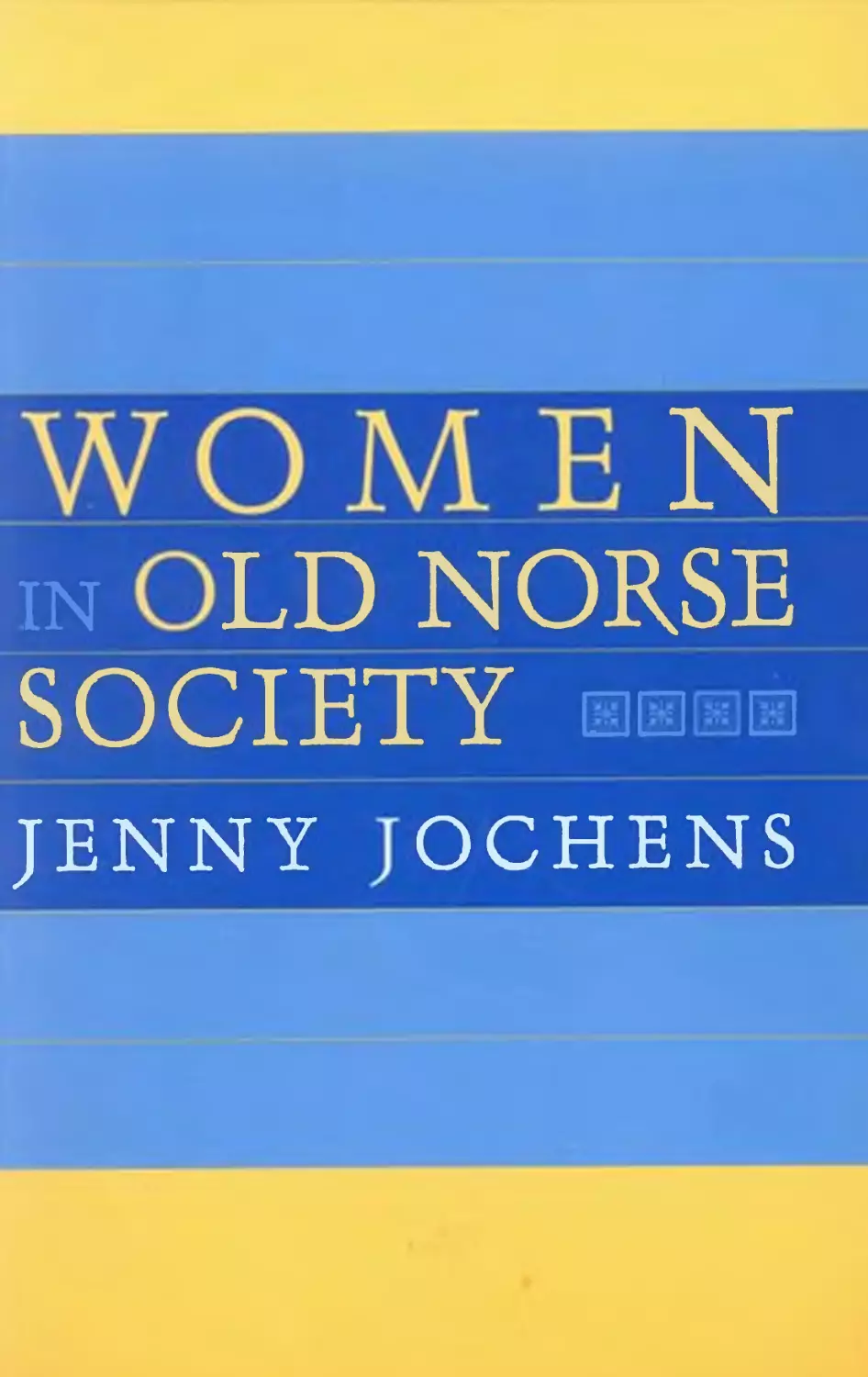


Автор: Jochens J.
Теги: christianity scandinavia history of women paganism history of everyday life
ISBN: 0-8014-3165-4
Год: 1995


Текст
                    WOMJN
OLD NORSE
SOCIETY не
JBNNY JOCHENS
Women in Old Norse Society
И

I
8“ Л ? у w Мтж Qw лШ: I Мпт Ы
'^Ш^, m ntetti eg mytt^ (fimb	f Atom's pfl>: op В fin |» wpnijhmiia „
•м;/ -fof wpe vH£й Ы|шфй lit п|йяШ|ж-<ы i|
f 1 mm,0 fiewnpplpti tftft Wf«piping® Ш Шф» |мc* foe gi® J
Bi mt m 1Ш $n cj?fenn sb. tw шп «d<w jipttjt |1 чтишь
|ш«М me«&: ей |м» fine № ^«й a- |iphngfow₽i « $ja& ipn /	?
:.i,, W* ^WW^^fipw/Wn^ifpmfeatinBfevfheined
\ 'ч т^тл^Ш'Штэрт^Л*^1е||йй*^шртж^ф(1т1}1т
<?"' *' piptrtjt mt ййаэд ЛНттй ptemM find tntc «р |m 1цг mwJ£
,|	'^i Йр ер mcpu 1$ | mt «й firm ftiiift oj »|o nJ Imwhpfe e^
>p«yw той • (Вй |фйП|Гpfltf < bwp Га«ф«Ш'|ж ndt '.;
< .nwf itWpfttw ep fjtttt e> <)« а. ImW nri^jp ete ettbe (Man ;.
iwO» « «fMfe ton « iFpiHr- $n ft fem IltU? Supitr |
'• Be mrtlnme giftmfbu ш ср/'Я Л<™а &0TO? &i 'vdeeg: (ф|т . J
||й«?опр«< пй mwfi ржи&« wmtr ifljmittfh? шад • <Ййм та $ф	J
Ы ftp ftrtlj? tjiitn 0 ftm vtll m; nwim0 ржпИ адй - 4n Капщ	I
fem itft< td p в lodin nl 1Ш cb: тшо fmutrpw bam al I|
Щтш йь vthwfpft'. Ше cpf уц т Фоте pcrnngn Ш >
tje/ttWfl ipn Ifrtpe «|<mp cptet	>.. e / цг
/ . |s widfi ftmtb fmi? mpw тШ cP:	am ’
I рлг w&ft ftmwu ртрш «п шах opipC|m ffe |m> »^iphu J
", ’ i >. nd» Гн» ««Ы f к яр о ftipht m|«. I e; tjefinari ' f
ww n nils: fic tjmigipff a i tjatw^m r »lji \\
n«C'|?ft f *W 1?ft	W n?’ «*fb.»ptn mpe immmw |?w fenfii ?:
/m«1F fiflpb iKttttoa (t mf f«« чт# !<• tgii «|j pw ей mju wut- .
Jeg|ie iXfa ill rnjwf* nemo t1 w« m<ma Ijetmanpu^ an fttftr 1 не
:й*«л La лчв	/t 1«лЯн^ж^ &-s-t AAS^ ,»»***«<** A .> <•—	1
0 |rrf efe ш/ Item iitfwwmgrWe'	ер H fog rtb fin Me с гй^ f; Я
gWft'lftjfifie tfn гит «й I'mtm a tuna орГВс Ы мрт&Ь Шз Ж
трт ш>Штеш»'0р tj nl|wp tjiu epf tWnt П|
ЯШ if bopft ttemtf* pm fee JM Я ijmi / я vettft gmtrol |o й \тл

Illustration shows a bride urged forward to her wedding by two female relatives. The
drawing is found in the margin of the marriage section in Jonsbok in the manuscript
Reykjabdk (MS. AM 345 fol. 38v) dating from circa 1600, Used by permission of Stofnun
Arna Magnussonar in Reykjavik, Iceland.
WOMEN
IN
OLD NORSE
SOCIETY
Jenny Jochens
CORNELL UNIVERSITY PRESS
Ithaca and London
Publication of this book was aided by grants from
the Carlsberg Foundation and Towson State University.
Copyright © 1995 by Cornell University
All rights reserved. Except for brief quotations in a review, this book,
or parts thereof, must not be reproduced in any form without permission in
writing from the publisher. For information, address Cornell University
Press, Sage House, 512 East State Street, Ithaca, New York 14850.
First published 1995 by Cornell University Press.
First printing, Cornell Paperbacks, 1998.
Printed in the United States of America
Library of Congress Cataloging-in-Publication Data
Jochens, Jenny, 1928-
Women in Old Norse society / Jenny Jochens,
p. cm.
Includes bibliographical references and index.
isbn 0-8014-3165-4 (alk. paper)
isbn 0-8014-8520-7 (pbk.: alk. paper)
1. Women —History—Middle Ages, 500-1500. 2, Women —Norway—History.
3. Women—Iceland —History. 4. Old Norse literature—History and criticism.
5. Women in literature. I. Title.
HQ1147.A-Z.N8J63 1995
305.4'09'02—dcao	95-31506
Cornell University Press strives to utilize environmentally responsible suppliers
and materials to the fullest extent possible in the publishing of its books. Such
materials include vegetable-based, low-VOC inks and acid-free papers that are
also either recycled, totally chlorine-free, or partly composed of nonwood fibers.
Cloth printing 10 98765432
Paperback printing 10 98765432
To
Birgit Baldwin
Dearest Daughter, Best Friend, Esteemed Colleague
10 viii i960 17 vi 1988
Hver van er, at ek muna vilja lifa vid harm |эеппа?
veitk ofullt
ok opit standa
sonar skard,
es mer saer of vann.
Egils saga, chapter 78

Contents
Preface	ix
Introduction	i
ONE	Gudny BQdvarsdottir and Gudrun Gjukaddttir:
Nordic-Germanic Continuity	7
TWO	Marriage	17
The Pagan-Christian Conflict	17
Pagan Marriage	20
Christian Marriage	36
Two Marriages	52
Divorce and Widowhood	54
THREE	Reproduction	65
Conception: Theory and Knowledge	65
Heterosexual Lovemaking	68
Sexual Initiative	77
Pregnancy and Birth	79
Paternity	81
Infanticide	85
Baptism	93
Reproduction and Royal Succession	94
FOUR	Leisure	98
viii
Contents
Work before Leisure	98
Gender	99
Idleness and Sleep	100
Sports and Games	102
Storytelling	104
Drinking and Word Games	105
Emotional Distress	111
Politics	113
FIVE Work	115
Gender Division of Labor	116
Outdoor Work	118
Indoor Work	125
SIX The Economics of Homespun	141
General Use	142
Coats	142
Cloth as Medium of Exchange	147
Export of Cloth and Coats	154
Measurements	156
Foreign Cloth	158
Conclusion	161
Appendix: Sources	171
Sagas of Icelanders	171
Kings3 Sagas	173
Contemporary Sagas	175
Laws	176
Christianity, Historicity, Oral Tradition,
and Poststructural Doubt	178
Abbreviations	183
Notes	187
Bibliography	239
Index	257
My work on women in the Old Norse tradition is the indirect result of my
involvement in the Woman’s Studies program at Towson State University.1 In
the mid-seventies I began to add courses on European women to the curricu-
lum in the History Department and to participate in interdisciplinary courses
with colleagues from the departments of literature, anthropology, psychology,
and biology. A chief concern of women’s history in its early days was to find,
in the words of Natalie Davis, “women worthies,” women who had made im-
portant contributions to the cultures of the past but had been forgotten by
(male) historians. Applying this approach to my own teaching about women
in the Middle Ages, I initially thought I had found a perfect candidate in the
allegedly strong Norse Woman known from Eddie poetry and the family sagas
(or sagas of Icelanders).2 Thus Brynhildr and Gudrun became featured vedettes
in my lecture repertoire and Vglsunga saga and Laxdcela saga were assigned as
required reading.
By the time of my first sabbatical leave in 1977 I was prepared to abandon a
previous project in medieval French history and to plunge into the saga world.
This decision was spurred by an emerging suspicion that the saga “worthies”
did not represent flesh-and-blood women from the pagan age in which they
had been situated or from the Christian age of the saga writers themselves,
but that they were images formed in men’s imagination. As the methodology
of women’s studies gained sophistication, such representations were assigned
to the study of gender, a concept that was not created until the mid-eighties.
To pursue my suspicion, then, I needed not only to immerse myself in the
entire Norse literary tradition but to acquire the evolving techniques of gender
analysis.
I had chosen Old Norse as a minor elective at the University of Copenhagen,
and when I first came to this country I rekindled my interest in the Norse
Preface
world by reading sagas with Stefan Einarsson at the Johns Hopkins University.
I now presumed to master all genres of the Norse literary corpus and to be-
come acquainted with the massive secondary literature. As I began to publish
my findings in articles, I little realized that it would take more than fifteen
years before the sources would begin to release their secrets of female existence
in the Germanic north.
In fact, the Norse material did not yield a uniform figure of a proud pagan
woman but offered multifaceted portraits of imagined and real women, from
pagan goddesses to Christian milkmaids, conjured in multiple combinations
and permutations by inspired poets and gifted prose authors. Meanwhile, con-
scientious historians and legal experts had preserved precious information
about women’s everyday life of marriage and work in pagan and Christian
settings.
Although women’s own voices cannot be separated from this predominantly
male chorus, the myriad of female figures generated by male authors do divide
readily into two groups. The first group includes portraits of divine figures and
heroic women of which the latter are based on perceptions and events in Con-
tinental Europe. These images were created by male poets and later elaborated
by prose writers. The second group offers comparatively mundane descrip-
tions of ordinary women in both pagan and Christian settings in Iceland and
Norway; these pictures were constructed by thirteenth-century authors and
historians from their observations of contemporary society and combined with
oral tradition and deductions about the world of their pagan ancestors.
The boundary between the two groups is of course permeable, but the great
wealth of these traditions makes it necessary for me to separate my work into
two studies. A forthcoming study, titled Old Norse Images of Women, will treat
the first group:3 divine, mythic, and heroic women whose images were initially
depicted by Latin authors in writing and articulated by Germanic singers in
oral lays, now preserved only in Old Norse Eddie poetry and elaborated in saga
narratives. The present book focuses specifically on Norway, especially Iceland,
and the women whose lives are described primarily in the two genres known as
the sagas of Icelanders and the contemporary sagas, further corroborated from
the perspective supplied by the laws. Echoing Georges Duby, I “shall refrain
from calling [these pictures] the ‘real’ (since mental representations have no
less reality), but rather [I shall define them as reflecting] the tangible aspects of
existence.”4 The forthcoming study of images will be directed to readers pri-
marily interested in the female share in Germanic myth and poetry, whereas
this book will appeal to scholars concerned with social issues of ancient and
medieval Iceland and Norway, such as the transformation of pagan marriage
under the influence of churchmen and the importance of women’s work in a
pastoral economy. The richness of the Old Norse tradition about women in the
xi
Preface
Germanic-nordic* world will, however, become most fully apparent only after
both books are examined.
Gender studies have evolved over the past twenty years to include not only
men’s images of women but also the study of family history and analysis of
women’s work in relation to men’s. My own work reenacts this development.
In a recapitulation of the first stage of women’s history, I add a few “women
worthies” to the roster of important figures from the nordic past. Although the
analysis of images will withdraw these figures from the world of “real” women,
as revealing male perceptions of “the others,” they offer important clues to
gender. To the domain of social and family history, long recognized as pertain-
ing to women’s history par excellence, my sources add valuable information
about marriage, reproduction, infanticide, and work.5
In these two books, I attempt to do for Germanic Norse women what the
Dane Vilhelm Gronbech did primarily for men in his monumental four vol-
umes of Vor Folkecet i Oldtiden, translated into English by William Worster and
in part rewritten and revised by Gronbech in the two volumes of The Culture
of the Teutons.6
Citations in Old Norse are kept to a minimum. Translations are always
placed before the original and are my own, unless otherwise indicated. The Old
Norse phrases are required when single words are to be closely analyzed and
when appropriately corresponding terms are lacking in English. Full sentences
in Old Norse have been provided occasionally to add clarification for special-
ists. In all cases it is my hope that the common base of Germanic languages
will stimulate the pleasure of linguistic recognition in readers of English and
German. Personal names are consistently rendered in normalized Old Norse
nominative forms, even when well-known English equivalents exist. (Thus, I
refer to Sigurdr and Gudrun, not Sigurd and Gudrun.) Where still extant, geo-
graphic names will be given in modern Icelandic. After a few pages readers
unfamiliar with Icelandic letters should become accustomed to them; 3 (“eth”)
is a voiced consonant pronounced as “th” in “mother”; its unvoiced counter-
part J) is captured in the initial sound of the letter’s own name “thorn”; 9 is the
normalizing way in which scholars render the later (and still current) 6; and
ae and oe have been conflated in oe.
The completion of this book has required access to primary and secondary
works, availability of time and institutional support, inspiration from col-
leagues and students, and sustenance from friends and family. My work could
not have been done in Baltimore without the fine collection of Islandica in
The word “nordic” will be consistently set in lower case.
xii
Preface
the Milton S. Eisenhower Library of the Johns Hopkins University assembled
by Stefan Einarsson during his long tenure in the English Department. I am
grateful to the library for the generous borrowing privileges I have enjoyed.
Unfortunately, the library has been forced to reduce Icelandic acquisitions
since Stefan’s return to Iceland in 1962, but I have been able to compensate by
resorting to three major Icelandic collections, the Fiske Collection at Cornell
University, the Arnamagnaean Institute at the University of Copenhagen, and
Arnastofnun at the University of Iceland in Reykjavik. All three institutions
have welcomed me with the greatest courtesy and helpfulness.
My own institution, Towson State University, has supported me generously
with sabbatical leaves, semesters of reduced teaching loads, travel grants to
present papers at conferences here and abroad, and a grant-in-aid toward pub-
lication. In 19811 received a National Endowment for the Humanities Summer
Stipend and in 1987-1988 a Fellowship for College Teachers. While I was work-
ing at the Arnamagnaean Institute in Copenhagen during a sabbatical leave in
1984, an apartment was made available to me by the Danish National Bank.
I am grateful to the Carlsberg Foundation in Copenhagen for a grant toward
publication.
My colleagues at Towson State University have patiently and cheerfully lis-
tened to first versions of many conference papers and articles, and they have
been unstinting in their encouragement of my work. With vigor and enthu-
siasm my students have immersed themselves in the saga world and offered
valuable comments, questions, and papers. I thank them all. My most sig-
nificant professional contacts have occurred at meetings. The opportunity to
present papers invariably resulted in constructive comments that provoked
additional thinking and rewriting. Among these occasions, the most impor-
tant have been the annual conferences of the Society for the Advancement of
Scandinavian Study and the triennial International Saga Conferences. I wish
to thank Theodore M. Andersson and the anonymous reader who read this
manuscript for Cornell University Press and offered valuable criticism. Mov-
ing through the labyrinth from manuscript to book, my work has benefited
from the expert guidance of Bernhard Kendler and the editorial staff at Cor-
nell University Press. I am grateful to Barbara Dinneen for sympathetic and
sensitive copyediting. I owe a debt of gratitude to Sverrir Tomasson and David
Erlingsson for having scrutinized my Old Norse citations.
My children, Peter, Ian, Birgit, and Christopher, and their spouses, have
on numerous occasions provided hospitality and access to their university
libraries. As grandchildren appeared, visits became more frequent but the time
in the library shorter. I owe special thanks to Aris Fioretos, my daughter’s
friend, whose support, friendship, and inspiration during the last six years
have been invaluable. My greatest debt is to my husband, John W. Baldwin.
xiii
Preface
He has patiently read and reread many versions of this book and helped me to
clarify my thinking, sharpen my arguments, and improve my prose. By now he
knows more about the Old Norse world than he ever wanted to and more than
he thought possible when we first met in a seminar in medieval canon law in
Paris forty years ago.
Jenny Jochens
Baltimore, Maryland

Women in Old Norse Society

Introduction
In the summer of the year 1000 the leaders of Iceland con-
vened for the yearly meeting of their deliberative body,
, the so-called alpingi—Ъу then a generation old.1 They
were faced with unrest stirred up by a vocal minority of
Christians. This small group of Icelanders had accepted
the new religion in the course of the two previous de-
cades, either during travels abroad or while listening to
persuasive missionaries sent to the island by the Norwegian
king. That the new converts were zealous is indicated by the
action of the aljaingi; during the meeting of the previous
year lawmakers had found it necessary to pass a regulation
that obligated people to prosecute relatives — presumably
Christians—who had blasphemed the old gods. The adherents of the new reli-
gion were now so numerous that armed struggle was barely avoided as pagans
and Christians alike declared themselves outside the law in order to form
a new society. Threatened by the dissolution of their community, the chief-
tains agreed that the pagan Porgeirr, leader of the aljjingi — his title was law
speaker—should be commissioned to settle the issue. He delivered a speech
in which he referred to recent warfare in Denmark and Norway provoked by
resistance to the missionary efforts of local kings. To avoid replication of these
conditions, he proposed “one law and one religion” for all of Iceland. The as-
sembly promptly agreed and asked him to make the necessary legal changes.
“Then it was declared to be law that all people should be Christians and receive
baptism who were previously unbaptized in this land.”2 Thus, circa 1125, the
historian Ari Porgilsson related the conversion of Iceland, basing his account
on reports from people whose close relatives had been present at the occasion
only two or three generations earlier.3 This event stood toward the end of the
2
Women in Old Norse Society
long, momentous process of the Germanic conversion to Christianity, begun
by Ulfilas among the Ostrogoths at the close of the late fourth century and
later punctuated by the dramatic conversions of Clovis, king of the Franks, in
496, Ethelbert, king of Kent, in 597, and Harald Bluetooth, king of Denmark,
in about 950. The Icelandic story is remarkable for its peaceful resolution of a
problem that had caused so much bloodshed elsewhere.
The conversion of Iceland raises the problem of the impact of Christianity
on the female half of the human race. This, in fact, is one of the most controver-
sial issues in women’s history, One point of view argues that Christianity was
deeply imbued from the beginning with Jewish and Roman patriarchy, which
became intensified by an all-male clergy and resulted in misogyny as the most
lasting and profound legacy of Christianity for women. An opposite argument
claims that the Christian message was fundamentally a liberating force that
included women as well, and although the original radicalism of Jesus on this
issue, as on so many others, became diluted with time, women were better
off during the Christian period and in Christian countries than they had been
before and elsewhere.
Few would deny the close association between misogyny and Christianity,
and hardly a Christian church today can claim innocence. The most cogent
comparison is not between Christianity and modern secular society, however,
but between the conditions of women in a Christian and a non-Christian
country in a contemporary setting, or before and after the advent of the reli-
gion in a historical context. The latter comparison is facilitated by the extent
to which literacy was present during the transformation.
In western Europe conversion overtook not only the literate Roman pagans
but also the largely illiterate Germanic tribes. Pushed from the east by the
Huns, they first entered the Roman Empire in the late fourth century. Both as
converts and destroyers of the host society, they and their descendants faced
the task of building a new Christian Europe on the debris of the old Chris-
tian Roman Empire. Within four centuries this new civilization was attacked
and colonized by a new branch of the vast Germanic family, the vikings from
the north, who were cousins of the first Continental tribes and like them illit-
erate and pagan. By the early decades of the new millennium, therefore, the
Germanic-nordic peoples had journeyed and settled from the Vistula to Vin-
land and from Carthage to Iceland. In these Volkerwanderungen they influ-
enced and were in turn themselves shaped by the cultures they invaded, as
manifested most significantly in the conversion to Christianity.
At the moment of their first contact with Roman and Christian culture
both the Continental Germans, including the Anglo-Saxons, and the nordic-
Germanic tribes possessed rich cultural traditions that they had encoded orally
in their own vernacular languages. They thus conveyed their values through
3
Introduction
laws intended for social organization and lays composed for educational and
pleasurable listening. Much of this vernacular tradition was lost among the
Continental tribes or, at best, like the Germanic law codes, transcribed into
Latin. The ancient wandering and adventures had been preserved in pan-
Germanic memory, but their Geschichtsschreibung, in the full Benjaminian
sense of the word, was specifically in Old Norse, as Icelandic mythographers,
poets, and historians committed to writing their common Germanic legacy,
to which they supplied additional permutations from their northernmost out-
posts.4 Whereas Continental Europe explored its classical roots in a movement
known as “the Renaissance of the twelfth century,” a century later Icelandic
(and a few Norwegian) scholars were engaged in a comparable enterprise to
revive their distant heritage. Their homelands, however, had lain outside the
Roman Empire, and Christianity had approached them a half millennium
later than on the Continent; their heritage was, therefore, not classical, but
Germanic, and their “renaissance” not Christian, but pagan.
The process of converting the Germanic world continued for at least seven
centuries, but the task of investigating pre-Christian Germanic society, in-
cluding the image and social position of women, requires study of an even
longer period. It encompasses the first observations from outsiders (such as
the Roman Tacitus in the first century), the extensive corpus of Germanic legal
codes, and fragments of poems and sparse epic texts — from the Continent as
well as from the Anglo-Saxons — and it culminates in the rich northern legacy
epitomized by Snorri Sturluson in the first half of the thirteenth century.
Sharing close cultural and linguistic affinities, these sources form a vast Ger-
manic continuum that endured for over a millennium. The Old Norse writers
of the thirteenth century bear the latest and fullest witness because of their
identification with their Germanic pagan forebears. Interpreted with caution,
they can testify to the poetry and mythology of early Germanic peoples on
the Continent as well as to the culture of their more recent nordic relatives.
This poetry and mythology presents divine female figures and identifies four
images of human women: the warrior, the prophetess/sorceress, the revenger,
and the inciter. Although the divine figures disappeared with the acceptance of
Christianity, the human images survived for a millennium, not only in poetry
but also in the prose of the heroic sagas and of the sagas of Icelanders. The
poetic images, however, rarely permit us to discern the daily social existence
of Germanic women on the Continent as well as in the north. The basic and
ordinary problems pertaining to the lives of women, such as reproduction,
marriage, and work, can be best examined by close reading of sagas.
This book is therefore based chiefly on three genres of prose narratives
and the compilations of law.5 The narratives consist of the sagas of Iceland-
ers (fslendingasqgur), the kings’ sagas (konungasogur), and the contempo-
4
Women in Old Norse Society
rary sagas (samtOarsQgur').6 The first group, which includes such well-known
stories as Laxdcela saga and Gisla saga, not to mention the indisputable master-
piece of Njdls saga, is set primarily in pagan times in Iceland. The second
group deals largely with Norwegian royalty from mythical times to the mid-
thirteenth century and thus encompasses both pagan and Christian eras. Best
known is Snorri Sturluson’s Heimskringla (Sphere of the Earth), which is also
the most comprehensive. A single reign —that of King Hakon (1204-1263) —is
treated by Snorri’s nephew Sturla TorSarson in Hdkonar saga Hdkonarsonar.
The third category treats the Christian society of Iceland during the twelfth
and thirteenth centuries; the most important representative of this group is the
large compilation known as Sturlunga saga, where again the name of Sturla
horSarson appears as the author of Islendinga saga, the longest segment of
the compilation. Norway and Iceland both produced extensive compilations
of law. By the late ninth century, when the settlers left for Iceland, the mother
country had already established several provincial laws, none of which has sur-
vived from this early date. The settlers used the oral version of one of them,
the Borgarthing Law, as inspiration for their own legislation, but unlike the
Norwegians, they wanted a single law applicable to the entire country. The
result was Grdgds (Grey Goose), the largest of all Germanic law codes, which
contains elements antedating the arrival of Christianity.
The chief obstacle to delineating nordic society before the arrival of Chris-
tianity is that no Norse sources, neither literary nor legal, were committed to
writing until the thirteenth century, when the authors themselves had become
Christian. A geographic image can elucidate this complexity.7 A striking fea-
ture of the majestic Icelandic landscape are the torrential rivers that carve white
and black ribbons through vistas of mountains. The first settlers in Iceland
designated a number of these rivers as “White River” (Hvlta).8 What makes
them appear white is not the foam of rapids but the opaqueness of the water.
Emerging from beneath glaciers, the streams carry sediment, mud, gravel, and
stones that, when reflected by the sun, create a milky-white sheen. In contrast,
rivers that carry water off the surface of mountains are crystal clear. Not re-
flecting the light in the same manner, they appear as “black rivers.”91 employ
this distinction between and confluence of clear and white rivers to signify the
mixture of pagan and Christian, native (Germanic and nordic) and imported,
ancient and medieval contained in the Old Norse world. (These pairs of terms
are used interchangeably throughout the book.) The pagan, native, or ancient
features are represented in the clear streams, whereas the Christian, imported,
or medieval elements emerge in the white rivers. To associate Christianity
with white is not inappropriate, for its founder was known as White-Christ
(Hvfta-Kristr) in Iceland.10
The first settlers also observed a third kind of stream, called “Mixed River,”
or “Mixture” (Blanda) for short, which channeled water from the two other
5
Introduction
sources. The difference between the density of each source —a feature that
changes with the temperature and the amount of solutes present —retards the
mixing of the two types of water. The Blanda therefore contains alternating
bands of clear and opaque water distinguishable for some time and over a cer-
tain distance. I shall apply this image to the obstacle at hand. Since (with the
exception of runes) writing arrived in the northern world with Christianity, we
may picture the authors of all the written evidence as situated downstream on
the Blanda after the confluence of the white with the clear. Receiving the two
sources together, the writers attempted to separate them, mix them, or per-
form both operations in varying degrees. Because of the different densities of
the waters, the two sources could be distinguished for a while. Analogously, the
authors of the twelfth and thirteenth centuries could perceive a pagan world
relatively free of Christian elements, though a certain degree of mediation
from the new religion was unavoidable. Likewise, when they reported un-
selfconsciously on their contemporary Christian society, they included pagan
sources as well. I try to identify the mixing performed by the medieval authors,
knowingly or unknowingly, and to separate the two sources as far as possible.
This book draws its subject matter from Norway and Iceland during the
period between the late ninth century, when pagan Norwegian colonists first
settled in Iceland, and the middle of the thirteenth century, when in 1262 the
colonists’ Icelandic descendants were forced to accept the overlordship of the
Norwegian crown.
Chapter 1 introduces both the Germanic-nordic and the pagan-Christian
continuity by focusing on the thirteenth-century woman Gudny BpSvarsdottir,
mother of Snorri Sturluson, and her alleged ancestress, Gudrun Gjiikadottir,
the sister of the fifth-century Burgundian king Gundaharius.
The influence of Christianity on the lives of women is examined in the fol-
lowing two sections on marriage and reproduction (Chapters 2 and 3). Marital
regulations in the north resembled those of the Continental tribes as enacted
in the Germanic law codes. Despite churchmen’s efforts to introduce Christian
morality, pagan behavior in marriage and divorce, as well as male sexual con-
duct, continued virtually unchanged into Christian times. Churchmen may
have had some success, however, in introducing the notion of female consent
whereby a woman was permitted, if not to choose, at least to approve or reject
the marital candidate. Not surprisingly, the meager information about love-
making and birthing techniques reflects age-old patterns, but churchleaders
did succeed in abolishing infanticide.
I examine leisure activities in Chapter 4. In this domain the two sexes were
for the most part separated, for men enjoyed these nonproductive activities to
a greater degree than women. The analysis of leisure provides an introduction
to understanding women’s remarkable contribution to the Icelandic economy.
Chapter 5 offers a gendered analysis of the work needed to maintain an
6
Women in Old Norse Society
Icelandic farm in a way that provided for the entire family. Women’s most
important work was spinning and weaving. Homespun was used for every
conceivable domestic purpose, not least of which was clothing the entire popu-
lation from cradle to grave. Chapter 6 opens by illustrating this obvious use of
the cloth and proceeds to examine the equally remarkable fact that lengths of
this cloth became the standard of measurement for commercial exchange, em-
ployed in trading as well as in payment of taxes and fines. For several centuries
homespun was the most important item of export; thus the island obtained
grain, flour, and other necessities that could not be produced locally. Treating
these problems from a woman’s perspective, the chapter provides a gendered
view of economic history.
The Conclusion recapitulates the underlying Germanic-nordic and pagan-
Christian continuum. The authors of the sagas of Icelanders wanted to project
back into pagan times the Christian program of sexual morality preached
by church leaders in their own time (but not practiced by their contempo-
raries). A careful reading of all the evidence, however, reveals that the preva-
lence of concubinage, extramarital liaisons, arranged marriages, and divorce
in the thirteenth century is less a willful neglect of the corresponding points
in churchmen’s program of monogamy, fidelity, consent, and indissolubility
than a continuation of ancient practices cleverly disguised in the sagas of Ice-
landers. Two minor disruptions do appear in this continuum, one caused by
ideology and the other by technology. The Christian program was not entirely
neglected, for churchmen gained some influence in marital and sexual matters
and were themselves forced increasingly to practice celibacy. Concerning the
laity, churchmen gained a hearing on consent and incest regulations, and they
became more involved in the marriage ceremony itself through the ritual of
reading the banns before marriage and through the celebration of the wedding
in front of the church, followed by a nuptial mass. Technological improve-
ments appeared as medieval Icelanders perfected the exploitation of the few
but unusual resources of the island.
An Appendix examines the origins and the interpretive questions raised by
the written sources. To accommodate the reader who wishes to approach the
subject of Old Norse women as quickly as possible, I have left these questions
for the end. Seasoned scholars of Old Norse may consult this section to as-
certain my stance on the sources. Readers seriously committed to women’s
history who lack training in Old Norse texts may wish to invest their time in
this chapter before proceeding to the rest of the book. I include only those
sources that best facilitate an examination of women’s roles in Norse society; I
don’t pretend to offer a complete survey of Icelandic literature.
CHAPTER ONE
Gudny Bpdvarsddttir
and Gudrun Gjukadottir:
Nordic-Germanic Continuity
On 6 November 1221 Gudny Bpdvarsddttir died at her son’s
farm, Reykjaholt (presently Reykholt), in Borgar^ordur
in southwest Iceland. A brief generation later (July
1255), the Germanic Gudrun Gjukadottir appeared in
the dreams of Joreidr, a young Icelandic girl living at a
farm in Midjumdalr, about fifty miles from Reykholt.
fGudny was the mother of Snorri Sturluson, perhaps the
most prominent Icelander ever. Through him and four other
children, Gudny became the ancestress of a large clan,
the Sturlung family, whose male members dominated Ice-
landic politics during the thirteenth century. Gudny her-
self could claim a venerable family tree that connected her
with remote Norwegian ancestors, who, in turn, were grafted on to the legend-
ary Germanic lineage exemplified in Sigurdr the Dragonslayer (Fdfnisbani),
the first husband of Gudrun Gjukadottir.
Some of these genealogical links may be fanciful, but Gudny Bpdvarsdottir’s
own existence cannot be doubted. Gudrun Gjukadottir, by contrast, is more
elusive. Her poetic image combines the historical features of an alleged sis-
ter of the Burgundian king Gundaharius (ON Gunnarr; he died in 437) with
the contemporary figure Ildico, who was married to the Hunnish leader Attila
and present at his death in 454. Ildico’s name (compare Germanic Hildr as,
for example, in Brynhildr) suggests Germanic origin. The wife of the Frankish
Sigurdr (Siegfried), the Hunnish Atli (Attila), and the Ostrogothic Jprmun-
rekkr (Ermanaric), Gudrun was endowed with a long life in Germanic and
Old Norse poetry, starting perhaps as early as the sixth century in (now lost)
Germanic lays.1 The oldest existing version of her story is found in the Eddie
poem Atlakvida, recomposed in Norway in the late ninth century. As Jdreidr’s
8
Women in Old Norse Society
dreams suggest, she continued to haunt the artistic and popular imagination
in the north until the end of the Middle Ages.
The figures of these two women, the Germanic Gudrun and the Icelandic
Gudny, frame the picture of Old Norse literature in this attempt to understand
the ancient Germanic world and its continuation in medieval Icelandic society.
Despite changes introduced by Christianity, the Norse material — preserved
and created in Gudny’s thirteenth-century settled Iceland—constitutes a cul-
tural continuum with Gudrun’s fifth-century Germanic migrations. Connected
through Sigurdr, the two women exemplify the Germanic-nordic continuity,
and in this work they highlight in particular the transition from paganism to
Christianity.
Gudny’s death in 1221 is inscribed in most Icelandic annals.2 Embedded in
records of significant human and natural events both domestic and interna-
tional-deaths of kings, consecrations of bishops, battles, royal marriages, as
well as shipwrecks, earthquakes, and comets —the notice suggests that Gudny
was an important person. It is therefore a disappointment to discover how
little is actually known about her, at least compared to the wealth of informa-
tion available on her husband and sons. A few passages in the panoramic work
known as Sturlunga saga, the last self-portrayal of medieval Icelanders, suggest
only the barest outlines of her life.3
In 1160, when Gudny was in her late teens or perhaps younger, she was mar-
ried to Sturla bordarson, a man by then in his mid-forties and already the
father of eight living children by several women, only one of whom had been
his wife. Sturla’s association the previous year with Gudny s father, Bpdvarr,
may have brought the young girl to his attention. The celebration of the wed-
ding at Sturla’s farm at Hvammur (recently rebuilt after a fire) indicates that
Sturla was politically more powerful than his father-in-law.4 In the course
of her marriage Gudny gave birth to three boys and two girls.5 Like their
father and, in turn, their own sons, the three men became prominent national
leaders. Sturlunga saga is therefore not only the story of this powerful family,
but the account of the political life of Iceland during the century prior to the
acceptance of the Norwegian king’s overlordship in 1262.
Readers of the saga catch only glimpses of Gudny during her married life,
as, for example, when she admonishes the men on the farm to get out of bed
and help her husband during an attack (1171; 1:91), when she arranges a ring
dance for the household and guests (1:89), and when she futilely tries to use an
old family connection to her husband’s advantage (1:98). When Sturla died in
1183 at the age of sixty-seven, Gudny stayed on at Hvammur with most of the
children. Her oldest son was now eighteen.
Sturla had continued to womanize after his marriage, but we know nothing
of Gudny’s feelings about this behavior. After her husband’s death she herself
9
Nordic-Germanic Continuity
captured the attentions of a married man, Ari borgilsson. He came to Hvam-
mur for frequent visits and “a great love” developed between them. A few years
later they entrusted their respective farms to responsible people and traveled
together to Norway, where Ari died in 1188 (1:229-31).
Now middle-aged and returning home, Gudny assumed the management
of her farm. In 1191 she received a visit from Bjqrn, one of her husband’s ille-
gitimate sons born during their marriage, and she journeyed with him and
Sturla, another illegitimate son, and her own two older sons to a nearby bath
(1:232). As the children married, her interest in her family extended to in-
laws and grandchildren, as witnessed in 1199 by a dream that she reported
concerning the health of her daughter-in-law Halldora, then pregnant with
her second child (1:236-37). Another grandchild was designated her foster
son (1:303). Gudny probably raised this grandson herself, normal in a foster
arrangement, and she made special provisions for him in her will.6 She was
well acquainted with the facts of fostering, for her husband had accepted Jon
Loftsson s offer to raise their youngest son, Snorri. From the age of three until
after his marriage, Snorri lived at Jbn’s estate at Oddi, a household dominated
by rich cultural interests (1 :пз) ,7 Because of Snorri’s exceptional mind, Sturla’s
domestic decision had far-reaching consequences for the intellectual life of
Iceland.8
Snorri’s absence from home may explain why his mother extravagantly
“squandered” (eytt) his paternal inheritance during her widowhood, thus
leaving him apparently impecunious. His benefactor Jon died in 1197, but
Snorri stayed at Oddi for a while longer, although it was clear that other ar-
rangements had to be made. When his brother bdrdr negotiated a marriage
for him with a rich woman, Herdfs, his future seemed secure, but, like every
groom, he still needed to supply the bride price (mundr). Making up for the
spent inheritance, Gudny provided Snorri’s “wife price” (kvdnarmundr) from
the land at Hvammur, and the wedding was celebrated there. Although it was
rumored that Snorri was to share the farm with his mother, he returned to
Oddi accompanied by his wife (1:237). A few years later the young couple
took over his father-in-law’s estate at Borg (1:240). Snorri had reason to be
displeased with his mother’s handling of his inheritance, but apparently she
enjoyed the trust of her other sons, and eventually she regained Snorri’s con-
fidence as well. She later managed bdrdr’s farms at Stadr and Eyri, and when
Snorri went abroad in 1218, he placed his mother in charge of Reykholt, his
favorite estate. She was then in her mid- or late seventies. When Snorri re-
turned, she remained with him until her death in 1221.
Such are the meager facts of Gudny’s life that can be culled from Sturlunga
saga. A significant detail can be added, however, not from the contemporary
sagas to which Sturlunga saga belongs, but from the sagas of Icelanders that
10
Women in Old Norse Society
allegedly depict the previous centuries.9 The author of Eyrbyggja saga reports
that Gudny was present when the bones of Snorri the Chieftain (gobi; he died
in 1031) and of his mother bordfs Sursddttir were dug up from their first burial
under a church built by Snorri gobi himself and reinterred under a new church
(Erb 4.б5:18з-84).10 This “translation” likely took place after 1183, the year
GuSny’s husband died. Had Sturla been alive, his presence would have been
expected, since he was a direct descendant from Snorri gobi (they were sepa-
rated by three male and two female links).11 The two men had much in com-
mon. They were both more intellectually shrewd than physically powerful and,
consequently, they obtained important positions through political maneuvers.
Both men produced large families and died at the age of sixty-seven.12
Though perhaps aware of the similarities between Snorri gobi and her hus-
band, Gudny may have looked with more empathy on bordfs’s bones, which,
she remarked, were black and singed. Born and bred in Iceland, the thirteenth-
century Gudny observed, but was not directly involved in, her husband’s and
sons’ large-scale political affairs. By contrast, according to Gtsla saga and
Eyrbyggja saga, the tenth-century bdrdls had been at the very center of her
brothers’ and husbands’ activities, as I shall show, first in a settlement in Nor-
way and later in the first establishment of a new family in Iceland.13 Like Gudny
during her widowhood, bordls was dependent on her son after her divorce and
during her old age. She managed Snorri’s estate at Helgafell and moved with
him to the new farm in Saelingsdalstunga, where they were both to be buried.14
Gudny most likely knew these details about bdrdfs, for as a direct descendant
in the male line from the first settlers, she would have taken interest in the
older woman’s life.15
More than two centuries separated bordfs’s burial from Gudny’s viewing
of her bones. The important question is not whether Gudny was present or
even if the event ever occurred, but why the saga author chose to record it.16
As a culmination to his complicated multi-generational story involving the
emigration of several families from Norway and their settlement in Iceland,
the author places Gudny Bqdvarsdottir, mother of the most prominent man
in Iceland, at a ceremony honoring Snorri’s forefather, likewise named Snorri,
and his mother, bordls.17 This choice exemplifies the purpose and importance
of the sagas of Icelanders: they link contemporary society and the world of
the first colonists; they were fashioned by authors who employed reliable con-
temporary information, relatively firm oral tradition, archaeological evidence,
vague memories, and romantic imaginings to provide background, coherence,
and identity to contemporary listeners and readers. Encompassing both his-
tory and literature, the sagas of Icelanders constitute a unique category among
medieval vernacular writings.
An episode in the life of bordls, as told in Gtsla saga, brings us in brief con-
11
Nordic-Germanic Continuity
tact with Gudrun Gjukadottir, the other emblematic woman. The vignette is
significant not only because it —like Jdreidr’s dream —highlights the presence
of the sixth-century Germanic woman in the minds of Norwegian settlers and
Icelandic colonists, but also because it calls attention to a problem that in-
volved the most intimate aspects of women’s lives in a kinship-based society,
bdrdfs’s brother Gfsli had killed or maimed several of her suitors when the
family was still living in Norway, and in Iceland he proceeded to murder her
first husband borgrimr (Gt 6.2:6-9,16:53-54). Although Gfsli’s earlier homi-
cides had been committed in order to protect both his sister’s and the family’s
reputation, the pretext for borgrfmr’s murder was distinctly Gfsli’s own honor,
because he suspected borgrimr of having killed Vdsteinn, his (Gfsli’s) foster
brother and brother-in-law. His culpability was not generally known, but Gfsli
was so confident of his sister’s loyalty that he revealed his deed in a stanza
that she overheard, understood, and later conveyed to her new husband Bqrkr,
borgrfmr’s brother, thus providing him with reason for revenge against Gfsli
(Gt 6.18:58; str. 11) ,18 Told of bdrdfs’s betrayal by their brother, Gfsli quoted
another stanza in which he compared his sister unfavorably to Gudrun Gjtika-
dottir, who had remained faithful to her brothers (Gt 6.19:62; str. 12).
Gudrun’s name alone recalled to Icelandic listeners the story of the fifth-
century Burgundian woman who by her own hands murdered her two sons to
take revenge against her husband Atli, who had killed her two brothers. This
classic version of the Continental Nibelung story is told in the oldest extant
version, the Eddie poem Atlakvicia, composed perhaps in the late ninth century
in Norway. By the thirteenth century, when Gisla saga was written, however,
Continental authors had already reworked the story in the Nibelungenlied and
reversed the victims of revenge. Now Gudrun (here named Kriemhilt) encour-
ages revenge on her brothers for their murder of her first husband Sigurdr (here
named Siegfried). On the Continent women still responded to personal griev-
ances according to the old Germanic method of inciting men to take revenge
on their behalf. Societal changes, however, eventually privileged marriage over
kinship, and women were able to substitute the murderer of husband for the
killer of brothers as the object of the revenge to which they incited their male
relatives.
The old version of the story was known in Iceland from the oldest Eddie
poem, and though Gfsli’s two stanzas contain traces of later poetry, the saga
author nonetheless reiterates the old kinship views.19 Immediately after he re-
cites the two stanzas, Gfsli complains to his brother (in prose) that he has not
deserved bdrdfs’s act, for he had placed his own life in jeopardy for her honor
in the past. In other words, Gfsli, a tenth-century Norwegian settler and poet,
expected from his sister bdrdfs the loyalty to kin that first had been credited
to the fifth-century Germanic Gudrun. Furthermore, by the mid-thirteenth
12
Women in Old Norse Society
century, when the Icelandic prose author wrote his account, a woman was
not yet allowed to replace the old kinship ties to a brother with allegiance
to her spouse, bordfs’s siding with her husband at this moment shows, how-
ever, that Icelandic wives were beginning to let new marital affinity override
older feelings of kin loyalty—though by no means completely, bdrdfs herself
later divorced her husband and severely wounded the man who had killed her
brother (Gf 6.36:116).
In bdrdfs, Gudny reached back in an almost tangible way to a colonist from
Norway, a foremother of her own children. This model was not sufficient in
a new country, however, and Icelandic authors searched at length for ances-
tors beyond the “landtaking men and women” (landndmsmenri) in the mother
country of Norway. This quest is most evident in “The Book of Settlements”
(Landndmabtik), a compilation that records more than four hundred of the
original settlers, as well as their ancestors and descendants. In Gudny s case
the genealogist listed eleven Icelandic and ten Norwegian generations before
reaching a mythological Svasi, who sprang from the Dofri mountains.20
Given Iceland’s continuing ties with Norway, it is not surprising that Ice-
landers emphasized their Norwegian connections. Not only do the lives of
bdrdfs and Gudny join the two countries, but branches of the family tree also
reveal other close connections between the nordic and the larger Germanic
worlds. Some genealogies grafted Icelandic and Norwegian ancestors onto ex-
panding branches from the world outside the north, merged them with limbs
that connected the human race to divinities, and eventually united them all to
a universal trunk sprouting from Adam’s loins.21
Further investigation of Gudnys ancestors also led the genealogist to Rag-
narr Furry-Breeches (lodbrok), who had married Aslaug, alleged to be the
daughter of Sigurdr the Dragonslayer (Fafnisbani) and his first love Bryn-
hildr.22 Thus the elaborate genealogy created for Gudny made her the transmit-
ter of this legacy to the Sturlung family.23 The appeal of Ragnarr and his son by
Aslaug, Sigurdr Snake-Eye, (ormr-i-auga) derives from the fact that the former
was the vehicle for, and the latter the first human result of, a merger of nordic
humanity with an exemplar of the famous Sigurdr lineage from the Germanic
past. Through Ragnarr and his sons, the north of the ninth century merged
with the literary version of a historic Germanic past dating to the fifth century,
thus creating a glorious present for the nordic people and making possible a
promising future from mixed Germanic-nordic stock. The marriage between
Ragnarr and Aslaug, however, did more than provide human respectability for
the nordic barbarians and infuse viking energy into Sigurdr’s otherwise ex-
tinguished lineage. In addition to a glorious future through his daughter, the
Germanic hero was endowed with a mythical past by being made a descendant
of the chief god Odinn himself.24
13
Nordic-Germanic Continuity
Perhaps the oldest of the many Icelandic genealogies concern the Sturlung
family and they are preserved in two manuscripts of Snorri Sturluson’s Edda.25
Unfortunately, they do not refer to Gudny Bqdvarsdottir, but they do include
her mother-in-law Vigdfs and validate Gudny’s own reproductive efforts by
listing her children.26 Gudny’s absence is not surprising, for indeed only a few
women are included in this reproducing mass of humanity that stretches back
to Adam.27 Observing daily their own navels, men (and women) are invariably
reminded of their maternal connection; in Iceland, however, as elsewhere in
medieval Europe, men constructed endless genealogical chains in which father
engenders son, with only a grudging glance at a few of the women who were
of necessity involved.28 While affirming the power of patriarchy, these lists
and images may also reflect male reproductive uncertainty and anxiety.29 In
any event, genealogists working on Gudny’s ancestry in the thirteenth century
clearly perceived many permutations of close kinship between contempo-
rary Icelandic families and the Germanic past exemplified in Sigurdr, its most
famous hero.
Sigurdr’s first love was Brynhildr. When he unknowingly betrayed her and
married Gudrun, Brynhildr decided on revenge and caused his death. This
famous story, best known from Eddie poetry and the prose rendition in
Vglsunga saga, would have been familiar to an Icelandic public. Nevertheless,
when the theme of a similar love triangle was transferred to an Icelandic set-
ting (in Laxdoela saga), the heroine was not named after Sigurdr’s first love,
Brynhildr, but after his wife Gudrun, who came to play an extraordinary role
in the Norse imagination.30 Judged by the frequency of the name Gudrun, she
was an extremely popular figure both in literature and life. More prevalent
in Iceland than in Norway, her name is found in an eleventh-century skaldic
stanza.31 She appears in fifteen of the seventeen poems and short narratives de-
voted to the Nibelung story in Codex Regius, the single manuscript containing
the Eddie poetry. Furthermore, Gudrun or the derivative Gudrfdr is affixed to
almost sixty people in the sagas of Icelanders and almost forty in the Sturlung
complex. The name was also very common among the ordinary people who
appeared in charters and documents. When Bishop Arni gave instructions for
emergency home baptisms and incorporated the baptismal formula in the so-
called New Christian Law (1275), he used the Christian Jon and the (originally)
pagan Gudrun as typical gender names.32 More than 10 percent of the popu-
lation carried the name in 1703, according to the first Icelandic census, and it
remains the most common female name in contemporary Iceland.33
Gudrun’s role in the Sigurdr legend may suggest an explanation for this
popularity. Not fully delineated in the first half of the drama, Gudrun comes
into her own in the second act. After Sigurdr’s death she is married against her
will to Atli, the Hunnish leader. Wishing to obtain the riches of his brothers-
14
Women in Old Norse Society
in-law, Atli invites them for a visit, and, although warned by their sister, they
accept. When Atli is unable to make the brothers divulge the hiding place of
the Nibelung gold, he kills them. In revenge, Gudrun murders the two sons she
bore Atli and later stabs Atli himself to death. Atlakvida, possibly the oldest
poem in the Sigurdr legend, describes these events in remarkable detail.34 The
strong appeal to the nordic imagination of close ties between a woman and her
natal family may, then, explain the popularity of Gudrun’s name. Moreover,
it was the father’s privilege to name his child. I am not suggesting that every
father who named his daughter Gudrun wished the heroine’s morbid fate upon
his own olfspring, but a milder image of the family loyalty conjured up by
Gudrun’s name was a legacy that many men could wish for their daughters,
especially during infancy and childhood, before involvement with other fami-
lies materialized. Meanwhile, the model of the woman who remained loyal
to her native kin was still in fashion in the mid-thirteenth century when the
author of Gtsla saga, used it to characterize bdrdfs.
Gudrun was not merely fixed in the consciousness of Icelanders by role
and name, but also by her pagan persona. Bdrdar saga Sncefellsdss, a late saga,
probably from the middle of the fourteenth century, that hovers on the bor-
der between the sagas of Icelanders and the heroic sagas, reports that Helga
Bardarddttir spent the last years of her life either hiding in nature or lodg-
ing secretly with other people. At one point a mysterious woman who rooms
with bdroddr and his son is said to be Gudrun Gjukadottir although, in fact,
it is Helga (Brd 13.7:123). It is impossible to tell whether the rumor of Gudrun
Gjukaddttir’s presence arose in popular consciousness or simply occurred to
the author, although a degree of the former undoubtedly was necessary for
the latter.35 That Gudrun remained a familiar figure in the minds of ordi-
nary Icelanders is more clear from Joreidr’s dream (St 1:519-22). In July 1255,
after a dreadful year of endless calamities and battles following the infamous
burning of Flugumyrr, a young girl named Jdreidr Hermundarddttir has a
dream during mass.36 Meeting an impressive-looking woman who has arrived
on horseback from the north, Jdreidr inquires about the fate of the men who
were involved in the disasters and questions the purpose of their actions, espe-
cially of the burning. Speaking in verse, the woman answers that the men
intend to restore paganism to the entire country. At this response Jdreidr woke
up. Dreaming about the same woman on two later occasions, she repeats her
question. In the last dream the woman reveals that she is Gudrun Gjukadottir.
To Joreidr’s frightened query as to the purpose of pagan people in Iceland,
Gudrun responds: “It should not be of any concern to you whether I am
Christian or heathen, because I am a friend to my friend” (Engu skal pik pat
skipta . . . hvdrt ek em kristin еда heidin, en vinr em ek vinar mins; St 1:521).
Reassured, Jdreidr continues her inquiry into the future fate of prominent Ice-
15
Nordic-Germanic Continuity
landic leaders. In a final installment Jdreidr once again encounters Gudrun,
who now demonstrates her previous assertion by punishing a man who had
behaved most ignominiously at the burning of Flugumyrr.
The Christian Jdreidr’s fear of the pagan Gudrun Gjukadottir alerts us to
an undeniable tension between the old and the new religion. Little is known
of women’s reaction to the decision to accept Christianity, but Laxdoela saga
does preserve an intriguing detail. Gudrun Osvifrsdottir, an Icelandic name-
sake of Gudrun Gjukadottir of almost equal fame, is the heroine of Laxdoela
saga, and one of the most memorable women from the pagan setting of the
sagas of Icelanders. Born about 970, she had just entered her third marriage
when Christianity was accepted and therefore was probably not present at the
aiding!. There is no direct reference to Gudrun’s conversion, but at her estate
at Helgafell—where she lived with her father and sons after her third hus-
band’s death —she erected a church in which she later buried her father (Lx
5.66:i96).37 After the death of her fourth husband, in circa 1026, she became
deeply religious (trukona mikiL): she was the first woman to learn the psalter
in Iceland, and she spent hours praying in her church. A dream of her grand-
daughter Herdfs (whom Gudrun was fostering) revealed that under the exact
spot where Gudrun knelt regularly, an ancient sibyl or sorceress (vglva) was
buried. (Such a site was known as a vgluleidi.) In the dream the sibyl com-
plained that the prayers disturbed her. Gudrun complied by having the bones
dug up and removed, together with the sibyl’s brooch (kinga) and large magi-
cal wand (seidstafr mikill; Lx 5.76:223-24), the normal accoutrements of a
pagan sorceress. Although this passage uncovers tension between the ancient
and the new faith, it also suggests that the author could pass easily from aspects
of his own Christian religion to details of the old pagan cult.38
Indications of tension notwithstanding, Iceland accepted Christianity with
remarkable ease, compared to the other nordic countries. The aljhngi made a
voluntary political decision to convert; everybody was to be baptized immedi-
ately, and infant baptism was instituted to assure the compliance of future gen-
erations. Nonetheless, the pagan Gudrun Gjukadottir lived on in the popular
Icelandic imagination to such a degree that she would appear spontaneously
and frequently in the dreams of a sixteen-year-old girl and assure her young
nordic sister that whether pagan or Christian she was “a friend to my friend.”39
This vignette is emblematic of the search for Icelandic women and their roles
in the Old Norse literary, historical, and legal tradition. The tension between
the old and the new religion articulated by the Christian granddaughter of
Gudrun Osvifrsdottir in the early eleventh century, on the one hand, and, on
the other, the friendly reassurance that the older pagan Gudrun expressed at
this time evoke both a pagan-Christian conflict and a Germanic-nordic conti-
nuity in this world of the “two friends.” They raise also the well-worn themes
16
Women in Old Norse Society
of continuity and change. If these categories were applied to Norwegian and
Icelandic men during the half millennium covered by our sources, the theme of
change would undoubtedly predominate. When the distinctions are applied to
women such as Gudrun Gjukadottir, bdrdfs Sursdottir, Gudrun Osvifrsddttir,
and Gudny Bpdvarsdottir, however, continuity is more striking.
CHAPTER TWO
Marriage
THE PAGAN-CHRISTIAN CONFLICT
Marriage offers a particularly clear illustration of Chris-
tianity’s influence on the lives of women. Germanic mar-
riage was basically a commercial contract, the so-called
I ; marriage by purchase (Kaufehe), arranged between the
groom and the father of the bride. Christians intro-
duced new ideas into the north, among them the doc-
trine of consent. Having borrowed the general concept
from Roman law, churchmen applied it especially to women,
and female consent became one of the hallmarks of Chris-
tian marriage.1 Self-determination in marriage thus be-
came an integral part of the Western tradition, in contrast,
for example, to Asiatic cultures where, even now, both men
and women enter marriages arranged by their families. In the West, the quaint
custom of the father giving the bride away remains as the only vestige of
the old Germanic system, preserved —ironically—in ceremonies celebrated in
churches.
Kaufehe may not have been the earliest form of Germanic marriage. Ger-
man historians have hypothesized that during an irretrievable past of the
Germanic tribes, copulation that impregnated females was driven primarily
by male sexual aggression and passion. The traditional marriage by purchase,
therefore, may have been preceded by marriage by capture (Raubehe).2 During
periods of wandering and endemic warfare men undoubtedly committed rape
and other physical violence to obtain women and establish exogamous unions.
Some of these unions may have resulted in permanent marital relationships.
18
Women in Old Norse Society
Lacking a term for marriage as an institution, Germanic languages were lim-
ited to the word that identified the institutionalizing ceremony. The origin
and meaning of ON brud(h)laup (wedding, with similar German cognates) re-
mains under debate, but a likely interpretation conjures the image of a young
woman in flight. The constitutive elements, Ьгйбг (bride) and (h)laup (leap or
run), suggest violence at the origin of matrimony.3 During their expeditions
abroad, viking men did, in fact, obtain women through force, keeping some
as permanent companions whom they brought home as wives.4 Some men
continued this behavior after settling down in Iceland, and legal prohibitions
against taking women in warfare were repeated through the centuries.5
Marriage by capture was dysfunctional in a settled society, however, and,
most likely, it remained merely an occasional exception. By contrast, features
of marriage by purchase were well established throughout the Germanic world.
According to the earliest historical sources, couples lived in stable unions
established by formal rules. Procreation was not limited to marriage, to be sure,
but inheritance rules nonetheless privileged the offspring produced within this
institution. Here, therefore, I examine marriage before reproduction.
Although the Germanic peoples had developed rules for formal marriage
long before the advent of Christianity, the new religion greatly influenced
marital customs of all tribes. Scarce Continental sources provide an incom-
plete picture of pagan marriage among the Germanic barbarians, but a com-
parison between the first marriage practices of Christians in Rome and the
practices during the early Middle Ages on the Continent suggests that church-
men quickly accepted certain matrimonial features to which they had no ob-
jections. Blessed by the Church and certainly not in conflict with Christian
principles, the celebration of the engagement and the wedding in two steps,
for example, undoubtedly had Germanic roots. Amply demonstrated from the
nordic sources, this model can also be found in the more meager Continental
evidence.
Since Christian marriage was more complex than pagan union, one can ar-
rive at an initial approximation of the pagan model by eliminating from the
nordic literary and legal texts the features that bear a clear Christian imprint,
such as consent and the extensive incest restrictions. Furthermore, because cer-
tain non-Christian features, in particular concubinage, persisted for centuries,
the pagan image can be enhanced by a negative print, as it were, developed
from the contemporary sagas and the meager charter material that, directly
and indirectly, depict behavior churchmen strenuously attempted to eradicate.
The sources from the north yield more details than those from the Conti-
nent, and one may speculate that the nordic regulations applied to the entire
Germanic pagan world.
Originally formulated by pagans, the laws provide a definition of marriage
19
Marriage
that indicates pagan features left in place by churchmen and illustrated in
specific cases from the sagas of Icelanders.6 The laws, also record the first
modifications necessitated by a Christian society; after codification, however,
churchmen continued to introduce changes, which were subsequently stated
in charters and separate ecclesiastical legislation. The contemporary sagas re-
veal the implementation of the new ideas. After a careful sifting of evidence,
reasonably accurate pictures of pagan and Christian marriages emerge. Of
course, the sketches are not perfect illustrations of the two ideologies, for the
pagan model is blurred by the unavoidable mediation of the texts by Christian
writers, and the ecclesiastical model represents a compromise between the new
ideas of churchmen and native tradition.
An examination of marital problems offers a view of the problems inher-
ent in the sources.7 To what extent are the laws descriptive or prescriptive?
Do they reflect a consensus of society as it existed, and if so, at what time?
Do they provide a blueprint that lay and ecclesiastical leaders did not suc-
ceed in implementing as they sought to bring their society from its pagan past
into a Christian future? Do the sagas of Icelanders draw on reliable oral in-
formation about paganism, or have the authors —despairing over the failures
of their Christian goals — embossed their forebears with a patina of nostalgia?
Is the timespan between events and authors of the contemporary sagas less
important than the demands of ancient narrative technique and motifs, thus
making these accounts less reliable as social resonances than a historian might
expect? Though perhaps not fully answerable, these questions can at least be
approached by comparing and evaluating three bodies of sources: the laws,
flanked by the sagas of the Icelanders (Islendingasggur) and the contemporary
sagas (samtidarsQgur). The laws are grounded in the old world of paganism,
but they openly incorporate new Christian rules; the sagas of the Icelanders
pretend to provide an almost entirely pagan setting; and the contemporary
narratives describe medieval Christian society. Since these genres were com-
mitted to writing at about the same time in a closely knit society that provided
regular opportunities for social intercourse at festivities, |>ing meetings, and
games, literary mimicry and societal forces naturally ensured mutual influ-
ence. The reader should be forewarned that to probe for pagan customs it is
necessary to use circuitous routes. I shall often start with the authors’ Christian
foundation and work backward in time, occasionally shifting back and forth.
Admittedly, this approach will create organizational problems and anomalies
of interpretation.
20
Women in Old Norse Society
PAGAN MARRIAGE
Marriage and Property
The German expression Kaufehe, captures the essential features of a womans
role and status in a pagan marriage, for it suggests the fundamental connec-
tion between marriage and property. When the Germanic tribes entered the
Roman Empire in the late fourth century, they had begun to discourage unre-
stricted copulation and to develop a concept of legitimate marriage as a means
to limit the number of children for whom one man was responsible economi-
cally. In the north the Old Norse term “lawfully wedded” (skilfengin[nJ), which
designates a legally acquired wife, and the corresponding “lawfully begotten”
(skilgetin[n]), which refers to the legally conceived and born child, suggest
the existence of other sexual partners and children, but the distinction (skil)
implied in the process of sorting out the illegitimate candidates in both cate-
gories (uskilfenginn and uskilgetinn) carried no Christian connotations, merely
identifying instead the rules already established by pagan society.8
Marriage was not necessarily monogamous, and in fact kings and powerful
men were allowed several wives. Although polygamy is not mentioned in the
nordic law codes, and even bigamy (tvikvenni) was prohibited according to
Icelandic law, narrative sources do refer to cases of polygamy.9 As Tacitus sug-
gests, it seems plausible that during ancient times chieftains and kings acquired
multiple marriage partners legally if they were rich enough to pay the neces-
sary bride price and support the numerous siblings born by multiple spouses.
Such patterns continued among Norwegian royalty into the Middle Ages. As
late as the mid-eleventh century, King Haraldr the Hard-Ruler (hardrddi) was
an open bigamist, and multiple sexual partners were common into the thir-
teenth century.10
Since no bride price was paid for concubines and slaves, they were less
destructive of family property; in Iceland the resulting offspring did not in-
herit originally. In Norway unmarried parents may have been able to bequeath
their property to children provided both parents were free and the man had
admitted paternity.11 Norwegian laws contain the same framework of engage-
ment, bride price, and wedding as Icelandic laws, which suggests that the social
goal toward which the former aspired included a clear distinction between
marriage and other sexual relations and between legitimate and illegitimate
heirs.12 In contrast to Icelandic law, however, Norwegian (and Danish) laws al-
lowed a man’s children to inherit if they were produced in a public union with
a free-born concubine with whom he had lived continuously without separa-
tion for twenty years or more and with whom he had gone to bed without
21
Marriage
concealment (f Ijosi; NgL 1:54). In other words, Norwegians may have been
more willing than Icelanders to accept established relationships, even when
they were not legally sanctioned. Information is more limited for Norway than
for Iceland, but this rule did not readily condone extramarital affairs, nor did
it automatically recognize illegitimate children.
Pagan marriage was thus arranged to ensure the orderly passing of property
from one generation to the next. In the north, and especially in Iceland, where
people lived close to the margin of subsistence, property—including land,
livestock, and valuable man-made possessions—was accumulated by, and be-
longed to, the individual only for his or her brief lifetime. Before and after,
it formed part of the accumulated patrimony of the clan. Its orderly passage
through the generations —a problem of utmost importance—was formally
established by law. Although they emphasized the relationship between pro-
creation and property, lawmakers were also conscious of the irrational power
of sexuality and, accordingly, they severely curtailed the inheritance rights of
children born to women who had not been acquired in legitimate marriage.
The law also prohibited marriage for poor people, since their offspring would
become a burden on the community. Once the connection between property
and marriage has been grasped, even the seemingly bizarre aspects of pagan
marriage fall into place. It is not surprising that marriage regulations were in-
cluded in the secular laws dealing with commerce in the oldest preserved Nor-
wegian laws.13 In the more ample Icelandic law a special section was devoted to
the engagement (Festa pdttr) which incorporated all aspects of marriage.14
The few restrictions on matrimony in pagan law involved property. The
most stringent requirement was to stay within the social class into which one
was born. The original distinction was between free and unfree, and the origi-
nal marital requirement (skil) may simply have demanded that both partners
belonged to the group of free people. Lack of freedom of one of the parents was
as serious an impediment to the child as the lack of proper parental marriage.
In Iceland a child born to a free woman and an unfree man could not inherit,
even if the woman had freed the man in order to marry him; the same was true
in reverse, although a man could free a slave woman for the purpose of mar-
riage (Gg ia:224, 192; 2:68, 190).15 As the number of unfree people declined,
this distinction lost importance, particularly in Iceland, but it was replaced
by differences in wealth and prestige. Only individuals who were “an equal
match” (ja/nrcedi) could marry (Gg ib:29, 241; 2:156, 162; 3:420). The term
refers both to social prestige and to wealth, although the sagas suggest that
an excess of the latter could compensate for deficiency in the former. In such
cases, however, the girl most often married down, her family unable to resist
the attraction of a wealthy suitor; the woman who was “married for money”
22
Women in Old Norse Society
(gefin tilfjdr) became a common topos in the sagas.16 The fact that in the texts
such marriages invariably developed problems later suggests that social class
originally may have meant more than wealth.17
The proper progression of inheritance was apparently a concern, for a rule
existed that limited the bride price allowable for an eighty-year old man — and
further disinherited any subsequent children unless he received permission
from his present heirs (Gg 13:224; 2:68). A mixture of societal and private con-
cerns lay behind the regulation that precluded inheritance for children born
to a feeble-minded man who had married without permission (Gg 13:222-23;
2:66-67).18 Moreover, if a couple desired to marry, and the woman was still
of childbearing age (Gg lb 138; 2:167), fear of proliferating poor people man-
dated minimum property requirements beyond the everyday clothes (hver-
dags klcednad). Similar concerns lay behind the permission to castrate beg-
gars. People undertaking this task were not punished, even if they seriously
wounded or even killed the victim in the process (Gg ib:2O3, 2:151). Further-
more, if a foreigner fathered a child on an Icelandic woman and left the coun-
try, the baby was to be entrusted to a compatriot and taken to him (Gg ib:
25, 2:149-50). In short, the rules restricting marriage and sexual activity were
prompted more by a practical concern to safeguard property from reproduc-
tive despoliation than by social considerations.
Restrictions
Most of the personal and temporal restrictions on marriage included in the
laws were of Christian origin. If pagan society had had similar limitations,
they would have been replaced by these new rules, but both legal and liter-
ary sources suggest that pagans imposed few restrictions pertaining to persons
within the framework of a contractual monogamous marriage. Marriage basi-
cally involved transfer of property, and the contracting parties could afford to
wait for biological maturation, particularly in the case of girls. The law decreed
no minimum age for either bride or groom. If a young girl with physical flaws
became engaged, no final decision was made until she turned sixteen, giving
her a chance to outgrow the impediments (Gg 2:162). The law also referred
with equanimity to widows under the age of sixteen.19 The sagas of Iceland-
ers report very young brides in pagan setting, a pattern which continued into
Christian times.20
Pagan interpersonal restrictions were likewise absent. Incest rules prohibit-
ing sexual relations within the immediate nuclear family is a near universal
human phenomenon, and it was presumably found among nordic people.21
In the law codes, rules prohibiting a man from sleeping with his mother, sis-
ter, and daughter were grouped together with the broader incest restrictions
23
Marriage
including affinity and spiritual kinship that were developed by churchmen, a
fact which adds to the difficulty of distinguishing between pagan and Christian
components. Literary sources do, however, support the assertion that incest
rules affecting the nearest family were of pagan origin. Intercourse between
parents and children was frowned upon; if it did occur by mistake or deceit,
such intergenerational unions were brought to an end.22 Nor was incest be-
tween siblings tolerated. Snorri relates that the god Njprdr had been married
to his sister while he was among his own group, the vanir, “because that was
legal there,” but in a comment that reflects an ancient aversion against the
practice, he adds that among the cesir it was prohibited “to marry anyone that
closely related” (at byggva svd ndit atfrcendsemi, Yn 26.4:13). Even a royal baby,
Knutr, was exposed in the forest because he was the product of a brother and
sister (Jms 1:1-2). In Vplsunga saga Signy disguised herself in order to commit
incest with her brother when she wanted to produce offspring capable of taking
revenge against her husband. Although this case was reported without con-
demnation, the phenomenon was exceptional. In all probability pagan society
had formulated rules against incest that were retained within the broader re-
strictions imported into the north by Christians. Even these simple and ancient
rules apparently were not being followed without enforcement, however.23 Not
only in the north but throughout Christendom, churchmen felt compelled to
repeat, century after century, both the recent ecclesiastical incest rules and the
elemental restrictions shielding mother, sister, and daughter.24
The incest regulations that extended beyond the immediate family were pat-
terned closely on canon law and followed its shifting evolution. It is therefore
difficult to believe that they predated Christianity. In fact, it seems clear that
pagan Icelanders did not avoid marriage alliances beyond the inner circle of
the nuclear family. The sagas of Icelanders report at least one case of mar-
riage between a woman and two brothers in sequence, in defiance of canon
law operative during the time of writing the texts but probably also in ac-
cordance with social custom during the events (Gt 6.18:57 and Erb 4.12:20);
the genders were reversed in the case of Hamundr the Darkskinned’s (heljar-
skinn) successive marriages to two sisters (End 1:266). A law speaker “lived
with two women, mother and daughter” (dtti mcedgur tvcer; Bs 1:62). These
examples, though few, do suggest that pagans were unaware of the elaborate
restrictions based on kinship ties later imposed by churchmen.25 If biological
considerations were among the reasons for such rules, the problem may not
have been acute in Iceland in the first years of settlement, because the colonists
came from different areas of Norway and were not closely related. In addi-
tion, they brought numerous people from the islands in the west who were
originally unrelated to the settlers. With all these different genetic strains, Ice-
land had become a veritable melting pot.26 Unfortunately, much less is known
24
Women in Old Norse Society
about the marriage patterns of the Norwegians who stayed at home, but it is
not implausible that long settlement in isolated communities had resulted in
more inbreeding among the last generations of pagans, perhaps with negative
biological consequences, a problem explored later.27
Marriage Regulations
What rules did the pagans obey? The first mention of marital matters ap-
pears in the Inheritance Section (Arfa-pdttr); “That man cannot inherit whose
mother was not bought for a bride price of one mark or more, or with whom
no wedding was held, or who was not engaged (fostnod [from fastna]')” (Gg
ia:222, 2:66). The full regulation was repeated later, and a few details were
added in the Engagement Section (Festa-pdttr), but the basic framework was
provided by the conditions necessary for inheritance. Logically they can be
reduced to two, the engagement, in which the bride price was negotiated, and
the marriage ceremony in which the spouses were joined. Whereas Roman and
early Christian marriage had been contracted in a single act during the early
Middle Ages, pagan marriage in the north required distinct steps.28
Engagement. The first condition for a successful marriage negotiation was
that the two parties were “evenly matched” (jafnrcedt), a term that referred
both to social standing and wealth. Property concerns would have rendered
the matchmaking of interest to both sets of parents. The father of a girl might,
in fact, have been interested more in acquiring the immediate help of a new
son-in-law than in the distant prospect of grandchildren, especially if he had
no sons of his own. The narrative literature nevertheless states unequivocally
that the father of a girl could do nothing to initiate the marriage of his daugh-
ter but had to wait for a suitable candidate to appear. Repeated visits by an
unwelcome male in search of sexual pleasure (the topos of “the illicit love
visit”) offered the only occasion for a father to intervene actively on behalf of
his thus compromised daughter.29
Surviving into Christian times, this tradition of paternal passivity on the
bride’s side is most clearly exemplified in the short story (pattr) about Eindridi
and Sigrfdr (Eindrida pattr ok Erlings).30 Early in the eleventh century the
young Norwegian Eindridi agrees to bring Signer on his ship to her father
Erlingr. When they arrive, her family accuses Eindridi of having slept with
her on the way, and he is forced to clear himself of the charge by the hot
iron ordeal, a procedure introduced by churchmen for such cases. Perceiving
Eindridi’s anger, Erlingr’s son (Sigrfdr’s brother) suggests that their father now
offer Sigrfdr in marriage to the young man, but Erlingr answers: “When has
anybody ever heard that I should offer my daughter to any man. It would be
25
Marriage
more suitable if he asked me for her; then I would give her to him.” Never-
theless, Erlingr is willing to let his son make the offer. Understanding that
Erlingr stands behind it, Eindridi accepts, confessing that there was no woman
in Norway he would rather marry, but he also admits that nobody can fully
appreciate what it cost a father to propose his daughter to another man. When
he meets Erlingr, he makes sure that he has understood correctly: “Is it your
intention, Erlingr, to offer me your daughter?” Since Eindridi’s own father feels
that his son’s ordeal has affronted the family honor, he is only slightly mollified
by Eindridi’s explanation that they cannot expect greater honor than Erlingr’s
own proposal. Admitting this, Eindridi’s father adds: “If it is true,” which only
increases the reader’s awareness of the unique situation.31
The normal procedure of engagement was for the father or other relative of
the young man, often the suitor himself, to pay a visit to the father or guardian
of the girl in the company of nine to eleven kinsmen and friends.32 The spokes-
man for the visiting party was to broach the subject only after a few days. The
desirable qualities of a potential son-in-law are listed by Ofeigr, when he an-
swers the question why his daughters were not married: “Because no men have
yet presented themselves who are both rich in goods and have sufficient estates
and are also of good family and themselves accomplished men. Although I am
not rich, I am demanding in my choice concerning family and honor” {Bdm
[MoSruvallabok] 7.9:339-40).
Fathers were free to turn down the proposal and often did so when the suitor
was a berserk (berserkr) or generally known as an uncontrolled or unpleas-
ant man. This refusal was not tendered out of consideration for the daughter,
however, but to prevent violence in the community.33 A suitor could also be
refused if the social distinction {manna munr) was too great, or if he was a
foreigner.34 Gunnlaugr was turned down because the girl’s father thought he
lacked stability, for he did not yet know whether he wished to get married or
travel abroad. As a compromise the father offered the girl, not as an engaged
woman (festarkona), but as the less binding “promised woman” (heitkona),
who was obligated to wait for three years (Gnl 3.5:67).35 Finally, the brittle
notion of honor could cause even the most promising match to disintegrate.36
Assuming that a candidate looked auspicious, initial negotiations took place
between the spokesman for the groom and the person who had the right to
arrange the girl’s marriage, her marieur or, in the Old Norse terminology, her
“engager” {fastnandi) or “legal guardian” {Iggrddandi). This person was either
her legitimate son over sixteen, son-in-law, father, or brother. In a family that
lacked these suitable men, a mother could arrange the marriage of her daugh-
ter, but the law specified this condition as the only one that allowed a woman
to take charge of another woman’s marriage {Gg ib:29; 2:155).
It may initially appear strange that the list of guardians was headed by the
26
Women in Old Norse Society
prospective bride’s son and son-in-law, thus singling out women who already
were mothers. Since it was specified that the son acting as a guardian must
be legitimate, the woman would have been either widowed or divorced, with
either a grown son or a married daughter. As the sagas suggest, most mar-
riages of Icelandic women were arranged by fathers. In conformity with the
sequence of inheritance, however, the father’s appearance was set back to the
third place in the laws. The law allowed a father to inherit from his deceased
offspring only when the latter had neither son nor daughter (Gg la:218-19;
2:63). The most surprising feature of the sequence of marital guardians is the
presence of the woman’s male in-laws, her son-in-law at the second place and
her brother-in-law after her mother. As non-kin, they were not among her
heirs, but as her husband’s kinsmen they shared responsibility for her marital
and sexual fate. With the addition of her husband, this group was also charged
with prosecuting sexual crimes committed against her (Ggib:48; 2H77).37
The connection between marriage and property was further accentuated
during the negotiations between the groom and the guardian. The former, now
speaking for himself, would “recount the marriage deal” (tina mundarmdl; Gg
2:162), that is, promise the bride price (mundf), the payment from the groom’s
family, stipulated by Icelandic law at a minimum of one mark. (In Norway
the lower limit was set 50 percent higher, at twelve ounces (aurar), a sum des-
ignated as “poverty level” (prezgd; NgL 1:27, 54). In the sagas, however, bride
prices are often much higher. Norwegian laws introduced an additional con-
tribution from the groom, the so-called “supplementary gift” (tilgfyf), which
eventually was added in the later JonsbdkN From the bride’s family the guard-
ian spelled out the exact proportion of the girl’s dowry (heimanfylgja), the
initial payment of her parental inheritance which was due to the couple at the
wedding. Again the sagas reveal that considerable sums often were negotiated.
When Hrutr arranges his marriage with Mqrdr’s daughter Unnr, for example,
the father provides “sixty hundreds” as her dowry, the equivalent of eighty
cows (Nj 12.2:9). In another case a much larger sum —two hundred ounces of
silver — is offered by a third party to a father who is not able to come up with a
dowry for his daughter (Bdm 7.9:343).39
The Icelandic mundr and the heimanfylgja, the contributions of the two
parental families to the new conjugal unit, thus correspond to the initial capital
with which young Germanic couples had begun life together a thousand years
earlier, as reported by Tacitus (Germania, chap. 18). Using a general term, the
Roman author referred to the dos brought by the husband for which the bride
reciprocated with specific gifts of arms. By the time of the Lombard laws the
two contributions were known as the meta and the faderfio respectively.40
When agreement had been reached, witnesses were called in and the two
men repeated the conditions. The Stadarholsbok version has preserved the for-
27
Marriage
mula used by the groom (Gg 2:162). Listing the terms of the engagement, he
should make the guardian repeat the heimanfylgja, swear that he had the right
to arrange the girl’s marriage (heimild), and assure the groom that she was
“without flaw” (heilt raft). This last condition was defined to mean that she had
no impediments that would have diminished her value in case she had been a
slave. To seal the bargain, the two men shook hands (tokusk ihendr). The com-
mercial character of the transaction is clear from the formula —the agreeing
on a price, the witnesses, the handshake — the same formula used to negotiate
three other important acquisitions, land, a chieftainship, and an ocean-going
vessel.
Although the woman had the greatest interest in the arrangement, she was
totally absent from the negotiations. Indeed, no meeting between the young
couple was required. The law nowhere implies that a woman in pagan times
was asked for her approval, but clearly states the father’s right to force his
daughter into a marriage he desired. According to an addition to the law made
probably around 1200 and found only in one manuscript, a father was pro-
hibited from forcing his daughter to marry if she wanted to become a nun
(Gg 2:156).41 With only two nunneries in Iceland, this possibility could not
have accommodated many women, but the regulation is one of churchmen’s
first attempts to ameliorate the female premarital position. It implies, however,
that paternal enforcement was normal and accepted in other situations. A few
cases do appear to suggest a pagan notion of consent, but it is notable that the
majority of the marriages in the sagas were arranged completely without the
women’s knowledge, let alone their approval. A passage treating the remar-
riage of widows offers further indication of paternal coercion. A widow was
granted the right to agree to a proposed candidate, unless her father was in
charge, in which case he had the final word (Gg lb:29; 2:156). In other words,
although a widow need not accept her son’s or son-in-law’s proposal, she still
had to comply with her father’s wish.42 The law granted self-determination
to a few other women as well. A divorced woman did not need her relatives’
permission to remarry her former husband, provided the marriage had not
been forbidden in the first place, a statement that invokes Christian regulation.
If a guardian had refused two worthy parties (jafnrcedi) for his ward and a
third suitor of similar caliber appeared, a girl could engage herself, provided
she obtained the approval of another relative and was at least twenty years of
age. A similar stipulation, but without the age limit, applied to widows and
divorced women. If several brothers were in charge of a sister’s marriage but
could not agree, the advice of the one who concurred with her inclination was
to be followed (Gg ib:29; 2:156). These rules are rarely, if ever, illustrated in the
narrative sources.
The narrative literature indicates that political as well as economic issues
28
Women in Old Norse Society
were at stake in marriage negotiations. Men used the marriages of their
womenfolk to create alliances in anticipation of hostilities or to cement unions
between formerly feuding parties. Exchanged like pawns, women had to start
new lives among people they did not know or whom they hitherto had con-
sidered enemies. The marital fate of two sisters in Hcensa-Poris saga strikingly
illustrates these problems. Most of the story narrates dealings of the unpleasant
protagonist which culminated in the burning of the respected Blund-Ketill.
Young and promising but lacking sufficient support, Blund-Ketill’s son Her-
steinn was responsible for avenging his father. He appealed to borkell Fringe
(trefill"), “a wise man, with many friends, and extremely rich” (Hn 3.1:6). Prom-
ising help but not revealing his plans, borkell immediately takes Hersteinn on
an expedition before news about the burning has spread. Their goal is the farm
of a certain Gunnarr Hlifarson, father of two daughters. Gunnarr has played
no role in the story thus far, and he does not know the two men. Arriving late
in the evening, the two men force Gunnarr from bed and outside the house
despite extremely cold weather. Announcing that “we have a lot to talk about,”
they squeeze Gunnarr between them, borkell explaining that Hersteinn wants
to marry his daughter bundr and that they expect an immediate answer. Pro-
testing the haste, Gunnarr asks to consult bordr the Yeller (gellir), his powerful
brother-in-law, but borkell replies that they do not want to be the woman’s
“waiting suitors” (ydnbidlar) for long. Turning to Hersteinn, borkell promises
whatever “help” (lib; a word most often used in contexts of feuds and war)
necessary to bring about the desired arrangement, if Gunnarr does not under-
stand what is honorable. Sensing the threat, Gunnarr stretches out his hand;
Hersteinn immediately calls witnesses and engages himself to the daughter.
Only then is Gunnarr informed of the murder of Hersteinn’s father (Hn 3.10:
29-30).
If Gunnarr felt duped, he did not let on. The next morning he urges his two
guests to go with him to his brother-in-law at Hvammur, where his daughter is
staying. Gunnarr is more interested in the reaction of his brother-in-law than
of his daughter. To persuade the former, he tells the white lie that Blund-Ketill
is willing to give up his farm and let Hersteinn take over. He persuades bdrdr
to arrange bundr’s engagement to Hersteinn and even talks him into celebrat-
ing their wedding at his farm in a week’s time.43 Only when they are mounted
and ready to leave does Gunnarr inform bdrdr of Blund-Ketill’s murder. An
angry bdrdr retorts that had he known he would not have agreed so readily.
Exploiting his success, Gunnarr identifies Hersteinn as bordr’s relative (mdgr)
and expresses confidence that bordr will help them because “many have heard
that you engaged the woman and this was done with your advice” (Hn 3.11:
31-33). At the wedding talk revolves around revenge for Blund-Ketill.
If burffir’s engagement answered her .future husband’s need for an alliance
29
Marriage
by strengthening his position in an upcoming feud, her sister Jofrfdr’s mar-
riage illustrates how a marriage could end a feud. Helped by his father-in-law
and bdrdr, Hersteinn fights against Oddr Qnundarson and his sons, the sup-
porters of Hoensa-borir in the burning of Blund-Ketill. After Hoensa-borir
himself has been killed, a friendship develops between a young couple from
opposing sides, JofrfSr, Gunnarr’s other daughter, and Oddr’s son boroddr.
The two fathers are not pleased and continue the fight, but Gunnarr eventually
accepts the match. Oddr is reconciled to the idea only after his son threatens
to fight him.44
Most narratives confirm the impression gained from the laws that women
were not asked to approve their future husband. The sagas even report cases
where the girl was told about her engagement after the fact.45 At the con-
clusion of the contract the young man went home, and the couple did not
meet again until the wedding. The date of the wedding was stipulated in the
engagement contract and normally fixed within a year, but a waiting period
of three years was not unusual, necessitated by Icelanders’ frequent and pro-
longed journeys to Norway.46 Whatever her feelings, however, a young girl was
not likely to spend the waiting period trying to persuade her guardian to aban-
don his plans, for serious legal consequences made success unlikely. Although
the groom could cancel the arrangement with impunity provided he paid the
bride price, the situation differed for the guardian and his ward. If the bride
was not delivered on the appointed day, the groom had the right to appear and
demand admittance to the house. By a solemn oath (lyritr) he could forbid the
bride to be locked up to prevent access to her; he could demand her dowry
and the expenses the guardian had agreed to pay toward the festivities. The
guardian and people who sheltered the girl were punished with outlawry. No
punishment was decreed for the woman, but it is clear that she would have
been captured by the groom in the end (Gg lb :зз; 2:i6o).47 By designating as
open robbery (rdn) the guardian’s crime of cheating the groom, Norwegian
laws underscored the commercial character of the arrangement (NgL 1:27).
Wedding. In contrast to the engagement, in which property considerations
were paramount, the wedding was dominated by the themes of sex and re-
production. Old Norse has no special word for the institution of marriage,
but the term hjdn or hjtin indicates the married couple, with equal empha-
sis placed on the reproductive and sexual functions, on the one hand, and
the socioeconomic issues, on the other. The latter meaning can be assumed
when the word is used to indicate the entire household, including domestic
servants. As noted previously, the specific marriage ceremony was designated
as brud(h)laup. The second syllable (h)laup (leap or run) may imply a prepa-
ratory or pre-procreative movement of or toward the bride. The entire word
30
Women in Old Norse Society
brud(h)laup may suggest the completed motion that would make copulation
possible, for in modern Icelandic it is connected with the expression hleypa
til—normally used to describe the bringing together of male and female ani-
mals.48 In a similar way, in a ritual that stressed the sexual and reproductive
purposes of marriage, the groom was brought to the bride, who awaited him in
bed. Although poorly illustrated in the narratives, this ceremony is undoubt-
edly behind the expression in the law that “six witnesses must see the groom
go in the same bed as the woman without concealment” (f Ijosi; Gg ia:222,
2:66).49 Another term in the Icelandic sources that designates the marriage
ceremony is the word eiginord, which may also imply the couple’s mutual
consent.50
Children were considered to belong to the male parent, as revealed by
the nomenclature (which still prevails) that identified a person as the son or
the daughter of a man by affixing -son and -dottir to his name.51 Thus, two
of Gudny’s children with Sturla were known as Snorri Sturluson and Vigdfs
Sturludbttir. Only if a father predeceased the mother during the child’s infancy
would he or she be identified by the maternal name. In the traditional geneal-
ogy, a wife was simply the instrument through which a man acquired a child.
This fact is expressed in the verb kvdngask (to marry), used only about a man
and indicating that he took a wife (levan), thereby becoming a “wifed man.”
(The equivalent female term giptask implies that the woman had been given by
one man to another.) The sagas often note that a man was married (kvdngadr)
and had a son or daughter but offer no further information about the woman
than her husband’s reproductive use of her.52
According to the evidence from the sagas, the wedding usually took place at
the bride’s house. The general rule may have assigned the wedding festivities to
the more prestigious family.53 The legal definition of a wedding is found in the
Inheritance Section and repeated in the Engagement Section (Gg 2:66,204; see
also ia:222). Assuming that the guardian had concluded a proper engagement
contract, the wedding was legal if six witnesses had been present to see “the
husband openly go to bed with the wife” (gangi brudgumi i Ijosi г sama sceng
копи). The bedding was preceded by a lavish banquet, described in unusual
detail in Njdla (12.34:87-90). The festivities lasted several days, and the guests
were given important gifts when they departed.
The commercial character of marriage is further reinforced by the option
that a man could turn over his wife and other property to another man when
he suspected his impending death.54 This ancient tradition was not always ap-
preciated, as suggested by a certain Sigrfdr who hanged herself in the temple
when her husband swapped lands and wife with a friend (Lnd 1:78-79).
A pagan marriage, then, took the form of a commercial contract consist-
ing of two steps and negotiated between two males of equal standing. The
31
Marriage
guardian handed over to the groom a third human, the bride. Both families re-
linquished property, thus enabling the new couple to establish themselves and
provide for the offspring they were expected to produce. Although this pagan
model stipulated only one legal wife, it did not preclude other sexual contacts.
Since it allowed for divorce, neither did it imply a lifelong union.
Multiple Sexual Partners and Extramarital Sex Life
This pagan ideal of marriage as a stable association providing a peaceful
transfer of property from one generation to the next was often eroded by other
realities. Many unions were of short duration, for divorce was easy to obtain.
Moreover, the continual decimation of men in battle or foreign travel and
women in childbirth set remaining partners free to remarry. Equally impor-
tant, marriage did not preclude other sexual outlets for men.55
Contemporary sagas. Tacitus’s suggestion of polygyny among Germanic
chieftains (Germania, chap. 18) is amply confirmed for pagan nordic kings.
Around 900 the Norwegian Haraldr Fairhair (hdrfagri), for example, is said
to have dismissed nine mistresses before marrying the Danish princess Ragn-
hildr.56 More common was “resource polygyny,” to use a term favored by
anthropologists to indicate a system in which powerful men dispose of sev-
eral women. The kings’ sagas make it clear that from the ninth century to the
mid-thirteenth century all kings were adulterous and almost all contenders
between Olafr helgi (St. Olafr) in the first half of the eleventh century and
Magnus Hakonarson in the late thirteenth century were illegitimate. Marriage
gradually assumed greater importance, as may perhaps be inferred from the
bigamy of King Haraldr the Hard-Ruler (hardrddi'j in the mid-eleventh cen-
tury: in addition to Ellisif, the wife he had acquired in Russia, he married the
Norwegian fibra after his return.57
Even the most casual reading of Sturlunga saga makes it clear that few
prominent men lived in monogamous marriage; most added concubines (fril-
lur) openly to their wives or established informal unions with official mistresses
(fylgikonur) .58 As indicated by ecclesiastical court cases and preserved char-
ters, concubinage for lay and ecclesiastical leaders and informal unions among
ordinary people persisted as serious problems throughout the fourteenth and
fifteenth centuries.59 Jon Arason, the last Catholic bishop in Iceland, for ex-
ample, had six known children with his acknowledged mistress (fylgikona).
Laws. Granted that Icelandic men had multiple sexual partners during the
Christian era, what was the origin of this behavior? Does it represent a moral
decline peculiar to Iceland which vitiated the earlier marital rules established
32
Women in Old Norse Society
under paganism? Were multiple sexual partners and extramarital activities a
privilege only for kings in the pagan era, or did more ordinary men behave
likewise? The legal evidence records both pagan and Christian features. Grdgds
rarely focuses directly on concubines but frequently addresses the concomi-
tant problem of illegitimate intercourse. In fact, the extensive treatment in
the law suggests that this problem was endemic, and, significantly, the legal
classification and vocabulary make it clear that it was of pagan origin. Iden-
tifying a series of sexual crimes ranging from stealing kisses to sleeping with
and impregnating women, the law graded penalties, from payment of fines, to
lesser outlawry (fjprbaugsgardr), to greater outlawry (skdggangr), and, finally,
to granting the right for a man to kill on the spot any male caught in flagrante
delicto with one of six women under the avenger’s jurisdiction (wife, daughter,
mother, sister, foster daughter, and foster mother; Ggib:47; 2:176). Identifying
illegal intercourse as legord (literally, a case of having lain), the law did not dis-
tinguish between married and unmarried women, a clear indication of pagan
origin. The only indication that adultery was considered more serious than
fornication comes from a paragraph that included the former among cases for
which settlement could not be made without the permission of the al^ingi (Gg
ib:49, 2:180). Since, however, the other cases involved not only kinship but
also affinal ties and spiritual kinship, this passage clearly exhibits ecclesiastical
influence.60
The law construed sexual crimes as being committed against the fami-
lies who controlled women’s sexual and reproductive capabilities, not against
women as individuals. The purpose was to protect the sexual integrity of the
woman in order to reserve it exclusively for the husband, or, before marriage,
to keep the young girl intact to maintain her value on the marriage market.
If the guardian discovered later that his ward was pregnant at the moment of
engagement, he was obligated to inform the groom immediately. Only a state-
ment from a jury upholding by oath his ignorance when the arrangement was
made could exonerate him. If he tried to hide a pregnancy, the punishment
was outlawry (Ggib:j6,2:163, 200). The subsuming of the woman to the family
is also suggested by the regulation that fines paid by the guilty person accrued,
not to the woman herself, but to her guardian. Sexual crimes thus attacked the
honor of the woman’s family, whether natal or marital.61
In cases of illegitimate intercourse (legord), the role of prosecutor (adili) fell
to the woman’s five nearest relatives in sequence, followed in the sixth place
by her mother. Since women had few opportunities to initiate prosecution, a
mother was not expected to prosecute (scekja), but would have to turn the case
over (seljd) to other male relatives listed further down the list (Gg ib:48, 2:
177).62 Intercourse with beggar women, not surprisingly, was left unpunished.
Indigent people had no family to take care of them, hence nobody could be
33
Marriage
offended by their sexual exploitation. Therefore, as Grdgds tried to curb free
men’s sexual use of women from their own class, it also revealed the ubiquity
of the problem by admitting that other women were accessible.
In Jdnsbdk, the later law, the crime of legord was understood as occurring
between a man and another man’s wife (Jn 67). Secular law may have consid-
ered adultery more serious than fornication, but both phenomena persisted.
Bishop Arni’s so-called New Christian Law from 1275 distinguished between
the two crimes by referring to fornication as “single whoredom” (einfaldr
hdrddmr) and adultery as “double whoredom” (Mfaldr hdrddmr), defined for
men and women according to their marital status (NgL 5:39). This law also
distinguished between whether a man took a woman as his wife (eiginkona) or
used her for “bodily lust” (likams losti; NgL 5:40-41). The laws clearly provide
ample evidence that extramarital intercourse and concubinage were endemic
in pagan as well as Christian society.
Sagas of Icelanders. Given this background, it comes as a surprise that the
sagas of Icelanders, which were explicitly set in pagan times, are not illus-
trated with specific examples of concubinage and extramarital intercourse.
In fact, these narratives only occasionally mention mistresses and illegitimate
children. The nearly two score extant narratives in this genre contain a mere
handful of mistresses and informal marriages, a few casual sexual encounters,
and perhaps a dozen illegitimate children among literally hundreds of seem-
ingly faithful and stable couples and their legitimate offspring. This fidelity
is even more remarkable considering that men often were away on extended
trips within Iceland and abroad. In Egils saga, for example, despite the hero’s
numerous and yearlong travels to Norway and England, first as a viking and
later on more peaceful missions, he sires no illegitimate children and has re-
lations only with his wife Asgerdr.63 The contemporary sagas present a stark
contrast to this pagan restraint, asserting that throughout the twelfth and thir-
teenth centuries it was unremarkable for laity and clergy alike to live openly
with concubines, thus inflating the illegitimacy rates. Read as a continuous
narrative of nordic sexuality from pagan through Christian times, the sagas of
Icelanders and the contemporary sagas would seem to suggest that the ancient
pagan Icelanders disciplined their sexuality more closely than their Christian
descendants.
A more careful reading of the sagas of Icelanders will reveal, however, that
the impression of marital bliss is deceptive and that, in fact, these texts do con-
firm the impression from the laws and the contemporary sagas of pervasive
sexual aggression. Under the seemingly placid surface of sexual calm, strong
undercurrents of violence and aggression can be detected. The most obvious
sign is the frequent topos of “the illicit love visit.”64 Found in fifteen sagas, the
34
Women in Old Norse Society
theme appears more than twenty times. An unmarried male, having taken a
fancy to a girl, visits her regularly without making a marriage proposal. Dis-
pleased and offended, her relatives tell him to cease his visits, and his refusal
initiates a series of murderous actions which often dominates the rest of the
narrative. The topos does not necessarily convey historical episodes in accurate
details, but its popularity suggests that the thirteenth-century authors of the
sagas of Icelanders were conscious of the ecclesiastical criticism of men’s sexual
behavior in their own time and acknowledged the potential of uncontrolled
male sexuality. In recounting the illicit love visits of their pagan ancestors, they
recognized the deep historical roots of extramarital sexual relations and of
male sexual aggression.
The violent deaths that befell almost all visitors suggest that the authors may
have disapproved of this behavior. One of the few men who avoided death
was Bjprn (Erb), who had the only long-standing, nonmarital sexual relation-
ship with a woman (burldr) from his own social class, although it possibly
had been initiated by her. At any rate, their child was accepted by buridr’s
husband, but in the end Bjprn was forced to leave Iceland. Less overt refer-
ences to extramarital sex occur: Hpskuldr, Njall’s illegitimate son, was of the
same age as his other children and thus must have been conceived during his
father’s marriage. No mention is made of the initial relationship between Njall
and his concubine, but Hpskuldr’s mother Hrodny was a respected and well-
connected woman in the community who maintained friendly relations with
Njall and his family. When her son was killed, she brought his body to Njall’s
house and addressed Njall’s wife with the rare word со-wife (elja; Nj 12.98:251).
Similarly, borgrimr had both a wife and a concubine (frilla; Vtn 8.37:97). In
a reversal of genders, bora settled down in a relationship with a man hired
to help her run the farm after her husband’s death. Their son Mar played a
prominent role in the next generation (Erb 4.11:19). Fornication is obvious in
the case of Fridgerdr, a young girl friendly with several young men. Finding
herself pregnant, she named one of them as the father, but her failure to prove
his paternity by the ordeal performed under the auspices of a priest (the event
occurred in the late eleventh century) produced a long-lasting feud between
the families (Ljs 10.12(22)-13(23)-.63-73).
A few other cases merely hint at the phenomenon of extramarital sex be-
tween men and free women. Who can guess the activities of two brothers
known as “restless and improvident in love affairs (kvennafar) and law suits”
(Ljs 10.1:4)? And what about “the case concerning a woman” (konumdl) that
forced a certain bdrir to leave his region (Vtn 8.39:101)? In a curious twist
of justice, Ospakr Osvffrsson was not prosecuted for his participation in the
killing of Kjartan because he was already being sued in none other than a
paternity case (Lx 3.30'лзб).65
35
Marriage
A few extramarital affairs between high-ranking men and lower-class
women or slaves likewise come to light. The most famous one concerns the
beautiful slave Melkorka, whom Hqskuldr bought on a trip to Norway and
who became the mother of his favorite son Olafr Peacock (pah). The author
prepares his readers by stating that Hpskuldr and his wife got on well together
“but were usually rather reserved with one another” (Lx 5.9:18). He goes out
of his way, however, to explain that when Hpskuldr had installed Melkorka in
his household “he slept with his wife every night and had nothing to do with
his concubine” (Lx 5.13:26-27). When he paid the slave merchant three marks
for Melkorka, Hqskuldr noted that this was three times the normal slave price.
The law, in fact, did permit a price of twelve ounces (aurir; one and one-half
marks) for a slave bought for carnal pleasure (til karnaftar; Gg ia:i92). Because
of changing silver content, prices are always difficult to compare, but if these
two statements are juxtaposed, they suggest that a man was allowed to pay
more than the normal rate for a slave acquired for sexual purposes, a sign that
youth and beauty had their price.66
Cross-cultural comparison would indicate that Icelandic slaves were, how-
ever, sexually available for their masters at all times, although cases do not
surface in the sources.67 A vignette describing an episode in Greenland sug-
gests that slave women provided sexual services for visitors (Ftb 6.21:225). In
this case the status of the woman herself (Sigridr) is not indicated, but she
“lived with” (honumfylgfti at lagi... Sigrtdr) a certain Lodinn, a man who was
identified as a “work slave” (verkprcell).
Servant girls occupied a niche between slaves and freeborn women, and
several stories indicate their sexual availability for employers and guests. Stay-
ing overnight in a farmer’s house, Grettir had a sexual encounter with the
servant girl (griokona), whereas the daughter of the house escaped (Gr 7.76:
238-41).68 Visiting his old love who was at the shieling in the summer pastures
with female servants, HallfreSr announced that he was going to sleep with her
and added: “I have promised my friends that they can do as they like.” The
author continued: “There were several huts and it was said that each man got
a woman for the night” (Hlf 8.9:181). Offering her body may also have been
included among the duties expected of the woman, slave or free, who regularly
was assigned to a visitor in order to “serve” (pjona) him.69 A consummated
affair between a visitor and a free woman is evident in the touching story of
Oddny. Mute since birth, she expresses her hesitation to wait on (pjona) the
visiting fvarr by writing runes on a stick. When the visitor impregnates her,
she informs her brother in the same manner (Lux 13.3:346-47).
These scattered examples collected in the interstices of the narratives make
it hard to accept the Christian comportment in sexual matters with which the
sagas of Icelanders normally credit Icelandic men. Like their Christian de-
Зб
Women in Old Norse Society
scendants depicted in the contemporary sagas, pagan men were not sexually
deprived. Legal marriage, established concubinage, aggressive sexual behavior
toward women from their own class, unlimited access to slaves, and avail-
ability of female workers and servants provided abundant outlets. To be sure,
some of this behavior was frowned upon by the native tradition, and church-
men sharpened the restrictions. Although slaves disappeared, men were not
inclined to change their habits, however, and, increasingly, they turned to free
women, thus further provoking churchmen’s fulminations. Painfully aware of
their own and their contemporaries’ shortcomings, these authors may be em-
bellishing their stories of their forefathers to conceal this aspect of the pagan
social world, thereby adjusting it to the Christian program of their own era.
Such obfuscation may have seemed further justified because men’s relations
with marginal women were accepted as normal but not memorable. Since the
mistress and her offspring were rarely important enough to enter the narrative
of the sagas of Icelanders, the genre exhibits a relatively placid sexual surface,
portraying most couples as enjoying calm, monogamous marriages that en-
sured the propertied character of the institution.70 By passing over in silence
the problem of multiple sexual partners in the pagan era, the authors of the
sagas of Icelanders reveal simultaneously native and Christian concerns.
CHRISTIAN MARRIAGE
What changes did Christianity propose to this pagan model of marriage?
The Church’s marital and sexual program was, of course, basically the same in
the north as in the rest of Europe, but local conditions and resistance caused
churchmen to shift emphasis in the program from time to time. It is clear
at the outset that the Christian program envisioned more regulation of mar-
riage and restriction on sexuality than the nordic people were ready to accept.
Evolving over centuries, the Christian program was not yet perfected when it
was introduced into the north. Whereas in the south, Stoic and Epicurean phi-
losophies and regimes prescribed by physicians had attempted to discipline
human sexuality before the Christian hegemony, in the north, particularly in
Iceland, where nature remained relatively untamed and unexploited, humans
resisted external restraints on their sexual freedom.
The first Christian limitations were directed toward the clergy to encourage
them to accept celibacy. In the north a few generations telescoped the long
evolution on the Continent during which women lost their respected positions
as bishops’ and priests’ wives and were relegated to the demeaning status of
concubines, who, to cap their misfortune, were assigned full responsibility for
the broken vows of their celibate lovers.71
Although the Christian marriage doctrine had been formulated by the
37
Marriage
Church Father Augustine, its legislative implementation was not perfected
until the eleventh and twelfth centuries, when it was codified in the Decretum
of the canonist Gratian and in the Sentences of the theologian Peter the Lom-
bard. The most striking contrast between native Germanic tradition and the
Christian model implicated the nature of the agreement. Churchmen did not
object to the financial arrangements in marriage, which, of course, families
continued to negotiate, but they insisted that Christian marriage was not a
contract but a sacrament, a bond comparable to the mystical union between
Christ and his Church. Promising fidelity for life—indeed a faith correspond-
ing to religious belief—the young couple voluntarily entered a monogamous,
indissoluble union.
Once this concept had been agreed upon in principle, however, churchmen
were willing to compromise with preexisting rules. Little is known about the
earliest form of Christian marriage, but it seems originally to have followed
the Roman custom and consisted of a single act. Influenced, however, by
the system found among the Continental Germanic tribes whom they sought
to convert, churchmen accepted a scheme of marriage that consisted of two
separate steps. From the middle of the twelfth century canon lawyers distin-
guished between verba de future and verba de presenti, of which the former,
the engagement, entailed a promise of future marriage and the latter an im-
mediately binding commitment, the marriage itself. There is little evidence
that engagement existed in Roman and early Christian marriages; it was most
likely adopted from the Germanic tribes to become the first step in Christian
marriage.72 On the surface, therefore, the marital program imported into the
north by churchmen conformed to the twofold Germanic process.
Churchmen applied their specific principles of monogamy, fidelity, consent,
and indissolubility to this model, expanded incest limits, and added ceremo-
nial instructions for weddings. A Christian marriage thus restricted sexual
interaction to a monogamous couple who had entered the union voluntarily
and expected it to last for life. Different aspects of this ambitious program were
emphasized at different times. Although the indissolubility of the marriage
vow was stressed in a letter from Alexander III to the Norwegian archbishop
as early as the 1170s, churchmen did allow room for divorce. Pagan marriage,
however, had not only allowed divorce, but had not precluded other simul-
taneous sexual relations, and the continued existence of concubinage was the
most vexing of all marital problems facing churchmen. (In fact, forced to for-
sake marriage, they themselves used concubinage to answer their own sexual
needs.) Churchmen not only condoned one ingrained practice, divorce, while
combatting another, concubinage, but they also actively promoted a new idea,
consent.
38
Women in Old Norse Society
Fidelity
Beginning in the late twelfth century churchmen impugned lay leaders (and
some from their own ranks) who engaged in sexual relations with women to
whom they were not wedded.73 Extramarital affairs that resulted in innumer-
able illegitimate children abound in the contemporary accounts, both in the
Sturlung complex and the episcopal sagas. Here, two cases suffice to illumi-
nate the lives of a man and a woman, respectively, and to show the clergy’s
involvement on both sides of the issue. The first story concerns Jon Loftsson,
the most prominent chieftain of his generation until his death in 1197. He was
married to a certain Halldora, with whom he had two children. Although an
ordained deacon, he kept with him at his house —during the lifetime of his
wife — Ragnheidr, the sister of I’orlakr, bishop of Skalholt and the first church
leader who tried to enforce celibacy among clergy and monogamy among lay
leaders. Jon and Ragnheidr had loved each other since childhood. Although
she also had children by other men, she lived with Jon and their two chil-
dren. In addition, Jon —in accordance with his reputation as a womanizer —
had three children with various other women. Bishop borlakr was understand-
ably upset. He told Jon that it was “intolerable ... that the bishops cannot take
away from you the whores (hdrkonor) whom you keep against all customs of
the country” (Bs 1:283-84).
borlakr anathematized Jon and Ragnheidr’s relationship, but to no effect.
On a later occasion the bishop wanted to excommunicate Jon not only for
his marital behavior, but also for his control of church land and buildings. In
a tense encounter between the two men at the entry to the churchyard, Jon
defied the bishop’s excommunication with the proud words cherished by all
Icelanders: “I know that your excommunication is just and the charge suffi-
cient, and I am willing to suffer your sentence in this way, that I will go into
borsnuprk or any other place where the common people cannot have conver-
sations with me, and I will stay there with the woman you are so upset about
as long as I want, and your excommunication shall not make me part from my
troubles nor any other man’s interference, until God breathes into my heart to
part with them willingly” (Bs 1:290-91). The chaplain implored the bishop not
to excommunicate Jon but to wait for him to part with Ragnheidr on his own,
as he had indicated he would, borlakr agreed and Jon later sent Ragnheidr
away. She married and had several more children, while Jon himself planned to
build a monastery and retire as a monk. He died in 1197, his plans unrealized.
The second case involves Yngvildr, a woman who was married to a man
named Halldorr.74 Unhappy in her marriage, she left her husband when her
father died. When, in turn, her husband died abroad, her brother served as
her guardian, but they did not get along. In 1157 Yngvildr moved in with her
39
Marriage
brother-in- law and met a young man by the name of borvardr. They evidently
became fond of each other, because the next year Porvardr moved to Yngvildr’s
district, and she built a house near him and withdrew from her family. She
gave birth to a girl but pretended that the child belonged to another woman
who had come to the farm late in her term. When people became suspicious,
her brother demanded that Porvardr undergo the hot iron ordeal; he did, was
cleared by the bishop, and the brother was ordered to pay a fine. A short time
later Porvardr, noweighteen years old, went abroad, and Yngvildr, hair cut and
dressed as a man, fled to join him, thus revealing their relationship. She and
borvardr eventually returned to Iceland but did not resume their relationship.
Indeed, Yngvildr gave birth to a girl named Jora, the acknowledged daughter
of Bishop Klaengr. Jora was married by 1180; assuming that she—like most
women —was married when she was about twenty, her mother and the bishop
must have had their affair after he became bishop in 1152. The tale is all the
more remarkable because Klaengr and Yngvildr were first cousins.75
A reading of Sturlunga saga leaves the impression that extramarital affairs
were so common that if the sentence of lesser outlawry (fjprbaugsgardr), which
required all men who had fathered illegitimate children to be absent for three
years, had been enforced, the island would have been cleared of grown males.
In a country without an executive power, however, only powerful men could
enforce the law, and even they seem to have accepted the current mores. In
fact, promiscuity was so common that the right granted by law to kill on the
spot any man caught in flagrante delicto with one of six women under the
avenger’s jurisdiction appears to have been disregarded, at least judged by one
husband’s comment to a visitor: “I even witnessed that you slept with my
wife GuSrun three times” (St 1:198-99). It is not surprising that in Jonsbok the
punishment was reduced to a simple fine (Jn 67).
Prominent married men took mistresses, but ordinary folk ignored mar-
riage altogether and lived in informal unions. The expression “live together
by mutual agreement” (fylgja at lagi) identified a woman who “followed” a
man or couples who lived in established and public unions but had omitted
the normal rituals.76 Rarely found in the sagas of Icelanders, the expression is
frequent in the contemporary sagas.77 The phenomenon became almost insti-
tutionalized among the clergy in the pre-Reformation period, when the term
fylgikona designated the acknowledged mistress of priests and bishops.
Clearly, high rates of illegitimacy necessitated accommodations in the in-
heritance patterns, and the practical politics of Sturlunga saga suggest that
illegitimacy was often overlooked when legacies were distributed. Sasmundr
Jonsson, for example, half-brother of Ormr, “behaved well in that he gave
Ormr’s whole inheritance to his children although they were illegitimate” (St
1:270; his own legitimate status would have placed him ahead of his nephews).
40
Women in Old Norse Society
Likewise, legitimacy did not seriously restrict succession to the Norwegian
throne until the mid-thirteenth century.78
It is likely that many women willingly joined men in these informal unions.
Some may have exploited their youth and beauty to promote themselves
and their offspring through association with important men. Descendants of
vikings, nevertheless, did not easily forget the possibilities provided by war-
fare for procuring women by force. No longer feasible on foreign soil, this
practice flourished in Norway during the civil wars from the mid-twelfth to
the mid-thirteenth century. Preparing to issue a New Christian Law at the
beginning of his reign (1177-1202), King Sverrir —still remembering the pre-
ceding wars — included excommunication against men who “capture and rape
women” (renna a hendr konom ok brjota peer til sveefnis; NgL 1:409). Reissuing
the old Frostathing Law in the mid-thirteenth century, King Hakon Hakonar-
son—who also came to the throne after prolonged warfare —felt compelled
to add an introduction dealing with manslaughter, including a paragraph that
described womens fate during wartime:
It has also frequently occurred, though it is neither good nor decent, that
wicked men have run away with the wives of other men; and many have
atoned very little for this and some not at all. Since we expect that wise men
will consider these cases as more important both before God and men than
certain other [crimes], it is our will that all men shall know that those con-
victed of such misdeeds shall be considered as being outside the law both in
the sight of king and men; [they may] be stricken down and slain wherever
they are found, and [they shall] not be buried at church.79
Although the country was at peace during the following generation, Hakon’s
son Magnus —nicknamed Law-Amender (laga-bcetir) for his extensive legis-
lative work—found occasion to repeat the enactment in his reissue of the
Christian Law. He further applied the sanctions to men who ran away with
other men’s wives even in peaceful times.80 In 1176 the Norwegian archbishop
Eysteinn included Iceland in a general prohibition against taking women as
war booty (herfang; DI 1:234), but it does not seem to have been a prob-
lem there.
When Bishop borlakr sought to induce Jon Loftsson to change his mari-
tal behavior to fit church rules, he enlisted the support of the international
hierarchy. In the 1170s and 1180s letters from the archbishops of Nidaross
(Trondheim) upbraided the Icelandic secular and religious leaders for their
sexual misdemeanors. Archbishop Eysteinn had heard of men “who have left
their wives and taken mistresses instead. Some keep both their wives and mis-
tresses under their roof and live such unholy lives that it tempts all Christian
41
Marriage
men to sin” (DI 1:221). In another letter addressed to borlakr and five named
chieftains headed by Jon, the archbishop blamed them for not living accord-
ing to God’s law, and he singled out their behavior toward women as most
objectionable: “You, the most famous of men, disgracefully lead lives of cattle,
paying no heed to matrimony, although you know that it is a holy bond that
must not be broken” (DI 1:2б2-6з).81 borlakr was also able to stir the papacy
with his concern. Innocent III opened his reign with letters to the Icelandic
clergy in which he admonished them to live virtuous lives (DI 1:298-301).
More general measures were aimed at chieftains as well as ordinary people.
Bishop Magnus took a first step in 1226. Formulating extensive regulations
for the Icelandic church service, this married bishop wisely ignored matri-
mony. His sole liturgical concern regarding marriage focused on illegitimacy
and concubinage. Women who had given birth to illegitimate children were
not allowed the use of a lighted candle with which new mothers normally
were received on the festive occasion of their readmission to church after their
confinement.82 In the next generation (1269) Bishop Arni reiterated the decree
discriminating against unmarried women, but he now extended the distinc-
tion to corpses of women who died in childbirth. When a body of a married
woman was carried into the church for funeral it was to be preceded by a
woman carrying a candle, but corpses of unmarried mothers were not granted
this privilege (DI 2:27,31 note the rule and DI 2:37 the exception). Churchmen
did not attempt to punish the man for his share in the unwanted child, per-
haps because the woman was successful in keeping the father’s name secret.83
Men were, however, targeted by a rule stipulating that if they openly lived with
concubines (frillur), they were refused the eucharist unless they promised the
priest in front of witnesses to marry their companion or separate from her.84
The effect of such a prohibition in the north is unknown; it is not inconceiv-
able that men considered regular church attendance more a burden than a
benefit. To be deprived of the last sacrament —churchmen’s last consolation
for sick and dying people—was doubtless a more serious sentence. In the early
fourteenth century it was specifically imposed on sick and unmarried women,
unless their lovers promised to marry them or they agreed to separate from
the men if they got better (DI 2:549).85 Disciplining men by withholding the
eucharist but punishing women by denying them the more serious last rites
exemplifies the misogyny of churchmen. Meanwhile, members of the clergy
were as guilty as laymen, hence the rule that if a priest’s unclean life (saur-
lifi) became public knowledge through procreation (barngetnadr), he was not
to celebrate mass until he had spoken to the bishop, thereby risking that his
church would be deconsecrated (DI 2:30,34).
To his liturgical rules Bishop Magnus added marital regulations from en-
actments promulgated at the Fourth Lateran Council in 1215 and known in
42
Women in Old Norse Society
Iceland in 1217. “If” a priest was asked to “consecrate the couple” (hjdn saman
vtgia), he must first read the banns in his church on three consecutive Sundays
before the engagement could be negotiated (DI 2:26-27, 36). The novelty of
involving a priest is clear from the formulation. As churchmen gained con-
fidence in performing the ceremony, however, they adopted a new verb, “to
celebrate marriage” (pusu), to denote their role, and they developed a special
service known as the nuptial mass (ptisan or ptisadarmessa)?6 Borrowed from
their Continental colleagues, the vocabulary was coined directly from Latin
sponsare and Old French espuser (to marry) and confirmed the full force of
ecclesiastical influence. These features were not fully worked out until the four-
teenth century, although churchmen became increasingly visible at weddings,
first informally, as honored guests.87 They also succeeded in incorporating into
the Christian law section of Grdgds regulations that limited the work allowed
for people on their way to a Saturday wedding. The secular law encapsulated
prohibitions against celebrating marriages on particular days, primarily Satur-
days before an ecclesiastical feast day (Gg ia:27, ib:39, 241; 2:31, 35, 167-68;
3:29, 35). A comparison of wedding dates, however, shows remarkable conti-
nuity between the sagas of Icelanders and the contemporary sagas. It seems
likely that throughout Europe churchmen coordinated the church calendar—
with its implications for celebration of marriage—to seasonal food supplies.88
If churchmen initially attempted to impose gender equality among lay
people in certain areas of human conduct, they quickly singled out women for
harsher punishment in sexual crimes. Defining fornication (einfaldr hordomr),
for example, the New Christian Law for Norway and Iceland specified that a
wife was to pay a fine of three marks to the bishop — out of her dowry if nec-
essary—whereas the husband was exempt (NgL 2:371; 5:39). The secular law
further placed the woman’s entire inheritance in jeopardy by decreeing that “if
a wife sleeps with a man while married to her husband” (undir bdnda sinn),
she will lose her “supplementary gift” (tilgjpf; the new Norwegian word for
dowry; Jn 75).
Incest
To the simple pagan ban on sexual relations within the immediate nuclear
family, churchmen added prohibitions against marriage and procreation
within a vast network of relatives and friends. Set down by the late ninth cen-
tury and effective until the Fourth Lateran Council in 1215, the three principles
of consanguinity (relationship by blood; ON frcendsemi), affinity (relationship
by marriage; ON sijjar), and spiritual kinship (relationship through sacra-
ments; ON gudsijjar) prevented two individuals from marrying if they were
related within the seventh generatio, or “as far as memory could go back.”89
43
Marriage
The addition of affinal kin may originally have been a Germanic idea, but it
was accepted with enthusiasm by churchmen.90 The underlying principle that
a couple’s sexual relations in marriage created a corporal unity not only be-
tween themselves but also between their relatives logically led to the inclusion
of extramarital relations as well. In a society where fidelity had not yet been
accepted, the lists of candidates not available for marriage would naturally
swell.91 Furthermore, churchmen perceived of spiritual kinship as existing be-
tween a person who had played a role in the sacraments of primsigning (a
ceremony preliminary to baptism), baptism, and confirmation.92 These rules
limited even more severely the number of marital candidates, as they excluded
close friends and relatives who had previously been considered eligible. In
Old Norse the crime of overstepping the three boundaries of consanguinity
(frcendsemi), affinity (sifjar), and spiritual kinship (gudsifjar) was indicated by
the suffix - damage (-spell) and these terms signaled a lawsuit.
Judging by their sheer bulk in the law codes, the ecclesiastical rules on this
issue were numerous.93 The oldest Icelandic and Norwegian laws contain the
traditional Christian prohibition against marriage within the seventh degree of
kinship. Given churchmen’s heavy involvement in creating and writing down
the laws, these codifications may tell more about intent than implementation.
Distinguishing between marriages clearly allowed, that is, beyond the seventh
degree, and those clearly illegal—within the fifth degree — Grdgds identifies a
gray area where churchmen themselves took an ambivalent stance, permitting
marriages against the payment of fines, an issue included in the engagement
negotiations (Gg 1Ь:зо; 2:156). Since churchmen were not able to enforce the
full scope of the seventh degree anywhere in Christendom, they were willing
to compromise on the fifth degree of kinship in the north, a limit acceptable to
secular leaders. In other areas of life —inheritance, responsibility for the desti-
tute, and revenge — this limit accorded with the native boundaries of kinship.
When churchmen relaxed the universal rule from the seventh to the fourth
degree in 1215 (at the Fourth Lateran Council), the change was immediately
registered in Iceland as elsewhere in the north and applied to kinship by blood
and affinity (Gg 1^:37; 2:137).94
Nevertheless, it was difficult even after 1215 to comply with the vast complex
of rules. According to Icelandic law, the husband was expected to appear at the
Jring after his wedding and explain that no legal impediments existed between
him and his wife; nonappearance incurred penalties (Gg 13:37, 60; 2:164,166).
In addition to reducing the degrees of kinship, the Fourth Lateran Council in-
stigated the reading of banns. The Old Norse term was to lysa (literally, throw
light on). Used in its native context in connection with crime, the word’s sense
of proclamation fits the ecclesiastical significance well. The underlying pur-
pose of the banns was to make public the couple’s intention, thereby offering
44
Women in Old Norse Society
others the opportunity to reveal any impediments to the marriage. The regula-
tions about the banns are found only in ecclesiastical legislation. In contrast to
pagan custom, insufficient property did not prevent a Christian marriage, and
fonsbok makes it clear that destitute people did marry, although in practice
poverty undoubtedly often prevented it.95
Consent
Churchmen privileged the idea of consent above all others in their program,
because it exemplified the doctrine of the equality of the sexes. The promise of
mutual fidelity and the Pauline notion of the mutual marital debt were mani-
fested in the Christian doctrine of consent.96 Its entry into the legislation of the
north, about which the evidence is relatively abundant, provides an opportu-
nity to determine whether laws were prescriptive or descriptive.97 One would
expect some correlation at least between legal texts and social practice.
Contemporary sagas. The contemporary kings’ sagas that portray the high-
est level of nordic society show little interest in women and marital problems.
Authors seem to take for granted that marriages were arranged by the groom
and the bride’s parents, and they describe only a few cases in which high
churchmen were involved that show any attention to female consent.98 One
exception is the story of the Norwegian Cecilia Sigurd ardottir, King Sverrir’s
sister, who in an argument with Archbishop Eysteinn in the 1180s used lack
of consent in her first marriage as justification to obtain an annulment, thus
leaving her free to marry a man of her own choice and of whom her brother
approve d (Bg 2:26-27).99
Among Sturlunga saga's reports of countless marriages of Icelandic chief-
tains not a single case can be found in which women’s wishes were considered.
Rather, men arranged the marriages of their womenfolk according to their own
economic and political advantages. Even the limited rights granted by Grdgds
to widows and divorced women were ignored.100
Law. Despite ancient Roman roots, consent in marriage — interpreted not
as parental consent but as that of the young couple —was not fully formulated
as Christian doctrine until Peter the Lombard defined it at the middle of the
twelfth century.101 Already by the 1180s churchmen propagated the doctrine
in Norway and in Iceland. In 1189 Archbishop Eirikr of Nidardss (Trondheim)
wrote to the two Icelandic bishops, declaring that full matrimony was estab-
lished as soon as a man had betrothed a woman “with her own yes-word” (med
jdkvcedi hennar sjdlfrar; DI 1:287) hi the presence of witnesses.
Audible female consent became the hallmark of Christian marriage legisla-
45
Marriage
tion in the north. Judged solely by the legal texts, the change from the older
ceremony is striking. The pagan woman did not even witness the two men’s
solemn handshake that sealed her fate. Silently and passively, she was trans-
ferred between her father and her husband. The Christian formula, by contrast,
did not mention relatives but placed the woman in the center of the stage
where her performative “yes” became the speech-act that loudly and publicly
instituted marriage.102 The clergy’s insistence on this feature grew from their
concern to extend to women the freedom in matrimonial matters that Ger-
manic law accorded to men and of which churchmen approved. Female con-
sent accommodated and facilitated two ideals held by churchmen in principle
if not always in practice: gender equality and the extension of the Christian
family beyond inherited tribal and social restrictions.
Not content to articulate this rule within ecclesiastical writing merely,
clergymen succeeded in incorporating consent into Christian legislation at
the provincial and national level. In Norway it is already found in the oldest
existing versions of these laws, for example, in the so-called Older Borgar-
thing Christian Law. According to this text, a man seeking to marry should
first obtain the advice of the woman’s relatives, but next he must ask her own
opinion. In a stumbling and cumbersome way the text explains how witnesses
representing the future groom and bride respectively were to listen whether
“the woman says no to the request for marriage or yes. If she says yes or is
silent, the marriage can be concluded according to both lay and ecclesiastical
law . . . But if she says no, the marriage cannot be concluded legally” (NgL
1:382). Although historians have dated the law to the first half of the twelfth
century, this advanced concept of consent suggests that the particular passage
was included later.103 Furthermore, it is clear that the passive role traditionally
attributed to women in matrimonial arrangements convinced churchmen to
accept a bride’s silence as a positive answer. In the Older Frostathing Law,
thought to be slightly later, the obligation to ascertain the woman’s response
was placed on her guardian (NgL 1:155). The passage interpreting the woman’s
silence positively is also found here, suggesting that it was not only an accom-
modation to shy women but an attempt as well to attenuate the radical idea of
mutual consent; it seems plausible that it was accepted with greater reluctance
by the woman’s parents than by the groom and his parents.
Christian laws in Norway dating from the mid-thirteenth century were
phrased more elegantly. In one case the law no longer retained the need to con-
sult the woman’s relatives but instructed the suitor to go directly to the woman
he wished to marry. Assuming that ecclesiastical impediments did not prevent
the union, he should take her hand in the presence of witnesses, mention her
name, and declare that he betrothed her in accordance with the law of God.
The witnesses were to hear the woman’s “yes-word (Jdyrdi) because it was pro-
46
Women in Old Norse Society
hibited according to God’s law that a man should marry a woman or a maiden
against her will” (копа еда mey naudga; NgL 2:299-300, 319, 333).104 The total
absence of the woman’s relatives, however, was apparently not acceptable, be-
cause they were reinstated in the next version of the Norwegian Christian Law
drafted by Archbishop Jon in 1277 (NgL 2:367-68). Although intended for all
Norway, this law was probably never implemented but remained an influential
model for later legislation.
Similar steps were taken in Iceland. In 1269 Bishop Arni borlaksson (1269-
1298) introduced new rules for the Church service that included brief refer-
ences to female consent (DI 2:29). Further elaborated and incorporating con-
sultation with the woman’s kin, these rules also became part of the so-called
New Christian Law accepted by the aljungi in 1275.105 According to this law
and Bishop Jon’s Christian Law for Norway, the formal engagement where wit-
nesses heard the woman give her assent could not take place until the banns
had been read, but the man had also to consult the woman before arranging the
reading with the priest. In other words, the law now specified two occasions
on which the suitor should confer with his future wife.
Secular laws were also revised during this period. Ecclesiastical control over
marriage was not exclusive, because secular legislation still regulated property.
Like the older secular laws, the Inheritance Section consolidated varied ver-
sions issued by Norwegian kings for Norway and Iceland. Here the old rules
of family control over a daughter’s marriage remained intact. The Christian
notion of gender equality was acknowledged, not for the bride, however, but
for her mother. Whereas the older laws accorded men the right to arrange
the marriages of their female relatives and included the mother only in the
absence of male relatives, the new laws stated that both “father and mother
shall decide on their daughters’ marriage” (NgL 2:227; 70). Not only was the
bride’s consent not mentioned, but the laws stated specifically that if a woman
married without her kin’s advice, she forfeited her inheritance to the next in
line (NgL 2:75, 227-28; Jn 71). Surely this threat was a powerful deterrent for
any woman inclined to follow her own wishes; it was doubtless considered
necessary because of the new freedom offered by ecclesiastical legislation. The
idea was evidently so drastic that lay society felt compelled to protect itself.
Culminating in this radical conclusion, consent validated secret marriages of
young people as well, which became an undesirable consequence for proper-
tied parents anywhere.106
The inherent conflict between lay and ecclesiastical perceptions in Iceland
came into the open in 1281 when Jonsbdk, the new secular law, was presented
at the aljfingi by the representative of the Norwegian king. After the Gen-
eral Assembly’s acceptance of the New Christian Law (including consent) only
a few years earlier, Bishop Arni now claimed that only the bishop exercised
47
Marriage
jurisdiction over marital matters. In particular, he protested against Jonsbok's
regulations concerning “the giving away of women ... in matrimony and the
inheritance of those women who had been seduced at home as well as those
who marry secretly.”107 Notwithstanding the bishop’s objection, however, the
alpingi accepted Jdnsbdk.
Sagas of Icelanders. Although Christian in origin, consent is occasionally
found in the sagas of Icelanders, which has persuaded some scholars that
pagan women also had the right to accept or refuse a suitor.108 The alleged
right often surfaced indirectly only after it had been ignored. When Gudrun,
for example, was not consulted about her first marriage contracted at the age
of fifteen, “she let it be known that she was displeased” (Lx 5.34:93). Informed
of her father’s plans for her marriage, Hallgerdr responded: “Now I am cer-
tain of what I have been suspecting for a long time, namely, that you do not
love me as much as you always have said you did, since you did not think it
necessary to discuss this proposal with me; besides, I do not find this marriage
as prestigious as you had promised me” (Nj 12.10:31). When fathers or other
male relatives consulted the young girls, they apparently took their opinions
seriously. Egill thus assured his daughter that his answer to the spokesman for
her suitor would depend on her reaction to the proposal. When he was not
able to persuade her, he transmitted her negative answer (Lx 5.23:63-64).109
Most often, however, girls yielded to their father’s wishes. Occasionally their
consent was offered in positive terms, as when Oddny willingly agreed to her
father’s suggestion of a betrothal to Bjprn because “she knew him beforehand
and they had loved each other dearly” (BHd 3.2:114), but in most cases the
acceptance was tacit and passive: the girl “did not refuse” (Phv 11.4:8), or “did
not say no as far as she was concerned and asked her father to decide” (Lx 5.45:
137), or “it was not against her will” (Krm 8.17:264). Rarely did a woman object
as strenuously, as Porgerdr who stated when her father tried to convince her
that Olafr would be a good match: “I have heard you say that you love me
most of your children, but now it seems to me that you are going against that if
you plan to marry me to a concubine’s son, although he is handsome and fond
of fine clothing” (Lx 5.23:63). On a milder note, burldr answered her father’s
proposal of marriage by saying that “she wasn’t that eager for a husband that
it did not seem just as good to stay home” (Hn 3.11:32). (In both instances
the marriage nonetheless took place.) In still other cases the woman imposed
conditions to be fulfilled before agreeing to the arrangement.110
What is the explanation for this presumably Christian privilege permeating
a pagan world? Certainly, other aspects of the Christian marital program were
not implemented without resistance. Despite churchmen’s efforts, married and
unmarried men carried on with their concubines, and fathers continued to
48
Women in Old Norse Society
decide on spouses for their daughters. Rather than concentrating on what
churchmen wanted to abolish from the old society—extramarital activities
and concubinage —their sexual program might be cast positively, in terms of
what they wished to introduce into the new world —marital fidelity. This shift
of emphasis allows a comparison of the treatment of marital fidelity with the
other new proposal —consent —in the sagas of Icelanders, the laws, and the
contemporary sagas. Put most simply, the authors of the sagas of Icelanders
asserted that both ideas existed in the world of their pagan forefathers; both
issues exist also in the laws, where, however, the Christian influence is obvi-
ous; and both notions were unmistakably absent from the contemporary sagas.
One assumes, then, that the Christian authors and scribes of the three genres
in principle opposed the un-Christian behavior of their contemporaries. They
found it impossible to dissimulate the objectionable behavior of their own
contemporaries, but they could eliminate most references to the peccadillos
of their distant ancestors, thereby idealizing the past and accommodating the
pagan world to their dreams for the future. The assertion that female consent
already existed during paganism may have been the first result, albeit only
literary, of local churchmen’s attempts to curtail male control. The didactic
intent is clarified by the fact that in these narratives all five of the marriages
that were contracted against the expressed will of the women ended in disas-
ter.111 Arranged marriages for women, ubiquitous presence of concubines, and
extramarital activities for men, not only dominated the discourse on sexual
behavior in the thirteenth century but were also, in fact, constitutive of the
very subject of pagan sexuality in the north.
Other Literary Genres. The majority of the marriages in the sagas of Iceland-
ers were contracted without female consent, as allowed by secular law; the few
(and notably spectacular) cases of female consent were, one concludes, the re-
sult of ecclesiastical propaganda. Evidence of consent, however, is also found in
other genres of Icelandic literature, including the kings’ sagas (konungasggur),
the chivalric sagas (riddaraspgur), and the heroic sagas (fornaldarspgur). To
test the hypothesis of Christian origins one must look at the marriages in the
kings’ sagas, which were placed in the distant past, long before the authors’
own time, and which included, therefore, pagan as well as Christian settings.
These accounts are not, of course, reliable transcripts of historical fact, but, like
the sagas of the Icelanders, they do illuminate their authors’ mental outlook.
No case of consent can be found in those sagas that describe the pagan and
mythical periods of Scandinavian history.112 Marriages involving consent do
appear, but they are limited to the period after the late tenth century, when
Christianity first became known in the north. A closer analysis of these inci-
dents uncovers two features. First, the idea is used anachronistically. The kings’
49
Marriage
sagas introduce consent into the north at a time when it had not yet been
incorporated into Christian laws elsewhere. Although associated with Chris-
tianity, consent is thus alleged to have existed in the north at a time when it
could not have been known there as a Christian principle. Second, when the
same event is treated by several authors, the later versions are more likely to
introduce consent than the earlier.113 Writing at the time when church leaders
were propounding consent, the authors of the kings’ sagas clearly understood
the connection between Christianity and female consent. Although they were
mistaken as to when the ideal was first promulgated, their writings record the
growing perception of its propriety for Christian women.
If the kings’ sagas thus reveal the chronological and conceptual origins of
consent, the two other genres, sometimes grouped together under the com-
mon label “the lying sagas,” illuminate the nordic perception of the geographic
spread of the notion.114 Perhaps prompted by a Norwegian translation of the
Tristan and Iseut story from 1226, a handful of poetic French texts—most
important, the works of Chretien de Troyes —were reworked into Old Norse
prose. These works inspired in turn a body of native tales with settings and
subject matters drawn from the past. The bulkiest and the most popular Old
Norse literature, these narratives, inspired by French romances and composed
during the fourteenth and fifteenth centuries, can be divided into two groups
according to their geographic setting. The chivalric or romantic sagas treat the
larger European world; the heroic sagas include stories where the action was
limited to the north. The common term “lying sagas” evokes the atmosphere
of fantasy which permeates both genres. Like the kings’ sagas set in ancient
times, they deserve little credence as historical sources, but they can still be
used to gauge perception of the distant past at home and abroad.
We shall first examine the chivalric sagas to ascertain how these tales per-
ceived consent outside Scandinavia. An analysis of the two dozen original
Icelandic chivalric sagas reveals that, on the issue of consent at any rate,
the authors pictured Europe as divided into two large sections, a northern
area stretching roughly halfway down the European continent and including
England and Ireland, and a southern area surrounding the Mediterranean’s
northern and southern coastlines and also encompassing distant places such
as India, which likewise was considered to be Christian. In the north the mar-
riage of a woman was most often decided by her male kin, whereas in the
south women were almost always asked about and frequently given full choice
of their marriage partners. In the north women demurely accepted their male
relatives’ decisions and only occasionally murmured about the suitor being
too old or exhibited fear of their fathers.
Only one story with a northern setting appears to contradict this general-
ization. In Bcerings saga, Vilfrfdr, the daughter of a northerner, King Pippin
50
Women in Old Norse Society
of Paris, is asked in marriage by the emperor of Greece.115 The archbishop ad-
vises the union, and her father is prepared to comply if she agrees. When she
expresses willingness, the two are engaged, but at that moment the extremely
handsome Baeringr, the hero of the story, enters the hall. Falling madly in love,
Vilfridr regrets her engagement and eludes the marriage in the sole way ac-
ceptable to churchmen —by pretending to seek entry into a nunnery (chaps.
14,16). In this case, in which a northern woman was asked for her approval
before a decision was made, both an archbishop and a groom from southern
Europe were present, features that might have suggested to the author that
female consent was appropriate.
One saga may illustrate the northern and the southern patterns simulta-
neously in order to reflect the travels of the heroes. In Magus saga, for example,
Matthildr from Saxland was married to the protagonist through negotiations
held exclusively between her future husband, her father, and her brothers,
whereas Erminga, daughter of King Hugon in Mikligardr (the Old Norse term
for Byzantium) discussed with her father the marriage proposal from Emperor
Jatmundr and eventually accepted it (RS 2.14:196-200; 2:141-46). When the
entire action took place in the south, however, practically all women were
given the opportunity to express an opinion, and many were free to choose.
The farther the action was removed from the author’s homeland, the more
firmly established the doctrine of consent seemed to be. When accorded free
choice by her father, for example, Princess Gratiana of Greece had already
turned down several suitors.116 It seems clear, then, that the idea of consent
originated from and belonged to countries that had long been Christian, and
that elsewhere its existence was closely associated with important clergymen.
The heroic sagas suggest how consent was perceived in Scandinavia’s dis-
tant past. Almost one hundred marriage arrangements can be identified in
the approximately two dozen stories. Two-thirds of those arrangements were
negotiated by male relatives who paid no attention to the women’s wishes.
In the remaining cases some familiarity with consent emerges. Deeply rooted
in pagan times, these tales cannot, of course, show the explicit influence of
churchmen. A father’s plausible reason for permitting a daughter to express
preference may occasionally result from his own inability to choose between
two equally qualified contenders or from fear of a suitor. Ingibjqrg (who ap-
peared in two sagas) was courted by two men.117 Unable to choose between
them, her father, the king of Sweden, asked her to make the decision. The
Swedish princess Hunvpr was requested by a man with the frightening name of
Harekr Iron Skull (Jdrnhauss; the author was not sure whether he was a man
or giant). When Harekr demanded not only Hunvqr, but also the kingdom, in
return for which he promised only to refrain from killing the father, the king’s
considered reply was: “I think it would be a good idea to find out what she will
answer.”118
51
Marriage
It is unclear whether pagan fathers in the distant past of Scandinavia or
Europe were in the habit of letting daughters express opinions about pro-
spective husbands, but Icelandic authors working between the twelfth and the
fifteenth centuries certainly did not think so. These stories corroborate the
conclusion drawn from the sagas of Icelanders that the consent situated in a
pagan setting was, in fact, part of clerical propaganda at the time of the writ-
ing. According to the new evidence from the chivalric and the heroic sagas, in
the distant past the choice of a husband did not rest with the woman directly
but with her father or other male guardian. In the authors’ minds, consent was
limited to the ancient Christian countries of the south, and appeared in north-
ern Europe only with the introduction of the new faith and, most specifically,
by the mediation of high ecclesiastical officials.
It appears, therefore, that the evidence in the medieval north for social im-
plementation of consent is far slimmer in the contemporary sagas than in the
prescriptive and fictitious works. It is worth remembering, however, that the
contemporary sagas described the highest levels of society, that is, the people
with influence and wealth for whom the marriages of their children were of
great import. As on the Continent, they conceded to their children free choice
over family concerns only with the greatest of reluctance. Given the fact, how-
ever, that churchmen increasingly encouraged families to allow women to de-
cide on their marriage partners, in the nordic world as elsewhere in western
Christendom, one might reasonably presume that men less important than
those in the pages of Sturlunga saga would continue to do their best to find
suitable husbands for their daughters. Even if fathers were not legally obliged
and only rarely did choose to discuss these matters formally, they may well
have known their daughters’ preferences and perhaps in many cases respected
them. With churchmen insisting on consent, men may have been persuaded to
turn the decision over to their daughters.
Linguistic evidence may help to corroborate this conclusion. Churchmen
had developed new words (the verb “to marry” [piisa] and the noun “nup-
tial mass” [piisan or pusadarmessa]) to identify their own role and the new
clerical ceremony that came to precede the traditional wedding feast (veizla).
Emphasizing the equality inherent in the doctrine of consent, the words des-
ignating the bride and the groom were pusa and pusi> respectively, identical
terms differentiated only by grammatical gender. The similarly gendered ON
frilla and fridill are occasionally used about a couple living together but not
married. The new vocabulary was undoubtedly created by Continental church-
men, but a scrutiny of the Norse texts suggests that the words entered the
north through the translated French literature and shortly thereafter appeared
in the native chivalric sagas.119 Only when the vocabulary was established in
literature and, very likely, in common parlance, did churchmen incorporate
it into their legislation. Indicative of a change in marriage customs, the new
52
Women in Old Norse Society
discourse also reinforced that change. A father who cared little whether or not
his daughter was consulted in marriage may have been persuaded by his priest
to accept the new words and the accompanying doctrine. Although the vo-
cabulary eventually went out of fashion, the doctrine persisted. Sponsored by
Christianity, consent became a fundamental right for women throughout the
Western world.
TWO MARRIAGES
Despite its distinct ideals, Christianity succeeded in effecting only minor
changes on ancient marriage in Iceland, which had been established by the
colonists on the Norwegian pattern. Among leading families especially, Chris-
tian marriages continued to seal reconciliation between two families by trans-
ferring wealth and a woman, thus retaining the pagan character of a political
and commercial contract. Churchmen tried to stress fidelity and to curb extra-
marital sexuality, but to little avail. They may have had more success with
consent, but most evidence for contemporary practice must be teased from
sources describing the earlier pagan society and is therefore inconclusive.
A comparative analysis of two marital arrangements and celebrations, one
from the pagan world of the sagas of the Icelanders and the other from the
Christian society of the thirteenth century, reveals the conservative continuity
of nordic marriage throughout the Middle Ages. Judging by the internal chro-
nology of Njdls saga, the wedding of HallgerSr Hqskuldsddttir and Gunnarr
Hamundarson, her third husband, must have been celebrated sometime dur-
ing the fall of 974 or 975.120 On 18 October 1253 the thirteen-year-old Ingibjprg
Sturludottir was married to Hallr Gizurarson at Flugumyrr, the farm that be-
longed to Hallr’s father, Gizurr. Four days later the farm was attacked and
burned down. Although the fire was widely noted, only Islendinga saga (the
most important part of Sturlunga saga) provides information about the wed-
ding.121
Celebrated at the same time of the year, both marriages were arranged to
seal reconciliations after long-standing feuds between two families. Gunnarr
had been the opponent of HallgerSr’s uncle Hrutr since he retrieved the
dowry of his relative Unnr, Hrutr’s first wife (Nj 12.21:58-59). The long-
lasting feud between the families of Sturla and Gizurr can be traced to Sturla’s
uncle Sighvatr’s dislike of Gizurr as a young boy (St 1:299-300). Both wed-
dings were preceded by careful financial arrangements. Few of these details
are available in HallgerSr’s case because her relationship with Gunnarr began
with mutual infatuation, a situation unique within the sagas of Icelanders.
Although Hallgerdr’s uncle disparagingly referred to the emotional involve-
ment as a “match dictated by desire” (girndarrdS), he and her father arranged
53
Marriage
with Gunnarr a formal engagement contract (kaupmdli, literally, purchase
agreement) that detailed the financial exchange.122 The arrangement was done
in Hallgerdr’s presence, and she announced her own engagement (12.33:87).
Ingibjprg’s marriage was preceded by complicated financial transactions that
involved great outlays by her father and her maternal grandmother Jdreidr (St
1:480).
The pagan Hallgerdr had accorded her consent, but no indication suggests
that Ingibjprg had been asked to approve of Hallr. Almost thirty years earlier,
Jdreidr, Ingibjprg’s maternal grandmother, had refused remarriage to an ally
of Sturla Sighvatsson, her son-in-law’s cousin, because she wanted to keep her
property intact for her daughter. To persuade Jdreidr, Sturla had resorted to
force and removed her to his farm, and she had responded by a hunger strike.
To be sure, Jdreidr prevailed in the end, but the story suggests that although
consent may have been understood by a few women, it had not yet gained
respect from men in cases where property was involved.123
The two wedding ceremonies were also strikingly similar. The main celebra-
tion consisted of a large party where relatives and friends were separated by
gender and seated at tables in carefully arranged order. At Hallgerdr’s wedding
Gunnarr, the groom, and Njall occupied the place of honor at the middle of
the table facing HallgerSr’s father and uncle on the other side, and the bride
was placed at the middle of the women’s table (Nj 12.34:88-89). At Ingibjprg’s
wedding the two fathers held the places of honor, but the women’s seating
was not mentioned (St 1:482-83). Food and, later, drink were served liber-
ally; verbal games and speeches undoubtedly provided the entertainment.124
At Ingibjprg’s wedding the host, her father-in-law Gizurr, made a speech. Em-
phasizing the important reconciliation of the feuding parties obtained through
marital affinity (mdgsemd), Gizurr still felt it necessary to offer truce (grid) for
everybody present (St 1:483). At the end of both celebrations the guests were
offered gifts before they departed.
Indeed, the similarities between the two celebrations are so numerous that
differences are difficult to identify. The most evident is the consent accorded
to the pagan Hallgerdr, which is omitted for the Christian Ingibjprg. This
anomaly may be accounted for by literary tradition. Consent was on the
agenda of the authors of the sagas of Icelanders as they revised the image
of pagan marriage and it may have become so common in the days of fslen-
dinga saga that it no longer called for comment. Fitting the pagan context,
Hallgerdr’s wedding also became the occasion for the divorce and immedi-
ate remarriage of brainn. Irked by his wife’s sarcastic verse about his roaming
eye, he angrily divorced her on the spot and asked to marry Porgerdr, the
fourteen-year-old daughter of the bride. With a slight change of the seating
arrangement, the celebration was transformed into a double wedding. Perhaps
54
Women in Old Norse Society
another noticeable difference between the two parties, pagan and Christian,
concerns the visibility of the women. In addition to twenty-four named male
guests, the author of Njdla included seven named women, and “many . . .
other women” (mart... annarra kvenna) who came with borgerdr, Hallgerdr’s
daughter. Two of them were in charge of serving the food. When the ques-
tion of borgerdr’s marriage arose, both she and her mother were asked for
their opinion, and Hallgerdr herself engaged her.125 In contrast, Ingibjqrg was
not mentioned by name a single time at her own wedding, nor was any other
woman. The only reference to female presence is the observation that “four
men poured for the women.” Apart from the factor of the double wedding,
this difference may be accounted for by the greater visibility of women in the
personal stories of the sagas of Icelanders than in the political preoccupations
of contemporary sagas.126
One might explain the similarities between the two accounts by noting that
the author of Njdla described Hallgerdr’s wedding in terms of contemporary
celebrations with which both he and Sturla bordarson, the author of Islendinga
saga, were familiar. Nonetheless, the almost total lack of Christian ambience
at Ingibjqrg’s wedding must still be addressed. During the thirteenth century
churchmen attempted to gain influence over marriage policies, but Ingibjqrg’s
wedding took place before these rules were established. Sturla bordarson died
in 1284, before their full implementation. Even discounting this background,
the traditional character of Ingibjqrg’s wedding is nonetheless remarkable. As
late as the middle of the thirteenth century, two hundred and fifty years after
the acceptance of Chrisianity, the most prominent Icelandic families still ar-
ranged and celebrated marriages with few traces of Christian influence. Only
the mention that church pews (kirkjustolar) had been borrowed for the occa-
sion and Gizurr’s request for the Lord’s blessing at the beginning of his speech
indicate that Ingibjqrg’s wedding took place in a Christian society.
DIVORCE AND WIDOWHOOD
Marriage ended with death or divorce, brainn’s divorce of his wife borhildr
at Hallgerdr’s wedding is unusual in the specific context of the sagas of the
Icelanders because it was the husband and not the wife who took the initiative,
but the incident does suggest the ease of divorce in ancient Iceland, brainn re-
married immediately, but no further information survives about borhildr. Di-
vorced women still in their childbearing years frequently remarried. Although
the narratives have little to say about widowers, widows clearly attracted the
attention of saga authors.
55
Marriage
Divorce
Law. In Grdgds Icelandic marital policy was largely limited to the ancient
pagan tradition, but churchmen’s efforts to promote Christian marriage were
included only in the Christian Law added later and in separate ecclesiastical
legislation. A quick, superficial look at Grdgds might suggest, however, that
on the specific issue of divorce —a cardinal point in the ecclesiastical program
on the Continent —churchmen were already in control. The law states boldly
and unequivocally that “divorce shall not exist in this country” (Gg ib, 39; 2:
168). This proclamation must be merely a rhetorical flourish, however, to ap-
pease ecclesiastical leaders, because in both major manuscripts it is followed by
nearly a dozen closely argued pages that first deal with automatic exceptions
equivocating the rule and then assign determining roles to the two bishops
who can grant divorce in specific circumstances. Moreover, in the sagas of
Icelanders —the genre that, together with the law, purports to offer the most
authentic pagan context —divorces are relatively frequent.
On two other cardinal points in churchmen’s new marital program —fidelity
and consent —the authors of the sagas of Icelanders asserted that they were
found already in the pagan world of their forefathers, despite the law’s state-
ment to the contrary. Working at the same time, other authors amply dem-
onstrated that in the contemporary world of the thirteenth century ancient
sexual and marital customs continued unabated despite churchmen’s efforts
to eradicate them. For these reasons I am not inclined to accept the testimony
of the sagas of Icelanders on these two issues. On this new issue, however, the
detailed regulations from the law allowing divorce (despite its initial procla-
mation to the contrary) can be illustrated by specific cases from the sagas of
Icelanders. Thus I am willing to accept the evidence from the narratives in this
case. Divorce was easy to obtain, and in fact may have been a common phe-
nomenon in the pagan society described in the sagas of Icelanders. Realizing
the futility of promoting the specific doctrine of indissolubility, ecclesiastical
leaders therefore compromised with native tradition by allowing exceptions,
provided, however, that they were left to the bishop’s supervision and discre-
tion.127
Property, the foundational premise of a couple’s entering marriage, loomed
equally large when divorce (skilnadr) was considered. The law enumerated four
conditions that granted divorce automatically, two of which concerned prop-
erty. The first dealt with the couple’s financial responsibilities for children and
kin. If a couple was so poor that they could not maintain their children, or
if one of the spouses had needy relatives for whom the other was not will-
ing to spend his or her assets as demanded by Iceland’s system of poor laws,
a divorce could be obtained automatically.128 In the first case the prosecutor
5б
Women in Old Norse Society
was the nearest relative responsible for the needy children; in the second case,
the wealthier of the spouses assumed the prosecuting role. In both cases the
law gave specific instructions on the verbal procedure (Gg lb139, 40; 2:168-69;
3:35, 420-21).129 As a justification for divorce, however, poverty was abolished
in a later paragraph, identified as “new law” (nymceli) in one text and grouped
together with rules for incest and extramarital procreation, which thereby
revealed Christian influence (Gg 1Ь:гз6; 2:203; 3:457).
The other situation was presented by the husband who wanted to take his
wife’s property out of the country against her will. She simply had to call in
witnesses and declare herself divorced (Gg ib:44; 2:172; 3:421). The chief con-
cern was less the woman’s well-being than the family’s fear that the husband
might leave with the property (in which her relatives had a stake), as stated in
the preceding paragraph: “If the husband wants to leave the country (hlaupa
aflandi d brott") with his wife’s property, she has the right to turn the case over
to whomever she wishes, in order to prohibit his journey, and, if necessary, to
prosecute him as well as the men who will take him abroad.”
The third justification in the law for immediate divorce was violence com-
mitted by one spouse against the other. The sagas also recognized such violence
as reason for divorce but do not report the serious bodily damage required
by law before an automatic divorce could be granted. According to the law,
one partner had to inflict on the other injuries (dverki) that could be consid-
ered “greater wounds” (hin meiri sdr; Gg ib:4o; 2:168; 3:35). Elsewhere these
were defined as lesions penetrating the brain, the body cavity, and the marrow
(Gg, la: 145, 147-48; 2:299, 352; 3:429). Easily aroused to violence, Icelandic
husbands may well have transgressed these limits. Without ready access to
weapons, however, women did not have the same opportunities, but church-
men’s insistence on gender equality perhaps induced lawmakers to use the
neutral pronoun (pau), thus suggesting that either spouse could be guilty.130
The fourth condition for automatic divorce was, not surprisingly, marriage
within the prohibited degrees of kinship (Gg ib:40-4i, 235; 2:168-69, 204-5).
In Iceland, as throughout Europe, the simultaneous promotion of ecclesias-
tical incest regulations and the indissolubility of marriage brought the two
principles into conflict. Privileging the former, churchmen were increasingly
forced to accommodate the latter by allowing annulment. A practical form of
divorce also occurred when a husband failed to sleep with his wife for three
years because of negligence (drcekt or urcekd). Her family was permitted to
regain the property and, as a sign of her juridical return, fines for her eventual
seduction accrued to her family, although, as a special privilege, the woman
was allowed to administer this property herself (Ggib:55; 2:170-71; 3:420-21).
In addition to these conditions, special permission for divorce could be ob-
tained from the bishop in unusual circumstances (Gg ib:39, 41-43; 2:168,170,
57
Marriage
204; 3:420). The chief excuse offered was incompatibility (yerda eigi samhuga).
The husband was to guarantee his wife’s transportation back and forth, and
the couple was required to meet with the bishop, preferably at the aljffngi. The
bishop was to make a decision by the following Saturday. If he did not grant
a divorce, he could allow a separate domicile for the wife and a division of
the property (Gg ib:55; 2:206; 3:456). If the request was granted, the bishop
would order the two partners to live singly (einldt) for a while. He could grant
permission for remarriage, but if either party married without his license, new
children were barred from inheritance (Gg 13:224; 2:68-69,173).
These rules suggest a society in which divorce was obtainable and of long-
standing tradition. Seriously troubled by extramarital sexual activities and not
yet ready to face the issue of indissolubility, church leaders made the best of an
equivocal situation by accepting the prevailing practice on divorce, but they
insisted on introducing the bishop’s authority in certain cases. Churchmen
were forced to come to terms with entire categories of people who previously
had been free to marry. They continued to do so, but now, as wedded couples,
they were forced to divorce or at least to pay fines because of the new regime.
Until the new incest restrictions had been assimilated in practice, it would have
appeared futile, if not hypocritical, to insist on indissolubility.
This legislation reflects a slight undercurrent of concern for women as the
weaker partner in marriage. As noted previously, the bishop could grant a wife
permission to live apart from her husband, and the husband was required to
provide his wife transportation to the meeting with the bishop. In the first case
the husband’s normal right to demand her return no longer obtained (Gg ib:
55; 2:206-7; 3:457). The law further granted that if a wife wanted a divorce
after it was discovered that she and her husband were related within the semi-
forbidden degrees (fifth to seventh), friends and neighbors were no longer
prevented from providing hospitality (inningfn) after her departure, even if
the husband had taken the solemn lyritr oath to prevent it (Gg ib цо; 2:169).
Sagas of Icelanders. This underlying concern for wives may have been fos-
tered by churchmen’s habitual view that women belonged to the weaker and
unprotected classes. It may also have been caused by a lingering perception
that women had been largely responsible for divorces in pagan society, an
observation with which the modern reader of the sagas of Icelanders might
concur.131
The narrative sources corroborate the law’s stipulation that violence was
sufficient cause for divorce, but they rarely substantiate the suggestion of gen-
der symmetry: husbands in the sagas more often committed violence against
their wives than they received it. Prudently refraining from retaliation, a wife
instead would leave her husband, thus skewing the divorce rate in the favor of
58
Women in Old Norse Society
women. Male violence was the most frequent reason for divorce in the sagas,
horvaldr’s slap of Gudrun (Lx) and Bqrkr’s of bordis (Erb and Gt) provoked
the two women to divorce. Gudrun reinforced her case by tricking borvaldr to
wear feminine clothing; bordis’s action was fueled indirectly by her husband’s
support of her brother’s killer, but prompted directly by the slap.132 Violence
leading to divorce could also be committed by women. When a wife tried to
awaken her husband by throwing pillows at him in jest, he retaliated in kind.
When she progressed to stones, he declared himself divorced and added that
he could not tolerate her tyranny (ofriki; Hdv 3.43:327-28).133 A more serious
case is reported in the kings’ sagas where the pagan Gudrun tried to stab her
husband, the Christian king Olafr Tryggvason, on their wedding night. Snorri
assures his readers that “Gudriin did not return to the same bed as the king”
(ОТ 2б.71:з18-19).134
It comes as no surprise that divorce formed an integral part of female dis-
course; as part of the image of the female inciter, women used the threat of
divorce to incite men.135 Half a dozen women egged their husbands into action
using this incentive. Conscious of her marital assets, a wife could issue sexual
or financial ultimatums (“you shall never come in my bed again,” or “I shall
let my father repossess my property”), often delivered in bed.136 Since most of
these couples had not been getting along, the threats may say more about the
acceleration of the incitement process than about divorce, as the wife quickly
resorted to the ultimate weapon. In one unique bed scene, however, a woman
calmly asks her husband to support her brother, urging “and you must do
it for my sake.” The husband agrees immediately because “they had a good
marriage” and she does not need to egg him (Flm 13.19:271,18:268). Unsurpris-
ingly, none of the threatened divorces in the sagas of Icelanders occur because
the women get their way.137
To be an effective weapon, divorce initiated by wives must be shown to
be possible. In a score of completed divorces in the narratives wives take the
initiative twice as often as men. Unsuccessful goading also results in divorce
on occasion, as suggested by the couple Vigdfs and Ifordr who appear in sev-
eral sagas. Although Vigdfs dominates the marriage, she can not prevent her
husband from making plans to kill her uncle. As a consequence, “she dis-
played hostility (fjdndskapr) and declared herself divorced” (Lx 5:16.37). Her
animosity likely included verbal egging.
The most unexpected aspect of divorce in the sagas is the latitude given to
personal incompatibility, a justification that accorded with the bishop’s per-
mission to grant divorces in similar cases in the law. The discord can be de-
scribed in vague terms (“they were not alike in temperament;” Rkd 10.11:176),
or caused by specific problems (“because of their disagreement”; VGl 9.16:50;
“their relationship was not good; Lx 5.30:80). The blame is occasionally placed
59
Marriage
on both partners, but more often the husband is at fault. The wife leaves on her
own, or is sent back to her father.138 Sometimes a wife has a sexual complaint,
such as Unnr’s famous case of lack of consummation. In other cases no reasons
are offered: the reader remains in the dark, for instance, as to why Rannveig
left her husband. She adds insult to injury, throwing his clothes into the cess-
pool, forcing him, girded only in bedclothes, to seek help from a neighbor (Dpi
11.8:158). One Halla encourages her husband to find a new wife for an altruis-
tic reason —her poor health —but she and her family become upset when he
complies.139
The woman’s personal honor is involved in some cases. When her husband
kills her friend Steinolfr in a jealous rage, bordfs immediately declares that
she will no longer be his wife from that day. The author adds that she “never
came into the same bed” (VGl 9.21:68). When Steingerdr’s husband Bersi is
wounded in a humiliating way (his buttocks are sliced), she “took an intense
dislike to him and wanted to divorce him;” Krm 8.13:254). In both cases the
women are not hurt or directly involved, but their personal honor has been
infringed by their husbands’ emotional or physical flaws.140 Male honor tinged
with monetary concerns is Bardi’s reason for divorcing Gudrun; he declares
that he can no longer stand her father’s stinginess (Hdv 3.32:311).
In a pagan marriage the injured party could initiate a divorce without re-
course to authority beyond the couple. It was not even necessary to tell the
spouse immediately, but the validity of the divorce required the presence of
witnesses at the initial declaration. Therefore the party desiring the divorce
would call in witnesses (vdttar), state the reason (spfc), and declare him- or
herself divorced (skilidr) from the other. Unnr’s divorce of Hrutr, caused by
his inability to consummate the marriage, provides the fullest illustration. In-
structing his daughter in the proper procedure, Mprdr told Unnr to choose a
time for leaving when her husband was not at home. Before her departure she
was to take witnesses to their bed, declare herself legally divorced according to
the rules of the aljaingi and the common law of the land and repeat them by
the main door in front of witnesses (Nj 12.7:24). Later the announcement had
to be reiterated at a jaing. Since a woman was not empowered to undertake this
last step herself, Mprdr acted for his daughter. A man could reduce the whole
procedure by going directly to the aljiingi.141 These details, particularly those
concerning witnesses, are confirmed by the laws.
The female initiative in divorce may seem unusual, but financial arrange-
ments, such as characterize Gudrun’s first marriage to Porvaldr, may suggest
an explanation. After “they have come into the same bed,” she is to be in charge
of all their property and be entitled to one half of the estate “no matter how
long or how short their marriage lasted” (Lx 5.34:93). In other words, women
retained their economic independence both in marriage and after. Although
6о
Women in Old Norse Society
the husband was in charge of his wife’s property (consisting of the mundr from
his family and the heimanfylgja from her parents), she received both portions
in an eventual divorce if the husband was at fault. If she was the cause, she
nonetheless received her dowry (Ggib 42-43; 2:171). Asgerdr, therefore, offers
no idle threat when she warns her husband (in a bed scene elaborated later)
that her father will retrieve both her bride price and dowry if he does not do as
she requests (Gf 6.9 -.33). Normally a wife took her personal belongings (gripir)
when she left her husband’s house;142 but she expected her kin family to take
care of the division of the couple’s property (feskipti). With its assets restored,
the family was usually happy to have the woman back and sheltered her until a
new marriage candidate appeared, which occurred not infrequently.143 As de-
picted in the narratives and confirmed by law, therefore, unsatisfied wives who
were well-to-do and still young could afford to regard divorce as an attractive
option, because they were financially secure and confident in their continued
reproductive capability.
Contemporary Sagas. Since churchmen were not entirely adverse to the tra-
ditional nordic divorce, one might expect frequent divorces in the contempo-
rary world of Sturlunga saga and the other contemporary sagas. However, no
more than a handful of examples can be discerned. The most common cause in
these is personal incompatibility experienced in particular by the woman. For
example, the unhappy marriage begun in 1172 between the priest Ingimundr,
the uncle of Bishop Gudmundr, and Sigrfdr Tumadottir ended a year later.
Ingimundr left, but no formal divorce (skilnadr) was announced, although
Sigrfdr later remarries (St 1:53, 54,124). Snorri Sturluson’s daughter Hallbera
was divorced from her first husband in 1224 (St 1:304); her relationship with
the second was so bad that divorce was preempted only by her death in 1231
(St 1:319, 333, 335, 345). That same year Snorri’s other daughter, Ingibjprg, was
also divorced from her husband Gizurr borvaldsson after an unhappy seven-
year marriage (St 1:346).144 The property division was arranged by the men in
these cases. Since personal matters did not surface easily in the crowded nar-
rative of Sturlunga saga, except for the most prominent families, the problem
may have been more common than the sources reveal. The Sturlung divorces
were likely reported because the individuals involved had close kinship to the
author of the saga, but, as a rule, others may have been omitted. Although the
divorces were excused by incompatibility, the bishop does not seem to have
been consulted. Churchmen’s rules on incest could also be manipulated. A
father occasionally used these rules to refuse a suitor whose marriage proposal
he opposed.145 In other cases churchmen were unable to force a couple to sepa-
rate after their kinship was revealed but were content to arrange a compromise
that allowed the couple to stay together for a limited time.146
61
Marriage
Anthropologists argue that marital stability is closely related to economic
development; the pivotal point is the introduction of agriculture. During the
viking age, when Iceland was being settled, the economy may have more
closely resembled a hunting and gathering stage than the settled agricultural
and pastoral regime that prevailed during the twelfth and thirteenth centuries.
It is plausible that divorce was more accepted in the earlier pagan than in the
later Christian stage when immovable property and its inheritance dominated
the economy.147 The easy divorce in the sagas of Icelanders may reflect earlier
practices that were modified first by underlying economic development and
only later by an active Christian policy. It is equally possible that divorce was
as common in the contemporary world as in the saga age. Since Sturlunga
saga was largely devoted to political issues, the authors might have chosen to
discuss divorce only when important people were involved.
Widowhood
If well-to-do and still in their reproductive years, women often remarried
after divorce or the decease of their husbands. After menopause, bereft of re-
productive capabilities and perhaps losing sexual attractiveness, older women
did not remarry—and often enjoyed their greatest independence as widows.
Saga women were frequently admired for qualities normally associated with
men. This “gender blurring” was most often expressed by the author, but
women themselves also articulated such ideals.148 Words with a masculine
semantic range —“valiant” (drengr) and “forceful” (skgrungf), for example —
characterized numerous men and a few admired women, mostly middle-aged
or beyond. Older women no longer inspired fear and jealousy in men, but even
the most impressive among these manly and forceful women exercised their
authority best in the absence of their husbands. Thus, Porbjqrg, described as
“very forceful” (skprungr mikill), “was in charge of the district and made all
the decisions when Vermundr [her husband] was not at home” (Gr 7.52:i69).149
Women themselves were aware of the restrictions imposed by a husband.
A particularly illuminating case is Gudrun Osvifrsdottir’s fourth wedding, a
story preserved in two versions.130 When the wedding festivities had begun and
the widow Gudrun was already seated on the bridal bench clad in her finest,
Torkell, her new husband, became aware that she was sheltering a fugitive,
Gunnarr Tidrandabani. In one version borkell orders Gunnarr to be seized in
fulfillment of an earlier promise to a friend to have him killed. Gudrun, how-
ever, rises from the bench and orders her own men to protect Gunnarr. Since
she “had a much larger force,” Torkell settles for sending Gunnarr away that
evening. In the other version he is forced to be content with even less. When
he demands Gunnarr’s departure, Gudrun replies that her groom-to-be could
62
Women in Old Norse Society
leave as he had come because she did not care to have him as her husband,
adding “I am not willing to turn over to your weapons those men I want to
keep.” Gudrun realized that as a mature but married woman she did not have
the same independence that she had enjoyed in her previous state of widow-
hood. The fact that she was still fertile —she bore a son for borkell — may have
induced her to remarry.151
From these cases it appears that a widow was best able to embody masculine
ideals. She was not under the guardianship of father or husband; her sons were
usually grown and gone, or they were so young that they did not yet exercise
authority over her; her own dowry and the bride price paid by her husband, as
well as other inheritances assembled over time, secured sufficient wealth to hire
male help who, among other services, protected her against sexual advances
of strange men. Even when she was no longer sexually attractive her advanced
years need not be a burden. The narrative corpus contains several examples
of independent, older widows who confirm that a woman at this stage of life
enjoyed her greatest power.152
Best known is Audr/Unnr Ketilsdottir, the daughter of a Norwegian chief-
tain and wife of a Norse king in Dublin. Little is known about her until both
her husband and son were killed and she became responsible for a large house-
hold, including several granddaughters and a grandson. At that moment “she
had a ship built secretly in a forest, and when it was completed she loaded it
with valuables and prepared for a voyage. She took all her surviving kinsfolk
with her. It is generally agreed that it would be hard to find another example of
a woman (kvennmadr) escaping from such hazards with so much wealth and
such a large retinue. From this it can be seen what a paragon amongst women
she was (hon var mikit afbragd annarra kvenna)”153
Audr was clearly an exceptional woman. Aware of the authority that male
kinsmen could exercise —especially younger male in-laws —she wisely scat-
tered her granddaughters on islands in the Atlantic and married them to local
men whose authority she avoided by proceeding to Iceland with her young
grandson. Ignoring the restrictions on land claim (landndm) that applied to
women, she claimed as much land as any man.154 She lived until she had ar-
ranged her grandson’s marriage and died with dignity during the wedding
festivities. Even if no longer physically attractive to men, Audr/Unnr, rich,
powerful, and independent, passed the last phase of her life in conformity with
the masculine model available to mature men.
This type found particular favor with the author of Fostbroedra saga, who
included no less than eight such powerful women, three of whom dwelt in
Greenland.155 The most impressive is Sigrfljdd, who arranged the killing of
two obstreperous neighbors and later convinced their kinsman to accept com-
pensation, which she paid personally from her own purse (fesjofi; Ftb 6.5:
бз
Marriage
138~42).15й Equally masculine in her behavior is the widow Katla, who, in the
manner of princes and kings, accepted a praise poem (to/) on behalf of her
daughter, rewarded the poet with the gift of a ring, and bestowed a name on
him (Ftb 6.11:171-72).157
In many traditional cultures a woman gained wealth, influence, and prestige
as she moved through the biological stages of life, often reaching her apogee as
a widow. Powerful widows are not as numerous in the contemporary sagas as in
the sagas of Icelanders, a discrepancy caused, perhaps, by changing economic
and political situations. The presence, however, of Gudny Bpdvarsdottir, one
of the two pivotal women evoked in the first chapter of this book, and, from
the following cohort, Jdreidr Hallsddttir, great-grandmother and grandmother
respectively of Ingibjqrg (Jdreidr resisted remarriage by going on a hunger
strike), is enough to suggest that the powerful widow continued as a social
phenomenon into Christian times.158
It is difficult to establish definitive conclusions about pagan and Christian
marriage and divorce. Obstacles are presented by the differing historical con-
texts of the three major groups of sources, the pagan setting of the sagas of
Icelanders, the mixed pagan and Christian content of the laws, and the Chris-
tian world of thirteenth-century Iceland and Norway in the contemporary
sagas. Style also creates difficulties. The dry, dense, detailed prose of the laws
differs markedly from the narrative flow of the sagas. Meanwhile, the slow,
deliberate style of the sagas of Icelanders, in which every detail is pregnant
with meaning, contrasts with the rapid pace of the contemporary sagas, in
which the reader is overwhelmed by political detail but often deprived of the
social information I am seeking here.
The chief obstacle, however, is the turbulent cross-current stirred up by the
white stream of Christian mediation emanating from all sources and by the
clear flow of continuity from ancient pagan practices, to evoke again the image
of the two streams of water in the Blanda. Despite the chronological anchoring
of all sources in the present, authors were receptive to the current from the past
and reported in a reasonably faithful manner what had been passed down to
them about their history. They occasionally succumbed to urgent concerns in
their own day which they tried to contextualize within the past. These anach-
ronisms are easily identified, however, and rather than muddying the pagan
and Christian sketches they can help fill in the details. Thus, I do not trust
the authors of the sagas of Icelanders when they intimate that the Christian
notions of marital fidelity and female consent existed in the pagan past, when
the negative print of these ideals —concubinage and extramarital affairs—can
be read out of both laws and the contemporary sagas. When, however, the
authors more soberly accept another Christian defeat, that of indissolubility,
by admitting that divorce was relatively frequent in the ancient setting, I am
64
Women in Old Norse Society
willing to believe them because the phenomenon existed both in laws and the
contemporary narratives. The native institution of marriage as a twofold ar-
rangement of engagement and wedding negotiated by men for women under
their control and accompanied by financial arrangements persists through-
out all the evidence. Hindsight suggests that the most successful aspect of the
Christian program was female consent, but since it may have been accepted
more easily by people with little means than among the propertied classes
who appear in the sources, the process by which it was accomplished is not
entirely clear.
CHAPTER THREE
Reproduction
CONCEPTION:
ancient Hebrews and the Greek Aristotle, for ex-
ple, attributed conception solely to the man’s seed
THEORY AND KNOWLEDGE
Although most peoples have believed that human concep-
tion requires both a woman and man, the specific roles
assigned to the two partners have varied historically.
The
am
and limited the woman’s task to providing nurture for
the fetus.1 The Greek physicians Hippocratus and Galen,
however, assumed that the woman contributed her seed as
well to the reproductive process.2 It is difficult to discern the
thoughts of nordic people on these issues since theoretical
discourse on human physiology is virtually lacking.3 Like
most humans, they doubtless concluded that both women
and men participated in some manner. The Norwegian Gulathing Law, for ex-
ample, enjoined an engaged couple to appear at their wedding and designated
a delinquent man as “he who flees the female sex organ” (Judflogi) and an
absent woman as “she who flees the male sex organ” (flannfluga; NgL, 1:28,
4:6). Since the law assumed the reproductive purpose of marriage, the terms
thereby attributed roles to both sexes to some degree.4
Poor soil, however, magnified the dependence of nordic people on animal
husbandry, particularly in Iceland. Able to control and manipulate the re-
productive life of their beasts, farmers throughout the northern world —like
people from other pastoral societies — compared animal and human physi-
ology and benefited from their experience with the former. In one case, a father
wished to alleviate his daughter’s intense pain. Known as a “good doctor,” he
placed her on his lap and examined her body. Discovering a large malodorous
66
Women in Old Norse Society
boil above her navel, he declared: “If any of my cattle suffered from such a dis-
ease I would cut it out, but here I do not dare for the sake of God” (Bs 1:252)?
This man hesitated, but in other instances human surgery was performed. In
a well-known case, the famous physician Hrafn Sveinbjarnarson operated on
a man who suffered so badly from a gallstone that he swelled to the size of an
ox. Pushing the stone down into the penis and tying the ends with threads,
Hrafn “made an incision lengthwise, removed two stones, anointed the wound
and cured him” (Bs 1:644)?
Most male animals were castrated (the technical term was “to cut out the
testicles” [gelda or afeista]'), which left only a few for breeding.7 On a more
ominous note, human males were also subject to the gelder’s knife; as noted
earlier, beggars were castrated in Iceland in order to limit their offspring. In
Norway a person who committed bestiality risked both gelding and outlawry
(NgL 1:18, 2:496). The fact that castration was explicitly prohibited in all but
the aforenamed cases (Ggia:i48) suggests that it was occasionally used in hos-
tile encounters, as the narrative sources confirm. In the turmoil that habitually
followed Bishop GuSmundr, a priest was killed and two others were gelded
(afeista; Bs 2:118). In one notorious case Sturla Sighvatsson ordered the blind-
ing and emasculation of his cousin Oraekja, son of Snorri Sturluson. Sturla
performed the castration himself, urging Oraekja to think of his wife Arnbjprg.
Only one eye and one testicle were removed, however, and Arnbjprg was as-
sured that her husband “retained his sight and was sound” (hefdi syn sina ok
var heill; St 1:395-96); the second term implied hope for Oraekja’s future sexual
performance.8
Familiarity with the human reproductive process is also suggested by a
humorous treatment of the subject in a later heroic saga. Before committing
suicide, a father suggested that his six children live as three couples but with-
out “increasing their number” (eigifjplgi per lidydvart'). To comply, the young
people “studded themselves with wooden pegs and wrapped woolen cloth
around their bodies so they could not touch each other’s bare skin.” Aware that
she had been impregnated by a visitor, one of the daughters—she was named
Snotra (wise) as the most clever in the family—loosened the cloth around her
face while pretending to be asleep. Because he had accidentally touched her
cheek, her brother assumed he was responsible for her condition (Gtr, FSN
4-i:4-6).
Conception was conveyed by the verbs ala and geta, referring in the plural
to the couple’s activity or in the singular to either partner, although the former
was preferred for the woman and the latter for the man.9 Emphasis on the man’s
role is suggested by the terms “conceiving limb” (getnadarlimr or getnadarlidr)
in contexts where medical problems of the penis, not procreation, are treated
(Bs 1:614, 644; 2:25).
67
Reproduction
An emphasis on the male role is further confirmed by two terms of gene-
alogical descent, langfedgar and kvennkne. That Icelanders named their chil-
dren after paternal or maternal relatives and identified themselves through
both male and female ancestors indicate that they used the bilateral descent
system. A woman was included in a genealogical chain, however, only if she
provided a more prestigious family than her husband. The privileging of the
male is clear from the proud use of the first of the two terms. LangfeSgar
literally means a long list of agnatic ancestors and indicates a lineage of fore-
fathers extending over an unspecified sequence (Eg 2.1:4), but it is also em-
ployed when only two generations are involved (Eg 2:50:128). The extended
term langfedgatal indicates long dynasties stretching back through fathers into
mythical times.10
The second term, kvennkne, which literally means female knee or link, was
devalued when it was associated with royal succession. Attempting to estab-
lish a marital program consisting of monogamy, indissolubility, and legitimacy
for the nordic population in general, churchmen concluded that if they could
impose this policy on royalty, the devastating wars of succession that plagued
Norway during the twelfth- and the first half of the thirteenth century would
cease.11 In 1165 the archbishop of Trondheim (Nidaross) was willing to sup-
port the young boy Magnus Erlingsson as king because his mother was a royal
princess and both she and her son were born in legitimate unions (ME 28.21:
396). Upon Magnus’s coronation, a law of succession was drawn up, stipulating
that the oldest legitimate son (skilgetinri) should inherit the throne, but it was
disregarded in the struggles between pretenders during the next half-century
because it allowed maternal descent. Against this argument new pretenders —
Sverrir and Hakon — contended that only a man who was himself the son of a
king and who could trace his ancestry back to other kings without any female
intermediary (kvennkne) should be considered a royal candidate. The idea was
discussed extensively in the early part of the thirteenth century during the
minority of King Hakon, himself an illegitimate son of King Sverrir. It was
defended by leading chieftains, who argued that the custom was as old as hea-
then times and had been legally sanctioned by saintly King Olafr (helgi).12 This
principle is the Norwegian equivalent of the patrilineality of the Salic law in
France, also not identifiable in ancient legal texts but invoked in the early four-
teenth century to prevent the claim of the English king to the French throne
through a female link when the male line of the Capetian dynasty came to
an end.
The foregoing theoretical discussion of procreation suggests that, although
cognizant of the participation of the two sexes, the nordic peoples nonetheless
privileged the male role.
68
Women in Old Norse Society
HETEROSEXUAL LOVEMAKING
Unfortunately, Old Norse sources are not explicit on the subject of love-
making, preferring euphemisms and opaque physical descriptions. Neverthe-
less, by sequencing scenes from the sagas in which men and women become
erotically excited and make bodily contact, one can construct a prosopogra-
phy, as it were, of lovemaking.
First, arousal is obviously necessary. From at least Roman times western
European tradition has been dominated by a particular “male gaze” that
identifies women as erotic objects through descriptions of female beauty.13
Although Germanic Europe eventually adopted this stance, it had previously
experimented with a less gender-specific focus on perceptions of beauty. The
sagas of Icelanders demonstrate that scopophilia, the pleasure of beholding,
was derived from handsome men as well as from beautiful women. An almost
identical vocabulary was deployed for both sexes, but male beauty was de-
scribed in greater corporal and sartorial detail than female.14 Sober and ob-
jective, these descriptions articulate an appreciation of human —particularly
male —beauty, but without erotic connotations and without resulting sexual
encounters. Of particular interest, therefore, are the few occurrences in which a
man’s sexual arousal is provoked by female beauty and, even more rarely, those
in which couples are mutually excited.15 Among the first group is the aging
hrainn, who during a family celebration becomes so inflamed by the young
EorgerSr that he “could not keep his eyes” from her (var starsynn; Nj 12.34:89).
When his wife makes a snide remark, he divorces her and marries the young
woman on the spot.16 The case of borbjqrg and bormodr offers an example
of mutual excitation. In the author’s opinion, the woman (borbjprg) “was not
particularly beautiful,” but bormodr considers her attractive (lizk honum vel d
hana), and she reciprocates by finding him handsome (verdr henni hann vel at
skapi; Ftb 6.11:170) as they engage in amorous conversation.17 Only rarely did
saga authors provide a romantic atmosphere for couples’ brief meetings.18
An analysis of sexual relations is further impeded by the habitual use of
euphemisms, as illustrated in the frequent topos of the illicit love visit.19
Although not all these visits result in pregnancy, they leave no doubt about
the man’s intentions as he repeatedly calls on a woman against her family’s
wishes. Nevertheless, almost without exception, saga authors claim that the
man comes “in order to talk with” the girl (til tals vid). That gestures and ca-
resses are more important than words is obvious from a scene in which the
lover “placed her [his mistress] on his lap . . . and talked with her so all could
see it” (Hlf 8.4:145). The gestures visible at a distance are clearly not the talking
lips but the caressing arms and hands.
A related obstacle is the use of certain words that denote pleasure in general
69
Reproduction
but at times imply sexual intercourse. One such term is “to amuse oneself”
(at skemmta se'r). It most often refers to a couple’s pleasurable activities, de-
noting a card game (Gnl 3.4:60) or innocent conversation (Lx 5.42:127) as well
as illicit intercourse (Nj 12.87:211). Frequently used in connection with “talk”
(tala), the two expressions — mingled and redolent with double entendres —
are employed to good effect in a scene of Laxdoela saga. As Bolli is talking
with Ingibjqrg in Norway (sitr a tali), Bolli blames him for forgetting the plea-
sures (til skemmtanar) in Iceland where Gudrun is waiting for him (Lx 5.41:
126).20 A similar term is “to enjoy” or “to derive benefit from” (njdta), used
in a general way in single- and double-sex relations, but frequently referring
to sexual intercourse. The magician Porveig thus places a curse on Kormakr
that he never “enjoy” his beloved Steingerdr (Krm 8.5 -.222; 6:223).21 Thus these
words can imply the entire process of lovemaking.
More specific are the terms fadmr and fadmlag. Associated with measure-
ments that refer to the length of an arm, the words suggest sexual embrace.
When Hrafn betrays and kills Gunnlaugr, the man whom his wife Helga loves,
he offers as his excuse: “I could not bear the thought that you should en-
joy Helga’s embrace” (fadmlagsins Helgu; Gnl з.12:1О2).22 A glimpse of marital
lovemaking is conveyed in a story concerning a shipbuilder. Described as
“fond of women” (kvennsamr), he thinks he sees his beautiful wife board the
ship on which he is working. Approaching her, “he puts her down gently
(hann bregdr d blidlteti vid hana), because they were used to this kind of game.
Now he lies with this woman (legst hann med pessari копи), . . . but as they
separated, he seemed to understand that she was not his wife but an unclean
spirit” (Bs 1:605).
Foreplay
Beyond the general terms covering the entire cycle of lovemaking, the
sources occasionally permit glimpses of couples caught in intimate situations.
When a man is depicted as taking a woman by the hand and leading her
off (Nj 12,87:211), one may assume a relationship already existed.23 First ac-
quaintance may have occurred at drinking feasts, where women —always in
the minority—were assigned by lot to men. Each couple shared a horn in tvt-
menningr, leaving some men to drink alone.24 A young Swedish girl was not
too pleased with the assignment of the inexperienced Egill, but she eventually
warmed up when he “picked her up and placed her next to himself.” Hints of
sexuality are conveyed in the description of this woman’s looks and behavior.
Not surprisingly, “they drank all evening and became very happy” (allkdt; Eg
2.48:120-21).25
Egill’s gesture, “placing her next to himself,” is a saga formula denoting inti-
7°
Women in Old Norse Society
macy and a first contact between bodies.26 As a next step, the man would place
the woman on his lap (setja i kne ser). Hallfredr exhibits his intimacy with his
mistress Kolfinna in this way, as does bordr with his wife Oddny (Hlf 8.4:145;
BHd 3.12:142). This action was normal in lovemaking, but the two men also
wanted to annoy the woman’s future husband and former lover, respectively,
who were watching. It is rare to find a woman in this posture; one saga at-
tributes it twice to a certain Yngvildr, but she uses it to betray the man whom
she pretends to seduce (Svf 9.18:172-73).:27
Having placed the woman on his lap, the man proceeds to kiss her (kyssir
hana), as do both Hallfredr and bordr in the episodes just mentioned.2® Al-
though in this case bordr is tender (fi/zdr) with his wife, kisses could entail a
brusque treatment, as suggested by the verbs kippir and sveigir, used when a
man violently pulls a woman toward him.29 Men seemed to take the initiative,
but women naturally reciprocated, as implied by the comment from a man
who has smashed his opponent’s jaw; he is glad that the widow with whom the
victim lives would now find her lover less pleasant to kiss (Hdr 3.31:306). It was
to be expected, of course, that the Norwegian Queen Gunnhildr—having her-
self initiated an affair with the visiting Hrutr — should kiss him at his departure
(Nj 12.6:21).30
The degree of intimacy between Kjartan and the Norwegian princess Ingi-
bjprg, is left vague. Before departing, Kjartan “embraced Ingibjprg” (hvarf til
Ingibjargar; Lx 5.43:131). With a general meaning of “turning toward,” hverfa
til suggests bodily or facial contact. It does not denote an erotic kiss, however,
but one exchanged on solemn occasions either between a man and a woman
or between men, thus making “to embrace” a better rendition. Since Kjartan
never saw Ingibjprg again, its use here is fitting. When Asdfs likewise sent her
son Grettir away for the last time, she “embraced him” (hvarf til hans; Gr 7.47;
153). Anticipating the serious events that would befall his son bbrolfr, the old
Kveld-Ulfr walked him to his ship with foreboding and “embraced him.” In the
next generation hdrolfr’s brother Skalla-Grfmr took final leave of his son Egill
with the same gesture (Eg 2.6:15; 58:17з).31 Used under similar circumstances,
the word minnask, perhaps etymologically related to “mouth,” more clearly
implied kissing, but it was used primarily about men, as they greeted or took
leave of one another.32 No evidence has surfaced in the narratives of women
kissing and embracing each other, but the penitential of Bishop horlakr from
1178 punished lovemaking between women as harshly as adultery and bestiality
(DI 1:243).33
Intimacy is signaled when a man places his head in a woman’s lap and
her hands frame his face. Ormr assumed this position with SigrfSr, although
she warned him that she was engaged to his brother (Phr 14.5:187-88). Occa-
sionally, the purpose was to delouse, a service a slave mistress performed for
Stigandi.34 Although the man was betrayed in this case, by allowing himself
71
Reproduction
to fall asleep with his head in her lap, he demonstrated his confidence that
a woman’s attention to a man’s hair was a token of love. The mistress who
washes her lover’s hair is a frequent topos, and wives continued to provide this
grooming for husbands.35
A woman could also show her love by making clothes, rendering the shirt
a sure love token before marriage. Whereas SteingerSr refused Kormakr’s re-
quest, ValgerSr made “all the clothes that demanded the most elaborate work”
for Ingolfr (Krm 8.17:264; Vtn 8.38:101). Wives continued to assume respon-
sibility for their husbands’ clothes after marriage, of course, but the pleasure
turned to drudgery, as suggested by a conversation between two women,
AsgerSr and AuSr, married to two brothers. While both were busy sewing,
AsgerSr asked AuSr to cut a shirt for her husband Porkell. Apparently tired
of the work herself, she assumed that AuSr’s previous relationship with him
would make it an attractive task for her sister-in-law (Gi 6.9:3c).36 Although
AuSr refused, her rejoinder —that AsgerSr would not have asked her if the
task had involved a shirt for Vesteinn, AuSr’s brother and AsgerSr’s current
lover—confirms that the shirt was a token of pre- or extramarital love. Thus,
too, a woman on shipboard is pictured in the daily task of tightening the wide
sleeves for a man, in this case her lover Grettir (Gr 7.17:53).37
So far in this analysis, women’s active role in lovemaking has been confined
to men’s hair and clothing, with no skin contact. Women are, however, seen
putting their arms around men’s necks. Although this embrace mainly signifies
marital affection, it is to be expected that the sexually charged Queen Gunn-
hildr behaves toward her lover Hrutr in this way (Nj 12.6:2o).38 The gesture
undoubtedly denoted genuine affection, but it was frequently used by wives
to obtain favors from their husbands. To persuade her husband to let her fos-
ter father stay with them, HallgerSr “put her arms around his [her husband’s]
neck” (lagdi hendr upp um hols honum; Nj 12.15:47). AsgerSr bragged to AuSr
that she planned to use the same gesture in bed to obtain her husband’s for-
giveness after he had overheard the two women admit to earlier affairs in the
sewing episode just mentioned (Gi 6.9:31).39
Intercourse
AsgerSr’s plan for the night provides a good approach to the final act of
lovemaking, because the author permits the reader to watch AsgerSr and her
husband in bed together.40 Despite her earlier boasting to AuSr, AsgerSr’s
plan does not work out at first, because borkell is so upset by her revelation
that he refuses to allow her to join him under the covers. Offering him the
choice between pretending that nothing has happened and an immediate di-
vorce, AsgerSr makes sure that he understands that divorce means financial
72
Women in Old Norse Society
loss as well as the end of their marital relations (Jwfluprgng, literally, crowd-
ing together in bed). In resignation, Porkell tells her to do what she wants,
and AsgerSr climbs in next to him. The author comments that “they had not
been lying together long before they settled their problem as if nothing had
happened” (Gi 6,9:32-33). Obvious intimacy notwithstanding, the vague ex-
pressions—crowded bed, lying together, settled their problem —provide little
specific information about past and present lovemaking.
The same saga, fortunately, contains another episode that suggests the act
of marital intercourse (although it ends in murder). Having decided that he
must kill his brother-in-law horgrfmr — his sister Bordi's’s husband — Gfsli goes
to the couple’s farm at night. Approaching their bed, Gfsli sets in motion a
remarkable scene that deserves to be quoted in full:
He goes up and feels about and touches her breast; she lay nearest the out-
side. Then Bordis said: “Why is your hand so cold, Borgrfmr?” and wakes
him. Borgrfmr said: “Do you want me to turn toward you?” She thought he
had laid his arm over her. Then Gfsli waits a while and warms his hand in
his shirt, and they both fall asleep. Now he touches Borgrfmr softly, so that
he wakes him up. He thought that Bordi's had woken him and then turns
toward her. Then Gfsli pulls the covers off them with one hand and with the
other he spears borgrfmr through with Grdsfda [his sword], so that it sticks
in the bed.41
Scholars have long pondered why Gi'sli created an erotic situation at this
moment, but the point is that such a situation is indeed established. By touch-
ing her breast Gfsli makes Bordi's think that her husband “had laid his arm
over her,” signaling his desire. In Eddie poetry this expression (leggja hgnd
[or arm (arm) or leer (thigh)] yfir) is a frequent euphemism for lovemaking.42
Only half-awake, borgrfmr undoubtedly does not notice her question about
the cold hand, but perceives only that she has awakened him. He wants to
make sure of her intentions and asks whether she wishes him to “turn toward”
her. Having warmed his hand, Gfsli makes a new move, this time awakening
borgrfmr. Assuming that Bordi's has again announced her desire, her husband
does not ask about her intentions but simply “turned toward her,” ready for
action. Instead, he is himself gored by Gfsli’s sword.43 The expression (sntlask
at) is elsewhere used as preliminary to, or as a metaphor for, sexual inter-
course. When the Norwegian king Magnus, for example, joins the reluctant
Margret in bed, “he turned toward her (snysk hann til hennar), spoke tenderly
to her, and explained that he was going to do her a great favor if she would
only cooperate” (Msk 122).44 More explicit is an episode involving King Helgi,
who allows a female in tattered clothes to spend the night next to him in bed
73
Reproduction
but “turned away from her” (snyr serfrd henni). When she is transformed into
a beautiful woman, the king “quickly turned toward her (snyr ser pd skjdtt at
henni) with tenderness.” Having obtained the miraculous transformation she
had hoped for by sleeping next to a king, the woman wants to leave. Without
getting out of bed, Helgi declares he will arrange a “hasty wedding” (skyndi-
brullaup), and “they spent the night together.”45 The next morning the woman
declares that the king had behaved “with desire” (med lostum) and that she is
pregnant (Hrkr, FSN 1.15:28). Another author leaves no doubt about the ac-
tivity when he describes a groom who on his wedding night “turned toward
the bride intending to destroy her maidenhood” (SN, LMIR 2.21:52-53).46
If these scenes suggest only the emotional aspects of love and use meta-
phorical terms for the act itself, a small drama in Njdla, played out in sev-
eral episodes, approaches an almost clinical description of intercourse. I have
already touched upon the love affair between Queen Gunnhildr and Hrutr
several times. Engaged to Unnr, Hrutr is forced to postpone their marriage
because of pressing business in Norway. Here he encounters the aging Queen
Gunnhildr, whose sexual appetite is illustrated in several sagas. Providing him
with beautiful clothes, Gunnhildr tells him: “You shall lie with me in the upper
chamber (liggja i lopti hjd тёг) tonight; we two alone.’ ” The saga author con-
tinues: “Afterwards they went to bed upstairs, and she locked the door from
the inside” (Nj 12.3:11-15).
After a year in Norway, Hrutr becomes homesick. Taking notice, the queen
asks whether he has a woman in Iceland. He denies it, but she does not believe
him. When he leaves, Gunnhildr gives him a bracelet, but she places a curse on
him: “You shall not be able to satisfy your desire with the woman you intend
in Iceland, but you may have your will with others” (pu megir engri munud
fram кота vid копи pd, er pu cetlar per a Islandi, enfremja skalt pu mega vilja
pinn vid adrar konur; Nj 12.6:21). The crucial expression is munud (desire),
from munhugd (тип [love] and hugr [mind]), a word that stresses the cerebral
aspect of desire.47 Returning home, Hrutr marries Unnr, but the queen’s curse
takes effect, as indicated by the statement that “little was happening in their
relationship” (fdtt var um medpeim Hruti um samfarar), where the last word,
samfgr (literally, traveling together) is a euphemism for intercourse (Nj 12.6:
22). After several years Unnr finally tells her father that she wants a divorce
because, as she explains, her husband “is not able to consummate our marriage
(hann md ekki hjuskaparfar eiga vid mik) so I may enjoy him (njdta hans),
although he is as virile as the best of men in every other respect” (Nj 12.7:24).48
Asked by her father to be more specific, Unnr provides details: “As soon as he
touches me, his skin (hprund, here a euphemism for penis) is so enlarged that
he cannot have pleasure (eptirketi; literally, lasting sensory impressions) from
me, although we both wish sincerely that we might reach fulfillment (hpfum
74
Women in Old Norse Society
vit beedi breytni til pess d alia vega at vit mcettim njotask), but it is impossible.
And yet, before we draw apart (vit skilim), he proves that he is by nature (i oedi
sinu) as normal as other men (Nj 12.7:24).”
Provided with this information, her father gives her detailed instructions
on how to divorce Hrutr.49 Meanwhile, the other part of the queen’s predic-
tion also comes true. Another narrative reports that Hrutr married two other
women, with whom he had sixteen sons and ten daughters (Lx 5.19:48-49).
His mishap with Unnr, however, left a final trace in Njdla which is of inter-
est here because it provides the most explicit term for the male role in sexual
intercourse.
After Unnr leaves, Hrutr refuses to return her dowry to her father and
instead challenges him to single combat at the aljjingi. Since the father has
pressed the claim with “greed and aggression,” sympathy is on Hrutr’s side.
The case catches the imagination of everyone, including children. On the way
back from the meeting, Hrutr and his brother stop overnight with friends.
Two boys and a girl are playing on the floor; the boys reenact the drama sev-
eral times: “One of the boys said: ‘I’ll be Mqrdr [Unnr’s father] and divorce
you from your wife on the grounds that you couldn’t have intercourse with
her (pu hafir ekki sordit hana)' The other boy replied: ‘Then I’ll be Hrutr and
invalidate your dowry claim if you don’t dare fight with me’ ” (Nj 12.8:29) .50
The crucial term is sordit, from serda, a verb indicating the male role in
intercourse. Its precise translation would be to penetrate, to screw, or to fuck.51
This appearance is a unique use of the word in the active sense, however. More
common is its passive form, sordinn (to be used sexually by a man, to be pene-
trated, or to be screwed), which describes the passive male in homosexual
relations.52 In its active form serda therefore indicates the male role in sexual
intercourse toward the same or opposite sex. Another word with the same
meaning, streda, was created by metathesis. In Grdgds and in the Norwegian
laws the past participles of these words, sordinn and strodinn, were joined by
the adjective ragr in a paragraph listing the accusations (yki) that men might
direct against each other. Whether carved in wood —visible but silent —or
spoken aloud, such insults resulted in outlawry for the offender.53 The specifi-
cally sexual meaning of ragr implied the general condition of being effeminate,
while the two other words referred explicitly to the sex act in which one man,
designated as having been strodinn or sordinn, played the passive role, while
the other performed the action of streda or serda.54 The passage from Njdla in-
dicates that the word originally could be used about heterosexual relations as
well, a conclusion confirmed by the poem Grettisfoersla. Alluded to in the saga
named after the protagonist (Gr 7.52:168), this poem was erased from a single
fifteenth-century manuscript, but it has been partially restored through the
use of ultraviolet light.55 Describing Grettir’s irrepressible sexuality, it employs
75
Reproduction
the active voice of streda and serda about his relations with both sexes as well
as with animals. The use of these words in homosexual situations eventually
endowed them with obscene connotations.
The voices of the lovemakers themselves can be amplified by echoes from
third parties as they provide suggestive comments on what couples might be
doing privately. Although such remarks are often colored by jealousy or hos-
tility, the details are nonetheless useful because the observers draw on personal
experience. Threatening her men with death, the aging Queen Gunnhildr had
prohibited them from telling others about her tryst with the handsome Hrutr.
The men undoubtedly gossiped among themselves but rumors about this or
her other affairs with even younger men have not survived.56 Eyrbyggja saga,
however, contains vignettes of two other women, Katla and Porgunna, who
were less successful but no less interested in young men than the power-
ful queen.57
The arresting story of the magician Katla, who was desperately in love with
the young Gunnlaugr, is of special interest for the purpose of providing details
concerning intercourse. With a son the same age as Gunnlaugr, Katla is no
longer young but still “beautiful to behold” (frid kona synum).5& Gunnlaugr
makes frequent visits to the neighboring farm to learn magic from Geirrfdr, a
woman of Katla’s age. Oddr, Katla’s son, often accompanies him. When they
return to Katla’s farm, she invariably invites Gunnlaugr to spend the night,
but he always refuses and returns home. One night Geirrfdr warns the young
men about the return trip, but since they will be traveling together for most of
the journey, they are not afraid. When they come to Katla’s farm it is so late
that “Katla was already in bed; she asked Oddr to invite Gunnlaugr to stay.
Oddr replies that he has already asked him, ‘but he [Gunnlaugr] insists on
going home.’ ” Her response, “Let him go, then, and meet what he has caused,”
prepares the reader for the subsequent disaster. Gunnlaugr does not return
home but is found the next morning outside his father’s house, unconscious
and badly wounded.59 Oddr spreads the rumor that Geirrfdr “had ridden him,”
but Katla eventually confesses to the crime herself (Erb 4.15-16, 20:26-30, 54).
The account is permeated by Katla’s jealousy and sexual frustration, which
become palpable in a conversation with Gunnlaugr when she bluntly accuses
him of going to Geirrfdr in order to “caress the old woman’s crotch” (klappa
um kerlingar ndrann; Erb 4.15:28).
A similar obscenity is applied to the young woman who attends to Grettir’s
sleeves on board ship. The couple inspires sexual fantasies among the ship-
mates, who vent their irritation by declaring that Grettir “liked better to stroke
the belly of Bardr’s wife” (klappa um kvidinn а копи Bdrdar; Gr 7.17:51-52])
than to work.60 The suggestion of the missionary position is even more ex-
plicit in the case of bjostolfr, who reveals his jealousy by accusing Hallgerdr’s
76
Women in Old Norse Society
husband of having strength only for “romping on Hallgerdr’s belly” (brp/ta a
maga Hallgerdi; Nj 12.17:49).
Although references to sexuality are most often couched in modest and
clinical terms, the preceding episodes suggest that in the Old Norse world, as
in most societies, sex was rarely far from people’s minds. These scenes involve
jealousy or other frustration, but occasionally sexual imagery appears in more
normal situations. Stufs pdttr, an epilogue to Laxdoela saga, preserves a dia-
logue between the Norwegian king Haraldr hardrddi (Hard-Ruler) and Stuff,
the son of Pordr, nicknamed kpttr (cat). Puzzled by Pordr’s unusual name, the
king asks Stufr whether his father was “the hard or the soft cat” (kpttrinn... inn
hvati еда inn blaudi; 5:283). When the young man “clasped his hands together
and laughed but did not answer,” the king admits that he had asked a foolish
question, since “the person who is soft (blaudr) could not be a father.” Used
to designate male animals, hvatr (roused, sharp, eager, vigorous) evokes the
image of an erect penis, and blaudr suggests female suppleness.61
The sources are reticent about female penetration.62 In a rare exception,
however, a late saga graphically describes an attempted rape in Norway. Refr,
the irate husband, kills the culprit Grani, one of the king’s favorites, although
his wife assures him that Grani “had in no way damaged his property” (her).
Wishing to leave the country, Refr is required to inform the king of his deed.
To gain time he employs such elaborate circumlocutions that his message is
understood only after he makes his escape. Pondering Refr’s statement that
Grani had wanted to “mountain-gorge my wife” (jjallskerda копи mina), the
king finally interprets it to mean that Grani had wanted to “sleep with her
(hvfla med henni; literally, rest with her), because that is what it is called when
women are penetrated (giljadar), but the chasms are mountain gorges” (en
gilin eru Jjallskprd; KrR 14.16-17:152-55). Penetration is here evoked by images
of canyons.63
Akin to sexuality is nakedness. Given the reticence of the sources, it is not
surprising that the entire literary corpus yields only two cases of female naked-
ness, both of which inspire horror. The first instance involves a corpse, and
the second describes a woman who uses her semi-nakedness as defense against
her enemies. The Christian Porgunna had made arrangements for her own
burial at Skalaholt because she foresaw its future prominence as the episcopal
see.64 When the men who transported her body, “wrapped in an un-stitched
linen shroud,” are refused hospitality at a farm, they are forced to spend the
night “without food” (matlausir), but Porgunna herself appears in the kitchen,
“stark-naked, not a stitch of clothing on her,” and starts preparing a meal. Her
apparition frightens the inhospitable hosts into offering the men everything
they need (Erb 4.51:141-44)65 Saga people were accustomed to revenants; thus
it was Porgunna’s nakedness, not her ghostly presence, that was fearsome. This
77
Reproduction
conclusion is confirmed by the other episode, which involves the pregnant
Freydis in Vfnland. Under attack by Indians, Freydis grabs a sword from one
of her fallen compatriots and pursues the invaders. When they turn to con-
front her, “she pulled out her breast from her clothing and slapped it with the
sword” (Erd 4.11:229, 430). The natives (skrcelingar) flee, displaying the same
reaction to nakedness as nordic people.
SEXUAL INITIATIVE
An analysis of lovemaking as it occurs in the pagan setting of the sagas
of Icelanders suggests a pattern of male initiative and female passivity. De-
scribing a society permeated with Christian consciousness, the contemporary
sagas, however, reveal shifts in perceptions, promoted by churchmen. They
transferred responsibility for sexual activity, in particular for breaking the
sexual code, from men to women. Since priests and even bishops were regu-
larly married, the clergy were exposed to the same sexual tensions over wives
and daughters as the laity. Not only did churchmen punish women earlier
and more severely than men for concubinage and illegitimacy,66 but when they
themselves are depicted in sexual encounters, they invariably assign responsi-
bility to the female partner.67
An episode occurring around 1100, elaborated both in a saga of Icelanders
(Ljs) and in a contemporary saga (PH in St), highlights the different treatment
in the two genres and the growing tendency of churchmen to blame women.
The story describes a scuffle between the priest Ketill Torsteinsson and a cer-
tain GuSmundr in which each loses an eye. Ketill attacks GuSmundr, blinding
him in one eye, because he has heard that the latter seduced (flfldi) his wife
Groa (in fact, the daughter of a bishop). Gudmundr responds with the bib-
lical injunction of an eye for an eye (Ljs ю.21(з1):1О5). The use of “seduce”
(fifla) suggests that the saga author blames Gudmundr for the affair.68 In the
later version Ketill himself told the story in 1122 a short time before he became
bishop (St 1:46-48). According to native tradition, Ketill could have charged
his opponent with his humiliation, but he was conditioned by his clerical train-
ing. Although the case involved his own wife, he chose to place the fault on the
woman: “She was not faithful to me,” (hon gerdi mik eigi einhltian; literally, she
did not rely on me alone).
The ecclesiastical requirement of celibacy for the clergy was instituted only
with difficulty. The process of accepting this rule demonstrates most clearly the
shift from male to female responsibility for sexual transgression. Those clergy-
men whose sexual fantasies appeared in female form found it natural to blame
women for their own shortcomings in the perpetual battle to maintain chastity.
This attitude is occasionally illustrated in the episcopal sagas, a subgenre of the
78
Women in Old Norse Society
contemporary sagas. GuSmundr Arason the Good (godi), a native bishop of
the northern see of Holar, took the demands of chastity seriously for himself
as well as for the Icelandic church.69 His Life includes a series of miracles, one
of which is an Old Norse adaptation of the well-known vision of Tundalus.70
Known as “Rannveig’s vision,” (Rannveigar leizla), one episode narrows the
original focus on general sinfulness to sexual transgression, and changes the
protagonist from male to female. The author was thereby enabled to blame
breaches of clerical celibacy on women, where he felt it belonged.71 Rannveig,
the mistress of one priest, “had previously lived with another. Although she
had few scruples about this, she was a pious woman in other ways.” Leaving a
bathhouse one day, she falls into a trance and lies as if dead for several hours.
After awakening, she reports her vision to Gudmundr:
She had been seized by demons, bruised and scratched as they dragged her
across a lava field where she saw many people in suffering and torment. The
demons did not let go of her until they came to a place where she saw in front
of her a huge cauldron or a deep, wide pit; it was filled with boiling pitch and
around it were blazing fires. Inside she saw many men, both those living at
that time and those who were deceased, and she recognized some of them.
There she saw nearly all the chieftains who had misused their authority. Then
the demons addressed her saying: 'Down into this pit you shall be cast, for
such are your deserts. You have shared in the same sin as those who are down
there, namely loathsome lechery, which you committed when you lay with
two priests and so defiled their office. To this you have added vanity and ava-
rice. Now here you shall remain, since you would never abandon our services,
and in many ways we shall torment you.’
Although she is burned in the boiling pit, she is rescued when, in her distress,
she calls on Mary and the saints, and she is finally shown the abode where
all the Icelandic bishops dwell in bliss.72 Despite the happy ending for Rann-
veig, this brief glimpse into future judgment makes it clear that women were
assigned sole responsibility for the sexual transgression of the clergy.
In conclusion, then: although fundamentally modest and reticent, the Old
Norse sources offer occasional glimpses of heterosexual activity. Homosexual
relations between men were not only recognized as a social phenomenon but
were also implicated in the verbal accusations punishable by law. Same-sex
and even bestial activities were therefore treated more openly in both legal
and narrative sources, but these subjects lie outside my focus on women and
gender, and I omit them here.73
79
Reproduction
PREGNANCY AND BIRTH
However a society might theorize conception, it is obvious that women bear
the greatest burden in reproduction. Immediately after the sexual act neither
partner knows the result. If insemination has occurred, the woman will even-
tually become aware of her pregnancy, but the man may never know. If the
woman chooses to inform him and he accepts paternity, his obligations most
often take effect only after birth and are mainly of a financial nature. Mean-
while the woman has had to cope with the effects of pregnancy, her reduced
capability for physical work, her greater need for food, the responsibility for
carrying the fetus to term — problems that culminate in the pain, danger, and
uncertainty of the birth itself and are followed by a period of recovery and lac-
tation during which the task of nurturing the child remains entirely hers. In a
stable marriage, the husband can and will support his wife in this period, but in
societies where extramarital affairs are common —as in ancient and medieval
Iceland and Scandinavia —a different situation predominates. If the woman is
not married or if her husband questions his liability, her position is far more
complicated.
The sagas of Icelanders show no interest in conception, but the later imagi-
nary narratives do occasionally address the subject.74 One assumes that im-
pregnation usually took place in bed and at night. The secretive circumstances
under which irregular sexuality occurred is signaled by the terms identifying
the results. A “bush child” (hrisungr) was the offspring of a free man and
an unfree woman, and a “corner child” (hornungr) was the product of a free
woman and an unfree man. These terms suggest that the man had to indulge
his secret pleasures outside, but that the woman was in control of the house
and could find a private space with her lover. In a similar way, “wolf drop”
(vargdropi) and “child of the stall” (bcesingr) designated the progeny of an
outlawed man and an outlawed woman, respectively. The first term suggests a
meeting in the wilderness, whereas the second indicates a meeting within the
confines of the farm. All four expressions thus convey the important gender
distinction of the mans greater distance from the foyer (Gg 13:224; 2:68).75
The condition of being pregnant is most often signaled by the euphemism
“The woman was not well” (kona var eigi heil) or “She was not alone” (far a
eigi einsaman or einspmul).76 It is rare to find as detailed a description as the
one the unmarried Fridgerdr gave of herself to her employer: “As you know
I have demonstrated here that I can work hard, but now it has become more
difficult for me because I am growing larger and I have trouble walking. I have
not needed help from others before, but now I seem to be needing assistance
the way things are going, because I am pregnant” (Ljs io.i2(22):65).
Despite Fridgerdr’s protestations, women appear to have worked up until
8о
Women in Old Norse Society
the last minute before giving birth; nor did their condition prevent travel. One
woman produced twin boys unattended while she was shepherding sheep in
the pastures, and she brought the babies home the same night (Svf 9.12:153).
When Ingimundr traveled about Iceland looking for a place to settle, his wife
was pregnant. Feeling birth pangs, she asked for a little rest and gave birth
to a daughter (Vtn 8.15:41). Under the more settled conditions of Norway, a
husband tried to dissuade his pregnant wife from accompanying him on a sea
journey, but she insisted. When the birth was imminent, she wanted to go
ashore. The party obtained local hospitality; the wife was taken to the woman’s
quarters (kvenna hus) while her husband waited in the main house (skdli).
After three days’ rest, she was ready to continue (QO, FSN 2.1:202-3).77
The birth itself was expressed in the image of the woman “becoming lighter”
(verba lettari). What little is revealed about the birth process suggests that de-
livery techniques were universal and changed little over time.78 Only women
were present. The normal birth position was for the woman to kneel on the
floor, with helpers ready at her knees or supporting her arms.79 As the birth
progressed, she would shift to a knee-elbow position, and the child would be
received from behind. Runes and songs were offered as age-old remedies for
difficult births, probably performed by a helping woman (bjargrygr) trained
through experience and apprenticeship. Although the sagas of Icelanders re-
port surprisingly few cases of death in childbirth and no difficult births, the
miracles performed by Icelandic saints narrate many realistic stories of pro-
longed and difficult births, dismemberment of infants, and problems with
lactation.80 In Iceland, manuscripts containing the story of the early Christian
martyr Margaret of Antioch (Margretar saga) were secured for women experi-
encing difficult births. The Icelandic versions contained a prayer spoken by the
saint herself that “no dead or lame child” be born in a house where her vita
was found.81
During Christian times a new mother was considered unclean for a period
after the birth. Although this notion cannot be documented from the sources
set in the pagan era, it is common in other non-Christian cultures. Churchmen
had adopted the idea from Jewish sources, and since they apparently faced few
objections instituting the ceremony of receiving a woman back into the church
after her confinement, the belief in the new mother’s impurity probably had
native roots (NgL 1:16, 384).82 To curb illegitimacy, the Norwegian church pro-
hibited this ceremony entirely for unmarried women, but the Icelandic clergy,
as previously noted, banned only the lighted candle with which new mothers
were normally greeted (NgL 3:261; DI 1:437).
Like women in all traditional societies, medieval nordic mothers nursed
their children and returned to work almost immediately. A touching scene
shows a poor farmer and his wife busy at harvest, he cutting the hay and she
raking it while she “carried a swaddled baby on her back which she nursed at
81
Reproduction
her breast” (St 1:221). Churchmen appear to have understood women’s spe-
cial dietary needs when they exempted pregnant women and nursing mothers
from fasting during the first Lent after delivery; if they nursed for two more
Lenten periods, they were expected to fast.83 These rules suggest a nursing
period of two to two and a half years (Gg 1a 135; 2:44). A late text reports that
one mother weaned her daughter from the breast at the age of two, thereby
enabling her to leave the child with her husband before going to visit her father
(Fid 11.10:238-39).
Tacitus praised Germanic mothers for nursing their babies (Germania, chap.
20), and until the advent of modern technology, it was the norm in all tra-
ditional societies for children to receive their first nourishment from lactat-
ing women. At some point during the late Middle Ages, however, Icelandic
mothers came to regard their own milk as inferior. Rather than nursing their
children, they gave them cows’ milk and even cream. Even more destructive
of their health, children were fed meat and fish, prechewed and thinned with
melted butter, from their third or fourth month. The results were disastrous,
and Iceland suffered from unusually high infant mortality even by the stan-
dards of the seventeenth century, when foreign travelers first brought attention
to the problem and identified malnutrition as the cause.84
Children appear to have been spaced at regular intervals, perhaps following
the rhythm dictated by nursing.85 The reproductive potential of many women
was exploited to capacity, resulting in scores of children. HallfrfSr Einarsdottir,
the third wife of Snorri the Chieftain (godi), for example, gave birth to six sons
and seven daughters. Men, of course, were potentially even more fertile. In
fact, Snorri provides an extreme illustration of the masculine reproductive ca-
pacity. In addition to the thirteen children produced with HallfrfSr, he fathered
another six legitimate and three illegitimate children. His last child was born
afer he died at the age of seventy-seven after a long illness (AESn 4:i85~86).86
Hrutr Herjolfsson had sixteen sons and ten daughters with two wives; one
son (Kari) was twelve when his father was eighty. When Hrutr appears at the
^ing with fourteen sons, the saga author comments: “This is mentioned be-
cause it seemed to be a sign of great splendor and power; all his sons were
accomplished men” (Lx 5.19:48-49; 37:105-6). As this comment implies, pater-
nal pride was rarely inhibited. Comparable expressions of maternal pride are
nonexistent because authors rarely noticed women, but mothers likely took
similar pleasure in their children.87
PATERNITY
After the woman had carried the pregnancy to successful term, the child’s
future remained uncertain. The Norwegian Frostathing Law stated categori-
cally that “every child must have a father” (NgL 1:1зо).88 After birth the baby
82
Women in Old Norse Society
was brought to the man in a ritual equal in importance to the birth itself.89 Ingi-
mundr’s son, for example, “was carried (or born; borinn) to him and he was
to decide on the name” (Vtn 8.1337),90 The naming was often accompanied
by sprinkling of water, a ceremony more common among pagan royalty than
among Icelandic farmers.91 Its importance is suggested by the declaration that
“it was called murder when children were killed after water had been poured
over them” (Hr$ 13.8:22). A child not accepted by the father was “un-carried”
(uborinn), a condition with serious legal consequences.92
Assuming that the father accepted the child, it was brought back to the
mother and fed. Scholars have seen a conflict between the father’s right to
name and sprinkle the child in the acceptance ceremony found in the narrative
sources, and the statement in the law that “the child whose mother is bought
with a bride price can inherit if it is born alive and has received food” (Gg la:
222; 2:98; 3:413). It would be a mistake, however, to interpret the law as a rem-
nant of an older practice by which mothers decided their children’s right to live
by feeding them immediately after birth.93 The Christian section of the Older
Borgarthing Law stipulated that women who helped the birthing mother must
stay “until the child is born and they must not leave until they have placed it at
her breast” (NgL 1:340). This suggests that the interval between the birth and
the coming-in of the mother’s milk was used to present the child to the father.94
When the man was the mother’s husband, the task of bringing the baby to him
was uncomplicated. Most husbands accepted all children produced by their
wives, although gossip might indicate otherwise.95
An unmarried woman who gave birth to a child faced further obstacles. She
was obliged to journey to the father, even if he was on the move, and give
birth nearby to make him accept the child. In the early tenth century, bora,
impregnated by King Haraldr Fairhair, traveled to the king when her term
neared. Taken on board ship by Earl Sigurdr, she did not reach the king in
time but gave birth to a boy, the future King Hakon ASalsteinsfostri, on a stone
near the shore. The earl fortunately “sprinkled the boy with water and called
him Hakon after his own father” (Hhf 26.37:143). Three centuries later, in 1223,
Pordfs Snorradottir managed better timing. Late in her pregnancy, she fol-
lowed her lover, the married Oddr Alason, on his erratic journey throughout
the country. A widow with an involved love life of her own and children by
several men, this prominent daugher of Snorri Sturluson felt obliged to stay
close to Oddr until she had given birth to his baby girl. After resting three
days, she returned home. Although not explicitly stated in the text, bdrdfs’s
purpose was to present the infant to Oddr in order to secure his acceptance
and support.96 By this date Christianity had guaranteed the child’s right to live,
but bordis was sorely in need of the father’s material assistance.
The underlying concern to identify the father was surely economic. The
83
Reproduction
climatic and economic conditions of the north were unfavorable to unre-
strained human sexuality, and its reproductive results could not be tolerated
even within marriage in the case of poor people. Couples who met the property
qualifications necessary for marriage shared the expense of raising children:
the husband paid two-thirds and the wife one-third; dowries for daughters
were provided in the same proportions (Gg гЬцб; 2:106, 108,175-76). When
Geirmundr abandoned his wife and infant daughter in Iceland without leaving
money for the upkeep of the child, his wife retaliated by secretly placing the
child next to him on his ship and stealing his sword (Lx 5.30:80-83). The father
(or his relatives) of an illegitimate child was responsible for its maintenance
until age sixteen (Gg, 1Ь:гз; 2:135), although the law sought to protect paternal
and maternal relatives against the reproductive excesses of a sexually active
young man by making them responsible for supporting only the first two of
his illegitimate offspring (Gg ib:28; 2:150). These rules, which ignore Christian
monogamy and charity, likely reflect ancient pagan practice.
Already during the pagan period general poverty and the man’s economic
responsibility for the child (regardless of the marital relationship between the
parents) made the identification of the father an utmost concern. Ancient
society allowed infanticide, however, and many children lacking fathers were
exposed. The prohibition against this ancient custom came with Christianity.
The identification of the man who had impregnated an unmarried woman
now became even more important to her relatives, lest they become liable
for the child’s upkeep. Rules designed to elicit paternal information from un-
married women antedated Christianity, but the prohibition against infanticide
combined with high illegitimacy rates assured their continued enforcement in
law. In Iceland a woman was obliged to identify the father of her unborn child
if asked by her guardian to do so. If she refused, the guardian was entitled
to return with five neighbors and together they were to “torture her” (pina
hana), but without leaving wounds or blue marks, until she revealed the name.
If her lover conspired to hide his identity, no settlement could be reached on
paternity without special permission from the law court. The woman was also
obliged to reveal the place where she and her lover had met and where the
child was conceived (Gg 16:58-59; 2:182-83; 3:422-23). Once identified, the
man was prosecuted by the womans family and made to pay for the child’s
upkeep.
Rather than prescribing torture, Norwegian lawmakers took advantage of
the woman’s vulnerability during labor. According to the Older Borgarthing
Law, for example, her guardian was to stand in the door leading into her room
at the commencement of labor and ask for the name of the child’s father. If she
pronounced a name that was audible to the people at the door, her word was to
be attested to by female or male witnesses. The man so designated was known
84
Women in Old Norse Society
as the child’s “half-father,” with corresponding economic responsibilites. Her
statement was accepted until a month after delivery, but if she kept silent the
child was considered a slave after this time and the mother was held respon-
sible for its support as well as for a fine payable to the king (NgL 1: 358, 367,
419). Permission to torture a pregnant unmarried woman was found in the
secular section of Icelandic law, whereas Norwegian lawmakers placed their
corresponding regulation in the Christian Law Sections; they were among the
oldest of this genre and some probably written before 1150.97 The new religion
may have attenuated the harshness of an older procedure on how to ferret
paternal information from a pregnant woman, but the Icelandic and the Nor-
wegian laws make clear the urgent need to designate the father for both pagans
and Christians.
Whereas pagan society thus placed the entire burden for identifying pater-
nity on the woman, churchmen eventually provided in the ordeal (skfrsla)
a procedure to balance the sexes. Although it never became a regularized
method of proof, it allowed a man to prove his innocence in paternity cases
by carrying hot iron (jdrnburdr) and permitted the woman to support her
claim against her impregnator by retrieving stones from the bottom of a kettle
of boiling water (ketiltak),98 Replacing the old jury (kvidr), the ordeal (skfrsla;
it was sometimes classified as a nymceli) was cited more frequently in the more
recent Stadarholsbok than in the older Konungsbok. This distribution and the
slight interval between the two manuscripts suggest a gradual acceptance of
the new rule, which attenuated the older regime and conferred equal respon-
sibility on the two partners for identifying extramarital pregnancies. Since,
however, the purpose of the man’s ordeal was to prove his innocence and
that of the woman’s to demonstrate his guilt, the system could work at cross-
purposes if applied to the same case. Whatever the outcome in individual
cases, distrust of the procedure is suggested by the practice of allowing bishops
to readminster an ordeal in paternity cases “if they thought it necessary, and
then the last one shall be valid” (Ggib:2i6; 2:58; 3:20,146, 456)."
Once a man knew that a woman under his guardianship had been with
a lover or impregnated, he assumed the principal legal responsibility in the
case, becoming the aSili who prosecuted at the aljnngi. The list of prosecutors
(adiljar) was similar to the sequence of guardians in inheritance and engage-
ment, with the exception that the husband and the father preceded the son and
son-in-law. This change may reflect the fact that younger women whose chil-
dren were not yet grown and therefore unable to act as guardians were more
frequently involved in illegal intercourse (legord) than were older women. This
crime was separate from paternity, and whereas several men could be prose-
cuted simultaneously for illegal intercourse, only one man could be sued at
a time for paternity. Intercourse without consequence could be forgotten if
85
Reproduction
the activity ceased, but a paternity case never became moot and could be
prosecuted whenever the guardian became aware of the existence of an ille-
gitimate child.
The prosecutor had the right to demand lesser or greater outlawry for the
man, who was also obligated to pay the personal fine (reitr) to the guardian.
In Iceland (but not in Norway) this fine was identical for all classes: at six
marks, or forty-eight ounces (aurar) —, or six times the minimum bride price,
the same amount as for killings. Lesser settlements arranged through private
agreement were apparently not uncommon, but permission from the aljfingi
was needed. A fine of six marks was imposed if permission had not been ob-
tained. The original and the new case could be prosecuted by anybody who was
inclined to take the trouble. A woman’s refusal to name the father precluded
settlement for a smaller fine {Gg lb 148-56; 2:176-203).
INFANTICIDE
The laws’ preoccupation with identifying paternity suggests persistent but
changing societal attitudes toward the problem of unwanted children. In pagan
society all fathers had the right to refuse the infants presented to them by
their wives or mistresses.100 Although a wife might stand a better chance of
having her child approved than would a mistress, considerations of the child’s
sex, health, looks, the number and composition of the father’s present off-
spring, and even his feelings toward the mother could influence his decision. If
rejected, the child was exposed out of doors, a fate calculated to be fatal given
the climate of the north, although in the eight individual cases of “carrying out
of children” (barna utburdr) in the narratives, the child was saved (no doubt
the reason for recording the story).101 In the case of an unmarried mother un-
willing or unable to reveal her child’s father, the decision rested with her male
relatives. Special conditions might occasionally allow such a woman to keep
her child, but the chance for life was definitely slimmer for children in this
category than for those of married women or established mistresses. The fate
of exposure also threatened children of slaves.
No matter how self-evident it may seem, it should be noted that the problem
of infanticide is of particular concern to women.102 Nine months’ pregnancy—
involving, under the best of circumstances, discomfort, nausea, and restricted
movement, and culminating in a painful, prolonged, sometimes dangerous
delivery—heightened the mother’s interest in the baby over that of the father.
To have the child summarily removed, not knowing whether it would be re-
turned, was traumatic. If the child was exposed, the mother was denied the
intermittent respite provided by nursing, forced instead into immediate unre-
lenting work performed with an aching, bleeding, and lactating body. Infan-
86
Women in Old Norse Society
ticide was most often inflicted on baby girls, which may have exacerbated the
mother’s grief.
Iceland
I deal briefly with the problem of female demography in ancient Iceland
before following the process by which infanticide was abolished there and in
Norway. Among the names of four hundred original settlers on the island,
Landndmabok identifies thirteen women who claimed land on their own. In
addition, ninety wives who accompanied their husband are included among
the original female settlers.103 Other wives remained nameless and unmen-
tioned, and many more women came as sisters and daughters of the first
settlers. Celtic slaves—both men and women —were imported from Ireland
and the other Norse outposts in the North Atlantic where the colonists often
stopped over, sometimes for generations. The statistics suggest that the sex
ratio —defined by modern demographers as the number of men available per
one hundred women104 — must have been extremely high among the first few
generations of Icelanders. In other words, in ancient Iceland as in all colonial
societies, women were scarce and, as a consequence, highly valued for their
sexual and reproductive services as well as for their physical labor.105 The prob-
lem of too few women is evoked succinctly by the author of Eiriks saga raufia
in a vignette from the New World, where the problem was even more severe:
“There was a profound division between the men on account of the women, for
the unmarried men fell foul of the married which led to serious disturbances”
{Erb 4.12:233,432).106
Although traditional societies habitually dispose of more female infants than
male, there are indications that baby girls were welcomed in pagan Iceland.
In fact, one of the very first births recorded on the island was that of the girl
bordls, daughter of Vigdis and Ingimundr borsteinsson, a founding father.
The couple had immigrated to Iceland with their three sons, and Vigdis, who
was pregnant during her husband’s prolonged search for a suitable place to
settle, gave birth to bordls at the place that became the family’s permanent
home {Lnd 1:217-20; Vtn 8.13:36-37; 15:41).107 Equally poignant is an episode
in which a baby girl survives a shipwreck in northern Iceland with her parents.
On shore a man, known as “a viking and a bad man,” killed the couple but
“took the girl and raised her” (Lnd 1:200).108
Regardless of their social and economic status, this girl and other women
in their reproductive years easily found husbands among the first generations
of settlers. According to Landndmabok, the first generation of named settlers
contained nearly six times as many men as women.109 Given this imbalance, it
is remarkable that almost three-quarters of the men in this first cohort man-
87
Reproduction
aged to establish families. Nearly two-thirds of these, however, were identified
only by the name of the father and his children with no indication of whether
he was a widower or of the children’s legal status. Who were these unknown
women who produced the first generation of native Icelanders? One intriguing
proposition is that they were Irish slaves whose names were suppressed be-
cause their ancestry was not worthy of comment and added little luster to the
family. These Celtic women may have contributed their distinct genes to the
Icelandic melting pot, with important biological consequences.
Demography, therefore, suggests that conditions in Iceland’s initial period
of colonization favored the survival of baby girls and allowed reproduction
for all adult women. The situation most likely reverted to a traditional pattern
later, as women became more numerous through local growth and continued
immigration. For a while, female infants may have been exposed more fre-
quently than male, and poor women’s fertility was restricted. Eventually, how-
ever, churchmen succeeded in abolishing the exposure of both baby girls and
boys. Fortunately, the sources fill in this hypothetical sketch.110
The surest evidence of infanticide in pagan Iceland comes from Ari borgils-
son’s sober description of the voluntary acceptance of Christianity in the year
1000: “It became established by law that everybody should be Christian and
undergo baptism, those in the country who were still unbaptized; but concern-
ing child exposure (barnautburSr) and the eating of horse meat (hrossakjptsdt)
the old law should remain valid. People could sacrifice (biota) in secret if they
wished, but they would incur the lesser outlawry if witnesses were present. But
after a few years this heathenism was abolished like the rest (fsl 1.7:17)”111
By the year 1000 itinerant Icelanders had encountered Christianity abroad;
some returned with full baptism or the “first blessing” (prima signatio; the
Latin term was taken over in Old Norse). Others had met the new religion via
the missionary efforts of compatriots and foreigners sent to Iceland by Olafr
Tryggvason, the first Norwegian king to proselytize.112 At the alpingi in 1000
one of the most influential leaders was Gizurr Teitsson, who had accepted bap-
tism from hangbrandr, Olafr’s missionary, a short time earlier and who had
just returned from Norway with a message from King Olafr, his second cousin.
The rule against infanticide was well established in England, where Archbishop
Theodore of Tarsus’s penitential imposed a penance of fifteen years for the
crime.113 The connection between the English church and the two Norwegian
missionary-minded kings, both named Olafr, is clear.114 It seems obvious that
when an adult was baptized, in this case Gizurr, he would have been told about
infant baptism, and the Christian corollary against infanticide would have been
explained. Olafr and Gizurr must have discussed the social consequences of
accepting the new religion, and it is likely that Icelanders were aware of the
Christian stance on this issue before the general conversion in 1000.115
88
Women in Old Norse Society
Ari’s summary details (“after a few years this heathenism [infanticide and
the eating of horse meat] was abolished like the rest”) are augmented by
Snorri’s Heimskringla. His account is more recent, but it adds important
nuances he might have learned during his stay in Norway. In the second
decade of the eleventh century the new Norwegian king Olafr helgi, whose
sainthood —identified by his nickname — suggests that he was as devout a
Christian as his namesake, attempted to modify the existing laws through-
out his lands. He made “every effort to reduce paganism and the old customs
he thought went against Christianity.”116 Inquiring about conditions in Ice-
land, Olafr was told that “there it was allowed according to law to eat horse
meat and to expose children like pagan people and still other things that were
against Christianity,”117 When his informants identified Skapti Tdroddsson as
the man who, as law speaker, had the most influence on the laws, the king
sent him a message, ordering the removal of features he deemed most offen-
sive to Christianity (mest i mdti kristnum domi; (Oh 27.58:73-74, 60:77). Later,
Olafr shipped timber and a bell to be used for a church at Pingvellir, because,
in Snorri’s words, “the Icelanders had changed their law and established the
Christian law according to the word they had received from King Olafr” (Oh
27.124:214). The Icelanders had apparently agreed not to expose children and
not to eat horse meat.118
The king’s pressure on Icelandic leaders can be detected in local law as well.
The Christian Law was presumably recited at the aljoingi like the secular laws.
By the early decades of the eleventh century the recitation would thus have in-
cluded Olafr’s demands concerning children and horse meat. A century later
the secular laws were committed to writing (1117), but, although formulated,
the Christian Law was not yet inserted. Its inclusion was sponsored by the two
bishops, and it was appended to Grdgds in the period 1122-1133 (Gg la:36; 2:
45-46; 3:2.9i-92).119 As a preamble to the secular laws, the Christian Law opens
both existing versions of Grdgds with a proud declaration: “This is the begin-
ning of our law that all people in this country must be Christian and believe
in one God, Father, Son and Holy Ghost. Every child that is born shall be
brought to baptism as soon as possible, regardless of how deformed it maybe”
(Gg 1а:з).120
In a country where Christianity was still young, the second statement about
infant baptism was naturally the tool to achieve the goal of total conversion an-
nounced in the first. Despite lingering resistance from adult political leaders,
the entire population would be Christian in the course of one generation if
every newborn was baptized.121 The statement is followed by five closely ar-
gued pages that provide details for baptism. Although in the pagan context
birth was not a sufficient entry to life unless the father accepted and named
89
Reproduction
the child, in the new Christian world, unconditional baptism replaced paternal
acceptance and identification; baptism and naming occurred simultaneously.
The phrase “regardless of how deformed it may be” echoes negotiations be-
tween the Norwegian king and Icelandic men, who may have been reasserting
their ancient right to deny life to a child. One version of the Christian Law
stipulates that the child should be baptized regardless of its shape, provided
it had a human voice (Gg 3:137); this provision suggests that exposure might
still occur in extreme cases. Perhaps the king had insisted on the right to life
for all children but had been willing to accommodate the ancient right of ex-
posure provided it was limited to grossly deformed children. The kings had
conceded this amendment in Norway, but in Iceland the Christian program
was accepted, resulting in the triumphant words of the law.
Norway
Olafr helgi (St. Olafr) may have won the battle easily in Iceland, but he met
serious opposition in Norway. According to Snorri, Olafr was aided by priests
and, in particular, by Grfmkell, his “court bishop,” hirdbyskup, as he sought to
formulate Christian law for Norway (Oh 27.57:72, 58:73). Equipped with this
new law, Olafr traveled around the country:
At every ]?ing he allowed the Christian law to be read out aloud and the
commandments that followed from it. In that way he abolished many wrong
customs and pagan ideas, because while the earls had kept well the old law
and the law of the country, concerning Christianity they had let people do as
they wanted. The result was that people were mostly baptized in the towns
along the coast, but the Christian law was unknown to most; in the valleys and
the mountain villages paganism still prevailed widely, because when people
can decide on their own, they remember best the faith they have learned as
children (Oh 27.60:77).
Unfortunately, scant information has survived about Olafr s Christian Law.
It was formulated in the first decades of the eleventh century, but its only ex-
tant parts are embedded in the Gulathing Law, where they were combined with
Magnus Erlingsson’s legislation drawn up in the 1160s.122 The laws of the two
kings were merged, but on a number of issues dealing with sexual, marital, and
reproductive questions where Olafr and Magnus did not agree their decisions
were kept separate. Magnus’s rules are most often listed first, or the differences
are summarized in a chapter heading giving Magnus’s new rule. This distri-
bution suggests that Magnus’s rules were meant to take effect, whereas the
90
Women in Old Norse Society
earlier ones were included for the sake of completeness or historical interest
(NgL 1:8,11,13). In these double paragraphs, as it were, an increased emphasis
on Christian norms and behavior can be discerned,123 On infanticide, chap-
ter twenty-one, entitled “Magnus revoked this in part” (NgL 1:12), states that
“every child born in our country is to be nourished,” but, introduced by an
“O” (for Olafr), the following exception is added: “unless it is born with such
deformity that the face is turned where the back of the neck should be or the
toes where the heels should be. Such a child must be taken into the church and
be converted from paganism and laid down in the church and left to die.”124
It is impossible to be sure that the inscription against infanticide in the
existing versions of Grdgds had been accepted already in the early eleventh
century in Iceland, although Olafr’s appreciation suggests that the popula-
tion there had complied early. The Gulathing Law indicates, however, that the
king did not have similar success in Norway, but was forced to accommodate
the tradition of infanticide by allowing the exposure of deformed children. A
century later, nonetheless, Magnus—who owed his position to the church’s
collaboration —felt strong enough to legislate as Olafr had wanted. But be-
fore examining Magnus’s success, I shall probe more deeply the issue of infant
deformity.
Because of the size and diversity of Norway, other provincial laws were codi-
fied that also include sections of the Christian Law. The laws for the Borgar-
thing and Eidsivathing, for example, are as old as the existing version of Olafr’s
Christian Law and represent a similar tradition. Claiming that there were many
deformed children, the Borgarthing Law distinguished between two groups of
infants. The first included children born with the same inversion or transposi-
tion (the medical term is situs retroversus) described in the Gulathing Law, but
they also displayed animal features such as seal fins and dog heads. They were
to be buried alive in a place where “neither humans nor cattle walk.” Infants in
the second group simply had facial hair, and they were to be taken to church
and blessed (lata pnmsigna). Retaining these categories but reversing the fates,
the Eidsivathing Law allowed the first group to be fed, taken to church, and
baptized, but authorized the bishop to decide the child’s ultimate fate, whereas
the second group was to be baptized and buried alive within the churchyard
in a grave covered by a stone, to prevent dogs and ravens from exhuming the
corpse. No dirt was to be shoveled in until the infant was dead. The text added,
either piously or cynically: “Let it live as long as it may” (NgL 1:339, 363, 376,
395).125 In the case of slave children, the master or even the slave father himself
was expected to perform the act (NgL 1:131).
It seems, therefore, that pagan society had exposed both deformed and
healthy babies, among the latter females in greater numbers than males.126
When the Norwegian authorities, both political and ecclesiastical, encoun-
91
Reproduction
tered native resistance to the Christian principle that every human being had
a right to be nourished, they were first forced to compromise on the issue of
badly deformed children. Emboldened by their success with healthy children,
churchmen became more aggressive in the next legislative campaign. By the
late thirteenth century Magnus Hakonarson initiated extensive legislation that
resulted in a comprehensive Land Law and the so-called Newer Christian Law,
of which two distinct local versions are preserved. Although not as bold as his
namesake Magnus Olafsson, who a century earlier had declared bluntly that
every child born should be raised, this Magnus stated that “every child born
shall be raised even if it is slightly deformed, as long as it has a human head”
(ala skall barn huaert er borit veer dr oc manz hafud er a po at nockor orkymli
se; NgL 2:293).127 Now parents were expected to nourish infants with slight
deformities.128
The popular support for infanticide which persisted in Norway hindered
legislators from obtaining the sweeping Christian victory that Olafr had won
in Iceland in the early eleventh century. Instead of obligating parents to raise
all children regardless of physical shape, Norwegian leaders started slowly, and
they never dared to include all newborn children in their sweeping obligation
to parents to take care of all their offspring.
The difference in the treatment of infanticide in Iceland and Norway can
also be gauged by the punishments inflicted for transgressions. Unmentioned
in Icelandic laws, punishment for infanticide underwent an evolution in Nor-
way which demonstrates an increasingly aggressive Christian policy in the
period between Olafr and Magnus.129 Chapter twenty-two of the Christian Law
of the Older Gulathing Law states that Magnus demanded outlawry for the
crimes for which Olafr had imposed a fine of three marks, and the following
paragraph provides details: “If a man exposes his child, whether it has been
baptized or is pagan, and it perishes and he is accused and convicted of this, he
has forfeited peace and property, for we call that the greatest murder” (mord
et mikla;” NgL 1:13). Olafr may have judged that victory for his views was im-
minent and monetary fines sufficient to discourage infraction, or he may have
been realistic, knowing that people would be willing to pay for the privilege of
continuing the practice. Magnus’s strong language and stiff penalties a century
later suggest that infanticide continued but was increasingly frowned upon.
The Gulathing Law placed this problem under the king’s jurisdiction, but the
growing involvement of churchmen can be seen in the contemporary Frosta-
thing Law wherein the crime was assigned to churchmen’s jurisdiction. Under
the heading “Child Exposure,” the law states: “If a man exposes (slcer utt) his
child, he must go to confession and pay a fine of three marks in God’s name to
the bishop” (NgL 1:131).130
Why were infants accepted more readily in Iceland than in Norway? Schol-
92
Women in Old Norse Society
ars have traced textual influence from Continental sources on the regulations
concerning impairment, but the similarities are not striking.131 The deformi-
ties mentioned can scarcely be identified medically and biologically in modern
times, and it is worth considering whether the laws envisaged problems raised
by constant inbreeding.132 The narrow confines of the deep Norwegian valleys
had compelled local communities to live together and to intermarry for cen-
turies. With insufficient differentiation in their genetic makeup, closely related
couples may have produced biological enormities that were routinely exter-
minated. Even churchmen were forced to admit that such beings could not
achieve a viable existence, although priests and bishops were ready to bless and
even baptize them. Eventually, the expanded ecclesiastical rules against incest
sought to mitigate against inbreeding and resultant deformities. The genetic
profile of Icelanders, meanwhile, was different. Arriving from diverse areas of
Norway, the immigrants possessed greatly expanded gene pools from which
the new Icelanders were generated. In addition, by sojourning among the Celts
of the North Atlantic islands, at times intermarrying and staying for genera-
tions, and by bringing Celtic slaves to Iceland, the colonists further enlarged
their genetic resources.133 Deformed babies were probably far less numerous in
the colony than in the mother country. When the Norwegian king outlawed
infanticide, the Icelanders could readily comply because they were rarely faced
with the serious problems encountered in Norway. The Icelandic texts retain
only slight traces of formulations used in previous negotiations between the
Norwegian king and his subjects.
Like extramarital sexuality, infanticide did not disappear overnight, at least
not in Norway, and, as in the case of adultery, churchmen shifted the responsi-
bility from men to women. In pagan society the decision to expose a newborn
was the father’s prerogative, and the mother was left with no say in the fate
of her child. Following ecclesiastical efforts to abolish exposure, the practice
was changed from being considered a male right to becoming a female crime,
a shift that was further exacerbated by the concern of political and ecclesiasti-
cal leaders over extramarital pregnancies. Churchmen were among the first to
accuse women of killing infants. The late twelfth-century Bjarko Law contains
a paragraph instructing the bishop’s official what to do if he learned that a
woman had exposed (sleget utt) her child. Only an oath from the parturient
woman’s helper that the child was stillborn would save the mother from a fine
(NgL 1:303). After stipulating that women who assisted the birth must remain
until the child had been placed at the mother’s breast, the Borgarthing Law
continued:
If the child has died when people return to her [the mother] and they can
determine by marks, by hands or by bands, that the child has been strangled
93
Reproduction
or suffocated, and if she is conscious, then she is the murderer of her child.
She is to forfeit her property and peace in the country as well as her chattel.
She must go to a pagan country and never live where Christian people are.
The murder of a pagan is worse than the murder of a Christian because the
soul of the person who dies a pagan is lost (NgL 1:340).
Even more explicit, the Eidsivathing Law admonished men called in as
witnesses to examine the dead child to ascertain that “it is neither blue nor
bloodied and does not have a string (dregill) around its neck” (NgL 1:376). A
mistress (ambdtt) who had given birth to a stillborn child was, not surprisingly,
treated with particular suspicion (NgL 1:377). The antipathy of churchmen to
extramarital affairs may have encouraged mothers to do away with illegitimate
children. Fear of childbirth itself, mounting attacks from the pulpit against
illegitimacy, and perhaps even wishful thinking find touching expression in
stories of miracles in which the Virgin Mary or one of the Icelandic saints
offers help in difficult births; at times they remove the child or even dispose of
the mother’s soiled clothing (Bs 2:167,169; Mr 157).134
BAPTISM
Whereas a pagan father both accepted his child and named it at the same
time, among Christians naming took place at baptism. Fathers (or parents)
still chose the name, of course, but under normal conditions its bestowal was
assigned to the clergy when they administered baptism. The Icelandic and
Norwegian laws agree, however, that lay people could perform the ceremony
in an emergency—when the child was ill and might die unbaptized, thereby
jeopardizing salvation and forfeiting a Christian burial. In these circumstances
men were preferred to women as officiants, but Grdgds notes that “if a man
does not know the words or the gestures, it is proper that a woman teach
him” (Gg ia:6; 2:5). According to ancient Church doctrine, however, the per-
son who baptizes a child contracts a spiritual kinship (compaternitas) with its
family and becomes its godparent, a bond which precludes marriage with the
child’s relations.135 For this reason celibate clergymen were preferred baptizers.
Because spiritual kinship was incurred when the father performed emergency
baptism, the couple was required to separate to avoid future incest. Since this
expedient may have been a frequent necessity on the isolated farmsteads in
Iceland, other male relatives or neighbors were usually chosen as baptizers
until this extreme consequence was eventually abandoned (Ggia:4-6, b:2is; 2:
4-6; NgL 2:293-94).
Only in the utmost emergencies, when the child was at the brink of death
and no man was available, was a woman permitted to baptize (Gg 2:5; 3:6, 58,
94
Women in Old Norse Society
150). The privileging of males prompted some texts to add that if a young boy
was present, the woman was to place his hands on the infant she was about to
baptize (Gg 2:5; 3:297). This limited right, as well as the repeated injunction
for women to teach the ritual to men, resulted in the requirement that every
adult know the credo and pater noster from the age of twelve so as to be able to
administer the sacrament.136 Women incurred the same punishment as men if
they were deficient (Gg ra:/; 2:6).
As an accommodation to emergency baptisms of sick infants, churchmen
allowed any liquid to be used, including fresh water, dew, ocean water, snow or
ice if melted and softened, and even spittle (Gg ia:6, 2:4; NgL 1:132). Judging
by a papal ordinance from the early thirteenth century prohibiting beer, this
beverage was also apparently employed.137 As the use of fresh water was increas-
ingly encouraged, churchmen assigned further responsibilities to women for
baptism. By the end of the century the new Norwegian Christian Laws enjoined
all pregnant women to assure the supply of water while they were still capable
before the commencement of birth pangs (NgL 2:311, 327). Archbishop Arm’s
statute from the middle of the fourteenth century specified that a birthing
woman keep next to her bed “a suitable container with water” (viciirkuemelikit
kerald med vatne; NgL 3:297). Thus, churchmen assigned women greater re-
sponsibility for both body and soul of their infants.
REPRODUCTION AND ROYAL SUCCESSION
The objectives of an ordinary woman and her family in pursuing her seducer
were to make the biological father pay for maintenance and to provide a legacy
for the child. The stakes were much higher, however, for women who con-
sorted with men of royal stock.138 Among all Germanic tribes the leaders’
sexual behavior shaped the primitive stage of monarchy. Distributing their
genes through polygyny, polycoity, or serial monogamy, early Germanic rulers
produced innumerable offspring, each with competing claims to the throne.
This system resulted in serious problems over royal succession, as multiple
candidates fought for the office, and as others were accommodated through
joint rule of the entire kingdom or after fissiparism through individual rule of
minor territories. In this process a mother’s support of her son in his quest
for power could be of crucial importance. As the tribes became increasingly
settled, geographic expansion was curtailed and the landed domain of a single
ruling family became too small to tolerate further subdivision. As a result,
competition intensified, creating greater scope for ambitious mothers to work
for their sons, regardless of their own marital relationship with the father.
Eventually, the monarchs worked out a system of orderly transfer of power. On
the Continent the German Saxons and French Capetians secured control for
95
Reproduction
their dynasties by devising the twin tools of legitimacy and primogeniture, thus
assigning to only one woman —the legally married wife —the monopoly of
producing the next king. Since these ideas correspond closely to the new eccle-
siastical marriage policy for the entire population, churchmen worked hand in
hand with political leaders to create social and political stability through these
principles.139
The transitional step — in which many contenders vied for the single prize
of the kingship but were willing to settle for fissiparism or joint rule —is par-
ticularly well illustrated in Norway, where these options persisted into the thir-
teenth century.140 In the north, ancient sexual mores involving several partners
were more common and lasted longer among royalty than in the population at
large. These ingrained habits were reinforced by the viking expeditions. Rarely
accompanied by their wives and female friends, viking men established sexual
contacts with foreign women, some of whom they brought back to Scandi-
navia or to the new world in Iceland. Around the millennium, when the viking
voyages declined, these opportunities ceased for most men. The Norwegian
kings, however, were slow to realize that their political role in the Western
waters had been played out, and they continued to lead expeditions to Ireland,
the Isle of Man, the Orkneys, and the Shetlands into the eleventh, twelfth, and
even thirteenth centuries in hopes of reinforcing their traditional presence. On
the eve of the north’s eclipse in international politics, Haraldr Sigurdarson the
Hard-Ruler, for example, was defeated and died at Stamford Bridge in 1066 as
he competed for the English throne. Magnus berfoettr (Bare-Legs) lost his life
in a local battle in Ireland in 1104. As late as 1263 the aging Hakon Hakonar-
son succumbed to illness on the Orkneys, where he spent the winter after a
successful military expedition. Beyond their liaisons with native mistresses at
home, these kings —with the exception of Hakon Hakonarson —procreated
with foreign women with whom they formed casual relationships.
For a long time, therefore, Norway suffered the consequences of the inter-
action between politics and sexuality in its leading families. Although com-
mon to the entire Germanic world, the issues were magnified in Norway by
the legacy of the roaming viking male. These linked problems resulted in more
than a century of continuous civil war (1130-1240), threatening the country’s
very existence. No fewer than forty-six candidates of royal descent emerged,
all seeking acceptance as kings. In addition to a royal father, a contestant also
needed a local |)ing willing to certify him (a process known as the konungs-
tekja). Only then could he hope that other assemblies would join his struggle
against rivals. Among these candidates, about half (twenty-four) became kings
for a short time; only two sustained their authority over the country as a whole.
Among the total number twelve or thirteen were born in legitimate marriages;
among the successful contenders only five could claim this distinction. Three
96
Women in Old Norse Society
rivals stressed their legitimacy to reinforce a more questionable claim through
the female line (the concept of kvennkne examined earlier), and a fourth was
a half-brother of a king. In other words, only one king in this period, Ingi
Haraldsson, could boast of being the legitimate son of a king. The deciding
factor remained paternity, not legitimacy.141
In most cases, the names of the royal bedmates and their progeny were
public knowledge. As long as a young man of royal paternity stayed in court
circles, his claim was not disputed. Before death, a king might admit that he
had also fathered a son abroad, in which case the young man would be ac-
cepted on his arrival in Norway, as happened with Eysteinn Haraldsson who
traveled from Scotland in the 1140s. Problems did occur, however, when un-
known young men appeared from abroad supported only by their mothers’
claim of royal conception. Arriving from the Faroe Islands early in the thir-
teenth century, a man named Erlingr, for example, claimed to be the son of
King Sverrir. His candidacy was supported by his half-sister Kristin, although
Sverrir himself had declared on his deathbed that he had no other heir but
(the illegitimate) Hakon, regardless of how many might come from the West
pretending to be his sons. In this instance, a striking family resemblance may
have caused Kristin to vouch for Erlingr, for his mother was either Sverrir’s
first cousin or, possibly, his half-sister.142 Other cases were resolved by the hot
iron ordeal.143
Women who consorted with prominent men often endured hardship as they
tried to protect and promote their offspring. The saga dealing with Hakon
Hakonarson (1217-1263) contains a rare glimpse into the brief but decisive re-
lationship between his parents. During the fall of 1203, the young Inga from the
Varteig family stayed with the unmarried king Hakon Sverrisson in Bergen.
Only a few of the king’s men were aware that she shared his bed, and even she
may not have known that she was pregnant when the king died on 1 January
1204, for Hakon Hakonarson was not born until the next summer. It is unclear
whether Inga was a willing or a reluctant partner, but, once pregnant, she came
to share the fate of other young women who carried to term the offspring of
married monarchs, or kings now dead or absent. Rejected by her family, Inga
sought refuge with friends and gave birth to her son secretly at a priest’s house.
Foreign women impregnated by Norwegian kings confronted serious prob-
lems. Most often the children’s sole providers, they saw their first responsibility
to name the offspring after his royal father, thus publicizing his paternal ori-
gin. When the son came of age, his mother accompanied him to Norway and
helped him to assert his royal claim. One saga reports a meeting in England
between two boys in their teens, a Norwegian named Kali and an Irishman
called Gillikristr who informed Kali that he was the son of Magnus berfcettr
(Bare-Legs), that he carried the royal name Haraldr, and that his mother’s
97
Reproduction
family came from the Hebrides and Ireland (Ork 34.59:130-31; Mgs 28.26:
265).144 Although the young men often were required to undergo ordeals, in
the final analysis it was the woman who could best vouch for paternity. Her
testimony carried weight, not only with her son, as might be expected, but
also with those deciding whether he should be accepted.
The most remarkable example of a woman who promoted her illegitimate
offspring is found in Sverris saga. The section under consideration here was
actually written under the king’s own auspices. Born in 1151 in Norway, Sverrir
was assumed to be the son of Gunnhildr and her husband Unass kambari
(comb-maker). At age five he was sent to the Faeroes to be fostered by Unass’s
brother, Bishop Hroi. Twenty years later, on a pilgrimage to Rome, Gunnhildr
confessed that Sverrir’s father was not her husband but King Sigurdr Haralds-
son, nicknamed munnr (mouth). The case was presented to the pope, who
instructed Gunnhildr to go to the Faeroes and inform her son. A year later
Sverrir made his way to Norway, where he eventually became king and the
progenitor of an illustrious lineage. Historians have since debated the truth of
the mother’s story and considered whether Sverrir was simply a more talented
impostor than his competitors. The question is unimportant in this context. If
Sverrir was indeed of royal stock, he nonetheless depended — like other con-
tenders—on his mother; if an impostor, his story still shows that a woman’s
claim was accepted, even outside royal circles.145
By promoting her royal offspring, a woman gained advantages for herself.
The birth of a boy recognized as royal guaranteed her a place at her lover’s
court; if her son became king, she was taken care of for life. Alfhildr, the mis-
tress of Olafr helgi and mother of his only son, Magnus, passed her life with the
married king. When Magnus succeeded his father, he kept his mother at court
with great honor, although her presence caused friction with his stepmother,
Astrfdr, Olafr helgi's widow. A royal mistress was likewise able to introduce
into the royal entourage children fathered by other men before or after her
cohabitation with the king. More distant kin, such as brothers or uncles, were
also favored. The term “king’s brother” became in fact a quasi-title for the
reigning king’s maternal half-brother, who possessed no royal blood but had
shared the same womb. By the second half of the thirteenth century, however,
Norwegian monarchs finally accepted the program of monogamy, primogeni-
ture, and legitimacy. In this way they not only promoted political stability, but
they also brought to a close opportunities for female self-promotion through
reproduction, a chapter that had already ended on the Continent among the
Merovingians and the Carolingians.
CHAPTER FOUR
Leisure
WORK BEFORE LEISURE
The few women among the first settlers accepted the urgent
task of procreating a new cohort of native Icelanders»
thereby rectifying the imbalance in the sex ratio.1 But
< this function did not excuse them from the equally
onerous burden of production. The natural conditions
in Iceland required early settlers to work hard the year
round. The empty island encouraged an equal start for
all settlers. Abandoning Norwegian class differences, the
original colonists retained only the basic social distinction
between landowners and slaves. As the population grew,
usable land became scarce. The cessation of the viking ex-
peditions precluded fresh supplies of slaves from abroad.
Already Landndmabok noticed that numerous slaves who had arrived with the
original settlers were freed and became established as tenant farmers on their
former masters’ land, a form of exploitation that was often more convenient
and cheaper to maintain than large households of slaves. As a result, slavery
disappeared, and the free class divided into groups. The rich and powerful ex-
ploited the work capacity of people with fewer resources, and an upper class
was created whose male members devoted less time to work and more to poli-
tics and leisure. Fully evident in the contemporary sagas, this aristocratic class
also appears in the ancient context of the sagas of Icelanders.2 During the en-
tire period covered by the sources, however, lower-class people were reduced
to such hard labor that any respite was considered a reward. Free time was
often used simply to sleep. When Gunnarr, for example, was informed by
his shepherd about a planned attempt on his life and henceforth allowed the
99
Leisure
young man to choose his own work, further rewarding him with the day off,
“the boy lay down and immediately fell asleep” (Nj 12.54:136).
In the accepted ethos, however, unrelenting work continued to be perceived
as the natural and normal human condition. The description of a certain
borbjprn as “a great worker who was never idle” would fit most Icelanders
(Gr 7.48:153)? Defining a beggar as a poor person who went from farm to
farm “aimlessly” (nenningarlaust), Grdgds further characterizes such behavior
as “not normal for human beings” (umennzka). The compiler of Staoarholsbok
logically places permission to geld poor men at this point in the text (Gg 2:
151; ib:28, 203). Another passage defines a vagrant as “a man so strong and
able-bodied that he could earn his keep if he would do the work of which he
is capable” (Gg 13:140). Here the lawmakers’ outrage jumps from the page,
finding relief only by imposing the law’s severest penalty, outlawry.
The margin of survival in Iceland was so slim that humans were expected
not only to work hard but also to use all natural resources and to allow nothing
to go to waste. The law, for example, prohibited the abandoning of farms. If the
owner could not use the land himself, he was to rent it to the nearest neighbor
at the beginning of the summer to let the hay be consumed by another family’s
animals (Ggib:92, 2: 461-62).
Like settlers elsewhere, the first colonists brought their own seed and ani-
mals to Iceland. They expected to continue the mixture of agriculture and
husbandry that had sustained them in Norway. By 1100, however, they realized
that except in the south, the climate would not support cultivation even of
barley, the hardiest of grains.4 The most important yield of the land therefore
became the indigenous grasses, dried and stored as hay and used as animal
fodder during the winter, and the economy became dependent on sheep and
cattle.5 Although agriculture and animal husbandry are both seasonally deter-
mined, the physical work of the former is more demanding at certain seasons,
providing lulls at other times, whereas the latter requires more regular, though
less strenuous, work throughout the year. These factors influence the gender
division of labor and leisure.
GENDER
Like people everywhere, couples in the saga world occasionally discussed
which of the two worked harder. Urging everybody on his farm to keep busy,
bdrdr asserted to his wife that “I am doing more work on our farm than you”
(BHd 3.12:139-40). According to law, work was gender specific, with men in
charge of outside work and women responsible for inside work, bordr’s state-
ment may have described his own situation correctly, but in fact most women
participated in practically all varieties of outside labor in addition to their
100
Women in Old Norse Society
housework. Before I analyze the work normally performed by the two genders,
however, I examine the way men and women spent their nonworking hours,
an inquiry that also illuminates the gender distribution of work.
Although the “frontier era” in which the sagas of Icelanders is set demanded
constant work from everybody — at least during the first generations—the nar-
ratives themselves were written at a time of less toil and of greater social
differentiation. They therefore depict men who spend considerable time not
working. Men used their leisure time —grouped according to an ascending
scale of social importance — to be bored or lazy, to sleep while others worked,
to engage in sports and games, to tell stories, to drink and jest, to indulge their
grief by composing poetry or luxuriating in bed, and to participate in the poli-
tics of the island. Women shared only few of these activities and are often de-
picted as working while men played. Women are rarely seen socializing among
themselves without working at the same time, and bordr’s statement likely
did not hold true for society as a whole. Women, in fact, worked longer and
harder than men, although because women were not central to the sagas’ focus
on feuding and politics, the authors regularly diminished the role and status
of females.6 It is safe to assume that women in Iceland, as in most societies,
socialized and played among themselves unobserved by male authors.
To examine men’s leisure activities, I draw again on the combined fund of
evidence provided by the laws, the sagas of Icelanders, and the contemporary
sagas. Despite Christian mediation in all sources, the analysis of marriage and
reproduction indicates an ideological break between the demise of paganism
and the acceptance of the new religion on issues where churchmen attempted
to make nordic people modify their moral behavior. Leisure, by contrast, ex-
hibits general continuity. Since the law has little to say about these matters
(with the exception of politics), I draw my information here primarily from the
combined narratives of the sagas of Icelanders and the contemporary sagas.
IDLENESS AND SLEEP
Women were nearly always seen working, but a few men were caught in
boredom or idleness despite the general work ethos, bormocfr (in FostbroeSra
saga) complains constantly that life is boring (daufligt). Although this feeling
was undoubtedly justified when he was an outlaw living alone in a cave in
Greenland during his early twenties, it is not clear why he was idle enough to
be regularly bored, regardless of the season, while he was staying on his father’s
new farm in Iceland a few years earlier (Ftb 6.23:238; 9:161,162; n:i69).7
In a similar vein, borkell (in Gfsla saga) is consistently depicted as being
showy and lazy. Sharing a domicile with his brother, he “was very vain and
101
Leisure
did not work on the farm, whereas Gfsli worked night and day” (Gi бху.гу).
Even during the harvest, when the brother takes advantage of a perfect day
and orders every man to be busy with the hay, Porkell remains in the heated
house and sleeps after breakfast. Self-conscious about his bizarre behavior,
he usually thanks Gfsli for working when the brother returns each evening
(9:32). After overhearing his wife admit her lasting passion for Vesteinn, Gfsli’s
brother-in-law (in a scene examined earlier), horkell finally decides to divide
the property with Gfsli and leave the farm. His justification is not emotional
tension, however, but the damage caused by his slothful behavior.8 The reader
is not surprised to learn that after Porkell chooses the movables, leaving his
brother the land, the farm is no worse off than before (10:34-35).
Normally a farm was run by a nuclear family, but Porkell is one of the few
married men who shared a house with another couple, first with his brother
and later his brother-in-law and their respective wives. His laziness provides a
plausible explanation for this unusual arrangement, but his behavior does not
change when he and his wife finally established their own farm. At this stage
Gfsli, now an outlaw, comes seeking help, but, knowing his brother, he instinc-
tively heads for the “sleeping quarters” (svefnhus) where, in fact, “ftorkell was
lying” (23:74)9 It seems entirely emblematic that at the moment when horkell
is killed, he is seated, watching his goods being unloaded from a ship, while
his companion is busy making their tent ready (28:89-90).10
borkell is not the only male character who sleeps while others work, bordr
(in Laxdoela saga), Gudrun’s second husband, is rumored to be hard at work,
improving their house while she stays in the mountains with the sheep. He and
his father-in-law are nevertheless still asleep at daybreak when his former wife
arrives to seek revenge. Bolli, Gudrun’s third husband, behaves no better. After
giving the workers instructions for the day, he returns to bed (Lx 5.35:97-98;
55:166).11 In the contemporary sagas a certain Sigmundr Hook (snagi), having
spent the morning transporting hay, returns to bed “while it was still light.”
He rises again only when his mistress informs him that the children need water
(St 1:308). Since it is the first Friday of the new year (1225), when daylight is
shortest, Sigmundr can not have been out of bed for many hours, but it may
be his way of enduring the hunger imposed by the Friday fast.12
Numerous examples show that women regularly went to bed later than men
and arose earlier.13 Ljdtr is asleep when Havardr arrives, but his wife and other
women are still up (Hsf 6.12:329). Likewise, bordr is already in bed when his
wife Oddny tries to find space next to him (BHd 3.14:149). Returning home late
at night, Ingimundr’s sons automatically call for the housekeeper (htisfreyja)
to explain why the floor is wet (Vtn 8.22:6г).14 In the morning, meanwhile, two
women, a maid and the farmer’s daughter, are the first to enter the room where
102
Women in Old Norse Society
a visitor had sought refuge for the night (Gr 7.75:239). Going out to the stable
in the morning after a turbulent night, a woman discovers that nine cows had
been killed (Bdm 7.12:362 [text in Modruvallabok]).15
Congruent with these situations is the frequent topos of a woman waking
a sleeping man in the morning. Evidently, these preludes to important occur-
rences are included in order to convey the impression of normal practice.
Whereas the men are remembered from the subsequent unusual happenings,
the saga authors capture women, often unimportant servants, in these fleeting
glimpses of quotidian life.16
Although women spent less time in bed, they also slept more lightly and fret-
fully, awakening at the slightest provocation and frequently becoming aware
of troubles before men.17 When a man comes secretly to a farm late at night
and steals embers from the fire, only a woman is alert. When a hostile party
quietly arrives during the night, a woman is the first to notice (St 1:322; 513).
As a wealthy widow, it is not proper for Pdrelfr to go to the door herself when
someone knocks late at night, but she is the first to hear. Asking a male ser-
vant to respond, she, characteristically, has trouble rousing him (Ftb 6.3:131).
Suspicious of the visitor Rindill, borgerSr does not go to bed at all, but her
husband borkell falls asleep several times, oblivious to the locking and unlock-
ing of doors (Ljs 10.8(18):50-5i).18 Briefly stated, in work and sleep medieval
Icelanders displayed gender differences that can be observed in other cultures,
ancient and modern.
SPORT AND GAMES
The daily monotony of life was broken by sports and games. The most
physically taxing games were reserved for men, but women were sometimes
included in more cerebral amusements.
Despite its rigor, the nordic climate did not discourage swimming, and both
men and women occasionally used this exercise not only as transportation or
escape but also as a sport.19 Competitive swimming did not aim for speed but
for underwater endurance. As demonstrated by Kjartan and an unknown man
who turns out to be King Olafr Tryggvason, two men generally sought to keep
each other under water as long as possible (Lx 5.40:117). Three men competed
in a more spectacular case in which “nobody thought they would come up
alive.” When they finally emerged, two of them bled profusely from their noses
and had to be helped to shore (QO, FSN 2.26:3O9).20 Wrestling, which seems
to have occupied young boys much of the time, also pitted two men against
each other.21
Most common was the ball game knattleikr, a kind of hockey played by
teams of men with a ball and sticks on a flat surface, preferably ice, after the
юз
Leisure
Yule celebrations, when seasonal work was lowest. As demonstrated by Kjar-
tan, the game demanded both strength (afl) and skill (fimleikr; Lx 5.45:136).
Matched according to competence, only men at their physical peak were al-
lowed to participate. At the two extremes, an overly aggressive person and a
man past his prime were relegated to spectator status (Pordr in Erb 4,43:115
and Skeggi in Phr 14.3 П77).22 Women were occasionally among the onlookers
during small and local contests. At games held in the fall, they would sit on
a nearby slope when “the weather was good” (Hlf 8.2:142; Vtn 8.37:98). Even
when “snow was on the ground” (Gf 6.18:58), they remained outside until the
cold forced them indoors.
In suitable areas, ball games were arranged on a large scale, drawing people
from an entire district. Shelters were built, and men came from afar, staying as
long as two weeks. The cooking was done by men, indicating that women were
present neither as spectators nor as helpers.23 An integral part of Norse social
life, these games were introduced in the New World by the few settlers (Gn
4.8:265). They often became outlets for pent-up male energy during winter
months and could result in quarrels and even killings.24
Whereas ball games enlivened the winter season, group amusements during
the summer took place at horse fairs (hestaping or hestavig), where male ag-
gression was channeled into horse fights. As two men pitted and goaded their
horses against each other, they took more than vicarious pleasure in the ani-
mals’ combat. Urging his own horse with a stick, a man often used it against
his human opponent as well. Although male spectators were numerous, the
only female present was a mare tied nearby to further excite the stallions.25
Sturlunga saga does contain a single vignette of a man who met his girlfriend
at a horse fair (hestaping; i:iO2).26 Since horse fights were dangerous, how-
ever, it is likely that women preferred to stay clear. Their absence is further
indicated by the practice of reciting scurrilous poems about women at these
meetings, an amusement that female presence would have inhibited.27 That
women were aware of the potential violence is suggested by Hildigunnr’s egg-
ing of her brothers and cousins to match their horse against Gunnarr’s (Nj
12.58-59:147-51).
From the age of five or six boys engaged in their own team sport (sveinaleikr;
literally, boys’ game). The sport was likely quite violent; one group of boys, for
example, admitted only those who had killed something living. In, one hopes,
an exceptional case, the five-year-old Porgils slew his father’s favorite horse to
qualify (Flm 13.10:250-51).28
Board games constituted a physically less taxing leisure activity. In the Eddie
poem Vpluspd chess games are reserved for the male gods, but this ancient
war game of foreign origin was a male amusement also in the human world.29
The “golden pieces” (gullnar tgflor; str. 61) found in the grass when the gods
104
Women in Old Norse Society
return must refer to individual chess pieces.30 Used in the singular, tafia more
likely denotes the board on which the pieces were moved. A scene set in 1237
and describing the end of a game between two men provides details. A large
contraption installed on the floor, the board impedes one of the players when
he stands up; it needed dismantling and storage after each use (St 1:398). Like
other forms of competition, these games could lead to violence. On a tense
evening at Gudmundr dfri’s farm many men “fought over games and women
and stole from each other” (St 1:20г).31 Accusing her husband of being lazy
because he is always “at the game” (at tafli), a wife strikes him with one of the
pieces (Gr 7.70:226).
Requiring cerebral, not physical, agility, board games could readily be
played by women. By the twelfth century it was the most popular game in
Europe among upper classes of both genders. In the saga world, a man and
a woman were occasionally seen playing together as, for example, Gunnlaugr
and Helga (Gnl 3.4:60), Leiknir and Asdfs (HSv 3.4:221), and Vfglundr and
Ketilridr (Vgl 14.14:90). Ordinary women apparently did not play together,
but two supernatural women play a special kind of chess known as hnettafl or
hnefatafl (£$£/13.14:205).
STORYTELLING
In contrast to board games, which involved only two people, storytelling
gave pleasure to groups and was entirely cerebral, since the teller relied on
memory or reading. Women were reputed for their knowledge of past events.
Ari horgilsson, author of the venerable “Book of Icelanders” (Islendingabdk),
for example, praises one of his informers, a woman, burfdr Snorradbttir, for
being “wise and truthful” (fsl 1.1-.4).32 Snorri repeats Ari’s words in the pro-
logue to his Heimskringla (27:7), and presumably the two men credit her with
more than recalling small details. Women undoubtedly told stories privately
to their children, but public performance was limited to men and prophet-
esses.33 buridr and other females divulged information about the past, and the
prophetess or sibyl (vplva) predicted the future, buridr offers her revelations
to Ari privately, the vplva. performed in public to those assembled around her.
Undoubtedly, prophetesses had been common in the distant past among both
the Continental tribes and the nordic peoples, but in Norse sources these sibyls
or sorceresses (vplur) appear only outside Iceland, although this anomaly may
be due to accidental loss of evidence.34
In contrast to women, men created entire stories about living kings, distant
ancestors, or mythical beings and performed them publicly. The narratives
contain a few passages that describe the subject matter, creation, and per-
formance of storytelling, including precious information about saga creation.
105
Leisure
“Great entertainment” occurred at a ]?ing meeting in Greenland, as people
formed a circle on the ground listening to borgrfmr. Seated on a chair, he
“excellently and amusingly” told a story that involved his own deeds (Ftb
6.23:23i).35 Known for their storytelling, Icelanders were often asked to enter-
tain abroad. A certain borsteinn stayed with King Haraldr SigurSarson, nick-
named the Hard-Ruler (hardrddi) (1046-1066), and his skill made him popular
(pokkascell) with the king and his men, who rewarded him with clothing and
weapons. By Christmas he had exhausted his repertoire, but he reserved for
the holiday entertainment the story about the king’s own trip to Byzantium
(his utfararsaga), which he claimed to have heard in yearly installments at
the aljoingi from Halldorr Snorrason, one of the king’s companions (Psf 11:
335-36).36
The passage that has attracted the most scholarly comment is found in a
description of Helga Yngvildarddttir’s and Olafr’s wedding in 1119 in Reyk-
jahblar.37 According to this account, written long after the event, the seven days
of festivities included “great merriment and cheer, good amusement (skemm-
tan), and many kinds of games (leikar), including dances, wrestling, and story-
telling” (sagnaskemmtan; St 1:27). One saga was recited by the host Ingimundr,
a priest (with whom the mother of the bride was living), who had a reputation
as a skald and a storyteller, and three were told by Hrolfr, one of the guests.
These tales belonged to the genre characterized by King Sverrir as ‘Tying sagas”
(lygisQgur). The term, as well as the subject matter and the stanzas included,
place these tales among the heroic sagas (fornaldarspgur).3&
Most trustworthy from a historical standpoint is a vignette concerning
Sturla bordarson. He was exiled from Iceland in 1263 and forced to seek refuge
in Norway despite King Hakon’s hostility, and he gained the confidence of the
king’s son Magnus because of his skill at reciting.39 The crucial event took place
on board ship, where sailors were accustomed to hear stories before going to
sleep. Telling the sailors the lost Huldar saga about a troll-woman “better and
more cleverly than any had ever heard before,” Sturla was invited to repeat it
to the king and queen. After he also had declaimed two poems about Magnus
and Hakon, the king declared that Sturla recited (kveSr) better than the pope.
DRINKING AND WORD GAMES
The prophetess and the male storyteller were individuals who gave virtuoso
performances. In contrast, groups of men engaged in word games to entertain
themselves during drinking fests, the most important social diversion of the
nordic world.40 Originally tied to pagan sacrifices, these celebrations included
both seasonal feasts that punctuated the year, and others that commemorated
personal events.41 Although Christian leaders attempted to purge these rituals
10б
Women in Old Norse Society
of pagan features, they were careful to retain the timing of the old celebra-
tions, which they associated with important Christian events. In the north, for
example, the birth of Christ was so successfully conjoined with the pagan mid-
winter jdl that the Latin Christmas has never displaced the native term and its
synonyms.
All private events were toasted with drink. The Danish word barsel (child-
birth) apparently derives from Old Norse barnsgl (child-beer). It is tempting to
assume that from earliest times nordic people honored the mother and greeted
the newborn by drinking, and indeed such a custom did actually appear in
the Early Modern Period. Barsel is extremely rare in Old Norse sources, how-
ever, and not more frequent in later medieval Danish texts, indicating that
it lacked medieval roots.42 At the end of life the deceased was honored by
an inheritance beer (erfigl) provided by the heir, who came rightfully into
his legacy through this rite. Only one woman was reported to be honored
in this way, and, characteristically, she was an older widow no longer under
male guardianship.43 Weddings naturally celebrated both the bride and the
groom, but men were the normal focus of individual celebrations.44 Because
men did most of the traveling, they alone were the recipients of going-away
(brotferdargl) and the opposite, welcome-home (fagnabargl) parties. Often
including games and entertainments, these feasts also entailed meat and vast
quantities of beer and ale. Since imbibing was rarer and more memorable than
eating, drinking was privileged in the stories and collective memory. Drykkja
(the noun) and drekka (the verb) became the shorthand for feasts. A wedding
was often identified by the term to “drink the wedding” (drekka brullaup).
An elaborate drinking culture was therefore well developed by the time the
Norwegian vikings started traveling abroad. When they settled in new colonies
in the West, they naturally continued their drinking culture. Climate ham-
pered the growing of grain and the production of malt in Iceland. Limited
local supplies were supplemented with imported raw and finished materials,
but alcoholic beverages never became as readily available in Iceland as in Nor-
way. Consequently, drinking patterns developed somewhat differently in the
two countries. The vocabulary employed for the feasts is identical in Norway
and Iceland, but given the short supplies on the island, it is natural that the
specifics of beverages and drinking are often omitted in the Icelandic setting.
Descriptions of Norwegian feasts (yeizlur) almost always include the words
beer (pZ) or drink (drykkja), while in Iceland the term veizla and its synonyms
bob and heimaboS are most often used alone, and references to drinking are
rare. Not that people abstained; the “happiness and amusement” (gledi ok
skemmtan) that characterized the autumn feast (haustbod) at HjarSarholt were
not fueled by conversation and sociability alone (Lx 5.46:140). Undoubtedly,
107
Leisure
a ceremonial toast was always offered at weddings and funerals, but supplies
rarely allowed the extensive drinking common in Norway.
It is likely no coincidence that the sagas report more details of games and
entertainment in Iceland but reveal more drunkenness in Norway. The broad
range of amusements enjoyed during feasts — celebration, talking, joking, play-
ing games, and telling stories —was no doubt more fully developed when and
where drinking was curtailed. The full spectrum of conviviality was surely
present in Norway from the beginning, but as supplies of drink became abun-
dant, imbibing was privileged, and —as a physiological consequence—other
activities declined.
More striking than differences imposed by climate and geography, how-
ever, were distinctions in men’s and women’s drinking behavior. Celebrations
clearly provided respite from toil and opportunities for bodily relaxation. The
author of Hungrvaka, a short history of the Icelandic bishops, notes alcohol’s
soothing effect on grief (Bs 1:78). To what extent did these pleasures include
men and women equally? Although men dominated drinking festivities as
they did other social activities, women were nonetheless involved in specific
aspects of the drinking culture. Best known is the traditional female role of
serving, practiced by all Germanic tribes and shared with the Huns. Wealh-
theow hands the cup to the men in Heorot; Gudrun greets Atli with the same
gesture. From the beginning, nordic mythology had encapsulated the serving
woman in the figure of the valkyrie who pours drinks for the fallen heroes in
groups in Valhpll; Eddie poetry contains other mythical women cast in the
same role. In nordic human settings, the daughter of the house serves beer for
the occasional viking who arrived for a friendly visit.45 In the traditional Ice-
landic society, serving was likewise normally done by women. A man was cast
in the role only to make him appear ridiculous.46 Foreign influence, however,
eventually reassigned the traditional female role to male cupbearers in royal
and aristocratic circles.47
Although serving required work, it still provided women with a measure of
pleasurable sociability. How fully they participated in the drinking culture by
imbibing is, however, less clear. Indications from mythology and myth suggest
that females drank in mixed company. In the Eddie poem Lokasenna gods and
goddesses drink together at JEgir’s banquet, while “the beer served itself” —
the dream of any host (prose before str. 1). When Brynhildr is awakened by
Sigurdr on the mountain top, she likewise suggests that they drink together,
and she miraculously produces a container and beer (Vis 21'.49).
In human society the custom of “drinking in pairs” (jvimenningf) offered
women an occasion to drink. Snorri Sturluson informs us that drinking pat-
terns varied according to the king’s law and viking custom. According to the
ю8
Women in Old Norse Society
king’s law, men and women drank together at feasts, each couple sharing a
horn (tvimenningr), but among vikings, all men drank together from a com-
mon horn in party drinking (sveitardrykkja). If women were present, they
drank singly from individual horns (einmenningr; Yn 26.37:67-68). Offer-
ing the visiting King Hjqrvardr a horn from which she had drunk, the
Swedish princess Hildigudr introduced “couple drinking” (tvrmenningr) to
these vikings, and the custom eventually came to dominate all mixed drinking.
Drinking by couples sought to prevent trouble over women: they were assigned
by lot, leaving the remaining men to drink by themselves. Each important man
enjoyed the exclusive company of a girl, an arrangement intended to prevent
her from flirting with other men and thus provoke jealousy. Viking practice,
however, did not obtain in Iceland. When the custom of couple drinking was
evoked under circumstances less awesome than a viking visit, it was always
set in contexts abroad.48 Instances of this new custom in the sagas, therefore,
do not permit the conclusion that Icelandic women participated in drinking
festivities. By the time of the later kings’ sagas, the older custom of “party
drinking” had gone out of fashion, but general drinking, especially at night,
remained common. A few upper-class women are specifically mentioned as
drinking in male company.49
Evidence of female drinking in Iceland is, in fact, less clear. As depicted in
the sagas of Icelanders, relatively little drinking took place on the island in
pagan times.50 The most graphic scenes of Norse drunken behavior are found
in the sagas of Icelanders, but they occur in Norway, when Icelandic men,
perhaps unaccustomed to Norwegian abundance, have difficulty holding their
liquor.51 In contrast, Sturlunga saga provides evidence of heavier drinking in
contemporary Icelandic society. Greatly dependent on imports, it was largely
limited to upper-class men who had become sufficiently rich to indulge a habit
often acquired abroad.52 Since women rarely traveled outside Iceland, they did
not acquire the taste. Limited supplies may have also increased men’s reluc-
tance to share alcoholic beverages, thus reducing the proportion available for
female consumption compared to that in Norway. Men frequently controlled
the supplies of grain and malt, and husbands and wives may have argued over
whether such supplies should be used for gruel or beer in times of need.53
When marriages were celebrated, supplies were sufficient for everybody, in-
cluding women, to “drink the wedding,” at least in a single toast (Nj 12.6-.22).54
One must also assume that women drank at regular feasts, as, for example, at
the winter celebrations honoring the god Freyr which occurred simultaneously
at two neighboring farms, Gfsli’s at Holl and borgrimr’s at Saebol. At Saebol
“men began to drink at night and went to bed afterwards to sleep.” (Nobody
even notices that Gfsli entered the room quietly and murdered borgrfmr in
bed.) Meanwhile, at Holl, all men (menn allir; plural masculine) are drunk
109
Leisure
(ploerir) when they go to bed. Audr remains awake and lets her husband in
after the deed (Gz 6.15-16:49-54). Assuming that she too has been drinking,
she is sober enough to stay awake and wait for Gfsli’s return. Although the cor-
pus does not contain a single reference to female drinking in Iceland, women
undoubtedly imbibed when the texts imply group drinking, but they con-
sumed far less than men. At Ingibjorg’s famous wedding in 1253 an unspecified
number of men and women were seated in six rows. Probably more men than
women were present, for eight men served “each of the rows of men,” whereas
four sufficed to serve the women present (St 1:483). It seems safe to conclude
that Norse women did drink with men, but neither mythic nor human women
drank in their own company.55 On rare occasions when ordinary women were
seen alone, they were likely to be working or gossiping, but not drinking.56
Men did their most serious drinking when no women were present. Further-
more, only men showed the psychological and physiological effects of alcohol
also in mixed company. The proper way to drink was “without restraint” (u-
sleituliga). When the horn was passed, a man could not refuse. A reluctant
drinker who tried to drink “with restraint” (vid sleitur) was penalized by being
forced to drain an extra cup, a “sconce drink” (vftishorri); only old age and
sickness excused a man from less than his share.57 The term kappdrykkja (from
kapp> contest) suggests that drinking involved competition.
As a first sign of the influence of alcohol a man became “cheerful or happy,”
a mood conveyed by the word kdtr. In drinking episodes the word can also
suggest sexual arousal (as in kdt> the modern equivalent in Swedish and Nor-
wegian), but more often it is employed in opposition to taciturn (h/jodr); it
thus indicates a loosening of the tongue. As men became talkative, the lack
of restraint did not result in mere loquaciousness but was directed into orga-
nized word games. Generally known as “beer cheerfulness” (glteiti) and spe-
cifically designated as “sarcastic drink words” (hncefilyrdi or hnyfilyrdL), toasts
(minni), solemn vows (heitstrenging), or comparison of men (mannjafnadr),
these amusements could be innocent self-praises, such as the three-year old
Egill performed as part of the amusement (glteiti) at his grandfather’s party
(Eg 2.31:81).58 At other times men indulged in increasingly coarse ridicule of the
physical weaknesses of other male guests. At Helga’s wedding in Reykjaholar
in 1119, “there was no shortage of good drink.”59 Before the storytelling begins,
Ingimundr, the host, suggests that toasts (minni) be offered. After a while,
as “they all drank heavily and became rather intoxicated,” they proceed to
hurl gibes and jokes (kerskiyrdi) at the old, foul-breathed bdrdr borvaldsson.
Ingimundr starts, and others chime in. bdrdr, also known as a skald, at first
responds in kind, but eventually he asks that the most vociferous guest be
told to leave; when his request is refused, he becomes so upset that he departs
himself (St 1:23-26). Promises of extravagant actions in the future were in-
по
Women in Old Norse Society
volved in heitstrenging, and verbal duels comparing leaders in mannjafnadr.
An inebriated man was tempted to make statements he normally would have
kept hidden. Thus he bragged about himself and his leader and teased and
insulted others. This provocation required new, perhaps coarser replies, which
were facilitated by the loss of inhibition exacerbated by more drink. Although
the contest opened verbally, the enhancement of verbal skills through drink-
ing increased competition, resulting in both competitive dispute (kappmceli)
and competitive drinking (kappdrykkja). The goal was to improve oral per-
formance without showing the effects of alcohol. Among the criteria listed to
determine whether a man was competent to keep his property, the Norwegian
Gulathing Law stated that he had to be “able to manage his horse and his beer”
(hestfoerr ok plfoerr; NgL 1:54).
Episodes of competitive disputes and competitive drinking are found in all
genres and periods of Norse literature.60 Women, however, did not partici-
pate in these orgies of drunken boasting. Since wives of kings and rulers were
frequently not present when visiting dignitaries were convivially received, it
is not surprising that they were able to help their husbands negotiate the ex-
travagant promises made under the influence of drink.61 Although widowed
or single female rulers received visiting male colleagues, they generally appear
to have emulated the topos of “the sober queen.” The single Olof of Saxland
(Hrkr) and the widowed Sigrfdr of Sweden (ОТ) both drank heavily with a
visiting, amorous king. Feigning willingness to join him in bed, each waited
until the man fell asleep, then they escaped and proceeded to scheme against
him (FSN 1.7:14-15; 26.43:287-89). In Sigrfdr’s case the text states that “the
king was dead drunk and so were they both.” Sigrfdr thus qualifies as the only
woman in the narrative corpus to be charged with drunkenness. Like “the
woman serving drinks,” “the sober queen” possesses a venerable pedigree in
Germanic poetry. Atlakvida, perhaps the oldest of the Eddie poems, preserves
the unforgettable image of Gudrun who “was far from drunk with ale” as she
received her brothers at Atli’s court and prepared her revenge (str. 15).62
The topos of “the sober queen” eliminates the argument that women drank
less than men because their bodies tolerated less. The absence of women from
these verbal and imbibing competitions opens up the largely uncharted ter-
ritory of the relationship between language and the acquisition of power.
The purveyor of the instinctive noises of screams, cries, and laughter and of
the structured sounds of language, the voice bridges the body and the sym-
bolic, materiality and meaning, nature and culture, and, possibly, male and
female domains.63 It is no coincidence that the traditional role of expressing
grief through inarticulate wailing has been assumed by women, but — although
women taught their children to speak—in practically all cultures men have
Ill
Leisure
appropriated formal and public speaking, leaving women to make silences
expressive.64
Alcohol will, of course, loosen the tongue of man and woman alike, but,
already in control of language, Norse men’s linguistic leadership was increased
by the first drink, resulting in competitive speaking and drinking. Lagging be-
hind men in verbal power, women were not sufficiently emboldened by the
first drink to engage in verbal competition. With no incentive to drink further,
they imbibed less than men, distanced from both forms of competition. Old
Norse women were not at loss for words, however, as demonstrated by their
roles as inciters, but their whetting was done in private and never under the
influence of drink.65
On occasion the saga authors imply that their ancestors were prone to drink
regularly at night (Erb 4.31:83-84; 37:98). As argued already, the scarcity of
alcoholic beverages even on solemn occasions suggests that nightly drink-
ing probably happened rarely, but when it did, such sessions are depicted as
being entirely dominated by men. On one memorable occasion an enterprising
young man by the name of Brandr invents a new game — a mock court that uses
an imaginary law known as the “law from Syrpa’s Jfing” (Syrpupingslgg). Con-
taining “all sorts of teasing and verbal insults,” the game eventually became
standard entertainment in the whole country. The first occasion, which takes
place while Brandr is staying with Porkell, is described in the following terms:
“Men came from far and wide from other farms, making a lot of noise, horkell
sat at drink with only one other man. Eventually it was reported to horkell
that the women found the verdicts of the mock court rather strong. They could
not defend themselves and were not at liberty to come and go as they pleased
(Vbr 10.2(9) :i29-3o).”66 The association between Syrpupingslpg and one of the
possible meanings of syrpa (dirty woman) makes it easy to imagine that these
games involved sexual harassment in words, gestures, and body contact, as the
men played and prevented the women from doing their work.67
EMOTIONAL DISTRESS
Gender influences the way men and women cope with grief and emotional
distress. No evidence has surfaced among the Germanic people of ululation,
the ritual female mourning of gestures and inarticulate noises which is well
known from the Mediterranean region. Eventually, however, men and women
alike learned to articulate grief over personal loss in songs of lament.68 The first
recorded instance appears to be Procopius’s story of the Vandal king Gelimer,
who after a defeat in 533 composed and performed a song describing his life
and sorrow.69 Gelimer’s grief may have derived more from public misfortune
112
Women in Old Norse Society
in warfare than from private devastation over the loss of a human being. Later,
however, the loss of friends and family became the preferred object of lament
songs. Given the persistent male bonding in the Mannerbund of the Germanic
comitatus and of the viking band, it is unsurprising that men were the first to
articulate their loss, in this case, of comrades fallen in battle.70 Eventually, they
learned to express heterosexual longings and grief as well. Women were late-
comers to the genre, but later Eddie poetry includes beautiful articulations of
female grief and mourning. Despite the overt female voice, the themes of loss
of lover or husband suggest that these lays were composed by male poets.
In the saga world women did not yet articulate mourning but coped with
grief by keeping busy with everyday tasks. In contrast, men allowed themselves
time and leisure to indulge their heterosexual longings and grief for fallen kin
and comrades.71 The classic example is Egill’s Sonatorrek, the beautiful poem
inserted in Egils saga in which he laments the loss of his sons.72 Before Egill
plays out this theme in full, preparatory chords are struck by his grandfather
in a prelude within the saga. When old Kveld-Ulfr receives the news that his
son borolfr has been killed by the Norwegian king, he becomes so distressed
(hryggr) that his grief (harmr) brings him to bed. Skalla-Grfmr, his other son,
encourages him to cheer up (hressa sik) and argues that revenge or any other
solution is better than losing one’s dignity in bed. Complaining that he is
too old for action, Kveld-Ulfr finds release in composing a single stanza (Eg
2.24:60).
Two generations later, Egill loses his own favorite son, BpSvarr, by drown-
ing. In this case violence is not an option, because revenge against the gods
was not possible. The father retrieves his son’s body from the ocean, buries
it in the mound next to his own father, goes home to bed, locks the door to
the alcove, and refuses to eat, apparently with the intention of starving himself
to death. After several days his wife sends for borgerdr, their oldest daughter,
who, having traveled all night, likewise refuses the food her mother has pre-
pared, and joins her father in bed. Praising her desire to die with him, Egill
declares: “How can anyone expect that I should want to live with a grief such
as this?” (Hver van er, at ek типа Ufa vilja viS harm penna). borgerSr tricks
her father into drinking milk and subsequently encourages him to compose an
eulogy (erfikveebi) for BpSvarr rather than to die. The result is the magnificent
poem Sonatorrek. As borgerSr undoubtedly anticipated, Egill cheers up (tok at
hressask) as the poem progresses (2.78:242-57).73
Lesser men also took to their bed under similar circumstances; some died
of grief.74 The old HavarSr spends three years in bed, grieving the death of
his son Olafr, leaving all the daily tasks to his wife (Hsf 6.5:308; 6:309; 7:315).
Informed at the aljfingi of his son Hallr’s death, GuSmundr goes to bed in
113
Leisure
his booth and dies of grief a month after his return home (H3v 3.14:254). In
these two cases the wives arrange the revenge. The theme is richly illustrated
in the sagas of Icelanders and is also found in the contemporary accounts.
After Brandr Kolbeinsson’s death in 1246, his father is so distressed that he
“enjoyed neither sleep nor food.” Traveling to his daughter, he becomes ill and
dies a week later. Those who knew him realize that his death was caused by his
loss (mannamissir; St 2:82-83). As men indulged their grief, women assured
that life continued.
POLITICS
The political life must also be included among nonproductive male activi-
ties. Men ran the meetings at the afyingi and the local assemblies as active
executors of justice and as receivers and supplicants.75 They also found time
for visiting, socializing, and drinking. A group of four men were accused of
spending so much time drinking that they neglected their political obliga-
tions.76 Women were expressly excluded from prosecuting manslaughter (Gg
2:335), and they were allowed to arrange a daughter’s engagement only when
no close male relative was alive (Gg ib:29; 2:155). When they were granted to
act as principals (adiljar), in the few cases that involved their personal and
economic safety and integrity, they were not expected to prosecute (soekja) on
their own but to delegate (selja) the task to male relatives. If they agreed to let
these surrogates reach a compromise with the defendant (the term was setja),
the men were not allowed to settle for less than the fines imposed by law.77
Certain of the positions created to make the law function specifically called
for men. In order to be appointed to the court (domr), for example, one had to
be “a male (karlma3r'), sixteen or older, capable of taking responsibility for his
word and oath, and a free man with a fixed domicile” (Gg 1а:з8).78 Even minor
positions, such as witnesses (vdttar), called for “men (karlar) capable of under-
standing an oath, twelve years or older, and free with fixed domicile” (Gg la:
153; 2:312). Without including the word karl to specify a male, the law achieved
the same stipulation with the term “assembly-fit” (pingfcerr; literally, able to
travel to the fyng). To be assembly-fit was defined as a person (ma3r) “able to
ride full-day journeys, bring his own hobbled horse to resting places, and find
his way alone where the route is known to him” (Gg ia:i6o; 2:321). Although
the term madr could apply to both genders, its restriction to males in this case
is clear from the subsequent paragraph where a woman and an unfit man are
grouped together as ineligible for jury duty (kvi3r). The law identified four
males (son, stepson, son-in-law, or foster son) who were allowed to appear in
place of the unfit man and added the woman’s husband as a fifth possibility, in
114
Women in Old Norse Society
case she owned the farm and her husband resided with her (Gg ia:i6o-6i; 2:
322). In other words, although a female proprietor of farm in most cases would
be as “assembly-fit” as any man, she was not considered capable of jury duty.
This definition of assembly-fit obviously excluded women not only from
jury duty but also from participation at the local ping and the alpingi. Horses
were the chief means of transport, and women were of course capable of riding.
The sagas often report their presence at the alpingi, but they apparently came
for social purposes exclusively. Marriageable women were often present at as-
sembly meetings, doubtless to be seen by prospective suitors. Once married,
however, women were too busy.79 Ping meetings took place during the spring
and summer when weather was less likely to hinder travel. In other words,
neither the women’s physical fitness nor geography and climate would furnish
compelling reasons for their exclusion. Lawmakers may have argued that preg-
nancy and lactation hindered frequent and regular attendance and therefore
justified the exclusion of all females. In the category of unfit men, however, it
is worth noticing that the law granted specific allowance for occasional male
illness, excusing men from jury duty if it seemed unlikely that they would
regain health in time and even permitting sworn testimony at sickbed to be
conveyed by others to the meeting (Gg ia:58, 202; 2:330-33; 3:432). Whereas
young boys, according to the law, were expected to outgrow physical weakness
and mental immaturity at the age of twelve or sixteen, young girls —doubtless
as capable riders and as mature as boys—were never considered assembly-fit
and were therefore effectively barred from participating in the political and
juridical functions of their society.
This analysis of gender roles and leisure time suggests that medieval Ice-
landers established daily routines that provided considerably more leisure —
structured as well as unstructured—for men than for women. Women may
not have worked all the time that men played, but they obviously spent more
hours at work than men did.
CHAPTER FIVE
Work
My chief concern in this chapter is women’s labor within the
total work force of ancient and medieval Iceland, but I in-
clude men’s work to provide a gendered context. The
female deployment of distaff and loom bore far-flung
consequences for exchange and export which in turn
implicated the island’s economic life in general.
JAs outlined in previous chapters, the sources reveal a per-
ceptual divide between paganism and Christianity on social
problems concerning marriage and sexuality. A somewhat
parallel shift in technology occurred as settlers increased
their mastery over the difficult, unusual, and hitherto un-
tamed terrain. By exploiting the hot springs, by producing
a surplus of wool, by perfecting weaving techniques, and by introducing the
homespun as a means of exchange, Icelandic men and women of the twelfth
and thirteenth centuries not only sustained the colony initiated by their an-
cestors but created a more comfortable and pleasant life on a formerly in-
hospitable and barren island. Although the sources are relatively plentiful, the
subject has not been treated in this way before.1 More than usual, however, in
this case information must be ferreted from inadvertent details in the sagas,
dense legal paragraphs, and the interstices of the narrative genres. In contrast
to the break in marital and sexual patterns, which, we recall, originated in
ecclesiastical ideology, the technological divide was the result of the growing
expertise of ordinary Icelanders in handling everyday problems. Promoted
with fanfare, the ecclesiastical program could not be missed, and it may have
made saga writers self-conscious regardless of their response. Authors were
much less aware of the precise development of technological shifts, and they
116
Women in Old Norse Society
may in fact have portrayed the material transformations with greater historical
accuracy than the foreign religious and moral impositions.
GENDER DIVISION OF LABOR
Although men and women were assigned different tasks, they needed to
work together to enable society as well as the individual farm to function suc-
cessfully. This fundamental condition is expressed directly in the vocabulary
in the broad term hjon, which not only designated the marital couple but
embraced the entire household, including servants. As wives, mothers, daugh-
ters, sisters, and housekeepers, women fulfilled sexual, reproductive, and labor
needs. Only the last function is explicitly mentioned or implied in the sources
with any regularity. A man possessing a farm but lacking a wife, or whose wife
was unwilling to manage the household, had to find another woman for the
task. Conversely, a woman could not manage without male help. A widow, for
example, whose sons were too young to help, would hire a male manager, even
a priest.2 In one case a husband whose wife had left him went to his father-in-
law and asked his help in retrieving her because, as he argued, he could not
manage the farm without her (Rkd 10.16:197~98).3 Lacking this option, an un-
married man would hire a housekeeper (matselja)? When an unmarried man
was too busy to undertake the farm duties himself, he hired both a male and
female manager, frequently a married couple, referred to as the rddamadr and
rddakona (literally, the man or woman in charge). In 1197, at age twenty-seven,
Sighvatr Sturluson established his own estate at Hjardarholt and hired his sis-
ter and her husband as managers. The next year he married, and after a few
months he and his wife “took over the estate and managed it alone” (taka . . .
vid bui sinu ok redu ein fyrir; St 1:234-35). He doubtless soon dismissed his
sister.
The housekeeper was the single prestigious female position on a farm. When
advising his son Sturla (albeit sarcastically) about the chief positions the young
man needed to fill on his growing estates, Sighvatr Sturluson assigned seven
positions from eleven candidates, among them only one female, the house-
keeper (St 1:407-8). On large estates the male title eventually was transformed
into the more prestigious bailiff (bryti), while the female title disappeared,
although the wife of a married bailiff continued to work.5
Wives of bishops received special recognition for managing their families
as well as the large episcopal estates. Of particular fame was Herdis, wife of
Bishop Pall in Skalholt (1195-1211), who raised nine children and also “looked
after all the things the estate needed with great skill in management and wis-
dom.” In 1207 she and two of the children traveled to Skard to inspect a farm
owned by her and her husband. Although the weather turned bad, she insisted
117
Work
on returning, because “many things needed to be taken care of at home.” She
and most of her party were drowned as they tried to cross a river by boat. The
bishop was inconsolable, but their fourteen-year-old daughter bora “took over
the management” (tdk tilforrdda fyrir innan stokk; Bs i:i37-4o).6
The size of the household in which a person lived depended on biological
and social status. Remaining with parents or foster parents during their youth,
young men and women were required to find work at different domiciles from
the age of sixteen and twenty respectively (Gg ia:i29; 2:265). Since housework
was the only option for the landless, they might never leave the profession
of service. If their financial circumstances allowed them to marry, their goal
was to establish independent households. Joint households were temporary. A
daughter-in-law, for example, rarely moved into the house of her husband’s
family unless her mother-in-law was no longer alive. Despite this nuclear as-
pect, many households were nonetheless large. Other arrangements, such as
unmarried brothers living together, are also found in both the law and the
narratives.7
The smaller the farm and, consequently, the fewer the hjon, the greater the
involvement of husband and wife in all aspects of work. In larger, wealthier
households, however, certain jobs were considered below the dignity of the
owners. Angry at his wife, bordr proposes that she milk the sheep, although
he admits that she is unaccustomed to this chore. In retaliation she urges him
to clean out the pens (BHd 3.12:139-40). Unsurprisingly, neither performs the
assigned tasks.8
A division of work was generally established between women and men.
Most clearly articulated in law, the rule specified—without making it an obli-
gation — that a wife was to manage the couple’s affairs that pertained within the
house (fyrir innan stokk; literally, “within the threshold”), and it was under-
stood that the husband was in charge of everything outside (fyrir titan stokk;
literally, “outside the threshold”; Gg ib-.44; 2:173)? Several saga passages con-
firm that after the wedding the husband turned the household over to his wife
(Nj 12.6:22, 65:162; Kjn 14.2:6) or designated another woman to be responsible
(Vtn 8.44:116)?° Recently arrived from Norway with her husband and mother,
Droplaug does not wish to be in charge of “the inside work on the farm” (btii
fyrir innan stokk) at first and turns it over to her mother. Four years later,
when the older woman dies, Droplaug is better prepared. After her husband’s
death she is courted by another man, a widower with two sons who earlier
had handled his own situation by “letting various women manage the house-
hold.” 11 Moving to his farm, Droplaug benefits from her previous experience,
as she “took over the entire management, both inside and outside” (fyrir titan
stokk ok innan; Fid. 11.7:233-34, 23-24:289-91). At Helgafell, the mother of the
unmarried Snorri is in charge of the inside work (fyrir innan stokk). Since
118
Women in Old Norse Society
Snorri is busy with politics, his farm work is handled by his uncle who, with
a comparable expression, “took over the management of the farm” (tokforrdd
fyrir bui; Erb 4.15:26).12
OUTDOOR WORK
The word stokkr (nominative case) in these two expressions designates the
threshold into which the outer door locked. Although the term should not be
taken in a literal or architectural sense, it does seem clear that the masculine
domain of work was entirely outside. More interested in feuds and interper-
sonal relations, the authors of the sagas of Icelanders refer to men’s work only
as backdrop to these more dramatic events. On two occasions in Njdla, for
example, when Gunnarr and Hpskuldr are engaged in the seemingly peaceful
occupation of sowing, the author is less concerned with their work—despite
the valuable detail that they kept the seed in a sieve (kornkippa) — and more
attentive to the arrival of their killers. Impending violence is suggested by the
added particular that both men are armed, Gunnarr with an axe and HQskuldr
with a sword, and both wear expensive capes, each emblematic in the lives of
the wearers but totally unsuited for field work (Nj 12.53:134,111:28c).13
Narrative demands naturally compelled authors to focus on the high drama
of feuds and politics. And indeed these activities so consumed their time that
saga heroes were limited to the overall management and organization of their
farms, relegating the actual work to others. As Flosi and his hundred men are
planning the final attack on Njall and his sons, they return home to “manage
their farms during the summer while the hay harvest was on.” On two other
occasions an additional incentive is to allow the sex-starved men to “find their
wives” (finna konur sinar; 131:341-42, 134:353). Taking leave of his own farm
later, Flosi “gave orders to all his workers (heimamenn) as to what work they
were to do during his absence” (124:316-17,126:322). Even during periods of
relative peace, well-to-do men performed less physical work than poor people.
When the rich Bjarni is engaged in a duel with his poor neighbor horsteinn,
he asks for a drink of water, because “I am less used to working than you are”
(Pst11:75).
Because of their preoccupation with feuds and politics, the contemporary
sagas pay even less attention than the sagas of Icelanders to men’s physical
work. One must therefore turn to the law for information on how Porsteinn —
he was known for doing the work of three — and countless others unrecorded
in the sagas extracted a living from the harsh Icelandic soil. The management
and exploitation of land and its transfer from one generation to the next occa-
sioned innumerable disputes. The ensuing violence was brought under control
by applying specific rules that were “laid down,” thus becoming “law” over
П9
Work
time as implied in the etymology of Igg (law).14 The result was a long chapter,
“Land Claims” (Landabrigftispattr), running to sixty pages in the Konungsbok
manuscript and twice as long in StaSarholsbok. Dealing primarily with social
issues, such as transfer of landed property, these texts also offer vivid glimpses
into the challenges posed by nature.
The law contains little evidence of agricultural farming. An ancient pre-
cept for guaranteeing peace, the so-called truce formula (trygftamdl) refers to
sowing seed as being done by men (karlar; Gg la 1206).15 Most often a male
occupation, sowing had undoubtedly been more widespread in Norway than
in Iceland. More congruent with Icelandic nature are references to digging
and fertilizing the home field. The connection between manure (tab) and hay
(taba) suggests that even grass had to be coaxed into existence by human
efforts (Gg ib:89).16 Manure was so important that it was included in property
divisions (Gg ib:io6). Produced both by humans and animals, it was collected
and stored on farms during the winter. Men spread cow dung on the home
field as fertilizer for the rich grasses that, dried as hay, fed the animals during
winter. Scattered randomly by sheep and cows in the pastures, manure also
increased summer grazing. As trees disappeared, sheep dung was used for fuel.
These details point to the overwhelming importance of animal husbandry for
the Icelandic economy.
Left on their own, animals will wander wherever they find food. To preserve
property rights to animals and land, men branded beasts and built fences.
Numerous chapters in the law dealt with these activities, which are largely
ignored by saga authors. Cattle, sheep, pigs, and even birds were to be clearly
identified with the owner’s mark (einkunn; Gg ib: 154-55, 159). To be legally
accepted, a fence had to be built of stone and turf; it should taper from five
feet at the ground to three feet at the top, reaching the shoulder of a full-
grown man, and it should be furnished with gates at the crossing of roads.
Fence building was so important and time-consuming that the law specified
three months of the summer as fence season (garb grin; Gg ib:9o-9i, 2:450-51).
Fences also enclosed haystacks to protect against men, animals, and weather
(Gg ib:97-98).17
Despite these efforts, animals still strayed and hay was scattered by wind and
water. The law allowed farmers to build a “starvation pen” (sveltikvi) for ani-
mals belonging to others, thus separating them until fetched by their owners
(Gg ib:ii8-i9). Left on their own most of the year, sheep were rounded up
from the mountains in the fall and brought down to a common pen. Owners
sorted them, the new lambs accompanying their mothers (Gg 1^155-56). In
case “the ocean, water or bad weather” caused hay harvested by one farmer to
be mixed with that of others, the law offered elaborate provisions for retrieval
(Gg ib:io6-7).
120
Women in Old Norse Society
The mountains, islands, and coastlines provided other resources for work
and income, and the law specified tasks that involved cutting brush and wood,
producing charcoal, fishing and collecting eggs, as well as reaping the bounty
of winds and waves. Taking the worker far away from home and demanding
physical energy beyond the capacity of most women, these tasks were —and
still are —most often performed by men.18
Masculine activities can be sorted out by examining the Christian Law sec-
tion of Grdgds. Imposing a period of rest from Saturday afternoon through
Sunday, churchmen specified the tasks which were permitted during this time
and the longer holy seasons of Christmas and Easter. Among chores specifi-
cally or most likely reserved for men but dependent on the season, were the
driving of the animals to and from pastures and grazing areas and the cleaning
of the stalls during the long Christmas holiday. Permission to fish and hunt
after mass, provided that one fifth of the catch was given to the church within
a week, was also accorded to men, although the sagas occasionally refer to
women fishing.19 Emergency measures to restore damages by fire, floods, and
shipwreck were also, not surprisingly, granted.20 Men’s work out of doors (fyrir
titan stokk) therefore involved the fundamental tasks of subduing, taming, and
exploiting the harsh Icelandic nature.
Women Sharing the Male Domain
The observation that men’s work involved outdoor tasks should not lead
one to conclude that women’s domain was confined entirely to the indoors.
The basic distinction between male and female work was that men exploited
nature directly, bringing back grain and hay, slaughtered animals, fish and
eggs, whereas women’s work primarily consisted of processing and converting
the results of male work for short-term consumption and long-term preserva-
tion. Some of these tasks were performed outdoors, others inside the house.
In addition to the obvious indoor tasks, the secular law added that the wife
also was in charge of dairy operations (smala nyt; Gg ib:44, 2:173). During
winter, when animals were kept on the farm, milking took place in the barn.
During summer they were sent to pastures in the mountains and uplands,
tended by a shepherd and women, sometimes including the housewife herself.
Living in cottages or shielings, the women milked the animals and preserved
the surplus in various dairy foods.
Specifying tasks allowed during holy days, the Christian Law likewise drew
attention to everyday functions performed in and around the house. It con-
firmed the secular law designation of milking as female work by allowing
women (konur) to transport milk and to prepare dairy products (Gg ia:23,
2:28).21 Itemizing other chores permitted on Saturday afternoon, Sunday, and
holy days, the law either employed the passive mode or referred in the active
121
Work
voice to “person” in the singular or plural (ma&r or menri), terms that did not
exclusively imply the male sex but were used for women as well (including
pregnant women). Only the terms karl and kona ensure unambiguous gender
specificity. Cross-cultural comparisons suggest, however, that in addition to
milking, Icelandic women were also allowed on holidays to make fire, butcher
slaughtered animals, cook, brew beer, dry and mend clothes, and pick small
amounts of berries for immediate consumption (Gg 13:23-24, 2:28,32).22
Work was conditioned by the social status of both genders. The lower a
woman’s position, the harder her work, which doubtless included male tasks.
It is perhaps no accident that the only recorded case of odor from perspiration
due to physical work came from a female slave (Gi 6.27:85). In the everyday
world of the sagas women were, in fact, involved in practically all outdoor
tasks, including animal husbandry. Except for milking, animals were normally
tended by men; cattle and sheep may have been relatively small in Iceland, but
they could be strong and dangerous.23 Male shepherds were therefore normally
in charge of the pastures, but an occasional shepherdess can be found.24 A very
young girl (meystelpa) in charge of cattle belonging to two brothers, for ex-
ample, was bullied by their neighbor (St 1:182) ,25 Women and young girls also
helped men drive animals and herd them into pens.26 A woman supervised the
task of channeling a stream under the house (HrS 13.31:77). The law specified
as male tasks the pulling ashore (skipsdrdttr) and launching (framdrdttr) of a
boat. All farmers from the neighborhood were to appear with their workmen
(hdskarlar), but one saga episode shows women from the shipowner’s farm
pulling with the men.27
In poor families women also participated in field work during harvest. As
men cut, women raked and turned the grass to dry it before the hay was tied,
stacked, and stored by men. Recall, too, the mother who nursed a swaddled
child as she raked behind her scything husband (St 1:221),28 In wealthier fami-
lies women were not expected to help with the harvest; they remained at home
doing other work (Gi 6.9:30). During his final night, Gunnarr was alone with
his wife and mother while the rest of the household was away for the hay har-
vest (heyverk; Nj 12.76-77:185-91; see also 68:169). As a result of continued
viking activities, women became familiar with men’s work; when husbands
went away, they placed their wives in charge with confidence. Authors employ
the formulaic refrain: the wives “managed farm and children” (vardveita bu ok
bprn).29
The Female Domain
Gathering. Included in the exploitation of nature were not only agriculture
and animal husbandry but also gathering. These three stages — gathering and
hunting, animal husbandry, and agriculture —illustrate the chronological de-
122
Women in Old Norse Society
velopment of the economic life of a culture accompanied by decreasing female
involvement. Anthropologists have shown that in gathering and hunting soci-
eties the activity of gathering is nutritionally more important than that of
hunting; furthermore, it is clear from cross-cultural comparisons that gather-
ing has been dominated by women. Particularly important in Iceland during
the period of settlement, gathering continued to provide calories and vitamins
to the daily diet. Churchmen were aware of its importance, considered it work,
and included it among the chores prohibited on Sunday.30 The law does not
allow a clear gender distinction between these tasks, but scattered references in
the sagas confirm the suggestion from cross-cultural comparisons that women
were in charge of collecting berries, mosses, angelica, seaweed, and eggs from
birds nesting in meadows, whereas male physical strength was required to
handle the occasional stranded whale and to fetch bird and eggs from the
cliffs.31 Narratives and legal texts pay scant attention to collecting berries, but
the carving up of stranded whales and the distribution of other (heavy) beach-
falls provided opportunities for disputes among men, which in due course
generated legal provisions and left traces in the narratives.32 Since the results of
women’s gathering were less spectacular or exceptional, disputes (if any) did
not result in feuds and law cases, and their activities merited neither recording
in narratives nor legal enactment.
Dairy Work. The primary responsibility of women in animal husbandry was
milking, an activity that brought them out of doors much of the year. Pastured
in the uplands and on islands during the summer, sheep and cattle required
continual attention.33 Often the whole family moved to the pasture (isei) with
the animals, necessitating a trek from the regular farm (vetrhiis) to primitive
shielings in the mountains for a period of three to four months.34 In more
important families the housewife accompanied a shepherd (smalamadr) in the
uplands while her husband was away at the al|?ingi.35 One woman thus pro-
duced twins and “returned home with the boys at night” (Sv/9.12:153). In
another case a twelve-year old girl gave birth to an illegitimate son in the pas-
tures.36 Children were apparently socialized to their adult roles early; a wife
could be found in the pastures with two young daughters while her husband
stayed at home with two sons, of whom the youngest was nine (H5v 3.12:
248-49).37
Milking was done at least once every twenty-four hours. The women went
to the cows in the pastures, but the ewes were herded inside movable pens by
the shepherd (smalamaSr).38 By the mid-fifteenth century milking had become
professionalized, and three women would be expected to milk eighty ewes and
twelve cows a day.39 The law that allowed women to transport milk and dairy
products on Sundays was a necessity resulting from the shieling’s size. Con-
123
Work
sisting of sleeping quarters (svefnsel') and a small shed {bur; Lx 5.55:166), the
shieling provided facilities only for separating the milk into curds (skyr) and
whey (syra); hard cheese and butter were produced on the farm.40
Laundry and Bathing. Washing clothes also brought women outside. As in
all preindustrial societies, laundry was done in streams, which were often dis-
tant from the house.41 The hot springs and warm streams found frequently in
the country made laundry less of a chore than elsewhere, and it was inevi-
tably combined with baths. Saturday was variously referred to as “bath day”
(laugardagr) or “laundry day” (pvdttdagr). Hot water made it possible to wash
clothes year round, thus facilitating the apparent custom of a wife presenting
her husband and sons with clean shirts on Sunday morning (Hdv 3.12:249).
As suggested by this detail and confirmed by episodes depicting women wash-
ing linen out of doors, washing was a female task.42 A brief mention of a lost
shirt furnishes the incidental information that “the women had forgotten it in
the wash” (St 1:381). The sagas offer occasional glimpses of the laundry imple-
ments, such as the bat (vifl). Normally it was used to beat the clothes, but it
caught the saga author’s attention only when it was picked up by a man to de-
fend himself against an attacker (Rkd 10.22:220). At times washing could also
be dangerous for women. When a wife broke her foot washing her linen in a
brook, her husband commemorated the place by building a church (Flm 13.35:
325-26). Later accounts report women losing their lives while washing.43
Wet clothes needed to be dried, of course, a process that depended on
good weather and contraptions — poles and lines — for hanging. The latter were
especially necessary during the process of fulling and drying the woven cloth
before it was cut for clothing. Sunshine was always useful, but clothes were
hung outside all year round on poles or beams erected near the washing places.
It is symptomatic of the male focus of the narratives that drying scenes con-
cerning the nature-given conditions of weather are rare and include references
to women (or miracles), while scenes involving men and poles are more fre-
quent, not merely because the men erected or repaired the contraptions but
because they at times found them useful for more violent purposes.44
Hot springs and streams invited bathing while washing clothes. Often desig-
nating both functions, the word bath (laug) is found in numerous place-names.
The Icelanders were proud of their bathing culture. Describing a bath arranged
for the Norwegian king, one author commented condescendingly that a bath-
tub (kerlaug) was necessary “because no other facilities for bathing (annarra
lauga kostr) existed in Norway” (BHd 3-9:133).45 The baths provided plentiful
opportunities for socializing, as women came to wash clothes and men to
bathe.46 Bringing her wash, the beautiful Sigrfdr met her two suitors at the bath
(Phr 14.3:176, 5:18s).47
124
Women in Old Norse Society
The bathing and washing culture is far more developed and more frequently
mentioned in the contemporary sagas than in the sagas of Icelanders. From
the beginning the settlers had utilized the hot streams and springs, but their
thirteenth-century descendants had learned to exploit this unusual natural
resource far more efficiently. Given the nature of the sources, they do not
necessarily reflect a precise historical development of this technological im-
provement, but they do demonstrate that the authors of the sagas of Icelanders
were aware of recent progress. They themselves enjoyed the relatively sophisti-
cated bathing facilities described in the contemporary sagas, and they do not
credit their ancestors with an equally advanced technique.48 This observation
is all the more pertinent because comments about bathing would seem to be-
long to the casual and inadvertent details normal in the detailed narratives of
the sagas of Icelanders but easily obscured in the rapid pace of Sturlunga saga.
The frequency of such comments in the contemporary sagas compared to their
relative scarcity in the sagas of Icelanders suggests, in fact, that the authors of
the latter genre are reporting an actual historical change.
In the contemporary narratives a broad distinction can be made between
two words for bath, laug and bad. People generally rode on horseback to the
“bath” (laug), thus giving rise to the term “bath travel” (laugarfyr), whereas
the local “bath” (bad) was on the premises of the farm.49 Shelters were built
near the distant bath (laug) and served not only visiting bathers and washing
women but also transients.50 The numerous hot springs allowed many farms
to have a bath nearby, around which a shelter was built either as a separate
building or an addition to the back of the main house (St 1:366). The terms
“bath” (bad) and “bath room” (badstofa) seem to have been used interchange-
ably; the latter only rarely implied the steam of the sauna.51 Requiring a fire, the
normal sauna may have created difficulties in Iceland as wood became scarce,
but steam could be generated by throwing the natural boiling water from the
springs directly on stones.52 Although steam baths were eventually abandoned,
the term badstofa continued for the bath and later the living room, as people
retreated to this heated area of the house.53
Known by any of the variants for bath, the facilities not only promoted
hygiene and contributed a sense of well-being in a cold climate, but, like swim-
ming pools in modern Iceland, they also served as sites for political deals
and gossip. Unarmed only in the bath, men were occasionally wounded or
even dragged out and killed.54 Given the preoccupations of Sturlunga saga, it
is not surprising that the bath scenes included mainly men, although a few
passages suggest that men and women bathed together.55 Specifying penalties
for adultery, Bishop Arni borlaksson’s penitential of 1269 warned against bad
and laug (DI 2:40), but certainly working women combined washing clothes
and bathing.56 Bathing occurred usually after the evening meal; it had become
125
Work
so routinized that the time after dinner was referred to simply as bathtime
(badferd; Bs i:849).57
INDOOR WORK
The main preparation and preservation of the farm’s resources was done in-
side the house (fyrir innan stokk). Aimed at providing bodily comfort, these
endeavors also included grooming, as well as the preparation of food and
clothing for immediate consumption as well as later export, and long-term
cooking and preservation of edibles. Given the male perspective that domi-
nates all genres, it is not surprising that the sources provide little information
about these activities. Close attention to inadvertent details nevertheless re-
veals at least an outline of women’s domestic work and sheds light on gender
differences. In three areas women contributed direct service to others: groom-
ing, preservation and cooking of food, and production of cloth and clothing.
The last activity also had far-flung consequences for the Icelandic economy.
Body Service
Washing of hair was located at the interstices between laundering and bath-
ing, work and pleasure, indoors and outdoors. In the saga world it was per-
formed only by women for men, children, and themselves individually, but
not for other women, if we trust the silence of the narratives on this point.
Noted relatively frequently in the sagas of Icelanders, hair washing took place
mainly out of doors, whereas — reflective of recent comfort-—the single occur-
rence mentioned in Sturlunga saga located it in the heated house (eldahus; 2:
101). The most famous hair-washing scene was a love token (Vgl 14.18:98), but
normally the task was simply a domestic chore performed by wives for their
husbands (Ljs 10.14(24]-.77), housewives for their male assistants (H6v 3.21:
273), or mothers for their children (BHd 3.331205; Svf 9.2:131-32). When women
were alone, they washed their own hair (Dpi 11.1:138; BrS 13.12:141). Women
also attended men in the baths in the contemporary world, as suggested by an
episode from one of the bath scenes in Sturlunga saga where a man asked the
woman who was drying him also to rub his itching neck (2:97).58
Female help in washing and bathing, however, represents only the most
visible evidence of a large number of personal services which women ren-
dered to others. Men were the primary beneficiaries, but well-to-do house-
wives also enjoyed the privilege. Covered by the verb “to serve” (pjdna), the
work included every imaginable body service a woman could provide, includ-
ing sexual availability. A wife was supposed to care for her husband as well as
visiting guests.59 At the simplest level women waited on men at table (HrF 11.3:
126
Women in Old Norse Society
104). As wives and mothers, women served meals to their families, and, as in
many traditional societies, they did not take seats themselves except on special
occasions such as weddings.60
An important service consisted of helping people in and out of clothes. Par-
ticularly appreciated in a wet and cold climate, this was performed for women
as well as for men. Undressing her mistress Jdrunn, the slave Melkorka gets
into a fight with her (Lx 5.1з:27-28).61 The woman was to be available at all
hours. A father promised his daughter that she could stay close to him day and
night and thereby avoid Hakon, a visiting suitor whom she had been assigned
to attend (pjona; Vgl 14.13:87). The sexual service implied in this story is re-
vealed openly by the jealousy that provokes Lodinn to attack the visitor whom
his bedmate Sigrfdr had attended in this way (Ftb 6.21-2:225-28). Recall also
the consummated affair between the mute Oddny and the visiting fvarr whom
she had been assigned to serve against her will (Pux 13.3:346-47). Not all men
demanded sexual service, of course, but even a bishop appreciated a massage
on sore spots (Bs 1:462). A direct body service was rendered by the woman
Hallfrfdr who warmed Gizurr between her thighs after he had spent several
hours shivering in a tub of cold whey (Sf 1:493).62
The sewing up of men’s sleeves was a little observed chore that medieval
Icelandic women shared with their Continental sisters. Until the middle of
the fourteenth century, when a new fashion, perhaps inspired from men’s
plate armor, created the inserted sleeve and replaced the older T-shaped style,
sleeves were wide, and since they were rarely buttoned, they needed to be sewn
close to the wrists to provide maximum warmth and freedom to work. This
task was performed by women morning and night. Thus the young and beau-
tiful wife of the captain sews Grettir’s sleeves. Showing his gratitude in two
stanzas, he thanks her for helping him overcome his laziness and enabling him
to work (Gr 7.17:53-54; str. 15,16). After a bath on New Year’s Eve in 1241 Gizurr
got dressed and “let himself be sewn by the wrists” (let sauma at hpndum ser;
St 1:458).63
Always rendered but rarely mentioned, these services may explain the large
number of nameless women whose presence is assumed in the saga pages.
Their work was taken so much for granted that it is often expressed anony-
mously and indirectly: “clothes were taken off” or “food was carried in.”64
Doing their menial jobs and causing trouble neither among themselves nor for
the men, these women are nearly invisible among the male actors of the sagas.
Food Preparation and Storage
Relatively little is known about food.65 Describing the native Iceland of
Bishop Gudmundr, his biographer Abbot Arngrfmr mentions that “grain
127
Work
grows a few places in the south, but only barley. The normal food consists of
fish caught in the ocean and animal products” (Bs 2:5). I follow this tripartite
division in an examination of the production of grain, the catch of fish, and
the yield from animals in the form of dairy products and meat.
Grain. Scarcity of grain meant that in Iceland, unlike in continental Europe,
bread never became a staple. It was in fact so rare that people dreamt about it
(PSH 11.5:314-15), and one man received the nickname “Butter-Ring” (smjpr-
hringr) from his favorite food of bread and butter (Rkd 10.12:181).66 Scarcity of
grain and ovens made flat bread the preferred form in most of the north, but
even in this form it never became important in the Icelandic diet.67 Grain was
instead diluted in gruel and porridge, probably the most important food on
ocean travel and a preferred dish for elderly (toothless) people.68 The requisite
grinding is never mentioned in the narratives and can be inferred only from
the millstones specified in charters and found on archaeological sites. Poetic
sources suggest that grinding was a task performed by lower-class women.69
Grain was also used for brewing. Requiring fire and the warmth of the
kitchen, brewing was allowed even during the Christmas holiday. Tradition-
ally, women have been associated with this work and it remained a female task
throughout the medieval period. In one of the heroic sagas a king resolved
the jealousy between his two wives by deciding to keep the one who presented
him with the better beer on his return from war (HdH, FSN 2.1:95). As late
as the end of the fourteenth century a laysister was superintendent of brewing
in Vadstena, a Swedish monastery that accommodated men and women.70 De-
scribing a brewing in honor of Bishop Pall, a vignette states specifically that
the housewife was in charge.71 On important farms the physical work needed
for large quantities may have demanded male help, as suggested from a brief
glimpse at the farm at Stafaholt where the female housekeeper (husfreyja),
assisted by the male manager (rcefiismadr), replenished the stores of beer de-
pleted by the visit of fourteen unexpected guests (St 2-.129).72 Consumed at
the aljfingi, beer was commonly brewed on the spot, but there the quantities
demanded and the scarcity of women made it a male task.73 Mentioned rarely
in the sagas, brewing was a difficult process and occasionally required divine
assistance mediated through miracles credited to Icelandic bishops.
Fish. Fish was extremely important in the daily diet. Abundantly available
in streams, lakes, and the ocean, fish had attracted the first settlers (Lx 5.2:5).
Preserved by drying and known as skreih, it was used year round, and its con-
sumption increased when Christian fasting rules were accepted.74 Dried fish
was stored inside the house, and extra supplies kept on islands.75 Despite its
dietary importance, fish rarely is mentioned in the narratives, perhaps because
128
Women in Old Norse Society
fishing and hunting took place in the wild rather than in the controlled envi-
ronment of the farm.76 Until the early twentieth century farming remained the
preferred and idealized way of life, and fishing was merely tolerated in silence.77
Although held in contempt, men’s fishing was as economically indispensable as
women’s work, but, like the latter, it was not considered memorable.78 Perhaps
reflecting everyday life more accurately, the miracles attributed to Icelandic
bishops include frequent references both to fishing and female chores.79
It is more surprising that the sources rarely reveal disputes generated on
fishing expeditions. Performed from small boats by the same men who became
irate on land when their neighbor’s animals strayed onto their property, fish-
ing would surely be expected to engender disputes. On the larger viking boats
occasional tension did occur.80 The intensity of the work, however, the small
size of the boats and crew, and the vast expanse as well as the unpredictability
of the ocean may have tempered conflict. A further reason for the relative calm
is suggested by the author of Laxdoela saga who, in a rare reference to a popu-
lous and rewarding fishing station, commented that “wise men thought it very
important that people got along well in fishing stations, because it was believed
that men would lose their fishing luck if they quarreled” (Lx 5.14:29).81 It is
hard to believe that men never fought while fishing, but disputes were not re-
membered after landing and thus did not become the stuff of stories. Disputes
did not enter the law, which further suggests that they were minor. Once off
the boat, however, men fought over the division of the catch (as detailed im-
mediately after the comment in Lx), the division of stranded whales, and the
burden of launching or pulling up the boats.82
Dairy Products and Meat. Hard as a board, dried fish was softened by being
beaten and was served with butter.83 The results of long processes of preserving
milk, butter and cheese were accepted by lay and ecclesiastical authorities as
payment of rent.84 Heavily salted, butter could be kept for decades; large stores
were accumulated, like gold, by wealthy landowners. By the time of the Ref-
ormation the bishopric in Holar possessed a mountain of butter calculated to
weigh twenty-five tons.85 Further down the preservation process were various
soft cheeses and the ubiquitous curds. The remaining whey was not discarded
but used either as a beverage or a preservative.86 Although scarcely mentioned,
the fabrication of these dairy products was clearly women’s work.
In Iceland, dairy food nevertheless enjoyed higher prestige than meat, as
suggested by a scene in Njdla. During “a great famine” people lacked both “hay
and food [hey ok mat].”87 Having shared his stores with others, Gunnarr has
difficulty in obtaining new supplies either by purchase or gift when his own
supply runs out. The next summer—before the harvest was in — Gunnarr’s wife
Hallgerdr sends a servant to steal food, specifying that she wants butter and
129
Work
cheese.88 Suspicious of the provenance of these products on his table, Gunnarr
orders them removed and replaced with meat (slatr; Nj 12.47-48:121-28). In
times of need, therefore, grain and its products —gruel, bread, and beer—van-
ished from the menu. The necessities of life were reduced to “food” (matr, a
general term) for humans and hay and grass for animals. When animals were
fed, butter and cheese were available. With insufficient fodder, however, the
only matr was meat, for it became necessary to slaughter (sldtra) the animals
and consume the meat (sldtr) directly. For people on the move, however, meat
was more usual and valued than dairy products. Providing prolonged suste-
nance and always fresh and available on the hoof, it was consumed in large
quantities by the bands of men who devastated the countryside during the
political turmoil of the Sturlung age.89
Cooking. Once processed, dairy foods, the indirect benefit of animals,
needed little preparation and cooking, in contrast to direct products such as
meat from cows, sheep, and —until prohibited by churchmen—horses. Men
slaughtered the animals (Krm 8.4:216), but women cut up the meat, at times
spending most of the night at the task (Hdv 3.19:272, 23:281). Cooking fol-
lowed techniques and employed utensils that changed little over time. A com-
parison between the kitchen equipment buried with the woman entombed in
the Oseberg burial in Norway in August or September 834 and the house-
hold recommendations of 1585 by the Swedish Count Per Brahe for his wife
shows remarkable little change over a span of seven centuries.90 As suggested
by these two sources, cooking remained women’s business. When Gunnarr—
in the scene just examined —asks his wife where she obtained the butter and
cheese, she tells him not to worry because “it is not for men to get mixed up
in the preparation of food” (Nj 12.48:124). Scenes showing women preparing
food are nevertheless rare. Only a few cooking episodes involving females sur-
face in the sagas and the use of fire is not certain.91 Men, assigned by lot, did
their own cooking when women were absent, as for example on board ship and
abroad, at the alpingi, or at games. The overwhelming male perspective of the
narratives accounts for the anomalous fact that more scenes show men cook-
ing than women.92 As was the case with fishing, scenes evoked in the miracles
attributed to Icelandic bishops were most likely closer to everyday life than the
sagas, and the former invariably depict women in charge of preparing food.93
A unique passage in the Stadarholsbok version of Grdgds states that three
buildings on a farm were protected against fire through insurance paid by the
community, the hall (stofa), the heated room (eldhus), and “the room in which
women prepare food” (bur pat er konor hafa matreibo i; Gg 2:26o).94 It is not
entirely clear what room is meant by the last statement. It would seem fitting
to prepare food in the room where the fire was kept (eldhds), but the room
130
Women in Old Norse Society
(bur) most often referred to in connection with food is the outside storage
room (utibiir). Cooking and storing food require hot and cold temperatures,
respectively. It is likely that food already prepared, such as cheese, curds, and
cooked or cured meat and fish, was served directly from the pantry. Perhaps
in connection with the slaughtering season, dishes in need of cooking were
occasionally prepared in a special house referred to in some texts as a cooking
house (sodhus), where meat was cooked in a pot (softketill),95 A more general
use of fire is suggested by the term “house with a fire” (eldhus), also a separate
building.96 A scene in a contemporary saga shows a couple busy “doing the
cooking outside at night in the house equipped with fire” (uti t eldahusi um
nott at soSningu; St 2:91).97 Other texts mention a pantry (matbur) connected
to the main house. It seems probable that the fire needed for preparing food
was found in or near this room.98
Fire was required not only for cooking but also for warmth and for drying
clothes and people. Under normal circumstances embers were kept over night,
but in times of turmoil the fire was extinguished to prevent, or at least discour-
age, arsonists, who —prepared for this eventuality—often brought their own
torches or added tar from containers to set fire to buildings more readily.99
Since ignition was not easy, embers from existing fires were likewise welcomed.
These and other references to fire clarify the problem of where the cook-
ing took place. The texts distinguish between the plural long fires (langeldar)
and the singular meal fire (mdleldr). The former consisted of large fires built
in the middle of the room. Soaked by rain as they traveled home from the
alpingi, Hqskuldr and Hrutr were grateful for Pjbstolfr’s langeldar at Lundr
where they stopped for the night (Nj 12.8:28).100 The difference between the
long fire and the meal fire is particularly well illustrated in several scenes of
Eyrbyggja saga. The smaller meal fire was built in the evening near suppertime,
often in a different room from the one that (on other occasions) held the long
fire. People sat by the fire a long time before eating, since the hearth served
not only to warm people and to prepare food, but also to provide light. Stones
heated in the flames were used to warm milk and other liquids.101 In a scene
describing Snorri and his men “sitting by the meal fire” (mdleldr) at his farm,
one manuscript substitutes “by the dining table” (yfir matbordi; Erb 4.26:66).
The large fire and the small meal fire, as well as references to heating stones
and “other benefits of the fire,” occur in the text during the ghost episode at
Snorri’s sister’s farm at Frodd (Erb 52:145; 54:i48-49).102 The food was most
likely taken from the adjacent pantry (matbur), cooked on the meal fire in the
presence of the entire household, and perhaps brought back to the pantry for
final serving.103
The use of stones for heating milk calls attention to the scarcity of vessels
suitable for heating over fire. It is all the more surprising, therefore, that meat
131
Work
was not roasted but boiled. When reporting that a group of brigands roasted
a cow directly on the fire, the author (Sturla Pordarson) explained this un-
usual procedure by the absence of a kettle (St 1:211). Boiling required large
containers. The kettle from which the hapless Sqlvi had just lifted boiled meat
was so large that when he was thrown head first into the still boiling soup, he
died instantly (Nj 12.145:4O7),104 Kettles obviously were precious. Forming part
of a wife’s dowry, a particularly fine specimen caused trouble for the husband
who parted with it.105
The Storage Room (Utibur). Quotidian, regular, and usually performed by
women, cooking rarely attracted the attention of saga writers. They refer much
more frequently to the utibur, not because of its accustomed purpose of storing
food and raw materials for cooking—the domain of the women —but because
as the only locked room on the farm it also contained other valuables entirely
under male jurisdiction and served the political function of sheltering people
on the run.
In addition to the general word “storage room” more specialized uses were
implied by gervibur, sgdlabur, matbur, and skyrbur. Originally the “war room”
(gervibur) stored gear and clothing associated with warfare (gervi or gorvi).
Securing war equipment may have been the original motive for locking a
room, but this purpose was served only in times of relative peace; when trouble
was expected, weapons had to be ready at hand. Through Grda’s foresight
all shields were taken from the storage area (utibur) and brought inside the
house the evening before the unexpected attack and arson on Flugumpr in
1253 (St 1:487). As indicated by the first half of the word, the “saddle room”
(spSlabur) stored saddles, but eventually both gervibur and sqdlabur, as well
as the more general utibur, came to designate places where foreign merchants
kept their merchandise both for display and for safety.106 Icelanders themselves
also stored valuables other than food in this area. Illugi was surprised to see his
storeroom opened and a number of rolls of cloth and pack cushions taken out
(Gnl 3.4:59). Ropes and sharpening stones were stored in there, and, in one
case, corpses.107 Merchandise and food could be stolen from a storehouse even
when guarded by a slave (Hro 13.27:68). Occasionally equipped with a window,
the “pantry” (matbur) and “curd room” (skyrbur) referred to storage rooms
for food in general (matr) and curds (skyr) in particular.108 On large farms the
production of curds was sufficiently specialized to require its own locale. Such
a skyrbur might have a southern exposure, as indicated by the term “southern
room” (sudrbur), suggesting that the sun’s heat was used to further fermenta-
tion. Different containers (skyrker and syruker) stored the curds and whey and
were large enough to hide a man.109
On smaller farms the pantry stored all kinds of food, as demonstrated by
132
Women in Old Norse Society
Otkell’s storage house from which Hallgerdr orders her slave to steal butter and
cheese (Nj 12.48:123). This room was probably a wing of the farmhouse, since
the owner attributes the fire —started by the thief to hide his crime —to the
fact that the area is attached to the heated part of the house (eldhus').110 In most
cases the pantry was a separate house standing at some distance from the main
buildings and guarded in times of trouble.111 Built on high, dry sites as befitted
the preservation of food, the storage houses in the Norse colonies in Greenland
still survive as visible ruins.112 In the Icelandic narratives the best-equipped
storage house belonged to Atli in Otradalr who “owned a large pantry stocked
with all kinds of good things. In it were large piles and all kinds of meat, dried
fish, and cheeses and everything that anyone could wish” (Hsf 6.15 :з42).113 Atli
was so fond of this place that he and his wife slept there every night.114
To be safe for valuables, the storage room was locked. The person possessing
the know-how could lock (Icesa) and unlock (upp Iuka) the room; other people
used force to break it open (brjota upp).115 Traditional notions of housewives
in charge of food supplies may conjure up images of women with rings of keys
at their belt, but few passages confirm such impressions. A single reference
to storage-room keys (burluklar) seems more rhetorical than real: in 1242 a
woman attempted to goad her reluctant husband to join her brother in an
action of revenge by threatening to take up arms herself and offering him the
keys instead (St 2:6).116 References to keys involve only the locking of trunks of
foreign origin.117 Storage rooms seem rather to have been secured with a latch
(lass) that only authorized people knew how to open; having learned it, they
did not forget. Otherwise it is difficult to explain the scene in which Hallgerdr’s
slave, who earlier had been in Otkell’s service, opened (lauk upp) the pantry of
his former master (Nj 12.48:12з). It is unlikely that he would have been allowed
to keep a key.
In this case a slave had access to the storage room; in another instance the
prestigious housekeeper (matselja) was asked to carry a light and open up the
pantry (bur), “the only locked room (hus) on the farm,” for those who came
to make a legal search (rannsaka; Erb 4.20:51). The husband and wife also
had access to the storage area, but since narrators were more interested in the
fugitives occasionally kept safe inside than in the food, men more often than
women are seen locking and unlocking the door. This detail may imply more
than narrative focus, however, because it is a mistake to assume that women
were in sole charge of the distribution of food. Men seem to have had at least
as much to say about supplies; they kept extra stores of dried fish and flour on
islands and brought them to the farm only as needed (Nj 12.11:34). Husbands,
not wives, were likewise in charge of inviting guests to banquets and feasts.118
As the sole part of the farm that could be secured, the storage room pro-
vided safety for fugitives, a privilege granted by both male and female owners
133
Work
to favorites. The sheep barn (saudahus) occasionally served the same purpose,
but since it could not be locked, it was not as effective.119 The most notorious
fugitive in the narrative corpus is the Norwegian merchant Gunnarr found in
several sagas.120 In his first appearance, he is sitting in a storage room (utibur)
in which his merchandise is kept (264). Earning his nickname Pidrandabani
from the name of a man (bidrandi) he killed, he spends the next years as a
fugitive. During the first winter he is hidden by two brothers in their goat shed
(geitahus) in the mountains (202, 267-70). Forced to leave, he is then sheltered
by Sveinungr and barely escapes after close encounters with his pursuers (203-
7, 273-81). The following winter Helgi Asbjarnarson gives him refuge in his
storage room, in charge of which he places his wife during his absence. She not
only feeds Gunnarr in his confinement but also manages to foil her brother’s
threat to “break open the pantry if you will not unlock it” (207-9, 282-85).
Only Helgi’s friend Gudrun Osvffrsdottir dares to give Gunnarr access to the
house (209-10, 286-88).121
Wives also used the storage rooms to shelter relatives, and a few women in
flight themselves benefited from the facility. Having placed her distant rela-
tive hdrolfr inside her pantry, the forceful Vigdis locks it and keeps him there
for the winter despite her husband’s disapproval (Lx 5.14:з1).122 On a lighter
note, Steingerdr’s father locks her inside the pantry to protect her from Kor-
makr’s advances (Krm 8.5:218). Architectural details suggest that refuge was as
important as food storage. The utibur that a mother used as a place of safe-
keeping for her son is described as an earth-house (jardhus), standing in the
middle of the homefield (tiin) and half buried in the ground (HrG 8.2:322). An
occasional log cabin (stokkabur) built of horizontal logs undoubtedly afforded
more protection than the ordinary turf building.123
A spectacular game of hide-and-seek staged in a storage room saved Gizurr
horvaldsson from certain death. Gizurr celebrated the marriage between his
son Hallr and the young Ingibjprg at his farm Flugumyrr in October 1253. Four
days later his enemies attacked. The men inside the farm defended themselves
so valiantly that the attackers — fearing being trapped between the defenders
and the men from the neighborhood coming to Gizurr s aid —resorted to fire.
Although he suffered badly from smoke inhalation, Gizurr was determined
not to leave the house and sought refuge in the curd room. He shed his armor
and helmet but kept his sword and climbed into a tub full of whey. Dressed in
underwear and immersed to his chest in the ice-cold liquid, he was hidden by
the darkness and a sheltering curd vat (skyrker) on a rack above him. When a
party of men with torches entered, looking for him and discussing the torture
that awaited him, Gizurr deflected the pursuers’ probes and suffered numerous
but minor wounds. He later reported that before the search party had arrived,
his shivers caused ripples in the whey, but at the height of danger he was calm
134
Women in Old Norse Society
(St 1:492-9з).124 This episode appears in Sturlunga saga, but its arresting drama
should not obscure the fact that the contemporary sagas offer few such cases
in comparison to the sagas of Icelanders.125 During the tumultuous events of
the Sturlung age, when the country suffered near-civil war, the fragile stor-
age room seldom provided sufficient protection. In another sign of improved
technology noticeable in many areas, people learned to bolt the doors to their
houses or in desperation chose churches as refuge, but both places could be
breached by persistent pursuers.126
Wool
By preparing and preserving food, women served immediate short-term
needs. Whatever time remained after these chores was spent on the prepara-
tion of thread, cloth, and clothes, endeavors with long-lasting effects not only
for the immediate families but also for the economy of the entire society.127
The female role in Icelandic material culture is highlighted by the impor-
tance and ubiquitous presence of homespun (уадтаГ) produced from sheep’s
fleece. Clothing the entire population from cradle to grave and even occasion-
ally protecting sick animals, homespun was also used for bedding, sails, wall-
hangings, packs, and sacks of all kinds.128 Most impressive, it replaced silver as
the standard commodity against which other products were evaluated within
Iceland. As the country’s exclusive export, it procured necessities and luxuries
only available abroad. The result, the unique system of “the homespun stan-
dard,” governed Icelandic economic life for centuries.1291 deal with the latter
issue in the subsequent chapter; here, I am concerned with the production of
homespun.
It is characteristic of the male perspective of the sources that although ref-
erences to homespun as units of value are ubiquitous and information about
the quality and measurement of the export cloth are full and detailed —all
areas under male jurisdiction —the narratives are all but silent on the essential
preliminaries of spinning the thread and weaving the cloth. As in most com-
parable societies, these tasks were almost surely performed by women, but it
is difficult to substantiate this premise in detail. The solitary tasks of spinning
and weaving rarely led to conflicts, did not demand legal attention, and did
not reach the ears of storytellers, and thus bequeathed nothing but silence to
law and literature. Other steps in the wool production required cooperation
mainly among female workers, but these tasks do not surface in the sources,
either, again implying that women’s disputes were considered unworthy of
notice or perhaps even that women were less prone to quarrel over their work
than men.130
135
Work
Production of Cloth: Preliminary Steps. When settlers first arrived in Iceland
they brought a few animals and limited supplies of food, clothing, weapons,
and silver. With the food depleted before the clothes wore out, the two ne-
cessities of eating and keeping warm were accomplished sequentially but with
an intervening delay, as men and women immediately set to fishing and
gathering food, waiting for the domestic animals to proliferate sufficiently to
contribute clothing as well as food. Skalla-Grfmr, one of the first settlers, de-
pended heavily on fishing and gathering because “in the beginning they had
few animals compared to how many were needed, considering the number of
humans” (Eg 2.29 75). Additional ships “laden with cattle” apparently arrived
regularly (Lnd 1:235), and sheep and cattle reproduced quickly to provide dairy
products, meat, skin, and raw wool in abundance.
Norwegian women brought to Iceland the age-old skills of spinning and
weaving, which they had learned as children at home. Confident both of her
own expertise and the availability of raw materials, one of the first female
settlers refused to accept land as an uncompensated gift from a relative, but
insisted on giving him “a spotted cloak and wanted to call it a purchase, think-
ing that it would strengthen the deal.”131 She and other women applied their
craft to the first harvest of raw wool in Iceland and in the process taught their
daughters the requisite steps to transform the fleece that had warmed the sheep
to a form that could be shared by humans.132
The first task, to remove the wool from the backs of the sheep, was originally
accomplished by plucking (reyfa or ryja) the fleece at the time of shedding,
thus producing a “handful” (reyfi) of wool. The sheep were eventually sheared,
and —if the animal was slaughtered immediately thereafter —a new product
resulted, a shorn sheepskin (klippirigr).133 Rarely mentioned in the sources, this
first task was undoubtedly performed—then as now—primarily by women,
although men may have helped after they had driven the animals into the
shearing pens.134 The next step was to clean and wash the wool, a job never
mentioned in medieval sources. In the twentieth century it was performed
by women and children, using a mixture of water and urine.135 This process
produced the cleaned and dried but unspun wool (to). To prepare this raw
wool for spinning, it was worked or carded with fingers or a special comb (ull-
kambr), in order to straighten it and arrange the fibers in parallel strands.136 If
the spinning did not commence immediately, the prepared wool was kept in a
wool basket (ulllaupr), such as the one in which Earl Sigurdr’s mother sarcas-
tically chided him that she would have kept him had she thought he would live
forever (Ork 34.11:24).
The spinning required a simple tool, the distaff, consisting of two parts
known as a rokkr and a sncelda, terms also used interchangeably for the whole
136
Women in Old Norse Society
instrument. Rokkr does not refer to a spinning wheel, as implied by the equiva-
lent terms in modern Scandinavian languages, but to a simple distaff or stick
on which a bundle of wool was fastened. With this rokkr secured under her
belt or arm, the woman had both hands free to pull out a thread and fasten
it to the spindle (snaslda). Twisting and turning the spindle as she threw it to
the ground, she manipulated the thread as it came off the distaff and picked
up the spindle on which she wound the length of thread, repeating these steps
over again. Since the mechanism was easy to carry, women undoubtedly spun
whenever their hands were free from other chores.137
Weaving. When enough thread had been spun, the weaving could com-
mence. Again, the mechanism was simple.138 The loom (yefr or vefstadr) was
the standing loom, the so-called warp-weighted loom, known throughout
the world.139 Leaning against the wall when in use and taken down after-
wards, it consisted of two posts or uprights (hleinar), on top of which rested
a crossbeam (rifr). On this was attached the warp (varp or gam), long threads
weighted down with stones (kljdr)№ Secured through a hole in the weight and
wound around it, each thread was kept straight, lengthening as the cloth grew.
Toward the bottom of the posts (hleinar) a crossbar (yllir) separated the front
and the back warp, each half consisting of every other thread. Halfway down
the posts was a movable rod (skapt) connected with loops to the back threads.
The crossbar thus created a space between the two layers through which the
woman quickly passed the woof (yipta) attached to the shuttle (hrcell), as she
walked from one side of the loom to the other and alternated the position of
the layers by moving the rod. The rod thus eliminated the painstaking task
of plaiting the woof between the individual varp threads.141 As the cloth was
slowly woven from the top down, the space between the two layers of the warp
also allowed for the insertion of a large beater (skeiS), with which the woof
was pushed in place. As it increased in length, the cloth was rolled up on the
crossbeam equipped with a handle for this purpose. The space between the
beam and the roof rafters of the house would determine the possible length of
the finished cloth.142
No medieval looms have survived intact, but reconstructions are possible
from archaeological fragments and later drawings. The most detailed writ-
ten information resides in literary descriptions of two imaginary looms, one
allegedly worked by supernatural valkyries, as reconstructed in prose from
a man’s vision as well as narrated by the valkyries themselves in the famous
poem DarradarljoS, and another that a woman perceived in a dream.143
The scarcity of information about the loom and the weaving process is indi-
cated by the fact that Darradarljdd and the valkyrie vision not only contain the
fullest account of the loom but also provide the most detailed evidence that
137
Work
weaving was women’s work.144 The poem recounts a battle in Ireland involving
a young king and an earl. It is preserved in Njdls saga where the contextual
prose connects it to the battle at Clontarf in 1014 (12.157:454-60).145
Valkyries traditionally were depicted as martial figures on horseback, hover-
ing over men in battle as they determined winners and losers. This portrayal is
seen, for example, in Hdkonarmdl, Eyvindr Finnsson’s poem from the second
half of the tenth century (see especially str. 10-11).146 In a radical shift from
this imagery, the poet of Darradarljdd chose the metaphor of weaving as the
vehicle for representing the valkyries’ task of deciding warriors’ fates in battle,
a change that significantly domesticated and feminized the earlier masculine
image.147 Although no longer present at the scene, the valkyries were still in
charge, as they wove men’s destinies while the battle raged at a distance.
The crucial concept is the difficult expression “web of war” (yefr darradar),
which is repeated in the refrain “let us wind, let us wind / the web of war”
(vindum, vindum / vef darradar; str. 4, 5, 6). Outside the poem this kenning is
found solely in Egill’s poem “Head-Ransom” (Ffyfudlausri), where it is used as
a metaphor for the turmoil and confusion of battle (str. 5; 2.60:187). Although
feminist scholars have preferred to interpret Darradarljdd as evidence for the
importance of weaving—perhaps even as a “work song,” Klaus von See is un-
doubtedly correct in insisting that war and not weaving was the poem’s salient
concern.148 It better fits the category of praise poems honoring rulers, in this
case “the young king” (str. 4, 5, 10) present at the battle, than the virtually
nonexistent genre of work songs. Von See’s argument can be further corrobo-
rated by the number of valkyries present. Six are mentioned by name in the
poem (str. 3, 5), but the man watching outside observed twelve.149 Weaving
is a solitary occupation. Although two women might alleviate the tedium of
walking the shuttle back and forth, it is hard to see how six or, worse, twelve
women could operate a single loom efficiently. But if several women attenuate
the weaving metaphor, they enhance the battle’s turmoil conjured by the ken-
ning “web of war” (vefr darradar). The use of the singular genitive (darradar),
which troubles von See, actually accentuates the image of confusion, as six
or twelve weavers compete for just one darradr (sword), here serving as the
beater.150
It should also be noted that weaving on these looms was not a rhythmic
activity that lent itself to a work song. Turning the beam as the cloth grew—
the only heavy work for which the song could be used —surely did not occur
often enough to insert the refrain three times within the poem. Von See points
to incitement songs for men connected with battles and burnings. The ap-
parently rhythmic encouragement and urging that a gang of men employed
as they pulled a ship ashore further suggest that work songs also accommo-
date men’s work.151 Although the valkyries’ role of deciding men’s fate in war
138
Women in Old Norse Society
is feminized by the metaphor of the loom, the expression “web of war” (yefr
darradar) retains the ambience of battle. The rhythm inherent in the poem’s
meter and made audible through the valkyries’ recitation further associate
weaving not with solitary female work but with masculine cooperative work
facilitated by song.152
Known in Iceland at least since 1200, Darradarljod was inscribed in Njdla. In
his narrative frame, the saga author indicates what he understands and tries to
make the best of what he does not comprehend. He clearly grasps the function
and operation of a loom but is puzzled by the expression “web of war” (yefr
darradar). Having described the battle of Clontarf in Ireland in detail and care-
fully dated it to Good Friday 1014, he adapts the enigmatic kenning and creates
the otherwise unknown character, Dqrrudr, a man allegedly living in Katanes
(Caithnes) in Scotland at the time. Exiting his house early in the morning of
the battle, Dqrrudr notices twelve persons —their gender is not revealed —ar-
riving on horseback and entering a dyngja, the term for women’s quarters of a
house and associated with weaving. As Dprrudr peered through the window,
he ascertains that the riders are women now setting up a loom. Understand-
ing its construction perhaps better than a modern reader, the prose author
extracts the necessary information from the poem, as he describes the loom
in the preceding prose. Woof and warp consist of men’s entrails; the weighing
stones are fashioned from men’s heads; the shuttle is an arrow, and the beater a
sword.153 Having set up the loom, the women start to work, reciting the poem’s
eleven stanzas while Dqrrudr listens and watches. Providing closure after the
last stanza, the prose author describes how the valkyries — having finished their
song presumably at the end of battle — pull the cloth from the loom and tear it
to pieces, each carrying off her shred. They remount their horses and depart,
six to the south and six north.154
The poem retains the horses, the valkyries’ old accouterments from Eddie
and skaldic poetry. Novel, but still befitting their traditional warlike role, are
the loom’s implements — arrow and spears —as well as the grisly products of
war, male heads and entrails, from which the cloth is created. Consonant with
the valkyries’ ancient role is also the final act of shredding the cloth. Although
retaining and enhancing the war attributes of the poem, the prose author
accentuates the feminization of the valkyries suggested by their weaving. Re-
moved from the battle and safely installed within the female quarters of the
house, they first “«et up their loom.” Having finished, they take off the cloth
and dismantle the implement. Although war still permeates the atmosphere,
the radical shift from a masculine martial stance on horseback to a feminine
posture at the loom is remarkable within the history of valkyrie representa-
tion. In effect Darradarljod pursues to a logical conclusion the image of the
norns, who were female figures in control of the thread of fate. Attributed to
139
Work
the norns in Eddie poetry, the theme was also known from classical literature.
If the norns decided on the length of a person’s life by cutting thread at a pre-
determined length, other similarly empowered women surely wove an equally
fateful cloth.155
It is difficult to imagine a more powerful metaphor of complex gender re-
lations than that created by the Darradarljod poet. Struck by its power but
unable to understand it fully, the prose author of Njdla further elaborated the
image as he inscribed the poem into his narrative. The underlying concept
is destruction in war both of and by men. War is not condemned, however,
and the content of the woven cloth as well as its tearing at the end retain the
notion of wartime devastation. The contrasting image of women’s construction
through weaving is scarcely articulated. These valkyrie images were the last in
a succession of representations of women as ancient supernatural powers. At
first they were personified as goddesses and wise women, later as prominent
women in male roles —the traditional valkyries on horseback and maiden war-
riors, for example —and now finally domesticated as weaving women.156 The
constructive activity of female weaving is undercut by the gruesome products
of masculine destruction and amplified by the violent gesture of destroying
the cloth at the end. The poem, particularly in its use in Njdla, articulates a
transition in the male imagination from the predominantly warlike conditions
of the early viking age to a more settled life in the new colony where men
habitually observed women at the loom.
Compared to these powerful mythical females involved in gruesome weav-
ing, the few references to human women at the same task in ordinary settings
are disappointing. Most important—because of its matter-of-fact nature —is a
statement by Refr, a man of flowery and circumlocutionary language. Seeking
to gain time to escape, Refr confesses to the king that he has killed a man and
declares that he “cloth-worked (yddvirkta) him [the victim] at the end.” Re-
flecting on the meaning of this and other bizarre expressions, the king recalls
that this term was a “set phrase (mdlshdttr) in Iceland when women finish their
web” (KrR 14.16:153, 17:155). The brevity of this remark reveals that weaving
was so obviously female work that it needed no comment.157
Spinning and weaving had become professionalized as female occupations
by the late Middle Ages. According to the fifteenth-century Bualog (household
laws), a spinning woman was expected to process a pound (5.2 kg) of wool in
a week and in the same period a weaver (yefkoria) was to weave twenty-two
ells of cloth. The women were not to be disturbed (frdtafiri) and could have a
light if they desired.158 As long as the vertical loom prevailed, women were un-
doubtedly in charge of weaving throughout Europe. When it was replaced with
the horizontal loom, which was first introduced in Flanders during the twelfth
century, men took over the profession. As the only kind available in Iceland
ЦО
Women in Old Norse Society
until the late eighteenth century, the vertical loom assured female employment
there, but when the new loom was introduced, its operation was taught and
assigned chiefly to men.159
Fulling (pcefa). Much of the homespun was put to immediate use, but often
the next step of fulling (pcefa) was needed. When the cloth was soaked and
pressed in a mixture of fermented urine and hot water, the lanolin interacted
with the ammonia, causing the fat to coagulate into a solid layer. The process
shrank and tightened the cloth, making it stronger and warmer.160 The result
was the feltlike woolen cloth (pofi) particularly suited for coats (pofastakkir)
and hoods (pdfahettir). A common topos in the narratives is the magical coats
and shirts provided by female magicians to protect their male favorites. The
term pofi is not mentioned in connection with these garments, since it would
have detracted from the sorceress’ supernatural powers, but the belief in pro-
tective clothing may have its origins in this fabric.161 By contrast, in the con-
temporary sagas where magic played a minor role, impregnability was directly
attributed to the fulled cloth. The coat worn by borbjprn in a battle in 1234,
for example, was specifically described as impenetrable and impossible to cut
with a sword even when spread on a board (St 1:збб).162
No reference to fulling exists in literature, beyond the mention of the need
to wash and dry large pieces of cloth (stdrfpt), presumably after the fulling but
before they had been cut for clothes or other purposes (VGl 9.26:88). Accord-
ing to the Bilalog, fulling cloth was male work, and a man was expected to full
twenty units (vod) a day.163 During the final rinse of the fulling dye could be
added. The cloth naturally reproduced the many shades of the sheep, ranging
from white to black and including browns and grays. Mdrendr (russet) was a
technical term for the more expensive reddish homespun. Additional colors
and shades could be added from the extracts of plants and roots.164 Cloth of
bright colors (litklcedi), used primarily by men on special occasions, was of
foreign origin.
With the sheep sheared, the wool washed and dried, the thread spun, and
the cloth woven, fulled, and dyed, it is time now to look at the practical use —
direct as well as indirect — of the homespun.
CHAPTER SIX
The Economics of Homespun
Although direct proof is scarce, few scholars doubt that
women bore the chief responsibility for spinning and
, weaving in primitive societies, a conclusion supported
) by cross-cultural comparisons. Beginning in the late
eleventh century, however, the upright loom, a fairly
simple tool, was replaced in western Europe with the
horizontal loom, a far more complicated instrument both
to set up and to operate. This technological shift was ac-
companied by a change in gender, as women’s domestic
weaving on the old loom was replaced by professional
weaving performed by men in urbanized capitalistic set-
tings. In Iceland the horizontal loom was not introduced
until the late eighteenth century. Until then, women were chiefly responsible
for spinning and weaving. Naturally they continued to clothe their families
and provide bedding and wall hangings for their houses throughout the entire
period of domestic weaving, but for several centuries during the Middle Ages
they also managed to produce large surpluses of the ubiquitous homespun,
which was adopted as a standard measure of value. It was used as currency in
Iceland and accepted abroad, where it was exchanged for supplies not available
on the island. This sequence suggests the three phases in the consumption of
cloth which I examine in turn: its primary use as protection against cold, its
secondary function as a medium of exchange, and its ultimate role in export
with the corollary requirement for standard measurements. Women’s work
naturally was the precondition for all three phases, and their contribution was
most visible in the first. As in other traditional societies, however, economic
policy and foreign trade in Iceland were controlled by men, and therefore once
again I must treat both women’s and men’s work.
142
Women in Old Norse Society
GENERAL USE
Once produced, the homespun and other types of cloth fashioned by women
were consumed for a myriad of purposes by the entire population.1 One of the
less apparent but important products was sails. Women’s role in supplying this
fundamental prerequisite for the viking expeditions is vouchsafed by Ottarr
the Black (svarti), an eleventh-century Icelandic skald who refers to “sails . . .
spun by women.”2 A more tangible illustration is the “good long-ship sail”
(langskipssegl gott) that bordlfr brings the Norwegian king as a present from
his father Skalla-Grimr (Eg 2.41:104)? The Norwegian Speculum Regale rec-
ommends, as a matter of course, that large amounts of homespun (vadmdl)
be stored on ships together with needles and thread for the reparation of sails
(Brenner 11). The spectacular Norwegian ship burials confirm these literary
references to woolen sails.4
In addition, cargo was packed in sacks of homespun and further protected
with skins (Gg ib'.71-72). Similar woolen sacks were used for inland trans-
port (Gnl 3.4:59). Sick animals were wrapped in homespun (Bs 1:615). Private
houses and churches were made warm and comfortable with wall hangings
(tjald, plural tjpld) on festive occasions and further adorned with narrow tap-
estries, often woven with patterns and pictures (refill; plural reflar) running the
length of the walls.5 Tents were made of homespun, and large pieces covered
the booths at the yearly meetings of the al]?ingi.6 Table cloths and towels for
washing hands in connection with meals may have been made of linen, but
bedclothes were of wool, at times stuffed with down.7
The most immediate and obvious application of women’s work at the loom
was, of course, clothing; indeed, homespun and linen protected people from
the cradle to the grave. One text notes as unusual that a certain borkell, born
in the northernmost part of Norway “where homespun was very scarce” was
wrapped in sealskin “for protection,” thereby earning the nickname “the Hide-
Wrapped” (skinnvefia; Brd 13.3:108). A newborn baby, set out to be exposed,
was “wrapped in a cloth” (dukr; Pux 13.4:348). Likewise, Hqrdr threw a blanket
(feldr) over the body of the dead Sigurdr (Hrb 13.21:55), and borgunna’s corpse
was wrapped in “an unstitched linen cloth” before being carried to burial (Erb
4.51:143). The law prohibited the burial of naked corpses, specifying that they
should be wrapped in linen or homespun and brought to church for interment
(Gg ia:8; 2:7-8).
COATS
The most specific information about homespun for clothing involves coats
and cloaks worn by men outdoors.8 The richness of the vocabulary—which
143
The Economics of Homespun
cannot be matched in English — suggests the variety. Occasionally the coat was
of unremarkable homespun, like the vgruvddarkufl worn by the slave Bolli (Hro
i3.2/:69).9 More common was the gray coat (grdfeldr) or raincoat (vdskufl)
of the same color, often worn over fancier and more colorful dress clothes
(Lx 5.29:79; 62:185). Homespun was available in the colors of the sheep. The
wool was whiter when sheared in the spring than in the fall, thus explaining
Grfmr’s appearance in a white homespun coat (vararvdftarstakki) and white
pants (Psk 13.9:197).10 At the other end of the spectrum, Snorri wears a black
cape (кара) when he goes abroad (Erb 4.13:23). A particular fancy two-colored
coat (tvilodinn feldr) is put to good use by hormddr when he—like members
of modern street gangs —first wears it with its black side visible and, after a
killing, disguises himself with the white (Ftb 6.23:231). A love of a two-colored
(hdlflitr) coat gave Gunnarr his nickname helmingr (half; Qdm 9:109) J1 Hrafn’s
cape (kyrtill or slopr) must have been of a particularly deep brown shade be-
cause the cloth used for its fabrication — a present from Bishop Gudmundr —
had been dyed brown (brunat).12 Among the natural sheep colors was russet,
found in the reddish homespun cloak (sgluvddarkyrtill mdrendr) that Gunnarr
wears on his trip to Hqskuldr (Nj 12.22:59). Often fashioned with stripes, rus-
set cloth (mdrendr) was normally priced higher than ordinary homespun, but
bdrhallr’s reddish cape (kast mdrendt) excites only scorn among Njall’s sons,
even when, predicting Njall’s death, the young man declares that he will wear
it until he had revenged his beloved foster father (Nj 12.118:295).
The dense fulled cloth (pofi) acted as a near substitute for armor, protect-
ing the body against assaults. Most cloth was probably treated with a certain
degree of fulling without becoming the feltlike pofi, but the natural lanolin ren-
dered clothes not only warm but also water repellent, like Icelandic sweaters
today.13 All terms for garments that include the prefix vds (wet) clearly indi-
cate their role as rain gear.14 To increase its usefulness, a raincoat (vdskufl) was
often equipped with a hood. Stranded on an island close to the Norwegian
coast, Grettir dons a tunic (kufl) and a pair of pants of ordinary homespun
(sgluvddarbroekr) before he swims across to the mainland to fetch fire. At his
arrival at a farmhouse his frozen clothes give him the appearance of a troll (Gr
7.38:130). A particularly apt illustration of the use of homespun as rain gear is
found in the case of two brothers, Saemundr and Gudmundr, who rode out on
a rainy and foggy April morning in 1252. Saemundr had thrown a large piece of
ordinary homespun (sgluvdd) sewn together at the edges over his fancy cloth-
ing, perhaps to protect both him and his horse, and Gudmundr wore a striped
overcoat (yfirhgfn); the prefix у fir (over) suggests the coat’s protective nature
(5^2:98).
144
Women in Old Norse Society
SHAGGY COATS (VARARFELDIR)
In addition to fulled or ordinary cloth coats made from smooth material,
Icelandic women produced a more elaborate tufted cloth fashioned into shaggy
coats, the so-called vararfeldir. Apparently greatly appreciated at home, these
coats were marketed by Icelandic merchants abroad and became a significant
item of export. It was also known as a tufted coat (rgggv arfeldr) or a pile coat
(lodkdpa). It is likely that this item was implied in many cases when only the
term feldr was used, and one may assume that when borsteinn wraps himself
in a “thick coat” before going to the privy in the middle of the night, he is
protected by a shaggy coat.15
The distinctive feature of this coat was the tufts or shag (rpggvar) that cre-
ated a furlike appearance. Scholars have often assumed that the vararfeldr was
a single lambskin or a fur coat fashioned by sewing skins together, but the legal
definition clearly precludes this assumption.16 While vara (plural vprur) in the
Norwegian context most often denoted fur, in Iceland it came to mean home-
spun.17 Feldr, on the other hand, most often denoted a coat made of cloth, but
it could also be used about a fur coat, as in modern Icelandic and Norwegian.
The vararfeldr suggests both aspects, as it refers to a cloth coat made to look
like fur. The variety of wildlife in Norway had undoubtedly accustomed the
immigrants to a wide choice of fur coats, but lack of indigenous animals in
Iceland required the settlers to replace fur with lambskin when flocks became
sufficiently large for this purpose.18 Meanwhile, Icelandic women may have
attempted to substitute woven cloth for scarce fur and thereby invented the
tufted fabric used for the shaggy coats.19
Practically all the vararfeldir, lodkapur, and rqggvarfeldir mentioned in the
texts specifically protect Icelandic men, often against especially bad weather
or on board ship, a fact that supports the case for Icelandic origin. At first the
garment identified the wearer as an Icelander, but travelers quickly began to
use the coats as gifts or sold them for direct profit abroad. Lost in a bad win-
ter storm at night in Iceland, Helgi and Gri'mr wear pants and shaggy coats,
(vararfeldir), fastened at the wrists for extra protection (Fid 11.26:294). Braving
bad weather to go to a wedding, Finnbogi and Bergr wear foot-long shaggy
coats (lodkapur; Fnb 14.34:310). Grettir prepares for an encounter with a ghost
by wrapping himself in his tufted coat (rqggvarfeldr) and fastening one end
under his feet and the other over his head, thus keeping watch through the
neck opening (Gr 7.35 :ii9).20 In Norway the Icelanders Gestr and Eyjolfr wear
pile coats (loSkapur).21 Even more telling, when Egill takes leave of his host
Alfr in Sweden, he gives him a pile cloak (loddlpa) that Alfr accepts with grati-
tude, and declaring that he plans to fashion it into a pile coat (lodkapa; Eg
2.74:23г).22
145
The Economics of Homespun
A careful reading of a passage from Fljotsdoela saga provides the best evi-
dence of the Icelandic origin of these coats. Shipwrecked on the Norwe-
gian coast, borvaldr loses all his property but comes ashore “in his Icelandic
clothes.” He is received in the household of Earl Bjqrgolfr, but because of his
poor condition he is placed “on the lower bench where slaves and freedmen
ate.” A mood of gloom permeates the hall, but nobody explains its source
to the visitor. Recounting to the earl a strange dream that uncannily matches
previous events at court, Porvaldr induces his host to reveal that his daughter
Droplaug has been abducted, borvaldr specifies that in his dream he had been
“at the shore wearing the same outfit I am used to wear everyday,” in other
words, the “Icelandic clothes” that he wore at his arrival but which had not
yet been identified. Following his dream, however, borvaldr sets out alone the
next night to rescue Droplaug. While battling a giant, he takes off his lodkapa
and puts it around the young woman, thus revealing the unique character of
his “Icelandic clothes” (Rkd 11.3:223-28).23
It seems clear that when faced with the men’s demand for fur coats, fur-
ther heightened by Icelandic weather, the women developed a fur substitute
for the first settlers by experimenting with a novel weaving technique. Once a
certain length of homespun had been completed, and the cloth was still on the
loom, the weaver inserted a pile thread —the washed but untwisted tuft taken
directly from the fleece of the sheep —under several warp threads, brought it
up on the front of the fabric, carried it over two threads, and passed it under
to the back side again. More wiry than spun thread, the pile was not pulled
tight; thus, a loop was left on the front. The circumference of the pile could be
varied according to the natural length of the fleece locks (6-11 inches). Each
lock constituted a tuft or rpgg, and the final product resembled a patchy lamb
fleece.24 An eleventh-century remnant of such a cloth was found at an archaeo-
logical site at Heynes in Akranes in 1959.25 To provide additional warmth, the
coats may have been lined with smooth cloth, resulting in the compound word
vararfeldr and the two-colored coats occasionally encountered in the narra-
tives. The coats were apparently not only warm but strong. It took a bear’s
mauling to turn Grettir’s pile coat into tatters (feldarslitr; Gr 7.19:/5-77).26
If the hypothesis of an Icelandic origin of the tufted coat is correct, one
might expect to hear of specimens as soon as wool was available in sufficient
amounts. According to a skaldic stanza attributed to Bjqrn, this poet had re-
ceived “a coat with beautiful tufts” (feld... fagrrgggvadan) from his rival bordr
(BHd 3.14:148-49; str. 15).27 Some scholars have charged that Bjqrn’s poems
date from the time of the prose author and not of the more ancient hero.28
Although it would be helpful to be able to date these coats from a stanza of the
early eleventh century, Bjqrn’s mature years, it is not necessary, because other
evidence is available. By 1200 the shaggy coats had gone out of fashion and
146
Women in Old Norse Society
had lost their economic importance. They do not appear in the contemporary
narratives, nor is it likely that the authors of the sagas of Icelanders wore such
garments themselves. Documented in charters and laws dating from the end
of the eleventh century, however, the coats, whether mentioned in poetry or
prose of the sagas of Icelanders, must represent a genuine item of material
culture undoubtedly originating generations before they appeared in texts of
literary interest. The shaggy coats thus represent one small detail in which the
accuracy and historicity of the sagas is secure.
One final look at the tufts, the coats’ distinctive feature: The law specified
that a standard coat must have thirteen tufts across the width. Apparently,
the coats could also be prepared with tufts of various length, as an episode
in version C of Ljdsvetninga saga illustrates. Having obtained merchandise
from Helgi, a certain borir is to pay later in shaggy coats. Before the two men
part, they agree on how thick-tufted (pykkrgggvaftir) the coats are to be (L/s
ю.5[1з]:22). Little is known about borir, but one surmises that he conveyed
the specifics of the coats to his wife, mother, or other women.29 The same saga
contains an episode that further illustrates the length and the nature of the
tufts. Forced by political circumstances to dissimulate depression, Gudmundr
sits silent in church with his head buried in his tufted coat. When a small
child’s flatulence causes people to laugh, Gudmundr can not contain him-
self and chuckles inwardly, enough to make his tufts (feldarrgggvar) tremble,
as his brother astutely observes (10.6[17]-.41-42). These tufts were clearly not
the sturdy lamb fleece itself, the only fur available in Iceland, but the indi-
vidual piles inserted by hand into the cloth and now vibrating in rhythm with
Gudmundr’s silent amusement.30
The coat also doubled as a blanket.31 The most famous case involved the
coat worn and used by the law speaker borgeirr in 1000 (or 999), when the
alpingi asked him to resolve the crisis created by the new Christian religion
which threatened to tear the country apart. Lying down on the ground at the
law mountain, borgeirr spread his cloak over himself and remained silent the
whole day and the following night, pondering his answer for the next morn-
ing.32 Whatever the nature of borgeirr’s cogitations, his cloak provided him
shelter.33
Clothes Making
The fashioning of cloth into clothes was also performed by women, although
again, few details survive. In the process referred to as skera (tailor), the em-
phasis is more on cutting than sewing. The few references to sewing (sauma)
involve fine linen work or embroidery (Ork 34.55:118). The most famous sew-
ing episode is the scene where Audr and Asgerdr discuss who is to make (skera)
147
The Economics of Homespun
shirts for their husbands (Gf 6.9:30). Their conversation reveals, as noted
earlier, that marriage turns the activity into a domestic chore, whereas it is a
love token in the early phase of courtship.34 Of course, women were expected
to make clothes for the entire household. Having received a young child for
fostering—a cousin of her deceased husband—Dalia immediately shows her
affection by “cutting” clothes for him (Fnb 14.35:315).35 Clothes were naturally
passed down to younger children when the original owners outgrew them (St
2:106).
No special credit was assigned to women for making clothes, but some
individuals, men and women, were noted for being skillful with their hands
(hagr). When applied to women this notice seems to have referred to needle-
work, although the narratives do not provide specific examples.36 In a unique
case, Margret, nicknamed the Skillful (hin haga), was celebrated as the most
accomplished bone carver in Iceland during the time of Bishop Pall. Having
fashioned an episcopal staff, she was asked to do an altar table (Bs 1:143-44).37
CLOTH AS MEDIUM OF EXCHANGE
Although the first settlers procured their basic needs of food and clothing by
exploiting the resources of the island and their accompanying flocks, luxuries
and even a few essentials had to be imported from abroad. These needs were
prompted by new liturgical requirements of churchmen as well. Establishing
fixed prices on imports, the law identified the items of flour, linen, timber,
wax, and tar (Gg ib:/2).
In the beginning these commodities were purchased with silver. Brought by
the settlers in large quantities to the island and replenished through looting
as long as the colonists took part in viking expeditions, silver was available
in bulk, as hack silver, or in foreign coins.38 The metal was not counted, but
weighed according to a system of ounces (eyrir; plural aurar) and marks (mgrk;
plural merkr), in which eight ounces, each weighing about twenty-seven grams,
equalled one mark. Domestic trade was usually conducted by barter, but most
commodities as well as legal fines and compensations were evaluated in sil-
ver money. In addition to foreign purchases, silver supplemented local trans-
actions otherwise negotiated in kind.39 Domestic silver supplies most likely
became depleted when the cessation of the viking expeditions closed their
source. As a consequence, the remaining silver, circulating in the relatively
pure form of “burned silver” (brannt silfr), was mixed with alloy and became
“pale silver” (bleikt silfr).i0
As supplies of silver ran out, other media of exchange were substituted, but
homespun eventually won out. A nonmetallic monetary standard deployed at
a regional or national level and accepted abroad over a span of centuries is rare
148
Women in Old Norse Society
in Western economy, but the process by which this remarkable phenomenon
developed can be reconstructed only with difficulty.41 Because of the increase
in sheep, Icelandic women evidently produced homespun in such abundance
that it became the common denominator of local exchanges and the medium
in which fines, compensations, and land were expressed.42 Most significant, it
was the currency in which taxes and tithes were measured and was used to
obtain foreign goods.43
Lacking a centralized government, Iceland was ruled through traditional
kinship structures that had prevailed in Norway before the creation of monar-
chial rule.44 With the establishment of the al^ingi, the activity of making laws
started. Iceland possessed only one paid official, the law speaker, whose job
was to recite the laws during the course of three annual sessions. In return
for performing this important function, he was rewarded with two hundred
ells of homespun in addition to half of the fines paid for designated crimes
(Gg ia:209). This tax did not impose a great burden. Increase in social strati-
fication, however, resulted in the exploitation of the lower classes, whose pro-
ductive efforts the chieftains expropriated. The original obligation for every
free farmer to appear at |?ing meetings, provided he owned at least one cow
for every member of his household, was replaced by the so-called “assembly
attendance dues” (pingfararkaupP a tax payable to the chieftain, who in turn
used part of it to reimburse the travel expenses of those farmers who did at-
tend the meeting.45 The amount of the tax is not revealed, but it is significant
that the original property qualification was expressed in cows, suggesting that
transition to the homespun standard had not yet occurred.
During the eleventh century, however, the needs of Christian churchmen
added to the economic burden of the productive classes. Men and women were
called upon to sustain the clergy whose chief function was emphatically not
to produce material goods.46 By the end of the century Bishop Gizurr per-
suaded Icelanders to accept tithing for the purpose of supporting the Icelandic
church and improving society’s ancient poor laws.47 According to the histo-
rian Ari borgilsson (who died in 1148), people were to evaluate their property
whether in land or movables, swear to the correctness of the assessment, and
pay one-tenth of the amount. This arrangement was to last as long as the
country was inhabited (fsl 1.10:22).48 For the purposes of this book, the most
interesting feature is that the assessments were expressed in homespun, and
ells of this cloth became the currency specified for most payments.49 This first
property assessment —an impressive achievement in any society and compa-
rable to the contemporary Doomsday Book in England—became the pattern
for all later assessments, which continued to be expressed in lengths of woolen
cloth. Homespun was also produced by women in the other nordic countries,
and the Norwegian laws indicate that certain payments could be rendered in
149
The Economics of Homespun
lengths of woolen cloth in that country as well.50 Because of the ubiquity of
homespun in Iceland, however, documentation about different types of cloth
and about rates of payment is far more abundant in that country.51
Icelandic homespun was admirably suited for these comprehensive pur-
poses, although it did not manifest all the characteristics normally assigned
to money. The only product in abundance on the island, it possessed intrin-
sic value, was transportable, did not spoil (it could be recovered and dried
after shipwreck), and it commanded a market at home and abroad. Like other
domestic products, homespun was originally evaluated in silver. One ounce
(eyrir) of homespun was, appropriately, the amount of cloth that could be
acquired for one ounce of silver. Neither counted nor weighed, the cloth was
measured, and the unit was an ell (alin or pin; plural alnir), roughly the length
of a grown man’s forearm from elbow to fingertips. Eventually this measure-
ment was introduced into the monetary system. Since small pieces of cloth
were less useful than larger ones, the standard measure came to be the law
ounce (Iggeyrir) consisting of a piece of cloth six ells in length. Economic his-
torians have come to the consensus that originally, when silver was plentiful
and items for physical comfort scarce, one ounce of cloth (six ells) was worth
one ounce of silver, but eventually a ratio of 4:1 was established.52
Around 1100 the transition from metal to woolen cloth became so well
established that the alpingi inscribed a law that fixed prices for all imaginable
items —including gold and silver—in Iqgeyrir or eyrir, reiterating the previous
ratio of “six ells new and unused homespun per ounce.”53 Likewise, numerous
charters endowing churches and monasteries expressed donations in hundreds
of homespun.54 The system was applied overseas as well. In 1083, exempting
Icelanders from excise duties (tollr) in Norway, King Olafr helgi (St. Olafr)
charged merchants harbor fees payable in homespun —cloaks and cloth —or
silver.55 During a famine in 1056 the Norwegian king Haraldr the Hard-Ruler
(harSrddi), sent four ships with flour to Iceland, setting maximum prices in
homespun.56
This is not the place to follow the vagaries of the relative values of silver and
homespun, but suffice it to say that increased cloth production and the relative
scarcity of silver brought about a devaluation of homespun. The Germanic
world originally operated on a duodecimal hundred system of one hundred
and twenty units, which governed all economic and monetary transactions in
Iceland.57 In this system the silver standard had also operated with hundreds,
but as cloth increasingly replaced silver, the multiplier of six (ells per ounce)
easily brought payments, fines, and prices into the realm of large numbers,
and this terminology became standard in expressing monetary values.
This arithmetic explains a striking difference between the sagas of Icelanders
and the contemporary narratives. In the former, monetary transactions were
150
Women in Old Norse Society
most often expressed in terms of silver, and the term “hundred” is rare.58 Even
rarer and more recent are references to the devalued “three ells ounce.”59 In the
contemporary sagas, however, the terminology of a hundred predominates,
sometimes used alone, at other times with ells (alnir) or homespun added.60
This difference not only confirms the archaic cast of the sagas of Icelanders,
but it also demonstrates in economic terms that as silver became rare, it was
replaced by homespun as the standard against which other goods were evalu-
ated. Produced locally and of great bulk, homespun was doubtless more visible
than silver ever had been, but one should not imagine bales of homespun roll-
ing across the country and monopolizing all commercial negotiations. Many
local transactions still took the form of barter, but the value of the goods was
no longer expressed in silver but in hundreds of woolen cloth. Alternate values
behind these figures (land, cattle, silver in coins or ornaments, scraps of metal,
as well as rolls of homespun and piles of coats) appear in the sources and
make it possible to follow the transition from silver to cloth in greater detail.
Foreign trade, however, was measured entirely in homespun and coats. In the
final analysis, homespun became both a tangible commodity and a universal
standard of value.
In short, by the end of the eleventh century the previous silver standard,
founded on men’s violent and sporadic activities as vikings, had been replaced
by the homespun standard, based on women’s peaceful and steady work as
weavers. This situation prevailed until around 1300 when dried fish (skreid)
replaced homespun as the leading export. By this time expression of values in
hundreds of cloth was so well established that homespun continued as a stan-
dard of value, although in actual exchange it had been replaced by dried fish.
Women were involved in the preparation and preservation of the fish, but men
were the primary procurers of the new commodity.61
By collecting references to payments of fines, arrangements of dowries, and
other monetary transactions found in the two genres of sagas, one can fol-
low the transition from silver to homespun and thereby assess the increasing
importance of women’s work for the general economy. The sagas of Iceland-
ers reveal an older system of financial transactions in which silver currency
changed hands immediately, whereas the later sagas of Icelanders and the con-
temporary narratives depict values and payments expressed in the Icelandic
hundreds that stood for homespun.
Silver in the Sagas of Icelanders
The authors’ ignorance about the method of payment in ancient times is
suggested by their numerous references to nonspecific “wealth” (fe). Origi-
nally designating animals, this word eventually became a generic term for
151
The Economics of Homespun
valuables. When a woman was married “with a great dowry” (med miklufe),
one must conclude that the author knew neither the amount nor its specific
nature (Lx 5.9:17). Likewise, when it is merely stated that men paid “fines”
(febcetr) as compensation for crimes, neither the precise amount nor the cur-
rency is revealed.62 Since the value of both land and animals was expressed in
silver ounces (aurar), the term “loose ounces” (lausa eyrir; cf. Danish losore}
was devised to indicate movable property. The two terms were occasionally
combined in the redundant lausafeH Thus, Kolskeggr and Gunnarr pay lausafe
as fines to be able to hold on to landed property (Nj 12.67:167).
The authors of the sagas of Icelanders, however, frequently wish to convey
the impression that transactions were negotiated in silver, but even expressions
specifically mentioning the precious metal are at times so vague that neither
the amount nor the metal itself is evident. When the texts refer to payments
of fines in “one hundred silver” or “three marks silver” it is not clear what
kind of silver is meant —pure or mixed —nor even whether ounces of silver or
legal ounces in homespun are implied.64 A good illustration of the confusion
generated among even contemporary participants in the story is found in the
misunderstanding that occurred when Gellir and Egill pronounced their ver-
dict against Oddr which obligated him to pay the derisory sum of “thirteen
ounces.” One of the chieftains thought the two men meant “thirteen hundred
ounces,” presumably in homespun, another “one hundred and thirty ounces
in silver” (Bam 7.10:35г).65
Of greater interest here are the cases in which the references are unmistak-
ably to tangible and visible silver, as when the silver was stored in trunks,
like the two chests “full of silver” which the English king asks Egill to give to
his father as “son payment” (sonargjgld) to compensate for the loss of Egill’s
brother (Eg 2.55:145). Egill never hands this wealth over to his father, but his
friend Arinbjprn is more generous with the contents of his chest. He opens it
and “weighed out forty marks of silver” to Egill as recompense for the pay-
ment (fe) Egill had earned elsewhere but was unable to collect (Eg 2.68:216).
The silver may have been large items such as bracelets or bars, but which could
be broken down into hack silver, portable in a purse. To serve as currency,
however, silver had to be weighed. When Hpskuldr negotiates the purchase of
the slave Melkorka, he asks the merchant to fetch the scales (vdg) and weigh
the silver in the purse (sjodr) he is carrying at his belt. The weighing (reizla)
reveals that the purse contains exactly the “three marks silver” demanded by
the merchant, a price Hqskuldr finds exorbitant but nonetheless pays (Lx 5.12:
23-24). Hack silver was occasionally of such poor quality that “nobody wanted
it and it was scattered on the field.”66
Because of the absence of kings or other seigneurial authorities, coins were
never minted in Iceland. Foreign silver coins, such as the English penny, which
152
Women in Old Norse Society
were known for their purity, may have been accepted on the island.67 They
eliminated weighing, since they could be simply counted instead. Scenes in-
volving pieces of silver kept in purses and of visibly good and regular quality
are numerous in the narratives. As an intermediary stage such pieces may have
been weighed once and kept in a purse for future use. This expedient may
have been used by Njall and Gunnarr in their escalating payments for the three
sets of killings provoked by their wives, which are transacted in tangible and
visible silver pieces.68 In the first case the “twelve ounces silver” Njall asks for
the killing of his slave Svartr is paid immediately by Gunnarr, who must have
carried it on his person. Kept in a purse (sjoSr) and brought by Njall when
he and his sons leave for the alpingi, it is used again when, in turn, news of
Kolr’s killing reaches the meeting. Njall returns it to Gunnarr who “recognized
the money (/e) as being the same he had paid Nj^ll” (Nj 12.36-37:94-99). The
second set of killings involves free men and calls for settlements of a “hun-
dred silver” (Nj 12.38:102, 40:105). In both cases the fine is paid immediately.
Since the negotiations again take place at the alpingi, the transaction must
have been done in portable currency. In the third case even the large sum of
“two hundred silver” demanded for the killing of two men close to Njd.ll and
Gunnarr, respectively, is also paid immediately when requested at the assem-
bly (Nj 12.43:110, 45:ii8).69 Silver in small uniform pieces, perhaps coins, may
also be assumed from scenes in which payments are counted (telja) or poured
(steypa or hello).70 Occasionally silver accumulated in such quantities that it
formed a pile.71
The money purse appears in several texts. The twelve ounces of silver
needed to pay for the killing of a slave was delivered in a purse and placed
on the owner’s door (Erb 4.44:121).72 Seemingly betraying her husband by ac-
cepting “three hundred silver” from Eyjolfr, Audr places it in “a large purse”
which she swings at the giver, giving him a bloody nose (Gf 6.32:100-1).'73 Set-
tling with Vermundr, the widow Sigrfljodr dips into her money purse (fesjoSr)
tied to her belt and pays him “three hundred silver” (Ftb 6.5:14г).74 The most
amusing case is found in Bandamanna saga. The old Ofeigr receives money
from his son in “a large purse” which he intends to use as bribes to advance his
son’s cause. Hiding the purse under his cape, he lets it occasionally slip below
the edge between his legs. Unable to resist this kind of monetary “flashing,”
his interlocutors can not avert their eyes and succumb to the bribes.75 When
a person gave only part of the purse’s content and therefore was unwilling to
part with it, he poured the money into the recipient’s lap (kne) or the fold of
his coat (skikkjuskaut or kdpuskaut).76 The general use of the money purse is
also implied in the expression that to accept payment was not as satisfying as
to take revenge: a man did not like “to carry his kin in his purse.”77
An intermediary stage suggesting the transition from silver to homespun
153
The Economics of Homespun
can be detected in a few passages from the sagas of Icelanders and is most strik-
ing in an episode in Gtsla saga. Wishing to warn his brother Gfsli secretly about
a plot on his —Gfsli’s —life, borkell rides ahead of his companions, announc-
ing that he has to collect a debt on the next farm. He borrows the housewife’s
horse and rides away to find Gfsli, instructing the woman to put a piece of
homespun on the saddle of his horse and tell his companions that he is inside
the house “counting silver” (Gf 6.19:63). In other words, the payment of her
alleged debt was conflated in homespun and in silver.78
Homespun in the Contemporary Sagas
The Sturlunga saga complex contains nearly a hundred cases of financial
transaction in which a second stage can be uncovered. With the disappearance
of silver as the standard of measurement, values were invariably fixed in mul-
tiples of the Icelandic hundreds (120 units). Payments, fines, and dowries were
also most often indicated in multiples of hundreds without revealing the fun-
gible behind the figures. Although homespun thus was the common denomi-
nator, it was not practical as actual currency in many domestic transactions.
Since women on Icelandic farms produced homespun sufficient for their own
needs, the local demand might not be high. Supplies were accumulated, how-
ever, for travel and for foreign export. In about a dozen arrangements, extend-
ing from 1121 to 1262 and involving payments from twenty to two hundred
hundreds, the Sturlung compiler specifies the acceptable values in which these
payments could be rendered. I examine here a sample of these cases.
In 1121, arranging a settlement of eighty hundred ounces calculated in
the three ells standard, Haflidi carefully specified the acceptable legal ten-
der (vpruvirt fe): designated real estate, gold, silver, Norwegian imports, iron
work, fine treasures, and gelded horses (St 1:49-50).79 The most interesting
feature in this case is the expression vpruvirt fe. Although merchandise (vprur)
other than homespun (vara) could be used as payments, their value (virdi)
was measured against the cloth even in the case of silver, the ancient standard.
In 1181 Sturla bdrdarson awarded himself the enormous sum of two hundred
hundreds as compensation for a knife attack by the wife of one of his oppo-
nents, The sum was payable in “cloth and cattle, gold and pure silver or other
precious items” (St 1:111). An almost identical list headed by cloth is found in a
settlement from 1214 for one hundred hundreds (St 1:228). Around the middle
of the century, however, homespun disappeared from the list of fungibles,
which now, in addition to the usual items, included ships, animals, islands and
other forms of real estate, and driftwood.80 The cloth’s double role as a current
commodity and a fungible item of exchange continued to make it a valuable
gift at home and abroad.81
154
Women in Old Norse Society
EXPORT OF CLOTH AND COATS
High among the available media for domestic exchange, homespun, the
most abundant chief commodity, dominated the export trade. It was only
natural for the colonists to retain connections with friends and relatives in
Norway, and Icelandic men frequently went abroad. The expense of costly
travel included not only food for the trip and compensation for the passage (if
the traveler was not the owner of the boat), but also sustenance while abroad.
In the sagas of Icelanders these needs were covered by the general term “means
for travel” {fararefni) N From the end of the eleventh century Icelanders were
charged harbor tolls in Norway payable in cloth, coats, or silver. It is possible,
although not indicated in the narratives, that the original silver supplies were
sufficient to permit re-exportation of the precious metal to Norway for a while.
During this period enterprising Icelanders could also replenish their resources
by joining the viking ventures of pirating ships and attacking coastal settle-
ments, thus reducing the need to bring large supplies of silver from home.
Concomitant with the decline in viking activities was a noticeable increase in
homespun as part of the fararefni. Planning to go abroad without the leave of
his father, Gunnlaugr takes from the storehouse a number of “cloth sacks . . .
and . . . saddle pads,” informing his surprised father that they were his travel
money {Gnl 3.4:59). Using the same term, Grettir asks his father for supplies
and is given “provisions (hafnesf) and a little homespun” {Gr 7.17:49). When
he arrives late to a ship, Arnbjprn assures the captain that it will not be nec-
essary to open the cargo for his fararefni, which easily could be placed on top.
In his baggage {baggi) are three hundred ells of homespun and twelve shaggy
coats {Erb 4.39:io5).83 When Melkorka wants her son Olafr to visit her family
in Ireland, he explains that Hpskuldr, his father, keeps his property “in land
and cattle and has no Icelandic homespun lying around.” Melkorka guesses
that her suitor borbjprn would produce the cloth if she agreed to marry him
{Lx 5.2o:5o).84
If the travel supplies were only occasionally identified and itemized in the
sagas of Icelanders, the contemporary accounts make no secret of the means
needed to sustain Icelandic men abroad. The old term fararefni is rare and,
when used, it is immediately identified as homespun {vadmdl)N The methods
by which it was obtained is occasionally revealed. Homespun fell completely
under male control after women had produced it. It is no wonder, then, that
Gudrun “spoke blusteringly” when in 1198 —during her husband’s absence —
a party of fifteen men took “ten hundreds of russet homespun . . . which he
had intended for his trip abroad.”86 Planning their journeys, men collected
and invested in cloth ahead of time. Whenever a trip came up unexpectedly,
they immediately solicited the wooly valuta from friends and relatives. The
155
The Economics of Homespun
priest Ingimundr bought cloth “for sale and investment because he frequently
went abroad” (St r.130-31).87 Absolving Oraekja, Bishop Gudmundr gave him
“ten hundred ells of homespun” and told him to go abroad (St 1:396). Not
obtaining from his father Snorri Sturluson the property he needed in order to
marry, Jon decided to go to Norway instead and solicited funds (vara) from his
friends (St 1:335), as did his cousin Sturla prior to a journey (St 1:361). Mem-
bers of the most prominent Icelandic families, these men were not necessary
merchants.88 The most important aspect of the homespun abroad, however,
was its fungibility. Even men like Jon and Sturla doubtlessly invested cloth not
needed for living expenses in commodities unobtainable in Iceland. Men of
lesser importance did likewise, for profit, and soon a thriving trade developed.
This trade is best illustrated in the narrative sources, but it also emerges
from an analysis of inscriptions and documentary evidence. Among the so-
called owners’ markers written in runes and recently found in Trondheim
and Bergen are a number of names of Icelandic men and women. Since these
markers, most likely, were attached to merchandise coming from Iceland, they
indicate an important Icelandic share in the North Atlantic trade-in which,
intriguingly, women were involved.89 Conversely, aware of the large profits
to be gained from transporting scarce items to the island, Norwegian mer-
chants steered their ships there, laden with cargo for which they were paid in
cloth. From Icelandic and Norwegian charters and documents, Hjalmar Falk
has identified two types of Icelandic export cloth. The most common was the
ordinary homespun (sgluvdd or vgruvdd, also called varningr or simply vara),
otherwise encountered as part of compound words designating specific pieces
of clothing worn for everyday use or by poor people.90 Of better quality was
the so-called hafnar vadmdl. The association with hgfn (gen. hafnar), cape or
coat, suggests its use for outer clothing. Ordinary homespun was packed in
bundles (pakkar; hence the occasional term pakkavadmdl), whereas the better
cloth was shipped in rolls containing sixty ells, the so-called spytingar.
The pricing and export of the special shaggy coats, the product of female
ingenuity as weavers experimented with substitutes for fur, deserves special
notice. These coats were so valuable at home that they also became legal forms
of currency. Setting the value of one shaggy coat at two legal ounces, the
alpingi in 1100 defined a standard coat as being “four thumb ells long and two
wide with thirteen tufts across” (Gg ib:i92; DI 1:164). Boosted by this domes-
tic success, traveling Icelanders anticipated ready markets in Norway. Treating
the reign of King Haraldr Eiriksson, Snorri Sturluson includes an illuminating
episode explaining how the king obtained his nickname Gray-cloak (grdfeldr).
Landing in Norway with a cargo of vararfeldir, the captain of a ship discovers
to his dismay that nobody is interested in buying them. He complains to King
Haraldr, who promises to look at them. Requesting one as a present, the king
156
Women in Old Norse Society
puts it on, and, as to be expected, “before they rowed away every one of his
men had bought a coat. A few days later so many men came to buy the coats
that not even half of them could be accommodated.” Capitalizing on the new
fashion, Icelanders started a regular export (Hgr 26.7:211-12), as illustrated by
the following comment. Setting out for Norway, borsteinn and Grfmr brought
with them “some pile coats (vararfeldir) as merchandise ... as was the custom”
and sold them for flour (Bkr 11.2:187-88). To satisfy this fashion craze, other
Norwegians were less scrupulous, as in the example of the young men who
pulled the shaggy coat off Geirr when he refused to sell it (HrS 13.13:35-36).
The export and perhaps also the production of the shaggy coats came to a
halt about 1200. The export of homespun continued, although it met increas-
ing competition from dried fish, as mentioned previously and detailed in the
following episodes. The shipwreck in 1323 off the coast of Norway of a boat that
carried the bishop-elect Laurentius to his consecration became a memorable
event. Initially the entire cargo was lost, but whereas the dried fish was con-
sumed by the ocean, oil casks and homespun packed in bundles (spytingar and
pakkar) were eventually salvaged (Bs 1:842). About the same time (1340) an en-
actment demanding the payment of tithes by Norwegian merchants traveling
to Iceland mentioned in passing that “a short time ago only small quantities
of dried fish (skreift) was sent from Iceland . . . but then the most important
export was homespun” (yaSmdl; DI 2:729). Both the ordinary vadmal and
the better hafnarvaSmal continued to be produced and exported, however,
although in 1329 the Norwegian king felt it necessary to remind the Icelanders
to keep the quality of the cloth at the high level for which the products were
renowned (DI 2:645-46).
MEASUREMENTS
The success of the homespun not only for local consumption but especially
for export abroad raised the issue of the cloth’s quality and standards. For
homespun to work as a measure of value, fixed standards had to be devised.
Variations in the length and breadth of the cloth could not be tolerated any
more than tampering with the content of precious metal in coins. Once mea-
surements had been established at visible and verifiable standards, however,
the homespun was more resistant to manipulation than coins, even though,
unlike coins, which were produced under the supervision of a single seig-
neurial authority, it was fabricated by a large number of unassociated individu-
als.
Since the ell was based on the length of the human arm, it suffered individual
and gender variations. To complicate the issue further, the north operated with
two ells of different lengths, a longer and a shorter, of which the latter, adopt-
157
The Economics of Homespun
ing the distance from the elbow to the thumb, seems to be older.91 No wonder,
then, that confusion arose from both genuine mistakes and calculated fraud.
The vita of Bishop Pall (1195-1211) records that intolerable disorder existed
over the length of the ell brought about by the injustice (ranglceti') of both Ice-
landers and foreigners. To remedy the situation the bishop recommended that
“people should have sticks (stikur) that measured two ells in length.” With the
help of several named chieftains, this “law was laid down and has been held
ever since” (Bs 1:135). This enactment was copied into certain manuscripts of
Grdgds with the addition that “people shall measure homespun and linen and
all kinds of cloth according to a stick equal in length to ten yardsticks (kvarfti)
measuring twenty [ells] that is marked on the church wall at Pingvellir (the site
of the aljoingi), and [the person measuring] shall place his thumb after each
stick” (DI 1:309-10). Another version contains the further suggestion that “all
burial churches shall be marked with the length of the correct stick, so people
can go there and measure in case discussion arose concerning the ell” (DI 1:
309; Ggib:25o).92
Although the traditional ell and its doubling into the yard was well known
by this time, the decimal — rather than the duodecimal — context on the church
wall suggests that the double ell was a fairly recent innovation as a standard
measurement. Economic historians have seen inspiration in the English yard
introduced by King Henry I in 1101.93 Although evidence for trade between
England and Iceland is scarce, the conformity between the two measurements
maybe understood as attempts by Icelandic merchants to render their spouses’
homespun marketable in England and enable them to bring back flour, malt,
linen, wax and other necessities. Variants of the Old Norse word for home-
spun, vadmal, in Low German (wadmal, watmal) confirm the cloth’s role in
the export trade.94
Since men sold the cloth, they were ultimately responsible for establishing
correct length. To enable smooth transactions it was equally important to fix
the width of the cloth. This task entailed not only establishing a standard but
also concerned the quality of the weaving. If the selvages were made too tight
and the woof not pushed up, the cloth bulged in the middle.95 These prob-
lems concerned women directly because they set up the loom to the correct
width and made sure that the woof was horizontal and the weave tight. The
measurement law of 1200 which had regulated the ell’s length also addressed
the cloth’s width. Correct homespun should measure one stick (stika), or two
ells, in width. Wider fabric was undoubtedly more difficult to produce than
more narrow. Good quality was rewarded by the stipulation that the buyer
was allowed to choose whether he wanted the measuring for length done in
the middle (hryggr) (where the bulge would make it longer), at the selvage
(jadarr) (where puckering made it shorter), or in between (DI 1:310)96 Mis-
158
Women in Old Norse Society
takes up to 5 percent were tolerated, but wrong and false measures resulted in
the lesser outlawry for three years.97
I devote so much attention to the production, use, and export of homespun
to uncover the extraordinary role that Icelandic women played in their coun-
try’s economy for more than two hundred years. Saga authors virtually ignore
the female activity at the loom and take little note of male export of cloth.
Most readers hardly notice the occasional references to wool clothing because
the demand for warm garments is assumed for a cold climate. Meanwhile, edi-
tors and translators of the sagas have done their best to clarify the frequent
references to the strange “hundreds.” The editors of the fslenzk fornrit series,
for example, consistently “translate” the hundreds in homespun into equiva-
lent values in cows. It is true that medieval Icelanders also employed a “cow
value” (ktigildi), the price of a cow within a certain age and related to fertility
and milk production (DI 1:165), but regional differences and transportation
obstacles rendered this term inappropriate as a national standard; nor were
cows an item of export. Modern readers, more susceptible to clothes than to
cows, may be well attuned to the original values expressed in garments. They
can allow the thousands of hundreds of homespun to emerge from the texts
and roll off the pages as the emblem, par excellence, of women’s work.
FOREIGN CLOTH
Despite the importance of homespun to all aspects of domestic well-being
and as a vehicle to obtain foreign goods, saga heroes —when given a choice —
preferred to dress in clothes made from imported cloth. Not only were Ice-
landic men vain, but they were not unusual in preferring exotic imported
clothes over the garments provided at home. The description, “the most
clothes-conscious man (inn mesti skartsmadr i buningi), doubtlessly charac-
terized many more than the half-dozen men to whom it was directly affixed.98
A “well-dressed man” (skartsmadr) wore fancy clothes (skriidklcedi) made of
colored cloth (litklcedi) in far greater variety and brilliance than the natural
colors of homespun that reflected the shades of sheep and the added hues of
plants and roots.99 Men showed off these fancy clothes, tailored abroad or cut
and sewn by Icelandic women, as soon as they arrived home from their ships
and on special occasions.100 Hallfredr and his men, for example, wore litklaedi
as they proceeded directly from the ship to Kolfinna’s mountain hut (Hlf 8.9:
180). So did Samr and his men returning from a long trading trip abroad (HrF
11.8:126). Back from England, Arinbjqrn brought Egill a complete outfit of
“English cloth in many colors” made to fit his friend’s ample girth (Eg 2.67:
213). At Gudrun’s fourth wedding the groom arrived with a party of sixty, “and
that was a very select company because most of the men were in dress clothes”
159
The Economics of Homespun
(г litklcedum; Lx 5.68:201). An amusing episode in Grettis saga demonstrates
that even an outlaw could be susceptible to foreign finery.101
Vanity is also involved in a touching episode concerning two brothers,
Saemundr and Gudmundr, who wished to display their beautiful clothing at
the moment of death. We left them riding on a rainy morning in April 1252.
Under their rain gear of homespun each wore a cloak (kyrtillf Sasmundr’s
two-colored, red and green, and Gudmundr’s blue. Unbeknownst to them,
their uncle Qgmundr was lying in ambush, planning to kill them. When cap-
tured, the brothers asked for a priest, confessed, and received the sacrament.
Thus prepared for the axe, the eighteen-year-old Saemundr took off his rain-
coat, knelt, and buried his face in his hands, his beautiful clothes displayed
to his uncle, whose face turned blood red as he ordered the beheading (St 2:
98-100).102
Found in both the sagas of Icelanders and the contemporary sagas, men’s
preference for colored clothing is beyond doubt.103 The previous story sug-
gests that colored clothing can also imply danger. The authors of the sagas of
Icelanders, in fact, employed this motif with great skill. Most common is the
use of blue (or black), which in the semiotics of the sagas invariably signi-
fied immediate violence or danger. Headed for revenge, a man would dress in
blue.104 The few women involved in aggressive acts did likewise: the magician
Geirrfdr —the only person in colored clothing —headed out in her blue cloak
(skikkja) with thirteen men in hopes of exposing the tricks of her colleague
Katla (Erb 4.20:53).105 Although blue is a sign of impending trouble, a few
scenes suggest that any colored clothing can signal danger or aggression. The
author of Laxdoela saga paints a remarkable scene in which Helgi, watching
an approaching party headed toward his shieling with the purpose of gain-
ing revenge for his share in the killing of Bolli, identifies ten men from the
shepherd’s description of their clothes, weapons, and facial features observed
at distance. Five are identified by garments made of cloth in brilliant colors,
including blue, crimson, and yellow-green. Only one, Lambi I’orbjarnarson,
wears an ordinary gray coat (Lx 5,63:187-88). Helgi knows the reason why
each man joined the party, but he is puzzled by Lambi’s presence. Helgi’s sur-
prise and the anger of Lambi’s half-brother after Helgi’s death are justified.
The attentive reader will remember that Lambi had urged the killing of Bolli in
revenge for Bolli’s slaying of Lambi’s half-brother Kjartan. Having personally
participated in the attack on Bolli, Lambi is as guilty as Helgi himself. Lambi’s
gray coat of homespun therefore signals that his presence is not justified and
that his heart is not committed to the cause.106
In another passage in Laxdoela which has puzzled scholars, Bolli, egged
on by Gudrun, slays Kjartan, whom both he and Gudrun love. Receiving the
news from Bolli, Gudrun comments: “Morning tasks are often uneven; I have
16о
Women in Old Norse Society
spun yarn for twelve ells of cloth and you have killed Kjartan” (“Misjgfn verba
morginverkin; ek hefi spunnit tblfdlna gam, en pu hefir vegit Kjartan;” Lx 5.49:
154). The crucial term “morning work” (morginverkin) is interpolated from a
paper manuscript copied from a lost original that may rival the Modruvallabok
chosen by Einar 01. Sveinsson for his edition in the fslenzk Fornrit series.
According to this version, Gudrun states: “Great are deeds of renown” (mikil
verba hermbarverk).107 The term hermbarverk is unusual, and it implies famous
deeds, such as warfare or revenge. Basing his conclusions on paleographic evi-
dence, Olafur Halldorsson suggests that these readings are faulty, and he sub-
stitutes: “Great are the works of damage” (Mikil verba her vdbaverkin), where
vdbaverk implies accidental harm (cf. Danish vade). He suggests that Gudrun
may be playing with words, identifying her own work as constructive spinning
(ydbverk) but Bolli’s as destructive “damage work” (vdbaverk)^ Philological
details aside, saga authors spend much time describing men killing each other,
whereas they totally ignore weaving, the most important activity of women.
This brief passage in Laxdoela saga offers a fleeting recognition by one author
and several copyists, perhaps even shared by Gudrun herself, of a significant
difference between constructive weaving and destructive killing.
Conclusion

This book argues that an underlying continuum charac-
terizes issues of women and gender in the Germanic-
nordic world, a continuum modified by Christianity
C and technological advances. I return now to the ex-
change between Gudrun Gjukadottir and Jdreidr Her-
mundarddttir cited in the first chapter. Gudrun, the
sixth-century Germanic woman, answers the question of
the dreaming Jdreidr, her thirteenth-century Icelandic sis-
ter, as to what she, a pagan, was doing in Christian Iceland:
“It should not be of any concern to you whether I am
Christian or heathen, because I am a friend to my friend”
(Engu skal pik pat skipta hvdrt ek em kristin еда heidin, en
vinr em ek vinar mins; St 1:521)}
I wish to consider the continuity implied in Gudrun’s remark. Her protest
notwithstanding Gudrun’s paganism is not negligible, for it reveals the primor-
dial tradition from which Jdreidr’s world developed. My approach in this book
has been to analyze female and gender roles in Norse society from sources in
which Christian authors attempt to describe both the ancient/pagan and their
own medieval/Christian society. By subtracting from this evidence those fea-
tures that carry an identifiable Christian imprint — the marital and family life
over which churchmen claimed jurisdiction — and by isolating the technologi-
cal skills that the descendants of the original settlers developed over time —
weaving homespun and the utilization of hot springs —one perceives an ap-
proximation of the pagan and ancient society. When one turns to the medieval
and Christian world, however, it is not sufficient merely to restore the subtrac-
tions and eliminations, for certain facets of ancient life persisted with little or
no change into medieval times, among them the enduring commercial foun-
162
Women in Old Norse Society
dations of marriage, most features of manual work, many aspects of law, and
leisure activities.
Unfortunately, it is not a simple matter to separate old, new, and continu-
ing aspects of the Old Norse world with a view to ascertaining the position of
women. Some ideas, although new and Christian, reinforced elements already
present in the old system. Moreover, as one classifies these aspects, one is
tempted to assess them as advantages or liabilities to the quality of feminine
life. Such evaluations contain serious risks —because no one can ever be sure
how ancient and medieval Icelandic women themselves evaluated those fac-
tors, and, one is prone to be influenced by personal evaluations. I therefore
limit the classification to similarities and differences, with the realization that
it is difficult to eradicate totally my own values in the sorting process.
First, a brief sketch of women’s lives in the ancient pagan world based on
what I have explored in this book. Whatever aura of respect Icelandic women
derived from pagan religion, their private life was a mixture of rights and limi-
tations. Although they did not have the prerogative to refuse a suitor, which
certain sagas of Icelanders had postulated, they could initiate divorce. They
received property in marriage and could obtain more through inheritance; as
widows they retained their assets, which they could then pass on to their heirs.
They probably enjoyed less leisure than men, but when they went to bed at
night they may have slept with the satisfaction of knowing that their work had
kept their families fed and clothed.
Although some of these features are unusual in a general medieval con-
text, the Norse world was profoundly patriarchal. As my analysis of widows
indicated, the human ideal that was most admired and to which both men
and women aspired was more masculine than feminine.2 Carol Clover has
suggested that the social binary of nordic society was not male/female, but a
different sort of polarity: on one hand, a group of people consisting of most
able-bodied men and a few outstanding women known for their exceptional
mental strength and overpowering personalities, and, on the other, a kind of
“rainbow coalition” of the rest of humanity, including most of the women, chil-
dren, slaves, the old and disabled, and disenfranchised men.3 The few women
found in the first group were identified in terms normally associated with
men.4 Most of them were older women who had gained in material and social
assets what they had lost in sexual attractiveness. Whereas the debility of old
age might disqualify a man from the admired category, women were never
expected to fight and age did not therefore affect their worth. Moreover, since
exceptionality was measured in male terms, a capable woman was obviously
most advantageously placed to demonstrate her worth in the absence of a
husband. It is therefore not surprising that the narratives reveal a number of
16з
Conclusion
imposing women in the permanent stage of widowhood, between marriages,
or in control of authority while their husbands were away.
Even the most powerful widow, however, was disenfranchised politically.
Women were not allowed to participate in the political and juridical functions
of society either as active participants or as legal supplicants. They could not
act as chieftains (go8ar), judges, or even witnesses; they were not allowed to
prosecute, except in minor personal matters concerning themselves and their
daughters, and even here they could not act directly but had to seek the me-
diation of male relatives. Although women owned property, it was under male
administration. A wife was allowed to purchase at most one-half ounce (eyrir),
or three ells worth of woolen cloth a year, and her handshake (handsal) was
legally binding only if authorized by her husband.
A few young women, safely ensconced within powerful families, did succeed
in joining the group of exceptional women.5 Young women, however, were in-
evitably vulnerable to predatory males, as the topos of “the illicit love visit”
reveals. In the final analysis, male sexual aggression may be in fact the most
profound cause for gender inequality anywhere. In the Norse world, however,
sexual crimes were not considered damaging to the female victim but to her
male relatives. Their honor, sullied through her pain, could be restored either
through immediate revenge against the aggressor or by fines — paid to the men,
of course, not to the female victim.
This melange of rights and limitations describes female conditions in the
north before the arrival of Christianity. To assess the transformation that oc-
curred during the next three centuries, I divide prevailing conditions into
three sets. In the first set belong tendencies already present in the ancient
world which Christianity simply reinforced; the second set reflects aspects of
female life which continued without submitting to reform; and the third set
contains practices in which Christianity and advanced technology introduced
measurable change.
In the first group belongs a decline of female participation in religion. My
forthcoming book on female images shows that this decline had already begun
in the pagan era. Here I briefly trace the continued decline both on the divine
and the human level and the steady rise of misogyny. Perpetuating the patriar-
chal father-god Yahweh of the Jews, the Christian triune deity was dominated
by a father and a son, which left little room for a goddess. The Virgin Mary was
never fully attached to the godhead, but as elsewhere in Europe, she became
increasingly venerated in Iceland. The best testimony of this local devotion is
found in the highly original and widely circulated Mariu saga, probably writ-
ten by Kygri-Bjprn Hjaltason, later bishop of Holar, shortly after his return
from the Fourth Lateran council in 1215. The printed version fills more than
164
Women in Old Norse Society
a thousand pages and the text includes not only a biography of Mary but a
detailed account of Herod’s reign, theological commentaries, and numerous
miracles ascribed to Mary. She was also featured in skaldic poetry.6 Mary’s cult
has often been interpreted as reviving notions of the ancient mother goddess in
the Mediterranean area. Echoes of ancient supernatural females could still be
heard in the north in the twelfth century when Mary’s cult was first introduced,
but the Virgin never enjoyed the official divinity of her early nordic forbearers.
The Protestant Reformation, imported from Denmark to Iceland, extermi-
nated her cult in the sixteenth century. Fifteen hundred years after Tacitus’s
description of the worship of the goddess Nerthus among the Germanic tribes
on the Continent, this female element was eliminated from northern religion,
and its decline was paralleled by a similar but delayed deterioration of women’s
religious and ritual functions.
The new religion did not open opportunities for women. When Christianity
reached the north in the late tenth- and early eleventh centuries, its male
hierarchy was well established, and local women were not recruited for the
initial tasks of missions and the preparation of adults for baptism that their
Mediterranean and Anglo-Saxon sisters had been allowed to perform. Nuns
and abbesses were also less numerous than elsewhere in Europe. Iceland, for
example, numbering no more than seventy thousand inhabitants during the
medieval period, contained only two nunneries.7 A few cases of Icelandic her-
mitesses, either attached to a nunnery or living as anchorites in the wilderness,
appear in the sources.8
Powerful strains of misogyny, doubtless of native origin, underlay the pagan
tradition.9 The advent of Christianity exacerbated the nordic contempt for
women in important ways. The new religion emphasized the pervasive image
of Eve, first mother and ur-woman. Not only was she accused of introducing
the vice gluttony when she offered Adam the fruit of the tree, but also that
of primordial seduction for enticing her husband to disobey God. Although
theologians debated her responsibility for the cosmic Fall into sin, she was
nonetheless deeply implicated in the transmission of concupiscence through
the sexual act. In stark contrast to Mary who conceived God without sex and
sin, Eve’s responsibility for the original transmission of evil was as undoubted
as it was undefined. As descendants of the first mother, women were most
feared for their sexuality. Although Icelandic clergy were unfamiliar with the
restraints on the sexual drive proposed by reforming churchmen and were
at first unwilling to accept the requirement of celibacy, when they did try to
comply they were even more prone than their Continental colleagues to blame
their mistresses and concubines for their failures.
At first, churchmen attempted to impose gender equality among lay people
in certain areas of human conduct, but they quickly singled out women for
165
Conclusion
harsher punishment in sexual crimes.10 The discrimination, moreover, in-
creased over the years. Espousing gender equality, the Christian definition of
fornication and adultery held women as well as men responsible for breaking
the marital vow of fidelity. Nonetheless, the new Christian law for Norway and
Iceland imposed harsher fines on women than men. The rise of misogyny is
particularly noticeable in liturgical matters where churchmen’s authority was
unopposed: thus unmarried mothers were not preceded by lighted candles on
the festive occasion when a woman was received back in church after her con-
finement. Later the rule was extended to the mother’s corpse if she died during
childbirth and was brought in for burial. In the fourteenth century sick and
dying concubines were denied the last sacrament unless their lovers promised
to marry them or they agreed to separate from the men if they got better.
Meanwhile, men were simply refused the eucharist if they lived with concu-
bines unless they promised the priest to marry their companion or separate
from her. As I suggested previously, the population may have considered less
serious the withholding of the eucharist than the denial of the last rites.
So many features of women’s lives continued unchanged after the accep-
tance of Christianity that it is impossible to enumerate them all, but several
conditions deserve iteration here: in addition to manifold disenfranchisement,
the traditional activities of agricultural work, and the enduring pleasures of
amusements and games, women experienced the perpetuation of the twofold
structure of marriage combined with property arrangements, and the persis-
tence of extramarital sexuality, illegitimacy, and divorce.
Centuries before the appearance of the northern sources, Tacitus was im-
pressed by the dignity and equality ordinary women derived from Germanic
marriage (Germania, chap. 18-19). His brief description of the sharing of prop-
erty, brought as gifts by the bride and the groom from their respective families,
provides the first glimpse into the commercial foundations of the Germanic
marriage. His version corresponds well with the reports of Continental laws in
the second half of the first millennium and with the numerous details culled
from Icelandic and Norwegian laws dating from the beginning of the next.
The propertied nature of pagan marriage was embodied in the fundamental
division between the betrothal, in which the terms of the commercial con-
tract were negotiated, and the marriage proper, in which the agreement was
concluded and the property transmitted. Although churchmen transformed
matrimony from a commercial contract over property to a Christian sacra-
ment between individuals, Christian marriage nonetheless retained the two-
fold structure. Families continued to make financial arrangements, and the
traditional Germanic/nordic procedure of betrothal and marriage was accom-
modated by the churchmen’s division into the engagement, the verba defuturo,
and the wedding, the verba depresenti.
166
Women in Old Norse Society
Pagan marriage was intended to control the flow of property, not to in-
hibit sexual energy —in the pagan north sexuality was by no means limited
to the institution of matrimony. The goals of Christian marriage, in contrast,
were to restrict sexuality to the married couple and to direct it to the sole
purpose of procreation. With virtually no information on contraception, abor-
tion, or other means of birth control, I cannot judge the effect of the latter
goal, but certainly the requirement of fidelity was infringed quite matter-of-
factly throughout thirteenth-century Iceland, according to the contemporary
sagas. Despite the disintegration of the political order of the Sturlung age, these
sexual transgressions should not be interpreted as a decline from a previously
higher morality that the sagas of Icelanders ascribe to the ancient pagans. On
the contrary, a close scrutiny of the narratives set in pre-Christian times and a
comparison with the legal regulations then in effect, suggest that the behavior
unconcealed in the contemporary accounts dates back to the pagan setting of
the sagas of Icelanders. Pagan men most certainly did not allow marriage to
inhibit their sexuality. Open concubinage, aggressive sexual behavior toward
women from their own class (although frowned upon, to be sure), unlimited
access to slaves, frequent use of female workers and servants, and sexual adven-
tures during foreign travel provided them with abundant extramarital outlets.
Legislation, too, reveals the continued persistence of pagan sexual mores, as
I described in the cases that demonstrate Christian misogyny. When Bishop
Arni’s Christian law distinguished between whether a man took a woman as his
wife (eiginkona), or he used her for sex (Ukamslosti; literally, bodily lust; NgL
5:40-41), the paragraphs not only convey a completely masculine perspective
but likewise accept men’s extramarital relations as normal.
The prevalence of extramarital affairs kept illegitimacy rates high. In the
pagan period the problem had been controlled through infanticide, but the
churchmen’s success in prohibiting this custom, coupled with a continued
definition of legitimate marriage, resulted in the survival of large numbers of
illegitimate offspring whose claims on parental property was accommodated
in both law and practice, at least outside royal circles.11 In the legal termi-
nology the expressions “conceived to inherit” (til arfs alinn) and “going to
inherit” (arfgengr; Gg ia:249, ib:24, 2:99; ia:224, 2:68) became shorthand for
the male child born in marriage. In the sequence of fourteen categories of
heirs in Grdgds, the first eight list legitimate relatives in descending, ascending,
and lateral groups, and the last six include illegitimate children and siblings
(laungetin(n); Gg 13:218-19, 2:63-64). In other words, in the absence of legiti-
mate heirs, illegitimate children and siblings could take their place. From the
world of the contemporary sagas Ssemundr Jonsson’s generosity stands out,
when, in 1218, he let his brother Ormr’s seven children inherit from their father
“although they were illegitimate” (St 1:242-43, 270); thus he relinquished his
167
Conclusion
own position as a legitimate uncle. Although these rules and episodes illustrate
the declining accommodation of infanticide, they simultaneously demonstrate
the persistence of ancient sexual mores.
Divorce is another feature that passed from pagan into Christian society. In
contrast to extramarital sexuality, the prevalence of divorce in the sagas of Ice-
landers suggests that it was also a dominant feature of pre-Christian Iceland.
Although divorce was excluded in principle from the Christian matrimonial
program, it was treated extensively in Grdgds, the law that was fully in effect
during this period. This fact, combined with the inclusion of divorce in the
subsequent laws, Jdnsbdk and Bishop Arni’s New Christian Law, suggests its en-
during existence. Although not as frequent in the society of the contemporary
sagas as in the sagas of Icelanders, it continues to appear.
If salient features of the pagan legacy persisted throughout the millennium
of the Germanic-nordic continuum, it is nonetheless true that Christianity
introduced radical changes into women’s lives. The new religion’s most origi-
nal contribution to the feminine condition was the insertion of gender equality
into marriage and sexual relations. This program would obviously benefit
most the gender that had suffered discrimination. Churchmen were unable —
and indeed did not wish — to interfere in all areas where women were treated
unequally, but in matrimonial matters they sought to establish gender sym-
metry. Most successful was their program concerning consent. In Roman law
the father had exercised decisive authority over the marriages of both his sons
and daughters; according to Germanic custom the men themselves chose their
wives. Familiar with both systems, churchmen preferred the Germanic ap-
proach but sought to extend the marital choice to women as well. Consent
in marriage meant little to Germanic and nordic men who already enjoyed
this privilege, but, if and when implemented, it was an extraordinary change
for women. The silent pagan bride, transferred like property from father to
husband, was replaced by the articulate Christian woman who by her own
“yes-word” (jdyrdi) was allowed to affirm her willingness to share her life with
a man who already had consulted her, not just her father. Fathers of daugh-
ters may have appreciated this new female freedom, but it was not necessarily
received with favor by the groom or his kinsmen, who were more preoccu-
pied with the economic and political advantages offered by the bride and her
family than with personal relations. One may further speculate that affec-
tive marriages —that is, marriages containing mutual marital affection—were
encouraged when a woman had given her consent.12
The doctrine of consent was introduced to the north through ecclesiasti-
cal correspondence between Norwegian and Icelandic prelates beginning in
the late twelfth century, in which the Archbishop of Nidardss (Trondheim)
brought the new legislation to the attention of his suffragans. In Norway it was
168
'Women in Old Norse Society
inserted into the oldest Christian laws, but no trace is evident in the manu-
scripts of the corresponding parts of Grdgds. In Iceland the first legislative
mention of consent occurs in new liturgical regulations from the middle of the
thirteenth century, and it was incorporated into Bishop Arni’s so-called New
Christian Law accepted by the alpingi in 1275. Churchmen were less successful
about including it in the secular laws. The new Jdnsbdk, adopted in 1281, in-
cluded gender equality—not for the marital couple, but for the bride’s parents.
The law stated that both “father and mother shall decide on their daughters’
marriage” (Jn 70). Another rule effectively curbed consent for wealthy females
when it warned women that if they married without their kin’s consent, they
would forfeit their inheritance to the next in line (Jn 71). The fullest evidence
for the acceptance of the ecclesiastical principle of consent into the north,
therefore, comes from the sagas of Icelanders, whose authors attempted to
anachronistically incorporate this Christian principle into the mores of their
pagan forebears.
Gender equality is also evident in the stipulation that men and women were
to be punished equally for sexual crimes other than illegitimacy. Grdgds had
defined unlawful intercourse (legord) as the crime committed by a man when
he slept with a woman over whom he had no sexual rights. In contrast, Bishop
Arni’s law distinguished fornication (einfaldr horddmr; literally, single adul-
tery) from adultery (tvtfaldr horddmr; literally, double adultery), and applied
them to both men and women according to their marital status (NgL 5:39).
Without using the term, the so-called Older Christian Borgarthing Law had
already conceived of single adultery and had ordered both a married man and
a married woman to pay a fine of three marks if they slept with an unmarried
partner (NgL 1:351).
The principle of gender equality may derive from churchmen’s underlying
concern for humans as individuals. In the pagan culture only the man was
accounted an individual who took responsibility not merely for his own ac-
tions but also for those of his wife and daughters. When a pagan woman
committed a crime, her husband had to answer in court, as Gunnarr did for
Hallgerdr after she ordered her slave to steal food. A pagan woman was not
considered capable of committing sexual crimes but was regarded as damaged
property. Churchmen, however, considered women as responsible as men and
distributed punishment equally.
With a written ideology of universal application, the Christian marital and
sexual program can be readily identified. The technological advances in the
transition from ancient to medieval Iceland are far more difficult to detect.
Providing an incalculable boon to a cold climate, hot springs were, naturally,
used for washing and bathing from the beginning of settlement. It seems,
however, that later generations exploited this resource with greater expertise,
169
Conclusion
creating a more sophisticated bathing culture that provided not only personal
hygiene and well-being but offered opportunities for social intercourse and
entertainment.
Small but significant climatic differences between Norway and the new
colony made Icelandic settlers realize quickly that the agriculture they had
known in the old country was not feasible except perhaps in the south. Instead,
they relied almost entirely on animals. Sheep became particularly important,
not only because they could manage on their own in mountains and mead-
ows for a good part of the year when not in need of milking but because
of their multiple bounty of milk, meat, wool, skin, and manure. Of utmost
importance, of course, was the wool. Icelandic women perfected the ancient
spinning and weaving technique they had brought with them from Norway,
and the abundance of raw wool enabled their medieval daughters to provide
their family needs in clothing, bedding, wall hangings, and sails in the man-
ner of their foremothers, as well as to produce a large surplus of homespun,
which served as export to supply demands not met on the island. The signifi-
cance of the cloth is demonstrated beyond doubt by its adaptation as currency
and a standard of measure that persisted for centuries after its export had
diminished.
With a weekly day of rest and numerous feast days, the Christian calendar
clearly afforded more respite from work than the few seasonal celebrations of
the pagan year. The medieval woman, nevertheless, worked as hard as her an-
cient sister, and she, too, went to bed exhausted by her labors. Her satisfaction,
however, may have been less. Whereas the housewife in the ancient setting
worked with the resources available on her farm to feed and clothe her family,
the economic success of the new system of wool export entailed increased
management, which most certainly fell under male control. The first task was
to ensure flocks of sheep large enough to produce surpluses of raw wool. The
mass production of raw wool into homespun may have been accomplished
by women working in teams. Since large quantities of the finished product
were sent to harbors to be shipped to foreign countries, its distribution, per-
haps along with the management of spinning and weaving, was supervised by
males. The medieval woman was as tired at bedtime as her ancient mother, but
she may well have felt more exploited.
This change did not occur because of male conspiracy, of course; it was the
unavoidable result of structural changes common to many societies. When
human activities expand from small, familial, unstructured units to commu-
nal, regional, structured enterprises, the women who were directly involved
and responsible in the first stage often slip to the background in the second
and fall prey to exploitation. The change can also be observed in the social,
political, and religious spheres.
170
Women in Old Norse Society
The likelihood that numerous women were involved in spinning and weav-
ing on the farms suggests a point at which the new Christian ideology may
have intersected with technological progress. When churchmen applied gen-
der equality to the prohibition against infanticide—-forbidding the killing not
only of boy babies, but also of girls — it had a double effect on women. As in-
fants, they had somehow avoided the exposure to which their feminine sex was
so often subjected in pagan times. As Christian mothers, they were permitted
to keep the babies they bore. The extension to women of the right to survive
and to be nourished after birth was behind the Icelandic economic miracle, for
it enabled the female half of the Icelandic population to sustain itself despite
biological dangers and the hardships of work and thereby increased the num-
bers of women available to produce the homespun that fueled the Icelandic
economy.
Keeping in mind this Christian prerogative for mothers to keep their babies
after birth and for all children to be cared for, I turn for the last time to Joreidr’s
dream in 1255, in which the burning of Gizurr’s estate at Flugumyrr almost two
years earlier figures prominently. In the dream-conversation between Gudrun
and Jdreidr, the issue of heathenism is raised several times. To the young girl’s
question as to the arsonists’ goals, Gudrun responds that “in their wickedness
they wanted to return heathenism to the entire country.” After her initial fright
(“I am afraid of you;” Mer er dtti at per; St 1:520), Jdreidr insists on knowing
the dream-woman’s name. When she understands that the apparition is none
other than Gudrun Gjukadottir, her immediate Reaction is, “What are pagan
people doing here?” In 1255 a young woman like Jdreidr may not have been
fully aware of the perils that female infants confronted in pagan times, but
she may have nonetheless harbored an instinctive fear of a distant, threaten-
ing past. With the soothing response “I am a friend to my friend,” the pagan
Gudrun was able to calm the young Christian’s apprehensions and to assure
her of the abiding continuity between their two worlds.
APPENDIX
Sources
Three genres of prose narratives and the compilations of law provide the textual basis
of this study. The narratives consist of the sagas of Icelanders (Islendingaspgur), the
kings’ sagas (komingaspgur), and the contemporary sagas (samtfdarspgur). At different
times scholars have oscillated between faith and doubt and back to faith again over
the issue of historicity concerning the four groups of evidence. This issue is of utmost
importance here. Although the kings’ sagas were written before the sagas of Icelanders,
I nonetheless turn to the latter first, because the hermeneutic process is clearer and
more fully completed there and because these narratives are particularly relevant to
this book.1
SAGAS OF ICELANDERS
The pride of Icelandic literature, the sagas of Icelanders (1'slendi.ngasggur, also known
as the family sagas), provide rich opportunities for examining the lives of ordinary
women, but they also are burdened with serious problems, among which the most im-
portant pertain to their historicity.2 Written mainly during the thirteenth century and
surviving in later manuscripts, the most complete of which belong to the fourteenth
century, the fifty some extant sagas and short stories (pczttir) vary in length from a
dozen to several hundred pages. Among the most memorable are Eyrbyggja saga and
Kormaks saga, not to mention the indisputable masterpieces, Laxdoela saga and Njdls
saga. In long generational surges they describe the origins of the immigrants in Norway
and their travels abroad during the ninth century until their final settlement in Iceland.
They concentrate on the century following the establishment of the General Assem-
bly (alpingi) in 930, which constitutes the so-called saga age. The tantalizing feature
of these accounts is their apparent realism and verisimilitude. Unparallelled in Euro-
pean literature until the nineteenth century, the narratives brim with minute details of
everyday life and purport to reveal the inner workings of this northern society with an
intimacy unmatched in other medieval sources.3 They are particularly remarkable for
the dialogues that vivify innumerable saga characters —virtually introducing them to
the reader’s personal acquaintance.4
172
Appendix
It would, for example, be difficult to find a more realistic and detailed picture of a
farm woman and her work than that of the Icelander Katla spinning wool, arranging
her living room, giving orders to have a locked storeroom opened, and playing with her
favorite goat (Erb 4.20:50-54). The problem consists in determining which society is
covered in this vignette. Does it accurately portray the tenth century of Katla’s allegedly
historical lifespan, the thirteenth century of the medieval author, the author’s percep-
tion of Katla’s age, or a conflation of all three? Since the acceptance of Christianity in
the year 1000 falls within the timespan, this question is of special importance because
Katla is also shown performing magic, an activity disapproved by churchmen.
The question of historical veracity is unavoidably connected with the equally difficult
problem of the sagas’ origins and interpretation.5 From the beginning of saga studies,
when scholars imputed historicity to the oral transmission that was incorporated in all
the narrative genres, the sagas of Icelanders were understood to provide accurate his-
torical accounts of pagan Icelanders, whose political, cultural, and religious activities
could be fitted into a puzzle assembled from all the sagas to form a coherent picture of
ancient society.
By the middle of the nineteenth century, however, interpretive fashion began to
consider these texts more literary than historical. As a result, the role of the author in-
creased and faith in the historical veracity of oral tradition diminished. In 1914 the Swiss
scholar Andreas Heusler coined the terms “free-prose” to indicate the older view that
emphasized the oral tradition and “book-prose” for the newer perception that stressed
the role of the author.6 Heusler’s terminology precipitated the formation of two sharply
opposed camps, each of which attacked the alleged opinions of its opponents without
clearly defining its own terms. Although Heusler had not included the factor of histo-
ricity in his definitions, the book-prosaists came to undermine faith in oral tradition,
a necessary component of the free-prose, while they themselves fell under the spell,
not so much of the author who in most cases remained anonymous, but of his literary
borrowing. As scholars increasingly uncovered these elements, they further discredited
the historical accuracy of oral tradition.
Book-prose theories flourished during the first half of this century, especially in the
form practiced by the so-called Icelandic school, which does not deny, but minimizes
as unknowable, the oral tradition behind the written saga.7 Instead of searching for his-
toricity, the adherents of this school have meticulously examined the individual sagas,
analyzing them for literary style and borrowing (rittengsl), the author’s milieu, and
the possible influence of contemporary society on the events described. The ultimate
goal was to accord to each saga its place in the development of Icelandic literature be-
tween 1100 and 1400. These efforts resulted in a series of penetrating introductions to
the sagas in the editions of fslenzk fornrit, currently the foundation of all modern saga
scholarship.
In the last few decades, however, faith in oral tradition has re-emerged. The close
scrutiny of different redactions of texts has demonstrated that local oral tradition about
early eleventh-century events could still be tapped by sagas writers in the thirteenth
century.8 On a general level, structuralism has inspired scholars to search for universal
patterns in the macro- and microstructure of the sagas.9 Anthropologists and social
historians, looking for parallels from other tribal societies, have focused attention on
functions with less concern for chronology.10 Like the practitioners of the Icelandic
173
Appendix
school who looked for European parallels, these new trends draw attention away from
the island’s native soil, but where the Icelandic school looked to the Christian culture of
medieval Europe, formalist and anthropological studies sought connections with deep
and universal human structures that preceded Christianity and persisted long after its
implantation.11
Other scholars have been more concerned with the medieval society represented in
Icelandic literature at the time of the latter’s composition. Arguing that the problem of
historicity of the ancient or pagan period is less important than the fact that issues in
the sagas were meaningful for medieval Christian Icelanders, they have a different kind
of regard for saga origins and intertextual relationships. They distill the texts’ mentalite
and obtain insights not only into the generations who told separate episodes of the
sagas, but also into the authors and scribes who assembled, rearranged, and wrote the
sagas, as well as those who copied and consumed the texts as readers and listeners.
Particularly useful is the approach that casts the narratives as attempts by thirteenth-
century authors to recapture a past culture in danger of disappearing entirely because
of the loss of national independence after the Norwegian takeover.12
Although its results are more modest than those obtained from the long diachronic
studies, they are the most secure conclusions available because of the nature of the
sources. Turning to the twin problems of historicity and oral tradition, this last ap-
proach assumes that the stories and concepts have their origins in an irretrievable
historical context, although one potentially not greatly altered over the centuries.
Modified by succeeding generations according to societal and ideological needs and
historical consciousness, narrative patterns incorporated changes in ways that modern
anthropologists have identified among tribes at similar political and economic stages
of development as the medieval Icelanders.
Nonetheless, I shall go one step further without returning to the naivete of the nine-
teenth century and read the Old Norse sources as the last and fullest evidence of a
Germanic-nordic continuum that stretched back a full millennium. The Norse texts
cannot be used to illuminate conditions on the Continent a millennium earlier, but the
correspondences, for example, in kinship structure, marriage regulations, and articula-
tion of grief remain striking. Indeed, medieval Icelanders themselves felt they were the
last link in the Germanic continuum. In this book, however, I have read the sagas of
Icelanders as evidence of a pagan-Christian continuity between Norway and Iceland.
KINGS’ SAGAS
Like the sagas of Icelanders, the subject matter of the kings’ sagas (konungasggur)
is specified by their label.13 The former dealt mainly with prominent Icelanders; the
latter focused primarily on Norwegian kings. Whereas the sagas of Icelanders treat the
limited saga age (870-1050), the kings’ sagas include northern royalty from mythic
times to the end of the thirteenth century.14 Icelanders had already demonstrated their
literary skills in Eddie and skaldic poetry; by the end of the tenth century they had dis-
placed native skalds in Norway even at the court of the king. Naturally composing sagas
about themselves, Icelanders also dominated the genre of the kings’ sagas, although an
independent Norwegian tradition may have preceded them. Whereas the authors of the
sagas of Icelanders were anonymous, the historians writing the kings’ sagas were named
174
Appendix
in many cases. Since they first appear in the twelfth century, the kings’ sagas were com-
posed before the sagas of Icelanders, and their vitality continued into the fourteenth
century. Unlike the sagas of Icelanders, which had an almost unlimited number of sub-
jects at their disposal, the kings’ sagas were confined to a narrow circle of men, mainly
Norwegian kings, whose careers were reported by subsequent generations of writers.
More than the sagas of Icelanders, therefore, the kings’ sagas show strong intertextual
relationship, and much scholarly energy has been expended in the attempt to unravel
the connections.15
In effect, all narratives devoted to kings belong to this category regardless of the time
in which the protagonists lived and the specific theme and tenor of the individual texts.
Ranging in length from dozens to more than thousands of pages, they include synopses
of reigns of several kings, such as the text known as Agrip (Compendium), biographies
of individual kings (including hagiographies of rulers long dead, for example Oddr
Snorrason’s saintly description of King Olafr Tryggvason, and Sturla bdrSarson’s bal-
anced account of his contemporary, King Hakon Hakonarson), and major compendia
such as Morkinskinna, a genre that culminated in Snorri Sturluson’s Heimskringlad6
Since the kings’ sagas had long been sequestered within the custody of historians,
criticism of historicity and doubts over oral tradition arrived later for this than for
the other genres. The subject matter of well-known rulers verifiable from collateral
sources lent a credibility to the narratives which was further reinforced by the authors’
extensive use of skaldic stanzas, presumably kept alive orally since the time of their
composition. By the early nineteenth century, however, when Scandinavian historians
had become obsessed with German Quellenkunde, they dealt devastating blows both to
the kings’ sagas and to the Danish author Saxo Grammaticus (who wrote in Latin).17
A simultaneous reorientation toward social and economic subjects, which were largely
ignored in the kings’ sagas, encouraged historians to abandon these texts; meanwhile,
literary critics assimilated them into their own purview. Some historians began to use
the kings’ sagas not as sources for the period they purported to describe but as “re-
mains” of the period contemporary to the authors’ lives, thus contributing to the study
of the mentality of the latter age.18 The obsession with textual criticism further obscured
the fact that the kings’ sagas continued to tap oral tradition deep into the thirteenth
century.19 Awareness of this connection and encouragement from scholars working in
the sagas of Icelanders have prompted historians to return to the kings’ sagas with a
renewed confidence that, with care, these texts can be used as evidence for the epochs
they describe.20
Since the kings’ sagas are concerned mainly with political history, they include
women primarily as queens and consorts, and striking figures can be found, particu-
larly from the pagan era. The Norwegian queen Gunnhildr, who was a consummate
politician in Heimskringla and a femme fatale in the sagas of Icelanders, belongs in the
group of politically powerful women in the royal circles of Europe during the tenth
century, and I was tempted to include her in this study.21 Her most fully developed
feature, however, is that of the female inciter (or the Hetzerin, to use the German term
preferred by scholars). Gunnhildr may well have acted as an inciter, but despite the
ubiquitous presence of this figure in the sagas of Icelander, the inciter has little reso-
nance in the everyday life of ordinary people in ancient Iceland and is totally absent
from the contemporary sagas. For that reason I reserve Gunnhildr and the other in-
175
Appendix
citers for my study of images.22 In this book, the kings’ sagas are useful mainly for
illustrating marriage and succession among the highest circles of society. Describing
the Christian world of the north, they show the slow penetration of the new religion
and the concomitant social changes, thereby providing oblique glimpses of the older
pagan society.23
CONTEMPORARY SAGAS
The term samtfdarspgur, coined by Sigurdur Nordal, does not identify the genre by
narrative subject matter, but by the distance between the authors and the time they
describe.24 To this group belong accounts that treat the medieval Icelandic scene, in-
cluding the lay aristocracy (Sturlunga saga) and churchmen (the episcopal sagas, some
in the form of biographical vitae).25
Many historians still affirm that sources written closer to the time they describe are
more trustworthy than later evidence, which is deemed to be more literary. Not surpris-
ingly, the contemporary sagas, particularly the bulky Sturlunga saga, have been favored
by historians, and little doubt has been voiced about the genre’s historical veracity.26
The term “saga” nonetheless remains fitting, for these writings are not analytical his-
torical works but entertaining narratives containing long passages of dialogue. In recent
years literary scholars have argued that these texts are subject to the same rhetorical
and narratological principles that underlie the sagas of Icelanders and therefore belong
rightfully to the domain of literature.27 In fact, as historians have begun to reclaim the
sagas of Icelanders, literary critics have sought to annex not only the kings’ but also the
contemporary sagas, previously considered the historians’ exclusive domain.
Contemporary Icelandic aristocracy is the subject matter of Sturlunga saga.28 Con-
sisting of more than a dozen separate long and short narratives, this bulky compilation
was put together around 1300 and survives in two vellum manuscripts from the sec-
ond half of the fourteenth century. Creating a tenuous narrative link with the sagas of
Icelanders, certain Sturlung texts share individual characters with their predecessors.29
The bulk of the collection, however, deals with the turbulent final century of political
independence before internal strife forced the Icelanders to accept Norwegian over-
lordship in 1262. Preeminence belongs to Sturlu saga, and, in particular to Islendinga
saga, the longest text in the collection. The former is a biography of Gudny’s husband
Sturla PorSarson of Hvammur, and the latter was written by her grandson of the same
name, himself a participant in the events described and a well-known historian.
Composed by disparate authors, the single parts of Sturlunga saga must be appreci-
ated on their individual terms. Taken as a whole, however, the collection will disappoint
the reader weaned on the artistry of the sagas of Icelanders. Rich in detail and crowded
with people, the Sturlung texts do not impart the same aesthetic pleasure as the lei-
surely pace and elegance of the sagas of Icelanders. They require repeated rereading
before they yield the authors’ grand narrative plan, and because of their political focus,
relatively fewer women appear here than in the sagas of Icelanders;30 nevertheless, the
Sturlung texts provide sufficient information about the leaders’ private lives to allow an
analysis of family and household.31
Icelanders also wrote hagiography in Old Norse, both as translations from Latin
and as original compositions. Since churchmen’s role in promoting Norse literacy is
176
Appendix
clear, it is not surprising that the oldest existing manuscripts contain Latin saints’ lives
translated to Old Norse in a lively and entertaining style reminiscent of later sagas.32
Individual Icelandic bishops became the object of sagas, perhaps first written in Latin
but quickly translated into Old Norse, thus resulting in a genre of episcopal sagas corre-
sponding to European vitae.33 Particularly remarkable is a short life of Bishop Porlakr,
the first Icelandic saint, which was written a short time after his death in 1193. The
importance of these texts stems from their illumination of sexual behavior among the
clergy and in the population at large, as well as churchmen’s attitude toward women.34
Bishops with a reputation for sainthood, moreover, performed miracles after their
deaths, which were recorded in collections composed directly in Old Norse. Often in-
tended as salutary exempla, these stories resemble miracle collections on the Continent,
but also recapture situations in the quotidian lives of Icelandic women and men.
LAWS
When the Continental tribes first came in contact with the Roman Empire, they pre-
sumably had customs and regulations that governed their lives and which they kept
alive through oral recitation. Influenced by the written law and the language of the
Roman host society, they committed their own laws to Latin beginning in the late fifth
century.35 In contrast, all the peoples in the north (including the Anglo-Saxons) wrote
their laws in the vernacular. These texts—like the sagas of Icelanders —fuse old and
new. Retained and disseminated orally through yearly performances by lawspeakers,
the earliest secular laws were formulated before the advent of Christianity, but kings
and/or churchmen quickly became instrumental in committing them to writing. In the
process they undoubtedly impressed their own stamp on them, as suggested by kings
who attached their names to laws or, more obviously, when churchmen introduced
special legislation, clearly identified as Christian, in the text.36
I examine this general picture in greater detail for Iceland. During the medieval
period Icelandic society was governed sequentially by three different laws, Grdgds,
Jdrnsida, and Jdnsbdk.37 Grdgds (literally “Grey Goose”) the most comprehensive of all
Germanic legal texts, deserves Andreas Heusler’s epithet, “the giant bird.”38 According
to reliable tradition, its irretrievable core consisted of laws conveyed by Ulfljbtr, one of
the first settlers, from his native Norway {hl 1.2:7; Lnd 1:313).39 Returning to the home
country in the 920s in search of laws suitable for the colony, Ulfljbtr was inspired by the
Gulathing legislation from the west-coast province. No Norwegian laws are extant from
the early tenth century, however, and Ulfljbtr undoubtedly transported his precious
cargo not in manuscripts, but in mind and memory, in the process augmenting and
modifying Norwegian law to suit Icelandic conditions. He participated in the choice
of the site for the aljhngi, and he was most likely the first law speaker, although a
continuous list starts only in 930.
Since the most important task of the law speaker was to recite the entire legal cor-
pus during three yearly meetings of the aljnngi, knowledge of the law was kept alive
through oral performance for almost two hundred years. The shift from orality to text
occurred abruptly in 1117 when the aljfingi decided that the laws should be written
down at HafliSi Masson’s farm during the following winter, according to the memory
of the current law speaker Bergjmrr Hrafnsson. Assisted by other wise men, HafliSi and
177
Appendix
Bergjffirr were empowered to make new laws pending approval of the next meeting (fsl
1.10:23-24).
The resulting text, Haflidaskrd (HafliSi’s scroll), no longer survives, and revisions
of the law continued for generations. An important addition was the Christian law,
approved sometime between 1122 and 1133, which prefaced the existing versions of the
secular laws. Clearly, then, Grdgds, as it survives today, is a compilation within which it
is difficult to distinguish obsolete rules and recent enactments —with the exception of
those identified as new laws (npmtzli') — from a larger body of legal material normally
assumed applicable to the twelfth century. (Undoubtedly, many regulations were of
more ancient origin and some of the njhnaeli may never have been implemented.)
In contrast, the two other texts, JdrnsuJa and Jdnsbdk, are not indigenous compi-
lations but royal codifications issued by the Norwegian king and intended to take
immediate effect in Iceland. More influenced by Norwegian than Icelandic law, the
former, introduced in 1271, became unpopular and was replaced by Jdnsbdk. Despite
initial resistance, the latter was accepted by the alpingi in 1281 and remained in effect
until modern times.40
The problem of historicity is even more complex for the laws than for the narra-
tives.41 Although the preserved legal texts can be dated more precisely than the sagas
(a few fragments stem from the late twelfth century, and the two chief manuscripts,
Komingsbdk and Stadarholsbdk, from a century later), a serious question arises over the
dating of the law itself. In Norway a royal name-tag, “the law of Olafr,” for example,
might provide chronological grounding, although the common practice of repeating
names from one generation to the next makes precise identification difficult. Royal
authority and Christian leadership, however, raise the new issue of prescription versus
description. The former mode is often associated with single or oligarchic leadership
and the latter with community consensus, but both are enmeshed inextricably in the
text. If laws were entirely prescriptive, they might provoke resistance, as did Jdrnsida.
In this case leaders were forced to accommodate native Icelandic tradition by adopting
Jdnsbdk, a text that had more in common with Grdgds.
It is possible to ascertain the prescriptive stance of a law by comparing its text with
the current goals of political leaders, but a descriptive mode is harder to identify be-
cause of uncertainty over the period contextualized in the law. In Norway a tradition
of royal legislative initiative can be traced back in saga narratives to Halfdan the Black
(svarti') and Hakon, foster son of the English King ASalsteinn (Adalsteinsfdstri), in the
mid-tenth century (Hkr 26.7:91; 11:163). Kings normally would be expected to know
customary law as well as the population, and they may have been content to add their
prestige and name to laws already adopted by the community. Hdkon had been raised
in England from childhood, however, and it is possible that he was not familiar with
Norwegian law. His conversion to Christianity further inspired him to formulate a
program of his own, and his legislation may thus have been more prescriptive than
descriptive.42 On the other hand, in Iceland, a country without executive power, laws
may be considered customary and thus descriptive of the times in which they were
formulated because they tended to express communal agreement.43 Additions to the
law (nymce.li) may have been prescriptive at first but in fact became descriptive in due
course. The etymology of Ipg, Old Norse for law, suggests this process. Derived from
the verb “to laydown” (leggja) and always used in the plural form, Ipg (from lag [layer])
178
Appendix
suggests a slow accumulation and laying down of individual regulations as they were
approved by the aljnngi; the entire body was kept alive through performance by the law
speakers and eventually encrusted in layers of written text.44
Legislation —whether initiated by kings or the community —can be traced back to
pagan times both in Iceland and Norway. Eager to find evidence of written law at this
early stage but aware of the close connection between churchmen and writing, a few
historians have hypothesized the existence of written versions in runes.45 This search
for pagan origins has been reinforced by a persistent belief in a Germanic Urrecht. It is
undeniable that many regulations, concerning fines for crimes (wergeld) and rules for
marriage, for example, exhibit striking similarities throughout the length and breadth
of the Germanic world. During the nineteenth century German legal historians were
eager to use nordic vernacular laws to fill out the shorter Continental Latin codes.
Although postdating the latter, the former were considered as representative of a more
primitive stage than the latter Latin versions.
Although they grant the similarities between the Germanic and nordic laws, most
scholars today admit that it is impossible to construct an Urrecht from the enormous
wealth of Germanic nordic legal texts that encompass almost an entire millennium
between the fifth and fourteenth centuries. Taking an opposite tack, other historians,
such as the Swede Else Sjbholm, deny the existence of a Germanic Urrecht and instead
scrutinize the local texts for influence from Roman and Mosaic law.46 Since the Swedish
laws appeared later than the other Scandinavian laws, largely were issued under royal
direction and nourished by local conditions different from the rest of the north, this
approach is less relevant to the other nordic countries.47 The recent turn of Old Norse
scholarship toward anthropology, moreover, has encouraged the correlation between
nordic laws found in texts and functions exercised by contemporary tribal societies at
economic and political stages comparable to medieval Iceland.48
Although the legal texts raise even more complications than the narratives, both
Icelandic and Norwegian laws nevertheless are important to this book. They make it
possible, for example, to examine the transition from pagan to Christian regulations
in marriage. The influence of churchmen can, moreover, be gauged from both content
and placement of individual paragraphs in the law, as, for example, when modifications
were moved from the pagan engagement section (festa-pdttr) in the secular laws to the
Christian preambles.49
CHRISTIANITY, HISTORICITY, ORAL TRADITION, AND
POSTSTRUCTURAL DOUBT
It is clear that the pagan-Christian transition looms large in the four genres of evi-
dence examined here. The shift is particularly apparent in the sagas of Icelanders and
in those kings’ sagas that depict the pagan era. Like the Eddie poems, which had
memorialized pagan Continental heroes from the fifth century, these narratives re-
corded the deeds of past events. The authors open their stories with descriptions of
pre-Christian Norwegian ancestors who had immigrated to Iceland. Deploying these
narratives as preludes to the far more important deeds of their Icelandic forebears, they
focused on the so-called saga age from the early tenth to the middle of the eleventh
century, a period that pivoted on the peaceful acceptance of Christianity in the year
179
Appendix
1000, an event recorded in several of the sagas.50 The early parts of the kings’ sagas,
dealing primarily with Norway, likewise bridged the pagan-Christian transition.
First encountering the new religion abroad, male Icelanders were at liberty to accept
or ignore it according to personal inclination. As they pursued their habitual travels
to Norway, however, they met an increasingly militant Christianity personified in the
Norwegian king, who was determined to impose his new faith on his own country and
persuade the distant island to accept it as well. While in Norway, they also witnessed
stubborn resistance from the local population. Describing such events and figures from
a multi-generational and diachronic as well as from a synchronic perspective, both
the sagas of the Icelanders and the kings’ sagas demonstrate increased awareness of a
mounting clash between heathen and Christian culture.
This pagan-Christian conflict, however, ran deeper than mere events. Original
memories recalling the oldest saga heroes were framed in a pagan consciousness. After
the conversion, those memories were now in the care of Christian minds who sought
to accommodate them to the deeds of their more recent ancestors, the Christian de-
scendants of their pagan forefathers. What was considered memorable changed subtly
under Christian influence and was gradually transmuted into an ethos different from
the heroic mentality of the more ancient poetry. It is a mistake to think of oral tradition
as a fixed and immutable legacy for prose. Indeed, not encased in poetic structure and
technique, the prose tradition was even more supple and amenable to change that was
poetry. During the oral phase of saga creation, when separate segments were expanded,
a fusion of old and new began, reaching a culmination in the thirteenth century when
the sagas were fully developed and written down by Christian authors.51
The sagas of Icelanders as well as the ancient parts of the kings’ sagas thus mix pagan
and Christian currents —like the Icelandic river Blanda —and it is difficult to separate
the individual sources. The magnificent Icelandic landscape, barely changed today from
the vivid tableaus of the sagas, and the hardships imposed by a rigorous climate on a
primitive economy offered timeless features of life that the authors deployed skillfully
to lend credence to other facets of their ancient stories.
The legal texts retain a similar mixture of pagan and Christian heritage. The settlers
in Iceland brought with them from Norway a conception of a legal corpus agreed upon
by a local community but applicable only to a small area. Once in Iceland, however,
they developed the novel concept of a set of laws expanded to apply to the whole coun-
try. In both countries, the pagan community had formulated a body of early laws that
included, for example, the essential social concerns of marriage and inheritance.
As churchmen gained influence, however, they made their mark on the law directly
or indirectly. In Norway, where kings spearheaded Christianity’s advance in a near lit-
eral sense, the names Hakon Adalsteinsfostri (fostered by the English King ASalsteinn),
St. Olafr (helgi), and Magnus Erlingsson were attached to the provincial laws; in Ice-
land the country’s two bishops became intimately involved in legal affairs. The Church’s
needs would have obviously necessitated additions and changes to the oral law already
during the first century after conversion; when the law was written down in 1117, clerics
were employed for the technical task of copying. A specifically Christian section was
added later. Although the Christian influence in this part is self-evident, it is more dif-
ficult to separate old and new, pagan and Christian in the rest (aside from the explicitly
marked “new enactments” [nymceli]). The Church’s influence was further enhanced
18о
Appendix
when the two bishops became regular members of the law council (Gg ia:2ii). In case
of discrepancies among various written versions, the copies owned by the bishops were
assigned precedence (Gg la: 213). Not all Christian ideas were readily accepted, and
discrepancies between the clerical and the secular law testify to the tension.
The contemporary sagas mute this pagan-Christian clash. Devoted to the lives of
bishops, the episcopal sagas obviously transmit Christian ideals, but they, and the nar-
ratives devoted to medieval Norwegian kings, also illustrate churchmen’s difficulties
in imposing Christian morality in sexual and marital matters both within their own
ranks and among the laity. By disapproving and outlawing ancient behavior, these texts
thus provide an oblique image of pagan sexuality. The secular narratives of Sturlunga
saga, in which authors describe events within living memory in Iceland, are also largely
permeated with a Christian ethos but nonetheless contain occasional reminders of the
ancient mores; in 1180, for example, when the wife of an enemy of Sturla bordarson,
Gudny’s husband, who attempted to cut out one of his eyes, she claimed that she
wanted to make him look like the person he would rather be, “and that is Odinn” (St 1:
109).52
This pagan-Christian tension, however, is only the most visible part of the far more
fundamental problem of historicity inherent in all sources on which I have based my
study. How far should one trust narratives and legal writings allegedly describing condi-
tions and events that were removed by several centuries from the high and later Middle
Ages when the texts were written down? This question is intimately connected with the
elusive issue of oral tradition. The presence in all three narrative genres of numerous
skaldic stanzas at first seems to alleviate these problems. Taken from poems attrib-
uted to ancient skalds describing important events at which they had been present, the
stanzas provided the most ancient warranty for the prose authors who studded their
narratives with these so-called “detached stanzas” (kmuvzsur). Although these verses
had not been previously inscribed, their poetic form and diction guaranteed a certain
“textual” stability. If authentic, the stanzas thus vouch for a degree of historicity and
corroborate the reliability of oral tradition. Recently, however, scholars have discov-
ered that some stanzas were not the product of skalds contemporary with the events
described in the stanzas and the surrounding prose, but of the prose author himself, or,
in other cases, of unknown poets working in the period between the alleged poet and
the prose author.53 In other words, these stanzas do not confirm but further complicate
the problems of historicity and oral tradition.
The remarkable creative energy of Icelandic writers had slackened by the end of the
Middle Ages, but fortunately for modern scholarship the sagas continued to fascinate
readers and listeners at home, thereby increasing the demand for copies which have
survived. Outside Iceland, however, the narratives were forgotten in the late Middle
Ages, with the exception of the kings’ sagas, which continued to enjoy acceptance as
reliable historical evidence. As the heroic sagas and the sagas of Icelanders were re-
discovered by Scandinavian antiquarians during the seventeenth century, these texts at
first shared a reputation for historicity.54 Depicting heroes and mythic kings far more
ancient than the protagonists of the kings’ sagas, the heroic sagas eventually forced
historians to consider how this material had survived between the occurrence of the
events and their recording. For all but the most fantastic tales the problem was solved
by postulating an oral tradition that conveyed a true picture of the events, keeping
181
Appendix
them alive for generations, until they were finally committed to writing by a person
who acted more as scribe than author.
Because of their artistic merit, the sagas of Icelanders received most of the scholarly
attention. By the middle of the nineteenth century, scholars began to suggest that these
texts should be read as literature rather than history. As a consequence, the role of the
author waxed and faith in oral tradition waned. This state of affairs has lasted for about
a century. Only in the last twenty years has oral tradition again received a hearing.
In slowly moving waves similar to those which eroded historicity from the successive
genres of Icelandic writing, a new tide of trust in oral tradition is rising among those
who study the Old Norse corpus. The present condition is turbulence produced by the
tide coming in before the old waves have subsided.
The problem of historicity, moreover, has been disturbed most recently by poststruc-
tural theories that, in fact, bear special pertinence to Old Norse studies. As scholars in
all fields increasingly experience poststructural doubt, the differences previously per-
ceived between history and literature begin to collapse. Historians are asked to accept
the assertion of literary critics that historical sources do not provide an objective back-
ground against which to measure literary texts. Left with language and texts not merely
as the only constituents of human consciousness, but also as sole agents available for the
construction of social meaning, all scholars —literary as well as historical—are likely to
share comparable endeavors variously labeled New Historicism or Cultural Studies.55
It can be argued that these poststructural concerns are, in fact, salutary for Old Norse
scholarship.56 Because of the nature of the Icelandic saga, literature and history have
always been joined in a symbiotic relationship. As historians accommodate linguis-
tic and literary theories and critics become aware of cultural and historical concerns,
many of the problems that preoccupied Old Norse scholars in the past seem less urgent.
As poststructural theorists reduce everything to texts, the boundary between litera-
ture and history is constantly traversed. If texts do not reflect social reality, it is of less
importance that the sagas of Icelanders, purporting to chronicle pagan society, were
written two centuries after the acceptance of Christianity. If narrative devices inform all
texts, not only these sagas but also the contemporary narratives and, indeed, even the
laws and the charters should be scrutinized for rhetorical devices and techniques which
enhance their textual meaning. In other words, although historians began to relinquish
the sagas to literary scholars in the nineteenth century, historians today who have nego-
tiated “the linguistic turn” should now be able to reclaim these priceless narratives,
regardless of how they are labeled. Both sides have become increasingly accustomed to
mutual interaction.
Briefly stated, after years of neglect by historians, trends within Old Norse scholar-
ship itself combined with current critical thinking in literature and history make it
unfeasible to restrict Old Norse sources to literary purposes alone. In fact, despite
peculiar problems, Icelandic narrative and legal sources once again lend themselves
well to an examination of Icelandic society.57 Attenuated by the reemerging faith in
oral tradition and blurred by the theoretical concerns raised by poststructuralists, the
pagan-Christian conflict —although inherent in all sources —may be less significant
than it appeared at first.
Finally, it is worth considering the advantages of scrutinizing the continuity of Ice-
landic culture rather than underscoring the temporal differences between the texts’
182
Appendix
ascription and the events they purport to describe. This continuity is suggested, in
fact, by the very existence of the sagas of Icelanders and the extant copies of Grdgas.
Around the millennium Icelanders were less reluctant to accept the new Christianity
than they were to acknowledge the authority of Norwegian king two and half centuries
later. In the year 1000 most people had little idea of what the new religion would bring,
but in 1262 many were profoundly aware of the consequences — for better and worse—
of the coming Norwegian rule. At the same time they were conscious that their old
political system had failed because of the absence of an executive organ. What the Post-
Exilic authors did for the ancient Jews, the authors of the sagas of Icelanders sought
to accomplish for their generation: they attempted to recapture the old world before
it disappeared. They chose to describe their proud past as a smooth stream in which
Christianity had introduced only minor, often imperceptible ripples. Not only the sagas
of Icelanders, but all the evidence, should be read not merely as manifestations of medi-
eval Christian Iceland, but also as surviving evidence of ancient pagan Iceland seen,
admittedly, in the distant mirror of thirteenth-century Icelandic nostalgia.
Abbreviations
(Frequently cited texts, journals, series, and works)
Anoh	Aarbogerfor nordisk oldkyndighed og historic
Ab	Ama saga biskups
Ad	Adonias saga, LMIR 3
FESn	FEvi Snorra goba, IF 4
Afl	Ala flekks saga, ASB 17
4	Agrip, IF 29
Alf	Alfrcebi islenzk, SUGNL 37,41, 45
ANF	Arkivfbr nordisk filologi
APhS	Acta Philologica Scandinavica
ASB	Altnordische Sagabibliothek
BA	Bibliotheca Arnamagneeana
Bdm	Bandamanna saga, fF 7
Bg	Bgglunga sggur
BHd	Bjarnar saga Hitdoelakappa, IF 3
Bkr	Brandakrossa pattr, IF 11
BONIS	Bibliography of Old Norse-Icelandic Studies
Brb	Bdrbar saga, IF 13
Bs	Biskupa sbgur
Bsk	Byskupa spgur
DI	Diplomatarium Islandicum
DMA	Dictionary of the Middle Ages
Dpi	Droplaugarsona saga, fF 11
DSH	Draumr Porsteins Sibu-Hallssonar, IF 11
EA	Editiones Arnamagnaeanae
Eg	Egils saga, fF 2
Erb	Eyrbyggja saga, IF 4
Erb	Eiriks saga rauba, IF 4
FB	Flores saga ok Blankiflirr, RS 4
184
Abbreviations
Fgs	Fagrskinna, IF 29
Flat	Flateyjarbdk
Fid	Fljotsdcela saga, IF 11
Flm	Floamanna saga, IF 14
Fnb	Finnboga saga, IF 14
FSN	Fornaldar sogur Nordurlanda
Ftb	Fostbrcebra saga, IF 6
Gg	Grdgds, Finsen 1852,1879,1883
Gt	Gtsla saga, IF 6
GKd	Gunnars saga Keldugnupsfifls, IF 14
Gn	Grcenlendinga saga, IF 4
Gnl	Gunnlaugs saga Ormstungu, IF 3
Gr	Grettis saga, fF 7
Grm	Grimnismdl, N/K
Gm	Grcenlendinga pdttr, IF 4
Gtr	Gautreks saga, FSN 4
GPb	Gunnars pdttr Pidrandabana, fF 11
HdH	Hdlfs saga ok Hdlfsrekka, FSN 2
Hdv	HeiSarvtga saga, IF 3
Hgr	Haralds saga grdfeldar, IF 26
Hh	Pdttr Hromundar halta, IF 8
Hhb	Hdkonar saga herSibreids, IF 28
Hhf	Haralds saga ins hdrfagra, IF 26
Hkr	Heimskringla, IF 26-28
Hld2	Hallddrs pdttr Snorrasonar inn stdari, IF 5
Hlf	Hallfredar saga, IF 8
Hn	Hcensa-Pdris saga, fF 3
Hrd	Harder saga, fF 13
HrF	Hrafnkels saga Freysgoda, IF 11
HrG	Hrafnspdttr Gudrdnarsonar, fF 8
HrGt	Hrolfs saga Gautrekssonar, FSN 4
Hrkr	Hrdlfs saga kraka, FSN 1
HrS	Haralds saga Sigurdarsonar, IF 28
Hrp	Hreidars pdttr, IF 10
Hsl	Hdvardar saga Isfirdings, IF 6
Hss	Haraldssona saga, IF 28
Ibm i, 2	Islensk bokmenntasaga i, 2
IF	fslenzk fornrit
IS	Islendinga sogur 1987
fsl	I'slendingabok, IF 1
JEGP	Journal of English and Germanic Philology
JH	Jarlamanns saga ok Hermanns, LMIR 3, RS 6
JHS	Journal of the History of Sexuality
Jn	Jonsbdk
Jms	Jomsvikinga saga
К	Konungsbok, Ggi a, b
185
Abbreviations
Kjn	Kjalnesinga saga, fF 14
KLNM	Kulturhistorisk leksikon for nordisk middelalder
Krm	Kormaks saga, IF 8
KrR	Kroka-Refs saga, IF 14
Ljs	Ljdsvetninga saga, IF 10
LMIR	Late Medieval Icelandic Romances
Lnd	Landndmabdk, IF 1
Lx	Laxdoela saga, fF 5
ME	Magnilss saga Erlingssonar, IF 28
Mg	Magnuss saga ins goda, IF 28
Mgs	Magnussona saga, IF 28
MHN	Monumenta Historica Norvegiae
Mj	Magus sagajarls, RS 2
MM	Maal ogMinne
Mn	Mirmanns saga, LMIR 3
Mr	Mariu saga
MS	Mediaeval Scandinavia
MSE	Medieval Scandinavia: An Encyclopedia
Msk	Morkinskinna
NG	Nornagests pdttr, FSN 1
NgL	Norges gamle Love
(N)HT	(Norwegian) Historisk Tidsskrift
Njdla, see	Nj
Nj	Njdls saga, IF 12
90	Qrvar-Odds saga, RSN 2
ON	Old Norse
Oh	Olafs saga helga, IF 27
ONIL	Old Norse-Icelandic Literature
Ork	Orkneyinga saga, IF 34
OSM	Oddr Snorrason munkr
OSt	Orms pdttr Storolfssonar, IF 13
OT	Oldfs saga Tryggvasonar, IF 26
OTm	Olafur Halldorsson ed. 1958
Rkd	Reykdcela saga, fF 10
RS	Riddarasogur 1954
S	Stadarholsbdk, Gg2
SBVS	Saga-Book of the Viking Society
Sf	Sigrgards sagafrcekna, LMIR 5
SI	Scrip ta Islandica
si	Saga Islands
skj	Finnur Jonsson 1908-15
si	Syria pdttr, IF 10
SN	Saulus saga ok Nikanors, LMIR 2
SnH	Sneglu-Halla pdttr, fF 9
Sp	Speculum
ss	Scandinavian Studies
St
SUGNL
Sv
Svf
VB
Vbr
VGl
Vgl
VLj
Vis
Vp
Vtn
Yn
PH
Phb
Phr
Phv
Psf
PSH
Psk
Pskf
Pss
Pst
Ptv
Pux
PP
186
Abbreviations
Sturlunga saga
Samfund til Udgivelse af Gammel Nordisk Litteratur
Sverris saga
Svarfdcela saga, IF 9
Viktors saga ok Bldvus
Vpdu-Brands pdttr, IF 10
Viga-Glums saga, IF 9
Viglundar saga, IF 14
Valla-Ljots saga, IF 9
Vglsunga saga, SUGNL 36
Vdpnfirdinga saga, IF 11
Vatnsdoela saga, fF 8
Ynglinga saga, IF 26
Porgils saga ok Hafiida, St 1
Brot af Pdrdar sbgu hredu, IF 14
Pdrdar saga hredu, fF 14
Porsteins saga hvita, IF 11
Porsteinspdttr Austfirdings, IF 11
Porsteins saga Sidu-Hallssonar, fF 11
Porsteins pdttr skelks, IS 3
Porskfirdinga saga, IF 13
Porsteins pdttr sggufroda, fF 11
Porsteins pdttr stangarhgggs, IF 11
Porsteins saga vikingssonar, FSN 3
Porsteins pdttr uxafdts, fF 13
Pidranda pdttr ok Pdrhalls, OTm
Notes
PREFACE
i.	By “Old Norse” I mean “Old West-nordic,” the language spoken by the Norwegian
immigrants who arrived in Iceland from the late ninth century. Subsequently under-
going changes in the two countries, it became Norwegian and Icelandic respectively.
Throughout the medieval period “Old Norse” encompasses both languages, but the
overwhelming majority of Old Norse manuscripts were written in Icelandic. Unfor-
tunately, for reasons of brevity, “Icelandic” cannot be accommodated in the title. On
these problems, see Jonas Kristjansson 1993.
2.	“The sagas of Icelanders,” coined from the Icelandic fslendingaspgur, is increas-
ingly replacing the term “family sagas” in English and will be used in this book.
3.	It will be published by University of Pennsylvania Press in 1996. Henceforth, it
will be referred to as ONIW. In this work, I shall pay particular attention to divine
female figures and four vivid images of human women, the warrior, the prophetess or
sorceress, the revenger, and the whetter.
4.	Duby 1980,147.
5.	With the exception of physical lovemaking, the subject of love — heterosexual and
homosocial bonding—will not be treated in these books, but I hope to turn to them in
the future. For a preliminary version, see Jochens 1992.
6.	Gronbech 1909-1912 and Gronbech 1932.
INTRODUCTION
1.	The meeting may have taken place in the year 999; see Olafla Einarsdbttir 1964.
2.	The statement comes from Ari’s “Book of Icelanders” (jslendingabdk)', the text
is found in the series Islenzk fornrit vol. 1, and the passage occurs in chap. 7, p. 17.
The following texts from this series will be cited by abbreviated title, volume (without
series indication), chapter, and page (in this case Isl 1.7:17). In Chapter 3 I return to the
continuation of this law which ordered the abolition of infanticide.
3.	On the conversion, see Jbn Hnefill Adalsteinsson 1978.
188
Notes to Chapter i
4.	On Benjamin’s use of Geschichtsschreibung, see his essay “The Storyteller: Re-
flections on the Works of Nikolai Leskov,” in Benjamin 1955, 83-109, esp. 97, and his
“Theses on the Philosophy of History,” Benjamin 1955, 255-66.
5.	The sources are discussed more fully in the Appendix.
6.	Two other genres, the heroic sagas (fornaldarsggur) and the chivalric sagas (ridda-
rasggur), are used occasionally here to test the mentality of the authors on specific
issues, but their full exploitation is reserved for my study of images.
7.	I am grateful to Ian Baldwin and David Erlingsson for help with this paragraph.
8.	Two are mentioned in Landndmabdk, a record of four hundred of the original
settlers and the land they appropriated (landndm); see, for example, Lnd 1:377 and 74.
On this text, see Appendix n. 1.
9.	The name is found only in the late Hrana saga hrings, a saga that exists only in
manuscripts from the nineteenth century. For the reference to Svarta, see Islendinga
sbgur 1949, 9:417-
io.	Likewise, the third most important Christian celebration after Christmas {Joi)
and Easter {Pdskar) was called Hvitasunna (White Sunday; cf, English Whitsun).
CHAPTER ONE. GUDNY BQDVARSDOTTIR AND GUDRUN
GJUKADOTTIR: NORDIC-GERMANIC CONTINUITY
1.	The historicity of Sigurdr is questionable; his name has been associated with the
Merovingian king Sigibert from the sixth century, known from Gregory of Tours, and
with Arminius, leader of the Cherusci tribe in the first century and known by contem-
porary Roman historians.
2.	Storm 1888, 24,126, 326; Flat 3:525.
3.	References to Sturlunga saga (volume and page in the 1946 edition) will hencefor-
ward appear in the text. For a more recent edition, see Appendix, n. 28.
4.	Nonetheless, BpSvarr was among five named Icelandic chieftains singled out for
special opprobrium for their sexual behavior in a letter from the Norwegian Archbishop
Eysteinn in 1180 (DI 1:260-64).
5.	They are listed in the following order: bordr, Sighvatr, Snorri, Helga, and Vigdfs
(1:52). When Sturla died in 1183, the boys’ ages were given as eighteen (bordr), thirteen
(Sighvatr), and five (Snorri; 1:229), Sons were almost always listed before daughters, so
we cannot conclude that the girls were younger. If they were older, they would have
been born during the first five years of the marriage, suggesting that Gudny was in her
late teens when married and thus ready for reproduction. If bordr was the oldest, the
infertile years would suggest that she had not yet reached menarche. Of course, the
spacing of Gudny’s sons would have allowed for births in the intervals. If Snorri was
only three at his father’s death, as suggested by other passages, the girls could still be
younger than the boys.
6.	On fostering, see Kreutzer 1987, 221-34, and Jochens 1996b.
7.	Recently Sverrir Tomasson has suggested that by sending Snorri away, Sturla may
have intended to leave a greater share of his inheritance to the two older sons, as fathers
on the Continent did when they sent younger sons to a monastery; see Ibm 1:369. For
a case in the context of the sagas of Icelanders, see horkell and FiSrandi in Fid 11.4:
221-22.
8.	On the importance for Snorri himself, see Jochens 1994b.
189
Notes to Nordic-Germanic Continuity
9.	For a discussion of sources, see Appendix. The sagas of Icelanders (and the kings’
sagas) are available in the series Islenzk fornrit (IF) and the former also appear in
Islendinga sbgur 1987 (IS). See Introduction, n. 2, for citation principles. Practically all
these texts have been translated into English. For a comprehensive list, see Fry 1980 and
Acker 1993.
10.	On this episode, see Bjarni Einarsson, “Hord hofuSbein,” in Bjarni Einarsson
1987,107-14, Heller 1984, and Helgi horlaksson 1992. The date of Snorri’s death comes
from the so-called ASvi Snorragoda (4:185-86), thought to be written by Ari Porgilsson,
the author of I'slendingabok; see Einar Ol. Sveinsson’s introduction (IF 4: xi-xiv).
11.	The genealogy can be worked out from many texts; see, for example, St 1:64.
12.	Sturla’s fourteen children, evenly divided between legitimate and illegitimate,
were more than matched by Snorri’s nineteen legitimate and three illegitimate children.
13.	The family arrived when the country was “completely settled” (albyggt) and had
to receive land from others (Lnd 1:180).
14.	Having received news of Gfsli’s death, Pordfs divorced her second husband Bprkr
and left the farm at Helgafell (Gf 6.37:117). When Snorri obtained this farm as his
paternal inheritance by buying out his uncle, bordis moved back and managed the
estate for her son (Erb 4.15:26). Twenty years later Snorri swapped farms with Gudrun
Osvffrsdbttir and lived for the rest of his life at Saelingsdalstunga (Lx 5.56:169; Nj 12.114:
286).
15.	To trace GuSny’s genealogy back to Kveld-Ulfr, see, for example, Phb 14.7:246-47.
16.	Perhaps occurring within the author’s memory, the incident maybe more reliable
than many other events reported in the sagas of Icelanders. Although not included in
the present form of the FEvi (n. 10), the events may have been part of Ari’s original work
and would undoubtedly have been reported by Snorri’s daughter buridr, to whom Ari
elsewhere referred as a great fountain of knowledge (End 1.1:4). On Ari’s historical pro-
duction, see Ellehoj 1965,15-84; Jakob Benediktsson’s introduction in IF 1, passim, and
Sverrir Tdmasson in I'bm 1:292-99.
17.	It is possible that Snorri Sturluson’s murder in 1241 prompted the author to
include Snorri’s mother in his story.
18.	There is a verbal echo in this stanza of stanza 40 in the Eddie poem GuSrunarkviSa
gnnur, see 6.18:58, n,
19.	Scholars have discussed whether the stanzas were genuinely those of a ninth-
century poet Gfsli, were written by the thirteenth-century prose author as embellish-
ment for his narrative, or were composed in the intervening period; see Foote 1963,
112-23, and Turville-Petre 1944.
20.	For genealogies ending in Gudny and beginning in the first colonists (land-
ndmsmenn), see, for example, Lnd 1: 77-79, 316-18; PP (Flat 1:418-21); Pst 11:78-79.
21.	On this issue, see Faulkes 1978-1979.
22.	This is the Sturlubdk, Pdrdarbdk, and Hauksbok versions; see Lnd 1:239-41. Rag-
narr appeared in other genealogies in Lnd; see 1:214. Recently, McTurk has revived
an old idea that the nickname “Furry-Breeches” (lodbrok) referred to a woman; see
McTurk 1991, 9-10.
23.	Other families also ranged themselves in this lineage, including the settlers in
Greenland and in the New World; for examples, see Erb 4.1:4, Nj 12.1:6, 113:285, 114:
286-87, Erd 4.7:217, Ftb 6.2:124. In the contemporary sagas, see St 1:64.
24.	Details are provided by Vglsunga saga.
190
Notes to Chapter i
25.	See Faulkes 1978-1979,101-4. They are found in DI 1:504-6 and 3:5-8,10-13.
26.	The date of the list can be approximated by examining which of her children
were considered marriageable and therefore included.
27.	A version composed about 1230 (DI 1:504-6) includes four women, one from
1290 (DI 3:5-8) had six, and one from 1310 (DI 3:10-13) arrived at twelve by including
collateral lines.
28.	The tree of Jesse, the visual type for these genealogies, depicts the biblical Jesse
reposing like a woman after childbirth and dreaming about his male descendants, who
hang like ripe fruit from the branches of a huge phallic trunk that sprouts from his
loins. See Jochens 1987b, 327-29, with references (n. 6). On the proto-Indo-European
roots of these ideas, see Linke 1992.
29.	Vglsunga saga is only the most spectacular example of nordic authors’ attempts
to keep the ancient subject matter alive, efforts that also resulted in imprints in the
popular imagination. See also NG in FSN 1:307-35 and SnH 9.3:267-68.
30.	This is the famous Gudrun Osvifrsdottir, On the similarity between the poetic
Brynhildr and the prose Gudrun, see Anne Heinrichs, “Annat er vdrt edli. The type of
prepatriarchal woman in Old Norse literature,” in Structure 1986,110-40.
31.	See Skj 16:303. Connoting a divine secret, Gudrun was a pan-Germanic name.
Although rare in West Scandinavia, it is found on Swedish runic stones already in the
eleventh century.
32.	NgL 5:19-21, esp. 20. In Gg, including the Christian section, lawmakers referred
to N. or N. N. Relatively rare in the sagas of Icelanders (16 cases), Jon had come to rival
the names derived from I>6rr by the middle of thirteenth century, as suggested by the
registers to DI vols. 3 and 4.
33.	See Nofn Islendinga, 261. Traditionally the first part of the name has been asso-
ciated with the word for battle. I am grateful to James E. Knirk for runic information
and to Marianne Kalinke for her scrutiny of the Reykjavik telephone book. For medi-
eval occurrences, see Lind 1905-1915,389-91, and 1931, 339-45.
34.	Dronke 1969, 45, thinks that this poem may have been composed in Norway. See
also Jon Helgason 1953, 96. For a recent treatment in English of the historiography of
Eddie poetry, see Harris in ONIL, 68-156. See also I'bm 1, 75-187.
35.	See Einar 61. Sveinsson 1953,100-101.
36.	On this story, see Bergljot Kristjansdottir 1990, Sigurdur Sigurmundsson 1963,
and Preben Meulengracht Sorensen, “Gudrun Gjukadottir in Midjumdalr. Zur Aktuali-
tat nordischer Heldensage im Island des 13. Jahrhunderts,” in Heldensage 1988,183-96.
An act of revenge against Gizurr fiorvaldsson, the burning occurred the day after the
wedding of his son Hallr to Sturla’s daughter Ingibjprg, Gudny Bpdvarsddttir’s great-
granddaughter.
37.	On her acquisition of this estate, see n. 14.
38.	This “sibyl-grave” (vplu/ezdz) is the first mention of a burial site of an ancient
sorceress, but other cases are reported in later folktales; see Lx 5:224, n. 3. An Eddie
reference is found in Baldrs draumar, str. 4.
39.	See the discussion between Helgi Skiili Kjartansson and Bergljot S. Kristjansdottir
in Skdldskaparmdl 2 (1992):27o-8o.
191
Notes to Marriage
CHAPTER TWO. MARRIAGE
i.	On the Germanization of Christianity, see Russell 1994.
2.	Kostler 1943, Wemple 1981, 31-50. For additional bibliography, see Jochens 1991b,
362, n. 14.
3.	Vilhjalmur Finsen 1849,236, n. 5, Maurer 1908,541, and article “Brollop” in KLNM
2:306-22, but compare Krause 1926, 217, who connects it with a dance; the term may
refer to rituals now lost.
4.	Magnus, King Olafr helgi's (St. Olafr) only son and heir, was born by a noble
woman, Alfhildr, who had been abducted from her native England and brought to
Norway (Jochens 1987b, 335, n. 38). See the marriage between Ketill and Arneidr; the
latter had been abducted from the Hebrides together with her mother and brought
to Norway (Dpi 11.1-2:138-40). In contrast, see the relationship between Leifr and the
Hebridean woman whom he had impregnated but did not dare take away (Erd 4.5:
210, 414).
5.	On Icelandic men’s violent behavior toward women see Jochens 1991b.
6.	For the legal aspects of nordic law the best and fullest treatment are still Vilhjal-
mur Finsen 1849-1850 and Maurer 1908, 473-678. See also Vilhjalmur Finsen’s unpub-
lished manuscript, AM Access 6b, in Arnastofnun in Reykjavik. For a German view, see
Merschberger 1937.
7.	For further discussion of these issues, see Appendix.
8.	“Lawfully begotten” (skilgetinn) is used in Norwegian law whereas Icelandic law
and the older sagas prefer the term “conceived purely” (skirgetinri). See, for example,
Vtn 8.13:37, n. 4 and Maurer 1883.
9.	Bigamists were outlawed and children from the second marriage were not able to
inherit. The only exception concerned Icelandic men on extended trips to Norway who
were allowed a wife in each country. Children born by the two women could inherit,
provided both marriages had been entered into legally (Grdgds ia:226, ib:24o; 2:70).
Henceforward Grdgds will be abbreviated Gg. The three main manuscripts were edited
by Vilhjalmur Finsen 1852 (Gg 1 a-b; Konungsbdk), 1879 (Gg 2; Stadarhdlsbdk), and 1883
(Gg 3). See also Appendix, n. 37.
10.	For further details, see Jochens 1987b and the section “Reproduction and Royal
Succession” in Chapters.
11.	See Vilhjalmur Finsen, 1849, 285, and article “Oakta barn” in KLNM 13:67-76.
12.	For the oldest marriage regulations in the Norwegian laws, see NgL 1:16, 27-28.
13.	See, for example, NgL 1:27.
14.	Ggib 129-75 and Gg 2:152-209.
15.	The passage is controversial. The older Konungsbdk states that a man can buy a
woman “for his bodily pleasure,” or “as his concubine” (til karnabar; ia:i92), whereas
the term in Stadarhdlsbdk, til eiginkonu, implies marriage (2:190). See also Ggib:239~
40. Men may eventually have received permission to marry an unfree woman, but the
innovation remained gender specific. See Vilhjalmur Finsen, 1849, 224, and Maurer
1908, 577. On gender symmetry in law, see Jochens 1993b. On the marriage of slaves, see
Karras 1988, passim.
16.	See, for example, hdrdis (Hsf 6.15:342), Olof (Ehr 14.6:191), bordis (Dpi 11.6:151),
Valgerdr (Nj 12.148:424), Spes (Gr 7.87:274), Vigdfs (Lx 5.11:21), and Freydis (Gn 4.2:
245). Although the expression was not used about Gudrun’s first marriage, it was clearly
192
Notes to Chapter 2
the reason since it was stipulated that she should manage their property and own half
of it regardless of how long the marriage might last (Lx 5.34:93). This saga contains a
rare case of a man, bdrdr, who married for money (Lx 5.32:87).
17.	The proud Dalia warned her son Kormikr that too great a “social distinction”
(mannamunr) existed between him and Steingerdr. It was in his favor and the displea-
sure of Steingerdr’s father was caused by Kormakr’s frequent visits (Krm 8.3:215). Part
of Kormdkr’s hesitation to go through with the marriage may have been that he would
have married down.
18.	Inability to determine which way a saddle was to be placed on a horse defined
mental impairment. The child was to be maintained by the mother’s family. This rule
is also found in canon law but undoubtedly had native origin as well.
19.	See, for example, Gg 2:69.
20.	Gudny s great-grand-daughter, Ingibjqrg Sturluddttir, was married in 1253 at the
age of thirteen; see St 1:481-90.1 shall return to this wedding.
21.	See article “Incest” in KLNM 7:370-79. Fowler 1981.
22.	Helgi Halfdanarson’s wife/daughter Yrsa left him when she discovered the truth
about her parentage (Hrkr, FSN 1.13:25-26).
23.	See the notorious case of Bjarni Olason who in 1481 was accused of having had a
long-standing relationship with his daughter, begun when she was thirteen; DI 6:371-
73. The case has been treated by Einar Arnorsson 1932-1935. I am grateful to Sverrir
Tomasson for these references. See also Hastrup 1990a, 161-63, and Mar Jonsson 1993.
24.	Transgressors would lose “property and peace” (fe ok fridi), be outlawed, and
never permitted back in the country. Among many texts, see NgL 1:149, 350; 2:302; the
last passage is from King Magnus Hakonarson in the late thirteenth century. See also
the reference to incest between mother and son referred to in Postola sogur, 321-22; for
this episode see Chapter 3, n. 67.
25.	In an unpublished manuscript (see n. 6) deposited in Arnastofnun in Reykjavik,
Vilhjalmur Finsen wonders about this problem: “How was this in pagan times?” (Hvor-
ledes var dette i den hedenske tid?; 1:334). In another passage (1:634) he expresses the
hope, with resignation, that during paganism sexual crimes within the family were pun-
ished. (Quoted with permission from Arnastofnun.) On the possible Germanic origin
on extensive incest restrictions, see de Jong 1989.
26,	See Jochens 1996c.
27.	See section “Infanticide” in Chapter 3.
28.	Gaudemet 1987,26-38. Roman sources do refer to engagement, but little is known
about it and it seems to have been of a less-binding nature than the Germanic. See
Treggiari 1991, 83-160. Personal conversation with Suzanne Dixon.
29.	On this problem, see Jochens 1991b. A particularly good illustration is found in
Kolfinna’s marriage to Griss after Hallfredr’s visits (Hlf 8.4:145-50). Bkr (11.2:189) and
Brd (13.10:135) illustrate the unusual situation of a father who offered his daughter in
marriage to a visitor who had fallen in love with her.
30.	Found in Flateyjarbok and imbedded in its version of Olafs saga helga; see Flat 2:
193-99. esp. 196-97.
31.	In Vglsunga saga Grimhildr suggests to Gjuki that he should offer Gudrun in
marriage to Sigurdr; Vis 28:65.
32.	Some arrangements were negotiated by only two visitors and a few by the suitor
193
Notes to Marriage
alone. In case of Gudrun’s fourth marriage a party of twenty-five arrived {Lx 5.68:200).
Engagements could also be negotiated at the joing.
33.	Among many cases, see Erb 4.25:63; 28:71; Rkd 10.19:211; Vtn 8.18:52,
34.	On the former, see Gudrfdr’s father’s refusal of the rich Einarr because he was the
son of a former slave (Erd 4.3:203-4). In a rare case a suitor eloped with the girl with
her mother’s blessing after the father had refused the match (Fnb 14.1:254).
35.	Not substantiated in law, this distinction is equally rare in the contemporary sagas
where it also appeared only once; see Ingibjqrg, St 1:480. See also Oddny’s three-year
wait in BHd 6.2:114; 5:123,
36.	Porleifr’s request for Helga was turned down by her brother who felt that the
suitor not yet had revenged the shame he incurred when hot porridge was poured down
his neck in Norway three years earlier {Erb 4.41:112).
37.	The Stadarhdlsbdk (Gg 2:177) followed the marriage sequence, whereas the
Konungsbdk (Gg ib 148) placed the father after the husband and before the son.
38,	See, for example, NgL 1:49, 51 and Jn 70-77.
39.	A father resented the size of his daugher’s dowry of one hundred ounces of silver
paid by his brother in his own prolonged absence, and he demanded restitution from
his son-in-law (Flm 13.20:277, 29:313,30:314).
40.	See, for example, Drew 1973, 81, 90-91.
41,	See Vilhjalmur Finsen 1849, 208, n. 1, On the nunneries, see Anna Sigurdardottir
1988.
42.	It is not spelled out, but one would assume that a widow also would have the
option of becoming a nun.
43.	This double engagement is unique in the literature.
44.	Among many cases of marriages that sealed the end of feuds, see Porhildr’s in
Erb 4.10:18 and Jdrunn’s in Ljs (10.12:137; the passage is found in Vqbu-Brandspdttr).
45.	An extreme case is found in Krm 8.7:227 where Steingerdr discovered she was
being married only as the wedding guests arrived.
46.	This may be no more than a romantic motif, but the law’s allowance of bigamy
for Icelandic men living in Norway suggests an awareness of the problem of too long
absences.
47.	The Norwegian laws were more lenient; see Maurer 1908, 535.
48.	See Vilhjalmur Finsen and Maurer as in n. 3.
49.	Vilhjalmur Finsen 1849 (236, n. 5) refers to a passage in the contemporary sagas
(St 1:169) where the bride “jumped out of bed the first night when Hrafn was led into
her” (hljop dr hvtlu inafyrstu ndtt, er Hrafn var innar leiddr"), and Maurer 1908 (541)
to a similar passage in one of the heroic sagas where it is stated about Hrdlfr, who
expected to marry the queen, that “after a while he was led to bed and she was already
there” (um si'Sir er honumfylgt til scengr ok var bunparfyrir; Hrkr FSN 1.7:15). Unfortu-
nately, no passage from the sagas of Icelanders illuminates this rite, but a more detailed
description involving the undressing of two brides and their grooms is found in one of
the chivalric sagas (JH, RS 6.22-23:229-30; LMIR 3.24-25:61-63).
50.	See Jochens 1993c, especially 286-88.
51.	First names were sought in the lines of both the father and mother, and newborns
were often named after a recently deceased ancestor. The custom continued in Chris-
tian times, also for illegitimate children; about 1205 Snorri Sturluson named his son
194
Notes to Chapter 2
Oraekja after his mistress’s grandfather (St 1:242),-and his nephew bordr remembered
his mistress’s father in their son Styrmir (St 2:85).
52.	The examples are numerous; see Eg 2.20:49 and 77:240, Erb 4.57:157. See also
Krause 1926,161-65.
53.	Recall Gudny’s wedding at her husband’s farm (Chapter 1). See also Egill Skalla-
Grfmsson’s concession to the prestige (metorb) of his daughter borgerdr’s future father-
in-law, allowing her wedding to take place at his farm (Lx 5.23:65).
54.	The dying Bardr informed the king that he wanted bordlfr to take over his inheri-
tance, including his lands and property, wife and child (Eg2.9:24-25). In another case
borgils gave his wife to his companion borsteinn because he had noticed that borsteinn
liked her, “although you have behaved well in this matter” (Flm 13.17:264).
55.	On the so-called Friedelehe, see Ebert 1993 and Jochens 1994a.
56.	For details on this and other cases, see Jochens 1987b, 333-34.
57.	bora remained in Norway in 1066 when Haraldr left for his ill-fated expedition
to conquer England, but he brought Ellisif and her two daughters with him; Hkr 28.82:
178.
58.	Women might also be involved with several men during their lifetime, most often
serially, however, a pattern also encouraged by the easy divorce.
59.	DI vols. 3-5 provide numerous illustrations.
60.	Also showing Christian influence, one paragraph imposed a monetary fine for a
kiss obtained secretly from a woman (kona), but the lesser outlawry when it was done
to a married woman (matins kona; Ggib:47, 2:176).
61.	Providing the only illustration that the woman might have taken the initiative
(“if a woman sleeps with a man”), a paragraph allowed the prosecutor to fine her (Gg
ib:53; 2:185). If the prosecutor was the woman’s husband this rule seems self-defeating
as it would deplete their common resources, but it might be of interest to a brother.
62.	Gg ib:242 (MS A. M. 347 fol.) contains a list of seventeen prosecutors (adiljar).
On the issue of gender symmetry in Grdgds, see Jochens 1993b. Although the Icelandic
law hardly refers to the sexual use of slaves, it was undoubtedly a common phenome-
non. The Norwegian laws mention that if a man sells his pregnant slave, the new owner
must return her and the child after birth; NgL 1:30.
63.	He may have fallen in love with her as a child and his later infatuation with her
is clear; see Bredsdorff 1971. His flirtation with Arnfidr’s daughter does not qualify as a
relationship (Eg2.48:120-21).
64.	For more details on the following, see Jochens 1991b.
65.	Njd.ll was in charge of a case of illegitimate intercourse (legordsspk) against
borgeirr, who had impregnated one of his relatives (Nj 12.64:160).
66.	On this passage, see n. 15.
67.	See Ruth Mazo Karras, “Servitude and sexuality in medieval Iceland,” in From
Sagas 1992, 289-304. The sources are silent on men’s sexual use of male slaves, a possi-
bility not prevented by the occasional gelding (see bSH 11.321-26).
68.	Grettir did not only embrace women; his sexual activities included men and
animals as well; see Chapter 3, 74.
69.	On this service, see Chapter 5, “Work,” 125-26.
70.	As an exception to this rule, note the descendants of Ulfr, the son fathered by
Ospakr Osvffrsson on a certain Aldfs (Lx 5.50:156-57). Ulfr obtained a high position at
the Norwegian court and his great-grandson became archbishop.
195
Notes to Marriage
71.	Jochens 1980 and 1991b, esp. 376-84. I return to the problem in the following
chapter.
72.	See bibliography in n. 28.
73.	On regulation of sexuality within marriage, see article Hreinlifnadartddir (Times
for Abstinence) in the encyclopedic literature (Alf, 37:55).
74.	See St 1:60-63, 69, 72~73> 117, 230, 45°; Bjorn borSarson 1949.
75.	For further examples, see Jochens 1980.
76.	The plural of the singular lag (layer) is /pg (law). The law came into existence as
several “layers” were being “laid down.” For this etymology, see bibliography in Ap-
pendix n. 45. The expression fylgja at lagi seems to indicate a private single agreement
between a man and a woman without binding consequences, similar to the English
term “common-law marriage.”
77.	Variations such as fylgjukona, fylgikona, lagskona, fylgjulag can also be found; for
examples, St 1:53, 79, 80, 82, 89, 95, 102, 201; Bs 1:802. Most often these expressions
imply that the woman was the secondary person who followed the man, but occa-
sionally the man is the semantic subject; see St 1:102. This suggests equality for the
two partners, a notion also reflected in the gendered words for the partners, fridell
(the man) and frilla (the woman), and may support the idea of a pre-Christian Frie-
delehe; see Jochens 1994. Formal divorce seems to occur in these relationships; see St
1:80. When Bishop GuSmundr’s parents arranged their cohabitation (til tdk lagpeira),
his mother Ulfheidr—earlier married against her will to another man —gave her lover
Ari a large sum of money “for household expenses and management” (til forrdda ok
medferSar; St 1:118).
78.	See Jochens 1987b and Chapters.
79.	NgL 1:123; translation (modified) in Larson 1935, 216.
80.	With many alliterations, the passage in NgL 2:302 has a particularly pleasing
character.
81.	GuSny’s father, Snorri Sturluson’s maternal grandfather, was included in the list;
see Chapter 1, n. 4.
82.	Several versions of the ordinance are found in DI 1:423-63; for the specific rule,
see 450, 453, 457, and passim.
83.	In the early modern period women increasingly refused to divulge the names
of their lovers, possibly because of the frequency of incest and the harsh punishment
against it; see Hastrup 1990a, 164, and Mar Jonsson 1993.
84.	Texts from several manuscripts can be found in DI 2:12-69. For the specific rule,
see 26,31,36.
85.	Sexual crimes as well as harsher treatment of women than men for these con-
tinued into Early Modern times. No longer under the jurisdiction of the church, these
crimes were treated equally severely by the Danish government. The so-called Big
Verdict (stdriddmur), ratified by royal decree in 1565, decreed that people who had com-
mitted adultery were to be punished with fines, flogging, and—when caught for the
third time —execution, men by decapitation and women by drowning. Both types of
punishment did take place, but no evidence remains of public decapitation. Visitors to
the site of the alJMngi, however, are still shown the drowning pool (drekkingarhylur)
where adulterous women ended their lives. On these problems, see Hastrup 1990a,
149-80, and Mar Jonsson 1993,90-156.
86.	The first term was used in Norway in 1277 (Archbishop Jon’s Christian Law; NgL
196
Notes to Chapter 2
2:369). When Bishop Arni formulated the new Icelandic Christian Law in 1275 he still
used the less specific term that the priest should “sing over the couple,” but a later
manuscript added the formulation from the Norwegian text; see NgL 5:36-38 and n. 5.
On the gendered use of this vocabulary, see Jochens 1986a, 167-69.
87.	Thus, in 1224, when Gizurr borvaldsson was married, his father wanted “above
everything else” (fyrir hvern тип) that his brother Bishop Magnus be present (St 1:
304).
88.	The underlying rationale was well expressed by Au3r/Unnr — allegedly a heathen
woman living in pagan Iceland —to her grandson when she arranged his marriage: “I
am of the opinion that your wedding feast should be held toward the end of the sum-
mer, because that is the best time for getting all the necessary provisions” (Lx 5.7:11;
according to Lnd 1:146-47 she was Christian).
89.	De Jong 1989, 44. The mapping out of the prohibited network depends largely on
the method of calculation. The Roman system counted each step (gradus) between rela-
tives passing through a common ancestor. Using words like generatio or genu (limb),
the Germanic method counted individually the number of generations separating two
kinsmen from their common ancestor. A change from Roman to Germanic custom,
therefore, would cut the number of degrees in half and, in reverse, the implementation
of the Germanic system would clearly be impossible. Churchmen may have chosen the
symbolic number of seven without realizing the implications in the Germanic system.
In the Roman system the uneven number suggests that men reached down to the co-
hort below them for their spouses, since a couple within the same cohort would be
related in an even number (sister and brother in the second, first cousins in the fourth,
and second cousins in the sixth degree).
90.	See Bouchard 1981, Herlihy 1990.
91.	See n. 146 for an Icelandic illustration in which the discovery of a previous re-
lationship prompted the bishop to command a couple to divorce.
92.	See Lynch 1986.
93.	See Vilhjalmur Finsen 1849, 213-22, and Maurer 1908, 552-82.
94.	On the changes in marriage proposed at the council, see Baldwin 1970, 1:332-
37-
95.	Poor married people are mentioned in Jn 75. For the reading of banns, see, for
example, DI 2:26-27 (1269), 197 (1280), 277 (1290), 364 (1309), 518 (1323), 754 (1342), 812
(1345), and NgL 3:368, 370.
96.	On this problem, see Baldwin 1993 and Jochens 1986a and 19936. Describing
Bishop Gizurr, the author of Hungrvaka — a short history of the Icelandic bishops —
expressed gender equality in the following way: “Everybody wanted to sit and stand as
he [Gizurr] asked, young and old, rich and poor, women and men” (Bsk 1.4:85).
97.	On this issue, see Appendix, 177-78.
98.	For details, see Jochens 1986a, 145-50.
99.	See Jochens 1986a, 142. In 1429 the bishop of Hdlar granted a divorce to a woman
because she had never in her heart agreed to marry her husband although a little “yes-
word” had been forced out of her by other people’s persuasions and by “fear and dread
of her father” (DI 4:394).
100.	Snorri Sturluson’s treatment of his daughters is particularly illustrative; see
Jochens 1994b.
101.	Brundage 1987, 235-78.
197
Notes to Marriage
102.	Austin 1962 uses marriage as an illustration of a speech-act (1-24).
103.	See article “Kristenrettar” KLNM 9.'297-306. On the speed with which Gratian’s
ideas became known in Norway, see Gunnes 1970, rpt. 1983.
104.	Gnl offers an interesting mixture of pagan and Christian engagement rules. A
few years before the introduction of Christianity to Iceland, the twelve-year old Gunn-
laugr was studying law with Porkell, the father of Helga with whom he fell in love.
Arguing that he had not yet learned how to conduct an engagement, he enticed borkell
to teach him, and he demonstrated his progress by engaging Helga. The witnesses recall
the pagan tradition, but the taking of Helga’s hand is in conformity with the new rules;
3.4:60.
105.	Text in NgL 5:36-40.
106.	On this problem in the late medieval period, see Ozment 1983, 25-49. Bjarni
Einarsson has suggested that the bride shown on the dust jacket and heading each
chapter—an illustration in the margin of a manuscript of Jdnsbdk (Reykjabok, MS.
AM 345 fol. 38V) dated circa 1600 —is reluctant and perhaps even weeping. Her tears
account for the large handkerchief in the left hand. With a determined face and a
hand on her daughter’s elbow, the mother urges the bride forward. Below this group
(not shown on the dust jacket) an elderly gentleman, the bride’s father, awaits the
groom’s party arriving on horseback. See Bjarni Einarsson 1989. This interpretation is
reinforced by the fact that the bride is found at the place in the text which states that
if a woman marries without the advice of her father, mother, and brother, she will lose
her inheritance.
107.	AB 77; Bs 1:718. The bishop’s concern for gender equality caused him not only
to envision secret marriages of women, but also “men who marry against the advice of
their kin.”
108.	See Kalinke 1981,182-85.
109.	In this saga Snorri declared to his daughter’s prospective step-father-in-law that
“she shall only marry the man who pleases her” (Lx 5.70:206). When Flosi was nego-
tiating with Njall about the marriage of his niece Hildigunnr, he assured her that “it
is sufficient for me to call off the negotiations if you do not want to get married” (Nj
12.97:241). For further illustrations, see Jochens 1986b, 38, rpt. 104.
110.	Hildigunnr (previous note) consented to the proposal, provided Hpskuldr could
be provided with a chieftainship. When the demand was met, they were married (Nj
12.97:241-47)-
111.	For references, see Frank 1973 and Jochens 1986b, 48, n. 84; rpt. 122, n. 56.
112.	For examples, see Jochens 1986a, especially 151-58, and 1993c.
113.	A good illustration is provided by the marriages of Olafr Tryggvason’s sisters.
According to the oldest version, Historia de antiquitate regum Norwagiensium written
about 1180 by the monk Theodricus, the women were married at the behest of their
brother. Snorri allowed consent for one sister and the latest biography of Olafr written
early in the fourteenth century made consent an integral part of the marriages of all
four sisters. For details, see Jochens 1986a, 153-54.
114.	For closer analysis and more illustrations of this subject, see Jochens 1986a,
159-67.
115.	Text in Cederschiold 1884, 85-123.
116.	Ddmusta saga; text in Tan-Haverhorst 1939, 48-198, esp. 69.
117.	HH and QO.
198
Notes to Chapter 2
118.	Ptv, FSN 3.2:4.
119.	See, for example, Tristams saga ok Isondar, RS 1.14:25, 24:55 and Elis saga ok
Rdsamundu, RS 4.2:5.
120.	GuSbrandr Vigfusson’s date of 975 was modified by Finnur Jonsson; see Einar
61. Sveinsson’s introduction to Nj (i2:lxi).
121.	The fire was mentioned briefly in almost all the Icelandic annals; see Storm 1888,
26 and seven additional places. For the detailed description of the wedding and the
arson, see Sf 1:481-96. Ingibjqrg was allowed to leave the burning farm, but Hallr was
wounded as he tried to escape and died later.
122.	See Dronke 1981.
123.	The case, known as the Joreidar-mdl, became notorious; see Sf 1:309-11.
124.	On this issue, see Jochens 1993a.
125.	This was according to law since borgerSr had none of the four male relatives
(son, son-in-law, father, or brother) who would have preceded her mother as guard-
ian. It is more surprising that while he was still alive, Torgerdr’s father had ceded the
privilege of naming her to Hallgerdr (12.14:46).
126.	Neither the bride nor the groom were mentioned at their wedding in Reyk-
jaholar in 1119; on this event, see Chapter 4,105. In heroic poetry women held promi-
nent place. Although W. P. Ker 1987 does not single out women, his notion of the conti-
nuity of the heroic ideals from heroic poetry to the sagas of Icelanders is well illustrated
by the prominence of women in general and specifically at Hallgerdr’s celebration.
Likewise, the decline of heroic ideals and the fading of women in the contemporary
sagas is exemplified at Ingibjprg’s wedding.
127.	See Jochens 1986b and Schwerin 1930. The law passages can be identified from
Vilhjalmur Finsen’s glossary, 3:670-71 (under skilnadr [divorce]).
128.	On the different gender treatment in the poor laws, see Jochens 1993b.
129.	A wealthy spouse should say to the other: “I wish to be divorced from my part-
ner (felaga minn) because I do not wish to let my partner’s needy relations waste my
property” (lata eyda fe mtnu; Gg ib:4o). If the couple was not able to support their
children, a new child was prosecuted as a case of illegitimate intercourse (legord; Ggib:
41; 2:169).
130.	The few cases of female violence in the narrative sources are treated in ONIW.
131.	The only case of Christian influence on divorce in the sagas of Icelanders is found
in the late epilogue to Grettis saga. The Byzantine Spes was forced to prove her inno-
cence on charges of adultery by appealing to the bishop and swearing a deceptive oath,
a theme obviously borrowed from the Tristan and Iseut story (Gr 7.87-89:276-85). On
other Christian influence in this narrative, see Jochens 1996b.
132.	Inappropriate clothing was also a legal justification for a man to divorce his wife
(Gg 1Ь:20з), as also illustrated by bordr’s subsequent divorce of Audr (Lx 5.34-35:93-
96). On the gender aspect of clothing in these scenes, see Jochens 1991a and 1993c.
Reported both in Gi and Erb, bordis’s divorce is told more fully in the former (4.14:26;
see also 6.37:116-17).
133.	On the two divorces of this man, Bardi Gudmundarson, see Bjarni Gudnason
1993= 148-49. Audr tried to kill her husband after he had divorced her (Lx 5.35:97-98).
134.	Men whose wives divorced them because of their violence might consider them-
selves lucky, however, because —according to the literary evidence — a wife could repay
199
Notes to Marriage
her husband for a slap by arranging his murder, as HallgerSr did no less than three
times; Nj 12.11:33-35; 16-17:48-49; 48:124; 77:189.
135.	The female inciter (the Hetzerin) is treated in ONIW.
136.	The first statement is from BHd 3.18:158 and the second from Gi 6.9:33. See also
Lx 5.48:150 and Gn 4.8:266. The couples in Nj 12.150:429 and Flm 11.21:287 were not
in bed.
137.	One case involved the rare situation where the woman urged her husband not to
get involved in revenge (Flm 11.21:287). In a reversal of gender, a single case illustrates
the opposite situation where the husband suggested that his marriage might end unless
his wife was able to handle to his satisfaction a difficult and delicate task during his ab-
sence, but in contrast to the sexual and monetary terms used by the women, he referred
to their relationship as their “friendship” (yinfengi; GPb 11.5:208).
138.	In addition to the cases mentioned, see Hst 6.7:314; Rkd 10.25:230 (Skiita and
horlaug); 10.11:176; 15:194; 16:197 (Hals and Helga). On the latter saga, see Baetke 1958.
When another Helga returned to her father without declaring her divorce formally she
was fetched back by her husband who “was searching for what belongs to him” (soekir
eptirsfnu; Flm 13.30:316).
139-	Vp 11.6:36. No evidence exists for the author’s assertion that this was customary
behavior.
140.	Personal honor was also behind Vigdls’s wish to divorce bdrdr. The case demon-
strates male opposition. When she returns to her uncle, he is upset and lets it be known
that he demands her share of the property. Her husband allies himself with the astute
Hpskuldr, who declares that Vigdis has no “reason for going away” (brautgangsspk; Lx
5.16:37-38).
141.	“borSr . . . went to the Law Rock, called witnesses and declared himself di-
vorced from Au3r, on the ground that she wore pants with inserts (setgeirabrcekr} like
masculine women”; Lx 5.35196. On this passage, see Jochens 1991a.
142.	In Bkr Droplaug enters marriage with her “treasures” (gripir) in a trunk (11.3:
190), and in Lx Vigdis leaves her husband, taking only her “personal belongings (gripir)
with her (5.16:37).
143.	In a rare case a father expressed unhappiness when his daughter was returned
(VGl 9.16:50).
144.	For other examples, see Sr 1:102 and 186. Not all stressful marriages ended in di-
vorce. Recall the sexual career of Yngvildr borgilsddttir. Before her escapades she “did
not love her husband Halkforr, but they managed while her father horgils was alive.
But afterwards they could not endure it.” A divorce was avoided when Hallddrr went
on a pilgrimage and died (Sr 1:69).
145.	GuSmundr refused his daughter Ingibjprg to borfinnr “because it was according
neither to the law of God nor the law of the land” (Sr 1:175).
146.	See the amusing story of the priest Hpgni who refused to let his daughter
Snaslaug separate from her husband borSr after it was discovered that her husband was
related to the father of her illegitimate child (Bs 1:284-8). The story is retold in Jochens
1980, n. 14. Archbishop Guttormr gave borvaldr Gizurarson and Jdra Klaengsddttir,
nicknamed biskupsddttir from her father Bishop Klaengr, permission to stay together
for ten years. Her death at the end of the period alleviated the pain Porvaldr felt at the
impending separation (St 1:62).
200
Notes to Chapters
147.	Unfortunately, information from pre-Christian Norway is too scanty to test this
hypothesis.
148.	I return to this in the Conclusion. See also Clover 1993.
149.	This information is conveyed at a moment when she was spotted on her way
to the mountain pastures (til seis), where, as I shall show, women spent most of the
summer performing dairy work. Her forceful, masculine aspects are highlighted by the
fact that she was the only one in her party “in colored clothing” (l litklcedum), normally
a prerogative of men (see “Foreign Cloth” in Chapter 6). The story is also told in Ftb
6.1:121.
150.	See Lx 5.69:202-4 and GPb 11.7:209-11.
151.	According to the internal chronology of the saga, she would have been forty-
eight at the birth; see introduction to the IF edition.
152.	The phenomenon is not limited to the north; see Shahar 1983,93-98 and passim.
153.	Lx 5.4:7. Translation (modified) from Magnusson and Pdlsson 1969, 51-52.
154.	Limited to the wealth that could be brought on small ships, the first colonists
abandoned the social stratification that prevailed in Norway. Initially each settler was
allowed to grab as much land as he was capable of, but these large land claims (land-
ndm) caused problems for people who arrived later. Eventually the Norwegian king
Haraldr Fairhair (hdrfagri) decided that: “No man was allowed to claim more land
than he and his crew could mark off in a single day by the use of fire. They were to
kindle the first fire when the sun was in the East, and then other fires should be built so
that the smoke from one might be seen from the next. Those kindled while the sun was
in the East must be kept burning until night-fall. Then they should walk until the sun
was in the West and then make other fires” (Lnd 1:337, 339). Special restrictions applied
to women: “It was decreed that a woman could not claim any more land than she could
[walk around] leading a two-year old, well-fed heifer between dawn and sunset on a
spring day” (Lnd 1:321). For AuSr’s land claim, see Lnd 1:139.
155.	Like the female inciter in Njdla, the number may suggest a literary topos; this
subject is treated further in ONIW.
156.	The two heroes thanked her for her “valiant behavior” (slikr drengskapr), using
an expression from the gender-blurring category (6.5:141).
157.	Grfma went to unusual lengths to protect her daughter against unwelcome
visits from LormoSr (10:162-64). From Ljs comes the story of the widow ForgerSr in
Miklaboe. In charge of her estate, she invited a hundred men for dinner and offered
them tents, timber, and provisions (io.i6[26]: 85-87). Groa, who had arrived in Ice-
land after her husband’s death, managing her own ship, became very wealthy and was
sought in marriage by many men, but she refused them politely with the excuse that
she so missed her husband that she did not intend to marry again (Fid 11.10:237-38).
158.	Jdreidr Hallsdottir should not be confused with the young dreamer Jdreidr Her-
mundardottir.
CHAPTER THREE. REPRODUCTION
1.	The earlier assumption of Trobriand Islanders’ denial of biological paternity
(Malinowski 1929,179-86) has been modified by anthropologists’ understanding of the
difference between the roles of genitor, the biological father, and pater, the sociological
201
Notes to Reproduction
father; see Leach 1966 and Paige and Paige 1981. For a historical overview, see Ross 1994,
144-52-
2.	For views common in Europe around 1200, see Baldwin 1993.
3.	Medical knowledge was assembled in LceknisfrceSi; see Alf 37:61-77.
4.	For construction of reproductive theories based on nordic mythology, see Uli
Linke, “The Theft of Blood, the Birth of Men: Cultural Constructions of Gender in
Medieval Iceland,” From Sagas 1992, 265-88.
5.	For a human/animal comparison, see the story of the man who was cured by pray-
ing to Bishop Gudmundr; his “testicles had become so enlarged that they looked like
those of a two-year-old bull” (Bs 1:615).
6.	For Hrafn’s medical training, see the introduction in Tjomsland 1951.
7.	The practice of gelding was not limited to men, as suggested by the name of Hlff
hestageldir, a Shetland woman nicknamed for her profession of gelding horses (Lnd
1.872/1160:102-3). Done at the age of three weeks, gelding of sheep was easily accom-
plished by women; see article “Kastration af husdyr,” KLNM 9:596-99. Horses were
more difficult, and the process occasionally caused problems even for men; see Bs 1:
121,345. Gelding and castration may have promoted perceptions of a greater male than
female role in reproduction.
8.	Nevertheless, the couple separated later and Oraekja was not known to have
fathered children. Gade (1994) has suggested that the episode is purely fictional; her
arguments are intriguing but not convincing.
9.	See Krause, 234-35. When used about women, ala implied both conception, ges-
tation, and birth. Unusual concern for expressing dual responsibility is articulated in
the case of the king and queen who “between them had conceived a young son” (hofdu
getitsin a medal einn son iungan; SN, LMIR 2.2:5).
10.	See Chapter 1. The concept was found throughout Scandinavia; for its use in
Sweden, see Oh 27.78:111.
11.	On this problem, see Jochens 1987b.
12.	For specific texts, see Sv 112:119; HH4:9,12:18, 88:77-78.
13.	Mulvey (1975) coined the term “the male gaze.” On the entry of this stance into
Norse literature, see Jochens 1993c.
14.	See Jochens 1991a.
15.	See Helga Kress 1991.
16.	Likewise, the old Bjprgolfr became so aroused by the young HildirfSr at a feast
that he married her immediately after (Eg 2.7:16-18). The sight of Steingerdr’s ankles
became the coup defoudre that signaled Kormakr’s lifelong infatuation with her (Krm
8.3:207).
17.	Helga and Helgi were “excited by talk, kisses, and embraces in affection and love”
(Hh 8.2:307-8). See also the first meeting between Gunnarr and Hallgerdr at the aljfingi,
so fueled by good looks, splendid clothing, and exciting conversation that their re-
lationship was described as a “match dominated by lusty desire” (girndarrdd; Nj 12.33:
87).
18.	See, for example, hdrdis’s reference to the sunshine that appeared when her lover
rode into the yard (Si 10.1(5] :no) and the conversation between Olafr and Sigrich (Hsf
6.4:304-7).
19.	On this issue, see Jochens 1991b and 1996a. I am grateful to Garland Press for
202
Notes to Chapters
allowing me to reprint part of the latter essay published in Handbook on Medieval
Sexuality.
20.	The term gaman, with a similar semantic spread, is often used for sexual inter-
course in Eddie poetry in the expression ge8 ok gaman. In this sense the latter part of
the expression is used at least once in the sagas of Icelanders (Gr 7.61:200).
21,	For further examples, see the long version of Gt, found in Tvaer sbgur 1849,98, and
Svf 9.20:186. Sexual intercourse is also implied in expressions such as “to bed down”
(rekkja; Lx 5.12:24), “go to bed” (кота t sceng; Hlf 8.9:181), and “lie next to” (Uggja
hjd; Nj 12.61:154), used almost exclusively about mistresses. The result of illegal sexual
activity was sometimes referred to by the verb “to get with child” (barna); see Nj 12.64:
160 and Fnb 14.40:327.
22.	Used in this way about mythical creatures, fabmlag is found in Ftb 6.3:135 and
fadm in 6.4:138.
23.	In another scene a young couple walked down the road holding hands; St 1:233.
24.	On the connection between drinking and sexual arousal, see Jochens 1993a.
25.	She was “nubile” (vel frumvaxta) and “walked about and flirted (skemmti s&).”
A couple would continue to find pleasure in drinking tvimenningr, as did Kormakr and
SteingerSr in Norway long into their troubled relationship (Krm 8.25:295).
26.	For examples, see ^/8.4:145, Krm 8.19:272, and Hn 3.16:42. The formulaic char-
acter of the expression is particularly evident in the last case in which a young man
visited a woman who lived in a tent.
27.	On this saga, see Bergljot S. Kristjansddttir 1992. Female sexual initiative used for
deception is foreign to Old Norse and may be due to Christian influence in this late
saga. On women’s use of sex for more innocent purposes, see below.
28.	Unable to consummate their relationship, Kormakr continued to kiss Steingerdr
(Krm 8.24:291-93).
29.	The first word is used about Kormakr (Krm 8.24:293) and the second about
HallfreSr (Hlf 8.4:145).
30.	Kisses were a sign not only of erotic love but also of parental affection, Having
presented his young and beautiful daughter Hallgerdr to his brother, Hpskuldr “tilted
her chin and kissed her” (Nj 12,1:7).
31.	In a gesture of general leave-taking, Gunnarr “embraces everybody” (hverfr til
allra manna; Nj 12.75:182).
32.	For examples, see Nj 12.147:421; 149:427; 159:463; Lx 5.45:135. The old Havardr
“kissed” (minntisk vid) his wife before embarking on his revenge (HsI 6.9:321). This was
also the way in which Hrutr parted from Queen Gunnhildr after their two-week love
tryst (Nj 12.3:15).
33.	For a new edition and commentary, see Sveinbjorn Rafnsson 1983a.
34.	The technical term was “to inspect his head” (skoba thofdi. honum; Lx 5.24:109).
35.	For illustrations, see H6v 3.20:273 (the washing was done by the woman men-
tioned above who was supposed to have resisted kissing her lover after his face had been
smashed); see also Ljs 10.14(24)77 and Vgl 14.18:98. The last case involved not only a
wash but also a haircut with the added promise that the hero would not let anyone but
his beloved Ketilridr perform these services, in a vow similar to the one the Norwegian
king Haraldr Fairhair (hdrfagri) gave to GySa; (Hhf 26.3-4:96-97). For further details
on hair washing, see Chapter 5,125.
203
Notes to Reproduction
36.	The author may have used the request as a pretext to goad AuSr. The fullest
elaboration of the shirt as a love token is found in QO, FSN 2.11-12:238-44.
37.	Wide sleeves were a normal feature of male clothing. They needed to be narrowed
to enable the man to work, and scarcity of buttons made this a daily chore; for addi-
tional illustration, see Chapter 5,126. Even when buttons were available they may have
been sewn on every morning; see KLNM 3:282; see also article “Knap” in KLNM 21:
236-37-
38.	Known to have taken pleasure in Olafr’s company, SigriSr was accused of having
put her arms around his neck, an inappropriate gesture for unmarried people (HsI 6.2:
296). A man in Greenland complained that his permanent companion, interested in
another man, did not put her arms around him as often as before (Ftb 6.21:226, n. 1).
39.	Likewise, hurfdr “put her arms around his neck” (lagdi... hendr у fir hdls homtm)
to persuade her husband not to burn horgunna’s bed linen as he had promised the
dying woman (Erb 4.51:143). See also Grimhildr in Vis 28:65. However, Yngvildr’s simi-
lar gesture expressed neither love nor ulterior motives, but gratitude over having been
bought out of slavery (Svfg.27:204).
40.	Another wife provided the basic need of warming her cold husband in bed (HsI
6.15:342-5).
41.	Translation (modified) from Preben Meulengracht Sorensen, “Murder in Marital
Bed,” Structure and Meaning, 249-50, quoting the M text from Tvcer sogur, 29. The pas-
sage is almost identical to the S version used in the IF edition (6.16:53-54). The episode
has engendered a large literature; for the purpose of the argument developed here, see
Andersson 1969.
42.	See Andersson 1969,37-38, for examples.
43.	An almost identical scene is found in Dpi 11.13:170-71. Scholars do not agree on
the relationship between the two episodes, but most assume that the author of Gi bor-
rowed from Dpi; see the overview in Andersson 1969, 28-39. The erotic overtones are
clearer in Gi than in Dpi. An echo —albeit ironic —of an erotic scene is also noticeable
in Pdrdr’s reaction as he “turned on his side” (snerisk a hlidina), only to be pierced by
his former wife’s sword (Lx 5.35:98).
44.	On this passage, see Jochens 1987b, esp. 338-39.
45.	The expression “they rested that night” (hvildu pau pd nbtt) is another euphe-
mism.
46.	Queen Semerana “turned toward the count,” thinking it was her royal husband,
and became pregnant (Ad, LMIR 3.7:87); in the same text, see also 3.7:86.
47.	With reference to the apostle Paul, it is used in the Homiliu-bdk as a term for
sexual desire (munop sins licama; Wisen 1872,117 line 8).
48.	Hjuskaparfar, from hju-skapr (the hjtin [marital couple and/or household]).
49.	See Chapter 2, 59. In the interval before Unnr’s departure “their relationship
(samfarar) was good,” but samfyr here carries a general meaning (Nj 12.7:26).
50.	Despite the presence of a little girl and the fact that Unnr —instructed by her
father —had initiated the proceedings herself, the girl played no role in the game.
51.	See Dronke 1981,10.
52.	See P. M. Sorensen 1983, Jochens 1996a.
53.	Gg 2:392, NgL 1:57. On this issue, see Jochens 1992.
54.	For narrative use of the latter word, see King Haraldr’s question to Halli whether
204
Notes to Chapters
he would be willing to let himself be “screwed” (serdask) to obtain a beautiful axe (SnH
9.10:294). The same story contains the innuendo that the king had played the passive
role in a sexual encounter with a horse; see Minkov 1988.
55.	Edited and commented by Olafur Hallddrsson 1990,19-50.
56.	A generation separated her and Hrutr, and she was even older when “she found
pleasure in talking with” (skemmtan at tala vid) his nephew Olafr (Lx 5.21:52). The
author added that people said she would have enjoyed it whether or not he had been
Hrdtr’s nephew.
57.	In her fifties and “a large woman, both tall and broad, and getting stout,”
bdrgunna was smitten by a young boy then aged thirteen or fourteen whom she “loved
dearly” (elskadi... mjgk; a rare expression). The boy was “both large of size and manly
to look at,” but her attention “made him keep his distance,” a behavior that caused her
to become “irritable” (skapstygg; Erb 4.50:139). On this episode, see Jochens 1991a.
58.	Her competitor Geirrldr grouped her among “witches in beautiful skin” (flpgd i
fygru skinni; Erb 4.16:29). On the difference between authorial interest in men and in
women, see Jochens 1991a.
59.	According to another account, he died from his wounds (Lnd 1.879:112).
60.	A similar expression is used collectively by a group of men, boasting that they
proved their manhood better by going against enemies than by “stroking their wives’
belly” (klappa um maga копит sinum; Ftb 6.17:208). This saga contains a rare reference
to a man who feared wasting his strength through lovemaking; see the description of
borgrimr as “a man little interested in women” (litill kvennamaSr; Ftb 6.3:128).
61.	For a comparable interpretation of a few crucial stanzas in Gt, see Sorensen 1983.
On the use in Krm of the expression kaupa um kntfa (exchange knives, or penises) as a
sexual metaphor for divorce in a case of impotence, see Jochens 1991b, n. 91. See also
Clover 1993.
62.	Inspired by Andreas Heusler who referred to Grdgds, the Icelandic law, as “the
giant bird” among Germanic laws, modern scholars often consider Grdgds an honor-
able term. Gas (goose), however, was also a vulgar expression for female genitalia, as
suggested by a story in which King Haraldr requested the use of a man’s daughter and
her gas (Jomsvtkinga saga 1882, 8:43; the detail is not found in the version used in Jms).
The nickname Tregagds (literally, a slow goose) may have indicated female frigidity; see
Fritzner 1886, 3:564.
63.	On the language in this saga, see Amory 1988. On the interpretation of geographic
features in sexual terms, see Ross 1973 and Margaret Clunies Ross, “An interpretation
of the myth of Porr’s encounter with Geirrodr and his daughters.” in Specvlvm Nor-
roenvm, 370-91. On the almost pornographic description of intercourse in Bdsa saga,
see Jochens 1991a, 380-81, and Sverrir Tomasson 1989.
64.	This is the woman who had been in love with a young boy (see n. 57).
65.	On the passage, see Lecouteux 1986, 71-72. For a general medieval context for
this phenomenon, see Schmitt 1994.
66,	See Chapter 2, 41.
67.	An interesting illustration is found in the translation of the life of the apostle
Andrew, in which a certain Sostratus complains to the apostle that his mother desired
him because of his beauty: “She often encourages (eggjar) me to have intercourse with
205
Notes to Reproduction
her” (Postola sogur 322). The text reveals the ancient problem of incest within the family
as well as the new issue of blaming women for sexual transgressions.
68.	This expression is used consistently in the topos of the illicit love visit; the con-
nection between fifla (seduce) and fifl (fool) suggests the contempt in which the female
partner was held.
69.	One of the secular leaders praised him for his “chastity” (hreinlifi; St 1:157).
70.	The vision was Irish in origin. For text of the translation known as Duggals leizla,
see Cahill 1983. See article “Tundalus,” KLNM 19:53-56, and “Visionsdiktning,” KLNM
20:171-86.
71.	The most recent edition of the text is in Stefan Karlsson 1983, 92-99. See also Bs
1:451-55 and 2:9-11. For a recent treatment of the full vision and its illustrations, see
Kren and Wieck 1990.
72.	For further treatment, see Jochens 1980 and 1991b.
73.	See Sorensen 1983 and Jochens 1996a.
74.	See Kreutzer 1987, 86-107. For a specific case, see Queen Semerana’s careful plan-
ning of conception according to the stars (Ad, LMIR 3.3:77-79). The mothers of Fibres
and Blankiflur claimed that their children were conceived on the same day; this story
is useful because it supplies the technical term for conception, taka vid hofn (literally,
“take possession” [FB, RS 4.2:141]).
75.	See also NgL 1:48.
76.	For examples, see Krause 1926, 229-30. The term madr is also used, making it
obvious that its meaning is not “man” but “person.”
77.	The translated Severs saga has a richly detailed description of a birth in a forest,
but since the original is not known, it is unclear whether the scene was translated or
added to provide local color; text in RS 1.24:357-58; see Kreutzer 1987,109-10.
78.	See article “Barsel” in KLNM 1:354-65; Krause 1926, 229-36, Kreutzer 1987,134-
45; Weiser-Aall 1968; Jacobsen 1984.
79.	See the make-believe birth scene in Afl, RS 5.2:127. Asta, the mother of Olafr helgi,
was lying on the floor unable to give birth to the future royal saint. She was helped
when the magical belt of one of his ancestors, Olafr Geirstadadlfr (the Elf of Geirstabir),
was placed around her (Flat 2:8-9); on this story, see Heinrichs 1989. Gelis (1991) has
assembled useful information from France from a later period. See also Shahar 1990.
80.	Two very similar stories are told in Bs 2:166-68 and Mr 156-57, in which a preg-
nant woman, so large that she was unable to walk, was helped by Mary and Bishop
Gubmundr. With the bishop at the woman’s shoulders, Mary stroked her body so firmly
that the child was forced out. See Kreutzer 1987,123-27.
81.	Margretar saga is found in Heilagra manna sogur 1:474-81 (the quoted passage
480). See also KLNM 11:347-48. Manuscripts containing Dorothea saga may have been
used in the same way. One saga text suggest that other women brought food to a new
mother (Dpi 11.3:143).
82.	On this ceremony, see Shahar 1990, 275-76, n. 106.
83.	If her husband wanted her to stop sooner and she did not obey, she was fined
(NgL 1:340). Suggesting awareness of the need for physical recovery, a Norwegian
law makes a slave owner responsible for his pregnant slave from the time she starts
parturating until she is able to carry two pails of water from the well; NgL 1:30.
20б
Notes to Chapter з
84.	See Eggert Olafsson 1772, 240. Hastrup 1990b (184-200) suggests that a connec-
tion may exist between the cultural deconstruction of the period and lack of breast-
feeding. If her theory is correct, it is difficult to imagine a more poignant symbol of a
nation in decline questioning its own identity than mothers who deem their own milk
unsuitable for their babies. See also Benedictow 1985.
85.	See Jochens 1985,104, for the Sturlung age.
86.	The information about his long illness is found in Lx 5.78:226.
87.	In recent years the history of motherhood has been investigated; see Atkinson
1991. Norse mothers were often closer to sons than fathers, but little intimacy is re-
corded between mothers and daughters; for further details, see Jochens 1996b.
88.	The statement is repeated in King Sverrir’s Christian Law; see NgL 1:419.
89.	For an analysis of the father’s role, see Gronbech 1931,1:291-300.
90.	See also QO, FSN 2.1:202.
91.	See Perkow 1972.
92.	The term has, mistakenly, been interpreted as referring to cesarian section; see
Halldor Halldbrsson 1958, 93-110. When the slave Myrgjol “took care of the queen’s un-
born (oborit) child while she was in the bath,” the baby had not yet been brought to its
father (Lnd 1.896/1183:138); see discussion in Kreutzer 1987,111-13.
93.	See Maurer 1880, esp. 202-3. The well-known story of the Frisian Liafburg, whose
pagan grandmother tried to kill her before she had taken food, is not helpful in clari-
fying the problem, since the father is not mentioned. For the latest treatment of this
story, see Boswell 1988, 211.
94.	My conclusion is different from Kreutzer’s (1987,154). See also Benedictow 1985.
95.	See the illegitimate Kjartan in Erb 4.40:107-8 and Kolli in Bhd 3.32:202. The
former was the focus of the aging borgunna’s attention; see n. 57.
96.	On bordfs’s career, see St 1:242, 302, 304, 322-3, 358, 360, 361, 363, and Jochens
1994b. In 1242 and in 1243 bbrdis was reported to be living on a farm at JEfiey with
her legitimate son. This was undoubtedly the property that had belonged to Olafr
/Edeyingr, one of her earlier lovers, who had been forced by her father to hand the
farm over to him as a fine for having impregnated her. Olafr’s relatives were allowed
to redeem it, but since information is lacking, it is not possible to determine whether
bbrdis had received the farm from her father or her former lover; see St 1:360, 2:28, 65.
97.	On the dating of the Christian laws, see article “Kristenretter” in KLNM 9:297-
306. For later versions, see NgL 1:130-46, 2:294-386.
98.	Gg ib:25, 49, 216; 2:58, 149, 178, 182, 206; 3:20, 146, 419, 456. See Vilhjalmur
Finsen’s glossary to skfrsla (3:671-72).
99.	This stipulation may have been caused by men who escaped with a favorable out-
come. In Norway the ordeal was used in case of a woman who claimed a dead or absent
man as her impregnator. If she succeeded, the man or his family became responsible
for the child, but if she was hurt or injured, the child remained her problem (NgL 1:
130).
100.	Historians have normally assumed that infanticide was practiced in all non-
Christian societies, but recently Boswell (1988) has provoked a discussion. Claiming
that infanticide has been conflated with expositio (abandonment), he argues that the
latter is conveyed by the Old Norse “carrying out of children” (barna utburSr), and
that the purpose was not to expose the children but to make them available for others.
207
Notes to Reproduction
Clover (1988; rpt. 1990), defends the traditional point of view, arguing for preferential
female infanticide. Although it is true that the child was found in all eight cases of
exposure in the narratives, it is hard to disagree with Clover that the nordic climate
would have prevented what she calls Boswell’s “open-air adoption service” (1988,156).
Citing the case from Rkd 10.7:169, both scholars suggest that the proposed killing of old
people and children should be interpreted as ritual sacrifice (Clover, 152; Boswell, 286;
disconcertingly, Boswell refers to the Icelandic “city” and its “townsmen”). As pointed
out in the introduction to the IF edition of the saga (Ixviii-lxix), this chapter is inspired
by Svada pdttr ok Amors kerlingarnefs, in which the same hunger is treated. The two
heroes of the pdttr proposed the killing of old men, but children are not mentioned;
the text can thus not be used to argue for infanticide (Flat 1:435-39; fS 3:2249-53).
101,	For a listing of the cases, see Clover 1988.
102.	Boswell 1988 and Shahar 1990 do not focus on this aspect.
103.	The figures have been worked out by Jesch 1991, 81.
104.	See Guttentag and Secord 1983,13-33.
105.	For more details on the following, see Jochens 1996c.
106.	The two manuscripts of Erd use slightly different formulations.
107.	See also the case of Helgi’s wife bdrunn who gave birth to a daughter on an
island in Eyjafjordur before her husband had found suitable land on which to settle
(Lnd 1:252, 253). The comment in Fid that a couple “had four daughters among whom
not one lived beyond childhood, but later they had a son,” sounds more like genuine
regret over the loss of baby girls than female infanticide, but the late date of the text
makes it less valuable than the other illustrations (Fid 11.1:216).
108.	The new Christian policy against infanticide further improved chances of sur-
vival. It is significant that it was a baby girl who was saved by a miracle performed
by Bishop borlakr after having survived birth during winter in the wilderness and
subsequent serious damage by weather (Bs 1:327-28).
109.	The most important study of the female component in Lnd is Grethe Jacobsen’s
unpublished manuscript completed several years ago but still awaiting publication in
MS. See the comments in her review of Karras 1988 (Sp 66(19911:650-52). I am grateful
to her for allowing me to read her work.
110.	In addition to Clover and Boswell, see Pentikainen 1968 and (criticism by) Alm-
qvist 1971.
111.	For an overview of the sources, see Jon Hnefill Adalsteinsson 1978, 55-62. The
other versions of the conversion are dependent on this passage. According to the author
of Njdla, exposure of children and the eating of horse meat were allowed only in secret
(Nj 12.105:272). The best modern treatment is Jon Jbhannesson 1974,124-38.
112.	See Jochens 1991c. On the historical emergence of Olafr Tryggvason’s role, see
Lonnroth 1963.
113.	Boswell 1988, 220-21.
114.	See Taranger 1890.
115.	See Boswell 1988, 285-86. It is possible that Gizurr’s second wife, bordls eyverska
(from the Orkneys), was a Christian; see Jon Hnefill Adalsteinsson 1978, 67, n. 35 with
references. On the eating of horse meat, see “Hastkott,” KLNM 7:280-81.
116.	As indicated in several sources, the secular laws were introduced by Olafr’s pre-
decessor, Hakon Adalsteinsfostri. Having encountered trouble in his efforts to impose
208
Notes to Chapter j
Christianity, he was not able to include Christian laws in his legislation. This was now
remedied by Olafr in a movement similar to the one through which the Christian Law
was added to Grdgds in 1122.
117.	A text from the early fourteenth century makes the law speaker argue for a con-
nection between the two conditions (OTm 2:196-97): “But because those who have
most vigorously opposed Christianity can hardly fathom how it would be possible to
raise all children who are born from poor and rich alike, if it is denied and forbidden
to use as human food those things that the public at large earlier had as their main-
stay, they shall have their way in this that the old law shall remain with respect to the
exposure of children and the eating of horseflesh.” Logically it would seem that if the
inexpensive meat was allowed, children need not be exposed.
118.	On these issues the king and the Icelanders apparently worked together, and
the king continued to feel warmly toward Skapti, even entrusting him with his arch-
rival, the old Hrcerekr whom the king had blinded but did not want to kill (Oh 27.85:
127). Later, however, animosity developed between them when the Icelanders refused
to hand over to the king a small island off the northern coast of Iceland and likewise
refused to pay taxes. When Olafr demanded that Skapti and the other leaders come to
Norway to discuss the situation, they sent their sons instead, among whom was Skapti’s
son Steinn. Skapti’s previous clinging to the old ways on the issue of infanticide receives
a faint echo in his son’s career in Norway. Finding himself in a position in which he had
to assist in the birth and baptism of a child, Steinn declared after the ceremony that “he
was not going to hold any more baby girls (meybgrn) over baptism” (Oh 27.138:245).
119.	In one manuscript the last passage contains the year 1122. The phrasing of the
passage in the first two versions still carries its oral origin. On the age of the existing
versions, see article “Kristenrettar, Island,” KLNM 9:304-6. The importance of the law
can be gauged from the fact that more copies exist of the Christian Law than of any
other part of the law; see Ggy. 1-376.
120.	See also Gg 2:1, 3:1,55, 97,193, 231, 292.
121.	The difference between the north and Rome on this issue is striking. Since infant
baptism was not generally accepted until the sixth century, conversion in the Medi-
terranean world was a conscious decision for adults. This may explain why Rome did
not foster a single intellectual willing to defend the pagan religion there the way Snorri
Sturluson championed heathenism in the north.
122.	See article “Gulatingsloven” in KLNM 5:559-65. Most of the crucial passages are
quoted and translated in Pentikainen 1968, 76-86 (but see criticism by Almqvist 1971).
123.	See, for example, the treatment of church maintenance and burial (NgL 1:6-7,
14). Magnus added marital restrictions (1:15-16), included castration among the already
severe punishments for bestiality (1:18), and attempted to limit male violence against
women (1:19).
124.	Translation (modified) from Larson 1935, 49. See also the fragment of an un-
mixed Olafr text in NgL 4:5.
125.	In the same chronological group, the Frostathing Law stated that every child
born with a human head must be raised, thus allowing the exposure of children who did
not meet the qualification (NgL 1:130). For later evidence of deformities, see Liliequist
1991. The right to expose deformed infants is also assumed in the Christian section of
the old Bjarko Law (NgL 1:303).
209
Notes to Reproduction
126.	See Clover’s spirited arguments (1988,150-72). Her article has not received the
attention it deserves.
127.	This is the Borgarthing version; for the almost identical Gulathing version, see
NgL 2:310, 327. The same formulation is also found in Archbishop Jon’s Christian Law
(NgL 2:341) and retained in the last medieval Christian Law from 1360 (NgL 4:161). The
less bold version from the so-called King Sverrir’s Christian Law (“every child must be
raised ... if it has a human head;” NgL 1:419) probably belongs to the same period; see
KLNM 9:301.
128.	This version was also brought to Iceland by Bishop Arni borlaksson and ac-
cepted by the alpingi in 1275 for the southern diocese of Skalholt (NgL 5:19-20).
129.	The Icelandic Poor Laws obligated parents to raise their children, but the pas-
sages do not deal with newborns (Gg ib:i, 5; 2:103, 106). The problem is not included
in Iceland’s only penitential issued by Bishop Porlakr in 1178.
130.	The expressions bera tit (NgL 1:13) and sld ut denote exposure and not previous
killing; see Pentikainen 1968, 82; Boswell 1988, 292-93; and Kreutzer 1987, 245. A hun-
dred years later the fine had been reduced by half (NgL 2:343-44), suggesting that the
problem had become minor.
131.	See Weiser-Aall 1968 and Gron 1912. The latter points to Augustine, De civitate
16.8.
132.	Kreutzer 1987 (175) calls the longest description of a deformity (NgL 1:339) an
Unmoglichkeitstopos. I am grateful to Ian Baldwin for advice on this section.
133.	See Jochens 1996c.
134.	This is a common topos in Continental literature, particularly concerning preg-
nant nuns; see Boswell 1988, 372-73.
135.	See Lynch 1986.
136.	On the problem of lay people’s knowledge of prayers in Latin versus Old Norse,
see Stefan Karlsson 1990.
137.	See Diplomatarium Norvegicum 1: 26, 6: 10. This ordinance excluded spittle.
NgL: 2:293 also excluded dew.
138.	For more details on this problem, see Jochens 1987b.
139.	See Geary 1988,179-220.
140.	As late as the fourteenth century two brothers shared the rule.
141.	It is worth noticing that Ingi’s physical condition —he limped and was a hunch-
back, handicaps incurred when he, as a two-year-old, was carried into battle —might
have prevented him from retaining his position as king in the pagan world.
142.	For references, see Jochens 1987b, n. 50.
143.	There is a rich literature on this subject; for the Norse context, see Miller 1988a.
144.	For other cases, see Jochens 1987b, 342-43.
145.	Sverrir himself seems to have doubted his story since he did not dare undergo
the ordeal. He replaced his original justification of his right to the monarchy through
blood by claiming a special spiritual and intellectual kinship with Olafr helgi; see Aron
Gurevich, “From Saga to Personality: Sverris saga,” From Sagas 1992, 77-87.
210
Notes to Chapter 4
CHAPTER FOUR. LEISURE
1.	For a definition of the sex ratio, see Chapter 3, 86.
2.	For cessation of slavery in Iceland, see Karras 1988,142-45. See the description of
Gudmundr the Rich (hm rfki), who enjoyed the company of young men so much that
he let them stay with him without doing any work (Si 11.1[5] П09). This undefined privi-
lege could be lost even in the world of contemporary sagas; see the story of borhallr
Svartsson, who at his marriage moved in with his parents-in-law, bringing with him his
considerable property in the form of livestock and other movables. When his previous
sexual indiscretions were discovered, his father-in-law took his property under his own
administration and borhallr “was forced to work” (St 1:97-98).
3.	See also the description of Skalla-Grfmr as a “hard-working man” (idjumadr mikill;
Eg 2.29:75k This attitude has not changed; see Finnur Magnusson, “Work and the Iden-
tity of the Poor: Work Load, Work Discipline, and Self-Respect,” in Durrenberger and
Pdlsson 1989,140-56.
4.	The growing of grain on Flatey is mentioned as exceptional (Pks 13.10:198). See
also the description of the unusual yield of grain in Reykjaholar in 1119 (St 1:27). The
grain gathered was wild, rather than harvested from sown fields; this observation is
probable in BHd 3.12:139 and certain in St 2:100. On the Icelandic melur grasses, see
Griffin and Rowlett 1981. (I owe this reference to Margaret Clunies Ross.)
5.	References to a “summer without grass” (grasleysusumar) preceded or followed by
a “winter of illness” (sottarvetr) are frequent; see St 1:130,136.
6.	The most striking exception concerns the role of the female inciter (the Hetzerin).
This figure does contain a social component, but since I consider her more as an image,
she is treated in ONIW.
7.	Concerning the father’s move to Laugabol, see 6:123, n. 4, and 142, n. 1.
8.	On the revelations at AsgerSr and AuSr’s sewing scene that led to the death of all
the men in the saga, see Chapter 3, 71-72.
9.	When Gfsli comes a second time, borkell refuses to open the door and responds
only when his brother had thrown into the house a stick with a message written in
runes. By saying that borkell “got up,” the text suggests that he had been in bed (Gi
6.24:77).
10.	A case of teenage laziness is that of Glumr, who regularly slept until midmorning
despite his mother’s urging that he get up and work (VGl 9.5:15; 7:24; 8:26).
11.	It seems to be exceptional that Einarr “was used to rise early in the morning,” but
even he was summoned from his bed by his shepherd (Ljs 10.6(14]: 29-30).
12.	In another case a female farm manager gets help from her male colleague brewing
beer during the night after the farmer and his numerous male guests have gone to sleep
(St 2:129).
13.	This gender difference does not seem to have changed over time in the north as
elsewhere; see Avdem and Melby 1985.
14.	When Bjqrn comes home late at night, badly wounded, the housewife and a
servant woman take care of him before notifying his father (Erb 4.29:79).
15.	See also St 1:91.
16.	Among numerous examples, see HrF 11.8:126, Gn 4.8:265-66, Lx 5.48:149-50, Phv
11.6:12, Pst 11:70, 71, Fid 11.1:215.
211
Notes to Leisure
17.	A husband claimed that his wife is so “bad in bed” (rekkjuilla) that he is forced to
sleep elsewhere (Rkd 10.4:161).
18.	Unable to sleep because she was concerned about her wounded son, AuSbjqrg
got out of bed and went outside (Gi 6.18:59). Although everybody was asleep and
Asdis herself in bed, she was awake when her son Grettir came home (Gr 7.47:152). For
exceptions, see Pst 11:74 and Nj 12.112:282.
19.	The most spectacular swimming feat was Grettir’s crossing from the island of
Drangey, his last refuge, to the mainland, a distance of almost five miles (Gr 7.38:130; 76:
238-39). For men escaping danger by swimming, see HsI 6.10-11:325-27. For swimming
in icy water on 26 January 1250, see St 2:93. See also Gr 7.38:130, 56:182, 59:193; Hrb
13.17:47. Stuck on an island with two young sons, Helga escaped by “throwing herself in
the water” (kastar ser til sunds) at night, ferrying her four-year-old son and returning
for his eight-year-old sibling who was drowning (Hrd 13.38:89), Gunnarr was said to
“be able to swim like a seal” (var syndr sem selr; Nj 12.19:53), but he never demon-
strated this ability. Two brothers, Porgils and Sighvatr Bpdvarsson, were also praised as
good swimmers (St 2:104). In the kings’ sagas, see the pretender Sigurdr Sham-Deacon
(slembidjdkn) who escaped his captors by swimming ashore; on the importance of this
episode for male clothing, see Jochens 1991a, 12.
20.	This game was, most likely, the same one (skemmtan) enjoyed by a group of
young men in the Laxa river (Lx 5.33:91-92).
21.	Among numerous examples, see Hrafn and Kalfr in HrG 8.2:321-22. A particu-
larly detailed description is found in Gr 7.72:235-36.
22.	In the latter case the games were started as soon as the fjord froze over.
23.	For a detailed description, see Erb 4.43:115-18. Night games also occurred; see
Elm 13.22:283.
24.	Gfsli’s troubles started after violence at two ball games (Gt 6.15:49-50, 18:57-
58). In another case six men died during the games and another from his wounds
immediately after (HrS 13.23:62).
25.	For good illustrations, see Gr 7.29:99-100, Rkd 10.12:181-83, and St 2:272-73. For
analysis, see Bjarni Vilhjdlmsson 1990.
26.	In this saga complex the fights often took place on Sunday; St 1:101, 322, 420.
27.	See BHd 3.23:174-75. Only the ironic titles of two poems that bbrSr and Bjqrn
composed about each other’s wives have been preserved. As confirmed by bdrSr’s son’s
reaction and the subsequent violent behavior of the protagonists, the poems belonged
to the forbidden genre of mansgngr in which a man praised a woman over whom he
had no sexual rights or boasted about his conquest of her; see Jochens 1992.
28.	See also Yn 26.24:63-64 and Eg 2.40:98-99. See Bjorn Bjarnason 1905. Alate saga
provides a rare glimpse of boys and girls in their teens who competed in an ice game
(Bro 13.5:114).
29.	Among many examples, see Vtn 8.25:65 and H6v 3.281297.
30.	See Jochens 1989. On the four complete sets of chess pieces probably of Icelandic
origin found in the Hebrides in 1831, see Taylor 1978.
31.	For other fights in connection with games, see St 1:398 and 2:105.
32.	According to the Icelandic annals, burlSr died at the age of eighty-eight in 1112
or 1113 (Storm 1888, 19, 59, 111, 320). Her marriage was recorded in Lnd (1.S81/H69:
118/119).
212
Notes to Chapter 4
33.	See the notice about Bishop ftorlakr’s mother Halla who had taught him “histori-
cal and genealogical information” (cettvfsi ok mannfrcedi; Bsk 2:181).
34.	The most detailed description concerns horbjprg Iftil-vplva (the little sibyl) who
performed in Greenland. The text is found in Erfi 4.4:206-9. This scene and the role of
the vplva is treated in ONIW.
35.	Also seated on a chair, Gunnarr Lambason told the story of the burning of Njall
and his sons to an audience in the Orkneys consisting of the Irish king and two earls
(Nj 12.154:442).
36.	Although this story is plausible in general terms, it is unlikely that horsteinn told
the king’s adventures in his presence; see Jonas Kristjansson 1988, 306.
37.	Among the most important literature, see Hermann Pdlsson 1962; Peter Foote,
“Sagnaskemtan: Reykjaholar 1119,” in Foote 1984, 65-83; and Torfi Tulinius 1995, 45-52.
38.	Although lost in prose, their subject matter has been preserved in fifteenth-
century rhymed narratives (rzrnw). See Ursula Brown 1952.
39.	The story is told in Sturlu pdttr, St 2.2:231-35. On Huldar saga, see Ulfar Braga-
son 1990.
40.	On gender and drinking, see Jochens 1993a.
41.	Toward the end of the pagan era the old feasts lost their spiritual content, but the
celebrations continued; see the statement about Gfsli who no longer sacrificed after he
had been to Vebjprg (Viborg) in Denmark but still celebrated mid-winter with a big
party (Gf 6.10:36).
42.	See Arni Bjornsson 1981.
43.	Unnr (Lx 5.7:13). For cases involving men, see Lx 5.26:73; Eg 2.78:257; Erb 4.54:
148; bhr 14.1:164.
44.	The word festarpl is rare. It refers to the wedding and not — as suggested by the
word —the engagement, an event that did not call for toasts. The word is occasion-
ally found in charters and may have been more common in Norway; see “FestermM,”
KLNM 4:233-41.
45.	See Helga in Flm 13.2:235 and HildiguSr in Yn 26.37:68.
46.	Thus, horkell was laughed at when he was serving at a wedding (Vtn 8.44:117).
47.	At Hallgerdr’s third wedding set in the 970s two married women considered
guests served the others, whereas at Ingibjprg’s wedding in 1253 the servers were all
men (Nj 12.34:89; St 1:483). A good case of a male server is found in the late Vgl where
the setting is Norway and the king is present (14.5:69).
48.	When Earl ArnfiSr of Halland (Sweden) was assured that Egill and his brother
had not come to loot, he invited them to a feast (veizla) at which the earl’s daughter
was allotted to drink with Egill (Eg 2.47-48:119-21). Earlier in the same saga, the tvi-
menningr, in which the young Hildirfdr shared a horn with the old Bjprgolfr, took place
in Halogaland in Norway (7:16).
49.	See, for example, Ingigerdr (Oh 27.72:95) and Skjaldvpr Olafsdottir (Msk 52:367).
50.	One of the few times when drinking is specifically mentioned in Njdla, it takes
place on board a ship that has just arrived from Norway and that therefore has plenty
of supplies (12.2:10). For a similar situation, see Lx 5.68:199.
51.	The most graphic examples are found in Eg 2.43:107-11; 71:222-27. On the pos-
sible ritual significance of the second purging episode, see Dronke 1992,664, and North
1990, esp. 156.
213
Notes to Leisure
52.	See, for example, St 1:452-53, 2:274. By this time the imported bjdrr was preferred
to p/, the local home brew. When Gizurr returned from Norway in 1258 he brought
with him “large drinking supplies” (mikil drykkjarfgng') and as a result “there was a lot
of drinking during the winter” (St 1:525).
53.	See borvaldr in Nj 12.11:33-34, Arndrr in VGl 9.11:38, and Askell in Rkd 10.7:170-
71. A husband struck his wife because she had taken flour from a sack hanging from the
ceiling (Brd 13.9:130).
54.	See also Phr 14.12:221, where the drink was so plentiful that Skeggja, in a rare de-
viation from normal behavior in Iceland, fell asleep under the table. In this case a man
(EiSr) arranged the seating. At a wedding where important verbal vows (heitstrenging)
were exchanged, drinking was not mentioned, however, although both the ceremony
and the vows would vouch for its presence (Hn 3.12:33-35).
55.	Even when two queens, as Gudrun and Brynhildr, met under festive circum-
stances they did not drink, although Brynhildr had offered Sigurdr a cup immediately
prior to this episode (Vis 25:59; 26:61-62).
56.	On the first activity, see the episode of Audr and Asgerdr busy with their sewing
(Gt 6.9:30), on the second the women assembled in Hallgerdr’s room (dyngja) with
only two men present (Nj 12.44:113).
57.	See Hld2 5.2-3:267-73.
58.	Children, at least boys, also drank. Egill’s father had prohibited him from going
to this party because “you do not know how to behave in company when there is lots
of drink and you are not easy to handle even if you are sober” (odrukkinn; cf. Danish
cedru; Eg 2.31:81). In this case the author may have wanted to provide an early indication
of Egill as a great drinker (as saints’ lives often showed pious behavior of the hero as
a baby). It is worth noticing, however, that in the Eddie poem Atlakvida Gudrun used
the term “merry from beer” (plreifr) to describe the regular state of her two young sons
(str. 38).
59.	For bibliography on the passage, see n. 37.
60.	The best example is found in QO, FSN 2.27:310-21. See Jochens 1993a, 169-70.
61.	See Queen Ingigerdr (HrGt, FSN 4.8-9:75-83) and Astrfdr (Jms, SUGNL 7.27:
96-97). Hrutr and Queen Gunnhildr drank, but neither became inebriated (Nj 12.3:15).
62.	I am using Dronke’s translation. The chivalric sagas provide a few cases of queens
who remained sober while they gave their suitors drinks laced with sleeping potion; see
Fulgida in VB (12:37) and the unnamed maiden king (meykonungr) in S/(LMIR 5.5:
57).
63.	See Silverman 1988. The theories of Irigaray (1985a, 1985b) are of interest in this
connection.
64.	On female silence, see Osterberg 1991, 9-30. On female mourning in Old Norse,
see Carol Clover, “Hildigunnr’s lament,” in Structure and Meaning 1986, 141-83. See
also the story of the slave Melkorka, who, while pretending to be mute, in secret taught
her son her native Irish (Lx 5.13:27; 20:51). Women’s share in the saga dialogues may
have been greater than men’s; see Krause 1926, 53.
65.	brainn’s wife horhildr, known as a big-mouthed poetess, had provoked her hus-
band by expressing her displeasure at his visible infatuation with the daughter of the
bride at a wedding, resulting in hrainn’s divorcing her. Although horhildr had been
serving food before drink appeared, no indication suggests that she had been imbibing.
214
Notes to Chapter 5
Nevertheless, this is the only case where a woman expressed feelings during a feast that
she otherwise might have held back (Nj 12.34:87-90). See the loud-mouthed Alfdfs,
whose torrent of words saved Gfsli’s life (Gt 6.27:86-88).
66.	According to the text, only the lonely host was drinking, but the behavior of the
other men strongly suggests that they also were imbibing. More important, however,
is the fact that the women did not participate in the game but were working. The rare
male nickname leikgodi, implying the existence of a role as gobi in a game or drama,
suggests another area of entertainment for men (Vtn 8.47:127).
67.	The word syrpa was occasionally used as a proper name; see Fnb 14.3:256.
68.	See Clover 1986, n. 64, and Miller 1984.
69.	The Vandal Wars, 2.6.534. Tacitus’s Germania ch. 27 may also contain an oblique
reference to men’s elegies.
70.	On the Mannerbund, see Harris 1992.
71.	See Jochens 1992.1 hope to treat the subject more fully in a later work.
72.	Among the rich literature on this poem, see Krommelbein 1983,130-69, Richard
North, “The Pagan Inheritance of Sonatorrek,” in Poetry 1988,147-67, A. C. Bouman
1962,17-40, and Harris 1994.
73.	For comment and translation, see Turville-Petre 1976, 24-41.
74.	For examples, see Fid 11,18:267 and GKd 14.8:374.
75.	For further details on the following, see Jochens 1993b.
76.	The four heroes in Gi6.6:20. See also St 1:112.
77.	See Gg ia:i7o; 1Ы44,184; 2:172,176,199-200, 364, 392-93.
78.	The position as leader (gobi) of a chieftaincy (goborb') could be inherited, but if
it fell to a woman she was obliged to consign the position to a male within her district
(Gg ia:i4i-42).
79.	They remained at home managing the farm in the husband’s absence or were
occupied with the transhumance. The examples abound in the narratives. For example,
HallgerSr was present at the aiding! in her marriageable state of second widowhood.
Once remarried to Gunnarr, however, she stayed at home on the farm during his
numerous trips, as did her rival Bergjoora (Nj 12.33:85; 36:92-96 and subsequent chap-
ters).
CHAPTER FIVE. WORK
1.	Anna Sigurdarddttir (1985) treats women’s work over the entire span of Icelandic
history.
2.	For examples, see Erb 4.11:19; Hbv 3.16:264-65; St 1:139, 140, N1- In Ш9 the
widow Yngvildr moved in with the priest Ingimundr (St 1:23). In 1222 Ingibjqrg
Gudmundarddttir, widowed since 1212, lived with her son at a farm managed by a
certain Hafr (St 1:288-89).
3.	The only indication that Gudrun’s mother had died is Kjartan’s refusal to let her
join him on his trip abroad because her brothers were unmarried (ordbnir) and her
father old; if she left they would be “deprived of all care” (Lx 5.40:115).
4.	St 1:407. Most often employed by unmarried or widowed men (Ljs 10.5[13]07, Fid
11.10:240, St 1:161), a matselja was occasionally also found when a wife was in charge
(Erb 4.20:51, Eg 2.85:295, and Nj 12.39:103). The translation is not “laundress,” as sug-
gested by Cleasby and Vigfusson 1975, 414. Sometimes the position is hidden in the
215
Notes to Work
expression that the woman was fyrir bui, as in the case of Helga who managed her
brother’s farm after her sister-in-law’s death (Krm 8.7:224). Men with several farms and,
increasingly, those who became heavily involved in politics took on female managers;
for examples, see Nj 12.90:225, n. 5; St 1:230, 2:152.
5.	In a letter of 1202 the bishop-elect Gudmundr invited Sigurdr and his wife Purfdr
to manage his “estate and financial affairs” (stadarforrdda okfjdrvarSveizlu). Stipulating
that their own capital not diminish during their tenure, they accepted (St 1:155-57, 239).
In this case the woman had a formal position, but on the large farm Kirkjubaer where
Illugi was the bailiff (bryti), his untitled wife Bergljot was busy helping him boil meat
at night (1250; St 2:91). For other cases of the position of bailiff, see St 1:154, 488, 492;
2:125. Porgils’s dealings first with a rddskona (a variant term) and later a bryti suggest a
change in gender and a simultaneous increase in prestige (St 2:122,125). In the late Flm,
rdSsmaSr and bryti were used interchangeably (13.20:276 and 24:298).
6.	Herdis’s household consisted of over one hundred people including seventy or
eighty workers (Bs 1:13г -32). For household management of the few unmarried bishops,
see St 2:200; Bs 1:203, 239, 839.
7.	For further details, see Jochens 1985 and Miller 1988b. I fail to understand Miller’s
criticism of my argument, especially since we arrive at similar results. Dealing with a
more limited subject, he provides richer details on the issue of household size. Titled
“A la recherche de la famille nucl6aire,” my article does not argue for the universal exis-
tence of the nuclear family any more than Miller wishes to “prove that Iceland had a
joint-household system” (321).
8.	In the same story bordr’s rival Bjprn picked up a newborn calf from the barn floor
and placed it in a stall, a task his workman refused to do. When bdrdr heard this, he
commented that Bjprn had “enough men and women to look after such matters and
there was no need for him to attend to a cow,” suggesting both a social and gendered
hierarchy of work (BHd 3,16-.152-53). On the attitude toward animals, seeTeuscher 1990.
9.	For a specific statement of male obligations in the narratives, in this case prompted
by the absence of a man, see Sv/9.231193.
10.	Hallgerdr did not manage the farm in her second marriage until after her brother-
in-law left, but after the celebration of her third marriage, when she and her fourteen-
year-old daughter were wedded simultaneously, both women took over the manage-
ment of their respective farms (Nj 12.14:45-46, 34:90).
11.	On women in this narrative, see Gudrun Ingolfsddttir 1992.
12.	In a similar way, Dalia, the mother of Bishop Gizurr, was in charge of the episco-
pal household in Skalaholt (fyrir innan stokk); she was eventually replaced by Steinunn
borgrimsddttir, his wife (Bs 1:66, 68, 69).
13.	The significance of Hpskuldr’s cape is treated in ONIW.
14.	Lpg (law) is the plural of lag (layer); see See 1964, 73-102, and Kirsten Hastrup,
“Text and Context,” in Hastrup 1990b, 139-53. See also the Appendix.
15.	The formula, including the same expression, is found also in Gr 7.72:233 and Hdv
3-33:3X3- Atli referred to himself as a ploughman (akrgerSarmaSr; Nj 12.36:95). The two
descriptions in Nj mentioned earlier of men sowing are exceptional.
16.	Cf. Hallgerdr’s insult to the beardless Njall whom she accuses of not having ma-
nured his chin (hann ok eigi i skegg ser); as a consequence she wants to call him “the
beardless” and his sons “dungbeards” (tadskegglinga) (Nj 12.44:113).
216
Notes to Chapter 5
17.	See chaps. 181,188, 205, 206 in K. (Gg ib). See the amusing story of Arndrr (also
named Porljotr), who led a calf home in “long and strong rope,” one loop tied around
the calf and the other around his own neck. Arndrr lifted the calf to the top of a
fence and slipped down on the other side himself, but the calf fell backward. Since
the distance was greater on Arnorr’s side, both man and calf were strangled; SnH 9.6:
279-80.
18.	See Kirsten Hastrup, “Male and Female in Icelandic Culture: A Preliminary
Sketch,” Hastrup 1990b, 269-82, for a contemporary description of the male dominance
of the ram exhibition (hriitasyning) at the collecting of sheep from the mountains in
the fall.
19.	See Bjargey in Hsf 6.5:308, 7:315.
20.	In one case “both men and women” helped to extinguish a fire (Kjn 14.4:13).
21.	Only the manuscript A.M. 158 В does not identify these tasks as specifically female
(Gg 3:211). The version in A.M. 181 includes a particularly detailed list (Gg 3:332-40).
22.	The reference at this place to cloth (vara) is not a permission to trade, as sug-
gested by the translators (Dennis et al. 1980, 40). The word belongs to the previous
term for cloth (fyt, often used in the expression storfyt) which it is permitted to dry “if
men are in need,” supposedly because of inclement weather.
23.	An obstreperous bull prevented women from milking the cows (Pnb 14.7:263).
It took miraculous help from Bishop Porlakr before a woman succeeded in getting the
upper hand in a fight with a bull (Bs 1:319, 345).
24.	The woman in Lx 5.38:108 seems to be herding and not milking the sheep. See
also Hrb 13.22:60.
25.	Another meystelpa died in a fire next to her employer; St 1:323.
26.	Nj 12.78:192; Gz 6.12:41.
27.	Gg ib:7o-72; Plm 13.32:319.
28.	A particularly detailed description is found in Erb 4.51:139-40. See also Gr
7.48:153-55 and OSt 13.2:400. One would assume that differences in physical strength
caused the gender division between cutting and raking; it is therefore surprising that
modern Icelandic women consider the former less strenuous than the latter (Anna
SigurSarddttir 1985, 392).
29.	For this or similar expressions, see Lx 5.11:22,29:77; Vtn 8.16:44; Eg 2.59:177; Rkd
10.13:187-88. Gf 6.7:26 may suggest a connection between a wife’s paternal share of the
farm managed by her husband and her supervision during his absence. A male assistant
occasionally helped the wife. Unfortunately, the narratives do not illustrate the case
discussed in the law that a married woman could remain as full owner of the farm; see
Ggia:i6i; 2:322.
30.	This seems to be the conclusion of the stipulation that allowed the picking of
small amounts on Sundays (“no more than can be carried in the picker’s hands;” Gg 2:
29). Gg ib :94 allows a person to eat berries and seaweed on another man’s property but
not to carry the produce away.
31.	In Norway angelica was sold at markets; see the story—found in many versions —
of Olafr Tryggvason bringing a stalk to his wife; see, for example, Hkr 26.82:343. On this
episode and the use of the plant (for cleaning teeth), see Sverrir T6masson 1984.
32.	For seaweed, see St 1:22, 65. The berries known as krcekiber were abundant
enough to be used for wine (Bs 1:135)- A woman eager to live the hermetic life (ein-
217
Notes to Work
setulff) of an anchorite nun told berry-picking women that she could survive in nature
by herself by eating berries (Bs 1:203-4, 255~57). Men collected eggs from an island
and young boys were involved in picking eggs and birds out of nests on steep rocks
(St 1:84), This activity was so lucrative that the owner of a mountain would demand a
mountain toll (bergtollr; St 2:167). Whaling episodes in the narratives are frequent and
the law contains numerous references to jetsam, including a special “wreckage section”
(reka pdttr; Gg 3:379-407).
33.	On the transhumance, see Hitzler 1979. Not requiring milking, animals reserved
for slaughtering were kept on islands; see Gr 7.69:225.
34.	See Vtn 8.40:105-6, Lx 5.55:165-66.
35.	See Eg 2.85:297, Lx 5.35:97, Hlf 8.9:180-81.
36.	f self. Some years later this woman, Pdrdi's, was in the mountains with two other
sons, finding time to wash her hair in a lake (Brd 13.11-12:140-41). Apparently assuming
that the word sei (shieling) comes from selr (seal), the translators (Bdrdar saga 1984, 63,
67) wrongly place the passages in the context of a fishing outpost; the context is entirely
pastoral.
37.	For another scene involving women and a young girl t seli, see Bs 1:189.
38.	Einarr “had driven the ewes into the pen. He was lying on the fence, counting
them while the women were milking” (HrF 11.3:104). See also Hn 3.17:43. Milking was
one of the chores that got women up early in the morning, as seen by the exceptionality
of the case in Gr 7.33:115.
39.	Bualdg 1966, 18. In addition to the milking, one of the women was responsible
for cooking in the shieling, and the two others were to return and work on the main
farm in the afternoon. I am grateful to Stefan Karlsson for having provided me with
this edition of Biialog, a great improvement over the previous edition (1915-1933). A
collection of prices and wages beginning in the fifteenth century, the Bualdg exists in
many versions. A satisfactory edition is still lacking and many problems concerning
dating are unresolved; see KLNM 21:131-32 and Helgi Porlaksson 1991,517-22.
40.	Having gone to the shieling to get food (matr), Audunn returned with skyr
carried on horseback in skin sacks called skyrkyllir (Gr 7.28:96).
41.	At one farm, apparently, laundry was normally done by a home-well (heima-
brunnr), but because its water was bad (vdndr), the chore was temporarily moved close
to a stream (VGl 9.26:88).
42.	See, for example, HrF 11.8:126, Phr 14.3 П76; 5:185,188.
43.	One of the miracles attributed to Bishop borlakr involved a woman who fell into
a hot spring (hverr) as she was carrying home a large kettle of hot water. She burned
herself so badly that skin and flesh came off her legs as people removed her shoes and
socks (Bs 1:120, 322-23). For the later evidence, see Anna Sigurdardottir 1985, 73.
44.	On the importance of the weather, see SI (Ljs) io.i[5]:no, Phr 14.5:188, and Bs
1:307 (a miracle produced by a prayer to Bishop horlakr). Drying poles or beams
(vddmeidr or vdddss) are mentioned in Rkd 10.22:219-20, VGl 9.26:88 (for drying the
large pieces of cloth [storfyt]), and HrF 11.5:119-20 (to string eight men hung through
holes pierced in their heels). In an unusual crossing of gender lines, Bjqrn, who had
just returned from abroad, helped his mother dry the linen spread on the ground (BHd
3-11:137).
45.	A bathtub (kerlaug) is also mentioned in Svf 9.2:131, but, again, the setting was
218
Notes to Chapter^
Norway (pace Magnus Mar Ldrusson, KLNM 1:297). In Iceland a bathtub was used
only to wash wounds (Phr 14.7:197,199). An Icelander, Aron Hjprleifsson, introduced
large communal bathing in Norway; see St 2:271-72.
46.	The sagas of Icelanders occasionally refer to men riding to the baths. In addi-
tion to cases already mentioned, see Phr 14.12:219, 4:185; Gr 7.50:162; Ljs io.8(i8):45, 46,
58; Bdm 7.7:327. In Vtn 8.44:117 Glaedir was merely washing hands, as were Flosi and
his men in Nj 12.116:290. The scene in Lx 5.33:91-92 involves swimming rather than
bathing.
47.	About Asbjprn, the first suitor, the author states that he often went to the bath
“to amuse himself” (at skemmta ser) a term often containing sexual connotations. See
also St 2:152-53 where the same expression is used about Porgils, who demonstrated his
intentions by joking with (glensa) and grabbing the hand of Joreidr, a beautiful woman
who was at the bath washing clothes.
48.	Only in this generation have Icelanders begun to exploit fully the seemingly in-
exhaustible supply of hot water that boils out of the ground in many places. Funneled
through pipes, it is used to heat entire cities; see Rosenblad 1990, 353-71.
49.	For examples of the former, see St 1:72, 82, 87, 350; 2:152, 258. There are a few
exceptions to this distinction; in 2:135 two men “walked to the bath (gengu . . . til lau-
gar), because their horses were not ready. Snorri, who had “been in the bath” (sat г
laugu), was being led back to the house by the man who had kept watch (St 1:319-20).
A particularly clear case of the bath on the premises is found in St 1:336: “At night when
the bishop had gone to bed and those who wanted to, had gone to the baths, a dance
was held in the hall.” Returning from the bath, a man came into the hall dressed in a
bathrobe. See also St 2:97,148, 254.
50.	See the touching story of Porkatla, who went to the bath during the winter with
a big load of laundry. While working, she hid her shoes under a stone, and a raven
stole them. Knowing she would not be able to return barefoot in the snow, she finished
her work but did not dare to stay, “because some tramps had died in the bathhouse”
earlier. After she had taken a bath and prayed to Bishop Jon, the raven returned her
shoes (Bs 1:209-10). The story is full of interesting details of which the most pertinent
here is the fact that borkatla was said to be working for the housewife on the farm, not
her husband (both named), and that the laundry belonged to the wife.
51.	See article “Bastu” in KLNM 1:384-90 and Jon Johannesson 1974, 337-44. In St
2:33 a certain Simon was in his baSstofa and had made reykr (smoke), suggesting a
steam bath.
52.	The most famous steam bath in the sagas of Icelanders is the underground
baSstofa in which two berserks were killed (Erb 4.28.72-74).
53.	For a different interpretation, see Nanna Olafsdottir 1973.
54.	For cases of politicking and socializing, see St 1:72, 87, 319, 329; 2:135-36. For
wounding and killing, see St 1:382, 510; 2:33.
55.	The neutral plural pronoun pau (they), included Gudny and her male guests as
“they” rode to the laug (St 1:232). The reason for the presence at a bath of two unnamed
women hiding a man with their bodies is not clear (St 1:498); that they are unnamed
suggest that they were doing laundry and not bathing.
56.	For an example of a woman combining laundry and hair wash in the sagas of
Icelanders, see Dpi 11.1:138.
219
Notes to Work
57.	For after-dinner bathing, see St 1:336; 2:40, 254.
58.	The ominous import of the itch was revealed later. A story concerning the Jdms-
vikings assumed that a woman would serve a man in the bath (Flat 1:202). In the
professionalized world of late thirteenth-century Bergen, the law provided wage tariffs
for a bath woman (badkona; NgL 3:15). In passing it is worth noticing that this passage
was followed by rules for the female baker (bakstur kona), suggesting that the need for
heat grouped the two professions in the same building.
59.	When Hallgerdr paid so much attention to the visiting Sigmundr that she “gave
him money and served (pjonaSi) him no less than she did her own husband, so people
began to talk and wondered what was behind it,” the reader is prepared for her later af-
fair with Hrappr that earned her the designation of a “harlot or prostitute” (hornkerling
edapiita; Nj 12.41:106, 88:220,91:228).
60.	See burfdr in HSv 3.22:276-77.
61.	The couple bdrdr and Oddny slept in the same room as the workwoman who
“dressed and undressed them” (togadi afpeim kloedi; BHd 3.14:149). The institution con-
tinued to puzzle travelers until the nineteenth century; see illustration in Ur fslandsferd
J. Ross Browne 1862 (Reykjavik, 1976), reproduced in Anna Sigurdarddttir 1985, 65.
62.	A similar warming of a cold and shivering man was done by bdrdfs for her hus-
band Atli (Hsf 6.16 :з44~45). See Gunnar Benediktsson 1980, for the sexual connotations
of this passage.
63.	The custom historian Michelle A. Nordtorp-Madson is working on “the style
of 1340.” I have borrowed from her the idea that the inserted sleeve may have been
adopted from plate armor. It is not the bishop, as indicated by Falk 1919,151, but Gizurr
borvaldsson. See also Vis, SUGNL 36.7:14.
64.	Among numerous examples, see Ftb 6.9:164, Fid 11.19:279-80, Krm 8.16:260, Svf
9.19:176, St 1:383, 394-95, 421, 494, 507.
65.	See Jdn Jdhannesson 1974, 288-328, Gelsinger 1981,3-16.
66,	The scene in which “bread and butter” was served to Egill and his compan-
ions naturally took place in Norway (Eg 2.43:107). Bread continued to be scarce; see
Sveinbjorn Rafnsson 1983b.
67.	The scarcity of the raw material is evident when a bishop requires that land rent
be paid in flour (St 1:269). See also “Bakning,” KLNM 1:307-10,
68.	At the king’s court the fare was meat, and when Sneglu-Halli resorted to his famil-
iar buttered porridge he was ridiculed (SnH 9.4:269-74). Concerning elderly people,
see description of Bersi, Krm 8.16:260.
69.	See articles “Kvarn” and “Kvinnearbeid” in KLNM 9:536-45, 565-71. Among the
poetic sources it is mentioned in the Eddie Grottaspngr and Helgakvida Hundingsbana
pnnor.
70.	Nordland 1969, 58. In all-male institutions, however, the monks undoubtedly
took over the task, as suggested by the nickname plgerSarmaSr (brewer) of an Icelandic
monk (St 1:483-91). On this issue, see Jochens 1993a.
71.	“The housewife on whom all the responsibility rested” (. . . hvsfreyian. es alt
abyrgpesc t; Bs 1:339). For other brewing miracles, see Bs 1:63-64, 316, 340.
72.	It was considered particularly offensive to pour out the beer during an attack on
an enemy, as it happened at Sturla Sighvatsson’s farm in 1229 (St 1:329).
73.	See borhallr nicknamed Qlkofri (Ale-Hood) in the pdttr by this name (11:83-94).
220
Notes to Chapters
The aiding! had a house for brewing (heituhds) and a male brewer (heitumadr) who
used a large fireproof kettle (hituketiU) to produce his brew which was served in an ale-
booth (glbiidy, see OSt 13.4:403-04 and St 1:267, 343. In contrast to Norwegian laws,
Grdgds carried no prohibition against drinking at the meetings.
74.	For a particularly detailed description of lenten food, see St 1:379-80.
75.	At the farm Frdda supplies were stored in cupboards stuffed so tightly that the
door could not be closed and people had to use a ladder to get to the top of the pile;
Erb 4.52-54:147-50. See also St 1:312.
76.	For a man fishing, see Ftb 6.11:169,171. The most sustained attention to fishing
concerns the woman Bjargey. Her and her husband Havardr’s household depended on
the usual number of animals, and no mention was made of fishing as long as HavarSr
was active, except that he expected his share of a whale stranded on his property. Griev-
ing over the killing of his son, he took to his bed for three years, and during this time
his wife fished, assisted by a man (HsI 6.3:300-2, 5:308, 8:315).
77.	See Hastrup 1985, chap. 5; Hastrup 1990a chap. 3; and Gfsli Agust Gunnlaugsson
1988. For a disparaging remark about fishermen, see St 2:29. Admitting that he would
rather do anything else but steal, Grettir reluctantly decided to fish (Gr 7.55:178). Pdrir
found it preferable to break into a burial mound rather than to go fishing (Psk 13.3:183).
78.	As often noticed by scholars, Oddr Ofeigsson had earned his wealth through fish-
ing and trading, but, characteristically, he eventually invested his fortune in animals
and land; see Bdm 7.1-2:295-98.
79.	On fishing, see, for example, Bs 1:350 (ice fishing), 360,365.
80.	See the dispute on board Olafr’s ship in fog concerning the correct direction to
Ireland (Lx 5.21:53), and the lottery used to determine how the limited spaces on the
lifeboat were to be distributed (Erd 4.13:235, 433-34). For the need to stay peaceful on
board ship, see also Ftb 6.20:23.
81.	For similar modern perceptions of the “skipper effect” in fishing, see E. Paul
Durrenberger and Gfsli Palsson, “Forms of Production and Fishing Expertise,” in Dur-
renberger and Palsson 1989,3-18.
82.	Among the numerous examples of division of whales, see HsI 6.3:300, Ftb 6.7:
148-49, Gr 7.12:29-30; on boat launches, see Flm 13.32:319. Whales were important
not only because they were an unexpected bonanza from the ocean, but also because
the church allowed the consumption of whale meat (but not walrus and seal) during
Lent (Gg ia:34, 2:43). The most comprehensive list is found in NgL 5:33-47, 50-51. On
one occasion a stranded whale—predicted by Bishop GuSmundr—served to feed the
multitude of people who followed him (St 1:144).
83.	After a shipwreck the crew survived by softening the walrus hide used for tackle
with the contents of a casket of butter (St 1:474).
84.	See DI 2:194-95 for the monastery on Videy.
85.	See “Smorhandel,” KLNM 16:322-36, esp. 334.
86.	A young boy fell in a whey container (syruker) and a woman thought the body
was a piece of meat; Bs 1:318. Cheese and curds were often served for supper; see Erb
4,45:130 and BHd 3.27:185. Whey was occasionally used to extinguish fires; see Gt 6.3:
12 and Nj 12.129:328.
87.	Scarcity of “food and hay” is mentioned in 1252 as causing a great famine (St 2:
97).
221
Notes to Work
88.	On this episode, see Andersson 1984, esp. 503-4.
89.	For examples, see St 1:389,421,510,513; 2:32, When PdrSrthe Stammerer (kakali)
and his men were outlawed, he contemptuously called the sentence a “milk sentence”
(flautasekt) because they had been served a supper of only cream or whipped milk
(flautir; St 2:30).
90.	The title of Brahe’s work was “Oeconomia or Household Book for Young Noble
People”; see “Kvinnearbeid,” KLNM 9:565-71. The work was reissued in 1971. The pre-
cise dating of the Oseberg burial is possible through dendrochronology; see Bonde
1994.
91.	Fire is merely implied in Krm 8.4:216 (it is not clear whether Steingerdr or Narfi
was doing the cooking). In Erb 4.51:144 the expression at matseld is probably not mats-
eld (suggesting fire), but mat-seld, the equivalent of matreida; both expressions refer to
the arranging and preparing of (cold) food for serving. For a different view, see Anna
SigurSardottir 1985, 90-91. Viga-Ghimr was being chided for having spent too much
time near the pantry shelf (burhilla), discussing cooking (matargerdr) with his mother
(VGl 9.18:62).
92.	For examples, see Erb 4.43:117 (games); 39:104-6 (on board ship), Nj 12.145:407
(at the alpingi), Ptf 11:331 (on foreign shores). A scene in Greenland shows a husband
cooking while his wife is engaged in (more important) magical activities (Ftb 6.23:245).
Named Gamli (old), he may have joined other old men in female occupations. It was
considered a special honor when Kolbeinn himself “served the food and spread the
tablecloth” for Bishop Gudmundr, who was related to his wife (Sf 1:153).
93.	For examples, see Bs 1:351, 368.
94.	On insurance and the arrangement of the house, see Jdn Jdhannesson 1974,337-
44.
95.	On the former term, see Krm 8.4:216, Bs 1:357 (the scene is England); on the
latter, Nj 12.145:407.
96.	A house with a fire (eldahus) in Norway was said to be located “a short distance
from the other houses” (Eg 2.43:106). Olafr built a similar house (eldhtis) at Hjardarholt
“larger and better than men had seen before” (Lx 5.29.79).
97.	A story describing a woman who “went out of the hall... into the house with the
fire” (eldhus) suggests that the latter was a separate building (Bs 1:354).
98.	See St 1:185,199 for illustrations. Jon Jdhannesson 1956, 405, identifies the pantry
(matbur) as the earliest extension built on to the main house, Haraldur Bessason’s
translation of this term as “the pantry” (Jon Jdhannesson 1974, 340) does not suggest a
fire. On the medieval house, see also Bjorn borsteinsson, 1966,106-12.
99.	No information is given about the source of the famous fire in Njdla. When
Qnundr was burned (1197) the attackers found no fire on the spot and had to search for
ember at neighboring farms (St 1:189). Likewise, the fire at borvaldr’s farm (1228) was
started with embers from elsewhere (St 1:322). Intending to burn Sturla’s farm (1229)
in retaliation for their father’s burning, borvaldr’s sons fashioned “many torches” (log-
brandar) on their last stop on the journey. Kept alive during the next twenty-four hours,
they were put to use on Sturla’s farm, although the burners also found fire locally (in
the eldhiis; St 1:325-26). At the fire at Flugumyrr (1253) the burners used fire found
on the farm, but they brought a tar-pin (tjprupinnr) from which they smeared tar on
sheepskin to make them burn more easily (St 1:489).
222
Notes to Chapter 5
100.	See also the langeldar in Krm 8.15:258 (for warmth) and the “great fire” in St 1:
325 (for drying out).
101.	See the scene in Ljs where the housewife reheats hot milk by taking the stone out
and heating it again (10.11:61).
102.	On this episode, see Kjartan G. Ottosson 1983.
103.	An expression used metaphorically, “to break up the fire” (raufa seydinn) sug-
gests the existence of buried ovens from which smoke was not supposed to emerge;
see Gudrun’s statement: “There you are stirring up a fire, Kjartan, that should not be
allowed to smoke” (Pann seydi raufarpu, Kjartan, at betr vceri, at eigi ryki; Lx 5.46:144).
Although not in evidence in Iceland, buried ovens have been used almost universally
and were known from archaeological discoveries in Greenland.
104.	The kettle used by two women to carry hot water from a spring was large and
heavy and was undoubtedly also used for cooking (Bs 1:342).
105.	See the story of the “large and beautiful kettle” (ketill mikill okgddr) in PSH 11.2:
303-
106.	For gervibur, see Vp 11.4:29, OSt 13.3:402; for utibiir, Vp 11.4:30, Fid 11.16:264,
VGl 9.1:5, Hn 3.9:26, Flm 13.25:303, ErS 4.3:203, 7:219 (the last three cases occur in
Greenland).
107.	HrF 11.5:119-20; St 1:487, Vtn 8.44:117; Dpi 11.11:166.
108.	In St 1:195 women ferreted a man out of the pantry (matbur) through the win-
dow (vindauga); see also St 1:199.
109.	For the “southern room” (sudrbur), see St 1:71. See also the “large curd con-
tainers” (skyraskar stdrir) in which Egill and his men were served the ubiquitous
nourishment which here was so thin that it was drunk (Eg 2.431107).
110.	During the legal proceedings Gunnarr referred to the room as a house (hus; Nj
12.51:132).
111.	For examples, see HsI 6.11:329, Sti:370, 513.
112.	Roussell 1941, 230.
113.	Flour and probably whale meat were also stored in these rooms; see St 1:213, 240.
114.	A couple and a servant woman also slept in their pantry (utibur; BHd 3.14:149).
115.	Among many examples, see Vp 11.4:29-30, GPb 11.6:209, Fid 11.20:283 on the
two first methods, and HrF 11.5:120, Hrd 13.27:68, St 1:166 on the last.
116.	Keys as part of female equipment is found in Eddie poetry; see Prymskvida str.
16,19 and Rigspula str. 23. This image may strengthen the argument for the late date of
these poems.
117.	See the trunk keys (kistuluklar) given by a Norwegian to his colleague when he
had premonitions of his own death (Nj 12.63:155). Keys were also needed for Sturla’s
weapon trunk (vdpnkista) and Solveig’s jewelry box (gullhds) although both were
opened by force on this occasion (St 1:327-28). See also Ftb 6.13:188. Vigdis secured
a pantry with a lock (lass) without evidence of keys (Lx 5.14:31). The precious head-
dress (motr) disappeared despite double protection; it was kept in Hrefna’s locked chest
(kista) placed inside Gudrdn’s pantry (utibur; Lx 5.46:140). On archaeological evidence
of keys, see Else Roesdahl, “On Keys,” in Twenty-Eight Papers 1993, 217-24.
118.	For examples, see Lx 5.33:88, 45:136, St 1:102. Sturla suggested that his wife
arrange a ring game (hringleikr; St 1:89). See also Anna Sigurdarddttir 1985, 91. Cele-
brating her daughter’s wedding, Yngvildr did not dare to ask an obstreperous guest
223
Notes to Work
to leave but deferred to the most prestigious man present (St 1:26). The Eddie poem
Hdvamdl does not mention women in connection with the basic features of hospitality-
offered to a guest: warmth, food, dry clothes, water, and towel (str. 2-4).
119,	See St 1:167, 273, 312.
120.	For my purposes the two most important narratives are GFb and Fid. Both texts
are found in vol. 11 of IF. Henceforth, only page reference to this volume will be given
in the text.
121.	Gudrun had accepted Gunnarr during her husband’s absence, and despite his
objections she kept him as long as he needed it. According to another version, Gunnarr
came to her farm under an assumed name before her last wedding; she risked her new
marriage by insisting on keeping him; see Lx 5.69:202-4. See also Chapter 2, 61-62.
Geirmundr kept Hrolleifr in his storage room (Vtn 8.25:66). In Greenland bormoSr
was kept safe an entire winter in a similar place (Ftb 6.24:248).
122.	bdrdfs kept her cousin Gestr in her pantry overnight (Hdv 3.10:236), as did
borbjprg with her sister-in-law Helga and her two children (Hrd 13.38:89).
123.	See VGl 9.14:44-45; it was used to keep a man safe. The variant to Ftb 6.24:248,
n. 2, does not seem plausible since the setting is Greenland. A particularly impressive
log cabin (stokkabur) with ingenious iron locks was built by Gi'sli in the Y version (Gi
6.9:29-30). A “very strong house” (allsterkt hus) in Norway was called both an utibur
and г fatabd.r (Gr 7.19:66; 68 provides a plan of the building). One man identifies his
stokkabur together with his purse and axe as his “trusted friends or patrons” (fulltruar,
VGl 9.14:44-45; in the singular fulltrui was used when addressing a pagan god; in the
same narrative, see 9.9:34). See also “Bur” in KLNM 2:366-67.
124,	On this episode, see Ibm 1:336-39.
125.	The bishop’s storage room, known as biskupsbur, was used as a place of safety
for Tumi Kolbeinsson (St 1:288). Julia McGrew’s translation as “the bishop’s quarters”
(Sturlunga saga 1970,1:183) does not convey the specificity of the place.
126.	For examples, see St 1:196, 349, 478, 497, 498; 2:36, 37,178.
127.	The most thorough treatment of this subject is Helgi horlaksson 1991. His study
is not yet available commercially, and I am grateful to Helgi for providing me with
a copy.
128.	On the farm management necessary for the production of surplus wool, see Jon
Haukur Ingimundarson, “Spinning goods and tales: market, subsistence and literary
productions,” in From Sagas 1992, 217-30.
129.	Vadmdlsreikningur; the expression was coined by Jon Jdhannesson 1974,331 (Ice-
landic version 1956, 394). See also Torkell Johannesson 1933, 25-45, and Gelsinger 1981,
17-44.
130.	In contrast, when the absence of women forced men to engage in the female task
of cooking, they easily got into trouble; see Ftb 6.15:197-200.
131.	The story concerned SteinuSr the Old (en gamla) and the first settler Ingdlfr; see
Lnd 1.8394:392. The incident is also mentioned in Gr 7.12:32. It is a typical case of don
and contredon. On gift giving, see Gronbech 1931, 54-76 and Miller 1986b.
132.	When sheep farming was reintroduced in Greenland in the early twentieth cen-
tury, the pastures — unused for five centuries — were so rich that it took less than half the
acreage needed in Iceland to support the animals (Krogh 1982, 69). Similar conditions
may have obtained in Iceland when the settlers first arrived.
224
Notes to Chapter^
133.	borir sold both “wool and skin” (ull ok klippingar) in return for linen (Ljs
io.5[i3]:22-23).
Х34, On the following, see Anna SigurSarddttir 1985, 325-46.
135.	It is possible that the urine pit (hlandgrof') into which Rannveig threw her hus-
band’s clothes before leaving him was kept for this purpose (Dpi 11.9:158).
136.	While growing up Grettir underwent an interesting transition from performing
children’s work—tending geese —to women’s work —rubbing his father’s back (part of
“service” [pjdna]) — before being allowed the male task of taking care of a horse. When
his father complained that he did not massage his back hard enough, Grettir picked up
a comb left by women who had been “working the wool (to) during the day” (Gr 7.14:
38). The father’s subsequent pain was not only caused by Grettir’s strength but by the
comb’s metal teeth, assuming that Grettir’s comb was like the wool comb (ullkambr)
on which the bishop of Greenland used a hammer to put back a tooth; Grn 4.1:275).
See also the wool comb used for torture in Heilagra manna segur 1:262. From to comes
the modern Icelandic verb tceta; hairdressers — and literary scholars — of this generation
have given new life to the related English “tease.”
137.	Meager at best, a single spinning scene depicts the sorceress Katla working her
distaff (rokkr), but, as it turned out, it was her son in disguise (Erb 4.20:51-53). Con-
firming the impression of the simple distaff, the text states that Katla “spun thread off
the distaff” (spann gam afrokki) and left it on the bench when she went on to another
task. The spinning wheel, invented in Germany in the late sixteenth century, did not
appear in Iceland for another two centuries.
138.	For the following, see Falk 1919, 9-18; “Oppstadsvev,” KLNM 12:621-29; Hoff-
mann 1964; Poole 1991,116-56.
139.	Large farms, such as Bergporshvall, had a special weaving room (vejjarstofa),
perhaps equipped with several looms (Nj 12.132:344). Not all farms had a loom, how-
ever, and poor women had to send yarn out to have it woven into cloth, as did Grima
(Ftb 6.9:162).
140.	Gudrun probably was referring to the warp when she told Bolli that she had
spun gam sufficient for twelve ells of cloth while he had killed Kjartan (Lx 5.49:154).
On this problem, see Helgi Porlaksson 1991, 309-11. The soap stone with a man-made
hole found in Lance-aux-Meadows is one of the most important pieces of evidence for
Norse presence in North America. Used either as a spindle in the spinning process or
as a weight on a loom, Ingstad referred to it as a spindle-whorl (1969, 213-14). Spindle-
heads and loom weights are among the most common artifacts in ancient farm sites in
Iceland; see Jdn Jdhannesson 1974,310.
141.	Poole gives the most satisfactory description of this process (1991,132-36).
142.	A poor woman who had made an extravagant purchase of wax for a candle to
honor Bishop borlakr was pleasantly surprised to discover, when “her loom was taken
down,” that “the homespun was four ells longer than she had expected” (Bs 1:367).
143.	The only description of the distaff (rokkr) contained an element of magic; see
n. 137. Darradarljod is inscribed in Njdla (12.157:454-58). Ingibjprg’s dream in found in
Jms 8:10.
144.	This fundamental assumption is corroborated only by two other brief references.
I return to the first; the other is mentioned in n. 157.
145.	The contradictions between the prose and the poetry has engendered a rich lit-
225
Notes to Work
erature; see, for example, Holtsmark, 1939; KLNM 2:667-68; See (1959) 1981, 329-43;
Poole 1991,120-25.
146.	The subject is treated in greater detail in ONIW.
147.	Their identity cannot be doubted. Referred to as valkyries (str. 6, 7), they call
themselves “OSinn’s friends” (str. 1); six were mentioned by name, including three
well-known valkyrie names (str. 3).
148.	In addition to Holtsmark 1939, see Damsholt 1984 and See (1959) 1981, 329-43.
149.	Among Eddie poems, Vpluspd mentioned the names of six valkyries (str. 30) and
Gnmnismdl thirteen (str. 36).
150.	Also referred to as beaters, sverdum in str. 3 is plural.
151.	See the episode in Flm 13.32:318-19.
152.	See “Arbeidssanger,” KLNM 1:201-3. This argument does not preclude the possi-
bility that women might be singing by themselves while working, as done, for example,
so enticingly by the beautiful Pdra working “by the mill,” that King Hakon took her to
bed immediately (Hss 28.181325-26), nor does it deny that a rhythmic song occasionally
might facilitate women’s work, as in the Eddie Grottasgngr.
153.	The loom Ingibjprg saw in her dream also used men’s heads as weights, in one
case a recognizable person; Jms 8:10.
154.	They do not ride to the battle, as Carol Clover suggests, since the battle must be
coterminous with the weaving (DMA 4:106). The division in two groups may reflect a
pagan-Christian conflict, as proffered by the wise borhallr when he was asked to explain
the appearance of nine female riders dressed in black arriving from the north and nine
white ones from the south (PP; text in IS 3:2253-55, Flat 1:419-21, and OTm 2:145-50).
155,	See “the threads of fate” \0rlggpdttu) in Helgakvida Hundingsbana infyrri, str.
3-4, and the “lines of fate” (orlggsi'mu) in Reginsmdl, str. 14. For a prose elaboration of
this theme, also in a martial context, see Ad, LMIR 3.33:140.
156.	This is treated in more detail in ONIW,
157.	The only other statement about women weaving concerns Porgunna, who re-
fused vdsverk (work that made a person tired or wet) but “worked at the loom (yann
vddverk) every day when there was no hay work” (Erb 4.50 :i38).
158.	Bualbg 1966, 18, 43. On the issue of the weaver’s wages, see Helgi Porlaksson,
“Arbeidskvinnens, seerlig veverskens, okonomiske stilling pa Island i middelalderen,”
in Kvinnans 1981, 50-65.
159.	See Anna Sigurdardottir 1985, 343-46.
160.	The method of using clay for fulling known among the Romans and their im-
mediate neighbors was unknown in northern Europe, but the close affinity between
the words “clay” and “cloth” is more than accidental; Falk 1919, 37-38. Old Norse klcedi,
the cognate to cloth, almost without exceptions denotes foreign textiles, while vabmdl
identifies the indigenous homespun,
161.	Anna SigurSardottir 1985,322-25. In the sagas of Icelanders procuring of magical
clothing was one of the few gender differences in the performance of magic.
162.	Preparing for battle in 1211 but without protection for their bodies (bolhlif),
men cut felt coats (stakka drpdfum; see Gudrun P. Helgadottir 1987,17:35; the passage is
omitted in the St version of the saga [2:221]). Davidson provides references to various
ways in which cloth was made impenetrable (Davidson and Fisher 1980, 2:152-53).
163.	See Bualbg 1966, 16. Hoffmann assumes that if refers to twenty ells of cloth,
2.26
Notes to Chapter 6
which seems little for a day’s work. It is more likely that it is twenty pieces of the
standard measure of six ells a piece, making it 120 ells; see KLNM 19:466.
164.	Two boys were sent out by their mother to collect litgrgs (plants for dye), keep-
ing it in a baggi or belgr (Sv/9.18:17г). Treating the same episode, another text identified
the plant as jafni, used until modern times as yellow dye (Lnd 1:254); see also Falk
1919, 42.
CHAPTER SIX. THE ECONOMICS OF HOMESPUN
1.	Largely imported, linen was also produced locally in small amounts; see Anna
Sigurdarddttir 1985, 316-20. Used for underwear among wealthy people, it was woven
in the same way as wool. Because of its importance as exchange and export, wool forms
the focus of this chapter.
2.	See Ottarr’s Hpfudlausn str. 20 (Skj 1B, 272).
3.	Such sails could be put to other uses than the obvious. Another Norwegian king
was able to extinguish a fire in Bergen in 1248 by soaking a “long-ship sail” in water and
throwing it on the flames (St 2:113). This specimen need not be of Icelandic provenance,
but its appearance in a story glorifying the Icelander borgils Harelip (skardi) makes it
likely.
4.	Among the rich literature on the ship burials, see Marstrander 1986 for a recent
popular treatment.
5.	Among many examples, see Nj 12.116:289, Gz 6.15:51, St 1:494, Jtns, SUGNL 7.3:14»
Bs 1:877, DI 1:2.51» 255, 267. The tapestries were often acquired abroad, as was the case in
Gi; on these, see Elsa E. GuSjonsson 1991.
6.	Grettir benefited from the transparency of the cloth when he covered the entrance
to his cave with “gray homespun” (Gr 7.58:187).
7.	For table cloths and towels, see Nj 12.116:290, St 1:153. A woman can appreciate
the outrage of the housewife who scolded Sveinn Ulfsson, the disguised Danish king,
when he used an entire towel to dry his hands (HrS 28.64:153). Left without clothes, a
man wrapped himself in the “homespun from the bed” (rekkjuvadmdl; Dpi 11.9:158).
On clothes or cloth with downs or feathers (dunklcedi), see St 1:494, 2;95> 255; Bs 1:802.
8.	A rare mention of female outerwear is the precious cape made of homespun
from Greenland (vadmdlsmpttull grcenlenzkr) included among Leifr’s presents to his
pregnant girl friend borgunna (Erd 4.5:210,414; most likely the same as in Eyr).
9.	Undoubtedly of poor quality, it would match his “worn shoes.”
10.	Another man appeared in a white cape (ihvitri heklu; Ftb 6.14:195).
11.	Without criminal intent Skuta used a black and white cloak (vest.. . tviskipt; VGl
9.16:52 and Rkd 10.26:233).
12.	See Gudrun P. Helgaddttir 1987,11:23, 20:43-44. The “browning herb” (brdngras)
that Syrpa sent her husband to find was undoubtedly used for this purpose (Fnb 14.3:
256).
13.	Known on the Continent from the late fourteenth century, knitting was not found
in Iceland until the late sixteenth century; see Anna SigurSarddttir 1985, 346-51.
14.	For illustrations, see Nj 12.22:59, Lx 5.62:185.
15.	Psk IS 3:2291-92. This coat was used not only against cold but also as protection
against a tremendous noise produced by a devil whom borsteinn encountered in the
227
Notes to Homespun
privy. In another case a pile coat (lodkdpa) was later referred to simply as а кара and a
feldr (Gr 7.21:75).
16.	See Falk 1919, 174-78 and Elsa E. GuSjonsson 1962. Jon Jdhannesson seems to
have been the first to understand the unique character of these coats; see his Islendinga
saga 1956, 368-70 (Eng. trans. 1974, 310-12). Occasionally vararfeldir are still translated
as “sheepskins”; see Hermann Palsson and Paul Edwards 1972,39:103.
17.	See the many references to the gray fur (grdvara) the Norwegian king expected
from the Finns as their contribution to the royal treasury; (Eg 2.13:34,17:42-43).
18.	Regardless of how the Thorslunda bronze plates are interpreted, their seventh-
century provenance and the shaggy pants worn by a man vouches for an ancient origin
of fur clothing; see Arent 1969,133-39 (with illustration) and McTurk 1991,10.
19.	The preference for woolen coats may have been a fashion; Adam of Bremen re-
marked that the Prussians offered precious martens’ skins in exchange for woolen coats
known asfaldones; Schmeidler 1917, 245-46. The woven shaggy cloth was invented in
many cultures; see illustrations in Elsa E. GuSjdnsson 1962.
20.	When Bersi and Hallddrr killed Vali they used his own coat (vararfeldr) to cover
his body (Krm 8.16:263).
21.	Hdv 3.11:242 (on board ship) and VGl 9.2:7,3:9. For other examples, see Kjn 14.8:
21. The fashion also reached the Orkneys, but it is impossible to determine the origin
of the furry coat (lodkdpa) worn by Sveinn Asleifarson on board ship (Ork 34.93:251).
22.	See Falk 1919, 188-89 for a discussion of the cloak (dlpa). It seems desirable to
reverse the terms in the most commonly used translation of Eg; see Hermann Palsson
and Edwards 1976,193.
23.	It is likely that the Icelander Hrafn GuSrunarson brought his pile coat (lodkdpa)
from home and that it was not part of the clothes (klcedi) he received from Signy
and Helga (HrG 8.34:324-27). The Norwegian merchant borolfr returned and gave
his brother borsteinn an entire new outfit of clothes, including a pile coat (lodkdpa),
undoubtedly acquired abroad, perhaps in Iceland (Svf$,2:132).
24.	The best description is Elsa E. Gudjonsson 1962 (see the English summary, 65-71).
A somewhat similar technique is used in the rya rugs still popular in northern Europe;
see article “Rya,” KLNM 14:513-15. A hint that the loops were “laid” or “pushed”
is suggested by Refr’s enigmatic speech, examined in connection with weaving (KrR
14.16-17:153-55). Invented by mistake, terry cloth is produced in a similar way.
25.	For illustration, see Bjorn Porsteinsson and Bergsteinn Jonsson 1991, 45. These
authors have understood the nature of the cloth and coats (see 47).
26.	Likewise, the pile coat (lodkdpa) worn by the same hero while he was waiting
for a ghost was torn only after a lengthy pulling at each end by the notoriously strong
Grettir and the equally strong ghost (Gr 7.35:119-20).
27.	The same expression is used in KrR 14.17:155.
28.	Scholars have pointed out that the events mentioned in the poetry do not match
the saga narrative. In the case of str. 14 and 15 the transactions between the two men
occurred only in the poetry; see the introduction in IF 3:lxxi and Vogt 1921, 31, 42.
Bjarni Einarsson, the defender of the unity between prose and poetry in the skalds’
sagas, deals briefly with this stanza; see Bjarni Einarsson 1961, 239 (not included in the
translation [Bjarni Einarsson 1976]).
29.	Receiving the payment in a bag at the last minute before departing, Helgi dis-
228
Notes to Chapter 6
covered only later that “the coats were bad and many torn,” He returned to shore and
asked a friend to prosecute the case, borir was outlawed and forced to leave the country.
In the A version borir is known as borgils Akrakarl. See Andersson on the importance
of this difference (Andersson and Miller 1989, 70-74).
30.	This posture —moody, perhaps meditating or murmuring, the head buried in
the cloak—was not uncommon for saga heroes. Egill also assumes this stance when
he is in the throes of unrequited love (Eg 2.56:148). Its authenticity is vouched for by
an early-eleventh-century skaldic stanza: “it is a sign of danger when men at the [ling
deeply droop their heads and bury their noses in the depths of their cloaks; silence has
seized the thanes” (Greypt es, pat’s hpfdum hneppta / heldr ok nidr i feldi / slegit hefr
ppgn dpegna /pingmenn nqsum stinga; Ag 29.34:33; see also Mg 28.16:30; str. 32 of Sig-
vatr’s Bergspglisvisur). The prose author of the first text used the stanza to explain that
“everybody buried their faces in their cloaks and remained silent, offering no reply”
(stungu allir nefi i skinnfeld ok veittu allir ppgn, en engi ansvgr). See also Poole 1991, 8-
10. A technical term, “meditate in one’s coat” (pylja. i feld sinn), identified the ritual
body language of a man meditating in his coat; two old men assumed this stance (Geitir
puldi г feld sinn [Pux 13.5:350] and Bragi [St 1:6]). Without the privacy of the coat, Njall
“often went away from other men and meditated (puldi) alone” (Nj 12.100:255). borir
used the cup formed by his hands for meditation (puldi f gaupnir sdr; HrG, FSN 4.20:
123).
31.	See Ftb 6.23:231, Fnb 14.39:326, 40:329.
32.	Mentioned in several sources, the event is described most fully by Ari (Isl 1.7:
16-17). The texts are conveniently assembled and analyzed in Jon Hnefill Adalsteinsson
1978, 55-62.
33.	Jon Hnefill Adalsteinsson (1978) goes too far in ascribing shamanistic absence
to borgeirr during this time (103-23). For an evaluation of the alleged shamanism in
Iceland, see Dillmann 1993.
34.	See Chapter 3, 71.
35.	The knife with strap (tygilknffr) she gave the boy may well have been the one with
which she cut the cloth (Fnb 14.35:316). Men seem to have been responsible for making
shoes; see Hrd 13.23:61-62, 39:94.
36.	See, for example, HildiguSr (Nj 12.95:238), burfdr (Hrd 13.1:4), and Oddny, who
gave her son newly made clothes (klcedi nyskorin; Pux 13.2:343, 5:350). The word hagr is
used about a woman on a Norwegian runic inscription; see KLNM 14:487.
37.	See Sveinbjorn Rafnsson 1993,123-27. On women’s embroidery, see Elsa E. Gud-
jdnsson, “Islandske broderier og broderersker i middelalderen,” in Silja ASalsteinsdottir
and Helgi borlaksson 1983,127-58.
38.	The following discussion will be limited to literary sources pertaining to Iceland.
The archaeological evidence and scholarship on Scandinavian coinage is prodigious;
for an introduction and bibliography, see MSE, 101-4 and the many articles beginning
with Mynt- (coin) in KLNM 12:38-86.
39.	When Steingrfmr swapped one horse for two oxen he had to pay an additional
“half mark of silver in order to reach the price” (Rkd 10.11:177).
40.	Even people in authority could not continue as Earl Sigurdr Hlqdvdsson who
“was mostly paid in burnt silver” (Erb 4.29:76).
41.	In Frisia the cloth known as Wede or pallium functioned for a short time in the
same way as homespun in Iceland; see Hoffmann 1964, 227-29.
229
Notes to Homespun
42.	It is worth noticing that although the prodigious writing activity in medieval
Iceland doubtlessly was done mostly by men, women’s domestic work provided the
prerequisite —abundant supplies of parchment from calves and sheep.
43.	On the application of modern anthropological theories to early Icelandic trade,
see Helgi Porlaksson 1991, 31-84, and his “Social ideals and the concept of profit in
thirteenth-century Iceland,” in From Sagas 1992, 231-45.
44.	One important reason for the settlers to leave was the increasing demands of the
royal government.
45.	Ggia:i59. See also the glossary in Gg3:70i-3, and Jon Jdhannesson 1974, 60-62.
46.	For a discussion of the changes in class and gender as a productive tribal society
is made to support an unproductive bureaucracy, see Gailey 1987.
47.	The Icelandic Annals give the date as 1096 (Storm 1888, 59, 110, 251, 319, 472),
whereas manuscripts of the law vary between 1096,1097 and 1098 (DI 1:70-162). Most
scholars accept 1096, but see Jon Jdhannesson 1974, 149, n. 72. The text is found also
in Gg ib:205-i5, 2:46-57, 3:43-54, where it may have been inscribed as part of the first
writing of the laws in 1117-1118. As usual in Icelandic history, however, none of the
documents mentioned above is contemporary with the events.
48.	Notice the elaborate oath involving book or cross mentioned in paragraph 9 in
some of the versions of the tithing law; for examples, see DI 1:78,102,110-11,134-35,144-
49.	The tithe was divided into four parts intended for the priest, the bishop, the local
church, and the poor of the area, respectively. One of the manuscripts specified that the
quarter of the tithe intended for the church could be paid in “wax, lumber, incense, tar,
or new linen suitable for church use available in the area and obtainable for homespun,
although the entire amount can also be paid in this cloth” (DI 1: 147, paragraph 22),
thus suggesting the fungibility of the new medium. The tithe was accepted earlier in
Iceland than in the other nordic countries; see article “Tiend” in KLNM 18:280-300.
St 1:158 shows Bishop Gudmundr ready to carry his “tithing cloth” on board ship.
50.	See Helgi horlaksson 1991, 337-84.
51.	For a short introduction, see “Vadmal” in KLNM 19:409-16. See also Helgi
Porlaksson 1991, 205-334, and Hoffmann 1964,194-226. For equivalencies in Norway,
see chap. 235 in the Gulathing Law in NgL 1:78-79. See also “Eyrir” in NgL 5:165-71.
52.	Gelsinger 1981, 33-44; Jon Jdhannesson 1984, 331; horkell Jdhannesson 1933, 39;
Helgi Porlaksson 1991, 124-44. The second author assumes that the rule went back to
Ulfjdtr’s law of 930 or even beyond, whereas the third is more careful. The crucial text
is Gg ib:i92, 3:462: “At the time when Christianity first arrived in Iceland silver was
used as payment for all large debts . . . one hundred in silver was counted the same as
four hundred in homespun (vadmdl), thus one ounce (eyrir [of silver]) was worth half
a mark (mprk) of homespun (vadmdl)P allowing for a ratio of 1:4. The former text has
420 instead of 400, but as Vilhjdlmur Finsen suggests (Gg3:668-69), it is undoubtedly
a mistake that should be corrected from Gg3:46z.
53.	DI 1:162-67; Gg ib:i92-95. The date of this enactment has been discussed. Jon
Sigurdsson, the editor of this volume of DI, placed it in 1100 (1857, 162-64), whereas
Jon Jdhannesson (1984) dates it a few years earlier (334). See also Gelsinger 1981, 40-42,
where a translation is provided. The ratio was repeated around 1300; see DI 2:168; on
the dating of this document, see Gelsinger 1981, 266, n. 16.
54,	For examples, see DI 1:203 (1150), 250-51 (1179), 265 (1180), 278 (1185), 342 (1203).
The dates are approximate.
230
Notes to Chapter 6
55.	DI 1:65-66, Ggib:i95.
56.	See HrS 28.36:119, Fgs 29.56:261, and Flat 3:343; the first two indicate the price
as “four hundred homespun” and the last “three mark homespun” (144 ells). On this
passage, see Helgi Porlaksson 1991, 89-90,115.
57.	On this problem, see Reuter 1933 and Ulff-Moller 1991 and 1993-1994.
58.	For examples, see Nj 12.2:8-9, Svf 9.13:158,14:159, Hrd 13.19:51, Flm 13.20:277, 29:
313.
59.	For examples, Lx 5.88:247, Flm 13.20:277, Hrd 13.10:27.
60.	The distinction between the two types of payment concerning fines is pointed
out by LuSvfk Ingvarsson 1970, 349.
61.	On the ell, see Gfsli Gestsson 1968. On the changing price of fish, see Gelsinger
1981,181-94.
62.	Discussing the price for killing Bjprn, bdrdr and his party agreed to merge their
resources (/b) to pay for the fines (febcetr) they would incur (BHd 3.30:194). In this case
the vagueness of the expression might be excused since the protagonists were talking
about a future eventuality, but the term is also used in cases where fines had already
been paid. Thus borir paid fines (fe) on behalf of Egill (Eg 2.45:114) and Asbjprn
rendered fines (febcetr) for his son Bjprn (Erb 4.29:80).
63,	A complete mixing of metaphors is found in the term “movable ounces: (flyt-
jandi eyrir; Gr 7.13:34). Another curious term in the same saga is the redundant “money
payment” (fegjgld; 45:146).
64.	Among the many illustrations of “one hundred silver,” see VLj 9.5:246. At the end
of this chapter is a reference to “two hundred silver,” followed in the next chapter by
a purchase of “six hundreds worth,” in this case undoubtedly in homespun. Hpskuldr
paid “two hundred silver” for the murder of his son-in-law to this man’s father (Nj
12.12:39-40). The reference to “three marks silver” is found in Gr 7.51:165. The notes in
the IF editions are studded with reference to the problem; see, for example, 7:165, n. 1,
7:324, n.i, 10:92, n. 4,11:44, n. 3, and 12:40, n. 1.
65.	This reading combines the two versions, but the statements were made by two
different chieftains.
66.	This was the case of the “thirteen ounces” imposed on Oddr in Bdm. It consisted
of “pieces of rings and hard things” (K text), or “old shields, bits of rings, and the
cheapest trash” (M text; 7.10:352). See Jdn Jdhannesson 1974, 405, for illustration of
hack silver.
67.	Although fewer than in other nordic countries, foreign silver coins (English,
Irish, German, and Arabic) have been found in Iceland; see Saga Islands 2:19-20. It is
more puzzling how a few Roman coins from the third century had reached the island;
see Saga Islands 1:123-24.
68.	An outline of these occurrences is found in Miller 1990,183.
69.	Although not stated specifically in the first case, SkarpheSinn’s immediate admi-
ration of the “great and beautiful silver” (fd it mikla ok it goda) involved in the third
payment shows that Gunnarr must have paid up immediately.
70.	On the former expression, see Erb 4.14:25, Gt 6.19:63, BHd 3.34:208; on the latter,
see Ftb 6.5:141, HsI 6.7:314, Bdm 7.8:335, Hrd 13.10:26. Uniform visible silver was prob-
ably involved when Jdfridr asked her shepherd to bring her newborn baby girl in safety
to avoid its exposure, saying “here are three marks silver” (Gnl 3.3:56).
231
Notes to Homespun
71.	When Snorri had vowed to make the killing of Hpskuldr the most expensive case
in the country, he set a fine of six hundred silver to be paid at once, Njall came up with
one hundred, his sons and sons-in-law with another hundred, and the rest was col-
lected on the spot from friends and relatives. The huge sum formed such an enormous
pile (hruga) that Flosi could kick it apart (firatt) when he rescinded the agreement (Nj
12.123:311-14).
72.	In the same saga the identical amount contained in a purse was handed over by
Snorri for a similar crime (Erb 4.31:86).
73.	The same theme is found in Lx 5.15:36.
74.	Snorri bought his uncle’s share of his paternal inheritance with sixty ounces of sil-
ver contained in a purse (Erb 4.14:25). KoSran showed hordfs the Prophetess (spdkona)
no less than three purses before she “weighed” three mark from the last one to use for
borvaldr (OTm 1:281); on this passage, see Jochens 1991c. See also Ftb 6.10:168.
75.	Bdm 7.7-8:329-35. Used once in the К text when Ofeigr talked to a group of
chieftains, the theme is repeated in the M text during his negotiations with Egill. On a
similar note, see Elm 13.19:273 and 32:320.
76.	See Bdm 7.8:335-36, HsI 6.7:314, Ftb 6.5:141.
77.	For examples, see Gr 7.22:80, 24:84. Visible silver also appeared in BHd 3.24:
175-76 and Rkd 10.27:236.
78.	Later in the saga Gfsli asked horkell for “three hundred homespun;” his brother
complied by giving him “some cloth and some silver” (Gt 6.23:74).
79.	Apparently not understanding the term priggja dlna aura (the devalued “three
ells ounce), McGrew and Thomas translate “eighty hundreds and three alna in aurar”
(Sturlunga saga 1974, 2:68).
80.	See St 1:307, 341, 415, 480, 2:225.
81.	Recall the sail given to the Norwegian king in Egils saga (2.41:104). In the con-
temporary accounts, see St 2:206, 207.
82.	The expression is extremely common; see, for example, Gr 7.17:49, Eg 2.35:89, 40:
102, Hrd 13.12:33, Pux 13.8:356.
83.	Part of HprSr’s supplies consisted of russet homespun (Hrd 13.12:33-35),
84.	Olafr approached horbjprn for a loan of homespun and promised that he would
“get a high price” or “pay a high interest” (taka vpru af honum at lani ok gera mikit
at); the translation as “a big loan” as in the most popular translation (Magnusson and
Hermann Palsson 1969, 87) is too simple.
85,	As part of a settlement in 1245, Kolbeinn was to give hdrdr “sixty hundreds
homespun as travel supplies” (St 2:68).
86,	Feelings of female solidarity concerning textile work may be behind the reaction
of another Gudrun, wife of the head of the raiding party, as she refused to house the
stolen goods (rdnsfe), although she had urged revenge a few hours earlier (St 1:195-96).
87.	See also St 2:128.
88.	Writing toward the end of the twelfth century, Oddr munkr (monk) reported
that during the reign of Olafr Tryggvason Icelandic men came to Norway to sell “both
homespun (vadmal) and shaggy coats” (vararfeldir; OSM 40:122).
89.	Hagland 1988. Several inscriptions refer to “sacks” and one to “thread.” See the
criticism by Seim and Nedkvitne in (N)HT 1989, Hagland’s reply in 1990, as well his
article in ANF104 (1989):89-1O2.
232
Notes to Chapter 6
90.	Falk 1919, 50-51. See also Helgi borlaksson 1991, 205-66. See, for example,
the “everyday clothes” worn by Helgi and Grfmr that included a homespun coat
(sgluvaftmdlskufl; Fid 11.11:243) and the homespun cape (vgruvddarkufl) worn by the
slave Bolli (Hrd 13.27:69).
91.	The Norwegian Frostathing Law knew a thumb ell (pumalgln; NgL 1:246). When
a person measured the cloth he placed his thumb after each measurement, perhaps
adding to the length; see “Alen,” KLNM 1:71-75. The longer ell, extending to the finger-
tips, is illustrated in a Jdnsbdk manuscript where men and women controlled their
measuring sticks; see KLNM 8:47.
92.	Written shortly after Bishop Pill’s death in 1211, his vita may be considered a
reliable source. The additional information from the documents in the DI collection
are likewise not open to doubt, and the assignment by the editor to “about 1200” for
the alJMngi’s enactment seems reasonable (DI 1:306).
93.	See Jon Johannesson 1974, 317-18. The fullest treatment is by Gelsinger 1981,
124-29, with notes 253-54. See also Helgi borlaksson 1991, 215-22.
94.	Among the entries in the income accounts from the duke of Normandy from
1198 is the revenue from the sale of “the seventeen remaining sacks of wool from an
Icelandic ship,” suggesting direct sale to Rouen; see Gelsinger 1981,138-39.
95.	This problem is also encountered by modern weavers working on reproductions
of medieval loom; see Hoffmann 1964,135.
96.	Gg ib :25c. This passage also indicates that when homespun was measured for
length it had to be done in the middle and not at the selvages since they tended to
pucker and thus shorten the cloth. Gelsinger 1981, 219, n. 65, has computed the amount
of cloth produced by changing the width.
97.	Outlawry was imposed on a certain borhallr for having used a wrong yardstick
(St 1:99). Correct measurements was also defined in Jdnsbdk (see Jn 214).
98.	The description of Finnbogi (Fnb 14.38:324). Among other cases, see the two
men named Bolli, father and son, in Lx $.z8’.77 and 77:224-25, Einarr in Er8 4.3:203,
and Helgi in Fid 11.19:276. Only one woman is characterized as a “clothes conscious
woman” (skartskona; burfdr in Erb 4.50 П37), although Helga on one occasion “adorned
herself a lot” (skartadi... allmikid; GKd 14,2:346).
99.	The difference between dress clothes (skrudklceoi) and ordinary clothes made of
homespun is well illustrated in Hrp (10:253).
100.	The crimson dress clothes (skrtidklcedi) that Dalia “cut” for her foster son were
undoubtedly made of imported material (Fnb 14.35:315), as well as the green cloak
(kyrtiir) of “new cloth” which Groa ordered for her young visitor borgils in Iceland
(St 2:106). Later in Norway the same borgils undoubtedly turned over to a competent
tailor the six ells of scarlet cloth he received from Queen Margret when she noticed his
clothes had been badly burned because of his bravery during a fire the previous night
(St 2:114). Earlier, the king had given him fourteen ells of “leaf green cloth” that he
may well have brought back to Iceland (Sf 2:113). As other evidence of fancy cloth being
turned into clothes in Norway, see the story of the priest Ingimundr who recognized
the sixteen ells of excellent red-brown cloth, bought by him in England but later stolen,
on the backs of some of the king’s retainers in Bergen (Sf 1:136-37).
101.	A boastful merchant named Gfsli was enlisted in the efforts to get the outlawed
Grettir down from his mountain hideout. Planning an encounter with Grettir, Gfsli
233
Notes to the Conclusion
convinced his two companions that they should wear dressy clothes (litklcedi) and “let
the outlaw see that we are not like the common tramps you normally meet around
here.” Seeing their fancy clothing (skruNJ.cedi) from his hideaway, Grettir did succumb
to their appeal. Rushing down the mountainside, he grabbed a sack of clothes tied to
the back of Gi'sli’s saddle. Protesting that he would rather lose “thirty hundreds” than
the sack, Gfsli attacked, but was pursued by Grettir. He escaped by taking off one piece
of clothing after the other, arriving at a river in his underwear (Gr 7.59:188-93).
102.	Intense interest in clothes cost a certain Dagstyggr his life; see St 1:343.
103.	Jdnsbdk contains a chapter with rules against men who wore dress clothes
(skruSklcebi; Jn 115-16).
104.	The examples are numerous; see, for example, Lx 5.62:185, 187; Ljs io.i(6):ii9
(Ofeigspdttr)', VGl 9.8:27. In VLj 9.1:235 the victim is dressed in blue.
105.	Trying to scare off a would-be rapist, Olof donned blue male clothing and a
sword (Vgl 14.8:78).
106.	See also the crimson sleeves appearing under the two layers of homespun that
disguised Gunnarr when he presented Hriitr with summons to retrieve Unnr’s dowry
(Nj 12.22-23:59, 64). The issue is worth a comprehensive study, but it is beyond the
scope of this investigation. See Valtyr Gudmundsson 1893 and additional bibliography
in Harris 1975, n. 21.
107.	Other manuscripts substitute “harrying work” (hernadar verkinn) or “work of
revenge” (hefndarverkin). For the first, see text in Kalund’s edition in Altnordische Saga-
Bibliothek 4 (158) and SUGNL 19. See Olafur Halldorsson, “Morgunverk Gudriinar
Osvifursddttur,” in Olafur Halldorsson 1990, 271-74.
108.	Most recently Olafur Hallddrsson’s interpretation has gained support from
Jonna Louis-Jensen, “A Good Day’s Work,” in Twenty-Eight Papers 1993, 267-81.
CONCLUSION
1.	See Chapter 1,14-15. Translators and commentators often (wrongly) translate vinar
mtns in the plural. For the argument advanced here—the intimacy between the two
individual women —the correct form in the singular is important.
2.	See section “Widowhood,” in Chapter 4, 61-64.
3.	Clover 1993, 380; rpt. 78.
4.	The expressions include terms such as “valiant” (drengr), “forceful” (skgrungr),
and “overpowering” (mikill fyrir ser).
5.	The young HildiguSr (Hildigunnr), unmarried and living at home, was character-
ized as both “very valiant” (skprungr mikill) and “full of courage” (drengr mikill; Nj
12.95:238-39).
6.	Published by C. R. Unger in 1871. For a brief overview, see “Marfu saga,” MSE
407-8. The poetry was composed in the form of a drdpa, zflokkr, a grdtr, a kvaedi, and
visur.
7.	See Anna Sigurdardottir 1988.
8.	Recall the story of Hildr, who declared that berries and clear water would sustain
her in the wilderness; Bs 1:203-4, 254-56. See also Bs 1:478.
9.	This subject is treated in ONIV/.
10.	The church even offered a few women opportunities to study. A charming
234
Notes to the Appendix
vignette shows a certain Ingunn who studied (var ifrcedincemi) at the cathedral school
in Holar where Latin books were read to her “while she sewed or played games” (Bs i:
241).
11.	Although ordinary men often allowed illegitimate children to inherit, legitimate
birth was becoming a prerequisite for the royal succession in Norway; see Chapter 3,
94-97
12.	On the possible influence of Christianity on the development and articulation of
feelings of motherhood, see Jochens 1996b.
APPENDIX
1.	I leave out of consideration the remarkable “Book of Settlement” (Landndmabok;
Lnd), although I have used it to search for Gudny Bpdvarsdottir’s ancestors. Listing
more than four hundred of the original settlers, their background in Norway and their
descendants in Iceland, the work is embellished with colorful vignettes, some of which
provided material for saga narratives. By recording thousands of names, this work
makes possible a demographic study of the early settlers and their descendants. Text
in IF 1. Sveinbjorn Rafnsson 1974 has dealt with the purpose of the lineages after the
settlement and I have utilized Grethe Jacobsen’s analysis of the female component; see
Chapter 3, 86-87.
2.	For texts and translations, see Chapter 1, n. 9.
3.	The only parallel is the reports by inquisitorial interrogators from Albigensian
heretics operating at Montaillou in the south of France during the early fourteenth
century. Recorded verbatim by stenographers, these testimonies have been used by
Emmanuel Le Roy Ladurie in his reconstruction of the histoire totale of this small
village; see Ladurie 1975.
4.	On the narrative style, see Jonas Kristjdnsson, “The Roots of the Sagas,” in Sagna-
skemmtan 1986,182-200, esp. 192-200, and his “Learned style or saga style,” in Specvlvm
Norroenvm, 260-92.
5.	On the following, see Andersson 1964, Einar 61. Sveinsson 1958, Carol J. Clover,
“Icelandic Family Sagas (hlendingasogur),” in ONIL 1985 239-315, Ibm 2: 39-79, and
Sorensen 1993, 17-120. For a brief overview, see Jdnas Kristjansson, “Roots,” (previ-
ous note) and Vesteinn (Mason, “Norron litteratur som historisk kildemateriale,” in
Kilderne 1987, 30-47, and his “Sagas of Icelanders,” in Viking Revaluations 1993, 26-42.
6.	Heusler 1914. For an annotated selection of the most important documents per-
taining to the debate, see Mundal 1977.
7.	The first to identify “the Icelandic school” was Dag Stromback (1935) and Hallvard
Lie (1939); for references see Oskar Halldorsson 1978 and Jon Hnefill ASalsteinsson 1991.
8.	For an illustration, see Theodore M. Andersson in Andersson and Miller 1989,
70-72.
9.	Andersson (1967) suggests a general structure encompassing whole sagas, and
Clover (1974) identifies smaller narrative components. Joseph Harris has identified
structure in the short stories (pcettir) in several articles; see Harris 1972,1976. See also
his “Saga as Historical Novel,” in Structure 1986,187-219. For criticism of the structural
approach, see Jonas Kristjansson 1986, “Roots” (n. 4).
10.	See Miller 1984, 1986a, and 1986b; Bagge 1986 (esp. p. 148, n. 8); and Jon ViSar
Sigurdsson 1993.
235
Notes to the Appendix
li.	Clover 1982.
12.	See Sorensen 1977 (trans. 1992) and 1993, Byock 1982, Hastrup 1985 and 1990a,
Jochens 1993s. The most important part of Sorensen 1993 is in this context the first
chapter, which is available in English in From Sagas, 27-41.
13.	For a recent survey in English, see Diana Whaley, “The Kings’ Sagas,” in Viking
Revaluations 1993, 43-64.
14.	In this classification considerations of chronology are ignored.
15.	For an overview in English of these problems, see Theodore M. Andersson,
“Kings’ Sagas (Konungasogur),” ONIL 1985,197-238, with bibliography for editions of
the texts. For a briefer introduction, see MSE 362-66. See also Jonas Kristjansson in
Saga Islands 2:222-41.
16.	For a more detailed classification, see Ibm 1:358-401; 451-58.
17.	See, for example, Weibull 1911.
18.	English lacks a technical term for this concept that plays such a large role in Euro-
pean historiography; cf. German Uberreste, Swedish kvarlevor, and Danish levninger.
19.	This is evident, for example, in Morkinskinna composed around 1220. See Anders-
son in ONIL, esp. 217-19, and his “Snorri Sturluson and the Saga School at Munka-
pvera,” in Snorri Sturluson 1993, 9-25.
20.	For Heimskringla in particular, see Sverre Bagge, “From sagas to society: the case
of Heimskringla,” in From Sagas, 61-75, further elaborated by Bagge 1991.
21.	For this type of woman, see Stafford 1983.
22.	The fullest portrait of Gunnhildr is Sigurdur Nordal 1941; I have treated her
inciter aspect in Jochens 1987a, esp. 116-19.
23.	See Jochens 1986a and 1987b.
24.	Sigurdur Nordal 1953, 180-288, esp. 181. His other groups include “the sagas of
ancient times” that deal with the period before 850 on a larger Scandinavian or even
European scale. Grouping together the heroic sagas (fornaldarspgur), chivalric sagas
(riddarasggur) and some of the kings’ sagas, including the most remote parts of Snorri’s
Heimskringla, these stories are the furthest removed from the events they describe. Less
distant is a middle group, “the sagas of the past,” that focus on the nordic world in the
period from 850 to 1100 and encompass most of the (mainly Norwegian) kings’ sagas
and all the sagas of Icelanders.
25.	Sigurdur Nordal included the contemporary kings’ sagas, such as Sverris saga,
Bpglunga spgur, and Hdkonar saga Hakonarson, in this group, but I have grouped them
within the other royal narratives.
26.	The historians of the fifties relied almost entirely on Sturlunga saga and the law;
see, for example, Jon Johannesson 1956, Engl. trs. 1974.
27.	Ulfar Bragason has been particularly vocal on this subject; among his works, see
1981,1992. See also Tranter 1987. For the emergence of a medieval style, see Pizarro 1989.
28.	Until recently, the most available edition was Sturlunga Saga 1946. A new edition
appeared in 1988 edited by Ornolfur Thorsson; it contains a valuable third volume of
information and studies (Skyringar ogfrcedi). McGrew’s English translation (Sturlunga
Saga 1970-1974) should be used with care.
29.	This is the case, for example, with Geirmundr the Darkskinned (heljarskinn) and
Bishop Ketill. See also the introduction to the 1988 edition.
30.	The male-female ratio in Lx and Erb is about 3:1, but in St 5:1. See Jochens 1986b,
46, n. 69.
N>6
Notes to the Appendix
31.	See Jochens 1985, Miller 1988b.
32.	See Jonas Kristjansson 1988,135-46 and his “The Roots” (n. 4). Although be-
yond the scope of this study, the translated saints’ lives are also of interest. The origi-
nal choice of texts and modifications in translation can reveal clues concerning the
intended audience; see, for example, Carle 1985.
33.	For a more precise classification of this literature, see ibm 1:421-79.
34.	The standard edition is Biskupa sdgur 1858-1878. New editions are appearing in
Iceland and Denmark; see, for example, Byskupa sggur, ed. Jdn Helgason, and Arna
saga biskups, ed. Porleifur Hauksson.
35.	See Drew’s introduction in The Laws of the Salian Franks, 1991,1-27.
36.	The Norwegian laws can be found in NgL. I am grateful to Grethe Auten Blom
and Norsk Historisk Kjeldeskrift-Institutt for providing me with a copy of this work,
especially since it is not available in libraries in my area. Some of these laws are trans-
lated to English; see Larson 1935.
37,	The three main manuscripts of Grdgds were edited by Vilhjalmur Finsen 1852,
1879,1883; all rpt. 1974. A new edition appeared in 1992 (Grdgds 1992). References will
be to Vilhjalmur Finsen’s editions. Parts of the law have appeared in English transla-
tion; see Dennis et als. 1980. Jdrnsida is available in NgL 1:259-300; 5:13-15 and Jdnsbdk
in Olafur Halldorsson 1904, rpt. 1970.
38.	Grdgds was not used about the Icelandic law until the sixteenth century; see Grd-
gds 1992, xxiv. The translation “Grey Goose” may be deceptive since gas (goose) can
also refer to female genitalia; see Fritzner 1:564; see also Chapter 3, n. 62 (204).
39.	On this, see SigurSur Llndal 1969.
40.	Some parts, for example chap. 60, “The wreckage section” (rekabdlkr), are still
valid.
41.	On this issue, see Per Norseng, “Lovmaterialet som kilde til tidlig nordisk midde-
lalder,” in Kilderne 48-77.
42.	On the depiction of Hakon’s Christianity in the various sources, see Jdn Hnefill
Adalsteinsson, “A Piece of Horse-Liver and the Ratification of Law,” in Snorrastefna,
81-98.
43.	See Foote 1977, Peter Foote, “Some lines in L^grettupattr,” in Foote 1984,155-64,
and “Reflections on Landabrigdispattr and RekaJ>attr in Gragas,” in Tradition, 53-69.
44.	See Kirsten Hastrup, “Text and context: continuity and change in medieval Ice-
landic history as ‘said’ and ‘laid down,’ ” in Hastrup 1990b, 139-53. For a full discussion
of the word Ipg, see See 1964,174-95. It is sobering to notice that the singular lag also
can be used about a sword strike; Ipgdir is thus a poetic word for sword and Saxo names
a sword Logthi; see Alexander Jdhannesson 1956, 750.
45.	For Norway, see Robberstad 1970, and for Iceland Bjorn Magnusson Olsen 1883.
Around 1300 the provincial law for Scania (Skane) was transcribed in runes.
46.	See Sjoholm 1976 and 1988; the latter is largely a Swedish version of the earlier
work in German.
47.	See Sverre Bagge’s review of Sjoholm’s 1986 work in (N)HT 1989:500-507. For
Iceland, see Sveinbjorn Rafnsson 1985 and 1990 and his article “Gragas og Digesta
lustiniani,” in Sjotfu ritgerdir, 720-32.
48.	See Miller 1990, esp. Chapter 7, “Law and the Legal Process.”
49.	In addition to serving as the written legal language, Old Norse was also used
Notes to the Appendix
in charters in Iceland and Norway, (whereas Latin was preferred in Sweden and Den-
mark). Such charters furnish the first reflections of the new marriage legislation pro-
posed by the Church. Icelandic and Norwegian charters are collected in the series
Diplomatarium Islandicum and Diplomatarium Norwegicum respectively. For further
information, see article “Diplomatarium,” in KLNM 3:82-86, and “Diplomatics,” MSE
137-38.
50.	The conversion may have taken place in 999; see Olaffa Einarsdottir 1964. At
least one saga, Ftb, was placed entirely in the Christian era; see Preben Meulen-
gracht Sorensen, “On Humour, Heroes, Morality, and Anatomy in Fostbroedra saga,”
in Twenty-Eight Papers, 395-418.
51.	See Clover 1982 and 1986.
52.	It is also worth noticing that Sturla’s grandson, Sturla Sighvatsson (1199-1238),
was nicknamed Dala-Freyr after one of the ancient gods; St 1: 326, 327,353.
53.	For illustrations of these problems, see Poole 1991. In other cases prose authors
did not fully understand the stanzas they used.
54.	Reception history is becoming an important endeavor among Old Norse schol-
ars; see Ross 1994 and Wawn 1994. Sarah M. Anderson is preparing a study of the
reception of Icelandic texts in pre-modern Denmark and Sweden.
55.	For an overview of these problems as they relate to medieval history, see Spiegel
1990.
56.	See Jochens 1993c.
57.	For examples of this approach, see Miller 1990 and Jon Vidar Sigurdsson 1993.

Bibliography
Note: To save space, essay collections from which several articles have been used are
listed here and titles of individual essays only are given in the Notes. Icelandic authors
are listed by surname.
Acker, Paul. 1993. Norse Sagas Translated into English. A Supplement. SS 65:66-102.
Adalsteinsdottir, Silja, see Silja Abalsteinsdottir.
Adalsteinsson, Jon Hnefill, see Jon Hnefill ASalsteinsson.
Alexander Johannesson. 1956. Isliindisches etymologisches Worterbuch. Bern: Francke.
Almqvist, Bo. 1971. Some Thoughts Evoked by Juha Pentikainen’s Thesis The Nordic
Dead-Child Tradition. Arv 27:69-95.
Amory, Frederic. 1988. Pseudoarchaism and fiction in Kroka-Refs saga. MS 12:7-23.
Andersson, Theodore M. 1964. The Problem of Icelandic Saga Origins: A Historical
Survey. New Haven: Yale University Press.
-----. 1967. The Icelandic Family Saga: An Analytic Reading. Harvard Studies in Com-
parative Literature, 28. Cambridge, MA: Harvard University Press.
-----. 1969. Some Ambiguities in Gisla saga: A Balance Sheet. BONIS: 7-42.
-----. 1980. The Legend ofBrynhild. Islandica 43. Ithaca, N.Y.: Cornell University Press.
-----. 1984. The Thief in Beowulf. Sp 59:493~5o8.
Andersson, Theodore M., and William Ian Miller. 1989. Law and Literature in Medieval
Iceland: “Ljdsvetninga Saga” and “Valla-Ljdts Saga.” Stanford: Stanford Univer-
sity Press.
Anna Sigurbardbttir. 1985. Vinna kvenna a fslandi 11100 dr. Reykjavik: Kvennasdgusafn
Islands.
-----. 1988. Allt hafdi annan rdm dour i pdfadom: Nunnuklaustrin tvb a fslandi a
midoldum og brot ur kristnisogu. Reykjavik: Kvennasogusafn Islands.
The Anthropology of Iceland. Ed. E. Paul Durrenberger and Gfsli Palsson. 1989. Iowa
City: University of Iowa Press.
Arent, A. Margaret. 1969. The Heroic Pattern: Old Germanic Helmets, Beowulf and
Grettis Saga. In Old Norse Literature and Mythology: A Symposium, ed. Edgar C.
Polome, 130-99. Austin: University of Texas Press.
240
Bibliography
Ama saga biskups. Ed. borleifur Hauksson. 1972. Reykjavik: Stofnun Arna Magnus-
sonar.
Arni Bjornsson. 1981. Barnsol og saengurbiti, In AfmceliskveSja til Halldors Halldors-
sonar, 13. pili 1981, ed. Gudrun Kvaran, 5-23. Reykjavik: fslenska Malfraedifelag.
Arnorsson, Einar, see Einar Arnorsson.
Atkinson, Clarissa W. 1991. The Oldest Vocation: Christian Motherhood in the Middle
Ages. Ithaca, N.Y.: Cornell University Press.
Austin, J. L. 1962. How to Do Things with Words. 2d ed. J. O. Urmson and Marina SbisL
Cambridge: Harvard University Press.
Avdem, Anna Jorunn, and Kari Melby. 1985. Oppeforst og sist i seng: Husarbeid i Norge
fra 1850 til i dag. Oslo: Universitetsforlaget.
Bachman, W. Bryan, Jr. 1985. Four Old Icelandic Sagas and Other Tales. Lanham, Md.:
University Press of America.
Baetke, Walter. 1958. Die Viga-Glum-Episode in der Reykdcela-Saga. In Beitrage zur
deutschen und nordischen Literatur. Festgabe fur Leopold Magonzum 70. Geburtstag
3. April 1957, ed. Hans Werner Seiffert, 5-21. Berlin: Akademie-Verlag.
Bagge, Sverre. 1986. Borgerkrig og statsudvikling i Norge i middelalderen. (N)HT 65:
145-97.
-----. 1991. Society and Politics in Snorri Sturlusons “Heimskringla.’’ Berkeley: University
of California Press.
Baldwin, John W. 1970. Masters Princes and Merchants: The Social View of Peter the
Chanter and His Circle. Princeton, N.J.: Princeton University Press.
-----. 1993. Consent and the Marital Debt: Five Discourses in Northern France around
1200. In Consent and Coercion to Sex and Marriage in Ancient and Medieval Soci-
eties, ed. Angeliki Laiou, 257-70. Washington D.C.
-----. 1994. The Language of Sex: Five Voices from Northern France around 1200. Chi-
cago: University of Chicago Press.
Bdrbar Saga. Ed. and trans. Jon Skaptason and Phillip Pulsiano. 1984. Garland Library
of Medieval Literature 8 A. New York: Garland.
Benedictow, Ole Jorgen. 1985. The Milky Way in History: Breast Feeding, Antago-
nism between the Sexes, and Infant Mortality in Medieval Norway. Scandinavian
Journal of History 10:19-53.
Benediktsson, Gunnar, see Gunnar Benediktsson.
Benjamin, Walter. 1955. Illuminationen. Ausgewahlte Schriften. Frankfurt a/M: Suhr-
kampf.
-----. 1968. Illuminations. Trans, and ed. Hannah Arendt and Harry Zohn. New York:
Harcourt, Brace and World.
Benveniste, Emile. 1966-1974. Le vocabulaire des institutions indo-europeennes, 2 vols.
Paris: Editions de Minuit.
Bergljot S. Kristjansdottir. 1992. Skardid i vor Skida: Um hjdnabond og samfarir f
fslendingasogum. Skdldskaparmdl 2:135-47.
Biskupa sogur. 1858-1878. 2 vols. Copenhagen: Hid islenzka bdkmenntafelag.
Bjarnason, Bjorn, see Bjorn Bjarnason.
Bjarni Einarsson, 1961. Skdldasbgur. Reykjavik: Bokautgafa Menningarsjods.
-----. 1976. To skjaldesagaer: En analyse af Kormdks saga og Hallfrebar saga. Oslo:
Universitetsforlaget.
-----. 1987. Mcelt mdl ogforn frcecH. Reykjavik: Stofnun Arna Magnussonar.
241
Bibliography
-----. 1989. Dopur briiSur i Jonsbokarhandriti. In Orblokarr sendur Svavari Sigmund-
syni fimmtugum, 7-8. Reykjavik,
Bjarni Gudnason. 1993. Tulkun Heidarvtgasogu. Studia Islandica 50. Reykjavik: Bdk-
menntafraedistofnun Haskola Islands.
Bjarni Vilhjalmsson. 1990. Postulinsgerd og hestavig. Gripla 7:7-50.
Bjorn Bjarnason. 1905. Nordboernes legemlige Uddannelse i Oldtiden. Copenhagen:
Prior.
Bjorn Magnusson Olsen. 1883. Runerne i den oldislandske Literatur. Copenhagen:
Gyldendal.
Bjorn bdrdarson. 1949. Modir Jdru biskups ddttur. Saga 1: 289-346.
Bjorn borsteinsson. 1966. Ny Islandssaga. Reykjavik: Heimskringla.
Bjorn borsteinsson and Bergsteinn Jonsson. 1991. Islands saga til okkar daga. Reykjavik:
Sogufelag.
Bjornsson, Arni, see Arni Bjornsson.
Bgglunga SQgur: Soga от Birkebeinar og Baglar. Ed. Hallvard Mageroy. 1988. 2 vols.
Norrone tekster nr. 5. Norsk Historisk Kjeldeskrift-Institut. Oslo: Solum.
Boer, R.C., ed. 1888. Qrvar-Odds saga. Leiden: Brill.
Bonde, Niels. 1994. De norske vikingskibsgraves alder: Et vellykket norsk-dansk
forskningsprojekt. Nationalmuseets Arbejdsmark 1994, 128-48. Copenhagen:
Nationalmuseet.
Boserup, Ester. 1970. Woman’s Role in Economic Development. New York: St. Martin’s
Press.
Boswell, John Eastburn. 1988. Kindness to Strangers: The Abandonment of Children in
Western Europe from Late Antiquity to the Renaissance, New York: Pantheon.
Bouchard, Constance B. 1981. Consanguinity and Noble Marriages in the Tenth and
Eleventh Centuries. Sp 56:268-87.
Bouman, A. C. 1962. Patterns in Old English and Old Icelandic Literature. Leiden: Uni-
versity of Leiden.
Boyer, Regis. 1978. Les sagas islandaises. Paris: Payot.
Bragason, Ulfar, see Ulfar Bragason.
Brahe, Per. (1585). Oeconomia. Ed. John Granlund and Gosta Holm. 1971. Nordiska
museets Handlingar 78. Lund.
Bredsdorff, Thomas. 1971. Kaos og kcerlighed: en studie i islcendingesagaers livsbillede.
Copenhagen: Gyldendal.
Brenner, Oscar, ed. 1881. Speculum regale. Munich: Kaiser.
Brown, Ursula, ed. 1952. borgils saga ok HafliSa. Oxford: Oxford English Monographs.
Brundage, James A. 1987. Law, Sex, and Christian Society in Medieval Europe. Chicago:
University of Chicago Press.
Bualdg: verblag a fslandi a 12.-19. bld. Ed. Arndr Sigurjonsson. 1966. Reykjavik: Fram-
leidslurad Landbiinadarins.
Byock, Jesse L. 1982. Feud in the Icelandic Saga. Berkeley: University of California Press.
-----. 1988. Medieval Iceland: Society Sagas, and Power. Berkeley: University of Califor-
nia Press.
Byskupa SQgur. Ed. Jdn Helgason. 1938-1978. 2 vols. Copenhagen: Munksgaard/Reitzel.
Cadden, Joan. 1993. Meanings of Sex Difference in the Middle Ages: Medicine, Science,
and Culture. Cambridge: Cambridge University Press.
Cahill, Peter, ed, 1983. Duggals leibsla. Rit 25. Reykjavik: Stofnun Arna Magnussonar.
242
Bibliography
Carle, Birte. 1985. Jomfru-Fortcellingen: Et bidrag til genrehistorien. Odense: Odense
University Press.
Cederschiold, Gustav. Ed. 1884. Fornsogur Suftrlanda. Lund: Berling.
Cleasby, Richard, and Gudbrand Vigfusson. 1957. An Icelandic-English Dictionary. 2d
ed. Rpt. 1975. Oxford: Clarendon.
Clover, Carol J. 1974. Scene in Saga Composition. ANF 89:57-83.
-----. 1982. The Medieval Saga. Ithaca, N.Y: Cornell University Press.
-----. 1986. The Long Prose Form. ANF 101:10-39.
-----. 1988. The Politics of Scarcity: Notes on the Sex Ratio in Old Norse Society.
SS 60:147-88. Rpt. 1990. New Readings on Women in Old English Literature, ed.
Helen Damico and Alexandra Hennessey Olsen, 100-34. Bloomington: Indiana
University Press.
-----. 1993. Regardless of Sex: Men, Women, and Power in Early Northern Europe. Sp
68:363-87. Rpt. 1993. Studying Medieval Women, ed. Nancy F. Partner, 61-85. A
Speculum Book. Cambridge: Medieval Academy of America.
Codex Frisianus. Ed, C. R. Unger. 1871. Christiania: Mailing.
Cook, Robert. 1992. Women and Men in Laxdoela saga. Skdldskaparmdl 2:34-59.
Damsholt, Nanna. 1984. The Role of Icelandic Women in the Sagas and in the Produc-
tion of Homespun Cloth. Scandinavian Journal of History 9:75-90.
Davidson, Hilda Ellis, and Peter Fisher. 1979-1980. Saxo Grammaticus: The History of
the Danes Books I-IX. Vol. 2; Commentary. Cambridge: D. S. Brewer.
Davidsdottir, Sigrun, see Sigrun Davidsdottir.
Dennis, Andrew, Peter Foote, and Richard Perkins, trans. 1980. Laws of Early Iceland:
Grdgds I. Winnipeg: University of Manitoba Press.
Dictionary of the Middle Ages. Ed. Joseph Strayer. 1982-1989.13 vols. New York: Scrib-
ner’s.
Dillmann, Francois-Xavier. 1993. Seidur og shamanismi i Islendingasogum. Skdld-
skaparmdl 2:20-33.
Diplomatarium Islandicum. fslenzkt fornbrefasafn. 1857-72.16 vols. Hid Islenzka bdk-
menntafelag: Copenhagen and Reykjavik.
Diplomatarium Norvegicum. 1846-1934. 20 vols. Oslo: Universitetsforlaget.
Drew, Katherine Fischer, trans. 1973. The Lombard Laws. Philadelphia: University of
Pennsylvania Press.
-----, trans. 1991. The Laws of the Salian Franks. Philadelphia: University of Pennsylva-
nia Press.
Dronke, Ursula, ed. 1969. The Poetic Edda. Vol. 1: Heroic Poems. Oxford: Clarendon.
-----. 1981. The Role of Sexual Themes in Njdls Saga. The Dorothea Coke Memorial
Lecture in Northern Studies. London: Viking Society for Northern Research.
-----. 1992. Eddie Poetry as a Source for the History of Germanic Religion. In Germa-
nische Religionsgeschichte: Quellen und Quellenprobleme, ed. Heinrich Beck et al.,
656-84. Erganzungsbande zum Reallexikon der Germanischen Altertumskunde 5.
Berlin: de Gruyter.
Duby, Georges. 1980. The Three Orders: Feudal Society Imagined. Trans. Arthur Gold-
hammer. Chicago: University of Chicago Press.
Durrenberger, Paul E., and Gfsli Palsson, eds. 1989. The Anthropology of Iceland. Iowa
City: University of Iowa Press.
243
Bibliography
Ebert, Else. 1993. Der Konkubinat nach westnordischen Quellen. Erganzungsbande zum
Reallexikon der germanischen Altertumskunde 8. Berlin: de Gruyter.
Eggert Olafsson. 1772. Reise igiennem Island. Sore: Det Kongelige Videnskabsakademi.
Einar Arnorsson. 1932-1935. battur Bjarna Olasonar 1 Hvassafelli. Blanda 5:343-87; 6:
37-49.
Einar 01. Sveinsson. 1953. The Age of the Sturlungs: Icelandic Civilization in the Thir-
teenth Century. Trans. Johann S. Hannesson. Islandica 36. Ithaca N.Y.: Cornell
University Press.
-----. 1958. Dating the Icelandic Sagas. London: Viking Society.
-----. 1962. Islenzkar bokmenntir ifornbld. Reykjavik: Almenna bdkafelagid.
Einarsdottir, Olafia, see Olafia Einarsdottir.
Einarsson, Bjarni, see Bjarni Einarsson.
Ellehoj, Svend. 1965. Studier over den celdste norrone historieskrivning. BA 26. Copen-
hagen: Munksgaard.
Elsa E. Gudjonsson. 1962. Forn roggvarvefnadur. Arbdk hins islenzka fornleifafelags,
12-71.
-----. 1991. Reflar i islenskum tnidaldaheimildum frarn til 1569. Reykjavik: Elsa E. Gud-
jonsson.
Falk, Hjalmar. 1919. Altwestnordische Kleiderkunde. Kristiania [Oslo]: Dybwad.
Faulkes, Anthony, ed. 1967; rpt. 1978. Two Icelandic Stories: Hreidars pdttr Orms pdttr.
London: Viking Society.
-----. 1978-1979. Descent from the Gods. MS 11:91-124.
Finnur Jonsson, ed. 1932. Morkinskinna. SUGNL 53. Copenhagen.
Finsen, Vilhjalmur, see Vilhjalmur Finsen.
Flateyjarbdk. 3 vols. i860. Ed. Gudbrandur Vigfiisson and C. R. Unger. Christiania
[Oslo]: Mailing.
Foote, P. G., and D. M. Wilson. 1970. The Viking Achievement. London: Sidgwick and
Jackson.
Foote, Peter. 1963. An Essay on the Saga of Gisli and Its Icelandic Background. In The
Saga of Gisli, trans. George Johnston, 93-134. Toronto: University of Toronto Press.
-----. 1977. Oral and Literary Tradition in Early Scandinavian Law. In Oral Tradition,
Literary Tradition, ed. H. Bekker-Nielsen, 46-55. Odense: Odense University Press.
-----. 1984. Aurvandilstd: Norse Studies. Odense: Odense University Press.
Fornaldar sogur Nordurlanda. Ed. Gudni Jonsson. 4 vols. 1954. Islendingasagnautgafan.
Rpt. 1981. Reykjavik.
Fowler, John Howard. 1981. The Development of Incest Regulations in the Early Middle
Ages: Family, Nurturance, and Aggression in the Making of the Medieval West.
Ph.D. diss. Rice University.
Frank, Roberta. 1973. Marriage in Twelfth- and Thirteenth-Century Iceland. Viator 4:
473-84.
Fritzner, Johan. 1886. Ordbog over detgamle norske sprog. 3 vols. Kristiania: Den norske
forlagsforening.
From Sagas to Society: Comparative Approaches to Early Iceland. Ed. Gisli Palsson. 1992.
Enfield Lock: Hisarlik Press.
Fry, Donald. 1980. Norse Sagas Translated into English: A Bibliography. New York:
AMS Press.
244
Bibliography
Gade, Kari Ellen. 1994.1236: Oroekia meiddr ok heill gerr. SamVldarsdgur: The Contem-
porary Sagas. Forprent 2 vols. Nfunda alj?jodlega fornsagna]?ingid,194-207.
Gailey, Christine Ward. 1987. Kinship to Kingship: Gender Hierarchy and State Formation
in the Tongan Island. Austin: Texas University Press.
Gaudemet, Jean. 1987. Le manage en Occident. Paris: Cerf.
Geary, Patrick J. 1988. Before France and Germany: The Creation and Transformation of
the Merovingian World. New York: Oxford University Press.
Gelis, Jacques, 1991. History of Childbirth: Fertility, Pregnancy and Birth in Early Modern
Europe, trans. Rosemary Morris. Boston: Northeastern University Press.
Gelsinger, Bruce E. 1981. Icelandic Enterprise: Commerce and Economy in the Middle
Ages. Columbia: University of South Carolina Press.
Gestsson, Gfsli, see Gfsli Gestsson.
Gfsli Agust Gunnlaugsson. 1988. Family and Household in Iceland 1801-1930. Uppsala:
Almqvist.
Gfsli Gestsson. 1968. Alnir og kvardar. Arbok hins tslenzka fornleifafelag, 45-78.
Gfsli Sigurdsson. 1986. Astir og utsaumur. Skirnir 160:126-51.
Grdgds: Lagasafn fslenska pjodveldisins. 1992. Ed. Gunnar Karlsson, Kristjan Sveinsson,
Mordur Arnason. Reykjavik: Mai og menning.
Griffin, Lisa Carson, and Ralph M. Rowlett. 1981. A “Lost” Viking Cereal Grain. Journal
of Ethnobiologogy i(2):200-207.
Gron, Frederik. 1912. Om misfostrene i de gamle norske love: en retshistorisk-teratolo-
gisk skitse. ANOHзК2:2б4~99.
Gronbech, Vilhelm. 1909-1912. Vor Folkecet i Oldtiden. 4 vols. Copenhagen: V. Pio.
Gronbech, Vilhelm. 1931. The Culture of the Teutons, trans. W. Worster. 3 vols. London:
Oxford University Press.
Gudjonsson, Elsa E., see Elsa E. Gudjonsson.
Gudmundsson, Valtyr, see Valtyr Gudmundsson.
Gudrun Ingolfsdottir. 1992. Ad utan: Um buandi konur f Islendinga sogum. Skdld-
skaparmdl 2:124-34.
Gudrun P. Helgadottir, ed. 1987. Hrafns saga Sveinbjarnarsonar, Oxford: Clarendon.
Gunnar Benediktsson. 1980. “Mikla gersemi a eg”. Nokkur ord um kynh'fsfrasagnir f
Islendingasogum. Saga 19:171-76.
Gunnar Karlsson. 1986. Kenningin um fornt kvenfrelsi a Islandi. Saga 24:45-77.
Gunnes, Erik. 1970. Erkebiskop Oystein som lovgiver. Lumen 13: 127-49. Rpt. Nye
middelalderstudier: Kongedomme, kirke, state. Norske historikere i utvalg VI, 94-
109. Ed. Claus Krag and Jorn Sandnes. Oslo: Universitetsforlaget.
Gunnlaugsson, Gfsli Agust, see Gfsli Agust Gunnlaugsson.
Guttentag, Marcia, and Paul F. Secord. 1983. Too Many Women? The Sex Ratio Question.
Beverly Hills: Sage Publications.
Hagland, Jan Ragnar. 1988. Runematerialet fra gravingane i Trondheim og Bergen som
kjelder til islandshandelens historie i mellomalderen. (N)HT 67:145-56.
Hdkonar saga Hdkonarsonar. Ed. Gudbrandur Vigfusson. 1887. Rerum Medii Aevi
Scriptores. 88:2. London: Her Majesty’s Stationery Office.
Hallberg, Peter. 1962. The Icelandic Saga, trans. Paul Schach. Lincoln: University of
Nebraska Press.
Hallddr Hallddrsson. 1958. Orldg ordanna. Akureyri: Bokaforlag Odds Bjornssonar.
245
Bibliography
-----, ed. 1958. Olafs saga Tryggvasonar en mesta. EA A. 2 vols. Copenhagen: Munks-
gaard.
Halldorsson, Hallddr, see Halldor Halldorsson.
Halldorsson, Olafur, see Olafur Halldorsson.
Hanawalt, Barbara A. 1986. Women and Work in Preindustrial Europe. Bloomington:
University of Indiana Press.
Harris, Joseph. 1972. Genre and Narrative Structure in Some islendinga Pcettir. SS 44:
1-27.
-----. 1975. Qgmundar J>attr dytts ok Gunnars helmings. Unity and Literary Relations.
ANF 90:156-82.
-----. 1976. Theme and Genre in Some islendingapcettir. SS 48:1-28.
-----. 1992, Love and Death in the Mannerbund: The Bjarkamdl and the Battle of
Maldon. In Heroic Poetry in the Anglo-Saxon Period. Studies in Honor of Jess B.
Bessinger, Jr., ed. Helen Damico and John Leyerle, 77-114. Kalamazoo, Mich.:
Medieval Institute Publications.
-----. 1994. Sacrifice and Guilt in Sonatorrek. In Studien zum Altgermanischen. Fest-
schrift fur Heinrich Beck, ed. Heiko Uecker, 173-95. Erganzungsbande zum Real-
lexikon der Germanischen Altertumskunde. 11. Berlin: de Gruyter.
Hastrup, Kirsten. 1985. Culture and History in Medieval Iceland. Oxford: Clarendon.
-----. 1990a. Nature and Policy in Iceland, 1400-1800. Oxford: Clarendon.
-----. 1990b. Island of Anthropology: Studies in Past and Present Iceland. Odense:
Odense University Press.
Hauksbdk. 1892-1896. Copenhagen: Det kongelige nordiske oldskrift-selskab.
Heilagra manna segur. Ed. C. R. Unger. 1877. 2 vols. Christiania [Oslo]: Universitets-
program.
Heinrichs, Anne. 1989. Der “Olafs Pdttr Geirstadadlfs”: Eine Variantenstudie. Heidel-
berg: Carl Winter.
Heldensage und Heldendichtung im Germanischen, ed. Heinrich Beck. 1988. Ergan-
zungsbande zum Reallexikon der Germanischen Altertumskunde. 2. Berlin: de
Gruyter.
Helgaddttir, GuSriin P., see Gudrun P. Helgaddttir.
Helga Kress. 1980. Meget samstavet ma det tykkes deg; От kvinneoppror og genretvang
i Sagaen от Laksdblene. (N)HT59:266-80.
-----. 1991. Gaegur er Jier f augum: konur i sjonmali Islendingasagna. In Yfir Islandsdla:
Afmcelisrit til heiSurs Magnusi Stefdnssyni, 77-94. Reykjavik: SogufraeSslusjodur.
Helgi Lorlaksson. 1991. Vadmal og verSlag: Vabmdl t utanlandsvidskiptum og buskab
Islendinga d 13. ogi4. old. Reykjavik: Fjolfoldun Sigurjons.
-----. 1992. Snorri goSi og Snorri Sturluson. Sklrnir 166:295-320.
Heller, Rolf. 1958. Die literarische Darstellung der Frau in den Islandersagas. Halle: Max
Niemeyer.
-----. 1984. Die Gebeine des Goden Snorri. ANF 99:95-106.
Herlihy, David. 1990. Making Sense of Incest: Women and the Marriage Rules of the
Early Middle Ages. In Law, Custom, and the Social Fabric in Medieval Europe:
Essays in Honor of Bryce Lyon, ed. Bernard S. Bachrach and David Nicholas, 1-16.
Studies in Medieval Culture 28. Kalamazoo, Mich.: Medieval Institute Publica-
tions.
246
Bibliography
Hermann Palsson. 1962. Sagnaskemmtun fslendinga. Reykjavik: Mai og menning.
Hermann Palsson and Paul Edwards, trans. 1972. Eyrbyggja saga. London: Penguin.
-----, trans. 1976. Egils saga. London: Penguin.
Heusler, Andreas. 1914. Die Anfange der islandischen Saga. Abhandl. der konigl. preuss.
Akademie der Wissenschaften, philos.-hist. Cl. 1913. Berlin.
Hill, Joyce. 1983. From Rome to Jerusalem: An Icelandic Itinerary of the mid-Twelfth
Century. Harvard Theological Review 76:175-203.
Hitzler, Egon. 1979. Sel-Untersuchungen zur Geschichte des islandischen Sennwesens seit
der Landnahmezeit. Oslo: Universitetsforlaget.
Hoffmann, Martha. 1964. The Warp-weighted Loom: Studies in the History and Tech-
nology of an Ancient Implement. Studia Norvegica 14. Oslo: Universitetsforlaget.
Rpt. 1974.
Holtsmark, Anne. 1939. Vefr Darradar. MM. Rpt. 1956 Studier i norron diktning. Oslo:
Universitetsforlaget.
Ingolfsddttir, Gudrun, see Gudrun Ingolfsddttir.
Ingstad, Helge. 1969. Westward to Vinland: The Discovery of Pre-Columbian Norse
House-Sites in North America, trans. Erik J. Friis. Rpt. 1972. New York: Harper &
Row.
Ingvarsson, Liidvfk, see Ludvik Ingvarsson.
Irigaray, Luce. 1985a. This Sex Which Is Not One, trans. Catherine Porter and Carolyn
Burke. Ithaca, N.Y.: Cornell University Press.
-----. 1985b. Speculum of the Other Woman, trans. Gillian C. Gill. Ithaca N.Y.: Cornell
University Press.
fslendinga sogur. Ed. Gudni Jonsson. 1949.12 vols. Reykjavik: Islendingasagnautgafan.
fslendinga sogur. Ed. Bragi Hallddrsson et al. 1987. 3 vols. Reykjavik: Svart a Hvftu.
fslensk bdkmenntasaga 1. Ed. Gudrun Nordal, Sverrir Tomasson, and Vesteinn Olason.
1992. Reykjavik: Mil og menning.
fslensk bokmenntasaga 2. Ed. Bbdvar Gudmundsson, Sverrir Tomasson, Torfi H. Tuli-
nius and Vesteinn Olason. 1993. Reykjavik: Mai og menning.
Islenzk fornrit. 1939-1991. 20 vols. Reykjavik: Hid islenzka fornritafelag.
Jacobsen, Grethe. N.d. The Celtic Element in the Icelandic Population and the Position
of Women. Unpublished manuscript.
-----. 1984. Pregnancy and Childbirth in the Medieval North: A Typology of Sources
and a Preliminary Study. Scandinavian Journal of History 9:91-111.
Jesch, Judith. 1991. Women in the Viking Age. Woodbridge: Boydell.
Jochens, Jenny. 1980. The Church and Sexuality in Medieval Iceland. Journal of Medieval
History 6:377-92.
——. 1985. En Islande medievale: it la recherche de la famille nuckaire. Annales: ESC
40:95-112.
-----. 1986a. Consent in Marriage: Old Norse Law, Life, and Literature. SS 58:142-76.
-----. 1986b. The Medieval Icelandic Heroine: Fact or Fiction? Viator 17:35-50. Rpt.
1989 Sagas of the Icelanders, ed. John Tucker, 99-125. New York: Garland.
-----, 1987a. The Female Inciter in the Kings’ Sagas. ANF 102:100-119.
-----. 1987b. The Politics of Reproduction: Medieval Norwegian Kingship. American
Historical Review 92:327-49.
-----. 1989. Vpluspd: Matrix of Norse Womanhood. JEGP 88:344~6г. Rpt. Poetry, 257-
77.
247
Bibliography
-----. 1990. Old Norse Sources on Women. In Medieval Women and the Sources of Medi-
eval History, ed. Joel T. Rosenthal, 155-88. Athens: University of Georgia Press.
-----. 1991a. Before the Male Gaze: The Absence of the Female Body in Old Norse. In
Sex in the Middle Ages, ed. Joyce E. Salisbury, 3-29. New York: Garland.
-----. 1991b. The Illicit Love Visit: An Archaeology of Old Norse Sexuality. JHS 1:
357-92-
-----. 1991c. Old Norse Magic and Gender: battr borvalds ens vidfprla. SS 63:305-17.
-----. 1992. From Libel to Lament: Male Manifestations of Love in Old Norse. In From
Sagas, 247-64.
-----. 1993a. Gender and Drinking in the World of the Icelandic Sagas. In A Spe-
cial Brew: Essays in Honour of Kristof Glamann, 155-81. Odense: Odense Univer-
sity Press.
-----. 1993b. Gender Symmetry in Law?: The Case of Medieval Iceland. ANF 108:
46-67.
-----. 1993c. Lexicons of Love: Native and Imported Perceptions of the Body and
Sexuality in Thirteenth-Century Iceland. Paper delivered at the Ninth Berkshire
Conference on the History of Women, at Vassar College.
-----. 1993d. Marching to a Different Drummer: New Trends in Medieval Icelandic
Scholarship. A Review Article. Comparative Studies in Society and History 35:197-
207.
-----. 19936. “Med JakvaeSi Hennar Sjalfrar:” Consent as Signifier in the Old Norse
World. In Consent and Coercion to Sex and Marriage in Ancient and Medieval
Societies, ed. Angeliki Laiou, 271-89. Washington, D.C.
-----. 1994a. Review of Else Ebel, Der Konkubinat nach altwestnordischen Quellen:
Philologische Studien zur sogenannten “Friedelehe”. alvissmal 3:101-5.
-----. 1994b. Wealth and Women in Snorri’s Life. In Afmcelisrit Jonas Kristjdnsson,
455-63. Reykjavik: Hid islenska bokmenntafelag.
-----. 1996a. Men, Women, and Beasts: Old Norse Sexuality. In Handbook in Sexuality,
ed. Vern Bullough. New York: Garland. In press.
-----. 1996b. Old Norse Motherhood. In Medieval Mothering, ed. Bonnie Wheeler and
John C. Parson. Feminea Medievalia 3. New York: Garland. In press.
-----. 1996c. Vikings Westward to Vinland: Problems of Women and Sexuality. In Cold
Counsel: The Women of Old Norse Literature and Myth, ed. Karen Swenson and
Sarah May Anderson. New York: Garland. In press.
-----. i996d. Old Norse Images of Women. Philadelphia: University of Pennsylvania Press.
Jdhannesson, Alexander, see Alexander Jdhannesson.
Jdhannesson, Jdn, see Jdn Jdhannesson.
Jdhannesson, borkell, see borkell Jdhannesson.
Jdmsvlkinga saga. 1882. Ed. Carl af Petersen. Copenhagen: SUGNL 7.
Jdmsvikinga Saga, The Saga of the Jomsvikings. Ed. and trans. N. F. Blake. 1962. London:
Thomas Nelson.
Jdn Helgason. 1953. Norges og Islands digtning. In Litteraturhistorie B: Norge og Island,
ed. Sigurdur Nordal, 3-179. Nordisk kultur, 8B. Stockholm: Bonniers.
Jdn Hnefill Adalsteinsson. 1978. Under the Cloak. Uppsala: Almqvist & Wiksell.
-----. 1991. fslenski skolinn. Skirnir 165:103-29.
Jdn Jdhannesson. 1956. Islendinga saga I. Reykjavik: Almenna Bokafdlag.
248
Bibliography
-----. 1974. A History of the Old Icelandic Commonwealth. Trans. Haraldur Bessason.
Manitoba: University of Manitoba Press.
Jon Vidar Sigurdsson. 1993. Goder og maktforhold pd Island i fristatstiden. Bergen: His-
torisk Institut.
Jonas Kristjansson. 1981. Heimkoma handritanna. Reykjavik: Fylgir Arbok Haskdla
Islands 1976-1979.
-----. 1988. Eddas and Sagas: Iceland's Medieval Literature. Trans. Peter Foote. Reyk-
javik: Hid islenska bdkmenntaf61ag.
-----. 1990. Var Snorri Sturluson upphafsmadur fslendingasagna? Andvari 115:85-105.
-----. 1993. Er Egilssaga “Norse”? Skdldskaparmdl 3:216-31.
Jong, Мауке de. 1989. To the limits of kinship: anti-incest legislation in the early
medieval west (500-900). In From Sappho to de Sade: Moments in the History of
Sexuality," ed. Jan Bremmer. 36-59. London: Routledge.
Jdnsson, Finnur, see Finnur Jonsson.
Jonsson, Mar, see Mar Jonsson.
Kalinke, Marianne E. 1981. King Arthur North-by-Northwest. BA 37. Copenhagen: Reit-
zels.
Karlsson, Gunnar, see Gunnar Karlsson.
Karlsson, Stefan, see Stefan Karlsson.
Karras, Ruth Mazo. 1988. Slavery and Society in Medieval Scandinavia. New Haven; Yale
University Press.
Ker, W. P. 1897. Epic and Romance: Essays on Medieval Literature. Rpt. 1957. New
York: Dover.
Kilderne til den tidlige middelalders historie. Rapporter til den XX nordiske historiker-
kongress, Reykjavik 1987. Vol. 1. Ed. Gunnar Karlsson, 1987. Reykjavik: Sagn-
fraedistofnun Haskdla Islands.
Kjartan G. Ottosson. 1983. Froddrundur iEyrbyggju. Studia Islandica 42. Reykjavik.
Klose, Olaf. 1929. Die Familienverhaltnisse auf Island vor der Bekehrung zum Christen-
tum auf Grund der Islendingaspgur. Nordische Studien 10. Braunschweig: Georg
Westermann.
Kostler, K. 1943. Raub-, Kauf-, und Friedelehe bei den Germanen. Zeitschrift der
Savigny-Stiftung fur Rechtsgeschichte; germ. Abt. 63:92-136.
Krag, Claus. 1991. Ynglingatal og Ynglingesaga: En studie i historiske kilder. Studia
Humaniora 2. Oslo: Universitetsforlaget.
Krause, Wolfgang. 1926. Die Frau in der Sprache der altislandischen Familiengeschichten.
Gottingen: Vandenhoeck & Ruprecht.
Kren, Thomas, and Roger S. Wieck. 1990. The Visions of Tondal from the Library of
Margaret of York. Malibu, Calif.: Getty.
Kress, Helga, see Helga Kress.
Kreutzer, Gert. 1987. Kindheit und Jugend in der altnordischen Literatur. Teil I:
Schwangerschaft, Geburt undfriiheste Kindheit. Munster: Kleinheinrich.
Kristjansdottir, Bergljot S., see Bergljot S. Kristjansdottir.
Kristjansson, Jonas, see Jonas Kristjansson.
Krommelbein, Thomas. 1983. Skaldische Metaphorik. Studien zur Funktion der Kenning-
sprache in skaldischen Dichtungen des 9. und 10. Jahrhunderts. Freiburg: Burg.
Krogh, Knud J. 1982. Qallunaatsiaaqarfik Gronland. Erik den Rodes Gronland. Copen-
hagen: Nationalmuseet.
249
Bibliography
Kulturhistorisk Leksikon for Nordisk Middelalder. 22 vols. 1957-1978. Copenhagen:
Rosenkilde & Bagger.
Kvinnans ekonomiska stallning under nordisk medeltid. Ed. Hedda Gunneng and Birgit
Strand. 1981. Lindome: Kompendiet.
Ladurie, Emmanuel Le Roy. 1975. Montaillou, village occitan de 1294 d 1324. Paris: Galli-
mard.
-----. Montaillou: The Promised Land of Error. 1979. Trans. Barbara Bray. New York:
Random House.
Larson, Laurence M., trans. 1935. The Earliest Norwegian Laws. New York; Columbia
University Press.
Late Medieval Icelandic Romances. Ed. Agnete Loth. 1962-1965. 5 vols. EA B, 20-24.
Copenhagen: Munksgaard.
Leach, Edmund. 1966. Virgin Birth. Journal of the Royal Anthropological Institute of
Great Britain and Ireland 96:39-49.
Lecouteux, Claude. 1986. Fantomes et revenants. Paris: Imago.
Liliequist, Jonas. 1991. Peasants against Nature: Crossing the Boundaries between Man
and Animal in Seventeenth- and Eighteenth-Century Sweden. JHS 1:393-423.
Lind, Erik Henrik. 1905-1915. Norsk-Islandska dopnamn ochfingerade namnfran medel-
tiden. Uppsala: Lundequistska bokhandeln.
-----. 1931. Norsk-Islandska dopnamn ochfingerade narnnfr&n medeltiden. Supplements-
band. Oslo: Det norske videnskaps-akademi i Oslo.
Lindal, SigurSur, see SigurSur Lfndal.
Linke, Uli. 1992. Manhood, Femaleness, and Power: A Cultural Analysis of Prehistoric
Images of Reproduction. Comparative Studies in Society and History 34:579-620.
Lonnroth, Lars. 1963. Studier i Olaf Tryggvasons saga. Samlaren 84:54-94.
-----. 1990. Two Norse-Icelandic Studies. Litteraturvetenskapliga institutionen, Gote-
borgs Universitet, Meddelanden nr. 7.
LuSvik Ingvarsson. 1970. Refsingar a islandi d pjddveldistimanum. Reykjavik: Boka-
iltgafa MenningarsjoSs.
Lynch, Joseph H. 1986. Godparents and Kinship in Early Medieval Europe. Princeton,
N.J.: Princeton University Press.
McTurk, Rory. 1991. Studies in “Ragnars Saga LoSbrdkar” and, its Major Scandinavian
Analogues. Medium AWum Monographs New Series 15. Oxford: Society for the
Study of Mediaeval Languages and Literature.
Magnusson, Magnus, and Hermann Palsson, trans. 1969. Laxdoela saga. Harmonds-
worth: Penguin.
Magoun, Francis P., Jr. 1944. The Pilgrim-Diary of Nikulas of Munkathvera: the Road
to Rome. Mediaeval Studies 6:314-54.
Malinowski, Bronislaw. 1929. The Sexual Life of Savages. New York: Harcourt, Brace
and World.
Mar Jonsson. 1993. Blddskomm a islandi 1270-1870. Reykjavik: Haskoli Islands.
Marvu saga: Legender от Jomfru Maria oghendes Jertegn. Ed. C. R. Unger. 1871. Chris-
tiania [Oslo]: Brogger & Christie.
Marstrander, Sverre. 1986. De skjulte skipene: Tuneskipet, Gokstadskipet og Osebergs-
kipet. Oslo: Gyldendal.
Maurer, Konrad. 1881. Uber die Wasserweihe des germanischen Heidenthumes. Abhand-
250
Bibliography
lungen der Philos.-phil. Classe der Kgl. Bayer. Akademie der Wiss. Ab.724,15.3:
175-253-
-----. 1883. Die unechte Geburt nach altnordischem Rechte. Abhandlungen der Philos.-
phil. Classe der Kgl. Bayer. Akademie der Wiss.
-----. 1908. Vorlesungen uber Altnordische Rechtsgeschichte. Vol. 2: Uber Altnordische
Kirchenverfassung und Eherecht. Leipzig: H. Deichert.
Medieval Scandinavia: An Encyclopedia. 1993. Ed. Philip Pulsiano. New York: Garland.
Merschberger, Gerda. 1937. Die Stellung der Frau im Eherecht und Erbrecht nach den
deutschen Volksrechten (unter Berucksichtigung der nordischen Quellen). Leipzig.
Miller, William Ian. 1984. Choosing the Avenger: Some Aspects of the Bloodfeud in
Medieval Iceland and England. Law and History Review 1:159-204.
-----. 1986a. Dreams, Prophesy, and Sorcery: Blaming the Secret Offender in Medieval
Iceland. SS 58:102-23.
-----. 1986b. Gift, Sale, Payment, Raid: Case Studies in the Negotiation and Classifica-
tion of Exchange in Medieval Iceland. Sp 91:18-50.
-----. 1988a. Ordeal in Iceland. SS 60:189-218.
-----. 1988b. Some Aspects of Householding in the Medieval Icelandic commonwealth.
Continuity and Change 3:321-55.
-----. 1990. Bloodtaking and Peacemaking: Feud, Law, and Society in Saga Iceland.
Chicago: University of Chicago Press.
Minkov, Michael. 1988. Sneglu-Halli, 2:11: Drottinserdr. SBVS 22:285-86.
Monumenta Historica Norvegice. Ed. Gustav Storm. 1880. Kristiania (Oslo): A. W.
Brogger.
Mulvey, Laura. 1975. Visual Pleasure and Narrative Cinema. Screen. Rpt. Laura Mulvey.
1989. Visual and Other Pleasures. Bloomington: Indiana University Press.
Mundal, Else. 1977. Sagadebatt. Oslo: Universitetsforlaget.
-----. 1982. Kvinnebiletet i nokre mellomaldergenrar: Eitt opposisjonelt kvinnesyn.
Edda 6:241-371.
Nanna Olafsdottir. 1973. BaSstofan og bod ad fornu. Arbok Hins islenzka fornleifafelags,
62-86.
Neckel, Gustav, ed., rev. Hans Kuhn. 1962. Edda: Die Lieder des Codex Regius nebst
verwandten Denkmdlern. 4th ed. Heidelberg: Winter.
Das Nibelungenlied. Ed. Karl Bartsch. 1931. 9th ed. Leipzig: Brockhaus.
Nofn Islendinga. Ed. Gudrun Kvaran and Sigurdur Jdnsson frd Arnarvatni. 1991. Reyk-
javik: Heimskringla.
Nordal, Sigurdur, see Sigurdur Nordal.
Nordland, Odd. 1969. Brewing and Beer Traditions in Norway: The Social Anthropologi-
cal Background of the Brewing Industry. Oslo: Universitetsforlaget.
Norges gamle Love. Ed. R. Keyser and P. A. Munch. 5 vols. 1846-1895. Christiania
[Oslo]: Det kongelige norske Videnskabernes Selskab.
North, Richard. 1990. The Pagan Inheritance of Egill’s Sonatorrek. In Poetry, 147-67.
Oddr Snorrason munkr. 1932. Saga Olafs Tryggvasonar. Ed. Finnur Jonsson. Copen-
hagen: Gad.
Olafia Einarsdottir. 1964. Studier i kronologisk metode i tidlig islandsk historieskrivning.
Bibliotheca Historica Lundendis, 13. Lund: Gleerup.
-----. 1983. Kvindens stilling i Fristatstidens Island: Sociale og okonomiske betragt-
ninger. Studia Historica Jyvaskylaensia 27:227-38.
251
Bibliography
Olafsdottir, Nanna, see Nanna Olafsddttir.
Olafsson, Eggert, see Eggert Olafsson.
Olafur Hallddrsson. 1990. Grettisfcersla. Reykjavik: Stofnun Arna Magmissonar.
Olafur Halldorsson, ed. 1904. Jonsbok . . . og Rettarboetr. Copenhagen. Rpt. 1970.
Odense: Odense University Press.
Old Norse-Icelandic Literature: A Critical Guide. Ed. Carol J. Clover and John Lindow.
1985. Islandica 45. Ithaca, N.Y.: Cornell University Press.
Olsen, Bjorn Magnusson, see Bjorn Magnusson Olsen.
Osterberg, Eva. 1991. Mentalities and Other Realities: Essays in Medieval and Early
Modern Scandinavian History. Lund: Lund University Press.
Ottosson, Kjartan G., see Kjartan G. Ottosson.
Ozment, Steven. 1983. When Fathers Ruled: Family Life in Reformation Europe. Cam-
bridge: Harvard University Press.
Paige, Karen Ericksen, and Jeffery M. Paige. 1981. The Politics of Reproductive Ritual.
Berkeley: University of California Press.
Palsson, Hermann, see Hermann Palsson.
Pentikainen, Juha. 1968. The Nordic Dead-Child Tradition: Nordic Dead-Child Beings: A
Study in Comparative Religion. Folklore Fellows Communications 202. Helsinki:
Suomalainen Tiedeakatemia.
-----. 1990. Child Abandonment as an Indicator of Christianization in the Nordic
Countries. In Old Norse and Finnish Religions and Celtic Place-Names, ed. Tore
AhlbSck, 72-91. Abo: Donner Institute for Research.
Perkow, Ursula. 1972. Wasserweihe, Taufe und Patenschaft bei den Nordgermanen.
Ph.D. diss. Hamburg.
Pizarro, Joaquin Martinez. 1989. A Rhetoric of the Scene: Dramatic Narrative in the Early
Middle Ages. Toronto: University of Toronto Press.
Poetry in the Scandinavian Middle Ages. 1990. Ed. Teresa Paroli. Seventh International
Saga Conference, Spoleto, 4-10 September 1988. Spoleto.
Poole, R. G. 1991. Viking Poems on War and Peace: A Study in Skaldic Narrative. Toronto:
University of Toronto Press.
Postola sogur. 1874. Ed. C. R. Unger. Christiania [Oslo].
Rafnsson, Sveinbjorn, see Sveinbjorn Rafnsson.
Reuter, Sigfrid. 1933. Zur Bedeutungsgeschichte des hundrad im Altwestnordischen.
ANF 49:36-67.
Riddarasogur. Ed. Bjarni Vilhjalmsson. 1944. 6 vols. Reykjavik: fslendingasagnautgafan,
Haukadalsutgafan.
Rittershaus, Adeline. 1917. Altnordische Frauen. Frauenfeld: Huber.
Robberstad, Knut. 1970. Rettssoga. 1. Oslo: Universitetsforlaget.
Rosenblad, Esbjorn. 1990. Island i saga och nutid. Stockholm: Norstedts.
Ross, Margaret Clunies. 1973. Hildr’s Ring: a Problem in the Ragnarsdrapa, Strophes
8-12. MS 6:75-92.
——. 1994. Prolonged Echoes: Old North Myth in Medieval Northern Society. Vol. 1: The
Myths. Odense: Odense University Press.
Roussell, Aage. 1941. Farms and Churches in the Medieval Norse Settlements of Green-
land. Copenhagen: ReitzeL
Russell, James C. 1994. The Germanization of Early Medieval Christianity: A Sociohis-
torical Approach to Religious Transformation. New York: Oxford University Press.
252
Bibliography
Ruthstrom, Bo. 1993. Ore—forslag till en alternative etymologi. ANF 108:93-121.
Saga Islands. Ed. SigurSur Lfndal. 1974-1991. 5 vols. Reykjavik: Hid islenzka bSk-
menntaf£lag.
Sagnaskemmtun: Studies in Honour of Hermann Palsson. Ed. Rudolf Simek et al. 1986.
Vienna: Hermann Bohlaus Nachf.
Sanday, Peggy Reeves. 1981. Female Power and Male Dominance: On the Origins of
Sexual Inequality. Cambridge: Cambridge University Press.
Sawyer, Birgit. 1988. Property and Inheritance in Viking Scandinavia: The Runic Evi-
dence. Occasional Papers on Medieval Topics 2. Alingsas: Viktoria.
Schach, Paul. 1984. Icelandic Sagas. Boston: Twayne.
Schmeidler, Hermann. 1917. Adam von Bremen, Hamburgische Kirchengeschichte. 3d ed.
Hannover: Hahnsche.
Schmitt, Jean-Claude. 1994. Les revenants: Les vivants et les marts dans la societe medi-
evale. Paris: Gallimard.
Schwerin, Claudius von. 1930. Die Ehesheidung im alteren Islandischen Recht, Deutsche
Islandforschung 1:283-99.
Schweringen, Grace Fleming von. 1909. Women in the Germanic Hero-Sagas. JEGP 8:
501-12.
Scott, Joan Wallach. 1986. Gender: A Useful Category of Historical Analysis. American
Historical Review 91:1053-75.
See, Klaus von. 1964. Altnordische Rechtswbrter: Philologische Studien zur Rechtsauf-
fassung und Rechtsgesinning der Germanen. Tubingen: Max Niemeyer.
-----. 1981. Edda, Saga, Skaldendichtung: Aufsatze zur skandinavischen Literatur des
Mittelalters. Heidelberg: Winter.
Shahar, Shulamith. 1983. The Fourth Estate: A History of Women in the Middle Ages.
Trans. Chaya Galai. London: Methuen.
-----. 1990. Childhood in the Middle Ages. New York: Routledge.
Sigrun DaviSsdottir. Sagastriden: Hdndskriftssagen i politisk belysning. Odense: Odense
University Press. In press,
SigurSardottir, Anna, see Anna SigurSardSttir;
SigurSur Lfndal. 1969. Sendifor Ulfljots. Skirnir 143:5-26.
-----. 1984. Log oglagasetning i islenzka JijoSveldinu. Skirnir 158:121-58.
SigurSur Nordal. 1941. Gunnhildur konungamSSir. Samtib ogsaga 1:135-55.
-----. 1953. Sagalitteraturen. In Litteraturhistorie B: Norge og Island, ed. SigurSur
Nordal, 180-288. Nordisk kultur, 8B. Stockholm: Bonnier.
SigurSsson, Gi'sli, see Gisli SigurSsson.
SigurSsson, J6n ViSar, see J6n ViSar SigurSsson.
SigurSur Sigurmundsson. 1963. Draumar JoreiSar. Andvari 5: 33-38.
Sigurmundsson, SigurSur, see SigurSur Sigurmundsson.
Silja ASalsteinsdottir and Helgi borlaksson. 1983. Forandringar i kvinnors villkor under
medeltiden. Reykjavik: SagnfraeSistofnun Haskola Islands.
Silverman, Kaja. 1988. The Acoustic Mirror: The Female Voice in Psychoanalysis and
Cinema. Bloomington: Indiana University Press.
Simpson, Jacqueline. 1961. Advocacy and Art in Gudmundar saga dyra. SBVS15:327-45.
Sjoholm, Elsa. 1976. Gesetze als Quellen mittelalterliche Geschichte des Nordens. Stock-
holm: Almqvist & Wicksell.
253
Bibliography
-----. 1988. Sveriges Medeltidslagar: Europeisk rattstradition ipolitisk omvandling. Stock-
holm: A.-B. Nordiska Bokhandeln.
Sjbtiu ritgerdir helgadar Jakobi Benediktssyni. Ed. Einar G. P£tursson and Jonas Krist-
jansson. 1977. Reykjavik: Stofnun Arna Magmissonar.
Snorrastefna. Ed. Ulfar Bragason. 1992. Reykjavik: Stofnun SigurSar Nordals.
Snorri Sturluson: Kolloquium anlasslich der 750. Wiederkehr seines Todestages. Ed. Alois
Wolf. 1993. Tubingen: Gunter Narr.
Sorensen, Preben Meulengracht. 1977. Saga ogsamfund: en indforingi oldislandsk litte-
ratur. Copenhagen: Berlingske forlag.
-----. 1983. The Unmanly Man: Concepts of Sexual Defamation in Early Northern Society.
Trans. Joan Turville-Petre. Viking Collection 1. Odense: Odense University Press.
-----. 1993. Fortcelling og cere: Studier i islcendingesagaerne. Aarhus: Aarhus Univer-
sitetsforlag.
-----. 1993. Saga and Society: An Introduction to Old Norse Literature. Trans. John
Tucker. Odense: Odense University Press.
Specvlvm Norroenvm: Norse Studies in Memory of Gabriel Turville-Petre. Ed. Ursula
Dronke et al. 1981. Odense: Odense University Press.
Spiegel, Gabrielle M. 1990. History, Historicism, and the Social Logic of the Text in the
Middle Ages. Sp 65:59-86.
Stafford, Pauline. 1983. Queens, Concubines, and Dowagers: The King’s Wife in the Early
Middle Ages. Athens: University of Georgia Press.
Steenstrup, Johannes. 1876. Rpt. 1972. Normannerne. 4 vols. Copenhagen.
Stefan Karlsson. Ed. 1983. Gudmundar sogur biskups I. EA В 6. Copenhagen: Reitzel.
-----. 1990. Drottinleg baen a mddurmali. Bibltupydingar i sogu ogsamtiS. Studia theo-
logica Islandica. Reykjavik: Haskoli Islands. 145-74.
Storm, Gustav, ed. 1888. Islandske Annaler indtil 1578. Christiania [Oslo]: Grondahl.
Structure and Meaning in Old Norse Literature: New Approaches to Textual Analysis and
Literary Criticism. Ed. John Lindow, Lars Lonnroth, and Gerd Wolfgang Weber.
1986. Odense: Odense University Press.
Sturlunga saga. Ed. Jon Jdhannesson, Magnus Finnbogason, and Kristjan Eldjarn.
2 vols. 1946. Reykjavik.
Sturlunga Saga. Trans. Julia H. McGrew, and R. George Thomas. 1970-1974. 2 vols. New
York: Twayne I American-Scandinavian Foundation.
Sturlunga saga. Ed. Ornolfur Thorsson. 1988. 3 vols. Reykjavik: Svart a Hvitu.
Sveinbjorn Rafnsson. 1974. Studier i Landndmabok: Kritiska bidrag till den islandska
fristatstidens historia. Bibliotheca Historica Lundensis 31. Lund: Blom.
-----. 1983a. SkriftaboS borlaks biskups. Gripla 5:77-114.
-----. 1983b. Um mataraedi Islendinga a 18. old. Saga 21:73-87.
-----. 1985. The Penitential of St borldkur in its Icelandic context. Bulletin of Medieval
Canon Law. New series. 15:19-30.
-----. 1990. Forn hrossreidaldg og heimildir Jieirra. Saga 28:131-48.
-----. 1993. Pall Jonsson Skdlholtsbiskup: nokkrar athuganir a sogu hans og kirkjustjdrn.
Ritsafn sagnfraeSistofnunar 33. Reykjavik: Sagnfraedistofnun Hdskola Islands.
Sverrir Tomasson. 1975. Taekilig vitni. In Afmcelisrit Bjorns Sigftissonar, ed. Bjorn Teits-
son et al., 251-87. Reykjavik: Sogufelag.
-----. 1984. Hvonnin i Olafs sogum Tryggvasonar. Gripla 6:202-17.
254
Bibliography
-----. 1988. Formdlar islenskra sagnaritara a miSoldum. Reykjavik: Stofnun Arna Mag-
nussonar.
-----. 1989. Hugleidingar um horfna bokmenntagrein. Timarit Mdls og menningar 50:
211-26.
Sverris saga. Ed, Gustav Indrebo. 1920. Kristiania [Oslo]: J. Dybwad.
Tan-Haverhorst, Louisa Fredrika, ed. 1939. hjalar Jons saga. Ddmusta saga. Leiden,
Haarlem: H. D. Tjeenk Willink & Zoon.
Taranger, Absalon. 1890. Den Angelsaksiske Kirkes Indflydelse paa den norske. Kristiania:
Den norske historiske Forening.
Taylor, Michael. 1978. The Lewis Chessmen. London: British Museum Publications.
Teuscher, Simon H. 1990. Islendingenes forhold til dyr i hoymiddelalderen: en men-
talitetshistorisk analyse av noen aettesagaer. (N)HT 69:311-37.
Tjomsland, Anne. 1951. The Saga of Hrafn Sveinbjarnarson: The Life of an Icelandic
Physician of the Thirteenth Century. Islandica 35. Ithaca, N.Y.: Cornell Univer-
sity Press.
Torfi H. Tulinius. 1995. La “Matiere du Nord”: Sagas legendaries et fiction dans la
litterature islandaise en prose du Xllle siecle. Paris: Presses de 1’Universite de Paris-
Sorbonne.
Tradition og historieskrivning: Kilderne til Nordens celdste historie. Ed. Kirsten Hastrup
and Preben Meulengracht Sorensen 1987. Acta Jutlandica 53:2. Aarhus: Aarhus
universitetsforlag.
Tranter, Stephen Norman. 1987. Sturlunga saga: The Role of the Creative Compiler.
Frankfurt a/M: Peter Lang.
Treggiari, Susan, 1991. Roman Marriage: “lusti Coniuges” from the Time of Cicero to the
Time ofUlpian. Oxford: Clarendon.
Tulinius, Torfi H., see Torfi H. Tulinius.
Turville-Petre, E. O. G. 1944. Gisli Sursson and his Poetry: Traditions and Influences.
Modern Languages Review 39:374-91.
-----. 1976. Scaldic Poetry. Oxford: Clarendon Press.
Tvcer sogur af Gisla Surssyni. Ed. Konrad Gislason. 1849. Nordiske Oldskrifter 8. Copen-
hagen: Det nordiske literatur-samfund.
Twenty-Eight Papers Presented to Hans Bekker-Nielsen on the Occasion of His Sixtieth
Birthday, 28 April 1991. 1993. Odense: Odense University Press.
Ulfar Bragason. 1981. Frdsagnarmynstur I borgils sogu skarda. Skrinir 155:161-70.
-----. 1990. Um hvad fjalladi Huldar saga? Timarit Mdls og menningar 51:76-81.
-----, 1992. Sturlunga saga: Textar og rannsoknir. Skdldskaparmdl 2:176-206.
Ulff-Moller, Jens. 1991. The Higher Numerals in Early Nordic Texts, and the Duodeci-
mal System of Calculation. The Audience of the Sagas. The Eighth International
Saga Conference, Gothenburg. Preprints. 2 vols. 2:323-30.
-----. 1993-1994. Systems of Calculation in “Long Hundreds” and Their Employment
within Weight and Measurement Systems. Cahiers de Metrologie. Ed. Jean-Claude
Hocquet. Editions du Lys. 11-12:501-18.
Valtyr Gudmundsson. 1893. Litklaedi. ANF 9:171-98.
Vandvik, Eirik. 1959. Latinske dokument til Norsk Historie. Oslo: Universitetsforlaget.
Viking Revaluations: Viking Society Centenary Symposium, 14-15 May 1992. 1993. Ed.
255
Bibliography
Anthony Faulkes and Richard Perkins. London: Viking Society for Northern Re-
search.
Viktors saga ok Bldvus. Ed. Jonas Kristjansson. 1984. Riddarasogur 2. Reykjavik: Hand-
ritastofnun Islands.
Vilhjalmsson, Bjarni, see Bjarni Vilhjalmsson.
Vilhjalmur Finsen. 1849-1850. Fremstilling af den islandske Familieret efter Gragas.
Anoh 1849:150-331,1850:121-272.
-----. Den islandske Retshistorie indtil Fristatens Undergang. Unpubl. ms., AM Access
6b. Arnastofnun, Reykjavik.
-----, ed. 1852. Grdgds: Islcendernes Lovbog i Fristatens Tid. Copenhagen: Gyldendal.
Rpt. 1974. Odense: Odense University Press.
-----, ed. 1879. Grdgds efter det Arnamagnceanske Haandskrift Nr. 334 fol., StaSarhdls-
bdk. Copenhagen: Gyldendal. Rpt. 1974. Odense: Odense University Press.
-----, ed. 1883. Grdgds. Stykker .... Copenhagen: Gyldendal. Rpt. 1974. Odense:
Odense University Press.
Vogt, Walther Heinrich. 1921. Die Bjarnar saga hi'tdoelakappa: Lausavisur, frasagnir,
saga. ANF 33:27-79.
Vries, Jan de. 1941-1942. Altnordische Literaturgeschichte. 2 vols. Grundriss der germa-
nischen Philologie, 15-16. Berlin: de Gruyter. Rpt. 1964-1967.
-----. 1977. Altnordisches etymologisches Worterbuch. Leiden: E. J. Brill.
Vglsunga saga ok Ragnars saga lodbrokar. 1906-1908. Ed. Magnus Olsen. SUGNL 36.
Copenhagen: S. L. Moller.
Wawn, Andrew, ed. 1994. Northern Antiquity: The Post-Medieval Reception of Edda and
Saga. Enfield Lock: Hisarlik Press.
Weibull, Lauritz. 1911. Kritiska undersokningar i Nordens historia omkring dr 1000.
Lund. Rpt. 1948. Nordisk Historia: Forskningar och undersokningar. 1: Forntid och
vikingatid, 310-22. Stockholm: Natur och Kultur.
Weiser-Aall, Lily. 1968. Svangerskap ogfodsel i nyere norsk tradition. Oslo: Norsk Folke-
museum.
Wemple, Suzanne Fonay. 1981. Women in Frankish Society: Marriage and the Cloister,
500-900. Philadelphia: University of Pennsylvania Press.
Wisen, Theodor, ed. 1872. Homiliu-bok. Lund: Gleerup.
Wolf, Kirsten. 1991. On the Authorship of Hrafnkels saga. ANF 106:104-24.
bdrdarson, Bjorn, see Bjorn bdrdarson.
borkell Jdhannesson. 1933. Die Stellung der Freien Arbeiter in Island. Copenhagen: Levin
and Munksgaard.
borlaksson, Helgi, see Helgi borlaksson.
borsteinsson, Bjorn, see Bjorn borsteinsson.

Index
Although the index contains only the most important men, I have attempted to in-
clude all the women. Whenever possible, both first names and patronymics have been
indicated. If only the former is available, the women are identified by husband or pro-
fession. Those not named in the text have been identified in the index, their names
followed by *. The Icelandic letters have been alphabetized in the following way: no
distinction between accented and unaccented vowels; ae is placed after ae, 3 after d, ce
and 9 after oe, and J) at the end.
Adultery, 33,165,168. See also Marriage
Adili, pl. adiljar (prosecutors). See Women: as
prosecutors
Affinity, 42-44. See also Marriage
Agrip, 174
Ala. See Conception
Aldi's Hdlmgqngu-Ljdtsdottir, 194П70
Alexander III, pope, 37
Alfdis, housewife, 214П65
Alfhildr, 97,191П4
Alin. See Ell
Alpingi, 15,142,171,176-78; acceptance of
New Christian Law (Bishop Ami’s), 46;
acceptance of Jdnsbok, 46-47; and beer, 127,
220П73; and Christianization, 1, 87; defined,
1; divorce at, 59; and price fixing, 149; reci-
tation of laws, 88; settlement of legord, 32;
storytelling at, 105
Andersson, Theodore M., xii
Anglo-Saxons, 3
Ari horgilsson, historian, 104,187П2,189П10,
189П16; on Christianization, 1, 228П32; on
infanticide, 87-89; on tithing law, 148
Ari borgilsson, lover of Gudny, 9
Arnbjqrg Arndrsdottir, 66, 20in8
ArnheiSr Asbiarnarddttir’, washing hair and
clothes, 218П56
Arni Porlaksson, bishop of Skalholt (1269-
1298), 13,41, 209П128
Arni borlaksson, bishop: New Christian Law,
13> 33> 46-47,166-67,196П86; penitential of
1269,124
Asdis Bardardottir, 70, 2um8
Asdis Styrsddttir, 104
AsgerSr Bjarnarddttir, 33,194П63
Asgerdr Porbjarnarddttir, 60, 71,101,146-47,
2ion8, 213П56
Aslaug Sigurdarddttir, 12
Asta Gudbrandsddttir, queen, 205П79
Ast rid r Burizlafsddttir, queen, 213П61
Astridr, wife of Olafr helgi, 97
Atlakvida, 7,11,14,110
258
Index
Atli (Attila), leader of Huns, 7,11,13-14,107
AuSbjprg, housewife, 211П18
Audr (Brdka-Audr), wife of ЬбгЗг
Ingunnarson, 101, 198ПП132Д33, 1990141,
203П43
Audr Snorraddttir*, divorce, 58
Audr/Unnr Ketilsddttir, 62,196П88, 200П154,
2121143
Audr Vesteinsdottir, 71,108-9,146-47,2031136,
2ion8, 2131156
Baesingr (child of the stall). See Children:
illegitimate, terminology for
Baker, female (bakstur kona), 219
Bandamanna saga, 25-26,151-52
Banns, reading of, 6, 43, 46,196П95. See also
Marriage
Baptism, 43, 93-94, 209П137
Barbar saga Sncefellsass, 14
Barna utburdr (exposure of children). See
Children.
Barsel. See Birth
Barter, 147,150, 228П39
Bath attendant, female (badkona), 219П58
Bath room (badstofa), 124
Bathing, 123-24,168-69; laugarfpr (bath
travel), 124
Beer brewing, 127
Benjamin, Walter, 3,18804
Bergljdt, wife of Illugi, 215П5
Berg]o6ra Skarphedinsddttir, 34, 214П79
Bestiality, 78
Bigamy (tvfkvenni), 20,191П9. See also Mar-
riage
Birth, 5, 80,106, 205П79; skilgetinn (lawfully
conceived), 20
Bishop Arni’s New Christian Law. See Arni
Porlaksson, bishop: New Christian Law
Bjargey Valbrandsdottir, 112, 202П32, 216П19,
220П76
Bjargrygr. See Midwife
Blanda (mixed river), 4-5, 63,179
Blankiflur, 205П74
Board games, 103-4
Bpdvarr Pdrdarson, father of Gudny, 8,188П4,
195П81
Bprkrborsteinsson, 11
Borgarthing Law, 4, 82, 90; Older Christian
Law, 45,168
Borinn (carried). See Children: carried to
father
Bride price (mundr), 20, 26-27, 82
Bril5(h)laup. See Wedding
Brynhildr, ix, 13,107, 213П55
Bualdg (household laws), 139-40, 217П39,
22500158,163
Bur. See Storage room
Butter, 127-28, 22опп8з,85
Castration, 22
Cecilia Sigurdarddttir, 44
Celibacy, 6, 36, 77-78, 205П69. See also Mar-
riage
Children, 81, 83, 213П58; baptism of, 15; carried
to father (borinn), 82; exposure of (barna
iltburdr), 85; illegitimate, terminology of,
79; naming of, 30, 82; sprinkling of, 82
Chivalric sagas (riddaraspgur), 49-50,188п6
Chretien de Troyes, 49
Christian mediation of sources, 4-5,19
Churching of women, 41, 80,165
Cloth/clothes making, 146-47; foreign, 158-
60, 232П100; fulled cloth фбй), 143; fulling
Qiaefa), 140; litklaedi (colored cloth), 140
Clover, Carol, 162
Coats, 142-46; export of, 154-56; shaggy
(vararfeldir), 144-47,155; jiylja (meditate in)
146, 228030
Codex Regius, 13
Coins, 151-52
Conception, 65-67, 201П9, 205П74
Concubinage, 18, 20-21, 37,39, 41, 48; frilla, 31;
fylgikona 31,195П77; fylgja at lagi, 35. 39- See
also marriage
Confirmation, 43
Consanguinity, 42-44. See also Marriage
Consent, 5-6,17, 27, 37, 44-52,167-68. See also
Marriage
Contemporary sagas (samtidarspgur), 4,19,
175-76
Continuity, Germanic-nordic and pagan-
Christian, 5-6,161-70
Cooking, 129-31
Couple drinking (tvimenningr), 69,107-8
Curds (skyr), 128,131
Dairy products and meat, 128-29
Dairy work, 120,122-23
259
Index
Dalia, wife of Berg, 147, 23211100
Dalia Qnundarddttir, 1921117
Dalia borvaldsdottir, 2151112
Darradarljdd, 136-39
Deformities, 88-89, 90-91, 209П127; situs
retroversus, 90
Delousing, 70
Demography, 86-87,164
Divorce, 5,31,37,54-61,71-72,167; division of
property (fdskipti), 60. See also Marriage
Dorothea saga, 205П81
Dowry (heimanfylgja), 26-27. See also Mar-
riage
Drinking, in Norway, 212П51; and word games,
105-11; usleituliga (without restraint),
109-10
Droplaug Bjprgdlfsdottir, 117,145
Droplaug Geitisddttir, 199П142
Duggals leizla, 205П70
Duodecimal hundred, 149
Eddie poetry, 13,72,112,178, 202П20, 222П116
Egill Skallagrfmsson, Sonatorrek, 112
Egils saga, 33
Eidsivathing Law, 90
Eiginord. See Marriage
Eindrida pdttr ok Erlings, 24-25
Einkunn. See Owner’s mark
Eirfkr Ivarsson, archbishop of Nidaross (1189-
1205), 44
Ellisif Jarizleifsddttir, queen of Norway, 31,
194П57
Ell (alin, pl. alnir), 149-50,157, 232П19
Emotional distress, 111-13
Engagement, 18, 24-29; Festa-pdttr (engage-
ment section), 21,178; festarkona (engaged
woman), 25; heitkona (promised woman)
25. See also Marriage
Episcopal sagas, 77,176,180
Erminga, Byzantine princess, 50
Exposure. See Children: exposure of
Extramarital sexuality: in Eyrbyggja saga,
10, 34, 75,130; in Grettis saga, 35; in
Hallfredar saga, 35; in Laxdoela saga, 34-35;
in Ljosvetninga saga, 34; in Njdls saga, 34; in
Vatnsdoela saga, 34;
Eyrir, pl. aurar. See Ounce
Eysteinn Erlendsson, archbishop of Nidaross
(1161-1188), 40-41, 44
Eysteinn Haraldsson, 96
Fadmr, faSmlag (embrace). See Sexuality
Falk, Hjalmar, 155
Family sagas. See Sagas of Icelanders
Fararefni (means for travel). See Homespun
Fastnandi. See Guardian
Fences, 119
Feskipti (division of property). See Divorce
Fidelity, 37-42,166. See also Marriage
Fi'fta (seduce). See Sexuality
Fine, personal (rettr), 85
Fire, 130-31
Fish: dried (skreid), 127-28,150,156; fishing,
220ПП77, 79
First blessing (pri'msigning), 43, 87
Flugumyrr, 14,52-54,131, 221П99
Food preparation, 126-31
Foreplay. See Sexuality
Fornaldarspgur. See Heroic sagas
Fornication, 33,165,168. See also Sexuality
Freydfs Eirfksddttir, 77,19Ш16
FriSgerSr fsdlfsddttir, 34, 79
Frilla, pl. frillur (concubines). See Concubi-
nage
Frostathing Law, 40, 81, 2080125; Older, 45
Fulling (J>aefa). See Cloth
Fylgikona (mistress). See Concubinage
Fylgja at lagi (informal marriage). See Concu-
binage
Fyrir innan stokk (indoor work). See Work:
definition of
Fyrir utan stokk (outdoor work). See Work:
definition of
Galen, 65
Gathering, 121-22
Geirrfdr Pdrdlfsddttir, 75,159, 204П58
Gelding, 66
Gender, ix, 6; blurring of, 61, 2000156, 233П4;
equality, 42, 44,45,164,167-68,196П96,
197П107
Genealogies, 10-16, 1891^111,15,20,23,
i9onn27,28; kvennkne (female link), 67,
96; landndmsmenn, 12; langfedgar (list of
agnatic ancestors), 67
Geta (conceive). See Conception
Gisla saga, 4,10,14
Gfsli Sursson, 11, 72
Gizurr Teitsson, 87
Gizurr borvaldsson, 52-54, 60,133-34,17°,
196П87
2б0
Index
Grdgds, (law code), 4,176-77; on baptism, 93-
94; on berry picking, 216П30; on bigamy,
191П9; and Christian Law, 88; debarring
women from politics, 113-14; on divorce, 55-
57,198П129; on the ell, 157; on engagement,
25-27; on incest, 43; on inheritance, 26-
27; on marriage, 21; name of, 236П38; on
poverty, 83, 99; on regulation of work, 42;
on responsibility for illegitimate children,
83; on sexuality, 31-33; on shaggy coats, 155-
56; on slaves for sex, 35; on the wedding, 30;
on work, 117,119-20
Gratian, Deere turn, yj
Gratiana, Greek princess, 50
Grettisfoersla, 74
Grfma f Qgri, mother of bdrdfs, 200П157
Grima in Greenland, performing magic,
221П92
Grimhildr, mother of Gudrun Gjukadottir,
192П31,203П39
Gripir. See Women: gripir (personal trea-
sures of)
Grda Alfsddttir, 131, 232П100
Grba Gizurarddttir, 77
Grda, widow, 200П157
Gronbech, Vilhelm, xi
Guardian (fastnandi), 25
Gudmundr Arason, bishop of Hblar (1203-
1237), 78, 205П69
Gudny BpSvarsddttir, 5, 7-13, 63,175,180; at
bath, 218П55; children of, 30,188П5,190П26;
genealogy of, 1890015,20, 234m; wedding of,
8,194П53
Gudridr, name, 13
Gudrfdr Porbjarnarddttir, 193П34
Gudrun Bjarnarddttir, 59
Gudrun Gjukaddttir, ix, xi, 5, 7-8,11-16,
107,110,161,170; and drinking, 213П55; in
Nibelungenlied, 11
Gudrun J&rn-Skeggjaddttir, 58
Gudrun, name, 13,190П33
Gudriin Osvffrsddttir, 15-16, 69,101,159-60,
189П14,190030, 21403, 222П103; age of, at
marriages, 47, 62,2000151; and consent to
marry, 47; divorce of, 58-59; fourth wedding
of, 158-59,193П32; headdress of, 222П117;
marriage for money, 191П16; and protection
of Gunnarr, 133,199П137, 223П121,133; and
spinning, 224П140, 233П107; as widow, 61-62
Gudrun Qnundarddttir, 231086
Gudrun Pordarddttir, 39,154
Gudrun borkelsdbttir haks*, washing hus-
band’s hair, 125
Gudrun, wife of borgils bdrdarson
prrabeinsstjupr*, given by husband to other
man, 194П54
Gulathing Law, 65, 89-90,176, 229П51
Gundaharius (Gunnarr), 7
Gunnarr bidrandabani, 61,133
Gunnhildr, mother of King Sverrir, 97
Gunnhildr, queen of Norway, 70-71,174-75,
235П24; affair with Hrutr, 73-75; and drink-
ing, 213П61; and kiss, 202П32; and young
men, 204П56
Gunnlaugs saga, 25
Gyda Eirfksdbttir, 202П35
Haflidaskrd, 177
Hagiography, 175-76
Hakon Adalsteinsfbstri, king of Norway, 82,
179, 207П116
Hakon Hdkonarson, king of Norway, 40, 67, 95
Halla Lytingsddttir, 59
Halla, mother of Bishop borlakr bbrhallsson,
212ПЗЗ
Hallbera Snorradbttir, 60
Hallddra Gunnsteinsdottir*, discusses food
with son, 22Ш91
Hallddra Skegg-Brandsdbttir, wife of Jon
Loftsson, 38
Halldora Tumaddttir, daughter-in-law of
Gudny Bpdvarsdbttir, 9
Hallfrfdr Einarsddttir, 81
Hallfridr gardafylja, 126
Hallgerdr Hqskuldsddttir, 71,75-76; at aljiingi,
214П79; consent to marry, 47, 53; and gossip-
ing, 213П56; infatuation of, 201П17; insults
of, 215П16; kiss by father, 202П30; manage-
ment of and household, 215П10; murder of
husbands, 199Ш34; naming of daughter,
198П125; and stealing, 128-29,132,168; third
wedding of, 52-54,198П126, 212П47; and
Jijona, 219П59
Haraldr Eirfksson grafeldr, king of Norway, 155
Haraldr hardrddi, king, 76, 95,105, 203П54;
bigamy of, 20, 31,• ships sent to Iceland by,
149
Haraldr harfa.gri, king, 31, 82, 200П154
Heimanfylgja. See Dowry
Heimskringla, 4, 88,104,174
Heitkona (promised woman). See Engagement
Helga Arnarddttir, 212П45
261
Index
Helga Bdrdardbttir, 14
Helga Bjarnarddttir*, wife of Kroka-Refr,
attempted rape of, 76
Helga Granaddttir*: and work, 116; and
divorce, 199П138
Helga jarlsddttir, 211П19,223П122
Helga Ketilsddttir, 227П23
Helga Krakadbttir*, consent to marry, 47
Helga Sturluddttir, 188П5
Helga Porgrfmsddttir, 232П98
Helga bdrisddttir, 201П17
Helga Porlaksdbttir, 193036
Helga bdroddsddttir, 199П138
Helga Porsteinsdbttir, 25, 69,104,197П104
Helga Veleifsdottir, 215П4
Helga Yngvildarddttir, 105,109
Herdfs Bersadottir, 9
Herdis Ketilsddttir, 116-17, 215116
Herfang (taking of women in war). See
Women: herfang (taken in war)
Heroic sagas (fornaldarsQgur), 40-51,105,
180-81,188пб
Hestaping (horse fair). See Horses
Heusler, Andreas, 172,176, 204П62
Hildigudr Granmarsddttir, 108,212П45
Hildigudr, -gunnr Starkadarddttir, 197П109,
228пзб,233П4
Hildigunnr laeknir Starkadarddttir, 103
Hildiridr Hpgnadottir, 20Ш16, 212П48
Hildr, nun, 217П32, 233П8
Hippocratus, 65
Historicity, 172-76,178-82
Hjdn, hjun (marital couple, household), 29,
116-17
Hlif hestageldir, 201П7
Homespun (vaSmil), 6,134,136-58; for buri-
als, 141; export, 154-56; fararefni (means for
travel), 154-55; measurements, 156-58; as
medium of exchange, 148-50; as raingear,
143.159; tithing, 134,136-40,148
Homosexuality, 78; serda (male role in inter-
course), 74-75, 203П54
Hcensa-Poris saga, 28-29
Hornungr (corner child). See Children:
illegitimate, terminology of
Horses: horse fair, 103; horsemeat, 87-88,
207П115, 208Ш17
Hot water, 168-69,217П43, 218П48
Housekeeper (matselja), 116,132, 214П4
Hrafn Sveinbjarnarson, medical doctor, 66
Hrefna Asgeirsdbttir, 47, 2220117
HreinlifnaSartiSir (Times for Abstinence),
195П73
Hri'sungr (bush child). See Children: illegiti-
mate, terminology of
Hrodny Hqskuldsddttir, 34
Huldarsaga, 105,212П39
Hungrvaka, 107
Hiinvqr, Swedish princess, 50
Icelandic school, 172-73,234П7
Ildico, 7
Illegitimacy, 166-67; children, terminology
of, 79
Illicit love visit, 24,33-34, 68,163, 205П68. See
also Sexuality
Inbreeding, 92
Incest, 6,18, 22-24, 42-44, 92П22. See also
Marriage
Inciting men, as revenge, 11
Indissolubility of union, 37. See also Marriage
Infanticide, 5, 83, 85-93, 206П100; in Ice-
land, 87-89; by men, 85; in Norway, 89-93;
punishment for, 91; by women, 92-93
Inga, from the Varteig family, mother of
Hakon Hakonarson, 96
Ingi Haraldsson, king of Norway, 96
Ingibjqrg Gudmundardottir, 199П145, 214П2
Ingibjprg Ingjaldsddttir, 50,197П117
Ingibjprg Ottarsddttir, 224П143, 225П153
Ingibjqrg Snorradbttir, 60
Ingibjqrg Sturluddttir, 133,190П36,192П20; and
heitkona, 193П35; wedding of, 52-54,109,
198пп121,12б, 212П47
Ingibjprg Tryggvaddttir, 69-70
Ingigerdr Olafsdottir, queen of Norway,
212П49
Ingigerdr, queen of Sweden, 213П61
Ingunn, student, 234П10
Inheritance, 20-21, 26, 60, 62
Innocent III, pope, 41
Intercourse, 71-77, 204П60. See also Sexuality
Islendinga saga, 52,175
Islendingasqgur. See Sagas of Icelanders
Jafnraedi (equal match of marriage partners).
See Marriage
Jakvasdi, jayrdi (yes-word). See Marriage
JdrnslSa, 176-77
Jqrmunrekkr, 7
Jdfn'dr Gunnarsd6ttir, 29, 230П70
Jbn Arason, bishop of Hblar (1524-1550), 31
2б2
Index
Jon, archbishop in Nidaross (1268-1282),
Christian Law, 46,195П86
Jon Loftsson, 9,38
Jdnsbdk, 176-77; on clothes regulation,
233П103; on consent, 46-47,168; illustrations
in, 197П106, 232П91; on marriage, 26; on
sexuality, 33
Jora Klaengsddttir, 39,199П146
Jdreidr, 218П47
Jdreidr Hallsddttir, 53, 63,198П123, 200П158
Jdreidr Hermundarddttir, 7,11,14-15,161,170,
200П158
Jdrunn Bjarnarddttir, 35,126
Jdrunn Einarsddttir, 193П44
Katla 1 Arnardal, 63
Katla i Holti, sorceress, 75,159,172, 204П58,
2240137
Kaufehe (marriage by purchase). See Marriage
Ketilridr Hdlmkelsddttir, 104,125-26, 202П35
Kettles, 131, 220П73, 222nnio4,io5
Keys, 132-33, 222П116
Kings’ sagas (konungaspgur), 3, 48-50,173-75
Knitting, 226П13
Kolfinna Avaldaddttir, 35, 68, 70,158,192П29
Konungaspgur. See Kings’ sagas
Konungsbdk, 15, 84,191ПП9Д5 193П37, 216П17
Konungstekja (certification of king by Jnng).
See Royal succession
Kristin Sverrisdottir, 96
Krdka-Refr Steinsson, 76,139
Kvennkne (female link). See Genealogies
LceknisfrceSi (medical knowledge), 201П3
Lament, 111-12, 214П69
Landabrigdis pdttr (Land Claims section),
119-20
Landndmabdk, 12, 86-87,188п8, 207П109,
234m
Landnamsmenn (landtaking men and
women). See Genealogies
Langfedgar (list of agnatic ancestors). See
Genealogies
Lateran Council, Fourth, 41-43
Laugarfpr (bath travel). See Bathing
Laundry, 123. See also Washing
Law: description versus prescription, 19; ety-
mology of, 118-19,177-78,195П76, 215П14,
236П44; Germanic, 3; nordic, 4,19,176-78
Law speaker, 1,146,148
Laxdoela saga, 4,13,15,128,159
Legord (illegal intercourse). See Sexuality
Leisure, 5, 98-114
Lesbianism, 70
Liafburg, Frisian, 206П93
Linen, 226m
Literacy, 2
Litklaedi (colored clothes). See Cloth
Lpgradandi. See Guardian
Lofthoena Haraldsddttir, 80
Loom, warp-weighted, 136-38
Lovemaking. See Sexuality
Lying sagas, 105. See also Heroic sagas; Chival-
ric sagas
Lyritr (solemn oath), 29
Lysa. See Banns, reading of
Magnus berfcettr, king of Norway, 95
Magmis Erlingsson, king of Norway, 67,179
Magnus Erlingsson’s Law, 90
Magnus Gizurarson, bishop in Skalholt (1215-
1237), 41-42
Magnus Hakonarsson, king of Norway, 31
Magnus laga-boetir (Law-Amender), king of
Norway, 40
Male gaze, 68, 201ПП13Д9
Manure (tad), 119
Manspngr (love song), 211П27
Margret hin haga (the Skillful), 147
Margret, queen of Norway, 232П100
Margret Prandarddttir, 72
Ma.rgre.tar saga, 80, 205П81
Marfu saga, 163-64
Marriage, 17-64; and bride’s father’s initia-
tive, 24-25,192ПП29,зо; and castration, 22;
Christian, 5,19, 36-52; of divorcees, 27; and
impairments, 22; jafnraedi (equal match
of partners), 21, 24, 27; jakvsedi, jdyrdi
(yes-word), 44-45,167,196П99; Kaufehe
(marriage by purchase), 17-18, 20; and lack
of jafnraedi, 192П17; pagan, 5,18-19,
of poor people, 21-22; and property, 20-
22; Raubehe (marriage by capture), 17-18;
restrictions, 22-23; and sexuality, 21,166;
skilfenginn (lawfully wedded), 20; and
slavery, 21; and widows, 27. See also Adul-
tery; Affinity; Banns, reading of; Bigamy;
Celibacy; Concubinage; Consanguinity;
Consent; Divorce; Dowry; Engagement;
Fidelity; Incest; Indissolubility of union;
Monogamy; Polygamy; Sexuality; Verba de
future; Verba de present!
2бЗ
Index
Married for money (gefin til (jar), 21-22,
191П16
Mary, Virgin, 78,163-64, 2051180
Matselja. See Housekeeper
Matthildr of Saxland, 50
Melkorka, 35,126,151,154, 213П64
Meystelpa. See Shepherdess
Midwife (bjargrygr), 80
Milking, 122-23
Miracles, 8o, 176, 205П80, 207ПЮ8, 2i7nn43,44,
218П50
Misogyny, 2,163-66
Money purse, 152-53
Monogamy, 6, 20,37. See also Marriage
Morendr (russet homespun), 143
Mundr. See Bride price
Myrgjol Gljomalsdottir, 206П92
Nakedness, 76-77
Nereidr Styrmisdottir*, mistress of Pordr
Sighvatsson kakali, 194П51
Nereidr*, mistress of^orgrimr Hallormsson,
34
Nibelung story, 11-14
Njala. See Njals saga
Njdls saga, 4, 30, 34, 52-54
Nun(s), 27,164,193П42
Nuptial mass (pusan, pusadarmessa), 6, 42, 51
Nursing of babies, 80-81, 206П84
Nymaeli (new laws), 179
Oddny eykyndill Porkellsddttir, 47, 70, 99,101,
117,193П35, 219П61
Oddny Geitisdottir, 35,126, 228П36
Odinn, 12,180
Oldfr helgi, king of Norway, 31, 67, 88-89,149,
179,197ППЗ
Old Norse, i86ni
Old Norse Images of Women (ONIW), x,
187П3, 2ion6, 233П9, 212П34, 215П13,198П130,
199П135, 200П155, 2251111146,156
Older Borgarthing Christian Law. See Borgar-
thing Law: Older Christian Law
Older Frostathing Law. See Frostathing Law:
Older
Olof Hrolleifsdottir, 191П16
Olof, queen of Saxland, no
Olof Pbrisdbttir, 23311105
ONIW. See Old Norse Images of Women
Orffikja. Snorrason, 66,155
Oral transmission, 172-82
Ordeals (skirsla), 24-25, 84, 97, 206П99
Oseberg burial, 129, 2211190
Ounce (eyrir, pl. aurar), 147
Outlawry (Ijorbaugsgardr, skoggangr), 32, 39,
232П97
Owner’s mark (einkunn), 119
Paternal pride, 81
Paternity, 81-85
Patriarchy, 2,13
Personal service ф)бпа), 35,125-26, 219П61,
224П136
Peter the Lombard, 37, 44
Polygamy, 20. See also Marriage
Poor Laws, in Iceland, 209П129
Poststructuralism, 178-82
Pregnancy, 79
Primogeniture, 95, 97
Pnmsigning. See First blessing
Piisan. See Nuptial mass
Ragnarr lodbrok, 12
Ragnheidr bbrhallsdottir, 38
Ragnhildr Eiriksdottir, queen of Norway, 31
Rannveig brestingr, 59, 224П135
“Rannveig’s vision,” 78
Raubehe (marriage by capture). See Marriage
Reflar. See Tapestries
Refr Steinsson. See Kroka-Refr Steinsson
Rettr. See Fine, personal
Riddarasqgur. See Chivalric sagas
Royal succession, 94-97; konungstekja, 95
Runes, 155,178
Saemundr Jdnsson, 39
Sagas of Icelanders (Islendingaspgur), 3,10,
19,171-73,187П2; and consent, 46-48,168;
and divorce, 57-60; and drinking, 108; and
sexuality, 33-36; and silver as medium of
exchange, 150-53
Sails, 142, 226П3, 231П81
Samti'darsqgur. See Contemporary sagas
Sauna, 124
Saxo Grammaticus, 174
Semerana, queen, 203П45, 205П74
Serda (male role in intercourse). See
Homosexuality
Sewing, 71,126
Sexuality, 32-35, 77-78; fadmr, fadmlag (em-
brace), 69; fifla (seduce), fifl (fool), 77,
205П68; foreplay, 69-71; intercourse, 71-77,
2б4
Index
Sexuality (continued)
2041160; legord (illegal intercourse), 32-33,
84; lovemaking, 5, 68-77,187П5; multiple
partners, 31-36; skemmta ser (to amuse one-
self), 69, 218П47; smiask at (turn toward),
72-73. See also Fornication; Illicit love visit
Shaggy coats (vararfeldir). See Coats, shaggy
Sheepskin, shorn (klippingr), 135
Shepherdess (meystelpa), 121, 216П25
Signy, wife of Ketill, 227П23
Sigrfljod, widow, 62-63,152, 200П156
Sigrfdr Erlingsdottir, 24-25 „
Sigrfdr, housekeeper, 20Ш18,203П38
SigrfSr in Greenland, 35,126,203П38
Sign'dr SigurSarddttir*, given by dying hus-
band to Pdrolfr Kveld-Ulfsson; 194П54
Sigrfdr stdrrdSa Tostadottir, 110
Sign'Sr borarinsddttir, 30
Sign'dr Pordarddttir, 70,123
Sign'dr Tumaddttir, 60
Sigurdr Fdfnisbani, xi, 7-8,13-14,107, i88ni,
213П55
Sigurdr snake, 12
Sigurdur Nordal, 175
Silver as exchange, 147-53
Situs retroversus. See Deformities
Sjoholm, Else, 178
Skaldic poetry, 13,173
Skemmta ser (to amuse oneself). See Sexuality
Skilfenginn (lawfully wedded). See Marriage
Skilgetinn (lawfully conceived). See Birth
Skilnadr. See Divorce
Skirsla. See Ordeal
Skjaldvqr Olafsdottir, 212П49
Skreid. See Fish: dried
Skyr. See Curds
Slave prices, 35, 86-87, 92, 1941162, 205П83
Sleep, 101-2
Sleeves, 203П37
Snaelaug Hqgnadottir, 199П146
Snorri godi, 10,143,189П12, 213ПП71.74
Snorri Sturluson, 3-5, 7, 9,13, 23, 30,107-8,
189017
Snotra Skafnprtungsddttir, 66
Smiask at (turn toward). See Sexuality
Sober queen, topos of, no
Solveig Saemundardottir, 222П117
Sonatorrek, 112
Spes, Byzantine woman, 191мб, 198П131
Spinning, 135-36
Spiritual kinship, 42-44
Sports and games, 102-4
Springs, hot. See Water, hot
Stadarhdlsbdk, 26-27, 84, 99,129,191008,15,
193П37
Stefan Einarsson, x-xi
Steingerdr borkelsdottir, 69,71,133, 201Ш6,
202111125,28, 22Ш91; marriage 59,192П17,
193П45
Steinunn the Old, 135
Steinunn Porgrimsdottir, wife of Gizurr,
bishop of Skalholt, 215П12
Stokkr. See Threshold
Storage room (bur), 130-34
Stdriddmur (Big Verdict), 1951185
Storytelling, 104-5
Sturla Pordarson f Hvammi (Gudny
Bqdvarsddttir’s husband), 8-10,153,175,180,
188П7,189П12
Sturla bdrdarson, historian, 4, 54,105,131,175
Sturlu saga, 175
Sturlunga saga, 8-9, 31,153,175,180,188П3,
235П28; and bathing, 124; and drinking,
108; and men in charge of supplies, 213П53;
sexuality in, 31,39-40
Supplies, 108,127,131-34, 213П53
Svasi, 12
Sverrir, king, New Christian Law, 40, 2o6n88
Sverrir Sigurdarson, king of Norway, 67,105
Syra. See Whey
Syrpa, wife of Gestr, 226 ni2
Syrpajiing Law, 111
Tacitus, 3, 20, 26, 31, 81,164-65, 214П69
Tad. See Manure
Tapestries, 142
Theodore of Tarsus, penitential of, 87
Threshold (stokkr), 118
Tilgjqf (supplementary gift in marriage), 26
Tithing, 148-49, 229П49
Torture of pregnant women, 83-84
Transhumance, 122-23, 217П33
Tregagas (nickname), 204П62
Tristan and Iseut, 49
Tvimenningr. See Couple drinking
Ulfheidr Gunnarsdottir, 195П77
Ulfilas, 2
Ulfljotr, 176
Unnr Mardardottir, 26,52,59, 73-74, 203П49
2б5
Index
Urrecht, 178
Usleituliga (drinking without restraint). See
Drinking
Vadmal. See Homespun
Vadmalsreikningur, 2230129
Valgerdr Ottarsddttir, 71
Valgerdr borbrandsddttir, 191П16
Valkyries, 107,137-39, 225011147,154
Vararfeldir. See Coats, shaggy
Vargdropi (wolf drop). See Children: illegiti-
mate, terminology for
Verba de futuro, 37,165. See also Marriage
Verba de presenti, 37,165. See also Marriage
Vesteinn Vesteinsson, 11
Vigdis Ingjaldsddttir, 58, 133, 191016,
199110140,142
Vigdis Sturluddttir, 30,188П5
Vigdis Svertingsddttir, mother-in-law of
Gudny, 13
Vigdis jidrisddttir, 80, 86
Vikings, 2
Vilfridr Pippinsdottir, 49-50
Vglsunga saga, ix, 13, 23
Vqlva, 104
Washing; of clothes, 123,217П44,2180047,50,56;
of hair, 125
Water, hot, 168-69, 217П43, 218П48
Wealhtheow, 107
Weaving, 136-40
Wedding (Brud[h]laup), 18, 29-31,105,196П86;
1980126
Wergeld, 178
Whey (syra), 128,133-34
Widowhood, 61-64,162-63
Women: at alpingi, 114; and drinking, 107-
11; and flour grinding, 127; gripir (personal
treasures of), 6o, 1990142; herfang (taking
of women in war), 40; and indoor work,
125-40; and language, 110-111; and out-
door work, 120-25; and politics, 113-14; and
property, 162; as prosecutors, 32,194П62;
punishment of, by churchmen, 42; as spec-
tators at games, 103; and wool work, 134-40;
and work, 169
Work, 5,115-40; definition of, 117
Yngvildar bordardottir, 203П39; 214П2
Yngvildr fagrkinn Asgeirsddttir, 70, 223П118
Yngvildr Porgilsddttir, 38-39,199П144
Yrsa Helgaddttir, 192П22
bangbrandr, missionary, 87
bingfararkaup (assembly attendance dues), 148
bingfoerr (assembly-fit), 113-14
bjona. See Personal service
bofi. See Cloth, fulled
bora Morstrstqng, 82
bora Olafsddttir feilan, 34
bora Palsddttir, 117
bora Steinsddttir*, washing linen, 123
bora borbergsddttir, queen of Norway, 31,
194П57
borbjqrg Grimkelsddttir, 223П122
borbjqrg kolbrun Glumsddttir, 63, 68
borbjprg litil-vplva, 212П34
borbjqrg Olafsddttir, 61, 200П149
bdrdis, wife of Atli, 132,191П16, 203П40, 219П62
bdrdis Bjarnarddttir, 59
bdrdis eyverska (the Orkneyan), wife of Gizurr
Teitsson, 207П115
bdrdis Grfmuddttir*, visits from bormddr,
200П157
bdrdis GuSmundarddttir, 201П18
bdrdis, wife of Halldorr, 223П122
bdrdis Ingimundarddttir, 80, 86
bdrdis Skeggjaddttir*, washing hair, 125,
217П36
bdrdis Snorraddttir, 82, 206П96
bdrdis spakona (the prophetess), 231П74
bdrdis Sursddttir, 10,12,16, 58, 72,117-18,
189П14,198П132
bdrdis todda Brodd-Helgadottir’, vinfengi
with husband, 199П137
bdrdis borfinnsddttir*, washing child’s hair,
125; drying linen, 217П44
bdrdis, wife of borsteinn, 191П16
bdrSr Sturluson, son of Gudny, 9
bdrelfr Alfsddttir, 102
bdrey borvardsddttir*, good marriage, 58
borfinna, relative of NjalH, impregnated,
194П65
borgeirr borkelsson, law speaker, 1,146
borgerdr Glumsddttir, 53-54, 68,198П125,
215Ш0
borgerdr, wife of borkell hakr borgeirsson, 102
borgerdr Bqdvarsddttirgranted divorce by
bishop, 196П99
borgerdr Egilsdottir, 47,112,194П53
266
Index
PorgerSr, widow, 20011157
borgrfmr Jaorgn'msson, husband of jaordfs
Sdrsddttir, 11
Porgunna, 75-76,142, 203П39, 2О4ПП57.64,
2.06П95, 221П91, 22511157, 226П8
Porhildr skaldkona, 53-54, 68, 213П65
Porhildr borkelsddttir, marriage seals end of
feud, 193П44
Porkatla, washing clothes, 218П50
borkell Siirsson, 71-72,100-101
borlakr Porhallsson, bishop of Skalholt (1178-
1193), 38, 41,176; and miracles, 207Ш08,
2i7rni43,44J penitential of, 70, 209П129
borlaug Bersadottir *, weaned her baby, 81
borlaug Glumsddttir*, divorce, 199птз8,14з
Porny Asbjarnardottir*, eloped with suitor,
193П34
Porunn hyrna Ketilsdottir flatnefs, 207П107
borveig, sorceress, 69
Puri'Sr Barkarddttir, 34, 203П39, 232П98
Puri'Sr Gizurardottir, 215ns
Purfdr Grfmkelsddttir, 228П36
PurfSr Gunnarsdbttir, 28, 47
PurfSr Olafsdottir*, abandons daughter, 83,
219П60
PurfSr Snorradottir, 104,189П16, 211П32
Pylja. See Coats: joylja
byri Haraldsdottir*, received angelica, 216П31