/




Текст
                    -T1.iitt.iJ' OiO
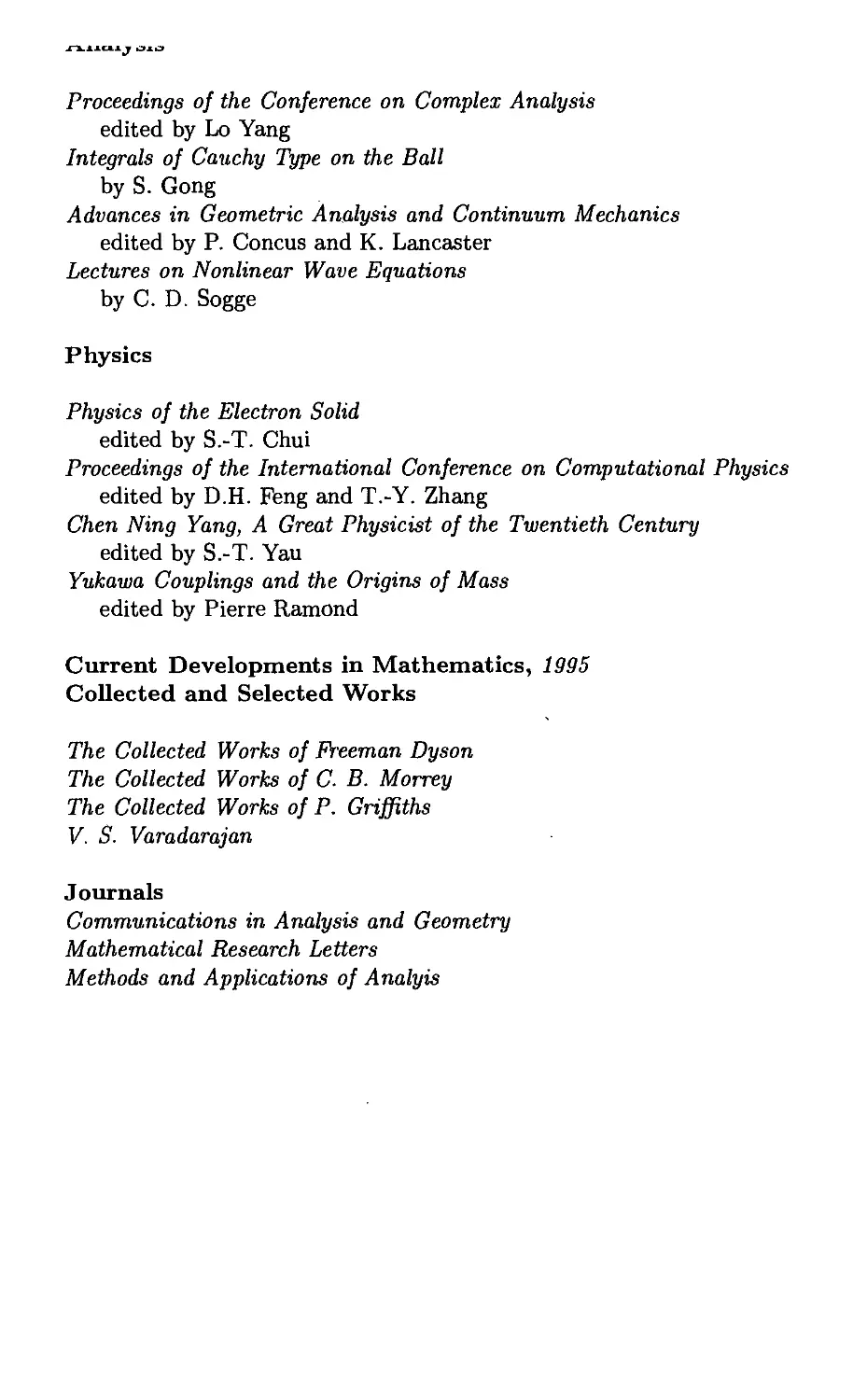
Proceedings of the Conference on Complex Analysis
edited by Lo Yang
Integrals of Cauchy Type on the Ball
by S. Gong
Advances in Geometric Analysis and Continuum Mechanics
edited by P. Concus and K. Lancaster
Lectures on Nonlinear Wave Equations
by C. D. Sogge
Physics
Physics of the Electron Solid
edited by S.-T. Chui
Proceedings of the International Conference on Computational Physics
edited by D.H. Feng and T.-Y. Zhang
Chen Ning Yang, A Great Physicist of the Twentieth Century
edited by S.-T. Yau
Yukawa Couplings and the Origins of Mass
edited by Pierre Ramond
Current Developments in Mathematics, 1995
Collected and Selected Works
The Collected Works of Freeman Dyson
The Collected Works of C B. Morrey
The Collected Works of P. Griffiths
V. S. Varadarajan
Journals
Communications in Analysis and Geometry
Mathematical Research Letters
Methods and Applications of Analyis

Monographs in Analysis
Editor
D.H. Phong
me I
me II
Integrals ofCauchy type on the ball
Lectures on nonlinear wave equations
fc&.nv

ALlUll>UllcU UUcllU
D.H. Phong
Columbia University
Department of Mathematics
New York, NY 10027
International Press Incorporated, Boston
P.O. Box 2872
Cambridge, MA 02238-2872
Copyright ©1995 by International Press Incorporated
All rights are reserved. No part of this work can be reproduced in any form,
electronic or mechanical, recording, or by any information storage and data
retrieval system, without specific authorization from the publisher. Reproduction
for classroom or personal use will, in most cases, be granted without charge.
Library of Congress Catalog Card Number: 95-082049
Christopher D. Sogge
Lectures on Nonlinear Wave Equations
ISBN 1-57146-032-2
Typeset using Latex
Printed on acid free paper, in the United States of America

Preface
Chapter I. Background and groundwork
§1. Linear wave equation: a review 1
§2. Energy inequality: a first version 11
§3. Existence and uniqueness for linear equations 17
§4. Local existence for quasilinear equations 23
§5. Local existence for semilinear equations in
(1+3)-dimensions 29
Notes 35
Chapter II. Quasilinear equations with small data
§1. Klainerman-Sobolev inequalities 37
§2. Global existence in higher dimensions 47
§3. Null condition and global existence when n = 3 54
§4. The restriction theorem and local existence
revisited 69
Notes 78
Chapter III. Semilinear equations with small data
§1. John's existence theorem for E1+3 80
§2. Inequalities of Hardy and Littlewood and radial
estimates 88
§3. Blow-up for small powers 92
§4. Strichartz estimates and existence for rough data 97
§5. Proof of the inequalities 110
§6. Improved results under spherical symmetry 122
Notes 127
Chapter IV. Global existence for semilinear
equations with large data
§1. Main results 128
§2. Energy estimates and the subcritical case 133
§3. A decay lemma and the critical case 137
Notes 147
Appendix: Sobolev estimates and Hardy-Littlewood
inequalities 148
Bibliography
Index
Index of notation
155
159
159

X XI/X^X-^LV^XJ
These notes are based on a course I gave at UCLA in the fall of 1994.
I tried to make the course self-contained, presenting as background basic
facts about the solution of the linear wave equation as well as the basic tools
from harmonic analysis that were used. The heart of the course concerned
three types of problems in the theory of nonlinear wave equations, that, to
varying degrees, have non-trivial overlap with analysis.
I first presented results concerning existence for certain quasilinear
wave equations, usually with small Cauchy data. The global results relied
on energy estimates, Sobolev's theorem, as well as Klainerman's generalized
Sobolev inequalities which make use of vector fields preserving the equation
Ou = 0. As a preview of things to come, we also presented a recent low-
regularity local existence theorem of Klainerman and Machedon which is
based on a variation of Strichartz's restriction theorem for the light cone.
The next topic we covered involved various results concerning semilin-
ear wave equations with small data. The first one presented was a
remarkable theorem of John which says that in E^3 the equation Ou = \u\K always
has a global solution for small smooth compactly data if k > 1 + \/2, while,
conversely, if k < 1 + \/2 there can be blow-up even for arbitrarily small
data. We followed John's argument for the blow-up part of the theorem, but
for the positive part we used a somewhat different argument which relies
on the Hardy-Littlewood maximal theorem. After this, we presented some
local and global existence theorems involving sharp regularity assumptions
on the data. The proof uses mixed-norm variants of the Strichartz estimate
mentioned before.
The last topic covered involves global existence results for arbitrary
smooth data for equations of the form Ou = — \u\K~1u in R^+3. The sign of
the nonlinearity is easily seen to be crucial. Using the earlier mixed-norm
estimates we can prove a classical theorem of Jorgens saying that there is
global existence for the "subcritical" range of k < 5. This argument also
gives a result of Rauch saying that there is global existence for the "critical"
case k = 5 if the data has small energy. Removing this assumption for this
case is delicate, and we shall do this using an argument of Struwe based
on a Morawetz-Pohozaev identity. This general result for the critical wave

equation in K++3 is due to Grillakis.
As I pointed out before, my main goal in preparing these informal
notes was to try to provide the students with a self-contained treatment
of certain problems in nonlinear wave equations. Because of focusing on
this (and my ignorance), I am afraid that my treatment of historical
background may be at best inadequate. For this reason, I refer the reader to
the excellent notes of Hormander [5], John [8] and Strauss [4]. These works
also supplement mine since they were used while preparing the course. For
background concerning the literature about generalized Strichartz
inequalities the reader should consult the excellent survey article of Ginibre and
Velo [4].
Finally, it is a great pleasure to thank the many people who have
helped me in this endeavor. Most of all, I would like to thank everyone who
participated in the course and offered many useful comments and criticisms,
including A. Chang, I. Laba, G. Simonett and W. Wang. I also would like
to thank S. Klainerman for his suggestions, and H. Lindblad, M. Machedon
and H. Smith for going through portions of the notes. I am especially
grateful to S. Cuccagna for thoroughly reading through the entire manuscript.
Lastly, I would like to thank D.H. Phong for encouraging me to undertake
this project.
This work was prepared using ^Vj5-T£JX and was supported in part
by the NSF.
Los Angeles CD. Sogge

CHAPTER I
BACKGROUND AND GROUNDWORK
In this chapter we present much of the background that will be needed
for the course. In the first section we go over the solution of the linear
Cauchy problem for the d'Alembertian. Treating the most important case
of three spatial dimensions first, we derive a classical formula which
expresses the solution in terms of spherical means involving the data. This
explicit formula will be used many times. Using it we can read off domain
of dependence and decay properties of the solution, both of which will play
an important role in most of the nonlinear problems we shall consider. In
§1 we also review the Fourier integral representation of the solution and the
concept of weak solutions. In §2 we go over basic energy estimates for the
d'Alembertian and linear perturbations. We then apply these estimates in
the next section to solve linear equations with data in a given L2-Sobolev
space. The rest of the chapter is devoted to proving local existence theorems
that will be used throughout. We first treat the quasilinear equations we
shall study and then turn to semilinear equations in three spatial
dimensions. In both cases, we shall see that, for sufficiently smooth compactly
supported data, there is either a global solution or else one of finitely many
derivatives, depending on the dimension, must blow up pointwise. Thus,
later in the course, when we wish to show that a given equation has a smooth
global solution, we need only show that, if u is a local solution in, say,
[0,T.) x Rn, then, for some fixed N, £W<N \dau{t, x)\ 6 L°°([0,T,) x Rn).
In the case of semilinear equations in E1+3, we shall see that we need only
show that u is bounded in such a strip.
§1. Linear wave equation: a review
This course will concern various perturbations of the linear Cauchy
problem
(Du(t,x) = 0
\u{0,x) = f{x), dtu(0,x) = g(x).
Here (t, x) GRxW1 = E1+n and
l

I
1. BACKGROUND AND GROUNDWORK
denotes the d'Alembertian. We are using the notation that dj = d/dxj and
dt = d/dt. At times we shall call t = x0, in which case dt = do-
Before turning to nonlinear problems it is of course important to
understand the solution of the linear equation (1.1). Let us start by reviewing
what happens in the (1 + 3)-dimensional case since this is the simplest one.
For related reasons many of the most important nonlinear results to follow
take place in the physically significant case where n = 3.
As we shall see later, the quickest way of solving (1.1) involves the
use of the Fourier transform. However, for many nonlinear applications it
can be useful to have a direct formula for the fundamental solution. In the
(1 +3)-dimensional case this involves the spherical means of a function h(x),
x 6 E3:
(1.2) (Arh)(x) = i- / h(x + ry) da{v),
47T JS2
with da(y) denoting Lebesgue measure on the unit sphere S2 C IK3, whose
area, we recall, is 4n.
Using the divergence theorem we get
dr(Arh)(x) = — (Vxh(x + ry),y)da(y)
4?r JS2
= — / Axh(x + ry) dy
4tt 7|tf)<1
r~2 f
= T7A* Kv)dy.
If we use polar coordinates we can rewrite the last integral
— / h(y)dy= / p2Aph(x) dp,
47T J\y-X\<T Jo
and so
dT(ATh(x)) = r 2AX / p2Aph(x)dp.
Jo
From this we get
d~r (r' ^Ar/l(a;)) = A*r2 A'M*),
or, equivalently, we find that H(r,x) = Arh(x) solves Darboux's equation

§1. LINEAR WAVE EQUATION: A REVIEW 3
Notice that r —> ATh(x) is even, and so the initial values are
(1.4) H(0,x) = h(x), dTH(0,x) = 0.
Next, let us suppose that u(t, x) is C2 and that it solves (1.1) in E1+3.
Let us set
U(r;t,x)= (ATu(t, -))(x) = — lu(t,x+ ry)da(y).
Then, by (1.3),
B2 2 8 r)2
Also, since d2u(t, x) = Axu(t, x)
AXU = — Axu(t,x + ry)da(y)
47T JS2
1 d2 f d2
= ^oT2JS2u{t'x + ry)My) = dT2U-
Thus
v{t,r) = rU(r;t,x)
solves the (1 + l)-dimensional wave equation
(d2v = d2v,
\ v(0, x) = rArf(x), dtv(0, x) = rATg(x).
Thus, if we recall the elementary solution of the (1 + l)-dimensional wave
equation, we get
1 1 fT+t
v = 2 [ (r + t)Ar+tf(x) + (r- t)AT-tf(x) ] + - / pApg(x) dp.
Since ATf and ATg are even functions of r, and since v = rU, we get from
this that
1 1 Ct+T
u=fr[(t + r)At+rf(x)-{t-r)At-rf{x)] + —J PApg(x)dp.
But u(t, x) = U(0; t, x), and so after letting r -+ 0, we finally obtain that
u(t,x) = dt(tAtf(x)) + tAtg(x)
(L5) =A/ [tg(v) + f(v)-(v„f(v),x-v)]Mv)-
^t J\x~y\=t

4 I. BACKGROUND AND GROUNDWORK
This shows that any C2 solution of the Cauchy problem in K++3 =
{(t, x) 6 E1+3 : t > 0} must be given by formula (1.5), and therefore must
be unique. Conversely, if / 6 C3(IK3) and g 6 C2(E3), then u given by
(1.5) solves the Cauchy problem (1.1). Notice also that the strong Huygen's
principle holds here, by which we mean that, for a given (t,x) 6 K++3,
u(t, x) just depends on the values of / and g (and derivatives) on the sphere
of radius t centered at x.
If n > 3 is odd this construction can also be used to derive a formula
for the solution of (1.1) depending on the spherical means in n-dimensions:
Arh(x) = / h(x + ty) da(y),
where wn_i denotes the area of the unit sphere 5n_1 C K". If n = 2k + 1,
and if we now let
v=(l§-rrir^Aru(t,x)
then it turns out that d\v = d^v. Also, the initial values now are
v(0,r) = (1-^.)k-1r>k-lArf(x), dtv(0,r) = (l|-)*-V^A^).
Let us call the first part of the data <j>{r) and the second one ^(r). Then, if
as before we use the fact that the spherical means are even functions of r,
we get
v(r,t) = i [<P(r + t)-<j>(r-t)] + ^[ <p(s) ds.
One can show that there are constants Cj, with
co = 1 • 3 • 5 • • • (2Jfc - 1) = 1 • 3 • 5 • • • (n - 2)
so that
(i|)4-1(r»*-V(r))=X;Ci^^(r).
Therefore, the arguments for n = 3 yield
u(t, x) = lim Aru(t,x) = lim —v(r, t)
r->0 r->0 Cgr
= —dr<t>\r=t + —1p{t) ■
Co Co

§1. LINEAR WAVE EQUATION: A REVIEW
5
Combining this with the formulas for ip and ip finally gives the following
formula for odd n:
(1.6) u(t,x) =
This somewhat involved formula shows that the strong form of Huygen's
principle holds in arbitrary odd dimensions. It also shows of course that
we get a C2 solution of (1.1) if / 6 C^n+3^2(Rn) and g 6 C^n+l^2(mn).
We also see from (1.6) that this much regularity is needed to ensure that
u 6 C2.
One can also obtain explicit formulas for even n using Hadamard's
method of descent. The idea here is that if u solves the wave equation in
K1+n, then it is also a solution of the wave equation in Ix En+1 which
happens to be independent of the last variable xn+i. Therefore, if n is even,
we can obtain a formula for u(t, x) by using the formula for the solution in
E x En+1 and then integrating out the redundant variable. Using this we
are led to the following formula for even n:
(1.7)
u(tx) = ? r «./!«.)**V-i f ^ty)
Ht'X) 1.3.5..-(n-l)W„ld*W 4|<iV/l3
Ivl5
dy
To prove this, one uses (1.6) to see that u(t,x) equals
tie1,—Tr-tllil)^^1 / f{*+tv)Mv,Vn+i)
1 • 3 • 5 • • • (n - l)wn dtK t dt' J\y\2+y2n+1=i
+ {\^l)^tn~l l 9(x + ty)da(y,yn+i)]-
t dt J\y\2+yl+1=i
This yields (1.7) since if we project the upper and lower hemispheres of Sn
onto \y\ < 1, then on each dy = y/l - \y\2 da(y,yn+i).1
Notice that (1.7) implies that for even n one only has a weak form
of Huygen's principle. Specifically, here, u(t, x) depends on the values of /
and g inside the solid ball of radius t centered at x.
Using (1.6) and (1.7) one can generalize the results stated before for
the (1 + 3)-dimensional case and say something about the decay of u for
compactly supported data:
'Here we have used the fact that if S C Rn+1 is a graph of the form S ■=
{ (x,h(x)) }, then da = ^1 + \Vh(x)\2dx.

6
1. tSAGKUKUUINU AINU ljIvwUiNlJVVUi>.rv
Theorem 1.1. If k = 2,3,...,
/ 6 C[n/2]+*(En), and g 6 C[n/2]+*-1(Rn),
then the Cauchy problem (1.1) has a unique soiutionu 6 C*(EV+n). Aiso, if
/ and g are supported in {x : \x\ < R} and ifn is odd then u(t, x) = 0, unless
\t—\x\ | < R, andu(t,x) = 0( (l + i)-2^- ). For such data, and even n, \x\ <
t + R, in the support ofu, andu(t,x) = 0( {l + t)~r^~ (1 + | t— \x\ | )-i*"~ ).
Here [n/2] denotes the integer part of n/2. Also, when we say that h =
0(a), we mean that \h\ < Ca, for some constant C Everything except the
statement about the decay of u for compactly supported data follows easily
from (1.6) and (1.7). This we leave as a good exercise for the reader. The
proof for odd dimensions is not very hard, while for even n one can prove
the result either directly from (1.7), or else from (1.6) via the method of
descent. Notice that even though only a weak version of Huygen's principle
holds for even n, the decay result somewhat compensates for this, saying
that, for data with compact support, u decays more and more rapidly as one
goes away from the light cone {(t, x) : t = \x\}. It turns out that the decay
rate stated above is sharp. It will play a very important role in the global
and long time existence results for nonlinear wave equations which are to
follow. In the next chapter we shall prove decay estimates using another
method.
The inhomogeneous wave equation.
Let us now consider the inhomogeneous wave equation with zero
Cauchy data at t = 0:
f Ow(t,x)=F(t,x), t>0
I w(0,x) = dtw(0,x) =0.
If F 6 C'i+I'1/2] we can obtain a C2 solution of this equation using our
solution of (1.1) and Duhamel's principle. Specifically, if for a given s > 0,
v(s; t, x) is the solution of the Cauchy problem
(92 - Ax)v = 0
v(s; 0, x) = 0, dtv(s\ 0, x) = F(s, x),
then the solution of (1.8) is given by
(1.9) w(t,x) = / v(s;t- s,x)ds.
Jo

Ji. MiNiiAK WAVil, fcyUATlUN: A KiWlil/W 7
To verify this, we first note that if w is given by (1.9), then w £ C2
by Theorem 1.1. Also, clearly w(0,x) = 0. The other boundary condition
in (1.8) is also met since
dtw(t,x) = v(t;0,x) + / dtv(s;t — s,x)ds= / dtv(s;t — s,x)ds.
Jo Jo
Finally, Ow = F, since differentiating the last formula gives
d2w(t, x) — Axw(t, x) = dtv(t; 0, x) + / (<9t2 - Ax)v(s; t - s,x) ds
Jo
= dtv(t;0,x)=F(t,x).
Notice that (1.9) implies that a form of Huygen's principle also holds
for the inhomogeneous wave equation. It says that for even spatial
dimensions w(t, x) depends on the values of F in the solid backward light cone
through (t,x):
K,x = { (*» V) '■ ° < s < *. \x-y\<t-s},
while for odd n a stronger version holds, saying that w(t,x) depends only
on the values of F on the boundary of the solid backward light cone, that
is,
Ft,x = dAt,x = {(s,y)- 0<s<t, \x-y\ = t-s}.
In the (1 + 3)-dimensional case, one can use the formulas for the
solution of the Cauchy problem obtained earlier to get a simple formula for
the solution of (1.8) when n = 3:
w(t,x) = — / (t-s)F(s,x- (t- s)y)da(y)ds
4?r J0 JS2
= — / F(s,x-y)da(y)ds
4tt J0 t- s JM=t-3
(1.10)
4?r JM<t \y\
da(s,y)
hi- fM
8n J??,. ' \(t-s'x~y)\
Thus, when n = 3, a fundamental solution for □ is E+ = da(t, x)/8ir\(t, x)\,
where da here denotes Lebesgue measure on the forward light cone through

8
I. BACKGROUND AND GROUNDWORK
the origin in E1+3. This is called the forward, or advanced, fundamental
solution. Although it is not the unique fundamental solution, it is the unique
one with this support. See Hormander [2, chpt. 6].
Notice also that (1.10) implies the following useful comparison
theorem, which is valid in 3 spatial dimensions. Namely, ifw\ andw2 have
vanishing Cauchy data att = 0 and if Dwj = Fj then \wi| < W2, if \Fi\ < F^.
The reader can verify that this comparison theorem also holds when n = 2,
but, unfortunately, not when n > 3. Formula (1.10) also shows that when
n = 3, the mapping from F to w sends bounded functions to (locally in
time) bounded functions. This too breaks down in higher dimensions, due
to the fact that the solution to the Cauchy problem becomes increasingly
singular as n increases.
Note that if F(t, x) is spherically symmetric in the spatial variables
then so is w. Abusing notation a bit and writing then w(t,r) = w(t,x)
if |a;| = r, we can derive a simpler formula for the solution under the
assumption of spherical symmetry when n = 3, namely,
(1.11) rw(t,r)=l[ f F(s,p)pdpds.
1 J0 J\r-(t-s)\
To prove this, one uses the second equality in (1.10) and the fact that
if h is spherically symmetric
/ H\y\)da(y)= / h{p)pdp, r = \x\.
J\x-y\=t r J\r-t\
To prove this, write y = x + tu, with w = (sin^cos^, sinflsin^, cos#)
0 < 4> < 27T, 0 < 6 < 7r, and recall that with this parameterization da(u) =
sinddcj)dd on S2. Thus, assuming as we may that x = (0,0,r), the left side
of our identity is
t2 I h(\x + tu\) da(u) = 2-Kt2 I h(y/t2+ r2+2rtcos6) sin0d0
Js2 Jo
h( ^t2 +r2 + 2rt\) dX = / h(p) pdp,
-1 r J\r-t\
where in the last step we used the fact that
pdp - rtdX , if p = \A2 +r2 + 2rtX.
When we study semilinear wave equations in E1+3 we shall use the
comparison theorem mentioned above to reduce matters to proving
estimates under the assumption of spherical symmetry, where we can make use
of the simple formula (1.11). A related formula holds in other dimensions
as well, but the (1 + 3)-dimensional case is the most straightforward.

§1. LINEAR WAVE EQUATION: A REVIEW
9
Fourier transform.
Let / denote the Fourier transform of /:
/(0= / e-»*/(x)dz.
Also, let2
S(Rn) = {/ 6 C°°(Rn) : \daf(x)\ < Ca,N(l + \x\)-N , Vo, TV } .
Then recall that Fourier's inversion formula holds for / 6 <S(Kn):
(1.12) f(x) = (27T)-1 / e»-«/(0^.
Using this we can quickly write down a formula for the solution of
(113) (Du(t,x) = F(t,x),t>0
\u(0,x) = f(x), dtu{0,x) = g(x),
if, say, f,g 6 S(Rn) and F 6 C2(E;S(En)). Specifically, u is given by
u(t,x) = (27r)~n [ e",£ cost|£|/(0d£
(1.14) +(27r)-"/ e^^giQdZ
Jun Isl
+ (2,)-/7 e^^_£M^0^S)
if F(a;, £) denotes the Fourier transform of x -»• F(s, a;). We leave the proof
of (1.14) as a good exercise. One just uses (1.12) and DuhamePs principle.
Weak solutions.
So far we have just dealt with classical solutions of equations like
(1.13). By this we mean that u 6 C2 so that the derivatives involved make
sense pointwise. At times we shall want to deal with weak, or distributional,
2Here we are using the short-hand notation that, for a given multi-index a
(<*i an),d"=d^.--d^.

1U i. tirtUivoawuiNi; /vi-.^
solutions of (1.13). To define this notice that if u € C2 and if (1.13) holds,
then, if ip(t, x) 6 Cg°(R1+n), integration by parts gives
/ / tpF dtdx = tpOu dtdx = / / (tpdfu - Axipu) dtdx
t>0 t>0 t>0
= - // dttpdtudtdx - / ^(0,a;)9tu(0,a;)da; - // Axil>udtdx
t>o t>o
= dfyudtdx + / 3t^(0,a;)u(0,a;)da; - / ip(0,x)dtu(0,x)dx
J J Jw Jun
t>0
- Axi/mdtdx
t>o
= l[(d?-Ax)ilmdtdx- j ip{0,x)dtu(0,x)dx
t>o
+ / dttp(0, x)u(0, x) dx.
Jw
Hence, we have arrived at the desired conclusion that
(1.15) j j i)F dtdx = j Dim dtdx
t>o t>o
-/ iP(0,x)g(x)dx+ [ dtip(0,x)f(x)dx,Vi>eC^(Rl+n).
Jw Jun
Let £' denote the dual of Cq°. Then if / and g are in £'(Rn) and if u and
F are in £'(K1+n) this equation makes perfect sense. If this happens, we
say that u is a weak (or distributional) solution of (1.13).
One can also talk about weak solutions of variable coefficient
equations. Assume T > 0 and that a(t,x), V{t,x) and g-*k(t, x) are real and
in C2([0,T) xf1), where 0 < j,k < n and gjh is symmetric. Let us, for
convenience, put do = dt, and set
n n
(1.16) Lu= J2 9ik(t,x)djdku + Y^bJ(t,x)dju + a(t,x)u.
j,k=0 j=0
Then suppose that u 6 C2([0,T) x W1) solves
(1.17) { L
Lu = F, 0<t<T
(0,x) = f(x), dou(0,x)=g(x).

If L* = ^djdkg^ - ^2djbi + a denotes the adjoint operator, then
integrating by parts as above shows that, for ip 6 Cq°{(-oo,T) x Rn):
il>F dtdx
0<t<T
Vi\)udtdx- I ij(0,x)goo(0,x)g(x)dx
0<t<T
+ f [{d0(900ij))(0,x)-(b04,)(0,x) + 2J2{dj(W0))(0,x)]f(x)dx.
jRn i=i
Here too we could say that, if f,g,u, and F are distributions as above,
then u is a weak solution of (1.17) if the above formula holds for all
r/> 6 Cq°((-oo,T) xf). One could also of course define the notion of
weak solutions involving coefficients which are only appropriate types of
distributions.
Often we will have a sequence of functions um each of which is a
classical solution of equations of the form (1.13) with, say, Cauchy data and
right sides F = Fm also depending on m. Then, if um -> u in £'(K1+n),
and if we wish to show that the distributional limit is a solution of the same
type of equation, we must check that Fm converges to a limit F in £'(K1+n)
and that the Cauchy data um(0, •) and doum(0, •) converge in £'(Rn) to
say / and g, respectively. If this is the case then it follows of course that u
is a weak solution of (1.13).
The same considerations apply to variable coefficient problems as well.
Here the coefficients gjk and b> may also depend on m, in which case we
need to check that the coefficients converge appropriately.
One can use such an approximation argument to see that Theorem
1.1 extends to the case k = 0 and 1, if one allows weak solutions. The
weak solution of (1.1) with data (f,g) 6 Cl(n-3)/i]+k+l x cUn~3W+k will
still be given by (1.6) and (1.7), and so one gets time decay as before. The
uniqueness part of the theorem for k = 0,1, would require a different proof
from the one corresponding to k > 2; however, it follows from results in
§3. Also, if, say, F 6 C(K|+3), then the weak solution of Ow - F with
zero data is given by (1.10), and (1.11) also remains valid if F is spherically
symmetric.
§2. Energy Inequality: a first version
The most basic estimate for the d'Alembertian comes from an appli-
//

u
1. BACKGROUND AND GROUNDWORK
cation of the identity
n
(2.1) d0uOu = i<90|u'|2 - Yl dj(d0udju)
3=1
= div (d0ug0u' - \g0(u',u')l) .
Here u' = Vu = (dou,... ,dnu), 1 = (1,0,... ,0), and
5o =sg*=diag(l,-l,. ..,-1)
is the Lorentzian matrix. The second formula in (2.1) will be useful when
dealing with variable coefficients.
If u 6 C2 vanishes for large x we can integrate with respect to these
spatial variables to get
3=1
I dx
flbll«,(*»-)lli2= [d0\u'\2dx= f do\u'\2dx-2j2 f dj(d0udju) dx
= / div (|u'|2, -2doudxu)i
= 2 JdovDudx < 2\\u\t, -JII^IP"^, OHz^ •
But this implies
d0\\u\t,-)\\L2<\\Uu(t-)\\L2,
and, hence, we obtain the energy inequality for the d'Alembertian:
(2.2) ||«,(t)-)llw<ll«,(0,-)ll^+/ \\au(s,.)\\L2ds.
Jo
If Ou vanished identically, this inequality would be replaced by an
equality, meaning that u would have constant kinetic energy |||u'(£, -) J|^2.
Thus, if u solved the homogeneous Cauchy problem (1.1), we would have
J \u'(t, x)\2 dx = J \g(x)\2 dx + J \(dxf)(x)\2 dx .
Handling the L2 norm of u itself is not as natural and the estimates
are much less favorable. For instance, if u solved the Cauchy problem
□u = 0, u(0,a;) = 0, dtu(0,x) = g(x),

§2. ENERGY INEQUALITY: A FIRST VERSION 13
then by Plancherel's theorem and (1.14)
J \u(t, x)\2 dx = (27T)-" J\ g(0 sin(t|fl)/|£| |2 d^ •
Based on this one sees that a sharp estimate for the L2 norm of u must
contain constants which blow-up as t —> oo if the right side involves Sobolev
norms of the data:
\Mt,-)\\L2<\\f\\L2 + {l + t2)l'2\\g\\H-i.
We could of course also have proven (2.2) using Plancherel's formula
and the Fourier transform formula (1.14) for u. However, unlike Fourier
integral methods, the energy method is stable under perturbations and
requires much less regularity on the coefficients.
To illustrate this, let us see that the above argument applies to variable
coefficient operators which are sufficiently close to the d'Alembertian.
Proposition 2.1. Let u 6 C2([0,T] x R") vanish for large x and
satisfy
(2.3) '£gik(t,x)djdku = F, 0<t<T.
If gik = diag (1, -1,..., -1) are the coefficients of the d'Alembertian set
rik(t,x)=gik(t,x)-gZk.
Then if
(2.4) £>j*(*,*)|<i, 0<t<T,
it follows that for 0 < t < T
(2.5) \\u'(t,-)\\L2
<2(||u'(0, -)\\L2 + J' \\F(s, ■)\\L2ds)exp{Jt2^2\\d^k(s, -)IU-d*)-
Proof. Let Ogu denote the left side of (2.3). Then we shall need the
following variation on (2.1):
d0ungu = div (dou ]T gjkdku - ^Y^9jkdjudku 1) - R,

14 I. BACKGROUND AND GROUNDWORK
where
n n
R = 53 djgjkdkud0u - \ 53 dogjkdjudku
j,k=0 j,k=0
n n n n
= ^d0g00(d0u)2 + 53 £ djg^djudou - | £ ^ dogjkd3udku.
j=l fc=0 j=l k=0
Let e(u) be the energy density associated with Og, that is, the 0-
component of the divergence:
e{u) = J2g0kd0udku- ^g^djudku
\\u'\2 + i ^ r0*^^ - | ^ ^ r^djudku.
fc=0 j=l fc=0
Thus (2.4) implies that for fixed t
(2.4') \\u'\2<e{u) <\u'\2.
We can use this to estimate R:
\R\ < \u'\2 53 |^*| < 4e(u) 531^*|
Let
£(*) = e(u)(t,x)dx.
Then
doE(t) = / <9oe(u)(i,a;)da;
= / div (a,u 53 S^5*" - IS gikdjudku 1) dx
= / 9ouDsu da; — / i? da;
= / <9oit(i, a;) F(£, a;) da; - Rdx.
Consequently,
flb^(t) < \\F(t, -)\\L2 \\dou(t, • )||L2 + J \R\ dx
<2\\F(t, ■)\\L2E(t)l/2+^WW"(t, -)\\L°°E(t).

§2. ENERGY INEQUALITY: A FIRST VERSION 15
This gives
doE{t)1'2 < \\F(t, ■ )||L, + 2 Y, W*(*. ■ )h°°E(t)1/2 ,
which in turn implies that
d0[E(t)^2exp{- A^HW -)IU-d«)]
Jo
< \\F(t, ■ )\\L2 exp( " / 2 £ ||c^*(S, • )||Lo. d«) < \\F(t, ■ )\\L2.
If we integrate, we conclude that
E{t)1'2
<{E{Q)l'2+ f \\F{s,-)\\L2ds)exv( f 2 V||^'*(«, -)IU- da).
Jo Jo
Since this estimate and (2.4') imply (2.5), we are done. □
Let us end this section by seeing how the proof of (2.2) can be used to
prove a useful uniqueness theorem of John [4], [8] for nonlinear equations.
Theorem 2.2. Let u be a C2 solution ofOu = F(u,u',u") in the
backward light cone through (to,xo):
A(to,*o) = {(t,x)G[0,to)xRn : \x-x0\ <t0-t}.
Assume that
(2.6) F(0,0,«")=0.
Then u vanishes in A,~ „ > if
(2.7) 0 = u(0,x) = dtu(0,x) when \x — xo\<t0.
Prom this, one immediately sees that a form of Huygen's principle
holds for this type of nonlinear equation:
Corollary 2.3. Let (2.6) hold. Then if u(t,x) is a C2 solution of
Du = F(u,u',u") in [0,T) x Rn and ifu(0,x) = dtu(0,x) = 0 for \x\ > R,
then u(t, x) = 0 if \x\ > R + t and 0 < t < T.
Proof of Theorem 2.2. We shall use the energy method. To do
this we need to write AZ . as the union of a one parameter family of
hyperboloids, on each of which we can control the integral of \u'\2 using

16 1. BACKGROUND AND GROUNDWORK
a variation of the argument used to prove (2.2). In the end, we shall see
that u has zero energy in A,~ x . which implies that it must vanish there
because of (2.7).
To be more specific, for 0 < s < t0 let
4>{a,x)=to- {{t0 - s)2 + t^{2t0s - s2)\x - xo\2f'2 .
Then
cj)(0,x) = 0, and lim <fi(s,x) = to — \x — xo\.
S—Ho
Hence, if
Rs = { (t,x) : 0 < t < <p(s,x), \x - x0\ < t0 - t} ,
then
Ar.o,x0)= U *•■
0<s«o
Notice also that in A,, „ >
t0 2(2t0s - s2)\x — x0\
[ (*o - *)2 + *o 2(2*o« - «2)|ar - aro|2 ]'
\VX<I>{S, X)\ = -TJ5 < V[S0) < 1 ,
if 0 < s < s0 < t0-
To use this let
As = {(t,x) : t- <f>(s,x), \x ~x0\ < t0} .
Note that the outward unit normal at (cj)(s,x),x) 6 As is
(l,-Vx0)/v/l + |Vx0|2.
Thus, by (2.1), (2.7) and the divergence theorem,
/ 2dtuF dtdx = / 2dtu Ou dtdx
Jr, Jr,
(2.8) = / {\u'\2 + 2dtuVxu-Vx<p)- *°
>(l-6(s0)) [ \u'\2da/JlTW^W,
Ja,
if 0 < s < s0.

§3. EXISTENCE AND UNIQUENESS FOR LINEAR EQUATIONS 17
To get a bound in the other direction, let us first notice that, by (2.7),
/ \u{t,x)\2dt<tl I \dtu(t,x)\2dt.
Jo Jo
Also, by (2.6),
2\dtuF\<C(\u\2 + \u'\2).
Thus,
(2.9)
/ 2dtuF dtdx < C{\ + t2,) / \u'\2 dtdx
Jr, Jr,
= C(l + t2) / / docP\u'\2-?===
JO J A, V/l + V;
\/l + |VX0|
2
If we set
1(a) = f \u'\2da/^l + \Vx<p\2,
Ja,
then (2.8) and (2.9) imply that for 0 < s < s0 < t0
(l-8(s0))I(s)<C(l+t2) sup \dt<p(t,x)\ [ I(t)dt.
0<t<s0 Jo
|x-x0|«o
Applying Gronwall's inequality shows that I(s) — 0 for all 0 < s < to.
Hence v! = 0 in A~ ,, and since this implies that u must also vanish
(<o,xo)' r
here, on account of (2.7), we are done. □
§3. Existence and uniqueness for linear equations
Let us now assume that L is as in (1.16), and that all of its coefficients
are C°° with uniform bounds on each derivative if (t, x) 6 [0,T] x P. As
before, we shall also assume that (2.4) holds. In a moment we shall see that
Proposition 2.1 can be used to prove the following useful result.
Theorem 3.1. Let s 6 Z, 0 < T < oo, and assume that L is as
above. If
u 6 C([0,T]; Hs+l) n Cl([0,T\; HS),
and if
Lu€Ll([0,T];H'),
then for 0 < t < T we have
(3.1) £ \\dau(t,-)\\H-
c,t (Y, h^0' ■ )H"* + / ||Lu<r' • )n**dT) ■
<
<*I<1

18 I. BACKGROUND AND GROUNDWORK
Here Hs denotes the L2-Sobolev space with norm
\\f\\H- = iia-A)'/2/iu* = ((27T)-" / |/(o(i + i^i2r/2|2^)1/2-
And so, if s is a nonnegative integer there is a constant Cs so that
C7l\\f\\H-< £||0Q/IU* <C.\\f\\H--
\a\<a
Also, if X is a function space, then the notation F(t,x) 6 Ca([0,T];X)
means that, on [0,T], F(t, ■) is a Ca function with values in X.
Let us postpone the straightforward proof for a moment and see now
how Theorem 3.1 implies the following useful result for linear hyperbolic
equations.
Theorem 3.2. Let s 6 Z. Then ibr every f 6 Hs+l(Rn), g 6 Hs(Rn)
and F 6 L1([0,T];#s(En)) there is a unique
(3.2) u 6 C([0,T]; #S+1) n Cl([0,T]; HS)
solving
Lu = F, 0 < t < T
Proof of Theorem 3.2. The uniqueness is easy. If u\ and ui are
two solutions with the same data, then u\ — U2 has zero Cauchy data at
t — 0 and L{u\ — u?) — 0. Therefore, if each satisfies (3.2), we may apply
(3.1) to see that u\ — U2 — 0, giving the result.
For the existence part, let us assume for the moment that the Cauchy
data is zero, that is, / = g — 0 in (3.3).
If ip 6 C0oo((-oo)T) x Rn) then applying (3.1) to L*, with t replaced
by T — t, yields
T
Uit, -)\\h-<C f \\L*^(T,-)\\H...1dr.
Jo
Hence, since Hs and H~s are dual spaces, for fixed F 6 L}([Q,T]\HS) we
have
\{F,i,)\ = \l (F{t,-),1>(t,-))dt\<C [ ||LV(*,-)llff—'*•
Jo Jo

$3. EXISTENCE AND UNIQUENESS KOH L1NEAH EQUATIONS 19
So, by the Hahn-Banach Theorem, there is a u 6 L°°([0, T]\ Hs+1) satisfying
u = 0 when t < 0 and, moreover,
(F, </>) = («, L» , W> 6 C0°°((-oo,T) x K").
Consequently, Liz = F in (0, T) x Rn in the sense of distributions. We have
to check that u satisfies (3.2) and hence has vanishing Cauchy data.
Assume for the moment that F 6 Cq°. Then if v — dtu (3.3) gives
n n
dtv + 2^2gj0(t,x)djv + b°v = - ^ 9ik(t,x)djdku -^V {t,x)d3u
3=1 j,k>\ j=l
-a(t,x)u + F(t,x) &L°°([0,T];Hs-1).
By elliptic regularity, dtu — v 6 L°°([0,T];^s-1). Using the equation
again we see that dfu 6 L°°([0,T];Hs-2). Thus, u 6 C([0,T};Hs-1) n
C1 ([0, T]; Hs~2). This is weaker than (3.2); however, since we are assuming
that F 6 C§° and / = g = 0, we may replace s by s + 2 and consequently
obtain a solution satisfying (3.2) to which we may apply (3.1).
To remove the assumption about F, choose a sequence i^m £ Cq30 so
that if F is as in the theorem
T
I \\F(t,-)-Fm(t,-)\\„.dt^0.
Jo
Then if um 6 C([0,T];Hs+1) n C1([0,T];Fs) solves Lum = Fm with
vanishing Cauchy data, it follows from (3.1) that um is a Cauchy sequence in
C([0, T]; Fs+1)nC1 ([0, T]; #s) whose limit solves the equation and satisfies
(3.2).
To solve the equation with the given Cauchy data, assume first that
the data belong to Cq°. We then let uo(t,x) = f(x) + tg(x), so that uo
has the right Cauchy data. Then, if v solves Lv = F — Luo with zero data
at t = 0, it follows that u = v + uq will solve (3.3) and satisfy (3.2). We
assumed that the data were smooth to ensure that Lu0 6 ■L1([0,T];i/''').
This assumption can be removed, using (3.1), by the above approximation
argument. □
We still need to prove Theorem 3.1. We shall require the following
result which will be used many times in the future.
Lemma 3.3. (GronwalPs Inequality) Suppose that A, E and r are
bounded nonnegative functions on [0, T] and that E is increasing there. If
A{t) < E(t) + / r(s)A(s) ds, 0<t<T,
Jo

20
I. BACKGROUND AND GROUNDWORK
it follows that
(3.4) A(t)<E(t)exp( [ r(s)ds).
Jo
Proof of Gronwall's inequality. It suffices to prove the estimate
when t = T, in which case E(t) may be replaced by the constant E =
E(T) > E(t). Then, if we set for 0 < t < T
B(t)=E + [ r(s)A(s)ds,
Jo
it follows that
B'(t) = r(t)A(t)<r(t)B(t).
Thus,
dt(B(t)exp(- / r(s)ds)} <0.
This implies that B(t) exp( - /„* r(s) ds) < B(0) = E, and so
A{t) < B(t) < Eexp( J r(s)ds) ,
Jo
which finishes the proof. □
To proceed, let us first see that (3.1) holds when s — 0. Since the
coefficients of L are bounded
|| J2(9Jkdjdku)(r,-)\\L2 < \\Lu{t, -)\\l,+C ]T \\dau{r, ■ )||L, .
W<i
Hence, (2.5) gives
<Ct(\\u'(0, -)\\l,+ f\\\Lu(r,-)\\L2+ J2 \\dau(r,.)\\L2)dr).
Jo rri.
a\<\
To estimate the I? norm of u(t, ■) itself, we just use the fundamental
theorem of calculus and Minkowski's integral inequality to see that
Ht, ■ )\\L2 < ||«(0, -)\\L2 + / \\dtu(T, ■ )\\L2 dT .
f\\dtu{r,-\
Jo

§3. EXISTENCE AND UNIQUENESS FOR LINEAR EQUATIONS ' 21
Combining the last two inequalities then leads to
£ \\dau(t,-)\\L2
|a|<l
<CT{ £ Wu{Q,-)\\L,+f { £ \\dau{T,-)\\Li + \\Lu{T,.)\\L2)dT),
|q|<1 ° |a|<l
and hence, by (3.4),
(3.5) ]T II3Q«(*,-)IU*
H<i
< C^( £ ||aQ«(0, -)ll^ + T Hi«(r, • )\\L> dr) .
|a|<l ^
This proves Theorem 3.1 when s = 0. To handle s 6 N, note that,
after dividing by g00, we may assume without loss of generality that the
coefficient of df is one. Then
Ldgu = d5Lu+[L,d5]u,
where [L,d%] — Ld" — d"L denotes the commutator, which is of order
< |q|+1, and, because of our assumption about g00, involves no ^-derivatives
of order > 1. Therefore, if we apply (3.5) to d%u with |/3| < s, we find that
\\dgu(t,-)\\L, + \\df!u'(t,-)\\L,
<c(||af«(o,-)ll^ + liaMo,-)ll^
+ jT(|| [L,dg]u(T,-)\\L2 + \\d^Lu(r,-)\\L2)dr)
<c(\\dgu(0,-)\\L3 + \\df!u'(0,-)\\L2
+ f{ J2(Wd>(T'-)\\^ + \\d>'(r, ■)\\L>) + \\d0xLu(T,-)\\L2)dT).
Jo , i^
|a|<s
If we sum over \0\ < s and then apply Gronwall's inequality as before, we
conclude that for s = 0,1,2,...
(3-6) 52{\\d°u(t,-)\\L2 + \\d5u'(t,-)\\L2)
\a\<s
<CT {\\d>(0, -)\\l' + \\d>'(0, -)\\l> + f \\d«Lu{T,-)\\L2dT),

22
I. BACKGROUND AND GROUNDWORK
which is equivalent to (3.1) for such s.
To handle the case where s 6 —N, we shall apply the last inequality
to
v(t,-) = (i-Ayu(t,-),
where A — Ax. First, though, note that
(3-7) \\v(t, .)\\H- = ||(/- A)s/2u(t, -)\\l> = IN*, -)\\h- ■
Since we are now assuming -s 6 N, we may apply (3.6) to obtain
(3-8) £ (\\d>(t,-)\\Li + \\dy'(t,.)\\L2)
\a\<-s
<C ]T (||d>(0, -)ll^ + RV(0,-)ll^+ f\\daxLv{T, -)\\L2dr).
\a\<-s J°
Note that
(/ - A)-*Lv = Lu+[(I- A)~s, L]v.
Hence multiplication by (/ - A)s/2 gives that the last term in (3.8) can be
estimated as follows:
(3.9) £ \\d«Lv{T,.)\\Lm\\Lv{T,-)\\H-,
|q|<-«
<\\Lu{t, -)\\H, + \\[{I - A)~\ L]v{t, -)\\H. .
Now [ (/ - A) s, L) is a differential operator of order < -2s + 1 involving
no ^-derivative of order > 1. Hence, we can write it as
[(/-A)-*,L]= Y, daxaa0yd0xd\
|<*|,|/3|<-«
|7|<1
where, because of our assumptions on the coefficients of L, aapy = 0(1).
Since (/ — A)s/2dx is bounded on L2 for |q| < —s, we conclude that
\\[(I-*)-,L]v(t,-)\\h.
(3.10) Ifl*--
\0\<-s
|7|<1
<c J2 (\\d>(T,-)\\L2 + \\dy'(r,-)\\L2).
\a\<-

§4. LOCAL EXISTENCE FOR QUASILINEAR EQUATIONS 23
Using (3.9) and (3.10), we conclude that the left side of (3.8) is
dominated by
£ (llWOl-)lli* + l|0°t;l(Ol-)l|i*
\a\<-a
+ j\\\Lu(r, ■)\\H'+\\dy(r,.)\\L2 + \\dy(T,-)\\L2)dr).
Since, by (3.7), the left side of (3.8) is comparable to
\\u(t,-)\\H.+\\u'(t,-)\\H.,
an application of Gronwall's inequality now gives
£ \\dau(t,-)\\H. <cT,.{ £ iiaa«(o, -)\\H. + f\\Lu{T, -)\\H.).
|q|<1 jq|<1 J°
Since we have now established (3.1) for negative s, the proof of
Theorem 3.1 is complete.
Remark. For simplicity we only stated Theorem 3.1 for s = Z+ since
that is all that we shall require. However, if one is willing to use pseudo-
differential operators it is easy to extend Theorem 3.1, and hence Theorem
3.2, to all set. In fact, by applying (3.5) to (/ - A)s/2u we see that
£ \\dau(t,.)\\H.<c(Yl \\dau(o,-)\\H-
|a|<l |a|<l
+ J\ \\Lu(t, -)\\h. + \\[L, (I-Ay/2}u(r, -)IU-) dr) .
Using the calculus of pseudo-differential operators one can show that
II[l,(i- Ay/2}u(t, ■ )\\L, < c £ HaQ«(r, ■ )W«- •
|a|<l
leading to (3.1) for arbitrary sEl after an application of Gronwall's
inequality.
§4. Local existence for quasilinear equations
The goal of this section is to prove a local existence theorem for
equations of the form
f41) (Z9jk(u,u')djdku = F(u,u')
U(0, ) = /, dou(0,) = g.
We shall assume that gjk and F are C°° with all derivatives 0(1). We also
suppose that F(0,0) = 0, and that
Ei^-^i<i/2,
if, as before, gi are the coefficients of the d'Alembertian.

24
I. BACKGROUND AND GROUNDWORK
Theorem 4.1. Let s > n + 2. If(f,g) 6 Hs+l x Hs then there is a
T > 0, depending on the norm of the data, so that the Cauchy problem
(4.1) has a unique solution satisfying
(4.2) ^ ||dQu(*,-)llL*<°o. 0<t<T.
\a\<a+l
Also, ifTt is the supremum over all such times T, then either T* = oo or
(4.3) £ \dau(t,x)\ i L°°([0,T<) x W1).
|a|<(s+3)/2
Proof. Let us start with existence since uniqueness will follow from
the arguments we shall use to establish this half. We shall find a local
solution to (4.1) using the method of Picard iteration. To do this we let
14-1 = 0,
and then define um, m = 0,1,..., inductively by
(41,, ( Y,93k{Um~l,v!m-l)d3dkUm = ^(Um-l.Um-i)
I wm(0, •) = /> doum(0,)=g.
We shall assume for the sake of convenience that the data are in S, since
at the end one can remove this assumption and replace it by the one in the
theorem by an approximation argument which is similar to the one used
in the proof of Theorem 3.2. If we make this assumption we can apply the
local existence theorem for linear equations and an induction argument to
see that for every m there is a C°° solution of (4.1').
We claim that if T is small enough there is a constant A so that we
have the uniform bounds
(4.4) Am(t) = J2 (\\daum(t, ■ )||i2 + ||d<Vm(t, • )||L2 )
\a\<s
< A<oo, 0<t<T.
Recall that Sobolev's theorem (see Appendix) implies that
\daUm(t,x)\<C Yl ll^«m(*,-)ll^-
|/3|<H + [(n+2)/2]
Therefore, if (4.4) held we would have
(4.5) \daum(t,x)\ <CAm(t), 0<|a|<s + l-[(n + 2)/2].

By Proposition 2.1, or more precisely, (3.5), (4.4) holds for any fixed
T when m = 0. So to proceed, let us suppose that the estimate holds for
a given T and constant A, to be determined later, when m is replaced by
m - 1. We shall then prove L2 estimates for \daum\ + \dau'm\ if |q| < s,
using (3.6) and
(4.6) Y,9jk^m-i,u'm_l)djdkdaum
if [-, •] denotes the commutator.
To apply our energy estimate (2.5), we need to estimate the L2 norm of
the right side. We claim that each term on the right is a linear combination
of a bounded factor times factors involving derivatives of um-i, where at
most one such factor involves a derivative of order > [(s + 3)/2]. If this were
the case, since
[(* + 3)/2]<* + l-[(n + 2)/2] <^=> s>n + 2,
we can use (4.5) to pointwise estimate all but one of the factors, and leave
the term with the highest number of derivatives inside the L2 norm to be
estimated by Am-i.
Let us start by seeing that our claim is valid for the first term in the
right side of (4.6). By Leibnitz's rule, it is a finite linear combination of
terms of the form
F^daium-i ■■■darum-ld0ldjlum-l ...d0>duum-x,
where
^N+^IAI <\a\ <s.
Hence, at most one of the ai or /3j can have order larger than s/2, which
means that there is at most one factor where um_i is differentiated more
than 1 + s/2 = (s + 2)/2 times. Therefore, as pointed out before, we can
use (4.5) and the induction hypothesis to pointwise estimate all but one of
the factors by CA. Since F7 = 0(1) and F(0,0) = 0, we therefore get that
\\da(F(um-1,u'm_l)(t, -))\\L2 <CA, 0<t<T,
where Ca can be taken to be a fixed constant times (1 + A)s.
We can similarly estimate the term involving the commutator. We
first notice that it is a finite linear combination of terms of the form
aQ'(^*(«m-ll«,m_1))-aQ2a*«,

ZU i. ii.rt.Ori.ljn.ULi IN JJ rtlNJJ OiVULilNJJ VVUK.K
where
|qi| > 0, |q2| < s, and |qi| + |q2| = \a\ + l < s + 1.
This, in turn, can be written as a finite combination of terms of the form
(dV*)(«m-l, u'm-l)0Q1«m-l • • • d^Um^ ^<_L • ■■ff"v!m_ld0U,m ,
where at most one of the integers |oj|, 1 + \jj\, or 1 + |/3| can be larger
than 1 + [(s + l)/2] = [(s + 3)/2]. This means that in the above expression
there is at most one factor where um_i or um is differentiated more than
[(s + 3)/2] times. Thus, by (4.5) and the induction hypothesis, it follows
that the L2 norm of the last term in (4.6) is controlled by
CA(Am(t) + l),
where CA is as above.
If we use the estimates we have just obtained for the L2 norm of
the right side of (4.6), we can apply the energy inequality, (2.5), and the
argument used to establish (3.5) to obtain for |q| < s
\\daUm(t,-)\\L2 + \\dau'm(t,-)\\L*
< C(\\daum(0, -)\\L3 + \\dau'm(0, -)\\L2+CaJ {Am{r) + l)dr)
xexp( / 2^2\\Wt(um.l,u'm_l))(T,-)\\Loodr),
Jo
where C is independent of m and remains bounded if t is in a compact
interval. Since (4.5) and the induction hypothesis imply that the last factor
is < exp(C.4£), for some C, if we sum over |q| < s, we deduce that
(4.7) Am (t) < CeCAt (Am (0) + CA [* (Am (r) + 1) dr).
Jo
If we use Gronwall's inequality, we see that this in turn gives bounds
(4.8) Am(t) < CeCM {Am(0) + CAt) exp(tCCAeCM).
Using the equation defining the um, one sees that Am(0) can be controlled
by a constant Ao independent of m, and hence, if A > CAo, one gets (4.4)
for sufficiently small T.

§4. LOCAL EXISTENCE FOR QUASILINEAR EQUATIONS 27
To finish the existence proof we need to see that the um converge
to a solution of the Cauchy problem. To do this it suffices to see that for
*€[0,T]
(4.9) Cm(t) = \\um(t, ■)-«*.-!(*, -)\\l'
+ \\u'm(t,-)-u'rn„l(t,.)\\L2 = 0(2-m)-
For then (um,u'm) converges in C([0, T]; Hl) x C1 ([0,T]; L2) to some (u,u')
which must solve the Cauchy problem by the remarks at the end of §1.
To prove (4.9) we first notice that we can write
"Y^93k{um-l,u'm_l)djdk{Um -Urn-l)
= Yl^jk(Um-2,u'm_2) - g^iUm-uU^^djdkUm-l
+ F(«m-l,Um-l) ~ F{um^2,Um_2) .
Notice that our hypotheses on the nonlinear terms imply that the right side
of the equation is
0((|um_! -um-2\ + \u'm_l -u'm_2l)-(1 + lum-il))-
Also, recall that um and um_i have the same Cauchy data at t = 0.
Therefore, by (2.5) and (4.5), if T as above is fixed then there must be a uniform
constant C so that
Cm(t)<C [ Cm_i(T)dT, 0<t<T.
Jo
Thus, if 0 < t < T
Cm(t) <Cm [■■■ [ C0(n)dn ■ ■ ■ drm < {^- sup Co(t),
J J ml 0<t<T
0<Tl<T2<-<Tm<t
and since this implies (4.9), we have finished the existence part of the
theorem. Note that the proof shows that T can be bounded from below by
a fixed positive constant if one assumes that the Hs+l x Hs norm of the
data is smaller than a fixed constant.
The uniqueness part of the theorem follows from the proof of (4.9). In
fact, suppose u and u are both in L°°([0,T]]Hs+1) n C°'l([0,T];Hs) and
solve (4.1) with the same data. Then, arguing as above shows that, for fixed
T, there must be an absolute constant C, depending on their norms, so that
£ \\da{u-u){t,-)\\L2<C f £ \\da(u-u)(r,-)\\L2dT.
|q|<1 ^° |q|<1

From this one deduces via Gronwall's inequality that, for t 6 [0, T], u(t, ■ ) —
u(t, ■) must have zero H1 norm, which of course implies that u = ion
[0,T] xf.
We still have to prove the last part of the theorem. To do so, it suffices
to show that if T* < oo and if (4.2) holds for all 0 < T < T, then
(4.10) sup V ||3qu(*.-)IIl*<°o.
°<«r. |q|~+1
if
(4.11) sup V \dau(t,x)\ < A < oo .
(t,x)e[0.T.)xR~ |Q|<(i+3)/2
For if (4.10) held then u would extend to a function in
Loo([0)r,];^+1)nC,0'1([0)T,];^').
Hence we could use the first part of the theorem to see that u extends to a
solution verifying (4.2) for some T > Tt.
The proof of the existence part of the theorem shows that (4.11)
implies (4.10). In fact, if
A(t)= ]T ||3Qu(*.-)lli*.
|ct|<s+l
then arguing as in the first part of the proof shows that if (4.11) held then
A(t)<CT„A{A(0)+CA [ (A(t) + 1)cIt), 0<t<Tt.
Jo
An application of Gronwall's inequality then gives (4.10) and finishes the
proof. □
The hypotheses on s are far from optimal. For instance, using
interpolation inequalities one can modify the proof of Theorem 4.1 to see that
one only needs to assume that s > (n + 2)/2. Similarly, one can replace
[(s + 3)/2] in (4.3) by 2. See, e.g., Hormander [5]. Later, we shall see that,
in certain cases, the regularity assumptions on the data even further, using
estimates related to the restriction theorem for the Fourier transform.
These limitations are not serious, though, since we shall mainly be
concerned with Cauchy problems with C§° data, and, in this case, Theorem
4.1 easily implies the following

$5. EXISTENCE FOR SEMILINEAR EQUATIONS IN (1 + 3)-DIMENSIONS 29
Theorem 4.2. If f,g 6 Cg° then there is a T > 0 so that (4.1) h.as
a solution u 6 C°°([0,T] x En). If T* denotes the supremum of such times
T, then either T* = oo or
(4.12) £ |aa^^)l^°°([0,Tt)xE").
|a|<(n+6)/2
Proof. For the first part, by Sobolev's lemma, it suffices to see that
there is a T > 0 so that
(4.13) £ H^MIU^C,, 0<*<T,
|a|<s+l
for every s. By Theorem 4.1, there is such a T if s = n + 3.
We next claim that if, for this value of T, (4.13) holds for a given s,
then it must also hold if s is replaced by s + 1, assuming, for the induction
argument, that s > n + 3. But this also follows from Theorem 4.1.
To verify this, notice that, by Sobolev's lemma, if (4.13) holds for a
given s, then we would have
(4.13') sup Yl \dau(t,x)\ <oo.
(*,x)€[0,T]xR«|Q|<s+1_[(n+2)/2]
And since
[(s + 4)/2] < s + 1 - [(n + 2)/2] <s=^ s>n + 3,
we conclude that derivatives of order < ((s + 1) + 3)/2 are bounded in
[0,T] x Rn. Hence, by the last part of Theorem 4.1, (4.13) must hold with
s replaced by s + 1. This completes the induction argument, and, as we
pointed out before, u must be C°° in this strip since (4.13) holds for all s.
This argument also of course yields the other half of the theorem. In
fact, by Theorem 4.1, the T* in our theorem is exactly the supremum over
all T such that (4.13) holds with s — n + 3. Hence, by the above induction
argument, it also has to be the supremum over all T such that there is a
solution in C°°([0,T] x Rn). □
§5. Local existence for semilinear equations in (1 + 3)-dimensions
In (1 + 3)-dimensions there is a very simple local existence theorem for
semilinear wave equations that is based on the fact that the forward
fundamental solution for the d'Alembertian in E1+3 is a nonnegative measure.
This and the related Ck regularity properties of the solution to the linear
wave equation lead to a very simple result that we shall use later in our

dU
i. tSAOiVUttUUlNLl ZiiMiJ UitWUlMUWUi'liV
study of global existence for semilinear wave equations with small data, and
in proving global existence in the large for the "critical" semilinear wave
equation in (1 + 3)-dimensions.
Let us be more specific. If F 6 Ck and F(0) = 0, we shall study the
equation
(Du(t,x) = F(u(t,x)),t>0
\u(0,x) = f(x),dtu(0,x) = g(x).
As we saw in §1, if the equation were linear, we would have that u 6
Ck(M^3) if / 6 Ck+l(R3) and g 6 Ck(R3), and, thus, to make use of the
regularity of the nonlinearity, it is natural to make this assumption on the
data. For simplicity, we shall assume that the data is compactly supported,
although, using Huygen's principle, this hypothesis can be removed if the
conclusions are suitably modified.
Theorem 5.1. Assume, as above, that F 6 Ck, F(0) = 0, and that
f 6 Co + 1(K3), 9 6 C^K3), with k = 1,2,.... Then there is a T > 0 so
that (5.1) has a unique solution u 6 Ck([0,T] x E3). If the supremum, T«,
of such times T is finite then supx \u(t, x)\ -»• oo as t -»• T*.
Proof. As in the proof of Theorem 4.1, we shall obtain u by successive
approximations. Therefore, let us set u-i = 0 and define um for m =
0,1,2,... by
Uum = F(um-i), t>0
um(0,x) = f(x), dtum(0,x) = g(x).
Notice that uo is a solution of the linear Cauchy problem with data (/,<?)•
Also, notice that, because of our assumption on F and the data, Theorem
1.1 and Duhamel's principle imply that each um is in C*(K!(.+3). However,
showing that um converges to a Ck solution on some strip [0, T] x E3 will
take some work and will involve two main steps. First, we shall show that,
if T > 0 is small enough, um converges to a C*-1'1([0,T] x E3) solution,
where we recall C^1 denotes C* functions whose derivatives of order j are
Lipschitz continuous. After this, using the fact that F is Ck and the fact
that the free solution, u0, is Ck, we shall uniformly control the moduli of
continuity of the daum when |q| = k and deduce that u €.Ck.
For the first step, notice that since (/, g) 6 Ck+l x Ck have compact
support, (1.5) implies that there must be a uniform constant Co so that the
solution to the linear Cauchy problem with this data satisfies
£ |3Quo(*,aOI<Co.

If C = 2Co, we claim that if T > 0 is small enough, then if m = 1,2,...
(5.3) Cm(T)= V sup |aQ«m(tla:)-aaufn_1(tla:)|<C2-ml
|Q|<ik{(«,x):0<t<T}
and
(5.4) Bm(t)= J2 sup\daum(t,x)\ <C, 0<t<T.
\a\=k *
If this were the case, then um would converge uniformly to aCfc-1,1([0,T] x
E3) solution of (5.1).
Let us start with (5.3). We shall assume that the estimate holds when
m is replaced by a smaller number n. We shall then see that (5.3) holds if
T > 0 is small enough. As a consequence of our inductive hypothesis, we
have that
(5.5) J! \daun(t,x)\ <2C, if 0<t< T, and n<m.
|q|<*
To use this, note that we can write um = wm + uo, where wm solves
the inhomogeneous wave equation
Owm(t,x) - F(um-l(t,x)), t>0
wm(0,x) =dtwm(0,x) =0.
Thus, recalling (1.10), we see that for m = 1,2,...
(5.6) \daum(t,x)-daum-l(t,x)\
< [ \daF(um^(t-\y\,x-y))-daF(um^(t-\y\,x-y))\^-
J\y\<t \V\
If |q| < k, then the term inside the first absolute value in the right side is
a linear combination of terms of the form
F«>(um_1)dQlum_1--.dQ'um_1
-F^{Um-2)daiUm-2---da'um-2 , j, \<*i\ < k ,
where I < k - 1. Thus, since F^ 6 C1 and daiu 6 C1, it follows from (5.5)
and (5.6) that there is a uniform constant C\ so that
Cm(T)
<C,T2[l+r sup (\daum^(t,x)\ + \daum^(t,x)\)]kCm-i(T)
M<k{(t,x):0<t<T}
<d(l + 4C)kT2Cm-i(T),

32
i. BACKGROUND AND GROUNDWORK
giving us (5.3) if T < (2d(l + 4C)*)-1/2.
To prove (5.4), let us assume that the estimate holds if m is replaced
by m - 1. Then, since um = uo + wm, using our assumption about u0, we
have that if |q| = k,
\daum(t,x)\<B0(t) + f \ff>F(um-i(t-\v\,x-y))\dy/\y\
J\y\<t
<C/2+ f \daF{um-i{t-\y\,x-y))\dyl\y\.
J\y\<t
To estimate the last term, we note that the term inside the absolute value
is a combination of terms of the form
F'{um-i)daUm-l
plus terms of the form
F^ium-^dj
i Um-1 ' ' ' Cjfc ^m— 1 i
and other terms involving factors where neither F nor um-i is differentiated
more than k — 1 times.
The first term is bounded by a uniform constant times C, by the
induction hypothesis and the fact that F'(um-i) = 0(1), since we have
just shown that (5.5) holds for all m. Since (5.5) also implies that all the
other terms are dominated by a fixed constant, we conclude that there must
be a fixed constant Co so that
Bm(t)<C/2 + C0(C + l) [ dy/\y\
J\y\<T
<C/2 + Ci(C + l)T2,
which implies (5.4) if T2 < [C'0{C + l)]-1 • C/2.
We have just shown that um -*• u in Ck~l([0,T] x E3) and also that
derivatives of order k of the um are uniformly bounded. Since the support
of um intersected with [0,T] x K3 is contained in a fixed compact set, if we
could show that the daum are equicontinuous on [0,T] x E3 when |q| = k,
we would conclude, via the Arzela-Ascoli theorem, that u 6 C*([0, T] x K3).
To this end, fix |q| = k, and set, for h = (ho, hi, /12, /13) with ho > 0,
ujm(h) = sup \daum((t,x) + h) -daum(t,x)\.
{{t,x):t+ho<T}
We then must show that if T > 0 is small enough and fixed, then for all
e > 0, there is a 6 > 0 so that
(5.7)
ojm(h) <e, if \h\ < S.

§5. EXISTENCE FOR SEMILINEAR EQUATIONS IN (1 + 3)-DIMENSIONS 33
To see this, let h' = (hi,h2, h3). Then
\daum((t,x) + h) - daum(t,x)\
< \dau0((t,x) + h) - dauo(t,z)\
+ [ \daF{um-i{t+h0-\y\,x + hl-y))-daF{um^{t-\y\,x-y))\pL
J\y\<t \y\
+ [ \d°F(um-i(t + ho-\y\,x + h'-y))&
Jt<\y\<t+h0 \y\
< u0(h) + CTh0
+ [ \daF(um-l(t+ h0- \y\,x + h'-y)) - daF(um^(t- \y\,x-y))&
J\y\<t \y\
= u0(h) + CTho + R.
To estimate the last term, R, let (si,2/i) = (t + h0- \y\,x + h' — y) and
($2,2/2) = (t — \y\,x - y). Then the first term inside the absolute value of
the integral defining R can be expressed as a linear combination of terms
of the form
I = F(j)(ura-i(si,2/i)) • {daium-i---da'um-i)(ai,yi)
-F(-3'(um_1(s2,2/2))- (daium-i ■■■d°"um-i)(s2,y2) , j, \q%\ < k,
plus
II = F'(um-i(si,yi))daum-i(si,yi) - F'(um_i(s2,2/2))daum-i(s2,y2),
as well as
III^F^{um-l{suyl)){dj
i ^m — l • Ojk liffi — l
)(*i.2/i)
-F(*)(um_1(s2,2/2)) {dj.Um-i ■■■djkum-i)(s2,y2),
if k> 1.
Since F € C*, (5.4) and (5.5) imply that
\I\<C\h\.
On the other hand, there is a uniform constant Co so that
\II\ + \III\ < Co ( V sup |F«> (u + v) — F^(u)\ +um-i(h) + \h\) .
£i\v\<C0\h\
M<c0

34
I. BACKGROUND AND GROUNDWORK
Substituting these bounds into the integral defining R, we conclude that
ojm(h) < u0(h) + CT\h\
k
+ CT2{Y sup \F^(u + v)-F^(u)\+ojm-l(h) + \h\).
~{\v\<Ca\h\
W\<c0
Assuming that T is small enough so that CT2 < 1/2, we deduce that
ojm(h)<2u0(h) + (l+2CT)\h\ + Y] sup \F^(u + v) - F^(u)\,
\u\<C0
which gives implies that (5.7) must hold since uo and F are both Ck.
This completes the proof of the existence part of the theorem. As, in
the proof the uniqueness part of Theorem 4.1, the uniqueness part here just
follows from modifying the arguments we have just used to establish local
existence for the equation. We leave this as an exercise for the reader.
To finish the proof we must show that if u is a Ck solution of (5.1) in
[0,T) x E3, then u extends to a Ck function in the closed strip [0,T] x E3
if
sup \u(t,x)\ < A.
{(t,x):0<t<T}
We claim that this implies that all derivatives of order < k are uniformly
bounded in the strip. To see this, we note for instance that, since Du' =
F'{u)u', (1.10) implies that
ll«'(*, • )IU~ < K(*. ' )IU~ + [ (t- s)\\F'(u(s, ■)) u'(s, ■ )||L- ds
Jo
<C + CT [ \\u'(s, .)l|L~<fo,
Jo
which gives us the bounds for u' after applying Gronwall's inequality. The
bounds for the other derivatives follow from a similar argument.
This shows that u extends to a Ck~1'1 function in [0, T] x E3. To see
that u is Ck, for |q| = k and h as above, let us now set,
supx \dau((t, x) + h)- dau(t, x)\, if t + h0 < T
u(t, h) =
{ 0, otherwise.
Then, if we argue as in the proof of (5.8), we find that
u(t,h)
<w0(/i) + CT(|/i| + y] sup \F^(u + v)-Fu\u)\+ / oj(s,h)ds),
~!w<c\h\ Jo
M<c

NOTES
35
for some fixed constant C, if u0(h) is as above. This implies, by Gronwall's
inequality again, that
v(t,h)<CT{w0(h) + J2 SUP \FU)(u + v)-F^(u)\).
~iw<c\h\
3 \u\<C
The right side goes to zero as h —> 0 since uq and F are both Ck. Hence
the modulus of continuity of derivatives of order k of u is under control,
which implies that u can be extended to a Ck function in the closed strip
and finishes the proof. □
Notes
The material here is standard. We have followed in part Hormander
[2], [5] and John [1], [6], [8]. In various forms the local existence theorems are
classical. See Friedrichs [1] and John [2]. For the quasilinear case, however,
we have followed an idea of Klainerman [4], allowing us to avoid the use
of the interpolation inequalities of Gagliardo [1] and Nirenberg [1] which
can be used to obtain better results. See Hormander [5]. The local
existence theorem for semilinear equations in E1+3 is taken from Lindblad [1],
although related results go back at least to Jorgens [1].

CHAPTER II
QUASILINEAR EQUATIONS WITH SMALL DATA
The main goal of this chapter is to extend the local existence theorem
for quasilinear equations, showing, in particular, that in certain cases the
local solutions obtained before extend to global ones if the initial data is
compactly supported and sufficiently small. Recall that Sobolev's theorem
was used in a key way in the proof of the local existence theorem, when, for
instance, we dominated u(t, x) by the sum of the L2 norms of d"u{t, ■) with
|q| < (n + l)/2. To obtain better theorems we shall need a better estimate
which reflects the decay of the linear solution, as recorded in Theorem 1.1
from the last chapter.
The improvement of the usual Sobolev estimates which are adapted to
the wave equation is due to Klainerman [3], [4]. The idea involves using, in
the L2 norms, a larger collection of vector fields that preserve the equation
Ou = 0 in order to obtain pointwise bounds for u(t, x) that decay as t —> oo
in the natural way. Armed with these estimates, it will not be hard to adapt
the proof of the local existence theorem to obtain global existence theorems
in certain cases. In the most straightforward cases where the dimension is
large, this will just involve substituting the Klainerman-Sobolev estimates
for the Sobolev estimates in the relevant places of the proof. In the harder
case where n = 3 we shall also require a related estimate for the inho-
mogeneous wave equation, which is due to Klainerman [3] and Hormander
[4], as well as an adaptation of the energy method involving the expanded
collection of vector fields.
After proving the generalized Sobolev estimates in §1, we shall apply
them in §2 to prove a global existence theorem for quasilinear equations in
R++n with n > 4. We shall also see here that there is "almost global
existence" when n = 3. In general, though, one does not have global existence in
the case of three spatial dimensions. One needs the "null condition" which
will be introduced in §3, where the corresponding global existence theorem
will be treated. Finally, in §4, we shall see that, if one considers a class of
equations verifying the null condition, one can prove estimates related to
the restriction theorem for the Fourier transform which give a considerable
improvement over the earlier regularity assumptions for local existence.
36

§1. KLAINERMAN-SOBOLEV INEQUALITIES
37
§1. Klainerman-Sobolev inequalities
Before we can state the Klainerman-Sobolev estimates we need to
introduce the vector fields involved. They are just the generators of the
Poincare group, the group of linear transformations preserving equations of
the form Ou = 0. We shall thus call them the invariant vector fields. Recall
that the generators are just the derivatives of the group parameters taken
at the identity. Consequently, a basis consists of
(1.1) di, 0 < i < n, L0 , and f2;j, 0 < i < j < n ,
where di = d/dxi are just the usual translation invariant vector fields in
K1+n, L0 is the radial vector field there,
n
(1.2) L0 = tdt + ^2xidl,
i=l
and the ilij are the angular derivatives in the Minkowski metric J2 So dxjdx^,
that is
(1.3) nij=g%xidj-g30jxJdi.
As before, g30 = diag (1, — 1,..., — 1) are the coefficients of the d'Alembertian
Thus,
(1.4) Qij = Xjdi - Xidj, 0 < i < j < n
are the spatial angular momentum operators, and
(1.5) fioj = tdj + Xjdt 0 < j < n,
are the remaining ones for the full set of angular momentum operators for
the Lorentz group. This, we recall, is just the group of linear transformations
preserving □, and hence { di, Sljk } are generators of this group. The radial
vector field, L$, must be added to obtain generators of the larger Poincare
group.
The ilij of course commute with □:
(1.6) [n,nij] = 0) 0<i<j<n.
However, the radial vector field does not since it is not a generator for the
Lorentz group. Instead,
(1.7)
[D,Lo] = 2D.

38 ii. yUASiLlNEAK. kyUA'ilUNfa Wllil SMALL JJA1A
In what follows, we shall let
do, ■ ■ ■ ,dn,L0,Cloi,... ,f2n_ln
be denoted, respectively, by I\, i = 0,..., (n + 4)(n + l)/2. At times we
shall suppress the subscript. Also, if (qo, • • • ,Qm), m = (n + 4)(n + l)/2 is
a multi-index, we shall write
1 — l I " -1 m •
We shall call the vector fields in (1.2) and (1.3) the homogeneous
vector fields since their coefficients are homogeneous of degree one. Notice
that for these we have the commutativity relations
(i.8) [ri,rj] = J2cij^k,
for certain fixed constants, where the sum just involves homogeneous vector
fields. Thus, the commutator of two homogeneous vector fields is a linear
combination of homogeneous vector fields. If we form the commutator of dj
with a homogeneous vector field we get a translation invariant vector field:
n
(1-9) [^k,dj] = Y^aijkdi,
i=0
since
(1.10) [dk,L0] = dk , [dk,ttoj] = Sokdj + Sjkd0 ,
and [dk,&ij] = Sjkdi - Sikdj ,0 < i < j <n.
Another fact that will be useful for us concerns the span of the
homogeneous vector fields at a given point (t, x) 6 E1+n\0. Specifically, notice
that if t2 7^ \x\2, that is, if (t, x) is not on the light cone, then these
vector fields span the full tangent space above (t, x). On the other hand if
t2 = \x\2, they only span the tangent space to the light cone, while the
missing normal component vanishes only to first order in view of (1.10).
Since their coefficients are homogeneous of degree one, the following
proposition quantifies this.
Proposition 1.1. Let r = \x\ and dr = r~l Yn=i x%9%- Then in
M1t+n\0 we can write
n
(1.11) (t-r)dr = a0(t,x)L0 + Y^ai(t,x)n0i,
i=0

$i. KLAINERMAN-SOBOLEV INEQUALITIES
39
where the coefficients are smooth, homogeneous of degree zero and satisfy
bounds of the form
\daaj(t,x)\<Ca(t+\x\)-^
for all a if\x\ > St, with 6 > 0 fixed. Also,
n
(1.12) (t-r)2y£\diu(t,x)\2<\L0u(t,x)\2+ £ \(njku)(t,x)\2.
i=0 0<j<*:<n
Proof. The first part just follows from the identity
(1.13) (t-r)dr = -±-{tJ2^noi-rL0)).
r + t '-^ \x\ ''
i=\ ' '
To prove (1.12) we shall use this as well as
1 n
(1.14) (t-r)dt = ——{tL0-J2xin0i).
Since (1.12) is invariant under rotations, in proving it we may assume that
xi > 0, and X2 = ■ ■ ■ = xn = 0. Then
n n
(1.15) (t2 + \x\2)J2\dju\2= £ \njku\2+ ^\n0ku\2 .
j=2 0<j<*: fc=2
Also, by (1.13) and (1.14),
(t2 — \x\2)dtu — tL0u — xiiloiu, (t2 — \x\2)d\u — — x\Lq + tfloiu,
and so
(t2 - \x\2)2 (\dtu\2 + \dlU\2 )<2(t + Xl)2 (\L0u\2 + \n0lu\2 )
< (t2 + x2) (\L0u\2 + \n0lu\2 ) .
Combining this with (1.15) yields (1.12) and finishes the proof. □
The proof of the estimates we shall require will use this proposition
as well as the following variant of Sobolev's theorem for Rn.

40 II. QUASILINEAR EQUATIONS WITH SMALL DATA
Lemma 1.2. Fix S > 0. Then iff 6 C^K")
(1.16) \f(x)\2<Cn,s £ / \{daJ){x + y)\2dy.
M<=** "/|vl<'!
Jfu6C00(5n-1), then
(1.17) \u(u)\2<Cn J2 f \{d»(v)\2da(v),
if <9? = ftfa1 • • • fC-i n> H = n(n- l)/2, with fi^:, 1 < i < j < n denoting
the restriction to 5n_1 of the vector fields in (1.4). Also, if u(r,w) is in
C°°(Ef x Sn~l),
(1.18) |t;(r,a;)|2<CM £ // | [dffiv){r + g,t>) |2 dqda(u).
Inequality (1.16) is just a local form of the Euclidean Sobolev estimates
and follows from the latter by a simple argument using cutoff functions. The
other inequalities in the lemma follow from (1.16), using local coordinates
on 5""1, since the {£lij}i<i<j<n span the tangent space at any point of
Sn~l.
We are now ready for the Klainerman-Sobolev estimates:
Theorem 1.3. Let u 6 C°°(IR1+n) vanish when \x\ is large. Then, if
t> 0
(1.19) {l + t+lxl)^ {l + \t-\x\\y2\u(t,x)\<C Yl Hra«(*.-)llL*-
Proof. The case where t + \x\ < 1 follows from (1.16). So in what
follows we shall assume that t + \x\ > 1.
Case 1: |x| g [t/2,3t/2].
Since we are assuming that (t, x) is away from the light cone, here we
shall want to use (1.12). In fact, since 11 — \x + y\ \ > c(t+ \x\), with c > 0
if \y\ < (t+ |x|)/8, (1.9) and (1.12) yield
(t+\*\)n £ / \d°{u(t,x + (t+\x\)y))\2dy
= S / \((t + \x\)dy)au(t,x + y)\2dy
|a|<=±2 J\y\<(t+\x\)/8
<C £ \\rau(t,.)fL2,

§1. KLAINERMAN-SOBOLEV INEQUALITIES
.41
where the last sum only involves homogeneous vector fields. Since (1.16)
implies that (t + \x\)n\u(t,x)|2 is dominated by the left side, we get (1.19)
for this case.
Case 2: |x| 6 [t/2,3t/2].
Here we need to exploit the other half of Proposition 1.1. To use (1.11),
let us set
q = |x| — t = r — t,
and write x = ru) = (t + q)u), with u) 6 Sn~l. In these modified polar
coordinates we have
dx=(t + q)n~ldqda(uj), dr = dq , qdq = (r-t)dr.
Hence, if we abuse notation a bit and write u(t,q,u) = u(t, (t + g)w), we
get
(1.20)
tn~l £ If \(qdqydkqdZu(t>q,v)\2dqda(v)
<4"-i Y. [[ \{(t-r)dr)jdkTd?u{t,rv)\2rn-ldrda{v)
<c Yl nrQ«(*,-)
|2
\L2 ■
M<'-
In the first inequality, we exploited the fact that, since \x\ 6 [t/2,3t/2], to
control u(t, x), we need only to integrate over, say, t/4 < r < 2t, allowing
us to absorb tn~l in the volume element. In the last inequality, we of course
used (1.11).
Inequality (1.20) gives us the bounds (1.19) when 11- \x\ | < 1. In fact
if |x| 6 [t/2,3t/2] (and hence \q\ < t/2), (1.18) implies that tn~l\u(t,x)\2
is dominated by the modification of the left side of (1.20) where the sum is
only taken over k + \a\ < (n + 2)/2.
These two steps imply that (t + |x|)!L2_|u(i,x)| is dominated by the
right side of (1.19). This is all that will be needed in the applications;
however, let us finish the proof by showing how (1.11) leads to the extra
decay involving t - |x|, if |x| 6 [t/2,3t/2].
Here we shall want to use the part of the sum in (1.20) involving j = 0,
but k > 0. To exploit the extra factor of q in each derivative, we need to
use a variation on the argument used for the first part of the proof. More
specifically, if we fix x = x0, here we shall want to introduce cutoff functions

42 II. QUASILINEAR EQUATIONS WITH SMALL DATA
so that the integrals are only taken over a region where q « q0 = t — \x$\.
Since we have just obtained the desired bounds when 11 — \xo\ \ < 1, let us
assume that 1 < q0 < t/2. We then pick a x 6 Cft°((-l/2,l/2)) which
equals one near the origin and set
v(t, q, v) = x((q ~ qo)lqo) u(t, g, u),
in which case
v(t,q,tj) =u(t,q,uj) =u(t,x0), if q = qo ■
Notice that, since q must be comparable to go on the support of v,
and since
\{qodqYxi{q-qo)lqo)\<cj,
where Cj depends only on x, one must have the uniform bounds
£ \(qodqydy(t,q,v)\<C £ \(qdqyd^u(t,q,u)\.
i+|Q|<^2 i+|Q|<2±2
Notice also that the cutoff function vanishes unless
\q-(t- \x0\)\ < ±\t - \x0\\,
and since 11 - \x0\ \ < t/2, this means that
v{t,q,v) =0 if |g| >3£/4.
Thus,
Y, If | && (v(t, g0 + g0g, v)) |2 dqda{v
)
j+\a\<:
= l?ol_1 £ //1 ( (<lodq)jdZv)(t,q0 + q,u)f dqda(u)
<\qo\~l £ // 3t\{(qdqydy)(t,q,v)\2dqdo(v).
Since (1.18) implies that \v(t, go,w)|2 is dominated by the left side, we
conclude, using (1.20) that Igol^""1 \u(t,x0)\2 is also dominated by square
of the right side of (1.19).
This finishes the proof. □

§1. KLAINERMAN-SOBOLEV INEQUALITIES
43
Remark 1.4. Recall that we saw in Chapter 1 that the solution of
the Cauchy problem
nu(t,x)=0, t>0
u(0, x) = f(x), dtu(0, x) = g{x).
isO( (l+t)"1^ ), if the data belongs to C£°. Let us see that the Klainerman-
Sobolev inequality can be used to give an alternative proof of this if the
dimension is odd. To do this, we first observe that, for any n > 2, Theorem
1.3 implies that
\u'(t,x)\
<C(l + t)"^ (1 + |*
(1.21)
<C'(l+t)-^ (1 + |*
using (1.9) in the last step. Notice that OTau = 0, since [D,rQ]u = cDu =
0. Therefore, combining the last inequality with the energy inequality for
□ gives
(1.21') \u'(t,x)\< C(l + t)-^ (l + \t-\x\ |)-i £ ||(rQu)'(0,-)IU*-
|a|<=|*
Using the equation Ou = 0, one sees that, like the Cauchy data for u, the
Cauchy data of Tau belongs to C§°. In fact, the Cauchy data of Tau just
involves a finite combination of differential operators applied to / and g.
The coefficients of the operators need not be constant, but that is irrelevant
since / and g are compactly supported. Based on this, we conclude that
\u'(t, x)\ < C{\ + t)-^ (1 + 11 - \x\ I)"* ,
where the constant C depends on the data and comes from the right side
of (1.21').
If the spatial dimension n is odd, then u(t, x) — 0 if | * - \x\ \ > R and
/ and g are supported in the ball of radius R centered at the origin. Thus,
using the fundamental theorem of calculus, we conclude that \u(t,x)\ <
C(l + t)"7^ for odd n. On the other hand, if n is even, then we can only
say that u(t,x) = 0 if |x| > t + R, and so here (1.21') only leads to bounds
of the form
(1.21") Ht,x)\ < C (1 + t)-^ (1 + 11 - \x\ |)5
\x\\)-l £ ||rV(t,.)IU*
■Ml)-* £ ||(rQu)'(*,-)IU*,
M<-'

44 II. QUASILINEAR EQUATIONS WITH SMALL DATA
for even n, which of course are much worse than the ones in Theorem 1.1
from Chapter 1.
We shall be able to get bounds like (1.21") for solutions of certain
nonlinear equations using this argument along with the uniqueness theorem
of John for nonlinear equations that was proved in §2 of the last chapter.
Let us conclude this section by proving an estimate of Hormander [4]
(see also Klainerman [3]) for the inhomogeneous wave equation in (1 + 3)-
dimensions:
J Ow{t,x) = F(t,x), (t,x) 6 R\+3
\ w(0,x) = dtw(0,x) = 0.
We shall not need this estimate until §3; however, it is convenient to deal
with it now since its proof is somewhat similar to that of Theorem 1.3.
Theorem 1.5. Let F 6 C2(Rl_+3). Then, ift + \x\ > 1,
dsdy
(1.22) (t+\x\)\w(t,x)\<C JJ £ ii-Ffoj,)!^
[0,<]xR3 H^2
Proof. Let us assume first that F vanishes in a neighborhood of the
origin. In the proof we shall need to split F up into various pieces using
partitions of unity which involve functions tp which are homogeneous of
degree zero and belong to C°°(E1+n\0). Since the coefficients of our vector
fields have homogeneity of degree one or zero, it follows that for such ip
£ |ra(^F)|<c £ \raF\.
\a\<2 |a|<2
On account of this, in what follows, for the sake of notation, we shall
suppress the elements of the partition of unity.
To prove (1.22) we shall need to make use of the following formula
from Chapter 1:
(1.23) w{t,x) = ~l F{t-\y\,x-y)p-
4n J\y\<t \y\
We shall split the proof of (1.22) into two main cases: \x\ < t/2, and
|x| > t/2.
Case 1: \x\ < t/2.
Let us first note that, since w has vanishing Cauchy data, we can write
™(t,x)= f ^-w(8t,8x)d8= [ (L0w)(8t,8x)d8,
Jo d8 J0

§1. KLAINERMAN-SOBOLEV INEQUALITIES 45
if L0 is the radial vector field in (1.2). Since OL0w = L0Ow + [O,L0]w =
L0F + 2F, we can use (1.23) to see that
\w(t,x)\<[ f {\LoF\ + \F\)(6t-\y\,6x-y)ftd6.
JO J\y\<8t \y\
If we make the change of variables (s,z) = (6t—\y\,6x — y), then dyd8/\y\ =
dsdz/\t\y\ -x-y\. But | \y\ -x-y/t\ > \y\/2, as \x\ < t/2. Also, \z - sx/t\ =
| \y\x/t — y\ < 312/1/2, and hence
(1.24) t\W{t,x)\<2jJ(\L0F\ + \F\){s,z)
dsdz
\y\
<zJJ(\L0F\ + \F\)(s,z) d8dZ
z — sx/t\
If \z\ > 2s/3 on the support of F, then (1.22) follows trivially from
this, since \z - sx/t\ > 3\z\/2.
If, say, \z\ < 3s/4 on supp F then we need to use a different argument,
ultimately exploiting (1.12). To do this we require the following
Lemma 1.6. If<p(r) is C1 and vanishes for large r
/■OO -I /-OO
/ \<p(r)\rdr < - \ip'(r)\r2dr.
Jo ^ Jo
Assuming this for now, we can finish the proof for Case 1. In fact, if
we take polar coordinates around z — sx/t, we deduce that
Jj(\LoF\ + \F\)(s,z) ^ < JJ(\dzL0F\ + \dzF\)(s,z)dzds.
Since we are assuming that F vanishes when \z\ > 3s/4, if we combine this
with (1.24) and use (1.12), we conclude that
(1.25) t\w(t,x)\<C J2 ff \TaF{s, z)\ dsdz l{s+ \z\),
1<W<2
where the sum only involves homogeneous vector fields.
Case 2: |x| > t/2.
Let us assume first that \y\ < s/3 on supp F. Then Huygen's principle
implies that w(t, x) = 0 if \x\ > t. On account of this, we get the desired
bounds here from (1.25), since, like in the last step, we are assuming that
F is supported in a conic set contained in the interior of the light cone.

46 II. QUASILINEAR EQUATIONS WITH SMALL DATA
To finish the case where \x\ > t/2, we now assume that \y\ > s/4 on
supp F. We then define the radial majorant of F:
F*(t,r) = sup |F(t,rw)|.
If we then let w*(t,x) solve Ow*(t,x) = F*(t, \x\) with zero data, then the
comparison theorem mentioned in §1 of Chapter 1 implies that
|ui| < w*.
Also, since w* is radial, formula (1.11) from Chapter 1 gives
rw*(t,r) = - / / F*(s,p)pdpds.
* J0 J\r-(t-s)\
But if we use Sobolev's lemma on 52, we get the bounds
F*(a,p) < C £ [ I (raf )(s,M | daM ,
|a|<2
where the sum only involves operators coming from the Euclidean rotations,
that is, T = fiy, 1 < i < j < n. Since |u;| < w*, we can plug this into the
last formula to deduce that
(1.26)
x\ \w(t,x)\ <C ^2 j! \(TaF)(s,pu)\pdpda(ij)ds
|q|<2 ^
= C E ll\(raF)(s>y)\dsdy/\y\.
From this we obtain (1.22) again, since we are now assuming that |a;| > t/2,
and that \y\ > s/4 on supp F.
This completes the proof of (1.22) if F vanishes near the origin. To
finish the proof of the theorem we now must show that the inequality holds
if F vanishes when, say, s + \y\ > 1/100. By Huygen's principle this implies
that w(t, x) = 0 if 11 — \x\ \ > 1/10. Since we are assuming in (1.22) that
t+\x\ > 1, this means that we only have to consider the case where |a;| > t/2.
If we then use (1.26) again we conclude that
(t+\x\)\w(t,x)\
<C ff\F(s,y)\dsdy/\y\ + C £ [[\(TaF){s,y)\dsdy/\y\.
J J K\a\<2 J J

§2. GLOBAL EXISTENCE IN HIGHER DIMENSIONS 47
If we use Lemma 1.6, we see that the first term on the right is dominated
the integral of \dyF\. The term involving the sum is also dominated by the
right side of (1.22) since \TaF(s,y)\ < C\y\ T.i<\0\<2 l(^^)(«.»)l. s^e
each T is one of the Euclidean angular momentum operators ft,j, and
n
|ft^(s,2/)l<M£la*FMI-
This completes the proof. □
Proof of Lemma 1.6. We first observe that
fH fH, fR d
J \(R - r)ip(r)\rdr = J \J — {(R-p)<p(p))dp\dr
/ / H (R - p)ip'(p) - <p(p) | dpdr
r<p<R
\lR(Ry{p)\ + Mp)\)P2dp.
Jo
From this we deduce that
rR rR rR
2R I \ip(r)\rdr <2 \(R - r)ip(r)\rdr + 2 / \<p(r)\r2 dr
Jo Jo Jo
< f {R\<p'(p)\ + 3\<p(p)\)p2dp.
Jo
This of course leads to the desired inequality after dividing by R and then
letting R —> +oo, since we are assuming that </? is C1 and vanishes for large
r. □
§2. Global existence in higher dimensions
We shall now consider long-time existence questions for equations of
the form
<
0<r<p<R
<2
(2.1)
£ g^(u')djdku = F(u')
j,k-0
> u(0, x) = sf{x), dtu(0,x) = eg(x).
We shall assume that F and the coefficients g'k are C°° and that the
linearization of (2.1) is the linear homogeneous wave equation with the
above data. The latter means that
n
(2.2) £^*(0)aA = °.
j,k=0

48 II. QUASiLINEAH EQUATIONS WITH SMALL DATA
and also that
(2.3) F(0) = 0, and dF(0) = 0,
so that F(u') = 0(|u'|2). As before, u' = (dou,..., dnu) denotes the full
gradient of u. We shall also assume that (/, g) are fixed, smooth, and
compactly supported.
Our first result says that if the dimension is large enough then there
is always global existence for (2.1) if e > 0 is sufficiently small:
Theorem 2.1. Let n > 4 and fix f,g 6 C£°(En). Then if e > 0 is
sufficiently small the Cauchy problem (2.1) always has a global C°° solution.
The assumption about compact support is needed. Without it one
could construct C°° data for which equations of the form (2.1) blow-up in
finite time using classical blow-up results from the case where the spatial
dimension n is one. For instance intxE^., equations of the form
dfu — c2(dxu)dlu = 0
with nontrivial data always blow-up in finite time if c is a positive function
with non-vanishing derivative. (See e.g. John [8].) From this one can see
that the theorem cannot hold without the assumption of compact support
simply by considering data depending only on the first spatial variable. The
smallness assumption is also necessary.
Proof. As we pointed out before, the strategy will be to adapt the
proof of the local existence theorem from the last chapter, mainly by
substituting the Klainerman-Sobolev estimates in places where we used the
usual Sobolev estimates in the earlier argument.
We shall use the so-called continuity method. We know that for a
given e > 0 there is always a T > 0 so that (2.1) has a smooth solution on
the strip [0, T] x Rn. We know further, by Theorem 4.2 of the last chapter,
that, if £ is fixed, the set of such T is open. Therefore, it suffices to show
that this set is closed if £ > 0 is small enough.
Because of this reduction, we may assume that there is a T* = T*(e) >
0 so that (2.1) has a smooth solution on [0, T») xEn. We then must show that
u can actually be extended to a C°° solution in the closed strip [0, T»] x Rn
if 0 < £ < £o, with £o depending only on / and g.
By the local existence theorem, we know that, for a given s > 0, if u
cannot be extended to a solution in the closed strip, then Y^\a\<^±& \dau\ £
L°° ([0, T») x Rn). Thus, our task is equivalent to obtaining pointwise bounds
on dau in the half-open strip when |q| < (n+6)/2. In other words, it suffices
to show that, if T* = T*{e) is as above,
(2.4) sup Y] \dau(t,x)\ <oo,
(<,x)€[0,T.)xR"|Q|<(n+6)/2

§2. GLOBAL EXISTENCE IN HIGHER DIMENSIONS 49
if 0 < £ < £o, with £0 depending only on the data.
Recall that, by Theorem 2.2 from Chapter 1, u(t,x) = 0 when \x\ >
R + \t\, if the Cauchy data vanish when \x\ > R. Keeping this in mind, we
claim that, if
A(t)= £ \\(rauy(t,-)\\L2{Un),
\a\<s
then it suffices to see that, for small e > 0,
(2.4') sup A(t) <oo, if s > n + 4.
0<t<T.
To see this, notice that by the Klainerman-Sobolev estimates
(l + O^a + U-MDiKrVftaOl
<c £ ||r"(r<V(*,.)IU*
|a|<(n+2)/2
<C £ \\(rauY(t,-)\\L2,
|a|<|/3| + (n+2)/2
with the last step using (1.10), which says that [dj, T] is either zero or ±di
for some i. Thus,
(2.5) \(r0u)'(t,x)\
< C (1 + t)-^ (1 + 11 - \x\ \)-*A(t), \0\ < s - [(n + 2)/2].
From this, and the support properties of u, we can argue as in Remark 1.4
to get that
\r0u(t,x)\ < C (1 +1)-^ (1 + 11 - \x\ \)*A(t), if |0| < s - [(n + 2)/2].
Since t — \x\ = 0(t) in the support, we get (2.4) from this, since
*-[(n + 2)/2]>[(n + 6)/2], ifs>n + 4.
To prove (2.4'), let us fix s > n + 4 and assume that A is large enough
so that
(2-6) ^(0) < ^ •
Since u satisfies (2.1), A(0) depends only on the initial data (/, g).
Therefore, A can be chosen to be independent of e. We then claim that, if £ is
small enough and 0 < T < T*, then
(2.7) A(t) < ^y , if 0<t<T.

50 II. QUASILINEAR EQUATIONS WITH SMALL DATA
Since A(t) 6 C([0,T»)) this is true for small T. Thus, the set of such T is
nonempty and closed in [0, T»). To show that it is also open, and hence the
entire interval, it therefore suffices to show that the weaker bound
(2.8) A(t)<Ae, te[0,T\C[0,T,)
implies (2.7) if e is sufficiently small.
To do this notice that, by using (1.10) again, we can always express
Tadj as a linear combination of terms of the form dkT0 with |/3| < |q|, due
to the fact that [d,T] is always 0 or ±di for some i. Thus, by (2.5)
(2.9) \Tau'(t,x)\
< CAs/(l +t)^ , 0<t<T, 0 < |q| < s-[(n + 2)/2].
Thus, if gik denote the coefficients of the d'Alembertian, and if we let
rjk — gif - gik(u'), we have
(2.10) ^2\rjk\ <C'As/(l + t)^ ,
and
Ella^j*(^)lk~ <C'Ael{l + t)^ , 0<t<T.
Since the last factor is integrable when n > 4, we see that
pT POO
(2.11) exp( / 2V||&y'*(t, Oik-*) <exp( / C'Ae(l+t)-^ dt).
Jo Jo
In what follows, we shall assume that £o > 0 is chosen so that, whenever
0 < £ < £0, the right sides of (2.10) and (2.11) are smaller than 1/2 and
2, respectively. Under this assumption, we shall be able to estimate the L2
norm of (rau)', |q| < s using the energy inequality from §2 of Chapter 1
and the equation
(2.12)
Y,93k{u')d3dkTau
= Ta £^V)3j&u + P>r> + [Y,rjk{u')djdk,Ta]u
= TaF(u') + [D,ra]u + J2[rjk(u'),ra}dJdku+Yirjk(u,)[djdk,Ta}u.
We claim that each term on the right is a linear combination of terms
of the form
(2.13) a(u')raiu'---ra"u,1 |qj|<|q|,

§2. GLOBAL EXISTENCE IN HIGHER DIMENSIONS
51
where at most one |qj| is larger than (s + l)/2 and
(2.14) a(u') = 0(mm{\u'\2-N , 1 + |«'|} ).
Note that
(s + l)/2 < s - [(n + 2)/2], ifs>n + 4.
Therefore, if we fix 0 < t < T, and if N > 2, we can estimate the L2 of
(2.13), by using (2.9) to pointwise estimate all of the Ta'u except the term
with the highest number of derivatives, which we leave in the L2 norm. By
doing this, we would conclude that (2.13) has L2 norm
<CAe(l + £)~^A(£),
where CA just depends on A, if, as above s is fixed. Using (2.14), we reach
the same conclusion if N < 2.
Thus, if the claim held, the right side of (2.12) would have L2 norms
with this bound, and, hence, Proposition 2.1 from the last chapter would
yield
A(t) <4A(0)+4CAs [ (1+t)-2*1 A(r)dT,
Jo
if 0 < £ < £o and 0 < t < T. Using Gronwall's inequality, we conclude from
this that
rt
(2.15) A(t) <4A(0)exp( ACAe{\ + t)~ V dr) , 0<t<T.
Jo
Since /0°°(1 + t)'^ dr < oo if n > 4, after possibly choosing e0 > 0
smaller, we can assume that the last factor in (2.15) is < 2 if 0 < e < e0-
This would then imply the desired improvement (2.7), because of (2.6).
Verifying the claim of course just involves arguments very similar to
the ones used in the proof of the local existence theorem.
In fact, to start, notice that the first term in the right of (2.12) can
be expressed as a linear combination of terms of the form
FW(u')raiu'---r°"°u',
where
Vjctjl < |q| < s.
Hence, at most one of the Qj can have order larger than s/2. This, together
with (2.3), shows that the first term on the right side of (2.12) is as in
(2.13).

52 II. QUASILINEAR EQUATIONS WITH SMALL DATA
These arguments also show that the third term in the right of (2.12)
has this form. In fact it can be expressed as a linear combination of terms
of the form
(dV*)(u') TaV • ■ • T°"u' T0dku,
where |qi| > 0 and
|qiI + • ■ ■ + |q;I + \P\ < |o| +1 < s + l.
Consequently at most one of the integers \0\, |qi|, ..., |q;| can be larger
than (s + l)/2, leading to the claim for the third term.
It is easier to verify the claim for the other two terms. In fact, since
[dj dk, Ta] can always be expressed as a linear combination of terms of the
form T0d{, with \/3\ < \a\ < s, and since r**(0) = 0, we conclude that the
last term in the right of (2.12) is a combination of terms of the form (2.13)
with N = 1 there. To verify the claim for the remaining term, recall that,
by (1.6) and (1-7), [□, Ta] can be expressed as a linear combination of terms
of the form I^D with |/3| < |q|. But (2.1) implies that
T0Du = T0F{u') - V0 J2rjk(u')djdku,
and since we have just shown that the terms occurring in the right are as
in (2.13), this completes the proof of the claim.
Since we showed earlier that the claim implies (2.7), this completes
the proof of the theorem. □
In lower dimensions one does not have global existence; however, the
following result holds.
Theorem 2.2. There is a constant c, depending only on (f,g) 6
C£°(En), such that for small e > 0 (2.1) has a smooth solution for 0 < t <
T£, with
(2.16) Te = I
ec/£, n = 3
(c/£)2, n = 2
k c/s, n = l.
Since the life-span becomes exponentially large as the data gets smaller
and smaller, the result for n = 3 is called an almost global existence
theorem, and it is due to John and Klainerman [1].
Proof. We just apply the proof of the last result. In fact, by applying
the local existence theorem like before, we see that it suffices to show that,
if £ > 0 is small, then
E
|dQu(*)a0|€Loo([0)r,)xK,l))
|a|<(n+6)/2

§2. GLOBAL EXISTENCE IN HIGHER DIMENSIONS
53
if u has a C°° solution of (2.1) in [0,T») x Rn, with T» = T,(e) < T£ . But
this would be a consequence of (2.4'), which, in turn, would follow from
showing that, for small e > 0, (2.7) holds if one assumes (2.8), with A as
in (2.6).
Since everything is like in the earlier proof, we conclude that (2.15)
must also hold here, and hence, if 0 < t < T < T„ < Te,
rt
(2.17) A{t) <4A(0)exp( / 4CAe(l + t)~ V dr)
Jo
As fl -i
<— exp( / 4CA£(l+r)-:T-dr).
4 7o
Note that when 1 < n < 3, T£ has been chosen so that
£(l+7)"~d7<C„C, 0<£<1,
where c is as in (2.16). Hence, if c and £ > 0 are small enough, we conclude
that the last factor in (2.17) is < 2. Since this means that (2.7) holds, the
proof is complete. □
The bounds for the life-span of u in the last theorem are sharp in
general. See, e.g., John [4], [8].
On the other hand, if n = 2 or n = 3, one can still obtain global
existence for small data if (2.1) agrees to higher order with the linear Cauchy
problem. In fact, if that (2.2) and (2.3) are replaced by
(2.2') dmrjk(0) = 0, Vj.jfc, if 0 < m < k - 1,
and
(2.3') dmF(0) = 0, if 0<m<K,
respectively, then one has the following result:
Theorem 2.3. Let n = 2 or n = 3. Then, if f,g G C§°(Rn) are fixed,
(2.1) has a global smooth solution for small enough e, provided that (2.2')
and (2.3') hold with k — 2 when n = 3, and k = 3 when n = 2. Thus,
there is global existence for (2.1) wj'th small data if the equation is a third
or fourth order perturbation of the linear Cauchy problem with n = 3 or
n = 2, respectively.
The main difference between the proof of this result and that of
Theorem 2.1 is that, if we assume (2.2') and (2.3'), then the right side of (2.12)
i

54 II. QUASILINEAR EQUATIONS WITH SMALL DATA
is a linear combination of terms of the form (2.13), where the first factor is
better behaved:
a(u') = 0( mm{\u'\K-N, 1 + \u'\} ).
On account of this, for fixed t, the right side of (2.12) has L2 norm
<CAe(l+t)-:^lKA(t).
So, (2.15) can be replaced by
rt
A(t) <4A(0)exp( / ACAe{l + T)-J^kKdT),
Jo
leading to (2.7), for small s > 0, as, by construction,
roo
/ (1 +t)~j^1k dr <oo.
Jo
To close this section, we should point out that if one allows the non-
linearities to depend on u as well the situation can change dramatically.
For instance, if the right side of (2.1) is replaced by F(u,u') and if we
assume that F(0,0) and dF(0,0) are both zero, so that, as in Theorem
2.1 the nonlinearity is still quadratic, then the existence results can be
much different. If, for instance F = u2, then the life-span of solutions is no
longer 0(exp(c/e2)), but only 0(s~2). This is part of a blow-up theorem of
John [3] which will be treated in the next chapter. In the other direction,
Lindblad [2] showed that when n = 3 there is global existence for equations
of the form Ou = G(u, u', u") if G(0,0, u") = 0 and if G is quadratic in u'
and vanishes to third order in u, thus removing the assumption that the
nonlinearity is linear in the second derivatives. Also, if F = u2, then there
is no longer global existence for small data when n = 4. See Sideris [1] and
Zhou [2]. However, if n > 5, then there is global existence for Du = u2. See
Klainerman [1].
§3. The null condition and global existence when n = 3
In the last section we saw that there is global existence for equations
of the form (2.1) when n > 4. When n = 3, though, the proof of this result
breaks down, in effect, because the decay factor (1 +t)"1 corresponding to
n = 3 is no longer integrable.
Not only does the proof of Theorem 2.1 break down when n = 3, but
the conclusion is no longer valid there as well. In fact, if n = 3, then every
non-trivial C3 solution of
(3.1)
Du = (dtu)2

§3. THE NULL CONDITION AND GLOBAL EXISTENCE WHEN n = 3 55
with compactly supported Cauchy data blows up in finite time. See John [4].
On the other hand, the seemingly similar equation
(3.2)
Du = {dtuf - Y^idju)2
j=i
always has a global C°° solution if the data belongs to Cq° and is small.
This example is due to Nirenberg. To verify the assertion, one makes the
substitution v — l — e~u. Then the Cauchy problem for (3.2) is transformed
to the linear Cauchy problem
Dv = 0, v(0, x) = 1 - e-u{0'x), dtv(0, x) = dtu(0, x)e-u^>x).
Since u = -log(l - v), we conclude that (3.2) has a global solution if
v(t,x) < 1. And since formula (1.5) from Chapter 1 implies that this is
the case if, say, u(0,x) = ef(x) and dtu(0,x) = eg(x), with /,g 6 C£°(K3)
fixed and £ > 0 small, we get the claim.
From these two examples, we conclude that, if we wish to have a
version of Theorem 2.1 which is valid when n = 3, we must only allow certain
types of nonlinearities. Like in (2.1), they may involve the coefficients of
djdku; however, for the sake of exposition, let us now concentrate on
equations of the form Ou = F(u,u'), postponing the more general case for the
moment. As we shall see, the special case we are about to consider includes
equations arising in certain geometric problems involving the so-called wave
maps.
To handle this class of equations (and also because Nirenberg's
example essentially describes the scalar case), we need to consider nonlinear
hyperbolic systems. Specifically, for now, we shall consider equations of the
form
' DuI(t,x) = FI(u(t,x),u'(t,x)), (£,z) €l^+3 , I = 1,...,N
(3.3) <
u(0,x) -ef(x), dtu(0,x) = eg(x).
Here, of course, u is an E^-valued function
u=(u\...,uN),
and if we let F — (Fl,..., FN) 6 C°°, we can rewrite the first part of the
equation as
Du = F(u,u').

56 II. QUASILINEAR EQUATIONS WITH SMALL DATA
As in the last section, we shall assume that the linearization of (3.3) is
the linear Cauchy problem Ou = 0 with the above data. Hence, we assume
that
(3.4) F(0,0) = 0, and dF(0,0) = 0.
In view of the above discussion, we then need to make certain assumptions
on the quadratic part of the nonlinearity if we wish to have global existence
results. These assumptions are contained in the following
Definition 3.1. Assume that F satisfies (3.4), and let Fo denote the
quadratic part of F so that
F = F0 + 0(\u\3 + \u'\3).
We then say that F satisfies the null condition if F0 is independent of u,
and, moreover, for every I = 1,..., N,
(3.5) F0' = F0V)= £ Y,fikMdjuLdkuM,
where f]£M are constants satisfying
3
£ fjkMtek = 0, whenever £02 = tf + £ + g ■
j,k=0
The null condition was introduced by Klainerman [2]. Under this
assumption, we have the following theorem of Christodoulou [1] and
Klainerman [6].
Theorem 3.2. Let n = 3 and assume that F as above satisfies the
null condition. Then, if f,g £ C§°(R3;RN) are fixed, (3.3) always has a
global solution if e > 0 is sufficiently small.
As we pointed out before, a more general version holds, involving
equations of the form Ou — F(u,u',u") satisfying an appropriate null condition.
However, we are only considering equations of the form (3.3) for now, in
order to try to not get too bogged down with technicalities. The proof of
the more general theorem of Christodoulou and Klainerman only involves
straightforward, but somewhat technical, modifications of the proof of
Theorem 3.2 and it will be sketched at the end of this section.
Before turning to the proof of Theorem 3.2, we need to collect several
facts relating to the special form of the nonlinearity involved.

§3. THE NULL CONDITION AND GLOBAL EXISTENCE WHEN n = 3 v 57
We first notice that if we assume the null condition, then the main
part of the nonlinearity in (3.3) must have a special form. In fact, if we let
3
(3.6) Q0(v,w) = dtvdtw - y^djvdjW,
and
(3.7) Qab{v,w) = davdbW — dawdbv, 0<a<b<3,
then we claim that Fo(u') must just involve linear combinations of these
"null forms." Specifically, there must be constants cI0JK and cJa{K so that
(3.5') F$= J2 cI0JKQ0(uJ,uK)+ J2 £<#*«•»(«'''«*>•
J,K=1 J,K=10<a<b<3
This claim of course just follows from the fact that if B(£,r)) is a bilinear
form on E1+3 x E1+3 satisfying £(£,£) = 0 when $=$+£+ (%, then
B must be a linear combination of <2o(£, v) — £o?7o - 52?=i tjWj an(i tne
Qab(£, V) = ZaVb - ZbVa, 0 < a < b < 3.
In the proof of Theorem 3.2, we shall see that Tau = 0((l+\(t, x)|)_1),
using Theorem 1.5 and the decay for the solution of the linear equation.
Assuming this, the following key lemma will allow us to see that, because of
their special form, the quadratic terms in (3.3) behave like the cubic error
terms in terms of their time decay.
Lemma 3.3. Let Q be one of the null forms in (3.6) - (3.7). Then if
t> 0
\Q(v,w)(t,x)\ < ° £ \Tav(t,x)\ £ |rQu;(*,:r)|.
J- i C "T" I*" I . . ii.
1 ' |q| = 1 |q| = 1
Proof. We need only consider the case where t + \x\ > 1, since the
other case is trivial. If 1 < i < j < 3, a calculation gives
Qij(v,w) — t~l [dtvtlijW + Q0ivdjW - tt0jvdiw],
leading to the desired bound for this null form if t > \x\. For the other case
we need to use
j=l ' ' j=l ' '

58 ii. QUASILINEAR EQUATIONS WITH SMALL DATA
From this we deduce that
Qij(v,w) = \x\~l [drvClijW + (AivdjW — Ajvdiw)] ,
if Aj = $2-=1 XiQ,ij/\x\. Hence, the bound holds for Qtj if 1 < i < j < 3.
For i = 0, j > 1, we write
Qoj(v, w) = t"1 (dtvQ0jW - dtwUojv)
to get the right bounds here when t > \x\. For the other case we use
Qoj(v,w) = |a;|-1 [ j^(flrvdrW — drvClrw) + (dtvAjW — Ajvdiw)] ,
where Aj is above and fir = M"1 S,= i xj^oj — tdr + rdt-
To handle the remaining null form we just write
3
Qo(v,w) = t~l[dtvLow- y^^oivdjw]
3
= \x\~l [(SlrvdtW — drvLow) — 2. divAiW ],
i=\
which of course leads to the desired bounds here as well. □
We shall also need to know the action of the invariant vector fields on
F0(u'). In view of (3.5'), this amounts to knowing the form of TQ(v,w) if
T is one of the invariant vector fields, and Q is a null form. To this end, let
us define the "commutator" of this action by
[r, Q](v, w) = TQ(v, w) - Q(Tv, w) - Q{v, Tw).
Clearly, if T = dj, the commutator is zero. On the other hand, using the
commutation relations for the invariant vector fields one easily verifies that
[njk, Q0] = [Lo, Qjk] = 0, 0<j<fc<3
(3.8) [L0,Q0] = -2Q
[tojk, Qab] = ~ffo ( 9oQbk - 9okQbj + 9b03Qak ~ %3Qaj ) ■
Using (3.8) and Lemma 3.3 we obtain the following important result.

§3. THE NULL CONDITION AND GLOBAL EXISTENCE WHEN n = 3 59
Proposition 3.4. Let Q be one of the null forms. Then, ift > 0,
(i + t + \x\) Y^ \raQ(v,w)\< cM £ \rav\- 53 \raw\
\a\<M l<\c\<M+l i<|q|<M±2
+cm J2 iraMi' J2 ir%i-
l<|a|<M+l i<\a\<M+l
Consequently, if F(u,u') satisfies the null condition and if F0, as in (3.5)
denotes its quadratic part, then
(3.9) £ |I-Fo(tt.)| < C*_ £ |rau|. £ |rQu|
|q|<M l ' l; 1<|q|<M+1 i<|q|<M+2
The proof of the theorem requires one last ingredient. This involves
a modification of the energy method from the last chapter involving more
general vector fields than dt. So we seek other first order differential
operators X{d), this time involving the invariant vector fields, so that X(d)vDv
can be written as an exact divergence. As before, we shall also want the
associated energy (the integral of the zero-component of the divergence)
to always be nonnegative, in order to get a non-trivial energy inequality.
It turns out that, up to Lorentz transformations, the only such operators
involve combinations of dt and
3
X0(d) = (t2 + \x\2)dt + 2t(%2xidi + 1).
i=l
See, e.g., Hormander [5] for a proof of this fact. The operator X0 was
introduced by Morawetz [1] in connection with decay estimates for the
wave equation outside of an obstacle.
For our energy arguments we shall require the most simple
combination of these two operators, namely,
X(d) = dt +X0(d)
3
(3.10) =(l + t2+\x\2)dt+2t^2xidi + 2t
i=l
= X* -Vt,x+2t,
where the coefficients of the principal part are given by
it = {l+t2 + \x\2,21x^21x2,2tx3).

ii. ^urtoi^iiviiAK i^uAllOi\8 WITH SMALL DATA
If, as in §2 of Chapter 1 we let 1 = (1,0,0,0), then we have the
following important formula
(3.11) X(d)vDv = div (X(d)vg0v' - ±g0(v',v')lt - v2l).
To see this, we note that div X = 8t and
3
^2 9odjXk djV dkv = 2tg0(v', v1),
j,k=0
if Xj, j' = 0,... ,3, denote the coordinates of X . Consequently,
div (X(d)vgov' - %go(v',v')jt-v2l)
= div ( (it ■ v')g0v' - %go(v', v')lt) + div (2tvg0v' - v2l)
= (it ■ v')Dv + J29iJdjvdjXk dkv-\g0(v',v')d\vlt + 2tJ29J0Jdj(vdjv)
= (it ■ v' + 2tv)nv + 2tg0(v', v1) - 4tg0(v', v') + 2tg0(v', v')
= X(d)vDv,
as claimed.
Let us now compute the energy density associated with (3.11). Notice
that
i|L0tf + i £ \ttjkv\2 = \(t2 + \x\2)\v'\2 + 2tdtvx-dxv.
0<j<k<3
Using this we see that the zero-component of the divergence in (3.11) is
e0(v) = X(d)v dtv - i(l + t2 + \x\2)g0(v', v1) - v2
/3 12s = f(l + t2 + \x\2)\v'\2 + 2tdtvdxv ■ x + 2tvdtv - v2
= ^[\v'\2 + \L0v\2+ Y^ \ttjku\2] +2tvdtv-v2 .
0<j<k<3
Let Eo(t;v) be the associated energy:
Eo(t;v) = / e0(v)(t,x)dx
Ju3
= o / {\v'\2 + \L0v\2 + V] \njkv\2)dx+ (2tvdtv -v2)dx
1 J^ 0<i<*<3 Ju3

§3. THE NULL CONDITION AND GLOBAL EXISTENCE WHEN n = 3 61
Note that 2vtdtv = 2vL0v - $2,-=1 XjdjV2 , and so
(3.13) / 2tvdtv dx= 2vL0v dx + 3 / v2 dx,
or, equivalently,
/ (2tvdtv -v2)dx = / (2vL0v + 2v2 ) dx .
From this, we deduce that
\\\L0v + 2v\\2L2 = f( ±\L0v\2 + 2tvdtv ~v2)dx,
and so
(3.14) E0(t;v) = i {\\v'\\2L2 + £ U^Hll* + ||Lo« + 2v\\2L2) .
0<j<k<3
To apply the estimates from §1, we shall need to compare the energy
with L2 norms involving the invariant vector fields. Specifically, we require
the following
Lemma 3.5. There is a constant C so that
(3.15) C-1 J2 H1"^' ■)Wh<E0(t;v)<C^2 lirQ«(*, -)\\h-
|a|<l |a|<l
Proof. The upper bound clearly exists by (3.14) and Minkowski's
inequality. To prove the lower bound it suffices to show that
\\v(t,-)\\2L2 + \\L0v(t,-)\\2L2<CEo(t;v)
for some constant C.
For this, as in the proof of Lemma 3.3, let f2r = |x|-1 X^=i xj^oj —
tdr + rdf Notice, by using polar coordinates and integrating by parts, that
(3.16) / 2tvdtvdx = / 2tr'1vflrvdx - / 2t2r~1vdrvdx
= I 2tr'1vflrvdx+ / t2r~2v2dx.
Thus, if we take 3/4 times the right side of (3.13) plus 1/4 of the right side
of (3.16), we conclude that
/ (2tvdtv - v2 ) dx = ( %vL0v + f v2 + ^tr'lv^lrv + \t2r~2v2 ) dx .

u*i 11. ^U i volijl^lwYll. b^ualiunj Willi OiVl/vlvij UA1/V
Hence,
E0(t;v) = - (\v'\2 + Y^ \njkv\2 - \nrv\2)dx
0<j<k<3
+ - / ((L0w)2 + 3vL0v + \v2 ) dx
+ - I ((nrv)2 + tr~lvSlrv + \t2r~2v2 ) dx .
Using the definition of f2r we see that the first integrand is nonnegative.
Elementary calculations show that the same is true for the last two integrals.
Moreover, since the second integrand is bounded from below by a positive
constant times (L0v)2 + v2, the proof is complete. □
Using the last result and the energy integral method from §2 of the
last chapter, we get the following important result.
Proposition 3.6. Let v 6 C2(E++3) vanish for large x. Then, ift > 0,
(3.17) jtE0(t; v) < 2|| (1 + t + \x\)Dv(t, •) ||£2 E0(t; v)1'2 .
Moreover, for fixed M = 0,1,...,
(3.18) £ ||r<M*,-)llL*
|q|<M+1
<c £ \\rav(o,-)\\L2+c ^2 f \\(i+T+\x\)raDv(T,-)\\L2dT.
\a\<M+l \a\<M °
Proof. Since eo(v) is the zero-component of the divergence in (3.11)
—E0(t;v)= / — e0(v)(t,x)dx
= I X(d)vDvdx
< || (1 + IfaxM-'XWv \\L2 || (1 + \(t,x)\) Dv ||L2.
But \X(d)v\ = \lt ■ v' + 2tv\. and
X v' = dtv + (t,x) ■ (L0v,n0lv, f202«, fio3^)-

<jj. i lit, INUl^ I^UlNUillUlN AINU IjLUUAL Ji/vii 1 lil\ >^i^ VViilin H — J UJ
Hence,
|X(dM2 < 2(d^)2 + 2|(i,2;)|2 [\L0v + 2v\2 + £ l^o^l2]
< 4(1 + \(t,x)\)2 [±\dtv\2 + \\L0v + 2v\2 + i *£\n0Jv\2] ■
Combining the two inequalities leads to (3.17), in view of (3.14).
Clearly (3.17) implies
(3
17') E0{t;v)1'2 < E0{Q\v)1'2 + [ || (1 + r + \x\)Dv(t, •) \\L2 dr .
Jo
Since [D,T] is either 0 or 2D, if T is one of the invariant vector fields, this,
along with Lemma 3.5, implies (3.18). □
We are finally ready to prove Theorem 3.2. The key ingredients are
the two propositions from this section, along with the Klainerman-Sobolev
estimates and Hormander's estimate for the linear inhomogeneous wave
equation from §1.
Proof of Theorem 3.2. As in the proof of Theorem 2.1, we shall
use the continuity method. Since the local existence theorems from the
last chapter are also valid for systems of the form (3.3), it suffices to show
that if u is a C°° solution of (3.3) in [0,T») x E3, then £H<4 \dau\ 6
L°°([0, T„) x E3), if 0 < £ < £0, where e0 depends only on / and g in (3.3).
To do this, let uo be the solution of the linear wave equation Duo = 0
with the same Cauchy data: u0(0, •) = ef, dtuo(0, •) = eg. Then since
□rito = 0, if T is one of the invariant vector fields, if k is fixed
(3.19) Eir%M)l< 2(1+f+Nr
for some absolute constant A. We then claim that there is an e0 > 0 so
that, if 0 < £ < £0, then
(3.20) J2\rau(t,x)\<—^-— 0<t<T..
\a\<k (i-+t + \X\)
To prove the theorem, we need bounds like this for some k > 4, so let us
fix such a k in what follows.
Using (3.3) and (3.4), we see that Tau(0, ■) - Tauo(0, •) = 0(e2).
Hence, if e > 0 is small enough and fixed, we conclude that (3.19) implies
that the bound in (3.20) holds if 0 < t < T, with T sufficiently small. So
let us assume that 0 < T < T* and that
(3.20') £ |r"u(*,x)| < , t 6 [0,T] C [0,2;).
|a|<A:

64 II. QUASILINEAR EQUATIONS WITH SMALL DATA
We then claim that, if e is sufficiently small, then this implies that there
must be absolute constants A0 and Co so that
(3.21) £ ||rQu(*,.)IU*
|a|<fc+3
<A0(l + tf0£ Yl l|raw(0,-)II^, ifO<i<T.
|a|<fc+3
Assume that we could additionally show that this inequality and (3.20')
imply the following improvement over (3.20') if e > 0 is small:
(3.22) £ |r°„(t|:B)|<—iL_, 0<t<T.
\^k l + t+\x\
We then would conclude that, if e > 0 is small enough, the set of T 6 [0, T»)
so that (3.22) holds is both open and relatively closed in [0, T»). Since
we have just observed that it is also non-empty, we conclude that this
"continuous induction" argument would imply that (3.20) must hold, giving
us the theorem.
So, to summarize the proof will consist of two steps. First, we must
show that (3.20') implies (3.21). Then, we must show that (3.20') and (3.21)
imply (3.22).
Step 1: (3.20') =► (3.21).
Here we shall want to apply Proposition 3.6. So we notice that
ranu = raF(u,u') =raF0(u') + raR(u,ul),
where, if F0(u') as in Definition 3.1 is the quadratic part of F, R(u,u') =
F(u, v!) - F0(u'). To apply the proposition we need to estimate the L2 norm
of (1 + t + \x\) times each of these two terms if |q| < (k + 3) — 1 = k + 2.
For the main term, we just use Proposition 3.4 to see that, if 0 < t < T,
\\(i + t + \x\)(raF0(u'))(t,.)\\L2
<c £ \\r0u(t,-)\\L3 J2 lirM*,-)IU-
\0\<k+3 \0\<^
<^ E HUM'.-)!!*,
\0\<k+3
with the last step using (3.20') and the fact that (Jk + 4)/2 < Jk if Jk > 4. The
remainder term is also easy to estimate. Since it vanishes to third order at

§3. THE NULL CONDITION AND GLOBAL EXISTENCE WHEN n = 3 '65
(u, u') = 0, by Taylor's theorem and Leibnitz's rule, TaR must be a linear
combination of terms of the form
(3.23) a{u,u')Taiu^Ta2u^Ta3u^,
where the |qi| + \a2\ + |qs| < \a\ < k + 2, ji = 0, or 1, and a = 0(1).
Hence, here too there is at most one factor involving more than (k + 4)/2
derivatives, and so we can apply (3.20') to see that for fixed t
\\{l + t+\x\)TaR{u,u'){t,-)\\L2<Ce2{l + trl Y, l|r^«(t, -)IU»-
\0\<k+3
Hence, if, say, 0 < e < 1, and if (3.20') holds, we conclude that there must
a uniform constant C\ so that
IKi + t + iiDr-nu^OIU^Ciea + t)-1 £ ||r^«(t,.)ll^-
\0\<k+Z
Using (3.18), we see that this yields
£ nrQ«(*.-)iu*
|a|<fc+3
<c Y. \\rau(o,-)hi + [ ccmi+t)-1 £ ||rQ«(T,-)ll^dr.
|a|<fc+3 ° |a|<fc+3
Since, by Gronwall's inequality this yields (3.21), with Co fixed multiple of
CCi, this completes the first step.
Step 2: (3.21) and (3.20') => (3.22).
Recall that A has been chosen so that the solution to the linear wave
equation, Du0 = 0, with data (ef,eg) satisfies (3.19). Also, as we pointed
out before, the equation implies that the Cauchy data of Tau — rau0 is
0(e2), and, therefore, by Theorem 1.1 from Chapter 1, the solution of the
linear wave equation with this data must be 0(e2(l + t + |a;|)-1).
Consequently, if we fix |q| < k, we see that Theorem 1.5 implies that (3.22) would
follow if we could show that, for small e > 0,
(3.22') / \r0nrau(t,x)\—^—-< Cs2, \p\ <2, |Q| <*.
Jo Ju3 1 + t + |x|
In fact, if this inequality held, then in view of the above discussion, we
would have that rau-Tauo = 0(e2(l + t+\x\)'1), by Theorem 1.5, which
of course yields (3.22) for small e > 0 because of (3.19).

66 II. QUASILINEAR EQUATIONS WITH SMALL DATA
Since the commutator of □ with one of the invariant vector fields is 0
or 2D, (3.22') would of course be a consequence of the estimate
(3.24) f f |raD«(t,a;)L **"**, , < Ce2 , |or| < A: + 2.
JO VR31 'l + t+\x\
To show that raF0(u') satisfies this estimate, we note that Proposition
3.4 implies that it is pointwise dominated by (l + i+|a;|)-1 ^2ia,<k+3 |rau|2.
Hence, by (3.21),
f\TaF0(u')(t,x)\ dx < Ce2(l + t)~l+2Co£ .
To estimate the remainder, we note that it is a combination of terms of the
form (3.23). If we use (3.20') to pointwise estimate the factor involving the
fewest number of derivatives and apply Schwarz's inequality to estimate the
integral of the remaining factors, we conclude that
f\TaR(u,u')(t,x)\dx < Ce3(l + t)-1+2Co£ .
Since Ou = F0 + R, we conclude that (3.24) must hold if 2C0£ < 1.
This completes the proof. □
Example (wave maps). Let S C RN+1 be a smooth hypersurface.
Then we say that a map u from E1+n to S is harmonic with respect to the
Lorentz metric if it is stationary with respect to the Lagrangian
L(u; fl) = i / (\dxu\2 - \dtu\2 ) dtdx, R C E1+n ,
* Jr
with the integral being interpreted formally if it is divergent. When we say
that u is stationary with respect to L, we mean that if ip 6 C^lR-jTuS),
then
0 = -t-L{u + eil); R) |e=0= Qu-ip dtdx .
In other words, u must satisfy
Uu J. TUS.
Written in local coordinates (u1,.. .,uN) on S, this means that u must
satisfy
N
□u7= Yl r'JK(u)Qo(uJ,uK),
J.K-l

§3. THE NULL CONDITION AND GLOBAL EXISTENCE WHEN n = 3 67
where TjK are the Christoffel symbols for S, and, as before, Q0(v,w) =
dtvdtw — dxv ■ dxw. Maps with this property are called wave maps, and the
full wave map equation of course involves initial conditions specifying the
values of u and dtu when t = 0.
Further Remarks. Theorem 3.2 can be extended to include certain
types of nonlinear equations where the coefficients of djdku are allowed to
depend on u'. Specifically, the theorem of Christodoulou and Klainerman
includes certain quasi-diagonal systems of the form
f UuI{t,x)= Y, $>*(«,"W*"7+ *"(«,«'), 1 = 1,--.,N
(3.3 ) < j,k=0
I u(0, x) = ef(x), dtu(0, x) = eg(x),
where gik{u,v!) satisfies a null condition contained in the following
Definition 3.7. We say that {g*k{u,u')} satisfies the null condition
if
gik(u,u') = ^il^diu1 +0(\u\2 + \uf),
1=1 1=0
where, for every I = 1,...,N, the constants g'j satisfy
3
£ 0jH&6& = 0, whenever ^02 = tf + ^ + & .
j,k,l=0
Assuming that the full null condition is satisfied, we have the following
Theorem 3.2'. Fix /, g 6 C°°(E3; RN) and assume that F(u, u') and
{gik{u,u')} satisfy the null condition. Then, if e > 0 is sufficiently small,
(3.3') has a global C°° solution.
As we said before, the proof just involves rather technical
modifications of the proof of Theorem 3.2. To describe them, let us first observe
that if
N 3
<?(«',«") = £ £ ^dlu'djdkU
/=1 j,k,l=0
is the main term in the right side of the equation, then G(u',u") must be
a linear combination of terms of the form Q(u!, du), where Q is one of the
null forms. Hence, using Proposition 3.4, we find that
(3.9') ^ \TaG(u',u")\<C(l+t+\x\)-1 Yl lra"l J2 lra"l-
\a\<M |a|<M+2 |Q|<il±l

68 II. QUASILINEAR EQUATIONS WITH SMALL DATA
This is one of the two main additional ingredients in the proof of this
result versus the earlier one. The other involves a modification of the energy
arguments used before to take into account the variable coefficients oidjdkU
in (3.3'). This is in the spirit of the technical differences between the proofs
of the energy inequality (2.2) in Chapter 1 for the d'Alembertian and its
generalization there, (2.5), to variable coefficients.
In the present context, let us abuse notation a bit and let
where g^k(u,u') is as in (3.3'). Then one can write
3
(3.11') X(d)v Y^ 9jkdjdkv = div (X(d)vgv' - y(v',v')l -v2l) +R,
j,k=0
where the remainder, R, can of course be computed explicitly. The
important thing, though, is that, if we assume (3.20'), as in the proof of Theorem
3.2, then (3.9') can be used to see that if v = u, then there is a fixed
constant Ci so that,
[\R\dx ^dsil + t)-1 J2 ||rQu(t, - )||i,a, 0<*<T,
|a|<l
assuming that e > 0 in (3.19') is sufficiently small. In a similar vein, if u = v
and if, for fixed t, E(t; u) denotes the zero-component of the divergence in
(3.11'), then, for small enough e > 0 in (3.19') we have
(3.15') (2C)-1 £ \\Tau(t,.)\\l2<E(t;u)<2C £ \\Tau(t, .)||2L2,
|q|<1 |q|<1
with C being the constant in (3.15).
Using (3.15') and the estimate for the remainder in (3.11') we can
modify the proof of Proposition 3.6 to see that
jtE(t; u) < || (1 + t + \x\) £ gikd3dku{t, ■) ||L2 • E(t; u)1'2
+ C[e(l + t)~lE(t;u).
After integrating and applying Gronwall's inequality this in turn yields an
estimate of the form
E{t;u)1'2
<C{l+t)c*(E{Q-u)l'2+J (l+Tf^Kl+r+lxD^g^djdkuiT, -)\\L2dr)
If one uses this estimate along with (3.15') and (3.9'), it is not hard
to modify the proof of Theorem 3.2 to obtain the more general result.

§4. THE RESTRICTION THEOREM AND LOCAL EXISTENCE REVISITED 69
§4. The restriction theorem and local existence revisited
In this section we shall show that, for the type of equations arising
from wave maps, one can significantly improve the regularity assumptions
in the local existence theorem from Chapter 1. The type of equations we
shall consider here are of the form
,,n /□«'= E r'JtK(u)Q'JtK(uJ,uK), 1=1,... ,7V
(4.1) < j,k=i
I «(0, •) = /, dtu(0, •) = <?•
Here T^ 6 C°° for all I,J,K, and Q'j K is a linear combination of the
null forms <2o and Qab introduced in the last section, that is,
Qj,k(v,w) = CjKQo(v,w) + ^ &KQab(v,w) ,
0<a<b<n
for certain constants c'JK and c1/^- For wave maps one just has Q'JK = Q0,
and TjK are Christoffel symbols.
Let us first state a result of Klainerman and Machedon [1] which says
that when n = 3 one needs much less regularity than was assumed before.
Theorem 4.1. Let n = 3 and fix (f,g) 6 H2(R3) x H^R3). Then
there is a T > 0 so that (4.1) has a unique solution verifying
(4.2) ueC([0,T];H2)nCl([0,T];Hl),
and
(4.3) Q(uJ,uK)eHl{[0,T}xR3), VJ,K,
whenever Q is a null form.
We said before that the techniques used in the proof of Theorem 4.1
from the last chapter could be adapted to show that there is local existence
for quasilinear equations with data in If(Rn) x If-1(Rn) if 7 > (n + 2)/2.
Thus, Theorem 4.1 says that for the special case of equations like (4.1) here,
there is an improvement of 1/2 of a derivative in the regularity assumptions.
On the other hand, the example of Nirenberg given in the last section shows
that one might expect that the theorem should hold if 7 > 3/2 if n — 3.
On the other hand, Lindblad [3],[4] showed that for the equation Ou — u2
one cannot have 7 < 2 if n — 3, thus showing that Theorem 4.1 is in some
sense sharp.
Returning to Theorem 4.1, notice that since (4.3) implies that the
right side of (4.1) belongs to ^([O.T];//'1) if T < 00, we see that the
existence theorem for linear equations essentially implies that (4.2) holds if
(4.3) is satisfied. So the main step in proving the theorem will be to obtain
an estimate which will ensure that (4.3) holds. This is contained in the
following result which is also due to Klainerman and Machedon.

Hi ii. CjUASiLiNEAR EQUATIONS WITH SMALL DATA
Theorem 4.2. For j = 1,2, iet Uj(t,x) solve
nuj(t,x) = Fj-^.x), (*,x) 6 E|+3
(4.4)
i Uj(0, •) = fj , dtUj(0, ■) = gj.
Then, if Q is a null form
(4.5) ^ ||9aQ(«i,«2)||L2(Ri_+3)
|a|<l
/■OO
<C TT (||/il|ff2(R3) +11^11^1^3)+ / p^t,-)llif'(i«s)d*)
i=l,2
Notice that (4.5) is a bilinear estimate, which is important in view of
the quadratic nature of the nonlinearity in (4.1). It is related to an earlier
linear estimate of Strichartz which says that
(4.6) IMI^Ri+a,
/•CO
< C (||/||tfi/2(R3) + IMI#-i/2(R3) + / \\F(t, -)IU2(R3)d*) ,
if u solves the linear equation Uu = F with data (/,<?). Here, Ha(Rn),
denotes the homogeneous Sobolev space with norm
ii/Ha-(r.) = n-*)a/2f\\LH*») = (2*rn/2{[ |/(0krl2^)1/2-
As we shall see in the next chapter, (4.6) is equivalent to the following
estimate concerning the restriction of the Fourier transform to the light
cone in R^+3:
(4.6') ( / \F(\tU)\2dt/\t\)l/2<C\\F\\Li/3{Ui+3), FeS(Rl+3).
Ju3
Here F denotes the space-time Fourier transform of F.
We postpone the proof of (4.6) until the next chapter where it will be
used. The proof of (4.5), however, more closely resembles that of the
following sharp restriction theorem of Carleson and Sjolin [1] and Zygmund [1]
which we shall present now to motivate estimates like (4.6) as well as
Theorem 4.2.
Theorem 4.3. (Restriction theorem for Sl) If 1 < p < 4/3 there is
a constant Cp so that
(4.7) ||/Hi,/3(,-i)(si) < CP||/|UP(R2), feS(R2).

§4. THE RESTRICTION THEOREM AND LOCAL EXISTENCE REVISITED 71
Proof of Theorem 4.3. The inequality for p = 1 is a consequence
of the Riemann-Lebesgue lemma, so in what follows let us assume that
1 < p < 4/3. To handle this case, let S denote the dual of the restriction
operator:
{Sg)(x) = (2tt)-2 [ neix<cose's'in^g(e)cW.
Jo
Then if g 6 C°°
| f /(cos0,sm0)s(0)cW| = | f f{x)'SgJx1jdx\
Jo Ju2
< II/IIlp(r2) l|5,5||iP/(P-i)(K2).
If we take the supremum over g with ||<?||£p/(3-2P) = 1 of the left side of this
inequality, then we get the left side of (4.7). Since q = p/(p - 1) 6 (4,oo)
if 1 < p < 4/3, we conclude that (4.7) for 1 < p < 4/3 is equivalent to the
inequality
(4.7') ||SslU?(K2) ^ Ci \\9\\L«/(i-V({o,2n])' 4 < g < oo ,
since q/(q - 3) = p/(3 - 2p) if q = p/(p - 1).
To prove this version, we may assume without loss of generality that
g(8) = 0 if 6 $ [0,7r/2]. Then, to take advantage of the fact that q > 4, note
that
((Sg)(x))2
r-n/2 f-n/2
= (2tt)-4-/ / efx-(co.«,+co.«2.«!n«,+.in«2) g^l)g{d2) dflid92 .
Jo Jo
If we make the change of variables
£ = (cos#i + cos#2, sin6\ + sin#2),
then the Jacobian satisfies
1 j = | cos^i sin^2 - cos^2 sin#i | > c\8i - #2|,
d{eue2)
for some c > 0, as 63• e [0, ir/2] and hence we avoid antipodal points.
Notice that in these coordinates the last integral is just a Fourier
transform. So if we now use the Hausdorff-Young inequality, we see that,

72 Ii. QUASiLiNEAR EQUATIONS WITH SMALL DATA
since g/2 > 2 and 2/g + (g - 2)/g = 1,
Il?/2(R2)
ll(S5)21
(4.8)
= (//| 15(^)1^1^2)1^ I 5^)r^s+1d0id02)^2
<C{JJ\\g{6l)\^\g{62)\^\0l-02\-^d6ld02)^ .
To finish, let us recall the Hardy-Littlewood inequality for fractional
integrals (see Appendix) which says that if 1 < r,p < 00:
00 />oo
/OO />
/
■00 </ —
'<«w> **
,/ — o a
00 J —00 I1, °l
<Cp,T\\f\\LA\g\W, a = 2----,- + ->l.
p r p r
In (4.8) we want to take a = 2/(g - 2), and p = r = (q - 2)/(q - 3).
The hypotheses of the Hardy-Littlewood inequality are then fulfilled since
2 - 2(g - 3)/(g - 2) = a, and 1/r + 1/p = 2(g - 3)/(g - 2) > 1 as q > 4.
Hence, (4.8) and (4.9) yield
H^IIl^R2) = 11(55) ||l<7/2(R2) < Cg||5||L<,/(,,_3) ,
which completes the proof. □
Let us now see how Theorem 4.2 follows from related arguments. The
presence of the null forms in (4.5), rather than arbitrary bilinear forms
acting on the gradients, will create cancellation which will allow us to avoid
using the Hardy-Littlewood inequality in the proof. Let us turn to the
details.
Proof of Theorem 4.2. For simplicity, let us assume that gj = 0
and Fj = 0 in (4.4). The proof for the more general case follows from the
arguments used to establish this special case.
Let us first see that (4.5) holds when \a\ = 1. Hence, under the above
assumptions we want to see that
||a<5(u1,U2)||L2(Rl+3) < CH/lHfl^RS) ||/2||ff2(R3) ,
if Q is one of the null forms. Since dkQ{u\, u2) = Q(dkUi,u2) + Q(ui,dkU2),
we conclude, by symmetry, that this estimate would follow from
IIQ(0*«i,U2)|Il*(R'+3) < CHAH^II/all^ , k = 0,1,2,3.

§4. THE RESTRICTION THEOREM AND LOCAL EXISTENCE REVISITED 73
For the sake of notation, let us just show that this inequality holds when
k = 0, since the other cases follow from the same argument.
To proceed, notice that we can write Uj(t,x) = (u+ (t,x) +uj(t,x))/2,
where
uf(t,x) = (2ir)-3 [ e****® &(£)<!£.
Ju3
Hence Q(dtU\,U2) is the sum of four terms Q{dtuf,u^)/A. Therefore, it
suffices to see that
(4.5') ||g(^+,lX+)||L2(R1+3) + ||Q(a^+,lX2-)||L2(R1+3)<C||/1||ff2||/2||ff2.
Let us first see that the first term in the left satisfies the desired
bounds. To do this, we first note that
Qo(dtu+,u%)
= (2tt)-6 |y eM£+-rt+«(l£l+l*l) i|£| tofor,) f\^) f2{r,)d^dr,,
where
QO&V) =£■*)-\Z\\r)\-
Also,
= (27r)-6 |y>-(£+v)+*(i£i+W) i\£\ qij(£,n) f\(0 f2(v) dtdt,,
where
(f s _ f -(&%' - &»7t), 1 < i < J < 3
The important thing is that if q is go or one of the qij, then
l?(^)l<CmHj|-^r|,
for some constant C. This will allow us to make a change of variables like
in the proof of the restriction theorem and absorb the Jacobian factor that
arises.
Let us be more precise. If we use polar coordinates and write tj = pw,
p > 0, u 6 52, then we find that
(4.10) \\Q{dtu+,ut)\\L2(U,+3) < [ \\T+(fl,f2)(t,x)\\L2{Ui+3)d(T(aj),
Js2

/4 ii. QUASILINEAR EQUATIONS WITH SMALL DATA
where
= JJ eixit+rt+mw+P) |(|2/i(eW2(H^/l(U)^^.
But if, for fixed w, we make the change of variables
(t,0=(\Z\+p,Z + ikj),
then the Jacobian satisfies
M(r,C)/^0l = |l-w-|||>C|u;-i||2,
for some c > 0. Thus, by Plancherel's theorem
IITJU./OHi, <CJJ\ \Z\2f(0p3HP") q(fo,u) | £g T1 |2 drdC
= JJ\ \Z\2ttZ)(?hi»»)i(fau) I $$ l~* I2d/^
<cJJ\p2f(poJ)\^f(0\2p2dpd^
with the last step coming from the fact that |?(£/|£|,w)| | j,T'}{ \~* < C
Using this along with (4.10), we conclude that
\\Q(dtu+,ut)\\h < cjj\p2f(pu;) |£|2/(£) \*p2dpda(w)d£
= C(27r)-6||/1||^2||/2||^2<C(27r)-6||/1||2ff2||/2||2ff2,
as desired.
The argument for Q(dtu~l,u^) is similar. Here one has a modified
version of (4.10) involving T~ in the right with
T-(h,f2) = He^+^+^l-') \Z\2f\(0pf2(pu)qW\Z\,<»)dtp2dp,
where, now,
m,v)\<cmv\\^ + ^\.
Thus, if for fixed u, we make the change of variables (r, Q = (|£| -p, £ + puj),
then the above arguments show that T~ satisfies the same estimate as Tj~,

§4. THE RESTRICTION THEOREM AND LOCAL EXISTENCE REVISITED 75
since \d(T,0/d(p,€)\-l'2q(t/\S\,uj)\ < C. This completes the proof of (4.5)
for the terms in the left involving \a\ = 1.
To finish we still need to show that the L2 norm of Q(ui,u2) can be
controlled by the right side of (4.5). But, if we assume that Uj are as above,
then the above arguments give
II<9(«i,w2)IIi,2(ri+3) ^CHMl^ilMI^ < cwhW^WfiW^,
and thus one can estimate the I? norm of Q by the arguments used to
handle its gradient. □
Proof of Theorem 4.1. We shall only prove the existence part since
uniqueness follows from similar arguments. To handle existence, let us write
(4.1) as Du = F(u,u'), where of course F1 is a combination of terms of the
form T(u)Q(uJ,uK), with Q being a null form and T 6 C°°. We then, as
in the proofs of the earlier local existence results, let u_i = 0, and define
um, m = 1,2,... recursively by
Oum = F(um_i, «'„_!)
um(0,x) = f(x), dtum(0,x) = g(x).
We then claim that if T > 0 is sufficiently small and if Co is sufficiently
large then
(4J1) Yl H5a(F(U™'U'm)-F(um-l,u'm-l))IU2([0,T]xH3)
|a|<l
<C02~m, m = 0,1,2,... .
Notice that, since Ou0 = 0, this inequality must hold if m = 0 for some
constant Co, by Theorem 4.2 and our assumption on the data. We then
claim that for the same constant (4.11) holds for m = 1,2,..., if T is small.
If this were the case then, by the energy inequality for the d'Alembertian
we would have
(4.12) Y, \\da^m+i{t,-)-um{t,-))\\L2{U3)<C'02-m, m = 0,l...,
assuming, say, that T < 1. Since Du0 = 0, our assumptions on the data
imply that \\dau0(t, -)\\L2 < C if \a\ < 2 and 0 < t < 1. Hence, there must
be an absolute constant C\ so that if (4.12) holds for all un with n < m,
then
(4.12') Y Wdaum+i(t, -)\\l> < Ci, 0 < t < T,
|a|<2

76 II. QUASILINEAR EQUATIONS WITH SMALL DATA
By Sobolev's theorem, this in turn gives
(4.13) |um+1(t,a:)|<C{> (M)e[0,T]xE3.
By (4.11) and (4.12) um converges in Loo([0,T];iir2)nC0'1([0,T];iirl)
to a solution u of (4.1). Since (4.11) implies that F(u,u') 6 Ll([0,T];Hl),
the linear existence theorem implies that (4.2) must hold. To see that (4.3)
is also valid, we also need that
(4.11') £ \\da(Q(uJm,u«) - Q(uJm_l,u^_l))hmo,T]^) < C2~m ,
W<i
if Q is a null form.
Let us assume that (4.11) holds if whenever a given m > 1 is replaced
by n < m. We then claim that this implies that (4.11) holds if T is small
enough. To verify this we note that the 7-th component of the term inside
the L? norm involves derivatives of terms which are linear combinations of
expressions of the form
(4.i4) r(Um_o(Q(ui,u") -g(«;U>«£-i))
+ (T(um) -T(um^))Q(uJm,u^) = I + II.
To estimate the first term we note that the second factor in its
definition can be written as Q{uJm -uJm_l,u%l) + Q(w;(,-i>um ~um-i)- ^et us
estimate the first term here. To do so we note that, since um_i is bounded,
if the following norms are taken over [0, T) x E3, then
(4.15) £ l|aQ(r(«m_1)g(«^-«^_1>«*))||L2
|a|<l
<C E l|3Q«(«m-«m-l,«m)ll^ + l|5(r(«m-l))-g(«^-«^_1>«*)||i2.
|a|<l
If we use Theorem 4.2, we find that the first term in the right is dominated
by
- F(um_2,u'm_2) )||i,2(R3) dt
T
X ( 11/11*2 + \\g\\Hi + / £ l|9Q^(«m-l,«'m-i)||L2(R3) dt)
Jo M<i
<CTl/2Co2-(m-l);

§4. THE RESTRICTION THEOREM AND LOCAL EXISTENCE REVISITED 77
using in the last step Schwartz's inequality and the fact that we are
assuming that (4.11) holds if m is replaced by any n < m. The other term in
the right side of (4.15) can be estimated in a similar manner. One first uses
Holder's inequality and the fact that \dT(um-i)\ < C\dum_i\, to see that
it is dominated by
SUp ||dum_i(t, -)IU«(R") • ( / IIQ(Um-«m-l."m)lli«(R3)<ft)
0<t<T Jo
< C sup Y] \\daum^i(t, -)IU2(R3)
X Yl H5a^(Um-Um-l'Um)IU2([0,TlxR3),
|a|<l
using Sobolev's theorem in the last step. But the first factor on the right is
0(1) by (4.12'), and the other one is 0{Tll22-(m-l)) by the last step.
Since similar arguments apply to T(um^i)Q(u^n_l,u^ - u%l_l) we
conclude that if / is as in (4.14), then
£ l|aQ/||i2([0,71xR3) <ct1/2Co2-('"-1',
|a|<l
where Co is as in (4.11).
These arguments can also be used to estimate the other term in (4.14).
In fact, $2|q|<i ll^-^lli.2 is dominated by
(4.16) ||«m-um_1||i=- £ \\daQ(uJm,u«)\\L2
H<i
ip T \\da(um(t, •)-«m-i(^-))ll^(K3)( / \\Q(uJm,u«)\\2Lidt)l/\
+ SI
0<
where the norms are taken over the strip [0, T] x E3. Notice that, by
Sobolev's theorem and the energy inequality,
\Wrn ~ Um-l||i~
<C sup T \\da(um(t,-)-um^(t,-))\\L2
T
<CY, I ||5a(F(lxm_1,lx'm_1)-F(Ura_2,lx'm_2))||L2^
\a\<lJ°
< CT1/2C02-(m-1).

78 II. QUASILINEAR EQUATIONS WITH SMALL DATA
Since, by the last step, $2|Q|<i \\daQ(um>um)\\L2 = 0(1), we conclude that
the first term in (4.16) is < C'T^2C02-^m-ll The other term in (4.16)
can be estimated in the same way, after noting that, by Sobolev's theorem,
it is
<C sup £ \\da(um(t, .)-um-i(*,-))IU* J2 \\daQ(uJm,u*)\\L2.
°-t-T|a|<l |a|<l
Thus, II satisfies the same bounds as I. This, in turn, implies that
£ ||aa(F(lxm;O-F(lxm_1,<_1))|U2([0,T]xK3) < CT1/2C02-('"-1),
H<i
which of course yields (4.11) if CTl>2 < 1/2.
If we take T = 1 in the above argument we see that we also have
(4.11'), and so the proof is complete. □
Notes
When n = 1 solutions of quasilinear equations with data (ef,eg) £
Cq° in general only have lifespan T£ = 0(e_1). Using energy estimates
alone one can derive the same lower bounds for the lifespan in higher
dimensions. This was improved considerably, though, in John [2], where it
was shown that T~l = 0{e2) if n > 4 and 0{ (elog l/e)~4) if n = 3. After
this breakthrough, Klainerman [1] showed that for small £ > 0 there is
global existence when n > 6. Later John [5] greatly improved his earlier
result showing that, when n = 3, T~l = 0(sN) for any N. In this paper
John also made the important observation that, if u solves the linear
equation in KV*"3 with Cg° data, then Slu{t,x) = 0{ (1 +1)~2), if ft = t~lL0 or
t~lQ,ij, 0 < i < j < 3. Klainerman [3], [4] then obtained his generalization
of the usual Sobolev estimates reflecting this decay and also formulated his
null condition [2]. A related result can be found in Choquet-Bruhat and
Christodoulou [1]. In John and Klainerman [1] the almost global existence
theorem for n = 3 was proved using Klainerman's [3] version of the
estimates for the inhomogeneous wave equation. Then in Klainerman [4] a
simplified proof was given, which we have followed along with Hormander
[5]. In this paper it was also shown that there is global existence for small
£ > 0 if n > 4. The estimates for the inhomogeneous wave equation are due
to Hormander [4]. The proof we have presented is taken from Hormander
[5], [6] and Lindblad [2].
The low regularity local existence theorem from §4 is due to
Klainerman and Machedon [1]. The proof we have given involves a modification
of their arguments and is due to Beals and Bezard [1]. In Sogge [2] it
was shown that this result holds for variable coefficient operators as well.

NOTES
79
This was shown independently by Georgiev and Shirmer [1], where it was
also observed that the special case corresponding to ffi+ x S3 with the
standard metric can be used in conjunction with the conformal method
of Christodoulou [1] to give global existence for the equations in §4 with
small compactly supported data in H2(R3) xH1(R3). Recently, Klainerman
and Machedon [2], using an idea of Bourgain [1], have shown that there is
local existence for systems only involving Q0 and data in Hn/2+€(Rn) x
Hn/2~1+E{Rn), £ > 0, if n = 3, respectively. The version for n = 2 has also
been announced by Grillakis [3]. Both are essentially sharp in view of the
example of Nirenberg. However, when n = 2 the important open problem
of deciding when there is local existence for wave, maps with data of finite
energy remains open. See Grillakis [3] and Shatah [1] for a discussion of
this problem.

CHAPTER III
SEMILINEAR EQUATIONS WITH SMALL DATA
We saw in the last chapter that equations in K^_+3 of the form Ou —
cu3 have global solutions if the Cauchy data is in C§° and sufficiently small.
We also remarked that, in general, solutions of Ou = u2 must blowup in
finite time. The goal of this chapter is to determine when equations of
the form Ou = \u\K can have global solutions for arbitrary small data.
The surprising answer, which is due to John, is that for small C§° data
global solutions always exist when a > 1 + y/2 but not when k < 1 +
%/2. After proving this, we shall be interested in determining how much
regularity is needed for the data. Answering this will allow us to in some
sense quantify the smallness assumption. We shall find that in the non-
radial case a different type of regularity assumption is needed depending
on whether k is larger or smaller than the "conformal power" k = 3. In the
case of spherical symmetry, though, the behavior changes at John's power
k = 1 + %/2. Both of these low regularity results will be obtained via certain
generalized "Strichartz inequalities." Certain of these inequalities will be
important for us in the next chapter when we study the so-called "critical
wave equation" Ou + u5 = 0 in K^_+3. This terminology, though, is in some
sense a misnomer, because, in view of the above discussion, there are really
three critical powers for semilinear wave equations in (1 + 3)-dimensions:
k = 1 + \/2, k = 3 and k = 5.
§1. John's Existence Theorem for E1+3
In this chapter we shall study solutions of semilinear equations of the
form
| Ou(t,x) = FK(u)
\ u{0,x) =ef{x), dtu{0,x) = sg(x),
where we assume that / and g are fixed compactly supported functions. If
K>2we shall assume that FKeC2, FK(0) = F^(0) = 0, and
(1.2) |F,»|<<>r2, if|«|<l.
If 1 < k < 2, we weaken these assumptions to FK EC1, FK(0) = 0, and
(1.3) |F»| <C\url, if|«|<l.
The main result of this chapter then is the following
80

§1. JOHN'S EXISTENCE THEOREM FOR K^3
81
Theorem 1.1. Suppose that f e C3(E3) and g € C2(E3) have
compact support. Then if k > 1 + \/2, (1.1) has a unique global solution
u 6 C2(E++3) if e > 0 is small enough. On the other hand, if we set
(1-4) T£ = \ ,._„
[ ce«s-2«-' , 1<_k<1 + V2,
then, if c,e > 0 are sufficiently small, there is a unique solution u 6
C2([0, T£) x E3) if 2 < k < 1 + V2. Also, ifl<K<2and f € C2(E3) and
g £ C1(R3) are compactly supported then there is a unique (weak) solution
u 6 Cl([0,T£) x E3) ifT£ is as above. Furthermore, if FK(u) = \u\K, then
in general (1.1) has no global solution even for small e > 0 and the lifespan
estimates are of the best possible nature when 2 < k < 1 + \/2.
The positive results for k > 1 + \/2 and k = 2 are due to John [3]. He
also showed that if n < l + \/2 and FK(u) = |tz|k, then the lifespan estimates
given above are sharp. Lindblad [1] extended the positive results to include
1 < k < 1 + \/2, and then Zhou [1] handled the case where k = 1 + \/2.
In the latter works it was also shown that the above lifespan estimates are
sharp for 1 < k < 2 and k = 1 + \/2, respectively; however, we shall just
give John's original argument which leads to the blow-up results stated in
the theorem.
John's proof of the existence results for n > 1 + y/2 involved an
iteration argument in the space with norm
(1.5) sup(l + t) II (1 + \t - r\ y~2 sup \u(t, ru)\ ||, „ .
The extensions of his results of Lindblad and Zhou used a different method;
however, all use arguments exploiting the positivity of the forward
fundamental solution for □ in (1 + 3)-dimensions. The proof we shall give is
based on joint work with Lindblad [2]. It also uses the comparison
theorem for the inhomogeneous wave equation in E^3. However, the estimates
we shall use differ somewhat from the ones used by John, and they are
based on applying the Hardy-Littlewood maximal theorem to the formula
for the solution of the inhomogeneous wave equation under the assumption
of spherical symmetry.
Before turning to the proofs, let us explain what happens in other
dimensions. In (1 + n)-dimensions it is conjectured that there should be
global existence for semilinear equations with small compactly supported
data if n > nn, where nn is the positive root of
(1.6) (n - 1)k2 - (n + 1)k - 2 = 0,

06 111. Oi^ivlllJliN±^-i.lV D^UJillUi^J Willi DiVlrtljlj UrttA
that is
- "+i+v/("+i)2+8("-^y
Kn ~~ 2(n - 1)
When n = 2 such global existence results were established by Glassey [1],
using arguments similar to those of John for the (1 + 3)-dimensional case.
When n = 4, in which case K4 = 2, Zhou [2] verified this conjecture, using
arguments based on the Klainerman-Sobolev estimates which are similar
in spirit to the proof of global existence for quasilinear equations in higher
dimensions. In higher dimensions, though, only partial results are known.
Lindblad and the author [2] showed that, under the assumption of
spherical symmetry, the conjecture holds for any dimension, using inequalities
similar to the ones given at the end of the next section. In this work it was
also shown that without the assumption of spherical symmetry the
conjecture holds if n < 6. This result is based on a partial substitute for the
lack of a comparison theorem in higher dimensions; however, the fact that
fundamental solutions for □ become increasingly singular as n increases
seems to make the conjecture difficult for very high dimensions. The above
conjecture was made by Strauss [3]. The strange numerics coming from
(1.6) appeared first in his work [2] on the different context of scattering for
semilinear Schrodinger equations.
The proof of Theorem 1.1 will occupy much of this chapter. In the
next section we shall prove the radial estimates that will be used for the
existence part of the theorem. Then, in §3, we shall show that if k < 1 + y/2
then u can blow-up in time « T£ if FK — \u\Kj. The rest of the chapter will
concern generalizations of Theorem 1.1, including certain existence results
for weak solutions of (1.1) under minimal regularity assumptions on the
data.
The radial estimates we shall require involve mixed-norms. To set the
notation that will be used, suppose that G(x,y) is a function of (x, y) &
Rn x Rm. We then define its £££'(1" x Em) = Lpx(Rn; L?(Em)) norm by
\\g\\lili = II llG(*> OIUmr-) L(r-) = (J IW*' ■)WUu-)dy)l,P ^
assuming in the last equality that p < 00. Forp = 00, of course, IIGH^so^? =
SUpx€Rn \\G{X, Olll^R"*)-
Mixed-norm estimates will play an important role in almost all of the
long-time existence results for semilinear equations that we shall give in
this course. The ones that are needed for our proof of John's theorem are
contained in the following
Theorem 1.2. Suppose that F(t,x) 6 C(E^.+3) is spherically
symmetric in the spatial variables, and let w solve the inhomogeneous wave

§1. JUiilVS l^AiSliilMUb 1'HiiOKliM hUK K' • " 83
equation Ow = F in E^_+3 with zero Cauchy data at t = 0. Then if
ST = {(t,x) : 0<t<T},
(1.7)
|| |z|V W(T, OIUitK3) - C?llFlli?ii(ST)> 1 < g < oo,
(1.8) \\w(T, •) |U,(|X|<T) < CqT3-^ ||F||Lo.l1(St)) 1 < q < 3.
Since we are not assuming spherical symmetry in (1.1), we shall need
estimates for the radial majorant of u:
u*(t, \x\) = sup \u(t, \x\uj)\ .
ues2
Using Theorem 1.2 and the comparison theorem for □ we have the following
useful estimates for u*:
Corollary 1.3. Suppose that F 6 C(l!t+3) satisfies
F(t, x) = 0 , if |x| > * + 1.
Then, ifw is the solution ofDw = F with zero Cauchy data at t = 0 and
ifT > 10,
(1.9) \\w*(T,\x\)\\Li{U3)
2-q 3-q
<C(1+T) i ||F *||i?Li(ST) +CqT i ||F*||i~Li([T/4,T]xR3) >
provided that 1 < q < 3. Also, for such q
(1.10) |K(T, 1*1)11^3, <CqT3^||F'||LrL,(ST).
For simplicity we have stated the above inequalities under the
assumption that F(t,x) = 0 if t + \x\ > 1. However, for the applications, since we
are not assuming that the data in (1.1) is supported in the unit ball, we
shall want to replace this condition by F(t,x) = 0 when \x\ > t + R,
if f(x) = g(x) = 0 for \x\ > R. But, by a scaling argument, (1.9) and
(1.10) extend to this case, with constants depending on R and q, since
D(w(Rt, Rx)) - R2F{Rt,Rx), so applying (1.9) and (1.10) to this
equation yields estimates for w(t,x).
Proof of Corollary 1.3. If w is the solution of Ow = F* with zero
data then |u;| <w, by the positivity of the forward fundamental solution for
□. Since w is spherically symmetric, it follows that w*(T, \x\) < w(T, \x\)
as well. Using (1.7) and this majorization, we conclude that
IKOT, IzDII^i^Zii) < C(l + T)^\\F*\\L,Li(ST).

84 ill. SEMiLINEAR EQUATIONS WITH SMALL DATA
To show that the estimate also holds if \x\ < (T + l)/4, we recall that
^ ,T rT+r-s
\x\w(T, x) = - / / F*(s, p) pdpds, r = \x\.
2 70 J\T-r-a\
If r = |x| < (T + l)/4 and s < T/4 the integral is zero if T > 10, for then
|T — r-s|>s+l and F*(s,p) = 0 for p > s + 1, by the support properties
of F. Therefore, if we use (1.8) we see that, if T > 10,
\\w*(T,\x\)\\l->(\x\<^)
< \\w{T, \x\)\\Lq^x^T±i) < CT « ||F*|U~ii([T/4,T]xR3)-
This, along with the last inequality implies (1.9).
To prove (1.10), we first notice that (1.8) yields
IK(T,M)|UnN<T) < IHT,|z|)|U,(N<T) <CT^||F*|UrL.(ST).
Since Huygen's principle and the support properties of F imply that w(T, x)
vanishes if \x\ > T + 1, to finish, we only need to show that this estimate
also holds if the norm is taken over T < \x\ < T + 1. For this, we use (1.7)
to get
2-q q-2
IK(T, |z|)|U<,(T<|*|<T+l) <T ■> \\\x\ ■> W*(T, |z|) |U<,(T<|x|<T+l)
<CTV||F*
< CT^ \\F*
\L«tLl(ST)
\l?lkst) ,
which completes the proof. □
Proof of existence part of Theorem 1.1. Let us recall that the
local existence theorem for semilinear equations in E1+3 says that, given
£ > 0, there is a T» > 0 so that (1.1) has a solution u 6 C2([0, T») xi3) if
k > 2, and u 6 (^([O, T,) x E3) if 1 < k < 2, since we are assuming that
(f,g) e C3 x C2 when k > 2 and (f,g) 6 C2 x C1 when 1 < k < 2. If
T£ = +oo for k > 1 + y/2, and if, for 1 < k < 1 + y/2, T£ is given by (1.4),
we wish to show that we can take T» = T£ if £ > 0 is small enough. If we
invoke the local existence theorem again, we see that in order to do this it
suffices to show that if £ > 0 is small then
(1.11) T»<T£ and ixe C[K]([0,T») xE3) => u € L°°([0,T,) xR3).
Here [k] denotes the greatest integer < k, and we are assuming, as we may
by (1.2), that 1 < n < 3.
Slightly different arguments are needed for the two cases where 2 <
k < 3 and 1 < k < 2. Let us start out with the former.

§1. JOHN'S EXISTENCE THEOREM FOR UL+"
85
Case 1: 2 < k < 3.
Consider the linear version of (1.1):
(1.12) i
{ uo(0,x) = ef(x), dtuo(0,x) = eg{x)
We are assuming that / 6 C3(E3) and g 6 C2(E3) are compactly
supported. If they vanish when |x| > R then, by the strong Huygen's principle
in (1 + 3)-dimensions
(1.13) uo(t,x)=0, if |x| $ [t - R, t + R].
Also, by decay estimates for the linear equation from Chapter 1, Dauo(t, x) =
0(e/(l +1)) if \a\ < 2. Therefore, there must be a constant A, depending
on / and g, so that
(1.14) (1 + t)^ Y, II (Dau0nt, |x|) ||L.(R3) < ^ ,
|a|<2
if, as before, G*(t, |x|) denotes the radial majorant of a function G(t,x),
and if D = d/dx.
Based on this, we claim that if e > 0 is small enough and T» is as in
(1.11), then whenever T <T*
(1.11') (1 + t)^1 £ || {Dau)*{t, \x\) ||L.(R3) < ^ , if 0 < t < T.
|a|<2
By Sobolev's theorem, this would yield (1.11) for 2 < k < 3.
As in the last chapter, we shall prove this using the continuity method.
Since (1.11') must hold for small enough times, by (1.14), we conclude that
it suffices to show that bounds of the form
(1.15) (l + t)^ Y II (£"")*(*> M)!!^3)^^' 0<t<T,
|a|<2
actually imply that the stronger estimate (1.11') holds. Notice again that,
by Sobolev's theorem, (1.15) implies that |u(*,x)| < CAe, 0 < t < T, for
some fixed constant C. We shall initially assume that e < 1/CA so that we
can use (1.2) to deduce that on St
|F«)(«)|<C|«M, |j|<2.
Next, notice that we can write u = u0 + w, where u0 is as in (1.12)
and where w has zero Cauchy data at t = 0 and satisfies Dw — FK{u).

86 III. SEMILINEAR EQUATIONS WITH SMALL DATA
Therefore, if we call the left side of (1.15) A(t), we can apply Corollary 1.3
to obtain
(1.16) A(t) < 4£ + C £ || {DaFK(u)Y ||L;L1(Sl)
|a|<2
+ C(l + t)~t~ 22 \\(DaFK(u))*\\LocLH[t/Att]xR3).
|a|<2
For simplicity, here we have assumed that t > 10 to be able to apply (1.9);
however, if 0 < t < 10 one can use (1.10) and similar arguments.
To estimate the right side of (1.16), notice that (1.2) and Leibnitz's
rule give
"£ \DaFK{u{t,x))\ < C ]T \Dau(t,xT.
|q|<2 |q|<2
Since the same inequality must hold for the radial majorants, (1.16) gives
(1.17)
A(t)
<f + C £ (\\(Dau)XK2Li{St) + ti\\(DaunirLi{[t/4tt]xm)
|a|<2
< ^+ CsupAK(s)-[( / (l + s^'^ds)" +(l + t)i-K^]
s<T Jo
= ^+CsupAK(s)-[{ [ (l + s)K^-K)ds)- +(l + t)-"^^1].
s<T Jo
To proceed, notice first that
k(2 - k) < -1 and k2 - 2k - 1 > 0 •$=> k> 1 + V2.
Hence, if a > 1 + y/2, the last term in the brackets in (1.17) can be bounded
independently of T. Consequently, by (1.15), we obtain, for some fixed
constant C,
A(t) < ^- + C(Ae)K , if 0<t<T and k>1 + V2.
But this implies (1.11') in this case if s is small enough so that C(Ae)K <
Ae/4.
To handle the case where 2 < k < 1 + \/2, we notice that the last
factor in (1.17) is
( (log(l + T€))l/K, k = 1 + V2,
\ (l + Te)-"2'?'1 , 2<k<1 + V2.

§1. JOHN'S EXISTENCE THEOREM FOR K1+3 87
Thus, by (1.17),
A(t) < 4£ + C{Ae)K ■ I .,_,._,
[(i + re)—=—, 2<«<i + \/2.
From this, we deduce that (1.11') also holds if
C(As)K~l(log(l + TE))l/K < 1/4, k = 1 + V2 ,
or
C(As)k-1(1 + T€)-k2~«k~1 <l/4, 2<k<1 + v^.
Since both are satisfied if T£ is as in (1.4), with c > 0 small enough, this
finishes the proof of the existence results for 2 < k < 3.
Case 2: 1 < k < 2.
Since FK is only C1 for this range of k, we cannot hope to be able to
control the L°° norm of u directly as in the previous case. Here, in order to
obtain (1.11), we shall need to apply the energy inequality to get around
this fact. For simplicity, let us assume for the moment that (1.3) also holds
when |u| > 1. At the end we shall be able to remove this assumption since
we shall show that u = 0(e7) on [0, T£) x ffi3, for some 7 = 7(k) > 0.
Assuming this, if 0 < T» < T£ is as in (1.11), since (1.14) still holds,
we can repeat the proof of (1.11') to see here that, if £ > 0 and c > 0 are
small, then
(Lis) (1 +1)^ Y. IK^)*^N)IU-(r«) <y> °^t<T*>
\a\<l
if A is as in the bounds (1.14) for the linear solution.
If we use these bounds for uo as well as (1.10), we can argue as in
(1.16) and (1.17) to see that, if S > 0 and 0 < t < T,,
E \\(Dauy(t,-)\\L3-s{U3)<Ce + Ct^ £ ||(0Q«)lZris(s,)
|a|<l |a|<l
<Cs + C'Trrz eKT?~K,
with the last inequality coming from (1.18). But, if we use the definition of
T£, we see that
£kT2-k < CeeK~l £(K_1)^-2^-i .
Consequently, since $1.2k-i > ~1 we conclude that if 5 is close to zero
and fixed, and if s is sufficiently small
(1.19) ^2\\Dau(t,-)\\L3-S{U3)<Cse, 0<t<T,.
\a\<l

uu iii. uji^ivii^mij/iiL ^^uAlju^kj Willi OiVlriljlj us\lt\
From this we deduce, using Sobolev's theorem, that if 3 < q < oo is fixed,
then
(1.20) \Ht,-)\\LHU3)<Cqe, 0<t<T.,
provided that s is smaller than some eq depending on q. We shall use this
inequality when q = 6.
Also, if we use Holder's inequality, we see that (1.18) and (1.19) yield
(1.21) Yl II (0a")(*> •) IUp(K3) <cp£> «<P<3, 0<t<T*.
|a|<l
In particular u(t, •) and Vxu(£, •) belong uniformly to L2(R3). To complete
the proof, it suffices to show that, for some 7 > 0, we also have the following
bounds on second derivatives
(1.22) \\(Dau)(t, OII^R^C^O <*<!;, |a| = 2,
for, assuming 0 < 7 < 1, this inequality along with the last one and
Sobolev's theorem imply that u = 0(e7) in [0,T») x E3.
To obtain (1.22), we first use the energy inequality to deduce that,
when |a| = 2,
\\Dau(t, ■ )\\L2 <Ce + C f || VB«(a, •) • u""1^, • )IU' ds .
Jo
But if we use Holder's inequality we see that
HVxufo •) • u""1^, • )||L2 < HVxuCa, • )||i,||«(a, • )\\KL7l, q = 6/(4 - k) .
Since 2 < 6/(4 - k) < 3 if 1 < k < 2, (1.20), (1.21) and Holder's inequality
imply that the right side is 0(eK). Therefore, we conclude that
\\Dau(t, -)\\L2 <Ce + CeKTe, \a\ = 2.
But sKT£ = 0(e7), for some 7 = j(k) > 0 if k < 2, which gives us (1.22)
and completes the proof of the existence part of Theorem 1.1. □
§2. Inequalities of Hardy and Littlewood and radial estimates
Let us start out by proving Theorem 1.2. Recall that we are assuming
that F(t,x) = F(t, \x\) is spherically symmetric and we wish to estimate
the solution of
nw(t, x) = F(t, x), (t, x) e e|+3
w(0,x) = dtw(0,x) =0.

<jA. KAJJ1A.L £jS iiiVlAlliS oj
The two estimates we must prove under these assumptions are
(2.1) || \x\^w(T, •) IU*(R») < Cq ||F||L?L1(Sr), 1 < q < oo
and
(2.2) IKr>.)ll^(|x|<T)<C,T2?||F||Lo.Ll(sT), l<g<3.
The proof will involve two tools: the formula for the solution of the
inhomogeneous wave equation for radial functions, as well as the maximal
inequality of Hardy and Littlewood. Recall that the later says that, if
1 rt+p
(A</)(t)=sup- / \f(s)\ds,
p>0 2/9 Jt_
1 ft+p
-p
then
II^/IIl-(R) <Cpll/IU*(R), 1<P<00.
For a proof of this inequality, see the Appendix.
Proof of (2.1). Since F is spherically symmetric, we have, setting
r = |x|,
1 ,T rr+T-s
rw(T,r) = - / / pF{s,p)dpds.
1 J0 J\r+s-T\
Hence, if we set
(2.3) G(y)= I I p2F(s,p)^ds,
J0 J\y-s\<p P
■ T
l\y-s\<p
then
(2.4) rw{T,r)<G(T-r).
Notice that since w is spherically symmetric
/■OO
|| \x\^w(T, ■) ||* ,(RS) = 4tt / \rw(T, r)\" dr.
Consequently, (2.1) would follow from
(2.1') l|G|U*(R)<CJF||L?L1(Sr)> l<g<oo.

ju in. olMVii.LiiNtjAtt byuAHUiNS WITH SMALL DATA
To prove this, we note that the left side of (2.1') equals the supremum
over / 6 -L'-1 (E) with norm 1 of
| J f(r)G(r)dr I = I // ( " /' " /M dr) F(s> P) P2dPds I
<2jjMU){s)\F{s,p)\p2dpds
<**\\F\\LlLi.\\MU)\\L^y
Since 1 < q/(q — 1) < oo if 1 < g < oo, we conclude that (2.1') must hold,
by the Hardy-Littlewood maximal inequality. □
Proof of (2.2). We first notice that, by a scaling argument, we can
take T = 1. In fact, if for a given T > 0 we let wr{t,x) = w(Tt,Tx) then
DtflT = T2F(Tt,Tx). Hence, if (2.2) held for the special case T = 1 we
would obtain the general case after noting that we would then have
IKT, -)\\lh\x\<t) =T3/"\\wt(1, -Jll^dxKi)
<CqT3/"\\T2F(Tt,Tx)\\LrLi{Sl)
= c,r-1+3/'||F||Lril(Sr)>
as claimed.
Assuming then for simplicity that T = 1, if we argue as above we
find that the left side of (2.2) is dominated by the supremum over / 6
L^([Q,i\) with norm 1 of
I f M{r^/)(«) F(s,p) p2dpds.
We need only consider / supported in [0,1] since the norm is the left side
of (2.2) is only taken over r = |x| < 1. If we choose a > 1 close to 1 the
last expression is dominated by
l|A<(^/)|U-- \\F\\ + <C<,\\r*?f\\L.\\F\\LrLl,
using the Hardy-Littlewood maximal theorem in the last step. On account
of this, we would have (2.2) if we could show that for 2 < q < 3 we can
choose a > 1 so that the product of the first two factors on the right is
0(1). But, since 7 — ^jp = q~„~1', by Holder's inequality and the support
property of /, the product must be
*Vh*

§2. RADIAL ESTIMATES 91
with the last inequality holding if we can choose a > 1 so that
(2-gk
>-l.
q-tr{q-l)
Since this can be done if and only if q < 3, the proof of (2.2) is complete. □
If we use the Hardy-Littlewood inequality for fractional integrals we
can prove the following variant of these inequalities which will be useful
when we turn to sharp regularity theorems under the assumption of radial
symmetry.
Theorem 2.1. As above, let Ow = F and assume that w has
vanishing Cauchy data at t — 0 and that F e C(K++3) is spherically symmetric.
Then if T > 0,
(2.5) UHI su=il <Cq\\F\\ ^-x ,1 + V2<q<3.
Also,
(2-6) IM|irLj(ST) < T°-^ ||F||l?l1(St) , 2 < q < 3, a < ^ •
Proof. If we recall (2.4), we see that
( ^ ( r \G(t - r)\q r-?+2 dr ] '"" dt
\\w\\q , ,, <
Recall also the one-dimensional Hardy-Littlewood inequality for fractional
integrals (see Appendix):
\\J H{t - r) Irj-i+i/w-i/w dr \\LP2< CpuP2 \\H\\Ln , 1< Pl < p2 < oo .
If we take pi = J~J v and p2 = §E^> tnen °f course pi < p2. Also, p2 < oo,
since we are assuming that q < 3. The other condition on the exponents in
the Hardy-Littlewood inequality is also satisfied, for pi > 1 here is
equivalent to our other assumption in (2.5) that q > 1 + y/2. Finally, since
q - 2 = 1 + 1/pi - l/p2, if we take H(t) = \G(t)\q in the fractional integral
inequality, we obtain
IMI'^ <C\\H\\ -*=iT=C||G||'^.
If we now apply (2.1'), we see that we can dominate the right side by
||F||? ^ , finishing the proof of (2.5).

The proof of (2.6) is similar. By scaling considerations, we see that we
may take T = 1. Also, after possibly applying Holder's inequality, we see
that we may also assume that q < a < q/(q — 2). Under these assumptions,
the left side of (2.6) is controlled by
/ rl / /-oo \ oil \ 1/^
I / ( / \G(t-r)\"r-C-2)dr 1 dtj
<(f (f K{t,8)\G{8)\"d8\ dt\ ,
where K(t, s) — \t - s|~(?~2' if 0 < t < 1 and 0 otherwise. If we now use
Minkowski's inequality, we obtain
//■//■ \ °7? \ i/°
I / I / K(t, s) H{s) ds\ dtj
<sup( f ^{1,3)^1" dt)q/a ■ f\H(s)\ds
= suP{ f \a-t\-°*r-dt),/'' ■ f\H(s)\ds
= Ca J\H{s)\ds.
Taking H(s) = \G(s)\", yields (2.6). □
§3. Blow-up for small powers
Fix a spherically symmetric and compactly supported 0 < g £ C2 (E3)
satisfying g(x) > 1 when \x\ < 1. We shall then show that for 1 < a < 1+y/2
there is no global solution of
( Du= \u\K
I u(0,x)=0, dtu(0,x) = eg{x),
even if e > 0 is very small. We are assuming that g is spherically symmetric
only for simplicity; however, this assumption can easily be removed using
ideas in the proof of the existence part of the theorem, this time controlling
u from below by its radial minorant. Also, one will see from the construction
that the Cauchy data need not have this special form. What is only needed
is that the solution to the linear Cauchy problem with the given data is
nonnegative.

To proceed, let us recall that if u solves (3.1), then we can write
u = u0 + w, where uo is the solution of the Cauchy problem Ou0 = 0 with
data (0,eg), and w is the solution of the inhomogeneous wave equation
Ow — \u\K with zero Cauchy data at t — 0. Notice that u0 > 0, by formula
(1.5) from Chapter 1. Hence, if we write r = \x\ and abuse notation by
writing u(t, r) — u(t, x), then
(3.2) u(t,r)>w(t,r) = ^- f f \u(s,p)\K pdpds.
Zr JO J\r-(t-s)\
Since u(t,r) > u0(t,r) > et if 0 < t, \x\ < 1/2, (3.2) implies that
(3.3) u{s,p)>Cos/p, if s + p> 1, 0<s-p< 1/2,
where c0 > 0.
Now let
£ = {(*,r) : 0<r <t-l}.
Then we claim that (3.2) and (3.3) yield
(3.4) u(t,r)>^~ J! p-Kpdpds, ((,r)6S.
t—r<p+s<t+r
0<s-p<l/2
To see this, we first notice that on the support of the integral the two
conditions in (3.3) are valid. So, to finish the claim, we need to check that
the domain of integration in (3.4) is contained in that of (3.2). To this end,
let us first check that \t—r — s\ < p < t + r — s in the domain of integration
in (3.4). The upper bound is clear, as is the lower bound if t — r — s > 0. If
t — r — s < 0, then we have p > r + s — t, since in (3.4) s — p < 1/2 < t — r
as t - r > 1 if (t, r) 6 S. Similarly, we have 0 < s < t in (3.4) since
s < p+1/2 < t + r-s + 1/2 < 2t-s-l/2, with the last inequality holding
as (t,r) E S.
Now let us establish a lower bound for the left side of (3.4). Changing
variables
a = p + s P = s — p, .:---^*r,
we see that, if (t,r) & S and n > 1, //S>"\ SO
u(t,r)>(-^y- / ((a-/3)/2)1 Kdadp ih
*r J0 Jt_T (i.
i rt+T
rt+r
lda
>t-r
>(c0£)K2K-'l(t + ry

»o ill. SfcaVllLliNtiAK tyUAlluINS WITH SMALL DATA
The Sobolev exponent 7 will always be smaller than 3/2, and hence the
data, and consequently u, need not be bounded. On account of this we
must strengthen our earlier assumptions about the nonlinearity somewhat.
We now assume that for a given a > 2, FK is a C1 function satisfying
(4-2) \FK(u)\ < C\u\K , and C-l\FK(u)\ < \uF^(u)\ < C\FK(u)\,
where C is an absolute constant and the inequality is assumed to hold for
all u 6 R Thus, \F(J](u)\ < C\u\K~j for j = 0,1.
Under these hypotheses, we wish to find the minimal 7, depending
on k, such that the conditions on the data in (4.1) are strong enough to
ensure that for some 0 < T < 00 there is a (weak) solution (u,dtu) 6
C([Q,T]\H'1 x .fir7-1) of (4.1). Specifically, our main result is the following
Theorem 4.1. For a given a > 2 set
( l-^j, k>3
(4.3) 7 = 7(k) = I 2 "J-1
I i-^r. 2<«<3.
Then there is a T > 0 and a unique (weak) solution of (4.1) verifying
(4.4) (u,$u) 6 C([0,T];iir7 x H^-1) and u 6 L^(«-i)([o,T] x E3),
s = max{ 2(k - 1), 2(k - 1)/(k - 2) } .
Moreover, if k > 3 there is an e(n) > 0, so that if
(4-5) 11/11
then one can take T = 00, in which case (4.1) has a unique global (weak)
solution satisfying (4.4). Finally, for any k> 2 ifT* denotes the supremum
of all T > 0 such that there is a solution of (4.1) satisfying (4.4) then ej'ther
T, =ooor«^L2("-1)([0,T,) xE3).
Notice that (4.3) can be rewritten more succinctly as
(4.3') 7 = 7(k) = max{ 3/2 - 2/(/c - 1), 1 - l/(/c - 1) } .
A simple scaling argument shows that one must always have 7 > 3/2 —
2/(k — 1) for well-posedness of (4.1). To see this, recall that by results
from the last section we can always choose g 6 Co°(IK3) so that the
solution to Du — \u\K with data (0,5) has lifespan 0 < T, < 00. But then
u£(t,x) = e~2^K~^u(t/e,x/e) solves the same equation, but with data
(0,g€), with g€ = e^/^-^^glx/e). The lifespan of u£ is clearly T€ = eT».
Also, using the definition of the homogeneous Sobolev norm, we find that

§4. STRICHARTZ ESTIMATES AND EXISTENCE FOR ROUGH DATA 99
lls*llff,-i/IMlA,-i = e(3/2-2/(-i)-7). Thus, if 7 < 3/2 - 2/(k - 1) both
the lifespan and the norm of the data go to zero with e. Since g is compactly
supported, one could thus add up suitable translates of normalized dilates
of the data and obtain new data for which there is no local existence in a
strip.
The fact that one also needs 7 > 1 - 1/(k — 1) is harder to see. The
argument is based on the fact that
,, , CQ(1 — p )a/ i\\a/2 ^
satisfies Dua(j — |uQ/3l'c and blows up when t — /3xj = e. The Cauchy data
of course does not have compact support since ua0 depends only on t and
xi. Nonetheless, it turns out that one can cutoff the data outside |x| > e
so that the resulting solution will still blow up when t = e and x = 0. The
data that arises from this construction will have H'1 x i77-1 norm which
is 0((1 - ^2ji-i/(«-i)-7e3/2-2/«-7)> and so if 7 < 1 - l/(/e - 1) we can
choose sequences /? /• 1 and e \ 0 so that both the Hf x iJ7-1 norm of
the data and the lifespan go to zero. Hence, by the above reasoning, we
conclude that there cannot be well-posedness for (4.1) if 7 < 1 — 1/(k — 1).
For more details see Lindblad and Sogge [1].
In the preceding construction the Cauchy data involved functions
which were concentrated on highly eccentric sets. In the next section, we
shall see that, if one assumes spherical symmetry, the conclusions of
Theorem 4.1 corresponding to the assumption k > 3 remain valid for the larger
range k > 1 + \/2. The power 3 turns out to be the unique power for which
equations of the form Uu = c|u|re_1u are preserved under Lorentz
transformations of E1+3. Thus, in the non-radial case, Theorem 4.1 says that for
well-posedness in Hy spaces, one has different types of results corresponding
to whether one is in the superconformal range a > 3 or the subconformal
range n < 3. On the other hand, as we just pointed out, under the
assumption of spherical symmetry John's power k = 1 + \/2 plays the role of the
conformal power for such problems.
The proof of Theorem 4.1 will require different arguments for the cases
where k > 5 and a < 5. The latter is somewhat more straightforward and
will be treated first. For "critical" and "subcritical" exponents k < 5 the
results will be a consequence of the following estimates.
Theorem 4.2. Suppose that u is a weak solution of the linear
equation
(Ou(t,x)=F(t,x), (t,x)6EV+3
U(0, •) = /, dtu(0,-)=g.

iuu ill. siiiviiL,liNliAK byUAIIUNS WITH SMALL DATA
Then if 1/2 < 7 < 1 there is a constant C, depending only on q and 7 so
that for every T > 0
(4.7) \\u\\ 2. + ||u(T, •)II^(K3) + ||ft«(T, •)llA-r-t(R3)
< C(II/II^(H3) + IMItf7-l(R3) + UFII T^rjir ) >
L( Lj (St)
provided that
6/(2 - 7) < g < 2/(1 - 7) if 1/2 < 7 < 1, and 6 < g < 00 if 7 = 1.
Aiso, if 0 < 7 < 1,
(4.8) ||U|| 2 ^ +ll«(r)-)llff,(R3) + llft«(T,-)llff7-l(R3)
< c7 (||/||A,(RS) + IMIff,-i(R3) + ll^ll ^ ^ ) •
l'; ^* Wt)
Remarks. The special case of (4.7) or (4.8) where 7 = 1/2 is just
(4.9) ||u||l4(st) + \\u(T, 011^1/2^3) + \\dtu(T, -)\\h-i/2{r3)
< c ( II/IIhi/2(r3) + II5Hh-i/2(r3) + ll^lli^sfST)) •
This important inequality is due to Strichartz [1], [2]. As we pointed out at
the end of the last chapter, it is equivalent to a restriction theorem for the
Fourier transform. To see this, recall that if g = 0 and F — 0 then
u(t,x) = (2tt)-3 Jeix< cos(t|£|)/(0d£.
Note that
||/||2Al/2 = (2rr)-3||/(0le|1/2r^.
Therefore, if we replace / by the function whose inverse Fourier transform
is /(O/I^l1^2' we conclude that the special case of (4.9) corresponding to
g — 0 and F — 0 implies that
T: L2(E3)->L4(E1+3),
if
T/(t,z) = (27rr3 / eil-«+"l«l/(0#/Kl1/2-
7R3

§4. STRICHARTZ ESTIMATES AND EXISTENCE FOR ROUGH DATA 101
By duality, the last statement of course is equivalent to
T* : L4/3(E1+3)^L2(E3),
with
(T*G)(x) = (2tt)-3 [[ eiI-«-"l«lG(t,Odtde/|f|1/2
J Jul+3
= (2tt)-3/ e^Gmo«r/2.
Ju3
Here G and G denote the spatial and space-time Fourier transforms of
G(t,x), respectively. Next, if we use PlancherePs theorem we see that
HT*G||22(R3) = (2tt)-3 [ |G(K|,OI2d£/KI,
Ju3
and hence our argument shows that Strichartz's estimate (4.9) implies the
following restriction theorem for the light cone in K++3:
(4.9') / |G(K|, Ol2 #/KI < C\\G\\l4/3{ul+3 , G € S.
Ju3
The reader can check, using arguments to follow, that the above argument
can be reversed to show that this inequality implies (4.9) and hence the two
estimates are equivalent. The above restriction theorem and (4.9) extend
2(71+1)
to other dimensions n > 2. In this case, for instance, G 6 L "+3 (E1+n)
has a Fourier transform which restricts to L2 of the light cone with respect
to the Lorentz invariant measure d£/|£| as above.
The other extreme case of (4.7) where 7 — 1 is due to Pecher [1]. Here
the inequality reads
(4.10) ||u'(T,-)IU'(R3) + IMI Jl
< Cq\\u'(0, • )IIl*(R3) + Cq [ \\F(t, • )IIl*(r3) dt, 6 < q < ex?.
Jo
Notice that, except for the mixed-norm term in the left, this inequality
agrees with the energy inequality for the d'Alembertian. In the next
chapter, (4.10) will be a key ingredient in our proof of global existence for the
"critical wave equation" Ou = — u5 with arbitrary (not necessarily small)
smooth data. A final comment about (4.10) is that even though it breaks
down when q = 00, the inequality does hold for this exponent under the
assumption of spherical symmetry. In this case, the inequality follows from
the energy inequality and the dual version of (1.7) with q — 2 there.
Returning to Theorem 4.1, the proof for a < 5 will actually only
require the following special cases of Theorem 4.2.

M2 III. SEMILINEAR EQUATIONS WITH SMALL DATA
Corollary 4.3. Suppose that u is a weak solution of (4.6). Then there
is a constant C depending only on 7 so that if T > 0
(4.11) \\u\\ fc - + ||u(T, -)IIjjt(r») + \\dtu(T, •)ll^-i(R3)
Lt Lx (St)
<c(||/||^(R3) + IHIA,-.(R3) + \\f\\ , ^ ),
provided that
(4.12) 3<K<5,and7=|-^r.
Also,
(4.13) ||u|| 1 ^ + ||u(T, -)II^(H3) + \\dtu(T, OII^-hrs)
< ^7 (H/llff7(R3) + Il»llff7-1(R3) + M ^ -J- ) ,
if
(4.14) 2<K<3,and7 = l-^T.
Note that (4.12) can be rewritten as
7-27
(4.12') 1/2 < 7 < 1, and k = k7 =
3-27
6 <- 2k ^ 2
Since, for this value of k and this range of 7, ^rr < jjtt- < rr^> we see
that (4.11) is a special case of (4.7). Inequality (4.13) likewise follows from
(4.8) since (4.14) is equivalent to
2 —t
(4.14') 0 < 7 < 1/2 , and k = k7 = .
1 -7
The proof of the part of Theorem 4.1 corresponding to the
"supercritical" range n > 5 requires a different argument based on the following
Theorem 4.4. Suppose that u is a weak solution of (4.6). Then, if
4 < q < 00 and 7 = 7(g) = 3/2 - 4/q,
(4.15)
II«IU.(st)+II (vcAr)7~1/2«ll^(sT)+imT, OII^^+IMr, •)Hff7-i(R3)
< c» ( 11/W3) + ii»n^-i(R3) +11 (v^)7-172*1 iiLV3(sT) ).

§4. STRICHARTZ ESTIMATES AND EXISTENCE FOR ROUGH DATA 103
Remark. If Duo = 0 with data (/, g), the last inequality is essentially
equivalent to
(4.15') HuoII^rh-S)
< C( ||/||tf7(R3) + IMl£7-i(R3)), 4 < g < oo , -y = | — f -
Unfortunately, no such inequality holds for any q < 4. For related reasons,
one needs more than 3/2 — 2/(a — 1) derivatives for existence in (4.1) if
k < 3. However, if one assumes spherical symmetry, the results improve
considerably. First of all, as we shall see, (4.15') holds for 3 < q < oo,
and using this we shall see that for a > 1 + \pi one only needs the above
regularity for existence in the radial case.
We shall postpone the proof of Theorems 4.2 and 4.4 until the next
section. For the remainder of this section, though, let us show how the
above inequalities imply Theorem 4.1. We shall first handle existence. Let
us start with the "critical" and "subcritical" case first since the argument
for k > 5 is a little less elementary.
Proof of existence for n < 5. Slightly different arguments are
needed to handle the subconformal and superconformal cases. Let us start
with the former.
Case 1: 2 < k < 3.
As usual, let u_i = 0 and let um, m = 0,1,2,... be defined inductively
by
Oum = FK{um-\)
«m(0, •) = /, dtum(0, ■) = g,
where (/, g) 6 H1 x iJ7-1 are as in (4.1). The main step then involves the
following
Lemma 4.5. For a given 2<k<3 let 7=1- 1/(k - 1). If we then
set
(4.16) Am(T) = |K,|| f j?e,
L; Lx '(St)
and Bm(T) = \\um - um_i|| z js*.
l?lT^(st)
there is an £0 = £o(«) > 0 so that ifm = 0,1,2,...
(4.17) Am(T) < 2A0(T), Bm+1(T) < |fim(T), if 2A0(T)T^-* < e0.
Proof. We wish to apply (4.13) and induction. Let us first notice,
though, that 2k/(2 - 7) = 2(k - 1) if 7 is as above, since then 2 - 7 =
k/(k — 1). Hence,
2 ~ 2k t 2 '

104 III. SEMILINEAR EQUATIONS WITH SMALL DATA
Because of this, if we write
D(«ra + 1 -Wj+l) = VK(um,Uj)(um -Uj),
FJu)-FJv)
with VJu,v) = -^ ^-t-
u-v
then (4.13) and Holder's inequality give
(4.18) ||um+i-Uj+i|| 2 g*_
L,7 Lx (St)
<Cy\\VK(um,Uj)-(um -uj)\\ 2 2
Lt Lx (St)
1
2U" -j"l?lI^(St
< -\\Um -Uj\\ Z 2*_
if
\\VK{um,uj)\\L2{ST) <1/2C7.
Since |V«(w,w)| < C(|u| + \v\)K l, there must be an e0 > 0 such that this
is true if
(4-19) ll«*lli,2<«-i>(sT) <£o, k-m,j.
By Holder's inequality, this holds if
(4.20) Ak{T)T*^-l = Ak(T)T^-b < e0 .
Next, we want to use induction to prove that Am(T) < 2A0(T), since by
the last part of (4.17) thist would imply (4.20). Therefore, let us assume
that this estimate holds and show that it yields the bounds for Am+i. To
do this, we choose j — -1 in (4.18) to obtain
Am+i <A0 + l-Am , if Am{T)T^~i < eo .
Since the last condition holds by the induction hypothesis and our
assumption in (4.17), we obtain the first part of (4.17) as desired. The other part
just involves taking j = m - 1 in (4.18). □
Using the lemma we easily get existence for 2 < n < 3. We first notice
that by (4.13)
Ao{T)<C, (11/11^ + |M|^-0,
and so we can always choose T as satisfying the last part of (4.17). Since
2. 2*
B0(T) = A0(T), it follows that um converges to a limit in LI Lx~~l {St) and

§4. STRICHARTZ ESTIMATES AND EXISTENCE FOR ROUGH DATA 105
hence in the sense of distributions. To see that FK(um) converges weakly to
FK(u), it suffices to see that
\\FK(um+l) - FK(um)\\ , 2 <C2~m,
Ll^ LT^(St)
2 2
for then FK(um) -» FK{u) in L/+7 Lx~y (St)- However, this follows from the
above since
\\FK{um+1) - FK{um)\\ j- j_
< \\VK(um,Um-i)\\L2fS)\\um + i - Um\\ 2. ^_
l? lI-1 (sT)
Thus, we have shown that u must be a weak solution of (4.1) which
satisfies the second part of (4.4). The first part follows immediately from
(4.13) and (4.17) if we assume, say, that the data belong to Cq°, for then
(um,dtum) must be a Cauchy sequence in C([0,T];H'" x i?7-1) converging
to (u, dtu). As in the linear case, this assumption about the data can be
removed by a standard approximation argument using (4.13). This completes
the existence part of Theorem 4.1 for 2 < k < 3. □
Case 2: 3 < k < 5.
Here the main step is to obtain the following
Lemma 4.6. For a given 3 < k < 5, let 7 = 3/2 - 2/(k - 1). Then if
we set
(4.21) Am{T) = \\um\\L^LfSr{sT),
and Bm(T) = \\um - um_i|| >. ^ ,
there is an £0 > 0 so that ifm = 0,1,2,...
(4.22) Am(T) < 2A0(T), Bm+1(T) < ^Bm(T), if 2A0(T) < e0 •
Proof. The argument is like the one used to establish Lemma 4.5,
but slightly simpler as the norms in (4.11) behave well with respect to
iterations. We first notice that this inequality yields
< C\\VK(um,Uj) (um - uj)\\^^
<c"(iK»ir~i 2^ +ii«iir^. 2^ )\\um-uj\\ ^ ^ >

106 III. SEMILINEAR EQUATIONS WITH SMALL DATA
using Holder's inequality and the fact that VK = 0(\um\K~l + |uj|k_1).
Thus, if el~lC < 1/4 and if we assume that Am(T) < 2A0(T) then by
taking j = — 1 above we get
Am+i{T) < Ao(T) + \Am{T),
yielding the first part of (4.22) by induction. Taking j — m — 1 gives the
other part. □
To use this lemma to obtain existence for (4.1) for this range of a, we
first notice that (4.11) implies that
IKII^^(Kv+3)-C(ll/b7 + IMI^l)'
Hence we must have 2Aq(T) < £q for all T if the data has small norm, or,
if not, this inequality will be satisfied for some T > 0 by the dominated
convergence theorem. Therefore, if we let T = oo in the first case and T be
this finite time in the second, we can argue as before to conclude that there
must be a weak solution of (4.1) verifying the first part of (4.4) as well as
_2*L_ 2k 4*(*-l) 4*(*-l)
ueL^L2x-T(ST)=Lt5-9 Lx«+3 (ST).
By Sobolev's theorem we have for 0 < t < T
Lx (R )
and so
u 6 LTLf^{ST) = L?lT^{St) ■
Hence we obtain the other part of (4.4) as, by Holder's inequality,
_ \\u\\ 4*(*-i) 4*(*-i) ||u|| 3(*_i) i " — 2k/(5k — 9),
Lt 5*-g Lx *+3 (St) Lr,L^~~(ST)
which completes the proof of the existence part of Theorem 4.1 when 3 <
k < 5. D
End of existence proof: n > 5. The key ingredient to prove the
existence results for supercritical powers is the following consequence of
Theorem 4.4

§4. STRICHARTZ ESTIMATES AND EXISTENCE FOR ROUGH DATA 107
Lemma 4.7. Given k > 5 let 7 = 3/2 - 2/(k - 1) and q = 2(k - 1).
Aiso, let
(4.23)
Am(T) = || {s/^K~x)l-2l^um \\LHSt) + ||«m||L,(ST),
(4.24)
Bm{T)- ||um -Um-l||l,«(STnAfl,o)>
where kRfi = { (t, x) € E++3 : |x| < R - t, t > 0} and R < 00. Then there
is an £0 > 0 so that, if m — 0,1,2,...,
(4.25) Am(T) < 2A0(T), Bm+1(T) < \Bm{T), if A0(T) < e0 .
The proof is a bit less elementary than that of the previous two lemmas
since it requires the so-called Liebnitz rule for fractional derivatives. This
result says that if F(u) 6 C1 satisfies C0_1 < \uF'(u)\ / \F(u)\ < C0 for
some constant Co then, if 1 < q <p,r < 00 and 0 < a < 1,
(4.26) || (v^ATr^M IU«
< C||f(«)||£, || (v^AD^II^ , 1/q = l/p+l/r,
where C depends on Co, cr, p, q, and r. (See Christ [1].)
Proof of Lemma 4.7. We shall want to apply (4.26) with q = 4/3,
p = 2 and r = 4. Specifically, this inequality along with (4.15) applied to
the equation D(um+i — no) = FK(um) gives
<QII
("m)|lL2(ST)j4m-|-A0
*"' /"*' 111. IIK~ ^ 4 _l_ 4
<c;^+a0.
So we want to choose eo in (4.25) small enough so that C2k£q_1 < 1, for
then Am+1 < 2A0 by induction. The estimate for Bm now follows from the
proof of Lemma 4.5 since we have shown that (4.19) holds. In fact, (4.9)
and domain of dependence considerations give that
Bm+1(T) < C\\FK(um)-FK(um^)\\L4/3{STnARo) < Ce«-lBm{T),
leading to the desired bound if Ceq~1 < 1/2. □
Let us now see how this lemma implies the existence results for (4.1)
when a > 5. Arguing as before we see that we can always choose T > 0

108 III. SEMILINEAR EQUATIONS WITH SMALL DATA
so that (4.25) holds. Also, if the data has small enough norm we can take
T = oo.
Next, note that since 2(k — 1) > 4, Holder's inequality implies that
Bo(T) < CrA0(T). Thus, by (4.25), um must tend to a limit in Lf0C(ST) and
hence in V' and almost everywhere. Similarly, using Holder's inequality, one
sees that FK(um) converges to FK{u) in Lyoc and hence u is a weak solution
of (4.1).
To verify that it satisfies (4.4), we first note that, by Fatou's lemma,
(4.27) ||u||l<,(St) <liminf ||um||L<,(ST) < 2A0(T) < oo, q = 2(k - 1),
which gives us the second half of (4.4). Also, if 4> 6 C£°(St), (um,4>) -»
(u,4>) as m —> oo. Therefore, since
\(um,4>)\ < 2A0 || (v^^ATj-^-^-^VllLVa,
we conclude that
\(u,4>)\ < 2A0\\ (y/^r^-W'-vUh*/*,
and hence (^A^)1-2/^-1^ 6 L4(ST). This together with (4.26) and
(4.27) implies that (y/^S^)l-2^K-^FK(u) 6 L4/3(ST). Hence, we can
apply Theorem 4.4 to see that the first part of (4.4) also holds. □
Uniqueness.
To finish the proof of Theorem 4.1 we shall require the following
Theorem 4.8. Assume that V 6 L2([0,T] x E3) and that (f,g) 6
#t(E3) x tfT-^E3) with 0 < 7 < 1. Then the equation
(4.28) Du = Vu,u{0,-) = f,dtu(0,-)=g
has a unique solution satisfying
(u,dtu)eC([0,T];H^(R3) x iT^1^3)) and u 6 lJLi^(ST).
Moreover, there is a universal constant C7 so that for 0 < t < T
(4.29) \\u(t, -n^+Wdtuit, .)||*,-i
<2exp(C7 [ \V(t,x)\2dtdx) (||/||A, + \\g\\fn-1 )•
JsT
Also, if 1/2 < 7 < 3/2 suppose that u 6 L*^W (5T), and (v'-Ax)t-1/2u 6
L4(ST). Then, if Du = F(u) with data (f,g),
(4.30) |K«,-)ll^+llft«(*,-)ll^-i
<2exp(C7 f \F'(u(t, x))\2dtdx)( \\f\\^ + |M|A,_,).
./sT

§4. STRICHARTZ ESTIMATES AND EXISTENCE FOR ROUGH DATA 109
Proof. Let us first prove (4.29). We want to use (4.8) applied to^the
equation D(u — u0) = Vu, where uo is the solution to Du0 = 0 with the
same data as u when t = 0. Let T\ < T be the largest number so that
II^IU2(STi)<e7,
where e7 is to be specified later. In particular if e7 < C7/2, where C7 is
the constant in (4.8), then
!„ „
\\U - Uo 2 -2- < r M 2 -i- I
L^L^(ST) 2 I,,'I,,1-'(ST)
which implies that
(4.31) llull 2 _2_ < 2||u0|| 2 2_ ,0<T<Ti,
l?l±->(st) l?lF^(st)
provided that the left side is bounded. This immediately gives uniqueness
for (4.28), because if u\ and U2 are two solutions with the same data, then
u = ui — U2 solves the same equation with the corresponding u0 = 0.
As in the existence proofs above we can construct a solution of (4.28) for
which the left side of (4.31) is bounded by putting u = limm_>
oo um > where
u_i = 0 and for m = 0,1,..., Dum = Vum_i with data as in (4.28).
Next, if we apply (4.8) and argue as in the proof of Lemma 4.5, we
find that
\\(u-u0)(T, Oil*, +\\dt(u~u0)(T, -)|la,-i
<C4v\\LHST)MLh^{ST)
<2C7||T/||L2(St)|K|| a 2
L,' Lx (St)
But if we apply (4.8) one more time we can estimate the last factor:
|K|| z ^ <C7(||/||A,+11511^-,).
This gives us
(4.32) \\u(T, -n^ + WdMT, -)lb,-i < 2(11/11^ + 11511^-0, T<T,,
if 2C7e7 < 1, since by the energy inequality
WMT, OH*, + \\dtu0(T, Oil*,-. = H/llff, + IMIa,-i.

110 III. SEMILINEAR EQUATIONS WITH SMALL DATA
This proves (4.29) if (4.31) holds. If T is too large so that (4.31) does not
hold with T\ = T we can repeat this argument. For a given T we choose
0 = T0 < Ti < ■ ■ ■ < TN < TN+i = T so that
l|V"||i2([TfcjTfc+1]xR3) = e^,, k = 0,...,N-l, and \\V\\L2{[Tn>Tn+i]xR3) <e^.
Then
r N
(4.33) / \V(t,x)\2dtdx = J2\\V\\l2{[Tk,Tk+i]xU3)>Ne*.
Repeating the argument that lead to (4.32) N times yields
ll«(T, 011^ + \\dtu(T, -)ll^-i < *N( 11/11*7 + llsllff,-.). 0 < T < TN .
If we now use (4.33) we get (4.29) with C7 = e~2 log 2.
The proof of (4.30) is similar. Here one uses (4.15) instead of (4.8). □
End of proof of Theorem 4.1. Note that if 2 < k < 3 and 7 =
1-1/(k-1), then 2/(1-7) = 2(k-1) and 2/7 = 2(k-1)/(k-2). Hence (4.4)
and (4.29) give the uniqueness part of Theorem 4.1 for the subconformal
range a < 3. If one takes v = FK(u)/u, then it also clear that Theorem 4.8
implies that if for any k > 2 (4.4) holds for all 0 < T < T* < 00 then either
u £ L2'k_1'(St. ) or else u can be extended to a solution in a larger strip.
Thus, the only thing remaining is the uniqueness part of the Theorem
4.1 for k > 3. Strictly speaking this does not follow from the previous
theorem; however, it does follow easily from Strichartz's inequality (4.9).
In fact, if ui and u2 are two solutions of (4.1) satisfying (4.4) then the
difference w = u\ — 112 satisfies the equation Ow — Vw with zero Cauchy
data and V = (FK(ui) - FK(u2))/(ui - u2) 6 L2(St)- So, if AH0 is as in
Lemma 4.7, and if we apply (4.9) we obtain
IN - W2lU«(STnAB,o) < C||^ • ("1 - u2)||^/3(sTnA„,o)
< C||^IU2(ST) llul - U2|U«(STnAB,o)
Since 2(k - 1) > 4, m — u2 6 La(St C\ h-Rp), and hence we conclude that if
T is small enough ||iti -U2lU4(sTnAR 0) — ^ and hence ui = u2 in StC\A^o-
Repeating this argument a finite number of times will show that the same
is true for any fixed T > 0 giving us the remaining uniqueness statement.
§5. Proof of the inequalities
Let us first prove Theorem 4.2. The strategy will be to make several
reductions until we are left with proving inequalities which follow from

§5. PROOF OF THE INEQUALITIES
111
arguments similar to the ones in the proof of the restriction theorem for.S1
given in the last chapter.
The first reduction is based on the observation that to prove Theorem
4.2 it suffices to establish (4.8) and the special case where 7=1. The other
inequalities in (4.7) just follow from the energy inequality and interpolation
with the ones we have singled out. In fact, if 1/2 < 7 < 1, then if q —
2/(1 - 7) in (4.7) this is just (4.8) for this range of 7. The version of (4.7)
corresponding to q = 6/(2 - 7) comes from interpolating between (4.8) for
7 = 1/2 (i.e., (4.9)) and
HUriS + \\u'(t, -)\\L2 < C( \\f\\Al + \\g\\L2 + \\F\\L}Ll).
But this inequality follows from the energy inequality since Sobolev's
theorem gives
\Ht,-)\\Le<C\\u(t,-)\\^.
We have thus argued that, for 1/2 < 7 < 1, the versions of (4.7) for the two
endpoints where q = 6/(2 - 7) or q — 2/(1 - 7) follow from (4.8). Since the
versions for 6/(2 — 7) < q < 2/(1 — 7) follow from these special cases via
interpolation, we have established our claim that we need only prove (4.7)
when 7=1. This inequality, as we pointed out before, is (4.10), and it will
be needed in the next chapter as well.
Next let us split our task into proving estimates for the inhomogeneous
wave equation and the Cauchy problem. To this, we recall that, if u solves
(4.6), then we can write u = v + w, where v solves the Cauchy problem
with the given data
( Ov = 0
\v(0, •) = /, dtv(0,-)=g,
and w solves the inhomogeneous wave equation associated with (4.6),
Dw = F
w{0, -)=atu;(0, -) = 0.
On account of this splitting and the above reduction, to prove Theorem
4.2j it suffices to show that
(5.1)
||v|| z T^+\\v'(T, -)||^-i < 0,(11/11^+ |Ml£7-i), 0<7<1
Lt Lx
(5.2)
IMI jl + h'(T, ■ )||l2 < Cq (11/11^ + |MM , 6 < q < 00 .

112 III. SEMILINEAR EQUATIONS WITH SMALL DATA
as well as
(5.3)
HI 2 I^+||u>,(T)-)llA,-i<C7||f|| ^ 5a_,0<7<l
Lt Lx Lt Lx
(5.4) \\w\\ js_ +\\w'{T,-)\\L2<Cq\\F\\L;L2,6<q<<x>.
As usual u' denotes the space-time gradient of u, and therefore
Hu'Cr, •)||^_1« ikt, -)ll«, + liat«(r, oil*,-. •
Also, in (5.1)-(5.4) all of the norms are taken over E^.+3. Such inequalities
of course imply ones over strips St = [0, T] x E3 by domain of dependence
considerations, that is, Duhamel's principle.
Let us start with the inhomogeneous estimates. The ones for v are
slightly more straightforward and will follow from similar arguments.
Recall that, if we use the spatial Fourier transform, then
w(t,x) = (2nr3 f f eix<Mt~SmF(s,0d(ds.
Jo Ju3 Kl
Therefore, if we let
(WaF)(t,x)= f f eixi+i{t-s)lilF{s,t)\t\-adtds,
Jo Ju3
then (5.3) is a consequence of
(5.5) \WaF\\ 2 2 < C7||F|| 2 2,0<7<l,a = l,
Lit Ljx Ljt Ljx
and
(5.6) \\WaF\\LrLl < C7||F|| _±_ 3^)0<7<l,a=l-7.
In fact, since the imaginary part of Wa, a — 1 is the operator sending F to
w, (5.5) implies that the first term in the left of (5.3) satisfies the desired
bounds, while (56) and Plancherel's theorem implies that the same is true
for the other term. Similarly, (5.4) follows from
(5.7) \\WaF\\ *, <Cq\\F\\LiL2,6<q<oo,a=l,
since, by the energy inequality, the second term in the left side of (5.4) is
<\\F\\l]li-
The proof of these inequalities will require a couple of results which
are simple consequences of basic facts from harmonic analysis.

§5. PROOF OF THE INEQUALITIES 113
Lemma 5.1. Let K(t,x;s,y) 6 C(E1+n x E1+n) and set
(TG)(t,x)= [ K(t,x;s,y)G{s,y)dsdy.
Ju1+n
For fixed s and t define the frozen operator
{Ts,tg)(x) - K(t,x;s,y)g(y)dy
and suppose that
||T.,tf||£,(R») < Co |* - sr1^1^-1/^) \\g\\LP{Un) .
Then if 1 < n < r2 < oo and if CTuT2 is the constant in the Lri(W) -»
LT2 (K) inequality for fractional integrals,
II^IIlPl2(r1+t1) < CoCTUT2 \\G\\LriLP(U1+nj.
Lemma 5.2. Let 0 6 C03O(IK+) satisfy ^^ /3(«/2J) = 1, s > 0, and
define Littlewood-Paley operators
GJ(t,x) = (27r)-n f eix<P(\t\/V)G(t,Odt,
using the spatial Fourier transform. Then
oo
WGWl'tLl^C Yj WGiWl'tL% » i/"2<g<oo, and 2<s<oo,
J= — OO
and
oo
£ H^fe < Cll^llirLS . i^l<P<2, and l<r<2.
i=— oo
Proof of Lemma 5.1. If we apply Minkowski's integral inequality
we get
WTG\\l?lI<{[{[{[ \(Tt,sG(s,-))(x)\qdx)idsy2dt)"'.
J us, J us, J us.
If we use our assumption about the frozen operator, we conclude that the
last term is
<C0(/'(/'||G(a,-)IU-(R-)l*-*r1+(^"^)d*)r2d*)r2-

114 III. SEMILINEAR EQUATIONS WITH SMALL DATA
Finally, if we apply the Hardy-Littlewood inequality, we conclude that the
last expression is
< CoCri,r2 y / \\G(t, ■)\\TLP(R")^t) ~ CoCn,r2ll(jr||LnLP(Ri+n) .
Proof of Lemma 5.2. The proof relies on Littlewood-Paley theory.
Specifically, we shall use the fact that if 1 < p < oo there is a constant
0 < C = Cp < oo so that
c-1 < ||(£|GA0l2)1/2fe/IIG(*,-)ll£? <c.
For a proof of this see, e.g., Stein [1]. The constants in the inequalities in
the lemma are just this constant C.
To see this, let us focus on the first inequality. If we use the first
Littlewood-Paley inequality, we get that
\\G{t,.)\\lt<c(f (£|Gj(i,:r)|2)'/2ds)2/'.
However, since g/2 > 1, Minkowski's inequality implies that the last
expression is
<CE\\Gj(t,-)\\h-
If we now use this and the fact that s/2 > 1, we similarly get
iiGiii;iS = (f\\G(t,-)fLht)2"
<c(j('£\\Gj(t,-)\\ilydt)Vs
-cz2\\gj\\lili ■
The proof of the other inequality uses the second Littlewood-Paley
inequality and is similar. D
Let us return to inequalities (5.5)-(5.7). If/3 6 C£°(K+) is as in Lemma
5.2, and if we define dyadic operators
W?F(ttx)= [ [ ei**+i(t-Mm\/y)Hs,Q\t\-adtds,
Jo Ju3
then we first claim that it suffices to prove dyadic versions of (5.5)-(5.7),
where Wa is replaced by W" and the constant involved is independent of

§5. PROOF OF THE INEQUALITIES 115
j 6 Z. This follows from Lemma 5.2 since all the exponents in the left sides
of the inequalities are > 2, while the ones in the right are < 2. Keeping this
in mind, let us just verify the claim for (5.5), since the argument for the
other two inequalities is the same.
To show that this inequality follows from uniform dyadic estimates,
we first observe that there must be a uniform constant Co so that
W°F = £ W?Fk,
{k: \j-k\<C0]
since
(W?Fk)(t,x)= f f eix<+i^s^ m\l^m\mk)Hs^)\^\-a d^ds,
Jo Ju3
and 0(|f|/2')0(lfl/2*) = 0 if \j - k\ is large as 0 6 CH^f). Therefore,
uniform dyadic estimates and Lemma 5.2 would yield
oo
\\waF\\2z , <cV||w;fh22 j_
TIT 1-7 I—~' J 7 J 1-7
OO
j = -oo |j-*|<C0 ^< ^*
as desired.
Having seen that the inequalities follow from uniform dyadic
estimates, our next reduction will involve seeing that scaling considerations
imply that these in turn must follow from the special case where j = 0:
(5.5')
\\W?F\\ $r^<Cy\\F\\ ^ ^,0<7<l,a=l
Lt Lx Lt Lx
(5.6')
\\W?F\\L-Ll < Cy\\F\\ , ,^,0<7<l,a=l-7
Lt Lx
(5.7')
IIW0aF\\ *, < Cq\\F\\LiL2 , 6 < q < oo, a - 1.
To see this, we need to use the identity
{WfF){t,x) = A-1-a(^0aFA)(At,A2;),
if FA (t, x) = \-3F(t/\, x/X), A = 2j.

116 III. SEMILINEAR EQUATIONS WITH SMALL DATA
Because of this, if (5.5') held, then by changing variables we would get for
a = 1
\\W?F\\ 2_ T^=A-2A-*A-3-iia||W0QfA|| 2 ^
Lii Lix Ltt LiX
<C7A-2A-iA-3i^||FA|| _il_ _*_
= C7A-2A-*A-3"iiaA1^A3-2ia||f|| _*_ 2
= Cy\\F\\ ^_ _jl_ .
7 l.'+'l,2-'
Hence (5.5') implies the same bounds for the operators Wf, a — 1. Since
this argument applies to the other two inequalities, we are left now with
proving (5.5') — (5.7').
If we let a(t,s;£) = /?(|£|)/|£|a if 0 < s < t and 0 otherwise, then we
can rewrite WaF more succinctly as
{TF)(t,x) = [J j**-*-*-™ a(t,s;t)F(s,t)dtds.
We then claim that the remaining estimates are easy consequences of the
following
Proposition 5.3. Suppose that, as t, s 6 R, £ —> a(t, s; £) are
spherically symmetric functions belonging to a bounded subset ofC°° and that
a(t, s; f) = 0 if |£| 0 [C~l, C], where 1 < C < 00 is a fixed constant. Then,
if 1 < p < 2
(5.8) ||TF|| 2^ . <CP||F|| »,
(5.9) HTf Hi-ij^.+a) < CHf || 2,
Aiso, if 2 < q < 00, then
(5.10) ||T*1|L;Ls(Ri+3) < Cq\\F\\LlLl{ul+3), ^ < s < 00 .
Clearly (5.9) and (5.10) imply (5.6') and (5.7'), respectively. To get
(5.5'), we first notice that interpolating between (5.8) and (5.9) yields
(5.11) ||TF|| ^ <Cp,q\\F\\ 2, ,
provided that
l<p<2 and 2 <q<p/(p- 1).

§5. PROOF OF THE INEQUALITIES 117
The special case where p = 2/(2 - 7) and q = 2/(1 - 7) yields (5.5') for
0 < 7 < 1/2, since here q — 2/(1 — 7) < p/(jp — 1) = 2/7. To prove the
inequality for 1/2 < 7 < 1, we notice that interpolating between (5.8) and
(5.10) implies that (5.11) must also hold when
2 < q < 00 and q/(q - 1) < p < 2.
This gives (5.5') with 1/2 < 7 < 1, for if we take q = 2/(1 - 7) and
p = 2/(2 - 7), then q/(q - 1) = 2/(1 + 7) < 2/(2 -7).
Thus, we have finally reduced the inhomogeneous estimates (5.3) and
(5.4) to the above proposition whose proof we now give.
Proof of Proposition 5.3. First observe that, when s = 2q/(q — 2),
inequality (5.10) follows from (5.9) by duality since T* is the same type of
operator as T and the dual space of LI 2 Lqx is Lf" 2 Lvx with p = q/(q - 1).
The version of (5.10) with s = 00, on the other hand, follows easily from
an application of Sobolev's theorem and Plancherel's inequality:
(TF)(t, -)L(R3) < l\\Jeix<+^-^a(t,s;0F(s,0d(\
' J\\F(s,
L"(dx) dS
<C I \\F(S, Olli^RSjds
Since the other inequalities in (5.10) follow from interpolating between
the special cases where s = 2q/(q — 2) or s = 00, we conclude that it
suffices to prove (5.8) and (5.9). But our next claim is that (5.9) actually
follows from (5.8). To see this, we note that, if t0 is fixed, and if we let
(SF)(x) = (TF)(t0,x), then
(5.12) \\TF(t0, -)\\2L2 = jsF(x)JF{x)dx
(S*SF)(t,x)F(t,x)dtdx
< \\S*SF\\ ^ ^ ■ \\F\\ ^
using Holder's inequality in the last step. But
(S*SF)(t,x) = [feixi+i{t-sma(t,s;t)F{s,t)dZds,
where a(t,s;£) = (27r)3a(t,t0;Q a(t0,s;£). Thus S*S is the same type of
operator as T. Hence, since the proof of (5.8) will show that the constants

U» ill. SEMILINEAK EQUATIONS WITH SMALL DATA
involved depend only on the size of finitely many derivatives of a, we
conclude that this inequality implies that the right side of (5.12) is
*WFK#*
hi
yielding (5.9).
Thus, we have reduced matters to proving (5.8). For this we shall need
to use Lemma 5.1, so let us define the frozen operators
{Tt,,f)(x) = Jeix-i+^-'^a(t,s;Om^.
We then claim that
(5.8') ||Tm/||l^(r3) < C\t - s|-2d/P-i/2) n/11^3, .
This along with Lemma 5.1 would yield (5.8) since (3p-2)/2p-(2-p)/2p =
2 - 2/p.
To prove (5.8'), it suffices to prove the special cases where p = 1 and
p = 2, since the others follow from these by interpolation. The inequality
with p = 2 is a trivial consequence of Plancherel's theorem with C — sup \a\.
To prove the Ll -» L°° bounds, let x -» K(t, s; x) denote the convolution
kernel of Tty.
K(t, s;x)= f e*«-«+«"('-«)l«l a(t, s; 0 d£.
Then it suffices to show that
(5.8") \K(t,s;x)\ <C,v(l + |t-s|)_1 (1 + | |t - s| - |a;| | )_/V , VJV.
For the L1 —> L°° estimate we only need that K — 0(\t — s|_1); however,
this more precise estimate is no harder to obtain and will be used in the
proof of Theorem 4.4.
To prove (5.8") we need the following identity for the Fourier
transform of Lebesgue measure on S2:
sin |g|
(5.13) da(£) = / eiu^da{uj) = 4tt
Js2
Let us postpone its proof for the moment and see how it can be used to
prove (5.8"). The first step is to notice that it gives
K(t,s;x)= f f eix-puei{t-s^a(t,s;p)da(uj)p2dp
Jo Js2
A /'OO
- — / sin(|ar|p) ei{t~s)p a(t, s; p) pdp.
\x\ Jo

§5. PROOF OF THE INEQUALITIES
119
If we integrate by parts with respect to p, we see that (5.8") holds-when
lxl < 1-
To see that the bounds also hold for \x\ > 1, let b(t,s;p) = pa(t,s;p),
when p > 0 and 0 otherwise. Then the Fourier transform with respect to
the last variable satisfies \b(t,s;r)\ < Cat(1 + |r|)_JV for any N, where the
constants are independent of s and t, because of our assumptions regarding
a. To use this we note that we can write K — K+ + K-, where
K±(t,s;x) = ^ [ei«t-^±W»b(t,s;p)dp
i\x\ J
2tt -
= —-r b(t,s; =fM - (t - s)) .
i\x\
Since our observation about the Fourier partial transform of b implies that
the last expression satisfies the bounds in (5.8") if |x| > 1, we only have to
prove (5.13).
The proof of this formula is easy. By symmetry we may assume that
£ = (0,0, 6)- If we then argue as in the proof of formula (1.11) from Chapter
1, we find that
5?(0,0,6) = 2tt J eii3COse sinddd = 2tt / e**T dr = 4tt sin6/6 ,
as desired. D
End of Proof of Theorem 4.2. We still must obtain the
homogeneous estimates (5.1) and (5.2). Since all but the mixed norm terms in
the left sides of the inequality can be estimated by the energy inequality, it
suffices to see that if Ov = 0 with data (/,<?), then
IMIL*L A(R1+3) ^ Ci ( H/UffnR3) + H»Hff-'-I(Rs))' ° < T < !
||wII .I, <Cg(ll/llffi(R3) + ||5lli,2(R3)), 6<g<oo.
However, if we recall the Fourier transform representation of v from §1 of
Chapter 1, we see that, if
{Raf)(t,x) = Jj*-i+*MHt)dt/\t\a,
then the above inequalities are equivalent to
(5.1') \\Raf\\ z 2 <C7||/|U2(R3), a = 7
L? LZ 7(RJ+3)
(5.2') \\Raf\\ 2. <Cq\\f\\L*m, a = l.

m. •ji^vn^iAH.Ait i^yUAilONS WITH SMALL DATA
To prove these two inequalities, let 0 6 Cq°(M+) be as above and
define dyadic operators
(Ry){t,x) = j j**+*w 0(\z\iv)mw\z\a ■
Then, as before, Littlewood-Paley theory and scaling arguments show that
the above inequalities follow from the unit dyadic estimates
(5.1")
IIK/lK^(^)-C7ll/llL2(R3)' a = T
(5.2")
Ptf/ll -3l <Cq\\f\\L2(u3), a=l,6<tf<oo.
Let {Rq)* denote the adjoint operator:
{(KTF)(x) = JJeix<-^0(\Z\)F(s,O\t\-adtds.
Then, by duality, (5.1") of course is equivalent to the statement that
II W)*^ II^R., < C7 l^llL^L^(R1+3) > 0 < 7 < 1, a = 7.
Note that if T is as in Proposition 5,3, then
{(R%yF)(x)=(TF)(0,x),
provided that the symbol involved is given by a(t,s;£) = /?(|£|)/|£|a- On
account of this, the last inequality, and hence (5.1), follows from (5.9). Here
we have used the fact that if p = 2/(1 + 7), then 2p/(3p - 2) = 2/(2 - 7).
The remaining inequality essentially follows from this argument. Note
that the dual version of (5.2") is
(5.2'") \\(RgyF\\ <Cq\\F\\ * , , 6<*<oo.
"^ ^ ) LTteLi^I(Ri+3)
Here, if p = q/(q - 1), then 2p/(3p - 2) = 2q/(q - 2), and so we only
have 1 < 2q/(q + 6) < 2p/(3p - 2). Consequently, we cannot apply (5.9)
directly to get (5.2'"). To get around this, we notice that Sobolev estimates
give that T : L\LPX -» L2X, and so we conclude, by interpolation, that (5.9)
generalizes to
\\TF\\LrLl(ul+3) < Cp \\F\\LrLP{ul+3) )Kp<2)l<r<5|£5.

§5. PROOF OF THE INEQUALITIES 121
Using this we get (5.2'"), which completes the proof Theorem 4.1. □
Proof of Theorem 4.4. We first observe that (4.9) yields
|| (^A~xy-^2u \\lHSt) + \\u(T, • )llff,(R3) + ||0tu(T, • )llff,-i(R.)
< Cq (||/||^(R3) + 11511^,-1^3) + || (v/=Ar)7~1/2^llL</3(ST))»
since D(^S^)^-^2u = (y^AT)7-1/2F and (v^5T)7""1/2u has Cauchy
data ((V-Ax)7""1/2/, (V-Ax)7-1/2^. Since (4.9) is a special case of
inequality (4.7) in Theorem 4.1, we conclude that, to prove (4.15), it suffices
to show that
ll«IU«(sT) ^ c? (II/II//i(r3)+IMIhi-i(k3)+H(v-ax)7_"1/2f||L4/3(St) ),
if 4< q< oo, 7 = 3/2-4/g.
Splitting u into its homogeneous and inhomogeneous parts as before,
shows that our task amounts to showing that if 7 and q are as above then
(5-14) Hll,«(R}+3) ^ C1 ( ll/ll^(R3) + IMI#7-i(R3) )
(5.15) lklli,(Ri+3) < Cq II {S^K~xy-l'2F ||Lv3(sT) •
If Rg is as above, then the first inequality would follow as before from
showing that, for a given a,
(5.14') IW/H^Ri^) < Cq ||/|U2(R3), 4 < 9 < 00 .
The estimate for q = 4 is just (5.1") with 7 = 1/2. Also, by Sobolev's
lemma and Plancherel's theorem Rg : I?{W) -» L°°(1R++3). Interpolating
between the last two results gives (5.14').
To prove (5.15), we note that, if Wf is as in the proof of the
inhomogeneous estimates in Theorem 4.1, then (5.15) would follow from the unit
dyadic estimates
(5.15') II Woa*1lL,«+3) ^ CH^Hl^r^) . 4 < g < 00 .
The inequality with q = 4 was proved before. Since, for a given a, the
kernel of Wq satisfies the bounds in (5.8"), we conclude that K(t,x, •, •) 6
-L4(K^+3) uniformly, and hence (5.15') also holds when q = 00. Since
interpolation between the special cases where q = 4 or q = 00 yields the
remaining inequalities, the proof is complete. □

122
III. Sfc;MlL,lJNfc,AK kyUAHUiNb WiiH bMALL DAI A
§6. Improved results under spherical symmetry
The purpose of this section is to show that, since one has better
Strichartz estimates under the assumption of spherical symmetry, one in
turn has better existence results for equations of the form Ou — FK(u) with
radial data. In particular, in this case, John's power, k = 1 + \[2, in some
sense plays the role of the conformal power a = 3, at least in terms of
existence theorems under minimal regularity assumptions. Specifically, using
Theorem 2.1 and some related estimates for the linear Cauchy problem we
have the following
Theorem 6.1. Let l+y/2 < k < 3 and fix FK satisfying (4.2). Assume
also that f and g are spherically symmetric functions. There is a e(n) > 0
so that, if
(6-1) H/llff7(R3)+ 11511^,-1^3) <£(«), 7=|-^rr»
then there is a unique global (weak) solution u 6 Lt 3~" L*(M^~3) of
(6.2) Du = FK(u), «(0, •) = / , dtu(0, •) = <?•
Also, if 2 < k < 1 + \f2 there is e(n) > 0 so that if 0 < e < e(n) and
(6-3) H/llff7(R3) + IMIffr-ifRS) <e, 7=I-I,
2 k(k — 1)
then there is a unique solution u 6 Lf L£([0,T£] x R3), with Te = e*'-**-*-.
We pointed out in the last section that one always needs 7 > 3/2 —
2/(k — 1) for global existence theorems. One also needs 7 > 1/2 — 1/k even
for local existence results. To see this, we note that if g(x) = x(x)/\x\2+1/K
, with x 6 C^{E3), then g 6 iT^^R3) for any 7 < 1/2 - 1/k. On the
other hand, if \ ^ 0 and X(0) = 1» tne solution to the Cauchy problem
□no = 0 with data (0,g) is a nonnegative function which is not in LK(Af) if
Af is any neighborhood of the origin in K++3 , as u0 « £_1 14 — |rc| | 1 /«; Qn
account of this and the comparison theorem for K++3, (6.2) cannot have a
local weak solution near the origin. In fact, if there were such a solution,
then we would have that u > uo, and hence lul* 0 L1 near the origin in
E^.+3. Hence, lul* cannot be a distribution and so (6.2) makes no sense,
giving us our contradiction.
Thus, even for compactly supported data, the condition that
7 > max{3/2 - 2/(/e - 1), 1/2 - 1/k}
in the theorem is necessary. It is interesting to note that, for k > 0,
3/2-2/(k-1) = 1/2-1/k <=> k=1 + V2.

For the proof, we need to recall that Theorem 2.1 says that if w solves
the inhomogeneous equation Dw = F in K^.+3 with zero Cauchy data, and
if F is spherically symmetric, then
(6.4) ||w|| .>.-!) <CK||F|| 5=0. ,l + v^<«<3,
and
(6.5) l|w||£,«a£,«([o,rixR3)
l+2«-«3
~"71 Hl£t»Li([o,T]xR3)
< CT1*^ ||F||LrLiHo,7lxR») , 2 < « < 1 + y/2,
with the last inequality following from (2.6) and the fact that k? < k/(k—2)
if k < 1 + y/2.
In addition to these estimates we shall need the following estimates for
the linear Cauchy problem which, as we said before, are based on improved
Strichartz estimates under the assumption of spherical symmetry.
Theorem 6.2. Let uo be the solution of the linear Cauchy problem
int+3:
Duo = 0, u0(0, ■) = f, dtuo(0, ■) = 9 ■
Then, if f and g are spherically symmetric,
(6.6) ||uo|| «(«-D
Lt *-* l;(R++s)
<Mll/llff-»(R3) + llslljr,-i(R.)), 7=|-^t,1 + v^<k<3,
and
(6.7) llwolli-^j^o^xiis)
< CK T1*^ (H/H^RS) + ||9lb,-.(R3) ),7=^-^2<«<l + v^.
Let us postpone the proof for a moment and see now how it yields the
improved existence results for spherically symmetric solutions of (6.2).
Proof of Theorem 6.1. We shall only prove the existence part since
the uniqueness assertion follows from similar arguments.
Let us first suppose that 1 + \/2 < n < 3. As usual, let u_i = 0, and
then for m = 0,1,2,..., let um be defined recursively by Oum = FK(um-i)
with the same Cauchy data (/, g) as in (6.2). We then claim that, if e(n) > 0
is small enough,
(6.8) Am = ||«m-«m_i|| sot^i 14. <2-mCU, 0 <£<£(«),
L S-« LJ(R^+3)

124 III. SEMILINEAR EQUATIONS WITH SMALL DATA
provided that the data satisfy (6.1) and CK is as in (6.6). If this is the case
then Um must converge in Lt 3~K ■L£(l!(.+ ) to a weak solution of (6.2).
By (6.6), (6.8) holds if m = 0. So let us assume that the estimate
holds whenever m > 1 is replaced by n < m and show that then (6.8) must
hold if e(k) > 0 is small. Notice that, under this induction hypothesis, we
must have
(6.8') ||un|| "("-n <2CKe. n<m.
Lt 3-K l;(r|+3)
To use this, we first apply (6.4) to see that there are constants Cj, j = 1,2,
depending on n, so that
Am <Ci\\FK(um-i)-FK(um-2)\\ «=!
(6.9) <C2(||Um-lir'wL_ii + ||«m-2ir^-i) ) ' Am-l
Lt 3-K LJ(R|+3) Lt 3~K L-(R1+3)
< 2C2(2e)K-1Am_l ,
using Holder's inequality and the fact that
FK(um_i) -FK(um_2) = 0((|um_i|'c_1 + \um-2\K~l) ■ \um-i -um-2l) •
By (6.9) and the induction hypothesis, we see that (6.8) must hold if
2C2(2e(n))K~l < 1/2, which finishes the proof of Theorem 6.1 when 1 +
\/2 < k < 3.
To prove the other half, let 2 < k < 1 + \/2 and set
Bm - \\Um - um-l||L«2Lj([oiT£]xR3) •
We then claim that, if s(k) > 0 is small enough and if CK is as (6.7), then
(6.10) Bm < CK £ t!+2«2~K 2~m , 0 < £ < e(/e).
As before, this implies that the um converge to a weak solution of the
equation.
By (6.7), we conclude that (6.10) must hold when m — 0. Therefore,
let us assume that the estimate holds when m > 1 is replaced by any n < m
and show that this yields (6.10) if e is small enough. However, if we use
(6.5) and argue as above, we see that there must be an absolute constant
B so that
Bm < B {2CKeTr^L~ )K~l Bm^ = B {2CKT~l e^ Bm^ .
Since k > 1, as claimed, the induction hypothesis yields (6.10) if £ > 0 is
small enough. □
To conclude this section we must establish Theorem 6.2. The proof will
be based on the following improvement of the Strichartz estimates from the
last section which is valid under the assumption of spherical symmetry.

§6. IMPROVED RESULTS UNDER SPHERICAL SYMMETRY 125
Proposition 6.3. Let Ou0 = 0, uo(0,x) = f(x), dtuo(0,x) = 'g(x).
If f and g are spherically symmetric, then
(6.11) Huolli^RH-S)
< Cp (||/||/r7(R3) + ll5llff7-i(R3)). 7 = f - f . 3 < p < oo,
and
(6.12) ||wo||I,?ii({(tia;)6RM-3:min{t>|a.|}<1})
< CP (||/||^(R3) + ||9||ff,-i(H3)), 7=5-5, 2<p<3.
Assuming this, we easily obtain Theorem 6.2:
Proof of Theorem 6.2. To prove (6.6), we just interpolate between
(6.11) and the trivial estimate
(6.13) \\u\\LrLi<C\\f\\L2 + C\\g\\k^.
If l + >/2 < q < 3, we can find a 3 < p < oo and a corresponding 0 < 6 < 1
so that
*53j = «5+ (!-*)£•
If these relations hold, then, by interpolation, (6.11) and (6.13) yield (6.6)
with
7 = «(§-J).
But
f^^), and ^1-^Efy.
So
_ 3 _ 6(/-12 _ 12-4g _ 3 2_
7-2 g(g-l) g(g-l) ~ 2 g-1 >
as desired.
To prove (6.7), notice that, since the inequality is scale invariant, we
may take T = 1. In this case the inequality just comes from interpolating
between (6.12) and (6.13). □
Proof of Proposition 6.3. We shall take 3 = 0 since the argument
for non-zero g is similar. If / 6 «S(E3) is spherically symmetric and
{Tf)(t,\x\)= [ e*-«cos(tK|)/(0d£,
JR3

iuU U.J.. •JijivinjiiiL.JUL ijv^ij/iiiuiNo Willi diVt.rt.ijlj JJA1A
then since /(£) = /(|£|) is also spherically symmetric, it suffices to show
that
/oo
\f(P)P5/2-4/p\2dp)l/2, 3<p<cx>,
-oo
and
(6.12') 1177(4, M)llLr.({(t,x)6R}.+ s: |x|<l)} + ^P Hr/(*. M)IIl-(|x|>1)
/oo
|/(p)p3/2-1/p|2dp)1/2, 2<p<3.
■oo
Let us start with (6.11'). As in (5.13), let da denote the Fourier
transform of Lebesgue measure on S2. Then, using polar coordinates, £ = pu,
we can write
(l7)(t,M) = f°° f eix»»coS(tp)f(p)da(u>)p2dp
Jo Js2
= / cos(tp)da(p\x\)f(p)p2dp.
Viewing this as an inverse Fourier transform in t, for fixed |x|, we can apply
Sobolev's theorem and the Plancherel inequality to get
/>oo />oo
(/ \(Tf)(t,\x\)\pdt)Vp<C \f(p)da(p\x\)p2pl/2-l/"\2dp.
Jo Jo
Thus, since p > 2, the above and Minkowski's inequality give
H(Z7)(*,M)llLr, < c\\f(p)p5/2-l/"da(p\x\)\\L,L}
<C\\f(p)p5/2-1/pda(p\x\)\\LlLr.
Since ||<Mp|x|)||i,£(R3) < Cp~z/p, this yields (6.11').
This argument also shows that the first term in the left side of (6.12')
satisfies the desired bounds since (5.13) gives || da(p\x\) ||lp(|x|<i) < C/p.
To handle the other term, notice that, if we fix t, then for 2 < p < oo
/■OO
\\Tf(t, OILptlxlM) < C\\ I cos(tp)f(p)sm(pr)pdp\\LP{{looyr.
POO
< C\\ / cos(tp)f(p)sin(pr)pdp
Jo
LP((0,oo);dr)
<Cp\\f(p)ppl/2-l/P\\Li(dp),
using again Sobolev's theorem and Plancherel's inequality in the last step. D

IN V i CjO
Notes
We have already commented on historical background related to John's
theorem concerning the power n = 1 + \/2. The radial inequalities we
used to prove the positive results in his theorem are due to Lindblad and
Sogge [2], but these are related to earlier ones due to several authors. As
we pointed out before, the special case of q = 2 in (1.7) is a limiting
case of estimates of Pecher [1] which requires spherical symmetry. A
variant of this case of (1.7) was also obtained by Lindblad [3]. The inequality
for q — 2 was proved by Klainerman and Machedon [l] using the Hardy-
Littlewood maximal theorem. Somewhat related arguments can also be
found in Miiller and Seeger [1]. We saw in the last chapter the
expediency of using estimates involving L1 norms in the right when studying
quasilinear equations. In the case of semilinear equations, this important
idea goes back to Lindblad [l] and this is perhaps the first departure from
John's [3] approach of using L°° norms. The Strichartz estimates as stated
in Theorem 4.2 are due to Lindblad and Sogge [1]; however, these to are
related to many earlier ones. All are related to the original estimate (4.9)
of Strichartz [1], [2] and use ideas from his proof. An earlier version of
his estimate though is due to Segal [1], and his estimates for the
homogeneous inequality was inspired by the L2 restriction theorem of Fefferman
and Stein (see Fefferman [1], [2]) and the sharp version of Stein and Tomas
(see Tomas [1]). Mixed-norm estimates for the wave equation were
introduced by Marshall [1], and Pecher [1] later obtained (4.10). Besov space
versions of estimates in Theorem 4.2 are due to several authors, including
Brenner [1], Ginibre and Velo [l]-[3] and Kapitansky [l], [3]. We refer the
reader to the excellent surveys of Ginibre and Velo [4] and Strauss [4] for
further comments.

CHAPTER IV
GLOBAL EXISTENCE FOR SEMILINEAR
EQUATIONS WITH LARGE DATA
Here we shall study equations in M^~3 which are modeled after Ou +
\u\K~lu = 0. The conserved energy here is
|($|„'|» + J-„«+i)dr.
Therefore, the above equations split naturally into two classes depending on
whether or not the kinetic energy dominates the potential term: a < 5 and
a > 5. We shall study the first range which involves subcritical exponents
a < 5 and the critical power a — 5. Not much is known about the
supercritical case where n > 5. Using special cases of the mixed-norm estimate
(4.10) from the last chapter, we shall show that one has global classical
solutions to the above equations for both the subcritical and critical range if
the Cauchy data is sufficiently smooth. These mixed-norm estimates along
with the energy identity are all that will be needed for the subcritical case
since here scaling works to our advantage. For the critical case, though,
we shall also need local energy arguments based on a Morawetz-Pohozaev
identity.
§1. Main results
In this chapter we shall prove global existence results in E1+3 for a
natural class of semilinear equations with repulsive nonlinearities.
Specifically, we shall study equations of the form
(1 I) { °U:= "^^
' I u(0,x) = f(x)£C3(1$?), dtu(0,x) = g(x) 6 C2(E3).
For simplicity, we shall only consider real solutions, so we shall always
assume that the data are real-valued.
To take advantage of our regularity assumptions on the data, as in §5
of Chapter 1, we shall assume that
^eC2(l).
128

§1. MAIN RESULTS
iZM
Then, if the data have compact support, (1.1) has a local C2 solution.
In view of John's blow-up results from the last chapter, we need to
impose some additional hypotheses on the nonlinearity if we wish to ensure
that (1.1) always has a global solution. The first condition will be that we
shall assume that ipK and its first derivatives have power growth at infinity:
(1.2) \<pK(u)\ + \u<p'K(u)\<C(l + \u\)K someOl.
As we saw before, this condition is not sufficient, since there can be blow-up
for (1.1) if, say, —<pK(u) — \u\K. To rule out this situation we need to make
an assumption on the primitive of <pK. Specifically, if
Jo
then we shall assume that
(1.3) *«(«)> 0,
and, moreover,
(1.4) K+1 < Co (1+ $«(")) •
For the critical case we shall require an additional assumption, namely,
that, when \u\ is larger than a fixed constant,
(1.5) u<fiK(u) - 4$K(u) > 0, if« = 5.
This condition is clearly satisfied in the model case where ipK = u5.
Although we shall not use it in the subcritical case, notice that, if ipK =
|u|re-1u, then (1.5) holds if and only if k is in the superconformal range
k> 3.
Note that (1.2) implies that the reverse inequality to (1.4) essentially
holds, that is,
(1-6) $«(«) < C(l + \u\)K+l •
Later, we shall see that, if, say, the data is compactly supported and if u is
a C2 solution in [0, T] x E3, then the energy associated with (1.1),
(1.7) E(u; t)= [ { \\u'{t, x)\2 + $„(«)) dx ,
Jr3
must be constant for 0 < t < T. Here, as usual, u' = (dtu,dxu) denotes
the space-time gradient of u. Notice that the energy involves two terms: a

iUu iv. ^.i,uu/ii. i^a.id i jiiN Oil, i'Uil bfc,MlLdiNfc,AR EQUATIONS
kinetic term and a term involving the nonlinear potential <J>K(u). To make
sure that the nonlinear contribution is controlled by the kinetic energy, in
view of (1.6) and (1.7), we need to assume that a < 5. This is because the
Sobolev embedding for E3 says that in general a function whose gradient
is in L2 is in L'oc only when q < 6. Thus, since <J>K(u) behaves like |u|K+1,
we want a + 1 < 6, or, as stated, k < 5. The case where n = 5 is called
the critical case since q — 6 is the critical exponent for the above Sobolev
embedding, while the range 1 < k < 5 is called the subcritical case.
With all of this in mind, our main result then is the following
Theorem 1.1. Let 1 < a < 5 and assume that <pK satisfies (1.2) —
(1.4). Assume also that (1.5) issatisRed when \u\ islargeifn = 5. Then (1.1)
always has a global solution u 6 C2(K++3). furthermore, if one assumes
additionally that <pK and the Cauchy data are C°°, then u 6 C°°(El(+3).
The subcritical part of the theorem was proved by Jorgens [1] in 1961.
The critical case where k — 5 was settled some 30 years later by Grillakis
[1]. His work followed the earlier results of Rauch [1] for data with small
energy and the work of Struwe [1] handling the spherically symmetric case.
Remark. The model case involves the equation Du — — u5. We saw in
the last chapter that if one instead considers the related attractive equation,
Ou = u5, then in general there is blow-up even for smooth compactly
supported data. If one allows, as above, data without compact support,
then it is much easier to see that there can be blow up. In fact,
u(t,x) = (3/4)l'*(l-t)-1'2,
solves Du = u5 in [0,1) x E3 and of course blows up as t /■ 1.
The statement about C°° solutions at the end of Theorem 1.1 follows
from the seemingly weaker conclusion about C2 solutions by the local
existence theorem from Chapter 1. Therefore we only need to prove the first
part of the theorem.
The next thing to notice is that, in proving the global existence
theorem, we need only consider compactly supported data. This reduction will
simplify the energy arguments that are to follow. To see this we just use a
simple approximation argument.
Let us be more specific. Fix \ 6 Cg°(R3) satisfying \ — 1 when
\x\ < 1, and set /# = x(^/R)f(x) and gR — x(x/R)g(x). IS we assume that
Theorem 1.1 is valid for compactly supported data, and if we let un(t,x)
be the solution of (1.1) with data (fR,gii), we claim that, as R -»• oo, un
converges in C2(Elh+3) to a solution of (1.1) with data (/,<?). To see this, if
t0 6 R+, let
Ato>0 = {(t,x) : 0<t<to, |x|<*0-*}

§1. MAIN RESULTS
131
denote the backward light cone through (t0,0). Then, by the uniqueness
theorem from §2 of Chapter 1, we must have that ur1 = ur2 in At0)0 if
i?i,i?2 > t0, since urx and ur2 both have Cauchy data (/,g) in Ato,o fl
{(0,x) : x € E3 }. Thus, since E++3 = r\0>oAt0i0, ur must converge to a
solution (1.2).
This reduction will also allow us to apply Pecher's generalization of
the energy inequality for the d'Alembertian in a straightforward way. We
shall only need special cases of this inequality, that is, inequality (4.10) from
the last chapter. The ones we require are especially natural and important
when one studies equations with critical nonlinearities.
Let us be more specific. If v 6 C1 is a (weak) solution of
Ov(t, x) = F(t, x), (t, x) 6 E}+3
u(0,x) = /(x), dtv(0,x) = g{x),
then the inequalities we require say that, if T > 0 and 5T = [0, T] x E3,
then
(1.8) \\v\\LiLiHST) < C (||„'(0, • )IU*(R3) + ||F||LiLi(ST)),
as well as
(1.9) sup \\v(t, • )IU»(R3) < C (||w'(0, • )IIl»(r») + II^IIl}l2(St) ) •
As we pointed out before, the second inequality follows from the energy
inequality for the d'Alembertian since Sobolev's theorem implies that the
left side is dominated by sup0<t<T \\v'(t, -)\\l2- Inequality (1.8), though,
required a different argument.
Recall that, by the local existence theorem, if u is a C2 solution of (1.1)
in a half-open strip [0, T„) x E3 with compactly supported data, then either
u extends to a C2 solution in a larger strip or else u blows up pointwise,
that is, u $ L°°([0,r,) x E3). Our next step is to see that we can replace
L°° by the mixed-norm in the left side of (1.8) even if (1.4) does not hold.
Proposition 1.2. Let 1 < a < 5 and suppose that <pK 6 C2 satisfies
(1.2). Then, if f 6 C3 and g 6 C2 are fixed compactly supported functions
there is a T > 0 so that (1.1) has a solution u 6 C2([0, T] x E3). Moreover,
if T„ is the supremum of all such times, then either T» = +00, or
u<tL4tLlx2([0,T.)xR3).
Proof. The first part of the theorem follows from the local existence
theorem in the first chapter. To prove the second half, suppose that 0 <

uz IV. GLOBAL EXISTENCE FOR SEMILINEAR EQUATIONS
T» < oo and that u is a C2 solution of (1.1) in the half-open strip [0, T„) x E3
satisfying
(1.10) u6l^2([0,r,)xE3).
We then must show that u extends to a C2 solution in the closed strip
[0, T„] x E3. By the local existence theorem again, our task is equivalent to
showing that (1.10) implies
(1.11) «gr([0,r,)xR3),
assuming, of course, as above that u solves (1.1) with compactly supported
data and u 6 C2([0, T„) x E3).
Let 0 < R < oo be so large that the data vanishes when |x| > R. We
then recall, by the uniqueness theorem from §2 of the first chapter, that
u(t, x) = 0 when |x| > R + t. Therefore, our assumption (1.2) implies that,
if 0 <t0 < s< T„, then
(1.12) \m^(u))\\L}Li(MxRS)
<c + c||M-1a-«||LtlL2([toi.]xR1), m=o,i,
where the constant can be taken to depend on R, T» and the constant in
(1.2), but not on to or s.
If we use (1.9), with t replaced by t — to, then this observation gives
(1.13)
SUP J2 II^X*. Olli'fH")
to<t<s ,
< c(i + £ (|| (3M(*o, •) ||i2(R3) +1| M"-1 a°« \\L}Ll{MxR3)))
|a|<l
< c(«o) + c 531| |«|—»^-« ILSi2af0..,xR^ -
|a|<l
Here, of course, C(t0) is independent of s and finite since u(t0, •) is C2 and
vanishes for large |x|.
To handle the last term, let us first consider the case where a = 5. We
then can apply Holder's inequality to see that the last term in (1.13) is
< C SUp J2 IIW' •)llL"(R«) • || M4 lliiia^,,]^,)
to-*-s|a|<l
<C SUP £ II W> " )IU«»(R3) ' Nli<L»([t0,«]xR») •
*°^^S|a|<l

§2. ENERGY ESTIMATES AND THE SUBCRITICAL CASE 133
This step of course motivated our choice of mixed-norm in the proposition.
Since we are assuming (1.10), the last factor must go to zero as t0 /* T„.
Therefore, for t0 sufficiently close to T„, we conclude that the last term in
(1.13) is smaller than half of the left side and hence
(1.14) sup y£\\dy(t,-)\\Le{R3)<2C(t0).
If we let s /• T„ we conclude that
(1.11') SUP T Hax"(*. •)lli»(H3)<00.
This clearly implies (1.11), by Sobolev's theorem, and so we have handled
the critical case, k = 5.
The subcritical case is handled similarly. If we use Holder's inequality
as above, we see that, for 1 < a < 5, the last term in (1.13) must be
<C SUP E llax«(«, OIU^) •NI2^lL3«.-1)ff.,]xH3)-
|a|<l
Note that k — 1 < 4 and 3(k — 1) < 12. Therefore, if we recall the support
properties of u, we can apply Holder's inequality again to see that there
must be a constant Cr,t, so that the last factor is
< CRtT, IMI2jLi2([t0,s]xR3) •
Since n > 1, this term also goes to zero as t0 /■ T„, and hence we can
repeat the arguments used in the critical case to see that (1.14) must hold
if t0 is sufficiently close to T„. Since this in turn implies (l.ll') and hence
(1.11) for this range of a, the proof is complete. □
On account of this proposition, to prove Theorem 1.1, we may assume
that u is as above, and then it suffices to show that (1.10) holds. We shall
of course want to make use of the LjLlx2-estimate (1.8). We shall also need
to see that energy defined in (1.7) is conserved. This will be handled in
the next section. There we shall also see that these two tools are all that
is needed to complete the proof for the subcritical case. The critical case,
however, is more delicate and it will be handled in §3. Here we shall also
need local energy estimates which are based on an identity of Morawetz.
§2. Energy estimates and the subcritical case
The next step in the proof of the global existence theorem will be to
see that the energy defined by (1.7) is conserved. More specifically, we shall
require the following

134 IV. GLOBAL EXISTENCE FOR SEMILINEAR EQUATIONS
Proposition 2.1. Suppose that <pK is as in Theorem 1.1. Suppose
also that 0 < T„ < oo and that u 6 C2([0,T„) x E3) solves (1.1) and that
the Cauchy data vanish when \x\ > R. Then
(2.1) E(u;t)= f (±\u'(t,x)\2 + $K(u(t,x)))dx^ E(u;0), 0<t<T*.
Jr3
Moreover, for fixed data as above, there is a constant Cr,t, so that
(2.1') [ (\u'(t,x)\2 + \u(t,x)\K+l)dx <CRT., 0<t<T..
JR3
Proof. Recall that u(t,x) = 0 if |x| > t + R. Therefore, (2.1) implies
(2.1') since (1.4) holds. In fact, the constant in (2.1') can be taken to be a
multiple of E{u; 0) + (R + T»). Note that
E(u;0)= [ (\\dxf{x)\2 + \\g{x)\2 + *K{f{x)))dx < oo ,
in view of our assumptions on the data.
The proof of (2.1) just involves a simple variation on the energy
arguments from §2 of the first chapter. In fact, if we multiply the equation
Ou + <fiK(u) by dtu, then our earlier formula (2.1) from that section changes
to
(2.2) 0 = dtu (Du + <fiK(u)) = divtiI e(u),
where, in the present context,
(2.3) e(u) = (||u'|2 + $„(«), -dtuVxu).
If we fix 0 < t < T„, then u is C2 and has compact support in [0,t] x E3.
Therefore, integrating (2.2) leads to
0 = / / divT,x e{u) dxdr
Jo Jr3
= I I ^-(skl2+ *«(«)) di-di
= ( {%\u'(t,x)\2 + *K(u(t,x))) dx
JR3
{^\u'(0,x)\2 + ^K(u(0,x)))dx,
I
JR3
JR3
giving us (2.1). □
We almost ready to finish the proof of global existence for the subcrit-
ical case. First, though, we must prove the following simple lemma which
will also be used to handle the critical case.

§2. ENERGY ESTIMATES AND THE SUBCRITICAL CASE 135
Lemma 2.2. Let 0 < C0 < oo and suppose that 0 < y(s) 6 C([a, b})
satisfies y(a) = 0 and
y(s)<C0 + ey(sy,
for some a > 0. Then, ifs < 2~aCl~a, it follows that
y(s)<2C0, se[a,b).
Proof. Since C0 + ex\ - xi < 0 if £ < 2_<rC0'_'r and xx = 2C0, it
follows that if
O^Co+ex'-x, Vx6[0,x0),
then x0 < xi = 2C0- Since y(s) must be smaller than the supremum of
such xo, the lemma follows. □
End of proof for subcritical case. Recall that we may assume
that the Cauchy data in (1.1) vanishes for |x| > R. We then must show
that if 0 < T„ < oo and if u 6 C2([0,r») x E3), then
(2.4) ueLjL^ao.r.JxK3).
Let 0 < to < s < T,. If we then use (1.8) and (1.12), we conclude that
there must be a constant C, depending only on T» and R, so that
\\u\\L*L^([to,s]xR3)
(2.5) < C ( 1 + ||u'(*o, ' )lll,2(R3) + II I"!" \\L}Ll([to,s}xR3) )
< C{ 1 + (2E(u;0))1/2) + 0|| M" \\Limt0,s]xRs),
using the conservation of energy in the last step.
To handle the last term, note that
1 — 5~K 4- K~l and i — 7~K -4- K~l
i - — + — , ana 2 - 12 + 12 •
Hence, if we write \u\K = H*-1 • |u|, we can apply Holder's inequality to
see that
II M* ILjI,2([to,«]xR3)
(0 fi\ ^ llUll --*- _12- ' ll \U\K~l II -*T -"l
\2-b> hf^ L^ ([to,«]xR3) I^Lr* ([*„■«]*R3)
= HUllL^L7^([to,s]xR3) ' II"II2*2«(I*o..]xR»)-
Notice that
^ <k+1, 1<k<5.

136 IV. GLOBAL EXISTENCE FOR SEMILINEAR EQUATIONS
Therefore, since u(t,x) = 0 when |x| > t + R, we can apply Holder's
inequality again to see that
\U\\ 4_ 12
Lf^ Lr^([t0,s]xR3)
<
(2.7)
(T.-to)^ sup \\u(t,-)\\^
t0<t<s L (K
<C(T, -t0)V(r,+i2)3(TT-^r> sup Hulli.+icRS)
£o<£<s
using (2.1') in the last step.
Let
£(t0) = CCR,T, (r, -to)5^.
where C is as in (2.5). Then (2.5)-(2.7) give
(2.8) ||«||L4Li2([t0i,] xR3) < C (l+(2E(u; 0))1/2 ) +e(t0) IMI2«i»([to,.] xR') •
Note that e(t0) —y 0 as t0 /■ T„, since we are assuming that k < 5.
Therefore, Lemma 2.2 implies that, if t0 is sufficiently close to T„, then
(2.4') \\u\\L<Liii[t0,s]xR3) <2C {1 + (2E(u;0))1/2) , t0<s<T,.
This clearly gives (2.4), since, in [0,t0] x E3, u is bounded and compactly
supported. □
Remark. Notice how the proof breaks down in the critical case where
k = 5. It will work, though, if E(u;0) is sufficiently small and (1.4) holds
without the 1 in the right, for instance when <pK(u) = u5, which allows us
to recover the result of Rauch [1]. For, in this case, the constant in (2.5)
can be taken to be independent of T» and R, and so we can apply Lemma
2.2 if the LfL6x norm of u is small enough, or, equivalently, because of our
assumption about (1.4) here, if it has small enough energy. On the other
hand, if one does not make this small data assumption, and, if one tried to
use this proof, one would be stuck because s(to), as defined above, would
just be a possibly large constant. Nonetheless, if we just try to prove that,
say, u belongs to LjL^2 with the norm just taken over a backward light cone
in [0, T„) x E3, then, in the critical case, we could modify the definition of
e(t) so that it involves an L6 norm taken over a ball of radius T„ — t. If we
could show that these go to zero as t —y T„, then the above proof will show
that u must be in L\LX2 of the backward light cone. This, will be the main
step in proving (2.4) for the critical case. Showing that these L6 norms over
smaller and smaller balls go to zero, or, equivalently, that the integral of
$K(u) over these sets goes to zero, will be the main new step, which is due
to Struwe [1] based on local energy arguments.

§3. A DECAY LEMMA AND THE CRITICAL CASE 137
§3. A decay lemma and the critical case
Let u be as in Proposition 2.1. To prove local existence in the critical
case we require a local version of the energy identity. Fix xo 6 R3. Then
this will say that if, for 0 < t0 < s < T» and S > 0 we let
(3.1) A(6;t0,s) = {(t,x) : t0 <t < s, \x -x0\ < 6 + T. -t}
be a portion of the backward light cone through (T, +5, xo), then the energy
in the larger bottom bounding ball,
Dt0 = {(t,x)€A(6;t0,s): t = t0},
equals the energy in the smaller top bounding ball,
Ds = {(t,x)6A(6;t0,s): t = s},
plus the energy flux across the rest of the boundary,
Mtso = { (t,x) e A(S; t0,s): t0<t<s,\x-x0\=6 + Tr-t}.
To be more specific, let
(3.2) E(u;Dt)= f (^\u'(t,x)\2 + ^K(u(t,x)))dx, 0<t<T.,
and let
(3.3) Flux (u; Msto) = f (e(u), 17) da, 0 < t0 < s < T,,
Jm!0
where e(u) is as in (2.3), 17 is the outward normal through a given point
on M*, and da denotes Lebesgue measure on this set. We then claim that,
if, as above, 0 < t0 < s < T„, then
(3.4) E{u; Dt0) = E(u; Ds) + Flux («; M«).
The proof of this formula is an easy variant of the proof of (2.1).
One simply integrates divtyXe(u) over A(S;t0,s), leading to (3.4) after an
application of the divergence theorem.
The next thing we need to see is that our assumption $K(u) > 0
implies that the energy flux is nonnegative. To verify this, we note that M*0
consists of points of the form (6 + T* - \x\,x0 —x), with 5 + T9 — \x\ 6 [to,s\.
At such a point, the outward normal is (1, — x/\x\)l\/2, and thus
(3.5) V2 (e(u), 17) = i|u'|2 + $„(«) - dtu ^- ■ Vxu
= ^l^dtu-Vxul2 + $K(u)>0,
*' \x\ '

138 IV. GLOBAL EXISTENCE FOR SEMILINEAR EQUATIONS
establishing our claim.
Since Flux > 0, we conclude from (3.4) that t -»• E{u;Dt) is a non-
increasing function on [0, T»). It is also bounded, since E(u; Dt) < E(u; t) —
E(u; 0) < cxd, on account of our assumptions on the data. Hence, the first
two terms in (3.4) must approach a common limit. This in turn gives the
important fact that
Flux (u;Mj') ->• 0 asMT,.
Using the monotonicity of E(u,Dt), we shall be able to adapt the
proof of Proposition 2.1 to obtain the following result.
Proposition 3.1. Let k = 5 and suppose that u 6 C2([0,T») x E3)
solves (1.1) with Cauchy data vanishing when \x\ > R- Fix xo 6 R3 and
assume that
(3.6) f (^\u'(t0,x)\2 + ^K(u(t0,x)))dx<e.
J\x-xo\<T,-t0
Then there is an s0 > 0, depending only on T», R and E(u;0), so that, if
0 < £ < £0 and 0 < t0 < T,
(3-7) uEL*Ll2(A(6;to,T.)),
provided that S > 0 and T„ — t0 are sufficiently small.
We have only required that t0 is close to T„ for the proof. Once we
show that (3.7) holds, we can of course replace t0 by 0, with the same S,
since u is in C2([0, T„) x E3) and vanishes when |x| is large.
Proof. Let Co be the constant in (1.4). The first step is to see that
(3.6) and our assumption (1.4) about lower bounds for <J>K, n = 5, imply
that, if (3.6) holds for a given £ > 0, then
(3.6') sup / \u(t,x)\6dx <2C0£,
t0<t<T, J\x-x0\<S+T.-t
provided that 5 > 0 and T„ -t0 are sufficiently small. To prove this, we first
notice that, if we replace the integral in (3.6) by one over the larger region
where |a; — xo\ < S + T„ — t0, then the resulting quantity must be smaller
than, say, 3£/2, if S is small enough. Since E(u; Dt) is a non-increasing
function of t, we must also have that
sup / (±\u'(t,x)\2 + $K(u(t,x)))dx <3£/2.
t0<t<T, J\x-x0\<S+T,-t

§3. A DECAY LEMMA AND THE CRITICAL CASE
139
Finally, if C0 is the constant in (1.4), and t0 < t < T,, then
u(t,x)fdx
L
x-xa\<S+T,-t
Air f
< -z-C0(6 + T*-t0)3 + Co / $K(u(t,x))dx
3 J\x-x0\<6+T,-t
4lT _, , „ m o 3Cn£
<yCo(<5 + r»-i0)3 + ^,
and so (3.6') must hold if 5 and t0 are chosen so that 4ttCo(S+ T„ -£o)3/3 <
e/2.
Using (3.6') we can easily adapt the proof of Proposition 1.2 to see
that (3.7) must hold if s is small enough. We shall want to apply (1.8) with
v = u and F = —ipK(u). If t0 < s < T„ and if the norm in the left is only
taken over A((5;£o,s), then the norm involving F need only be taken over
the same set, by Huygen's principle. Thus,
(3.8)
\\u\\L*Ll*(A(6;to,s)) < C||u'(£0, •)IU2(R3) + Cll¥,«(u)lli11L2(A((5;to,s))
< C(2E(u;0))l/2+C\\VK(u)\\LlLl{mtOtS)),
using the conservation of the total energy in the last step.
If we use a variant of (1.12) and Holder's inequality, we see that there
must be a constant C\, depending only on T» and R, so that
\\<Pn(u)\\L\Ll(A(6;to,s)) < Cl + Cl || M*« IL'LJfAfijto,.))
< Ci +Ci||u||i,~i,6(A((5;t0,«)) • II M \\LlLl(A(S;t0,s))
<Cl+Ci\\u\\LocL6(A(S;t0,s)) ■ \\u\\L*L^(A(S;t0,s))-
By (3.6'), the LfL6x norm is < (2C0£)1/6. Therefore, if we let C2 =
C\C, then combining the last two inequalities gives
H«llL«L»(A(«!t0,.)) ^ ( C(2£(U; °))1/2+C2 ) + C2(2C0£)1/6 N^
Finally, since the constants are independent of s, an application of Lemma
2.2 gives that
ll«llLjL»(A(«;t0,.)) ^ 2( C{2E{U] 0))1/2 + C2 ) '
provided that
C2(2C0£)1/6 < 2-4 ( C(2£(u;0))1/2 + C2 )~3.

140 IV. GLOBAL EXISTENCE FOR SEMILINEAR EQUATIONS
Since, as desired, e here depends only on T„, R and E(u;0), the proof is
complete. □
Using the last result we can reduce our task to showing that the energy
cannot concentrate at any point (T*,xo). More precisely, we claim that, to
finish the proof of the global existence theorem for the critical case, it
suffices to show that, for every 106K3,
(3.9) lim f (\\u'{t,x)\2+ $K(u{t,x)))dx = 0.
lST. J\x-x0\<T.~t
To verify this, we just notice that (3.9) would of course imply that
(3.6) always holds for a given e > 0 if t0 is close to T». Hence, for every
fixed xo 6 IK3, there must be a S > 0 so that (3.7) holds. As we pointed out
before, since u(t,x) is bounded on [0, t0] x IK3, (3.7) can be strengthened to
ueL4tLlx2(A(6;0,T.)).
Since u vanishes outside of a relatively compact subset of [0,T„) x E3,
we can cover its support by finitely many of these sets A((5;0, T,). Hence,
u 6 LfLlx2([0,T*) x E3), which implies that u can be extended to a global
C2 solution, by Proposition 1.2.
Clearly (3.9) must hold if u extends to a C2 function on [0, T»] x
E3. Thus, we have reduced our task of showing that such an extension
always exist to proving the seemingly much weaker statement about non-
concentration of energy. The next step is to show that we can reduce matters
further and see that we only need to see that the part of the energy coming
from the nonlinear potential cannot concentrate:
Proposition 3.2. Let a = 5 and let u be as above. Then (3.9) must
hold if
(3.10) lim f *K(u(t,x))dx = 0.
tST. J\x~x0\<T.-t
Proof. We must show that the kinetic energy cannot concentrate. If
we use the lower bound (1.4) for $«(u), we see that (3.10) is equivalent to
the statement that
lim / \u(t,x)\6dx = 0.
t/*T. J\x-x0\<T,-t
The proof of Proposition 3.1 shows that this in turn implies that, for the
backward light cone through (T*,x0), we have
(3.10')
u€L4tLlx2(A(0;0,T.)).

§3. A DECAY LEMMA AND THE CRITICAL CASE 141
To use this, let 0 < t0 < s < T,. Then applying (1.9) to the equation
Ou' = —ip'K(u)u', and arguing as in the proof of Proposition 3.1, gives
SUP (/ \u'(t,x)\6dx)1/6 = ||u'|U~L6(A(o;t0iS))
t0<t<s J\x-x0\<T,-t
< C £ \\dau(t0, OIUw +CyK(u)u'\\L}L
Z(A(0;t0,s))
\a\=2
<CY, W^to, ■ )||i2(H3) + C (1 + || U* V! ||LlL2(A(0it0,.)))
[a[=2
< C J2 \\dau(t0, •)IU2(R3)+C'(l+||ix||44Li2(A(0.toiS))||ix'|UrL6(A(o;to,s)))
|a|=2
< C(f0) + C'\\u\\t*L?(\(0;to,s)) llU'IUri6x(A(0;*o,s)) •
The constant C(to) is finite since u 6 C2 ([0, T,) x R3)) and since u vanishes
when \x\ is large. Also, (3.10') implies that the L*L\2 norm in the inequality
goes to zero as to —► T». We therefore conclude that, if £o is close to T»,
sup (f \u'(t,x)\6dx)1/6 <2C(t0).
t0<t<T. J\x-x0\<T,-t
But an application of Holder's inequality shows that this leads to
(/ \v!{t,x)\2dx)1'2 <2C{t0)-{~{T9-tf)l,\ to<t<T..
J\x-x0\<T,-t 3
Hence,
lim / \\u'{t,x)\2dx = 0,
as desired. D
A Morawetz-Pohozaev identity and the end of the proof.
To finish the proof of the global existence theorem we are just left
with showing that (3.10) holds. To do this we shall need to use a Morawetz
identity which is related to an identity of Pohozaev [1] for elliptic equations.
To simplify the notation to follow, it is convenient to shift (T*,xo) in (3.10)
to the origin. Hence, from now on, we shall assume that
u6C2([-r„0)xl3)

142 IV. GLOBAL EXISTENCE FOR SEMILINEAR EQUATIONS
solves Ou + <pK(u) = 0 with compactly supported Cauchy data at t = — T».
The last step in the proof of Theorem 1.1 will be to show that we must
have
(3.11) lim f $K(u)dx = 0.
i/0^{r.[i[<[t[}
To derive this Morawetz identity that will be used in the proof of
(3.11) we shall use Noether's principle. Thus, we need to use the Lagrangian
associated with our equation,
L{q,p)=\\po\2-\Y,\Pj?-*M,
3=1
where (q,p) 6 IK x E1+3. On account of our current assumption that Ou +
ipK(u) = 0 on [-T»,0) x E3), we must have
/ L(u + £%l),(u + eil))')dtdx
J[-T.,0)
de
)xR3
£ = 0
= — / (Ou + <pK(u))ipdtdx = 0,
J[-T,,0)xR3
whenever tp 6 Co°((—T», 0) x E3). Thus, u must satisfy the Euler-Lagrange
equation associated with our equation,
dL, „ <XnrdL
where, as usual, do = dt.
If ur were a one-parameter C1 deformation of u, then
drL(ur,u'r) - -7— (ur,u'r)drur + > -—(ur,u'r)djdrur .
dq f^o dpi
If we assume that uTo — u, then we could use the Euler-Lagrange equation
to obtain
(3.12) drL(ur,u'r)\r=ro= X>[!^(u,u')0ru] •
j=o W
The Morawetz identity we need arises from the deformation
ur(t, x) — ru(rt,rx)

§3. A DECAY LEMMA AND THE CRITICAL CASE
143
with ro = 1. In this case,
Note also that
= u + y^XjdjU.
i=o
L(ur,u'r) = r4 • (L(u,u'))(rt,rx) + r4$K(u(rt,rx)) - $K(ur(t,x)),
and hence, taking xo = t,
3
drL(ur,u'r)\r=l = ^2xjdjL(u,u') + 4L(u,v!) + 4$K(u) -u$'K(u).
Combining this with (3.12) leads to the desired identity
Fit
5Z^7'[ q- («.«') (u + ^a;*:^^) -XjL(u,u')] =4$«(u)-u^«(u).
j=0 Pj fc=0
Substituting the definition of our Lagrangian, we see that we can rewrite
this as
(3.13) divt,x(tQ + dtuu,-tP) = 4$K(u) - u<fiK(u),
where
Q = i|u'|2 + $«(u) + t~ldtux ■ Vxu
P = {\\dtu\2 - \\Vxu\2 -$K{u))x/t + (t-lu + dtu + rlx-Vxu)Vxu.
Remark. This formula also comes from the fact that
(3.13') (tdtu + x-Vxu + u)(Du + ipK(u))
= divt>x (tQ + dtuu, -tP) -4$K(u) + u<pK(u).
Note that the operator occurring in the left, tdt + rdr + 1, is the generator of
the deformation u = ur used above. A related remark is that, if we instead
let ur be defined by time-translations, that is, ur(t,x) — u(t + r,x), then
we could have derived (2.2) differently as
dt[^(u,u') - L(u,u')] +Tdj[^(u,u')dtu} =0.
opo ^o Pj

144 IV. GLOBAL EXISTENCE FOR SEMILINEAR EQUATIONS
Returning to the proof, let us see how (3.13) can be used to prove
(3.11). Since we have changed notation to simplify the identity needed for
the proof we have to modify the earlier definitions used in the local energy
arguments. So, now, if T„ < T < S < 0, we set
DT = {(T,x): \x\<-T}
A(r, S) = { {t, x) : T < t < S, |x| < -t} ,
and
M§ = { (t, x) : T < t < S, |x| = -t} .
Thus, A(T,S) is the part of the backward light cone through the origin
which intersects [T, S] xl3, and the boundary can be split up into three
parts, DT, Ds, and M§..
If we integrate (3.13) and apply the divergence theorem we obtain
/ (SQ+udtu) dx- J (TQ+udtu) dx+~7= I (tQ+udtu+x-P ) da
Jds Jdt v2 Jm§.
= 11 (4$K(u)- wpK(u)) dtdx.
J Ja(t,s)
Using Proposition 2.1 and Holder's inequality one finds that the first term
goes to zero as S /* 0. Thus, taking limits, we are lead to the identity
1 + 11= (4$K{u)-wpK(u))dtdx,
J J\(T,0)
where
I = - J (TQ + udtu)dx
Jdt
II = -j= I (tQ + udtu + x-P)da.
v2 Jm%
So far we have not made use of our assumption (1.5), which, we recall,
says that wpK(u) - 4$K(u) > 0 when |u| is larger than a fixed constant.
Based on this, we conclude that
(3.14) / + //<cr4.
To exploit this inequality, we need to try to a obtain lower bounds for /
and //, keeping in mind that / involves the term we are trying to control.

§3. A DECAY LEMMA AND THE CRITICAL CASE 145
Let us start out by trying to handle II, since, as we shall see, this will
suggest the lower bounds needed for /. The first step is to realize that since
t = —\x\ on Mj., we have
II = -j= I \-\x\ \dtu\2 + 2dtux ■ Vxu
v2 Jm%
{x-\Jxuf x ,
r-; U77 • vxu + uOtu\da
\x\ \x\ J
1 f n iix'^xU a \2 , (X-Vxu >-,
= ~~K n"x"~M dtU> + U^~17\ dtu)]da.
V^ JM\ \x\ \x\
If we parameterize M£ by
v->(-\v\,v), \v\<\t\,
then da = \/2dy. Also, if we set v(y) = u(-\y\,y), then
Vt; x • Vxu „
\v\ \x\
Therefore,
J\v\<\t\ \v\ \v\
/* 1 f i) 11 * ^7u
J\y\<\T\\y\ j\v\<\t\ \v\ \v\
To evaluate the last term, note that, if we use polar coordinates, y = ru,
then vy • Vu/|y| = vdrv = ^dr(v2). Hence, integration by parts gives
f y • Vv 1 f r'7'
/ v———dy = - / / dr(v2(ru)) r2drda(u)
J\y\<\T\ \y\ 2 Js2 JO
= - f v2(\T\u)\T\2da(uj)- f f v2(ru)rdrda(oj)
2 Js2 Js2 Jo
dy
u
'\y\<\T\
= \l v2da-\ -2S
2 JdDT J\v\<\t\ \y\
Combining this with the earlier formula and switching back to the original
coordinates gives
(3
15) II=-L f t\^--Vxu-dtu+^\2da + i / u2da.
V2 J ml \x\ * 2 J9Dt

146 IV. GLOBAL EXISTENCE FOR SEMILINEAR EQUATIONS
To handle /, we first notice that the integrand in its definition is
TQ + udtu = T( ||u'|2 + $«(u)) + dtu (u + x ■ Vxu).
But
\dtu(u + x- Vx«)| < -T[\{dtuf + \\Vxu+~u\2} ,
and so
I>-T [ $K(u)dx-T [ (±\Vxu\2-±\Vxu+r^u\2)dx
JDt JDt \x\
= \T\ $K(u)dx + T( u~Vxudx+- r^dx).
JDt JDt \x\ 2Jdt\x\
'Dt JDt
If we integrate by parts like before, we find that
f x 1 f u2 If —u2
I ur~;-Vxudx+- I ri2dx=o -^~d(J>
Jdt \x\ 2 Jdt \x\ 2 JdDT T
and hence
I>\T\ [ *K(u)dx-\ [ u2da.
J DT ^ J9DT
If we combine this with (3.14) and (3.15), we see that
(3.16)
\T\ I $K(u)dx<CT4 + ^7= { \t\\dtu+^--Vxu+^-\2da
Jdt ^Jm» M \x\ \x\
< CT* + \T\ f \dtu+-^- Vxu ?da + f ^-da.
Jm° \x\ Jm° H
By (3.5), the second to last term is < \T\ Flux (u; My.). The last term can
also be controlled by the energy flux. In fact, if we use (1.4) and Holder's
inequality we see that it is
u da)
<([ \t\-*/2da)2,Z([ u6da)l/
JM°. JM°
<|T|-Co( ( {$K{u) + l)da)l/
J Ml
<Co|r|(Flux(u;M^))1/3 + C0|T| • (47r|T|3/3)1/3 .
If we plug in our estimates for the last two terms into (3.16), we
conclude that, for small \T\,
/ $K(u)dx < C(\T\ +Flux (u;Af£) + (Flux (u;M%))1/3 ).
J DT
This finally gives us (3.10), since we saw before that Flux (u;M%.) ->■ 0 as
T SO.
This completes the proof of Theorem 1.1. □

NOTES
147
Notes
As we pointed out before the subcritical part of Theorem 1.1 is due to
Jorgens [1], while the critical case is due to Grillakis [1], after earlier work of
Rauch [1] and Struwe [l]. The proof we have presented here, though, more
closely resembles later arguments of Grillakis [2] and Shatah and Struwe [1].
In these two papers a combination of the Strichartz estimate (4.9) and the
estimate (4.10) of Pecher stated in the last chapter was used for the proof,
as well as Leibnitz's rule for fractional derivatives in the latter paper. In
Smith and Sogge [1] it was observed that, by using a combination of ideas
from these two papers, one could present a somewhat simplified argument
based only on the L\V£ estimate (see also Keel [l]), and this is the proof
we have followed. Related arguments showing how mixed-norm estimates
lead to existence results can be found in many places, such as Brenner and
von Wahl [1], Ginibre and Veto [1] and Ginibre, Soffer and Veto [1].

APPENDIX: SOBOLEV ESTIMATES AND
HARDY-LITTLEWOOD INEQUALITIES
We shall prove the main inequalities used in the course. Let us start
out with Sobolev's theorem:
Theorem 1. (Sobolev Inequalities) Suppose that for a given m 6 N,
we have
1 < p < q < oo and (1/p - 1/g) = m/n.
Then there is a constant C = C(p,q,m,n) so that
(i) II/IU.(r») < c £ ||aa/||iP(Rn), / e c0°°(E").
|a|=m
Aiso,
(2) ||/lk~(R»)<C £ H^/IU^Rn), ifp>n/m,
ja|<m
with C — C(p,m,n).
All the estimates except the ones corresponding to p = 1 in (1) are due
to Sobolev [1]. The endpoints for (1) are due to Gagliardo [1] and Nirenberg
[1]. Our proof will follow arguments in Aubin [1] and Hormander [5].
Let us first prove (1) since it is the most difficult. We shall see that it
is a consequence of the following special case:
Proposition 2. Let Cn = n~l (n/wn_i)1/n. Then
(3) 11/11^^ <Cn||/'||i](R"),
whenever / is Lipschitz and vanishes for large x.
Proof. When n = 1 the result is a simple consequence of the
fundamental theorem of calculus, so let us assume that n > 1. In this case, since
|/| is Lipschitz and |/'| = 11/|' | almost everywhere, we conclude that we
may assume that / > 0. By a limiting argument, we may also assume that
/ 6 Q».
148

APPENDIX
149
Under these assumptions, let
1, if /(ar) > A
1 0, otherwise.
Then, f(x) — J0°° xx(x) d\, and so
/>oo
,.,</0 ll»
■OR") ~ JQ »^AH£S^T(Rn)dA>
by Minkowski's integral inequality. If A is not a critical value of /, then xx
is the characteristic function of a set E\ with smooth boundary. For such
A, the isoperimetric inequality gives
\\Xx\\L^(un) = \Ex\^
<Cn\dEx\ = Cn f dax(x).
J{x:f(x)=X}
The set of critical values is closed and of measure zero. Therefore, since
f \dEx\d\= f \f\dx,
we get (3) by combining the last two inequalities □
We remark that (3) is sharp; see Aubin [1]. Except for the constant,
the inequality of Gagliardo [1] and Nirenberg [1] is stronger since it says
that
<jrina//^ii^R„).
2
Proof of (1). Let us assume first that m = 1. Then to prove (1), we
may assume q > n/(n — 1), since the case where q = n/(n — 1) is (3). We
then write q = an/(n - 1), where a = (n - l)q/n > 1. Applying (3) to \f\"
gives
\h = \\\fn\L^<cna[ i/'ii/r1
dx
<cno\\rU'\\na:U-^-
Since a - 1 = <"~^?~" and -^ = 1—=?—, if p is as in (1) with m = 1,
we obtain this special case of (1).

150
APPENDIX
The inequalities with m = 2,3,... follow from the case where m = 1
by iteration. □
Proof of (2). Using (1), we see that we need only consider the case
where m = 1. To handle this fix a function ip with integral 1 which is in
C£°(Rn) and supported in the unit ball. Then
l/(0)| = |/(0) | </>(*) dzj < \J^(x)(f(x)-f(0))dx\ + \J^x)f(x)dx\.
By Holder's inequality the last term is < \\ip\\ _e_ ||/||z,p = C||/||lp, and so
it suffices to show that
(2') \J^(x)(f(x)-f(0))dx\<Cp\\f'\\LP(Un), p>n.
If we use polar coordinates, we see that the left side equals
| f fip(ruj) (/(rw) - /(0)) rn~ldrda{u) |
= 1/ / -J-{roj)${roj)drda(u)\,
J$n-i J0 or
if \P(rw) = Jr°c>n_1i/j(tuj) dr, so that $ vanishes for r > 1 and satisfies
-^^{roj) = rn~li/j(ruj). Since \P is bounded, Holder's inequality implies
that the last expression is dominated by
{JsnJ\fjr^drda)l'P.{j\-^-^drf-1)/p<Cp\\r\\Lp,
with the last step using the fact that (n — l)/(p — 1) < 1. □
Corollary 3. If 5 > 0 andp > n/m are fixed then there is a constant
C so that
I/OOI < C £ ( / \daf(y)\"dx)l/p, /6C~(R").
i_i^__ J\x-u\<6
\a\<m
This just follows from applying (2) to x{y)f{v) where x 6 Co° satisfies
X(x) = 1 and x{y) = 0 if |x - j/| > <J. The special case corresponding to
p = 2 is the main part of Lemma 1.2 in Chapter 2.
A related inequality concerns fractional integration:

APPENDIX
151
Theorem 4. (Hardy-Littlewood Fractional Integral Inequality) Fix
0 < a < 1 and exponents 1 < p < q < oo satisfying
l-(l/p-l/g) = Q.
Then, if
/OO
/(s)|i-s|-ads,
-OO
there is a constant C = C(a,p, g) so that
(4) H/a/llL<(R)<C||/|UP(R).
Remark. It turns out that one can recover the estimates in (1)
corresponding to p > 1. The first step is to notice that using Lemma 5.1
from Chapter 3 one can see that the one-dimensional fractional integral
inequality implies Sobolev's extension to higher dimensions. Specifically, if
Iaf{x)= f f(y)\x-y\-ady,
then
(4') Pa/|U?(R») < Cp,g,n||/||iP(R") ,
ifl<p<g<oo and 1 - (1/p - 1/g) = a/n. To verify this, one just
uses the freezing arguments that were employed in Chapter 3 to prove (4')
inductively using (4). (See Sogge [1, pp. 25-26].) Alternatively, one could
just use the proof of (4) to follow.
To give Sobolev's proof of (1) for m = 1 and p > 1, we need to use
(4') with a = n—1. The exponent q in the left is the same then as the one
in (1) for the above parameters. To prove this inequality, let us fix a; 6 Rn
and use polar coordinates around x, that is, we write y = x + ru>, with
r = \x — y\ and w 6 Sn~l■ If then w is fixed and if / 6 Cq°, we have
f(x) = - I™ y~(x + ru) dr = - r \x-y\l-ny-{x+ruj)rn-ldr.
Jo or J0 dr
Hence,
/■OO
-2/|1-n|(V/)(z + ru;)|r'l-1dr.
./o
Integration over Sn L then yields
l/(*)l<— / \yf{y)\\x-y\l-ndy,
wn-l 7r»
giving us (1) with m = 1 and p > 1, after applying (4'). As before, versions
for m = 2,3,... follow by iteration.
The one-dimensional fractional integral inequality was used
repeatedly in the second half of the course. It turns out that it follows from the
estimates for the Hardy-Littlewood maximal function that were also used
in Chapter 3:

uz APPENDIX
Theorem 5. (Hardy-Littlewood Maximal Inequality) Let
{Mf)(t) = sup ± [ r\f(s)\ds.
r>0 IT Jt_r
Then, if 1 <p < oo,
(5) \\Mf\\Lp(u) < Cp||/lkp(R)-
Proof of Theorem 4. We shall use an argument of Hedberg [1]. See
also Stein [3, p. 354].
We may assume that / > 0. We then write
(6) (Iaf)(t)= [ f(t-s)\s\-ads + f f(t-s)\S\-ads.
J\s\<R J\s\>R
f{t - s) \s\~a ds < {R2~k)-a (2 • R2~k+l) Mf{t)
JR.
R2-k<\s\<R2-k + 1
<4-2-k{l-^Rl-aMf{t)
Hence, if we sum over k = 1,2,3,..., we conclude that the first term in the
right of (6) is
< CaRl~aMf{t) = CaR'-^Mfit).
If we apply Holder's inequality, we see that the second term in the
right of (6) is
<2||/|U-- (/ s-a^ds) ' .
JR
But q-^t = a?, > 1, and so the last factor equals
p—1 atq — 1 7 ^
Thus,
(Iaf)(t) < Ca{Ri~X, (Mf)(t)+R-\ \\f\\LP).
If we choose R so that the last two terms agree, that is,
R=(\\fh>/(Mf)(t)r,
we conclude that
(Iaf)(t)<2Ca\\fCUMf(t))p/q.
From this we see that (4) follows from (5) as claimed. □
To prove the Hardy-Littlewood maximal theorem we shall use the
following covering lemma, found in Garsia [1] and Garnett [1], which exploits
the ordering property of K.

APPENDIX
153
Lemma 6. Let {Ii,...I^} be a finite collection of open intervals Ij =
(dj, bj). Then there is a pairwise disjoint subfamily {J1;..., JM} satisfying
M
| U/,|< 2^17*1.
k=i
Proof. We can replace the original family by one whose union is
the same and for which no interval is contained in a union of other ones.
Assuming the intervals have this property, label the Ij so that their left
endpoints satisfy ai < 02 < • • • < a^r. Then 6j+1 > bj since otherwise
Ij+i C Ij, and aj+i > 6j_i since otherwise Ij C Ij-iUlj+i. Thus IjHlk = 0
if both j and k are either odd or even. Since | UIj | < 22) 1-01+ S \h I> we
jeven jodd
just let {Jfc} be the even or odd numbered intervals, depending on which
sum is the largest. □
Proof of (5). The case where p = 00 is trivial, so we shall assume
that 1 < p < 00.
The main step then is to show that one has the weak-type (1,1) bounds
(5') \{t€R: Mf(t)>X}\<2X-l\\f\\Li{U), feLl(R).
Note that if E\ denotes the set where Mf > A, then E\ is open. Also,
given t G E\, there is an open interval centered at t so that
(6) |/|<A-' J\f\
ds.
Let K C E\ be compact. Then we can cover K be finitely many
intervals {Ij} satisfying (6). li {Jk} is a pairwise disjoint family satisfying the
conclusion of the lemma, then
\K\<\uIj\<2Y,\Jk\
<2^A-1/ \f\ds = 2\~l [°° \f\<
, ..Ids.
'Jk
Since \E\\ is the supremum of the measures of its compact subsets, this
yields (5').
We can now complete the proof of the Hardy-Littlewood maximal
theorem using an argument of Marcinkiewicz [1]. We first recall that, if
m(A) denotes the distribution function for Mf, that is, the left side of (5'),
then
(7)
//>oo r<x>
\Mf\p dt = - \pdm(\) =p X^miX) dX.
Jo Jo

154 APPENDIX
Next, given A > 0, let f\(x) be the truncation of / at level A/2, that is,
fx(x) = f(x) if |/(x)| > A/2 and zero otherwise. Then clearly Mf(t) <
Mf\(t) + \/2, and so
m(A)<|{t: Mfx(t)>\/2}\
<2(X/2)~l [\fx\ds = 4\-1 [ \f\dx,
J J\f\>\/2
using (5') in the last step. Plugging this into (7) yields
f(Mf(t))pdt<p f A"-1 (4A-1 f \f\ds)d\
J JO J\f\>\/2
= 4p/ (/ X'-2dX)\f(s)\ds
J-oo Jo
OP+1 r°°
= E^TT \ns)\pds.
y A J—oo
This completes the proof. □

Bibliography
Aubin, T. [1], Nonlinear analysis on manifolds, Monge-Ampere equations, Springer*
Verlag, Berlin, New York, 1982.
Beals, M. and Bezard, M. [1], Low regularity local solutions for field equations, preprint.
Bourgain, J. [1], Fourier transform restriction phenomena for certain lattice subsets and
applications to nonlinear evolution equations, preprint.
Brenner, P. [1], Lp — Lpi — estimates for Fourier integral operators related to hyperbolic
equations, Math. Z. 152 (1977), 273-286.
Brenner, P. and von Wahl, W. [1], Global classical solutions of non-linear wave equations,
Math. Z. 176 (1981), 87-121.
Carleson, L. and Sjolin, P. [1], Oscillatory integrals and a multiplier problem for the disk,
Studia Math. 44 (1972), 287-99.
Choquet-Bruhat, Y. and Christodoulou, D. [1], Existence of global solutions of the Yang-
Mills, Higgs and spinor field equations in 3+1 dimensions, Ann. Sci. Ecole Norm.
Sup. 14 (1981), 481-506.
Christ, F. M. [1], Lectures on singular integral operators, Amer. Math. Soc., Providence,
1990.
Christodoulou, D. [1], Global solutions of nonlinear hyperbolic equations for small initial
data, Comm. Pure Appl. Math. 39 (1986), 267-282.
Christodoulou, D. and Klainerman, S. [1], The global nonlinear stability of the Minkowski
space, Princeton Univ. Press, Princeton, 1993.
Fefferman, C. [l], Inequalities for strongly singular convolution operators, Acta Math.
124 (1970), 9-36.
— [2], A note on spherical summation multipliers, Israel J. Math. 15 (1973), 44-52.
Friedrichs, K. O. [1], Symmetric hyperbolic linear differential equations, Comm. Pure
Appl. Math. 7 (1954), 345-392.
Gagliardo, E. [l], Ulteriori propriety di alcune classi di funzioni in pii variabili, Ric.
Math. 8 (1959), 24-51.
Garnett, J. [1], Bounded analytic functions, Academic Press, San Diego, 1981.
Garsia, A. [1], Topics in almost everywhere convergence, Markham, Chicago, 1970.
Georgiev, V. and Schirmer, P. P. [1], Global existence of low regularity solutions of
nonlinear wave equations, Math. Z. (to appear).
Ginibre, J., Soffer, A. and Velo, G. [1], The global Cauchy problem for the critical
nonlinear wave equation, J. Funct. Anal. 110 (1992), 96-130.
Ginibre, J. and Velo, G. [1], The global Cauchy problem for the nonlinear Klein-Gordan
equation, Math. Z. 189 (1985), 487-505.
— [2], Conformal invariance and time decay for nonlinear wave equations II, Ann. Inst.
Henri Poincare 47 (1987), 263-276.
— [3], Scattering theory in the energy space for a class of nonlinear wave equations,
Comm. Math. Phys. 123 (1989), 535-573.
— [4], Generalized Strichartz inequalities for the wave equation, J. Funct. Anal, (to
appear).
Glassey, R. [1], Existence in the large for Dm — F(u) in two dimensions, Math. Z. 178
(1981), 233-261.
Grillakis, M. G. [1], Regularity and asymptotic behavior of the wave equation with a
critical nonlinearity, Ann. of Math. 132 (1990), 485-509.
— [2], Regularity for the wave equation with a critical nonlinearity, Comm. Pure Appl.
Math. 45 (1992), 749-774.
— [3], Wave maps, Proc. Int. Congr. Math., Zurich, 1994.
Hardy, G. H. and Littlewood J. E. [1], Some properties of fractional integrals, I, Math.
Z. 27 (1928), 565-606.
155

— [2], A maximal theorem with function-theoretic applications, Acta Math. 54 (1930),
81-116.
Hedberg, L. [l], On certain convolution inequalities, Proc. Amer. Math. Soc. 36 (1972),
505-510.
Hormander, L. [1], Oscillatory integrals and multipliers on FLP, Ark. Mat. 11 (1971),
1-11.
— [2], The analysis of linear partial differential operators Vols. I-IV, Springer-Verlag,
Berlin, New York, 1983, 1985.
— [3], On Sobolev spaces associated with some Lie algebras, Current topics in partial
differential equations, Kinokuniya, Tokyo, 1986, pp. 261-287.
— [4], L1, L°° estimates for the wave operator, Analyse Math, et Appl., Gauthier-
Villars, Paris, 1988, pp. 211-234.
— [5], Non-linear hyperbolic differential equations, Lund Univ. Lecture Notes, 1988.
— [6], On the fully non-linear Cauchy problem with small data. II, Microlocal analysis
and nonlinear waves (M. Beals, R. B. Melrose and J. Rauch, eds.), Springer-Verlag,
Berlin, New York, 1991, pp. 51-82.
John, F. [l], Plane waves and spherical means applied to differential equations, Inter-
science, New York, 1955.
— [2], Delayed singularity formation in solutions of nonlinear wave equations in higher
dimensions, Comm. Pure Appl. Math. 29 (1976), 649-682.
— [3], Blow-up of solutions of nonlinear wave equations in three space dimensions,
Manuscripta Math. 28 (1979), 235-265.
— [4], Blow-up for quasi-linear wave equations in three space dimensions, Comm. Pure
Appl. Math. 34 (1981), 29-51.
— [5], Lower bounds for the life span of solutions of nonlinear wave equations in three
dimensions, Comm. Pure Appl. Math. 36 (1983), 1-35.
— [6], Partial differential equations, Springer-Verlag, Berlin, New York, 1982.
— [7], Collected papers (J. Moser, ed.), Birkhauser, Basel, 1985.
— [8], Nonlinear wave equations, formation of singularities, Amer. Math. Soc,
Providence, 1990.
John, F. and Klainerman, S. [1], Almost global existence to nonlinear wave equations in
three space dimensions, Comm. Pure Appl. Math. 37 (1984), 443-455.
Jorgens, K. [l], Das Angfangswertproblem im Grossen fur eine Klasse nichtlinearer
Wellengleichungen, Math. Z. 77 (1961), 295-307.
Kapitanskii, L. V. [1], Norm estimates in Besov and Lizorkin-Triebel spaces for the
solutions of second-oder linear hyperbolic equations, J. Soviet Math. 56 (1991), 2347-
2389.
— [2], Cauchy problem for a semilinear wave equation, II, Jour. Soviet Math. 62 (1992),
2746-2776; ///, 2619-2645.
— [3], Weak and yet weaker solutions of semilinear wave equations, Comm. Partial
Differential Equations 19 (1994), 1629-1676.
Keel, M. [1], Thesis, Princeton Univ. (1995).
Keller, J. [l], On solutions of nonlinear wave equations, Comm. Pure Appl. Math. 10
(1957), 523-530.
Kenig, C. E., Ruiz, A. and Sogge, C. D. [1], Uniform Sobolev inequalities and unique
continuation for second order constant coefficient differential operators, Duke Math.
J. 55 (1987), 329-349.
Klainerman, S. [1], Global existence for nonlinear wave equations, Comm. Pure Appl.
Math. 33 (1980), 43-101.
— [2], Long time behavior of solutions to nonlinear wave equations, Proc. Int. Congr.
Math., Warszawa, 1983, pp. 1209-1215.

— [3], Weighted L°° and L1 estimates for solutions to the classical wave equation in
three space dimensions, Comm. Pure Appl. Math. 37 (1984), 269-288.
— [4], Uniform decay and the Lorentz invariance of the classical wave equation, Comm.
Pure Appl. Math. 38 (1985), 321-332.
— [5], Global existence of small amplitude solutions to nonlinear Klein-Gordan
equations in four space-time dimensions, Comm. Pure Appl. Math. 38 (1985), 631-641.
— [6], The null condition and global existence to nonlinear wave equations, Lectures in
Appl. Math., vol. 23, 1986, pp. 293-325.
— [7], On the work and legacy of F. John, 1934-1991, preprint.
Klainerman, S. and Machedon M. [1], Space-time estimates for null forms and the local
existence theorem, Comm. Pure Appl. Math. (1993), 1221-1268.
— [2], Smoothing estimates for null forms and applications, preprint.
Lindblad, H. [l], Blow up for solutions of Dm = |u|p with small initial data, Comm.
Partial Differential Equations 15 (1990), 757-821.
— [2], On the lifespan of solutions of nonlinear wave equations with small initial data,
Comm. Pure Appl. Math. 43 (1990), 445-472.
— [3], A sharp counterexample to local existence of low regularity solutions to nonlinear
wave equations, Duke Math. J. 72 (1993), 503-539.
— [4], Counterexamples to local existence for quasilinear wave equations, preprint.
Lindblad, H. and Sogge, C. D. [1], On existence and scattering with minimal regularity
for semilinear wave equations, J. Funct. Anal. 130, 357-426.
— [2] About small-power semilinear wave equations, preprint.
Marcinkiewicz, J. [1], Sur Vinterpolation d'operations, C. R. Acad. Sci. 208 (1939),
1272-1273.
Marshall, B. [1], Mixed norm estimates for the Klein-Gordan equation, Conference in
harmonic analysis in honor of Antoni Zygmund (W. Beckner et al., eds.), Wadsworth,
Belmont, CA, 1981, pp. 614-625.
Marshall, B., Strauss, W. and Wainger, S. [1], Lp — Lq estimates for the Klein-Gordan
equation, J. Math. Pures Appl. 59 (1980), 417-440.
Morawetz, C. S. [1], Time decay for the nonlinear Klein-Gordan equation, Proc. Roy.
Soc. 306 (1968), 291-296.
— [2], Note on time decay and scattering for some hyperbolic problems, Regional Conf.
Series in Appl. Math., vol. 19, SIAM, 1973.
Miiller, D. and Seeger, A. [1], Inequalities for spherically symmetric solutions of the wave
equation, Math. Z. (to appear).
Nirenberg, L. [1], On elliptic partial differential equations, Ann. Scu. Norm. Sup. Pisa
13 (1959), 115-162.
Pecher, H. [1], Nonlinear small data scattering for the wave and Klein-Gordan equations,
Math. Z. 185 (1984), 261-270.
Pohozaev, S. I. [1], Eigenfunctions of the equation Au + Xf(u) — 0, Doklady 165 (1965),
1408-1411.
Ponce, G. and Sideris, T. [l] Local regularity of nonlinear wave equations in three space
dimensions, Comm. Partial Differential Equations 18 (1993), 169-177.
Rauch, J. [1], The u5-Klein-Gordan equation, Nonlinear partial differential equations and
their applications (H. Brezis and J. L. Lions, eds.), Pitman, Boston, 1982, pp. 335-
364.
Schaeffer, J. [1], The equation Du = |u|p for the critical value of p, Proc. Roy. Soc.
Edingburgh 101A (1985), 31-44.
Segal, I. [1], Space-time decay for solutions of wave equations, Adv. Math. 22 (197 6),
305-311.
Shatah, J. [1], Proc. Int. Congr. Math., Zurich, 1994.

Shatah, J. and Struwe, M. [1], Regularity results for nonlinear wave equations, Ann. of
Math. 138 (1993), 503-518.
Sideris, T. [l], Nonexistence of global solutions to semilinear wave equations in high
dimensions, J. Differential Equations 52 (1984), 378-406.
— [2], Global behavior of solutions to nonlinear wave equations in three dimensions,
Comm. Partial Differential Equations 8 (1983), 1291-1323.
Smith, H. F. and Sogge, C. D. [1], On the critical semilinear wave equation outside
convex obstacles, J. Amer. Math. Soc. (to appear).
Sobolev, S. L. [1], On a theorem in functional analysis, Mat. Sb. 46 (1938), 471-497;
Amer. Math. Soc. Transl. 34 (1963), 39-68.
Sogge, C. D. [1], Fourier integrals in classical analysis, Cambridge Univ. Press,
Cambridge, New York, 1993.
— [2], On local existence for nonlinear wave equations satisfying variable coefficient
null conditions, Comm. Partial Differential Equations 18 (1993), 1795-1821.
Stein, E. M. [1], Singular integrals and differentiablity properties of functions, Princeton
Univ. Press, Princeton, NJ, 1970.
— [2], Oscillatory integrals in Fourier analysis, Beijing Lectures in Harmonic Analysis,
Princeton Univ. Press, Princeton, NJ, 1986, pp. 307-56.
— [3], Harmonic Analysis: Real-Variable Methods, Orthogonality, and Oscillatory
Integrals, Princeton Univ. Press, Princeton, 1993.
Strauss, W. [1], Decay and asymptotics for Dm = F(u), J. Funct. Anal. 2 (1968), 409-
457.
— [2], Nonlinear scattering theory, Scattering theory in mathematical physics, Reidel,
Dordrect, 1974, pp. 53-78.
— [3], Nonlinear scattering at low energy, J. Funct. Anal. 41 (1981), 110-133; Sequel
43 (1981), 281-293.
— [4], Nonlinear wave equations, Amer. Math. Soc, Providence, 1989.
Strichartz, R. [1], A priori estimates for the wave equation and some applications, J.
Funct. Anal. 5 (1970), 218-35.
— [2], Restriction of Fourier transform to quadratic surfaces, Duke Math. J. 44 (1977),
705-14.
Struwe, M. [1], Globally regular solutions to the u5 Klein-Gordon equation, Ann. Sci.
Norm. Sup. Pisa 15 (1988), 495-513.
— [2], Semilinear wave equations, Bull. Amer. Math. Soc. 26 (1992), 53-85.
Tomas, P. [1], Restriction theorems for the Fourier transform, Proc. Symp. Pure Math.
35 (1979), 111-14.
Zhou, Y. [1], Blow up of classical solutions to Du = |u|1+a in three space dimensions,
J. of Partial Differential Equations 5 (1992), 21-32.
— [2], Cauchy problem for semilinear wave equations with small data in four space
dimensions, preprint.
Zygmund, A. [1], On Fourier coefficients and transforms of two variables, Studia Math.
50 (1974), 189-201.

INDEX
INDEX OF NOTATIO
d'Alembertian, 2
almost global existence, 52
classical solution, 9
Duhamel's principle, 6
energy inequality, 12
fractional integrals, 72, 151
Gronwall's inequality, 19
Hardy-Littlewood maximal function, 81, 152
Homogeneous Sobolev space, 70
Huygen's principle, 4, 6, 15
inhomogeneous wave equation, 6
invariant vector fields, 37
mixed-norms, 82
null condition, 56, 67
restriction theorem, 70, 101
Sobolev space, 18
Sobolev's theorem, 148
spherical mean, 2
weak solution, 9
D, 1
dj,j = 0,1,
dcr, 2
Wn-ii 4
0(-),6
rik>12
u', 12
Hs, 18
Hs, 70
Qij, 37
L0,37
ra, 37
Qo, Qab, 57
LI LI, 82
,n, 2