/









Текст
                    Topology for Analysis
Albert Wilansky
Lehigh University
Ginn A Xerox Company
The College Division
Waltham, Massachusetts · Toronto ■ London

CONSULTING EDITOR
George Springer, Indiana University
Copyright С 1970 by Ginn and Company.
All rights reserved. No part of the material
covered by this copyright may be produced in
any form or by any means of reproduction.
Library of Congress Catalog Card Number: 72-84650
Printed in the United States of America.

To my mother, Esther (Side/) Wilansky,
although a widow with six children,
she saw to the completion of my education.

1

Preface
This book is intended to serve the needs both of the beginning student and
of the mature mathematician. Also it is intended as a reference and
handbook. As an elementary text it begins with first principles and develops
without haste all that part of topology which may be described as generalized
analysis; for the mathematician, the subject is carried further in examples
and problems. The handbook function of this text is carried out in an
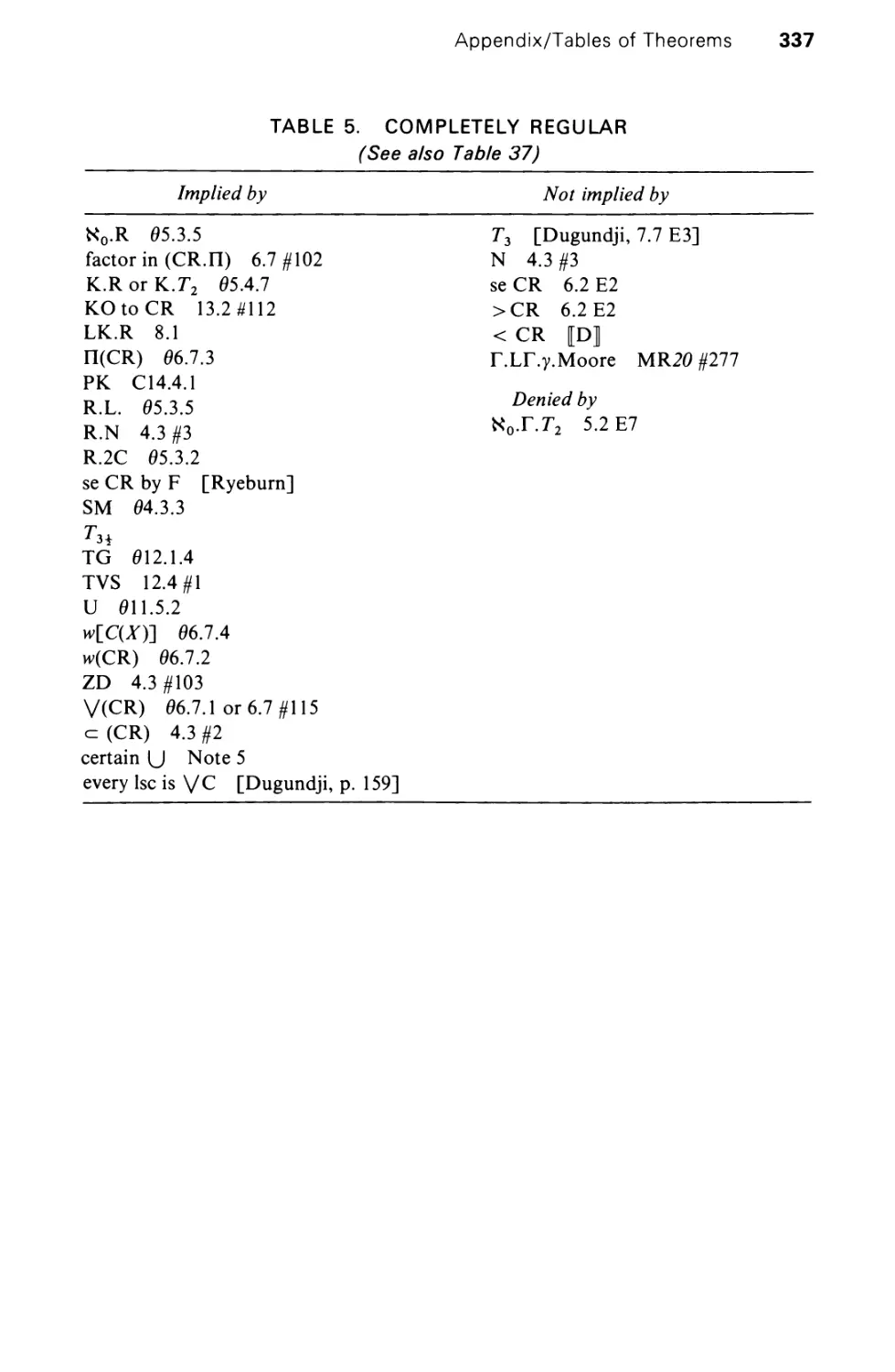
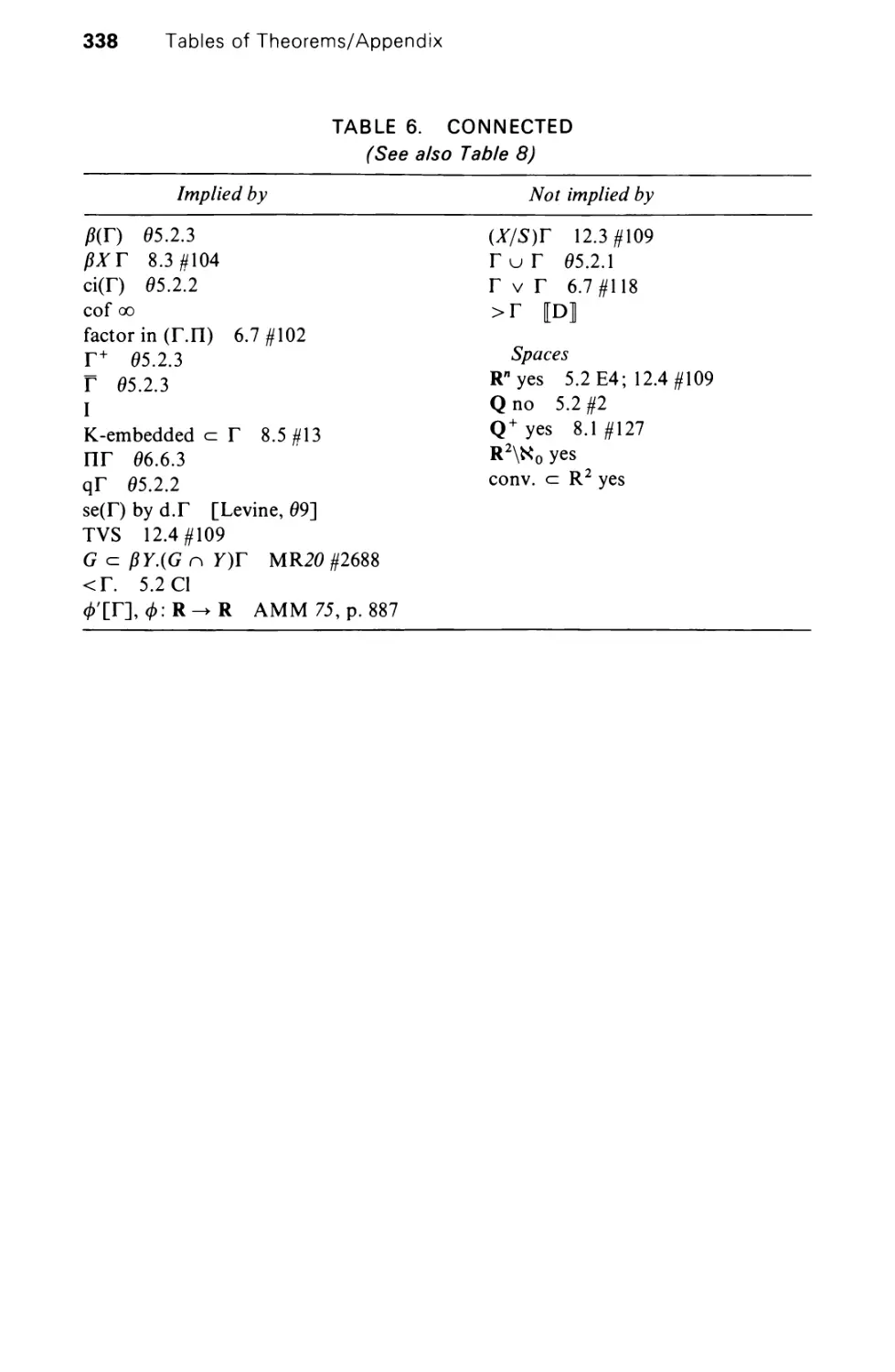
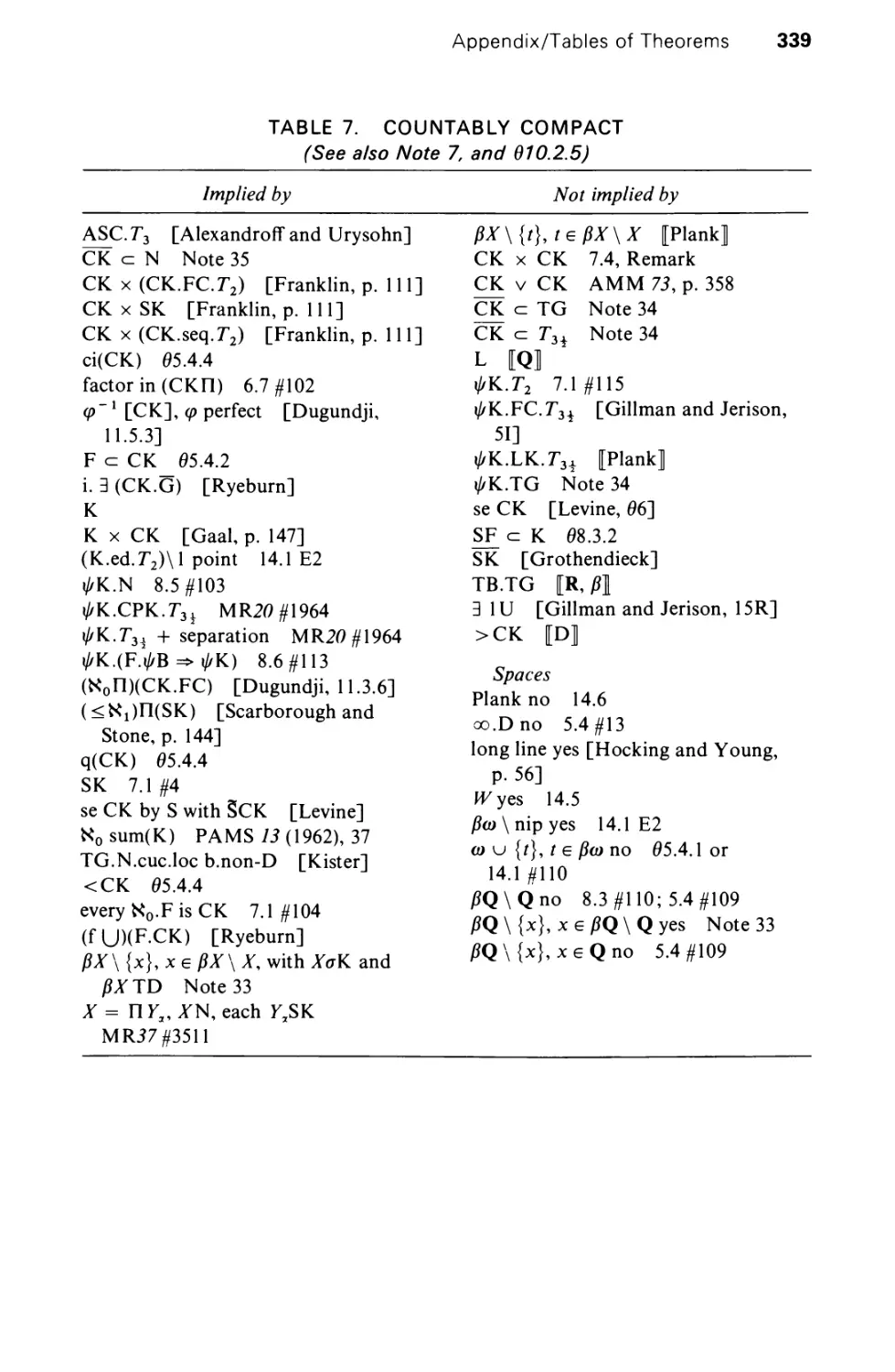
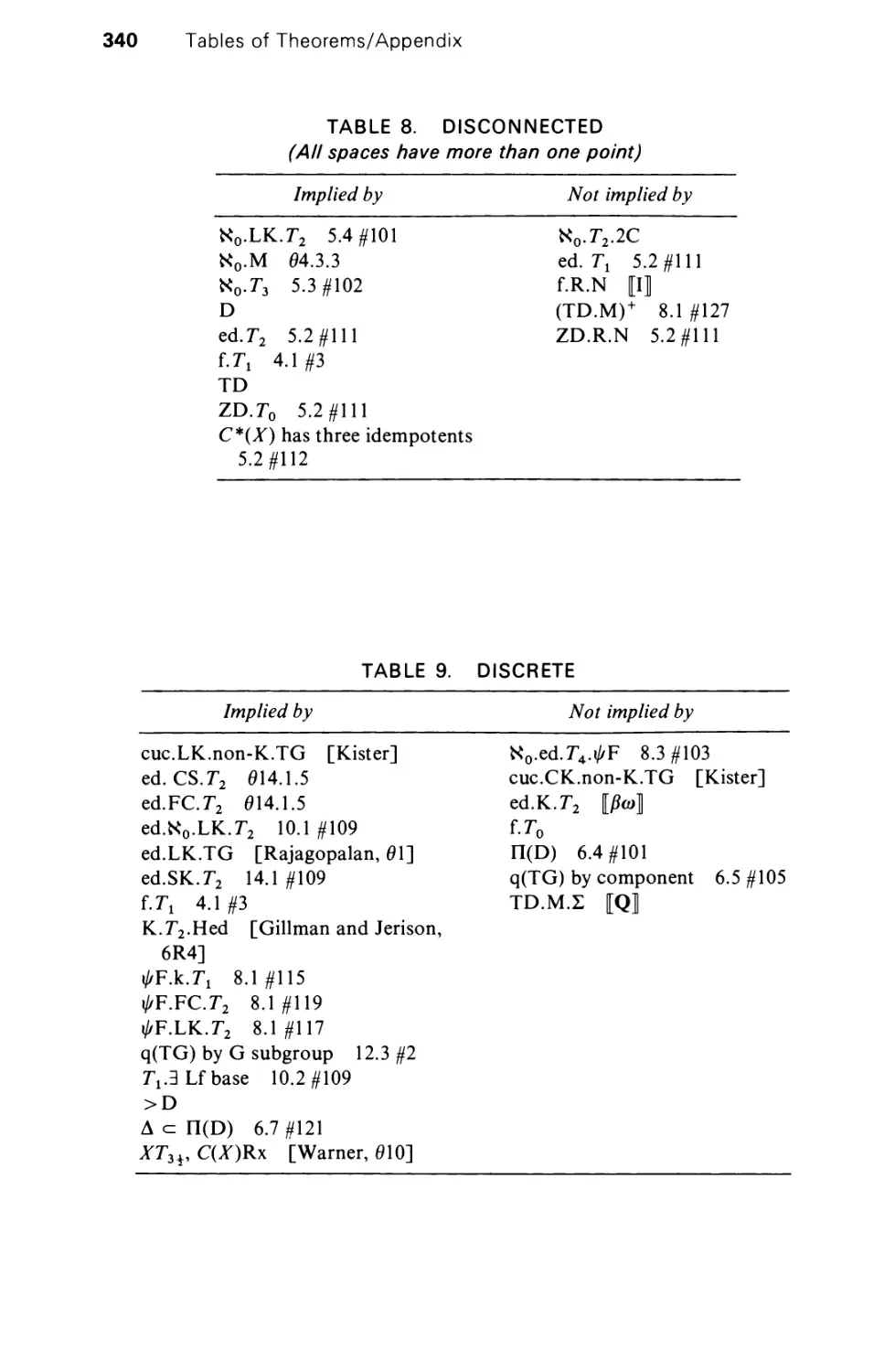
experimental concept: the Tables of Theorems and Counterexamples in the
Appendix. For a discussion of the use of these tables, the reader is referred
to the introduction immediately preceding the tables.
In reading or lecturing from the book, it should be noted that all examples
and problems marked with a star ^ are essential for later development.
Unmarked examples and problems are optional, and those marked A are
harder and more special. Each problem section is broken into three parts
—the second and third parts are numbered from 100 and 200, respectively.
The "100" problems are special and somewhat challenging; the "200"
problems may be extremely difficult.
Both nets and filters are explained and used throughout the text. All the
standard counterexamples of the subject are presented; an almost successful
effort was made to use the Stone-Cech compactification as a "universal"
counterexample—thus the use of ordinal spaces is reduced to a minimum,
almost zero.
NOTE. I have followed the custom, now quite respectable, of not using
more separation axioms than needed. Arguments developed for T2 spaces
VII

viii Preface
are adapted in several ways. One is by the device of using retractions
extensively (see, for example, Sec. 6.7, Problem 102). Another consists of
using closed graph instead of continuous functions (see, for example, Sec.
7.1, Problem 109).| Metrization theorems, usually proved by embedding
in products, are replaced by semimetrization theorems, proved by means of
weak topologies. Occasionally the hypothesis "compact" must be
replaced by "locally compact," an unrelated condition in non-Hausdorff
spaces (see, for example, Lemma 13.1.1 and Theorem 13.1.1). This
procedure is set forth in detail in my article "Life without T2," Amer. Math.
Monthly, 77(1970), pp. 157-161.
axiomatics. One should beware of the disease called "Axiomatics,"
which consists of wasting time wondering whether я, b, and с imply d, where
a, b, c, and d are properties selected at random. We can do no better than
quote Edwin Hewitt's remark made at the 1955 Madison Summer Institute
on Set Theoretic Topology and printed on p. 17 of its Proceedings: "I am
happy to say that it (the disease of axiomatic topology) has been almost
totally cured. Right now I don't care a bit whether every beta capsule of
type delta is also a Γ-spot of the second kind." However, every young
mathematician must have an injection of the live virus; and every
mathematician should be aware of a few basic implications such as "regular,
Lindelof implies normal," and "regular, second countable implies semi-
metrizable"; results of this basic nature are included in the text. For those
who absolutely must know whether every locally compact, completely
regular, separable space is σ-compact, a search in the Tables will reveal a
counterexample.
t For further evidence of the value of using closed graph functions see F. J. Murray, "Quasi-
complements and closed projections in reflexive Banach spaces," Trans. Amer. Math. Soc. 58
(1945), p. 77.

Acknowledgments
It has always been my custom to write to everybody about everything.
The kindness of the mathematical community in replying to my letters has
been so great that I could not even begin to list the names of those people
who made significant contributions to this book. In addition to this
correspondence, I have incorporated hundreds of results from the mathematical
literature. In some cases the authors are cited at appropriate places in the
text. The greatest source of help and encouragement has been the Lehigh
University Mathematics Department. My familiar notes on our bulletin
board with the large letters HELP on top were invariably answered by the
elegant examples of Jerry Rayna, or the erudite references and proofs of
Bill Ruckle, to mention only two of my very helpful colleagues. Murray
Kirch used my typescript in a course at SUNY Buffalo and made helpful
criticisms. John W. Taylor made an enormous contribution! Unfortunately
some of his remarks came too late to be used.
The typing was done by Helen Farrell, Rosemarie Ehser, and Judy
Arroyo; I thank these three ladies for their excellent work and their devotion
to a tedious task.
The administration of Lehigh University was at all times sympathetic and
helpful. My deepest thanks go to all.
In addition I want to express my great appreciation to the staff of the
college division of Ginn and Company and most especially to Mrs. Claire
Felts whose contributions to this book occur in every line.
AW.
IX

Contents
1 Introduction 1
1.1 Explanatory Notes 1
1.2 «-Space 5
1.3 Abstraction 7
2 Topological Space 9
2.1 Topological space 9
2.2 Semimetric and metric space 12
2.3 Semimetric and metric topologies 15
2.4 Natural topologies and metrics 17
2.5 Notation and terminology 18
2.6 Base and subbase 21
3 Convergence 26
3.1 Sequences 26
3.2 Filters 31
3.3 Partially ordered sets 35
3.4 Nets 39
3.5 Arithmetic of nets 43
4 Separation Axioms 46
4.1 Separation by open sets 46
4.2 Continuity 51
4.3 Separation by continuous functions 61
XI

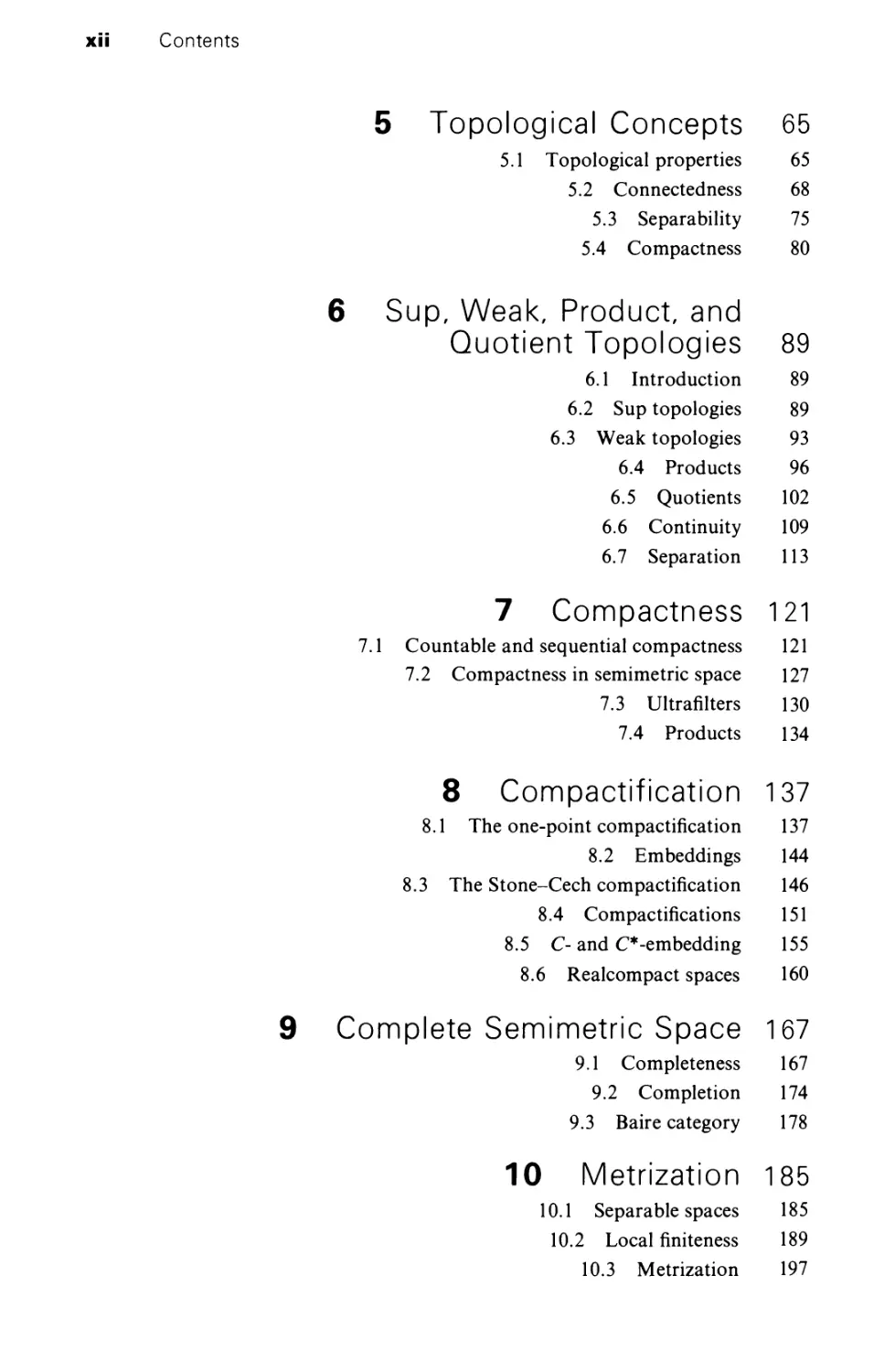
xii Contents
5 Topological Concepts 65
5.1 Topological properties 65
5.2 Connectedness 68
5.3 Separability 75
5.4 Compactness 80
6 Sup, Weak, Product, and
Quotient Topologies 89
6.1 Introduction 89
6.2 Sup topologies 89
6.3 Weak topologies 93
6.4 Products 96
6.5 Quotients 102
6.6 Continuity 109
6.7 Separation 113
7 Compactness 121
7.1 Countable and sequential compactness 121
7.2 Compactness in semimetric space 127
7.3 Ultrafilters 130
7.4 Products 134
8 Compactification 137
8.1 The one-point compactification 137
8.2 Embeddings 144
8.3 The Stone-Cech compactification 146
8.4 Compactifications 151
8.5 C- and C*-embedding 155
8.6 Realcompact spaces 160
9 Complete Semimetric Space 167
9.1 Completeness 167
9.2 Completion 174
9.3 Baire category 178
10 Metrization 185
10.1 Separable spaces 185
10.2 Local finiteness 189
10.3 Metrization 197

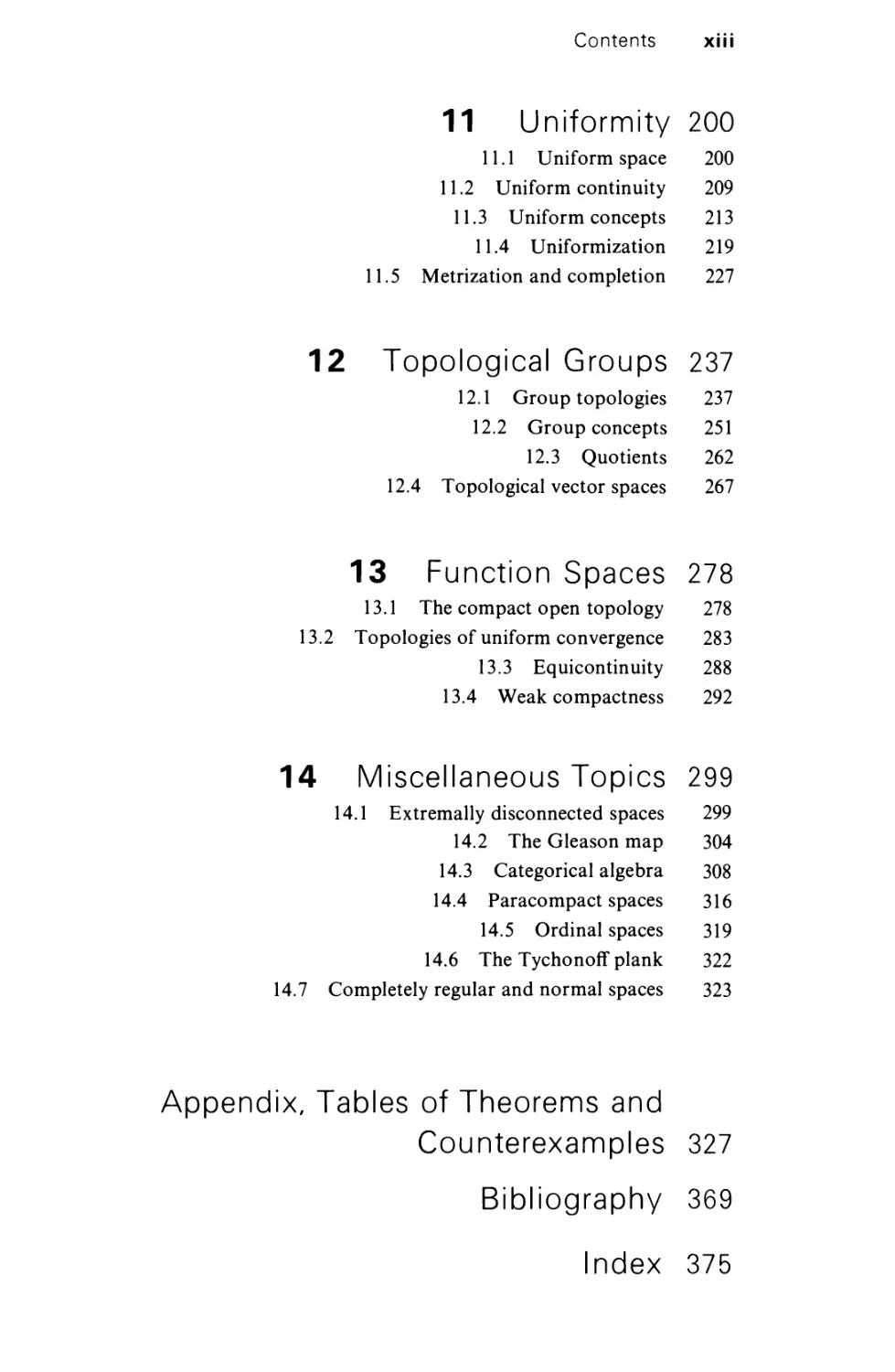
Contents xiii
11 Uniformity 200
11.1 Uniform space 200
11.2 Uniform continuity 209
11.3 Uniform concepts 213
11.4 Uniformization 219
11.5 Metrization and completion 227
12 Topological Groups 237
12.1 Group topologies 237
12.2 Group concepts 251
12.3 Quotients 262
12.4 Topological vector spaces 267
13 Function Spaces 278
13.1 The compact open topology 278
13.2 Topologies of uniform convergence 283
13.3 Equicontinuity 288
13.4 Weak compactness 292
14 Miscellaneous Topics 299
14.1 Extremally disconnected spaces 299
14.2 The Gleason map 304
14.3 Categorical algebra 308
14.4 Paracompact spaces 316
14.5 Ordinal spaces 319
14.6 The TychonofT plank 322
14.7 Completely regular and normal spaces 323
Appendix, Tables of Theorems and
Counterexamples 327
Bibliography 369
Index 375

1

Topology for Analysis

1

ntroduction
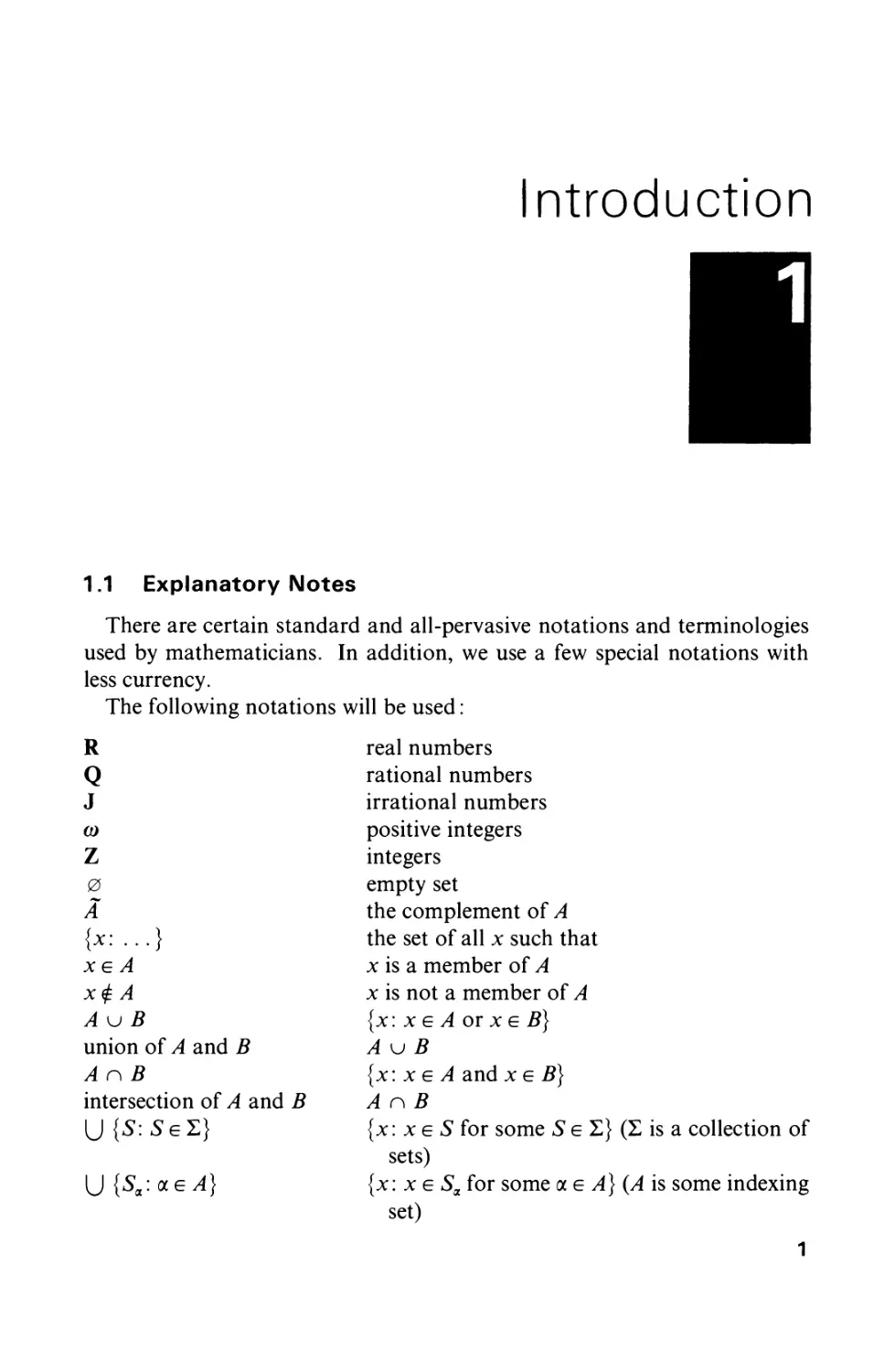
1.1 Explanatory Notes
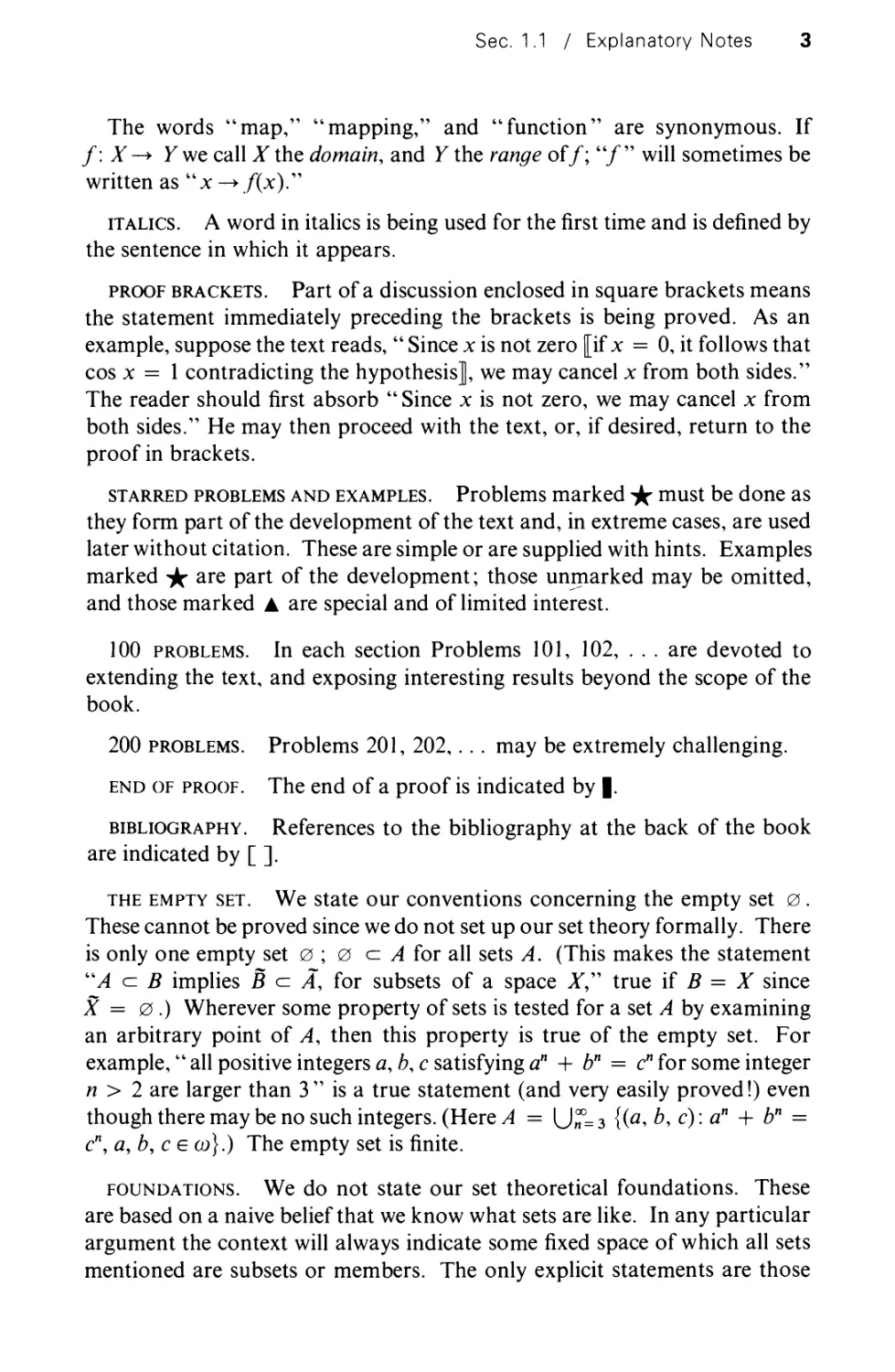
There are certain standard and all-pervasive notations and terminologies
used by mathematicians. In addition, we use a few special notations with
less currency.
The following notations will be used:
R
Q
J
ω
Ζ
0
A
{χ:...}
Χ Ε Α
χφΑ
Akj В
union of A and В
An В
intersection of A and В
U{S:Se
{J{S*:ole
Σ}
■A}
real numbers
rational numbers
irrational numbers
positive integers
integers
empty set
the complement of A
the set of all χ such that
χ is a member of A
χ is not a member of A
{χ: χ e A or χ e B)
Akj В
{χ: χ e A and χ e B}
Α η Β
{χ: χ ε S for some S e Σ} (Σ is a collection of
sets)
{χ: χ e Sa for some α e A} (A is some indexing
set)
1

2 Introduction / Ch. 1
n{S:Se!}
n{Sa:aeA}
A cz 5, 5 =) A
A is included in B,
В includes A,
A is a subset of 5,
^ is a set in 5,
5 is a superset of A
A is a proper subset of 5
Л\Я
/4 r/ϊ 5
^ does not meet В
A meets В
A meets 5 in χ
singleton
w
disjoint family
[«,*]
ia,b)
ia,b)
(«,*]
(—ос, а)
[я, oc)
characteristic function of S
/[5]
/_1[5]
(/<*)
(/=«)
/x
/is one-to-one
f: X^> Υ is onto
one-to-one correspondence
{x:xeS{or<d\\SeT}
[x: xe Sx for all ae A}
every member of A is a member of В
A cz B,B =) A
A a B, 0 Φ Α Φ Β
Α η Β
Α η Β = 0
/4 r/> 5
Α η Β Φ0
хе А ел В
set with one member
set whose only member is χ
a family of sets, each pair of which has empty
intersection
{χ: α < χ < b)
{χ: α < χ < b)
La, b-] \ {b}
(a, b) υ {b}
{χ: χ < a]
{χ: χ > a}
f, where/(x) = 1 if χ e S,
/(χ) = 0ίίχφΞ
{Ax)-xeS}
{x:f(x)eS}
{x:f(x) < a}
{x:f(x) = a}
(f=0)
Χι φ χ2 implies/(χ,) φ f(x2)
ЛЛ = y
function which is one-to-one and onto
We draw the reader's attention to the following:
Α φ Β, read " A does not meet 2?" meaning Α η Β =0.
When the notation A is used, it is assumed that a set X has been designated
and A = X\A. When the presence of X is not clear from the context, the
notation X\A will be used.
The words "space," "set," "family," and "collection" are synonymous.
When a space X has been designated the members of X will be called
points.

Sec. 1.1 / Explanatory Notes 3
The words "map," "mapping," and "function" are synonymous. If
f:X—> Υ we call X the domain, and Υ the range of/; "/ " will sometimes be
written as "x —► /(x)."
italics. A word in italics is being used for the first time and is defined by
the sentence in which it appears.
proof brackets. Part of a discussion enclosed in square brackets means
the statement immediately preceding the brackets is being proved. As an
example, suppose the text reads, " Since χ is not zero [if χ = 0, it follows that
cos χ = 1 contradicting the hypothesis], we may cancel χ from both sides."
The reader should first absorb " Since χ is not zero, we may cancel χ from
both sides." He may then proceed with the text, or, if desired, return to the
proof in brackets.
starred problems and examples. Problems marked ^ must be done as
they form part of the development of the text and, in extreme cases, are used
later without citation. These are simple or are supplied with hints. Examples
marked ^ are part of the development; those unmarked may be omitted,
and those marked A are special and of limited interest.
100 problems. In each section Problems 101, 102, ... are devoted to
extending the text, and exposing interesting results beyond the scope of the
book.
200 problems. Problems 201, 202,... may be extremely challenging.
end of proof. The end of a proof is indicated by |.
bibliography. References to the bibliography at the back of the book
are indicated by [ ].
the empty set. We state our conventions concerning the empty set 0.
These cannot be proved since we do not set up our set theory formally. There
is only one empty set 0 ; 0 cz A for all sets A. (This makes the statement
"A cz В implies В cz A, for subsets of a space X," true if В = X since
X = 0 .) Wherever some property of sets is tested for a set A by examining
an arbitrary point of A, then this property is true of the empty set. For
example," all positive integers я, ft, с satisfying an + ft" = cn for some integer
η > 2 are larger than 3" is a true statement (and very easily proved!) even
though there may be no such integers. (Here A = U?=3 {(α·> ^> c)\ an + bn =
c", a, b, с е ω}.) The empty set is finite.
foundations. We do not state our set theoretical foundations. These
are based on a naive belief that we know what sets are like. In any particular
argument the context will always indicate some fixed space of which all sets
mentioned are subsets or members. The only explicit statements are those

4 Introduction / Ch. 1
on the empty set, just given, and on maximal chains in Section 7.3. Our use
of cardinal and ordinal numbers is restricted to examples marked A.
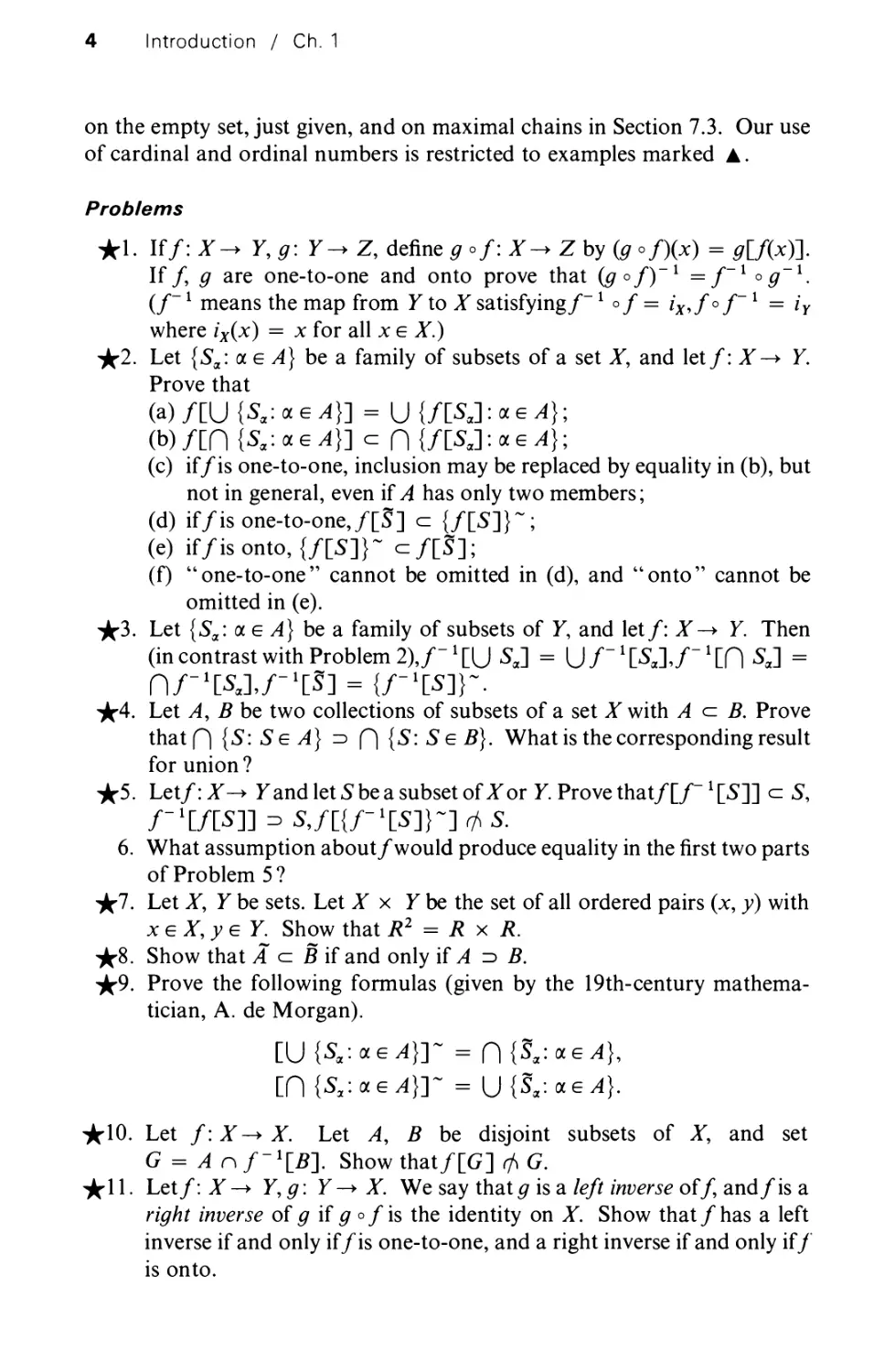
Problems
*1. If/: X-+Y9g: Υ-+ Ζ, define g ο/: Χ-+ Ζ by (g of)(x) = #[/(*)].
If/, g are one-to-one and onto prove that (g°f) 1 =/ 1 °g l.
(/"1 means the map from Υ to X satisfying/"1 °f= ix,f°f~l = iy
where ix(x) = χ for all χ e X.)
Jrl. Let {Sa: a e A} be a family of subsets of a set X, and let/: X'—► F.
Prove that
(a) /[U {Sa: α e Л}] = U {/[5J: « e Л};
(b) ЛП {5.: «e ^}] c Π {RSJiae A};
(c) if/is one-to-one, inclusion may be replaced by equality in (b), but
not in general, even if Л has only two members;
(d) if/is one-to-one,/[5] с {/[■$]}~;
(e) if/isonto,{/[S]}~ c/[S];
(f) "one-to-one" cannot be omitted in (d), and "onto" cannot be
omitted in (e).
Jr3. Let {Sa: a e A] be a family of subsets of У, and let/: Z—► Y. Then
(in contrast with Problem 2),/" ^U SJ = U/"1^.],/" '[Π SJ =
nr1[SJ,r1[Sf] = {/-1[S]}-.
^4. Let i4, 5 be two collections of subsets of a set A" with A <^ B. Prove
that Π {S:Sei4}Dn{S:Se5}. What is the corresponding result
for union ?
*5. Let/: A^ Г and let S be a subset of X or Г. Prove that/E/"1^]] с S,
/^[/[^i^^/ar1^]}^]^^
6. What assumption about/would produce equality in the first two parts
of Problem 5?
Jrl. Let Χ, Υ be sets. Let Χ χ У be the set of all ordered pairs (x, y) with
xeX,yeY. Show that R2 = R χ R.
icS. Show that icgif and only if A => B.
Jr9. Prove the following formulas (given by the 19th-century
mathematician, A. de Morgan).
VJ{Sa:*eA}T = n{S*:*eA},
m{Sx:xeA}r = \J{Sa:*eA}.
^-10. Let f:X-+X. Let А, В be disjoint subsets of X, and set
G = Anf~l[B~\. Show that/[G] φ G.
ΆΊ1. Letf'.X-* Y,g: Y—>X. We say that# is a left inverse of/, and/is a
n#/zi inverse οι g if g of is the identity on Ar. Show that/has a left
inverse if and only if/ is one-to-one, and a right inverse if and only if/
is onto.

Sec. 1.2 / /7-Space 5
1.2 л-Space
The space R of real numbers will not be defined in this book. It will be
assumed to allow the usual operations of arithmetic, to have its usual
ordering (in short, it is a totally ordered field), and to have the property that every
bounded set S has a least upper bound, written sup S. Such facts as x2 > 0
for all χ e R will be used without scruple.
A set S is called countably infinite if it can be put in one-to-one
correspondence with ω; that is, there exists/: S—► ω which is one-to-one and
onto. A set is called countable if it is finite or countably infinite. A set which
is not countable is called uncountable. We shall assume the existence of an
uncountable set. (Some are shown in Problems 201, 202, etc., and R is also
proved uncountable in Sec. 9.3, Problem 114.)
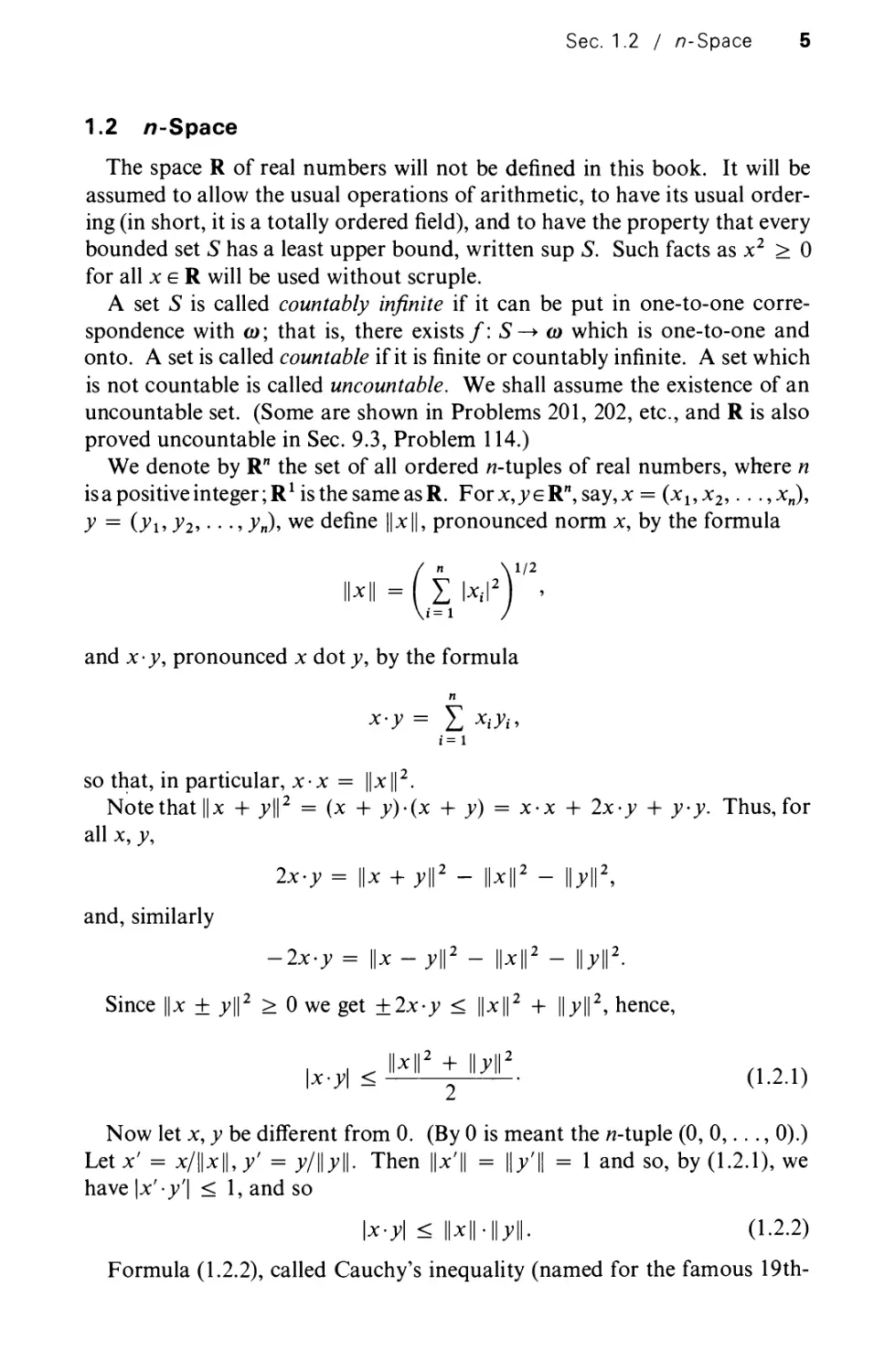
We denote by R" the set of all ordered «-tuples of real numbers, where η
is a positive integer ;RX is the same as R. Forx^eR", say,x = (xi9x2, · · ·,*„),
У = (У\> У г, · · ·» Уп)> we define ||χ||, pronounced norm x, by the formula
imi = (.Σ w2)1'2'
and x-y, pronounced χ dot y, by the formula
η
x-y = Σ ъуи
i= 1
so that, in particular, χ χ = \\x\\2.
Note that ||x + y\\2 = (x + y)-(x + y) = x-x + 2x-y + y-y- Thus, for
all x, y,
2x-y= \\x + y\\2 - \\x\\2 - \\y\\2,
and, similarly
-2x.y= ||*-j>||2- IWI2- Ы12.
Since || χ ± j;||2 > Owe get +2x-y < \\x\\2 + || y\\2, hence,
„.„ s tiiL±m. (IiI)
Now let x, у be different from 0. (By 0 is meant the «-tuple (0, 0,..., 0).)
Let x' = jc/||jc||, y' = y/\\y\\. Then ||x'|| = ||/|| = 1 and so, by (1.2.1), we
have \x'-y'\ < 1, and so
l*-j>l < \M\-Wyl (1-2.2)
Formula (1.2.2), called Cauchy's inequality (named for the famous 19th-

6 Introduction / Ch. 1
century mathematician, A. Cauchy), was proved for x, у different from 0,
but obviously holds in this case also.
We now have
II* + y\\2 = IMI2 + Ml2 + Ьс-у < \\x\\2 + \\y\\2 + 2||x|Hl.v||
= (ll*ll + Ы)2-
Taking positive square roots we obtain w
\\x + y\\ < IMI + 1Ы|. (1.2.3)
If now we define d(x, y) = \\x — y\\, the familiar distance (familiar at least
for η = 1,2, 3), we have, for any x, y, z,
d(x,y) = \\x-y\\ = \\x-z + z-y\\
< \\x - z\\ + \\z - y\\ = d(x, z) + d(z, у).
This function d is called the Euclidean distance for R", also the Euclidean
metric for R".
Problems on n-Space
*1. Show that \\x-y\\ > | \\x\\ - \\y\\\.
2. Fix m, η with m > η and define /: R" —► Rm by (xn x2,..., xn) —►
(xb x2,..., x„, 0, 0, . . ., 0). Is/one-to-one? Is it onto? Show that
||/Cx)|| = ||jc|| forallxeR".
3. Let α ν b (read: α sup b) and а л b (read: α inf b) be the larger and
smaller, respectively of a, b e R. Prove that
α ν b = \{a + 6 + \a - 6|), α л 6 = £(д + b - \a - b\).
101. Show that R and R2 can be put in one-to-one correspondence.
Kx> У) —* z where ζ = ,^! y{ x2 У2хзУз''' in decimal notation. Make
xh yt = 0 if possible. This map is one-to-one but not onto.]
102. If there exists a one-to-one/: S —► ω; then S must be countable.
103. If there exists an onto/: ω —► S; then S must be countable.
104. Show that ω = (JJL! £„ where each Sn is an infinite set and {Sn} is a
disjoint family.
201. Prove that the set S of all sequences of 0's and l's is not countable. (A
sequence of 0's and l's is a sequence {xn} with xn = 0 or 1 for all n.)
[Let/: ω —► S. Then the characteristic function of {n e ω: yn = 0 if
у = f(n)} does not belong to /[ω].] Deduce that R is uncountable.
202. The set of all subsets of a set S is denoted by 2s. Prove that 2ω is
uncountable. [Apply Problem 201 to characteristic functions of
subsets.]

Sec. 1.3 / Abstraction 7
203. If there is a one-to-one map from A to В and no one-to-one map from
В to A, we write \B\ > \A\ (say: В has a larger cardinality than A).
Show that |25| > |S| for every set S.
204. Show that S χ S can be put into one-to-one correspondence with S
if and only if S is an infinite set or is empty.
205. Show that the set of all permutations of ω is uncountable. (Indeed
there are exactly 2|ω| of them.)
206. A closed interval in R cannot be the union of a disjoint countable
family, with more than one member, of closed intervals.
207. Show that there is room in R2 for uncountably many disjoint L's but
only countably many disjoint Ts. [MR 27(1960) #852.]
208. Given a countable set S a R, show that there exists t e R such that
χ + Ms irrational for every χ e S. [Q — S is countable, hence there
exists t e R \ (Q - S).}
209. Let s be the set of all sequences of real numbers, and 3ω the set of all
sequences of irrational numbers. Let A be a countable subset of s.
Show that there exists t e s such that χ + t e 7ω for all χ e A. [For
each n, let Sn be the set of all nth terms of members of A. Choose tn as
in Problem 208, and let t = {*„}.]
1.3 Abstraction
In the course of his mathematical education, the student encounters
various structures. By a structure we mean a set together with some rules
concerning its members and subsets. For example, the set of real numbers
together with the operation of addition, the set of positive real numbers with
multiplication, and the set of integers with addition, are three structures. In
each of these three examples, there is a set and one operation. When we say
that each of them is a group we are performing an abstraction', forgetting the
differences between these examples, we consider only their similarities. If a
remark is made to the effect that a group must have a certain property, this
means that every group, in particular the three just mentioned, must have
this property. The three examples, and any others, are called realizations,
or examples, of the abstraction: group. Even more briefly, they are called
groups.
The study of the real numbers has led to many abstractions; for example,
the concept of ring is suggested by the two operations + and χ , while the
concepts of ordered system and lattice are suggested by the fact that real
numbers may be compared in size. In every case, the abstraction has turned
out to have realizations, other than the real number system, the study of which
has been fruitful. For example, there exist finite groups.
The abstraction topological space is suggested by those aspects of the real
number system which are studied in "advanced calculus" courses, namely

8 Introduction / Ch. 1
those which enter into discussions of such topics as continuity and
convergence. When " topological space" is defined (Sec. 2.1, Definition 2), it will be
pointed out that the set of real numbers is a topological space (Sec. 2.1,
Example 7).

Topological Space
2.1 Topological Space
After reading Definition 1, below, the student may not recognize that, as
promised in Section 1.3, we are speaking of things involved in discussions of
continuity and convergence. The only remedy for such doubts is the actual
pursuit, carried on in the text, of such topics in an arbitrary topological space,
that is, using only ideas introduced in Definition 1.
Definition 1. Let Xbea set. Let Τ be a collection of subsets ofX satisfying
(i) 0 e 7V
(ii) X e T;
(iii) IfG1e Τ andG2 e T, then Gx η G2e TV
(iv) If Σ α Τ, Σ φ 0, then \J {G: G e Σ} € T.
Then Τ is called a topology for X.
Thus a topology for A" is a certain collection of subsets of X. By definition,
the empty set and X itself are included. Condition (iii) says that the
intersection of any two sets in Τ must be in Γ, hence the intersection of any finite
collection of sets in Γ must be in T. Condition (iv) says that if any collection,
no matter how numerous, of members of Τ be given, then the union of this
collection is also a member of T. Briefly, a topology for A" is a collection of
subsets of X containing 0, X, and closed under finite intersections and
arbitrary unions.
To topologize a set X means to specify a topology for X.
9

10 Topological Space / Ch. 2
^-EXAMPLE 1. The indiscrete topology. LetA'beaset. LetT= {0,X}.
Then Γ is a topology for X. [Conditions (i) and (ii) of Definition 1 clearly
hold. Conditions (iii) and (iv) are also clear since 0 η Χ = 0 and
0 \j X = X.J This particular topology is called the indiscrete topology.
Any set may be given the indiscrete topology. For example, let
X= {1,2,3,4}. Then Τ = { 0, (1, 2, 3, 4}} is the indiscrete topology for X.
^EXAMPLE 2. The discrete topology. Let X be a set. Let Τ be the
collection of all subsets of X. Then Γ is a topology for X, called the discrete
topology.
^-EXAMPLE 3. The cofinite topology. Let X be a set. Let
T= {G a X: A'\G is a finite set} u {0}.
Thus Τ consists, except for 0, of complements of finite sets. To check
Condition (iii) of Definition 1, let Gb G2 e T. If either Gx or G2 is empty,
GlnG2= 0 eT- otherwise, X\(Gl nG2) = (X\G{)u (X\ G2) is finite,
being the union of two finite sets. To check Condition (iv), let Σ с Τ. If
Σ = {0}, there is nothing to prove; otherwise, let 0 /GeX. Then
T\ U {S: 5el}c Τ \ G, hence is finite and so \J {S: ΞεΣ}εΤ.
It should be noted that if A" is a finite set, the cofinite topology is identical
with the discrete topology.
EXAMPLE 4. Let X = ω (the positive integers) and let Γ be the cofinite
topology for X. For η = 1, 2, 3,.. ., let Gn = {1, η, η + 1, η + 2,...}.
Then each GnE Τ but f] {Gn: η = 1,2,...} = {1} φ Τ. This illustrates the
"finite intersection" part of the definition of topology.
EXAMPLE 5. Let A" be an infinite set and Τ the collection of all finite
subsets of X, together with X itself. Then Τ is not a topology since a union of
finite sets need not be finite.
Definition 2. A topological space is a set together with a topology for the
set. The members of the topology are called open sets.
Thus we refer to a topological space (Χ, Γ), in which A" is a set, and Γ is a
topology for it. For S cz X, the sentences "S is open" and "Se Γ" are
synonymous. When Τ is understood from the context, the space will be
denoted by X, rather than (Ar, T). Our aim is to develop a usage which will
not refer to T. Thus we shall speak of a topological space X together with
its open subsets.
^-EXAMPLE 6. If A" is given the indiscrete topology, it has only two
open subsets, 0 and X. (But see Example 8.) With the discrete topology

Sec. 2.1 / Topological Space 11
every subset of A" is open. With the cofinite topology, a nonempty subset is
open if and only if its complement is finite.
^-EXAMPLE 7. The Euclidean topology. Let X = R (the real numbers)
and let the empty set be called open; also any set G is called open if for every
χ e G, there exists ε > 0 such that (x — ε, χ + ε) c G. This defines a
topology for X (namely, of course, the collection of open sets). [To check
Condition (iii) of Definition 1, let Gl9 G2 be open sets. If Gx η G2 = 0
there is nothing to prove. If Gx η G2 Φ 0, let χ e Gx η G2. There exist
ει > 0, ε2 > 0 such that (χ - ε,·, χ + ε,·) c Ghi = 1, 2. Let ε = min^^).
Then ε > 0 and (x — ε, χ + ε) c Gx η G2. Thus Gx η G2 is open. To
check Condition (iv), let Σ be a collection of open sets, and we may assume
that its union is nonempty. Let χ e(J {G: G el}. Then χ e S for some
S e Σ. There exists ε > 0 such that (x — ε, χ + ε) с S. Then (χ — ε, χ + ε) α
U!G:G€l}.]
EXAMPLE 8. In Definition 1, it is possible that A"is the empty set. Then
the only topology for X is {0}. Needless to say, in any discussion we are
always thinking of a nonempty set, and thus, on occasion, will make a
statement which is not strictly true. For example, the indiscrete topology for 0
has only one member, not two as stated in Example 6. It seems hardly worth
while to be sufficiently careful at all times to cover this case, but the student
is warned that such an occasion may arise.
If Γ, Τ are topologies for a set X, it may happen that Τ => Τ'. In this case
we shall say that Τ is larger than T', (including the possibility that Τ = Γ'),
and Τ' is smaller than T. Very commonly, "stronger" and "finer" are used
instead of "larger"; "weaker" and "coarser" instead of "smaller." Of
course if Γ is both larger and smaller than T\ then they are equal.
A set F in a topological space is called closed if its complement is open.
(Use of the letters F—French ferme—and G—German Gebiet—for closed
and open sets, respectively, has become traditional.)
^-EXAMPLE 9. Let ω have the cofinite topology. Then each finite set
is closed, indeed a proper subset is closed if and only if it is finite. The set of
even integers is neither closed nor open; ω is both open and closed. (Two
morals: A set can be both open and closed. Just because a set is not open,
there is no reason to think that it is closed.)
Problems
^r\. [0, 1) is not open in R, with the Euclidean topology. Neither is it
closed.

12 Topological Space / Ch. 2
*2. Let S cz X. Let Τ = { 0, S, X). Show that Γ is a topology.
3. Find all sets for which the discrete and indiscrete topologies are the
same.
4. Let Si a X, S2 a X. Let Τ = {0, Su S2, X). Is Га topology?
5. Let Τ = {0} и {R} и {(a, oo):aeR},
Τ = {0} u {R} и {[a, oo):aeR}.
Show that Γ is a topology for R, but Γ' is not.
^-6. Let A" be a topological space. Show that 0, X, every finite union and
every intersection of closed sets, are all closed.
101. Let (X, T) be a topological space and let Τ be the collection of closed
sets. Is V a topology?
102. If, in Problem 101, A" is finite, show that Τ is a topology.
103. In Example 3 replace "finite" by "countable." Show that a topology
is defined. It is called the cocountable topology.
104. The cocountable topology on a countable space is discrete.
201. Let k(n) be the number of different topologies which can be placed on
a set with η members. Show that k(0) = k(\) = l,fc(2) = 4,fc(3) = 29.
(Note:k(4) = 355,A:(5) = 6942,jfc(6) = 209527,k{l) = 9535241. See
[Evans, Harary, and Lynn].)
202. Let d{n) be the number of topologies Τ which can be placed on a set
with η members, satisfying Τ = T' (Problem 102). Show that
d(0) = d{\\ d{2) = 2,^(3) = 5.
2.2 Semimetric and Metric Space
Definition 1. Semimetric and metric. Let X be a set and suppose given a
real-valued function d of two variables, each selected from X. Thus d is a
function from Χ χ Χ to the real numbers. Any such function satisfying the
following conditions is called a semimetric.
(i) d(x,y) = d(y,x) >0,
(ii) d(x, x) = 0,
(iii) d(x, z) < d(x, y) + d(y, z),
for all x, y, ζ e X. Condition (iii) is called the triangle inequality. A metric is a
semimetric, d, which satisfies the condition d(x, y) > 0 if χ Φ у.
Definition 2. A semimetric (or metric) space is a set together with a semi-
metric (or metric) for the set.
Thus the pair (X, d), in which A" is a set and d a semimetric, is a semimetric
space. We shall usually denote it by X, when d is understood from the
context.

Sec. 2.2 / Semimetric and Metric Space 13
^r EXAM Ρ LE 1. The discrete metric. Let A" be a set. For x, у е X, define
d(x, y) = 1 if χ φ у, 0 if χ = у. It is easily verified that this is a metric, for
example, the triangle inequality may be checked for x, y, ζ by noting that it is
trivial if χ φ у and у φ ζ, if χ = у, or if у = ζ [Problem 1].
^ΕΧΑΜ Ρ LE 2. The indiscrete semimetric. Let A" be a set. For x, у е X,
define d(x, y) = 0 [Problem 1].
^-EXAMPLE 3. The Euclidean distance for R" was proved, in Section 1.2,
to obey the triangle inequality. Since it obviously has the other metric
properties, it is a metric, called the Euclidean metric, and so R" is, with this
definition, a metric space.
EXAMPLE 4. For w = (x,y,z)eR3 define p(w) = \x\ + |j;|. Then
d(w, w') = p(w — w') defines a semimetric for R3 which is not a metric. [See
Problem 4.] For example, with χ = (1, 2, 3), у = (1, 2, 4), d(x, у) = 0.
EXAMPLE 5. Let C be the set of continuous real functions on the closed
interval [0, 1]. For/e C,geQ define ||/|| = max{|/(x)|: 0 < χ < 1} and
d(f,g) = II/— g\\- As in Section 1.2, the triangle inequality for d follows
from Formula (1.2.3). [To establish (1.2.3), we have, for any xe [0, 1],
\f{x) + g{x)\ < \f{x)\ + \g(x)\ < \\f\\ + \\g\\. Choosing χ so as to
maximize \f{x) + g{x)\ gives the result.]
The following definitions apply to any semimetric space X. For ae X and
r e R, the cell of radius r and center a, written N(a, r), is {x: d(x, a) < r}\ the
disc of radius r and center a, written D(a, r) is {x: d(x, a) < r}\ and the
circumference of radius r and center a, written C(a, r), is {x: d(x, a) = r}.
The word sphere is often used in place of circumference, and when X = Rn+1
with the Euclidean metric, C(0, 1) is called the η-sphere, written Sn. Thus Sl9
the 1-sphere is the unit circumference in R2, {(*, y)\ x2 + y2 = 1}.
It is possible for a cell, disc, or circumference to be empty. For example,
N(a, 0) is certainly empty, while if A" is a discrete space (that is, has the
discrete metric), C(#, j) is empty for any a. Note also that a disc may have
two different radii; for example, in a discrete space D(a, \) = D(a, χ) = {a}.
For A cl,5cl,xel,we define d(x, A), the distance from χ to A, to be
inf{d(x, a): ae A},
and d(A, B), the distance from A to В to be
inf{d(a,b):aeA,beB}.
(See Problems 7, 8, and 9). The diameter of a set A is defined to be
sup{d(x, y): χ e А, у е A} (perhaps infinite). A set with finite diameter is
said to be metrically bounded.

14 Topological Space / Ch. 2
In the next result it is assumed that A is not empty.
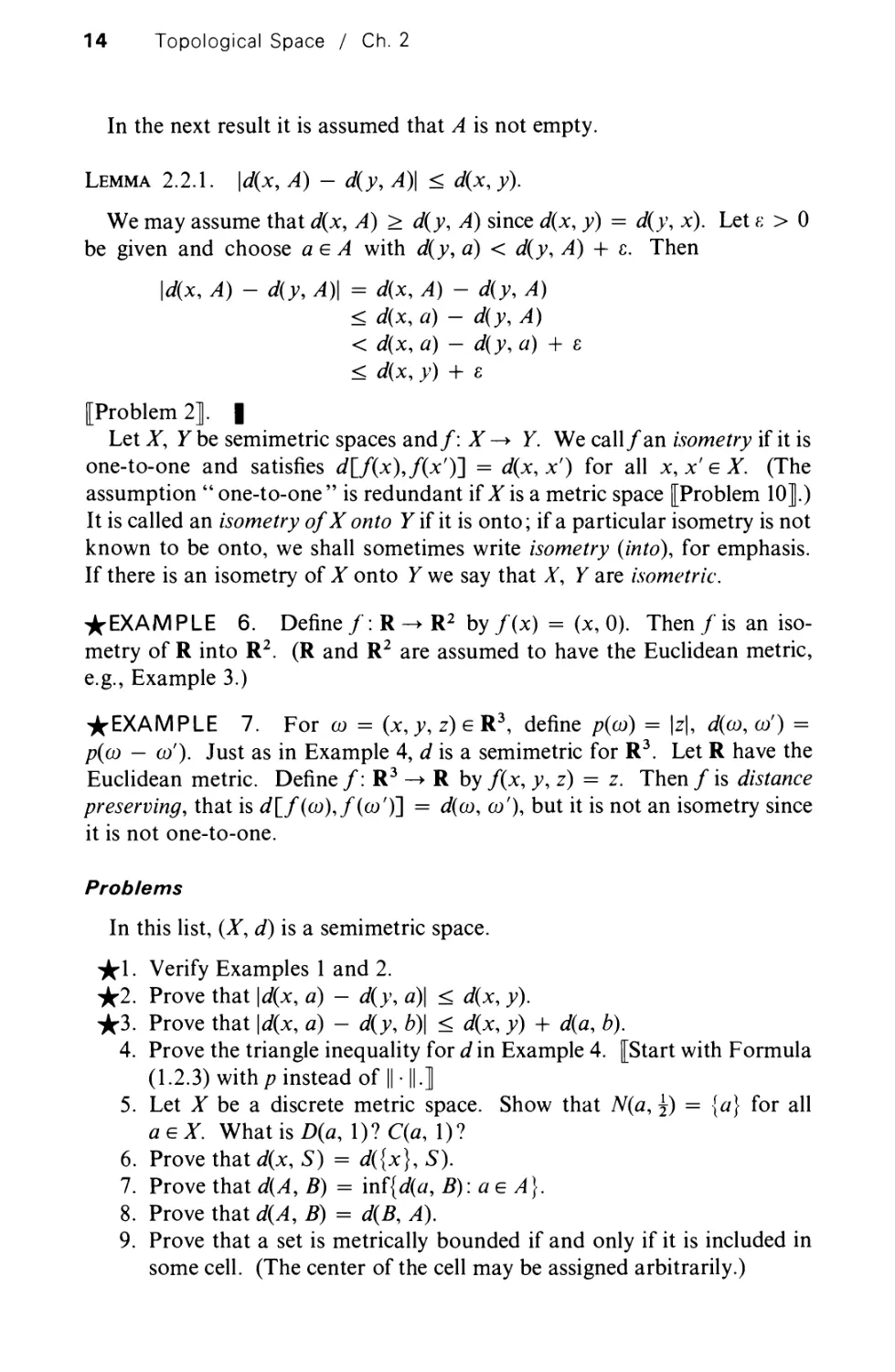
Lemma 2.2.1. \d(x, A) - d(y, A)\ < d(x, y).
We may assume that d(x, A) > d(y, A) since d(x, y) = d{y\ x). Let ε > 0
be given and choose a e A with d(y, a) < d(y, A) + ε. Then
\d(x, A) - d(y, A)\ = d(x, A) - d(y, A)
< d(x, a) - d(y, A)
< d(x, a) — d(y, a) + ε
< d(x, y) + ε
[Problem 2]. |
Let Χ, Υ be semimetric spaces and/: X —► Y. We call/an isometry if it is
one-to-one and satisfies d\_f{x),f{x')~\ = d(x, x') for all x, x' e X. (The
assumption " one-to-one" is redundant if X is a metric space [Problem 10].)
It is called an isometry of X onto У if it is onto; if a particular isometry is not
known to be onto, we shall sometimes write isometry (into), for emphasis.
If there is an isometry of X onto Υ we say that Χ, Υ are isometric.
* EXAMPLE 6. Define / : R -► R2 by f(x) = (x, 0). Then / is an
isometry of R into R2. (R and R2 are assumed to have the Euclidean metric,
e.g., Example 3.)
^EXAMPLE 7. For ω = (χ, у, ζ) e R3, define ρ(ω) = |ζ|, ά{ω, ω') =
ρ(ω — ω'). Just as in Example 4, d is a semimetric for R3. Let R have the
Euclidean metric. Define /: R3 —► R by f{x, y, z) = z. Then / is distance
preserving, that is ί/[/(ω),/(ω')] = ά{ω, ω'), but it is not an isometry since
it is not one-to-one.
Problems
In this list, (X, d) is a semimetric space.
jr\. Verify Examples 1 and 2.
*2. Prove that \d(x, a) - d(y, a)\ < d(x, y).
*3. Prove that \d(x, a) - d(y, b)\ < d(x, y) + d(a, b).
4. Prove the triangle inequality for d in Example 4. [Start with Formula
(1.2.3) with ρ instead of || · ||.]
5. Let Jbe a discrete metric space. Show that N(a, j) = {a} for all
aeX. What is D(a, 1)? C(a, 1)?
6. Prove that d(x, S) = d({x}, S).
7. Prove that d(A, B) = in{{d(a, B):aeA}.
8. Prove that d(A, B) = d(B, A).
9. Prove that a set is metrically bounded if and only if it is included in
some cell. (The center of the cell may be assigned arbitrarily.)

Sec. 2.3 / Semimetric and Metric Topologies 15
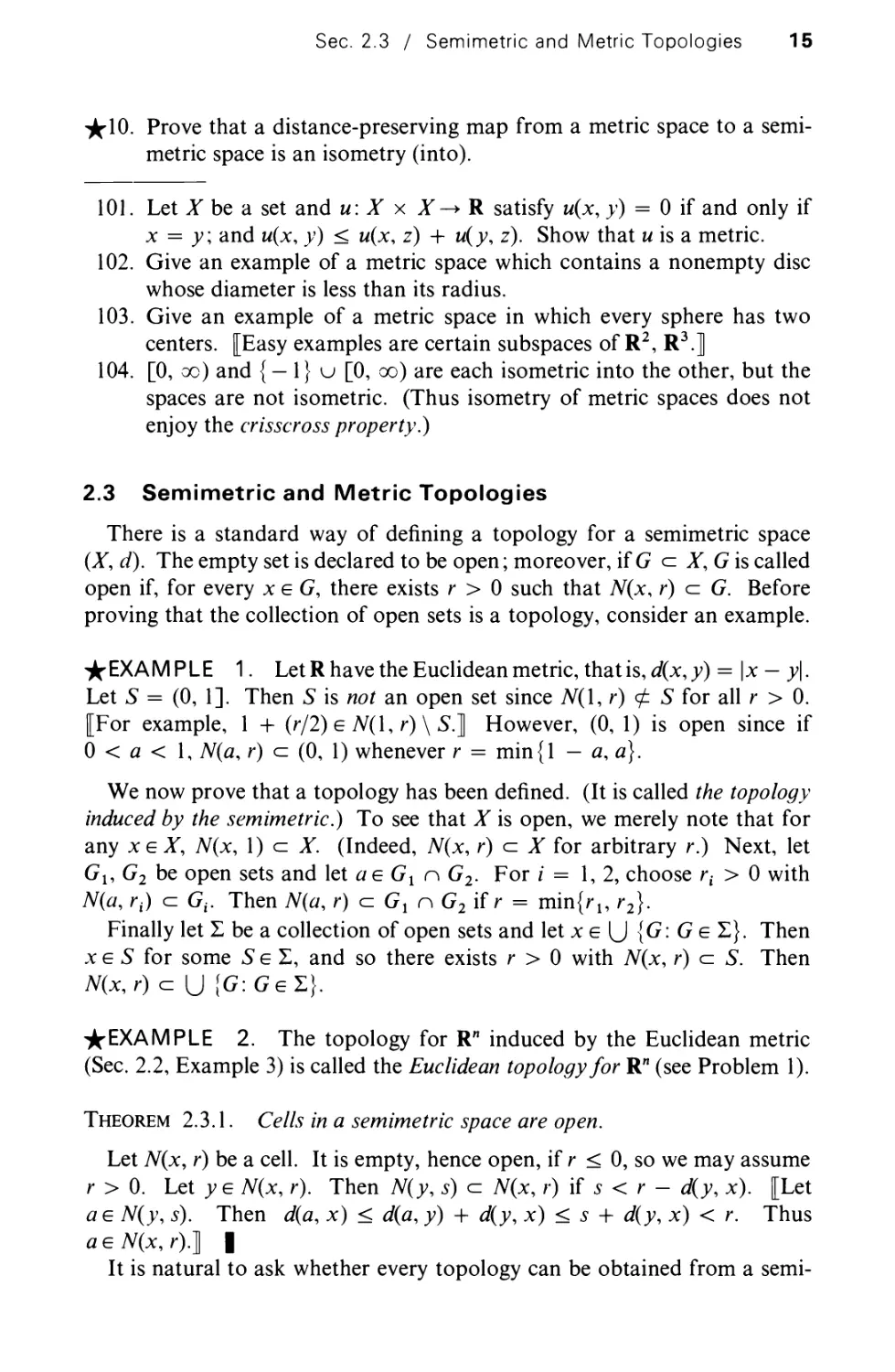
^-10. Prove that a distance-preserving map from a metric space to a semi-
metric space is an isometry (into).
101. Let A" be a set and u: Χ χ Χ-+ R satisfy u(x, у) = О if and only if
χ = y; and u(x, y) < u(x, z) + u{y, z). Show that и is a metric.
102. Give an example of a metric space which contains a nonempty disc
whose diameter is less than its radius.
103. Give an example of a metric space in which every sphere has two
centers. [Easy examples are certain subspaces of R2, R3.]
104. [0, oo) and {- 1} и [0, oo) are each isometric into the other, but the
spaces are not isometric. (Thus isometry of metric spaces does not
enjoy the crisscross property.)
2.3 Semimetric and Metric Topologies
There is a standard way of defining a topology for a semimetric space
(X, d). The empty set is declared to be open; moreover, if G cz X, G is called
open if, for every χ e G, there exists r > 0 such that N(x, r) cz G. Before
proving that the collection of open sets is a topology, consider an example.
^-EXAMPLE 1. Let R have the Euclidean metric, that is, d(x,y) = \x - y\.
Let S = (0, 1]. Then S is not an open set since 7V(1, r) ψ S for all r > 0.
[For example, 1 + (r/2)eiV(l,r)\S.] However, (0, 1) is open since if
0 < a < 1, N(a, r) cz (0, 1) whenever r = min{l — я, a}.
We now prove that a topology has been defined. (It is called the topology
induced by the semimetric.) To see that X is open, we merely note that for
any xe X, N(x, l)cl (Indeed, N(x, r)cl for arbitrary r.) Next, let
Gu G2 be open sets and let ae G{ η G2. For / = 1, 2, choose rt > 0 with
N(a, rt) cz Gt. Then N(a, r) a Gx η G2 if r = min{ru r2).
Finally let Σ be a collection of open sets and let χ e (J {G: G e Σ}. Then
xe S for some Se Σ, and so there exists r > 0 with N(x, r) cz S. Then
N(x,r) cz U ί£:σεΣ}.
^-EXAMPLE 2. The topology for R" induced by the Euclidean metric
(Sec. 2.2, Example 3) is called the Euclidean topology for Rn (see Problem 1).
Theorem 2.3.1. Cells in a semimetric space are open.
Let N(x, r) be a cell. It is empty, hence open, if r < 0, so we may assume
r > 0. Let ye N(x, r). Then N(y, s) cz N(x, r) if s < r — d(y, x). [Let
ae N(y, s). Then d(a, x) < d(a, y) + d(y, x) < s + d(y, x) < r. Thus
aeN(x,r).J |
It is natural to ask whether every topology can be obtained from a semi-

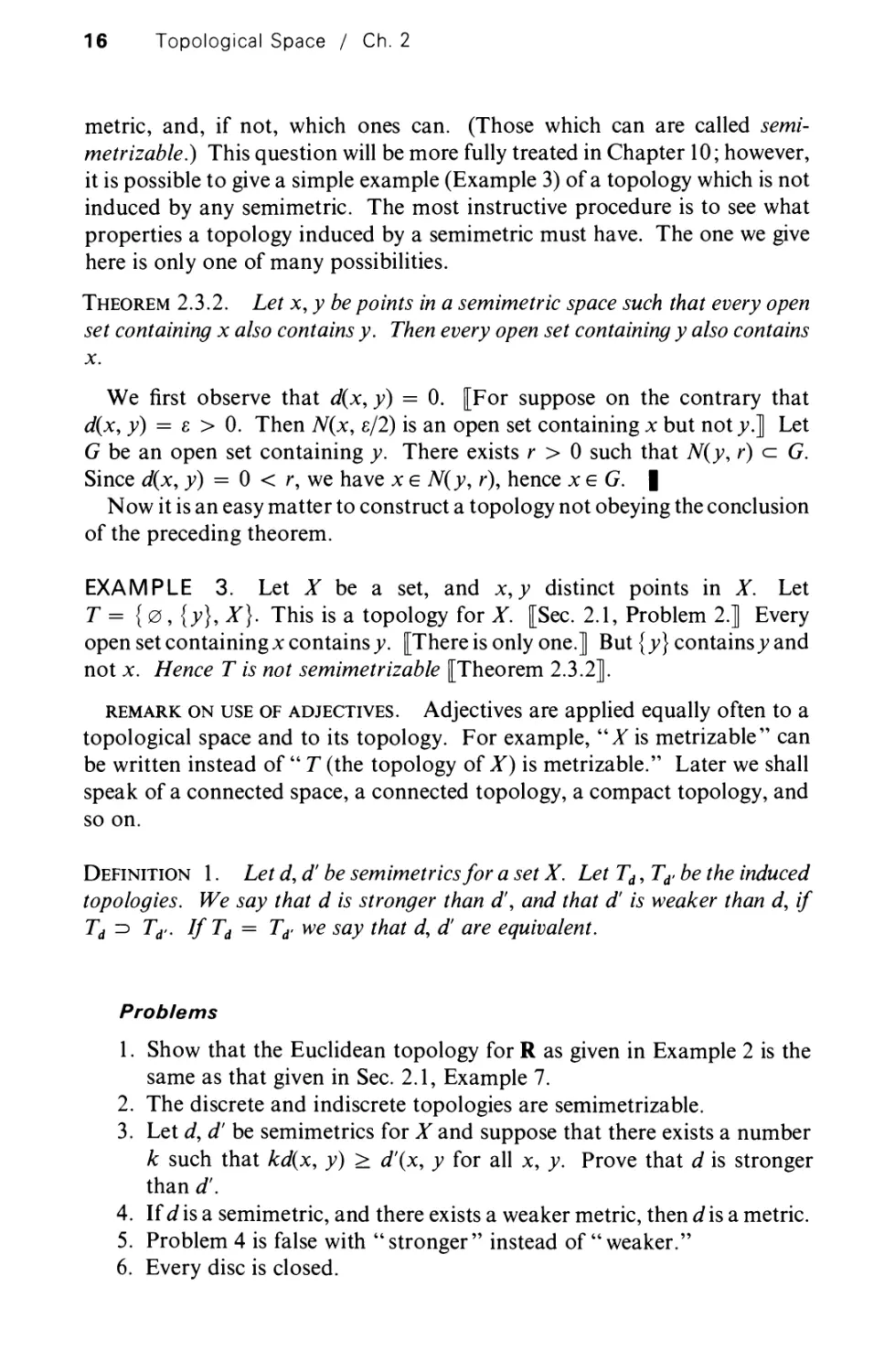
16 Topological Space / Ch. 2
metric, and, if not, which ones can. (Those which can are called semi-
metrizable.) This question will be more fully treated in Chapter 10; however,
it is possible to give a simple example (Example 3) of a topology which is not
induced by any semimetric. The most instructive procedure is to see what
properties a topology induced by a semimetric must have. The one we give
here is only one of many possibilities.
Theorem 2.3.2. Let x, у be points in a semimetric space such that every open
set containing χ also contains y. Then every open set containing у also contains
x.
We first observe that d(x, y) = 0. [For suppose on the contrary that
d(x, y) = ε > 0. Then N(x, ε/2) is an open set containing χ but not j\] Let
G be an open set containing y. There exists r > 0 such that N(y, r) a G.
Since d(x, y) = 0 < r, we have xe N(y, r), hence xe G. |
Now it is an easy matter to construct a topology not obeying the conclusion
of the preceding theorem.
EXAMPLE 3. Let J be a set, and x,y distinct points in X. Let
Γ={0, {y}, X). This is a topology for X. [Sec. 2.1, Problem 2.] Every
open set containing χ contains y. [There is only one.] But {y) contains у and
not x. Hence Τ is not semimetrizable [Theorem 2.3.2].
remark on use of adjectives. Adjectives are applied equally often to a
topological space and to its topology. For example, " X is metrizable" can
be written instead of " Τ (the topology of X) is metrizable." Later we shall
speak of a connected space, a connected topology, a compact topology, and
so on.
Definition 1. Let d, d' be semimetrics for a set X. Let Td, Td> be the induced
topologies. We say that d is stronger than d\ and that d' is weaker than d, if
Td => Td>. IfTd= Td· we say that d, d' are equivalent.
Problems
1. Show that the Euclidean topology for R as given in Example 2 is the
same as that given in Sec. 2.1, Example 7.
2. The discrete and indiscrete topologies are semimetrizable.
3. Let d, d' be semimetrics for X and suppose that there exists a number
к such that kd(x, y) > d'(x, у for all x, y. Prove that d is stronger
than d'.
4. If d is a semimetric, and there exists a weaker metric, then d is a metric.
5. Problem 4 is false with "stronger" instead of "weaker."
6. Every disc is closed.

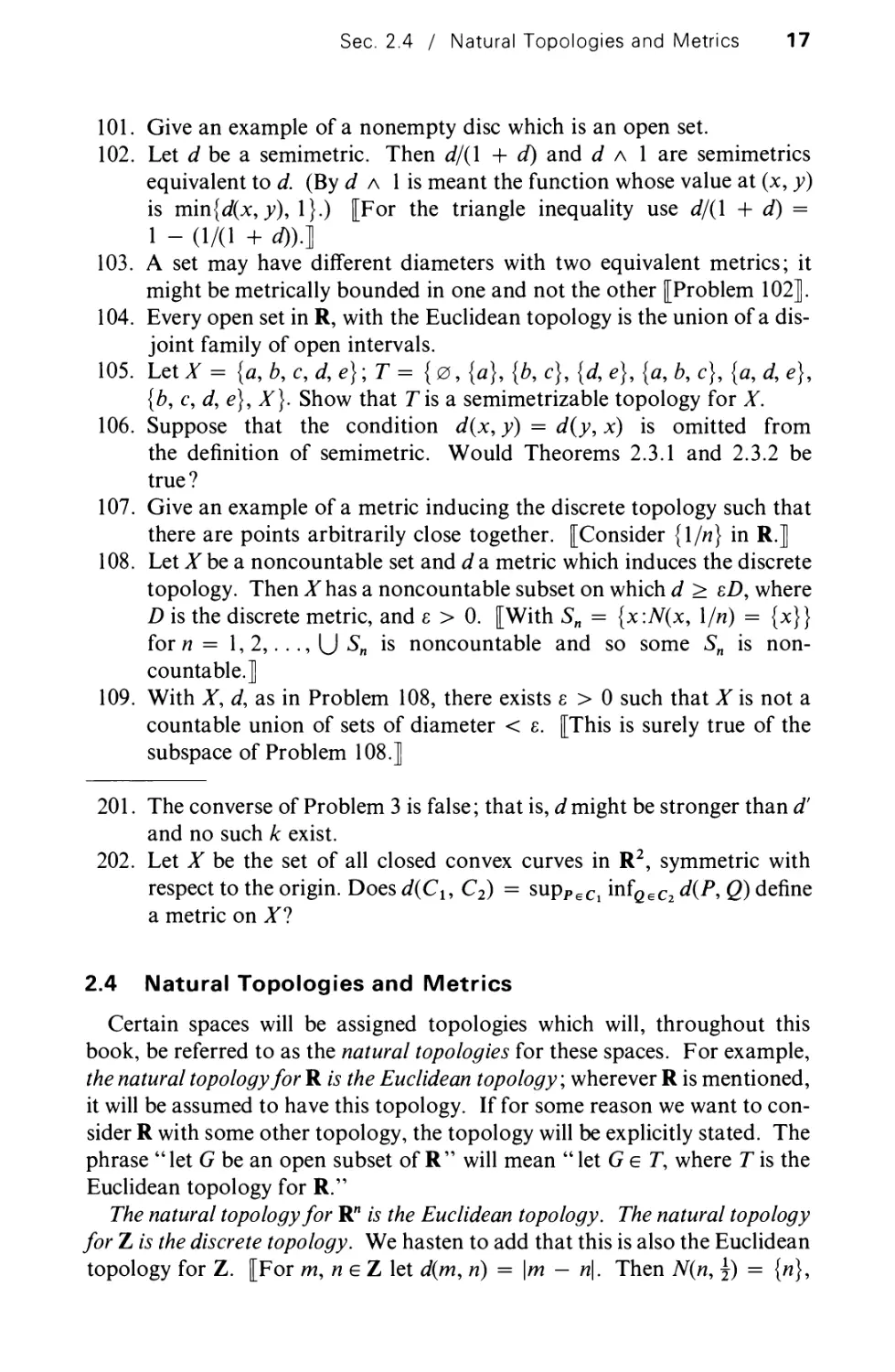
Sec. 2.4 / Natural Topologies and Metrics 17
101. Give an example of a nonempty disc which is an open set.
102. Let d be a semimetric. Then d/(\ + d) and d л 1 are semimetrics
equivalent to d. (By d л 1 is meant the function whose value at (x, j>)
is гшп{фс, j/), 1}.) [For the triangle inequality use d/(\ + d) =
1 - (1/(1 + </)).]
103. A set may have different diameters with two equivalent metrics; it
might be metrically bounded in one and not the other [Problem 102].
104. Every open set in R, with the Euclidean topology is the union of a
disjoint family of open intervals.
105. Let X = {a, b9 c9 d9 e}; Τ = {0, {я}, {b9 с}, {d9 e}9 {a, b, c}9 {a, d, e}9
{b, c\ d9 e}, X}. Show that Г is a semimetrizable topology for X.
106. Suppose that the condition d(x, y) = d(y, x) is omitted from
the definition of semimetric. Would Theorems 2.3.1 and 2.3.2 be
true?
107. Give an example of a metric inducing the discrete topology such that
there are points arbitrarily close together. [Consider {1/w} in R.]
108. Let A" be a noncountable set and d a metric which induces the discrete
topology. Then X has a noncountable subset on which d > sD9 where
D is the discrete metric, and ε > 0. [With Sn = {x:N(x9 \/n) = {x}}
for/7= 1,2, ...,U^n is noncountable and so some Sn is non-
countable.]
109. With X, d, as in Problem 108, there exists ε > 0 such that X is not a
countable union of sets of diameter < ε. [This is surely true of the
subspace of Problem 108.]
201. The converse of Problem 3 is false; that is, dmight be stronger than d'
and no such к exist.
202. Let X be the set of all closed convex curves in R2, symmetric with
respect to the origin. Does d(Cl9 C2) = supPeCl infQeC2 d(P9 Q) define
a metric onl?
2.4 Natural Topologies and Metrics
Certain spaces will be assigned topologies which will, throughout this
book, be referred to as the natural topologies for these spaces. For example,
the natural topology for R is the Euclidean topology, wherever R is mentioned,
it will be assumed to have this topology. If for some reason we want to
consider R with some other topology, the topology will be explicitly stated. The
phrase " let G be an open subset of R " will mean " let G e T, where Τ is the
Euclidean topology for R."
The natural topology for R" is the Euclidean topology. The natural topology
for Ζ is the discrete topology. We hasten to add that this is also the Euclidean
topology for Z. [For m, neZ let d(m, n) = \m — n\. Then N(n, j) = {«},

18 Topological Space / Ch. 2
that is, for each и, {n} is an open set. Hence d induces the discrete topology.]
The natural topology for Q, and J, will be that induced by the Euclidean metric.
Similarly certain spaces will be assigned natural metrics. The natural
metric for R", Z, Q, J is the Euclidean metric. In each case, the natural
metric induces the natural topology.
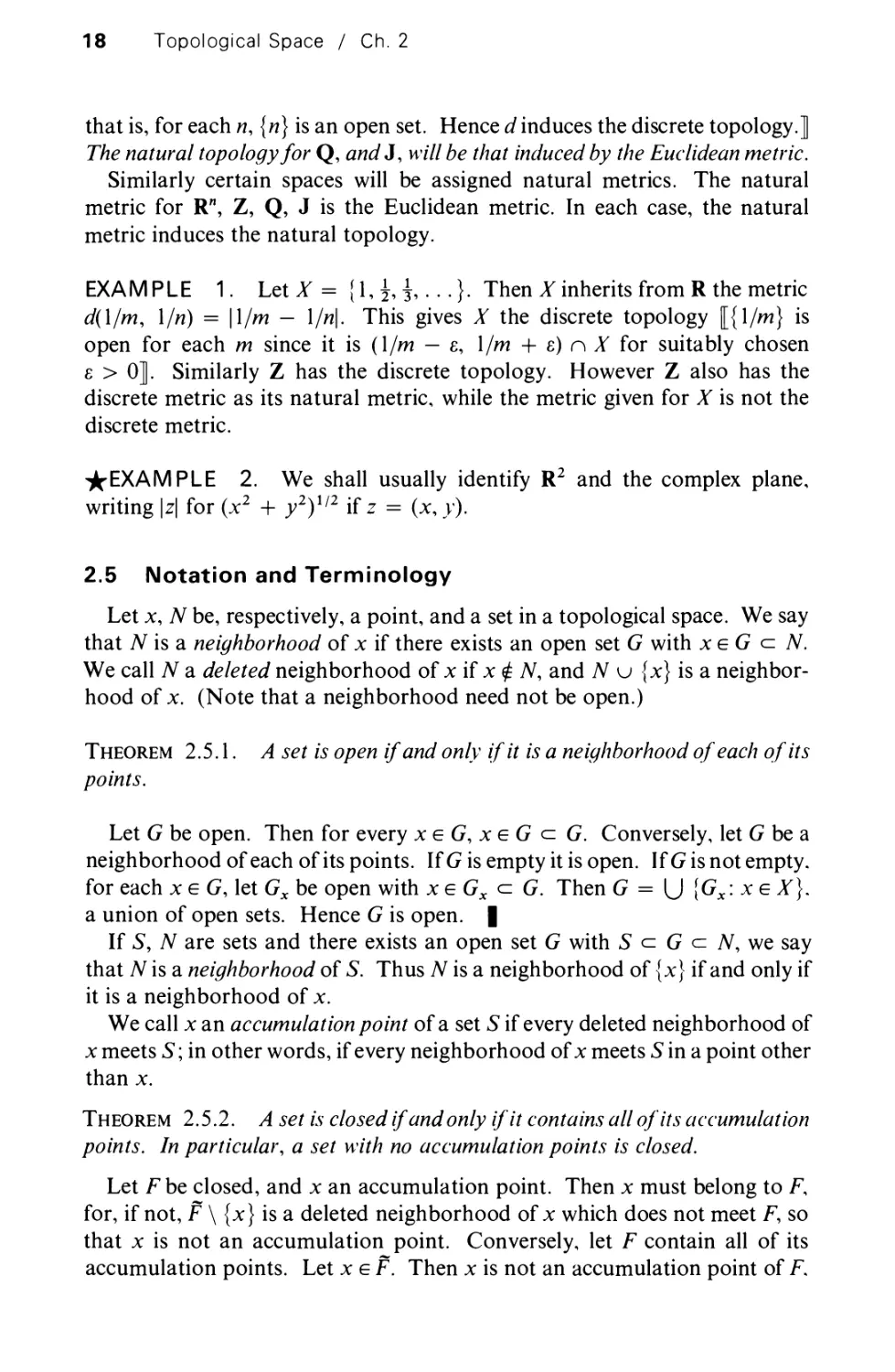
EX Α Μ Ρ L Ε 1. Let X = {1, £, i . ..}. Then X inherits from R the metric
d(\/m, \/n) = \\/m - \/n\. This gives X the discrete topology [{1/wi} is
open for each m since it is (\/m — ε, \/m + ε) η Χ for suitably chosen
ε > 0]. Similarly Ζ has the discrete topology. However Ζ also has the
discrete metric as its natural metric, while the metric given for X is not the
discrete metric.
^-EXAMPLE 2. We shall usually identify R2 and the complex plane,
writing \z\ for (x2 + y2Y12 if ζ = (χ, ν).
2.5 Notation and Terminology
Let x, TV be, respectively, a point, and a set in a topological space. We say
that TV is a neighborhood of χ if there exists an open set G with xeG a N.
We call TV a deleted neighborhood of χ if χ φ Ν, and Ν υ {χ} is a
neighborhood of x. (Note that a neighborhood need not be open.)
Theorem 2.5.1. A set is open if and only if it is a neighborhood of each of its
points.
Let G be open. Then for every χ e G, xe G <^ G. Conversely, let G be a
neighborhood of each of its points. If G is empty it is open. If G is not empty,
for each χ e G, let Gx be open with xe Gx с G. Then G = {J [Gx: χ e X).
a union of open sets. Hence G is open. |
If S, N are sets and there exists an open set G with 5 с G с iV, we say
that TV is a neighborhood of S. Thus TV is a neighborhood of {x} if and only if
it is a neighborhood of x.
We call χ an accumulation point of a set S if every deleted neighborhood of
χ meets S\ in other words, if every neighborhood of χ meets S in a point other
than x.
Theorem 2.5.2. A set is closed if and only if it contains all of its accumulation
points. In particular, a set with no accumulation points is closed.
Let F be closed, and χ an accumulation point. Then χ must belong to F,
for, if not, F \ {x} is a deleted neighborhood of χ which does not meet F, so
that χ is not an accumulation point. Conversely, let F contain all of its
accumulation points. Let xeF. Then χ is not an accumulation point of F,

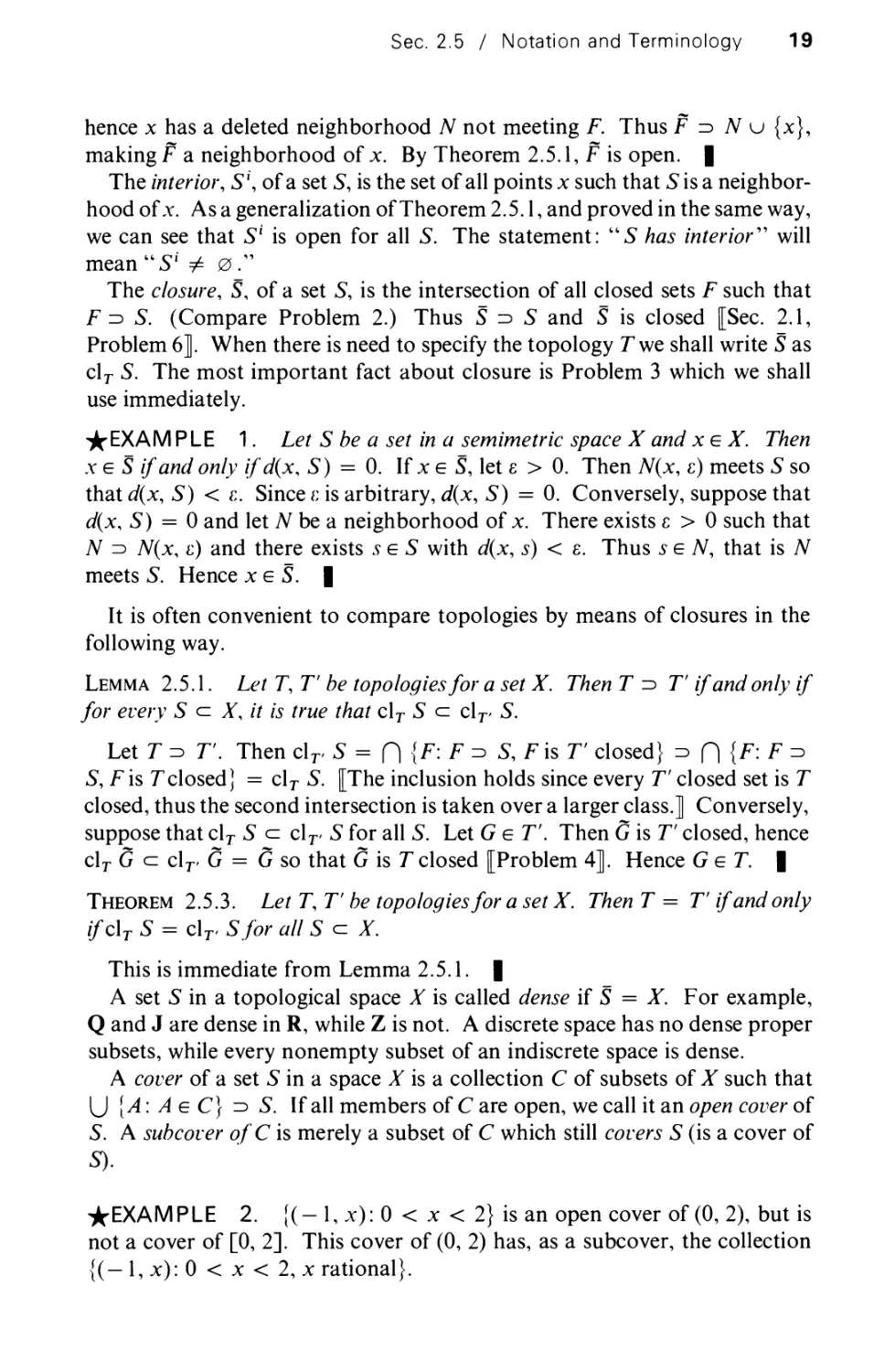
Sec. 2.5 / Notation and Terminology 19
hence χ has a deleted neighborhood N not meeting F. Thus F ^ N и {*},
making F a neighborhood of x. By Theorem 2.5.1, F is open. |
The interior, S\ of a set S, is the set of all points χ such that S is a
neighborhood of x. As a generalization of Theorem 2.5.1, and proved in the same way,
we can see that Sl is open for all S. The statement: "S has interior" will
mean "S1 φ 0 У
The closure, 5, of a set S, is the intersection of all closed sets F such that
F ^> S. (Compare Problem 2.) Thus S ^> S and S is closed [Sec. 2.1,
Problem 6]. When there is need to specify the topology Г we shall write S as
clr S. The most important fact about closure is Problem 3 which we shall
use immediately.
^EXAM PLE 1. Let S be a set in a semimetric space X and xe X. Then
χ e S if and only ifd(x, S) = 0. If χ e 5, let ε > 0. Then N(x, ε) meets S so
thatd(x, S) < ε. Since ε is arbitrary, d(x, S) = 0. Conversely, suppose that
d(x, S) = 0 and let TV be a neighborhood of x. There exists ε > 0 such that
TV => N(x, ε) and there exists s e S with d(x, s) < ε. Thus s e N, that is N
meets S. Hence χ e S. |
It is often convenient to compare topologies by means of closures in the
following way.
Lemma 2.5.1. Let Τ, Τ be topologies for a set X. Then Τ => Τ' if and only if
for every 5cl, it is true that c\T S с clr S.
Let Τ z=> Г. Then clr S = Γ\ {F: F => S, Fis Γ closed} => Π {?'· F =>
S, Fis Tclosed] = clr S. [The inclusion holds since every Τ closed set is Τ
closed, thus the second intersection is taken over a larger class.] Conversely,
suppose that clr S a clr S for all S. Let G e T'. Then G is Τ closed, hence
clT G a clr G = G so that G is Γ closed [Problem 4]. Hence GeT |
Theorem 2.5.3. L^r Γ, Τ be topologies for a set X. Then Τ = T' if and only
ifc\T S = c\T> S for all 5cl
This is immediate from Lemma 2.5.1. |
A set S in a topological space X is called dense if S = X. For example,
Q and J are dense in R, while Ζ is not. A discrete space has no dense proper
subsets, while every nonempty subset of an indiscrete space is dense.
A cover of a set S in a space A4s a collection С of subsets of X such that
(J [A: Α ε С} => S. If all members of С are open, we call it an open cover of
S. A subcover of С is merely a subset of С which still covers S (is a cover of
S).
^EXAMPLE 2. {(- 1, jc): 0 < χ < 2} is an open cover of (0, 2), but is
not a cover of [0, 2]. This cover of (0, 2) has, as a subcover, the collection
{(- 1, x): 0 < χ < 2, χ rational}.

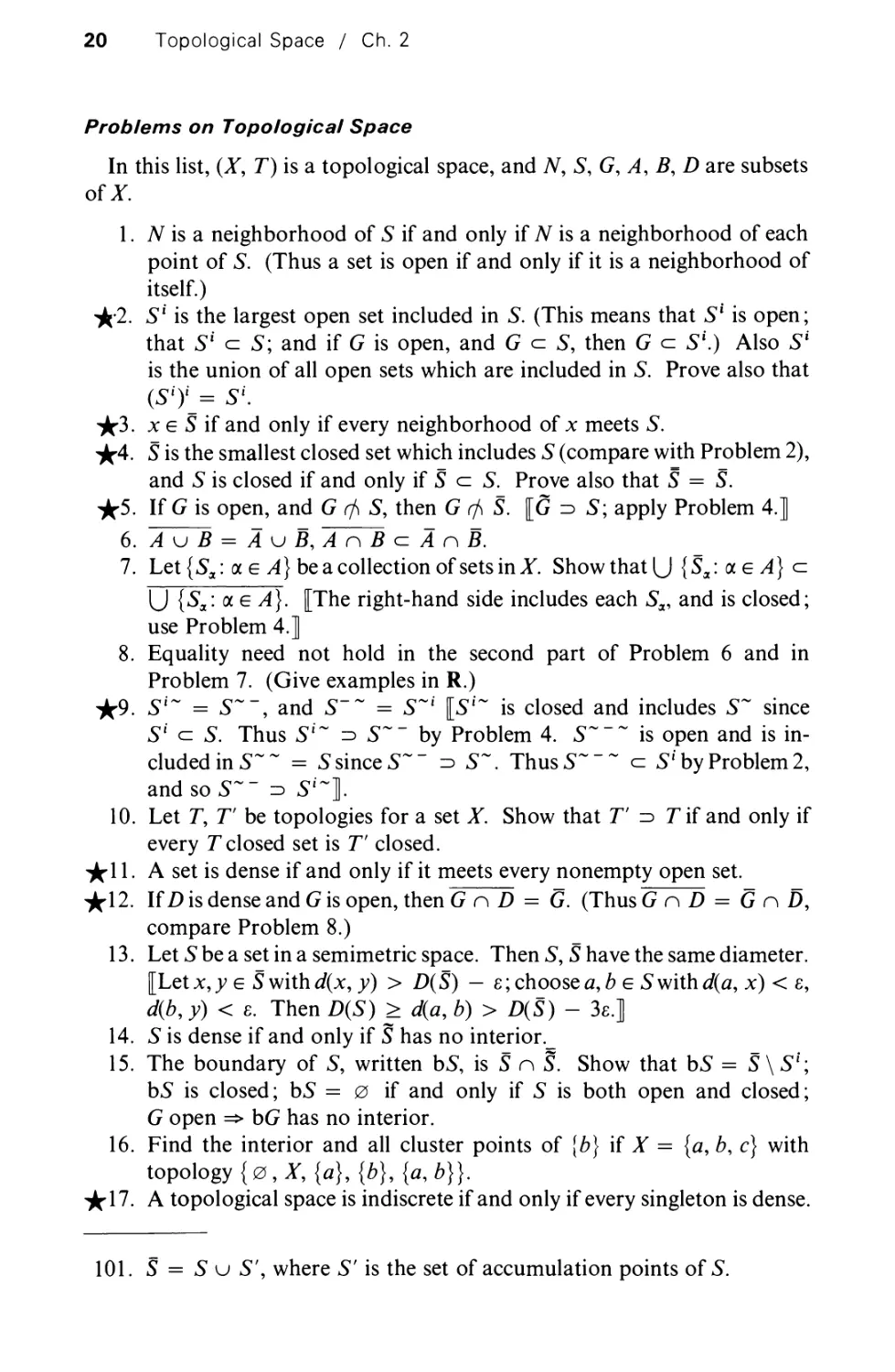
20 Topological Space / Ch. 2
Problems on Topological Space
In this list, (X, T) is a topological space, and N, S, G, A, B, D are subsets
of JT.
1. TV is a neighborhood of S if and only if TV is a neighborhood of each
point of S. (Thus a set is open if and only if it is a neighborhood of
itself.)
^•2. S* is the largest open set included in S. (This means that Sl is open;
that Sl α S; and if G is open, and G α S, then G α S\) Also Sl
is the union of all open sets which are included in S. Prove also that
(siy_= sl.
Jr3. χ e S if and only if every neighborhood of χ meets S.
j{4. S is the smallest closed set which includes S (compare with Problem 2),
and S is closed if and only if S α S. Prove also that S = 5.
*5. If G is open, and G φ S, then G φ S. [G => S; apply Problem 4.]
6. A\j В = Akj Β, Α η Β ^ΑηΒ.
7. Let{»Sa: α e A} be a collection of sets in X Show that IJ {Sa: α e А} а
\J {Sx\ ct.e A). [The right-hand side includes each Sx, and is closed;
use Problem 4.]
8. Equality need not hold in the second part of Problem 6 and in
Problem 7. (Give examples in R.)
^-9. Sl~ = S~~, and S~~ = S~l [S'" is closed and includes S~ since
Sl с S. Thus Sl~ => S~~ by Problem 4. S is open and is
included in S~ ~ = S since S" => S~. Thus S с Sl by Problem 2,
and so S~~ ^ 5£~].
10. Let Τ, Τ be topologies for a set A". Show that Τ => Γ if and only if
every Γ closed set is T' closed.
Jr\\. A set is dense if and only if it meets every nonempty open set.
^-12. If D is dense and G is open, then G η D = G. (Thus G η D = G η D,
compare Problem 8.)
13. Let S be a set in a semimetric space. Then S, S have the same diameter.
[Let x,у e S with d(x, y) > D(S) — ε; choose я, 6 e Swith^tf, x) < ε,
rf(6,^) < ε. Then £>(S) > d(a, b) > D(S) - 3ε.]
14. S is dense if and only if S has no interior._
15. The boundary of 5, written bS, is S η S. Show that bS = S\S'1;
bS is closed; bS = 0 if and only if S is both open and closed;
G open => bG has no interior.
16. Find the interior and all cluster points of [b] if X = {a, b, c] with
topology {0, *, {a}, {b}, {a,b}}.
^-17. A topological space is indiscrete if and only if every singleton is dense.
101. S = S kj S\ where S' is the set of accumulation points of S.

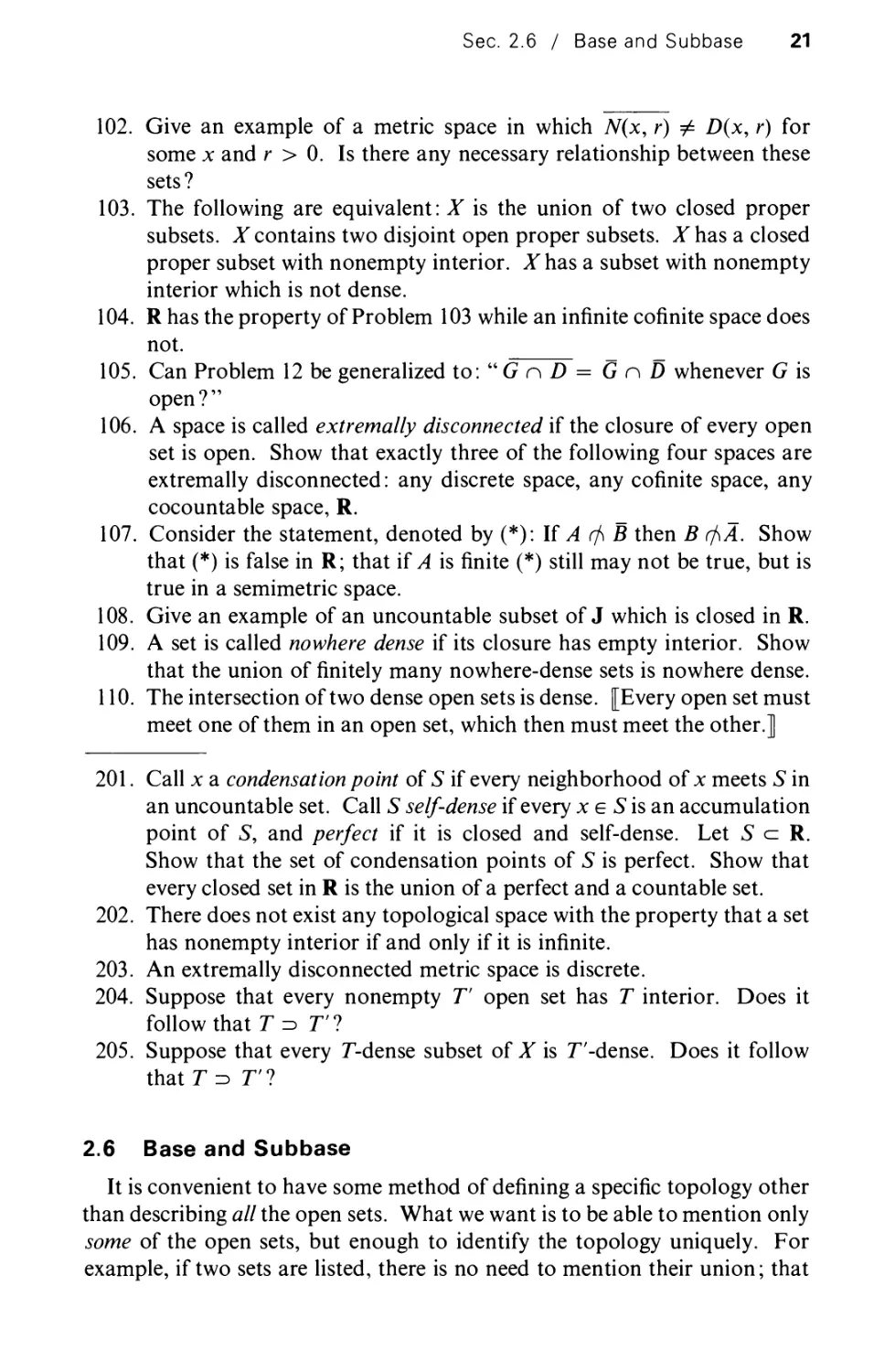
Sec. 2.6 / Base and Subbase 21
102. Give an example of a metric space in which N(x, r) Φ D(x, r) for
some χ and r > 0. Is there any necessary relationship between these
sets?
103. The following are equivalent: X is the union of two closed proper
subsets. A" contains two disjoint open proper subsets. A" has a closed
proper subset with nonempty interior. A'has a subset with nonempty
interior which is not dense.
104. R has the property of Problem 103 while an infinite cofinite space does
not.
105. Can Problem 12 be generalized to: " G η D = G η D whenever G is
open?"
106. A space is called extremally disconnected if the closure of every open
set is open. Show that exactly three of the following four spaces are
extremally disconnected: any discrete space, any cofinite space, any
cocountable space, R.
107. Consider the statement, denoted by (*): If Α φ Β then Β φ A. Show
that (*) is false in R; that if A is finite (*) still may not be true, but is
true in a semimetric space.
108. Give an example of an uncountable subset of J which is closed in R.
109. A set is called nowhere dense if its closure has empty interior. Show
that the union of finitely many nowhere-dense sets is nowhere dense.
110. The intersection of two dense open sets is dense. [Every open set must
meet one of them in an open set, which then must meet the other.]
201. Call χ a condensation point of S if every neighborhood of χ meets S in
an uncountable set. Call S self-dense if every χ e S is an accumulation
point of S, and perfect if it is closed and self-dense. Let S a R.
Show that the set of condensation points of S is perfect. Show that
every closed set in R is the union of a perfect and a countable set.
202. There does not exist any topological space with the property that a set
has nonempty interior if and only if it is infinite.
203. An extremally disconnected metric space is discrete.
204. Suppose that every nonempty Τ open set has Τ interior. Does it
follow that Τ => Г?
205. Suppose that every Γ-dense subset of A" is Γ'-dense. Does it follow
that Г ^ Г?
2.6 Base and Subbase
It is convenient to have some method of defining a specific topology other
than describing all the open sets. What we want is to be able to mention only
some of the open sets, but enough to identify the topology uniquely. For
example, if two sets are listed, there is no need to mention their union; that

22 Topological Space / Ch. 2
is automatically open. But we need some way to ensure that enough open
sets are given, for example if we say ςς Let Τ be the topology for R in which
(0, 1) is open" we would certainly not have adequately described the
Euclidean topology, and it is a little doubtful whether we have described
anything. (A generous interpretation might be that Τ = {0,(0, 1), R}.)
However if we say " Let Γ be the topology for R in which (a, b) is open for all
a, b " we have what appears to be the Euclidean topology. These remarks are
clarified in the rest of this section.
Definition 1. A collection 31 of subsets of a topological space is called a local
base at a point x, or simply, a base at x, if every member ofSt is a neighborhood
ofx, and if for every neighborhood N of x, there exists a set S e & with S cz N.
^-EXAMPLE 1. Let A' be a semimetric space, and fixxel Let 3tx be
the collection of cells N(x, \/n), я = 1, 2, ...; and let &2 be the collection
of discs D(x, \/n), η = 1,2, Then &u Я2, and Ях и @2 are all local
bases at x.
Definition 2. A collection Я of subsets of a topological space is called a base
for the topology if every member ofΊ% is open and Я includes a local base at each
point.
By a basic set will be meant a base. A basic sequence is a countable basic
set. We shall also refer to a base for the topology as a base for the space.
^EXAMPLE 2. The set of all N(x, l/n), χ eΧ, η = 1, 2,. .., is a base
for a semimetric space X [Theorem 2.3.1].
Notice that we ask a little more of the members of a base than of a local
base, namely that they be open sets. Distinctions of this sort are usually for
technical convenience, and other definitions could easily be set up leading to
the same end result (see Problem 101). However, we must use precisely the
definitions given, once we have committed ourselves to them.
Theorem 2.6.1. Let Γ, Τ' be topologies for a set X which have a common
base @. Then Τ = Г.
Let G e Τ and χ e G. There exists S e Я with χ e S a G. Since S e Я it
follows that S e V and so G is a V neighborhood ofx. Since χ is arbitrary,
G e Τ [Theorem 2.5.1]. Thus Τ a T' and, by symmetry T' cz Τ. |
Theorem 2.6.2. Let X be a set and Я a collection of subsets of X with the
following properties: (i) U {A: A e Щ = X, (ii) for each Ue #, Ve ^, and
each χ e U η V, Я contains a member W with χ e W cz U η V. Then there
is a unique topology for X which has Я as a base.

Sec. 2.6 / Base and Subbase 23
Note that we are asserting both the existence and the uniqueness of the
topology. Uniqueness follows from Theorem 2.6.1. The topology is defined
explicitly: Let 0 be open, and let a nonempty set G be called open if and only
if there is a subset 08 λ of 08 with G = \J {A: A e08i}. Then 0 and X
are open [for X take 08 λ = Щ. The union of open sets is open. [Let С
be a collection of open sets. For each G e C, let G = (J {A: A e 08G}. Then
(J С = (J {Л: Α ε U {#«: G е С}}.] Finally, let G, Я be open sets and
xeG η Η. There exists (7 e 08 with χ e U <zz G. [Since χ e G, χ must be in
one of the sets whose union G is, G being open.] Also there exists V e 08 with
χ e К с Я, and so, by hypothesis, there exists We 08 with xe^c(/nF.
Denoting this W by И^, we have Wxe 08 and л: e Wx cz G η Я. Clearly
G η Я => (J { Wx\ χ e G η Я}, and
G η Η = \J {{x}:xeG η Η} a \J {Wx\ xeG η Η}.
Hence G η Я is equal to this union and is thus open. These remarks show
that a topology has been defined. To see that 0Й is a base, let jV be a
neighborhood of some x. Then TV includes an open neighborhood of x, which is, by
definition, a union of certain members of 0$. Selecting one of these, K, which
contains χ we have χ e V a N. |
Definition 3. ^ collection 08 of subsets of a topological space is called a
subbase for the topology if all its members are open and the collection of all
finite intersections of members of 08 is a base.
Here is the easiest way to recognize a subbase. The proof is trivial.
Theorem 2.6.3. A collection 0Й of subsets of a topological space is a subbase
for the topology if and only if its members are open, and for each χ and each
neighborhood N of χ there exists a finite collection {Αλ, A2, . . ., An} of
members of 08 with xe Π At cz N.
The analogue of Theorem 2.6.2 omits Condition (ii).
Theorem 2.6.4. Let X be a set and 3 a collection of subsets ofX whose union
is X. Then there is a unique topology for X which has 0$ as subbase.
The collection of all finite intersections of members of 3 satisfies the two
conditions of Theorem 2.6.2 [take W = U η V\ hence is a base for a unique
topology. |
The collection 0S in the preceding theorem is said to generate the topology.
(A slight stretching of these ideas is often used; namely, if 3 is an arbitrary
collection of subsets of X, then 3 υ {Χ} satisfies the condition of Theorem
2.6.4. The resulting topology is also said to be generated by 08. Points outside
(J {S\ S e 08} would have only one neighborhood, X.)

24 Topological Space / Ch. 2
EXAMPLE 3. The RHO topology. We shall describe a topology for R
called the right half-open interval topology, or RHO topology, for short.
This is the topology generated by the set of all intervals of the form [a, b).
By Theorem 2.6.2, this collection of intervals is a base for the topology.
Each interval [я, b) is open [by definition of base] and closed. [Let χ < a,
then \_x, (x + a)/2) is a neighborhood of χ not meeting [a, b)\ if χ > b, then
\_x, χ + 1) is a neighborhood of χ not meeting [a, b).J Thus the RHO
topology is zero-dimensional. (A zero-dimensional space is one which has a
base of open and closed sets.) The RHO topology is strictly larger than the
Euclidean topology for R. [Let G be a Euclidean open set and xeG. There
exist a, b with a < χ < b, (a, b) cz G. Then [x, b) cz G so that χ is RHO-
interior to G. Thus G is RHO-open. RHO is strictly larger because [0, 1) is
not Euclidean open.]
Problems on Topological Space
1. Every base has the properties given in Theorem 2.6.2.
2. Let 31 be a collection of open subsets of X. Show that 3 is a base for
the topology if and only if every open set is a union of members of ^.
3. The collection of open neighborhoods of a point is a local base at that
point.
4. What topology is generated by {X} ?
5. What topology is generated by {{χ}: χ e X) ?
6. Let ^l5 082 be bases for topologies 7\, T2 on a given set. Show that
Τx cz Τ2 if and only if for every point χ and V e ^Sl with χ e V, there
exists W e 0&2 with χ e W а V.
jrl. If a set meets every member of a base, it is dense. It is not sufficient
that it meet every member of a subbase. [The line (y = x) meets every
horizontal and every vertical strip in R2.]
101. Show that a topology may be defined by specifying neighborhoods in
the following way. A set X is given. For each χ e X, certain sets are
specified and called vicinities of x. It is assumed that χ belongs to each
vicinity of x, that A" is a vicinity of every χ e X, that the intersection of
two vicinities of χ is a vicinity of x, that any set which includes a vicinity
of χ is itself a vicinity of x, and finally that each vicinity of χ includes
a vicinity of χ which is a vicinity of all its points. Show that there is a
unique topology for X with the property that a set is a neighborhood
of χ if and only if it is a vicinity of x. [Call G open if it is a vicinity of
each of its points.]
102. The collection of all closed intervals [a, b~\ is not a base for the
Euclidean topology of R. However, it satisfies Theorem 2.6.2. For what
topology is it a base ?

Sec. 2.6 / Base and Subbase 25
103. What topology for R2 is generated by the set of all horizontal and
vertical lines.
104. Show that the discrete and indiscrete topologies are zero-dimensional.
105. Q is zero-dimensional.
106. The cofinite topology for a set is zero-dimensional if and only if the
set is finite.
107. Show that one of the following two sets is RHO-closed and one is
not:(l,u...),(-!, -i, -i,...).
108. Find the RHO closure and interior of each of (0, 1), (0, 1].
109. A collection $ of nonempty open sets is called a pseudobase if every
nonempty open set includes a member of 3Ϊ. Find a pseudobase for R
which is not a base.
110. Show by Theorem 2.6.2 that there is a topology Γ for Ζ which has as a
base the collection of all arithmetic progressions {a + kd\ к = 0,
±1, ±2,.. .}. Show that Τ is zero-dimensional. [Each arithmetic
progression is open and closed.]
111. For prime /?, let Ap be the arithmetic progression (..., —2/7, — /?,
0, /7, 2/7,. ..). Show that \J {Ap:p prime, ρ > 2} = Z\{-1, 1}.
Thus this union is not closed in the topology Γ of Problem 110, and so
cannot be a finite union. Deduce that Ζ contains infinitely many
primes.
112. In Theorem 2.6.2 the assumption χ e W cannot be omitted. [Let
X = {a,b,c,d}, U= {a,b,c}, V= {b,c,d}, W= {b},B= {U, V, W).
If В were a base for a topology U η V would be open and yet not a
neighborhood of c.J
201. Show that {(x, ^):xeJ,j;eJ} is a zero-dimensional space (with the
Euclidean metric of R2); and the same is true of {(x, y): xeR,y eR,
either χ or у е Q}.
202. R is not zero-dimensional.
203. Find the RHO closure of Q.
204. Is the union of a chain of topologies (on a fixed space) a topology ?

Convergence
3.1 Sequences
Suppose that у is a sequence in a topological space X. This means that ν
is a function from ω (the positive integers) to X. For η e ω, we usually write
yn instead of y(n); у is sometimes written as {>„}, sometimes as yn, where
there is no danger of confusion. We say that у converges to x, in symbols,
yn —► x, if, for every neighborhood TV of x, yn e TV eventually, that is, there
exists n0eR such that η > n0 implies yn e TV. Any point χ such that yn -> χ
is called a //w/r of {>>„}. A sequence in R which converges to 0 is called a null
sequence.
^-EXAMPLE 1. If ν is a sequence in R, yn -> χ if and only if for every
ε > 0, there exists и0 e R such that η > n0 implies \yn — x\ < ι:. If ν is a
sequence in a semimetric space (X, d), yn —► χ if and only if J(>n, x) -> 0.
Note that {^(^„, χ)} is a real sequence.
EXAMPLE 2. Define a semimetric d for R2 by */[(*, v), (и, f)] = |x - «|.
Let z„ = (1//7, 0). Then ζ = {z„} is a sequence in R2 and it is clear that
z„—> (0, 0). But it is equally clear that z„ —> (0, 1). Thus a convergent
sequence may converge to several points.
When a sequence у converges to a unique point x, we also write lim ν = .ν
or lim yn = χ or lim„ yn = x.
We have now seen that in a topological space, it is possible to discuss
convergence of sequences. We now investigate to what extent knowledge of
26

Sec. 3.1 / Sequences 27
which sequences are convergent specifies the topology. In other words, we
ask under what circumstances two different topologies on a set may, or may
not, have exactly the same convergent sequences and corresponding limits.
We begin with an example which shows that this may happen. Let us call a
topology Τ sequentially stronger than a topology Τ if xn —► χ in Τ implies
xn —► χ in T'\ Γ, Τ are called sequentially equivalent if each is sequentially
stronger than the other.
EXAMPLE 3. Let X be any uncountable set. Let Τ be the cocountable
topology. We shall show that a sequence у is convergent if and only if it is
eventually constant, that is yn —► χ if and only if yn = χ eventually. [Half of
this is easy (Problem 1). Now suppose that у is a sequence in Χ, χ e X, and
it is false thatyn = χ eventually. LetF = {yn'.yn φ χ}. Then Fis countable
(perhaps finite), hence F is a neighborhood of x. But it is false that yne F
eventually, hence yn does not converge to x.J Now Τ is not the discrete
topology [singletons are not open since the complement of a singleton is
uncountable], but, as we have just seen, Τ and the discrete topology are
sequentially equivalent [Problem 2].
Another topology which is sequentially equivalent to the discrete topology
is shown in Theorem 14.1.6. Further, using language to be explained later,
this topology, in contrast with the cocountable topology, is compact, Γ4.
Definition 1. A topological space is called first countable at χ if there is a
countable local base at x, and first countable if it is first countable at each of its
points.
^-EXAMPLE 4. A finite space is first countable.
^-EXAM PLE 5. Every semimetric space is first countable since, for each
.v, {N(x, I/n)} is a countable local base at x.
Theorem 3.1.1. Let X be a topological space, χ e X, S <^ X, and suppose
that X is first countable at x. Then xeS if and only if there is a sequence in S
which converges to x.
Suppose first that such a sequence exists. Every neighborhood of χ contains
a point of this sequence, hence a point of S. Conversely, let xe S. Let {Vn)
be a shrinking [Problems 5 and 7] basic sequence at x. Each Vn meets S so
we may choose sn e Vn η S. Then sn —► χ [Problem 5]. |
Theorem 3.1.2. Let Τ and T' be topologies for a set X with Τ first countable.
Then Τ => Τ' if and only if Τ is sequentially stronger than T'.

28 Convergence / Ch. 3
Suppose first that Τ => Τ' and xn —► χ in Γ. Let К be а Г' neighborhood
of x. Then К is a /"neighborhood of χ and so x„ e К eventually. Conversely,
let Τ be sequentially stronger than Τ. It follows from Theorem 3.1.1 and
Problem 3, that clT S a clr S for all 5cl The result follows from
Lemma 2.5.1. |
Theorem 3.1.3. Let Τ, Τ' be first countable topologies for a set X. Then
Τ = T' if and only if Τ, Τ' are sequentially equivalent.
This follows immediately from Theorem 3.1.2. |
^-EXAMPLE 6. Let d, d be semimetrics. Then d is stronger than d if and
only if xn —► χ in d implies xn —► χ in d [Example 5, Theorem 3.1.2, and
Sec. 2.3, Definition 1]. A sufficient (but not necessary [Problem 12])
condition that d be stronger than d is d(x, y) > d'(x, y) for all x, у \d'(xn, x) <
<Kxn9x)-+0l
^EXAMPLE 7. Let d be a semimetric and let d = d/(\ + d). Then d
is a semimetric [for example,
^' Zj 1 + d(x, z) 1 + </(*, z) " 1 + d(jc, j>) + d(y, z)
= d(x, y) d(y, z)
1 + фс, y) + d(y, z) 1 + фс, j;) + d[^, z)
< </'(*, >>) + rf'(^, Z).]
Also, d' is equivalent to d. [Since d > d\ half is trivial by Example 6.
Conversely, if d(xn, i)->0we have d(xn, x) = d'(xn, x)/(\ - d'(xn, x)) —> 0.]
Problems on Topological Space
Jr\. If yn = χ eventually, then yn —► x.
Jr2. yn —► χ in the discrete topology if and only if yn = χ eventually.
{{x} is a neighborhood of x.J
jr?>. Half of Theorem 3.1.1 holds without assuming that X is first countable.
[The part proved first.]
^4. Theorem 3.1.1 fails if X is not assumed first countable. [Let X be an
uncountable space with the cocountable topology. Let S α Χ with S
countable, and χ φ S. Then χ e S but no sequence in S converges to
χ by Example 3.]
^-5. Suppose that {Vn) is a countable shrinking (that is, Vn+i cz Vn for all
n) local base at x, and that, for each n, yn e Vn. Prove that yn —► x.
[Every neighborhood of χ includes some Vn, hence all Vk for к > w.]

Sec. 3.1 / Sequences 29
6. Show that "shrinking" cannot be omitted in Problem 5. (Give an
example in which X = R.)
^7. Let X be first countable at x. Show that X has a countable shrinking
local base at x. [Consider {0?= ι V^.J
8. If yn —► x, every subsequence of у also converges to x.
9. Half of Theorem 3.1.2 holds without assuming that X is first countable.
[The part proved first.]
10. Theorem 3.1.2 fails if Τ is not assumed first countable. [Γ = co-
countable, Τ = discrete. Here V is first countable.]
11. Suppose given two sequentially equivalent topologies. If one of them
is first countable, it must be larger.
12. For x,yeR let d(x, y) = \x - y\/(\ + \x - y\). Show that d is
equivalent to the Euclidean metric d [Example 7], and that there
exists no к > 0 such that d(x, y) < kd(x, y) for all x, y.
101. Let rfbea semimetric and let d = d л 1. (This means d(x, y) =
min{l, d(x, y)}). Show that d is a semimetric and is equivalent to d.
102. Let X be an infinite cofinite space, and let j· be a one-to-one sequence
in X. (This means that yi Φ yj if / Φ j.) Show that yn —► χ for all
xeX.
103. Does the result of Problem 102 hold if, instead of one-to-one, it is
assumed that у has infinite range ?
104. Let Γ, Τ be topologies for a set X with Τ first countable. Suppose
that every sequence which Τ converges to a point has a subsequence
which Γ converges to that point. Show that Τ => Т. [Let χ e clr S.
Apply Theorem 3.1.1 and Problem 3 to show that xec\TS; then
apply Lemma 2.5.1.]
105. One cannot define a topology, first countable or not, by specifying that
certain sequences shall be convergent, even if the class of convergent
sequences is very well behaved (see Problem 106). Illustrate this by
showing that R has no topology Τ such that xn -^ χ if and only if
\xn — x\ < \jn eventually. [Apply Problem 104 with Τ = Euclidean
topology, Τ = supposed topology. Theorem 3.1.2, with Problem 9,
is contradicted.]
106. Which of the four properties (a), (b), (c), (d) of Problem 206 does the
convergence of Problem 105 have ?
107. Give an example of a first countable space which is not semimetrizable.
108. Let X = {0, 1, 2, 3,...}. Let every set which does not contain 0 be
open and let a set G containing 0 be open if and only if G has the
property u(n)jn —► 1 as η —► oo, where u{n) is the number of members
of G in the interval [1,и]. (Sometimes phrased, G has density 1.)
Check that this is a topology, and that 0 is the only point which is an
accumulation point of its complement.

30 Convergence / Ch. 3
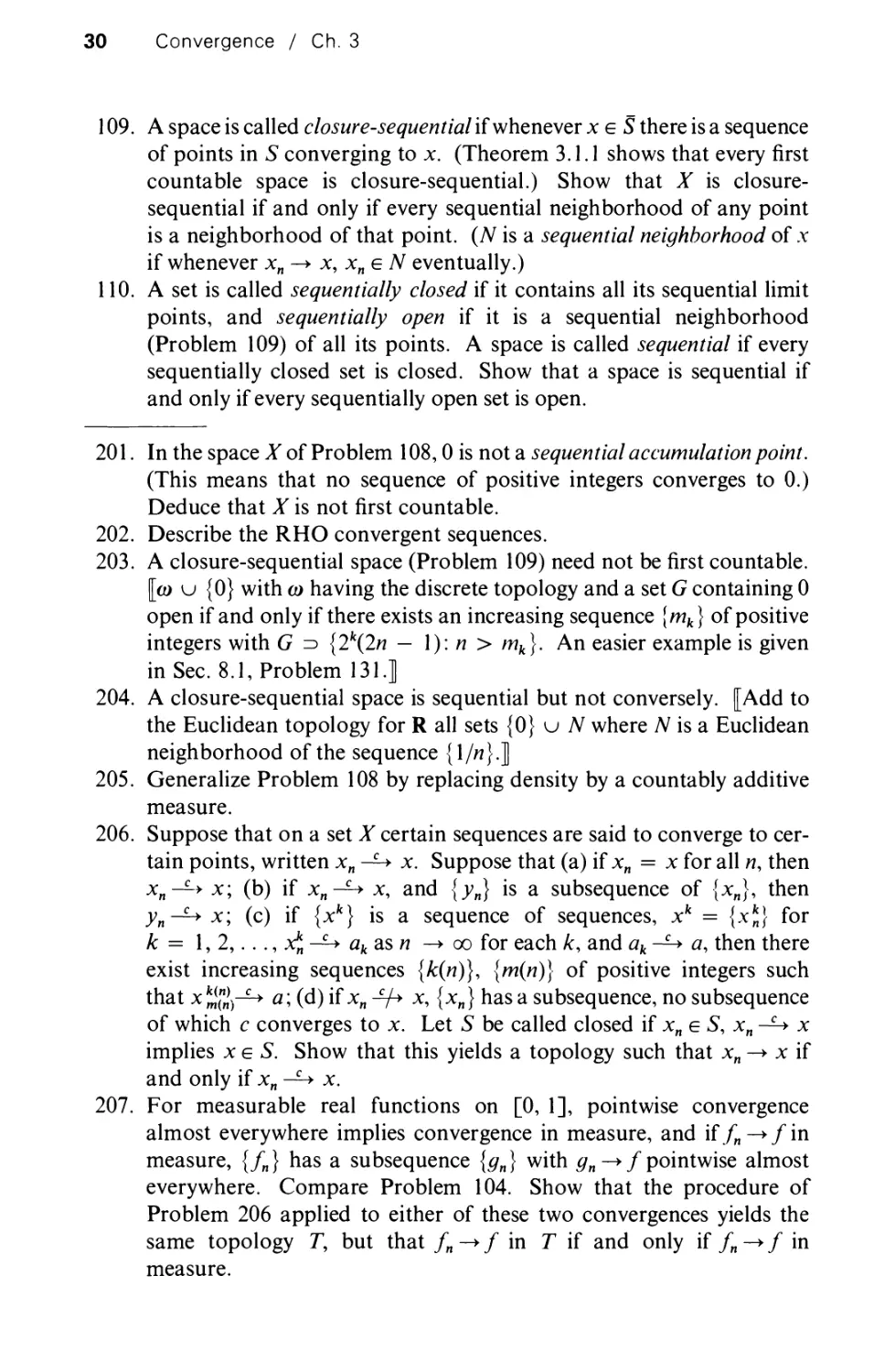
109. A space is called closure-sequential if whenever χ e S there is a sequence
of points in S converging to x. (Theorem 3.1.1 shows that every first
countable space is closure-sequential.) Show that X is closure-
sequential if and only if every sequential neighborhood of any point
is a neighborhood of that point. (N is a sequential neighborhood of л:
if whenever xn —► x, xn e N eventually.)
110. A set is called sequentially closed if it contains all its sequential limit
points, and sequentially open if it is a sequential neighborhood
(Problem 109) of all its points. A space is called sequential if every
sequentially closed set is closed. Show that a space is sequential if
and only if every sequentially open set is open.
201. In the space X of Problem 108,0 is not a sequential accumulation point.
(This means that no sequence of positive integers converges to 0.)
Deduce that X is not first countable.
202. Describe the RHO convergent sequences.
203. A closure-sequential space (Problem 109) need not be first countable.
[ω υ {0} with ω having the discrete topology and a set G containing 0
open if and only if there exists an increasing sequence {mk} of positive
integers with G => {2k(2n — 1): η > mk]. An easier example is given
in Sec. 8.1, Problem 131.]
204. A closure-sequential space is sequential but not conversely. [Add to
the Euclidean topology for R all sets {0} υ Ν where TV is a Euclidean
neighborhood of the sequence {1/w}.]
205. Generalize Problem 108 by replacing density by a countably additive
measure.
206. Suppose that on a set X certain sequences are said to converge to
certain points, written xn -^> x. Suppose that (a) if xn = χ for all и, then
xn—> x\ (b) if χη-^ χ, and {yn} is a subsequence of {*„}, then
уп-^> х; (с) if {xk} is a sequence of sequences, xk = {xkn} for
к = 1, 2,.. ., x^ —c-> ak as η —► oo for each k, and ak -^ a, then there
exist increasing sequences {£(«)}, {m{n)} of positive integers such
that χ J^-^» a\ (d) if xn -^ x, {xn} has a subsequence, no subsequence
of which с converges to x. Let S be called closed if xn e S, xn -^ χ
implies xe S. Show that this yields a topology such that xn —► χ if
and only if xn -^> x.
207. For measurable real functions on [0, 1], pointwise convergence
almost everywhere implies convergence in measure, and if/„—►/in
measure, {/„} has a subsequence {gn} with gn —► /pointwise almost
everywhere. Compare Problem 104. Show that the procedure of
Problem 206 applied to either of these two convergences yields the
same topology Γ, but that fn-+f in Γ if and only if/„—►/ in
measure.

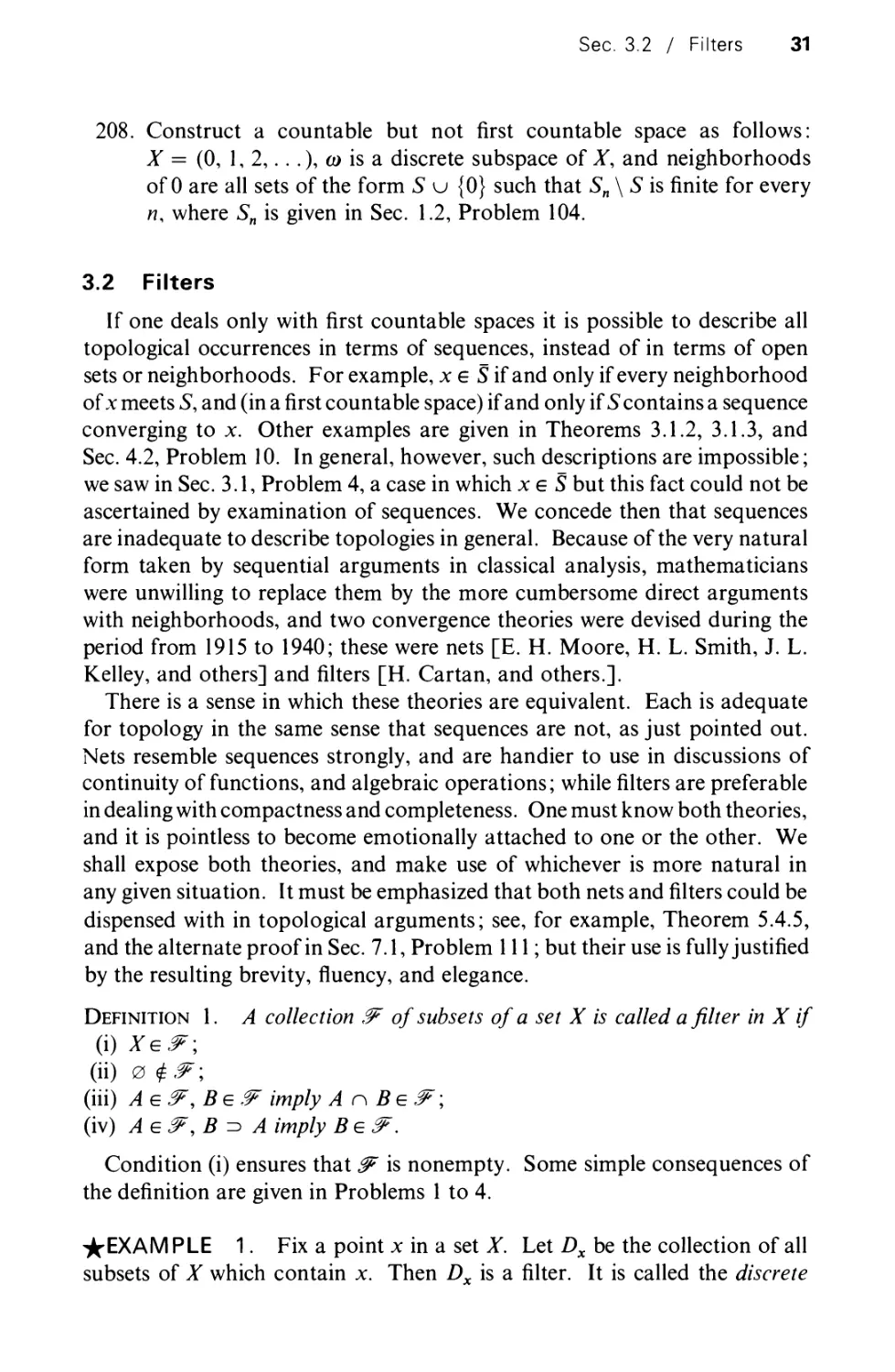
Sec. 3.2 / Filters 31
208. Construct a countable but not first countable space as follows:
X = (0, l, 2,.. .), ω is a discrete subspace of X, and neighborhoods
of 0 are all sets of the form S и {0} such that Sn \ S is finite for every
и, where Sn is given in Sec. 1.2, Problem 104.
3.2 Filters
If one deals only with first countable spaces it is possible to describe all
topological occurrences in terms of sequences, instead of in terms of open
sets or neighborhoods. For example, xe S if and only if every neighborhood
of χ meets S, and (in a first countable space) if and only if S contains a sequence
converging to x. Other examples are given in Theorems 3.1.2, 3.1.3, and
Sec. 4.2, Problem 10. In general, however, such descriptions are impossible;
we saw in Sec. 3.1, Problem 4, a case in which χ e S but this fact could not be
ascertained by examination of sequences. We concede then that sequences
are inadequate to describe topologies in general. Because of the very natural
form taken by sequential arguments in classical analysis, mathematicians
were unwilling to replace them by the more cumbersome direct arguments
with neighborhoods, and two convergence theories were devised during the
period from 1915 to 1940; these were nets [E. H. Moore, H. L. Smith, J. L.
Kelley, and others] and filters [H. Cartan, and others.].
There is a sense in which these theories are equivalent. Each is adequate
for topology in the same sense that sequences are not, as just pointed out.
Nets resemble sequences strongly, and are handier to use in discussions of
continuity of functions, and algebraic operations; while filters are preferable
in dealing with compactness and completeness. One must know both theories,
and it is pointless to become emotionally attached to one or the other. We
shall expose both theories, and make use of whichever is more natural in
any given situation. It must be emphasized that both nets and filters could be
dispensed with in topological arguments; see, for example, Theorem 5.4.5,
and the alternate proof in Sec. 7.1, Problem 111; but their use is fully justified
by the resulting brevity, fluency, and elegance.
Definition 1. A collection <Ψ of subsets of a set X is called a filter in X if
(i) Xe&\
(ii) 0 φ&\
(iii) Ae^, Be & imply A η 5e,f;
(iv) Ae^, В ^ A imply Be^.
Condition (i) ensures that 3F is nonempty. Some simple consequences of
the definition are given in Problems 1 to 4.
^EXAM PLE 1. Fix a point χ in a set X. Let Dx be the collection of all
subsets of X which contain x. Then Dx is a filter. It is called the discrete

32 Convergence / Ch. 3
filter at x, for reasons which will become clear in Example 2. Let Ix = {X}.
This is called the indiscrete filter at χ; it happens to be independent of x.
^EXAMPLE 2. Let A" be a topological space and xg X. Let Nx be the
collection of all neighborhoods of x. If A" has the discrete topology, Nx = Dx
(Example 1). If A" has the indiscrete topology, Nx = Ix. In any case Nx is a
filter, called the neighborhood filter at x.
Now let SF be a filter in a topological space X. We say that & converges to
x, in symbols, !F —> x, if & => Nx, the neighborhood filter at x. This
definition, perhaps, does not seem as reasonable as the definition of convergence
of a sequence. We shall see, however, in Example 4, and in Theorem 4.2.2,
that it has the right properties. If & converges to a unique point x, we also
write lim <F = x. Any point χ such that & —► χ is called a limit of <F. We
shall often use the obvious fact that if' 3F' —► χ then any larger filter than &
(that is, any filter which includes 3F\ also converges to x.
^-EXAMPLE 3. Let A" be a topological space and χ e X. Then Nx -> x.
[This is trivial.]
EXAMPLE 4. Let {xn} be a sequence in X. Let У = {A a X: xn e A
eventually}. Then & is a filter [Problem 1] and xn —► χ if and only if 3F —► x.
[If xn —► χ and TV is a neighborhood of x, xne N eventually; hence TVe 3F.
This shows that Nx a <F and so & —► x. Conversely, if «^ —► x, let TV be a
neighborhood of x. Now N e ^ by hypothesis, thus x„gN eventually;
hence xn —► *.]
To specify a filter, it is not necessary to name all of its sets. Whenever it is
known that a given set S belongs to a filter #", then it is known that any
superset of S belongs to #\ We now define the concept filterbase and show
how a filterbase leads to a filter.
Definition 2. A collection Я of subsets of a set X is called a filterbase in X if
(i) я Ф 0;
(ii) 0 φ Я;
(iii) ,4 e Я, В e * z'/ир/у ίΑαί * contains a set С with С cr Α η Β.
Thus a filter is a filterbase. A significant example of a filterbase is the set
of discs in the plane containing the origin in their interiors. A filterbase Я
generates a filter <F in the obvious way, &* = {A: A => В for some В е ^}.
We say of a filterbase Я, that ^ —► χ if the filter generated by Я converges
to x. Thus Я —> χ if and only if, for each neighborhood N of x, Я has a
member Л with A cz N.

Sec. 3.2 / Filters 33
^EXAMPLE 5. Let S be a proper subset of a set X. Let !F be a filter on
S. Then ^ is not a filter on Χ [Χ φ &\ but & is a filterbase on A". Indeed if
^ is a filterbase on S, then ^ is also a filterbase on A". This property, and that
given in problem 5, make filterbases easier to use than filters.
EXAMPLE 6. Let A" be a topological space, and χ e X. Then Dx —► χ
(Example 1). {Dx => Nx, obviously.] An interesting filterbase which
generates Dx is {{*}}; this is a filterbase containing just one set, and that set is a
singleton.
We can now obtain an improved form of Theorem 3.1.1. (Recall Sec. 3.1,
Problem 4, which shows that this result is false if filterbase is replaced by
sequence.)
Theorem 3.2.1. Let X be a topological space, χ e X, S с X. Then χ eS
if and only if there is a filterbase in S which converges to x.
Suppose first that such a filterbase & exists, and let TV be a neighborhood
of x. There exists A e $ with A a N. Since A cr S, this means that TV must
meet S. Conversely, let χ e S and let & = {Ν η S: Ne Nx}. We check the
definition of filterbase. & Φ 0 since Se FfS = Χ η SJ; 0 φ & since, for
every N e Nx, Ν η S φ 0 {χ e S]; and, if A = N1 η S, В = N2 η S, then
Α η В = Ni η N2n Se@. Finally^ -+ x. [Let We Nx. ThenW η Se08
and Ν η S с TV.] |
The succeeding results of Section 3.1 follow in an entirely similar way.
Theorem 3.2.2. Let Γ, Τ be topologies for a set X. Then Τ => Τ if and
only if ^ —► χ in Τ implies 3F —► χ in Τfor all filters <F in X. Hence Τ = T'
if and only ifT, Τ have the same convergent filters and corresponding limits.
Suppose first that Τ n> V and У -► χ in Τ Then N'x ^ Nx ^ У, where
Nx, Nx are the sets of all Τ', Τ, neighborhoods of x, respectively. Hence
!F —> χ in Τ. Conversely, suppose that & —> χ in Timplies #" —> χ in Τ and
let 5cl If χ g clT S there is a filterbase ^ in S with ^ -> χ in Γ. Then
^ —> χ in Γ' [in each case, 31 —> χ if and only if the filter generated by
89-+ x\ and so χ e clT, S. We have proved that clT S с clT, S for all S and
so Г id Г [Lemma 2.5.1]. |
There is a natural way to topologize a subset A" of a topological space
(У, Г); namely let Гу = {G η X;Ge T). This is clearly a topology for
Ar [Problem 7] and is called the relative topology of YforX\ when A" has this
topology it is called a topological subspace of Y. If S is an open subset of X
in the relative topology of У we say that S is open in X. (It may or may not be
open in Y.)

34 Convergence / Ch. 3
Theorem 3.2.3. Let X be a topological subspace of Y, let χ e X, and let &
be afilterbase on X. Then & —► xinX if and only if& —► χ in Y.
Suppose first that $ —► χ in Y. Every neighborhood of χ in X is of the
form Ν η X, where TV is a neighborhood of χ in Y. Now TV ^ A for some
A e S&\ hence Ν η X ^> A. Thus 31 -+ x'm X. Conversely, let 3 —► χ in A',
and let TV be a neighborhood of χ in У. Then TV η Ar is a neighborhood of
x'm X and so TV η A" => ^ for some A e &. Thus Ν ^> Ν η Χ ^> A, and so
^ -► χ in Y. |
Corollary. Lei X be a topological subspace of Y, and Υ a topological sub-
space ofZ. Then X is a topological subspace ofZ.
This is immediate from Theorems 3.2.2 and 3.2.3. |
Problems
In this list, $F is a filter, and 3 is a filterbase.
^-1. Check that !F is a filter in Example 4.
*2. Check that {Λ: A n> 5 for some 5 e ^} is a filter.
^-3. Any two members of <F have nonempty intersection. The same is
true of 3.
4. Any finite intersection of members of <F belongs to $F.
+5. Let/: X-+ У, and let * be a filterbase in X Show that/ВД is a
filterbase in У, and that if #" is a filter in A',/^] is a filter if and only
if/is onto.
6. A filter is discrete if and only if it contains a singleton.
^rl. The relative topology for A" is a topology.
8. If A" is an open set in Y, then a subset of X which is open in X is also
open in Y. The assumption that X is open cannot be omitted.
9. For 5cZ, where A" is a topological subspace of У, if S is open in Υ
it is open in X.
^-10. Let (Ύ, d) be a semimetric space and X a Y. Show that d'(x, y) =
d(x, y) for x, у e X makes (X, d') into a semimetric space with the
relative topology of Y.
11. If X is a topological subspace of Υ and ^ is a base for the topology of
У, then {A n X: A e &} isa base for the relative topology.
12. Let X be a topological subspace of У and S a X. Then S is closed in
the relative topology if and only if there exists closed F с Υ with
S = F η Jr. [Take F = 5.]
13. Modify the results of Problem 8 so as to refer to closed sets.
14. Let G be an open set in A" and let D be a dense subset of A". Show that
G η D is dense in G.
15. In Problem 14, " open" cannot be omitted.

Sec. 3.3 / Partially Ordered Sets 35
16. A base for a topology is usually not a filterbase. However, a local base
is a filterbase.
101. If 31 is a filterbase, then {В: В е 3} is also a filterbase, and generates a
smaller filter.
102. The set of (circular) cells in the plane containing the origin is a filter-
base but not a filter.
103. Let f: X-+ Υ where A" is a set and Υ a topological space. Then
/[AJ-Αχ).
104. Let/: X-+ Y, andxel. Show that the filter generated by f[Dx~\ is
£>/(JC), and deduce the result of Problem 103.
105. Fix xeX. Let Cx = {A e Dx\ A is finite.} Then Cx is a filter. It is
called the cofinite, or Frechet filter at x. Show that if X is finite
Cx = Dx, while if A" is a cofinite space, Cx = Nx.
106. Let A" be an arbitrary infinite set. Let C^ = {A a X: A is finite}.
Then Сда is a filter, called the cofinite, or Frechet filter at oo.
107. Let A" be a topological space, iel, and suppose that every filter on X
converges to x. Show that χ has only one neighborhood. [Consider
the indiscrete filter.]
108. Call a filterbase discrete, indiscrete, cofinite, if it generates a discrete,
indiscrete, cofinite filter. Show that any singleton is a discrete filter-
base, and given an example of a cofinite filterbase on R which is not a
filter.
109. Let G be an open set in X and D a dense open set in G (with the relative
topology.) Show that there exists a dense open subset V of X with
VnG = D.
110. (Duplication of a point.) Given a topological space X, let χ be a
nonisolated point of X, and let t φ X. Let Υ = Xu {t}. Let
Τ = {G cr У: either G or (G \ {ί}) υ {χ} is an open set in A"}. Show
that Γ is a topology for Υ and that x, t are not contained in disjoint
open sets. (The end result is as if the point χ has been duplicated.)
111. In Problem 110, У is first countable at χ if and only if it is first countable
at t.
201. Any discrete subspace of R is countable.
202. Can the closure of a discrete subspace of R be uncountable?
203. Two different topologies may have the same convergent filters. (But
see Theorem 3.2.2, and Sec. 4.1, Problem 121.)
3.3 Partially Ordered Sets
A sequence is a function on the positive integers. By considering functions
on other sets, we obtain more general objects, called nets, which can be used

36 Convergence / Ch. 3
to describe topological properties, as were filters, but which bear a greater
resemblance to sequences. We begin by describing the sets on which the nets
will be defined.
Let A" be a set and assume that a relation, written >, is given such that for
each pair x, у of members of X, the statement χ > у is either true or false.
(Thus a relation is a set S of ordered pairs (x, y) with x, у е X, and we write
χ > у if and only if (x, y)e S.) We assume that the relation is reflexive (that
is, χ > x, for all x), and transitive (x > у > ζ implies χ > ζ). We shall write
χ < у to mean у > χ. A set with a reflexive, transitive relation is called a
partially ordered set, or poset, for short.
^-EXAMPLE 1. (R, >) is a poset, where > has its usual meaning. The
same is true for (ω, >).
^-EXAMPLE 2. Ordering by containment. Let S be the collection of all
subsets of a set X. Then (S, ^) is a poset. [A ^ A for all A a X, and
A n> В и> С implies A n> C]
^-EXAMPLE 3. Ordering by inclusion. Let S be the collection of all
subsets of a set X. Then (S, c) is a poset. [A a A for all A a X, and
Л а В а С implies A a C]
In each of Examples 2 and 3, there may be noncomparable elements; that
is, x, у such that χ > у and у > χ are both false. [Let S be the set of all
subsets of R, then Q => [0, 1], and [0, 1] => Q are both false.]
EXAMPLE 4. Let X = (0, 2)\{1}. Let χ > у mean |jc - 1| < \y - 1|,
the second inequality being interpreted in the ordinary real number sense.
Thus χ > у means that χ is closer to 1 than у is (or, at least as close). This
example shows that the ordering in a poset need not be antisymmetric (that is
χ > у > χ implies у = x); for example, f > \ > f, but f φ \.
A directed set is a poset X with the additional property that for each
x, у e X, there exists ζ e X with ζ > x, and ζ > y. Thus the posets of
Examples 1, 2, 3, and 4 are directed sets. [For example, in Example 3,
given A a X, В a X, then Α η Β α Α, Α η В с В.}
^-EXAMPLE 5. Let & be a filterbase. Then(^, cz) is a directed set; that
is a filterbase is directed by inclusion. [Inclusion is automatically reflexive
and transitive. Also, if A e £8, Be &, then there exists Ce & with С с An В;
this implies С ^ А, С ^ B.}

Sec. 3.3 / Partially Ordered Sets 37
Problems
1. Let A" be a set and define χ > у to mean χ = у. Show that this makes
Xa poset, but not a directed set (unless X has only one member.) This
order is called the discrete order.
2. Let A" be a set and define χ > у to be true for all x, y. Show that this
makes X a directed set. This order is called the indiscrete order.
3. The discrete order is antisymmetric and the indiscrete order is not.
4. Let Μ be the set of all men. Let χ ρ у mean χ is the brother of y. Show
that, on M, the relation ρ is symmetric (that is, χ ρ у implies у ρ χ),
not reflexive, and not transitive.
5. Let N be the set of all nurses. Let χ σ у mean χ is the sister of y. Show
that the relation σ is not symmetric on N.
6. Let ^ be a directed set and S a nonempty finite subset. Show that there
exists xe X with χ > s for s e S.
Jrl. A reflexive, symmetric, transitive relation is called an equivalence
relation. Show that if an equivalence relation ~ is defined on a set
S, then S can be written uniquely as a union of disjoint subsets (called
equivalence classes) such that each subset is {χ: χ ~ y} for some y.
8. Order R2 by: (x, y) > (x\ y') means χ > x\ or χ = χ' and у > у'.
Show that this order is reflexive and transitive. This order is called the
lexicographic order because it resembles alphabetical order for two-
letter words.
^-9. A poset is called totally ordered (or, linearly ordered) if it is
antisymmetric and every two members are comparable. Show that the
order of Problem 8 is total.
^-10. A totally ordered subset of a poset is called a chain. Show that every
subset of R is a chain.
ΆΊ1. Prove that every countable poset contains a maximal chain. [The
poset is {xn}. Proceed by induction, starting with xl9 and, at each
step, adding that xn with the smallest η such that addition of xn yields
a chain.]
101. Give an example of a relation on some nonempty set which is
symmetric and transitive but not reflexive. {Hint: This seems impossible
since χ > у, у > χ imply χ > χ by transitivity.)
102. If Χ, Υ are posets, let Χ χ Υ = {(χ, у): χ е X, у е Υ}. Order
Χ χ Yby (χ, у) > (х\ у') means χ > χ' and у > у'. Show that this
makes Χ χ Ysl poset, and, if Χ, Υ are directed, a directed set.
103. In Problem 102, take X = Υ = R with the usual order. In the
Cartesian plane R2 = R χ R, sketch {(*, у): (х, у) > (0, 0)}.
104. Give an example of an uncountable family F of sets, no two equal, such
that F is totally ordered by inclusion and the union of all the sets in F\s
countable. {Hint: This is easy.)

38
Convergence / Ch. 3
105. Find an infinite chain in R2 with the order given in Problem 8.
106. Find all chains in the discrete and indiscrete orders.
107. Let "word" mean "any finite set of letters listed in order." For
example, ATYYPVand APTYVYare two different words. Suppose the
set of all words arranged in alphabetical order. Show that between any
two words, not both ending in A, there is another word.
108. It is easy to give an infinite ascending sequence of words in Problem
107; for example, ВС, BCC, BCCC,. ... Give an example of an
infinite descending sequence.
109. Let X be the set of all sequences χ of real numbers such that xn = 0
eventually. Define χ > у to mean either χ = у or the last nonzero
term of χ — у is positive. Show that A" is a totally ordered set.
110. A set S in a poset X is called cofinal if for each xe X, there exists
s e S with s > x. In the space R2 of Problem 103, give an example of a
maximal chain which is not cofinal.
111. Let А, В be directed sets and u: A —► B. We call и finalizing if for every
b e B, u{a) > b eventually. (This means that there exists a0e A such
that u{a) > b whenever a > a0.) Suppose that и is isotone {a > a
implies u{a) > u{a')), show that и is finalizing if and only if м[Л] is
cofinal.
112. No function u: (0, 1] —► (0, 1) can be finalizing.
201. Let Ρ be an antisymmetric poset with a largest member m. Fix two
subsets A and В of Ρ which contain m and which have the property
that every subset of A (of B) has an inf (that is greatest lower bound) in
A (in B). For χ ε Ρ let Ax = in({y e А: у > χ}, similarly Bx. (For
example if Ρ is the set of subsets of a topological space, and A is the
set of closed sets, Ax is the closure of x.) Assume that Bae A for all
ae A, and set С = A n В. Show that Cx = BAx for all χ e Ρ but
that Cx = ABx is not necessarily true.
202. Give an example of a directed set that has no cofinal chain. (One is
given in Sec. 8.1, Problem 201.)
203. Suppose that a countable chain С = {an} has no smallest or largest
member and no two adjacent members. Show that С is order
isomorphic to Q. (An order isomorphism is a one-to-one isotone map.) [Let
S = {m/2n: m,ne Z}. Let u: C-> S have u(a{) = 0, u(b{) = 1,
where bx is earliest an> au u{b2) = 2, where b2 is earliest an> bu
etc.; w(ci) = — 1, where cx is earliest an < al; u(c2) = — 2, where c2
is earliest an < cl9 etc.; u{dx) = j, where dx is earliest an between ax
and b^\ u{d2) = f, where d2 is earliest an between b{ and b2, etc.
Having shown С order isomorphic to S, it follows that Q is also, since
Q is a chain of the cited type.]
204. For relations f/, К on a set X, define U ° V by: (x, y) e U ° V if and

Sec. 3.4 / Nets 39
only if (a, y) e U and (x, a) e V for some ae X. Show that U is
transitive if and only if U ° U с f/. Show also that a transitive relation f/
need not satisfy U ° U = U.
205. Let f/, К be equivalence relations. Then ί/ ο F is an equivalence
relation if and only if U ° V = V о JJ.
3.4 Nets
А wei is a function defined on some directed set. For example, a sequence
is a special kind of net; for a sequence is a function defined on ω, the positive
integers. Just as there are sequences of points, of real numbers, of functions,
so are there nets of points, real numbers, functions; for example, a net of
real numbers is a function from a directed set to R. In general, if A" is a set,
a net in X, or, a net of points ofX, is a function from some directed set D to X.
We shall write such a net as (χδ: D). When it is unnecessary to specify D we
shall write χδ for the net.
^EXAMPLE 1. Let D = (0, 1) with its usual order. For δ e Z>, let
fd{x) = cos δχ for all real x. Then (/5: D) is a net of real functions of a real
variable. It is not a sequence.
If {χδ: D) is a net in a set A", and 5 с I, we say that xde S eventually if
there exists δ0Ε D such that x5 e S for all 5 > <50; and x5 e S frequently if,
for any <50 e A there exists 5 > <50 with x5 e S. For sequences, the definition
of" eventually "just given is the same as that given in Section 3.1. A sequence
xn is frequently in S if and only if it is in S for arbitrarily large η (that is, for
infinitely many ή).
Lemma 3.4.1 Let (χδ: D)be a net in a set X. Let 5\, 52, · · ·, Snbe {finitely
many) subsets of X and suppose that for each к = 1, 2,..., η, χδ e Sk
eventually. Then χδΕ Π Sk eventually.
For each k, choose <5k such that δ > ok implies χδ e Sk. Since D is a directed
set, there exists δ0 satisfying δ0 > ok for each k. Then δ > δ0 implies
δ > ok for each k, hence χδ e Sk for each k. |
Now let χδ be a net in a topological space X. We say that χδ converges to x,
in symbols χδ —► χ, if for every neighborhood TV of χ, χδ e N eventually.
When χδ converges to a unique point x, we also write lim χδ = χ. Any point
χ such that χδ —► χ is called a limit of χδ.
EXAMPLE 2. Let D = (0, 1) with the usual ordering, >. Any net
(χδ\ D) in a topological space A" is a function on (0, 1) with values in X, and
χδ —► χ means that for any neighborhood TV of x, there exists <50,0 < <50 < 1,
such that <50 < δ < 1 implies xde N; that is, x5 —► χ as 5 —► 1 — in the usual
sense.

40 Convergence / Ch. 3
EXAMPLE 3. Let D be the punctured disc in the complex plane
consisting of {z: 0 < |z| < 1}. Define zx > z2 if \zx\ < |z2|. Thus zx > z2
means ζγ is closer to 0 than z2. For a net (χδ: D), χδ —► χ means χδ —► χ as
δ —► 0 in the usual sense.
^EXAM ΡLE 4. In a semimetric space, χδ —► χ г/яга/оя/у ifd(xd, χ) —► 0.
Suppose first that x5 —► x. Let ε > 0 be given. Then л^ e Af(x, ε)
eventually, that is, d(xs, χ) < ε eventually, hence d(xd, x) —► 0. Conversely, if
d(xd, x) —► 0, let N be a neighborhood of x. Then 7V(.x, ε) <ζζ Ν for some
ε > 0. Since ^(^, χ) < ε eventually, it follows that χδ e N(x, ε) eventually,
and so χδ e N eventually. Thus χδ —► χ. |
Suppose that ^ is a filterbase on a set A", and suppose that for each δ e ^,
a certain point χδ e δ is specified. (This makes sense since each δ is a subset
of A'.) Now {β, с) is a directed set [Sec. 3.3, Example 5], and so (χδ: 08) is a
net in X. For a given filterbase ^, we shall refer to any net obtained in this
way as a net associated with &'. All this illustrates precisely the difference
between nets and filters. The construction of nets goes one step beyond that
of filters, hence the net is a more complicated construct. The use of nets,
when appropriate, is justified by their similarity with sequences.
We now describe an important sufficient condition for net convergence.
This generalizes the "shrinking base" condition given in Sec. 3.1, Problem 5.
Theorem 3.4.1. Let 31 be a convergent filterbase in a topological space;
3 —► x. Let (χδ: Ж) be any net associated with 3. Then χδ —► χ.
Let TV be any neighborhood of x. Then TV includes some member A of 3.
Let δ0 = A. Then δ > δ0 implies χδ e Ν; [<5 > δ0 means δ a A, thus
χδ e δ cz A cz N}; in other words χδ e N eventually. Thus χδ —► χ. |
The most important special case of Theorem 3.4.1 is that in which
& = Nx, the filter of all neighborhoods of x. This yields:
Corollary 3.4.1 Let Xbea topological space and χ e X. For each
neighborhood N ofx choose some xN e N. Then (xN: Nx) is a net which converges to x.
The results of Section 3.2 can now be translated into the language of nets.
We show one such translation explicitly, leaving the others as problems.
Theorem 3.4.2. Let X be a topological space, χ e X, S cz X. Then xe S if
and only if there is a net in S which converges to x.
Suppose first that such a net exists. Every neighborhood of χ contains a
point of this net, hence meets S. Thus χ e S. Conversely, let xe S. By
Theorem 3.2.1, there exists a filterbase 3 in S which converges to x. Any
associated net converges to χ. |

Sec. 3.4 / Nets 41
^-EXAMPLE 5. The fact that nets and filters are equivalent tools is
demonstrated by using filters to construct nets and vice versa. We have
already seen how to associate a net with a filterbase. In Example 6, this will
be done in such a way that convergence of the two will be equivalent. Here
we shall associate a filter with a net. Let (χδ: D) be a net in X. Let
^ = {A <^ X: xde A eventually}. It is clear that !F is a filter, for example,
let A e У, В е У. Then A n В е 3? [Lemma 3.4.1]. It is called the filter
associated with χδ. We shall prove that !F —► χ if and only ifxd —► x, where !F
is the filter associated with xb. Let xb —► χ and TV e Nx. Then χδ e N
eventually, hence TV e !F. Thus Nx a <F and so !F —► x. Conversely, let !F —► χ
and let TV be a neighborhood of x. Then N e IF and so, by definition of #",
χδΕ Ν eventually. Hence x5 —► χ. |
A EXAMPLE 6. Readers of a certain sophistication will be dissatisfied
with the concept of the net associated with a filterbase. There are three valid
reasons for such dissatisfaction. In the first place, our esthetic sense is
displeased by the lack of uniqueness of the net associated with a filterbase &.
For each ief,a point χδ e δ is chosen at random. In the second place, there
is an unfortunate lack of symmetry in that 31 —► X implies (χδ: &) —► χ, but
the converse is false [Problem 105]. Finally, 31 usually contains infinitely
many members, and choice of one χδ from each δ e 3 requires an infinite set
of arbitrary choices. The possibility of such a set of choices (called the Axiom
of Choice) is an unwelcome intruder into an elementary situation. All three
of these objections are met by constructing a different sort of net. Let 3 be a
filterbase on a set X. Let D be the set of all pairs (x, S) such that xe Se 3.
Define (*!, 5Ί) > (x2, S2) to mean S\ с S2. (Ignore xl9 x2.) Then D
becomes a directed set [for example, if δ = (χ, Sx η S2), then δ > (xl9 5\),
δ > (χ2, 52)|. Now for 5 e A that is δ = (χ, S), define χδ = χ. This net,
(χδ: D) is called the canonical net of the filterbase 3. We shall prove that
χδ —► χ if and only if ^ —► x, where л^ w the canonical net of the filterbase 3.
It is sufficient by Example 5, to show that the filter associated with χδ is the
filter generated by 3. Denote these two filters by IF u <F2. Let A e !F±.
Then χδ e A eventually, say for δ > δ0 = (χ, S), χ e S e 3. Then S с A.
[Let s e S. Then (s, S) > (x, S) hence x{sS) e A; that is se A.J Hence
A e^2- Conversely, let A e^2. Then S a A for some Se@l. Choose
xe S and set <50 = (x, S). Then δ > δ0 implies χδ e A. [Say δ = (у, В).
Then δ > δ0 implies Β a S a A, but χδ = у е <%.] Since χδ е A eventually,
we have AetFx. | However, it must be emphasized that the three
objections mentioned are matters of taste only. We shall continue to use the
associated net; indeed there are cases in which the canonical net cannot
be used; one of these is the proof, Theorem 3.1.1, where a sequence was
desired.

42 Convergence / Ch. 3
Problems
^ζ\. State and prove the analogue for nets of Theorem 3.2.2. [Consult
Theorems 3.4.2, 3.1.2, and 3.1.3.]
-jr2. State and prove the analogue for nets of Theorem 3.2.3.
101. More than one net may lead to the same associated filter. Show that
{n} and {1, 1, 2, 2, 3, 3,...} lead to the same filter in R.
102. Let χδ be the canonical net of the filterbase ^, and let S e &. Show
that χδ ε S eventually.
103. The filter associated with the canonical net of a filter F is 3F.
104. Let <F be a filter, (xb: !F) an associated net, and F' the filter associated
with (χδ: F). Show that F' n> & and that possibly У1 Φ &.
105. In Problem 104, it is possible that χδ —► χ (and hence IF' —► x) without
!F being convergent. [Take <F a Nx and χδ = χ for all δ e &.}
106. Do Problem 107 of Section 3.2 with net instead of filter. Show in the
course of the proof, a net associated with the indiscrete filter. (The
problem could be solved by considering a sequence, but it is pointless
to bring in ω or any more complicated directed set.)
107. Solve Problem 106 using a net associated with a discrete filterbase
{{y}} for each у Φ χ.
108. Let S = {χ}. What net is produced by the construction of Theorem
3.4.2?
109. Let χδ be a real net, and define lim inf χδ = L to mean that for each
ε > 0, χδ > L — ε eventually, and χδ < L + ε frequently. Define
lim sup by interchanging " eventually " and " frequently ". Show that
a net may have at most one lim sup and one lim inf. Show also that
lim sup χδ = —lim inf( — χδ).
201. Let и: D —► X be a net. Then и —► χ if and only if χ e {и о /)[/)] for
all/: £> -> D such that/[£>] is cofinal in D.
202. Let/be a bounded real function on [0, 1]. Consider the directed set
D of partitions of the interval in the sense used in Riemann
integration, with refinement as the order. For δ e Д let Σ(<5) be the Riemann
sum. Show that lim Σ(<5) is the Riemann integral Jo/if it exists.
203. Let D be the set of all finite subsets of [0, 1] directed by containment.
Let/j be the continuous function with saw-tooth graph, fd{x) = 0 for
each χ e δ,/δ(χ) = 1 for χ the midpoint of two adjacent points of δ.
Show that (fd: D) —► 0 pointwise but not uniformly.
204. Let D be uncountable, totally ordered, and such that for each
<50 e Α {δ: δ < δ0} is countable. Show that no net (χδ: D) of positive
numbers can converge to 0.

Sec. 3.5 / Arithmetic of Nets 43
3.5 Arithmetic of Nets
Let (χδ: D), (yd: D) be nets of complex numbers, defined on the same
directed set D. Then we may consider the three nets (χδ + уд: D), {хдуд\ D)
and (xjy6: D). For example, sequences can always be combined in this way
[D = ω]. The next result is an entirely expected extension of classical
sequence theory. This result is actually a commentary on the topology of
the complex plane; see Problems 103, 104, 105 for details. In Chapter 12 we
shall see a very general setting for these ideas.
Theorem 3.5.1. Let (χδ: D), (yd: D) be nets of complex numbers defined on
same directed set D, and assume that χδ —► χ, уд —► у. Then, (i) χδ + уд —►
χ + у, (ii) хдУз^ ху, and, (iii) if у φ 0, хд/уд^> x/y in the sense that for
each ε > 0, there exists δ0 such that δ > δ0 implies у δ Φ 0 and\xbjyb — x/y\ < ε.
Let ε > 0. Choose <5Ь <52, so that 5 > δί9δ > <52, imply, respectively, that
\χδ — x\ < s/2,\yd — y\ < ε/2. Then choose <50 with <50 > δχ,δ0 > δ2. For
δ > δ0 we have \(χδ + уд) - (χ + у)\ < \χδ - χ\ + \у6 - у\ < ε. This
proves (i). To prove (ii) we first consider the case χ = у = 0. It is immediate
that хдУз^ 0. [Making |x,| < ε1/2, |^| < ε1/2, forces \хдуд\ < ε.] Next,
consider the case χδ = χ for all δ. We may assume χ φ 0. [If χ = 0,
χδУд = 0 for all δ and the result is trivial.] Choose <50 so that δ > δ0 implies
\Уд ~ У\ < ε/Μ· Then δ > δ0 implies \хдуд - ху\ = \х\-\уд - у\ < ε. То
prove (ii) in general, let щ = χδ — χ, νδ = уд — у; then хдуд — xy =
udvd + yub + xvd^> 0 by (i) and the earlier cases of (ii). Finally, хд/уд — x/y =
(щ + χ)/(νδ + у) - x/y = u6/(v6 + у) - ίνδ/(νδ + y\ where t = x/y. It
now suffices to prove that ub/(vb + y) —► 0 in the sense given in the statement
of the theorem. [The same argument will apply to νδ/(νδ + у) and
application of (i), (ii) will yield the result.] Since νδ —► 0, it follows that \νδ + y\ >
\y\ — \νδ\ > j\y\ eventually. Also \щ\ < е\у\/2 eventually, and the result
follows. |
Infinite combinations of nets can also be formed. The one now given is
of the first importance.
Definition 1 (the Frechet combination). Let Dbea directed set, and for
each η = 1, 2,. .., let (xj: D) be a net of nonnegative real numbers. For each
(5еД let
00 1 Π
Σ__ χδ
Ίη 1 _ι_ ν"
π=1 Ζ 1 -+- Χδ
The net (yd\ D) is called the Frechet combination of the sequence {χηδ} of nets.
The series must converge for each δ since its general term lies between 0
and 1/2".

44 Convergence / Ch. 3
In reading the following theorem keep in mind that the various nets are
nets of nonnegative numbers, hence absolute value signs do not appear.
Theorem 3.5.2. With the notation of Definition 1, j^—► 0 if and only if
χδ^ ®for each n·
Suppose first that χηδ —► 0 for each η and let ε > 0. Let m be a positive
integer such that 2~m < ε/2. Then
m ι „π oo ι ..π
v = у [ δ \ у δ
η=ί Ζ I -\- Χδ n=m+\ Z l -Г Χδ
The second term on the right is less than Σ^°=™+ι 1/2" = 2~ш < ε/2, while
the first term, call it Αδ, tends to 0 by Theorem 3.5.1. Thus if δ > δ0 implies
Αδ < ε/2, we have δ > δ0 implies уд < ε. Conversely suppose that уд —► 0.
For each η, δ, уд > (1/2") · (χηδ/(\ + χηδ)). Thus 2пуд + 2пхпдуд > χηδ and so
χηδ < 2пуд/(\ - 2пуд). The right-hand side tends to 0 by Theorem 3.5.1. |
Problems
101. Let {dn) be a sequence of semimetrics on a set X. Let
? 1 dn(x,y)
d(x,y)
^2-1 +d„(x,y)
Then d is a semimetric, and for any net χδ in Χ, χδ —► χ in (X, d) if and
only if χδ —► χ in (X dn) for each «.
102. Express the first half of the proof of Theorem 3.5.2 in the language of
uniform convergence and interchange of "lim" and "Σ·"
103. Place on R the topology which is gotten from the Euclidean topology
by adjoining all singletons outside of [0, 1]. Let xn = 1/w, yn = 1,
zn = j + \/n for η = 1,2,.... Show that xn —► 0, yn —► 1, z„ —► £,
but x„ + ;;„ -f* 1, -хи -Д 0 and 2zn ~t> 1.
104. In the RHO topology, \/n -> 0, - 1/w ^> 0.
105. Let G be a group and a topological space, and suppose that for each
neighborhood U of 1 (the identity) there is a neighborhood К of 1 with
FFc U. (VV = {x-y.xe К, у е V}.) Show that if *,-> 1 and
^-> 1, Лепх^-> 1.
106. Deduce the first two parts of Theorem 3.5.1 for the case χ = у = 0
from Problem 105.
107. Let L be a complex vector space and a topological space, and suppose
that for each neighborhood U of 0, there exists a neighborhood V of
0 and ε > 0 such that tV a U for all complex t with |;| < ε. Show
that if ίδ, χδ are nets of complex numbers, and members of L,
respectively, and if tb —► 0, xd —► 0, then i^ —► 0.

Sec. 3.5 / Arithmetic of Nets 45
108. Let D be a dense subset of a semimetric space X, and χδ a net in X such
that d(xd, y) —► d(x, y) for all у e D. Show that χδ —► χ. [φ^, χ) <
Φ^, У) + 4^ *) -> 2фг, j>) for each j;.]
201. Prove the converse of Problem 105: if ^ —► 1,^—► 1 implies хдуд^> 1,
then for every neighborhood i/ of 1, there exists a neighborhood V of 1
with VV a U. [If not, let D be the poset of neighborhoods of 1.
There exists UeD with УУф U. Choose xv e VV\ £/.]
202. Prove the converse of Problem 107 (as in Problem 201). [If not, there
exists U such that for every η e ω and neighborhood V of 0, t V ψ U
for some t with \t\ < \/n. Choose xn v e t · V\ U.J
203. In Problems 107 and 202 show that the results are correct if ε is put
equal to 1 everywhere.

Separation Axioms
4.1 Separation by Open Sets
In this chapter we define nine kinds of topological space, each
characterized by the possibility of " separating" certain kinds of sets. Six of these
are designated by a symbol like Tn, and they form a hierarchy in the sense
that each Tm space is also a Tn space for all η < m. As we define T0, Tu T2,
Γ3, T3±, and Γ4 space, the reader should check the hierarchy (for example,
every Τ2 space is a 7\ space). As each definition is given, an example shows
that the class of spaces is strictly larger than the preceding (for example, not
every 7\ space is a T2 space).
The letter Τ was chosen for "Trennung," the German word for
"separation."
We call a topological space a T0 space if, for each pair of points x, у with
χ φ у, there is either a neighborhood of χ not containing y, or a
neighborhood of у not containing x.
EXA Μ Ρ L Ε 1. Let A" be a set with more than one member, and give X the
indiscrete topology. Then X is not a T0 space.
EXAMPLE 2. LetJr= R and Τ = { 0 } u {R} u {(a, oo): a e R}. Then
A4s a T0 space since if χ < у, (χ, oo) is a neighborhood of y, but not of x.
^-EXAMPLE 3. A semimetric T0 space must be a metric space. If X is
semimetric but not metric, there are distinct points x, у with d(x, y) = 0.
46

Sec. 4.1 / Separation by Open Sets 47
Then у e N(x, r) for all r > 0, and so у belongs to every neighborhood of x.
Also χ belongs to every neighborhood of y, and so X is not a T0 space.
We call a topological space α Γ! space if, for each pair of points x, у with
χ φ у, there is a neighborhood of χ not containing;;.
The space of Example 2 is not a 7\ space since every neighborhood of 1
contains 2. The cofinite topology is always Tu for if χ Φ у, {у}~ is open
[surely {y}~~ is finite], contains χ but not y.
Theorem 4.1.1. A topological space is a 7\ space if and only if every finite
set is closed.
Let A" be a 7\ space and χ e X. For any у φ χ, there is a neighborhood of у
not containing x, thus у φ {χ}. [Sec. 2.5, Problem П.] Hence {χ} is closed.
But any finite set is, then, a finite union of closed sets, namely, singletons.
Conversely, let every finite set be closed and let χ Φ у. Then {y}~ is a
neighborhood of χ not containing y. |
We now introduce the abbreviation: " sets Α, Β can be separated by
neighborhoods" to mean " there exist disjoint sets Nu N2 which are neighborhoods
of A, B, respectively." (Of course, separation by neighborhoods is equivalent
to separation by open sets.)
We call a topological space a T2 space, or, very commonly, a Hausdorff
space, if each pair of points x, у with χ φ у, can be separated by
neighborhoods.
The cofinite topology on an infinite set X is not T2 since any two nonempty
open sets must meet. [Each has a finite complement which, thus, cannot
contain the other.] The Euclidean topology for R is T2; indeed most of the
historical examples of topological spaces are T2 spaces, and there are many
mathematicians who disdain to work at any lower level. There are good
reasons for this, for example, the following theorem, but in many situations
the extra generality is worth having. (See also the remarks following the
definition of " regular," below.)
Theorem 4.1.2. The following conditions on a topological space X .are
equivalent.
(i) X is a Hausdorff space.
(ii) Every convergent net in X has exactly one limit.
(iii) Every convergent filter in X has exactly one limit.
Proof, (i) implies (ii). Let X be T2 and χδ —► χ. Let у Φ χ. LetNi9 N2be
disjoint neighborhoods of x, у respectively. Now χδ e Νγ eventually, hence
it is false that χδ e N2 eventually. [Otherwise, Lemma 3.4.1 would yield the
ridiculous conclusion that χδ e Nx η Ν2, the empty set, eventually.] Thus

48 Separation Axioms / Ch. 4
(ii) implies (iii). If (iii) were false we would have a filter with two limits,
and any net associated with it would have two limits [Theorem 3.4.1], so that
(ii) would be false.
(iii) implies (i). Suppose that X is not a T2 space. Then there are points
x, y, with χ Φ у, such that every neighborhood of χ meets every
neighborhood of y. Let F = {Α η Β: Α, В neighborhoods of x, у respectively}.
Then F is a filter {X e F since X = Χ η X\ 0 φ F by the condition on
x, y\ if Ax η BUA2 π 52aremembersof^r, then(^! η Βχ) η (A2 π Β2) =
(Ax nA2)n(Bl nB2)eF;S zo Α η ΒeF implies S = (SvA)n(SvB)e
F\F "->*. [Let N be a neighborhood of x. ThenJV= NnXeF.J Also
F —► у so condition (iii) is false. |
We call a topological space regular if each point χ and each closed set F
with χ φ F can be separated by neighborhoods.
The "good" topological spaces are those which are regular, in the sense
that many useful results hold for regular spaces. As examples we cite
Theorem 5.4.7; Theorem 5.4.11 (with Sec. 8.1, Problem 6); Sec. 5.4, Problem
210 (with Sec. 8.1, Problem 114); Theorem 8.1.2; and Lemma 12.2.5 (with
Sec. 4.2, Problem 203). Often, when a space is assumed to be Hausdorff,
this is simply to ensure (together with other assumptions) that it will be
regular, as, for example, Theorem 5.4.7.
Any indiscrete topological space is regular. [If F is closed and χ φ Fwe
must have F= 0. Then X and 0 are disjoint neighborhoods of x, F.J The
Euclidean topology for R is regular. [If F is closed and χ φ F, F is a
neighborhood of x, thus there exists ε > 0 with (x — ε, χ + ε) cz F. Then
(x — js, χ + £ε), and ( — oo, χ — ^ε) u (χ + ?ε, οο) are disjoint
neighborhoods of x, F.J The cofinite topology on an infinite set is not regular since
any two nonempty open sets must meet and the space has a proper closed
subset.
Theorem 4.1.3. A topological space is regular if and only if the set of closed
neighborhoods of any point is a local base at that point.
Let X be regular and TV a neighborhood of xe X. There exists an open set
G with xeG a N. Since G is closed, there are disjoint open sets GX,G2 with
χ e Gu G с G2. Then G2 is a closed set, a neighborhood of x, [Gt с G2],
and is included in G.
Conversely, assume that the closed neighborhoods form a local base.
Let x, F be, respectively, a point and a closed set not containing it. Then F is
a neighborhood of x, thus there exists a closed neighborhood, Ν, οι χ with
TV cz F. Then TV includes an open neighborhood, Gu of x, and Gu N are
disjoint open sets separating x, F. |
We call a topological space a T3 space if it is a regular 7\ space. The
Euclidean topology for R is Γ3; the indiscrete and cofinite topologies on an
infinite set are not T3 because, respectively, they are not Tx, regular.

Sec. 4.1 / Separation by Open Sets 49
We call a topological space normal if each disjoint pair of closed sets can
be separated by neighborhoods. A normal 7\ space is called a T4 space.
Any indiscrete topological space is normal. [The only two disjoint closed
sets are 0, X and they are also open.] Numerous examples of normal spaces
will be seen later. For example, in Section 4.3 it will be seen that every semi-
metric space is normal, hence every metric space is Γ4.
It is easy to see, using Theorem 4.1.1, that T4 => T3 => T2 => Tx => T0.
It is not true that every normal space is regular [Problem 8], nor that every
regular space is T2 [indiscrete]; the counterexamples work because a point
need not be closed. To round out this discussion we mention that a T2 space
need not be Г3, and a T3 space need not be Г4. Counterexamples will be
presented when they fall easily out of wider contexts. They are Sec. 6.2,
Example 2 and Sec. 6.7, Example 3.
Problems on Topological Space
1. X is a T0 space if and only if for each pair of points x, y, if {χ} ~ is not
a neighborhood of y, then {y}~ is not a neighborhood of x.
*2. Τ4=>Τ3=>Τ2=>Τ,=> Τ0.
3. There is only one 7\ topology for a finite space [discrete].
^4. If (A^, T) is a T0 space, so is (X, V) where Τ is any topology larger than
T. The same is true for 7\, T2.
Jr5. The cofinite topology is minimum among 7\ topologies. (This means
that every 7\ topology for a set includes the cofinite topology for that
set.)
^-6. A property Ρ is called hereditary if every subspace of a space with
property Ρ also has property P. It is called F-hereditary if every closed
subspace of a space with property Ρ also has property P. G-hereditary
is defined by replacing "closed" with "open." Show that T0, Tu T2,
Γ3, regular, are hereditary properties, and that normal is F-hereditary.
[To show a subspace S of a normal space is normal, it is sufficient to
show that if Fl9 F2 are disjoint closed sets in S, their closures in X are
disjoint.]
^7. Prove an analogue of Theorem 4.1.3 for normal spaces: a space is
normal if and only if for every closed set F and every neighborhood
N of F, N includes a closed neighborhood of F.
8. Let X be a set and fix χ e X. Let a nonempty set be called closed if and
only if it contains x. Show that this defines a topology for X which is
normal but not regular.
9. Call X symmetric if χ e {y} implies у е {x}. Show that every regular
space is symmetric.
10. A symmetric T0 space is 7\.

50 Separation Axioms / Ch. 4
11. A regular T0 space is T3 [Problems 9 and 10] but a normal T0 space
need not be Γ4 [Example 2].
12. A symmetric normal space must be regular.
13. A space is symmetric if and only if every open set includes the closure
of each of its singleton subsets. [If this holds and χ φ {у}, then
{x} cz {у}. Conversely, if X is symmetric and χ e G, у е {x} implies
χ e {y}, hence у е G since it is a neighborhood of x.J
101. In a T2 space, must three points have disjoint neighborhoods?
102. If {x} is open, we call χ an isolated point. Show that a finite T0 space
must have an isolated point.
103. A zero-dimensional space must be regular but need not be T3
[indiscrete].
104. A finite regular space is zero-dimensional. [An open neighborhood of
χ is either closed or properly includes a closed neighborhood of x. The
latter is either open or properly includes an open neighborhood of x.
Continue.]
105. Let X be finite. Each point χ is included in a smallest open set
0(x): ye 0(x) if and only if χ e {y}. Say χ < у if and only if
xe 0(y)\ prove that A" is T0 if and only if < is antisymmetric.
106. Let k0(n) be the number of different T0 topologies which can be placed
on a set with η members. Show that k0(\) = 1, k0(2) = 3. (Note:
jfc0(3) = 19, *0(4) = 219, jfc0(5) = 4231, jfc0(6) = 130023, k0(l) =
6129859. See [Evans, Harary and Lynn].)
107. A set is called regular open if it is the interior of its closure. Show that
the interior of any closed set and the intersection of two regular open
sets are regular open.
108. A cell in a metric space need not be regular open.
109. In a noncountable cocountable space, there are only two regular open
sets.
110. A space is called semiregular if it has a basis of regular open sets. Show
that every regular space is semiregular.
111. Show that the following condition is equivalent to regularity of A": if
& -> χ then W -> x. (& is a filter and ¥ = {A: A e &}.)
112. In a symmetric space {χ} = Π Νχ.
113. For a finite space, the properties symmetric, regular, and semi-
metrizable are equivalent. [Use Problems 105 and 112; d(x, y) = 1
114. For A cz X, let n(A) be the intersection of all neighborhoods of A.
Show that if X is 7\, n(A) = A; and if A" is regular, n(A) cz A.
115. In a normal space, disjoint closed sets can be separated by closed
neighborhoods of those sets.

Sec. 4.2 / Continuity 51
116. Suppose that every set which has nonempty interior is open. Show
that such a space may be 7\ and not T2\ and, if T2, must be discrete.
117. A4s called a US space if a sequence may converge to at most one limit.
Show that T2 => US => 7\ but no converse holds [cofinite; cocount-
able]. However, a first countable US space is T2.
118. In duplicating a point (Sec. 3.2, Problem ПО), Г is 7\ if X is, but Υ
cannot be T2.
119. An almost discrete space (exactly one nonisolated point) must be
normal.
120. First countability is a hereditary property, but non-first-countability
is not.
121. Let (X, T) be a 7\ space and let Τ be a topology for X such that a net
is Γ-convergent if and only if it is Γ'-convergent. Show that Τ = Τ'.
(See Sec. 3.2, Problem 203.)
122. Let {Gu G2,. . ., Gn) be an open cover of a normal space X. Then
there exists an open cover {Hu H2,..., Hn) with Я, с Gt for
/ = 1, 2,.. ., n. [Separate Gx and Π {Gf: / = 2, 3,. . ., n} by open
sets #, #!. Then #! с Н a G{ so that Η{ ^ G{. Also ^u G2 u
C3 и ■ ■ · и C„ = I Continue.]
123. A space is normal if it is the union of subsets, each of which is open,
closed, and normal. [For disjoint closed A, B, separate A n S from
Β η S in each subspace 5.]
124. Two different Hausdorff topologies may agree on each of two
complementary subsets. [Let A be a nonopen proper subset of (A\ T). Say
GeT'ifGnA and G η Β are relatively Г open in Л, В, respectively.
Then T' => Τ, Τ' φ Τ since A is Γ' open. Afote: A may be a
singleton!]
201. Let X be а Г2 space and {*„} a convergent sequence in Χ Suppose
that a certain point χ has the property that xn is eventually in each
closed neighborhood of x. Show that xn —► x.
202. The word "convergent" cannot be omitted from Problem 201,
although it can be if X is regular.
203. Let (X, T) have the property that distinct points have disjoint closed
neighborhoods. Then X can be given a smaller semiregular topology
Τ such that Γ, Τ have the same isolated points.
204. Let D be dense in a 72-space X. Show that \X\ < 22ID|.
205. Problem 4 becomes false if T0 is replaced by T3 or T4.
4.2 Continuity
The standard real variables definition of continuity of a function/contains
the phrase "\x — a\ < δ implies \J[x) — f^a)\ < ε"; in other words (replac-

52 Separation Axioms / Ch. 4
ing f{a) by b for convenience), "/"1 [(£ — ε, b + ε)] => {a — <5, α + δ)";
thus, for each neighborhood TV of й, /_1[Ν] is a neighborhood of a. We
have now expressed continuity in terms sufficiently general for topology.
Let X, У be topological spaces and/: Z—► Y. We say that/is continuous at
χ e X if, for each neighborhood TV of/(*),/" *[#] is a neighborhood of x.
We say that/is continuous on X if it is continuous at each point of X.
Theorem 4.2.1. A function f: X —► Υ is continuous on X if and only if
whenever G is an open set in Y,f~1 [G] is an open set in X.
Let/be continuous and G an open set in Y. Let χ e/" ![G]. Since G is a
neighborhood of/(*),/" 1[G] is a neighborhood of x. Thus/" *[G] is open,
by Theorem 2.5.1. Conversely, suppose that/" *[G] is open whenever G is
open; let iel, and let TV be a neighborhood of/(x). Then there exists an
open set G with/(x) e G с iV, by definition of neighborhood. Now/" ^G]
is open by hypothesis, contains x, hence is a neighborhood of x. Thus/is
continuous at χ. |
*EXAM PLE 1. Let X be indiscrete and Υ a T0 space. ///: *-> У w
continuous it must be constant. If/takes on two values a, b, let TV be a
neighborhood of a not containing b (or vice versa). Then/"1 [TV] is a proper subset
of A", hence is not a neighborhood of anything. Thus/is not continuous.
Lemma 4.2.1. Ifa function /: X-+ Υ has the property thatf[S~\ a f[S~\for
all S a X, then f is continuous on X. More precisely, iff is not continuous at
χ e X, there exists S a X with χ e S,f{x) φ f[_S].
If/is not continuous atxel, there is a neighborhood TV οι fix) such that
/_1[iV] is not a neighborhood of x. Let S = X\f~l[N]. Then xeS
[Sec. 2.5, Problem 3]. Hence f{x) e/[S]. But f{x) φ /Ш since TV is a
neighborhood of/(x) not meeting/[£] [Sec. 1.1, Problem 5]. |
Theorem 4.2.2. For a function f:X^>Y the following conditions are
equivalent:
(i) fis continuous at x;
(ii) for every filter <F converging to x,/[«^] —►/(*)/
(iii) /or o;ery net xd converging to x,f(x0) -^ fix).
(See also Problems 6 and 20.) In this statement we are using the obvious
facts that if (χδ: D) is a net and 3F a filter, then (fixs): D) is a net and
/[^] = {/[S]: S e &} is a filterbase [Sec. 3.2, Problem 5].
Proof, (i) implies (ii). Let ^ be a filter converging to x, and N a
neighborhood of/(x). Then/"1 [TV] is a neighborhood of x, hence belongs to 3F.

Sec. 4.2 / Continuity 53
Since N zo ff~x\_N~\ and the latter set belongs to/[.F], it follows that TV
includes a member of/[#"].
(ii) implies (iii). Let x5 be a net converging to x. Let ^ be the associated
filter. Then ^-> jc. [Sec. 3.4, Example 5.] By hypothesis,/^] ->/(*).
The result follows by Sec. 3.4, Example 5, when we observe that/[#"] is a
filterbase associated with/(^). (That is, it generates the associated filter.)
[Let 5e/[^]; say В = f\_A~\, AetF. Then χδ e A eventually, hence
f(xd) e В eventually. Conversely, let В cz Υ and suppose that f(xd) e В
eventually. Then xdef~x\_B~] eventually, hence f~l[B]e&r and so
В ^ff~l № that is В includes a member of/[^].]
(iii) implies (i). Assume that/is not continuous at x. Choose 5cl
with χ e S,/(x) £/[S] [Lemma 4.2.1]. Then Theorem 3.4.2 yields both of
the following facts: there exists a net χδ in S with χδ —► χ, and/(^) -/> /(χ). |
A remark on notation. Suppose that/iA'—► Y, and lei Let us
write "/(0 —► L as t —► x" or, if Υ is a Hausdorff space, "lim,.^/^) = L"
to mean that/(^) —► L whenever tb is a net and ^ —► χ; equivalently [Problem
101] that/C^] -> L whenever У is a filter and ^ -> x. Then Theorem 4.2.2
takes the intuitively appealing form: / is continuous at χ if and only if
f(t)^f(x)<ist^x.
Use of Theorem 4.2.2 simplifies some tedious, though necessary
computations. Suppose/: Z—► Υ is continuous, and S cz X. Then/| S (read: /
restricted to S) is that function from S to Υ whose value at s e S is f(s).
Giving S the relative topology we prove that/| S is continuous. Let & be a
filterbase on S with ^?—► 5. Then ^ -> ί in J [Theorem 3.2.3], hence
/[#] ->/[·$] [Theorem 4.2.2] and so/| S is continuous [Theorem 4.2.2].
This, together with Theorem 3.2.3, proves the following result.
Theorem 4.2.3. Let f: Χ'—► Υ be continuous. Let A cz X, and f\_A~] cz
В cz Y. Thenf\ A: A —► В is continuous.
Theorem 4.2.4. A function f:X^> Υ is continuous if and only iff[S~\ сД5]
for all S cz X.
Half of this is Lemma 4.2.1. Conversely, suppose that/is continuous and
У e/[^]> say у = f{x\ χ ε S. There is a net sd in S with sd —► χ [Theorem
3.4.2]. By Theorem 4.2.2,/(j,) -> у and so у e/[S]· I
Theorem 4.2.5. Lei Г, Г' fte topologies for a set X. Then Τ zo Τ if and
only if the identity map i: (X, T) —► (X, T) is continuous.
The following statements are equivalent: Τ zo T\ every V open set is Τ
open, i~x\G] e Τ for all G e T\ i is continuous. |

54 Separation Axioms / Ch. 4
We now consider the possibility that various combinations of continuous
functions are continuous. Under certain circumstances it is possible to
consider the sum of two functions, for example, when they are real-valued and
have the same domain. The sum of two continuous functions need not be
continuous, and the same is true for a scalar multiple of a continuous
function [Problem 19]. However, for sufficiently well-behaved range spaces, we
obtain expected results. These will be shown here for R; very general ranges
are considered in Chapter 12.
Theorem 4.2.6. Letf g be continuous functions from X to R, and let t e R.
Then tf+g andfg are continuous. Moreover f/g is continuous at any point
where g is not zero.
It is clear that tf + g is, by definition, the function whose value at χ is
tf(x) + g(x)· Similarly (/ g)(x) = f(x) g(x)· The result follows from
Theorem 4.2.2 and Theorem 3.5.1. |
EXAMPLE 2. The collection of all continuous real-valued functions on
X is written C(X). It is a commutative ring with identity [Theorem 4.2.6].
Theorem 4.2.7. Letf: X ^ Y,g.Y^> Ζ be continuous. Theng <>/: J|f-> Ζ
is continuous.
Let & be a filter in X with У -> χ. Then (g of) (&) = glfl^J] ->
#(/(·*)) = id °/)(·*) using successively the facts that / and g are
continuous. |
Theorem 4.2.8. Letf: X —► R be continuous. Then \f\ is continuous, where
\f\W = l/MI·
In Theorem 4.2.7, take Υ = Ζ = R, and let g be the function χ —► |jc|. |
Theorem 4.2.9. Let f g be continuous real-valued functions. Then f ν g
andf a g are continuous.
For any two real numbers a, b we have
a v b = max(a, b) = \{a + b + \a — ft|),
a a b = \{a + b — \a — b\).
Thus/ν ^and/л g are expressed in terms of functions known, by Theorems
4.2.8 and 4.2.6, to be continuous. |
An important sufficient condition for continuity is uniform convergence.
Let S be a set and Υ a semimetric space. Let/5 be a net of functions, each

Sec. 4.2 / Continuity 55
fb\ S -> У, and let/: S-> К We say that/, ->/uniformly if
sup{4/a*,/*):*eS}->0.
This means that for each ε > 0, there exists <50 such that δ > δ0 implies
d(fdx,fx) < ε for all xe S.
Theorem 4.2.10. Let fb be a net of continuous functions from a topological
space X to a semimetric space Υ such that fs—>f uniformly. Then f is
continuous.
Let t e X and ε > 0. Choose δ such that supxd(fsx,fx) < ε/З. Choose a
neighborhood TV of t such that xe N implies d(fdx, ft) < ε/З. [Possible
because fd is continuous.] Then for χ e TV we have d(fx,ft) < d(fx,fsx) +
d{fdx,U) + d(fdt,ft) < ε. |
An important method of studying a space X is by investigation of C{X)
(Example 2). This involves restricting our attention to those X for which
genuine information is available; for example, if X is indiscrete, C(X) is
precisely the set of constant functions [Example 1], in other words
C(X) = C(Y) ifX, Fare any indiscrete spaces; thus even the cardinality of A"
cannot be determined from knowledge of C(X). This situation persists even
for some T3 spaces (see [Herrlich]), but, as we now see, T4 spaces allow a rich
supply of continuous real-valued functions. (Use of Theorems 4.2.6 to 4.2.10
increases the supply.) This result was given by P. Urysohn in 1924.
Theorem 4.2.11 (Urysohn's lemma). Let F, F{ be disjoint closed sets in a
normal space X. Then there exists a continuous real-valuedfunction f on X with
0 < J[x) < 1 for all χ e X,f{x) = Ofor all χ e Fj{x) = 1 for all χ e Fv
Let G = Fj. Then G is a neighborhood of F and the third assertion of the
theorem is that the resulting function satisfies f{x) = 1 for all χ φ G. We
introduce the following abbreviation: "S is between A and B" shall mean
"S is an open set, A a S, and S a B." We shall also use the result of Sec.
4.1, Problem 7 which says that a set can be found between a set and any
neighborhood of its closure.
Let D be the set of all numbers in the interval [0, 1] which are of the form
fc/2", η = 0, 1, 2,...; к = 0, 1, 3, 5, 7,... . For each deDv/e shall define
an open set G{d) which includes F, such that for any two members, d, d' of D
with d < d', we have G{d) a G{d'). We begin by taking G(l) = G. Next
let G(0) be between F, G. Let G(£) be between G(0), G(l); let G(£) be between
G(0), G(i); G(|) between G(\\ G(l); and, in general, G(k/2n) is chosen
between G[_{k - l)/2n] and G[(A: + l)/2n]. The latter two sets are of the form
G{d) with d = r/2"-1 hence, have already been defined. (The induction is
on n.) We have thus arrived at an "expanding" sequence of "concentric
rings" "going around" F, running from an innermost one G(0) to an outer-

56 Separation Axioms / Ch. 4
most one G(l) = G and arranged in an order like that of D. With each
xeG we can now associate a number f{x) = inf{d: xe G(d)}; thus if
d > f(x), G(d) contains x, while if d < f(x), G(d) does not contain x. We
complete the definition of / by setting f{x) = 1 for χ φ G. Then surely
0 < f{x) < 1 for all xe X, and f{x) = 0 for χ e F. [Since xe F implies
χ e G(0).] Thus we have only to show that / is continuous. Let xe X,
let χδ be a net with χδ —► χ, and let ε > 0. We shall prove that
/(**)</(*) + ε eventually. (4.2.1)
Since (4.2.1) is trivial if f{x) = 1, we may assume/(x) < 1. Choose
de D with/(x) < d < f{x) + ε. Then χ e G(d), and so χδ e G{d) eventually.
Thmf{xd) < d eventually, proving (4.2.1). We next prove
fM > Αχ) - ε eventually. (4.2.2)
Since (4.2.2) is trivial if/(x) = 0, we may assume/(x) > 0. Choose d, d'
in D with /M - г < d < d' < f{x)._ Then χ φ G{d') and so χ φ Щ).
Hence χδ φ G{d) eventually. [Since G{d) is a neighborhood of x.J Thus
f(xd) > d eventually, {α φ G(d) implies α φ G(d), which implies/(a) > d.J
This proves (4.2.2). Inequalities (4.2.1) and (4.2.2) yield that \J[x3) -f(x)\ < ε
eventually. |
If/: Χ -^ Υ is continuous and one-to-one, it may happen that/ "1 .f\_X] -^
X is also continuous; if so, we call/a homeomorphism. If also,/is onto, it is
called a homeomorphism onto. For emphasis, we shall often write
homeomorphism (into) to remind the reader that a homeomorphism need not be
onto.
-fc-EXAMPLE 3. If X cz У, /: Х^> У, the inclusion map, is a
homeomorphism (into).
*EXAM PLE 4. Let D be the discrete topology for R; then /: (R, D) -> R
is continuous, one-to-one, onto, but not a homeomorphism. [Let S be a
nonopen set in R; then (/"1)" ^S] = S is not open while S is an open set in
(R, D). Hence /"1 is not continuous.]
^-EXAMPLE 5. R is homeomorphic with (—1, 1), that is, there is a
homeomorphism from R onto (—1, 1). For χ e R, let/(x) = x/{\ + \x\).
Then/is continuous and, clearly, —1 < f(x) < 1 for all x. For — 1 < χ < 1,
\etg(x) = x/(\ — \x\). Then discontinuous on (—1, 1). Finally f\_g{x)~] = χ
for χ e (- 1, 1), and #[/(*)] = χ for χ e R, hence f = g~\ and so / is a
homeomorphism onto.
^EXAM PLE 6. A very important type of continuous map is the
retraction. For a subspace S of X we say that S is a retract of X if there exists a

Sec. 4.2 / Continuity 57
continuous map r: Ar—► S such that r(s) = s for all se S. Such a map r is
called a retraction of ^ onto S. [It must be onto since for each s e S, r(s) =
s.J Some properties of retractions are given in Problems 24 to 32.
Problems
In this list, X, У are topological spaces, and/: X^ Y.
jr\. Show that if/is continuous, it remains continuous if A" is given a larger,
and Υ a smaller, topology.
^-2. Show that / is always continuous if either X is discrete or Υ is
indiscrete.
-jri. A constant function must be continuous.
^4. /is continuous if and only if/"1^] is closed for every closed set
F^ Y.
-jr5. Let/: Z—► R be continuous, and я е R. Show that (/ < a), (/ > a)
are open, and that (/ = a), (/ < a), (/ > a) are closed.
^-6. Show that Theorem 4.2.2 remains correct if filter is replaced by filter-
base.
^-7. Let У be a Hausdorff space and/, g continuous functions from X to Y.
Show that {x:f(x) = g{x)} is a closed subset of A". Thus if/(x) = g{x)
for all χ in a dense subset of X, it follows that/ = #.
8. The assumption "Hausdorff" cannot be omitted in Problem 7
[ Υ indiscrete, g constant].
9. If S is dense in X, and/is continuous and onto, then/[»S] is dense in
Υ [Theorem 4.2.4].
10. /is called sequentially continuous at χ if/(*„)—►/(*) whenever {xn}
is a sequence converging to x. Show that if X is first countable,/is
continuous if and only if it is sequentially continuous. [Half is a
special case of Theorem 4.2.2. Conversely, imitate the proof that (iii)
implies (i) in Theorem 4.2.2 using Theorem З.1.1.]
11. Give an example of a sequentially continuous noncontinuous
function. [Theorem 4.2.5; Sec. 3.1, Example 3.]
^-12. Let A" be a semimetric space and fix a e X. Let g{x) = d(x, a). Show
that g is continuous [Sec. 2.2, Problem 2]. Do the same for d(x, A)
where A a X [Lemma 2.2.1].
^-13. If/":^—► discontinuous, so is/: X^> Wiovall ^satisfying W ^ У,
У having the relative topology [Theorems 4.2.2 and 3.2.3].
^-14. The characteristic function of a set S a X is defined by u: X^> R,
u{x) = 1 if χ ε S, 0 if χ φ S. Show that the characteristic function of a
closed and open set is continuous. [^ —► χ => и{хд) = u{x) eventually;
& -► χ => w[#"] = {u(x)} eventually.]

58 Separation Axioms / Ch. 4
^-15. (The Weierstrass Μ test.) Let {/„} be a sequence of real-valued
function on a set S. Suppose that there exists a sequence {Mn} of real
numbers such that Σ Mn < oo and \f„(x)\ < Mn for all л, and all
xeS. Show that the series Σ/„(·*) ls uniformly convergent; this
means that the sequence {Σϊ=ιΛ} ls uniformly convergent.
^-16. If/| A is continuous, it does not follow that/is continuous at any
point of A. [/= characteristic function of Q с R.J
17. If/| Λ is continuous, xe^, and N is a neighborhood off(x\ there
exists a neighborhood V of χ in X such that/[K η Λ] с N.
18. True or false? "The function defined in the proof of Urysohn's
lemma (Theorem 4.2.11) takes on only rational values."
19. Show how to give R a topology such that the sum of two continuous
real-valued functions need not be continuous. Do the same for a
scalar multiple [Sec. 3.5, Problems 103, 104, 105].
20. Prove that (ii) implies (i) in Theorem 4.2.2 thus: Let N be a
neighborhood οϊ f(x). Since Nx^> x, it follows that f[Nx] —► f(x), hence
/~ 1[N~i is a neighborhood of x.
21. Let/iA'—► УЬе called an open map \if\_G\ is open whenever G is open.
Supposing that/is one-to-one and onto, show that/is open if and
only if/-1 is continuous.
22. A continuous open map from X onto Υ carries a base for X onto a
base for Y.
23. Give an example of a continuous open map from a Hausdorff space
onto an indiscrete space with more than one point. [Characteristic
function of Q.]
24. Every singleton in a space A" is a retract of X, and A" is a retract of itself.
25. A retract of a retract is a retract [Theorem 4.2.7].
26. [0, oo) is a retract of R.
^27. A retract of a Hausdorff space must be a closed subspace. [In
Example 6, S = {x: r(x) = x} is closed, by Problem 7.]
28. Every nonempty open subset of an infinite cofinite space A" is a retract
of A". (Thus " Hausdorff" cannot be replaced by " Tx " in Problem 27.)
29. A retraction need not be an open map. [Let/(x) = χ for 0 < χ < 1,
Д2) = *.]
30. Let S be a retract of X and/: 5-> Уа continuous map. Show that/
can be extended to a continuous map F: Ar—► Y. [Take F = /° г.]
31. If such an extension (Problem 30) exists for every Y, then S must be a
retract of A". [Take Υ = S,f = inclusion.]
^32. Let Χ, Υ be topological spaces. Show that Υ is homeomorphic with a
retract of X if and only if there exist continuous maps/: Ar—► У,
#: У —► A" with/о # equal to the identity; that is g is a right inverse
for/ [If/, 0 exist, let S = g[Y\ r = g o/ Conversely if A: S-> У,
let^ = /2-1,/=/2or.]

Sec. 4.2 / Continuity 59
^-33. Condition (iii) of Theorem 4.2.2 may be replaced by: "for every net
χδ converging to χ with χδ Φ χ for all <5, f{xd) —► /(χ)." [The net
constructed for Theorem 4.2.2 has this property.]
101. Show that / satisfies (a) f{td) —► L whenever tb —► x, if and only if it
satisfies (b)f(^) —► L whenever <F —► x. Here ^ is a net, and <F a
filter, both in X.
102. The converse of Problem 9 is false, that is/[S] may be dense, and S
not.
103. Let C*(X) be the set of all bounded continuous real functions on X.
Call Xpseudocompact if С(X) = C*(X). Show that every finite space,
and every closed interval in R, are pseudocompact, and that R is not
pseudocompact.
104. The continuous image of a pseudocompact space is pseudocompact.
lgeClYl=>gofeC(X) = C*(X).J
105. X is pseudocompact if and only if every /e C\_X~\ assumes a maximum
on X. [Consider l/(/— m), where m = sup/. Consider —1/(1 +
l/l2)·]
106. Let X have the cofinite topology. Show that every one-to-one map
from A" to itself is a homeomorphism (into).
107. S is called a zero-set of X if there exists g e C(X) with S = g1. Show
that for each g e C{X\ (g < a) is a zero-set [use Theorem 4.2.9].
108. A 7\ space with more than one point must be the union of two open
proper subsets. " 7У' may not be replaced by "normal and non-
^18^616" [Sec. 4.1, Problem 8].
109. Let A"be normal; then dim C(X) > 1 (that is, fallows a nonconstant
continuous real function) if and only if X is the union of two open
proper subsets.
110. Give an example of a continuous g: [0, 1] —► R such that g is one-to-
one on a dense subset of [0, 1], but# is not one-to-one.
111. Let X, ybesemimetric spaces. We call/: Χ ^> Υ uniformly continuous
if for each ε > 0, there exists δ > 0 such that d(a, b) < δ implies
d(fa,fb) < ε. Show that a uniformly continuous function is
continuous but not conversely.
112. A function/: Χ ^> Υ is uniformly continuous if and only if whenever
А, В are subsets of X satisfying d(A, B) = 0, it follows that
AfAJB) = 0.
113. A semimetric d for X is called a u-semimetric if whenever A, B are
disjoint closed subsets of A", it follows that d{A, B) > 0. Show that an
infinite discrete topological space can be metrized with a w-metric and
with a non-w-metric. [Consider the discrete metric. Next let {xn} be
a sequence, make it isometric with {!/«} and consider {x2n}, {*2n+1}·]

60 Separation Axioms / Ch. 4
114. The Euclidean topology for (0, 1] cannot be given by a w-metric.
[Take A = {1/w}, В = {1/w + ε„}, where cn > 0 is very small.]
115. Let d be a w-semimetric for X, and let У be a semimetric space. Show
that every continuous /: X —► У is uniformly continuous [Problem
112]. (These ideas are continued in Sec. 4.3, Problem 203; Sec. 7.1,
Problem 117; Sec. 8.5, Problem 116; Sec. 9.1, Problem 114; Sec. 11.2,
Problem 102; as well as in [Mrowka]; [Waterhouse].)
116. Call/: Ar—► Υ almost open ύ for every χ e X and neighborhood U of x,
/[f/] is a neighborhood of/(x). Show that the inclusion map from a
dense proper subspace is almost open and may or may not be open.
117. Suppose that/: X —► У has the property that/fA^] —► f(x) for each x,
where Nx is the neighborhood filter of x. Show that/is continuous.
201. Let g be defined on X and with values in R и {+ oo}. We call g lower
semicontinuous if (g < i) is closed for each t e R. (The convention is
that for alii (g < t) contains no χ for which g(x) = +oo.) Show that
# is lower semicontinuous if and only if χδ —► χ implies lim inf ^(хй) >
#(.x). Show that the characteristic function of an open set is lower semi-
continuous. (This generalizes Problem 14.)
202. Let Φ be a family of real continuous functions and u(x) =
sup{g(x): g e Φ}. Show that и is lower semicontinuous.
203. Suppose that Υ is regular and/is not continuous. Show that for every
dense subspace D of X, there exists χ φ D such that/| (D υ {χ}) is not
continuous. [Otherwise, with TV a closed neighborhood of /(*),
/-1D/V] is a neighborhood of x.J ("Regular" cannot be dropped,
[Bourbaki(b), Vol. 1, p. 137, Example 19].)
204. LetA", У be finite. Then/is continuous if and only if it is isotone, that
is χ < у =>f(x) < f(y). (See Sec. 4.1, Problem 105, for definitions.)
205. If there exists a sequence {/„} of continuous functions such that
fn —► fpointwise (that is,/„(x) —► f{x) for each x), then/is said to be of
Baire class 1. Let/: X ^> R. Suppose that/is of Baire class 1. Show
that/" l\_F~\ is a G5 for all closed F с R. (A G5 is a set which is the
intersection of a sequence of open sets.)
206. Let a be an infinite cardinal number. Let a topological space be called
со-я if it has the property that a proper subset is closed if and only if it
has less than a members. Show that the discrete, cofinite, and co-
countable topologies are со-я topologies. Show that a space A" has the
property that every permutation of X is continuous if and only if X
has а со-я topology.
207. Every nonempty closed subset of J is a retract of J. [See [Frolik(a),
p. 171].]
208. Every function from an infinite cofinite space to R which is of Baire
class 1 is constant. (Hence the converse to Problem 205 is false.)

Sec. 4.3 / Separation by Continuous Functions 61
4.3 Separation by Continuous Functions
We shall use the abbreviation: " sets Α,ΒϊηΧ can be completely separated"
to mean "there exists a continuous real-valued function/defined on ^ with
0 < f(x) < 1 for all x,f(x) = 0 for all χ e Aj{x) = 1 for all χ e ВГ We
shall say that the function /separates Α, Β. Thus, Urysohn's lemma says
that in a normal space, any two disjoint closed sets can be completely
separated. A topological space is called completely regular if every point and closed
set not containing the point can be completely separated. (More precisely,
two disjoint sets, one a singleton and the other closed, can be completely
separated.) A completely regular 7\ space is called a T3± space, or, a
Туchonoff space. This completes our list of nine separation axioms.
Devising other separation axioms is a popular sport, and (perhaps) hundreds of
them have appeared in print. They are of varying degrees of practical and
historic importance; a number of these axioms will be found in the problems
of this text, and a list may be found in the index under " separation axioms."
The reader will have noticed that Urysohn's lemma precludes introducing
a complete separation axiom for normal spaces similar to complete regularity
for regular spaces. In contrast to the situation for regular spaces, every
normal space has the complete separation property.
Some remarks on the relative roles of complete regularity and normality
are given in Section 14.7.
Theorem 4.3.1. Every Г4 space is а Тъ± space, and so on, according to the
following scheme:
T4 => TH => T3 => T2 => Tx => T0.
None of the implications can be reversed. The Tables may be consulted
for the appropriate references.
That T3 => T2 => Tx => T0 is trivial. [In a 7\ space each point is closed.]
Next, let X be a completely regular space, ae X, F ά closed subspace of X,
αφΓ. By hypothesis, there exists/separating {a}, F. LetA^ = {x:f(x) < ^},
N2 = {·*·/(·*) > i}· Then Nu N2 are disjoint, open [Sec. 4.2, Problem 5]
neighborhoods of a, F respectively. Thus X is regular. That a T4 space is
ТЪх is a special case of Urysohn's lemma. |
Completely regular spaces are distinguished in their very definition by the
richness of the supply of continuous real functions defined on them; allowing
the hope that topological properties can be phrased in terms of these
functions, leading to a so-called duality theory, that is, study of a space by means
of functions defined on the space. An important example of such a result is
the following characterization of convergence.
Theorem 4.3.2. Let X be completely regular, and !F a filter in X. Then
$F —► χ if and only iff[jF~\ —>f(x)for every continuous real function f on X.

62 Separation Axioms / Ch. 4
A similar result holds for nets. The statement of the Theorem remains true if
"continuous real function f on X" is replaced by "continuous function
/:*->[0,1]."
Half of the main statement follows trivially from Theorem 4.2.2.
Conversely, suppose that OF -/> x. Then χ has an open neighborhood N which
does not belong to #\ There exists a continuous function/: Z—► [0,1] with
f{x) = 0,f(y) = 1 for у φ Ν [since x and N are completely separated]. Then
f\_^~\ -h f(x). ΙΛχ) = 0» and (—i, i) is a neighborhood of 0 which does not
include any member of/[#"] since S e 3F implies S φ Ν and so 1 e/[»S].]
Finally if χδ is a net and/Cx^) —► f{x\ then/[#"] —► f{x) where SF is the filter
associated with xb. If this is true for all /, then SF —► x, hence xb —► x.
[Sec. 3.4, Example 5]. |
Theorem 4.3.3. Every semimetric space is normal and completely regular.
Every metric space is a T4 space.
Let А, В be disjoint closed sets in a semimetric space X. For xe X, set
fix) = ^ A)
JK } d(x,A) + d(x,B)
By Theorem 4.2.6 and Problem 12 of Section 4.2,/is continuous. [The
denominator never vanishes since d(x, A), d(x, B) are nonnegative and could
be simultaneously zero only in the impossible circumstance that χ e Α η Β;
this follows from Sec. 2.5, Example 1.] It is clear that/separates A, B. Then,
just as in the proof of Theorem 4.3.1, (/ < \) and (/ > \) separate A, B by
neighborhoods. This proves that A"is normal. To prove complete regularity,
repeat this argument taking A to be a singleton instead of a closed set. Then/
separates A, B. Hence X is completely regular.
The second half of the theorem follows from the fact that a metric space
must be a 7\ space. [If χ Φ у, let г = d(x, у). Then г > 0 and j><£ N(x, r).] |
We thus have the remarkable fact that for semimetric spaces the weak
separation axiom T0 implies T4 [Sec. 4.1, Example 3]. We shall see a similar
implication in a wider class of spaces in Chapter 11, and another instance in
Theorem 6.3.3.
The following lemma, which will be used in Section 8.4, illustrates, along
with Problem 105, that intuitively appealing results hold in the presence of
sufficient separation (that is, with sufficiently many separation axioms).
Lemma 4.3.1. Let D be a dense subspace of a Hausdorff space X, and
f: X—> Υ a continuous function such that f\ D is a homeomorphism. Then
/[6] Φ/lDl, that isf(D) cz [/(/))]-·
Let S = /"1 [/[/)]]. Then D is a dense subset of S. But D is also a retract
of S. [Let u: S-> D be и =f~l °/ where/"1 :/[£>] -► Ζλ For deD,

Sec. 4.3 / Separation by Continuous Functions 63
u(d) = d.J Hence D is closed in S [Sec. 4.2, Problem 27] and so D = S since
it is dense. |
Problems
In this list A4s a topological space.
1. X is completely regular if and only if for each ζ and each neighborhood
N of z, there exists/e C(X\ satisfying 0 < f(x) < 1 for all x,/(z) = 1,
f(x) = 0 for χ φ N.
Jr2. "Completely regular" and " TH" are hereditary. [The crucial point
is that if F is a closed set in^ScI and xe S\F then F = Fx η S
where Fx is a closed set in X not containing x. Thus if/separates x, F1,
/ | S separates x, F.J
Jr3. A normal space need not be completely regular [Sec. 4.1, Problem
8]. (Of course a normal 7\ space = TA space is completely regular.)
However, a regular normal space is completely regular. [To separate
a point χ from a closed set F, first enclose χ in a closed neighborhood
TV not meeting F. Apply Urysohn's lemma to TV, F.J
4. Every zero set is a G6. J/1 = П {(l/l < Vn): «=1,2,...}.]
5. A point in a Tychonoff space is a zero set if and only if it is a Gd.
[Problem 4. Also, if {x} = f] G„, let/„ separate χ from G„, and set
Я = Σ(|Λ| α 2""); β1 = {χ} and g e C(X) by Theorems 4.2.8,
4.2.9, and 4.2.10.]
^-6. A cozero set is a set whose complement is a zero set. Show that in a
completely regular space the cozero sets form a base for the topology.
[For xeN, let f(x) = 0, / = 1 on N. Then xe(/>0)c]V, and
(/ > 0) is the complement of/1.]
7. A retract of a normal space is normal. [For disjoint closed A, B,
separate r~l[A\ r~ ![5] by open G, H. Consider G η S, Я η S.J
101. If i4, 5 can be completely separated, so can A, B.
102. The following condition is sufficient that A, B can be completely
separated: there exist real numbers w, ι;, with и < v, and /e C(T)
with/(x) < и for χ e Л,/(х) > vfor xe В [Theorem 4.2.9].
103. A zero-dimensional space is completely regular [Sec. 4.2, Problem
14].
104. Lemma 4.3.1 becomes false if "a homeomorphism" is replaced by
"one-to-one." {D = {l/n}9X = Dkj {0}, Υ = D\ {l},/(0) =/(1) = 0,
f(\/n)= l/nforn > 1.]
105. Lemma 4.3.1 becomes false if "HausdorrT" is replaced by "TV"
[/ | D a permutation, where D is the complement of a singleton in a
cofinite space.]
106. The space of Sec. 3.1, Problem 108 is normal.

64 Separation Axioms / Ch. 4
107. Every closed set in a semimetric space is a zero set. [Use the
continuous function/defined in Theorem 4.3.3.]
108. A countable completely regular space is zero-dimensional. [Let TV be
a neighborhood of x, f{x) = 0, / = 1 outside of N. Since f[_X~\ is
countable, there exists t with f(y) Φ t for all y. Now consider
(f<t) = (/<t).j
109. Let (Gb G2,.. ., G„) be an open cover of a normal space X. Show that
there exist continuous real functions/j,^, .··,/„ on X with f{x) > 0,
ΣΖ= ι fk№ = 1 for all x, and fix) = 0 for χ φ Gb i = 1, 2, ..., n.
Such a set of functions is called a partition of unity subordinate to the
cover. [Choose Hi9 Я2, ..., Hn as in Sec. 4.1, Problem 122. Let
g{: X^ [0, 1] with gt = 1 on Я£, 0 on Gf. Let F, = giTLUi яЛ
201. Let Г be a family of topological spaces. Say that a space Υ has the
Γ property if whenever S cz X e Γ and S is not dense in X, there exist
two unequal continuous maps from X to Υ which are equal on S.
Thus R has the T3i property; no discrete Υ has the connected property
(see Section 5.2). Find a space Υ which (a) does not have the T3±
property, (b) does not have the discrete property. In case (a), make Υ
have more than one point; in case (b) find all such Y.
202. Disjoint closed sets which have disjoint neighborhoods may not be
completely separated, even in a T3± space [[Gillman and Jerison,
3.13]].
203. Let (X, d) be a semimetric space. Then every /e C{X) is uniformly
continuous if and only if d is a w-semimetric [Sec. 4.2, Problems 115,
112, and Urysohn's lemma]. This result is generalized in Sec. 8.5,
Problem 116.

Topological Concepts
5.1 Topological Properties
If there is a homeomorphism from X onto Υ we say that Χ, Υ are homeo-
morphic. This is an equivalence relation [Theorems 4.2.5 and 4.2.7]. As
we shall see in a moment, once two topological spaces are known to be
homeomorphic, the topologist considers them to be identical, for the very
good reason that one of these two spaces has any given (topological) property
if and only if the other does; thus there is no (topological) test which will
distinguish between them. To justify this remark, let/: X-+ У be a
homeomorphism onto. For each S с X, S is open if and only if /[5] is open.
[S open implies/[5] = (Z-1)"1^] is open since/-1 is continuous. The
same argument applied to/shows that /[5] open implies S open.] Thus/
induces a one-to-one correspondence between the topologies of X, Y,
namely G <-►/[(/] for G an open set in X. We could define a topological
property to be a property, which a given space may or may not have, which
can be defined entirely in terms of open sets and the language of set theory.
For example "Г2" is a topological property; so is "discrete". [A space is
discrete if and only if every subset is open.] With this definition it is clear
that a homeomorphism onto preserves topological properties since any
argument used to check that one space had a certain property would simply
be transferred to the other space by means of the homeomorphism. This
definition of topological property is a little difficult to make precise, partly
because of the vagueness of the phrase "language of set theory." Instead
we shall simply define a topological property to be a property which is pre-
65

66 Topological Concepts / Ch. 5
served by every homeomorphism onto. For example, " having 5 points" is a
topological property, since it is clear that if Χ, Υ are homeomorphic, and X
has 5 points, then also Υ has 5 points. Thus a topological property is also
called an invariant. "Topology" is the study of topological properties or
invariants (under homeomorphism).
To give some nontopological properties we consider first a metric space.
"Being of finite diameter " is not a topological property; for example R and
(0, 1), each with the Euclidean metric, are homeomorphic [Sec. 4.2, Example
5]. (Compare Problem 103.) A very interesting example of a nontopological
property is the property " being knotted " which certain simple closed curves
in R3 have. A circular loop is not knotted, while we can easily envisage a
simple closed curve in space which is knotted in the sense that if it were made
of string, it could not be manipulated into a circular loop without breaking
the string. Yet these two curves are homeomorphic under the map which
matches points traversing each curve in the same time. The difference
between the knotted and unknotted curves lies in the way in which they are
embedded in R3, a subject which we shall not pursue further.
Because homeomorphic spaces are (topologically) indistinguishable,
topologists often refrain from distinguishing them by name. For example,
one might ask: if the points 0, 1 are removed from [0, 1], what space
remains? Answer: R. (The answer is "really" (0, 1), which is homeomorphic
with R [Sec. 4.2, Example 5].) As another example, one says: if a point is
removed from R, the remaining set is the union of two disjoint copies of R
[Problem 1].
A central problem of topology, called the classification problem, is to
decide whether or not two spaces are homeomorphic. For example, a space,
5, might arise in some natural way, and it might be suspected that S is
homeomorphic with R2. The attempt to decide whether or not this is true,
and if it is not, to find some other standard space homeomorphic with 5, is
called the classification of S. It is embarrassing to confess that, at this stage,
we have not even "classified" R", in the sense that we do not know for
example that R and R2 are different (that is, not homeomorphic). This will
be shown in Sec. 5.2, Problem 8. For purposes of classification it is
important to develop methods of distinguishing between different spaces.
What is done is to look for an invariant which will distinguish the spaces.
For example, R is not homeomorphic with any cofinite space since R is
an infinite Hausdorff space, while an infinite cofinite space must be non-
Hausdorff. In succeeding portions of this book we shall introduce many
such invariants, starting with connectedness in the next section. These
invariants will play a dual role. As invariants, they help us distinguish
between different spaces; as topological properties, they serve a more
affirmative purpose, namely helping in the study and understanding of objects and
spaces arising in classical analysis and geometry.

Sec. 5.1 / Topological Properties 67
Remarks very similar to the preceding may be made about semimetric
spaces and isometries.
Finally we turn to properties of subspaces. A subset S of a topological
space X is said to have a certain property, P, say, if, considering S as a
topological space (with the relative topology) S has property P. For example, we
shall be speaking in the next section of connected topological spaces. The
definition just given will then allow us to speak of connected subsets of
topological spaces. The reader should realize the difference between this
idea and the idea of an open subset of a topological space. For example
(0, 1) is an open subset of R, and is homeomorphic with the open interval
(0 < χ < 1, у = 0) in R2, which is not open. In contrast it is clear that if a P
subset (P is any topological property) of a space is homeomorphic with a
subset of some other space, then the second subset also has property Ρ (see
also Problem 5).
Problems
^r\. Any two open intervals, (я, b), in R are homeomorphic with each other,
hence [Sec. 4.2, Example 5] with R. (Here aeR or a = —oo,
be R or b = +oo.)
2. An isometry between semimetric spaces is a homeomorphism.
3. Q η (0, 1) is homeomorphic with Q, each having the relative topology
of R [Sec. 4.2, Example 5].
^4. All convergent sequences in Hausdorff spaces are homeomorphic.
More precisely, let Χ, Υ be T2 spaces. Let A = (x0, xl4 x2,...) <= X
with xt Φ Xj for / Φ j, xn —► x0. Let В = (y0, yl, y2,. ..) be a
sequence in > satisfying similar conditions. Define /: A —► В by
У η = Λχη) f°r aN n- Show that/is a homeomorphism.
5. Like ςς open,'1 ςς dense " is a property of the way a set is embedded in a
space, and is not a topological property. Illustrate this by showing a
dense subset D of a space X such that D is homeomorphic with a
nondense subset of a space Y.
101. R is not homeomorphic with (0, 1]. [Any continuous one-to-one map
on R would have to be monotone.]
102. Semimetrizability is topological. [If (X, d) is homeomorphic with F,
set d(yu y2) = d(xu x2) where y-x = /(x^J
103. Call a space Ρ if its topology can be given by a semimetric in which
the space has finite diameter. Show that Ρ is a topological property.
104. R2 is homeomorphic with its subspace {(*, y)\ x2 + y2 < 1}.
105. (a) Q is homeomorphic into J. (b) Are Q, J homeomorphic?
106. Homeomorphism of topological spaces does not enjoy the crisscross
property [Sec. 2.2, Problem 104].

68 Topological Concepts / Ch. 5
107. In Problem 4, T2 cannot be replaced by 7\. [Let one space be cofinite.]
201. R2 is not homeomorphic with its subspace {(*, y)\ x2 + y2 < 1} и
10,0)}.
202. Any two convex open (nonempty) subsets of R" are homeomorphic.
203. Find a space, which is neither discrete nor indiscrete, such that any
two homeomorphic subsets must have their closures also
homeomorphic.
204. Does R have a closed subset which is homeomorphic with Q?
205. Call X homogeneous if for all x, у e X, there is a homeomorphism /
of X onto itself with у = f(x). Show that (0, 1) is and (0, 1] is not
homogeneous. Give an example of a homogeneous space X which
has two points x, у such that no homeomorphism/of AOnto itself has
206. Give an example of X a R, Υ a R, with Χ, Υ not homeomorphic,
such that there exists a continuous one-to-one map from each of A", Y
onto the other.
207. Call X reversible if every continuous one-to-one map from X onto
itself must be a homeomorphism. Show that {X, T) is reversible if
and only if it has no strictly larger topology Τ such that (Χ, Γ),
(X, T') are homeomorphic. Show that the following space is not
reversible: let R have the Euclidean topology on (x > 0) and the
discrete topology on (x < 0). [Consider a translation.] Show that R
is reversible. [Continuous one-to-one functions must be monotone.]
For more on reversibility see [Rajagopalan and Wilansky].
208. Let X be an infinite cofinite space, Υ a T1 space, and /: X-+ Υ
a continuous map. Then either / is constant or X and Υ are
homeomorphic. [Say / is onto and not constant. For any infinite
closed F a Y, f~l[F] = X, so F = Y. Thus Υ is cofinite. Now
X = (J {/_1[{^}]}, a union of finite sets, thus \X\ < К0|У| so
\X\ = \Y\.J (This result is due to V. V. Proizvolov.)
209. The only continuous real functions on an infinite cofinite space are
the constants [Problem 208].
5.2 Connectedness
A topological space is said to be disconnected if it contains a proper subset
which is both open and closed. The reason for the name is that if A is proper
and both open and closed, then A is also proper, open, closed, and so the
space has "fallen into two pieces." A space which is not disconnected is
called connected. The empty set is connected.
^EXAMPLE 1. Let X = (0, 1) u (2, 3) with the Euclidean topology.

Sec. 5.2 / Connectedness 69
Then (0, 1) is open and closed [(0, 1) = [0, 1] η Χ]. Hence X is
disconnected.
^-EXAMPLE 2. R is connected. Let F be a closed proper subset of R.
We shall show that/7 is not open. Letx^F, у е F. {0 φ F φ R.] Suppose
thatj> < x. (Without loss of generality; a similar argument, using inf instead
of sup, deals with у > χ.) Let ζ = sup{/ e F: t < x}. Then у < ζ < χ.
Now ζ e F. [F is closed and every neighborhood of ζ meets F, by definition
of z.J Thus ζ < x, and since (ζ, χ) φ F it follows that ζ is not an interior
point of F and so F is not open.
A subset of a topological space is called connected if it is connected as a
topological space (with the relative topology). See the last part of Section 5.1.
The phrase "removal of χ disconnects X" means "Ar\ {x} is disconnected."
^-EXAMPLE 3. A subset o/R is connected if and only if it is an interval.
If S is not an interval, there exists aeR such that α φ S, and A = (а, со) η S
is a proper subset of S. Since also A = \_a, oo) η S, ^ is open and closed in
S. The proof that each interval is connected is identical with the proof in
Example 2. (Just add the remark that ζ lies in the interval since у < ζ < χ.)
The following criterion for connectness is usually the easiest to apply. It
is customary to denote by 2 any discrete space with exactly two points. (All
such spaces are homeomorphic.)
Lemma 5.2.1. A space X is connected if and only if every continuous /: X —► 2
is constant.
Suppose first that X is connected. For each у £f\_X~\,f~l\_{y}~\ is closed,
open and not empty. Hence it is all of X. Conversely, if ^ is not connected,
let S be an open and closed proper subset of A\ The characteristic function of
S is a nonconstant continuous map of X into {0, 1} with the discrete topology.
[Sec. 4.2, Problems 14, 13.] |
The union of two connected sets need not be connected [Example 1], but
unions with some extra properties are connected; Problem 106 and the
following theorem are examples of this.
Theorem 5.2.1. Let С be a family of connected sets which has either one of
the two following properties:
(i) Every pair of members of С has nonempty intersection.
(ii) С contains a set which meets every other member of C.
Then U = {J [A: A e C) is connected.
Let/: (/—► 2 be continuous. Then/ | A is continuous, hence constant, for
each A e С This constant is obviously the same for all A e C, since the

70 Topological Concepts / Ch. 5
contrary assumption leads immediately to two members of С which intersect
and on which/ has different values. The result follows from Lemma 5.2.1. |
EXAMPLE 4. R" is connected. For it is the union of a family of lines
passing through the origin. Each line is homeomorphic with R, hence
connected, and the result follows from Theorem 5.2.1.
By a continuous image of a topological space X is meant a topological space
Υ such that there exists a continuous map of X onto Y.
Theorem 5.2.2. A continuous image of a connected set is connected.
(Note that in the preceding three lines we have used the words "set4'
and "space." A connected set is a connected topological space (with the.
relative topology) and, to remove all ambiguity, we note that the continuous
map mentioned in the statement of Theorem 5.2.2 needs to be defined only
on the set.) Let X be connected and/: X-+ Fa continuous function onto.
Let g: Γ—► 2 be continuous. Then g о/is continuous, hence constant.
Thus g is constant. [If yu y2e K, y\ = /(*i), y2 = f(xi)i tnen #(>'i) =
y(fxi) = 9(fxi) — #(^2)·] By Lemma 5.2.1, К is connected. |
Corollary 5.2.1. A connected space remains connected if its topology is
weakened (replaced by a smaller one).
EXAMPLE 5. (The intermediate-value theorem.) Let f be a continuous
real-valued function on the interval \_a, b~] such that f(a) > 0,f(b) < 0. Then
there exists χ e [я, b~] such thatf(x) = 0. This follows immediately from the
fact that/[[я, bj] is connected [Theorem 5.2.2 and Example 3], hence is an
interval [Example 3] and, by hypothesis contains both a positive and a
negative number, hence contains 0. An immediate generalization is: Letf be
a continuous real-valued function on [я, b~\ and assume that у is a number lying
between f(a), f(b). Then there exists χ e [a, b~\ such thatf(x) = y. [Apply the
earlier result to у — /or/ — y.J Theorem 5.2.2 is often cited as a
generalization of the intermediate-value theorem; this is not quite fair, as the most
difficult part of the proof of the latter theorem is not Theorem 5.2.2, but
rather Example 3.
The next result is one of a very large collection, each of which asserts that
some property is preserved under the operation of taking closures. The
crucial application of such a fact is that any set which is maximal with respect
to having this property must be closed since its closure has the property also.
Here the application is Theorem 5.2.4.
Theorem 5.2.3. The closure of a connected set is connected.
Let A be a connected subset of the space X. and let/: A —► 2 be continuous.

Sec. 5.2 / Connectedness 71
Then /[Л] с /[i4], [Theorem 4.2.4], and f\_A~\ contains only one point
[Lemma 5.2.1]. Thus /[A] contains only one point. [Singletons in 2 are
closed.] The result follows from Lemma 5.2.1. |
A topological space may be subdivided into connected subsets, and when
these are as large as possible they are called components. This decomposition
is achieved in the following way. For χ e X, let
Cx = U {S cz Χ: χ e S and S is connected}.
Then Cx is called the component of χ in X, or, sometimes, the component of
X containing x. Each component is connected [Theorem 5.2.1], includes
every connected set which contains x, and, for x, у e X, either Cx φ Cy or
Cx = Cy. [If Cx meets Cr Cx и Су is connected, by Theorem 5.2.1, hence
is included in CX.J Since Cx includes every connected set which contains x,
it follows that Cx is a maximal connected set containing x.
Theorem 5.2.4. Every component is closed.
For its closure is connected [Theorem 5.2.3] and thus is included in it. |
Components need not be open however.
EXAMPLE 6. Let X = {0, 1, ii, ·..} with the relative topology of R.
Then {0} is not open. [Every neighborhood of 0 contains \jn for sufficiently
large л, hence is not equal to {0}.] However, {0} is a component of X. If C0
contained some point χ = \/n, it would not be connected for the following
reason: {x} = (x — c, χ + с) η Χ = [χ — ε, χ + ε] η Χ for some
(sufficiently small) ε > 0. Thus {χ} is open and closed in X, hence in C0.]
We now introduce the important concept of local property. We begin
with the definition of the phrase " arbitrarily small." Let Ρ be some property
(such as connectedness) which certain subsets of a topological space X may
have. We say that arbitrarily small sets containing a point χ have property Ρ
if for every neighborhood N of x, there is a set S with property Ρ such that
χ ε S cz N. Then we say that X has property Ρ locally, if for every χ e X
there are arbitrarily small neighborhoods of χ with property P. Thus X is
locally connected if each point has arbitrarily small connected
neighborhoods; in other words, each neighborhood of a point includes a connected
neighborhood of that point. Notice that a discrete space is locally connected.
On the other hand, a connected space need not be locally connected [Problem
109].
remark. Since any discrete space is locally connected, it is trivial that
continuous one-to-one maps do not preserve local connectedness.
Locally connected spaces do not allow the pathology of Example 6. The
next result shows this, and the reader may note that it holds under the
weaker hypothesis that each point has a connected neighborhood.

72 Topological Concepts / Ch. 5
Theorem 5.2.5. Every component of a locally connected space is open and
closed.
Let С be a component and xe С Let TV be a connected neighborhood of
x. Then С => N. [С is the component of x, hence includes every connected
set which contains x.J Thus С is a neighborhood of x, and so С is open
[Theorem 2.5.1]. С is closed by Theorem 5.2.4. |
This result is given wider applicability by means of the observation that
every open subset G of a locally connected space X is locally connected. For
let TV be a neighborhood of χ in G. Then TV includes a connected
^-neighborhood Nx of x. [Since G is open, TV is a neighborhood of χ in X.J Then Νλ
is also a G-neighborhood of x. As an application of this observation we
obtain the amusing result that in a locally connected space each neighborhood
N of a point χ includes a connected open neighborhood of x. [For TV includes
an open neighborhood G of x, and the component of G containing χ is the
required open neighborhood.]
A EXAMPLE 7. Countable spaces. Can a countable space (with more
than one point) be connected ? Such a countable connected space X would
have to be pathological in several respects. It could not be T3± [Problem 111,
and Sec. 4.3, Problem 108]. It could not even be T3 since, as we shall see a
countable T3 space must be T4 [Sec. 5.3, Example 4]. There are, however,
(infinite) countable connected T2 spaces [Example 8]. (A finite connected
space with more than one point could not even be 7\ [Sec. 4.1, Problem 3].)
Another pathological fact about a countable connected space X is that the
only continuous real-valued functions on X are the constants; that is, C[X~\
is one-dimensional. [/[A'] is a connected subset of R by Theorem 5.2.2, and
is countable; hence by Example 3,/[A"] contains only one point.] A further
remark is that we may prove that a connected Tychonoff space has at least с
points if it has more than one without using the continuum hypothesis.
[This follows from Theorem 5.2.2, Example 3, and the fact that there is a non-
constant continuous real-valued function.]
A EXAM ΡLE 8. A countably infinite connected T2 space. Many examples
are known, the first was given by P. Urysohn in 1925. For some recent
developments see [Roy]. We give an example due to S. W. Golomb and to
M. Brown.
Let X be the positive integers. For я, b relatively prime positive integers,
let G(a, b) = {a, a + b, a + 26,.. .} = {a + (n - \)b]. Let Τ be the
topology which has the set of all G(a, b) as base. [Theorem 2.6.2; for example,
7 e G(l, 3) η G(2, 5), and 7 e G(7, 15) с G(l, 3) η G(2, 5).] Τ is a T2
topology. [Let χ φ y. Then G{x, xy + 1), G(y, xy + 1) are disjoint
neighborhoods of x, y, since if χ + m{xy + 1) = у + n(xy + 1) and у > χ, we

Sec. 5.2 / Connectedness 73
would have у — χ = (m — n){xy + \) > xy + \.J Now we observe that
if b, d are relatively prime, G(a, b) and G(c, d) must meet. [Find α, β with
<xb + βά = 1. Then for arbitrary k, [_{c - a)a + kd\b + [(c - α)β - kb~\d =
с — a. Sufficiently large choice of к yields mb — nd = с — a with m > 0,
η > 0; that is, a + mb = с + nd.] Finally, Τ is connected. [Let A, В be
disjoint, nonempty, open sets; A contains some G{a, b)\ В contains some
G(c, d). Now if bde A we get a contradiction thus: bde G(h, k) a A, thus
bd = h + nk and so d, к are relatively prime since otherwise /z, к would not
be. As just proved, this implies that G(c, d) meets G(/z, k), hence В meets A.
The assumption that bde В leads in the same way to the same contradiction.
Thus bd φ Α υ Β so that Л и Я # jr.]
A EXAM PLE 9. Let X be a closed interval in R and let G be a dense open
subset. Then F = G is totally disconnected, that is, none of its components
has more than one point. [Let χ φ у, х, у e F. Say у > χ. The interval
(χ, у) meets G; say a e (x, y) η G. Then ( — cc, a) n F = ( —oo, α] η F is
open and closed in F, and contains x, but not j>. Thus x, у do not belong to
the same component of F] This shows that a totally disconnected nondense
set may be quite large; it may be uncountable, indeed it may have Lebesgue
measure arbitrarily near 1. [Since the measure of Q is zero, we can find an
open set containing it and of arbitrarily small measure.]
EXAMPLE 1 0. Like all other topological invariants, connectedness can
be used to establish nonhomeomorphism. For example, [0, 1] is not
homeomorphic with [0, 1] и [2, 3], and, a slightly more subtle example,
(0, 1) и (2, 3) is not homeomorphic with (0, 1) и [2, 3) since the latter space
possesses a point, 2, whose removal leaves a space with two components; the
former space has no such point.
Problems
In this list, A4s a topological space.
1. Suppose that X = А и В, with А, В nonempty. Then if Ά φ Β, X is
disconnected, but this does not follow if we know only that Α φ Β.
2. Q is not connected. [( — oo, 4/2) η Q = ( — oo, ^/2] η Q.]
3. A space is locally connected if and only if the set of connected
neighborhoods of each point is a local base at that point.
^4. No two of these three spaces are homeomorphic: [0, 1), [0, 1], the
1-sphere. [Removal of two points may fail to disconnect [0, 1].
Addition of one point may fail to disconnect [0, 1).]
5. Call sets А, В separated if Α φ В and А ф В. Let А и В a S a X.
Show that А, В are separated in S if and only if they are separated in X.

74 Topological Concepts / Ch. 5
Show also that А, В are separated if and only if they are disjoint and A
is closed and open in А и В.
6. X is disconnected if and only if it is the union of two nonempty
separated subsets.
7. Give an example of two connected sets in R2 whose intersection is not
connected. Can this be done in R?
8. R is not homeomorphic with R2. [A point may be removed from R2
without disconnecting it.]
9. A connected Tx space with more than one point is self-dense. " Tx"
may not be omitted [Sec. 4.1, Problem 8].
101. Are connected, disconnected, and locally connected hereditary
properties?
102. А а В с A, A connected, implies В connected. [Apply Theorem 5.2.3
with X = B.J Hence every dense subset of a disconnected space is
disconnected.
103. If a space has finitely many components, each component is open.
If it has countably many components, each component is a Gd
[Theorem 5.2.4].
104. In the space of Example 8, the set of primes is a dense set with empty
interior. [Take as known Dirichlet's famous theorem: Every
arithmetic progression contains a prime [Rademacher, Chapter 14].]
105. The 2-sphere is locally R2.
106. The union of a family of connected sets, no two of which are separated,
is connected.
107. For x, у e X, let χ — у mean that there is some connected set containing
both x, y. Show that — is an equivalence relation and that the
equivalence classes are the components of X.
108. The following subsets of R2 are connected:
(a) {(*,>'):* = 0, -1 <y< l}u {(*, у): у = sin(l/x)}.
(b) {(0,0)}u{(x,jO:>>= 1} и {(*,>>): χ = l//i, η = 1,2,...}.
(These are examples of connected but not arcwise connected spaces;
each space has a point which cannot be joined to (0, 0) by an arc.)
109. The spaces of Problem 108 are not locally connected (at (0, 0)).
110. The space of Example 6 is the union of η disjoint nonempty open sets
for any positive integer n, but not for η = oo. The space has infinitely
many components however.
111. A zero-dimensional T0 space and an extremally disconnected T2 space
must be totally disconnected. (The indiscrete and cofinite topologies
show that T0 cannot be dropped, or T2 replaced by Tx.)
112. C{X) has more than two idempotents (f(x)-f(x) = ,f[x) for all x) if

Sec. 5.3 / Separability 75
and only if A4s disconnected. If A" is Г3х, С(Х) is an integral domain
if and only if X has exactly one point.
113. The space of Example 8 is second countable. (That is, it has a countable
base.)
114. R2 isnothomeomorphicwithR3. [R2 is disconnected by removal of a
subset which is homeomorphic with R.]
115. The converse of Theorem 5.2.5 is false; that is the components of a
space which is not locally connected may be all open and closed.
[Consider a connected space. See Problem 109.]
201. Every convex set in R2 is connected.
202. There exists a connected T2 space of every infinite cardinality [see
[Anderson]].
203. Show a shrinking sequence of connected sets in R2 whose intersection
is not connected.
204. The complement of any countable subset of R2 is connected.
205. Let c(n) (or c0(n)) be the number of connected (or connected Г0)
topologies which can be placed on a set with η members. Show that
c(\) = c0(\) = 1, c0(2) = 2, c{2) = 3. (Note: c0(3) = 12, c(3) = 19,
c0(4) = 146, c(4) = 233. See [Rankin].) Show that c(n) is odd and
c0(n) is even if η > 2.
206. Find two disjoint connected subsets of the unit disc in R2,
{(x, y): x2 + y2 < 1}, one of which contains both (+ 1, 0), the other
of which contains both (0, + 1).
207. Every metric space is a (metric) subspace of a connected metric space
[[Sierpinski (a), p. 121]].
5.3 Separability
A topological space is called separable if it has a dense countable subset.
Thus R is separable since Q is dense. An uncountable discrete space is not
separable since it has no dense proper subset. There is a topological property
similar to first countability which, for semimetric spaces is equivalent to
separability. A topological space is called second countable if it has a
countable base. Thus R is second countable since the set of all intervals (a, b) with
я, b both rational is a base for its topology. An uncountable discrete space
is not second countable since it has an uncountable collection of disjoint
open sets [the singletons]. A second countable space is first countable, but
not conversely [discrete space]. A second countable space is separable
[Sec. 2.5, Problem 11; choose one point in each member of a base], but the
converse is false [Example 1 or Problem 3].

76 Topological Concepts / Ch. 5
Theorem 5.3.1. A semimetric space is separable if and only if it is second
countable.
Any second countable space is separable. Conversely, let X be separable,
and {xn} a dense sequence. The collection of cells {N(xn, r): η e ω, r e Q}
is a countable base. [Let χ e G, G open. Then N(x, ε) a G for some ε > 0.
For some n, xn e N(x, ε/З). Let r e Q with ε/З < r < ε/2. Then χ e N(xn, r) с G
because d{x, xn) < ε/З < r and if у е N(xn, r) it follows that d{y, x) <
d(y, xn) + d{xn,x) < r + ε/3 < ε.] |
A EXAMPLE 1. The right half open interval topology is first countable,
separable, not second countable, and not metrizable. (See also Sec. 10.1,
Problem 102.) For each x, the sequence {[χ, χ + 1/w)} is a local base at x,
so the topology is first countable. It is separable, since every nonempty open
set includes an interval [я, b) which contains a rational, hence Q is dense.
Nonmetrizability will follow from Theorem 5.3.1 when it is shown that the
topology is not second countable. To this end, let 31 be a base. For each
χ, [χ, χ + 1) is a neighborhood of x, hence there exists Gxe & with χ eGx
and [χ, χ + 1) => Gx. Now Gx Φ Gy if χ Φ у since their smallest members
are x, у respectively; hence we have named an uncountable subset of ^, one
for each χ e R.
We now encounter the first example of one of the central techniques of
topology, that of reducing and refining covers, an activity carried on, as we
shall see, in discussions and applications of compactness, paracompactness,
and separability, for example.
Theorem 5.3.2 was (essentially) given by E. Lindelof in 1903.
Theorem 5.3.2. Let Xbea second countable topological space, and С an open
cover of X. Then С has a countable subcover.
Let 3 be a countable base. For each χ e X choose A e С with χ e A and
S e 3 with χ e S <^ A. Let <28\ be the collection of all S chosen in this way;
^! cz 3&, hence 3\ is countable. For each S e &x choose one A e С with
A => S. The collection of all A chosen in this way is countable, is a subset of
C, and covers X since each χ belongs to some S which is a subset of some
AeC. |
Being able to reduce every open cover of a space to a countable subcover
is a useful technique, as we shall see. (For example, Theorem 5.3.5.) Hence
spaces allowing this reduction are singled out for attention. A topological
space X such that every open cover of X has a countable subcover is called a
Lindelof space. Theorem 5.3.2 says that every second countable space is a
Lindelof space; the converse is not true [Example 4; Problem 1]. A slight
extension of Theorem 5.3.2 says that every second countable space is

Sec. 5.3 / Separability 77
hereditarily Lindelof \ that is, has the property that every subspace is a
Lindelof space [Problem 1]. Of course we have assumed the obligation of
showing that there are Lindelof spaces that are not hereditarily Lindelof.
This will be pointed out in Section 8.1.
However, the Lindelof property is F-hereditary.
Theorem 5.3.3. A closed subspace F of a Lindelof space X is also a Lindelof
space.
Let С be an open cover of F. Each member of С has the form G η F, where
G is an open subset of X. Let Cx be the set of all such G, together with the
open set F. Then C, is an open cover of X. Reduce Cl to a countable sub-
cover of Λ\ and, discarding F, if it is still there, we see that С has been reduced
to a countable cover of F. |
Theorem 5.3.4. Let X be a semimetric space. Then X is a Lindelof space if
and only if it is second countable, and if and only if it is separable.
Suppose that X is a Lindelof space. For each η = 1, 2,.... there is a
countable set Sn of cells of radius \jn which covers X. [X is covered by the
set of all cells of radius \/n\ this cover may be reduced to a countable cover,
by definition of Lindelof space.] Let Cn be the set of centers of the cells of S„,
and let С = (J C„. Then С is countable, and dense. [For any open set
G, G => N(x, ε) for some л: e X, с > 0. Let η > 1/c. By definition of S„.
there exists с e Cn such that χ e N{c\ \/n). Then d(x, c) < \jn < v. so that
с ε N(x* ε) с G.] This proves that X is separable, and the rest is contained
in Theorems 5.3.1 and 5.3.2. |
Theorem 5.3.5 is an interesting and very important sufficient condition for
normality. We begin with a computational lemma.
Lemma 5.3.1. Let А, В be sets in a topological space X. Suppose that A has
a cover consisting of a sequence { Vn} of open sets with Vn φ Β for each n, and
that В has a cover consisting of a sequence { Wn) of open sets with Wn φ A for
each n. Then A, B are separated by open sets.
Case i. Assume that [Kn], {Wn) are expanding sequences; that is,
У η c Vn+\ and Wn a Wn+l for all n. Let
V'n=Vn\Wn, W>=Wn\Vn, G = {JVn, H={JWn.
Then G, Η are open [each V'n = Vnr\ Wn is open] and A a G. [Let χ e A.
Then χ e Vn for some n. Hence л' e V'n since Wn φ A.} Similarly В с Я,
and it remains to show that G, Η are disjoint. [If л: e G η Я. we would have
л- eV'nr\W'k for some /7, k. Suppose η > k. Now χ φ Wn since xeV'n.
hence χ φ Wk since Wk a Wn. This contradicts xeW'k. A similar
contradiction results if η < к.}

78 Topological Concepts / Ch. 5
Case п. If {Vn) is an open cover of A with Vn φ Β for each и, let
Лп = V\ u V2 · · · u Kn. Then {Ли} is an expanding sequence of open sets
covering Л and with An = [J Vk not meeting B. Similarly the cover of В is
replaced by an expanding sequence, and Case 1 applies. |
Theorem 5.3.5. A regular Lindelof space is normal and completely regular.
It is sufficient to prove normality [Sec. 4.3, Problem 3]. Let A, B be disjoint
closed sets. For each χ e A choose an open set К with χ e К and V cf\ B. The
set of all such K, one for each xe A, is an open cover of A, which, by
Theorem 5.3.3, may be reduced to a countable one. Repeating this process
with В leads to the situation covered by Lemma 5.3.1. Hence A, B are
separated by open sets. |
A EXAMPLE 2. With the right half open interval topology, R is a T4
Lindelof space.
This topology is Тъ [Sec. 2.6, Example 3, and Theorem 4.1.3], so normality
will follow from Theorem 5.3.5 when the topology is shown to be Lindelof.
To this end, let С be an open cover. Let I = [x: there exist a, ft with
a < χ < ft, [я, ft) a G for some G e C}; thus / is the set of points Euclidean-
interior to some member of С Let Ε = R \ /; the letter Ε is chosen since
every member χ of Ε can occur only as an end-point (on the left) of an
interval [я, ft) which is a subset of some G e C. The set Ε is countable.
[For each χ e Zs, choose one hx > χ such that [x, bx) is a subset of some GeC.
For χ φ ν, χ e £, у e Zs, [x, bx) and [>\ ftv) must be disjoint by definition of E.
Thus /scan be matched with a disjoint family of intervals each of which
contains a rational number. Since Q is countable, Ε must be.] It remains to
prove that С can be reduced to a countable subcover of / [since / is all but
a countable subset of RJ. But {{a, ft): (я, ft) с G for some G e С J is a cover
of/, moreover, it is a Euclidean open cover! Since / is second countable in
the Euclidean topology [Problem 1], Theorem 5.3.2 shows that this cover,
and hence C, can be reduced to a countable subcover of /.
A EXAMPLE 3. A property resembling separability is D-separability.
We call a space D-separable if every discrete closed set is countable. We
have the result, every separable normal space is D-separable. To prove this,
let F be a discrete closed set in a separable normal space X, and let D be a
dense set. For every subset S of /\ both S and F\S are closed in X. Thus to
each S we may associate an open set G(S) => S such that G(S) rf\ G(F\ S).
We shall now show that the map S—► D η G(S) is one-to-one (from 2F—► 2D).
[Let 5Ί Φ S2. Say, for definiteness, that Sx φ S2. There exists
deDnG(Sx\S2)r^G(S,).

Sec. 5.3 / Separability 79
Then de D η G{SX) and dφ D η G(S2)-J Since D is countable, it follows
that /ms. | A different proof of this result is given in Sec. 8.5, Problem 203.
A EXAMPLE 4. A countable space is separable [it, itself, is a dense
subset]], also Lindelof. [For each point choose one set from the cover containing
it.] Hence a regular countable space is normal [Theorem 5.3.5]. It is also
true that a first countable countable space is second countable. [A base can
be made up of the union of all the (countably many) countable local bases.]
We have seen that a countable space need not be first countable [Sec. 3.1,
Problems 201, 208. A nicer example is given in Sec. 8.3, Problem 103].
Hence Theorem 5.3.1 fails for countable spaces.
Problems
1. Second countability is a hereditary property [Sec. 3.2, Problem 11].
Hence [Theorem 5.3.2], a second countable space is hereditarily
Lindelof. But a hereditarily Lindelof space need not be second
countable [Sec. 3.1, Problems 201, 208; Sec. 8.3, Problem 103.]
2. A second countable space is hereditarily separable, but a hereditarily
separable space need not be second countable [Sec. 3.1, Problems
201, 208; Sec. 8.3, Problem 103].
3. An uncountable cofinite space is separable but not second countable.
A countable cofinite space is second countable. [Count its closed
sets.]
4. Let X be an arbitrary space and t φ X. Let Υ = Χ υ {t} with the
topology in which a set is open precisely if it is G и {/}, G an open set
in X. Then {t} is dense, hence Г is separable. Deduce that separability
is not hereditary.
5. Give an example of a non-Lindelof space. [A suitable discrete space
would do.]
6. A space is second countable if and only if it has a countable subbase.
7. A continuous image of a separable space is separable.
8. If a space is separable (or Lindelof) it remains separable (or Lindelof)
if the topology is weakened. This is not true for second countability.
[Sec. 3.1, Problem 201, or Sec. 8.3, Problem 103. Compare with the
discrete topology.]
9. A family of subsets of a set X is said to have the countable intersection
property if the intersection of every countable subfamily is nonempty.
Show that a space is Lindelof if and only if every family of closed sets
with the countable intersection property has nonempty intersection.
[Consider the family of complements.] Compare Theorem 5.4.3.
101. RHO is hereditarily Lindelof.

80 Topological Concepts / Ch. 5
102. A countable regular space is zero-dimensional [Sec. 4.3, Problem 108;
Theorem 5.3.5].
103. A pseudocompact T2 space need not be T3 [Example 4; Sec. 5.2,
Examples 7, 8]. (Compare Theorem 5.4.7.)
104. A separable T2 space cannot have more than 2C points [Sec. 4.1,
Problem 204].
105. Let X be a regular space and G an open Lindelof subspace. Then G is a
Gd. [For each χ e G, let U{x), V{x) be disjoint open neighborhoods
of G, x. Reduce {V{x)} to a countable cover {V{xn)} of G. Then
G = d U(xn).J Note: We cannot omit "open" here, see Sec. 9.3,
Problem 11.
106. A perfectly normal space is a normal space in which every closed set is
a Gd. Show that every semimetric space is perfectly normal [Sec. 4.3,
Problem 107, and Theorem 4.3.3].
107. A hereditarily Lindelof regular space is perfectly normal [Theorem
5.3.5; Problem 105].
201. Let U be the upper half-plane (y > 0)of R2, X the X-axis (y = 0), and
let Ζ = U и X. Let U have the Euclidean topology and let the
neighborhoods of each point Ρ e X be sets {Ρ} υ Ν, where N is the
interior of an ordinary circle in U tangent to X at P. Show that Ζ is
T3 and separable, and that X is a discrete subspace. Deduce from
Example 3 that Ζ is not normal, and from Theorem 5.3.5 that Ζ is not
Lindelof.
202. LetAr= C([0, 1]) with metric φ:,;;) = max{|x(r) - y(t)\:0 < t < 1}.
Show that X is separable [either polynomials or polygons with rational
corners].
203. If A" is separable, C(X) can have cardinality at most c. [There are only
с distinct real functions on a countable set.]
5.4 Compactness
A Lindelof space is one in which every open cover has a countable sub-
cover. This concept leads naturally to the consideration of spaces in which
every open cover has a finite subcover, or in which every countable open
cover has a finite subcover. Such properties are certainly first cousins to the
Lindelof property, and are related to separability, at least by the results of
Theorems 5.3.1 and 5.3.2. We give formal definitions: A topological space X
is called compact if every open cover of X has a finite subcover, countably
compact if every countable open cover of X has a finite subcover. Thus a
compact space is countably compact. The converse is false [Sec. 14.1,
Example 2]. The following result is a triviality (so is its converse).

Sec. 5.4 / Compactness 81
Theorem 5.4.1. A countably compact Lindelof space is compact.
Reduce any open cover to a countable, thence to a finite, subcover. |
Of course a Lindelof space need not be compact. [R is Lindelof, by
Theorem 5.3.2, but the open cover {{ — η, η): η = 1,2,...} cannot be
reduced to a finite one.]
^-EXAMPLE 1. A standard result of elementary analysis is the Heine-
Borel theorem which says that a closed interval [a, b~\ ofR is compact. (The
theorem was given independently by E. Heine in 1872, and E. Borel in 1895.)
Let С be an open cover of [a, 6]. Let S = {χ: α < χ < b, [a, x~\ is covered
by a finite subset of C}. Then S φ 0 since ae S.
S is open, (in [я, £]). [Let χ e S; then χ is in some G e C, and for some
ε > 0, (χ — ε, χ + ε) a G. Every у е (χ — ε, χ + ε) also belongs to S,
since [a, y] has the finite subcover С и {G}, where С is the finite subcover
of [a, x~\.J Also, S is closed. [Let χ e S. Then χ is in some G e C, and, for
some ε > 0, (χ — ε, χ + ε) с G. Now there exists у e (x — ε, χ + ε) η S,
and, since [α, j>] has a finite subcover C", [a, x] must have the finite subcover
C"u{G}. Thus xeS.J Hence S = [a, 6] [Sec. 5.2, Example 3]. In
particular be S. |
Theorem 5.4.2 Compact, countably compact, and Lindelof are F-hereditary.
One of these is Theorem 5.3.3. The others are proved in the same way. |
It is useful to spell out the compactness definitions in terms of closed sets.
These are obtained simply by taking complements as we now show. A
collection of sets is said to have the finite intersection property if every finite subset
has nonempty intersection. For example, {(0, \/n)\ η = 1, 2,...} has the
finite intersection property. It is of the utmost importance to recognize that
every filter has the finite intersection property.
A collection of sets is called fixed if it has nonempty intersection, and
free if its intersection is empty. This terminology is reasonable, for
example {(/7, oo): η = 1, 2,.. .} disappears from the scene (is free), while
{[1, 1 + Ι//?]: η = 1, 2, .. .} is pinned down at 1 (is fixed).
Theorem 5.4.3. A topological space is compact if and only if every collection
of closed sets with the finite intersection property is fixed. This statement
remains true with "compact" replaced by "countably compact" and
"collection'''' replaced by "countable collection.''''
Let X be compact and С a free collection of closed sets. Then
{G: G e C) is an open cover of X, hence can be reduced to a finite subcover
{Gu G2, · ·., Gn). Since X a (J Gt we have f] Gt = 0, thus С does not
have the finite intersection property. Conversely, let X be not compact; then

82 Topological Concepts / Ch. 5
A^has an open cover С which has no finite subcover. Then {F.F e C} is a free
collection of closed sets with the finite intersection property.
1ПЪ = *\UFi* 0 since Хф UF,I
The other part of the theorem is proved in the same way with countable
collections. |
Theorem 5.4.4. Л continuous image of a compact space is compact. The
same is true with compact replaced by countably compact or Lindelof.
We shall prove this only for compactness, by far the most important of the
three cases. The other two are exactly similar. Let С be an open cover of
F\_S~\, S compact. Then {/" l[G~\: G e C} is an open cover of S. It can be
reduced to a finite cover, say {f~l[G{\,.. . ,/_1[GJ}. Then (Gi,G2,.. ,Gn)
is a cover of/[5]. |
It is not hard to see (and will shortly be proved) that a compact subset of R
must be closed. This is a universal property of compact sets, given enough
separation [Theorem 5.4.5], but a compact set in a Tx space need not be
closed [Problem 14].
Theorem 5.4.5. Л compact set К in a Hausdorff space is closed.
Let хф К. For each у е К choose disjoint open neighborhoods of x, y,
which we shall call U(y), V(y), respectively. Now {V(y): у е К} is an open
cover of K, hence can be reduced to a finite open cover, (V(yi),
Let
U=f) U(Vi\ У = U V(yt).
Then U is a neighborhood of л: and does not meet V [z e К implies ζ e У(у\)
for some /. This implies ζ φ ϋ(}\) => (/], hence U does not meet K. Hence
χφΚ. This shows that К а К and so К is closed. |
The reader will not have overlooked the stronger result which was obtained
in the course of this proof. We state it as the first half of the following
Theorem.
Theorem 5.4.6. In a Hausdorff space, a point and a compact set not
containing it can be separated by open sets. In a regular space, every neighborhood of a
compact set К includes a closed neighborhood of K.
To prove the second half, suppose К a G with G open. For each χ e К
choose a closed neighborhood Fx of χ with Fx a G. The open cover
{Fx: χ e Κ} οι Κ can be reduced to a finite cover {FXk: к = 1, 2,..., η).
Then (J {FXk: к = 1, 2,. .., η} is the required neighborhood. |

Sec. 5.4 / Compactness 83
Theorem 5.4.7. Every compact regular space, and every compact Hausdorff
space, is normal and completely regular.
That a compact Hausdorff space is regular follows from Theorem 5.4.6,
since every closed set is compact [Theorem 5.4.2]. A compact regular space
must be normal [Theorem 5.4.6; Sec. 4.1, Problem 7. Another proof consists
of citing Theorem 5.3.5], hence completely regular [Sec. 4.3, Problem 3]. |
^ EXA Μ Ρ L Ε 2. A set in R is compact if and only if it is closed and bounded.
Half of this follows from the Heine-Borel theorem [Example 1] and
Theorem 5.4.2. Half of the other half follows from Theorem 5.4.5. Finally,
let S be unbounded. The open cover {( — /7, n)\ η = 1,2,...} of S cannot
be reduced to a finite cover. |
We can now deduce a standard result of analysis, namely that a continuous
real function on a compact set, in particular, any closed finite interval, is bounded
and assumes its maximum and minimum. This is a special case of Theorem
5.4.4, (take Υ = R) together with the facts just mentioned about R. (Some of
this is contained in the statement: a compact space is pseudocompact.
Sec. 7.1, Problem 114 generalizes this.)
EXAMPLE 3. A compact set in a semimetric space is metrically bounded.
Letf(x) = d(x, y) for some fixed y. Then/is continuous [Sec. 4.2, Problem
12] hence, as in Example 2, bounded on each compact set. Then d{xx, x2) <
Λχι) + Axi) is also bounded and the set has finite diameter. |
The converse is false, indeed a closed bounded set in a metric space need not
be compact. This is true because any metric space X can be given an
equivalent metric which makes A'have finite diameter [Sec. 2.3, Problem 102], and
there are noncompact metric spaces [Example 2]. |
We are now going to see how the assumption of compactness precludes
various kinds of pathology. It does this by forcing certain functions to be
continuous, and certain topologies to be equal (not to mention Theorem
5.4.7 and the second result of Example 2). A function /is called closed if
f[_F~\ is closed whenever F is a closed set.
Theorem 5.4.8. A continuous map ffrom a compact space X to a Hausdorff
space Υ must be closed.
If F is a closed subset of X it is compact [Theorem 5.4.2], hence/[F] is
compact [Theorem 5.4.4], hence closed [Theorem 5.4.5]. |
Theorem 5.4.9. A one-to-one and continuous function ffrom a compact space
X to a Hausdorff space Υ is a homeomorphism {into).
This result is generalized in Lemma 8.1.1.

84 Topological Concepts / Ch. 5
Let Ζ =/[*]. If C7 is an open set in ^/[G] = Z\f\_Z\ G] is open in Ζ
by Theorem 5.4.8. Thus/"*: Ζ —► X is continuous. |
Theorem 5.4.10. Two comparable compact Hausdorff topologies are equal.
Let T, T' be compact Hausdorff topologies for a set, with Τ => Γ'.
Applying Theorem 5.4.9 to the identity map yields the result [Theorem 4.2.5]. |
remark. In the proof of Theorem 5.4.10, it is sufficient to assume Τ
compact and T' Hausdorff. But nothing is gained since this implies that Τ
is Hausdorff, and Τ compact [Problem 4].
A EXAMPLE 4. (a) Call a space КС if every compact set is closed.
Theorem 5.4.5 says that every Hausdorff space is КС. (b) Theorem 5.4.10
yields the results that a compact T2 topology is maximal compact (it has no
strictly larger compact topology), and minimal T2. A maximal compact
topology need not be T2, indeed a compact topology, is maximal compact if and
only if it is КС. The proofs of Theorems 5.4.8, 5.4.9, and 5.4.10 go through
unchanged with КС for T2. Conversely if (A^, T) is compact and not КС, let
S be a nonclosed compact subset and V = {0, S, X). Then Τ ν Τ' is
compact [[Levine, Theorem 6]; compare Sec. 6.2, Example 2]. A minimal
T2 topology need not be compact. [Urysohn; see [Herrlich(a)].]
A locally compact space is a space in which each neighborhood of a point
includes a compact neighborhood of that point. (See the discussion of local
property in Section 5.2.)
Theorem 5.4.11. A compact regular space {hence, also, a compact Hausdorff
space) is locally compact.
The parenthesized remark follows from Theorem 5.4.7. Let TV be a
neighborhood of χ in a compact regular space X. Let F be a closed
neighborhood of χ with F a N [Theorem 4.1.3]. Then F, as a closed subset of the
compact space X, is compact [Theorem 5.4.2]. |
remark. There are several definitions of local compactness current in the
literature, all of which are equivalent for Hausdorff and regular spaces, but
not in general. Our definition is a very popular one, and has the logic of
language in its favor (local compactness is a property tested by examining
arbitrarily small neighborhoods). It should be emphasized that a compact
space need not be locally compact; that is, "Hausdorff" cannot be omitted
in Theorem 5.4.11. For details see Sec. 8.1, Problems 6 and 126.
Local compactness is not hereditary. [Q is a subspace of R but is not
locally compact, as is obvious directly, or from Theorem 5.4.13.] However,
it is G-hereditary.

Sec. 5.4 / Compactness 85
Theorem 5.4.12. An open subset G of a locally compact space X is locally
compact.
Let xe G, and let TV be a neighborhood of χ in G. Then TV is a
neighborhood of χ in X. [By definition of the relative topology, N = Νγ ел G, where
Nl is a neighborhood of χ in X. But G is also a neighborhood of χ in X.J
Thus TV includes a set A^, which in A" is a compact neighborhood of x. Since
К = Κ η G, the same is true of Kin G. |
Corollary 5.4.1. Ли 0/?еи swfoe/ ο/ α compact regular space is locally
compact.
This follows from Theorems 5.4.11 and 5.4.12. |
Problem 6 of Sec. 8.1, shows that "regular" cannot be replaced by "7У
in Corollary 5.4.1. An important partial converse of Theorem 5.4.12 may
be obtained.
Theorem 5.4.13. Let X be a Hausdorff space and D a dense locally compact
subspace. Then D is open.
Let xe D. Let К be a compact neighborhood of χ in Д then К includes
an open neighborhood of χ in D and so К => G η D where G is an open
neighborhood of χ in X. Then, Z> => К = c\x К {К is compact in Д hence
in X, hence closed, by Theorem 5.4.5] => cl* (G η D) = c\x G [Sec. 2.5,
Problem 12] => G. Thus D is an ^neighborhood of x, and so finally D is
open. |
Problems on Topological Space
1. Let {xn} be a convergent sequence with xn^> x. Show that
{x, *!, x2,...} is compact, (x need not be the only limit.)
2. A countably compact countable space is compact [Theorem 5.4.1;
Sec. 5.3, Example 4].
3. Locally compact is F-hereditary.
^4. A compact space remains compact when the topology is weakened
(that is, replaced by a smaller topology) [Theorem 5.4.4].
5. In Theorems 5.4.8, 5.4.9, and 5.4.10, the assumption of compactness
cannot be dropped. [Consider discrete spaces.]
6. Let,Ζ be compact and/e C{X) satisfy Дх) > О for all x. Show that
there exists ε > 0 with f{x) > ε for all x.
1. Let X be compact and connected, and/e C(X). Show that/(A") is a
closed interval.
^-8. Let С be a nonempty collection of sets with the finite-intersection
property. Let & be the set of all finite intersections of members of C.
Show that & is a filterbase.

86 Topological Concepts / Ch. 5
^-9. In a regular space, the closure of a compact set is compact. The same
is (trivially) true in a Hausdorff space. [Let С be an open cover of K.
Let Сγ = {G: G is open and G is included in some member of C}.
Reduce C\ to a finite cover C2 of K. For each G e C2 choose Η e С
with G с Η. The set of Я is a finite cover of К which by its choice is
also a cover of K.J
10. The union of two compact sets is compact.
11. The intersection of a family of closed sets is compact if at least one of
them is compact [Theorem 5.4.2]. The same is true for countably
compact and Lindelof (instead of compact).
12. In Theorem 5.4.13, "Hausdorff" cannot be replaced by "7y\
[Every infinite subspace of a cofinite space is dense and locally
compact.] It also cannot be replaced by "regular" [indiscrete].
13. An infinite discrete space is not countably compact. [Let S = {xn}
be a sequence of members of A". Then (5, {xj, {x2},...) is a
countable open cover.]
14. Every subset of a cofinite space is compact. [Any open set includes
all but finitely many points. Thus an open cover can easily be reduced.
It is also easy to apply Theorem 5.4.3.]
15. A continuous open image of a locally compact space is locally compact
[Sec. 4.2, Problem 22].
16. A retract of a locally compact space is locally compact. [For T2
spaces use Problem 3. In general if TV is a neighborhood of χ in S,
r~ ι\ΝΛ includes a compact neighborhood К of χ. Then r{K) is
compact by Theorem 5.4.4, and r(K) zd Κ η S, is a neighborhood of χ
in S.J
101. A locally compact Hausdorff space is regular. [It has a base at each
point of compact, hence closed sets. See Theorem 4.1.3. A different
sort of proof is given near the beginning of Section 8.1.]
102. Every locally compact subset of a Hausdorff space is of the form
F η G, F closed, G open.
103. Let A" be locally compact T2, and F, G closed, open subsets respectively.
Show that F η G is locally compact.
104. Find a compact set which has a cover by sets with nonempty interior
not reducible to a finite cover. (An example may be given in R.)
105. "Hausdorff' cannot be replaced by "7\" or "regular" in Theorem
5.4.9. [Identity from [0, 1] to cofinite, or indiscrete.] However, it
can be replaced by " КС."
106. Every КС space is US, hence 7\. A 7\ pseudofinite space is КС. (А
pseudofinite space is one in which every compact set is finite.) Q, J are
not pseudofinite. A cocountable space is pseudofinite, hence КС.
(Thus A^Clies strictly between 7\, T2.)

Sec. 5.4 / Compactness 87
107. A lower semicontinuous function assumes a minimum value on every
compact set.
108. A continuous function from a compact semimetric space to a semi-
metric space is uniformly continuous.
109. A countably compact subset of a Hausdorff space is sequentially
closed; compare Theorem 5.4.5. [If S is not sequentially closed, a
sequence of points in S converging to a point outside S constitutes a
discrete closed subset. With Problem 13 and Theorem 5.4.2 we see
that S is not countably compact.]
110. Deduce from Problem 109, versions of Theorems 5.4.8, 5.4.9, and
5.4.10, in which "compact" is replaced by "countably compact" and
appropriate spaces are assumed first countable.
111. The proof in Example 1 is deceptively simple. Replace, in it, [я, b~\
by X, with X = [0, 1). Then the same argument yields S = X. Yet X
is not compact. Explain the apparent contradiction.
112. Let К a G cz X with X a semimetric space, G open, К compact.
Prove that there exists ε > 0 such that N(K, ε) cz G.
(Ν(Κ,ε) = U {N(x,E):xeK}.)
113. Let К be a compact, and G an open set in a regular space with К cz G.
Then there is a closed neighborhood F of К with F cz G. Hence
К a G. In particular in a regular space, a compact open set disclosed,
and n(K) = К (Sec. 4.1, Problem 114). [For each χ e K, cover χ by
a closed neighborhood lying in G. Reduce to finite cover; its union
must be in G.J This result is false for the cofinite topology.
114. "Regular" cannot be replaced by "7V in Problem 9. [Let G cz ω
be called open if it contains all but a finite number of even integers.
With this topology ω is not compact since it has the odd numbers as a
discrete closed subset; also the even numbers form a dense compact
set. (This space is 7\.)]
115. In a T2 space (indeed in any КС space), the intersection of two compact
sets must be compact [Theorems 5.4.2 and 5.4.5], but not in a 7\
space. [Let A" be a compact T2 space, χ a nonisolated point, and
Υ = X\ {x}. Make χ into two points x,x' as in Sec. 3.2, Problem 110.
Then X and Υ υ {χ'} are compact but their intersection is not.]
116. In a hereditarily Lindelof T2 space, every compact set is a Gd. [Same
as Sec. 5.3, Problem 105 with F compact. Use Theorem 5.4.6.]
117. Let I be a noncompact space. Then & = {S: S is compact} is a
filterbase. If X is Γ2, the filter 2F generated by 31 is {S: S is relatively
compact}. (A relatively compact set is one whose closure is compact.)
If X is pseudofinite, Я is the cofinite filter.
201. Let X be regular, and let xeX. If {x} is a Gd and χ has a compact

88 Topological Concepts / Ch. 5
neighborhood, then X is first countable at x. Compare Sec. 4.3,
Problem 5. [{*} = C] Gn, each Gn a closed neighborhood of x. Let К
be a compact neighborhood of x. Then with Nn = Kn G{ n- · -n Gn,
{Nn} is a local base, for if TV is an open neighborhood of χ, Κ\ Ν is
compact and fails to meet Π Nn.]
202. A countable, locally compact, T3 space is second countable [by
Problem 201].
203. Give an example of a subset of R which is not locally compact and
which has exactly one accumulation point.
204. The countable space of Sec. 3.1, Problem 201 is pseudofinite.
205. (R, RHO) is not locally compact. Indeed every compact set has empty
interior, [[я, b) is closed but not compact since not Euclidean
compact.]
206. Let (X, T) be a Hausdorff space, and Τ the cocompact topology. (A
proper subset is Γ'-closed if and only if it is Γ-compact.) Show that
Τ cz T, and that (X, T') is compact. Show also that the following
three conditions are equivalent: V is T2, Τ is compact, T' = T.
207. Let X be compact and such that every point is the intersection of all
the open-and-closed sets which contain it. Show that X is zero-
dimensional and T3i [see Problem 201].
208. The character ch(x) of X at χ is the smallest cardinal of a local base at
xifora Τγ space X, the weight w(x) of X at χ is the smallest cardinal of
a collection of open sets whose intersection is x. Show that ch χ > w(x),
and, in a regular space, if χ has a compact neighborhood, ch χ = w(x).
(Problem 201 is a special case.)

Sup, Weak, Product, and
Quotient Topologies
6.1 Introduction
The studies of the first five chapters have been carried out in a rather
rarefied atmosphere due to the shortage of examples to illustrate the various
ideas. The abstractions of topology arose from (perhaps) a century and a
half of experience with dozens of special spaces arising in classical analysis.
Whereas in Section 5.4, we introduced compactness with the feeble excuse
that it seemed a natural adjunct to the Lindelof property, the historical
reason for its study is the overwhelmingly good behavior of certain sets of
real numbers and functions (examples: normal families, Dirichlet principle)
when these sets have the property to which, as it developed, compactness
specialized in their particular situations.
In this chapter we show techniques which, apart from their general utility
and pervasiveness, also yield methods of constructing wide classes of
examples.
6.2 Sup Topologies
Suppose that a set X has a nonempty collection Φ of topologies specified
for it. Let Μ = (J {Τ: Те Ф}. Thus & is the collection of all sets, each of
which is open in at least one ГеФ. The topology generated by 31 is called
the supremum (for short, sup) of the collection Ф, written V Φ or
V {T: ТеФ}. As usual, if Φ is finite, Φ = {Tu Γ2,..., 7;}, we write V Φ
89

90 Sup, Weak, Product, and Quotient Topologies / Ch. 6
as 7\ ν T2 ν · · · ν rnorV"=i T{; and if Φ iscountably infinite, Φ = {Γ„},
we write Tx ν Γ2 ν · ·. or V/°= ι Tt.
The topology V Φ has the important property: if Τ is a topology and
Τ => Γ for all Τ e Φ, then Τ => V Φ. [Let G e V Φ and χ e G. Then there
exist sets Gu G2,. .., Gn, each G, being open in at least one Τ e Φ, such that
xef|" = 1G;cC. Each G, e Γ, hence G is а Г neighborhood of x. Since
this is true for all χ e G, it follows that G e Г.] This property is described by
the sentence: " V Φ is the smallest topology which is larger than each
member of Φ."
^-EXAMPLE 1. On R2, let Η be the topology generated by the set of
horizontal open strips, {(x, y): a < у < b}, and V the topology generated
by the set of vertical open strips. Then Я ν Κ is the Euclidean topology for
R2. To see this, it is sufficient to notice that for each point Ρ and each
Euclidean neighborhood Ν οι Ρ, Ν includes an open square centered at P,
and this square is the intersection of a vertical and a horizontal open strip.
This, along with the facts that the strips are (Euclidean) open and have R2 as
their union, shows that the set of strips is a subbase for the Euclidean
topology.
Theorem 6.2.1. Let T' = \J Φ, where Φ is a family of topologies on a set.
Then a net χδ —► χ in Τ' if and only if χδ^> χ in every ТеФ. Also a filter
3F —► χ in Τ if and only if' SF^> χ in every ТеФ.
Τ' is stronger than each ГеФ; hence half of each result is trivial [Theorem
3.2.2; Sec. 3.4, Problem 1]. Conversely, let 3F be a filter with 3F —► χ in every
ГеФ. Let N be a T neighborhood of x. There exist Λ^, N2,..., Nk,
each Nt being a neighborhood of χ in some ГеФ with χ e Π Ν{ a N. By
hypothesis, each Nt e J^, thus iVe^, and so 2F —► x. The same argument
works for a net χδ, the conclusion being that x0e N eventually. |
remark 1. The student should carefully reread the part of this proof
which says "There exist Nu N2,.. ., Nk with xefl^c N." It is this
property of the sup topology which is called on repeatedly. It follows from
the definition of the phrase (used in the definition of the sup topology), "the
topology generated by ^," that is, the topology of which & is a subbase.
One of the central problems of topology has been to identify those
topologies which are semimetrizable (or, in case of Γ0 spaces, metrizable).
Several results of this nature will be given, of which Theorem 6.2.2 is the
first. It is typical in that it yields a metrization theorem from a cardinality
restriction. (For a finite collection, see Problem 102.)
Theorem 6.2.2. Let {Tn} be a sequence of semimetrizable topologies for a
set X. Then \J Tn is semimetrizable.

Sec. 6.2 / Sup Topologies 91
Let Tn be induced by the semimetric dn(orn = 1,2,.... Let
Then d is a semimetric [for example, the triangle inequality is given in
Sec. 3.1, Example 7, for each term of the sum].
Let Γ be the topology induced by d; then Τ = V Tn by Theorem 6.2.1, and
Theorem 3.5.2. |
Theorem 6.2.2 fails for uncountable families [Sec. 6.4, Problem 6].
A EXA Μ Ρ L Ε 2. Simple extensions. Let A" be a set, S a proper subset, and
Ts = {0, S, X). Now if Γ is a topology for X, and S φ Τ, the topology
Τ ν Ts is called the simple extension of Τ by S. (If S e Γ, then Τ ν Ts = Τ;
otherwise we are enlarging Τ by " declaring S open.") Simple extensions are
useful for constructing counterexamples, for example, a simple extension of a
topology by a dense set S cannot be regular. [Let Γ, Τ' be the topology and its
extension. Since S φ Τ, we know that S contains a point χ which is not
Γ-interior to S. We shall show that, in (Χ, Γ'), χ cannot be separated by
neighborhoods from the closed set S. Let Nx be a T neighborhood of x.
Then there exists а Г-ореп, Γ-neighborhood Nx of χ with Νί η S cz Nx.
(Notice that every Ts neighborhood of χ includes S.) Since χ is not Γ-interior
to S, Nx meets 5; say у е Νγ η S. Let Ny be a T neighborhood of y. Since
у φ S, Ny is a Γ neighborhood of y. Thus Nxn Ny ^ N{ η S η Ny Φ 0 since
the Γ-dense set S must meet the set Νγ η Ny, the latter being а Г
neighborhood of y.J Together with Sec. 4.1, Problem 4, this yields an example of a T2
space which is not Γ3. {X = R, S = Q.]
A EXAMPLE 3. We show a generic method for constructing certain
counterexamples. Suppose that a property Ρ is not hereditary but is either
F-hereditary or G-hereditary. Then Ρ is not preserved under strengthening of
the topology. This means that a space (X, T) may be found with property Ρ
such that (X, T') fails to have property Ρ for certain Τ => Т. The proof
consists of finding a space (X, T) with property Ρ and a subspace S which
does not have property P. [This is the assumption.] Let T' be the simple
extension of Τ by S if Ρ is G-hereditary, by S if Ρ is F-hereditary. Then
X, V) does not have the property Ρ because it has the open (or closed) sub-
space S which does not have property P. An example is the remark that the
simple extension by Q of the Euclidean topology for R is not locally compact.
Problems
In this list Φ is a nonempty collection of topologies for a set X.
1. In Example 1, я, ft may be restricted to be rational.

92 Sup, Weak, Product, and Quotient Topologies / Ch. 6
2. If Φ has a maximum member, Γ, (that is Τ => Τ for all Г' е Ф) then
\/ф=г.
3. If Φ contains two members Τ, Γ with Τ а ГдЬеп\/Ф= V(*\{^})·
4. Let Λ Φ (read: inf Φ) be V {Г: Г с Г for all Г 6 Φ}. (Note: The
latter is the sup of a nonempty set. [Consider the indiscrete topology.])
Show that Λ Φ is the largest topology which is smaller than each
member of Φ, and that Λ Φ = Π φ·
5. If at least one Γ, in Theorem 6.2.2 is metrizable, then V Tn is metrizable.
6. Let {Tn} be a sequence of first countable topologies for a set X. Show
that V Tn is first countable.
7. Extend Example 3 to a property Ρ which is not hereditary but is such
that if G is an open subset of a space with property P, G has property P.
101. A set may be dense in each of two topologies without being dense in
their sup. [Consider the line (y = x) in Example 1.] What is the
situation with respect to inf?
102. Let dud2 be semimetrics for a set X. Let d3 = d{ + d2, d4 =
(d\ + d\)m. Show that d3, dA are both equivalent with Dx ν Z>2,
where Du D2 are the topologies generated by dx,d2.
103. Identify RHO ν LHO, and RHO η LHO. (LHO is, of course, the
left half-open interval topology.)
104. Let Φ be a chain of topologies on a set. (Of any two members, one
includes the other.) Then V Φ => U Φ· Inequality may hold.
105. The inf of two 7\ topologies is 7\. [It is larger than the cofinite.]
106. If Γ η Г is Hausdorff and & is a filter with & -> χ in Τ and & -> у
in T\ then χ = y. \$F —► χ and у in Τ η Γ'.] This property can be
used to show two Hausdorff topologies whose inf is not Hausdorff.
Let Τ be the topology on [0, 1] gotten by adding all singletons of
[0, 1) to the cofinite topology; for T\ do the same with (0, 1] instead
of [0, 1). Then any sequence of distinct points in (0, 1) converges to
1, 0 in Τ, Τ' respectively.
107. Let Τ, Τ be different compact Hausdorff topologies for a set X. Show
that Τ ν Τ cannot be compact, and Τ η Τ' cannot be Hausdorff.
[Theorem 5.4.10. The second part also follows from Sec. 6.7, Problem
113, and Sec. 7.1, Problem 108.]
108. Fix a positive integer n. Let T(n) be the topology for ω which is
discrete on ω \ {n} and cofinite at n. (This means that G, containing n,
is open if and only if ω \ G is finite.) Show that T(n) is compact
Hausdorff, and describe 71(1) η Γ(2). (In particular Problem 107
shows that it is not Hausdorff.)
109. Give an example of two topologies Γ, Τ for a set X and a subset of A"
which is а Г neighborhood of a certain point x, and a T
neighborhood of x, but not ainf neighborhood of x. (On the other hand a

Sec. 6.3 / Weak Topologies 93
set which is both Г-ореп and Г'-ореп is Γ η Г'-ореп.) [In Example 1,
letS= {(x,y):\x\ < 1οφ| < 1.]
110. Let Γ, V be topologies for a set X such that (χ, Γ) is pseudofinite, and
in (ЛГ, Γ) every singleton is a Gd. Show that (Χ, Τ ν Γ) has both
properties. Hence show that R with Euclidean ν cocountable is not
anywhere first countable and each singleton is a Gd.
111. Let S be a set in (X, T) which is nowhere dense and not closed. Show
that the simple extension of Γ by S is not extremally disconnected.
[clT, S = clT S = (G{ η S) и G2 with Gu G2 e Г, would imply G2 =
0 and so clT S cz S.J
112. Let (X, T) be extremally disconnected and S a dense set. Show that the
simple extension of Г by S is extremally disconnected.
113. Two different topologies may have the same family of subsets with
nonempty interior. [Consider a simple extension by a set which is
contained in the closure of its interior.] Hence a noncontinuous
function [identity] may have the property that the inverse image of
every set with nonempty interior has nonempty interior.
114. Two different topologies may have the same dense sets [Problem 113].
201. The filter condition mentioned in Problem 106 is not sufficient that
Τ η Γ' be Hausdorff.
202. The inf of the family of all T2 topologies for a set X is the cofinite
topology. [Let S be an infinite set and χ φ S. Let Τ be gotten by
adding to the cofinite topology on X, the discrete topology on X \ {x}.
Then S is not Γ closed.]
203. The dispersion character of a space is the smallest cardinal which a
nonempty open set may have. Let (X, T) be a T0 space. Show that
Τ and Τ ν cofinite have the same dispersion character.
204. Let A" be a set, 5cl, Γ and Τ Hausdorff topologies for X whose
relative topology on S is discrete. Must the relative topology of
Τ η Τ' on S be discrete ?
205. Is the space of Problem 110 regular? normal? Lindelof ?
6.3 Weak Topologies
If A\ У are topological spaces, and/: X ^> Y, it is natural to inquire which
topologies on X make / continuous with the given topology of У, and the
same question with Χ, Υ interchanged. Both questions are of great
importance; the first leading to weak, projective, and product topologies, and
vast areas of functional analysis involving the study of function spaces; the
second (see Section 6.5) leading to quotient or identification spaces, and some
of the tools of geometric topology.

94 Sup, Weak, Product, and Quotient Topologies / Ch. 6
In this section we shall be interested in the smallest topology on X for
which/: Z—► Υ is continuous.
Definition 1. Let /: X —► Y, where X is a set and (Υ, Τ) is a topological
space. The weak topology by ffor X, written w(X,f\ or vv(/), is f~l[T~\.
Thus a set S a X is open if and only if S = f~l[_G], G open in Y.
We omit the easy check that w{f) is a topology [Problem 1]. If A" is given
w(f)>f'· X ^> Υ is continuous [/" ^[G] is open if G is open], moreover, if V
is a topology for X making/continuous, we have Τ => и{/). [Let S e w(/),
then S = f~ l[G~\ with G open in Y. Then S e T' since/is Τ continuous.]
Thus w(f) fulfills the requirements which motivated it.
Lemma 6.3.1. With the notation of Definition \,a net x^ —► χ in w(f) if and
only iff(xs) -> /(·*) w Y, and a filter &' -> χ in w(f) if and only iff[&~\ -> /(*)
in Y.
Since/is continuous, half of each result is trivial [Theorem 4.2.2].
Conversely, suppose thatУ(.*а) —►/(*), and let TV be an open neighborhood of x,
(in w(/), of course). Then N = f ~1 [G], where G is an open neighborhood of
/Μ; Αχδ)Ε& eventually, hence x0eN eventually. If & is a filter and
/(J^) —►/(x), the G just mentioned includes a member of/[J^], say/[S],
Se&. Then N => S, hence N e &. \
Definition 2. Let X be a set and Φ a family of functions f each f defined on
X and with range in some topological space Yf. The weak topology by Φ for X,
written w(X, Φ), or νν(Φ), is V М^> /)· /G ф}·
Thus w(X,f) = w(X, {/}). The comments following Definition 1 apply
here also: νν(Φ) is the smallest topology for which every/e Φ is continuous
[Problem 2].
Theorem 6.3.1. With the notation of Definition 2, a net χδ^> χ in νν(Φ) if
and only iff(xs) —► f(x)for every fe Φ, and a filter 3F —► χ in νν(Φ) if and only if
fl^^fWfor every fe Φ.
This is an immediate consequence of Lemma 6.3.1 and Theorem 6.2.1. |
We now investigate a little of the separation character of a weak topology.
With the notation of Definition 2, we call Φ separating over X if, whenever
x{ φ хъ there exists fe Φ with f(x t) Φ f(x2)·
Theorem 6.3.2. Let X be a set and Φ a family of maps f each ffrom X to
some Hausdorjf space Yf. Then w(X, Φ) is a Hausdorjf topology if and only
if Φ is separating over X.
Suppose that νν(Φ) is not Hausdorff. Then there exists a net χδ in X with
χδ -> χ, χδ -> у in νν(Φ), χ Φ у [Theorem 4.1.2]. For every/e Ф,/^) -> f(x)

Sec. 6.3 / Weak Topologies 95
and f(xd)->f(y) [Theorem 6.3.1], hence f(x) = f(y) [Theorem 4.1.2].
Thus Φ is not separating. Conversely suppose that Φ is not separating; say,
f(x) = f(y) for all/e Φ, χ Φ у. Let TV be a νν(Φ) neighborhood of x. There
are/l5 f2,.. .,/„ in Φ, and open sets Gu G2,..., Gn, each Gt a Yf, with
хеПМГ1^] c N. [See Sec. 6.2, Remark 1.] Since/(χ) = My) for
each /, it follows that у e Of Г1 [GJ, hence j; e TV. Thus νν(Φ) is not even a
T0 space. |
The second part of the proof yielded a bonus separation result which we
now state.
Theorem 6.3.3. If the weak topology by maps to Hausdorff spaces is T0,
then it is Hausdorff'.
Compare the similar bonus separation for semimetric spaces in Sec. 4.1,
Example 3.
Theorem 6.3.4. The weak topology by a sequence of maps from a set X to
semimetrizable spaces is semimetrizable. The weak topology by a sequence of
maps to metrizable spaces is metrizable if and only if the sequence of maps is
separating.
The second part follows from the first part and Theorem 6.3.2. The first
part will follow from Theorem 6.2.2, when we check that w(X,f) is
semimetrizable, where/: Ζ —► Υ with (У, d) a semimetric space. Set d{(x, y) =
d[f(x),f(y)] for x, у e X. Then w(X,f) is induced by dx because χδ —► χ in
w{f) if and only if f(xd) —► f{x) [Lemma 6.3.1], this is true if and only if
<*[/(**)>/(*)] -> 0 ISec· 3·4> Example 4], that is dx{xd, x) -> 0, and this is
true if and only if χδ —► χ in the topology induced by dx. |
Problems
^r\. With the notation of Definition 1, check that vv(/) is a topology.
^2. With the notation of Definition 2, νν(Φ) is the smallest topology
making every /e Φ continuous. [Use of Theorem 6.3.1 will simplify
the calculations.]
*3. Let /:I^randFcI Then F is w(/) closed if and only if
F = f~l\_F'~\ where F' is a closed subset of Y.
4. Let X a Y. Then w(X, i) is the relative topology. (/ is the inclusion
map.)
5. What is the largest topology for X which makes/: X ^> У continuous?
^-6. Let X be completely regular. Then the topology of A" is equal to the
weak topology by C(X) and also to the weak topology by C*(X)
[Theorems 6.3.1 and 4.3.2].

96 Sup, Weak, Product, and Quotient Topologies / Ch. 6
101. Describe vv(/) if/: X'—► У is a constant.
102. Let/: Z—► У be onto. Then/: [X, w(/)] —► У is open and closed. In
contrast show that if each/in a family Φ is onto, it does not follow that
every /: IX, νν(Φ)] —► Yf is open. [For example, Yf may be
indiscrete.]
103. Give an example of a sequence {Tn} of topologies with Tn с Tn + l,
Tn φ Tn+i for all η and such that Tx has a simple extension Γ with
Τ => Γπ for all я. [Ги = simple extension of R by Q η (0, я).]
201. Can you find/: R —► R such that vv(/) is discrete?
202. Let Ibea topological space, Φ = C(X), Ψ = C*(X). Show that
νν(Φ) and νν(Ψ) are completely regular, and are equal. (With Problem
6, this characterizes completely regular spaces.)
6.4 Products
The concept of product, or Cartesian product, has its source in the view
that R2 is formed by a certain way of combining R with itself, namely,
R2 = {(x, y): χ eR, у eR} which is written R χ R. An obvious
generalization is to write
χ χ γ = {(x,y):xeX,ye Y)
or
Xx χ Χ2 χ ··· χ Xn = {(xux2,...,xn):xiEXi,i = 1,2,...,«}.
Here (x, y) is an ordered pair (xl9 x2,..., xn), an ordered «-tuple, and
X, У, Xu. .. are sets. For a sequence {Xn} of sets, Xx χ X2 x · · · =
{{xn}: x-te Χι for i= 1,2,...}, that is, the collection of all sequences
with /th term selected from X{ for each /. Alternative notations for the
finite and countable products are Π"= ι %ь Y\T= ι %ь respectively, or
Yl{Xi'. i = 1, 2,...,«}, Π {Χί: ι' = 1» 2,...}, respectively. We now present
a formal definition of product of an arbitrary family of sets, which specializes
to the definitions just given if the family is finite or countably infinite.
We suppose given a certain nonempty index set A, and for each α e A, a
nonempty set Xa. The product, or Cartesian product, of the Хя, written
Π {^α: ole A} or Y\Xa, is the collection of all functions/:: A —► (J {Ia:ae^}
such that/(a) e Xa for each a e A.
For example, if A is countably infinite, we may take A = ω. Then a typical
member of Π {Xn: « e ω} is a function on ω, that is, a sequence, whose «th
term is selected from Xn. If A has two members, we may take A = {1, 2},
then Y\ {Χι'. iE A} = Xx χ X2 has, as a typical member, a function on A,
that is, an ordered pair, whose first term belongs to Xx, and whose second
term belongs to X2.
A member χ of Y\ {Xa: ole A) is a function on A (a sort of generalized

Sec. 6.4 / Products 97
sequence) whose "ath coordinate" is x{a) and is selected from the ath factor
Xa of the product, for each a e A.
If Xa is the same set for all α e A, say Xa = X, the product Π {Χ<χ: ole A}
is written XA. Thus XA is the set of all functions from A to X. For example
R χ R = R2, where 2 stands for a set with two members. (The notation XA
is nicely consistent with the fact expressed in Problem 1. Exponentiation of
infinite cardinals is defined this way.)
There is a natural map from a product Π {%*'· oiG A} onto each factor
Χβ, namely Ρβ: Π ΧΛ ~+ Χ β defined by Ρβχ = χ{β) for each x eY\ Xa. This
map, Ρfi, is called the projection on the /?th factor. Suppose, for example, that
A = {1, 2}, that Xx = X2 = R. Then Π {Χ*, α e Λ} = R χ R = R2, and
if ζ e R2, say ζ = (χ, χ) (that is z(l) = x, z(2) = y\ then i^z = Px{x, y) = x,
P2z = P2{x, y) = У- Thus, in this case, Pu P2 are the usual projections on
the X and Υ axes. In case A = ω, so that Π Χα *s a space of sequences,
Pnx = x(n), the «th term of the sequence x.
Finally we topologize a product of topological spaces. There are, of
course, many ways to do this; we select, as the one deserving of most study,
the weak topology by the set of all projections. This topology, namely
νν(Π{^α: OLE A}, {Pa: OLE A}), is called the product topology, and will be
taken as the natural topology for the product. A central tool for operating
with the product topology, and a strong reason for selecting it as the product
topology are contained in the following result.
Theorem 6.4.1. Let χδ be a net in a product Π {^α: ole A} of topological
spaces. Then χδ —► χ if and only ifP0ixd —► Paxfor each a e A. The same result
holds for filters.
This is precisely the specialization of Theorem 6.3.1, to the case
Φ= {P^.oleA}. I
^-EXAMPLE 1. Let A be a set and X a topological space. Then each
member of XA is a function from A to X. Let gb be a net of such functions.
Then #5 —► g in the product topology if and only if gb^> g pointwise, that is,
gd(a) —► g((x)for every ole A. This is true because for each α in A the
projection Pa is defined by Pa(g) = g(a) and Theorem 6.4.1 applies.
Henceforth we shall use without comment the fact that the projections Pa
are continuous, and that the product topology is the smallest topology with
this property.
Theorem 6.4.2. A countable product of semimetric {or metric) spaces is
semimetrizable {or metrizable).
This follows from Theorem 6.3.4. If the product spaces are metric, so is

98 Sup, Weak, Product, and Quotient Topologies / Ch. 6
the product, by the same result, since the set of all projections is separating.
[Let χ Φ у. Then xa Φ ya for some a. That is Рях ф Ряу.} |
There are some important computations which need to be carried out for
the purpose of familiarity with and development of the product topology.
^-EXAMPLE 2. Boxes. Let Sa c= Хл for each α e A, and suppose that
each Sa is nonempty. Then Π {Sa: α e A} is a nonempty subset of Π ^·
A subset of this kind is called a box. For example, consider R2 = R χ R,
and let S{ = [1,2], S2 = [5,7]. Then S{ χ S2 is a closed 1 by 2 rectangle;
while if, instead S2 = {5, 7}, St χ S2 is a pair of horizontal line segments of
unit length. The various Sa are called sides of the box. We make two
important observations, (i) for the box В = Y\ {Sa: ae A} v/e have Pa[2?] = Sa
for each a, and (ii) В can also be written Π {P~ l\_Sa]: α e A}.
^-EXAMPLE 3. Finite products. We shall show that the set of boxes
with open sides (Example 2) is a base for the product topology of a finite
product. First, each such box is open. [Suppose G, is a nonempty open
subset of Xx for / = 1, 2,..., n. Then the box Gx χ G2 χ · · · χ Gn is
precisely the set of all χ = (xx, x2,. .., xn) such that xt e Gt for each /, that is,
such that Ptx e G, for each /. ThusG! χ G2 χ ··· χ Gn = Π?=ι Л-1[Ф]»
the intersection of a finite number of sets, each of which is open because each
Pi is continuous.] Next, let χ be a point in the product and N a neighborhood
of x. There exist open sets G\ G", G"\ ... in some of the X{ such that
xe Π P~l [G] с TV, where the intersection is taken over G', G", G'",. .. and
Ρ runs through the projections on the various spaces to which G', G", G",...
belong [Sec. 6.2, Remark 1]. We can write f| ^_1[G] as Π ?= ι Λ" ^GJ by
choosing Gt = A^· whenever X{ is not already represented [-Р/_1№] = ^]
Thus we have placed a box with open sides between χ and N.
In Example 3 we noted that in a finite product a box with open sides is
open, using in the proof that the box is a finite intersection of open sets. This
fails in an infinite product and we shall see that such a box is not necessarily
open [Theorem 6.4.4].
A EXAM PLE 4. The topology generated by the boxes with open sides is
called the box topology. It is larger than the product topology. [Since the
product topology is the smallest making the projections continuous, it
suffices to prove that they are continuous with the box topology. Let Gp be
an open set in Χβ. Then Pjil[Gp] = Π K^GJ where G* = x* for α Φ β-
Thus Ρ^γ\ββ] is a box with open sides, hence is open in the box topology.]
It is usually strictly larger [Theorem 6.4.4]. The box topology fails to have
many useful properties, for example, Sec. 7.4, Problem 104, which are
enjoyed by the product topology. On the other hand, it is in some ways more
natural [Problems 101 and 102].

Sec. 6.4 / Products 99
Let G be a nonempty open set in Π ft: cte A} and let xeG. As usual,
there exist a( 1), a(2),. .., <x(n) e A and open sets G γ, G2,. .., Gn with G, e Xa{i)
for each i, such that, setting S = Π 7 = ι Pad] [G,·], we nave * G ^ c G. Now
we can also write S = Π ΛΓ ^^α] where Ga = A^ wherever a is not one of
the a(/), and Ga = G, when a = a(/). Thus S = Π {Ga ^e^} and so S is a
box; but it is a box of a very special kind, namely with open sides, all but a
finite number of which are the whole factor space Xa.
Theorem 6.4.3. A base for the product topology of Π ft: oie A} is the
collection of sets Y\ {Ga: a e A} where all the Ga are nonempty open subsets of
Xx with Ga = Xafor all but a finite number ofaeA.
This has just been proved.
Theorem 6.4.4. A nonempty open set in a product projects onto almost all
the factors; that is, ifG is a nonempty open subset ο/Π ft: <* e -4}, Ρβ\β~\ =
Χ ρ for all but finitely many β e A.
Consider the set S defined in the proof of Theorem 6.4.3. If β is not one
of the numbers a(l), a(2), . . ., а(л), then /^[S] = Χβ. [Let t e Xp. Define
χ eY\Xa thus: χβ = /, χΛ{1) is an arbitrary member of Gf for / = 1, 2,..., n,
and for α φ β, α φ а(/), хя is an arbitrary member of Xa. Then Pa{i)x =
x%{i) e Gf for each /, so that xe S, while Ρβχ = χβ = t.J Every nonempty
open set includes a set like S [Theorem 6.4.3] and the result follows. |
The result of the preceding theorem should be emphasized thus; in R2,
the line (y = x) projects onto both axes but has empty interior. A set G with
interior in an infinite product Π ft, ae A} is "large" in a much more
definite way than this, namely if В is the finite exceptional set mentioned in
Theorem 6.4.4, and χ e G, then G contains all у such that yp = χβ for β e B.
There is no restriction on ya if α φ B\ thus G contains a copy of each such Хя,
namely {y: yy = xy for all у Φ α}. This copy resembles a "line parallel to
Хл passing through x."
Concerning the exceptional factors in Theorem 6.4.4 we can say something
[Theorem 6.4.5] about the way open sets project onto them. Recall that a
function/is called open if/[G] is open for every open set G.
^EXAM PLE 5. Let С be the complex plane with the Euclidean topology
(of R2), and let/(z) = \z\ for all ze C. Then/: C—► С is not an open map
since, for example,/[C] has no interior. But if we let Υ = [0, oo) c= R, then
the same/: C—► У is an open map.
A EXAM PLE 6. Let/: С —► С be an open map, where С is as in Example
5. Then/obeys the maximum modulus principle, namely, for any set S, and
beS, if | J[b)\ > \J[s)\ for all s e S, then b is on the boundary of S. Thus |/|

100 Sup, Weak, Product, and Quotient Topologies / Ch. 6
takes its maximum on S on the boundary of S. {Us is an interior point of S,
there is a cell N(s, ε) c= S. Then/[7V(s, ε)] is an open set, hence contains a
cell W [/(У), <5], thus S contains a point mapping to any given point of the
latter cell; there are such points of absolute value greater than |/(s)|.]
Theorem 6.4.5. Each projection of a product onto one of its factors is a
continuous open map.
Continuity is part of Theorem 6.4.1. Next let G be a nonempty open set in
Π {Xa: α e Λ}, fix β e A and t e P^[G], then t = Ρβχ for some χ e G. Let S
be chosen as in the proof of Theorem 6.4.3. If β is not one of the a(/),
PfilS] = Χβ. [See the proof of Theorem 6.4.4.] Thus P,[G] = Χβ which
is open. Uβ = φ),Ρβ\β~\ => Ρβ\β~\ = Gt [Example 1] which is a
neighborhood of t. [It is sufficient to show that t e G(. But t = Ρβχ and χ e S.J
Thus Ρβ\β~\, being a neighborhood of each of its points, is open. |
Note that Theorem 6.4.5 does not generalize to weak topologies by onto
functions [Sec. 6.3, Problem 102].
A product of open sets need not be open; that is, if Ga is an open set in Xa
for each a, it does not follow that Π Ga is an °Pen set m Π Χα [Theorem
6.4.4]. However, the corresponding result for closed sets does hold.
Theorem 6.4.6. Any product of closed sets is closed; that is, if Fa is closed
in Xafor each α, Π Fa is closed in Y\ {Xa: a e A}.
Note that Π Ρ* = Π {ΛΓ1 [^J '.<*eA}. [xefl^f and only if xa e Fa
for all a.] Each P'^FJ is closed by Theorem 6.4.5 [Sec. 4.2, Problem 4]
and the result follows since any intersection of closed sets is closed. |
The next result is useful in situations where it is desired to show that some
property is preserved under closure. See, for example, Sec. 11.3, Problem 13.
Theorem 6.4.7. Let X be a topological space, and A, 5cl Then
Α χ Β = Α χ Β, the latter closure being taken in the product topology.
Since Л χ Β is closed [Theorem 6.4.6] and includes Α χ Β, it includes
Α χ B. Conversely, let χ e A x 5, say χ = (w, v) with и e Ά,ν e Б. Let TV
be an arbitrary neighborhood of x\ then Ν ^ Ρχι[ϋ~\ η Ρϊ^ΙΥΛ, where
ί/, V are neighborhoods of w, v. Choose ae U c\ A, b eV c\ B. [Possible
since, for example, и e A.J Then (a, b) e {Α χ Β) η Ν \Ργ{α, b) = ae U,
Ρι(α* b) = b e V.} Since this latter intersection is thus proved nonempty, it
follows that xe Α χ Β. |
Problems
1. Let X, A be finite sets with, respectively, χ, α, members. Show that
XA has xa members.

Sec. 6.4 / Products 101
^2. If A" and Υ are given larger topologies, the topology on Χ χ Υ also
becomes larger.
3. Let the set {0, 1} be denoted by the symbol 2. For any set S, let /?(*S)
be the collection of all subsets of S. Define/: 2s —► p(S) by f(x) =
{seS:xs = 1}. Show that / is one-to-one and onto. (For this
reason, the symbol 2s is often used to denote the set of all subsets of S.)
4. A projection need not be closed. [Consider the curve у = \/x in
R χ R.] See Problem 112.
5. Both projections of a nonopen subset of A" x У may be open. (Give
an example in R2.)
^-6. An uncountable product of nonindiscrete spaces cannot be first
countable. Hence [Theorem 6.4.2] a product of semimetric spaces is
semimetrizable if it is first countable. [If {Gn} is a countable base at
хеП{Ха <xe A}, let Bn = {a: PaGn φ Xj. Each Bn is finite by
Theorem 6.4.4. Choose α e Α \ |J Bn. Every neighborhood of Pax
includes PaGn for some n, hence is all of Xa. But for some x, this is
true for no a.]
101. An infinite product of discrete spaces, each having more than one
point, is not discrete [Theorem 6.4.4]. Describe net convergence.
(Compare the convergence of numbers expressed in decimal form: for
for each n, the nth term in the decimal expansion of a sequence of
numbers is eventually equal to the nth term in the expansion of the
limit.)
102. An infinite product of discrete spaces is discrete in the box topology.
103. Let 2 have the discrete topology. (See Problem 3.) Define/: 2ω-> [0,1]
by taking f{x) to be that real number whose ternary expansion
(" decimal" in the scale of 3) is .α γ a2 a3 · · · with an = 2xn. (Note that
each point of 2ω is a sequence of zeros and ones.) Show that/is a
homeomorphism. (The range of/is called the Cantor discontinuum,
or middle-third set.)
104. Let/be a nonconstant analytic function in the sense of the theory of
functions of a complex variable. Then / is open and the maximum
modulus theorem follows [Example 6].
105. An open map from the complex plane to itself can have its minimum
modulus in a region only on the boundary of the region or at a point
where the function is zero.
106. К free union of two spaces Χ, Υ is any space which is the union of two
disjoint open subspaces homeomorphic with Χ, Υ respectively. Show
that any two free unions of Χ, Υ are homeomorphic.
107. In Problem 106, the word " open " may not be omitted. [Let Χ, Υ each
have one point.]
108. Show that any two topological spaces have a free union.

102
Sup, Weak, Product, and Quotient Topologies / Ch. 6
109. Let x, G be a point and a nonempty open set in Π X7. Show that G
contains a point у such that yy = xy for all but finitely many α
[Theorem 6.4.4].
110. Let s be the set of all sequences of complex numbers. Show how to
metrize s in such a way that xn —► χ if and only if xnk —► xk for each /c,
where {xn} is a sequence of points in s [Theorems 6.4.1 and 6.4.2].
111. In a countable product, every box with open sides is a Gd. [See (ii)
in Example 2.]
112. Let F be a closed set in Xx χ Χ2 such that PX[_F~\ is compact. Show
that P2[_F~\ is closed.
201. Show that the Cantor discontinuum is nowhere dense and perfect. (It
also has 2Xo = с members.)
202. Every two nowhere dense perfect bounded sets А, В in R are homeo-
morphic. [Assume both sets lie in [0, 1] and contain 0, 1. Let their
complements be G, Я; G = IJ Gt, Η = IJ Я,. By Sec. 3.3, Problem
203, there exists an order preserving map from the chain {G,} onto the
chain {Hi}. This leads to a map from part of A to B, namely the end-
points of the G,.]
203. J is homeomorphic with Ζω. [Use continued fraction expansions of
irrational numbers.]
204. [0, 1]ω is homogeneous.
205. The Cantor discontinuum is homogeneous.
206. Call X composite if there exist spaces У, Z, each with more than one
point such that X is homeomorphic with Υ χ Ζ. Is R composite ?
6.5 Quotients
A natural complement to the discussion of Section 6.3 is the study of those
topologies on У which make/: A'—► У continuous, in particular, the largest
one. This will be called the quotient topology. Since only/[X] would enter
such a discussion, we shall assume that/is onto Y. As our discussion
proceeds it will appear that the weak and quotient discussions are dual, in the
sense that where one mentions domain, the other mentions range; where one
says smallest, the other will say largest, and so on. We have already seen one
instance of this in that a weak topology is a smallest topology for the domain
of a function while the quotient topology is a largest topology for the range
of a function. Other examples will appear.
Definition 1. Let X be a topological space, Υ a set, andf: A'—► Υ onto.
The quotient topology by ffor Υ is {S:f~l[S~\ is open in X}.
This topology makes / continuous and is the largest which does. [Let
/: X—► (У, T) be continuous and G e T. Then/" ^G] is open, hence G e Q,
the quotient topology.]

Sec. 6.5 / Quotients 103
Before giving any example, it will be useful to have some techniques for
recognizing when a space has the quotient topology. We transfer our
attention to the map in this way, a function/: A'—► Υ is called a quotient map if Υ
has the quotient topology. Thus if Χ, Υ are topological spaces and/: X—> У,
Υ might not have the quotient topology, that is, / might not be a quotient
map; but then we could alter the topology of Υ (give it the quotient topology)
so as to make/a quotient map. The conditions in the next two results are
sufficient but not necessary [Example 1 and Problem 7].
Theorem 6.5.1. Every continuous open onto map is a quotient map.
Let/: A'—► (У, Т) be continuous, open, onto, and let Q be the quotient
topology. Then Q => Τ since/is continuous. Conversely, if G e Q,f~l[G~\
is open, by definition of Q, hence G = ff~l [(/] e Τ since/is open. |
It follows that if X = Π Χ*, eacn Xx has the quotient topology by the
projection P7 [Theorem 6.4.5]. This does not extend to weak topologies
[Problem 114].
Theorem 6.5.2. Every continuous closed onto map is a quotient map.
Let/: A'—► (К, Т) be continuous, closed, onto, and let Q be the quotient
topology. Then Q => Γ since/is continuous. Conversely if G e Q,/_1[Cj]
is open, X\f~l[G] is closed and so its image, call it /, is Γ-closed. Then
G = IeT. I
Theorem 6.5.3. Every continuous map from a compact space onto a Haus-
dorff space is a quotient map.
This follows from Theorem 6.5.2, with Theorem 5.4.8. |
A quotient map is (intuitively) the nearest thing possible to a homeo-
morphism.
-fc-EXAMPLE 1 ■ Let X = [0, 1], Υ = 1-sphere = unit circumference in
R2 = {(x, y): x2 + y2 = 1}. Then X and Υ are not homeomorphic
[Sec. 5.2, Problem 4]. Define/: JT-> Yhyf(r) = e2nr\ (take R2 = complex
plane); then/is a homeomorphism on (0, 1), and is continuous on [0, 1]. It
is a quotient map [Theorem 6.5.3]. Note that/is not an open map.
[Consider [0, £).]
^fEXAM PLE 2. Let Χ, Υ be semimetric spaces and let Τ be a function from
X onto Υ which preserves distances, d(Tx, 7V) = d(x, x'). Then Τ is a
quotient map. It is obvious that Τ is continuous. Moreover Τ is both open
and closed. We shall omit the proof of openness [Problem 1] and show that
Γ is closed. (The result then follows from Theorem 6.5.2.) Let F be a closed
subset of X, and let {yn) be a sequence in T\_F~\ with yn —► y. Say у = Tx

104 Sup, Weak, Product, and Quotient Topologies / Ch. 6
[risonto] andyn = Txnwithxne F. Thenx„—► x\d(xn, x) = d(Txn, Tx) =
d(yn, y)—> 0], hence χ g Fand soj^ e T[F~\. |
Next is given a method of recognizing continuity for a function defined on a
quotient space.
Theorem 6.5.4. Letf'.X^ Υbe a quotient map and g: Y^>Z. Then g is
continuous if and only ifg of is continuous.
Half of this is trivial [Theorem 4.2.7]. Conversely, suppose that
g о/is continuous and let G be an open set in Z. Then g~l[_G~\ is open.
[/_1[^_1[G]] = (g °f)~l[G~\ is open in X and Definition 1 yields the
result.] Hence g is continuous. |
Example 1 describes a sense in which the 1-sphere Υ is constructed out of
the line segment X. If we ignore the topology of У, take the given map of
X onto У, and give Υ the quotient topology, we get the 1-sphere. Since/is
one-to-one except that/(0) = /(1), there is a sense in which Y is constructed
out of A"by identifying the end-points and disturbing the topology as little as
possible. We now formalize this process.
Let ρ be an equivalence relation on a set X. This relation partitions X into
a collection of disjoint subsets, namely the subset, q(x), which contains χ is
{у: у ρ χ}, or, in words, the set of all у which lie in the relation ρ to x.
EXAMPLE 3. Let I be a group, S a subgroup, and let xpy mean
xy~1 e S. Then q{x) is the right coset Sx. [If у e q{x), then yx~1 e S and
у = yx~lx e Sx. Conversely, if у = sx, s e S, then yx~l = s e S, so
ypx-i
Clearly у e q{x) if and only if q{y) = q{x). We now give a name and
symbol to the collection of all subsets q(x), χ e X. It is called the quotient space of
X by p, and written X/p. The map q: X ^> X/p is called the quotient map.
Note that each point of X/p is a subset of A". In Example 3 this yields the set
X/S (in the usual group theoretic notation) and, as usual, X/S becomes a
group in a natural way when S is an invariant subgroup.
^-EXAMPLE 4. Letf:X^> ronto^nddefinexpx'tomean/Cx) =/(*')·
Then q(x) = {x':f[x') = f(x)}. Here we have the interesting fact that/is
constant on each q(x) and we may define a map F: X/p —► Υ by F[q(x)~] =
J{x), confident that if q(x) = q(x'), then/(x) = f[x'), so that the definition
of Fmakes sense. The relation/ = F° q is illustrated by the diagram
X > Υ
X/p

Sec. 6.5 / Quotients 105
The function Fis onto since/is, but, more importantly, Fis one-to-one.
[Let F(a) = F(b) where a, be X/p, say a = q(x), b = q{x'). Then/(x) =
F(a) = F{b) = f(x') hence xpi'so that q{x) = q(x'), that is, a = b.J
^-EXAMPLE 5. Instead of starting with a relation ρ we might assume
that a set X is partitioned into a disjoint collection С of subsets. Then an
equivalence relation ρ is defined by letting χ ρ у mean that χ, у are in the
same member of C. In this case С = X/p by a trivial computation, and so
this process is equivalent to starting with p.
We now topologize the quotient space. Let ρ be an equivalence relation on
a topological space X, and q: X ^> X/p the quotient map. The quotient
topology by the map q (which is clearly onto) is taken as the natural topology
for X/p and is called the quotient topology by the relation p. We shall now
see (Theorem 6.5.5) that this process fulfills our initial program in that, in
Example 4, X/p is homeomorphic with Y, in particular, in Example 1, X/p
is the 1-sphere, where ρ is formed from/as in Example 4.
Theorem 6.5.5. Let X be a topological space, Υ a set, andf: X—> Υ onto.
Defining ρ as in Example 4, X/p is homeomorphic with Y, each having its
quotient topology.
In fact, the homeomorphism is F, as given in Example 4. We have seen in
Example 4 that Fis one-to-one and onto. Next Fis continuous [by Theorem
6.5.4, since Fo q =/is continuous] and F_1 is continuous [by Theorem
6.5.4, since F~1 of = q is continuous]. |
Example 4 and Theorem 6.5.5 show that every quotient by a function is
homeomorphic to a quotient by a relation, and so the latter is general enough
to cover both cases.
^-EXAMPLE 6. Returning to Example 1, let С be the pair {0, 1}, and the
collection of all singletons other than {0}, {1}. As in Example 5 this defines a
relation p. [In fact, χ ρ x' if and only if χ = χ', or χ = 0 and x' = 1, or
χ = 1 and x' = 0.] By Theorem 6.5.5, X/p is (homeomorphic with) the
1-sphere.
Intuitively, it seems that the space X/p is obtained from A" by squeezing the
various equivalence classes to points, or by identifying the various points of
any given equivalence class, for example if we identify 0 and 1 in the space
[0, 1] we obtain the 1-sphere. For this reason the quotient topology is also
called the identification topology, and q the identification map.
A EXAMPLE 7. Consider the region in R2 given by
{(x,y): -3 < χ < 3, -1 < у < 1}.

106 Sup, Weak, Product, and Quotient Topologies / Ch. 6
Identifying each point (3, y) with ( — 3, y) yields a cylinder; in constructing
a model we would do exactly this, paste the ends AD and ВС together.
В
X
D
This could be taken as the definition of a cylinder; then it would be trivial
that the cylinder is compact [Theorem 5.4.4], but difficult to see that the
cylinder can be embedded in R3 (that is, is homeomorphic with a subset of
R3)
A EXAMPLE 8. Using the region and diagram of Example 7, identify
each point (3, y) with —3, —y). The resulting space is called the Mobius
strip. The model made by twisting a rectangular piece of paper once and
pasting ВС and AD together, A on С and В on Д is one of the famous toys
of mathematics.
A EXAMPLE 9. Using the region and diagram of Example 7, identify
each point (3, y) with ( — 3, —y), and each point (x, 1) with ( — x, — 1). The
resulting space is called the projective plane. It can also be considered, and
more usually is, as a disc in R2 with diametrically opposite points identified.
The reader may have noticed that we did not characterize net and filter
convergence in quotients. This is because there is no simple necessary and
sufficient condition comparable with those of sup, weak, and product
topologies, for example, Theorem 6.4.1. Of course, if q is the identification
map: X —► X/p and if χδ —► χ in X then qxb —► qx in X/p, but no sort of
converse holds without restriction. Some details are given in Problems 107,
202, and 203. (There is a converse result for locally compact groups. See
[Varoupolos].)
Ρrob I ems
1. The map in Example 2 is open.
2. If the map in Example 2 had not been assumed to be onto, it need be
neither open nor closed.
3. "HausdorrT" cannot be omitted in Theorem 6.5.3. [X = [0, 1],
Υ = [0, 1] with the cofinite topology,/= identity.]

Sec. 6.5 / Quotients 107
^4. Let/: X —► У be a quotient map, and S a Y. Show that S is closed if
and only if/" ^S] is closed.
5. A one-to-one quotient map must be a homeomorphism.
6. Let D be the unit disc (|z| < 1), С the circumference (|z| = 1), and Ε
the circumference (|z — 3| = 1) in the complex plane. LetX = D ν Ε.
Show that С is homeomorphic with a retract of X. [Namely E. For
example, let/(z) = 2 for ζ e D,f{z) = ζ for ζ e £.] Compare Problem
210 which shows that С is not a retract of X This point will be
discussed in Sec. 14.3, Example 5.
7. Give an example of an open quotient map which is not closed [the
projection of R2 on R], and a closed quotient map which is not open
[Example 1].
8. Let Г be the simple extension of the Euclidean topology of R2 by the
singleton {(0, 0)}. Let/: (R2, T) -> R be given by/0, y) = x. Show
that/is a quotient map which is neither closed nor open.
9. The restriction of a quotient map to an open subset need not be a
quotient map. [In Example 1, consider [0, 1). See Problem 5.]
10. A continuous map with a continuous right inverse must be a quotient
map. [Let/: X'—► У, g\ Υ'—► X mthfog = identity. If G is open,
/_1[G] is open since/is continuous. Conversely, uf~l\_G~\ is open,
G = (fog)-' =^-1[/-1[G]]isopen.]
11. A retraction is a quotient map. [Problem 10. Its right inverse is the
inclusion map.]
101. For x, ye [0, 1], define χ ~ у by χ — у is rational. Show that the
resulting quotient space is indiscrete.
102. Give an example of a continuous open map of [0, 1] onto an infinite
indiscrete space [Problem 101].
103. There exists an open map from [0, 1] onto any topological space of
cardinality no greater than с [Problem 102].
104. The torus is the space obtained if, in Example 7, each point of AD is
identified with the point opposite it on ВС (A is identified with B, D
with C) and each point of BA is identified with the point on CD
directly below it. Sketch a torus. Show that the torus is
homeomorphic with the product of the one sphere with itself.
105. Let χ ρ у mean that x, у belong to the same component of X. Show
that X/p is totally disconnected but need not be discrete. [For example,
let ρ be equality.]
106. Theorem 6.5.4 characterizes quotient maps in the sense that if it holds
for all #,/must be a quotient map. [Let Yx be Υ with the quotient
topology, and#: У—► Yx the identity.]
107. Fix a e X, S <^ X with ae S\S and suppose that no sequence of
members of S converges to a [for example, Sec. 3.1, Problem 4].

108 Sup, Weak, Product, and Quotient Topologies / Ch. 6
Define χ ρ у if either χ = у or both χ and у belong to S. (The
equivalence classes are S and singletons.) In X/p, we consider the constant
sequence un = S for all n. Show that un —► {a} but no sequence of
members of un converges to a.
108. Let Г, Г be topologies for a set S. Let X = (S, Γ), Υ = (S, T) and
U the free union of X, У. Define/: £/-> S by /(j) = j. (/is the
identity on each copy of S.) Show that the quotient topology by /is
Γ η Г. (Compare Sec. 6.7, Problem 114.)
109. Let/: Z—► У with A" locally connected and/onto. Show that У need
not be locally connected if/is continuous, but must be if/is a quotient
map.
110. Let the equivalence relation ρ partition X into connected sets. Show
that a closed set S in X/p is connected if and only if q~ lS is connected.
111. In Problem 110, replace closed by open.
112. Let/:^—► У be onto, where У is a topological space. If Misgiven the
weak topology by/, show that/becomes a quotient map.
113. Let/: X —► У be onto. Show that X may have more than one topology
which makes/a quotient map. [/is open if X has w(f); in Example 1,
/is not open.]
114. Let/, g be maps from a set X onto two topological spaces Yf, Yg, and
let X have vv(/ #). Show that g need not be a quotient map. [Take Уу
discrete.]
115. Construct a continuous map from the unit disc D = {z:\z\ < 1} onto
its circumference. [Map D onto a real segment which can be wrapped
around S1.J
201. Let S be a dense subgroup of a topological group X. Show that X/S
is indiscrete.
202. In Problem 201, let xeX. Define the (constant) sequence {un} of
points in X/S by un = xS for all n. (A left coset.) Then w„ —► S (the
identity). However, if χ is not a sequential accumulation point of S,
no sequence {*„} with xn e un exists such that xn converges to the
identity element of X or to any other member of S.
A203. Give an example to illustrate Problem 202. [See [Wilansky (a),
Section 13.3, Problems 16, 28].]
204. Is there a continuous open map from R onto an infinite cofinite space ?
(Compare Sec. 5.1, Problem 208.)
205. Must a continuous almost open map onto be a quotient map?
206. Let У be an infinite topological space and/: X^> Υ onto. Is it
possible for X to have more than one Hausdorff topology making / a
quotient map? (Compare Problem 113.)
207. Let D be the unit disc (|z| < 1) in the complex plane, and Sl its
boundary (the 1-sphere). Let/: Z>—► S{ be continuous. Show that

Sec. 6.6 / Continuity 109
there exists continuous #:Z>—>R such that /(ζ) = exp[27n#(z)].
lg = (2ni)-4ogf.}
208. With/as in Problem 207 there must exist antipodal (diametrically
opposite) points w, ν of S{ with/(w) = f{v). [Let h(6) = g(-ew) -
g(eie). Then /z(0), h(n) have opposite sign.]
209. {The Borsuk-Ulam theorem.) A continuous map F of *S2 into R2 must
carry some two antipodal points to the same point. (Hence there are
always antipodal points on Earth with the same temperature and
pressure readings.) [Otherwise, with f = h/\h\, where h(x, y) =
F(x,y, z) - F(-x, -y, -ζ), ζ = (1 - χ2 - у2)1'2, Problem 208 is
contradicted.]
210. (The Brouwer fixed-point theorem.) Sx is not a retract of Z>, the disc
(x2 + y2 < 1) [Problem 208; compare Problem 115], hence a
continuous map/of D to itself must have a fixed point (a point и with
flu) = u). [If not, map each и to the place where the line from flu) to
и meets S\.]
211. Let / map the complex plane continuously into itself, and satisfy
f(z)/z —► 1 as ζ —► oo. Show that/(z) = 0 for some z. [With g(z) =
ζ — /(ζ), g maps some disc {z: \z\ < n) into itself. Apply Problem
210.]
212. Call/ Χ^ Υ pseudo-open if for all у ef[_X~\ and neighborhood TV
of/_1(.v), ./Wmust be a neighborhood of y. Show that every open and
every closed map is pseudo-open.
213. Every continuous pseudo-open onto map is a quotient map.
6.6 Continuity
One of the central tools of topology is the ability to recognize when a
function is continuous. A particular aspect of this is the recognition of a homeo-
morphism, when a function and its inverse are both continuous. (Examples
are Theorems 4.2.2., 6.5.4., and 5.4.9.) In part (i) of the following theorem,
A4s a topological space, ρ is an equivalence relation on X, and q: X^> X/p is
the quotient map; in parts (ii), (iii), and (iv), A is an indexing set, X, Хя are
topological spaces for each α e А, У is a set, Ta is a topology for Υ for each
α g A,fa is a map from Υ to some topological space Za for each α e A, and Pa
is the projection of Π Χα onto ^α·
Theorem 6.6.1
(i) A function f: X/p —► Υ is continuous if and only iff о q is continuous.
(ii) A function f: X^> (У, V Ta) is continuous if and only iff: X ^> (У, Τβ)
is continuous for each β e A.
(iii) A function f: X—► (У, w{/a: a e A}) is continuous if and only iffp °f is
continuous for each β e A.

110 Sup, Weak, Product, and Quotient Topologies / Ch. 6
(iv) A function/'. A'—► Π {^α: cue A} is continuous if and only ifPp of is
continuous for each β e A.
Part (i) is Theorem 6.5.4. Half of part (ii) is trivial since Τβ a \J Ta.
Conversely, suppose that /: X —► (У, Τβ) is continuous for each β. Let
χδ^ χ in X. Then /(*,)->/(*) in (У, 7» for each β [Theorem 4.2.2].
Hence f(xd) —► /(*) in (У, V Гя) [Theorem 6.2.1]. Thus/is continuous when
rhas V Γβ.
Next we consider part (iii) in case A has one member. Thus we are asserting
that/: X—> (У, w(#)) is continuous, where g: Υ —► Ζ, if and only if # о/is
continuous. Half of this is trivial [Theorem 4.2.7]. Conversely, let ^ °/be
continuous. Let χδ —► χ in X. Then g[f(xd)] —► #[/(*)] and so/Cx^)—►/(*)
in w(#) [Lemma 6.3.1]. Thus/is continuous. Part (iii) now follows from
part (ii) and the definition of w{/a}. Part (iv) follows from part (iii) and the
definition of the product topology. |
EXAMPLE 1. Joint continuity. If/: Χ χ Υ-> Ζ,/is a function of two
variables. We call f separately continuous at (χ', /) if/(x, jO is continuous in
χ for у = у', and continuous my for χ = χ'. (More formally, the functions
gy,\X^>Z and hx,: Y^>Z are continuous, where gy>{x) = /(*,/) and
hx,{y) = f(x', y).) We calif jointly continuous (or just continuous, of course)
if it is continuous. A standard example of calculus shows that/: R2 —► R
can be separately continuous without being jointly continuous, [/(x, y) =
xy/(x2 + y2) for (x, y) Φ (0, 0); /(0, 0) = 0, defines a function / which is
everywhere separately continuous, but is not jointly continuous at (0, 0).]
A function f is jointly continuous if and only ifxb —► χ in X, yb —► у in Υ implies
Αχδ·» Уд) -> /(·*> У) in Ζ [Theorem 6.4.1]. Notice that all these nets are
defined on the same directed set.
^-EXAMPLE 2. A semimetric is jointly continuous. This means that if
(X, d) is a semimetric space, d: Χ χ Χ ^> R is continuous. This follows
from the inequality \d(x, y) - d(x',y')\ < d(x, x') + d(y,y') [Sec. 2.2,
Problem 3].
EXAMPLE 3. Pointed spaces and injections. A pointed set is merely a
nonempty set and a distinguished point in it. For example we may distinguish
the identity element in each group. The distinguished point is called the
base point. Suppose given a family {Xa: α e A} of pointed topological spaces.
In each X^ let 0a be the base point. The point 0 e Π ^ defined by Ρβ = 0α
is called the base point of the product. For example, if each Xa is also a linear
space we could take 0a = 0. For each β e A, define the injection Ιβ:Χβ^> Υ\Χα
by Ιβ(0 = x, where xa = 0α for α φ β, and χβ = t. Then Ρβ[_Ιβ(ί)Λ = t so
that Ρβ is a left inverse for Ιβ. It follows immediately from Theorem 6.6.1

Sec. 6.6 / Continuity 111
that each Ιβ is continuous. More, since Ρβ is continuous, Ιβ is a homeo-
morphism (into).
Although the product is a special case of the weak topology by functions,
there is a sense in which they are equivalent; namely, the weak topology by
a family of maps can usually be looked upon as the relative topology of a
subspace of a product [Theorem 6.6.2]. This remark is important because
the standard metrization theorems (Sections 10.1 and 10.3) will be proved by
identifying topologies as weak topologies by countable families of maps to
metric spaces. Theorem 6.6.2 then shows how these spaces can be embedded
in countable products of metric spaces. See Corollary 10.1.2 and its following
Remark for details and for a comparison of the two methods of metrization.
Theorem 6.6.2. Let X be a set and {/a: α e A] a separating family of
functions, each^ from X to some topological space Уа. Let X be given the topology
w{f7: α e A}. Then X is homeomorphic with a subspace ο/Π Ya.
For each χ e X, define у eY\ {Ya: (xe A} by y3 = f3(x). This defines a
map h: X^> Y\ Y3; h is continuous. [For each β e Α, Ρβ° h = fp is
continuous, hence h is continuous, by Theorem 6.6.1] h is one-to-one [if
h(x) = h(x'), fa(x) = fx(x') for all α e A, hence χ = χ'], h is a homeo-
morphism. [Let χδ be a net in A"and h(xs) —► h(x). Then Pa\_h(xd)] —► Pa[h(xy\
for each α since Pa is continuous; that is, fa(xd) —► fa(x) for each a, and so
χδ —► χ by Theorem 6.6.1. Hence h~l is continuous.] |
warning. Theorem 6.6.2 does not show that A" can be embedded except
when X has w{/a}. If X has some other topology, there may be no such
embedding even if all the/a are continuous; for example, if A" is not
completely regular, there could be no embedding of A" in [0, \~\A even though X
might allow a separating family of continuous functions to [0, 1]. (An
example can easily be constructed from Sec. 6.2, Example 2, starting with the
Euclidean topology for R.)
It is interesting to ask which properties are preserved by the product
operation. Separation, compactness, completeness, and so on are studied
elsewhere in this book. Here we shall consider connectedness. The relevant
results are given in Theorem 6.6.3 and in Sec. 6.7, Problem 102. A special
case of Theorem 6.6.3 is that any finite product of connected spaces is
connected. This also follows very easily from Theorem 5.2.1 (ii). [Fix 2.е\\Хх.
Let A = {x: xt = z-x for / = 2, 3, . . ., и}, Bt = {x: хг = t) for t e X1. Then
A meets every Bt (in (i, z2, z3, . . ., z„).) We may assume that each Bt is
connected, and apply induction and Example 3.] The proof of Theorem 6.6.3
given here was suggested to me by D. H. Taylor.
Theorem 6.6.3. A product of connected spaces is connected.
Let /: Π {^α: txe^}->2 be continuous, where each Хл is connected.

112 Sup, Weak, Product, and Quotient Topologies / Ch. 6
Say 2 = {0, l}and/(z) = 0 for some z. It will be sufficient to show/(x) = 0
for all χ [Lemma 5.2.1]. Let U = /_1[{0}]. Then U is a neighborhood of
z, since {0} is open. Thus U includes some set
К= П {V [{*«,}]:''=1>2,..., л}.
[Indeed this inclusion holds with each {za.} replaced by some neighborhood
ofza..] It follows that
/(ζαι,ζα2,...,ζαπ;χα) = 0 for all x, (6.6.1)
where (au a2, . . ., an\ xa) is that member w of Π Хя sucn that vva. = ax for
/ = 1, 2,. .., η and vva = xa for all other a. [Since such w e V, V a U, and
/[£/] = 0.] We shall now see that
/C*«p za2, z*3,..., zan; xa) = 0 for all x. (6.6.2)
[Let #j = Ia£XaJ in the notation of Example 3, taking the base point of
the product to be the argument of/in (6.6.2). Then Hx is homeomorphic
with XXl, hence is connected, and so /is constant on Hl9 by Lemma 5.2.1.
This constant must be zero by (6.6.1) since (ζαι, za2,..., zan; хя) е H1.
Hence (6.6.2) follows since the argument of/belongs to Hl.J
The same proof shows that
/(χαι, xa2, za3, za4,..., zan; xa) = 0 for all χ (6.6.3)
[now consider 1Л2[ХЯ^\ with base point the argument of/ in (6.6.3)]; and,
continuing, that/(xai, xa2,..., xan; xa) = 0 for all x. But this says, simply,
f{x) = 0 for all x. |
Problems
1. In Example 3, let each Xa be a 7\ space. Then the injection makes Xa
homeomorphic with a closed subset of the product. [It is
Π {Ρλρ: β Φ*} where Pj = {χ: χβ = 0β}.]
2. Τγ cannot be omitted in Problem 1. [Make the X axis not closed in
R2·]
3. Each factor of a product is homeomorphic with a retract of the product
[Example 3 and Sec. 4.2, Problem 32]. (Problem 1 for T2 spaces is a
consequence [Sec. 4.2, Problem 27].)
^4. If/: Χ χ У—► Ζ is (jointly) continuous, it is separately continuous.
[Χ χ {y1} is a subspace of Χ χ Υ. Now use Theorem 4.2.3. Another
proof is obtained by taking one of the nets in Example 1 to be constant.]
101. Let a group be given the cofinite topology. The map x—► χ Ms

Sec. 6.7 / Separation 113
continuous, and the group operation is separately but not necessarily
jointly continuous. [In R, \jn —► 2, η —► 3 but n(\/n) -/> 6.]
201. Is the product topology characterized by Theorem 6.6.1 in the same
way as the quotient? (See Sec. 6.5, Problem 106.)
202. Every separable metric space is homeomorphic into s. [With {rn}
dense let/(x) = {d(x, rn)}. Theorem 6.6.1 shows / continuous, and
Sec. 3.5, Problem 108 shows/-1 continuous.]
203. Every separable metric space is homeomorphic into Ιω where / is the
interval [0, 1]. [Apply Problem 202 and the fact that s = Ы is
homeomorphic with (0, 1)ω.]
204. 3ω is homeomorphic with J. [Replace J by Jj = J η (0, 1). Write
each xk, for χ e J^, as a continued fraction and arrange the double
sequence of coefficients as a single sequence. See Sec. 6.4, Problem
203, and [Sierpinski (b), p. 140].]
205. Every countable metric space is homeomorphic into Q. [It is
homeomorphic with a (countable) subset S of J by Problems 202, 204, and
Sec. 1.2, Problem 209. Then S и Q is homeomorphic with Q by
Sec. 3.3, Problem 203.]
206. There exists only one countable metric space without isolated points
[Problem 205 and its hint].
207. Q and J are composite. [Q = Q χ Q, J = J χ J. See Problems
206, 204.]
208. J is homeomorphic into 2ω. [Map Ζ into 2ω, hence J into (2ω)ω by
Sec. 6.4, Problem 203.]
6.7 Separation
We next study the separation axioms with a view to rinding when they are
enjoyed by various combinations (sup, weak, product, quotient), of spaces
with various amounts of separation. Only the more important results will
be given. A few more are in the problems, and still others in the Tables.
We shall follow the earlier plan of this chapter, starting with sups, and
specializing to weak and product topologies.
Theorem 6.7.1. Let Φ be a family of topologies on a set X. If each ТеФ is,
respectively, T0, 7\, T2, regular, T3, completely regular, T3±; then T' = \J Φ
is the same.
For T0, 7\, T2, this is trivial since V => Τ for each ГеФ [Sec. 4.1,
Problem 4]. Next suppose that each Г is regular. Let χ e G e V. Then there
exists GX,G2,..., Gn with each Gt open in some Tx e Φ, and xef\G-x<^G.
For each / there is a Γ-closed, T^-neighborhood Nt of χ with χ e Nt a Gt

114 Sup, Weak, Product, and Quotient Topologies / Ch. 6
[Theorem 4.1.3]. Each Nt is a closed neighborhood of χ in Τ, since Τ is a
larger topology than each Tx, hence Ν = Π Nt is a closed neighborhood of
χ in Τ', and χ e N cz G. Thus Γ' is regular [Theorem 4.1.3].
Finally suppose that each Τ is completely regular. [The cases T3, T3± are
trivial by collecting what has been done.] Let F be a T closed set, and χ φ F.
There exist GX,G2,.. ·, G„ with each G, open in some 7^еФ, andxeQ G, с F.
For each /, there is a T^-continuous real-valued function / defined on X
which separates χ from G,. Each/ is Γ'-continuous since Τ => 7; [Sec. 4.2,
Problem 1] and so / is Γ'-continuous, where f = fi л/2 л ··· л /и
[Theorem 4.2.9]. Moreover, 0 </< l,/(x) = 1, and/(^) = 0 for all >'
outside of any one G,, hence for all у e F. Thus V is completely regular. |
For weak topologies in general we cannot expect T0, 7\, T2 separation;
for example, with/: R2 —► R given by fix, y) = x, w(R2,/) is generated by
vertical open strips and is not even T0. We have seen what type of restriction
is needed in Theorem 6.3.2, and this will be sufficient for our purposes.
Theorem 6.7.2. Let X be a set and Φ a family oj functions/, each f defined
on X and with range in some regular space Yf. Then w(X, Φ) is regular. If each
Yf is completely regular, w(X, Φ) is completely regular.
In view of Theorem 6.7.1, it is sufficient to prove these results for the case
in which Φ contains only one function. So let/: X^> Y, with Υ regular.
Let χ e G e w(f). Then G = /~ x[i/], where U is some open neighborhood
off(x). There exists a closed neighborhood TV off(x) with TV cz U [Theorem
4.1.3] and, since/is continuous on \_X, и>(/)],/_1[УУ] is a closed
neighborhood of χ with/-1 [TV] cz G. Thus vv(/) is regular. Next, let У be completely
regular. Let F be a vv(/) closed set in X and χ e X\F. Then F = f~ l[V~\
where К is a closed set in Υ [Sec. 6.3, Problem 3]. Moreover fix) φ V, so
there is a real-valued continuous function g defined on Υ which separates
fix) from V. Then g о/is continuous on X [Theorem 4.2.7], and separates
χ from F. |
Theorem 6.7.3. Л product of Hausdorff, regular, Г3, completely regular, or
Tychonoff spaces is the same, that is, Hausdorff, regular, Г3, completely
regular, or Tychonoff.
For regular and completely regular spaces this follows from Theorems
6.7.1 and 6.7.2. For T3 and T3i_ spaces the result is trivial from the other
parts. For T2 spaces it is sufficient to show that the set of projections is
separating [Theorem 6.3.2]. If x, у e Π {^*: cte A} with χ Φ у, it must be
that x(a) Φ >>(α) for some α e A [otherwise x,y are identical functions, hence
equal]. For this a, Px(x) = x(a) φ y((x) = Px(y). |
An important special case of Theorem 6.7.2 is that in which A4s a
topological space, and Φ = C{X)\ or Φ = C*(X), the bounded members of C(X).

Sec. 6.7 / Separation 115
Theorem 6.7.4. For a topological space X, the weak topologies by C(X) and
C*(X) are the same. This topology is always completely regular. It coincides
with the original topology of X if and only if the latter is completely regular.
Let w, w* be the weak topologies by C, C* respectively. Since C(X) =>
C*(X) we have w zd w*. Conversely, let /e C(X). Then every set of the
form (/ > t), where t is a real number, is w*-closed. [Let
g(*) = \UW- t\ л οι л ι.
Then g e C*(X) since 0 < g(x) < 1 and by Theorems 4.2.8 and 4.2.9.
Moreover {f > i) = g1.} Similarly, every set (/ < t) is w*-closed, and
so / is w*-continuous. [For any open interval (я, b) in R, /"1 [(я, £)] is
the complement of (/> b) и (/ < a), hence is w*-open. But every open
set in R is a union of such intervals.] By definition of w, it follows that
w a w*. [w is the smallest topology making each fe C(X) continuous.]
That w is completely regular is immediate from Theorem 6.7.2. [Yf = R
for all/.] Finally, suppose that (X, T) is completely regular. Then Τ => w.
[w is the smallest topology making each/e C(X) continuous.] Conversely,
let 3F be a filter, and ae X, and suppose & —► a in w. Then #" —► a in Γ
[Theorems 6.3.1 and 4.3.2]. Thus w => Τ [Theorems 4.2.2 and 4.2.5]. |
EXAMPLE 1. The diagonal. The product XA, that is, Π {Χ*'· α e /4} in
which all Xx are the same space X, is the set of all functions on A to X. It has
an interesting subset known as the diagonal, namely the set of all constant
functions. For example, the diagonal in R χ R is the line (y = x). The
diagonal D in Χ χ X is closed if and only ifX is a Hausdorff space. [Let χδ be
a net in X. Then D is closed if and only if (χό, χό) —► (χ, у) implies у = χ
(that is, (χ, у) e D), and this is true if and only if χό —► χ, χδ —► у implies
у = χ, by Theorem 6.4.1, and this is true if and only if X is Γ2, by Theorem
4.1.2.]
A EXAMPLE 2. The graph of a function/': X^ Υ is {(x,fx): xe X}\ it
is a subset of ^ χ Υ\ if it is a closed subset we say that/is a function with closed
graph. The result of Example 1 says that X is a Hausdorff space if and only if
the identity map on X has closed graph. A useful equivalence is the result:
A function f: Χ ^> Υ has closed graph if and only if whenever χό —► χ in X and
f(xd) —► у in Y, it follows that у = f(x). [Suppose that/has closed graph, that
χδ -> χ andД^) -> у. Then (χδ, fx6) e G, the graph of/, and (χδ, fx6) -> (x, j>)
by Theorem 6.4.1. Hence (x, y)eG\ that is j> = f(x). Conversely, if the
stated implication holds, suppose that (x, y) e G. There is a net (χδ, уд) е G
with (χδ, уд) -^ (х, у), уд = f{xd). An application of Theorem 6.4.1 reveals
that χδ -> χ, yb -> >'. Thus j; = /(*).]
A EXAMPLE 3. The product ojtwo 74 spaces neednot be normal. Indeed

116 Sup, Weak, Product, and Quotient Topologies / Ch. 6
our example is the product of а Г4 Lindelof space with itself. In view of
Theorems 6.7.3 and 5.3.5 this yields the result that the product of two Lindelof
spaces need not be a Lindelof space (even when they are both the same space
and it is Г4). Let X be R with the right half open interval topology. Then
A" x A" is separable [a nonempty open set contains a rectangular region with
two sides included and two not; such a region meets Q χ Q; hence QxQ
is dense]. Let D be the set {y = — x), a straight line with slope — 1. Then D
is closed [it is closed in the (smaller) Euclidean topology, see Sec. 6.4,
Problem 2], also D is discrete. [Given Ρ e D, let S be a rectangular region
with horizontal and vertical sides, with its lower and left sides included and
the other two not, which has Ρ as its lower left-hand corner. Then S is the
product of two right half open intervals, hence is open; also S η D = {P},
thus {P} is open.] The result follows by Sec. 5.3, Example 3. |
Finally we turn to separation in X/p where A" is a topological space, and ρ
an equivalence relation. We shall also use q, the quotient map (Section 6.5).
Theorem 6.7.5. X/p is a 7\ space if and only if the members of X/p are closed
subsets ofX. X/p is indiscrete if all members of X/p are dense in X.
If X/p is a 7\ space, let S e X/p, then {S} is closed [Theorem 4.1.1]. Thus
<7_1[{S}] is a closed subset of A" since discontinuous. This is S. Conversely,
suppose that the members of X/p are closed, let S e X/p, then q~ 1\_{S}~\ = S
is a closed subset of A", by hypothesis, hence {S} is closed [Sec. 6.5, Problem
4], and so X/p is Tl [Theorem 4.1.1]. Finally, suppose that the equivalence
classes are dense; let S e X/p. Then{S} = q[S] ^ #[S] [Theorem 4.2.4] =
q[X] = X/p. The result follows by Sec. 2.5, Problem 17. |
Note that in the first part of Theorem 6.7.5, X need not be a 7\ space.
EXAMPLE 4. Given a symmetric space X, we may define χ ρ у to mean
x G {у}· IFor example, χ e {у}, у e {z} implies {y} a {z} so that χ e {z}.]
Then, by Theorem 6.7.5, X/p is a 7\ space. It may be expected to resemble X
in many respects. (See Example 5, Problem 109, and Sec. 9.1, Example 5.)
^-EXAMPLE 5. Let I be a semimetric space and say that xpy if
d(x, y) = 0. Thus q{x) = {y: d{x,y) = 0}. We shall show that X/p is a
metric space. First, observe that if x, x' e X and if у е q{x), у' е q{x) then
d(y, У) = d(x, x'). {d(y, y') - d(x, x') < d(y, x) + d(y\ x') = 0 using Sec.
2.2, Problem 3.] Thus we may define D\jq(x), q{x')~] = d(x, x') and this
well-defines D. IHq(x) = q(y),q(x') = q(y') then d(y, y') = d(x, x') as just
proved.] It is obvious that D is a semimetric; but more, D is a metric.
[If D[q(x\ q{xry] = 0, then фс, χ') = 0, thus q(x) = q(x').} Finally we
observe that D actually yields the quotient topology for X/p [Sec. 6.5,
Example 2]. |

Sec. 6.7 / Separation 117
Problems
1. A product of T0 or 7\ spaces is T0, 7\, respectively.
2. Let A" be a set with subsets A, B. Show that A, B are disjoint if and
only if Α χ Β does not meet the diagonal in Α" χ X.
3. X/p can be indiscrete without the equivalence classes being dense in X.
(Compare Theorem 6.7.5.) [Let X = {a, ft, c) with topology {0,
{a, ft}, {c}, Χ}, Υ = {a, ft},/: X-> Υ given by α -> α, ft -> ft, с -> ft.
See Theorem 6.5.5. The same idea can be used to give an example in
which X = R.]
4. Let/(x) = 1/jc for χ Φ 0,/(0) = 2. Show that/: R -> R has closed
graph.
5. Let/: Ar—► Υ be continuous. Show that the graph of/is a retract of
Xx Y. [(x,jO->(*,/*).]
6. A continuous map from any space to a Hausdorff space has closed
graph. [Example 2. If both spaces are Γ2, the result is immediate from
Problem 5, and Sec. 4.2, Problem 27.]
7. If/has closed graph, so does/" \ if/is one-to-one and onto.
8. Deduce the fact that if A" is T2, the diagonal in A" x A" is closed from
Problem 6.
9. Let x, у e X with у e {x}. Show that (x, у) е V where V is any
neighborhood of the diagonal in I x I. [Let TV be a neighborhood of У
with Ν χ Ν <^ V. Then χ e N, hence (x, y) e Ν χ Ν cz V.J
10. A" is a tAS space if and only if the diagonal in A" x A" is sequentially
closed. (Compare Example 1.)
101. Prove Theorem 6.7.4 for the corresponding spaces of complex-valued
functions.
102. If Π ^a has any one of the properties: connected, Lindelof, compact,
countably compact, locally compact, 7\, Hausdorff, regular,
completely regular, normal, first countable, second countable, metrizable;
then each Хя has the same property. [For some of these use the fact
that the projection on Xa is continuous; see, for example, Theorem
5.4:4. For others use the fact that Xa is homeomorphic with a retract
of the product by Sec. 6.6, Problem 3; see, for example Sec. 4.1,
Problem 6; Sec. 4.3, Problem 7.]
103. A function/is called а КС function if the image of every compact set is
closed. Show that a function with closed graph is КС, hence any
continuous function from any space to a Hausdorff space is КС [Problem
6]. Apply this to the identity map to obtain the result that every
compact set in a Hausdorff space is closed.
104. Let A" be а КС non-HausdorfT space. Show that the identity map on
A4s а КС map without closed graph [Example 1]. (Such a space will
be shown in Sec. 8.1, Problem 205.)

118 Sup, Weak, Product, and Quotient Topologies / Ch. 6
105. Suppose that each of two sets X, У has two topologies 5Ί, S2', 7\, Г2,
respectively, and that S = Sx η S2, Τ = Τι η Τ2. Show that the
product topologies for (Z, S) χ (Χ Γ) need not be the intersection
of the product topologies for (X, Sf) χ (У, Г,·), / = 1,2.
106. Let S be the product topology for R2 when R is given the RHO
topology. Let Τ be the product topology when R is given the LHO
topology. Show that S η Τ is strictly larger than the Euclidean
topology.
107. Give an example of a set A" with topologies S, Γ and a subset such that
the relative topologies of S, Τ are discrete on this subset, but that of
S η Τ is not. The subset may have two points.
108. The quotient map in Example 4 is open and closed.
109. In Example 4, if A" is regular or normal, X/p is Γ3, Γ4 respectively.
[For Г3, choose one point in the point of X/p which has to be separated
from a closed set. See Problem 108.]
110. Prove the converse of Problem 109.
111. In Example 4, call X semidiscrete if X/p is discrete. Show that a
symmetric space is semidiscrete if and only if the closure of every
singleton is open. (Hence the closure of every set is open.) Deduce
that a finite symmetric space is semidiscrete.
112. Let/: A'—► Y. Show that / has closed graph if Χ, Υ can be given
smaller topologies with which / has closed graph. [Closed sets in
Χ χ Υ remain closed when the topology is enlarged.] In particular,
this is true if / is continuous with the smaller topologies, and that
given to Υ is Hausdorff [Problem 6].
113. Let Γ, Τ be topologies for a set. Show that (i) => (ii) => (iii) where
(i) Τ η Γ is Hausdorff; (ii) /: (X, T) -> (Χ, Γ) has closed graph; (iii)
Τ ν Τ' is Hausdorff. This generalizes Example 2 which is the special
case Τ = Τ'.
114. Let (Γα) be a family of topologies on a set X. Let D be the diagonal in
Π (Χ, Τα). Show that D (with the product topology) is homeomorphic
with (X, V Тя) under the map Рл: D —► X, a being any fixed member
of the index set. [This is immediate from Theorems 6.4.1 and 6.2.1.]
(Compare Sec. 6.5, Problem 108.)
115. If a topological property is productive and hereditary, it is suping
[Problem 114]. (A suping property is one such that its possession by
each of a family of topologies implies its possession by their supre-
mum; similarly for productive and product.)
116. Write the details of the following proof of Sec. 4.2, Problem 7.
Define и: Х^ У х У by u(x) = (fx,gx). Then S = u~lD. (See
Example 1 and Theorem 6.6.1.)
117. Let Γ, Τ be topologies for a set X. Suppose X contains a proper

Sec. 6.7 / Separation 119
subset S which is Γ-closed and Г'-ореп. Show that Γ ν Γ' is not
connected.
118. Use Problem 117 to construct two connected topologies whose sup is
not connected. Make them compact metric for good measure. [Let
/: [0, 3] —► [0, 3] be one-to-one and onto and carry [1,2] onto (1,2).
Let Γ be the Euclidean topology for [0, 3], and Τ the weak topology
by/, the range of/having Γ. Then [1, 2] is Γ-closed and Г'-ореп.]
119. If a function from a Hausdorff space has compact graph it is
continuous. [/ = P2° Ρϊ1, where Pu P2 are the restrictions to the graph of
the projections; Pj-1 is continuous by Theorem 5.4.9.]
120. The graph of/: X —► Υ is homeomorphic with (Χ, Τ ν wf). Problem
114 (with two topologies) is a special case.
121. The diagonal in a product of discrete spaces is discrete. Compare
Sec. 6.4, Problem 101 [Problem 114].
122. (RHO) ν (LHO) is discrete [see Problem 114; the diagonal in
R χ R is discrete, as in Example 3], hence not separable.
123. A countable, locally compact, regular space is second countable
[Example 4; Sec. 5.4, Problem 202].
201. Let X = [0, 1]R. Then X is separable [consider polynomials with
rational coefficients or step functions] but has a nonseparable sub-
space, namely the set S of characteristic functions of singletons. Show
that S is discrete, uncountable, and the cofinite filter on S converges
toO.
202. ωκ is not normal. [See [Ross and Stone, Theorem 5], for a direct
construction. Alternatively, see [Mycielski], where it is shown (with
a certain set-theoretical assumption) that this space is not Inseparable;
with Sec. 5.3, Example 3, this yields the result.]
203. If X contains an infinite discrete closed subset, XR is not normal.
[Trivial from Problem 202.] In particular RR is not normal.
204. In Problem 113, neither implication can be reversed.
205. Give an explicit constructive description of the topologies in Problem
118.
206. Show that/: R —► R is continuous if its graph is closed and connected.
207. Problem 206 fails for more general spaces. [Make/-1: Υ —► X
continuous with Χ, Γ2, and Υ connected;/need not be continuous.]
208. If/: X—> Υ is continuous must the projection Pl: G—► X be open,
where G is the graph of/? (Compare Theorem 6.4.5.)
209. Let ^ be a compact T2 space such that the diagonal Δ is a Gd in Χ χ Χ.
Show that X is second countable. [For each neighborhood G of Δ,
cover Δ by open subsets of G of the form V χ V, V an open set in X.
Reduce this to a finite cover. (Δ is compact by Problem 114.) Do this

120 Sup, Weak, Product, and Quotient Topologies / Ch. 6
for each Gn if Δ = Γ) Gn. Use an argument like that of Sec. 5.4,
Problem 201 to show that the set of all such is a base.]
210. In Problem 209, "compact" cannot be replaced by "Lindelof." (The
same procedure yields a countable family, but it need not be a base.)
[Let A" be a countable space.]
211. Must а T3± topology be the sup of the set of all smaller metrizable
topologies?

Compactness
7.1 Countable and Sequential Compactness
For convenience of presentation we have taken a definition of countable
compactness different from the one used by the earliest investigators, and
suggested by the classical Bolzano-Weierstrass theorem. In all significant
cases these definitions are equivalent; see Theorem 7.1.2.
Historically, the concept of compactness arose from considerations of
accumulation points of infinite sets, and from the possibility of selecting
convergent subsequences of sequences of functions. Hence, applications to
classical analysis will depend on such formulations, and we turn our attention
to these in this and the next section.
Compact sets are the most well-behaved members of the family of objects
studied by analysts. All finite sets are compact, and all compact sets retain
many of the properties of finite sets. A statement about finite sets often
remains true of compact sets when some analytic hypothesis is added. For
example, every real function on a finite set is bounded; every continuous real
function on a compact set is bounded. Some other examples are Theorem
5.4.6; Sec. 11.1, Problem 105. An extended essay on this theme is [Hewitt
(c)].
Recall that an accumulation point of a set S is a point every deleted
neighborhood of which meets S; that is, a point x, every neighborhood of which
contains a point of S other than χ itself. We now say that χ is an co-
accumulation point (pronounced: omega accumulation point) of S if every
neighborhood of χ contains infinitely many points of S. HXis an indiscrete
space, S a nonempty finite subset, and χ φ S, then χ is an accumulation point
121

122 Compactness / Ch. 7
of S but not an ω-accumulation point. However this situation is unusual,
as we now see.
Theorem 7.1.1. 1ηαΤγ space, a point χ is an accumulation point of a set S if
and only if it is an ω-accumulation point of S.
Half of this is trivial. Conversely, suppose that χ is not an ω-accumulation
point of S. Then χ has a neighborhood TV which meets S \ {x} in a finite set
F. (Perhaps Fis empty; note that χ φ F.) Then TV η F is a neighborhood of
χ which meets S in no point other than, possibly, χ itself. Thus χ is not an
accumulation point of S. |
A point χ is said to be a cluster point of a filterbase F if χ e S for all S e F.
^-EXAMPLE 1. The filterbase {(a, oo): a e R} has no cluster point. The
filter consisting of all neighborhoods of {0, 1} in R has two cluster points,
0, and 1. [Indeed 0 and 1 belong to the sets of this filter, not just their
closures.] Finally, the filter base {(0, a): a > 0} in R has 0 as its only cluster
point.
^EXAMPLE 2. If'& -> x,x is a cluster point of%&. Let TV be a
neighborhood of x, and Se 3F. Since У —► χ, Ν => A for some A e 3F. Thus
NnS^AnS^ 0 proving that χ e 5.
A point is called a cluster point of a net if it is a cluster point of the associated
filter.
Lemma 7.1.1. A point χ is a cluster point of a net (χδ: D) if and only if for
each neighborhood N of χ, χδ e N frequently.
First suppose that χ is a cluster point. Fix <50 e D and let Τ = {χδ\ δ > δ0}.
Then Τ belongs to the filter associated with χδ and so xe T. It follows that
each neighborhood N of χ meets Γ, in other words xde N for some δ > δ0.
Conversely, let A belong to the filter 3F associated with χδ. Then χδ e A
eventually and so each neighborhood N of χ meets A. It follows that
xe A; thus χ is a cluster point of &. \
As a warning against an obvious conjecture, we note Sec. 3.1, Problem
108, or Sec. 8.3, Problem 3, which show a sequence, {«}, with a cluster point,
0, but with no convergent subsequence.
Theorem 7.1.2. The following conditions are equivalent for a topological
space X:
(i) X is count ably compact.
(ii) Every sequence in X has a cluster point.
(iii) Every infinite subset ofX has an ω-accumulation point.

Sec. 7.1 / Countable and Sequential Compactness 123
If X is α Τγ space, these are equivalent to:
(iv) Every infinite subset ofX has an accumulation point.
Part (iv) is taken care of by part (iii), and Theorem 7.1.1.
Proof, (i) implies (ii). Let {xn} be a sequence in a countably compact space.
Let Tn = {xn, xn+l, xn + 2, . . .} for л = 1,2,.... Then {Tn} is a countable
filterbase, and {Tn: η = 1,2,...} has nonempty intersection [Theorem
5.4.3]. Any point of this intersection is a cluster point of the filterbase {Γ„},
hence of the filter it generates [Problem 1], hence of {xn}.
(ii) implies (iii). Let S{ be an infinite set in X. Then SY has a countably
infinite subset S. Let S = {xl9 x2,...} where xt Φ x} if/ Φ j. By hypothesis
the sequence {xn} has a cluster point x. For any neighborhood TV of x,
xne N for infinitely many values of л [that is (see Lemma 7.1.1), frequently];
since all these xn are different, they constitute an infinite subset of Sv Thus χ
is an ω-accumulation point of S{.
(iii) implies (ii). Let {xn} be a sequence and S = {xn: η = 1, 2,. ..}. If
S is finite, there must be an index к such that xn = xk for infinitely many л,
making xk a cluster point of the sequence. If S is infinite, let χ be an co-
accumulation point of S. It follows immediately from Lemma 7.1.1 that χ
is a cluster point of {xn}.
(ii) implies (i). Let {Fn} be a sequence of closed sets with the finite
intersection property. For each л, choose xne p) {Fk: к = 1, 2,.. ., л}. By
hypothesis, the sequence {xn} has a cluster point x. Then xe C] Fk. [For
each /c, x„ e Fk for л > к and so each neighborhood of x, containing, as it
does, xn for infinitely many values of л, must meet Fk. Thus xeFk = Fk.J
The result follows from Theorem 5.4.3. |
remark. In applying Theorem 7.1.2 to a subset S of a topological space,
we must be careful to add " in S" where appropriate. For example, condition
(ii) reads: "Every sequence in S has a cluster point in S." Of course it is
possible to discuss sets S in X for which every sequence has a cluster point
(in X), and some of this is carried out in the problems.
^-EXAMPLE 3. The classical Bolzano-Weierstrass theorem says that a
closed bounded interval of real numbers obeys condition (iv) of Theorem 2,
thus is countably compact. Conversely a countably compact set of real
numbers is compact [Theorem 5.4.1]. For sets of real numbers, then,
countable compactness is equivalent to compactness. We shall see [Theorem
7.2.1] that this equivalence extends to all semimetric spaces; the Bolzano-
Weierstrass theorem will follow as a corollary of this and the Heine-Borel
theorem, Sec. 5.4, Example 1. (The theorem was proved by B. Bolzano, a
mathematical amateur, in 1851. It was essentially known to Cauchy much
earlier. The name of K. Weierstrass is associated through his extensive use
of the theorem in 1886.)

124 Compactness / Ch. 7
We now turn to a third form of compactness. A topological space is called
sequentially compact if each sequence in it has a convergent subsequence.
For analysts this is the most important form of compactness; several classical
selection theorems have exactly the conclusion that a certain collection of
functions is (pointwise, uniformly) sequentially compact.
In general the only implications among the three main kinds of
compactness are that a space which is either compact or sequentially compact
must be countably compact. The Tables may be consulted for all the
relevant counterexamples. There are other relationships in important
special cases [Theorems 7.1.3, 7.2.1, and 13.4.3].
Theorem 7.1.3. A first countable space is sequentially compact if and only
if it is countably compact.
Half of this is easy (without first countability) [Problem 4]. Conversely,
let X be first countable and countably compact, and let {xn} be a sequence in
X. Then {xn} has a cluster point* [Theorem 7.1.2]. Let {Nk} be a shrinking
basic sequence of neighborhoods of χ [Sec. 3.1, Problem 7]. For each k,
we know that xn e Nk frequently [Lemma 7.1.1]; thus there exist ηγ with
χηι ε Nl9 n2 > nx with xni e N2, ...,«,·> «,-χ with хПх e Ni9.... Then
xn. -> χ [Sec. 3.1, Problem 5]. |
We conclude this section with an important phrasing of compactness in
terms of cluster points, similar to Theorem 7.1.2.
Theorem 7.1.4. The following conditions are equivalent for a topological
space X:
(i) X is compact.
(ii) Every filter in Xhas a cluster point.
(iii) Every net in X has a cluster point.
Proof, (i) implies (ii). If & is a filter, {S: S e &} is a collection of closed sets
with the finite intersection property. Hence it is fixed [Theorem 5.4.3], and
each point in its intersection is a cluster point [by definition of cluster
point].
(ii) implies (iii). Given a net, its associated filter has a cluster point; this
is a cluster point of the net, by definition.
(iii) implies (ii). Interchange net and filter in the preceding part. [Use
Problem 3.]
(ii) implies (i). Let С be a collection of closed sets with the finite
intersection property. Then С is included in a filter 3F [Sec. 5.4, Problem 8]. Let
χ be a cluster point of .F. Then xe f| {S: S e ^} ^ C\ {S: S e C} =
Π {S: Se C). Thus С is fixed, and X is compact [Theorem 5.4.3]. |

Sec. 7.1 / Countable and Sequential Compactness 125
Problems
^r\. A point is a cluster point of a filter if and only if it is a cluster point of
every filterbase which generates the filter ("every" may be replaced by
"some").
^rl. Prove the converse of Lemma 7.1.1. In particular, a limit of a
convergent subsequence is a cluster point of the sequence.
^-3. If χδ is any net association with a filter J*, every cluster point of χ is a
cluster point of 3F. (See Problem 105.)
^4. A sequentially compact space is countably compact [Problem 2 and
Theorem 7.1.2 (ii)].
^-5. A sequence in a finite space must have a cluster point.
^-6. Let {xn} be a sequence in a semimetric space for which there exists
ε > 0 with d(xm, xn)> ε for all m, n. Show that {xn} has no cluster
point. [There would have to be two terms very near the cluster point.]
7. Give an example of a T0 space with a subset which has an
accumulation point which is not an ω-accumulation point. [Take a finite subset
in Sec. 4.1, Example 2.]
8. Every uncountable set in a second countable space has an
accumulation point in the space.
^-9. A continuous map/carries a cluster point of a filter <F into a cluster
point of/(#"). The same is true for nets.
^-10. Let χ be a cluster point of a filter #\ Show that there is a filter 3F' => 3F
with &1 -> x. [Consider {S η TV: S e У, N a neighborhood of x}.]
Conversely, if such 3F' exists, χ must be a cluster point of 3F. [Every
neighborhood of χ belongs to 3F', hence meets every member of 3F',
a fortiori every member of #\]
11. A set S is compact if and only if every filter on S is included in a filter
which converges to a point of S [Problem 10 and Example 2].
^-12. A set S is sequentially compact if and only if every infinite subset
contains a convergent sequence. [If a sequence has infinite range, apply
this condition. If it has finite range, it automatically has a convergent
sequence.]
^-13. Let $F be a filter in a compact space X, such that 3F has only one cluster
point x. Show that $F —► x. Also if a countable set S in a compact
space has only one accumulation point, any one-to-one function from
ω onto S is a sequence converging to x. [If not, let G be an open
neighborhood of χ which does not belong to 3F. Then {S\ G: S e !F}
is a filter in the compact space X\ G.J
101. Give an example of a free filter on [0, 1].
102. Give an example of a nonconvergent filter in R which has
exactly one cluster point. [The filter associated with the sequence
{[i -(-i)"]·"}·]

126 Compactness / Ch. 7
103. Show that an ω-accumulation point of the range of a sequence must be
a cluster point of the sequence, but a cluster point of a sequence need
not be an accumulation point of its range.
104. The following conditions on a 7\ space A" are equivalent: (i) A4s coun-
tably compact, (ii) every countable closed subset of X is countably
compact, (iii) every countable closed subset of A" is compact. [For (ii)
=> (iii), use Theorem 5.4.1. For (iii) => (i) use Theorem 7.1.2 (ii).]
105. If a point is a cluster point of a filter then it is a cluster point of the
canonical net of the filter, but need not be a cluster point of every net
associated with the filter. [For example we might have χδ = χ for
all <5, where χ is one of a collection of cluster points.]
106. Solve Sec. 6.7, Problem 103 (CG => KQ by means of Problem 11.
[Let & be a filter in/[tf] with & -> y. Then & = №x\ &\ a filter
in K. 3P\ cz 3*2 —► χ e К by Problem 11 ;/(J*2) —> У since it is larger
than J*\ Hence у = f(x) ef[K).J
107. If/: X—> У has closed graph and A^c Fis compact, then/_1[A^] is
closed [like Problem 106].
108. Let /be a map from a space X to a compact space Y. Then if/has
closed graph, it is continuous [Problem 107; Sec. 4.2, Problem 4].
109. Deduce Theorem 5.4.9, from Problem 108 [Sec. 6.7, Problems 6
and 7].
110. Use Problem 11 to show that a compact set in a Hausdorff space must
be closed. [Let & be a filter on K, & -> x. Then & a #Ί -> кеКЪу
Problem 11; ^ γ —► χ since it is larger than ^, hence χ = k by
Theorem 4.1.2.]
111. A metric space can be isometric with a proper subspace. [A subspace
of R can be found with this property.] However, no such space can
be found which is compact [Problem 6].
112. A compact metric space can be homeomorphic with a proper subspace.
113. Find a bounded subset of R2 which is isometric with a proper subset
of itself.
114. A countably compact space is pseudocompact [Example 3 and
Theorem 5.4.4].
115. A pseudocompact T2 space need not be countably compact [Sec. 5.2,
Examples 7 and 8; Sec. 5.4, Problem 2].
116. Pseudocompact is not F-hereditary. [A 7\ space which is not
countably compact must contain an infinite discrete closed subset. Now see
Problem 115.]
117. The following condition is necessary and sufficient that d be a u-
semimetric: Let {xn} be a sequence with the property that there exists
a sequence {yn} satisfying d(xn, yn) > 0 for all л, d(xn, yn) —► 0. Then
{xn} has a cluster point. (In particular if no such sequence {xn} exists,
as in the case of the discrete metric, d is a w-semimetric.)

Sec. 7.2 / Compactness in Semimetric Space 127
118. Let ^ be a compact metric space. Let {/„} be a sequence of homeo-
morphisms of X onto itself and let /„—►/ uniformly, where also
/: A'—► X. Show that/is onto X. [For yeX let/„(x„) = у and χ a
cluster point of {xn}.J
119. The assumption "compact" cannot be omitted in Problem 118.
120. Replace " homeomorphisms " by "continuous maps" in Problem 118.
201. Show that if S is relatively compact, then every filterbase in S has a
cluster point (not necessarily in S).
202. In a regular space, the converse of the result of Problem 201 holds.
203. Problem 202 becomes false if "regular" is replaced by "Hausdorff."
[Give [0, 1] the simple extension of the Euclidean topology by Q.
Q is not relatively compact, by Theorem 5.4.10.]
204. A net (yp: В) is called a subnet of the net (хя: A) if there exists a
finalizing map u: 2?—► A such that yp = xuiP) for all β e B. Show that a
subsequence of a sequence is a subnet of the sequence.
205. Give an example of a subnet of a sequence which is not, itself, a
sequence. [Let u: R —► ω be the largest integer function.]
206. Every subnet of a convergent net converges to the same limit.
207. If χ is a cluster point of the net (хл: A); the net has a subnet
which converges to x. [Let TV be the neighborhood filter of x,
В = ((α, U):aeA, UeN,xxe £/};w(a, £/) = а.]
208. Does an analogue of Theorem 6.4.1 hold for cluster points?
209. A map is called perfect if it is continuous, closed, and the inverse image
of every singleton is compact. Show that if/ is a perfect map of a
regular space onto a space, the latter is regular.
7.2 Compactness in Semimetric Space
Suppose that A" is a compact semimetric space. The set of all cells of any
fixed radius is an open cover of X, and thus can be reduced to a finite cover.
We are thus led easily to a definition and a theorem. A semimetric space X
is called totally bounded if for each ε > 0, X is covered by a finite collection
of cells of radius ε. Put in another way, this says that A" contains a finite subset
F such that every member of X is within ε of some member of F. The remark
just made shows that a compact semimetric space is totally bounded. Lemma
7.2.1 improves this, but only seemingly [see Theorem 7.2.1] and Theorem
9.1.4 gives a result in the converse direction. Problem 4 shows that total
boundedness is not topological.
Lemma 7.2.1. A countably compact semimetric space is totally bounded.
Suppose that X is not totally bounded. Then there exists ε > 0 such that

128 Compactness / Ch. 7
no finite collection of cells of radius ε covers X. Let
хгеХ9
x2eX\N(xue),
x3eX\lN(Xl,B)\JN(x2,B)l...,
xneX\\J {Ν(χ^ε): i = 1, 2, ...,/i - 1},... .
This process never terminates [by the defining property of ε]. The sequence
{xn} has the property, d(xm, xn) > ε if m φ л, hence has no cluster point
[Sec. 7.1, Problem 6], and so A4s not countably compact [Theorem 7.1.2]. |
Lemma 7.2.2. A totally bounded semimetric space is second countable {hence
separable and Lindelof).
For η = 1, 2,..., let X be covered by finitely many cells of radius \jn.
Let В be the collection of all such cells; then В is countable; moreover В is a
base for the topology. [Let χ e X and let TV be a neighborhood of x. Then
TV => N(x, ε) for some ε > 0. Choose η > 2/ε, and a member S of В
containing χ and of radius \/n. For every be S, d(b, x) < 2/n < ε; thus be N.
This proves that S с TV.] Thus A" is second countable, hence separable and
Lindelof [Theorems 5.3.1 and 5.3.2]. |
We now prove an important theorem which greatly simplifies the study of
compactness in semimetric spaces. In fact, all three of the main kinds of
compactness are identical!
Theorem 7.2.1. A semimetric space is compact if and only if it is countably
compact, and if and only if it is sequentially compact.
A compact space is countably compact, as is trivial from the definitions.
For any first countable space, countable and sequential compactness are the
same [Theorem 7.1.3]. Finally, let X be countably compact. By Lemmas
7.2.1 and 7.2.2, A4s a Lindelof space. Thus A4s compact [Theorem 5.4.1]. |
Problems on Semimetric Space
1. Total boundedness is hereditary.
2. R is not totally bounded.
3. (0, 1) is a totally bounded set in R.
4. Total boundedness is not topological. [The spaces of the preceeding
two problems are homeomorphic]
5. Give an example of a totally bounded set which is not countably
compact.

Sec. 7.2 / Compactness in Semimetric Space 129
6. Let χ φ S. If £ is compact, it has a closest point to x. It is not sufficient
that S be closed. [Take X = {0} и (1, oo), S = (1, сю).]
101. A uniformly continuous function preserves total boundedness,
whereas [Problem 4] a continuous function need not. [For/: X—> Y,
write X = [J Si, with the diameter of each Si < δ. Then the diameter
of each/[SJ < ε.]
102. If a space has a dense totally bounded subspace, it is itself totally
bounded.
103. Let Φ be a family of functions from a topological space A" to a semi-
metric space Y. We call Φ equicontinuous at χ e X if for every ε > 0, χ
has a neighborhood TV such that the diameter of f\_N~\ < ε for all
/g Φ; and equicontinuous if it is equicontinuous at χ for all x. Show
that every member of an equicontinuous family is continuous, and
that a finite set of functions is equicontinuous at χ if each member is
continuous at x.
104. A subset of an equicontinuous family is equicontinuous.
105. A finite union of equicontinuous families is equicontinuous.
106. Let/,/„ e C(X) for η = 1,2,... . Suppose that/, —>/pointwise and
that {fn(x)} is decreasing for each x. Show that {/„} is equicontinuous.
[Assume/ =0. If η > m implies fn{x) < ε, then for some
neighborhood V of χ, η > m, у e V imply fn(y) < ε. Choose a smaller
neighborhood W of χ such that \fn(x) — f„(y)\ < ε for у eW,
n = l,2,...,m- 1.]
107. Let {/„} be an equicontinuous sequence of real functions with
fn —► 0 pointwise. For each ε > 0, φ is continuous, where φ(χ) =
Σ (Ι/πΜΙ — ε) ν 0. [For each ζ, there is a neighborhood К of ζ on
which the series is finite, namely, make |/„(z)| < ε/2 for η > m, and
\Ш-Ш\ <£/2for*GK.]
108. (The Dini lemma.) If X is pseudocompact, monotone convergence
(the conditions of Problem 106) implies uniform convergence. [Let
ε > 0. Then φ, given in Problem 107, is continuous, by Problems 106,
107. Thus φ < Μ on X. Now η > Μ/ε implies/„(χ) < 2ε for all χ,
for if fn(x) > 2ε, (fk(x) — ε) ν 0 > ε for к = 1, 2, ..., л; hence
Μ > φ > ηε. This argument is due to J. Marik.]
109. The converse of Problem 108 also holds, namely the given condition
implies that X is pseudocompact. [Consider arctan (\f\/n) for
unbounded/]
201. Let {/j} be a net which is equicontinuous at t (Problem 103). Suppose
that/5(x)—►/(*) for each x. Show that/is continuous at t. [Use the
inequality given in the proof of Theorem 4.2.10 except that χ is chosen
near t first, and δ is chosen later.]

130 Compactness / Ch. 7
202. We say that fd—>f continuously, where /5,/: Jf—► К with Χ, Κ
topological spaces, if for every net xb in A" with ^->iwe have/X^)—►/(*).
Show fb —► /continuously if У is a semimetric space, fb —►/pointwise,
and either fb is equicontinuous or fd—► f uniformly. \d(f6x6,fx) <
dtffiXaM + d(fdx,fx) or < d(fdxd,fxd) + J(/x,,/*).]
203. Let/ be an equicontinuous net with fb —► /pointwise. Suppose/,
/: A" —► У where А", У are semimetric spaces and X is compact. Show
that/, —► /uniformly. [First show that/ is uniformly equicontinuous.
Then assume, without loss of generality that A" has very small diameter,
for it is totally bounded.]
204. Compactness cannot be omitted in Problem 203, even if/is a
uniformly equicontinuous sequence. [Consider x/n on R.]
205. In Sec. 4.2, Problem 202, suppose that Φ is equicontinuous. Show that
и is continuous.
206. Let A" be a semimetric space and for each t e X define/: Ar—► R by
ft(x) = d(t, x). Show that {/: t e X) is equicontinuous.
207. Deduce from Problems 205 and 206 that d(x, S) (the distance from
χ to S) is continuous in x, S being a fixed set in a semimetric space.
7.3 Ultrafilters
We can no longer postpone an explicit statement of an axiom which is
used widely in the development of mathematical theories. This axiom will
be taken as an unstated hypothesis in all further developments of this book.
Axiom. Every nonempty partially ordered set includes a maximal chain.
For finite or countable posets, this can be proved by induction [Sec. 3.3,
Problem 11].
There are several other axioms which would serve the same purpose as the
one given here. Eight of them are listed in [Kelley (a), p. 33, Theorem 25],
and some are given here in Problems 102, 103, 201, 204; and Theorem 10.2.1.
A maximal filter is called an ultrafilter. The following important result
will illustrate the use of the axiom just given. We put the reader on notice
that this proof will contain the last explicit mention of the axiom. From that
point on we shall merely say: "Take a maximal chain," leaving the reader to
recall the justification for this.
Theorem 7.3.1. Every filter base is included in an ultrafilter.
Let & be a filterbase on a set X. Let Ρ be the collection of all filters &* on X
such that &* :э 3t\ Ρ is not empty, [the filter generated by 31 belongs to P],
and is a partially ordered set under containment [Sec. 3.3, Example 2]. We
now appeal to the axiom given above and let С be a maximal chain in P. Thus

Sec. 7.3 / Ultrafilters 131
С is a collection of filters; of each pair of members of C, one includes the other;
moreover every member of С includes 31. Let U = U {^:«ί eC}. We
shall now show that U is an ultrafilter. (That U => 3 is trivial.) We begin by
checking the four parts of the definition of a filter. First, 0 φ U since 0 φ F
fox F e C\X eU since X e F for some (indeed, all) F e С Next suppose
AeU, BeU. Then Л e #Ί, 5e«f2 for some F^F2e С Since С is a
chain, either F x => ^"2 or ^2 => «^1; say the latter, for definiteness. Then
A e F2, BeF2 and so A n Be F2, hence A n BeU. Finally, let AeU,
В => A. Then A e F for some feC. Hence В е F, and so BeU. Thus £/
is a filter. It is also an ultrafilter. [If К is a filter and V => i/, it follows that
V => F fox every F e C. Thus С и {V) is a chain. Since С is maximal, it
follows that VeC, and so^cf/. Thus V = U.J |
Theorem 7.3.2. //^ w ял ultrafilter on X and S a X, then either Se F
orSeF.
Suppose that 5ф F. Then S meets every member of F. [If not, suppose
AeF, Α φ S. Then S => A and so S e F.J Thus F и {S} has the finite
intersection property. [A finite intersection takes the form, on
rearrangement, of (П Ad n 5, where Αγ, A2, ..., Ane F. Now Π A{ e F and so it
meets S in a nonempty set.] Thus the set of all finite intersections of F и {S}
is a filterbase which generates a filter F' [Sec. 5.4, Problem 8]. Clearly
F a F' and so F = F'. \F is an ultrafilter.] But S e F' \S = Χ η S
and Xe Fj, and soSeF. |
Theorem 7.3.3. Lei С be a collection of subsets of a set X with the finite
intersection property. Then there exists an ultrafilter F with F => C.
This is immediate from Theorem 7.3.1 and Sec. 5.4, Problem 8. |
Theorem 7.3.4. Let Χ, Υ be sets andf: Χ ^> Υ onto. Then if F is an ultra-
filter in X,f[_F~\ is an ultrafilter in Y.
By Sec. 3.2, Problem 5J(F) is a filter. If 9 is a filter in У with 9 => f{_F\
let Se9. Then /_1[S] e F. [Let Τ = (/_1[S])~· ТЬеп/[Г] = S so
that/[7] φ 9. Hence Τ φ F since/[^] с #. By Theorem 7.3.2, f e F.J
Thus S e/[^] and so 9 = f{_F\ \
Theorem 7.3.5. Let F be an ultrafilter in a topological space X. Then if χ is
a cluster point of F, F —► x.
Let TV be a neighborhood of x. Then Ν φ F. [x is in the closure of each
member of F while χ φ N.J Thus, by Theorem 7.3.2, N e F. |
Theorem 7.3.6. A space is compact if and only if every ultrafilter is
convergent.

132 Compactness / Ch. 7
If A4s compact, every ultrafilter has a cluster point [Theorem 7.1.4], hence
converges [Theorem 7.3.5]. Conversely, if every ultrafilter on Jfis
convergent, let J5" be a filter on X. Let J5"' be an ultrafilter which includes &. By
hypothesis У is convergent, say &*' —► x. Then χ is a cluster point of У
[Sec. 7.1, Problem 10], and so X is compact [Theorem 7.1.4]. |
Problems
1. Dx is an ultrafilter. [Since {i}ei)x, trying to adjoin even one more
set will lead to a pair of sets with empty intersection.]
-jr2. Let ^ be an ultrafilter on XanaletAl,A2, .. ,,A„ be subsets of X such
that U A{ e &. Show that at least one A{ e ^. [If not, Theorem 7.3.2
shows that (U Ay = f| А· е ^·]
3. Problem 2 fails if infinitely many ^f are allowed. [An ultrafilter «^
containing the cofinite filter can contain no singleton since 8F contains
its complement.]
4. A filter <F is an ultrafilter if and only if А и В e & implies A e 3F or
5е^. [Problem 2. Conversely, if Λ φ &, A e & since А и Ae^.
So no larger filter can contain A.J
101. Give an example of an ultrafilter other than D0 which converges to
0 in R. [Apply Theorem 7.3.1 and Sec. 5.4, Problem 8 to {(0, 1)} и
102. Let Ρ be a poset with the property that every chain in Ρ has an upper
bound in P. Show that Ρ contains a maximal member. (This is the
famous Zorn's lemma.) [Namely, any upper bound for a maximal
chain.]
103. A property ρ of certain subsets of a set A" is said to be of finite character
if it is true that a set A has property ρ if and only if every finite subset
of A has property p. Fix S с X. Show that "does not meet 5" and
"is a subset of 5" are properties of finite character, and that "finite"
is not a property of finite character.
201. Let ρ be a property of certain subsets of a set X which is of finite
character. Show that if X has a subset with property /?, it has a
maximal one. (This result is due to J. W. Tukey.) [In the poset of all
sets with property /?, take the union of a maximal chain.]
202. Verify that "linearly independent" is a property of finite character
for sets in a linear space.
203. Deduce the existence of a Hamel base for every linear space over a
field (a) from the Axiom of this section; (b) from Problem 202. (A
Hamel base is a set of which each point is a unique (finite) linear
combination.)

Sec. 7.3 / Ultrafilters 133
204. Let Φ be a collection of nonempty sets. Then Π {^: ^ e Φ} is not
empty. (This is the famous Axiom of Choice, also referred to
as Zermelo's multiplicative axiom.) [Let Ρ be the set of all
f:S^>\J {Х:ХеФ} with S α φ zndf(X)eX for each XeS.
Order Ρ by/ > g if/is an extension of g. A maximal member of Ρ is a
member of the product.]
205. For real x, y, write χ ~ у if χ — у is rational. Show that the existence
of a set A containing exactly one member of each equivalence class
follows from Problem 204. Show that (A + r) ^S A if r is rational
and not zero. (Hence A n [0,1], having infinitely many disjoint
translations modulo 1, cannot be measurable.)
206. A universal net in X is one such that for each S a X, either the net is
in S eventually, or it is in S eventually. Show that a net is a universal
net if and only if its associated filter is an ultrafilter.
207. A universal sequence must be eventually constant.
208. If a universal net is frequently in a set, it is eventually in it. Hence a
universal net converges to all its cluster points.
209. Let ^ be the filter associated with the net χδ and J^a filter with
$F => ^. The xb has a subnet whose associated filter is 3F. [[Bartle,
Proposition 4.]]
210. Every net has a universal subnet [Problems 206 and 209].
211. A space is compact if and only if every net has a convergent subnet
[Problems 208 and 210].
212. A compact Hausdorff division ring must be finite. [If the space is not
discrete, let xb be a universal net of nonzero elements converging to 0.
By Problem 208, x~b 1 -> у and 1 = χδ·χϊl -> 0-y = 0.]
213. Let С be a chain of topologies on a set X and suppose that/: (Χ, Γ)—► Υ
is almost open for every Τ e C. Then/: (X, VO^ Fis almost open.
214. Let Xbe a set, (У, T) a topological space and/: X—> Fonto. Then X
has a topology Μ which is maximal among those for which/is almost
open, [/is almost open with/" Χ[Γ]. Take the sup of a maximal chain
of such topologies and apply Problem 213.]
215. For topologies Τ and Γ on X, say that Τ > Г if i: (X, T) -> (X, Г)
is continuous and almost open. Call Τ W-maximal (in honor of
J. D. Weston) if it is maximal with respect to this relation. Show that
Γ is ^-maximal if and only if every set S with 5 с (S)1 is open. Hence
a ^-maximal space is irresolvable (that is, a set and its complement
cannot both be dense. See [Anderson].)
216. Every topology is included in a ^-maximal topology [Problem 214].
217. If Τ > Г (Problem 215) and (X, T) is 7\ and has no isolated points,
neither does (X, T).
218. In any ^-maximal T2 space without isolated points, sequential
convergence is trivial. [See [Wilansky (c), p. 21].]

134 Compactness / Ch. 7
7.4 Products
The form of compactness most used by the classical analysts is sequential
compactness; however, it is easier to work with compactness itself, and the
most usual procedure is to deal with compact spaces where possible, bringing
in countable or sequential compactness only where appropriate. There are
several reasons for this preference (for example, Theorems 5.4.5 and 5.4.7,
both of which fail for countable and sequential compactness), the most
important one being the remarkable result (Theorem 7.4.1) proved by A.
Tychonoffin 1930. This result fails for countable compactness, even for the
product of two spaces. [See the Remark following Example 2.] It also
fails for sequential compactness [Example 2], but here Theorem 7.4.2 offers
a consolation result.
Theorem 7.4.1 (TychonofFs theorem). A product of compact spaces is
compact.
Let !F be an ultrafilter in X = Π {Хя: а е A}. For each a, PJ[^~\ is an
ultrafilter in Хя [Theorem 7.3.4], hence has a cluster point xa [Theorem 7.1.4].
Let χ be defined by Pax = x% for all α e A. Then 3F —► χ. [Ρα[^] —► xx for
each α by Theorem 7.3.5, and so :W ■> χ by Theorem 6.4.1.] The fact that
X is compact now follows from Theorem 7.3.6. |
remark. If the spaces in Theorem 7.4.1 are Hausdorff, some brief
proofs of the theorem fall out of other theories. These proofs are sketched
in Sec. 8.6, Problem 102, and Sec. 11.4, Problem 122.
EXAMPLE 1. The η sphere is compact, for it is defined to be the subset
Sn of Rn+1 given by Sn = {x: \\x\\ = 1}, where χ = (xl4 x2,..., x„+i) and
IWI2 = IW2· ThusSn с [-1, 1]"+1, a compact space, by Theorem 7.4.1,
moreover Sn is closed since || · || is continuous
EXAMPLE 2. A product of sequentially compact spaces need not be
sequentially compact. Indeed a product of compact spaces need not be
sequentially compact. Since such a product is compact [Theorem 7.4.1]
this gives an example of a compact space which is not sequentially compact.
(Another example is given in Sec. 8.3, Problem 3.) Our example is Iu, where
/ = [0, 1] and U is any set with cardinality > с (continuum). Let A be the
collection of all strictly increasing sequences χ = {xk} of positive integers,
and let φ: A —► U be one-to-one. For л = 1,2, . . .,let£„ = {t e U: t = ф(х)
for some χ e A such that η = xk with к odd}, and let/„ be the characteristic
function of En. Clearly each/„ e Iu, and we conclude the example by showing
that {/„} has no convergent subsequence. Let {fXk} be a subsequence. Then
χ = {xk} e A\ let t = ф(х). Now, if к is any positive integer, t e EX2k + l

Sec. 7.4 / Products 135
[take η = x2k + i in the definition of Ε „J and so fX2k + l(t) = 1. Similarly
fX2k(t) = 0. Thus {fXk(t)} is not convergent, and so, neither is {fXk}
[Theorem 6.4.1]. | See also Problem 203.
remark. Z. Frolik [Frolik (b)] has constructed spaces X„, 1 < η < X0,
such that {Xn)K is countably compact if and only if К < п.
Although the result of Theorem 7.4.1 cannot be extended to sequentially
compact spaces, the classical "diagonal selection" argument allows us to
prove a consolation result.
Theorem 7.4.2. A countable product of sequentially compact spaces is
sequentially compact.
Let {xk} be a sequence in Π {%η: η = 1,2,...}. Then {PiXk} has a
convergent subsequence since Xl is sequentially compact, say PiXuiitk) -^ yieXl
where {w(l, 1), w(l, 2), w(l, 3),...} is an increasing sequence of positive
integers. Next, {P2xU(\,к)} nas a convergent subsequence, say P2xu{2fk) ~~*
y2 e X2, where {w(2, 1), w(2, 2), w(2, 3),...} is an increasing sequence of
integers selected from {w(l,/c)}. Next, {РзХи{2,к)} has a convergent
subsequence, say Р3хи{з,к) —► >>з е Хз· Continuing in this way we obtain u(n, k)
for all n, k, such that P„xui„tk) —► yn e Xn as к —► oo and with {w(h, /с)} а
subsequence of {u(n — 1, /c)}. Now we select the diagonal of the matrix
thus: let v(k) = u(k, k). Then xv{k) —► у where у is the member of Π Χη
whose nth term is yn for each n. [For each /c, P\Xv{k) = P\XU(k, к) = P\xi
for
some / > k. Thus PiXv{k) —► j^i- For each /c > 2, P2xv{k) = P2xx for some
/ > /c, thus P2xv{k)^> y2- In general, for к > n, Pnxv{k) = PnXi for some
/ > к and so P„xv{k) —► ^„. The result follows from Theorem 6.4.1.] |
A EXAMPLE 3. The following deduction of the axiom of choice from
Theorem 7.4.1 is due to J. L. Kelley. (Our proof of Theorem 7.4.1, on
the other hand, uses in its proof a condition equivalent to the axiom of
choice; namely, the existence of ultrafilters.) Let {X^: ae A} be a
collection of nonempty sets. Let и be an object not in (J Xa. Let Уа = Хл и {и}
and give Ya the topology which, on Хл is cofinite, and makes и isolated. In
Π {Υ*, α e A), let Sx = P'^XJ. Then {Se: а е Л} is a collection of closed
sets [each X% is closed] with the finite intersection property. [Let F be a
finite subset of A. For (xe F choose xx e Xx, for а £ F choose xx = u. Then
xe C\ {Sa: ae F}.J Hence Π ^α Φ 0· [Theorem 5.4.3. We are using the
fact that each Уа is compact.] We have thus found a nonempty subset of
UK-
Problems
1. Give an example of a noncompact set in R2 whose projections on the
A"and Faxes are both compact.

136 Compactness / Ch. 7
2. If every projection of a closed set in a product is compact, the set is
compact.
101. Prove Theorem 7.4.1 by means of universal nets instead of ultrafilters
[Sec. 7.3, Problems 208-211].
102. Show that 2U is not sequentially compact; 2 is a discrete space with
two points, and \U\ > с [Imitate Example 2.]
103. For each л, let/„: Q —► [0, 1]. Show that {/„} has a pointwise
convergent subsequence [Theorem 7.4.2].
104. A product of compact spaces need not be compact in the box topology
[Sec. 6.4, Problem 102].
105. Deduce from Theorems 5.4.4 and 7.4.1 that the Cantor discontinuum
is compact.
106. A compact Hausdorff space need not be separable. Compare Lemmas
7.2.1 and 7.2.2. {2A. Use Sec. 5.3, Problem 104.]
107. An infinite product of noncompact spaces cannot be locally compact,
indeed every compact set in the product must have empty interior
[Theorems 6.4.4 and 5.4.4].
108. A product Π ^α is locally compact if and only if every Xa is locally
compact and all but a finite number are compact. [See Problem 107
and Sec. 6.7, Problem 102.]
109. Let Σ αη be an absolutely convergent real series. A subseries is any
series gotten by replacing some of the an by 0. Show that the set of all
sums of subseries of Σ αη is closed. [Associate each subseries with a
point χ eT° thus: xn = 1 if an is retained, xn = 0 if an is replaced by 0.
The map χ —► sum of the subseries is continuous, and 2ω is compact by
Theorem 7.4.1.]
110. In Problem 109, let an = 2-3"". Show that the resulting set is the
Cantor discontinuum.
201. In Example 2, is Iu countably compact?
202. Which sets in R can be obtained from some Σ αη as in Problem 110?
203. Prove that Iu (Example 2) is not sequentially compact thus: let S be
the set of all" sawtooth" functions/on [0,1], each/being continuous,
piecewise linear, and alternately 0 and 1 on a finite set of rationals.
By Lebesgue's bounded convergence theorem, no subsequence of S
converges to 0. (See Amer. Math. Monthly 75 (1968), 1098-1099.)

Compactification
8.1 The One-Point Compactification
Here and in Section 8.3 we shall describe two specific compactifications.
In Section 8.4 we shall discuss the concept of compactification.
There is a sense in which compact spaces are universal among topological
spaces, namely, every topological space is homeomorphic with a subspace of
a compact space [Theorem 8.1.1]. In its full generality, such a remark is
hardly more than witticism, which can be extended also to other properties.
(See Problem 1 and Sec. 5.3, Problem 4.) However, the device is often very
useful. Here is a simple example: it will be seen [Theorem 8.1.2] that every
locally compact Hausdorff space is homeomorphic with a subspace of a
compact Hausdorff space; the latter is known to be completely regular
[Theorem 5.4.7]; complete regularity is hereditary [Sec. 4.3, Problem 2];
and so, without further ado, every locally compact Hausdorff space is
completely regular. Another application lies in the construction of examples to
show that certain properties are not hereditary. The very fact that every
locally compact Hausdorff space is homeomorphic with a subset of a compact
Hausdorff space shows immediately that the Lindelof property is not
hereditary, since a locally compact Hausdorff space need not be a Lindelof
space. [Consider a discrete uncountable space.] The same type of argument
shows that many other properties are not hereditary. (See Problems 1, 2.)
We now turn to the one-point compactification. This may be looked at in
two ways. Either, any space X can be made into a compact space Υ by
adjoining a point to the space (just as R is made compact by " adding a point
137

138 Compactification / Ch. 8
at oo "), or, A4s homeomorphic with the complement of a singleton in some
compact space. The first point of view is more traditional, and is formalized
thus. Let X be a topological space, let oo be a point not in X. (Think of X
as a subset of a set which contains exactly one point not in X.) Let
X+ = Iu{oo}. A set G in X+ is called open if either G is an open subset
of X, or X+ \ G is a closed compact subset of X. Whenever X is a Hausdorff
space we shall omit the word " closed " in this definition, since it is redundant
[Theorem 5.4.5]. After a few examples, we shall show in Theorem 8.1.1 that
X + has properties which justify its being called the one-point compactification
otX.
^EXAMPLE 1. LqIX = (0, 1], Υ = [0, 1]. Then Υ = X+withoo = 0.
[For open G a Y; if 0 e G, Υ \ G is a compact subset of X; if 0 φ G, G is an
open subset of X. Conversely if G is an open subset of X, G is an open
subset of Y, and if К is a compact subset of Χ, Υ \ Κ is an open subset of Y.J
A EXAMPLE 2. What is the point at infinity? In any system of set
theory there is no universe set, that is, a set which contains everything. Hence
for any X there exists у φ X. For example, Χ φ Χ so X itself may be taken as
the point at infinity. History records one lecturer who declaimed to his class
"I am the point at infinity." A most reasonable candidate for this honor is
the set of all complements of closed compact subsets of X—analogous with
the completion process for metric spaces in which the Cauchy sequences are
used rather than their fictitious limits.
Theorem 8.1.1. X+ is a compact topological space, and X is a topological
subspace. If X is compact, oo is an isolated point of X+. IfX is not compact,
X is dense in X+.
Suppose that G{, G2 are open sets in X+. Then Gx η G2 is open. [If
GX,G2 are open subsets of X, then so is Gx η G2. If Kt = X+ \ Gt are closed
and compact subsets of Χΐοτ i = 1,2; then so is X+ \ (G{ η G2) since this is
X+ η (Gi η G2)~ = X+ η (Κχ υ K2) = Κγ υ Κ2. If Gx is an open subset
of X, and К = X+ \G2 a closed compact subset of X, then Gx η G2 =
(G{ η Χ) η G2 = Gx η (Χ η G2) = Gx η (Χ\Κ) which is an open subset
of A".] Let С be a collection of open sets in X+. Then U = IJ{G:GeC}is
open. [If oo φ G for all G e С this is clear. If oo e G0 for some G0 e C, then
X+ \ G0 is a closed compact subset of X, and X+ \U = X\U =
p| {X\G: G e C} is closed and compact in X since it is the intersection of a
collection of closed sets, at least one of which is compact.]
Next, X is a topological subspace of X +, for if G is an open set in X, G
is relatively open ^G = G η Xj, while if G is relatively open, say G = Ο η Χ
with О an open set in X + , then G is open in X. [If oo φ О, G = О, if oo e O,

Sec. 8.1 / The One-Point Compactification 139
G = X\ {X+ \ O) and X+ \ О is closed in X.J A special case of this, which
we shall now use, is that if F is a closed subset of X+, F η A4s a closed subset
of X. Next, X+ is compact. [Let С be a family of closed sets with the
finite intersection property. If oo e Π {F'.FeC}, then С is fixed. If
oo φ Π {F: Fe C}, say oo φ F0e C; then F0 is a compact subset of X. Let
C0 = {F η F0: Fe C}. As was just remarked, each F η F0 is closed in X,
moreover C0 has the finite intersection property and so C0 is fixed since F0
is compact. Hence С is fixed.] If X is compact, {oo} = X+ \ X is open. If
X is not compact, {oo} is not open since its complement is X, hence every
neighborhood of oo meets X. Thus oo eX and so AT = X+. |
remark. From now on we shall consider compactifications of non-
compact spaces only. Theorem 8.1.1 gives an adequate reason for this.
In the following example, X+ is identified for certain X. This may be
justified by direct computation from the definition, or by the uniqueness
result, Theorem 8.1.3.
EXAMPLE 3. (0, 1)+ is the one-sphere since removal of one point from
the latter leaves a copy of (0, 1). [Let/(x) = e2nix.} ω+ is a subset o/R,
indeed it is homeomorphic with (0, 1, £, ^,...) [Sec 5.1, Problem 4].
The degree of separation of the one-point compactification is now solved
in its most important special case. See also Problems 4, 113, 123, 203, and
207.
Theorem 8.1.2. Let X be a noncompact regular {or T2) space. Then X+ is
regular {or T2) if and only if X is locally compact.
Suppose first that X is locally compact; let χ e X+ and let TV be a
neighborhood of χ in X+. If χ e X, N includes a compact neighborhood К of χ in X,
and К includes a closed neighborhood F of χ in X. Since F is closed and
compact [Theorem 5.4.2], F is a closed neighborhood of χ m X+. Next
suppose that χ = oo; N includes an open neighborhood G of χ in X+, and
G is included in Kl for a certain compact closed subset К of χ, where Kl refers
to the interior of К in X. [Each у е G has a compact closed neighborhood in
X. Since G is compact, its cover by these neighborhoods can be reduced to a
finite cover. Let К be the union of the sets in this cover.] Then X+ \ Ю is a
subset of G, hence of N, and is a closed neighborhood of oo in X + [it includes
X+ \ К which is an open set in X+ containing oo.] Thus in both cases, each
neighborhood of χ includes a closed neighborhood of x, and so X+ is regular.
Conversely, suppose that X+ is a regular space. Then X is locally compact by
Corollary 5.4.1. Next, if X is a locally compact T2 space and χ e Χ, χ has a
compact neighborhood N in X. Then N* and X+\N separate χ and oo
[Theorem 5.4.5]. Thus X+ is T2. Conversely, if X+ is F2, it is regular
[Theorem 5.4.7] and so X is locally compact, as above. |

140 Compactification / Ch. 8
We now consider the uniqueness of the one-point compactification. We
are not so much concerned with the obvious fact that the construction yields
a unique object. [The only freedom allowed is what to choose for oo, and
the resulting spaces are identical as to neighborhoods of oo since these are
defined as S u {oo}, where S is described completely in terms of A", the space
to be compactified.] Rather, we shall consider the question of whether X+
is the only compact space containing A" as a complement of a singleton.
Lemma 8.1.1. Let Η be a Hausdorff space, К a compact space, andf: Я—► К
one-to-one and onto. Suppose that for a certain point h e H,f~l: Χ'—► Η is
continuous, where X — K\ {/(A)}. Thenf is continuous at A.
Let hb be a net in Η with hb —► A. We may assume that hb Φ h for all δ
[Sec. 4.2, Problem 33]. Let yb = f(hb). By Theorem 7.1.4, yb has a cluster
point y. It follows that у = /(A) [if not yb and у both lie in X and so/~ г(у)
must be a cluster point of hb, by Sec. 7.1, Problem 9. But A is the only cluster
point of this net, hence A = /" 1(y).J Thus yb has exactly one cluster point
/(A), and so yb^f{h) [Sec. 7.1, Problem 13]. |
The essence of the next result is that the construction of X+ is the only way
to r2-compactify a locally compact Hausdorff space by adding one point.
Theorem 8.1.3. Let Υ be a compact Hausdorff space, he Υ a nonisolated
point, andX = Y\ {A}. Then Υ = X+ with A = oo.
Define/: У—► X+ by/(x) = χ for χ e X, ffh) = oo. Then/is continuous
at A by Lemma 8.1.1. [Take Η = Υ, Κ = X+.] Hence/is continuous on Y.
The same argument shows that/ "* is continuous on X +. Thus/is a homeo-
morphism. |
An abrupt proof of Theorem 8.1.3 runs thus: identifying У and X+ as sets
with h = oo, an open neighborhood G of oo in X+ has G compact in X,
hence in Y; so G is closed in Υ and G is a neighborhood of 0 in Y. The same
argument shows that every open neighborhood of h in У is a neighborhood
of oo in X +.
^-EXAMPLE 4. σ-properties. If a topological space is a countable union
of sets, each of which has a certain property, P, we say that the space is
σ-Ρ. For example, R is σ-compact. [R = (J£°= ι [ —и, и], and each [-л, л]
is compact.] An uncountable discrete space is not σ-compact since its
compact subsets are finite. A σ-finite space is merely a countable space.
Of course, a compact space is σ-compact, and a similar statement is true for
any other property. If a set in a topological space is σ-closed, we call it an
F9. For example, (0, l]isanF,inR. [(0, 1] = U {DA*, 1]:л = 1,2,...}.]

Sec. 8.1 / The One-Point Compactification 141
Problems
1. Every topological space is a subspace of a normal space. [Add one
point, letting its only neighborhood be the whole space. Of any two
disjoint closed sets, one is empty.] (Not every space is a subspace of a
Γ4 space, however.)
2. σ-compactness is not hereditary. [Let D be discrete. Then D+ is
compact; D need not be σ-compact.]
3. Let Xbe the set in the complex plane consisting of {z: |z\ < 1}. Show
that X + is the two-sphere.
*4. IfArisT1,soisAr+.
5. If A4s a topological subspace of У, X+ need not be a topological sub-
space of Y+. {Y = [0, 1), X = (0, 1).]
6. Q+ is compact, but not locally compact. [Q is an open subset; now
see Theorem 5.4.12.]
7. A locally compact КС space must be T2. [It has a base of compact,
hence closed, sets. Thus it is regular.] (We shall see in Problem 205
that a compact КС space need not be T2)
8. Any countable subset of a 7\ space is an Fa.
9. Find all Fa subsets of (a) a cofinite space; (b) an indiscrete space.
10. Every σ-compact space is a Lindelof space. [Reduce a cover to a
finite cover of every compact set in the sequence.]
101. Lemma 8.1.1 becomes false if the assumption that К is compact is
dropped. [Let К = [0, 1), Η = one-sphere, X = (0, 1).]
102. Lemma 8.1.1 becomes false if "Hausdorff" is replaced by "7\."
[Let К = [0, 1], Η = К with cofinite topology.]
103. Lemma 8.1.1 becomes false if "Hausdorff" is replaced by "regular."
[Let К = {0, 1, ϋ ...}, Η = {0', 0, i ϋ ...}, where 0, 0' have
exactly the same neighborhoods. (A trivial example has Η indiscrete.)]
104. In the hints to Problems 101, 103,/" 1\X is a homeomorphism. Solve
Problem 102 with this extra restriction. [Same Κ; Η = К with fewer
neighborhoods of 1.]
105. Give examples to compare (A x B)+ with ,4+ χ Β+. [For example
(R χ R)+ is the two-sphere and R+ χ R+ is the torus.]
106. Resolve this contradiction. Let X be a 7\ space. Then X+ is 7\
[Problem 4]. Hence {oo} is closed, and A" is open in X+. By Theorem
5.4.12, X is locally compact. But Xis an arbitrary 7\ space!
107. Α Τγ space may have two different 7\ compactifications obtained by
adding one point. [Let X be cofinite. Consider X+, and X u {oo}
with the cofinite topology.]
108. (R")+ = Sn.

142 Compactification / Ch. 8
109. Let /: X^> R. We say that Ппг^Дх) = a if, for every ε > 0,
{х:|Дх) — a\ > ε] is included in a compact closed set; and
Нтх_>«,/(*) = oo if for every m, {x: |/(x)| < m} is included in a
compact closed set. Let /+ : X + —► R be defined by /+ =/onI and
/ + (oo) = a. Show that /+ is continuous at oo if and only if
Пт^^Дх) = a. Obtain a similar result for a map to R+ with
/ + (oo) = oo.
110. Let F be a family of subsets of a set A". We call С a cobase for F if
С с Fand every member ofFis included in some member of C. Show
that the family of closed subsets is a cobase for the family of all subsets
of a topological space.
111. A filterbase 31 generates a filter 3F if and only if {A: A e Щ is a cobase
for {A: Ae &}.
112. A space is called hemicompact if its family of compact closed subsets
has a countable cobase. Show that a hemicompact 7\ space is σ-
compact, but not conversely. For example, if X is hemicompact T2
and first countable at χ, χ must have a compact neighborhood. In
particular, Q is not hemicompact. [If {Gn} is a shrinking base at χ
and {£„} is a sequence of compact sets, choose xneGn\Kn; let A^ =
(x, xb x2, · · ·)·]
113. A" is hemicompact if and only if X+ is first countable at oo, and is
<7-(compact-closed) if and only if {oo} is a Gs. If A4s T2 or regular, the
word "closed" may be omitted. [Sec. 5.4, Problem 9 and Theorem
5.4.5.] (Thus Q+ is another example of a countable space which is not
first countable. See Problem 112.)
114. "Regular" cannot be omitted in Sec. 5.4, Problem 208. [oo is a G6
point in Q + . See Problem 113.]
115. A subset of a topological space is called a k-test set if its intersection
with every compact set К is closed in K. A space is called а к space if
every /c-test set is closed. Show that a 7\ pseudofinite к space must be
discrete; hence show an example of a non-/c space. [Sec. 5.4, Problem
106. T2 examples are given in Sec. 3.1, Problem 108; Sec. 6.2, Problem
110; Sec. 8.3, Problem 103.]
116. Let X be a space such that, in X, whenever χ e 5, there exists a compact
set К such that χ e Κ η Κ η S. Show that X must be а к space. [If
A is a /c-test set and χe A, then xe Α η Κ η Κ a A.J
117. A space in which each point has a compact neighborhood is а к space
[Problem 116].
118. Every compact space, and every locally compact space is а к space
[Problem 117].
119. A first countable space must be а к space [Problem 116 and Sec. 5.4,
Problem 1].
120. Let X be а к space, Υ a topological space, and let/: A'—► Υ have the

Sec. 8.1 / The One-Point Compactification 143
property that/| К is continuous for all compact K. Show that/
must be continuous.
121. Fix xeX. The no-point compactification of X at x, written Xx, is
(X\ [x}) + . If we take oo = χ we have Xx = X but with a smaller
topology if A4s a 7\ space.
122. Every no-point compactification of R is a figure 8.
123. A regular space is locally compact if and only if every compact set is
included in the interior of a compact set. [Let К be compact. We may
assume К is closed by Sec. 5.4, Problem 9. Then K'\s a neighborhood
of oo, thus includes a closed neighborhood of oo.]
124. A locally compact Lindelof space must be σ-compact. [Apply Sec.
5.3, Problem 105toJT + .]
125. A locally compact regular Lindelof space must be hemicompact. [By
Problems 113 and 124, {oo} is a Gd. Now see Problem 113 and Sec.
5.4, Problem 201.]
126. Call X an a space if every point has a compact neighborhood, a b space
if every point has a base of compact closed neighborhoods, а с space if
every point has a base of relatively compact neighborhoods. Show
that for T2 or regular spaces these definitions are all equivalent to
local compactness. Which of these properties does Q+have? What
of the space in Sec. 5.4, Problem 115? Further discussion is given in
[Gross] and [Schnare].
127. X+ is connected if and only if X has no compact open components.
Thus oo is a dispersion point of Q +. (This means that Q+ is connected
and Q+ \ {oo} is totally disconnected.)
128. Let X be locally connected. Then X+ is connected if and only if X has
no compact components.
129. A hemicompact first countable КС space must be an a space (Problem
126). Hence, if T2 or regular, it is locally compact [Problem 112].
130. Let X be a not relatively compact subspace of a hemicompact space Y.
Show that in X +, oo is a sequential limit point of X. [By Problem
113, ^ contains a sequence converging to oo in Υ + .]
131. Let D be an infinite discrete space. Show that the cofinite filter on D +
converges to oo.
132. Let D be an uncountable discrete space. ThenZ>+ is closure-sequential
but not first countable [Problems 131 and 113].
201. Give an example of a Hausdorff space with a point which has no
linearly ordered neighborhood base [Problem 132].
202. RR is not а к space. [See [Kelley, 7J].]
203. LetXbeaA^Cspace. ThenX+ is a A^C space if and only if A4s a A: space.
[See [Wilansky (b), Theorem 5].]
204. Let X be a Hausdorff space. Then A4s respectively, locally compact, k,

144 Compactification / Ch. 8
if and only if X+ is respectively Г2, КС. [Problem 203 and Theorem
8.1.2.]
205. Q+ is КС, compact, and not T2 [Problems 204 and 119].
206. The product of two closure-sequential spaces need not be sequential,
hence [Sec. 3.1, Problem 204] need not be closure-sequential. [The
diagonal in Q+ χ Q+ is sequentially closed by Problems 130, 205,
and Sec. 6.7, Problem 10, but is not closed by Sec. 6.7, Example 1.
See Problem 130 or 209.]
207. Give an example of a US space X such that X+ is not US. [See
[Wilansky(b)].]
208. Give an example of a nonhomogeneous metric space X such that
Xx = Xy for all x, у ε X. (See Problem 121.) [Try X = ω и У with
Y= ΙΤ=ι(-"- 1, -я).]
209. If A4s a metric space, X+ is closure-sequential.
8.2 Embeddings
In this section we discuss some embeddings which lead to compactifications
of various types. Let A" be a Tychonoff space and С the set of all continuous
maps of X into / = [0, 1]. Then the topology of X is equal to the weak
topology by С [Theorem 6.7.4; the proof obviously covers this case], and
so Theorem 6.6.2 shows that X is homeomorphic with a subspace of Iе.
Moreover, the map described in Theorem 6.6.2 is χ —► £ (pronounced x-hat),
where St{f) = f{x). Тпетарх—► Jc is called the evaluation from X to Iе. The
range of the evaluation is written ί"; thus % = {&: xg X). We state these
remarks formally.
Theorem 8.2.1. Let X be a Tychonoff space and С the set of all continuous
maps ofX into I = [0, 1]. Then the evaluation is a homeomorphism ofX into
Iе.
Any space of the form IA, where / = [0, 1] and A is a set, is called a cube.
We now see that cubes are universal among Tychonoff spaces.
Theorem 8.2.2. A topological space is a Tychonoff space if and only if it is
homeomorphic with a subspace of a cube.
Half of this is Theorem 8.2.1. Conversely each cube is a Tychonoff space by
Theorem 6.7.3 (or because it is compact Г2), and hence, so is each subspace
by Sec. 4.3, Problem 2. |
A EXAMPLE 1. A certain embedding, suggested by M. Frechet in 1909,
has some interesting applications. One of these is an alternative construction
of the completion of a metric space in Sec. 9.2, Example 3. Another is the

Sec. 8.2 / Embeddings 145
construction of a universal separable metric space. (See [Banach, p. 187,
Theorem 10].) Let X be a topological space and let Υ = C*(X). For/e Υ
define Ц/11 = sup{|/(x)|: χ e X}, (||/|| is pronounced norm-/), and for/,
g e C, define w(/, #) = ||/ - #||. Then (У, л) is a metric space. Now,
assuming that (X, d) is a semimetric space, fix zel and define ρ: Χ^> Υ by
p(x)(t) = d{x, t) - d{t, z), for all x, t e X. (Note, p(x) is that function on X
whose value at t is p(x)(t)) Then ρ is a distance-preserving map, that is for
x, у e X, /i[p(x), p(y)] = фс, у).
Ыр(*\рШ= HpM-pOOII
= sup{\p(x)(t)- p(y)(t)\:teX}
= sup\d(x, t) - d(t, z) - d(y, t) + d(t, z)\
= sup\d(x, t) - d(y, 01 < d(x, y)
= \d(x,y)-d(y,z)-d(y,y) + d(y,z)\
< sup\d(x, t) - d(t, z) - d(y, t) + d(t, z)\
= n[p(x\ p(y)\
(The third expression from the end is just the value of the succeeding
expression when t = y.)} Thus if A" is a metric space we see that X is isometric with
a subspace of (У, ή). Some refinements are suggested in Problems 103, 104,
and 105.
Problems
1. Let Λ be a nonempty collection of continuous functions from a
topological space X into /= [0, 1]. For χ e X, define χ e IA by
x(f) = f(x) for/e A. Let the map χ -► χ be called e: ^-> /л. Show
that e is continuous.
2. The map e of Problem 1 is one-to-one if and only if A is separating
over X.
3. The map e of Problem 1 is a homeomorphism if and only if A is
determining. (This means that A is separating and/[#"] —►/(*) for
a\\fe A implies «^ —► x, where ^ is a filter.)
4. If Jf is а Г0 space it is redundant, in the definition of " determining," to
assume that A is separating.
5. Give an example of a separating family of continuous functions on R
which has only one member. Prove that such a family must be
determining.
101. Let/k(x) = x/(k + x2) for к = 1, 2; χ e R. Let A = {/b/2}· Show
that the map e of Problem 1 goes from R to I2 (a square in R2) and
carries R onto a simple closed curve. This is an example in which e is
one-to-one but not a homeomorphism.

146 Compactification / Ch. 8
102. Show directly that A, in Problem 101, is not determining.
103. If A" is a semimetric space, the embedding of Example 1 is distance
preserving but need not be isometric.
104. Let D be a dense subset of a semimetric space (X, d), and let Υ = C*(D).
For /e У, let ||/|| = sup{|/(;c)|: χ e D). Define p.X^Y by
p(x){t) = d(x, t) — d(t, ζ), ζ being a fixed member of X. Show that ρ
is distance preserving [as in Example 1].
105. Every separable metric space is isometric with a subset of the space of
all bounded real sequences metrized by d{x, y) = sup|x„ — yn\
[Problem 104].
106. Show that the evaluation cannot be onto Iе.
201. Give an example for Problem 1 in which X = R, A has two members
and e is onto I2.
8.3 The Stone-Cech Compactification
We are going to embed a space A" in a compact Hausdorff space with
remarkable properties. Since a compact Hausdorff space is T3± [Theorem
5.4.7] and this property is hereditary [Sec. 4.3, Problem 2], only TychonofT
spaces can be so embedded; as we shall see, this assumption is also sufficient.
The main result (Theorem 8.3.1) was proved by M. H. Stone and E. Cech,
both in 1937. The special case Υ = R had been given by A. TychonofT in
1930.
The compactification will be carried out by means of the evaluation of
Section 8.2, and for this purpose we set up our notation: X is a T3± space, С
is the set of all continuous maps from X to /, the unit interval [0, 1]. As
before, the evaluation is the map χ —► χ where x{f) = f{x) for all/e C; it is a
homeomorphism of X into /c, the range being X [Theorem 8.2.1].
Lemma 8.3.1. Letg:X —► I be continuous. Then g has a continuous extension
G:IC^ I.
Define g0 e Cbyg0(x) = g{x). [#0 ls continuous sinceg0 = g c p, where ρ
is the evaluation; g, ρ being continuous.] Define G: Iе —► I by G{h) = h{g0)
for all h e С Then G is continuous. [Let hs —► h. Then hs(g0) —► h(g0) since
convergence is pointwise. Thus G(hs) —► G(h).J Finally G\X = g. [Let
χ ei Then G(x) = x(g0) = g0(x) = </(*).] |
The space Iе is a compact Hausdorff space and hence, so is the closure of
X in Iе. Let this closure be called βΧ; it is a compact Hausdorff space with a
dense subspace homeomorphic with X. If we identify X with X we may say
that we have embedded X as a dense subspace of βΧ in such a way that every
continuous function g.X^l has a continuous extension G: βΧ ^> I. It is in

Sec. 8.3 / The Stone-Cech Compactification 147
this form that we shall use the result of Lemma 8.3.1. Note that if X is
compact, βΧ = X. (More accurately, βΧ = X)
Before reading the proof of Lemma 8.3.2, the reader may be guided by a
glance over the remark which follows it.
Lemma 8.3.2. Let g: Χ ^> Υ be continuous, where Υ is a compact Hausdorff
space. Then g has a continuous extension G: βΧ —► Υ.
Let C( Y) be the set of all continuous functions from Υ into /, and Ϋ the
image of the natural embedding of Υ in IC[Y]. Since У, Ϋ are homeomorphic
[Theorems 8.2.1 and 5.4.7], it will be sufficient to prove Lemma 8.3.2 under
the assumption that g: Χ^ Ϋ. Fix и e С[У], and let gu: X^ I be defined
thus: for each xe X, let gu(x) = g(x)(u), the value of g(x), a member of f,
at u. Then gu is continuous. [Let q be the natural embedding of Υ in /C(y);
a homeomorphism, as just mentioned. Then gu = и о q~1 о д, as is seen thus:
let xe X, g(x) = y. Then u{q-\g(x)~]} = u[_q~\y)~] = u(y) = y(u) =
g(x)(u).} By Lemma 8.3.1, gu has a continuous extension Gu: βΧ'—► /.
We now reverse the process which led from g to gu, "pasting together"
the Gu's to make G. Define G: βΧ-> IC(Y) as follows: for each χ e Xlet G(x)
be that member of IC{ Y) whose value at и e C( Y) is Gu(x); thus G(x)(u) = Gu{x).
Now G\X = g. [For χ e X, G(x)(u) = Gu(x) = gu(x) = g{x){u) for all
w e С[У], hence G(x) = g(x).J G is continuous. [Let ζδ be a net in βΧ with
z^—► z. Then G(z^) —► G(z) since for each и e C(F), G^O) = Gu(zs) —►
Gu(z) = G(z)(w), each Gu being continuous on βΧ.~\ Finally Ϋ is compact,
hence a closed subset of IC(Y). [The latter space is T2 since it is a product
of intervals, and a compact subset is closed, by Theorem 5.4.5.] It follows
that the range of G is included in Ϋ. {G[_fiX] = G[Z] с fby Theorem
4.2.4.] |
remark. The proof of Lemma 8.3.2 can be conceptually simplified in the
following way. LetJT = C{X\X" = Ix\ Г = С(У), Υ" = IY\g\X4-+ Υ.
Define the so-called dual map g \ Y' —► X' by g'(u) = и о g for ue Y'. The
second dual map g" \ X" —► Y" is similarly defined by g"{h) = h о д' for
heX". We may identify X with Χ, Υ with f, g"\X with g. [Actually
g"\X = pY о д о р~\ where py, px are the evaluations.] Now the problem
is to extend g". For each ue Y' we consider the map χ —► ^,,(x)(w). This is a
map to /and can be extended, by Lemma 8.3.1. The extension then yields a
map G: X" -^ Y" whose value at и is g" (h)(u) for /z e X". Then the
restriction of G toX is the required extension of g".
Theorem 8.3.1. Let X be а Туchonoff space. Then there exists a compact
Hausdorff space βΧ such that X is a dense subspace of βΧ and such that every
continuous function from X into a compact Hausdorff space Υ can be extended
to a continuous function from βΧ into Y.

148 Compactification / Ch. 8
This is the content of Lemma 8.3.2. |
The space /?A4s called the Stone-Cech compactification of X. A
construction of βΧ by the process of completion of a uniform space is given in Sec.
11.5, Example 1; a construction by the techniques of Banach algebra, due
to M. H. Stone, I. Gelfand, and A. Kolmogoroff, may be found in Section
14.3 of [Wilansky (a)]; a construction by means of ultrafilters, due in part to
P. Samuel, M. H. Stone, and H. Wallman, may be found in Chapter 6 of
[Gillman and Jerison]; still other constructions have been given by S.
Kakutani, G. E. Silov and others.
Theorem 8.5.2 is a uniqueness theorem for βΧ.
*EXAM PLE 1. Let X = (0, 1], f(x) = sin 1/x, and let F be the
extension of/to βΧ. (Here the range space is [- 1, 1].) Let - 1 < t < 1. Then
there exists a sequence {xn} in X such that xn —► 0,f(xn) = t. The sequence
{xn} has a cluster point и in βΧ [Theorem 7.1.4] and F(u) = t. {F(u) is a
cluster point of {F(xn)} by Sec. 7.1, Problem 9, and {F(xn)} is a constant
sequence in [—1, 1].] Thus βΧ\ Χ has, at least, a point for each number
between — 1 and 1. This shows that βΧ is large for even very small spaces.
The next result shows its pathology in a different way.
Theorem 8.3.2. Let X be a TA space. Then βΧ is not first countable at any
point of βΧ \ X. No point of βΧ \Χ is a sequential limit point of X.
In Sec. 10.2, Problem 112 and Sec. 14.6, Problem 1, we shall see that the
first result holds, and the second result fails, for T3± spaces.
The first conclusion of Theorem 8.3.2 follows from the second, and
Theorem 3.1.1. Suppose that {xn} is a sequence in X and xn —► у е βΧ\ Χ.
Then {x2n} and {*2π+ ι} are disjoint closed subsets of X; they can be
completely separated. When the separating function/is extended to βΧ, we have
f(y) = \imf(x2n) = \imf(x2n+i) which is impossible by the definition of
/ ι
A point in X may be a sequential limit point of βΧ\ Χ [Problem 110].
Corollary 8.3.1. βΧ cannot be metrizable unless X is already compact.
If /?A4s metrizable, A4s also; hence A"is Γ4 [Theorem 4.3.3] and the result
follows from Theorem 8.3.2. |
remark. The Stone-Cech compactification is a useful tool. Like the
one-point compactification, it can be used to show that certain properties are
not hereditary [Problem 101]. It can be used to construct examples of
measures, integrals, and generalized limits; see [Wilansky (a), Section 14.3,
Application 3]. It can be used to prove a form of Tychonoff's product
theorem; see Sec. 8.6, Problem 102. It serves as a readily available source of

Sec. 8.3 / The Stone-Cech Compactification 149
examples, (see Problem 103 and many other places throughout this book),
and can even be used to construct a set of real numbers which is not Lebesgue
measurable; see [Semadeni]. We put aside its study with reluctance,
referring the reader to an excellent discussion in [Gillman and Jerison,
Chapter 6].
Problems
In this list X is a Tychonoff space,/a continuous function defined on X,
and Fthe continuous extension of/to βΧ.
Jr\. Every bounded continuous real function on X can be extended to a
continuous real function on βΧ. [In Theorem 8.3.1, take Υ = /[A"].]
Jr2. No unbounded real function on X can be extended to a continuous
real function on βΧ [Sec. 5.4, Example 2].
3. βω is not sequentially compact. [Consider {n} and Theorem 8.3.2.]
(This also follows from Theorem 14.1.5.)
4. Let X = (0, 1) и (1, 2). Let/be the characteristic function of (0, 1).
Find F[fiX~\.
5. Let F, К be disjoint with F closed and К compact. Show that they can
be completely separated. [Apply Urysohn's lemma (Theorem 4.2.11)
to the normal space βΧ. Note that use of X+ would yield a weaker
result.]
101. Γ4 is not hereditary [Theorem 8.3.1; Sec. 6.7, Example 3 and Theorem
6.7.3].
102. Let X be the subspace of βω consisting of ω and one more point t.
Show that X is normal [Sec. 4.1, Problem 119].
103. The space X of Problem 102 is countable and (a) not first countable,
(b) pseudofinite, (c) not locally compact, (d) not а к space. [For (a)
use the second conclusion of Theorem 8.3.2. For (b), if S is an infinite
compact subset, there must be a sequence converging to t, by Sec. 7.1,
Problem 13. This contradicts Theorem 8.3.2. For (c), argue directly
that no neighborhood of Ms closed in βω or use Sec. 5.4, Problem 202.
For (d), a pseudofinite к space must be discrete.] Also ω is sequentially
closed but not closed in X [Theorem 8.3.2].
104. βΧ is connected if and only if X is [Lemma 8.3.2, Lemma 5.2.1, and
Theorem 5.2.3].
105. X is locally compact if and only if it is open in βΧ [Theorems 5.4.12
and 5.4.13.]
106. X is σ-compact if and only if it is an Fa in βΧ.
107. The points of ω are isolated in βω. [Each is open in ω which, by
Problem 105, is open in βω.}
108. The cardinality of βω is 2C. [Let D be a dense countable subset of

150
Compactification / Ch. 8
[0, 1]R (Sec. 6.7, Problem 201), and/: ω -> D onto. Then F[jSo] =
[0, 1]R since it is compact and dense. See Sec. 4.1, Problem 204.]
109. βΧ is zero-dimensional, hence totally disconnected, if A" is countable
[Sec. 4.3, Problem 108].
110. Each point of Q is a sequential limit point of /?Q\Q. [Choose xn in
the closure in β() of (χ — \/n, χ + 1/л).]
111. Open intervals of R are open in /?R [Problem 105].
112. If* is Г4, nopointof/^^isaG^in/?* [Theorem 8.3.2; Sec. 5.4,
Problem 201.] (The remark on Theorem 8.3.2 shows that T4 may be
replaced by T3±.) It follows that no point can be a zero-set. [Every
zero-set is a GS.J
113. A locally compact separable metric space must be hemicompact
[Sec. 8.1, Problem 125], but a locally compact separable HausdorfT
space need not even be σ-compact. [Remove one point from βω and
apply Problem 112 or Sec. 5.3, Problem 105; or Sec. 14.1, Example 2.]
114. Let * be pseudocompact and /e C{X). Then F, f have the same
range. pr[Ar] = /[*] is pseudocompact, hence compact, hence
closed. It thus includes F[/?*] by Theorem 4.2.4.]
115. The following condition is necessary and sufficient that X be pseudo-
compact. If/e C*(*) and Дх) φ 0 for all χ e X, then F{t) Φ 0 for
all t ε βΧ. [Problem 114; conversely, if A" is not pseudocompact, let g
be unbounded, and/= 1/(1 ν \g\).J
116. A HausdorfT space is called absolutely closed if it is a closed subspace
of any HausdorfT space in which it can be embedded. Show that a
compact space is absolutely closed, and that an absolutely closed
Tychonoff space is compact. [It is closed in /?*.]
117. Let X be first countable at x. Show that βΧ is first countable at x.
[Take the closure in βΧ of the *-neighborhoods of x. These will form
a base for the closed neighborhoods of χ in the regular space /?*.]
118. In contrast with Problem 117, a point may be a Gd in X but not in
βΧ. [Consider t in Problem 102 and use Problem 112.]
119. Let Χ, Υ be first countable and such that /?*, β Υ are homeomorphic.
Show that Χ, Υ are homeomorphic [Theorem 8.3.2 and Problem
117]. ("First countable" cannot be omitted, nor can it be replaced
by the assumption that all points are G/s. See Sec. 8.5, Problem 110.)
120. C*(*) = C(j8*).
121. Take as known the result: If C(*), С(У), are ring isomorphic, with
Χ, Υ compact HausdorfT, then Χ, Υ are homeomorphic. (See
[Wilansky (a), Sec. 14.1, Corollary 1].) Show that if*, У are first
countable Tychonoff spaces with C*(X), C*(Y) ring isomorphic, then
X, У are homeomorphic [Problems 120 and 119].
122. Let t e βω\ω. Let К be a neighborhood of (t, t) in βω χ βω. Show
that V must contain a point (m, m) and a point (w, n) with me ω

Sec. 8.4 / Compactifications 151
η e ω, m Φ η. [V ' =) U χ Uand U η ω has more than one member.]
123. Must two sequences in Q which converge to y/l have the same
accumulation points in β(} ?
124. Two different topologies may have the same compact connected sets
[Problem 103 and the discrete topology].
125. There exists a convergent net with no one-to-one subnet. [In the space
of Problem 103, let χδ e ω, χδ —► t. A one-to-one subnet would be a
sequence.]
201. Criticize this argument for showing that /?(0, 1] is not metrizable.
With f{x) = sin 1/x, F would be uniformly continuous [Sec. 5.4,
Problem 108]. But F\ (0, 1] = /is not uniformly continuous. What
does this argument actually prove ?
202. Call an open set G saturated ifthere exists no point χ φ G with G υ {χ}
open. Find the saturated open sets in R and R2. Show that ω is
saturated in βω [Problem 112]. (More generally, this shows if A' is
σ-compact and locally compact, it is saturated in βΧ.) Express this
result in terms of isolated points of βΧ\ Χ.
203. Let X be separable, and first countable at each point of a dense
countable subset. Then X has a countable pseudobase but need not
be second countable [βω].
204. βΧ need not be a continuous image of IC{X). [Problem 104; Theorem
6.6.3; Theorem 5.2.2.] In particular, it need not be a retract.
205. In Lemma 8.3.1,# was extended all the way to/c. This is not in general
possible in Lemma 8.3.2. [If we could extend the inclusion map:
A'—► βΧ to r: Iе —► βΧ; then r is onto, since its range includes a dense
set. This contradicts Problem 204.]
206. For a T2 space X, these are equivalent: (a) X is absolutely closed, (b)
every filterbase of open sets has a cluster point, (c) X is closed in every
T2 space К such that Υ = Χ υ singleton. [For с => ft, add a new point
whose neighborhoods are the sets of the filterbase. For ft => a, form a
filterbase from the open neighborhoods of some j^el.]
207. Let A and A be dense in a compact T2 space (X, T). Show that the
simple extension of Τ by A is absolutely closed and not compact.
[Use Theorem 5.4.10.]
208. An absolutely closed T3 space is compact.
209. The character of χ in X is the same as in βΧ. [Imitate Problem 117.]
This is not true for the weight of χ [Problem 118].
8.4 Compactifications
Definition 1. A compactification of a topological space X, is a pair (Y,f),

152 Compactification / Ch. 8
where Υ is a compact space and f is a homeomorphism from X onto a dense sub-
space X0 of Y. If Υ is a T2 space, (Y,f) is called a T2 compactification.
Thus if Υ is compact and A" is a dense subspace of Y, then (Y, i) is a
compactification of A", where /: Ar—► У is the inclusion map, i(x) = x. The
statement that X+, βΧ are compactifications of A" is to be interpreted to mean that
(X+, i) and (βΧ, i) are compactifications, where /: X ^> X\s the identity map.
(In the case of βΧ, our construction yields (βΧ, ρ) as the compactification
before any identifications are made, where ρ is the evaluation map of
X'mlc.)
There are two "compactifications" which do not fit Definition 1. One is
the important Bohr compactification (see, for example, [Hewitt and Ross]),
and another is the less important no-point compactification introduced in
Sec. 8.1, Problem 121. In each of these cases, a space is not a topological
subspace of its compactification, but is continuously embedded in it; that is,
has a larger topology. (In the case of the Bohr compactification, the new
topology has the same convergent sequences as the old, see [Reid]; while the
no-point compactification of X has the same topology as X on all but one
point of X.)
Theorem 8.4.1. Λ locally compact T2 space is open in any T2
compactification: that is, if{ Y,f)isa compactification ofX, thenf[X~\ is an open subset of Y.
This theorem is merely a restatement of Theorem 5.4.13. |
We now introduce a partial ordering among T2 compactifications of a
fixed space X. If (Y,f), (Z,g) are compactifications of X we say that
(У,/) > (Z, g) if there is a continuous function h from Υ onto Ζ with
9 = h of
X—f-^ Υ
h
Ζ
The diagram shown is commutative (that is g = h of) and и = h \f[X]
is a homeomorphism onto g\_X~\. \u~l =f°g~1 where we consider
g~1: g[_X~\ —► X.J The function h has the additional property that it carries
y\/[Ar]ontoZ\^[Ar] [Lemma 4.3.1].
^EXAMPLE 1. Let X = (0, 1), Υ = [0, 1], Sl = one-sphere, fix) = x,
g(x) = e2nix. Then (У,/), (Sl9 g) are compactifications of X, and (У,/) >
(Sl9 g) since if we set h(x) = e2mx, then h maps У continuously onto Su and
h of = g. It is false that (Sug) > (Y,f\ since if k\ 5Ί-► Υ satisfies
к о д = /we have k[g[XJ] = f[X~\ = (0, 1), while Sx \gf[JT] has only one

Sec. 8.4 / Compactifications 153
point, so that к cannot possibly map Sx onto Y, which has two points
outside of (0, 1).
EXAMPLE 2. Let Υ, Ζ be compact T2 spaces such that X = Υ η Ζ is
dense in both Υ and Z, and the relative topologies of Υ and Ζ are the same
on X. Then (Y, /) and (Z, /) are compactifications of A", and if (Y, i) > (Z, /)
the requisite map /z: У—► Ζ must be the identity map on X, and must carry
Y\ X onto Ζ \ Χ [Lemma 4.3.1].
We now see that the one-point and Stone-Cech compactifications are
minimum and maximum, respectively. X is assumed noncompact to avoid
trivialities.
Theorem 8.4.2. (a) Let X be a locally compact T2 space, and(Y,f) any T2
compactification. Then(Y,f)>(X+,i). (b) Let X be а Тъ± space and Υ any
T2 compactification, then (βΧ, i) > (Y,f).
To prove (a), we define h(y) = f~\y) for yef[_X~\, and h(y) = oo for
ye Y\RXl It is clear that/z o/= /. [For χ e X, /z[ /(*)] =/_1[/(jc)] =
x.J To see that h is continuous, let у e Y. If у ef\_X~\ and yd is a net
converging to y, then ydef[X~\ eventually [/[A"] is open, by Theorem 8.4.1] and so,
eventually, h(yd) = f~ 1(уд)^>/~ 1(у) = h(y), so that h is continuous at y.
Uye y\/[Ar]sothat/z(>y) = oo, let TV be an open neighborhood of oo in X+.
ThenX+\N = ;r\ TV is a compact set, so that/Г1 [TV] = Y\RX+ \ N] is
open, being the complement of a compact set. Thus h is continuous at y.
To prove (b), we note that/: Χ ^> Υ is continuous and that Υ is compact.
Thus by Theorem 8.3.1 ,/can be extended to a continuous function h: βΧ^> Υ.
Moreover Ь/=/. [For xe X, h{x) = f(x).] |
Theorem 8.4.3. The partial ordering of T2 compactifications of a fixed space
is antisymmetric, in the sense that if{Y,f), (Z, g) are T2 compactifications of
X, and(Y,f) > (Z, g) > (Y,f), then (Y,f) and (Z, g) are equivalent in the
sense that there exists a homeomorphism hfrom Υ onto Ζ such that h of = g.
(Inparticular h carries f\_X~\ onto g\_X~\ "in the right way.")
There exists a continuous h\Y^>Z with b/=^, and continuous
λ::Ζ-> Υ with код = fi Now for у ef[X], say у = f(x), A:[/z(j;)] =
k[g(x)~\ = f(x) = y. Thus к о his the identity onf[X~\. Since ко h: У—► Ζ
and the identity map /: Υ —► Ζ agree on a dense subset of Y, they agree on Υ
[Sec. 4.2, Problem 7]. This shows that к = h~l, so that h is a
homeomorphism onto. |
remark. The parenthesized phrase in the statement of Theorem 8.4.3
means that for each χ e X, f(x) is carried to g(x) by h. In particular if
f = g = i,h leaves X pointwise fixed.

154 Compactification / Ch. 8
Since it is customary to identify any two homeomorphic spaces, we shall
henceforth consider a space X as a dense subspace of any compactification,
and shall refer to У as a compactification of X (instead of Υ and a map),
thinking of A" as a dense subspace of Y. Thus, as in Example 1, Sx is a
compactification of (0, 1). If Υ \ X has η points we call Υ an η-point
compactification. If Y\X is infinite, or countable, we call Υ an infinite, or
countable, compactification, respectively. For an interesting remark on
finite compactifications, see [Sanderson].
A EXAMPLE 3. R has a one-point T2 compactification, Sl9 and a two-
point Τ2 compactification [0, 1], but no three-point T2 compactification as
we now prove. Let У be a compact T2 space and assume that Υ contains
three pointsyl, y2, y3 such that Υ\ {yu y2, y3} = R Let G{, G2, G3 be
disjoint open neighborhoods ofyl,y2,y3 respectively, and G = Gl и G2 и G3.
Then Υ \ G is a closed subset of Υ hence is compact. But Υ \ G a R hence
Υ \ G a [a, b~\, a closed interval in R. It follows that (— oo, а) и (b, oo) с G
and so one of Gl9 G2, G3 must fail to meet (— oo, α) υ φ, oo) since the latter
has only two components. Suppose it is G1. Then G^y^} = Gx η
la, b~\, from which it follows that y{ is an isolated point of Y; R is not dense
in Υ; Υ is not a compactification of R. |
Problems
1. Let A" be a subspace of a compact space Y. Show that the closure of
X in Y, with the inclusion map, is a compactification of X.
2. The subspace {z:\z\ < 1} of the complex plane has the
compactifications, {z: \z\ < 1} and S2. Are they comparable?
3. All one-point T2 compactifications of a given space are equivalent
[Theorem 8.1.3].
4. A compact T2 space has only one T2 compactification: itself. [It
cannot be a dense proper subset by Theorem 5.4.5.] Compare
Problem 103.
101. R has an infinite metrizable compactification. [It may be a subset of
R2; consider the graph of у = sin \/x, 0 < χ < 1, and its closure.]
102. All «-point T2 compactifications of a given space X for a given value of
η are equivalent. True or false ?
103. An infinite cofinite space is a compactification of any infinite subspace.
Such a subspace is compact and dense.
104. Construct a subspace of R which has a one- and a two-point
compactification which are homeomorphic with each other. (See [Sanderson].)
105. A space is called C-complete (or Cech-complete) if it can be embedded

Sec. 8.5 / С- and C*-Embedding 155
as a Gd in some compact T2 space. Show that a locally compact T2
space is C-complete. [Consider X+ or βΧ.]
106. If X is C-complete, it must be a G5 in )ИГ. [If* с У, let Ζ = X. Let
/: β*-> Ζ satisfy/-1 [χ] = χ. Use Lemma 4.3.1.]
107. C-complete is F-hereditary.
108. A Gd in a C-complete space is C-complete.
8.5 C- and C*-Embedding
A set S in a topological space X is said to be C*-embedded in X if every
bounded continuous real function on S can be extended to a continuous real
function on X, and C-embedded in X if every continuous real function on S
can be extended to a continuous real function on X. (See Problem 3.) The
importance of βΧ stems partly from the fact that X is C*-embedded in it.
EXAMPLE 1. Let X be а Туchonoff space. Then every finite subset S is
C-embedded in X. (This result is also a special case of Corollary 8.5.1, below.)
Let S = (*!, x2,..., xn). For each / = 1, 2,..., n, there exists a continuous
fi: *—► R mthfiixi) = l.f^Xj) = 0 for j φ i. [Separate xt from the closed
set {Xj\j φ /}.] Now for any g\ S—► R let
Ax) = i^xiWW forxG*.
i = 1
Then/ is continuous [it is a finite sum of continuous functions] and/| S = g.
[For у =1,2,..., nj(Xj) = Σ gixdfiixj) = д(хЯ I
EXAMPLE 2. A C-embedded set is certainly C*-embedded, but not
conversely. For example, X is always C*-embedded in βΧ, but need not be
C-embedded. Indeed an unbounded function could not have a continuous
extension to βΧ [Sec. 8.3, Problem 2].
Let us say that a subspace S of X is K-embedded in X if for every compact
HausdorfT space K, every continuous/: S—► Υ has a continuous extension
F: X^ Y. A /^-embedded subspace is C*-embedded [take Υ = /[S]], and
we have the following important partial converse.
Theorem 8.5.1. A dense C*-embedded subspace of а Ту chonoff space is
K-embedded.
In the proof of Lemma 8.3.2, only the fact that X is C*-embedded and
dense in βΧ was used; thus the same proof applies. |
(The density of X was used in the last step of that proof. It cannot be
omitted; see Problem 5.)

156 Compactification / Ch. 8
Theorem 8.5.2. βΧ is the only T2 compactification of X in which X is
C* -embedded. More precisely, if(Y,f) is a T2 compactification of X such that
f\_X~\ is C*-embedded in Y, then (Y,f) is equivalent to (βΧ, i).
(We are thinking of I as a subspace of βΧ.) Consider the map
/_1:/[*]-> jMf. This has an extension h: Υ-> jMT [Theorem 8.5.1]. Now
h of = L [For χ 6 X9 /z[/(x)] = /" '[/(x)] = x} and so (Y9f) > (βΧ9 i).
Since also (βΧ9 i) > (Y9f) [Theorem 8.4.2] the result follows from Theorem
8.4.3. |
EXAMPLE 3. Let X be a Tychonoff space and Χ α Υ α βΧ. Then
β Υ = βΧ. The use of the "equals" sign indicates not only that β Υ is
homeomorphic with βΧ9 but that Υ is actually a dense C*-embedded sub-
space of βΧ. [У is dense since A" is. Also if#: У—► R, let/ = g \ X. Extend
/to F: βΧ —► R. Then F\ Υ = g\ since this is true on X, a dense subset of Y;
by Sec. 4.2, Problem 7.]
The following result, known as Tietze's extension theorem, was given for
metric spaces by H. Tietze in 1923, and extended by P. Urysohn in 1925.
A very elegant proof by use of linear operators is given in [McCord].
Theorem 8.5.3. Every closed subspace S of a normal space X is C-embedded.
Let/: S —► R be continuous.
Case ι. Suppose that/[S] с [-2,2]. Let/! = /
Ax = {χεΞ:Μχ)< -f}, Bx = {*££:/!(*)>!}.
There exists continuous g l: X^> [ —f,f] witn Q\ = -f°n^b0i =%onBl.
[By Urysohn's lemma (Theorem 4.2.11) since Al9 BY are disjoint, and are
closed in X since they are closed in S which is closed in A". (If A j is empty, take
9i = Ί everywhere; if BY = 0,9i = — f; if Ax = Bx = 0, take gY = 0.
These remarks apply also to the rest of the proof.)] Now define/2 on S by
fiM =/iW " 9iM for xeS. Then /2[S] c= [-$,f]. [For xeAl9
Mx) e [-2, -f], 9l(x) = -f; for χ e Bl9 Ш e [f, 2], 9l(x) = \; for
other χ ε Ξ,Μχ) ε (-f, f), 9ι(χ) ε [-1, f].] Next, let
Α2 = {xES:f2(x) < -(f)2}, Β2 = {xES:f2(x) > (f)2},
and continuousg2: X—> [ — (f)2, (f)2] with#2 = — Θ)2 onA2,g2 = (I)2 on
B29 and define /3: S - [-f, f] by /3(x) = /2(x) - #2(x) for xeS. [For
* e A2,f2(x) ε [-f, -f] and 02(χ) = -f, etc.] Continuing in this way we
get, for η = 1,2, ..., continuous
9n-X-*\.~(1)", (§)"], /.:$->[-3(f)", 3(f)n],

Sec. 8.5 / С- and С*-Embedding 157
and, on S,fn+l = /„ - gn. Finally, define F: X^> [-2, 2] by
n= 1
[The series converges, since for each x, and л, |#„(x)| < (f)n, so \F(x)\ <
£(§)" = 2.] Fis continuous [Theorem 4.2.10 and Sec. 4.2, Problem 15.]
Finally, F \ S = f. [For χ e S,
Σ 9Αχ) = Σ Ш*) -Λ+iW] =/iW -AW-/W
n=l n=l
since |/k(x)| < 3(f)* -> 0 as к -> oo.]
remark on case i. Suppose /: S—► ( —2, 2). Then we can choose F so
that also F: X ^> ( — 2, 2). [Note that 7% chosen in Case I satisfies F: X ^>
[ — 2, 2]. Let Τ = {χ: \F(x)\ = 2}. Then Τ is closed and disjoint from S.
If Τ is empty there is nothing to prove. Otherwise, choose a continuous
h: X^> [0, 1] with h = 1 on S, h = 0 on T. Then ft F maps ^continuously
into ( — 2, 2) and agrees with /on S.J
Case u. For arbitrary continuous/: S—► R, let w: R—► (-2, 2) be any
homeomorphism onto [Sec. 4.2, Example 5]. Then и о/is a continuous map
of S into ( — 2, 2). By the remark on Case I, we may extend и °/to a
continuous G: A" —► (— 2, 2). Then и"1 oGisa continuous map of G into R and
(u-loG)\S=f. [For xeS,u-1 №)] = ιΓ»[>(/*)] = /(*).] I
Corollary 8.5.1. Every compact subset К of a Tychonoff space X is
C-embedded.
К is C-embedded in βΧ [Theorem 8.5.3], hence it is C-embedded in X.
[Extend/: tf-> R to F: βΧ-> R and consider F\X.j |
note. The problem of extending metrics and complete metrics is treated
in [Bacon].
Problems
In this list, wherever βΧ is mentioned, it is assumed that A" is a Tychonoff
space.
1. With S, X,f, Fas in Theorem 8.5.3, if/[S] с (a, b) then Fcan be so
chosen that F\_X~\ a {a, b).
2. In Problem 1, replace (a, b) by (i) [a, ft], (ii) [я, ft).
*3. If Sis C*-embedded in JTand/e C*(S),/can be extended to Fe C*(X).
[If/[S] c (я. 6). replace Fby (a v F) л ft.]
4. (0, 1] is not C*-embedded in [0, 1].

158 Compactification / Ch. 8
5. "Dense" cannot be omitted in Theorem 8.5.1. [S = У = {0, 1}.
X = [0, llg(x) = x.J
6. A C-embedded subspace need not be A^-embedded. [See the hint for
Problem 5.]
7. Let X be a 7\ space. Then every finite subspace is C-embedded if and
only if every two points can be completely separated. (Compare
Example 1.)
8. Give an example of a locally compact HausdorfT space Υ such that
β Υ = Υ+. [Remove one point from βΧ. Use Example 3 and
Theorem 8.1.З.]
^-9. Let A" be a dense and C-embedded subspace of Y. Let Fe C(Y) and
suppose that F(y) = 0 for some у e Y. Show that F(x) = 0 for some
xeX. [If F(x) Φ 0 for all xeX, let g{x) = \/\F(x)\ for xeX\
g e C(X) by Theorems 4.2.6 and 4.2.8. Let G be the extension of g
to all of Y. Then (G-\F\)(x) = 1 for all xeX, hence for all ye Υ
since X is dense. In particular F{y) can never be 0.] By Problem 12,
С cannot be replaced by C*.
10. Under the assumptions of Problem 9, suppose also that У is a
Tychonoff space and that ye Y\X. Then F(x) = 0 for at least two
values of x. [Suppose F(x) = 0 for χ = x0 e X and for no other
χ e X. Choose G e C(Y) with G(x0) = 1, G{y) = 0. Then \F\ + \G\
vanishes at у but not anywhere in X. This contradicts Problem 9.]
11. In Problem 10, F(x) = 0 for infinitely many values of χ e X [similar
proof].
12. βω \ ω is a zero-set in βω. [Consider f(n) = 1/w.]
13. A A^-embedded subset of a connected space is connected [Lemma
5.2.1]. In particular this applies to a dense C*-embedded subset
[Theorem 8.5.1]. Here К cannot be replaced by C*. [Consider a
subspace with two points.]
101. A Tychonoff space X is C-embedded in βΧ if and only if it is pseudo-
compact.
102. Prove this converse of Theorem 8.5.3. If every closed subspace of
X is C-embedded, X is normal. [Extend the characteristic function of
one of two disjoint closed sets.]
103. For normal spaces, pseudocompact and countably compact are
equivalent. [Sec. 7.1, Problem 114. If A" is not countably compact, it
includes a closed copy of ω; now apply Theorem 8.5.3.]
104. ω χ ω is not C*-embedded in βω χ βω. [The characteristic function
of the diagonal cannot be extended, by Sec. 8.3, Problem 122.]
105. β{Χ χ Υ) > βΧ χ βΥ in the sense of Section 8.4, and they need not
be equivalent compactifications [Problem 104 and Theorem 8.4.2(b)].
(I. Glicksberg has proved that they are equivalent if and only if

Sec. 8.5 / С- and С*-Embedding 159
Χ χ Υ is pseudocompact. See [Isbell]. See also Problem 106, and
Sec. 14.1, Problem 106.)
106. The compactifications in Problem 105 are equivalent if and only if
Ix Kis C*-embedded in βΧ χ β Υ.
107. Let X be a 7\ space. Which subsets S of A" have the property: (a) Every
bounded real function on S can be extended to a bounded real function
on X. (b) Every bounded real function on S can be extended to a
bounded continuous real function on X. (c) Every continuous real
function on S can be extended to a bounded continuous real function
onl?
108. Let S be C*-embedded in X and such that if С is any closed set
not meeting S, S and С can be completely separated. Show that
if /: S—► (— 1, 1) is continuous, / has a continuous extension
F0: X^> (-1, 1). [Let С = {x\ \F(x)\ > 1}. Imitate the remark on
Case I of Theorem 8.5.3.] Hence show that S is C-embedded [Case II
of Theorem 8.5.3].
109. Express Sec. 4.2, Problem 203 as a sufficient condition that a dense
subspace of a space be C-embedded. [Take Υ = R.]
110. With X as in Sec. 8.3, Problem 102, show that βΧ = βω but Χ, ω are
not homeomorphic [Example 3; Sec. 8.3, Problem 103].
111. X is called an absolute retract if for every T4 space У, every closed
subspace of У homeomorphic with X is a retract of Y. (In other words,
X is a retract in every Г4 space in which it is embedded as a closed
subset.) Show that a retract of a cube is an absolute retract. [Let
S α Κ, Υ normal; /: S—► X a IA a homeomorphism onto. For
each a e A, the map s —► f(s)(a) is a continuous map from S to /. By
Tietze's extension theorem, this map may be extended to ga\ Y—> I.
This yields g: У—► IA. The required retraction is/-1 ° г о g, where r
is the retraction on X.J In particular, a cube is an absolute retract.
112. R" is an absolute retract. [Use Urysohn's lemma and imitate the
hint for Problem 111.]
113. A compact Hausdorff space is an absolute retract if and only if it is a
retract of a cube [Problem 111 and Theorem 8.5.3].
114. Let A be a topological space such that for every normal space X and
closed subspace S, every continuous f: S—> A can be extended to
continuous F: X^ A. Show that A is an absolute retract. (Theorem
8.5.3 shows that R has this property.) [If A is a closed subspace of a
normal space X, extend the identity i: A —> A to r: X —> Α.] See
Problem 201.
115. Give an example of a compact connected subspace of R2 which is not
an absolute retract [Sec. 6.5, Problem 210].
116. Let (X, d) be a semimetric space and Υ a metric space which is an
absolute retract. Show that every continuous function from X to У is

160 Compactification / Ch. 8
uniformly continuous if and only if d is a w-semimetric [Sec. 4.2,
Problems 115 and 112; Sec. 4.3, Problem 203]. In particular, if every
bounded continuous real function is uniformly continuous, d is a
w-semimetric. [Take Υ = [0,1].]
201. A normal space A is an absolute retract if and only if it has the property
expressed in Problem 114. [If A has this property and/: S —► A, with
S a closed subspace of the normal space X, let Ζ = (X + A)/p where
X + A is the free union (Sec. 6.4, Problem 106) and ρ is the relation
s pf(s) for s g S and for w, ν e (X\ S) и (Л \/[S]) w ρ ν means и = ν;
Ζ is normal, A is a closed subspace so there exists r\ Z^> A. For
χ £ S, define F(x) = r(x).J
202. Let S be a subset of a Tychonoff space A". Let ^ = {/ e C(S) :/ has a
continuous extension to all of X}. Then S is C-embedded in X if and
only if A = C(S). Show that A is a subalgebra of C(S), contains all
constant functions, and separates points of S; that is if χ Φ у, A
contains/with/(χ) ф/{у).
203. Deduce from Tietze's extension theorem the result of Sec. 5.3,
Example 3 that a separable normal space is Z>-separable. [If X is not
Inseparable, C(X) will have 2C members. See Sec. 5.3, Problem 203.]
8.6 Realcompact Spaces
The results of this section will be used only in Section 11.4 (Examples 3 and
4 and Problems). They have been developed from foundations laid in 1948
by Edwin Hewitt. Our treatment is taken from [Gillman and Jerison], with
modifications so as to avoid the use of algebraic tools. We begin with a
Tychonoff space X. For every /e C{X) we may also consider/as a map into
R+; as such, it has a continuous extension F: βΧ'—► R+. For any t e βΧ
we have either F{t) = oo, or F{t) e R; in the latter case the function/: X ^> R
has a continuous extension to F: Χ υ {ή —► R. (In the former case R would
have to be replaced by R+ here.) It follows that if t has the curious property
that F(t) eR for every /e C(X), where F: βΧ^» R+ is the extension of
f: X—> R + , then every/e C(X) has a continuous extension F: Χ υ {ί} —► R,
in other words, X is C-embedded in Χ υ {ί}. The set of all such ί is written
vX (pronounced: upsilon X\ and called the realcompactification of X. Of
course υΑ" is never empty since it includes X\ Χ α υΧ α βΧ, and
X is C-embedded in vX, and in no sub- f8 6 Π
space of βΧ which is not included in vX.
[If t φ vX, there exists /e C(X) with F(t) = oo, moreover F is uniquely
determined by/since X is dense in /JZ, hence in vX.J We call X realcompact
ύυΧ = X. Thus a compact Hausdorff space is realcompact, and a Tychonoff

Sec. 8.6 / Realcompact Spaces 161
space X is realcompact if and only if, for every t e βΧ \ X, there exists/ e C(X)
such that F(t) = oo where F: βΧ-► R+ is the extension of/: X^> R + .
remark on notation. In this section we shall denote members of C(X)
by lower case/ g, /2, φ, φ,..., and their extensions as maps from βΧ to R+
by the corresponding capitals, F, G, #, Φ, Ψ,...; X is always a Tychonoff
space.
The following result justifies the name realcompactification.
Theorem 8.6.1. vX is realcompact.
Let Υ = vX. Then βΥ = βΧ [Sec. 8.5, Example 3]. Moreover X is
C-embedded in vY. [Everyfe C(X) has an extension F1: vX'—► R, in other
words F1: У—► R. Then Fj has an extension F2: иУ—► R and F2 clearly
extends/] By (8.6.1) vY <^ vX = Y, hence Υ is realcompact. |
An example of a Tychonoff space which is not realcompact is given in
Sec. 14.1, Example 2. In fact, by Problem 1, it is sufficient to give a countably
compact, noncompact space. Since vX is always realcompact, it follows that
realcompactness is not hereditary.
Theorem 8.6.2. Let fe C{X) and suppose that F{t) = 0 for some t e vX.
Thenf{x) = Ofor some χ e X.
Thus όΧ \ Χ includes no zero-set of vX. The result is immediate from
Sec. 8.5, Problem 9. |
Corollary 8.6.1. No point ofvX\X can be a Gd in vX.
For such a point would be a zero-set [Sec. 4.3, Problem 5], contradicting
Theorem 8.6.2. |
The corresponding result for βΧ seems much more difficult to obtain.
(See Sec. 8.3, Problem 112.)
Definition 1. Let t e vX. Let Et = {fe C(X): F{t) = 0}. Let Zt =
{fL-feEt}.
Thus Zr is a collection of subsets of X.
Lemma 8.6.1. Fix t e vX. Then Zt has the countable intersection property.
This result extends Theorem 8.6.2 in that it says that if the intersection of a
countable collection of zero-sets of vX is not empty, it must meet X. A
countable collection of members of Zt is a sequence {/^} with/ne C(X),
Fn{t) = 0 for each n. Let g = Σ (I/J л 2_n)· Then g e C(X) by Theorems
4.2.8, 4.2.9, and 4.2.10. Also f| λ1 = 9L * ® ЬУ Theorem 8.6.2. |

162 Compactification / Ch. 8
Lemma 8.6.2. Let tevX\X. Then the collection Zt has empty intersection.
Given xeX, choose Fe C(vX) with F(t) = 0, F(x) = 1. Letf=F\X.
Then/1 e Zt, butf(x) = 1 so that χ φ/1. Thus χ does not belong to the
intersection of the members of Zt; but χ is an arbitrary member of X. |
Theorem 8.6.3. Every LindelofT^ space is realcompact.
If t e υΑ\ the collection Zf has the countable intersection property. Hence
it has nonempty intersection. [Sec. 5.3, Problem 9. Note that each member
of Zr is a closed subset of X.J By Lemma 8.6.2, teX. |
Corollary 8.6.2. Every separable metric space and every countable T3
space are hereditarily realcompact.
They are hereditarily Lindelof, and completely regular, by Theorems
4.3.3, 5.3.4, and 5.3.5. The result follows from Theorem 8.6.3. |
Let us say that a subspace S of X is RK-embedded in X if for every real-
compact space У, every continuous/: S—► Υ has a continuous extension
F: X ^ Y. An /^-embedded subspace is C-embedded [take Υ = R], and
we have the following partial converse. (Compare Theorem 8.5.1.)
Theorem 8.6.4. A dense C-embedded subspace S of а Ту chonoff space X is
RK-embedded.
We may assume that S a X a /?S = βΧ. [S is C*-embedded in X hence
in βΧ. It is also dense in βΧ. By Theorem 8.5.2, we may declare that βΧ is
the Stone-Cech compactification of S.J Now let /: S —► У, with Υ real-
compact. We may consider/: S —► βΥ. Let F0 :/?£ —► β Υ be the continuous
extension of/[Theorem 8.3.1]. Finally, let F = F0\ X. We shall show that
Fis the required extension. First, F extends/, {F\S = F0\S = /], and the
result will follow when we show that F[X~\ a Y. To this end, let t e F[X~\,
say t = F(x), χ g X. To show that t e У, the definitions suggest showing that
every g e C(Y) has G{t) e R where G: βΥ —► R+ is the extension of g. [Let
h = 9°f- Then he C(S). By hypothesis h has a continuous extension
H: X ^> R. Now Η = G о F on S, since this equation merely says h = g of
on S, hence Η = G ° F since S is dense in X. Thus G(7) = G(Fx) =
ВДеЦ |
Lemma 8.6.3. A retract of a realcompact space is realcompact.
Let r: X —► S be a retraction from the realcompact space ^ onto S. Let
/: S—► ^ be the inclusion map; it has an extension /: vS^> X [Theorem
8.6.4]. Then г о / is a retraction of vS onto S [for s e S, r(Is) = r(s) = s],

Sec. 8.6 / Realcompact Spaces 163
hence S is closed in vS [Sec. 4.2, Problem 27], but it is also dense. Thus
S = vS and S is realcompact. |
Theorem 8.6.5. A product of realcompact spaces is realcompact.
Let X = Y\ {Xx: (χ ε A} with each Xx realcompact; Xis a Tychonoff space
[Theorem 6.7.3]. We may extend each projection Px: X—> Хя to a
continuous map Fx: vX'—► Хл [Theorem 8.6.4]. Form the map F.oX^X by
defining (Ft)x = Fx(t) for t e υΧ\ then F is continuous [Theorem 6.6.1 (iv);
note that Px о F = Fx}, and indeed F is a retraction of vX onto X. [For
jcel, F(x) = χ since (Fx\ = Fx(x) = Рл(х) = хл for all α.] The result
follows by Lemma 8.6.3. |
remark. An application of β and υ is to the classification problem. For
example, if βΧ and β Υ are not homeomorphic, then Χ, Υ are certainly not
homeomorphic. The converse problem is more interesting. For example, if
βΧζηά β Υ are homeomorphic, and if А", У are first countable, then X, У are
homeomorphic [Sec. 8.3, Problem 119]. However, β is not sensitive enough
to distinguish between ω and X = ω kj {t}, t e βω\ω [Sec. 8.5, Problem
110], even though these are both Gd spaces. (Every point is a Gd.) On the
other hand, υ is at least as sensitive as β since if υΧ, υ У are homeomorphic, it
follows that βΧ, βΥ are \βΧ = β(υΧ) by Sec. 8.5, Example 3], and it is
strictly more sensitive in that it does distinguish between Gd spaces [Problem
107]. However, even υ cannot distinguish between all spaces; for example,
let A" be a nonrealcompact space. Then vX = v(vX) [Theorem 8.6.1] but
X, vX are not homeomorphic.
Problems on Tychonoff Space
In this set we follow the remark on notation given before Theorem 8.6.1.
1. vX = βΧ\ΐ and only if A" is pseudocompact. [If A" is pseudocompact,
apply (8.6.1). If όΧ = βΧ, Χ is C-embedded in βΧ\ every member of
C{$X) is bounded.] Hence a realcompact pseudocompact space is
compact; so also is a realcompact countably compact space [Sec. 7.1,
Problem 114].
2. Deduce that R is a realcompact from Lemma 4.3.1. [Let / be the
identity map: R —► R,/its extension: /?R —► R + .]
3. State Corollary 8.6.1 in the language of Sec. 8.5, Problem 9 (with no
mention of vX).
4. Let X be a realcompact space such that every point is a Gd, then X is
hereditarily realcompact [Corollary 8.6.1]. Compare Corollary 8.6.2.
5. vX cannot be first countable at any point of vX\ X [Corollary 8.6.1].
6. "Dense" cannot be omitted in Theorem 8.6.4 [Sec. 8.5, Problem 5].
7. (R, RHO) is realcompact [Sec. 5.3, Example 2].

164 Compactification / Ch. 8
8. A realcompact space need not be normal. [Theorem 8.6.5; Problem
7; Sec. 6.7, Example 3. Another example is Sec. 6.7, Problem 203.]
101. An ΛΑ^-embedded subspace is A^-embedded but not conversely
[Theorem 8.5.1; Sec. 8.5, Example 2].
102. Prove Tychonoffs theorem (Theorem 7.4.1), in the special case of the
product of compact T2 spaces, by a close imitation of the proof of
Theorem 8.6.5. [Use Theorem 8.5.1.]
103. Prove an analogue of Theorem 8.5.2 for realcompact spaces. [Use
Theorem 8.6.4.]
104. Let Χ, Υ be first countable and such that vX, υ У are homeomorphic.
Show that Χ, У are homeomorphic [Problem 5; Sec. 8.3, Problem
117].
105. Every singleton {x} which is a zero-set in X is also a zero-set in vX.
[Let fe C(X) with f1 = {x}. Then F{t) Φ 0 for tevX\X by
Sec. 8.5, Problem 10. Thus F1 = {*}.]
106. Let χ be a Gd point in X, then it is a Gd point in vX [Problem 105;
Sec. 4.3, Problem 5]. Compare Sec. 8.3, Problem 118.
107. Let Χ, Υ be Gd spaces (each point is a Gd point.) Then if vX, υ У are
homeomorphic, it follows that X, У are homeomorphic [Problem 106
and Corollary 8.6.1].
108. Take as known the result: If C(X), C{Y) are ring isomorphic with
Χ, Υ realcompact, then Χ, Υ are homeomorphic. (See [Gillman and
Jerison, Theorem 8.3].) Show that if Χ, Υ are Gd spaces with C(X),
C{Y) ring isomorphic, then Χ, Υ are homeomorphic. (Compare
Sec. 8.3, Problem 121.) [Problem 107, with C(X) = C(oX).J
109. Every intersection X of realcompact subspaces Хя of a Tychonoff space
Υ is realcompact. [Let /: X —► У be the inclusion map. We may
consider i\ X ^> Хя. Then / has a continuous extension /: υΧ^> ΧΛ for
each α by Theorem 8.6.4, the same / for each a! Thus /: vX'—► X.
Hence A" is a retract of vX. Apply Lemma 8.6.3.]
110. Realcompact is F-hereditary. [Let F be a closed subset of X. Extend
the inclusion map to I\oF^>Xby Theorem 8.6.4. Then /" l\_F~\ = F
by Lemma 4.3.1. Hence F is closed in vF; it is also dense.]
111. Any discrete space with the cardinality of the continuum or less is
realcompact. [Sec. 6.7, Example 3, or Sec. 6.7, Problem 202; consider
any subset of D. It is discrete and realcompact by Problem 110 and
Theorem 8.6.5.]
112. Let a subset S of A"be called pseudobounded it every/e C{X) is bounded
on S. Every subset of a pseudocompact space is pseudobounded.
Every closed pseudobounded subset of a normal space is pseudo-
compact. (But this does not imply normality, see the next problem.)

Sec. 8.6 / Realcompact Spaces 165
113. Let X be pseudocompact. Then every closed pseudobounded subset
of X is pseudocompact if and only if X is countably compact.
114. A set S in a Tychonoff space X is pseudobounded if and only if
ο\βχ S a vX. [If t φ όΧ choose / with f(t) = oo. Conversely, the
inclusion implies that S is relatively compact in vX.J
115. A Tychonoff space is called an NS space (in honor of L. Nachbin and
T. Shirota) if every closed pseudobounded set is compact. Show that
every realcompact space is an NS space [Problem 114]. The following
(trivial) result improves Problem 1. A pseudocompact NS space is
compact.
116. Every metric space is an NS space [Problem 112, Sec. 8.5, Problem
103].
117. The collection Zt (Definition 1) may not be a filter [it contains only
closed sets], but it behaves like an ultrafilter in the following respect.
(Compare Sec. 7.3, Problem 2.) If/b/2,... ,/„ e C(X) with [Jfi^hL
for some he Et, then at least one/ e Et. [If not, select G, e C(vX) with
Gi(t) = 0, Gi(x) = 1 for xeTf. Let g{ = Gt\X and q = \h\ +
Σ7= ι \9i\- Then q e Et but q1 = 0 contradicting Theorem 8.6.2.]
118. Let X = Пл;, tevX, E? = {heC(Xa): P"1^1] =>f1 for some
fe Et}, Z* = {hL\he Eta}. Show that for each a, Zra has the countable
intersection property. [For any {hn} and associated {/„} choose
x G Π fn1 by Lemma 8.6.1. Then xx e all h£.]
119. In Problem 118, let tevX\X, then Z* has empty intersection for
some a. [If not, let xa e Π Ζ?, χ = (хя). Let H(t) = 0, H(x) = 1,
h = H\X. By Sec. 4.3, Problem 6, хер|?=1 Κ^ίΚΙ where
И£ = Я,1, Qi e C(Iai). Then Л1 с U fei ° ^,·)1· By 'Problem 117,
some ^-e £;ai. Butx^^^.]
120. Deduce from Problem 119 that every product of Lindelof T3± spaces
is realcompact. (This is also a special case of Theorems 8.6.3 and
8.6.5.)
121. A" is realcompact if and only if βΧ \ Χ is the union of all its subsets each
of which is a zero set of βΧ; while X is pseudocompact if and only if
βΧ\ Χ has ho subset which is a zero set of βΧ. This strengthens the
result (Problem 1) that for noncompact spaces, these two properties
are incompatible. [For X realcompact and t φ X, let/ = (\g\ ν 1)" \
where g e C(X\ g(t) = oo. Then F1 φ Χ. For X not realcompact,
apply Theorem 8.6.2. The rest is Sec. 8.3, Problem 115.]
122. Imitate Section 8.3, embedding X in RC(X) (rather than Iе). Show that
% is C-embedded [as in Lemma 8.3.1], and its closure is realcompact
[Problems 109 and 110]. Thus a space is realcompact if and only if it
is a closed subspace of a product of copies of R.

166 Compactification / Ch. 8
201. Study vX, obtaining, or disproving, where possible, analogues of
Theorem 5.4.5; Sec. 8.3, Problems 104, 105, 106, 117, 121 and 209;
Sec. 8.5, Problems 8, 104, 105 and 106.
202. Examine the definition and properties of realcompactness if R+ is
replaced by the two-point compactification of R (add ±oo), or if R
is replaced by [0, 1).

Complete Semimetric Space
9.1. Completeness
In order to test a sequence {xn} to see if it is convergent, it seems necessary
to look "outside" the sequence, in the sense that some proposed limit t—not
a term of the sequence—is put forth as a candidate, and \xn — t\ is examined
for large n. In the early part of the nineteenth century it was recognized that
it would be desirable to have a purely internal characterization of
convergence, that is, one involving only the terms of the sequence. An example of
such an internal criterion is the sufficient condition, Σ Μ < oo, for the
convergence of the series Σ αη °f real numbers. A solution of the problem
was given at that time by A. Cauchy, who proved that a sequence of real
numbers is convergent if and only if it satisfies the condition (9.1.1) which is
given below. A sequence satisfying this condition is called a Cauchy sequence
in his honor. We shall first give a corresponding definition for filterbases.
Let !F be a filterbase in a semimetric space; 3* is called a Cauchy filterbase
if for every г > 0, 3F contains a set of diameter < ε. This concept will be
extended to uniform spaces in Section 11.3. Example 1, below, shows that it
cannot be extended to topological spaces in general. The same remarks refer
to the concept of completeness, as given below.
Theorem 9.1.1. Every convergent filterbase is a Cauchy filterbase.
Suppose 3F —► χ and г > 0. Then N(x, ε/2) is a neighborhood of x, hence
belongs to &. It has diameter < ε. |
The converse of Theorem 9.1.1 is not true [Example 1], but those spaces
167

168 Complete Semimetric Space / Ch. 9
for which it is true, called complete spaces, play an important role in classical
analysis. This importance may be judged from the fact that the Lebesgue
integral displaced the Riemann integral, almost entirely because of the
completeness of various spaces of Lebesgue integrable functions.
* EX AMPLE 1. Let ^=(-1,1) with the Euclidean metric. Let
& = {(n/(n + 1), 1): η = 1, 2, ...}, then & is a Cauchy filterbase. [The
diameter of (n/(n + 1), 1) is 1/w.] But & is not convergent. [For any x, we
can choose η so large that n/(n + 1) > x. Then χ φ [η Ι (η -hi), 1) =
(n/(n + 1), 1). Thus χ is not a cluster point of & and so & -Д x.J We may
use this example to illustrate the nontopological character of these concepts;
lety(x) = x/{\ — \x\), so that/is a homeomorphism of (—1, 1) onto R.
Then/I]^] is the filterbase {{n, со): η = 2, 3,...} which is not Cauchy since
it consists entirely of sets of infinite diameter. Since a homeomorphism of
semimetric spaces fails to preserve Cauchy filterbases, there is no topological
concept which specializes to Cauchy filterbase for semimetric space.
A net χδ in a semimetric space is said to be a Cauchy net if for every ε > 0,
there exists <50 such that δ > δ0, δ' > δ0 implies d(xd, χδ>) < ε. Thus a
Cauchy sequence, {xn}, is one which satisfies:
For every ε > 0, there exists к such that /ό ι η
m > k,n > к implies d(xm, xn) < ε.
Theorem 9.1.2. χδ is a Cauchy net if and only if the associated filter 3* is a
Cauchy filter.
Suppose that xd is a Cauchy net and let ε > 0. Choosing <50 as above, we
see that {xb\ δ > δ0} has diameter < ε. Since this set belongs to J*\ 3* is
Cauchy. Conversely, suppose that & is Cauchy and let ε > 0. Choose
S e !F with diameter S < ε. Since xde S eventually, there exists <50 such that
δ > δ0 implies χδ e S. But then δ > <50, δ' > δ0 implies d{xd, χδ·) <
diameter S < ε. |
A semimetric space is called complete if every Cauchy filterbase is
convergent. A clearly equivalent condition is that every Cauchy filter is
convergent. Example 1 shows that (— 1, 1) is not complete. It is also customary
to refer to the semimetric as being complete, as in the sentence: on (- 1, 1),
the Euclidean metric is not complete.
EXAMPLE 2. On any space, the discrete metric is complete. Let $* be a
Cauchy filter; then 3F contains a set S of diameter less than 1. This implies
that S has only one point, say S = {x}. Since every neighborhood of χ
includes a member of 3F [namely S\, it follows that J5" —► χ. | Note that
a metric space with the discrete topology may not be complete! For example

Sec. 9.1 / Completeness 169
the subspace (1, \, ^, £,...) of R is discrete, but the Cauchy filterbase
{G-dr^->-"-}
is not convergent. The point is that this space does not have the discrete
metric, but rather an equivalent but different metric.
Theorem 9.1.3. The following conditions on a semimetric space X are
equivalent.
(i) X is complete.
(ii) Every Cauchy net is convergent.
(iii) Every Cauchy sequence is convergent.
Proof, (i) implies (ii). Let χδ be a Cauchy net and У the associated
filter. Then & is a Cauchy filter [Theorem 9.1.2] hence convergent. The
net is convergent by Sec. 3.4, Example 5.
(ii) implies (iii). This is trivial since every sequence is a net.
(iii) implies (i). Let 3F be a Cauchy filterbase. For each η = 1, 2,...,
choose Sn e & with diameter < l/л, and let xn e Sn. Then {xn} is a Cauchy
sequence. [Let ε > 0. Let n0 > 2/ε be an integer. Now if η > n0, ή > n0
we may choose у е Sn η Sn> since the latter set is not empty, and obtain
d(xn, xn>) < d(xn,y) + d(y, xn.) < \/n + \/ri < 2/n0 < ε.] By hypothesis
xn —► x, for some xe X. Finally, У —► χ. [Let TV be a neighborhood of x.
Then TV => Λ^(χ, ε) for some x. There exists η > 2/ε with d(xn, χ) < ε/2.
Then for every s e Sn we have d(s, x) < d(s, xn) + i/(x„, x) < \jn + ε/2 < ε
so that ^ e TV. This shows that Sn a N and so TV includes a member of ^,
namely Sn.} |
We now consider relations between completeness and compactness. The
next two results will be repeated for uniform space in Section 11.3.
Lemma 9.1.1. If a Cauchy filterbase 3F in a semimetric space has a cluster
point x, then !F —► x.
Let TV be a neighborhood of x. Then for some ε > 0, TV => N(x, ε). Let S
be a member of &* with diameter < ε/2. Now S contains a point у with
d(x, y) < ε/2. [Our assumption is that χ e S.J It follows that S a N.
[Let seS. Then φ, χ) < φ, у) + 4^, *) < ε/2 -l· ε/2 = ε so that
^ e TV(x, ε).] Thus Λ^ includes a member of J^ and so !F -+ χ. \
Theorem 9.1.4. A semimetric space is compact if and only if it is totally
bounded and complete.
That a compact space is totally bounded was noted at the beginning of
Section 7.2. To prove completeness, let SF be a Cauchy filter. Then 3F has a

170 Complete Semimetric Space / Ch. 9
cluster point [every filter does, by Theorem 7.1.4], hence is convergent
[Lemma 9.1.1]. Conversely let A" be a totally bounded complete semimetric
space, and & an ultrafilter in X. It will be sufficient to prove !F convergent
[Theorem 7.3.6]. It will be sufficient to prove that J* is a Cauchy filter. To
this end, let ε > 0. Then X is the union of finitely many subsets of diameter
<ε; but X e !F hence !F contains a set of diameter <ε [Sec. 7.3, Problem 2].
Thus J5" is a Cauchy filter. |
remark. Theorem 9.1.4 yields one of many remarkable examples ofnon-
topological properties whose conjunction is topological. A homeomorph
of a totally bounded space need not be totally bounded and the same is true
for a complete space. [Example 1. Indeed (- 1, 1) is totally bounded and R
is complete!] However "totally bounded and complete" is topological by
Theorem 9.1.4. Again, we often get topological conclusions from non-
topological assumptions, as for example Lemma 7.2.2, and nontopological
conclusions from topological assumptions as in Lemma 7.2.1.
A set S in a semimetric space X is called complete if, as a semimetric sub-
space of X, S is complete.
Lemma 9.1.2. If a Cauchy filterbase contains a complete set, it is convergent.
Let .f be a Cauchy filterbase, and S e J*\ a complete set. Let
j^ = [S η A: Ae &}. Then «^\ is a Cauchy filterbase on S, hence
converges to some point xe S. It follows that ^ —► x. [If У is the filter generated
by J^, it is clear that У n> &γ. Hence &' -> x.J |
Lemma 9.1.3. If a Cauchy filterbase contains a compact set, it is convergent.
This follows from Lemma 9.1.2 and Theorem 9.1.4. |
^-EXAMPLE 3. R is complete. A Cauchy filter & must contain a
bounded set A; then Ae!F. But A is compact [Sec. 5.4, Example 2], and the
result follows by Lemma 9.1.3. | Thus R has the property that a sequence
is convergent if and only if it is a Cauchy sequence [Theorems 9.1.1, 9.1.2,
and 9.1.3]. This is Cauchy's result, mentioned at the beginning of this
section. An indication of the way Cauchy himself proved it is given in
Problem 110.
^EXAM Ρ LE 4. \_C*(X), d~\ is complete, where X is any topological space,
and d(fg) = sup{\f(x) — g(x)\: xe X}. Let {/„} be a Cauchy sequence.
For each x, {/„(*)} is a Cauchy sequence of real numbers l\fn(x) - fm(x)\ <
d(fmfm)\ hence is convergent [Example 3]. Let/O) = X\mfn(x) for each
xeX. Then /,—►/ uniformly. [Given ε > 0, choose к such that
m,n > к implies d(fm,fn) < ε. Now let η > к, х е X', then \f(x) - fn(x)\ =

Sec. 9.1 / Completeness 171
limj/m(x) -fn(x)\ < с since \fm(x) - fn(x)\ < г as soon asm > k.J Hence/
is continuous [ Theorem 4.2.10] and/e C*(X)\ that is,/is bounded. [Choose
л such that \f{x) - /„(x)| < 1 for all x. Then \f(x)\ < \f(x) - fn(x)\ +
|/„(x)| < 1 + sup{|/n(0|: teX) for all x.] Finally, the statement/„-► /
uniformly, means, since feC*(X), that d(f„,f)—> 0, that is /„—►/ in
[С%Г),<*]. I
^EXAMPLE 5. /я Sec. 6.7, Example 5, (JT/p, Z>) w complete if(X, d) is.
Let {<7(x")} be a Cauchy sequence. Then {xn} is a Cauchy sequence in X.
{d(xm, xn) = D[_q(xm\ q(xn).J Sayx"^*. Then q(xn)^ q(x). {D[_q(xn),
q(x)-] =d(xn,x)^0.} |
Problems on Semimetric Space
Jr\. Let $F, 3FX be filterbases which generate the same filter; then if 3* is
Cauchy, so is &*γ. In particular the filter generated by !F is Cauchy
if and only if !F is. [Every member of !F includes a member of «^.]
2. If J^ is a Cauchy filter, ^ is a convergent filter, and & cz <&9 then & is
convergent. [Lemma 9.1.1. If ^ -+ χ, χ is a cluster point of #\]
^-3. A Cauchy sequence which has a convergent subsequence must be
convergent [Problem 2].
4. A Cauchy net with a cluster point must converge to it.
5. A complete set in a metric space must be closed. This is not true for
semimetric space. [Consider finite or, more generally, compact sets
in, for example, the indiscrete semimetric]
6. Completeness is F-hereditary.
7. A subset of a complete metric space is complete if and only if it is
closed [Problems 5 and 6].
8. The indiscrete semimetric is complete. [Every filter converges!]
9. (The range of) a Cauchy sequence is metrically bounded.
10. A finite semimetric space is complete [Theorem 9.1.4].
^ 11. If {xn} is a Cauchy sequence in a semimetric space it has a subsequence
{yn} satisfying t.d(yn,yn + l) < oo. [Having chosen yn = xa, let
yn+l = xb with b > a and d(yn, xb) < 2"".]
101. A locally compact metric space need not be complete. (But see Sec.
9.2, Problem 101 and Sec. 12.2, Problem 127.)
102. A semimetric space is complete if every bounded closed subset is
complete [Lemma 9.1.2].
103. A space is called BTB if every bounded set is totally bounded.
Show that BTB is not a topological property. [Try d(x, y) =
\x — yW + \x — y\)', consider a covering of R by spheres of radius
1/2.] (Note: A complete BTB space has the classical property that a

172 Complete Semimetric Space / Ch. 9
subset is complete if and only if it is closed and bounded. In
[Busemann], it is proved that every locally compact separable space
has an equivalent metric with this property.)
104. A countable product of complete spaces is complete. (See Theorem
6.4.2. For larger products we have, as yet, no definition for
completeness; see Sec. 11.4, Problem 7.)
105. A uniformly continuous function preserves Cauchy filterbases. (This
means that/(J5") is a Cauchy filterbase if 3F is. In Example 1, it is
shown that this is false for continuous functions.)
106. A uniform homeomorphism / preserves completeness, (/and/-1
are both uniformly continuous.) Indeed, it is sufficient that/be
continuous, and/"1 uniformly continuous.
107. A retract of a complete space is complete. [If x„—► x, then
xn = ΦΟ -> r(x).J
108. Obtain a necessary and sufficient condition that a space Υ be isometric
with a retract of a space X similar to that of Sec. 4.2, Problem 32.
109. State and prove a result about completeness of the factors of a
complete product similar to Sec. 6.7, Problem 102 [Problem 107].
110. Prove that R is complete by showing that if {xn} is a Cauchy sequence,
xn—► sup{inf{xfc: к > η}: η = 1, 2,.. .}.
111. Prove that R is complete thus: a Cauchy sequence is metrically bounded
[Problem 9], hence contained in a closed interval, hence has a
convergent subsequence [Sec. 5.4, Example 2; Theorem 7.2.1], hence is
convergent [Problem 3]. Note that the local compactness of R seems
to enter, and compare Problem 101.
112. Let/: Z—► ХЪъ continuous, Xa complete semimetric space. Suppose
there exists t, 0 < t < 1, such that d(fx,fy) < td(x, y)\ show that/
must have a fixed point. [Fix χγ e X. Let xn = f{xn-1). Then {xn}
is a Cauchy sequence.] (For an application of this result to the study
of differential equations see [Kelley and Namioka, 5E].
113. Give an example of an ultrafilter which is not a Cauchy filter. [Apply
Theorem 7.3.1 to {(a, oo): a e R}.] (This spoils any chance of using
Lemma 9.1.1 to deduce Theorem 7.3.5.)
114. A w-semimetric must be complete. [Consider {x2n}, {*2n+i} where
{xn} is a Cauchy sequence. Use either the definition or Sec. 7.1
Problem 117.]
115. A space is called locally complete if every neighborhood of any point χ
includes a complete neighborhood of x. Show that every open or
closed subspace of a locally complete space is locally complete, and
that every complete space is locally complete. [Compare Theorems
5.4.11 and 5.4.12. Note that a semimetric space is regular.]
116. A dense locally complete subspace of a complete metric space is open.
(Compare Theorem 5.4.13.)

Sec. 9.1 / Completeness 173
117. A locally compact semimetric space is locally complete [Theorem
9.1.4]. (Compare Problem 101.)
118. Let/: X—> Υ be one-to-one, continuous and almost open, where X
is a complete metric space and Υ a T2 space. Show that/is a homeo-
morphism. [Let Uln be an abbreviation for/[7V(.x,!, ε/2")]. Define х*п
for / = 1, 2; w e ω; inductively, thus, x} arbitrary; let j; e f/J" n/^],
у = f(x2); xi e N(xi_ l9 ε/2""l);f(xln) e U^;f(x2) e Wn. Choose in
this order, x\, x\, x\, x\, x\, x\,... . Then each {xfi is a Cauchy
sequence hence xln —► a1; a1 = a2 by Sec. 4.1, Problem 201; hence
d(x\, x\) < 2ε so у e/[7V(x}, 2ε)] and/is an open map. This
argument is due to J. D. Weston.]
119. In Problem 118, "complete" cannot be omitted.
{X=(Qn [- 1, 0]u(Jn [0, 1]). Y = [0, 1], f(x) = ±x.J
120. In Problem 118, we cannot conclude that/is onto. [/: R —► R+ ; or
/: J-> R. (See Problem 205.)]
201. Let X be the set of all sequences of complex numbers which converge
toO. Define d(.x, у) = sup|x„ — yn\. Prove that A" is complete.
A 202. Prove this converse of part of Theorem 9.1.4. If A" is a noncompact
semimetric space, it has an equivalent noncomplete semimetric. [See
[Niemytzki and Tychonoff].]
203. A topological space is called topologically complete if its topology can
be given by a complete semimetric. Show that every open set in a
complete semimetric space is topologically complete. [Let f{x) =
l/фс, G). See Sec. 4.2, Problem 12 and Theorem 4.2.6. Let d'(x, y) =
<Кх9у) + Ш-Лу)\.}
204. Every Gd in a complete semimetric space is topologically complete.
[Say S = C\G„, each Gn complete, by Problem 203. Map S onto Д
the diagonal of Π Gn. In the/metric case D is closed, hence complete.
In general, D is complete by a direct argument, for example, Problem
107.]
205. J is topologically complete. [Problem 204; note that J = Q is
countable, hence an Fa\ that is, a countable union of closed sets.] (See
also Sec. 6.4, Problem 203.)
206. As a converse to Problem 204, prove that every topologically complete
space X is an absolute Gd. This means that if A" is homeomorphic with
a subset S of a metric space Y, S is a Gd in Y. [Let Gn = {x e S: there
exists r such that the diameter of/[7V(x, r)] is less than l/и}.] (See
also Sec. 8.3, Problem 111, which shows that "metric space У"
cannot be replaced by " Hausdorff space K")
207. Let {/j} be an equicontinuous net of maps from one semimetric space

174 Complete Semimetric Space / Ch. 9
to another. Show that {x\ {fd(x)} is a Cauchy net} is closed.
W/Λ/,*) < d{fxxjry) + dWay9ffiy) + d(fpy,fpx).}
208. A metric space is complete if and only if it is Cech-complete. [[See
[Cech, p. 838].]
209. Let X = {0} и (1, oo) and suppose that the Euclidean topology for X
is given by a complete metric. Must(l, oo) contain a closest point to 0?
9.2. Completion
It is often possible to apply results about complete spaces to those which
are not complete by the device of embedding spaces in complete spaces. This
process, called completion, should be compared with the compactification of
Chapter 8. (Compactifications may be obtained as special cases of
completions; see Sec. 11.5, Example 1.)
A completion of a semimetric space X is a pair (Y,f), where К is a complete
semimetric space and/is an isometry from X onto a dense subspace of Y. A
completion (У, /) will be called a metric completion if К is a metric space.
(Obviously, only a metric space could have a metric completion.) Just as in
Chapter 8, we shall usually think of a space as being a subspace of its
completion.
Before constructing completions we shall consider their uniqueness. This
is covered by three remarks. Theorem 9.2.1 will show that a metric
completion is unique. Example 1 will show that more general completions are not
unique, and Example 2 will show that a metrizable space may have different
metric completions depending on the metric chosen to induce its topology.
We give here a direct proof of Theorem 9.2.1. In Section 11.5, we shall
show how to deduce it from the extension theorem for uniformly continuous
functions.
Theorem 9.2.1. Let(Y,f)and(Z, g) be metric completions ofa metric space
X. Then there exists an isometry h from Υ onto Ζ such that h°f=g. {In
particular h carriesf[X~\ onto g\_X~\ "in the right way.")
(The parenthesized phrase is explained in the remark following Theorem
8.4.3.) Define w.flX'] —► g[X~\ by и = g °/_1. Then и is an isometry of
f\_X~\ onto g\_X~\. For any у е Y, let {tn} be a sequence of points inf[X~\ with
t„ —► y. Then {tn} is a Cauchy sequence and so {u(tn)} is a Cauchy sequence in
Z. Let ζ = lim u(tn). [z exists and is unique since Ζ is a complete metric
space.] We now show that ζ is uniquely determined by j\ although the
sequence {tn} need not be. [Let t'n—>y. Then d(tn, t'n)^> 0 and so
dlzMQ] < d[zMtny] + d[u{tn\u{t'n)-] = d[z, и(0] + d(tmQ^0. Thus
w(0-> z also.] Now define А: У-> Ζ by h(y) = z. Then h \f[_X] = w,
[for у ef[_X~\, take t„ = у for all n. Then h(y) = lim u(t„) = «(>')], and so
hof= w o/ = g. Finally h is an isometry. [Let у, у' е Y. Let {tn}, {t'n} be

Sec. 9.2 / Completion 175
sequences of points in f\_X~\ with tn —► y, ^ —► y'. Then rf[A(.y)> A(y')] =
lim d[u(tn), u(t'n)~\ = lim d(tn, Q = d(y, y'\ using the definition of h and the
fact that и is an isometry.] |
EXAM PLE 1. Let У = R2 with the semimetric d given by
dl(x,y),(x',y'Yi = \x - x'l
The .Taxis, X = {(x, 0): χ e R}, is dense in К [For any PeR2 and ε > 0, say
ρ = (x, j;), we have (x, 0) e ЛГ η 7V(P, ε) since rf[(x, 0), (x, j;)] = |x - x| =
0 < ε.] Moreover У is complete. [Let {(*„, yn)} be a Cauchy sequence.
Then {xn} is a Cauchy sequence in R since \xm - xn\ = a\(xm, ym), (*„, yn)l
Let χ = limx„inR. Then (xn, yn) —► (x, 0) in Y.J Thus (Υ J) is a completion
of R, j being the inclusion map7'(x) = (x, 0). But (R, /) is also a completion
of R, / being the identity map, and so Theorem 9.2.1 fails for completions not
assumed to be metric. [R and У are not isometric, indeed not homeomorphic,
since R is a T2 space and Υ is not.]
EXAMPLE 2. Let Sl be the one-sphere, JT = (0, 1), Υ = [0, 1],
Ζ = [0, oo) with the Euclidean metric in each case. Then Sl9 Υ, Ζ are
complete metric spaces, no two homeomorphic, and all three have dense
subspaces homeomorphic with X. [Remove any point from Sx; remove 0 and
1 from Υ; and remove 0 from Z.] Now (Y, i) is the metric completion of X,
and X can be given different metrics (inducing the same topology) to make
5\ or Ζ its metric completion. Finally X can be given a complete metric.
IX is homeomorphic with R.] These ideas are continued in Problems 104,
105, 203, and 204.
A EXAMPLE 3. We saw in Sec. 8.2, Example 1 (and Sec. 9.1, Problem
201), that every metric space X is isometric with a subspace of a complete
metric space Y. Let Ζ = p[X~\ in У where p: X^> У is the isometry. Then
(Z, p) is a completion of X. Thus every metric space has a completion.
In spite of the availability of Example 3 we shall spell out another
construction of a completion. There are two reasons for doing this. We can complete
an arbitrary semimetric space in this way; and Example 3 presupposes the
availability and completeness of R (in proving that У is complete) and so this
method cannot be used to construct R from Q by a completion process. It
should also be pointed out that the construction of Example 3 is, in a certain
sense, external, while the construction now to be given is internal.
We begin by proving two results which will reduce the labor of proving
that our final product is complete.
Lemma 9.2.1. Let S be a dense subset of a semimetric space У, and suppose
that each Cauchy sequence of points in S converges in Y. Then Υ is complete.

176 Complete Semimetric Space / Ch. 9
Let {yn} be a Cauchy sequence in Y. For each n, choose sneS with
d(sn, yn) < \/n. Then {sn} is a Cauchy sequence.
ld(sm,sn) < d(sm,ym) + d(ym,yn) + έ/(^„, j„) < - + d(ym,y„) + - < ε
if /w>-, л>-, (Kym,yn)<jJ
Thus by hypothesis s„ —► у for some yeK But then yn —► j>.
M^J) < 4Л, О + d(sn,y) < l- + фп, j;) -> 0.] |
Lemma 9.2.2. Let {xn} be a Cauchy sequence in a semimetric space X. Then
lim^^lim^^ d(xk, xn) = 0.
For each ae X, {d(a, xn)} is a Cauchy sequence of real numbers,
l\d(a, xn) - d(a, xm)\ < d(xn, xm)], hence convergent. This shows that for
each k, lim,,.^ d(xki xn) exists. Now let ε > 0. Choose Μ so that η > Μ,
к > Μ implies d(xk, xn) < ε. Then/: > Μ implies that lim,,.^ d(xk, xn) < ε.
[For all such k, d(xk, xn) < ε when η is large enough hence its limit <ε.]
This is precisely the statement of Lemma 9.2.2. |
Theorem 9.2.2. Every semimetric space has a completion.
Let (X, d) be a semimetric space and let У be the set of all Cauchy sequences
in X. We shall define a complete semimetric on Υ and show that X is
isometric with a dense subset. If и = {un},v = {vn} are Cauchy sequences in X,
then{i/(w„,i;n)},isaCauchysequenceofrealnumbers[|i/(wn,i'n) — d(um,vm)\ <
d(un, um) + d(vn, vm) by Sec. 2.2, Problem 3.] We define D(u,v) =
lim^ndiu^v»). Clearly
D(u, v) = D(v, w), D(u, u) = 0,
and
D(u, w) = lim d(un, wn) < \\m[d(un, vn) + d(vn, wj] = D(u, v) + D(v, w)
so that (У, D) is a semimetric space. Now define /: Z—► Υ by /(*) =
{x, x, x,. ..}; that is,/(x) is the sequence each of whose terms is x, surely a
Cauchy sequence. Then /is an isometry. [It is obviously one-to-one, and
DLAx),Ay)l = Hm^dUjO = <Kx9y).] Also, /[JT] is dense in У. [Let
w e У and ε > 0. Choose Μ so that m > Μ, η > Μ implies d(um, un) < ε.
NowwM e ArandZ)[y(wM), u\ = Wm^^diu^ un) < ε by choice of M. Hence
f(uM) g N(u, ε). Thus/[^] meets every open set.] It remains only to show
that У is complete. Let {uk} be a Cauchy sequence in Y: by Lemma 9.2.1 we
may assume uk ef[_X~\ for each k; say uk = f(xk). Now {xn} is a Cauchy
sequence [d(xn, хш) = £>(гЛ um) since/is an isometry], in other words, setting

Sec. 9.2 / Completion 177
ν = {xn} we have ν e Y. Finally uk —► v. \D{uk, v) = lim,,.^ d(u\, xn) =
lim,,.^ d(xk, xn) —► 0 as к —► oo by Lemma 9.2.2. We used here the fact that
ukn in the Hth term of the constant sequence Л**)·] I
Theorem 9.2.3. Every metric space has a metric completion.
Let X be a metric space and Υ a completion [Theorem 9.2.2]. There is no
loss of generality in assuming that Ic У [since if/is an isometry of A" onto
a dense subspace of Y,f\_X~\ is a metric space isometric with X, (recall that/
must be one to one), and we may discuss/[A'] instead of A"]. We know that
there is a complete metric space Ζ and a function q from Υ onto Ζ which
preserves distances. [Namely Ζ = Υ/ρ as in Sec. 6.7, Example 5, and Sec.
9.1, Example 5.] Then q: A'—► Ζ is an isometry. [X is a metric space so q,
as a distance-preserving map, must be one-to-one.] Moreover q\_X~\ is
dense in Z. [Let zeZ. Then ζ = #( j;) for some у e Υ since # is onto. Since
X is dense in Υ there is a sequence {xn} of points of X with x„ —► j>. Then
q(xn) e q[X] and q(xn) -> ζ since </[?(*„), z] = </[?(*„), ςΟ)] = d(xn, y) ->
0.] It follows that (Z, #) is a metric completion of A". |
Problems on Semimetric Space
1. If X has more than one point, the space Υ constructed in Theorem
9.2.2 cannot be a metric space.
2. The completion of X is compact if and only if X is totally bounded
[Theorem 9.1.4; Sec. 7.2, Problem 102].
101. A locally complete metric space has an equivalent complete metric
[Theorem 9.2.3; Sec. 9.1, Problems 116 and 204]. The same is true
for a locally compact space [Sec. 9.1, Problem 117].
102. A space is locally complete if and only if it is an open subset of its
completion. (Compare Theorem 8.4.1.)
103. A noncomplete metric space may be homeomorphic with its
completion. [The first quadrant in R2 together with the positive X axis.]
104. Call (Y,f) an h completion of A" if У is complete and /: Ar—► У is a
homeomorphism of X onto a dense subspace of Y. Show that an
h completion of (X, d) is a completion of (X, D), where D is a semi-
metric equivalent with d.
105. Two one-point h completions of a metric space need not be
homeomorphic. [Consider [0, oo) and S1 as h completions of R.]
106. The following are equivalent for a metric space ΑΊ (a) A" is separable;
(b) A"has an equivalent totally bounded metric; (c) A"has a compact h
completion; (d) X has a metrizable compactification. [(b) => (a) by
Lemma 7.2.2, and (a) => (d) by Sec. 6.6, Problem 203, and Theorem
6.4.2. See also Problem 2.] Compare Sec. 10.1, Problem 112.

178 Complete Semimetric Space / Ch. 9
201. A metric space may be isometric with a proper subspace obtained by
deleting one nonisolated point.
[и{[-2л-1,-2л):л = 0,1,2,...}и(и{(2я-1,2л):л=1,2,...}).
Remove — 1 and translate.] Completion of such a space must always
add infinitely many points. (Compare Sec. 8.4, Problem 104.)
202. Show that (0, 1), [0, 1), and J can all be taken as h completions of Q
by metrizing their topologies suitably and defining embeddings of Q
into them.
203. Show that R has a three-point h completion. (Compare Sec. 8.4,
Example 3.) See Amer. Math. Monthly, 76 (1969), 569.
204. Define an ordering among h completions of a given space analogous
to that among compactifications. Compare, in this ordering, R,
[0, 1), [0, 1], and Sx as h completions of R.
9.3 Baire Category
The category theorem (Theorem 9.3.5), given by R. Baire in 1899 is one of
the principal avenues through which applications of completeness are made
in classical and functional analysis. The most important of these arise
through the uniform boundedness principle, as well as other category
theorems in functional analysis. See Theorem 12.4.4. Other applications
are indicated here in Example 3, Problems 114, 115, 121, 202, 203. The
Baire theorem and its applications are not trivial, even for R.
We begin with a nineteenth-century result of G. Cantor which was at one
time in great vogue for discussing the structure of subsets of R. Cantor
proved it for R, but his proof extends easily.
Theorem 9.3.1. Let X be a complete semimetric space, and {Fn}, a sequence
of nonempty closed sets such that Fn+l a Fnfor all n, and dn —► 0, where dn is
the diameter of Fn. Then Π Fn is not empty.
For each л, choose xn e Fn. The sequence {xn} is a Cauchy sequence.
[Given ε > 0, choose TV so that dN < ε. Let m > N,n > N. Then xm e FN,
xn e FN, so that d(xm, xn) < dN < ε.] Thus {xn} is convergent, say xn —► x.
It follows that xe f) F„. [Let η be arbitrary. For m > n, xm e F„, hence
χ e Fn since Fn is closed and xm —► x.J |
A topological space is called a Baire space if the intersection of every
sequence of dense open sets is dense.
Theorem 9.3.2. Every complete semimetric space is a Baire space.
Let {Gn} be a sequence of dense open sets. We shall show that their
intersection meets an arbitrary nonempty open set G. Since Gx is dense and open,

Sec. 9.3 / Baire Category 179
G η <7j must have interior, hence includes a disc D(x1, rx), rx > 0. For the
same reason G2 π N(xu rx) includes a disc, say D(x2, r2) and we may take
0 < ?2 < \r\- Continuing in this way, we obtain a sequence {Dn} with
Dn = D(xn, r„), Dn+1 a Dn, and rn+1 < \rn. Each Dn is closed and has
diameter < 2rn < 2~n + 2r1 -> 0. By Theorem 9.3.1,
Note that the definition of Baire space is purely topological and so, for
example, (0, 1) is a Baire space since it is homeomorphic with the complete
metric space R.
EXAMPLE 1. Q is not a Baire space. LetQ = {rn} (an enumeration of the
rationals as a sequence), and let Gn = {r„, rn+u r„f 2,...}. Each Gn is open
[since it is the complement of a finite set] and dense [since each Euclidean
neighborhood of a rational contains infinitely many rationals]. But
Π Gn = 0. On the other hand, J is a Baire space by Problem 118. [J is a
Gs since Q is an Fa.J
The concepts discussed above can be expressed in terms of the concept of
Baire category which we now define. A set S in a topological space X is said
to be nowhere dense in X if the interior of S is empty.
EXAMPLE 2. Let X be the X axis in R2, thus X = {(jc, 0): χ e R}; and
let S be the set of rational points in X, S = {(x, 0):xe Q}. Then S is
nowhere dense in R2, but S is not nowhere dense in X since the closure of S in X
is all of X so that, in Χ, (5)1 = X.
A set S in a topological space X is said to be of first category in X if it is
σ-nowhere dense; that is, if S is the union of countably many sets each of
which is nowhere dense in X. For example, Q is of first category in R because
it is the union of countably many singletons, each of which is nowhere dense
in R. In Example 2, X is nowhere dense in R2, hence of first category in
R2[^ = U Xn where Xn = X for all /ι], but X is not of first category in itself
as is shown by Theorem 9.3.5, below. A set which is not of first category in X
is said to be of second category in X. The abbreviations S e Cat I or S e Cat II
are sometimes used; and, when no confusion is likely, a space is said to be of
first or second category, with " in itself" understood. As an exception to these
definitions, we shall adopt the convention that the empty space is of second
category in itself; although, of course, it is nowhere dense in every space.
Theorem 9.3.3. Л topological space X is a Baire space if and only if each
nonempty open set is of second category in X.

180 Complete Semi metric Space / Ch. 9
Let A" be a Baire space and G a nonempty open set. Let {Sn} be a sequence
of sets each of which is nowhere dense in X, and let Gn = X\Sn. Each Gn
is a dense open subset of A", hence Π Gn *s dense, in particular Π Gn meets G.
But this means that G contains a point not in (J Gn = [jSn, a fortiori, G
contains a point not in \J Sn, in particular G φ (J Sn and so G is of second
category in X. Conversely, if A" is not a Baire space, let {Gn} be a sequence of
dense open sets whose intersection is not dense. There then exists a
nonempty open set G with G φ f]Gn. Let Sn = G\Gn. Then each Sn is
nowhere dense [5„ с I\ G„], and G = G \ Π Gn = \J (G \ Gn) = \J Sn so
that G is of first category in X. |
Theorem 9.3.4. ^ Baire space is of second category in itself
Apply Theorem 9.3.3 to the whole space (if it is not empty). |
Theorem 9.3.5. Every complete semimetric space is of second category in
itself.
For it is a Baire space, by Theorem 9.3.2. |
Theorem 9.3.6. Every locally compact regular space is a Baire space.
Let {Gn} be a sequence of dense open sets. We shall show that the
intersection meets an arbitrary nonempty set G. Since Gx is dense and open,
G η Gl must have interior, hence includes a closed compact set KY with
nonempty interior [Sec. 5.4, Problem 9]. For the same reason K\ η G2 includes
a closed compact set K2 with nonempty interior. Continuing in this way we
obtain a sequence {Kn} of closed compact nonempty sets with Kn + l a Kn.
Since Kx is compact it follows that (~) Kn Φ 0 [Theorem 5.4.3]. Thus
Gn(nGn) = (GnG1)n(n? = 2Gn)^ ^ΚηΦ 0. |
EXAMPLE 3. Two interesting uses of Baire category may be found in
[Brunk] and [Fort]. In the first of these it is proved that if for each χ e R,
there exists k such that the A:th derivative of / vanishes at x, then / is a
polynomial. (It is assumed that / has derivatives of all orders.) The other
shows that if a real function is discontinuous on a dense set and differentiable
on a dense set, it must be continuous and nondifferentiable on a residual
set.
Problems
1. In Theorem 9.3.1, the diameter of Π Fn must be 0.
2. Determine all the sets constructed in the proof of Theorem 9.3.2 if
X = {0} и [1,2], Gn = X\{2 - \jk\k = 1,2,..., л}, G= {0}.

Sec. 9.3 / Baire Category 181
3. Every locally countably compact regular space is a Baire space. [The
proof of Theorem 9.3.6.]
4. Every locally compact semimetric space is a Baire space. [Theorem
9.3.6. It also follows from Sec. 9.1, Problem 115 and Theorem 8.4.1.]
5. Let {G„} be a sequence of nonempty open sets in a Baire space such
that Gn is dense for all sufficiently large n. Show that f\Gn Φ 0.
6. Let S a X. If S is of first category in itself, it must be of first category
in X. This is false for second category. [Consider ω in R.]
7. Let A a G с X, where G is an open subset of X. Show that A is of
first category in G if and only if it is of first category in X.
8. In Problem 7, replace "open" by "dense."
9. In Problem 7, "open" cannot be omitted. [G = ω, Χ = R.]
10. A set is called residual if its complement is of first category. Show that
a dense Gd is residual. [(Π Gn)~ = \J G„, and each Gn is nowhere
dense since it is closed and has dense complement.]
11. Q is not a Gd in R. [Problem 10. Q is not residual since it is of first
category in R.]
12. Express [0, 1] as the union of two subsets, neither of which is a Baire
space. [One of them is [Q η (0, £)] u[Jn (i 1)].]
13. Being a Baire space is not hereditary; it is not even F-hereditary.
However it is G-hereditary, and a retract of a Baire space need not be Baire.
[Consider R2 with all irrational points on the X axis removed; Q is a
closed subspace. For G hereditary, see Problem 7 and Theorem 9.3.3.
Finally, an example of a retraction of a Baire space onto a non-Baire
subspace is given in a correction in Volume 77 of the American
Mathematical Monthly to Example 2.2 of my article "Life Without
7V'] See also Problem 117.
14. Every finite space is a Baire space. [Sec. 2.5, Problem 110 with
"finitely many" instead of "two."]
101. In Theorem 9.3.1 the condition "dn —► 0" can be dropped if at least
one Fn is compact, but cannot be dropped in general; nor can "closed "
be dropped. [Easy examples in R can be given.]
102. State and prove a converse of Theorem 9.3.1, namely that the
condition on closed subsets of X implies that X is complete.
103. A metric space X may be of second category and have a nonempty
open subset which is of first category in itself, hence [Problem 6]
in JT. [Qu[0, 1].]
104. A countable connected T1 space must be of first category in itself
[Sec. 5.2, Problem 9].
105. A countably infinite locally compact regular space must have infinitely
many isolated points. [Otherwise, removal of the isolated points
yields a contradiction to Theorem 9.3.6.] "Regular" cannot be re-

182 Complete Semimetric Space / Ch. 9
placed by " 7\" [cofinite]. "Locally compact regular" can be
replaced by "locally compact КС" but not by "compact КС" [Q+].
106. The space in Problem 105 may also have infinitely many nonisolated
points. [In R, make a sequence of convergent sequences converging
tol.i.i·-.]
107. Let A" be a countable T2 space with exactly one nonisolated point x.
Then if X is compact it is homeomorphic with ω + . In particular, X
is a subspace of R. [If TV is an open neighborhood of χ, Ν is discrete
and compact, hence finite. Thus xn—> χ where X = {xn}. See Sec.
5.1, Problem 4.]
108. With X as in Problem 107 suppose that X is locally compact and not
compact. Show that A" is a subspace of R, indeed X is homeomorphic
with (0, i, ^, i, ...) υ ω. [If TV is a compact neighborhood of x,
Ν = ω+ by Problem 107; and N is discrete, open, and closed.]
109. The first result of Example 3 is false if the parenthesized phrase is
omitted. [Consider* · \x\.J
110. Is J σ-compact? [Problem 11.]
111. A perfect set in a complete metric space cannot be countable. [It is a
complete metric space with nowhere dense points.] Generalize.
112. A cofinite space is a Baire space if and only if it is either finite or
uncountable.
113. A compact T2 space must be a Baire space [Theorem 9.3.6], but
neither a locally compact 7\ space nor a compact КС space need be.
[Problem 112. Also Q+ is countable and self-dense; see Sec. 8.1,
Problem 205.]
114. Theorem 9.3.5 implies that R is uncountable. Write the proof in full
assuming that R is self-dense and complete metric. Derive a
contradiction from the assumption that R is countable, following the proof of
Theorem 9.3.5.
115. (R, RHO) is not σ-compact. [An RHO compact set is Euclidean
compact and nowhere dense. Hence R would be of (Euclidean) first
category.]
116. Find a residual set in [0, 1] which has (Lebesgue) measure 0. [Let Gn
be open, Gn з Q η [0, 1], \Gn\ < l//i, S = C\Gn. Use Problem 10.]
(This set is large and with small complement in the sense of category,
but small and with large complement in the sense of measure.)
117. A residual subset Sofa Baire space Ζ is a Baire space. [LetSc (J7Vfc,
each Nk nowhere dense. Let {Gn} be dense open sets in S, say
Gn = Hnn S, Hn open mX. Let Vn = Hn \ \J {Nk: к = 1,2,..., η}.
Each Vn is dense in X, partly by Sec. 2.5, Problem 109. Then
r)v« = C)(Gn^ syj
118. A dense Gs in a Baire space is a Baire space [Problems 117 and 10].
"Dense" cannot be omitted. [First example in the hint for Problem

Sec. 9.3 / Baire Category 183
13. Q = Π {(*»У)'· \у\ < l/и}·] However a Gd in a complete semi-
metric space must be a Baire space [Sec. 9.1, Problem 204]. See also
Problem 13.
119. Prove the (paradoxical) fact that in [0, 1]ω, the set S is residual, where
S = [x\ xn = 1 for at least one n). In [0, 1]л, for finite A, the
corresponding set is nowhere dense. [Each [0, α]ω, 0 < a < 1, is nowhere
dense, by Theorem 6.4.4. Take a = 1 — 1/w.]
120. Every Cech-complete space is a Baire space [Problem 118].
121. Q cannot be given a smaller T2 topology which makes it locally
compact [Problem 105]. However Q has a smaller compact КС topology
[Sec. 8.1, Problems 203, 121, and 119].
122. Every locally compact T2 space A4s residual in βΧ. [Theorem 8.4.1.
Indeed, X is nowhere dense.]
123. J is residual in β J [Problem 10; Sec. 9.1, Problems 205, 116, and 115].
Q is not residual in β(±. [Indeed Q is residual.]
124. Let X = [J {S7: α e A} where each S7 is open and closed and of first
category in X. Show that X is of first category in itself.
IS*= \J{N"x:n = 1,2,...},*= \J{\J {N;:*eA};n= 1,2,...}.]
201. Use the category theorem to show that the space of Sec. 5.3, Problem
201 is not normal. [Q and J, subsets of X, cannot be separated: If
Gl9 G2 separated them; for each χ eJ choose one circle Cx, tangent
at χ and in <72. Let Sn = {x e J: radius Cx > Χ/ή]. The Euclidean
closure Fn of each Sn is a subset of J, and J = IJ Fn, an Fa. This
contradicts Problem 11.]
202. Let G be an unbounded open set in R. Let An = {x e R: к > η implies
kx φ G). Show that each An is nowhere dense. Hence there exists a
number not in any An. What does this say about Gl
203. Let {Nn} be a disjoint sequence of cells included in a disc D in R2 such
that their union, (7, is dense. Show that D \ G is not homogeneous.
[Theorem 9.3.5 shows that it contains two kinds of points, those on the
circumference of some 7Vn, and those not on any such.]
204. Let Γ, V be topologies for a set X with Τ => Γ, and let S с X. Give
an example to illustrate each of the following possibilities: (a) S is
Γ-dense and Γ'-nowhere dense, (b) S is Γ-nowhere dense but V-
somewhere dense. [A simple extension by S.J (c) X is of Г category I
and of V category II. [Take Τ discrete.] (d) X is of Γ category II
and of Τ category I. Prove in addition that: (e) if S is Γ'-dense it is
Γ-dense, (hence (b) cannot be improved by omitting "somewhere.")
(0 If A" is Γ'-self-dense it is Γ-self-dense. (g) If A" is countable and of Τ
category II, and if Τ is a 7\ topology, then X is of V category II
[Problem 105]. (h) "Countable" cannot be omitted in (g). [See (d).]

184 Complete Semi metric Space / Ch. 9
205. (See[Oxtoby].) Call a space pseudocomplete if it has a sequence {Bn} of
pseudobases such that whenever Vn e Bn and Vn => K„ + x it follows that
(^\УпФ 0. A pseudocomplete regular space is a Baire space. [Imitate
the proof of Theorem 9.3.2.] The following are pseudocomplete: (a) A
complete semimetric space. [Let Bn = {Ν(χ,ε):0 < ε < 1/и}.]
(b) A locally compact regular space. [Let Bn be the set of relatively
compact open sets for all и.] (с) Any product of pseudocomplete
regular spaces.
206. Every product of complete semimetric spaces is a Baire space
[Problem 205(c)].
207. There are only three countably infinite metric spaces with exactly one
nonisolated point; all are subspaces of R [Problems 107, 108; also
Sec. 6.6, Problem 205].

Metrization
10.1 Separable Spaces
In the late nineteenth and early twentieth century search for a sufficiently
general basis for classical analysis, proposals were made that the metric
space is the natural domain of analysis. That there is virtue in this proposal
is attested to by the fact that many texts in advanced calculus, at the present
time, do develop their subject matter for metric spaces. The inadequacy of
metric and semimetric space shows up chiefly in the fact that product
topologies are seldom semimetrizable [Sec. 6.4, Problem 6], and so,
important function spaces lead to nonmetrizable (pointwise) topologies.
However, a metric space is a very general object, and those who proposed its study
attempted to show that certain types of spaces could actually be metrized.
Such a metrization theorem is valuable since the knowledge that one is
dealing with a metric space gives the investigator a great deal of information,
for example, that the space is first countable and normal. The principal result
of this section was given by P. Urysohn in 1925.
The key idea in the metrization theorems is the construction of a family of
maps from a space X to metric spaces, such that the topology of A4s precisely
equal to the weak topology by the family of maps. Then, when this family is
countable, the topology of A4s semimetrizable, by Theorem 6.3.4.
Theorem 10.1.1. A second countable regular space is semimetrizable.
Let В be a countable base. For each pair V, W of members of В which
satisfy W cz V, we choose a continuous function/: Z—► [0, 1] with/= 0
185

186 Metrization / Ch. 10
on W,f = lonK. [Such a function exists, for A" is normal by Theorems 5.3.2
and 5.3.5; Urysohn's lemma (Theorem 4.2.11) may be applied to Wand V.J
Let Φ be the family of all these functions/, then Φ is countable. [There is one
member of Φ for each pair, V, W of members of В with W a V, and the set
of such pairs is a subset of Β χ B.J We are going to show that νν(Φ), the
weak topology by Φ, is identical with the topology Τ of X. This will complete
the proof. [νν(Φ) is semimetrizable by Theorem 6.3A] Surely Τ => νν(Φ).
[νν(Φ) is the smallest topology making all members of Φ continuous.]
Conversely, let F be a Γ-closed subset of X. We shall show that F is w(0)-closed.
[Let χ φ F. Then F is a T neighborhood of x, hence there exists V e В with
χ ε V cz F. Since X is regular, there exists We В with χ e W, W a V. By
definition of Φ, there exists/e Φ with/ = 0 on W,f = 1 on V. In particular
f{x) = 0,/ = 1 on Fand so, since/is н>(Ф)-сопШшош, х cannot belong to
the νν(Φ) closure of F by Theorem 4.2.4.] Hence Τ α νν(Φ), and so finally
Τ = νν(Φ). Ι
For a certain class of topological spaces, the metrization problem is
completely solved.
Corollary 10.1.1. A separable topological space is semimetrizable if and
only if it is second countable and regular.
Half of this is Theorem 10.1.1. The other half is Theorem 5.3.1, and
Theorem 4.3.3. |
We now show how Theorem 10.1.1 may be interpreted in terms of
embedding.
Corollary 10.1.2. A second countable T3 space X is homeomorphic with
a subspace c/[0, 1]ω.
It follows that X is metrizable [Theorem 6.4.2], but we know this already
from Theorem 10.1.1. To prove the corollary, note that the family Φ
constructed for the proof of Theorem 10.1.1 is now separating [Theorem 6.3.2].
Thus by Theorem 6.6.2, X is homeomorphic into [0, 1]φ. [Yf = [0, 1] for
each/еФ.] |
remark. We have chosen Theorem 10.1.1 as our metrization theorem,
instead of the more usual Corollary 10.1.2, because of its applicability to
non-Tj spaces, as well as what appears to be a slight gain in simplicity of the
presentation. It is possible for a non-7\ topology to be the weak topology
by maps into metric spaces, whereas an embedding into a product would be
impossible.
Theorem 10.1.1 is quite good in some ways. There are directions in which
it cannot be improved. For example "second countable" cannot be
replaced by the related weaker condition " Lindelof and separable." A separ-

Sec. 10.1 / Separable Spaces 187
able Lindelof T3 space need not be metrizable; indeed we can go further and
state that a separable compact T3 space need not be metrizable. (Of course,
for compact spaces, Г2, Г3, Г4 are equivalent.) As an example we may cite
βω. [It is separable, since ω is dense; and not metrizable by Theorem 8.3.2.]
Moreover, a converse of Theorem 10.1.1 also holds, in the sense that a
topological space is a second countable T3 space if and only if it is a separable
metric space [[Theorems 10.1.1 and 5.3.1]. A third remark is that "regular"
cannot be replaced by "T2" in Theorem 10.1.1 [Problem 101].
However Theorem 10.1.1 is also so special that it applies only to separable
metric spaces. In Section 10.3, we shall give a result which is free from this
defect, and is a "best possible" one.
Problems
1. A compact Hausdorff space is metrizable if and only if it is second
countable.
2. Deduce from Theorem 10.1.1 the result (Sec. 4.1, Problem 113) that a
finite space is semimetrizable if and only if it is regular. (Of course a
finite T3 space is discrete.)
101. A second countable normal space need not be semimetrizable [Sec.
4.1, Problem 8]. A second countable Г4 space is metrizable [Theorem
10.1.1]. A second countable T2 space need not be metrizable [Sec.
5.2, Problem 113].
102. Deduce the fact that RHO is not second countable from Theorem
10.1.1, and the fact that if RHO were metric, R χ R would be normal,
contradicting Sec. 6.7, Example 3.
103. A free union of semimetric (metric) spaces is semimetrizable
(metrizable). \d{x,y) = 1 for x,y in different spaces. d(x, y) = d л 1
for x, у in the same space, a distance d from each other.]
104. A topological space is semimetrizable if it can be written as the disjoint
union of finitely many closed subspaces, each of which is
semimetrizable in its relative topology [Problem 103].
105. In Problem 104, "finitely" may not be replaced by "countably."
[Every space is a union of singletons.]
106. In Problem 104, "closed" may not be omitted. More specifically, a
T4 space which is not metrizable may be the union of two disjoint
metrizable subspaces, one of which is compact. [Sec. 8.3, Problem
103. One subspace is countable and discrete, and the other is a
singleton!] (Note also Sec. 5.3, Problem 201, which shows a non-
normal space which is the union of a Euclidean and a discrete sub-
space.)

188 Metrization / Ch. 10
107. A countable regular space need not be semimetrizable. [Sec. 8.3,
Problem 103; a T4 space!]
108. A countable regular space is semimetrizable if it is first countable
[Theorem 10.1.1]. "Regular" cannot be replaced by " Γ2" [Sec. 5.2,
Problem 113]. Other metrization theorems for countable spaces are
given in Sec. 9.3, Problems 107, 108; and in the following problem.
109. A countable regular space is semimetrizable if it is locally compact
[Theorem 10.1.1, and Sec. 5.4, Problem 202]. "Regular" may be
replaced by "7y [Sec. 5.4, Problem 101].
110. A set S in a T2 space X is sequentially closed if and only if S η С is
closed for every compact metrizable subset С of X. [Note that every
point in S η С is a sequential limit point of S. Conversely, if xn e S
and xn —► x, then (x, xl9 x2,...) is compact and metrizable by
Sec. 9.3, Problem 107.]
111. A Hausdorff space is sequential if and only if every subset S which
satisfies the following condition is closed: S η С is closed for every
compact metrizable subset С [Problem 110]. (Compare к space in
Sec. 8.1, Problem 115.)
112. X+ is metrizable if and only if X is locally compact, separable,
metrizable. Compare Sec. 9.2, Problem 106. [Theorem 8.1.2;
Theorem 5.3.1. Note that compact implies Lindelof, and second
countability is hereditary. Conversely, if X is locally compact,
separable, metrizable, X+ is first countable at oo by Sec. 8.1, Problems 113
and 124, and Theorems 5.3.1 and 5.3.2. Since X is second countable,
this makes X+ second countable. The result follows from Theorem
10.1.1.]
113. A locally compact separable metric space can be given a smaller
compact metrizable topology [Problem 112; Sec. 8.1, Problem 121]. A
locally compact T2 (or regular) space can be given a smaller compact
T2 (or regular) topology [Sec. 8.1, Problems 121 and 123]. Compare
Sec. 9.3, Problem 121.
114. Let S a R2 have the property that each vertical line meets it exactly
once. Show that S can be given a smaller compact metrizable topology.
[Apply Problem 113 to the weak topology by the projection on the
A'axis.] (Such sets can be quite pathological, e.g. totally disconnected;
connected and dense in R2. See [May, pp. 101, 118].)
115. Let A" be a compact regular space such that the diagonal Δ is a Gd in
Χ χ X. Show that X is semimetrizable [Sec. 6.7, Problem 209]. The
converse holds if A" is also assumed Hausdorff [Δ is closed, and Χ χ Χ
is metric], but not otherwise [X indiscrete].
116. In Problem 115, "regular" may not be dropped or replaced by " 7Y'
[ω with the cofinite topology].

Sec. 10.2 / Local Finiteness 189
201. A first countable T0 space X must be the continuous open image of a
metric space A. [Let A be the collection of all shrinking countable
local bases at every point. For α, β e A let d(a, β) = l/л, where
η = min{A::afc φ /?fc}. {Note: a = {afc}.) Define/: A—> Xhyf{<x) = x,
where χ is the point at which α is a local base. To see that/is
continuous, let TV be a neighborhood of χ; let ak cz TV; thend(a,/?) < \/{k+ 1)
implies afc = βΙι hence /(β) e βΙι cz N. To see that/is open, fix a, k.
We shall show that /[W(a, 1/A:)] => П?=1 *. Let у e f|f=i Щ and
jSe^abaseat^with^j с afc+1. Let у = (al5a2,.. .,afc + 1,/?l5/?2,.. .)·
Then/(у) = j; and d(y, a) < 1/A:.] This result is due to S. Hanai and
V. I. Ponomarev.
202. The space A of Problem 201 is zero-dimensional.
203. If X+ is metrizable (Problem 112) it is an h completion of A". Is it a
minimum h completion in the sense of Sec. 9.2, Problem 204?
10.2 Local Finiteness
In this section we shall need to make use of the well-ordering principle.
This is expressed in Theorem 10.2.1. A totally ordered set (X, <) is said to
be well ordered if every nonempty subset has a minimum (or first) member;
that is every nonempty S has a member χ such that χ < у for all у е S.
Theorem 10.2.1. Every nonempty set can be well ordered.
Let A" be a nonempty set and let Ρ be the set of all well-ordered sets D for
which D cz X. Then Ρ is not empty. [Let χ e X. Let D = {x} and order D
by equality. Then D e P.} We make Ρ into a poset by defining D' >■ D to
mean that D' zd D (as sets), that their orderings agree on D (that is, if x, у е D
then χ < у in D if and only if χ < у in Ζ)'), and finally that, in the ordering of
D\ у > χ, wherever у e D'\D and xe D. Let С be a maximal chain in P,
and let U = (J {D: D e C]. We first give U a total order; namely, for x,
yeUv/e have x, у e D for some DeC since С is a chain. Define χ < у in U to
mean χ < у in D. This definition makes sense since if x, у е D' for some other
D' e C, the orderings agree by definition of Ρ and the fact that С is a chain.
Next we show that this is actually a well-ordering for U: Let S be a nonempty
subset of U. Then S η Ζ) is not empty for some DeC. Let χ be the smallest
member in D of S η Ζ). Then χ is also the smallest member in U of S [for if
у e S, and у < x'mU, then j; < χ in D' for some /)' e C, by definition of the
ordering of U. Now if у e D we shall have у > χ by definition of x; while
if у φ D, we have у e D' \D and D' > D since С is a chain, hence j> > x.
Thus in all cases у > χ and so у = χ since the ordering of each member of С
is antisymmetric] Having seen that U is well ordered, that is, that U e P,
we note that U is maximal in P. [If U' >■ U and £/' # i/, we could adjoin U'

190 Metrization / Ch. 10
to С making a strictly larger chain.] Finally U = X. [If not, let у е X\ U
and declare^ > χ for all xeU. Then U и {;>} is well ordered and is strictly
larger than U in the order of P, contradicting the maximality of U.J |
Let S be a family of sets in a topological space X and let xe X. We shall
say that χ is an ω-accumulation point οι S if every neighborhood of χ meets
infinitely many members of S.
EXAMPLE 1. Let S be the family of open intervals (l/л, l + 1/л),
η = 1, 2,..., in R. Then 0 is an ω-accumulation point of S, as are all points
in the interval [0, 1]. However, —1 is not an ω-accumulation point since
( — 2, — j) does not meet any members of S; and f is also not an co-
accumulation point, since for example (|, 2) meets only 7 members of S.
EXAMPLE 2. LetS be a family of singletons, and let A = {x\ {x} e S} =
(J \W\ W e S}. Then a point is an ω-accumulation point of S if and only
if it is an ω-accumulation point of A in the sense of Section 7.1. (But see
Problem 8.)
A family of sets is called locally finite if it has no ω-accumulation point.
Thus a family S of sets in A4s locally finite if and only if every point in A'has a
neighborhood which meets only finitely many members of S. Neither of the
families in Examples 1, 2 is locally finite. Note that local finiteness is a
property of the family of sets and the space in which it is located. See
Problem 4 for an illustration of this important point.
EXAMPLE 3. Let S be the set of intervals [л, л + 2], η = 1,2, ...,inR.
Then S is locally finite since every real number lies in an interval meeting at
most 3 members of S.
EXAMPLE 4. Any finite family is locally finite, as is a finite union of
locally finite families. Thus for example if S is a locally finite family in the
space X, so is S и {V) for any subset V of X.
Lemma 10.2.1. Let S be a locally finite family. Then {W: WeS) is also
locally finite.
Let χ be any point and TV an open neighborhood of χ meeting only finitely
many WeS. Then TV meets only finitely many W. [Ν φ W implies Ν φ W
since TV is open; the argument being: W a N hence W a N.J |
Locally finite families have some interesting permanence properties
(Corollary 10.2.1 and Theorem 10.2.3) due to the fact that any action taken
by a locally finite family can usually be attributed to one of its members. For
example, Theorem 10.2.2 says that any point in the closure of such a family

Sec. 10.2 / Local Finiteness 191
is in the closure of one of its members. This result can also be expressed in
this way: for a locally finite family, the closure of the union of its members is
equal to the union of the closures of its members.
Theorem 10.2.2. Let S be a locally finite family of sets and A = \J {W: WeS).
Then A = U {W: WeS}.
For each WeS, W a A hence W a A. Conversely, let χ e A and let TV
be a neighborhood of χ meeting only finitely many members of S; say that
N meets only Wx, W2,. .., Wke S. Then for some /, xeifj. [If not, let
Ni = Π И^· Then Νγ is a finite intersection of neighborhoods of x, hence
Ν η Νχ is a neighborhood of χ not meeting A. Thus χ φ A.J |
Corollary 10.2.1. The union of a locally finite family of closed sets is
closed.
We have previously considered whether continuity of a function could be
deduced from the fact of its continuity on certain subsets of a space. Examples
are Sec. 8.1, Problem 120; Sec. 4.2, Problem 203; and the easily proved fact
that if/ | G is continuous for every G in some open cover of X, then/is
continuous on X. The next result is of this type.
Theorem 10.2.3. Letf\X^> Υwhere Χ, Υ are topological spaces, and
suppose that S is a locally finite cover of X such that f\ A is continuous for each
AeS. Then f is continuous.
We may assume that the members of S are closed since {A: A e S} may
be considered instead of S [Lemma 10.2.1]. Let χ e X. Let S' be the family
of those sets in S which contain x. There exists a neighborhood TV of χ
meeting only a finite collection of members of S', say Al9 A2,..., Ак е S\ and
meeting no members of S\ 5". [Let U = \J {W: We S\ S'}. Then U is
closed, by Corollary 10.2.1, and χ φ U. Thus 0 is a neighborhood of χ not
meeting any member of S\S' and we may choose TV a U.J Let К be a
neighborhood οι fix). Then for each / = 1, 2, ...,/:, there exists a
neighborhood Wi of χ such that f\_W{ η A^\ cz V [since / | Ax is continuous].
Let W = Ν η Wx η W2- · · η Wk. Then W is a neighborhood of χ and
f[W~\ cz V. [Let we W. Then weN hence w e Ax for some /. Then
weW{c\ At and so/(w) e V.J Thus/is continuous at χ. |
Some light is thrown on various forms of compactness by the concept of
local finiteness (Theorem 10.2.5). We begin the discussion with a sufficient
condition for C-embedding which often allows the extension to completely
regular spaces of theorems given for normal spaces. See, for example,
Problem 112.

192 Metrization / Ch. 10
Theorem 10.2.4. Let X be completely regular. Suppose that {Gn} is a
locally finite disjoint sequence of open sets, and that {xn} is a sequence of points
with xn e Gnfor each n. Then {xn} is C-embedded {and C*-embedded) in X.
The parenthesized phrase follows from Sec. 8.5, Example 2. Let g be a
continuous real function on {*„}, say g(xn) = tn\ thus {tn} is a sequence of
real numbers. For each η there exists a continuous /„: X—> [0, 1] with
fn(xn) = l>/n = 0onG„. [By definition of complete regularity.] For x e J,
let/O) = Σ£°=ι 'π/πΜ· [This sum is well defined since for all but at most
one value of η, χ e Gn and sofn(x) = 0.] We have/| {xn} = g. [For each
k,fi*k) = Σ Ή/Λ**) = h= 9(Xk)> since xk e Gn if η φ к, implying fn(xk) =
0.] Finally we shall use the criterion of Theorem 10.2.3 to show that/is
continuous. Let G0 = X\ U {Gn: η = h 2, . . .}. Then {Gn\ η = 0, 1,2,.. .} is
locally finite and covers X. Now/| G0 = /| G0 = 0 is continuous, while for
к = 1, 2,..., /| Gk = tkfk. [Let χ e Gk. If η φ к, Gn φ Gk since Gn is open,
hencex^ G„ and so/„(.x) = 0.] Hence/| Gk is continuous for к = 0, 1, 2,...
and so/is continuous, by Theorem 10.2.3. |
Theorem 10.2.5. A topological space is countably compact if and only if
every locally finite disjoint family of subsets is finite. A completely regular
space is pseudo compact if and only if every locally finite disjoint family of open
subsets is finite.
(A normal space is countably compact if and only if it is pseudocompact
[Sec. 8.5, Problem 103], hence for normal spaces the two finiteness
conditions cited are equivalent.) Suppose that X is countably compact and that S
is a locally finite disjoint family of subsets of X. Let F be a set gotten by
choosing exactly one point from each nonempty set in S. Then F has no
ω-accumulation point. [If χ is an ω-accumulation point of F, every
neighborhood of χ meets infinitely many members of S.J Thus Fis finite. Since S is a
disjoint family, it too must be finite. Conversely, if X is not countably
compact it has an infinite subset with no ω-accumulation point, that is, a
locally finite infinite family of singletons. Next, let X be not pseudocompact.
Then there exists a real continuous function / which is unbounded above.
[If/is unbounded, either /or —/is unbounded above.] Choose Xj with
f{xi) > 1, x2 with/(x2) > Λχι) + 1» and so on, by induction, obtaining a
sequence {xn} such that/(x„) > f(xn-i) + 1 for all n. Let
Vn = {x:f{xn)-i<fix)<fixn) + {}.
Then {Vn} is an infinite family. [No Vn is empty since xn e V„.J Also each
Vn is open, no two Vn meet, and {Vn} is locally finite. [For each x, choose TV
so that |/(0 - f{x)\ < I for t ε N. Then TV meets at most one V„.J Finally,
assume that there exists an infinite locally finite disjoint family of open sets
in the completely regular space X. Then there exists a countably infinite

Sec. 10.2 / Local Finiteness 193
subfamily, which we may denote by {Gn}. Clearly {Gn} is locally finite. For
each n, let xn e Gn, and denote {xn: η = 1, 2,. . .} by S. Now S is discrete
[in its relative topology; for each singleton {xk} is Gk η S] and so an
arbitrary real function defined on S is continuous. Let f[xn) = η for each n.
Since S is C-embedded in X [Theorem 10.2.4],/has an extension to all of
X. This is unbounded. |
remark. A few other facts may be gleaned from the proof of Theorem
10.2.5. (a) In the first half of the theorem "subsets" may be replaced by
"singletons" or, if A" is Tu by "closed subsets." (b) The condition in the
second half implies that X is pseudocompact without the assumption of
complete regularity.
A collection S is called σ-locally finite if S = (J Sn with each Sn locally
finite.
EXAMPLE 5. Let S be the collection of all intervals (k - \/n,k + 1/л),
к, η = 1, 2, 3, . ... Then S is not a locally finite family in R since, for
example, every neighborhood of 0 meets infinitely many (— 1/л, \/п).
However, Sis σ-locally finite since we may set Sn = {(k— \/n,k + \/n):k = 1,2,...}
for each n, and it is clear that each Sn is locally finite and that S = (J Sn.
The interest of the following result, given by A. H. Stone in 1948, lies in the
fact that the given property actually characterizes semimetric spaces. This
statement is made precise and proved in Theorem 10.3.1.
Theorem 10.2.6. Every semimetric space X has a σ-locally finite base for its
topology.
We begin by well-ordering X [Theorem 10.2.1]. Thus (X, <) is a well-
ordered set. Take χ < у to mean χ < у and χ φ у. For each x e X, and
positive integers k, n, let
■w.-.»).Af(*i-!)\u{^J-^)7<>}-
Then each U(k, n, x) is open, (possibly empty, possibly equal to
N(x, \/k — \/n)). For each fixed k, the set of all U(k, n, x) is a cover of X.
[Let ζ e X, and let χ be the first member of X such that ζ e N(x, \/k). Then
ζ e U(k, и, x) if \/n < \/k - d(x, z), since if у < χ, ζ φ N(y, \/k) n>
D(y, \/k - 1/(л + 1)).] The set of all U(k, n, x) is a base for the topology.
[Let ζ e X and ε > 0. Choose к > 2/ε and η, χ such that ζ e U(k, n, x).
Then
£/(*, л, x) a f/x9 X- - J с л/х, гЛ a N(z, ε)

194 Metrization / Ch. 10
since ζ e N(x, ε/2).] Finally we have to show that the set of all U(k, n, x) is
σ-locally finite. Let B(k) = {U(k, η, χ): η = 1, 2, . . .; χ e X). It is sufficient
to show that each B(k), к = 1, 2, ..., is σ-locally finite since the original set
is U B(k). Fix k\ let Sn = {U(k, η, χ): χ e X} for η = 1, 2, . . .. It is
sufficient to show that Sn is locally finite for each n. We first note that for any
x, у with χ Φ у, d\_U{k, л, χ), U(k, л, у)] > \/(п(п + 1)). [We may assume
у < χ. Then £/(*, л, χ) φ D(y, \/k - 1/(л + 1)), while £/(*, л, j;) с
N(y,\/k — l/л).] It follows that if any cell has radius less than 1/(2л(л + 1))
it could meet U(k, n, x) for no more than one value of x. Thus Sn is locally
finite. |
We saw [Theorem 5.3.5] that a regular Lindelof space is normal. Lemma
10.2.2 is of this type, and has a similar proof, although it is not a
generalization [Sec. 10.3, Problem 2]. The reader should avoid memorizing the
statement of Lemma 10.2.2 until he has read that of Theorem 10.3.1.
Lemma 10.2.2. If a regular space X has a σ-locally finite base <%, then X is
normal.
We shall use the criterion of Lemma 5.3.1. Let A, B be disjoint closed sets.
For each χ in A choose V e & with χ e V and V φ Β. The set of all such V,
one for each χ e A, is an open cover, O, of A and since О а В we may write
О = U Sn where each Sn, η = 1, 2, . .., is a locally finite subset of ^.
Let Vn = U {W\ WeSn) for each n. Then Vn is open and Vn φ Β.
lVn = U {W: WeSn}, by Theorem 10.2.2, and each Wφ Β.} Repeating
the argument with A replaced by В yields the sufficient condition of Lemma
5.3.1. |
Problems
In this list, A" is a topological space.
1. Write out a proof that P, in Theorem 10.2.1, is a poset and that U is
totally ordered.
2. {(и, η + 5): η = 1, 2,. . .} is a locally finite collection in R.
3. Is the collection of all open intervals with integer end-points a locally
finite collection in R?
4. {(l/и, 2/w): я = 1, 2,.. .} is not a locally finite collection in R, but
is a locally finite collection in (0, oo).
5. R, with its natural order, is not well ordered, but ω is.
6. "Locally finite" cannot be omitted in Theorem 10.2.3. [Let S be a
family of singletons.]
7. The criterion of Theorem 10.2.3 would not be sufficient if A were
replaced by A, even if S has only two members! [Consider the
characteristic function of one of the two members.]

Sec. 10.2 / Local Finiteness 195
8. Describe a family S of sets in R and a number χ such that every
neighborhood of χ meets a member of S, yet χ is not an ω-accumulation
point of S. (Thus Theorem 7.1.1 has no analogue in this setting.)
9. Let T, V be topologies for a set X such that on each member К of a
locally finite family of closed sets in (X, T) the relative topology of Τ
is larger than that of Γ. Show that Τ n> Γ. [Apply Theorem 10.2.3
to the identity map.]
10. Let Υ a X and letS be a locally finite family in Y. If Υ is closed, S must
be a locally finite family in X.
11. "Closed" cannot be omitted in Problem 10. [X = ω+, Υ = ω,
S = family of all singletons in Y.J
101. A family S of sets in X is called discrete if every point of X has a
neighborhood which meets at most one member of S. Show that if S
is a discrete family of singletons in a 7\ space X, the union of the
members of S is closed in X, and discrete (in its relative topology).
102. Show that a family of closed sets is discrete if and only if it is locally
finite and disjoint.
103. A disjoint family S of open and closed sets in X need not be locally
finite in X [Problem 11], but is discrete (hence locally finite) in
U {W\ WeS}.
104. If A" is locally connected, the family of components is discrete (hence
locally finite) [Problem 103 and Theorem 5.2.5]. The converse fails
[Sec. 5.2, Problem 115].
105. If A" is the union of a disjoint family S of open and closed sets and
/: Ar—► Υ has the property that / | A is continuous for each A e S,
then/is continuous [Theorem 10.2.3 and Problem 103].
106. Let A'be locally connected, and assume that/: Ar—► 7has the property
that/ | С is continuous for each component С of X. Show that/is
continuous [Problems 104, 105, and Theorem 5.2.5].
107. "Locally connected" cannot be omitted in Problem 104 [Problem 6].
108. Let X be pseudocompact and Υ a subset which is the closure of its
interior. Then Υ is pseudocompact [Theorem 10.2.5 and Problem
10]. It is not sufficient to assume У closed [Sec. 7.1, Problem 116].
109. A Tx space has a locally finite base if and only if it is discrete.
110. Let A" be a topological space which is not pseudocompact. Show that
A" contains a discrete disjoint infinite family of open subsets. [See the
proof of Theorem 10.2.5.]
111. A family of sets is called σ-discrete if it is a countable union of discrete
families. Show that a semimetric space has a σ-discrete base. [See the
proof of Theorem 10.2.6.]
112. Let X be a T3± space. Show that βΧ cannot be first countable at any
ίΕβΧ\Χ. [If {Gn} is a base of open neighborhoods of t, let

196 Metrization / Ch. 10
xneGnn A'and let/e C*(X) with/(jc„) = (-1)". This is possible by
Theorem 10.2.4. Clearly /has no continuous extension to t.J
113. Let S be a locally finite cover of X and let A a X. Show that if A n W
is closed for each We S, then A is closed. {{A n W: We S} is locally
finite by Lemma 10.2.1. Hence, by Corollary 10.2.1, \J {A n W] is
closed.]
114. In Problem 113 it is sufficient to assume about S that it is locally finite
and covers a dense subset of A" [Theorem 10.2.2].
115. If A" has a locally finite cover consisting of compact closed sets, X must
be a A: space [Problem 113]. (Compare, also, Theorem 10.2.3 with
Sec. 8.1, Problem 120.)
116. Let X be completely regular. Show that X is pseudocompact if and
only if whenever {Gn} is a shrinking sequence of nonempty open sets,
HG„# 0. [If/is unbounded, let Gn = (|/| > «). If f| G„ = 0,
apply Theorem 10.2.5 to {Gn \Gn+l), for each x, there exists л such that
Gn is a neighborhood of x.J
117. A T2 compactification of a pseudocompact space cannot be first
countable at any added point [Problem 116].
118. Let X be a locally compact, σ-compact T2 space. Then if A" is pseudo-
compact it is compact. {X+ is first countable at oo by Sec. 8.1,
Problems 125 and 113; now apply Problem 117. Another proof is to
cite Sec. 8.5, Problem 103; Theorem 5.3.5 and 5.4.1.]
119. The neighborhood system of a point χ in a 7\ space is well ordered
under inclusion if and only if χ is isolated.
120. Let Cl5 C2 be covers of X. We say that C2 refines C\ or C2 is a
refinement of Q if every member of C2 is included in some member of
Cv In particular a cobase for a cover is refined by the cover. Show that
a refinement of a base for a topology need not be a base. [Let C2 be all
intervals of unit length in R.]
121. Let I be a semimetric space and An = {N(x,\/ri): xeX} for
«=1,2,.... For each « let Bn be a refinement of An. Show that
IJ Bn is a base for X. [Keep in mind that each Bn is a cover.]
122. A topological space is called paracompact if it is regular and has the
property that every open cover has a locally finite refinement which
is also an open cover. Show that a compact regular space is
paracompact.
123. Let a topological space A" be a disjoint union of paracompact subspaces
each of which is open and closed in X. Show that X is paracompact.
[Take a refinement on each of the subspaces.] In particular a discrete
space is paracompact.
124. Paracompact is F-hereditary. [Add F to an open cover of 7% refine,
and remove F.J
125. Every open cover С of a paracompact space has a locally finite refine-

Sec. 10.3 / Metrization 197
ment which is a closed cover; that is, a cover by closed sets. [For each
xe U e C,\et xe V,V cz U with V open. Refine the set of all V, and
use Lemma 10.2.1.]
201. Let {Gn} be a locally finite disjoint sequence of open sets in X. Suppose
that for each η there is given continuous/„: X—► [0, 1] with/„ = 0
on Gn and fn = 1 somewhere. Let gn = Σ {Λ: ^ = 1, 2,..., «}.
Show that {gn} is equicontinuous.
202. Every set X can be well ordered in such a way that for every ae X,
Sa = {χ: χ < a} has smaller cardinality than X. In such a case, X is
said to be initially ordered. [Well-order X. Let у be the smallest
member of X such that |Sy| = X. Then Sy is initially ordered.] (The
applications given in the next two problems assume the continuum
hypothesis.)
203. Well-order [0, 1] in such a way that for every a e [0, 1], {χ: χ < a}
has Lebesgue measure 0 [Problem 202].
204. R3 is a union of disjoint copies of 5\. [Problem 202. At each stage a
circle may be drawn avoiding countably many points.] (Such a
decomposition of R3 must be very pathological. See [Jones].)
205. True or false? A subset of R is well ordered in the usual ordering of R
if and only if it is RHO-discrete.
10.3. Metrization
In this section we give a characterization of those topological spaces which
are semimetrizable; this is the Nagata-Smirnov theorem, which was given
by S. Nagata in 1950 and Υ. Μ. Smirnov in 1951.
In Section 10.1 we metrized a space by mapping it into a countable product
of spaces, all of these spaces being [0, 1]. They could just as well be taken to
be R. Since such a product is separable, this particular technique is restricted
to separable spaces. We might try to generalize the result of Section 10.1 by
repeating that construction with an arbitrary base, not necessarily countable.
This would indeed give a description of the topology of X as the weak
topology by maps into RA for some A, (or, as in Corollary 10.1.2, an
embedding in RA), but would not yield metrizability since A need not be
countable. What is actually done is very nice indeed! In outline, we replace
RA by a countable product in this way. Writer = U^°=i Sn> (each £„ may be
uncountable), then consider ΓΚ°=ι ^DSJ» where each L[SJ is a space
resembling RSn, (actually a subset of RSn), with a (metrizable) topology. It
stands to reason that the metrizable space Π L[S„] should be something like
a subspace of Π Rs" = ROS" = RA.
This ends the preliminary description and we turn to the details. Let S be
a nonempty set and u:S-+R. The support of и is defined to be

198 Metrization / Ch. 10
{ie5: u(x) Φ 0}, and и will be said to have countable support if its support is
countable. (This includes finite and empty support as special cases.) A
function и: S —► R will be called summable if it has countable support and
Σ {ΙΦ0Ι: Φ0 # 0} < oo. Let L[S] be the set of all summable functions
from S to R, and for weL[S] set ||u|| = Σ{Μ*)|: u(x) * °b ll"ll = ° if
и = 0. [The sum of a countable set of positive numbers is independent of the
way in which these numbers are arranged in a sequence.] (\\u\\ is pronounced
norm u.) It is clear that L[S] contains all functions with finite support.
Finally, for w, ve L[S], set d(u, v) = \\u - v\\. [Clearly и - г; has countable
support.] Then d is a metric for L[S]. Future references to L[S~\ will be to
the metric space (L[S ],</). A final remark: 0 e L[S] stands for the (constant)
function taking every point in S to 0 e R; ||0|| = 0.
Lemma 10.3.1. Let She a locally finite family of sets in a topological space X.
Suppose that for each Ve S there exists a continuous fv : X -+ R withfv = 0
onV. For xeX, define h(x):S-+R by h(x)(V) = fv(x) for all VeS. Then
h is a continuous map from X into £[£].
For each x, h(x) has finite support. [If h(x)(V) φ 0, then/F(x) Φ 0 and
soieK This is true for only finitely many V.J Thus h{x) e L[S] and so
h: X-+ L[»S]. Also h is continuous. [Let χδ —► χ e X. Let TV be a
neighborhood of χ meeting only finitely many V e S. UN meets none, then h = 0 on
TV and so h(xd) = 0 = h{x) eventually. If N meets only Vl, V2,. .., Kfc,then,
as soon as χδ e N,
<№,), ft(*)] = Σ \KxtWd - Kx)(vt)\
i = l
= Σ \fv.(x>) ~ /k.WI - 0
i=l
since A: is fixed and each/Fi is continuous.] |
The reader will not fail to notice the great similarity in the proofs of
Theorem 10.3.1 and 10.1.1.
Theorem 10.3.1. A topological space is semimetrizable if and only if it is
regular and has α σ-locally finite base.
Half of this is Theorem 10.2.6. Conversely, suppose that A" is a regular
space and that В is a σ-locally finite base; say В = (J Bn, each Bn locally
finite. Fix positive integers m, n. We shall set up a continuous map hmn: X —►
L[2?J in the following way. Let Ve Bn. Let
A = U {W: We Bm, W a V)

Sec. 10.3 / Metrization 199
Then A cz V [Theorem 10.2.2], and since X is normal [Lemma 10.2.2],
Urysohn's lemma (Theorem 4.2.11) supplies a continuous/: X -+ [0, 1] with
/= 1οηΛ,/=0οηΚ. (If Л is empty, take /= 0.) Let hmn{x){ V) = f(x)ι for
xe X. In Lemma 10.3.1, we proved that hmn is a continuous map of A" into
L[2?J. Let Я be the family of all hmn, m, η = 1,2,...; then Я is countable.
We are going to show that и>(Я), the weak topology by Я is identical with
the topology Τ of X. This will complete the proof. [w{H) is semimetrizable
by Theorem 6.3.4.] Surely Τ zd w(H). [и>(Я) is the smallest topology making
all members of Я continuous.] Conversely, let Fbe a Γ-closed subset of A".
We shall show that Fis w(H) closed. [Let χ φ F. Then F is a Γ-neighborhood
of x, hence there exists V e В with χ e V cz F. Say Ve Bn. Since X is
regular, there exists We В with χ e W, W cz V. Say We Bm. (Possibly
m = n.) Then for any у е /\
dlhmn(y), hmn(x)l = \\hmn(y) - hmn(x)\\
> \hmn(y)(V) - hmn(x)(V)\ = \hmn(x)(V)\ = 1
since xe[J {W: We Bm,W cz K}, the set on which f = fv is 1. Thus
rf[/im„[f], hmn{x)~\ > 1 and so, since hmn is w^)-continuous, χ cannot belong
to the w{H) closure of F.J Hence Τ cz w(H), and so, finally Τ = w(H). |
Corollary 10.3.1. A T3 space with a a-locally finite base is homeomorphic
with a subspace of Π {W- %e A} for some countable set A, where each
Lx = L{B^for some set Bx.
This is proved exactly as Corollary 10.1.2. |
Problems
1. Write out the proof of Corollary 10.3.1.
2. Let X be а Г4 space. Then X may be Lindelof without having a
σ-locally finite base and conversely [Theorems 10.3.1 and 10.2.6].
3. Describe L[S] if S is finite.
4. Deduce the metrization theorem for second countable spaces from
Theorem 10.3.1.
101. If a space has a σ-locally finite base it is first countable. (For regular
spaces this follows from Theorem 10.3.1.)
201. Show that L[S] is complete.
202. Can "disjoint" be omitted in Sec. 10.1, Problem 104? [MR 13, 264,
Nagata.]

Uniformity
11.1 Uniform Space
The concept of uniform space lies between those of semimetric and
topological space, in the sense that every semimetric space is a uniform space,
and every uniform space is a topological space. In the context of uniform
space we can deal with certain nontopological concepts of classical analysis
such as completeness and uniform convergence. This yields a setting for this
type of analysis which is significantly wider than that of semimetric space,
including, for example, topological groups. There is also the advantage over
semimetric space, which is purely a matter of taste, that uniformity may be
introduced without reference to the real number system, a fact that upset
some widely held beliefs to the contrary, when, in 1937, the concept of
uniformity was introduced by Andre Weil.
A crucial property of a semimetric space A" is that it is possible to talk about
the "same" neighborhood of two different points: we may refer to a cell of
radius r and center x, and another cell of radius r and center y. This is
essentially the reason that it is possible to define a Cauchy filter, namely for
every ε > 0, there is a set in the filter lying in some cell of radius г. What
happens is that each positive real number ε designates a neighborhood for
each point in the space, namely, with χ we associate N(x, ε). We phrase this
formally:
Definition 1. Let Xbe a set. A connector for X is a map U: X —► Iх {that is,
for each x, U{x) is a subset ofX\ such that for each χ, χ e U(x). (But see the
important remark following Lemma 11.1.1, below.)
200

Sec. 11.1 / Uniform Space 201
Thus, in semimetric space, we may, for each ε > 0, speak of the connector
Νε, namely Νε(χ) = N(x, ε), the cell of center x, radius ε. Each connector U
for X defines a subset, which we may call U also, of I x I, namely
U = {(χ, y)\ у е U(χ)}; moreover, f/ => Δ, the diagonal of Χ χ X,
Δ = {(χ, x)\ xeX). Conversely, every subset U of Χ χ Χ which includes
Δ leads to a connector by the formula U(x) = {у. (х, у) е U}. Thus it is a
matter of indifference whether the theory is set up by postulating the existence
of connectors or of certain distinguished subsets of Α" χ Χ. We shall follow
the latter route. We begin with some notation. Given a connector U\
equivalently, a subset οϊ Χ χ Χ which includes the diagonal; let
U-1 = {(x,y):(y,x)eU} = {(x,y): xe U(y)}.
Thus j>e U~l(x) if and only if χ e U(y). For a set S in X sltiu connector f/,
^[•S] = {U(x)\ χ e S}. For connectors f/, V, the connector U ° Kisdefined
by (£/ о V)(x) = £/[K(jc)]. Thus j; e (£/ о K)(jc); equivalently, (jc, y) e U о V\
if and only if у e U{a) for some α e V{x)\ equivalently, (я, y) e f/, (χ, α) e V
for some a; the latter formulation being harder to remember. Some simple
properties of these notations are listed in Problems 1-6, and we shall use
these immediately without citation.
Definition 2. Let Xbe a set. A uniformity for X is a collection 41 of subsets
ofX χ Χ satisfying
(i) 4l is a filter;
(ii) Δ с U for every U e°U, where Δ is the diagonal;
(hi) Ue4l implies U~l e4l;
(iv) for each U e4l there exists V e 41 with V о V cz U.
A base for a uniformity is a collection $ of subsets ofX χ Χ satisfying
(i') $ is afilterbase\
(ii') Δ cz U for every U e 31;
(in') for each Ue@, there exists Ve@ with V~l cz £/,
(iv') for each U e Я, there exists Ve@ with V о V cz U.
A pair (X, 41), where 41 is a uniformity for X is called a uniform space.
Lemma 11.1.1. Let 3 be a base for a uniformity on X. Let 41 be the filter on
Χ χ X generated by 3. Then 41 is a uniformity, and 41, 3 are related by the
conditions.
3 cz 41, and every member of 41 includes a member of Ί%. (11.1.1)
Conversely, if {X, 41) is a uniform space and 3 is a collection of subsets
satisfying condition (11.1.1), then 3 is a base for a uniformity.
By definition, 41 = {U: U zd S for some Se@}. Then 41 is a filter and
Conditions (ii), (iii), (iv) of Definition 2 are easy to check. [Use Problem 3.]
To prove the converse proposition, we first check that 3 is a filterbase. First

202 Uniformity / Ch. 11
0 £08 since 0 φ<%; @ Φ 0, [by (condition 11.1.1)], also if £/, Ke^,
choose We 41 with W a Un V. It follows from (11.1.1) that U η Kincludes
a member of 3. Thus & is a filterbase. Condition (ii') of Definition 2 is
trivial; Condition (Hi') is easy. To check Condition (iv'), let Ue $. Choose
We*U with Wo W ^ £/, and FeJ with V a W. Then FoFc[/. |
When °ll, $ are related as in Lemma 11.1.1 we say that Щ is the uniformity
generated by 0$ and that & is a base for °1ί.
In Definition 2, Condition (ii) is equivalent to the condition χ e i/(x), in
other words each member of a uniformity is a connector.
remark. When a uniform space (X, °U) is specified, the phrase: " let U be
a connector" shall mean "let Ue %"
In Definition 2, Condition (iv) will appear in situations where in classical
analysis, inequalities are chosen using ε/2 instead of ε. A classical argument
ending: "A + Β < ε/2 + ε/2 = ε" will appear in uniform spaces as
" (x, y) e V, (y, ζ) ε Κ hence (χ, ζ) e V о V a f/." Compare for example the
proofs of Lemma 11.3.1, and Lemma 9.1.1. In the following Example, it
will be seen that Condition (iv) is related to the triangle inequality, which is
the essential tool in the solution of Problem 6; also in Lemma 12.1.1 it will be
shown that Condition (iv) is intimately related to the continuity of binary
operations, such as addition.
^-EXAMPLE 1. Let (X, d) be a semimetric space. For each ε > 0, let
Ue = {(x, y)\ d(x, y) < ε}, and let @ = {U£: ε > 0}. Then & is a base for a
uniformity. To prove this we check first that 31 is a filterbase. [In Sec. 3.2,
Definition 2, only Condition (iii) is nontrivial. Let f/a, Upe&, and let
ε = |min(a, β). Then, as in Problem 6, Uto Ut a U2t <= Ua η ϋβ since
2ε < α, 2ε < β.] In Definition 2, Conditions (ii') and (iii') are trivial
{U~l = £/e], and Condition (iv') follows from UE/2 ° Ue/2 с Ue [Problem
3]. The uniformity generated by 3 is called the semimetric uniformity, also
the uniformity induced by the semimetric d. If a uniformity has the property
that there exists a semimetric which induces it, it is said to be semimetrizable.
We shall see many examples of uniformities which are not semimetrizable
in Section 11.4.
remark. We shall refer to certain spaces as having their natural
uniformity. This will be the uniformity induced by the natural metric (Section
2.4). For example, when R is named without comment, it is assumed to be a
uniform space with the uniformity induced by d where d(x, y) = \x — y\.
This is the Euclidean uniformity.
Let (X, °U) be a uniform space. Then °U induces a topology in the following
way. (Compare Section 2.3.) We declare the empty set to be open;
moreover, if G a X, G is called open if, for every χ e G, there exists U e 41 such

Sec. 11.1 / Uniform Space 203
that U{x) a G. [Certainly 0 and A"are open. Next suppose that Gl5 G2 are
open sets and xe Gl η G2. For / = 1,2 choose Ut e Щ with (/;(*) с Gt.
Let V = их η U2;Ve<% since % is a filter, also V(x) a U^x) nU2(x) a
Gj r\G2. (See Problem 3.) ThusGj η G2 is open. Finally, let Σ be a
collection of open sets and let χ e (J {G: G e Σ}. Then χ e S for some S e Σ, and
so there exists ί/e* with £/(*) с S. Then U(x) cz \J {G: Ge Σ}.]
We shall now apply topological concepts to a uniform space (X, 41) with
the understanding that they apply to (Χ, Γ), where Г is the topology induced
by 41. In certain cases this would be ambiguous; for example if we say that X
is metrizable, this could mean that X has a metrizable topology or a metriz-
able uniformity; these are not the same thing. In such cases we shall exercise
a little more care in specifying exactly which is meant.
^-EXAMPLE 2. Let dx be the Euclidean metric for R, d2 = 2dl9 and let
^з(х,у) = |x/(l + |x|) — >'/(l + |v|)|. These metrics are all equivalent. The
equivalence between dl9 d3 follows from the fact that with/(x) = x/{\ + |x|),
/: R—► (—1, 1) is a homeomorphism onto [Sec. 4.2, Example 5], and so
di(x„, x) -> 0 if and only if d3(xn, x) -> 0. {d3(x, y) = d^fxjy).}
Moreover, dl9 d2 induce the same uniformity since each cell in one is a cell in the
other; we say that they are uniformly equivalent. However dl9 d3 do not
induce the same uniformity. Let the respective uniformities be Ши °1ί3. First
%х^%ъ [Problem 9]. Next, let U = {(*, y): d^x, y) < 1}. Then Ue%,
but Ιίφ<%3. [Let r > 0 and Vr = {(x, y): d3(x, y) < r). Let χ be a large
positive number, and j> = χ + 2. Then (x, y) φ f/, and (x, у) е Vr Ίΐχ is large
enough since d3(x, y) = d3(x, χ + 2) = 2/(3 + x)(l + x) < rifx2 > 2/r.]
We say that </x is uniformly stronger than d3 since ^ => ^3, and strictly so,
since ^ # ^3. Since dx and d3 are equivalent, ^ and 6U3 induce the same
topology. For this reason we call them equivalent uniformities. As we shall
see in Section 11.2, these concepts can all be phrased in terms of uniform
continuity of the identity map. The important points to be noticed are (a) the
same topology may be induced by two different uniformities', (b) the same
uniformity may be induced by two different semimetrics.
\i°U, if are uniformities for a set X, and T<%, Tr are the induced topologies,
we say that °U is stronger than if if Τ<% => 7V, and 41 is equivalent to У if
Тац = Τ ψ.
It is tiresome to remember whether χ e U(y) or у е U(x) if (x, у) е U. The
burden of remembering the distinction is lifted by means of Theorem 11.1.1.
We call a connector U symmetric if U = U'1; thus (x, у) е U if and only if
(j>, x) e f/, and j> e i/(x) if and only if χ e U(y). Working with symmetric
connectors will avoid such pathology as is expressed in Problem 116.
Theorem 11.1.1. . Every uniformity °U has a base of symmetric connectors.

204 Uniformity / Ch. 11
Let $ be the collection of all symmetric connectors in UU. Then 31 is the
required base. To see this we check that 3 satisfies (11.1.1) in Lemma 11.1.1.
That 3 cz % is by definition; next, given Ue <%, let V = U η t/"1. Then
Ve 3 [Problems 1 and 5] and Fc[/. |
Theorem 11.1.2. Let (X, °U) be a uniform space, let @lbea base for °U and let
xeX. Then {Щх): U e Щ is a base at χ {for the neighborhood system of χ in
the topological space X).
We must first show that each U(x) is a neighborhood of x. Fix U e 41 and
letG = {y: V(y) a Щх) for some Ve%}. We shall show that χ e G a U(x)
and that G is open. First χ e G. {x e Щх) a Щх).} NextG с Щх). [For
у e G, у e V{y) cz U{x) for some V.J Finally, to show that G is open, let
g g G. Then there exists К such that V(g) a U(x). Choose W e °1ί with
Wo W a V. Then W(g) a G. [Forj; e W(g\ W(y) а Щх) since ζe W(y)
implies ζ e Wo W(g) a V(g) с Щх), Thus j> e G.] Next we must show
that every neighborhood N of χ includes Щх) for some U e@. By definition
of neighborhood and open set in a uniform space, there exists a connector
Uγ with Ux{x) a TV; then, since 3 is a base, there exists f/ e ^ with f/ <= ί/ΐ9
so that £/(*) ciV. |
We now obtain an important formula for the closure of a set in a uniform
space (X, <%).
Theorem 11.1.3. Let A be a set in a uniform space (X,°U). Then
A = Π {V(A): V g #}, w/zere # и ялу base for °U.
Let хе! For each Kg ^ we may, by Theorem 11.1.1, choose a
symmetric connector W <zz V. Then W{x) meets Л. [It is a neighborhood of χ
by Theorem 11.1.2.] Let^G^l η И^с). Then χ e W(y) a V(y) a V(A).
Conversely, suppose that χ φ A. By Theorems 11.1.1 and 11.1.2, there exists
a symmetric connector (/with U(x) φ A; and 3 contains a connector К with
V a U. It follows that χ φ V(A). [If χ e V(A\ then χ e ЩА); say χ e Ща),
a e A; then a e Щх) η A.} Thus χ φ f| {V(A)\ Ve Β). |
EXAMPLE 3. There are reasons for picturing a connector for lasa
union of vertical "line segments" rather than as an amorphous
"neighborhood of the diagonal." For a connector f/, let Lx = χ χ f/(x) for xe Χ.
Then in the usual diagram oflx X, Lx is a subset of a vertical line (a copy
of X\ also U = U {Lx:xg Χ}, {(χ, у) ε U implies ye Щх) hence (χ, χ) e Lx,
and conversely.] As an example, let X = [0, 1], let ν be the vertical segment
{(0, j0: i < У ^ 1} and let h be the horizontal segment {(*, 0): \ < χ < 1}.
Let U be the connector (Χ χ X)\(v и h). Then U is dense in / χ / with
the product topology. Next, let Ρ be the point (0, f). We shall see that there
exists a connector V such that Ρ φ V о £/, a somewhat paradoxical fact if

Sec. 11.1 / Uniform Space 205
we view К as a neighborhood of Δ; thinking instead of К as a union of
vertical lines we see that if we choose V = {(x, y): \y — x\ < ^} we shall
have ΡφΥοϋ. Indeed Vо U = (Χ χ X)\v\ where v' = {(0,y):§ <
у < 1} as we see by adding on to U all possible vertical line segments of
length £, each one meeting U. Further properties of this Example are given
in Problems 113-117. (It would also be possible to have made the definition
so as to introduce a horizontal, rather than a vertical bias, or to have
maintained a two-sided point of view.)
Theorem 11.1.4. Every uniform space (X,°ll) is regular. Moreover the
following conditions are equivalent.
(i) X is a T0 space.
(ii) X is a T3 space.
(in) Π {U: UeW} = Δ.
Let 7V be a neighborhood of a point x. Choose connectors t/with U(x) с TV
and К with K<> Kc £/. Then V(x) a K[K(x)] [Theorem 11.1.3] с U(x) a N.
Thus TV includes a closed neighborhood of x, hence X is regular. It is now
clear that (i) => (ii) in the statement of the theorem. Next, let X be Г3, and
у φ χ. ТЪепуф {χ}, hence, by Theorem 11.1.3 (with A = {х}),уф U(x)for
some symmetric connector U [Theorem 11.1.1]. But then (x, у) φ U. This
proves (iii). Finally, assuming (iii), let χ φ у. Then there exists U with
(x, y) φ U. Thus у φ U(x) and so A" is a T0 space. |
A uniform space satisfying the three conditions of Theorem 11.1.4 is said
to be separated. We shall speak οι a separated uniform space, and a separated
uniformity. In particular a separated uniform space is a Hausdorff space.
We shall see in Theorem 11.5.2 that a uniform space is always completely
regular so that Condition (ii) of Theorem 11.1.4 can be raised to T3±.
remark. Theorem 11.1.3 expresses A as the intersection of certain
neighborhoods of A. The intersection of all neighborhoods of A is equal to A if A
is compact [Theorem 11.1.4; Sec. 5.4, Problem 113], but in general is smaller
than A [Sec. 4.1, Problem 114].
Since a connector U for a uniform space A" is a subset of Α" χ Χ, it is
possible to discuss [/, the closure of U in the product topology. If U = f/, we
call U a closed connector.
Theorem 11.1.5. Let U be a connector in a uniform space (Χ, °1ί) and let 31
be abase for*U. Then U = Π {V ° ^° V: Ve Щ.
Suppose first that (a, b) φ Ό. There is a neighborhood N of (a, b) in the
product topology which does not meet f/, and this neighborhood includes
W(a) χ W{b) for some symmetric connector W. {N n> Pf1^! η ΡϊιΝ2
with Nl9 N2 neighborhoods of a, b by definition. By Theorem 11.1.2,

206 Uniformity / Ch. 11
there exist connectors Wl9 W2 with Wx{d) cz Nl9 W2(b) a N2\ and
by Theorem 11.1.1, there exists symmetric W with W a Wl η W2.J It
follows that (a,b)$WoU oW. [Otherwise xe W(a), ye U(x), be W(y)
hence (x, y) e \_Ща) χ W(b)~\ η U с Ν η £/.] Now choose FeJ with
К с И^ and obtain (a, b) φ V <> U <> V. Conversely, let (a, 6) e U and Kx e Я.
Choose symmetric V a Vx. Now Κ(α) χ V{b) is a neighborhood of (я, 6)
in the product topology; hence, it meets f/; say (x, j;) e [Κ(α) χ К(й)] η ί/.
ТЬепяе K(x),xe £/(^),^e K(6) and so (я, 6) е Ко £/о Гс Кх о £/о ^. |
Theorem 11.1.6. Every uniformity tfl has a base of symmetric closed
connectors.
Let & be the collection of all symmetric closed connectors in σ1ί. We check
Condition (11.1.1) in Lemma 11.1.1. That^ с % is by definition. Next, let
Oe4l. Choose symmetric V with ^FoFcf/ [Problem 10]. Then
V a V°V° К [Theorem 11.1.5] с U and the proof is concluded by showing
that Ve Ж Since К is closed, it is sufficient to show that it is symmetric. Now
by Theorem 11.1.5, V = f| {^° Vo W\ WeS}, where S is the set of
symmetric connectors [Theorem 11.1.1]. Each Wo Vo w is symmetric
[Problem 5] and since any intersection of symmetric connectors is symmetric
the result follows. |
Problems
In this list A" is a uniform space, f/, V are connectors (belonging to the
uniformity), A, B, G, К are subsets of X.
*1. (ί/"1)"1 = £/.
*2. U а К implies U(x) a V(x) for all x.
*3. £/c ^implies I/"1 с K_1.
*4. If ^ = U η К, И^(х) = U(x) n V(x) for all x.
*5. (£/n К)"1 = ί/"1 η Κ"1 and(t/o К)"1 = К"1 о ί/"1.
^-6. Let (X, d) be a semimetric space and ί/ε = {(χ, j>): d(x, >') < ε} for
ε > 0. Show that U£o ϋδ ^ ϋε+δ.
^7. i/cFo[/andi/ci/oK
*8. If^ is a base for uniformities^! and ^2, then ^! = 6U2. [Eachisthe
unique filter generated by the filterbase £8.J
Jr9. lfdl9 d2 are semimetrics for a set X and dx > d2, then % => %, where
^x, °U2 are the semimetric uniformities. [Let U e 412. Then £/ zd V\
in the notation of Example 1. The superscript refers to d2. Now
V\ zd V\ since dx{x, 7) < r implies d2(x, y) < r. Hence U e%.J
^-10. For each connector f/, there exists a symmetric closed connector V
with К о VoV<zz U. [Apply Condition (iv) of Definition 2 twice with
Theorem 11.1.6; then use Problem 7.]

Sec. 11.1 / Uniform Space 207
11. Given a set X, let °U be the collection of all subsets ofl χ I which
include the diagonal, Δ; let ΊΤ = {Χ χ X). Show that 41, ΊΤ are
uniformities. They are called the discrete and indiscrete uniformities,
respectively. Show that they generate the discrete and indiscrete
topologies. Show also that {Δ} is a base for the discrete uniformity.
^-12. A subset S of a uniform space (X, Щ is made into a uniform space by
means of the relative uniformity. For Ue <%, let
Us = {(a,b):a9beS9(a,b)eU}.
Show that {Us: Uetfl) is a uniformity and induces the relative
topology.
13. Express Theorem 11.1.3 as a fact about semimetric space.
^-14. Let/5 be a net of functions from a set S to a uniform space У, and let
/: S —► Y. We say that/5 -^/uniformly on S if for each connector f/,
there exists <50 such that δ > δ0 implies (fdx,fx) e U for all χ e S.
Show that the limit of a uniformly convergent net of continuous
functions from a topological space to a uniform space must be continuous.
[Imitate Theorem 4.2.10.]
15. Exhibit a uniformity for ω which is not discrete but induces the
discrete topology. [Consider the natural uniformity of {1/w} in R.]
16. If a set A has the property that U\_A~\ a A for some connector f/, then
A is open and closed. [Actually U\_A~\ = A. For xe A, U(x) a A;
also Л с U[A~] a A.}
17. For any set S and connector f/, (J {£/"[£]: η = 1, 2,...} is open and
closed, where [/"= i/o(/o...o(/ with η terms [Problem 16].
101. In a semimetric space, Ut η ϋδ = ϋεΑδ.
102. Show that U£ о Ub φ ϋε+δ is possible in a semimetric space; indeed, in
a subspace of R.
103. If f/, Fare symmetric, U ° Kneed not be. [A brother's friend need not
be a friend's brother.] Compare Sec. 3.3, Problem 205.
104. A uniform neighborhood of a set S is a set which includes t/[»S] for
some connector U. Show that every uniform neighborhood of S is a
neighborhood of S, and that (0, 1) is not a uniform neighborhood of
its subset of rational points (in the Euclidean uniformity).
105. Every neighborhood of a compact set is a uniform neighborhood.
[Say K^N. For each xeK let (Ux ° Ux)(x) a N. Reduce
{Ux(x): χ e K} to a finite cover {_[/Xi.(jcf)} and set V = f| ^*,·] This
implies, by Theorem 11.1.3, that Κ α Ν if TV is a neighborhood of A^;
a result which was obtained in Sec. 5.4, Problem 113.
106. For any connectors f/, V and xel, ί/(χ) χ V(x) cFof/"1. In
particular, if К is symmetric, V(x) χ Κ(χ) а Ко К for all x. Since

208 Uniformity / Ch. 11
every connector U includes a connector of the form К о К it follows
that U is a neighborhood of A in the product topology ofX χ X.
107. Let (X, T) be a topological space and Jf the set of all neighborhoods
of Δ, the diagonal, in I x I Show that Jf satisfies Conditions
(i), (ii), and (iii) of Definition 2. Thus Jf is a uniformity if and only if
(iv) is satisfied. If Jf is a uniformity Tneed not be regular [see the next
two problems] but it must be normal. [For disjoint closed A, B choose
symmetric Ve Jf with Vo V α (Α χ Β)~. Then V(A), V(B) are
neighborhoods of А, В since, for example, V(a) =j~1V where
j(x) = (a, x). Also, they are disjoint since if V(a) η V(b) φ 0, then
(a,b)e(Vo V)n(A χ Β).]
108. Use Jf (Problem 107) to induce a topology Тж in the same way that a
uniformity induces a topology: G is open if for each χ e G there exists
Ό eJf with U(x) a G. Show that 7> с T.
109. In Problem 108, Тж may be strictly smaller than Τ even if Jf is a
uniformity [Sec. 4.1, Problem 8; Jf is the indiscrete uniformity],
and Тж = Γ if and only if Τ is symmetric. In particular, Тж = Τ if Τ
is regular or T1. [If Τ is symmetric and G e T, let xeG. Then
U = ({*} χ G)~ e rbySec.4.1, Problem 13. Also £/(*) a G.
Conversely, if Тж = Tand л: £ {у}, there exists U e Jf with t/(x) с {;;}.
As in Theorem 11.1.3, {x} a {y} and soj> <£ {*}.]
110. If Jf (Problem 107) is a uniformity, Тж = Tif and only if Tis regular
[Problem 107; Sec. 4.1, Problems 9 and 12]. In particular, if (Л", Т)
is a Tl space and Jf is a uniformity, then Гж = Г.
111. Let / = Π {^: £/ e ^}, where 31 is any base for the uniformity of X.
Then А с / с G for every neighborhood G of Δ. [If (χ, χ) e /, then
у e U{x) for all U so that у е {*}. Now see Sec. 6.7, Problem 9.]
112. The uniformity 41 of a compact uniform space A" is precisely the set of
neighborhoods of Δ in Α" χ Χ. [Problem 106. Conversely, let G b$ an
open neighborhood of Δ. Then G is compact and does not meet /,
Problem 111. (Take 3 to be the set of closed connectors; see Problem
10.) Hence G fails to meet a finite intersection of members of ^ and so
G includes a finite intersection of members of <%, hence G e ^.]
113. Let vU, the vertical closure or ν closure of a connector U be defined by
vU(x) = U(x). Call U v-closed if vU = U. Show that a closed
connector is f-closed, but not conversely. [Example 3; vU = (Χ χ Χ) \ v\
114. For a connector U, vU = f) {V ° U: V e <%}, where 3 is any base for
the uniformity [Theorem 11.1.3]. Hence U a vU a V о JJ for all V.
115. Every uniformity has a base of symmetric f-closed connectors
[Problems 10 and 113].
116. The ν closure of a symmetric connector need not be symmetric
[Example 3].

Sec. 11.2 / Uniform Continuity 209
117. Is it possible to have U i;-closed and U 1 not f-closed? [Consider
vU in Example 3.]
118. For a connector U and base #, (vU)~l = Π {^_1 ° V\ Ve&},
v{U~l) = Π {V° U-1: Ve<%}, hence Π {U о V: V e 08} =
Mi/"1)]"1 and £/c [Kt/"1)]"1 с Uо V for all V. Compare
Problem 114.)
119. If S χ S cz U, then S χ S с vU and S χ S need not be included in
vU.
201. In Problem 107, let X = R. Then ^ is a uniformity.
202. Construct a transitive uniformity for Q; that is, with a base of
transitive connectors. (U о U cz U.)
203. A transitive uniformity must induce a zero-dimensional topology
[Problem 17].
204. A uniform space has an equivalent transitive uniformity if and only
if it is zero-dimensional. (A. F. Monna. See [Banaschewski].)
11.2 Uniform Continuity
Let (X, °U), (У, V) be uniform spaces. Then/: Χ^> Υ is called uniformly
continuous if for each Kef, there exists U e °U such that (a, b)e U implies
(fa,fb) e V; phrased differently, such that b e U(a) implies f(b) e V(fa);
briefly/[£/(x)] cz V(fx) for all xeX.
^-EXAMPLE 1. Let (X, dx\ (У, dY) be semimetric spaces and/: X^> Υ
a uniformly continuous function when Χ, Υ are given the uniformities
4ί, Υ, induced by their semimetrics. Let ε > 0 be given. Then V =
{(y, z): dY(y, ζ) < ε} e У. Choose Ue °U as in the above definition. There
exists δ > 0 such that {(a, b): dx(a, b) < δ) cz U [Sec. 11.1, Example 1].
Thus/satisfies the condition:
For every ε > 0, there exists δ > 0 such that
dx(a, b) < δ implies dY(fa,fl?) < ε. (11.2.1)
This is true since with the δ just chosen, dx(a, b) < δ implies (a, b)e U;
this implies that (fa,fb) e V whence dY(fa,fb) < ε. It is left to the reader
[Problem 1] to show that conversely (11.2.1) implies that/is uniformly
continuous.
Several topological results have uniform analogues. Problem 5 is similar
to the result that/is continuous if and only if/"1 [G] is open when G is open.
Theorem 11.2.1 is an analogue of Theorem 4.2.5. (Of course, some analogues
fail: see Problem 103.)

210 Uniformity / Ch. 11
Theorem 11.2.1. Let 41, if be uniformities for a set X. Then 41 n> if if and
only if the identity map i: (X, °U) —► (X, if) is uniformly continuous; andW is
stronger than if if and only ifi is continuous.
The second statement is merely Theorem 4.2.5. If °1ί => if, let V'ef'.
Let U = V. Then (a, b) e U implies (ш, ib) e К since ia = a, ib = b,U = V.
Thus / is uniformly continuous. Conversely, let / be uniformly continuous
and Veif. There exists U such that (a, b) e U implies (w, ib) e V; this
merely says U cz V, hence V e^t since Щ is a filter. |
Since there are equivalent uniformities which are not equal [Sec. 11.1,
Example 2], it follows from Theorem 11.2.1 that uniform continuity is not
topological, in the sense that a uniformly continuous function can be made
not uniformly continuous without altering the topologies of its domain and
range. [Let °1ί, if be equivalent uniformities for a set A" with °U φ if'. Then
i: (X, <W) -> (X, <W) is uniformly continuous, while i: (X, 41) -> (X, Y) is
not.]
A uniform homeomorphism is a homeomorphism/such that both/and/ 1
are uniformly continuous. (Here /"^/[A"]—► X with the relative
uniformity; see Sec. 11.1, Problem 12.)
Certain covers of a uniform space are of such a nature that every point is
covered by a "nonsmall" set. For example the set of all intervals of unit
length covers R in such a way that each point is included in an interval of unit
length. In contrast let С = {(χ - 1/x, x]:x > 1}. This is a cover of (0, oo)
and there is no lower bound to the smallness of members of С required; for
example, if ε > 0 choose χ > 1/ε; then every member of С which contains χ
has diameter < ε. The first kind of cover is called uniform; we proceed to
define this concept. A cover С of a uniform space X is called a uniform cover
if there exists a connector U such that for every xe X some member of С
includes U(x); that is the cover {U(x): xe X} refines C. It may always be
assumed that U is symmetric [Theorem 11.1.1]. Uniform continuity can be
phrased in terms of uniform covers.
Lemma 11.2.1. Let f:(X,<%)^> (Y,if) and for each Fef, let Cv =
{/"1 [ У{уУ\: У G ^} then f is uniformly continuous if and only ifCv is a uniform
cover of X for every Vef.
Suppose that Cv is always a uniform cover, and let We if. Choose
symmetric V'ef with V о V a W. Then Cv is a uniform cover. Choose U
as in the definition of uniform cover, and let (a, b) e U. There exists у such
that/_1[K(j;)] => U(a). It follows that f(a) e V(y) and/(6)e V(y) [both
a, be U(a)\ hence (fa,fb) e Vо V a W. Conversely, suppose that / is
uniformly continuous, and let Veif. Choose U as in the definition of
uniform continuity, let χ e X and set у = /(χ). Then/[(/(χ)] a V(fx) so
that U(x) cz f~l\_V{fx)~]. Thus Cv is a uniform cover. |

Sec. 11.2 / Uniform Continuity 211
Theorem 11.2.2. Every open cover С of a compact uniform space X is a
uniform cover.
For each xeX, choose Gx e С with xeGx,a connector Vx with Vx(x) a Gx
{Gx is open], and a symmetric connector Ux with Ux ° Ux a Vx. Now
{WX(X)J: x e X} is an open cover of X, hence can be reduced to a finite
cover {[UXk(xk)y: к = 1, 2, ..., η}. Let £/ = Π ^*к and we sha11 check that
i/ satisfies the requirements that make С a uniform cover. Let χ e X. Then
χ e UXk(xk) for some k, hence
t/(x) с t/ о UXk(xk) с t/^ о UXk(xk) cz VXk(xk) с C^ e С |
We shall require a slight modification of Theorem 11.2.2 in which we
replace the assumption that С is an open cover by the assumption that
{Sl: Se C) is a cover of X\ that is, that for each x, some member of С is a
neighborhood of x. Since this latter cover is open, it is uniform and it
follows immediately that С is a uniform cover.
Corollary 11.2.1. Every continuous function f from a compact uniform
space (X, °U) to a uniform space (У, if) is uniformly continuous.
Let Ve Υ'. For each χ e X,f~1[V(fx)] is a neighborhood of x, since/is
continuous and V(fx) is a neighborhood of/(x). The result is now
immediate from Lemma 11.2.1 and the modification of Theorem 11.2.2 just given. |
Corollary 11.2.2. The uniformity of a compact space is unique; that is, a
compact topological space has at most one uniformity which induces its
topology.
If two uniformities are given, an application of Corollary 11.2.1 and
Theorem 11.2.1 to the identity map shows that they are equal. |
Corollary 11.2.2 is also a special case of Sec. 11.1, Problem 112.
Problems
jc\. Prove the condition (11.2.1) to be equivalent to uniform continuity
of a map between semimetric spaces.
^-2. A uniformly continuous function is continuous. [For xe X, every
neighborhood off(x) includes some K[/(x)] hence, choosing (/with
(fa,fb) ε Κ for (a, b) e U, we have/[ £/(*)] ^ П/ΜΙί
Jr3. A bounded continuous real function on a uniform space A" need not be
uniformly continuous, even if A" is a bounded subset of R. [Consider
sin l/xon(0, 1].]
4. Give (R, d), d being the Euclidean metric, an equivalent uniformity °1ί
such that/: (R, °U) —► (R, d) is uniformly continuous, where/(x) = x2;
and show that /: (R, d) —► (R, d) is not uniformly continuous.

212 Uniformity / Ch. 11
*5. Given/: (X, %) -> (У, 1T\ define/2: Χ χ JT-> У χ Υ by f2(a9 b) =
(fa, fb). Show that/is uniformly continuous if and only if/7* [ V~\ e ^
for all Fef.
6. A cover is uniform if it has a refinement which is uniform.
7. Let ^, У be uniformities for a set X inducing topologies 7^, Tr.
Assume that T<% => Tr and that 7^ is compact. Show that Щ => У
[Corollary ll.2.1]. See Problem 108.
8. All semimetrics which induce the same compact topology on a set are
uniformly equivalent [Corollary ll.2.2].
^-9. The composition of two uniformly continuous functions is uniformly
continuous.
10. A retraction of R2 onto R need not be uniformly continuous.
[r(x,jO = x1 + W]
ΙΟΙ. Show that dand d л l are uniformly equivalent semimetrics.
102. The product of two bounded uniformly continuous real functions is
uniformly continuous.
103. The product of two uniformly continuous real functions need not be
uniformly continuous even if one is bounded \x and sin χ on R].
104. The square of a uniformly continuous real function need not be
uniformly continuous.
105. Prove, directly from the definition, that ^fx is uniformly continuous
for 0 < χ < l.
106. If/, g are uniformly continuous real functions, af + bg, |/|,/ ν g,
f a g are uniformly continuous. (Compare Theorems 4.2.6, 4.2.8,
and 4.2.9.)
107. Is {(x, \/x):0 < χ < 1} a uniform cover of (0, oo) with the Euclidean
uniformity?
108. In Problem 7, the assumption that T<% is compact cannot be omitted
[Sec. 11.1, Example 2].
109. Is sgn uniformly continuous on R\{0}? (sgn χ = 1 if χ > 0; 0 if
χ = 0; -1 if* < 0.)
110. Give a reasonable definition for the concept, uniformly open map.
111. Write out a statement of Theorem 11.2.2 specialized to a compact
metric space X. (This is the Lebesgue covering lemma, given for
χ = la, b~] by H. Lebesgue before 1900.)
112. The limit of a uniformly convergent net of uniformly continuous
functions is uniformly continuous.
201. Exhibit/: R —► R such that/is unbounded and/" is uniformly
continuous for all η = 1, 2, ... .
202. Is there any analogue of Lemma 2.5.1 for uniformities?
203. Construct two uniform spaces X, У which are not uniformly homeo-

Sec. 11.3 / Uniform Concepts 213
morphic and for which there exist uniformly continuous homeo-
morphisms from X onto Υ and from Υ onto X.
11.3 Uniform Concepts
In the context of uniformity, nontopological concepts such as
completeness and total boundedness may be studied. We begin by defining a Cauchy
filterbase to be a filterbase & in a uniform space with the property that for
every connector f/, & contains a member S with S χ S a U; that is x, у е S
imply (x, у) е U. The suggestive word small may be used here. Suppose we
call a set S small of order U if S χ S a U. (For example, in a semimetric
space, U might be {(x, j;): d(x, j;) < ε}; then a set is small of order U if and
only if it has diameter < ε.) A Cauchy filterbase is then one which contains a
set which is small of any order. (The set chosen depends on the order.)
Theorem 11.3.1. Every convergent filterbase is a Cauchy filterbase.
Suppose that У —► χ. Let U be a connector. Choose a symmetric
connector К with V о V c= U. Then V(x) is a neighborhood of x, hence includes some
Se.f. It follows that S χ S ^ V(x) χ V(x) a V о у a U [Problem
4]. I
It will come as no surprise that a uniform space in which every Cauchy
filterbase is convergent is called complete. A uniform space is called
sequentially complete if every Cauchy sequence is convergent. For a semi-
metric space these concepts are equivalent [Theorem 9.1.3]. We shall see in
Sec. 11.4, Example 3, that a sequentially complete uniform space need not be
complete. These concepts are, of course, uniform invariants; they have some
additional permanence properties which we now show.
Theorem 11.3.2. Л uniformly continuous map preserves Cauchy filterbases.
Let У be a Cauchy filterbase in (X, <%) and/: X -> (У, тГ). Fix V e Г and
set U = /2"! V [Sec. 11.2, Problem 5]. & contains a set S which is small of
order £/. Then/[S] is small of order V. [For a, b e S, we have (a, 6) e £/,
hence (fa,β) = f2(a, b) e V.} Since/[S] e/[#"], it follows that/[JF] is a
Cauchy filterbase. |
Theorem 11.3.3. Let f: X —► Υ be a uniformly continuous homeomorphism
onto. Then if Υ is complete, X is complete also.
Let &* be a Cauchy filterbase in X By Theorem 11.3.2 and the hypothesis,
/[J5"] is convergent in Y. Since/"1 is continuous !F is convergent in X. \
Corollary 11.3.1. If a uniformity °U for a set X is complete, then any

214 Uniformity / Ch. 11
equivalent larger uniformity Ψ* is also complete. The same holds for
sequentially complete.
Apply Theorem 11.3.3 to the identity map from (X, У) to (X, Щ, taking
account of Theorem 11.2.1. |
EXAM PL Ε 1. Let e be the Euclidean uniformity for R and let b be the
(smaller) uniformity which makes R uniformly homeomorphic with (—1, 1)
[the uniformity induced by d3 in Sec. 11.1, Example 2]. Then (R, e) is
complete, (R, b) is not complete [since (—1, 1) is not], and e zd b.
Lemma 11.3.1. If a Cauchy filterbase &* in a uniform space has a cluster
point x, then & —► x.
Let N be a neighborhood of x. There exists a closed connector U with
U(x) cz N [Theorem 11.1.6], and & contains a set S which is small of order
U. Then for any s e S, (x, s) e S χ S cz U. [Theorem 6.4.7 implies that
SxSczSxS = S χ S cz U = £/.] Hencese U(x) cz N, and so S cz N.
This proves that 3F —► χ. |
We have seen examples of subspaces which are not C- and C*-embedded
(Section 8.5). The following useful extension theorem reveals, in particular,
that every dense subspace allows extension of a real uniformly continuous
function.
Theorem 11.3.4. Let D be a dense subspace of a uniform space (X, 4i), let
(У, У) be a complete uniform space, andg: D —► Υ a uniformly continuous
map. Then g has an extension to a uniformly continuous map G: X ^> Y.
For xelwe have to choose some у e Υ and call it G(x). The problem of
which point in Υ to choose is answered by the requirement that G be
continuous, thus a filterbase converging to χ is mapped to a filterbase converging
to y. The details are as follows. Let χ e X \ D and let
Fx = {U(x)nD: UeW}\
&x is a filterbase in X, because D is dense and each U(x) is a neighborhood of
x. Moreover 3Fx —► x. [Every neighborhood of χ includes a set of the form
U(x), hence a member of 3Fx\ Thus 3Fx is a Cauchy filterbase in X, hence in
D; it follows that g[_^x~\ is a Cauchy filterbase [Theorem 11.3.2]. Since У is
complete, g\JFx~\ is convergent. Let у be any limit of g\_^x~\ and define
G{x) = y. (If Υ is separated, у is uniquely determined.) If χ e D, define
G(x) = g(x). By definition G\ D = g, and it remains to show that G is
uniformly continuous. Let V0 e Υ. Choose closed symmetric V'ef with
VoVoVcz V0 [Sec. 11.1, Problem 10]. There exists U0 e % such that
(r, s) e U0,r,s ε D imply (gr, gs) e V [Sec. 11.1, Problem 12], and symmetric

Sec. 11.3 / Uniform Concepts 215
UeW with i/o(/o[/c(/0. We shall prove that (a, b) e U implies
(Ga, Gb) e K0, completing the proof. Let (0, b) e U. Choose r e D η U(a).
[Possible because D is dense, and U(a) is a neighborhood of a.} Choose
se D η U(b). Then (r, a), (a, b), (b, s) all belong to f/, hence (r, 5) e
f/ о U о U a U0. Hence (gr, gs) е V. If now we show that (Ga, gr) e V and
(gs, Gb) e К we shall have (Ga, Gb) e V ° V ° V a V0, completing the proof.
We shall prove the first of these two statements only; that is, (Ga, gr) e V; the
other is proved similarly. What we have to prove is that G(a) e V(gr). Since
the latter set is closed it is sufficient to show that every neighborhood of G(a)
meets V(gr). Let TV be a neighborhood of G(a), then TV includes a member of
g[&a], ыуд[\У(а) п1)]с]УДе1 Now W{a) η U(a) is a neighborhood
of a in X, hence meets D; say deD η W(a) η U(a). But then g(d) e
Ν η V(gr). \deDn W{a) implies g(d) e N by definition of W\ also
de U{a), a e U(r) implies (d, r) e U о JJ a U0 so that (gd, gr) e V by
definition of U0.J This proves that TV meets V(gr) and concludes the proof of
Theorem 11.3.4. |
remark. In case Υ is separated, the extension G is uniquely determined
by g, indeed G is the only continuous extension [Sec. 4.2, Problem 7].
A set S in a uniform space is called totally bounded if for every connector
f/, S is covered by a finite collection of sets, each of which is small of order U.
Theorem 11.3.5. The following are equivalent for a nonempty set S in a
uniform space:
(i) S is totally bounded.
(ii) For every connector f/, there exists a finite subset F of S with S cz U[F~\.
(iii) For every connector U, there exists a finite subset F ofX with S a U[F~\.
Proof, (i) implies (ii). Let U be a connector. We have S = (J {St: ι: =
1,2, ...,«} with each St small of order U. Assuming, as we may, that each
St is not empty, choose x( e S( for each /. Then St cz U(Xi), [for у е Si9
(xhy)e St χ Si cz f/], and so S cz (J £/(xf) = £/[F], where F= (xl9
x2, . . ., x„).
(iii) implies (i): Let К be a connector. Choose a symmetric connector f/
with U о U cz К, and choose F according to (iii), say F = (xl9 x2,..., xn).
Then S cz (J {i/(x;)· z = 1, 2,..., «} and each i/(x,·) is small of order V.
[ae U(Xi), be U(Xi) imply (a, b)e Uо U cz V.J The result is trivial from
this. I
Theorem 11.3.6. A uniform space is totally bounded if and only if every
ultrafilter is a Cauchy filter.
Let X be totally bounded and & an ultrafilter. Let U be a connector. Then
A4s the union of finitely many sets each of which is small of order U. One of

216 Uniformity / Ch. 11
these sets must belong to !F [Sec. 7.3, Problem 2]. Hence !F is a Cauchy
filter. Conversely suppose that X is not totally bounded. There exists a
symmetric connector U with Χ φ U[A~\ for every finite set Λ. Then there
exists a "uniformly discrete" sequence {*„}; that is with (xm, xn) φ U if
m φ n. [Inductively, choose xx at random, and
xn+liU[_{xi:i= 1,2,..., и}].]
Let,4n be the set (xn, x„+i,x„+2»···)· Then if ^"is any filter which includes
the filterbase {,4П: л = 1,2,...}^" cannot be Cauchy; indeed it cannot
contain a set which is small of order U. [Let S e tF. Then S must contain two
different xf; namely S must meet Λΐ9 say xme S η Au and S must meet
^m + i» say *n G «S n ^m+i· ^ut tnen (*m> Xn) Φ Whence S χ S φ U.J Since
Theorem 7.3.1 assures us that there exists an ultrafilter which includes the
above mentioned filterbase, the proof is complete. |
Theorem 11.3.7. A uniform space is compact if and only if it is totally
bounded and complete.
If X is compact and IF is an ultrafilter, then F must be convergent
[Theorem 7.3.6] hence Cauchy [Theorem 11.3.1]. Thus A4s totally bounded
[Theorem 11.3.6]. To see that X is complete, let !F be a Cauchy filter. Then
3F has a cluster point [Theorem 7.1.4], hence converges [Lemma 11.3.1].
Conversely, let X be totally bounded and complete, and let IF be an ultra-
filter. By Theorem 11.3.6, <F is Cauchy, hence converges, and so A4s compact
[Theorem 7.3.6]. |
Problems on Uniform Space
Jr\. Check that the definitions of Cauchy filterbase and completeness
given here and in Section 9.1 agree.
2. On any space, the discrete and indiscrete uniformities are complete.
3. Exhibit a noncomplete uniformity for the integers which induces the
discrete topology [Sec. 9.1, Example 2].
^4. Let К be a symmetric connector with V о V cz U. Then V(x) is small
of order £/for all x. [If (a, b) e V(x) χ V{x\ then α e V{x), χ e V(b)
so ag (Ко V)(b).J
5. A space is totally bounded if and only if every filter is included in a
Cauchy filter.
^-6. A subspace of a uniform space X is totally bounded in its relative
uniformity if and only if it is a totally bounded subset of X.
7. Do Problems 1 and 2 in Sec. 9.1, for uniform space.
^-8. A closed subset of a complete uniform space is complete (in the relative
uniformity), and a subspace of a complete separated uniform space is
complete if and only if it is closed. Obtain also analogues of Sec. 9.1,

Sec. 11.3 / Uniform Concepts 217
Problems 7 and 8. [Let 3F be a Cauchy filter in S a X. Then J5" is a
Cauchy filterbase in X. Thus 3F —► x. But then χ e S.]
9. A uniformly continuous function preserves total boundedness. In
particular a uniformly continuous real function is bounded on every
totally bounded set.
10. If the restriction of a continuous function g to a dense subset is
uniformly continuous, g is uniformly continuous. [See the proof of
Theorem 11.3.4.]
^r 11. Let Χ, Υ be separated complete uniform spaces and suppose they have
uniformly homeomorphic dense subspaces. Then Χ, Υ are uniformly
homeomorphic. [By Theorem 11.3.4, extend/: Dx —► DY to F: X^> У,
and/- x: DY -> Dx to G: Υ-> X Then (F о G) | Z)y and (G <> F) | Z)x
are identity maps. By Sec. 4.2, Problem 7, G = F"1.] See Problem
104.
12. Must a bounded continuous real function on a totally bounded set be
uniformly continuous ?
^-13. The closure of a totally bounded set S is totally bounded. [If S is a
finite union of sets St which are small of order U, S is a union of sets
5; which are small of order t7, by Theorem 6.4.7. We may assume U
closed, by Theorem 11.1.6.]
^-14. A net χδ is said to be a Cauchy net if for every connector f/, there exists
<50 such that 5, 5' > <50 implies (x^, л;^) е U. Show that л^ is a Cauchy
net if and only if its associated filter is a Cauchy filter. [Let
@δ = {χδ,: δ' > δ}. Then {@δ} is a filterbase which contains small
sets if and only if χδ is a Cauchy net.]
^-15. Every net associated with a Cauchy filter is a Cauchy net.
^-16. A uniform space is complete if and only if every Cauchy net is
convergent. [Necessity by Problem 14; sufficiency by Problem 15.]
17. Call two uniformities for a set Cauchy equivalent if they have the same
Cauchy filters; equivalently [Problem 14] if they have the same Cauchy
nets. Cauchy equivalent uniformities need not be equal [for example,
two equivalent complete uniformities]; and equivalent uniformities
need not be Cauchy equivalent; [that is, a homeomorphism need not
be uniform; consider Sec. 4.2, Example5]. Two complete uniformities
are Cauchy equivalent if and only if they are equivalent. See also
Problem 110.
18. A uniformity is totally bounded if it is Cauchy equivalent to a totally
bounded uniformity [Theorem 11.3.6].
19. Let X be not totally bounded. Then there exists a connector V and a
sequence {xn} with V(xm) φ V(xn) for m Φ n. [Choose U so that X
has no finite cover by sets which are small of order U. Choose
symmetric V with K°K°K°Kc(/. Let xle X. Choose x2 with
V(x2) Φ V{x\)\ if this is not possible, Jc F« ^(^i), which is small

218 Uniformity / Ch. 11
of order U. Choose хъ with V(x3) φ \_V{xi) и K(x2)]· Continue
inductively.]
20. A countably compact uniform space must be totally bounded
[Problem 19; Theorem 10.2.5].
21. A countably compact complete uniform space is compact [Problem
20; Theorem 11.3.7]. Thus a countably compact noncompact space is
very incomplete in the sense that it cannot be given a complete
uniformity. Hence a realcompact countably compact space is compact; a
result noted in improved form in Sec. 8.6, Problem 1.
22. A pseudocompact uniform space must be totally bounded. [Imitate
Problem 19, using the interiors of the sets K(x„).] This improves
Problem 20 [Sec. 7.1, Problem 114]. Improve Problem 21 in the same
way.
101. Prove Lemmas 9.1.2 and 9.1.3 for uniform space.
102. Do Sec. 9.1, Problems 115, 116, and 117 for uniform space.
103. Theorem 11.3.4 becomes false if it is not assumed that D is dense
[Sec. 8.5, Problem 5], or if it is not assumed that У is complete. [The
identity map from Q to Q cannot be extended to R by Sec. 4.2,
Problem 27.]
104. Problem 11 fails if" uniform" and "uniformly" are omitted. (Replace
"separated" by "Ha^dcrM.") [Sec. 9.2, Example 2. Sx \ {P}
(P any point) and (0, 1) are not uniformly homeomorphic, by Problem
11, although there is a homeomorphism between them which is
uniformly continuous. What is it?]
105. For a filter^ in a uniform space (A;^),let^= {£/[5]: Ue<%,Se^}.
Show that 31 is a filterbase and that 3 is convergent or Cauchy if and
only if & is. [Since 3 a &, half of each part is trivial.]
106. The closure of a complete set in a uniform space is complete. [For a
separated space, see Problem 8. In general use Problem 105.] (In
particular, the closure of a compact set is complete, but this is trivial
from Sec. 5.4, Problem 9.)
107. A subset ^ of a uniformity 41 is called a subbase for 41 if every member
of °U includes a finite intersection of members of 3. Suppose a set S in
(X, °U) has the property that for every U in some subbase 3 for °U, S is
the union of finitely many sets which are small of order U. Show that
S is totally bounded. [If S = (J Stj where, for each /, Stj is small of
order (/,·; let Α = Π Sikk anc* consider the set of all such A.J
108. In contrast with Problem 107; in Part (ii) of Theorem 11.3.5, it is not
sufficient to assume that the condition holds for all U in a subbase.
[Take X = R, let subbasic connectors be {(x, y)\ \x — y\ < ε or
χ — у is an odd integer} and the same with odd replaced by even.
Then ω is not totally bounded.]

Sec. 11.4 / Uniformization 219
109. An attempt to extend Lemma 11.3.1 to a nonuniform situation might
be made thus: conjecture. If a convergent filterbase & in a
topological space has a cluster point x, then & —► x. Settle this conjecture.
110. Two Cauchy equivalent uniformities are equivalent. [Let ύίΙι,ύΙί2
be Cauchy equivalent. For any x, the <^1 -neighborhood filter Nx
must be ^2-Cauchy, hence, by Lemma 11.3.1, converges to χ in the
topology induced by °и2. (х belongs to each member of Nx.) The
result follows by Sec. 4.2, Problem 117.]
201. Let & be a Cauchy filter. Show that the filter generated by $ft in
Problem 105 is a minimal Cauchy filter. In particular Nx is a minimal
Cauchy filter for each x.
202. Suppose that & is a filter but not a Cauchy filter. Is it possible to
choose a point xs e S each S e &* such that (xs: J5") is not a Cauchy
net?
203. A set S in a uniform space is called bounded if for every connector U
there exists a finite set F and positive integer η such that S a Un[_F~\
where [/"= i/o[/0...0(/ with л terms. Show that in a semimetric
space, a bounded set must be metrically bounded, but not conversely.
204. The closure of a bounded set is bounded.
205. Every totally bounded set is bounded but not conversely.
206. A uniformly continuous map preserves bounded sets.
207. A set is bounded if and only if every uniformly continuous real
function is bounded on it. [See [Nakano, p. 80, Theorem 2].]
208. A compact uniform space must be complete [Theorem 11.3.7], but a
locally compact uniform space cannot always be given a complete
uniformity. Compare Sec. 9.2, Problem 101; Sec. 12.2. Problem 127.
[By Theorem 11.3.7 and Problem 20 it is sufficient to give a certain non-
compact space.]
11.4 Uniformization
In this and the next section we solve two natural converse problems: Which
topologies can be uniformized ? Which uniformities can be semimetrized ?
Briefly: a topology is induced by some uniformity if and only if it is
completely regular; a uniformity is induced by a semimetric if and only if it has a
countable base. In these sentences, if the uniformity is taken to be separated,
replace completely regular by T3± (TychonofT), and semimetrizable by
metrizable. Some discussion of the limitations of this program is given at the
beginning of Section 11.5.
Since every completely regular space has the weak topology by its
continuous real functions [Theorem 6.7.4], it is sufficient to show that such a
space can be uniformized. (The converse is Theorem 11.5.2.) It is natural

220 Uniformity / Ch. 11
to imitate the procedures of Chapter 6. Suppose that a set Xhas a nonempty
collection Φ of uniformities specified for it. Let 3 be the collection of all
subsets of A" x A" of the form ρ {(/,·:/ = 1, 2,..., и}, where each Ui is a
member of ^ for some f еФ. We shall show that 3 is a base for a uniformity
by checking Sec. 11.1, Definition 2. To see that 3 is a filterbase, we note that
^ is not empty, and that no member of 3 is empty. [Every member of every
f еФ includes the diagonal, Δ.] Also it is clear that 3 is closed under finite
intersection. Conditions (ii'), (in'), and (iv') are easily checked. [For example
(p| щ-1 = Π Ur' since (x, y) e Π £/,· if and only if (y9 x) e Π £/," Μ The
uniformity generated by 3 is called the supremum (or sw/?) of Φ and written
V Φ· (It is not hard to see that 3 actually is a uniformity.)
Theorem 11.4.1. Let Φ be a collection of uniformities for a set X. Then \J Φ
induces the topology \J {T<%: °U e Φ}, where T<% is the topology induced by °U.
This should be compared with the analogous result for semimetrization,
Theorem 6.2.2, where it could be obtained for a countable family only. To
prove Theorem 11.4.1, let Τ be the topology induced by V Φ and let
S = V^· Suppose that TV is a T neighborhood of x. Then there exist
£/15 £/2,..., £/„, each £/£ belonging to some 41 e Φ, with (p| £/,■)(*) <= TV
[Theorem 11.1.2]. Now (Π U^x) = Π [£/,·(*)], and Щх) is a
^neighborhood of χ if f/,. e %. Thus Π [^;00] is an ·$ neighborhood of x, hence TV is
an S neighborhood of x. Conversely, that every S neighborhood of χ is a
Τ neighborhood is proved similarly. |
Theorem 11.4.2. With the notation of Theorem 11.4.1, let ΊΤ = V Φ.
Then a filterbase <F in (X, У) is a Cauchy filterbase if and only if it is a Cauchy
filterbase in (X, 41) for each °U e Φ. The same result holds for nets.
The filterbase result implies the net result by Sec. 11.3, Problem 14. Half of
Theorem 11.4.2 is trivial since Υ => Щ for each f еФ. Conversely, let & be
^-Cauchy for every °U and let V'ef. There exist f/x, f/2,.... f/„, each Ui
belonging to some f еФ with ρ i/f с К For each /, 3F contains Sx with
St χ Si a Ui. LetS = Ρ Si. ThenS χ S a V. Thus.Fisf"-Cauchy. |
Next, let A" be a set, (У,У) a uniform space, and/: X—> Y. We define
w(/), the weaA: uniformity by f to be the uniformity on ^generated by 3,
where 3 is the collection of all sets of the form
Uv= {(a,b)eX χ *: (/я,/6)е К},
К being a symmetric connector for Y. It is easy to see that 31 is a base for a
uniformity [for example, each member of 3 is symmetric, includes the
diagonal, and if K° V a W, then Uv ° f/K с Uw, showing that 3 satisfies
Part (iv') of Sec. 11.1, Definition 2]. Thus u(f) is a well-defined uniformity;
moreover/: X^> Υ is uniformly continuous when X has the uniformity

Sec. 11.4 / Uniformization 221
u{f). [For any connector Vx for У, let К be a symmetric connector with
V a Vv Then Uv 6 & and so UVl e u{f). Comparing the definitions of Uv
and of uniform continuity yields the result.] Indeed, u{f) is the smallest
uniformity which makes f uniformly continuous. [Any such uniformity must
include ^, as is shown by a glance at the definitions.]
Extending the idea of weak uniformity to more than one map, let A" be a
set and Φ a family of functions/, each/defined on X and with range in some
uniform space Yf. The weak uniformity by Φ for X, written и(Ф) or wO, is
V {w(/)'/e Ф}, where u(f) is the weak uniformity by/as just defined.
Theorem 11.4.3. Let Φ be a collection of maps from a set X to uniform
spaces. Then и(Ф) induces the topology νν(Φ), the weak topology by Φ.
It will be sufficient to prove this for a single map/. [Theorem 11.4.1 will
then yield the general result.] Let u(f) also stand for the topology induced
by u{f). Then u(f) zd w{f) \w(f) is the smallest topology
making/continuous, and u(f) does indeed make /continuous]. Conversely, let TV be a
u(f) neighborhood of x. Then there is a connector V for Υ such that
xeUv(x)^N. Then7V^/-1[K(/x)]. {If as f-llV(fx)]9 Да) е V(fx\
hence (fx.fa) e V which implies (x, a) e Uv and so a e Uv{x) a N.J Since
V{fx) is a neighborhood of/(x) in Y, this shows that TV is a w(f)
neighborhood of χ. |
As a special case of Theorem 11.4.3, we have
Theorem 11.4.4. The product of a family of uniform spaces is a uniform space
with the weak uniformity by the family of projections.
This uniformity is called the product uniformity; it is part of the content of
Theorem 11.4.3 that the product uniformity induces the product topology.
We show a simple application of the sup and weak uniformities.
EXAMPLE 1. Every metric space can be given a complete uniformity
(which induces its topology). For separable metric spaces, a possibly better
result is given in Example 5, and Corollary 8.6.2. (Of course for separable
spaces it is an equivalent result.) Let (X, d) be a metric space, and we shall
use the letter d to denote its uniformity also. Let υ be the weak uniformity
by C(X) and let °U = d ν v. Then 41 induces the metric topology of X
[Theorems 11.4.1 and 6.7.4]. We shall show that 41 is complete. Let &
be a ^-Cauchy filter. Then F is a d-Cauchy filter [since °U => d\ hence
3F —► у е У, where Υ is the metric completion of (X, d) [Theorem 9.2.3].
Now у ε X. [If у φ X, let g(x) be the distance from χ to у in Υ for each xe X.
Then g is never 0, so \jg e C{X), hence \jg is υ-uniformly continuous. But
this is a contradiction since У is a υ-Cauchy filter and \jg is unbounded on
each member S of &* because у e S in Y. The contradiction derives from

222 Uniformity / Ch. 11
Theorem 11.3.2.] Thus & —► χ in X, a topological (not just uniform)
statement; in particular 3F —► χ in (X, ^). |
Theorem 11.4.5. Every completely regular topology is induced by a
uniformity.
By Theorem 6.7.4, a completely regular topology for X is precisely the
weak topology by C(X). The result follows from Theorem 11.4.3. |
remark. We shall refer to a space as having a uniformity. It must be
clearly understood that the uniformity is to induce the topology of the space.
For instance, Example 1 implies that Q can be given a complete uniformity—
this means, a complete uniformity which induces the natural (Euclidean)
topology.
Theorem 11.4.6. The topology of a compact regular space, and, in
particular, a compact Hausdorjf space, is given by a unique uniformity.
Such a space is completely regular [Theorem 5.4.7], hence is a uniform
space [Theorem 11.4.5]. The uniformity is unique by Corollary 11.2.2. |
Because of Theorem 11.4.6 we may speak unambiguously in uniform terms
when referring to a compact regular space. For example such a space is
complete [Theorem 11.3.7], and it is unnecessary to specify the uniformity
with respect to which it is complete. The converse of Theorem 11.4.6 is false
in that a noncompact space may have a unique uniformity [Sec. 11.5,
Problem 108], but, as a partial converse, a space with a unique uniformity
must be pseudocompact [Example 4]. See also Sec. 14.1, Problem 111.
^EXAM PLE 2. The α and β uniformities. Let Jbea Tychonoff space.
Then βΧ has a unique uniformity. The relative uniformity for Xof βΧ will be
denoted by β. Thus for example, (Χ, β) is always totally bounded\Sec. 11.3,
Problem 6; βΧ is compact hence totally bounded], and never complete,
unless X is already compact. The important identification of β as u[C*(X)~]
is spelled out in Problem 110. Next, let A" be a locally compact regular space.
If Xh not compact, X+ is compact and regular [Theorem 8.1.2] hence has
a unique uniformity. The relative uniformity for X of X+ will be denoted
by a. If A" is compact and regular, α will denote its (unique) uniformity. As
a sample result we have: For a locally compact Hausdorjf space Χ, β zd a.
[Extend i: X^ Xtof: βΧ^ X+. By Corollary 11.2.1,/is uniformly
continuous, hence so is /: (Χ, β) —► (Χ, α). The result follows from Theorem
11.2.1.] If A" is compact, β = a is the unique uniformity of X. For a non-
compact space it is still possible that β = a [Sec. 8.5, Problem 8]. Of course
β, a are equivalent; they both induce the topology of X.

Sec. 11.4 / Uniformization 223
EXAMPLE 3. Let Ibea noncompact Γ4 space. Then Xis sequentially
closed in βΧ and not closed [Theorem 8.3.2]. This means that (Χ, β) is
sequentially complete, where β is given in Example 2. \βΧ is complete by
Theorem 11.3.7.] However (Χ, β) is not complete since A" is dense [Sec. 11.3,
Problem 8], or since X is totally bounded and not compact. Thus, if X is a
noncompact Tychonoff space, β is not metrizable. [If it were metrizable it
would be T4. This leads, as just shown to the impossible situation of a
sequentially complete non-complete space, contradicting Theorem 9.1.З.]
As a special case we have: The topology of every noncompact Tychonoff space
can be induced by a nonmetrizable uniformity. It is interesting to apply this
result to any noncompact metric space. Its topology is given by a
nonmetrizable uniformity, as well as a metrizable one.
The criteria for continuity of functions with ranges in sup, weak, and
product spaces (Theorem 6.6.1) have exact analogues for uniform
continuity. In Theorem 11.4.7, {trae A) is a collection of uniformities on a set
Y\ {fx: a e A} is a family of maps, each /я: У—► Ζα, where each Ζα is a
uniform space; Хя is a family of uniform spaces; and A" is a uniform space.
Theorem 11.4.7.
(i) A function f: X^> (У, V {^*: ae A}) is uniformly continuous if and
only iff: A'—► (У, tyip) is uniformly continuous for each β e A.
(ii) A function f: A'—► (У, u{fx: a e A}) is uniformly continuous if and only if
fp of is uniformly continuous for all β e A.
(iii) A function off: Χ'—► Υ\{ΧΛ: α e A} is uniformly continuous if and only if
Ρ β of is uniformly continuous for each β e A.
Half of Part (i) is trivial since <%β a \J %я. Conversely, suppose that
/: (X, тГ) -> (У, <%β) is uniformly continuous for each β and let i/e\/tr
Then U => Ux η U2 η · · · η Un where each i/f e ^a. for some af e A. For
each /, there exists Vt e Υ with the property that (я, b) e Vx implies (β,β) e f/..
Let V = Π V{. Then Ve Г and (я, b) e V implies (fa, β) e U. Thus/is
uniformly continuous. Part (ii) follows from Part (i) and the special case of
Part (ii) in which A has one member, which we now prove. We denote the
sole function/, by #. Half of the result is trivial by Sec. 11.2, Problem 9.
Conversely, suppose that g о/is uniformly continuous and let Ue u(g). There
exists Win the uniformity of Za such that U => {(a, b): (да, gb) e W). Since
g о /is uniformly continuous, there exists V'ef such that (x, x') e К implies
(g o/x, g ofx')e W which implies that (fx,fx') e U. Thus / is uniformly
continuous. Finally, Part (iii) follows from Part (ii) and the definition of
product uniformity. |
EXAMPLE 4. The uniformity v. Let I be a Tychonoff space and let
υ = uC(X\ the weak uniformity by C(X). Since C(X) = C(vX) in a natural

224 Uniformity / Ch. 11
way {X is dense and C-embedded in vXj, the uniformity ν is also defined for
vX. We first note that like /?, υ induces the natural topology of υΧ\ that is,
the relative topology οϊβΧ [Theorems 11.4.3, and 6.7.4]. Since/? = uC*[X]
[Problem 110], we see that ν bears the same relation to u^that β does to βΧ.
See also Problems 112, 113, and 114. Now υ, β are equivalent uniformities,
as just mentioned, but β cz υ, [C*(T) с C(X)\ also β = υ if and only if A" is
pseudocompact. [An unbounded/e C(X) is υ-uniformly continuous, but
not /^-uniformly continuous by Problem 111.] It follows that a non-pseudo-
compact Tychonoff space always has more than one uniformity. A pseudo-
compact, indeed a countably compact space, may have more than one
uniformity [Sec. 14.1, Problem 111].
The role of realcompactness in uniformity is illustrated by the following
result.
EXAMPLE 5. A Tychonoff space X is complete in the uniformity ν if and
only if it is realcompact. Suppose first that X is realcompact and that $F is an
υ-Cauchy filter. Then !F is a /?-Cauchy filter since ν zo β. Thus !F —► t e βΧ
since (βΧ, β) is complete. [It is compact!] If t φ Χ, the definitions yield
fe C{X) whose extension to βΧ is oo at ί; such/is unbounded on each
member of IF \t is an accumulation point of each member of <F\ This
contradicts Theorem 11.3.2. Thus t e X. That !F —► χ is a topological
statement, as true for υ as for β. Conversely if X is not realcompact, (X, v) is a
dense proper subspace of (vX, υ) hence is not complete. |
Problems
1. If °U is a uniformity for a set X which includes each member of a
family of uniformities on X, show that °U includes the supremum of the
family.
2. The (Euclidean) topology of R can be given by a noncomplete
metrizable uniformity [R = (0, 1)], a complete metrizable uniformity,
and a sequentially complete noncomplete uniformity [Example 3].
3. The discrete topology of an infinite space can be given by a nonmetriz-
able uniformity [Example 3].
4. The weak uniformity by a family Φ of maps is the smallest uniformity
which makes every member of Φ uniformly continuous.
5. LetA^R. Let α be as in Example 2, let e be the Euclidean uniformity,
and let t be the uniformity which makes R uniformly homeomorphic
with [(— 1, 1), e\ Thus (R, a) is a dense uniform subspace of Sx, the
unit circumference; (R, e) is complete; and (R, t) is a dense uniform
subspace of [-1, 1]. Show that e ^ t ^ a. [These are metrizable
uniformities so the inclusions can be checked analytically. Also there

Sec. 11.4 / Uniformization 225
is a continuous (hence uniformly continuous) map from [—1, 1] onto
Sl, hence from (R, t) onto (R, a). Compare Sec. 11.5, Problem 2.]
^-6. Every projection of a product is uniformly continuous.
^-7. Show that a product of complete uniform spaces is complete with the
product uniformity. [Let !F be a Cauchy filter. Then each projection
of <F is a Cauchy filterbase by Problem 6 and Theorem 11.3.2. Thus
each projection converges and so 3F converges by Theorem 6.4.1.]
8. A filterbase is Cauchy in V Φ (see Theorem 11.4.1) if and only if it is
Cauchy in each °1ί e Φ.
9. Let /: (X, Ф)-> (У, Г) and leftfT = Φ ν u(f). Show that if is
equivalent to Щ if and only if/is continuous, and 1V = ^ifandonlyif
/is uniformly continuous.
10. In Problem 9, assume that/is continuous and 41 is complete. Show
that ИГ is complete [Corollary 11.3.1].
11. Let Χ, Υ be semimetric spaces with X complete, and let/: X —► Υ be
continuous. Define D(a, b) = d(a, b) + d(fa,fb) for a,b e X. Show
that (X, D) is complete [Problem 10].
12. In Problem 9, assume that/has closed graph, and that °U, Υ are
complete. Show that W is complete. Specialize as in Problem 11.
13. The weak uniformity u{f) need not be the smallest uniformity which
induces vv(/).
101. Let (X, %) and (У, У) be complete uniform spaces and Scl Let
/: S —► У have the property that its graph is a closed subset of Α" χ Υ.
Show that (S, iV) is complete, where iV = W ν u{f). [A Cauchy net
sd is ^-Cauchy, hence ^->xel Also f(sd) is f -Cauchy, hence
f(sd) -^ у e Y. Then j; = /(x), xe5 and ^ —► χ in A", hence in S.J
102. If every continuous real function on a semimetric space is uniformly
continuous the space must be complete [Sec. 9.1, Problem 114;
Sec. 8.5, Problem 116]. This result is false for uniform space
[Example 5].
103. Let X be a bounded subspace of R. Then β zd e, where e is the
Euclidean uniformity, and β is as in Example 2. [Use the argument of
Example 2 with X in place of X+. This argument extends to any sub-
space of a compact space and is taken to its full generality in Sec. 11.5,
Problem 104.]
104. In contrast to Problem 103; on ω, e is strictly larger than β. \e is
discrete; β is not metrizable.]
105. If X is an unbounded subset of R, β is not larger than e [Sec. 11.3,
Problem 9].
106. Generalize the result of Problem 105.
107. On R, β is neither larger nor smaller than e. [Problem 105. Also β

226 Uniformity / Ch. 11
makes every bounded continuous real function uniformly continuous,
while e does not. Hence β φ e.J
108. There are two different equivalent uniformities for ω each of them
making every bounded continuous real function uniformly continuous
[Problem 104].
109. Example 3 shows that for noncompact Χ, β is never metrizable.
Deduce this also from the fact that such a metric would be complete by
the arguments used in Problem 102; hence compact.
110. The uniformity β of Example 2 is the weak uniformity by C*(X).
1_β => w(C*) by Problem 4. Conversely, β is the relative uniformity of
the product uniformity of Iе. (See the definition of βΧ in Section 8.3.
We are also using Corollary 11.2.2.) A typical U e β is a finite
intersection of sets of the form
{(*, y): |x(/) - y(f)\ < ε} = {(*, y): \f(x) - Лу)\ < ε}
with/e С. Since С с С*(Х) we have Ue u(C*).J
111. Let/e C(X). Then /is /^-uniformly continuous (Example 2) if and
only if it is bounded, that is if and only if/e C*(X). [Problems 110
and 4. Conversely if/ is uniformly continuous it is bounded, by Sec.
11.3, Problem 9 since, by Example 2, (Χ, β) is totally bounded.]
112. For any subspace X of R, υ ^ e. Compare Problems 103 and 104.
\e is the weak uniformity by the inclusion map/: X'—► R,and/e C(X).]
113. On R, υ is strictly larger than e. Compare Problem 107. [The same
proof shows ν φ e. Now see Problem 112.]
114. On ω, ν = e = discrete uniformity. Compare Problem 104 [Problem
112].
115. Let X be a Tychonoff space and U e v. Then X is a countable union of
sets which are small of order U. [Suppose first
U= {(х,у):Ш -ЛУ)\ <ε}
for some/e C{X). With Sn = {x\\m <J{x) < \{n + 1)ε} we have X =
U-co Sn- Proceed as in Sec. 11.3, Problem 107.]
116. Let X be a noncountable discrete space and d any metric which induces
the discrete topology. Then υ φ d, and υ is not metrizable. [Problem
115; Sec. 2.3, Problem 109.]
117. Let d be the discrete metric for a set X and form υ for the space (X, d).
Then υ => d if and only if X is countable, in which case υ = d. In all
other cases, ν a d strictly. \d is always the discrete uniformity, than
which there is no larger. For an uncountable space, d cannot have the
property given in Problem 115.]
118. A complete uniform space may be of first category. Compare the
Baire category theorem. [Consider (Q, υ). Note Example 5 and
Corollary 8.6.2.]

Sec. 11.5 / Metrization and Completion 227
119. State and prove for uniform spaces the results on retraction and
completeness for products given in Sec. 6.7, Problem 102 (also Sec.
9.1, Problems 107 and 109). Add a result on total boundedness
(Sec. 11.3, Problem 9).
120. The uniformity of a uniform space need not be the weak uniformity
by the set of all bounded uniformly continuous real functions
[Problem 108]. Compare Theorem 6.7.4.
121. A uniform (separated) space need not be normal (T4) [Sec. 6.7,
Example 3].
122. Show that a product of totally bounded spaces is totally bounded in
the product uniformity [Sec. 11.3, Problem 107]. Deduce Tychonoff's
theorem, Theorem 7.4.1, for regular spaces; in particular, for Haus-
dorff spaces [Theorem 11.4.5; Problem 7; Theorem 11.3.7].
123. Let Xbepseudocompact. Show that υ(Χ χ A^ishomeomorphicwith
(όΧ) χ (vX) if and only if Χ χ Χ is pseudocompact. [By Sec. 11.3,
Problem 22, they are homeomorphic if and only if ό(Χ χ Χ) is
compact, that is if and only if υ(Χ χ Χ) = β(Χ χ X). Now see
Sec. 8.6, Problem 1.]
124. Deduce the fact that a countably compact metric space is compact
from Example 1, and Sec. 11.3, Problem 21.
125. The result of Sec. 9.2, Problem 106 fails for uniform space; indeed
every uniform space has an equivalent totally bounded uniformity.
201. Can the topology of R be given by a nonmetrizable complete
uniformity?
202. Discuss quotients of uniform spaces [MR 35 #972].
11.5 Metrization and Completion
To the concepts of first and second countability for a uniform space, we
add another countability concept which lies between them, namely, a
uniform space may have a countable base for its uniformity. Suppose we
designate a uniformity 41 as 1С if it induces a second countable topology,
FC if it induces a first countable topology, С В if it has a countable base, Mu
if it is semimetrizable, and Mt if it induces a semimetrizable topology. A
summary of past and future results is contained in the list:
Mt <- 2C, CB^MU^ M, ^ FC,
and no arrow can be reversed.
That 1С —► Mt is Theorem 10.1.1. That Mu —► С В is clear from
consideration of the countable base {t/„}, where U„ = {(*, y): d(x, y) < \/n}. That
CB^> Mu is given in Theorem 11.5.1. That Mu^> Mt^> FC is trivial.
Also CB -/> 1С [consider any nonseparable metric space], Mt -/> Mu [Sec.

228 Uniformity / Ch. 11
11.4, Example 3], and FC-f* Mt [Theorem 11.4.5; Sec. 5.3, Examples 1
and 3].
In preparation for the metrization theorem we show how to obtain a
function obeying the triangle inequality from an arbitrary nonnegative real
function D defined on Χ χ X, where X is an arbitrary nonempty set. For
x, у in D define
d(x,y) = infjX D(xhxi+l):x1 = x, xk + 1 = уУ (11.5.1)
In Equation (11.5.1), it is understood that the inf is taken over all finite
collections xx, x2, x3,.. ., xk+1 with Xj = x, xk+1 = y.
Lemma 11.5.1. With these definitions d(x, z) < d(x, y) + d(y, z).
Let ε > 0. Choose xu x2, . . ., x^ + i; У и Уг-> · · ·■> Уп+ι with χι = *>
*к+1 = У ι = У,Уп+1 = 2, and
Σ^(χΐ9χι+1) < d(x,y) + |, Σ^Λ,Λ+ι) < d{y,z) + |.
Now set xk+r = yr for r = 2, 3,. .., η + 1 and obtain
fc + л fc
d(x,z) < X £>(*,., xi+1) = X £>(*,·, xi+1)
i = 1 ί = 1
π
+ Σ D(yhyi+1) < d(x9y) + d(y,z) + ε. |
i=l
Theorem 11.5.1. A uniformity with a countable base is semimetrizable.
As pointed out above, the converse is also true. Let X be a uniform space
whose uniformity °U has a countable base {(/„}. Now let V0 = Χ χ Χ. Let
νγ be a symmetric connector with Vx a U1. Let V2 e % be symmetric,
K2 о к2 о K2 с U2 η Kj. [Possible since U2nVle 41, and by Sec. 11.1,
Problem 10.] Choose symmetric V3 e Щ with K3 о K3 о K3 с U3 η K2 and,
in general, choose symmetric K„ e 41 with Vn° Vn° Vn ^ Unn Vn_1. Then
{K„} is a base for Щ [Lemma 11.1.1; furthermore Vn a Un for all w], and, in
addition, all Vn are symmetric, and Vn° Vn° Vn ^ Vn-1 for η = 1,2,....
For each x, ye X, set D(x, y) = 0 if (x, j;) e K„ for all n, while if (x, у) е
K„\Kn+1, set D(x,y) = 2~n. This definition makes sense since every
(x, y) e V0 and once (x, y) φ Vk then (x, y) φ Vm for all m > k. The function
Z> has some of the properties of a semimetric; clearly D(x,y) > 0,
Z>(x, j>) = Z>(j;, x) since each Vn is symmetric, Z>(x, x) = 0. Note that for
η = 0, 1,2,...,
Z)(x, j;) < 2~n ifandonlyif(x,j;)G Vn. (11.5.2)

Sec. 11.5 / Metrization and Completion 229
We shall use D to obtain the desired semimetric. We begin by proving
Z>(w, z) < 2 max [Z>(w, x), Z>(x, y), D(y, z)] for w, xj,ze X. (11.5.3)
[Let the right-hand side of Equation (11.5.3) be called 2r, so that r = 2~n
for some n. Then Z>(w, x) < 2"" so that (w, x) e Vn by Equation (11.5.2).
Similarly, (x, j;), (j;, z) e Vn and so (w, z)eF„oF„oF„c Vn-v It follows
from Equation (11.5.2) that Z>(w, z) < 2"(n_1) = 2r.] From Equation
(11.5.3) we can deduce
к
D(xi> X/c+i) ^ 2Σ £(Xf,Xf+i) forxj, x2, ...,xk+1 el (11.5.4)
i=l
[If all Z)(Xj, xi+i) are 0, xi+1 e {xj for all / by Theorem 11.1.3, hence
xk + i e {χι} and Д*и *k+i) = 0· In the rest of the proof we shall assume
that at least one D{xb xi+1) > 0. For к = 0, 1, 2, Equation (11.5.4) is
obvious from Equation (11.5.3), and the fact that Z>(x, x) = 0. We shall
prove Equation (11.5.4) by induction. Let the right-hand side of Equation
(11.5.4) be called 2ft. Let к > 2, and let m be the largest integer such that
m fo
Σ D{xi9xi+1)<T (11.5.5)
In case Дх^ x2) > ft/2, take m and the left-hand side of Equation (11.5.5)
to be 0. Then 0 < m < к also
Σ D(xi9xi+1)<2 O1·5·6)
i = m + 2
since ft — Σ?=™ + 2 = ΣΓ=Υ > ^/2 by definition of m. In case w = к — 1,
the left-hand side of (11.5.6) is taken to be 0. Since the sums in the left-hand
sides of Equation (11.5.5) and Equation (11.5.6) contain fewer than к terms
(or are 0) we have, by the induction hypothesis,
m
Д*1> *m+l) ^ 2 Σ D(Xi> Xi+l) ^ *>
i=l
Дхт + 2, xk+1) < 2 Σ D(xbxi+]) <b,
i = m + 2
and, trivially,
Applying Equation (11.5.3) to these inequalities yields Equation (11.5.4).]
We are now ready to define our semimetric d. It is defined by the formula
(11.5.1). The triangle inequality is Lemma 11.5.1; d(x, χ) = 0, [take A: = 1
in Equation (11.5.1)]; d(x, y) = d(y, x) since D(x, y) = D(y, x), and
d(x, y) > 0 since Z>(x, y) > 0. To relate d to the uniformity, we prove
d< D <2d. (11.5.7)

230 Uniformity / Ch. 11
[That d < D follows by taking к = 1 in Equation (11.5.1). Next, let
xjel For any choice of xl9 x2,. .., xk+1 with Xj = x, xk+1 = j; we have,
from Equation (11.5.4), Σί= ι D(*b *i+1) ^ i £(*> ^)· Taking the inf of the
left-hand side yields d(x, y) > \ Z>(x, y).} Finally, d induces the uniformity
of X. [Let U be a connector. Then, for some n,
U^Vn= {(x9y):D(x9y) <2""} =э {(χ, j,): J(x, y) < 2"""1}
by Equations (11.5.2) and (11.5.7). Thus U is a J connector. Conversely, let
Uhead connector, which we maytake to beoftheform{(x,j;):i/(x,^) < 2""}.
Then U => {(x9y):D(x9y) < 2~n} = Vn by Equation (11.5.2) and (11.5.7).
Thus U is a connector for the uniformity of Л".] |
Some details in the metrization of some special uniformities were given in
the problems of Section 11.4. See also [Rainwater], [Waterhouse],
[Mrowka], and the references given there.
Theorem 11.5.2. A uniform space is completely regular.
Let Fbe a closed set in the uniform space X, and χ φ F. Choose a symmetric
connector V with V(x) φ F. Inductively we may choose Vx = V, a
symmetric connector V2 with V2 ° V2 <= Kl5 and so, in general, a symmetric
connector Vn with Vn о Vn a Vn_v Then {Vn} is a base for a uniformity,
which we may denote by У. By Theorem 11.5.1, (X, У) is semimetrizable,
hence, completely regular [Theorem 4.3.3], and so, since V(x) is a
neighborhood of χ in (Χ, У), there exists a continuous map/of (X, У) into [0, 1]
with/(x) = 0,f(y) = 1 for у φ K(x), in particular for у e F. But У а Ш
where 41 is the original uniformity hence / is a continuous function on
(*,*). I
remark. Theorem 11.5.2, together with Theorem 11.4.5, characterizes
uniform topologies. A topology is given by a uniformity if and only if it is
completely regular. (Compare Sec. 6.3, Problem 202.)
Lemma 11.5.2. Let V be a symmetric connector in a uniform space (X, 41).
Then there exists a semimetric D whose uniformity is smaller than 41, such that
V is a D connector.
(It is not intended that D induce the topology of X.) Let the uniformity
У be defined exactly as in the proof of Theorem 11.5.2. By Theorem 11.5.1,
У is given by a semimetric D. The uniformity of D is smaller than 41
[namely, У а 4l\ Let VE = {(x, y): D(x, y) < ε}. Then {VE: ε > 0} is a
base for У, thus VE a V for some ε > 0. |
Lemma 11.5.3. Let (X, 41) be a separated uniform space andx, у e Χ, χ Φ у.
Then there exists a semimetric D whose uniformity is smaller than 4l such that
D(x9 у) Φ 0.

Sec. 11.5 / Metrization and Completion 231
(It is not intended that d induce the topology of X.) Choose a symmetric
connector Fwith(x, j;) φ Κ [Theorem 11.1.4]. Choose Ζ) as in Lemma 11.5.2.
Then Z>(x, y) Φ 0. [For some ε > 0, Z>(x, y) < ε implies (x, y) e K, since V
is a Z> connector. Hence (x, j;) £ К implies Z>(x, y) > ε.] |
Theorem 11.5.3. A uniform space (X, 41) is uniformly homeomorphic into a
product of semimetric spaces.
Let S = {d: d is a semimetric inducing a uniformity which is smaller than
Щ. (d need not be equivalent with 41) S is not empty since the indiscrete
semimetric (d = 0) belongs to S. For each de S, let Xd = (X, d) and let
v: X—► Π {^d: ^е S} be the "diagonal" map, that is, v(x) is the constant
member of the product whose value is always x; precisely: i>(x)d = χ for all
Je5. We first show that ν is uniformly continuous. [For each deS,
(Pd о v)(x) = v(x)d = χ so that Pd ο ν is the identity map from A" to A^.
Since the ^-uniformity is smaller than °И, Pd ο ν is uniformly continuous by
Theorem 11.2.1. It follows from Theorem 11.4.7 that υ is uniformly
continuous.] It is obvious that ν is one-to-one, thus it remains to prove that for
each connector V for X, there exists U in the product uniformity such that
(a, b) e f/, a, be v\_X~\ imply (v~la, v~lb)e V. Phrased another way, what
we have to prove, given K, is the existence of U with the property x, у е X,
(t\x, ι;^) e f/ imply (x, j;) g K. Let К g 41 and choose Z> as in Lemma 11.5.2.
Then D g S, and with Κε = {(χ, у): Z)(x, у) < ε}, we have VE a V for some
ε > 0. Now VE belongs to the uniformity of the space XD, so if we set
U = {(a, b): a, beY[Xd, (PDa, PDb) e VE}, U is in the product uniformity,
and (x, y) g X, (vx, vy) e U imply (x, у) е V as required. [Each of the
following statements implies the next: (vx, vy) e U, (PDvx, PDvy) e VE,
L(vx)D, (vy)o] g Ve9 (x, y) g Ve9 (x, y) g V.} |
Several methods of completing a uniform space are known. The one given
here will use Theorem 11.5.3. A completion of a uniform space A" is a pair
(У,/), where У is a complete uniform space and/is a uniform homeo-
morphism of X onto a dense subspace of Y. (When Χ, Υ are semimetric
spaces, it was required in Section 9.2 that / be an isometry; where it is
necessary to make the distinction we shall call Υ a semimetric completion
when/is an isometry.) A completion in which У is separated will be called
a separated completion.
Completion resembles Stone-Cech compactification in that it has the
same sort of extension property. Suppose that A" is a dense subspace of a
complete space Y. Then every uniformly continuous map ofX into a complete
space has a uniformly continuous extension to all of Υ [Theorem 11.3.4]. We
may identify Arwith a dense subspace of its completion and apply this result.
Theorem 11.5.4. Every uniform space X has a completion.

232 Uniformity / Ch. 11
By Theorem 11.5.3 and the completion theorem for semimetric spaces,
Theorem 9.2.2, there exists a product Π of complete semimetric spaces, and a
uniform homeomorphism v: Χ ^> Π· Then (^[Z], v) is the required
completion; for since Π is complete [Sec. 11.4, Problem 7], so is any closed sub-
space [Sec. 11.3, Problem 8]. |
In order to construct a separated completion for a separated uniform space
X, we begin with an appropriate modification of Theorem 11.5.3.
Theorem 11.5.5. A separated uniform space (Х,°И) is uniformly homeo-
morphic into a product of metric spaces.
Accepting Theorem 11.5.3 and the notation of its proof we have a uniform
homeomorphism v: X -+ \\Xd, where Xd = (X, d) is a semimetric space for
each de S. For each D e S there exists a metric space YD and a function qD
from XD onto YD which preserves distances [Sec. 6.7, Example 5], hence is
uniformly continuous. Define q: Y[Xd~^ Yi^d by q(z)D = qD(zD), where
ζ = (zd) e Y[Xd. Then, denoting PD, 0D, the projections of Y[Xd, Π^ οη
XD, YD respectively, we have <&D°q = qD° PD, {qD(PDz) = qD(zD) =
q(z)D = 0D(^z)]; that is, the lower part of the diagram shown is
commutative. It follows that q is uniformly continuous. [By Theorem 11.4.7, q is
uniformly continuous if and only if ΦΩ ο q is uniformly continuous for all
D e S. But this function is qD° PD, the composition of two uniformly
continuous functions.] The required embedding is w, defined by w = q ο ν; w is
uniformly continuous since both q and ν are; and it is one-to-one. [If
w(a) = w(b), then, for each Д ΦΌ(\να) = 0D(w6). Since qD is distance
preserving, a and b must be carried into two points of XD whose distance apart
is 0; that is, D[PD(va), PD(vby] = 0 for all/). ButPDM = a by definition of
v, and so D(a, b) = 0 for all D e S. By Lemma 11.5.3, a = b.J It remains to
prove that w_1 is uniformly continuous. As in the proof of Theorem 11.5.3,
this requires, for a given connector ViovX, construction of a connector (/for
the product uniformity of Y\Yd such that
a,beX,(wa,wb)eU imply (α,ί)εΚ. (11.5.8)
Let V be given and, using Lemma 11.5.2, choose D e S and ε > 0 so that
V => VE = {(a, b)\ a, be X, D(a, b) < ε}. Now D is the semimetric of XD,
and there is no harm in using the same letter, Д to denote the metric of YD\

Sec. 11.5 / Metrization and Completion 233
thus D(qDa, qDb) = D(a, b) for a, b e XD, (that is, a, b e X). [qD is distance
preserving.] Let WE = {(y,y')\y,y' e YD, D(y,y') < ε}. Then ^belongs
to the uniformity of YD and so, if we set U = {(s, t): s, t e\\Yd, (Φ^,
ΦΩί) e WE}, U is a connector for the product uniformity of Y[Ydl and it
remains to check the truth of Equation (11.5.8). [Let a, b e X, (wa, wb) e U.
Then (Φ0\να, ΦΌ\νο) е WE, hence
ε > ϋ(ΦΩ\να, <DDw6) = D(qDPDva, qDPDvb) = D(PDva, PDvb) = D(a, b).
Hence (a,b)e VE a V.] |
We shall deduce from Theorem 11.5.5 that every separated uniform space
has a separated completion. We saw in Sec. 9.2, Example 1, that completions
are not unique. However, uniqueness is restored in the presence of separation.
Theorem 11.5.6. Every separated uniform space has a separated completion.
Moreover, the completion is unique, in the sense that if (Y,f), (Z, g) are
separated completions of X, there exists a uniform homeomorphism h from Υ
onto Ζ such that h °/ = g.
By Theorem 11.5.5 and the completion theorem for metric spaces,
Theorem 9.2.3, there exists a product Π of complete metric spaces, and a
uniform homeomorphism w: X^> Π· Then (w^], w) is the required
completion. See the details in the proof of Theorem 11.5.4. For the uniqueness
part of the theorem, consider g °f~l '.f[_X~\ —► g[X~\- This is a uniform
homeomorphism onto [Sec. 11.2, Problem 9], and the result follows from
Sec. 11.3, Problem 11 and its hint. |
Definition 1. The separated completion of a separated uniform space will
be denoted by yX.
It is unique in the sense of Theorem 11.5.6.
EXAMPLE 1. The Stone-Cech compactification may be constructed by
completion. Let A" be a Tychonoff space and let b = uC*(X), the weak
uniformity by the bounded continuous real functions. (Ignore the earlier
discussions of this uniformity under the name β.) Let bX be the completion of
(X, b). It is clear that X is dense in bX. Also X is C*-embedded in bX. [Every
/e C*(X) is й-uniformly continuous by definition of b and the result follows
from Theorem П.З.4.] Next X is 6-totally bounded. [For/e C*(X) let
a = inf{/(x): χ e X}, b = sup{/(x): χ e X}. Given ε > 0, choose integer
η > (b — α)/ε and let
Xk = {x: a + (k - \)(b - a)/n < f(x) < a + k{b - a)/n}
for к = 1, 2,..., п. Then X = \J Xk and each Xk is small of order
{(X У): \f(x) — f(y)\ < ε}· Since the set of such connectors is a subbase for

234 Uniformity / Ch. 11
b, the result follows by Sec. 11.3, Problem 107.] Thus bX is compact. We
thus have that X is densely C*-embedded in a compact Hausdorff space.
Such an object is unique [Theorem 8.5.2]. That£ = β as defined in Sec. 11.4,
Example 2, is simply by uniqueness; with the earlier construction of βΧ, this
required proof (Sec. 11.4, Problem 110).
Corollary 11.5.1. Let Χ, Υ be uniform spaces with Υ separated, and
f\X^> Υ a continuous function such that f\D is uniformly continuous for
some dense subspace D of X. Then f is uniformly continuous on X.
f | D has an extension to a uniformly continuous function g: X -+ у Υ
[Theorem 11.3.4]. Since у У is separated and/"= g on a dense subspace,
/=£ [Sec. 4.2, Problem 7]. |
Corollary 11.5.2. Let Υ be a set, X a subset and suppose that Υ has two
equivalent separated uniformities °U, Ψ* such that X is dense in Υ in the uniform
topology, and the relative uniformities of°U, Ψ* on X are equal. Then % = "Γ.
The identity map /: (Y, °U) —► (Y, У) is continuous, and /1 X is uniformly
continuous. By Corollary 11.5.1, / is uniformly continuous, hence Υ а Ш.
By symmetry, the result follows. |
Problems on Uniform Space
note. All uniformities mentioned are supposed to induce the given (or
natural) topology in each case.
1. The completion of X is compact if and only if X is totally bounded
[Theorem 11.3.7; Sec. 11.3, Problem 13]. (In case A4s not separated,
the result refers to every completion.) For this reason the word pre-
compact is also used for totally bounded. Similarly a pre-realcompact
space is one whose completion is realcompact.
2. Let %\ and °1/2 be equivalent uniformities for a set X, and let A\, X2 be
the respective completions. Then ^ => ^2 if and only if there is a
uniformly continuous map/from X1 into X2 with/(x) = χ for χ e X
[Theorem 11.2.1].
3. A separable uniform space need not be second countable. [/?ω.]
101. A topological space (X, T) is (completely) regular if for every closed
set F and χ φ F there exists a (completely) regular topology Τ for X
such that Τ с Τ and χ φ c\T,F. [See the proof of Theorem 11.5.2.]
102. There exists a nonmetrizable uniformity for ω with which it has a
one-point completion. [Let X be the subspace of βω consisting of ω
and one more point. Then X is realcompact by Theorem 8.6.3, hence
D-complete by Sec. 11.4, Example 5. Let v' be the relative uniformity

Sec. 11.5 / Metrization and Completion 235
of ν on ω. Then v' is not metrizable since if it were, its completion
would be also by Theorem 11.5.6 and Theorem 9.2.3, whereas X is
not metrizable by Sec. 8.3, Problem 103.]
103. Obtain vX as a completion similar to Example 1. [Complete (X, v).J
104. Let A" be a Tychonoff space. Then β is the largest totally bounded
uniformity for X. [Let (X, °U) be totally bounded. By Theorem 8.3.1,
extend the identity map on X to continuous /: βΧ—► γ(Χ, °1ί)\ (the
latter space is compact, by Problem 1). Then /is uniformly continuous
by Corollary 11.2.1; hence /: (Χ, β) —► (Χ, °1ί) is uniformly
continuous.]
105. Let J be a locally compact regular space. Then α is the smallest
totally bounded uniformity. [We may assume that (X, W) is totally
bounded and not compact. Define/: γ(Χ, W)-+X+byf\X=i and
f[_Y\X~\ = {oo}. Then/is uniformly continuous by Problem 1 and
Corollary 11.2.1. Hence /: (X, °U) —► (Χ, α) is uniformly continuous.
106. "Totally bounded" cannot be omitted in Problem 104 [Sec. 11.4,
Problem 104]. (It can, however, be omitted in Problem 105 [see
[Gillman and Jerison, 15K1]].)
107. In contrast with Problem 104, υ need not be the largest pre-realcompact
uniformity [Sec. 11.4, Problem 116; Sec. 8.6, Problem 111].
108. Let X be a countably compact noncompact space such that X+ = βΧ.
(Examples are shown in Section 14.5 and Section 14.6.) Then A'has
only one uniformity even though it is not compact [Problems 104
and 105; Sec. 11.3, Problem 20].
109. A subset of a Tychonoff space X is pseudobounded if and only if it is
υ-totally bounded. [Half is trivial from Sec. 11.3, Problem 9.
Conversely if S is pseudobounded, Sec. 8.6, Problem 114 implies that it is a
relatively compact set in vX. Another proof of the converse imitates
the proof that (Χ, β) is always totally bounded.]
110. A uniform space is called N-complete if every closed totally bounded
subset is compact. (This is in honor of John von Neumann.) Show
that every complete space is TV-complete [Problem 1], and every
TV-complete space is sequentially complete. [A Cauchy sequence is
totally bounded.] Thus for semimetric space all these definitions
coincide.
111. A sequentially complete first countable space need not be TV-complete,
hence need not be complete [Sec. 11.4, Example 3].
112. Show that a Tychonoff space X is an NS space if and only if (X, v) is
TV-complete [Problem 109]. Compare the facts that X is realcompact
if and only if (A\ v) is complete [Sec. 11.4, Example 5], and compact if
and only if (Χ, β) is complete (equivalently, TV-complete, since it is
totally bounded).

236 Uniformity / Ch. 11
201. Compare completions with different uniformly equivalent metrics, for
example draw the completions of (0, 1) with d, d/(\ + d), and d л 1
if d is the Euclidean metric.
202. Show that for each uniform space there exists a family Fof semimetrics
such that {VdtE: de F, ε > 0] is a subbase for the uniformity, where
V<i ε = {(X У) '· d(x, у) < ε}. [Choose one d for each °1ί as in Lemma
11 .'5.2.]
203. Can "separated" be omitted in Corollaries 11.5.1 and 11.5.2?

Topological Groups
12.1 Group Topologies
The spaces of classical analysis such as R and C{X) have, in addition to their
topological (uniform, metric) structure, various algebraic properties in the
form of certain natural operations which are defined on them. For example,
members of R or C{X) may be added. One of the simplest algebraic
structures is the group. In attempting to combine the studies of groups and
topological spaces, one might begin with a set that is simultaneously a group
and a topological space. Such an assumption would be too general; for
example, it would be impossible to generalize the simple fact about R that
if xn —► 0, then xn + 2 —► 2; since it is possible to put a topology on R which
makes this false. [Add {2} to the Euclidean topology.] It is natural to study
those spaces, each of which is a group and a topological space, and is such
that the group operations are continuous. The most interesting and valuable
results are those in which hypotheses in one theory imply conclusions in the
other, and topological concepts are phrased algebraically or vice versa. See
for example Problems 21, 103, and 113; Sec. 12.3, Problems 3 and 4.
Let A" be a group in which the group operation is designated by (x, y) —► xy.
By definition, X has an identity, e, such that ex = xe = χ for all χ; (in
particular, A4s not empty), also, for each x, A"contains a member x~ \ called the
inverse of x, such that xx~l = x~lx = e. Finally the group operation is
associative, {xy)z = x{yz). For emphasis we point out that xy is always
defined, and that there is only one identity, and only one inverse for each
member of the group. If S a X, e e S and xy~1 e S for all x, у e S, we call S
a subgroup of X. A subgroup is itself a group. [For example, xe S implies
237

238 Topological Groups / Ch. 1 2
x_1 = ex~1eS; and x,yeS imply xy = x(y~l)~l e S.J An invariant
subgroup of A" is a subgroup S such that xSx~l a S for all χ e X. A com-
mutative group satisfies .xy = j>x for all x, y.
notation. By x2 is meant xx, x3 = xxx and so on, x° = e,x~n = (x-1)"·
For subsets A, В of a group A",
AB = {ab: aeA,beB), aB = {ab\ b e £},
A~l = {a'^.aeA}.
A2 = AA and so on. For filterbases «^, <Ψ2, J^, the filterbases
#"2 = {A2\Ae&}
and so on.
additive notation. Occasionally, and for commutative groups only,
the group operation is written (x, y) —► χ + у, the identity is written 0, and
the inverse of χ is written —x. Then χ + χ is written 2.x rather than x2, and
so on.
The left cosets of a subgroup S οϊ Χ are the sets xS for ιεΐ. If S is an
invariant subgroup, the multiplication {xS){yS) = (xy)S makes the
collection of left cosets into a group called the quotient group by S and written X/S.
A topology Τ for a group X is called a #raw/? topology if it makes the group
operations continuous. Specifically, the maps (χ, χ) —► xy and x—>x_1
which carry Χ χ A" to A", and X to X, respectively, are to be continuous;
Χ χ Χ has the product topology of course. A topological group is a pair
(A", T) in which A" is a group and Γ is a group topology. A semimetric group
is a pair (A", d) in which d is a semimetric which induces a group topology.
^-EXAMPLE 1. Suppose that a function p: Ar—► R is given, where A" is
a group. Let/? have the properties:/?(x) > 0 for all x, p{e) = 0,/?(x_1) = p(x)
for all x, /?(xy) < p{x) + /?(χ) for all x, j>, and/?(x„) —► 0 impliesp(axna~x) —►
0 for all a. (The last condition is redundant for a commutative group.) Such a
function ρ will be called an absolute-value function because of its resemblance
to the ordinary absolute value. We shall show that defining d{x,y) = p(x~ly)
yields a semimetric d for X which induces a group topology. It is clear that
d(x, y) > 0 for all x, y, that d(x, x) = 0, and that d(x, y) = d{y, x).
[фс, у) = p(x~ V), d(y, χ) = p(y~ *x), у' ιχ = (χ" ly)~1.}
Also
фс, ζ) = ρ(χ~ χζ) = ρ(χ~ lyy~ lz) < ρ(χ~ ly) + p(y~ ιζ) = </(χ, у) + d(y\ ζ).
Thus d is a semimetric. It makes the map χ —► χ-1 continuous. [Let {x„} be a
sequence with xn —► x. Then d(x~l, x"x) = p{xnx~ l) = p(xx~ lxnx~l) —► 0

Sec. 12.1 / Group Topologies 239
since p(x~ lxn) = d(x, xn) —► 0.] Finally, the group operation is continuous.
To see this, it is sufficient to check sequences since Χ χ X is a semimetric
space [Theorem 6.4.2]. Let xn —► x, yn —► y. Then
d(x„y„, xy) = р(Уп l*n lxy) = р(Уп хуу~ϊχη lxy)
< Р(Уп 1У) + Р(У~ 4~ xxy) -> 0.
lp(x;lx) = d(xn,x)-+0.J
^-EXAMPLE 2. Invariant semimetrics. A semimetric d for a group is
called left invariant if d{ax, ay) = d{x,y) for all a, x, y\ right invariant if
d(xa,ya) = d(x,y)\ and two-sided invariant if it is both left and right
invariant. The semimetric given in Example 1 is left invariant.
{d(ax, ay) = p(x~ la~ lay) = p(x~ ly) = d(x, y).]
Conversely, every left-invariant semimetric d which induces a group topology is
derived from an absolute-value function ρ by means of the formula
d{x, y) = p(x~ ly). Indeed if we set p(x) = d(x, e), ρ will have all the cited
properties. That/?(x) > 0 and/?(e) = 0 are trivial. Next,
p{x~l) = d{x~\ e) = d{xx~ \ xe) = d{e, x) = d(x, e) = p(x);
p(xy) = d(xy, e) = d(y, x~l) < d(y, e) + d(e, x~l) = p(x) + p(y).
The last condition on ρ is checked by means of the observation that xn —► e
if and only if p(xn) —► 0, [d(xn, e) = p(xn)J, hence p(xn) —► 0 implies xn —► e\
this implies that axna~1 —► aea~1 = e [the group operation is continuous],
and so, finally, p{axna~ l) —► p{e) = 0.
note. We shall make immediate use of the results on right and two-sided
invariant semimetrics given in Problems 7, 8, and 9.
^EXAMPLE 3. Let/= [0, 1], G = {/:/is a homeomorphism of/onto
itself}. Let the group operation be composition,/^ = f ° g\ thus (fg)(x) =
f(gx), e(x) = χ for all x, and/"1 is both the inverse of the function/and the
inverse of /e G. Define /?(/) = max{|/(x) — x|: χ el}. Then p(e) =
0,/?(/) > 0 for all/and, indeed,/? is an absolute-value function in the sense
of Example 1, for p{f~') = p{f). [Let /?(/) = \f{y) - y\ and χ = f[y).
Thenar1) > \Г\х) -х\ = \У -f(y)\=p(fy,*\sop(f)=pl(r1r1l >
p(f-l)l*\so,p(fg)<p(f)+p(g)
llflgx) -x\< \f{gx) - g(x)\ + \g(x) - x\
= \Яу) -y\ + \g(x) -χ\< Pif) + P(g),
where у = g(x)}, and, finally, if /?(/„) —► 0, then p(gf„g~x) —► 0 for all g as we
now prove. Let ε > 0. Choose δ > 0 such that α e /, b e /, \a — b\ < <5 imply

240 Topological Groups / Ch. 1 2
\g(a) — g(b)\ < ε. \g is uniformly continuous on /, by Corollary П.2.1.]
Choose JV so that η > JVimplies p(fn) < δ. Let p(gfng~l) = \(gfng~~l)(xn) ~
xn\ for η = 1, 2,.... Then for η > Ν, p{gfng~l) = \{gfn){yn) - g{yn)\ < ε,
where yn = g l(xn); [the expression is \g(yn + zn) - g(yn)\ with \zn\ =
\fn(yn) — Уп\ ^ P(fn) < Ц· Since, in addition to the properties listed,
p{f) > 0 if/ Φ e, ρ leads to a left-invariant metric as in Example 2, and a
right-invariant metric as in Problem 7. A form of the right-invariant metric
isd(fg) = max{|/(x) - g(x)\: χ e I}.{d(fg) = p{fg~l) = max | fg~lx -
x\ = max \ fg lx - gg lx\ = max{|/(jO - g(y)\:yel} since g x maps
/onto itself.] See also Problem 19.
^-EXAMPLE 4. Let Φ be a collection of group topologies for a group X.
Then \J Φ is a group topology. Suppose that a net χδ —► e in V Φ· Then
χδ —► e in each ГеФ [Theorem 6.2.1]. Thus χδ 1 —► e in each ГеФ and so
.x^"1—►£ in V^ [Theorem 6.2.1]. Similarly χδ —► χ, j^—>.y implies
·*Λ -* *У· ^n contrast with the result of this Example, the inf of two group
topologies need not be a group topology [Sec. 12.2, Problem 125].
^EXAMPLE 5. Let /: X-+ У, where Χ, Υ are groups. We call / a
homomorphism iff(ab) = f{a)f{b). It follows that/(e) = e. [j{e) = f(ee) =
f{e)f{e)l and Да"1) = (fa)-\ lf{<rl)f{a) = f(a~la) = f{e) = e\ If я
is a positive integer
fix') = f(xx · · · x) = f(x)f(x) ■ ■ -f(x) = (fx)».
If η is a negative integer,
fix") =/[(x"1)-"] = [A*-1)]-" = [(A)-1]-" = (A)"·
Thus the equation f{xn) = {fx)n holds for all integer n. An isomorphism is
a one-to-one homomorphism, and a topological isomorphism is an
isomorphism which is a homeomorphism. An endomorphism is a homomorphism
of a group into itself, an automorphism is a one-to-one endomorphism (hence
an isomorphism), and a topological automorphism is an automorphism which
is a homeomorphism. 77ie vm/A: topology on a group X by a homomorphism
f: X —► У, У a topological group, is a group topology. If χδ —► e in vv(/) we
have/Cx^) —► e in У, hence {fxd)~ l —► e in У and so/Cx^"x) —► e in У. Thus
x5~1 —► e in vv(/) [Lemma 6.3.1]. Similarly if χδ —► χ and j^ —► у in vv(/) it
follows that хдуд —► .xy. | It follows immediately that the weak topology on
a group A" by a collection of homomorphisms to topological groups is a group
topology [Example 4 and the definition of weak topology].
^-EXAM PLE 6. Any product of topological groups is a topological group.
This is a special case of Example 5 when it is pointed out that every product
of groups is a group under the definition (ху)л = xayafovx,yeYl{Xa:aeA}.

Sec. 12.1 / Group Topologies 241
Let A" be a topological group and a e X. Consider the function La: X -+ X
given by La{x) = ax. This function is called left translation by a. Similarly
right translation by a is defined by the equation Ra(x) = xa. We shall discuss
only left translation; all such discussions will apply as well to right translation
with the change of a few appropriate words. Left translation by a is a homeo-
morphism of Xonto itself. It is continuous [Sec. 6.6, Problem 4], and has the
continuous inverse La-i. [For example, La[La-i(x)] = a(a~lx) = x.J
From this it follows that a set N is a neighborhood of a point χ if and only if
x~ 1N is a neighborhood ofe. [A homeomorphism onto preserves
neighborhoods, thus TV is a neighborhood of χ if and only if Lx- \\_N~\ is a neighborhood
of Lx-i(x).J Because of this fact all discussions of a group topology may be
localized at the identity element. Let У be the set of neighborhoods of e,
then TV is a neighborhood of a point χ if and only if there exists ί/ef with
xU cz N. [If TV is a neighborhood of x, let U = x_1N. Conversely if
xU cz N for some U e У, x~ 1N => U is a neighborhood of e, hence, as just
proved, TV is a neighborhood of x.J As an example of the localization
we have, for a net χδ, χδ-+ χ if and only if χ~ιχδ-+ e. [If χδ —► χ,
χ~ιχδ-+ χ~ιχ = e by continuity; and if x~xxd-+e, χδ = χ(χ~1χδ)-+
xe = x.J
The operation χ —► x~l is also a homeomorphism of A" onto itself [it is its
own inverse]. It follows that if U is a neighborhood ofe, U~l is a
neighborhood ofe-1 = e, and so U η U~* is a neighborhood of e. Since U η U~l
is clearly symmetric (call a set S symmetric if S = S~l), we have the result:
A topological group has a base of symmetric neighborhoods ofe.
We shall turn, in Theorems 12.1.5 and 12.1.6, to the problem of defining
a group topology for a given group. As we have just seen, it is sufficient to
specify the neighborhoods ofe. The following result will help to decide which
collections of sets are eligible to be the collection of neighborhoods of e.
Lemma 12.1.1. Let X be a group and Τ a topology for X. Then the map
χ —► x~1 is continuous at e if and only if whenever U is a neighborhood of e,
U~l is also a neighborhood of e. The map (x, y) —► xy is continuous at
(e, e) e Χ χ X if and only if for every neighborhood U of e, there exists a
neighborhood V of e such that VV cz U.
If the map χ —► x~1 is continuous, it is a homeomorphism onto [it is its
own inverse], hence carries a neighborhood οι e onto a neighborhood of e.
Conversely, suppose that t/_1 is a neighborhood ofe whenever U is; let ^
be a filterbase converging to e, and let U be a neighborhood ofe. Then U~ *
is a neighborhood of e hence includes some A e J*\ Then A ~ * cz U and
Α'1 ε 3F~ \ thus J^"1 —► e. Next let the map (x, y) —► xy be continuous at
(e, e) and let J^ be the filter of all neighborhoods of e. Then the filterbase
3F2F —► e, in other words every neighborhood U of e includes a member

242 Topological Groups / Ch. 12
VlV2of&'&'. Let V = Vx η K2. Then VV a VxV2a £/. Finally suppose
that ^, <F2 are filters converging to e, and let i/ be a neighborhood of e; if
there exists a neighborhood К of e with VV a U we have Ke J^ and Кe J^2,
hence £/ n> VVe &x&2 and so Ue ^^2. Thus J^J^ -> e. I
We now discuss procedures for introducing uniformities into groups. The
end product will be three uniformities if, $ and 31 (left, right, and two-
sided). We begin with if. Each set U containing e leads to a connector
U L = {(x, j0: x-1^ et/}. [Ac C/L since x~lx = e e Uso that (x, x)e UL
forallx.] Moreover, UL(x) = xU. [у е UL{x)implies(x, y)e UL,x~lye U,
у e xU and conversely.] We call UL the connector L-associated with U. In
particular every neighborhood of e leads to a connector and we now see that
the set of all such connectors uniformizes the group topology. We shall make
use of the formulas: ULn VL = (U η V)L \\i{x,y) e UL η VL,x~1ye U η
К, hence (x,y)e(Un V)L and conversely] (UL)~l = (t/_1)L [if (x, j>) e
(UL)~\ then (j;, x) e UL, y~lxe U, (.у-1*)"1 = x'1 у е U~\ (x, y)e
(£/_1)l, and conversely] and UL<>VL = (VU)L [if (x, j;)e(/Lo KL, then
j> e (f/7, о KL)(x) so that there exists ζ with j> e UL(z) and ζ e K7(x); that is,
z~V e f/, x_1z e K, hence x_1zz" V = x~ V G ^ anc* so (x, jO G(Ki7)Li
the converse is similar].
Theorem 12.1.1. Every topological group is a uniform space.
Let !£' = {UL: U a neighborhood of e}, where f/L is the connector L-
associated with U. We show that if' is a base for a uniformity. (See Sec. 11.1,
Definition 2.) First, it is a filterbase: [0 φ if', since each VrL ^> Δ; if' φ 0,
since A^ = Χ χ Ze if', and ULnVL = (Un V)L, as proved above].
That (U~1)L = (i/L)_1 was just proved. Finally, let ULe<£". By Lemma
12.1.1, there exists a neighborhood К of e with VV a U. Then VL° VL a UL
because VLo VL = (VV)L [proved above]. The uniformity if generated by
5£' is called the left uniformity for the topological group. We still have to
show that the uniform topology TL coincides with the group topology TG.
Let TV be a TL neighborhood of x. Then there exists ULe <£ with UL(x) cz N;
that is, xU a N with UslTg neighborhood of e. This makes TV a TG
neighborhood of x. Conversely, if TV is a TG neighborhood of x, say TV => xU with
U a TG neighborhood of e\ then xU = UL(x) and N => i/L(x), making TV a
TL neighborhood of χ. |
The right uniformity $ is defined similarly. (The notation is given in
Problem 18.) The two-sided uniformity 3 is defined to be 0t ν ^£. The three
uniformities 0ί, <έ\ 3 are equivalent [Problem 18; Theorem 11.4.1], but
may not be equal [Sec. 12.2, Example 3]. They are all equal for a compact
group, since a compact space has at most one uniformity [Corollary 11.2.2].
For a neighborhood U of e we define the connector B-associated with U to be
UB= ULnUR.

Sec. 12.1 / Group Topologies 243
Theorem 12.1.2. The two-sided uniformity £% has as a base the set of all UB
such that U is a symmetric neighborhood of ' e.
Clearly UB e @ for each U. Conversely, let Ce£ Then С и> VLr\WB
for some neighborhoods K, W oie. Let U be a symmetric neighborhood of e
with £/ с Κ η И^. Then С => VL η И^ => £/L η £/Λ = £/β. |
We proceed to list a few properties which topological groups have by
virtue of being uniform spaces.
Theorem 12.1.3. Let A be a set in a topological group. Then
A = Π {AU: U a neighborhood of e].
Recall the formula of Theorem 11.1.3 which implies in particular that
A = Π {UL(A): t/a neighborhood of e]. [{f/L: f/a neighborhood of e) is
a base for the left uniformity.] But UL(A) = \J {UL(a): ae A} =
U [aU'.aeA] = AU. |
It is left to the reader [Problems 13 and 14] to show that if b is a base for the
the neighborhood system of e, then A = f) {AU: Ue b).
Corollary 12.1.1. For every set A and neighborhood U of e, A a AU.
See also Problem 103.
Theorem 12.1.4. Every topological group is completely regular. The
following conditions on a topological group X are equivalent:
(i) X is a T0 space.
(ii) X is a Tychonoff space.
(iii) Π {U: U is a neighborhood ofe) = {e}.
Every uniform space is completely regular [Theorem 11.5.2], hence
Conditions (i) and (ii) are equivalent. Theorem 12.1.3 implies that Π {U: U is a
neighborhood of e} is \e). This is equal to {e} if and only if {e} is closed,
hence if and only if all singletons are closed [translation is a homeomorphism
onto], so, finally, if and only if the space is 7\. |
^EXAM PLE 7. Let {X, d) be a semimetric group and suppose that d is left
invariant. Then d induces the left uniformity <£. Let DE = {(x, y): d(x, y) < ε}.
Then each D\ ε > 0, is a connector in the d uniformity. But DE e if. [Let
U = {x:d(x,e) < c}; then U is a neighborhood of e, and DE is the connector
L-associated with U since (x, y) e D€ if and only if d{x, y) < ε, equivalently,
d{e, x~ ly) < e; and this is true if and only if x~ ly e U.J Since every
connector in the d uniformity includes such a D\ it follows that rfc if.
Conversely, if has a base of connectors of the form UL where UL is the connector
L-associated with a neighborhood U of e. Then U includes some cell TV of
radius ε, hence UL includes the connector associated with N, namely D€.

244 Topological Groups / Ch. 12
Thus UL belongs to the d uniformity, and so if с d. | Similarly, if d is
right invariant, it induces the right uniformity 0t. Any left-invariant semi-
metric immediately leads to a right-invariant one [Problem 8].
It follows from Example 7 that a two-sided-invariant semimetric induces
all of if, ^2, & which must, then, be equal. We shall see in Sec. 12.2, Example
3, that these need not be equal in general.
Definition 1. A B-semimetric is any semimetric D of the form D(x,y) =
dix, y) + d(x~*, y~x), where d is a left-invariant semimetric.
The reason for this name is contained in Example 8. First note that, in
Definition 1, D determines d; indeed let p(x) = \D(x, e). Then p(x) =
\d{x, e) + \d{x~l, e) = d(x, e) since d is left invariant. Thus ρ is the
absolute-value function associated with d and so, by Example 2, d{x, y) =
р(х~1у) = ±D(x-1y,e).
^EXAM PLE 8. Let X be a topological group and suppose that its topology
is induced by a B-semimetric D. Then D induces the two-sided uniformity &.
(See Problem 101.) Let d be left invariant and D as in Definition 1. Let
p(x) = \D{x, e)- Then, as just proved, ρ is the absolute-value function
associated with d. In the following we shall use the formula D(x, y) =
P(x~1y) + Pixy'1) [the right-hand side is фс, j>) + </(x_1, j>-1)]. A basic
connector for the D uniformity is a set of the form UE = {{x,y)\D{x,y) < ε} =>
{ix,y):pix~ly) < ε/2} η {(χ, у): pixy'1) < ε/2} = VL η VR, where V =
{χ: pix) < ε/2}. Thus $ includes the D uniformity. Conversely, a basic
connector fof & is a set of the form UB = UL η UR with U a neighborhood
of e. Then, for some ε > 0, U => {x: D(x, e) < 2ε} = {χ: ρ{χ) < ε}, hence
UB= ULnUR^ {ix,y):pix~1y) < ε} η {(x,y):p(xy~l) < ε}
=> {ix,y):pix-ly) + p(xy~l) < ε} = Цх,у): D(x,y) < ε}.
Thus £й is included in the D uniformity.
We now turn to the problem of defining a group topology. We consider
this in two steps. Given a topology for a group, check in some efficient way
whether it is a group topology (Theorem 12.1.5); given a group, define a
group topology for it (Theorem 12.1.6).
Theorem 12.1.5. Let X be a group and Τ a topology for X. Then Τ is a
group topology if and only ifiomit (d) if X is commutative)
(a) every left translate of an open set is open;
(b) for every neighborhood Uofe, U~l is a neighborhood of e;
(c) for each neighborhood U ofe, there exists a neighborhood V ofe such that
VV a £/,

Sec. 12.1 / Group Topologies 245
(d) for each neighborhood U ofe and a e X, there exists a neighborhood V of
e with aVa~l cz U.
Suppose first that Γ is a group topology. Property (a) is immediate since
left translation is a homeomorphism of X onto itself. Properties (b), (c)
follow from Lemma 12.1.1. Next let U be a neighborhood ofe, and ae X. The
map χ —► axa~1 is continuous at e, hence there exists a neighborhood V of e
such that this map carries it into U; that is a Va~1 a U. Conversely, suppose
that Τ obeys the four conditions. We first observe that the group operation
(x, y) —► xy is continuous at (e, e) e Χ χ Χ [Lemma 12.1.1]. To extend this
result we shall prove two statements:
χδ —► e implies αχδα~ι —► e for all a (12.1.1)
and
(i) χδ-+ χ, (ii) x~lxd-+e, (iii) χ^κ'1 -> e are equivalent (12.1.2)
[To prove statement (12.1.1), let U be a neighborhood of e, and a e X.
Choose Fas in (d). Thence V eventually, hence αχδα~ι belongs to a Va~l,
and hence to U eventually. To prove (12.1.2), assume that (i) holds. Let U
be an open neighborhood of e. Then xU is a neighborhood of χ and so
χδ e xU eventually. Conversely, if (ii) holds, and TV is an open neighborhood
of x, .x_1yv is a neighborhood of e, so that χ~ιχδ e x_1N eventually; thus
χδ e N eventually and so (i) holds. Assuming (ii) we obtain (iii) from
statement (12.1.1) since χδχ_1 = χ(χ~1χδ)χ~1; similarly (iii) implies (ii).] Now
we can prove that the group operation is continuous everywhere, for if
*a-> х>Уз^>У> wehavex^Cxj;)-1 = x(x~lx^(y6y~l)x~l -> eby (12.1.1)
and (12.1.2) and the fact that the operation is continuous at (e, e). Thus,
again by statement (12.1.2), χδγδ^> xy. Finally, the inverse operation is
continuous. Toseethis, let χδ-+ x\ then χχδι = (x^x-1)-1 —► e. [xdx~l-+e
by statement (12.1.2), and the result follows since the inverse operation is
continuous at e, by Lemma 12.1.1.] But xx^1 = (x-1)-1*^1 and so
x^1 -> x'1 by statement (12.1.2). |
It follows from Theorem 12.1.5 that the collection of symmetric
neighborhoods ofe satisfies the five conditions of the next theorem. We now see that
these conditions are also sufficient-for this purpose.
Theorem 12.1.6. Let X be a group and 3F a collection of subsets of X such
that {omit (d) if X is commutative)
(a) 3F is afilterbase;
(b) every member of 3F is symmetric;
(c) for each U e 3* there exists V e 3* with VV a U;
(d) for each U e У and ae X, there exists V e 3* with aVa~l a U.
Then there exists a unique group topology for X such that 3* is a local base
for the neighborhoods of e.

246 Topological Groups / Ch. 12
For each U e «^\ let UL be the connector L-associated with U. [e eU for,
with V chosen as in (c), V is not empty; let a e V. Then a~l e V and so
aa~l e U.} Let if' = {£/L: £/e ^}. We shall show that if' is a base for a
uniformity. [That !£' is a filterbase is clear since 3F is a filterbase. (Compare
the proof of Theorem 12.1.1.) Each member of $£' is symmetric, (see the
formulas given before Theorem 12.1.1). Finally let UL e S£'. Choose V e $F
with VV a U. Then VLVL = (VV)L a UL\ Let $£ be the uniformity
generated by if' and Γ the topology induced by this uniformity. A set TV is
a neighborhood of a point χ if and only if there exists UL e $£' with UL(x) a
N [Theorem 11.1.2], hence if and only if there exists U e !F with xU с N
[xU = UL(x)J. In particular, each member ofJ^ is a neighborhood of e, and
each neighborhood of e includes a member of !F. In other words, !F is a base
for the neighborhood system of e. We shall show that Г is a group topology
by checking the four conditions of Theorem 12.1.5. First, let G be open,
aeX. Then aG is open. [Let xeaG, then a~lxeG, so there exists a
neighborhood U of e with a~lxU a G. Then xU с aG so that aG is a
neighborhood of x. So aG is open.] To check (b), let U be a neighborhood
ofe. Then f/ includes some Ve 3F, hence U~l ^ V~l = Fand so i/_1 is a
neighborhood of e. To check Part (c), let U be a neighborhood of e, then U
includes some i/x e J^. There exists Kg !F with KK с i/t с ί/. This sort
of reasoning also yields Part (d). The fact that the topology is unique follows
from the localization given above since the filter of neighborhoods of e is
uniquely determined by @*. \
EXAMPLE 9. Let Sl be the group of all complex numbers of absolute
value 1 with ordinary multiplication. With the Euclidean topology this is a
compact metric commutative group. Duality theory for groups consists of
studying a group X by means of its homomorphisms into Sl. These are called
characters of X. The set of all characters of X is made into a group by the
definitions {χα2)(χ) = Xi(x)x2(x), X~\x) = xix'1) = Ых)У\ Ц*) = 1
for all x. Thus the constant character whose value is 1 is the identity for this
group. The set of continuous characters is a subgroup of this group and is
called the character group o/X or dual group ofX. In the case of noncommu-
tative (even locally compact, metric) groups the character group may be
trivial, (Example 10). The duality theory achieves its greatest success in the
study of locally compact commutative groups. See [Rudin], [Hewitt and
Ross].
EXAM PLE 10. Let X be the group (under ordinary matrix multiplication)
of matrices (acbd) of real numbers with ad — be = 1. The map (ac 5)—►
(a, ft, c, d) is one-to-one from A" onto a closed subspace of R 4, thus A" is made
into a locally compact complete metric group. (The metric inherited from R4
has no variance properties.) Now let Υ be any commutative group, and

Sec. 12.1 / Group Topologies 247
/: X-+ Υ a homomorphism. We shall show that f(A) = e for all A e X.
First for any matrix A of the form (\ °), f{A) = e. [Let
Then ДА) =ДВАВ~1) (since Υ is commutative) = ДА2) = (/A)2.} If
A = (l ϊ),ί(Α) = e. [Let£ = (_? J). Then Λ = BCB~\ where С = (_{, ?).
By the earlier result/(C) = е.} If Л = (? »), ДЛ) = *. [(* ?) = (£ fttf ?)
since a - be = 1.] If Л = (? 60),ДЛ) = e. [Л = Of \Κ+£-α, Ϊ) since
be = - 1.] Finally, if Л = (? 5) with ^ # 0,/(Л) = e.
/hd-b+l b - \\ I с + 1 \
Problems on Topological Groups
1. The semimetric of Example 1 is a metric if and only if p{x) > 0 for
χ Φ e.
2. A semimetric d is left invariant if and only if La is an isometry for each a.
Jr3. The conjugation or inner automorphism operator Ce, is defined for
each a, by Ca = La° Ra-i = Ra-i о La. Thus Ca(x) = axa~x. Show
that each Ca is a topological automorphism. What is the operation of
conjugation in a commutative group?
4. If a topology makes the operation (x, j;) —► xy_1 continuous, it is a
group topology. [Call this operation u, let v(x, y) = (x, y~l),
w(x) = (<?, x). Then χ —► x_1 is и о w, (χ, j;) —► xy is w ο ι;.]
^-5. The discrete and indiscrete topologies for a group are group topologies.
Show also that they can be given by two-sided invariant semimetrics.
lp(x) = 1 if χ φ e\p = 0, respectively.]
6. If G is an open set, GA and AG are open for every set A. [GA =
U {Ga: ae A}, and each Ga = Ra(G) is open.]
^7. Let ρ be an absolute-value function, and d(x, y) = p(xy~l). Show
that d is a right-invariant semimetric which induces a group topology.
Conversely, a right-invariant semimetric which induces a group
topology leads to an absolute-value function ρ by the formula
p{x) = фс, е).
jt%. Let d'(x,y) = d(x~\y~l). Show that d' is a left-invariant semimetric
if and only if d is a right-invariant semimetric; and, if they are invariant

248 Topological Groups / Ch. 12
thus, they lead to the same absolute-value function as in Example 2,
that is d'(x, e) = d(x, e).
*9. Let p: X^> R satisfy p{x) > 0 for all x,p(e) = 0,/?Cx_1) = p(x),
p(xy) < p(x) + p(y),p(axa~1) = p{x). Leti/(x, y) = p(x~ly). Show
that ρ is an absolute-value function and that d is a two-sided invariant
semimetric. {d(xa, yd) = p(a~ix~1ya) = p(x~ly) = d(x,y).J
Conversely, a two-sided invariant semimetric d leads to a function ρ with
the above properties, by the formula p{x) = d(x, e). (Note that the
extra assumption of Problem 7 that d induces a group topology is not
needed here. It is automatically satisfied. Compare Problem 205.)
10. Let d be a semimetric on a group, then the following are equivalent:
(a) d is left invariant and right invariant, (b) d is left invariant, and
invariant under inversion {d{x~1, y~l) = d(x, у)), (с) dis right invariant
and invariant under inversion, (d) d is left invariant and invariant
under inner automorphism (d(x, y) = d(axa~l, aya~1)).
11. Let ρ be an absolute-value function on a group, and let d(x, y) =
p(x~ ly). The following are equivalent: the conditions of Problem 10,
(e) p{xy) = p(yx) (the group is "^-commutative"), (f) ρ is invariant
under inner automorphism.
12. The conditions of Problems 10 and 11 are also equivalent to (g)
d(ax, by) < d(a, b) + d(x, y)9 (h) p(abcd) < p(bc) + p{ad). [If (h),
p(ab) = p{b~lbab) < p{ba)\ hence (e). If (e), p{abcd) = p(bcda),
hence (h). If (h), d(ax, by) = p(x~la~lby), hence (g). If (g),
p{a~lxa) = d(ea, xa) < p(x), hence (f).]
^-13. Let b be a base for the neighborhood system of e. LetbL = {UL: Ueb},
where UL is the connector L-associated with U. Show that bL is a base
for the left uniformity.
*14. With b as in Problem 13, A = Π {AU: Ue b} for any set A [Problem
13; Theorem 11.1.3].
^-15. Let Γ and V be group topologies for a group X. Show that Τ => Γ' if
and only if every T' neighborhood of e is a T neighborhood of e. [If
xe G ef, then xU с G for some Τ neighborhood U of e which is
thus a T neighborhood of e, hence G e Г.]
16. A~l = (Л)"1. [Inversion is a homeomorphism onto.] In particular
the closure of a symmetric set is symmetric.
17. A topological group has a local base of symmetric closed
neighborhoods of e. [If U is closed and V a U is symmetric, then V a U is
both symmetric and closed, by Problem 16.]
^-18. For each neighborhood t/of e, let UR = {(*, y): xy~l e U}. Define
$' = {UR: U is a neighborhood of e}. Show that 01' is a base for a
uniformity; the uniformity 01 generated by 01' is called the right
uniformity. Show that 01, <£ are equivalent uniformities. [As in Theorem
12.1.1, show TR = TG.}

Sec. 12.1 / Group Topologies 249
19. The left-invariant metric induced by ρ in Example 3 is given by
d(f,g) = max \Γι№ ~ g~l(x)l (Compare Problem 8.)
20. If A" is a compact group, 0t = <£ = Я [Corollary 11.2.2].
21. For sets A, B, in X, AB a AB. [Let у e Α, ζ e Б and let &, &1 be
filterbases in А, В with !F —► y, 3F' —► z. Then &*&' is a filterbase in
AB and converges to yz. Thus yzeAB.J
22. Construct subsets А, В of R such that A + Β Φ Α + В. Thus
inequality may hold in Problem 21. [Make А, В closed, A + В not
closed.]
23. The closure of a subgroup is a subgroup. {SS cz SS = S by Problem
21. Similarly (5)_1 = S~l = S.J The closure of an invariant
subgroup is invariant.
101. Suppose that d is a left-invariant semimetric which is not right
invariant. Let D(x, y) = d(x, y) + d{x~l ,y~l). Show that D is
neither left nor right invariant.
102. A = Π {UA: U is a neighborhood of e}. [Use the right uniformity
as in Theorem 12.1.3.]
103. For each set A, and neighborhood U of e, А с AU and А с (Л4
[Theorem 12.1.3 and Problem 102].
104. If К is compact, G is open, and К a G, then there exists a
neighborhood U of *? with KU a G [Sec. 11.1, Problem 105]. If К is compact,
F is closed and Κ φ F, there exists a neighborhood U of e such that
A^i/ r/> F [This is the same result.]
105. If К is compact and F is closed, then KF and FK are closed. [Froo/
with nets: Let xa e KF, xa —► x. Then xa = kafa; ka has a
convergent subnet &£ —► к e K. Then/^ = kj 1χβ —► /с"хх, hence k~lxe F
so χ e AF. Frao/ without nets: Let χ £ AF. Then A^"1* ^ F. By
Problem 104, Κ~ιχϋφ Fand so x£/ r/ι AF\ Thus χ φ KF.}
106. Let A" be a group with a Hausdorff topology making the group
operation continuous. Show that the operation χ —► x~1 has closed graph.
[Let χδ —► χ, xj1 —► y. Then xy = lim χδχ$ 1 = e.J
107. Show that the RHO topology is an example for Problem 106, and the
inverse map is not continuous. (Compare Sec. 6.7, Example 3 which
discusses the graph of this map.)
108. Deduce the fact that [0, 1) is not RHO-compact from Problem 107
and Sec. 6.7, Problem 103. [Its image under the inverse map is not
closed.]
109. Let A" be a group with a compact Hausdorff topology making the
group operation continuous. Show that A" is a topological group
[Problem 106; Sec. 7.1, Problem 108].
110. Can the cofinite topology be a group topology? Must it be? [Sec. 6.6,
Problem 101.]

250 Topological Groups / Ch. 1 2
111. Let U be a neighborhood of e and UL the connector L-associated with
£/. Show that (E7)L = UL = vUL (Sec. 11.1, Problem 113). [Let
(x, j>) g E7L. Then (x5, ^) -> (x, j;) with(x^, ^) e £/,,, that is x5" ^ e £/.
Thenxx^"1^ —► xx_1j; = у hence j; e xU = vUL(x).J
112. J can be given a set of operations which makes it a topological group
(with the Euclidean topology) [Sec. 6.4, Problem 203].
113. If a subgroup has nonempty interior, it is open and closed. [If χ is
interior to S and у е S, x~lS is a neighborhood of e so yx~lS is a
neighborhood ofy. ButS = yx~lS. Thus Sis open. The complement
of S is also open since it is a union of translates (cosets) of S.J
114. Let V be a symmetric neigh bo rhood of e, then S = (J {Vn:n = 1,2,...}
is an open and closed subgroup. [If a, be S, ae Vm, be Vn so
ab~l e Vm + n a S. Sis open and closed by Problem 113.]
115. A Baire group is a topological group which is a Baire space. A
topological group A" is a Baire group if and only if it is of second category
in itself. [Let V be a symmetric neighborhood of e which is of first
category in the space. Form S as in Problem 114. It is open and closed
and of first category. Now A" is a union of translates of Sand the result
follows from Sec. 9.3, Problem 123.]
116. Let S be a subgroup of a Baire group X. Then if S is a dense Gd,
S = X. {S is residual by Sec. 9.3, Problem 10. If S Φ Χ, then S can
be translated into S, hence S is of first category in X too. Thus X is of
first category].
117. Let S be a subgroup of a complete semimetric group. (The semimetric
induces the group topology but no assumption is made concerning its
invariance or the uniformity it induces.) Then if S is a Gd, it is closed.
[We may assume S dense by Problem 23. The result follows from
Problem 116.]
118. The box topology is a group topology for a product of topological
groups.
119. If S is open or closed, Sje} = S. {S closed implies S a SJe] a ~Se = S;
if S is open, s e S, s~*S => {?}, S => s{e}.J The formula is false in
general. {S = {<?}.]
120. A locally compact group is a disjoint union of subspaces, each of
which is open, closed, σ-compact, locally compact, hemicompact,
Lindelof, normal. [In Problem 114 with V compact, S has all these
properties (Theorem 5.3.5; Sec. 8.1, Problems 10 and 125). Now
consider the cosets of S.J
121. A locally compact group is normal and paracompact. If it is either
separable or connected it is σ-compact, hemicompact, and Lindelof.
{First half: Problem 120; Sec. 4.1, Problem 123; Sec. 10.2, Problems
122 and 123. Second half: There are only countably many
(respectively, one) subspaces of the kind mentioned in Problem 120.]

Sec. 12.2 / Group Concepts 251
122. A topological group need not be normal. [Example 6; Sec. 6.7,
Problem 203. This example is separated and separable. It shows also
that a separable group need not be Lindelof, by Theorem 5.3.5.]
123. A compact group need not be separable; a fortiori, a Lindelof group
need not be separable [Sec. 7.4, Problem 106].
124. There is no nonzero homomorphism of Q into Ζ. \\ϊ f(q) > 0, let
n > ΛΦ- Then njXqjn) = f(q) and so η divides f(q).J
201. Is the topology of the no-point compactification of R at 0 a group
topology?
202. Let 2, 3 be groups with 2, 3 elements, respectively. Give them the
discrete topology. Let A = 2ω, Β = 3ω, each with the discrete
topology. Let X = Α χ 3ω, Υ = 2ω χ Β. Then Χ, Υ are homeo-
morphic [Sec. 6.4, Problem 202] and isomorphic, but not topologi-
cally isomorphic. [Define an e 2ω by ank = 0 for к < л, 1 for к > η;
xn = (an, 0) g 2ω χ Β. Then xn -> 0 and each xn has order 2. This is
impossible in Α χ 3ω.] This example is due to S. Kakutani.
203. 2ω has a compact open proper subgroup.
204. A topological group is discrete if and only if it has a compact open
subset К such that xK φ Κ for all χ Φ e. [Take К = G in Problem
104.]
205. Must a left-invariant semimetric on a group always induce a group
topology? [It makes the operations continuous at e and x-+ax
continuous for each a. J
206. In Problem 117, can "complete semimetric" be replaced by "Baire" ?
207. Give the additive group of R a compact, connected, group topology.
[See [Hewitt and Ross, p. 415].]
208. If a group is totally bounded in its left uniformity, must it be totally
bounded in its right uniformity ?
12.2 Group Concepts
In this section we shall study continuity and uniform continuity, metriza-
tion, completeness, and completion.
Theorem 12.2.1. A homomorphism which is continuous at some point is
continuous everywhere.
Suppose / is continuous at л:. Let yd be a net with yb —► y. Then
УдУ~ ^ -> * and so/(y6y~ xx) -> j\x). Thus/(^) = f(y6y~ lx) ·/(*" ly) ->
f{x) -f(x~ ly) = f(y) so that/is continuous at у. |
Lemma 12.2.1. Let f: X-+ Υ be a homomorphism with the property that f

252 Topological Groups / Ch. 12
maps each neighborhood of e in X onto a neighborhood of e in Y. Then/is an
open map.
Let G be an open set in X and у e/[G], say у = f(g). Then g~lG is a
neighborhood of e in X, and so/[#_1G] is a neighborhood of e in Y. But
then yf[cj~1G'] is a neighborhood of y, and this is equal to/[G]. [It is
yf(g~l)f[G] = yy~lf[G] = /[G].] Thus/[G], as a neighborhood of all
its points, is open. |
In treating uniform continuity of a map/between groups we have to decide
which uniformities to place on the domain and range. We shall restrict
ourselves to the case in which both have their left uniformities. In the next result,
it is not assumed that/is a homomorphism.
Lemma 12.2.2. Л function f:X—> Y, with Χ, Υ topological groups, is
uniformly continuous when Χ, Υ have their left uniformities if and only if for
every neighborhood U of e in Y, there exists a neighborhood V of e in X with
f[xV\ ^f(x)UforallxeX.
Suppose first that/is uniformly continuous and U is a neighborhood of e
in Y. Let UL be the connector L-associated with U. There exists a connector
VL for X, L-associated with a neighborhood V of e, such that {fa, β) e UL
whenever (a, b) e VL. This implies that/[xK] с f(x)U for all x. [Let
bexV= VL(x). Then (jc, b) e VL and so (fx,fb) e UL\ henceД6) e UL(fx) =
f[x)U.J Conversely, let UL be a connector for K, L-associated with a
neighborhood U of e. Choose V as in the statement of the theorem and let VL
be its L-associated connector. Then (a,b)eVL implies (fa, fb)eUL.
{b ε VL(a) = aV, hence f(b) eJ[a)U = UL{fa).J |
Theorem 12.2.2. Λ continuous homomorphism f \ X -+ Υ is uniformly
continuous when Χ, Υ are both given their left uniformities.
Let U be a neighborhood of e in Y. Choose a neighborhood V of e in X
with /[K] cz U. [/ is continuous at e.J Then for every x, /[xK] =
f{x)f[_V] a f(x)U. By Lemma 12.2.2, the result follows. |
The result of Theorem 12.2.2 holds if Χ, Υ are both given their right or
two-sided uniformities. However the identity map from (X, $) to (X, <£) is
not uniformly continuous (although it is a continuous homomorphism)
unless <# zd <£ [Theorem 11.2.1].
EXAM PLE 1. R, the reals, is a commutative group with the operation +,
identity 0, and inverse map x—► — x. With the Euclidean metric, it is a
metric group, and its three uniformities are all equal, as is the case with every
commutative group. Let/be an endomorphism of R. Then for all χ e R and
all rational r we have/(rx) = rf{x). [For integer r this was given in Sec. 12.1,

Sec. 12.2 / Group Concepts 253
Example 5. For r = m/n, nf[rx) = finrx) = f{mx) = mf{x).J Thus if/ is
continuous f(ax) = af(x) for all я, x\ in particular f(a) = af{\). Thus iff is
a continuous endomorphism of R, there exists к with f{x) = kx for all x.
A EXAMPLE 2. Let Я be a Hamel base for R, considering R as a linear
space over Q [Sec. 7.3, Problem 203]. Thus every real number is a unique
finite linear combination of Η with rational coefficients. Fix a, b e H. Let
/: Η —► R be an arbitrary function save only that we require bf{a) Φ af{b).
Extend/to all of R by/Q] rh) = Σ rf(h), where Σ rh denotes any finite sum
of the form Σ ГЛ> with К G Η. Then/is an endomorphism of R, and/is not
continuous since if it were the result of Example 1 would give bf{a) = af{b).
Note: By making/one-to-one from Η onto itself we can get a discontinuous
automorphism of R onto itself. For an extended and elementary essay on
endomorphisms of R. (See [May, pp. 97-124].)
We now turn to the metrization theorem for groups. Recall the list given
at the beginning of Section 11.5: С В <-+ Mu -> Mt -> FC. We shall find that
for topological groups, a little more is true, namely that these four conditions
are equivalent. (The uniformity involved in С В and Mu may be 01, if or ^.)
To see this, it is sufficient to prove FC —► Mu, as we now do. Because of Sec.
12.1, Example 8, it is sufficient to prove this for the left uniformity if, and
because of localization, it is sufficient to assume first countability at e. The
semimetrics constructed have an additional very special character.
Theorem 12.2.3. If the topology of a topological group is first countable at e,
it is given by a left-invariant semimetric, and by а В semimetric.
It is sufficient to prove the first part only and use Sec. 12.1, Definition 1 and
Example 8 for the В semimetric. It would be easy to prove that the left
uniformity has a countable base, (see, for example, Sec. 12.1, Problem 13),
then semimetrizability follows from Theorem 11.5.1. However, to construct
a left-invariant semimetric will require a little more effort. Instead of using
Theorem 11.5.1, we shall vary its proof to obtain an absolute-value function.
In the following, the reader should keep in view the proof of Theorem 11.5.1,
which we shall refer to as the earlier proof . Let A" be a topological group with
a countable base {Un} of neighborhoods of e. As in the earlier proof we
construct a local base { Vn) of symmetric neighborhoods of e with VnVnVn a Vn_l
η = 1, 2,...; V0 = X. For each x, set P(x) = 0 if χ e Vn for all n, and
P(x) = 2~n if χ ε Vn \ Vn+l. Then P(x) > 0, Д*"1) = P(x) since each Vn
is symmetric, P(e) = 0. As in the earlier proof (Relation (11.5.3)), it is
proved that xm —► e if and only if P{xm) —► 0. Next, the analogue of (11.5.3)
in the earlier proof is
P(abc) < 2 тах[Р(я), P(b\ P(c)l

254 Topological Groups / Ch. 12
Letting 2r denote the right-hand side, r = 2~n. Then a, b, с all belong to Vn
so that 06c e Vn_Y. Hence P(abc) < 2~(n_1) = 2r. The analogue of (11.5.4)
is^(Z"=i ai) ^ 2 Σ?=ι Р(ад· The earlier proof can be modified by replacing
D(xi9 xi + l) by Р(а(), and D(xl9 xm+i) by Ρ(Σ?=ι ад- We are now ready to
define p. In place of Formula (11.5.1) we use
p(a) = inf< X Р(арг_\):а0 = e, ak = яУ,
the inf taken over all finite collections a0,ai9...,ak with я0 = e, як = a. It
follows that /?(я6) < p{a) + p{b) as in Lemma 11.5.1. [Now choose
a0,al9.. .,ak;b0, bu .. .,6„with0o = b0 = e, ak = a, bn = b,
Σ P(flfir-\) < P(a) + ε/2, Σ W,:\) < />(*) + ε/2.
i = 1 i = 1
Letc0 = e, cx = bu . .., cn = b, cn+l = axb, cn + 2 = a2b, cn+k = ab. Then
p(ab) < ΣΚι'Γλ) = Σ Pibfir-\) +
i=l
X Р(ар7_\) < p{b) + p(a) + ε.]
i=l
This function ρ is an absolute value as in Sec. 12.1, Example 1. To see this,
note that the triangle inequality has just been proved. Clearly p{x) > 0 for
all x,p{e) = 0, [take к = 1 in the definition of /?], p{x) = p(x~l) since
P(x) = P(x_1). Now, let d(x, y) = p{x~ly), then d is a left-invariant semi-
metric [as in Sec. 12.1, Examples 1,2]. We shall show that d induces the
topology of the group. As in the earlier proof we show that ρ < Ρ < 2/?,
(instead of d < D < 2d, as there). Then xm —► e in X if and only if P(xm) —► 0
[noted above], and this is true if and only if p(xm) —► 0, equivalently, xm —► e
in the semimetric space (X, d). Since d is left invariant, xm —► χ in (X, d) is
equivalent to x~ 1xm —► e in (X, d), this in turn is equivalent to x~ lxm —► e in
A", that is, хш —► χ in X. Thus d and the group topology coincide. |
It is clear that a right-invariant semimetric could have been constructed in
Theorem 12.2.3. Indeed a right-invariant semimetric can be made directly
out of a left-invariant one, call it d, by the formula d'{x, y) = d(x~l,y~l).
However, there may be no two-sided-invariant semimetric [Example 4].
Before the Examples, we need a few remarks on the nature of Cauchy filters.
We shall use the notation given at the beginning of Section 12.1.
Lemma 12.2.3. A filter !F is an <£-Cauchy filter if and only if J^_1 is an
^-Cauchy filter. It is a 31-Cauchy filter if and only if both !F and !F~X are
5£-Cauchy filters. If IF is a 3-Cauchy filter, !F~X is also a £fi-Cauchy filter.
The same results hold for nets.

Sec. 12.2 / Group Concepts 255
A filter 3* is an if-Cauchy filter if and only if for each connector UL
L-associated with a neighborhood of U of e,!F contains a setS with S χ S a
t/L;thatis,*S_1 S a (J. Similarly & is an ^-Cauchy filter if and only if it
contains, for each £/; a set S with SS~l a £/. Since S~lS = S~l(S~l)~\ the
first part is clear. The second part follows from the first and Theorem 11.4.2.
If & is a^-Cauchy filter, both & and &~l; that is, both &~l and (J*""l)~l,
and if-Cauchy filters; thus J^_1 is a ^-Cauchy filter. The result for nets
follows from consideration of the associated filters. |
^-EXAMPLE 3. Let G be the metric group given in Sec. 12.1, Example 3.
We shall show that if φ 0ί, where if, 01 are the left and right uniformities.
(Of course, if and ^ are equivalent by Sec. 12.1, Problem 18.) For this it is
sufficient to show that 01 Φ 0& \Я = <£ ν 01, so if if = 01, then 5£ =
01 = <%.J We shall accomplish this by showing that 01 is complete and 0t is
not. Let X = C(/), where
/ = [0, 1], d{j\ g) = max{|/(*) - g(x)\ :xel}.
Then (X, d) is a complete metric space [Sec. 9.1, Example 4], and d gives G
its right uniformity [Sec. 12.1, Example 3]. Thus (G, 0£) = (G, d) will be
shown noncomplete when it is shown that G is a nonclosed subspace of X
[Sec. 11.3, Problem 8.] This is very easy and is left to the reader. (See
Problem 1.) Next we shall show that (G, 0Ϊ) is complete. (See Problem 104
for an abstract setting of the proof.) Let {/„} be a ^-Cauchy sequence. Then
both {/„} and {f~1} are ^-Cauchy sequences. [Lemma 12.2.3, with !£, 0t
interchanged.] Thus they are Cauchy sequences in (X, d). Since X is
complete there exist/, g e Xwith/, —► /,/~ * —► g. But then g = f~l. [For
all x,
\f(gx) -x\< \f{gx) -f(fn~lx)\ + \f(f-xx) - x\ - 0
as η -> oo, since the second term is \f(f;lx) - fn{f~xx)\ < d{f,fn); and,
considering the first term, f~x{x) —► g(x), and / is continuous. Similarly
9(fa) = x·] Thus/ e G and/, —► /in G. [/, —► /in X, and G is a topological
subspace.]
^-EXAMPLE 4. The topology of G {Example 3) cannot be given by a two-
sided-invariant metric. If there were such a metric, Sec. 12.1, Example 7
would imply that $ = !£, in contradiction with Example 3.
EXAM PLE 5. Topological spaces of a certain kind have the property that,
if first countable, they must be metrizable. In fact, if a first countable
topological space can be given an operation which makes it a topological group,
it must be semimetrizable [Theorem 12.2.3]. As an example, let 2 stand for a
discrete topological space with two points, and A any set. Then 2A can be

256 Topological Groups / Ch. 12
made into a topological group, for we may write 2 = {0, 1} and define
0 + 0=1 + 1=0, 0+1 = 1+0=1, and apply Sec. 12.1, Example 6.
Thus 2A is metrizable if and only if it is first countable. The same is true for
DA, where D is a discrete space with countably many points [take D = ω],
or a continuum of points [take D = R with the discrete topology]. These
results were noted also in Sec. 6.4, Problem 6.]
Some easy results on completeness are listed in Problems 2 through 6.
We shall make immediate use of these. We now consider the problem of
completion. Of course every uniform space has a completion, and it is
natural to expect a group completion. Our first result is negative. Example 6
shows a metric group which is not a topological subgroup of any group
which is complete in its left uniformity. Thus with the left-invariant metric
d, the metric completion cannot be made into a group by extending the
operations. (But see Problem 203.) However, completions with the two-
sided uniformity exist [Theorem 12.2.4; Problems 202, 210].
EXAMPLE 6. With G as in Example 3, (G, if) has no group completion.
This means that there is no topological group X which is complete in its left
uniformity <£x, and includes G as a topological subgroup. Suppose that such
a group X exists. It follows that 0tx is complete [Problem 3] and so <£x, 0tx
are Cauchy equivalent. [If $F is ifx-Cauchy, f->xel, hence 3F is
^X-Cauchy.] Now Corollary 11.5.2 shows that if, 01 are the relative
uniformities of <£x, 0ix on G, hence if, ^ are Cauchy equivalent, contradicting
Problem 6.
In the process of completion, techniques will be needed for extending the
group operations and for showing that they are continuous. These
techniques are given in the next two lemmas.
Lemma 12.2.4. The product of Wo ££-Cauchy filters is У-Cauchy. The same
is true for 0t, 31.
It will be sufficient to prove this for if. The result for 0t follows by
symmetry, and the result for 3 by Lemma 12.2.3 (or Theorem 11.4.2). Let
J^x, J^2 be Cauchy filters in (X, <£) and let U be a neighborhood of e. Let V
be a symmetric neighborhood of e with VVV a JJ. As in Lemma 12.2.3, J^2
contains a set S2 with S21S2 <= V. Let beS2. There exists a neighborhood
W of e such that b~l Wb а К [Theorem 12.1.5]. Finally, 3*γ contains a set
Sx with S;lS, a W. Then SlS2e^1^2 and (S1S2yiSlS2 a U. [The
left-hand side is S2lb b~ ^Γ1^ bb'1 S2 а 32132Ь~11¥Ь32132 a VVV a
£/.] Hence #Ί^2 is an =^-Cauchy filterbase. |
Lemma 12.2.5. Let D be a dense subspace of a topological space Τ, Υ a

Sec. 12.2 / Group Concepts 257
regular space, and f: T—> Υ a function with the property that f\D и {t} is
continuous for each t e T. Then f is continuous on T.
Let t e Г, and let U be a closed neighborhood of f{t) in Y. There is an
open neighborhood of tin D и {t} which maps into f/, hence an open
neighborhood G of /in Г with f[G η D] a U. It follows that/[G] с £/. [Since
U is closed, it is sufficient to prove that/[G] с U. Let g e G and let К be a
neighborhood off(g). Since/is continuous on/)u {#}, there is, as before,
an open neighborhood Η ofg with/[# η D~\ a V. Now G η Η η Ζ) is not
empty, since Z) is dense, and G η His open and, since it contains#, nonempty;
so we may choose h eG η Η η D. Then /(/2) e V nf[G η Z>] с V η U.
Thus every neighborhood oif(g) meets f/ in a nonempty set.] It follows that
/is continuous. [ У has a local base of closed neighborhoods of/(/).] |
The completion theorem is now given for separated groups only. The semi-
metric case is outlined in Problem 202, and the nonseparated commutative
case in Problem 210.
Theorem 12.2.4. Let X be a separated topological group. Then there is a
separated topological group Υ which is complete in its two-sided uniformity
and has X as a dense topological subgroup.
Let (У, Щ) be the separated completion of (X, @) [Theorem 11.5.6], where
Я is the two-sided uniformity of X. ¥oxyx, y2 e r,let J^· = {U η X'.UeN^
for / = 1,2,; where N{ is the neighborhood filter of yt. Each 3F-X is a ^-Cauchy
filter in X [each Nt is convergent, hence Cauchy, in У], hence ^rl^r2 ls a
^-Cauchy filterbase in X [Lemma 12.2.4], hence is a Cauchy filterbase in Y.
Let its limit be denoted by yxy2. This agrees with the previous meaning of
this symbol if yl9 y2 e X since the group operation is continuous. Similarly
define y~1 by applying Lemma 12.2.3. We first note that the operations are
continuous. [That the map y^>y~x is continuous follows from Lemma
12.2.5 with D = Χ, Τ = Υ, and that (yi, y2) —► У1У2 is continuous follows
from Lemma 12.2.5 with D = Χ χ Χ, Τ = Υ χ Κ] It follows that
(i)ey = ye = j^forallj; [let/(j;) = ey, i{y) = y\ then/, /are continuous and
agree on the dense subspace XJ; (ii) yy~l = e {y —► yy~l is a continuous
function which has the constant value e on the dense subspace XJ; and
(iii) (yx y2)y3 = ^1(^2^3) [a similar argument involving continuous maps on
Υ χ Υ χ Υ and its dense subspace Χ χ Χ χ XJ. We now know that
(У, °li) is a complete topological group, and that (X, 0&) is a dense uniform
subgroup. Finally, °1ί is the two-sided uniformity of У [Corollary 11.5.2]. |
Problems on Topological Groups
1. Let/(jc) = 2x for 0 < χ < 1/2, Дх) = 1 for 1/2 < χ < 1. Then
/e G \ G in Example 3. [For example, let/n(x) = f{x) — x{\ — x)/n.

258 Topological Groups / Ch. 12
(Note that/maps / onto itself.) Compare Sec. 7.1, Problems 118 to
120.]
^2. 5£ and $ are Cauchy equivalent if and only if, whenever 3F is an
if-Cauchy filter, J^"1 is also an if-Cauchy filter [Lemma 12.2.3].
^-3. (X, <£) is complete if and only if (X, 01) is. [Let if be complete and
0* ^-Cauchy. Then J^_1 is if-Cauchy, hence convergent, and so
3F is convergent.]
*4. If (X, <£) is complete, (X, 0t) is also [Corollary 11.3.1]. The converse
is false [Example 3].
^5. X is if-complete if and only if it is ^-complete and 5£ and 01 are
Cauchy equivalent [Problems 3 and 4; Lemma 12.2.3; Sec. 11.3,
Problem 17].
^-6. In Example 3, !£ and 01 are not Cauchy equivalent [Problem 5].
^-7. The kernel of a homomorphism/between groups is/_1[{e}],
sometimes written/1. Show that/is one-to-one if and only if the kernel of
/contains only the identity of its domain.
101. Show directly that the sequence given in Problem 1 is not a Cauchy
sequence in the left uniformity.
102. For feX (Example 3) let u(f) = /(0) and v(f) =/(1) - 1- Then
u, ν are continuous on X. \\u{f) — u{g)\ < d(f, #),] hence w1, v1 are
closed. Thus G0 a u1 η ν1. Show that G0 is the set of monotonely
increasing functions in u1 η ν1 and G0 contains exactly those which
are strictly increasing. (G0 = {increasing members of G}.)
103. With the notation of Example 3, define u: G —► X by u{f) =/_1.
Since и is continuous, it has closed graph. Show that the graph of и is a
closed subset oflx X. [If/, —► / u(fn) —► g, show that g = f~1 as
in Example 3.]
104. Deduce the completeness of (G, 0Ϊ) in Example 3 from Problem 103
and Sec. 11.4, Problem 101.
105. The map χ —► x~l is $&-uniformly continuous (that is, a uniformly
continuous map from (X, @) to (X, <£)) It is also <£0l and ЯЯ
uniformly continuous. It is if if-uniformly continuous if and only if
<£ = 01.
106. Let (X, d) be a metric group with d left invariant. Form a 2?-metric D
from d. Let (У, D) be the completion (Theorem 12.2.4). Form d
from D, (d(x, e) = |D(x, e), it is left invariant. Why is (К, Й) not a
metric completion of (X, d) ?
107. The graph G of a discontinuous endomorphism of R is dense in R2.
[We may assume/(1) = 0, (consider/(x) - хД1),) and/(r) = 1 for
some t. Then (я/ + b, a)e G for all rational a, b.J
108. An endomorphism of R is continuous if its graph is a Gs [Problem 107;

Sec. 12.2 / Group Concepts 259
Sec. 12.1, Problem 117]. Thus, such a graph could never be homeo-
morphic with J [Sec. 9.1, Problem 205].
109. There is a natural isomorphism between the group Ε of endo-
morphisms of R, and RH. (See Example 2.) The group operation on
Ε is (/, #)-►/+#, where (/ + g)(x) = f(x) + g(x). [Each member
of RH leads to a member of Ε as in Example 2.]
110. Let X be a group and Υ a separated topological group. Let H(X, Y)
be the set of all homomorphisms from X to Y. Show that H(X, Y) is
a closed subspace of Yx.
lf(xy) = limMxy) = \im fs(x)fs(y) = f(x)f(y).J
111. Let/: A'—► У be a homomorphism. Show that the kernel of/is dense
if and only if/[t/] = /[A"] for every neighborhood U of e.
112. Let/: Ar—► У be a homomorphism with the property that/[i/] is
somewhere dense for each neighborhood U of e. Show that/is almost
open. [Let К be a symmetric neighborhood of e with VV a U. Let
у be interior to /[K]· Then /[£/] => /Ш/Ш => /Fl^"1 which
is a neighborhood of е.]
113. Let/be a homomorphism with the property that the image of every
set with nonempty interior has nonempty interior. Show that / is
an open map [as Problem 112, without closures]. Also, replace
"image" by "preimage," "open" by "continuous." (These results
are false if "homomorphism" is omitted; see Sec. 6.2, Problem 113.)
114. Let X be separable, У a Baire group, and/: X—► У a homomorphism
onto. Then/is almost open. [Let U be a neighborhood of e in Xand
D a dense countable set, DU = X by Sec. 12.1, Problem 103, hence
Υ = f[_D~\f[LT\. Since/[D] is countable,/[t/] is somewhere dense.
See Problem 112.]
115. In Problem 114, replace "separable" by "Lindelof." [Same proof
except that D may not be dense.]
116. Let X be locally compact, Υ separated, and/a continuous, almost
open homomorphism of X onto Y. Then / is an open map. [The
image of a compact neighborhood is closed by Theorems 5.4.4 and
5.4.5. Now see Problem 113.]
117. Let X be locally compact and separable, and let У be a separated Baire
group. Then every continuous homomorphism of X onto Υ is an
open map. In particular every continuous isomorphism of X onto Υ
is a homeomorphism [Problems 114 and 116].
118. Two comparable separated separable group topologies are equal if the
larger is locally compact and the smaller is of second category
[Problem 117].
119. In Problem 117 we cannot omit "separable" [in Problem 118, take

260 Topological Groups / Ch. 1 2
the larger topology discrete], "separated" [smaller topology
indiscrete] or "Baire." {Y = Q, X = Q with discrete topology.]
120. In Problem 117 "locally compact" cannot be omitted. [Let/be a
discontinuous onto automorphism of R (Example 2), and let X be the
graph of/. Then X is a separable metric group, R is a complete metric
group, and Px: A'—► R is not an open map since / = P2 ° Ρϊ1 is not
continuous. (Another way to see that X is not locally compact is given
in Problems 128 and 122.)]
121. Two comparable separated separable locally compact group
topologies must be equal. In particular R has no strictly smaller locally
compact separated group topology [Problem 118; Theorem 9.3.6].
This solves Sec. 12.1, Problem 201. (Compare Sec. 8.1, Problem 121.)
122. Let Χ, Υ be locally compact separable metric groups, and/: Jf—► Υ
a homomorphism with closed graph. Then / is continuous.
[/ = P2 о P^1, where Pl9 P2 are the projections from the graph G;
and Px: G —► X is open by Problem 117.]
123. Let Ibea separable complete metric group. Let У be a separated
Baire group. Let/be a continuous isomorphism of A' onto Y. Then
/is a homeomorphism. [Problems 113 and 114; Sec. 9.1, Problem
118.] Formulate analogues of Problems 118, 121, and 122.
124. In Problem 123 we cannot omit "separable", "separated," "Baire,"
or "complete" [Problems 119 and 120]. (See Sec. 12.3, Problem 101.)
125. Let ^ be a group and Γ, Τ two different group metrics which are
separated, separable, and locally compact. Show that Γη Γ' is not a
group topology. [Because it is 7\ but not T2. It is Tl since Γ, Τ are.
If it were T2, the identity map from (X, T) to (X, T') would have closed
graph by Sec. 6.7, Problem 112. The result follows from Problem 122.]
126. The intersection of two group topologies need not be a group topology.
[Take X = R in Problem 125, Τ = Euclidean, and Г = w(f) with/
as in the note in Example 2, or as in Problem 206. A commutative
group and complete metrics!]
127. A locally compact group is if-complete. [If S~lS cz U then S^xU
for some χ e S. Thus, with U a compact neighborhood of e, every
if-Cauchy filter must contain a compact subset, namely xU.J
128. A locally compact subgroup of a separated group must be closed
[Problem 127].
129. Let / be a discontinuous endomorphism of R with/(l) = 1, and
p{x) = \x\ + |/(*)|. Then ρ is an absolute-value function. Let
X = (R, d) with d(x, y) = p(x — y). Show that the closure in X of Q
is the set of fixed points of/. {Note: X is topologically isomorphic
with the graph of/; it is separable, but Q is not dense.)
130. Let X be a commutative topological group and V a symmetric
neighborhood of e. Show that there exists a continuous absolute-value

Sec. 12.2 / Group Concepts 261
function /?, and ε > 0, such that (ρ < ε) с V. [Imitate Lemma
11.5.2.]
131. A commutative topological group is topologically isomorphic into a
product of commutative semimetric groups. [Imitate Theorem 11.5.3,
using Problem 130.]
201. Let (X, D) be a semimetric group with D a 2?-semimetric. Let {un} be a
Z>-Cauchy sequence. Then if xn —► e, it follows that unxnu~1 —► e.
[With
p(x) = \D(x, e),p(unxnu;1) < р(ипщ1) + р(икхпщ1) + p{uku~ly
Fix к large.]
202. Let X be a semimetric group. There is a complete semimetric group
(У, Z>), with D a 2?-semimetric such that X is a dense topological
subgroup. [Give X its 2?-semimetric. Let (У, D) be the semimetric
completion of Theorem 9.2.2. Forw = {un}, ν = {vn}m Y\etuv = {unvn},
u~l = {u~1} (Lemma 12.2.3). To show D is a group semimetric let
q{u) = \D{u, e). Prove that q is an absolute-value function using
q{u) = limp(un), where ρ = q\ X. The only nontrivial part of this
follows from Problem 201.]
203. Let (X, d) be a semimetric group with d left invariant. Show that X
has a semimetric semigroup completion; that is, the group
multiplication can be extended to an associative operation on the semimetric
completion [the proof of Problem 202].
204. A left-invariant-semimetric group has a left completion if and only if
it satisfies the condition analogous to that given in Problem 201.
205. Find the completion in the sense of Problem 203, of G, in Examples
3 and 4. [Its closure in C(/).]
206. R and R2 are isomorphic [their Hamel bases must have equal
cardinality, c], but not topologically isomorphic [Sec. 5.2, Problem 8].
207. Two group topologies for a group X with the same dense sets must be
equal. [Take complements in Problem 113.] Can "dense" be
replaced by " fundamental"? (A set is called fundamental if it is not
included in any closed proper subgroup.)
208. If a topological group is topologically complete, it is complete in its
two-sided uniformity ^. [Let Υ be the completion of (X, 31) as in
Problem 202. Then Υ = X by Sec. 9.1, Problem 206; and Sec. 12.1,
Problem 117.] (This result is due to Victor Klee.) In particular the
matrix group of Sec. 12.1, Example 10 is ^-complete.
209. Problem 208 becomes false if "two-sided" is replaced by "left."
210. Every commutative topological group has a completion. [Imitate
Theorem 11.5.4, using Problems 131 and 202.]

262 Topological Groups / Ch. 12
12.3 Quotients
Theorem 12.3.1. The quotient topology by a homomorphism f from a
topological group X onto a group Υ is a group topology. Furthermore it has a
local base of neighborhoods of e consisting of ^ = {U: IJ is symmetric and
/-1[t/] is a neighborhood of e in X).
We \shall first check that the collection SF satisfies the conditions of
Theorem 12.1.6. Consider, for example, Condition (d). Let Ue^ and
b e Υ then b = f{a) for some ae X, and there exists a symmetric
neighborhood W of e in X with a Wa~l a /_1[£/]. LetK=/[^]. Then Ve &
and bVb~l = f\_a\Va~l~\ a U. The other conditions are easily checked.
We show that the group topology Γ which has 3F as its base of neighborhoods
of e is precisely the quotient topology TQ by/. Let G e Τ and χ ef~l\_G].
Then (fx)~lG is а Г neighborhood of e hence includes some i/e«f. Then
•*/_1[^] is a neighborhood of χ and is included in/_1[G]. [If a e/_1[t/],
f{xa) = f(x)f(a) ef(x)U с G.| This proves that /_1[G] is open, hence
G e TQ. Conversely, let G e TQ and ν e G; say у = /». Then x_1./_1[G]
is a neighborhood of e hence includes a symmetric neighborhood W of e.
Let U = f\_W\. Then Ue & and yU a G. [If и e £/, say и = f{w\ then
we x~lf~1 [G] so thatyu = f(xw) e G.] Thus G e Τ. |
Now let S be an invariant subgroup of a topological group X, and let
<7: X —► A7S be defined by q(x) = xS. (See the definition of coset and
quotient group in Section 12.1.) Then q is a homomorphism onto AyS; the
quotient topology by q is called the quotient topology of Ays. In the notation of
Section 6.5, this is X/p where χ ρ у means x~ ly e S, or, equivalently, since
S is an invariant subgroup, yx~l e S. [Since x~lyeS if and only if
q(x~ly) = e (the identity in Ays, thus e = S), and this holds if and only if
q(x) = q(y). See Sec. 6.5, Example 4.] The equivalence classes determined
by ρ are the left cosets of S (they are also the right cosets).
Conversely if/: X —► У is a homomorphism onto, the kernel S of/is an
invariant subgroup of A'; and У, with the quotient topology is topologically
isomorphic with AyS under the map xS —> f(x). [This map is well defined
since xS = x'S implies/(x) = f(x'). It is an isomorphism and the
topological results are given in Theorem 6.5.5.]
Theorem 12.3.2. The quotient topology by a homomorphism /: A"—► Υ is
separated if and only if the kernel S off is closed. The quotient of a topological
group X by an invariant subgroup S is separated if and only ifS is closed.
(There is no assumption on the separation of X.) The equivalence of the
two conditions holds since Υ is topologically isomorphic with A"/S as just
pointed out. Now S is closed if and only if all of its translates are closed.
These are cosets of S, hence members of the quotient group AyS. The result
follows from Theorem 6.7.5. |

Sec. 12.3 / Quotients 263
note. The reader is warned of an inconsistency between topological and
algebraic notation. If S is a subset of a topological space X, topologists find
it very useful to have a name for X/p where the equivalence classes of ρ are S
and all singletons in X\ S. This is usually denoted by X/S. No ambiguity
can arise in a case where " subgroup " has no meaning, so that X/S could not
be a quotient group in the algebraic sense. We shall reserve the use of the
notation X/S for the quotient group.
By a quotient homomorphism is meant a homomorphism between
topological groups which is also a quotient map.
Theorem 12.3.3. A quotient homomorphism f:X—>Y is an open map.
Hence a continuous homomorphism is a quotient map if and only if it is open
and onto.
The last part follows from Theorem 6.5.1. Let Kbe a symmetric
neighborhood of e in X. Then / [K] is a neighborhood of e in Y. [It is symmetric, and
its inverse image under/includes V, hence is a neighborhood of e in X\ that is,
f\V\e 3F \xv the notation of Theorem 12.3.1.] The result now follows from
Lemma 12.2.1. |
This result may be contrasted with the fact that a quotient map in general
need not be open, and a quotient homomorphism need not be closed [Sec.
6.5, Problems 7 and 8].
^EXAMPLE 1. Let X = R\{0} with ordinary multiplication as the
group operation. The identity is 1, the inverse map is x—► \/x, and the
Euclidean topology is a group topology. The subgroup S = {χ: χ > 0} is
open and closed (compare Sec. 12.1, Problem 113), thus X is not connected.
S has exactly two cosets, S and — S; X/S is the discrete group with two
members. (See Problem 2.) The inclusion map /: S —► X is an open
homomorphism, but not a quotient map since it is not onto. Like R, X is
commutative and its three uniformities are equal. A basic connector is {(*, y): χ φ Ο,
у φ 0, \х/у — 1| < ε}. This uniformity is metrizable of course. (See
Problem 8.)
Lemma 12.3.1. Let X be a semimetric group with absolute-value function /?,
and f: X^> Υ a homomorphism onto a group Y. Then the quotient topology
on Υ is semimetrliable, indeed h{y) = тЦр(х): f{x) = y} defines an absolute-
value function hfor the quotient topology of Y.
(See Problem 13.) To show the quotient topology semimetrizable, it
would be easy to check that Υ is first countable, and apply Theorem 12.2.3.
We shall instead, check the given formula. That h(e) = 0, h{y) > 0 for all у
are trivial. Nextletj;, ζ e Υ,ε > 0. Chooser, b e X with f{a) = y,f{b) = z,
p(a) < h{y) + ε, p(b) < h(z) + ε.

264 Topological Groups / Ch. 1 2
Then f(ab) = у ζ so that
h(yz) < p(ab) < p(a) + p(b) < h(y) + h(z) + 2ε.
The triangle inequality follows. That/z^-1) = h{y) for all j^ is clear. Finally,
let h{yn) -> 0 and b e Y\ say b = f{a). For η = 1, 2,..., let /(*„) = yn,
p(xn) < h(yn) + \/n. Then/7(x„)^0, hence/7(αχπα_1)^0. Now/z^j;^"1) <
ρ(αχηα~γ) —► 0 since f(axna~l) = bynb~l. Having checked that /z is an
absolute-value function, observe that /: (X, p) —► (У, h) is continuous.
[Л(/х) < p(x) so that / is continuous at e, hence everywhere by Theorem
12.2.1.] Thus h is smaller than the quotient topology. Finally, let U be a
basic quotient neighborhood of e\ that is, U e 3F in Theorem 12.3.1. Then
rlW\ => (Ρ < ε) for some ε > 0. But then U з (/ζ < ε). [Let /z(j;) < ε.
Choose χ with/(χ) = j>, ρ(χ) < ε. Then χ ef~ι [f/] and so j; = /(χ) e (/.]
Since U is an /z neighborhood of e, h is larger than the quotient topology. |
Theorem 12.3.4. Let (X,p) be a semimetric group with absolute-value
function /?, and S an invariant subgroup. Then X/S is a semimetric group with
absolute-value function h given by h(xS) = inf{p(xs): s e S}. It is a metric
group if and only if S is closed.
This is Lemma 12.3.1 with Υ = X/S,f = quotient map. See also Theorem
12.3.2. |
Lemma 12.3.2 In Lemma 12.3.1, if X is complete in its left uniformity if,
Υ is also.
Let {yn} be an if-Cauchy sequence. It has a subsequence {zn} satisfying
*(zn~4+i) < 2"" [Sec. 9.1, Problem 11]. Choose xn,n = 0, 1,2,..., with
f{x0) = zu and for η > 0, f{xn) = z~lzn+u p(xn) < 2~\ and let an =
x0x1x2 - - -xn. Then {an} is an if-Cauchy sequence [for m > n,
PKxam) = p(an + lan + 2 · · · am) < p(an+i) + · · · + p(am)
< 2"(n+1) + ··· + 2~m < 2~%
hence convergent, say an —► a. Then zn —► f{a). \_zn = f(x0XiX2 * · · x„-1) =
/K-i) -> Дя)·] It follows that yn^f(a) [Sec. 9.1, Problem 3]. |
Theorem 12.3.5. In Theorem 12.3.4, if X is complete in its left uniformity,
X/S is also. (But see Sec. 13.2, Problem 110.)
This is Lemma 12.3.2 with Υ = X/S,f = quotient map. |
Theorem 12.3.6. Let Χ, Υ be topological groups and f: X—> Υ a continuous
homomorphism. Then there exists a continuous isomorphism g: X/S —► У,
with S the kernel off, andf = g ° q.

Sec. 12.3 / Quotients 265
Define g by g{xS) = f{x)\g is well defined since if xS = aS, a~ lx e S so
that/(a ~ lx) = e and/(x) = f(a). Also, g is one-to-one [g(xS) = e implies
f(x) = e so that xe5 and xS = S, the identity of X/S}, a homomorphism.
lg(aSbS) = g(abS) = f(ab) = f(a)f(b) = g(aS)g(bS).] Finally g is
continuous [g о q = /and the result follows from Theorem 6.6.1]. |
Problems on Topological Groups
In this list, Χ, Υ are topological groups.
1. The quotient topology by a homomorphism / is the largest group
topology which makes/continuous.
2. Let S be a subgroup of X. Then X/S is indiscrete if and only if S is
dense; X/S is discrete if and only if S has nonempty interior. (See
Example 1.)
3. The component S of e is an invariant subgroup of X. {SS'1 =
(J {Sx: χ e S'1} is the union of continuous images of S, hence
connected sets, all containing e. Thus SS ~1 is connected and so SS ~1 а
S. Similarly aSa~x a S for each a.J
4. The center {= {a: xa = ax for all x}) of a separated group is a closed
subgroup. [It is the kernel of the map χ —► xax~ 1a~1.J
5. In Problem 4, "separated" cannot be omitted. [Indiscrete.]
6. In Theorem 12.3.6, g(Sx) =/(*).
7. For any homomorphism / with kernel S, f~ilfA'] a AS. [If
f(x) e f[A~\,f{xa~x) = e for some a e A.J
8. Show that ρ is an absolute-value function for R\{0} (Example 1),
where p(x) = |log x\ if χ > 0, p(x) = 1 if χ < 0, and that it induces
the Euclidean topology.
9. In Problem 8, S and — S are isometric and unit distance apart.
10. Find all absolute-value functions ρ such that/?(x^) = p{x)p{y) for all
x, y. [There is only one.]
11. Every quotient of a locally compact group is locally compact [Sec. 5.4,
Problem 15].
12. For A cz X,q~l q\_A~\ = AS = SA, where S is an invariant subgroup
of X, and q is the quotient map onto X/S.
13. In Lemma 12.3.1, h(y) = d(e, C), where С is a certain coset of S, the
kernel of/'; namely С = xS for any χ with/(χ) = у.
101. Let X be a separable semimetric group which is complete in its left
uniformity, and let У be a separated Baire group. Let/be a continuous
homomorphism of A' onto Y. Then/is an open map. [Let S be the
kernel of/, g: X/S —► Υ the map induced by /as in Theorem 12.3.6.
By Theorems 12.3.4 and 12.3.5, and Sec. 12.2, Problem 123, g is an
open map. Hence/ = g о q is open, by Theorem 12.3.3.]

266 Topological Groups / Ch. 12
102. R has a proper subgroup which is of second category in R. [Let a
Hamel base be A u {b„}. Let Sn be the subgroup generated by
А и (ftl9 />2, · · ·, />„)· Then R = (J S„ so not all S„ are of first
category.]
103. The subgroup in Problem 102 is a Baire metric space but is not
topological^ complete. [Otherwise it is closed by Sec. 12.1, Problem 117,
and Sec. 9.1, Problem 206, hence has interior since it is not nowhere
dense, hence is open by Sec. 12.1, Problem 113. But R is connected.]
104. Let/: X —► У be a quotient homomorphism in which the kernel of/is
{e}. Then a filterbase in Υ is if-Cauchy if and only if it is the image of
an if-Cauchy filterbase in X. [Let/[J*] be Cauchy, and Ua
neighborhood of e in X. Choose Ae& with /[Λ_1Λ] <=/[£/]. Then
A'1 A tzf-lfU<^ U{e} (by Problem 7) с UU. Thus & is Cauchy.]
(The condition on the kernel of/cannot be omitted; see Sec. 6.5,
Problem 203.)
105. Let S = {e}. Then Sis an invariant subgroup of Xand X/Sis
separated. (Compare Sec. 6.7, Examples 4 and 5. The present construction
is a special case.) Show that X/S is if-complete if and only if X is
[Problem 104].
106. Show that the following two uniformities of R \ [0] are noncompar-
able: The relative uniformity of (R, + ), left = right = two-sided;
and the uniformity of Example 1.
107. A locally compact Gd group is semimetrizable [Sec. 5.4, Problem 201].
(A Gd group is a topological group which is a Gs space.) It is sufficient
to assume that {e} is a Gd and the group is locally compact.
108. The order of χ is the least positive integer к with xk = e, or + oo if no
such к exists. Let X be a compact commutative group of which every
member has finite order. Show that there is a member of maximum
order. [Let Sn = {x: order of χ divides w}; X = (J Sn so some
Sn has interior (Baire category theorem). X/Sn is discrete hence
finite.]
109. If X is connected, so is X/S, but not conversely. [S = X\ Theorem
5.2.2.] However X/{e) is connected if and only if X is. [If S is open
and closed, q\_S~\ is open and closed by Sec. 6.7, Problem 108. If S is
proper, q\_S~\ is also since q~xq\_S~\ = S{e} by Problem 12; this is S
by Sec. 12.1, Problem 119.]
201. Let Γ, Τ be group topologies for a group Y. Let/: (Κ, Τ) χ (Κ, Τ') —►
Υ be given by /(χ, ν) = xy. Show that the quotient topology is
Τ α Τ', that is, the largest group topology included in Γ η Τ'.
(Compare Sec. 12.2, Problem 126.
202. With Γ, Γ as in Problem 102, Г л Г is separated if and only if the

Sec. 12.4 / Topological Vector Spaces 267
identity map from (У, T) to (Ύ, T) has closed graph [Problem 201;
Theorem 12.3.2]. (Compare Sec. 6.7, Problem 113.)
203. The conditions of Problem 202 (T л Т separated) are not sufficient
to imply that Τ η Γ = Г л Г; that is, that Г η Г be a group
topology.
204. Does Theorem 12.3.5 hold for the two-sided uniformity?
205. Interpret the equation C*(X)/C0(X) = C(fiX\X).
12.4 Topological Vector Spaces
In this section we present some of the basic tools of functional analysis, a
major branch of today's pure and applied mathematics. Most of our
presentation will be very special forms of important results. For more general
forms of these results, and their applications, see [Wilansky (a)], [Kelley and
Namioka], and [Dunford and Schwartz], where many more references will
be found.
A vector space is a set X with two operations. First, it is a commutative
group with an operation called addition written (x, y) —► χ + у, with identity
0, and inverse χ —► — χ. Second, a function on R χ Χ, called scalar
multiplication, is assumed, written (a, x) —► ax satisfying \x = χ, (αβ)χ =
α(βχ), (x(x + у) = αχ + ay, (α + β)χ = αχ + βχ. The usual conventions
of arithmetic are used; for example, ax + βγ means (ax) + (βγ). We
shall use such elementary facts as Ox = 0 (these are 0 e R, 0 e X,
respectively), and a(x — y) = ax — ay. (See [Wilansky (a), Section 2.1].) In
this context, real numbers are called scalars, members of X are called
vectors. Examples of vector spaces are R", C(X), C*(X) with the usual
operations.
notation. The additive notation is used. (See the beginning of Section
12.1.) Also aS = {αχ: χ e S} for scalar a.
A vector topology for a vector space ^ is a group topology for (X, +)
making the map (a, x) —► ax continuous. Since (X, +) is commutative, its
right, left and two-sided uniformities are equal, and we shall speak of the
uniformity of X\ a basic connector being {(x, y): χ — у е (/}, where U is a
neighborhood of 0. Also, formulas of the form aba~x which arose, for
example, in Theorem 12.1.5, no longer need be considered since a + b —
a = b. A topological vector space is a pair (X, T) in which A4s a vector space,
and Г is a vector topology. A semimetric vector space is a topological vector
space whose topology is given by a semimetric. All the results of topological
groups carry over; some of them are listed as problems.
^-EXAMPLE 1. The discrete topology is not a vector topology (except in
the trivial case X = (0}). This fact, contrasted with Sec. 12.1, Problem 5,

268 Topological Groups / Ch. 12
already shows the influence of the scalars. The proof consists of observing
that if χ φ 0, x/n -Д 0 in the discrete topology, as η —► oo; hence scalar
multiplication is not even separately sequentially continuous. The indiscrete
topology is always a vector topology [Problem 2].
^-EXAMPLE 2. A paranorm on a vector space X is an absolute-value
function/7 which satisfies the additional condition: Ifa„—► a,p(xn — x) —► 0,
thenp(anxn — ax) —► 0. Here {a„}, {xn} are sequences of scalars and vectors,
respectively. The induced invariant semimetric ί/is given by d(x,y) = p{x — y).
It induces a vector topology. [Sec. 12.1, Example 1; continuity of scalar
multiplication is precisely the extra assumption on p.J Every first countable
topological vector space is semimetrizable, indeed its topology can be given
an equivalent invariant semimetric d [Theorem 12.2.3], which is then given
by an absolute-value function p; p(x) = d(x,0). But then p must be a
paranorm since the topology it induces is a vector topology. A Frechet space
is a complete metric vector space.
^EXAM PLE 3. A seminorm on a vector space is an absolute-value
function ρ which satisfies the additional condition p(ax) = \<x\p(x) for scalar a,
vector x. Every seminorm is a paranorm,
Мал - а*) = />!>„(*„ - x) + (аи - α)*] ^ |α>(*„ -*) + !«„- ΦΜ1
but not conversely. fp(x) = \x\/(\ + \x\) for xe R.] A seminormed space
is a pair (X, p) in which Xis a vector space,/? is a seminorm, and A4s given the
(vector) topology induced by ρ via d, where d(x, y) = p{x — y). If a semi-
norm/? satisfiesp(x) > 0 for all χ Φ 0 it is called a norm\ finally, a complete
normed space is called a Banach space, in honor of S. Banach. The function
defined on R" in Section 1.2 is a norm, as is the one defined on L[S] in
Section 10.3.
A function/: X-+ У, with X, У vector spaces, is called linear iff[cta + /?6) =
ctf(a) + β/ψ) for all scalars α, β and vectors a, b. A linear functional is a
linear map/: X -+ R, and the dwa/ space X' of a topological vector space X
is the space of all continuous linear functionals on X. The weak topology
w(X') by the collection X' (see Problem 9) is referred to, simply, as the weak
topology of X. The weak topology is smaller than the original topology of X.
[It is the smallest vector topology which makes all the members of X'
continuous.] There is also a natural topology that may be placed on X'. Each
xe X defines a linear functional χ on X' by the formula x{f) = f(x) for all
/e X'. For any nonempty subset S of X, let S = {x\ xe S}, then S is a set
of linear functionals on X' and the weak topology by 5, w(5), for A" is called
the weak-star (or wea/c*) topology by S. The weak* topology by X is called
simply, the weak* topology.

Sec. 12.4 / Topological Vector Spaces 269
Lemma 12.4.1. A linear functional on a topological vector space is
continuous if and only if it is bounded on some neighborhood ofO.
If/is continuous,/-*[(—!, 1)] is a neighborhood of 0 and \f\ is less than
1 on it. Conversely, if/is bounded on a neighborhood U of 0, say \f\ < Μ
on f/, then/-1 [( — ε, ε)] => (ε/M)U and so/is continuous at 0. By Theorem
12.2.1,/is continuous everywhere. |
^-EXAMPLE 4. Let A" be a seminormed space and denote the value of the
seminorm at χ by ||x||. For a real-valued function / on X, let ||/|| be
SUP{I/C*)I: IMI ^ Π· Then Lemma 12.4.1 implies that a linear functional/
is continuous if and only if 11/11 < oo. [If||/|| < oo, |/| is bounded on the
unit disc, while if/is continuous, it is bounded, say \f(x)\ < M, for χ in some
disc, say for ||χ|| < ε. Then if ||jc|| < 1, ||εχ|| < ε and so \f(sx)\ < M. Thus
11/11 < Μ/ε.} If||/|| < oo, we have the useful inequality |/(x)| < ||/|| · ||x||
for all x. [Fix x,/; let t > \\x\\ so that t φ 0. Then ||x/r|| < 1 and so
\f(x/t)\ < 11/Ц. Thus|/(x)| < ГЦ/Ц. But Ms arbitrary.]
EXAMPLE 5. Let c0 be the Banach space of real null sequences with
||x|| = sup|xj, and let a be a real sequence with Σ \an\ < °°· The equation
f(x) = Σ αηχη defines a linear function on c0. It is continuous as \f(x)\ < \\x\\ ·
ΣΚΙ implies ||/|| <ΣΚΙ· Indeed ||/|| = Σ.Μ- [Fix a positive integer m
and let xt = sgn flf for / = 1, 2,. .., m; xl■ = 0 for / > m. Then ||x|| < 1 and
fM = ΣΓ=ι Ν- Thus 11/11 > ΣΓ=ι Ы for all т.]
The following extension theorem, given by H. Hahn in 1927 and S. Banach
in 1929 is one of the foundation stones of functional analysis. For our
purposes it yields a sufficient supply of linear functional for a successful duality
theory. (See, for example, Corollaries 12.4.2 and 12.4.3.)
Theorem 12.4.1 (the Hahn-Banach theorem). Let X be a seminormed
space, S a vector subspace, andfe S'. Then f can be extended to F e X' with
11*11 = 11/11.
We may assume ||/|| = 1. [If ||/|| = 0 take F = 0; otherwise consider
//||/||.] It is sufficient to construct F with || F \\ < 1 since \\F \\ > lis a trivial
consequence of the fact that F extends/. Let Ρ = {g: g e A' for some vector
subspace A = Ag of X with A zd S, \\g\\ = 1, g = /on S}. It is not empty
since/e Ρ; Ρ is made into a poset by the ordering g2 > θ\ means g2 is an
extension of gx. Let С be a maximal chain in Ρ and D = (J {Ag:geC.} Dis
a vector subspace of X, [let α, β be scalars and x, у e D. Then x, у е Ag for
some g e C, hence ax + βγ e Ag a D\ Define F: D —► R by F{x) = g{x)
whenever χ e Ag with g e C; Fis well defined since С is a chain; F is linear
by the same argument which showed D to be a vector subspace, and \\F\\ < 1.

270 Topological Groups / Ch. 12
[For any x, xe Ag for someg, hence \F(x)\ = \g(x)\ < ||x||.] Thus the proof
is concluded by showing that D = X. If possible, let yeX\D. Let
и = sup{-F(x) - ||χ + y\\: xeD}, ν = in({-F(x) + ||x + j^||: xeD}.
Then и < v. [For any a, be D, F(b) - F(a) = F(b - a) < \\b - a\\ <
\\b + y\\ + ||α + j;||andso-F(a) - \\a + >'|| < -F{b) + \\b + у\Ц Now
let Dx be the smallest vector subspace of X which includes D and>' [Problem
4], and define Fx on D{ by F{(d + <xy) = F(d) + aw. We shall show that
Fl e P. First Fx extends / [it extends F\ Fx is linear [Problem 5], and
\\FX\\ < 1. {LetxeDi,x = d+oiy. If α = 0, \Fx(x)\ = \F{d)\ < \\d\\ = ||x||;
if α Φ 0, -F(d/a) - \\y + d/a\\ < и < ν < -F(d/a) + || r + c//a||, hence
-F{d) - \\oiy + d\\ < ш < -F{d) + ||ay + d\\ (treat α > 0 and α < 0
separately; the result is exactly the same), thus — ||x|| < F(d) + ош < \\x\\
and so ^(x)! < ||x||.] The existence of Fx contradicts the definition of C,
for С u [Fx] would be strictly larger. |
Corollary 12.4.1. Let Xbe a seminormedspace andxe X with \\x\\ φ 0.
Then there exists fe X' with ||/|| = l,/(x) = ||x||.
Let 5= {ax:aeR}. Then S is a vector subspace of A". Define /: S—► R
by/(αχ) = α||χ||. Then/(x) = ||x||,/is linear and ||/|| = 1. [|/(ax)| =
|a| · ||x|| = ||ax||.] The Hahn-Banach theorem yields the result. |
Corollary 12.4.2. The weak topology of a normed space X is separated.
In view of Theorem 6.3.2 it is sufficient to prove that X' is separating. Let
χ Φ у. By Corollary 12.4.1, there exists fe X' with f(x — у) Ф 0. This
implies/(χ) Φ f{y). |
Corollary 12.4.3. Let X be an infinite-dimensional normed space, and С
its unit circumference, С = {χ: \\χ\\ = 1 ]. Then 0 is in the closure of С in the
weak topology.
Let U be a neighborhood of 0. Then there exist /1ν/2, ...,/иеГ and
ε > 0 with U => Π (l/il < ε)· Letxl5x2,. · -,xn+i be linearly independent and
consider the «equations in η + 1 unknownsa!^,. . .,a„ + 1: Σ"ί Ι./ΐί·*,·)^ = 0.
This has a solution in which not all a,- are 0. Let χ = Σ αΛ^ ν = */||x||.
Then yeCnU. [For each /, |/,(x)| = | ΣΜ*Χ\ = 0 < ε.] |
Corollary 12.4.4. For an infinite-dimensional normed space, the norm and
weak topologies are different.
This follows from Corollary 12.4.3, since С is norm closed. |
The next Example shows how a topological restriction leads to an algebraic
conclusion. It also hints at the value of having sufficiently many continuous
linear functionals.

Sec. 12.4 / Topological Vector Spaces 271
EXAMPLE 6. A locally compact normed space is finite dimensional. The
unit disc is compact since it is closed and included in some multiple of a
compact neighborhood of 0. [Say some compact neighborhood К of 0
includes Z)(0,c); then D(0, 1) = (l/c)Z)(0,c) с Κ/ε. See Problem 6.] Then
the unit circumference С = [χ: \\x \\ = 1} is compact since it is a closed
subset of D(0, 1). Thus С is compact in the weak topology since it is smaller
than the norm topology [Theorem 5.4.4], thus С is closed in the weak topology
[Corollary 12.4.2; Theorem 5.4.5]. The result follows from Corollary
12.4.3. |
The following basic result was given for separable spaces by S. Banach,
before 1932. It was extended in 1940 by L. Alaoglu.
Theorem 12.4.2 (the Banach-Alaoglu theorem). Let X be a seminormed
space and Η = [fe X'\ \\f\\ < 1}. With the weak* topology Η is a compact
Hausdorff' space.
Let Υ = Π {[-ΙΜΙ, WxU'.xeX}', Г is the product of a family of closed
intervals of real numbers. It is, of course, compact, by TychonofTs theorem,
and a Hausdorff space; the proof is concluded by showing that Я is a closed
subspace of У. First, Η a Y{fe tf implies that/: X-+ Rand |/(x)| < ||x||
for each χ by Example 4], Я is a topological subspace of Υ since they both
have the weak topology by all the maps/—» f(x) as χ ranges over X. (These
are the projections from К onto the factor spaces [ — ||x||, ||x||].) Finally Η
is a closed subspace of Y. [Let/e H. Then/, as a member of У is a real-
valued function on X. It remains to show/linear. Fix scalars α, /?, vectors
x, y. Let/> be a net in Η converging to/. Then
f\cLx + fly) = ΡΛΧ+β}{/) = Нт^+^Л) = Ит/Дох + βγ)
= lim α/δ(χ) + β/Ay) = xf(x) + β/iy).
Thus/ is linear. Moreover since/e Υ we have/(x) e [— ||x||, ||x||] and so
\f{x)\ < ||x|| which implies ||/|| < 1 and/e H.j |
The Banach-Alaoglu theorem has many applications. One of these is
given in Problems 119, 120. Another is a representation theorem (Corollary
12.4.5) which is a key step in the study of Banach algebras and topological
groups. (See [Wilansky (a), Chapter 14]; [Rudin].) A congruence is a linear
isometry; and X congruent into Υ means there exists a congruence of X with a
subspace of Y.
In the next result C(H) is taken to be a normed space with
IIa'II =sup{\x(t)\:teH}.
It is easily seen to be a Banach space by an application of Theorem 4.2.10.

272 Topological Groups / Ch. 12
Corollary 12.4.5. Every normedspace X is congruent into C(H) where Η is
some compact Hausdorff space.
The definition of Η is given in the statement of the Banach-Alaoglu
theorem. The congruence is χ —► χ | Я. This is clearly a linear map,
moreover it is an isometry. [For any /e #, |x(/)| = \f(x)\ < \\x\\, thus
\\x\H\\ < \\x\\. Conversely, use Corollary 12.4.1 to choose fe Η with
/(*)= ||x||. Then ||x|//|| > |x(/)| = ||x||.] |
The procedure for defining a vector topology follows its group analogue
with some adjustment because of the extra operation (scalar multiplication.)
A set S is called balanced if aS a S for |ex| < 1, and absorbing if for every
χ ε X, there exists a number к such that |a| > к implies χ e (xS.
Theorem 12.4.3. Let X be a vector space and 3F a collection of subsets of X
such that
(a) 3F is a filter base,
(b) for each U e 37 there exists V e 2F with V + V a £/,
(c) every member of ^ is balanced and absorbing\
Then there exists a unique vector topology for X such that &* is a local base
for the neighborhoods ofO.
The conditions of Theorem 12.1.6 are satisfied as they apply to the additive
group of X. [A balanced set is symmetric, and Condition (d) is automatic in
a commutative group.] Thus, that theorem yields a unique topology with
continuous addition. It remains to show that scalar multiplication is
continuous. Fix a vector у and a scalar β. Let U e &*. The various choices now
to be made are guided by the identity
ax - βγ = α(χ - y) + (a - β)γ. (12.4.1)
Let m be a positive integer such that 2m > \β\ + 1, and choose Ve^
with 2Tc £/. [Choose Vxe& with Vx + Vx a U. Then 2VX cz Vx +
Vl a U. Choose V2e^ with V2 + V2 a Vv Then 22V2 с 2(F2 +
V2) a 2V{ a U. Similarly V3 + V3 a V2 implies 23V3 ^ U and so on.]
Choose We ^ with W + W a V. Since W is absorbing у е kW for some
number/: > 1. The proof of continuity is concluded by showing that if 0 <
ε < 1/A:, then |α — β\ < ε, χ — у е W imply ax — βγ e U. This follows
from Equation (12.4.1), because <x(x - y) e olW с 2mW, [|α| < \β\ + 1 <
2m, hence а2"тИ^ с Щ, (a - β)γ e zkW a W a 2mW, and so by (12.4.1),
(xx - βγ e 2mW + 2mW a 2mV a £/. |
We now present a form of the famous Uniform Boundedness Principle
and two applications, Example 7 and Problem 121. A development of this
principle and its place in functional analysis may be found in such texts as
[Wilansky (a)] and [Kelley and Namioka].

Sec. 12.4 / Topological Vector Spaces 273
Theorem 12.4.4. Let {fn} be a sequence of continuous linear junctionals on a
Banach space X. If{fn(x)} is bounded for each χ e X, then {|| /J} is bounded.
For each η = 1, 2,.. ., let Bn = {x e X: \fm(x)\ < η for all m). Each Bn
is closed [it is an intersection of closed sets], and X = \J Bn. By Theorem
9.3.5, there exists η such that Bn has interior, say D(y, ε) с Bn. For any χ
with ||x|| < 1, let ζ = у + ex. Then ζ e D(y, ε) and so, for every m, \fm(z)\ < n.
Then
I/-WI = (1/δ)ΙΛ.ω -fm(y)\ < (η/ε) + (l/8) sup\ fr(y)\ = M,
r
say. Thus ||/J| < Μ for all m. |
The following application, which also has an easy direct proof, is given to
illustrate the use of the uniform boundedness principle.
EXAMPLE 7. A classical resonance theorem. Suppose that {an} is a
sequence of real numbers such that Σ αηχη '"■* convergent whenever χ is a null
sequence. Then Σ \an\ < oo. (It follows that χ —► Σ αηχη ^s continuous; see
Example 5.) The reason for the term "resonance" is that if Σ №n\ = oo,
there is "resonance" at some point x; that is Stt diverges. To prove
the result, for m = 1, 2,. .., let fm(x) = Σ™=ι αηχη· ^s ш Example 5,
ll/JI = Σπ=ι kl and it follows from Theorem 12.4.4 that {||/m||} is bounded.
Hence Σ \an\ < °°·
Problems
In this list X is a topological vector space.
1. A topological vector space is completely regular, and is T3± if and only
if {0} is closed [Theorem 12.1.4].
2. The indiscrete topology is always a vector topology. [Take F = {X}
in Theorem 12.4.3.]
3. In an attempt to obtain the discrete topology, take 3* = {0} in
Theorem 12.4.3. Which parts of the hypotheses fail?
4. LetS be a vector subspace of a vector space L, and let χ e L\S. Show
that {s + ax: s e S, a e R} is the smallest vector subspace of L which
includes S and x. It is called the span ofS and x. Show also that the
representation is unique in the sense that if s + ax = s' + ol'x, then
s = s', a = a'. [If α φ α', χ = (s — s')/(a' — a) e S.}
5. With x, L, S as in Problem 4, let/be a linear functional on S, and
и e R. Define F on the span of S and χ by F{s + ax) = f(s) + au.
Show that 7ms linear.
6. Multiplication by a nonzero scalar is a homeomorphism of X onto
itself. l_x —► αχ has inverse χ —► χ/α.]

274 Topological Groups / Ch. 12
7. For α e R, A a X, aA a aA. [For α φ 0, they are equal, by Problem
6.]
8. The closure of a vector subspace of X is a vector subspace. [Imitate
Sec. 12.1, Problem 23; using Problem 7.]
^-9. The sup of vector topologies is a vector topology. [Imitate Sec. 12.1,
Example 4.] State and prove the same for weak topologies by linear
maps and product topologies. [Sec. 12.1, Examples 5 and 6.]
10. Let/: X-+ У be linear and onto. Show that the quotient topology for
У is a vector topology and has a local base of neighborhoods of 0
consisting of {U: U is balanced and/_1[£/] is a neighborhood of 0
in X}. Obtain analogues of Theorems 12.3.1, 12.3.2, and 12.3.3.
11. Let (X, p) be a semimetric vector space, where ρ is a paranorm, and S
a vector subspace. Show that X/S is semimetrizable with paranorm /?,
given by h{x + S) = rf(0, χ + S) [Sec. 12.3, Problem 13]; and it is
complete if A4s [Theorem 12.3.5].
^-12. Every neighborhood of 0 is absorbing, [x/n —► 0 for each x.J
13. Let A" be a seminormed space, S a closed vector subspace and χ φ S.
Show that there exists feX' with /= 0 on S,f(x) = 1. [Define
f(s + ax) = a. For s e S, α φ 0, we have
d(x, S) < \\x - (-s/a)\\ = \\s + ox||/|/(j + ocx)\.
Hence 11/11 < \/d(x, S). By the Hahn-Banach theorem, / may be
extended to all of X.J
14. The weak* topology for X' by S is separated if S is dense in X
[Theorem 6.3.2]. For a seminormed space X, the weak* topology by S
is separated if and only if the span of S is dense.
15. If A" is a seminormed space, the seminorm and weak topologies have
the same closed vector subspaces. [Let S be a seminorm-closed vector
subspace and χφΞ. Choose / as in Problem 13. Then (/< \) is
weakly closed and χ φ (/ < \) =5 S. Thus χ is not in the weak closure
of S and so S is weakly closed.] Compare Corollary 12.4.4 which
shows that they may not have the same closed subsets.
16. A set S is called bounded if for every neighborhood U of 0, S a tUiov
some scalar /. Show that S is bounded if and only if whenever [sn]
is a sequence in S and {tn} is a null sequence of scalars, tnsn —► 0.
101. A topological vector space need not be normal. [Problem 9; Sec. 12.1,
Problem 122.]
102. Let A" be a seminormed space. Then X', with the weak* topology is
σ-compact, Lindelof, normal. [It is 1J nH with Η as in the Banach-
Alaoglu theorem. Also Sec. 8.1, Problem 10; Theorem 5.3.5.]
103. Every Tychonoff space X is homeomorphic into the dual of some
Banach space with its weak* topology. Compare Sec. 13.4, Problem

Sec. 12.4 / Topological Vector Spaces 275
109. [Let Υ = C*(X). The map jc-> χ where x(f) = f(x) for all
fe Scarries Xto Y' since
||*|| = sup{|*(/)|:/6 У, ||/|| < 1} = sup{|/(x)|:/e Y9 \f(x)\ < 1}.
This map is a homeomorphism when Y' has the weak* topology, by
a slight modification of Theorem 8.2.1.]
104. Let /be a linear functional on X. Then/is continuous if and only if
f1 is closed. [If/is not continuous and χ e X, let U be any balanced
neighborhood of 0;/[f/] = R by Lemma 12.4.1. The result follows
by Sec. 12.2, Problem 111.]
105. Problem 104 is false for group characters. [Sec. 12.2, Example 2;
consider exp(m/) with/an automorphism of R.]
106. A one-dimensional separated topological vector space X is linearly
homeomorphic with R. (That is, there is a linear homeomorphism from
X onto R.) [Fix χ Φ 0. Let/: ЛГ-> R be/(αχ) = α. Then/-1 is
continuous by definition of topological vector space;/is continuous
by Problem 104.]
107. R has only two possible vector topologies, Euclidean and indiscrete.
[The dimension of {0} is 0 or 1; see Problems 8 and 106.]
108. Deduce from Problem 106 that the discrete topology is not a vector
topology. [A one-dimensional subspace would not be R.]
109. Every topological vector space is connected. [Every point χ lies in the
set Sx = {(xx: 0 < α < 1} which is connected since it is a continuous
image of [0, 1] under the map α —► ax (Theorem 5.2.2). The result
follows from Theorem 5.2.1.]
110. A proper vector subspace S cannot be absorbing.
{S= U{nS:n = 1,2,...}.]
(That it cannot have interior follows from Problems 12 and 109; and
Sec. 12.1, Problem 113. This is false for groups [Sec. 12.3, Example 1].)
111. A vector subspace of a vector space L is called maximal if it is a proper
subspace and maximal among proper subspaces. These are equivalent:
S is a maximal subspace of L; there exists χ φ S with L = span of S
and x; L = span of S and χ for every χ φ S; L/S is one-dimensional;
S = f1 for some linear functional / on L. Show also that f1 is a
maximal subspace for each linear functional/ φ 0.
112. A maximal subspace of X is either closed or dense [Problem 8].
(Compare the hint for Problem 104.)
113. Let S be a vector subspace of a seminormed space X such that
S + УУ(0, r) =) УУ(0, 1) for some r < 1. Show that S is dense in X.
[By an easy induction, N(0, 1) с S + rnN(0, r), using 7V(0, r) =
rjV(0, 1). By Theorem 12.1.3, W(0, 1) с S. By Problems 8 and 110,
S = X.]

276 Topological Groups / Ch. 12
114. If a seminormed space has a totally bounded neighborhood of 0, it has
a dense finite-dimensional subspace. [Say 7V(0, 1) is totally bounded.
Then 7V(0, 1) с F + N(0, \) for some finite F. Apply Problem 113
with S = span F.J It need not be finite dimensional. [Indiscrete.]
Compare Example 6.
115. In Corollary 12.4.3, the weak closure of С is {x: \\x\\ < 1}.
116. Let A" be a seminormed space, Η the unit disc in X\ (see the Banach-
Alaoglu theorem), and S a dense subset of X. Show that on Η the
weak* topology is equal to the weak* topology by S [Problem 14;
Theorem 5.4.10]. In particular, if X is separable, (#, weak*) is a
compact metric space [Theorem 6.3.4].
117. A separable normed space is congruent into C(#), where Η is some
compact metric space [Corollary 12.4.5; Problem 116]. (Actually we
can make Η = [0, 1]. See [Banach, p. 185, Theorem 9].)
118. With A", Sas in Problem 116 let {/„} be a sequence of linear functionals
on X with {||/J} bounded. Then if/„(s) —► 0 for all s e S it follows
that/„(x) —► 0 for all χ e X. [Assume ||/J < 1 for all η and apply
Problem 116.]
119. If {xn} is a sequence of real numbers with xn —► b, it follows that
О/и) ΣΣ = ι xk ~> b. [Apply Problem 118. TakeA" = all real sequences
x = {χη} with xn—► 0, S = {xe X: xn = 0eventually}, ||x|| = sup \xn\,
fn{x) = (\/n) ΣΣ = ι xk- This yields the result for b = 0. In general
consider {xn — b}.J
120. Let A = (ank) be a real infinite matrix satisfying the famous
Silverman-Toeplitz conditions: lim,,^^ ank = ak exists for each k,
limn-oo Σί°=ι ank = * ^^ts, and supn Σ?=ι \aj < °°- Show that if
x = {χπ} is a sequence of real numbers with xn —► b it follows that
lim„ ΣΓ=ι ankxk = tb + Σ akxk- [Apply Problem 118; with the same
X, S as in Problem 119; let/„(x) = Σ я„Л·]
121. If Σ вкхк ls convergent for all χ such that Σ 1**1 < °°> show by the
method of Example 7 that χ is bounded.
122. A linear map from any topological vector space onto a Banach space
is almost open. [1J {nf[N~\: η = 1, 2,...} is the whole range space
for every neighborhood TV of 0. Thus some nf[N~\, hence/[TV] itself,
is somewhere dense, by Theorem 9.3.2.]
123. A continuous linear one-to-one map from any Banach space onto
another is a homeomorphism [Problem 122; Sec. 9.1, Problem 118].
124. Two comparable complete norms must be equivalent [Problem 123].
125. " One-to-one " may be dropped in Problem 123 if "a homeomorphism "
is replaced by "an open map." [Write/: X'—► Υ as g о h, where
A: X-+X/S, g\ X/S-+ Y, S = f±. Use Theorems 12.3.4 and
12.3.5.]
126. A linear map with closed graph from one Banach space to another is

Sec. 12.4 / Topological Vector Spaces 277
continuous. [The graph G is a Banach space;/ = P2° P\ \ where
Pl9 P2 are projections from G; Ργ is a homeomorphism by Problem
123.]
201. The dual of a Banach space with its weak* topology is hemicompact.
(Compare Problem 102), and "Banach" cannot be replaced by
"normed". [See [Wilansky (a), Sec. 13.5, Problems 12, 13, and 14].]
202. If A" has a local base of convex neighborhoods of 0, the two definitions
of boundedness given in Problem 16 and Sec. 11.3, Problem 203
coincide. They do not coincide in general. [See [Wilansky (a), Sec.
10.3, Problem 21].]
203. Let A"be an infinite-dimensional second category space. ThenA'hasa
maximal subspace which is of second category in X. [Let Η u {xn}
be a Hamel base and Sn the span of Η u {xl9 x2,. .., xn}. Then
χ = |J Sn so some Sn e cat II.]
204. On every infinite-dimensional second category space, there is defined
a discontinuous linear functional [Problem 104 and 203].
205. Let X be an infinite-dimensional vector space and Τ the largest vector
topology, namely Τ = \J Φ, where Φ is the family of all vector
topologies for A". (See Problem 9.) Show that (Τ, Γ) is of first category.
[By Problem 204, since the weak topology by any linear functional
belongs to Φ.]

Function Spaces
Eg
13.1 The Compact Open Topology
One of the most important early applications of abstract analysis to
classical analysis was a key step in the proof of the Riemann mapping theorem in
which the existence of a function solving a certain minimum problem is
asserted. A real-valued function h is defined on a set S of functions and a
function/ e S is sought with h{f) = mm{h(g): g e S}. One way to do this is
to topologize S in such a way that it is compact and h is continuous. The
existence of/e S minimizing h is then assured by Theorem 5.4.4. \h[S~\ is a
compact subset of R.] It is also sufficient that h be lower semicontinuous
[Sec. 5.4, Problem 107]. For a discussion of this point see [Courant, pp. 23,
24].
Topologies are placed on function spaces for several purposes. As just
mentioned, if a compact topology can be introduced, certain problems of
analysis can be solved. In Section 13.2 topologies will be discussed whose
convergence is of some required form. In this section we shall consider
topologies on function spaces which make f(x) a continuous function of
both/and χ (jointly). The main result is Theorem 13.1.1.
Let У be a topological space, X a set and F a Yx. Thus F is a certain
family of functions from X to Y. Let Φ be a collection of subsets of X. We
assume that F and Φ are not empty. For S e Φ and G a K, let
[S,G] = j/eF:/[S]cC) = П {{fe F:f(s)e G): s e S]
278

Sec. 13.1 / The Compact Open Topology 279
where Ps: Υx -> Г is the projection Ps(f) = f(s). Since IJ {[S, G]: Se Ф, G
an open set in Y) = F, [[S, У] = F], the collection of all [S, G] with
S e Ф, G an open set in K, is a subbase for a unique topology for F which will
be called the Φ 0/?ew topology.
^-EXAMPLE 1. Let Φ be the set of all singletons in X, (equivalently, by
Problem 1, the set of all finite subsets of X). Then the Φ open topology is the
product topology. [Let / be a net in F, and fe F. By Theorem 6.4.1, it will
suffice to show that fb —► /in the Φ open topology if and only if/(*) —► f{x)
for each χ e X. Suppose first that fb ->/,χε Χ, and that G is an open
neighborhood off(x). Then/5 e [{*}, G] eventually since the latter is а Ф open
set containing/ Thus/5(x) e G eventually and sofd(x) —► f(x). Conversely,
iffs(x) —► f(x) for all xe X, let U be a neighborhood of/. Then, by definition
of the Φ open topology and subbase, U includes a finite intersection of sets,
each of which is of the form [{*}, G] and each of which contains/; for each
such set fs(x) g G eventually; that is, fd e [{*}, G] eventually. Hence/5 e f/
eventually by Lemma З.4.1.]
The special case of the Φ open topology in which A4s a topological space
and Φ is the collection of compact subsets of X is called the compact open
topology. It was introduced by R. H. Fox in 1945 and R. F. Arens in 1946 as
an aid in the study of continuous convergence and joint continuity. (See the
definitions following Example 2.)
EXAMPLE 2. Suppose that A4s discrete. Then the compact open topology
is equal to the product topology. [A set is compact if and only if it is finite.
The result follows by Example 1.] As pointed out in Problem 4, the compact
open topology is always larger than the product topology.
Let ^ be a topological space and S <= X\ a net/5 of functions: X-+ Υ is
said to converge continuously on S to a function/if, for each net χδ in S with
xs—>xe S, it follows tha.tfs(xd) —► f(x). (Note that both nets are defined on
the same directed set.) A topology Γ for F cz Yx is called jointly continuous
on α subset S of X if, whenever/,/g Fand/5—>/in Г, it follows that/ —► /
continuously on S. Thus Τ is jointly continuous on S if and only if the map
(f x) —► f(x) from F χ S —► Υ is continuous when F has the topology T. [If Τ
is jointly continuous, let ub be a net in F χ S with us—>u; say ud = (/, χδ),
и = (/ χ). Then/ —►/and χδ —► χ since the projections of F χ S on F, S
are continuous. Hence fd{xd) —► f{x). Conversely, if the map (/ x) —► f{x)
is continuous, let/, χδ be nets in F, S, with/ —► /, ^ —► *. Then/X^)—►/(*)
by hypothesis; in other words, /5 —► / continuously.] To avoid excessive
symbolism we shall designate this map as the joint map; thus the joint map
from F χ S to Υ is the map (/, x) —► /(*), and a topology Τ for F is jointly

280 Function Spaces / Ch. 13
continuous on S if and only if the joint map from F χ S to Υ is continuous
when F has the topology T.
Lemma 13.1.1. Let F be a set of continuous maps: X ^> Y. Then the compact
open topology for F is jointly continuous on all locally compact sets in X.
Let S be a locally compact subspace of X. Let (g, s) e F χ S and let G be
an open neighborhood of g(s) in Y. We must find a neighborhood of (g, s)
which the joint map carries into G. Since # is continuous and S is locally
compact, s has a compact neighborhood N с S with #[N] с G. (Note: N
is a neighborhood of s in the relative topology of S.) Let f/ = [TV, G] χ N.
Then f/ is an open set in F χ S when F has the compact open topology; it
contains (g, s); and U is mapped into G by the joint map. [Let (/, x) e U.
Then f(x) e G since/e [TV, G], and xeJV.j |
Lemma 13.1.2. Let Fbea set of continuous maps: X —► Y. Then any topology
for F which is jointly continuous on all compact sets in X is larger than the
compact open topology.
(A proof with nets is outlined in Problem 101.) Let Γ be a topology for F
which is jointly continuous on all compact sets in X, and let $F be a filter in F
which converges in the topology Τ to/e F. Let U = \_K, G] be a subbasic
open neighborhood of /in the compact open topology of F. The proof is
concluded by showing that U e &*. [This will imply that $F —►/ in the
compact open topology.] We first show that for each xe K, there exists a
neighborhood Nx of χ in К with [Л^, G] e !F. [Let N be the neighborhood filter
of χ in A^. Since !F —► /in (F, Г), and N —► χ in A^, and since Γ is jointly
continuous on K, we have &(N) —►/(*) so that G includes some member of
&(N\ say Л(ЛУ = {u(t)\ ueA,te Nx}, Ae^. Since A(NX) a G this
means A a \_NX, G].] Reduce the cover {iVrie^} to a finite cover
(#!, N2,.. ., N„) of K. Each [Nf, G] e ^ hence
£/= [jf,G] = Π {[^t.,G]:/= l,2,...,n}e#". I
Lemmas 13.1.1 and 13.1.2 may be put together in any topological space all
of whose compact subsets are locally compact. All regular spaces and all
Hausdorff spaces have this property [Theorem 5.4.11].
Theorem 13.1.1. Let X be a topological space of the type mentioned in the
preceding lines. Let F be a set of continuous functions from X to a topological
space Y. The compact open topology for F is the smallest topology for F which
is jointly continuous on all compact sets in X, and it is also the smallest topology
for F which is jointly continuous on all locally compact sets in X.
Any topology which is jointly continuous on all locally compact sets is also
jointly continuous on all compact sets [they are locally compact]; thus

Sec. 13.1 / The Compact Open Topology 281
Lemma 13.1.2 may be applied with Lemma 13.1.1, to get the second
statement. The first statement follows similarly, applying Lemma 13.1.1. |
Corollary 13.1.1. If X is a locally compact regular space, and F is a set of
continuous functions from X to a topological space У, the compact open topology
is the smallest topology for F which is jointly continuous on X.
The situation without local compactness is described in Problem 112.
We now give a result concerning the metrizability of the compact open
topology. It appears in final form, with some discussion, as Theorem 13.2.4.
Lemma 13.1.3. Let X be а Туchonoff space such that the compact open
topology for C(X) is metrizable. Then X is hemicompact.
Let d be a metric for the topology. Let Un = {fe C{X)\ d{f 0) < \/n}
(or η = 1,2,.... Here 0 stands for the identically 0 function. For each n,
there exists a compact set Kn and εη > 0 such that Un => \_Kn, 7VJ, where
Nn = (-ε„, ε„) a R. [f/„ is a neighborhood of 0, hence, by definition of the
compact open topology, it includes Π {\_At, GJ: i = 1,2,...,/:} for certain
compact sets A{, and open sets Gt in R such that Oefi [\4f, GJ; that is
0 e Gt for each /. Let Kn = (J {А(: i = 1, 2,. . ., A:}, and ( — ε„, ε„) c
Π {Gf: / = 1,2,...,/:}.] The proof is concluded by showing that {Kn} is a
cobase for the compact sets. Let К be a compact subset of X. Then
[A^, (— 1, 1)] is a neighborhood of 0, hence includes Un for some n. Then
К a Kn. [If not, let fe C{X) with / = 0 on KnJ{k) = 1 for some к е К.
Then/e £/яьт/^[л:,(-i,i)].] I
Problems
In this list У is a topological space, X a set, F а Ух, and Φ is a collection
of subsets of X, all nonempty. When the compact open topology is
mentioned, A" is a topological space.
1. Let Oj be the collection of all finite unions of members of Φ. Then the
Oj open topology is equal to the Φ open topology. [Half is trivial.
Conversely if [S, G] is a Oj open set, [S, G] = О [Sf, G] where
S = (J S^ so that [S, G] is Φ open.]
2. Lemma 13.1.1 holds with "locally compact set" replaced by "set in
which each point has a compact (relative) neighborhood." (See Sec.
8.1, Problem 126.)
3. Every topology is a Φ open topology. [Take X = singleton. Then
F= Y.J
Jr4. If Φ contains every singleton, the Φ open topology is larger than the
product topology, hence is Tx or T2 if Υ is.
5. If Φ contains every singleton, [S, #] is closed for every S еФ and

282 Function Spaces / Ch. 13
closed Η a Y. [It is Π {[{*}, Я]: J e S}. Each [{*}, Я] = P;l{H~\
is closed in the product topology; now see Problem 4.]
^-6. Any topology larger than a jointly continuous topology is itself jointly
continuous.
101. Write out this proof of Lemma 13.1.2. Let fs—>f in Г, where Г is
jointly continuous. \ΐ f6-f* f in the compact open topology, there
exists compact К in Хъпа open G in Υ with/ e [A^, G] and/j φ IK, G]
frequently. Let/a be a subnet with /a φ [Λ^, G]. So there exists xx in A^
with/a(xa) <£ G. Let x^ be a subnet with χβ^> χ in К [Theorem 7.1.4
and Sec. 7.1, Problem 207]. Τ\\εη/β(χβ) —► /(χ) contradicting/(x) e G.
102. Let Φ = {A'}. Show that Δ is dense in the Φ open topology, where Δ
is the set of constant functions, Δ = {f:f(x) = f(x')fora\lx,x'eX}.
103. Let Oj be the set of all subsets of members of Φ. Show that the Φχ
open topology is larger than the Φ open topology, and may be strictly
larger. [With Φ as in Problem 102, Δ is not dense in the Фг open
topology since the latter is larger than the product topology.]
104. Give an example in which Фг refines Φ and the Φχ and Φ open
topologies are not comparable. [Φ = [Χ},Φ1 = all singletons. See
Problem 103.]
105. The compact open topology need not be normal if Υ is. [Example 2;
Sec. 6.7, Problem 203. У may be R or even a discrete space. Or A'may
be a discrete space with two points; see Sec. 6.7, Example 3.]
106. The compact open topology need not be first or second countable if Υ
is. [See the hint for Problem 105.]
107. If A4s pseudofinite, the compact open topology is equal to the product
topology.
108. Suppose that Φ contains every singleton, and that for every /e F,
£еФ, and open G in Υ such that/[»S] с G, there exists a closed
neighborhood Η of/[S] with Η a G. Show that the Φ open topology
is regular. [If/e [S, G], then/e [S, Я] a [S, G]; apply Problem 5.]
109. Suppose that У is regular and that all the members of Fare continuous.
Show that the compact open topology is regular [Problem 108;
Theorem 5.4.6]. See Sec. 13.2, Problem 112.
110. For/eF,G а У, let F(/,G) = [/_1[G], G]. Show that the
topology Г with subbase {F(/, G): fe F, G open in Y) is jointly continuous
on X. [Clearly F(/, G) maps into G under the joint map.]
111. Let X be regular and let 0 be an open cover of X. Let Τ be the topology
with subbase {[S, G]: S is a closed set in X which is included in one of
the sets of 0; G open in Y.} Show that Τ is jointly continuous on X.
[For χ ε X,fe F, say xe A eO. Let G be open in Y. Choose a closed
neighborhood Soix such that S ^/_1[G] η Λ. Then [S, G] χ Sis
a neighborhood of (/, x) which maps into G under the joint map.]

Sec. 13.2 / Topologies of Uniform Convergence 283
112. Let F be the set of all continuous maps from a non-locally-compact
Tychonoff space Xinto [0, 1]. Then Fhas no smallest topology which
is jointly continuous on X. [Let χ have no compact neighborhood.
Let V be a jointly continuous topology. Let U be a T' neighborhood
of 0 in F, and К a neighborhood of χ in A'such that U χ Κ maps into
[0, \) under the joint map. Since К is not compact, A" has an open cover
0 which cannot be reduced to a finite cover of V. Form Fas in Problem
111. ThenF φ Г. To see this, let W = Π {[Sf, GJ: / = 1,2,..., /ι}
be a basic F neighborhood of 0. Then Κ φ (J St and so V φ (J St.
So there exists/ e F with / = 0 on each St and/(f) = 1 for some ν e V.
Then/ e W \ V\ for 0 e Gf for each / since 0e^; and (/, t>) -Д [0, |).
Hence V φ W and so K£ F. This result is due to Richard Arens.]
13.2 Topologies of Uniform Convergence
Various forms of convergence of sequences of functions arise naturally in
classical analysis; examples are pointwise, uniform, and mean convergence,
as well as convergence in measure and uniform convergence on the members
of certain families of sets. Topological methods are applied by considering
function spaces and placing topologies on them whose associated
convergence is of the desired form. In this section we consider the classical property:
uniform convergence on compact sets; and show that the topology associated
with it is the compact open topology. It will be introduced by specialization
of topologies of uniform convergence on certain families of sets.
Note the close resemblance between the following notations and those
given at the beginning of Section 13.1. Let (У, °U) be a uniform space, Xa set,
F cz Kx, and Φ a collection of subsets of X which is directed by containment
(that is, for S", S" e Φ there exists S еФ with S zd S' u S"). We assume that
F and Φ are not empty. For each SеФ and connector f/, let (S, U) =
[(/ g) ε F χ F: (/i, gs) e U for all s e S]. It is easy to check Sec. 11.1,
Definition 2, to see that ^ = {(S, U)\ £еФ, Ve°U} is a base for a uniformity
on F [For example Δ cz (S, U) since (fs,fs) e U for all s; and each (S, U) is
symmetric if t/ is. Some other computations are (S\ U') η (S", U") zd (S, U)
if S zd S' u S" and U cz U' η U". (This helps check that 31 is a filterbase.)
Also (S, U) о (S, £/) с (S, £/ о £/) cz (S, K) if £/ о U cz K.] The uniformity
generated by $ is called the uniformity of Φ convergence, and the
corresponding topology is called the topology of Φ convergence. They are also called the
uniformity {the topology) of uniform convergence on the members ο/Φ. The
reason for this name is contained in the following theorem.
Theorem 13.2.1. A net fd —► fin the topology of Φ convergence if and only if
fb~> f uniformly on each SеФ.

284 Function Spaces / Ch. 1 3
Let/a —► /in the topology of Φ convergence, S e Φ, and let ί/be a connector
in Y. Then (/>,/') e (S, U) eventually. This implies the conclusion.
Conversely, if/ —► /uniformly on each S e Φ, let G be a neighborhood of/ There
exists a basic connector (S, £/)withOS, £/)(/) = {#eF: {fg)e{S, £/)} с G.
Since/^ —►/uniformly on S, it follows that (/,/) e (S, U) eventually, and
so, eventually,/, g (S, £/)(/) с G. Hence//-/. |
It is natural to ask of any given topology for a space of functions if it is
jointly continuous in the sense of Section 13.1.
Theorem 13.2.2. Assume that X is a topological space, that \J Φ = X and
that all members of F are continuous. Then the topology of Φ convergence is
jointly continuous on each S еФ.
Fix g e F, 5еФ, and seS. Let G be a neighborhood of g{s); then
G => U(gs) for some connector U. Let К be a symmetric connector with
К о V a U. Let Ns be a relative neighborhood of s in S such that
#[NJ с V(gs). [g is continuous.] Let
N, = (S, V)(g) = {heF: (g, h) e (S, F)}.
Then TV is a neighborhood of g since (S, K) is a connector in the uniformity
of Φ convergence. The proof is concluded by showing that Ng χ Ns maps
into G under the joint map. [Let (/ x) e Ng χ Ns. Then (#,/) g (S, K) so
that (gx,fx) e K; also (gx,gs) e К by definition of Ns. Putting these
together yields (fx, gs) e V о V a U, hence/(x) e U{gs) a G.J |
Theorem 13.2.3. Let X be a topological space. Let F be a set of continuous
functions from X to a uniform space Y. Then, on F, the topology Tu of uniform
convergence on compact sets is equal to the compact open topology Tk.
First Tu => Tk by Theorem 13.2.2, and Lemma 13.1.2. To prove the
converse, let/e Fand let TV be a Tu neighborhood of/ Then TV => {K, £/)(/) =
{g e F: (/ g) e (K, U)} for some compact set K, and connector U in Y. Let
К be a symmetric closed connector with У о у о у ^ и [Theorem 11.1.6].
Now {V(fx)1: χ ε Κ} is an open cover of/[/T|, which is compact, [/is
continuous.] It may be reduced to a finite cover {V(fXj)l:j = 1, 2,..., n}.
For j = 1, 2,.. ., л, let G,- = [Ко К(/с;)Т and let Kj = Κ η/_1[Κ(/^)]
for у = 1, 2,. .., п. Each Kj is compact since/is continuous, and К is a
closed connector. Thus for each/ [Л^, G7] is a Fk neighborhood of/, and the
proof is concluded by showing that TV ^ Π {[Λ^, Gy]: у = 1,2,...,«}. Let
£ e IK j, G,.] for all/ and let к e K. Then к e K} for some./ [/(A:) e K(/c,) for
some/], and so /(A:) e V(fxj) by definition of Л/ Thus/(χ,·) e V{fk). But
also^JeGy с Ко K(/c,)and so#(£) g Ко Ко К(Д) c U(fk). This says
that (Д, gk) e U for all к e K\ in other words, (/ g) e [/£, £/]. Hence
ge(K,U)(f)^N. |

Sec, 13,2 / Topologies of Uniform Convergence 285
The following Example shows that the topology of Υ is not sufficient to
determine the topology of Φ convergence. It is entirely expected that the
uniformity of Φ convergence will depend on the uniformity of Υ; less expected
that equivalent uniformities for Υ can induce nonequivalent uniformities of
Φ convergence; that is, different topologies of Φ convergence. Since the Φ
open topology depends only on the topology of У, this shows easily that the
Φ open topology and the topology of Φ convergence can be different. (See
Problem 2.) These facts lend more interest to Theorems 13.2.2 and 13.2.3,
which show that under certain conditions, the uniformity chosen for the
topology of Υ is irrelevant.
EXAMPLE 1. Let Υ = R, X = [0, oo), F = Yx. Let
d^y, z) = \y-z\9 d2(y9 z) = \y/(\ + \y\)- z/(l + |z|)|.
Thus dl induces the Euclidean uniformity, d2 induces an equivalent
uniformity [Sec. 11.1, Example 2]. Let/(x) = x, f„(x) = x(l + l/л). Then
fn —►/uniformly onXwhen Yhasd2; \d2{jnx,fx) = x/(\ + x)(n + nx + x) < \jn
for all x]; but not when Yhasdl9 \d^fnx9fx) = x/rij. Hencewith^ = {X},
the topology of Φ convergence is different, depending on whether Υ has dx or
d2, even though these are equivalent metrics.
It is interesting to compare properties of C(X) with those of X. See for
example Sec. 5.2, Problem 112; Sec. 8.6, Problem 108. The treatise [Gillman
and Jerison] is devoted to C{X) as a ring. A study of C(X) as a topological
vector space, and the pairing of properties of A" with those of C{X) is given in
[Warner]. These results are included in the Tables in the Appendix.
Lemma 13.2.1. Let X be hemicompact. Then C{X) with the compact open
topology is metrizable.
By Theorem 13.2.3, and Theorem 11.5.1, it is sufficient to show that the
uniformity of compact convergence has a countable base. It is automatically
separated [Sec. 13.1, Problem 4]. Let {A^„} be a cobase for the compact sets
οϊΧ. Let^ = {(Kn,Nm)\n,m = 1, 2,.. .}, where 7Vm = {(x,y):\x - y\ <
\/m). Then $ is countable, consists of connectors for the uniformity of
compact convergence, and is a base for that uniformity [(K, V) => (Kn, Nm)
as soon as К ^ Kn, V => NmJ. |
The converse of Lemma 13.2.1 should not be expected to hold since it
requires information about X from knowledge of C(X) without any
concessions from X sufficient to ensure that C(X) is large enough to yield such
information. An explicit counterexample is given in Problem 111.
Theorem 13.2.4. Let X be a Tychonoff space. Then the compact open
topology for C(X) is metrizable if and only ifX is hemicompact.

286 Function Spaces / Ch, 13
This is Lemma 13.2.1 and Lemma 13.1.3. |
EXAM PLE 2. The difference between pointwise and uniform convergence
is intimately related to a property which filters fail to have, namely, closure
under intersection. Consider the uniformity 41 of uniform convergence on
X, and Ρ the product uniformity, for Yx. A subbasic Ρ connector is of the
form (x, U) with χ ε Χ and U a connector for Y. Since (x, U) => (X, U) we
have Ρ a °U. But the converse fails; that is, (X, U) may not be a Pconnector
even though (X, U) = Π {(χ, U): χ e X} just because the filter Ρ may not
be closed under arbitrary intersection. If A" is finite we have the trivial result
that 41 = P.
Ρrob I ems
In this list, X, Y, F, Φ have the meanings given at the beginning of the
section, except that A" is a topological space when appropriate.
1. In Theorem 13.2.2, it is sufficient to assume about F that for each
fe F, and S e Φ,/| S is continuous. [The same proof.]
2. In Example 1, the Φ open topology is equal to Φ convergence when Υ
has the Euclidean metric dl, but not when Υ has d2.
3. Suppose Φ refines Φ^ Show that the uniformity of Φ! convergence is
larger than that of Φ convergence. [(S, U) n> (Su U) if S a S^J
Compare Sec. 13.1, Problem 104.
4. If Φ j is a cobase for Φ, the uniformities of Φ and Φ! convergence are
equal [Problem 3].
5. If (J Φ = A"and У is separated, then the uniformity of Φ convergence
is separated. [If/ Φ g,f{x) φ g(x) for some x, and {f\ g) φ (S, U) if
jce^and (/jc, gx) φ U.J ^
6. If the members of F are continuous, it is sufficient in Problem 5 to
assume 1J Φ dense in X, and Υ separated. [Same proof.]
7. In Theorem 13.2.3, if X is compact, the compact open topology is
equal to the topology of uniform convergence on X.
101. Let/, K, U have the meanings given in the proof of Theorem 13.2.3, and
let Μ = IK, U(flK])l Show that geM,keK imply g(k) e £/(/[«]).
Why is this not sufficient to imply that Μ α Ν and hence Tu a Tkl
102. Suppose that for each/e F, and S e Φ, every neighborhood of/[»S] is
a uniform neighborhood. Then the topology of Φ convergence is
larger than the Φ open topology. [If [S, G] is a subbasic neighborhood
of/in the Φ open topology, £/(/[£]) <= G for some connector U.
Hence [S, G] => (S, £/)(/).]
103. Deduce the first half of Theorem 13.2.3 (Tu => Tk) from Problem 102
and Sec. 11.1, Problem 105.

Sec, 13.2 / Topologies of Uniform Convergence 287
104. Let К be a commutative topological group, and F a subgroup of Yx.
Show that the topology of Φ convergence is a group topology. [In
Theorem 12.1.6, take 3F to be {[£, t/]: S e Φ, U a symmetric
neighborhood of e in Y. The uniformity of the topological group Fhas as
base, all sets of the form {(/; g):f~ xg e [S, £/]} = (S, £/L), where £/L
is the connector L-associated with U. This is Φ convergence.]
105. Let К be a topological vector space and F a vector subspace of Yx
such that for every/e Fand S e Ф,/[5] is a bounded set in У. Show
that the topology of Φ convergence is a vector topology. [Apply
Theorem 12.4.3 as in Problem 104. The assumption implies that each
member of 3F is absorbing.]
106. The topology of uniform convergence on R is not a vector topology
for RR. [x/n does not converge uniformly to 0, hence multiplication
is not continuous.]
107. Let S a Xand g: C(X) -> C(S) be given by g(f) =f\S. Show that
g is continuous when both C{X), C{S) have the compact open
topology. [It is easy to apply Theorem 13.2.1.]
108. Let S be a closed subset of a Tychonoff space X and define g as in
Problem 107. Then g is an open map onto its range Ε = g[C{X)~].
[Let U = [tf, /] for compact К a X and / = (-1, 1) с R. If
Κ φ S and he E, h = g(f), let w = 0 on К, и = 1 on S, ν = и of.
Thence U'anag{v) = h. So ^[£7] = E. If Я meets S, let Я = ^n5.
For /ζ e [Я, /] η Ε, /ζ = ^(/), let и = 0 on (|/| > 1) η A:, w = 1 on
S, 0 < u(x) < 1 for all xe A" (using Sec. 8.3, Problem 5), ν = и °f.
Then ν g Ua.ndg(v) = h. So#[(7] => [Я, /] η Ε, a neighborhood of
0. By Lemma 12.2.1, g is open.]
109. In Problem 108, Ε is a dense subspace of C(S). [With A e C{S\K a S
compact, extend h \ К to ν e C(X) using Corollary 8.5.1. Then
g{v) = h on K.]
110. A quotient of a complete topological vector space by a closed vector
subspace need not be complete. [Let A" be a nonnormal, Tychonoff к
space; for example, the one in Sec. 6.7, Example 3; and S a closed sub-
space which is not C-embedded (Sec. 8.5, Problem 102). The map of
Problems 106 and 107 is a quotient map by Theorem 6.5.1. Its range
is not complete by Problem 109. This result is due to G. Kothe and
this example is due to V. Ptak.]
111. Suppose that X has no continuous real functions except constants.
(For example, ^indiscrete; or see Sec. 5.2, Example 7.) Show that the
compact open topology, the topology of uniform convergence on X,
the pointwise topology are all the same, and are given by the metric
d(f, 9) = \f(x) — g(x)\ for any χ e X. [If a net of constants
converges pointwise, it must converge uniformly on X.J
112. Suppose that Υ is a completely regular topological space and that all

288 Function Spaces / Ch. 1 3
the members of F are continuous. Show that the compact open
topology is completely regular. Compare Sec. 13.1, Problem 109
[Theorems 13.2.3; 11.4.5, and 11.5.2].
113. Let X be the complex plane and F the set of entire functions. The
compact open topology is metrizable by Theorem 13.2.4. Show that it is
given by the paranorm
*/) = Σ2~ΊΙ/"-'
PU) L\ + ll/IL
where ||/||я = max{|/(z)|: \z\ < n} [Theorem 3.5.2].
201. Let У be a complete uniform space, and X а к space. Show that the
set of continuous functions from АЧо У is complete in the uniformity
of uniform convergence on compact sets [Sec. 8.1, Problem 120].
202. Discuss uniform joint continuity.
13.3 Equicontinuity
As we have seen, compact sets in topological spaces possess many desirable
properties. In function spaces, it is possible to discuss a property, related to
compactness, which is called equicontinuity. If the reader thinks of
continuity in terms like: "/is continuous if for each ε, there exists a δ (depending
on ε and/), such that..." then he will think of equicontinuity of a family F
of functions in the same terms, except that the δ chosen will depend on ε and
the family F\ that is, one δ will do for all the members of F. Here is the
definition. Let Fbea set of functions/: X—> Y, where A" is a topological
space and У is a uniform space. Then F is called equicontinuous at χ e X if for
each connector U for Y, there exists a neighborhood N of χ such that
f[_N~\ a U{fx) for each/e F. Also, F is called equicontinuous if it is
equicontinuous at each point of X. Theorem 13.3.2 below shows that an
equicontinuous set of functions is sufficiently " small" that certain topologies must
coincide. The discussion immediately following Theorem 13.3.1 indicates
the kind of conclusion derivable from the assumption of equicontinuity.
EXAMPLE 1. For η = 1, 2,. .., define fn\ R^R by fn(x) = nx and
gn: R—► R by gn(x) = x/n. Then {gn} is equicontinuous [take δ = ε; then
\y - x\ < δ implies \y/n - x/n\ < ε], but {/„} is not. [For any δ > 0 and
real*, \ny — nx\ = ε (оту = χ + ε/η; and certainly \y — x\ < δίΐη > ε/δ.}
In the following computational lemma, we use the [S, <7] notation
introduced at the beginning of Section 13.1.
Lemma 13.3.1. Let Υ be a uniform space, Xa set, χ e X, and F a Yx. Let U
be a connector for Y, and set Μ = Mx = Π {f~1{_V(fx)']:fe F}, where Vis

Sec. 13.3 / Equicontinuity 289
a connector such that V о V a U. Then for fe F, [{*}, V(fx)~] χ Μ maps
into U(fx) under the joint map {from F χ X to Y).
Let# e [{*}, V(fx)~], me M. Then#(m) e V{gx) by definition of M\ also
g(x) e V{fx) by definition of g. Thus g(m) e V о V{fx) a U{fx). |
Let us interpret Lemma 13.3.1 in terms of joint continuity. First,
[{*b V(fa)~\ is a neighborhood of/in the pointwise (= product) topology
of F\ thus this topology is jointly continuous on a topological space
^providing that Mx (in Lemma 13.3.1) is a neighborhood of χ for each xe X.
Now Mx is a neighborhood of χ if and only if Fis equicontinuous at x; hence
the following result.
Theorem 13.3.1. Let F be an equicontinuous set of functions from a
topological space X to a uniform space У, and let Φ be a collection of subsets ofX
which contains every singleton. Then the Φ open topology is jointly continuous
onX.
The preceding discussion shows that the pointwise topology is jointly
continuous on X\ a fortiori the Φ open topology is jointly continuous on X
[Sec. 13.1, Problems 4 and 6]. |
(Theorem 13.3.1 should be compared with Theorem 13.1.1 which asserts in
particular, that the compact open topology is jointly continuous on each
compact subset of X. The conclusion of Theorem 13.3.1 is better, and is
typical of the improved results obtainable in the presence of equicontinuity.)
EXAMPLE 2. Define//. R^R for η = 1, 2,. . ., byfn(x) = Oforx < л,
1 for χ > η + 1, and a "straight line," for η < χ < η + 1. Then {/„} is
equicontinuous. Now/, —► 0 pointwise, and it follows from Theorem 13.3.1
that fn —► 0 continuously; that is, if {xn} is a convergent sequence in R,
EXAMPLE 3. Define/,: R^R by/„(*) = 0 for χ < 0 and for χ > 2/и;
fn(\ln) = 1> and./n a ςς straight line" between 0 and \/n, and between \/n and
2/n. Each/, is continuous;/„ —► 0 pointwise but not continuously because
fn(\/n) -/> 0. It follows from Theorem 13.3.1 that {/,} is not equicontinuous.
Theorem 13.3.2. Let F be an equicontinuous set of functions from a
topological space X to a uniform space Y. On F the product topology of Yx, the
compact open topology, and the topology of uniform convergence on compact
sets are all equal.
This follows immediately from Theorem 13.3.1 (Φ = singletons), Lemma
13.1.2 and Theorem 13.2.3; taking account of the fact that the compact open
topology must be larger than the product topology [Sec. 13.1, Problem 4]. |

290 Function Spaces / Ch, 13
EXAMPLE 4. Define/„: R-> R by fix) = x/n for η = 1, 2,... . Then
{/„} is equicontinuous and fn —► 0 pointwise. It follows from Theorem
13.3.2 that/„ —► 0 uniformly on every compact set in R. Of course it is false
that/,, —► 0 uniformly on R.
Theorem 13.3.3. Let F be an equicontinuous set of functions from a
topological space X to a uniform space Y. The closure of F in Yx is also
equicontinuous.
Let К be a closed connector for Υ and iixxel There exists a
neighborhood N of χ such that/[7V] с V{fx) for every/ e F [by definition of
equicontinuity]. But then f[N~\ <= V(fx) for every/e F. [For neN,feF,
f(n) = Pn{f) G ΛΙ^Ί by Theorem 4.2.4, and the definition of the product
topology. Since Pn[F~\ a V{fx) and V{fx) is closed, the result follows.]
Hence F is equicontinuous. |
Corollary. Let fb be an equicontinuous net of functions from a topological
space X to a uniform space Y. Then iffs—>f pointwise, it follows that f is
continuous.
This follows from Theorem 13.3.3 and Problem 1. |
This Corollary should be compared with Theorem 4.2.10, which is actually
a special case in view of Problem 4.
In view of the preceding results, it is natural to compare equicontinuity
with compactness. Theorem 13.3.4 is a descendant and generalization of a
classical theorem due to C. Arzela in 1889, and G. Ascoli in 1883. Its most
important content is the conclusion of compactness from the assumption of
equicontinuity. Some applications are shown in [Goffman and Pedrick,
pp. 30-31], [Buck, pp. 152-158], and [Banach, p. 97].
In the following result С is the set of all continuous functions from X to Υ
and it has the compact open topology.
Theorem 13.3.4. Let X be a locally compact topological space, Υ a uniform
space, F a closed subspace of C. Then F is compact if and only if it is
equicontinuous and {f(x):fe F} is a compact subset of Υ for each χ e X.
Suppose first that F is compact and xe X. Then Px: F—► Υ (the
projection, Px(f) = f{x)), is continuous. [It is continuous when Fhas the (smaller)
product topology.] ThusP^fF] = {Дх):/е F) is compact. To prove that
7ms equicontinuous at x, let U be a connector for Y, and V ά symmetric
connector with V о V a U. For each/e F, there exists a neighborhood Nf off
in the compact open topology, and a neighborhood Mf of χ with Nf χ Mf
mapping into Vifx) under the joint map. [The compact open topology is
jointly continuous on X by Lemma 13.1.1.] Reduce the cover [Nf: fe F} of
F to a finite cover (Л/\, N2,..., Nn), where Nt is Nfi, and let Mx, M2,. .., Mn

Sec, 1 3.3 / Equicontinuity 291
be the corresponding choices of Mf. With Μ = C\ M-t, equicontinuity will
follow when we prove that/[M] с U{fx) for all/e F. [To prove this, let
/e Fand me M. Suppose /e TV,·. Then m e Mt, and so f(m) e V{ftx). We
also have/(x)e K(/j.v) since xe Mt. From these two relations we have
(fx,fm) e V о V a U, hence/(m) e U{fx) as required.] Next, assume that
Fis equicontinuous and that Ax = {f(x):fe F} is compact for each xe X.
(For this half of the theorem, local compactness of X is not used.) Let
Fx be the closure of F in Yx. Then Fx is a compact subspace of Yx.
[Fc[] {Λχ: xeljc Ух and the middle term is compact by TychonofFs
product theorem.] Hence Fx is compact in the compact open topology
[Theorems 13.3.2 and 13.3.3] and F, as a closed subset of Fx in this topology,
is also compact. |
Problems
In this list, X is a topological space, У is a uniform space, and С is the set
of all continuous functions from X to Y.
^c\. Every member of an equicontinuous set of functions is continuous.
2. With Fas in Theorem 13.3.2, suppose that Φ is a family of compact
subsets of X which contains all singletons. Then the Φ open and
compact open topologies are equal.
3. Give С any jointly continuous topology larger than the product
topology of Υx. Then a compact subset of С must be equicontinuous.
[The proof of Theorem 13.3.4.]
4. A uniformly convergent sequence in С must be equicontinuous.
[Problem 3. Apply Theorem 13.2.2 with Φ = {X}.]
5. A subset of С is equicontinuous if it is compact in the topology of Φ
convergence, and (J Φ = X [Problem 3 and Theorem 13.2.2].
101. Write out a direct proof for the result of Problem 4.
102. In Theorem 13.3.4, the last condition cannot be omitted; that is, a
closed equicontinuous set need not be compact. [Let F = {/„} with
fn{x) = η for all x.J
103. Let X be a compact T2 or regular space and F a closed subset of C(X)
in the norm topology, ||/|| = тах{|Дх)|: χ e X). (This is the
compact open topology! See Sec. 13.2, Problem 7.) Then 7ms compact
if and only if it is equicontinuous and pointwise bounded [Theorem
13.3.4].
201. Let X be a normed space and F a X'. Show that F is equicontinuous
if and only if it is norm bounded.
202. In Theorem 13.3.4 replace "locally compact" by "fc," assuming both
Χ, Υ to be Hausdorff.

292 Function Spaces / Ch. 13
13.4 Weak Compactness
Many standard theorems of classical analysis assert the existence of
convergent subsequences of a given sequence, in other words sequential
compactness. Partly for these reasons, it is useful to explore relations among the
three main kinds of compactness. Although useful and instructive, the
equivalence theorem for semimetric space, Theorem 7.2.1, is too special for
many applications since the most frequently occurring function space
topologies are usually not semimetrizable. The Eberlein-Smulian theorem
gives the same equivalence in a very general setting. The theorem developed
from results given by W. F. Eberlein in 1947, and V. L. Smulian in 1940 and
1943. Our treatment is based on the exposition in [Kelley and Namioka].
During the course of the following demonstration, certain properties
related to first countability will be used.
Definition 1. A topological space is called closure sequential (respectively,
closure countable) if for every set A and χ e A, A contains a sequence
converging to x; (respectively, a countable subset A0 with χ e A0).
Then first countable implies closure sequential, which implies closure
countable; but neither implication can be reversed. [Sec. 3.1, Problem 203;
Sec. 3.1, Problem 201 or Sec. 8.3, Problem 103. See also Problem 116.]
The setting for the main theorem will be any space С of the form given in
the following definition.
Definition 2. Let X be a compact topological space, Υ a compact metric
space. Let С be the set of all continuous functions from X to Y. Throughout
this section, С will have the product topology of Yx (that is, the pointwise
topology).
The first step in the development (Theorem 13.4.1) will be to show that С
is closure countable; the resemblance of this property to first countability
will help bring together the various forms of compactness. A related, but
more refined and difficult result (Theorem 13.4.2) is that every compact sub-
space of С is closure sequential.
Definition 3. Forfe C, xeΧ,ε > 0; U(f χ,ε) = {he C: d\h(x\f(x)~\ < ε}.
Lemma 13.4.1. Let A cz C, fe C, fe A. Let η be a positive integer and
ε > 0. Then A contains a finite set F = Fn ε which meets
C]{U(fxi,£)'.i= 1,2,...,/7}
for every set (хг, x2,. . ., xn) of η points of X.
For each point zeXn, say ζ = (xu x2,...,xn), choose fz e A with

Sec. 13.4 / Weak Compactness 293
dlfz(Xi), /(*,·)] < ε for all /. [Possible since fe A, and by definition of the
product topology.] For each z, let Vz = {x e X: d\_fz{x), AXY\ < ε}· Each
Vz is open [since fz and/are continuous], and nonempty {xt e Vz for all /],
hence Wz = Vz χ Vz χ · · · χ Vz{n factors) is an open set in Xn and
contains z. Thus {Wz\ze Xn) is an open cover of the compact space Xn and
can be reduced to a finite cover (WZl, WZ2,.. ., WZn). Let7r= (/Zl,/Z2,.. ·,/Ζη)·
To see that ^satisfies the requirements ofthe statement, fix ζ = (xux2, · · ·,*„)·
Say ze\VZk. Then, for each i,fZk e £/(/, xf, ε). [rf[/Zk(xf),/(*,·)] < ε since
ze WZk implies xfe VZk.} |
Theorem 13.4.1. С is closure countable.
Let Л с С,/е С,/е Л. With Fn£ as in Lemma 13.4.1, let
F = \J{FnAim'-n>™ = 1,2,...}.
Then 7ms countable, and we shall show that/e F. Let U be a neighborhood
of/. Then there exist xu x2,. .., xne X and ε > 0 with U => Π {^(/> ·*;» ε):
/ = 1,2,..., /7}. Let m > l/ε. By definition of Fn 1/ш, it meets Π £Д/> *;>
1/m) с f| £/(/, xf, ε) с £/. Hence F meets £/. |
Lemma 13.4.2. Let She a compact subset ofC,fe S, and {/„} a sequence of
members ofS. Then iffn(x) —► f(x)for each χ in some subset В ofX, it follows
that fn{x) —► f{x) for each xeB.
Let be В and suppose that/„(ft) -/> fib). This means that for some
neighborhood U offib),fnib) φ t/for infinitely many и, say for/7 = nk, к = 1,2,... .
Let#e S be a cluster point of {/„} [Theorem 7.1.4], then for each χ e X,gix)
is a cluster point of {f„kix)}. [The projection Px: С —► У is continuous and
carries g to #(x), etc.] For xe В this sequence has only one cluster point,
fix), thus gix) = fix) for хеД hence also for χ = b. This makes fib) a
cluster point of {f„kib)}9 since g(6) is, contradicting fnkφ) φ U for all k. |
As a first step toward Theorem 13.4.2, we prove a special case of it.
Lemma 13.4.3. In Definition 2, assume that X is semimetrizable. Let К be a
compact subset of C. Then К is closure sequential.
Let A cz K,ue A (the closure is taken in AT), and let В be a countable dense
subset of X. {X is separable, by Theorem 5.3.4.] Let uB = u\ В and
AB = {g\ В: д е A}, KB is defined similarly. Then ueAB in the space
KB cz YB. Now YB is a metric space [Theorem 6.4.2], hence there exists a
sequence {vn} in AB with vn —► wB. To say fn e AB means vn = fn\ В for some
fne A. Then /„(*) —► uix) for all xe B, hence, by Lemma 13.4.2, for all
xe В = X. Thus finally fn —► и. |

294 Function Spaces / Ch. 1 3
We now outline, temporarily omitting justification of the details, the
extension of Lemma 13.4.3 by omission of the assumption that X is semi-
metrizable; the final result being Theorem 13.4.2. First we shall use Theorem
13.4.1 to assume that A (in the proof of Lemma 13.4.3) is countable. Then
we shall replace the topology of X by w{B), the weak topology by B, where
В = А и {и}. This will be seen to be compact and semimetrizable so that
Lemma 13.4.3 can be applied as soon as we show that В is contained in a
compact set in Cj = {fe Yx:f is continuous when X\\sls the topology w(B)}.
(This is not trivial since C\ may be expected to be strictly smaller than C.)
Since the closure В of В in Yx is compact, this will be accomplished by
showing that BcQ (Lemma 13.4.4). It is a crucial fact for the final success of
the theory that this can be done under the assumption that В is included in a
countably compact set.
Lemma 13.4.4. Let S be a countably compact subset of C. Let В cz S and
let h e B, the closure taken in Yx. Then h is continuous on X when X is given
w{B), the weak topology by B.
Assume on the contrary that h is not continuous in this topology. Let x0
be a point in A" where h is not continuous. There exists an open neighborhood
U of h(x0) such that /2_1[t/] is not a w{B) neighborhood of x0. Choose
j\ ε Β with d\_fx{x0), h{x0)~] < 1. [Possible since he В so that, by definition
of the product topology, we may approximate h by a member of В on any
finite subset of X.} Choose χj e X\ h~l[U] such that d[fl(xl),fi(x0)~] < 1.
[Possible since/i is w{B) continuous.] Next choose f2 e В with
dUi(xi\ A(*i)] < i and dlf2(x0), h(x0J] < \.
[Same justification as for the choice of/j.] Choose x2 e X\ h~l\_U~\ with
^[/i(*2)'/i(·*())] ^ i 2iVi&d\_f2(x2),f2(x0)] < \. [Possible since both j\ and
f2 are w{B) continuous.] Continuing in this way we get sequences {xn}, {/„},
with
dUnkXf)MXf)~\ ^~ for/7 = 0,l,...,m- \\m= 1,2,...; (13.4.1)
m
and
ЛШ*„Ш*о)] < \ for m = 1, 2,..., и; и = 1, 2,...; (13.4.2)
h{xn)$Uiorn = 1,2,.... (13.4.3)
Now, Y\ U is a compact metric space and so {h(x„)} has a convergent
subsequence [Theorem 7.2.1]. Let {/„} be a subsequence of {x„} such that
h(tn) —► b e Y\U. Summarizing the construction to date we have
lim„ Hmm/m(0 = b,
(13.4.4)

Sec, 13,4 / Weak Compactness 295
\\mm\imn fm(tn) = h(x0). (13.4.5)
[First, b = \imnh(tn), and h{tn) = \immfm(tn) by Formula (13.4.1). This
proves Formula (13.4.4). Also h(x0) = \imfm(x0) by Formula (13.4.1), and
λ,(*ο) = bX/mW [by Formula (13.4.2)], = limn fm(t„) since {/„} is a
subsequence of {xn}. This proves Formula (13.4.5).] Note that the right-hand
sides of Formulas (13.4.4) and (13.4.5) cannot be equal since b φ U\ we shall
deduce that this inequality is contradicted by the fact that S is countably
compact. (Up till now neither this hypothesis nor any property of the
original topology of X has been used.) We are going to replace x0 and h by
xe Xand/0 e S with the properties that χ is a good deal like x0 [see
Equation (13.4.7)], but is a cluster point of {/„}; and/0 is a good deal like h [see
Equation (13.4.6)], but is continuous. Precisely, {tn} has a cluster point χ
in (Χ, Γ), where Γ is the original topology of A" [Theorem 7.1.4], and {/„}
has a cluster point /0 in S [Theorem 7.1.2]. We have, taking t0 = x0,
/o('„) = *('„) for /7 = 0,1,2,.... (13.4.6)
[Fix η and let t = tn. Then \\mmfm(f) = h(t) by Formula (13.4.1). Since
У is a Hausdorff space, the sequence {fm(t)} has no cluster point other than
h(t). But/0(r) must be a cluster point for/0 is a cluster point of {fm} in the
product topology, and the projection Pt which carries/m to/m(r) is a
continuous map onto Y.J Also
fm(x)=fm(x0) form = 0,1,2,.... (13.4.7)
[Fix wand let/= /m. Then lim„/(x„) = f(x0) by Formula (13.4.2). The
case m = 0 is allowed in Formula (13.4.2) as well, since f0(xn) is a cluster
point of {fm(xn)} for each η by the argument used in proving Equation
(13.4.6); similarly/0(x0) is a cluster point of {fm(x0)}; and so d[f0(xn\f0(x0y\
is a cluster point of {d{_fm(xn),fm(xoy\}, hence is less than or equal to \jn by
Formula (13.4.2). Since У is a Hausdorff space, the sequence {/(*„)} has
no cluster point other than/(x0). But/(x) must be a cluster point, for χ is a
Γ-cluster point of {xn}, and/is Γ-continuous.] We are now ready to obtain
the contradiction announced after Equation (13.4.5). From Equation
(13.4.4), limm fm(tn) exists for each n. Its value can only be/0(/„) since f0(tn)
is a cluster point of the convergent sequence {fm(tn)}. Hence b = Ити/0(/и).
Again, since lim„ f0(tn) exists, its value can only be/0(x) since/0(x) is a cluster
point of the convergent sequence {/0(O}· Ifo ls Γ-continuous, and χ is a
Γ-cluster point of {/„}.] Thus finally b = f0(x). From Equation (13.4.7)
b = /0(jc0), and from Equation (13.4.6), b = h(x0). This contradicts the
facts that b φϋ and U is a neighborhood of h(x0). |
Theorem 13.4.2. Let S be a compact subspace of C. Then S is closure
sequential.

296 Function Spaces / Ch. 13
Let A cz S. We shall show that every point и in the closure of A (in S) is a
sequential limit point of A. By Theorem 13.4.1, we may assume that A is
countable. Let Τ be the topology of X, and w the weak topology by
В = A [J {u}. Thenvv с r[rmakesall the members of В continuous], and
(X, w) is a compact semimetric space [Sec. 5.4, Problem 4; Theorem 6.3.4].
Let A^be the closure in Yx of B. Then К a C\ = {fe Yx:fis w-continuous}
by Lemma 13.4.4, and К is compact. [It is a closed subset of Yx and we may
apply TychonofTs theorem (Theorem 7.4.1) and Theorem 5.4.2.] By
Lemma 13.4.3, К is closure sequential and so и is the limit of a sequence of
members of A since both are contained in К. |
The program of relating the various forms of compactness can now be
successfully concluded. A relatively {countably, sequentially) compact set in a
topological space is one whose closure is {countably, sequentially) compact.
Lemma 13.4.5. Every countably compact subset SofC is relatively compact.
Let К be the closure in Yx of S. Applying Lemma 13.4.4 with В = S we see
that every member of К is continuous when X is given the topology w(S); a
fortiori, every member of К is continuous when A4s given its original topology
T, which is larger than w(S). [Every member of S is Γ-continuous.] This
proves that К cz C. Now К is a closed subset of Yx which is compact, by
TychonofTs theorem [Theorem 7.4.1], hence К is compact [Theorem 5.4.2].
Since S cz К cz C, S is relatively compact in С. |
Theorem 13.4.3 (the Eberlein-Smulian theorem).
(a) Let X be a compact topological space, Υ a compact metric space, S a
subspace of Yx consisting entirely of continuous functions. Then S is compact if
and only if it is countably compact, and if and only if it is sequentially compact.
(b) Let С = {fe Yx:f is continuous}. Then a subset of С is relatively
compact if and only if it is relatively countably compact and if and only if it is
relatively sequentially compact.
If S is sequentially compact, it is certainly countably compact [Sec. 7.1,
Problem 4]. Let S be countably compact. Then the closure К of S in С is
compact [Lemma 13.4.5] and so to prove S compact it suffices to show that
S is closed in C. [Let h e K. By Theorem 13.4.2, h is the limit of a sequence
{/„} of points of S. This sequence can have no cluster point other than h,
and it must have a cluster point in S since S is countably compact. Hence
he S and S is closed.] Finally (for part (a)) assume that S is compact and
let A be an infinite subset of S. Then A has an accumulation point in S
[Theorem 7.1.2, along with the trivial fact that a compact space is countably
compact]. By Theorem 13.4.2, A has a sequence converging to a point of S.
Thus S is sequentially compact [Sec. 7.1, Problem 12]. Part (b) is now
trivial from Part (a) by considering the closure of S in С. |

Sec. 13.4 / Weak Compactness 297
EXAM PLE 1. Since sequential compactness has, classically, been the most
used form of compactness, it is worthwhile to look for results in which it is
the conclusion. One such is the following. Let A" be a compact T2 space, Υ a
compact metric space, and F an equicontinuous closed subset of С
(Definition 2), such that {f(x):fe F} is a compact subset of У for each χ e X. Then
7ms sequentially compact in the product topology, the compact open topology,
and the topology of uniform convergence on compact sets. (They are all
equal by Theorem 13.3.2.) [This follows from Theorem 13.4.3, and Theorem
13.3.4. Note that Fis closed in the compact open topology since this is larger
than the product topology.]
EXAMPLE 2. In the weak topology of a normed space N we have the
equivalences expressed in Theorem J3.4.3. If S has any one of the
compactness properties involved, it is norm bounded, hence it suffices to prove the
result for (D, w), where D is the unit disc, and w is the weak topology. Let X
be the unit disc of N' with the weak* topology, a compact Hausdorff space
by the Banach-Alaoglu theorem. The map и —► w, defined by u(f) = f(u)
for all/e X, carries D into C(X, K), the set of all continuous functions from
X to Υ where Υ = [ — 1, 1]. [и is continuous since \ϊ/δ —► /, u(fd) = fd(u) —►
f(u) = u(f\ and й carries X into Υ since |й(/)| = \f(u)\ < \\f\\ · \\u\\ < 1.]
Themapw—► wisahomeomorphismwhenQT, Y) has the product topology;
that is, the relative topology of Yx. [If w5 —► и and/e X, ud{f) = f(ud) —►
f{u) = u(f) thus йд —► и. Conversely, if йд —► w, for every g e N',f = g/(x e X
for some real α φ 0, then g{ud) = af(ud) = aud(f) —► au(f) = g(u). Since g
is arbitrary, и5 —► и weakly.] We have now proved that (D, w) is homeo-
morphic with a space of the type given in Theorem 13.4.3. |
Problems
1. Show that the equivalence of the various forms of compactness in
semimetric space (Theorem 7.2.1) is a special case of the Eberlein-
Smulian theorem. [Take A" to be a singleton.]
2. In Definition 2, С is dense in Yx if X is Hausdorff and Υ = [0, 1].
[A product neighborhood of / involves a finite subset of X. Use
Corollary 8.5.1 or Sec. 8.5, Example 1; and Theorem 5.4.7.]
3. A closure countable topology larger than the cocountable topology
must be discrete. Hence give an example of a T2 space which is not
closure countable. [Sec. 6.2, Problem 110.]
101. The result of Problem 2 is false for Υ = {0, 1}. [Let X = [0, 1],
f(x) = OforO < χ < 1,/(1) = 1. No continuous map approximates
/at 0 and 1.]

298 Function Spaces / Ch, 13
102. The results of Lemma 13.4.1 and Theorem 13.4.1 hold without
assuming У compact.
103. The result of Lemma 13.4.2 holds with no assumption on X, with Υ
an arbitrary Hausdorff space, and with S countably compact.
104. The result of Lemma 13.4.3 holds with X compact and separable, with
Υ compact metric, and with К countably compact.
105. The result of Lemma 13.4.4 holds if X is countably compact instead
of compact.
106. In Definition 2 take X to be Hausdorff and Υ = [0, 1]. Show that С
is countably compact if and only if X is finite. [By Problem 2 and
Lemma 13.4.4, with В = S = C, every member of Yx is continuous.]
107. In Lemma 13.4.4, "countably compact" cannot be omitted [Problem
106].
108. The result of Example 2 is false for the weak* topology of a dual
Banach space [Sec. 12.4, Problem 103].
109. Show that Sec. 12.4, Problem 103 becomes false if "the dual of" is
deleted, and "weak*" is replaced by "weak" [Example 2].
110. Theorem 13.4.3 holds when Yx is given the compact open topology,
if we assume S equicontinuous [Theorems 13.3.2 and 13.3.3].
111. Say that F cz С (Definition 2) obeys the iterated limit condition if
whenever the left-hand sides of Equations (13.4.4) and (13.4.5)
(selections made from X, F) both exist, they are equal. Show that if Fobeys
this condition and the assumptions of Definition 2 hold, then F a C.
[The proof of Lemma 13.4.4.]
112. On the assumption of Problem 111 prove also that F is relatively
compact in C.
113. In Problems 111 and 112, the assumption that Υ is compact cannot be
dropped. [Let X = Υ = R; fn{x) = nx for |x| < n~l,\ 1/x for
W>""1/2.]
114. If F is relatively compact in С (Definition 2) it must obey the iterated
limit condition. [The last part of the proof of Lemma 13.4.4.]
115. In Problem 114, the assumption that X is compact cannot be dropped.
[Let fn = 0 on ( — 00, η — 1], 1 on [и, oo). Then {0,/i /2,...} is
compact.]
116. In contrast with Theorem 13.4.1, С need not be first countable.
[Take X = Υ = [0, 1]. The argument of Sec. 6.4, Problem 6 works,
applying Sec. 8.5, Example 1 to Bn υ {α}.]
201. In the hint to Problem 116, must С be closure sequential?
202. Is every metric space homeomorphic into the dual of some normed
space with the weak topology ? (This is suggested by Example 2, and
Theorem 7.2.1.)

Miscellaneous Topics
14.1 Extremally Disconnected Spaces
Extremally disconnected spaces arise naturally in the study of certain
categories of topological spaces (see Section 14.3), and in the study of the
lattice structure of C{X) (see Example 3). An extremally disconnected space
is a topological space in which the closure of every open set is open. A
discrete space is extremally disconnected; so are an indiscrete space, a
cofinite space, and a cocountable space. Other examples are given below.
(See Example 1.) We shall see that these spaces have interesting special
properties which, up till now, the reader might not have seen in any spaces
other than the trivial ones just mentioned. The first result is an example of
this, in that it shows that there are no "contiguous" open sets (such as (0, 1)
and (1,2) in R).
Theorem 14.1.1. A space is extremally disconnected if and only if every two
disjoint open sets have disjoint closures.
If A4s extremally disconnected and А, В are disjoint open sets, then Α φ Β
[Sec. 2.5, Problem 5]. For the same reason, Α φ Β. [Since A is open.]
Conversely, if disjoint open sets have disjoint closures, let G be j)pen, and
F = G. Then G, F are disjoint open sets so that G does not meetF; that is F
does not meetF = F'~. Hence F a F' and so Fis open. |
Theorem 14.1.2. A space X is extremally disconnected if and only if
whenever Fl, F2 are closed sets with Fx u F2 = X, then also F/ u F2' = X.
299

300 Miscellaneous Topics / Ch, 14
Since Fj и F2 = XifandonlyifFj η F2 = 0,and7r1'~ = F\ this follows
from Theorem 14.1.1. |
Lemma 14.1.1. Let X be an extremally disconnected Туchonoff space. Then
βΧ is extremally disconnected.
Let G, Я be disjoint open sets in βΧ, and set A = G η Χ, Β = Я η Χ.
Then Α, Β are disjoint open subsets of X. Let/: Ar —► R be the characteristic
function of A. (That is,/ = 1 on Л, 0 on A" \ Л; A is the closure of A in X.)
Then/is continuous on X [Sec. 4.2, Problem 14], and so/has a continuous
extension F: βΧ —► R. Now F1 is closed, and includes Η. \_Β φ A since В is
open in A", hence F = f = 0 on B. But 5 is dense in Я since Я is open and X
is dense, hence F = 0 on Я] Similarly (F = 1) is closed and includes G.
Thus G, Я are included in disjoint closed sets and the result follows by
Theorem 14.1.1. |
Lemma 14.4.1 yields a rich supply of nondiscrete extremally disconnected
spaces.
^-EXAMPLE 1. Let D be a discrete space. Then βΟ is extremally
disconnected. This follows from Lemma 14.1.1. | Of course βϋ is not discrete
unless D is finite. [It is compact and infinite.]
Lemma 14.1.2. Let X be extremally disconnected and S с X. Suppose that
every two disjoint {relatively) open subsets А, В of S are included in disjoint
open subsets G, #, of X. Then S is extremally disconnected.
Let А, В be disjoint open subsets of S. Then, with G, Η as in the statement
of the Lemma, we have AnB<^Gc\H= 0 by Theorem 14.1.1. The
result follows, again by Theorem 14.1.1. |
The criterion of Lemma 14.1.2 enables us to show that extremal
disconnectedness is inherited by three kinds of subspace.
Theorem 14.1.3. Let S be a subspace of an extremally disconnected space X.
Then any one of the following three assumptions implies that S is extremally
disconnected: (i) S is open, (ii) S is dense, (iii) S is a retract of X.
Let А, В be disjoint open sets in S. If S is open, А, В are open in X and
Lemma 14.1.2 applies with G = Α, Η = В. If S is dense, A = G η S,
В = Η η S for certain open G, Η in X; G, Η must be disjoint. [If G η Η is
not empty it must meet S since S is dense; say χ e G η Η η S. But then
χ e (G η S) η (Я η S) = Α η Β which is impossible.] Thus again Lemma
14.1.2 applies. Finally let r: X—► S be a retraction, and let G = г_1[Л],
Я = r_1[2?]. Then G, Η are open, [r is continuous], and A <^ G, Β <^ Η.
The result follows from Lemma 14.1.2. |

Sec. 14,1 / Extremally Disconnected Spaces 301
Some earlier results which may be compared with Theorem 14.1.4 are:
/?A4s connected if and only if A4s [Sec. 8.3, Problem 104], and, Q+ is
connected [Sec. 8.1, Problem 127].
Theorem 14.1.4. Let X be а Туchonoff space. Then βΧ is extremally
disconnected if and only if X is.
Half of this is Lemma 14.1.1, and the other half follows from Theorem
14.1.3 since X is dense in βΧ. |
Extremally disconnected Hausdorff spaces have the interesting and
unusual property that sequential convergence must be trivial. (See Theorem
14.1.5.)
Lemma 14.1.3. Let X be a Hausdorff space, {xn} a sequence in X with xn—> x,
and all x, хг, х2, · · · unequal. Then there exists a disjoint sequence {Gn} of
open sets with xn e Gnfor each n.
For each и, let Kn = {x} u {*,·: / φ η}. Then each Kn is compact since it
is a convergent sequence together with its limit; thus xn, Kn can be separated
by open sets [Theorem 5.4.6], say xn e Аю Кп с Вп with Аю Вп disjoint open
sets. For each и, let Gn = Βλ η Β2 η · · · η Вп_г η Αη\ then each Gn is
open, [a finite intersection of open sets], xn e Gn for each η \_xn e Kt if / φ ή\
and any two of the Gn are disjoint. [If m > n, then Gmc\Gna Bnc\An= 0 .] |
Theorem 14.1.5. In an extremally disconnected Hausdorff space, a
convergent sequence must be eventually constant. Hence a first countable {in
particular a metrizable) extremally disconnected Hausdorff space must be
discrete.
Suppose that X is a Hausdorff space which contains a convergent sequence
which is not eventually constant. Then X surely contains a sequence {xn}
with xn —► x, and all x, xu x2,... unequal. [A subsequence of the first
mentioned sequence.] Let {Gn} be the disjoint sequence of open sets given
by Lemma 14.1.3, and let G = [J {G2n'· /7=1,2,...}. Then G is open, but
G is not since χ eG [for all n, x2n e G2n с G; and x2n —► xj; but χ is not
interior to G. [For all n, x2n+1 e G2n+U hence x2n+1 φ G since G φ G2n+1.
(G and G2n+l are disjoint open sets.) But x2n + x —► x.J It follows that Xis not
extremally disconnected. The second statement of Theorem 14.1.5 follows
since if X is first countable and not discrete, it has a point χ which is an
accumulation point of X\{x}, hence a sequential limit point [Theorem
3.1.1]. I
EXAMPLE 2. Let X be an extremally disconnected compact Hausdorff
space [Example 1] and let χ be a nonisolated point. Then X \ {x} is not com-

302 Miscellaneous Topics / Ch. 14
pact [it is not closed, see Theorem 5.4.5] but it is countably compact.
[Suppose that it is not. Then X \ {x} contains a countably infinite set S with
no accumulation point. Since X is compact, S has an accumulation point in
X and this can only be x. It follows by Sec. 7.1, Problem 13, that S is a
sequence converging to x, an impossibility by Theorem 14.1.5.] (It appears
that a space is countably compact when each infinite set has a limit point, and
compact when each infinite set has enough limit points.)
EXAMPLE 3. A partially ordered set L is called a lattice if to each я, b
correspond a unique least upper bound a v b and greatest lower bound
а л b. (For example, a v b is, by definition, a member с of L such that
с > а, с > b, and if, for some d,d> a and d > b, then also d > c.) A lattice
is called complete if every nonempty subset S which is bounded above has a
least upper bound, written V S. It follows that every nonempty subset S
which is bounded below has a greatest lower bound, written Д S. [Namely
Д S = V {*'· x is a lower bound of S}.} The connection of these ideas with
the topological concepts of this section is contained in the following result:
Let X be a zero-dimensional topological space, and L the collection of all
simultaneously open and closed subsets of X. Then L is a lattice, moreover L
is a complete lattice if and only if X is extremally disconnected. Suppose first
that X is extremally disconnected; and let S a L. Then (J {A: A e S} is
closed and open [it is the closure of an open set] and is clearly the smallest
such set which includes every A e S. Conversely, if L is complete, let G be an
open subset of X and С = {S: S e L, S a G}\ thus С is the collection of all
open and closed subsets of G. By hypothesis, С has a least upper bound
which we shall denote by #; thus Η = \J С Then Η is open and closed, and
the proof is concluded by showing that Η = G. [This implies that G is open.]
First, Η => G. [Since X is zero-dimensional, G = IJ С а Н since every
member of С is included in H. Hence G α Η = H.J Next Η a G. [Η \ G
is open, hence includes an open and closed set S. Then H\S is open and
closed, and includes every set in С since it includes G. This makes Η \ S an
upper bound for С and forces S to be empty since Η is the least upper bound.
So Η \ G is empty also, otherwise S could have been chosen nonempty.] |
A famous theorem of Μ. Η. Stone says that every Boolean algebra is the
algebra of all open and closed subsets of a zero-dimensional compact
Hausdorff space X. (See [Simmons, p. 344]. Note that a totally disconnected
compact T2 space is zero-dimensional.) The result of this example shows
that the algebra is complete if and only if X is extremally disconnected.
Problems
In this list e.d. stands for extremally disconnected.
^-1. A space is e.d. if and only if the interior of each closed set is closed.

Sec. 14.1 / Extremally Disconnected Spaces 303
2. In Lemma 14.1.3 and Theorem 14.1.5, " Hausdorff" cannot be
replaced by "7V [cofinite], or "regular" [indiscrete].
3. Every subset of an e.d. T2 space is sequentially closed [Theorem
14.1.5].
4. Every subset of βω which includes ω is e.d. [Theorem 14.1.3].
101. Describe all topologies such that every two disjoint sets have disjoint
closures.
102. If any finite subset of βω \ ω is removed from βω, the resulting space
is countably compact [Example 2].
103. Let S be a subspace of an e.d. T2 space which, in its relative topology,
is closure sequential (for example, metrizable). Then S is discrete.
104. An e.d. space is zero-dimensional if and only if it is regular. However
an e.d. Hausdorff space need not be regular or zero-dimensional.
[Sec. 6.2, Example 2 and Problem 112.]
105. A countable product of discrete spaces (each with more than one point)
cannot be e.d. [Theorem 14.1.5; Theorem 6.4.2]. (Hence e.d. is not
productive; see the next problem.)
106. The product of two e.d. spaces need not be e.d.; indeed βω χ βω is
not e.d. [Consider {(«,«):« g ω}.] Thus βω χ βω is not even
homeomorphic with β(ω χ ω). Compare Sec. 8.5, Problem 105.
107. In an e.d. Hausdorff space, every compact set is finite or noncountable
[Sec. 10.1, Problem 109].
108. Let X be either a regular or a Hausdorff space. Then sequential
convergence is trivial in X if and only if every compact subset of X\s finite
or noncountable [Sec. 10.1, Problem 109; conversely, a convergent
sequence leads to a compact countable set].
109. A sequentially compact e.d. T2 space must be finite [Theorem 14.1.5].
110. For t e βω, the space ω υ {ή is not pseudocompact. [It has an open-
closed discrete subspace by Theorem 14.1.1. (Or use Sec. 8.6, Problem
1; Theorem 8.5.3.)]
111. A countably compact space may have two different uniformities.
Compare Theorem 11.4.6; Sec. 11.4, Example 4. [Let X be βω with
two points removed; see Problem 102. Consider X+ and βΧ. The
uniformities are different since they have different completions.]
112. Lemma 14.1.3 holds for the space of Problem 110 with xn = n. [Take
Gn = M·] Why does the proof of Theorem 14.1.5 fail to yield a
contradiction?
113. Call a space completely T2 if any two points can be completely
separated. Show that a T2 space is completely T2 if it is either zero-
dimensional or e.d.
114. Disjoint open sets in an e.d. space can be completely separated, but not
necessarily disjoint closed sets [Problem 104].

304 Miscellaneous Topics / Ch. 14
115. Let/'e C(X), where X is e.d. compact Γ2, and let χ be a nonisolated
point of X. Then f{y) = f{x) for some у φ χ. (For Χ = βω and
/(χ) = 0, this yields a result similar to that of Sec. 8.5, Problem 9.)
[Let f{x) = t, g = (/ — /)_1. Then g is bounded on I\ {x} by
Example 2, and Sec. 7.1, Problem 114.]
201. Let А, В be open sets in an e.d. space. Does the inclusion A n В а
А и В necessarily hold ?
202. No complete Boolean algebra can be countably infinite. [Its Stone
space would be second countable by Problem 104, hence metrizable,
hence discrete, hence finite.]
203. βω \ω is not e.d. [See [Gillman and Jerison, 6R and 6W].] Hence
e.d. is not F-hereditary; also βω \ω is not a retract οι βω [Theorem
14.1.3]. What result follows from this with Example 3 and Sec. 12.3,
Problem 205?
204. Give an example of an e.d. compact T2 space without isolated points
[See [Bourbaki (b), II.4 #12b]. It is also possible to use techniques
similar to those of Sec. 7.3, Problems 216 and 217.]
14.2 The Gleason Map
Let a function и: X—► ybecalledm/mma/if it is continuous, and no closed
proper subset of X is carried onto u[X~\ by u. For example, a one-to-one
continuous map would be minimal; but a minimal map need not be one-to-
one; for example, every continuous map from an infinite cofinite space onto
an infinite space is minimal [the closed proper subsets are finite], and there
are such maps which are not one-to-one. [A finite-to-one self-map of a
cofinite space will do, since the inverse image of any closed set is closed.]
See also Problem 2. Important sufficient conditions that a minimal map be
a homeomorphism are given in Theorems 14.2.3, 14.2.4, and 14.2.5. Our
first result shows that every continuous map between suitable spaces can be
cut down to a minimal map without reducing its range.
Theorem 14.2.1 Let X be a compact and Υ aTx space, and let u: X -+ Ybea
continuous map. Then there exists a closed subspace FofX such that и: F—► Υ
is minimal and u[F~\ = u[X~\.
(Of course the second и should have been written и \ F.) Let Ρ be the
collection of all closed subsets S of X such that w[S] = u[X~\; Ρ is not empty
since Xe P. Order Ρ by inclusion, let С be a maximal chain, and let
F = Π {S:: S ε С}. Fis closed, [it is an intersection of closed subsets]. In
order to show that w[F] = u[X~\, let yeu\_X~\. For each SeC, let
^s = u~![{У}~\ n S· Each As is closed, and {As: S e C) has the finite inter-

Sec. 14.2 / The Gleason Map 305
section property. [Any finite collection of As has a smallest member (that is,
one included in the others) and the smallest member is nonempty since
yew[S] for all SeP.] Thus since X is compact, f] {As: S e С} φ 0
[Theorem 5.4.3]. Let χ e f| {^s: SeC}. Then χ e F [f| As a F], and
u{x) = y. [For any Se C, xe As, hence xe w_1[{j>}].] This shows that
w[F] = u\_X~\, and we note, finally, that и \ F is minimal. [If not, there is a
closed proper subset F' of F with u\F'^\ = u\_X\ and С u {F'} is a chain in
Ρ which is strictly larger than C] |
We now describe the interesting and important Gleason map which was
given by Andrew Gleason in 1958. Let X be a compact Hausdorff space and
let D be X, but with the discrete topology. (D is merely a discrete space with
the same cardinality as X.) The identity map /: D —► A4s continuous, and so
it has a continuous extension/': βΌ —► X [Theorem 8.3.1]. By Theorem
14.2.1, there is a closed (hence compact) subspace Fof βΌ such that и = f\F
is a minimal map of F onto X. We pause to state the principal theorem of this
section, which contains this and some further information.
Theorem 14.2.2. Let X be a compact Hausdorff space. Then there exists an
extremally disconnected compact Hausdorff space F and a minimal map of F
onto X. (This is the Gleason map.)
Let F be the space defined in the preceding discussion. It is a compact
Hausdorff space, and it remains to show that it is extremally disconnected.
By Theorem 14.1.3, it is sufficient to show that 7ms a retract of βΌ. Define
h: X —► F to be any right inverse for и [possible because/is onto, Sec. 1.1,
Problem 11]. Now we may consider h: Ό —► F since Ό = X (except with a
different topology) and then h is continuous [Z> is discrete], and so h has a
continuous extension r:/?Z>—►F [Theorem 8.3.1]. We shall derive a
contradiction from the assumption that r is not a retraction, and this will
conclude the proof. If r is not a retraction, there exists t e F with r(t) φ t.
Let t/, V be disjoint open neighborhoods in F, of r(t), t, respectively, let
A = V r\ r~ *[(/], and let В = F\ A. Then В is a closed subset of F\
moreover, it is a proper subset of F, [t φ Β}. A contradiction will follow from the
fact that и is minimal, and that w[2?] = X, the latter of which we now prove.
Let xe X.
Case i. Suppose h(x) e B, then χ = u(hx) e u[B~\.
Case и. Suppose h(x) e A. Then r(hx) e B.
[Since h(x) e A a r~l [(/], it follows that r(hx) e f/, hence r(hx) φ V and
so r(hx) φ A.J Also u[r(hx)~] = x. [и о г = /since this is true on the dense
subspace Ό where it takes the form и о h = i; thus u[r(hx)~] = f(hx) =
u(hx) = x.} Thus χ = u[r(hx)~] e w[5].
Since Cases I, II are exhaustive, we have proved that w[2?] = X. |

306 Miscellaneous Topics / Ch. 14
We continue with a derivation of some properties of minimal maps,
beginning with a lemma showing that a minimal map и is ςς almost one-to-
one." (If и is one-to-one and A, B are disjoint sets, then u[A~] cf\ u[B~]. The
result is of this form.)
Lemma 14.2.1. Let u: X-+ Υ be minimal. Let F, G be disjoint subsets of X
with F closed, G open. Then u[G~\ φ {w[F]}'.
Let у e w[G], and let N be an open neighborhood of y. We are required to
show that Ν φ w[F]. Let A = Fu [w_1[N]}~. Then A is a closed proper
subset of A'[let у = u(x), xeG, then χ φ F, and u{x) e N so that χ φ Aj, and
so, since и is minimal, u\_A~\ Φ u\X\ Let zew[^]\wW· Then zeN.
[z = u{x) for some χ φ A; in particular ^ew~l[iV].] Also ζφυ[Ρ~\.
[F с A, hence w[F] с u[A~\\ but ζ £ w[^].] Thus Ν φ w[F] and so у is
not an interior point of w[F]. |
Theorem 14.2.3. у4и 0/?e/7 minimal тар и of a Hausdorff space X must be a
homeomorphism {into).
Let xx,x2eX with xx Φ χ2. Let Gx, G2 be disjoint open neighborhoods
of xl9 x2. Then Gj 0 G2, and Lemma 14.2.1 shows that u[G{] cf\ [w[G2]}!.
But u(xx) e w[GJ, and w(x2) e {w[G2]}'. \u(x2) e w[G2] <= w[G2], and w[G2]
is open.] Thus u(x^ Φ u(x2), and so и is one-to-one. Since it is also
continuous and open, it is a homeomorphism. |
Theorem 14.2.3 fails for closed maps [Problem 101] but has an important
analogue, Theorem 14.2.4.
Lemma 14.2.2. Let и be a closed minimal function from a topological space X
onto an extremally disconnected space K, and let G be an open subset ofX. Then
u[G~\ is open.
Let F = G. Then w[F], u[G~\ are closed, and w[F] и w[G] = Y.
[w[F] и h[G] = w[Fu G] = «[*] = Г.] Hence {w[F]}f и KG]}1 = К
[Theorem 14.1.2]. Thus w[G] с KG]}''[Lemma 14.2.1]. The latter set is
closed[Sec. 14.1, Problem 1], and so w[G] с {w[G]}'\ Hencew[G] с {w[G]}f
[Theorem 4.2.4], and so u[G~\ is open. |
Lemma 14.2.3. A closed minimal function и from a regular space X onto an
extremally disconnected space Υ is open.
Let G be an open subset of A", and χ e G. Let N be an open neighborhood of
χ with N a G. Then w[jV] is open [Lemma 14.2.2] and u(x) e w[jY] с w[G].
Thus u[G~\ is a neighborhood of w(x). Since χ is an arbitrary member of
G, w[G] is open. |

Sec. 14.2 / TheGleason Map 307
Theorem 14.2.4. A closed minimal function from a T3 space onto an extrem-
ally disconnected space is a homeomorphism.
This follows from Lemma 14.2.3 and Theorem 14.2.3. |
Theorem 14.2.5. A minimal function from a compact Hausdorff' space onto
an extremally disconnected Hausdorff space is a homeomorphism.
This follows from Theorem 14.2.4, with Theorems 5.4.8 and 5.4.7. |
Corollary. The Gleason map to an extremally disconnected compact
Hausdorff space is a homeomorphism.
Problems
1. A minimal map from R to R must be one-to-one.
2. A minimal map from R to R2 need not be one-to-one. [Draw a curve
in R2 which intersects itself once.]
3. Let/': [0, 2π] —► [—1, 1] be the trigonometric sine. Find F a [0, 2π]
such that /1 Fis minimal.
4. Let и be a minimal map from X onto У, and let F, G be disjoint sets in
X with Fclosed, G open. Let A = Y\u[F]. Show that w[G] a A.
101. A closed minimal map of R need not be a homeomorphism [Problem
2]·
102. Let В bean e.d. compact T2 space. Then В can be embedded in βϋ for
some discrete space D. [Let D be В with the discrete topology.
Extend i:D-+B to u: βϋ —► В and apply Theorems 14.2.1 and
14.2.5].
103. In Problem 102, D can be chosen to have the cardinality of any dense
subspace of B. [The map и in Problem 102 is still onto.]
104. Every e.d. Tychonoff space X can be embedded in βϋ for some
discrete D, and D can be chosen to have the cardinality of any dense
subspace of A\ In particular, a separable e.d. Tychonoff space is a
subspace of βω. [In Problem 103, take Β = βΧ. This result is due
to M. Henriksen and J. Isbell.]
105. In Problem 102 we cannot improve the result to conclude that В is
homeomorphic with βϋ [Sec. 14.1, Problem 204; Sec. 8.3, Problem
107].
106. In Theorem 14.2.1, compact cannot be omitted. [Give R the topology
in which a nonempty set is open if and only if it is of the form (я, b)
with -oo<0<O<6<+oc. Take Υ = {0} and u{x) = 0 for
all jc.]

308 Miscellaneous Topics / Ch. 14
201. Must a minimal function from a compact T2 space onto an e.d. T2
space be open ?
202. Let X = βω\ {/}, t φ ω. Is it possible to have a net fb of homeomor-
phisms of X onto itself such that fb tends uniformly to a constant
function? (Compare Sec. 7.1, Problems 118 to 120. Use the unique
uniformity of X)
14.3 Categorical Algebra
A valuable tool, which developed since the middle of the nineteenth
century, consists of considering collections of objects and possible structures of
such collections, rather than individual objects. Such collections are called
spaces. Thus one considers a compact topological space whose members
are functions, and deduces the existence of a function with certain properties.
The middle of the twentieth century has witnessed a further step in this
direction, namely, that of considering collections of spaces. These
collections are called categories. In discussing sets whose members are sets, the
famous classical paradoxes suggest that an explicit set-theoretical foundation
be laid for the subject. We shall not take the space for this. The reader's
intuition will be a sufficient guide for our discussion. Further study might
require reference to such a text as [Halmos], or the Appendix of [Kelley].
We now define the concept category. We begin with a class Γ, whose
members are called objects. For example, we might consider the class of all
topological spaces. The objects of Γ are sets in most cases (all, in the
following discussion), but the theory ignores the possibility that the objects can be
sets and refrains from any mention ofςς points" (that is, members of objects),
except in discussions of examples. Next, with each ordered pair (X, Y) of
objects of Γ, we associate a set called Ьот(А", Υ). In most examples (all, in
the following discussion) the members of Ьот(А", Υ) are maps from X to Y.
The members of Ьот(А", Υ) are called morphisms from X to У, and if
α e Ьот(А", У), A4s called the domain of α and К the codomain. The notation
a: X-+ Υ will sometimes be used instead of α e Ьот(А", Υ). It is assumed
that Ьот(А", Υ) and hom(Z, W) are disjoint unless X = Zand Υ = W.
*EXAM Ρ LE 1. Let Γ be the class of all sets, and let Ьот(Х, Υ) be the set
of all maps from X to Y. Now suppose that Ic У and /: X -+ К is the
inclusion map. Then / e Ьот(А", Υ). Further, let ix: X -+ ХЪъ the identity
map. Now, assuming Χ Φ У, Ьот(А", X) and Ьот(А", Υ) are disjoint, in
particular ix φ Ьот(А", У), ίφ Ьот(А", X), and so, indeed / Φ ix. The
distinction between these two functions is a nicety not usually observed, since,
according to the usual definition of function as a set of ordered pairs, they are
equal. However, it is important for many purposes to distinguish between
them. See, for example, Problem 121.

Sec. 14.3 / Categorical Algebra 309
Finally, as part of the definition of category, we make one further
assumption: to every a e hom(T, Y) and β e hom(T, Z) there is associated a mor-
phism, called βα e hom^, Z) with the properties:
For each object X there exists a morphism 1 x e hom(T, X)
such that for any Υ and a e Ьот(Х Y\ β e Ьот(У, X) (14.3.1)
we have a\x = α, \χβ = β,
and
whenever a e Ьот(Х У), β e hom(T, Ζ), у е hom(Z, W), ....>
then y(/fa) = (y/?)a. (14.J.2)
The morphism βα is called the composition of β with a.
This concludes the definition. A category, then is a class of objects, which
has a set of morphisms associated with each ordered pair of objects, a
morphism /fa associated with each ordered pair α, β of morphisms such that
domain β = codomain a, and morphism \x associated with each object X
such that conditions (14.3.1) and (14.3.2) hold.
Note that if \x and 1* both satisfy (14.3.1), then \x = \XVX = \x so that
\x is unique.
Jt EX Α Μ Ρ L Ε 2. We may consider the category Γ of all sets and maps with
ordinary composition and identity. Another example is the category Τ of
Hausdorff spaces and continuous maps with ordinary composition and
identity.
The early stages of the theory consist of attempts to show that morphisms
behave like maps, and to extend to categories definitions which make sense
for maps. We begin with an attempt to generalize the concept of onto map;
a morphism a is called epic, if, for every /?, у for which /fa = ya, it follows that
β = у. Suppose Г is a category of sets and maps. If a: X-+ У is onto, then
a is an epic morphism (called epimorphism, for short). [Say β, у e hom( У, Z).
Let у ε Y. Then у = ax for some xelso that βγ = βαχ = yax = yy.
Thus β = у.} However, an epimorphism need not be onto [Example 3], nor
need it have dense range [Problem 12].
^-EXAMPLE 3. Let Τ be as in Example 2. Let A" be a dense proper sub-
space of У; then the inclusion map /: X-+ Υ is not onto, but is an
epimorphism. [If β, у e Ьот(У, Z) and βι = у/, then for χ e Χ, βχ = ух,
hence β = у since they agree on a dense subspace of Y.J
^-EXAM PLE 4. Let К be the category of compact Hausdorff spaces and
continuous maps. A morphism is epic if and only if it is onto. [If
a e Ьот(А", Υ) is not onto, a[A"] is a compact proper subspace of У, hence,
with / = [0, 1], there exists β e Ьот(У, /), у е пот(У, /) with β{γ) = y(y)

310 Miscellaneous Topics / Ch. 14
for у e v\_X\ but β φ y\ for example, we may take β = 0, y(y) = 0 for
у e ol[_X~\, у(у) = 1 for somej> e У, using Theorem 5.4.7. Then /fa = yet but
β Φ у so that α is not epic]
A morphism α is called monic if for every β, у for which a/? = ay, it follows
that β = у. IfaehomiT, У) and α is one-to-one, then α is a monic morphism
(called monomorphism, for short). However, a monomorphism need not be
one-to-one [Problem 4]. A discussion of interpretations of the terms
"monic" and "epic" may be found in MR 33 #161, and [Burgess].
Suppose Χ, Υ are objects and a: X -+ У is monic. We say that X is a
subobject of Υ by means of a. In the category Τ (Example 3) A" is a subobject
of У by means of α if and only if α is a one-to-one continuous map of A" into Y.
A morphism is called a retraction if it has a right inverse; thus а е Ьот(Х, Υ)
is a retraction if and only if there exists β e hom( У, X) with (χβ = 1Y. Under
these circumstances Υ is called a retract of A".
EXAMPLE 5. In Γ (Example 2) this definition does not specialize to the
definition of retraction given earlier. Indeed the map χ —► χ + 1 from R to
itself has the right inverse χ —► χ — 1 but is not a retraction in the earlier
sense since it is not the identity on its range. However suppose ct: Ar—► Υ
is a retraction in the sense of category, so that there exists β: У —► X with
αβ = 1. Then β: У—► /?[У] is a homeomorphism [it has the continuous
inverse а | /?[У]], and /fa: X-+ β\_Υ~\ is a retraction in the topological sense.
[For хе/?[У], /fa(x) = Mj8(j>)] = βΙ*β№] = βУ = x-ί Thus the co-
domain of a (categorical) retraction in Γ is homeomorphic with a (topological)
retract of its domain. This proves that У is a retract ofX in the category Τ if
and only if Υ is homeomorphic with a retract of X in the topological sense.
Note that a retract of an object is a subobject. [If а: X —► У is a retraction,
let αβ = \Y. Then β is a monomorphism, since if jSy = βδ then у = 1 Yy = α/fy =
αβδ = 1 γδ = <5; thus У is a subobject of X.J
Let Г be a category and A"an object. We call Xprojective if for all objects
У, Z, every α e Ьот(А", Ζ), and every epimorphism β e Ьот(У, Ζ), there
exists у е Ьот(А", У) such that а = /?у. This definition is illustrated in the
diagram:
ι
ι
Ί
I
У
The dotted line indicates the morphism whose existence is postulated. The
diagram is commutative ^y = a).
^Z

Sec. 14.3 / Categorical Algebra 311
Every retraction is an epimorphism [suppose that α is a retraction and that
βα = ya; let a<5 = 1, then β = β\ = βαδ = γαδ = y\ = у], but not
conversely [Problem 3]. However a partial converse holds.
Theorem 14.3.1. If Ζ is a projective object, every epimorphism with co-
domain Ζ is a retraction.
Let β e Ьот(У, Ζ) be epic. Applying the definition of projective object
with X = Z, and α = identity map, we obtain the existence of у e hom(Z, Y)
with /?y = α; that is, β has a right inverse, hence is a retraction. |
^-EXAMPLE 6. In К (Example 4) every discrete space is projective. [For
xe X (see the diagram, above), define yx to be any member of β~1[olx~\.J
Also, if D is discrete and X = βϋ, the Stone-Cech compactification of Z>,
then X is projective. [Define y0: D —► У by choosing for y0d any member of
β~ * [α^]· Extend y0 to у: X-+ Υ. Then β о у = a on Z), hence on X, since D
is dense.]
Theorem 14.3.2. A retract of a projective object is projective.
Let δ: X —► S be a retraction with right inverse ε: S —► X, where X is
projective. Let a: S —► Z, and let β: У —► Ζ be epic. By hypothesis, there exists
у: Х-+ У with /?y = <χδ. {olS: X-+ Z.] Then j8(yfi) = α. |
EXAMPLE 7. 7/7 r/ze category К {Example 4) an object is projective if and
only if it is a retract of βD for some discrete topological space D. First βϋ is
projective; [as proved in Example 6]; hence any retract of βϋ is
projective [Theorem 14.3.2]. Conversely, let A"be a projective object in K, and let
D be A'with the discrete topology. The identity /: D —► A4s continuous, and
so it has a continuous extension α: βϋ —► X [Theorem 8.3.1]. Clearly α is
onto, hence an epimorphism, hence a retraction, by Theorem 14.3.1. |
EXAMPLE 8. In the category К (Example 4) an object is projective if and
only if it is extremally disconnected.
\iX\s projective, it is extremally disconnected, by Example 7 and Theorem
14.1.3. (There is no conflict in the two definitions of retract since extremal
disconnectedness is preserved by homeomorphism; see Example 5.)
Conversely, if X is extremally disconnected, let a: F—► X be the Gleason map
(Theorem 14.2.1). By the Corollary to Theorem 14.2.5, α is a
homeomorphism, hence it suffices to prove that F'\s projective. But Fwas proved,
in the course of proving Theorem 14.2.2, to be a retract of βϋ for some
discrete D\ hence, by Example 7, 7ms projective. |
Due to limitations of space we must pass very briefly over some of the most
important and beautiful concepts of the theory. Consider the possibility of

312 Miscellaneous Topics / Ch. 14
"dualizing" all the preceding work by interchanging domain and codomain,
monic and epic, and so on. For example let us call an object X injective
(dualizing the definition of "projective") if for all objects У, Z, every
α e hom(Z, X\ and every monomorphism β e hom(Z, У), there exists
у e Ьот(У, X) such that α = γβ. The dual of Theorem 14.3.1 is that if Ζ is
injective, every monomorphism with domain Ζ is a coretraction (Problem 1).
There is a concept, which we shall not describe, called dual category, and a
dual result due to J. L. Kelley, to that of Example 8, in which the injective
Banach spaces are shown to be precisely those of the form C(X), with X
extremally disconnected, compact, Hausdorff. See [Cohen].
We next turn to the important concept known as "functor" If A, B are
categories a functor F: A —► В is a map which carries each object X of A to
an object F{X) of B, and each morphism α e hom(X, Y) of A to a morphism
F{<x) ε hom(F(X), F(Y)) of В such that
F(\x) = 1F(X), (14.3.3)
and
F(rf) = F((x)Ftf), (14.3.4)
whenever <χβ is defined. Examples are the so-called forgetful functors
which carry objects onto objects with less structure. For example, with Γ,
Τ as in Example 2, define F: Γ—► Γ by F{X) = X, F(a) = a. The most
significant functor occurring in this book is the Stone-Cech compactification
functor. With Τ as the category of Tychonoff spaces and continuous maps,
and К as in Example 4, let B.T-+K have B{X) = βΧ, and, for α e hom(^, У),
let B(ct): βΧ —► β Υ be the unique extension of the continuous map a. On the
other hand, there is no natural one-point compactification functor F since
we have no natural way of defining F(a): X+ —► Y + . [For example, with
χ = ω, Υ = Υ+ = {-1, 1}, φ) = (-1)", α cannot be extended to ω + .}
See also Problem 111.
A contravariant functor F is a map carrying objects Χ οι A to objects F{X)
of В and α e hom(A\ Y) of A to F(a) e пот(ДУ), F{X)) of В such that
Equation (14.3.3) holds and Да/?) = F{fi)F{<x) whenever αβ is defined.
EXAM PLE 9. Let A be a category, and let Γ be as in Example 2. Fix an
object 0 e A and define a contravariant functor *: A —► Γ by (write *(X) and
*(a) as A"*, a*, respectively), for an object X of A, X* = Ьот(Х, О), for a
morphism a: X-+ У, а*: У* —► X* is given by α*(Λ) = λα for all Ae Y*.
This is the famous adjoint functor. See Problems 106, 107, and 201.
We conclude with the definition of adjoint of a functor. (Not every functor
has an adjoint [Problems 117 and 118].) Suppose that F: A —► В is a functor
and that there is a map G carrying the objects of В to the objects of A with the
following property: for each object Ζ οι Β there exists λζ: Ζ—► F[G(Z)~]

Sec. 14.3 / Categorical Algebra 313
such that for every a: Z—► F(X), there is a unique wa: G(Z) —► Xsatisfying
F{u^Xz = a. Defining, for δ e hom(W, Z), G(S) = uXzd yields a functor G,
called a functor adjoint to F. Problems 108 and 109 give examples.
Problems
1. In Γ (Example 2), the following are equivalent for a morphism α: α is
epic, a is onto, a is a retraction. Also equivalent are: α is monic, α is
one-to-one, α is a coretraction (this is, α has a left inverse). Show also
that every object is projective and injective.
2. Let Xbe R with the discrete topology; show that there exists no mono-
morphism α such that R is a subobject of A"by means of a. [The inverse
image of a singleton by a one-to-one continuous map: R —► A" would
have to be open.]
3. With A" as in Problem 2, the identity map /: X -+ R is an epimorphism
in Γ (Example 2) but not a retraction [Problem 2].
4. Consider the system which contains as objects exactly two sets Χ, Υ
with X = (я, b), Υ = (w, ι;, w); let Ьот(А", Υ) contain the two
functions /?, у such that β(α) = βφ) = w, y(a) = y(b) = y; let пот(У, X)
contain one function α such that a(w) = a, <x{v) = a(w) = b\ let
Ьот(А", X) contain α ο β, α ο у and lx; and let Ьот(У, У) contain
β ο α, у ο α and 1 y. Show that α is monic but not one-to-one.
5. Show that (0, 1) is not a retract of R in the topological sense [Sec. 4.2,
Problem 27], but is a retract of R in the category Τ (Example 2)
[Example 5; (0, 1) is homeomorphic with R, a retract of R].
6. In Γ, (Example 2), a monomorphism must be one-to-one.
7. Show that every coretraction is a monomorphism, but the converse
fails. [As in Problem 2, consider the identity map from X to R.]
8. An isomorphism is a morphism with inverse; that is a: X-+ У is an
isomorphism if there exists β: У—► X such that αβ = ly, βα = \x.
Show that a morphism is an isomorphism if and only if it is both a
retraction and a coretraction.
9. In the category Γ, (Example 2), the identity map from R with the
discrete topology to R is epic and monic, but not an isomorphism.
10. In the category К (Example 4) a monic and epic morphism must be an
isomorphism [Theorem 5.4.9].
11. X is called a proper subobject of Υ by means of α if α: X —► У is monic
but not an isomorphism. In the category Τ (Example 2), R with the
discrete topology is a proper subobject of R by means of the identity
map.
12. Let X be R with the simple extension of the Euclidean topology by Q.
Let С be the category with two objects, X and J, and all continuous

314 Miscellaneous Topics / Ch. 14
maps. Show that the inclusion map from J to X is epic, but not onto;
indeed its range is not dense.
101. A category is called balanced if no object is a proper subobject of
another object by means of an epimorphism. Show that К (Example
4) is balanced [Theorem 5.4.9]; so is Г (Example 2); but Г(Ехатр1е 2)
is not balanced [Problems 9 and 11].
102. An object is called reversible if it is not a proper subobject of itself by
means of an epimorphism. Show that in the category Г (Example 2),
this definition agrees with that of Sec. 5.1, Problem 207.
103. In the category Τ (Example 2), R is a proper subobject of itself by
means of some morphism a, yet R is reversible.
104. Call Υ a quotient object of X by means of α if α: X —► У is an
epimorphism. Show that in the category К (Example 4), every epimorphism
is a quotient map in the sense of Section 6.5.
105. Carry out the dual program described in the text, obtaining dual forms
of Theorems 14.3.1 and 14.3.2.
106. In Example 9, let Л = Г, and assume that 0 has at least two points.
Show that α* = /?* implies a = β.
107. In Problem 106, a* is epic (monic) if and only if α is monic (epic). [For
example, if a*: Y* —► X* is epic and αβ = ay, then β*α* = у*ос*
implies β* = у*, hence, by Problem 106, β = у. If a is epic it is а
retraction, hence a* is a contraction and is monic]
108. Let Γ, Τ be as in Example 2. Let F: Τ —► Γ be the forgetful functor, and
D: Γ-> Γ be defined by D(X) = X with the discrete topology,
D(a) = ct. Show that D is adjoint to F. [λζ = identity, ua = a.]
109. Let К be as in Example 4, Τ the category of Tychonoff spaces and
continuous maps. Let F: K-+ Γ be the forgetful functor, and В. Г—► К
the Stone-Cech compactification functor. Show that В is adjoint to F.
[Take λζ to be inclusion, ux to be the extension of a.]
110. Let С be a category whose objects are sets and morphisms are maps.
If Χ, Υ are objects and a: X-+ У is inclusion, show that a* is the
restriction to X of maps defined on Y.
111. Describe a completion functor on the category of uniform spaces and
uniformly continuous maps [Theorems 11.5.4 and 11.3.4].
112. Say that a collection {Χδ} of objects has a product Υ = \\Χδ if У is an
object, and there exist morphismsρδ: Υ —► Χδ, called projections, such
such that if Ζ is any object and o^: Z—► Xb for each δ, there exists a
unique β: Ζ —► Υ such that ρδβ = <χδ. Show that the product of
Section 6.4 is a product for the categories Γ, Γ, Κ of Examples 2 and 4
[Theorem 7.4.1].
113. Let С be the category of all nonempty subsets of R, and inclusions.

Sec. 14.3 / Categorical Algebra 315
(hom(T, Y) = 0 unless X с У). Show that С has no product;
indeed that a collection of two nonintersecting sets has no product.
114. Let Υ be a product of {Χδ} (Problem 112.) Suppose that a: Z-> У,
/?:Z—► У satisfy /^a = /^/? for all δ. Show that α = β. [See the word
"unique" in the definition.]
115. If У, Ζ are both products of {Χδ}, they are isomorphic. [With
ρδ: У-+ Χδ9 qs: Z-> AV Let а: У-> Ζ have qda = ρδ9 β: Z-> У
have /?й/? = ^. Then pb = qda = ρδβα so that βα = 1 Y by Problem
114.]
116. If a functor F has an adjoint, it preserves products; that is,
F(U Χδ) = Π F{X6\ [Let У = /Щ *a). The projections are qb =
F{pd). For αδ: Z-> F(^), choose у: G(Z) -> Π Χδ such that/7^ = wa<5.
Finally, take β = F(y)kz. Then ^JS = F(p6y)kz = a,.]
117. The functor Z> of Problem 108 has no adjoint [Problem 116; Sec. 6.4,
Problem 101].
118. The Stone-Cech compactification functor has no adjoint [Problem
116; Sec. 14.1, Problem 106].
119. Suppose that a collection {Χδ} of objects has a product and satisfies
hom^, Χδ) φ 0 for all δ, δ'. Show that each/7^ is a retraction.
120. In A: (Example 4), the object [0, 1] is injective [Theorem 8.5.3].
121. Let X, У, Ζ be objects of Γ (Example 2) with У a Z, and let α: X -> У.
Define β: Χ —► Ζ by /?(*) = α(χ) for all x, so that α, β are the " same "
map. (See Example 1.) Show that it is possible that α* Φ β* (Example
9); indeed a* may be monic but β* usually is not [Problem 106].
201. Let 5 be the category of Banach spaces and linear maps α with || a|| < 1
and define the adjoint functor * taking 0 = R. Show that * is one-to-
one, that a* is monic (epic) if and only if α is epic (monic) and that a*
is an isomorphism if and only if α is. [See [Wilansky (a), Theorem
7.2.2 and Problem 8].]
A202. The category of Problem 201 is balanced. [See [Wilansky (a),
Corollary 11.2.1].]
203. Let к be the category of к spaces and continuous maps. Take the
category product to be the к extension of the ordinary product (the
largest topology which agrees with the given topology on compact
sets). Show that this is a product in the sense of Problem 112. [See
[Steenrod, Theorem 4.2].]
204. There is a category concept which specializes to "onto" in the
category Τ of T2 spaces and continuous maps, namely "a is onto in Τ if
and only if whenever α = /?y with β monic, у must be epic." [See
[Burgess, Theorem 10].]

316 Miscellaneous Topics / Ch. 14
14.4 Paracompact Spaces
The reader should, at this stage, be familiar with the material of Sec. 10.2,
Problems 122 through 125, Sec. 11.1, Problems 107 through 110.
Definition 1. Let Xbea topological space; Jf is the set of all neighborhoods
of is., the diagonal, in Χ χ Χ; ΤΝ is the topology generated by Jf as in Sec. 11.1,
Problem 108.
An infinite intersection of members of Jf need not belong to Jf\ the
following is a useful sufficient condition.
Lemma 14.4.1. Let F be a locally finite family of closed sets in X. For each
S e F, let Gs be an open neighborhood of S, and Hs = (Gs χ Gs) и (S χ S).
Then I = Π {#s: S e F} e ,Ж.
For χ e X, choose a neighborhood U of χ which meets only finitely many
members of 7% perhaps none. Then/ = /j η I2 where Ix = Π {Hs: S φ f/},
/2 = {HS:S meets £/}. Now Д => U χ U. [For y, ze £/, (y, z)eS χ S ^ Hs
for all S involved in IVJ Hence Ix is a neighborhood of (x, x). Also /2 is a
finite intersection of sets, each of which is open and contains (x, x). [If χ e S,
(x, x)eGs χ Gs a Hs\ if χ φ S, (χ, χ) e S χ S a Hs.} So / = ^ η Ι2 is
also a neighborhood of (χ, χ). |
Recall the definition of uniform cover, Section 11.2. Namely С is a
uniform cover of the uniform space X if there exists a connector U such that
{U(x): χ e X} refines C. Now if Jf, Definition 1, is a uniformity, we may
speak of a uniform cover of (T, Jf). But the definition makes sense even \iJf
is not a uniformity, although the phrase " uniform cover" seems
inappropriate in that case. Instead, " even cover " is used: thus a cover С of a topological
space A" is called even if there exists U e Jf such that {U{x): χ e X} refines C.
We shall use the result of Problem 1. Keep in mind that if Jf is a uniformity,
a cover of A" is a uniform cover of (X, Jf) if and only if it is an even cover of
(X, TN). We are going to see that if (X, T) is paracompact, Jf is indeed a
uniformity, and Τ = ΤΝ, so that the distinction between even and uniform
covers will vanish.
Lemma 14.4.2. Every open cover С of a paracompact space X is even.
Let Fbe a locally finite cover of A", consisting of closed sets, which refines С
[Sec. 10.2, Problem 125]. For each S e F, choose Gse С with S с Gs and
form Hs and / as in Lemma 14.4.1. Then Ie <Ж by Lemma 14.4.1, and it
remains to prove that {I(x): xe X} refines C. Let xelso that χ e S for
some S ε F. But then у e I(x) implies (x, y) e /, hence (x, y) eGs χ Gs.
[CertainlyJx, y) e Hs = (Gs χ Gs) и (5 χ S) and (x, y) φ S χ S just
because χ φ S.J Thus у ε Gs. This proves that I(x) a Gs. |

Sec. 14.4 / Paracompact Spaces 317
Theorem 14.4.1. Let Xbea paracompact space. Then Jf is a uniformity and
the topology ofX is TN.
Consulting Sec. 11.1, Problems 107 and 110, we see that we have only to
prove that for each U e Jf there exists V e Jf with ^Fc[/. For each
xe X, U is a neighborhood of (x, x) so U => Gx χ Gx for some open
neighborhood Gx of x. By Lemma 14.4.2, С = {Gx: χ e X} is an even cover of A";
that is, there exists symmetric Ve Jf such that {V(x): xe X} refines C. The
proof is concluded by showing that ^Fc[/. Let (x, y) e V о V. Then,
since V is symmetric, there exists ζ with x, у е V(z). Now V(z) a Gw for
some w, thus (x, y) e Gw χ Gw a U. |
Corollary 14.4.1. A paracompact space is a normal uniform space.
Normality follows from Theorem 14.4.1, and Sec. 11.1, Problem 107. |
For paracompact S, we shall refer to Jf as its largest uniformity. (See
Corollary 14.4.4.)
We can now extend several compactness properties to paracompact spaces.
We have seen that a compact regular space is a normal uniform space
[Theorem 5.4.7; Sec. 4.3, Problem 3; Theorem 11.4.5]. The extension of this
result is Corollary 14.4.1. (Of course, the proof of Corollary 14.4.1 supplies
an independent proof of the compactness result.)
Next recall (Theorem 11.2.2), that every open cover of a compact regular
space is uniform (in the unique uniformity of the space).
Corollary 14.4.2. Let a paracompact space have its largest uniformity.
Then every open cover is a uniform cover.
This is Lemma 14.4.2. |
The next result extends Corollary 11.2.1.
Corollary 14.4.3. Let a paracompact space X have its largest uniformity
and let Υ be a uniform space. Then every continuous function from X to Υ is
uniformly continuous.
This is proved in exactly the same way as Corollary 11.2.1. |
Corollary 14.4.4. The largest uniformity of a paracompact space is larger
than any other uniformity for the space.
This follows from Corollary 14.4.3 when Theorem 11.2.1 is applied to the
identity map. It is also trivial from Sec. 11.1, Problem 106. |
Certain uniform spaces have the property that their topology can be given
by a complete uniformity. Let us call such a space u-complete. A complete
uniform space is w-complete, so also are any realcompact space [Sec. 11.4,
Example 5], and any metric space [Sec. 11.4, Example 1]. If Jf is a uniformity

318 Miscellaneous Topics / Ch. 14
for X, X is w-complete if and only if Jf is complete [Corollary 11.3.1],
although A'may be w-complete without having Jf as one of its uniformities.
[Let X be realcompact and not normal; for example, Sec. 8.6, Problem 8.]
We now see that every paracompact space is w-complete.
Theorem 14.4.2. A paracompact space X is complete in its largest uniformity.
Let $F be a Cauchy filter which is not convergent. For each xe X, there
is an open neighborhood Gx of χ with Gx e tF. [By Lemma 11.3.1, χ is not a
cluster point of «^ hence for some A e .^, χ φ A. Then with Gx = A we have
Gx => A.J By Lemma 14.4.2, there exists symmetric V e Jf such that
{V{x)\ xe X) refines {Gx: xe X}. Choose A e tF small of order V. Then,
for any xe A, A a V{x) a Gy for some y, so that Gye tF. But this
contradicts Gy e$F. |
A deep theorem of A. H. Stone states that every semimetric space is
paracompact. (See [M. E. Rudin].) Also K. Morita has proved that every
regular Lindelof space is paracompact. (See [Dugundji, Theorem 8.6.5].)
A beautiful example of Η. Η. Corson shows that it is possible for Jf to be
a complete uniformity for X without X being paracompact (see table in
Appendix). Thus, even though ,Jf is a maximal uniformity it need not have
the property that every open cover is uniform, since this implies para-
compactness. (See [Kelley, Theorem 5.28].) (I am indebted to J. W. Taylor
for this remark.) See also Sec. 14.5, Problem 201.
Paracompactness seems destined to play a role in analysis. As examples
we cite a theorem on semicontinuity [Kelley, 5X], subordinate partitions of
unity [Dugundji, 8.4.2], and an application of the latter to the construction
of a Riemann metric [Auslander and McKenzie, p. 102].
Problems
1. In the definition of even cover, U may be chosen symmetric.
2. If every open cover of a uniform space is uniform, the space is
complete. [The proof of Theorem 14.4.2.]
3. A pseudocompact paracompact space is compact [Theorem 14.4.2;
Sec. 11.3, Problem 22].
101. A topological group need not be paracompact [Corollary 14.4.1;
Sec. 12.1, Problem 122].
102. Let X be a uniform space without isolated points such that Jf is a
metrizable uniformity. Show that X is compact. [If not, let {xn} be
closed and d(xm, xn) > ε for all m, n. If {(/„} is any sequence in Jf,
choose a neighborhood Vn of xn such that Vn φ Un(xn).J
103. The assumption on isolated points cannot be omitted from Problem
102. [Discrete.]

Sec. 14.5 / Ordinal Spaces 319
104. Accepting the fact that R is paracompact, its largest uniformity is
complete and not metrizable [Problem 102; Theorem 14.4.2].
105. Let a uniformity 41 be called а и uniformity (u* uniformity) for X if
every/e C{X) (every fe C*(X)) is uniformly continuous. (Compare
Sec. 4.3, Problem 203). Show that a u* uniformity need not be a
и uniformity. (Compare Sec. 8.5, Problem 116 which gives an
implication for semimetrics. The same implication holds for topological
groups; see [Comfort and Ross, Theorem 2.8].) [Sec. 11.4, Problem
111.]
106. υ is а и uniformity; β is a u* uniformity; and if A" is paracompact, Jf
is а и uniformity.
107. Aw uniformity need not be complete, [Sec. 11.4, Problem 102], hence
it need not have the property that every open cover is a uniform cover
[Problem 2].
108. Let X, У, F, Φ be as in Section 13.2. Let Υ be paracompact and have
its largest uniformity. Let F and all members of Φ be closed. Show
that the topology of Φ convergence is larger than the Φ open topology
[Sec. 13.2, Problem 102].
201. Is it possible to have inequality in Problem 108?
14.5 Ordinal Spaces
Suppose given an uncountable well-ordered set A" with a last member; let
0 be its first member, and let Ω be the first member of X which has the
property that [0, Ω] = {x:x < Ω} is uncountable. We shall write W = [0,Ω) =
{χ: χ < Ω}, and W+ = [0, Ω]. We make W+ into a topological space by
means of the interval topology which has as base the set of all intervals
(a, b) = {χ: α < χ < b}, [0, x), and (χ, Ω]. For χ < Ω we write χ + 1 for
the first member of (χ, Ω].
We first note that W+ is a compact Hausdorff space. [Let χ < у; then
[0, χ + 1) and (χ, Ω] are disjoint neighborhoods of x, y. Next, let С be an
open cover of W +. Imitating Sec. 5.4, Example 1, let S = {x: [0, x] is
covered by a finite subset of C}. Assume that S φ W+ and let t be the first
member of W+ which is not in S. Then t belongs to some G e C. Since G is
open, G :э (a, £] with a < t < b. Now a e S by definition of t, and so also
t e S since we may adjoin G to the subset of С which covers [0, a]. This is a
contradiction. Thus, actually, S = W+, and since Qe S, compactness is
proved.]
Thus, also W is a locally compact Hausdorff space \ moreover, it is not
compact. To prove this it is sufficient to show that Ω is not an isolated point of
W+ since this implies that W is not closed. [If Ω were an isolated point there

320 Miscellaneous Topics / Ch. 14
would be χ such that (χ, Ω] = {Ω}. Since χ < Ω, [Ο, χ] is countable, and
[0, Ω] = [0, χ] υ {Ω} is also countable.]
It was no accident that the notation W+ was chosen, indeed W+ is the one-
point compactification of the locally compact T2 space W.
The following result is basic in discussions of W and W+.
Lemma 14.5.1. Every sequence in W has a least upper bound in W.
If {xn} has an upper bound; that is, a point t such that t > xn for all w; it
surely has a least upper bound; namely, the first member of the set of upper
bounds; so we merely have to show the existence of an upper bound. But if
no such upper bound exists, we have W = (J {[0, xj: η = 1, 2,...}, a
countable union of countable sets. [Each [0, χ J is countable, by definition
of Ω.] Thus W is countable; but this is false. |
We now show that W is countably compact. Let S be a countably infinite
set in W. Let t be the first member of W satisfying t > s for infinitely many
s e S. [The set of upper bounds of S is not empty by Lemma 14.5.1.] Then
r is an accumulation point of S. [If not, there exist a, b, with a < t < £such
that {a, b) φ S. But then t > s e S implies a > s (with possibly one
exception) so that a > s for infinitely many s e S. This contradicts the definition
oft.}
Since W is not compact, it follows that W and W+ are not metrizable
[Theorem 7.2.1] and W is not realcompact [Sec. 8.6, Problem 1].
However W is normal. [Let A, В be disjoint closed sets. The result will
follow if we can show either А от В compact, since we may cite Theorem 5.4.6
and Sec. 4.1, Problem 7. So suppose that neither A nor В is compact. It
follows that they are both cofinal, since for example, if A a [0, x], A is a
closed subset of a closed subset of W + , hence compact. Thus we may choose
xx e A, x2e В with x2 > xx, x3 e A with x3 > x2, and in general, xln-\ e A
x2n e В with x2n+ j > x2n > x2n-i · Let t be the least upper bound of {xn}
[Lemma 14.5.1]. As in the proof of countable compactness, t is a cluster
point of {xn} hence an accumulation point of both A, B. Since A, B are
closed, they both contain t, which is impossible.]
Let us now examine fe C(W). For χ e W, Kx = f\_\_x, Ω)] is a compact
subset of R. [Exactly as before, [χ, Ω) is countably compact, and a countably
compact set in R is compact.] Since {Kx} has the finite intersection property,
its intersection is not empty, so we may choose у e Π Κχ. For each positive
integer n, let An = {x:\y - f(x)\ > 1/w}. Now An,f~x\_{y}~] are disjoint
closed sets of which the latter is not compact. [It is not closed in W+.]
Hence An is compact. [See the proof that W is normal.] Thus An a [0, ftj
for some bn. Our conclusion about / is that there exists aeW such that
f(x) = у far all χ e [α, Ω). [Let a be the least upper bound of {bn} (Lemma
14.5.1). If χ > a, we have, since χ > Ью \у — f(x)\ < 1/w for all w.] It

Sec. 14.5 / Ordinal Spaces 321
follows immediately that W is C-embedded in W+ (this is the same as
C*-embedded since H^is pseudocompact) and so, that W+ = β\¥.
Finally, we note that W is not paracompact. This is immediate from the
fact that W is countably compact and not compact; taking account of Sec.
14.4, Problem 3.
remark. The uncountable well-ordered set Xmentioned at the beginning
of this section plays no role. If some other set X' is chosen and W formed in
the same way as W, then W, W can be put in one-to-one order-preserving
correspondence. To prove this let S = {xe W\ 3x' e W with [0, x\ [0, χ']
able to be placed in one-to-one order-preserving correspondence u]. Then
S = W. [Ifnot we could choose the first member;; of W\ S, then S = [0,j>),
w[S] φ W since w[5] is countable and we may take y' to be the first member
of0"\w[,S]. Definingu{y) = /yieldsyeS.j Noww(HO= W. {u(lV)is
uncountable, thus for each x' e W\ there exists a e W with u{a) > x'. Then
x' e [0', u(a)~] = w[0, a] so that x' e м[РК].| Thus also W, W are homeo-
morphic. The (unique) space H^is referred to as the first uncountable ordinal
number and is sometimes designated by the symbol Ω. More generally, the
interval [0, а) с if is designated by a. Thus a + 1 is identified with
[0,я] = [0,я + 1).
Problems
^r\. How do we know that there exists an uncountable well-ordered set?
[Theorem 10.2.1.]
2. For every χ e W, χ + 1 is an isolated point.
^\3. For every xeW, (χ, Ω) is not empty.
4. W, W+ are not second countable [Theorem 10.1.1].
5. W+ is not first countable [Theorem 8.3.2].
6. W is first countable. [For xeW, [0, x) = {an} consider
{(αη,χγ.η= 1,2,...}.]
7. ω+ is (homeomorphic with) a subspace of W. [Consider {0, 0 + 1,
0 + 1 + 1,.. .}, and its least upper bound.]
8. Sequential convergence in W and W+ is not trivial; indeed every
increasing sequence is convergent [Lemma 14.5.1].
9. W, W+ are not extremally disconnected [Theorem 14.1.5].
10. H^has a unique uniformity. [See Sec. 11.5, Problem 108.]
11. W is sequentially compact [Theorem 7.1.3] and so is W+. [Use
Lemma 14.5.1.] Thus the Stone-Cech compactification of a normal
space can be sequentially compact.

322 Miscellaneous Topics / Ch. 14
101. Let/: W-+ W+. We may consider /to be a net (/w: W). Suppose
that/w —► Ω. Show that/w > w for some w.
102. Fix a e W+. Let ft be the first member of W+ satisfying ft > χ for all
χ < a. Show that either ft = a or ft + 1 = a. [If ft + 1 < я, we
would have ft > ft + 1.]
103. Show that a is an isolated point of W+ if and only if a = ft + 1 for
some ft [Problem 102].
104. Any nonisolated point of W+ is called a limit ordinal. Show that the
set of limit ordinals in W is cofinal. [For any x, consider the least
upper bound of {χ, χ + 1, χ + 1 + 1,. . .}. Another proof stems
from Problems 101 and 103. If the result is false, the net (w - 1: W)
converges to Ω, contradicting Problem 101.]
105. Every compact set in W is included in some [0, a]. [Otherwise it
would have Ω as an accumulation point in W +.]
106. H^isnota-compact. [LetS = (J Kn Each Kn a [0, aj by Problem
105. Thus S a [0, a~] by Lemma 14.5.1.]
107. H^is not Lindelof [Sec. 8.1, Problem 124].
201. For W, Ji (Sec. 14.4, Definition 1) is a uniformity.
202. For W, the uniformity Ji is not complete [Sec. 11.3, Problem 21].
14.6 The Tychonoff Plank
Let the space ω + χ W+ be denoted by the symbol P+, and let и = (oo, Ω),
a point of P+. The space Ρ = P+ \ {u} is called the Tychonoff plank, in
honor of A. Tychonoff. It is clear that P+ is a compact Hausdorff space
[Theorem 7.4.1] and that Ρ is a dense open subspace. Thus Ρ is locally
compact, and P+ is its one-point compactification. Unlike W, Ρ is not countably
compact, indeed Ρ contains a sequence converging to u. [Namely {(и, Ω):
η = 1,2,...}. Refer to Theorem 6.4.1.]
We are now going to show that Ρ is C-embedded in P+. Let/e C{P). In
particular, / is continuous on {η} χ W for each η e ω, and so by the
discussion in Section 14.5, there exists aneW such that/ is constant on
{η} χ [α„, Ω), hence, also, on {η} χ [αη, Ω]. Repeating this argument
for {oo} χ W yields a0 e W such that / is constant, say, / = a, on
{oo} χ [α0, Ω). Now define/(w) = a, and /is extended to P+. [Choose
ae W with a > an for η = 0, 1, 2, . . ., by Lemma 14.5.1. Let (χδ, уд) be a
net converging to u. We may assume yd > a for all δ since yd > a eventually.
Now if χδ φ oo, we have f{xd,yd) = f{xd, a) —>/(oo, a) = a, while if
χδ = oo, we have f(xd, yd) = a. Thus f(x6, yd) —► a = /(w).] Since Ρ is
C-embedded in a compact space, Ρ is pseudocompact, and Ρ* = βΡ.
The chief value of Ρ is as a source of counterexamples; the relevant
properties are given in the problems. Note that it supplies us with the only example

Sec. 14.7 / Completely Regular and Normal Spaces 323
in this book of a locally compact Hausdorff space which is not normal;
equivalently, a normal space (P+) with a nonnormal open subspace
[Problem 4].
Problems on the Tychonoff Plank Ρ
jr\. и is a sequential limit point of P. [Namely, (л, Ω) —► и.J
2. ω χ {Ω} is a closed discrete subspace of P. [It is a sequence
converging to w.]
3. The subspace of Problem 2 is not C*-embedded in P. [If it were, it
would be C* -embedded in Ρ+ = βΡ, hence ίηω+ χ {Ω}. Thiswould
make ω C*-embedded in ω + .]
4. The plank is not normal. [Many proofs are available: (i) Sec. 8.5,
Problem 103; (ii) Problem 1 and Theorem 8.3.2; (iii) Problems 2, 3,
and Theorem 8.5.3; (iv) Problem 201.]
5. The plank is not first countable. [{1} χ W has (1, Ω) as an
accumulation point, but not a sequential limit point since {1} χ W+ is homeo-
morphic with W+ = β\¥. Apply Theorem 8.3.2.] (The same proof
shows that Ρ is not closure-sequential.)
101. The plank is neither realcompact [Sec. 8.6, Problem 1], nor para-
compact [Corollary 14.4.1].
102. The plank has a unique uniformity. [See Sec. 11.5, Problem 108.]
201. Show that {oo} χ H^andco χ {Ω} are disjoint closed sets in Ρ which
cannot be separated by open sets.
14.7 Completely Regular and Normal Spaces
Complete regularity is a very tractable condition with convenient
properties. For example, it is hereditary and productive, and a Tx space is
completely regular if and only if it is a subspace of a cube [Theorem 8.2.2]. It
is a sufficient condition for the existence of a uniformity [Theorem 11.4.5],
and of the Stone-Cech compactification. Very important classes of spaces
must be completely regular, namely the uniform spaces, with topological
groups and topological vector, spaces as notable special cases. In contrast,
normality and Γ4 are difficult to treat. They are neither productive [Sec.
6.7, Example 3], nor hereditary [Sec. 14.6, Problem 4; or any nonnormal
Tychonoff space]. It is difficult to tell whether a given space is normal; for
example, it is unknown whether Χ χ [0, 1] is normal if A" is a T4 space.
Topological groups and vector spaces of a very special kind need not be
normal [Sec. 6.7, Problem 203; Sec. 12.1, Problem 122], even the weak
topology of a Banach space! [See [Corson (a), p. 12].]

324 Miscellaneous Topics / Ch. 14
Of course a T4 space will have all the properties of a T3± space, and more;
but this fact is cold comfort if we wish to apply a theorem to a space not
known to be Γ4. What is helpful is that there is a body of techniques and
results designed to yield conclusions from the T3± assumption which are
analogous to, and as useful as, those obtainable from the assumption Γ4.
Sometimes, of course, a more refined argument actually yields the same
conclusion. (See Example 3.)
EXA Μ Ρ L Ε 1. If X is Γ4, no point of βX \ X is a sequential limit point of X
[Theorem 8.3.2]. This is false for TH [Sec. 14.6, Problem 1], but we have the
consolation result that βΧ cannot be first countable at any point βΧ \ Χ
[Sec. 10.2, Problem 112].
EXAMPLE 2. Every closed subspace of a normal space is C-embedded
[Theorem 8.5.3], and this fails for Tychonoff spaces [Sec. 8.5, Problem 102].
However, certain types of subspaces are C-embedded; for example,
compact ones [Corollary 8.5.1], certain sequences [Theorem 10.2.4]. In a
normal space, disjoint closed sets are completely separated [Theorem
4.2.11]; in a Tychonoff space, disjoint closed sets are completely separated
if one of them is compact. [Completely separate the compact one from the
closure in βΧ of the other one.]
EXAM PL Ε 3. Suppose that X has an infinite locally finite disjoint family
of open subsets. If X is normal we see immediately that X is not pseudo-
compact. [There is an infinite discrete closed subspace, to which we may
apply Theorem 8.5.3.] We can obtain exactly the same result for
completely regular spaces, but it requires a special argument [Theorem 10.2.5].
EXAMPLE 4. Let^, В be disjoint closed sets in a TH space Xand let Л, В
be their closures in βΧ. UXis normal, Α φ Β. [Let/ = 0 on A, 1 on B\ such
/exists by Theorem 8.5.3. Then/ = 0 on Л, 1 on B.J However, these closures
may meet if X is not normal. [If they do not meet, they are completely
separated in βΧ, and so А, В are completely separated in X.J A result, true
for Tychonoff spaces, which serves the same purpose as the above, is
this: If А, В are disjoint zero-sets, А φ Б. [Say A = f1, В = gL. Let
u = 1/1/(1/1 + l#l)· Then и = 0 on A, 1 on B. The extension of и to βΧ is
0 on Л, 1 on B.J
A systematic technique for replacing Γ4 by T3± is to discuss zero-sets
instead of closed sets. In a normal space, disjoint closed sets are completely
separated [Theorem 4.2.11]; in an arbitrary space, disjoint zero-sets are
completely separated, [if f,ge C(X) with f1 φ g\ then |/|/(|/| + \g\)
separates/1, g1], and a completely regular space is well endowed with zero-

Sec. 14.7 / Completely Regular and Normal Spaces 325
sets; indeed every closed set is an intersection of zero-sets. [Let Fbc closed
and χ φ F. Let/be a real continuous function with/= 0 on F,f(x) — 1.
Then F α Ζ1, χ φ/1.} This program requires the replacement of filters by ζ
filters; these are appropriate collections of zero-sets; an example is given in
Sec. 8.6, Definition 1 and Problem 117. We refer to [Gillman and Jerison],
in which an important branch of mathematics is exposed, and in which the
setting is that of Tychonoff spaces.
Note: The existence of a T4 space X for which Χ χ [0, 1] is not normal is
consistent with set theory. See MR 35 #6564 (Jech); MR 77, p. 391 (Μ. Ε.
Rudin); and MR 75, p. 264 (C. H. Dowker).

1

Appendix

Tables of Theorems
and Counterexamples
Introduction
Each table is headed by a property which is the conclusion of all theorems. One
uses the tables as follows: suppose it is required to know whether every compact
Hausdorff space is normal. The conclusion is " normal," hence one looks at Table 22,
normal. (The tables are in alphabetical order.) This table has two lists; in the list
headed Implied by, a short search reveals the entry "Κ.Γ2 05.4.7." Recognizing the
standard abbreviation "K" for "compact" (see list of equivalences, below), we
conclude that every compact Hausdorff space is normal, the proof given in Theorem
5.4.7. As another example of the use of the tables, suppose it is required to know
whether every first countable, compact Hausdorff space is metrizable. The
conclusion is "metrizable" hence one looks at Table 21, metrizable, then, as suggested
there, Table 30, semimetrizable. In the second column of this table, under Not
implied by, is given the entry FC.K.r2.Z.r [Kelley, 5J, 5M]. This indicates that a
first countable, compact, Hausdorff, separable, connected space need not be
metrizable; a fortiori, a first countable, compact Hausdorff space need not be
metrizable. (The relevant counterexample is given in the cited reference.) A third
use of the tables is to discover whether a specific space has a property; for example,
to see if Q (the rationals) is hemicompact, note that Table 13, hemicompact, has a
list under Spaces', in this list, Q appears, followed by "no 8.1 #112." This means that
Q is not hemicompact as proved in Sec. 8.1, Problem 112. (A hint is given.) This
entry "yes" after R means that R is hemicompact.
The entry "G с В" in the first column of Table 1, baire, means "an open subset
of a Baire space is itself a Baire space"; the entry "r(B)" means "a retract of a Baire
space need not be a Baire space." The entry (B.T3i.)2 in the second column means
"Χ χ Χ need not be a Baire space if A' is a T3± Baire space."
The entry " <B" in the second column of Table 1 means: "if a topological space
can be given a larger Baire topology, it need not, itself, be a Baire space."
References such as "Note 1" refer to the Notes at the end of the Tables.
EXAMPLE. Must a separable Г4 space be Lindelof? Table 18 says no, with the
remark that L.T4 implies PK, so it is sufficient that Σ.Γ4 does not imply PK.
Table 23, the PK table, verifies this with an appropriate reference, concluding the
investigation. It follows that a separable Γ3 or T3i space need not be Lindelof;
however these entries are given explicitly because the appropriate references are
easier.
329

330 Tables of Theorems/Appendix
Cd
α
с
о
cd
Ом ω
ρ cd
Ζ3 С
•о
73
cd Ом
с - -
<υ cd
О υ u u υ υ
л л л si si si
cd
с
о
<D (U
X
=3 ω _
о ^ л ^ ^ ^
~ '~ с 'и 'и 'и ^ ^_
5 Л Л Л я) _rj :>.
о .*i .ts .м" и ^ w
!м Ό Ό Ό So u w
С <U (U (U .м (U С
• · ■ Ό > 4)
С С Ό
О £
♦j - OS \£
ε
erse 1
■>
с
о
α
lated
о
ел
О
ад
"о
α
о л
5Г " g U
а 33
о —
CJ Cd
'§>£
о it*
" jo
S 5
§ · ?
о с
cj <С
У <υ о л <и
cd ^ ^ ^ ·
ε ε c ■
ο ο
cd :^5 >*>*>*>*>*>*
is ό
(U Um
и
CJ
α
ο
CJ
cd cd cd
CJ CJ CJ
Ο Ο Ο
Λ Λ Λ
υ υ υ
Ο Ο Ο
cd л
CJ CJ
Ο Ο
Ш
ο
<
>
α
χ χ
Μ J ft, W
Дм Дм Дм Дм ι—м
и о и и см ^ ^
_ Ь4
О υ а
j о j
ел
с .Ζ
73 73 "^
#CJ CJ ^
cd cd cd
•β IJ s §
ω с
СЛ .Д
ел +-? +j
О cd cd
о са то
=3 i^ с с ._? >>
cd cd cd cd ω _r>
- S3 -g "C .5 2
° S
, СЛ 3
I JO о
cj
2 -2 Um Um
Ο ο ω ω
g 55 ρ а ..
.Η jd 5 5 jo
cd cd ^ ^ cd
С
О
'+-
cd
cj
'■M* Um'
CJ
cd
а
<u cd <u
<d
, , и
£ °
о U
CJ . ^
-^ =3
*o о
Ό с
с ·-.
S °
JO cj
ρ -Ό
О
<D
ад
cd
В
ад
cd
cj ел
Χ *-*
CJ ел
> u
С ««
о <*-
cj О
£ .О .О
υ О, м
g °
О
а
с
^cj 8
л о .м 2
ад a «
CJ
cd
а
ε
о
CJ
cd" 3
1121
о S 2 «
cj cj cj cd
SP о 41
с з
м ел
О ©
CJ CJ
JO
В
С «
CJ У5
о о
CJ CJ
^ ^U
^ on и
U Ξ Ξ on
U
U м
cd<<<<%ffljo^joOOOO
qs cr ад ад л
CJ CJ CJ CJ CJ
(D
U υ U υ υ
cj "tri ■^->
α α g
ε ε с
о о о

Appendix/Tables of Theorems
331
(U
3
JO
u
at
o« «
ел г-ч
CJ
α
о
CJ
Tj
С ^
о .а
<υ с
ел ω
^ ел
=5 <
Л
-5 \д <и
Л Л Л ^
CJ CJ CJ >
О О О О
С
(U
ζτ1 <L>
ω IS
-^ N
ΐ3 ' η
en -*—>
CJ (U
я в
tiscr
cd
ε
the
a
ideal
"л
axim
acompact
<υ
tical
a
ε
si
cd
асе
α
ел
ore
о
<υ tj 2
^ ° ed
g О 2
В В
Ξ ε ε Ξ Ξ ε
w О cd
ад с
'S о
с с
(U
"а
ε w
О с
с О
с л
ε £
2 о
(U
CJ
cd
а
ел
СО
а
о
ε
с 3
о В
ел* С
ε s
< "δ
5*
а
ε
о
^Γ> ел
Is»
*-» TJ
У ω
3 <u
Ό cj
О О
и и
а Он
mati
cd
Ξ
pact
ε
о
CJ
cd
и
cd
а
cd
а
ел
Ί
с
δ
а
о
Ό
3
ел
а
■§ S.
Ι ε
i 8
О О
TJ Ό
3 =3
<υ <υ
ел ел
а а
W
t^U ^ < ^ U с£ <л
Ь. <ν υ сл - ^ — Ξ — Jli
ε ζ
si
с с
а ел
ε ζ
с
8. υ
о О
ел
Ξ
С а,
а, Он -=*.^^
cd
ад
с
ад .
ε
ч_,
CJ
"и
<υ
а
ел
3
шио
cd
а
ε
о
CJ
cd
и
cd
а
>.
itabl
'-'0 е
υ Λ υ
j* л
ад с
<υ <υ
и =з
>, ет1
С ел
О °
Η *
> *3
и и
«и <и
> >
с
cd
>
ел
С
О
cd ел
m О
а с
а \п
си О
ел CJ
CJ
С
.2 * ·
а> О
а ад
с 3
О
с
с
о
тз .ε
а,
«и ω
2 υ
JT ел ел Л »-i
Tj Tj Tj Tj Tj
U ^ cd <U
cd а, - -
ω с <и
!Й Й ^
Ω ω
cj
cd
а
ел
JO
ел
О)
ел (U
(U (U Л СД
о § ε
(U (U ° <U
^ и *j ti
О ел *гз
_ и С
CJ У5 У5
cd
.ε -о
о «
α υ
ч ад
<- ε
о ·-
с .а
о л
с .©
α
о
си 0«
- о
С я)
85
С
С
JO
В
с
и 3
о о
CJ CJ
•X Он Он СЛ
*
3 и и
Ό <Ό
ω
ΤΙ £■·
и Q ^ ^
l· Uh α ^

332
Tables of Theorems/Appendix
с
JD
С
•ё §
<υ
<u w с
§.» s
£ ·° "^ 'ад
Й ^ ^ 1.
0) -t_> -t_> Он
Λ О О О
(U
>
ical
ад
ото
α
о
>
л
Л
ел
"о
α
(Ν
О
bor
л
eig
е
3
о
с
с
о
CJ
С
(U О
С С *S Л «я
О с£ л ^ ω
с с *s i^ α^·
CJ <U
О О.
ад £»
та ω
и О
if
ел О.
О
ел -£ .-
л *
О О "С
·■* u !-*
<υ <υ 2
о
α
с
о
с
с
В
со О О
ел
>
^(νφΗΗΗΗ^
DC-»
ел
α
В
о
CJ
£ £ £
Л
Ν Ν V
+
Л
£
CJ
α
(U ел ω ^л
.ti ««ι О. ей
(U О Л
ел и
α α
"α
В
а
χ
Щ
4θ"
"α ο
ε S
о .2
CJ ел
α
^ д £ :=r s =: .а й л
α ·2 с
(Ν α ^ ^ л >< л я о,
,; Ρ 2 '5 '5 Www 3
з 2 υ-ο^ ^ Й 3 3 a3 5 ад
ω ад t: tc ·« oj л ο, σ4 σ4 S cr cr-S
^cjcjcjcjcjcjcjcjcj.Scjcj^
4->ииииелиелелелелелелел
V. *-
ел О U ^
S й β -g 3
с
OJ
3
^ у
ел (N
CJ
В
emi
СЛ
О
С
emi
ел
CJ
С
ад α-
.и I δ
ε 8 о
ел to to
CJ
JO
с
О
о
О && & u rt £ с* с* w
ел ел ел
ел ел ел ел
с
о
CJ _ . .
2п ел ел ел
О * g Ξ с С*

TABLE 1
Implied by
y.SM 09.3.2
CII.TG 12.1 #115
Cy 9.3 #120
cof.u 9.3 #112
K.T2 09.3.6
K.R 09.3.6
C(HK.k) 09.3.2
CK.T3i 7.1 #114
(d.G,) с В 9.3 #118
f 9.3 #14
factor in В.П
GcB 9.3 #13
G0 с (y.SM) 9.3 #118
G,c= K.T2
LCK.R 9.3 #3
LK.T2 09.3.6
LK.R 09.3.6
LK.SM 9.3 #4
Ly.SM 9.2 #102
П(у. M) [Bourbaki(a), Chapter 3, p. 4]
Щ2С.В) [Oxtoby]
ψΚ.Τ3ί [Bourbaki(b), IX, 5 #10]
res cz В 9.3 #117
each G e СП 09.3.3
и* is В [Comfort(b), p. 115]
vX if A- is В [Comfort(b), p. 115]
Т^.ЩфК) MR31 #6209
Appendix/Tables of Theorems 333
BAIRE
Not implied by
(B.T3i)2 [Oxtoby]
CIIcB [QU[0,1]]
ci(B) [consider D]
K.KC 9.3 #113
d c= В [QcR]
F cz В 9.3 #13
G0 cz В 9.3 #118
LK.K.7\ 9.3 #113
< В [consider D]
> В 6.2 E3
TVS. > В 12.4 #205
r(B) 9.3 #13
Spaces
J yes 9.1 #205
Qno 9.3 El
Ryes 09.3.2
(R, RHO) yes
C(R)yes 013.2.4 and 13.2 #201
C(Q) no
LF space no [Kelley and Namioka,
22C]

334
Tables of Theorems/Appendix
TABLE 2. CATEGORY TWO
Implied by\
Not implied by
В 09.3.4
K0.min T2 MR29 #579
K0- > (7VCII) 9.3 #204
cof.u
min Г3 MR29 #579
Spaces
J yes 9.1 #205
Qno
R yes 09.3.2
RHO yes
C(R)yes 013.2.4 and 13.2 #201
C(Q) no
J]
K.KC [Q + ]
y.U 114#118
C(A-)with Xy.M [X:
ci(CII) [consider D]
FcCII 9.3 #13
GcCII 9.3 #103
minr2 MR52#6392
n. barreled [Wilansky(c), pp. 45, 53]
<(CII) [consider D]
>(CII) Note 1
TVS. > СП 12.4 #205
СП in itself 9.3 #6
Denied by
Κ0·Γ·Γι 9.3 #104
K0.7V (δ > 1)
cof. K0
aK.ID.TVS Note 8
T2.TVS of K0 dim [Wilansky(a),
10.6, Corollary 3]
C(r3i.iAK.non-K) Note 36
t See Table 1.
TABLE 3.
Implied by
AC.T3i 8.3 #116
COMPACT
AC.r3 [AlexandrofT and Urysohn, p. 47]
V F.F is AC [Μ. Η. Stone]
CC(K) cz by.LC [Kelley andNamioka,
CK.K0 5.4 #2
CK cz C(K, K.M) 013.2.4
CK.L 05.4.1
CK.y 11.3 #21
CK.LK.TG 12.2 #127
CK.PK 14.4 #3
CK.RK 8.6 #1
СК.аК 05.4.1
CK.SM 07.2.1; 11.4 #124
ci(K) 05.4.4
с cof 5.4 #14
ϋ*(Χ)Σ.Τ3ί 12.4#117;[Wilansky(a),
p. 269]
t See Table 7.
13.4]
Not implied byf
АС.СК.Г2 8.3 #207
CK.LK.Z.r3i 14.1 E2
CK.SK.LK.FC.r4 \W\
CK cz y.TVS 12.4 #103
CK.TG [Kister]
cuc.M 4.2 #113 and #115
HK.RK<rK.K0.M [ω]
Κ η Kin US 5.4 #115; Xed
Κ η Kin R.N. Note 2
KinT, 5.4 #114
il(K) [Bourbaki(b), Part 1,
p. 142]
L [R]
min T0
min T3 MR27#2949
min T2 5.4 E4
φΚ±Κ.Σ.Τ3> 14.1 E2

Appendix/Tables of Theorems
335
TABLE 3. COMPACT (continued)
Implied by
cuc.LK.TG. not D [Kister]
FcK 05.4.2
factor in а КП 6.7 #102
</>_1[K], Φ perfect [Dugundji, 11.5.3]
yVUT3i 11.4E2
y(X\ ATB 9.1 #2, 11.5 #1
i.3(K.G) [Ryeburn]
П Kin Г2ог КС 5.4 #115
KcR 5.4 #9
LK.R.i [Ryeburn]
M. all My or b AMM 58, p. 389
minP,P= Tl4TH, TA or LK.r2 MR27#4204
min T2.T2i [Bourbaki(b), Part 1, p. 146]
min T3.T3i MR27#2949
MK.CK. T2 [Dugundji, 011.3.3]
Ny.TB [trivial]
ψΚ.Κ0.Τ3 08.5.3
ψΚ.γ 11.3 #22
iAK.HK.LK.T2 10.2 #118
iAK.HK.LK.KC 8.1 #117
iAK.HK.FC.r2 8.1 #117
iAK.L.r3 8.6 #1
iAK.LK.TG 12.2 #127
φΚ.ΝΞ
φΚ.ΡΚ 14.4 #3
φΚ.ΚΚ 8.6 #1
ψΚ.σΚ±Κ.Τ2 10.2 #118
ιΑΚ.σΚ.Γ3 8.1 #10; 8.5 #103; 05.3.5
iAK.SM 8.5 #103
Π(Κ) 07.4.1
q(R, +)byF.SG [Kelley, U]
r(K) 05.4.4
SK cz C(K,K.M) 013.2.4
SK.SM 07.2.1
se(K) by S with §K [Levine]
TB.y 011.3.7
TG.LK.cuc.non-D MR24 #A3226
KuK 5.4 #10
<K 5.4 #4
b.F cz convex.y.LK.M MR36 #4520
Г3,.С*(Л1 Note 15
every subbasic cover reducible to f [Kelley, 5.6]
βΧ = βω \ ω (CH) [Fine and Gillman(a), 04.6]
βΧ = βΚ \ R (CH) [Fine and Gillman(a), 04.6]
U. no ip. {nhds of Δ}Μ 14.4 #102
Not implied byi
фК.аК2С.Т2 5.2 E7, and #113
^K.TG.r2 [Comfort and Ross,
p. 485]
ψΚ.Τ4 14.5
Π(Κ) with box 7.4 #104
se(K) 05.4.10
KVK 6.2 #107
TG.non-D.CK.cuc [Kister]
every G cover is U C14.4.2
3 unique U.LK.CK.T4 14.5 #10
> К 6.2 #107
Spaces
[a,/?] yes 5.4 El
long line no [Hocking and
Young, p. 56]
Wno 14.5
W+ yes 14.5

336
Tables of Theorems/Appendix
TABLE 4. COMPLETE
Implied by
Not implied by
c*uc.SM 9.1 #114; 11.4 #102
Cy.SM 9.1 #208
у 11.3 #106
у + К in TVS [Wilansky(a), 10.2
Fact (i)]
K.U 011.3.7
C*(X) 9.1 E4
C(k) 13.2 #201
f.U 011.3.7
Fey 11.3 #8
factor in у.П 11.4 #119
LF space [Kelley and Namioka, 22C]
Ny.TB [=>K]
Ny.SM 11.5 #110
Пу 11.4 #7
PK.nhdsofA 014.4.2
someq 9.1 E5; 12.3 #105; 012.3.5
r(y) 11.4 #119
Rx.n [Wilansky(a), 7.2 Fact (ii)]
Sy.SM 09.1.3
TG.LK 12.2 #127
uifA-isRK 11.4E5
uc.h_1(y) 0П.З.З
> equiv.y.U CI 1.3.1
every G cover is U 14.4 #2
by.TVS Note 3
CK.T3i 11.3 #21
cuc.U 11.4 #102
D.M 9.1 E2
LK.L.B.M [consider (0, 1)]
Ny.TVS Note 3
n.CII [Wilansky(a), 7.5 #18]
φΚ.Τ3ί 11.3 #21
q(y.TVS)byF 13.2 #110
Rx.TVS [Schaefer, p. 148]
Sy.FC 11.5 #111
Sy.2C MR57#3512
C(RK) Note 4
у + у in R [Wilansky(a), 10.2
Fact (i)]
у ν у [Wilansky(a), 7.5 E8]
> у [Wilansky(a), 7.5 E8]
< У [D]
Spaces
Ryes 9.1 E3

Appendix/Tables of Theorems 337
TABLE 5. COMPLETELY REGULAR
(See also Table 37)
Implied by
Not implied by
K0R 05.3.5
factor in (CR-Π) 6.7 #102
K.RorK.T2 05.4.7
KOtoCR 13.2*112
LK.R 8.1
n(CR) 06.7.3
PK C14.4.1
R.L. 05.3.5
R.N 4.3 #3
R.2C 05.3.2
se CR by F [Ryeburn]
SM 04.3.3
TG 012.1.4
TVS 12.4 #1
U 011.5.2
и>[С(Л] 06.7.4
w(CR) 06.7.2
ZD 4.3 #103
V(CR) 06.7.1 or 6.7 #115
с (CR) 4.3 #2
certain IJ Note 5
every lsc is \/C [Dugundji, p. 159]
Г3 [Dugundji, 7.7 E3]
N 4.3 #3
se CR 6.2 E2
>CR 6.2 E2
<CR [D]
ГХГ.у.Мооге MR20 #277
Denied by
К0.Г.Г2 5.2 E7

338 Tables of Theorems/Appendix
TABLE 6. CONNECTED
(See also Table 8)
Implied by
Not implied by
β(Γ) 05.2.3
βΧΓ 8.3 #104
ci(H 05.2.2
cof oo
factor in (Γ.Π) 6.7 #102
Γ+ 05.2.3
Γ 05.2.3
I
K-embedded сГ 8.5 #13
ПГ 06.6.3
ςΓ 05.2.2
se(r) by dT [Levine, 09]
TVS 12.4 #109
G cz βγχβ η Y)T MR20 #2688
<Γ. 5.2 CI
ψ'[Γ], φ: R -> R AMM 75, p. 887
(X/S)T 12.3 #109
ГиГ 05.2.1
Γ ν Γ 6.7 #118
>Г [D]
Spaces
R"yes 5.2 E4; 12.4 #109
Qno 5.2 #2
Q+yes 8.1 #127
R2\Ko yes
conv. cz R2 yes

Appendix/Tables of Theorems 339
TABLE 7. COUNTABLY COMPACT
(See also Note 7, and Θ1] 0.2.5)
Implied by
Not implied by
ASC.r3 [AlexandrofT and Urysohn]
CKcN Note 35
CK χ (CK.FC.r2) [Franklin, p. 111]
CK χ SK [Franklin, p. Ill]
CK χ (CK.seq.r2) [Franklin, p. 111]
ci(CK) 05.4.4
factor in (СКП) 6.7 #102
φ~χ [СК], φ perfect [Dugundji,
11.5.3]
FcCK 05.4.2
i. 3 (CK.G) [Ryeburn]
К
Κ χ CK [Gaal, p. 147]
(K.ed.r2)\l point 14.1 E2
ιΑΚ.Ν 8.5 #103
iAK.CPK.7^ MR20#1964
iAK.7^ + separation MR20 #1964
фК.(¥.фВ => ψΚ) 8.6 #113
(X0n)(CK.FC) [Dugundji, 11.3.6]
(<Ki)n(SK) [Scarborough and
Stone, p. 144]
q(CK) 05.4.4
SK 7.1 #4
se CK by S with §CK [Levine]
X0 sum(K) PAMS 13 (1962), 37
TG.N.cuc.loc b.non-D [Kister]
<CK 05.4.4
every K0.F is CK 7.1 #104
(fU)(F-CK) [Ryeburn]
βΧ\ {χ}, χ e βΧ\ Χ, with ΧσΚ and
βΧΤΌ Note 33
Χ = ПГа, ΧΝ, each r,SK
MR57#3511
βΧ\{ή, ίΕβΧ\Χ [Plank]
CK x CK 7.4, Remark
CK ν CK AMM 75, p. 358
CKcTG Note 34
CK cz TH Note 34
L [Q]
φΚ.Τ2 7.1 #115
i^K.FC.r3i [Gillman and Jerison,
51]
iAK.LK.T3i [Plank]
i/^K.TG Note 34
se CK [Levine, 06]
SFcK 08.3.2
SK [Grothendieck]
TB.TG [R, β}
3 1U [Gillman and Jerison, 15R]
>CK [D]
Spaces
Plank no 14.6
oo.Dno 5.4 #13
long line yes [Hocking and Young,
p. 56]
^yes 14.5
βω \ nip yes 14.1 E2
ω u {/}, / g βω no 05.4.1 or
14.1 #110
/?Q\Qno 8.3 #110; 5.4 #109
β<ϊ \ {χ}, χ e /?Q \ Q yes Note 33
0Q\{x}, xeQno 5.4 #109

340 Tables of Theorems/Appendix
TABLE 8. DISCONNECTED
(All spaces have more than one point)
Implied by
Not implied by
K0.LK.T2 5.4 #101
Ko-M 04.3.3
Ko-^3 5.3 #102
D
ed.T2 5.2 #111
f.7\ 4.1 #3
TD
ZD.r0 5.2 #111
C*(X) has three idempotents
5.2 #112
K0.7V2C
ed. 7\ 5.2 #111
f.R.N p]
(TD.M)+ 8.1 #127
ZD.R.N 5.2#111
TABLE 9. DISCRETE
Implied by
Not implied by
cuc.LK.non-K.TG [Kister]
ed. CS.T2 014.1.5
ed.FC.r2 014.1.5
ed.K0-LK.r2 10.1 #109
ed.LK.TG [Rajagopalan, 01]
ed.SK.T2 14.1 #109
f.7\ 4.1 #3
K.r2.Hed [Gillman and Jerison,
6R4]
iAF.k.7\ 8.1 #115
iAF.FC.r2 8.1 #119
iAF.LK.T2 8.1 #117
q(TG) by G subgroup 12.3 #2
7\.3Lfbase 10.2 #109
>D
Δ cz n(D) 6.7 #121
AT3i, C(X)Rx [Warner, 010]
K0.ed.r4.iAF 8.3 #103
cuc.CK.non-K.TG [Kister]
ed.K.T2 {βω}
г.т0
n(D) 6.4 #101
q(TG) by component 6.5 #105
TD.M.I [Q]

Appendix/Tables of Theorems
341
TABLE 10. EXTREMALLY DISCONNECTED
Implied by
Not implied by
/?(ed)
jffJTed
сое
cof
d cz ed
Gced
I
014.1.4
014.1.4
014.1.3
014.1.3
1
loc ed.T2 [Bourbaki(b), 1.11 #22b]
r(ed) 014.1.3
se(ed)byd 6.2 #112
semiD 6.7 #111
Ζ cz Λ-cz βΖ, Zed 014.1.3 and
014.1.4
T3i. every G is C*-embedded MR27
#3824
T3i. every d is C*-embedded MR27
#3824
(ed.K.r2)2 14.1 #106
ed {ω+ = ω]
F cz ed 14.1 #203
(X0n)(ed) 14.1 #105 or #106
TD.ZD.M. [Q]
3 ed.d.G subset [ω+]
>ed 6.2 E3
<ed [D]
Spaces
(ed.LK.r2)+ no MR30 #3352
ίω\ωηο 14.1 #203
0a>yes 014.1.4
Plank no 014.1.4 and 014.1.5
RHOno 014.1.5
ω u {/}, te /toyes 014.1.3
IV, W+ no 14.5 #9
TABLE 11. FINITE
Implied by
Not implied by
K0.K.r2.ed 14.1 #107
K.r2.division ring 7.3 #212
K.r2.Hed [Gillman and Jerison,
6R4]
ψ¥.Κ
i^K.P-space [Gillman and Jerison,
14K2]
SK.ed.T2 14.1 #109
r3i.dim C*(X) < oo
TH.C*(X)Rx [Warner, 0E]
K0.r4.ed [ω]
K.M.TD.ZD.I [ω + ]
K.M.TD.ZD.I.TG [2Mo]

342
Tables of Theorems/Appendix
TABLE 12. FIRST COUNTABLE
Implied by
Xo-cof
Ko-LK.R 5.4 #202
βΧ at χ if X FC at x. 8.3 #117
cgi(FC)
f
(F => GS).CK.T3 МА92, p. 267
factor in (FCn) 6.7 #102
G^.LK.R 5.4 #201
G^.LCK.R [Alexandroff and
Urysohn, p. 66]
(HK.R)+(at oo) 8.1 #113
i.BFC.G.subspace [Ryeburn]
LK.TG. every К subgroup FC
(K0n)(FC) 6.2 #6
q(FC.TG) 012.3.3
se(FC)
SM
2C
(KoVXFC) 6.2 #6
(f UXG.FC subspaces) [Ryeburn]
c=FC
Not implied by
K0.K [Q+]
К0.Г4 8.3 #103
Ko-^-G^.iAF 8.3 #103
K0 TA. every subset is a Gs 8.3 #103
K0TG [Hewitt and Ross, 4.22]
cof, coc 3.1 #4
CS.Kq-K.KC 8.1 #130
CS.r2.K0 3.1 #203
CS.7YK 8.1 #132
cfi(FC) [Kelley, 3R]
G0.T2 6.2 #110
G^.K.KC.Ko 8.1 #112, #113, #203,
and #205
KOtoFC 13.1 #106
n(FC) 6.4 #6
q(FC) [Kelley, 3R, 5N]
sk {w+]
Σ.Κ.Τ2 08.3.2
V(FC) 6.4 #6
<FC [D]
>M 12.4 #205
Spaces
RHOyes 5.3 El
Q+no 8.1 #113
W+ no 14.5 #5
JFyes 14.5 #6
ω υ {/}, te βωηο 8.3 #103
Plank no 14.6 #5

TABLE 13.
Implied by
FcHK
К
LK.T.M [Hocking and Young,
pp. 79-80]
LKT.TG 12.2 #121
LK.L.R 8.1 #125
LK.I.M 8.3 #113
LK.I.TG 12.1 #121
aK.LK.R 8.1 #125
w* dual of Banach space 12.4 #201
X + FCatoo 8.1 #113
TH.C(X)M 013.2.4
Appendix/Tables of Theorems 343
EMICOMPACT
Not implied by\
K0.M 8.1 #112
ci(HK) Note 17
GcHK [Dc D + ]
G, cHK [Jc R]
LK.I.r2 8.3 #113
П(НК) 9.3 #110, 6.4 #203
σΚ.Μ 8.1 #112
w* dual of η 12.4 #201
>HK 6.2 E3
<HK Note 17
Denied by
K0r.FC.r2 Note 9
TVS.M.y.ID Note 8
D.u
Spaces
R yes
ω yes
Qno 8.1 #112
Jno 8.1 #112
βΧ\{ή, ίφΧηο 08.3.2
ω u {/}, /e/toyes 8.3 # 103(b)
RHOno 9.3 #115
Wno 8.1 #10
t See also Table 28.

344
Tables of Theorems/Appendix
TABLE 14. HEREDITARILY SEPARABLE
Implied by
2C
I.SM
Σ.ordered space PAMS 75,
p. 867
Not implied by
Κ.Σ.ΙλΠ(Κ.Μ) 6.7 #201
Σ.Κ.Γ2 [Kelley, 3N]
I.TG 6.7 #201
Spaces
RRno 6.7 #201
RHO χ RHO no 6.7 E3
βω no {βω \ ω}
TABLE 15. HOMOGENEOUS
Η
non-H
any TG [translation]
Q
J 12.1 #112
[0,1]" 6.4 #204
Π(Η) Note 10
Cantor discontinuum [2 is H]
/?A-\A4fA4snotiAK(CH)
MR20#1965
βω\ω [Frolik]
βω 08.3.2
W, W +
А К0.Г.Г2 may be homogeneous or not MR25#A2181. The closure of a H set in
TVS need not be Η Note 6

Appendix/Tables of Theorems 345
TABLE 16. к SPACE
(See also Note 41)
Implied by
Not implied by
CS.T2 8.1 #116
FC 8.1 #119
Fck Note 14
G с к.Г2 Note 14
К 8.1 #118
KC.X+isKC 8.1 #203
LK 8.1 #118
q(k)
q(k.r2) [Dugundji, p. 248]
S.T2 10.1 #111
(k.FC.r2) χ (k.FC.r2) 8.1 #119
(к.Г2) χ (LK.T2) [Dugundji,
p. 249]
each point has a K. nhd 8.1 #117
3 Lf cover by F.K. sets 10.2 #115
K0.r4.L.RK 8.3 #103
dck 8.3 #103
к'.Г2 [Comfort(b), pp. 109, 116]
(k.M) χ (к.Г2) MR55#693
П(М.к) [RR]
u(LK.nmc) MR36 #5896
<k [D]
>k 6.2 E3
Denied by
D(D.mc) [Comfort(b),
ψ¥. notD 8.3 #103
p.115]
Spaces
Wyes 8.1 #118
RR no [Kelley, p. 240]
ω υ {/}, te )5ω\ωηο 8.3 #103
RHOyes 8.1 #119
fiX\{x}yes Note 14
Plank yes 8.1 #118
TABLE 17. КС SPACE
Implied by
Not implied by
CS.US [Franklin]
coc 5.4 #106
(k.KC)+ 8.1 #203
(к.Г2)+ 8.1 #203
maximal К 5.4 E4
iAF.7\ 5.4 #106
T2 05.4.5
>KC
US.LK [Wilansky(b), p. 1241]
<KC D
(КС)2 Note 40
Spaces
cofno 5.4 #14
Q+ yes 8.1 #203

346 Tables of Theorems/Appendix
TABLE 18
(See also Table 29; for Μ
Implied by f
ci(L) 05.4.4
cof [[it is K]
FcL 05.3.3
F.cL
factor in ЬП 6.7 #102
HK 8.1 #10
i. 3 (L.G) [Ryeburn]
К
LKT.TG 12.1 #121
LK.I.TG 12.1 #121
L χ Κ [Gaal, p. 145]
ΡΚ.Σ [Dugundji, p. 176]
PK. weak Banach space [Corson(b)]
PK. every M. continuous image is Σ
[Corson(a)]
q(L) 05.4.4
I.SM 05.3.4
2C 05.3.2
σΚ 8.1 #10
se L by set S with S L [Levine]
r4.C0(LK.TG) with weak topology
[Corson(b), 02]
Cq(LK.M) with weak topology
[Corson(b), 01]
C(X, Y) with X, Г, Σ.Μ [Klee and
Rudin]
w*dualofSN 12.4 #102
<L 05.4.4
</>_1[L], φ perfect [Dugundji,
11.5.3]
(fUXG.L)
t See also Table 28.
. LINDELOF
or SM spaces see Table 31)
Not implied by
AC.T2 [Bourbaki(b), Part 1, p. 147]
D [u]
GcL,GcKT2 [D с D + ]
HL χ HL 6.7E3;[Kelley, IK]
ЕсГ4 Note 30
L ν L AMM 75, p. 358
(L.TJ χ (L.TJ 6.7 E3
LK.TG [D]
LK.r4.CK.SK.FC.LM 14.5
Μ [D]
n(L.TG) 12.1 #122
RK 6.7 E3
Σ.Γ3 5.3 #201
Σ.Γ3νΤΰ 12.1 #122
Σ.Γ4 [L.r4^PK]
se L [Levine]
3aLfbase.r4 10.3 #2
ZD.r4 [D]
>L 6.2 E3
every subbasic cover reducible to K0
[Kelley, U(e)]
Spaces
βΧ\{χ},χΕβΧ\Χ 8.3 #112; 8.1
#124
сое yes
cofyes
RHOyes 5.3 E3
RHOisHL [Kelley, IK]
RHO χ RHO no 6.7 E3
ω u {/}, / g βω yes [X0]
^no 14.5 #107
Plank no 05.3.5

Appendix/Tables of Theorems
347
TABLE 19. LOCALLY COMPACT
Implied by
cgi(LK) 5.4 #15
factor in LK.n 6.7 #102
FcLK 5.4 #3 and #103
GcLK 05.4.12
G cz K.R C5.4.1
G cz K.T2 05.4.7
FnGcLK 5.4 #103
HK.FC.R 8.1 #129
HK.FC.r2 8.1 #129
HK.FC.US 4.1 #117
i. 3 (LK.G) [Ryeburn]
K.RorK.T2 05.4.11
K.TG 012.1.4
Ly in every Μ AM Μ 58, p. 391
Π (LK) if aa factors К 7.4 #108
(fn)(LK)
q(LK.TG) 12.3 #11
q(LK) by use К decomposition
[Kelley, 05.20]
r(LK) 5.4 #16
X + R 8.1 #123
Not implied by
cfi(R) [Kelley, 5N]
CK.T3i Note 12
НК.Г4.К0 8.3 #103
K.7\ 8.1 #6
K.KC 8.1 #6
LK ν Κ ΑΜΜ 75, p. 358
(Kon)(LK) 7.4 #107
r(K) [r = identity]
I.B.TG 12.4 E6
7\ each point has a K nhd 8.1 #6
ν^Κ.σ-φΚ) [Comfort(b), p. 116]
>LK 6.2 E3
<LK [D]
czLK [QcR]
Denied by
К0.Т2.Г 5.3 #102
(οοΠ)(ηοη-Κ) 7.4 #107
Spaces
cofyes 5.4 #12
X+T2
3.1.2
T2. each point has а К nhd 8.1 #126
r3i.3 larger topology: |βΧ\Χ\ < oo
MR79#1069
Q+no 8.1 #6
RHO no 5.4 #205
ω υ {/}, te βω\ωηο 8.3 #103
Wyes 14.5
Plank yes 14.6

348
Tables of Theorems/Appendix
TABLE 20. LOCALLY CONNECTED
(See Note 13)
Implied by
Not implied by
/?(ЬГ, ф K.T3i) MR20 #2688
cgi(Lr) 6.5 #109
D
GcLr 5.2 (Remark)
(fTI)(Lr) [Simmons, p. 152 #5]
i. 3 (Lr.G) [Ryeburn]
Π(ΓΧΓ) [Simmons, p. 152 #7]
г(ЬГ) [Hu, p. 27]
q(LO 6.5 #109
(f\J)(G.r subspaces)
/Ш.Г MR20 #2688
P(LV) [0R]
Г 5.2 #109
all components G and F
с=ЬГ [QcR]
<ЬГ [D]
>Lf 6.2 E3
5.2#115
Denied by
β (non-i^K) MR20 #2688
Spaces
Q, J no
Q+ no
/Ж no MR20 #2688

Appendix/Tables of Theorems 349
TABLE 21.
(See also
Implied by
K0-LK.r2 10.1 #109
bidual (LC.M) [Robertsons, 6.3.16]
cfgi(M) [A. H. Stone(b)]
ci(KM).r2 [Bourbaki(b), 9.2.10.17]
cpi(M) [Dugundji, 11.5.2]
factor in МП 6.7 #102
i. 3 G.M. subspace [Ryeburn]
К.Г2. IJ (two Μ subspaces)
LK.r2. components G and Μ 10.1
#103
Κ.Γ2.(Κ0υ)(ΣΜ) MR7£, p. 813
LCK.(K0U)(2C)r2 MR7£, p. 813
(LfUXF.M) 10.3 #202
LM.K.T2 [Alexandroff and
Urysohn, p. 82]
PK.LM [Hocking and Young,
02.68]
PK.MS Note 43
PK.7Vcgi(LI.M) [Hanai, 04]
PK.7\.ZD.cgi(y.M) [Michael],
[Hanai]
S.TG. T2.Cy [Arhangelskij]
(t(K.M).LK [Warner]
σ(ΣΜ).Κ.Γ2 010.1.1
PPK.LI.MS MR29#1622
se Μ by F subspace [Ryeburn]
2C.LCK.r2 MR7£, p. 813
2C.LK.T2 010.1.1
2С.Г3 010.1.1
TG.LK.Cq(X) weakly L [Corson(b),
02]
r2.q(cuc.M) [Corson(b), 01.2]
r3i.C*(X)I 12.4 #103 and #116
(I.LK.M)+ 10.1 #112
(aK.LK.M)+ 10.1 #112
(LK.r.M)+ [Hocking and Young,
pp. 79-80]
t See Table 30.
METRIZABLE
Table 30)
Not implied by\
Spaces
βΧηο C8.3.1
(A\j3)no П.4ЕЗ
RHOno 5.3 El
long line no [Hocking and Young,
p. 56]
IV, W+ no 07.2.1
ω υ {/}, / g βω \ ω no 8.3 #103a
LF space no [Kelley and Namioka,
22C]
Plank no 07.2.1

350 Tables of Theorems/Appendix
TABLE 22. NORMAL
(See also Table 38)
Implied by
Not implied by
Ko-ZD 4.1 #103
cfi(N) [Dugundji, 7.3.3]
FcN 4.1 #6
factor in Ν.Π 6.7 #102
i.3 N.G. subspace [Ryeburn]
L.Co(LK.TG) [Corson(b), 02]
LK.TG 12.1 #121; 012.1.4
PK C14.4.1
r(N) 4.3 #7
R.K0 5.3 E4
R.f 5.3 E4; 05.4.7
R.HK 8.1 #112
R.K 05.4.7
R.L 05.3.5
R.2C 05.3.2
R.a-Lfbase L10.2.2
R-σΚ 8.1 #10
σΚ.Τϋ 8.1 #10
SM 04.3.3
se N by F with FN [Ryeburn]
(flJKF.N) [Ryeburn]
U(N.F.G), disjoint 4.1 #123
associated к topology of Η Κ
[Warner, p. 267]
{nhdsofA}isaU 11.1 #110
w(f), f onto N
every F is C-embedded 8.5 # 102
w*dualofSAz 12.4 #102
GcN [Plank]
KOtoN 13.1 #105
Ν ν Ν ΑΜΜ 75, p. 358
q(N) [Kelley, 4H]
se N by F [Levine, 05]
TG.I 12.1 #122
TG.cuc [Kister]
TVS.! 6.7 #203
U.I 11.-4 #121; 12.1 #122
w(f), fintoN 8.3 #101
every F.i^B set is i^K 8.6 #113
c=N 8.3 #101
>N 6.2E3orE2
<N [D]
Denied by
uriOVnon-CK) 6.7 #203
free group of non-N [Hewitt and
Ross, p. 74]
I.3(u.F.D subset) 5.3 E3

Appendix/Tables of Theorems
351
TABLE 23.
Implied by
K0R fit is L]
cfi(PK) [Dugundji, 8.2.6]
D 10.2 #123
FcPK 10.2 #124
factor in РКП [Dugundji, 8.2.4]
factor in certain Г4П Note 16
¥σ cz PK [Dugundji, 8.2.5]
i. 3 (PK.G) [Ryeburn]
K.R 10.2 #122
L.R [Dugundji, 8.6.5]
LK.TG 12.1 #121
Π(Μ) with <K0 non-K [A. H.
Stone(a), 04]
Μ χ (Κ.Γ2) [Α. Η. Stone(a)]
PK x (Κ.Γ2) MR24#A2365
PK x [PK.a(LK.F)] MR56 #5894
q(PK.TG) 012.3.3
se PK by F with F PK [Ryeburn]
tfK.R 8.1 #10
SM [Μ. Ε. Rudin]
uniformly LK [Kelley, 6T]
(J (F.G.PK), disjoint 10.2 #123
(LfUKF.PK) MR20#2678
C(A\ Y), Л-, Гаге Σ.Μ [Klee and
Rudin, p. 470]
φ'1 [PK], φ perfect [Dugundji,
11.5.3]
{nhds of Δ} a U. every G cover even
[Kelley, 05.28]
PARACOMPACT
Not implied by
Ko-^2 5.2 E7
LK.T3i [Plank]
LK.7VFC.LM.CK.SK 14.5
(PK.L.I)2 6.7 E3
RK 6.7 E3
RK.T4 Note 18
Σ.Γ4 MR75, p. 496
TG.I 14.4 #101
cPK {X с βΧ}
<PK [D]
>PK 6.2 ЕЗ
{nhds of Δ} is а у.U Note 18
3 unique U.LK.CK.T4 14.5 #10
Denied by
Κ0·Γ.Γ2 5.2 E7
Spaces
RHO yes 5.3 E2
Plank no С 14.4.1
Wno 14.5
ω u {/}, / g βω yes [It is L]

352
Tables of Theorems/Appendix
TABLE 24. PSEUDOCOMPACT
Implied by
Not implied by
Χ0·Γ 5.2 E7
Ascoli Θ [Glicksberg, 02]
сЦфК) 4.2 #104
CK 7.1 #114
C-embedded cz ^K.
Dini Lemma 7.2 #109
F с (tfrK.N). 8.5 #103
GifGcz^K 10.2 #108
i. 3 (iAK.G) [Ryeburn]
К 05.4.4; 5.4 E2
n(iAK.TG) [Comfort and Ross,
p. 487]
n(SK) [Stephenson, p. 444]
iAB.F cz Г4 8.6 #112
ψΚ χ Κ [Gillman and Jerison, 9.14]
ψΚ χ SK [Stephenson, p. 444]
(фК.к) χ (φΚ.Τ3ί) [Stephenson,
p. 446]
ψΚ χ (i/^K.S) [Stephenson, p. 446]
SK 7.1 #114
<ψΚ 4.2 #104
3 1 U 11.4E4
(fUXF.^K) [Ryeburn]
(f UXG.iAK) [Ryeburn]
υ = β 8.6 #1; 11.4 E4
/?ХЬГ MR20 #2688
cl^G if cluA:G is К [Comfort(a),
p. 97]
ЛГи SXLK, Sain βΧ\Χ [Fine
and Gillman(b)]
φ[Χ]Κ V<pe С*(Л 8.3 #114 and
#115
φ e C*(X\ (рфЪопХ-хрфЪоп
βΧ 8.3 #115
d cz ^K [шс βω\
¥^ψΚ 7.1 #116
(F.C*-embedded) cz фК.Тн
[Gillman and Jerison, 6P4]
G cz ^K
(iAK.CK.T3i)2 [Gillman and
Jerison, 9.15]
r3i.non-RK [Gillman and Jerison,
9L]
TB.TG [(R, β)}
TG.cuc.non-D MR34 #7699
>ψΚ 6.2 #7
Xkj S, Ξά\ηβΧ\Χ [Fine and
Gillman(b)]
Χ χ Υ χ Ζ, where Χ χ Υ, Υ χ Ζ,
Ζ χ Х-атефК MR55#966
ПЛ-Л, where ПтХп is ^K V m MR35
#966
Ζ cz iAK.r3i MR27 #3821
Spaces
Wyes 7.1 #114
Plank yes 14.6
/?ω\ηίρ yes 14.1 E2
ωυ{/)ηο 14.1 #110

Appendix/Tables of Theorems
353
TABLE 24. PSEUDOCOMPACT (continued)
Implied by
Not implied by
βΧ\ΧΗ MR38#\656
βΧ \ X has < 2C points [Hewitt(a),
p. 69]
βΧ \ Χ has no FG^ [Hewitt(a), p. 68]
T3i. every 2 non-i/^KZ's intersect
[Gillman and Jerison, 1G4]
T3i. every MI is real [Gillman and
Jerison, 5.8]
Χ χ Г if β(Χ χ Υ) ~ βΧ χ βΥ 8.5
#105
Λ- χ Λ- if ΧφΚ and υ(Λ- χ!)-
όΧ χ υΛ- 11.4 #123
ПЛ'д with every X0 subproduct ι/Ί£
MR27 #4405
TABLE 25. PSEUDOFINITE
Implied by
Not implied by
coc 5.4 #106
D
W-max, <5 > 1
cof 5.4 #14
Spaces
ω u {/}, te /to yes 8.3 #103
JFno 14.5 #7
Plank no 14.6 #5

354
Tables of Theorems/Appendix
TABLE 26. REALCOMPACT
Implied by
Ko-^3 08.6.3
BcRK MR56#3314
C(X) bornological [Nachbin],
[Shirota]
D.(cardinal < c) 8.6 #111
D.nmc [Gillman and Jerison, 15.24]
FcRK 8.6 #110
factor in ЯКП 6.7 #102
HK.r3 β8.6.3
H(RK) 8.6 #109
К 8.6
L.T3 β8.6.3
M.nmc [Gillman and Jerison, 15.24]
n(RK) 08.6.5
PK.nmc 014.4.2; [Gillman and
Jerison, 15.20]
RKuK [Gillman and Jerison, 8.16]
r(RK) L8.6.3
σΚ.Γ3 08.6.3
cz(I.M) C8.6.2
T3i. > HRK [Gillman and Jerison,
8.17]
U.y.r2.nmc [Gillman and Jerison,
15.20]
vX 08.6.1
υ is у 11.4Е5
<=(RK.Ga) 8.6 #4
cozero set czRK [Gillman and
Jerison, 8.14]
7V(No UXF.RK) MR27 #1572
φ-' [RK] cz RK [Gillman and
Jerison, 8.13]
Not implied by
ci(RK) [D]
cue [υ]
FC.CK.LK.k.r4 [W]
G cz RK {Χ cz βΧ}
LK.CK.I.r3i [/?ω \ nip]
NS [Nachbin], [Shirota]
q(RK).T4 [Gillman and Jerison, 81]
r3,.(RK.D) u (RK.D.Xq) [Gillman
and Jerison, 8H6]
r3i.(RK.F) u (RK.F) MR27 #1572
TG.T2 Note 20
<RK [D]
>RK 6.2 E3
RK [ω cz βω \ nip]
Spaces
/to\nipno 8.6 #1
R yes 8.6 #2 or 08.6.3
RHO yes 8.6 #7
JFno 8.6 #1
Plank no 14.6 #101
ω u {/}, te /toyes 08.6.3

Appendix/Tables of Theorems 355
TABLE 27. REGULAR
Implied by
cpi(R) [Dugundji, 11.5.2]
CR 04.3.1
ed. semi-R
f.sym 4.1 #113
factor in Rn 6.7 #102
i. 3 (G.R) [Ryeburn]
KOtoR 13.1 #109
N.sym 4.1 #12
n(R) 06.7.3
(See Table 36)
Not implied by
f.N 4.1 #8
N.K 4.1 #8
Μ л М 12.2 #126
R л R Note 19; 12.2 #126
R+ [Q+I
<R [D]
>R 6.2 E2
>M 6.2 E2
{nhds of Δ} is a uniformity 11.1 #110
q(R) by use К decomposition
[Kelley, 5.20] Denied by
(R.LK)+ 08.1.2 Κ0·Γ.Γ2 5.2 E7
seRbyF [Levine] se by d 6.2 E2
SM 04.3.3
TG 012.1.4
TVS 012.1.4
U 011.1.4
(fUXF.R) [Ryeburn]
w(R) 06.7.2
ZD 4.1 #103
V(R) 06.7.1
each point has a F.R nhd
[Bourbaki(b), 1.8.4.13]
Spaces
Q+no 08.1.2

356 Tables of Theorems/Append
TABLE
Implied byf
No
ci(ffK) 05.4.4
cof
FcffK
factor in σΚΠ
HK
i. 3 (aK.G) [Ryeburn]
К
LK.L 8.1 #124
LK.I.M 8.3 #113
LK.2C 05.3.2
(ΠΤ)(σΚ) [Hewitt and Ross, 03.9]
se(tfK) by F with F σΚ [Ryeburn]
<σΚ 05.4.4
(SN)'.w* 12.4 #102
(flJXG.ffK) [Ryeburn]
uniformly LKT [Kelley, 6T]
σ-COMPACT
Not implied by%
D [u]
FC.LK.CK.r4 [W]
GcdK [Dc /Ш]
LK.M.TG [D]
ЬК.Г.Г2 [Hocking and Young,
p. 79]
LK.I.r3i 8.3 #113
ΓΊ(ΗΚ) 9.3 #110; 6.4 #203
ΓΊ(σΚ) 9.3 #110; 6.4 #203
I.M.y.TG 6.4 #203
TVS.T4 Note 8
uniformly LK [D]
>σΚ 6.2 E3
(oo Π)(ηοη-Κ) [Hewitt and Ross,
03.9]
ID.TVS.y.M Note 8
Denied by
βΧ\{χ},χεβΧ\Χ 8.3 #112
Spaces
Q, R" yes
J no 9.3 #110
RHOno 9.3 #115
D.u no
/?ω \ nip no 8.3 #113
Wno 14.5 #106
t See also Table 13.
t See also Table 18.

Appendix/Tables of Theorems 357
TABLE 29. SECOND COUNTABLE
(For MorSM spaces, see Table 31)
Implied by
Not implied by
K0.FC 5.3 E4
K0.LK.R 6.7 #123
cgi(2C) [Dugundji, 8.6.2]
cpi(2C) [Dugundji, 11.5.2]
factor in (2С)П 6.7 #102
i.(3 G.2C) [Ryeburn]
Κ.(Δ is a G^) 6.7 #209
КО from K.M to 2C [Hocking and
Young, p. 35]
(К0П)(2С) [Dugundji, 8.6.2]
q(2C) by use К decomposition
[Kelley, 5.20]
I.SM 05.3.1
se(2C) [Levine]
q(2C.TG) 012.3.3
c(2C) 5.3 #1
(K0V)(2C) AMM75, p. 358
(fU)(G.2C) [Ryeburn]
ci(2C) 5.3 #8
cof 5.3 #3
FC [D]
FC.r.K.r2 [Kelley, 5J]
FC.HI.HL [RHO]
HI.HL.r4.ZD.ed.X0 8.3 #103
KOto2C 13.1 #106
L.CAisaG^) 6.7 #210
П(2С) [RR]
I.FC.OC.K.r2 [Kelley, 5M]
<r.(2C.K.M) [X0]
U with X0 base [M]
>(2C) [I]
Г4.[>(2С.Г4)] [RHO]
<2C 5.3 #8
Spaces
X0.cofyes 5.3 #3
RHO no 5.3 El; 10.1 #102
ω υ /, te βωηο 8.3 #103
RRno 010.1.1
W, W+ no 010.1.1
Plank no 010.1.1

358 Tables of Theorems/Appendix
TABLE 30. SEMIMETRIZABLE
(See also Table 21)
Implied by
Not implied by
K0.FC.R 10.1 #108
K0KR ЮЛ #109
Ko-LK.R 10.1 #109
C(HK) L13.2.1
f.R 10.1 #2
f.sym 4.1 #113
FC.TG 012.1.3
factor in SMΠ 6.7 #102
freeu(SM) 10.1 #103
K.R.CAisaG^) 10.1 #115
LK.G^.TG 12.3 #107
(K0n)(SM) 06.4.2
q(TG.SM) 012.3.4
2C.R 010.1.1
TVS. 3 simply ordered base
[Wilansky(a), 10.4 #9]
U.X0base 011.5.1
w({(p„}), each φη to SM 06.3.4
(X0V)(SM) 06.2.2
3a-LFbase.R 010.3.1
К0.Т2.2С.Г.а(КМ) 10.1 #101
K0.7VLK.K [coffl
X0.^4 ЮЛ #107
K0.TG. T2 [Hewitt and Ross, 4.22]
bornological [Kelley and Namioka,
20G]
cgi(M).T2 [A. H. Stone(b)]
FC.K.r2.I.r [Kelley, 5J, 5M]
Κ.Σ.Γ2 C.8.3.1
K.7V(AisaG,) 10.1 #116
LC.(dim = X0) [Kelley and
Namioka, 61]
LC.B.r2.y [Bourbaki(a), Ch. 3, p. 4]
LM.CK.7VFC.LK.SK 14.5
q(M).T2 [Rainwater, 01, 2]
σ(Κ.Μ).Γ4 8.3 #103
2C.N 10.1 #101
TG. 3 simply ordered base MR/7,
p. 508
U.FC 011.4.5; 5.3 El and E2
LK.Cq(A') weakly L [Corson(b),
p. 5]
(disjoint)(F.M) u (G.M) 10.1 #106
<M [D]
>M 6.2 E2
Γ4.(>Μ) [RHO]

Appendix/Tables of Theorems
359
TABLE 31. SEPARABLE
Implied by
Not implied by
«о
3 Ko^-base
OC.SM [Sikorski]
ci(I) 5.3 #7
cof 5.3 #3
C(K.M) [Dunford and Schwartz,
p. 437]
factor in ΣΠ 5.3 #7
i.(3 G.I) [Ryeburn]
Gel 2.5 #12
7(Σ.Μ)
K.SM 05.3.4
LK.T.M [Alexandroff and Urysohn,
p. 85]
L.SM 05.3.4
L2C. Г. М [Alexandroff and
Urysohn, p. 92]
ΠΣ with < с factors [Ross and
Stone, p. 398]
qff) 5.3 #7
se(Z) by Σ [Levine]
se(HI) [Levine]
σ(Κ.Μ) 05.3.4
2C
TB.SM L7.2.2
<Σ 5.3 #7
czI.M
(Σ.Μ) ν (Σ.Μ) 6.7 #114
X + M 10.1 #112
LC. weak Σ [Wilansky(a), 012.2.4]
(βΧ)Σ(ΤΟ MR2£#4503
ОС [Ross and Stone, 01 and 02]
D-Σ [K]
Fcl 5.3 #4
F с ΣΤ3| 6.7 ЕЗ
F с Σ.ΚΤ2 Ιβω\ω}
T.LO.card < с [Gaal, p. 125]
HL.T2 [Miscenko]
K.T2.TG 12.1 #123
L.LK.PK.TG 12.1 #123
L.aK.r4.TG.TVS Note 22
LK.M [D]
se Σ 6.2 ЕЗ
>Σ [D]
subgroup of Σ-TG [see next entry]
TVS cz Σ. barreled.TVS MR30 #429
TB.U 12.1 #123
TVS. every b is Z(CH) PAMS 6,
p. 729
(Banach)'.w*! 12.4 #102
T2. every D is X0.^F.Ga Note 24
(I.LTJ ν (ΣΧ.Γ4) 6.7 #122
(I.LC) ν (I.LC) [Klee]
Denied by
coc.u [K0^F]
D.u
ΠХя9 > с поп-1 factors [Ross
and Stone]
Spaces
C(0, l)yes 5.3 #202
RHOyes 5.3 El
RRyes 6.7 #201
IV, W+ no L14.5.1
Plank no Note 37
βω \ ω no [Gillman and Jerison,
6Q2]

360 Tables of Theorems/Appendix
TABLE 32. SEQUENTIALLY COMPACT
Implied by Not implied by\
CK cz C(K, K.M) 013.2.4 CK.T2 7.4 E2
CK.CS K.T2 7.4 E2
CK.FC 07.1.3 K.r2I.ed 8.3 #3
CK.FC at non P-points n(SK.K.M) 7.4 E2
[Scarborough and Stone, p. 143]
CK.seq.r2 [Franklin] sPaces
CK.r3i.weakI MR20#2681 ω u {/}, / e/to no 14.1 #110
CK.SM 07.2.1 2"no 7.4 #102
i. 3(SK.G) [Ryeburn] β°> ηο 8·3 #3
(K0n)SK 07.4.2 Q+Ves 8Л#130
se(SK)byFwithPSK [Ryeburn] W, W+yes 14.5 #11
(flJXF.SK) [Ryeburn] Plank no 7.1 #4
t See also Table 7.
TABLE 33. T0
Implied by
factor in Т0П 6.7 #102
i. 3(G.r0) [Ryeburn]
KOtoTo 13.1 #4
maximal К
ПГ0
Τ, 04.3.1
(fU)(G.r0) [Ryeburn]
>T0 4.1 #4
= T0
Not implied by
cgi(M.TG) 12.3 #2
q(M.TG) 12.3 #2
TG.TVS [I]
ZD [I]

Appendix/Tables of Theorems
361
TABLE 34. Tl
Implied by
Not implied byf
factor in ^Π 6.7 #102
i. 3(G.7\) [Ryeburn]
КС 5.4 #106
KOto7\ 13.1 #4
П7\
q with F equivalence classes 06.7.5
symr0 4.1 #10
T2 04.3.1
Τΐ 8.1 #4
7\ л 7\ 6.2 #105
>7\ 4.1 #4
US 4.1 #117
(fUXGTi) [Ryeburn]
t See Table 33.
TABLE 35.
Implied by
Not implied byf
cpi(r2) [Dugundji, 11.5.2]
factor in T2Il 6.7 #102
i. 3(G.r2) [Ryeburn]
KC.FC 4.1 #117
KOtoT2 13.1 #4
ΠΓ2 06.7.3
Ч(Тг) by use.К decomposition
[Kelley, 5.20]
>T2
T3 04.3.1
US.FC 4.1 #117
US.seq.(LCK or LSK) [Franklin]
w (separating family) 06.3.2
(LK.T2)+ 08.1.2
every point has F.T2 nhd
AisF 6.7 El
id has eg 6.7 E2
сп(Г2) [Kelley, 4G]
KC.K.Ko.CS 8.1 #130 and #205
LT4 3.2 #110
(M.TG) л (M.TG) 12.2 #126
maximal К 5.4 E4
T2 a T2 6.2 #106 and #107
TD 3.2 #110
US 4.1 #117
US.LK £Wtfansky(b), p. 1241]
US.K.Ko-CS 8.1 #130 and #205
US.K.K0.seq [Franklin]
Д decreasing sequence of T2
[Bourbaki(b), 1.1.8 #26]
Denied by
(К.Г2) л (К.Г2)(#) 6.2 #107
(y.n) л (y.n)(#) [Wilansky(a),
СП.3.1]
t See also Table 33.

362
Tables of Theorems/Appendix
TABLE 36. 7\
Implied by
Not implied by\
cpi(r3) [Dugundji, 11.5.2]
i. 3 (r3.G) [Ryeburn]
KC.LK 8.1 #7
R.T0 4.1 #11
r2.LCK.seq Note 39
T2.LK 5.4 #101
T2.CK.FC [Dugundji, 11.3.5]
7VCPK.FC [Aull(a)]
T2.LpK [Hocking and Young,
p. 104]
04.3.1
Γ4 04.3.1
!3±
certain q 6.7 #109
every point has F. T3 nhd
[Bourbaki(b), 1.8.4.13]
K. each point = Π (F.G) 5.4 #207
K0.T2.2CT 5.2 E7
KC.K 8.1 #205
q(r3i).r2 [Gillman and Jerison, 3J]
7\.K.LK [cof]
T2 6.2 E2
Г2.СК [Alexandroff and Urysohn,
p. 26]
T2.ed 14.1 #104
T2.k.FC Note 31
Τ2.ψΚ 5.3 #103
T2. semi-R [Bourbaki(b), 1.8 #24]
> Γ3 6.2 E2
every 2 points have disjoint F nhds
[Dugundji, 7.2 #3]
Space s%
t See also Table 35.
t See Tables 38 and 37.
TABLE 37. TH
(See also Table 5)
Implied by
Not implied byf
H0.T3
cfgi(r4)
CR.T0
TG.T0
T2.K
T2.LK
05.3.5
ι [Dugundji, p.
4.1 #11
012.1.4
05.4.7
8.1
Γ4 04.3.1
157]
min Γ3 MR27 #2949
T2.CK [Alexandroff and Urysohn,
p. 66]
7Y4(^3±) [Gillman and Jerison, 3J]
>T3i 6.2 E2
Spaces %
j5w\nipyes 4.3 #2
Plank yes
RR yes 06.7.3
t See Table 36.
t See Table 38.

Appendix/Tables of Theorems 363
TABLE 38. TA
(See also Table 22)
Implied by
Not implied by\
сп(Г4) [Why burn]
cpi(T4)
i. 3 (r4.G) [Ryeburn]
K.T2 05.4.7
N.r0.sym 4.1 #10
N.7\
q(some) 6.7 #109
Μ χ (Κ.Γ2) [Α. Η. Stone(a)]
ΡΚ χ (Κ.Γ2) MR24#A2365
(СРК.Г4) χ (Μ.σ-LK) MR29#4034
(СК.Г4) χ (PK.FC.r2) MR27
#2218
Spaces
RRno 6.7 #203
RHO yes 5.3 E2
Wyes 14.5
Plank no 14.6 #4
ω u {/}, te /toyes 8.3 #102
βω \ nip no (CH) Note 32
βω\ω\{ή, no(CH) Note 42
βΚ \ {*}, χ g βΚ \ R no Note 32
βω \ ω yes 05.4.7
W χ W+ no [Kelley, 4E]
No.TVr.L.aK 5.2 E7
Gcr4;GcKT2 [Plank]
HRK [Gillman and Jerison, 8.18]
Ν.Γ0 4.1 #11
RK.[(K0 UXF.PK)] MR27 #1573
Г2.2С 10.1 #101
Γ3.Σ 5.3 #201
T3i.CK [Gillman and Jerison, 8L]
r3i.Hed [Gillman and Jerison,
6R(2)]
T3i.LK.iAK [Plank]
r3JL.I.FC [Gillman and Jerison, 3K,
51]
r3i.RK.I.ZD 8.6 #8
T3i. completely separate X0. F from F
MR20#1964
^•(No-F) are C*-embedded MR20
#1964
T3i.(F => G^) [Katetov, p. 74]
weak Banach space [Corson(b),
p. 12]
(Γ4 χ Γ4).Σ 6.7 ЕЗ
(LK.T4) χ (Κ.Γ2) [Kelley, 5K]
> Г4 6.2 Е2
<Т, [D]
t See also Table 37.

364
Tables of Theorems/Appendix
TABLE 39. TOTALLY BOUNDED
(Uniform space only)
Implied by
Not implied by
β 11.4 E2
CC(TB) cz LC [Kelley and
Namioka, 13.3]
CK 11.3 #20; L7.2.1
factor in ΤΒΠ 11.4 #119
K. 011.3.7
ЩТВ) 11.4 #122
φΚ 11.3 #22
ТВ 11.3 #13
uc image of ТВ 11.3 #9
czTB
every uf is Cauchy 011.3.6
Cauchy equiv. to ТВ 11.3 #1*
b cz Μ 9.1 #103
b cz η 12.4 E6
cuc.M [D]
TABLE 40. TOTALLY DISCONNECTED
(Ail spaces have > 2 points)
Implied by\
Not implied by%
«No) 5.2 #111
β (strongly ZD) [Bourbaki(b), IX.6
#lb]
jff(ZD.I.M) [Bourbaki(b), IX.6
#lb,2b]
ed.T2 5.2 #111
n(TD) Note 25
q by components 6.5 #105
czTD
(TD.LK.T2)+ Note 29
ZD.r0 5.2 #111
K.M. unit disc in C(X) is CC of EP
β(ΎΌ) Note 26
β(ΖΌ) Note 26
ed.Ti [cof]
Spaces
βω yes 5.2 E9
RHOyes 5.2 #111
W, W + , Plank yes 5.2 #111
t See also Table 42.
t See also Table 8.

Appendix/Tables of Theorems
365
TABLE 41. US SPACE
Implied by
Not implied by\
КС 5.4 #106
n(US)
<=(US)
>(US>
AisSF
seq.(CK => F) [Franklin]
seq.(SK => F) [Franklin]
7VXQ.K.2C [cof]
(US) + 8.1 #207
Spaces
cof no
Q+yes 8.1 #203
t See Table 34.
TABLE 42. ZERO DIMENSIONAL
Implied by
Not implied by\
K0R 5.3 #102
jff(X0) Note 27
βΧΤΌ [Bourbaki(b), IX.6 #lb]
D
ed.R 14.1 #104
ed.SR
f.R 4.1 #104
n(ZD)
TD.LK.T2 [Hewitt and Ross, p. 12]
TD.LpK [Flachsmeyer, p. 152]
(TD.LK.T2)+ Note 29
(ZD.LK)+ Note 29
3 transitive U 11.1 #203
с ZD
К. each point = Π (F.G) 5.4 #207
X = βΥ, Ykj {t}ZO\/ teX
[Gillman and Jerison, 16P]
K.T2.C(X) has d set with FD range
[Flachsmeyer]
min prime ideal space
[Henriksen and Jerison, p. 200]
K0.^2 5.2 E7
K0.N 4.1 #8 and #103
/?(ZD.r4) [Gillman and Jerison,
16P]
ed.T2 14.1 #104
f.N 4.1 #8
TD.LK.7\ Note 28
TD.M.Z.TG [Gillman and Jerison,
16L]
(ZD.M)+ 8.1 #127
>(ZD) 14.1 #104
ZD u ZD Note 23
Spaces
Qyes 5.3 #102
J yes
RHOyes 2.6 E3
βω, β(} yes Note 27
Plank yes Note 38
W, W+ yes Note 38
t See also Tables 27 and 40.

366 Tables of Theorems/Appendix
Notes
1. An infinite-dimensional Banach space X, when given τ(Χ, Xй), ([Wilansky(a),
p. 247]) is Cat I. [[Kelley and Namioka, p. 95, B].]
2. Let В be (R, /), X = R χ Я, S = {(1//i,0):/i = 1,2,3,...}. Then [(0, 0) u 5] η
[(0, l)uS] is not compact.
3. The weak* topology on a conjugate Banach space.
4. If X is RK, C(X) is bornological and need not be barreled [Nachbin-Shirota
theorem] hence need not be complete. See [Schaefer, 2.8.4].
5. The union of finitely many disjoint open CR subspaces is CR, [Ryeburn].
6. {1/az} is a homogeneous subspace of R. Its closure {0, 1, \, \,.. .} is not.
7. Iseki and Kasahara in Proc. Japan Acad. 1957 relate CK to properties of point
and locally finite open covers. See also [Aull, p. 314].
8. Each compact set in an infinite-dimensional TVS is nowhere dense. (Compare
Sec. 12.4 E6.) Hence σΚ implies Cat I.
9. If HK, the space would be LK, hence M, hence not Γ.
10. Map Xx onto itself for each a, carrying x3 to y3. The resulting map of UX3 carries
χ to y.
11. A k! space is a space X with the property that a function/defined on X must be
continuous if/1 К is continuous for all closed compact subsets K.
12. Let S be a countably infinite subset of βω \ ω. Let X = βω\Ξ. Then X is CK.
[[Let К be a countably infinite set in X. If Υ has no accumulation point in X,
FuS^ an infinite closed subset of βω. Such a set cannot be countable, by
[Gillman and Jerison, 9.12, p. 134].] Also, A4s not LK. [If LK, it would be open
in βω by 05.4.13. But S is not closed, by [Gillman and Jerison, 9.12].]
13. In MR20 #2688; if βΧ is Lr, X is also; X is Lr at χ if and only if βΧ is LT at x\
X is Lr if it has a dense subspace d such that βά is LT.
14. Let S be either open or closed in а к space X. There exists a LK.T2 space A and
a quotient map q: A —► X [[Dugundji, 011.9.4]]. Now q-1S is open or closed,
hence LK, and q is a quotient map from it onto S. [[Dugundji, 06.2.1].] By
[Dugundji, 011.9.4], S is а к space. (John W. Taylor points out that one can
prove this generalization directly: If X is а к space in which every compact set
is locally compact, every open subset of X is а к space.)
15. If C*(X) is separable, the unit disc in its dual is weak* metrizable [12.4 #116].
But βΧ is a subspace of this disc [see [Wilansky(a), pp. 261, 269]], hence X is
compact, by Corollary 8.3.1.
16. A' is PK if it is a dense subspace of a K.T2 space Υ such that Λ' χ Κ is Г4, in
particular, if ЛГ χ βΧ is Γ4. MR24 #A2365 and MR25 #5489.
17. Q is not HK. With the (larger) discrete topology it is HK.
18. Let A' be a complete uniform space of nonmeasurable cardinal which is not PK
but is such that the set of neighborhoods of the diagonal is a uniformity
[MR27 #5947]. This space is normal by 11.1 #107, and RK by [Gillman and
Jerison, 15.20].
19. Let Ε be the Euclidean topology for R, and Τ = {0, S, S, R} with S = (0, 1).
Then Ε η Tis not regular.
20. There are i/^K.non-K groups. (See Table 3.)
21. Let G be an open set in [0, 1] which includes Q η [0, 1] and has measure < 1.
Consider [0, 1] \ G.

Appendix/Tables of Theorems 367
22. Let В be a reflexive, nonseparable Banach space. Let X be В with the weak
topology. The result is contained in 12.4 #102 and [Wilansky(a), 12.2 04].
23. R = Q u J.
24. Let £, С be the Euclidean and cocountable topologies for R and Τ = Ε ν С.
For an uncountable set w, 3x e и such that V η w is uncountable for every £nhd К
of x. Then Kn [f nw = (KnM)\lfis uncountable for every С nhd W of x.
Thus и is not Γ-discrete. It is not Σ since С is not and Τ => С. The rest is by
6.2 #110.
25. Every projection of a connected set S is connected, hence has only one point.
Thus S has only one point.
26. Let X be ZD and jMT not ZD. (See Table 42.) Then X is TD. If 0ЛГ were TD it
would be ZD sinc^K.TD.r2 implies ZD.
27. Let X be Х0.7з*· Then X kj {/} is К0.^з* V / e βΧ hence ZD [5.3 #102]. By
another entry in ZD table (Table 42), βΧ is ZD.
28. Let A'be (0, 1, |, y,. . .) with 0 duplicated as in 3.2 #110. The complement of one
of the 0's includes no open closed neighborhood of its 0. Another way to
see that X is not ZD is to note that it is 7\ and not Γ2, hence not ZD since ZD
implies CR.
29. Let G be an open neighborhood of oo and К = G. Each point of К lies in a
compact open set in X since X is ZD and LK. Reducing this cover of К to a finite
one and taking its union leads to a compact open set which includes K. Its
complement is an open closed neighborhood of oo and is a subset of G.
30. Let A' be Σ and not L. Let S be a X0-d subset. Then S is L but S = X is not.
31. A simple extension of the Euclidean topology is first countable [6.2 #6] hence
k, but need not be regular.
32. Let X = βω\ {χ}, Υ = βω \ ω, Ζ = Υ\ {χ}. If Χ is normal, Z is C-embedded
in Λ-, [08.5.3]; then Ζ is C*-embedded in βΧ = βω [8.5 E3], hence in Υ. But Ζ
is also dense in Υ [8.3 #202], thus βΖ = Υ [08.5.2] and so by [Fine and
Gillman(a), 04.6], Ζ is compact. This makes Ζ = βΖ = К, which is false. (This
result is due to L. Gillman.)
33. If A' is σΚ, βΧ is TD and χ e βΧ \ X, then χ is not a sequential limit point of its
complement Υ in βΧ, by [Snyder, 04.2]. Thus Υ is sequentially closed in βΧ.
For any countable subset S of K, if S had no accumulation point in Υ it would
have exactly one in βΧ. This would make S a sequence converging to χ [7.1 #13].
34. On pp. 38 and 39 of [Kister] is shown a non-CK group with a dense CK subset.
35. If A' is normal and S is CK, then S is i/^K, hence S is ψΚ, and so CK.
36. Let^„ = {/: |/(x)| < η for all x}. Each An is nowhere dense, and C(A') = U An.
Note that Γ3 is not sufficient since C{X) could be one-dimensional.
37. The map (л, a) —> a carries both Ρ and P+ continuously onto W +. The result
follows by 5.3 #7.
38. Let χ g Wand let a < χ < b. Then [a + 1, χ] = (α, χ + 1) is open and closed,
contains x, and is included in (a, b). Thus W, and similarly, W+ is ZD. Thus
p+ = ω+ χ W+ is ZD, and so Ρ is too.
39. There is a local base at each point of CK nhds. These are closed [[Franklin]].
Thus the space is regular.
40. Let X be K.KC, not T2. The diagonal in A' x A' is compact [it is homeomorphic
with X} but not closed [6.7, El].

368 Tables of Theorems/Appendix
41. A discussion of к spaces is given in [Steenrod] and in [Arhangelskij]. In the
latter article it is proved that a T2 space is hereditarily к if and only if it is
sequential.
42. See the abstract of Nancy M. Warren in Notices Amer. Math. Soc. 76 (1969), 853.
43. See the 1965 Wisconsin Topology Seminar, ed. R. H. Bing and R. J. Bean, p. 105.

Bibliography
Alexandroff, A. D., and P. Urysohn, " Memoire sur les espaces topologiques
compactes," Verh. des Konikl Akad. van Wetensch. Те. Amsterdam /4(1929), no. 1.
Anderson, D. R., "On connected irresolvable Hausdorff spaces," Proc. Amer. Math.
Soc. 76(1965), 463^66.
Arhangelskij, Α., "A characterization of very к spaces," Czech. Math. Journal 18
(1968), 392-395.
Aull, С Ε., (a) "A note on countably paracompact spaces and metrization," Proc.
Amer. Math. Soc. 16 (1965), 1316-1317.
Aull, С. Е., (b) "Compactness as a base axiom," Indag. Math. 29 (1967), 106-108.
Auslander, L., and R. E. McKenzie, Introduction to Differentiable Manifolds (New
York: McGraw-Hill, 1963).
Bacon, P., " Extending a complete metric," Amer. Math. Monthly 75(1968), 642-643.
Banach, S., Theorie des Operations Lineaires (Warsaw: PWN, 1932).
Banaschewski, В., "Uber nulldimensionale Raume," Math. Nachr. 13 (1955),
129-140.
Borges, C. J. R., "On simple extensions of topologies," Notices Amer. Math. Soc.
75(1965), 792.
Bourbaki, N., (a) Espaces Vectoriels Topologiques (Paris: Hermann, 1953).
Bourbaki, N., (b) General Topology (Reading, Mass.: Addison-Wesley, 1966).
Brunk, H. D., "Problem 4813," Amer. Math. Monthly 66 (1959), 599.
Buck, R. C, Editor, Studies in Modern Analysis (Englewood Cliffs, N.J.: Prentice-
Hall, 1962).
Burgess, W., "The meaning of mono and epi in some familiar categories," Canad.
Math. Bull. 6 (1965), 759-769.
Busemann, H., "Local metric geometry," Trans. Amer. Math. Soc. 56 (1944),
200-274.
369

370 Bibliography
Cech, Ε., "On bicompact spaces," Ann. of Math. 38 (1937), 823-844.
Cohen, H. В., "Injective envelopes of Banach spaces," Bull. Amer. Math. Soc. 70
(1964), 723-726.
Comfort, W. W., (a) " Locally compact realcompactifications" in General Topology
and its Relations to Modern Analysis and Algebra, Edited by J. Novak, Prague
Symposium, 1961, pp. 95-100.
Comfort, W. W., (b) "On the Hewitt realcompactification of a product space,"
Trans. Amer. Math. Soc. 131 (1968), 107-118.
Comfort, W. W., and S. Negrepontis, " Extending continuous functions on Λ' χ Κ
to subsets οΐβΧ χ βΥ" Fund. Math. 59(1966), 1-12.
Comfort, W. W., and K. A. Ross, " Pseudocompactness and uniform continuity in
topological groups," Pacific J. Math. 16 (1966), 483-496.
Corson, Η. Η., (a) "The determination of paracompactness by uniformities," Amer.
J. Math. 80 (1958), 185-190.
Corson, Η. Η., (b) "The weak topology of a Banach space," Trans. Amer. Math. Soc.
707(1961), 1-15.
Courant, R., Dirichlet's Principle (New York: Interscience, 1950).
Dugundji, J., Topology (Boston, Mass.: Allyn and Bacon, 1966).
Dunford, N., and J. Schwartz, Linear Operators (New York: Interscience, 1958).
Evans, J. W., F. Harary, and M. S. Lynn, "On the computer enumeration of finite
topologies," Comm. Assoc. Comput. Mach. 10 (1967), 295-298.
Fine, N. J., and L. Gillman, (a) " Extension of continuous functions in /?7V," Bull.
Amer. Math. Soc. 66 (1960), 376-381.
Fine, N. J., and L. Gillman, (b) " Remote points in /?/?," Proc. Amer. Math. Soc. 13
(1962), 29-36.
Flachsmeyer, J., "Nulldimensionale Raume" in General Topology and its Relations
to Modern Analysis and Algebra, Edited by J. Novak, Prague Symposium, 1961,
pp.152-154.
Fort, Μ. Κ., "Functions discontinuous on a dense set," Amer. Math. Monthly 58
(1951), 408-410.
Franklin, S. P., "Spaces in which sequences suffice," Fund. Math. 57 (1965), 107—
115; 67 (1967), 51-56.
Frolik, Z., (a) "A contribution to the descriptive theory of sets and spaces," in
General Topology and its Relations to Modern Analysis and Algebra, Edited by
J. Novak, Prague Symposium, 1961, pp. 157-173.
Frolik, Z., (b) "Sums of ultrafilters," Bull. Amer. Math. Soc. 73 (1967), 87-91.
Gaal, S. Α., Point Set Topology (New York: Academic Press, 1964).
Gillman, L., and M. Jerison, Rings of Continuous Functions (Princeton, N.J.: Van
Nostrand, 1960).
Glicksberg, I., "The representation of functions by integrals," Duke Math. J. 19
(1952), 253-261.
Goffman, C, and G. Pedrick, First Course in Functional Analysis (Englewood Cliffs,
N.J.: Prentice-Hall, 1965).
Gross, J. L., "A third definition of local compactness," Amer. Math. Monthly 74
(1967), 1120-1122.
Grothendieck, Α., "Criteres de compacite," Amer. J. Math. 74 (1952), 168-186.
Halmos, P. R., Naive Set Theory (Princeton, N.J.: Van Nostrand, 1960).

Bibliography 371
Hanai, S., "On open mappings," Proc. Japan Acad. 37 (1961), 233-238.
Henrikson, M., and M. Jerison, "The space of minimal prime ideals of a
commutative ring" in General Topology and its Relations to Modern Analysis and
Algebra, Edited by J. Novak, Prague Symposium, 1961, pp. 199-203.
Herrlich, H., " Wann sind alle stetigen Abbildungen in Υ konstant?" Math. Z. 90
(1965), 152-154.
Hewitt, E., (a) "Rings of real valued continuous functions," Trans. Amer. Math.
Soc. 64 (1948), 54-99.
Hewitt, E., (b) "A class of topological spaces," Bull. Amer. Math. Soc. 55 (1949),
421-^26.
Hewitt, E., (c) "The role of compactness in analysis," Amer. Math. Monthly 67
(1960), 499-516.
Hewitt, E., and K. A. Ross, Abstract Harmonic Analysis. /(Berlin: Springer, 1963).
Hocking, J. G., and G. S. Young, Topology (Reading: Addison-Wesley, 1961).
Ни, S. Т., Theory of Retracts (Wayne, 1965).
Isbell, J. R., Math. Reviews 22 (1961) #7099.
Jones, S. L., "The impossibility of filling En with arcs," Bull. Amer. Math. Soc. 74
(1968), 155-159.
Katetov, M., "Measures in fully normal spaces," Fund. Math. 38 (1951), 73-84.
Kelley, J. L., General Topology (Princeton, N.J.: Van Nostrand, 1955).
Kelley, J. L., and I. Namioka, et al., Linear Topological Spaces (Princeton, N.J.:
Van Nostrand, 1963).
Kister, J. M., "Uniform continuity and compactness in topological groups," Proc.
Amer. Math. Soc. 13 (1962), 37^0.
Klee, V. L., "An example in the theory of topological linear spaces," Arch. Math.
7(1956).
Klee, V. L., and Μ. Ε. Rudin, "Certain function spaces," Arch. Math. 7 (1956),
469^70.
Levine, N., "Simple extensions of topologies," Amer. Math. Monthly 71 (1964),
22-25.
McCord, M. C, "A theorem on linear operators and the Tietze extension theorem,"
Amer. Math. Monthly 75 (1968), 47^8.
May, К. О., Lectures on Calculus (San Francisco, Calif.: Holden-Day, 1967).
Michael, E., "Continuous selections," Ann. of Math. (2) 64 (1956), 562-580.
Miscenko, Α., "Spaces with point-countable base," Soviet Math. 3 (1962), 855-858.
Mrowka, S. G., "On normal metrics," Amer. Math. Monthly 72 (1965), 998-1001.
(See also Math. Reviews 33 (1967) #6584.)
Mycielski, J., "α-incompactness of 7Va," Math. Reviews 35 (1968) #2746.
Nachbin, L., "Topological vector spaces of continuous functions," Proc. Nat. Acad.
Sci., U.S.A. 40 (1954), 471^74.
Nakano, H., Topology and Linear Topological Spaces (Tokyo: Maruzen, 1951).
Niemytzki, V., and A. Tychonoff, Fund. Math. 12 (1928), 118-120.
Oxtoby, J. C, " Cartesian products of Bajre spaces," Fund. Math. 49 (1961), 457-166.
Rademacher, H., Lectures on Elementary Number Theory (Waltham, Mass.:
Blaisdell, 1964).
Rainwater, J., " Spaces whose finest uniformity is metric," Pacific J. Math. 9 (1959),
567-570.

372 Bibliography
Rajagopalan, Μ., "Fourier transforms in locally compact groups," Acta Sci.
Math. (Szeged) 25 (1964), 86-89.
Rankin, R. Α., "Problem 5137," Amer. Math. Monthly 71 (1964), 931.
Reid, G. Α., "On sequential convergence in groups," Math. Z. 102 (1967), 227-235.
Ross, Κ. Α., and A. H. Stone, "Products of separable spaces," Amer. Math. Monthly
71 (1964), 398^03.
Robertson, A. P., and Wendy Robertson, Topological Vector Spaces (Cambridge,
1964).
Roy, P., "A countable connected Urysohn space with a dispersion point," Duke
Math. 7.55(1966), 331-334.
Rudin, Μ. Ε., "A new proof that metric spaces are paracompact," Proc. Amer. Math.
Soc. 20(1969), 603.
Rudin, W., Fourier Analysis on Groups (New York: Interscience, 1962).
Ryeburn, D., "Finite additivity, etc.," Amer. Math. Monthly 74 (1967), 148-152.
Sanderson, D. E., "Solution," Amer. Math. Monthly 75 (1968), 691.
Scarborough, С. Т., and A. H. Stone, "Products of nearly compact spaces, Trans.
Amer. Math. Soc. 724(1966), 131-147.
Schaefer, Η. Η., Topological Vector Spaces (New York: MacMillan, 1966).
Schnare, P. S., "Two definitions of local compactness," Amer. Math. Monthly
(1965), 764-765.
Semadeni, Z., "Periods of measurable functions and the Stone-Cech compactifica-
tion," Amer. Math. Monthly 71 (1964), 891-893.
Shirota, Т., "On locally convex vector spaces of continuous functions," Proc.
Japan Acad. 30 (1954), 294-298.
Sierpinski, W., (a) "Sur les ensembles connexes et non connexes," Fund. Math. 2
(1921), 81-95.
Sierpinski, W., (b) General Topology (Toronto: Toronto Univ. Press, 1952).
Sikorski, R., "On the separability of topological spaces," Colloq. Math. 1 (1947),
279-284.
Simmons, G. F., Introduction to Topology and Modern Analysis (New York:
McGraw-Hill, 1963).
Snyder, A. K., "The Cech compactification and regular matrix summability," Duke
Math. 7.56(1969), 245-252.
Steenrod, N., "A convenient category of topological spaces," Mich. Math. J. 14
(1967), 133-152.
Stephenson, R. M., Jr., " Pseudocompact spaces," Trans. Amer. Math. Soc, 134
(1968), 437-448.
Stone, A. H., (a) " Paracompactness and product spaces," Bull. Amer. Math. Soc. 54
(1948), 977-982.
Stone, A. H., (b) " Metrizability of decomposition spaces," Proc. Amer. Math. Soc.
7(1956), 690-700.
Stone, Μ. Η., "Applications of the theory of Boolean rings to general topology,"
Trans. Amer. Math. Soc. 41 (1937), 375-481.
Varopoulos, N. Тн., "A theorem on the continuity of homomorphisms of locally
compact groups," Proc. Cambridge Philos. Soc. 60 (1964), 449-463.
Warner, S., " The topology of compact convergence on continuous function spaces,"
Duke Math. J. 25 (1958), 265-282.

Bibliography 373
Waterhouse, W. C, "On UCspaces," Amer. Math. Monthly 72(1965), 634-635.
Whyburn, G. Т., "Open and closed mappings," Duke Math. J. 17 (1950), 69-74.
Wilansky, Α., (a) Functional Analysis (Waltham, Mass.: Blaisdell, 1964).
Wilansky, Α., (b) "Between 7\ and Γ2," Amer. Math. Monthly 74 (1967), 261-266,
1241.
Wilansky, Α., (с) Topics in Functional Analysis (Berlin: Springer-Verlag, 1967),
Lecture Notes in Math., Vol. 45.

J.

ndex
Absolute Gg, 173
Absolute retract, 159
Absolute value, 238
Absolutely closed, 150, 151
Absorbing, 272
Accumulation point, 18, 121
Adjoint functor, 312
ALAOGLU, L., 271
α (uniformity), 222
Antisymmetric, 36
Arbitrarily small, 71
Arcwise connected, 74
ARENS, R. F., 279, 283
ARZELA,C, 290
ASCOLI, G., 290
Associated filter, 41
Associated metric, 116
Associated net, 40
Automorphism, 240
Axiom, of choice, 133
maximal, 130
Baire space, 178, 181; Table 1
Balanced category, 314
Balanced set, 272
Banach-Alaoglu theorem, 271
Banach space, 268
Base, 22
Basic, 22
^-associated, 242
β (uniformity), 222
]3; see Stone-Cech compacti-
fication
Bohr compactification, 152
Bolzano-Weierstrass theorem, 123
Boolean algebra, 302, 304
Borsuk-Ulam theorem, 109
Boundary, 20
Bounded, 13, 274, 277
Box, 98
Brouwer fixed-point theorem, 109
BROWN, M., 72
2?-semimetric, 244
5,242
Baire category, 178
Baire function, 60
Baire group, 250
C, 292
CXil\
C(X), 54
C*(X), 59
375

C-complete, 154, 174
С- and С*-embedding, 155
CG, see Closed graph
Canonical net, 41
Cantor discontinuum, 101, 102, 1
Cantor lemma, 178
Category, Baire, 179; Table 2
homological, 308
Cauchy equivalent, 217, 219
Cauchy filterbase, 167, 213
Cauchy inequality, 5
Cauchy net, 168, 217
Cauchy sequence, 168
CECH, E., 146
Cell, 13
Chain, 37
Character, of space, 88
of group, 246
Circumference, 13
Classification problem, 66
Closed connector, 205
Closed function, 83
Closed graph, 115, 117
comparison of topologies, 118
complete, 225
connected, 119
continuous, 118, 119
КС, 117, 126
Closed graph theorem, 126, 260,
276
Closed set, 11
Closure, 19
of compact set, 86
of complete set, 218
of connected set, 70
of connector, 205
of filter, 50
of subgroup, 249
of totally bounded set, 217
of vector subspace, 274
Closure-countable space, 292
Closure-sequential space, 30, 292
Cluster point, 122
Coarser, 11
Co base, 142
Cocountable, 12, 27
Codomain, 308
Cofinal, 38
Cofinite, 10
Cofinite filter, 35,87
Commutative diagram, 152
Commutative group, 238
Compact, 80, 211, 216; Table 3
Compact graph, 119
Compactification, 151
Compact open topology, 279
Comparison of topologies,
compact, T2, 84
complete norms, 276
dense, 93, 261
filters, 33, 35
group, 259, 260
interior, 93
nets, 42
sequences, 27
Weston, 133
Complete, 168, 213; Table 4
Cech, 154, 174
von Neumann, 235
sequentially, 213, 235
Complete group, 260
Complete lattice, 302
Complete quotient, 264, 266, 287
Complete semimetric, 169
Completely regular, 61;
Tables 5, 37
characterization of, 96
uniformity, 230
Completely separated, 61
Completion, functor, 314
group, 256, 257, 261
A, 177
metric, 175, 177
semimetric, 176
uniform, 231
Component, 71, 74
Composition, 309
Congruent, 271
Conjugation, 247
Connected, 68; Table 6
Connected graph, 119
Connector, 200, 202
Containment order, 36

Continuous, joint and
separate, 110
uniformly, 59, 60, 64,
160,172,211
Continuous convergence, 130, 279
Continuous function, 52, 109, 191,
195
Continuous image, 70
Contravariant, 312
Convergence, 26, 27, 133,
293, 301, 303
Copy, 66, 99
Contraction, 313
Coset, 238
Countable intersection
property, 79
Countable space, compact, 182
connected, 72
examples of, 29, 30, 149
locally compact, 181
semimetrizable, 188
zero-dimensional, 80
Countably compact, 80,
126, 135, 218; Table 7
Cover, 19
Co zero set, 63
Criss-cross, 15, 67, 212
Cube, 144
cue, 331
Cylinder, 106
DXi3\
ГКа, r), 13
d(x,A), 13
A, see Diagonal
Dense, 19,24, 57, 59,92
Determining, 145
Diagonal, 115, 118
Diameter, 13
Dini lemma, 129
Directed set, 36
Disc, 13
Disconnected, 68; Table 8
Discontinuity lemma, 60
Discrete, Table 9
Discrete family, 195
Discrete filter, 31
Discrete metric, 13
Discrete order, 37
Discrete product, 101
Discrete topology, 10, 267, 207
Discrete uniformity, 207, 224
Dispersion character, 93
Dispersion point, 143
Distance, 13
Division ring, 133
Domain, 308
Inseparable, 78, 160
Dual, 147, 246,268,312
Duplication, 35
e\see Euclidean, identity
EBERLEIN, W. F., 292
Eberlein-Smulian theorem, 296
Embedding, 111, 144, 186, 307
Empty set, 3, 179
Endomorphism, 240, 252
Epic, epimorphism, 309
Equicontinuous, 129, 197, 288
Equivalence, 37
Equivalent, uniformly, 203
Equivalent compactifications, 15 3
Equivalent semimetrics, 16
Equivalent uniformities, 203
Euclidean metric, 6, 13
Euclidean uniformity e,
202, 224, 225, 226
Evaluation, 144
Even cover, 316
Eventually, 26, 39
Extension, functions,
156, 257,269
simple, 91
Extremally disconnected,
21,93, 299; Table 10
F-hereditary, 49
Filter (base), 31,32
Finalizing, 38
Finer, 11
Finite, Table 11
Finite character, 132
Finite-intersection property, 81
Finite space, 12, 50, 60, 75,
118, 181, 187

378
First category, 179
First countable, 27, 253;
Table 12
Fixed family, 81
Fixed point, 109, 172, 260
Forgetful, 312
FOX, R. H., 279
FRECHET, M., 144
Frechet combination, 43
Frechet space, 268
Free family, 81
Free union, 101
Frequently, 39
F0i 140
Functional, 268
Functor, 312
G6,60
absolute, 173
βΧ\Χ, 150
box, 102
components, 74
Lindelof, 80, 87
perfectly normal, 80
Q, 181
zero set, 63
Gg space, 93
Gg subgroup, 250
y;see Completion
GELFAND, I., 148
Generated filter, 32
Generated topology, 23
Generated uniformity, 202
Gleason map, 305
G-hereditary, 49
GLICKSBERG, I., 158
GOLOMB, S. W., 72
Graph, 115, 117, 119
Group, 237
Group topology, 238
Hahn-Banach theorem, 269
Hamel base, 132
HANAI, S., 189
Hausdorff space, 47; Table 35
/z-completion, 177
Heine-Borel theorem, 81
Hemicompact, 142; Table 13
HENRIKSEN, M., 307
Hereditary, 49
Hereditarily Lindelof, 77
Hereditarily realcompact, 162
Hereditarily separable, 79, 116,
119; Table 14
HEWITT, E., viii, 160
horn, 308
Homeomorphism, 56, 65
Homogeneous, 68; Table 15
Homomorphism, 240, 25 1
Identification, 105
Identity, 237
Inclusion (order), 36
Indiscrete filter, 32
Indiscrete order, 37
Indiscrete semimetric, 13
Indiscrete topology, 10
Indiscrete uniformity, 207
Induced topology, 15
inf, 6
inf topology, 92, 93, 118, 260
Initially ordered, 197
Injection, 110
Injective object, 312
Inner automorphism, 247
Interior, 19
Intermediate-value theorem, 70
Intersection, of sets, 1, 87
of topologies, 92, 93,
118,260
Interval topology, 319
Invariant of topology, 66
Invariant semimetric, 239
Invariant subgroup, 238
Inverse, 4, 237
Irrationals; see J
Irresolvable, 133
ISBELL, J., 307
Isolated point, 50, 133,
151,304
Isometry, 14

Isomorphism, 240, 313
Iterated limit condition, 298
J, 1,18
Baire, 179
group, 250
homogeneous, Table 15
Jw, 113
retracts, 60
topologically complete, 173
Ζω, 102
Joint continuity, 110, 112, 279
Joint map, 279
/: extension, 315
к space, 142, 143, 196;
Table 16
к test set, 142
k' space, Note 11
(Appendix)
/^-embedded, 155
KAKUTANI,S., 148,251
КС map, 117
£C space, 84, 86, 143,
144; Table 17
KELLEY,J. L., 135,312
Kernel, 258, 259, 275
KLEE, V. L.,261
KOLMOGOROFF, Α., 148
КбТНЕ, С, 287
#242
L[S], 198
Z,fl,241
Larger, 11
Largest uniformity, 317
L-associated, 242
Lattice, 302
Lebesgue covering lemma, 212
Left; see Right
Limit, 26, 32, 39, 142
Limit inf, 42
Limit ordinal, 322
Limit sup, 42
Lindelof space, 76; Table 18
Linear, 268
Linearly ordered, 37
Local base, 22
Local property, 71
Locally compact, 84, 143;
Table 19
dense, 85
complete, 177, 219
F DG, 86
product, 117, 136
retract, 86
Locally compact group, 259, 260
Locally complete, 171, 173
connected, 71; Table 20
finite, 190
Lower semicontinuous, 60, 87
MARIK, J., 129
Maximal axiom, 130
Maximal chain, 37, 130
Maximal compact, 84
Maximal subspace, 275
Metric, associated, 115
closure, 19
definition of, 12
equivalent, 16, 28
natural, 18
Fo,46
Metric topology, 15
Metric uniformity, 202
Metrizable, 16; Tables 21, 30
Metrization, group, 253
Negata-Smirnov, 198
product, 97
sup, 90
uniformity, 202, 228
Urysohn, 185
weak, 95
weak*,276
Minimal Cauchy filter, 219
Minimal function, 304
Minimal Τλ, 49
Minimal T2, 84
Mo'bius strip, 106
Monic, 310
Monomorphism, 310
MORITA, K., 318
Morphism, 308

380
^316
N(a,r), 13
NACHBIN, L., 165
NAGATA, S., 197
Nagata-Smirnov theorem, 198
Natural metric, 18
Natural topology, 17
Natural uniformity, 202
TV-complete, 235
Neighborhood, 18
of Δ, 208
uniform, 207
Neighborhood filter, 32
Net, 39
von Neumann complete, 235
No-point compactification, 143, 152
Norm, 5, 268
Normal, 49; Tables 22, 38
NS space, 165
«-sphere, 13
Object, 308
ω, 1
ω U t,149
Ω,319
ω-accumulation point, 121
One-point compactification, 138
Onto, 2
Open cover, 19
Open map, 58, 99, 252
Open mapping theorem, 173, 259,
260, 276
Open set, 10, 18
Ordinal space, 319
Λ 322
Paracompact, 316-19; Table 23
Paranorm, 268
Partial order, 36
Partition of unity, 64
Perfect map, 127
Perfect set, 21, 102
Perfectly normal, 80
Φ open topology, 279
Plank, 322
Pointwise, 60, 97
PONOMAREV, V. I., 189
Poset, 36
Precompact, 234
Pre-realcompact, 234
Product, 96, 117
in category, 314
of closed sets, 100
group, 240
Product uniformity, 221
PROIZVOLOV, V.V., 68
Projection, 96, 314
Projective object, 310, 311
Projective plane, 106
Pseudobase, 25, 151
Pseudobounded, 164
Pseudocompact, 59, 150, 192, 218;
Table 24
Pseudocomplete, 183
Pseudofinite, 86; Table 25
PTAK, V., 287
Q, 1, 18, 113, 181
Q+, 142, 143, 144
Quotient, 102, 105
Quotient group, 262
Quotient map, 103, 107
Quotient object, 314
R, Rn, 1, 5, 15, 17
R, 248
Ra,241
Rationals;see Q
Realcompact, 160; Table 26
Realcompactification, 160, 161,
163, 164,227
Refinement, 196
Reflexive, 36
Regular, 48; Tables 27,36
Regular open set, 50
Relation, 36
Relative topology, 33
Relative uniformity, 207
Relatively compact, 87, 127
Residual, 181
Resonance, 273
Restriction, 53
Retract (retraction), 56, 58, 172,
227

381
in a category, 310
circumference, 107
graph, 117
product, 112
Reversible, 68
RHO topology, 24, 78, 88, 116,
182, 187
Right invariant, 239
Right translation, 241
Right uniformity, 242, 268
/^-embedded, 162
s, 102, 113
SAMUEL, P., 148
Scalars, 267, 268
Second category, 179, 266
Second countable, 75, 76; Table 29
Selection, 108
Semicontinuous, 60, 87
Semimetric; see Metric;
Metrization
Semiregular, 50
Separable, 75; Table 31
Separate continuity, 110
Separated completion, 231
sets, 47, 73
uniformity, 205
Separating, 94
Separation axioms; see
Completely regular;
Hausdorff ; КС ; Normal;
Regular; Semiregular; T0-TA;
Tychonoff ; US
Separation, by neighborhoods, 47
complete, 61
Sequence, 26
Sequential accumulation point, 30
Sequential convergence, 27, 133,
301, 303
Sequential limit point, 148
Sequential neighborhood, 30
Sequential space, 30
Sequentially closed, 30, 117, 223,
303
Sequentially compact, 124; Table 32
Sequentially complete, 213, 235
Sequentially continuous, 57
Sequentially equivalent, 27, 28
Sequentially open, 30
SHIROTA, Т., 165
Shrinking, 28
Side, 98
σ, 140
σ-compact, 140; Table 28
σ-discrete, 195
σ-locally finite, 193
SILOV,G. E., 148
Silverman-Toeplitζ, 276
Simple extension, 91
Singleton, 2
Small, 213
Smaller, 11
SMIRNOV, Υ. Μ., 197
SMULIAN, V. L., 292
Span, 273
Sphere, 13
STONE, A. H., 193, 318
STONE, Μ. Η., 146, 148, 302
Stone-Cech compactification, 148,
312
Stronger, 11, 203
Subbase, 23
Subcover, 19
Subgroup, 250
Subnet, 127
Subobject, 310
Subordinate, 64
Subspace, 33
Sum, of functions, 54
of nets, 43, 44
Summable, 198
sup, 6
of functions, 54
sup topology, 89, 240, 274
sup uniformity, 220
Support, 198
Symmetric connector, 203
Symmetric neighborhood, 241
Symmetric space, 49, 50, 208
2,69
2^,6
T0, 46; Table 33
7Ί,47; Table 34

382
T2, 47; Table 35
Γ3, 48; Tables 27, 36
Γ3ι/2, 61; Tables 5, 37
Γ4, 61; Tables 22, 38
TN,3\6
TAYLOR, D. Η., Ill
TAYLOR, J. W. , x, 318, Note 14
Tietze's extension theorem, 156
Topological automorphism, 240
Topological group, 238
Topological isomorphism, 240
Topological property, 65
Topological space, 10
Topological vector space, 267
Topologically complete, 173, 261
Topologize, 9
Topology, 9,
natural, 17
from semimetric, 15
from uniformity, 202
Totally bounded, 127, 177, 215;
Table 39
Totally disconnected, 73; Table 40
Totally ordered, 37
Triangle inequality, 6, 12, 202
Torus, 107
Transfinite, 130
Transitive, 36
TUKEY, J.W., 132
Two-sided invariant, 239
Two-sided uniformity, 242
TYCHONOFF, Α., 134, 146
Tychonoff plank, 322
Tychonoff product theorem, 134,
164, 227
Tychonoff space, 61; Table 37
u\see Weak uniformity
w-complete, 317, 318
ULAM, S.
Ultrafilter, 130
w-metric, 59,64, 126, 160,
172
Uniform boundedness, 272, 273
Uniform convergence, 55, 207, 283
Uniform cover, 210, 211, 317
Uniform homeomorphism, 210
Uniform neighborhood, 207
Uniform space, 201, 205, 230
Uniformly continuous, 59, 172, 211;
see also w-metric; cue
Uniformly equivalent, 203
Uniformly stronger, 203
Uniformity, 201, 228
of Φ convergence, 283
Uniformization, 222
Union, 1
Unique uniformity, compact, 222,
235
countably compact, 303
plank, 323
pseudocompact, 224
W, 321
Universal net, 133
Universal space, 113, 146, 272,
276, 307
υ (uniformity), 223, 226
vX\ see Realcompactifi-
cation
URYSOHN, P., 72, 185
Urysohn's lemma, 55
US space, 51, 117, 144; Table 41
u-semimetnc, see u-metric
w-uniformity, 319
vU, 208
ν closure, 208
Vector, 267
Vector space, 267
Vector topology, 267
Very incomplete, 218
w; see Weak topology
W, W*, 319-22
w(C),w(C*), 95, 96
WALLMAN, H., 148
Weaker, 11
Weak topology, 94, 95, 268, 270,
274, 276
Weak* topology, 268, 271, 274,
276, 277
Weak uniformity, 221-27
WeierstrassM test, 58
Weight, 88

WEIL, Α., 200 •, A 3
Well ordering, 189 A\B, 2
WESTON, J. D., 133, 173 X/p] Ю4, 263
^-maximal, 133 Я*, 1
-+;see sup;inf
G<2
V , Λ ;see sup;inf
Z, 1,17 f/S, 53
Zu 161 f,(f<a),(f=a),2
Zermelo axiom, 133 X^, 138
Zero-dimensional, 24, 50; Table 42 U'1, U · V, 201
Zero set, 59 /2, 212
ίηβω, 158 UB>UL> UR> 242
closed, 64 X'> 268
G5,63 *,268
point, 63, 150 S l,S, 19
inuX, 161 LS,G],278
Zorn's lemma, 132 (5,60,283
ABCDEFGHIJ 5432170