/

































Текст
                    AUG

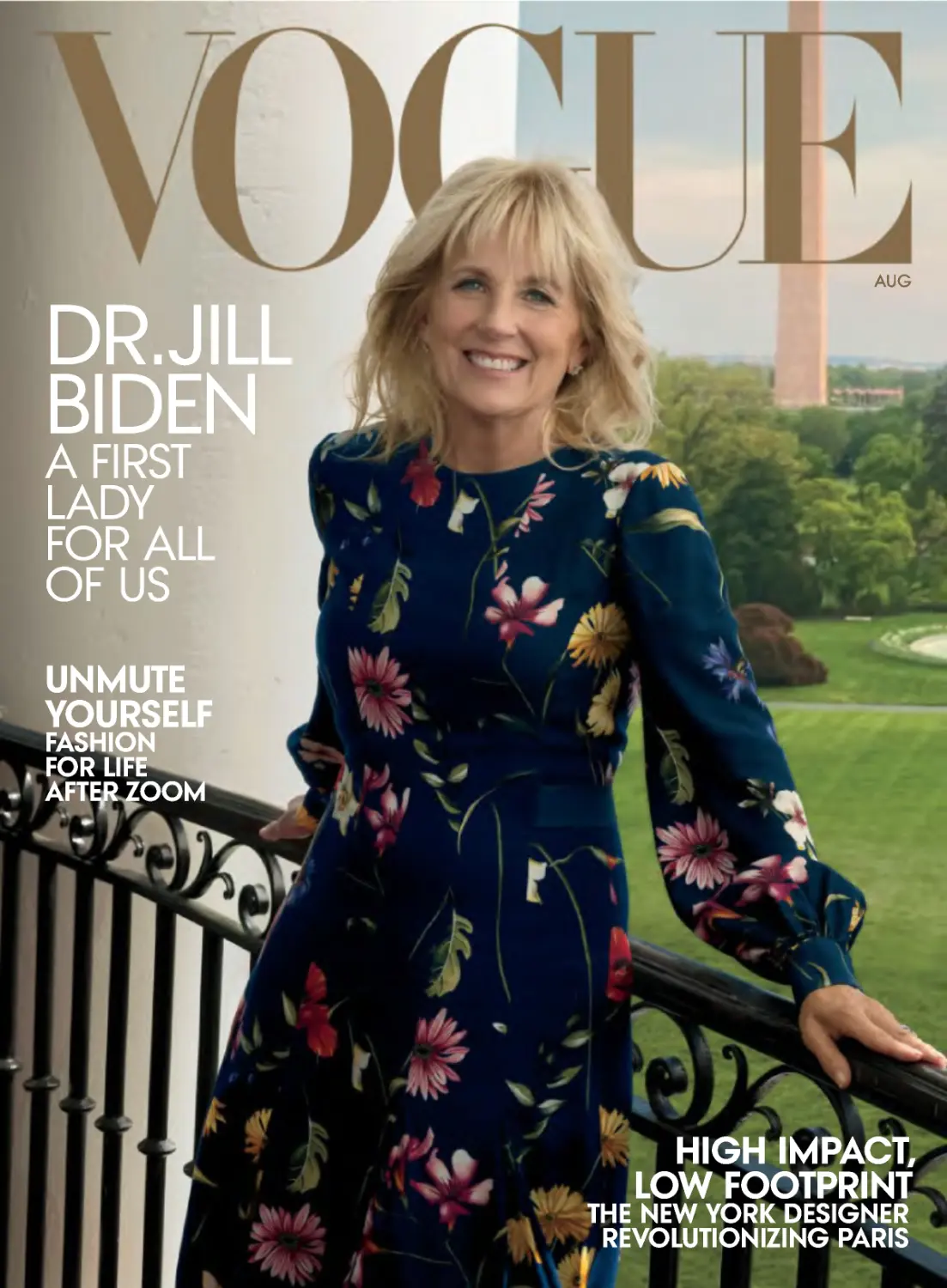
DR.JILL
BIDEN
A FIRST
LADY
FOR ALL
OF US
UNMUTE
YOURSELF
FASHION
FOR LIFE
AFTER ZOOM

HIGH IMPACT,
LOW FOOTPRINT
THE NEW YORK DESIGNER
REVOLUTIONIZING PARIS

ROMA

FEN D I B O U T I Q U E S 6 46 520 2830

FEN D I .CO M

August 2021
14
Editor’s Letter

needs now. By
Jonathan Van Meter

20
Contributors

54
This Woman’s Work
Rachel Donadio
on Gabriela Hearst’s
arrival at Chloé

24
Island in the Sun
A new park opens
on the Hudson River
30
Take Me Higher
In three new shows,
characters seek
a secular salvation
34
Ground Support
Beauty’s latest
It ingredient
36
The Myth and the
Magic
Louis Vuitton meets
the whimsy of
Piero Fornasetti
38
Some Like It Hot
August’s best books
lead with love
40
Dinner on Demand
An elegant
entertaining trend
42
Moon Shot
The beauty platform
elevating BIPOC
founders
46
The Doctor Is In
Dr. Jill Biden is the First
Lady that America

62
On Their Games
Robert Sullivan
spotlights three
Olympic standouts
70
Scene Stealer
Alexandra Marshall
on Lupin star Omar Sy
72
The New Bags
Plucky (and perfectly
useful) accessories
84
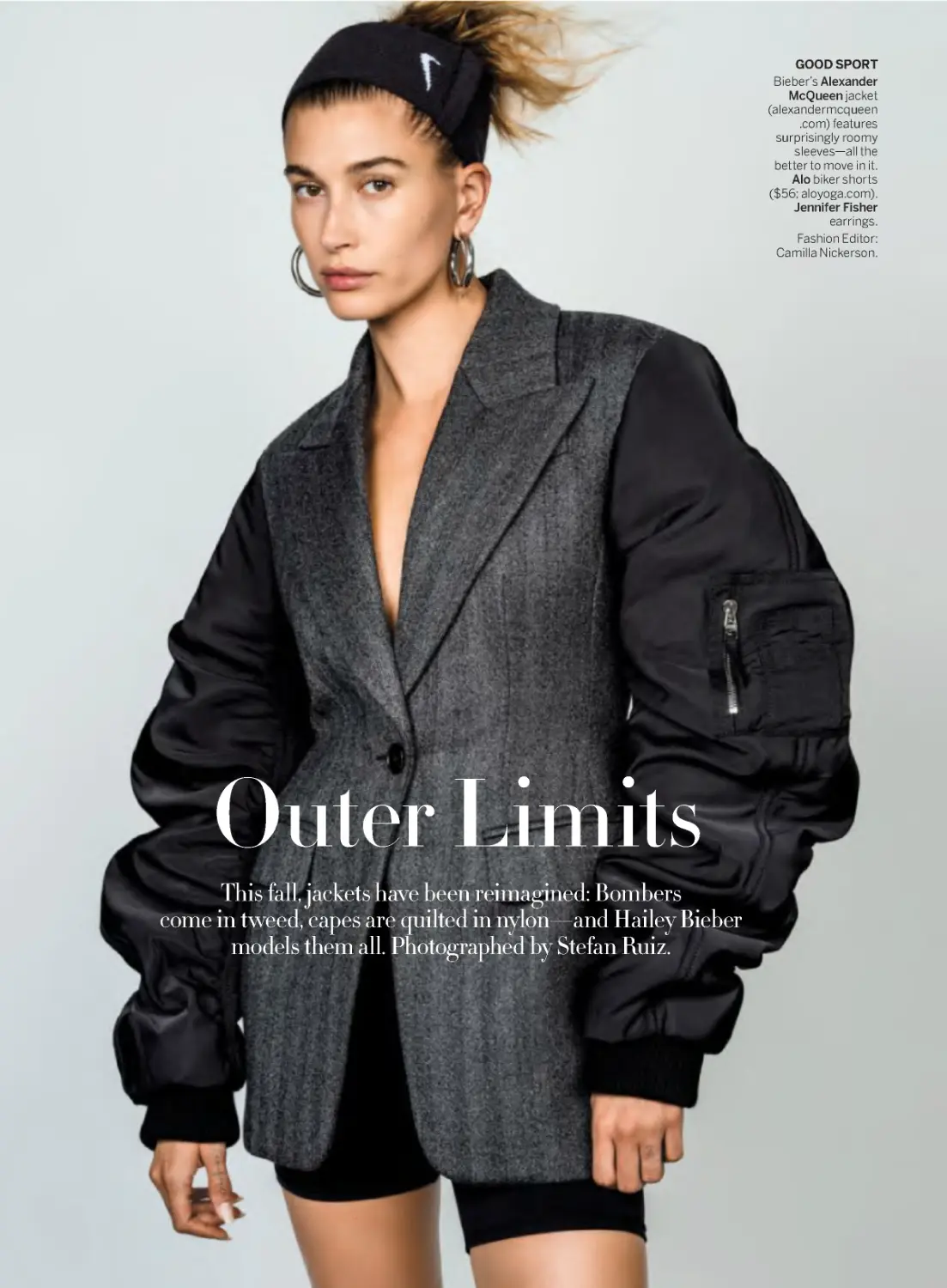
Outer Limits
This fall, jackets have
been reinvented and
reimagined
86
Make It Work
Chioma Nnadi
on returning
to officewear
90
Give Me the Night
Glittering fashion
that pulls no punches
92
Rising to the
Occasion
Chloe Malle on
dressing up to go out
98
Index
Good style meets
good works
104
Last Look

Cover Look Country Strong

DREAM ON
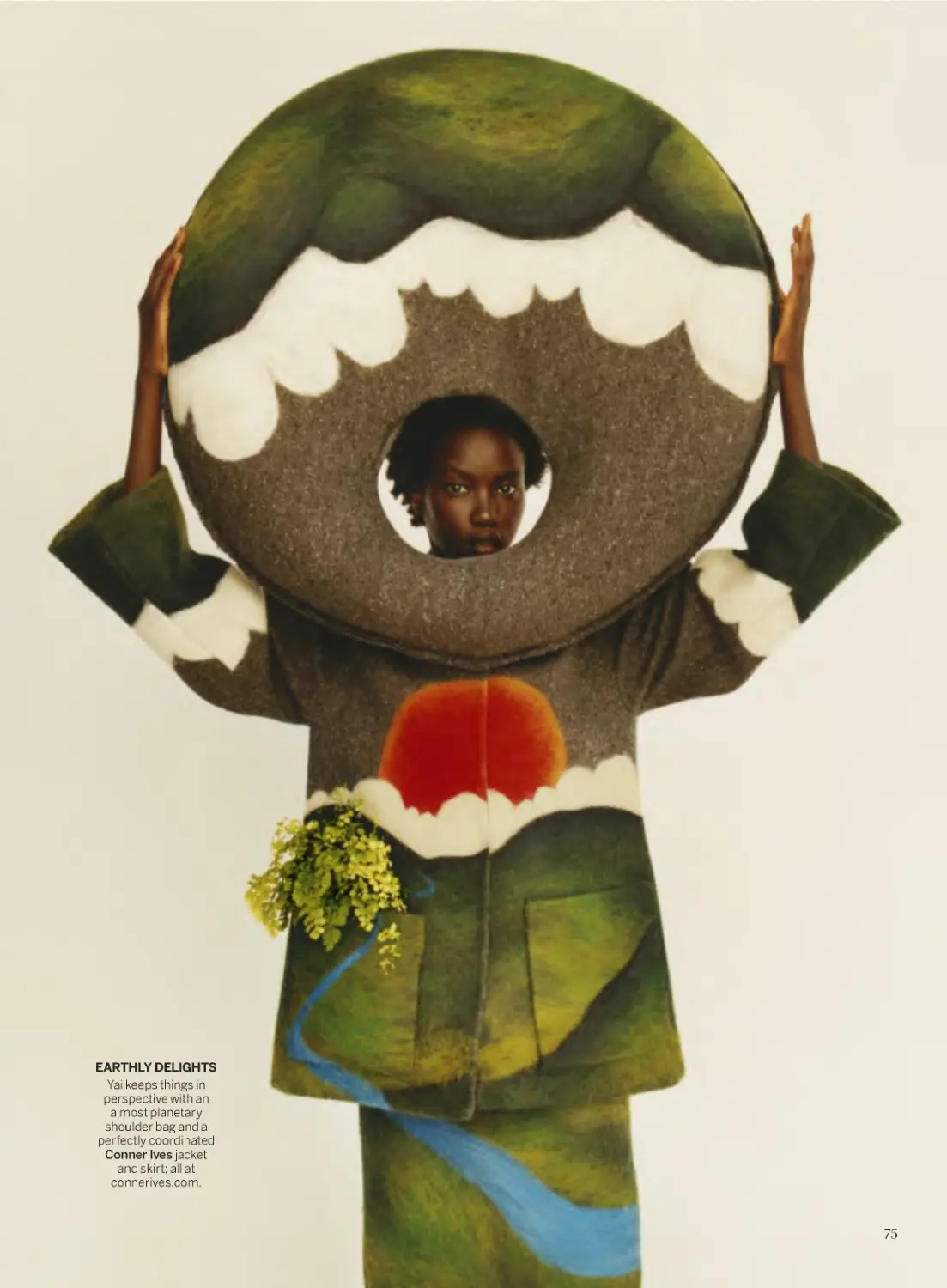
MODEL ANOK YAI WEARS A LOUIS VUITTON X FORNASETTI DRESS.
PHOTOGRAPHED BY THÉO DE GUELTZL.

12

AUGUST 202 1 VO GU E .CO M

First Lady Jill Biden wears an Oscar de la
Renta dress and Tiffany & Co. earrings.
Hair, Sally Hershberger; makeup,
Francelle Daly. Details, see In This Issue.
Photographer: Annie Leibovitz.
Fashion Editor: Tonne Goodman.

FAS HI O N ED I TO R: A L EX HA R RI NGTO N . HA I R , CHRI STI A N E BE RH A RD ; M A KEU P, C ÉC ILE PARAVINA.
P RO DUC ED BY KI T T E N P RO DUCT I ON ; SE T DES I G N , I BBY N JOYA .D E TA I LS, SE E I N TH IS ISSUE.

22
Bright Idea
The joys of bold
eye color

Letter From the Editor

NEW DIRECTIONS
CLOCKWISE FROM LEFT: PRESIDENT JOE BIDEN AND
DR. JILL BIDEN IN 2017; GABRIELA HEARST (WEARING
CHLOÉ), PHOTOGRAPHED BY THÉO DE GUELTZL;
OMAR SY (WEARING A LOUIS VUITTON MEN’S COAT),
PHOTOGRAPHED BY JONAS UNGER.

HOW INCREDIBLE TO THINK THAT President
Biden’s Inauguration was only six months ago—it feels
like a different century. The American vaccine effort has
proceeded with such speed that we’re headed into a summer
of relative normality (I wish this were so around the
world). Economic stimulus is also coming, as well as aid to
families and investment in infrastructure. It’s fashionable
to say President Biden is boring. But I would call the pace
of change under his administration electrifying.
One key member of that administration is Dr. Jill Biden,
whom Jonathan Van Meter profiles for us this month—
his third time writing about her for Vogue. “A joy multiplier,”
he calls the first lady, and her infectious, unpretentious
appeal is evident throughout Jonathan’s wonderful profile.
Equally obvious, though, is how hard she’s working.
Jonathan traveled with her for a month of reporting, and
it seemed that he was in a different state every day—
Alabama, Illinois, Arizona, New Mexico. He could hardly
keep up with the first lady, who has been tirelessly
promoting President Biden’s agenda while continuing to
teach over Zoom. (Incredibly, Dr. Biden has kept up her
work as an English and writing professor.) It’s the first time
in modern memory we’ve had a first lady with a day job.
Which only goes to show how human she is, as teaching
is something she clearly needs to do. If the Bidens are
conducting a pomp-free presidency, it is one that seems
suited to our moment. And Dr. Biden, in all her
hardworking, roll-up-your-sleeves, no-nonsense appeal,
is certainly the first lady that America needs now. It is

14

AUGUST 202 1 VO GU E .CO M

a joy to have her (photographed brilliantly by Annie
Leibovitz) on our cover.
Just as in touch with our time is the designer Gabriela
Hearst, who has taken over the reins at Chloé and
is transforming the venerable Paris fashion house into
a leader in sustainable design. In Rachel Donadio’s
profile, Hearst comes across as earthbound and artificefree, someone who isn’t interested in waiting around
for change. Similarly restless is the brilliant French actor
Omar Sy, who burst onto our small screens in Netflix’s
breakout smash Lupin and whose performances have
already made waves in French cinema. I was charmed—
if not surprised—to find out that Sy regularly tops
most-popular lists in France. A scene-stealer par excellence.

HE A RST: FAS HI O N E D I TOR : CA MI LLA NI C KE RSO N . HA I R, O DI LE G I LB E RT; MA KEUP, TOM PECH EUX. PRODUCED BY
ST E P HA N I E O’CON N OR . SY: FASHI O N E D I TO R: MI CH A E L P HI LOUZ E. H A I R, JAY R; M A KEUP, ANGLOMA.
P RO DUC ED BY KI T T E N P RO DUCT I ON . T HE BI D EN S : A N N I E LE I BOV I T Z. VA NI TY FA I R , 20 17. D ETAILS, SEE IN TH IS ISSUE.

Meeting the
Moment

CHANEL .COM

BLOOMINGDALE’S

Contributors

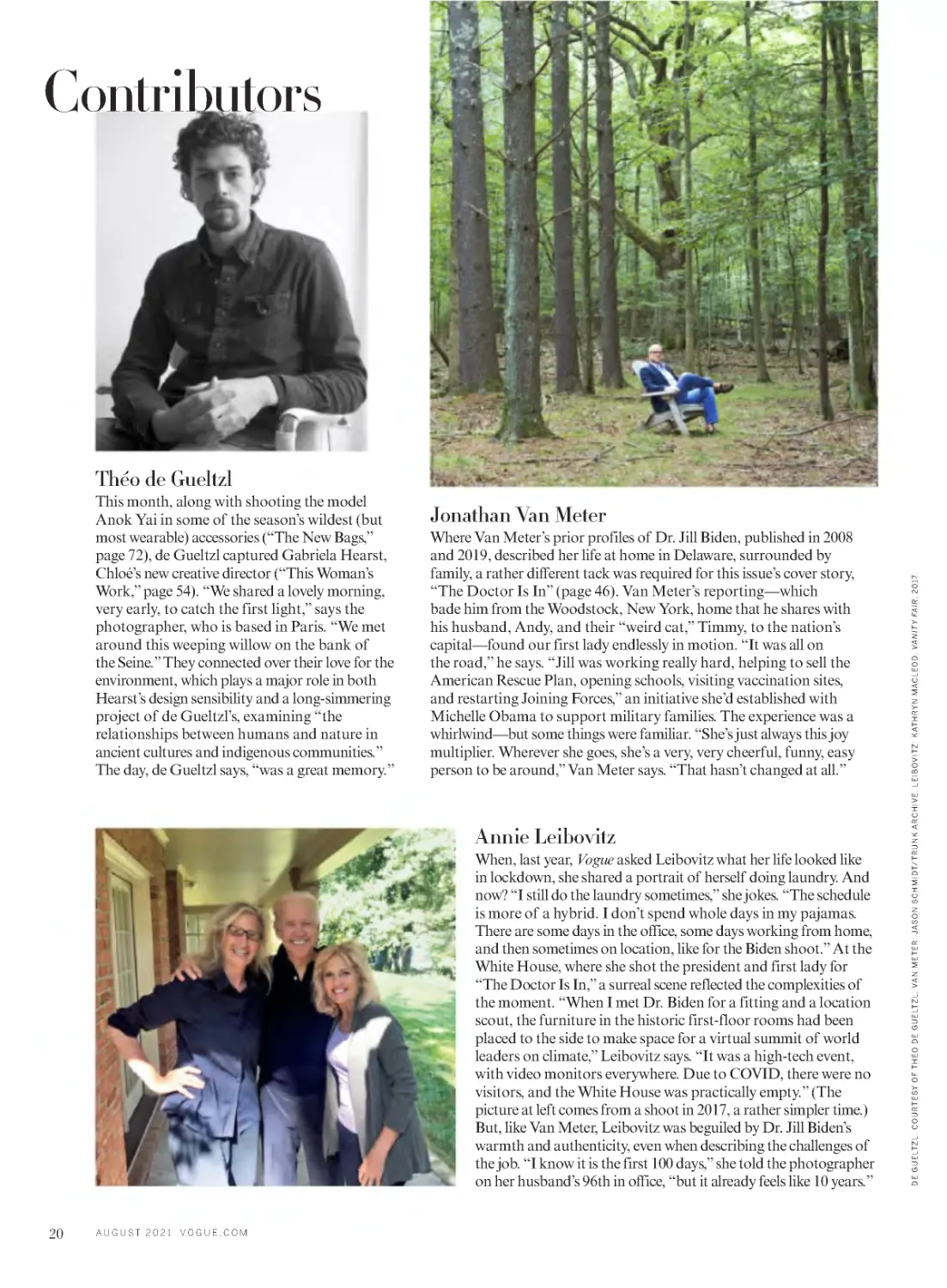
Théo de Gueltzl
Jonathan Van Meter
Where Van Meter’s prior profiles of Dr. Jill Biden, published in 2008
and 2019, described her life at home in Delaware, surrounded by
family, a rather different tack was required for this issue’s cover story,
“The Doctor Is In” (page 46). Van Meter’s reporting—which
bade him from the Woodstock, New York, home that he shares with
his husband, Andy, and their “weird cat,” Timmy, to the nation’s
capital—found our first lady endlessly in motion. “It was all on
the road,” he says. “Jill was working really hard, helping to sell the
American Rescue Plan, opening schools, visiting vaccination sites,
and restarting Joining Forces,” an initiative she’d established with
Michelle Obama to support military families. The experience was a
whirlwind—but some things were familiar. “She’s just always this joy
multiplier. Wherever she goes, she’s a very, very cheerful, funny, easy
person to be around,” Van Meter says. “That hasn’t changed at all.”

Annie Leibovitz
When, last year, Vogue asked Leibovitz what her life looked like
in lockdown, she shared a portrait of herself doing laundry. And
now? “I still do the laundry sometimes,” she jokes. “The schedule
is more of a hybrid. I don’t spend whole days in my pajamas.
There are some days in the office, some days working from home,
and then sometimes on location, like for the Biden shoot.” At the
White House, where she shot the president and first lady for
“The Doctor Is In,” a surreal scene reflected the complexities of
the moment. “When I met Dr. Biden for a fitting and a location
scout, the furniture in the historic first-floor rooms had been
placed to the side to make space for a virtual summit of world
leaders on climate,” Leibovitz says. “It was a high-tech event,
with video monitors everywhere. Due to COVID, there were no
visitors, and the White House was practically empty.” (The
picture at left comes from a shoot in 2017, a rather simpler time.)
But, like Van Meter, Leibovitz was beguiled by Dr. Jill Biden’s
warmth and authenticity, even when describing the challenges of
the job. “I know it is the first 100 days,” she told the photographer
on her husband’s 96th in office, “but it already feels like 10 years.”

20

AUGUST 202 1 VO GU E .CO M

D E GU ELTZ L: COU RT ESY O F TH EO D E GUE LT ZL ; VA N M ET E R: JASO N SC HMI DT/TRUNK ARCH IVE. LEIBOVITZ : KATH RYN MACLEOD. VAN ITY FAIR , 20 17.

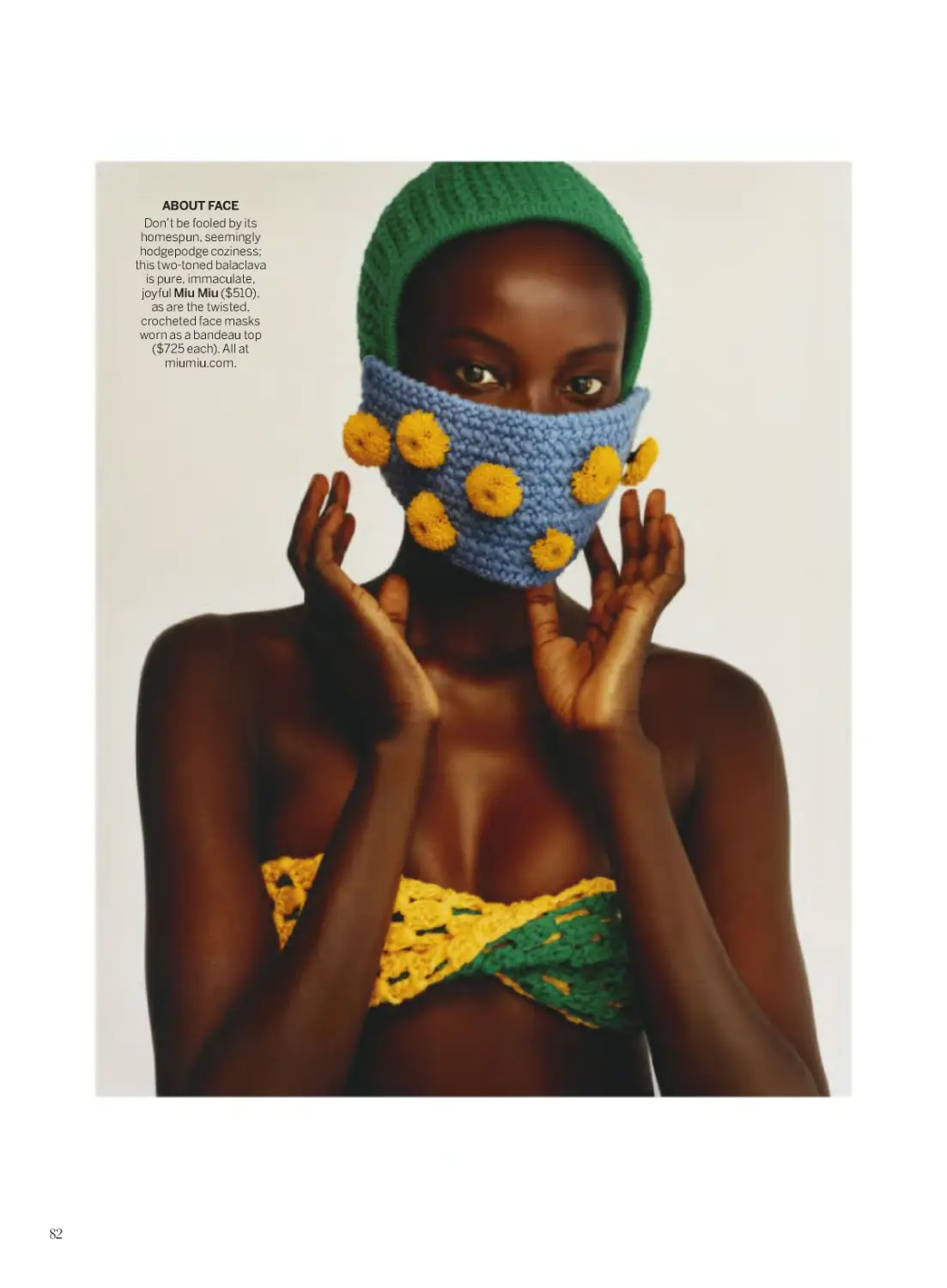
This month, along with shooting the model
Anok Yai in some of the season’s wildest (but
most wearable) accessories (“The New Bags,”
page 72), de Gueltzl captured Gabriela Hearst,
Chloé’s new creative director (“This Woman’s
Work,” page 54). “We shared a lovely morning,
very early, to catch the first light,” says the
photographer, who is based in Paris. “We met
around this weeping willow on the bank of
the Seine.” They connected over their love for the
environment, which plays a major role in both
Hearst’s design sensibility and a long-simmering
project of de Gueltzl’s, examining “the
relationships between humans and nature in
ancient cultures and indigenous communities.”
The day, de Gueltzl says, “was a great memory.”

BEAUTY IS A POWERFUL FORCE THAT MOVES US.
Beauty gives us confidence in who we are, who we want to be,
and in our relationships with others.

Change up your makeup bag—and your mindset—
with bold strokes of eye color.
s it possible to will ourselves
into thinking optimistically
with a little help from eye shadow? From finely etched fluoro
flicks at Christian Dior to thick wings
in striking pinks and blues at Versace,
the fall runways—and TikTok, that
other arbiter of style—seem to suggest yes. “Last season it was all smoky
eyes and black liner,” reveals makeup

I
22

AUGUST 202 1 VO GU E .CO M

artist Fara Homidi, noting the somber
state of makeup as the pandemic raged
on. Now, as we edge closer to a postpandemic future, “everyone is asking
for color,” she continues—and not
IT WAS ALL YELLOW
Hailey Bieber wears purposeful pigment
and clean skin. Fashion Editor: Camilla
Nickerson. Photographed by Stefan Ruiz.

subtle washes and transparent finishes
but what Homidi calls “impact makeup,” like the layering effort of bright
canary creams and powder pigments
she applied to Hailey Bieber’s clean
skin and bare lashes to telegraph a certain sunniness. “It’s definitely a mood,”
she says of the effect, which inspires
a once-familiar feeling: happiness.
—CELIA ELLENBERG

HA I R , JI M MY PAU L; MA K EUP, FA RA HO MI DI . P RO DUC E D BY P R E ISS C RE AT I V E . D E TAILS, SEE IN TH IS ISSUE.

Bright Idea

MEET THE #1 RETINOL BRAND
USED MOST BY DERMS
PURE
RETINOL

DERM-PROVEN RETINOL.
IN THE LAB.
AND IN REAL LIFE.

1 WEEK

Smooths the look
of fine lines.

LUXURIOUS
TEXTURE

4 WEEKS

Reduces the look
of deep wrinkles.

#1 dermatologist recommended brand

© J&JCI 2021

Island in the Sun

n 2012, Hurricane Sandy ravaged Pier 54, an unassuming strip on the West Side of
Manhattan that jutted into
the Hudson River near 14th Street.
Once a dock for transatlantic luxury
liners—the Lusitania departed from
the pier before it met its untimely end
and contributed to the start of World
War I—it had become a venue for
outdoor events. But following Sandy,
the pier was a ragged shadow of its
former self and in grave need of rehabilitation. The Hudson River Park
Trust approached Barry Diller, who,
with his wife, the designer and philanthropist Diane von Furstenberg, had
been the single largest donor to the
neighboring High Line.

I

24

AUGUST 202 1 VO GU E .CO M

Diller offered a counterproposal:
What if he just tore the whole thing
down and started over? He gathered
theater directors Stephen Daldry,
George C. Wolfe, and the late Mike
Nichols to consider what a new public
park that centered on the arts might
look like. Nearly 10 years and $235 million later (plus a combined contribution of $21 million from the City of
New York and the Hudson River Park
Trust), Diller’s vision has been realized.
Sprawled over 2.4 acres, Little Island consists of a large central lawn,
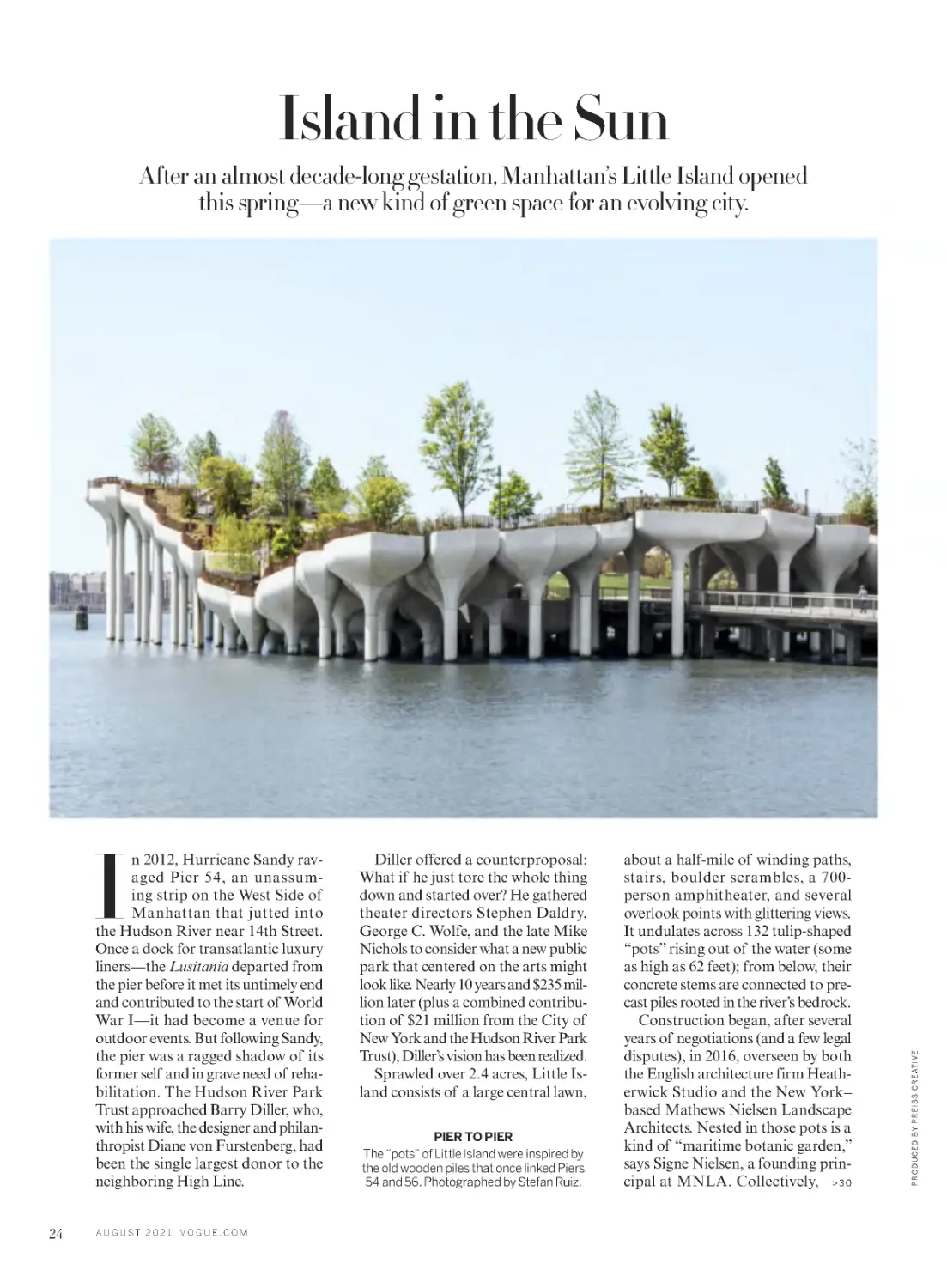
PIER TO PIER
The “pots” of Little Island were inspired by
the old wooden piles that once linked Piers
54 and 56. Photographed by Stefan Ruiz.

about a half-mile of winding paths,
stairs, boulder scrambles, a 700person amphitheater, and several
overlook points with glittering views.
It undulates across 132 tulip-shaped
“pots” rising out of the water (some
as high as 62 feet); from below, their
concrete stems are connected to precast piles rooted in the river’s bedrock.
Construction began, after several
years of negotiations (and a few legal
disputes), in 2016, overseen by both
the English architecture firm Heatherwick Studio and the New York–
based Mathews Nielsen Landscape
Architects. Nested in those pots is a
kind of “maritime botanic garden,”
says Signe Nielsen, a founding principal at MNLA. Collectively, > 3 0

P RO DUC ED BY P RE I SS C RE AT I V E.

After an almost decade-long gestation, Manhattan’s Little Island opened
this spring—a new kind of green space for an evolving city.

the landscape features more
than 30 species of trees, 65
species of shrubs, nearly
300 varieties of grasses and
vines, and some 66,000 bulbs.
Nielsen’s sense of the park
crystallized a few years ago,
after Diller had taken a walk
through Central Park. “He
said, ‘Signe, I want this to be
a beautiful park where people
will feel comfortable and natural and like they have places
to socialize and meet,’ ” she
says. So she and her team
tried to draw that sensibility
out, in ways both big and small: The
park’s color story, for instance, evolves
throughout the year—from pastels
in the spring to “hotter” tones in the
summer and golds and beiges in the
fall. That sense of surprise permeates
the artistic programming for the park
as well. “You can lean on the rail from
a pathway and watch what’s happening

BLOOM TIME
“We have paid a lot of attention
to pollinators,” says landscape
designer Signe Nielsen.

in the amphitheater,” says Trish Santini, Little Island’s executive director.
“To me, it felt like a space that had its
arms wide open.” The hope is that in
both its visitorship and performers,
Little Island will reflect the diversity of
the city. (Timed tickets are required to
enter the park after 12 p.m., but events
are mostly free or priced moderately.)

The timing of Little Island’s much-anticipated
opening this spring felt auspicious. After many long, dark
months, the park was primed
for wandering, picnicking,
and generally rediscovering
the pleasures of serendipity—
one of the many casualties
of our remote-everything
moment. “I always believed
that at some point the damned horrible thing would end,” Diller says
of the pandemic’s traumas, “and
that when it ended, the enthusiasm
of the people who love New York
and who did not flee New York was
going to renew it.” Would it take
a while? Maybe—but the wait would
be well worth it.—MARLEY MARIUS

Take Me Higher

A

decade ago, with Enlightened, Mike White discerned that the path to transcendence is often
paved with materialistic diversions. In his new
series, The White Lotus (HBO), a literal boatload of drifting souls are grasping for a more grounded
tether to their very glossy lives as they sail toward a luxury
Hawaiian resort. Even in paradise, these guests—played by
a fantastic cast including Connie Britton as a hard-driving
corporate executive, Sydney Sweeney as her disaffected
daughter, and Jennifer Coolidge as a teary solo traveler—
keep stumbling over their own intentions, while the staff
of this tiki-torch-lit retreat hustles to pick them up. The
staff’s own weaknesses and foibles, in turn, underline that
the road to higher ground is a rough and winding one, no
matter where you’re starting.
In Netflix’s The Chair, Sandra Oh stars as the freshly appointed head of a disintegrating college English
department. Enrollment is down; a handful of dinosaur
professors have not updated their syllabi for decades; and
her closest friend and potential paramour—a rumpled
Jay Duplass—cannot seem to make it to his own lectures
on time. An older generation (mostly male, mostly white)
have long stuck their heads in the sand, and Oh’s character
has been rewarded for her years of scrambling with the
unglamorous task of digging them out. A gentle-hearted

30

AUGUST 202 1 VO GU E .CO M

SYNC OR SWIM
from left: Sydney Sweeney, Brittany O’Grady, and Alexandra
Daddario in The White Lotus.

satire, The Chair is neither condemnatory nor celebratory,
but rather a sweetly sardonic depiction of campus life,
where truth is hard to find.
In the latest star-vehicle for Nicole Kidman, Nine Perfect
Strangers (Hulu), she plays a seraphic guru presiding over a
secluded retreat where a cadre of broken people have gathered to skinny-dip, guzzle tropical smoothies, and investigate
their dysfunction. There are other motives at play, however,
and even in the sparkling sunlight, things begin to get a little
dark. The ominous overtones can’t dispel the series’s lush
appeal, though. As in Big Little Lies, which was written by
the same novelist, Liane Moriarty, and adapted by the same
team, suffering has never looked so good.—CHLOE SCHAMA

TO P : P HOTO G RA P HE D BY STE FA N RUI Z. P RO DUCE D BY P RE I SS CR E AT I V E. BOTTO M: MAR IO PER EZ /H BO.

In three new shows, characters
seek a secular salvation.

Celebrate
your Independence Days.

With the right financial partner,
every day can feel like
Independence Day.

EQUAL HOUSING

Member FDIC. ©2021 U.S. Bank

We’ll get there together.

ADVERTISEMENT

list
the

PROMOTIONS AND
EVENTS IN AUGUST

Learn more.
pcaskin.com/vogue

GO TO
VOGUE.COM/PROMOTIONS
TO RECEIVE OFFERS,
LEARN ABOUT EVENTS, AND
GET THE LATEST BUZZ FROM
VOGUE AND YOUR FAVORITE
FASHION AND BEAUTY BRANDS.

A point of
view is meant
to be shared.
JOIN AND
SOUND OFF.

VOGUEINSIDERS.COM

GORDON VON STEINER

Don’t let a lifetime of
expressions reveal your age.
Use PCA SKIN® ’s new
ExLinea® Pro Peptide Serum.
Featuring the proprietary
Peptide-Pro Complex
technology, this breakthrough
innovation is a neuropeptide
spot treatment that helps
minimize visible expression
lines caused by repeated
muscle movement while
lifting, tightening, and
firming skin. The result
is smoother skin with a
younger-looking, more
defined facial contour.

ADVER TISEMENT

Ground Support
Beauty’s latest It ingredient is gaining cultural cachet for its essential role in
nature—and in nurturing tinctures and toners.

I

34

AUGUST 202 1 VO GU E .CO M

Mask last year with hydrating reishi and clarifying chaga
that purport to soothe skin, featuring a formula that is
“so pure you can eat it.”
“Reishi and cordyceps have long been used in traditional
Chinese medicine to boost the body’s qi, or energy, and
strengthen its ability to function well,” explains Sandra
Lanshin Chiu, a licensed acupuncturist and herbalist and
the owner of Brooklyn’s Treatment by Lanshin. Chiu, who
often prescribes custom tinctures with these ingredients to
clients—to reduce stress, inflammation, and fatigue—is
wary of the modern marketing boom. But mushrooms’
allure as a panacea is growing—and it isn’t unwarranted,
says Kevin Spellman, Ph.D. “Fungi have beta-glucans—or
messenger molecules—that carry information to the immune
system to turn it up a bit or turn it down a bit,” explains
Spellman, a molecular biologist and herbalist who recently
collaborated with the San Francisco–based skin-care line
In Fiore on three new tinctures, including Adapt’Âscend,
which includes reishi to energize or relax you.
“I see this as an exciting moment in the reevaluation of
mushrooms”—in skin care and in our society at large, adds
Andrew Weil, M.D., an integrative-medicine practitioner
and a pioneer in the space. (The anti-redness Mega Mushroom treatment lotion he created with Origins 15 years
ago is now the brand’s number-one global best seller).
“Mushrooms may offer us even more exciting possibilities
in the future,” Weil adds—beyond the brave new world of
vegan Birkins.—MARISA MELTZER
SHROOM SERVICE
From anti-inflammatory reishi to antioxidant-boosting chaga,
mushrooms are becoming a big part of the better-living vernacular.

G E TT Y I M AG ES.

f you have sought out less-populated pastures over
the past year, then you are likely familiar with All
That the Rain Promises. The 30-year-old field guide
to Western mushrooms (including recipes for food
and hair dye) doesn’t have Didion’s prose or the urgency
of a Michael Lewis exposé; but for a certain subsection of
eco-curious hipster, it has become the housewarming gift
for friends who have traded in city life for country living.
Mushrooms—which are not plants or animals but fungi
that constitute their own kingdom, with more than 10,000
different species—are having their cultural moment, and
not just psychedelic varieties. Locally sourced morels and
chanterelles are turning up on fine-dining menus; in March,
Hermès announced that it would release an eco-friendly
version of its classic Victoria travel bag made from sustainable mushroom-derived leather; and before there were
octopus teachers, Fantastic Fungi became a cult hit on the
small screen. “One of the big takeaways of the pandemic
is that communities survive better than individuals,” says
the film’s director, Louis Schwartzberg, pointing to the
appeal of mushrooms’ underground threadlike cells, which
connect the roots of surrounding plants, allowing them
to share nutrients and communicate. A cruise through
Whole Foods suggests mycology’s influence on wellness,
that other pandemic-era obsession, is similarly compelling.
As newly buzzy, immunomodulating species become
a part of the better-living vernacular—Reishi! Chaga!
Cordyceps! Lion’s mane! Turkey tail!—there seems to be
a mushroom-based supplement, tincture, tea, and now
face mask to cure whatever ails you. Four Sigmatic, the
Finnish brand that has popularized a mushroom-based
adaptogen coffee substitute, launched its Superfood Face

3X
IMPROVES SKIN

*

BETTER

Infused with prestige skin care ingredient
Retinol, Olay transforms skin from dry
and stressed to bright and smooth.

+RETINOL

FEARLESS IN MY SKIN

The Myth and the Magic
Nicolas Ghesquière’s Louis Vuitton collection draws on the whimsy of
Piero Fornasetti—and catches the more-is-more mood of the moment.
icolas Ghesquière had an epiphany when visiting the Michelangelo Gallery at the Louvre
for Louis Vuitton’s fall 2021 show: The space,
with its stunning sculptures from the Italian
Renaissance, brought to mind the work of the sui generis
artist and designer Piero Fornasetti.
Celebrated for his furniture and ceramic designs,
Fornasetti began his career in the 1930s in fashion,
making headscarves that mixed innovative printing
techniques with pochoir and hand-painting. The scarves
drew the eye of the great designer Gio Ponti, and the
two collaborated on some iconic pieces of midcentury
furniture that revealed Fornasetti’s mastery of ancient
crafts, embrace of innovation, and impressive archive of
historic visual references.
In the postmodern 1980s, Fornasetti’s “Tema E Variazioni” plates—more than 300 versions of an engraving of the
belle epoque beauty Lina Cavalieri’s face—were must-have

N

36

AUGUST 202 1 VO GU E .CO M

accessories. I owned some myself, and regularly sleuthed for
treasures in Fornasetti’s crowded Milan boutique.
In preparation for this new capsule collection, some of
which was part of the runway show, Ghesquière and his
team explored the extensive Fornasetti archives, “searching,” as he notes, “for images centered on antique statues,
cameo portraits, and architecture.” The results—from
fashion to purses and luggage—reflect the joyous optimism
of fashion as we continue to reemerge from the pandemic.
(See our New Bags story, page 72, for more examples.) “We
had lots of fun creating trompe l’oeil,” says Ghesquière,
“challenging the materials and techniques....”
“I like the interpretation,” says Barnaba Fornasetti,
guardian of the brand since his father’s death in 1988.
“Using the past, renovating, interpreting is like the more
recent DJs, who use something existing, remix it, and come
out with totally original music.” The results, he adds, feel
“very modern, very futuristic.”—HAMISH BOWLES

MO D E L: G I OVA N N I G I A N NO N I . SC REE N : P HOTO © CH RI ST I E’S IM AG ES / BR I D GE MA N IMAGES. ALL OTH ERS: COURTESY OF LOUIS VUITTON.

SLEIGHT OF HAND
Vuitton’s Fornasetti collaboration
(Malle Pyramide bags, lefg, and
on the runway, righg) captures the
élan of work like the City of Cards
screen (circa 1950s), cenger.

We make bundling simple.

Home + Auto = easy
Bundling your home and car insurance is super easy with GEICO.
Not only could it save you money with a special discount, but you’ll
also save time by having all your coverages in the same place.

scan the code
to learn more!
geico.com | 1-800-947-AUTO | Local Office
Some discounts, coverages, payment plans, and features are not available in all states, in all
GEICO companies, or in all situations. Homeowners, renters, and condo coverages are written
through non-affiliated insurance companies and are secured through the GEICO Insurance
Agency, Inc. GEICO is a registered service mark of Government Employees Insurance Company,
Washington, DC 20076; a Berkshire Hathaway Inc. subsidiary. GEICO Gecko® image © 1999–
2021. © 2021 GEICO 21_580819020

Some Like It Hot
A summer of love plays out in the month’s best books.

Agatha of Little Neon (FSG), by
Claire Luchette In this romance centered on an elusive figure of a different
sort, Agatha, a nun, is transplanted,
along with her pious sisters, to a halfway house in the “tuckered-out town”
of Woonsocket, Rhode Island. (Little Neon is the former convent turned
bridge housing for recovering addicts
and ex-cons, so named because it’s
painted the color of Mountain Dew.)
What follows is an eccentric comingof-age story in which Agatha, attracted
to the order for its promise of both
belonging and obscurity, begins to
learn that true comfort lies not in
conformity but in awareness of her

38

AUGUST 202 1 VO GU E .CO M

own instincts. Written in a bracing,
acerbic, and darkly comic register, the
book is a surprisingly buoyant read,
a sly investigation of the meaning of
devotion.—CHLOE SCHAMA
Everything I Have Is Yours: A
Marriage (Flatiron), by Eleanor
Henderson Memoirs of marriages
are like confessions—the more honest, the better. And this one is ruthless. The love story is there: Eleanor
falls hard for Aaron in a record shop
in Florida in 1997. She is 17. He is
a 25-year-old straight-edge dreamboat, “teeth as white as his T-shirt.”
She brings him to college and then to
graduate school. Eleanor is ambitious,
upwardly mobile. Aaron is mercurial,
wounded, seemingly unemployable,
and given to secrets. She builds a
life; he tears it apart with his mood
swings and his strange ailments. A
medical mystery develops—does he
have Morgellons? Schizophrenia?
Some other psychiatric condition?
Or is there something darker going
on—addiction? Leave him, the reader
thinks. But life, of course, is not so
simple, and rarely has codependency
been chronicled with such precision,
such poignancy.—TAYLOR ANTRIM
The Paper Palace (Riverhead), by
Miranda Cowley Heller In the midst
of a dinner party in the backwoods of
Cape Cod, Elle steps into the shadows
and consummates a long-simmering love affair. The next morning she
declares it “the end of a long story,”

though the encounter marks the start
of this beguiling book, which unfolds
amid the ponds and poison ivy covering the Cape. Toggling between decades, the novel charts a wandering
course among the scruffy socialites
who populate this gin-soaked landscape: salty women in their muumuus, men who treat divorce as “just
a seven-letter word,” kids largely ignored. Elle, with her loving husband
and three children, seems to have
charted a more committed path, but
her fleeting infidelity—and the sultry memories it provokes—illustrates
how even the most staid life can take
an unpredictable tack.—C.S.
Afterparties (Ecco), by Anthony
Veasna So A series of vignettes
documenting the lives and loves of
Cambodian-Americans in California,
Afterparties ricochets between meditations on food and family, an eclectic array of pop-culture references
and the emotional legacy of those who
fled the Khmer Rouge. So’s observations on queer life are particularly incisive: In one instance, a charming love
story blossoms between a righteous
tech entrepreneur and a young teacher, with the couple finding a strange
poetry in the rhythms and routines
of casual sex. These intimate windows
into this particular immigrant experience leave a powerful imprint, even if
reading So’s work is tinged with sadness. The author, who died suddenly
last year at the age of 28, clearly had
so much left to say.—LIAM HESS

COU RT ESY O F PU BLI S HE RS.

Ghosts (Knopf), by Dolly Alderton
The action in Ghosts, an astonishingly assured debut novel, takes place
after Nina George Dean turns 32.
She’s a writer with a London flat that
she adores, a new book in the works,
two well-meaning parents, and a circle of close friends that includes an ex
with whom she’s unproblematically
close. When Nina meets the doting
and superhero-handsome Max, she
can’t believe her luck. But her house
of cards soon starts to cave: Her dad’s
health takes a turn; the proposal for
her next book isn’t coming together; and after several blissful months,
she’s getting radio silence from Max.
Deftly observed and deeply funny,
Ghosts considers, with what might
well be described as haunting precision, where we find—and how we
hold on to—love.—MARLEY MARIUS

Don’t let a lifetime
of expressions
reveal your age
Fight the formation of expression lines with
PCA SKIN®’s new ExLinea® Pro Peptide Serum
with the proprietary Peptide-Pro Complex.
This breakthrough innovation is a neuropeptide
spot treatment that works in three unique ways.

Minimize visible expression lines

Lift, tighten and firm skin

Smooth skin and improve texture

100% of patients showed a visible reduction
in fine lines and wrinkles*

Scan or visit pcaskin.com/vogue to see Before & After photos
Find a PCA SKIN® Certified Professional at pcaskin.com/locator

Dinner on Demand
spent my 28th birthd ay o n my c o u c h ,
binge-watching Netflix
and fantasizing about
cake. It was March of 2020,
and my local grocery store
had run out of eggs, sugar, and
flour. It was a minor grievance
in the scheme of things. But
come 2021, it wasn’t exactly
something I wanted to repeat.
So it was with the grace of Dionysus that a few weeks before
my second pandemic birthday,
I stumbled upon Savour. An
app that allows users to book
chefs—from restaurants like
Eleven Madison Park, Momofuku, and Noma—Savour
also arranges everything from menus to table mats. A few
taps of my phone and I’d booked a family-style meal by chef
Akiko Thurnauer, formerly of Nobu. The next Thursday,
she knocked on my door, hot-pink eye shadow swiped
across her eyes and a basket of Bao buns on her arm.
Right now, in many places, we’re in an awkward phase
of socializing. After a year and a half of pandemic living, most of us are desperate to see people beyond our
bubble. As Bronson van Wyck, author of Born to Party,
Forced to Work, sums it up: “We’re all ready for a true rager.
Parties—actual full-on parties—have been in a medically
induced coma.” Such gatherings are not just frivolous
entertainment—they are crucial to our well-being: “Much
of what fulfills us are the bonds we create with other people,
and more often than not, those bonds materialize through
physical interactions,” wrote researchers in an August 2020
study titled “The Dangers of Social Distancing.” And yet,
many of us may feel a lingering discomfort at the prospect
of sharing respiratory droplets in the name of celebration.
Social gatherings may remain, for some, domestic.
Thankfully, a set of new
party services is stepping
in to elevate at-home entertaining. In addition to
Savour, there’s Celebration

I

BOWLED OVER
A tablescape from Party
by Numbers (top),
a dish designed by chef
Yann Nury (middle), and a
setting from Celebration
Home (bottom).

40

AUGUST 202 1 VO GU E .CO M

Home, which was created by
event planner Jennifer Zabinski and Met-gala caterer Olivier Cheng and which offers
packages like “A Night at the
Opera” or “Around the Farmer’s Market.” They’ll send you
everything you need in a giant box—from the asparagus
tarte tatin to the Jardin du
Luxembourg scent diffuser.
“It’s like your own little salon,” says Zabinski. The new
company Party by Numbers
will pack a midcentury bar
cart with everything from the
Aperol aperitif to the olivebranch arrangement to the Bose speakers piping in the
sounds of the Sanremo Music Festival. Recently they got
the approval of the James Beard Foundation’s Zero Foodprint organization for their carbon-neutral measures.
Then there’s the fashionable fleet of mobile
mixologists. The Maybourne Beverly Hills
in Los Angeles fits an
entire bar in the back
of an Escalade that it
can dispatch to your
driveway. Meanwhile,
famed French chef
Yann Nury has turned
his 1985 Land Rover
into a roaming happy
hour, making stops in
the Hamptons, Nantucket, and Rhode Island. For a little extra, he’ll tow along his vintage
Airstream, retro-formatted with a wood-fire grill.
Will these services eventually become fossils of
the Fauci era? “I think over the past year, people really learned—and fell in love with—the joys
of home entertaining,” says Party by Numbers
cofounder Nicky Balestrieri. The pandemic, if
anything, taught us how a few close relationships
can sustain the soul more potently than a dozen
diffuse ones. “Hospitality—the act of breaking
bread together—has in many ways never been
more present,” muses van Wyck, “with one key
difference: It’s more-is-more for the people who
matter the most.” —ELISE TAYLOR

CE LE BRAT I ON HO ME : CA RLO G E RAC I , A L L OT HE RS : COURT ESY O F B RA N DS.

At once elaborate and streamlined, the party-in-a-box might mark
a new mode of entertaining.

In the spring of 2020, just as the COVID-19 pandemic was taking hold, Vogue asked designers,
photographers, artists, editors, and models (and a few celebrities) to reveal what their lives looked like
under lockdown. The result was an extraordinary series of self-created images, interviews, and
essays, now brought together in one volume. Postcards From Home marks a moment
of profound change and serves as a stunning document of creativity thriving through crisis.
BY THE EDITORS OF VOGUE

FOREWORD BY ANNA WINTOUR

rizzoliusa.com
Available Wherever Books Are Sold

Moon Shot

ast summer, Nyakio Grieco had a watershed
moment. While interest in Black-owned brands
was on the rise, it was kind of hard to actually
find them. So Grieco—a beauty entrepreneur who
in 2002 launched a line of coffee bean– and sugar-based
exfoliators inspired by the Kenyan skin-care secrets passed
down to her by her grandmother—teamed up with sizeinclusivity pioneer and 11 Honoré founder Patrick Herning
to launch Thirteen Lune: an e-commerce site that focuses
on a hyperedited curation of BIPOC-owned beauty brands.
It’s an exciting proposition for someone like, say, me,
who has always had a fraught relationship with beauty.
After years of painstakingly seeking out products with
the appropriate undertones for my brown skin and shampoos that wouldn’t turn my scalp into the Sahara, I still
deal with psoriasis, traction alopecia, and extreme hair
breakage. “As a Black woman, I’ve been buying products
made by people who are not Black or brown my whole life
with the expectation and assumption that they’re going to
work on my hair and skin,” says Grieco, echoing my own
frustration and that of so many Black women. We pour
roughly $54.4 million into beauty products each year but
still face hurdles to access, especially to luxury products.
The 64 BIPOC-owned brands carried by Thirteen Lune,
which is named for a sacred number in some African cultures
and the 13 moons in a calendar year, offer more than just a
vetted curation: They offer a sense of discovery and novelty,
itself a luxury for women of color. On the site I found British hairstylist Charlotte Mensah’s hydrating shampoo that
is rich in Namibian manketti oil, but I also learned about
KéNisha Ruff ’s journey from Wisconsin cosmetologist
to founder and creative director of Marie Hunter Beauty.

L

42

AUGUST 202 1 VO GU E .CO M

“It really comes to life with the founders,” says Grieco,
who is hoping to both elevate these products and amplify
the voices behind them—Black, brown, and otherwise.
This spring, Grieco and Herning introduced an allyship
program designed to change the conversation around
accountability in the beauty industry by welcoming brands
that have always prioritized inclusive formulas, such as
Leland Francis’s natural skin-care collection and HoliFrog’s range of cleansers. “These brands were created by
people who aren’t Black or brown, but they’re committed
to addressing the needs of melanin-rich skin and textured
hair,” Grieco explains, noting that 90 percent of the site is
still dedicated to BIPOC-backed products. In exchange for
digital real estate, these more established companies will
help mentor emerging brands.
It’s this kind of forward thinking that has attracted investors including Gwyneth Paltrow and Sean Combs, who will
guest-star on a just-launched Thirteen Lune podcast that
hopes to unpack that other beauty buzzword: self-care.
“Black and brown communities are very underserved
when it comes to messaging about self-care and nontoxic
ingredients, so there is a tremendous opportunity for us to
educate around that issue,” says Grieco, a sentiment that
resonated with me as I unscrewed the cap of Liha Beauty’s
Idan Oil. Its creamy tuberose scent transported me a world
away from my Brooklyn apartment, and I was reminded
of how rarely I make time for myself. Rarer still is that I’m
encouraged to do so.—JANELLE OKWODU
ALL THE FEELS
With its hyperedited curation, the site is selling the joy of discovering
BIPOC-backed beauty products and the voices behind them.

© D I A N A G OM EZ / B RI D G EM A N I MAG ES.

Thirteen Lune, an ambitious new beauty e-commerce platform, aims to
elevate BIPOC founders and the idea of self-care for all.

FLOTUS WFH
Photographed in the
East Sitting Hall
of the White House.
Ralph Lauren
blouse and skirt.
Fashion Editor:
Tonne Goodman.

The
Doctor Is In
Famously empathetic and free of pomp,
Dr. Jill Biden is the hardworking, heart-on-hersleeve, everywhere-at-once first lady that
America needs now. By Jonathan Van Meter.
Photographed by Annie Leibovitz.

When Jill
Biden visits
community
colleges,

which is a lot these
days, she is received in highly
choreographed settings by a governor, say, or members of
the public as the nation’s first lady. But to administrators
and teachers, she is Dr. Jill Biden, college professor. At
Sauk Valley Community College in Illinois, there were
pink and white flowers set out everywhere, befitting her
visit; they even matched her white dress and pink jacket.
But there was also a welcome dr. biden sign so huge that
the period on the Dr. was as big as her head. It felt like a
subtle rebuke to that scolding she was subjected to back
in December for using the title she has every right to.
Indeed, in all the places she goes lately she is honored as
a woman with several degrees who has worked really hard
her whole life at the most relatable job there is. Everyone has
a favorite teacher, after all. On
her visit to the Navajo Nation in
April, Dr. Biden was introduced
by someone I came to think of
as the Ruth Bader Ginsburg
of Indian Country: chief justice
of the Navajo Nation Supreme
Court JoAnn Jayne, a tiny woman with hair pulled back
in a tight ponytail, wearing Doc Martens: “Dr. Biden,
millions reap inspiration from your quote ‘Teaching isn’t
just what I do; it is who I am.’” In Birmingham, Alabama,
she was introduced by a lawyer, Liz Huntley, a sexual-abuse
survivor whose parents were drug dealers. “I want to thank
Dr. Biden from the bottom of my heart for the role that
she plays not just as the first lady…but for her heart for
educating. She told me she’s grading papers on the plane,
y’all! What? Who does that?! You know, they say being an
educator is a calling…in your life that you can’t resist, and
she just won’t let it go.”
The December debate over titles seems awfully small in
the face of all of this: Jill Biden opening schools, visiting
vaccination sites, traveling to red states to sell the American
Rescue Plan, telling folks that “help is here.” The role she’s
fulfilling on these visits is, in many ways, neither first lady
nor professor but a key player in her husband’s administration, a West Wing surrogate and policy advocate. “An
underestimated asset,” as Mary Jordan, the Washington Post
reporter who’s written a book about Melania Trump, put
it to me. “It’s hard to imagine Joe doing this without her.”
Which is not to say that Dr. Biden, who is constitutionally
shy, doesn’t take special delight in these visits. She becomes

looser, goofier, and more expansive. You generally hear her
before you see her because she is often laughing. She is, quite
simply, a joy multiplier. As part of her elevator pitch for
free community college—part of the $1.8 trillion American
Families Plan President Biden proposed to Congress in
April—she likes to talk about one of her most dedicated
students, a military interpreter from Afghanistan who came
to America to start a new life. “A few semesters ago...I got
a text from her—it was like six o’clock in the morning. ‘On
my way to the hospital to have my baby, research paper will
be late.’ To which I replied, Excuses, excuses.” It gets a big
laugh, even from the jaded press corps.
No one thought she could keep teaching. “I heard that
all the time during the campaign,” she told me. “Like, ‘No.
You’re not going to be able to teach as first lady.’ And
I said, ‘Why not? You make things happen, right?’” But as
I traveled with Dr. Biden through much of April, I saw just
how much time her day job took up: In Albuquerque, New
Mexico, the entire retinue of staff, Secret Service, and press
held at our hotel until well into the afternoon, when the
motorcade finally hit the road for a nearly three-hour drive
and a long evening of events in Arizona—because Dr. B
was teaching her classes over Zoom. On a trip to Illinois,
her motorcade sped toward the airport as if there weren’t
a second to waste. Because there wasn’t: Jill had to teach!
Meanwhile, countless editorials began marking the first
100 days of the Biden administration, many expressing
surprised relief over how much was getting done, how
much legitimately helpful policy
was moving through the system,
how little drama, how few flubs
or fumbles or ugly fights. Joe
Biden is boring—and that’s not
a complaint. One day, I asked
Dr. Biden about the mood of the
country. “During the campaign,
I felt so much anxiety from people; they were scared,” she told me. “When I travel around
the country now, I feel as though people can breathe again.
I think that’s part of the reason Joe was elected. People
wanted someone to come in and heal this nation, not just
from the pandemic, which I feel Joe did by, you know, getting shots in everybody’s arms. But also...he’s just a calmer
president. He lowers the temperature.”
Part of what makes the Bidens’ right-out-of-the-gate successes so extraordinary is that they seem to have perfectly
read the room: We have been through this enormous, collective trauma, and here’s a calm, experienced, empathetic
president, and here’s a first lady who is driven, tireless,
effortlessly popular, but also someone who reminds us
of ourselves. She’s selling a new vision for how our most
fundamental institutions ought to work—infrastructure,
education, public health—even as she goes to extraordinary
lengths to keep a real-world job, to stay in touch with what
makes her human and what matters most.

“Oh, please, call me Jill,”
she will say to people in formal
settings who sometimes
stumble over how to address her

48

Now it is May, an unseasonably hot Tuesday afternoon,
and I’m sitting with Dr. Biden under a white trellis in the
Jacqueline Kennedy Garden, just outside the East Wing
of the White House. She is wearing a red dress and red
pumps. Finals were last week; the semester is over. Phew.

to learn that she traveled to nearly 40 countries as second
Today—teacher-appreciation day, as it happens—is the first
lady. “And now I have a bigger platform,” she says, “and
Tuesday since moving into the White House that she did not
I feel every day, like....What could I give up? That I would
have her writing class (one of three she taught this semester
want to give up? Nothing. If anything, I feel like adding
at Northern Virginia Community College). She already
more things, but I know it’s not possible, because you want
misses her students, who were, for whatever reason, mostly
to stay centered, because you want to do things well. And
men this semester. “Maybe two months ago they said, ‘Hey,
there’s so much to do. There is...so. Much. To. Do.”
Dr. B.... Can we ask you a question?’ ” I said yeah. They
Dr. Biden’s trip to the Navajo Nation was, in fact, her third
said, ‘When we write in our journals, can we curse?’ ”
official visit to the tribal land—a fact that was lost on no
They were worried it was inappropriate because you’re
one. (Business leader and Navajo advocate Clara Pratte
the first lady?
says, “As someone who has worked in this field for a long
“I don’t know what they thought! We never said the
time, I can tell you: This is not the norm. But it should be
words first lady ever. So I said, ‘Yes, you can curse.’ Because
the norm.”) Dr. Biden’s last trip was two years ago, when
I tell them they can write anything. And here they are,
she came to open “the very
these young men, like, ‘Yes!
first cancer-treatment cenWe can curse!’ I loved that.
After that class, I felt...good.
ter on any American Indian
I’ve achieved what I wanted
reservation,” as the Navajo
to achieve: They see me as
Nation’s first lady, Phefelia
their English teacher.”
Nez, pointed out. Her husProtecting this part of her
band, President Jonathan
life is “an underappreciated
Nez, added that it was the
big deal,” says the journalist
Navajo Nation that helped
Evan Osnos, author of the
put Biden over the top in
recent Joe Biden: The Life, the
Arizona, with “60, 70, even
Run, and What Matters Now.
80 percent turnout in some
“Because, you know, the isoplaces.” There is a Navajo
word, jooba’ii, that sounds
lation and the seclusion and
like “Joe Biden” and means
the degree to which that job
compassion, he said. “That’s
messes with your head...it’s
how a lot of our elders rereal. So to be able to step out
membered it at the polls.”
of that, to be able to negotiate
Distances here are vast.
her way out of that, I’m sure,
The Navajo reservation is
took some stubbornness—
FAMILY VALUES
larger than West Virginia,
productive stubbornness.”
Dr. Biden with her grandchildren, Naomi, Finnegan,
with nearly 400,000 memHe adds that she has a kind
Hunter, Maisy, and Natalie, in Delaware.
Photographed by Annie Leibovitz, Vogue, 2019.
bers. One of the pool phoof “fortitude that most peotographers told me that in
ple didn’t really pay that much
his 15 years of covering the White House, the nearly threeattention to”—and this is something I saw on the road.
hour motorcade ride from Albuquerque was the longest
I watched her hold the hands of nervous women in Albuhe’d ever taken—an indication of the slog and why hardly
querque as the vaccine needles went in their arms. (“Look
anyone at Jill Biden’s level ever comes to visit. But the way
at me,” said Dr. Biden. “It doesn’t hurt. Really. It’s mostly in
she was received here was beyond touching. She gave a live
your head.”) She is the designated driver on the piece of the
radio address in front of the red sandstone arch—Window
American Families Plan meant to cut child poverty in half.
Rock—after which the tribal capital is named. As the sun
She is working in tandem with the Secretary of Education,
was setting, and the speeches from the nation’s dignitaries
Miguel Cardona, “reimagining our education system from
dragged on, the temperature plummeted and the wind
preschool to college.”
picked up—it quickly became teeth-chattering cold. Jill,
She has also restarted Joining Forces, the military family–
who was wearing a dark suit with nude pumps and bare
support initiative she launched with Michelle Obama
legs, looked like she was going to freeze to death. Someone
10 years ago. And it won’t be long before her East Wing
came over and draped a Navajo blanket around her, which
operation, which is still staffing up, plans state dinners and
happened to perfectly match her Jimmy Choos, enveloping
cultural events, fussing over menus and seating charts
her like a sleeping bag. “We heard it here today,” said Seth
and Christmas decorations, because someone still has to
Damon, the speaker of the Navajo Nation Council, from
be the nation’s hostess at the end of the day.
the stage. “You are a fierce warrior.”
It’s a lot, I say. “Well, don’t you think that I always had a
“It was more than cold!” says Biden when I ask her
lot going on? I like that kind of energy,” she says. “When I
about that evening. “Oh, I couldn’t stop my knees from
became second lady—and there was so much I wanted to
shaking.” She laughs. “Didn’t it feel emotional to you? It
do—I always said, ‘I will never waste this platform.’” Most
wasn’t just a visit. I feel a real emotional connection to the
people had only a vague idea of who Jill Biden was during
Navajo Nation. They knew I was cold, and the woman
those years, except sort of maybe knowing that there was
came up behind me and put that blanket around me. They
a nice teacher lady who was married to the vice president.
cared about me.”
I’d written two profiles of her, and even I was surprised

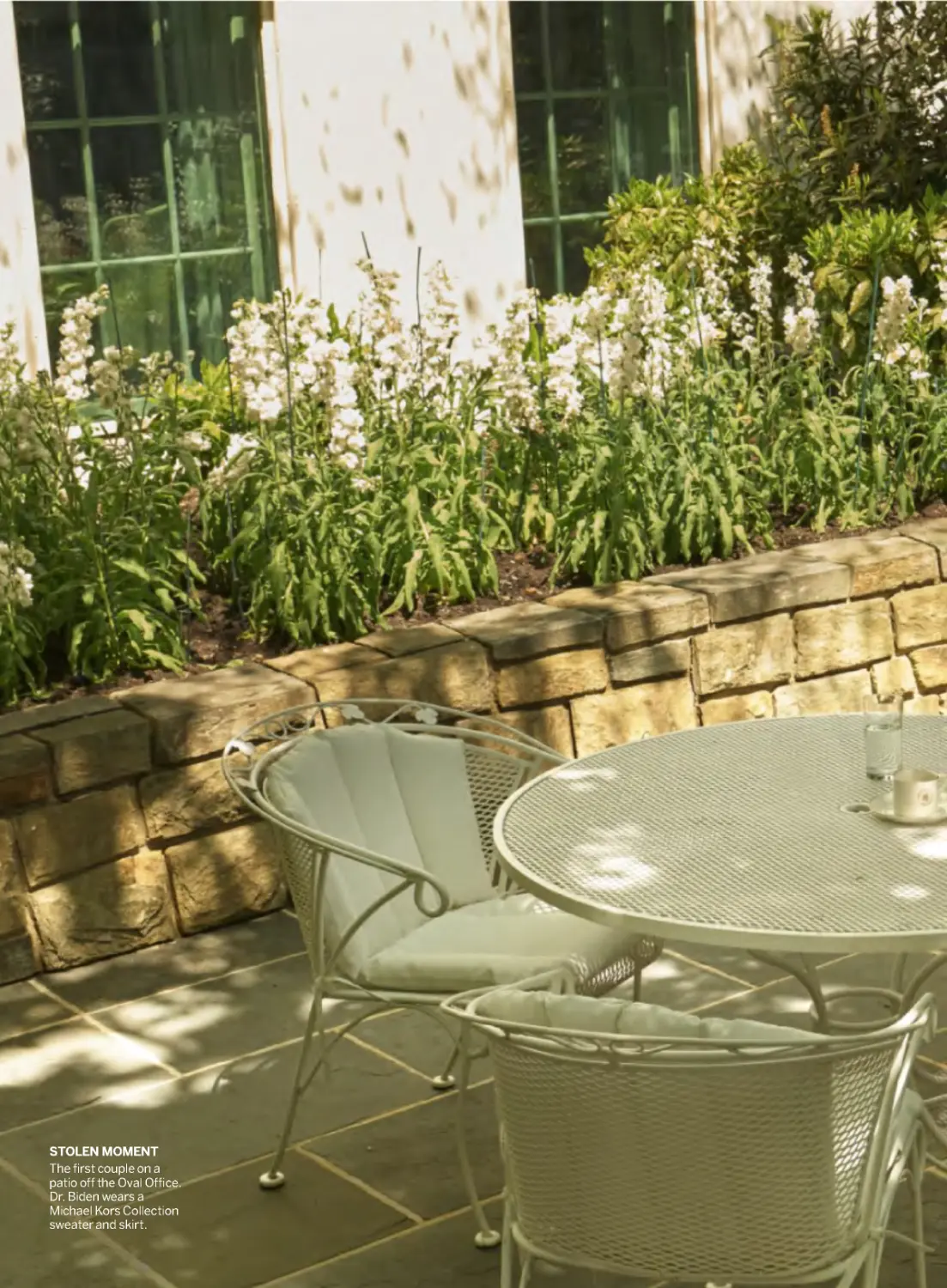
STOLEN MOMENT
The first couple on a
patio off the Oval Office.
Dr. Biden wears a
Michael Kors Collection
sweater and skirt.

“During the campaign, I felt so much anxiety
from people; they were scared,” she told
me. “When I travel around the country now,
I feel as though people can breathe again”

he night before I started following Jill
Biden around the country, I decided to
take a walk around the newly fortified
White House to figure out exactly how to
get in the next morning. I was dumbfounded to see the brutal black fencing, as high
as the towering old trees, and to realize how far I would
have to walk to get to the checkpoint, like something
out of Cold War Berlin. The White House perimeter
keeps pushing farther out—security creep, with all of
the attendant police-state vibes—scooping up ever more
of the city grid.
But once I was inside the White House the next morning, I was greeted by nothing more forbidding than a
bunch of nice, nerdy career D.C. people—working. That
day Dr. Biden was giving a speech for the Joining Forces
relaunch in an empty auditorium in the Old Executive
Office Building, next to the West Wing. A handful of
press, staff, and Secret Service would be on hand, but no
eager, tittering audience, thrilled to be invited to the White
House—only the now-familiar wall of human video tiles
behind the podium. When Dr. Biden appeared onstage,
a production person’s voice came over the sound system:
“Whenever you’re ready to go ahead and start….” She
gathered herself and launched in. “This work is personal
to me,” she said. “My dad was a Navy signalman in World
War II and went to college on the GI Bill. His love for this

T

52

MAKING TIME
“We still light the candles, still have the conversations, still put
the phones away,” she says. In this story: hair, Sally Hershberger;
makeup, Francelle Daly. Details, see In This Issue.

country was a part of everything he did, and he inspired
us, his five daughters, to see America through his eyes.”
When she finished, she silently walked off the stage. “And
so we begin!” she said to no one in particular, and then
laughed. In many ways, Dr. Biden is perfectly calibrated
for this moment—thus far, a nearly pomp-free presidency.
“Oh, please, call me Jill,” she will say to people in formal
settings who sometimes stumble over how to address her.
“Sit down,” she says, laughing, when people stand for a
second too long in her presence. “There’s an unadorned
thing that I think she values,” says Osnos. “And she’s quite
suspicious of artifice in others.”
After the speech, her 12-car motorcade, sirens blaring,
sped across the Potomac to Arlington, Virginia. (I said to
her, “It must be exhausting to always travel at the speed
of motorcade.” “It’s funny,” she replied. “On the way to
the airport, I said to Joe, ‘Where’s all the traffic?’ And then
I realized...oh, yeah, they stop the traffic.”) In Arlington,
she would be greeted by Charlene Austin, the wife of the
Secretary of Defense, Lloyd Austin, among others, to take
a tour of Military OneSource, a resource hub and call
center for service members and their families. Among the

White House reporters following her today—all women,
many of whom covered the Trump administration—there
was a lot of chatter, almost complaint, about how much
more information they now receive: so many emails! Full
readouts of calls President Biden has with foreign leaders
arrive in their inbox the same day—as opposed to five
days later with just one sentence saying that it happened,
which was usually as good as it got with the Trump folks.
As Dr. Biden toured the call center, a woman who works
here thanked her for her time and attention. “No,” said Dr.
Biden, “thank you. We need you. Really. These families are
desperate…if your child is not happy, your whole world just
falls apart. You’re giving them hope and joy.” As the tour
was ending, she talked to a member of the military who told
her that he used the call center to find a counselor when he
and his wife were having a “very hard time adjusting to military life.” “Did you go into counseling with your spouse as
well?” asked Jill. Not at first, he said, but eventually. “Well,
you have to,” she said. “You’re in a relationship.”
Two days later, the first lady was on yet another trip—to
Birmingham, Alabama, quite purposely traveling to a red
state as part of the “Help Is Here” tour, meant to amplify
how the American Rescue Plan addresses child poverty. In nearly every
way, it felt like a campaign stop: a
speech in a gymnasium in a YWCA,
with local dignitaries, like former
Democratic senator Doug Jones,
and a speech from Birmingham’s
mayor, Randall Woodfin. But it was
Congresswoman Terri Sewell, in her
bubble-gum-pink suit, who stole the
show with her volume and intensity. “I am so proud to have been the
only Democrat in Alabama’s delegation to vote in favor
of the $1.9 trillion American Rescue Plan,” she said onstage. She talked about the big infusions of money the
state, county, and city would soon be receiving. She talked
about the child tax credit, how the Biden administration
is “expanding it, by providing direct payments in the
form of a child allowance. This year, families will receive
$3,600 per child under the age of six and $3,000 per child
between the ages of six and 17.” (The checks, for more
than 65 million children, begin landing in people’s bank
accounts in July.) “This is a big plan…. Good governance
creates an environment that allows all of our people—all
of our people—to reach their full potential.”
On the flight home to D.C., Dr. Biden came to the
back of the plane for an off-the-record gaggle. It’s something I saw over and over again—her solicitousness with
reporters, the times she apologized for keeping us waiting. “I’m trying to get to know them,” she told me later.
“Because I don’t think it should be, you know, me versus
the press.” She also sat down next to me for a few minutes
to say hello. She had heard from one of her staffers that
my mother died recently—from cancer—but what she
didn’t know is that she died on the Saturday after the
election in November, the very day her husband was
declared the winner. Who can say why some people seem
to have extra capacity to feel other people’s sorrow, but
there I was, in front of group of strangers, becoming

emotional as I relayed this coincidence of timing. When
I composed myself, I looked up at Jill, and she, too, had
tears in her eyes.
t’s very early on a stormy Monday morning in early May at Joint Base Andrews, and the press corps
that follows the president (mostly middle-aged
white guys) is standing under one of the wings of
Air Force One trying to keep dry. When Marine
One—the helicopter that flies the president from
the White House to his plane—lands and then roars up
to disgorge POTUS and FLOTUS (and the man carrying
the football), it feels like a show of muscularity that is
particular to the United States—one that is no longer in
the hands of someone for whom that seemed to matter
too much and for all the wrong reasons. The quasi-march
across the tarmac, the crisp salute to the commanders and
sergeants in place to greet him—it suits Joe, in his aviators,
so tall and thin in his impeccable blue suit.
The president and first lady are traveling to southern
Virginia today, a double act, both of them to give speeches meant to highlight the Biden administration’s jobs
and families plan. Their first stop
is at a magnet school, Yorktown
Elementary—and Mrs. Bertamini’s
fifth-grade class in particular. There
are 18 students in their third week
of in-person learning. All of them
have three-sided plexiglass shields
perched on their desks, along with
elaborate weather-related science
projects they’ve just completed. Press
and staff, who are cordoned off in a
corner of the room, outnumber the
students, who seem startled into silent amazement by this
once-in-a-lifetime intrusion into their precarious world.
After the Bidens enter the classroom—introduced as the
Very Special Guests they most certainly are—Jill makes a
beeline for a girl in the back of the room and then heads over
to a student named Andrew. She hovers over his project, asks
a series of thoughtful questions, while her husband, shifting
from one foot to the other, looks a little out of place—letting
the wife take the lead on this one. Not a chance. “Come on,
Joe!” says Jill, waving him over. He hesitates for a moment
and then, perhaps realizing there are cameras trained on
him, takes control. “What do you want to be when you
grow up?” he says to one of the kids.
“Fashion designer,” says the student. He turns to
another kid. “How about you?” A music artist mumblemumble-mumble. “A what?” Someone on his staff says
it louder: A MUSIC ARTIST. “Well, I’ll be darned!”
says the president. “And you?” A hairstylist, says the kid.
“Holy mackerel!”
Everyone piles back into the 20-plus-car motorcade, and
off we go, passing clusters of people now lining the roads,
everyone with cell phones up, many of them waving. “At
least they’re waving at us now and not giving us the finger,”
says one of the photographers. Suddenly the whole caravan comes to a stop. Word comes through that Joe wants
to say hello to the students and teachers who have gathered in front of a high school, C O N T I N U E D O N PA G E 1 0 0

I

S ET D ES IG N , MA RY HOWA RD ST UD I O.

“She came in knowing
the experience of being
vice president,” says Biden,
“knowing the power of the
presidency—knowing that
she could change things”

53

Gabriela Hearst’s arrival at Chloé has ushered in a whole new era for the
French house. On the eve of Hearst’s debut, Rachel Donadio meets a designer
intent on creating with clear-minded purpose. Portrait by Théo de Gueltzl.

N A SUNNY WINTER AFTERNOON IN
Paris, Gabriela Hearst, the new creative
director of Chloé, buzzes around the
house’s atelier in the 8th arrondissement.
She’s about to present her first Chloé
collection with an atmospheric video
shot at night in pandemic-empty Saint-Germain-des-Prés,
and models are parading into a room lined with racks of
clothes while assistants in masks put the finishing touches
on each look: There’s a flowy marbleized red-and-green
silk crepe dress, a chunky knit ankle-length dress, a long
coat of scalloped brown-leather scales that looks, in the
best way, like Joni Mitchell might have worn it in 1971.
Every so often, someone asks Hearst a question, and she
nods and offers a “Oui, merci” in slightly Spanish-accented
French. “My French is ‘Oui, merci,’ ” Hearst says, a bit
apologetically, as she urges me to feel a soft, thick poncho
made from recycled cashmere with a zippered parka neck.
Reusing existing materials to make impeccably tailored
new creations is classic Hearst. Raised on a cattle ranch
in her native Uruguay—hence the ponchos—and married
to a scion of one of the most storied families in America,
Hearst, who founded her eponymous label in 2015, has
come to embody a certain kind of intelligent, sustainable
luxury. She communicates an urgency around the climate
crisis—but she does so with elegance, joie de vivre, and
something of a frontier spirit. Hearst’s mandate at Chloé is
to bring a current of engagé environmentalism and purpose
to a house—previously led by the likes of Karl Lagerfeld,
Stella McCartney, and Phoebe Philo—known for a vision
of carefree yet clever French femininity.
Hearst’s first collection, unveiled in early March, struck
that balance beautifully. It uses the language of Chloé—
broderie anglaise, scallops, a soft color palette—while
dramatically scaling back on synthetic fabrics, adding more
knitwear, and focusing on upcycling and transparency
about the supply chain.

54

“I didn’t expect there would be so much of her handwriting so quickly,” says Natalie Kingham, the global fashion
officer for MatchesFashion, who singles out the knitwear
and the ponchos with parka collars. Hearst, she says, has
offered “a very elegant, grown-up version” of the Chloé
woman, who, while free-spirited, also wants to know where
her clothes come from. “I think that’s how women want to
feel and want to look,” Kingham says. “They want to wear
clothes that are going to get them through the day, but in
an ethical way—a way that makes them feel wonderful.”
Hearst designed the collection in record time and showed
it only three months after being named to the job, while
also running her own label. She keeps a dry, playful sense
of humor about the insanely intense schedule. “I’m not
creatively unsatisfied,” she tells me as we sit on the sidelines of the atelier. When Hearst was named to Chloé last
December, many wondered why she would want the job. She
already had her own successful house, which has become
popular with powerful women like Dr. Jill Biden, who wore
a white Hearst dress with floral embroidery on the night
of her husband’s inauguration and a navy iteration for his
first address to Congress. While women are often held to
a different standard than men when it comes to juggling
careers and families, taking on a second job, in Paris, was
still a lot for Hearst, who lives in Manhattan’s West Village
with her husband, John Augustine Hearst—who goes by
Austin and is an executive and a grandson of William
Randolph Hearst—their six-year-old son, Jack, and her
13-year-old twins, Mia and Olivia, from her first marriage.
When I ask Hearst why she wanted the job, her answer
is both clear and direct. “Because I knew I could do it,”
PARIS IN A NEW LIGHT
Gabriela Hearst, Chloé’s new creative director, envisions
fusing style, sustainability, and social responsibility. She wears
a Chloé leather coat and boots. Hair, Odile Gilbert;
makeup, Tom Pecheux. Fashion Editor: Camilla Nickerson.

P RO DUC ED BY KI T T E N P RO DUCT I ON .

This Woman’s
Work
O

Photographed by Zoë Ghertner.

Hearst communicates an urgency
about the climate crisis—but
she does so with elegance, joie de vivre,
and something of a frontier spirit.

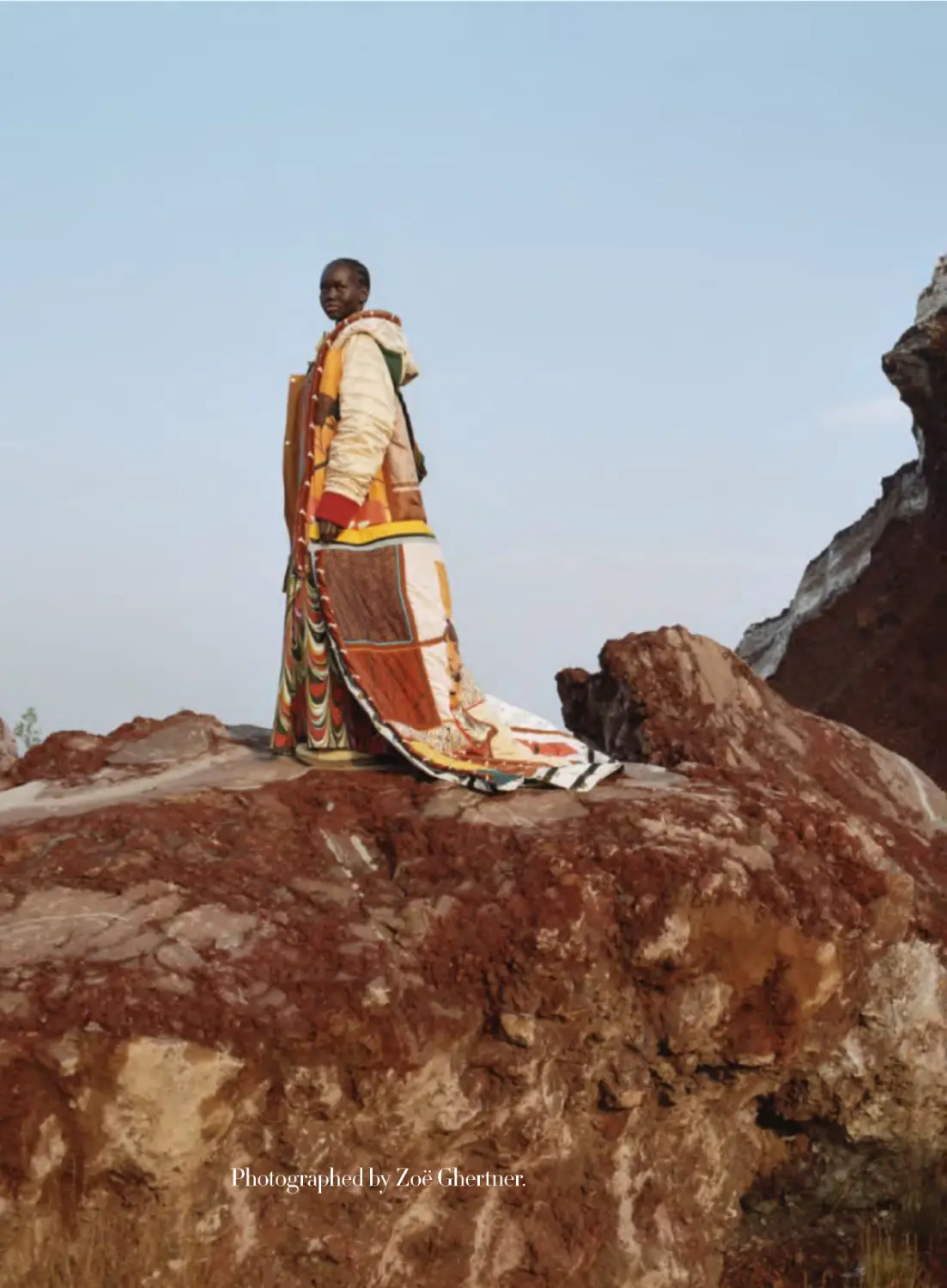
SLEEP NO MORE
Hearst created, with Bas
Timmer of Sheltersuit
Foundation, repurposed
sleeping-bag parkas
(which are not for sale)
and backpacks (which
are, with a portion
of proceeds going to
Sheltersuit). Model
Adut Akech wears a
Sheltersuit & Chloé
coat. Chloé dress.

she says. Hearst tells me she had a dream in 2017 that she
would design for Chloé, and later lobbied the house’s CEO,
Riccardo Bellini. (“He thought I was crazy,” she says.)
But her emphasis on sustainability and her track record
of strong accessories were a good fit with Bellini’s plan to
refocus the brand with what he calls a “purpose-driven
business model.” Hearst leveled with her family: If she
took the job, “the ones that are going to be screwed are
you, because I have less time for you,” she told them. If
they had said no, she says, “I wouldn’t have done it—that’s
the reality.” They told her to go for it.
Hearst is tall, with high cheekbones, chin-length ashblonde hair, and pale eyes. On the day we meet, she’s dressed
in her first Chloé collection: a chunky, mustardy-green knit
pullover, a long off-white pleated wool skirt, and cream-colored crepe wedge-heel boots. Large gold cutaway earrings
frame her face, which has little makeup. For all the stage
management of launching a new collection, Hearst is inescapably herself and bracingly open about the challenges
she has faced.
She tells me she sees the Gabriela Hearst line as Athena, the Greek
goddess of wisdom and war—a more
cerebral femininity; clothes for women who are running companies—
while Chloé is Aphrodite, the
goddess of love, a more sensual
power, younger. In pitching Bellini,
she produced a 92-page booklet of
images with a Venn diagram of where
the two houses would overlap in
concepts, including “Handcrafted,”
“Sustainability,” “Wholehearted,”
and “Purpose-driven.” But she also
articulates clear stylistic differences. “You will never see a
Gabriela Hearst woman in a pair of sweatpants in the airport,” she tells me. You’ll never see a scallop, a key element
of Chloé’s stylistic DNA, in Gabriela Hearst. Hemlines
for Gabriela Hearst will never go above the knee; Chloé’s
will. It sounds like the mythical Chloé girl is growing up.
“For me, it’s about a Chloé woman,” Hearst says, though
she wants Chloé to keep its youthful spirit. She draws inspiration from her 13-year-old daughters and from friends in
their 80s. “As women, sometimes we want to feel younger,
sometimes we want to feel older,” she says. “What we never
want to feel is boring.”
Now she aims to apply the sustainability approach of
her own smaller house at the much larger Chloé. “Doing
it successfully, for me, will mean having a luxury brand
at a much higher scale in volume than Gabriela Hearst,”
she says. “It’s a very ambitious target but something
that wakes me up every morning to want to do this job.”
For all Hearst’s drive, though, the most important thing
in her life isn’t fashion but family and friends. Her commitment to sustainability comes from a place of righteous
anger. She tells me about a 2017 trip she took to Turkana,
in northern Kenya, with Save the Children, a charity that
she and Austin support, where she saw malnourished
children and women who had to walk for miles for water.
“It was infuriating to think that—today—families have
to choose between migration and famine,” she says. “We

cannot allow that as a species,” she continues, nor can she
abide by it “as a businessperson, as a woman, as a mother.”
The house has a long tradition of strong women designers, with the notable exception of Lagerfeld, who blazed
a trail at Chloé with softly feminine dresses before leaving
for Chanel in 1983, and Paulo Melim Andersson, who led
the house briefly after Philo. Under McCartney, it became
the go-to French house for the joyous flirtatiousness of the
late ’90s; Philo, who took over in 2001, virtually defined
the boho-glam look of her era. More recently, creative
directors Clare Waight Keller and Natacha Ramsay-Levi
produced well-received collections. With Hearst, though,
Chloé is telegraphing a new focus on values as much as on
trends—or at least signaling that values are the latest trend.
Today’s Chloé woman has different priorities. Bringing on
Hearst is “very courageous,” says Olivier Gabet, the director
of Paris’s Musée des Arts Décoratifs. “She’s less known to
the public, but she has the guts and the vision to bring Chloé
back to what made it strong in the ’60s and ’70s.”
The house was founded in 1952
by another Gaby: Gaby Aghion,
a vivacious entrepreneur from a
Greek-Italian Jewish family who, with
her husband, Raymond, left her native
Alexandria, Egypt, after World War II.
In Paris, Aghion and Raymond, a gallerist and anti-fascist activist, frequented Left Bank cafés and intellectual
circles. (Their son, Philippe Aghion,
is a world-class economist known for
his theories of how creative destruction
can lead to economic growth.) Aghion
didn’t need to work but saw a gap in
the market between haute couture and
bespoke tailoring and began designing fresh cotton dresses
that reminded her of home—the pink and beige of the Egyptian sand, which she said “feels like silk in your hands”—and
selling them to boutiques with her own label. Thus was born
high-end prêt-à-porter. Chloé was always “very feminine,
very sensual, chic, very intelligent,” Gabet says. And while
Chloé was born in the heyday of French existentialism, he
says, “now it’s a question of environmentalism.”

“For me, it’s about a Chloé
woman,” Hearst says.
“And as a woman,
sometimes we want to feel
younger, sometimes we
want to feel older.
What we never want to
feel is boring”

58

orn Gabriela Perezutti Souza in 1976, Hearst
is the fifth generation of her family raised
in Uruguay. Her father’s family emigrated
from northern Italy, her mother’s from Portugal via the Azores and Brazil. Her mother,
Sonia, still lives in Uruguay, off the grid,
on a solar-powered ranch. (Family snapshots of Hearst
as a girl with her mom on horseback sometimes show up
on the Gabriela Hearst Instagram.) Hearst is the eldest
of four. For first grade, she was sent to Uruguay’s capital,
Montevideo, to live with her grandmother and attend the
posh British School. “This was pre-globalization,” Hearst
says of her childhood. “We didn’t have cable TV until I
was 15.” From early on, she knew she would leave. “It
was very predictable, my future, if I didn’t make changes,”
she tells me. “You would marry someone from a similar
background, you would send your kids to the same school,
you would become a member of the lawn tennis club.”

B

the size that it is, but we’ve decided to go slow because it
She wanted more. She spent a year of high school in
didn’t make sense from a sustainable perspective.”
Australia, came back to Uruguay to study communiChloé is trying the same approach and has committed to
cations, tried modeling in Paris and Milan, and then
reduce its carbon emissions and water consumption by 25
moved to New York to study acting at the Neighborhood
percent by 2025 (its headquarters and its Paris boutiques
Playhouse—the Meisner Technique. “It’s about performalready operate on 100 percent renewable energy). The
ing from a place of honesty,” she says. While excellent
house has also begun a collaboration with the Sheltersuit
training, it wasn’t for her. “I was not very good at taking
Foundation, a Dutch nonprofit that has made a parka
direction,” she says. She worked as a waitress and in a
with an attachable sleeping sack for the homeless and
retail showroom. In 2003, in Brooklyn, she started her
for refugee camps—a creative solution to a desperate
first clothing line, Candela, silk-screening T-shirts—the
problem. For Hearst’s first Chloé collection, Sheltersuit’s
first one depicted a winged woman riding a horse, inspired
founder, the Dutch designer
by her mother.
Bas Timmer, designed a line
As the label started to take
of colorful backpacks using
off, Austin Hearst became
Chloé deadstock fabrics, with
an investor. The two had
a percentage of the sales supmet through mutual friends
porting the nonprofit, whose
at a party in Buenos Aires
Dutch workshop is staffed
in 2004. “I didn’t like him at
by refugees. (The sleeping
first—he knows that,” she
parkas themselves are not
says, direct as always. But
for sale.) “She calls it altruisthey stayed friends. In 2011,
her father died. They had
tic design,” Timmer tells me
been very close. There were
when we meet for a chat in the
inheritance lawsuits, and
Place des Vosges. He’s wearwhen Gabriela ultimately
ing a rain jacket and a hoodprevailed and inherited his
ie sweatshirt he’s fashioned
ranch, Austin sent her a giant
from fabric in the Chloé warebunch of white flowers with
house. “With this collaboraa note that said, “Nobody
tion, there’s a chance that we
fucks with my baby.” The
can disrupt a bit the fashion
couple married in 2013—a
industry, even the nonprofit
City Hall wedding (she wore
industry,” he says. “If Chloé
Valentino), then a big party
takes this step, we can inspire
at the Museum of Natural
more brands.”
History (she wore Dior).
While Hearst doesn’t have
Austin Hearst is also a
formal design training, she
cofounder and investor in
sketches copiously. She
the Gabriela Hearst label.
keeps a dream journal to
She had wanted to name it
gather ideas and operates
EARNING HER STRIPES
simply Perezutti, her surlargely on instinct. She also
Akech exudes joyous sophistication in an electric knit frock.
works closely with her best
Chloé dress and mules.
name, but a friend told her
friend and muse, Stephanie
that no one would be able to
de Lavalette, a cofounder of the Gabriela Hearst brand
pronounce it, so she settled on Gabriela Hearst: her design,
who has joined her at Chloé. The two met in the early
his investment. “It was never a ‘Let my wife have a hobby’
aughts and were roommates on Bank Street when de
situation,” she tells me. “This is a business.” I ask her how
Lavalette, who is French, still worked in finance. “Gabrishe and Austin balance the marriage and the work, and
she rolls her eyes. “Do you like to have budget meetings at
ela likes to say that I’m the president of GSD—getting
11 o’clock at night in your own bed?”
shit done,” de Lavalette tells me with a smile. She helps
In 2019, LVMH became a minority investor in Gabriproduce the fashion shows and the bags, oversees marketing and communications, and is an all-around sounding
ela Hearst. The brand is sold only at a few retailers and
board. “My role has also changed as the company has
her own two shops, in New York and London. Hearst’s
grown,” she says. Hearst is the godmother to de Lavalette’s
Nina bag, produced in small quantities and inspired by
son, who is close with Hearst’s son. They’ve been there for
the sculptures of Botero (and named after Nina Simone),
each other through the births of children and deaths of
has long waiting lists. Oprah wore one to the wedding of
parents. Talking to de Lavalette, I understand why another
Meghan Markle and Prince Harry; Markle herself wore
word in the Venn-diagram overlap between Hearst’s label
one a few months later. Hearst is savvy and seems to have
and Chloé is “Friend-Tribe.”
found the sweet spot where sustainability and exclusivity
De Lavalette and I are sitting over green tea in Hearst’s
meet. “We had many opportunities for very rapid growth,
office at Chloé. There are family photos and art and poetand we declined those,” she says when I ask how she recry books on the shelves: Allen Ginsberg, Pablo Neruonciles sustainability with producing four collections a
year for two different houses. “My business could be triple
da, Hilma af Klint; a book on C O N T I N U E D O N PA G E 1 0 1

59

EDGING FORWARD
Chloé’s scalloped edges
once signified girliness;
with Hearst’s debut, they
now delineate grown-up,
thoughtful glamour. Chloé
leather dress and belt.

LO CA L P RODUCT I O N BY H A BI TA NT;
S ET D ES IG N , E MMA V I V I A NA G ON ZA L EZ.

FRINGE BENEFITS
Hearst looked homeward
to her native Uruguay
for Chloé’s all-enveloping
artisanal ponchos. Chloé
puffer-poncho. All
clothing and accessories
at chloe.com. In this
story: makeup, Ana G de V.
Produced by Alexis
Piqueras at AP Studio Inc.
Details, see In This Issue.

ON THEIR
GAMES
For American swimmer Simone Manuel, gymnast
Sunisa Lee, and sprinter Noah Lyles, the Tokyo Olympics
can’t come soon enough. By Robert Sullivan.

PRO DUC E D BY ST E PH A N IE O’CO N N OR .

GOLDEN
OPPORTUNITY
“You go through
these roller-coaster
emotions,” says
Simone Manuel, a
sprint freestyle
swimmer who took
two golds and two
silvers at the Rio
Olympics in 2016.
Free People bralette.
Commando bikini
briefs. Hair and
makeup, Kaori Nik.
Fashion Editor:
Tonne Goodman.

Photographed by Dana Scruggs

on’t forget: Even
though they are
poised to take place
in 2021, the Olympics that we’ve all
been waiting for
are still the 2020 Olympics. From
the perspectives of the athletes, it’s
as if they’ve been at the starting
blocks all along, waiting to burst
out, to dive or mount, throw or take
one long last leap. From the point of
view of everybody else, the notion
of athletes returning feels like that
next moment in a relay, when a baton
from life before the pandemic gets
passed on to a runner after, the teams
joyfully picking up speed in a new
world—and, somehow, speeding us
along with them.
Sure, logistics are always changing,
with health precautions like so many
crucial hurdles, but the anticipation
is building, with more competitions
and the return of qualifying meets.
“Me, personally, I am somebody who
loves to be social,” says Noah Lyles.
America’s 200-meter sprinting star
has already won in New York and
surged ahead late—his trademark—
to win at the USATF Golden Games
in California. “I love to go out and
hang out—and practice—with other
people. I love it! To train with others
and get that excitement, that…edge!”
As was the case for everything
else, the schedule for the 2020 Olympics did not go as planned. At the
beginning of March 2020, Simone
Manuel, who won two gold and two
silver medals at the 2016 Rio Olympics and was planning on continuing
her streak in Tokyo, had just finished
up a swim meet in Des Moines while
talking to her mom. Rumors about
the virus were flying. “My mom

“I want to go out there and be somebody
who’s the first to do something,” says Lyles,
who was inspired as a kid by gymnast
Gabby Douglas. “The Olympics hits everybody”

Photographed by Hype Williams
64

P RO DUC ED BY OV ER FLOW P RO DUCTI O N S, IN C.

D

RUNNING START
For Noah Lyles, a
200-meter sprinting
star, training within
COVID protocols was
tough. “I’m somebody
who loves to be social,”
he says. Louis Vuitton
Men’s coat, shirt, tie,
and pants. Grooming,
Jennifer Beverly.
Fashion Editor:
Alex Harrington.

66

She did her best to keep things in
perspective, but like everyone, she
missed the least extraordinary things,
like a trip to the mall or to the nail
salon—and if you follow her on Instagram, you already know that she
is not fooling about her nails, a tiny
detail that makes her photo finishes
even more impressive. Fortunately,
swimming is a kind of therapy for
her, but Zooming with her mother
and father in Texas did not replace
hugging them. “I went on walks, and
I’m not a walker!” Did she turn into
one? She breaks into laughter. “No!”
Perspective reminds us that, for
better or worse, perseverance is in
the definition of an Olympic athlete,
and for these games, perseverance is
being tested, only more. Lyles and
his brother, Josephus, who is also
a professional sprinter, played just
about every sport growing up, but
it was during the USATF National Junior Olympic Championships,
when Noah lost during the high-jump
finals, that his mother, Keisha Caine
Bishop—herself a standout runner—
saw the 12-year-old transforming
into a champion. “After he lost, he
came over to me,” Bishop recalls,
“and I said, ‘Hey, Noah—how’re
you doing?’ He said, ‘I’m great.’ I
said, ‘Are you disappointed that
you didn’t win?’ He said, ‘Nope, I’m
good—I’ll come back next year.’ ” It
doesn’t hurt that Lyles has an Olympian’s physical mechanics (in stride
frequency and length) or that he (like
Lee and Manuel) is a student of his
sport. “You hear this a lot,” says his
coach, Lance Brauman, “but he is
built to run.”
The first Olympics that amazed
him were the 2012 London games,
when he was 15 and mostly watched
gymnastics. “I just thought Gabby Douglas was the coolest person
because, one, she was young,” Lyles
says. “Two, she was Black, and three,
she was the first to do something.”
(She was the first Black woman to
win the Olympic all-around gymnastics title.) “I just thought, Yeah—I
want to go out there and be somebody who’s the first to do something.
The Olympics hits everybody.” He
also wants to entertain, his race
plan so closely mind-mapped that
his way of keeping cool is putting
on a show for the cameras—a Usain

Bolt–like tendency that Bolt himself
has noticed, along with Lyles’s speed.
(“He looks like he wants to do great
things,” Bolt told USA Today this
spring.) It’s a pre-race strategy that
Lyles compares to that of a lion,
which rests by day but comes out
strong when it’s time to attack and
amaze. Forgoing a mane, Lyles was
recently spotted wearing a leopardand-camo-print running suit—and,
as always, entertaining socks. “I’m
heavily into fashion,” he says, “and
it’s funny, because in my high school
years, all I wanted to do was run, so I
very much didn’t care about how
I looked. I basically dressed like a
dad—a non-cool dad.”
As a young girl, Lee was always
grabbing her mom’s phone to watch
gymnasts flip, then repairing to
the nearest couch or bed to try one
out. Her father spotted her in those
days and then, as her gymnastics
improved, organized fundraisers at
local Hmong restaurants to help pay
for travel to national and then international meets, coaxing Lee to sing,
which she loved. “My dad would pick
some songs,” she remembers, “and
I’d say, ‘What is this song?’” (Once it

LYL ES: P H OTOG RA P H ED BY H YP E W I LLI A M S. LE E: P HOTOG RA P HE D BY JOSH O LI NS. MANUEL: PH OTOGRAPH ED BY DANA SCRUGGS.

was saying, ‘Should you be taking
pictures with fans? Should you be
signing autographs?’ ” Manuel, 24,
recalls. Three days after she got back
to her home in California, the pool
she trained in closed up, the 2020
games still theoretically on. “And
nobody had a plan,” she says.
A gymnastics version of that happened to 18-year-old Sunisa Lee,
who goes by Suni. A veteran of the
U.S. team that won the gold at the
2019 world championships in Stuttgart, Germany, Lee was practicing
her uneven-bar magic at her gym
in the suburbs of St. Paul one day
and doing Zoom workouts at home
the next. Time stood still—until it
didn’t. “It’s crazy how fast the time
has gone,” she says.
One by one, athletes everywhere
concocted new ways to train or resurrected old ones. In Florida, Lyles
worked out on grass and on weekends took up roller-skating—a hobby that initially shocked his trainers,
until they saw that it was less about
speed and more about a vibe. “I figured out that a bunch of my friends,
like, love to roller-skate. I actually
got pretty decent.” Lee started running with her teammates, outdoors,
and cooking with her mom, indoors.
“It’s just so much healthier,” she says.
(She reports, also, that it tasted great.)
Thanks to her coach, Manuel managed to find a backyard pool seemingly designed for her needs: two lanes,
with poolside race clocks and starting
blocks. “You’re in California, and you
have really big swim and water-polo
fans, so everybody has these massive
pools,” she says. Was she surprised at
such a made-for-closed-swim-centers
setup? “Yes,” she says, “but at the
same time, if this were to be anywhere,
it would be in California!”
The pool’s owners donated its
daily use to Manuel and her former
Stanford teammate Katie Ledecky,
but the initial rush of fortunate feelings gave way to more complicated
emotions in the shut-down world.
“Sometimes I felt a little guilty,”
Manuel recalls. “It was hard doing
it knowing that the Olympics were
postponed. You go through these
roller-coaster emotions—you’re
thinking, Ah, it’s another year to
get better, and the next you’re like,
But I was ready for it right now.”

BY AIR, BY LAND, AND BY SEA
right: Gymnast Sunisa Lee in a Dion
Lee bodysuit. below: Manuel in a
Givenchy dress. above: Lyles in Adidas.

P RO DUC ED BY TY LER COP E LA N D.

PASSING THE BAR
For Lee, Zoom
workouts have
given way to Tokyo
travel plans. “It’s
crazy how fast the
time has gone,” she
says. Alaïa dress.
Hair and makeup,
Peter Phung. Details,
see In This Issue.
Fashion Editor:
Max Ortega.

“She really puts everything into it,”
says Lee’s coach Jess Graba.
“Not just the gymnastics but
to be everything she can be”

was Bette Midler’s version of “Wind
Beneath My Wings.”) The Twin Cities area is home to the largest urban
Hmong community in the U.S., and
when Lee wins, she is winning for the
Hmong neighbors who supported her
in the gym and supported her father:
While helping a friend, he fell off a
ladder, suffering a spinal-cord injury
that paralyzed him from the chest
down a few days before Lee won a
gold, a silver, and a bronze medal
at the national championships in
2019. Her father FaceTimed Lee at
the nationals from his hospital bed
to cheer her on, but no one knew
what she was going through as she
attempted a bar routine that she had
upgraded in difficulty. As she aced
the landing, the commentators predicted Tokyo gold.
The very sound of water would
cause Simone Manuel fits of joy as
a child—she laughs as she remembers fierce attempts to fling herself
into the tub, anybody’s tub, whether
undressed for it or not. “Whenever I
heard the water running, I would just
get super excited, kind of like when
a dog is ready for a walk,” she jokes.
Her older brothers were on the swim
team, and after watching them she
announced to her parents she could
swim. She wasn’t kidding. “Why is
Simone not doing what the others are
doing?” her mother asked the instructor when she spotted her daughter
swimming across the pool on day two
of lessons. “Why isn’t she…floating?”
The response: “Some kids are just
ready to swim.” Her brothers can still
beat her—but not because they’re
faster. “Their technique is so terrible,
and then I’m laughing and choking

on water so much that they win,”
Manuel says, “but it’s okay.”
After she finished Stanford, where
she studied communications and
African and African American studies, 2020 was to be Manuel’s year
to concentrate on the Olympics,
with summertime the final lap of
four years of prep. The summer, of
course, marked the beginning of historic mass uprisings, and as the first
Black woman to win an individual
medal in Olympic swimming, she
was acutely aware of the swimming
pool as a historic site of racial contest in modern American history:
The pool was like the lunch counter at the start of the Civil Rights
movement, when, for instance, acid
was poured in a pool in the vicinity
of Black bathers. Later, as suburbs
expanded and cities continued to
segregate, the ability to swim marked
both access and privilege, as it does
today. (The percentage of Black
members in USA Swimming is, by
their own accounting, somewhere
in the single digits.) Immediately
following her wins at Rio, Manuel
was on MSNBC encouraging Black
children in the U.S. with little or no
swimming ability—69 percent—to
learn. (“You can do it,” she said,
still standing poolside.) Later she
noted that, according to the CDC’s
last study, in 2014, Black children
are 5.5 times more likely to drown
in swimming pools. Television
announcers throughout her ascent in
the sport tended to describe Manuel
as “coming out of nowhere,” when
she was there—usually, after the
finish, on a podium—all along. In
her own telling, it’s a bias she has

felt viscerally—and while once she
might have talked less about her own
experiences, she’s now ready to share
more, for her own sake and the sake
of others. “When you are telling
other people what you’re feeling,”
she says, “you never know who you
affect—you could be helping them
through the same storm.”
hen I talked
with the
athletes as
the summer was
ab o u t t o
begin, Manuel had been to a meet
and remembered all the things you
forget—hotels, logistics—and had
just returned from a three-week rest.
She’d gone back to Sugar Land, Texas, her hometown, to binge-watch
Good Girls (“They’re not good
girls!”) and savor Shipley’s glazed
doughnuts (“a pillow of goodness”).
Lyles had just begun to run 200s
again too, and watching him come
out of the first turn was like watching someone turn on a jet pack, an
explosive speed he describes like a
physicist: “When you come out to
the straightaway, if you stay in the
middle or come even closer to the
inside of the lane, you will actually
take all that speed that you built up,
and it will force you out.”
Suni Lee had just aced the bars at a
meet in Indianapolis, a 10-hour drive
with her teammates to an event that
was spectator-less but televised—a
strange and pressure-making combination—and her coach was raving. “She really puts everything into
it—not just the gymnastics but to
be everything she can be,” says Jess
Graba. She came with a new bar
routine and, as per her custom,
spoke to nobody beforehand but at
last, when she landed, broke open a
huge, winning smile. After all, she
had left the earth, launching into
her Nabieva—the technical term for
when, to the layperson, she is soaring
like a bird. “I am literally flying over
the bar and catching it,” Lee says. “It
feels so cool.” @

W

Photographed by Josh Olins
69

Omar Sy’s sensational, stylish turn in the Netflix series Lupin has made him
more than the leading man of our moment. Alexandra Marshall reports
on a French star at the forefront of a new wave. Photographed by Jonas Unger.

y sense of adventure comes from
the place I grew up,” says Omar Sy,
the star of Lupin—the Netflix series
that has become an international
phenomenon—and easily the most
beloved actor in France. (Three times
Sy has been voted France’s favorite person, on an open
ballot.) The place he’s talking about is Trappes, one of the
infamous banlieues about 20 miles west of Paris, which, collectively, occupy a complicated place in the French national
imagination. Banlieues are suburbs outside major cities
filled with housing projects that were cheaply constructed for immigrant workers during France’s postwar labor
shortage. As jobs dried up in the 1980s and ’90s, austerity
settled in and xenophobia flared, giving the banlieues a
forbidding reputation, either to be pitied or shunned. “In
Europe, city centers are for the rich,” explains Sy, the third
of seven children born to a Senegalese father and Mauritanian mother. “The more outside you live, the more outside
the bubble you are, and it’s hard to come in.”
But Sy was happy in Trappes, where soccer pitches
opened onto pastures and forests, and his friends had
immediate family from everywhere. “Mediterraneans, West
Africans, Greek, Polish, Romanians,” Sy says. “I heard so
many languages and tasted so much food! I’d go up to the
fifth floor and be in Greece, downstairs in the Maghreb.
It pushed me to have an open spirit.” It was a friend from
the neighborhood, Jamel Debbouze, a comedian with a
lunchtime show on the national station Radio Nova, who
gave Sy his big break, inviting him on to impersonate a
retired football star. (“I’d have loved to be a player,” says
Sy, who was 19 at the time, “but I wasn’t any good.”) At
the station he met the comedian Fred Testot, and soon the
two became Omar et Fred, an improv and sketch-comedy
duo who starred in a series of shorts on the national network Canal+. Minor comedic turns gave way, bit by bit, to
meatier roles—anything the young actor, with his sparkling
charisma and impeccable timing, could get.
France has no legal recognition of ethnicity, and cultural
difference has historically been difficult to affirm, much
less celebrate, without being seen as a threat to an idealized,
implicitly white notion of universal Frenchness. But as Sy’s

70

generation came into its own, a different view began to take
hold. Sy is 43; his cohort includes stars like Debbouze, who
went on to have a huge career in comedy, and the stand-up
comedian Gad Elmaleh; actors like Aïssa Maïga and Tahar
Rahim; and filmmakers like Roschdy Zem. As they gain
success and creative recognition, the drab, grim, piously
well-meaning banlieue dramas of French cinema have given
way to shows like Lupin, which are aspirational, gorgeous,
upbeat, and not at all preachy. “Thank God people of this
generation now have the means to express ourselves in fashion, literature, and art,” Sy says. “We speak of ourselves,
and we’re stylish and sexy.”
Lupin is certainly stylish and sexy—a breathlessly paced
caper series loosely based on Maurice Leblanc’s belle
epoque literary character Arsène Lupin. “Lupin is one
of those characters who’s been done so many times, he’s
really part of the French firmament,” says Sy, a creative
producer alongside showrunner and writer George Kay.
(“Netflix wanted Omar Sy attached to that IP,” says
Kay.) It was Sy’s idea to use Lupin as the inspiration for
a modern character, Assane Diop, the son of a Senegalese
immigrant whose father passed on his love of Leblanc’s
novels. Diop’s race, and the social invisibility it sometimes
provides, adds another layer of subtlety to the idea of
the master thief. Diop, who can disappear in many ways,
uses it to his advantage as he avenges his father’s death.
“I wanted Assane to win all the time and have great
victories and stick two fingers up at the establishment,”
says Kay. “Omar was down for that completely, but he was
also encouraging of his failures. Why not have a character
who could win without breaking a sweat but can’t work
out what to buy for his kid’s birthday? Those conversations
were cool to have with Omar.”
Sy wouldn’t have had the clout to develop a splashy
TV series were it not for The C O N T I N U E D O N PA G E 1 0 2

ON TOP OF THE WORLD
Sy, photographed in Paris, is easily the most beloved
actor in France—even before his breakout role as
Assane Diop in Lupin. Dior Men coat. Dolce & Gabbana sweater
and cap. Boss pants. Hair, JAYR; makeup, Angloma.
Fashion Editor: Michael Philouze. Details, see In This Issue.

P RO DUC ED BY KI T T E N P RO DUCT I ON .

Scene Stealer
“M

The New Bags
(and boots and
belts and baubles)
are graphic,
oversized,
textured, plucky,
and, perhaps
strangest of all:
perfectly useful.
Photographed by Théo de Gueltzl.

JUST FOR KICKS
Everybody talks about
form meeting function—
what about function
meeting fun? Model Anok
Yai wears gold-toed
Schiaparelli boots
(schiaparelli.com) with
a wild-style Louis
Vuitton x Fornasetti
dress (louisvuitton.com).
Fashion Editor:
Alex Harrington.

UPPER HAND
Yai plays an utterly
enchanting game of catch
in Prada gloves (replete
with pockets!) and a
knit-trimmed jumpsuit;
both at prada.com.

EARTHLY DELIGHTS
Yai keeps things in
perspective with an
almost planetary
shoulder bag and a
perfectly coordinated
Conner Ives jacket
and skirt; all at
connerives.com.

75

SUPERSIZE ME
There’s a golden haze on the
meadow—and a huge
crimson bag smack-dab in
the spotlight. Marni bag;
marni.com. Bottega Veneta
dress; bottegaveneta.com.

WORKS LIKE
A CHARM
A magic mushroom,
but make it fashion.
Yai wears a Marni
necklace and knit
bodysuit ($1,490);
marni.com.

77

HEAD CASE
Classics go fantastic
when an arresting clutch
by Louis Vuitton x
Fornasetti (louisvuitton
.com) meets a Kenzo
oversized sweater (kenzo
.com)—all bold lines and
blown-out proportions.

79

SOFT FOCUS
An S.R. STUDIO. LA. CA.
bag (srstudio.com) that,
joyously, resembles
something out of a
childhood toy box is the
perfect vessel for
flowers—and a worthy
companion for this
shapely Alexander
McQueen knit dress
(alexandermcqueen.com).

80

VINE AND DANDY
Yai heads up an ivy league
all her own with Valentino
boots ($980; valentino
.com) below a voluminous
JW Anderson dress
(jwanderson.com).

ABOUT FACE
Don’t be fooled by its
homespun, seemingly
hodgepodge coziness;
this two-toned balaclava
is pure, immaculate,
joyful Miu Miu ($510),
as are the twisted,
crocheted face masks
worn as a bandeau top
($725 each). All at
miumiu.com.

82

P RO DUC ED BY KI T T E N P RO DUCT I ON ; SE T DES I G N , I BBY N JOYA .

READY TO ROLL
Yai is heaven on wheels in
a Bottega Veneta belt
($2,500) and roller skates
($2,100; both at
bottegaveneta.com) over
and under a Dolce &
Gabbana dress ($1,895;
dolcegabbana.com).
In this story: hair, Christian
Eberhard; makeup,
Cécile Paravina. Details,
see In This Issue.

GOOD SPORT
Bieber’s Alexander
McQueen jacket
(alexandermcqueen
.com) features
surprisingly roomy
sleeves—all the
better to move in it.
Alo biker shorts
($56; aloyoga.com).
Jennifer Fisher
earrings.
Fashion Editor:
Camilla Nickerson.

Outer Limits
This fall, jackets have been reimagined: Bombers
come in tweed, capes are quilted in nylon—and Hailey Bieber
models them all. Photographed by Stefan Ruiz.

THE MORE THE
MERRIER
Bieber’s multilayered
look is as polished
as it is easy to wear.
Louis Vuitton
jacket, embroidered
dress, T-shirt dress,
and balloon skirt;
louisvuitton.com.

MAKE IT WORK
By Chioma Nnadi

am still somewhat
haunted by the memory of my first “statement” jacket: t h e
school blazer I wore as a
child growing up in ’90s London. “You look like a little
gray mouse,” said my mother, reaching to pinch my cheeks
as I emerged, ready for my first day of seventh grade,
dressed in a knife-pleated gray skirt and matching V-neck
sweater. I shrugged on the imposing gray jacket over my
scrawny shoulders as if it were a giant cinder block—Mum
had insisted on buying it with “room left to grow.” The
expression on my face did, in fact, read like a small frightened animal’s. Having to wear a school uniform was bad
enough, but somehow the awkward, too-big proportions
set off a spiral of anxious thoughts.
What I didn’t understand as a kid, I now fully appreciate as an adult: Those slightly off-kilter proportions are
often what makes a good piece truly great. I am reminded
of this as I slip on a hot-pink Jacquemus jacket in the
fitting room at Dover Street Market on a Saturday afternoon in Manhattan in late May. The feeling is both foreign
and strangely familiar, the look itself so right for now:
extra-wide in the shoulder, square through the body, and
so long in the sleeve I can barely see my fingertips in the
mirror. After months of working from home swaddled
in droopy sweats, the prospect of dressing for a real-life
office gives me back-to-school butterflies—in a good way.

I

86

It wasn’t until I moved
to New York in the early
aughts that I truly began
to embrace the transformative power of a great
jacket. I was working at an indie magazine downtown
when I scored my first really grown-up version—an oversized navy Helmut Lang with frayed edges—at a sample
sale the visionary designer held before closing his SoHo
studio in 2005. When Vogue called me a few years later on
a Friday afternoon asking if I could come in at short notice
for a second interview, I was relieved to find that jacket
hanging over the back of my chair. It didn’t matter that I
was wearing jeans: With this thrown over my shoulders,
I was ready for anything.
Watching the new collections this past February, I saw
that big-jacket energy explode all over again. A few in particular, worn here by Hailey Bieber, seem primed for where
we find ourselves now. And with their off-kilter scale and
streetwise swagger, maybe they’re just the thing to bridge
that ever-narrowing gap between work life and life life.
Personally, I’d experiment by layering them up two by two,
perhaps over Prada’s new second-skin printed bodysuits.
Whatever it is, it won’t be uniform. @
FLYING COLLARS
The popped plaid on Bieber’s quilted Burberry jacket ($990;
burberry.com) is nothing less than a tartan calling card.

HINT OF GLINT
Graphic printed knits
serve as a base layer
for a satiny bomber
and tweedy blazer.
Stella McCartney
jacket ($1,750) and
blazer ($1,895);
stellamccartney.com.
Prada long johns;
prada.com. Jennifer
Fisher earrings.

PUFF PIECE
The hue of this
quilted jacket ranges
from energizing to
attention-grabbing,
depending on your
perspective. Eckhaus
Latta jacket, $575;
eckhauslatta.com.
Max Mara blazer
$1,690; maxmara
.com. Fendi skirt,
$1,850; fendi.com.

P RO DUC ED BY P RE I SS C RE AT I V E.

MAKE ROOM
With voluminous
tangerine-colored
satin sleeves and
single-breasted body,
this jacket makes a
statement all by itself.
Why complicate things
by adding anything
else? Junya Watanabe
jacket, $2,355; dover
streetmarket.com. In
this story: hair, Jimmy
Paul; makeup, Fara
Homidi. Details, see
In This Issue.

We’re sliding back
into the swim of
going out—and getting
spruced up for it.
So put on your spikiest
heels and most
feathery frocks—it’s
high time for fashion
that pulls no punches.
Photographed by
Oliver Hadlee Pearch.

give me

SHAPE SHIFTER
Long and lithe or graphic
and voluminous? Model
Mona Tougaard does
on-the-town dressing in two
dramatically different—but
similarly striking—ways.
Loewe dress and shoulder
bag; loewe.com. Andy
Wolf Eyewear sunglasses.
Pomellato earring.
Charlotte Chesnais ring.
opposite: Marni bodysuit
($1,590), skirt ($1,690),
and boots; marni.com.
Fashion Editor:
Carlos Nazario.

the night

RISING TO
THE
OCCASION
By Chloe Malle

A

fter a year when
evening dress was
re p l a c e d by t h e
nap dress, aren’t we
all desperate to be
glamorous again?
During the five years that I covered
events for Vogue from my post on the
editorial staff, I dressed up in black
tie three times a week. Sometimes I
had time to go home or get my hair
blown out, but often I simply dragged
my borrowed sequins or satin to the
office in a garment bag—along with a
tote stuffed with Manolo BB pumps,
a pair of earrings, and my makeup
bag—and under the harsh lighting
of the Condé Nast bathroom scraped
my hair back into a tight bun, slicked
it with pomade to tame the flyaways,
and swiped on an additional coat
of mascara. Like most routines, it
became second nature and, sometimes, tedious. Now, though, years
later and after months curled on the
couch in nothing more coordinated
than the two pieces of an Entireworld
sweatsuit, I pine for those days—even
the fluorescent bathroom lighting.
For all those many galas and fêtes,
I tended to wear borrowed sample
dresses that, while up to the dress

92

code, were straightforward in cut,
color, and texture—like a sensible
haircut. Once a year, though, on the
first Monday in May, I was emboldened by the sartorial majesty of the
occasion to wear something more
extravagant to the Met gala, and it
likely comes as no surprise that the
most eccentric, over-the-top dresses
often resulted in the liveliest memories and the best evenings. The paillette-and-shell-embellished Rodarte
transformed me into a magical mermaid, even though in reality I looked
more like a shipwrecked dragon; the
jet-plumed Ferretti frock not only
erased any nervous feelings of being
an ugly duckling—it made me feel like
an extra in Black Swan. And in a year
spent observing practically the same
bedtime as my one-year-old, these
high-wattage looks were the ones I
found myself reminiscing about.
Sitting in front of our computers
in oversized knits to watch the Zoom
shows of the fall 2021 collections
felt like a taunting reminder of what
we did not have access to: Paco Rabanne’s gilded girls in jewel-encrusted
chain mail; Louis Vuitton’s sequined
sirens stalking through the Louvre to
the tune of Daft Punk’s “Around the
World” (when the only place I was
going was around the block to the
bodega for more Reese’s). Carbonated with the newly liberated frisson,
everything on the fall runways seemed
to be fringed, feathered, or bejeweled.
The collective message appeared
to be “Go big or stay home”—and
considering how sick we are of the
latter, it’s time to embrace the former
with the same vigor we embraced
sourdough starters.
Dressing up again is emotional
because it signifies coming together again. And while the new clothes
may be fantastical, designers such
as Jonathan Anderson saw them as
being more about “projecting what a
new reality will hopefully be,” as he
said at the time of his show in March.
“Believe it, and it will happen.” The
collections celebrated hand-wrought
romance and, yes, tactility—the ability to finger the pearly shell shards on
a friend’s Bottega dress IRL.
Over the past several years, a
raft of essays and manifestos have
emerged centered on reclaiming the
power of dressing solely for oneself.

I’ve read them; I understand the sentiment. I beg to differ: I do not dress
up for myself—I dress for other people, and a year spent at home with no
dinner dates, parties, or weddings to
dress for has only confirmed that.
Like all of us, I have missed seeing
people during this long year, but I
have also missed them seeing me.
The problem is that I no longer
know how to get dressed. In late
spring I had plans to meet two friends
for drinks at the Odeon in Tribeca. I
was half-vaccinated and hadn’t been
out of the apartment all week except
to walk my dog, Lloyd. Opening my
closet, I felt like I was greeting old
friends: some the easy confidantes
you can add to any dinner party; others who require a bit more effort but
whose eccentricity or wicked sense
of humor makes the work worthwhile; and those you keep in your life
because they were with you at your
college graduation or helped you
through your first day of a big job. I
was happy to finally be reunited with
all of them, but the paralysis I experienced was similar to the anxiety I have
felt when returning to social settings.
While I once knew that my Marc
Jacobs tweed blazer works with my
navy Belgian loafers, which can be
swapped out for suede pumps for dinner, now everything was a blank slate.
I was surprised to find myself gravitating toward pieces I loved, rather
than tried-and-true closet workhorses. I reached for my father’s monogrammed Charvet shirt, layered under
the bugle-beaded Michael Kors cardigan that long ago migrated from my
mother’s closet to mine. I added metallic Tabitha Simmons Mary Janes
and a passementerie-appliquéd Alix
of Bohemia bolero. When I finally
checked myself in the mirror in my
building’s lobby, it was too late—I
made Helena Bonham Carter look
like Phoebe Philo. The muscle memory was gone. C O N T I N U E D O N PA G E 1 0 3
LET’S GET TOGETHER
from near rhght: Model Malick Bodian
wears Dries Van Noten. Model
Chili Dia wears a Louis Vuitton dress
(louisvuitton.com). Tougaard wears
a Givenchy dress (givenchy.com). Model
Ifrah Qaasim wears a Louis Vuitton
dress and boots (louisvuitton.com).
Musical artist Luv Resval wears Celine
Homme by Hedi Slimane.

FULL FEATHER
Tougaard is
extraordinarily,
exuberantly in plume
in a Bottega Veneta
dress and earrings;
bottegaveneta.com.
beauty note

Stand out from the
flock with a contoured
pout. Hourglass
Panoramic Long Wear
Lip Liner in Eden’s
creamy, waterresistant formula
provides a rich
color payoff that
doesn’t smudge.

SITTING PRETTY
Tougaard and Dia offer
two glinting, winking
examples of the kind of
all-out glamour we’ve
been missing. Dia wears
a Chopard earring and
Brother Vellies sandals.
Tougaard wears a
Milamore earring and
Del Core sandal.

95

96

P RO DUC ED BY FA RAG O P ROJECTS ; SE T D ESI G N , SATI LEO NN E FAU L KS.

PARTY PEOPLE
Bright colors, bolder jewels. tbp left:
Dia wears a Bottega Veneta dress;
bottegaveneta.com. Swarovski necklace.
Bodian wears a Lanvin jacket, shirt, and
pants. abbve: Tougaard wears layered
tops and a bracelet, all by Paco Rabanne;
pacorabanne.com. left: Del Core jacket,
pants, and sandals; delcore.com.

FLASH MOB
The more shimmer,
the better—no matter
where it is you end up.
from far left: Tougaard
wears an Ambush
dress; ambushdesign
.com. Milamore earring.
Qaasim wears a Loewe
dress; loewe.com. Agmes
earring. Dia wears a
Paco Rabanne dress;
pacorabanne.com.
Chopard earring. In this
story: hair, Yann Turchi;
makeup, Hiromi Ueda.
Details, see In This Issue.

Index
2

1

13

11

Causes for Celebration
From ethically produced jewelry to artisanally crafted separates and
accessories supporting organizations like World Central Kitchen and Space
for Giants: Here’s where good style meets good works.
98

AUGUST 202 1 VO GU E .CO M

1. DIARRABLU PANTS, $135; DIARRABLU
.COM. 2. ULLA JOHNSON DRESS, $765;
ULLAJOHNSON.COM. 3. JACQUIE AICHE x
FASHION TRUST ARABIA NECKLACE, $675;
JACQUIEAICHE.COM. 4. STUDIO 189 SKIRT,
$275; STUDIOONEEIGHTYNINE.COM.
5. ALEJANDRA ALONSO ROJAS SWEATER,
$835; ALEJANDRAALONSOROJAS.COM.
6. PROUNIS RING; PROUNISJEWELRY.COM.
7. LOEWE BAG; LOEWE.COM. 8. COLVILLE
THROW, $1,055; MATCHESFASHION
.COM. 9. STELLA JEAN FOR FAO COAT, $1,132;
SAKSFIFTHAVENUE.COM. 10. VICTOR
GLEMAUD CLOG, $345; THEREALREAL.COM.
11. HARWELL GODFREY PENDANT;
HARWELLGODFREY.COM. 12. ALTUZARRA
TOTE BAG, $1,195; ALTUZARRA.COM.
13. BROTHER VELLIES SANDAL, $495;
BROTHERVELLIES.COM. 14. POMELLATO
EARRINGS; POMELLATO.COM.

3

DARI O CATELLAN I . VO GUE, 2020. PRODUCTS:
COURTESY OF BRAN DS/WESBI TES.

FOR MORE INFORMATION—
AND TO SHOP THE ISSUE ONLINE—
GO TO VOGUE.COM/SHOPPING

9

7

8
10

99

THE DOCTOR IS IN
CONTINUED FROM PAGE 53

including a group of Navy ROTC, flags
erect. The guys in the press vans leap
out and race toward the front of the
motorcade, and by the time I get there,
the Bidens are just stepping out of the
armored Cadillac known as the Beast.
I watch, with some trepidation, as President Biden walks off down the road and
into the grass. He crouches into a deep
knee bend, impressive for a 78-year-old,
as a little boy carrying a tiny American
flag comes toward him. He embraces
the child as Jill lingers on the macadam
behind him in black-and-white stilettos,
looking every inch a goddess at 69. It’s
moments like this with the Bidens—
hugging children!—that bring home just
how incomprehensibly irregular and out
of place our previous president and first
lady really were.
I had talked to Joe Biden on the phone
a few times—once at their beach house in
Delaware, the grandkids swirling around,
eating cheesesteak hoagies, when someone handed me a cell phone: Joe wants to
talk to you—but I had never met him in
person. On the flight back to D.C., I am
fetched from the back of AF1, brought
to somewhere in the middle of the plane,
and deposited in a conference room in the
sky: all burled walnut, plush carpeting,
and dim table lamps. When the president and first lady appear, I tell him that
I think I’ve met every person in his family
over the past 13 years. “God, it doesn’t
seem that long,” he says.
“You have,” says Jill. “You met MomMom and Val,” Biden’s mother and sister, “all the kids.”
I ask if he’d given any thought in all
these years to what kind of first lady
Jill would be. “We never talked about
this, so I’m probably going to get you
in trouble,” the president says to Jill—
before insisting that he never wanted to
live in the White House. It was part of
his reluctance to run for the office in the
first place. “It was ‘Hail to the Chief’ and
all that stuff when I was a young senator.
But I never had a desire for that piece of
it.” He adds that he thinks the Obamas
kind of had a similar view. “There was
no real upside to living physically in the
White House. It’s the greatest honor in
the world…but there’s no privacy. And
the pomp-and-circumstance part is not
something we’ve ever gone out of our
way to look for.” But Trump vanquished
his reluctance. “I think the same thing
was sinking in with you,” he says to Jill.
“About the state of the country.” He
turns to me. “Jill said, ‘You gotta run.
Because there’s so much at stake.’ So this
was the first time I ran…without thinking about any of the accoutrements of,
you know, I could have Air Force One or

100

AUGUST 202 1 VO GU E .CO M

I could have. . . . I think part of that got
knocked out by being vice president.
And I realized that I probably—whether
I’m right or not—knew more about the
issues than most people because I’ve
been around so long.”
Jill was hesitant to take on the “role
of the wife of the United States senator,” he says—even as she would campaign by his side in those Senate years.
“But it was clear to me that she knew
exactly what she would do if she were
first lady. And so she came in, I think—
knowing the experience of being vice
president, knowing the power of the
presidency—knowing that she could
change things.” He remembers the first
time she spoke in front of a truly big
crowd, “and I was like, That’s my girl.
So proud. She would just go do it, and
she got better and better. And she started
saying, ‘Joe, you gotta put a little more
emotion into what you’re doing.’ ”
I ask if becoming president and first
lady affected their marriage. “Yeah,
it has,” he says, and an almost pained
expression crosses his face. “I miss her.
I’m really proud of her. But it’s not
like we can just go off like we used to.
When we were living in Delaware and
married, once a month we’d just go up
to a local bed-and-breakfast by ourselves, to make sure we had a romantic
time to just get away and hang out with
each other.”
You might need to schedule that in,
I joke.
“But all kidding aside, that’s part of
the problem. You can’t. I’m not complaining. It’s part of the deal. But this
life prevents it.” He looks at Jill. “It’s
just harder. Don’t you think that’s right?”
“Oh, yeah,” she says.
“And the other thing is, she’s been
traveling all over the country,” says
Biden. “And doing major events for
me…and for the country. And so I’ll find
that I’m working on a hell of an important speech and I’m distracted. And then
I may not be working on one and I want
to go and hang out with her, and she’s
working on an important speech! Or
grading papers. We have to figure out a
way—and I mean this sincerely—to be
able to steal time for one another. I think
that’s the deal.”
The next day, I’m sitting in the Jackie
Kennedy garden with Jill. Like its counterpart, the Rose Garden, which is on
the other side of the South Portico, just
outside the West Wing, this one was
redesigned in the ’60s by Bunny Mellon.
It has been tinkered with over the years,
but it remains fundamentally the same:
ridiculously beautiful. And because it is
early May, there are enormous, perfect
blooms everywhere you turn, the smell

intoxicating. The Bidens are gardeners.
Joe once planted a rose garden for Jill at
their house in Wilmington for her birthday, and Jill has put in a “little cutting
garden” here at the White House “so
that if I go to visit somebody, I can make
them a bouquet.
“The flowers here…I mean…I’m out
here every morning at six with the dogs,”
she says. Do they run around? “Yeah.
I throw the ball. They get water.” She
insists we take a stroll over to look at
the roses. “They just popped this week.”
Everyone got so bent out of shape over
Melania redoing the Rose Garden, but
I think she made it better, I say. “Apparently she put in these walkways. Are
these, like, some of the most beautiful
roses you’ve ever seen?” Suddenly a few
Secret Service guys and her senior adviser, Anthony Bernal, come pouring out
of the West Wing. “Somebody was like,
‘Stop! The first lady’s out there,’” says
Bernal, laughing. “I’m like, ‘What is the
first lady doing...?’ ” It is a reminder of
what a tight ship they’re running, especially today, with three different camera
crews setting up around the White House
and the president preparing to give a
televised speech in the East Room.
Back under the trellis, I ask Dr. Biden
how she’s adjusting to life in the White
House. “You know, it has this sort of
magical quality to it. One room is just
more beautiful than the next, and you’re
sort of in awe. Everyone here works
so hard to create this world because I
think that they understand the kind of
pressure that Joe and I are under. They
make the rooms beautiful, and the flowers and the food are perfect. And you
have the balconies. And, of course, our
grandkids had been here a lot with the
Obama kids. So they knew it but not
as intimately, of course, as us living
here ourselves.” Suddenly you can hear
Champ and Major, the Bidens’ German
shepherds, barking in the distance. Jill’s
ears perk up.… “Listen,” she says, smiling, “the dogs.”
In most couples with pets, there’s usually one person who pays them a little
more mind, senses their needs—even
expresses feelings through them. (Timmy
is bored, I will say when I’m the one who’s
bored.) It’s a pretty good bet that person is Jill. Unbidden, she says, “…and
then there was all the dog drama.” She
lets out a mordant chuckle (both dogs
temporarily left the White House after a
pair of nipping incidents by the boisterous Major). “I knew it was going to be
hard for the dogs. I mean, Champ’s going
on 14, you know? And to move him in
and have him get used to it? And then
Major....I mean, let’s face it. He hadn’t
been around so many people in forever. But now, at every turn, somebody’s

stepping out or somebody’s coming
around a corner. So I guess I felt...I really
tried hard to make everybody comfortable. Make it feel like home. We brought
family pictures down and put them all
around. And so, you know, we’ve adjusted.” (Champ died peacefully of old age
as this issue went to press.)
I ask her what she thought about what
Joe said on the plane last night. “Well,
it’s true because we’re both so busy. And
so we have to, I think, try a little harder to make time for one another. Even
the thing about having dinner together:
Sometimes we eat on the balcony; last
night we ate in the yellow Oval, upstairs.
It’s just part of the day that we set apart,
and we still light the candles, still have the
conversations, still put the phones away.”
The Bidens clearly intend to spend
time at the beach in Delaware—the
White House got clearance to land
Marine One in the parking lot at Gordons Pond in Cape Henlopen State
Park, which is just minutes away from
their summer house. But Dr. Biden worries whether Joe will be able to make
the time, and there’s the hassle of how
cumbersome everything gets with staff
and security. “I’m going in about a week.
Joe hasn’t yet. I think it’s going to be
a lot harder for him. I don’t know. It’s
just harder. I don’t know how he could
actually go on the beach.”
They are, however, escaping to their
home in suburban Wilmington, to the
house that Joe famously designed himself. It is in a beautiful part of that infamously dreary city, situated on a lake,
with a big swimming pool. Talking about
it, I’m reminded all over again that the
Bidens are really not creatures of Washington, despite their more than 40 years
of service. “We have the best of both
worlds,” says Dr. Biden. “We have our
home in Delaware; we have grandkids
in Delaware. Finnegan and Maisy are at
Penn. They say, ‘Nana, we hear you’re
coming home; can we come down and
have lunch?’ Then they clean out the
refrigerator; they take bags full of food
home. And then, in D.C., we have grandkids here—Naomi’s here. She just got her
first job as a lawyer. So she comes over,
and she’ll do movie night with us, or she’ll
play tennis with her boyfriend. We have
friends in both places. I guess our home
base has sort of stretched from Delaware
to Washington. It’s just bigger now.”
We have moved into the White House
for the end of our interview, to the Vermeil Room, on the ground floor. It is
painted a rich yellow with green drapes,
and there is a fair showing of modern
art that I recognize as acquisitions from
the Obama years. It also houses a collection of silver-gilt tableware gifted to
the White House in 1958 by Margaret

Thompson Biddle. Jill Biden hasn’t
had much time to think about how she
intends to entertain once things open
up a bit more, but says this: “I want the
White House to feel comfortable. It’s like
my beach house, where you feel like you
can just come in, and your bathing suit
is sandy, but it’s okay to sit down on the
chair. I want people to feel that way, that
they’re comfortable, that it’s their house.
Not like, ‘Oh, I can’t touch this.’ ”
“There’s just thousands and thousands of people who have pictures of
themselves with Jill and Joe Biden,” says
the Washington Post’s Mary Jordan, who
has attended numerous Biden events at
the vice president’s mansion. “Because
they’re always together, and they threw
parties, and they allowed people to take
pictures. A lot of people don’t do that.
Jill and Joe were always there, and it’s
clear they like people. And Jill doesn’t
act her age, either, which is great.” As an
example, she tells me a story about the
day the Bidens hosted a picnic on the
lawn at the U.S. Naval Observatory. “It
was a really hot summer day, and all of
a sudden, Jill came out with a squirt gun
and started squirting Joe. It was just this
spontaneous, funny thing. I think they
just get a kick out of life. That kind of
thing is hard to fake.”
Jill Biden’s relationship to fashion
seems to have been complicated by the
pandemic. She is a very stylish person
who even in jeans and a cashmere sweater over an untucked chambray looks
totally pulled together. But for now, at
least, she does not want to talk too much
about it. It’s that reading-the-room
thing: When you ask Dr. Biden a question that she does not want to answer,
she flashes a winning smile that says very
clearly, “Let’s move on.” Even Elizabeth
Alexander, her communications director, looks uncomfortable when I bring it
up. Dr. Biden doesn’t work with a stylist:
“It’s all her,” Alexander says. Fine, then
I’ll say it: She’s wearing a lot of Brandon
Maxwell. She is also wearing a lot of
young, emerging, and diverse designers.
“I think that’s important: You try to
lift up other people,” Dr. Biden says.
“I like to choose from a diverse group
of designers. When I was planning my
Inauguration outfits, that’s one of the
things I considered.”
When I point out the Instagram
account that someone started last summer, drjillbidenfashion, she looks surprised. “No, I haven’t seen it.” Someone
is dutifully posting everything that you
wear, I say. “Oh, great,” she says with a
comic roll of the eyes. And then this: “It’s
kind of surprising, I think, how much
commentary is made about what I wear
or if I put my hair in a scrunchie. I put
my hair up! Or the stocking thing.…”

Fishnetgate? “It’s amazing how much
people pay attention to every little
detail.” Then she adds, just for the record:
“And they weren’t fishnets. They weren’t
lace. They were very pretty stockings.” @

THIS WOMAN’S WORK
CONTINUED FROM PAGE 59

sacred geometry—the notion there’s
metaphysical meaning in shapes and
patterns found in nature, which Hearst
tells me she’s been reading about lately.
(During the pandemic, like so many of
us, she spent a lot of time with Netflix;
her favorites are a docuseries on rock
and roll in Latin America and David
Attenborough’s documentary A Life on
Our Planet.) On one wall of the office is
a collage about climate change by the
Brooklyn-based artist Dustin Yellin, a
good friend. The two met at a Beastie Boys storytelling performance in
Brooklyn—both are fans—and bonded over their shared urgency about the
environment. She and Austin are supporters of Yellin’s Pioneer Works art
space in Brooklyn. Asked to describe
Hearst, Yellin responds, “Mystical and
kind and generous. Fiery. Unrelenting—
is that an adjective?”
I understand what he means a few
weeks later, when, walking with Hearst
on a crisp spring morning, I ask if she
remembers her first trip to Paris. I’m not
expecting what comes next. She tells me
she had gone there to model for the Next
Agency. “From age 18 to 21, I was battling eating disorders,” she says, stopping
on the sidewalk to look me directly in the
eye. “I was bulimic in a very, very deep
way. I would spend days just throwing
up. It was an addiction like any other
addiction.” Her parents were extremely
worried and thought modeling in Paris
was a terrible idea. “But I had a passport, and I had saved $5,000, and I’m
like, ‘I’m going,’” she says. “There was
a therapist, I don’t remember his name,
who said to my parents in front of me,
‘She goes to Paris, she dies.’ I was like,
‘Okay. I’ll die in Paris.’”
It was an awful time and one Hearst
hasn’t talked about publicly before.
“When I look back, it’s like all the bad
ideas put together,” she says. She got help
and today urges anyone battling eating
disorders and mental-health issues to do
the same: Confronting her anorexia and
bulimia changed her life. “When you deal
with any addiction—and no matter at
what age—and you come out alive on the
other side, you know there is hope. But
you have to face your own demons; you
have to face the parts of yourself that
you need to heal. I think that makes you
a stronger person.”
We’re sitting now on a bench in the
Parc Monceau, talking about femininity

101

and motherhood. Nearby, pink trees are
coming into leaf. Hearst, who is wearing
a tweed cashmere knit dress and no coat,
has long been inspired by strong women,
from the medieval mystic Hildegard von
Bingen to the journalist Oriana Fallaci,
famous for her tough interviews with
world leaders. She’s proud of having
designed a suit for Chelsea Manning
for her first major interview after her
release from prison.
Hearst’s identical-twin girls were
monoamniotic, she tells me, and shared
both a placenta and an amniotic sac—a
very high-risk pregnancy. “I have never been so scared in my life,” she says,
“because I didn’t know if I could psychologically overcome losing them. I
never prayed so much.” She went into
Morgan Stanley Children’s Hospital
in Manhattan at week 26 and spent
the next eight weeks there, monitored
around the clock. “The risk is that they’d
strangle themselves with the amniotic sac,” she says. Her then-husband,
Franklin Isaacson, who works in venture capital, slept at the hospital every
night. The twins were born healthy. “I’ve
lived through a lot of things that put
things in perspective,” she says.
Her reshaped priorities come through
in her designs, which are for women with
a strong sense of self—women who know
what it means to feel joy as much as to
have fun. When she’s in Paris, she has video calls with her twins. They help point
the way to the future. They don’t want
fast fashion. Fashion houses, she told

me earlier, “have a big problem on their
hands because the generations that are
coming up are really not interested in
consuming, in having too much of anything.” We’re walking back from the park
to her hotel now, and have met up with
de Lavalette along the way. When I ask
Hearst what would define success, she
turns to de Lavalette and laughs. She’d
like to live a good long life, she says—
maybe even get a good night’s sleep.
But then she focuses. As ever, she
has a mission: “Can we really make a
low-impact global business? Obviously
I have the idea, but it takes a lot of people to execute it,” she says. “That’s what
we’re striving for.” @

SCENE STEALER
CONTINUED FROM PAGE 70

Intouchables, the 2011 comedy in which
he played a home-care aide to a wealthy
quadriplegic. Sy’s performance was a
sensation (The Intouchables remains the
most widely seen French-language film
in the world), making him the first Black
actor to win a César Best Actor award,
France’s version of an Oscar. In her 2020
documentary Où sont les Noirs?, about
the long road to inclusion in French
pop culture, the author and filmmaker
Rokhaya Diallo titled a whole chapter
“The Omar Sy Effect.” “The cinema is
still so white in France,” she tells me, “but
it’s gotten better for Black actors in the
last 10 years. Omar is a locomotive.”
The Omar Sy effect wasn’t limited to
France. The actress and producer Yara

In This Issue
Table of contents:
12: Dress, price upon
request; louisvuitton
.com. Cover look:
12: Tailor, Leah
Huntsinger. Editor’s
letter: 14: Top right
photo: Leather belted
dress, $12,395; (702)
675-9998. Bottom
right photo: Coat,
price upon request;
louisvuitton.com. Dolce
& Gabbana cap, $225;
dolcegabbana.com. The
Frye Company boots,
$328; thefryecompany
.com. Tailor, Nina
Hannemann.
THE DOCTOR IS IN
46–47: In this story:
Tailor, Leah Huntsinger.

102

AUGUST 202 1 VO GU E .CO M

THIS WOMAN’S
WORK
55: Leather coat
($16,359) and boots
($1,595); chloe
.com. 56–57: Dress
($4,995) and slides
($695). Dress at (704)
366-0388. Slides
at nordstrom.com.
59: Dress ($1,950)
and flat mules
($725); chloe.com.
60: Leather dress
($6,895) and belt
($380); chloe.com.
61: Puffer-poncho,
$3,895; chloe.com.
ON THEIR GAMES
62–63: Bralette,
$38; freepeople.com.
Commando bikini,

$28; wearcommando
.com. Tailor, Allison
Cohen. 64–65: Coat,
shirt, tie, and pants,
priced upon request;
louisvuitton.com.
Tailor, Bonnie Lewis.
67: On Lee: Bodysuit,
$760; dionlee.com.
Skims bandeau bra,
$28; skims.com.
Tailor, Carole Bruns.
On Manuel: Dress,
price upon request;
givenchy.com.
Tailor, Allison Cohen.
68: Dress, $9,240;
maison-alaia.com.
Tailor, Carole Bruns.
SCENE STEALER
71: Coat, $5,500; dior
.com. Sweater ($675)
and cap ($225);
dolcegabbana.com.
Boss pants, $248;
hugoboss.com. In
this story: Tailor, Nina
Hannemann.

Shahidi saw The Intouchables at 11, and
it not only became her favorite film but
worked as a sort of way forward for her
as a comedic actress. “There’s a level of
realism Omar hits, even in comedy,” Shahidi says. “The effect that film had on
me. . . . I’ve always been a creative person
and didn’t know whether acting was the
avenue, but seeing his work in that movie
showed me exponential possibilities.”
Sy, his wife, Hélène, and their four
kids moved in 2012 to Los Angeles,
where he has picked up supporting
roles in Hollywood franchises like
X-Men and Jurassic World. (A fifth
child has since been born, while Hélène
runs CéKeDuBonheur, a nonprofit that works to bring classes, events,
and celebrity visits to children’s wards
at French hospitals, and Siyah Organics, a Sénégalo-American organicfood-supplements company.) But it is
in French cinema, where Sy remains
prolific, that he continues to stretch his
talent. The sumptuously filmed 2016
drama Chocolat required a new level
of preparation. It’s based on the true
story of a 19th-century Black clown who
became a national sensation, only to feel
the deep sting of racism and end his life
in obscurity. “Chocolat was the first film
where I was telling myself, I’m an actor,”
Sy says. “Before that, I said, I’m a comic
who does movies. It was a lot of physical
work, and big physical preparation for
a role isn’t something we do much of in
France. It wasn’t easy. It was based on
a real person, and I felt his ghost with

THE NEW BAGS
72–73: Boots, price
upon request. Dress,
price upon request.
74: Gloves (price upon
request) and jumpsuit
($3,050). 75: Bag
and skirt suit, priced
upon request. 76: Bag,
$4,990. Dress, $19,500.
77: Necklace, $1,690.
78–79: Pochette,
$2,720. Sweater, price
upon request. 80: Bag,
price upon request.
Dress, $3,290. Dress,
price upon request.
81: Bottega Veneta ring,
$980; bottegaveneta
.com. In this story:
Manicurist, Laura
Forget. Tailor, Nina
Hannemann.
OUTER LIMITS
84: Jacket, $3,450.
Earrings, $550;
jenniferfisherjewelry
.com. 85: Jacket,

embroidered dress,
T-shirt dress, and
balloon skirt, priced
upon request.
86: Celine by Hedi
Slimane houndstooth
blazer (worn under
quilted jacket),
$2,950; celine.com.
87: Long johns,
priced upon request.
Earrings, $550;
jenniferfisherjewelry
.com. In this story:
Manicurist, Yuko
Tsuchihashi. Tailor,
Hailey Desjardins.
GIVE ME
THE NIGHT
90: Boots, $1,950.
91: Dress (price
upon request) and
bag ($26,100).
Sunglasses, $358;
andy-wolf.com.
Earring, $4,650
for pair; pomellato
.com. Ring, $566;

A WO R D A BOU T DI SCOU NT E RS W HI LE VOGUE TH OROUG HLY R ES EA RC HES TH E COMPANIES
M EN T I ON ED I N I TS PAG ES, W E CA N N OT GUA RA NT E E T HE AU TH EN T IC I T Y O F ME RC H AND ISE SOLD
BY D I SCOU N T ERS. AS I S A LWAYS T HE CASE IN PU RCHAS I NG A N I T E M FRO M A NY W HER E OTH ER
THAN THE AUTHORIZED STORE, THE BUYER TAKES A RISK AND SHOULD USE CAUTION WHEN DOING SO.

me a lot. But it also made me more
relaxed about working in the States.”
It’s normal for an overseas actor who
has just scored a massive international hit
to test the waters in Hollywood, though
ambition wasn’t what moved the whole
family out. “I try to make a balance of
time between working and being at home
with my family,” Sy says. “We figured we’d
do a big L.A. vacation year, put the kids
in school somewhere and hang out. But
it turned out it worked well for us. It was
supposed to be a sabbatical year, and then
we just stayed.” In Los Angeles, “fame
was less heavy to bear for my kids,” he
says. Before they decided to move, the Sys
were living not far from Trappes, albeit in
a more posh, pastoral situation. “We had
a cool little life there, in a nice village, and
then one day I went to pick up my son
from school and someone said, ‘Ah, it’s
Omar’s son.’ That scared me.” Sy wanted
his children to find their own way, thrive
on their own terms. “Being more anonymous in L.A. was reassuring,” he says. “I
mean, we only know how to raise our own
kids based on how we were brought up,
and I don’t know how to bring up a kid
as a celebrity. I don’t even know myself
what it really means.”
Los Angeles does have its challenges.
First, there is soccer, or the lack of it. “I
tried to teach it to my kids,” Sy says. “One
of my sons was a great player when we
first got to the U.S., because his uncles
are all hard-core fans. He was six then,
and now he’s 15, and he plays basketball.”
He sighs. Then there is the food. “I know

charlottechesnais.fr.
93: On Bodian: Jacket
($1,220), shirt ($690),
and pants ($675);
driesvannoten-la.com.
On Dia: Dress, price
upon request. Chopard
earring, $32,000
for pair; chopard
.com. On Tougaard:
Dress ($3,545) and
bra ($590). Del Core
sandal, price upon
request; delcore
.com. On Qasim:
Dress (price upon

a French guy here who does bread for
restaurants, and he delivers to me sometimes. Same with cheese.” Sy delights in
making Thieboudienne, the national dish
of Senegal, one of his specialties in the
kitchen, and he’s also proud of his date
cake with caramel frosting and Blanquette
de veau. Food is one way Sy reminds his
increasingly American kids of their roots.
“I have a double job,” he says. “France
needs to stay present in their lives, and
Senegal too. Outside the house they’re
speaking English all the time, but back
home, the language we speak and the
food we make is where it comes back. I
have a lot to do.”
He has a lot to film, too. Sy returns
to Jurassic World as the velociraptor
trainer Barry Sembène next year. There
is an action comedy by Louis Leterrier,
Lupin’s director, that wrapped in June,
even as Lupin has been renewed for a
second season (broken into two parts,
as was season one). The important thing
to Sy is to keep pushing to tell new and
different stories, reflective of the world
we live in today. “I’m optimistic,” he
says. “Life and history move forward.
It’s hard to put on the brakes.” @

RISING TO THE OCCASION
CONTINUED FROM PAGE 92

A few weeks later, I tried again. For my
mother’s birthday, she and I went to dinner with a few of her friends at Majorelle,
the French/Mediterranean restaurant
on East 63rd Street that she loves for its
high-ceilinged courtyard and chicken

request) and boots
($2,060). Agmes
earring, $440 for
pair; agmesnyc.com.
On Resval: Jacket
($2,400) and pants
($840); celine.com.
Casablanca x New
Balance sneakers,
price upon request;
casablancaparis
.com. 94: Dress
($18,000) and
earrings ($1,250).
95: On Dia: Earring,
$32,000 for pair;

chopard.com. Sandals,
$685; brothervellies
.com. On Tougaard:
Earring, $1,200 for pair;
milamorejewelry.com.
Sandal, price upon
request; delcore.com.
96: On Dia: Dress,
$6,700. Necklace,
$679; swarovski.com.
On Bodian: Jacket,
shirt, and pants, priced
upon request; lanvin
.com. On Tougaard:
Jeweled top ($1,920),
high-neck, printed

curry. It was a big birthday, and it seemed
important to dress for the occasion. Dress
codes may be passé; dressing up, however—for the people you are seeing as well
as the occasion—feels more urgent as we
celebrate coming together again.
For Mama’s birthday, I wanted to wear
something that would make her smile
and feel fêted—something irreverent but
easy. Both Marni’s Francesco Risso and
Bottega’s Daniel Lee have proposed chic,
glammed-up versions of the comfort
and ease we have adapted ourselves to
over the past 18 months, and with that
in mind I chose feather-trimmed Sleeper
pajamas—because what better way to
emerge from life on my couch than in
an accessorized version of what I had
been living in for a year?—and added
crystal-buckle-embellished Miu Miu
slides, dangly paste earrings, and an
Olympia Le-Tan clutch embroidered
with a motif from To Catch a Thief—
a favorite film of ours.
My mother happily smoothed her
hand over my purse; she stroked my
ostrich cuffs and giggled when they
accidentally swam through my crème
anglaise at dessert. The four women at
the table all commented on one another’s
earrings, which ranged from costume to
JAR. There was joy in hearing the stories of everyone’s accessories. We were
all newly vaccinated, and out together on
this night because of that, celebrating not
just my mother’s birthday but science and
resilience and one another—and isn’t all
that worth dressing up for? @

top ($570), and
bracelet ($610);
pacorabanne.com.
Bottom left photo:
Jacket, pants, and
sandals, priced upon
request. Pomellato
earring, $3,000 for
pair; pomellato.com.
97: On Tougaard:
Earring, $1,200 for
pair; milamorejewelry
.com. On Qasim: Dress,
$7,200. Earrings,
$440; agmesnyc
.com. Dress, $12,000.

Earring, $32,000 for
pair; chopard.com.
INDEX
98–99: 6. Ring,
$4,680. 7. Bag,
$3,500. 11. Pendant,
$2,500. 14.
Earrings, $7,450.
LAST LOOK
104: Shoulder bag,
gucci.com
ALL PRICES
APPROXIMATE

VOGUE IS A REGISTERED TRADEMARK OF ADVANCE MAGAZINE PUBLISHERS INC. COPYRIGHT © 2021 CONDÉ NAST. ALL RIGHTS RESERVED. PRINTED IN THE U.S.A. VOLUME 211, NO. 8. VOGUE (ISSN
0042-8000) publishes monthly, except combined issues that count as two, as indicated on the issue cover, by Condé Nast, which is a division of Advance Magazine Publishers Inc. PRINCIPAL OFFICE: 1 World Trade
Center, New York, NY 10007. Roger Lynch, Chief Executive Officer; Pamela Drucker Mann, Global Chief Revenue Officer & President, U.S. Revenue; Jackie Marks, Chief Financial Officer. Periodicals postage paid at
New York, NY, and at additional mailing offices. Canada Post Publications Mail Agreement No. 40644503. Canadian Goods and Services Tax Registration No. 123242885-RT0001. POSTMASTER: Send all UAA
to CFS (see DMM 507.1.5.2); NON-POSTAL AND MILITARY FACILITIES: Send address corrections to VOGUE, P.O. Box 37617, Boone, IA 50037-0617. FOR SUBSCRIPTIONS, ADDRESS CHANGES, ADJUSTMENTS, OR BACK-ISSUE INQUIRIES: Please write to VOGUE, P.O. Box 37617, Boone, IA 50037-0617, call 800-234-2347, or email subscriptions@vogue.com. Please give both new and old addresses as printed on
most recent label. Subscribers: If the Post Office alerts us that your magazine is undeliverable, we have no further obligation unless we receive a corrected address within one year. If, during your subscription term
or up to one year after the magazine becomes undeliverable, you are ever dissatisfied with your subscription, let us know. You will receive a full refund on all unmailed issues. First copy of new subscription will be
mailed within four weeks after receipt of order. Address all editorial, business, and production correspondence to VOGUE Magazine, 1 World Trade Center, New York, NY 10007. For reprints, please email reprints@
condenast.com or call Wright’s Media 877-652-5295. For reuse permissions, please email contentlicensing@condenast.com or call 800-897-8666. Visit us online at www.vogue.com. To subscribe to other Condé
Nast magazines on the World Wide Web, visit www.condenastdigital.com. Occasionally, we make our subscriber list available to carefully screened companies that offer products and services that we believe would
interest our readers. If you do not want to receive these offers and/or information, please advise us at P.O. Box 37617, Boone, IA 50037-0617, or call 800-234-2347.
VOGUE IS NOT RESPONSIBLE FOR THE RETURN OR LOSS OF, OR FOR DAMAGE OR ANY OTHER INJURY TO, UNSOLICITED MANUSCRIPTS, UNSOLICITED ART WORK (INCLUDING, BUT NOT LIMITED
TO, DRAWINGS, PHOTOGRAPHS, AND TRANSPARENCIES), OR ANY OTHER UNSOLICITED MATERIALS. THOSE SUBMITTING MANUSCRIPTS, PHOTOGRAPHS, ART WORK, OR OTHER MATERIALS FOR
CONSIDERATION SHOULD NOT SEND ORIGINALS, UNLESS SPECIFICALLY REQUESTED TO DO SO BY VOGUE IN WRITING. MANUSCRIPTS, PHOTOGRAPHS, AND OTHER MATERIALS SUBMITTED MUST
BE ACCOMPANIED BY A SELF-ADDRESSED STAMPED ENVELOPE.

103

Last Look

Gucci bag, $2,400
How did this elegant accessory come to see spots? Simple: Creative director Alessandro Michele
had them printed on the maison’s classic monogram Jackie bag—a simple satchel with a
horse bit–like closure strap, named after Jacqueline Kennedy Onassis—in a glorious red hue, and
while he was at it, he added a couple of sporty stripes to further liven things up. Take her
with you no matter where you’re headed: She’ll be sure to attract all the right kind of attention.
P H O T O G R A P H E D AT D E M I S C H D A N A N T

104

AUGUST 202 1 VO GU E .CO M

D ETA I LS, SE E I N T HI S I SSU E .

IMAGE BY NIC BURDEKIN AND LUCAS LEFLER

COOLER COLOR, LONGER.

UNCAP THE LOVE™