/





Текст
                    CH

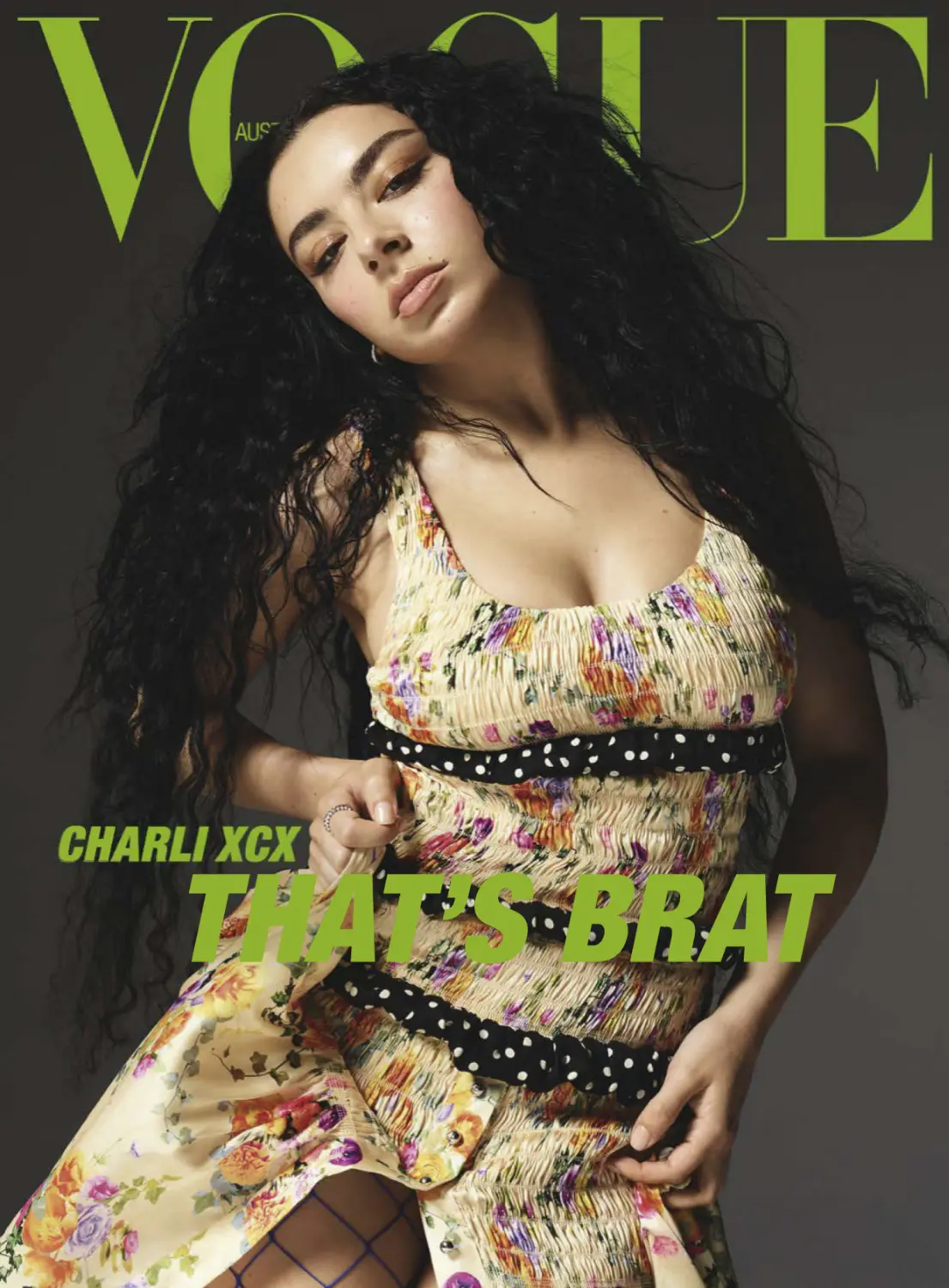
THAT’S BRAT

Chandelier by Philippe Parreno

Chandelier by Philippe Parreno

Progress you can feel

Elevate your perspective

The all-electric Audi Q4 Sportback e-tron. Arriving 2024.
Fully electric, expressive and ready for the every day, the Audi Q4 Sportback e-tron
features an impressive combination of technological innovation and performance —
coupled with a distinctively stylish silhouette.

September 2024

44
46

Editor’s letter
Contributors
50 On set

54

Code new

In the background of this season’s
runway shows turned an unsteady
world. Designers grabbed at the codes
of the familiar then reimagined them.

62

Ready, reset, go

The shortcuts to new-season style start
here. Enter key sartorial updates that
are surprising, sophisticated and
invigorate even a sedate wardrobe.

73

On the cover
Charli XCX wears a RABANNE
dress. CARTIER earrings and
ring. Tights, stylist’s own.
Stylist: Katelyn Gray
Photographer: Amy Troost
Hair: Evanie Frausto
Make-up: Kennedy
Manicure: Stephanie Shore
Production: DAY INT.

Into the fold

Nicolas Ghesquière reframes the
shoulder bag in an east-west silhouette
with a street-smart slouch.

74

Elsa, in essence

Searching for Elsa Peretti on the 50th
anniversary of the legendary designer’s
connection to Tiffany & Co., leads to
a place that captured all of her.

78

Curated by Rachele Regini

She’s the daughter of Dior’s artistic
director, but is her own woman and
puts other women front and centre.
Rachele Regini shares her influences.

80

Life electric

In a collision of worlds, an Australian
artist and a celebrated local label
form an unlikely connection.

84

Future classic

As the first-ever creative director
of accessories for Bulgari, Mary
Katrantzou faces an epic undertaking.
Aboriginal and Torres Strait
Islander people should be
aware that this issue
contains images and names
of deceased persons.

32

89

Birds of prayer

For artist Joshua Yeldham, owls have
long represented his hopes and
dreams. In his latest exhibition,
his meditations take flight.

90

Walk tall

In an extract from her new memoir,
Elle Macpherson reflects on when her
success on the runway coincided
with the end of her marriage.

93

Renaissance man

The life and works of Oscar Wilde will
be set to dance in a production by
The Australian Ballet that challenges
what the medium can be.

96

The write thing

Put these five Australian authors
on your must-read list.

101

All night long

Their music is fierce and their dance
routines? Wild. Confidence Man are
unique and their ambitions sky-high.

107

XCX era

She has dominated the zeitgeist,
topped the charts and captured a
collective mood. And Charli XCX
is having the time of her life.

118

Talking straight

Via texture, colour and silhouettes,
commonsense clothes cut through the
visual clutter of today’s busy world.

136

Strike a balance

Structured tailoring and fluid
eveningwear meet in Fendi’s
latest collection.

142

Work it out

In keeping with a changing world, this
season’s runways presented a new
vision of professional style. Can the
new work clothes serve this shift?

146

Keeping house

Two years into his Burberry tenure,
Daniel Lee is planting the flag for his
version of Britishness, transcending
scrutiny and defying tradition.
Vogue September 2024

September 2024

118
Hat tricks

160

Stitch in time

A year on from her history-making Archibald Prize win,
Julia Gutman is preparing for her first solo institution
exhibition – and she has a lot on her mind.

166

Into the light

With two premiering projects, including a starring role
alongside Cate Blanchett, Leila George is ready to be seen.

172

Fluid notion

Storied French jeweller Chaumet captures fluidity and
lightness in its newest jewellery collection.

178

Star gazing

Capture the spirit of summer no matter the season with
Chanel’s latest beauty collection, an ode to stellar metallics.

185

Loud mouth

Effortlessly stylish and wearable, a wardrobe of ultrapigmented lip shades has arrived to power up your pout.
36

186

Gilded age

Fashion house Rabanne’s newest launch – a debut floral
fragrance – pays tribute to the golden icons of the past.

188

State of play

An air of sophistication settled on the season’s runways
as hair and make-up artists rebirthed classic codes and
embraced colour in an elevated new way.

194

Life in colour

Before stepping down earlier this year, Dries Van Noten
imparted one final masterstroke: a visually rich beauty line.

196

Free to roam

With a debut chypre scent, Hermès’s trailblazing nose,
Christine Nagel, is pushing perfume parameters.

198

Hands off

Celibacy, voluntary abstinence or going sex sober. However
you label it, a new generation are exercising their freedom in
the most liberating fashion by choosing to go sex-free.
NIGEL SHAFRAN

150

The season’s most-wanted accessory bursts with flair and
personality – from smartly shining cap to sculptural
millinery-as-art – to top off any look.

201 Soirée
207 Horoscopes
208 Final note
Vogue September 2024

Bee My Love

Sydney Pitt Street (02) 9000 6058
Westfield CBD (02) 9221 8777
Melbourne Chadstone (03) 9568 0550

CHRISTINE CENTENERA
EDITOR-IN-CHIEF

Executive Editor JESSICA MONTAGUE

Executive Producer and Talent Director RIKKI KEENE
Visual Director ALISON VENESS
ART ART@VOGUE.COM.AU
Creative Director MANDY ALEX
Deputy Art Director ARQUETTE COOKE
Junior Designer GEORGA HILLIARD
FASHION FASHION@VOGUE.COM.AU
Senior Fashion and Market Director KAILA MATTHEWS
Fashion and Market Editor HARRIET CRAWFORD
Fashion Assistant ISABELLA MAMAS
Executive Fashion Editor EMMA KALFUS
FASHION FEATURES VOGUE@VOGUE.COM.AU
Fashion Features Director ALICE BIRRELL
Fashion News Editor JONAH WATERHOUSE
BEAUTY AND HEALTH BEAUTY@VOGUE.COM.AU
Senior Beauty and Health Editor REMY RIPPON
FEATURES VOGUE@VOGUE.COM.AU
Prestige Features Editor HANNAH-ROSE YEE
BOOKINGS BOOKINGS@VOGUE.COM.AU
Head Visuals Producer and Bookings Editor CHARLOTTE ROSE
Producer MOLLIE DIXON
Business Projects Manager AISLING CLARKE
COPY COPY@VOGUE.COM.AU
Copy Editor and Lifestyle Writer CUSHLA CHAUHAN
CONTRIBUTOR
ALICE CAVANAGH (Paris)
EDITORIAL ADMINISTRATION AND RIGHTS
Licensing and Account Executive KATHERINE HONG

EDWINA McCANN
Editorial Director and Publisher, Conde Nast titles Australia, News Prestige
Managing Editor LOUISE BRYANT
Director of Communications SHARYN WHITTEN
DIGITAL VOGUE@VOGUE.COM.AU
Director of Digital Strategy FRANCESCA WALLACE
Head of Brand ELLA O’KEEFFE
Digital Audience Manager (Editorial) NIKKI CHOWDHURY Head of Shopping ANGELICA XIDIAS
Digital Fashion Features Writer GLADYS LAI Content Editor NINA MIYASHITA Content Producer WILLIAM LENNOX
Style Editor ANNIE BROWN Video Editor SASKIA TILLERS Video Producer SOPHIA MORRISON
Social Producer ALEESE GABIR
PRODUCT AND PARTNERSHIPS
General Manager Commercial The Australian & Prestige SOPHIE RAPTIS Commercial Director Condé Nast Titles NADINE DENISON
Campaign Manager Condé Nast Titles KATE REOCH
Vice President Global Strategy AMANDA SPACKMAN
ADVERTISING SALES
Head of Sales, Prestige HANNAH DAVID-WRIGHT
Client Partners, Prestige CHEYNE HALL KATE CORBETT JENNIFER CHAN SUZY RASHOO
Client Executives, Prestige LILLY WHITTAKER SASHA LAVENDER CHELSEA KARR
For queries: vogue@vogue.com.au
ADVERTISING – CREATIVE
Head of Creative RICHARD McAULIFFE Head of Operations EVA CHOWN
Senior Creative Producer LOU DAVIDS Creative Directors ROSIE DOUBLE BROOKE LEWIS Lead Art Director KAREN NG
Senior Art Directors AMANDA ANDERSON NINA DORN PALOMA DREHS NICOLE VONWILLER
Commercial Creative Director ADELINA CESSARIO Lead Commercial Content Editor MELANIE COLLINS
Senior Content Writers JULIAN HARTLEY BENJAMIN SQUIRES
Lead Producers MONICA DOMBROVSKIS KRISTIE WALDEN

Production Manager MICHELLE O’BRIEN Imaging and Retouching Services, Prestige MICHAEL SYKES
Director, Print Sales BENJAMIN KEATING Head of Retail Marketing ROHAN SMITH
Subscription Manager CRYSTAL EWINS
Commercial Finance Manager Circulation, Commercial Finance STELLA HALIM
General Manager, Product MAGGIE BURKE Head of Product ALEX FAWDRAY Product Manager LAUREN BRUCE
BRAND EVENTS AND EXPERIENCES
General Manager, Events and Experiences DIANA KAY Event Marketing Managers RACHEL CHRISTIAN KATE DWYER
Senior Event Manager DOROTHY REYNOLDS Event Executive LINH TRAN
PRESTIGE MARKETING
GM Marketing, Audience and Digital Development SUZ ROLFE
Senior Marketing Manager LARA KAMENOS Marketing Manager TARYN BLACKHURST
Marketing Co-ordinator ANTHEA DEMETRIOU

NICHOLAS GRAY

PUBLISHED BY CONDÉ NAST
Chief Executive Officer
ROGER LYNCH
Chairman of the Board
JONATHAN NEWHOUSE
Global Chief Content Officer
ANNA WINTOUR
Chief Financial Officer
NICK HOTCHKIN
Chief People Officer
STAN DUNCAN
Chief Communications Officer
DANIELLE CARRIG
Chief of Staff
SAMANTHA MORGAN
Chief Product & Technology Officer
SANJAY BHAKTA
Chief Content Operations Officer
CHRISTIANE MACK
CHAIRMAN OF THE BOARD
JONATHAN NEWHOUSE
WORLDWIDE EDITIONS

FRANCE: AD, GQ, Vanity Fair, Vogue,
GERMANY: AD, Condé Nast Traveller,
Glamour, GQ, Vogue
INDIA: AD, Condé Nast Traveller, GQ, Vogue
ITALY: AD, Condé Nast Traveller, GQ,
Vanity Fair, Vogue, Wired
JAPAN: GQ, Vogue, Wired
MEXICO AND LATIN AMERICA: AD,
Glamour, GQ, Vogue, Wired
MIDDLE EAST: AD, Condé Nast Traveller
SPAIN: AD, Condé Nast Traveler, Glamour, GQ,
Vanity Fair, Vogue, Vogue Niños, Vogue Novias
TAIWAN: GQ, Vogue
UNITED KINGDOM: Condé Nast Johansens,
Condé Nast Traveller, Glamour, GQ, House & Garden, Tatler, The World of Interiors, Vanity Fair,
Vogue, Vogue Business, Wired
UNITED STATES: AD, Allure,
Ars Technica, Bon Appétit, Condé Nast Traveler,
epicurious, Glamour, GQ, LOVE, Pitchfork,
Self, Teen Vogue, them., The New Yorker,
Vanity Fair, Vogue, Wired
PUBLISHED UNDER JOINT VENTURE
BRAZIL: Glamour, GQ, Vogue
PUBLISHED UNDER LICENSE OR
COPYRIGHT COOPERATION
AUSTRALIA: GQ, Vogue
BULGARIA: Glamour
CHINA: AD, Condé Nast Traveler, GQ, Vogue
CZECH REPUBLIC AND SLOVAKIA: Vogue
GREECE: Vogue
HONG KONG: Vogue, Vogue Man
HUNGARY: Glamour
KOREA: Allure, GQ, Vogue, Wired
MIDDLE EAST: GQ, Vogue, Wired
PHILIPPINES: Vogue
POLAND: Glamour, Vogue
PORTUGAL: GQ, Vogue
ROMANIA: Glamour
SCANDINAVIA: Vogue
SINGAPORE: Vogue
SOUTH AFRICA: Glamour, GQ, House & Garden
THAILAND: GQ, Vogue
THE NETHERLANDS: Vogue
TURKEY: GQ, Vogue
UKRAINE: Vogue

Managing Director and Publisher, The Australian and Prestige Mastheads
VOGUE AUSTRALIA magazine is published by NewsLifeMedia Pty Ltd (ACN 088 923 906).
ISSN 0042-8019. NewsLifeMedia Pty Ltd is a wholly owned subsidiary of News Limited (ACN 007 871 178).
Copyright 2020 by NewsLifeMedia Pty Ltd. All rights reserved. 2 Holt Street, Surry Hills, NSW 2010. Tel: (02) 9288 3000.
Postal address: Vogue Australia, NewsLifeMedia, Locked Bag 5030, Alexandria, NSW 2015. Email: editvogueaust@vogue.com.au.
Melbourne office: HWT Tower, Level 5, 40 City Road, Southbank, Victoria 3006. Tel: (03) 9292 2000. Fax: (03) 9292 3299.
Brisbane office: 41 Campbell Street, Bowen Hills, Queensland 4006. Tel: (07) 3666 6910. Fax: (07) 3620 2001.
Subscriptions: within Australia, 1300 656 933; overseas: (61 2) 9282 8023. Email: subs@magsonline.com.au.
Subscriptions mail: Magsonline, Reply Paid 87050, Sydney, NSW 2001 (no stamp required). Website: www.vogue.com.au.
This magazine is made using paper from the Programme for the Endorsement of Forest Certification (PEFC): At the PEFC, we care for forests
globally and locally. We work to protect our forests by promoting sustainable forest management through certification. This means we can
all benefit from the may products that forests provide now, while ensuring these forests will be around for generations to come. We believe that
only together can we protect our forests, which is why we form partnerships with a wide range of stakeholders around the world, enabling us to
amplify our collective impact. When you see the PEFC label on a product, it means it comes from a PEFC-certified forest, one managed in line with
the strictest environmental, social and economic requirements. Through PEFC certification, we can track the material from these forests down the
supply chain to the final product you buy. The mechanism to track the material is called ‘chain of custody certification’. Beyond ensuring that the
material comes from a certified forest, it also protects the rights of workers along the production process.

40

VOGUE AUSTRALIA
Subscription rate for 12 issues post paid is
$82 (within Australia). Copyright © 2020.
Published by NewsLifeMedia. All rights
reserved. Reproduction in whole or part
without permission is strictly prohibited.
NewsLifeMedia is a licensed user in Australia
of the registered trademarks VOGUE, VOGUE
LIVING and GQ and has been granted
the exclusive right to use those trademarks
in relation to magazines published by
NewsLifeMedia by the proprietor of the
trademarks. Printed in Australia by IVE
Australia. Distributed by ARE Distribution.

Vogue September 2024

Editor’s letter

C

DARREN MCDONALD

harli XCX arrived at our shoot in LA in her Porsche 911 Carrera, music blasting.
The perfect entrance for the architect of Brat summer. She has been a pop
phenomenon for more than a decade, but it is Brat, her sixth studio album, that
is making huge waves globally. The record has had a riveting rollout, both sonically and
visually, generating more excitement than most artists have managed in recent years.
Brat has become a movement and Charli has struck a chord, empowering generations of
people around the world. She’s hit her highest ever position on the US charts, her recent
‘Guess’ remix featuring Billie Eilish debuted at number one on the ARIA Singles
Chart, her first number one single in Australia, and she has dominated social media and
news agendas alike. For a creative who has always been a few steps ahead, Charli is
finally getting the recognition she deserves. Besides all of that, we are lucky to have her
on the cover of Vogue Australia because she resonates with so many of us. On Brat, she
sings conversationally about the kaleidoscope of being a woman: worrying if she will
“run out of time” to have children, the thrill of falling in love, the uncertainty of female
friendships (breaking the internet with a vulnerable remix featuring Lorde), and the
complexities of being a woman in her 30s. And, of course, she shares her love of partying
– the foundation of the record. Charli reminds us we can be many things at once. Aside
from Brat being a no-skips, innovative album, it’s an ethos, a mindset and has marked
a new era of unapologetic freedom for us. That’s Brat.

CHRISTINE CENTENERA Editor-in-chief

44

Vogue September 2024

Contributors

HANAN IBRAHIM
Somali-Australian
model
and January 2023 Vogue
Australia cover star Hanan
Ibrahim returns to the pages
of this issue in a fashion
feature titled ‘Strike a
balance’, from page 136.
“Working with Vogue always
brings a unique level of
professionalism and artistry
that sets it apart from other
projects, and this experience
was no exception,” says
Ibrahim, who transitioned
into modelling from a career
in radiation therapy almost
five years ago. “It’s been an
amazing and wild ride,”
reflects the Melbournebased beauty, who cites
prayer and meditation as the
last and most important
steps of preparation for
a shoot of this magnitude.

KATELYN GRAY
In
styling
girl-of-themoment Charli XCX’s first
cover for Vogue Australia,
Sydney-born, New Yorkbased stylist and fashion
consultant Katelyn Gray,
opted for a contemporary
take on a 1990s Versaceinspired look. “Knowing we
were taking on Charli XCX
in the peak of her Brat fame,
we really wanted to give her
a strong fashion moment in
the studio,” says Gray, who
describes her approach on
set as intuitive yet refined.
“Charli is such a force to be
reckoned with and so selfconfident, and we wanted to
be able to translate this energy
into the image creation.”

VICTORIA BARON
Chanel
make-up
artist
Victoria Baron is no stranger
to working with Vogue
Australia. For this issue, the
talented creative worked
alongside
photographer
Charles Dennington to
produce a series of aweinspiring images (see page
178). “Our shoot day was
truly special,” she recalls.
“The team has worked
together for years, and we all
have a deep respect for each
other’s craft. It was a perfect
example of creatives coming
together to make something
beautiful, without too much
planning or restraint; just
pure, organic collaboration.”
Balancing creativity with
wearability in her approach,
Baron sought to communicate
“a sense of freedom and ease
with colour application and
combinations” in her looks.

WORDS: ANGELICA XIDAS PHOTOGRAPH: (IBRAHIM) PETER HAYES

AMY TROOST
“I’m
very
excited
to
collaborate on this project
with Charli XCX. I’m really
into her energy and sense
of fun,” says Ontario-born,
New York-based fashion
photographer Amy Troost of
her first project with Vogue
Australia, one that sees her
also working alongside the
Brat singer-songwriter for
the very first time. “I got
inspired by Charli’s sense of
style and how she presents
herself,” says Troost, adding
that the shoot also involved
“the team and I going
through multiple creative
exchanges and then trying
to find something that is
true to Charli and her
amazing energy.”

46

Vogue September 2024

THE ALL NEW CLE
C O U P É & C A B R I O L E T.
Shaped by Desire.
Introducing the irresistible all new Mercedes-Benz
CLE Coupé & Cabriolet. Discover intuitive technology,
exceptional comfort, and captivating design. Elevate your
driving experience to fulfil your every desire.

ON SET

Charli XCX behind the scenes of her first
Vogue Australia cover shoot in Los Angeles.

Chart-topping British pop star Charli XCX fronts her first cover
of Vogue Australia, as she continues to take the world by storm.
his may be Charli XCX’s first cover of Vogue
Australia, but it’s not the first time the
singer-songwriter has appeared in the title.
For the March 2019 issue, Charli was styled and
photographed by our team while visiting Sydney as the
opening act on Taylor Swift’s Reputation tour.
Five years on, and the 32-year-old is the cover star of
our September issue, while her latest album, Brat, is
one of the most talked-about releases of the year.
“From the moment Charli rolled up on set in her
black Porsche with party tunes blaring, until we

T

50

finally wrapped a long day of shooting, she was
friendly, down-to-earth, and hardworking,” says
executive producer and talent director Rikki Keene of
the day on set in LA.
“The concept was to capture Charli’s authentic
energy through strong fashion images involving
dynamic movement and wind,” Keene explains of the
creative direction on the day. “Charli was energised by
her own playlist and nailed the brief. There were many
‘wow’ moments, and we were spoiled for choice when
it came to the images.”
Vogue September 2024

WORDS: ANGELICA XIDIAS PHOTOGRAPHS: LEA GARN

That girl

TREND REPORT

Code new
In the background of the autumn/winter
’24/’25 runway shows turned an unsteady
world. Designers grabbed at the codes of the
familiar and real, then got busy reimagining
them. Meet the wardrobe, reborn.

I

n a year that proliferated with consequential elections for major
global powers and held instability and economic slowdown,
fragility reigned. A level of impermanency and insecurity that
has made itself uncomfortably present in our lives is powering a new
craving, and it’s making its way into our wardrobes.
Enter the familiar and the recognisable for autumn/winter ’24/’25.
Style codes we are already acquainted with hold a new comforting
appeal, providing a framework for the path forward. “Antecedents
literally fashion the present,” Prada’s show notes read.
But dispense with any expectation of ho-hum sameness. Wearable,
recognisable clothes became rock-solid guardrails within which
designers brought to bear their creativity. Innovation and novel ideas
came in the foil of existing style tropes. The familiar, remixed.
It is why heritage fabrics, from hunting tweeds to heavy-wearing
wool, were deployed and recast in new ways. Traditional signifiers of
comfort dressing – face-swaddling scarves and cocooning knits,
concealing and reassuring layers – held sway. Old ideas of elegance
and formality – dressing sharp, dressing up – were notions designers
traced then overwrote with contemporary twists, altering silhouettes,
experimenting with proportion and texture, all the while flipping
and reforming motifs. Corporate dressing, after-dark dressing,
comfort dressing, practical dressing, all got a relook and a rework.
Life is confusing, but choosing our clothes need not be as chaotic.
We can still have order and refinement, practicality and comfort,
desirability and beauty, designers declared. “She dries her hair,
makes her face (not much, just a bit around the eyes), but she always
puts on lipstick,” read Wim Wenders’s poem Watching a Working
Woman, spoken aloud at Undercover’s show. It captures an idea that
we can lift every day if we add some newness and a bit of polish. In
questioning existing codes, forensically examining them and casting
them anew, we might create something we recognise, just better.
Meet the new coordinates, then set a style course.

The women

“There’s this joy I get from dressing up, accessorising,
and expressing myself.” – Marc Jacobs
Bows, strings of pearls, gloves, handbags, the little black dress.
The “recognised signifiers of propriety and chic”, as Prada described,
formed a 2024 take on ladylike mid-century propriety. Not a purist’s
redux though; subversion bled into Marc Jacobs’s architecturally
askew 1950s skirts or Miu Miu’s youthful, rumpled take on cocktail
dresses, the goal being to transcend what Jacobs defined as “absurd
conservatism and societal norms”. Polite codes for impolite times.
54

CHANEL A/W ’24/’25

WORDS ALICE BIRRELL COLLAGE AUGUSTYNKA

DEL CORE A/W ’24/’25

VERSACE A/W ’24/’25

NINA RICCI A/W ’24/’25

TREND

Smoke signal

“The ultimate symbol of pure style.” – Dolce and Gabbana
Is there a purer distillation of chic than the tuxedo? An apogee of style, its traditional association with masculinity was a notion
dissolved with vigour this season – from Versace to Loewe, Valentino to Dolce & Gabbana. The latter splicing, cropping and
notching their way into nipped, lopped and skin-baring renditions of the silk-lapel, after-dark archetype. Yves Saint Laurent
began liberating it from men’s grasp through his lean Le Smoking version in 1966. Today’s designers finished the job.
56

LOEWE A/W ’24/’25
SCHIAPARELLI A/W ’24/’25

STELLA MCCARTNEY A/W ’24/’25

High touch
GORUNWAY.COM

“What differentiates us from machines.” – Demna
In a manner not seen for seasons, texture played a principal role this time around. Looping and fringing all over (Stella McCartney),
beast-like shagginess on coats (Marni), dense mille-feuille layers exploding on chubby jackets (Alaïa) or jumbo knits (JW Anderson)
were at turns dramatic and, surprisingly, a touch glamorous. Take them as the new way to create volume while making an
impression. The bonus is in their reassuring softness, a human warmth that is an antidote for our coldly tech-governed world.
Vogue September 2024

57

JW ANDERSON A/W ’24/’25

BOTTEGA VENETA
A/W ’24/’25

LOEWE A/W ’24/’25

PRADA A/W ’24/’25

SCHIAPARELLI
A/W ’24/’25

TREND

Working ways

“I think you can show the possibility to be powerful and feminine.” – Pierpaolo Piccioli
The suit is old news. The way it emerged, metamorphosised, this season wasn’t. Take the tie: tucked into a mega-sized studded
belt at Loewe or made from a plaited ponytail at Schiaparelli, it heralded a rethink of corporate uniforms. Nothing was sacred.
Dilara Findikoglu’s subtle sedition was in scant pinstripe, LaQuan Smith’s in thigh-splits and scoop-necks grazing the
bellybutton in the same fabric. Post-pandemic, we don’t work the way we used to. We shouldn’t dress it either.
58

CHLOÉ A/W ’24/’25

CHRISTIAN DIOR A/W ’24/’25

ALBERTA FERRETTI A/W ’24/’25

FERRAGAMO A/W ’24/’25

Great outdoors
GORUNWAY.COM

“It’s about the idea of function in life.” – Kim Jones
The rain that fell on the Hermès runway – on sumptuous leather riding jackets and relaxed gabardine coats – told of a
preoccupation with element-repelling clothing. Waxed coats, hunter greens and worn-in Aran knits could have been lifted
from an Alan Hollinghurst novel. Chloé’s standout coats could do double duty as a picnic blanket. Some might spot a metaphor
between braving the elements and bracing for the changing winds of the world. Either way, they’re pieces with solid, practical grit.
Vogue September 2024

59

SAINT LAURENT A/W ’24/’25

MUGLER A/W ’24/’25

GUCCI A/W ’24/’25

TREND

Sensual healing

“Now I really want a more glamorous, dressed-up, decadent … creation.” – Casey Cadwallader
Lean, tight shapes, structured and sculpting; the sheer trend that previously overwhelmed runways got an upgrade. First via Anthony
Vaccarello at Saint Laurent, who committed the show’s entire 48 looks to a transparent, tightly nipped sensuality in dusty hosiery
shades, then, borrowing from the construction of lingerie at Gucci where exquisitely delicate lace bras were visible under X-ray tops, and
on to Mugler where Casey Cadwallader took his smouldering brand of body-con to a new exquisite level of sheer-panelled sculpting.
60

RICK OWENS A/W ’24/’25

BURBERRY A/W ’24/’25

ALEXANDER MCQUEEN A/W ’24/’25

STELLA MCCARTNEY A/W ’24/’25

Cover story
GORUNWAY.COM

“Who doesn’t like comfort?” – Luke and Lucie Meier
From exaggerated funnel necks to wraps, thick knits and scarves as wide as hall runners – all were thrown over coats
around the neck, looped around heads or totally enveloping both. The feeling is protecting everything from the
shoulders up. Luxury is privacy, so why not take it with you? That was the question designers like Luke and Lucie
Meier at Jil Sander, Kim Jones at Fendi, Seán McGirr at Alexander McQueen and Rick Owens seemed to ask.
Vogue September 2024

61

ULTIMATE EDIT

Ready, reset, go
The shortcuts to new-season style start here. Enter key sartorial updates that are
surprising, sophisticated and invigorate even the most sedate wardrobes.
STYLING HARRIET CRAWFORD PHOTOGRAPHS BLAKE AZAR

New romantics

One of the most pronounced changes this season was the bohemian mood breezing onto
runways. A romantic dress in airy fabrics, lace and ruffled trims is the style circuit
breaker of the moment. Channel its free spirit by fearlessly layering accoutrements.
Above left: BEARE PARK dress, $2,200. PASPALEY necklace, P.O.A. ALBUS LUMEN belts, $290 each.
MIU MIU shoes, $2,120. Above right: ZIMMERMANN top, $1,250. COURTNEY ZHENG bralette, $245.
JEAN PAUL GAULTIER pants, $1,020. VEHLA sunglasses, $250.

62

Vogue September 2024

63

WORDS: ALICE BIRRELL HAIR: RORY RICE MAKE-UP: SEAN BRADY MODEL: AMIRA PINHEIRO
ALL PRICES APPROXIMATE DETAILS AT VOGUE.COM.AU/WTB

ULTIMATE EDIT

64

Above left: LOEWE vest, $1,300, pants, $2,825, and shoes, $2,725. TIFFANY & CO. bracelets, $19,600, $11,900, and $7,350.
Above right: SAINT LAURENT dress, $7,025, and bracelets, $1,755, $1,575, and $1,755. MICHAEL HILL necklace, $399.

BLAKE AZAR
ALL PRICES APPROXIMATE DETAILS AT VOGUE.COM.AU/WTB

Know the drill

The contrast between
khaki’s practicality
and the new crop
of sophisticated
silhouettes makes
for the season’s most
compelling combination.
Muted moss, sage and
olive lend an edge to
polished pieces.

Vogue September 2024

65

ULTIMATE EDIT

Strike a posey

Florals have undergone their seasonal rework, this time through subverting
tradition. Think heirloom wallpapers and dainty pastoral botanicals recut into
everything from oversized jackets to slinky dresses with fresh attitude.

Above left: SONG FOR THE MUTE jacket, $1,870. SPORTMAX bodysuit, $1,520. COURTNEY
ZHENG shorts, $330. GEORG JENSEN necklace, $2,850. BALENCIAGA boots, P.O.A.
Above right: ALIX HIGGINS dress, P.O.A. SAINT LAURENT skirt, $1,570.
BULGARI earrings, $33,700, and necklace, worn as arm cuff, $65,200.

66

Vogue September 2024

67

BLAKE AZAR
ALL PRICES APPROXIMATE DETAILS AT VOGUE.COM.AU/WTB

BLAKE AZAR
ALL PRICES APPROXIMATE DETAILS AT VOGUE.COM.AU/WTB

ULTIMATE EDIT

68

Top stuff

In line with a new embrace of glamour, the nostalgic, old-world appeal of an elegant
topper is the right sign-off for any outfit. Which style? Think outside the (hat) box.

Above left: CHANEL jacket, $16,290, and hat, $7,485, from the Chanel boutiques.
Above right: LOUIS VUITTON top, $3,000, and skirt, $2,020. ANN SHOEBRIDGE hat, $595.

Vogue September 2024

69

ULTIMATE EDIT

Blue period

The rule book for denim has long been torn up by designers who apply innovative thinking to fashion’s
most enduring fabric. The note to follow is this: make it do double duty in far-from-conventional forms.

70

Short circuit

BLAKE AZAR
ALL PRICES APPROXIMATE DETAILS AT VOGUE.COM.AU/WTB

Shoot from the hip in
the newly dominant
silhouette for pants:
knee-length shorts.
Think of them as a
stand-in for pencil
skirts to get the upper
hand in work-toweekend tailoring.

Vogue September 2024

71

WORDS: JONAH WATERHOUSE STUDIO HENRY WILSON LAMP, $2,300.
ALL PRICES APPROXIMATE DETAILS AT VOGUE.COM.AU/WTB

OBJECT OF DESIRE

Into the fold

Vogue September 2024

73

VIEWPOINT

Elsa, in
essence
Searching for Elsa Peretti the
person, on the 50th anniversary of
the legendary designer’s connection
to Tiffany & Co., leads to a place that
captured all of her. By Alice Birrell.
Elsa Peretti in the garden of
her home in Sant Martí Vell.
Above right: Tiffany & Co.
Elsa Peretti Bean clutch and
necklace, from one of her earliest
collections for the jeweller.

74

COURTESY OF TIFFANY & CO., MARTYN THOMPSON

A

n immortal parallel exists between a tiny 17th-century
village in Catalonia and a young Italian model arriving
in Manhattan in 1968. The same year Elsa Peretti lit the
fuse on a glittering career as a model and creative in the throes of
the decadent 1970s, she also embarked on the project of a lifetime:
restoring a tumbledown gathering of buildings in Sant Martí Vell,
one of the first of which she bought shortly after for US$8,000.
“There are many Elsa Perettis and Sant Martí Vell encompasses
them all,” says Stefano Palumbo, director of the Nando and Elsa
Peretti Foundation, which safeguards her legacy and furthers
her many philanthropic pursuits. The Elsa most know best was
one of Tiffany & Co.’s most prolific and influential designers.
She joined the jeweller in 1974 and her first designs sold out in
a day. This year, Tiffany marks 50 years of the wildly successful
partnership by releasing three new pieces including two ring
versions of her celebrated bone cuff. Each are evolutions of her
starkly minimal, organic forms that shocked the jewellery world
in their opposition to elaborate, ostentatious designs.
Away from the clamour of her starry New York city trajectory,
where she became part of the scene populated by Andy Warhol,
designer Halston and Giorgio di Sant’Angelo, she returned as
often as she could to Sant Martí Vell. Supervising its restoration,
she would work in the tiny Plaça del Poble outside her first
completed building Casa Pequeña, in featherweight Halston
caftans, conversing with locals. The place gave her respite and
creative fuel. “I go to Spain to think. I come to New York to
act,” she said in a 1974 interview.
Spain was her paradoxical life, pursuing what were her most
significant creative influences. “All the Catalan aesthetics fell
upon her with a force that would mark her forever,” Palumbo
describes. Though she travelled the world, leaving her wealthy,
conservative family home in Rome to model, it was in Barcelona,
where she modelled for Salvador Dalí in 1966, that she felt
cosmically, definitively aligned. Spain became the backbone of her
inner life and she was willing to pay the price for it: being
financially cut off from a family who didn’t understand her choices.
It was here she worked with silver artisans, producing first the
open bottle inspired by an antique bud vase then her bone →

“All the Catalan aesthetics
fell upon her with a force
that would mark her forever”

The Sala Grande with
chairs, a collaboration
between Peretti and
Xavier Corberó.

Vogue September 2024

75

VIEWPOINT
A fireplace and living area in Can
Noves, one of her houses in Sant
Martí Vell, which houses artwork
by Andy Warhol and Marcel
Duchamp, alongside Catalan art.
Right: The exterior of Can Noves.

A room in Casa Pequeña.
Left: The chapel, painted in
Blau de Montserrat and home
to Peretti’s final resting place,
with sculpture and candlesticks
of her own design.

76

COURTESY OF TIFFANY & CO. GETTY IMAGES
DUANE MICHALS/CONDÉ NAST, MARTYN THOMPSON

cuff. Although it draws on the bones in the ossuary of the
17th-century Capuchin church she would visit as a child in
Rome (and occasionally slip into her purse when her nanny
wasn’t looking), the cuff was moulded in the shadow of
Gaudi’s curvilinear forms in Barcelona that so enthralled
her. A prototype of that first cuff is perched on a modest
wooden shelf in one of her bedrooms.
It was also here, under an ivy-embellished stone tower, that
she hosted this magazine in 1995 for one of her rare interviews.
The Vogue crew, including photographer Martyn Thompson
and then editor Nancy Pilcher, shared meals in the hidden
grottos and on stone tables that had, discretely, hosted the
likes of Liza Minnelli and Frank Sinatra, architect Ricardo
Bofill and illustrator Joe Eula who would enjoy flamenco
performances by candlelight. The resulting article takes pride
of place framed on a wall and serves as a reminder that Peretti
kept the flame of her social life alive outside New York.
Those who came into her orbit here remember music,
candles and smoke as the pillars of her
presence. She is also remembered as
uncompromising, but equally giving,
sensing when something was wrong,
asking after someone, their family, and
from time to time, looking after bills,
though she would rarely advertise things
like this – Palumbo tells of his
instructions from her to be discreet with
could hurt, the touch,” says Palumbo of
the impacts of her foundation that
her sensitivity to the wearer. Every
supported young women, animals and
surface is smoothed, in dialogue with the
those living with a disability.
body, often by hand in the Barcelona
Standing there today, a warm, dry wind
workshop. “Making it purchasable by a
carries the sound of birdsong through
working woman without the need to have
flung-open windows. A group of women
a man give it to her … much more than a
rest their horses in the shade on a dirt
piece of jewellery, it is a manifesto of 20thA bunny mask made by
road. A huddle of buildings form
century feminism.” The way she ennobled
Halston for Peretti, rings and
a ring around a central chapel. In these
silver, bringing it back into the Tiffany
plaited leather ‘Emporda’ belt
sedate surrounds, the code to Peretti’s
vocabulary, is similar to the way she places
of her creation, photographed
for Vogue Australia in 1995.
epic impact and legacy can be cracked.
a Picasso, Warhol, Duchamp or De
The marble hands in the middle of a grand
Chirico in her home, next to an Indonesian
dining table are the hands of her mother,
timber ancestor-image statue or a shell
Maria Luisa Pighini, a painter and poet, and speak to her innate
from the beach, devoid of obvious hierarchy. As much as it is an
creativity. A fireplace by Lanfranco Bombelli, an artist and
exercise in elegance and humility, of all her thousands of creations,
architect, looms in the Sala Grande, and chairs by Xavier
Sant Martí Vell is the most encompassing expression of Elsa
Corberó, tell of her collaborative spirit. She revered other
Peretti. Eight years before her passing, Peretti received a prize
creatives and craftspeople, her albaliñes, with whom she had
from the National Council of Culture and Arts for contributions
long-lasting relationships. She continually promoted
to Catalan culture; she was the first non-Catalan to win it.
international and Catalan creatives, whether humble bricklayers,
Touched, she made a rare public appearance dressed impeccably
Japanese artisans or master painters.
in a Bill Dugan piece. Americans, too, adopted her, many not
The honesty of the materials – stone, wood, natural fibres –
realising she was Italian, a fact she also cherished. Though she
tell of her sensibility. Rejecting notions of preciousness, she
preferred chickens and dogs to dance floors and boardrooms,
embraced components with soul: glass for candlesticks, Kyoto
Peretti didn’t retreat here from the world as a recluse. She stayed
silk, leather for her belts inspired by horses’ girths. A rattlesnake’s
connected, touching it from afar through the work. She once said:
tail led to her snake necklace, a lima bean, her famous bean
“Until success is part of your life, you don’t imagine it. And to
design. A millstone, used to crush olives, became the
be recognised by people was very good for my confidence. But as
aforementioned grand table. She loved nature’s forms and
soon as you take your image too seriously, you are making a terrible
sought to shape an impression of them in her design, to elicit
mistake. My image has nothing to do with me. The work does.”
something primal in their essentialism, in their connection
Peretti’s final resting place is in the town’s chapel, at the heart
to the living world. “This is a grace that she received,” says
of the village and one of the quietest sanctuaries within a
Palumbo of these instincts. “I think it’s something spiritual.”
sanctuary she conjured with devotion and vigour. The walls are
Perhaps the most impactful part of her legacy, though, is in
a serene mix of chalk and lapis lazuli, a hue typical of the area,
the generosity of her design. “While she creates a piece of
representing water and the sky. Cocooned within Blau de
jewellery, Elsa thinks about the weight it will have, the wearability,
Montserrat is how she will forever be – at the centre of a world
■
the practicality of closing a clasp, the absence of elements that
she realised for herself, in astounding form.
Vogue September 2024

77

CURATED BY

Rachele Regini
Though she is daughter to
the artistic director of one of the
biggest fashion houses in the world,
Rachele Regini is her own woman
and puts other women front and
centre. The Italian-born creative
shares her influences.

INSPIRATION: “Tracey Emin,
Cindy Sherman, Marina Abramoviü,
Lucia Marcucci, Libera Mazzoleni.”
Above: Art book Line Complex
Beings (1974) by Libera Mazzoleni.
Right: CHRISTIAN DIOR bag, $4,800.

78

Come ama, come lavora [How she likes,
how she works] (1972) by Lucia Marcucci.

INTERVIEW: ALICE BIRRELL PHOTOGRAPHS: ALAMY, © PRARTHNA SINGH, © CHANAKYA SCHOOL OF CRAFT,
COURTESY OF DIOR, COURTESY OF KLARA KRISTALOVA AND LEHMANN MAUPIN, NEW YORK, SEOUL AND LONDON,
FRANÇOIS HALARD, KRISTEN PELOU, VOGUE RUNWAY INSTAGRAM: ©ADRIEN DIRAND
ALL PRICES APPROXIMATE DETAILS AT VOGUE.COM.AU/WTB

I

f the calling card of the younger generation in
fashion is not to have a traditional job title, then
Rachele Regini is a frontrunner. Daughter of
creative director of Dior, Maria Grazia Chiuri, the
28-year-old’s influence at the French house can be
captured as cultural and creative advisor, a position
she’s held since 2019 – but only loosely. What she does
is more protean: connecting with artisans around the
world, introducing gender theory into the design
room, and sitting in on interviews and being part of
conversations with her mother, who has corralled the
politely feminine DNA of Dior into modern relevancy.
By Chiuri’s own admission Regini challenges her
(a welcome input), inciting cogitation on crucial
questions of gender equality that oftentimes underpin
Chiuri’s collections for the French house.
And she has the credentials to exert such quiet
power. With a master’s degree in gender, media and
culture from Goldsmiths in London, where she moved
from a childhood in Rome for her teenage years, she
also holds a PhD in gender studies. Hesitant at first
when her mother enlisted her, the prolific traveller,
reader and art consumer, now reels off an impressive
roster of women collaborators at Dior, many she had
a hand in onboarding and who have helped form
Chiuri’s female-first world at the house. “So many!”
she says of her most memorable. “Judy Chicago,
Sharon Eyal, Mariella Bettineschi, but also
photographers like Brigitte Niedermair, Paola
Mattioli, Collier Schorr.” Here she shares more of her
most significant, often female-led, influences.

FEMINIST WRITINGS: “Linda
Nochlin’s essay Why Have There
Been No Great Women Artists?
[below], Gloria E Anzaldúa, This
Bridge Called My Back, Audre
Lorde, Sister Outsider, bell
hooks, Teaching to Transgress.”

RUNWAY
HIGHLIGHT:

CRAFT WORK: “Having the opportunity to work

with Karishma Swali and the Chanakya School
of Craft has revolutionised the way I understand
craft, fashion design and sustainability. I am in
awe of Karishma and everything she does.”

“Collaborating
with Dainese
fusing technical
protection gear
and classic
Dior codes
was creatively
stimulating
for Dior
autumn/winter
2022/2023
ready-to-wear.”

INTERNAL VOICES: “I love India
Mahdavi’s creations … her way of
using colour. I have a yellow couch in
my living room designed by India

NEW SOUND: “A new

artist I am currently
obsessed with and find
super inspiring and
modern is Eartheater.”

FASCINATION
ON FILM: “Growing

up, I was obsessed
with Pedro
Almodóvar’s movies.
I think his way of
portraying women’s
psyches was very
interesting to me.
I loved that they
were always on the
edge – unstable,
fragile, yet strong
and hilarious.”
Right: A poster for
Almodóvar’s 1988 film,
Mujeres al Borde de un
Ataque de Nervios.

SCENT SIGNATURE:

“Clarins Eau
Dynamisante
red bottle.”
Vogue September 2024

79

VIEWPOINT

Life electric
In a collision of worlds, an Australian artist and a celebrated local
Australian label form an unlikely connection. By Jonah Waterhouse.

I

f there’s any label capable of proving there’s sublime magic in
the everyday, it’s Romance Was Born. Co-founder Luke
Sales, who, along with Anna Plunkett, has fashioned its
signature fantastical view of Australiana for nearly two
decades, puts it best. “It’s one of our house codes – sandwiching
things together that you don’t think should go together,” he
says with a smile.
In this instance, he’s discussing the final look at Romance
Was Born’s resort ’25 show presented in May. Sales describes
the look as “the bride”, borrowing from the haute couture
tradition of the closing runway look, often white and epitomising
the peak of a brand’s craftsmanship. But it wouldn’t be
a Romance show without some quirks. This season’s closing
bridal dress wasn’t white, but featured a symphony of lilac, teal
and gold hues evoking the sky and earth, and a coiled brown
snake on its torso, balancing ideas of beauty and treachery.
“It’s soft, and hard,” says Plunkett, Sales’s creative partner and
the brand’s co-founder. “She looks so ethereal and princess-like,
but it’s such a strong message.”

80

This uncategorisable beauty has made Romance Was Born
one of Australia’s most beloved labels, founded in 2005 while
Plunkett and Sales were studying fashion together. Their
kaleidoscopic approach is informed by nostalgia and often
brings other creatives into the fray; past collaborations with
Jenny Kee, Linda Jackson and Ken Done prove a longstanding
reverence for Australian visionaries, established and emerging.
“We’ve been doing it for so long, it’s the way we think about the
process,” Sales says of Romance Was Born’s incorporation of
the unique perspectives of disparate designers and artists.
For resort ’25, they collaborated with Zaachariaha Fielding,
painter and member of the musical duo Electric Fields,
Australia’s Eurovision entrant this year. Fielding’s work as an
artist partially draws on the beauty of natural landscapes and
stories from his childhood on South Australia’s Anangu
Pitjantjatjara Yankunytjatjara or APY lands, and earned him
the high honour of the Wynne Prize in 2023.
“There was something about Zaachariaha’s work that
really spoke to me and Anna … it was very ‘of our world’, in →

HAIR: PETE LENNON MAKE-UP: SEAN BRADY MODEL: YVONNE BEVANDA
ALL PRICES APPROXIMATE DETAILS AT VOGUE.COM.AU/WTB

STYLING HARRIET CRAWFORD PHOTOGRAPHS BLAKE AZAR

Opposite page:
ROMANCE WAS
BORN dress, P.O.A.
This page: ROMANCE
WAS BORN cape,
P.O.A. WOLFORD
tights, $90. GUCCI
shoes, $2,250.

Vogue September 2024

81

VIEWPOINT

Works in
progress.

Paper cut-outs of
garments placed
on mannequins,
and above right.

ROMANCE WAS
BORN vest, skirt,
earrings and
gloves, all P.O.A.

82

a way,” Sales says of the duo’s longstanding
appreciation for Fielding, the first Indigenous
artist they’ve collaborated with.
Fielding shared specific artworks and
advised on their incorporation into the pieces
while preparing for Eurovision. He arrived
back in Australia days before the show, where
he met Plunkett and Sales for the first time
after months of long-distance dialogue.
“What I love about Romance Was Born is
that it’s got that tinge of a vulnerability – the
licence to be vulnerable with whatever you call
yourself,” he explains. “The first thing that
struck me was, ‘you’re okay to be vulnerable in
this space’, ‘you’re okay to be in the space of
innocence’, and to just leave it at that.”
Vulnerability, introspection and envisioning
a better world are always on Fielding’s
mind when creating. The serpent-adorned
finale dress repurposed one of his 2023
works, depicting the Wanampi, known
broadly as the Rainbow Serpent, a symbol of
natural harmony.
“In my culture, the Wanampi is a friend,
a companion and a deity,” Fielding explains.

Up-close
detail of the
embroidering
of Fielding’s
artworks on
the collection’s
look 22.

BLAKE AZAR, COURTESY OF APY ART CENTRE COLLECTIVE
ALL PRICES APPROXIMATE DETAILS AT VOGUE.COM.AU/WTB

The resort ’25 bridal
look incorporating
serpent motifs from
Fielding’s artwork.
ROMANCE WAS
BORN dress, P.O.A.

“In a biblical sense, it’s very evil, but this country was tribal before
the Bible. A lot of people are scared of or fear the snake, but if
you’re one with it, it’s your friend – you have to make amends
with your fears. [When painting that artwork] I just said, ‘Fear,
I’m not going to run from you; I’m going to learn from you.’”
Sales, Plunkett and Fielding decided on the collection’s title,
The Nothing – the evil entity in the 1984 film The NeverEnding
Story, which attacks when humans lose the ability to create and
dare – while bonding over a love of the 1980s films from their
childhoods, many of which embraced ideas of heroic joy.
“After [that conversation] I was like, it’d be kind of cool to tell
this funny story of a world where there’s no particular space or
time …” says Sales, before Plunkett chimes in, “Being in our
own world, our own fantasy.”
Childlike exuberance, seen through Romance Was Born’s
nostalgic eye, became the collection’s theme, while Fielding’s
fantastical artwork fashioned a world of colour, unburdened by
fear. In one look, layered tulle billows from an 80s-style zip-up
sport jacket, the kind those who grew up in the 80s or 90s
might’ve worn at school. Nostalgia was accentuated with the
inclusion of Adidas sneakers paired with enchanting gowns,
while Plunkett and Sales’s embroidery helped translate
Fielding’s nature-inspired hues. One blanket-shaped cape,
reminiscent of childhood nights watching movies, swaddled
the body and used sequins to illustrate the artist’s rich

brushstrokes in three-dimensional form. “We did a lot of quilted
pieces that were quite padded, and cocoon shapes … we kept
thinking about the child-like empress in The NeverEnding Story,
who lives in the clouds and is protected by all these people
around her,” Sales explains. “It was the thought of feeling
comfortable as a child and protected.”
For Sales, who has experienced the, at times, isolating frenzy
of building a label from the ground up, partnering with
artists provides a unique opportunity to rediscover the thrill
of uncommercialised creativity, the kind that drew him to
fashion as a teenage student.
“It’s so awesome and encouraging to hear someone so excited
about the possibilities and creativity and the excitement, all the
things that are the whole reason why me and Anna chose to
work in fashion,” he shares. “I mean, we loved fashion, but it was
more a creative outlet … When someone else who’s a creative is
so excited by it all, it kind of reignites my passion.”
Past Romance Was Born collections have incorporated more
visible social critique; autumn/winter ’23/’24, for example,
featured artist Paul Yore’s meta-ironic takes on corporate
capitalism. The adult world in 2024 can be hard to make sense
of, but Plunkett, Sales and Fielding’s unique collaboration taps
emotions at their most fundamental level, as a guide for the way
forward. Fielding says it best: “This whole thing feels like
■
comfort food on a real cold wintry night.”
Vogue September 2024

83

VIEWPOINT

Future
classic
As the first-ever
creative director of
accessories for Roman
jewellery titan Bulgari,
Mary Katrantzou faces
an epic undertaking,
but, Alice Birrell finds,
she is up to the task.
PHOTOGRAPH

CLAUDIA SMITH

84

pairings, they discovered they had a lot common. In 2019, with
the ancient columns of the Temple of Poseidon as backdrop,
Katrantzou presented an ode to her home country through
couture. For the occasion, Bulgari lent a glittering suite of pieces
to the designer, not least because Bulgari’s founder, Sotirios
Voulgaris, who later Italianised his name to Sotirio Bulgari on
immigration to Naples, was also Greek.
“For me, it was a homecoming,” says Katrantzou. “For Bulgari,
it was a celebration of their Greco-Roman roots.” The show was
held in the region of Epirus, about 500 kilometres from the
founder’s birthplace and, back in 1857, a silversmithing centre.
More instant compatibility was in their respective reputations
as master colourists: Bulgari is known for its juicy stones in
exuberant colour combinations; Katrantzou established her
chromatic proclivities in a Central Saint Martins’s graduate
show bursting with placement trompe l’oeil prints. Eerily,
auguring the current twist of events, they were of outsized
pieces of statement jewellery.
Fast forward to 2021, and Bulgari invites Katrantzou to
collaborate on a capsule of bags inspired by the famous Serpenti

STYLING: ISABELLA MAMAS ART DIRECTION: ARQUETTE COOKE
PHOTOGRAPHS: GORUNWAY.COM, YANNIS VLAMOS CAITLIN ROBSON VASE, $250
ALL PRICES APPROXIMATE DETAILS AT VOGUE.COM.AU/WTB

F

ashion designer Mary Katrantzou is
used to working where excellence
is not just expected, but demanded.
The lauded designer has created costumes
for the New York City Ballet and Paris
Opera, crafts couture pieces as par for the
course, and recently put the finishing
touches on the dresses worn at
this year’s Olympics torch-lighting
ceremony. But her latest role takes
things beyond even this.
“A lot of things that maybe are allowed
in different brands aren’t allowed at
Bulgari,” says the 41-year-old, who was
announced by the Italian jeweller as its first-ever creative
director of leather goods and accessories earlier this year.
“The level of quality is so high. A lot of things you need
to think creatively about how to achieve, because they
won’t accept anything less.” In her mellifluous voice, she’s
detailing how even the standards of luxury fashion houses
don’t cut it for the maker of high jewellery, and now, under
Katrantzou’s leadership, scarves, eyewear and a wider range
of bags than the jeweller has ever presented.
Katrantzou is speaking from Florence, where Bulgari has its
leather workshops, on the eve of the release of her first collection
under her new title. Heavy wooden shutters of a fittingly
Florentine room loom behind her; above, the curlicued flowers
of a fresco bloom from the cornices of a chalk-white ceiling.
She’ll be here often now, shuttling between Rome, where the
jeweller’s archives and Italian headquarters are located, London,
the base for her 2008-founded label, and Athens, where the
Greek-born designer moved to during the pandemic.
It was around the latter time when Katrantzou and Bulgari’s
relationship blossomed as, like some of the most enduring

“The quality is so high. A lot of things you need to think creatively
about how to achieve, because they won’t accept anything less”
motif. It was so successful she did it again in 2023, with dainty
bags lavished in botanical embellishment, completed by the
Chanel-owned atelier Montex.
For her debut pieces as full-time Bulgari creative, Katrantzou
followers – who know her for the graphic, aughts-defining
geometric patterns inspired by everything from interiors,
architecture and furnishing to stamps, subaquatic worlds and
serpents – are in for a surprise. A line-up of top-handle
and crossbody bags in plump quilted leather and eveningskewed offerings smothered in crystals, come in elegant bone
white, silver, onyx and a velvety amethyst. Hardly
polychromatic. Is the colour enthusiast and queen of prints
retraining herself, rolling splashy hues out slowly? “Yes!”
she laughs. “There’s more colour to come, it’s true,” she
concedes, before qualifying: “It truly is a statement of intent
to introduce the colour pattern.”
The pattern grounds it all back
in Rome, where Sotirio opened
shop at the top of the Spanish
Steps in 1884, before moving to
the legendary Via Condotti
address frequented by Elizabeth
Taylor and other sirens of 1960s
Cinecittà. “I came across a picture
of [Bulgari CEO] Jean Christophe
Babin when [Bulgari] did the
restoration project in 2015-16 of
those mosaic floors at the thermal
Baths of Caracalla,” she explains
of the ancient site of what were
the second-largest baths in
Rome, built around 200AD. Once
Mary Katrantzou’s
the protective flooring was
spring/summer ’20 show,
dispensed with, the structure
held at the Temple of
revealed a jewel of inspiration:
a mosaic in tessellating fan shapes
in black, white, gold and amethyst.
These tiles, also the genesis of
Bulgari’s Divas’ Dream collection,
are the signature Katrantzou
wanted to establish: a recognisably
Bulgari motif, without brassy
logos,
that
felt
feminine,
contemporary. It was something
she could return to as she works on
the very large remit of defining
what the accessories of a jeweller
should be known for.
“It’s like a fil rouge between
collections: it’s not like this
pattern will come this season and
then go the next.” Katrantzou,

who built her business steadily, establishing stockists in
countries from Spain to Singapore, Australia to the US, and
dressing celebrities like Lupita Nyong’o and Cate Blanchett,
has the nous to realise that the new aesthetic must
appeal globally.
“It can be interpreted in different cultures and different ways,”
she says. “Studying it, you realise that it really recalls the shape
of the gingko leaf,” she adds of the Japanese foliage. “Which is
a symbol of strength, a symbol of resilience.”
Alongside this is a studied approach to expanding categories;
she wants to add more day bags alongside a day-to-night
offering, given the jewellery associations have meant bags
made previously by Bulgari could unwittingly veer evening.
On the other hand, she is tapping the expertise of the
label’s jewellery workshops, who will have a hand in creating
all-metal minaudières.
The apotheosis of this will be
high jewellery bags, a culmination
of the savoir faire of the artisans
and Katrantzou’s vision. “We use
processes that are used in jewellery
for the bags. So that’s very unique
to a Bulgari bag,” she says. Like
the snakehead clasps which are
made using the lost wax casting
technique, a process also used for
intricate jewellery. Her creations
will be evolutions of past high
jewellery bags, like those seen in
the latest high jewellery collection,
Aeterna, debuting in May. It used
monete, ancient Roman coins that
appear in Bulgari jewellery,
as clasps. “We really can afford
the same preciousness to the bags
as we do for the jewellery, so that
you will see more and more.”
Plato connected beauty to
physical forms, while fellow Greek
philosopher Aristotle saw beauty
in design. As Katrantzou applies
principles that govern fine and
high jewellery to accessories, she is
also tracing this idea of aesthetics,
as well as a path trodden by
Sotirio Bulgari. “You know, as an
immigrant in Italy he was seeing
everything and taking inspiration
from everything around him to
create something that is unique
and new.” Much like herself, now
ensconced in Florence.
Vogue September 2024

85

DIAMONDS
FOR ALL

DIAMONDS
FOR ALL

DIAMONDS
FOR ALL

EXHIBITION

Harlequin Owl,
Morning Bay (2024)
by Joshua Yeldham.

Birds of prayer
WORDS: HANNAH-ROSE YEE
ARTWORK: COURTESY THE ARTIST AND ARTHOUSE GALLERY

For artist Joshua Yeldham, owls have long represented all his hopes
and dreams. In his latest exhibition, Yeldham’s meditations take flight.

J

oshua Yeldham first began painting owls deliberately,
desperately, when the artist and his wife were beginning
IVF. “I retreated into my creativity and in my sadness
I went into the forest and that’s where this strange connection
happened,” Yeldham recalls, “where the owls were really loud,
where I was camping in the bush.” He sketched an owl, the first
of, he estimates, a hundred such works. “I was warning off the
darker side of my thoughts about failure, and not being a dad,
and I used the owl as a gatekeeper … just asking them, ‘Please,
consider us worthy to have a kid.’”
Now, 24 years and two children later, Yeldham still paints
owls. Devotedly. Though these days, he reflects, the bird
signifies something different: “The ability to fly above yourself
… and awareness of what’s spectacular and beautiful, and
don’t fuck with it, you know?” There are dozens of them in
Broken Head, his latest exhibition at Sydney’s Arthouse Gallery,

including Harlequin Owl, Morning Bay (2024), in which
a fearsome powerful owl, its wings laced with geometric
patterns, soars over Sydney’s Pittwater. These motifs, craquelureesque in their intricacy, are playful, hence the ‘harlequin’ title.
The painting’s background of lattice brushstrokes looks almost
woven, and alludes to Yeldham’s own fashion history courtesy of
parents in the industry, something he has been ruminating on
more and more in his practice. (As he recalls, “I saw so much
chalk on fabric”, growing up in Sydney.)
There is also “power in patterning”, he adds, in the meditative
quality of repetition, both in fashion and in life, and seeing how
this print stretched across the body of the owl is reflected in the
vastness of the coastline she soars over. “That’s really my goal as
a human,” says Yeldham. “To get as close as I can in my own
patterning to a sense of connectedness to my landscape.”
Broken Head is on display at Arthouse Gallery until September 14.
Vogue September 2024

89

BOOKS
Elle Macpherson photographed by
Graham Shearer for the October
1989 issue of Vogue Australia.

Walk tall
It was the era of the
supermodel and Elle
Macpherson was at the centre
of it all. In this exclusive first
extract from her new memoir,
the Australian icon reflects
on when her success on the
runway coincided with
the end of her marriage.
PHOTOGRAPH GRAHAM SHEARER

90

At that time, hair was big. And I mean BIG. That morning
I had teased my hair at the root, after it had been set in Carmen
rollers, making me even taller than six feet. I loved that, and yet,
along with Azzedine’s six-inch heels, it made me look like some
larger-than-life Amazon goddess. I remember thinking, I’m not
sure I can do this. I walked out into the backstage passage
petrified, peeped through the curtain and saw the fashion elite
staring back at me. Of course, it wasn’t me they were looking at;
they were anticipating Azzedine’s incredible designs.
Backstage was frantic as the models hurried to get ready before
joining each other to walk out onto the runway. Linda Evangelista,
Christine Bergstrom, Naomi Campbell, Yasmeen Ghauri, Elaine
Irwin, Veronica Webb, Michaela Bercu, Gail Elliott … the big
names at the time were there, lining up in the first outfits, and
I stepped into line with them. As I held my breath, I could feel the
music vibrate through the electrified air. I remember trying to
look elegantly detached but shaking on the inside. I watched
Azzedine walk down the aisle backstage, straightening, pulling,
adjusting, rearranging the clothes on the models. The line
producer pushed the models one by one onto the stage.
As I reached the front, I let out my breath. There was a sort of
hush behind the music. Everything seemed to go into slow

GETTY IMAGES, VOGUE RUNWAY

O

ne of the defining factors of being
a supermodel was diversification.
When I first arrived in America,
runway girls were a breed all of their own. They
walked the runway and that’s about it. But with
the birth of the supermodel, we found girls
walking for the highest-profile, most acclaimed
designers like Chanel and Jean Paul Gaultier.
Azzedine Alaïa and Gianni Versace took
fashion and runway into new creative realms,
dressing the girls in form-fitting sexy clothes,
part rockstar, part statuesque deity; always
glamorous and effortlessly cool. Models replaced
movie stars as the new icons and Alaïa and
Versace led the movement.
When I moved to New York City, having
walked the runways in Australia, I was booked for
designers including Calvin Klein and Anne Klein and later for
Donna Karan, Oscar de la Renta and Ralph Lauren. In those
days, shows were held on the floor of the designer’s showroom
and were really for buyers to preview the next season’s collection.
I always found the shows in Paris extremely nerve-wracking,
particularly Azzedine’s. His collections, shown in his studios,
drew so much attention. Fittings for his amazing clothes went
on for days before his shows, as he literally made clothes on your
body. I often stood for hours with him late into the night.
At fittings before a show, he would listen to Umm Kulthum as
he meticulously pinned his creations and sewed by hand while
I showed him where I wanted them to fit tighter, looser.
When show day arrived, I felt that each outfit was truly mine
and that I’d helped create it. Which, of course, wasn’t the case,
because Azzedine was a genuine artist and nobody could create
as he did nor contribute meaningfully to his genius.
One of the first shows I walked for Azzedine was before
I married Gilles Bensimon. I had been working shows back-toback that day and had just finished runway at another fashion
house. When I left, I went immediately to Azzedine’s. I arrived at
the last minute and rushed to get ready, then sat at the dressingtable mirror staring back at myself, trying not to look anxious.

Above, from left: Macpherson with Naomi Campbell (left) and Claudia Schiffer, 1994; walking for Alaïa in 1991; covering Vogue Australia in 1989.

motion and then the music rushed forward and blared. The lights
shone in my face and I was jolted back from my panic. I was about
to take my first steps when suddenly my confidence wavered. I’d
practised in front of the mirror, studied the best like Naomi, and
had taken some lessons with runway coaches. But now my shoes
felt so tight, my heels so high, and I worried about waddling,
falling, missing the beat of the music, missing the experiencedmodel walk; that special way we were taught by each other.
I stepped onto the runway, one foot in front of the other like
walking a tightrope; legs crossing each other like stitching
the catwalk. Eyes straight ahead, hips swaying and arms
slightly swinging, but not too much. A purposeful, confident
walk to the end and then turn straight back down without
missing a beat. The trick was not to catch the eyes of anyone in
the audience. I hadn’t mastered that part and unfortunately
I winked at someone. So not done! I saw people noticing and
a mixture of self-consciousness and fear washed over me.
I smiled nervously, looking around for a reassuring eye, making
my runway walk seem either more personal or less professional,
depending on your perspective. But I didn’t know how to do it
any other way.
I felt awkward and uncool. I thought I was too big with my
Amazonian body. My hair didn’t look like all the other girls’
hair. And I had that stupid grin on my face that I couldn’t, for
the life of me, stop. No matter how much I tried, the nerves
got the better of me and I smiled all the way down the runway.
I thought I wasn’t as professional as the other models. As it
turned out, people loved my walk because it was unique, unusual.
Azzedine paid us with clothes. After each show, the girls
would flood to his little studio shop and raid the outfits because
everyone wanted to be dressed in his remarkable creations. I was
always too polite, never wanting to take too much. Not choosing
the leather, the furs or the suits, while others stripped them
off the hangers and stuffed their bags full. I don’t know who
I thought would notice or why I was so concerned about not
looking greedy. Afterwards, I always regretted it. I guess
I wanted to be modest. But who was going to notice?
During that period, Gilles and I lived in New York and Paris
but were mostly on the road. I incessantly worked long hours at

myriad jobs. One day, I noticed a model had the same dolphin
tattoo on her ankle as Gilles had on his arm. I didn’t need to
know any more, really. I called him and asked, “Do you love her?”
He said, “Yes.”
I asked him, “Are you in love with her?”
He said, “Yes.”
The pain was excruciating. I burned my Azzedine wedding
dress. I burned it because Gilles was having an affair with
somebody and I felt destroyed so I wanted to destroy that dress,
the symbol of our marriage. I got up and left our home. Where
I got the strength to leave without arguing, I do not know. I just
left. I took nothing except my pride. I found an apartment
uptown and stayed there.
We didn’t see each other for many years after that. When we
separated in 1989, Gilles was nearly 50 and I was 25. Some
people said that in the years of our marriage, Gilles became
eclipsed by my fame so the dynamics in our relationship changed
and it didn’t work for him any more. I was now the famous one.
Wherever I went, people recognised me. In Australia, I was
considered a national icon. And yet deep inside, I felt like I had
no real identity without Gilles. He taught me so much about
myself. His mentoring was a powerful stepping stone that
guided me on to my life path, showing me that I had the
strength within myself to achieve my dreams.
Now I’ve come to realise you can’t make someone love you. Or
even be with you, for that matter. We all want so much for it to
be true that only love makes a relationship, but it isn’t true.
There have to be many other qualities, such as respect for each
other’s uniqueness and individuality. We can then grow in the
relationship, thriving in the inner connection rather than
the outer attraction, and become the very best version of ourselves.
I learned that you can love someone for who they are right
now, but you may not be able to live with them unless you’re
both willingly and naturally on the same page. In so many ways
I thank Gilles for walking that road with me for those precious
years and also for leaving me when he knew I was strong enough
to walk alone.
This is an edited extract from Elle (Penguin, $49.99) by Elle
Macpherson, on sale September 3.
Vogue September 2024

91

ŅŎ˙˙̖õŎł̖Øƀ
·ŅŎ̖˙˙̖ĠŎłă

BALLET

Oscar costume designer
Jean-Marc Puissant.

ANTONIO OLMOS

O

scar Wilde – all at once a dandy, aesthete, brilliant
mind and complex man – wrote in one his greatest
works, The Picture of Dorian Gray, that “to define is to
limit”. It’s an apt phrase on the eve of the world premiere of
Oscar, a brand-new work for The Australian Ballet.
Choreographed by the Tony Award-winning Christopher
Wheeldon OBE, with a score by Joby Talbot and set and
costume design by Jean-Marc Puissant, it’s a true creative tour
de force. One that David Hallberg, artistic director of The
Australian Ballet, says challenges perceptions of ballet.
“Creatives of Jean-Marc or Christopher Wheeldon or Joby
Talbot’s calibre are imperative to bring to The Australian Ballet
and our audiences,” he says. “Australia needs to witness, as well
as host, artistic creation of this scale.”
Unpicking the life and works of the Irish playwright and
novelist Oscar Wilde through dance – “an unbelievably colourful
life, a life of highs and lows,” sums up Hallberg – fits with the
artistic director’s commitment to questioning the kinds of
storytelling our Australian company is creating.
“There are lots of stories that were never told in ballet. It was
very heteronormative, the prince and the princess fall in love,
Romeo and Juliet … Oscar had an amazing intellectual mind, he

had affairs with men, he had affairs while having a marriage and
kids. [These] stories are important to tell,” Hallberg explains.
The production, Hallberg’s first full-length commission for The
Australian Ballet since his appointment in 2021, weaves elements
of Wilde’s biography (he was born in 1854 and died in 1900) and
two of his works, The Nightingale and the Rose and The Picture of
Dorian Gray, with Wheeldon’s imagining of the kinds of characters
and stories Wilde might have encountered in his own life. It is the
third time Wheeldon has collaborated with The Australian
Ballet, following the smash-hit Alice’s Adventures in Wonderland
and the award-winning staging of An American in Paris in 2022.
For the London-based French costume and set designer
Jean-Marc Puissant – who has also worked with The Australian
Ballet and Wheeldon before – Oscar offered the kind of creative
collaboration he loves. “Always my job is collaborative before
anything else,” he explains. “Then of course, it’s Oscar, and then
of course there’s Australian Ballet … which is a company I had
a wonderful experience with doing a ballet called DGV: Danse
à Grande Vitesse. I remember being really excited by the
organisation and what it represents. And especially now with
David Hallberg, the sense of commitment and capacity to look
again at an art form that has its tradition and also, again, its →
Vogue September 2024

93

BALLET

possibility for being contemporary and current and asking
questions. And that’s why Oscar became the perfect thing.”
Like Hallberg, Puissant, a former dancer, believes in the
importance of shaking up ballet. “I think that [this] is an
exciting generation to be a part of because really it’s not that long
ago that this canon was formed and set in stone,” he reflects. “So
it’s very important to honour our legacies, but it’s also [important]
to question them when we need to, confront them.”
The exquisiteness and the agony of ballet is a neat allegory for
much of Wilde’s work, rife with illusions and farces – not to
mention his own dualities. As Wilde himself wrote in The
Picture of Dorian Gray: “Behind every exquisite thing that
existed, there was something tragic.”
“I find that ballet kind of encompasses all the DNA of so
many important things in life and the resilience, the
contradiction between beauty and pain,” notes Puissant.
The designer says his costumes are always intended to be in
service to the choreography and the dancers. (“We don’t go to
the theatre to watch design. We go to the theatre to watch
performance,” he stresses.) As Wheeldon explains, Puissant’s
vision for the ballet aligned perfectly with his own for the
movement. “He has designed costumes that are not only visually
captivating but also perfectly suited for bold and dynamic
choreography,” he enthuses. “This collaboration has been a true
fusion of artistry, and I am so excited for audiences to be
transported by the visual splendour and intricate details that
have been meticulously crafted for this ballet.”
Still, for this production, storytelling for the audience will come
through the dancer’s clothes. “I’ve thought of them as collections,
really, for this show,” says Puissant. “And the reason is that the
storytelling is very tricky for Oscar, the ballet, because the audience
is going to see at any given time on stage, without being told,
94

people from very different worlds. And by that I mean some
real people, some fairytale people, some imagined people, some
people that are not in the room, they’re only there as a memory.”
Inspiration for the lush costumes came from everywhere.
Despite the work being a period piece, Puissant turned to his own
wardrobe, where he noticed a particular frayed chiffon on the
side of a Burberry shirt, and recent runways such as John
Galliano’s hauntingly beautiful Margiela haute couture show in
Paris in January. Puissant sees a connection between the Margiela
show – how it is fashion but also not fashion – and Oscar in the
way both capture a hard-to-place moment in time. “We are doing
a period show because I think … Oscar would’ve had a very
different life if he was living today, and I think to understand
him we need to understand the period,” Puissant explains.
Yet, he says he was able to be modern in his designs as well. In
part, because the life and works of Oscar Wilde remain so
timeless, and so too can ballet transcend. “With Oscar, because the
synopsis is so episodic and it’s got many chapters to it, it allows me
to go with design into something quite contemporary,” he says.
Indeed, as Puissant adds, the new ballet celebrates how
Wilde’s work is a thread between many disciplines, and
how those landmark works have transcended time. “Really, his
true legacy is the work,” Puissant says. “Of course, he has been
such an influential figure in society today,” he adds, noting
everything from art to literature and even fashion. “The legacy
has many [elements], but it’s definitely the work that stays.”
Oscar runs in Melbourne from September 13–24 and in Sydney
from November 8–23.
Vogue September 2024

SIMON EELES, BRODIE JAMES, CHRISTOPHER RODGERS-WILSON

“Australia needs to
witness, as well as
host, artistic creation
of this scale”

The Australian
Ballet’s principal
artist Callum
Linnane, in
costume as Oscar
Wilde. Below:
Choreographer
Christopher
Wheeldon.

VOGUE VANGUARD

The write thing
From lyrical family dramas and searing art world satires
to books that recontextualise our history, put these
five Australian authors on your must-read list.
WORDS HANNAH-ROSE YEE

Katerina Gibson at home.

Katerina Gibson
A millennial media writer, a failed poet, a factory worker, a one-time activist icon, a non-binary visual artist and
a Vietnam veteran. These characters are the backbone of The Temperature (Scribner, $32.99), Melbourne writer
Katerina Gibson’s debut novel, who come together when a viral social media moment up-ends their lives. “It is
maybe a little bit about what happens when you live online instead of in the real world,” says Gibson, “but more so
it is about living through a specific time in history that felt – that feels – politically and socially divided and endtimey, with all the fires and floods and general environmental destruction and global pandemics and such.”
Gibson shot to acclaim in 2022 with her short story collection Women I Know, which won the Christina Stead
Prize for Fiction at the 2023 NSW Premier’s Literary Awards. Prizes are, Gibson says, “lovely” (“for economic
and egoistic reasons, sure”) but acknowledges that any recognition is a pinch-me moment. “I got a DM from a
young woman telling me she opened Women I Know at the library and read it in one sitting, and a friend who isn’t
a huge reader told me he almost finished it,” she shares. This year, she has only written “two very long break-up
poems” while focusing on editing her book, but she’s finding her way back into writing. “I do know that the next
novel has got something to do with Italy and Australia and shifting environments. But that’s going to take time.”
96

Santilla Chingaipe in her office
at the State Library of Victoria,
working on Black Convicts.

YEO CHOONG, MADELEINE GLEN

Santilla Chingaipe
What does it mean to write a history book from the perspective of those who have traditionally been silenced?
It’s a question that weighed on filmmaker Santilla Chingaipe, while she was writing her debut, Black Convicts
(Scribner, $34.99), out October. “Most recorded histories have been written by white men, and we know that
a historian’s identity shapes their inquiry,” she explains. But Chingaipe’s book focuses on the almost 500
convicts of African descent sent to Australia whose stories she pieced together over seven years of research in
colonial archives everywhere, including Australia, the UK, South Africa and the Caribbean.“The majority of
these Black convicts were enslaved,” says Chingaipe. “The book argues that you cannot think about Britain’s
colonisation of this continent without considering its role in slavery and the slave trade.”
Born in Zambia before relocating to Melbourne, she stumbled across the story of an indigenous South African
convict almost a decade ago – the first time she was made aware of people of African descent in colonial Australia.
“Why didn’t I know this? I’ve sought to answer that question ever since.” Next, Chingaipe will make her
narrative directorial debut. “Writing is mostly solitary and demands a lot from me intellectually … Filmmaking
is deeply collaborative,” she says. “It’s like going to work with fellow nerds and there’s nothing quite like it.”
Vogue September 2024

97

VOGUE VANGUARD

Ella Baxter
In the acknowledgements for her second
novel Woo Woo (Allen & Unwin, $32.99), Ella
Baxter references a person as her creative
muse: her stalker. Woo Woo, centres on Sabine,
a Melbourne artist on the cusp of international
acclaim (and with a wardrobe of Ann
Demeulemeester and Christian Wijnants),
whose creative output becomes enmeshed
with the threat of a stalker.
“My goal for Woo Woo was to turn the tables
on the idea that if you are being stalked you
are, by default, the vulnerable, frightened
one. I wanted to write a story where the
protagonist makes art from her fury.”
Woo Woo was written largely postpartum, in
bed, with pillows propped around Baxter
“like a nest”. “The book haunted me,” she
remembers. “I would wake up in the night to
write it.” Her experience drafting this book
varied greatly to that of her debut, New
Animal, the work that landed her on the 2022
Sydney Morning Herald Young Novelist
line-up. “I am more confident than I was
when I published my debut,” she reflects,
remembering that time when she absorbed
both praise and criticism in equal measure.
“I am not waiting for the public to determine
the worth of my work,” Baxter continues.
“I am confident with the book I have written.
It is exactly what I made it to be.”
98

Ella Baxter (above), and
this image, a stack of
her recent favourite
books, with her second
novel Woo Woo on top.

Winnie Dunn
Winnie Dunn grew up in an illiterate household in the Tongan
community of the “notorious little suburb” called Mount Druitt in
Western Sydney. “My parents could read the figures on an electricity
bill and put pen to paper for a school late note, but books did not
exist in my home,” she says. Dunn spent her lunchbreaks at the
school library reading A Series of Unfortunate Events and Harry
Potter. When she became the first person in her family to attend
university, Dunn discovered a gap in the canon for books about
people like her. It became the fire that would inspire her debut novel
Dirt Poor Islanders (Hachette, $32.99). “I’m saddened to not have
had books like this growing up, but I’m also deeply honoured and
grateful that the next generation of young Pasifika women finally
have a novel which speaks for them.”
Dunn, who is also the general manager of the Western Sydney
literacy movement Sweatshop, drew on her own life for the novel’s
plot, a coming-of-age story about a young half-Tongan, half-white
woman wrestling with the duality of her identity. Dunn’s mother
passed away when she was four, but left behind a diary written the
year of her birth. Reading her mother’s words reassured Dunn
writing was in her blood; that her mother “was a writer who never
got to share her story”. While writing Dirt Poor Islanders, she
returned often to her mother’s grave at Rookwood Cemetery. “And
every now and again, a slight breeze sounded like pen on paper.”

Winnie Dunn.

IMRAN AND ANEESA ABDU, KEITH LITTLE,
SWEATSHOP LITERACY MOVEMENT

Jumaana Abdu

Some of the books that
inspired Jumaana Abdu
(above) while writing her debut
novel Translations, at right.

When she was 21, Jumaana Abdu was on a bus
when the image of a woman strode clearly into
her mind, someone “so estranged from herself
that she wishes an enormous disaster would
strike her”. This character would become the
protagonist of her debut novel Translations
(Vintage, $34.99), though the story took Abdu
many years to finally sit down and write. (“I
thought I was too young.”) Abdu eked out the
manuscript while studying medicine, working
furiously in bed late at night in Western
Sydney or typing paragraphs on her phone
while on coastal runs during the lockdown
in 2021. Translations is about Aliyah,
a woman who lives in isolation in a remote
part of Australia. “Early readers told me the
characters in Translations felt like real people;
that’s probably because I spent so much time
alone with them,” says Abdu. “I entertained
myself by hurtling them into each other’s lives.”
Although mentored by Hannah Kent,
Abdu’s inspirations as a writer are varied:
from Charlotte Brontë to fellow physicianwriters, such as Oliver Sacks and Siddhartha
Mukherjee. Abdu is now a doctor, and both
halves of her life influence the other. “Writing
exercises my muscles of curiosity and
compassion, which you can’t be a good doctor
without,” she explains. “And I have this fantasy
of becoming a Renaissance woman; it’s Islamic
tradition to extend yourself into several
fields – poetry, medicine, politics, history,
astronomy, botany, art – with excellence.”
Vogue September 2024

VOGUE PROMOTION

Fashion designer
James Noble

Noble playing
with his design
for the Toblerone
Never Square
Designer Awards.

A NOBLE ART
James Noble reveals the inspiration behind his creation for the
Never Square Designer Awards – a bold partnership between
Vogue, Toblerone and three exciting Australian designers.

NEVER SQUARE

VOGUE AND TOBLERONE

“I wanted the design to emulate one of
my suits so I designed it on my embroidery
program to give the stitch and thread
look and, of course, the rhinestones are
a no-brainer,” Noble says.
The special edition pack design also
features a flaming heart that, for Noble,
represents passion and devotion.
“The Sacred Heart is full of love and
lust,” he says. “Chocolate is a love affair, it’s
JAMES NOBLE , FOUNDER OF REIGNER CLOTHING
With a design transforming the original pack into a glitzy masterpiece, James naughty but you keep the fire burning by
Noble’s special edition Toblerone creation is ready to take centrestage. “Whatever going back for more.”
For Noble, the Never Square Designer
I create, I make it for showbiz,” the Reigner Clothing founder says. “It’s gotta
have stage energy, bold embroidery, beading and, of course, rhinestones. Awards is an incredible opportunity to work
The design needed glam ... It needed stage energy. I wanted it to scream showbiz, alongside two iconic brands. “Running a
fashion label is extremely tough, so to receive
and what’s more showbiz than rhinestones?”
The design combines elements of Toblerone’s original packaging with the a mentorship with Vogue is something one
kinds of vibrant, daring touches that made the world fall in love with Noble’s can only dream of,” Noble says. “To be backed
signature gender-neutral suits, which are known for custom detailing that often by both Toblerone and Vogue makes me feel
like I am doing something right. ”
features playful elements such as jewels, tassels and embroidery.
A visionary creative who pushes boundaries and thinks outside the box –
this is what the judges of the Never Square Designer Awards are looking for.
A collaboration between Vogue and Toblerone, the competition challenges
three Australian designers to craft original packaging that embodies the theme
“Never Square”, inspired by the chocolate’s unique triangular shape.
Set to be unveiled during Vogue’s Fashion Night Out in October and available
to purchase later in the year, the winning design will embody four key elements:
originality, a progressive spirit, mischievous charm, and undeniable style.

MUSIC

All night long
Their music is fierce and their dance routines? Wild. Confidence Man are totally
unique, and the Australian band’s ambitions are sky-high, as they tell Jake Millar.
STYLING HARRIET CRAWFORD PHOTOGRAPHS HANNAH SCOTT-STEVENSON

Confidence Man’s
Janet Planet and Sugar
Bones. Planet wears
a BURBERRY shirt,
$5,500, skirt, $3,590,
scarf, P.O.A., and
gloves, $1,000. DOLCE
& GABBANA shoes,
$1,600. Bones wears
a BALENCIAGA shirt,
pants, tie and shoes,
all P.O.A. Tiffany & Co.
earrings, $10,900.

HAIR: KYYE MAKE-UP: MOLLY WARKENTIN

A

t a little after 4pm on the opening day of Glastonbury,
Janet Planet and Sugar Bones, lead vocalists of Aussie
dance-pop group Confidence Man, were getting down
to business. Jumping, spinning, kicking in the air, they turned
to face each other, just as the screen behind them started to fill
with images of badgers shooting lasers from their eyes.
Planet launched into a handstand and Bones caught her legs,
flipping her over. She landed with a graceful bounce and the pair
struck a fierce pose, like a couple of swing dancers who’d taken a
wrong turn and ended up at a rave. The crowd couldn’t get enough.
“It’s hard to process when you’re up there because there’s so
many people,” says Bones, reflecting on the set that celeb fan
Daisy Edgar-Jones declared a favourite. “It was absolute mayhem.”
“Organised mayhem,” clarifies Planet. “That’s kind of our vibe.”
This won’t be news to fans of Confidence Man. Since the
Brisbane band burst onto the scene with 2018 debut Confident
Music for Confidence People, they have proved themselves one of
the country’s best live acts, thanks to an on-stage persona that
combines Zoolander-like posturing with a dance routine that
has been lovingly compared to Monica and Ross from Friends.
“It’s completely tongue-in-cheek,” says Planet. “We’re serious.
But we’re also joking.”
“We’re very seriously joking,” adds Bones.

We’re meeting in a bar in Sydney, where Bones reveals he has
been known to enjoy the occasional beverage. This passion for
night-time hijinks pulsates through Confidence Man’s third
album, 3AM (LA LA LA). From the euphoric energy of lead
single ‘I Can’t Lose You’ to the title track that reflects the album’s
90s and early-00s rave influences, it’s probably no surprise it was
conceived over a series of late-night party sessions.
“We found that every night, we’d have two or three really
strong starting points,” explains Bones of their approach.
“And then we’d need a couple of weeks to go in sober and work
on the details.”
Confidence Man is a four-piece, and while all members have
adopted stage names, Bones and Planet are the faces of the
band; producers Clarence McGuffie and Reggie Goodchild
only ever appear shrouded in black costumes. Now based in
London, the group has a cult following across Europe and the
UK, but aim to conquer the States. Planet, who oversees their
creative direction, has some ideas for how to win them over.
“I think I’m going to get some flying drones for the next show,”
she says. “Flying drones dressed up as badgers!”
“Quick,” says Bones, jumping in. “Write that down!”
3AM (LA LA LA) is out October 18. Confidence Man will tour
Australia next month.
Vogue September 2024

101

NOT YOUR
EVERYDAY CARRY
Balenciaga’s latest arm candy wears its inspiration on its shoulder, with the French house
drawing inspiration from an unexpected yet enduring muse: the foothills of Los Angeles.

VOGUE PROMOTION

BEL AIR HOBO
in calfskin with
gold hardware.

BEL AIR MEDIUM BAG
in calfskin with
gold hardware.

Kim Kardashian
papped with the
Balenciaga Bel Air
XL Carry-All bag.

BEL AIR MEDIUM BAG
in calfskin with
gold hardware.

FRESH AIR

POCKET MONSTERS

The Bel Air bag, launched in August
2024, takes inspiration from the
sun-drenched foothills of LA’s
star-studded Bel Air neighbourhood,
combining the historic enclave’s relaxed
aesthetic with a strong structure –
a look that’s both stylish and sturdy.
Crafted from naturally smooth
leather, the Bel Air will earn itself a
patina sui generis over time; its matt
transparent finish, painted on the bag’s
exterior, makes evident its quality.
Elsewhere, a logo-engraved metal
twist lock – the bag’s signature detail
– joins two slender belts across its front
for a not-too-obvious touch of elegance.
Available in all sizes great and small
(and very great—hello, XL), and styles
including the Carry-All tote and the
Hobo bag, the Bel Air comes in classic
black or beige leather, complemented
by gold or silver hardware.

Whichever design grabs your eye,
the Bel Air offers far more than just
good looks. Its surprising practicality
is achieved via multiple closure
and adjustment mechanisms that
make it almost endlessly adaptable.
The Carry-All tote’s three notched
flaps, for instance, can be positioned
to reveal an extra outer pocket,
while its subtle metal snaps allow
its main compartment to boldly
billow and expand to fit items.
The Hobo bag, on the other
hand, is carried with a shoulder strap
that adjusts with a minimalist buckle.
Meanwhile, its inside is lined with
a luxuriously soft Nappa leather.
Balenciaga’s discreet embossing
on the back, interior and removable
cloche split keyring allow you to make
that statement subtly – a nod to the
IYKYK crowd. How very Bel Air.

CRAFTED FROM
NATURALLY
SMOOTH LEATHER,
THE BEL AIR
EARNS ITSELF
A PATINA
SUI GENERIS
OVER TIME.

Available in Balenciaga stores or visit
Balenciaga.com

Never
miss a
moment
Print + digital access just $8.99*
Bring the world of Vogue to you with
every issue delivered free to your door
Your subscription includes:
· Access to the undisputed authority on fashion
and beauty for over 100 years
· Access to the digital edition**
· Hassle-free automatic renewal

CHA

THAT’S BRAT

A

CHA

SUBSCRIBE NOW
magsonline.com.au/voguesubs

THAT’S BRAT

THAT’S BRAT

*For subscriptions via auto renewal, $8.99 will be charged to your credit card for the first 1 month (1 issue) then $8.99 automatic credit card payments every 1 month (1 issue) thereafter. Automatic
payments will continue for your subscription unless your subscription is cancelled in accordance with our full terms and conditions. **Minimum operating system requirements apply for digital
edition access. ^^Offer ends December 31, 2023 and is valid for Australian delivery only, while stocks last, new subscriptions only. Visit magsonline.com.au/voguesubs for full terms and conditions.

AMY TROOST
ALL PRICES APPROXIMATE DETAILS AT VOGUE.COM.AU/WTB

XCX
ERA
Charli XCX
wears a SIMONE
ROCHA jacket,
$3,870, corset
and briefs, both
P.O.A. Tights,
stylist’s own.

Vogue September 2024

107

WITH HER LATEST ALBUM SHE HAS DOMINATED
THE ZEITGEIST, TOPPED THE CHARTS AND
CAPTURED A COLLECTIVE MOOD. AND,
AS CHARLI XCX TELLS BRODIE LANCASTER,
SHE’S HAVING THE TIME OF HER LIFE.

STYLED BY KATELYN GRAY.
PHOTOGRAPHED BY AMY TROOST.
108

GUCCI coat, $27,900.
YASMINE ESLAMI
bra, $235. PASPALEY
necklaces, $32,800,
and $14,800, and
rings, $32,800,
and $1,880. JIMMY
CHOO shoes, $1,475.
Tights, stylist’s own.

R

unning on fumes. Burning the candle at both ends. Whatever you call it, Charli XCX is feeling
it. It’s late July and the British pop artist born Charlotte Aitchison is about to turn 32, is fresh
off a video shoot with Billie Eilish, and has become the name on every American cable news
talking head’s lips.
“How do I split my body into 25 different pieces so I can be in 25 different places at once?
That’s the vibe,” she says drily.
Inside a neon green-bordered Zoom window, the artist is calling from her home in Los Angeles. Her long,
kinky black hair hangs loose over her shoulders and her face is clean of the smudged, slept-in black eyeliner
that’s become a trademark. She looks cosy in a grey hoodie worn over a white tank top, as she describes her
“biggest life hack” for handling a massive night out: “Don’t go to the thing the next day.” If it’s not possible
to “be a schedule diva” and wipe the morning after clear of obligations, then it’s time for desperation action:
“If you can’t get enough sleep, don’t sleep is the answer. You either need six or seven hours, or you need none.”
If there’s any advice to take to heart, it’s that of the 365 party girl. A lot of late nights have been required in
the promotion of Brat, her club-infused sixth studio album. A thumping, introspective riot of a record, it’s
gone more viral and earned Charli more chart success than perhaps even she, a meme-literate artist who’s
collected a bag of platinum records over the past decade, could’ve prepared for.
“One of my friends actually asked me the other day, ‘Are you really partying when you are doing all this
stuff? Or are you showing up to work?’ And I was like … ‘We are really partying,’” she says sheepishly. “I wish
I had the self-control to just show up to work.”
As well as jumping behind the decks for DJ sets around the world, Charli has celebrated Brat on festival
stages, collected a dozen new stamps in her passport, and casually endorsed Kamala Harris (not for president,
per se, but rather affirmed that she “IS brat”, which, to many, is a higher compliment). It set off a news cycle
that would see CNN anchors trying to translate an album about partying through a breakdown, processing
complex feelings of grief and regret, and freaking out about (possibly never) becoming a parent into
a digestible talking point. Being a part of this volume of conversations, Charli explains, a week after the tweet
that launched a thousand uptight news explainers, is “really awesome, but also very overwhelming. I won’t lie.
I thought my life was intense and then this … It’s definitely jumped up a notch.”

AMY TROOST

“CREATIVE CONNECTION IS THE MOST IMPORTANT
THING IN MY RELATIONSHIPS. IF I DON’T RESPECT YOU
CREATIVELY, WE’RE PROBABLY NOT CLOSE FRIENDS”
Since its release in June, Brat has infiltrated culture, influenced conversation and coloured the very air we
breathe. For those of us who perhaps felt bored of the cultural conversation around girlhood in the past year
– in the wake of Barbie (whose soundtrack featured a high-voltage Charli XCX track), “hot girl” life seemed
limited to giant water thermoses, having stamina on the Pilates reformer and learning about the luteal phase
– Brat is a breath of fresh air. Brat is not always cute or palatable, but it’s never nasty or exclusionary. It’s
vehemently adult. It amplifies female friendships while also being a reminder that some people who suck also
happen to be women – and that’s okay! It has teeth, pit sweat and a point of view.
Brat feels like the record Charli was born to make. And it’s a blessing she did so at a time when the world
was primed for it, because that hasn’t always been the case. “I’ve made records in the past where I felt like,
‘Oh, this should really resonate with a lot of people,’ but it doesn’t,” Charli says. “So, it’s cool, but I also feel
like I deserve it. It’s nice to be vindicated.”
From the time she was discovered, as a teenager posting early recordings on MySpace in the late-aughts,
Charli was either so far ahead of trends she was lapping her competitors or winning the game for work that
didn’t always align with her artistic intentions. She went from performing at illegal underground raves (with
her parents chaperoning their underage daughter) to signing a record deal; from making the biggest
commercial hits of her career – co-writing ‘I Love It’ for Icona Pop, guesting on the Grammy-nominated
‘Fancy’ by Iggy Azalea, and landing on the Billboard top 10 with ‘Boom Clap’ – to releasing forward-thinking
albums that earned her the love of pop purists, but evaded that same chart success.
In 2016, Charli made her “very, very, very fucking iconic” ‘Vroom Vroom’ EP with hyperpop’s guardian angel,
the late British music producer Sophie. It reaffirmed for Charli that the source for all her best work is the core
of who she is: partying, rave culture, the club. “That’s where I feel very creatively satisfied, so it’s very important
for my work to be there and [for me] to be immersed in it in a very deep way,” she says. Her friend Troye Sivan
drew from similar source material for his 2023 album Something to Give Each Other. “We both are really, really
inspired by partying and party culture … and understanding that nightlife is something quite spiritual and
flippant at the same time,” Sivan writes over email of the bond between himself and Charli. The pair will coheadline a tour of the US this month, and Charli is rumoured to be heading to Australia early next year. →
Vogue September 2024

111

JW ANDERSON
dress, P.O.A.
FALKE tights, $50.
GIANVITO ROSSI
shoes, $1,430.

Charli’s work has always had a meta narrative running through it, a commentary on being an artist,
operating in the pop system, earning or evading success and respect. Her 2022 record Crash saw her commit
to the bit and perform the role of sell-out pop star character as “a commentary on … my time within the major
label system,” she says. “After making that record, I just felt that I needed to work in the completely polar
opposite way on the next album.” For Brat, that meant forming an insular bubble with friends and trusted
collaborators in the underground production world – that included her fiancé, George Daniel, a producer and
drummer in indie pop band The 1975. “Working with him is always great,” Charli says. “I mean, I think
I push him around a little bit, but I also think he lets me,” she smirks.
Daniel is only the second musician Charli has been involved with, but all her relationships are grounded in
a mutual sense of artistry. “Creative connection is the most important thing in any of my relationships,” she
says. “If I don’t respect you creatively, we’re probably not actually very close friends.”
A visit to Stockholm to see one of her most cherished friends and collaborators, songwriter Noonie Bao,
inspired one of Brat’s most quietly revolutionary songs. A stream of consciousness dispatch of the thoughts
weaving through Charli’s mind as she meets Bao’s baby and considers both the possibility of running out of
time to have one of her own or doing so and missing the freedom she has now, ‘I think about it all the time’
treads ground no pop song has before.
And I’m so scared I’m missin’ out on something / So, we had a conversation on the way home / Should I stop my birth
control? / ’Cause my career feels so small / In the existential scheme of it all.
“‘I am worried I’ll resent the things that have been taken away from me’ is a pretty hard thing to say out
loud without feeling judged,” she explains. “And maybe I am only able to do that because I do not have
a child.” She’s never felt that certain pull to be a mother – the kind that makes it seem like other people are
tapped into a different radio frequency that only gives you static or silence. The song has made a lot of people
feel seen, she says, “and that’s cool”, but please don’t go looking to Charli for direction. “There is nothing
I hate more in pop music than being preachy. Because I think it’s lame, and I don’t think your favourite pop
star has the answer. I think they’re also just figuring it out. I am a mess, but I sort of make it work.”

AMY TROOST

“THERE IS NOTHING I HATE MORE IN POP MUSIC THAN
BEING PREACHY. I THINK IT’S LAME, AND I DON’T
THINK THAT YOUR FAVOURITE POP STAR HAS THE
ANSWER. THEY’RE ALSO JUST FIGURING IT OUT”
As Sivan enthuses: “I feel like everyone is always talking about ‘this is my most personal record yet’ or
whatever, but there is such a sense of humanity and vulnerability in Brat that will always resonate.”
To tap into that core humanity while writing, Charli first had to exorcise thoughts of popularity or
palatability from her mind. “It felt like everybody was too bogged down with being liked, being quoteunquote kind, being unbelievably human, but not really actually presenting what being human is, which is
extremely flawed, messy, problematic, stressed out, anxious,” she says. “I was responding to that because that
just felt very boring and not very real. It’s a packaged version of ‘realness’.
“I was like, okay, maybe I should just be, actually, really real. That is kind of a shock to the system because
the reality is everybody’s not nice all the time. Everybody’s not perfectly polished all the time. Everybody’s
not ‘curatedly messy but in an aesthetic way’ all the time either.”
Charli approached writing Brat in the same way she would firing off a text to the group chat, stripping away
artifice and metaphor to get to the core of what she had to say. The average listener can’t relate to calling the
paparazzi on themselves or worrying about Billboard charts, but Charli says the aspirations under the ideas
on Brat are universal. “People want success. People have issues with jealousy. People have dreams of something
more, but doubts that they can get it. People are funny about the way they look.”
But it’s a dialogue opened by the track ‘Girl, so confusing’ that has perhaps bore Brat’s greatest cultural
impact. The song taps into a specific kind of professional weirdness Charli feels with another female artist.
They look the same, they make plans to hang out, but it never feels genuine. By now we know the confusing
girl in question is Lorde. The New Zealand pop artist jumped on a new version of the track to “work it out on
the remix” and clarify all those panicked projections. On cue, the internet went crazy. And the relationship
between the two artists only grew deeper.
Despite the zeitgeist expecting artists who are women to back one another publicly no matter what for fear
of blowback from fans and press, Charli wasn’t nervous to release the original version. She was, however,
“prepared for [Lorde] to never speak to me again because it’s such a heavy thing”.
“I knew in my heart of hearts that it was not a diss track, and I knew the feeling I was talking about would
be recognised by so many women out there who have this sort of tricky, unspoken conflict with somebody →
Vogue September 2024

115

that [they] actually do really like and respect, but it’s just so hard to quantify,” Charli explains. “We don’t have
the language for it, and in most cases, if we did vocalise it, we would be shamed or told that we were not
a girls’ girl, not a feminist, all those things.” (On the concept of “girls’ girls”, she says, “I just see that as a
marketing strategy for, I don’t know, fucking bad stationery companies and bad novels.”)
She’d tried to meet with Lorde to play the song for her. After failing to pin her down (“Which was the whole
thing!”), Charli sent it over on the eve of Brat’s release. But she wasn’t fast enough: Lorde’s Spotify account is
still set to her antipodean time zone. “She was like, ‘Oh yeah, I’ve already heard it,’” Charli says, laughing.
“I really needed [‘Girl, so confusing’] … if only this came out 10 years ago!” says artist Sky Ferreira. She
and Charli emerged around the same time and would eventually collaborate on the track ‘Cross You Out’. “It’s
something that’s taught to [us], that’s put in our heads. If there’s any other female musicians around, they’re
going to get compared to you,” she says. It’s simply the condition of entry to the pop conversation, but if you
raise these paranoid, competitive feelings, they’ll be dismissed because the truth feels messy. “It’s a bit ugly
– you don’t want to admit that sort of thing, so it’s brave that she did that.”
Lorde’s new verse clarified the other side of the story: the New Zealand artist had been battling her body
image and retreating into herself. Working on the remix lifted a decade-old weight between them, Charli says,
and the pair were seen partying together at Charli’s 32nd birthday party. It also wrote new rules for how alleged
“beefs” between celebrities can play out. “I’m not saying I’m the first to do anything,” Charli says, “but as far as
I’m aware, I’m not super familiar with any other songs that address female relationships with two artists talking
about each other on the same record. It felt like a real moment that I’m so proud and happy I got to do with her.”
It’s a truth universally acknowledged that Charli makes everyone in her orbit that much cooler by association.
In a moment when, as she describes it, “I’m just a part of so many different kinds of conversations because of
this album, whether that be political or musical or cultural or meme culture or whatever,” she is always
reminding us that success in pop isn’t a zero-sum game; that it’s always more fun to bring the girls up with you.
We’ve been fascinated by gangs of celebrities for as long as celebrities have existed. The ‘bimbo summit’
meeting of Paris, Britney and Lindsay. The rat pack – and its bratty spin-off in the 80s (that coincidentally

returned to the zeitgeist just in time for Charli’s neon green version). Taylor Swift and her ‘squad’. Where
others might’ve been photographed or lumped together through casting or publicity or circumstance, each
person in Charli’s coterie feels like they have something alchemic in common.
These women are influencers in the sense they define and direct culture, rather than just tag brands and shill
products. Among what W called the “Mount Rushmore of … internet cool girls” cast in the ‘360’ music video
– it’s set in a swanky restaurant with the singer running late to meet her pals – was model Alex Consani, scene
queen supreme Chloë Sevigny, A24 pin-up Rachel Sennott, model Gabbriette Bechtel, and actor/singer/
author/“hood celebrity” Julia Fox. The reason this assortment of icons felt genuine, Fox writes over email, is
“because we are all actually her friends”.
When the pair first spoke, for a meeting-of-the-minds facilitated by Interview last December, Fox
remembers being “so taken with her”. “She’s so down to earth. So chill. So funny. She doesn’t have that selfimportant air that a lot of celebrities have. Inside she’s still that young girl from Essex.”
Like many moments on Brat, ‘360’ wrote new language for describing those women. The ones who have it,
who capture and hold our attention. Who aren’t easily categorised and whose influence might be instant or
might take time to simmer before reaching a niche fever pitch. They’re so Julia – ah ah, ah ah ah. And like
everything Charli does, this terminology stuck. It changed our collective vocabulary and redefined the way
we view and raise up impressive, cool women to become cultural symbols. In singing about Fox’s ubiquity,
Charli cemented her own.
For Charli to be so ahead of her time for so much of her career, Fox says, is “a blessing and a curse … The
world had to catch up to her”. Now that it has, Charli jokes that “mass validation maybe isn’t great for the
ego”. She describes the “alchemy of everything happening in the world” as the foundation on which Brat’s
success is built. That ineffable thing that impacts the tone of our conversations and the pop songs that stick
around. “I think it’s about more than just a song and an artist,” Charli says. “I think it’s about a moment in time.”
For those of us who’ve been waiting for the era of Charli XCX dominance for the past decade, this is
a moment to savour. As she sang on the years-ahead-of-its-time ‘Vroom Vroom’: “All my life I’ve been waiting
■
for a good time.” Thank god it’s finally here.
116

AMY TROOST

“I WAS LIKE, OKAY, MAYBE I SHOULD JUST BE,
ACTUALLY, REALLY REAL. THAT IS KIND OF A
SHOCK TO THE SYSTEM BECAUSE THE REALITY
IS EVERYBODY’S NOT NICE ALL THE TIME”

LOUIS VUITTON
dresses, layered,
both P.O.A.
HUGO KREIT
earrings, $665.
Hair: Evanie Frausto
Make-up: Kennedy
Manicure:
Stephanie Shore
Production: DAY INT.

Talking
straight
Commonsense clothes
that via texture, colour
and inventive silhouettes,
don’t lose the interest
factor and cut through
the visual clutter of
today’s busy world.
Go simple or go home.
Styled by Alex Harrington.
Photographed by Nigel Shafran.
Model Angelina Kendall wears a DRIES
VAN NOTEN coat, top, shirt and pants,
all P.O.A. THE ROW sneakers, $2,295,
worn throughout. All prices approximate;
details at Vogue.com.au/WTB.

Vogue September 2024

119

HERMÈS
bodysuit, P.O.A.
UNDERCOVER
jeans, $1,420.

NIGEL SHAFRAN

NIGEL SHAFRAN

Opposite page: FENDI jacket,
$4,780, and pants, $2,300.
This page: Actor Guy Remmers
wears a THE ROW coat,
$5,315. CALVIN KLEIN
T-shirt, $70. ERL pants,
P.O.A. All worn throughout.

GUCCI jacket, worn
inside out, $6,550. LUTZ
HUELLE jeans, P.O.A.

NIGEL SHAFRAN

PRADA dress,
$9,100. MAISON
MARGIELA belt, P.O.A.

NIGEL SHAFRAN

Opposite page: THE
ROW dress, P.O.A. This
page: UNDERCOVER
jumpsuit. P.O.A.

BALENCIAGA
dress, P.O.A.

NIGEL SHAFRAN

TIFFANY & CO.
pendant, $12,600,
and earrings,
$7,100. ROLEX
watch, $52,750.

NIGEL SHAFRAN

PHOEBE PHILO top
and pants, both P.O.A.
Hair: Soichi Inagaki
Make-up: Dick Page
Set design: Daisy Azis
Production: Holmes
Production

IN COLLABORATION WITH FENDI

This page: FENDI dress, worn as sweater, $3,970, skirt, $4,230, earrings, $1,150, and
bag, $4,380. Opposite page: FENDI coat, P.O.A., dress, $5,740, earrings, $860, and
boots, $5,180. All prices approximate; details at Vogue.com.au/WTB.

136

Strike a balance
Structured tailoring and fluid eveningwear meet in Fendi’s autumn/
winter ’24/’25 collection, which showcases the house’s masterful ways
with leather and encapsulates both strength and Roman classicism.
Styled by Kaila Matthews. Photographed by Jake Terrey.

This page: FENDI jacket and skirt, both P.O.A, dress, worn underneath, $4,780, and earrings, $1,150.
Opposite page: FENDI bolero, $2,300, dresses, layered, both P.O.A., and shoes, $1,650.

JAKE TERREY

JAKE TERREY

Opposite page: FENDI dress, P.O.A, shirt, $1,870, earrings, $1,150, bag, P.O.A., and boots,
$5,180. This page: FENDI dress, P.O.A., earrings, $1,150, bag, $4,380, and boots, $5,180.
Hair: Pete Lennon
Make-up: Molly Warkentin
Model: Hanan Ibrahim
Location finder: Rear Window Locations

TORY BURCH A/W ’24/’25

Work it out
In keeping with how the world has
changed, the autumn/winter ’24/’25
runways presented a radically different
vision of professional style. Jonah
Waterhouse looks at how the new
work clothes can serve this shift.

142

GORUNWAY.COM

LOEWE A/W ’24/’25

PRADA A/W ’24/’25

W

hat does one wear to work nowadays? In a new
world of hybrid offices, Zoom calls, flexible hours
and hot desking, the question isn’t nearly as
straightforward as it was at the start of the decade. A 2023
study by the Royal Melbourne Institute of Technology
(RMIT) estimates that one in four workers under the age of
30 were considering a career change, indicating a critical
shift in people’s attitudes towards work. Add to that the rapid
onset of AI, which promises to revolutionise the workforce
within a decade, rendering some established careers obsolete
while other, brand-new doors will open.
It’s little wonder fashion has started to think differently,
with brands like Berlin-based label Ottolinger leading the
conversation. “We like to play with codes of power and
leadership,” designer Cosima Gadient said of Ottolinger’s
autumn/winter ’24/’25 collection, which alongside corporate
accoutrements – neckties, button-up shirts, pea coats and
rimless glasses – sprinkled in its signature slinky, deconstructed
clubwear, beloved by Dua Lipa and Bella Hadid. The kind of
clothes that 10 years ago you’d never see within striking
distance of an office. The result was a code split between the
professionalism of corporate culture and the fun that happens
outside it – an apt fit for the hybridised working world many
now inhabit. “Fashion gives us the freedom to take [things]
out of their surroundings and create new archetypes,”
Gadient says of the mindset shared by herself and her design
partner Christa Bösch. “Dress codes are here to be challenged,
so we can constantly find new ways of dressing and expressing.”
Fashion reflects the times, and during the autumn/winter
’24/’25 shows, past ideas of the nine-to-five wardrobe seemed
to evolve, paving the way for something new. At Loewe,
Jonathan Anderson’s hybridised shirts, ties and vests turned
office clothes, once designed for flying under the radar, into
something unique and compelling – a trend seen →

BOTTEGA VENETA A/W ’24/’25

VICTORIA BECKHAM A/W ’24/’25

PROENZA SCHOULER A/W ’24/’25

SCHIAPARELLI A/W ’24/’25

SPORTMAX A/W ’24/’25

STELLA MCCARTNEY A/W ’24/’25

OTTOLINGER A/W ’24/’25

elsewhere at Schiaparelli, where neckties were made of real
hair, and at Victoria Beckham, where shirt collars were worn
under blazers, disconnected from the shirt itself for a surrealist
take on professionalism. At Saint Laurent, Anthony Vaccarello
reimagined silhouettes associated with corporate environments
through the 80s and 90s – like pussy-bow blouses and
pencil skirts – in sheer fabrics, for a subversive twist on
tradition. Though the risqué diaphanous pieces weren’t quite
suited for most nine-to-fivers, they were paired with
sharp-shouldered blazers as a realistic option for Saint Laurent’s
high-powered clientele.
In 2024, the work uniform also became a topic of conversation
on TikTok, where many viral trends find their footing. The
‘office siren’ aesthetic, which promotes tight skirts, stilettos and

in ways beyond our comprehension. “Everything from the office
location, to how it’s structured and the reasons for getting
together in person have changed since 2020.”
Cast your mind back to the end of the 2010s, when each
weekday was spent at the office and the term ‘work from home’
would have garnered a sideways glance. Now, many frequent
the office only a few days a week.
According to a recent study by American freelancing
platform Upwork, nine out of 10 Gen-Zs prioritise the option
to work remotely when choosing a job. In a brave new world,
office-goers are making their own rules, eschewing workplace
standards that have shaped life for the better part of the past
century. That also means increased agency when it comes to
dressing for work, and filling a working wardrobe with

“There’s a renewed interest in dressing up … our customers now prefer
Model
Gabbriette.

Miu Miu
autumn/
winter
’24/’25.

rectangular glasses, has racked up hundreds of millions of
views on the app, with users posting their own interpretations
of office style with notched-up insouciance. Gisele Bündchen,
one of the stiletto-wearing ‘clackers’ in The Devil Wears Prada
(named for the sound of stiletto heels on marble floors), and
model and musician Gabbriette, are both idolised as office siren
muses, an indication that excitement abounds about how one
can be the best-dressed in their cubicle.
While some of the ideas on this season’s runways may veer
abstract, it’s clear the role of work in our lives is experiencing a
once-in-a-generation change. “Our offices have evolved more in
the past few years than in the past few hundred years,” says
entrepreneur Tim Duggan, author of Work Backwards: The
Revolutionary Method to Work Smarter and Live Better, who adds
that the introduction of virtual work has upended office culture
144

clothes that have personality, to make a mark during one’s less
frequent visits to the office.
“[Young people] are actually really romanticising working in
an office – they’re excited to get dressed for work,” says Allyson
Rees, a trend analyst and senior strategist at WGSN. In her
research, the overarching changes in workplace style are being
driven by Gen Z, who are flipping the script in both ways of
working and dressing for work, an attitude that’s encouraging
their older compatriots to push the envelope with business style.
“The big differentiator between millennials and Gen Z is that
Gen Z don’t want to be in office for no reason,” she explains.
“They’re happy to come in, meet with their team and take
meetings, but they aren’t interested in coming into an empty
office, speaking to no one, eating lunch alone at their desk and
going home … and who can blame them?”

With the online generation setting a new workwear agenda,
MyTheresa chief buying officer Tiffany Hsu says there’s a change
in how older and more established luxury clients have shopped
for workwear, and are choosing elevated clothes with a bold
or eccentric edge.
“There’s a renewed interest in dressing up, particularly in the
shoe category, and a playful use of colour … Our customers now
prefer outfits that can be worn multiple times and styled
effortlessly,” Hsu says, adding that brands like The Row and
Khaite, and their streamlined, understated options, remain
popular for those looking to embrace office core without
venturing too far into experimental territory. “Key items like
pinstripe suits, slingbacks or pumps, and oversized totes or
classic bags like The Row’s Margaux tote are seeing increased

situation,” he posits, stressing that “connection, communication
and collaboration” are reasons the importance of an office should
never be undermined.
It is why certain codes are here to stay and form the building
blocks of creativity for designers. There is excitement and
nostalgia for establishment dress codes. Take the approach of
London designer Yuhan Wang, who’s often inspired by the
historical dress codes of working women. For her autumn/
winter ’24/’25 show, she reimagined the professional wardrobes
of female lawmakers, whose capes and tailoring traditionally
signalled female superiority in a male-dominated field. “I enjoy
looking back nostalgically and pulling stories together,” Wang
says of her clothes, which look ornately constructed but are
meant to be unexpectedly versatile, with tulle skirts and puffed-

outfits that can be worn multiple times and styled effortlessly”
Gucci
autumn/
winter
’24/’25.

GORUNWAY.COM INSTAGRAM: @GABBRIETTE

Dries Van
Noten autumn/
winter ’24/’25.

sales, reflecting a shift towards a relaxed yet polished corporate
wardrobe,” Hsu says.
Perhaps the main observation is that there’s no clear road to
defining office style in the 2020s – unlike the big-shouldered
power-dressing of the 80s, or the minimalism of the recessionaffected 90s. Rather, the uniting theme of office clothes in the
2020s is radical individualism meshed with existing codes,
reflecting the unique and, at times, confusing notions of our
evolving world of work.
“The future of work is messy, it’s personal, and it’s here already,”
says Duggan, adding that even ideas like remote work, thought
of as a groundbreaking invention in the pandemic years, is
starting to show cracks if not monitored correctly. “Working
from home is something that works wonderfully well for some
people and terribly for others, depending on their personality and

up jackets balancing fantasy and adaptability for the everyday.
“What we wear nowadays is [always] based on what was created
in the past. You can always discover something new when you
explore and have fun with it.”
Wang’s approach as a designer is not unlike those of many
working women in the 2020s, who are taking cues from history
and being guided by their own circumstances in business and life.
Setting their own rules on what to wear. Ottolinger is the same.
Bösch notes this season’s incorporation of ‘professional’ clothes,
like shirts and ties, reflects her and Gadient’s evolution into
becoming “boss women”, as they mature and their brand
continues to grow in size and reach. “A boss woman is
independent and free. She knows what she wants and works for
it,” Bösch says. “It’s someone who is active in change and
■
changing herself.” Words to live, work and dress by.
Vogue September 2024

145

Keeping house
Two years into his tenure at Burberry, Daniel Lee is planting
the flag for his expanding version of Britishness, transcending
scrutiny and fearlessly defying tradition, says Alice Birrell.
Styled by Jonathan Yee. Photographed by Brianna Capozzi.

A

t a Burberry show today, you will likely find grime artist Skepta rubbing shoulders with longdistance running legend Sir Mo Farah, actor Jonathan Bailey with rapper Central Cee,
footballer Bukayo Saka alongside supermodel progeny Lila Moss, often in the vicinity of her
legendary mother. Elsewhere are fashion editors snacking on Eccles cakes or warming up with a preshow Burberry-supplied cuppa against a rabble of greetings as the crowd grows.
This February, for autumn/winter ’24/’25, a scene like this unfolds in one of the house’s giant tents in
London’s Victoria Park. Flags emblazoned with Burberry knights are frisked by a winter wind.
Celebrities hightail it from black cars to the storm-grey tent under a bruised sky. They are dressed in forest
greens, check scarves tossed over shoulders, buckled into trenches. Although elevated, they’re not so
removed from their compatriots on the other side of the fence heading home on their evening commute.
The mood inside Daniel Lee’s shows, now three main collections in, is a physical and complete
manifestation of the 38-year-old’s vision. Two years after taking on the creative directorship in 2022,
he has dealt with impatience in the industry to see this fully fledged world come to life – many expected
it all immediately on debut for Burberry autumn/winter ’23/’24 in 2023. Instead, he built the
atmosphere carefully, a honed approximation of Britishness with a respect for the past but equally
a laser focus on getting the right people, the right feel. And although Burberry is undeniably facing
economic headwinds, not disconnected to the luxury cool down globally that preceded a change in
CEO in July, the heat is on at its front row bursting with British names of peak relevance. Each brings
their clothes to life in a way entirely their own, helped along by Lee’s work.
Autumn/winter saw a continuation of his street-adjacent, looser Burberry with an emphasis on that
British staple: outerwear. The outdoors was on Lee’s mind as he reworked the iconic Burberry →
Vogue September 2024

147

trench in moleskin and heavy British and Irish wool. It also
extended to plush, huggable tactility: hand-braided fringing on
scarves and edging knit dresses, shagged shearling on enveloping
coats and neck-engulfing duffle jackets, scarves peeping out of
storm flaps. Shoes were a riposte to mizzle or wild terrain with
hefty rubber soles on great stomping leather boots. All came in
an outdoors palette of heather, moss and earthy highland and
woodland hues. The proportions were robust but louche – a lowkey cool filtering into the once buttoned-up Burberry silhouette.
It is a swagger befitting of, say, a superstar footballer like
Manchester City’s Phil Foden, a recent star of a campaign shot in
his hometown of Stockport, or East Londoners hanging out
in Victoria Park on a blustery weekend, field jackets zipped against
the elements. “Burberry is about familiarity; it’s about community,
warmth, feeling welcome and ultimately protecting people
sometimes,” says the publicity-shy Lee. Right now, he is embracing
the place he’s in. “I feel more and more at home here,” he surmises.
Prior to this, Lee’s creative home was Italian label Bottega
Veneta, which he headed for more than three years beginning in
2018. There he turned the legacy house’s fortunes around,
building on its heritage while birthing a palette-cleansing
wardrobe, which held vestiges of his training under fellow British
designer Phoebe Philo at Céline for six years
and before that at Central Saint Martins,
revering the punk theatrics of Westwood,
McQueen and Galliano. He parlayed an
overblown version of Bottega Veneta’s woven
intrecciato signature into wildly successful
shoes and bags during his tenure, sending the
brand from a €1.1b business to a €1.8b one.
When he left mid-success, he arrived at
Burberry with all the above plus experience at
Martin Margiela and Balenciaga under Nicolas
Ghesquière. More than that, he had a proven
understanding of interpreting heritage codes
to make desirable, coherent modern clothing
that stood apart. “My job is to use the past as
a way of pushing the house forward, while keeping it relatable
and easily understood,” he says of how he saw the task at hand.
He set about visiting the archives in London and Blythe in
England’s north and the trench-making facility in Castleford. He
emerged with the famous check, the Equestrian Knight Design
and the gaberdine as his trinity of coordinates, knowing that
what is familiar has appeal in today’s turbulent world. “I think
there’s relevancy to a trusted heritage brand now more than ever,
given our uncertain times,” he says. “Longevity gives people
a sense of safety. Most people can think back to buying their first
piece or seeing a huge campaign as a kid. It is very unusual for
a brand to have so many universally understood codes as Burberry
does … It’s bigger than fashion; it’s part of British culture.”
With this he strikes at the unique pressures of the role. Founded
by Thomas Burberry in 1856, the brand pioneered wet-weather
wear in gabardine, a tightly woven cotton that was rain repellent
but breathable. Burberry was enlisted to clothe British troops in
World War I, developing the trench – where it got its military
name – with D-rings for grenades and epaulettes for gloves and
whistles. From birth, the brand was tied to British geography and
national mythology, which is to say it naturally became associated
with the British resolve and pragmatism of its wearers. It’s
quality soon attracted the elevated classes, being good enough
for kings and queens and earning it a royal warrant in 1955. It is
these broad multitudes Lee wants to highlight and nurture.

It comes at a time when British identity is in a state of flux.
But where many see difficulty characterising our age, Lee sees
opportunity. His idea of Britishness strives for cohesiveness in
a country riven by the political divides characterised by age and
the widening gap between the ultra-rich and the very poor. He
has not deliberately stoked the West London archetype or the
romantic Burberry of gleaming black cabs and slick models
languishing in a meadow. Instead, he’s tapping contemporary
Britishness, shooting a summer campaign in Jamaica and citing
the rich cultural influences he experienced in northern England.
Son of a mechanic and stay-at-home mother, Lee hails from
Bradford. It is textile-manufacturing country, Brontë country. It’s
a town once crowned the wool capital of the world shortly after
the Industrial Revolution birthed the dark mills of the north and
a new kind of working class, profoundly altering British identity
and establishing a social divide between north and south.
“The strength of Britain is its diversity. I’m inspired by
everything from club nights and football supporters to
institutions like the Royal Academy of Arts,” he says. Lee, who
has selected Dean Blunt and Amy Winehouse to soundtrack his
shows and works with Little Simz (“[She] is progressive in what
she’s saying, and undeniably talented”), is as interested in rap as
he is a classical orchestra. Under him, Burberry
sponsored the British Pavilion at the Venice
Biennale for the second year in 2024,
commissioning British-Ghanaian artist John
Akomfrah to create Listening All Night to the
Rain (on display until November), exploring
climate change, migration and racial injustice.
Last year, Burberry sponsored Sarah Lucas’s
show at Tate Britain. Like Tracey Emin and
Damien Hirst, Lucas is one of the Young
British Artists or YBAs. Lee draws from the
irreverence and experimentalism spheres like
this brought to British culture. “The YBAs
have a progressive energy and a respect for
tradition, while also undermining it,” he says.
“Sarah’s got a good sense of humour, too. Turning tabloid
newspapers and fried eggs into artworks is something only a
British artist would do.” Or using a knitted mallard duck for
a hat, as he did in his debut collection.
“That whole idea is expansive,” he says of his diverse influences
and touchpoints, which still include an element of the
establishment – the familiar ingredient. It’s why the runway
sees stalwarts like Karen Elson, born in working-class
Manchester, walk alongside Naomi Campbell and Agyness
Deyn. “From the start, we have cast people for Burberry [who
mix] the established with the new,” citing Barry Keoghan,
breakout musicians John Glacier and Slew, and Vanessa
Redgrave and Joanna Lumley. “What they all share is their
talent, obviously, but also confidence, creativity and irreverence.”
This large cast is clearer now, all gathered under the tent. Over
a period, designers will repeat a sentiment in interviews, a
thread or axiom that bubbles to the surface. Lee’s is about his
version of Burberry being for everyone. “I feel honoured to be in
this position … It’s a huge company with so much rich heritage.
Of course, there’s a responsibility that comes with that – it’s
a big undertaking,” he reflects after the show. “Obviously, the
idea of Britishness is changing almost every day.” In his first
collection for Burberry, Lee sent a T-shirt printed with The
winds of change down the runway. Come what may, he’s pitched
■
his tent to weather them well.

148

BRIANNA CAPOZZI

“My job is to use
the past as a way
of pushing the
house forward,
while keeping it
relatable and
easily understood”

Hat
tricks
The season’s most-wanted
accessory bursts with flair
and personality – from
smartly shining cap to
sculptural millinery-as-art
– to top off any look.
Styled by Max Ortega.
Photographed by Sean Thomas.
150

Model Abby Champion
(left) wears a STEFAN
COOKE hat, P.O.A. MIU
MIU coat, $9,000. Model
Ugbad Abdi wears a
J.R. MALPERE hat,
P.O.A. FERRAGAMO
coat, P.O.A. All prices
approximate; details at
Vogue.com.au/WTB.

Vogue September 2024

151

Abby wears
an ALBERTUS
SWANEPOEL
hat, P.O.A. SAINT
LAURENT bodysuit
and skirt, both P.O.A.,
earrings, $1,575, and
bangles, on right arm,
$1,575, and $1,755,
and on left arm,
$1,050, and $1,575.

SEAN THOMAS

Actor Sarah Pidgeon
wears a CHRISTIAN
DIOR hat, $1,850, vest,
$2,500, shirt, $3,700,
and pants, P.O.A.

Actor Juliana Canfield
wears an HERMÈS hat,
vest, skirt, turtlenecks,
one worn underneath,
and boots, all P.O.A.

Juliana (left) wears
a CHANEL hat,
$2,200, jumper,
$6,800, pants, $5,850,
and necklaces, $4,080,
$2,720, and $1,910,
from the Chanel
boutiques. Sarah
wears a CHANEL
hat, P.O.A., from the
Chanel boutiques. JIL
SANDER jacket and
skirt, both P.O.A.

Model Alton Mason (left)
wears an ALEXANDER
MCQUEEN hat, $1,800.
MAX MARA coat, $5,455.
LOUIS VUITTON shirt,
$2,650, and shorts, $2,010.
His younger brother,
Alston Mason, wears a
GIORGIO ARMANI hat,
P.O.A. LOUIS VUITTON
jacket, P.O.A., shirt, $1,790,
and shorts, P.O.A.
Hair: Dre Demry-Sanders
Make-up: Francelle Daly
Manicure: Mayumi Abuku

SEAN THOMAS

160

HAIR: RORY RICE MAKE-UP: SEAN BRADY
ALL PRICES APPROXIMATE DETAILS AT VOGUE.COM.AU/WTB

Stitch in time
A year on from her history-making Archibald
Prize win, Julia Gutman is preparing for her first
solo institution exhibition – and she has a lot on
her mind. Hannah-Rose Yee visits her studio as
the artist unpicks the threads of the past year.
Styled by Harriet Crawford.
Photographed by Blake Azar.

T

Julia Gutman, pictured
in her studio in Sydney’s
Woolloomooloo, wears
an ALIX HIGGINS
dress, $480. MILLIE
SAVAGE earrings, worn
throughout, $320.
Her own necklace.

here is a Hans Christian Andersen fairytale that begins not with once upon
a time, but with a shadow. One winter’s morning, as torrential rain lashes
the windows of her studio in Sydney’s Woolloomooloo, the artist Julia
Gutman recounts the story. A man is visited by his shadow. At first, his other self is
only a pale reflection, but over time he grows in body and in spirit; he earns riches,
he cultivates knowledge, he travels widely, he courts a princess. At the conclusion of
the tale, the shadow has the man executed.
Gutman has been thinking about this story a lot. It’s stitched right into the work
she has produced this year: Everyone You Are Looking at is Also You, her exhibition at
Melbourne’s Sullivan+Strumpf gallery in March, in which a woman confronts her
own reflection, and life in the third person, the installation she is creating for the Art
Gallery of Western Australia (AGWA), for her first solo institution show next
month. It’s also in Echo, the animated short film that was beamed onto the Opera
House during Vivid’s annual Lighting of the Sails in June. In it, two patchworked
women, pieced together from recycled denim and scraps of hessian, regard each
other warily. Which one is the real self and which one is the shadow?
“There’s something in the feeling of people’s perception of you becoming
crystallised into something that has nothing to do with you, and everything to do
with their own projections,” Gutman muses. “I think there’s a strange experience
when maybe you’re not someone who sought out public recognition, and then you
experience it, where other people feel entitled to the idea of you …” she trails off.
How do you make sure that this idea of you is true, at least in some way, to the real
you? The artist shrugs. “You don’t have control over it.”
Gutman is sitting in her studio, having changed out of the Loewe and Prada kit
from this morning’s Vogue photo shoot and into her working uniform. She is wearing
toffee-coloured Lee Mathews cargo pants, a padded overshirt and chunky Ganni
loafers from Depop that are, admittedly, a size too big, but Gutman has stuffed
them with thick socks. Her dog, Tabby, is curled up at her feet like a shadow. “I’m
a studio rat,” she says cheerfully, relaxing into the couch. “I’m always here.” This
is where Gutman forages for fabric from her “library” of textiles and pieces them
into contemplative portraits, stitching by hand or on a sewing machine. For the
first time, to create her ambitious AGWA installation, Gutman is passing over
responsibility for the weaving process to Textiel, a fabric museum in Tilburg in the
Netherlands, equipped with one of the biggest looms in the world. As a result,
the work will be the largest of her practice.
It’s another in a line of firsts for Gutman: at 29, she was a first-time finalist in last
year’s Archibald Prize for her portrait of the singer Montaigne, Head in the sky, feet
on the ground (2023), and became one of the youngest winners in the prize’s history.
“It’s been nuts,” she says, summing up the past year. There’s a wryness to Gutman,
now 31, who breezily shares the story of the night she dragged her friends out to see
the Lighting of the Sails, only to have her parade quite literally rained on by →
Vogue September 2024

161

162

Olive (2023) by Julia Gutman.

Rear Window (2024) by Julia Gutman.

a biblical storm. “The captain on the boat who took us out was
like, ‘Don’t worry, it’s really shit this year,’” she says, convulsing
with laughter. “There’s a joy in knowing that people are really
enjoying [my work] and being able to witness that. There’s also
a vulnerability in knowing the other thing is possible, too,”
Gutman adds. In the year since her Archibald win, she has
grappled with how to make sense of the strange shadow of her
newfound public persona. “Living in a city like Sydney, you’re
always aware that there are going to be people who don’t like
you,” she begins. “Having a public profile, you just become
hyper aware of it, and I’ve had to let it go. I feel confident in my
values. I like what I do. I really love my life, and you have to not
let the shadow of you become too real. It’s a construction.”
Born in Sydney, Gutman is the youngest in a family where
creativity was nurtured. “Neither of my parents worked in creative
fields, but my dad studied architecture and my mum was always
making art,” she remembers. “Also, when you’re the youngest,
you end up in a lot of situations where you shouldn’t be. And the
way that was dealt with, for me, there were always pencils and
paper.” She was innately artistic, yes, but Gutman has spent time
as a teacher and believes “most kids seem like artists”. “I don’t
think that’s a unique sensibility,” she continues. “I think it’s just
a privilege to not be told you have to stop doing that, and to be
continually encouraged to tap into that and maintain that
confidence, and I was definitely privileged in that way.”
She studied at UNSW Art & Design before completing her
MFA at the Rhode Island School of Design. Her first exhibition
in 2020, as part of the NSW Visual Arts Emerging Fellowship
at Artspace, speed-ramped her career: she won the 2021 Ramsay
Art Prize, was chosen for the MCA’s 2022 Primavera showcase
and exhibited at Sydney Contemporary in 2023. Joanna
Strumpf, co-founder of Sullivan+Strumpf, saw Gutman’s work
for the first time in 2020 and approached her for representation.

“I spent the whole night staring at her work,” Strumpf admits,
“intrigued by the painterly nature of her textiles, her nods to art
history and the elegance of her palette.”
Gutman’s earliest pieces were reflections of her close circle:
No one Told Me the Shadows Could Be So Bright (2020) features
a crowd of her female friends cloaked in casual intimacy. These
works were about identity as a collective – a living, breathing
tapestry – subtext made text as Gutman fashioned them from
clothing donated by her friends. For her next show, she
reversed course: “Every interaction we have with another is
a projection of our own psyche.” The shift in focus was
precipitated by heightened caution. “I’ve been more hesitant to
include my friends,” she admits, though points to Olive (2023),
her entry into this year’s Wynne Prize, as an exception. “There’s
definitely ethical lines around how much you wanna give away
in public about people, which I didn’t have to think about three
years ago.” The figures you now see in Gutman’s work –
assessing, questioning, trying to figure themselves out – are all,
in the broadest strokes, Gutman herself. A shadow slowly
growing form. “If I use myself, I’m not talking about Julia, I’m
talking about ‘the self ’,” she explains. “It’s not about me.”
Gutman is animated. She makes for her workshop table
– Tabby padding along beside her – upon which rest two
larger-than-life patchworked nudes. These are the figures
who will anchor the AGWA installation, standing back to back
but not quite touching, as water pools around them. Gutman
brings up a render on her iPhone and that has an immediately
different air to her recent work; there is a balance in the
composition, a rotated allusion to Caravaggio’s Narcissus that is
arresting in its stillness. Then there’s the sheer scope
of it, both physically – dominating the space of the
gallery – and thematically. “It will have a new complexity,
a depth and a textural form that will see her make real and →

BLAKE AZAR, JENNI CARTER, COURTESY THE ARTIST AND
SULLIVAN+STRUMPF, THE ART GALLERY OF NEW SOUTH WALES

Gutman in her studio with
the two work in progress
figures from the AGWA
installation. LOEWE
shirt, $1,700. MADRE
NATURA skirt, $400.
FALKE socks, $50.
GANNI shoes, $555.

Vogue September 2024

163

164

BLAKE AZAR, JENNI CARTER, COURTESY THE ARTIST AND SULLIVAN
+STRUMPF, THE ART GALLERY OF NEW SOUTH WALES

PRADA jacket,
$10,500. FALKE
socks, $50.
VALENTINO
shoes, $1,640.

lyrically felt the themes of fragility, connection and expressivity that drive her
output,” affirms AGWA director Colin Walker.
At present, Gutman is wrestling with the nakedness of the figures; she
doesn’t want people to perceive them as sexual objects. “It’s pissing me off that
that’s the way the work has to be read. I don’t care that it’s me – it’s not
relevant. It’s me because I’m in the studio. It’s not like, please look at my
body,” she laughs. “But people are stupid.” The nakedness has a timeless,
mythical quality, taking the figures out of context to force self-reflection.
Maybe she’ll cover them with fabric, which will draw attention to the
materiality of them. That all of these things are pieced together from the same
stuff: a shimmering metallic scrap of one of Gutman’s old university formal
dresses, a blush pink ballet tutu that belonged to a friend, a fuzzy jumper, her
grandmother’s treasured scarf, “lots of bras”. Stitched together in shades of
brown and ochre until “you can’t see where one fabric ends and another
begins”, the figures have interiority far beyond the two-dimensional.
Nothing is set in stone until Gutman travels to Tilburg, where she will trial
a number of different yarns and techniques until she lands on something that
replicates the organic nature of her previous works. “The double-edge sword of
a big project is you have all this support; when you have all this support, you
can’t be as free,” Gutman muses. She believes artists need big projects because
it encourages them to be ambitious, but they should also seek out smaller projects
where everything is play. “I wanna do some small projects next,” she smiles.
Success has a way of dampening ambition, but this isn’t that; Gutman has
already planned out her 2025 – she just can’t talk about it yet. Think of it as
a recalibration. If she has learned anything in the past year, it’s that – “thankfully”,
she sighs – the shadow self doesn’t really matter at all. “I care deeply about the
work and I think most of it is stupid outside of that,” she concludes. “I’m very
grateful to have the opportunity to make it. I’m very ambitious with my work,
I want it to be more challenging and more exciting. And I love doing it.”
Life in the third person is on display at the Art Gallery of Western Australia
from October 5.
Vogue September 2024

165

Into the light
With two projects about to premiere, including
a buzzy miniseries alongside Cate Blanchett, Leila
George is ready to be seen. By Hannah-Rose Yee.
Styled by Imaan Sayed. Photographed by Max Papendieck.

T

he other day, Leila George lined the balcony of her new
Brooklyn apartment with fake grass. This was one in
a laundry list of mundane tasks the actor has been
determinedly ticking off – assembling shelves, hanging
artwork, covering wires – ever since she picked up the keys
a couple of weeks ago to the very first place of her own. The
grass isn’t for George. It’s for Skye, the honey-coloured German
shepherd mix who “is my number one priority”, she says,
beaming at the dog laid out like a duchess on the bed beside
her. “I got her when I was married and thought that I would be
living in a big house with a big yard,” she begins, “and since
that’s not been the case, since my divorce, I’m not exaggerating
when I say that she runs my life.” So George covered the balcony
of her first home, with its billboard views of Manhattan and
pools of afternoon sunshine, with fake grass for Skye to bask
upon. “I looked at her and I was like, ‘I did this for you. Like,
this whole thing, this is for you.’”
Up until, well, a couple of weeks ago, George’s life gave new
meaning to the word nomadic. Born in Sydney, the daughter of
actors Greta Scacchi and Vincent D’Onofrio, she relocated first
to the UK countryside where she was raised, then back to
Australia to study film, then to New York for the prestigious
Lee Strasberg acting school, then to Los Angeles, because that’s
what aspiring actors do, where she waited tables and went on
auditions, filmed three seasons of the American adaptation of
Animal Kingdom, married and then divorced Sean Penn and
then, in the middle of 2022, months after she turned 30
and finalised her separation … “It was a big fork in the road,”
George, now 32, admits. “I was deciding whether or not to leave
LA, and my agent in London called me when it was one of those
days, driving around in LA traffic, like, what is my life? Am
I gonna get a job that pays well soon?” Though George only
really lived in Sydney as an infant and then for six months in
a Bondi shoebox when she was 18, she has a sunny, casual way
of speaking that is very Australian, and the low-key vibe to go
with it. “[My agent] called and said, ‘So, [filmmaker] Alfonso
Cuarón is gonna call you tomorrow about a project. It’s based on
a book called Disclaimer. And that’s all we know.’”

On Zoom, George is barefaced and personable, and her eyes
are wide when she says this, like she still can’t believe that she not
only starred in a miniseries directed by the award-winning auteur
behind Gravity, but also how it happened. Because George didn’t
even audition. In that phone call, Cuarón explained to her the
character of Catherine, a woman who paused her career for
motherhood. For the rest of the series she would be played by
a disintegrating Cate Blanchett doing the full Lydia Tár. Then he
announced the role was hers. “I think I said, ‘Are you joking?’”
she laughs, gamely. “‘But you haven’t seen anything? How do you
know?’” George calls Cuarón her “fairy godfather”. “He changed
the course of my life,” she admits. “Regardless of how this does,
to be chosen by someone like that is a huge shift in how you feel
about yourself.” Speaking to Vogue, Cuarón says he had seen
Animal Kingdom and was impressed. “I’m the biggest fan. I want
to keep working with Leila,” the filmmaker enthuses. “She is an
amazing, thoughtful and profound person. I love her.”
Disclaimer, which just premiered at the Venice Film Festival
and streams on AppleTV+ in October, is the kind of friedchicken-and-caviar combination that encapsulates modern
prestige television. The pedigree is unimpeachable; Cuarón
directs every episode, with his collaborator Emmanuel Lubezki
manning the camera. But the subject matter is pure pulp,
ripped from a bestselling thriller of the same name, in which
Catherine, now an award-winning documentarian played by
Blanchett, is sent a book that appears to expose the darkest
secret of her life. (George spent a week observing Blanchett to
copy her mannerisms.) Disclaimer the novel is about the gulf
between the stories we tell and the ones that are told about us,
and has a knockout twist at the point in the book where, usually,
things are finally starting to calm down. Not spoiling this twist
is of paramount importance for Cuarón, but he will share that
the whole thing hinges on George. “She is going to do something
very complex,” he explains. “In many ways, she is playing two
different characters with two different motivations and
intentions, and Leila was just incredible about it.”
When we meet young Catherine, she is solo parenting on
a Tuscan beach holiday. These scenes are as stunning as you →

“It was a big fork in the road … my agent in London called me when it
was one of those days, driving around in LA traffic, like, what is my life?”
166

Leila George
wears a LOUIS
VUITTON dress,
$5,750. CAPEZIO
tights, worn as
socks, $25.
All prices
approximate;
details at Vogue.
com.au/WTB.

Vogue September 2024

167

MAX PAPENDIECK

ALEXANDER
MCQUEEN
bralette, $815, and
skirt, $3,010.

would imagine a Tuscan beach holiday filmed exclusively at
sunrise and sunset would be. (In fact, production took place on
the same beach Scacchi took George on summer holidays.) But
Catherine is miserable, and that resentment has pickled inside
her. “She had a kid earlier than she wanted to and halted her
career for it,” George explains. “Is she now just a mother?” She
meets a young man when she spies him taking photos without
her knowledge. It’s a position George has been in before, and
says it feels “horrible”. “It’s very paralysing, because suddenly
every move that you make is being watched,” she continues.
“You just have to leave the situation because it’s so uncomfortable.”
But for Catherine, at least initially, it’s thrilling. The camera
holds on George’s face and it is as if the world has peeled open,
a portrait of a woman not on fire, exactly, but with embers
glowing. “When we feel undesired – at least, with me – it has
such a huge effect on you,” she muses. “Any little bit of
excitement can feel like a recharge.”
The relationship between Catherine and this young man,
played by Louis Partridge (Mr Olivia Rodrigo), soon becomes

more than just a frisson. Their intimate scenes will prove to be
crucial as the story unravels towards its twist – don’t worry,
Cuarón, no spoilers – and the pair worked closely with intimacy
coordinator Samantha Murray. “I was 30 and Louis was 19,”
George notes. “I very much wanted to make sure that he was
comfortable, in a way that I haven’t felt before.” Murray assigned
exercises including standing opposite each other and touching
the places on their body that were green (okay), red (no go) and
yellow (“let’s talk about it”). George is unbothered by nudity,
provided it is story critical. “My mum took me to a lot of nude
beaches growing up,” she notes frankly. And sex scenes? “It’s not
sexual,” George stresses. “You are more likely to laugh than, you
know, accidentally get turned on. I don’t know about other
people, but I can’t do that when there’s multiple people in the
room and a camera on me.”
She has discussed this with her mother Greta Scacchi,
everyone’s dream mum in Looking for Alibrandi and the star of
1990s erotic thrillers such as Presumed Innocent. George is aware
her experience of the industry differs greatly: “She was →
Vogue September 2024

169

Above: JASON WU sweater, $2,130, and hat, P.O.A. ARAKS briefs,
$120. WOLFORD tights, $80. Below: MAX MARA jumpsuit, $1,690.

170

working in an era where a lot of things were swept under the
rug, and men could get away with treating her a certain way.”
The first time she had to do an intimate scene, Scacchi told her,
“If you put fluorescent tape on your nipples, there’s no risk of
them showing them on camera.” She laughs the familiar, sly
laugh of a daughter making fun of her mother. “I was like,
‘Thanks, Mum. So you forgot the fluorescent tape all the days
that you were filming?’” George is lucky, she admits, that she
has two acting luminaries on hand for any questions she might
have. “But I definitely wanna find things out on my own.”
Throughout George’s childhood, film was always right on the
periphery; she often joined her father on the set of Law & Order,
where the crew gave George her own walkie-talkie. She initially
harboured aspirations to work behind the scenes, partially
because – she can admit now – “I was fighting against [acting]
for so long.” But she remembers being 12, playing Nancy in
a school production of Oliver! and spotting her parents sitting
side by side in the audience. “If I’m on stage acting, then my
parents are in the same room,” George thought. “Which is
funny, because today I think it’s my worst nightmare! I don’t long
for that at all. It’s such a sweet, little naive kind of thought. But
I just saw them, proud of me together, and that was really cool.”
Next month, two of her biggest projects will be released
simultaneously. Alongside Disclaimer, the Australian indie film
He Ain’t Heavy hits cinemas. In it, George plays a woman
desperate to help her brother battle addiction, while Scacchi
plays George’s onscreen mother. The pair have acted together
before – in a 2014 Black Swan State Theatre production of The
Seagull – but He Ain’t Heavy sees them playing mother and
daughter for the first time. Initially, George contests there was
no shorthand between them – “She does things that make me
roll my eyes and I’m sure I do the same with her” – but it is there,
in the way they look at each other with a depth of intimacy that
cannot be faked. “That’s something I will never get with
anyone,” she agrees. “The way I lean on her, and the way we
touch each other, and the way we hug.” Scacchi calls Vogue to say
the film is “a great moment of pride as a mother, but also awe as
an actor”. She points to George’s focus and ability to stay
present, even in the most harrowing, exposing scenes. “That
self-consciousness that an actor can have in front of the camera,
she doesn’t have any of that at all.”
The more George talks, the more her Australian accent
becomes pronounced; she starts off pure New York, but by the
end of this interview those loose, rattling vowels have kicked in
like muscle memory. An Australian at heart, she is immensely
proud of her work as an ambassador for Paspaley. “It’s so cool to
land in Sydney and drive past three massive billboards of me
wearing pearls,” she grins. But although she was born in
Australia, she has no family here anymore, hence putting down
roots in Brooklyn, close to her father and brothers. “I didn’t live
near family for about 12 years and it just felt like it was time to
be close to everyone again,” she says, in this unmooring moment
when all plausible anonymity might be coming to an end. “Not
everyone’s gonna watch [Disclaimer], but they may have,”
George reflects. “I have wondered, is that gonna be it from now
on? You know, I meet a guy and he might have already seen me
naked.” To process these emotions, George did what anyone
would do. She called her mum. “She didn’t have anything
interesting to say that I remember,” George laughs. “She was
just like, ‘You’ll be fine.’”
Disclaimer streams on AppleTV+ from October 11. He Ain’t Heavy
is in cinemas on October 17.

IN COLLABORATION WITH CHAUMET

Fluid notion
Storied French house Chaumet captures fluidity and lightness in
its newest high jewellery collection, which echoes the twists and
arabesques of a dancer, or a melody, in precious diamonds and stones.
Styled by Kaila Matthews. Photographed by Maya Skelton.
Vogue September 2024

173

MAYA SKELTON

This page: CHAUMET Voltige white gold transformable earrings and necklace set with diamonds, both P.O.A. CHRISTOPHER
ESBER dress, $1,890. Opposite page: CHAUMET Tango white gold ring set with rubies, tourmalines, rubellites and diamonds, P.O.A.,
and Tango white gold earrings and necklace set with tourmalines, rubellites and diamonds, both P.O.A. ANNA QUAN dress, $790.

MAYA SKELTON

Opposite page: CHAUMET Trompe l’oeil white gold earrings and necklace set with pearls and diamonds, both P.O.A.
COURTNEY ZHENG shirt, $350. CHRISTOPHER ESBER dress, worn underneath, $2,300. This page: CHAUMET
Partition white gold and platinum earrings set with emeralds, sapphires and diamonds, P.O.A. BEARE PARK top, P.O.A.
Hair: Michael Bui Make-up: Gillian Campbell Model: Iza Dantas

Star gazing

BEAUTY

CHANEL Stylo Ombre Et Contour 3-in-1 Eyeshadow-Eyeliner-Kohl Pen in Nuage Bleu
and Néon Dahlia, $55 each; Baume Essentiel Multi-use Glow Stick in Solar Glow, $74.

180

CHARLES DENNINGTON
ALL PRICES APPROXIMATE DETAILS AT VOGUE.COM.AU/WTB

Looking up
For a halo of pigment, graduate creamy shadows (we love Chanel’s Stylo Ombre Et Contour in Nuage
Bleu) above and below the lash line. “Aim for the intensity of colour to be close to the lash line,” says
Chanel make-up artist Victoria Baron, the creative behind these looks. “Then start to play by focusing
on specific areas like the inner corners, the outer edges and socket as you become more confident.”

Blush strokes
For a fresh take on classic
blush, Baron suggests applying
a candy pink or peach shade in
a figure-eight motion starting
at the highest point of the
cheekbone. “That avoids
a harsh stripe and the colour
looks intentional. Use excess
colour from the brush to sweep
across the brow bone and up
into the temples,” she says.
CHANEL Jardin Imaginaire Blush and
Highlighter Duo in Gold and Peach, $110;
Stylo Ombre Et Contour 3-in-1 EyeshadowEyeliner-Kohl Pen in Néon Dahlia and
Celestial Pink, $55 each; Baume Essentiel
Multi-use Glow Stick in Solar Glow, $74.

BEAUTY

CHARLES DENNINGTON
ALL PRICES APPROXIMATE DETAILS AT VOGUE.COM.AU/WTB

Colour chameleon
Ultra-pigmented hues can elevate a look from mundane to modern. Experiment with applications
in a rainbow of shades – green, orange, pink and deep purple – or swap out neutrals for a more
dramatic shade. “If you normally use a brown or black eyeliner on your lash line, trade it or layer
an electric purple like Chanel’s Stylo Ombre Et Contour in Néon Dahlia on top,” says Baron.

CHANEL Jardin Imaginaire Blush and Highlighter Duo in Light and Berry, $110; Stylo Ombre Et Contour 3-in-1 EyeshadowEyeliner-Kohl Pen in Néon Dahlia and Celestial Pink, $55 each; Baume Essentiel Multi-use Glow Stick in Moonlight Kiss, $74.

Vogue September 2024

183

UP CLOSE

Loud mouth

WORDS: REMY RIPPON PHOTOGRAPHS: STUDIO OOOZE
ALL PRICES APPROXIMATE DETAILS AT VOGUE.COM.AU/WTB

Effortlessly stylish and wearable, a wardrobe of ultrapigmented lip shades has arrived to power up your pout.

Clockwise from top left: HERMÈS Rouge Hermès Matte Lipstick in 97 Pourpre Figue, $75; CHANEL Rouge
Allure Velvet Luminous Matte Lip Colour in 57 Rouge Feu, $72; GUCCI BEAUTY Rouge à Lèvres Mat Lipstick
in Mona Leslie Cameo, $72; DIOR Rouge Dior Couture Color Lipstick in 028 Actrice Satiny Finish, $72.

Vogue September 2024

185

BEAUTY

Gilded age
Fashion house Rabanne and its pioneering founder have long been arbiters
of the avant-garde, but for its newest launch – a debut floral fragrance
– it pays tribute to the golden icons of the past. By Remy Rippon.
PHOTOGRAPH ZOE KOVACS

186

ALL PRICES APPROXIMATE DETAILS AT VOGUE.COM.AU/WTB

T

he 12 Unwearable Dresses in Contemporary Materials’
may seem an off beat title for a designer’s debut collection,
but given it was the work of fashion renegade Paco
Rabanne, the material of choice was metal and the tools at hand
were pliers, it’s an accurate description. The collection sent
shock and awe through the Paris set, cementing the late
designer’s status as one of the most resourceful and innovative
fashion minds of his generation.
Ironically, since the Spanish-born, Paris-based designer first
created his signature ‘unwearable’ chainmail garments in 1966,
women have, in fact, been wearing them. Jane Fonda, Françoise
Hardy and Jane Birkin were all big fans. At the height of her
fame, Brigitte Bardot even sported an armour-inspired mesh
mini fashioned solely from metal squares in the video for her
French hit, ‘Contact!’.
In 2019, with creative director Julien
Dossena breathing new life into the feted
fashion house, the iconic motif was once
again remixed by way of the XL link,
a chunky loop-chain jewellery piece that
has since enjoyed more than 180 runway
iterations and, most recently, informed
the brand’s newest scent.
“It’s like when you walk into a room
wearing that beautiful, iconic metal dress
of Rabanne,” says Alienor Massenet, one of
four perfumers tasked with melting down
the brand’s now-iconic insignia into a new
fragrance, Million Gold For Her.
“Everyone is noticing, like, ‘Wow, what’s
that woman wearing?’”
Much like the unity of an interlocking
chain, the perfume quartet of Massenet,
Suzy Le Helley, Nathalie Benareau and Loc
Dong worked in sync. With half the team
based in Paris and the other two ensconced
in New York, they tweaked and finessed
each other’s formulas – “kind of like a pingpong game,” says Massenet – before settling
on a formulation capturing both the essence
of the link and the brand. “We have the
formula and then we send the formula to
New York, and they smell the modification
there,” says Massenet of the intercontinental
exchange. “It’s great to work in a team, because when you create
a fragrance, we talk about molecules, natural ingredients, and
synthetic ingredients. It’s a very specific language.”
For Massenet, the idea for the scent began two years earlier
when the independent perfumer began admiring the life and
legacy of Paco Rabanne, as well as the brand’s existing scents.
Fragrance has always been central to Rabanne – the late designer
launched the brand’s first scent just three years after his debut
fashion collection. The fact that Calandre (the name translates
to ‘grille’ and the scent blossomed from a fictional tale of fast
cars, wide roads and leather seats) is still available a full 55 years
later is testament to the designer’s extraordinary vision and the
timelessness of a Rabanne creation.

Massenet’s idea was similarly focused – “We need to make
a big statement,” she says of the newest fragrance – but less
apparent was how the band of perfumers would interpret the
nobility of gold in a fluid form. “The difficult part is to have
something elegant, bold, feminine, but with an interpretation
of Rabanne’s couture and how you interpret a metal dress in
a fragrance.” The answer? Renewable rose oxide. “When you
smell that molecule, it’s like when you smell the dress of
Rabanne,” explains Massenet of the synthetic ingredient that
offers a metallic riff on classic rose.
Million Gold For Her is Rabanne’s first blockbuster floral
and, just like the XL link, its fragrance notes are super-sized.
Boasting nearly 90 per cent natural ingredients delivering
“texture and depth”, according to Massenet, the scent balances
classic rose and delicate white flowers with a salty mineral
musk. “In my career, I love to work with
big contrast,” she explains of the winning
combination of lavender, mandarin oil,
jasmine, ylang ylang and moss. Another
feat for the makers? For the perfume’s
vanilla bourbon absolute ingredient, the
house teamed with Fairtrade-certified
small-batch growers who promote
biodiversity and also give back to local
female community organisations.
Of course, a fragrance emblematic of
a frock literally held together by metal
loops was never going to whisper it’s
arrival, but Million Gold For Her
successfully balances accords both grand
and delicate. “When we created [it], there
were some notes in the fragrance like musk
mineral accord and also sandalwood that
I put with the lavender on top, which is not
very common for a feminine fragrance,”
says Massenet, who, with the team, sought
to round out some of those typically
bolder notes with unlikely combinations.
“The main idea was to take some masculine
ingredients and to make it feminine.”
On application, it is apparent the
fragrance – Rabanne ambassador and
supermodel Gigi Hadid is the face of the
campaign, dripping in a golden Swarovski
crystal-encrusted dress and moving to the beat of Beyoncé’s
dance floor anthem ‘Pure/Honey’ – has the makings of
a bestseller. “The approach was also a bit like a niche fragrance,
but I guess with the Rabanne team, they’re experts and we
worked together to ensure that it’s creative and super-addictive
and bold,” says Massenet, who spritzes in-progress perfumes on
her own skin to test their potency. “On the skin of the people,
that’s where the fragrance lives. What I love about perfumery is
that when you wear a fragrance, on each individual skin and
each woman, it will be different.” For all its parallels,
unlike Rabanne’s debut collection, this is one fragrance that’s
unreservedly wearable.
Rabanne Million Gold For Her EDP (refillable), 90ml for $265.

“On the skin of
people, that’s where
fragrance lives …
on each individual
woman, it will
be different”

Vogue September 2024

187

TREND REPORT

State of play

SIMONE ROCHA A/W ’24/’25

PRABAL GURUNG A/W ’24/’25

VALENTINO A/W ’24/’25

An air of sophistication settled on the autumn/winter ’24/’25 runways as
hair and make-up artists rebirthed classic codes and embraced colour in
an elevated new way. Step into beauty’s modern world. By Remy Rippon.

Shining example
Gel-like finger waves, glazed bobs and marine finishes defined hair for autumn/winter ’24/’25
and marked a departure from the ‘anything goes’ aesthetic of seasons past. Models at Etro kicked
off this slick ascension with mirror-effect styles, while at Fendi and Alexander McQueen
hairstylists proved that hair – parted and glossy – can be equal parts simple, powerful and refined.
188

PRABAL GURUNG A/W ’24/’25

CAROLINA HERRERA A/W ’24/’25

MUGLER A/W ’24/’25
GETTY IMAGES, GORUNWAY.COM INSTAGRAM: @LUCYJBRIDGE

Pair up
From New York to London, Milan to Paris, it was as if backstage make-up artists were adhering to a common
theme: opposites attract. At Thom Browne, Prabal Gurung and Dolce & Gabbana, traditional beauty codes –
smouldering eyes and ruby lips – clashed to dramatic effect, while others played mix master with a kaleidoscope
of contrasting hues. A reflection of the season’s overall mood, this is make-up that’s original and intentional.
Vogue September 2024

189

On the blink
This season’s lash revival mirrored the subtle vibe shift both on and off the runway. Where
effortlessness once reigned supreme, understated, grown-up glamour has returned with aplomb,
conceived in the form of whisper-soft, fluttery lashes. Strategically placed – think bottom lashes
only, clumped together or sparingly adhered – the 2024 take reads both refined and experimental.
190

Vogue September 2024

GETTY IMAGES, GORUNWAY.COM
INSTAGRAM: @ANNESOPHIACOSTA

GIORGIO ARMANI A/W ’24/’25

GIAMBATTISTA VALLI A/W ’24/’25

GIORGIO ARMANI A/W ’24/’25

EMILIA WICKSTEAD A/W ’24/’25

TORY BURCH A/W ’24/’25

CONNER IVES A/W ’24/’25

TREND REPORT

SKIN CARE
TON DLUOHS
.DRAH EB

get in
Joobier skin in 10 days
theknowskin.com.au

Dark matter
Creativity: to reimagine the ordinary in refreshing new ways. With the humblest of tools – a basic smoky
palette, kohl and liquid eyeliner – make-up artists crafted new shapes and textures upon eyes using only
various shades of basic black. At Versace, bird-like wings extended beyond the brow, while at Helmut Lang
and Jason Wu, freehand charcoal smudges across eyes offered a modern take on a perennial classic.
192

Vogue September 2024

GETTY IMAGES, GO RUNWAY.COM INSTAGRAM: @DANIEL_S_MAKE-UP

GUCCI A/W ’24/’25

HELMUT LANG A/W ’24/’25

VERSACE A/W ’24/’25

JASON WU A/W ’24/’25

VIVIENNE WESTWOOD A/W ’24/’25

TREND REPORT

BEAUT

Life in colour

W

hen Dries Van Noten launched his long-awaited
beauty line in 2022, it’s safe to say he may have been
contemplating his creative legacy. Fast forward two
years, and on a summer night in a Paris factory – the same
location the Belgian designer presented his 50th show two
decades earlier – he unveiled his final collection before adoring
colleagues, peers, friends and family: the curtain call on
a prolific 38-year career. “Having done more than 120 fashion
shows and photo shoots, beauty is something I have been
working with for a long time,” says Van Noten, who will remain
tethered to the brand in an advisory role on both beauty and
special projects. “It is part of the way I express myself.”
Four years in the making, the beauty collection spanning makeup, fragrance and keepsake accessories echoes the eccentricities
and dualities synonymous with a Dries Van Noten design. “We
only proceeded on the condition that we could add something
unique, given the vast array of beauty products
already available,” says the designer, who
teamed up with Spanish company Puig to
bring his vision to life. “We asked ourselves,
what can we add to these existing products?”
The considered, visually rich product
line-up draws on Van Noten’s proficiency in
colliding colour, print and texture. Lipstick
shades like Abstract Red (a vivid orange-y
red), Cool Brown (a 90s caramel), or Digital

Violet (a shocking purple) are housed in collectable lipstick cases
featuring clashing motifs inspired by the brand’s vibrant fabrics.
The perfumes, too, are similarly trailblazing. “In the same way
I don’t design my collections for just one individual, but for
a variety of people of different ages, sizes, genders and looks,
I approached perfumes with the same logic,” says Van Noten who,
in step with his fashion design process, sought inspiration from
the sprawling flower gardens surrounding his Antwerp home.
Created using “impossible combinations”, Soie Malaquais
marries the rawness of chestnuts with the sensuality of vanilla,
while Neon Garden blends classic iris with aromatic mint for
a scent that reads both surprising and familiar. “It was really
important that they [the perfumers] dared to bring unexpected
combinations, much like how I sometimes combine colours
and prints – or even certain atmospheres – that have nothing to
do with one another.”
The apothecary-inspired fragrance flacons
are refillable and are intended to be cherished,
much like the man himself who will remain
linked to the brand he founded fresh out of
design school. “Of course, I’m going to miss
a lot of things,” reflects the designer. “But on
the other hand, I will stay connected with the
company. I’m not completely closing the door.”
Dries Van Noten Beauty is now available from
select Mecca stores.

“It was really
important that
they dared to
bring unexpected
combinations”

194

Vogue September 2024

WORDS: REMY RIPPON PHOTOGRAPH: MATHILDE HILEY SET DESIGN: AURORE PIEDIGROSSI
ALL PRICES APPROXIMATE DETAILS AT VOGUE.COM.AU/WTB

Dries Van Noten may have stepped down from his eponymous label earlier this
year, but not before imparting one final masterstroke: a visually rich beauty line.

BEAUTY LAUNCHES

Free
to roam
With a debut chypre
scent, Hermès’s
trailblazing nose,
Christine Nagel,
is pushing perfume
parameters.
By Remy Rippon.

C

hristine Nagel is a self-described
“happy perfumer”. Since stepping
into the coveted in-house role at
Hermès almost a decade ago, Nagel has
enjoyed what many creatives can only
dream of: unbridled freedom to create
without the pressures of time, budget, and
what she describes as “a more boxed
existence”. Still, her latest and most
rewarding project to date – a new fragrance
some eight years in the making – presented
her with a uniquely liberating opportunity.
“The story behind this perfume goes
right back to when I set foot in Hermès,” says Nagel of Barénia,
a chypre fragrance she quietly worked on as more of a creative
portal than something she envisaged on people’s pulse points.
“One day I realised that it was finished. I thought, ‘Wow, I’m so
thrilled with it,’” says the Paris-based creative over Zoom. “And
this is something that happens very, very rarely in my life.”
Proof even those at the top of their game experience
pre-meeting jitters, Nagel “plucked up the courage” to present

her passion project to her boss and creative director of Hermès,
Pierre-Alexis Dumas. “I said if I were only ever to make one
perfume in Hermès, I would like it to be this one. So you can
imagine I was on tenterhooks as he was smelling the strip,” she
explains. His response? “I love it.”
Certainly, Nagel’s riff on a chypre – a category of fragrances
that incorporates citrus, floral, oakmoss and patchouli
ingredients – is a masterstroke. A symphony of butterfly lily,
roasted oakwood, two forms of patchouli, a sweet
red ‘miracle’ berry and Calabrian bergamot
(which Nagel requested be harvested just before
it reaches maturity for sharpness and clarity), the
final juice is created with the wearer in mind.
Recalling a trip to the brand’s ‘leather reserves’ –
an extensive archive of the house’s heritage
materials – Nagel was struck by the parallels
between the Barénia leather offcuts and her work.
“It’s a very beautiful story, actually, because the
artisans who work with Barénia say that it has
the power to return your caress and that’s exactly
what a chypre perfume does on your skin,” she
says, clutching her Hermès Collier de Chien
leather cuff, the inspiration behind the studded
Left: Christine Nagel,
creative director of Hermès
curves of the fragrance’s refillable flacon. “And
Parfums, and above, her
so for me this sensualness was exactly what
new fragrance for the house,
I wanted for this perfume.”
HERMÈS Barénia EDP,
100ml for $285.
Happy perfumer, indeed.

196

Sound effect

Editor’s picks

Dyson is giving our ears a stylish
upgrade with the launch of its
OnTrac headphones. Delivering up
to 55 hours of sonic excellence, the
headphones offer state-of-the-art
noise cancellation thanks to eight
microphones that sample external
sounds 384,000 times per second,
reducing ambient noise by 40dB.
There are health benefits too: the
MyDyson app monitors in-ear and
external volumes in real time,
alerting you when you have the
volume up too high. On sale
September 5; $799. Olivia Lancuba

From beauty and tech to wellness and
interiors, each month we share the items
on the Vogue team’s wishlist. Here, our
fashion news editor, Jonah Waterhouse,
shares his current essentials.
BALENCIAGA
RODEO BAG, 6,500.

“Balenciaga has
nailed the ultimate
throw-around
handbag for a frantic
life. It’s the kind of
bag that would
actually look
a little better scuffed
up – such is the
genius of Demna.”

CHANEL SYCOMORE LES
EXCLUSIFS DE CHANEL
EDP, 200ML FOR 630.

“A friend was wearing this
striking vetiver perfume
and I can’t get over it.
Chanel’s Les Exclusifs line
features unfailingly classic
scents with a sense of
mystery that leaves
you wanting more.”

BOSE PORTABLE HOME
SPEAKER IN BLACK, 549,

GORUNWAY.COM, ANYA HOLDSTOCK, BRIGITTE LACOMBE
ALL PRICES APPROXIMATE DETAILS AT VOGUE.COM.AU/WTB

FROM HARVEY NORMAN.

“Summer is close, and owning
a good portable speaker
is a priority. The handle
on this Bose one makes it
so easy to take with you.”

Cream of the crop
Before it lands in a weighty glass jar, the rose
ingredient in Lancôme’s new Absolue L’Extrait
has undergone genomic screening, microfermentation and an extraction process that
takes place in complete darkness. The result?
An ultra-nourishing cream that leaves skin
springy and plump after a single application.
LANCÔME Absolue L’Extrait The Elixir Cream, $932.

DIOR ROUGE DIOR
BALM IN 000
DIORNATURAL, 72.

“Perfect for
unpredictable
weather conditions,
this lip balm protects
with a sheeny matt
finish that stops
short of being glossy.”
Vogue September 2024

197

HEALTH

Hands off
Celibacy, voluntary abstinence or going sex sober. However you label
it, a new generation are exercising their freedom in the most
liberating fashion by choosing to go sex-free, writes Remy Rippon.

H

ope Woodard was 25 when she moved to New York City
with her then boyfriend. When they broke up, she
dipped in and out of casual flings for a few years. By her
own admission, it was both fun and chaotic until she started to
develop feelings for a Londoner who unceremoniously gave her
the cold shoulder. “He just ghosted me one day,” says the now
28-year-old. So she did what many twentysomethings do in
crisis and uploaded a video to TikTok, in it decreeing she was
‘boy sober’. No dating, sex, hook-ups or situationships for an
entire year. “I was thinking this could go on for the rest of my
life if I don’t do something,” says Woodard of her unfortunate

198

dating experiences. “If nothing changes, nothing changes. Let’s
just see if I can try something different.” Her clip resonated, and
has since been viewed more than 800k times.
Woodard is part of a growing cohort of women taking a sexual
hiatus. The hashtag celibacy has had more than 70 million posts
on TikTok, and Google trend data over the past 12 months
shows an increase in searches for both ‘abstinence’ and ‘voluntary
celibacy’. Tellingly, a recent survey by the Indiana University’s
Kinsey Institute, a research organisation that examines the
science and trends behind sexuality, gender and reproduction,
found about one in six women are forgoing sex. Of the 1,500

US-based participants, more than 15 per cent identified as
being ‘single by choice’ (for men, it was less than 10 per cent),
with most also indicating they were content with their decision.
Some celebrities are also calling timeout on sex. In a 2024
interview with The Guardian, Lenny Kravitz stated he hadn’t been
in a serious relationship for nine years and his decision to be
celibate was “a spiritual thing”. Meanwhile, Justin Bieber
reportedly went sex-free before he wed Hailey Baldwin, and Lady
Gaga, proving she is always ahead of the curve, admitted in 2010
to being “quite celibate”. Ditto Julia Fox. When dating app Bumble
attempted to capitalise on the movement by erecting billboards
denouncing abstinence (‘A vow of celibacy is not the answer’,
they read), Fox’s response was swift. The actor and headlinemaker stating: “2.5 years of celibacy and never been better tbh.”
“Young adults today are having less sex with fewer partners
compared to generations past,” says Dr Justin Lehmiller, social
psychologist and research fellow at the Kinsey Institute. “So
despite all we hear about hook-up culture, [because] it does
sound like Gen Z are doing it all the time, they’re not.” Sexual
liberation comes in many forms, and it’s a common
misconception that it’s a precursor to having more sex. “A lot of
people assume that it means being really kinky and having
really advanced sexual experiences,” explains Georgia Grace,
a Sydney-based sex educator and co-founder of sexual wellness
company, Normal. “It is a radical act of sexual progression,
because it’s saying, ‘I am choosing bodily autonomy’ and ‘I’m
choosing boundaries’, rather than just having sex because
I think I should, or I’m young, or I owe it to someone else.”

complicating everything,” says the 38-year-old of her selfprescribed sex embargo that will end whenever she decides it’s
no longer serving her.
When Fox was pressed further on a late-night talk show about
her decision to forgo sex, she called out the political landscape,
particularly in the US. Since Roe v. Wade was overturned in the
country in 2022, a recent US study by Match Group, which
operates a number of popular matchmaking platforms, found
that more than one in 10 single people under 50 say they are
having less sex for fear of pregnancy. “In terms of why it’s more
prevalent overall for women, when you look at research on
women who are voluntarily celibate, the single-most common
reason they describe is because they see sex as being too risky,”
explains Lehmiller, adding that the stakes can range from the
emotional gamble of relationships to physical vulnerability.
Another motivation? The orgasm gap. A 2017 study published
in the Archives of Sexual Behaviour, found only 65 per cent of
heterosexual women surveyed ‘usually or always’ orgasmed
during partnered sex, compared to 95 per cent of heterosexual
men. Stats like this go some way to explaining why many
women who are closing the door on sex with a partner are still
exploring self-pleasure. “Partial celibacy has always been more
common because avoiding self-pleasure is something that’s
difficult for a lot of people,” says Lehmiller.
So what happens when you take sex off the table? For
Woodard, being celibate has provided some insights into her
personality, including her aversion to solo time. “I have found
out that I really do not like to be alone and it is just my

LI HUI / KINTZING

“It’s saying, ‘I am choosing bodily autonomy’ and ‘I’m choosing
boundaries’, rather than just having sex because I think I should”
Celibacy isn’t new. Since the beginning of time people have
been forgoing sex for a variety of reasons. Historically, religious
beliefs influenced sexual behaviour, and although decisions
about sex are sometimes still linked to faith, the modern
movement is more nuanced. According to Lehmiller, over the
past 10 to 15 years, young people have been having less sex for
personal reasons. Any boundaries they do choose to put in place
are on their own terms, and short of vowing to never be intimate
again, many are opting for sex-free stints of just a few weeks
or months. “It’s definitely the case that the modern celibacy
movement is very different from what came before,” he says.
There are a host of reasons women are forgoing sex. Chief
among them, mental health and self-development. “A lot of
people are prioritising their wellbeing and choosing abstinence
to focus on their self-care, their boundaries, their energy, and
their emotional healing,” says author and sex therapist Chantelle
Otten. Like Woodward, and many others sharing their
#boysober journeys on the internet, it’s a purely personal
pursuit, while others cite past trauma as their reason to forgo
partnered pleasure. “Or they’re noticing certain patterns of
behaviour they’re really not enjoying in themselves,” says
Grace, highlighting that much of the conversation around
new-wave abstinence is predominantly heteronormative. “They
feel they’re not meeting anyone they like, or the experiences
have been anything from bad to unfulfilling.”
For one friend, who recently ended a long-term relationship,
celibacy cleared the path for personal growth and self-discovery.
“I just want to figure out who I am on my own without sex

nature to always be with someone,” she says. The pledge
has also changed her view on who she welcomes into her life
(and bed) in the future. Another unlikely upshot? Spotify
playlists. When #boysober began gaining traction, Woodard
was buoyed by the community it fuelled and the not-so-serious
aspect of her social experiment. For the record, the playlists
ranged from “very sad, very Phoebe Bridgers” to Megan Thee
Stallion. “I’m gonna go out there, and, I don’t know, probably
make out with someone tonight,” says Woodard jokingly. “Yes
it [boy sober] can be serious, and it can have a timeline, and it
can be about really working on yourself. But I also think there’s
something really fun about it being very lighthearted.”
For the celibacy curious, Grace suggests reflection as a sound
starting point. “Think, why are you doing this? Is having these
boundaries for yourself around sex important for you right now?
And how are these actions and agreements that you’re going to
make with yourself or others going to support you in getting
a bit closer to fulfilling those needs?” says Grace, who
occasionally suggests varying forms of voluntary abstinence to
both singles and couples in her therapy room.
If you’ve ever practised Dry July or Ocsober, you know that
anything that goes against the cultural grain can raise a few
eyebrows. In response to my newly celibate friend, a mutual
friend didn’t hold back: “Why on earth are you doing that?” she
probed over a glass of wine (well, she’s not going without
everything). “Because I can,” she shot back. As Lehmiller sums
up: “Choosing not to have sex is an empowering decision which
is, in fact, just as empowering as choosing to.”
Vogue September 2024

199

Meet the
Changemakers
Leading Sydney’s circular fashion movement
It’s a simple concept: create clothes made to last, keep them in circulation for as long as possible and once
WKH\DUHGRQHUHPDNHWKHPLQWRVRPHWKLQJQHZ7KHVH6\GQH\EUDQGVDUHLQÜXHQFLQJWKHEXGGLQJFLUFXODU
IDVKLRQPRYHPHQWLQGLIIHUHQWZD\VtWKHLUQXUWXULQJKDQGVNHHSLQJSUHFLRXVÛEUHVRXWRIODQGÛOO

High Tea with Mrs Woo
When you’re seeking slow fashion and Australian made,
you’ll undoubtedly discover the creative sisters behind
this design label.
From their boutique on Oxford Street, Paddington,
Rowena, Juliana and Angela Foong present made-toorder and small batch collections in natural fabrics –
ensuring every piece lasts.
“We run a second-hand marketplace for pre-loved Mrs
Woo clothes and teach Kintsugi for Clothing to extend the
life of garments by visible mending with gold threads,”
Rowena said.
“Our next project is to create zero-waste whole garment
knitwear using yarn made from post-production textile
waste, thanks to a grant from the City of Sydney.”
Find out more at highteawithmrswoo.com.au
      ǰ      ǯ
Image: Alex McIntyre

SOIRÉE
Blackfella
Films’s
Darren
Dale.

Alice Bell.
Kitty Flanagan and
Nash Edgerton.

Below: Screenwriter
and The Letdown creator
Sarah Scheller.

Above: Beef creator Lee Sung Jin and The Bear
writer and executive producer Joanna Calo.

Nakkiah Lui
(left) and Anchuli
Felicia King.

Baz Luhrmann.

Bruna
Papandrea.

CHLOE PAUL

Behind the scenes
“People need stories. Now more than ever.” So declared Bruna Papandrea, co-chair of the inaugural Future
Vision summit, alongside Tony Ayres, in Melbourne in July. An initiative spearheaded by Australians in Film,
VicScreen and Screen Australia, Future Vision brought together the best in local television with two of the
world’s most exciting creators as keynote speakers: the Emmy award-winners Lee Sung Jin, creator of Beef,
and Joanna Calo, writer and executive producer of The Bear. Along with Australian writers, directors and
producers including Nash Edgerton (Mr Inbetween), Alice Bell (Expats), Nakkiah Lui (Preppers) and Anchuli
Felicia King (The Sympathizer), Future Vision sought to start conversations around the state of the small screen.
After three days of panels and spirited discussion, ranging from the DNA of compelling television to how
Australian comedy can succeed on the global stage, one thing is certain: the future of television looks bright.
Vogue September 2024

201

GIRL POWER
Sponsoring a child can transform many lives – as World Vision goodwill ambassador Erin Holland
experienced firsthand when she met Nadu and her family during a recent trip to Sri Lanka.
The first time they met, in a remote village nestled within a
rainforest southeast of Colombo, Dayani cried in Erin’s arms
as the two women embraced. Erin Holland, who is known for
her work as a TV presenter, had been excited to meet Dayani’s
daughter Nadu, whom she has sponsored since 2019, during a
recent visit to Sri Lanka as part of her role as a World Vision
Goodwill ambassador. What she wasn’t prepared for, however,
was how emotional meeting Nadu’s mother would be.
“She spoke of a connection she didn’t believe was possible
to create having never met in person,” Erin says. “I was so
overwhelmed and overcome by her vulnerability and gratitude
for the small part they have allowed me to play in their lives.
She said she feels like she has another daughter now, and I just
completely broke down into pieces.”
The interaction was one of many that underscored the lifechanging benefits of sponsorship, not just for Nadu, who was
about to turn 12 when Erin visited, but her whole community.
“Being sponsored has supported her schooling with resources
like a backpack and stationery, huge improvements to the whole
village including clean drinking water … improvements to
availability of health services, plus employment and financial

stability and education for the families that live in this remote
part of Sri Lanka,” Erin says.
There were more tears when Erin visited Nadu’s school.
“She sat right by the window in anticipation of me coming,
and the way she climbed over her whole row to get to me, flung
her arms about me and cried – I don’t think I will ever be able to
forget that feeling,” Erin says. “She surprised me when we left
by saying, in perfect English, ‘I love you’, and I don’t think I will
ever be the same again. I haven’t been able to have children yet,
and the feeling that evoked within me was powerful.”
Other trip highlights included hearing from women in a
Savings for Transformation group – a progressive financial
support group funded through child sponsorship. The 25
women each have at least one sponsored child and they work
together to save and lend money in small amounts to help one
another when needs arise, such as health or educational costs.
Meeting Nadu and her family was “the most indescribable,
transformative feeling of my life,” Erin says. “To see firsthand
the impact my donations have had on not just their lives, but
the community was such a blessing and gave me such a sense of
pride and gratitude for the work World Vision is doing.”

VOGUE PROMOTION
Nadu and Erin
share a moment
after Nadu’s dance
performance.

“SHE SURPRISED ME
WHEN WE LEFT BY
SAYING, IN PERFECT
ENGLISH, ‘I LOVE YOU’,
AND I DON’T THINK I
WILL EVER BE THE
SAME AGAIN”
Erin started sponsoring Nadu after attending a Vogue
event in support of World Vision’s 1000 Girls campaign.
“I was so profoundly moved by the stories and
experiences the ambassadors had through the program
that I jumped online immediately after the day and signed
up,” she says.
The campaign, which aims to secure sponsorship of
1000 girls by October 11, the International Day of the
Girl, is working towards a world where every girl can live
free from fear. A girl is forced into marriage every three
seconds, according to figures from World Vision. Every year,
12 million girls are married before the age of 18, and almost
one in three women and girls worldwide experience violence
in their lives, usually by an intimate partner.
“The statistics are horrific,” Erin says, noting that there has
been a “sharp increase” in coerced marriage since the pandemic.
“The campaign aims to raise the voices of these girls who are
silenced by their situation. I am honoured to be using my voice.”

For more information and to sponsor a child, visit
worldvision.com.au/1000girls

VOGUE PROMOTION

INFINITE IT GIRL
Barbie celebrates her 65th anniversary in a new collection,
taking cues from her remarkable history while looking ahead
to the bright future she’s helped inspire.
Since her debut 65 years ago, Barbie has evolved
from a fashion doll into an inspiring embodiment
of empowerment and inclusivity – a reflection of
the tectonic cultural shifts and societal progress that
inspired millions of women to be nothing less than
exactly who they want to be.
She’s helped girls explore their limitless potential
through different roles and narratives, from
encouraging self-expression through her fabulously
near-infinite wardrobe to playing out any of her more
than 250 careers. With Barbie by their sides, children
across the globe have been able to dream up their own
stories, shaping their real-life futures through play.
Mattel has launched a special Barbie 65th Anniversary
collection to mark the occasion, showcasing some of
her most beloved careers, including Farm Vet, Pop Star
and Astronaut: reflections of the vocations she has
inspired children to explore.
The collection also features a signature collectible
doll inspired by the original 1959 Barbie, dressed in a
classic couture gown calling back to her iconic black
and white striped bathing suit.

How far she’s come since that black bathing suit
first graced toy store shelves. The 65th anniversary
of Barbie follows a milestone moment in her story.
Her big-screen debut in last year’s instantly iconic
Barbie movie garnered universal praise, award nods
and stratospheric superstardom for star and Aussie
icon Margot Robbie. Meanwhile, its director,
Greta Gerwig, broke filmmaking records with her
thoroughly modern take on this timeless heroine.
A game-changer from the very beginning, Barbie
has acted as a stylish canvas for girls everywhere
to explore their limitless potential.
Six decades on, it’s inspiring to see that Barbie’s spirit
continues to be reflected in women who forge paths,
raise voices and change worlds.

Shop the 65th Anniversary collection at
shop.mattel.com.au/pages/barbie

©2023 Mattel.

Since her debut in 1959, Barbie has inspired girls to reach their limitless
potential, showing them they can be anything. This year, we celebrate 65 years
of empowering generations and invite them to share what Barbie means to
them. Uniting fans of all ages, Barbie continues to spread joy 65 years later.

VOGUE PROMOTION

VOGUE DIARY
Explore what’s in store and worth having this month.

K E E P W AT C H

Model Barbara Palvin makes a star turn
in Longine’s latest Conquest collection,
captured during a day in her life to
showcase the versatility of the stylish new
timepiece. Driven by the Swiss brand’s
self-winding mechanical movement and
with a water-resistant 34-millimetre
steel case and silvered polished hands,
Conquest is available in 11 dial hues
including sunray blue, pictured left.
Go to longines.com/en-au.

HOT WHEELS

Boasting high performance,
comfort, innovative technology and
leading safety features, it’s Mercedes
all-new CLE Coupé’s sporty good
looks of that makes this car the
stuff of dreams. Sleek lines flow
from the deep-faced ‘shark nose’ at
the front to the muscular power
domes at rear. Inside, heated front
seats, a surround sound system and
ambient lighting heighten the
sense of luxury. Find out more
at mercedes-benz.com.au.

ON THE TRAIL

The perfect scent for the new
season, Sì Intense by Giorgio
Armani is playful and ultrafeminine with confident, sensual
rose notes. Opening with signature
blackcurrant nectar, the juice settles
to reveal Isparta rose, davana,
bourbon vanilla and black tea
infusion, creating a captivating
and enduring trail. Suitable for
any occasion, day or night, it’s the
fragrance to covet. Find out more
at giorgioarmanibeauty.com.au.

TEINT DE ROSE

B E S T D AY E V E R

Lancôme’s newly reformulated
Absolue L’Extrait Skin Care
range is infused with
blackbiosis – a resilient
microferment from the root
of the perpetual rose that helps
skin appear firmer, replenished
and more refined. Pictured
left, the collection’s Ultimate
Beautifying Lotion,
a super-fine mist that softens,
hydrates and boosts radiance.
Visit lancome.com.au.

Last year’s smash-hit Barbie
movie made the world fall in
love with one of the world’s
most iconic dolls. But the
Barbie brand, launched in
1959, has always aimed to
inspire the potential of every
girl. Today, a diverse range of
Barbies offers a strong and
positive role model to young
girls around the world,
encouraging them to dream
big. Go to mattel.com.au.

ASTROLOGER: STELLA NOVA

HOROSCOPE

Virgo

Libra

Scorpio

24 August-22 September

23 September-23 October

24 October-22 November

A New Moon in your sign plus your ruler
Mercury, now out of retrograde, promises
a fresh start. Your love life may need
fine-tuning with Pluto in reverse and
a Full Moon eclipse could highlight a
relationship blind spot. Mars makes
friendships
fierce,
caring
and
motivational now and the Sun boosts
your sense of self-worth. Venus promises
deep conversations, so dive in.
STYLE ICON: Kaia Gerber

With Pluto making a retrograde revisit
to your home zone, unfinished business
gets a chance for closure. Money or
romantic commitments are ripe for
a review with Uranus also in reverse, and
while Mars motivates your career, a Full
Moon eclipse urges mindfulness around
your workload. The Sun brings you an
energy top-up, and thanks to your ruler
Venus, finance looks rosy.
STYLE ICON: Alicia Vikander

If partnerships have been erratic lately,
harness Uranus retrograde and do your
own thing. While your co-ruler Pluto,
also in reverse, hints at revisiting a place
or person from your past, a New Moon
promises fresh collaborations and
ambitions. Venus in your sign boosts
charm and Mars adds confidence, but
a Full Moon eclipse warns you not to
promise more than you can deliver.
STYLE ICON: Emma Stone

Sagittarius

Capricorn

Aquarius

23 November-21 December

22 December-20 January

21 January-18 February

Pluto returns to your zone of money and
values now to finesse both areas. Your
career gets a New Moon makeover, and
while Mars urges you to push ahead with
commitments, a Full Moon eclipse is
a wake-up call to face home issues fullon. Friendships and big dreams get
a cosmic surge and with Venus
influencing emotions, memories and
ideas, romance could feel intense.
STYLE ICON: Billie Eilish

There may be unfinished personal
business to deal with as Pluto hits reverse
and revisits your sign. Relationships
could get feisty with warrior Mars in the
mix and what’s left unsaid could be
more telling now, thanks to a Full
Moon eclipse. Your career may require
compromise, but a New Moon offers
new horizons with your heart set on
covert collaborations and ambitions.
STYLE ICON: FKA Twigs

Home life may have been erratic, but
your ruler Uranus flips into reverse now,
bringing calm and a chance to reassess
things chez vous. Pluto retrogrades out of
your sign to rejig your mindset for
a clearer picture of where you’re headed.
Venus makes waves in your career and
as a New Moon opens up new deals,
discussions and seductions, a Full Moon
eclipse shakes up your values.
STYLE ICON: Rosamund Pike

Pisces

Aries

Taurus

19 February-20 March

21 March-20 April

21 April-21 May

Recent vocal outbursts subside now as
‘no-filter’ planet Uranus turns retrograde
in your communication zone. Friendships
and big dreams get retuned now, too, as
Pluto also hits reverse, with Mars adding
passion and a New Moon enabling frank
discussions. As a Full Moon eclipse
urges you to face issues, not just wish
them away, Venus woos you with intense
people and experiences.
STYLE ICON: Lupita Nyong’o

Your career could take a step back now
with Pluto retrograde helping you refine
your goals before you take the next big
move forward. A New Moon upgrades
your health and work routines, and while
home could feel like a battleground,
close
relationships
benefit
from
Mercury’s eloquence. With Venus
adding intensity, a Full Moon eclipse
compels you to face your taboos.
STYLE ICON: Simone Ashley

Quirky Uranus is retrograde in your sign
now, encouraging you to stop, reflect and
work out what’s really going on for you.
Your career hits reverse, too, with Pluto
hinting at a reset before you can make
real progress. Friendships and dreams
get a reality check via a Full Moon
eclipse, and a New Moon conspires with
your ruler Venus to ramp up creativity
and romance.
STYLE ICON: Cate Blanchett

Gemini

Cancer

Leo

22 May-21 June

22 June-22 July

23 July-23 August

There may be a sense of déjà vu now
about a commitment you thought you
were done with, as Pluto returns to bring
closure. Your lifestyle gets a New Mooninspired makeover and, as Mars puts
your money-making mojo into overdrive,
a Full Moon eclipse urges you to be
realistic about your career. Self-care may
feel obsessive thanks to Venus, but
romance gets a cosmic boost.
STYLE ICON: Kylie Minogue

Friendships get freaky with Uranus in
reverse. You could revisit a past project
or an old acquaintance now, too, while
Pluto’s also retrograde. Mars in your sign
adds passion and Venus brings intensity,
so aim to find the romantic real deal,
not a raw deal. A New Moon prompts
learning something new, with a Full
Moon eclipse revealing hidden talents.
Home life gets zen.
STYLE ICON: Phoebe Waller Bridge

An erratic career phase eases now, with
edgy Uranus turning retrograde. Pluto
also reverses to tweak work and health
routines that could help you hit the right
career note. With Venus and Mars in
alliance, your lifestyle is top priority.
With a New Moon and a Full Moon
eclipse bringing a financial reality check,
channel Mercury for an outcome that
suits all concerned.
STYLE ICON: Michelle Yeoh
Vogue September 2024

207

FINAL NOTE

Tall order

WORDS: JONAH WATERHOUSE ARTWORK BY ORSON HEIDRICH.
ALL PRICES APPROXIMATE DETAILS AT VOGUE.COM.AU/WTB

Christian Dior’s towering D-Idole boots call on the spirit of the house’s
1960s designer Marc Bohan, whose mod-inflected vision rocketed the
maison into the future. In wet-look patent, they’re a kick of dynamism.

ART DIRECTION ARQUETTE COOKE STYLING ISABELLA MAMAS
PHOTOGRAPH CLAUDIA SMITH

208

Vogue September 2024

Explore Alaska,
in style

our Gala Evenings. The Ice White Ball will
be a spectacle to remember. This is your
opportunity to glide through the ship in your
Alaskan-inspired signature dishes.

Escape to uncrowded spaces
Cunard ships offer thoughtfully designed
open spaces and quiet corners so you can
enjoy a sense of spaciousness and freedom
to do as much as you like or as little as
you please. Every Alaska voyage offers two
luxurious sea days.

Start your journey
Glacie Bay

Glacier B y
Ju

Hubba
Se
d
Kodiak

M

Victoria

Kushiro

Icy Strait Point

Sitka

Sitka

Sitka
Ketchika

Ketc

Ketchikan

Hakodate
Tokyo

Japan and Alaska
31 nights
24 May – 23 Jun 2025

Q516A

For more information and to view
all fares, visit cunard.com/Q516A

Alaska
11 nights
10 – 21 Jul 2025

Alaska
10 nights
Q520

For more information and to view
all fares, visit cunard.com/Q520

Vi toria

Vi toria

Vi toria

11 – 21 Aug 2025

Alaska
7 nights
Q523

For more information and to view
all fares, visit cunard.com/Q523

21 – 28 Aug 2025

Q524

For more information and to view
all fares, visit cunard.com/Q524

All travel is subject to the Cunard Booking & Passage Conditions at cunard.com/en-au/legal which guests are bound by. Cruise itineraries and onboard offerings
are not guaranteed. Charges may apply for some activities, venues and menu items. Carnival plc trading as Cunard ABN 23 107 998 443.

To book visit cunard.com, call 1300 363 258 or contact your travel agent.

THE NEW FRAGRANCE