/



























Теги: english language
Год: 2016



Текст
                    Keynote
Proficient - Student's Book
Answer key
UNIT 1
1
1He has focused on
creativity within the
educational system.
2 It means 'notallowing
creativity to be expressed
or developed'.
3 Students' own answers,
but possibly the inclusion
of fewer academic
subjects in education and
more that are creative,
such as art and music.
2
le 2a 3b 4f 5c 6d
3a
W hat these things have in
common, you see, is that
kids wi 11 take a chance. If
they don't know, they’ll
have a go. A m I right?
They' re not frightened of
being wrong.
3c
1 don't 2 say 3 wrong 4
same 5 creative 6 do 7 not
8 prepared 9 wrong 10
never 11 original
1.1 Do schools kill
creativity?
1
1 literacy 2 lesson 3 sent
4 f ri ghtened/af raid/scared
5 stigmatize 6 creativity
7child, English
8 girlfriend, pleased
2
1S2J/A 3J/A 4S5S6
S 7J/A 8J/A
In 2, the humour is the
little girl's response, i.e.
that she believes she has
really drawn God.
In 3, the joke is a pun on
the word frankincense;
see the Extra activity on
page 13.
In 7, the humour is in
imagining Shakespeare as
a child - he is such a
towering literary figure
that the idea of his being
at school in an English
class is a little ridiculous.
In 8, the unintended
juxtaposition of the
family moving to Los
Angeles just after the son
had got together with his
girlfriend prompts the
suggestion that she was
responsible for the move,
which is clearly not the
case.
3	Suggested answers
IT hey all have the same
'hierarchy of subjects'
(mathematics and
languages are at the top,
then humanities, then the
arts).
2 M athematics and
languages are at the top;
arts subjects are at the
bottom, and within the
arts subjects, drama and
dance are'below' art and
music.
3 He thinks there's no
logic to the
hierarchy/orderof
subjects, e.g. dance being
below maths in the
hierarchy, and that there's
too much focus on the
subjects at the'top'.
4	To produce university
professors.
5	They live in their heads.
By this, Ken Robinson
means that their work is
cerebral and academic,
rather than physical. He
i
also says that they live
'slightly to one side'
suggesting they favour
the side of the brain
responsible for maths,
logic, etc. rather than that
responsible for emotion
and creativity.
4
1 industrialism 2 music
3 talented 4 a job
5 inflation
5
1 diverse - c 2 dynamic -
a 3 distinct - b
6
1 Cats 2 concentrate
3 ADHD 4specialist
5 Sat 6 radio 7 dancing
8 think 9 Royal
10	founded
11	multimillionaire
12	calm 13 down
7
Ib2a3a4c5c6a7b
8a
8
1	We're now running
national education
systems where mistakes
are the worst thing you
can make.
2	I believe this
passionately, that we
don't grow into creativity,
we grow out of it.
3	We moved from
Stratford to Los Angeles.
So you can imagine what
a seamless transition this
was.
4	Don't do art, you won't
bean artist. Benign
advice - now, profoundly
mistaken.
5	The whole system of
public education around
the world is a protracted
process of university
entrance.
6	We need to radically
rethink our view of
intelligence.
7	She's been responsible
for some of the most
successful musical theatre
productions in history.
8	We have to be careful
now that we use this gift
wisely.
9	Possible answers
1... been bungee
jumping. / cooked a
lobster. / videoed myself.
2	... how friendly
everyone is. / the fact that
it's so multicultural, / the
amount of green space
there is in cities.
3	... being a parent is
easy/a degree entitles
them to a job / money will
make them happy...
4	Becoming a US citizen /
Having wisdom teeth out
/ Buying a house ...
1.2 What'veyou been
upto?
1 Suggested answers
1 writing a letter to get
something done,
organizing a workspace,
contributing to
advertising materials,
suggesting improvements
to systems
2 playing an instrument,
singing, dancing, creative
writing, sewing/knitting,
woodwork,
drawing/painting,
photography, growing
flowers or vegetables,
cooking
3
1 They feel it's important
(80% say creativity is key
to economic growth and
66% say it's valuable to
society), butthat it's not
given enough attention at
work (75% say they are
under pressure at work to
be productive rather than
creative) and school (59%
2
say the education system
stifles creativity).
2 Students' own answers.
(Students may be
surprised that only 15%
of respondents have
shared their own
photographs, which may
be age-related. They may
also be surprised that
cooking doesn't seem to
be considered as
creative.)
4
a sentences 3 & 6
b sentences 1 & 2
c sentence 5 d sentence 4
e sentence 2
Answers to Grammar
summary exercises
1
1	played 2 listened, was
driving 3 has had,
bought 4 has lived, has
never been 5 gave, was
touring 6 has had 7 have
enjoyed 8 've been trying
2
1 Have you been waiting
2 I've just been looking
3 Have you seen 4 I've
sorted 5 I've been
meaning 6 I haven't had
7 I haven't seen 8 I've
owned 9 I haven't ridden
10 it has been raining
3
1 ever 2 yet/before 3 this
week/for months4for
months/this week, so far
/yet 5 just 6 In the last
five years / Lately / So far
4
(Suggested answers)
2 Patients have been
waiting up to 14 weeks
for a hospital
appointment.
3 A man has crossed the
Atlantic in a Canadian
canoe.
4 В usi nesses have been
told to be more
transparent about (their)
special offers.
5 Schoolchildren have
been targeted by mobile
phone thieves.
5
1	In the first option she is
still alive / still writing; in
the second she is either no
longer alive or has retired
from writi ng.
2	In the first option, the
person is thanking their
host just after the event,
possibly on leaving it; in
the second the thanks are
given some time after the
event.
3	In the first option the
focus is on the duration or
the activity, which is
probably not finished; in
the second the focus is on
the completion of the
activity.
4	In the first option the
speaker still has the
camera; in the second
they no longer have it.
5	In the first option the
focus is on the activity; in
the second the focus is on
what has been achieved.
6	In the first option the
conversation is complete;
in the second the
suggestion is that the
conversation will
continue at some point
6
IHave you ever made 2
made3've built 4 haven't
done 5 did you have 6 has
been going 7 told 8 Have
you ever knitted 9 has
knitted 10 's been
experiment ng
7
1 ever 2 for six years 3 so
far 4 over the last ten
years 5 just 6 yet 7 this
week 8 before 9 all my
life 10 lately
8
1 ever, so far, before
2 for six years, over the
last ten years, yet, all my
з
life 3 just, this week,
lately
9
1 majority 2 proportion
3 handful 4 fraction
5 negligible 6 small
7 relatively 8 Hardly
9 every 10 in
Answers to Grammar
summary exercise
5
1 vast 2 proportion
3 amount 4 few
5 significant 6 hardly
7 fraction 8 deal
10 Suggested answers
The majority of people
surveyed feel that
creativity is key to
economic growth.
A significant proportion
say they are under
pressure to be productive
rather than creative at
work.
A tiny fraction have sung
solo or in a group.
1.3 H ow talent thrives
1	Suggested answers
Some reasons for people
not realizing their talent
might be: not having the
determination to put
failures behind them and
keep trying; being a fairly
introvert character who
doesn't like pushing
themselves forward; not
knowing whereto go or
who to approach in order
to realize their talent; not
having any luck (i.e.
being in the right place at
the right time).
2	Suggested answers
focus, i.e. the ability to
concentrate your talents
on whatever you're doing
ata particular moment
endurance, i.e. being able
to focus and work over
long periods of time
training, i.e. improving
focus and endurance
through practice
3
1	b (talent... the person
involved can't control its
amount or quality....
Talent has a mind of its
own and wells up when it
wants to, and once it dries
up, that's it.)
2	b (the next most
important quality... is
focus. Without that you
can't accomplish anything
of value, while, if you can
focus effectively, you'll
be able to compensate for
an erratic talent or even a
shortage of it.)
3c(... gradually you'll
expand the limits of what
you're able to do. Almost
imperceptibly you'll
make the bar rise... the
results will come.)
4 a(... even if he didn't
write anyth! ng, he made
sure he sat down at his
desk every single day and
concentrated.)
4 Suggested answers
M urakami thinks that
talent alone is not enough
- we need to focus, work
hard and apply discipline
in order to be successful.
Another possible answer
might be that a creative
job is just like any other
in requiring hard work
and discipline.
5 Suggested answers
1 pre-requisite (line 5) =
something that must be in
place for something else
to happen. In the case of
marriage this could be,
e.g. respect for each
other, similar beliefs and
ambitions in life, a sense
of humour.
4
2 well up (line 10) =
when an emotion
overwhelms us and comes
to surface, expressed by
tears, anger, etc. W hen an
emotion wells up we
might suddenly burst into
tears, shout, laugh, etc.
3 erratic (line 22) = not
steady, irregular or
unpredictable. It probably
wouldn't be fun to play
tennis with someone
whose game was erratic
because you wouldn't
know what to expect next.
4 hands down (line 28) =
fully, completely, without
a doubt. If someone won
a game or match hands
down, it means it was a
comprehensive win.
5 imperceptible (line 38)
= hardly noticeable. If
changes are
imperceptible, then it's
likely that very little has
changed or that the
changes are minor.
6 a must (line 39) =an
essential Ingredient/thing.
Patience is a must in jobs
that involve working with
children or animals, for
example.
6
1 e 2 d 3 a 4 g 5 h 6 b 7 i
8 c 9 f
7
1 had 2 broke with 3 took
up 4 comeat 5 come up
with
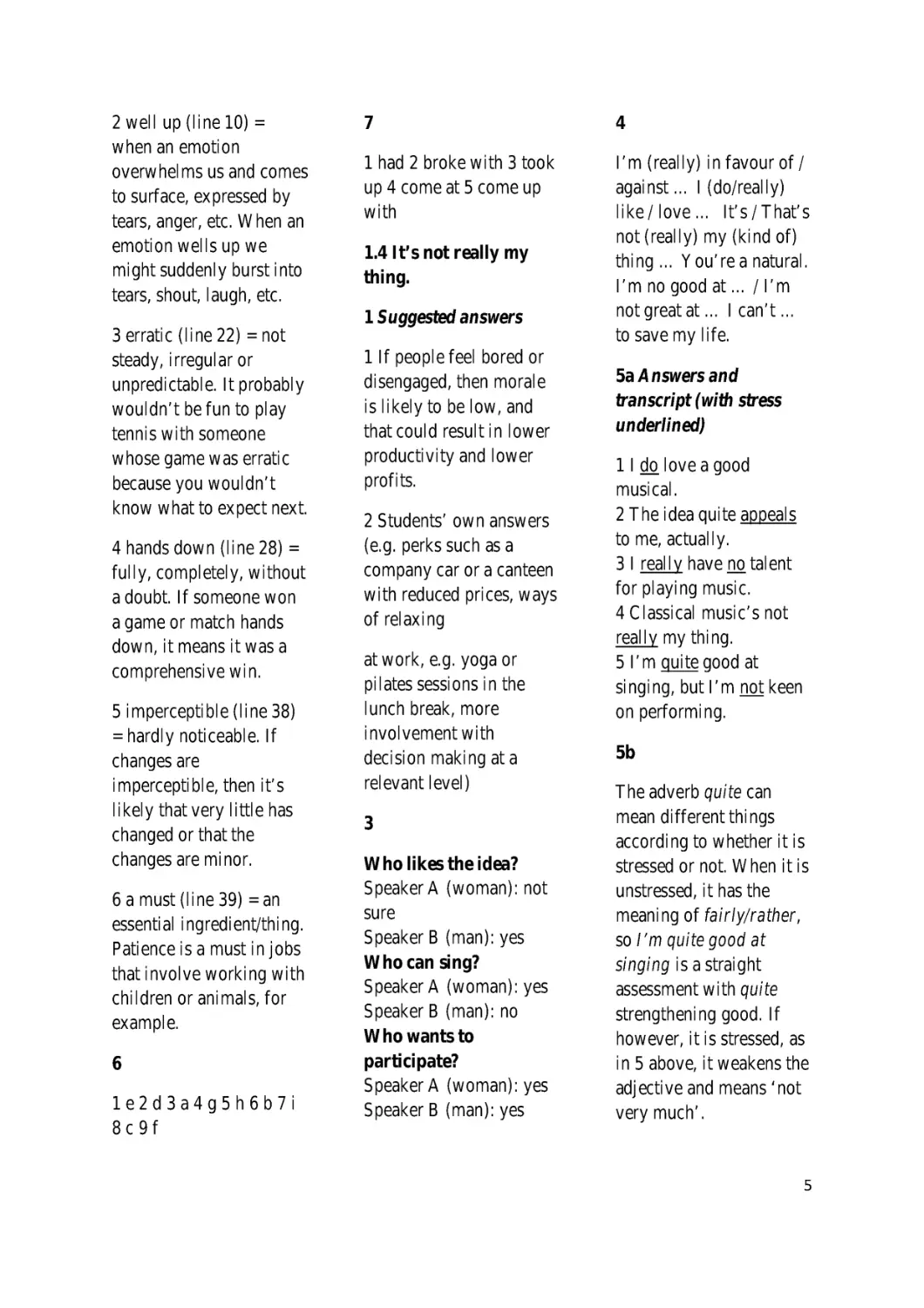
1.4 It's not really my
thing.
1	Suggested answers
1 If people feel bored or
disengaged, then morale
is likely to be low, and
that could result in lower
productivity and lower
profits.
2 Students' own answers
(e.g. perks such as a
company car ora canteen
with reduced prices, ways
of relaxing
at work, e.g. yoga or
pilates sessions in the
lunch break, more
involvement with
decision making ata
relevant level)
3
Who likes the idea?
Speaker A (woman): not
sure
Speaker В (man): yes
Who can sing?
Speaker A (woman): yes
Speaker В (man): no
Who wants to
participate?
Speaker A (woman): yes
Speaker В (man): yes
4
I'm (really) in favour of/
against... I (do/really)
like/love... It's/That's
not (really) my (kind of)
thing ... Y ou're a natural.
I'm no good at... /I'm
not great at... I can't...
to save my life.
5a Answers and
transcript (with stress
underlined)
11	do love a good
musical.
2	The idea quite appeals
to me, actually.
3	I real I у have no talent
for playing music.
4	Classical music's not
really my thing.
5	I'm quite good at
singing, but I'm not keen
on performing.
5b
The adverb quite can
mean different things
according to whether it is
stressed or not. When it is
unstressed, it has the
meaning of fairly/rather,
so I'm quite good at
singing is a straight
assessment with quite
strengthening good. If
however, it is stressed, as
in 5 above, it weakens the
adjective and means 'not
very much'.
5
6	Suggested answers
Students could suggest
sporting activities, which
could take place after
work with teams from
different departments.
Another possibility would
be exercise such as yoga
or pilates, which could
take place in meeting
rooms at lunchtime. M ore
creative activities could
be suggested, such as
growing plants (flowers
or vegetables) in
convenient places in and
around the building, with
different departments
taking responsibility for
different areas.
8
The initiatives had the
desired results (to make
the workplace more
stimulating and to hold
monthly 'theme days'.)
9
Paragraph 1 outlines the
purpose of the report.
Paragraphs 2 and 3
summarize the two
different theme days that
have taken place.
Paragraph 4 descri bes the
response to the theme
days. Paragraph 5 gives
the next step.
10a
1	Employees responded
extremely positively to
both initiatives.
2	94% of participants said
they appreciated the
theme days.
3	A group has also been
formed to come up with
ways we can i mprove the
office space.
4	We intend to organize a
contest involving various
physical activities.
Answers to Grammar
summary exercises
6
1	Brazil has given
confirmation of its
participation in
the talks.
2	Not everyone agreed
with the report's
recommendations / the
recommendations in the
report.
3	Researchers published
thei r fi ndi ngs after careful
analysis of the data.
4	There is opposition
from environmentalists to
the expansion of the UK's
airport capacity.
5	There has been a
demand from businesses
for the reduction of
corporation tax / that
there should be a
reduction in corporation
tax.
6	We have made a
commitment to the
i mprovement of worki ng
conditions in our
factories.
7
1 have had ' had 2 been-
owing ' owed 3 has4t
takee' did it take
4 srnce' for 5 quantity
' number 614Ше' few
10b
1	It was an/our attempt to
encourage more
collaboration. / It was
an/our attempt at
encouraging more
collaboration.)
2	There has been a
significant increase in
participation rates.
3	There was (some)
resistance to the idea at
f i rst.
4	We have no intention of
repeating this exercise.
5	A decision was taken to
test the idea on a small
section of employees.
6	It was interesting to see
the employees' reaction
to the initiative.
6
UNIT 2
1
1 She has won two ARIA
Awards; her 2010 album
went platinum.
2 A stutter (or stammer -
they are the same) is
when you hesitate and
repeat sounds or syllables
when you are speaking,
either due to a speech
problem, or when you are
nervous. Sufferers can
feel very self-confident
about a stutter and avoid
situations where they
have to speak in front of
unfamiliar people. It can
be very limiting.
3 Students' own answers
2
1e 2 f3d4b5a6c
Suggested answers
1 Other speech
impediments are: a lisp,
in which sufferers find it
difficult to pronounce
sibilants such as /s/ and
/z/, so that they may say
What'th that? rather than
What’s that?; other
phoneme disorders, for
example saying /w/
instead of/г/ (e.g. lowy
rather than lorry) and
apraxia, where sufferers
get syllabies/letters the
wrong way round and
say, e.g. motato instead of
tomato, or miminum
rather than minimum.
3b
1 nose 2 dream 3 space
2	.1 Why I live in mortal
dread of public speaking
2
1 She doesn't think it's
that serious. She says it's
not the worst thing in the
world - that other people
have far worse things to
deal with.
2	She's fearful of public
speaking. She's not
fearful of public singing.
3	She hoped that she
wouldn't have a stutter.
She thought she would
have overcome al I
obstacles by the time she
was grown up: learn to
speak French, be able to
manage her money, not
have a stutter, be able to
speak in public.
4	She has decided to talk
about her stutter/speech
impediment in public.
3
1	making fun of him
2	drunk 3 proper nouns
4 thinking of a synonym
or paraphrase 5 the't'
4
1 smooth 2 singsong
3 medication 4 TV
5 cheating 6 nice
7 understood 8 fluent
5
1 space 2 beauty 3 grace
4 ace 5 tell 6 go 7 pace
8 pretty 9 ugly 10 shame
6
1Ь2 ЬЗ Ь4а5сбс
7 Answers and transcript
1	... but for me, language
and music are
inextricably linked
through this one thing.
2	I've spent my life up
unto this point and
including this point,
living in mortal dread of
public speaking.
3	Public singing, whole
different thing.
4	So I can talk about it
now because I've reached
this point, where - I
mean, I'm 28.
5	I can change the word
to 'tomorrow', or 'the day
after Tuesday', or
something else. It's
clunky, but you can get
away with it.
7
6	В utas an artist who
feels that their work is
based solely on a
platform of honesty and
being real ...
7	Which is why before I
sing, I wanted to tell you
what singing means to
me.
8	Singing for me is sweet
relief. It is the only time
when I feel fluent.
8 Possible answers
1	... everyone around
them is panicking. /
everything is going
wrong. / there's a serious
problem.
2	... feeling fluent / being
successful / being a good
communicator...
3	... pretending to be
someone you're not. /
inadequate preparation. /
mumbling.
4	... the silence at home/
listening to music / being
alone...
9 Suggested answer
M egan Washington
comes across as a very
natural, warm person. She
is totally open about her
speech impediment,
making her vulnerable,
and this tends to win
people over. She is quite
humble about her
achievements and
maintains humour
throughout the talk.
13
M egan included a story in
this clip (about meeting a
fellow stutterer), which
made the tai к personal.
Her words seem to
convey her personality.
She is clearly passionate
about the topic.
We don't know whether
she uses language that she
would normally use, but
she seems comfortable
when speaking, so we can
assume so.
Similarly, we can assume
that she's wearing
something she feels
comfortable in as there
are no indications of
physical discomfort.
2.2 Optimist or
pessimist?
1	Suggested answers
Students are likely to go
for c, but possible reasons
for choosing a or b are:
a People (in developed
countries) have a better
standard of living than
fifty years ago with more
choice; there have been a
lot of technological
advances meaning that
communication is easier,
as well as entertainment;
there have been few wars
in developed countries in
the last fifty years.
b People feel more
isolated now than fifty
years ago, partly because
of mobility and families
living a long way apart,
partly because of divorce
and families being
separated, and partly
because technology
means that people tend to
communicate virtually; it
isn't as easy to find work
as it was fifty years ago;
crime (or the fear of
crime) and terrorism is
more widespread.
2
1 Overall, the infographic
suggests that people are
pessimistic about having
a better standard of living
than their parents, as 50%
or more of the population
believes this in only four
of the 20 countries.
2	China, Brazil, India,
Turkey are more
optimistic. Belgium,
France, Spain, the USA,
Canada are less
optimistic. The more
optimistic countries are in
8
developing or emerging
economies. The less
optimistic countries
appear to be al ready
developed countries in the
west.
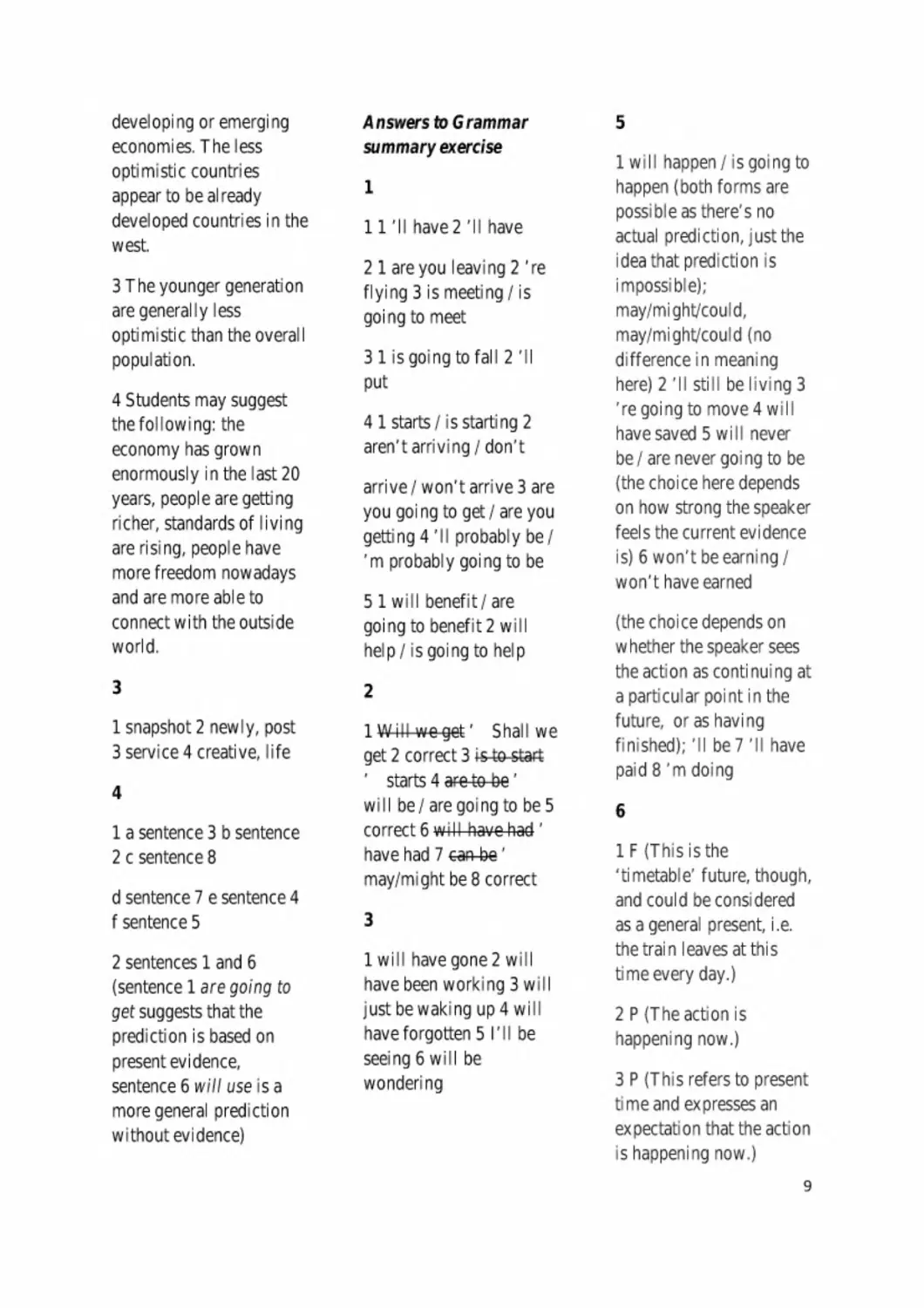
3	The younger generation
are generally less
optimistic than the overall
population.
4	Students may suggest
the following: the
economy has grown
enormously in the last 20
years, people are getting
richer, standards of living
are rising, people have
more freedom nowadays
and are more able to
connect with the outside
world.
3
1 snapshot 2 newly, post
3 service 4 creative, life
4
1 a sentence 3 b sentence
2 c sentence 8
d sentence 7 e sentence 4
f sentence 5
2 sentences 1 and 6
(sentence 1 are going to
get suggests that the
prediction is based on
present evidence,
sentence 6 will use is a
more general prediction
without evidence)
A nswers to G rammar
summary exercise
1
11 'II have2 'll have
2	1 are you leaving 2 're
flying 3 is meeting / is
going to meet
3	1 is going to fall 2 'II
put
4	1 starts / is starting 2
aren't arriving / don't
arrive / won't arrive 3 are
you going to get / are you
getting 4 'II probably be/
'm probably going to be
5	1 will benefit / are
going to benefit 2 will
help/is goi ng to help
2
1 Will we get' S hal I we
get 2 correct 3 is to start
’ starts 4 are to be'
will be/are going to be 5
correct 6 will have had'
have had 7 can be ’
may/might be 8 correct
3
1 will have gone 2 will
have been working 3 will
just be waking up 4 will
have forgotten 5 I'll be
seeing 6 will be
wondering
5
1 will happen/is going to
happen (both forms are
possible as there's no
actual prediction, just the
idea that prediction is
impossible);
may/might/could,
may/might/could (no
difference in meaning
here) 2 'll still be living 3
're going to move 4 will
have saved 5 will never
be/are never going to be
(the choice here depends
on how strong the speaker
feels the current evidence
is) 6 won't be earning/
won't have earned
(the choice depends on
whether the speaker sees
the action as continuing at
a particular point in the
future, or as having
finished); 'II be 7 'II have
paid 8'm doing
6
1	F (This isthe
'timetable' future, though,
and could be considered
as a general present, i.e.
the train leaves at this
time every day.)
2	P (The action is
happening now.)
3	P (This refers to present
time and expresses an
expectation that the action
is happening now.)
9
4	F (Prediction)
5	P (This is expectation
that the action is
happening now; the
speaker doesn't know for
certain or he would use is
waiti ng.)
6	F (Arrangementin
future time)
7	G (It refers to
something that happens
habitually in present
time.)
8	G (General truth/habit)
9	F (The condition of
getting a good price is
that we book soon.)
7 Suggested answers
1	One day I'm going to
travel around South
America/own my own
house / play in a band.
2	N ext weekend / month /
year, I'm meeting an old
friend/travelling to
London/starting an
accountancy course.
3	I expect I'll go to
university / have children
/ retire quite early;... I'll
be living in the country
when I'm older / working
for the same company
next year.
4	Right now my
wife/husband will be
coming to pick me up/
friendswill betravelling
to the rugby match
without me.
5	In two months I'll be a
qualified dentist/'II be
living in aflat with my
best friend / 'II be
competing in the local
tennis tournament.
8
1	The speaker thinks this
will probably happen, but
is not 100% certain.
2	The speaker is 99%
certain this will happen.
So he is very certain
about 2, but I ess certain
about 1.7
A nswers to G rammar
summary exercise
4
1	He's bound to face
some tough questions
from reporters.
2	The government may
well lose the vote.
3	I think they're unlikely
to have sold out of tickets
yet.
4	I think she's likely to be
given a warm reception
when she arrives.
5	They're on the verge of
signing a new five-year
contract.
6The 50-storey building
is about to be demolished.
9
A IB 3, 6, 8C 4D 2, 5, 7
2.3 Expanding your
horizons
1 Suggested answers
1	a situation or place that
you feel comfortable or
relaxed in
2	This might depend on
how far out of the
comfort zone you are!
You are likely to feel
embarrassed, nervous or
anxious, and, in extreme
circumstances, even
frightened. These feelings
are likely to have physical
effects too, from feeling
restless and having
slightly sweaty pal ms to
feeling your heart racing,
breaking out in a sweat
and even shaking.
3	Students' own answers
2
Sentences 1 and 2 reflect
the points of view in the
first paragraph.
io
3
1	an unpleasant
2	liberation 3 frightening
situations 4 less afraid in
other situations 5 build
understanding within
communities 6 break out
of their own small worlds
4 Suggested answers
1	overwhelming
consensus = al most total
agreement amongst al I the
parties involved in a
decision; roughly 90% or
more would have to be in
agreement
2	drift = general
meaning/di recti on; they
would be asking if you
understand their point
3	'which' refers to
'challenging situations'
4	overcome = beat, get on
top of, e.g. problems,
anxiety, urges, resistance,
an addiction
5	adrenalinejunkie =
someone who seeks
excitement from
dangerous situations, e.g.
bungeejumping, base
jumping, motor racing,
extreme mountain biking
6	mundane = everyday
7	inmate = prisoners (in
this context)
8	insulated = treated to
avoid heat escaping; the
measure could include
double glazing, cavity
wall insulation, loft
insulation, draught
proofing
6
1 get2 dashed 3 pinned
4 give 5 sky 6 feet
7 nerves 8 plucked 9
butterflies 10 dark
7 Suggested answers
1 become hopeful about
something 2 have your
hope removed 3 focus
hopes on one thing 4 stop
hoping for something
5 there is no limit 6 lose
courage 7 extremely
anxious about something
8 try to overcome fears
and act 9 feel very
nervous 10 an action with
no idea of the
consequences
2.4 W orst-case scenario
1	Suggested answers
1A worst-case scenario is
the worst thing that can
happen in a particular
situation. (In the dentist
example above, a
probable-case scenario
would bethata filling is
needed; a best-case
scenario would be that the
toothache is just
sensitivity and can be
remedied by changing
your toothpaste.)
2	Scenario planning
means being prepared for
all possible situations and
outcomes. It is used in all
situations, e.g. by
travellers and travel
companies, in business, in
medical situations such as
the operating theatre.
2
allow plenty of time
carry a map (Y ou could
also carry a first aid kit,
particularly if you travel
by car.)
confirm your booking
get jabs (jabs is quite
colloquial, though very
common; vaccinations is
the neutral term)
hang on to receipts (hang
onto is quite colloquial;
keep is the neutral term)
pack a first aid kit
read up on local
laws/customs
takeout insurance
wear a money belt
li
3
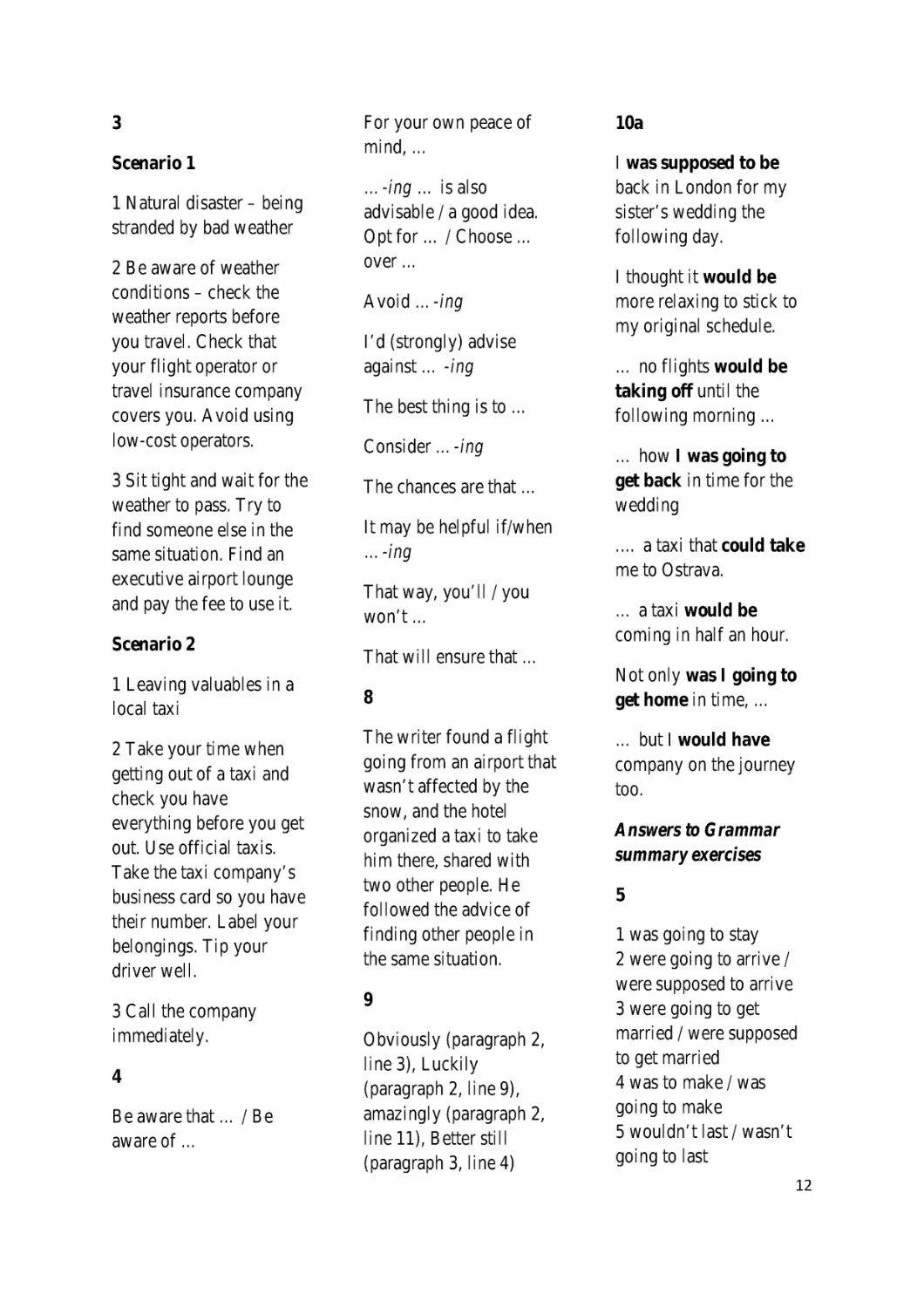
Scenario 1
1	Natural disaster - being
stranded by bad weather
2	Be aware of weather
conditions - check the
weather reports before
you travel. Check that
your flight operator or
travel insurance company
covers you. Avoid using
low-cost operators.
3	Sit tight and wait for the
weather to pass. Try to
find someone else in the
same situation. Find an
executive airport lounge
and pay the fee to use it.
Scenario 2
1	Leaving valuables in a
local taxi
2	Take your time when
getting out of a taxi and
check you have
everything before you get
out. Use official taxis.
Take the taxi company's
business card so you have
their number. Label your
belongings. Tip your
driver well.
3	Call the company
immediately.
4
Be aware that... / Be
aware of...
For your own peace of
mind,...
... -ing ... is also
advisable / a good idea.
Optfor... / Choose...
over...
Avoid ... -ing
I'd (strongly) advise
against... -ing
The best thing is to ...
Consider... -ing
The chances are that...
It may be helpful if/when
... -ing
That way, you'll / you
won't...
That will ensure that...
8
The writer found a flight
going from an airport that
wasn't affected by the
snow, and the hotel
organized a taxi to take
him there, shared with
two other people. He
followed the advice of
finding other people in
the same situation.
9
Obviously (paragraph 2,
line 3), Luckily
(paragraph 2, line 9),
amazingly (paragraph 2,
line 11), Better still
(paragraph 3, line 4)
10a
I was supposed to be
back in London for my
sister's wedding the
following day.
I thought it would be
more relaxing to stick to
my original schedule.
... no flights would be
taking off until the
following morning ...
... how I was going to
get back in time for the
wedding
. .. a taxi that could take
me to Ostrava.
... a taxi would be
coming in half an hour.
Not only was I going to
get home in time,...
... but I would have
company on the journey
too.
A nswers to G rammar
summary exercises
5
1	was going to stay
2	were going to arrive/
were supposed to arrive
3	were going to get
married / were supposed
to get married
4	was to make / was
going to make
5	wouldn't last/ wasn't
going to last
12
6	was going to report
6
1 Gall' 'II call 2
talking ' 'II talk 3 4J-be
staying' stay 4 they’re
getting ’ they'll be
getti ng 5 that they will
notice' to notice 6 -re
going to perform ’ were
going to perform
10b
1	was going to come
2	was supposed to take
off 3 would be/was
going to be 4 would be
waiting 5 was supposed to
be
10c
1	the following day
2	on the Thursday
3	the morning after
4	that evening
REVIEW 1
1
1 Pixar is owned by
Disney, but is still an
independent
'entity', i.e. it retains
control over its creativity.
2 Having a community of
'good people' who trust
and get on with each
other.
3 It ensures that the
company's financial
recovery is possible if a
particular project should
fail.
4 It has large communal
spaces where people can
exchange ideas.
5 It means that you
become inward-looking -
just looking at what you
do as a company (and
possibly always doing
things the same way),
rather than looking at how
things work outside, and
how you can bring ideas
from the outside into your
company.
2
on the back of = i)
following on from
1e 2 d 3 g 4 j5 b 6 i7a8
f 9 c 10 h
3
1 take a back seat 2's laid
back 3 got their own back
4 turn back the clock
5 gone back on their
word, turned their back
on them 6 go back to the
drawing board 7 went
behind my back
4
1 has been 2 over 3 in
4 proportion 5 were 6 to
date 7 used 8 was being
9 few 10 vast
5
1 likelihood 2 bound 3 is
to 4 will be producing
5 may well 6 is going to
produce? will 8 about to
6
A 1 up 2 angle 3 with
4 the sky's 5 dark
В 1 pinned 2 devoted
3 dashed 4 up 5 flash
10 Suggested answers
1 The last summer Last
summer we booked a
two-week holiday in
G reece through a travel
agent.2 In the first place
Initially, we were going
to book our flights and
hotel directly,3 like as we
usually do, 4 but my
husband thought using a
package holiday operator
would be easier and5
with the addition al so / i n
addition cheaper. How
wrong he was!6 Even
Eventhough/Although
the flight itself wasn’t
luxurious,7 (nevertheless)
it was reasonably
comfortable and,8 w+th
good luck
13
fortunately/luckily, it
arrived on time.9
However, from this
moment from that
moment/point, things
went downhill.10 Go
W hen the plane arrived at
two in the morning, there
was no bus waiting to
transfer us. It had broken
down and we had to wait
two hours fora relief bus.
11 When itfinally /
eventually arrived 12 at
the end, I refused to get
on it,13 because of
because it looked so
ancient and unsafe.14
Instead, we waited until
the car hi re fl rm opened
at 8.00 a.m. and 15 after
then we booked our own
transport.
UNIT 3
1
1 He is the chair of the
Sound Agency, an author
and blogger. He has
worked in various
businesses and set up his
own publishing group. He
understands business and,
in particular, marketing.
He was also a drummer,
which adds to his
understanding of sound. 2 *
2 It means anything to do
with hearing.
3 Students' own answers,
but for a) sound could
affect productivity
negatively, although some
sounds, such as music,
might lift the workers'
mood. For b) how noisy a
shop is, both in terms of
music and other sounds
might affect how long
people stay there and
whether or not they
purchase anything.
2
lb 2d 3e 4c 5a 6
f
3c
1	He's going to
'transform' the audience's
relationship with sound.
2	M ost of the sounds are
accidental and unpleasant.
3.1 The 4 ways sound
affects us
1
Sounds: traffic noise,
alarm clock, surf / ocean
waves, classical music,
birdsong, office noise,
techno music,
jackhammer, guitar chord
/ Beatles song,
introductory chords from
the film) aws, Intel ad
jingle, Nokia ringtone
a music, surf/ocean
waves, birdsong
b traffic noise, alarm
clock, jackhammer, office
noise
c classical music, techno
music, Beatles songjaws
theme
2
1	surf / ocean waves
2	Psychologically
3	affects our emotional
state 4 birdsong 5 small
amount of 'bandwidth'
for processing auditory
input 6 office noise
7 techno music
8 jackhammer/drill
3
1	inappropriate, hostile
2	dramatic 3 dreadful
4 powerful, fast
4
1 guidelines 2 the power
of sound to be instantly
associated with a brand /
an effective sound 3 the
company's visual
communication
4	appropriate, valuable
5	because sound is
complex and there are
many opposing/different
influences 6 It's good for
health and productivity.
14
5
1с2аЗс4Ь5сбс7а
8а
6	A nswers and transcript
1	Well, this habit of
suppressing sound has
meant that our
relationship with sound
has become largely
unconscious.
2	There is a deep
resonance with being at
rest. We also associate it
with being stress-free and
on holiday.
3	This is guaranteed to
make most of you feel
pretty sad if I leave it on.
4	For people who can't
getaway from noise like
that, it's extremely
damaging fortheir health.
5	Or start at the bottom,
and say what outcomes do
we want, and then design
a soundscape to have a
desi red effect.
6	1.8 billion times a day,
that tune is played. And it
cost Nokia absolutely
nothing.
7	Just leave you with four
golden rules, forthose of
you who run businesses,
for commercial sound.
8	I recommend at least
five minutes a day, but
there is no maximum
dose.
7 Possible answers
1	Students' own answers
2	... a jackhammer started
up outside the theatre. /
the leading actor forgot
his lines. / the realistic
war scene came on.
3	... the general election,
/theinterview I did
yesterday, / the national
lottery.
4... improve the
company's image. /
increase sales. / make
people laugh.
9
1J ulian T reasure
achieved his aim of
making Stefan more
aware of sound, but Julia
was already very aware of
the impact of sound in her
working life. Stefan felt
that there wasn't enough
advice on how to control
sound in everyday life.
2 Students' own answers,
but they may mention the
use of headphones in a
noisy office, asj ulian
Treasure advised; they
could mention turning off
the TV when they aren't
actually watching it, or
perhaps turning off the
sound on tablets and other
mobile devices when it
isn't actually needed.
12
J ulian Treasure had a very
strong beginning as he
illustrated with traffic
noise how difficult it is to
hear over unwanted
sound.
H e created a need to
listen by saying that
sound affects us all and
that he was going to raise
our consciousness of the
four ways in which it
affects us.
In the first cl ip, he
signposts the route by
mentioning the four ways
in which sound affects us.
He ended with a summary
and the important
message that we can
control how sound affects
us and improve our health
and productivity. He also
left with the audience
with a recommendation
(to listen to birdsong
every day).
3.2 J udging by
appearances
2
According to the
infographic, what we look
like and how we speak is
15
more important than what
we say; making eye
contact and listening to
the other person are also
important.
Other poi nts that students
might add are smiling,
agreeing and whether the
person seems interested in
us.
3
a depend, mean, own (but
you can talk about
someone 'owning up' to
something, or 'owning an
idea'), be, seem, need
b think: in the simple
form this refers to general
opinion and issimilarto
believe; in the continuous
it suggests a
process/action happening
at the moment, and is
similar to consider; mean:
in the simple form this
means signify; in the
continuous it conveys
intention (over a period of
time).
c The simple form (are)
would express a general
truth, in this case a quality
of the person; in the
continuous (are being) it
expresses an action or
behaviour ata particular
point in time.
d annoyance/irritation,
e.g. with a habit
Answers to Grammar
summary exercises
1
11 deserves 2 did you
have 3 contained 4
promise
2	1 didn't want 2 don't
think 3 was being 4 didn't
feel / wasn't feel I ng
3	1 Are you enjoying/
Have you been enjoying
2 'm learning / 've
learned /'ve been
learning 3 involves
4	Do you mind 5 mean
6 depends
4 1 was having 2 see
3 thought 4 was just
calling
5 discussed / were
discussing
2
1 'm loving* 2 (both
possible) 3 He'sowning
4 (both possible) 5
really mattering 6
surprising
7 weren't believing
8 (both possible) 9 is
deserving
*'l'm loving' is used in a
very informal manner,
particularly by younger
people.
3
11' m tasti ng 2 tastes
2	1 looked / were looking
2 felt / was feeling
3	seemed
3	1 sounds 2 seems
4
1	a Are you (permanent
quality, i.e. a judgemental
person) / Areyou being (a
temporary state at the
time in question) bl
don'tthink call do d
like
2	a wondered (indefinite
ti me i n the past) / been
wondering (over a period
of ti me i n the past to
present) b appears c
means d are
3	a were already making
b wanted с I don't own
dI suppose
4	a always come
(statement of fact -
regular activity) / are
always coming (habit
which can be annoying)
b have c live (focus on
general fact) / are living
(focus on temporary
nature of age) d is
becoming
16
5
1 sounds (seems is also
possible) 2 looks/seems
3 seemed/sounded 4 feel /
'm feeling 5'm just
tasti ng
6
1	e: What strikes you is
her incredible energy.
2	c: It is her incredible
energy that strikes you.
3	b: Her incredible energy
is particularly striking.
4	f: Her incredible energy
really does strike you.
5	a: Her incredible energy
is what strikes you.
6	d: T he thi ng that stri kes
you is her incredible
energy.
Answers to Grammar
summary exercise
4
1	What I find really
difficult is the
relationship between
spelling and
pronunciation in English.
/The relationship
between spelling and
pronunciation in English
is what I find really
difficult.
2	Planning the details of
your trip in advance does
have its advantages, but it
also has some drawbacks.
/Planning the details of
your trip in advance has
its advantages, but it does
also have some
drawbacks.
3	The thing I liked about
the documentary was that
it left you to makeup
your mind about the
rights and wrongs of the
situation.
4	It wasn't her answer
that surprised me, but her
violent reaction. / It was
her violent reaction that
surprised me, not her
answer.
5	Wherever you go in
New Orleans, it's the
quality of live music that
is impressive.
6	It is people with that
kind of selfless attitude
and determination who
can change the world.
7
1	The thing (that) I like is
the way he always tries to
include everyone.
2	What she did was (to)
make a big impression on
everyone at the meeting. /
She did make a big
impression on everyone at
the meeting.
3	What is amazing is (the
fact) that he can switch so
easily from one language
to another.
4	It's the blueness of his
eyes that is very striking.
5	Her manner is
particularly abrupt, but
actually she's very nice. /
Her manner, particularly,
is very abrupt, but
actually she's very nice.
6	It's people like that who
annoy me.
3	.3 Lights, music, action
1 Suggested answers
1	In shops: special
displays, special offers
(buy one get one free),
position on the shelves.
Online: eye-catching
advertisements, videos
(with music)
2	It means using sales
methods which appeal to
all your senses (e.g.
smell, touch, hearing,
taste) - not just using the
traditional visual stimuli.
2
1	They don’t use multi-
sensory experiences
despite statistics that
17
attest to thei r
effectiveness.
2	They are
underestimating the value
that high street shops can
bring (in favour of online
sales). They treat them
much the same as the
online shopping
experience.
3	They think the online
sales channel is the best
route as it is cheaper to
administer and deliver.
3
1	Because there is plenty
of persuasive research
into its (positive)
influence on customer
behaviour, (lines 10-13)
2	How long customers
stay in the shop, what
their feelings are while
they are there, and how
much they spend, (lines
30-33)
3	'bricks and mortar' side
of their business (lines
43-44)
4	because it's cheaper
than shops (which have
'high attendant costs')
(lines 45-50)
5	bringing multi-sensory
experience into
consumers' homes (lines
59-61)
4
1 missing an important
trick (line 8) 2 a paper
(line 14) 3 heightened
(line 28) 4 crucially (line
31) 5 hitthe mark (line
40) 6 holy grail (line 51)
5
Students might suggest
the fol I owing reasons for
the effects:
Slow music can be
relaxing, and people who
are relaxed might eat and
drink more.
Comfortable chairs can
make people feel sleepy
and therefore less sharp,
which could affect
negotiating skills.
Eating in the dark could
heighten the senses of
smell and taste, but also it
could be seen as more
romantic (and less likely
that other people will see
who you're with!).
Pleasant fragrances might
suggest that the shop
spares no expense to
make its customers'
experiences pleasant and
therefore encourage the
shoppers to spend there.
Dim lighting might have
the feeling of a nightclub
for younger people and be
more inviting forthem,
increasing the number
who come to the shop.
6
disconcerting - unsettling
distracting - off-putting
energizing - stimulating
infuriating - maddening
irresistible - compelling
reassuring - comforting
rousing - stirring
soothing - relaxing
tempting - enticing
7
1	stirring, rousing
2	tempting, enticing,
irresistible
3	distracting, off-putting,
infuriating, maddening,
disconcerting, unsettling
4	comforting, soothing,
relaxing 5 infuriating,
maddening, unsettling,
disconcerting
6 distracting, infuriating,
maddening, compelling
7 energizing, stimulating
8 soothing, comforting
3.4 C ontrary to popular
belief
1	Suggested answers
Benefits: Possibilities are
that they are cheaper for
the company, allowing
more people in a space
than would be the case
with closed offices; they
18
would allow the staff to
be observed; they would
allow easy
communication. For the
employee, they would
allow easy
communication and the
possibility to chat with
co-workers when they
wish.
Drawbacks: Possibilities
might be the noise, the
lack of privacy for phone
calls and meetings, little
possibility of
personalizing one's space.
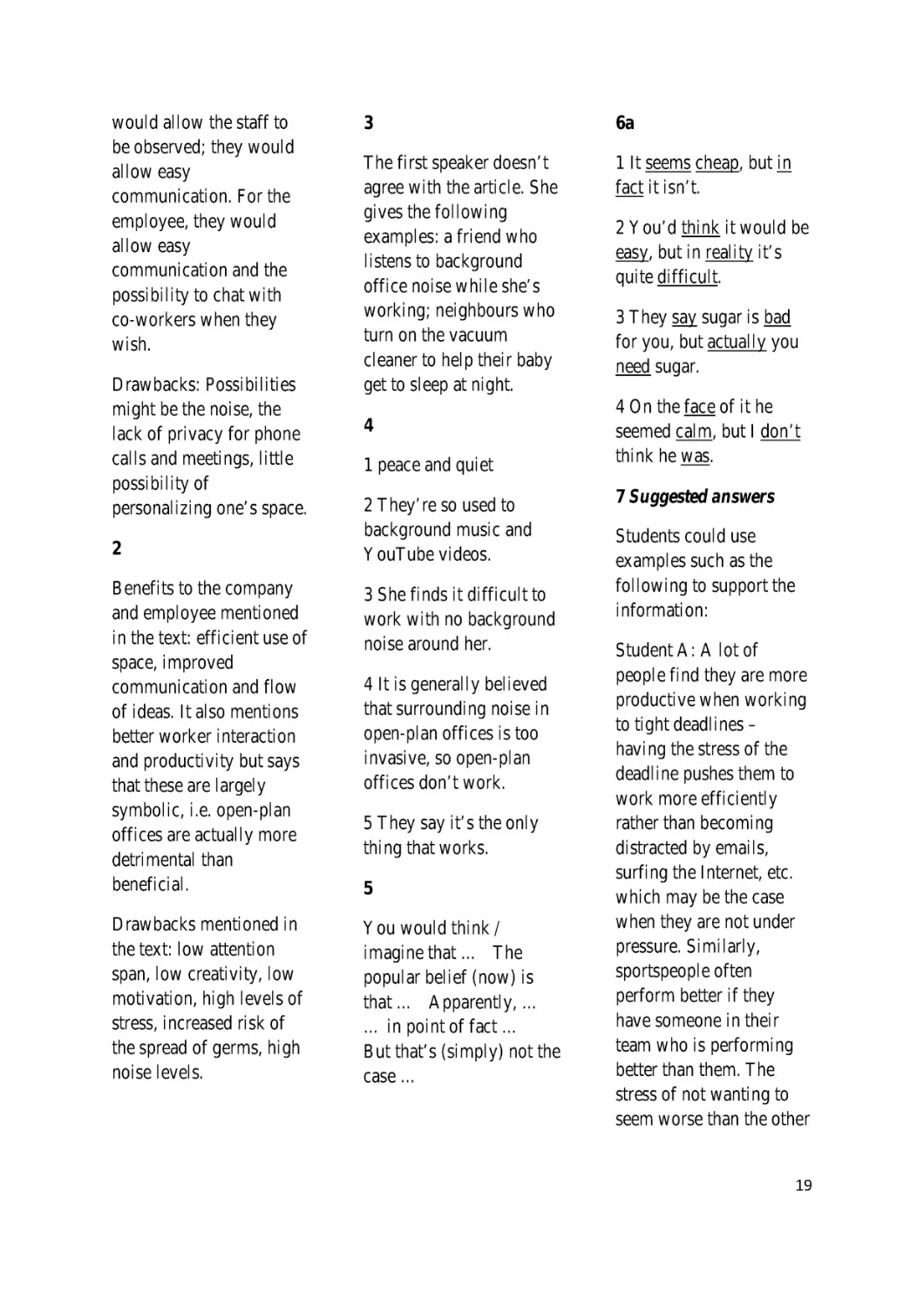
2
Benefits to the company
and employee mentioned
in the text: efficient use of
space, improved
communication and flow
of ideas. It also mentions
better worker interaction
and productivity but says
that these are largely
symbolic, i.e. open-plan
offices are actually more
detrimental than
beneficial.
Drawbacks mentioned in
the text: low attention
span, low creativity, low
motivation, high levels of
stress, increased risk of
the spread of germs, high
noise levels.
3
The first speaker doesn't
agree with the article. She
gives the following
examples: a friend who
listens to background
office noise while she's
working; neighbours who
turn on the vacuum
cleaner to help their baby
get to sleep at night.
4
1	peace and quiet
2	They're so used to
background music and
YouTube videos.
3	She finds itdifficultto
work with no background
noise around her.
4	It is generally believed
that surrounding noise in
open-plan offices is too
invasive, so open-plan
offices don't work.
5	They say it's the only
thing that works.
5
Y ou would think /
imagine that... The
popular belief (now) is
that... Apparently,...
... in point of fact...
Butthat's (simply) not the
case...
6a
1	It seems cheap, but in
fact it isn't.
2	Y ou'd think it would be
easy, but in reality it's
quite difficult.
3	They say sugar is bad
for you, but actually you
need sugar.
4	On the face of it he
seemed calm, but I don't
think he was.
7 Suggested answers
Students could use
examples such as the
following to support the
information:
Student A: A lot of
people find they are more
productive when working
to tight deadlines -
having the stress of the
deadline pushes them to
work more efficiently
rather than becoming
distracted by emails,
surfing the Internet, etc.
which may be the case
when they are not under
pressure. Similarly,
sportspeople often
perform better if they
have someone in their
team who is performing
better than them. The
stress of not wanting to
seem worse than the other
19
player pushes them to
greater efforts.
Student В: Listening to
sad songs can actually
make us appreciate that
our situation isn't so bad;
also, music can help clear
our minds of what is
bothering us, allowing our
imagination to take over
and to become more
creative.
8
1 The writer isn't
convinced about the
benefits of
open-plan offices. He/She
states that a small-scale
experiment should be
introduced first, and
introduced for
management as well as
staff.
2 Students should
underline: Personally,
however, I am far from
convinced that its benefits
outweigh these savings. I
I suspect that the same
results could be attained
just as easily by providing
a few extra communal
spaces... // would prefer
it if the company first
experimented with some
smaller-scale measures...
// imagine it would be
very damaging for morale
... These are subjective
because of the use of an
adverb expressing opinion
(personally') the presence
of the pronoun / and the
use of verbs expressing
beliefs or opinions, i.e.
suspect, prefer, imagine.
Students should circle:
Studies show that, as far
as social relations are
concerned, open
environments are a
positive thing inasmuch
as they facilitate more
interaction between
people. This is objective
because it is introduced
by the reference to
studies.
9a
Personally,...
as far as social relations
are concerned ...
from the point of view of
good labour relations...
Answers to Grammar
summary exercises
5
1 Personally (adverb)
2 Practically (adverb)
3 Health (noun)
4 political (adjective)
5 Financially (adverb)
6 smokers (noun)
Note that other answers
are possible, but they
should be the part of
speech given.
6
1 is belonging ' belongs
2 am promising'
promise
3	is just' is just being
4	wasn't feel I ng ' didn't
feel
5	what' that
6	economically'
economic
9b
1	From a health
perspective, putting a lot
of people in close
proximity with each other
is risky.
2	In terms of individual
productivity, people who
work in offices only do
4-5 hours of efficient
work per day, anyway.
3	Practically speaking,
you can't beat an open-
plan office for space
efficiency.
4	Psychologically
(speaking) / From a
psychological point of
view, seeing everyone
around you working hard
can boost your
motivation.
5	Statistically speaking,
there are distinct
advantages to working in
a quiet concentrated
manner.
20
UNIT 4
1
1	She is a professor and
researcher in social
psychology, studying
nonverbal behaviour in
particular and how it
affects people in different
situations. This has
relevance to future
business people as
nonverbal behaviour
affects your performance
in business as well as
social situations - how
customers and partners
perceive you, how you
get your message across,
how well you can manage
a team, etc.
2	The main aspects of
nonverbal behaviour are
body language, i.e. eye
contact, facial expressions
(e.g. smiling), posture and
gesture, and also tone and
pitch of the voice. It is
commonly said that 55%
of communication is body
language and 38% tone of
voice, leaving only 7%
for actual verbal content.
3	Students' own answers
2
la2f3 b4d5c6e
3a
1	sounds like: So_w_l
wanna starp by
2	sounds like: wanna
assyou to ri_now
3 sounds like: sorda
makin
3b A nswers and
transcript
4	So I want you to pay
attention to what you're
doing right now. (I
wanyou to pay attention
to wap you're doin ri
now)
5	We're going to come
back to that in a few
minutes.
(We're gonna come back
to tha in a few minutes)
4.1 Y our body language
shapes who you are
1
1	She asks her audience
to 'do an audit of their
body', i.e. to pay attention
to what they're doing
with their body (making
themselves smaller,
hunching, etc.). She does
this to make the audience
aware of their own body
language.
2	President Obama shook
hands with the police
officer, butthen the
(British) Prime M inister
didn't shake hands with
him. It gave the
impression that the Prime
Minister was unfriendly/
not willing to shake hands
with the police officer.
3	We consider how other
people's body language
influences us and how our
body language influences
them. We forget to think
about how our own body
language influences
ourselves.
4	She wasteaching in a
competitive business
school.
2
1	They make themselves
big, stretch out, take up
space, opening up, make a
star shape.
2	Raising both hands up
in the air in a V-shape and
the chin is slightly lifted.
3	We close up, make
ourselves small.
4	We complement the
other person's nonverbal,
i.e. do the opposite, so if
one person is
demonstrating power, the
other makes themselves
smaller.
5	Confident students take
up space when they sit
down, leaning back, and
when they raise their
hands, they putthem high
in the air. They also
participate more. Less
21
confident students sit
hunched over the desk
and when they raise their
hands, it is a slight
movement from the
elbow only. They don't
participate much.
3
1 Women, participation
2 fake, make 3 smile,
happy 4 bodies, hormones
4
1 two 2 saliva/spit
3 gamble 4 86
5 60 6 20 7 increase
8 stress/stressed
5
1 before 2 neutral 3 didn't
know 4 high power
5 frauds
6
1	She was in a really bad
car accident. She was told
that her IQ had dropped,
and that she had been
withdrawn from college.
She felt powerless.
2	She worked really hard
and she eventually
graduated from college.
3	Y ou're not quitting;
you're going to fake it.
Y es, it worked.
4	She realized that she
didn'tfeel likeshewasn't
supposed to be there any
more and that her student
was supposed to be there.
5	'Fake ittill you become
it.'
7
1	c 2 b 3 c 4 b 5 a 6 a 7 b
8c
8
1A nd we make sweeping
judgementsand
inferences from body
language.
2	And those judgements
can predict really
meaningful life outcomes
like who we hireor
promote, who we ask out
on a date.
3	So when they cross the
finish line and they've
won, it doesn't matter if
they've never seen
anyone do it.
4	You have other people
who are virtually
collapsing when they
come in.
5	W e then ask them,
'How powerful do you
feel?' on a series of items,
and then we give them an
opportunity to gamble,
6	They have no idea
who's been posing in
what pose, and they end
up looking at these sets of
tapes,...
7	So I really struggled
with this, and I have to
say, having your identity
taken from you, your core
identity...
8	... she came in totally
defeated, and she said,
'I'm not supposed to be
here.'
9	Possible answers
1... your point. /
argument. / main ideas. /
message.
2	... think about me. / do
in their spare time./say.
3	... review my own body
language. / reconsider my
past failed interviews.
4	... your posture, you
can improve a lot of back
problems. / your daily
schedule, you can often
get a lot more done.
10
1	The oversimplification
is that body language is
also important in that it
can influence how we feel
about ourselves.
2	The oversimplification
is that power posing and
22
faking confidence can
actually make us feel
more confident
permanently, as well as
temporarily.
11	Suggested answer
Perhaps Ella has
oversimplified a little:
Amy Cuddy says people
assume high-power
positions to make
themselves feel more
confident, not to show
their own power.
William has made an
analogy which is very
close to Amy Cuddy's
idea. In the same way a
method actor wants to
'become' the character
they are portraying, Amy
Cuddy wants people to
'become it' rather than
just fake it temporarily.
12	Suggested answer
In her final section, Amy
Cuddy took us on a
journey of her own
experiences, from her
accident aged 19 through
to the end, where she
talked about a student
who was in a similar
position to herself after
her accident. Thejourney
through the whole talk is
somewhat different in that
she takes the audience on
a journey of discovery of
their own body language
through examples of the
effect of body language
and a practical anecdote
of how important it is.
13
Students' own answers,
but one alternative might
be to elicit from the
audience what they are
expecting to hear at the
beginning of the tai к and
structure accordingly -
this would take a lot of
confidence on the part of
the speaker though. Point
out that different speakers
are likely to structure
talks differently according
to their personality and
the content of the talk.
14
She brings the story full
circle, i.e. she brings the
story round to a story
about her student, who
was in the same situation
as Cuddy was at the
beginning of the clip.
4.2 H ow we
communicate
1	Suggested answers
1 2,500 years ago: by
messenger (e.g. on foot or
horseback), papyrus
script, smoke signals,
cave paintings 250 years
ago: letters (post), by
messenger (e.g. on
foot/horseback, messages
by boat)
2	Communication would
have been slower with
more opportunity for
messages to get lost or
changed. Human
interactions would also
have been more limited as
it was more difficult to
travel and took longer.
However, it could be
argued that people took
more time over the
interactions they did have
and so their interactions
were deeper and more
meaningful.
2
1	The speaker mentions:
cave paintings
(drawings), pictograms,
writing on papyrus,
carrier pigeons, the first
postal service, (invention
of) the printing press.
2	cave paintings:
indicated growing human
intelligence
pictograms: an important
step towards the
development of an
alphabet
carrier pigeons: messages
could be sent more
quickly
23
first postal service: could
cover greater distances
invention of the printing
press: more people had
access to books and ideas
4
a 3 and 4 b 1 c 2 d 5 and
6, would e 7
Answers to Grammar
summary exercises
1
Conversation 1:1 were
you talking 2 was tel I ing
3 went 4 stopped 5 did he
think 6 hadn't appreciated
7 met 8 had been going
Conversation 2:1 went
2	had fallen 3 didn't you
leave 4 was supposed
5	didn't get 6 had finished
7 was
Conversation 3:1 was
getting 2 got 3 had
overturned 4 had stopped
5 were trying
2
1 loved 2 used to say /
would say 3 had been
studying 4 used to go /
went 5 lived 6 would
often help 7 had finished
8 would take 9 could see/
were able to see 10 built/
had built 11 would
happily play / used to
play happily 12 managed
to catch
3
1 couldn't have gone to
the festival 2 shouldn't
have left her bags
unattended 3 had to take a
taxi 4 could have been
mistaken 5 must have
been recruited by the
secret service 6 might
have thrown a stone at
5
1 came 2 was working
3 had been using 4 was
5 didn't seem 6 leased /
used to lease / would
lease 7 changed 8 were
making and receiving
7
1	after the subject and
verb, i.e. The telephone
exchange's impact was so
strong that... The
adjective phrase so strong
has been placed at the
begi nni ng of the sentence
to give more emphasis.
2	The adjective phrase
would normally come
after the subject and verb.
Answers to Grammar
summary exercises
4
1	Not only was the food
cold, but it was also
burnt.
2	Such was the force of
the blast that the windows
in buildings three streets
away were shattered.
3	Only by speaking to
himself as he walked did
he manage to stay awake.
4	Hardly had he opened
his mouth to speak when
she interrupted.
5	No sooner had she
finished speaking than the
room erupted into loud
applause.
6	Only when he had
opened the parcel did he
realize his mistake.
7	So poisonous was the
snake's venom that just a
small bite could have
been fatal.
8	Only in moments of
deep frustration had he
ever thought of giving up.
5
1 owning ' own 2 had
played ' had been
playing 3 should take'
should have taken 4 could
get' were able to get/
24
managed to get /
succeeded in getting
5 they stole' did they
steal 6 we were able'
were we able
8
Id2e3a4b5c
9
1 a & e 2 an adjective,
e.g. so
great/huge/powerful was
the impact... (such +
noun, so + adjective)
10 Suggested answers
1... increase our access
to information, it also
changed the way we
work. / allowed for faster
communication. / it also
brought the world into our
homes.
2	... were people able to
watch films in their own
home. / did people really
see what was happening
around the world.
3	... were people able to
make calls for free. /
communicate easily by
video.
4	... that many other
people have tried to create
their own social
networking sites, / that
companies have to ban
people using it at work.
4.3 Negotiate better
4
1A (Never get too
emotionally attached to
something you want. If
you do, you're sure to
overpay for it)
2	C (The author mentions
that someone repeating
their position may not be
following the goals of the
negotiation, but says
nothing about preparation
or options.)
3	A (... staying quiet can
hel p to draw them out
further, prompti ng them
to offer more or at least to
justify their position.)
4	A ('What if' forces the
other person to really
consider and perhaps re-
eval uate thei r position.)
5	В (The big difference is
that your nearest and
dearest know how to push
your buttons - what you
really care about, what
will make you angry and
so on...)
6	A (A nd try to avoid
giving off any of these
tell-tale signs yourself...)
5
1 at the end of the day
(lines 7-8) 2 without
budging an inch (line 11)
3 bullishly (line 15)
4 resentful
(line 18) 5 draw them out
/draw someone out (line
23) 6 indispensible(line
28) 7 push your buttons/
push someone's buttons
(line 34) 8 flounder (line
37) 9 unscrupulous (line
37) 10 tell-tale (line 43)
6
1 legs 2 arms 3 eyebrow
7	Suggested answers
N ote that the answers
below suggest when
native English speakers
may perform these
actions, but remember
that gestures are often
different across cultures,
so your answers may not
be the same.
clench your fists: This
gesture suggests anger;
we might do it if someone
is angering us or
threatening us.
drum your fingers: This
suggests impatience; we
might do it if we're
having to wait for
something/someone.
roll your eyes: This
suggests exasperation; we
might do it if someone is
being particularly
awkward.
25
shake your head: This is
the gesture of negation,
i.e. it means 'No'; we do
it if we are refusing or
rejecting something.
shrug your shoulders:
This means 'I don't
know'; we might do it if
someone has asked us
something and we don't
know the answer. It can
also suggest 'I don't
care.'
tap your foot: This can
express impatience (as
with drum your fingers),
but it's is more likely that
we are listening to music
and tapping our feet along
with the beat.
8
a5b2c4dle6f3
9	Suggested answers
The most likely responses
would be, e.g. grinning to
show pleasure at the
proposal, looking
disappointed, perhaps
shrugging shoulders.
4.	41 s that what you
meant?
2
Stop to arrest innocent
people = Stop what you
are doing and arrest
innocent people. It should
beStop arresting
innocent people.
I put my name and
address on the backside =
In English backside refers
to the bottom, so this
suggests the name address
were written on
someone's bottom. It
should be on the back or
on the reverse.
Kate and J ake love
themselves very much =
Kate loves К ate and Jake
loves J ake. It should be
Kate and J ake love each
other very much.
Give a ring to me
sometime = Give me a
ring to wear on my finger.
It should be Give me a
ring sometime.
It's very good for you to
help me = It's beneficial
for you to help me, i.e.
you benefit from it. It
should belt's very good
of you to help me.
3
1 of 2 her a ring 3 in
person 4 mind 5 pay for
6 suits 7 shouldn't 8 out
9 I'm really sorry to hear
that 10 on
4
1 a hand 2 quick word 3
not available 4 fancy
popping 5 at al I 6 shall we
7 the way 8 get you 9 Bad
news 10 drop you
8
1	Dear Bill / Thank you
for... (Note that here the
sentence thanking the
recipient for their email is
really part of the greet!ng,
although in some
circumstances it could
form part of establishing
the purpose.)
2	Here is an update of
where we are with it...
3	The letter contains three
bullet points.
4	The bullet points give
clear and concise details
about the situation.
5	The venue, time and
date of the supplier event
are given in bold.
6	our supplier event/
please do not hesitate to
contact me 7 thank you
once again for your
comments
9
Bill and M ichael are
business colleagues: Bill
is invited to a supplier
event, so we know that
26
he's a supplier; M ichael
works in the company
which uses Bill's
services. The tone is
formal, but the use of first
names in the letter
suggests they know each
other and have worked
together before.
10
1	closing line: I very
much look forward to
hearing from you. (error
of word order)
2	next step: I will wait to
hear what the outcome of
these negotiations is.
(grammar error - noun-
verb agreement)
3	establishing the reason
for writing or greeting:
Thank you for taking the
time to write to me.
(grammar error - article)
4	establishing the reason
for writing: This is a brief
remi nder of the upcomi ng
sales event, (vocabulary
error - wrong word, or
grammar error - wrong
preposition)
5	action point: Any
suggestions for discussion
topics must be / ought to
be sent to ... (grammar
error - modal verb)
REVIEW 2
1
1 guides 2 fully
3 everyday 4 unemployed
5 listening 6 spill
7 seat/table 8 slowly
2
1 hand 2 tongue 3 tooth
4 thumb 5 chest 6 head
7 back 8 finger 9 nose
10 heart
3
11 don'tthink 2 I'm
being 3 I've had 4 don't
go 5 want 6 are
wondering 7 don't see 8
got / were getting 9 were
10 really felt 11 is always
looking 12 definitely
recommend
4
1	Only when you lose one
of your senses do you
realize how important
they are.
2	W hat most people don't
think about is how
dependent we are on our
sight.
3	No sooner had we
arrived than we were
shown to our table.
4	Such has been the
popularity of Blindekuh
that other European cities
have copied the idea.
5	The thing that's
shocking is that so many
visually-impaired people
are without regular work.
6	Not only was it a great
experience, but the food
was also very tasty / very
tasty too.
7	Only in Switzerland
would you find this kind
of practical solution to a
problem.
8	It is the friendliness of
the waiters that I will
remember most.
5
1 clenched, scowled 2
rolled, yawned 3 gaped,
shrugged 4 raised,
sneered
6
1 unsettling 2 off-putting,
compelling 3 infuriating,
reassuring 4 enticing
7 Suggested answers
Students might suggest,
for example, going to the
cinema and watching a
film without sound, an
experience which could
help them understand
how people saw movies
in their early days.
Another possibility might
27
be concerts entirely in the
dark so that listeners
aren't distracted by the
performers.
Y ou could also talk about
experiences which use the
senses differently, for
example, parks which
don't allow shoes so that
you have to experience al I
the different textures
underfoot.
9
(Each sentence has been
put on a separate line
here.)
Thank you for the
proposal which you sent
me last week and I
apologize for not
answering to you
answering you /
responding to you sooner.
I needed to consult David
Williams before sending
you my thinking thoughts
about it.
In principal principle, the
company is open to the
idea of job-sharing.
This is particularly true
when it allows female
employees with children
to make have I find a
better balance between
their work life and home
life.
From a financially
financial perspectivejob-
sharing could also in
some cases be beneficial
to the company.
However, in this case we
are not convinced that it
should would make
practical sense.
Louise, with whom you
are proposing to combine
roles, has al ready a very
heavy workload already
and could not be expected
to take on more work.
Having said all this, we
recognize that the
company needs to do
something to takem
account into account/
account of your family
situation.
Accordingly, David has
suggested to meet
meeting I that we meet on
Thursday at 2 pm in his
office to discuss possible
solutions.
PI ease inform me that / et
me know if this suits you.
(Or confirm that this suits
you.)
UNIT 5
1	Suggested answers
1 (international/global)
health, economic
development, presenting
data
2	a special piece of
software he developed
3	household appliances,
e.g. vacuum cleaners,
dishwashers, food mixers,
coffee grinders,
cookers/stoves, kettles,
microwave ovens;
computers and other
information technology
devices; boilers (for
heating water); shower
and water systems;
electric/gasfires; electric
tools, e.g. electric drills,
screwdrivers, hedge
trimmers, lawn mowers;
agricultural machinery,
e.g. tractors, combine
harvesters
2
Ib2a3f4c5d6e
Suggested answers
1	Students' own answers
2	This varies according to
where someone lives and
is usually higher in
developed countries. The
UK government defines it
as under 60% of the
national median income.
Other definitions look at
deprivation - what poorer
people can't afford that is
available to most of
society.
28
3	Economic data, like
most statistics, can be
presented in different
ways in order to support
particular points.
4	Coal releases the most
carbon dioxide so could
be considered the most
polluting.
5	Pneumonia is
responsible for 15% of
deaths in children under
five years, and malaria is
responsible for 7%. Over
25% of deaths are caused
from premature birth or
by complications during
or just after birth.
Developing countries
have far greater problems
with child mortality than
developed countries,
including deaths from
childhood diseases and
conditions such as
diarrhoea that no longer
constitute a threat in
developed countries.
6	The word favela is used
for the slums bordering
urban areas in Brazil.
3a Suggested answers
wash, laundry,
Ioad/unload, by hand,
washing powder,
conditioner, electricity,
water, dry
3b
1Y es, he does. H e says
'Throughout her [his
grandmother's] life, she
had been heating water
with firewood, and she
had hand washed laundry
for seven children. And
now she was goi ng to
watch electricity do that
work.' i.e. it would
significantly change
domestic life.
2 Students' own answers
5.13 T he magic washing
machine
1
1	The washing machine
makes it easier to wash
things, means that less
time is spent on laundry
(particularly for women
with big families), so
there is more time to do
other things.
2	Economic growth
leading to access to
electricity.
3	green energy (not fossil
fuel energy)
2
1	She had to wash the
clothes by hand / hand
wash the clothes. This
included heating the
water with firewood to
wash the clothes.
2	The richest spend more
than $80 a day while the
poorest live on less than
$2 a day.
3	below the poverty line
('thefire people'), those
with electricity but not
washing machines ('the
bulb people'), those with
washing machines ('the
wash people') and those
above the air line ('the air
people'). They are
separated by poverty 11 ne,
the wash line and the air
line.
4	five billion
5	hard work, time-
consuming labour, which
women have to do for
hours each week
6	Some of them don't use
a car, but al I of them have
a washing machine.
3
1	7/seven billion
2 12/twelve 3 1/one
billion 4 6/six 5 half
6 2/two 7 1/one 8 2/two
9 2050 10 many
11 double 12 22
4
IF (... until they have the
same energy consumption
29
per person, they shouldn't
give advice to others...)
2	T (... her minister of
energy that provided
electricity to everyone ...)
3 T (... so happy that she
even voted for her. And
she became Dilma
Rousseff, the president-
elect of one of the biggest
democracies in the
world.)
4T (She managed to
study English and learn
that as a foreign
language.)
5T (And what we said,
my mother and me,
'Thank you
industrialization. Thank
you steel mill. Thank you
power station. And thank
you chemical processing
i ndustry that gave us ti me
to read books.')
5
1а2аЗЬ4Ь5Ьба
6 A nswers and transcript
1... when they want to
travel, they use flying
machines that can take
them to remote
destinations.
2	There are two billion
fellow human beings
who live on less than two
dollar a day.
3	It's a hard, time-
consuming labour, which
they have to do for hours
every week.
4	But when I lecture to
environmentally-
concerned students, they
tell me, 'No, everybody in
the world cannot have
cars and washing
machines.'
5	Because the risk, the
high probability of
climate change is real.
6	Of course they must be
more energy-efficient.
They must change
behaviour in someway.
7	Possible answers
1... try to stop
developers building
houses because it
involves cutting down
trees. / refuse to use cars.
2	... speak better English
than me. / participate
more in class than me. /
have lived in English-
speaking countries.
3	Comparing prices in
different supermarkets...
/ Decorating a whole
house ... / M aking clothes
by hand ...
4	... itwill bea cold
winter, / the Chinese
economy will grow larger
than that of the US./
energy based on fossil
fuels will become much
more expensive.
8
He implies 1, because
technology frees our ti me
for better pursuits, and 2,
because he sees
technology as progress
and energy consumption
is needed for
technological
development. He doesn't
suggest anything about
overpopulation.
9 Suggested answers
Hannah's comment:
Students are likely to
agree - we shouldn't
judge people who want a
washing machine - this is
what people in the
developed world wanted
two generations ago.
Rama's comment:
Students are likely to
agree that Hans Rosling
says that technological
progress and education
are strongly linked.
However, he doesn't
imply that we often use
the time we gain on less
productive activities.
12
Hans Rosling used
infographics with icons
and images and he used
dynamic visuals to
30
indicate economic change
and growth.
13 Suggested answers
The information could be
presented in the same way
as Hans Rosling's, i.e.
with bars or squares
representing 10%
'chunks' of the people
who fly abroad on
holiday. There could be
two columns under each
of the years mentioned,
one representing the EU
and North America and
one representing the rest
of the world. The figures
could be the same for
each year to begin with
but as the presenter
mentions the growth, the
bars could move from one
column to the other.
Another possibility might
be with adynamic pie
chart, i.e. have a pie chart
divided into two sections,
one representing the EU
and North America and
the other the rest of the
world; each section
should be in a different
colour, and start with the
1975 distribution. As the
presenter moves on to
2014 the pie chart could
reappear under that
heading and the colours
could change to represent
the new distribution, and
the same for 2025.
5.2 Energy-hungry
world
1
1	The USA uses the most
energy per person and
Nigeria uses the least.
2	The biggest user of
energy is the industrial
sector and the smallest is
the commercial sector.
3	heating (spaceand
water) and cooling
4	26%: refrigeration 8%,
appliances 9%, computer
and electronics 9%
2 Suggested answers
Students may find is
surprising that India
consumes so little energy
per person, given that it is
an emerging economy.
However, it also has a
very large population,
many of whom live in
poverty or in very basic
conditions and consume
little energy.
They may also find it
surprising that the
commercial sector uses
less energy than the other
sectors in the infographic.
3
ITheUSA isabig
country, so people have to
travel long distances, but
also energy efficiency
isn'ta priority.
2	M ore people from
developing countries will
travel by air more in the
future as it becomes
cheaper and they have
more money to spend.
3	Energy is too cheap so
people don't bother to do
anything about reducing
their energy bills.
4
a 1 present simple
2 present continuous
3 past simple (including
modal could) 4 future
with will
5 present perfect
6 infinitive 7 -ing form /
present participle
b 2 each person 4 industry
5 the cost
c It is unknown,
unimportant or obvious.
Answers to Grammar
summary exercises
1
1	Nothing is said in the
reportabout how these
measures are going to be
funded.
2	Numerous tests have
been carried out on the
31
engine's reliability and
the findings will be
published in due course.
3	While the drone was
being developed (by a
team of French
engineers), several
technical issues came to
light.
4	While it is claimed by
some experts that global
temperatures have risen
by around 1.5 degrees,
this fact/ it is disputed
by other experts.
5	This is the actual
spacesuit (that was) worn
by Neil Armstrong when
he took those first historic
steps on the moon.
6	It has just been
announced by the travel
agency that customers
who cancelled their
holidays because of the
heatwave in Spain last
month will not be
compensated.
7	Extra concert dates
would have been added to
their tour if demand had
been stronger.
8The main building
should be finished by the
end of
the year, but more time
will be required to
complete the ancillary
buildings.
2
1 being bitten 2 to be told
3 Being pressured
4 being treated 5 Being
made 6 to be called, not
to be called 7 to be met
8 not to be asked, not to
be involved
5
1	Electricity consumption
is expected to double by
2050.
2	T wenty-fi ve per cent of
the world's electricity is
generated by coal power
plants.
3	If CO2 emissions are to
be reduced, alternatives to
fossil fuels need to be
found, or Alternatives to
fossil fuels need to be
found if CO2 emissions
are to be reduced.
4	Wind power was
discovered by whoever
first used a sailing boat,
probably around 5,000
years ago.
5	If a solution can be
found to the problem of
electricity storage, wind
power will be more
practical, or If a solution
to the problem of
electricity storage can be
found, wind power will
be more practical.
6	A lot of energy could be
saved if people were more
careful about switching
off lights and appliances.
7	Energy consumption
will be reduced in future
by the use of smart
appliances, like intelligent
fridges.
8	I wouldn't be (at all)
surprised (atall)/It
wouldn't surprise me at
all if these issues were
still being discussed in
thirty years' time.
6
1 M illions of homes
across Europe could be
powered by African
sunshine (more
appropriate if you want
the emphasis on 'millions
of homes')/African
sunshine could power
millions of homes across
Europe (more appropriate
if you want to focus on
the fact that the power
comes from African
sunshine) 2 The
electricity generated by
the farm will be shipped 3
it would be distributed
4 is known 5 reflect the
light 6 the light heats
pipes filled with salt 7
This salt is used
32
7
a prioritize' priority
b The verb give is
introduced in the passive
form {was given), to is
introduced before energy
and the adjective greater
is introduced to
premodify priority.
A nswers to G rammar
summary exercise
3
1 announcement, will be
made 2 H as, attempt been
made 3 thought was given
4 conclusion was reached
5 meeting is being held
6 research has been done
7 allowances must be
made 8 Consideration
needs to be given
8
1	Agreement has been
reached on the main
points, but not the details.
2	A decision was
taken/made / has been
taken/madeto restrict
CO2 emissions from large
industries.
3	Research is being done/
carried out / conducted /
undertaken into the
consequences of each
possible scenario.
4	Confirmation of the
results will be
given/announced after
further tests.
5	A rrangements have
been made / A n
arrangement has been
made for him to be met at
the airport.
6	No explanation was
given of / as to why there
was a delay.
7	Legislation / A law was
passed to ban the burning
of coal in people's homes.
8	Assistance (with energy
costs) will be
provided/given to people
on low incomes.
9	Suggested answers
Car developed which can
run on household waste.
£10,000 electricity bill
run up by family who
floodlit their house.
New wearable heater
saves energy by heat! ng
the person not the room.
Politician commutes to
work by bike to highlight
energy crisis.
M i 11 ions saved by council
on street lighting by
turning it off after
midnight.
5.3 Land for all
2
1	gains/profits
2	lends/loans
3	owns/possesses
4	sold
3
The author says that land
has become the principal
tool by which we acquire
and pass on wealth, often
by acquiring land and
then waiting for others to
spend money on
developing it/the area
around it, which is quite
unfair.
4
IT (... a credit-fuelled
dash for land and
property.
All over the USA and
western Europe people
became speculators in
land,...)
2 F (... we seem not to
have learned from it.)
3 T (I could leave it to the
fools who were prepared
to develop all the other
pieces of land
surrounding "my" piece,
and in doing so
automatically to raise the
market value of mine.)
33
4Т (So if the value of the
land is improved by the
community, the amount
of tax you pay will
increase.)
5 F (Should you develop
the land yourself,... by
... running a business
from that site, you will
not be taxed on those
elements, si nee they
constitute productive
activity.)
6 F (... introducing an
LVT would impose fairly
heavy costs on today's
landowners...)
5
1	amenities = the services
offered i n a
village/town/city
2	dash = quick run
3	crawling = moving on
hands and knees
4	inherent = part of,
belonging to
5	diligence = hard work,
application
6	constitutes = makes up
Suggested answers
1	basic amenities = water,
sewage, electricity, gas,
serviceable roads; public
amenities might be leisure
facilities such as
swimming pools, bus and
train services, libraries,
etc.
2	in a huge rush
3	hands and knees, and
perhaps the trunk; babies
usually get around this
way. (Note that in the
article 'crawl' refers to
trying hard to please
someone in order to get
favourable treatment, so it
is used metaphorically
here.)
4	maintaining the
property in good
condition
5	the employee's hard
work
6	getting up very late, not
helping others around the
house, trying to do less
than others in your job
6
11 go 2 cut 3 pay off
4 expand 5 take on
2 1 making 2 coming
3 rising 4 investing
3 1 turning 2 enjoying
3 setting 4 demanding
5 going 6 stifling
7 Suggested answers
1	Companies could offer
three-month unpaid work
experience contracts to
young people.
Advantages: young
people gain experience
and skills; the company
might take them on at the
end of the three months;
rather than paying out
benefits, the government
is helping young people
to receive training.
Disadvantages:
companies might exploit
the system and not give
young people valuable
training, thereby wasting
the government's money
and the young people's
time; young people might
not take it seriously and
might continue to look for
other jobs, possible
leaving the work
placement halfway
through.
2	The banks could make
it easier to borrow money.
Advantages: people spend
more money, thereby
stimulating the economy.
Disadvantages: people
can end up having debts
they are unable to pay
back.
3	The active working
population pays more in
tax to make up the
shortfall.
Advantages: higher taxes
can be put to use, f reei ng
government money up for
34
other spending;
pensioners still have a
reasonable income and
continue to spend,
supporting the economy.
Disadvantages: working
people could get very
resentful of having to pay
more to support older
people who could have
saved more through their
lives and not needed a
government pension.
4	The government offers
more free nursery school
places to people on low
incomes.
Advantages: this allows
more people to remain in
work, paying tax and
thereby helping the
government balance the
books; it provides
employment for more
nursery nurses.
Disadvantages: the
government has to fund
the greater number of
nursery nurses; some
parents may prefer to stay
at home and look after
their children.
5	.41 can well believe it
3
1	Statement 4
2	That people are not the
problem when it comes to
CO2 pollution
3	He doesn't agree. ('I'd
take it with a big pinch of
salt, if I were you.
Ninety-nine per cent of
scientists agree that
human activity is the
cause of climate change.')
4
I very much doubt that.
PF
I'd be very surprised if
thatwas/were the case.
PF
That doesn't surprise me
in the least. PT
I think they've got that
spot on. T
That's a common
misconception. F ✓
That's nonsense. F
I suspect that's true. PT
That's an old wives' tale.
F
That's what... would
have you believe. F i/
I'd take it/that with a
(big) pinch of salt. PF ✓
I can well believe that. PT
I'd have some
reservations about that.
PF
5
Silent letters are
underlined.)
architect biscuit condemn
guilty receipt resign
sandwich scissors subtle
thumb whistle
8
1	There has been a
breakthrough in energy
transmission./ Japanese
scientists have transmitted
energy wirelessly.
2	at the Japan Aerospace
Exploration Agency / in
Japan, this week
3	researchers/scientists at
JAXA inJapan
4	В ecause Japan imports
large amounts of coal and
oil to produce electricity.
/To get solar power from
space I nstead of
importing oil and coal.
5	They used microwaves.
9
Y es, it gave all the key
facts, in the order what,
who, when, where, how,
why.
10a
Examples: it is hoped that
..., are known to be
working on ...
35
1	The writer uses passive
reporting verbs in order to
avoid attributing the
information to anyone;
instead, a general belief,
hope, etc. is conveyed.
2	The subject can be the
subject of the passive
verb such as J apanese
companies are known to
be..., or it can be the
pronoun it, e.g. it is hoped
that..., it is known that
J apanese companies are
working on...
10b
1	It is thought that the
technology originated in
the USA./The
technology is thought to
have originated in the
USA.
2	It is said that they are
currently working on a
larger-scale version. /
They are currently said to
be working on a larger-
scale version.
3	It is reported that they
are about to launch a
prototype i n the new few
months. / They are
reported to be about to
launch a prototype in the
next few months.
4	It is believed that there
have been several
unsuccessful attempts to
replicate the results. /
There are believed to
have been several
unsuccessful attempts to
replicate the results.
5	It is hoped that the
technology will transform
the way energy is
generated. / The
technology is hoped to
transform the way energy
is generated.
UNIT 6
1
1	She grew up in Bali
with her parents, who
were artists, but moved to
New York to work. After
a few years there, she
returned to Bali and
founded a company that
builds homes almost
completely made of
bamboo.
2	Students' own answers,
but it's natural and
sustainable.
3	Natural materials
include wood, earth,
stone. Benefits may
include that they blend in
with the environment
better, possibly that
they're sustainable and
their use has a less
harmful impacton the
environment than
synthetic materials.
2
1b 2 f3e4c5a6d
3a
Nоw, we do have all the
necessary luxuries, like
bathrooms. This one is a
basket in the corner of the
living room, and I've got
to tell you, some people
actually hesitate to use it.
3c
1 there are lots of things
that we're still working
on 2 you use it right
6.1 Magical houses,
made of bamboo
1
1	It's versatile,
sustainable, strong and
lightweight, and it grows
very fast.
2	She described roofs,
windows, a living room, a
bedroom, a TV room, a
bathroom, kitchens,
doors, ceilings, kitchen
countertops and floors.
2
1	overlooks the valley
2	catch the breezes 3 keep
air conditioning in and
bugs out 4 There is no
acoustic insulation.
36
3
1	wild grass
2	unproductive land such
as deep ravines; needs
just rainwater, spring
water, sunlight
3	1,450
4	one metre in three days
(three years to replace)
5	18 metres
6	as strong as steel and
concrete ('tensile strength
of steel, compressive
strength of concrete')
7	very light: one person
can lift a lot of bamboo
poles
8	elegant
9	earthquake resistant
Why does it make such a
useful building material?
It's abundant (so probably
cheap), flexible, strong,
practical and it looks
good.
4
1	Ibuku is a team of
artisans, architects and
designers. The
organization works with a
new way of building /
builds unique structures.
2	houses, classrooms in
the 'Green School', small
houses for export, a
restaurant, a bridge
3	U nprotected bamboo
weathers (is affected by
the weather) and
untreated bamboo gets
eaten (by insects).
Most people, especially in
Asia, don'tthink bamboo
is worth building with.
(They think that'you
couldn't be poor enough
or rural enough to
actually want to live in a
bamboo house'.)
4	They found a safe
treatment solution using
natural salts so the
bamboo could last a
lifetime. They built
extraordinary buildings
with bamboo in order to
inspire people.
5	Respect it, design for its
strengths, protect it from
water and make the most
of its curves.
5
1 model 2 blueprint
3 detail 4 ceiling 5 Weave
6 canvas 7 countertops
8 boulder 9 floor
10 pins 11 grow
6
1 b 2 c 3 a 4 b 5 c 6 a 7 b
8c
Note that in British
English got me building
(1) would be expressed as
got me into building, i.e.
get someone into
something.
7 A nswers and transcript
1	The living room
overlooks the valley from
the fourth floor.
2	And when I first saw
these structures under
construction about six
years ago, I just thought,
this makes perfect sense.
3	This is a traditional
Sumbanese home that we
replicated, right down to
the detai I sand textiles.
4	And so we thought,
what will it take to
change their minds, to
convince people that
bamboo is worth building
with.
5	T reat it properly,
design it carefully, and a
bamboo structure can last
a lifetime.
6	To reap the selective
benefits and work within
the constraints of this
material, we have really
had to push ourselves.
7	This floor is made of
glossy and durable
bamboo skin. Y ou can
37
feel the texture under
bare feet.
8	And we've got a really
long way to go, there's a
lot/eft to learn.
8 Possible answers
1... (into) playing the
piano / (into) speaking
English / respecting the
value of the environment
2	... growers and
consumers of goods. /
developing countries and
developed countries.
3	... using traditional
materials. / not building
too high. / keeping the
appearance sympathetic
to the area.
4	... the back garden. /
the street. / another block
of flats.
9	Suggested answers
How long will the
bamboo last? / How long
is it si nee the first
structure was built?
What evidence do you
have that the borax
treatment works?W hat is
its resistance to rain and
other weathers?
A re the houses
affordable?
12
Students' own answers
Other possible techniques
might be: using pronouns
to express solidarity and
interaction with the
audience
(i.e. we for solidarity and
you for interaction);
tailoring language to suit
the audience, e.g. using
informal vocabulary with
a younger audience; using
gestures to emphasize
your message, e.g.
making a chopping
motion with the hand to
emphasize each point
made.
13
Elora Hardy uses emotive
words and phrases:
extraordinary, inspire
people; she uses
rhetorical questions: Why
hasn't this happened
sooner, and what can we
do with it next?; she uses
repetition: ... he saw it as
a promise, it's a promise
to the kids.
6.	2 G et someone else to
doit
2
The general message is
that people think they are
better at DIY than they
actually are, and are
perhaps attempting jobs
they shouldn't, e.g. only
7% say they are bad at
DIY, but DIY mistakes
cost UK households £3
billion a year. Also, DIY
can be dangerous: 2.5
million people get an
electric shock each year
and 41,000 go to hospital
with I adder-related
injuries, which suggests
people try to do jobs in
the house that they
shouldn't.
3
IT (... he fell off the
ladder he was standing
on.)
2	T (... have his fingers
stitched.)
3	F (Not the sort of job
that you would get an
electrician in for.)
4	F (... such a small room
that it seems crazy to
have a professional
decorator do it.)
5	F (... when I have to
put air in the tyres.)
6	F (... he managed to get
the light fixed ...)
4
a A doctor/nurse will do
the stitching, a decorator
will do the repainting.
38
Yes, have and get are
interchangeable in these
sentences.
b sentence 3: to +
infinitive, sentence 4:
infinitive (without to)
c no (in sentences, you
can't say 'have the light
... to work’ and in
sentence 6, you can't say
'had his fingers caught')
d get suggests he fixed
the light himself; have
suggests he got someone
else to fix the light.
Answers to Grammar
summary exercises
1
1 had it dyed 2 had/got it
cut 3 got it stuck
4	have/get it looked at
5	had/got it designed
6	have/get it done 7 get it
finished 8 get one wall
pai nted
2
1 call 2 to do 3 thinking
4 started 5 organize
6 to open 7 dry cleaned
8 pick
3
1Y ou need to get your
eyes tested.
2 I'll get the flowers
delivered to her at work.
31 would like my steak
cooked medium rare.
4 You'll never get me to
go on a motorbike.
5 Who would like to get
the meeti ng started?
5
1	We had our garden
redesigned by a
professional landscape
gardener. / W e had a
professional landscape
gardener redesign our
garden.
2	We're getting the roof
repaired next week.
3	W e need to get our
washing machine fixed.
4	I couldn't get the car
started / to start this
morning.
5	I think you should have
your boiler looked at. I
Y ou should have
someone look at your
boiler.
6	I'm very proud that I
got the vacuum cleaner to
work, / got the vacuum
cleaner working.
7	He got his head stuck
between the railings and
we had to call the fire
brigade.
8	She managed to get two
walls decorated, but not
the others.
Sentences 1, 2, 3 and 5
can use either get or have.
6
1	got (had suggests an
agent, i.e. someone else
was involved, and may be
intentional, which doesn't
fit this context; got
suggests an accident)
2	get (have is possible but
it means that someone
else did the preparation,
which is unlikely given
the second sentence)
3	get the key to fit (have
the key fit is not possible)
4	got (got suggests the
fact that the speaker's
clothes are covered in oil
was accidental; had
suggests an agent, which
is unlikely as the speaker
is fixing the bike
themselves)
5	had (had suggests the
speaker asked someone to
do it for him/her)
8 Possible answer
My glasses broke so I got
a man at the optician's to
fix them. But when he
was putting them back
together he got one of the
lenses mixed up with
39
another pair and gave
them back to me with one
lens for long-sight and
one lens for short-sight.
In the end I had to get
them to make me up a
new pair.
9
1 get 2 go 3 get
Answers to Grammar
summary exercise
4
1 went 2 went 3 got 4 get
5 went 6 going 7 got 8 got
10
1 going 2 get 3 going,
went 4 going 5 get, go 6
get, get 7 getting 8 going
11 Suggested answers
looking after your
baby/child, washing the
car, cleaning the
windows, taking your
photograph, painting and
decorating, cleaning your
oven, doing your
accounts, painting your
nails, buying presents for
your family or friends,
having your ironing done
6.3 Better by design
2
1F2B3E4A5D6C
3
It was the first ever mass-
produced chair. It used
very few pieces of wood.
It was radically
innovative in its
construction. It was easy
to assemble and transport.
It gets softer and better
with age. The company
was sustainable and
socially-minded.
4
1 beechwood from local
forests 2 screws and glue
3 by using steam to bend
the wood 4 by flat-
packing the parts so they
takeup less space 5 it
softens and improves with
age 6 yes, but new ones
are expensive; cheaper
versionscan be found at
furniture stores and one-
13 ay
5	Suggested answers
1 paintings, sculptures 2 a
factory worker and a
member of the royal
family / a judge and a
rubbish collector 3 no one
has ever improved (on) it
4 something gushing out
uncontrollably, e.g.
smoke from a chimney or
water from a drain 5 high
quality, expensive pieces
6	Suggested answers
Simple is good; keeping
the price low means far
more sell; good ideas
come from a competitive
environment; it takes a
long time to develop the
best ideas
7
radically (2) and
amazingly (3) mean
'extremely'; precisely (1)
means 'exactly' and
reasonably (4) means
'fairly', so reasonably
priced means ‘a fair
price'.
8
1 reasonably priced (P)
2 shoddily put together
(Neg) 3 highly original
(P) 4 scientifically proven
(P) 5 prohibitively
expensive (Neg) 6 greatly
admired (P) 7 widely used
(Neu) 8 brightly coloured
(Neu) 9 beautifully
crafted (P) 10 perfectly
adequate (Neu)
9
1	shoddily put together
2	scientifically proven
3	perfectly adequate
4	greatly admired
5	brightly coloured
6	widely used 7 highly
original
8 prohibitively expensive
40
6.4Common sense
1
1	ability to think on one's
feet = you can come up
with ideas or make
decisions quickly
knowledge of the sector
or product = familiarity
with the industry or
product you are going to
be working in
common sense = the
ability to make sensible
and practical decisions
ability to get on with
others = having a good
relationship with other
people and be able to
work with them
individuality / standing
out from the crowd =
being different / having
your own ideas
2	and 3 Students' own
answers
5 Suggested answers
The first candidate gives a
vague and slightly
facetious answer, which is
not really appropriate.
The second candidate
gives a more considered
answer and shows some
common sense, which is
good even though she
doesn't solve the
problem.
6
Students should tick the
following.
Interviewers: Do you find
... ?; When are you (most
productive), would you
say?; How would you go
about it/ ...-ing?
Candidates: I couldn't tell
you really ...; That's a
tricky question.; It
depends ...; I suppose I'd
...; Let me have a think
7
(Stressed syllables
underlined.)
1	translation / situation -
penultimate stress in
words ending -ion
2	depend / suppose -
second syllable in two-
syllable verbs
3	instinct / schedule -
first syllable in two-
syllable nouns
4	productive / effective -
penultimate syllable in
words ending -ive
5	basic / specific -
penultimate syllable in
words ending -ic
6	difficult/various -
antepenultimate stress in
words of three or more
syllables
11
1 Stage 1: online
application form and
maths and verbal
reasoning test
Stage 2: a short telephone
interview
Stage 3: a day at the
assessment centre
Stage 4: role play with a
fictional client
2 Stage 1: Y ou can find
examples online.
Stage 2: You should read
the business news before
the interview to have
some examples of
business stories. Stage 3:
Don't panic, ask for time
to think, and use your
common sense.
Stage 4: Imagine that it's
real.
12a
1	'Whatdo you think of
A pple's announcement of
record profits yesterday?'
2	'What are the strengths
of the company, why do
you think its fortunes
have changed recently,
41
and how can its problems
be put right?’
3	'I need time to think.'
4	'Y ou will have a
meeting with the di ent in
fifteen minutes.’
5	'I've worked with you
before and I wasn't
entirely satisfied.’
6‘What guaranteescan
you give me that things
will be different this
time?'
Answers to Grammar
summary exercises
5
1 if/whether I had seen
that face somewhere
before.
2 he will/would be there
at the same time (the)
next week/the following
week (depending on when
the statement is being
reported) / he will/would
be here at the same time
next week (if the
statement is being
reported in the same place
as the speech was said)
3	she would like to
come/go but she didn't
think she could.
4	what my father would
have done if he had been
in that situation.
5	if I was busy just then.
6	I thought/ should think
hard before I made such a
big decision
7	why I hadn't asked for
help two days ago/before
6
1 understanding ’ to
understand 2 think ’ to
think 3 to be renewed '
renewed 4 cut my hair ’
have/get my hai r cut 5 is
having ' was having 6
were they arriving ’ they
were arriving
12b
1	if it was the only job I
was applying for at
the/that moment.
2	(that) I had applied for
one other job, but I wasn't
as interested in it as I was
in that one.
3	how long I thought I
would stay with them if I
got the job. 4 I (imagined
that I) would probably be
there at least three or four
years, if it was working
out OK.
5	when I had last had an
argument with someone.
6	I had had an argument
the week before with a
shop assistant who
wouldn't give me a
refund.
REVIEW 3
1
1	office/commercial
2	residential/domestic
3	57/fifty-seven
4	bui It/constructed
5	earthquakes
6	environmentally
7	expensive
8	prefabricated/modular
9	insulated
10	pollution
2
-proof = protecting
against, - free = without
1 showerproof 2 stress-
free 3 maintenance-free
4 foolproof 5 crime-free
6 soundproof
7 shockproof
8 sugar-free 9 dust-free
10 childproof
3
1	Ninety per cent of
BSB's buildings'
components are
prefabricated.
2	Comparisons have been
made between the
construction process and
the children's toy
'Meccano'.
3	Only the painting of the
interiors is done on-site.
4	The exact configuration
of the building is left to
the client (to choose).
5	A request might be
made (by the client), for
example, to have a gym.
6	A BSB video shows the
building not being
affected by a magnitude
9 earthquake.
4
1 getting (having is
possible but it suggests by
other people, which is
probably not the meaning
here) 2 went 3 had 4
made 5 to live 6 have (get
is possible, but it suggests
causation on the part of
the people, which is
unlikely in the negative
sense here) 7 memorize
8 get
5
1 h 2 a 3 f 4 d 5 g 6 c 7 e
8b
6
1 prohibitively 2 brightly
3 greatly 4 perfectly
5 shoddily 6 widely
7 scientifically
8 reasonably recommend
them.
UNIT 7
1
1	political science;
creative writing; struggles
against adversity, whether
in post-colonial cultures
or the struggles of women
2	problems inherited from
colonialism, i.e. the
damage caused by one
country controlling
another
3	Students' own answers,
but an obvious example
would be a relationship
break-up, where one
partner is unlikely to tell
the whole story.
2
Ie2d3f4a5b6c
3a
1 a 2 A nd 3 to 4 a 5 to
6 of 7 the 8 a 9 that 10 at
11 the 12 of
3b
weak forms are
underlined)
So I was an early reader,
and what I read were
British and American
children's books. I was
also an early writer.
7.1 The danger of a
single story
1
British stories:
white/blue-eyed
characters, played in
snow, ate apples, talked
about the weather, drank
ginger beer
African stories: not many
of them, hard to find;
featured people like her
(characters with
chocolate-coloured skin
and kinky hair)
1	She says she loved the
American and British
books because they
stirred her imagination
and opened up new
worlds for her. But the
unintended consequence
was that she thought
books had to be about
foreigners; she was
unaware that people like
her could appear in
literature.
2	They saved her from
having a single story of
what books are.
2
1	He's a houseboy.
2	He made baskets. This
surprised Chimamanda
43
Adichieas it hadn't
occurred to her that
anyone in Fide's family
could make anything -
her 'story' of them was
just their poverty.
3	Her roommate wanted
to hear 'tribal music';
Chimamanda Adichie
played M ariah Carey.
4	patronizing, (well-
meaning) pity, unequal
5	They assume it is a
place of beautiful
landscapes, beautiful
animals,
incomprehensible people
fighting wars and dying
from disease and poverty;
it is often considered a
single country.
6	He said her characters
weren't 'authentically
African' because they
were middle class and
drove cars.
3
1 M exicans 2 ashamed
3 one thing 4 their
definitive story 5 the
arrows of the native
Americans 6 that are not
about catastrophes
4
1 different, similar 2 poor,
hardworking 3 despite,
because4 break, repair
5 reject, regain
5
1 b 2 b 3 c 4 b 5 a 6 a 7 b
Note the meaning of
'fleecing the healthcare
system' in 5: M exicans
were seen by some people
as taking advantage of a
healthcare system created
for US citizens, thereby
cheating U S taxpayers out
of money they had
contributed.
6 A nswers and transcript
1	And for many years
afterwards, I would have
a desperate desire to taste
ginger beer.
2	But the unintended
consequence was that I
did not know that people
like me could exist in
literature.
3	So, the year I turned
eight, we got a new house
boy. His name was Fide.
4	Now, the conventional
wisdom was that
Nigerians don't read
literature.
5	... it is'nkali'. It's a
noun that loosely
translates to 'to be
greater than another'.
6	... such as the fact that
5,000 people apply for
one job vacancy in
Nigeria.
7	The consequence of the
single story is this: It robs
people of dignity.
8	... a remarkable man
who left his job in a bank
to follow his dream and
start a publishing house.
7 Possible answers
1... only about a third of
US citizens hold a
passport. / China used to
have a policy of one child
only per couple.
2	... come across
different ways of doing
familiar things, / want to
learn something about the
culture.
3	... check that the taxi
has a meter before you
get in./ask the driver
what the fare will be
before you start. / only
use reputable taxi
companies.
4	... I don'tfeel well. /
I'm trying to concentrate
and I'm interrupted. /I'm
under pressure at work.
8
She uses subjective
experience mainly to
support her argument.
44
9
10rlagh appreciated the
subjective experience as it
was a 'welcome break
from learning dry facts'.
Aliciafound the
storytelling / subjective
experience a powerful
method to get a point
across. Sergei on the
other hand found it too
subjective and would
have appreciated
objective facts.
2 Students' own answers
10 Suggested answers
Stories and anecdotes
bring a tai к to life and
make it more 'real'. They
allow the character of the
speaker to come more to
the fore. They encourage
listeners to relate the
issues to their own lives.
12 Suggested answers
The stories were very
relevant to Chimamanda
Adichie's argument as
they 111 ustrated both she
herself believing the
'single story' of the
poverty of their
houseboy's family, and
another person believing
a single story about
Adichie. The audience
may have related to the
second story more easily,
that of an American
college student believing
the single story of Africa
being primitive and
'different' as they may
have fallen into the trap
of believing the same
themselves in the past.
13 Suggested answers
Common assumptions
students may offer:
Y oung people may say
about old people that
they're always moaning,
they don't understand
young people, they have
no patience, they're
boring, they will never
admit to being foolish or
making mistakes when
they were younger, they
don't understand how
difficultthings are for
young people today.
Old people may say about
young people that they're
irresponsible, they're
disrespectful, they aren't
interested in anything
serious, they don't
understand how easy
things are forthem.
7.2 No better, no worse
2
1	She refers in passing to
driving, buying a bus
ticket and eating; she
refers in more detai I to
acknowledging strangers,
peeling a banana and
sleeping.
2 acknowledging
strangers: a drawback is
that it can make strangers
feel uncomfortable or
suspicious in some
countries; peeling
bananas: (benefit) you
can hold the banana by
the stalk, and it peels
much more easily from
the other end; sleeping:
the benefits of sleeping in
a hammock are that
they're cheap and they
force us to sleep on our
backs, which is the best
way to sleep, but the
drawback is that they take
up more room than a
conventional bed.
3
a 1 oneway (of doing
things) and another
(way); the second 'way'
is implied, not stated
2	a new way of doing
something and the way
you've always been used
to
3	peeling a banana from
the non-stalk end and
from the stalk end; this
comparison is implied
4	they (people in
Nicaragua) and we
(people in America)
45
5	it (the hammock) and
all other beds she has
bought
6	it (her hammock) and
her old bed; the way she
sleeps now and the way
she slept before; this
comparison is implied
b much (more), far (less),
not nearly as much, by far
(+superlative), a little, a
whole lot
c sentence 6 (a little
more)
d travelling / becoming
aware of the different
ways of doing the same
thing
e is (The simpler the
solution is, the better...)
Answers to G rammar
summary exercises
1
1	a more varied group
than 2 the cleverest
people 3 the funniest
questions 4 more slowly
than 5 twice as expensive
to import as 6 a (much)
better performance than
2
1 the most visited
2 greater 3 closest 4 many
5 (the most) wonderful
6 faster 7 (more) popular
3
Conversation 1:1 bit/l ittle
2 far 3 better 4 much
5 rather 6 the 7 slightly
Conversation 2:
1 much/far 2 nearly 3 as
4 lot
5 than 6 whole 7 than
8 more
4
1	The older people
get/are, the more forgetful
they get/become.
2	The hotter the liquid
gets, the more volatile it
gets/becomes.
3	The stronger the
wind(s), the more
dangerous flying is.
4	The more radical the
idea, the more resistant
people are (to it).
5	The more you eat, the
hungrier you get. / The
more your stomach
expands, the hungrier you
get.
6	The riper, the better.
4
Students should cross out:
1 the lowest, clearer, the
best 2 the far most
Important3 (none) 4 are
the clothes 5 More, not as
much, as
5
1... is not nearly as
important as eating a
good breakfast. 2 ...
lighter the fabric, the
more the sun penetrates it.
3	... more you smile at
strangers, the more
insincere it/you (can)
seem.
4	... is far better for you
than sleeping on your
side.
5	... more commonly
drive on the right.
6
1	too, too (the
remedy/solution/action is
not enough and has come
too late)
2	less (rushing often
results in more mistakes
and therefore takes
longer)
3	more (if more people
turn up / are involved, it'll
be more fun)
4	Like (describes a
boy/man who takes after
his father, particularly if
he does something
unusual - particularly
good/bad)
5	such (there's always
price to pay for something
that appears to be free)
46
6	The, the (don't delay)
7	So, so (things are going
well so far)
7
1	I'd sooner + object +
past simple verb
2	I'd rather + object +
past simple verb
3	prefer + -ing form
4	I'd just as soon + (not)
infinitive without to
5	I'd much rather + object
+ past simple verb
6	It'd be better + to +
infinitive
We use the past simple
with would rather I would
sooner to say what we
would prefer another
person to do.
Answers to Grammar
summary exercises
5
11 go 2 me to cook 3 not
have
2 1 snowboarding 2
skiing 3 spend
3 1 to call 2 did 3 to wait
6
1	most' the most
2	quieter' more quietly
3 longer’ as long 4 coo
the meeting start' the
meet! ng can start
5 more it is difficult ’
the more difficult it is
6 we leave' leave/we
left
7.3 Why more is less
1
It means that doing less
can have a bigger impact.
For example, if you visit
fewer museums, you can
appreciate thei r contents
better than if you visit a
lot. Another example
would be perfume or
after-shave. If you put a
little on, it smells nice; if
you put a lot on, it can be
overpowering.
2
1 Sometimes, when you
have too many choices,
it's harder to make a
decision - and sometimes
you end up not making a
decision at all. ('The
permutations are so
endless that you retreat,
reeling, from the shop to
regroup and consider how
better to approach this
seemingly simple task.' -
para 1.'... when the
number of choices
reaches a critical point,
the negatives start to
outweigh the positives:
choice is no longer
liberating, it is
debilitating.' - para 2)
2 para 1: he talks about
buying jeans; para 2: he
also mentions salad
dressing; para 3: he talks
about biscuits and college
courses
3 We should be
satisficers./We should
make do with less, think
about what's really
important ('be more
judicious in what we
attach importance to') and
realize you can't always
get what you want.
Note: satisficers =
/saetj sf aj sYz/
3
1 c (lines 6-9:... a
dizzying array of options
... The permutations are
so endless that you retreat
reeling...)
2 b (lines 22-24: The
explosion in choice, he
says, is linked to
economic progress. When
people relied on
subsistence agriculture,
the question did notarise
...)
47
3 c (lines 35-38: Often
we ignore empirical
evidence... in favour of
anecdotal evidence...)
4 a (lines 41-45: A
maximizer is a person
who wants to get every
choice... absolutely
right. The only way they
can do this is to make
sure they have all possible
options arrayed before
them...)
5 b (lines 57-58: ... he
also advises us to be more
judicious in what we
attach importance to ...)
4
1	permutation (line 9) =
the number of ways of
arranging different
options. There are six
ways of throwing a total
of seven with two dice: 1
and 6, 2 and 5, 3 and 4, 4
and 3, 5 and 2, 6 and 1.
2	regroup (line 10) =
come together as a group
to consider options
(though we can use it of
an individual too). The
army/group would
regroup when it has had a
setback and needs to
rethink.
3	debilitating (line 21) =
making you physically
weak and unable to do
something. The flu is
more debilitating.
4	subsistence (line 22) =
what is necessary to
survive. A subsistence
wage would be just
enough live on (i.e. cover
living and food costs
only).
5	efficacy (line 37) = how
efficient something is/
how well it works.
Students' own answers.
6	plague us (line 54) =
somethi ng that annoys or
worries us over a period
of time. Students' own
answers.
5 Suggested answers
1	having so many
different options/choices
2	It is debilitating is used
for stylistic reasons. It is
an example of
'grammatical parallelism'
(see Teachi ng tip:
Rhetorical devices, Unit
6.1, page 89), i.e. the
clauses ending liberating
and debilitating follow
the same grammatical
form (it + be + -ing
adjective); they also
rhyme.
3	the process of goal-
setting and decision-
making: evaluating the
importance of each goal
and the likelihood that
each option will fulfil it
4	because Schwartz has
already talked about 'the
psychological damage
that we inflicton
ourselves if we are a
maximizer in today's
consumer society', so this
piece of advice is
obvious.
7
take the line of least
resistance (lines 46-47) =
do the easiest thing / the
thing that causes the
fewest problems
be spoiltfor choice (line
52) = have a lot of choice
/too many choices
available; not know what
to choose because there
are so many options that
you can choose from
1 devil 2 fence
3 judgement 4 brainer
5 bets 6 plunge 7 cherry
8 evils
7.4 Having said that...
2
1	that sales of eBooks
would overtake those of
printed books
2	Sales of printed books
rose in the US by 2.4 per
48
cent last year while sales
of eBooks faded.
Combined sales of books,
both digital and print,
rose. Printed books sold
particularly strongly to
teenagers and young
adults.
4
Speaker 1: On the whole
eBooks are having a
positive effect on the
reading habits of younger
people as they tend to
read more, but children
retain less of the
information they read on
screen than on paper.
Speaker 2: E-readers are a
convenience tool - good
fortravelling but not for
every situation. However,
they make you read faster
(perhaps because you can
adjust the text size to the
most comfortable for your
eyes).
5
Students should tick the
following:
a Broadly speaking, on
the whole, by and large
b while, whereas
c but a word of caution,
Having said that
7 Suggested answer
(Discussion topic b)
It is generally thought that
people these days spend
too much time recording
their experiences on
digital and social media,
for example,
photographing everything
they see on a holiday and
sending it to their friends.
At least, this view is
usually given of young
people. Asa result of this,
they don't appreciate their
experiences while they
are actually happening.
What's more, they spoil
the enjoyment of people
with them or around them
by always having their
phone in front of their
face, or sticking it in front
of other people. Broadly
speaking, I agree with this
view, but having said that,
there may be an argument
for this, in that it allows
for more enjoyment of the
experience afterwards.
While individuals may
not live the experience
fully in the moment, they
are able to relive it again
and again with friends
afterwards, which,
arguably, provides as
much enjoyment or even
more.
9
1 For graph 1: the average
number of books read
peaks in 2nd grade, then
decreases steadily through
to 12th grade. For graph
2: the average number of
words read a year
increases from 1st grade
to a peak in 6th grade (for
boys) and 8th grade for
girls, then decreases after
that. The number of
words read increases
along the same trajectory
for boys and girls until
4th grade, after which
girls read more than boys,
even when the number
starts to fall for both.
2 Possible reasons:
younger children read
shorter picture-based
books, so more books
with fewer words, while
older pupils read longer
texts, so fewer books but
more words. The number
of words read may
decline as students get
older as they study more
subjectsand have to
spend more time writing
homework than reading.
Perhaps girls read more
words than boys because
their leisure time includes
reading, while for boys it
may be more sport-
oriented.
49
11 Suggested answers
Paragraph 1: Reading
trends of schoolchildren
in the US
Paragraph 2: Reasons for
the decline in number of
books read per child
Paragraph 3: Areas for
concern
12
1 illustrate, show,
describe? What we
observe overall ..., What
is perhaps more
significant..., It is also
worth noting that...
3 while, compared to,
relative to 4 declines
(decrease), rises
(increase), falls away
(decrease) 5 steadily,
sharply
UNIT 8
1
1 He cares about food and
cooking, knowing where
the food you eat comes
from, sustainable cooking
and farming,
environmental
responsibility. He's won
an award for America's
MostOutstanding Chef
and has written on US
agricultural policies.
2 It means who/what
really influences how and
what we eat, i.e. the big
business players in the
food and farming
industry.
3 Students' own answers
2
Id2a3e4c5b6f
4a
1 company /EkCEnpnj/,
environmental
/j nvaj rYnBnent(Y)l/,
conscience/EkRn/Yns/,
purchased /p\ :§jst/
2 tuna/E§u:nY, &u:nY/,
hal i but /Ehaelj bYt/,
salmon/EsaemYn/,
swordfish /EsT:(r)dfjj7
4b Answers and
transcript
'Fish? I didn't know
anything about fish. I'm
an expert in
relationships.' And then
he's off, launching into
more talk about2rare
birds and 3algaes and
strange aquatic plants.
A nd don't get me 4wrong,
I was really fascinated,
you know,...
8.1 How I fell in love
with a fish
1 Suggested answer
The first fish he loved
was a beautiful fish. For
the past fifty years, we've
been fishing the seas too
much so there's nothing
left, which means that
fish farming is going to
be part of our future.
Fish farms are inefficient,
for example, they have a
feed conversion ratio of
fifteen to one. (That
means it takes fifteen
pounds of wild fish to get
you one pound of farmed
fish.)
Dan Barber agreed to do a
promotional talk for the
company which supplied
the fish he loved. So he
called the company for
details. The company is
famous for farmi ng so far
out to sea they don't
pollute. He al so asked
what they were feeding
the fish and got the
answer 'sustainable
protein'.
Hedidn't know what this
meant so he asked around
the company, and no one
knew apart from the head
biologist. It turned out
that the farm was actually
feeding the fish 30%
chicken. Dan Barber then
fell out of love with the
fish because he said it
tasted like chicken from
then on.
50
2
1	southern Spain
2	overcooked
3	(shimmering) white
4	delicious
5	beef/cattle farm
6	drained it
7	itdidn'twork
8	reversed the flow of
water / flooded the canals
9 rich marshland
10 worked in the M ikumi
National Park in Africa/
worked in Africa
11 relationships
3
1	He pointed at the algae.
2	He said that it's such a
rich system that the fish
are eati ng w hat they'd be
eating in the wild. / There
is no feed.
3	He showed Barber the
flamingos - highlighting
how pink they were.
4	He shook his head and
said that they farm
extensively, not
intensively.
4
1 feed 2 predators 3 brood
4 bird 5 impurities 6
healthy 7 purification
5
1 realistic 2 food is
distributed unequally
3 How can we feed more
people more cheaply?
4 we are eroding our
natural resources 5 poor
quality
6
1 c 2ЬЗа4Ь5с6а
7 A nswers and transcript
1	No one could give me a
straight answer until,
finally, I got on the phone
with the head biologist.
2	They reversed the flow
of water. They literally
flipped the switch.
3You stare out at a
horizon that is a million
miles away, and all you
see are flooded canals...
4 And don’t get me
wrong, I was really
fascinated, you know, the
biotic community
unplugged, kind of thing.
51 said, 'M iguel, isn'ta
thriving bird population
like the last thing you
wanton a fish farm?
6	He shook his head
'No,' he said...
7	A drop in the ocean, I
know, but I'll take it, and
so should you...
8	One billion people will
go hungry today.
8 Possible answers
1	... finding sustainable
ways of feeding the
growing population. /
studying hard for your
exams. I keeping an eye
on elderly neighbours.
2	... they had a cash flow
problem./their creditors
demanded immediate
payment. / it became
cheaper to import the
products they produced.
3	... her best friend./a
totally unsuitable partner.
I someone much older
than me.
4	... go to a fast-food
restaurant / eat meat. / eat
G randma's undercooked
chicken again!
9
1 He uses the evidence of
fifteen to one here, i.e.
that it takes fifteen
pounds of wild fish to get
one pound of farmed fish.
He also mentions that
they pollute, but doesn't
provide evidence.
2 He starts by talking
about the sustainable fish
farm off the coast from
which he got the first fish
he fell in love with. He
says he wanted to support
it.
51
3 He gives examples of
farmers' markets, small
family farms, local food,
organic food.
4 He says that one billion
people in the world will
go hungry today, but we
produce enough calories
to feed everyone.
10
1	Patricia questioned the
evidence about the farm
acting as a water
purification system.
2	M ikael questioned
whether there was enough
land available to practise
extensive food farming.
11 Suggested answers
Dangers: if you speak too
quickly, the audience may
not be able to keep up and
you may come across as
nervous. If you speak too
slowly, the audience
might get bored and/or
think you are patronizing
them.
Pace can be used to good
effect to 'dramatize', to
allow time for ideas to be
digested, to signal that a
new point is about to be
given, etc.
13
H e uses pauses to give the
audience time to consider
a point/question; he
sometimes uses pauses
for dramatic effect, and in
order to allow the
audience to laugh. He
slows down when giving
facts and figures.
8.2 Mind what you eat
3
a 1 will have to, should
2 don't have to 3 need to
4 needn't have 5 could
have, be able to 6 must
7 could have
b must and can don't have
a future or infinitive form,
e.g. will must, to can, so
we use a 'phrasal modal’
(have to, be able to)
instead.
Answers to Grammar
summary exercises
1
1	couldn't have been
2	won't do 3 should have
scored 4 Y ou must be
5 may well be forced
6 You don't have to
7 should 8 needed to get
9 should have known
10 didn't need to bring
11 can appreciate
12 I would prefer
2
Conversation 1:1 can't/
isn't able to go
2 might/may/could have
3 would be4 should/
ought to take 5 can/could
come
Conversation 2:1 won't
accept 2
may/might/could/must be
trying 3 should have read
4 can/could/might happen
Conversation 3:1 can’t
have forgotten 2 could
she forget I have forgotten
3 had/needed to stop
4 'll/should be
Conversation 4:1 must/
should/have to / need to
eat 2 shouldn't/needn't
have done
3
1 should (would) 2 may
(could) 3 wouldn't 4 can
5 could 6 needn't
(shouldn’t)
4
1 should * would2doe4
have to ’
mustn't/shouldn't 3must
to ’ must 4 won't can'
won't be able to/can't
5 fleedo^-have^ooe'
didn't need to go 6 had’
have
52
4
6
8 Suggested answers
1 don't have to get = lack
of obligation, i.e. it isn't
necessary to; mustn't get
means you are prohi bited
/ notallowed to get your
protein from meat or fish
2 should eat = advice;
must eat is stronger and
suggests an obligation;
the second sentence could
be a parent tai king to a
child.
3 must know = certainty,
i.e. it is certain that meat
eaters know; can't know
suggests that it is
impossible that they
know.
4 needn't have bought =
the action happened, i.e.
the person bought a lot of
food; didn't need to buy
means the person may
have stopped before
he/she did buy a lot of
food.
5 could have saved =
possibility; would have
saved = certainty, a fact
5
1 to be able to, had to
finish 2 didn't need to
buy, can 3 Shall, must
4 ought to, don't have to
5 could have told, was
supposed to wear
6 having to, shouldn't
1 a Some people
may/might think
b we didn't have
to adopt / we needn't
have adopted/we didn't
need to adopt
c food production
couldn't have increased
d this progress
should/wi 11 continue
2 a People shouldn't be
forced to go hungry /
shouldn't have to go
hungry
b we can/could feed
c people in the west don't
have to eat less / needn't
eat less / don't need to eat
less
d we must just/we just
have to waste
7
1 e (I might have guessed
you'd be here.) 2 j (Y ou
may say 'I fold you so'!)
3 f (As luck would have
it, I found one on eBay.) 4
a (How on earth should [
know?)
5 h (How could you be so
rude?) 6 i (Y ou might as
well give ita try.) 7 b (I
needn't have bothered.)
8 с (I wouldn't bet on it.)
9 d (You may well be
right.) 10 g (I can well
believe it.)
2 Y ou advised a friend
not to do something, e.g.
get in touch with a former
boy/girlfriend, because
you thought it wouldn't
work out. It doesn't, and
your friend says You may
say 'I told you so!', but I
had to find out.
3 Y ou borrowed
something from a close
friend and you lost it. Y ou
are tel I ing someone this
story and finish it with As
luck would have it, I
found one on eBay.
4 Y our brother asks you
what you think he should
buy his girlfriend for her
birthday. Y ou hardly
know her, so you say
How on earth should I
know?
5 At a social gathering a
colleague comments on
another colleague's
appearance in front of
him/her and several
others. Y ou say How
could you be so rude?
6 Y ou've been trying to
get in touch with a friend
with no luck as his mobile
phone number doesn't
seem to be working. Y ou
ask another friend
whether it's worth calling
his landline. Y ourfriend
53
says Yes, you might as
well give it a try.
7 You spent a lot of
money getting tickets for
a musical for your
brother's/sister's birthday,
only to discover they
went to see it a few weeks
ago. Y ou say / needn't
have bothered.
8 Y ou have had an
interview for a job that
you really want, but you
feel the interview didn't
go well. A friend is trying
to cheer you up and says
that you're probably just
being over-critical and it
will all be fine. Y ou say /
wouldn't bet on it.
9 A person on the train
sitting next to you starts a
conversation by saying
Looks like rain later
today. Y ou reply with
You may well be right.
10 Y our sister calls you to
say that her daughter has
been invited to audition
for a film. Y our niece was
a talented actor at school
so you say I can well
believe it.
9
1
A The cheap beefburger
ranges found in shops are
actually made mainly
with meat from horses,
not cows.
В Food items usually
made with milk, e.g.
yogurt, are often classed
low fat if they're made
with skimmed milk, as
this is considered
healthier than full fat
milk. However, these
products often contain
more sugar, which in
itself may be unhealthy.
C Foods such as potatoes,
rice, grains are likely to
double in price by 2030,
causing problems in areas
where poorer people rely
on the staple foods.
D Insects could be a new
foodstuff but people don't
like the idea of eating
them, which is preventing
the possible new trend.
E Nicotine (in cigarettes)
is highly addictive, i.e.
once people start using it,
it's very difficult to stop,
but sugar could beeven
more addictive.
F Nearly half the
population are eating too
much without even being
aware of it.
2 Students' own answers
8.3 A contradiction in
terms
1
1 possible to continue for
a long time (= I can't
continue with that
schedule for a long time.)
2 environmentally
friendly (=office paper
which doesn't harm the
environment / exhaust
natural resources is from
a sustainable source, i.e.
one which can be
replaced)
2
аЗ Ь2 с 1
3
1	a (Green energy is
almost always more
expensive. Buying from
fair-trade certified
suppliers significantly
increases costs.)
2	b (Companies shouldn't
be asking 'How can we
make more profit from
parading our sustainable
credentials?')
3	b (But there is another
sense that has gained
traction... Often these
two definitions get mixed
together or blurred, which
is not necessarily a bad
thing.)
4	c (A good example [of
the two definitions] is the
Same Cafe in Denver...
54
fits the original definition
of 'sustainable', but its
real aim - to build a
healthy community -
goes beyond that.)
5	b (... you still have to
use electricity to produce
them. And if you take
your business
international, you're
going to have to ship the
toys by road and air. It's
never straightforward.)
6	a (That waste, albeit
organic, would otherwise
have been thrown into the
bin and not put to any
good use at al I. Small
acts, as they say, can
change the world.)
4
1	conflict with / go
against 2 are sensitive to/
are aware of 3 what they
do to take the
environment into account
4 publically showing how
environmentally friendly
they are 5 has become
more widespread 6 is
more than [that] / adds to
[that] 7 don't
misunderstand me 8 even
though it is organic
5
2	inevitable (foreseeable
= can be predicted,
unalterable = can't be
changed)
3	workable (thinkable =
can be thought of, doable
= can be done)
4	credible (defensible =
can be defended,
acceptable = accepted by
many)
5	agreeable (reasonable =
sensible, persuadable
would be expressed as
'persuaded of')
6	doable (or manageable)
(tenable relates more to
ideas)
7	achievable (quantifiable
= can be
counted/quantified)
8	irreversible
(irretrievable is used of
situations, inevitable =
cannot be avoided)
9	insignificant
(measurable = can be
measured, manageable =
can be managed)
8.	4 I'll try anything once
1
Warhol liked traditional
and simple American
food such as hotdogs and
cookies; today's 'foodies'
are more adventurous,
always looking for
something different.
3
Speaker 1: conservative
attitude; he mentions
seafood, herbs, wild
mushrooms and olive oil
Speaker 2: quite
adventurous - 'happy to
give most things a go'; he
mentions a sheep's
stomach stuffed with
goat's curds and animals'
I ntesti nes
Speaker 3: adventurous -
prefers to 'try things out
that I haven't sampled
before'; she mentions
Chinese takeaways and
avocado ice cream
4
1 used to eating,
experiment with 2 give, a
go, uneasy 3 try out, 'm
used
5
The following sounds are
elided:
1 used to 2 most things
3 ask before 4 understand
people 5 good quality
9
The writer uses a system
of numbering the key
points, but also putting
bold headings.
55
10а
3	The sentence would
need completely
rewriting: Traditional
English beer, which
generally comes in
measures of a pint or half
a pint, is served ...
4	as food from the Indian
sub-continent is Britain's
most popular foreign
cuisine
5	which people usually
call 'dinner', but which
may also be called 'tea'
or 'supper'
6	as the latter is
considered (to be)
particularly off-putting
10b
1	usually consisting
2	After having finished /
After finishing 3 this
being 4 found 5 being
relatively abundant
6 formerly having been
REVIEW 4
1
IF (Its main markets are
the USA and UK.)
2	F (... it was originally
developed as a lubricant
3	F (WD stands for Water
Displacement.)
4T (Some of the
company's employees
then took the product and
used it for general,
domestic purposes...)
5 T (... to develop sales
through word of mouth
recommendation. They
give out free samples so
people can test it out and
see how effective it is,
and then tell their
friends.)
6T (But there are lots of
others users who buy it
regularly and in large
quantities - like garage
mechanics, tradesmen of
various types:
electricians, builders...)
7 F (It's pretty dangerous
to put al I your eggs in one
basket.)
8T (... they're
constantly looking to
prevent any potential bad
publicity.)
2
put all your eggs in one
basket = to rely on one
thi ng/product/person
rather than spreading risk
go pear-shaped = go
wrong
1 sardines 2 cake 3 cheese
4 bacon 5 salt 6 potato
7 nut 8 plate 9 butter
10 grapes
3
1	the better you can focus
on each one
2	I would much rather
have a bigger range
3	The more products you
have, the more choice
there is for customers.
4	A company is far less
likely to go out of
business
5	they would just as soon
stick to what they know
6	your product is the best
of its kind available
4
1	have/need
2	must/should
3	would
4	may/could/might
5	will / should / ought to
6	have/need
7	can't
8should/would/could/
might/may
5
2 h3a4b5g6e7d8f
6
1 devil 2 spoilt 3 brainer
4 judgement 5 bets 6
plunge
56
7 Suggested answers
1 It's difficult to find
truly single-product
companies, but a couple
that haven't diversified
very much areTempur,
who make mattresses and
pillows, and have moved
into bed design; and
Gorilla Glue, who make a
strong type of glue, but
they have also produced
DIY guides, based on
using the glue.
2 An obvious example of
a successful company that
has diversified hugely is
Amazon, starting from
selling books online, but
now selling just about
everything online.
3 Students' own answers
9
1 Dear 2 do 3 will
4 in/within 5 wiIl/should
6 on 7 let 8 Y ours
8 Suggested answer
The two graphs illustrate
the average ti me taken by
customers, men and
women, to make
purchasing decisions with
different products. The
first graph illustrates
shows the average time
taken to purchase buy a
washing machine and the
second graph one
i 11 ustrates the average
time taken how long it
takes people on average
to purchase for a pair of
jeans.
We can see from the
graphs diagrams/data that
while people take on
average six days to make
a purchasing decision on
a washing machine, they
take only twenty minutes
to make a purchasing
decision on do the same
with /do so with a pair of
jeans. We can also see
notice/observe that the
time taken by men is on
average shorter than the
time that taken by
women. So the graphs
clearly illustrate indicate
that people take longer
choosing some products
than other products
others, but perhaps
another conclusion we
can draw is that people
take longer choosing
spend more time when
selecting/do so with a
high-priced item
compared to a low-priced
item one.
UNIT 9
1
1 Because he watches
YouTube videos for a
living. 2 parodies, tributes
and reply videos
3 Students' own answers
(but see Background
information)
2
Id2e3b4f5a6c
3b
An entire remix
1 community 2sprouted up
that 3brought it from
being just a stupid joke to
something that we can
4all actually be a 5part of.
9.1 W hy videos go viral
1
1	Bear Vasquez: the video
isafairly static view of a
double rainbow in the
sky, with Bear Vasquez's
voice in the background
exclaiming and laughing.
It was viewed 23 million
times in 2010.
2	Rebecca Black: the
video shows a group of
five young people in a car
singing the song It's
Friday. Nearly 200
million views this year.
3	Nyan cat: a looped
animation of a cat moving
against a coloured
background. Nearly fifty
million views this year.
57
4	Casey Niestat: Casey
cycling along talking to
camera, protesting about
being fined for not
keeping to the cycle lane,
when the cycle lane has
obstacles. Hethen
proceeds to crash into
several obstacles falling
off his bike each time.
Five million views.
2
1 c Bear Vasquez: sharing
a personal moment 2 a
Rebecca Black:
commercial
3 b Nyan Cat:
entertainment
4 d Casey NI estat: social
or political commentary
3
1 He says that we al I want
to be stars (celebrities,
singers, comedians).
2 Over 48 hours of video
was being uploaded to
Y ouTube every minute,
but only a tiny percentage
goes viral.
3 tastemakers,
communities of
participation and
unexpectedness
4 Yosemite Mountain
Bear
5 A tastemakerjimmy
К immel, posted a tweet to
a friend saying it was
possibly the funniest
video he'd seen, which
propelled the video to go
viral / brought it to a
larger audience.
4
1 tastemakers 2 parodies
3 three-hour 4 creative
5
1 uniqueness and
unexpectedness 2 a fine
for riding his bicycle out
of the bicycle lane 3
surprise, humour 4 No
one has to green-light
your idea. Y ou put it out
there and the audience
decides. 5 we feel some
ownership in it
6
Ia2c3b4b5c6a
7
1... only a tiny
percentage ever goes viral
and gets tons of views
and becomes a cultural
moment.
2	Jimmy Kimmel posted
this tweet that would
eventually propel the
video to be as popular as
it had become.
3	But he didn't actually
set out to make a viral
video, Bear. He just
wanted to share a
rainbow.
4	But what's important is
that an individual or a
group of tastemakers took
a point of view ...
5	An entire remix
community sprouted up
that brought it from being
j ust a stupid joke to
something that we can all
actually be a part of.
6	In a world where over
two days of video get
uploaded every minute,
only that which is truly
unique and unexpected
can stand out in the way
that these things have.
7	I mean, as mentioned
earlier, one of the biggest
stars in the world right
now, Justin Bieber, got
his start on YouTube.
8	A nd these are not
characteristics of old
media, and they're barely
true of the media of today
8	Possible answers
1... a lot of really normal
people write software. / in
fact, software developers
are often really sociable
people.
58
2... adverts/shopping
opportunities / very
strange websites...
3 Students' own answers
9 Suggested answers
1H e assumed that they
would all be interested in
both watching videoson
the Internet but also in
putting videoson it
themselves.
2 Students' own answers
10
Jean-Philippe seems not
to confirm the
assumptions as his use of
the term vacuous about
the Nyan cat video
suggests he isn't
interested in Y ouTube
videos. Estelle confirms
the assumptions and
M arco does to a certain
extent, although he
suggests that he's cynical
about the motivations of
the tastemakers.
13 Suggested answers
He does keep to the point
and there is little
repetition at all in this
short section of the talk.
Students may mention
some repetition by
paraphrase, e.g. goes viral
and gets tons of views and
becomes a cultural
moment, but here Kevin
A llocca is just clarifying
exactly what he means by
'goes viral'. He also
exemplifies what he
means by stars
(celebrities, singers,
comedians), but again,
this is clarifying rather
than repeati ng.
9.2 Completely lost
without it
1
Students' own answers,
but the most likely
answers are that the
Internet is good for
society in that it makes
communication easier and
faster, it makes
knowledge easily
available to everyone and
it al lows everyone a say
in their society. It is bad
for society in that it tends
to be an isolating factor,
i.e. people spend more
time at home online, and
it might encourage crime.
3
1 unequal 2 modest
3 losses 4 deals
5 transformed
a The commentator is
fairly neutral: much of
what he mentions is
negative, such as job
losses caused by the
I nternet, but he does
finish on the positive note
that it helps consumers
and has transformed
communications.
b M ostof what he says
supports the information
in the infographic, but he
suggests that the figures
aboutjob creation aren't
correct.
4
a gradable adjectives:
limited, modest, prone,
new, integrated;
ungradable adjectives:
unequal, certain
b extremely, very,
completely, absolutely,
deeply
c fairly, rather
d quite qualifies another
adverb in 8, an adverb of
frequency {often) and
totally qualifies a verb in
sentence 9.
e extremely, very and
completely are
interchangeable; rather
and fairly are
interchangeable (also with
quite in one of its
meanings)
A nswers to G rammar
summary exercises
1
1 U 2 G 3 G 4 B* 5 U 6 G
7B8G9G10U11U
59
12 В 13 G 14 G
* original has two
meanings: unique, where
it is ungradable, and
fresh, new, where it is
gradable.
2
11 quite 2 very 3 pretty 4
reasonably 5 really
21 completely 2 really 3
rather 4 extremely
31a bit 2 incredibly 3
absolutely 4 fairly
41 really 2 fairly 3 rather
4 absolutely 5 utterly
3
Students should cross out:
1 incredibly 2 quite
3 absolutely 4 extremely
5 somewhat 6 fairly
7 entirely 8 really
5 Suggested answers
1 quite/somewhat (though
quite is the only possible
option for 8) 2 incredibly
3 absolutely 4 totally/quite
5 entirely 6 virtually
7 utterly 8 quite
6
IThe meaning is the
same but absolutely is
stronger than very, so it is
a difference of degree.
2 The meaning is
different: in a) quite
means'absolutely' but in
b) it has the meaning of
'fairly'.
3The meaning is
different: in a) simply
means'absolutely' but in
b) simply refers to the
style, i.e. 'designed in a
simple way'.
4	The meaning is the
same but rather in a)
means 'fairly' but in b) it
has the meani ng of' very',
i.e. to a large degree, and
is understating. (It could
also be introducing a
surprising fact.)
5	The meaning is the
same. Note that dead is
ungradable, whereas
booked is gradable (i.e.
the restaurant can be
partially booked).
6	The meaning is
different: in a) badly
means 'very', 'a lot' but
in b) it refers to the
writing, i.e. written in a
bad way.
7
1 wildly 2 widely
Answers to Grammar
summary exercises
4
1	astronomically /
ridiculously, heavily
2	well, ridiculously
3	greatly, strictly 4 widely
(believed), vitally
5 bitterly 6 highly,
disti nctly
5
1	absolutely'
very/real I y/utterl у/totai I у/
extremely
2	have quite' haven't
quite / have al most
(nearly)
3very' really/(an)
absolutely 4 a-quite'
quite a/a fairly
(rather/very) 5 like really
' really like/like & a
lot 6 totally ’
real ly/extremely
8
1 desperately 2 severely
3 fully 4 readily 5 highly
6 painfully 7 distinctly
8 deeply 9 extraordinarily
10 sincerely
9.3 Same old
1
1 TV, radio, websites,
social media networks
60
(people sharing news
stories for example), print
(newspapers, books,
leaflets, etc.), advertising
(billboards, adverts on
buses, etc.)
2 TV news is often in less
depth than newspaper
news, for example; online
news updates you receive
on your phone may only
give you the headlines;
radio broadcasts can't
enhance the story with
i mages
3 It depends on how you
get your information as to
what information you get,
i.e. you may get different
information depending on
where you look.
2
1 The Internet hasn't
necessarily given us
anything new; it has just
changed how we do
things and how we
communicate.
2 Buy this! (... that is the
message that drowns out
all others: Buy this!)
3
1 b 2 b 3 a
4
1	the whole of paragraph
2: letters have been
replaced by emails,
newspapers by online
news, libraries by
Wikipedia, programmed
TV by on-demand TV;
traditional shops by
online shopping; but none
of these is actually new.
2	online petitions,
tweeting
opinions/messages
3	Y ouTube, e.g. the video
of Jo M ilne
4	advertising everywhere
online
5
1	say/state/declare
2	whenever
3	change/alter
(or transform)
4 realistic/real
5	angry/annoyed/upset
6	emotional
7	difficult/hard
8	louder/bigger/greater
6
1 looking at the Internet:
browse, surf
2	traditional (non-
Internet) media: landline,
snail mail
3	commonly talked about
idea: buzzword, meme
4	people who are rude to
others online: cyberbully,
troll
5	unwanted or dangerous
email: phishing, spam
6	taking and editing
images: photoshop, selfie
7	raising money or
support: crowdfunding,
online petition
8	web-based articles or
programmes: blog,
podcast
9	access to the I nternet:
hotspot, offline
10	common
abbreviations: BRB,
BTW
9.	4 Online presence
1	Suggested answers
a their CV: education,
work experience, skills,
Interests
b their LinkedIn page:
education, work
experience, current
projects, who's in their
professional network
c their Facebook page:
interests, hobbies, family
life, how they socialize
(where and with who?),
etc.
d their Twitter account:
what kind of information
they are reading,
who/what they are
61
following on Twitter,
what their opinions are,
interests, hobbies, etc.
2
1	Sources: Facebook,
LinkedIn, CV, doing an
I nternet/G oogle search
Facebook
Advantages: the
information may be
personal, honestand
spontaneous so an
employer may see an
attribute they like (which
you wouldn't have
included on aCV);
disadvantages: employers
could see things that you
wouldn't necessarily want
them to see; things you've
posted on social media
could contradict what you
have said in a job
application.
LinkedIn
Advantages: potential
employers can see al I of
your education and
employment history if
you've put it up there, as
well as your contacts;
there are less likely to be
disadvantages with
LinkedIn as it's a
professional site.
CV
Advantages: employers
can see how the candidate
presents themselves in a
professional situation;
disadvantages: a CV
provides only what the
candidate wants the
employer to know, aCV
contains only limited
information.
I nternet/G oogle search
Advantages: this might
show employers any other
enterprises the candidate
has, other ventures he/she
has been involved in, etc.;
disadvantages: with a
common name it might be
difficult for employers to
tell if they have found the
right person.
2	Students' own answers
3
Speaker 1 thinks it isn't
ethical; 'private is
private': it would be like
eavesdropping on a
conversation in a cafe.
Speaker 2 thinks it is
ethical because the
websites are easily
accessible and the
information is of great
relevance to employers.
Speaker 3 isn't sure, but
she tends more towards
'ethical', as online space
is public, not private.
4
Speaker 1 a Personally,
don'tthink, is b Why
should it be any different
Speaker 2 a don't really
come into it b I'd say that,
i nsofar as
Speaker 3 a in the sense
that b W e j ust have to
accept that
7
1	Students' own answers
2	Gavin Hinton includes
his experience and his
personal qualities. Sarah
Dunstan includes all of
the elements. M ia King
includes her
achievements, experience,
skills and current job.
8
1	outlines her skills: web
content editor; fast,
effective and reliable
2	shows her passion:
impressive record, I love
to capture the magic of
people's stories...
3	keeps the tone personal
and friendly: use of you
and / generally, e.g. You
can't be a master of all
trades, my job is to help
youuse of
contractions, e.g. That's
where/ come in; use of
emphatic language, e.g. /
love to capture the magic
4	highlights key
achievements: I have an
62
impressive record of
increasing online
community engagement
in a range of different
companies, from
multinationals to small
bus! nesses.
9a
They could select any of
the following:
Gavin Hinton: marketing
consultant, marketing
professional, ideas man,
business sectors, best-
selling author
Sarah Dunstan: Web
content editor, social
messaging (activities),
small businesses, online
profile, target audience
M ia King: prize-winning
chef, restaurant business,
cake-maker, special
occasion (cakes)
9b
book lover, community-
spirited volunteer,
experienced
salesperson/i ndi vidual,
go-getter, hard worker,
self-motivated
i ndi vidual/salesperson,
strategic thinker, team
player, proven track
record
UNIT 10
1
1 We don't know but
perhaps he wanted to
move from academic
study to practical writing,
bringing philosophy to a
wider audience.
2 'Self-help' books are
books which are aimed to
help people solve
personal problems or
make improvements in
certain areas of their lives
(personal or professional),
e.g. improve self-
confidence, improve
relationships, get a better
job, improve leadership
skills, be more effective
at work, be happier.
3 Students' own answers
2
Ib2c3e4f5a6d
Suggested answer for 1:
People are happy to share
happiness, but don't want
to know about your
sorrows/worries.
3a
11 want to look now, if I
may, at some of the
reasons why we might be
feeling anxiety about our
careers.
2	I don'tthink we are
particularly material Istic.
3	So there Isa spirit of
equality, combined with
deep inequalities. Which
makes for a very - can
make for a very stressful
situation.
The stress varies. The
adverb particularly and if
I may are stressed, but the
others aren't.
3b
4	Y ou may think I'm
wrong in this, but I think
that we live in an age
when our lives are...
5	It's perhaps easier now
than ever before to make
a good living.
10.1 A kinder, gentler
philosophy of success
1
1 anxious, careers 2 snobs
3 respect, social 4 love,
sympathy
2
1	The gap between his
hopes and the reality of
his life is great (and
getting greater).
2	Someone who takes a
small part of you and uses
that to come to a
63
complete vision of who
you are.
3	Because the ideal
mother is someone who
doesn't care about your
achievements.
4	We want rewards/love.
3
1 achieve, equal 2 envy 3
low self-esteem
4
a Hementions the Queen
of England as an example
of someone we can't
relate to (so we don't
envy her).
b He mentions old school
friends as an example of
people who we are close
to i n terms of age and
background, i.e. people
we can relate to, and
therefore people we are
likely to envy.
c He mentions Bill Gates
as an example of someone
who has acquired great
wealth and a place in
society which we will be
unlikely to reach, but he
says it feels as though we
can reach it.
d He mentioned self-help
books as they indicate
that as a society we are
encouraged to attempt to
do anything we want, but
al so that at the same ti me
we still suffer low self-
esteem.
5
1 talented 2 accidental
3 unfortunate 4 losers
5 responsible6 crushing
7 wrong
6
1 ridicule of 2 lost
3 successful at 4 other
peoples our own
7
1 c 2 a 3 c 4 a 5 b 6 c 7 b
8b
8 A nswers and transcript
1... by moments when
what we thought we
knew, about our lives,
about our careers, comes
into contact with a
threatening sort of reality.
2 It's perhaps easier now
than ever before to make
a good living.
3 And that's a lot of the
reason why we care so
much about our careers
and indeed start caring so
much about material
goods.
4	... if you've got energy,
a few bright ideas about
technology, agarage, you
too could start a major
thing.
5	A meritocratic society is
one in which if you've
got talent and energy and
skill, you will get to the
top. Nothing should hold
you back.
6	A nd some of the reason
for that is that people take
what happens to them
extremely personally.
They own their success.
But they also own their
failure.
7	No one is quite
listening hard enough,
but I very much believe
that that's true.
8	It's even worse to have
an idea of what it is you
want and find out at the
end of a journey, that it
isn't, in fact, what you
wanted all along.
9	Possible answers
1... my final exams, / the
presentation to the Board
of Directors, / the table
tennis final.
2	... skiing/giving a
presentation to hundreds
of people / having a good
argument with someone
3	... quizzes... online
looking up trivial facts/
her weight... counting
64
calories and going to the
gym
4	Students' own answers
10
Alain de Botton's main
message is that we
shouldn'tgive up on our
ideas of success, but we
should make sure that
they are our own - not
someoneelse's. ('We
should be the authors of
our own success.')
12 Suggested answers
Students may mention
notes on cards or pieces
of paper, using key words
on cards to prompt them,
using slides as prompts or
the notes function with
slides, memorizing their
talk.
14
He uses prompt cards but
not right at the beginning,
when he establishes eye
contact with the audience.
10.2 Self-help
1
1	Students' own answers
2	Possible pieces of
advice might be: be
prepared to work hard, be
realistic about what you
can achieve, be aware of
your strengths and play to
them, first set your
definition of what you
mean by success, don't
take advice from others -
be true to yourself!
3
1	Seek out confrontation.
2	Take rejection in your
stride.
3	Let go of the past.
4	Keep questioning what
you're doing. 5 Tackle
the hardest things first.
6	Say no and earn respect.
a adjective followed by to
+ the infinitive: afraid to
(get); verbs followed by
to + the infinitive: seem to
(work), strive to (find).
b
2 get used to your ideas
not being accepted (noun)
3 don't dwell on them
(pronoun)
5 Don't always resort to
doing the easiest tasks
fi rst; that way you are j ust
putting off doing what
really needs doing now.
(gerund)
6 admit to it when you
can't do a certain task,
(pronoun)
c
1	are al ways convinced
of their point of view
(noun)
2	be discouraged by
failure when it happens,
(noun)
3	be interested in
learning (gerund),
become obsessed with
putting them right
(gerund)
4	Don't be content with
doing (gerund)
6 Be committed to doing
your job (gerund)
Answers to Grammar
summary exercises
1
1 her to be, about/at
missing, to mind 2 of the
risks, you or me from
climbing, them feel
3 moving, to leave 4 with
watching, on being, of
getti ng 5 to get, to
sending, them to give
6 for being, about time-
keeping 7 of him making,
for doing, having 8 asking
/to ask, in making
2
1 to have 2 to make /
making 3 not to fall
4 about getting 5 to call
6 on playing 7 to play /
playing
8 to hear/ in hearing
65
9 learning 10 to ask
11 singing 12 to post
3
1	It's impossible to type
fast without making
mistakes.
2	It was great to spend /
spending the weekend
with my family.
3	It's useless to try/
trying to get a definite
answer out of him.
4	It's rude to speak with
your mouth full.
5	It was shocking to see/
seeing their living
conditions.
6	It's wrong to take
photos of people without
their permission.
4
1 to achieve 2 to reaching
3 in the principle 4 on
others to do or on others
doing 5 in listening,
learning 6 colleagues to
help, to not being, to do
7 to maintaining
5
If you find the title of the
book off-putting, you
might beeven more
sceptical to read about
reading the contents
when you see chapter
headings like'Six ways to
make people like you'.
Even admirers of the
book confess fp₽ to
finding these a little
manipulative. The tips
include things like getting
used to repeat repeating
the name of the person
you are tai king to often
(e.g. ‘I’m glad you said
that, Carl.’). For the most
part, it's hard fer
disagreeing to to disagree
with the advice in the
book - 'Smile'; 'People
never get tired to talk of
talking about themselves';
‘Be a good listener' - but
I must admit to f+ed
finding it a bit repetitive.
Having said that, I would
encourage you to read the
book. Its basic principle -
that we need bemp
mterested-to to be
interested in other people
is clearly a good one.
6
W eak forms are
underlined.
1	I'm not afraid of losing.
2	I think we can all
benefit from a bit of luck.
3	He's not content with
performing well; he wants
to win. (The preposition
with already has a fairly
weak vowel sound - /j/ -
so it isn't reduced any
further.)
4	Y ou get accustomed to
not being able to buy
luxuries.
5	I'm interested in
learning how to be a
better speaker. (See note
on 3 with regard to the
vowel sound in the
preposition in.)
6	Just concentrate on
doing the best you can.
(We rarely reduce the
vowel in the preposition
on.)
7	I feel grateful for
having such a supportive
family.
7
2	She was upset that she
was / had been left out of
the team.
3	He can be sure that he
will get/receive a warm
welcome when he arrives.
/ H e can be sure that he
will be warmly welcomed
/ be given a warm
welcome when he arrives.
4	She felt very proud that
her son got/had got in to
Oxford University.
5	The company is keen
that employees should
have had experience in
the voluntary sector.
66
7	She was adamant about
being included in the
meeting.
8	They were surprised to
be asked/at being asked
to pay for food that they
hadn't eaten.
9	I was delighted
with/at/by their decision
to co-operate with us on
the project.
10	I feel ashamed about/
at having to ask you to
contribute more when you
have al ready given so
much.
Answers to Grammar
summary exercises
4
1	She felt certain that she
would win/she was
going to win.
2	I was unaware that they
were uncomfortable with
the idea.
3	He was convinced that
he was in the right.
4	I'm angry that they
wasted so much of my
time.
5	Her parents were
delighted that they had
finally met her fiance,
Adriano.
6	People are amazed that
he rose to fame so
rapidly/quickly / his rise
to fame was so rapid.
5
1	in doing ' at doing
2	of to go ' of going (or
just 'to go') 3 to smoke
' smoking 4 to be lazy
' of being lazy 5 to learn
' in learning 6 visiting
' to visit
10.3 What generations
want
2 Suggested answers
1 They have to manage
and motivate the
workforce of the present
and prepare the ground
for the workforce of the
future.
2 Students' own answers
3
There seem to be few
similarities between the
generations. Perhaps the
Baby boomers and
Generation Y are both
less interested in money
than Generation X.
a Characteristics of the
age
Baby boomers: social and
economic change, youth
was celebrated,
questioned authority
Generation X: 'lost
generation', world was
less certain, more global
problems, e.g. AIDS,
energy crisis
Generation Y : strong and
sustained economic
growth, development of
the Internet and digital
technologies
b Family life
Baby boomers: stable
family backgrounds, stay-
at-home mums
Generation X: smaller
families, children spent
less time with their
parents
Generation Y: more
consultative approach to
parenting
c Working habits
Baby boomers: long
hours, aimed to be experts
in their field, ambitious
Generation X: emphasis
on career education, more
focused on hard work and
earning money
Generation Y: more
balanced than their
parents, success often
measured on a smaller
scale
d Attitude to life in
general
Baby boomers:
conservative attitudes,
67
self-exploration and
personal growth
Generation X: not as
happy-go-lucky as baby-
boomers, peer pressure to
conform
Generation Y: more
outward-looking, believe
in negotiation and
collaboration; high
expectations and often
demand instant
gratification; expect the
companies they work for
and the projects they
work on to be ethical,
socially inclusive
4
1 strives (for) (line 1)
2 norms (line 2) 3 with
some justification (line
17) 4 came to the fore
(line 27) 5 happy-go-
lucky (line 31) 6 peer
pressure (lines 32-33)
7 on demand (line 38)
8 downside (line 43) 9 put
a premium on (lines 45-
46) 10 like-minded (line
48)
5 Suggested answers
1 Conservative attitudes:
in relation to the family
this might be that the
husband goes out to work
while the wife stays at
home and looks after the
children.
2 Self-exploration and
personal growth:
exploring your spirituality
and striving for personal
fulfilment and happiness,
which could be indicated
by rising divorce rates
(not staying in unhappy
relationships) and visiting
counsellors.
3 A (more) pragmatic
approach to life:
accepting the inevitable,
e.g. making the most of a
job that comes their way
as long as it pays good
money, rather than
following their ideals.
4 Everything is available
on demand: being able to
go shopping 24/7 online,
being able to watch TV
programmes when they
want rather than as
timetabled.
5 Issues in and outside the
home: problems at school
and issues of discipline in
the home, for example.
6 Contribution to the
community: working for a
company that provides a
room for community use;
volunteering in the
community, e.g. helping
elderly people.
7
1 b 2 d 3 d 4 a 5 c 6 d 7 a
8 e 9 c 10 b
10.4 How did you get
on?
2
1 She put in a speculative
application, i.e. she sent
her CV to the company.
2 She has first-hand
experience to develop
designs, i.e. she uses her
own experience to
develop things elderly
people need.
3 Students' own answers,
but they may suggest
endings such as'... you
work and do things only
because you want to / you
can take chances because
it doesn't matter if you
get it wrong / everyone
respects your experience.
3
Speaker 1 had some
success. She enquired
about a part-time job (as a
greeter atAsda), got an
interview on the spot and
is waiting to hear, but
thinks she'll get the job.
Speaker 2 didn't have any
success. He enquired ata
few temp agencies but
drew a blank.
4
Did you have any luck?
(Y ou know what? I did.)
68
How did itgo? (It al I
seemed to go pretty
smoothly.)
Did you get anywhere
with Hayley Hire? (Not
really - they took my
details and asked me to
call in again next week.)
How did you get on with
the job hunt today? (I
rang quite a few temp
agencies, but I drew a
blank there.)
Did you manage to
discuss the details with
them: pay and hours and
stuff? (They said the
starting salary was £8.50
an hour, but it could rise
over time.)
5a
l/djY/,/jesT:l/2/djt/,
ZjkSdY/3/djY/,
/kSdYnfaj nd/
8
In comparison with the
rest of the insurance
sector, AFT has a
relatively young
workforce. This may be a
side-effect of a high
turnover of staff, or it
may have other causes. It
isn't policy.
9
1 Introduction
2 Breakdown of
figures/data/f indings
3 Summary of initial
findings and possible
causes; addressing the
first research point of age
of employees
4 M ore detail about the
findings; addressing the
second research point of
positions held by age
group
5 Acknowledgements/
thanks
10a
a in progress b on behalf
of c in line with d at the
time of writing e in
relation to f in
comparison with g at the
request of h to some
extent i subject to
10b
1 on behalf of, subject to
2 to some extent, In line
with/ In comparison
with (with slightly
different meanings) 3 At
the time of, in progress
REVIEW 5
1
1 members of the public
2 The funds are not
collected, i.e. the money
is not taken from the
donors.
3 They benefit from
personal satisfaction, i.e.
the knowledge that they
have backed something
worthwhile, and they may
also benefit in some more
concrete and commercial
way.
4 They take a five per
cent fee on the total
amount of money raised.
5 They depend on trust,
but if they suspect people
are dishonest, they can
suspend a project.
6 They get their fundi ng
if successful and also
acquire a loyal
community of followers.
2
get off the ground =
become a reality, start
1 to a flying start 2 on the
ground 3 up in the air 4
by the seat 5 i n the face 6
with flying colours 7 by-
night 8 to earth
3
1 pretty 2 fairly
3 extremely 4 quite
5 totally 6 really 7 deeply
8 incredibly 9 utterly
10 immensely
4
69
1 with/by getting 2 to
draw 3 to proofread,
getting 4 receiving, of
hearing, with new and
interesting information
5 in doing, in
competitions 6 for getting
5
1 thrown 2 heart 3 blown
(missed possible but not
covered in Unit 10) 4 it 5
up 6 on 7 ambition 8
dropped
6
1 blog 2 podcast 3 selfie 4
meme 5 troll 6 browse
9 Suggested answer
I worked at Northampton
County Council, where I
was Environmental
Officer, which I left to set
up my own consultancy
business, advising local
companies on ways to
reduce their
environmental impact. I
started the business with a
friend, using
crowdfunding, and it's
been a great success.
Everyone wants to do
their bit for the
environment. Although
you probably don't
realize it, there are lots of
simple actions which can
make a real difference,
and they needn't cost you
a fortune. In facta lot of
the actions will actually
save you money. I have
advised many local
companies, some big and
some small, and there are
testimonials of my work
on this link. One thing
you will find is that
companies not only feel
better about themselves
when they start being
more considerate of the
environment, they also
improve their reputation
with their customers. I get
huge satisfaction from my
job, helping people and
raising awareness about
environmental issues too.
UNIT 11
1 Suggested answers
1	The children in the
slums of New Delhi had
no experience of using
computers.
2	a prompting question, a
little encouragement and
a computer
3	Students' own answers
2
Ic2e3b4d5a6f
3b
'About eight hours later,
we found them browsing
and teaching each other
how to browse. So I said,
"Well, that's impossible,
2because, you know -
3How is it 4possible?
They 5don't know
anything."'
Suggested rewriting: So I
said: 'That's impossible,
because there is no way
that it could be possible,'
/ 'It can't be possible
because they don't know
anything.'
11.1 Build a school in
the cloud
1
1	It came about from the
British Empire, when
people were educated to
the same standard to
become administrative
clerks.
2	They created a global
computer made up of
people, called the
bureaucratic
administrative machine.
3	T hey needed to have
good handwriting, to be
able to read and to be able
to do multiplication,
division, addition and
subtraction in their head.
4	robust
5	They aren't needed
because the'machine' no
70
longer exists (the Empire
is gone).
6	They need to be able to
read.
2
1T hey say that thei r
children are
extraordinarily gifted and
very intelligent.
2 What would happen if
Sugata M itra gave a
computer to children who
would never have one,
didn't know any English,
didn't know what the
Internet was?
3	The children were
browsing and teaching
each other how to browse.
4	One of the (computer)
students could have
shown them how to use
the mouse.
3
1	a remote village, 300
miles out of Delhi
2	playing games on the
computer (but they
wanted a faster processor
and a mouse)
3	teaching themselves
English in order to use the
computer
4	In nine months, a group
of children left alone with
a computer in any
language will reach the
same standard as an office
secretary in the West.
4
1 destroy 2 English 3 zero
marks 4 nothing (in fact
they'd understood that
improper DNA
replication causes
disease) 5 30 per cent
6 fail 7 grandmother
8 rich private
5
1 Because knowing will
be obsolete; we will be
able to get whatever we
need to know from the
Internet / electronic
devices.
2 The 'granny cloud' is a
group of grandmothers
that Sugata M itra has
found who support
children and their
learning via Skype.
3 The granny's role in
learning is to support and
encourage the children,
rather than teach them,
though the reality is
perhaps that some of the
grannies probably will
teach too.
6
1 making, letting
2 broadband,
encouragement
3 question, answer
4 future, wonder
7
Ia2c3c4b5a6a
8 A nswers and transcript
1 What they did was
amazing. They created a
global computer madei/p
of people.
2 How is present-day
schooling going to
prepare them forthat
world? Well, I bumped
into this whole thing
completely by accident.
3	So I suddenly figured
that, how come al I the
rich people are having
these extraordinarily
gifted children?
4	One of your students
must have been passing
by, showed them how to
use the mouse.
5	I repeated this over and
over again.
61 said, 'I haven't the
foggiest idea.'
7	The teacher sets the
process in motion and
then she stands back.
8	We don't want to be
spare parts for a great
human computer, do we?
71
9	Possible answers
1	Global migration/
Rising sea levels/
National debt...
2	... women breaking the
glass ceiling / awarding
jobs on merit/ giving a
chance to people from all
backgrounds.
3	... car... car dealer's/
food processor...
cookshop / computer...
electronics shop
10
1	People need to learn
flexibly (because the
future is unpredictable).
We don't all need the
same education as used to
be the case.
2	Schools representan
outdated model for
today's society.
3	We don't need to store
knowledge - computers
can store it for us. We just
'download' it when we
need it.
The bold statements are
successful in getting
attention because they
make you want to
understand why this may
be the case, so you listen
for the supporting
statements that follow.
11
1Y ildiz - yes; has taken
the claims very literally -
'how shall I continue to
prepare them in a system
that is obsolete?'
Jay doesn't entirely agree:
'even if Sugata M itra has
overstated the scale of the
change'.
Y u seems to accept the
claims but maybe thinks
they are over-optimistic -
'I hope it can become a
reality.'
2 Y ildiz doesn't know;
J ay thinks teachers should
get involved in the
conversation; Y u thinks
the 'school in the cloud'
should be used first for
'the millions of children
who are deprived of a
good education'.
3 Students' own answers
14
Sugata M itra keeps his
body open, he gestures,
keeping his palms out. He
keeps his body calm,
using his hands to
emphasize key words. H e
doesn't move around the
stage. He faces the
audience in an open and
inclusive way.
11.2 The value of
education
2
1 In the UK, medicine
(helped them find a job);
science, maths and
engineering (led to higher
earnings).
2 In the US,
approximately 40% said
they didn't need their
degree. Also,
approximately 60% said
they will need more
training. In the UK,
nearly 50% of graduates
are doing non-graduate
jobs.
3 In the US, 57% plan to
go back to college and
63% said they will need
more training.
3
a 1 Sentences 1 and 5
2 Sentence 3 3 Sentence 4
4 Sentence 2
b are to
c 6 If you choose ... 7 If
you asked / If you were to
ask... 8 if they hadn't
gone...
Answers to Grammar
summary exercises
1
1 didn't have, would you
do 2 refused, would affect
72
(or had refused, would
have affected) 3 is, will/
can/could you get 4
would have lost, had
delayed 5 wasn't/
weren't, would/mightfind
(or hadn't been, would
have found) 6 will help,
can 7 would be, hadn't
dropped 8 was/were,
would probably have
given 9 don't ask, will
never get (or didn't ask,
would never get) 10
wasn't damaged, would
still run (or hadn't been
damaged, would still be
running/would still run)
2
1	Had it not been for
Francesca's negotiating
skills, we wouldn't/
might not have won the
contract
2	If we were to install
CCTV, it would make the
premises more secure.
3	Were it not for the cost,
I would take regular
language lessons.
4	If I was to give one
piece of advice to any
young person, it would be
to travel while they are
still young.
5	Had it not been for his
party's (good) use of
social media, the
politician wouldn't have
got elected.
6	Were it not for the fact
that the news is always so
depressing, I would
follow it./Were it not
always so depressing, I
would follow the news.
3
1 had 2 do 3 did
4 was/were 5 not
4
(Suggested answers)
1 this idea fail / the
original plan not work
2 they been found to be
cheating/they not won
their match 3 the fire
alarm sound/there be a
fire
4 he alive today
5 he been at home / been
awake / he not been deaf
61 offered a ticket /1 free
that weekend
4
1	don't like, won't/ might
not like, are, (will) need
2	think, are (orthought/
would be), were, 'd
choose
3	'd probably be, hadn't
dropped, were, would
have stuck 4 do, want,
hadn't done, would have
been/would be
5
1	Were the places not so
limited, more people
would apply to do the
course.
2	Should any places come
up, we will inform you
straightaway.
3	Were a large number of
students to fail to find
employment after leaving,
it would reflect badly on
the college.
4	Had she studied a
science subject, she
would definitely be in a
job now.
51	would have gone to
the UK had the visa not
been so expensive.
6	You can ask the college
for financial assistance,
should the need arise.
6
Ilf you don't (try)/If
not, why bother to do the
course at all?
2	... (only) if you return
each tool to the place you
found it.
3	If you aren't sure / are
in doubt / are doubtful,...
73
4	... if you should go to
university (or not).
5	If a child is well looked
after and read to at home,
6	If it weren't for the
ridiculously high tuition
fees / If the tuition fees
weren't so ridiculously
high,...
7	If you keep learning
through your career,...
8	If/What if they had
refused,...
9	... if my employer
didn't agree to fund it.
10	If everything goes
according to plan,...
Answers to Grammar
summary exercises
5
1 Supposing, unless 2
whether or not, provided
that 3 I n the event of
6
1 would be' were 2 w+#
be' would be3bad
helped' would help/
would have helped 4 ^d
have known ' 'd known
5 Were they to live ' If
they lived* 6 I can do it
' I can
* Note that Were... to ...
tends to take a dynamic
rather than a stativeverb.
7
The three conjunctions on
condition that, provided
that and as long as have a
very similar meaning, i.e.
only if. The conjunctions
supposing (that) and
assuming (that) also have
a similar meaning, i.e. if
this is the case.
11.3 How to remember
3
1	by focusing intensely,
by repetition, by using the
memory palace
2	scholars 600 years ago
by memorizing whole
books
(intense focus and
repetition); Simonides of
Ceos by inventing the
memory palace (and those
who participate in
memory competitions)
3	Suggested answer: Y ou
organize facts and
information into a visual
arrangement so you can
remember them better.
4	Suggested answers
1T (It's amazing - given
all our memories have to
cope with these days-
that we remember as
much as we do. Y et we
find ourselves cursing
them ...)
2 F (The reason we are
out of the habit is partly
to do with technology.
Today's computers and
digital devices serve as
our external hard drives
3 NI (The text suggests
that we read extensively
these days, valuing
quantity over quality, but
it doesn't say that they
don't retain this
information.)
4T (We can harness our
facility for remembering
visually and spatially (an
important ability for
survival in our hunter-
gatherer past...)
5 F (The text implies that
everyone can make use of
the techniques when it
talks about visualizing
passwords.)
5
Ie2d3a4c5f6b
Students' own answers to
questions 1-3 and 6.
4	Probably because today
we focus more on the
ability to find information
than the ability to retain
it.
74
5	by the use of solar
panels, solar farms, etc.
6
1	remember
2	fortunate to have the
kind of above average
memory...
3	the average memory
4	the wisdom in books
5	learned scholars who
could recite whole tracts
by heart
6	become walking
libraries / recite whole
tracts by heart
7	in this way, i.e.
Simonides' idea
8	the memory experts
7
1 acquire/develop 2 call
to mind/take on board
3 mentor 4 got the hang
of 5 rote 6 recall 7 evoke
8 commit
11.4 I'll get the hang of
it
2
1 slightly overwhelmed 2
sink or swim
4
1	It was managing the
social media marketing
for a small company
which sold Christmas
decorations online.
2	She didn't know
anything about social
media marketing and she
didn’t get any support.
3	She went online and did
some research about what
similar companies were
doing.
4	She was reasonably
positive: she thought
being thrown in at the
deep end had worked out
OK and felt 'on top of it'
at the end; she had had to
learn quickly.
5
Students should tick the
following. The exact
expressions from the
recording are in brackets.
I tai I seems pretty
straightforward, (the
products themselves
seemed pretty
straightforward)
I feel pretty on top of it. (I
felt pretty on top of it.)
I got up to speed (quite)
quickly.
I was (pretty) clueless
about...
It was quite / pretty
daunting. (And that was
quite daunting.)
6a
l/w/2/j/3/w/4/w/5/r/
Note that the sound /г/in
saw an opportunity is
called the intrusive'r'.
This is because it is
considered by some
people to be incorrect to
insert it when the word
ends with a different
(written) consonant, not a
vowel.
7 Suggested answers
a a teacher trainee-
advantages: no time for
the trai nee to worry about
the experience; risks: the
students could sense their
inexperience and take
advantage, putting the
trainee off teaching for
good
b an apprentice car
mechanic - advantages:
would have to learn
quickly; risks: could harm
him/herself or the car
driver if he/she does
something wrong
c a new manager of a
corporate events team -
advantages: fresh ideas,
having to think on their
feet; risks: could upset
clients if things go wrong
75
d a trai nee G P -
advantages: will be very
careful, i.e. looking things
up and spending time
with patients; risks: could
miss symptoms of a
serious illness
e a sales assistant in a
department store -
advantages: would
probably be very natural
with customers, would
learn very quickly; risks:
not many, may not know
prices or where things are
and lose a sale or two
8
Format: sender's address
top right (or often centre
if a letterhead), recipient's
address to the left of the
page under the sender's
address, date of sending
underneath recipient's
address. The letter should
start with Dear + name
(or D ear Sir/Madam if the
name is unknown) and
end with Yours sincerely
(or Yours faithfully when
the recipient's name is not
known).
Structure: the fi rst
paragraph introduces the
letter and gives a reason
for writing at this time,
the second paragraph
presents the
request/i nvitation, the
third paragraph provides
the details, the final
section provides the
closing sentence and sign-
off.
Register: the register of
the letter is fairly formal,
shown by the opening and
closing greetings; the use
of / look forward to in the
closing sentence (rather
than just Looking forward
to); the use of participle
clauses; the distancing
use of the modals could,
might and would; the lack
of contractions
throughout and some of
the lexis, e.g. represent,
initiatives.
9a
1	After seeing your recent
talk... (partici pie clause
of time)
2	With so many larger
companies raising their
profiles... (participle
clause of reason)
3	... by learning more
about their experiences...
(participle clause of
means)
9b
1	Without knowing your
area of expertise...
2	On arriving,...
3	By signing the form,...
4... before meeting.
UNIT 12
1	Suggested answers
1J ugaad means finding
solutions to problems
using limited resources.
2	It means that the
practice of frugal
innovation, using limited
resources to find
solutions, is necessary in
developing countries/
emerging economies: they
have few resources, but
want the same things as
western nations, so they
have to practise) ugaad.
3	Students' own answers
(but see Background
information)
2
Id2f3b4a5c6e
3a
The discourse markers are
For me (introduces an
opinion), and In other
words (introduces an
explanation).
3b Answersand
transcript
1	idea = an example to
support the idea of getting
value from limited
resources and finding
creative ways to reuse
what you already have
76
words =Take M ansukh
Prajapati, a potter in
India. He has created a
fridge made entirely of
clay that consumes no
electricity.
2	idea = a contradiction,
i.e. he will say what the
building actually is
words = It's a small
manufacturing plant set
up by Grameen Danone.
12.1 C reative problem-
solving in the face of
extreme limits
1
1	India: a fridge made of
clay, it doesn't consume
any electricity
2	Africa: a cell phone
battery recharger,
powered by a bicycle
3	Peru: an advertising
billboard, absorbs air
humidity and converts it
into purified water
2
1	M any of them didn't go
to school, and they don't
invent things in big R&D
labs; the street is their lab.
2	capital, energy,
healthcare and education
3They have to rely on
human ingenuity; they
have to 'go within
themselves'.
4They 'magically'
transform adversity into
opportunity, i.e. they turn
something of less value
into something of high
value.
5 It creates more
economic and social
value, using fewer
resources. It's'the art of
doing more with less.'
3
1 cities 2 qualified
3 villages 4 senior
5 resources 6 complex
7 more 8 money 9 water
10 needs
4
Grameen Danone factory:
joint venture to make
high-quality yogurt in
Bangladesh, 10% the size
of existing Danone
factories, cost much less
to build, relies on manual
processes to generate
jobs. Danone are planning
to roll it out in other parts
of the world as well.
Siemens CT scanner: can
be used by less qualified
health workers, scans
more patients every day
than other scanners,
consumes less energy,
reduces cost of treatment
by 30% and radiation
dosage by up to 60%. It
was intended for China
but is now also selling in
the US and Europe.
5
1 coming together 2 jams
3Japan 4 cameras 5 SM S
messages 6 twenty
6
Principles
1 Keep it simple. 2 Do
not reinvent the wheel.
3 Think and act
horizontally.
M eaninqs
1	This means that it is
unnecessary to complicate
things just to make
something bigger and
better than other products.
(Don't create solutions to
impress customers. M ake
them easy enough to use
and widely accessible.)
2	This means that you
should look at what's
available and re-use
whatever ideas are useful.
(Try to leverage existing
resources and assets that
are widely available ...)
3	This means that it's
better to have lots of
smaller operations than
one large one, e.g. several
distribution centres rather
than one huge one. (... if
77
you want to be agile and
deal with immense
customer diversity, you
need to scale out
horizontally using a
distributed supply chain
with smaller
manufacturing and
distribution units...)
7
1 c 2 a 3 b 4 c 5 b 6 b 7 a
8c
Note that 1 out of thin air
usually means 'from
nothing', but here could
also mean 'with limited
resources'.
Alchemists (2) were
people through the ages
up to eighteenth century
who tried to produce gold
from ordinary metals.
Alchemy only started to
decline with the advance
of modern science.
8 A nswers and transcript
1	Let's go to Lima in
Peru, a region with high
humidity and receives
only one inch of rainfall
each year.
2	An engineering college
in Lima designed a giant
advertising billboard that
absorbs air humidity and
converts it into purified
water.
3	In other words, they
mastered the art of doing
more with less, which is
the essence of frugal
innovation.
4	China desperately
needs these frugal
medical solutions because
by 2050 it will be home to
over a half billion senior
citizens.
5	Frugal innovation is
diametrically opposed to
the way we innovate in
the North.
6	This device can scan
more patients on a daily
basis, and yet consumes
less energy.
7	The question is, how do
you go about adopting
frugal innovation?
8	The South pioneered
frugal innovation out of
sheer necessity.
9	Possible answers
1... two or three changes
of clothes. / one small
rucksack. / a change of
clothes and my laptop.
2 The newest iPhones/
Electric bikes/
Scandinavian jumpers...
3 ... simplicity. / that it
fulfils a need. / that it's
accessible to all.
10 Suggested answer
Frugal innovation is a
term to describe how to
solve problems using
limited resources. It is
highly relevant for the
developing - and
increasingly the
developed - world where
we need to find creative
ways to provide low-cost
solutions.
11
Steve: W e need frugal
innovation so that we can
optimize our limited
resources.
Erin:... weshould be
focusing our ingenuity on
how to deal best with
people's basic needs and
problems.
Qasim: Learn to do more
with less...
13
The three types of
examples are: real-life
examples of the theory in
action, stories or
anecdotes from your own
experience and the
testimony of other people.
testimony means
'evidence' or something
spoken/written that
someone else has said to
be true.
78
14
1	It's a real-life example
of an idea in action.
2	It matches three of the
tips: it's relevant, the
example is not
complicated and the
visual is clear. We don't
know if the audience can
relate to it from their own
experience.
1	2.2 Patent pending
1
It could be copied and
sold by someone else.
2 If a patent is pending, it
means an application for a
patent has been made to
the patent office, but the
licence hasn't been
granted yet. If a patent is
granted, it means that the
licence is given to the
applicant and they can
make and sell the product.
2
1	first isjapan, followed
by the U SA
2	most productive is
South Korea, followed by
Japan
3	South Korea: because
they grant the most
patents and spend the
least on research relative
to the number of patent
applications.
3
1
1	c (beginning of the
sentence)
2	d (beginning of the
sentence)
3	b (before the main verb,
after the verb be)
4	f (before the adjective)
5	f (after the object)
6	a (before the main verb)
7	e (before the main verb)
2 It could bethat
innovators in Korea
pursue projects only
when they ... (at this
time), It could bethat
only innovators in Korea
pursue projects... (no one
else). Note that only is an
example of a focus
adverb, i.e. one that can
change position in the
clause to change
meaning; we can position
these adverbs in front of
the element they qualify.
3 manner, place, time
Answers to Grammar
summary exercises
1
1	beautifully, incredibly 2
hardly 3 in a friendly
manner/way 4 late, very
hard 5 well, daily / on a
daily basis 6 barely,
straight
2
1	He chose his words
carefully.
2	I rarely forget a face.
(Also Rarely do I forget a
face, but this needs the
auxiliary.)
3	She has undoubtedly
made the right choice. /
Undoubtedly, she has
made the right choice.
4	He looked at me
inquisitively.
5	I thought the idea was
quite preposterous.
6	They made the case
passionately fora new
organization. / They made
the case for a new
organization passionately.
7	I sometimes wonder if it
was the right decision. /
Sometimes, I wonder if it
was the right decision.
8	I completely understand
your concerns. /1
understand your concerns
completely.
3
1	Frankly, I don'tthink
the plan will work very
well.
79
2	They have just rented
an apartment in New
Y ork for the summer. /
They have rented an
apartment in New Y ork
just for the summer.
3	I am regularly asked
that question at meetings.
4	He casually mentioned
it to me in the canteen last
week. / He mentioned it
to me casually in the
canteen last week. / He
mentioned it casually to
me in the canteen last
week.
5	His appointment was
officially announced in
the newspapers yesterday.
/ announced officially
6	Apparently, they
completely refurbished
their house last year. /
They completely
refurbished their house
last year, apparently. /
They refurbished their
house completely ...
7	Unfortunately, I
probably won't be home
in time for dinner tonight.
/1 probably won't be
home in time for dinner
tonight, unfortunately.
8	We're work!ng hard on
the new business at the
moment. / At the moment,
we're working hard on
the new business.
4
1	They even have fresh
coffee.
2	I only found out
yesterday. /1 found out
only yesterday.
3	He is old enough to
look after himself.
4	It was extraordinarily
kind of her.
5	The warning is clearly
stated on the label. / The
warning is stated clearly
on the label.
4
11 w 111 hopefully go there
tomorrow. / Hopefully, I
will go there tomorrow.
2	I don't even like new
gadgets.
3	He finally agreed to
manufacture the product. /
Finally, he agreed to
manufacture the product.
4	She is seldom without a
camera. / Seldom is she
without a camera.
5	I saw them in London in
July.
6	I clearly need to
practise more. / Clearly, I
need to practise more.
7	He's just told me the
news.
8	It's probably not the
right time to ask.
5
11 often get my best ideas
in the shower in the
morning.
2 She doesn't usually give
interviews. However, on
this occasion she was
persuaded to.
3 He's clearly already
made up his mind to work
on the idea with only a
few of his closest friends.
/Clearly, he's already
made up his mind to work
on the idea with only a
few of his closest friends.
(... with a few of his
closest friends only.)
4 He still, remembers his
early days as a young
resea rc h sc I enti st at В ath
University fondly. / He
still fondly remembers his
early days as a young
research sci enti st at В ath
University.
5	5he's a highly taiented
inventor who never refers
to her achievements
boastfully. / She's a
highly talented inventor
who never boastfully
refers to her
achievements.
6	They officially
launched their new
80
invention at the Berlin
Expo last summer. / They
launched their new
invention officially at the
Berlin Expo last summer.
7	Can I (just) show you
my new phone quickly?
Unfortunately, it (just)
doesn't seem to be
working properly. / It
(just) doesn't seem to be
working properly,
unfortunately.
8	Interestingly, they
didn't like the original
design enough.
Nevertheless, they kindly
invited us to submit other
ideas. / Interestingly,
they didn't like the
original design enough.
They kindly invited us to
submit other ideas,
nevertheless. (They
nevertheless kindly
invited us to submit other
ideas.)
6
1 Consequently 2 Besides
3 Rather 4 Accordingly
5 Conversely 6 Thereafter
Answers to Grammar
summary exercise
5
1 In spite of this 2 Indeed
/Asa result/Therefore
3 Subsequently 4 As a
result / Indeed
5 M eanwhile
7
1 Consequently - In view
of this/ Hence 2 Besides
- In any case 3 Rather -
Instead 4 Accordingly -
In view of this/ Hence
5 Conversely - By direct
contrast 6 Thereafter-
Subsequently
8
ITo his 2 In her 3 By 4
Contrary to 5 Curiously 6
To be 7 To my 8 To put 9
In 10 On the 11 On 12
With 13 Out of 14 Off
Note that for 9, with is
also possible, i.e. With
hindsight, but this does
not work if students have
used a different phrase in
each sentence.
Answers to Grammar
summary exercises
6
1 In/With, in, By 2 By,
out of 3 to, To 4 Off
7
1	hid quickly the present
’ hid the present quickly
2	yesterday to London '
to London yesterday 3
longly and hardly ' long
and hard 4 not enough
strong' not strong
enough 5 We will go
there hopefully tomorrow
’ Hopefully, we will go
there tomorrow. / We will
go there tomorrow,
hopefully. / We will
hopefully go there
tomorrow. 6 In the whole
’ On the whole
10 Suggested answers
Speed bump warning
system: the car probably
has sensors directed ata
certain angle that would
sense speed bumps of a
certain height from a
certain distance and emit
a warning in the car for
the driver to slow down a
little if necessary, or the
sensor would
automatically slow the car
down.
Mobile phone airbag
case: a case fora mobile
phone that contains air
and that inflates on
impact in order to protect
the phone, in the same
way that airbags in cars
infl ate on impact to
protect the driver and
passengers. The phone
would be protected if
dropped.
Glow in the dark bicycle:
the bicycle frame is
painted with a
luminescent paint which
81
glows in the dark,
ensuring that the bike can
be seen regardless of
whether it has lights.
USB cup warmer: a small
pad that uses energy from
a computer to create heat,
so that a cup can be
placed on it, keeping
tea/coffee hot for longer.
12.3 The inventor's
trials
2
aWard had problems
getting funds, but only
because he refused to
accept less than a 51%
share of the product in
any deal.
b He didn't have
problems protecting the
idea from imitators, as he
was so secretive that he
never released samples.
c He found plenty of
companies ready to
believe in and fund the
product - ICI, Boeing,
BAe, NASA.
d His main problem was
his inability to let go of
his invention and let
others take it forward to
become an innovation.
3
1	The path which each
invention must take ... is
never easy. Standing in
the way is the scepticism
of the research
community, the claims of
other inventors and last,
but not least, the
protectiveness of the
inventor himself, (lines 1-
5)
2	Ward wasatinkerer by
nature, (line 9)
3	... a material that would
resist temperatures of
2,500 degrees Celsius, not
give off toxic fumes and
still remain cool enough
to be touched, (lines 30-
32)
4	The possibilities were
endless, (line 39)
5	Naturally, Ward kept
the formula a secret, (line
49) He refused to apply
for a patent, si nee that
would involve revealing
its composition, (lines
51-53)
6	It would be incorrect to
say that he took his secret
to the grave because some
of the family still know it
... (lines 62-64)
4
1	the final point, but not
the least important one
2	discovered a new way
to use/express his skill of
inventing
3	looked as though it
might work / be
successful / yield results
4	more than they could
imagine
5	find the
formula/constituents from
analysing the finished
product itself, and then
re-create the material
6	be able to share
6
1	took off (line 19)
2	trying out (line 25) 3 hit
on (line 29) 4 give off
(line 31)
7
1 forward, up with 2 out,
off 3 off, up 4 around, out
5 on, about 6 out, down to
7 up against, on 8 up, out
9 off, up 10 out, up for
Note that the phrasal
verbs try sth on and hit off
are almost always used in
the expressions try it on
and hit it off.
82
8 Suggested answers
1 progress, think of 2
started with the aim of,
were rewarded 3 be
successful, accept
4 solved, experiments
5 discovering, cause
6 understand, turned her
attention to 7 meet,
deceive someone
8 arranged, withdrew
9 liked each other, raised
10 pay, compensate for
12.4 To get the best
results ...
3
1	M ake use of the
different program settings
for different types of
photo.
2	Use 'spot focus' to
focus the camera before
taking a picture.
3	Find the best way for
them to hold the camera
steadily.
4	Use the (optical) zoom
feature to zoom in to the
subject rather than having
a small subject with lots
of space around it.
4
1 just stick to basic auto
mode 2 landscape mode
3 hold it properly 4 be
taking professional photos
5 get camera shake
6 zoom in closer
5
1	The usual pronunciation
of the ending is the weak
/§Y/, but in immature it is
pronounced /§SY/,
because the stress is
placed on the last syllable
here.
2	The usual pronunciation
of the ending is the weak
/j« /, but in massage it is
pronounced /Q:' /, partly
because of the stress on
the last syllable and also
using the French final
sound.
3	The usual pronunciation
is either of the weak
forms/Ys/or/js/, but in
disgrace the stress is on
the last syllable and the
ending is pronounced
/ejs/.
4	The usual pronunciation
of the ending is the weak
/jt/, but in sachet the
ending has the more
French pronunciation /ej/.
5	The usual pronunciation
of the ending is the weak
form /Yns/, but in finance
the stress is on the last
syllable and it is
pronounced /aens/.
6	Suggested answers
kitchen / cooking tips: put
peeled starchy vegetables
such as potato in
acidulated water (with
lemon juice) to prevent
from going brown; make
icecubes from left-over
wine, then they can be
added to casseroles.
laundry tips: use a
teaspoon of salt in the
wash to stop clothes
fading; clean your
washing machine by
running an empty wash
with half a cup of
mouthwash in it.
computing tips: use the
Ctrl key and +to enlarge
the text on your screen;
use Ctrl +Z to undo
al most any action on the
computer, e.g. if you
delete something by
mistake.
travel tips: always pack a
large thin scarf - useful to
cover up, protect from the
sun, as an eye mask, as a
towel ...; use travel I er
review websites before
you book somewhere.
8
1	M inecraft is about
building things with
cubes: it's a kind of
computerized Lego.
83
2	But it's also a game
about survival, discovery,
creativity and community.
3	M inecraftalso has a
multi-player capability ...
/As you become more
adept at building, your
world opens out...
4	The graphics ... are
quite basic and retro.
5	... that makes it so
addictive to children and
adults alike.
6	I recommend trying it
out
9
I'm assuming most
readers have heard of
M inecraft...
... if you're someone who
gets easily frightened, I'd
advise you to use this
facility...
... just make sure you
have built your first hut
before sunset!
10a
a (+infinitive) offer
b (+object -(-infinitive)
urge, encourage, advise,
invite
c (+-ing I noun)
recommend
d (-(-preposition +-/ng/
noun) no matches
e (-(-object + preposition
+ -ing I noun) discourage,
congratulate, praise
10b
1 on having, waiting (you
wait is also possible but
notone of the patterns
given) 2 to deliver, to
give 3 them for trying, to
paying 4 to getting /
having got, me to play
REVIEW 6
1
1	a) ideas for new
products or services b) the
way they go about doing
things
2	a) creativity and
innovation from within
(by creating the right
working conditions) b)
business consultants
3	a) the (whole) staff
b) management to thi nk i n
a more creative and
daring way
4 a) the entrepreneurs a
small fee to join the
network b) a fee from the
companies (for the
introduction to the
entrepreneurs)
5 a) business or
management consultancy
firms b) online business
networks like LinkedIn
2
creative spark = someone
or so meth i ng that sets off
creative ideas
1	set the world alight
2	have money to burn
3	M у ears were burning.
4	having too many irons
in the fire 5 kindietheir
i nterest 6 a moth to a
flame 7 fuel the fire
8 creative spark
3
1	OneLeap firmly
believes its method of
helping businesses is the
right one.
2	They claim that their
method builds companies'
revenue faster and more
cheaply.
3	To their credit, they
give eighty per cent of the
fees they collect to
charity. / They give
eighty per cent of the fees
they collect to charity, to
their credit.
4	Adam Parr says
OneLeap is an excellent
idea executed
imaginatively /
imaginatively executed.
5	Having used the
company once, most
84
customers usually come
back again. / M ost
customers usually come
back again, having used
the company once.
6	In hindsight, there is not
much that they would
have done differently.
4
1	If we had more creative
people in the company,
we wouldn't have needed
to look outside for ideas.
2	Had we known about
the ex i stence of 0 neL eap,
we would have used
them.
3	Were we to employ
someone again, we
wouldn't use an
expensive management
consultancy firm.
4	However, should our
new product be
successful, I will feel it
was all worth it.
5	0 neL eap's model
works as long as they
(can) match the right
entrepreneur with the
right company.
6	But for 0neLeap
receiving so much good
publicity/the good
publicity that OneLeap
have received, they might
not be so successful.
5
1 acquired 2 honed 3 got
the hang of 4 took on
board 5 committed to
memory 6 recalled
7 retained 8 evoked
6
1 up 2 on 3 (up) to 4 out
5 down 6 forward/up/on
7 up 8 off
8 Suggested answer
Dear Msjohnson
I am writing to enquire if
you might be able to help
us with some expert
advice. I came across
your organization in last
week's Sunday Times
magazine and was very
impressed with what I
read.
We are a young start-up
company, formed from a
group of language
graduates, who offer
online translation
services. There is
certainly a demand for
these services, but
reaching customers has
not proved to be so easy.
That is where we thought
we could benefit from
your experience and
expertise. I am attaching a
link to our website so that
you can get a better idea
of our business.
I am not sure on what
basis you charge your
clients - whether it is by
flat fee or by commission
on results - but perhaps
that is something we
could discuss in due
course, once you have
had a chance to look at
our services and consider
this request.
Thank you for taking the
time to read this and I
look forward to hearing
from you.
Y ours sincerely
Dan Quinton
85