/


Автор: Cooper D.
Теги: physics history mathematical physics history of science theoretical physics oxford university press
ISBN: 0-19-511762-X
Текст
                    Enrico Fermi
and the Revolutions of Modern Physics

Image Not Available

XFORD

SCIENCE
PORTRAITS

IN

Owen Gingerich
General Editor

Enrico Fermi
and the Revolutions of Modern Physics

Dan Cooper

Oxford University Press
New York • Oxford

Oxford University Press
Oxford New York
Athens Auckland Bangkok Bogotá Buenos Aires Calcutta
Cape Town Chennai Dar es Salaam Delhi Florence Hong Kong Istanbul
Karachi Kuala Lumpur Madrid Melbourne Mexico City Mumbai
Nairobi Paris São Paulo Singapore Taipei Tokyo Toronto Warsaw
and associated companies in
Berlin

Ibadan

Copyright © 1998 by Dan Cooper
Published by Oxford University Press, Inc.,
198 Madison Avenue, New York, New York 10016
Oxford is a registered trademark of Oxford University Press
All rights reserved. No part of this publication
may be reproduced, stored in a retrieval system, or transmitted,
in any form or by any means, electronic, mechanical,
photocopying, recording, or otherwise, without the prior
permission of Oxford University Press.
Design: Design Oasis
Layout: Leonard Levitsky
Picture research: Lisa Kirchner
Library of Congress Cataloging-in-Publication Data
Cooper, Dan
Enrico Fermi : and the revolutions of modern physics / Dan Cooper
p. cm. — (Oxford portraits in science)
Includes bibliographical references and index.
Summary: A bibliography of the Nobel Prize-winning physicist whose
work led to the discovery of nuclear fission, the basis of nuclear
power and the atom bomb.
ISBN 0-19-511762-X
1. Fermi, Enrico, 1901–1954.
2. Nuclear physics—History—Juvenile literature.
3. Physicists—Italy—Biography—Juvenile literature.
[1. Fermi, Enrico, 1901–1954. 2. Nuclear physicists.]
I. Fermi, Enrico, 1901–1954. II. Title. III. Series.
QC16.F46C66
1998
539.7’092—dc21
98-34471
987654321
Printed in the United States of America
on acid-free paper
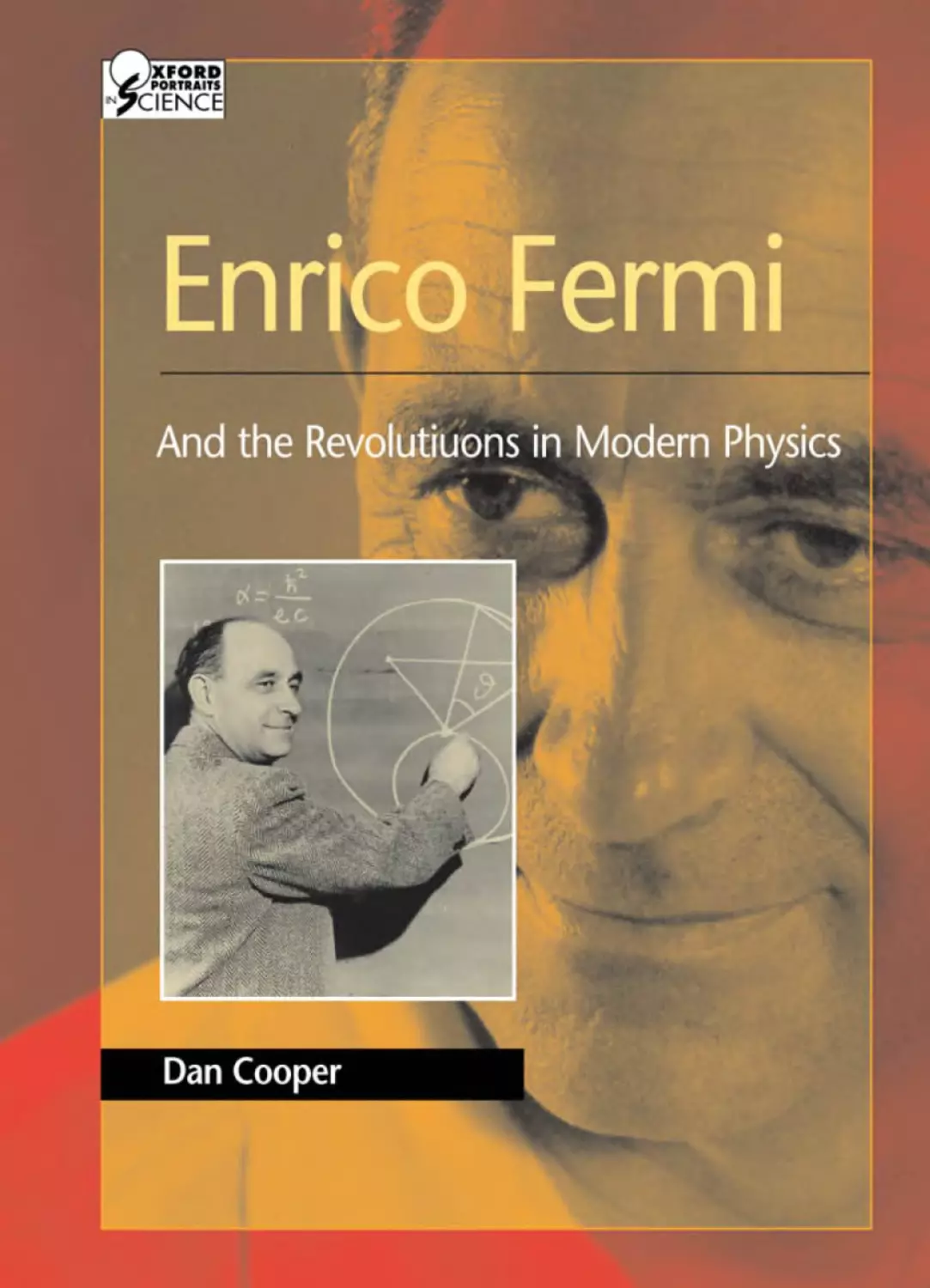
On the cover: Enrico Fermi at Los Alamos in 1946.
Inset: Enrico Fermi at the blackboard during one of his lectures.
Frontispiece: Fermi in 1930 as a full professor at the University of Rome.

4

Contents

Chapter 1: Born in a Revolution . . . . . . . . . . . . . . . . . . . . . . . .9
Chapter 2: Early Promise Fulfilled . . . . . . . . . . . . . . . . . . . . . . .19
Sidebar: Fermi-Dirac Statistics:
Helping Explain the World . . . . . . . . . . . . . . . . . .31
Chapter 3: The Road to a Nobel Prize . . . . . . . . . . . . . . . . . .32
Sidebar: Heisenberg’s Matrix Mechanics . . . . . . . . . . . . . . .41
Sidebar: The Nuclear Reactions That
Won a Nobel Prize . . . . . . . . . . . . . . . . . . . . . . . .53
Chapter 4: Racing to a Chain Reaction . . . . . . . . . . . . . . . . . .55
Chapter 5: Los Alamos and the A-Bomb . . . . . . . . . . . . . . . .71
Chapter 6: Science in Chicago, Service in Washington . . . . .89
Chapter 7: A Great Man Honored and Remembered . . . .105
Chronology . . . . . . . . . . . . . . . . . . . . . . . . . . . . . . . . . . . . . . . .110
Further Reading . . . . . . . . . . . . . . . . . . . . . . . . . . . . . . . . . . . .113
Index . . . . . . . . . . . . . . . . . . . . . . . . . . . . . . . . . . . . . . . . . . . . .115

In memory of
Professor David H. Frisch,
my teacher and guide
to the atomic nucleus

XFORD

SCIENCE
PORTRAITS

IN

Charles Babbage
Alexander Graham Bell
Nicolaus Copernicus
Francis Crick
& James Watson
Marie Curie
Charles Darwin
Thomas Edison
Albert Einstein
Michael Faraday
Enrico Fermi
Benjamin Franklin
Sigmund Freud
Galileo Galilei
William Harvey
Joseph Henry
Edward Jenner
Johannes Kepler
Othniel Charles Marsh
& Edward Drinker Cope
Gregor Mendel
Margaret Mead
Isaac Newton
Louis Pasteur
Linus Pauling
Ivan Pavlov

Image Not Available

Enrico Fermi (center) at age 4 with his older brother Giulio (left) and sister Maria.

CHAPTER

1
Born in a
Revolution
Enrico Fermi was born in the midst of a revolution. No
shots were fired, no governments were overthrown, but
Fermi’s revolution changed the world more than any fought
with guns. It was a revolution of ideas and inventions
brought on by increased scientific understanding of how the
physical world works. That revolution—with Fermi in the
forefront—led to the nuclear chain reaction and to the
atomic bomb, which has profoundly changed war and put
the very future of humanity at risk.
That revolution continues to this day because many
questions remain about the ultimate nature of matter and
energy. Matter and energy are the concerns of physicists,
and Enrico Fermi was, above all else, a physicist. You could
argue that he was the greatest physicist of his time.
There are two sorts of physicists. The first kind are
experimentalists; they conduct experiments in laboratories
to see how the physical world works. Then there are theoretical physicists; they use paper and pencil (or blackboard
and chalk or supercomputer) to develop mathematical models and derive equations and “laws” that explain how matter
and energy behave. Fermi has been called the “Complete
9

Enrico Fermi
Sir Godfrey Kneller, the
leading portrait painter of
his time, produced this
first portrait of Sir Isaac
Newton in 1689, when
Newton was 46. It was
not until dawn of the
20th century, when Fermi
was an infant, that
scientists revised
Newton’s theories.

Image Not Available

Physicist” because he was a superb experimenter and a brilliant theoretician—a very, very rare combination.
Of course, none of this could have been foreseen when
Enrico Fermi was born on September 29, 1901, in Rome,
Italy. His father, Alberto, had a secure position as a senior
administrator with the Italian railway system. Alberto’s
father Stefano was the first of the Fermis not to be a farmer.
10

Born in a Revolution

Alberto’s education was probably limited to technical high
school. Fermi’s mother, Ida, was an elementary-school
teacher. They married in 1898, and their children were
born one right after the other: Maria in 1899, Giulio in
1900, and Enrico a year later. There were no obvious signs
of revolution in that middle-class family.
Things were very different in 1901. So much of what we
take for granted today simply did not exist. Computers, television, and even radio had not yet been invented. Atomic
energy was the stuff of fiction; in fact, the atom was a blurry
idea about which there was more debate than knowledge.
But that was all about to change . . . a lot. The year 1901,
the year in which Fermi was born, can be considered the
birth of what is called modern physics, or atomic physics.
With the advantage of hindsight, we can see the peaceful
prelude and the gathering forces of revolution. What has
come to be called classical physics was thought to be in great
shape. Thanks to the work of giants of the past such as Isaac
Newton (1642–1727), there was a sound understanding of
the laws of motion. Whether it was billiard balls colliding or
the planets orbiting around the sun, Newton’s laws explained
how things moved. Building on the work of the Italian
physicist and mathematician Galileo Galilei (1564–1642), the
German astronomer Johannes Kepler (1571–1630), and others, Newton had set forth his three great laws of motion:
1. The first law, or law of inertia, states that objects at rest
would remain at rest (and objects in motion would continue in motion with no change in speed or direction)
unless acted upon by an external force—a push or a pull.
2. The second law says that when force is applied, objects
accelerate, their speed increases, and the rate of change
of speed is greater, the greater the force applied.
3. The third law asserts that for every action, there is an
equal and opposite reaction. For example, a runner’s
foot presses against the track, and the track presses back
on the runner’s foot in equal amounts.
11

Enrico Fermi
Those laws were a source of deep satisfaction for physicists. Combined with Newton’s theory of gravitation—the
universal force of attraction between all objects—they
explained the motion of the planets around the sun.
Physicists and astronomers could measure the positions of the
planets with telescopes. They could compare the measured
positions with those predicted by Newton’s Laws.
Measuring and predicting, predicting and measuring—that
was the business of physicists.
It was physics at its best. A few simple laws—and the
equations that expressed those laws—explain a wide, wide
range of observations. Astronomers could follow the movement of the planets with precision, predict the time of
eclipses, and foretell where each planet would be a year
from now with mathematical certainty.
Another great triumph of physicists had occurred closer
in time to Fermi’s birth. The Scottish theoretical physicist
James Clerk Maxwell (1831–79) had brought together the
theories of electricity and magnetism in a single theory of
electromagnetism. Maxwell’s equations were as powerful
and beautiful as Newton’s. What is more, Maxwell’s theories of electromagnetism predicted that moving electric
charges could produce electromagnetic waves and that those
waves moved with the speed of light. Indeed, Maxwell’s
theories strongly suggested that light itself was an electromagnetic wave. (The nature of light had been the subject of
dispute for centuries, but experiments by Thomas Young
(1773–1829) had confirmed its wavelike properties. Or so it
seemed; the revolution eventually upset that applecart too.)
As the 19th century drew to a close, these successes in
explaining the physical world led to smug feelings of satisfaction. Some people thought physics would soon be a
closed book, with everything understood. But cracks were
appearing in this seemingly flawless set of laws. The revolution was gathering force. It would overturn Newton’s laws
of motion, at least for ultra-small things such as atoms. And
12

Born in a Revolution

light did not always behave like a wave; sometimes it would
behave more like a stream of bullets. And there were new
wonders—strange new “rays”—in need of new Newtons
and Maxwells to explain them.
Nature was slyly revealing some of its true complexity.
In Ger many in 1895, Wilhelm Conrad Roentgen
(1845–1923) had discovered rays that could pass through
matter and create an image of the bones in his hand. These
penetrating rays seemed to arise when an electric discharge
struck the walls of his apparatus. Roentgen called these rays
“X rays.” We now know that X rays are electromagnetic
This X-ray of the hand of
waves, similar to light but of much higher energy (and
anatomist Albert von Kölliker
therefore better able to penetrate matter).
was taken on January 23,
Roentgen happened onto X rays and their effects by
1896 at the University of
accident, while studying how electricity goes through gases.
Würzberg, Germany, just
Physicists had been studying electric currents in gases for
weeks after Roentgen’s disfifty or more years. Perhaps there were other laboratories in
covery of X-rays at that
same institution.
which the effects of these X rays might have been discovered. But it remained for Roentgen
to scratch his head (or maybe it was
his beard) and be puzzled by those
unexpectedly flourescent spots and
penetrating rays, thereby opening an
enor mous new field of physics.
Accidental discoveries have played no
small part in experimental physics. (It
led to one of Fermi’s greatest discovImage Not Available
er ies and to his Nobel Pr ize.)
Successful researchers learn to explore
and exploit those accidents.
The year after Roentgen’s discovery, another surprise surfaced—a new
set of “rays.” In France, Antoine
Henri Becquerel (1852–1908) found
that certain materials gave off radiation that could darken sealed photo13

Enrico Fermi
graphic emulsions. This was the completely new phenomenon of radioactivity, the ability of some of the heavier elements—such as uranium, thorium, and radium—to emit
particles and high-energy X rays. Further investigation led
to the identification of three sorts of radiations, labeled
alpha, beta, and gamma for the first three letters of the
Greek alphabet. Alpha rays (or alpha particles) turned out to
be the nuclei, the cores, of helium atoms. Beta rays were
the same as electrons, the carriers of electric current. Unlike
alpha and beta particles, the gamma rays are electromagnetic
wave packets, similar to X rays but with even more energy
than most X rays. All of these new findings presented challenges and opportunities to physicists at the dawn of the
new century. Something big was happening; suddenly no
one felt smug and secure with what Newton and Maxwell
had figured out.
There were other discoveries besides those in the laboratories. The physicists who write theories and do mathematical calculations to explain those laboratory results were
busy too. These theoretical physicists were grappling with a
problem that Maxwell’s equations alone could not handle. It
concerned the light emitted by objects heated until they
were red-hot and glowed. Existing laws led to the impossible conclusion that infinite amounts of energy should be
radiated away. The theory also said there would be more
and more energy radiated as you went to shorter wavelength, to the blue and violet end of the light spectrum.
That made no sense. (They referred to this problem by the
colorful name “the ultraviolet catastrophe.”)
The Ger man theoretical physicist Max Planck
(1858–1947) finally solved this “black-body radiation
problem” in the year 1900. The predictions of Planck’s
new theory were in excellent agreement with the measured amounts and color of the emitted light. To get this
ag reement, Planck had to introduce the idea of a
quanta—fixed amounts—of energy. This was no mere
14

Born in a Revolution

technicality. Planck’s constant, h, which
tells the size of the quanta of energy,
enabled Planck to make theory and
experiment agree.
Even though he did not fully appreciate it himself, Planck’s theory was
every bit as revolutionary as those puzzling new rays the experimental physicists were discovering. Indeed, Planck’s
Image Not Available
new theory was even more revolutionary, for it provided the first glimmer of
understanding of a fundamental aspect
of nature. The assumptions built into the
theories of Newton and Maxwell were
not universal truths. Not all orbits were
possible; not all distributions of radiated
light were possible. The idea of the
quantum was more appropriate to the
world of the atom that was already coming fully into view.
Max Planck introduced
Changes were coming, too, to the elusive concept of
the concept of quantized
the atom. The word is derived from the Greek a, meaning
energy through his theory
not, and tom, meaning cuttable or divisible. The idea that
of “black-body” radiation.
everything was made of atoms, of tiny bits that could not
be divided further, had been around for a long, long time,
since the days of Democritus, the 4th century B.C. Greek
philosopher who first advanced the idea and named the
atom. But that was just philosophical speculation unsupported by experiment or theory.
Some insight into the nature of atoms came from the
work of chemists, who developed the laws that govern
chemical reactions. The English chemist John Dalton
(1766–1844) added credibility to the idea of atoms by
assigning numbers to indicate relative weights of elements
combined in given chemical compounds. While no one
knew the weights of individual atoms, the fact that they
15

Enrico Fermi

Alpha particles, entering
from left, are scattered
by a thin metal foil. Most
alphas are only slightly
deflected, but the few
that recoil at large
angles prove atoms have
a dense, central nucleus.

combined in known proportions helped chemists (and
physicists) believe in the underlying idea of atoms.
Dalton had published his work at the beginning of the
19th century, but it was not until a hundred years later, in
the early years of the 20th century, that experiments led to
our modern picture of the atom. This was a result of experiments in the Manchester, England, laboratory of Ernest
Rutherford (1871–1937). Rutherford’s experiment consisted of placing a source of alpha particles in front of a small
hole and then watching how they are deflected after they
strike a thin sheet of gold foil. (One can “see” the deflected
alpha particles by having them strike a surface coated with
the same sort of fluorescent material that makes a television
screen give off light.) Most of Rutherford’s alpha particles
passed through the foil without substantial change in direction. But a few changed their direction a modest amount,
and some changed their direction by a large amount. About
1 in 8,000 was turned through an angle as large as 90
degrees, and some were turned even farther around—almost
back to the direction from which they had come.
Now this was a most startling result. It was, Rutherford
later wrote, “. . . about as credible as if you had fired a
15-inch shell at a piece of tissue paper and it came back and

Image Not Available

16

Born in a Revolution

hit you.” Here is this fast-moving alpha particle hurtling at
that thin gold foil; one would expect it to go clear through
and never to be deflected through such a large angle. That
incoming alpha particle must have hit something much
heavier than itself. Such a result could best be understood if
the target gold atoms had their mass concentrated in a small
region in the center of each atom. To that region, the heart
of the atom, Rutherford gave the name the nucleus.
What physicists had, as a new century proceeded, were
some puzzling new “rays,” a model of the atom with most
of its mass concentrated in a central nucleus, and the seed,
in Max Planck’s idea of the quantum, for a deeper understanding of the nature of the atom. Those revolutions in
physics were well underway.
Scientific revolutions do not happen overnight, however. It would be many years before the new discoveries and
new theories were fully understood. There would be time
enough for young Enrico Fermi to grow up and be a major
player in the evolving revolution in physics.

17

Image Not Available

Enrico Fermi at age 17, when he entered the University of Pisa to study for his Ph.D. in physics.

CHAPTER

2
Early Promise
Fulfilled
Maria Fermi was two years older than her brother Enrico,
and Giulio was one year older than Enrico. Because the
two boys were born so soon after their sister, they were
sent to a farm community to live with a wet nurse—a
woman who breast-fed them. (In those days, that was not
unusual.) Enrico was two and a half before he rejoined his
family.
Being so close in age, the three children spent much of
their playtime together. Enrico and Giulio were especially
close, a bond made even closer by the younger brother’s
shyness. Mrs. Fermi, a former schoolteacher, had high standards in all matters. She was conscientious—“to a fault”—
and expected much of her children. All three children were
bright and did well in school. Enrico was regularly at the
head of his class without spending all his time studying.
Enrico’s directness produced few flourishes in composition
exercises but was well suited to a “just-the-facts” approach
in scientific papers.
In 1908 the Fermis moved, within Rome, to a large
apartment building at Via Principe Umberto 133. It was a
bare-bones apartment with a toilet but no built-in bathtub,
19

Enrico Fermi
which meant the Fermi children used a portable tub to
bathe. There was no heat of any kind, so the children often
suffered from the cold. In later years, Fermi told of keeping
his hands warm by sitting on them as he studied, turning
pages with his tongue to avoid losing the precious heat
stored in his hands. It was not an easy life but the sort that
builds character and toughness.
Emilio Segrè, longtime student, friend, and colleague,
tells, in his biography, Enrico Fermi, Physicist, of Fermi’s
prodigious memory, evidenced by his ability to learn long
passages of Italian poetry and recite them many years later.
Fermi must have benefited from his good memory and
brightness, for he did well in the demanding curriculum at
the middle school (ginnasio, in Italian) that youngsters
entered at age 10. There were many subjects, including
Latin, Greek, history, geography, mathematics, physics, natural history, philosophy, and, of course, Italian. And these
were difficult courses, taught by demanding teachers. Fermi
was, Segrè reports, “easily the best in his class.”
Fermi was not a “nerd,” or a bookworm, or inclined to
spend all his time studying. Fermi was active in sports and
very competitive. If it was a hike in the mountains, he
wanted to be first to the top. At soccer, he played to win.
When swimming, he was the first one into the water, no
matter how cold. At least that is the way he was in later
years, and that kind of competitiveness is not learned in the
library nor much changed with the passage of time.
Fermi was also orderly in his work habits, so he had
time left over after his schoolwork for independent
reading—especially in science. Even as early as age 10, he
later told Segrè, he wrestled with problems in algebra and
geometry.
Fermi had a natural bent for mathematics, but physics
was his first love. That led him, in his early teens, to use part
of his spare time and some of the money saved from his
allowance to buy used physics books at the stalls that lined
20

Early Promise Fulfilled

the Roman market called Campo dei Fiori (or Field of
Flowers).
That interest in math and physics stood Enrico in good
stead when tragedy struck the Fermi family in the winter of
1915. Fer mi’s brother, Giulio, died unexpectedly.
Something had gone wrong during what should have been
a routine operation to remove an abscess in his throat.
Giulio had been Enrico’s inseparable best friend. They had
played together, built toy electric motors together—things
like that. What is more, Giulio had been the livelier, the
more outgoing, of the two and thus a shield and guide for
his somewhat shy younger brother. It was a great loss for
Enrico, a loss that he overcame in part by becoming even
more involved in science and science books.
For the boys’ mother, it was devastating. Giulio had
been her favorite, and now he was gone. Mrs. Fermi
became depressed and was never again quite the same. The
loss of a child disturbs the natural order of things. It is a terrible blow for any parent, and Ida Fermi was a particularly
loving mother.
In this time of loss and great need, Enrico Fermi was
fortunate to find a new friend, a schoolmate at the high
school, the liceo. His name was Enr ico too—Enr ico
Persico—and he shared Fermi’s strong interest in physics.
They became fast friends, a friendship that lasted a lifetime
and led them, years later, to work together on the rejuvenation of Italian physics.
Persico would join Fermi on his trips to the used-book
market and would share the books they bought. They also
tried some simple experiments together. For example, they
found a way to measure the strength of the earth’s magnetic
field. These two young men also tried to figure out why a
spinning top can stay balanced on its tip, but they did not yet
have the background to understand the mathematics of tops.
Fermi would soon come to understand why spinning
things are stable and a lot more, for he met another helpful
21

Enrico Fermi
influence in his life—a mentor who would help with the
important next stage of going off on his own, to college and
beyond.
Fermi had begun to meet his father, Alberto, at his railroad office; they would then walk home together. It was a
way for them to heal the loss they both felt in the death of
Giulio. They were often accompanied by a colleague of
Fer mi’s father, a man named Adolfo Amidei. Unlike
Alberto, who had little technical training, Amidei was a
university-trained engineer. Knowing that, Enrico began to
ask questions and seek answers to fill the many voids in his
knowledge of mathematics and physics.
From the first, Amidei could see that Fermi was, as he
put it, “a prodigy.” Fermi, though only 13 at the time,
devoured a book that Amidei lent him, a book on a difficult
branch of geometry. In a couple of months, Fermi returned
the book, having done all its problems, including many that
Amidei had found too difficult. They went on, over the
next four years, to books on trigonometry, analytical geometry, calculus, and something called theoretical mechanics.
(After this last book, the theory of spinning tops and gyroscopes was well within Enrico’s scope.)
Amidei was also struck, as others had been, by Fermi’s
marvelous memory. For example, when Enrico returned
the calculus book, he turned down Amidei’s offer to let him
keep it, saying he could recall its content as needed. Clearly,
this was a remarkably talented person, and Amidei thought
hard about where Enrico should go to college.
Of course, there was a fine university right there in
Rome. But Amidei argued for the University of Pisa. In
Pisa there was also the Scuola Normale Superiore. A Scuola
Normale, or Normal School, usually meant a school for
training teachers, but the Scuola in Pisa had evolved into
something both more and less than that. It was more in that
it was now an elite institution, with enrollment limited to
about 40 of the best and the brightest in all of Italy, so being
22

Early Promise Fulfilled

The Scuola Normale
Superiore was housed in
the Palazzo dei Cavalieri
in Pisa. Fermi attended
the Scuola as well as the
University of Pisa.

Image Not Available

accepted there was a mark of distinction. But it was no
longer an institution for training teachers. Rather, the
Scuola provided free board and lodging for students
enrolled at the University of Pisa, where most classes were
held. That was where a person of Fermi’s brilliance should
study, Amidei reasoned. So Amidei proposed a dual enrollment: Enr ico was good enough to go to both the
University of Pisa and the Scuola Normale at the same
time.
Amidei’s reasoning went beyond issues of curriculum.
He saw that it would be good for Enrico to get away from
his parents’ home. Healthy adolescent separation—important in every life—was particularly important in this case
23

Enrico Fermi
because the atmosphere in the Fermi household continued
to be mournful and depressing.
The Fermis were not happy. The idea of their one
remaining son going off to Pisa for the next four years did
not sit well with them. But Amidei and Enrico joined
forces and patiently, tactfully helped bring them around.
There was a competitive exam for admission to the
Scuola Normale. In a word, Fermi creamed it. Given the
subject, “Characteristics of Sound,” he responded with an
essay that went far beyond what would be expected of a high
school graduate. Here was this young man, barely 17, armed
with advanced mathematical tools worthy of a person who
had a postgraduate degree. The examining professor could
hardly believe his eyes. He sought out Fermi to tell him he
had never seen the like in all his years and that, of course,
Fermi would be accepted at the Scuola with a full scholarship. It was a great boost to Fermi’s morale and a great sendoff as he left Rome for four very important years in Pisa.
The Scuola was housed in a palace. That may sound
great, but old Italian palaces are not luxurious. Once again
the living conditions were tough—cold rooms, no hot
water. However, Fermi was used to that, and here he was in
Pisa, with its Leaning Tower from which the great Galileo
had conducted his experiments on falling bodies. That
warmed his soul.
Fermi soon found a friend and soul mate, a student at
the university named Franco Rasetti. Like Fermi, Rasetti
was very interested in science; like Fermi, Rasetti had a
prodigious memory. And like Fermi, he was so good at his
college studies that there was time left over for hikes in the
coastal mountains. A further outlet for their youthful enthusiasm was playing pranks. These pals organized an
“anti-neighbor society,” devoted to such noble pursuits as
mock duels on the rooftops of Pisa. Sometimes they would
slip small padlocks through the buttonholes of fellow students who had been distracted by an accomplice.
24

Early Promise Fulfilled

It was also a good environment for learning still more
physics. Fermi and Rasetti soon had the run of the undergraduate laboratory, because the elderly professor in charge
could no longer keep up with the rapidly expanding field
of modern physics. In fact, he turned the tables and asked
Fermi to teach him about the theory of relativity, the revolutionary rethinking of space and time that had been
developed by the German theoretical physicist Albert
Einstein (1879–1955). Not given to false modesty, Fermi
was able to write to his friend Enrico Persico that “At the
physics department I am slowly becoming the most influential authority.” And it was true; brilliant and largely
self-taught, Fermi was powerfully equipped to learn still
more physics.
The depth of Fermi’s knowledge of physics and mathematics, even after only one year of college, is documented
by a notebook he created during the summer of 1919. In it
he systematically set forth the theories of mechanics and the
structure of matter he had taught himself. He then goes on
to treat Planck’s revolutionary theory of radiation and other
advanced subjects. That notebook is preserved, along with
most of Fermi’s papers, at the University of Chicago’s
Joseph Regenstein Library. It shows the clarity of Fermi’s
thinking and the remarkable range of his learning, even as a
college freshman. It also demonstrates his preference for
theories that reveal the underlying physics of the subjects
being treated. He was not interested in fancy mathematics
for its own sake; he wanted to understand what was really
going on, how nature itself worked.
Fermi created that notebook from memory. His powerful memory kept things he had learned fresh in his mind, a
quality that served him all the days of his life. He also was
good at languages and learned German. In those days
Germany led in science, and being able to read its scientific
journals would be one more advantage for this young man
on his way to a distinguished career.
25

Enrico Fermi
By the fall of 1920—the end of his sophomore
year—Fermi had completed all of the standard courses at the
University of Pisa and was able to take advantage of a very
special opportunity. Because the First World War had depleted the preceding classes of graduate students, there were
none who might otherwise have crowded the university’s
physics research laboratory. Once again, Fermi and Rasetti
had free access to the graduate research laboratory as they
once had in the teaching lab. While it was less well equipped
than a top-notch lab would have been, it was all theirs.
Fermi chose to do experiments with X rays and made
that the subject of the dissertation required for his doctoral
degree at the university. At first glance, an experimental
thesis might seem an odd choice because Fermi had enormous talent as a theoretician. In fact, he had already submitted his first theoretical paper for publication. But Italy had
not participated in the great growth in theoretical physics
elsewhere in Europe. Fermi simply could not get a degree
as a theoretical physicist. No great loss, though, because
Fermi was equally at home as an experimentalist, unlike
most theoreticians who are ill-suited to the demands of laboratory life. His great competence in both sides of physics
strengthened his ability to become a leader in each.
Enr ico Fer mi received his deg ree of Doctor of
Philosophy in physics from the University of Pisa in July of
1922 and a diploma certifying to his status as a graduate of
the Scuola Normale Superiore at the same time. Fermi
returned to Rome to rejoin his family and build connections
to the physics and mathematics communities in Italy’s capital.
He was 21 and eager to put his great knowledge of
physics to work at a leading university. But opportunities
were few and far between. Even though Fermi’s brilliance
was widely recognized, there just were no openings.
Openings came only when a new post was created or when
a professor died and a competition was held to fill the post.
Fermi knew that winning one of those competitions
26

Early Promise Fulfilled

depended on having a record of published scientific papers,
and he already had six fine papers to his credit. But there
simply were no open professorships.
There was an alternative, however. There is a great tradition in science of postdoctoral studies abroad. It is a fine
way to broaden one’s acquaintance with other scientists and
to learn how things are done at the universities of another
country. Fermi handily won the competition for the one
such fellowship available in the year of his graduation, and
he used it to study at the University of Göttingen in
Germany during the winter of 1922–23. There the great
physicist Max Born (1882–1970) had built a center for theoretical physics that attracted brilliant postdoctoral students
from abroad. Fermi was brilliant; he knew German and
spoke it well; Born and his wife were friendly. Yet somehow
they did not click professionally, or perhaps it was Fermi’s
shyness and reserved nature that was his undoing. Or it may
have been the presence in Göttingen of other brilliant
young theoretical physicists, at least two of whom were
writing papers with Professor Born. Fermi wrote some
papers, too, but on his own. In any event, it seems that he
failed to fully exploit the opportunities of this year abroad.
October 1922 marked a profound gover nmental
change in Italy. The Fascists, led by their dictator Benito
Mussolini, marched on Rome and took over the government. Fermi recognized from the start that this change was
not good for democracy or for science in Italy. Ultimately,
it led him to leave the land of his birth, but a long road lay
ahead.
In the meantime, the seeds of a happier career move
than Göttingen had already been planted. Fermi had made
a point of getting to know Orso Mario Corbino, who was
the head of the Institute of Physics at the University of
Rome. They had met several times before Fermi went to
Germany, and Corbino had been very impressed. When
Fermi returned from Göttingen, Corbino was able to
27

Enrico Fermi
arrange for Fermi to teach a couple of physics
courses at the University of Rome for the academic year 1923–24. Also in 1924, both of Fermi’s parents died. Though they did not see the full flowering of his accomplishments to come, they had
ample reason to be proud of him.
That was followed by another fellowship, this
Image Not Available
time in Holland, at the University of Leyden in the
fall of 1924, under the Dutch physicist Paul
Ehrenfest (1880–1933). This fellowship went well.
Fermi’s interest in what is called statistical mechanics stems from this period and eventually flourished
in what is known as Fermi-Dirac statistics, which is
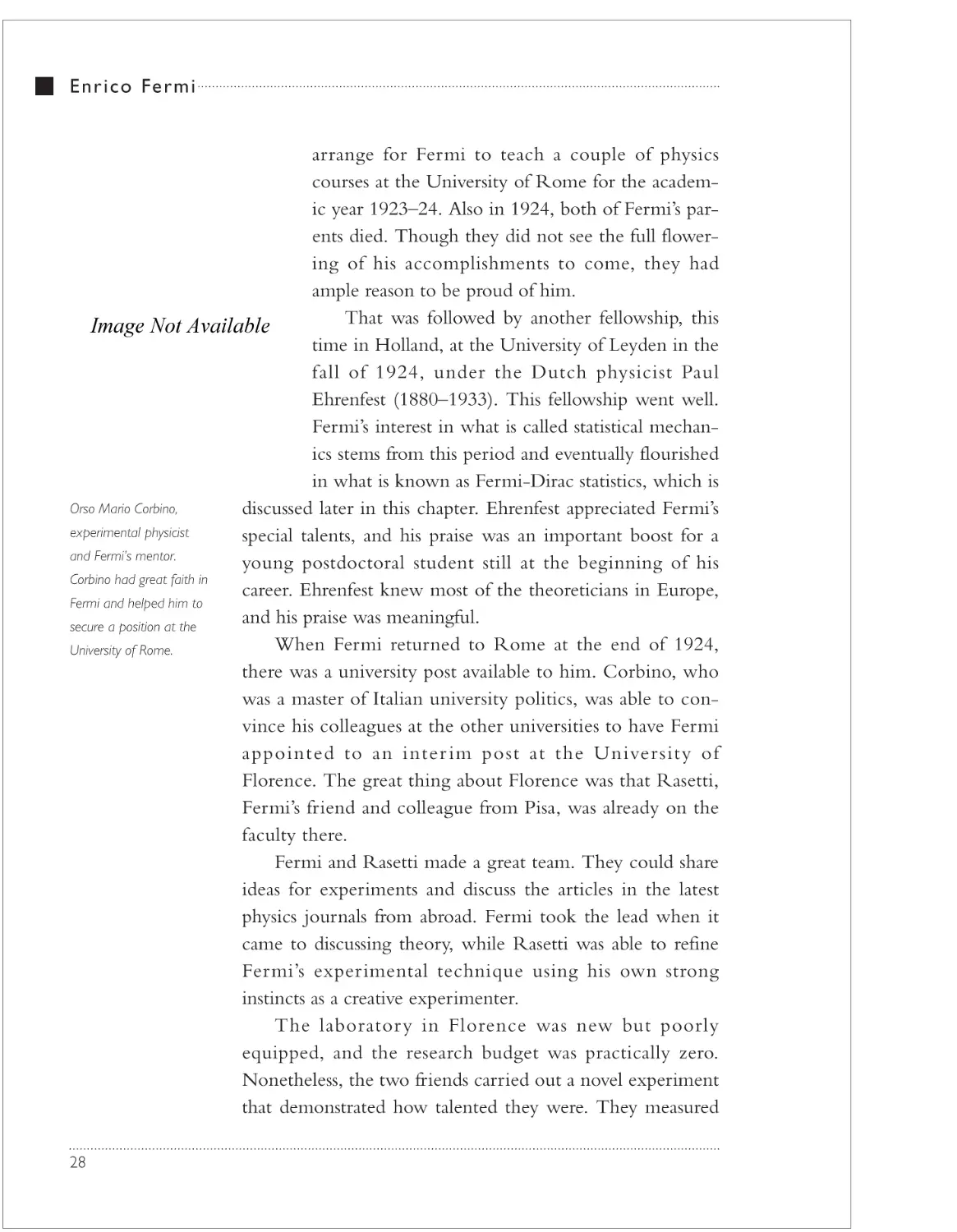
Orso Mario Corbino,
discussed later in this chapter. Ehrenfest appreciated Fermi’s
experimental physicist
special talents, and his praise was an important boost for a
and Fermi’s mentor.
young postdoctoral student still at the beginning of his
Corbino had great faith in
career. Ehrenfest knew most of the theoreticians in Europe,
Fermi and helped him to
and his praise was meaningful.
secure a position at the
When Fermi returned to Rome at the end of 1924,
University of Rome.
there was a university post available to him. Corbino, who
was a master of Italian university politics, was able to convince his colleagues at the other universities to have Fermi
appointed to an inter im post at the Univer sity of
Florence. The great thing about Florence was that Rasetti,
Fermi’s friend and colleague from Pisa, was already on the
faculty there.
Fermi and Rasetti made a great team. They could share
ideas for experiments and discuss the articles in the latest
physics journals from abroad. Fermi took the lead when it
came to discussing theory, while Rasetti was able to refine
Fermi’s experimental technique using his own strong
instincts as a creative experimenter.
The laboratory in Florence was new but poorly
equipped, and the research budget was practically zero.
Nonetheless, the two friends carried out a novel experiment
that demonstrated how talented they were. They measured
28

Early Promise Fulfilled

Image Not Available

how a varying magnetic field would affect the light emitted
by a mercury vapor lamp—that is a lamp that generates
light by passing an electric current through a gas made up
of mercury. (Many modern highway lights are descendants
of those early laboratory tools.) Similar experiments had
been done with steady magnetic fields, but it was Fermi
who recognized that using a varying field would give new
insight into what went on when atoms were in magnetic
fields. Light is emitted when mercury atoms, excited by the
passage of that electric current, return to their normal or
“ground” state.
Fermi easily calculated that a varying magnetic fields of
radio waves at a frequency of 1–5 million cycles per second
(1–5 megahertz) would be absorbed and produce measurable changes in the emitted light. They scrounged up some
vacuum tubes and hand-wound the coils that were also
needed to produce electromagnetic waves of the desired
frequencies. The experiment worked the first time out—a
considerable accomplishment given the marginal nature of
their equipment and their lack of previous experience with

Fermi (far right) with
Franco Rasetti (left) and
Nello Carrara on a mountain-climbing expedition
in the 1920s. Fermi was
an avid hiker all his life.

29

Enrico Fermi
radio waves. This was a completely new experimental technique, one that opened the new field now known as
radiofrequency spectroscopy—the study of atoms and molecules by means of the radio waves they absorb. Others
might have built an entire career on that interesting start.
For Fermi and Rasetti, it was another paper, a nice bit of
physics, and another step toward getting a permanent academic appointment.
In 1925 there was a competition for a professorship at a
minor university. Fermi lost out to an older candidate. But
that disappointment did not stop him. Shortly thereafter he
wrote his most important theoretical paper, one that put
him firmly on the list of world-renowned physicists. It was
work that has come to be known as Fermi-Dirac statistics.
(Paul Dirac [1902–84] was a very creative British physicist
who came up with a similar theory shortly after Fermi did.)
This was just the first of many important concepts that bear
Fermi’s name.
Finally, a breakthrough came in 1926. Convinced that
the prejudice against theoretical physics at Italian universities
was harming Italy’s future, Corbino broke the log jam. A
competition was held for a chair of theoretical physics at the
University of Rome. Competitors included Fer mi’s
high-school classmate, Enrico Persico, but the 26-year-old
Fermi won hands down. As the official notice said, “Fermi,
even at his young age and after very few years of scientific
activity, already highly honors Italian physics.”
Fermi would now return to Rome, rejoin his friends
and sister, and more than fulfill that promise. Great things
lay ahead.
<st>Fermi-Dirac Statistics: Helping Explain the World

30

Early Promise Fulfilled

FERMI-DIRAC STATISTICS: HELPING EXPLAIN THE WORLD

ermi-Dirac statistics concerns the way in
which to calculate the properties of a group
of particles such as electrons, neutron, or
protons. Those particles are called fermions in
recognition of Fermi’s pioneering role in writing
the theory of their group behavior. A physicist Image Not Available
might also refer to them as “particles of spin
1/2.” The idea of spin arose in early models of
the atom, which envisioned electrons orbiting
around a nucleus and spinning like a top at the
same time. Things being restricted to only certain Wolfgang Pauli, the AustrianSwiss physicist and creator of
values in quantum mechanics, the spin of these
the “exclusion principle” that
particles could only be 1/2, 3/2, 5/2, etc. The bears his name. It says, in
restrictions were first noted by the Austrian essence, that no two fermions
physicist Wolfgang Pauli (1900–58). According to can be in the same quantum
Pauli’s “exclusion principle,” no two fermions state (and thus have the
can have the same quantum numbers; in a sense, same quantum number).
they cannot be in the same place at the same time.
This seemingly simple idea explains much of how the physical world
works. For example, it explains how in going from helium to lithium in
the periodic table, that third electron orbiting around the lithium nucleus must be off by itself, making lithium very active chemically, while
helium is a very inert, noble gas. Fermi statistics explain ever so much
more: how metals and semiconductors conduct electricity, why some
substances are hard, even the workings of neutron stars and other astronomical entities.
Incidentally, the other sort of particles, those with spin equal to zero,
one, two, or any other integer (photons, the particles of light, are one
example), obey what is called Bose-Einstein statistics and are called
bosons. Here, the Pauli exclusion principle does not apply, and many
photons can be in the same state at the same time. That in turn is what
makes lasers possible.

F

31

CHAPTER

3
The Road to a
Nobel Prize
Fermi was now a professor. That meant he had tenure—the
position was his for life. With that security, Fermi could
start on the large goal he had set for himself: to revolutionize physics in Italy. He would bring the revolution in
physics, already underway elsewhere in Europe, into the
classrooms and research laboratories of his native country.
That was the task he and his mentor, Professor Corbino,
knew had to be done if Italy was to be a serious participant
in the development of modern physics.
Corbino had grasped that Fermi was the right person
for this tough job. Fer mi was a br illiant physicist,
well-schooled in classical physics—the theories of mechanics and electromagnetism that had been so carefully refined
in the preceding century. And Fermi had not stopped there;
he had kept up with the most recent developments. He had
religiously read the scientific journals from Germany and
England containing the latest puzzles and the most recent
understanding of modern physics. Fermi wanted Italy to be
where the action was: in X-rays, radioactivity, and the
physics of the atom and its nucleus. On the theoretical side,
there was quantum mechanics—those new theories so dif32

Image Not Available

Image Not Available

Enrico and Laura Fermi in their bright-yellow Peugeot. Fermi thought he could afford a car or a wife but not both; Laura proved him wrong.

Enrico Fermi
ferent from the classical mechanics of Newton and Italy’s
own Galileo. Many of the older physicists in Italy—and
elsewhere—resisted quantum mechanics, as older people in
every field are likely to resist the new, the revolutionary.
Not so for young Fermi; he embraced the new theories,
even if he himself sometimes found them puzzling.
Quantum mechanics governs the behavior of the smallest units of matter—atoms and their nuclei. It is a strange
realm in which our everyday experience with objects and
how they move must be set aside because it no longer
applies. In the atomic realm, we must abandon the certainties of Newtonian theories of forces and motion. Newton’s
laws serve well to explain the motion of large
objects—everything from a baseball and bat to our moon
orbiting the Earth—but they simply do not fit the way
nature behaves when it comes to atoms and their constituents. What experiments showed was that particles (such
as electrons) sometimes behaved like waves, and light waves
sometimes behaved like particles. For example, the electron,
which scientists were used to picturing as a particle, a tiny
chunk of matter, could exhibit the properties of waves, producing “interference” patterns similar to those observed
with light waves. The classic demonstration of such interference patterns in the case of light waves was the simple
experiment first conducted by Thomas Young (1773–1829),
an English physician and physicist. Light from a source passes first through a single slit and then through a pair of slits,
side by side and parallel to the first slit. The light then
strikes a screen. What one sees on the screen is a pattern of
bright “lines” separated by dark spaces.
What causes this phenomenon? In the bright regions,
the crests of light waves emerging from the two slits are
interfering constructively, adding to each other. In the dark
regions, crests from from one combine with troughs from
the other and the interference is destructive.
The same phenomena have been observed with elec34

The Road to a Nobel Prize

trons, neutrons, and other particles, demonstrating their
wavelike nature. But light is a wave, and electrons were
thought to be particles. Quantum mechanics says they can
each be both. Even open-minded Corbino found it hard to
accept the quirky quantum theories needed to explain such
duality in the world of the atom.
Overcoming those resistances—making quantum theory
respectable in the eyes of the older generation and teaching
its wonders to a new generation of physicists—was high on
the list of tasks before Fermi. Modern physics had to become
part of the curriculum, part of the research effort, part of the
scene in Italy as it was in other countries of Europe.
Fermi—with his mentor Corbino looking on approvingly—began a three-pronged approach. First, he wanted
to convince at least a few g raduate students at the
University of Rome to learn modern physics. Second, he
wanted to start a program of experiments and research in
the new physics. And third, he wanted to propagandize for
the revolution: to give popular lectures, write articles, and
do one further thing that was new in Italy: write a textbook on modern, atomic physics.
Fermi tackled the textbook issue head-on. He devoted
his first summer as a professor to writing that book, a slim
volume entitled Introduzione alla fisica atomica (Introduction
to Atomic Physics). His friend and biographer, Emilio
Segrè, admiringly records how Fermi went about writing
the book: Lying on his back at his vacation spot in the
Dolomite mountains in northeastern Italy, Fermi wrote
from his deep knowledge and excellent memory. He wrote
flawlessly, using pencils, but “there are no erasers on Italian
pencils” Segrè points out. The textbook was published the
next year.
Recruiting graduate students proved more difficult.
Corbino spread the word among his own engineering students. Only one of them came over to study under Fermi,
but he was very special. That early student was Eduardo
35

Enrico Fermi
Introduction to Atomic
Physics, the textbook that
opened Fermi’s campaign
to bring modern physics
to Italy.

Image Not Available

Amaldi, who had met Fermi previously through his father, a
leading Italian mathematician. In addition, young Emilio
Segrè, who had heard Fermi lecture a few years before and
learned more about his work through mutual friends, asked
to leave engineering and study physics under Fermi.
Corbino—ever the effective administrator—cut through the
red tape to make it happen. Both Amaldi and Segrè would
stay with Fermi, join him in his research, and eventually
become professors in their own right.
Fermi knew the man he wanted to start building a program of experiments in atomic physics. It was Franco
Rasetti, his friend from their student days in Pisa. They had
also worked together as postgraduate researchers in
36

The Road to a Nobel Prize

Florence, but Rasetti had stayed behind when Fermi moved
on to Rome.
Once again Corbino attended to the politics; early in
1927, he arranged for Rasetti to be appointed as his personal assistant in Rome. It was a good choice—there was
great camaraderie between Fermi and Rasetti and an
important intellectual partnership as well. Just as before,
Fermi could deepen Rasetti’s understanding of the new
quantum theories of the atom, while Rasetti could continue to bring Fermi into flower as an experimentalist.
With teachers Fermi and Rasetti and students Amaldi
and Segrè, the beginnings of a modern-physics group had
been assembled. Still others soon joined—from the classes
in electricity and modern physics that Fermi taught. Each
week Fer mi held an infor mal seminar in his office.
Seminars are a great way for professors to pass along their
learning and style of thinking, and Fermi was gifted in this.
There was no fixed seminar program. Instead, someone
usually had a question about a topic of interest. Whatever the
subject, Fermi was able to speak clearly about it, drawing on
his wide knowledge of physics. Often Fermi would share the
work he was doing. Employing what Segrè has called “the
eloquence of example,” Fermi built up in his students an
enthusiasm for physics and a willingness to work hard to be
like him. It is sometimes said that graduate students are an
extension of their professor’s personality, and the growing
Fermi school had a particularly inspiring model.
It was not all work, however. Fermi and Rasetti kept
up their love of hiking and competitive sports. Both bought
cars. Fermi’s was a tiny, bright-yellow convertible Peugeot
that looked like something out of an old-time comic strip.
Fermi would spare no effort to keep his car—dubbed “The
Bébé Peugeot”—running. It broke down regularly, giving
Fermi many opportunities to demonstrate his experimental
ingenuity. (On one occasion, Fermi used the belt from his
trousers to replace a broken fan belt.)
37

Enrico Fermi
The two pals and their friends would drive into the
countryside around Rome. One of the group was Laura
Capon, a student of science at the University of Rome.
Laura was 16 and Enrico 24 when they first met—on a
spring Sunday in 1924. He joined a group of her friends
and rode a streetcar to what was then countryside, at the
confluence of the Aniene and Tiber rivers outside Rome.
Fer mi took over from the outset, showing an easy
self-reliance, a ready smile, and spontaneity that she found
attractive.
They played soccer, with Laura, a complete novice,
assigned by Fermi to the job of goalkeeper on his team. She
saved the day and won the game for them after Fermi stumbled and fell because of a broken shoe. In her memoir,
Atoms in the Family, Laura Fermi says, “That was the first
afternoon I spent with Enrico Fermi and the only instance
in which I did better than he.”
It was to be more than two years before they met again,
this time in July of 1926 at a vacation spot in the Dolomite
mountains. Laura’s parents were vacationing there, and
Fermi came for the summer before taking on his new job as
professor in Rome. Once again Fermi took the lead, organizing hikes in the surrounding mountains. “At first sight he
gained my [Laura’s] mother’s confidence, and I . . . was permitted to go on excursions planned by him,” she writes.
(Clearly, the constraints on the activities of a young woman
of 19 were more severe then.)
Things progressed from there, with many meetings at
friends’ homes after Fermi was established in Rome. Even
though Laura had planned to follow a career and not marry,
and even though Enrico had described his specifications for
a wife in terms that Laura did not meet, and even though
Fermi had said he could afford the Peugeot or a wife but
not both, love worked its magic. He got both—the girl and
the car. Indeed, the little car helped Fermi in courting her,
and she became Mrs. Fermi on July 19, 1928. Professor
38

The Road to a Nobel Prize

Image Not Available

Fermi was late for his wedding: the sleeves of his new suit
were three inches too long, and he needed to fold and sew
them to size.
The Fermi’s had two children, a daughter, Nella, born
in January 1931, and a son, Giulio, born in February 1936.
Family photographs show Fermi holding the infant Nella
rather gingerly; it seems clear that the certainty with which
he approached a physics experiment was not matched by
his confidence as a young father.
Fermi’s first love was for physics and sharing what he
knew in seminars. A frequent subject at the seminars was
the new wave mechanics, a way of explaining quantum
theory that had been published by the Austrian physicist
Erwin Schrödinger (1887–1961) only the year before
Fermi’s arrival in Rome.
Schrödinger had formulated a mathematical way to
express the underlying idea of quantum theory, that the
location and the speed of an atom could not be determined
with the certainty that Newton had assumed in writing

Fermi (center foreground)
at his 1928 wedding to
Laura Capon (with flowers).
The naval officer is her
father; to his immediate
left is Mario Orso Corbino,
Fermi’s best man.

39

Enrico Fermi
Erwin Schrödinger, the
Austrian theoretical
physicist, around 1933.
Schrödinger developed his
wave-mechanics equation
to describe motion at the
atomic level.

Image Not Available

about orbiting planets. In the world of the very small, a different approach is required. Schrödinger postulated a wave
function that expressed the probability of a particle being at
any particular location. It was not easy for those brought up
on classical physics to accept, but it worked—it gave the
right answers when applied to simple physical situations
such as the hydrogen atom with its single electron orbiting
around a nucleus consisting of a single, positively charged
proton. Fermi liked Schrödinger’s way. Ever energetic, he
quickly published several papers that were extensions and
applications of wave mechanics.
Fermi always wanted the physics to be in evidence. The
physicist Hans Bethe, who had spent time with Fermi in
40

The Road to a Nobel Prize

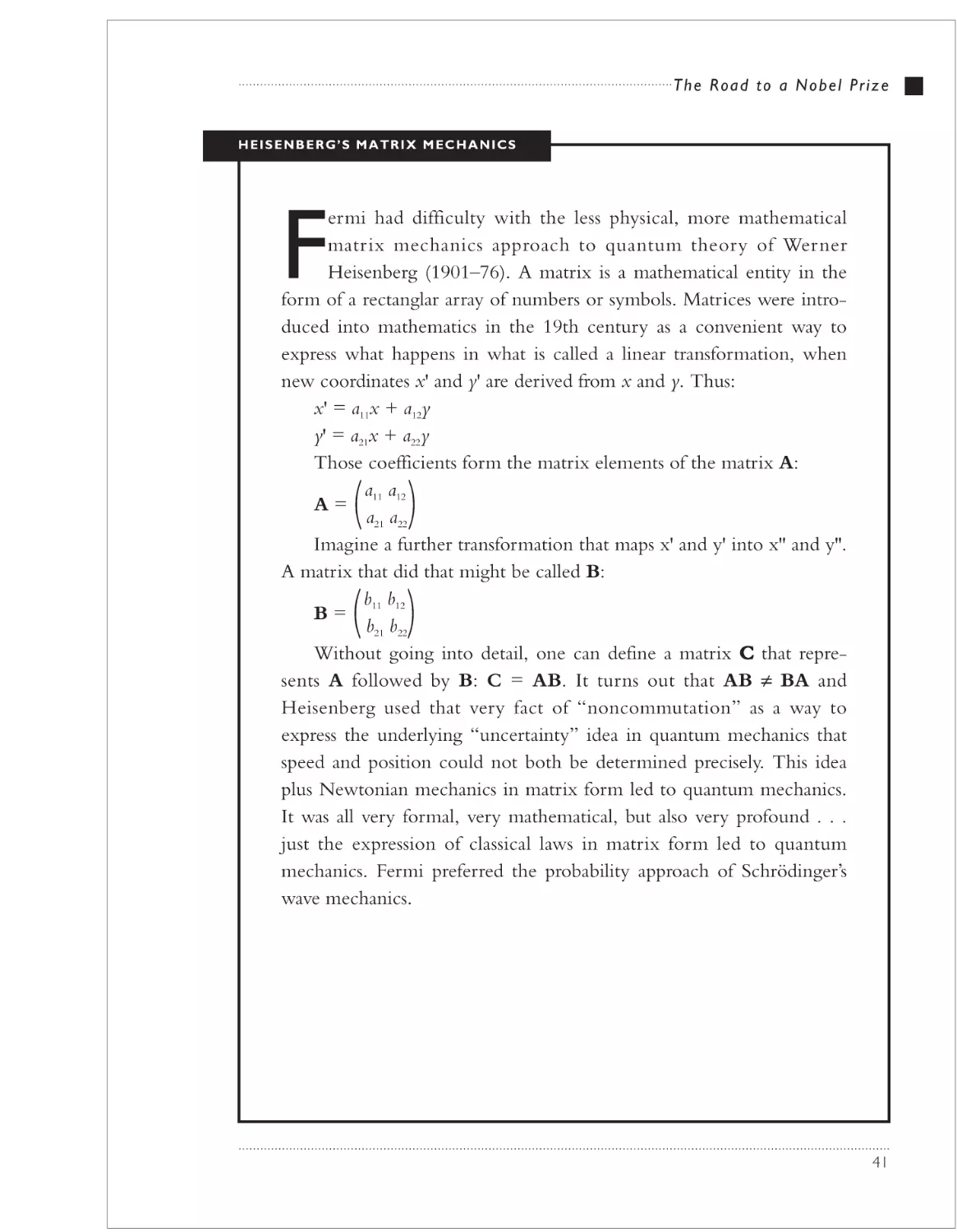
HEISENBERG’S MATRIX MECHANICS

ermi had difficulty with the less physical, more mathematical
matrix mechanics approach to quantum theory of Werner
Heisenberg (1901–76). A matrix is a mathematical entity in the
form of a rectanglar array of numbers or symbols. Matrices were introduced into mathematics in the 19th century as a convenient way to
express what happens in what is called a linear transformation, when
new coordinates x' and y' are derived from x and y. Thus:
x' = a11x + a12y
y' = a21x + a22y
Those coefficients form the matrix elements of the matrix A:
a11 a12
A=
a21 a22
Imagine a further transformation that maps x' and y' into x'' and y''.
A matrix that did that might be called B:
b11 b12
B=
b21 b22
Without going into detail, one can define a matrix C that represents A followed by B: C = AB. It turns out that AB ≠ BA and
Heisenberg used that very fact of “noncommutation” as a way to
express the underlying “uncertainty” idea in quantum mechanics that
speed and position could not both be determined precisely. This idea
plus Newtonian mechanics in matrix form led to quantum mechanics.
It was all very formal, very mathematical, but also very profound . . .
just the expression of classical laws in matrix form led to quantum
mechanics. Fermi preferred the probability approach of Schrödinger’s
wave mechanics.

F

( )

( )

41

Enrico Fermi
Rome and knew him very well when both emigrated to
America, wrote in a tribute that Fermi “stripped [a problem] of mathematical complications and of unnecessary formalism” to lay bare and solve the essential physics of the situation. That ability to keep his focus on what was going on
rather than on the math is in contrast to the practice of
many theoreticians. They use a more formal, less intuitive
approach. They prefer to wr ite down equations that
describe the problem at hand, solve those equations, and
only then begin to think about the physics contained in that
solution. So the math comes before the physics for that
school. There are whole textbooks and courses with titles
such as “Methods of Theoretical Physics” that teach this
approach. It has its place . . . an important place. But it was
not the approach Fer mi liked. He could do the
math—indeed he was very good at it. But his special genius
was to get at the physics, even at the risk of oversimplifying
and obtaining a less exact answer. Fermi was practical, pragmatic. And generations of physicists are grateful for the
insights his direct approach provided them.
But Fermi was looking for something more than his personal success—already guaranteed by his accomplishments to
that date. He wanted to build a school of physics, to have Italy
assume its rightful place among the nations. That meant
strengthening the research capabilities of the Institute of
Physics, the University of Rome’s physics department. And
that in turn suggested that he send his associates abroad to
learn from more advanced laboratories. Rasetti went to the
California Institute of Technology in Pasadena to work with
Robert Millikan (1868–1953), who had won the 1923 Nobel
Prize in physics for measuring the electric charge on the electron—a very fundamental quantity in atomic physics. Rasetti
then went on to learn the techniques for studying radioactivity in Berlin with the physicist Lise Meitner (1878–1968).
(This experience proved to be very significant for the Fermi
group, which soon needed expertise in radioactivity.)
42

The Road to a Nobel Prize

Segrè and Amaldi were similarly dispatched to European
laboratories where they extended their knowledge of
advanced techniques in studying light and X rays. Fermi
himself spent the summer of 1930 lectur ing at the
University of Michigan in Ann Arbor—his first visit to
America. (Fermi’s English—gained from reading British and
American journals and from conversations with Englishspeaking visitors to Rome—served him well in the lectures
he gave. Indeed, he was invited to return in 1935.)
The process worked. The reputation of Rome and the
Romans grew as did their international network of friends.
And, starting in the 1930s, theoretical physicists of the first
rank found it useful to visit with Fermi. The stage was set
for some big developments that would carry Fermi to the
top—a Nobel Prize in physics.
But before all that glory—and the hard work that led to
it—there came a small bump in the road. It concerned a
paper Fermi submitted to the editors of the great British scientific journal Nature. Such editors are gatekeepers of ideas.
They decide, with the help of consultant experts, what gets
published and what does not. In 1933 Fermi developed a
theory that explained beta decay—what happens when a
nucleus emits a beta particle, an electron. For his explanation, Fermi had to invent a new, neutral particle, the neutrino (Italian for “little neutral one”). Now that was a very
bold idea, but necessary if he was to explain why the emitted electrons were not all of the same energy, but rather
showed a characteristic distribution with electrons of many
different energies. Total energy could be conserved because
the neutrino carried off any energy that did not go to the
electrons. (The conservation of energy is a very fundamental
feature of all theories in physics, and Fermi would sooner
introduce his neutrino than abandon energy conservation.)
He submitted his paper to Nature. But the editor
turned it down as being “crazy.” (He used more polite language—he said it contained “abstract speculations too
43

Enrico Fermi
remote from physical reality,” which is a polite way to call
an idea crazy.) Fermi recovered and published the theory of
beta decay elsewhere. It has stood the test of time, and he
might have won the Nobel Prize for this great theory had
he not gone on to win it for even more important work.
Two scientific developments in the early 1930s offered
that even greater opportunity, which Fermi seized and energetically exploited. The arena for Fermi’s new research was
experiments with the atomic nucleus. In 1911 British physicist Ernest Rutherford demonstrated the existence of a tiny,
positively charged nucleus at the center of all atoms with his
experiments on the scattering of alpha particles. (Those
alpha particles came from polonium, one of the naturally
radioactive elements. We now know that alpha particles consist of two protons and two neutrons bound together—a frequent form of natural radioactivity. But in the 1920s its exact
nature was part of the overall mystery of the nucleus.)
Large questions had remained as to the nature of the
nucleus. Experiments in Rutherford’s laboratory clarified
some—but not all—of the issues. What was inside the nucleus? Of what was it made? Some answers came from
Rutherford’s laboratory where he and his associates demonstrated that alpha particles could not only scatter off atomic
nuclei, but could also induce reactions in which the struck
nucleus would transform from one nuclear species to another.
Other atom-striking experiments were conducted in
Paris by Irène Joliot-Curie (1897–1956) and her husband
Frédéric Joliot-Curie (1900–58). They observed penetrating
rays that emerged from boron when struck by alpha particles. Unfortunately (it is one of the famous “hard luck” stories of physics) they identified the penetrating rays as gamma
rays. They were wrong. In Rutherford’s laboratory in 1932,
James Chadwick (1891–1974) demonstrated that those penetrating rays were not gamma rays but neutral particles, which
he called neutrons.) Prior to Chadwick’s discovery, physicists
had though that the nuclei of atoms consisted of protons and
44

The Road to a Nobel Prize

electrons. They were mistaken. Chadwick showed there
were no electrons in the nucleus; rather there was this second, electrically neutral particle along with those positively
charged protons. Protons and neutrons—they were the
building blocks of all nuclei.
The Joliot-Curies received a Nobel Prize in chemistry
for artificially creating radioactivity by bombarding boron
Frédéric Joliot-Curie (left)
and aluminum with alpha particles. Prior to the Joliotin the lab with his wife,
Curies’ discovery, radioactivity was a well-known property
Irène Joliot-Curie, daughof the heaviest elements: uranium, thorium, and the like.
ter of Marie Curie. The
Indeed Mme. Joliot-Cur ie’s mother, Mar ie Cur ie
Joliot-Curies missed dis(1867–1934), had been a pioneer in the field of natural
covering the neutron, but
radioactive elements, especially radium and polonium. But
went on to win Nobel
Prizes of their own.
now there was this new sort of radioactivity—induced or
“artificial” radioactivity.
Fermi seized on these two
discoveries—the neutron and
artificially induced radioactivity—and merged them. He
used neutrons to induce
radioactivity. Clearly, it would
be easier to penetrate into the
target nuclei with the electrically neutral neutrons than
with the positively charged
Image Not Available
alpha particles, which faced
the repelling force of the positive charge of the target.
For his neutron source,
Fermi used a glass tube containing beryllium powder and
radon gas. Alpha particles
from the naturally radioactive
radon produced neutrons
when they struck a beryllium
nucleus. Fer mi then used
45

Enrico Fermi
those neutrons to bombard target atoms. Ever the systematic
investigator, Fermi started with hydrogen, the very lightest
element on the periodic table of the elements. The neutrons
did not induce any artificial radioactivity in hydrogen.
Similarly negative results followed as he worked his way
through the periodic table to heavier elements. Fermi persisted. His first reward came with the element fluorine; irradiated with neutrons, some fluorine nuclei gave off an alpha
particle and changed into a radioactive form of nitrogen.
Fermi used a Geiger counter to count the electrons, or
“beta rays,” emitted by the radioactive nitrogen. Aluminum
irradiated with neutrons also yielded a radioactive product.
The experimenters measured the induced radioactivity
of the nuclei newly created by neutron bombardment.
Now, for some elements, the induced radioactivity was
weak; for other elements it might decay quickly. In either
case, it was important to count the induced activity down
the hall, away from the radon source with its relatively high
radioactivity. Fermi liked rushing down the corridor to
count the short-lived induced radioactivity. In this, as in all
things, he enjoyed competition.
Fermi also raced to publish his result in a paper titled
“Radioactivity Induced by Neutron Bombardment—I.”
Fermi boldly added the “I” because he knew he was on a
hot trail; he knew there would be many more papers in this
series. Working rapidly and systematically, the team—
Amaldi, Rasetti, Segrè, and Fermi—irradiated, looked for
induced radioactivity, chemically separated the newly created
radioactive element, and measured the type of particle emitted, its energy, and how quickly the artificial radiation dwindled. (The latter is called the half-life—the time it takes for
the intensity of the induced radioactivity to fall by one half.)
Iron, phosphorous, vanadium, uranium, on and on . . . they
measured them all.
This was a new sort of high-productivity research, but it
was the work of four years of systematic, caring experimen46

The Road to a Nobel Prize

tation. The team produced ten papers in the original series
and many more besides. Reading those papers today, one
can still feel the rush they must have experienced . . . all that
data tumbling out, every new element producing its new
puzzles. The language of the papers is matter-of-fact, the
data presented in orderly scientific columns, but Fermi and
his colleagues must have been excited. They were pioneers,
explorers—the Lewis and Clark of the nuclear landscape.
More than that, they were creating new worlds; the radioactive nuclei produced in that laboratory on Via Panisferna
had simply not existed in normal conditions on Earth. All
the diversity of nuclear species was laid bare for future study.
Another equally important breakthrough was at hand.
In all of their neutron-irradiation studies, the Fermi team
had proceeded under the assumption that faster, more energetic neutrons were more effective than slow ones in creating reactions. It is certainly a reasonable assumption—faster,
more energy, greater chance of shaking up the target nucleus and making new, radioactive atoms. But Nature had a
surprise in store—it is the other way around. Slower neutrons are more effective than their speedier brethren. That
became apparent only as the group muddled through some
puzzling phenomena.
They began to observe that the amount of induced
radioactivity depended on the conditions of irradiation. As
Segrè, who worked on this puzzle, tells it: “In particular,
there were certain [wooden] tables . . . which had miraculous properties, since silver irradiated on these tables
became much more active than when it was irradiated on
other, marble tables in the same room.” We now know that
the effect arises because the wooden table does a better job
of slowing neutrons, making them more effective at inducing radioactivity in many elements. But the scientists did
not yet know that.
So Segrè and Amaldi set about a systematic investigation of the cause. They used a small lead container to house
47

Enrico Fermi
the irradiation setup. (They were being “systematic” and
wanted to standardize the conditions of irradiation.) Fermi
had a similar approach in mind, involving the use of a
wedge-shaped piece of lead between the neutron source and
the target. But, in a wonderful instance of the power of the
subconscious mind, Fermi forsook his carefully machined
lead wedge in favor of some odd pieces of paraffin—the
stuff of candles. That changed everything, for the induced
radioactivity was much greater; the Geiger counters clattered away as never before. Induced radioactivity increased
by tens or hundreds of times. That slow-neutron discovery,
which Fermi called “the most important one I have made,”
became central to his further work.
What was happening became clear with further experiments. The neutrons were slowed down in collisions with the
hydrogen atoms in the paraffin (or in the wood of those
tables). The nucleus of the hydrogen atom weighs just about
the same as a neutron. So when a neutron collides with a
hydrogen atom, the latter takes up a lot of the energy of the
neutron—like one billiard ball striking another. But when the
neutron hits a heavy nucleus, it is more like the billiard ball
hitting a side cushion and bouncing off with no loss of energy.
And for many reactions, those slow neutrons were much more
effective in inducing radioactivity than fast neutrons were.
In her affectionate biography, Atoms in the Family, Laura
Fermi tells how the team rushed to see if the effects were
repeated with water as the agent slowing the neutrons. They
used a goldfish pond in Professor Corbino’s garden behind
the laboratories.
On that afternoon of October 22, they rushed their source
of neutrons and their silver cylinder [target] to the fountain,
and they placed both under water. The goldfish, I am sure,
retained their calm and dignity, despite the neutron shower, more than did the crowd outside. The men’s excitement was fed on the results of this experiment. It confirmed Fermi’s theory. Water also increased the artificial
radioactivity of silver by many times.
48

The Road to a Nobel Prize

The discovery of the powerful effects of slow neutrons
added similar power to the productivity of the Fermi team.
They published at least 25 different papers on neutrons by
the end of 1934. By February of 1935, Fermi and his colleagues were able to publish a comprehensive summary of
all their work in a British journal, The Proceedings of the
Royal Society (London). In it, a lot of the basics of neutron
physics is laid out. For example, Fermi shows how slow
neutrons pass relatively easily through lead, but are
absorbed by very thin layers of the elements cadmium and
boron. And Fermi provided the first theory of how neutrons slow down and diffuse in materials such as paraffin.
Clearly, there was no one in the world who knew as much
about neutrons.
At Corbino’s suggestion, Fermi and his colleagues
applied for a patent on uses of slow neutrons. It touched on
such matters as the production of radioactive atoms and
enhancing their production by slowing the neutrons. The
patent underlies much of what has been done in the field of
nuclear power. In 1953, after much legal wrangling, the
government of the United States paid $400,000 for all
rights to the patent. Fermi’s share, after expenses, was about
$24,000, the same as was given to his collaborators.
The stage was set for Fermi to receive physics’ highest
award: the Nobel Prize. In the fall of 1938, at a scientific
conference in Copenhagen, Fermi was approached by the
great Danish physicist, Niels Bohr (1885–1962), who asked
whether he would be able to accept the Nobel Prize if it
were offered to him. That sort of “feeler” had become necessary because fascist governments like those in Germany
and Italy had prohibited some prize winners from accepting
their awards.
Fermi assured Bohr that he would be open to receiving
the prize. Indeed, he had begun to lay plans to leave Italy.
Mussolini had started to ape the racial laws of Adolf Hitler’s
Nazi Ger many, laws that restr icted the freedom of
49

Enrico Fermi

Albert Einstein (center left)
at a 1933 meeting of the
Refugee Assistance Fund in
London. Nazi racial laws
and persecutions caused
many scientists to seek
refuge abroad.

“non-Aryan” scientists, Jews in particular. Fermi’s wife was
Jewish, and those racial laws added to Fermi’s resolve to leave
Italy. His several summer trips to American universities during
the preceding decade had made a move to the United States
increasingly attractive. He liked Americans and their attitudes.
In fact, he had solicited—and quickly received—invitations to
teach and do research at American universities. (The Italian
authorities were told he was just going for six months.) Now
he made plans to go to the United States directly from the
Nobel ceremonies in Stockholm.
Those preparations were not in vain because early on
the morning of November 10, 1938, the Fermis were told
to expect a call that evening from Stockholm. Fermi did not
go to work that day, and he and his wife bought watches
and other valuables that could get past the Italian authorities
in anticipation of their trip. In the evening, waiting for the
call from Stockholm, the Fermis listened to the radio,
which brought further news of harsh measures against Jews.

Image Not Available

50

The Road to a Nobel Prize

Jewish children were excluded from public schools, Jewish
teachers were dismissed . . . one cruel (and foolish) law
after another. Then the call did come. The secretary of the
Swedish Academy of Science read the citation and
informed Fermi that the prize was his alone—there was to
be no sharing of the prize as in other years. Friends arrived
soon thereafter to congratulate Enrico and Laura and to
help them forget the bad news on the radio.
King Gustav V of Sweden presented the prize to Fermi
on December 10, 1938, the anniversary of Nobel’s death.
The pr ize for literature was awarded at the same
ceremony—to Pearl Buck, an American novelist. The
Nobel Prize ceremony was a grand event, with members of
the Swedish Academy, the previous year’s winners, and
leading lights from the worlds of science, government, and
diplomacy present. The principal figures were in formal
clothes, so this was one of those very rare occasions when
Fermi donned a full-dress formal suit. The Italian government expected him to give a fascist salute, with a stiff,
extended arm, on accepting the prize from the king. But
Fermi, strongly antifascist, would have none of that, and he
simply shook the king’s hand. Italian newspapers downplayed the award in retribution. The citation read:
For his identification of new radioactive elements produced by neutron bombardment and for his discovery,
made in conjunction with this work, of nuclear reactions
effected by slow neutrons.

The prize was well earned because Fermi had opened
the enor mous new field of neutron physics. Fer mi
described his research and credited his collaborators in his
acceptance speech, another Nobel Prize tradition.
The final, printed version of that speech contains an
interesting footnote in which he acknowledges that the discovery of fission by Otto Hahn and Fritz Strassmann
(which was published after Fermi received his award and
gave his speech) “makes it necessary to re-examine” results
51

Enrico Fermi
Fermi receives the 1938
Nobel Prize in physics from
King Gustav V of Sweden.

Image Not Available

on the transuranic elements.” Fermi had erred, believing
that the radioactivity he observed when he bombarded uranium with neutrons was due to new elements beyond uranium in the periodic table. He narrowly missed evidence
that neutrons could split the uranium atom, that the
radioactivity his team observed was from the products of fission, the splitting of uranium.
Not yet aware of fission, Fermi and his family enjoyed a
quiet crossing from Southampton to New York on the
ocean liner Franconia. They arrived on January 2, 1939, and
started a new life in a new country.
52

The Road to a Nobel Prize

THE NUCLEAR REACTIONS THAT WON A NOBEL PRIZE

ermi won the Nobel Prize for the new radioactive elements he
created through neutron bombardment. The process he used is
one in which an incoming, bombarding neutron penetrates a target nucleus, briefly forms a compound nucleus, which then disgorges a
particle of another sort, changing the original nucleus in the process.
To produce neutrons, Fermi employed the same reaction James
Chadwick had used in first discovering the neutron. He shot alpha particles at a target of the element beryllium. The alpha particle, the nucleus of the helium atom (chemical symbol He), has two protons and two
neutrons, for a total of four nucleons. The shorthand way to write that
is: 2He4. The subscript 2 tells us there are two protons; the superscript 4
tells us there are four nucleons total.
Fermi mixed radon, a radioactive source of alpha particles, with
beryllium powder. The chemical symbol for beryllium is Be, and the
notation for its nucleus is: 4Be9. There are four protons and five (9 minus
4) neutrons.
Now comes the magical part. When a lucky alpha particle penetrates a beryllium nucleus, the following nuclear reaction takes place:
4
9
12
+ On1
2He + 4Be ——> 6C
The beryllium nucleus has been transformed into carbon, and a
neutron has been released. Note how the numbers add up and balance
on both sides of our equation—subscripts and superscripts both.
Here is the equation describing what happens when one of those
neutrons penetrates a fluorine nucleus:
19
+ 0n1 ——> 7N16 + 2He4
9F
One fluorine nucleus has been transformed into nitrogen, and an
alpha particle has been produced. The nitrogen nucleus produced in this
reaction is a radioactive isotope of nitrogen. The word isotope comes
from the Greek words iso, meaning same, and topos, meaning place. An
isotope is a form of an element occupying the same place in the periodic
table, but having a different number of neutrons. The normal form of
nitrogen is 7N14 with seven protons and seven neutrons in its nucleus.
Figure out how many of each are in 7N16.

F

53

The first page of Albert Einstein’s 1939 letter to President Franklin D. Roosevelt, warning of uranium chain reactions and bombs. Leo Szilard persuaded Wall Street economist Alexander Sachs, who knew the President, to get
the message through.

CHAPTER

4
Racing to a Chain
Reaction
Word of the discovery of fission spread quickly through the
close-knit international physics community. Niels Bohr, the
great Danish physicist, brought the news to a seminar at
Princeton University. From there it was quickly relayed to
Fermi at Columbia University. Fission was something completely new, completely unexpected. Even Fermi had
missed it in the careful experiments he had done, experiments that had just won him the Nobel Prize.
Physicists everywhere rushed to study the fission of
uranium by slow neutrons. In laboratory after laboratory,
they saw the large pulses in their counters and the telltale
presence of fission products, elements far below uranium in
the periodic table.
The fission reaction was unlike any they had observed
before. This was no simple shift from one element to another
close by in the periodic table. Fission is a more violent event,
one in which a neutron enters a uranium nucleus and causes
it to split into two parts. Very importantly, some neutrons are
also emitted. One neutron in and more than one neutron
out holds the key to possibly creating a chain reaction, one
in which those neutrons go on to create still more fissions.
55

Enrico Fermi
The concept of a nuclear chain reaction had occurred to
a remarkable man, the Hungarian-born physicist Leo Szilard
(1898–1964), back in 1933. He conjectured that one neutron
could create a reaction in which two neutrons were released.
He did not know about fission—it had not yet been discovered—but he figured there might be some other reaction that
would work. He actually took out a patent, a secret patent
that he assigned to the British navy, covering the concept of a
nuclear chain reaction and explosives based on it.
By wonderful coincidence, Szilard had gone from Britain
to the United States and was working at Columbia
University when Fermi arrived just one year later. The two
men were quite different. Fermi was very hardworking and
systematic, little given to philosophical speculation, still very
much the son of a middle-class, middle-level railroad executive. Szilard was a brilliant nonconformist, an “impractical
dreamer,” who had erratic work habits and was more likely
to be found on a park bench— just thinking—seldom troubled by what regulations might demand. Nonetheless, they
played complementary roles in going from the basic fact of
fission to a chain-reacting device. An even closer co-worker,
whose style was like Fermi’s, was Herbert Anderson, a young
graduate student. Under Fermi’s direction, he carried out the
first observations of fission at Columbia.
Two considerations added to everyone’s eagerness to
understand fission. First, there was the enormous energy
potential in fission. A mere gram of fully fissioned
uranium-235 produces as much energy as 3 tons of coal or
700 gallons of fuel oil. Fission is a million times more potent
than ordinary chemical burning, which does not involve
changes in the nucleus, only rearrangement of atoms.
Another concern stemmed from international politics.
A chain reaction could make a powerful explosive. Fission
had first been observed in Germany, and Germany in 1939
was a very aggressive country that had already swallowed up
Austria and had designs on Czechoslovakia. Certainly, the
56

Racing to a Chain Reaction

many scientists who had fled Germany because of its racial
policies did not want a world dominated by Adolf Hitler,
the dictator who ruled Germany.
Because of that concern, Szilard urged the physicists to
limit the circulation of information about fission, reversing
their usual policy of prompt and open publication of scientific results. And later in 1939, Szilard arranged for Albert
Einstein to write a letter to President Franklin Delano
Hungarian-born physicist
Leo Szilard emigrated to
Roosevelt alerting him to the possibility of powerful new fisBritain and then to the
sion weapons. That letter led—slowly—to the creation of an
United States. In 1933,
Advisory Committee on Uranium and eventually to the
he first conceived that a
grant of some $6,000 to Columbia to support Fermi’s
chain reaction could
researches. Looking back, it is amazing how sluggish the
extract energy from the
reaction was to the revolutionary possibility of fission
atom, an idea that was
scoffed at by others.
weapons. Even Fermi took off the summers of 1939 and
1940 to lecture at the
University of Michigan. But
Fermi was a pure scientist, and
fission interested him primarily as a phenomenon of nature.
He had always avoided politics
or any practical application of
his research. But as the world’s
foremost expert on neutron
physics, he was reluctantly
drawn into the practical work
Image Not Available
of creating reactors and then
bombs. It was not work he
would have chosen.
Creating a chain reaction
was not going to be easy,
even though exper iments
showed there were about
2.5 neutrons produced per
fission. For one thing, the
isotope of uranium that was
57

Enrico Fermi
fissionable was rare. Uranium has two principal isotopes:
uranium-235 and uranium-238. Both have 92 protons in
their nuclei, but the heavier isotope has 146 neutrons, three
more than in the lighter isotope. Uranium-238 is by far
more common; in any natural sample of uranium there are
140 times more uranium-238 atoms than uranium-235.
Putting it another way, uranium is only 0.7% uranium-235.
Nature had stacked the deck against Fermi.
Another challenge was that the heavier 238 isotope of
uranium had a large cross section (that is, a high probability
or likelihood) for capturing fast-moving neutrons. That
meant those uranium-238 isotopes could gobble up the
fast-moving neutrons produced in fission. But Fermi and
Szilard thought of a way to beat that problem: have the uranium in small lumps, with material between those lumps
that could slow the neutrons—moderate their speed. Lumps
of uranium surrounded by moderator, something like that
was needed for a chain reaction.
Of course, Fermi knew all about slowing down neutrons; it was a big part of his Nobel Prize research. He
knew that paraffin or a similar material could slow the neutrons by collisions with the light elements of which it is
made. Slowed neutrons are not as liable to be captured by
uranium-238, and slow neutrons would be more efficient at
causing further fissions in uranium-235. The supply of neutrons had to be conserved so there would be—on
average—at least one neutron surviving from each generation to start the next generation. In his equations, Fermi
called that the reproduction factor, k, and the goal of his
chain-reaction program was to get k greater than 1.
Fermi considered water as a possible moderator but
rejected it because (as he said in a speech years later) “it’s very
effective in slowing down neutrons, but still absorbs a little bit
too many of them, and we could not afford that.” He and
Szilard decided to try graphite—that black, slippery form of
carbon that is in what are mistakenly called “lead” pencils.
58

Racing to a Chain Reaction

Not a lot was known about the absorption properties
of graphite, but it was known that it did not absorb a lot.
To measure how much graphite did absorb, Fermi did not
want to use a small sample and settle for a result with a
large uncertainty. Instead, he decided to use what an engineer would call a prototype—a model from which he could
learn how the whole approach worked. That would give a
more meaningful result, focused on the ultimate goal of a
chain reaction with a reproduction factor greater than 1.
These experiments, which began in the spring of 1940,
were, as Fermi reminisced years later, “the first time that I
started to climb on top of my equipment.” Physics was
becoming a large-scale enterprise.
Fermi and his people piled blocks of graphite to form
square columns of graphite, the first of which were three
feet on a side and eight feet high. They would place a
radon-beryllium neutron source at the base of one of these
graphite “piles” (Fermi originated that term) and measure
the neutron intensity at varying points along its height. The
neutron intensity—measured by the radioactivity induced
in rhodium foils—would fall as you went up the column
because neutrons were absorbed or scattered out the sides.
Fermi could then calculate the properties of graphite from
that data. Later they added uranium—in lumps of uranium
oxide—systematically spaced throughout those piles.
It was the beginning of a process that would lead to
many more such piles and occupy Fermi and his team for
the next three years. They overcame great challenges: the
purity of graphite had to be improved beyond anything
American industry had provided previously. Uranium purity was a similar issue, and chemists at the University of
Iowa evolved methods to make it better and better. Szilard
was invaluable here; the “impractical dreamer” made it his
practical job to find sources of more and purer materials.
The effort grew even more intense after the Japanese
bombed Pearl Harbor on December 7, 1941, bringing the
59

Enrico Fermi
United States into World War II. Germany and Italy joined
the Japanese, and that made Fermi an “enemy alien.” (It was
not until July 1944 that the Fermis became U.S. citizens
because the naturalization process requires five years.) Many
regulations governed the behavior of enemy aliens. They
could not own cameras or shortwave radios. They could
not fly in airplanes. If they journeyed outside their own
community, they had to “file a statement with the United
States District Attorney . . . at least 7 days prior to departure.” Enrico Fermi, engaged in this vital war work and
commuting often to Chicago, had to secure permission for
each trip. Fermi, never one to make a fuss, put up with this
bureaucratic rigmarole until it became too burdensome and
the bureaucracy found a way to get him a permanent travel
pass. Eventually (it was Columbus Day, 1942) the Attorney
General ruled that Italians were no longer enemy aliens, and
the nettlesome regulations were lifted.
In March 1942, work on chain reactions was consolidated at the University of Chicago at a secret project
code-named the Metallurgical Laboratory. Fermi reluctantly
moved his team and their piles to Chicago and resumed the
battle to get a reproduction factor greater than 1.
Finally, in mid-November 1942, the stage was set
for building a pile that could provide a tr uly selfsustaining chain reaction with the desired reproduction
factor. In a rather unlikely place—abandoned squash courts
beneath the grandstands of the university’s football
stadium—Fermi’s team gave birth to CP-1, Chicago Pile
Number One.
The overall structure was in the form of a slightly
squashed sphere, 25 feet wide and 20 feet high. Layer by
layer, the team members—aided by husky high-school kids
waiting to be drafted—stacked the 400 tons of carefully
machined graphite, 40 tons of uranium oxide, and 6 tons of
uranium metal. It was hard work, and they worked around
the clock—two shifts of 12 hours each.
60

Racing to a Chain Reaction

CP-1, the world’s first
nuclear reactor, under
construction. The incomplete top layer is of
graphite only; the layer
below it contains uraniumoxide “eggs.”

Image Not Available

Slots in the graphite provided channels for boards covered with neutron-absorbing cadmium—the world’s first
reactor control rods. (“Reactor” is a term that replaced
“pile” in later years.) The tests had shown that this structure
could achieve a k greater than 1. It was big enough that the
leakage of neutrons out the sides could be tolerated, and it
had enough uranium and graphite of sufficient purity to
“go critical.” Or so Fermi’s calculations showed.
The photograph above shows the pile under construction. Layer 19, containing graphite only, is not yet completed, revealing the uranium-oxide “eggs” in the layer below.
61

Enrico Fermi
There were 22,000 of such uranium lumps, each compacted
in a handpress. Al Wattenberg, then a Columbia University
graduate student serving on the CP-1 team and now
Emeritus Professor of Physics at the University of Illinois,
Urbana-Champaign, says, “It was hard work, but exhilarating. We knew we were part of something big, and Fermi
was a great leader who saw to it that we all understood how
the pile worked. We had total confidence in him.”
Still, this was a first—making the first nuclear chain
reaction in history—so every reasonable step had to be
taken to ensure its success. One unusual step was surrounding the pile with a cubic balloon, somewhat like a huge
tent. If necessary, the air could be pumped out, and that
would eliminate the neutron absorption from nitrogen in
the air. It proved not to be necessary, but it is a nice example of the ingenuity of Fermi and his team.
After each shift, they measured the neutron level in the
pile and reported the results to Fermi, who was now too
busy with administrative duties to join in the work itself.
He calculated how close they were to a self-sustaining chain
reaction, to a pile that would give a reproduction factor at
least equal to 1. By November 30, with Layer 52 in place,
Fermi’s careful calculations showed their goal would be
reached at Layer 56. Ever-conservative, he called for an
extra layer—number 57—to be put in place by the night
shift on December 1. He made Herbert Anderson promise
to resist the temptation to withdraw the control rods and
make the chain reaction self-sustaining. The layers were
added, and the control rods were locked in place, as he had
directed.
Fermi assembled the team the morning of Wednesday,
December 2, 1942. He was fully confident of his understanding of how his pile would behave, but to protect
against any unforeseen effects, there were safety measures. A
control rod would automatically fall into place and shut
down the pile if the neutron intensity (measured by elec62

Racing to a Chain Reaction

tronic counters) got too high. As a backup to that, there
was another safety rod supported by a rope that could be cut
with an ax, causing the rod to drop into the pile. Finally
there was a “suicide squad,” three young physicists equipped
with jugs of neutron-absorbing cadmium sulfate to pour
into the pile if something went haywire.
With safety attended to, Fermi went to work. He
wanted to proceed systematically to bring the pile to a selfsustaining condition. First he confirmed that the neutron
intensity with the control rods fully in was the same as
Anderson had measured it the evening before. Then he
directed George Weil, the young physicist responsibile for
adjusting the one remaining cadmium control rod, to pull it
out halfway. As expected, the neutron intensity increased,
then leveled off. Fermi could tell things were going as
planned from the sound of the counters, but he was not
content until he measured the neutron level and calculated
its rate of growth. He then calculated how close they were
to self-sustaining, using his slide rule, that clever device that
can multiply, divide, and calculate logarithms by moving a
ruler-like middle piece within two fixed ones. In Fermi’s
hands, it could do all the calculations he needed.
Satisfied with those numbers, Fermi called on Weil to
pull the rod out another six inches. Then he carefully
checked the rate of increase and the intensity at which it
leveled off. More slide-rule calculation, and Fermi called on
Weil to pull the rod out another six inches. Everything was
on track. Another withdrawal and its set of measurements
followed. And then another.
Each time the counters grew faster, in keeping with the
growing neutron intensity—and then leveled off at their
new and higher tempo. By now the rates were so high that
some of the instruments had to be adjusted to cover the
new range. Fermi checked that the readings at the new
ranges agreed with the earlier ones. Then he instructed
Weil to pull the rod out another six inches. Up went the
63

Enrico Fermi
intensity; then CRASH!—the automatic safety rod
slammed into its slot—as it was designed to do.
Cool as always, confident that all was going well, Fermi
called for everyone to break for lunch. (“I’m hungry! Let’s
go to lunch,” he is reported to have said.) Another
researcher might have pressed on, eager to go critical and
attain a self-sustaining chain reaction as soon as possible.
Not Fermi. For one thing, he was always deliberate in both
thought and action. For another thing, he is Italian, and
lunch on time is a ritual in Italy, one that survived his emigration to the United States and the urgencies of wartime
research. The control rods were reinserted and locked in
place, and everyone went off to eat.
Whatever may have been on the menu that day, it was
surely accompanied by a great sense of controlled excitement. Everyone wanted to be cool like Fermi—at least on
the surface. But this was the payoff for months of work, tons
of uranium pressed into “eggs,” and endless logs of sooty
graphite machined and lugged into place. Back to work they
went. The safety rod was withdrawn, and the neutron intensity at which it would drop was raised. Weil brought his
control rod, by stages, back to the position it was in before
lunch. The neutron intensity was now high enough that
Fermi could follow the trace of the pen that displayed the
intensity automatically on a chart. That would not have
been feasible at lower intensities. Fermi extracted meaning
from that chart with further manipulation of his slide rule.
He was now just one step away from the self-sustaining level;
Weil need only pull his control rod out another foot.
But Fermi did something that might have surprised a
layman. He had the safety rod reinserted, this time deliberately. He wanted to bring the intensity down to a low
value, so that he could follow its rise over an even greater
range. Next he had Weil pull the one remaining rod farther
than ever before—another 12 inches. Only then was the
safety rod withdrawn. This time there was no leveling off.
64

Racing to a Chain Reaction

The intensity grew and grew; Fermi’s eyes fixed first on the
chart recorder then on the slide rule, darting back and
forth. Still no leveling off.
Observers remember Fermi’s words: “The reaction is
self-sustaining.” And they remember his broad, broad smile.
Fermi allowed the intensity to grow for yet another 11
minutes, then called for all rods to be reinserted and locked.
The maximum power reached was only half a watt, but
from that puny beginning a potent new source of energy
and destruction was mankind’s to use—or misuse.
It was a time for celebration, and Hungarian-born
physicist Eugene Wigner (1902–95), who rivaled Fermi in
his understanding of pile theory, was equal to the occasion.
He had brought a bottle of Italian Chianti. Paper cups were
secured from a water cooler, and all hands saluted what they
had accomplished. With a fine sense of history, most of
them signed the straw wrapper that is a hallmark of a bottle
of Chianti.
There was no hilarity. Those who were present and
have written about the occasion seem to emphasize the
silence, even the solemnity. Wigner himself has written, in
his memoir Symmetries and Reflections, “For some time we
had known that we were about to unlock a giant; still, we
could not escape an eerie feeling when we knew we
had actually done it [with] far-reaching consequences
[we could not] foresee.”
Arthur Compton, as head of the Metallurgical
Laboratory, was pleased to report by telephone in a
coded message to James Conant, the government’s
top civilian research chief, that “The Italian navigator
has just landed in the new world.”
It was a new world. Leo Szilard, who first conceived of a chain reaction, stayed on after the crowd
had left, shook hands with Fermi, and said that he
thought “this day would go down as a black day in
the history of mankind.” There was cause for such

Most of the CP-1 team
signed the basket of this
bottle of Chianti bought by
Eugene Wigner to celebrate the pile going critical
on December 2, 1942.

Image Not Available

65

Enrico Fermi
worry. Terrible new weapons were now closer to reality. By
now powerful piles that would produce plutonium for use in
atomic bombs were being designed. Fermi was to play a
major role in that phase too.
In the weeks that followed, Fermi and his team continued their effort to obtain pile materials of even greater
purity. They also found the pile to be a wonderful tool for
studying the behavior of neutrons because it could provide
a steady source more intense than any they had used before.
That helped them in their next major chore, the design and
construction of a new, more powerful pile at a more isolated location outside of Chicago. This pile, CP-2, operated at
a power level of 100,000 watts—far beyond the 0.5 watt at
which Fermi had run CP-1 that first, historic day. By
November 1943, there was yet another uranium-graphite
pile, the air-cooled X-10, at yet another laboratory, this one
in Oak Ridge, Tennessee.
Before going on with the story of Enrico Fermi’s contributions to the development of nuclear weapons, here are
two important points left out of our discussion of piles. The
first is: “Why are piles so easy to control? Why don’t they
blow up . . . as atomic bombs do?” It is a good question,
and the answer lies in the fact that a certain proportion of
the neutrons emitted in fission are delayed. Specifically,
three quarters of a percent of the neutrons come out in a
time that ranges from 1.5 to as many as 55.6 seconds. These
delayed neutrons do not come directly from the fissioning
uranium nucleus; rather, they come from further decay
processes in some of the fission products. So the last three
quarters of a percent—0.0075—of a pile’s chain reaction
comes from delayed neutrons, and that helps in the control
of a pile.
Of course, if too much uranium fuel is loaded into a
pile and its control rods are yanked out too far, it can get
critical without the delayed neutrons, and reactor accidents
have occurred that way.
66

Racing to a Chain Reaction

The second and vital point is that the capture of a neutron by the heavy isotope, uranium-238 leads to the formation of the isotope uranium-239. It then undergoes
radioactive decay, transforming into the element neptunium, followed by further decay to plutonium-239, which is
fissionable. Thus piles could produce not only energy but
also another fissionable element.
In World War II, the United States pursued two paths to
an atomic bomb. The first was to produce plutonium in
nuclear piles. The second approach was to separate the fissionable uranium-235 isotopes from the much more abundant (but not fissionable) uranium-238 isotopes. With
wartime urgency, the United States followed both approaches, and both succeeded—a most remarkable accomplishment.
Enormously important to that accomplishment was a
military man, Major General Leslie R. Groves (1896–1970).
In mid-September 1942 Groves, then a colonel, was put in
charge of the entire atom-bomb project, code-named the
Manhattan Engineering District. Groves was accustomed to
big projects and bold decisions; he had been deputy chief of
all construction for the U.S. army and supervised the construction of the Pentagon. He knew how to give orders and
get things done fast. Under its civilian leadership, the project
had started slowly and had been subject to one review after
another. Groves was prepared to take big risks, make mistakes, and try multiple approaches in order to move ahead.
General Groves had an abiding concern for security.
When he took over direction of the atomic bomb project, he
instituted new measures to further ensure secrecy and the
safety of top scientists.
Those top scientists were given code names, to be used
when traveling or otherwise dealing with the outside world.
Dr. Enrico Fermi became Mr. Eugene Farmer; Niels Bohr
became Nicholas Baker; Wigner became Wagner, and so
forth. (Not very deceptive names, it would seem, but the
thinking of security personnel is sometimes mysterious.) In
Fermi’s Collected Papers, one piece bears the name E. Farmer
67

Enrico Fermi
as author. And when Mrs. Fermi first came to Los Alamos,
the soldier who met her at the railroad station asked, “Are you
Mrs. Farmer?” She replied, “Yes, I’m Mrs. Fermi,” whereupon the soldier said, mildly but with reproving eyes, “I was
told to call you Mrs. Farmer.”
Fermi was also given a full-time personal bodyguard
early in 1943. The guard—a member of Army military
intelligence in plain clothes—was a six-foot, 200-pound,
cheerful, recent law-school graduate named John Baudino.
He was Fermi’s constant companion, joining him on all car
trips to Argonne and on train trips to Hanford and elsewhere. Baudino and Fermi came to be good friends, playing
gin rummy on those train trips, and Baudino occasionally
lent a hand in the laboratory when that was appropriate.
When Fermi and his family moved to Los Alamos, Baudino
and his wife and infant daughter moved there too. He
stayed at Fermi’s side until the war was over.
In a directive from Groves, Fermi was instructed to
“refrain from flying in airplanes of any description; the time
saved is not worth the risk . . . refrain from driving an automobile for any appreciable distance . . . and from being
without suitable protection on any lonely road.”
Groves also convinced the Du Pont Corporation, the
giant U.S. chemical corporation, to assume responsibility for
the construction of giant piles in Hanford, Washington.
This was to be an enormous scale-up; Fermi’s CP-1 had
never operated at a power of more than 200 watts; the three
Hanford production piles were each to operate at 250 million watts. The issues were now as much chemistry and
engineer ing as physics: How would they cool these
multimegawatt piles? How could the chemists process the
dangerously radioactive fission products and extract the
fissionable plutonium for further purification and processing
into bomb material?
Not surprisingly, there was a clash of cultures—engineers and physicists have different approaches. Engineers are
more practical, prepared to approximate and compensate for
68

Racing to a Chain Reaction

The huge plutonium-production complex on the
Columbia River in Hanford,
Washington. Each
water-cooled reactor had
2,004 channels holding
aluminum-clad uranium

Image Not Available

slugs.

those approximations with safety factors; physicists are more
given to an approach based on theory alone. But both
groups recognized the urgency of what they were doing.
The war was raging fiercely, and this project could help win
it. Despite that urgency and the efforts of some 42,000 construction workers, it was September 1944 before the first of
the Hanford piles went critical. But they did the job; plutonium for the first atomic bomb was delivered in time for
the first test of such a weapon. It was a test in which Fermi
would play an interesting role.

69

Image Not Available

Fermi (third from left) and teammates at Los Alamos in late 1943. Others include (left to right): Herbert Anderson, D. Froman,
H. Barschall, R. R. Wilson, Joe Fowler, John Manley, Seth Neddermeyer, L.D.P. King, Egon Bretscher, Emilio Segrè, and Hans Staub.

CHAPTER

5
Los Alamos and
the A-Bomb
Image Not Available

It was called the Los Alamos Ranch School. It had been
founded in 1917 as a place to which rich parents could send
their sickly sons to build them up physically as well as to
learn. It was beautifully situated in the Sangre de Christo
mountains on a 7,200-foot mesa above the valley of the
Rio Grande, some 35 miles northwest of Sante Fe, New
Mexico. But now it was to be disbanded; the U.S. Army
would take over the school and the surrounding land for a
project so secret it bore only the name Site Y. Here would
rise the laboratory that would develop the atom bomb.
In June 1942 General Groves chose J. Robert
Oppenheimer (1904–67), a brilliant theoretical physicist, to
head the A-bomb effort. (Oppenheimer had led intense
theoretical studies at the University of California on how to
make a bomb.) Together they selected Los Alamos as the
site for the new weapons laboratory. Los Alamos was a marvelous place for a secret laboratory. It was isolated, with just
one steep, winding dirt road. That would help ensure security, even though it proved daunting to newcomers to The
Hill. Scientists could conduct dangerous experiments with
explosives in the deep ravines. The trails for hiking and ski71

Enrico Fermi

This house on “Bathtub
Row,” originally the Los
Alamos Ranch School arts
and crafts building, was
used as the home for the
laboratory director. The
Jemez mountain range is
in the background.

ing, streams for fishing, and much natural beauty were sure
to refresh the spirits of the scientific teams that would soon
assemble there.
Oppenheimer staffed Los Alamos with the very cream
of American nuclear physics and chemistry. It became the
center for what was to swell to more than 2,500 people.
They lived a pioneer life at first, scattered among nearby
dude ranches and putting up with all sorts of shortages and
inconveniences. Jane Wilson, wife of physicist Robert
Wilson, recalls that streets were unpaved, with mud everywhere; soot from the soft coal used to heat the houses covered everything. The school’s stone and log building served
as headquarters, and the homes formerly occupied by the
headmaster and teachers were available only to the top laboratory personnel. Those houses had bathtubs, giving the
name “Bathtub Row” to that part of town. Elsewhere it
was a boomtown filled with a chaotic array of trailers and

Image Not Available

72

Los Alamos and the A-Bomb

houses hastily constructed of green lumber or prefabricated
sections. They had modern refrigerators, but the huge
wood- and coal-burning cooking stoves were so difficult to
use that many residents settled for electric hot plates even
though they were vulnerable to power outages.
The people of Los Alamos had to get used to living in
a community surrounded by fences and barbed wire. Mail
was censored, long-distance calls were monitored, and
badges were required for entrance. All incoming mail was
addressed to Box 1663 in Santa Fe; Los Alamos did not
exist as a post office address. But almost everyone was
young and willing to put up with inconveniences—Project
Y was extremely important and could help win the war.
By April 1943 the top scientists assembled to organize
their program of research. “Oppie,” as Oppenheimer was
called, led the intense discussions. Fermi was there for this
first planning meeting, and he later came full-time to serve
as associate director and to head one of its divisions.
The goal at Los Alamos was to produce a weapon, a
bomb so powerful it would help the United States and its
allies win the terrible world war then raging. Because fission releases so much more energy than even the most
explosive chemical reactions, an atomic bomb would be
more powerful than any bomb in history. Fission was millions of times more powerful than chemical energy. Just one
kilogram—2.2 pounds—of plutonium-239 or uranium-235, completely fissioned, had the explosive power of
about 20,000 tons of TNT.
In an atomic bomb, there would be no moderator—no
neutron-slowing graphite as was needed in Fermi’s piles.
Slow neutrons were just too slow for the job. Here the idea
was to use fast neutrons, just as they came out of the fissioning nucleus. Without a moderator, the chain reaction
would build up explosively—fast beyond all ordinary experience, but not beyond the ability of those Los Alamos scientists to comprehend, calculate, and eventually measure.
73

Enrico Fermi
Less than a millionth of a second is all it would take. And
the release of all that energy in so short a time would lead to
temperatures unknown on Earth—about 10 billion degrees.
Here is a rough picture of how that explosion builds: An
initial fission in a sphere of uranium-235 or plutonium-239
produces two fast neutrons (actually there were more than
two, but for simplicity, say two). Within a billionth of a
second, those two strike two other nuclei and produce 4,
then 8, then 16, 32, more, more, 1,024, 2,048, each new
generation coming superfast on the heels of the preceding.
This is all done with neutrons moving quickly, swiftly striking yet another nucleus. It takes only about 80 generations to
fission all the nuclei in a kilogram, a millionth of a second all
told. And each fission releases atomic energy. Temperatures
reach billions of degrees as all that energy is released in that
small space.
Making such a bomb was a huge job, unlike any ever
faced before. Those scientists assembling in Los Alamos had
a theory of how an A-bomb would work, but now they
needed facts and numbers. Just how many fast neutrons
came out when plutonium-239 (or uranium-235) fissioned,
and how fast did they emerge, and how fast were they moving? The researchers had to learn all they could about uranium and plutonium. They would need new superhigh-speed
cameras and X-ray machines to follow the workings of an
A-bomb. All that and much more was needed to make a
“gadget.” (“Gadget” was the code word used in place of
“atomic bomb.”)
After Fermi attended that initial meeting, he became an
important, if occasional, consultant to Los Alamos. He came
even though he continued to have big jobs elsewhere, such
as advising on the huge plutonium production reactors
under construction in Hanford, Washington. That was a
huge undertaking in itself, and it was nearly undone by a
problem that had not been fully anticipated—the “poisoning” of the first pile by certain products of fission.
74

Los Alamos and the A-Bomb

Fermi would have come to Los Alamos earlier, but he
was delayed by an unexpected problem at the Hanford plutonium production piles. Fermi and Leona Marshall, part of
his team at CP-1, were there for the startup, checking the
readings as the pile went critical—first at low power without cooling water and then with the full force of cooling
water from the Columbia River flowing through it. All
seemed well; here was a pile at 250 megawatts, far above
the power level of its predecessors in Chicago. But then a
strange thing began to happen. The reactor operators had
to withdraw the control rods further and further to keep
the power level where it was supposed to be. Finally the
control rods had to be withdrawn their full length, and yet
the power level continued to fall lower. By the evening of
the next day, the chain reaction had stopped, and the reactor died completely.
Then an even stranger thing: the reactor came back to
life, ran for several hours, and then lost power again. What
was wrong? Fermi could see that the pile was being “poisoned.” There was a product of fission and perhaps a further
daughter from the decay of that fission product that had
an enormous ability to absorb neutrons. The culprits turned
out to be radioactive forms of the elements iodine and
xenon. The radioactive iodine (iodine-135) was formed as
one of the fission products of uranium-235. It then decayed,
with half of it decaying in 6.7 hours, into xenon-135. That
form of xenon had a perfectly enormous appetite for neutrons—absorption far beyond anything known before. And
that would soak up neutrons and kill the reactivity of the
pile. But the xenon itself would decay and disappear, with a
half-life of 9.13 hours. With that poison gone, the pile
could go critical again.
Fortunately, Eugene Wigner, who had worked with
the Du Pont engineers in the design of the Hanford piles,
had anticipated the possibility of such pile poisons. They
had included space for additional uranium, to add enough
75

Enrico Fermi
fissions to overcome potential problems and keep the reactor
going. It required some new cooling channels for the
added uranium, but in time Hanford Pile B could be taken
critical again and stay in operation. It was a close call with a
happy ending.
Resolving that problem allowed Fermi to turn his full
attention to Los Alamos in September of 1944, a year and a
half after Site Y was founded. (Mrs. Fermi and the children
came on their own because Fermi was occupied with the
startup at Hanford. She found lots of old friends there: the
Tellers, the Bethes, the Rossis, and Emilio Segrè, among
others. She had been alerted in advance, so she and the children brought boots, to deal with the ever-present mud, as
well as a large dose of patience for the inevitable hassles of
living under army rules. But they also found young people,
lots of parties, and a social life that made it easier to live
with censored mail and no telephone.)
Fermi knew Los Alamos was the payoff, the final step
in the long path to an atomic bomb. Oppenheimer was
eager to have his help and made Fermi an associate director
and the leader of a special division, Division F. It was
also known as the Problem Division because it handled
special situations and difficult people. Chief among the
latter was Edward Teller, a brilliant theoretician who
did not want to work on fission but only on the
“Super”—code name for early efforts to create the even
more powerful hydrogen bomb. Fermi also became boss
of a physicist named L.D.P. King, whose group worked on
a small, very low-power reactor that had been built at
Los Alamos to serve as a neutron source for research
purposes. Nicknamed “the water boiler,” it was a simple
one-foot-diameter spherical vessel containing a solution
of uranium salt in water. It was the world’s first reactor
using enriched uranium—uranium with more than the
0.7% uranium-235 of natural uranium. (The enriched
uranium came from the huge separation plants that had
76

Los Alamos and the A-Bomb

been constructed in Oak Ridge, Tennessee, in the second
approach to an atom bomb.)
Another component of the Fer mi Division was
formed in November 1944 when his longtime collaborator, Herbert Anderson, came down from Chicago’s
Metallurgical Laboratory to join him. He and his people
made vital contributions, developing a method to determine the efficiency of the first atomic bomb.
A crucial question concerned the “critical mass”—the
amount of fissionable material needed to make a bomb.
(With too small an amount, the bomb would fizzle as neutrons escaped out the side. With too large an amount, precious nuclear material would be wasted as the bomb
exploded.) To learn more about fast neutrons, Los Alamos
researchers needed nuclear accelerators. Such “machines”
could push protons (or other suitable nuclei) to energies
high enough to produce high-energy neutrons when they
struck suitable targets. There was no time to build new
ones, so the physicists at Los Alamos did something typical
of the bold moves throughout the Manhattan Project:
nuclear accelerators were trucked in from universities
around the country. Harvard University contributed its
cyclotron—the sort of accelerator that sends protons or other
light nuclei around in an ever-increasing circular path in a
fixed magnetic field, giving them another push in each
cycle till high energies are reached. (The “push” came from
an alternating electric field timed to match the frequency at
which the particles move in their circular paths.)
The University of Wisconsin team brought two Van de
Graaff accelerators—machines that bring protons to high
energy with a powerful electric field that is itself generated
by transporting electric charges on a fast-moving belt.
Unlike the cyclotron, this is a steady electric field. Yet
another machine came from the University of Illinois.
It was an exciting time. The American physics community rallied to meet the challenge of building an atomic
77

Enrico Fermi

bomb. Would they succeed in that awesome task? And were
the Germans ahead of them? After all, Germany was the
country where fission had been discovered. And Germany
was a leader in science—Oppenheimer himself had gone to
Göttingen in Germany to get his doctoral degree. Led by
Adolf Hitler, the Germans could have gone from fission
experiments to a fission bomb. There was no way to
know—the Germans were as good at keeping secrets as the
Americans . . . maybe better, with their closed, dictatorial
society. Everyone at Los Alamos felt that pressure.
Even before bringing their accelerators to Los Alamos,
the Wisconsin researchers, Joe McKibben and graduate student David Frisch, had run those machines around the
clock for many months to get crucial data on the behavior
of fast neutrons. They did for fast neutrons what Fermi had
done for slow neutrons back in Rome—a careful survey of
how fast neutrons behaved in various materials. They knew
that such data would be needed for the design of an atomic
bomb, and they were determined to get it.
The Wisconsin team got the larger of their two accelerators into operation at Los Alamos on May 15, 1943. They
went on to do an even more vital measurement: the fission
of plutonium by fast neutrons. Their plutonium sample was

Image Not Available
Saturday night concerts
at the Fuller Lodge were
welcomed by a Los
Alamos staff members
who worked long hours
six—and sometimes
seven—days a week.

78

Los Alamos and the A-Bomb

very tiny, barely visible, just 142 millionths of a gram. But
that speck was enough for their measurements.
Team members worked 18 to 20 hours a day during
this period, but they got the crucial measurements done.
The experiments confirmed that plutonium would fission
and produce enough neutrons quickly enough. Indeed,
plutonium-239 produced more neutrons per fission than
did uranium-235. (Their tiny sample of plutonium was
produced in a cyclotron at Washington University in St.
Louis; the Hanford plants were still more than a year away
from operation. Those huge plants were being built at
Hanford on the assumption that plutonium-239 would work
in a bomb.)
Things looked good for a plutonium bomb, but one
more huge hurdle remained. That problem had been anticipated on theoretical grounds by Fermi, and the critical
measurements that revealed it were performed by Emilio
Segrè, his former student and collaborator, who had also
migrated to America and come to Los Alamos via the
University of California at Berkeley. The problem lay in the
high spontaneous fission rate of plutonium-240. To understand why that was a problem, it is necessary to take a closer
look at how an atomic bomb works.
Los Alamos pursued two paths to an atomic bomb.
They differed in the fissionable material used. One used
uranium-235, the light isotope of uranium. It was being
painstakingly separated from the more common uranium-238 in giant factories in Oak Ridge, Tennessee. The
other approach used plutonium-239, that was soon to be
produced from those giant piles still under construction at
at Hanford, Washington.
The basic idea of an atomic bomb is simple: assemble
pieces of fissionable material so rapidly and with so much
force that a chain reaction can go through enough generations before the “gadget” blows itself apart from the energy
released in all those fissions. One way to do this is by
79

Enrico Fermi
shooting a heavy “bullet” of uranium-235 into a target of
uranium-235. This “gun” approach is needed because bullet
and target need to be brought together very quickly lest the
chain reaction start prematurely and the bomb blow itself
apart and thus fizzle.
Of course, an actual bomb is much more complex: a
“tamper” is needed to hold the parts in place and bounce
neutrons back just that extra fraction of a millionth of a
second longer while the nuclear chain reaction builds. You
also need an “initiator” to start the chain reaction just when
you want the bomb to go off. This gun arrangement does
work for uranium-235 and was the basis for the bomb used
in Hiroshima.
The gun approach does not work for plutonium. In
fact, a major crisis developed with the plutonium approach.
That crisis threatened to make all of Fermi’s work and the
giant plants being built at Hanford useless; it was the major
crisis of the wartime atom-bomb effort and almost led
Oppenheimer to resign.
The problem is that plutonium-239 produced in a pile
is accompanied by a certain amount of plutonium-240.
Those plutonium-240 isotopes were inevitably formed as
some of the 239 version captured yet another neutron in the
blizzard of neutrons inside a pile. And that slightly heavier
isotope could fission spontaneously, without being part of a
chain reaction.
Was that not good? Was it not fission that you wanted?
Well, yes, but not too many fissions occurring spontaneously.
That could set off the chain reaction before the pieces of the
bomb came fully together. It would not explode; it would
predetonate weakly and fizzle. There was so much spontaneous fission in pile plutonium that even the fastest guns
brought the pieces together too slowly. The gun approach
would not work for plutonium. A tragedy, it seemed.
Fortunately, a Los Alamos scientist named Seth
Neddermeyer had been pursuing another way to bring the
80

Los Alamos and the A-Bomb

pieces of a bomb together. Instead of a gun arrangement,
Neddermeyer chose an approach that others felt was too
difficult. In his approach, the bomb material is brought to a
supercritical state superfast by imploding it. (Imploding is
the opposite of exploding. The prefix ex means out, and im
means in.) Imagine squeezing a ball of clay with both your
hands. Now imagine a squeezing force that comes equally
from all directions. That force can create an implosion.
With implosion, a critical mass could be created and
the bomb set off even faster than with a gun, even before
spontaneous fission could cause it to pre-trigger. Implosion,
the opposite of explosion, would lead to the greatest explosions in all history.
Overcoming the technical problems associated with the
implosion approach required a big buildup in the staff of
Los Alamos. And it required Neddermeyer to hand leadership of the implosion effort over to Professor George
Kistiakowsky, who came from Harvard University to add
his unmatched knowledge of high explosives to the Los
Alamos effort. In the end, however, high explosives became
something they could control at will. They created
high-explosive “lenses” much like optical lenses, and could
create shock waves that could squeeze from every direction
toward the center and create an implosion. To enable the
researchers to see what they had accomplished, other Los
Alamos teams developed wonderful high-speed X-ray
machines that showed the implosion as it progressed.
It worked. It was not easy, but the talented men and
women of Los Alamos solved the very tough problem of
creating a spherical implosion. They learned, in experiment
after experiment, how to get a carefully designed group of
high explosives to go off in just the right submicrosecond
sequence. The resulting implosion could compress a sphere
to densities twice normal, and do it faster than a chain reaction could blow it apart. A supercompressed sphere of plutonium would be supercritical—a bomb.
81

Enrico Fermi

Norris Bradbery (left) with
the completely assembled
Trinity plutonium bomb,
in its tower on July 15,
1945. The test bomb was
successfully detonated the
next day.

That sort of technical daring and hard work brought
solutions to the many other problems involved in building
an atomic bomb. In February 1945, even though problems
remained, General Groves ordered a design freeze. There
were to be no more changes to the A-bomb plans. That
way everything could be ready for a test in July. By July
they expected to have enough plutonium produced at
Hanford to be able to complete a first bomb.
The test was so complicated that planning for it had
begun more than a year before. In February 1945, when
test preparations grew really intense, 250 people worked on
them. The test was conducted 210 miles south of Los
Alamos, in an 18-by-25-mile section of an army air force
bombing range. Oppenheimer gave the site and the test
itself the code name “Trinity.”
Smart experimenters that they were, the test team first
tested the test in order to check out their instruments and
plans. To do this, in May 1945, they exploded 100 tons of
high explosives at the Trinity site. They had added radioactive
fission products from the Hanford plant to check the mea-

Image Not Available

82

Los Alamos and the A-Bomb

surements they would be doing on the radioactivity from
the atomic bomb. It was the largest such man-made chemical explosion ever, but it would soon be dwarfed by the
A-bomb test itself. Fermi played a special role during the
test preparations. He was said to be the one person whose
knowledge of both theory and experiment was equal to the
many different aspects of this test that involved so many
branches of physics.
Finally the time came to test the world’s first atomic
bomb. The bomb, a plutonium implosion type, was carefully assembled at the Trinity site and raised to the top of a

Image Not Available

Test of the Trinity bomb
on July 16, 1945. The
blast from this explosion
was the equivalent of
about 20,000 tons of
TNT; sand at the base of
the tower melted to glass.

83

Enrico Fermi
100-foot tower. It consisted of several main parts: at its center was an initiator—a bit of polonium and beryllium, the
classic ingredients for a neutron source. The initiator would
provide the first few neutrons to get the tremendous chain
reaction going. Around it was a solid ball of plutonium-239,
not yet sufficiently dense to be of critical size. Surrounding
that was a tamper of natural uranium . . . not capable of fission, but heavy enough to carry out two critical functions.
The first was to bounce neutrons back into the chain reaction once it got underway, and the second function was to
hold the bomb together in those billionths of a second as it
built to full fury. Surrounding that tamper was some 5,000
pounds of high explosive of two sorts, carefully designed
and produced to create the spherical shock wave to implode
the tamper and compress the plutonium, making it supercritical. The initiator was also crushed together, producing
the first few neutrons that got the chain reaction going.
The automated countdown began at T (the time set for
the explosion) minus 45 seconds. Only one man, physicist
Donald Hornig, had a switch that could stop it after that. “I
don’t think I have ever been keyed up as I was during those
final seconds,” he told an interviewer years later.
The countdown proceeded. Everyone was tense. All the
work of the past six years hung on the result. General
Groves wrote, in his autobiography, Now It Can Be Told: “As
we approached the final minute, the quiet grew more
intense. . . . I thought only what I would do if the countdown got to zero and nothing happened.”
But something did happen. The bomb was set off on
Monday, July 16, 1945, at 5:29 in the morning. The blast
from this modest amount—about ten pounds—of plutonium
was the equivalent of about 20,000 tons of TNT. The tower
from which the “gadget” had been suspended was completely
vaporized. Sand at the base of the tower was melted to glass.
A 300-foot crater was carved in the desert floor. There had
been nothing like it in the history of humankind.
84

Los Alamos and the A-Bomb

Here, in his own words, is Fermi’s description of that
awesome event, taken from a report once marked “Secret”:
“Although I did not look directly toward the object, I had
the impression that suddenly the countryside became
brighter than in full daylight. I subsequently looked in the
direction of the explosion through the dark [welder’s] glass
and could see something like a conglomeration of flames that
promptly started rising. After a few seconds, the rising flames
lost their brightness and appeared as a huge pillar of smoke
with an expanding head like a gigantic mushroom that rose
rapidly beyond the clouds . . . to a height of 30,000 feet.”
Another observer, the physicist I. I. Rabi (1898–1988),
spoke of “an enormous flash of light, the brightest light I
have ever seen. It blasted; it pounced; it bored its way right
through you. It was a vision that was seen with more
than the eye. . . . It looked menacing. It seemed to come
toward one.”
Emilio Segrè wrote of “overwhelmingly bright light. . . .
I thought the explosion might set fire to the atmosphere
and thus finish the earth, even though I knew that was not
possible.”
Oppenheimer, director of this now successful project,
remembered some lines from the Hindu scripture, the
Bhagavad-Gita: “Now I am become Death, the destroyer of
worlds.”
There was deep truth in those words. Not many days
later—on August 6, 1945—a single B-29 bomber, the
Enola Gay, with Colonel Paul Tibbets in charge, dropped a
uranium gun-type bomb on Hiroshima, Japan. Some
200,000 people died as a result of that one bomb.
On August 9 the U.S. dropped a second bomb, this time
the implosion, plutonium sort, on Nagasaki. Its force was
estimated at 22,000 tons of TNT. Some 70,000 people died
by year-end and that many more over the next five years.
Faced with this terrible toll, Hirohito, the Japanese
Emperor, called on his military leaders to surrender.
85

Enrico Fermi
This implosion-type plutonium bomb, called Fat
Man, was dropped on
Nagasaki on August 9,
1945. President Harry S.
Truman gave the order to
drop the bomb after
warning the Japanese

Image Not Available

that they would be
destroyed if they did not
surrender.

Without question, the atomic bomb shortened the war
because the Japanese were prepared to fight on and on,
despite the conventional bombing they had previously
endured.
Debate over whether these two atomic bombs should
have been dropped continues to this day. On the one hand,
there was a war on, and nonnuclear weapons such as the
firebombing of Tokyo had also killed 100,000 in a single
night raid. Also, thousands of American soldiers, sailors, and
marines faced likely death in the planned invasion of Japan.
The Japanese had vowed to fight on and would surely have
fought hard to protect their homeland. An American soldier
could only feel good that the war was shortened and he was
still alive.
On the other hand, scientists such as Leo Szilard had
argued for a demonstration explosion, to be witnessed by
Japanese scientists and others. The idea was to convince
them of the power of these new weapons without killing so
many in the process. Such voices went unheeded; it would
prove hard for them to get a hearing in the rush to complete, test, and use the bomb. It is still a fit subject for
debate, though it is difficult today to recapture the intense
feelings—of hatred and of fear—during a war.
86

Los Alamos and the A-Bomb

Image Not Available

Other voices called for a better recognition that the
nature of war had been changed by these weapons of ultimate power. Fermi had a role, as a member of a scientific
panel to advise the government on postwar policy. The
panel warned that atomic weapons might make a nation
strong, but that the true safety of the nation rested on
“making future wars impossible.”
That noble goal has been reached only in part. There
has been no further use of atomic weapons in war. But there
have been wars—lots of them, with lots of deaths in lots of
countries—in the decades since Hiroshima and Nagasaki. In
this, as in so many areas, our ability to advance technology is
not yet matched by our ability to resolve conflicts.

An atomic bomb explodes
over Nagasaki and ends
World War II.

87

Image Not Available

Fermi tests the electronic controls for a neutron time-of-flight, velocity-selector device. Wartime advances in electronics
made it easier to measure cross sections as a function of neutron energy.

CHAPTER

6
Science in Chicago,
Service in Washington
With the war over and the great successes at CP-1,
Hanford, and Los Alamos behind him, Fermi faced some
major decisions. So did the nation as a whole.
The United States, with its allies, had won World War
II. The United States alone had this very powerful new
weapon—the atomic bomb. That brought great military
power, but it also gave America a grave responsibility: how
much should it share of its knowledge of atomic energy?
The scientists and engineers who had created the bomb
knew that atomic energy was more than just the atomic
bomb. There was important new science, the science of the
nucleus. And there were applications of atomic energy in
nonmilitary areas, such as generating electricity or curing
disease. A fight was brewing between the military and the
scientists. Fermi was drawn into the fight over control of
atomic energy, even though he always believed that scientists had no special qualification in political matters.
It was a great time to be a physicist. The wartime
accomplishments in radar and atomic weapons had emphasized how important science was to the power of a
nation—in peace and in war. Arthur Roberts, a multi89

Enrico Fermi
talented physicist at the University of Rochester, celebrated
the newly recognized importance of physicists in an album
of songs, one of which ran,
How nice to be a physicist in 1947. . .
How nice to be a physicist in this our year of grace,
To see the scornful world at last admit your rightful place,
To see the senators defer to every wise pronouncement,
To fascinate the women’s club, and star at each
commencement . . .

If it was a great time for all physicists, it was an especially good time for a Nobel Prize winner such as Enrico
Fermi. He could have had his pick of professorships at universities throughout the world.
Fermi chose to return to the University of Chicago.
Exciting things were happening there under its young president, Robert Maynard Hutchins. Even though he was not a
scientist, Hutchins saw the new postwar importance of the
sciences. He supported a plan, proposed by Arthur
Compton, the wartime head of the Metallurg ical
Laboratory at Chicago, to create three new institutes in the
sciences. Foremost among them was the Institute for
Nuclear Studies. Fermi saw that as a place where he could
build a center for his kind of physics, even as he had in
Rome 20 years earlier. Fermi had all sorts of research he
wanted to do with the powerful neutron source available
from the CP-3 pile at nearby Argonne National Laboratory.
And, in common with all nuclear physicists, he was eager to
explore the internal workings of atomic nuclei by building
accelerators of ever-higher energy.
Fermi could have headed the new Institute, if he had
wanted, but he was wise enough to leave the administration
to Sam Allison, who had been at his side both for the work
on the Chicago pile and at Los Alamos. Fermi attracted
other stars to the new Institute and to the physics department at the University of Chicago. Edward Teller, of the
“Super” hydrogen bomb, came. Herbert Anderson, who
90

Science in Chicago, Service in Washington

had been Fermi’s student at Columbia and teammate at
CP-1 and Los Alamos, joined the faculty of the University,
as did Leona Marshall, the one woman present when the
Chicago pile had gone critical.
Younger men (they were almost all men in those days)
who had worked in the Manhattan Project and knew
Fermi’s great reputation came to Chicago, too. People who
were graduate students and postdoctoral fellows then, went
on to distinguished careers and—some of them—to Nobel
Prizes of their own.
Fermi liked being among young people. He would have
lunch with his students, and he instituted seminars like those
he had run in Italy. Thoroughly Americanized after six

Image Not Available

Throughout his career,
Fermi kept a blackboard
in his office for teaching
and sharing theoretical
insights with colleagues.

91

Enrico Fermi
intense years in the United States, he cheerfully joined in the
games, dances, and hikes that were so much a part of university life. And the Fermis’ new home near the university was
often a stopping place for their many scientist friends.
But all was not fun and games. There were many new
issues to think through and debate. The new field of atomic
energy required new laws for its regulation. One major issue
was civilian versus military control of atomic energy.
Another was the issue of secrecy; Fermi wanted a maximum
of free communication. No one wanted to give away the
details of how to make an atomic bomb, but free discussion
of basic nuclear physics would help that science advance.
It was the issue of civilian versus military control that
gave scientists their first opportunity to learn the art of lobbying, of influencing lawmakers in Congress. A bill was being
put through Congress called the May-Johnson bill. That bill
had been drafted with lots of input from the War Department
and very little from scientists. It gave the military a major role
in the development of atomic energy in all forms, not just
weapons. Many—indeed, most—scientists were opposed to
that. They wanted civilian control to ensure lots of attention
to basic research and peaceful uses of atomic energy. That
would be in keeping with the American tradition of having
civilians at the very top of the military services.
The scientists, with those from the former Metallurgical
Laboratory in the lead, lobbied in support of an alternative
bill, the MacMahon bill. Many months of hearings and
debate followed, and in the end, a modified form of civilian
control won out. A U.S. Atomic Energy Commission
(AEC) was established to take over the facilities and responsibilities of the army and its Manhattan Engineering
Distr ict. Interestingly, Fer mi had supported the
May-Johnson bill with its military control. In fact, he had
joined with Oppenheimer and E. O. Lawrence, another
giant of the wartime effort, to plead for May-Johnson.
(Fermi’s principal concern was that they not slow the
development of atomic energy. It turned out to be an
92

Science in Chicago, Service in Washington

unnecessary concern, in part because Fermi was made
a member of the advisory setup in the new civiliancontrolled AEC.)
The new Atomic Energy Commission had a General
Advisory Committee (GAC) of scientists and engineers.
Oppenheimer was chairman of the first such GAC, and
Fermi was one of its eight members. It was a position
Fermi probably would have preferred not to have, but this
Italian immigrant, so successfully re-established in the
United States, had a strong sense of duty. During his
five-year term as a member of the GAC, Fermi made many
trips to Washington to share in advising the AEC. He and
his fellow advisors dealt with issues very important to the
security and safety of his adopted country. Indeed, many of
them were important to the future of all of humanity
because they dealt with the control of atomic weapons.
In late October 1949, the General Advisory Committee
took up the question of whether to start a crash effort to
develop a hydrogen bomb. By then the Russians had exploded their first atomic bomb, ending the American monopoly.
Unfortunately, Russia and the United States had gone from
being wartime allies to being cold-war enemies. Nonetheless,
the GAC recommended that no crash H-bomb effort be
started. They felt that would endanger the ongoing effort to
perfect and stockpile fission-based A-bombs.
Furthermore, Fermi and I. I. Rabi (another scientist
member of the advisory committee) argued, hydrogen
bombs, if they could be made, could be made powerful
without limit, and “. . . we think it is wrong on fundamental ethical principles to initiate the development of such a
weapon.” Despite the opinion of those experts, on January
31, 1950, President Harry Truman ordered work on the
hydrogen bomb to proceed. Fear of the Russians made the
political pressure for a go-ahead irresistible.
Many other issues came before the GAC. To all of
them, Fermi brought his intelligence, conscientiousness, and
strong sense of duty. That pattern is now well established as
93

Enrico Fermi

Image Not Available

The General Advisory
Committee of the Atomic
Energy Commission in
1947 included (left to
right) James Conant,
Robert Oppenheimer,
General James
McCormack, Hartley
Rowe, John Manley,
I. I. Rabi, and Roger
Werner.

94

citizens with special competence are called on to advise their
government. He would have preferred not to leave his seminars and students in Chicago for those trips to Washington,
but America had provided him with refuge. He, his wife,
and his children were now citizens. He would be excellent as
an advisor as in all other things he did.
And Fermi did bring excellence to his two new posts
in Chicago. First, Fermi was a full Professor of Physics
at the University of Chicago. With that hat on, he taught
classes in physics, conducted seminars, and supervised graduate students, both experimentalists and theoreticians. In
his teaching role, Fermi was famous for the clarity of his
lectures. He prepared carefully for those classes. One of
his students, one of those who went on to win a Nobel
Pr ize, remembers: “The discussions were kept at an
elementary level. The emphasis was always on the essential
and the practical part of the topic. . . . We learned that that
was physics.”

Science in Chicago, Service in Washington

Fermi’s second post was at the Institute for Nuclear
Studies, a research institute. There Fermi could create new
theories and design advanced experiments in nuclear
physics, using his rare combination of both theoretical and
experimental skills. For the theorist in him, there was the
inevitable blackboard on which he wrote out equations or
clarified a calculation for a visitor. But he also had a
well-equipped shop set up next door to his office so that
the experimentalist in him could continue his practice of
turning out small items needed for an experiment.
He returned to his first love, neutron physics. Now he
had the advantage of neutron sources far more powerful
than those weak polonium-beryllium sources he had used
in Rome. An hour’s drive from Chicago, in Lemont,
Illinois, was the new Argonne National Laboratory. A more
advanced version of the original Chicago Pile-1 had been
built there. For the moderator, it used heavy water. Heavy
water is water in which the hydrogen atoms of H2O had
been replaced by the heavy isotope H2, also called deuterium. (The hydrogen atom has a single proton as its nucleus;
heavy hydrogen has a proton and a neutron in its nucleus
and a reduced tendency to absorb neutrons—that makes
heavy water a better moderator in a pile.) There
was also a “thermal column” of graphite from
which a beam of neutrons could be accessed.
In her comments on these postwar neutron
researches, Fermi’s collaborator, Leona Marshall,
shares Fermi’s philosophy of experimentation:
any straightforward measurement . . . where
there is a promising ignorance. The attempt
to understand the results should in turn suggest new measurements. In his collaboration,
we felt his sweet reasonableness, steady competence with situations he could influence,
and restrained amusement at frustrations
beyond his control.

Leona Wood Marshall
worked with Fermi at the
University of Chicago,
Hanford, and the
Argonne National
Laboratory.

Image Not Available

95

Enrico Fermi
This seems to be a good philosophy for many aspects of
life.

A cross section of the
shutter of the velocity
selector. The Shutter
rotates around an axis
perpendicular to the
page; only in the position
shown can a burst of neutrons avoid capture in
cadmium absorbers and
streak down in the direction shown.

With this strong source of neutrons, Fermi could study
the properties of different materials at selected neutron
energies. He had two different ways to select neutrons of a
particular energy. Those two very different methods are a
beautiful illustration of the two ways physics gives us to
describe neutrons issuing from a pile. One way is to see
them as a stream of particles; the other is to see them as a
mixture of waves.
The particle approach separates neutrons according to
their speed, using what is called a velocity selector. A velocity selector makes use of a revolving shutter consisting of
thin foils of neutron-absorbing cadmium alternating with
thin sheets of aluminum that can readily transmit neutrons.
As it rotates, the shutter is “open,” with no cadmium in the
way, for just a brief period of time, letting a burst of neu-

Image Not Available

96

Science in Chicago, Service in Washington

trons go through. As that burst moves, the faster neutrons
get ahead of the slower ones, and the neutrons spread out in
space according to their velocities. They move toward
detectors a known distance away, with an absorbing or scattering target in the path. Electronic circuits of no great
complexity activate the neutron-detecting apparatus when
the neutrons traveling at a selected speed arrive at the
detectors. This way the experimenters count only the
neutrons that were moving at the right velocity to get from
the shutter to the target in the desired time (and then on to
the detectors).
The second method for selecting neutrons of a particular energy is to take advantage of their wavelike properties.
In the world of the atom, where quantum mechanics
applies rather than Newton’s mechanics of our everyday
experience, neutrons can behave as waves. Neutrons can be
separated according to their wavelength just as light passing
through a prism is separated into its spectrum of colors.
Fermi used crystals of calcium fluoride (CaF2) and other
materials to select neutrons of a particular wavelength (and
therefore a particular, single energy). By adjusting the angle
at which the neutrons were reflected from the crystal,
Fermi could study the absorption of neutrons in target
materials as the neutron energy was varied. And that, in
turn, gave insights into the structure of the nucleus.
Fermi did a beautiful series of experiments in which he
reflected a single-energy beam off another crystal. Doing this
enabled him to learn important information about something
called the “scattering length” of the elements in that second
crystal. He also did experiments in which he simply reflected
his neutron beam off a polished mirror, just as light might
have been reflected. Think of it as neutron optics.
It is a lovely illustration of the unity of physics and the
wholeness of Fermi’s approach that there can be mirrors for
neutrons just as there are for light. In the same way, Fermi
borrowed techniques and theory developed for studying the
97

Enrico Fermi
way X-rays are bent by crystals and applied them to neutrons. A wave is a wave is a wave, in the hands of a complete
physicist such as Fermi.
Fermi’s feel for the unity of physics was further evident
in a new phase of his researches. Starting in 1947, there
were new particles and new concerns in Fermi’s published
papers. Terms such as “mesons” and “pions” and titles such
as “Are Mesons Elementary Particles?” begin to dominate
his publications. That reflects a postwar surge in interest in
what held a nucleus together. After all, the protons inside a
nucleus, being positively charged, ought to repel each other
and fly apart. There was another force—a specifically
nuclear force—that held them all together with their neighboring neutrons.
The term meson means middle particle. These are particles a few hundred times heavier than an electron yet only a
fifth or so the mass of a proton or neutron. So they are in the
middle in terms of their mass. It later turned out that there
was a veritable zoo of such particles, but the one that occupied Fermi’s attention in 1947 and for the next few years
were the pi-mesons or pions. A particle of that kind had been
suggested by a Japanese physicist named Yukawa as the source
of the nuclear force. Fermi himself explained (in a popular
talk he gave in 1952) about mesons and nuclear forces:
According to Yukawa theory, a neutron will occasionally
convert into a proton plus a pi-meson, which will then be
reabsorbed and thrown out again and reabsorbed and so on.
The nuclear field involved in this . . . odd ball game requires
an amount of energy . . . Who pays for this amount of
energy? Well, nobody; so if nobody pays one has to borrow. Now in this bank of energy there is a very special rule,
namely, the larger the loan the shorter the term.

Fermi goes on to explain how quantum mechanics sets
the duration of the “loan” and therefore the distance a
meson can dart out of the neutron before having to be
reabsorbed. From that line of reasoning came a value for the
98

Science in Chicago, Service in Washington

Enrico Fermi (far left)
with Emilio Segrè, Hideki
Yukawa, and Gian Carlo
Wick in Berkeley,
California, in 1948.

Image Not Available

mass of the pi-meson that was at least in range with what
began to be observed when accelerators were developed
that were powerful enough to make pi-mesons observable
in the laboratory.
Evidence of these new members of the nuclear fraternity had also come from studies of cosmic rays, the particles
and superhigh-energy radiation that rain down on Earth
from outer space. Physicists had sent counters up in balloons and set up labs on mountaintops to study those cosmic rays. Even when their counters were shielded by many
thick plates of lead, there were rays that got through. What
were these particles? Where did they come from? And what
relation did they bear to these theories that every nucleus
99

Enrico Fermi
was held together by particles that shuttled back and forth
between the nucleons?
That was the postwar preoccupation of many physicists,
now free from their wartime weapons work. They now had
the resources to support their habits, their addiction to
investigation. At university after university, accelerators were
built that could push protons or electrons to energies a
hundred times greater than before the war. These machines
were called betatrons, synchrotrons, or even synchrocyclotrons, and the design and construction of such machines
was a major new field of physics and engineering.
Fermi’s Institute for Nuclear Studies was among them.
Their machine was to accelerate protons to energies equivalent to that you would reach if you had a battery rated at 450
million volts and used it to push a proton from one terminal
to the other. Except it was not a battery; all these accelerators
involved sending particles around and around in a circular
path, increasing their energy further with each circuit.
Fermi brought to this new machine his sharp sense of
where the most critical experiments lay. The unity of
physics, the fact that a few simple principles underlie all the
surface complexity, served him well. It meant he could do
with these very high-energy pions what he had done with
his low-energy neutrons. While the details of experiments
such as “Total Cross Section of Negative Pions in
Hydrogen” are beyond the scope of this book, the title
alone makes clear that Fermi was, as always, looking at a
simple example (hydrogen, the lightest element) and was
using a technique (scattering) that he could milk thoroughly for the insights it would provide.
Fermi explained the scattering technique in that popular talk he gave, saying:
One hurls [a pi-meson at a proton] and sees how they are
deflected. From the features of the deflection, the angular
distribution, the energy dependence, and so on, one hopes
to deduce the force responsible for the deflection.
100

Science in Chicago, Service in Washington

In the years that followed that Total Cross Section
paper, Fermi published increasingly sophisticated studies of
pion scattering. His experiments and piercing analysis of the
results of those experiments enabled physicists to eliminate
at least some of the many competing theories of nuclear
forces then popular.
Fermi’s handiness as an experimenter shows up nicely
in something that came to be called Fermi’s Trolley. The
pions for his scattering experiments were generated when
protons, accelerated to high energy in their cyclotron,
struck a target. To get pions of a different energy, it was
necessary to move the target, a move that would be clumsy
indeed if you had to shut down the machine, lose the vacuum in the accelerator, adjust the target, and then fire up the
machine once again. Fermi designed this little cart to hold
his targets; its wheels ran on the surface of the lower pole of
the huge magnet that guided the protons in their circular
orbits. Fermi recognized that he could create a motor by
using the magnetic field of the cyclotron together with current he would send through a small coil mounted on the
cart. That would move the cart remotely, as needed. The
Fermi Trolley is not the stuff of Nobel Prizes, but it shows
Fermi’s taste for the simple, the ingenious, the direct.
Important as they were, pion experiments did not occupy all of Fermi’s time. He published a total of 25 papers in
the next few years. They reflect, as always, his wide-ranging
interests. His mind reached out into space, with papers on
the way in which magnetic fields in space could accelerate
cosmic rays to their very high energies. And his mind
reached out to the future in studies of what might be done
with electronic computers, then just coming into full use.
Fermi spent the summer of 1953 at Los Alamos, using
their MANIAC electronic computer to analyze the results
of the experiments he had conducted on pion scattering.
He also pioneered the use of electronic computers to simulate simple experiments and to get a feel for the solution of
101

Enrico Fermi
what are called nonlinear problems—problems for which
there were no direct mathematical solutions. In 1953 Fermi
was also elected president of the American Physical Society,
the principal organization of physicists in the United States.
That was yet another measure of the extent to which he
had entered fully into the life of his adopted country.
Part of his motivation was that scientists were
under attack. The United States was obsessed with concerns about security risks and communist influence in
government—concerns largely exaggerated and spurred for
political ends by the likes of Wisconsin’s Senator Joseph
McCarthy. In that semi-hyster ical climate, J. Robert
Oppenheimer, who had led the successful development of

Image Not Available

Fermi used the MANIAC
computer at Los Alamos
to interpret the data from
his pion-scattering experiments. Built there in
1952, it was slow by
modern standards but
proved far superior to the
mechanical calculators
used in wartime.

102

Science in Chicago, Service in Washington

the atomic bomb at Los Alamos, was accused of spying for
the Russians from 1936 to 1942. Lewis Strauss, newly
appointed to head the AEC, announced that Oppenheimer’s
security clearance would be suspended pending an investigation. Oppenheimer had been a hero, an almost mythic figure
in the world of physics. His talents as a theorist and an
administrator had led to the weapon that ended the war. Yet
there were those determined to cast doubt on his reliability
and “loyalty.”
Hearings were held in the spring of 1954. More than
40 witnesses testified. Fer mi’s testimony supported
Oppenheimer; they had shared many decisions as fellow
members of the General Advisory Committee of the AEC.
Fermi could attest to the soundness of Oppenheimer’s recommendations. But there were others who—more with
innuendo than with facts—cast doubt on the loyalty of the
man who had run Los Alamos. Oppenheimer was stripped
of his security clearance.
Problems of a different sort now arose to plague Fermi.
Clearly, he could have gone on to scale still more heights of
service and science. But it was not to be. Cancer was
spreading within his body even as he continued his
researches in the spring of 1954.

103

Image Not Available

Enrico Fermi relaxing off Isola d’Elba, Italy, in 1954, the year of his death. Ever devoted to physics, he had given
advanced courses while in Italy and France that summer.

CHAPTER

7
A Great Man Honored
and Remembered
In the summer of 1954, Fermi went to Europe and lectured
on pion scattering at an advanced summer school conducted by the Italian Physical Society at beautiful Lake Como.
Fermi wanted to hike in the surrounding countryside, as he
had so often in the past. But he lacked his usual energy.
Something was wrong.
When he returned to Chicago, the source of his illness
became tragically clear: an exploratory operation revealed
that Fermi had cancer, a particularly insidious form that had
spread to several parts of his body. It was a hopeless case.
The death of this great man lay only weeks ahead.
The news of Fer mi’s fatal illness spread quickly
throughout the scientific world. In his biography of Fermi,
Enrico Fermi, Physicist, Emilio Segrè relates how the word
reached him:
I had just returned from a trip to South America when I
received a telephone call from Sam Allison, who, in a broken, almost unintelligible voice, told me of the operation
that had been performed that morning and its result. I did
not know that Fermi had not been well, but the tone of
Allison’s voice instantly revealed the truth. I went to
Chicago as soon as possible.
105

Enrico Fermi
Fermi was resting in the hospital, with his wife in attendance, and was being fed [intravenously]. In typical fashion,
he was measuring the flux of the nutrient by counting
drops and timing them with a stopwatch. It seemed as if he
were performing one of his usual physics experiments on
an extraneous object.

Segrè had been among Fermi’s very first student in Rome.
One of his most recent students in Chicago, C. N. Yang, paid
a similar visit to the hospital. Here is what he wrote:
Fermi fell critically ill in the fall of 1954. Murray Gell-Mann
[a fellow physicist], who was then at Columbia University,
and I went to Chicago to see him in Billings Hospital. As
we entered his room, he was reading a book which was a
collection of stories about men who by their willpower succeeded in overcoming fantastic natural obstacles and misfortunes. He was very thin, but only a little sad. He told us
very calmly about his condition: The doctors had said that
in a few days he might go home, but that he would not
have more than months to live. He then showed us the
notebook by his bedside, and said that it was his own notebook on nuclear physics. He planned, when he left the hospital, in the two months’ time left, to revise it for publication. Gell-Mann and I were so overwhelmed by his simple
determination and his devotion to physics, that we were
afraid for a few moments to look into his face. (Fermi died
within three weeks of our visit.)

On November 16, 1954, with his death imminent,
Fermi was named as the recipient of a special $25,000 award
from the Atomic Energy Commission for his achievements.
President Dwight Eisenhower had “enthusiastically
approved” the recommendation of Lewis Strauss, Chairman
of the AEC, to honor Fermi in this special way.
Fermi died on November 29, 1954. His gravestone
reads, simply, and very appropriately,
Enrico Fermi
1901–1954
Physicist

106

A Great Man Honored and Remembered

More than any physicist of our time, Fermi’s name and
works live on. The most substantial monument is the great
Fermi National Accelerator Laboratory or Fermilab, 35
miles west of Chicago. There a giant accelerator probes, as
Fermi had, for understanding.
Other honors have followed. The Institute for Nuclear
Studies, which Fermi had helped found after he left Los
Alamos, was renamed in his honor, the Enrico Fermi
Institute. The Italian Physical Society’s summer school,
where Fermi taught the last summer of his life, is now
named for him.
In 1955, the year after Fermi’s death, the radioactive
element with atomic number 100 was named Fermium in
his honor. It is fitting that the element named in his honor
follows Einsteinium, named in honor of Albert Einstein.
Fermilab, the Fermi
Fermi’s name is also emblazoned across much of physics
National Accelerator
because of theories he created. First among these is surely
Laboratory in Batavia,
Fermi-Dirac statistics. Phenomena from the way electrons
Illinois.
move in metals to the way
the electrons in an atom
behave can be explained with
the use of Fermi’s theory.
The universe is full of
matter that consists mainly of
electrons, neutrons, and protons; therefore the universe
Image Not Available
is filled with fermions. That
is a nice tribute to this great
man, whose mind encompassed so much understanding of the physics of so much
of the universe.
On the fiftieth anniversary of the first nuclear chain
reaction, scientists who had
worked with Fermi over the
107

Enrico Fermi
years gathered at the University of Chicago for a commemorative meeting. Former students and colleagues of Fermi
shared their memories of him.
Speaker after speaker referred to Fermi’s special qualities
as a teacher. One, for example, said, “He so enjoyed the act
of teaching. He enjoyed students who did not immediately
grasp his point because he could repeat his explanation and
thereby double his pleasure.” Another spoke of a central lesson learned: “You work everything out, you never delude
yourself by thinking you probably could do something if
only you wanted to; you do it and you write it down so you
can recover it when necessary.” And a third remembered,
“Fermi’s talent for concentrating on your problem made it a
pleasure to be his colleague.”
They were equally high in praise of his personal qualities, pointing to his modesty, his reserve, his dislike of pretension of whatever kind, and how he did not like to
“throw his weight around.” “Fermi was a kind and brilliant
friend . . . a wonderful person who made physics an exciting experience,” was the way one colleague put it.
They also reminded each other, this gathering of
friends and ex-students did, of his competitive spirit; “He
liked to win,” said one. He also prided himself on his physical stamina and would shame his students into extended
exposure to a brutally cold Lake Michigan.
Fermi was a man of great and extraordinarily focused
intellect. His great energy enabled him to set and maintain
high standards in his work. He was highly competitive by
nature, but expended that in athletics, leaving a residue of
helpfulness and agreeableness. As a teacher and as a colleague, he was generous, ever willing to share from his great
store of knowledge and scientific instinct. Combining great
talent in both theory and experiment with an almost animal
zest for “doing” physics, he was unmatched in his time.
After his death, the award the AEC had inaugurated by
giving the first such prize to Fermi was renamed the Fermi
108

A Great Man Honored and Remembered

Prize in his honor. It is given each year
to “recognize someone of international
esteem whose career has been marked
by continued exceptional contribution
to the development, use, or control of
nuclear energy.” Some of the most disImage Not Available
tinguished scientists of our age have
been honored in this way. (The Fermi
Pr ize for 1963 was awarded to J.
Robert Oppenheimer. It was a way for
the government to make amends for
what had clearly been a miscarriage of
J. Robert Oppenheimer
justice in a time of hysteria.) By coincidence, the winner
receiving the Atomic
for 1995 was Ugo Fano, Fermi’s last student in Italy, and
Energy Commission’s first
among the award winners in 1996 (there were three that
Fermi Award from
year) was Richard Garwin, one of Fermi’s most brilliant
President Lyndon Johnson
students at the University of Chicago. To keep up with
in December 1963, a
inflation, the cash award had been increased to $100,000
belated attempt to make
by then.
up for the unfair security
charges against the
One of the objectives of the Fermi Award is “To inspire
wartime director of Los
people of all ages through the example of Enrico Fermi . . .
Alamos.
and the Fermi Award laureates who have continued in his
tradition.”
While Fermi Statistics, his mastery of neutron physics,
the neutrino, and his theory of beta decay may be the
accomplishments for which his fellow scientists honor him,
it is the creation of the world’s first controlled nuclear chain
reaction that most affects the average person today. It led to
a weapon of unprecedented power: the plutonium bomb,
but it also led to a new source of electrical energy, radioisotopes for medical diagnosis and healing, and powerful
sources of neutrons for research in many fields. And then
there is his example as a human being: supremely bright,
energetic, conscientious, disciplined, using his great mental
powers to wrest more understanding of how the physical
world works, for above all, he was a physicist.
109

Enrico Fermi

CHRONOLOGY

1901

Enrico Fermi born on September 29, the third child of
Alberto Fermi and Ida De Gattis
1911

Enters ginnasio (middle school)
1914

Meets father’s friend, Adolfo Amidei, who becomes his
mentor
1915

Brother Giulio dies at age 15; makes lifetime friend of
schoolmate Enrico Persico
1918

Gains admission to the Scuola Normale Superiore in Pisa.
Also enrolls at the university there
1921

Publishes first scientific paper
1922

Earns Ph.D. from University of Pisa
1923

Uses postdoctoral fellowship to study at University of
Göttingen, Germany
1924

Teaching assistant at University of Rome; mother dies on
May 8; goes to Leyden,The Netherlands, on a
three-month fellowship
1925

Joins Franco Rasetti at the University of Florence; does
first experimental work
1926

Creates theory of Fermi statistics; wins the new chair of
theoretical physics at University of Rome
110

C h ro n o l og y

1927

Joined in Rome by Rasetti; uses statistical approach for
rough, but useful, theory of atoms
1928

Marries Laura Capon, July 19
1929

Appointed by Mussolini to the Italian Academy
1930

Summers at University of Michigan, Ann Arbor, his first
visit to United States; resolves to focus on nuclear physics
1933

Explains beta decay, using neutrino to maintain energy
conservation
1934

Experiments on inducing radioactivity by irradiating with
neutrons begin; uses paraffin rather than lead, demonstrating slow-neutron effects
1935

Fission missed by Fermi team because aluminum foil covers uranium target; Italian patent on slow-neutron
method of inducing radioactivity
1938

Anti-Semitic racial laws promulgated by Italians influence
Fermi’s resolve to leave Italy; wins Nobel Prize in physics;
Fission detected by Hahn and Strassmann, interpreted by
Frisch and Meitner
1939

Arrives in New York with his family; starts research on
fission, chain reaction at Columbia with colleagues
1941

Japanese bomb Pearl Harbor, Hawaii, on December 7;
111

Enrico Fermi

United States enters World War II the next day
1942

Moves pile research to Chicago; produces first-ever
sustained chain reaction on December 2
1943

Attends planning conferences at Los Alamos
1944

Construction completed on Hanford production reactors;
moves full-time to Los Alamos
1945

First atomic bomb tested at Alamogordo, New Mexico;
atomic bombs dropped on Hiroshima and Nagasaki, Japan
1946

Returns to University of Chicago; joins new Institute for
Nuclear Studies
1947

Appointed to General Advisory Committee of Atomic
Energy Commission
1951

Begins high-energy pion experiments with new Chicago
cyclotron
1953

Becomes president of the American Physical Society
1954

Testifies on behalf of J. Robert Oppenheimer at security
hearing; Fermi dies of cancer on November 29

112

Fur ther Reading

FURTHER
READING

Biographies of Fermi
Fermi, Enrico. Collected Papers,Volumes I and II. Chicago:
University of Chicago Press, 1962 and 1965.These two volumes contain all of Fermi’s published works along with many
comments by his collaborators that provide rewarding insights
into the man and his work.
Fermi, Laura. Atoms in the Family. Chicago: University of Chicago
Press, 1954. Fermi’s wife wrote this charming account of his
work and their life together.
Segrè, Emilio. Enrico Fermi, Physicist. Chicago: University of
Chicago Press, 1970. By Fermi’s student, friend, and fellow
Nobel Prize winner.

Accounts of the Atomic Bomb Project
Compton, Arthur Holly. Atomic Quest. New York: Oxford
University Press, 1956.
Conant, James Bryant. My Several Lives. New York: Harper &
Row, 1970.
Davis, Nuell Pharr. Lawrence & Oppenheimer. New York: Simon &
Schuster, 1968.
Fermi, Rachel, and Esther Samra. Picturing the Bomb. New York:
Harry N. Abrams, 1995. Fermi’s granddaughter, Rachel, is
co-author of a book of photographs that bring the Manhattan
Project to life.
Groves, Leslie. Now It Can Be Told. New York: Harper & Row,
1962.
Hewlett, Richard G., and Oscar E. Anderson, Jr. The New World,
1939/1946. University Park: Pennsylvania State University
Press, 1962.This is the Atomic Energy Commission’s history
of the wartime atomic program.
Libby, Leona Marshall. The Uranium People. New York: Charles
Scribner’s Sons, 1979.
Rhodes, Richard. The Making of the Atomic Bomb. New York:
Simon & Schuster, 1986.The definitive account of the
A-bomb effort, deserving winner of a Pulitzer Prize.

113

Enrico Fermi

Sachs, Robert G., ed. The Nuclear Chain Reaction—Forty Years
Later. Chicago: University of Chicago Press, 1984. Fermi’s colleagues gathered in Chicago in 1982 to reflect on the atom;
these are the proceedings.
Serber, Robert. The Los Alamos Primer. Berkeley: University of
California Press, 1992.The once supersecret lectures to newly
recruited scientists on how A-bombs are supposed to work.
Szilard, Leo. Leo Szilard, His Version of the Facts. Edited by Spencer
R.Weart and Gertrude Weiss Szilard. Cambridge, Mass.: MIT
Press, 1978. (Paperback edition, 1980). Szilard, who first conceived of a neutron chain reaction, is too special a thinker and
writer to miss.
Teller, Edward. The Legacy of Hiroshima. New York: Doubleday,
1962.

The Politics of Atom Bombs
Smith, Alice Kimball. A Peril and a Hope. Cambridge, Mass.: MIT
Press, 1971.The postwar political efforts of atomic scientists
are thoroughly covered here.
U.S. Atomic Energy Commission. In the Matter of J. Robert
Oppenheimer. Cambridge, Mass.: MIT Press, 1971. In a tragic
miscarriage of justice, Oppenheimer’s security clearance was
removed.

The Lighter Side of Los Alamos
Feynman, Richard. Surely You’re Joking, Mr. Feynman. New York:
W. W. Norton, 1985.The funniest person at Los Alamos wrote
this book.

Web Sites and Tours
To see the very impressive state of nuclear research today
consult the web sites for Los Alamos National Laboratory,
Argonne National Laboratory, or Fermi National Accelerator
Laboratory (Fermilab) at their respective web sites: www.lanl.gov,
www.anl.gov, and www.fnal.gov. All three laboratories give on-site
tours.

114

Index

INDEX

Accelerators, 100
Allison, Sam, 90, 105
Alpha rays/particles, 14,
16–17, 44
Amaldi, Eduardo, 35–37, 43,
46–48
Amidei, Adolfo, 22
Anderson, Herbert, 56,
70–71, 77, 90–91
Argonne National Laboratory,
95
Atom, origin of the word, 15
Atomic bomb, Los Alamos
development of, 70–87
Atomic Energy Commission
(U.S.), 92–93
Atoms in the Family (Fermi),
38, 48
Barschall, H., 70–71
Baudino, John, 68
Becquerel, Antoine Henri,
13–14
Beta rays, 14
Bethe, Hans, 40, 42
Bohr, Niels, 49, 55, 67
Born, Max, 27
Bose-Einstein statistics, 31
Bosons, 31
Bretscher, Egon, 70–71
Capon, Laura. See Fermi,
Laura (Capon)
Carrara, Nello, 29
Chadwick, James, 44–45

Chain reaction. See nuclear
chain reaction research
Chamberlain, Sir Austen, 50
Chemical reactions, 15
Chronology of Enrico Fermi,
110–13
Columbia University, 55–56
Compton, Arthur, 65, 90, 91
Conant, James, 65
Corbino, Mario Orso, 27, 28,
32, 35–37, 39, 49
Curie, Marie, 45
Dalton, John, 15–16
Dirac, Paul, 30
Ehrenfest, Paul, 28
Einstein, Albert, 25, 50, 54,
57, 107
Eisenhower, Dwight, 106
Electromagnetic waves, 12–13
Enrico Fermi Institute, 107
Enrico Fermi, Physicist (Segrè),
20, 105
Experimental physicists, 9
Fano, Ugo, 109
Fat Man (plutonium bomb),
86
Fermi, Alberto (father), 10,
22, 28
Fermi-Dirac statistics, 28, 30,
31, 107
Fermi, Enrico
at Trinity test site, 85
awards and honors,

106–08
birth of, 10
childhood and early
education, 19–22
college years, 22–26
graduate fellowships:
University of
Göttingen, 27;
University of Leyden,
28
illness and death of,
105–06
Manhattan project code
name, 67
marriage, 38, 39
memory giftedness, 20, 22,
25
naturalization as U.S.
citizen, 60
as Nobel Prize winner, 13,
49–51, 52, 53
papers of, at University of
Chicago, 25
photos of, 18, 29, 32–33,
39, 52, 70–71, 88, 91,
99, 105
position as advisor to
Atomic Energy
Commission, 93–94
position as consultant at
Los Alamos, 73–80
position as consultant on
postwar policy, 86–87
position at Columbia
University, 55–57
position at Institute for
Nuclear Studies, 95,
100
position at University of
Chicago, 60, 90–92, 94

115

Enrico Fermi
position at University of
Florence, 28
position at University of
Michigan, 43, 57
position at University of
Rome, 28, 30, 32–43
testimony supporting
Oppenheimer, 103
work on atomic bomb,
73–80
work on beta decay
theory, 43–44
work on induced
radioactivity, 45–49
work on neutron physics,
95–101
work on nuclear chain
reaction, 55–69
work on radiofrequency
spectroscopy, 28–30
Fermi, Giulio (brother), 11,
19, 21
Fermi, Giulio (son), 39
Fermi, Ida (mother), 11, 21,
28
Fermi, Laura (Capon) (wife),
32–33, 38, 39, 48, 106
Fermi, Maria (sister), 11, 19
Fermi National Accelerator
Laboratory (or Fermilab),
107
Fermi, Nella (daughter), 39
Fermions, 31, 107
Fermi Prize, 106, 109
Fermi, Stefano (grandfather),
10
Fermi Trolley, 101
Fermium, 107
Fission reaction research, 51,
52, 55–57
Fowler, Joe, 70–71
Frisch, David, 78
Froman, D., 70–71
Galileo, 11, 34
Gamma rays, 14
116

Garwin, Richard, 109
Gell-Mann, Murray, 106
General Advisory Committee
(GAC), Atomic Energy
Commission, 93
Gravitational theory, 12
Groves, Maj. Gen. Leslie R.,
67, 68, 71, 82, 84
Hahn, Otto, 51
Half-life, 46
Hanford nuclear reactors
(Washington), 68, 69,
74–76, 79, 80, 82
Harvard University, cyclotron,
77
Heavy water, 95
Heisenberg,Werner, 41
Hiroshima (bomb site), 87
Hornig, Donald, 84
Hutchins, Robert Maynard,
90
Hydrogen bomb, 93
Implosion of the bomb, 81
Institute for Nuclear Studies
(Chicago), 90, 95, 100, 107
Introduction to Atomic Physics
(Fermi), 35, 36
Joliot-Curie, Frédéric and
Irène, 44, 45
Kepler, Johannes, 11
King, L. D. P., 70–71, 76
Kistiakowsky, George, 81
Lawrence, E. O., 92
Light waves, 34–35
Locker-Lampson, Sir Oliver
Stillingfleet, 50
Los Alamos (New Mexico).
See Manhattan Project

McCarthy, Joseph, 102
McKibben, Joe, 78
MacMahon bill, 92
Manhattan Project
life on the hill, 72–73, 78
research on atomic bomb,
70–87
scientists’ code names, 67
MANIAC electronic computer, 101, 102
Manley, John, 70–71
Marshall, Leona, 75, 91, 95
Mathematics in physics, 42
Matrix mechanics, 41
Maxwell, James Clerk, 12
May-Johnson bill, 92
Meitner, Lise, 42
Mesons, 98
Millikan, Robert, 42
Nagasaki (bomb site), 87
Nazi racial laws, 49–51
Neddermeyer, Seth, 70–71,
80–81
Neutrinos, and theory of beta
decay, 43–44
Neutron physics research,
45–49, 51, 53, 95–101
Newton, Isaac, 11, 34
Newton’s laws of motion,
11–12, 34
Nobel Prize winners: Fermi,
13, 49-52, 53; JoliotCuries, 45; Millikan, 42
Nuclear chain reaction
research, 55–69
Nuclear fission. See fission
reaction research
Nuclear reactor, 61
Nuclear weapons research,
66–67, 70–87
Nuclei of atoms, 17, 44–45

Index

Oppenheimer, J. Robert,
71–73, 78, 80, 85, 92,
102–03, 109
Pauli,Wolfgang, 31
Persico, Enrico, 21, 25, 30
Pion scattering, 98–101, 105
Planck, Max, 14, 15
Quantum mechanics, 14–15,
32, 34–35, 39, 98
Rabi, I. I., 85, 93
Radioactivity research, 14,
45–49, 53
Radiofrequency spectroscopy,
30
Rasetti, Franco, 24, 26, 28,
29, 30, 36–37, 42, 46
Roberts, Arthur, 89–90
Roentgen,Wilhelm Conrad,
13
Roosevelt, Franklin Delano,
and Einstein letter on
fission weapons, 54, 57
Rutherford, Ernest, 16–17,
44, 50
Schrödinger, Erwin, 39, 40
Scuola Normale Superiore
(Pisa), 22, 23, 24–25
Segrè, Emilio
at Fermi’s death bed, 105
at Los Alamos, 70–71
at Trinity test site, 85
as Fermi biographer, 20,
35, 105
graduate fellowship
abroad, 43
photos of, 70–71, 99
position at Hanford
facility, 79
relationship with Fermi,
20
as student University of
Rome, 36–37

work on induced
radioactivity, 46–48
Spin of particles, 31
Staub, Hans, 70–71
Strassmann, Fritz, 51
Strauss, Lewis, 103, 106
Symmetries and Reflections
(Wigner), 65
Szilard, Leo, 56, 57, 58, 59,
65, 86

Wilson, Robert, 72
Wilson, R. R., 70–71
X rays, 13
Yang, C. N., 106
Young,Thomas, 12, 34
Yukawa, Hideki, 99
Yukawa theory, 98

Teller, Edward, 76, 90
Theoretical physicists, 9–10
Theory of relativity, 25
Tibbets, Col. Paul, 85
Trinity site test, 82–84
Truman, Harry, 93
“Ultraviolet catastrophe,” 14
University of Chicago, 25,
90–92, 94
University of Göttingen, 27
University of Leyden, 28
University of Michigan, 43,
57
University of Rochester, 90
University of Rome, 28, 30,
32–43
University of Wisconsin,
77–79
U.S. Atomic Energy
Commission, 92–93
Van de Graaf accelerator,
77–79
Velocity selector, 96, 97
Wattenberg, Al, 62
Wave mechanics, 39–40
Weil, George, 63, 64
Wick, Gian Carlo, 99
Wigner, Eugene, 65, 67, 75
Wilson, Jane, 72

117

ACKNOWLEDGMENTS

I owe special thanks to Professor Albert Wattenberg of the
Physics Department, University of Illinois in Urbana- Champaign,
Illinois, who worked alongside Enrico Fermi at Columbia
University and then in the construction of CP-1 at the
Metallurgical Laboratory in Chicago. He has been a generous supplier of his own papers on Fermi and on CP-1. Jim Dutton of
Argonne National Laboratory helped with material from the 50th
anniversary celebration of that first reactor.
The librarians of the public library serving my hometown
of South Orange, New Jersey, have been indispensable, especially Ms. Nancy Janow, who made trip after trip to bring me relevant books. Irwin Genzer, head of the science department at our
Columbia High School and Lee Kornhauser of the South
Orange Middle School provided useful insights into the interests
of their students. My sister, Anita Smith, helped in mining Laura
Fermi’s affectionate biography of her husband, Enrico. Gene
Dannen, biographer of Leo Szilard, provided a helpful review of
Chapter 4 and the example of his own diligence.
From Los Alamos National Laboratory, John Gustavson of
the Public Information Office and Roger Meade, archivist, were
particularly helpful in providing background on the stirring
days when the atomic bomb was developed there. Professor
Philip Morrison of MIT also provided helpful anecdotal material. Christine Baudino, widow of Fermi’s bodyguard, John
Baudino, generously shared material from his scrapbooks as well
as her own reminiscences of Los Alamos.
Rachel Fermi, granddaughter of Enrico Fermi and herself
the author of a photographic history of the atom-bomb project,
has been a source of encouragement and of leads to visual
resources. Judith Neale helped me access the wonderful songs
her physicist/father, Arthur Roberts, wrote some 50 years ago.

Owen Gingerich, General Editor of this series, showed
exquisite timing by proposing I write this book when I needed a lift and a new direction. He also exposed me to the rigor
of his example as a historian of science. Anna Eberhardt,
Editorial Assistant at Oxford University Press, helped by translating correspondence with Italian sources. Nancy Toff, my
editor at Oxford University Press, provided encouragement
and insightful suggestions that make this book serve you—its
readers—better.
Finally I thank Maggie Constan for her affectionate support and example of ever-replenishing energy.

PICTURE
CREDITS

AIP Emilio Segrè Visual Archives: frontis, 13, 29, 31, 40, 57, 70,
95, 99; Amaldi Archives, Dipartimento di Fisica, Université “la
Sapienza,” Rome, courtesy AIP Emilio Segrè Visual Archives:
28, 104; Argonne National Laboratory: cover (inset), 61, 65, 91;
Fermi National Accelerator Laboratory: 107; courtesy of
Rachel Fermi: cover (background), 8, 18, 33, 39; Library of
Congress: 10, 15, 50; Los Alamos National Laboratory: 72, 78,
82, 83, 94, 102, 109; Los Alamos Scientific Laboratory, courtesy
Harry S.Truman Library: 86; NARA, courtesy AIP Emilio
Segrè Visual Archives: 52; National Archives: 69; New York
Public Library: 36; Franklin Delano Roosevelt Library: 54;
Scuola Normale Superiore, Pisa: 23; Gary Tong: 6, 96; Harry S.
Truman Library: 87; University of California, courtesy AIP
Emilio Segrè Visual Archives: 45; University of Chicago, courtesy AIP Emilio Segrè Visual Archives: 88.

Dan Cooper earned his Ph.D. in nuclear physics at
Massachusetts Institute of Technology. He has served as
managing editor of Nucleonics, as excutive editor and then
publisher of International Science & Technology, and is currently president of Cooper Communications, which specializes
in science writing. Dr. Cooper once had the great pleasure
of hearing Enrico Fermi lecture on the future of particle
accelerators.

Owen Gingerich is Professor of Astronomy and of the
History of Science at the Harvard-Smithsonian Center for
Astrophysics in Cambridge, Massachusetts.The author of
more than 400 articles and reviews, he has also written The
Great Copernicus Chase and Other Adventures in Astronomical
History and The Eye of Heaven: Ptolomy, Copernicus, Kepler.