/
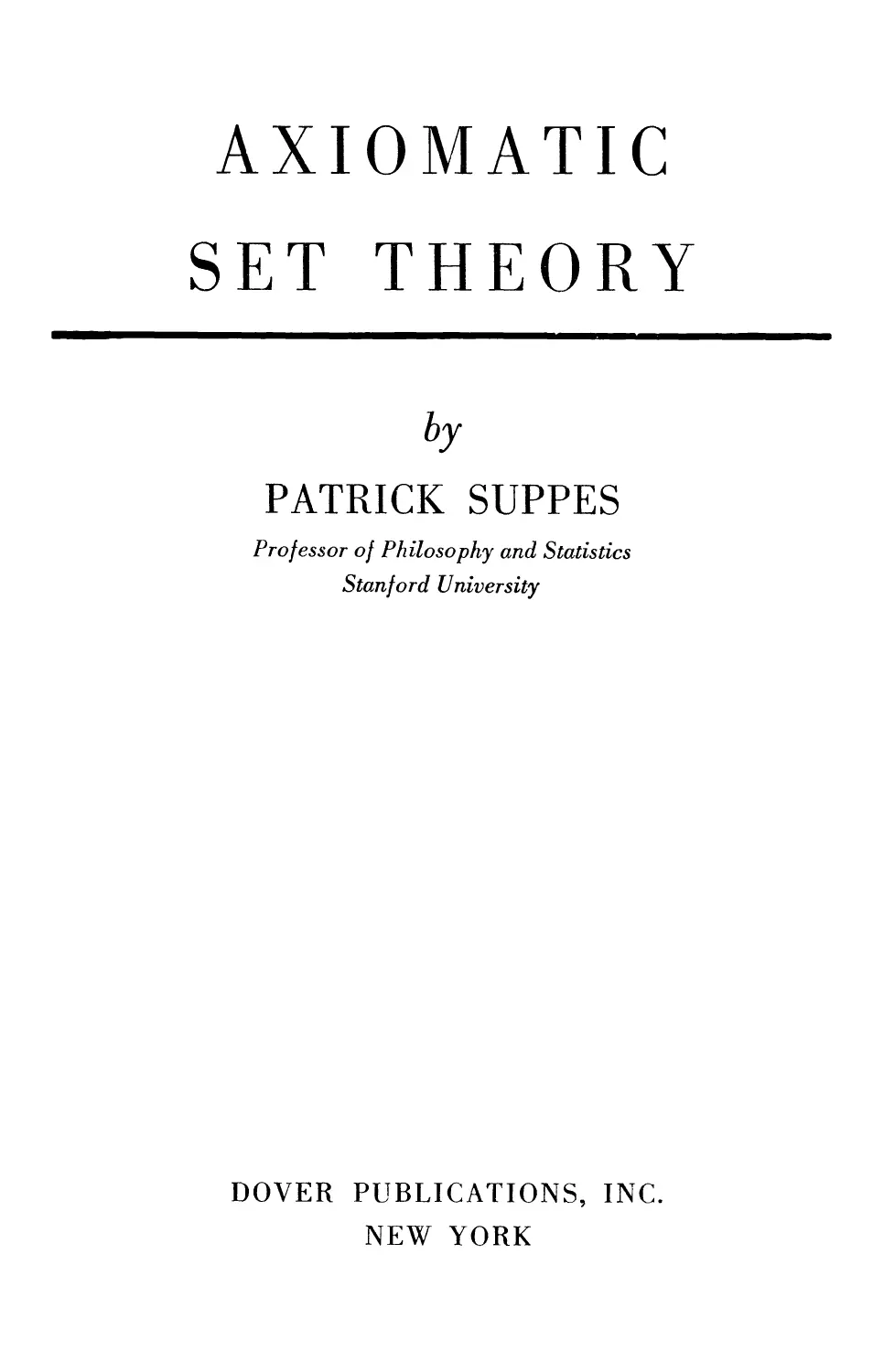



Текст
                    AXIOMATIC
SET THEORY
by
PATRICK SUPPES
Professor of Philosophy and Statistics
Stanford University
DOVER PUBLICATIONS, INC.
NEW YORK

Copyright © 1972 by Dover Publications, Inc.
Copyright © 1960 by Patrick Suppes.
All rights reserved under Pan American and
International Copyright Conventions.
Published in Canada by General Publishing
Company, Ltd., 30 Lesmill Road, Don Mills, Toronto,
Ontario.
This Dover edition, first published in 1972, is an
unabridged and corrected republication of the work
originally published by D. Van Nostrand Company
in 1960. to which the author has added a new preface
and a new section C8.4) .
International Standard Book Number: 0-486-61630-4
Library of Congress Catalog Card Number: 72-86226
Manufactured in the United States of America
Dover Publications, Inc.
31 East 2nd Street, Mineola, N.Y. 11501

To
MY PARENTS

PREFACE TO THE DOVER EDITION
The present edition differs from the first edition in the correction
of all known errors, and in the addition of a final section (8.4)
on the independence of the axiom of choice and the generalized
continuum hypothesis. For bringing to my attention numerous
misprints and minor mistakes I am indebted to a great many people,
in fact, too many to list here; but I do want to mention Nuel Belnap,
Theodore Hailperin, Craig Harrison, Milton Levy, Elliott Mendel-
son, N. C. K. Phillips, D. H. Potts, Hilary Staniland, and John
Wallace.
Patrick Suppes
Stanford, California
June, 1972

PREFACE TO THE FIRST EDITION
This book is intended primarily to serve as a textbook for courses in
axiomatic set theory. The Zermelo-Fraenkel system is developed in detail.
The mathematical prerequisites are minimal; in particular, no previous
knowledge of set theory or mathematical logic is assumed. On the other
hand, students will need a certain degree of general mathematical
sophistication, especially to master the last two chapters. Although some logical
notation is used throughout the book, proofs are written in an informal
style and an attempt has been made to avoid excessive symbolism. A
glossary of the more frequently used symbols is provided.
The eight chapters are organized as follows. Chapter 1 provides a brief
introduction. Chapter 2 is concerned with general developments, and
Chapter 3 with relations and functions. There is not a single difficult
theorem in these first three chapters, and they can be covered very rapidly
in an advanced class. The main pedagogical emphasis is on the exact role
of the various axioms introduced in Chapter 2, which are summarized at
the end of the chapter.
Chapter 4 considers the classical topics of equipollence of sets, finite
sets and cardinal numbers. The Schroder-Bernstein Theorem is proved
early in the chapter. The development of the theory of finite sets follows
closely Alfred Tarski's well known article of 1924. The theory of cardinal
numbers is simplified by introducing a special axiom to the effect that the
cardinal numbers of two equipollent sets are identical. This axiom is
not part of the standard Zermelo-Fraenkel system, and so every definition
or theorem which depends on it has been marked by the symbol 'f, but
it leads to such a simple and natural development that I feel its introduction
is fully justified. Chapter 5 covers some of the same ground from another
viewpoint. The natural numbers are defined as von Neumann ordinals
and the theory of recursive definitions is developed. The axiom of infinity
is introduced, and the final section covers the basic facts about denumerable
sets.
In Chapter 6 the standard construction of the rational and real numbers is
given in detail. Cauchy sequences of rational numbers rather than Dede-
kind cuts are used to define the real numbers. Most of the elementary facts
about sets of the power of the continuum are proved in the final section.
vii

Vlll
PREFACE TO THE FIRST EDITION
Because for many courses in set theory it will not be feasible in the time
allotted to include the construction of the real numbers or because the
topic may be assigned to other courses, the book has been written so that
this chapter may be omitted without loss of continuity.
Chapter 7 is concerned with transfinite induction and ordinal arithmetic.
The treatment of transfinite induction and definition by transfinite
recursion is one of the most detailed in print. Numerous variant formulations
have been given in the hope that successive consideration of them will
clarify for the student the essential character of transfinite processes.
The axiom schema of replacement is introduced in connection with
establishing an appropriate recursion schema to define ordinal addition. The
more familiar facts about alephs and well-ordered sets are proved in the
latter part of the chapter.
Chapter 8 deals mainly with the axiom of choice and its equivalents, like
Hausdorffs Maximal Principle and Zorn's Lemma. Important facts whose
known proofs require the axiom of choice are also deferred consideration
until this chapter. A typical example is the identity of ordinary and
Dedekind infinity.
Although the list of references at the end of the book is small compared
to that given in FraenkePs Abstract Set Theory, I have attempted to refer
to many of the more important papers for the topics considered. Because
set theory, even perhaps axiomatic set theory, is finally coming to be a
staple of every young mathematician's intellectual fare, it is of some
historical interest to note that the majority of the papers referred to in
the text were published before 1930.
I hope that this book will prove useful in connection with several kinds
of courses. A semester mathematics course in set theory for seniors or
first-year graduate students should be able to cover the whole book with
the exception perhaps of Chapter 6. Philosophy courses in the foundations
of mathematics may profitably cover only the first four chapters, which
end with the construction of the natural numbers as finite cardinals. The
material in the first six chapters, ending with the construction of the real
numbers, is suitable for an undergraduate mathematics course in the
foundations of analysis, or as auxiliary reading for the course in the theory of
functions of a real variable.
This book was begun in 1954 as a set of lecture notes. I have revised the
original version at least four times and in the process have benefited greatly
from the criticisms and remarks of many people. I want particularly to
thank Michael Dummett, John W. Gray, Robert McNaughton, John
Myhill, Raphael M. Robinson, Richard Robinson, Herman and Jean Rubin,
Dana Scott, J. F. Thomson and Karol Valpreda Walsh. During the academic
year 1957-58 Joseph Ullian used a mimeographed version at Stanford, and
most of his many useful criticisms and corrections have been incorporated.

PREFACE TO THE FIRST EDITION
As in the case of my Introduction to Logic, I owe a debt of gratitude too large
to measure to Robert Vaught for his detailed and penetrating comments on
the next-to-final draft. David Lipsich read the galley proofs and suggested
several desirable changes most of which could be accommodated. Mrs.
Louise Thursby has typed with accuracy and patience more versions of the
text than I care to remember. Mrs. Blair McKnight has been of much
assistance in reading proofs and preparing the indexes. Any errors which
remain are my sole responsibility.
Patrick Suppes
Stanford, California
January, 1960

TABLE OF CONTENTS
1. INTRODUCTION 1
1.1 Set Theory and the Foundations of Mathematics 1
1.2 Logic and Notation 3
1.3 Axiom Schema of Abstraction and Russell's Paradox 5
1.4 More Paradoxes 8
1.5 Preview of Axioms 12
2. GENERAL DEVELOPMENTS 14
2.1 Preliminaries: Formulas and Definitions 14
2.2 Axioms of Extensionality and Separation 19
2.3 Intersection, Union, and Difference of Sets 24
2.4 Pairing Axiom and Ordered Pairs 30
2.5 Definition by Abstraction 33
2.6 Sum Axiom and Families of Sets 37
2.7 Power Set Axiom 46
2.8 Cartesian Product of Sets 49
2.9 Axiom of Regularity 53
2.10 Summary of Axioms 56
3. RELATIONS AND FUNCTIONS 57
3.1 Operations on Binary Relations 57
3.2 Ordering Relations 68
3.3 Equivalence Relations and Partitions 80
3.4 Functions 86
4. EQTJIPOLLENCE, FINITE SETS, AND CARDINAL NUMBERS 91
4.1 Equipollence 91
4.2 Finite Sets 98
4.3 Cardinal Numbers 109
4.4 Finite Cardinals 121

TABLE OF CONTENTS
CHAPTER PAGE
5. FINITE ORDINALS AND DENUMERABLE SETS 127
5.1 Definition and General Properties of Ordinals 127
5.2 Finite Ordinals and Recursive Definitions 135
5.3 Denumerable Sets 150
6. RATIONAL NUMBERS AND REAL NUMBERS 159
6.1 Introduction 159
6.2 Fractions 161
6.3 Non-negative Rational Numbers 166
6.4 Rational Numbers 170
6.5 Cauchy Sequences of Rational Numbers 174
6.6 Real Numbers 181
6.7 Sets of the Power of the Continuum 189
7. TRANSFINITE INDUCTION AND ORDINAL ARITHMETIC 195
7.1 Transfinite Induction and Definition by Transfinite
Recursion 195
7.2 Elements of Ordinal Arithmetic 205
7.3 Cardinal Numbers Again and Alephs 224
7.4 Weil-Ordered Sets 230
7.5 Revised Summary of Axioms 237
8. THE AXIOM OF CHOICE 239
8.1 Some Applications of the Axiom of Choice 239
8.2 Equivalents of the Axiom of Choice 243
8.3 Axioms Which Imply the Axiom of Choice 251
8.4 Independence of the Axiom of Choice and the
Generalized Continuum Hypothesis 252
References 255
Glossary of Symbols 259
Author Index 261
Subject Index
263

CHAPTER 1
INTRODUCTION
§ 1.1 Set Theory and the Foundations of Mathematics. Among
the many branches of modern mathematics set theory occupies a unique
place: with a few rare exceptions the entities which are studied and analyzed
in mathematics may be regarded as certain particular sets or classes of
objects.* This means that the various branches of mathematics may be
formally defined within set theory. As a consequence, many fundamental
questions about the nature of mathematics may be reduced to questions
about set theory.
The working mathematician, as well as the man in the street, is seldom
concerned with the unusual question: What is a number? But the attempt
to answer this question precisely has motivated much of the work by
mathematicians and philosophers in the foundations of mathematics
during the past hundred years. Characterization of the integers, rational
numbers and real numbers has been a central problem for the classical
researches of Weierstrass, Dedekind, Kronecker, Frege, Peano, Russell,
Whitehead, Brouwer, and others. Perplexities about the nature of number
did not originate in the nineteenth century. One of the most magnificent
contributions of ancient Greek mathematics was Eudoxus' theory of
proportion, expounded in Book V of Euclid's Elements; the main aim of
Eudoxus was to give a rigorous treatment of irrational quantities like the
geometric mean of 1 and 2. It may indeed be said that the detailed
development from the general axioms of set theory of number theory and analysis
is very much in the spirit of Eudoxus.
Yet the real development of set theory was not generated directly by an
attempt to answer this central problem of the nature of number, but by
the researches of Georg Cantor around 1870 in the theory of infinite series
*Intuitivcly we mean by set or class a collection of entities of any sort. Thus we can
speak of the set of all Irishmen, or the set of all prime numbers. In ordinary
mathematics the words 'set', 'class', 'collection', and 'aggregate' are synonyms, and the
same shall be true here, except in a few explicitly noted contexts.
1

2
INTRODUCTION
Chap. 1
and related topics of analysis.* Cantor, who is usually considered the
founder of set theory as a mathematical discipline, was led by his work
into a consideration of infinite sets or classes of arbitrary character. In
1874 he published his famous proof that the set of real numbers cannot be
put into one-one correspondence with the set of natural numbers (the non-
negative integers). In 1378 he introduced the fundamental notion of two
sets being equipollent or having the same power (Machtigkeit) if they can
be put into one-one correspondence with each other. Clearly two finite
sets have the same power just when they have the same number of members.
Thus the notion of power leads in the case of infinite sets to a generalization
of the notion of a natural number to that of an infinite cardinal number.
Development of the general theory of transfinite numbers was one of the
great accomplishments of Cantor's mathematical researches.
Technical consideration of the many basic concepts of set theory
introduced by Cantor will be given in due course. From the standpoint
of the foundations of mathematics the philosophically revolutionary aspect
of Cantor's work was his bold insistence on the actual infinite, that is,
on the existence of infinite sets as mathematical objects on a par with
numbers and finite sets. Historically the concept of infinity has played a
role in the literature of the foundations of mathematics as important as
that of the concept of number. There is scarcely a serious philosopher of
mathematics since Aristotle who has not been much exercised about this
difficult concept.
Any book on set theory is naturally expected to provide an exact analysis
of the concepts of number and infinity. But other topics, some controversial
and important in foundations research, are also a traditional part of the
subject and are consequently treated in the chapters that follow. Typical
are algebra of sets, general theory of relations, ordering relations in
particular, functions, finite sets, cardinal numbers, infinite sets, ordinal
arithmetic, transfinite induction, definition by transfinite recursion, axiom
of choice, Zorn's Lemma. At this point the reader is not expected to know
what these phrases mean, but such a list may still give a clue to the more
detailed contents of this book.
In this book set theory is developed axiomatically rather than intuitively.
Several considerations have guided the choice of an axiomatic approach.
One is the author's opinion that the axiomatic development of set theory
is among the most impressive accomplishments of modern mathematics.
Concepts which were vague and unpleasantly inexact for decades and
sometimes even centuries can be given a precise meaning. Adequate axioms
for set theory provide one clear, constructive answer to the question:
Exactly what assumptions, beyond those of elementary logic, are required
*For a detailed historical survey of Cantor's work, see Jourdain's Introduction to
Cantor [1915].

Sec. 1.1
INTRODUCTION
3
as a basis for modern mathematics? The most pressing consideration,
however, is the discovery, made around 1900, of various paradoxes in
naive, intuitive set theory, which admits the existence of sets of objects
having any definite property whatsoever. Some particular restricted
axiomatic approach is needed to avoid these paradoxes, which are discussed
in §§ 1.3 and 1.4 below.
§ 1.2 Logic and Notation. We shall use symbols of logic extensively
for purposes of precision and brevity, particularly in the early chapters.
But proofs are mainly written in an informal style. The theory developed
is treated as an axiomatic theory of the sort familiar from geometry and
other parts of mathematics, and not as a formal logistic system for which
exact rules of syntax and semantics are given. The explicitness of proofs
is sufficient to make it a routine matter for any reader familiar with
mathematical logic to provide formalized proofs in some standard system
of logic. However, familiarity with mathematical logic is not required for
understanding any part of the book.
At this point we introduce the few logical symbols which will be used.
We first consider five symbols for the five most common sentential
connectives. The negation of a formula P is written as - P. The conjunction
of two formulas P and Q is written as P & Q. The disjunction of P and Q
as P V Q. The implication with P as antecedent and Q as consequent as
P —> Q. The equivalence P if and only if Q as P <-> Q. The universal
quantifier For every y as (Vv), and the existential quantifier For some v as (3v).
We also use the symbol (E!v) for There is exactly one v such that. This
notation may be summarized in the following table.
LOGICAL NOTATION
-p
P&Q
Pv Q
P->Q
P~Q
(Vv)P
(3v)P
(E!v)P
It is not the case that P
Pand Q
Por Q
If P then Q
P if and only if Q
For every v, P
For some v, P
There is exactly one v
such that P
Thus the sentence:
For every x there is a y such that x < y
is symbolized:
(1) (Vx)(3y)(x < y).

4
INTRODUCTION
Chap. 1
The sentence:
For every e there is a 5 such that for every y
ii\x-y\<6 then |/(rr) - f(y)\ < e
is symbolized:
(2) (V.)(3«)(Vy)(|* - y\< 8 - \f(x) - f(y)\ < *).
The sentence:
For every x there is exactly one y such that x + y — 0
is symbolized:
(Vx)(E}y)(x + y = 0).
A given logical symbol may correspond to several English idioms. Thus
(Vv)P may be read For all v, P as well as For every v, P. Sentences (1)
and (2) illustrate the use of parentheses for purposes of punctuation.
No formal explanation seems necessary. However, one convention
concerning the relative dominance of the sentential connectives &, V, —> and
*-> will reduce considerably the number of parentheses. The convention
is that <-» and —> dominate & and V. Thus, the formula:
(x < y & y < z) —> x < z
may be written without parentheses:
(3) x<y&y<z—>x<z.
Similarly,
x + y^0^(x^0Vy^0)
may be written:
x + y^0<->X5*0\/y5*0.
Principles of logic which are needed in the sequel and which may not
be familiar to some readers will be intuitively explained when used. One
principle used, concerning which there is some disagreement in practice
among mathematicians, is that the double bar ' =' is taken as the sign of
identity. The formula lx = y' may be read lx is the same as y\ 'x is identical
with y\ or lx is equal to y\ The last reading is permissible here only if it
is understood that equality means sameness of identity (which is what it
does mean in almost all ordinary mathematical contexts). The exact status
of the relation of identity within set theory is discussed in §2.2.
A few remarks concerning quantifiers may also be helpful. The scope
of a quantifier is the quantifier itself together with the smallest formula
immediately following the quantifier. What the smallest formula is, is
always indicated by parentheses. Thus in the formula
(4) (3x)(x<y)y y = 0
the scope of the quantifier l(3x)' is the formula '(3x)(x < y)\ Following

Sec. 1.2
INTRODUCTION
5
an almost universal practice in mathematics, we shall omit, in the
formulation of axioms and theorems, any universal quantifier whose scope is the
whole formula. For instance, instead of (1) above, we would write: (3y)
(x < y).
In a few places we shall need the notions of hound and free variables.
An occurrence of a variable in a formula is bound if and only if this
occurrence is within the scope of a quantifier using this variable. An occurrence
of a variable in a formula is free if not bound. Finally, a variable is a
bound variable in a formula if and only if at least one occurrence is bound;
it is a free variable in a formula if and only if at least one occurrence is free.
In formula (1) of this section all variables are bound; in (3) all variables
are free; in (4) V is bound and 'y' is free. By virtue of the convention stated
in the preceding paragraph concerning omission of universal quantifiers
in axioms and theorems, all variables occurring in axioms and theorems
are bound.
§ 1.3 Axiom Schema of Abstraction and Russell's Paradox. In
his initial development of set theory, Cantor did not work explicitly
from axioms. However, analysis of his proofs indicates that almost all
of the theorems proved by him can be derived from three axioms: (i) The
axiom of extensionality for sets, which asserts that two sets are identical
if they have the same members; (ii) the axiom of abstraction, which states
that given any property there exists a set whose members are just those
entities having that property; (iii) the axiom of choice, which will not be
formulated at this point and is not pertinent to our discussion of the
paradoxes.
The source of trouble is the axiom of abstraction. The first explicit
formulation of it seems to be as Axiom V in Frege [1893]. In 1901 Bertrand
Russell discovered that a contradiction could be derived from this axiom
by considering the set of all things which have the property of not being
members of themselves.* Because this paradox was historically important
*Frege stated his own reaction to Russell's paradox in a famous appendix to the second
volume of his Grundgesetze der Arithmetik, published in 1903. The translation of the
opening lines given here is from Geach and Black [1952, p. 234].
"Hardly anything more unfortunate can befall a scientific writer than to have one
of the foundations of his edifice shaken after the work is finished.
"This was the position I was placed in by a letter of Mr. Bertrand Russell, just when
the printing of this volume was nearing its completion. It is a matter of my Axiom (V).
I have never disguised from myself its lack of the self-evidence that belongs to the other
axioms and that must properly be demanded of a logical law ... I should gladly have
dispensed with this foundation if I had known of any substitute for it. And even now
I do not see how arithmetic can be scientifically established; how numbers can be
apprehended as logical objects, and brought under review; unless we are permitted —
at least conditionally — to pass from a concept to its extension. May I always speak
of the extension of a concept — speak of a class? And if not, how are the exceptional
cases recognized? . . . These are the questions raised by Mr. Russell's communication."
For a recent discussion of Frege's appendix, see Quine [1955].

6
INTRODUCTION
Chap. 1
in motivating the development of new, restricted axioms for set theory,
its derivation will be given here. For symbolic formulation we need to
introduce the binary predicate 'c' of set membership. The formula 'xCy'
is read lx is a member of y\ lx belongs to y\ or sometimes, lx is in y\ Thus,
if A is the set of first five odd positive integers, the sentence *7£A' is true
and '6£A' is false.
Using 'c' and the logical notation introduced in the previous section,
we may give a precise formulation of the axiom of abstraction:
(i) (3y)(V*)(*ey <-**(*)),
where it is understood that <p(x) is a formula in which the variable ly' is
not free. To obtain Russell's paradox, we want <p(x) to assert that x is not
a member of itself. The appropriate formula is clearly:
We then have as an instance of the axiom of abstraction:
(2) (3y)(VaO(*ey <-»-(* ex)).
Taking x = y in (2), we infer:
(3) yCy*-> -(2/ e y),
which is logically equivalent to the contradiction:
(4) y€y&-(y€y).
This simple derivation has far-reaching consequences for the axiomatic
foundations of set theory. It plainly shows that in admitting (1) as an
axiom we have granted too much. If we adhere to ordinary logic we cannot
in a self-consistent manner claim that for every property there is a
corresponding set of things having that property.
In considering how to build anew the foundations of set theory, perhaps
the first thing to notice is that the axiom of abstraction is really an infinite
bundle of axioms rather than a single axiom: when we replace the expression
'<p(x)' in (1) by any formula in which 'y' is not a free variable, we have a
new axiom. An axiom which permits this sort of blanket substitution of
formulas is usually called an axiom schema. The reason for using the word
'schema' should be obvious. As it stands (1) is not a definite assertion,
but a scheme for making many assertions. From the schema we obtain
a definite assertion by substituting a definite formula for VW'.
The axiom schema which we shall use is due to Ernst Zermelo [1908],
and is usually called the axiom schema of separation (Aussonderung Axiom)
because it permits us to separate off the elements of a given set which satisfy
some property and form the set consisting of just these elements. Thus if
we know that the set of animals exists, we may use the axiom schema of
separation to assert the existence of the set of animals which have the

Sec. 1.3
INTRODUCTION
7
property of being men. That is, the property of being human enables us
to separate men from other animals. Corresponding to (1) the precise
form of the axiom is:
(5) (3y)(\/x)[x Cy+-*xGz& <p(x)].
The change from (1) to (5) is slight but potent. (1) asserted the existence
of sets unconditionally. (5), on the other hand, is completely conditional;
first we have to be given the set z, then we can assert the existence of the
subset y.
It should be clear that we cannot pass from (5) to a contradiction like
(4). Using again the formula f-(x Cx)' as an instance of (5) we have:
(6) (3y)(\/x)[x Cy*->x£z&-(x£ x)]}
and again taking x = y, we infer:
(7) y C y <-> y C z & -(y c y),
which is not contradictory. To make the meaning of (7) a little clearer
let z be the set A whose only two members are the set consisting of the
number 1 and the set consisting of the number 2, that is,
(8) ^={{li,{2l}.
(In (8) we have informally introduced a familiar notation for describing
sets: we describe a set by writing down names or descriptions of its
members, separated by commas, and enclosing the whole in braces. In
the next chapter this notation is formally defined.) Considering now the
set A and RusselFs formula l—(x C x)1, we have from the axiom schema
of separation:
(9) (3y)[y Cy^y€A&-(ye y)].
The truth of (9) is seen by choosing A itself as an appropriate y, for A is
not a member of itself. Thus the left-hand side is false, and the right-hand
side is also false, since 'A£ A & -(A C A)' is contradictory.
Both the axiom schema of abstraction and the axiom schema of
separation have been stated as though it were perfectly clear exactly what
formulas may be substituted for l(p(x)\ In the next chapter a precise
syntactical definition of formula is considered. What has been important
historically is that it is by means of an exact definition of the formulas of a
theory (here set theory) that application of an axiom schema like that of
separation may be made precise. Zermelo [1908] originally formulated the
axiom schema of separation in terms of questions or statements which
have the property of being definite. Roughly speaking, he said that a
statement is definite if it can be decided in a non-arbitrary manner whether
or not any object satisfies the statement.* His formulation of the axiom
The decision does not have to be by some effective or finite procedure. For further
elaboration of this point, see Zermelo [1929],

8
INTRODUCTION
Chap. 1
schema is then (slightly paraphrased): If a statement <p(x) is definite for
all elements of a set M, then there is always a subset Mp of M which
contains exactly those elements x of M for which <p(x) is true.
The first real clarification of this notion of definiteness was given by
Skolem [1922], who characterizes definite statements as just those which
satisfy his exact definition of formula. For some further discussion see
Zermelo [1929] and Skolem [1930].*
It is not feasible to enter into the details of these papers by Zermelo
and Skolem, but some readers, not interested in clarity for its own sake,
may wonder why Zermelo was so interested in the first place in restricting
the axiom schema of separation to definite statements. The answer to this
query is most easily given in the context of discussing further paradoxes
which arise in the foundations of mathematics.
Before turning to these paradoxes in the next section a historical remark
may be made about the axioms to be considered in the sequel. Essentially
they correspond very closely to those in Zermelo [1908]. However, when
we come to the theory of transfinite induction and ordinal arithmetic, we
shall need to add a stronger axiom schema than that of separation, namely,
what is usually called the axiom schema of replacement, which is due to
Fraenkel [1922a]. t For these reasons the system of axiomatic set theory
developed in this book is usually called Zermelo-Fraenkel set theory in the
literature of the subject, although it would seem historically more
appropriate to call it Zermelo-Fraenkel-Skolem set theory.
§ 1.4 More Paradoxes. Because of its simplicity Russell's paradox
was introduced to show why the obvious, direct axiomatization of intuitive
set theory is inconsistent. Historically, other paradoxes were discovered
before RusselFs, the first published one apparently being Burali-Forti's
paradox [1897] of the greatest ordinal. A full analysis of the ten or twelve
paradoxes which have been discussed in the literature would be out of place
here.t For a good survey the reader is referred to Beth [1950]. Several
of the paradoxes are relatively slight variations of each other, so that we
shall briefly and informally describe only the more prominent ones.
F. P. Ramsey [1926] seems to be the first person explicitly and clearly to
divide the paradoxes into two classes: the logical or mathematical
paradoxes, and the linguistic or semantical ones. Roughly speaking, the first
class arises from purely mathematical constructions; the second from direct
*Zermelo,s paper of 1929 was concerned also with making the notion of definiteness
more precise; it was written without knowledge of Skolem's paper of 1922, and does
not provide as satisfactory a formulation as Skolem's. Some telling criticisms of
Zermelo's paper are made by Skolem in his paper of 1930. A less detailed but essentially
correct clarification of definiteness was given independently by Fraenkel [1922b].
fEssentially the same axiom was proposed independently and at the same time by
Skolem [1922].
JA paradox is often also called an antinomy in the literature.

Sec. 1.4
INTRODUCTION
9
consideration of the language which we use to talk about mathematics
and logic.
Russell's paradox belongs to the first class, as does the Burali-Forti
paradox, which is discussed further in §5.3. The general idea of the latter
goes as follows. In intuitive set theory every well-ordered set has an
ordinal number. Moreover, the set of all ordinals is well-ordered, whence
the set of all ordinal numbers has an ordinal number, 0 say. But the set
of all ordinals up to and including any given ordinal is well-ordered and
thus has an ordinal number, which exceeds the given ordinal by one.
Consequently, the set of all ordinals including © has the ordinal number 0
+ 1, which is greater than 0. Therefore 0 is not the ordinal number of
all ordinals.
It might be thought that any device which blocked direct derivation of
Russell's paradox would do the same for Burali-Forti's, but this is not the
case. For example, J. B. Rosser [1942] derived the latter paradox in the
system of Quine [1940] thereby showing its inconsistency, although it is clear
that no direct derivation of Russell's paradox is possible in Quine's system.
Another well-known paradox in the first class is Cantor's paradox of
the greatest cardinal number, which he found in 1899 and which was first
published with his correspondence in 1932. Again operating in intuitive
set theory we consider the cardinal number n of the set S of all sets. On
the one hand it is clear that n is the greatest possible cardinal. But we
may also consider the set of all subsets of S, and its cardinal p. By a
standard theorem of intuitive set theory p must be greater than n.
To readers unfamiliar with the notions of cardinal and ordinal number
freely used in describing these last two paradoxes it may be said that in
subsequent chapters these notions will be developed in detail and
completely ab ovo. Without giving an exact analysis at this point it should
be clear in a general way how these paradoxes do not arise when the primary
axiom for constructing sets is Zermelo's axiom schema of separation,
for then the existence of the set of all sets or the set of all ordinal numbers
cannot be established.
The oldest semantical paradox is Epimenides' paradox of the liar.
Epimenides the Cretan said, "I am lying." If the statement is true then
he is lying and the statement is false. If the statement is false, then he
is not lying and the statement is true. Modern versions often read like
this. Consider the sentence, "The only sentence on this panel of the
blackboard is false." If the sentence is true it must be false, and conversely.
An amusing related puzzle which dates fron antiquity is the dilemma of
the crocodile. The crocodile has stolen a child and says to the father,
"I will return the child if you guess correctly whether or not I will return
the child." The father replies, "You will not return the child." What
should the crocodile do?

10
INTRODUCTION
Chap. 1
The first published modern semantical paradox seems to be Richard's
paradox [1905], which is related to Cantor's proof of the non-denumerability
of the set of all real numbers (which proof is given in §6.6).* By an
expression of the English language let us mean any finite sequence of the twenty-
six letters, a comma, a period, and a blank space; that is, an expression is
any finite sequence of these twenty-nine symbols. Now order the
expressions according to total number of symbols and lexicographically within
each total number. Thus we have
a
b
aa
ab
aaa
Now strike out those expressions which do not define real numbers; let E
be the remaining subsequence. Translating and paraphrasing somewhat,
we may use Richard's original formulation to define a certain real number
N with respect to E: "The real number whose whole part is zero, and
whose n-th decimal is p plus one if the n-th decimal of the real number
defined by the nth. member of E is p and p is neither eight nor nine, and is
simply one if this n-ih decimal is eight or nine." By construction N is
not a member of E, since it differs from every real number in E in at least
one decimal place, but N is defined by a finite expression, whence it is in E.
Thus the contradiction.
The third and final semantical paradox to be mentioned here is the
Grelling-Nelson paradox [1908] of heterologicality. A predicate is called
heterological if the sentence ascribing to the predicate the property
expressed by the predicate is false. Thus the predicate 'red' is heterological
since the sentence, "The predicate 'red' is red" is false. The contradiction
arises from asking if the predicate 'heterological' is itself heterological.
Clearly, if it is, we infer that it is not; and if it is not that it is.
A detailed discussion of these semantical paradoxes would take us
far from set theory proper into the general domain of formal logic.
But it is pertinent to see how the inferences leading to them are blocked
in Zermelo-Fraenkel set theory. Zermelo specifically introduced his notion
of definiteness in the axiom schema of separation to prevent construction
of the semantical paradoxes (cf. Zermelo [1908, p. 264]). As was pointed
*For an analysis and exposition of Richard's paradox, see Church [1934].

Sec. 1.4
INTRODUCTION
11
out in the preceding section, this notion of definiteness is made precise
by reducing it to the syntactical notion of formula. With reference to the
semantical paradoxes the point of this reduction may be made clearer.
Every one of these paradoxes arises from having available in the language
expressions for referring to other expressions in the language. Any language
with such unlimited means of expression is perforce inconsistent.*
Consequently it is important to distinguish between the object language —
here the language in which we talk about sets — and the metalanguage,
that is, the language in which we talk about the object language. Although
set theory is not developed in this book in a fully formalized manner, at
the beginning of the next chapter we consider an exact definition of formula
for the object language we use. Our metalanguage is a certain vaguely
defined fragment of ordinary English augmented by certain symbols
familiar from intuitive mathematics. It will be obvious that our object
language is not rich enough to provide any direct means of expressing the
semantical paradoxes. In other words, we avoid these paradoxes by
severely restricting the richness of our language. It should be noted that
when a formalized language is used it is intuitively clear there is little
prospect of deriving one of the semantical paradoxes in this language;
the intuitive status of the mathematical or logical paradoxes is usually
not as immediately clear.
These semantical matters will not be pursued in the sequel. They have
been discussed in a somewhat cursory fashion here to clarify the need of
what amounts to a semantical restriction on the axiom schema of
separation. Furthermore, it should be mentioned that a complete and exact
formalization of the object language is necessary for proving metamathe-
matical facts about Zermelo-Fraenkel set theory. By 'metamathematical
facts' we mean facts about the object language. An example of an
important metamathematical fact is that the axiom schema of separation
cannot be replaced by a finite number of axioms in the object language.
Finally, it may be emphasized that Zermelo-Fraenkel set theory
provides but one of several possible approaches to the foundations of
mathematics. There is one alternative so intimately tied to Zermelo-Fraenkel
set theory that it should be mentioned here, namely, von Neumann-
*In Tarski [1956, p. 402] this is put most succinctly: "The main source of the
difficulties met with seems to lie in the following: it has not always been kept in mind
that the semantical concepts have a relative character, that they must always be related
to a particular language. People have not been aware that the language about which
we speak need by no means coincide with the language in which we speak. They have
carried out the semantics of a language in that language itself and, generally speaking,
they have proceeded as though there was only one language in the world. The analysis
of the antinomies mentioned shows, on the contrary, that the semantical concepts simply
have no place in the language to which they relate, that the language which contains
its own semantics, and within which the usual logical laws hold, must inevitably be
inconsistent."

12
INTRODUCTION
Chap. 1
Bernays-Godel set theory.* There are two essential differences. The latter
theory may be finitely axiomatized. No axiom schema of construction
like that of separation is required, but instead a finite number of specific
set and class constructions suffices. And in what we shall call for brevity
von Neumann set theory, there is a technical distinction between classes
and sets. Every set is a class, but not conversely. Those classes which are
not sets are called proper classes, and their distinguishing characteristic
is that they are not members of any other class. The class of all ordinal
numbers and the class of all sets both exist, but both are proper classes.
Thus the Burali-Forti and Cantor paradoxes cannot be constructed, for
they require these classes to be members of other classes. Similar remarks
apply to RusselPs paradox. In subsequent chapters informal indications
are often given to indicate the slight variations in theorems, definitions or
proofs required in von Neumann set theory. Zermelo and von Neumann
set theory are so closely connected that anyone familiar with the one will
soon find himself at home in the other.
§ 1.5 Preview of Axioms. Because the axioms for Zermelo-Fraenkel
set theory which we shall use are introduced individually in various sections
of succeeding chapters, a cursory preview will perhaps help provide a general
sense of development. The remarks at this point are superficial for we
shall introduce the axioms only by name. In the next chapter we consider
the following seven axioms, the bulk of those needed:
Axiom of extensionality
Axiom schema of separation
Union axiom
Pairing axiom
Axiom of regularity
Sum axiom
Power set axiom
Toward the end of Chapter 2 we shall show that the union axiom is
redundant; that is, it may be derived from the other six. It is used at the
beginning of the chapter in order to make initial developments simple.
*Originally formulated by von Neumann in a series of papers [1925], [1928a], [1929].
His formulation differs considerably from Zermelo set theory because the notion of
function is taken as fundamental rather than that of class or set. In a series of papers
in the Journal of Symbolic Logic Bernays modified the von Neumann approach in order
to remain nearer to the original Zermelo system (see References for the list of papers).
Bernays introduced two membership relations: one between sets, and one between sets
and classes. In Godel [1940] the theory is still further simplified; his primitive notions
are those of set, class, and membership (although membership alone is sufficient).
A paper by R. M. Robinson [1937] provides a simplified system close to von Neumann's
original one.

Sec. 1.5
INTRODUCTION
13
In Chapter 3, which is concerned with relations and functions, no new
axioms are introduced. In Chapter 4, a special axiom for cardinal numbers
is presented and used mainly in the context of that chapter. This special
axiom is not a part of classical Zermelo-Fraenkel set theory, but it
enormously facilitates the construction of intuitive cardinal number theory
within our axiomatic framework.
The axiom of infinity is introduced in Chapter 5 in order to make it
possible to prove that the set of all natural numbers exists. The natural
numbers themselves can be constructed without this axiom. Chapter 6
is concerned with construction of the real numbers, and no further axioms
are needed for this work.
In Chapter 7 the axiom schema of replacement is brought in as necessary
for the development of ordinal arithmetic and transfinite induction. It is
also shown that the pairing axiom may be derived from this schema and
the power set axiom. Chapter 8, the final chapter, is mainly devoted to the
axiom of choice.

CHAPTER 2
GENERAL DEVELOPMENTS
§ 2.1 Preliminaries: Formulas and Definitions. Let us now
(a) explicitly define the notion of formula required in the axiom schema of
separation (and later in the axiom schema of replacement) and (b) state
the approach to definitions we adopt in introducing the many defined
symbols needed.
In Chapter 1, the important distinction was made between the object
language, that is, the language in which we talk about sets, and the
metalanguage, that is, the language in which we discuss the object language
itself. We use the metalanguage, which for us is ordinary English
augmented by a certain amount of intuitive mathematical language, to
describe exactly the object language. It may be helpful to look upon this
description as analogous to an exact characterization of a game like chess
or bridge. But this analogy is not to be carried too far, for most of the
expressions of our object language have a definite meaning in terms of
intuitive mathematical ideas, which the positions or moves in a game like
chess do not.
We begin with a fivefold classification of the symbols of the object
language into constants, variables, sentential connectives, quantifiers or
operators, and punctuation or grouping symbols.* The two primitive
constants of the language are the membership relation symbol '£', introduced
informally in Chapter 1, and the constant '0\ which denotes the empty set.
In addition, we take from logic the predicate constant ' = \ which is the
identity symbol. The general variables ranging over all objects are the
letters V, ly', V, . . . with and without subscripts or superscripts. The
sentential connectives are the five mentioned in §1.2 , &, V, —>, <->;
the three quantifiers or logical operators we use — V, 3, E! — were also
mentioned in §1.2. Finally, left- and right-hand parentheses are our only
punctuation symbols.
This classification originates with von Neumann [1927]. For detailed discussion
of these matters see the first chapter of Church [1956].
14

Sec. 2.1
GENERAL DEVELOPMENTS
15
Expressions of the object language are finite sequences of the five classes
of symbols of the language. Certain of these expressions, simply because
of their structure, are called primitive formulas of the object language.
We now define such formulas so that merely by looking at the form of an
expression we can automatically decide in a finite number of steps whether
or not it is a primitive formula. Although this definition is purely
syntactical or structural, it is just the expressions satisfying it which have a clear
intuitive meaning. An expression like '( —> £ x1 is not a primitive formula
and has no intuitive meaning.
We first define primitive atomic formulas.
A primitive atomic formula is an expression of the form (v C w), or of
the form (v = w), where v and w are either general variables or the
constant '0'.*
Thus'(a;£ 2//and'(2 = 0)' are primitive atomic formulas.
We may now give what is usually called a recursive definition of primitive
formulas:
(a) Every primitive atomic formula is a primitive formula;
(b) // P is a primitive formula, then —P is a primitive formula;
(c) // P and Q are primitive formulas, then (P & Q), (P V Q),
(P —> Q), and (P <-» Q) are primitive formulas;
(d) If P is a primitive formula and v is any general variable then (Vv)P,
(3v)P and (E!v)P are primitive formulas;
(e) No expression of the object language is a primitive formula unless
its being so follows from rules (a) - (d).
The following are examples of primitive formulas of the object language
which are not atomic: l(3x){\/y) - (y c x)','((x C y)-Ky G z))\'(E! z)
(0 = z)\ In terms of this definition, an exact formulation of the axiom
schema of separation is then:
Any primitive formula of the object language of the form
(3v)((3Wl)(w1GvV v = 0)&(Vw)(wGv^w£u&ri)
is an axiom, provided the variable v is distinct from u and Wi and is not
free in the primitive formula <p.
*In this definition, as elsewhere, we use the boldface letters V, V, 'w', Si/, 'v^i
cwi', ... as metamathematical variables which take as values variables *x', ly\ V,
... or the constant '0' of the object language. And we use boldface letters, 'P', *Q',
. . . , as well as Greek letters V and 'ty', as metamathematical variables which take as
values formulas of the object language. The conventions about use and mention
followed here, which are probably obvious, are that (i) the constants *c' and ' =', the
sentential connectives, the quantifier symbols, and the left and right parentheses are
used as names of themselves, and (ii) juxtaposition of names of expressions denotes a
binary operation on expressions which yields new expressions (for example, (xCy' &
lyCz' = 'xCy & yCz1). For a more detailed discussion of these conventions, see Chapter 6
of Suppes [1957].

16
GENERAL DEVELOPMENTS
Chap. 2
The first clause of the axiom guarantees that an arbitrary individual cannot
play the role of the empty set 0. Justifying reasons for the restrictions on
the variable v are given in the next section.
In principle all of the axioms and theorems of set theory that we state
in the following pages can be written as primitive formulas of the object
language — indeed, our official object language shall consist of these
primitive formulas. For working purposes it will be useful and convenient to
introduce by definition considerable additional notation. We shall in
practice apply the axiom schema of separation to formulas which are not
written solely in primitive notation; but since at any point in our
development only a finite number of definitions will have preceded, such a formula
can be replaced by a primitive formula by a finite number of substitutions.
Regarding definitions, then, our viewpoint is that they are informally
admitted if clear recipes are given for eliminating new symbols from any
context. We thus require that a formula of the object language which
introduces a new symbol must satisfy the following:
Criterion of Eliminability. A formula P introducing a new symbol
satisfies the criterion of eliminability if and only if: whenever Qi is a
formula in which the new symbol occurs, then there is a primitive formula
Q2 such that P —»(Qi <-> Q2) is derivable from the axioms.
Notice that we have stated this criterion without giving an exact definition
of formula (as opposed to primitive formula). Such a definition is
straightforward if we list all the defined symbols introduced in this book, and then
proceed in terms of this list as we did before with the primitive notation.
This tedious task we shall not perform, but we do want to mention a second
criterion we expect our definitions to satisfy, namely, our definitions must
not be creative.
Criterion of Non-Creativity. A formula P introducing a new
symbol satisfies the criterion of non-creativity if and only if: there is no
primitive formula Q such that P —» Q is derivable from the axioms but
Q is not.
In other words, a definition should not function as a creative axiom
permitting derivation of some previously unprovable formula in which only
primitive notation occurs.
The classical problem of the theory of definition for any exactly stated
mathematical theory is to provide rules of definition whose satisfaction
entails satisfaction of the two criteria just stated. We may restrict
ourselves here to rules for defining operation symbols. Slight modifications
yield appropriate rules for defining relation symbols and individual
constants.* In these rules we refer to preceding definitions, which implies
that the definitions are given in a fixed sequence and not simultaneously;
"Individual constants may in fact be treated as operation symbols of degree zero.

Sec. 2.1
GENERAL DEVELOPMENTS
17
this approach permits use of defined symbols in the definitions of new
symbols.*
Proper definitions of operation symbols may be either equivalences or
identities. We begin with the former.
An equivalence P introducing a new n-place operation symbol O is a
proper definition if and only if P is of the form
0(vlf . . • , vn) = w <-> Q
and the following restrictions are satisfied: (i) v1; . . . ,v«, w are distinct
variablesj (ii) Q has no free variables other than yly . . . , vn, w, (iii) Q
is a formula in which the only non-logical constants are the primitive or
previously defined symbols of set theory, and (iv) the formula (E! w) Q
is derivable from the axioms and preceding definitions.
Regarding the phrase 'non-logical constants' in (iii), the only logical
constants are those introduced in §1.2; all other constants are non-logical.
Justification of the various restrictions is easily given. Here we shall
emphasize only the importance of (iv). Consider the following definition
in elementary arithmetic of the pseudo-operation *.
(1) x+y = z<r->x<z&y<z.
Clearly it is false that
(Efe) (x <z&y <z).
Thus (1) violates (iv), and we want to show that violation of it will lead
to a contradiction. Now since 1 < 3, 2 < 3, 1 < 4, and 2 < 4, we
immediately infer from (1):
1*2 = 3
and
1*2 = 4
whence
4 = 3,
which is absurd. In ordinary mathematical language the point of (iv)
is to require that performing an operation shall always yield a unique object.
For a definition which is an identity we have the following rule.
An identity P introducing a new n-place operation symbol O is a proper
definition if and only if P is of the form
0(vlf • • • ,V») = t
*The rules to be given and related matters are discussed in more detail in Chapter 8
of Suppes [1957].

18
GENERAL DEVELOPMENTS
Chap. 2
and the following restrictions are satisfied: (i) Vi, . .. ,vn are distinct
variables, (ii) the term t has no free variables other than vl7 . . . ,vn, and
(iii) the only non-logical constants in the term t are primitive symbols
and previously defined symbols of set theory.
An example of a definition by means of an identity in arithmetic is the
definition of subtraction in terms of addition and the negative operation.
x - y = x + (-y).
It is straightforward to prove that definitions satisfying either of these
rules just given, or the analogous ones for relation symbols and individual
constants, satisfy the criteria of eliminability and non-creativity.
Unfortunately many of the definitions common in mathematics and many
of the definitions to be introduced in the sequel do not satisfy the criterion
of eliminability; and thus most of the definitions of operation symbols do
not satisfy one of the two rules introduced. The reason for this failure
may be simply stated: the definitions are often conditional in form. A
typical instance of a conditional definition in arithmetic is provided by a
definition of division, for which the problem of division by zero arises.
(1) 2/ ^ 0 —> (x/y = z*->x = y • z).
Using (1) as the definition of the operation symbol for division, we cannot
eliminate the symbol from contexts like:
1/0 * 2.
On the other hand, we can use (1) to eliminate division in all "interesting"
cases, that is, all those which satisfy the hypothesis of (1). Moreover, it
is not difficult to modify the two rules given in such a way that conditional
definitions satisfying them satisfy the criterion of non-creativity. In fact,
the appropriate modifications of the rule for equivalences which define
operation symbols are embodied in the following.
An implication P introducing a new operation symbol O is a conditional
definition if and only if P is of the form
Q-> [0(Vl,... >v») = w~R]
and the following restrictions are satisfied: (i) the variable w is not free
in Q, (ii) the variables vx, . . . ,vn, w are distinct, (iii) R has no free
variables other than vD . . . ,vn, w, (iv) Q and R are formulas in which
the only non-logical constants are the primitive symbols and previously
defined symbols of set theory, and (v) the formula Q—> (E!w)R is
derivable from the axioms and preceding definitions.
To convert a conditional definition of an operation symbol into a proper
definition satisfying the criterion of eliminability is a routine matter once

Sec. 2.1
GENERAL DEVELOPMENTS
19
an object is chosen which can be the result of performing the operation
when the hypothesis of the conditional definition is not satisfied. In
arithmetic the natural choice is the number zero. Having agreed upon
this, we may replace the conditional definition (1) of division by:
x/y = z<-*(y7±0-*x = y-z) & (y = 0 —» z = 0).
The corresponding natural choice in set theory is the empty set. Thus
any conditional definition satisfying the rule stated above may be converted
into a proper definition by writing it as:
(2) 0(vlf . . . ,v») = w~ (Q ->R) & (-Q -> w = 0).
In the sequel we shall continually use conditional definitions, but with the
understanding that the notation they introduce may always be eliminated
in favor of primitive notation by recasting them as proper definitions of
the form indicated by (2).
From a logical standpoint definitions of the kind we have been describing
are non-creative axioms stated in the object language. They are properly
classified as axioms because they function as additional premises in the
derivation of theorems, but their non-creative character insures that they
do not actually strengthen set theory as formulated in the basic creative
axioms. We shall occasionally introduce definition schemata which, like
the axiom schema of separation, should properly be formulated in the
metalanguage. Such definition schemata will mainly occur in connection
with the introduction of new methods of binding variables. We shall also
augment our primitive notation by the introduction of several kinds of
variables: set variables ranging over sets but not individuals (lA\ lB\
'C, . . .), cardinal variables ranging over cardinal numbers ('m', V, V, • • •)>
ordinal variables ranging over ordinal numbers ('a, '/37, V, . . .), integer
variables ranging over non-negative integers (W, ln)', 'p', . . .), rational
variables ranging over non-negative rational numbers ('M\ lN\ lP', . . .).
We shall not explicitly consider rules for definition schemata which
introduce new variables or new methods of binding variables, but it will be
clear for the small number of such schemata actually used how it may be
shown that they satisfy the two criteria of eliminability and non-creativity,
or how they may be slightly modified to obtain this satisfaction.
§ 2.2 Axioms of Extensionality and Separation. We begin with
the definition of the notion of a set. The content of the definition conforms
to intuitive ideas: a set is something which has members or is the empty set.
Definition 1. y is a set <-» (3x) (x C y V y = 0).
As might be expected, the notion of being a set is needed every step of the
way. Most of the definitions introduced, for instance, will be conditional

20
GENERAL DEVELOPMENTS
Chap. 2
ones intended intuitively to apply only to sets. In order to save the trouble
of continually writing out the predicate 'is a set', we shall adopt the
following convention regarding variables. Capital italic letters lA\ 'B'f 'C\ etc.
shall be used only for sets. Lower case italic letters V, ly\ lz\ etc., on the
other hand, may take as their values either sets or individuals. (We call
the latter symbols general variables.) With this convention clearly in mind
we may without any confusion ordinarily omit the predicate 'is a set'.
Translation of sentences involving set variables into the basic notation
of general variables is straightforward. The three rules needed are quite
simple; rather than give a formal statement of them, we may illustrate
their use by three examples, one dealing with a universal quantifier, one
with an existential quantifier, and one with the 'exactly one' quantifier.
The sentence:
(VA)(3x)-(xeA)
is translated:
(Vy)(y is a set -> (3x)-(x G y)),
and the sentence:
(Vx)(3A)-(x£A)
is translated:
(\fx)(3y)(y is a set & -(x e y)).
The sentence:
(ElAXVxXxeA)
is translated:
(E\y)(y is a set & (Vx)(x £ 2/)).
It is to be noted that the individual constant denoting the empty set
is used in the definiens of Definition 1. It is customary in many axiomatic
developments of set theory to define the symbol for the empty set rather
than to begin with it as a primitive symbol. But this is not possible here,
for the axioms are framed so as to permit individuals within the domain of
discourse. In this respect we follow Zermelo's original 1908 formulation
of set theory. However, our axioms do not actually postulate the existence
of any individuals, and they are thus consistent with the view that there
are only sets in the domain of discourse. A standard definition of the empty
set is:
0 = x*->(\fy)(y&x),
but it is easy to prove on the basis of this definition that any individual is
identical with the empty set, and this effectively excludes individuals.

Sec. 2.2
GENERAL DEVELOPMENTS
2J
The two axioms we consider in this section are the axiom of extensionality:
(Vx)(x €A<->xCB)->A=B
and the axiom schema of separation:
(3B)(\/x)(x cB^xcA& <p(x)).
It is understood in the axiom schema of separation that the variable 'B'
is not free in <p(x). An exact metamathematical formulation of this schema
was given in the preceding section. * For intuitive working purposes we
shall hold to the form just now used, which is a mixture of the object
language and metalanguage; but the reader should keep clearly in mind
that this is an axiom schema, not a single axiom. The restriction that 'B'
not be free in <p(x) is essential, for without it we can derive a contradiction
whenever A is a non-empty set. To see this, let <p(x) be l-(x C B)y and let
A be the set consisting of the empty set (the existence of A follows from
other axioms in this chapter). Then we have:
(3£)(0 c5^0eA&-(0G B)),
which, since OG A, implies:
(3£)(0e£<->-(0e£)),
an absurdity. On the other hand, it is legitimate and sometimes necessary
for (p(x) to contain free variables other than simply V; only 'B' is excluded.
We turn now to systematic developments. We first define the standard
notation 'g' for something not being a member of something else.
Definition 2. x&y<-> —{x c y)-
Correspondingly, we use from logic the notation lx 5* x' for '—(x = x)\
As the first theorem, we have:
Theorem 1. xgO.
proof. Taking <p(x) as 'x 5^ x' we have from the axiom schema of
separation:
(1) (3A)(\/x)(x €A<-*x£0&x^ x).
Suppose now that some x is in A; then by (1), x 7* x, which is absurd.
Hence we conclude:
(2) (V*)(*2A),
*It is worth noting that strictly speaking the formulation with set variables is weaker
than the metamathematical one with only one kind of variable, for the former reads:
x is a set—> (3y)(y is a set & (Vz)(zCy<r^> zCx & <p(z))),
whereas the earlier metamathematical version does not have this conditional form. On
the other hand, it is of no real interest to have the axiom apply when x is an individual.

22
GENERAL DEVELOPMENTS
Chap. 2
and therefore by Definition 1
(3) A = 0.
The theorem follows from (2) and (3). Q.E.D.
We next prove a simple theorem concerning the uniqueness of the empty
set.
Theorem 2. (Vx)(x g A) <-> A = 0.
proof. If A = 0, then by Theorem 1, x$_A. On the other hand, if
for every z,xQ.A, then there is no element in the set A and by Definition 1,
A = 0. Q.E.D.
The remainder of this section is concerned with the notions of inclusion
and proper inclusion of sets. If A and B are sets such that every member
of A is a member of B, then we say that A is included in B, or that A is a
subset of B, which we symbolize: iC5. Thus we may write:
The set of Irishmen is included in the set of men
or:
The set of Irishmen is a subset of the set of men
or simply:
The set of Irishmen C the set of men.
Formally, we have:
Definition 3. A Q B<-» (\/x)(xc A —>x£B).
From a formal standpoint Definition 3 is a conditional definition of a two-
place relation symbol. The fact that it is a conditional definition is masked
by the use of capital letters in the manner agreed upon. This same remark
applies to all the definitions introduced which use set variables.
Theorem 3. A C A.
proof. Since it is a truth of logic that
(Vx)(xcA-+x£A),
it follows immediately from Definition 3 that
iCi. Q.E.D.
Theorem 3 asserts simply that inclusion is reflexive; the next theorem asserts
that it has the property of antisymmetry, as it is usually called.
Theorem 4. A^B&BQA-^A=B.
proof. If A C B and B C A, then it follows from Definition 3 that
(Vx)(xcA<r^xC B).
Hence by the axiom of extensionality, A = B.
Q.E.D.

Sec. 2.2
GENERAL DEVELOPMENTS
23
Theorem 5. ACO^i =0.
proof. By virtue of Definition 3 and the hypothesis of the theorem,
if x C A then xcO. But by Theorem 1 x g 0. Hence for every x, x £ A,
and thus by Theorem 2, A = 0. Q.E.D.
Transitivity of inclusion is asserted in the following theorem.
Theorem 6. AQB&BQC^AQC.
proof. Consider an arbitrary element x. Since A CI B if x c A then
x £B, but BCC; hence if z G # then xcC. Thus by the transitivity
of implication if x C A then xcC. Q.E.D. *
A typical procedure used in informal proofs is exemplified here. We
need to prove something about all elements x. To do this it suffices to
give the argument for an arbitrary x. The use of the phrase 'arbitrary
element' corresponds in the language of logic to introducing a free variable
in a premise (in this case the premise: x C A).
We now define proper inclusion.
Definition 4. AC.B<r^A^B&A^B.
Thus using informally the braces notation not yet formally defined, we
have:
{1,2} C {1,2,3}
but it is not the case that
{1,2} C {1,2}.
(Here we describe a set by writing down names of its members separated
by commas and enclose the result with curly braces.) The next four
theorems assert expected properties of proper inclusion; the proofs are left
as exercises.
Theorem 7. -{A C 4)
Theorem S. A CB-»-(BCA)
Theorem 9. ACB&BCC->ACC.
Theorem 10. A C B-> A Q B.
EXERCISES
1. Prove Theorems 7-10.
2. Formulate Definition 4 as a conditional definition without using set variables
*A', 'B', etc.
* "Transitivity of implication" just means that from P —> Q and Q->R we may
infer P -► R.

24
GENERAL DEVELOPMENTS
Chap. 2
3. Formulate Theorems 2 and 3 without using any set variables.
4. Along the lines of Definition 1 give a formal definition of the notion of an
individual.
§ 2.3 Intersection, Union, and Difference of Sets. The elementary
properties of the three most basic binary operations on sets are the concern
of this section. Using again informally the braces notation for sets, some
simple examples illustrating these operations may be given. If A and B
are sets, then by the intersection of A and B (in symbols: A fl B) we mean
the set of all things which belong both to A and B. Thus
{1,2} n {2,3) = {2}
and
{1} n {2} =0.
By the union of A and B (in symbols: Al)B) we mean the set of all
things which belong to at least one of the sets A and B. For instance,
{1,2} U {2,3} = {1,2,3}
and
(If U [2) = |1,2).
By the difference of A and B (in symbols: A ~ B) we mean the set of all
things which belong to A but not to B. Thus
{1,2|-{2,31 = {1}
and
U}~{2} = {11.
The basic theorems asserting existence of the sets which are the
intersection and difference of two sets may be proved by use of the axiom schema
of separation. The same thing cannot be said for the union of two sets, and
so at this point we introduce the union axiom, which we will show later
to be redundant in terms of the full set of axioms introduced in this
Chapter:*
(3C)(\fx)(x£C^>x£ A V xcB).
We do not use this axiom immediately, but first develop the properties
of the intersection operation.
Theorem 11. (E\C)(Vx)(x cC^xcA&xcB).
*The sum axiom introduced below in §2.6 is sometimes called the union axiom. The
present axiom, which is redundant, must not be confused with it.

Sec. 2.3
GENERAL DEVELOPMENTS
25
proof. The following is an instance of the axiom schema of separation:
(3C)(Vx)(x cC^xcA&xcB).
We now need to show that C is unique. Suppose there were a second set
C such that for every x
xz:C'*->z€:A&x£B;
then for every x
x C C <-> x C C
and by virtue of the axiom of extensionality
C" = C. Q.E.D.
The theorem just proved formally justifies the definition of intersection.
Definition 5. A f)B = y <-* (\fx)(x c y <-> x C A & x £ B) & y is
a set.
Admittedly the natural tendency is to write in place of Definition 5, the
formula:
(1) Af)B = C <-> (Vs)(x cC^xcA&xcB),
but (1) does not translate back into general variables in a satisfactory
manner; for it becomes:
(2) x,y,z are sets —>(x f)y = z<r-> (\fw) (w£z<^>wCx&wC y))7
and the reasons for preventing the free occurrence of V in the hypothesis
of (2) are obvious; if it is there we cannot prove, for instance, that 0 DO ^ z
for any individual z. Note that the rule for conditional definitions given
in the preceding section prohibited such a free occurrence of lz\
If the definitional rules stated at the beginning of this chapter had been
more liberal, we could have adopted as the definition of intersection the
following theorem, which has the virtue of being much easier to work with
in proofs. The argument against liberalizing the rules of definition is that
non-creativity of definitions becomes much less obvious and in many cases
difficult to prove.
Theorem 12. x c A f)B <-> x e A & x e B.
proof. Using the identity:
AOB = Af)B
and putting lA f)By for ly' in Definition 5, we obtain the theorem at once.
Q.E.D.
The next two theorems assert the commutativity and associativity of
intersection. The proofs are left as exercises.

26
GENERAL DEVELOPMENTS
Chap. 2
Theorem 13. A C\B = B C\A.
Theorem 14. (Anfl)nC = An(Bf)C).
A binary operation is idempotent if the operation, when performed on
any element with itself, results in just that element. The next theorem
asserts the idempotence of intersection.
Theorem 15. ADA = A.
proof. By Theorem 12
xcAnA<r+X£A&xcA,
but
xcA&x£A<r->xcA,
and thus by Definition 5
A ClA = A. Q.E.D.
Three intuitively obvious theorems are next stated; only the first is proved.
Theorem 16. Af\0 = 0.
proof. By virtue of Theorem 12
x£Af)0<->xCA&x£0,
but by Theorem 1
z gO.
Hence
xgAno,
and since the argument holds for every x, by Theorem 2
^(10 = 0. Q.E.D.
Theorem 17. AnBQA.
Theorem 18. A C B <-* A f)B = A.
We now turn to the theorem justifying the operation of union of sets.
The proof of this theorem involves the first use of the union axiom.
Theorem 19. (E\C)(\/x)(x€ C *-> x£ AV xe B).
proof. Similar to the proof of Theorem 11, but using the union axiom
in place of the axiom schema of separation.
Definition 6. A UB = y <-> (V^X^ Cy*->x£AVxcB)&y
is a set.

Sec. 2.3
GENERAL DEVELOPMENTS
27
For working purposes we immediately need a theorem for the operation
of union analogous to Theorem 12.
Theorem 20. x e A UB <-> x £ A V x e B.
proof. Similar to the proof of Theorem 12.
Since many of the proofs of theorems about union of sets parallel those
about intersection, we may often dismiss them with reference to the
corresponding theorem about intersection, as we have done in the proofs
of Theorems 19 and 20.
The next three theorems assert the commutativity, associativity, and
idempotence of union.
Theorem 21. AUB = BuA.
Theorem 22. (A\JB)UC = A U (BuC).
Theorem 23. A UA = A.
Further facts are asserted in the next four theorems.
Theorem 24. AUO = A.
Theorem 25. A Q AUB.
Theorem 26. A C B <-> A UB = B.
Theorem 27. A C C& B C C -» AUB C C.
We now state two fundamental distributive laws for intersection and union,
and prove the first one.
Theorem 28. (AuB)nC = (AnC)U(Br\C).
proof. Let x be an arbitrary element. By virtue of Theorem 12
x£ (AuB)C)C<-*xcAuB&xcC,
and by Theorem 20
xcAUB&xcC<r+(x£AV z£B)&xcC,
and by the distributive laws of sentential logic*
(xCAV x€B)&xeC*->(xeA&xCC)\/(x€B&x£C).
Using again Theorem 12
(xeA&xeQV (x£B&x£C)<r+x£AnC\/ xeBnC,
*The law in question is that from (P v Q) & R we may infer (P & R) v (Q & R)
and conversely, where P, Q, and R are any formulas.

28
GENERAL DEVELOPMENTS
Chap. 2
and now using Theorem 20 again
xeAnCv xeBnC^xc (Ar\C)u(Br\C).
Hence from the transitivity of equivalence we infer:
z e (A ub) nc<-> x e (A no u(Bno,
and thus by the axiom of extensionality
(AuB)nC = (AnOu(BnO- Q-E-i>.
In the proof of Theorem 28 a device which is used over and over again
has been employed: in order to prove two sets identical, we begin by
considering an arbitrary element of one of the sets and show that it belongs to
this set if and only if it belongs to the other. Using the axiom of
extensionality we immediately obtain the identity of the two sets.
Theorem 29. (AnB)UC = (AUC)n(BuC).
We next state the justifying theorem and definition of the operation of
set difference.
Theorem 30. (EIO (V*) (xeC <-> x€ A &x£ B).
proof. Similar to Theorem 11, but here taking tp{x) as 'x g_ B'.
Definition 7. A ~ B = y <-> (Vz)(# €ly+-*z€lA&xgB)&y
is a set.
Theorem 31. x£A~B<r->xcA&x<£B.
proof. Similar to the proof of Theorem 12.
The next theorem obviously entails the fact that difference of sets is not
idempotent, granted the existence of non-empty sets.
Theorem 32. A ~ A = 0.
proof. By Theorem 1
xgO.
Hence by sentential logic
xcO^+xcA&xgA,
and thus by Definition 7
A — A = 0. Q.E.D.
The remaining theorems of this section state facts relating the set
operations of intersection, union and difference. The proofs of the theorems are
easily given by employing an approach similar to that used for Theorem

Sec. 2.3
GENERAL DEVELOPMENTS
29
28. As with that theorem, the proofs depend upon exploiting formal
properties of the sentential connectives analogous to the formal properties asserted
in the theorems. The proof of only the first of these theorems is given here.
Theorem 33. A ~ (A ()B) = A ~ B.
proof. Let x be an arbitrary element. Then
x£A~ (A nJ5) *-> x G A & -{x C A HB) by Theorem 31
<-> .r e A & -(z cA&xcB) by Theorem 12
*-*xcA&(x<£AVx£B)
by sentential logic
<->(zeA&x£A)V (xcA&x&B)
by sentential logic
<^> x^ A & x£ B by sentential logic.
Q.E.D.
A staccato style, which consists of displaying a series of equivalences and
is similar to that often used for a chain of identities, has been adopted
here. Some readers may find this method of presentation clearer than the
more prolix one used in the proof of Theorem 28.
Theorem 34.
Theorem 35.
Theorem 36.
Theorem 37.
Theorem 38.
Theorem 39.
Theorem 40.
An(A~B) = A~ B.
(A~B)uB = AUB.
(AUB)~B = A~B.
(AnB)~B = 0.
(A~B)f)B = 0.
A~ (BUC) = (A~B)C)(A~
A~(BfiC) = (A~ B)U(A~
In von Neumann set theory the universe V, which is the class of all sets,
exists. The complement ~A of a set A can then be defined as
~A = V ~ A.
But this is not possible in Zermelo-Fraenkel set theory, and it may be of
interest to see why not in some detail. Analogous to the justifying theorems
for the definitions of the three operations already considered, we would
need to prove:
(1) (E IB) {\/x) (xgB*->x£A)
and then we would define complementation by:

30
GENERAL DEVELOPMENTS
Chap. 2
(2) ~A = 2/ <-> (Vx)(x Cy+-J>x&A)&yis aset.
Suppose now that it were possible to prove (1). Let A — 0, then
(3) (E\B)(Vz)(xeB),
that is, B is the universal set to which every object belongs; but with B
at hand the axiom schema of separation reduces to the axiom schema of
abstraction by taking A as the universal set B, and Russell's paradox may
be derived as in §1.3. We conclude that (1) canriot be proved and Definition
(2) is impossible in Zermelo-Fraenkel set theory. One aspect of this
discussion may be formalized in the useful result that there does not exist
a universal set. As just indicated, the proof of this theorem proceeds by the
line of argument of Russell's paradox via a reductio ad absurdum.
Theorem 41. -(3A)(\/z)(x € A).
EXERCISES
1. Prove Theorems 13 and 14.
2. Prove Theorems 17 and 18.
3. Prove Theorems 21, 22, and 23.
4. Prove Theorems 24, 25, 26, and 27.
5. Can you give ah example of an operation of ordinary arithmetic which is
idempotent?
6. Prove Theorem 29.
7. Prove Theorems 34, 35, and 36.
8. Prove Theorems 37 and 38.
9. Prove Theorems 39 and 40.
10. Give a detailed proof of Theorem 41.
11. Find an identity which will serve as a definition of intersection in terms
of difference.
12. We define the operation of symmetric difference by the identity:
A -s-B = (A~ B)U(B~ A).
Prove:
(a) 4-5-0 = 4
(b) A + B = B + A
(c) (4 -*• B) -f- C = A + (B + C)
(d) Af\(B + C) = (A OB) + (4 HO
(e) 4 ~ BQA -*- B
(f) A = B^A-r- B = 0
(g) A + C = B + C-^A = B
(h) Find an identity which will serve as a definition of difference in terms of
symmetric difference and intersection.
§ 2.4 Pairing Axiom and Ordered Pairs. The three axioms
considered so far permit us to prove the existence of only one set — the empty
set. We now introduce the axiom which asserts that given any two elements,

Sec. 2.4
GENERAL DEVELOPMENTS
31
that is, any two sets or individuals, we may form the set consisting of these
two elements. This axiom is usually called the pairing axiom:
(3A)(\/z)(zcA<->z = xV z = y).
If we wanted to make the union axiom a more integral part of our system,
we could replace the pairing axiom by the weaker axiom that the unit set
consisting of any element exists. The pairing axiom follows from
considering the union of two unit sets. However, as already remarked at the
end of Chapter 1, we want to show toward the end of this chapter that the
union axiom may be derived from the pairing axiom and the sum axiom,
which has not yet been introduced.
Preparatory to the definition of pair sets we have the usual strengthening
of the axiom as expressed in the following theorem.
Theorem 42. (E\A)(\fz)(z e A <-> z = xV z = y).
proof. Similar to that of Theorem 11.
Definition 8. \x,y) = w<-> (\/z) (z £ w <-* z = xW z = y) & w is
a set.
The customary theorem now follows.
Theorem 43. z£ \x,y} <-» z = xV z = y.
proof. Similar to that of Theorem 12.
A less trivial but also useful theorem on unordered pair sets now follows.
Theorem 44. \x,y) = \u,v} -*(x = u&y = v)\/ (x = v & y = u).
proof. By virtue of Theorem 43
uc{u,v\,
and thus by the hypothesis of the theorem
u£{x,y\.
Hence, by virtue of Theorem 43 again
(1) u = x\f u = y.
By exactly similar arguments
(2) v = x V v = y7
(3) x = u V x = v,
(4) y = uV y = v.
We may now consider two cases.

32
GENERAL DEVELOPMENTS
Chap. 2
Case 1. x = y. Then by virtue of (1), x = u, and by virtue of (2) y = v.
Case 2. x ^ y. In view of (1), either x = u or y = u. Suppose x 9^ u.
Then y = u and by (3) x — v. On the other hand, suppose y 9^ u. Then
x = u and by (4) y = v. Q.E.D.
It is convenient for subsequent use to define unit sets, triplet sets and
quadruplet sets. The naturalness of the definitions is at once apparent.
Definition 9. \x\ = {x,x\
\x,y,z\ = {x,y\\j{z}
\x,y,z,w\ = \x,y\ U\z,w}-
As an immediate corollary of Theorem 44 we have an intuitively obvious
theorem about unit sets. The proof is left as an exercise.
Theorem 45. {x} = {y} —>x = y.
We are now in a position to define ordered pairs in terms of unit sets
and unordered pair sets. This definition, which was historically important
in reducing the theory of relations to the theory of sets, is due to Kuratowski
[1921], but the earliest definition permitting this reduction is to be found
in Wiener [1914].
Definition 10. (x,y) = {{x}, {x,y}\.
Within set theory, as we shall see in the next chapter, relations are defined
as sets of ordered pairs. Without something like the present definition at
hand it is impossible to develop the theory of relations unless the notion
of ordered pairs is taken as primitive. Essentially our only intuition about
an ordered pair is that it is an entity representing two objects in a given
order. The following theorem establishes that Definition 10 is adequate
with respect to this idea; namely, two ordered pairs are identical only
when the first member of one is identical with the first member of the other,
and similarly for the two second members.
Theorem 46. (x,y) = (u,v)—>x = u&y = v.
proof. By virtue of Definition 10 and the hypothesis of the theorem
{{x}} \x,y}\ = {{u}, {up]},
and thus by Theorem 44
(1) ({x} = {u} & {x,y\ = {u,v}) V ({x} = {u,v} & {x,y} = {u}).
Suppose the first alternative of (1) holds. Then since
{x} = {u\

Sec. 2.4
GENERAL DEVELOPMENTS
33
by Theorem 45
x = u,
and hence by Theorem 44 and the supposition that {x,y} = {u,v\
y = v,
which establishes the desired result.
Suppose now that the second alternative of (1) holds. Then since
\x] = {x,x}} by Theorem 44
x = u & x = y,
and similarly
# = ^ & 2/ = w.
Hence
x = u&y = v. Q.E.D.
Ordered pairs play a prominent role in the section on Cartesian products
in this chapter and throughout the next chapter, which is concerned with
relations and functions.
EXERCISES
1. Prove Theorem 45.
2. Prove that
x = y~*{x,y) = {{x}}.
3. Is it always true that if \x,y,z} = \x,y,w} then z — vfl
4. Show, by proving a theorem like Theorem 46, that the following definition
of ordered pairs is adequate:
(z,y)= {{x,0}, \y, {0}}}.
§ 2.5 Definition by Abstraction. In many branches of modern
mathematics it is customary to use the notation:
{x: <p(x)}
to designate the set of all objects having the property <p. For example,
\x: x > \l2\
is the set of all real numbers greater than -\[2; as another example,
{x: 1 < x < 4 & x is an integer) = {2,3}.
It should be clear why use of this notation is called definition by abstraction.
We begin by considering some property, such as being greater than \/2,
and abstract from this property the set of all entities having the property.

34
GENERAL DEVELOPMENTS
Chap. 2
Our objective is to give a formal definition of this abstraction operation,
but it should be noted that in defining it we are introducing neither a new
relation symbol, operation symbol, nor individual constant. What we are
introducing is an operator which provides a new method of binding
variables. Thus in the expression
\x:x > ^2}
the notation
binds the variable V.
Definition Schema 11.
{x: <p(x)} = y <-> [(Vx)(xcy <-» <p(x)) &yis a set]
V [y = 0&-(3B)(\fxHx£B++v(x))].
It is immediately clear from the definition that {x: <p(x)\ is a set. The
point of the second member of the disjunction of the definiens is to put
{x: <p(x)} equal to the empty set if there is no non-empty set having as
members just those entities with property <p. The manner of translating
formulas in which set variables are bound by abstraction is straightforward.
Thus the schematic formula:
{A:v(A)}
is translated:
{x: x is a set & <p(x)}.
There are a number of intuitively obvious theorem schemata about the
abstraction operation, some of which we now state and prove.
Theorem Schema 47. y C {x: <p{x)} —»<p(y).
proof. If y c {x: <p(x) \, then
{x:<p(x)\ 5*0,
and so by Definition Schema 11
yC {x:cp(x)\ <r+<p(y);
we may conclude from the hypothesis of our theorem: <p(y). Q.E.D.
Theorem 48. A = {x:xc.A\.
proof. It is a truth of logic that
(Vx)(x£A ^xcA).
Thus taking <p(x) in Definition 11 as 'xcA', we obtain the theorem at
once. Q.E.D.

Sec. 2.5
GENERAL DEVELOPMENTS
35
Theorem 4.9. 0 = {x:x ^ x\.
proof. Suppose there were a y such that
y£{x:x 9^ x}.
Then by Theorem 47
(1) V*V,
which is absurd. Q.E.D.
Similar to Theorem 41, we also have:
Theorem 50. 0 = {x:x = x}.
We may prove as theorems simple formulas which could be used to define
intersection, union, and difference of sets.
Theorem 51. AnB = \x: x£ A &x£B}.
proof. Use Theorem 11 and Definition 11.
Theorem 52. AuB = {x:x £ A\/ x£B}.
Theorem 53. A ~B = {x: x£ A &X&B}.
A point of methodological interest is that if these last three theorems are
used as definitions of the three operations, no justifying theorem is needed
prior to the definition. (Note that the requirement of such a theorem is
not needed in the rule for defining operation symbols by identities in §2.1.).
From Definition 11 we know that if the intuitively appropriate set of
elements does not exist, then the result of performing the operation is the
empty set. However, in order to do any serious work with the operations
we need the existence of the intuitively appropriate set, which comes down
to saying that when we define operations by abstraction the justifying
theorems may come after rather than before the definition. This point is
illustrated below in §2.7. Definitions which do not need a justifying
theorem are often called axiom-free.
In the sequel it is convenient to have a more flexible form of definition
by abstraction than that provided by Definition 11. In particular we want
to be able to put complicated terms before the colon rather than simply
single variables. For example, in §2.8 we define the Cartesian product
of two sets by:
(1) AXB= {(x,y):xeA&yeB},
but on the basis of Definition 11 we need to replace (1) by the more
awkward expression:
AXB = {x:(3y)(3z)(yeA&z£B&x = (y,z})}.
In the style of Definition 11, we have:

36
GENERAL DEVELOPMENTS
Chap. 2
Definition Schema 12.
{r(xly . . . ,xn)\<p(xx, . . . ,Xn)} = {y:(3xj . . . (3xn)(y = t^, .. . ,xn)
&<P(Z19 ...,Xn))}.
It is apparent that Definition Schemata 11 and 12 differ from the other
definitions introduced thus far in that both of them are schemata, which
should receive a metamathematical formulation. For example, Definition
12 could be given the following form:
If (i) vu . . . ,vn, w are any distinct variables, (ii) t(v1} . . . ,vw) as cm?/
terra m w/*ic/& no bound variables occur and exactly vv . . . ,vn occur /ree,
ana? (iii) w does not occur in the formula ^?, then the identity
{t(vv . . . ,v»): <p} = |w: (3vx) . . . (3vn) (w = r(yl9 . . . ,vn) & tf>)}
/lofe.
Clauses (i)-(iii) make clear the restrictions imposed on Definition 12.
Actually it is not necessary to require that r have no bound variables and
in some contexts it might be inconvenient, although not in any cases which
arise in this book.
When using either Definition 11 or 12, we shall usually refer to definition
by abstraction rather than the numbered definition. We close this section
with a theorem schema which expresses the important idea that equivalent
properties are extensionally identical. The proof is left as an exercise.
Theorem Schema 54. (>fx)(<p(x) «-> SP(x)) —> {x:<p(x)} = {x: ty(x)}.
exercises
1. In the interests of complete explicitness Definition Schema 11 should have
been preceded by the following theorem:
(Ely)[((Vx) (xCV^<p(x)) &y]s& set) V (y = 0 & -(3£)(Vz)(zEJ5<-+ <p(x)))].
2. Why can the implication sign in Theorem 47 not be replaced by an
equivalence sign <-► ?
3. Prove Theorem 50.
4. Give a detailed proof of Theorem 51.
5. Prove Theorems 52 and 53.
6. Define by abstraction the unordered pair set.
7. Prove Theorem 54.
8. Give a counterexample to the following:
(Vs)(*(s)->¥(*))-* {x:<p(x)} C {*:*(*)}.
9. Theorems 49 and 50 suggest the following principle:
(>fx)(<p(x)*-*-ty(x))—» \x:<p(x)} = [x:ty(x)}.
If it is true, prove it. If not, give a counterexample.

Sec. 2.6
GENERAL DEVELOPMENTS
37
§ 2.6 Sum Axiom and Families of Sets. The sum axiom, which is
the basis of the present section, postulates the existence of the union of a
family of sets.* To illustrate the notation, let
A = {{1,2}, {2,3}, {4}, Jane Austen}.
Then
UA = {1,2,3,4}.
Here A is a family of sets together with one individual. The union or sum
of A (in symbols: U A) is the set of all things which belong to some member
of A. Note that any individual in A is irrelevant to U A. In determining
U A we need only consider those members of A which are non-empty sets.
The formal definition uses the abstraction notation introduced in the
preceding section.
Definition 13. UA = {x: (3B)(x£B&B£A)}.
We know from the characteristics of definition by abstraction that if the
appropriate set of elements does not exist then UA is simply the empty
set. However, in order to do any serious work with the union of a family
of sets we need the existence of the intuitively appropriate set. To this end
we introduce the sum axiom:
(3C)(\/x)(x gC^ (3B){x cB&Bc A)).
We have at once as a consequence of the axiom and the definition of U A
the desired theorem:
Theorem 55. ^Uin (3B)(x cB&BeA).
The more obvious elementary properties of the U operation are stated
in the next few theorems. Some of the proofs are left as exercises.
Theorem 56. UO = 0.
proof. By Theorem 1
-(3B)(BeO).
Hence by Theorem 55 for every x
x£ UO. Q.E.D.
Theorem 57. U {0} = 0.
proof. If Be {0} then
£ = 0
*The word 'family* is a common synonym for 'set', and we use family of sets and set
of sets interchangeably.

38
GENERAL DEVELOPMENTS
Chap, 2
and then
x<£B.
Hence by Theorem 55, for every x
x£ U{0}. Q.E.D.
If it were postulated that there are no individuals, that is, that every
object is a set, then we could prove that if U A — 0, then either A = 0 or
A = {0}. As it is, the sums of many different sets may be empty, in fact
the sum of any set whose only members are individuals and the empty
set.
Theorem 58. U {A} = A.
Theorem 59. U {A,B} = A UB.
proof. By virtue of the fundamental property of unordered pair sets
if Ce U,B) then
C = A V C **B.
Thus by Theorem 55
(1) x c U {A,B\ <->xeAV xeB,
and the inference of the desired conclusion from (1) is obvious. Q.E.D.
Theorem 60. U (A UB) =* (U A) U (UB).
PROOF.
XCU(AUB)<^ (3C)(x CC&CCAVB) by Theorem 55
^(3C)((xcC&CeA)V (xCC&CcB))
by Theorem 20
and sentential
logic
<-> (3C)(x CC&CCA)W (3C) (xCC&CcB)
by quantifier
logic*
<->zeUAVzeUJ5 by Theorem 55
<r*xeUAV UB by Theorem 20.
Q.E.D.
"Clearly, from (3v) (P V Q) we may infer (3v)P V (3v)Q, and conversely.

Sec. 2.6
GENERAL DEVELOPMENTS
39
Theorem 61. AQB -> UAQ \JB.
PROOF.
xc VA<->(3C)(xeC&CeA)
-»(3C)(xeC&ceB)
->xe u#
by Theorem 55
by hypothesis
of the theorem
by Theorem 55.
Q.E.D.
Theorem 62. AcB-^AQUB.
Theorem 63. (\/A)(A c B -> AQC) -> UBQC.
Theorem 64. (VA)(A C B -> A f\C = 0) -► (UB) f)C
Theorem 65. U(z,?/) = {x,y\.
proof.
U(x,y)= U{{z\,iz,y}}
= {x}U{x,y}
= \x>y\
Theorem 66. U U (A,B) = A UB.
0.
by definition of ordered pairs
by Theorem 59
Q.E.D.
We now turn to the definition and properties of the intersection of a
family of sets. The intuitive content of this notion should be clear from
the discussions of union. If, as before,
{1,2}, {2,3}, {4}, Jane Austen}
then
HA =0,
since there is no number common to all the sets which are members of A.
As a second example, if
B= {{1,2), {2,3}}
then
DB = {1,2} fl {2,3} = {2}.
The formal developments which follow require little comment.
Definition 14. DA = [x: {VB)(B e A ->x C B)}.
There is no theorem related to Definition 14 in the way that Theorem 55
is related to Definition 13, that is, we cannot prove:
(1)
xc r\A<^(\/B)(BcA->xcB),

40
GENERAL DEVELOPMENTS
Chap. 2
and the reason is obvious. If A has no sets as members, then the right
member of (1) is always true and every x must be a member of f)A. But
there is no set having every entity x as a member, a fact which was
established by Theorem 41. What we are able to prove is the more restricted
result:
Theorem 67. xcHAh (\/B)(B £ A -> z £ £) & (3B)(B £ A).
proof [Necessity]. By hypothesis x £ HA. Hence HA ^ 0.
Thus by virtue of Definition 14 and the general properties of definition by
abstraction, we infer that
(1) x£ riA^(VB)(BcA->x£B).
Now let us make the supposition that
(2) -(35)(BgA).
Then vacuously it is true that
(\/B)(BcA->xeB),
from which we may infer:
(3) (VB)(B cA->x£B)<->x = x.
Equivalences (1) and (3) yield that for every x
xC ^A <-^x = x,
whence by Theorem 54
{x: xC HA} = \x: x = x},
but by virtue of Theorem 48 the left-hand side is fl A and by Theorem 50
the right-hand side is the empty set, and so we infer
I1A = 0
which contradicts the hypothesis that xC Hi and proves our supposition
(2) false.
[Sufficiency]. By hypothesis there is a set, say B*, which is a member
of A. Hence we may apply the axiom schema of separation to obtain:
(4) (3C)(Vs)(x C C ^ x £ £* & (VB)(B £ A -> x £ B)).
Since the fact that x £ B* follows from 5* £ A, and the other part of our
hypothesis, namely that
(VB)(BcA-*x€B),
we infer from (4) that
(5) (3C)(Vx)(:v £ C ~ (VB)(B £A->xC B)).

Sec. 2.6
GENERAL DEVELOPMENTS
41
That x £ HA follows from (5), the definition of C\A and the denning
conditions for definitions by abstraction. Q.E.D.
In this proof a square-bracket notation, which is often convenient in
proving an equivalence, has been used. We consider the formula which is
the right member of the equivalence as asserting a necessary and sufficient
condition for the formula which is the left member to hold. Thus if we
want to prove a theorem of the form P <-> Q, we establish that Q is a
necessary condition for P by assuming P and deriving Q. We establish
that Q is a sufficient condition for P by deriving P from Q.
The order of development of this section is somewhat deceptive. The
proof of Theorem 67 does not depend on the sum axiom, and thus the
elementary theory of the fl operation could have preceded consideration
of this axiom.
Theorem 68. 00 = 0.
proof. Suppose that DO ^ 0. Then there is an z in HO, and by
Theorem 67 there is a set B £ 0, which is absurd. Q.E.D.
It is worth remarking that in von Neumann set theory, which admits
sets which are not members of any other set, that is, proper classes, the
operation symbol * fl' is defined in such a way that Theorem 68 is false.
In fact, the theorem is then that
(i) no = v,
where V is the universe, that is, the proper class which has as members
everything which is a member of something. The radical difference between
(1) and Theorem 68 emphasizes the slightly artificial character of any form
of axiomatic set theory. Intuitively (1) may seem preferable to Theorem
68, but (1) entails the admission of proper classes, which appear rather
bizarre from the standpoint of naive, intuitive set theory.
Theorem 69. 0(0} =0.
proof. Suppose there is an element x in fl{0}. Then by virtue of
Definition 14 x £ 0, which is absurd. Q.E.D.
Like the previous two theorems the next four theorems are concerned
with the intersection of extremely simple families of sets. Two of the
proofs are omitted.
Theorem 70. 0{A} = A.
proof. If
xc nui,
then since A £ {A}, by Definition 14
xc A.

42
GENERAL DEVELOPMENTS
Chap. 2
On the other hand, if x£ A, then since for every B in {A}, B = A, by
Theorem 67,
x£ H{A}. Q.E.D.
Theorem 71. fl {A,B} = A n£.
Theorem 72. n<z,#) = {z}.
Theorem 73. fl C[(A,B) = A.
proof. By virtue of Theorem 72
n(A,B)= {A},
and by virtue of Theorem 70
nU} = A, Q.E.D.
Five general implications concerning intersections of families of sets are
next.
Theorem 74. A^B & (3C)(CeA) -> f)B c f)A.
proof. Let x be an arbitrary element of fl B. Then for every C £ B,
we must have:
x£C,
but the hypothesis of the theorem assures us that if C £ A then C £ B.
Whence for every C £ A, we must have: x£C, and thus xC Hi, the
desired result. Q.E.D.
Exact explanation of why the condition that (3C)(C £ A) is needed in
the hypothesis of Theorem 74 is left as an exercise.
Theorem 75. A £ B -> flB£A.
Theorem 76. A £ B & ice -* flJSCC.
Theorem 77. Ae#&^nC = 0-+(n£)nC = 0.
Theorem 78. (3C)(C € A) & (3D)(D £ B) -> fl (A UB) -=
(OA) n (05).
proof.
zG n(A\3B) <-> (VC)(C € A\JB -* x £ C) byTheorem67
and Hypothesis
of Theorem
«-* (VQ(C GiVCcJ5^xcC) by Theorem 20

Sec. 2.6
GENERAL DEVELOPMENTS
43
^(VC)l(CcA^xcC)&(C€B-^xcC)]
by sentential
logic
<->(VC)(CcA-^xcC)&(VC)(CcB-^xCC)
by quantifier
logic*
<-»xc fl A & z e n J5 by Theorem 67
and Hypothesis
of Theorem
<-+xe (flA) n (OB) by Theorem 12.
The exact formulation of Theorem 78 is sensitive to the form of axiomatic
set theory being used. If proper classes are admitted and HO = V, then
the theorem is stated unconditionally:
fl(AUB) = (flA) n (flB).
If Zermelo set theory without individuals is the framework, then the
formulation is simply:
(1) A ^O&B ^0-^ d(AUB) = (flii) fl (flB).
Zermelo set theory with individuals requires the formulation given in the
theorem. The incorrectness of (1) for our framework of development is
seen by taking:
A = {Euler} * 0
B = {{Euler}} * 0.
Then
DA = 0
and hence
(HA) n (OB) = 0,
but
flCAUJB) - {Euler} * 0.
The next group of theorems involves both intersection and union of a
family of sets.
*Clearly from (yv)(P & Q) we may infer (>/v)P & (Vv)Q, and conversely.

44
GENERAL DEVELOPMENTS
Chap. 2
Theorem 79. flA C UA.
proof. If x c HA, then by Theorem 67
(1) (V#)(£ €A-»xeB)& (3B)(B c A).
It follows from (1) that
(3B)(B£A&xCB),
whence by Theorem 55, xC VA. Q.E.D.
Theorem 80. U fl (A,B) = A.
Theorem 81. 0 U (A,B) = A f)B.
In many mathematical contexts in place of UA and f\A the notation
(1) UB
BCA
and
(2) 0 B
BCA
is often seen. In fact, notation more flexible than (1) and (2) is convenient
in later chapters for the development of ordinal number theory. In
introducing at this point the appropriate definitional schema, we use the
expression 1t(x)' for a term schema just as we have used VW for a
formula schema.
Definition Schema 15.
(a) U r{x) = U {y: (3x)(y = r(x) &xcA)}
(b) (17-0*0= Ci{y:(3x)(y = r(x)&xeA)}.
zCA
Thus, if A = {1,2,3} and t(x) = \x} U {4}, then
Ur(s)= U{{1,4},{2,4},{3,4}}
xCA
= {1,2,3,4}
and
fl r{x) = {4}.
Still other notational devices for union and intersection of families of sets
are often useful, but will not be formally introduced. For instance,
Ux = U{x:<p(x)}.

Sec. 2.6
GENERAL DEVELOPMENTS
45
From a logical standpoint there is a sharp difference between Definitions
13 and 14 on the one hand and Definition 15 on the other. The first two
introduce operation symbols, whereas Definition 15 introduces an operator
which provides a new way of binding variables, and in this respect stands
together with Definitions 11 and 12.
We state without proof some theorems concerning the notions introduced
by Definition 15. Note that these theorems, like Theorem 78, assert
important general distributive laws. Some additional results are given in
the exercises.
Theorem 82. Ux= UA.
Theorem 83. (1 x = 0A.
xCA
Theorem 84. A n UB = U (A n C).
CCB
Theorem 85. (3D)(DeB) ->A U fl B = f) (AuC).
C£B
Finally, we conclude this section by showing that the union axiom is
redundant. Since this theorem is not about sets but about our particular
axioms for set theory we list it as a metatheorem, that is, as a metamathe-
matical theorem.
Metatheorem 1. The union axiom is derivable from the axiom of
extensionality, the pairing axiom, and the sum axiom.
proof. Given any two sets A and B, by the pairing axiom, we have
the set
U,B\.
Now
x£ \J{A,B}^(3D)(D£ {A,B}&xcD)
by Theorem 55
<-> (3D) ((D = AVl) = £)&xe£>)
by Theorem 43
<-*xC A\/ x^B by quantifier logic.
From the above equivalences it is a simple matter of quantifier logic to
derive that
(3C)(Vx)(xcC^xCAW xCB),
which is precisely the union axiom. Q.E.D.
In connection with the above proof, it is easy to check that Theorems
43 and 55 depend on no more than the three axioms mentioned. Precise
identification of the points where the axiom of extensionality is needed
is left as an exercise.

46
GENERAL DEVELOPMENTS
Chap. 2
EXERCISES
1. Given that
A= {{1,2}, {2,0}, {1,3}}
findU^, DA, HI) A.
2. Given that
A =={{{1,2}, {1}}, {{1,0}}}
find ua, na, u ua, n na, u na, n ua.
3. Give a specific set A which will serve as a counterexample to the general
assertion that
ru = o->a = ovi = {o}.
4. Give specific sets A and B which will yield a counterexample to the general
assertion that
ru n n#= c\(AnB).
5. Give a definition of U A by means of an equivalence and without use of the
abstraction notation.
6. In Zermelo's original paper [1908], he defined Tl' in such a way that if A
has an individual as an element, f) A = 0. Reformulate Definition 14 to conform
to Zermelo's, and show by means of counterexamples which of the theorems in this
section do not hold when this revised definition is used.
7. Prove Theorem 58.
8. Prove Theorems 62, 63, and 64.
9. Prove Theorem 66.
10. Prove Theorems 71 and 72.
11. With respect to the existential part of the hypothesis of Theorem 74, show
by an example that if it is omitted the resulting statement is not a theorem.
12. Prove Theorems 75, 76, and 77.
13. Prove Theorems 80 and 81.
14. Prove that
oeA-»ru = o.
15. Prove that
(VC)(C €A-*(3D)(D CB&CQD))-* U A C UB.
16. Prove Theorems 82 and 83.
17. Prove Theorems 84 and 85 (use power set axiom, p. 47).
18. Prove that fl ({x} ~ B) = D {x} ~ B.
xCA xCA
19. Explain at what points the axiom of extensionality is needed in the proof
of Metatheorem 1.
§ 2.7 Power Set Axiom. In this section we are concerned with the
notion of the set of all subsets of a given set. This set is called the power
set of a given set. The name 'power se^ has its origin in the fact that if

Sec. 2.7
GENERAL DEVELOPMENTS
47
a set A has n elements, then its power set (in symbols: (PA) has 2n elements.
As an illustration of the notion, if
A = {1,2}
then
<PA= {0, {1},{2},A}.
It should be intuitively clear that, as in this example, the empty set is a
member of the power set of any set; moreover, any set is a member of its
own power set.
The appropriate formal definition should be obvious.
Definition 16. 6>A = {B: B Q A}.
This definition is axiom-free in the same sense that Definitions 13 and 14
are, but in order to prove the desired theorem concerning (PA, the power
set axiom guaranteeing the existence of the intuitively appropriate set is
needed:
(3B)(VC)(CeB<->CQA).
It is worth noting that we could have taken the weaker formulation
'(35)(VC)(CCi->Ce5)' and then used the axiom schema of
separation to get the present axiom. We may immediately prove:
Theorem 86. B e (PA <-* B C A.
proof. Use Definition 16, power set axiom and properties of definition
by abstraction.
Theorem 87. A C (PA.
proof. By Theorem 5
A Cil,
whence by Theorem 86 we obtain the desired result. Q.E.D.
Theorem 88. 0c<PA.
Theorem 89. (P0 = {0}.
proof. Since 0 C 0,
0e (P0.
Moreover, if A C (P0, then by Theorem 86
A CO,
but then by Theorem 4
A = 0. Q.E.D.

48
GENERAL DEVELOPMENTS
Chap. 2
Theorem 90. (P(P0 = {0, {0}}.
There are only four further theorems concerning power sets which we
wish to state in this section.
Theorem 91. A Q B ^ (PA Q (PB.
proof. [Necessity]. If C G (PA then by Theorem 86
CQA,
whence by our hypothesis
CQB,
and thus by virtue of Theorem 86 again
C£(?B.
[Sufficiency]. By virtue of Theorem 87, A G (PA, and thus by our
hypothesis that (PA C (PB,
A e <5>B,
but then by Theorem 86 A C B. Q.E.D.
Theorem 92. ((PA) U ((PB) C (P(AUB).
PROOF.
Cc ((PA) U ((?£)*->CG (PAV Cc <?B
^CQAVCQB
->C^A U B
-±C£ (?(AUB). Q.E.D.
The justification of the steps in this proof should be obvious.
Theorem 93. (P(A OB) = ((PA) n((PS).
Theorem 94. <P(A ~ £) C ((<?A) ~ (($>£)) U {0}.
EXERCISES
1. Find
(P {Archimedes},
(P(P {Archimedes},
(P {{Archimedes, Newton}, 0}.
2. Find
<P(P(P0.
3. Prove Theorems 88 and 90.

Sec 2.7
GENERAL DEVELOPMENTS
49
4. Prove Theorem 93.
5. Prove Theorem 94.
6. Give counterexamples to show that it is not always the case that
(a) ((PA) U ((PB) = (P(AUB)
(b) (P(A ~B) = ((PA) ~ ((PB).
§ 2.8 Cartesian Product of Sets. The Cartesian product of two sets
A and B (in symbols: A X B) is the set of all ordered pairs (x, y) such
that xC A and y C B. For example, if
A = {1,2}
B = {Archimedes, Eudoxus}
then
AXB= {(1, Archimedes), (1, Eudoxus), (2, Archimedes)
<2, Eudoxus)}.
Formally, we have:
Definition 17. iXB= Ks,y>: x€.A&ycB}.
In order to prove the standard theorems about Cartesian products, we
must show that the intuitively appropriate set exists. The proof of this
fact depends in an essential way on the power set axiom. The crucial
idea of the proof is that if
x = <yf),
yCA and zcB
then
xC (P(P(A U B).
Theorem 95. (3C)(\/x)(x eC^ (3y)(3z)(y cA&zeB&
x = (y,z))\
proof. By virtue of the axiom schema of separation
(1) (3C)(\fx)(xcC^xC (P(P(A U B) &
(3y)(3z)(y cA&zCB&x= (y,z))).
Since the theorem is just (1) without lx C (P(P(A U B)\ our task is to
show that the equivalence given in (1) still holds when this clause is
eliminated. Given (1) it follows at once that
(2) xcC
implies
(3) (3y)(3z)(y eA&zcB&x = (y,z)).

50
GENERAL DEVELOPMENTS
Chap. 2
To establish the converse implication it will suffice to show that (3) implies
(4) x C (?<?(A U B),
since by virtue of (1) it will then be obvious that (3) implies (2).
Thus we need show only that (3) implies (4), Now by (3) and the
definition of ordered pairs
and since by hypothesis y C A and z C B, we have:
{y\ C A U B,
and
\y,z} QAUB,
whence by virtue of Theorem 86
{y} C (P(A U B)
and
{y,z}eV(A UB).
Thus
\{y)Ay,z\)Q(s>{AuB),
that is,
x C cp(A U S),
but by virtue of Theorem 86 again, we then have:
x C <?G>(A U B),
which is what we desired to prove. Q.E.D.
We have then almost immediately the following two useful theorems.
Theorem 96. x€.AXB^ (3y)(3z)(y eA&z£B&x = {yyz)).
Theorem 97. (x,y) CA X B <-» xc A &y C.B.
We next turn to a number of theorems whose intuitive content is obvious.
Several of the proofs are omitted and left as exercises.
Theorem 98. 4xJ5 = 0<->.4=0v£ = 0.
proof [Necessity]. We use an indirect argument.
By hypothesis A X B = 0. Suppose now that
A * 0 & B * 0.

Sec. 2.8
GENERAL DEVELOPMENTS
51
Then by Theorem 2
(3y)(y€A)&(3z)(zeB),
and thus by Theorem 97
WeixB,
which contradicts the hypothesis and proves our supposition false.
[Sufficiency]. From the condition that A = 0 or B = 0 and Theorem
2, we infer
(1) -(3y)(yeA)V-(3e)(seB),
and it follows from (1) that
-(3y)(3s)(y cA&z€B&x = <*/,*»,
and thus by Theorem 96, for every x
x<£AXB.
Hence by Theorem 2
iXB = 0. Q.E.D.
Theorem 99. A X B = B X A *-* (A = OV B = OV A =* B).
proof [Necessity]. Suppose that A ^ 0, B 5^ 0 and A ^ #, i.e.,
suppose the condition does not hold. Since A ^ B, there is an a: such
that either xC A &xgB or x^A&xCB. For definiteness, let us
assume the first alternative holds, and let y be an element of B (there are
such elements, since B ^ 0). Then by Theorem 97
(x,y)£A XB,
and thus from the hypothesis that A X B = B X A, we have:
(xyy)cBXA
but by virtue of Theorem 97 again
xeB,
which contradicts our assumption that x$_B.
[Sufficiency]. Of the three possibilities we may use Theorem 98 to
combine two; namely, from i =0vB = 0 we infer that
AXB = 0 = BXA.
Assume now the third possibility: A = B. Then since it is a truth
of logic that
A X A = A X A

52
GENERAL DEVELOPMENTS
Chap. 2
we have at once that
A X B = B X A. Q.E.D.
Theorem 100. A^0&AXBQAXC->BQC.
proof. Since by hypothesis A ^ 0, let
x C A & y C B.
Then by Theorem 97
(x,y)€A XB,
and thus by hypothesis
(x,y)cA XC.
Hence by use of Theorem 97 again
(i) yec.
Since y is an arbitrary element of B, (1) establishes that B C C. Q.E.D.
The proof of the next theorem is left as an exercise.
Theorem 101. B <^ C-> A X B Q A X C.
The next three theorems state three distributive laws for the operation
of forming the Cartesian product of two sets. Only the first one is proved
here.
Theorem. 102. A X (B n C) = (A X B) n (A X C).
PROOF.
(x,y) cAX(BC)C)*-+xCA&yeBr\C by Theorem 97
<r+xcA&ycB&ycC by Theorem 12
<r->xcA&yeB&xcA&,y£C
by sentential logic
<-> (x,y) CAXB& (x,y) CAXC
by Theorem 97
<^(x,y)c(A XB) n (A X C)
by Theorem 12,
Q.E.D.
Theorem 103. A X (B U C) = (A X B) \J (A X C).
Theorem 104. A X (B ~ C) = (A X B) ~ {A X C).

Sec. 2.8
GENERAL DEVELOPMENTS
53
EXERCISES
1. Prove Theorems 96 and 97.
2. Prove Theorem 101.
3. Prove Theorems 103 and 104.
4. Give a simple counterexample to show that in general it is not the case that
AU(BXC) = (A XB)\J(A XC).
5. Is the Cartesian product operation associative? If so, prove it. If not,
give a counterexample.
6. Prove that
A X DJ5= PI (A XC).
CCB
§ 2.9 Axiom of Regularity. It is difficult to think of a set which
might reasonably be regarded as a member of itself. Certainly the set of
all men, for example, is not a man and is therefore not a member of itself.
Perhaps it might be argued that in intuitive set theory the set of all abstract
objects or the set of all sets should provide an example of a set which is a
member of itself, but as we saw in the first chapter, the set of all sets is
itself a paradoxical concept.
These remarks suggest we take as an axiom:
(1) A^A.
However, the assumption of (1) would not prohibit the counterintuitive
situation of there being distinct sets A and B such that
(2) AeB&BcA.
(If you do not believe (2) is counterintuitive, try to give a simple example
of sets A and B satisfying (2).) Furthermore, if we took (2) as an axiom,
longer counterintuitive cycles of membership would not be ruled out — like
the existence of distinct sets A, B, and C such that
(3) AcB&BcC&C^A.
We prevent such cycles of any length n by adopting an axiom which is,
on the assumption of our other axioms, including the axiom of choice,
equivalent to the non-existence of infinite descending sequences of sets
(i.e., Ai+iC Ai). The form of the axiom which we adopt, the axiom of
regularity, is due to Zermelo [1930], although an essentially equivalent
but more complicated axiom was given earlier in von Neumann [1929,
p. 231]:*
A * 0 -» (3x)[x CA& (Vy){yex-^yeA)].
*The essential idea was formulated even earlier in von Neumann [1925, p. 239] and
prior to that in Mirimanoff [1917].

54
GENERAL DEVELOPMENTS
Chap. 2
This axiom was called by Zermelo the Axiom der Fundierung. Intuitively
it says that given any non-empty set A there is a member x of A such that
the intersection of A and x is empty. The part '(Vy)(yCx—*y& A)'
which expresses that the intersection of A and x is empty has not been
replaced by the simpler appearing formula lA C) x = 0' because of the
conditional definition of intersection; for if x is an individual, the definition
assigns no intuitive meaning to the intersection of x and any other object.
When it is clear that x must be a set, we use the simpler formula in proofs.
We now use the axiom of regularity to prove (1) and the negation of
(2) as theorems.
Theorem 105. A $_ A.
proof. Suppose that A is a set such that Ac A. Since Ac {A},
we then have
(1) Ac{A}f)A.
By virtue of the axiom of regularity there is an x in {A} such that
(i)na; = 0,
but since {A} is a unit set,
x = A,
and thus
{A} fl A =0,
which contradicts (1). Q.E.D.
Theorem 106. -(A C B & B C A).
proof. Suppose that A cB &B cA. Then
(1) Ac{AyB] n B and B C {A,B\ ni.
By the axiom of regularity there is an a; in {A,B} such that
{A,B} f)x = 0
and by Theorem 43
x = A or x = B.
Hence
{A,B\ ni=0 or {A,B} nJ5 = 0,
which contradicts (1). Q.E.D.
The proof of Theorem 106 proceeded exactly as did that of the previous
theorem. Proof of the impossibility of a cycle of three or more sets proceeds
similarly.

Sec. 2.9
GENERAL DEVELOPMENTS
55
As an example of the kind of theorem for which the axiom of regularity
is essential, we may prove a theorem about Cartesian products which may
seem intuitively obvious, but which cannot be proved on the basis of only
the axioms introduced earlier.
Theorem 107. ACixi->i=0.
proof. Since by hypothesis A is a subset of A X A, from the definition
of Cartesian product we know that if z £ A then there are elements x and
y such that
(i) * = (x,y) = {{x}, {x,y}}
and
(2) xeA&yeA.
Suppose now contrary to the theorem that A ^ 0. Let us apply the axiom
of regularity to A U U A; whence there is a non-empty set C such that
CCA U I) A
and
(3) CH(AUUA)= 0.
That C must be a non-empty set, and not the empty set or an individual,
follows from (1) — the elements of both A and U A must be non-empty
sets. Suppose now that C £ A. Then by Theorem 62, C Q U A and since
C is non-empty, we must have
CnUA^o,
which contradicts (3). Thus C must be in UA, but on the basis of (1),
there are elements x and y such that
C={x\VC= {x,y\
and on the basis of (2), x,y £ A, whence in either case
c n a * o,
which also contradicts (3), and proves that our supposition that A ^ 0
is false. Q.E.D.
Even though the axiom of regularity has very natural consequences
and imposes, as Zermelo remarked in his 1930 paper, a condition which will
be satisfied in all practical applications, it is possible to construct systems
of set theory which contradict this axiom. Two examples are Lesniewski's
system of ontology (for a good account see Slupecki [1955]) and the system
of Quine [1940].

56
GENERAL DEVELOPMENTS
Chap. 2
EXEKCISES
1. Prove that for all sets A, B, and C it is not the case that
ACB&BCC&CCA.
2. Prove that if A = A X B then A = 0.
3. Prove that if A X B ^ 0 then there is a C in A X 5 such that (UC) fl
(iX« = 0.
4. Prove an analogue of Theorem 46 for the following definition of ordered
pairs:
(x,y) = {x, {x,y}\.
§ 2.10 Summary of Axioms. For convenient subsequent reference
we summarize here the six non-redundant axioms introduced in this chapter.
The union axiom is omitted because it was shown in §2.6 that it follows
from the axiom of extensionality, the pairing axiom, and the sum axiom.
These six axioms suffice for all developments in Chapter 3, which is
concerned with relations and functions.
Axiom of Extensionality:
(Vx)(x £A<r->xeB)->A = B.
Axiom Schema of Separation:
(3B)(\/x)(x cB^x€A& <p(x)).
Pairing Axiom:
(3A)(\/z)(z eA<^z = xVz = y).
Sum Axiom:
(3C)(Vx)(x cC^ (3B)(x cB&Bc A)).
Power Set Axiom:
(3B)(\/C)(C £ B <-> C Q A).
Axiom of Regularity:
A ^ 0 -» (3x)[x CA& (Vy)(y €x->y£ A)].

CHAPTER 3
RELATIONS AND FUNCTIONS
§ 3.1 Operations on Binary Relations. In everyday contexts we
frequently speak of relations which hold between two, or among several,
things. Thus we may say that Augustus stood in the relation of stepfather
to Tiberius, or that the relation of betweenness holds among three points.
When we refer to relations in ordinary contexts we insist that there be some
intuitive description of the sort of connection existing between items which
stand in a given relation. Fortunately this vague idea of intuitive
connectedness may be dispensed with in formal contexts and a relation may
be defined simply as a set of ordered pairs. We shall in this chapter be
concerned almost entirely with the theory of binary relations, that is,
relations which hold between two things. Moreover, as we shall see, the
theory of n-place relations may be constructed within the theory of binary
relations. Consequently we omit the modifying adjective 'binary' in the
formal definition.*
Definition 1. A is a relation <-> (\/x)(x cA-> (3y)(3z)(x = (y, z))).
It is interesting to note that this is our first definition of a one-place relation
symbol since Definition 1 of Chapter 2, which characterized the property
of being a set. A natural idea would be that subsequent definitions
concerning relations must, like the definitions following the definition of sets,
be largely conditional in form. However, this is not the case, and nearly
all of what follows applies to arbitrary sets, not just those special sets
which happen to be relations.
The subsumption of w-place (or n-ary) relations under this definition
may be exemplified by considering ternary, that is, three-place relations.
*Definitions and theorems are numbered anew in each chapter. A reference to a
definition or theorem without explicit mention of a chapter is to a definition or theorem
in the same chapter as the reference.
57

58
RELATIONS AND FUNCTIONS
Chap. 3
A set A is a ternary relation if and only if A is a relation and
(Vx)(x ei-> (3y)(3z)(3w)(x = «y, z), w))).
On the other hand, notice that not for every intuitive relation which
occurs in set theory is there a corresponding set of ordered pairs. For
instance, there is no set corresponding to the inclusion relation between
sets. In von Neumann set theory there is a proper class which is the
inclusion relation between sets, but there is no proper class corresponding
to the inclusion relation between proper classes.
We begin systematic developments with three simple theorems, after
first introducing the useful notation: x Ay.
Definition 2. x A y *-+ (x, y) C A.
Theorem 1. 0 is a relation.
proof. Immediate from the definition of relations, since the empty set
has no members.
Theorem 2. R is a relation &SQR—>Sisa relation.
proof. Let x be an arbitrary element of aS. Then by hypothesis
xCR,
whence, also by our hypothesis, there is a y and a z such that
x = (y, z).
Hence, according to Definition 1, S is a relation. Q.E.D.
Theorem 3. R and S are relations —> RnS, RUS and R~S are
relations.
Use of the variables 'R' and 'S' in the last two theorems is no formal
innovation, for all capital italic letters are set variables; it is meant to be
merely suggestive of the fact that we are intuitively thinking about those
sets which are relations, although the theorems hold for arbitrary sets.
If R is a relation then the domain of R (in symbols: £)R) is the set of all
things x such that, for some y, (x, y)cR> Thus if
fix- {<0,l>f<2,3>}
then
£>Rt = {0,2}.
The range of R (in symbols: (RR) is the set of all things y such that, for
some x, (x, y) C R. Thus
(50t1 - {1,3}.

Sec. 3.1
RELATIONS AND FUNCTIONS
59
The range of a relation is also called the counterdomain or converse domain.
The field of a relation R (in symbols: $R) is the union of its domain and
range. For example,
QRX= {0,1,2,3}.
In the obvious formal developments connected with the three concepts
of domain, range, and field the only difficult problem is to show that the
intuitively appropriate set exists. As usual the definitions themselves are
axiom-free.
Definition3. S)A = [x: (3y)(x A y)}.
That £)A is the appropriate set is confirmed by the following theorem.
Theorem 4. x c £>A <-> (3y)(x A y).
proof. By virtue of the axiom schema of separation
(1) (3B)(Vx)(x cB^xeUUA& (3y)(x A y)).
We want to establish the equivalence obtained from (1) by omitting:
(2) zeUUA.
Consequently, we need to show that (2) is implied by the assertion that
there is a y such that
(3) xAy.
The following chain of implications serves the purpose. By Definition 2
we have from (3):
{x, y) C A,
whence by virtue of the definition of ordered pairs
{{*}, {x,y}}£A.
Thus by Theorem 55 of Chapter 2
{x}€ UA,
and by virtue of Theorem 55 again
xc UU A.
It thus follows easily from (1) that
(4) (3B)(\/x)(x G^ (3y)(x A y)).
The remainder of the proof simply requires routine manipulation of
definition by abstraction. Perhaps it will be useful again to put in the

60
RELATIONS AND FUNCTIONS
Chap. 3
details. By appropriate substitution in Definition Schema 11 of Chapter
2 we obtain:
(5) £>A = {x: (3y)(x A y)} <-> [(Vx)(x C £>A ^-> (3y((x A y)) V
[-(3B)(Vz)(x €B<-+ (3y)(x A y)) & 3)A = 0]].
By virtue of Definition 3 above we obtain at once from (5)
(6) (Vx)(x C £>A ^ (3y)(x A y)) V
[-(3B)(Vx)(x CB~ (3y)(x A y)) & ©A = 0],
and from (4) and (6), we immediately conclude that our theorem holds.
Q.E.D.
Notice that in spite of the formidable appearance of (5) and (6), the
inference of the theorem from (4), (5), (6) and Definition 3 involves only
sentential logic.
Theorem 5. £)(A U B) = ©A U £>£.
PROOF.
xC £>(AUB) <-> (3y)(xAuBy) by Theorem 4
<-> (3y) (xAyVxBy) by Theorem 20
of Chapter 2
<-» (3y)(^ A ?/) V (3y)(x B y) by quantifier logic
<-> a; C £>A v x e £>£ by Theorem 4
<-> a; C £> A U £>£ by Theorem 20
of Chapter 2
Q.E.D.
Two similar theorems relating domains and intersections and differences
are stated without proof.
Theorem 6. ©(A fl5)C3)in£>£.
Theorem 7. Z>A ~ ®B CZ £>(A ~ £).
The notion of range may be defined symmetrically to that of domain.
Definition 4. (RA = {y: (3x)(x Ay)}.
Since the theorems on the range operation parallel those on the domain
operation, proofs are omitted. Moreover, the obvious analogue of Theorem
4 is not stated.
Theorem 8. (R(A UB) = (RA U (KB.
Theorem 9. (R(A OB) CZ aA f\ (KB.

Sec. 3.1
RELATIONS AND FUNCTIONS
61
Theorem 10. (RA ~ (RB C Gi(A~B).
The notion of the field of a set is defined as expected.
Definition5. 3A = 3)AU(RA.
At the moment we shall prove no theorems about the field operation $F,
but we shall subsequently make use of it.
We now turn to the important notion of converse operation. As in the
case of the three operations just introduced, the definition applies to
arbitrary sets, not merely to relations. The converse of a relation R (in
symbols: R) is the relation such that for all x and y, x R y if and only if
y R x. The converse of a relation is obtained simply by reversing the order
of the members of all the ordered couples which constitute the relation.
Thus the converse of the relation of husband is that of wife. Referring to
the simple relation RY introduced above,
&= {(1,0), (3, 2)}.
The definition is so framed that members of sets which are not ordered
pairs do not belong to the converse of the set, and thus the converse of
every set is a relation.
Definition 6. A = {(x,y): yAx).
As usual the immediate problem is to show that the axioms stated in
Chapter 2 are strong enough to guarantee existence of the intuitively
appropriate converse set.
Theorem 11. x Ay ^^y Ax.
proof. By virtue of the axiom schema of separation
(1) (3B)(\/x)(xCB^xC 6U X £>A&(3y)(3z)(x = (y,z)&zA y)).
As in previous proofs the crucial step is to show that the formula:
(2) (3y)(3z)(x = (y,z)&zAy)
implies:
(3) x C (RA X 3DA.
The following implications suffice, given that x — {y, z):
zAy->y<El(RA&zC£>A
—»(y9 z)c&A X £>A
->xe (RA X £>A.
Thus we are now justified in concluding from (1) that
(4) (3B)(Vx)(xCB^ (3y)(3z)(x = {y,z)&zA y)).

62
RELATIONS AND FUNCTIONS
Chap. 3
By the routine steps previously taken (see, e.g., proof of"Theorem 4), we
infer from (4) and Definition 6 that
(5) xC A <-+ (3y)(3z)(x = (y,z)&zAy).
Our theorem follows by a straightforward application of quantifier logic
to (5). Q.E.D.
The strategy of this proof, like others which appeal to the axiom schema
of separation for establishment of the existence of some set, naturally falls
into two parts. First, it must be decided what set already known to exist
has the desired set as a subset. Here the answer is that the set A is
intuitively a subset of the Cartesian product of the range and the domain
of A. Second, it must be proved that satisfaction of the condition <p in
the axiom of separation implies membership in the larger set. Here this
consists of showing that (2) implies (3). When these two parts of the proof
are completed, it is usually a routine matter to finish the remainder.
We now turn to some theorems about the converse operation; their
intuitive content should be obvious.
Theorem 12. A is a relation,
proof. If xc A, then by virtue of the definition of the converse
operation and Theorem 47 of Chapter 2
(3y)(3s) (a = &,*>);
the theorem then follows from the definition of relations. Q.E.D.
Theorem 13. A Q A.
Theorem 14. R is a relation —» R — R.
Three distributive laws are next.
Theorem 15. A n B = A n B.
proof. By virtue of Theorem 12 and Theorem 3 it is clear that we need
only consider ordered pairs:
x A n B y*-+y Af)B x
<->2/ Ax&y B x
<-># Ay &xBy
<r*x{Ar\B)y. Q.E.D.
(Note that in listing a sequence of equivalences we do not now justify each
step when the inference is obvious from previous theorems.)
Theorem 16. A U B = A U B.
Theorem 17. A ~ B = A ~ B.

Sec. 3.1 RELATIONS AND FUNCTIONS 63
The notion which it is natural to introduce next is that of the relative
product of two sets. If R and S are relations then the relative product of
R and S (in symbols: R/S) is the relation which holds between x and y
if and only if there exists a z such that R holds between x and z, and S
holds between z and y. Symbolically, we have:
Definition 7. A/B = {(x, y): (3z)(x Az&zBy)}.
If, for instance,
fi= «1,3>,<2,3>}
S = {(3,1)}
then
R/S= {<1,1>,<2,1>}
S/R= {<3,3>i.
Proof of the next theorem, which uses the axiom schema of separation
to settle the usual existence question, is left as an exercise.
Theorem 18. xA/By<-> (3z)(xAz&zBy).
The proofs of the next four theorems are easy and will be left as exercises.
Theorem 19. A/B is a relation.
Theorem 20. 0/A = 0.
Theorem 21. S)(A/B) C £>A.
Theorem 22. AQB&C QD-> A/C C B/D.
Three theorems asserting distributive laws follow; the proof of only
one is given here.
Theorem 23. A/ {B U C) = (A/B) U (A/C).
proof. By virtue of Theorem 19 and the previously proved fact that
the union of two relations is a relation, we know at once that both A/
(B U C) and (A/B) U (A/C) are relations. Hence the following equivalences
establish our theorem:
x A/(B\JC) y <-> (3z)(x Az&zBVCy)
<-> (3z)(xAz&(zByV zCy))
<-» (3z)((x AzkzBy)y (xAz&zCy))
<-» (3z)(x Az&zBy)V (3z)(x Az&zCy)
<-> x A/By V x A/Cy
<-> x(A/B) U (A/C)y. Q.E.D.

64
RELATIONS AND FUNCTIONS
Chap. 3
It may be noticed that finding a proof of this sort depends upon some
familiarity with the manipulation of quantifiers.
Theorem 24. A/(B D C) C (A/B) n (A/C).
Theorem 25. (A/5) — (A/C) Q A/ (B ^ C).
The example following the definition of the relative product operation
indicates that this operation is not commutative. When combined with the
converse operation, we do get the following interchange of order:
Theorem 26. A/B = B/A-
PROOF.
x A/By*->yA/Bx
*-±(3z)(yAz&zBx)
<-» (3z)(x Bz&zAy)
<-» x S/A y. Q.E.D.
The next theorem shows that the relative product operation is associative,
and thus parentheses may be omitted without ambiguity in reiterated
occurrences of the relative product symbol.
Theorem 27. (A/B)/C = A/(B/C).
The proof is omitted because it is a straightforward exercise in quantifier
logic.
We now define the notion of a relation's domain being restricted to a
given set. As usual the definition applies to arbitrary sets.
Definition 8. R\A = Rf)(A X &(#)).*
The definition may be illustrated by a simple example. Let
R= {(1, 2), (2, 3), (0, Edgar Guest)},
A= {1,2}.
Then
fl|A= {(1,2), (2,3)}.
Proofs of the following six theorems are left as exercises.
Theorem 28. x R\A y^+xRy&xcA.
Theorem 29. A C B -> R\A C R\B.
*The vertical line is a standard notation for this notion. See, for instance, Kuratowski
[1933, p. 12].

Sec. 3.1
RELATIONS AND FUNCTIONS
65
Theorem 30. JB|(A OB) = (R\A) n(R\B).
Theorem 31. R\(AUB) = (R\A)V(R\B).
Theorem 32. R\(A ~ B) = (R\A) ~ (R\B).
Theorem 33. (R/S)\A = (JB|^L)/iS.
The next definition introduces the notation*: R"A, which is read: the
image of the set A under R. Thus if R and A are defined as in the previous
example
R"A= {2,3},
and
R"{0\ = {Edgar Guest}.
Definition 9. RaA = (R(R\A).
Most of the proofs of the theorems concerning images of sets are omitted.
To reduce the number of parentheses in the statement of these theorems,
we use the convention that ' U', ' (V, '~' dominate "". Thus R"A UB
is (R"A)UB not R"(A[JB).
Theorem 34. ycR"A+-+ (3x)(xRy&xcA).
Theorem 35. R"(AUB) = R"AUR"B.
proof. yG R"(AU £) <-+ (3x)(xRy&xCAUB)
^>(3x)(xRy&xcA)\y (3x)(xR y&xC B)
<r+y£RuAV yCR"B
^yCR"AuR"B. Q.E.D.
Theorem 36. R"(A nB) C R"A nR"B.
A simple example shows that inclusion cannot be strengthened to identity
in this theorem. Let
B,= S(l,3),<2,3»,
At= HI,
Bt= 12}.
Then
ftI»(4InBI)=0,
but
RfA^RfBt = {3}.
*The notation R"A follows that of Whitehead and Kussell.

66
RELATIONS AND FUNCTIONS
Chap. 3
Theorem 37. R"A ~ R"B c R«(A ~ B).
proof, y C Ru A ~ R«B <^ycRllA&y^RaB
*+(3x)(xRy&x€A)&-(3z)(zRy&zCB)
++(3x)(xRy&x€A)&(Vz)(zRy-*z£B)
-> (3x)(x Ry&xCA&xgB)
-> (3x)(a; Ry&x£A~B)
-*y€R"(A~B). Q.E.D.
The particular sets used in the example just preceding this theorem may be
used to show again that inclusion cannot be strengthened to identity:
R1ttA1^R1ttB1 = 0
R1a(A1^B1) =Rl"Ax = {3}.
Theorem 38. A Q B-> R"A C R«B.
Theorem 39. R"A = 0 <-> £>RdA = 0.
The following theorem is somewhat surprising.
Theorem 40. SDfi n A C fi«(/2M).
proof, x C £># H A <-* (3?/)(:c /?i/4ici)
->(3^)(xi2y&yG/eM)
-)iGW). Q.E.D.
The particular sets 7217 A1? and B} show why inclusion cannot be replaced
by identity, and why the equivalence in line (1) of the proof must be
weakened to an implication in line (2).
SDJBiflA! = {1},
but
fiiW^,)- {1,2}.
Theorem 41. (R«A) nB c R"(A nR"B).
proof, y C (R"A) DB <-> (3x)(x Ry&x€.A&y cB)
->(3x)(xRy&xC R"B &x€A)
-> (3x)(x R y & x C A f)RuB)
~>y€R"(Af)R"B). Q.E.D.

Sec 3.1
RELATIONS AND FUNCTIONS
67
Some further theorems on the restriction and image operations are
given in the last section of this chapter under the additional hypothesis
that R is a function.
EXERCISES
1. Give a counterexample to the statement:
<£>A = 0->A =0.
2. Which, if any, of the analogues of Theorems 5, 6, and 7 hold for the field
operation #?
3. Prove that the Cartesian product of two sets is a relation.
4. Prove Theorem 3.
5. Under what conditions does
£>(A X B) = A?
6. Under what conditions does
5{A XB) = AUB?
7. Prove Theorems 6 and 7.
8. Give a counterexample to the statement:
£>A f)Z)BQ £>(A OB).
9. Prove Theorems 8, 9, and 10.
10. Give a counterexample to the statement:
I-A.
11. Prove that
AXB = BXA.
12. Prove Theorems 13 and 14.
13. Prove Theorems 16 and 17.
14. Prove that
(A X B)/(A XB)C A X B.
15. Prove Theorems 19-22.
16. Prove Theorems 24 and 25.
17. Give a counterexample to the statement:
{A/B)f)(A/C)QA/(B HO).
18. Prove Theorem 27.
19. Prove that
x € £>A -» x AI'Ax.
20. Is it true that
(a) R/UA = \J(R/A),
(b) (VR)(R€A-*R/RC1R)-*\JA/\JAC: IU,

68
RELATIONS AND FUNCTIONS
Chap. 3
(c) (VR)(R€A->R/RQR)-+f\A/f\AQ HA,
(d) (Vfl)ORC A -> R/R = R)->\JA/UA = Uil,
(e) (VR)(RC A -» fl/fl = #)-> fU/fu = flA?
21. Let i2 be the numerical relation such that
x R y<r+x + y = 1.
Let ^4 be the set of prime numbers between 10 and 20. Explicitly describe R\A.
22. Prove Theorem 28.
23. Prove Theorems 29-31.
24. Prove Theorems 32 and 33.
25. Let R be the numerical relation such that
xRy<^>2x-\-l = y.
Let yl be the set of integers.
(a) What set is R"A?
(b) What set is R"A?
(c) What set is (R/R)"A?
26. Prove Theorem 34.
27. Prove Theorem 36.
28. Prove Theorems 38 and 39.
29. Prove that #"0 = 0.
§ 3.2 Ordering Relations. Relations which order a set of objects
occur in all domains of mathematics and in many branches of the empirical
sciences. There is almost an endless number of interesting theorems about
various ordering relations and their properties. Here we shall consider
only certain of the more useful ones; a large number of additional theorems
are included among the exercises.
We begin with the fundamental properties of reflexivity, symmetry,
transitivity and the like in terms of which we define different kinds of
orderings. Because these notions are so familiar, illustrative examples are
given only sparingly.*
Regarding generality of definition, the situation is the same as in the
last section: the definitions hold for arbitrary sets, not for just relations.
However, in order to increase the immediate intuitive content of theorems,
in this section we shall systematically use letters lR\ lS\ and 'T} as set
variables in those contexts in which the ideas being dealt with naturally
refer to relations. But it should be strictly understood that use of the
variables lR\ CS\ and lT does not entail any formal restriction on the
definitions and theorems. For instance, we define the property of transi-
*Examples and elementary applications may be found among other places in Suppes
[1957, Chapter 10].

Sec. 3.2
RELATIONS AND FUNCTIONS
69
tivity for arbitrary sets R, not merely for relations. Also, without
introducing a numbered definition we use henceforth the familiar notation:
% yCA'foY'xcA&yeA' and %y,z £ A'for'x£ A &y£ A &z£ A'
etc.
We begin with eight basic definitions.
Definition 10. R is reflexive in A «-> (V#)(# £ A —■> x R x).
Definition 11. R is irreflexive in A <-> (Vx)(x £ A —► -(# jR x)).
Definition 12. R is symmetric in A
<-> (Vx)(Vy)(x,y eA&xRy->yRx).
Definition 13. R is asymmetric in A
<-*(Vx)(Vy)(x,y£A&xRy-+-(yRx)).
Definition 14. R is antisymmetric in A
<-> (\fx)(\/y)(x,y£ A &xRy&yRx—>x = y).
Definition 15. R is transitive in A
<-> (Vx)(Vy)(\/z)(x,y}z £A&xRy&yRz
-»xRz).
Definition 16. R is connected in A
<-> (\/x)(Vy)(x,y £ A &x ^ y -*xRy\/ y Rx).
Definition 17. R is strongly connected in A
++ (Vx)0/y)(x,y £A-*xRyV y R x).
In order to relate the above eight properties to the operations introduced
in the previous section, it is more elegant to consider the corresponding
one-place properties, that is, to deal with relations which are reflexive,
rather than reflexive in some set A, etc. The general definitions just given
are useful later. For brevity we define the eight one-place properties with
one fell swoop; the definitions are obvious: we simply take A to be the
field of the relation.
I reflexive 1 f reflexive 1
• 7 > «-> R is < , ' > in $R.
strongly strongly
I connected J
connected J
In formulating the desired theorems, we need the notion of the identity
relation on a set. It is clear from Theorem 50 of Chapter 2:
{x: x — x] = 0
that we cannot define an appropriate general identity relation, but what
we can do is to define, for each set A, the identity relation $A on A. (Thus

70
RELATIONS AND FUNCTIONS
Chap. 3
the symbol l& is not an individual constant designating the identity relation
but a unary operation symbol.)
Definition 19. 3 A => {(x, x): x£A}.
In addition to the definition, for working purposes we need the usual
theorem guaranteeing that #A is the empty set only when we expect it to
be.
Theorem 42. x dA x <-> x £ A.
proof. Since
(x,x) = {{x}, {x, x}} = {{x}},
it is clear that
$A C (p(pA.
Moreover, it is easy to show that
(1) xC A-» {{x}\ C (PCPA.
By virtue of the axiom schema of separation and the definition of
abstraction we may use (1) to obtain the theorem. Q.E.D.
In this and subsequent proofs which use the axiom schema of separation
to prove the existence of some set, we restrict ourselves to consideration
of two crucial steps: deciding what set known to exist has the desired set
as a subset, and then showing that satisfaction of the appropriate condition
(p in the axiom (here <p is 'x £ A9) implies membership in the larger set.
It is perhaps clarifying to remark that the formal proof does not require
the inference that
0A C <?G>A,
although this easily follows. But the search for a set that has 6A as a
subset is an essential strategic consideration in finding a valid proof.
We state without proof three simple theorems concerning identity
relations.
Theorem 43. SD&A = A.
Theorem 44. dA/dA = 9A.
Theorem 45. R is a relation <-> (&£>R)/R = R.
The eight theorems which follow could have been used as definitions,
and they are often so preferred. In the proofs familiar properties of the
operations are used without explicit reference to the appropriate theorems.
Theorem 46. R is reflexive <-> ^ R C R.

Sec. 3.2
RELATIONS AND FUNCTIONS
71
proof. [Necessity]. By Definition 19 every element in 8$R is of the
form (x, x), whence by Theorem 42, x £ $R, and it then follows from the
hypothesis that R is reflexive that (x, x)cR.
[Sufficiency]. Let x be an arbitrary element of $R. Since our hypothesis
is that
d$R^R
it follows at once that
{x, x) C R,
but then R is reflexive. Q.E.D.
This proof is fairly trivial, but it illustrates the approach to the
remaining seven, most of which are not proved here.
Theorem 47. R is irreflexive <-> R f)3$R = 0.
Theorem 48. R is symmetric <-> R — R%
Theorem 49. R is asymmetric <r->RHR = 0.
Theorem 50. R is antisymmetric «-> R OR C #£>#.
Theorem 51. R is transitive <-> R/R Q R.
proof. [Necessity]. If
xR/Ry
then there is a z such that
x R z & z R y,
whence by the hypothesis of transitivity
x R y.
[Sufficiency]. From our hypothesis that
R/RQR
we have at once:
(1) (3s) (xRz&zRy)-»xRy,
but it is a familiar fact of quantifier logic that (1) is logically equivalent to:
(2) xRz&zRy->xRy. Q.E.D.
Theorem 52. R is connected <-+ ($R X $R) ~ 8$R Q R V R.
proof. [Necessity]. If
(1) x [($R X $R) ^ 0$R] y
then
(2) x£5R&y€.&R&x?* y,

72
RELATIONS AND FUNCTIONS
Chap. 3
but (2) together with the hypothesis that R is connected yields:
(3) xRyVyRx,
whence
(4) x(RUR)y.
[Sufficiency]. We want to derive (3) from (2) on the hypothesis that
(5) (372 X $R) ~45RQRiJR.
Now (5) entails that (1) implies (4), but (1) is equivalent to (2), and (3)
is equivalent to (4). Q.E.D.
Theorem 53. R is strongly connected <->$R X $R Q R U R.
Numerous additional facts are stated in the exercises: asymmetry implies
irreflexivity; symmetry and transitivity imply reflexivity; all eight
properties denned in Definition 18 are invariant under the converse operation;
and so forth.
We now use these eight properties to define five kinds of ordering
relations; the kinds are not mutually exclusive. For instance, any partial
ordering is also a quasi-ordering.
Definition 20. R is a quasi-ordering of A*->R is reflexive and
transitive in A.
Definition 21. R is a partial ordering of A*->R is reflexive,
antisymmetric and transitive in A.
Definition 22. R is a simple ordering of A<->R is antisymmetric■,
transitive and strongly connected in A.
Definition 23. R is a strict partial ordering of A<~> R is asymmetric
and transitive in A.
Definition 24. R is a strict simple ordering ofA<->R is asymmetric,
transitive and connected in A.
Analogous to Definition 16, we also define en masse the appropriate
one-place predicates.
Definition 25.
quasi-ordering}
Ris a { A . A . 1
strict simple
ordering
R is a {
| quasi-ordering ]
strict simple
ordering
} of$R.

Sec. 3.2
RELATIONS AND FUNCTIONS
73
Definitions 20-24 will be useful in Chapter 6, which is concerned with the
construction of the real numbers. For the moment, we state some obvious
theorems about the orderings of Definition 25.
Theorem 54. R is a partial ordering —-> R is a quasi-ordering.
Theorem 55. R is a simple ordering —» Ris a partial ordering.
Theorem 56. R is a simple ordering —> R is a simple ordering.
Theorem 57. R and S are quasi-orderings —> RnSis a quasi-ordering.
proof. We need to show that R D S is reflexive and transitive. Let
x be an arbitrary element of ^{R C\S). Then x C $R and x C $S, whence
by hypothesis
xRx&xSx,
and thus
x RHS x.
Transitivity is established by the following implications, the second line
following from the first on the basis of the hypothesis of the theorem:
xRnSy&yROSz-^zRy&yRz&zSy&ySz
—>xRz &x S z
->xRC)Sz. Q.E.D.
The union of any two quasi-orderings is not a quasi-ordering. For
instance, let
R= {(1,1), (2,2), (1,2)}
and
S- {(2,2),<3,3),(2,3)},
then R and S are quasi-orderings, but RUS is not, for it is not transitive.
However, if the fields of R and S are mutually exclusive, then their union
is a quasi-ordering, as asserted in the next theorem.
Theorem 58. R and S are quasi-orderings &$RC\$S = 0 —*RUSis a
quasi-ordering.
An exact statement of the relationship between partial orderings and strict
partial orderings is provided by the next two theorems.
Theorem 59. R is a partial ordering —>R~$$R is a strict partial
ordering.
Theorem 60. R is a strict partial ordering —> R\J$$R is a partial
ordering.

74
RELATIONS AND FUNCTIONS
Chap. 3
The sense in which a simple ordering or strict simple ordering is complete
is expressed by the following theorem.
Theorem 61. RClSQAXA&R and S are strict simple orderings
ofA->R = S.
We now want to introduce the important notion of a relation well-
ordering a set. If R is a strict simple ordering of A then R well-orders A
if every non-empty subset of A has a first or minimal element (under the
relation R). Actually, as we shall see, we need assume only that R is
connected in A rather than it is a strict simple ordering of A. The
asymmetry and transitivity of R in A are then provable, as is the fact that any
element of A except the last (under the relation R) has an immediate
successor.
Since this notion of well-ordering is somewhat subtler than the previous
order notions introduced, the consideration of several examples will be a
useful preliminary to the formal definition and theorems. In these
examples, as in previous ones, we shall use integers, and in fact, real numbers,
although these entities have not yet been defined formally within our system
of set theory.
Let N be the set of positive integers. Then N is well-ordered by the
relation less than, since each non-empty subset of N has a first element,
namely, the smallest integer in the set. On the other hand, N is not well-
ordered by greater than, since many subsets do not have first elements,
in particular N itself. N does not have a first element with respect to >
just because there is no largest integer.
The notion of a well-ordering is so conceived that, unlike the other
order properties considered so far, it is not invariant under the converse
operation, that is, if R is a well-ordering, it does not follow that R is a
well-ordering. We already have one such example: < well-orders N,
but < does not. A somewhat different example is given by considering
. L 1 2 3 ... n-l ... t\
^ = \°'2'3,r 9T" 'T
that is,
A = \ — •" n is a positive integer > U {1}.
The set A is well-ordered by <, but not by <, that is, not by >. In this
case, the set A itself has a first element under the relation >, but the subset
A ~ {1} does not.
By appropriate modification of the definition of R-first element of A
we can frame the definition of well-orderings in such a fashion that either
< or < well-orders N, that is, we can let our well-orderings be simple

Sec. 3.2
RELATIONS AND FUNCTIONS
75
orderings as well as strict simple orderings. To a large extent, the choice
is arbitrary; we can, if we want, let a well-ordering be neither of the two.
For instance, if A = {1,2,3} and
R= {(1,1), (2, 2), (1,2), (2,3), (1,3)}
then intuitively R well-orders A even though R is neither a simple ordering
nor a strict simple ordering of A. But this generalization is trivial, and
there is one persuasive reason for choosing strict simple orderings rather
than simple orderings: the membership relation is a strict simple ordering
of the ordinal numbers as we shall define them, and, as we shall see, in
Chapter 7, there is a natural connection between any well-ordering of a
set and the well-ordering of the ordinals by the membership relation.
We turn now to formal developments. It is technically convenient to
distinguish between the notion of a minimal element and that of a first
element. A minimal element has no predecessors, whereas a first element
precedes every other element. To prove asymmetry of well-ordcrings it
is simpler to use the concept of a minimal element in their definition.
Definition 26. x is an R-minimal element of A*->x£ A & (Vy)
(y£A->-(yRx)).
An obvious feature of this definition is that if R (1 (A X A) is empty then
every member of A is an jR-minimal element. However such degenerate
situations are not of much interest; in the case of well-orderings, we get
uniqueness of the minimal element.
Definition 27. x is an R-first element of A <->xCA & (Vy)(yC A
& x y£ y —> xRy).
We next define well-orderings. Subsequently we state a simple necessary
and sufficient condition in terms of asymmetry and first element in place
of the concept of a minimal element.
Definition 28. R well-orders A <-» R is connected in A & (\fB)
(B^A&Br^O—^B has an R-minimal element).
We now prove that under this definition R is asymmetric and transitive.
Theorem 62. R well-orders A —> R is asymmetric and transitive in A.
proof. To establish asymmetry, suppose by way of contradiction that
there are elements x and y in A such that xRy and y R x. Then, contrary
to the hypothesis that R well-orders A, the non-empty subset {x,y} of A
has no /^-minimal element.
For transitivity, suppose for some elements x,y,zCA, we have xRy
and y R z, but not xRz. Since R is connected in A, we must then have:

76
RELATIONS AND FUNCTIONS
Chap. 3
z R x. However, the subset \x,y,z\ does not then have an /^minimal
element, for z R x rules out x as the 72-minimal element, xRy rules out y7
and yRz rules out z. Whence our supposition is absurd. Q.E.D.
We leave as an exercise proof of the following three theorems.
Theorem 63. R well-orders A «-> R is asymmetric and connected in A
& (VB)(B QA&B j* Q-^B has an R-first element).
Theorem 64. R well-orders A & A ^ 0 —» A has a unique R-first
element
Theorem 65. R well-orders A &B CZ A-+R well-orders B.
On the other hand it, is, of course, not generally true that if R well-orders
A and S Q R, then S well-orders A.
Our next task is to prove the theorem about unique immediate successors.
Two definitions are needed.
Definition 29. y is an R-immediate successor of x<r-*xR y & (Vz)
(x R z—*z = y V yRz).
Definition 30. x is an R4ast element of A*->xcA& (Vy)(y C A
& x ?* y —> ?/ R x).
The definition of last element is obviously similar to that of first element.
In fact, we have:
Theorem 66. x is an R-last element of A<r^x is an R-first element of A.
The result concerning immediate successors can now be established.
Theorem 67. R well-orders A&$RQA&xC A kx is not an R-last
element of A—^x has a unique R-immediate successor.
proof. Consider B = {y: xRy}. By hypothesis the set B is not
empty, since x is not the last element of the ordering, and it is easily seen
that B has a unique first element, which is the immediate successor of x.
Q.E.D.
In the theory of ordinal numbers it will be convenient to have the notion
of an jR-section and certain facts about such sections available. The closely
related notion of the i£-segment of a set generated by an element is also
introduced.
Definition 31. B is an R-section ofA<->BQA&A DR"B Q B.
Thus a set B is an 72-section of a set A if all /^-predecessors in A of elements
of B belong to B — obviously R"B is just the set of /^-predecessors of
elements of B. If, for instance,

Sec. 3.2
RELATIONS AND FUNCTIONS
77
A= {1,2,3,4)
fii= {1,2}
J52 = 0
£3 = {2,3},
then Bj and B2 are <-sections of A, but £3 is not, since 1 < 2 and
1 C A ^ £3. On the other hand, Bx is not a >-section of A, since 3 > 2
and 3g4~51(
Definition 32. S(A,R, x) = {?/: yci&^xj.
The notation: S(A, #, x) is read: the R-segment of A generated by x.
The set S(A, R, x) is just the set of R-predecessors of x which are also
members of A.
Theorem 68. x€~A&R is transitive in A —> S(A, R, x) is an R-
section of A.
proof. Suppose y £ S(A, R, x). We need to show that the
/^-predecessors of y which are members of A are also members of S(A, R, x). Let z
be such an JK-predecessor of y, that is,
whence
(1) zBy.
Since y C &(A, R, x)f we have:
(2) yRz,
and thus by the hypothesis of transitivity it follows from (1) and (2);
zR x,
from which we conclude: z C S(-A, R, x). Q.E.D.
On the basis of this theorem it is easily proved that
Theorem 69. R well orders A —» (B is an R-section of A & B ^ A <->
(3x)(xCA&B = §>(A, R, x))).
Some further concepts of order such as those of an R-upper bound of xy
an R-supremum of x, and a lattice are introduced in the exercises.
EXERCISES
1. Prove the following:
(a) R is asymmetric —> R is irreflexive
(b) R is asymmetric —> R is antisymmetric
(c) 4^4 is symmetric and antisymmetric

78
RELATIONS AND FUNCTIONS
Chap. 3
(d) 22 is symmetric and antisymmetric relation —» (3A)(R = 3A)
(e) 22 is symmetric and transitive —> J? is reflexive
(f) R is strongly connected —> R is connected.
2. Prove that
R is reflexive —» 3)22 = SD22.
3. Prove that
R is a relation —> (22 is symmetric <-» 22 = R).
4. Prove Theorems 43-45.
5. Prove Theorems 47-49.
6. Prove Theorem 50.
7. Prove Theorem 53.
8. Prove the following:
(a) R is reflexive —» j£ is reflexive
(b) R and S are reflexive —» 22 U 5 is reflexive
(c) 22 is irreflexive —> R is irreflexive
(d) 22 and 5 are irreflexive —> 22 nS, 22 U 5, and R~ S are irreflexive
(e) 22 is symmetric —» R is symmetric
(f) 22 and S are symmetric —>R f)S, RUS and 22^ 5 are symmetric
(g) R is asymmetric —» ^, 22 D 5 and R~ S are asymmetric
(h) 22 is antisymmetric —»j?, 22 D>S and R~ S are antisymmetric
(i) 22 is transitive —> # is transitive
(j) 22 is connected —» # is connected
(k) 22 is strongly connected —> R is strongly connected
(1) 22 U $ $R is reflexive
(m) 22 ~ $ 3R is irreflexive
(n) 22 is asymmetric —» 22 U $ $R is antisymmetric
(0) 22 is antisymmetric —> 22'—' £T £F22 is asymmetric
(p) 22 is transitive —» 22 U <f ^22 is transitive
(q) 22 is transitive and antisymmetric —> 22 ~ # $R is transitive.
9. Give a counterexample to each of the following assertions:
(a) 22 and S are reflexive—> 22'—' >S is reflexive
(b) 22 and S are reflexive—> R/S is reflexive
(c) 22 and S are irreflexive —* 22/5 is irreflexive
(d) 22 and S are symmetric —> R/S is symmetric
(e) R and S are asymmetric —» 22 U S is asymmetric
(f) 22 and S are asymmetric —> 22/$ is asymmetric
(g) 22 and S are antisymmetric —* 22 U S is antisymmetric
(h) R and S are transitive —» 22 U S is transitive
(i) 22 and S are transitive—> 22^ £ is transitive
(j) 22 and 5 are transitive —> 22/5 is transitive
(k) 22 and S are connected —> 22 (1S is connected
(1) 22 and 5 are connected —> 22 US is connected
(m) 22 and S are connected —»22^ 5 is connected
(n) 22 and 5 are connected —* 22/5 is connected.
10. Prove Theorems 54-56.
11. Prove Theorems 58-60.
12. Give a counterexample to the statement that if 22'—' ^ ^22 is a strict partial
ordering then 22 is a partial ordering.

Sec. 3.2
RELATIONS AND FUNCTIONS
79
13. Prove Theorem 61.
14. Consider the following sets and relations:
N = set of positive integers,
/ = set of integers (negative and non-negative),
Neg = set of negative integers,
Rat = set of non-negative rational numbers,
xRxy^x< y + 2,
xR^y^x < y — 2,
xRzy^> \x\ < \y\ V (\x\ = \y\&x< y),
xR4y<^ \x\ > \y\ V (\x\ = \y\&x> y).
Which of the following assertions is true? For those which are false give an explicit
counterexample.
(a) < well-orders Neg
(b) > well-orders Neg
15.
16.
17.
(c) < well-orders I
(d) < well-orders Rat
(e) Ri well-orders N
(f) R2 well-orders N
(g) R3 well-orders /
(h) Rz well-orders Neg
(i) R% well-orders N
(i) Ra well-orders Neg
(k) R4 well-orders J
(1) ^4 well-orders /
(m) j£4 well-orders Rat.
Prove Theorem 63.
Prove Theorems 64 and 65.
Consider the set
A = {(x}y): x and y are positive integers}.
Define a relation which well-orders A.
18. Consider the set
B = {(z,y): z and y are integers (negative or non-negative)}.
Define a relation which well-orders B.
19. Define a relation which well-orders the non-negative rational numbers.
(Since the non-negative rational numbers are not well-ordered in magnitude, that
is, well-ordered by less than, some other device must be used; in fact, it is essential
to use the fact that every rational number is the ratio of two integers.)
20. Let
N = set of positive integers
£i = {x:xCN&x< 106}
xRiy if and only if x < y + 1.
Then which of the following is true?
(a) /Si is a <-section of N.
(b) Si is a >-section of N.
(c) aSi is an #i-section of N.
(d) {1} is an #rsection of N.

80
RELATIONS AND FUNCTIONS
Chap. 3
21. Prove Theorem 69.
22. What additional ordering hypotheses if any are needed to guarantee that
if A and B are ^-sections of C then either AC! B or B CI A?
23. Consider the following definitions:
(i) x is an Slower bound of A<-> (\fy)(yGA—^xRy).
(ii) x is an Z2-infimum of A <-> x is an /2-lower bound of A & (Vy)(y
is an jR-lower bound of A —> i/ # x) .*
(iii) ?/ is an jR-upper bound of A<-> (Vx)(# £ A—>x Ry).
(iv) y is an /2-supremum of A <-> ?/ is an jR-upper bound of A &
(Va;)(a; is an i?-upper bound of A—>y R x).f
(v) A is a lattice relative to R<-+ R is a partial ordering of A &
(Vz)(V?/)(a;£ A & yC A—> {#,?/} has an R-supremum and
an i2-infimum in A).
(a) Construct two partial orderings of a set of five elements, one of which
yields a lattice and one of which does not.
(b) How many distinct lattices can be constructed out of a set of three
elements?
(c) Prove that if A is a lattice relative to R then A is a lattice relative to jj>.
(d) Prove that if R is a simple ordering of A then A is a lattice relative to R.
(e) Give a counterexample to the assertion that if A is a lattice relative
to R and B C A then £? is a lattice relative to R.
(f) Prove that if A is a lattice relative to Rh and B is a lattice relative
to R2, then i X B is a lattice relative to the relation R such that if
x,u £ A and 2/,v £ B then
(a;,?/) 2?(w,w)<-»xRiu&y R2v.
§3.3 Equivalence Relations and Partitions. A relation which is
reflexive, symmetric, and transitive in a set is an equivalence relation on that
set. The most ubiquitous example is the relation of identity. The relation
of parallelism between straight lines is a familiar geometric example of an
equivalence relation; the relation of congruence between figures is another.
The fundamental significance of equivalence relations is that they justify
the application of a general principle of abstraction: objects which are
equivalent in some respect generate identical classes. Analysis of
equivalence classes of objects rather than of the objects themselves is often much
simpler. The family of such equivalence classes of a given set A form a
partition of the set, i.e., is a family of mutually exclusive, non-empty-
subsets of A whose union equals A. Conversely, as we shall see, every
partition of a set defines a unique equivalence relation on that set.
For brevity we define under the same number the appropriate one- and
two-place predicates.
Definition 33.
(i) R is an equivalence relation *-> R is a relation & R is reflexive,
symmetric, and transitive;
*An i2-infimum of A is often called an /2-greatest lower bound of A.
fAn jR-supremum of A is also called an jR-least upper bound of A,

Sec 3.3
RELATIONS AND FUNCTIONS
81
(ii) R is an equivalence relation on A<-+ A = $R & R is an
equivalence relation.
Unlike the ordering definitions in the last section, the present definition
requires that R be a relation. The motivation for adding the additional
requirement here is mainly terminological. The phrase lR is an equivalence'
is not desirable since 'equivalence' is used in several different senses in
logic and set theory. On the other hand, when the phrase lR is an
equivalence relation' is used, it seems odd not to require that R be a relation.
A secondary motivation is provided by the simplicity of the next theorem.
The demand in the definiens of (ii) that A = $R is made for technical
convenience in relating equivalence relations and partitions; the
obviousness of this convenience will be apparent in the sequel.
Theorem 70. R is an equivalence relation <-> R/R = R.
The next theorem relates quasi-orderings and equivalence relations in a
natural way.
Theorem 71. R is a quasi-ordering —> Rf)R is an equivalence
relation.
The following definition introduces the notation: R[x]; we call R[x]
the R-coset of x. Intuitively R[x] is simply the set of all objects to which
x stands in the relation R. When R is an equivalence relation we also
speak of R[x] as the R-equivalence class of x.
Definition 34. R[x] = {y.xRy}.
If F is the relation of fatherhood, i.e., x F y if and only if x is the father of
y, then
F[George VI] = {Elizabeth, Margaret}
and
F[Thomas Aquinas] = 0.
(Of course, F is not an equivalence relation.)
As a simple artificial example, let
R= !<1,1>,<2,2),<3,3),<1,2),(2)1)}.
Then R is an equivalence relation and
R[1]=R[2]= {1,2},
fl[3] = {3).
Note that in place of Definition 34, we could have used:
R[x) = R"{x\.

82
RELATIONS AND FUNCTIONS
Chap. 3
It is not customary in mathematics to be so explicit about the relation R
by means of which the equivalence class [x] is abstracted. However, it
would be incompatible with our rules of definition to omit the free variable
fR' in the definiendum. It needs to be emphasized that the notation:
R[x] is non-standard and perhaps unique to this book, whereas the notation:
[x] is frequently used.
We have the customary theorem whose proof depends on the axiom
schema of separation.
Theorem 72. y c R[x] *-*xRy.
The following two theorems put on a systematic basis the principle of
abstraction mentioned at the beginning of the section. As we shall see,
these two theorems provide the essential link between equivalence relations
and partitions.
Theorem 73. x,y C$R &R is an equivalence relation —> (R[x] =
R[y]*->xRy).
proof. Assume: R[x] = R[y]. Since R is reflexive, we have: yRy,
and thus by the previous theorem
yCR[yl
whence by our assumption
yCR[x];
and by virtue of the previous theorem again, xRy.
Assume now: xRy. Let z be an arbitrary element of R[y]. In view
of the previous theorem we have:
yRz,
whence, since R is transitive,
x R Zj
and thus
z e R[x].
We conclude that
(1) R[y] £ R[X].
Now let u be an arbitrary element of R[x]; we have at once
x R u.
And since R is symmetric we have from our assumption:
yRx,

Sec. 3.3
RELATIONS AND FUNCTIONS
83
whence by virtue of the transitivity of R
yRu,
and
ueR[yl
Thus
(2) R[z] c R[y],
and we immediately infer from (1) and (2) that
R[x] = R[yl Q.E.D.
The above proof illustrates a strategy which is very common. We want to
show that the sets R[x] and R[y] are identical. It is not convenient to
operate with a sequence of equivalences like those used in several previous
proofs. Rather our strategy is to show that any arbitrary element of R[y]
is a member of R[x], and thus R[y] is a subset of R[x\. Then we show that
R[x] is a subset of R[y]. These two results together establish the identity
of the two sets.
The second of the two theorems mentioned shows that equivalence
classes do not overlap.
Theorem 74. R is an equivalence relation -^R[x] = R[y] V R[x] D
R[y] = o.
Note that in this theorem, unlike the preceding one, there is no need to
require that x and y be in &R, for if x g $R then R[x] = 0, and the
conclusion of the theorem is satisfied.
We now turn to partitions. Roughly speaking, a partition of a set A
is a family of mutually exclusive, non-empty subsets of A whose union
equals A. For instance, if
A- {1,2,3,4,5}
and
11= {{1,2}, {3,5), {4)},
then II is a partition of A.
Formally, we have:
Definition 35. 11 is a partition ofA++\JTl = A& (\/B)(\/C)(BcU
&CCU&B * C-^BnC = 0)&(Vx)(xcU-^(3y)(yCx)).
The use of the letter TF has no formal significance, but reflects a practice
that is both customary and suggestive. Notice that the last clause of the
definiens excludes both individuals and the empty set from membership

84
RELATIONS AND FUNCTIONS
Chap. 3
in a partition. However, the empty set is a partition, namely, a partition
of itself. In contrast, for non-empty sets we have:
Theorem 75. A ^ 0 —> {A} is a partition of A.
The notion of one partition being finer than another is often useful.
The intuitive idea is that II} is finer than II2 if every member of II x is a
subset of some member of II2 and a least one such member is a proper
subset. For instance, if
A = {1,2,3},
n,= {{1},{2,3}},
n2= {A},
then IIL is finer than II2. On the other hand, if
n3= {U,2},{3}},
then neither JJ1 nor II3 is finer than the other; they are simply incomparable
regarding fineness. Instead of stating that one member of II x is a proper
subset of n2, we may require that ITL 5^ II2, as is done in our formal
definition, which is conditional in form.
Definition 36. II x and II2 are partitions of A —> (II x is finer than
n2*-► nx *n2&(va)(aenx — (3b)(bcn2&ic#))).
We leave as a somewhat intriguing exercise the proof of the following
theorem.
Theorem 76. Every set has a finest partition.
It should be clear what is meant by 'finest partition', namely, a partition
which is finer than any other partition of the set. A hint concerning the
proof is to consider the power set of the given set in conjunction with the
axiom schema of separation. It should be intuitively obvious what is the
finest partition of any set. The problem is to prove it.
To establish in a precise manner the close connection between equivalence
relations and partitions we now define a set which, when R is an equivalence
relation on A} is meant to be the partition of A generated by R.
Definition 37. II(i2) = {B: (3x)(B = R[x] & B ^ 0).
For example, if
A,= (1,2,3)
B,= {<1,2>,<2,1),(1,1),(2,2),<3,3»,
then
II(fl,)= ((1,2), (3));

Sec. 3.3
RELATIONS AND FUNCTIONS
85
it is easily seen that Rx is an equivalence relation on Al9 and II{R x) is a
partition of Av More generally, we have:
Theorem 77. R is an equivalence relation on A —* II(R) is a partition
of A.
We also have a theorem relating inclusion of equivalence relations and
fineness of the associated partitions:
Theorem 78. Rx and R2 are equivalence relations on A —> (R x C R2 «->
IIC-RJ is finer than II(R2)).
Notice that if we had not required in the definition of equivalence relations
that A = $R, then this theorem would have to be reformulated, for Rl
might contain ordered pairs whose members are not in A.
We now want to define the relation generated by a partition. The
definition is general in form and is thus not restricted to partitions.
Definition 38. R(II) = {(x, y): (3B) (B e n & xC B & y c B)}.
We have the usual theorem (which was omitted in the case of Definition 37)#
Theorem 79. xR(U)y <-> (3B)(B e n & x£ B &y e B).
Corresponding to Theorem 77 we have the following:
Theorem 80. II is a partition of A —> R(II) is an equivalence relation
on A.
Proof. First, since II is a partition of A, given any element x of A>
there is a B in II with x C B, whence xR(II):r, and thus R(II) is reflexive
in A. Second, suppose xR(TT)y. Then there is a B C II such that xC B
and y£.B. Hence by Definition 38
yH(n)x,
and thus R(II) is symmetric in A. Third, suppose that xR(U)y and yR(H)z.
Then there is a B such that x C B and y C B, and there is a C such that
y G C and z C C. Since y is in both B and C, we conclude from the definition
of partitions that
B = C,
and thus zC B. Hence by Definition 38, xR(n)z, and we see that R(n) is
transitive in A. Q.E.D.
The next theorem shows that if we generate a partition by means of an
equivalence relation R, then the equivalence relation generated by the
partition is simply R again; and similarly if we begin with the equivalence
relation generated by a partition, this relation generates the given partition.
Theorem 81. n is a partition of A & R is an equivalence relation on
A -* (n = ll(R) <-> R(n) = R).

86
RELATIONS AND FUNCTIONS
Chap. 3
EXERCISES
1. Prove
(a) (RnS)[x] = R[x\f]S[x\
(b) (RUS)[x] = R[x]US[x].
2. Corresponding to (a) and (b) of Exercise 1, what holds for difference of sets?
3. Prove Theorem 70.
4. Prove Theorem 71.
5. Prove Theorem 72.
6. Prove Theorem 74.
7. Let every member of A be an equivalence relation.
(a) Is fl A an equivalence relation?
(b) Is U A an equivalence relation?
If so, give proof. If not, give counterexample.
8. Give two partitions of the natural numbers, one of which is finer than the
other.
9. Prove Theorem 76.
10. Prove Theorem 77.
11. Prove that if R is a quasi-ordering then ll(RC\R) is a partition of 3R.
12. Prove Theorem 78,
13. Prove Theorem 79.
14. Prove Theorem 81.
§ 3.4 Functions. Since the eighteenth century, clarification and
generalization of the concept of a function have attracted much attention.
Fourier's representation of "arbitrary" functions (actually piecewise
continuous ones) by trigonometric series encountered much opposition; and
later when Weierstrass and Riemann gave examples of continuous functions
without derivatives, mathematicians refused to consider them seriously.
Even today many textbooks of the differential and integral calculus do
not give a mathematically satisfactory definition of functions. An exact
and completely general definition is immediate within our set-theoretical
framework. A function is simply a many-one relation, that is, a relation
which to any element in its domain relates exactly one element in its range.
(Of course, distinct elements in the domain may be related to the same
element in the range.) The formal definition is obvious.
Definition 39. / is a function *->/ is a relation & (\/x)(\/y)(\/z)
(xfy&xfz-*y = z).
The use of the variable '/' is not meant to have any formal significance.
We use it here in place of 'A' or 'R' to conform to ordinary mathematical
usage. To summarize our use of variables up to this point:
<a>, <b>, <c>, ..., <r>, <s>, <r,... ;n; r, V,. -.

Sec. 3.4
RELATIONS AND FUNCTIONS
87
are variables (with and without subscripts) which take sets as values;
v, y, v,...
are variables (with and without subscripts) which take sets or individuals
as values.
In the case of functions we are not content to use the notation xfy,
but want also to have at hand the standard functional notation: f(x) — y,
where lf(x)' is read '/ of z\*
Definition 40. f(x) ■= y <-> [(E fe) (xfz) &xfy]V [-(E\z) (xfz) &
The definition is so framed that the notation lf(x)' has a definite meaning
for any set / and any object x. For example, if
/= {<1,1>,<1,2>,<3,4>}
then
/(I) = 0
/(2) = 0
/(3) = 4.
The operation of forming the composition of two functions is so
extensively used in certain branches of mathematics that various special symbols
have been used for it; we use a small circle V. Thus informally,
(fog)(x)=f(g(x)).
Composition is defined directly in terms of relative product; we introduce
the new symbol V rather than use the relative product symbol because
the order of 'f and *g9 in 7 o g' is the natural one for functions and is the
reverse of that in the corresponding relative product term.
Definition 41. f og = g/f.
We have as two simple theorems:
Theorem 82. / and g are functions —>fftg and fog are functions.
Theorem 83. / and g are functions &x£ D(fog)-+(fog) (x)=f(g(x)).
Recalling the notion of restricting the domain of a relation, we have:
Theorem 84. (/o g) \A = / o (^1^4).
Granted that / is a function, we may strengthen two earlier theorems
on the image operation (Theorems 36 and 37).
*In mathematical logic, following the usage of Whitehead and Russell in Principia
Mathematica, the notation: f'xis often used in place of: f(x).

88
RELATIONS AND FUNCTIONS
Chap. 3
Theorem 85. fis a function ->/"(A dB) = ]"A vTfB & J" A ~f"B
= }«(A~B).
And we may strengthen the analogue of Theorem 40 for the range of /.
Theorem 86. / is a function -> ((Rf) nB = f"(f"B).
We also have:
Theorem 87. / is a function & A f)B = 0 ->f"A Df"B - 0.
We now define the notion of a 1-1 function.
Definition 42. / is 1-1 <-»/ and f are functions.
We have the obvious result:
Theorem 88. f is 1-1 & xx e £>/ & x2 e £>/ -> (/(o^) = /(a;^ <->
When / is 1-1 a simple definition of its inverse is possible.
Definition 43. fis 1-1 —»/—1 — /.
Useful facts are expressed in the following five theorems.
Theorem 89. / is 1-1 & xfy-+ (f~l(y) = z <-+f(x) = 2/)-
Theorem 90. /is 1-1 & z G £>/->/-1 (/(*)) = ».
Theorem 91. /is 1-1 & j/ e &/->/(/"" *(?/)) = 2/-
Theorem 92. / awe? g are 1-1 —>/flgr is 1-1.
Theorem 93. / and a are 1-1 & 33/fl 33a = 0
& (R/n Gig = 0 -»/Ufir is 1-1.
It is also desirable to define in a formal way at this point some standard
mathematical language which we shall use a great deal in later chapters.
We summarize it in one definition.
Definition 44.
(i) / is a function on (or from) A to (or into) B <-* / is a function
&33/ = A&(RfQB;
(ii) / is a function from A onto B <-> / is a function & 33/ = A &
(Rf = B;
(iii) / maps A into B <-» / is a 1-1 function & 33/ = A & Gif Q B;
(iv) / maps A onto B <-» / is a l-l function & 33/ = A & (R/ = 12.
The distinction between 'into' and 'onto' in this definition is standard
in the mathematical literature, and has its counterpart in ordinary usage.
A 1-1 function / maps A onto B when the range of / is the whole of B;
it maps A into B when the range of / is only some subset of B.

Sec. 3.4
RELATIONS AND FUNCTIONS
89
We conclude this section by denning the set of all functions from B
to A, which is ordinarily designated: AB. This concept is useful in a wide
variety of mathematical contexts.
Definition 45. AB = {/: / is a function & £>/ = B & (Rf C A}.
By virtue of the axiom schema of separation we may establish the usual
theorem.
Theorem 94. f£AB<-+f is a function & £>/ = B & (Rf C A.
We state without proof five elementary theorems.
Theorem 95. A0 = {0}.
Theorem 96. A ^ 0 -> 0* = 0.
Theorem 97. AB = 0«-» A = 0 & £ ^ 0.
Theorem 98. 4{x} = Hfoy)}: 2/CA}.
Theorem 99. iCfi^icC Bc.
EXERCISES
1. State and prove a necessary and sufficient condition for the union of two
functions to be a function.
2. Prove Theorems 82 and 83.
3. Prove Theorem 84.
4. Prove Theorems 85 and 86.
5. Prove Theorem 87.
6. Prove Theorems 89-93.
7. Prove that if / is 1-1 then:
(a) f"(AnB) = f«AC)f"B,
(b) fa(A~E) =f"A~f"B.
8. Given that / and g are 1-1, consider the following assertions. If an
assertion is true prove it. If false, give a counterexample.
(a) /U? is 1-1,
(b) f~g is 1-1,
(c) fog is 1-1,
(d) /U/"1 is 1-1,
(e) Af)B = 0-+f\A Ug\B is 1-1,
(f) A OB = O-tfA f)g"B = 0.
9. Prove Theorem 94.
10. Prove Theorems 95-99.
11. Consider Exercise 23 of §3.2, in which lattices are defined. We want to
develop an equivalent formulation in terms of operations. Let A be a lattice
relative to R, and x, y £ A. Then we define:
x^a,rV — iS-infimum of {x,y}
x^amV = ^-supremum of {x,y}.

90
RELATIONS AND FUNCTIONS
Chap. 3
Prove (where the subscripts lA' and lR' are dropped for brevity):
(a) x fl x = x
(b) xUx = x
(c) xfly = y()x
(d) x\Jy = y\Jx
(e) zn^flz) = (a; fly) flz
(f) zU(?/Uz) = (*Uy)U«
(g) xC\(x\Jy) = x
(h) lU^dy) = x.
Now to go the other way, assuming for any x,y,z£ A, properties (a)-(g), define:
xR' y<r^x()y =#.
Prove that A is a lattice relative to Rf.
12. We may formally define the lambda notation for abstraction:
If v and w are distinct variables and w does not occur in the term t, then the
identity
(Xv)(t)= {<v,w):t = w}
holds.
Find the following sets:
(a) (XA)({z: xCA&AQB})
(b) (XA)({x: xCB~A&AQB})
(c) (XA)({s: x£A&A =0})
13. Prove:
(a) (\A)(AnA) = 0
(b) (XA)(AUA)=0
(c) (XA)CA~A)=0
(d) (XA)(A/A) = 0
(The significance of (a)-(d) is that there are no sets corresponding to the set
operations. For instance, in view of (a) we may not regard the operation of a set
intersecting with itself as a certain set of ordered pairs. This result for the special
case of sets intersecting themselves is easily generalized to show that there is no
set corresponding to the binary operation of intersection for any two possibly
distinct sets.)

CHAPTER 4
EQUIPOLLENCE, FINITE SETS, AND
CARDINAL NUMBERS
§ 4.1 Equipollence. The axioms listed at the end of Chapter 2
(§2.10) suffice for this section and the next, but in §4.3, on cardinal numbers,
we introduce a special axiom whose use will always be indicated by a dagger
r
In §1.1 Cantor's notion of two sets having the same power, or, as we
shall say, being equipollent, was mentioned as fundamental. It is
fundamental because it is the basis of generalizing the notion of positive integer
to that of cardinal number. Two sets are equipollent if there exists a 1-1
correspondence between them, and equipollent sets have the same cardinal
number. This intuitive notion of 1-1 correspondence is easily made
precise: such a correspondence is just a 1-1 function. Formally we have:*
Definition 1.
(i) A ~ B under f if and only if f is a 1-1 function whose domain
is A and whose range is B;
(ii) A ~ B if and only if there is an f such that A = B under f.
For example, if
Ax= {1,3,5}
^2= {1,7,9},
then A x and A 2 are equipollent. Any one of several functions will establish
this:
/,= {(1,1>,<3,7>,(5,9»,
or just as well:
/,= {(1,7), (3, 9), (5,1)}.
*In this chapter, and henceforth, we use logical symbolism only sparingly in
formulating definitions and theorems, but in every case the appropriate symbolic
formulation should be obvious.
91

92
EQUIPOLLENCE
Chap. 4
It is clear that two finite sets are equipollent just when they have the same
number of members. (We have, of course, not yet defined the notions of
finiteness or number within our axiomatic framework.) It is also clear that
if one finite set is a proper subset of another, then the two sets cannot have
the same power, that is, they cannot be equipollent. However, the situation
is entirely different for infinite sets. Consider, for instance, the set N
of positive integers {1,2,3,...} and the set E of even numbers {2,4, 6,.. .}.
Obviously, E is a proper subset of N, but E and N are equipollent, which
is easily shown by considering the doubling function / such that for each
positive integer n
f(n) = 2n.
We see at once that / is 1-1, £>/ = N, and (Rf = E.
The first three theorems show that equipollence has the characteristic
three properties of an equivalence relation.
Theorem 1. A ~ A.
proof. The identity function $A is an appropriate 1-1 function. Q.E.D.
Theorem 2. If A ~ B then B « A.
Theorem 3. IfA^B&B^C then A « C.
proof. Let / be a 1-1 function establishing that A = B with 3)/ = A,
and let g be a corresponding 1-1 function for showing that B « C with
% = B. Then the function g of is 1-1, 3D(gf of) = A, and (R(g of) = C,
whence A ~ C. Q.E.D.
We now state a number of theorems relating equipollence to operations
and relations previously introduced. These theorems make the
development of cardinal arithmetic in §4.3 very simple. The first theorem is used
to justify the definition of cardinal addition. The second is used to justify
the definition of cardinal multiplication; the third is used to prove the
commutativity of cardinal multiplication, and so forth. The order of the
theorems here is nearly the same as that of the corresponding theorems
for cardinal numbers in §4.3.
Theorem 4. // A « B & C « D & Af)C = 0 & BOD = 0 then
AVC = BUD.
proof. By hypothesis there are 1-1 functions / and g such that A ~ B
under / and C ~ D under g. It also follows from the hypothesis that
3D/n% = 0
and
(R/n% = o,

Sec. 4.1
EQUIPOLLENCE
93
whence by virtue of Theorem 93 of §3.4, fUg is 1-1, and it is easily seen that
AUC « BUD under fUg. Q.E.D.
Theorem 5. If A = B & C ^ D then A X C ^ B X D.
proof. Let A ~ B under the function/and C ~ D under the function g.
Then the function h such that for x £ A and y C.C
Hix, y)) = (f(x), g(y))
establishes the equipollence of A X C and B X D. Q.E.D.
Theorem 6. A X B ^ B X A.
proof. The function / such that for x £ A and y £ B
/(<*, V)) = (V, *)
is appropriate to establish the desired equipollence. Q.E.D.
Theorem 7. A X (B X C) = (A X B) X C.
Theorem 8. A X {x} = A & {x} X A = A.
proof. For the first half of the theorem the function / defined on
A X {x\ such that for y £ A
f((y, s» = y
is appropriate. A similar function is suitable for the second half. Q.E.D.
Theorem 9. There are sets C and D such that A ~ C & B ~ D
&CHD - 0.
proof. Define
C = AX{0\
D = BX {{0}}.
Then by the preceding theorem A ~ C and B ~ D, and clearly CC\D = 0.
Q.E.D.
The next theorem is used to justify the definition of cardinal
exponentiation.
Theorem 10. IfA^B&C^D then AC^BD.
proof. By hypothesis there are 1-1 functions / and g such that A ~ B
under / and C = D under g. If h £ Ac then
(1) foheB*
and from (1) we infer
fohog-ieB".

94 EQUIPOLLENCE Chap. 4
Moreover, tfh'cBD then there is a unique h C Ac such that h' — fohog~l
(in fact, h = /_1 o ft' o g). Whence if we define the function /' on Ac such
that for every h £ Ac
f(h)=fohog->
then /' is 1-1 and its range is BD. Q.E.D.
We omit proof of the following three theorems, which correspond to
three fundamental laws of cardinal exponentiation.
Theorem 11. // BnC = 0 then Amc - AB X Ac.
Theorem 12. (A X B)c ~ Ac X Bc.
Theorem 13. (AB)C « ABXC.
We now anticipate the definition of the integer 2 given in Chapter 5
in order to formulate a classical theorem in standard notation: the power
set (PA is equipollent to 2A.
Theorem 14. If 2 = {0, {0}} then 6>A ^ 2A.
proof. Let B C <?A. Then there is a function gB C 2A such that
0 if x C B
{0} if x£A~B.
It is easily seen that to each B there corresponds a unique grB, and for
each h C2A there is a unique J5 £ &A such that A = gB, which establishes
the desired correspondence. Q.E.D.
We now define in the obvious manner the relation < of being equal to
or less than in power, which we may also call being equal to or less pollent
than although the phrase 'less pollent' is not standard.
Definition 2. A < B if and only if there is a set C such that A ~ C
&CQB.
Three simple theorems are:
Theorem 15. If A « B then A < B.
Theorem 16. If A C B then A <B.
Theorem 17. IfA<B&B<C then A < C.
A less obvious, but fundamental theorem for the Cantor theory of power
is the following, whose proof is the most difficult of any theorem yet stated
in these first four chapters.
9b(x) =

Sec. 4.1
EQUIPOLLENCE
95
Theorem 18. [Schroder-Bernstein Theorem]* IfA<B&B-£A
then A ~ B.
proof. Following the hypothesis of the theorem let
/ map A onto B^B,
and
g map B onto A tQA.
We can show that A and B have the same power if we can find a subset K
of A such that g maps B ~f"K onto A ~ K. For the h defined as follows
will then yield the appropriate correspondence
h = (f\K)v(g\U~K)),
since
Domain of h = K W (A ~ K) = A,
and
Range of h = (f"K) U (g"(A~K))
= (fuK) U (B~f«K) =B.
In other words, we need to find a subset 2£ of A such that
g"(B~f"K) =A~K.
To this end we now show that if we define
D={C: CCi&^-fC)Ci-C),
then U D is an appropriate 2L
We first observe that if Cx C A & C2 C A and Cj C C2 then
whence
(1) A ~ g^B-fCJ a~ g«(B~f"C2).
Moreover for the special case of C £ D, we have
(2) CCA~0"(£~rC).
(This follows from the definition of D and the fact that for any subsets
X and Y of A, X C A ~ F if and only ifFCi-I.)
*The theorem was proved independently by E. Schroder and F. Bernstein in the
1890's. Because the theorem was conjectured by Cantor, it is sometimes called the
Cantor-Bernstein theorem. The proof here follows the one given by Fraenkel [1953,
pp. 102-3], which is credited by Fraenkel to J. M. Whitaker.

96
EQUIPOLLENCE
Chap. 4
Since every C C D is a subset of UZ), we conclude from (1) and (2) if
C CD then
(3) CaA~g«(B~f«UD).
By Theorem 63 of Chapter 2 we may infer from (3) that
(4) UZ) C A ~ £"(£ ~/« UZ)).
Now let
(5) F = A ~g«{B~f«UD).
Then by virtue of (1), (4), and (5)
A ~ g«(B ~f'\JD) QA~ g"(B ~f"F),
that is,
FCi- g"(B~f"F),
whence we conclude
FeD,
that is
(6) A ~ 0«(E ^fUD) C UZ).
From (4) and (6), we have
UZ) = A~ g"(B~ /"UZ)),
which for Z£ = UZ) is equivalent to:
g"(B~f"K) = A~K,
the desired conclusion. Q.E.D.
We shall have occasion to use the Schroder-Bernstein theorem in proofs
of several subsequent theorems. For the moment we complete our list of
theorems on the relation <. Mainly, we have the following monotonicity
result :
Theorem 19. If A < B &C < D then
(i) ifBHD = 0 then AuC <B\JD,
(ii) AXC<BXD,
(iii) Ac ^ BD, provided it is not the case that A=B=C= 0 & D ^ 0.
As an immediate consequence of (i) of this theorem, we obtain :
Theorem 20. A < AUB.
We now define in the expected manner the relation ■< of having less
power. We say 'not B < A3 as an abbreviation for 'it is not the case
that B < A\

Sec. 4.1
EQUIPOLLENCE
97
Definition 3. A < B if and only if A < B & not B < A.
Three simple results are summarized in the next theorem.
Theorem 21.
(i) Not A < A;
(ii) If A < B then notB < A;
(iii) If A < B &B <CthmA < C.
Some relations between equipollence and relative power are summarized in
the following.
Theorem 22.
(i) If A <B then not B < A ;
(ii) IfA<B&B<C then A < C;
(iii) If A < B &B <C then A < C;
(iv) A < B if and only if either A ~ B or A < B.
proof. We prove only (iv). [Necessity]. Suppose not A < B.
Then in view of Definition 3, either not A < B or B < A, but by hypothesis
A < B and thus also B < A. From the Schroder-Bernstein theorem we
conclude A ~ B.
[Sufficiency]. If A ~ B then obviously A < B. If A < B then by
Definition 3, A < B immediately. Q.E.D.
Of fundamental importance is Cantor's theorem which asserts that
every set has less power than its power set.
Theorem 23. A < (PA.
proof. The proof makes use of the basic argument employed in
constructing Russell's paradox in intuitive set theory, although Cantor's proof
was historically earlier than Russell's paradox.
The function f on A such that for x in A
f{x) = [x]
establishes that
(1) A < (PA,
since the set of unit sets of elements of A is a subset of the power set of A.
Now suppose A = (PA under the function g, say (3Dgr = A & Gig = (PA).
Define:
B = \y:y€A&y£g(y)}.
Hence on the basis of our supposition there must be an x in A such that
g(x) = B.

98
FINITE SETS
Chap. 4
But we then easily infer that
x c g(x) if and only if x g g(x),
which is absurd. We conclude that our supposition is false and that it is
not the case that A ~ (9 A; from this result, (1) and the contrapositive
of the Schroder-Bernstein theorem that it is not the case 6>A < A, we infer
the theorem. Q.E.D.
The most important fact about the relative power of sets which we have
not yet established is that the relative power of two sets is always
comparable, that is, we always have: A < B,A ~ B, or B < A. This result,
known as the law of trichotomy, not only requires the axiom of choice in
its proof, but is equivalent to it. We defer its proof until Chapter 8 where
we discuss the axiom of choice in more detail. The importance of the
trichotomy for the classical theory of cardinal numbers should be obvious:
without it any two cardinals are not necessarily comparable, a state of
affairs which is unsatisfactory in any theory of quantity, finite or infinite.
EXERCISES
1. Prove Theorem 2.
2. Prove Theorem 7.
3. Prove Theorems 11-13.
4. Prove that if / is a function then 3)/—/.
5. Prove Theorems 15-17.
6. Prove that if B ^ 0 then A<A X B.
7. Use the Schroder-Bernstein theorem to prove that if iCBCC&A = C
then B~C. Conversely, show that this result implies the Schroder-Bernstein
theorem.
8. Prove Theorem 19.
9. Prove Theorem 21.
10. Prove Parts (i)-(iii) of Theorem 22.
11. Prove that if B^C & A<B then A<C.
12. Prove that if x<£ A & y<£B & A U {x} -BU{t/| then A = B.
§ 4.2 Finite Sets. The common sense notion is that a set is finite
just when it has exactly n members for some non-negative integer n.
If it is not finite, then it is infinite. This common sense idea is technically
sound and we shall use it subsequently, but it is also instructive to attempt
to find a definition of finitude which does not require explicit reference to
numbers. Such an approach is also intuitively sound since we continually
judge that sets are finite without any clear idea of their cardinality. For
instance, everyone believes that the set of hairs in the heads of all blue-eyed,
left-handed Anglican clergymen in 1900 is finite, but probably no one could
estimate with any accuracy the cardinality of this set.

Sec. 4.2
FINITE SETS
99
Dedekind [1888] proposed such a non-numerical definition.* A finite
set is one which is not equipollent to any of its proper subsets.
Consideration of simple examples of finite sets suggests that this definition is
intuitively sound. Notice, of course, that we are not looking for some
arbitrary definition of finiteness, but for a definition which makes exactly
those sets finite which are finite in the sense of having n members for some
integer n.
As sound as Dedekind's definition may seem, it requires the axiom of
choice to prove that every Dedekind finite set is finite in the ordinary
sense. This proof will be given in Chapter 8.
Several other alternative non-numerical definitions of finitude have
been proposed by Zermelo, Russell, Sierpinski, Kuratowski, and Tarski, to
mention the more well-known ones. A complete and systematic survey
is given in Tarski [1924b], where Tarski7s own definition is proposed.
Since Tarski's definition is simple and does not require the axiom of choice
to prove its equivalence to the ordinary numerical definition, we shall
adopt it here. The developments in this section closely follow Tarski's
article.
The idea is that a set is finite when any non-empty family of subsets
of the given set has a member of which no other member of the family is a
proper subset. That is, in the terminology of Definition 26 of Chapter 3,
every non-empty family of subsets has a minimal element with respect to
the relation C of being a proper subset. Formally, we define both minimal
and maximal elements.
Definition 4
(i) x is a minimal element of A if and only if x £ A & x is a set & for
every B, if B £ A then not B C x;
(ii) x is a maximal element of A if and only if x £ A &x is a set & for
every B, if B £ A then not xQB.
For instance, if
A= {1,2,3},
Kt= {{1,2}, {1}, {3}}
and
K2= {0, {1,3}, 4},
then the sets {1} and {3} are minimal elements of Klf and the empty
set is the minimal element of K2. Obviously any other non-empty family
of subsets of A has a minimal element. On the other hand, consider the
*This approach was suggested independently by Peirce at approximately the same
time. (See Peirce [1932, Vol. Ill, pp. 210-249].)

TOO
FINITE SETS
Chap. 4
set N of positive integers, and consider the family F of subsets {NlfN2,...,
Nn}...} where Nn is
N~{l,2,...,nrl\.
Then clearly F has no minimal element, and this situation is typical of
infinite sets. The maximal elements of Kx are the sets {1,2} and {3},
and the unique maximal element of K2 is the set A itself.
Tarski's definition, unlike Dedekind's, does not require the notion of
equipollence. However, later in this section we shall prove some theorems
about equipollence and relative power of finite sets which will bring us
back to the ideas of the preceding section.
Definition 5. A is finite if and only if every non-empty family of
subsets of A has a minimal element.
We turn now to some elementary theorems. Proofs of the first two are
quite simple.
Theorem 24. The empty set is finite.
Theorem 25. {x} is finite.
Theorem 26. // A is finite and B C^A then B is finite.
proof. Let K be a non-empty family of subsets of B. Since B QA,
K is a non-empty family of subsets of A and by the hypothesis of the
theorem must have a minimal element. Q.E.D.
Theorem 27. 7/ A is finite then AdB and A~B are finite.
proof. We note that
AOBQA,
A~B^A,
and then apply the preceding theorem. Q.E.D.
The proof that the union of two sets is finite is more difficult.
Theorem 28. If A and B are finite then AuB is finite.
proof. Let 2£ be any non-empty family of subsets of A UB. To establish
the theorem it is necessary to show that K has a minimal element.
We define:
(1) L= {C: CQA &3DQB such that CUD cK}.
The following consideration shows that L is non-empty. Let E be some
element of K. Then C = Ed A is a member of L, for we may take D to
be E~A.

Sec. 4.2
FINITE SETS
101
Because A is finite, L has a minimal element, say C*. We note:
(2) C*CL
(3) C* C A
We now define
M = {#: EQB&EuC* CK}.
By virtue of (2) and (3), M is non-empty, and because B is finite, M, like
L, has a minimal element, say i£*. We now have:
(4) E* CM
(5) E* QB
(6) £*UC* CK.
To complete the proof we show that E* U C* is a minimal element of K.
Suppose, by way of contradiction that there is a set G such that
(7) (?CK
(8) GCE*UC*.
Now from (3) and (5) we see that
(9) GnC* CC1 QA
(10) GC)E* QE* QB
and from (8)
(11) G= (GnC*)U(Gntf*).
From (7), (9), (11) and the definition of L we infer
one* ei,
and since C* is a minimal element of L
(12) GHC* = C*.
Now from (7), (11) and (12)
(Gr\E*)UC* GK,
and thus, recalling (10),
GnE* CM.
Because E* is a minimal element of M,
(13) Gn#* = JE*.
From (11), (12) and (13) we conclude that
G = C*UE*,

102
FINITE SETS
Chap. 4
which contradicts (8) and proves our supposition false. Q.E.D.
As an immediate consequence of Theorems 25 and 28, we have:
Theorem 29. If A is finite then A U {x} is finite.
We turn now to the formulation and proof of a principle of induction
for finite sets. As we shall see, the principle may be used as a definition
of finite sets, a fact which was first recognized by Whitehead and Russell
in Principia Mathematica [Vol. II, *120.23]. A schematic formulation of
the principle of induction for the non-negative integers goes as follows:
//
(i) *(0)
(ii) (Vn)(*(n)-Mn + 1))
then (Vri)<p(ri).
In the next chapter we prove this principle for the integers. The
corresponding principle of induction for a finite set adds the hypothesis that
the set is finite and replaces (ii) by
(Vx)(\/B)(x CA&BQA& <p(B) -> ^U|x|),
the idea being that if the set A is finite we start with the empty set and add
elements of A, one at a time, until we have exhausted A.
The proof of the theorem about induction for finite sets is facilitated
by having available the already defined notion of maximal element of a
family of subsets. Proofs of the two theorems about maximal elements we
leave as exercises.
Theorem 30. Every non-empty family of subsets of a finite set has a
maximal element
The second theorem is the converse of Theorem 30 and the two together
thus show that a finite set may be defined in terms of every non-empty
family of its subsets having a maximal element.
Theorem 31. If every non-empty family of subsets of a set A has a
maximal element then A is finite.
We are now ready for the first induction theorem.
Theorem Schema 32. If
(i) A is finite,
(ii) *(0),
(iii) (Vx)(V#)(x C A & B C A & <p(B) -> <p(BU \x}))
then <p(A).
proof. Suppose (i) and (ii) hold. We define
(1) K = {B: BQA&<p(B)\.

Sec. 4.2
FINITE SETS
103
The set K is not empty since 0£A and ^>(0), and thus 0 £ K. Whence
by virtue of Theorem 30 and (i), K has a maximal element, say B. We
want to show that B — A, and thus <p(A). Suppose it were the case that
B ?± A. On the basis of (1), B C A and thus
A ~ B ?* 0.
Let x £ A~B. Then BU{x}QA and by virtue of (iii) <p(B U {x }), whence
Bl){x} £K,
which contradicts B being a maximal element of K and proves our
supposition false. Q.E.D.
By taking <p(B) as lB £ K', we immediately infer from Theorem 32 the
following "set" formulation of induction for finite sets. It is worth noting
that the converse holds; namely, Theorem 32 follows from Theorem 33 if
we set K = {B: B £ (PA & <p(B)\.
Theorem 33. //
(i) A is finite,
(ii) OeK,
(iii) (Vx)(yB)(x £A&BQA&B£K->BU{x}£K)
then A £ K.
That this inductive property of finite sets may be used to characterize
them is established by the next theorem.
Theorem 34. A is finite if and only if A belongs to every set K
satisfying (ii) and (iii) of Theorem 33.
proof. The necessity follows from Theorem 33. To prove sufficiency,
assume that A belongs to every set K satisfying (ii) and (iii). Let Kt
be the family of all finite subsets of A. By virtue of Theorem 24, 0 £ Kv
Moreover if B£KX and x£A then by Theorem 29 B\j{x\ £KU whence
by hypothesis A £ KY and is thus finite. Q.E.D.
The definition of Sierpinski [1918], as modified slightly by Tarski, is
given in the following theorem whose proof is similar to the preceding one.
Theorem 35. A is finite if and only if A belongs to every set K such that
(i) 0CK,
(ii) if x £ A, then {x} £ K,
(iii) ifB£K&C£K then BUC £ K.
The definition of Sierpinski is modified in Kuratowski [1920] to yield
the following theorem, whose proof we leave as an exercise.

104
FINITE SETS
Chap. 4
Theorem 36. A is finite if and only if the power set <?A is the only
set K which satisfies the conditions:
(i) KQ6>A,
(ii) OCK,
(iii) if x £ A then {x\ £ K,
(iv) ifBcK&CcK then BuCcK.
Our next objective is to prove some facts concerning finiteness about the
power set and sum set of a given set. We first prove a preliminary theorem
asserting that if we can map A onto B and A is finite then B is finite.
Theorem 37. If A is finite and f is a function whose domain is A and
range is B then B is finite.
proof. We define:
K = {C: CQA &f"C is finite}.
We want to prove by induction (using Theorem 33) that A £ if, whence B
is finite, since/"A = B. First we observe immediately that 0 £ K because
OCA and /"0 = 0. Assume, for the second part of the induction, that
x £ A and C £ K. We need to show that CU{x\cK. Obviously,
CU \x] C A. Since / is a function, /"{x} is a unit set and thus finite
(Theorem 25), and since C £ K, f"C is finite. Therefore, in view of Theorem 28,
(/"C)U/"{x} is finite. But by virtue of Theorem 35 of Chapter 3
f(CU(x)) = (fC)Uf{x|,
and/"(CU{x|) is finite. We conclude that
CU{x}€K,
which completes the proof. Q.E.D.
Theorem 38. If a set is finite then its power set is finite.
proof. As in the preceding proof, we define a certain set and then
prove by induction that A is a member of it. We define:
K = \B: BQA&&B is finite).
Again it is obvious that 0 £ K. Assume, as usual, for the second part of
the induction that B £ K and x £ A. If x £ B the induction is immediate,
so we may suppose that x g B. Clearly, Bl)[x\QA. It remains to show
that the power set (P(#U {x}) is finite, given that (S>B is finite, in order to
prove that BU{x) £ K. Let us define:
(1)
/= \{C,CU\x\): CC<?B\.

Sec. 4.2
FINITE SETS
105
We show that / is a function whose range is (P(BU {x}) ~ (PB. (Obviously
the domain of / is (Pi?,) That / is a function is evident from (1). The
problem is to show that its range is the desired set. If C C (PB, then
CU{xJ C 6>(BU{x\)~ (PB
since x$_B. On the other hand, if
D£ (?(BU{x})~ (PB
then
Z)~ {x} C (PB,
whence
<D~ {*},£>£/.
We conclude that (P(5U(a;))'^ (PB is the range of /. Applying now the
preceding theorem and using the inductive hypothesis that (PB is finite,
we infer that (P(BU{x\) ~ (PB is finite.
We note that
(P(BU{x}) = ((P(BU{x})~(?B)U(PB
and since by virtue of Theorem 28 the union of two finite sets is finite, we
obtain that G>(BU{x}) is finite, whence
BU{x}cK
and the induction is completed. Q.E.D.
We leave as an exercise the inductive proof of the following theorem.
Theorem 39. If A is finite and every set which is a member of A is
finite, then U A is finite.
The last two theorems may be used to prove each other's converse,
that is, Theorem 39 is useful in proving the converse of Theorem 38, and
vice versa. We leave these two converses as exercises.
Theorem 40. If 6>A is finite then A is finite.
Theorem 41. If A is a family of sets and UA is finite then A is
finite and every set which is a member of A is finite.
Notice that Theorem 41 is not the exact converse of Theorem 39, for the
additional hypothesis is required that A be a family of sets. Obviously
DA could be finite and A infinite as long as A has only a finite number
of sets as members, since individuals in A do not contribute to UA.
We now consider some theorems about equipollence of finite sets. The
proof of the first one follows at once from Theorem 37.

106
FINITE SETS
Chap. 4
Theorem 42. 7/ A is finite and A~B then B is finite.
Theorem 43. If A is finite and B<A then B is finite.
proof. Given that B<A, then there is a subset C of A such that B~C;
but since A is finite, in view of Theorem 26, C is finite, and thus by the
preceding theorem and symmetry of equipollence, B is finite. Q.E.D.
It was mentioned at the end of the last section that the law of
trichotomy, that is, the theorem that for any two sets A and B we always have:
A<B, A~B or B<A, is equivalent to the axiom of choice. However,
without the axiom of choice we may prove by induction the law of
trichotomy if one of the sets is finite.
Theorem 44. If A is finite then
A<B,A^BorB<A.
proof. The induction is on subsets of A. Let us define:
K= {C: CQA&(C<B,C~BorB<C)}.
Clearly 0 C K, for if B = 0 then 0 « B and if B ^ 0 then 0 < B. For the
second part of the induction, we assume as usual that C C K and x £ A,
and we want to show that CU{z} C K. The non-trivial case is when
x£C. By hypothesis
C<B, C^B, or B<C.
These three possibilities lead to three cases.
Case 1. C<B. Then there is a proper subset D of B such that C ~ D,
under function /, say. Since D is a proper subset of B, there is a y in B ~ D,
whence
/U{<x,2/>}
establishes that
CU{x] =DU{y]
and thus
CU{x] <B,
which implies:
CU{x}^B or CU{x}<B,
and therefore
CU{x] GK.
Case 2. C~B. Because CQC\J{x}, we have either C=CU {x} or
C<CU [x\. If the first alternative holds then CU {x} ~B. If the second,
then£<CU {x}. For either one it follows that CU \x} C K.

Sec. 4.2
FINITE SETS
107
Case 3. B<C. Since C<CU{x}, we have at once that B<CU{x],
and thus CU {x} e K. Q.E.D.
It is an easy consequence of the theorem just proved (and some preceding
results) that a finite set always has less power than a set which is not finite.
Theorem 45. If A is finite and B is not, then A<B.
We may now prove the important theorem that a finite set (in the sense
of Tarski) is a Dedekind finite set. As already remarked, every known proof
of the converse of this theorem requires the axiom of choice. For future
reference it is convenient to define formally Dedekind finiteness.
Definition 6. A set is Dedekind finite if and only if it is not
equipollent to any of its proper subsets.
And we prove:
Theorem 46. If a set is finite then it is Dedekind finite.
proof. Suppose, contrary to the theorem, that A is a finite set with a
proper subset B such that
A~B
under the function /, say. We define
K = {C: CCA&/TCC).
Because f'A = B and B C A, we see at once that A CK. Thus the family
K of subsets of A is non-empty, and since A is finite, K has a minimal
element, say D. Consequently
(i) faDeK
for fuD C D and D is a minimal element. On the other hand, in view of
the fact that / is 1—1 and fuD C D, we have that
f"(f"D) Cf'D,
and thus
(2) f«D C K
but (1) and (2) are jointly absurd, and our supposition is false. Q.E.D.
We leave as an exercise proof of three interesting consequences of the
preceding theorem. The third of these, when the restriction to finite sets
is removed, has been shown by Tarski [1924a] to be equivalent to the axiom
of choice.
Theorem 47. // A is finite and B QA then B<A.

108
FINITE SETS
Chap. 4
Theorem 48. If B and C are finite and if A<B andBOC = 0 then
AUC < BUC.
Theorem 49. If A, B, C and D are finite and if A<B, C<D and
Bf)D = 0 then
AUC < BUD.
A property of finite sets closely related to Dedekind finiteness is given
in the following theorem.
Theorem 50. // A is finite and x g A then A<A U [x\.
We close the systematic development of this section with two useful
theorems, the first of which we prove.
Theorem 51. The Cartesian product of two finite sets is finite.
proof. Let A and B be finite sets. If either A or B is empty, A X B — 0,
so we may suppose they are both non-empty. We define:
C={AX{y}:ycB\.
We observe that
UC = AX B.
Moreover, on the basis of Theorem 8
A~A X [y\,
whence by virtue of Theorem 42, A X \y\ is finite. But C~B, whence C
is finite, and it follows from Theorem 39 that UC is finite. Q.E.D.
Theorem 52. // A and B are finite then AB is finite.
Additional properties of finite sets and further equivalent definitions
may be obtained by introducing ordering notions, but we shall not pursue
these matters here beyond a few informal remarks. For details the reader
is again referred to Tarski [1924b]. Stackel [1907] proposed that finite
sets be defined as those which may be doubly well-ordered. More exactly,
A is finite if and only if there is a relation R such that both R and R well-
order A. This definition may be shown to be equivalent to the definition
of Tarski used here (see Theorem 37 of Chapter 5).
Some readers may be disappointed that essentially nothing has yet been
said about infinite sets. This omission has been deliberate, for until the
axiom of infinity is introduced and the set of finite cardinals or finite
ordinals shown to exist, little of interest can be conveniently proved about
infinite sets. Such sets shall be considered in the latter part of the next
chapter.

Sec. 4.3
CARDINAL NUMBERS
109
EXERCISES
1. Give an example different from that in the text of a non-empty family of
sets which does not have a minimal or a maximal element.
2. Prove Theorems 24 and 25.
3. Prove Theorems 30 and 31.
4. Give an intuitive example to show that Theorem 33 fails if the hypothesis
is omitted that A is finite.
5. Prove Theorem 35.
6. Prove Theorem 36.
7. Prove Theorem 39.
8. Prove Theorems 40 and 41.
9. Prove Theorem 42.
10. Prove Theorem 45.
11. Prove Theorems 47-49.
12. Prove Theorem 50.
13. Prove that any subset of a set which is Dedekind finite is also Dedekind
finite.
14. Prove that if A~B and A is Dedekind finite then B is Dedekind finite.
15. Prove that if B< A and A is Dedekind finite then B is Dedekind finite.
16. Prove Theorem 52.
§ 4.3 Cardinal Numbers. The Frege-Russell definition of cardinal
numbers is beautiful in its simplicity. The cardinal number ~A of the set A
is the class of all sets equipollent to A, that is,
(1) 2 = {B: B = A}.
Cantor used the double bar to indicate two levels of abstraction. The first
bar is meant to abstract from the particular nature of the elements in the
set and the second bar to abstract from their order. (These somewhat vague
ideas of abstraction are represented by the clear formal definition of A.)
We may, for illustration, define the finite cardinal numbers zero, one
and two. (We attach a subscript "/" to indicate we are following Frege's
and RusselFs original discussion.)
0/ = {0},
that is, 0/ is the set of all sets having no members;
lf= {A: (3x)(xeA&(Vy)(yCA-*z = y))},
that is, 1/ is the set of all unit sets; an equivalent definition using the
relation of equipollence is:
l,= {A: A=\0\}.

110
CARDINAL NUMBERS
Chap. 4
We may similarly proceed to define:
2,= {A: A={0, {0)}},
or equivalently:
2/ = {A: (3x)(3y)(x C A & y C A & x ^ y & (Vz)(z C ^ -> 2 =
zV z = 2/))}.
We then have such results as:
{Edgar Guest, T. S. Eliot} C 2,.
And we see that 2/ is simply the set of all pair sets.
It will also be useful for comparative purposes later to state the classical
definition of addition of cardinal numbers. For explicitness, we state:
m is a cardinal number <-> (3A)(m = A).
We then define:
If m and n are cardinal numbers then
(2) nt + n = [C: (3A)(3B)(A em& B en& ADB - O&C-AVB)}.
The intuitive idea of this definition should be clear: the cardinal number
which is the sum of two cardinal numbers rrt and n is the set of all sets
which are equipollent to a set consisting of the union of a member of m and
a member of n, provided that the two member sets are disjoint. For
example, we have:
{C. P. Snow} C 1/,
[Jane Austen, Elizabeth Bowen} £ 2/,
and thus
2/ + 1/ = 1/ + 2, = {A: A« {C. P. Snow} U
{Jane Austen, Elizabeth Bowen}}.
It is at once also obvious that
2/ + 1/ = 3/,
since
{C. P. Snow, Jane Austen, Elizabeth Bowen} C 3/.
The developments stemming from (1) and (2) are pretty indeed in
intuitive set theory, but within our axiomatic framework we cannot show
that the set A is other than the empty set. There are at least three routes
we may take to obtain the cardinal numbers in Zermelo-Fraenkel set
theory. One is to introduce a new primitive notion and a special axiom

Sec. 4.3
CARDINAL NUMBERS
111
for cardinal numbers, which is what we shall do in this chapter. A second
is to define cardinal numbers as certain ordinal numbers. This definition
requires the axiom of choice to show that every set has a cardinal number;
it will be considered in Chapter 8. A third approach is to operate with the
present axioms (and later the axiom of infinity) via the notion of the
rank of a set, but this construction is rather complicated and will not be
discussed here.
The special axiom which we introduce requires a new primitive notion,
namely, just that of the cardinal number of a set A (in symbols: X{A)).
The intuitive idea of the axiom should be transparent. We would like to
follow Frege and Russell and define cardinal numbers as equivalence classes
of equipollent sets, but we cannot prove that the appropriate equivalence
classes exist. So we postulate that with each set A is associated an object
X(A), the cardinal number of A} such that with two equipollent sets we
associate the same cardinal number. Notice that on the basis of this
axiom and the other axioms introduced we cannot prove that the cardinal
number of a set is itself a set. Formally, the axiom for cardinal numbers is:
X(A) = 3Z(B)<->A~B.
Moreover, in conjunction with the introduction of the new primitive term
'3Z' we need to extend the definition of primitive formula in §2.1 to include
this term. This extension also widens the scope of the axiom schema of
separation. Any definition or theorem which depends on the new axiom or
which uses the new primitive term 'W will be marked with a dagger lf*
As far as I know the first explicit use of this new axiom is to be found
in Tarski [1924a]; in this article Tarski is concerned to prove that a number
of assertions about cardinal numbers are equivalent to the axiom of choice.
Naturally for this purpose he needed to construct the cardinal numbers
without using the axiom of choice. The systematic developments in the
present chapter do not follow Tarski's article, which is concerned with more
special and advanced questions than those in which we are interested at
this point. One of the best non-axiomatic presentations of the ideas with
which we are concerned in this section is to be found in Chapters 2 and 5
of Sierpinski [1928] (see also Sierpinski [1958]).
Our main objective in this section is to develop the elementary arithmetic
of cardinal numbers. We shall not distinguish between finite and infinite
cardinals at this stage; although a few special theorems about infinite
cardinals can be proved, nothing of much interest is possible without the
*Note that independent of the axiom we may prove that
(1) (3x) (3C(ii) = x),
once we admit the primitive term '3C', for it is a truth of logic that K(A) — 3Z(A),
and (1) is a logical consequence of this truth.

112
CARDINAL NUMBERS
Chap. 4
axiom of infinity and the set of finite cardinals. In fact, the present section
may be viewed as indicating how much of the elementary arithmetic of
cardinals is independent of the distinction between finite and infinite sets.
We use German, lower case letters 'm', V, 'p7, V, 'r'> with and without
subscripts for cardinal numbers. We define for any object x:
tDefinition 7. x is a cardinal number if and only if there is a set A
such that 3C(A) = x.
But as in similar situations earlier, we omit the hypothesis 'is a cardinal
number' in subsequent theorems and definitions and use the special font of
type just indicated. Proofs of most of the theorems follow directly from
appropriate theorems in §4.1.
An important tool in the sequel is the theorem asserting that given any
two cardinal numbers we can find two mutually exclusive sets
corresponding to the two cardinal numbers.
f Theorem 53. There are sets A and B such that
(i) Af)B = 0,
(ii) 3C(A) = tn,
(iii) 3C(B) = n.
proof. In view of Definition 7, there are sets A' and B' such that
3C(A') = m and 3Z(B') = n, and by virtue of Theorem 9 there are sets A
and B such that A CiB = 0, A ~ A' and B~B'. By the axiom for cardinals,
then, 3C(A) = m and X(B) = n. Q.E.D.
We can define addition in a manner very similar to Cantor's, but we
first need to prove the appropriate justifying theorem.
"("Theorem 54. There is exactly one cardinal number p and there are
sets A and B such that
(i) An£ = 0,
(ii) 3C(A) = tn,
(iii) X(B) = n,
(iv) K(AUB) = p.
proof, (i)—(iii) follow immediately from the preceding theorem, and
the existence of p is a truth of logic. We want to show that p is independent
of the particular sets A and B.
Suppose there were sets A' and B' and a cardinal number p' such that
(1) A'ViB' = 0
(2) 3C(A') = m
(3) 3C(£0 = n
(4) 3C(A'UJ3') = p'.

Sec. 4.3
CARDINAL NUMBERS
113
It follows from the axiom for cardinals and (2) and (3) that
(5) A'«A
(6) £' = £.
And by virtue of Theorem 4 we infer from (5) and (6) that
A'VB' = AUB,
whence by the axiom for cardinals
X(A'UB') = 3Z(AUB)
that is,
»' ~ P,
which was to be proved. Q.E.D.
With Theorem 54 at hand, we may define addition of cardinal numbers.
jDefinition 8. m + n — p if and only if there are sets A and B such
that
(i) AnB^O,
(ii) 0C(A) = m,
(iii) 5Z(B) = n,
(iv) K(AUB) = p.
We may easily prove that addition of cardinals is commutative and
associative.
"(Theorem 55. m + n = n + m.
proq/f. By virtue of Theorem 53 there are sets A and B such that
A ViB = 0, 3Z(A) = m, and 3Z(B) = n, whence by Definition 8
K(AUB) = 111 + 11,
and
X(BUA) =n + m,
but
AUB = B\DA9
whence
m + n - n + m. Q.E.D.
•(Theorem 56. (m + n) + p = m + (n + p).
proof. Proof follows from associativity of the union operation on
sets. Q.E.D.

114 CARDINAL NUMBERS Chap. 4
We define the cardinal number 0 in the obvious manner, as well as the
cardinal numbers 1 and 2.
jDefinition 9.
0 = 3C(0)
1 = 3C({0})
2 = 3C({0, {0}}).
And we have the theorem, whose simple proof we omit:
■(Theorem 57. rrt + 0 = m.
We turn now to multiplication of cardinals. The simple idea is that
multiplication of cardinals corresponds to the Cartesian product of sets,
which is obviously the case for finite cardinals. Thus if A has 3 elements
and B has 4 elements, then A X B has 3 • 4 = 12 elements.
Again we need a justifying theorem.
•(•Theorem 58. There is exactly one cardinal number p and there are
sets A and B such that
(i) K(A) = tn
(ii) K(B) = n
(iii) K(A X B) = p.
proof, (i)—(ii) and the existence of p are immediate. Suppose now there
are sets A1\ B'', and a cardinal number p' such that
(1) 3C(A') = m
(2) X(B') = n
(3) 3C(A'X£') =p'.
Then (1), (2), and the axiom for cardinals yield:
A' « A
B' ~ B,
whence by Theorem 5
A'XB' ~AXB
and thus
X(A' X Bf) = X(A XB);
hence
P' = P.
Q.E.D.

Sec. 4.3
CARDINAL NUMBERS
115
We denote multiplication by juxtaposition as is customary; occasionally
a dot is used for purposes of clarity.
•(•Definition 10. mn — pif and only if there are sets A and B such that
ft) 3C(A) = m
(ii) X(B) = tt
(iii) X(A X B) = p.
Commutativity and associativity of cardinal multiplication follow
at once from the fact that the Cartesian product operation on sets has these
properties relative to equipollence.
•(•Theorem 59. mn = nm.
proof. Use Theorem 6.
•(•Theorem 60. (tnn)p = m(np).
proof. Use Theorem 7.
■(■Theorem 61. m • 1 = m.
proof. Let
3C(A) = m.
We know that
3C({0{) = 1,
and from the definition of multiplication
3Z(A X {0}) = ttt-1,
but on the basis of Theorem 8 we know that
A X {0} =A,
whence
X(A X {0}) = m
and thus
m • 1 = m. Q.E.D.
We leave as an exercise proof of the theorem that cardinal multiplication
is distributive with respect to cardinal addition.
•(Theorem 62. m(n + p) = mn + mp.
The set AB of all functions from B to A is the basis for defining
exponentiation of cardinals. We begin as usual with the justifying theorem,
whose proof we omit in this case. The critical theorem to use in the proof
is Theorem 10 of §4.1.

116
CARDINAL NUMBERS
Chap. 4
•(Theorem 63. There is exactly one cardinal number p and there are
sets A and B such that
(i) 3Z(A) = m,
(ii) 5Z(B) = n,
(iii) 3Z(AB) = p.
f Definition 11. tnn = p if and only if there are sets A and B such that
(i) 3Z(A) = m,
(ii) 3Z(B) = n,
(iii) K(AB) = p.
By choosing the appropriate theorem from §4.1 we easily prove the
following three theorems about exponents.
•(Theorem 64. ntn4* = mnmp.
ITheorem 65. (mn)* = mV.
ITheorem 66. (mn)p = mnp.
Also we may easily prove:
•(Theorem 67. m1 = tn.
ITheorem 68. m° = 1.
jTheorem 69. //m^O then 0m = 0.
We conclude this section with a fekw theorems on inequalities among
cardinal numbers.
f Definition 12. m < it if and only if there are sets A and B such that
(i) 3Z(A) = m
(ii) x(B) = n
(iii) A < B.
And it is easily proved that
JTheorem 70. m < n if and only if for all A and B if %1{A) = m
and X(B) = n then A < B.
From Theorems 1 and 15 it follows at once that:
■(Theorem 71. m < tn.
Using Theorem 17, we may prove:
JTheorem 72. // m < n and tt < p, then tn < p.
And from the Schroder-Bernstein theorem (Theorem 18), we infer that <
is antisymmetric.

Sec. 4.3
CARDINAL NUMBERS
117
jTheorem 73. // tn < n and n < tn then tn = n.
It is also the case that the three operations introduced are monotonic
with respect to the relation <. The proof follows directly from Theorem 19
of §4.1.
■(Theorem 74. Ifm<n and tn' < rt' then
(i) tn + tn' < n + n',
(ii) mm' < nn',
(iii) mm' < nn', provided it is not the case m = tn' = ti = 0& xi^ 0.
On the basis of Theorem 20, we have:
f Theorem 75. tn < tn + n.
We may define the strict inequality in arithmetical fashion.
IDefinition 13. tn < n if and only ifm<n and m ^ n.
We may then prove:
fTHEOREM 76. tn < n if and only if there are sets A and B such that
(i) X(A) = tn,
(ii) X(B) = n,
(iii) A < B.
We have three obvious properties collected together in the next theorem,
which corresponds to Theorem 21.
fTHEOREM 77.
(i) Not tn < tn,
(ii) if m < n then not n < tn,
(iii) if m < n and n < p then tn < p.
Notice that the assertion that tn < n, m = n, or n < tn is simply the
law of trichotomy for cardinal numbers. As already pointed out, the
equivalence of this law to the axiom of choice will be proved in Chapter 8.
What is also important, and surprising, is that if we ask under what
circumstances the monotonicity properties expressed in Theorem 74 hold
with respect to the strict inequality <, the answer, as shown in Tarski
[1924a], is that (iii) does not hold at all, and (i) and (ii) are each equivalent
to the axiom of choice.
An important property which we can prove without the axiom of choice
is:
fTHEOREM 78. m < 2m.

118
CARDINAL NUMBERS
Chap. 4
proof. Select A so that
5C(i4) = m.
Then
3C({0, {0}}A) = 2m.
Moreover, by virtue of Theorem 14
(PA« {0,{0} }*
and in view of Theorem 23
A < 6>A,
whence by Theorem 22
A<{0,{0}\\
and thus by Theorem 76
m < 2m. Q.E.D.
The next theorem asserts that there is no greatest cardinal number.
The proof follows the lines of derivation of Cantor's paradox, which was
discussed in §1.4.
■(-Theorem 79. For every m there is an n such that m < n.
proof. Suppose not; that is, suppose there is a greatest cardinal
number m. By virtue of Definition 7 there is then a set A such that
3Z(A) = m.
On the other hand, from the axiom for cardinal numbers we know there is
an n which is the cardinal number of the power set of A, i.e.,
3Z((?A) = n.
In view of Theorem 23
A < (?A,
and thus by Theorem 76
m < n,
which is contrary to our supposition. Q.E.D.
For use in connection with the theory of finite cardinal numbers in the
next section, we define the notion of the successor m1 of a cardinal m.
In ordinal number theory the successor of any set A is A U {A} or A U {x}
for x g A. A similar approach is suitable here.

Sec. 4.3
CARDINAL NUMBERS
119
IDefinition 14. m1 = n if and only if there is a set A such that 3C(A)
= m&3C(AU{A}) = n.
We conclude this section with three theorems about the successor
function and one more definition.
•(Theorem 80. If m1 = n1 then ttt — tt.
proof. Let
X(A) = m
3C(B) = n.
Then by hypothesis
AU{A} « BU{B\,
under the function/, say. Then A ~ B under the function g defined by:
(f\AUf(A) = B
\<fU{<f-HB),f(A)))) ~ l(A,f(A)), <f-»(B), ^i
otherwise.
But since A = B it follows from the axiom for cardinals that m = tt. Q.E.D.
"(Theorem 81. m1 = ttt +■ 1.
"(Theorem 82. It is not the case that there is an tt such that ttt < tt < ttt1.
proof. Suppose there were such an tt, and let
3C(A) = m
3Z(B) = tt.
Then by hypothesis
(1) A < B
(2) B<AU{A}.
Let (2) be established by a function/, say. There must be a proper subset
Cof AU{A] such that
B~C
under /. Suppose A itself is not in the range of /; then B < A, which
contradicts (1) and Theorem 22 of §4.1. Thus A is in the range of/ and
there must be an element x in A ~ C. Define the function h by:
k = c/u {<r (A), *>» ~ {</~m a».
Then clearly
B < A
under h, and we again contradict (1), so our supposition is absurd. Q.E.D.

120
CARDINAL NUMBERS
Chap. 4
Also for use in the next section we define the set of all predecessors of a
cardinal number. Without using the axiom schema of replacement, which
is introduced later, we cannot show that for an arbitrary cardinal this set
is non-empty, but we can prove this by induction for finite cardinals greater
than 0.
fDEFiNiTioN 15. Q(m) = {rt:tt < m)
Thus, Q(0) = 0 and Q(l) = {0}.
Every arithmetical theorem stated in this section should be familiar
to the reader under the guise of expressing a property of the intuitively
given natural numbers. What is important to remember is that these
theorems also hold for infinite or transfinite cardinals, and not every familiar
property of the natural numbers is shared by infinite cardinals. For
example if m is a finite cardinal, then
m < m + 1,
as would be expected, but if m is a transfinite cardinal
m = m + 1.
Also the sum of two transfinite cardinals is always equal to or less than
their product, which is not true for finite cardinals (since 1 + 2 > 1-2).
In case the reader is puzzled by the use of the phrases 'finite cardinal',
'infinite cardinal', 'transfinite cardinal', it may be said that the topics
connoted by these phrases will be explained subsequently. In the next
section we discuss the finite cardinals, and in the latter part of the next
chapter we distinguish between infinite cardinals and transfinite cardinals;
m is an infinite cardinal if there exists an infinite set A such that 5Z(A) = m;
m is a transfinite cardinal if there exists a Dedekind infinite set A such that
3Z(A) = m. As is obvious from remarks in the section on finite sets every
known proof requires the axiom of choice to show that a cardinal is infinite
if and only if it is transfinite.
EXERCISES
1. Prove Theorem 56 in detail.
2. Prove Theorem 57.
3. Prove Theorem 62.
4. Prove Theorem 63.
5. Prove Theorems 64-66.
6. Prove Theorems 67-69.
7. Prove Theorem 70.
8. Prove Theorem 73.
9. Prove Theorem 76.

Sec. 4.4
CARDINAL NUMBERS
121
10. For each of the following, either prove it holds or give a counterexample:
(a) 3Z(A~B) < 3C(A),
(b) 3Z(A~B) < 3Z(B),
(c) If BQA then 3Z(A) = X(A~B) + 5C(J5),
(d) 3C(^4 fl£) = 3C(A) if and only if AQB,
(e) 3C(ii X (#~C)) = 0 if and only if A = 0 or £ = 0 or 5 = C.
11. Prove Theorem 81.
12. Consider Definition 15. With the axioms given so far, what difficulty is
encountered in trying to prove that tt C Q(nt) if and only if tt < m?
§ 4.4 Finite Cardinals. We now combine the results of the sections on
finite sets and cardinal numbers to define the finite cardinal numbers
(which we call finite cardinals for brevity) and show that they have the
expected properties of the intuitively given natural numbers (i.e., non-
negative integers). In using the phrase 'intuitively given natural numbers'
we do not mean to imply that the natural numbers are well-defined abstract
entities which are distinct from, but have many properties in common
with, the finite cardinals. Mathematicians have for some time agreed on
what the essential properties of natural numbers should be. We show
in this section that the finite cardinals — and later the finite ordinals
— have these properties, although finite cardinals and ordinals are not
necessarily the same entities.
There is, indeed, a crucial distinction between our construction of the
cardinals and the ordinals. The ordinals are particular, specified sets,
whereas the cardinals are objects which we cannot even classify as sets or
individuals. In this respect our position with respect to the character of
the cardinals is similar to that of the working mathematician with respect
to the natural numbers: he is not concerned with an explicit definition of
the natural numbers in terms of other known entities, but only with
knowing their essential mathematical properties. In particular, he requires
that the natural numbers satisfy Peano's five axioms, which may be
formulated in elementary logic independent of set theory. These axioms
are based on three primitive symbols: the predicate 'is a natural number',
the unary operation symbol 'v for the successor function (intuitively
xi = x + 1), and the individual constant '0' for the number zero. Peano's
axioms are then:
PI. 0 is a natural number.
P2. If x is a natural number then xl is a natural number.
P3. There is no natural number x such that xx = 0.
P4. If x and y are natural numbers and xl = yl then x = y.
P5. If cp{0) and for every natural number x if <p(x) then <p(xl), then
for every natural number x, <p(x).
Axiom P2 says that the successor of any natural number is a natural
number. Axiom P3 just says that 0 is the successor of no natural number,

122
CARDINAL NUMBERS
Chap. 4
that is, it expresses the intuitively obvious fact that there is no natural
number x such that
x + 1 = 0.
Axiom P4 asserts that the successor function is 1-1. Axiom P5 is really
an axiom schema which expresses the principle of induction for the natural
numbers.
It is a proper question and not an idle philosophical speculation to ask
why mathematicians agree almost uniformly on Peano's axioms. Deep
and difficult theorems about the natural numbers were proved before any
adequate axioms were formulated. Putative axioms which did not yield
these theorems would be rejected because, it seems, independent of any
axioms there is a quite precise notion of what is true or false of the natural
numbers. The author is not prepared to give any exact account of these
intuitive notions, and it would be too much of a digression to examine
what other people have said about these matters. But it should be realized
that to say that the natural numbers are the finite cardinals or the finite
ordinals is not to give such an exact account, for these intuitive yet precise
ideas about the natural numbers are themselves used in deciding if the
proposed identification is acceptable.
Proceeding now to formal developments, we define finite cardinals as
cardinals of finite sets — where by finite set we mean a finite set in the
sense of Tar ski.*
|Definition 16. x is a finite cardinal if and only if there is a finite
set A such that 3Z(A) = z.f
We begin by proving Peano's axioms for the finite cardinals.
■("Theorem 83. 0 is a finite cardinal.
proof. Immediate from Definition 9 and Theorem 24.
"[Theorem 84. // tn is a finite cardinal then m1 is a finite cardinal.
proof. On the basis of the hypothesis that m is a finite cardinal, there
is a finite set A such that 3Z(A) = m, and by virtue of the definition of
the successor function
SZ(A\J{A\) = mi
*I have not seen the theory of finite cardinals developed on this basis in the literature,
but it seems to be a highly natural approach.
fWe do not introduce a special font of type for finite cardinals, for we reserve the
lowercase italic letters W, ln\ (p', lq\ V for finite ordinals. The reason for this is that in
Chapter 6 we construct the rational and real numbers from the finite ordinals rather
than the finite cardinals in order not to make this construction depend on the axiom
for cardinal numbers.

Sec. 4.4
CARDINAL NUMBERS
123
and it follows from the fact that A is finite and Theorem 29 that A U {A}
is finite, whence tn1 is a finite cardinal. Q.E.D.
jTheorem 85. There is no finite cardinal tn such that tn1 = 0.
proof. Suppose by way of contradiction there were such an m. Let
5C(A) = tn. Then from the definition of 0 and successor, and the axiom
for cardinals
AU{A} =*0,
which is absurd. Q.E.D.
The proof of Peano's axiom P4 for finite cardinals is immediate from
Theorem 80 and need not be stated.
Finally, to prove the principle of induction for finite cardinals we use
the principle of induction for finite sets (Theorem 33).
JTheorem Schema 86. If
(i) *(0),
(ii) for every finite cardinal m if <p(m) then (p(ml),
then for every finite cardinal tn, ^>(tn).
proof. Suppose that there were a finite cardinal m for which <p(m)
is false. Let A be a finite set such that 3C(A) = tn. We derive a
contradiction by induction on subsets of A. Define:
L= [B: BQA&<p(X(B))\.
From (i) of the hypothesis we know that OcL. Assume now for the
induction that BcL and x£A ~ B. From the definition of L the set B is
finite because it is a subset of the finite set A. We want to show that
(p{3Z(B U {x})). We observe first that obviously
(1) BU{B} - BU{x}.
Let 3Z(B) = n. Then by (ii) of the hypothesis and the fact that BcL and
thus <p(3Z(B)), we infer ^>(nl), but
(2) 3C(£U{£})=n»,
whence from (1) and (2) and the axiom for cardinals
3C(£U{z})=n<
and thus <p(3Z(B\J\x})) and BU{x]CL. It then follows from Theorem 33
that AcL and thus ^>(3C(A)), that is, ^(m), which contradicts our
supposition. Q.E.D.
By building on these five theorems and the general development of
cardinal arithmetic in §4.3, the complete elementary arithmetic of addition,
multiplication, and exponentiation is easily constructed.

124
CARDINAL NUMBERS
Chap. 4
We state without proof four theorems about the relation less than.
Proofs are immediate from facts about finite sets proved in §4.2.
•(•Theorem 87. If m is a finite cardinal then m < m + 1.
•(Theorem 88. // m is a finite cardinal and tt is not, then m < n.
•(Theorem 89. // m is a finite cardinal and n < m then n is a finite
cardinal.
jTheorem 90. If m is a finite cardinal then n < m, n = m, or m < n.
We conclude this section with a sequence of theorems leading to the
result that < well-orders any set of finite cardinals. We first prove by
induction that the set Q(m) of predecessors of a finite cardinal m is
nonempty if m is greater than 0.
JTheorem 91. If m is a finite cardinal then n C Q(nt) if and only if
n < m.
proof. From the character of definition by abstraction, which was used
in defining Q(m), it is clear that to establish the theorem we need to prove
that for every m there is a set A such that for every n, n C A if and only
n < m. For m = 0, we may take A = 0. For the second part of the
induction, we assume there is such a set A for m. But it is easy to see that
B = Al){m}
is the appropriate set for m + 1, that is, on the inductive hypothesis
for A,xi£Bif and only if n < m + 1. Q.E.D.
It is also not difficult to prove that if in is a finite cardinal then Q(m)
has m members.
•(Theorem 92. If m is a finite cardinal then 3C(Q(m)) = m.
We next want to prove that < well-orders Q(m), when m is a finite
cardinal. As matters now stand, the symbol ' <' does not designate a set,
just as ' = ' and CC' do not, but by appropriate restriction, along the
lines we used for identity in Chapter 2, the desired set-theoretical entity
may be obtained.
•(•Definition 17. <\A = {(n, m): n CA & m C A & n < m}.
(Notice that we have used the vertical bar of restriction defined in Chapter
3 because of its suggestiveness, although actually here the whole symbol
' < |' is a unary operation symbol.) It is a simple matter to appJy the axiom
schema of separation to obtain:
•(Theorem 93. n <\A mif and only ifncA&mcA&n<m.
To avoid cumbersome notation, it is convenient to define:

Sec. 4.4
CARDINAL NUMBERS
125
■(•Definition 18. <m = <|Q(m).
We may then prove by induction (using Theorem 86) that
■("Theorem 94. 7/ m is a finite cardinal then <m well-orders Q(m).
proof. Obviously <0 well-orders Q(0), since Q(0) is empty.
For the second part of the induction, we assume that
(1) <m well-orders Q(m).
Now it is obvious from the relevant definitions that
Q(m») = Q(m)U{m}.
We need to show that any non-empty subset A of Q(ml) has an <mi - first
element, for the connectivity of Q(ml) under the given relation follows
from Theorem 90. (These are the two conditions required for <mi to well-
order Q(m«); cf. Definition 28 of Chapter 3.) If A C Q(m) then that A
has a <mi - first element follows from the inductive hypothesis (1). At
the other extreme, if A = {m}, the desired conclusion follows at once.
The third possibility, i.e., that not A CI Q(tn) and 4nc(tn) ^ 0, is
equally simple. For A ~ {m} Q Q(m) and thus A ^ {m( has a <m! - first
element, say n, and clearly n < m, whence n is also the <ml - first element
of A, which completes our inductive proof. Q.E.D.
Finally, we prove:
■(•Theorem 95. Any set A of finite cardinals is well-ordered by <\A.
proof. If A is empty there is nothing to prove, so we may assume that
A j* 0. Connectivity of < IA follows from Theorem 90. Let B be a
nonempty subset of A. To complete our proof we need to show that B has a
< \A - first element. Choose an element m from B. If B n Q(m) = 0 then
clearly m is the <|A - first element of B. If BCi Q(m) ^ 0, let
C = Bf)Q(m).
Obviously if n e C and p C B ~ C
(1) n < p,
but since C is a non-empty subset of Q(m), by virtue of the preceding
theorem C has a <m - first element, say n¥, and in view of (1) there is no
difficulty in showing that n* is the < IA-first element of B. Q.E.D.
It may be remarked that there is no hope of proving without the axiom
of choice the analogue of Theorem 95 for a set of arbitrary cardinals, for
the connectivity of the set is simply the law of trichotomy.

126
CARDINAL NUMBERS
Chap. 4
EXERCISES
1. Prove Theorems 87 and 88.
2. Prove Theorems 89 and 90.
3. Prove Theorems 92 and 93.
In the next eight exercises, assume that ltt, n, p and 0 are finite cardinals.
4. Prove that if ttl -f Tl = p then m < p.
5. Prove that XI < ttt + n.
6. Prove that if m < n then m -f- P < n + p.
7. Prove that ifm + p<n + p then m < tt.
8. Prove that ifm<n&p<q then m 4- p < n + Q.
9. Prove that ifttl<n&p^0 then mp < Up.
10. Prove that if mp < np then m < n.
11. Prove that ifm<n&p<Q then mp < nq.
12. Let R be a relation whose field is a set of finite cardinals. Prove that there
is a function/with SDjR = SD/and/ C R. (This assertion, with the restriction to
finite cardinals removed, is one form of the axiom of choice.)

CHAPTER 5
FINITE ORDINALS AND DENUMERABLE SETS
§ 5.1 Definition and General Properties of Ordinals. In this
chapter we first develop to a certain extent the general theory of ordinal
numbers, following the ideas of von Neumann [1923]. We then turn our
attention to the finite ordinals whose theory we develop independently of
that of finite cardinals in the final section of the previous chapter and also
independently of the special axiom for cardinal numbers. At no point in
this or subsequent chapters does the theory of ordinal numbers depend on
this axiom. In the last section of this chapter we consider the theory of
denumerable sets and return briefly to the theory of cardinal numbers.
The theory of finite ordinals given in this chapter is certainly more
complicated than that of the finite cardinals in Chapter 4, but it has the
great virtue of not depending on any special axiom. When the theory of
cardinal numbers is made independent of this special axiom and the axiom
of choice by use of the notion of the rank of a set (cf. Scott [1955]), it is,
in its opening phases, more complicated than the theory of ordinals.
This approach, via the concept of rank, will not be pursued here.
We begin with some description of the classical Cantor theory of ordinal
numbers. This theory depends upon first defining the notion of order type
and then designating ordinal numbers as certain special order types,
namely, the order types of well-ordered sets. Loosely speaking, an order
type is the set of all simply ordered sets which can be put into 1-1
correspondence with a given simply ordered set such that the order is "preserved."
In making this more precise, it is desirable in the interest of clarity to deal
with ordered pairs: SI = (A, R) is & simple order structure if and only if R
is a strict simple ordering of A. Classically, reference to the ordering R is
suppressed and a single bar over A is used to indicate the order type.
We shall be more explicit. First, we define the notion of two simple order
structures being similar to catch the notion of an order preserving 1-1
correspondence. The definition does not need the assumption that the pairs
are simple order structures; a format common in abstract algebra is
127

128 FINITE ORDINALS AND DENUMERABLE SETS Chap. 5
followed, which explains the use of German letter variables 'ST and 'ST.
(This definition is a special case of the general definition of isomorphism
of algebraic systems.)
Definition 1.
(i) SI = (A, R) is similar under f to S3 = (B, S) if and only if
(a) / is a 1-1 function,
(b) £>/ = A and (Rf = B,
(c) for every x, y£A
xRy if and only iff(x)Sf(y).
(ii) SI = (A, R) is similar to$ = (B, S) if and only if there is an
f such that SI is similar under f to S3.
Obviously the notation: SI = (A, R) in the definiendum does not satisfy
our formal rules of definition. We should have:
21 is similar under f to S3 if and only if there are sets A, B, R, and S
such that SI = (A, R), S3 = (B, S) and . . .
But the usage we have followed is widespread and intuitively more
perspicuous. If, for instance,
A = {1,2,3}
B= {3,5,7)
R = less than restricted to A
S = greater than restricted to B,
then (A, R) is similar to {B, S), for we may take as the appropriate function:
/= {<l,7>,<2,5),<3)3)}.
In intuitive set theory we would, if it were not for the paradoxes, define:
if SI is a simple order structure then
(1) SI = {S3: S3 is similar to SI).
The difficulty with (1) is exactly the difficulty we encountered with the
corresponding definition of cardinal numbers: we cannot prove that the
equivalence class 81, which is the order type of SI, is not empty. Easy
and natural development of intuitive order type theory would require
the introduction of a new axiom like the axiom for cardinals.*
*We may mention the four most important order types and their commonly agreed
upon symbolic names. Thus
co is the order type of {N, <), where N is the set of natural numbers;
co* is the order type of (N, >), or just as well, the order type of the negative
integers under less than;
f\ is the order type of (Rat, <), where Rat is the set of rational numbers;
X is the order type of (Re, <), where Re is the set of real numbers. Each of these
order types may be characterized abstractly (see, for instance, Sierpinski [1928]).

Sec. 5.1 FINITE ORDINALS AND DENUMERABLE SETS 129
It should be mentioned that order types may be defined simply in terms
of relations. If R is a simple ordering, then
R = {S: {$S, S) is similar to ($R, R)},
but none of the difficulties of (1) are avoided by this approach.
In view of the difficulties with definition by abstraction of cardinal
numbers or order types, it is fortunate indeed that for the special case of
ordinal numbers, which are classically order types of well-ordered sets,
a device may be adopted which requires no special axioms to support it.
The idea is to choose just one representative of each order type which is
an ordinal and call this representative the ordinal. That is, in the case of
well-orderings we are actually able to construct a definite example of each
possible well-ordering, which we cannot do in the case of arbitrary orderings.
The definite representatives we choose are built up from the empty set:
1= 10}
2= {0,{0}) = {0,1}
3= {0,{0},{0, {0}}} = {0,1,2}
Each ordinal has all smaller ordinals as members, and the membership
relation provides the appropriate well-ordering. This construction is due
to von Neumann [19231. Its intuitive adequacy to provide a representative
of each type of well-ordering may be explained by the following informal
argument, for which I am indebted to Dana Scott.
Let R be a well-ordering of A. We want to give a method of associating
a new well-ordering relation with R that does not depend on the particular
nature of the elements of A. Put another way, we want to define a function,
say/, on A which will yield an appropriate definite representative matching
the ordering due to R. The definition proceeds as follows. Let a0 be the
#-first element of A. We set
f(a0) = 0.
Let ax be the next element of A under R. We set
/(a,) = l/(oo)}
= {0}.
Similarly, for a2
f(a2) = \f(a0),f(aO}
= {0, {0}},
and for any integer n
/(On) = {/faOJfal), - • • ,/(On-l)l*

130 FINITE ORDINALS AND DENUMERABLE SETS Chap. 5
Moreover, this construction may be extended beyond the integers. In
general, the value of/for each element a is simply the set of function values
of the elements which precede a in the ordering R. Formally, for every a
in A
f(a)-f"R"{a}.
Moreover, it is not difficult to show that for a, b£A
aRb if and only if/(a) C/(&).
Further, if S well-orders B and (A, R) is similar to (B, S) under a function
g say, then for a in A
/(a) = f'(9(a)),
where/' is constructed for (B, S) as/ was for {A, R). The functions/and/'
have mapped the two well-orderings onto an appropriate representative
which replaces the relations R and S by a fragment of the membership
relation. Thus instead of definition by abstraction we have a simple and
natural procedure for representing any well-ordering by the membership
relation. In Chapter 7 (Theorem 81) we prove that this representation
is indeed always possible.
We now proceed to formal construction of the ordinals. Some
preliminary notions are needed. We begin with the definition of "fragments"
of the membership relation. We define a relation &A which corresponds
to membership exactly as 4A corresponds to identity.
Definition 2. &A = {(x, y): xcA&yCA&xCy}.
Mainly by virtue of the axiom schema of separation we have:
Theorem 1. (x, y) £ &A if and only ifxCA&ycA&xCy.
Definition 3. A is complete if and only if every member of A is a
subset of A.
Some examples will illustrate this notion. Let
Ax = {James Joyce, {0}}.
A2= {0, {0)}.
Then A2 is complete, but A^ is not. Notice that we could not define
completeness by the condition:
(1) For every x if x £ A then x CI A,
because the definition of 'C' was conditional and no decision can be made
about the relation of inclusion for individuals. For example, with (1)
as the definiens we would not be able to decide if {James Joyce} is complete.

Sec. 5.1 FINITE ORDINALS AND DENUMERABLE SETS 131
The English wording of Definition 3 is intended to entail that every member
of a complete set is a set.
We have the simple result:
Theorem 2. // A and B are complete then AC\B and AuB are complete.
We now can state the definition of ordinals which in its present simple
form is due to Robinson [1937].
Definition 4. A is an ordinal if and only if A is complete and &A
connects A.
The adequacy of this definition depends on the axiom of regularity.
Without the assumption of that axiom we need something like the
following: A is an ordinal if and only if
(i) £ii well-orders A,
(ii) A is complete.
Condition (i) prohibits an infinitely descending sequence of elements in
A y which is also prohibited by the axiom of regularity. And without this
axiom, we have 0 ^ {0}, [0} ^ {0, {0}}, etc.
In the remainder of this section we prove some general theorems about
ordinals, most of which are necessary to the construction of the finite
ordinals in the following section. We begin by proving that every ordinal
is well-ordered by the membership relation. As would be expected from
the above remarks, the proof depends on the axiom of regularity.
Theorem 3. If A is an ordinal then EA well-orders A.
proof. Since if A is an ordinal 8A connects A, we need show only that
every non-empty subset B of A has an 8 A-first element. By the axiom
of regularity and the fact that every member of B is a set, there is a set C
in B such that
J5DC = 0.
Hence no member of B is also a member of C, and thus C is an SA-first
member of B. Q.E.D.
The proof of the next theorem uses facts about £>A-sections established
in §3.2.
Theorem 4. 7/ A is an ordinal, B C A, and B is complete, then B Gi.
proof. In view of Theorem 3 we know that &A well-orders A.
Moreover, since B is complete, if x ZAy and y C B, then x C B. Hence B is an
EA-section of A and thus by virtue of Theorem 69 of §3.2 there is a z
in A such that
(i)
B = {x: x £. A kx&Az}.

L32 FINITE ORDINALS AND DENUMERABLE SETS Chap. 5
But since A is complete, every member of z is a member of A and (1)
reduces simply to:
B = {x: x £ z\,
that is,
B = z,
and z is a member of A. Q.E.D.
Theorem 5. If A and B are ordinals, then A C B if and only if A £ B.
proof. If A C B then since A is complete, by the preceding theorem,
A £ B. If A £ B then since B is complete iC^. Q.E.D.
Theorem 6. Every member of an ordinal is an ordinal.
proof. Let A be an ordinal and B £ A. Since A is complete, B Q A
and thus £J5, which is a subset of &4, connects B. Moreover, since EA
well-orders A, it well-orders B, and hence is transitive on B. Thus if we
have:
z&Ay&y ZAB,
we infer x &A B, that is x £ B, whence y £ 5, and i? is complete. Hence
B is an ordinal. Q.E.D.
Proofs of the next two theorems are left as exercises. The first one is
slightly difficult.
Theorem 7. If A and B are ordinals then either A C B or B C A.
Theorem 8. If A and B are ordinals then exactly one of the following
holds:
A €B,B CA,A = B.
Theorem 9. If B is a set of ordinals then U B is an ordinal.
proof. Since B is a set of ordinals and members of ordinals are ordinals
(preceding theorem), in view of Theorem 8, £U B connects UB. To show
that U B is complete, let C £ U B. Then there is an ordinal D such that
C £ D and D £ B. Since D is complete, C £ D, and by virtue of Theorem
62 of §2.6 from D £ B we infer D C U J5, and thus by transitivity of
inclusion we conclude: C£UZ?. Q.E.D.
This proof illustrates the typical, straightforward technique for proving
that some set is an ordinal: prove that the set is connected by the
membership relation and that it is complete.
We define strict and weak less than for sets in terms of membership,
and also strict and weak greater than.

Sec. 5.1 FINITE ORDINALS AND DENUMERABLE SETS 133
Definition 5.
(i) A < B if and only if A £ B,
(ii) A < B if and only if A < B or A = B,
(iii) A > B if and only if B < A,
(iv) A > B if and only if B < A.
We restrict ourselves to one theorem about strict less than, but the
elementary order properties of the other three relations are easily proved, and
we assume them in the sequel.
Theorem 10. If A, B, and C are ordinals then
(i) not A < A,
(ii) if A < B then not B < Ay
(iii) if A < B and B <C then A <C,
(iv) exactly one of the following holds:
A <B,A = B,B <A.
The next theorem shows that each ordinal is just the set of smaller
ordinals. We omit the proof.
Theorem 11. If A is an ordinal then
A = {B: B is an ordinal & B < A}.
We now prove that the set of all ordinals does not exist.
Theorem 12. There is no set A such that for every x, x £ A if and only
if x is an ordinal.
proof. The proof consists in showing that if there were such a set,
say A j then it would be an ordinal and thus a member of itself, violating
the fact that &A well-orders A. That is, it is absurd to have A £ A.
Suppose that A is the set of all ordinals. By virtue of Theorem 8,
ZA connects A. Let B be an arbitrary member of A. In view of Theorem
6 every member of B is an ordinal, whence a member of A, and thus
B Ci A j which establishes the completeness of A. A is therefore an ordinal,
but then A £ A. Q.E.D.
This theorem shows that in Zermelo set theory the Burali-Forti paradox
of the greatest ordinal (cf. the discussion in §1.4) is blocked by the fact
that the set of all ordinals does not exist. It is to be emphasized that
the proof of this theorem does not really depend on the axiom of regularity,
for if this axiom is not assumed, then as already indicated, it is part of the
definition of ordinals to require that if A is an ordinal &A well-orders A,
which implies A g A*
*In von Neumann set theory the class of all ordinals does exist, but it is a proper class
and thus cannot be a member of itself or any other class.

134 FINITE ORDINALS AND DENUMERABLE SETS Chap. 5
We conclude this section by introducing the notion of successor for
ordinals. The intuitive idea is the same as for cardinals and the definitions
are closely related. No confusion will result from using the same standard
symbol for both successor functions, for in every context of occurrence it
will be clear whether cardinals (constructed by use of the special axiom
for cardinals) or ordinals are being considered.
Definition 6. A* = AU {A}.
For example,
Oi = 0 U {0} = {0} = 1
H= {0}«= {0} U {{0}} = {0,(0}} =2.
We state without proof some theorems very similar to theorems already
stated for cardinals.
Theorem 13. If A* = B* then A = B.
Theorem 14. // A is an ordinal then UA* = A.
Theorem 15. // A is an ordinal then there is no ordinal B such that
A < B < AK
Theorem 16. A ■ is an ordinal if and only if A is an ordinal.
exercises
1. Prove that Definition 4 of ordinals is equivalent to the other definition
given immediately after it in the text.
2. Give a detailed proof of Theorem 1.
3. Prove Theorem 2.
4. Prove that a set A whose only members are sets is complete if and only if
UAQA.
5. Prove Theorems 7 and 8. (Hint: Suppose AOBCA & AViBQB and
then derive an absurdity.)
6. Prove Theorem 10.
7. Prove Theorem 11.
8. Prove Theorems 13 and 14.
9. Prove Theorems 15 and 16.
10. Prove that if A and B are ordinals and ACS then B $_ A1.
11. Let B be & set of ordinals. Prove
(a) IfCGJ5thenC< UB,
(b) If D is an ordinal and for every C in B, C < D, then U B < D.
12. Give a counterexample to show that (b) Exercise 11 is false if the
requirement is omitted that D be an ordinal.
13. Prove that if B is a non-empty set of ordinals then ClB is the 8J5-first
member of B.

Sec. 5.2 FINITE ORDINALS AND DENUMERABLE SETS 135
§ 5»2 Finite Ordinals and Recursive Definitions. Finite ordinals
are simply ordinals which are well-ordered by the converse of the
membership relation. For intuitive ease of reference in constructing the real
numbers in the next chapter we call the finite ordinals natural numbers.
Definition 7. A is a natural number if and only if A is an ordinal and
£A well-orders A.
This definition could be replaced by the following: A is a natural number
if and only if A is an ordinal and A is a finite set in the sense of Tarski.
As a matter of fact, to indicate how quickly and directly the theory of
natural numbers as finite ordinals may be developed from the axioms of
Zermelo set theory, we have made most of the present section independent
of the theory of finite sets given in §4.2.
For natural numbers we shall use the lower-case italic letters W, V,
lV\ lq\ 'r'j 's'> and lt\ with and without subscripts.
Our first task is to prove Peano's five axioms (see §4.4).
The proof is obvious that
Theorem 17. 0 is a natural number.
Theorem 18. // n is a natural number then nl is a natural number.
proof. Since n is a natural number, n is an ordinal, and thus by the
last theorem of the previous section nl is an ordinal. Whence we know
that £nl and thus Znl connect nl. To show that n1 is well-ordered by £n*
and is consequently a natural number, we need prove only that every
non-empty subset of n1 has an Zn'-first element. If a non-empty subset
of nl has n as a member, n is its gn'-first member, and if it does not, it is
a subset of n and by hypothesis of the theorem has an gn-first element and
thus an gn'-first element. Q.E.D.
Theorem 19. There is no natural number n such that n1 = 0.
proof. Suppose there were such a natural number n. Then n G w!,
whence n G 0, which is absurd. Q.E.D.
Theorem 20. Ifn and m are natural numbers and n* — ml then n = m.
proof. Immediate consequence of Theorem 13. Q.E.D.
Proof of the induction schema is facilitated by the following theorem,
whose proof we leave as an exercise.
Theorem 21. If A < n then A is a natural number.
We now prove:

136 FINITE ORDINALS AND DENUMERABLE SETS Chap. 5
Theorem Schema 22. 2/
(i) 9(0),
(ii) for every n if <p(ri) then <p(n*),
then for every n, (p(n).
proof. Assume the hypothesis of the theorem and suppose there is
an n such that it is not the case <p(ri). Let
L(ri) = {B: B <n& <p(B) is false}.
Then Sri1 well-orders L(n). Let B* be the first element of L{n). Since
B* is not zero, 8B* well-orders B* and there is an SB* -first element of
B*, say D. That is, D is the 8J3* -last element of B*.
Moreover, because D < B*
(1) v(D).
But
(2) £i = £*,
since if D1 ?* B*, then
£■ C £* (Why?)
and 2) would not be the 85*-last element of B*. Whence from (1), (2)
and the hypothesis of the theorem we infer that
v(B*),
which is absurd. Q.E.D.
Theorems 17-20 and Theorem 22 correspond to Peano's five axioms.
The further course of development of the arithmetic of the natural
numbers cannot proceed along the lines that were followed for the
arithmetic of the finite cardinals. The axiom for cardinals made direct
justification of the explicit definitions of cardinal addition, multiplication, and
exponentiation simple and natural.
To illustrate the problems which face us, we may for the moment
concentrate on defining addition. Given simply Peano's axioms P1-P5
formulated in predicate logic with identity and without set theory, it may be
shown (J. Robinson [1949]) that a proper, explicit definition of addition
cannot be stated within this framework. The customary procedure is to
adopt two further axioms:
P6. If x is a natural number then x + 0 = z.
P7. // x and y are natural numbers then
x + y* = (x + y)K

Sec. 5.2 FINITE ORDINALS AND DENUMERABLE SETS 137
In order to illustrate the use of these axioms, we may prove that 1 + 3 = 4,
where, as expected,
(1) 1 = 01
(2) 2 = H
(3) 3 = 2i
(4) 4 = 3«
We then have:
1+ 3 = 1 + 2i by (3)
= (1 + 2)i by P7
= (1 + li)i by (2)
= (1 + 1)« byP7
= (1 + 0»)» by (1)
= (l + 0)«» byP7
= l»i byP6
= 2" by (2)
= 31 by (3)
= 4 by (4)
A pair of postulates like P6 and P7 is said to provide an inductive or recursive
"definition" of addition. From the standpoint of the theory of definition
as formulated in §2.1, such "definitions" are not proper ones at all. In
particular, they violate the criterion of eliminability in a much more
profound way than do conditional definitions. For example, given PI—P7
we cannot eliminate the addition symbol from the arithmetical theorem:
x + y = y + x.
Recursive definitions, however, are close to being proper ones, and what
we want to show is that given the additional apparatus of set theory, we
can replace any recursive definition by an explicit, proper definition.
Naturally if we were interested in considering only addition and perhaps
multiplication and exponentiation, it would be possible to avoid the
general theory of recursive definitions and justify each by special
argument.* The advantage of the general theory is that it provides a clear
picture of exactly what further means of definition are added to elementary
number theory by the use of general set theory.
This course is followed for example in Landau's classic little work [1930].

138 FINITE ORDINALS AND DENUMERABLE SETS Chap. 5
On the basis of the axioms introduced so far we can introduce the theory
of recursive definitions by means of a theorem schema. Because we cannot
prove the existence of the set of natural numbers or of any other infinite
set, we cannot define the standard binary operations of arithmetic as
proper set-theoretical functions. For the development of elementary
number theory this is not a matter of great concern, but both for the theory
of denumerable sets and for the theory of the real numbers in the next
chapter, the existence of the set of natural numbers is essential. And
granted existence of this set, existence of the binary operations on the
natural numbers as functions is easily established.
Thus to have available from the beginning direct construction of
arithmetical operations as certain sets, we introduce at this point the axiom
of infinity.
(3A)[0 C.A& (VB)(B GA-*BU{B} e A)].
The attempt to prove the existence of an infinite set of objects has a
rather bizarre and sometimes tortured history. Proposition No. 66 of
Dedekind's famous Was sind und was sollen die Zahlenf, first published
in 1888, asserts that there is an infinite system. (Dedekind's systems
correspond to our sets.) His proof is such a beautiful combination of
mathematical reasoning and vague epistemology that I give a free
translation of it here:
proof. My world of ideas, i.e., the totality S of all things which can be
objects of my thought, is infinite. For if s is an element of S, then the idea
s', that s can be an object of my thought, is itself an element of S. If one
considers the latter the image <p(s) of the element s, then the hereby defined
mapping (p of S has the property that the image S' is a part of S; and indeed
S' is a proper part of S, because there are in S elements (e.g., my individual
ego) which are different from every such idea s' and hence are not contained
in S'. Finally, it is evident that if a and b are different elements of S, then their
images a' and b' are also different; consequently the mapping <p is 1-1.
Therefore S is infinite.*
Dedekind's proof depends, of course, on using his definition of infinite
systems (or sets), but what is interesting is his excursion into the
epistemology of ideas, f In no sense does this proof satisfy modern canons.
Subtler arguments are to be found in Russell [1903, §339], but Russell
later conceded that his arguments too were fallacious.ft
*A similar argument is to be found in Bolzano [1851, §13].
fEpistemological criticisms of Dedekind's view are to be found in Russell [1920, pp.
139-140].
ftRussell boldly begins §339: "That there are infinite classes is so evident that it
will scarcely be denied. Since, however, it is capable of formal proof, it may be as well
to prove it."

Sec. 5.2 FINITE ORDINALS AND DENUMERABLE SETS 139
As far as I know the first unequivocally clear recognition that such an
axiom is needed is to be found in Zermelo's epoch-making paper of 1908.*
Zermelo's formulation is essentially the following:
(3A){0 £ A & (VB)(B £ A -* \B\ £ A)}.
He constructed the natural numbers as 0, {0}, | {0)}, {{{0}}},... , which
approach does not as easily generalize to the construction of infinite
ordinals as does the one adopted in this book. A few years after Zermelo,
Whitehead and Russell postulated an axiom of infinity in Principia
Mathematica, and there is an interesting discussion in Ramsey [1926] of
whether or not their axiom of infinity may be regarded as a logical truth.
Turning back to systematic considerations, we first define the set co
of all natural numbers and then leave as an exercise proof of the theorem
that co is non-empty. The axiom of infinity is essential for the proof.
Definition8. co = {A: A is a natural number}.
We then have:
Theorem 23. A £ co if and only if A is a natural number.
It will be convenient for the sequel to use co to give a "set" formulation
of the principle of induction.
Theorem 24. If
(i) OGi,
(ii) for every nifn £ A then n1 £ A,
then co C A.
We turn now to our main task of justifying definition by recursion.
For functions of one argument, we want a theorem something like:
For every object x and every set G there is a unique F such that
(i) F is a function on co,
(ii) F(0)=x,
(iii) for every n, F(nO = G(F(n)).
It is important to notice that x need not be a natural number; it may be
any individual or set (we use 'object7 as a neutral term), and G need not
be a function, nor if it is a function need it include F(n) in its domain.
Of course, when G is defective in one of these respects, then
G(F(n)) = 0,
by virtue of Definition 40 of §3.4.
*Moreover, Zermelo [1909] was the first to recognize that elementary number theory
could be developed without the axiom of infinity.

140 FINITE ORDINALS AND DENUMERABLE SETS Chap. 5
For functions F of two arguments we want:
For any sets G and H there is a unique F such that for every m and n
(i) F is a function onwXw,
(ii) F«m, 0)) = H(m),
(iii) F((m,ni)) = G((m,F((m,n)))).
Note again that G and H need not be functions, although it is natural in
defining the standard operations by recursion to have G and H be simple
functions mapping natural numbers or pairs of natural numbers into natural
numbers. For example, if F is meant to be the operation of addition, we set
H(rn) = m
since
m + 0 = m,
and
(1) G((m,F((m,n)))) = F((m,n))l
However, (1) is not quite correct; because the successor symbol does not
designate a function in our set-theoretical universe, we do not know
directly that G is a proper set-theoretical function. But this difficulty
is easily remedied by the technique of defining a fragment of the intuitive
successor function, corresponding to what we did earlier in the case of
identity and membership.
Definition 9. (&A = {(B, B*): B e A).
The expected theorem holds:
Theorem 25. (B, £■> C © a*-> B C A.
For simplicity of notation in this section, we further define:
Definition 10. © = @M.
Thus ©(0) = 1 and ©(1) = 2,
where we define, as already indicated:
Definition 11.
1 = {0},
2= {0,{0}}.
And we replace (1) above by
<?«m,f«mfn»»=©(F«mfn»).
We also define at this point n - 1 and n - 2 for any finite ordinal.

Sec. 5.2 FINITE ORDINALS AND PENUMERABLE SETS HI
Definition 12.
(i) // A 7* 0 & A is a finite ordinal then
A—l — B if and only if B* = A
(ii) If A 3^0&A 5^ 1 & A is a finite ordinal then
A-2 = Bif and only if (£»)' = A.
Rather than state separate theorems for functions of one argument,
functions of two arguments, etc., we may assert a general theorem on
recursion for functions of r arguments. In the theorem we use the notation
(2) (m0, m19 . . . , my_2, n)
for r-tuples, which we now consider. First we define:
Definition 13. x is an r-tuple of A if and only if x £ Ar.
In other words, an r-tuple of A is a function from the set of natural numbers
less than r to the set A. To justify the notation l{x, y)1 for couples (i.e,
2-tuples) when this notation has already been used for ordered pairs, we
have the following theorem, whose proof we leave as an exercise:
Theorem 26. A2 ~ A X A under the function g such that for any
fCA>,g(f)=(f(0),f(l)).
Because A2 is equipollent to A X A, we shall use the same notation for
couples and ordered pairs, and this ambiguity will be the source of no
difficulty. In fact, in intuitive developments of set theory it is common
to "identify" the two. Without using the notation (2), our fundamental
theorem on recursion can be given the following somewhat unintuitive
formulation:
For any sets G and H and any r > 0 there is a unique F such that
(i) F is a function on cor,
(ii) for every f, if f £ cor and f(r — 1) = 0 then
F(f)=H(f\r-l),
(iii) for every f and every n, if f £ cor and f(r — 1) = n then
F((f\r-l)U {{r - 1, «•>}) =(?((/1 r - 1) D {<r - 1, F(/))}).
To reformulate the theorem in a schematic fashion after the manner of
(2), we need:
Definition Schema 14. If Xq} . . . , Xr—\ £ A then {x0,... , xr_^) =/
if and only if f is an r-tuple of A & /(0) = xo & . . . & f(r — 1)
z== Xr—1«
Also, we modify in a standard manner the notation f(x).

142 FINITE ORDINALS AND DENUMERABLE SETS Chap. 5
Definition 15.
/. = fix).
Mainly, we want to write: /0, fu etc. Finally, to formulate our theorem
in familiar notation, we use W in place of lf and when we write 'W,
'm/ or the like we mean the value of the function m for the argument 0,
etc., and not the numerical variable W, the numerical variable 'm/, etc.
This new use of the variable (m' as a functional variable should not be
the source of difficulty, for intuitively we may indeed treat 'mo', 'm/, etc.
like numerical variables.
Theorem 27. For any sets G and H and any r > 0 there is a unique F
such that for every in in cor,
(i) F is a function on cor,
(ii) jF«m0, mlf. . . , mr_2, 0» = H((m0, m19... , rar_2)),
(iii) for every natural number n
F«ra0, ml9 . . . , mr_2, n1)) = G((m0, mlf . . , rar_2, F((m0, . . . ,mr_2, n)))).
proof. For notational brevity we give the proof for the special case
of r = 2, but the argument for arbitrary r > 0 is nearly identical and may
be left as an exercise. We consider functions which for r = 2 could be
defined on co X n1 for some n. To parallel the argument for arbitrary r,
we define:
£>(rc) == {g: g is a function & % = {0, 1} & g(0) C co & g(l) £ n«}.
First, by virtue of the axiom schema of separation there is a set A such
that / C A if and only if:
(1) /G(P(co2X((R(^U//)U{0})),
and there is an n such that for every m
(2) / is a function on £>(n),
(3) /(m, 0) = H(m),
(4) for every p < n
/«fn»p«>)=G«m,/«m,p»».
The inclusion of {0} in the power set of (1) takes care of the case when
G and H are not defined. It is clear that (1) is implied by (2)-(4).
Furthermore we easily see that A ^ 0, for the function / on 3D(0) such that for
every m G co
(5) /(m,0) =H(m)

Sec. 5.2 FINITE ORDINALS AND DENUMERABLE SETS 143
is in A. (As indicated in (3) and (5) for the remainder of the proof we
drop the pointed brackets to designate couples, since no serious confusion
of meaning can result.)
(6) if /, g C A then either / C g or g C /.
Let 3D(n) be the domain of / and let 3D(wi) be the domain of g. Then
n()n1is either n or nv Assume, for definiteness, that it is n. Now suppose
there is a natural number p < n such that for some m
(7) /(m, p) t g(m, p).
Let p* be the smallest such number; that is, p* is the Sw-first element of
{p: p <n& (3m)(/(m, p) t g(m, p))\.
Now p* t* 0 since for every m
/(m, 0) = g(m, 0) = H{m).
We then have:
(8) f(m, p* ) = G(m,/(m, p* -1)) * G(m, ^(m, p* - 1)) = ^(m, p*).
But, on the other hand, since p* is the smallest natural number for which
(7) holds, we have:
/(ra,p*-l) = g(m, p*-l)
and a fortiori
(?(m, /(m, p* -1)) = (?(m, </(m, p* -1)),
which contradicts (8) and renders our supposition (7) false. Thereby (6)
is established.
Now, we define:
(9) F= UA.
It follows at once from (6) that F is a function, for if {x, y) C / C A and
(x, 2) G g £ A, then both couples belong either to / or to g, and hence
y = z. Furthermore, it follows from (5) and (9) that for every m
F(m, 0) = H(m),
satisfying (ii) of the theorem.
We now turn our attention to (iii). If {m1 nl) is in the domain of F, then
for some / in A, (ra, nl) is a member of the domain of /, and hence,
/(m,n") = (?(m,/(m,n)),
whence
F(m, rc«) = G(w, F(m, n)).

144 FINITE ORDINALS AND DENUMERABLE SETS Chap. 5
To show that co2 is the domain of F, suppose that p is the smallest natural
number such that for some m, (ra, p) is not in the domain of F. Then in
view of (5), p^O, and thus (ra, p — 1) is in £>F, and F C A, but then also
(10) FU U {«ra, p>, G(ro, F(m, p - 1))>} G A.
We may conclude from (10) that (m, p) £ 3D^, contrary to our supposition.
We conclude that u2 is the domain of F. Finally, we leave the simple
proof that F is unique as an exercise. Q.E.D.
With this fundamental general theorem proved concerning the existence
of a unique function F satisfying the definiens of a recursive definition,
we may define the standard arithmetical operations without individual
justifying theorems. We simply pick the appropriate functions G and H.
We first define addition of natural numbers by the recursion already
indicated. We use the same symbol '+' for cardinal and finite ordinal
addition (and later for arbitrary ordinal addition), but in any given
context it will always be clear which is meant. It may be noted that the
symbol for finite ordinal addition designates a set-theoretical entity, in
particular, a certain set of ordered pairs, the first member of each pair
being a couple. In contrast, the symbol for cardinal or general ordinal
addition does not designate any set.
Definition 16. + = / if and only if:
(i) / is a function on co2,
(ii) for every m
/«ra, 0» = m,
(iii) for every m and n
/«m,ni» =©(/«m,n»).
To obtain the usual notation, we define:
Definition 17. m + n = p if and only if ((my n)> p) C +.
As immediate consequences of Definition 16 we have:
Theorem 28.
(i) m + 0 = m,
(ii) m + n1 = (m + n)1.
The familiar commutative and associative laws of addition are asserted
by the next pair of theorems. Their proofs illustrate typical uses of
mathematical induction (via Theorem 24). Note that the corresponding theorems
for cardinal arithmetic did not need to be proved inductively.
Theorem 29. m + n = n + m.

Sec. 5.2 FINITE ORDINALS AND DENUMERABLE SETS 145
proof. We need two preliminary results:
(I) 0 + n = n
(II) mi + ft = (m + ft)1,
each of which we prove inductively, using Theorem 24. To prove (I),
we define:
(1) Z = {n: 0 + n = ft},
and we want to show that Z = co, that is, every natural number belongs
to Z. First, by virtue of Theorem 28
OCZ.
Next assume that ft £ Z, that is,
(2) 0 + n = ft.
Then, we have:
0 + n" = (0 + n)" by Theorem 28
= ni by (2).
Hence if n C Z then ft1 C Z and thus by virtue of Theorem 24
Z = a>
(since it follows from (1) that Z C w and irom Theorem 24 that wCZ).
Now to prove (II) we define:
A(m) = {ft: m1 + ft = (m + ft)1}.
By two applications of Theorem 28
m« + 0 = mi = (m + 0)«,
and thus
0 G A(m).
Now, assume that n £ ^.(m), that is,
(3) m« + ft = (m + ft)i.
Then,
mi + wi = (mi + n)i by Theorem 28
= ((m + ft)«)i by (3)
= (m + ft1)1 by Theorem 28,

146 FINITE ORDINALS AND DENUMERABLE SETS Chap. 5
and thus nx £ Aim) whenever n £ Aim). Whence by Theorem 24
A(m) — o)}
which establishes (II), and completes our preparation for the main business
at hand.
We define:
B(n) = {m: m + n = n + m\.
First, we have:
0 + n = n by (I)
= n + 0 by Theorem 28,
and therefore
0 C Bin),
Now assume m £ B(ri), that is,
(4) m + n = n + m.
Then
m1 + n = (m + n)1 by (II)
= (n + m)i by (4)
= n + m1 by Theorem 28,
whence m1 £ B(n) whenever m £ B(ri), and we conclude that
B(n) - co,
the desired result. Q.E.D.
The proof of the associative law for addition is similar in structure.
Theorem 30. (m + n) + p = m + (n 4- p).
proof. We define:
Aim, n) = {p: (m + n) + p = m + in + p)}.
Now
(m + n) + 0 = m + n by Theorem 28
= m + (n + 0) by Theorem 28 again,
and therefore 0 £ Aim, n).
Let p be in Aim, n). Then
(1) im + n) + p = m+ in + p),

Sec. 5.2 FINITE ORDINALS AND DENUMERABLE SETS 147
and we have:
(m + n) + vl = {{m + n) + p)i by Theorem 28
= (m+ (n + V)Y by (1)
— m+ {n + p)1 by Theorem 28
= m + (n + p1) by Theorem 28,
whence pl £ ^.(ra, n), and we may conclude:
A(m,n) = co. Q.E.D.
We state without proof a familiar theorem.
Theorem 31. If m < n then there is a unique natural number p such
that m + p = n.
We now turn to the definition of multiplication. If we were proceeding
without set theory, we would add to P6 and P7 two more axioms:
P8. // x is a natural number then x • 0 = 0.
P9. // x and y are natural numbers then x • y* = (x • y) + x.
These two axioms accurately forecast the definition we use.
Definition 18. • = / if and only if:
(i) / is a function on co2,
(ii) for every m
f((m, 0» = 0,
(iii) for every m and n
/«m, ?i»» = /«m, n)) + m.
Like Definition 17 we have:
Definition 19. m • n = p if and only if ((m, n),p) C ••
When no confusion will result we designate multiplication by juxtaposition
rather than the dot.
We leave proofs of the following three theorems as exercises.
Theorem 32. mn = nm.
Theorem 33. m(n -J- p) = mn + mp.
Theorem 34. (mn)p = m(np).
A number of further theorems are stated as exercises.

148 FINITE ORDINALS AND DENUMERABLE SETS Chap. 5
We conclude this section with the definition of the exponential operation.
The recursive scheme is:
m° = 1,
mnl = mn"m.
The appropriate formal definition is:
Definition 20. exp — f if and only if:
(i) / is a function on co2,
(ii) for every m
/«m,0» = l,
(iii) for every m and n
f((m, rc»» = f((m, n)) • m.
And in deference to orthodox notation:
Definition 21. mn = exp (m, n).
In the next chapter, which is concerned with the construction of the
rational and real numbers, we shall assume that the elementary arithmetic
of the integers has been completely developed, for with Theorem 27 at
hand it is perfectly obvious how to continue developments. Actually a
number of details are given in the exercises.
In Chapter 7 it will be indicated how Theorem 27 may be generalized
to what is termed a course-of-values recursion. Thus, when F is a function
of one argument we have:
(1) F(n) = G(F | n),
that is, the value of F for the argument n may depend on all preceding
arguments and values of F, which is indicated on the right-hand side of
(1) by the restriction of the domain of F to n. A simple example of such
a course of values recursion is the definition of the appropriate function
to yield the Fibonacci sequence
0, 1, 1, 2, 3, 5, 8, 13,...
Intuitively, except for the first two terms, each term is simply the sum of
the preceding two. The recursion scheme is:
F(0) = 0
FiX) = 1
F(n + 1) = F(n - 1) + F(n),
that is, the general term F(n + 1) depends not only on F(n) but also on
F(n - 1).

Sec. 5.2 FINITE ORDINALS AND DENUMERABLE SETS 149
We conclude this section with the definition of ordinary finiteness
already anticipated in §4.2 and we leave as an exercise the proof of the
equivalence of this definition with that of Tarski, which was used in §4.2.
Definition 22. A set is ordinary finite if and only if it is equipollent
to some natural number.
Theorem 35. A set is ordinary finite if and only if it is finite in the
sense of Tarski.
We also have:
Theorem 36. A finite set is equipollent to exactly one natural number.
On the basis of this theorem and the definition of natural numbers,
it is not difficult to prove that Stackers [1907] definition of finiteness in
terms of double well-ordering is equivalent to Tarski's.
Theorem 37. A set is finite in the sense of Tarski if and only if it can be
doubly well-ordered, i.e., if and only if there is a relation R such that
both R and R well-order the set.
exercises
1. Prove: A is a natural number if and only if A is an ordinal, and for every
Bif B C Ax then there is an ordinal C such that B = Cl or B = 0. (This equivalence
is sometimes used as the definition of natural numbers.)
2. Give a counterexample to :Aisa natural number if and only if A is an ordinal
and either A = 0 or there is an ordinal B such that A = Bl.
3. Prove Theorem 21.
4. Give a detailed proof of Theorem 23.
5. Give a counterexample to show that not every subset of a natural number
is a natural number.
6. Prove that if A is a natural number and B is the £>A-last element of A
then A = B".
7. Does the assertion of Exercise 6 hold for arbitrary ordinals?
8. Prove that if A is a natural number then U (A1) is also.
9. If A(Zo> is it true that U A is a natural number? If so, prove it. If not
give a counterexample.
10. If A is an ordinal, what set is f) At
11. If ACZco, is flA a natural number?
12. Prove that Uco = co.
13. Complete the proof of Theorem 27 by showing that F is unique.
14. Indicate what changes are required in the proof of Theorem 27 to make
it adequate for arbitrary r.
15. Prove Theorem 31.
16. Prove Theorem 32.
17. Prove Theorems 33 and 34.

150 FINITE ORDINALS AND DENUMERABLE SETS Chap. 5
18. Give a recursive scheme for and then explicitly define:
(a) the factorial operation n\ ;
(b) the Fibonacci sequence mentioned at the end of the section (by slight
reformulation of the recursion given for the sequence it may be brought
within the scope of Theorem 27).
19. Prove the familiar elementary facts about the exponentiation operation
for natural numbers.
20. Prove Exercises 4-12 of §4.4 for natural numbers.
21. Prove Theorem 35.
22. Prove Theorem 36.
23. Prove Theorem 37.
§ 5.3 Denumerable Sets. A denumerable set is one which is
equipollent to the set of natural numbers. Such a set affords the simplest example
of an infinite set. We begin with some general theorems about infinite sets.
Definition 23. A set is infinite if and only if it is not finite.
The first two theorems may be easily proved by using results in §4.2.
Theorem 38. // A is infinite and A ~ B then B is infinite.
Theorem 39. If A C B and A is infinite then B is infinite.
Of somewhat more interest is the following theorem which provides a
necessary and sufficient condition for a set to be infinite.
Theorem 40. A set A is infinite if and only if for every natural number
n there is a subset of A equipollent to n.
proof. [Necessity]. By virtue of the axiom schema of separation there
is a set C such that for every n
neC±->nCco& (3B)(B QA&B^ri).
We show by induction that C = co.
Since the empty set is a subset of every set,
OeC.
Now assume that nCC Then by hypothesis there is a subset B of A
such that
B~n.
Because A is infinite, B j£ A, for if A = B then A ~ n and A would be
finite (Theorem 35). Let x therefore be an element of A ~ B. Then
B\D{x] QA
and clearly in view of Theorem 4 of §4.1
B\3{x] « r*l
whence n< £ C.

Sec. 5.3 FINITE ORDINALS AND DENUMERABLE SETS 151
[Sufficiency], Suppose if possible that A is finite. Then (Theorem 35),
for some n
A « n.
But by hypothesis there must be a non-empty proper subset B of A such
that B = nx. Let x G B, then B ~ [x] ~ n, whence A is equipollent to
one of its proper subsets, namely, B ~ [x}} and this contradicts Theorem
46 of §4.2. Q.E.D.
Using this theorem and some earlier results it is easy to prove:
Theorem 41. The set w of natural numbers is infinite.
A more difficult theorem is the following, which expresses a necessary
and sufficient condition for a set to be finite. The proof of sufficiency is
the difficult part because it involves definition by recursion of a function
(Theorem 27).
Theorem 42. A is finite if and only if A < w.
proof. [Necessity]. This theorem follows immediately from the
preceding theorem and Theorem 45 of §4.2.
[Sufficiency]. By hypothesis A < co. Let B be a proper subset of w such
that A ~ B. If B has a largest natural number, say m, then B cz m1, and
since m1 is finite, so is B and consequently also A. The difficult thing to
show is that indeed B must have a largest natural number. (We assume B
is non-empty; otherwise, the proof is trivial.) We use an indirect proof.
Suppose that B has no largest natural number, i.e., given any natural
number there is always a larger one in B. Using Theorem 27 we define the
function F on co as follows:
(1) F(0) = 8c>-first element of B.
(2) F(ti') = 8co-first element of B ~F(n)\
(Note that it is simple to define functions G and H corresponding to the
right-hand sides of (1) and (2).)
Since B has no largest element, it is clear that for every n and m if n ^ m
then
F(n) ^ F(m),
whence B ~ w under F, contrary to our hypothesis, and our supposition
is false. Q.E.D.
We now turn to denumerable sets and we begin by restating the
definition given at the beginning of the section.
Definition 24. A set is denumerable if and only if it is equipollent
to the set w of all natural numbers.

152 FINITE ORDINALS AND DENUMERABLE SETS Chap. 5
As an immediate consequence of Theorems 38 and 41 we have:
Theorem 43. Every denumerable set is infinite.
Somewhat surprisingly, every known proof of the partial converse, namely
that every infinite set has a denumerable subset, requires the axiom of
choice. In fact, this converse is the essential step in showing that ordinary
infinity implies Dedekind infinity, which concept we nowr formally define.
The two theorems following the definition are immediate consequences
of earlier results.
Definition 25. A set is Dedekind infinite if and only if it is not
Dedekind finite.
Theorem 44. A set is Dedekind infinite if and only if it has a proper
subset equipollent to it.
Theorem 45. A is Dedekind infinite if and only if A ~ Al) {A}.
The contrapositive of Theorem 46 of Chapter 4 is:
Theorem 46. // a set is Dedekind infinite then it is infinite.
We next turn to two more difficult theorems which together establish
another necessary and sufficient condition for a set to be Dedekind infinite.
Theorem 47. Every set which has a denumerable subset is Dedekind
infinite.
proof. Let B be a denumerable subset of A. Then
B = o)
under some 1-1 function, say /. Now consider the function g defined on A
by
(/(/toOifzea/
g(x) = \
[x if x G A ~ £>/.
(Intuitively if x C £>/ and f(x) = n, write: xn. Then if x C £>/ we simply
have: g(x„) = xn+l.) Obviously
g is 1-1
% = A
<*g = A~tf(f»),
whence
4 = A~{/(0)},
establishing our theorem. Q.E.D.

Sec. 5.3 FINITE OKDINALS AND DENUMERABLE SETS 153
We now prove the converse, which requires recursive definition of a
suitable function.
Theorem 48. Every Dedekind infinite set has a denumerable subset.
proof. Let A be a Dedekind infinite set and let B be a proper subset
of A such that A ~ B under the function /, say. Let X* be an element in
A ~ B. We define recursively (Theorem 27) a function g on co:
0(0) = **
gW = f(g(n)).
Clearly, for each n, g(n) C A. What we need to prove is that the function
g is 1-1. Suppose, by way of contradiction, that g is not 1-1. Then let p
be the smallest natural number such that for some q < p
(i) g(p) = 9(g)-
Obviously p ^ 0. Moreover, since
(2) q(p) = f(g(p - V),
we know that g(p) C B, and since #(0) = x* £ B, we have
g(p) * 9(0)
and thus from (1)
g(q) * g(0),
whence
Thus
(3) g(q)-Mq-Q),
and from (1)—(3) it follows that
f(g(p - D) = j%(g - D),
and since / is 1-1
g(p - 1) = g(q - 1),
which contradicts our supposition that p is the smallest natural number
satisfying (1) with q < p. Q.E.D.
Theorem 49. Every subset of a denumerable set is either denumerable
or finite.
proof. Let A be a denumerable set and let B Q A. Then B < A.
If B ~ A then B is denumerable. If B < A, then B < co, since A = co,
and thus by Theorem 42, B is finite. Q.E.D.

154 FINITE ORDINALS AND DENUMERABLE SETS Chap. 5
This theorem represents a significant application of Theorem 42. The
simplicity of the proof depends wholly on prior proof of Theorem 42.
Theorem 50. If A is finite and B is denumerdble then AVB is de-
numerable.
proof. Let
C = A~ B;
from the hypothesis of the theorem C is finite, and thus there is a natural
number n such that (Theorem 35)
C ~n
under /, say. Now B is denumerable, whence
B « co
under a function g, say. We now define a new function h on AUB:
\f(x) ifxeC
Hx) = \
[g(x) + ntix£B.
Clearly h is 1-1 and it maps A UB onto co. Q.E.D.
The proof, which we omit, of the next theorem is more difficult.
Theorem 51. If A and B are denumerable then AuB is denumerdble.
We have some corresponding theorems about the denumerability of
Cartesian products. In this case we prove the second one.
Theorem 52. If A is finite, but non-empty, and B is denumerable then
A X B is denumerable.
Theorem 53. co X w ~ co.
proof. The proof rests upon arranging the double-sequence
<0,0>,<0,1>,<0,2>,...
<1,0>,<1,1),(1,2),...
<2,0>,<2,1>,<2,2>,...
into a single sequence by the method of diagonals (we proceed along
diagonals):
(1) (0,0), <0,1), (1,0), <0,2), <1, 1), <2,0),....
Another way of characterizing (1) is to say that we order first according

Sec. 5.3 FINITE ORDINALS AND DENUMERABLE SETS 155
to the sum of the two numbers, and then by first member within a fixed
sum. We define on co X co a function / such that
/«o, o» = o
/«o, i» = i
/«1,0»=2
/«0, 2» = 3
It is clear that / maps wXw onto o> in 1-1 fashion; finding the exact
arithmetical form of / we leave as an exercise. Q.E.D.
Theorem 54. // n ^ 0 then wn ~ co.
Theorem 55. // A and B are denumerable then A X B is denumerable.
Theorem 56. // A is denumerable and n ^ 0 then An is denumerable.
We now turn to some theorems about infinite and transfinite cardinals.
Relevant definitions and proofs of the theorems all depend on the special
axiom for cardinal numbers. It should also be clear from earlier remarks
that every known proof that a cardinal is transfinite if and only if it is
infinite depends on the axiom of choice.
■("Definition 26. x is an infinite cardinal if and only if there is an
infinite set A such that 3C(A) = x.
jDefinition 27. x is a transfinite cardinal if and only if there is a
Dedekind infinite set A such that 3C(A) = x.
On the basis of theorems previously proved, the following four results are
easily derived.
■("Theorem 57. n is an infinite cardinal if and only if for every finite
cardinal m, m < n.
"(Theorem 58. n is a transfinite cardinal if and only if n = n + 1.
"("Theorem 59. // a cardinal is a transfinite cardinal then it is an
infinite cardinal.
"("Theorem 60. // m is a transfinite or infinite cardinal and m < rt then
n is a transfinite or infinite cardinal respectively.
A theorem which takes a certain amount of proving (we leave the proof
as an exercise) is that the sum or product of a transfinite or infinite cardinal
with any other cardinal (excepting 0 for product) is also a transfinite or
infinite cardinal.

156 FINITE ORDINALS AND DENUMERABLE SETS Chap. 5
•(Theorem 61. If mis a transfinite or infinite cardinal then
(i) m + n is a transfinite or infinite cardinal respectively,
(ii) mn and m11 are transfinite or infinite cardinals, respectively,
provided n ^ 0,
(iii) rtm is a transfinite or infinite cardinal respectively, provided 1 < n.
We may use some of these results, particularly Theorem 58, to prove an
inequality for transfinite numbers, which does not hold for arbitrary
cardinals. Note that the method of proof is specific to transfinite cardinals
and will not work for infinite cardinals (without the axiom of choice).
•(■Theorem 62. // m and n are transfinite cardinals, then
m + n < mn.
proof. On the basis of Theorem 58
m = m + 1
n = n + 1,
whence using the distributive and commutative laws of §4.3
(1) mn=(m + l)(n + 1) = mn + m + n + 1 = (m + n) + (mn + 1).
Primarily on the basis of Theorem 74 of §4.3, we know that
m < m + n
and
n < mn + 1,
whence, again using Theorem 74,
(2) m + n < (m + n) + (mn + 1).
Our theorem follows from (1) and (2). Q.E.D.
By use of the axiom of choice the inequality in the theorem just proved
may be strengthened to an equality, that is, on the basis of assuming the
axiom of choice, we may prove that the sum of two transfinite cardinals
is equal to their product. Note that the theorem is false for finite cardinals,
since n • 1 < n + 1.
To convert some of the theorems about denumerable sets into theorems
about cardinal numbers, we need to define the cardinal No of denumerable
sets. (No is read 'aleph null'; the letter 'N' is the first letter of the Hebrew
alphabet. This notation originates with Cantor.)
IDefinition 28. No = 3C(co).
As immediate consequences of Theorems 50 and 51, and the definition of
cardinal addition in §4.3, we have:

Sec. 5.3 FINITE ORDINALS AND DENUMERABLE SETS 157
-(-Theorem 63.
(i) // n is a finite cardinal then No + tt = No,
(ii) No + No = No.
Proof of the following useful theorem we leave as an exercise.
fTheorem 64. The following three conditions are equivalent:
(i) m is a transfinite cardinal,
(ii) No < m,
(iii) there is a cardinal n such that No + n = ttt.
On the basis of Theorems 52 and 53, we have at once:
jTheorem 65.
(i) // n is a finite cardinal and n^O then nNo = No,
(ii) NoNo = No.
And on the basis of Theorem 54:
JTheorem 66. If it is a finite cardinal and n^O then Non = No.
We now prove two further facts about transfinite cardinals.
JTheorem 67. // it is a transfinite cardinal then
(i) u + No = u,
(ii) if n is a finite cardinal u + n = it.
proof. By virtue of Theorem 64 there is an n such that
No + n = it,
whence
u + No = (No + n) + No
= n + (No + No)
= n + No by Theorem 63
= No + n
= u,
which proves (i). Similar methods establish (ii):
tt + n = (u + No) + n by (i)
= u + (No + n)
= u + No by Theorem 63
= u by (i) again. Q.E.D.

158 FINITE ORDINALS AND PENUMERABLE SETS Chap. 5
EXERCISES
1. Prove Theorems 38 and 39.
2. Prove Theorem 41.
3. Prove Theorem 51.
4. Prove Theorem 52.
5. Find the exact arithmetical form of the function/ in the proof of Theorem 53.
6. Prove Theorem 54.
7. Prove Theorems 55 and 56.
8. Prove that if the domain of a function is denumerable the function is de-
numerable and its range is either finite or denumerable.
9. Prove that if A is denumerable then there is a family B of sets such that
(i) B is denumerable,
(ii) if C C B then C is denumerable,
(iii) if C, D C B and C ^ D then C f\D = 0,
(iv) \JB = A.
(Known proofs of the converse of this theorem require the axiom of choice.)
10. Prove Theorems 57-60.
11. Prove Theorem 61.
12. Prove Theorem 64.
13. Prove that if tt is a finite cardinal then rt < N0-

CHAPTER 6
RATIONAL NUMBERS AND REAL NUMBERS*
§ 6,1 Introduction. To show that our axioms for set theory are
adequate to permit the systematic development of classical mathematics,
it is not sufficient merely to construct the natural numbers as we did in the
previous chapter. At the very least we need to show that we can construct
entities which have all the expected properties of the real numbers.
The two basic set-theoretical methods of constructing the real numbers
out of the natural numbers are due to Cantor and Dedekind, but Bertrand
Russell also deserves credit for making clear the exact character of these
constructions and for being completely explicit about identifying the real
numbers as the constructed entities.
Antecedent to the construction of the real numbers is the construction
of the rational numbers (intuitively a rational member is a number which
can be represented as the ratio of two integers). Several alternative courses
of development can be followed:
I II
Natural numbers Natural numbers
Integers Non-negative fractions
Fractions Non-negative rational numbers
Rational numbers Non-negative real numbers
Real numbers All real numbers
III
Natural numbers
Non-negative fractions
Non-negative rational numbers
All rational numbers
Real numbers
*This chapter may be omitted without loss of continuity.
159

160 RATIONAL NUMBERS AND REAL NUMBERS Chap. 6
Several variants of these three courses are possible depending upon the
choice of a level at which to introduce negative numbers. Course III
will be adopted here. Non-negative fractions are defined as ordered pairs
of non-negative integers. Thus the fraction \ = (1,2). Then non-negative
rational numbers are defined as certain equivalence classes of fractions.
For instance, the non-negative rational number [§] corresponding to the
fraction \ is the set of all fractions m/n such that n = 2m. To get to all
rational numbers, we go up another level of abstraction. We say that two
ordered pairs (x, y) and (u, v) of non-negative rational numbers are
equivalent when
x + v = y + u,
and a rational number is just an equivalence class of such ordered pairs.
Perhaps it may seem odd to distinguish between the fraction §, the non-
negative rational number [§], the ordered pair ([§], [£]), and the rational
number [([|], [£])]. But as we shall see, each level of abstraction is built
on the preceding one in a natural way.
With all the rational numbers available, the Dedekind procedure for
constructing the real numbers is to define a section or cut of the rationals
as an ordered pair (A, B) of sets such that
(i) A and B are both non-empty,
(ii) A U B = the set of rationals,
(iii) if x £ A and y £ B then x < y.
A is called the lower class and B the upper clasSj since every element of A
precedes every element of B. A real number is then simply a section of the
rationals.
A somewhat simpler definition was given by Peano and Russell. As
suggested by a cursory inspection of the above definition of sections,
why not dispense with either the set A or the set B? We are led to: a
lower cut or lower segment of the rationals is a set A such that
(i) A*0,
(ii) A C Ra,
(iii) if x £ A and y £ Ra ~ A then x < y,
(iv) for every x in A there is a y in A such that x < y, where Ra
is the set of rational numbers.
The proof that lower segments of the rationals have all the expected
properties of the real numbers is given in great detail in Landau [1930].
Cantor's approach to the real numbers is less algebraic and more analytic
in character. He uses the basic notion of a sequence of rationals, that is,
the notion of a function whose domain is co and whose range is a subset of

Sec. 6.1 RATIONAL NUMBERS AND REAL NUMBERS 161^
Ra. A sequence x is a Cauchy sequence if for every positive rational number
€ there is a natural number N such that for all m,n > N
\Xn Xm\ ^ €.
(Using traditional notation, we write xnj instead of x(n).)*
Following Cantor, two Cauchy sequences x and y are said to be equivalent
if for every positive rational number c there is a natural number N such
that for all n > N
\xn — yn\ < e.
Real numbers are then defined as equivalence classes of Cauchy sequences.
In this chapter we follow Cantor rather than Dedekind for the reason
that when Cauchy sequences are used the methods of proof are much more
characteristic of general methods in analysis, in particular of those
employed in the theory of infinite series.
§ 6.2 Fractions. Turning now to systematic developments we begin
by constructing the non-negative fractions, which for brevity we shall
simply call fractions. As in the previous chapter, we shall use the variables
'm'j V, lp\ *q\ and V, with or without subscripts, for natural numbers.
Definition 1. x is a fraction <-» (3m)(3n)(n ^ 0 & x = (m, n)).
TYl
Intuitively, x = —, and to have available this standard notation, we define:
n
TYl
Definition 2. If n ^ 0 then — = (m. n).
And we shall also find it convenient to have the set Fr of fractions at hand.
Definition 3. Fr = {x: x is a fraction}.
In all definitional uses of the abstraction notation in this chapter it will
be obvious that the set defined is the intuitively appropriate one and not
the empty set. Thus we shall neither state nor prove theorems like:
x C Fr <-> x is a fraction.
We now define the relation c^f (the subscript is for 'fraction') such that if
nl 9^ 0 and n2 ^ 0 then
ra, m9
nx J n2 1 l
*The name Cauchy sequence honors the great French mathematician A. L. Cauchy
(1789-1857).

162 RATIONAL NUMBERS AND REAL NUMBERS Chap. 6
Definition 4. o^f = < (—, —-?}: nx ^ 0 & n2 ^ 0 &
771^2 = m2tti>"
As our first theorem we then have:
Theorem 1. ~/ is an equivalence relation on Fr.
proof. To indicate how the proof goes, we prove that c^f is reflexive in
Fr. Let m/n be any fraction, then mn = mn, whence m/n c^f m/n.
Q.E.D.
In all these proofs elementary facts about operations and relations on the
natural numbers are used without explicit reference.
Theorem 2. If — C Fr and p ^ 0 then — c^f —£•
n n np
We now define less than for fractions.
Definition 5. <f = <(—> —): nx t* 0 & n2 ^ 0 &
mxn2 < m2n1 f-
Two expected theorems are:
Theorem 3. </ is a strict partial ordering of Fr.
Theorem 4. If x,y C Fr then exactly one of the following: x o^f yf
* </y,V <f%-
Since </ is a set, a very simple definition of greater than for fractions is
possible: it is the converse of less than.
Definition 6. >/ = "</.
The next two theorems state, respectively, that there is no greatest fraction,
and that between any two fractions there is a third.
Theorem 5. If x G Fr then there is a y C Fr such that x </ y.
Theorem 6. If x,y C Fr and x <fy then there is a z C Fr such that
x <fz <fy.
The last theorem expresses an important property that relations may or
may not have in a set. If the field of R contains A and for any x,y in A,
if xRy there is a z in A such that
x R z & z R y,
then R is said to be dense in A. Thus the theorem says that < / is dense in Fr.

Sec. 6.2 RATIONAL NUMBERS AND REAL NUMBERS 163
The next theorem says that the relation c^f has an expected substitution
property with respect to less than for fractions.
Theorem 7. If x,y,u,v cFr&a: </y&x c^f u&y ~/ v then u </ v.
We now define addition of fractions.
Definition 7. F+ = fc, ^, ^): nx ^ 0 & n2 * 0 & n3 * 0
To justify the appropriate notation, we have:
Theorem 8. 7/ xyy G Fr then there is a unique z in Fr such that (x, y, z)
Definition 8. If x,ytz C Fr then x + y = z <-» (x, y, z) C F+.
Note that since the previous definition of the symbol '+' for ordinals
was conditional, no confusion can arise from the omission of the subscript
here. Obviously this is not the case for less than. By a similar procedure
the subscript could have been omitted from 'c^/.
We have the expected battery of theorems. The first one states that
equivalence of fractions has the substitution property with respect to
addition of fractions. This theorem, like Theorem 7, is crucial for
developing the theory of rational numbers in the next section.
Theorem 9. If x,y,u,v c Fr & x c^f u&y c^f v then x + y c^f u + v.
Theorem 10. If n * 0 then ^ + —2 ~, m* + m*-
n n n
Theorem 11. Addition of fractions is commutative and associative.
proof. We only prove associativity.
(Hh + T^\ + Hh = /min2 + nxm\ %
nx n2) nz \ nxn2 ) nz
__ (m^g + n1m2)n3 + (nxn2)m3
~ (n1n2)n3
_ m1n2ni + nxm2nz + nxn2mz
nxn2n%
_ mx(n2ns) + nx(m2ns + n2mz)
~~ nx{n2n3)
__ mx (m2nz + n2m\
~~ nx \ n2nz )
==m1 + /m, + m_3\ QED
nx \n2 nzf

164 RATIONAL NUMBERS AND REAL NUMBERS Chap. 6
Theorem 12. Addition of fractions is monotonia with respect to the
relation less than for fractions, that is, if x, y, z £ Fr and x <fij then
x + z <fy + z
and
z + x <fz + y.
Theorem 13. Addition of fractions has the cancellation property with
respect to less than for fractions, that is, if x, y, z £ Fr and
either x + z </y + z
or z + x </ z + y
then
x <fy.
When we say that an operation simply has the cancellation property, we
mean with respect to the identity relation. Thus a binary operation •
has the cancellation property if and only if whenever x + z = y * z or
z * x = z * y then x — y. We leave as an exercise the problem of
determining if addition and multiplication of fractions have the cancellation property
(with respect to identity).
We now define multiplication of fractions.
Definition 9. F- = (<^> ^ ^>: nx * 0 & n2 * 0 & nz * 0
* m,m2 _ m.
n{n2 n.
Theorem 14. // x,y £ Fr then there is a unique z in Fr such that
(x, y, z) £ F-.
Definition 10. // x,y,z £ Fr then xy = z<-> (x, y, z) £ F-.
Theorem 15. If x,y,u,v £ Fr & a: c^f u&y ~y v then xy c^f uv.
Theorem 16. Multiplication of fractions is commutative and
associative; moreover, it is distributive (both from the left and right) with respect
to addition of fractions.
Theorem 17. Multiplication of fractions has the cancellation property
with respect to less than for fractions.
The next theorem essentially says that division of fractions except by
zero is always possible.
Theorem 18. // x,y £ Fr and y > / T then there is a z in Fr such that
x c^Lf yz.

Sec. 6.2 RATIONAL NUMBERS AND REAL NUMBERS 165
PROOF. Let
m.
Then take
whence
m2nx
\nj\m2nj
yz
m2m{n2
n2m2n1
_ (m\\ (m2n2\
\nj\?n2nj
n^l
~ re. Q.E.D.
Some further obvious properties of fractions are stated in the exercise.
EXERCISES
1. Complete the proof of Theorem 1.
2. Prove Theorems 2, 3, and 4.
3. Prove Theorems 5, 6, and 7.
4. Prove Theorem 8.
5. Define </ in the obvious manner.
(a) Is it antisymmetric?
(b) Prove that if x,y,u,v G Fr & x </ y & xc~f u & yc^f v then u </ v.
(c) Prove that if x,y,z C¥r &x </y &y </z then a: </ y.
6. Give a direct conditional definition of addition of fractions without using a
device like Definition 7.
7. Prove Theorems 9 and 10.
8. Prove Theorems 11 and 12.
9. Prove Theorems 13 and 14.
10. Prove Theorems 15 and 16.
11. Prove Theorem 17.

166 RATIONAL NUMBERS AND REAL NUMBERS Chap. 6
12. Do both addition and multiplication of fractions have the cancellation
property (with respect to identity)?
13. Define 0/ = -, and 1/ = — Prove that if x,y,z,u,v £ Fr, then:
(a) x + 0/ = x,
(b) x-0/ = 0/,
(c) x-lf = x,
(d) if xz </ yz and z >/ 0/ then x </ y.
(e) if y <f z and x>f0f then xy </xz.
14. Give a counterexample to show that Theorem 18 is false if c^/ is replaced
by identity.
§ 6.3 Non-negative Rational Numbers. We now develop the theory
of non-negative rational numbers as equivalence classes of fractions.
Definition 11. If x C Fr then
[x\v = {y: y cFr&y~fx}.
Thus [x\v is the set of all fractions equivalent to the fraction x. We use
the subscript V to indicate 'non-negative rational'. (It is important to
realize that the various subscripts introduced in this chapter like 'f and V
are not variables.)
Definition 12. Nr = {A: (3x)(x C Fr& A = [x]v}.
We have as an obvious result:
Theorem 19. The set Nr of non-negative rationals is a partition of
the set Fr of fractions.
We use capital letters tM\ 'N'f 'P', lQ\ with or without subscripts, for
non-negative rational numbers.
Definition 13. <„ = {(M, N): M,N e Nr & (3x)(3y)(x e M
&y€N&x </?/)}.
We now use Theorem 7 to prove:
Theorem 20. <„is a strict simple ordering of Nr.
proof. We need to show that <v is asymmetric, transitive, and
connected in Nr.
[Asymmetry]. Assume M,N C Nr and M <„N. Then there is a fraction
x in M and a y in N such that
(1) x<fy.
Suppose now there is a fraction uinM and a v in N such that
(2) v<fu.

Sec. 6.3 RATIONAL NUMBERS AND REAL NUMBERS 167
From Theorem 19 and familiar facts from Chapter 3 concerning partitions
we know that
M = [x]v = [u]v,
N = [y]v [v]v,
whence x ~/ u and y ^/ u, and thus by virtue of Theorem 7 and (1)
u </v,
which is absurd, since </ is asymmetric (Theorem 3). Hence there are
no fractions in M and N satisfying (2) and we conclude that it is not the
case that N <VM.
[Transitivity]. Assume: M,N,P C Nr & M <yN & N <VP. Then
there is a fraction x in M, yx in N, y2 in N, z in P, such that
z </yi&y2 <f*>
but
whence by Theorem 7
^ </ y2,
and thus by virtue of the transitivity of </ (Theorem 3)
x <fz,
from which we conclude:
M <VP.
JConnectivity]. Assume M,N C Nr and M ?* N. Since both M and N
are non-empty, let x be an arbitrary element of M, and y of TV.
By virtue of Theorem 4 we have:
x~fy)X <fy,ory <fx,
but if x ~/ y then M = [x]v = [y]v = N, contrary to our assumption,
hence either x </ y or y </ x, which establishes that M <VN or N <VM.
Q.E.D.
This proof illustrates the typical kind of argument used in going from
one level of abstraction to a higher level. Everything hinges on two
considerations: </ has most of the properties we expect <v to have, and
o^f has substitution properties like identity.
We now define addition of non-negative rational numbers. To prove
that all is as it should be we make crucial use of Theorem 9.
Definition 14. N+ = {([x]p, [y]„ [z]„): x,y,z cFr&x + y = z}.

168 RATIONAL NUMBERS AND REAL NUMBERS Chap. 6
Theorem 21. // M,N G Nr then there is a unique P in Nr such
that (M,N,P) G N+.
proof. By virtue of the definition of Nr there is an x in Fr and a y
in Fr such that
M = [x]v
N = [y]v.
Since x + y G Fr, let
P = [* + 2/],.
Then <M,tf ,P) G N+.
To establish uniqueness of P, suppose {M,N,P^ G N+. Then by
Definition 14 there must be elements u,v,w such that
M = [t*]„
AT = [v]p
Pi = M„
w + y = w.
But then
whence by Theorem 9
u + v o^f x + y,
that is,
w c^f x + y,
from which we conclude:
Px = [w], = [x + y]v = P,
as desired. Q.E.D.
The theorem just proved justifies the definition of addition of non-
negative rational numbers.
Definition 15. IfM,N,P C^rthenM + N = P <-> <M, AT, P) £ N+.
Theorem 22. Addition of non-negative rational numbers is commutative
and associative, has the cancellation 'property, and is monotonic with
respect to the relation less than for non-negative rational numbers.

Sec. 6.3 RATIONAL NUMBERS AND REAL NUMBERS 169
proof. We only prove commutativity; the remaining parts of the proof
follow a similar strategy.
There are fractions x and y such that
M = [x]v
N = [y]vy
whence
M + N = [x], + [y]v
= [x + y]v
= [y + Av
= [y]v + [x]v
= N + M. Q.E.D.
We now state without comment or proof the analogous definitions and
theorems for multiplication of non-negative rational numbers.
Definition 16. N- = {([z]„ [y]v, [z]v): x,y,z GFr&^ = z}.
Theorem 23. // M,N C Nr then there is a unique P in Nr such that
<M,iV,P> c N-.
Definition 17. // M,N,P € Nr then MN = P ^ (M, N, P) c N-.
Theorem 24. Multiplication of non-negative rational numbers is
commutative and associative, and it is distributive with respect to addition
of non-wegative rational numbers.
In line with Exercise 13 of the preceding section we may define zero
and one for non-negative rational numbers.
Definition 18. 0„ = [£]„
Definition 19. 1„ = [{]„.
Theorem 25. We have:
(i) 0„ ^ 1„
(ii) if M C Nr then M + 0„ = M and Mlv = M,
(iii) if M,N,P e Nr and 0„ <VM & N <VP then MN <„ MP,
(iv) if M,N G Nr and 0„ <VN then there is a P in Nr such that
M = NP.
To introduce ordinary subtraction, we must construct the full set of
rational numbers, positive, negative, and zero. This is the aim of the
next section.

170 RATIONAL NUMBERS AND REAL NUMBERS Chap. 6
EXERCISES
1. Prove Theorem 19.
2. Complete the proof of Theorem 22.
3. Prove that if M,N £ Nr and M <VN then there is a uniqueP in Nr such that
M -f P = N.
4. Prove Theorem 23.
5. Prove Theorem 24.
6. Prove Theorem 25.
7. Prove that if M,N £ Nr and 0V <v M then there is an integer n such that
at<J^Lm.
(This result establishes that the non-negative rational numbers have what is known
as the Archimedean property.)
§ 6.4 Rational Numbers. Before we can define the full set of rational
numbers, we need entities which stand to the rational numbers in the
way that fractions stand to the non-negative rational numbers. An ordered
pair (M, N) of non-negative rational numbers is intuitively interpreted as
M — N. The formal developments are very similar to those which have
preceded, so the treatment will be rather summary. With subtraction in
mind we label the set of pairs of non-negative rational numbers 'Sb\
Definition 20. Sb = {(M, N): M,N C Nr}.
Definition 21. ~a = {((M ^NJ, (M2,N2)): M1,N1,M2,N2 e Nr &
Ml + N2 = M2 + Nl\.
Theorem 26. c^-a is an equivalence relation on Sb.
Definition 22. <a = {((M^NJ, (M2,N2)): M1,Nl,M2,N2 C Nr &
M1 + N2<VM2 + N1}.
We omit the obvious theorems on <a.
Definition 23. S+ = {((MM, (M2,N2), <M3,AT3»:
Ml9Nl9M33Ni9M9fNl C Nr & (Mx + M2, Nx + N2)
= (MZ,NZ)\.
Theorem 27. // M,N C Sb then there is a unique P in Sb such that
(M,N,P)^S+.
Definition 24. IfM,N,PeSbthenM + N = P <->{M,N,P) e<S+.
Definition 25. S- = {«Afx^ZV1>, (M2,N2), <M3,AT3»: M^N^M^N,,
MS,N3 C Nr & (M.M^ + #,#„, IjJV, + #,.¥,) =
(M3,N3)\.

Sec. 6.4 RATIONAL NUMBERS AND REAL NUMBERS 171
The simple intuitive idea of this rather complex defining condition is that
(M, - N,)(M2 - N2) = Mz-N3~ M,M2 - MXN% - N1Mt + N,N2
= M3 - N3.
Theorem 28. If M,N £ Sb then there is a unique P in Sb such that
(M,N,P) g S>.
Definition 26. If M,N,P G Sb then MN = P <-► <M, N, P) G S-.
Theorem 29. // Ml,M2,N1,N2 cSh&M1 ~a M2 & 2V\ ~, AT2, ^en:
(i) 7/ M1 <a N1 then M2 <„ N2,
(ii) M1 + N1^aM2+Nt9
(iii) MlNl^vM%Nv
In brief, this theorem asserts that the equivalence relation defined for Sb
has the appropriate substitution properties. Rather than state properties
of the operations on ordered pairs of non-negative rational numbers, we
go on to define equivalence classes of these pairs and thus obtain the rational
numbers. Following Whitehead and Russell, we use the subscript V for
rational number operations and relations, reserving V for the real numbers.
Also, for purposes of later work we informally use general variables lx\
'y\ V, V, V, with or without subscripts, for rational numbers. Explicit
reference to the set Ra of rationals will avoid any ambiguities.
Definition 27. // M G Sb then [M]8 = {N: N G Sb & N ~, M\.
Definition 28. Ra = {x: (3M)(M G Sb & x = [M]8)\.
Before stating one comprehensive theorem on rational numbers we need to
define less than, addition, and multiplication.
Definition 29. <s = [([M]„ [N].): M,N G Sb & M <a N\.
Definition 30. R+ = {([M]8, [N]„ [P].>: M,N,P G Sb & M + N
-PI
Theorem 30. If x and y are rational numbers (i.e., x,y G Ra) then
there is a unique rational number z such that (x, y,z) G R+.
Definition 31. 7/ x,y, and z are rational numbers then
x + y = z<r+{x,y,z) G R+.
Definition 32. R. = {<[ilf]., [N]„ [P].>: M,N,P G Sb & MN = P\.
Theorem 31. If x and y are rational numbers then there is a unique
rational number z such that {x, y,z) £ R>.
Definition 33. // x,y and z are rational numbers then
xy = z <-► (x, y, z) G R:
We also define zero and one.

172 RATIONAL NYMBERS AND REAL NUMBERS Chap. 6
Definition 34.
0. = [<0„0,>].
1. = [<1„0,>].
Theorem 32. The relation less than and the operations of addition
and multiplication for rational numbers together with 0S and 1« have
the following fifteen properties for all rational numbers x,y, and z:
(1) x + y = y + x,
(2) xy = yx,
(3) (x + y) + z = x+(y + z),
(4) (xy)z = x(yz),
(5) x(y + z) = xy + xz,
(6) x + 0 = x,
(7) x • 1 = x,
(8) T/iere is a rational number y such that x + y = 0,
(9) If y ?± 0 then there is a rational number z such that x = yz,
(10) If x <sy then not y <s x,
(11) If x <sy and y <8z then x <8z,
(12) If x 9± y then x <8y or y <3x,
(13) If y <8z then x + y <s x + z,
(14) If 0 <8x and y <sz then xy <8xz,
(15) 08 ^ ls.
The proof of the fifteen parts of the theorem we leave as an exercise.
From this point on we assume ail familiar arithmetical results about
rational numbers without further explicit development.*
Assuming the negative of a rational number to be defined, and <8, it is
also desirable because of its importance for the next section to define the
absolute value of a rational number and summarize the properties of this
operation.
Definition 35. // x is a rational number then
\x\ = y<r+(x>80->y = x) &(x <S0—>y = —x).
In the usual mathematical notation we would write:
{x if x >_ 0,
—x if x < 0.
*Deductive developments from the fifteen properties of Theorem 32 are to be found
in my Introduction to Logic.

Sec. 6.4 RATIONAL NUMBERS AND REAL NUMBERS 173
Theorem 33. // x and y are rational numbers then:
(i) \x\>0
(ii) \xy\ = \x\ • \y\
(iii) \x + y\ < \x\ + \y\
(iv) \x\ - \y\ <\x- y\
(v) x-\y\ < \xy\.
To indicate how many levels of abstraction we have gone through, we
define those rational numbers corresponding to the natural numbers.
Definition 36. n8
-mm
The facts expressed in the final theorem of this section are both
intrinsically interesting and useful later. The proof uses the diagonal method
of Cauchy for rearranging a doubly infinite sequence into a simply infinite
one (compare the proof in §5.3 that w X w ~ w).
Theorem 34. The set of rational numbers is denumerable and can be
well-ordered without using the axiom of choice.
proof. It will be obvious that the ordering constructed establishes both
parts of the proof. Details are omitted. We represent each rational number
by a fraction m/n such that m and n have no common factor greater than 1.
Thus the rational number one-half is represented by J, not f or f. Negative
one-half by — J, zero by y, etc. (Translation of these intuitive notions into
the equivalence class constructions actually used to obtain the rational
numbers is routine.) We then arrange the fractions, first according to the
sum of m and n. If m + n = m' + n', m/n precedes m'/n' when m < m'.
Finally, negative fractions immediately precede their positive counterparts.
The ordering then is:
1 OO 11 OO 11 OO
Q.E.D.
To avoid continual use of subscripts in subsequent sections we shall
not distinguish between ns and n, and the context should make plain which
entity is appropriate. One useful definition may be framed, which refers
both to n and n8. This is the definition of the least integer equal to or
greater than a positive rational number.
Definition 37. If x is a positive rational number then
[x] = n <-> x < n8 & (\(m)(x < m8 —* n8 < ms).
0
1'
1 1
1J1'
1 1
2'2'
2 2
I'l'
1 1
3'3'
3 3
I'l'
1 1
4 4
2 2
3'3'

174 RATIONAL NUMBERS AND REAL NUMBERS Chap. 6
Thus in usual intuitive notation:*
[il-
[2] = 2
EXERCISES
Prove Theorem 26.
Prove Theorems 27 and 28.
Prove Theorem 29.
Prove Theorems 30 and 31.
Prove Theorem 32. (This exercise has fifteen parts.)
Prove Theorem 33.
Give a detailed proof of Theorem 34.
Prove that if x and y are positive rational numbers then:
(i) lz + y]<lx]+\y],
(ii) [xy] < [x] M-
§ 6.5 Cauchy Sequences of Rational Numbers. We now develop
the fundamental facts about Cauchy sequences of rational numbers on the
basis of which we construct the real numbers in the next section. The
subscript notation V is dropped in this section and the remainder of the
chapter.
Definition 38. x is a sequence if and only if x is a function on the
set w of natural numbers.
We introduce the usual subscript notation for members of a sequence.
Definition 39. f // x is a sequence, xn = x(n).
In the usual terminology xn is the n-th member or term of the sequence x.
Slightly in violation of our standard rules for definition, we also introduce
a customary notation for sequences.
Definition 40. // x is a sequence, (x^x*, .. . ,xn, ...) = #,
and the sequences we are particularly interested in are:
*This additional use of square braces should not be confusing, since no subscript is
used here. It is actually more common to define [x] as the largest integer < x. The
present notation is very convenient for our purposes.
fThis definition essentially duplicates Definition 15 of §5.2.

Sec. 6.5 RATIONAL NUMBERS AND REAL NUMBERS 175
Definition 41. x is a sequence of rational numbers if and only if
x is a sequence and the range of x is a subset of the set of rational numbers.
Operations on sequences of rational numbers are defined in the expected
way. The line of reasoning justifying the definitions is too obvious to
require separate theorems.
Definition 42. // x and y are sequences of rational numbers then
x + y = z<r+ (\(n)(xn + yn = zn).
Definition 43. If x and y are sequences of rational numbers then
xy = z<-> (Vn)(xnyn = zn).
Clearly if x and y are sequences of rational numbers, then so are x + y
and xy.
Proofs of the expected properties of these operations of addition and
multiplication follow easily from the properties of the corresponding
operations for rational numbers.
Theorem 35. Addition of sequences of rational numbers is commutative
and associative and has the cancellation property.
proof. We only prove right-hand cancellation. Let x,y,z be sequences
of rational numbers.
x + z = y + z<-> (Vn)fe + zn = yn + zn)
<-» (Vn)(xn = yn)
<-» x = y. Q.E.D.
Theorem 36. Multiplication of sequences of rational numbers is
commutative, associative, and distributive with respect to addition.
The sequences of rational numbers essential to construction of the real
numbers are the Cauchy sequences now to be defined.
Definition 44. x is a Cauchy sequence of rational numbers if and
only if x is a sequence of rational numbers, and for every rational number
e > 0 there is a positive integer N such that for every m,n > N
\Xn Xm\ "^ €.
As remarked in the introduction to this chapter Cauchy sequences are also
called convergent sequences, regular sequences, and fundamental sequences.
*We use V in deference to traditional notation, although it violates our previous
convention that lower case Greek letters are variables taking ordinal numbers as values.
For a similar reason we often use 'positive integer' or simply 'integer' in place of 'natural
number'.

176 RATIONAL NUMBERS AND REAL NUMBERS Chap. 6
Some examples of Cauchy sequences will not be amiss in view of the
fundamental importance of the notion. Let x be the sequence of rational
numbers such that x0 = 0 and for n > 1
_ 1
Xn n
To show that £ is a Cauchy sequence we need to find for each positive
rational number e, an integer N such that for m,n > N
\Xn Xm\ "C €.
Here the appropriate N is easy to find. Let
N
[0
Then the following inequalities for ra,n > [7] establish that £ is a Cauchy
sequence:
H
|I_L|<i
\n m\ n
1
<
<!
e
As a second example, let x be the sequence such that for n > 0
_ n2-l
Xn o
isLV^J,but^i
Here the natural choice of iV is ~t= , but -\e is not in general a rational number.
An appropriate rational number choice we leave as an exercise.
We now want to prove the important fact that the sum and product of
two Cauchy sequences is also a Cauchy sequence. The proof concerning the
product of two such sequences makes use of the following fact.
Theorem 37. If x is a Cauchy sequence of rational numbers then
there is a positive rational number 8 such that for every n
\Xn\ < 6.
proof. By virtue of the fact that x is a Cauchy sequence there is an
integer iV such that for every m,n > N
(1) \xn — Xm\ < 1.

Sec. 6.5 RATIONAL NUMBERS AND REAL NUMBERS 177
Let
(2) d = max (W, IsJ,... ,\xN\, \xN+l\) + 1.
Obviously for n < N + 1
\xn\ < &.
Suppose then n > N + 1. By virtue of (1)
\Xn\ < \xN+l\ + 1,
but in view of (2)
\xN+l\ + 1 < a. Q.E.D.
Theorem 38. If x and y are Cauchy sequences of rational numbers,
then x + y and xy are also Cauchy sequences of rational numbers.
proof. [Sum]. Let e > 0. By hypothesis there are numbers M and
N such that if m,n > M then
and if myn > N
Vn- yn
<i'
6
<2
Let
P = max (M,N).
If m,n > P then
\(xn + yn) - (xm + ym)\ = \(xn - xm) + (yn - ym)\
< \xn — xj + \yn - ym\
C €
<i + i
[Product]. Let c > 0. By virtue of the preceding theorem there are
positive rational numbers 5j and 62 such that for every n
\xn\ < 8X
\y»\ < 52-
Let 5 = max (61,52). Moreover, since x and y are Cauchy sequences there
is an integer Mx such that for m,n > MA
\xn - xm\ < e/(25),

178 RATIONAL NUMBERS AND REAL NUMBERS Chap. 6
and there is an integer M2 such that for m,n > M2
\Vn-yJl < 6/(26).
Let M = max (MlfM2). Then for m,n > M
X^nyn Jtmyrt<\ y^nUn •Cni/m "T~ Xnym """" ^mymy
< \Xn\ \Vn — Vm\ + \ym\ \xn — Xm\
<<i) + 5(A)
< c Q.E.D.
In our development real numbers are certain equivalence classes of
Cauchy sequences of real numbers; we now define the appropriate
equivalence relation.
Definition 45. If x and y are Cauchy sequences of rational numbers
then: x ~c y if and only if for every positive rational number e there is
an integer N such that for every n > N
\xn — yn\ < c
Note that two Cauchy sequences can be equivalent even if they differ in
every term. For example, if for n > 0
n2 - 1
xn =
n<
n2 + 1
y = -
n2
Then for every n > 0, xn ^ yn, but x ~c y.
Since we have not defined the relation o^c as a set-theoretical entity,
the appropriate theorem concerning its properties as an equivalence
relation must be spelled out. The proof is left as an exercise.
Theorem 39. If x, y and z are Cauchy sequences of rational numbers
then:
(i) x ~c x,
(ii) if x ~c y then y ~c x,
(iii) if x ~c y and y o^c z then x ~c z.
Analogous to equivalence is the relation less than for Cauchy sequences.
Definition 46. If x and y are Cauchy sequences of rational numbers
then: x <cy if and only if there is a rational number 5 > 0 and an
integer N such that for n > N
yn> xn + 8.
The expected properties hold.

Sec. 6.5 RATIONAL NUMBERS AND REAL NUMBERS 179
Theorem 40. // x and y are Cauchy sequences of rational numbers
then exactly one of the following holds: x c^c y, x <ey, y <cx.
proof. It is obvious from the definitions given that at most one of the
relationships can hold. So we need to prove that at least one holds.
Suppose that x is not equivalent to y. It follows immediately from
Definition 45 that there is a positive rational number 2c such that for
every integer N there is an n > N such that
(1)
\xn ~ yn\ > 2 €.
But since x and y are Cauchy sequences there is an integer Mx such that
if mfn > Mx then
\xn xn
<i
and there is an integer M2 such that if m,n > M2, then
<i
Using the result which led to (1), there is an integer p such that
p > max (Mu M2)
and
(2)
\xp - yp\> 2 «.
We now have two possibilities: xp > yp or yp > xp.
Suppose xp > yp. Then by virtue of (2)
(3) xp>yp+2e.
Moreover, for every n > p
(4)
\xp -— xn\ <s, 0
(5)
whence from (3) and (4)
(6)
Wp ~ Vn
<i
s» > xv- 2> yp +2e~ 2= Vp + ~2*
But it follows from (5) that
(7)
Vp> Vn~ 2>
and we infer from (6) and (7) that for every n > p
yn + c
*n > yn - 2 + 2"

180
RATIONAL NUMBERS AND REAL NUMBERS Chap. 6
Thus on our supposition y <c x.
If yp > Xpwe infer by the same kind of reasoning that x <cy. Q.E.D.
The proof that less than for Cauchy sequences is asymmetric and
transitive is left as an exercise.
Theorem 41. If x, y, and z are Cauchy sequences of rational numbers
then:
(i) if x <cy then not y <c x,
(ii) if x <cy and y <c z then x <c z.
The final theorem of this section states that the equivalence relation
defined for Cauchy sequences has the appropriate substitution properties.
Theorem 42. If x,y, u, and v are Cauchy sequences of rational numbers
and x~cu and y ~c v, then:
(i) if x <cy then u <c v,
(ii) x + y~cu + v,
(iii) xy c^c uv.
proof. We prove only (iii). Let e > 0. By Theorem 37 there are
positive rational numbers 8U 52, 53, 54 such that for every n
Un\ < 5i
\*Jn\ < 82
\Un\ < 83
\Vn\ < «4-
Let 5 == max (5lf 52, 53, 54). By hypothesis of equivalence there is an
integer Nj such that for n > Nx
\xn — un\ < e/28,
and there is an integer Af2 such that for n > N2
\yn ~ vn\ < e/28.
Let A^ = max (Nly N2). Then for every n > N, we have:
\xnyn — unvn\ = \xnyn — unyn + unyn — unvn\
< \Vn\ \Xn - Un\ + \un\ \ljn — Vn\
< 8(e/28) + 8(e/28)
< €. Q.E.D.
Note how similar this proof is to the proof that the product of two Cauchy
sequences is a Cauchy sequence.

Sec. 6.5 RATIONAL NUMBERS AND REAL NUMBERS 181
EXERCISES
1. Prove that the set of all sequences of rational numbers exists.
2. Let x be the sequence such that
n2-1
xn = —r~ f°r ^ > 0.
n2
Prove that re is a Cauchy sequence.
3. Let x be the sequence such that
_ ?!
n\
Prove that £ is a Cauchy sequence.
4. Complete the proof of Theorem 35.
5. Prove Theorem 36.
6. Prove Theorem 39.
7. Prove Theorem 41.
8. Complete the proof of Theorem 42.
9. First we define: a: is a monotone increasing sequence of integers if and only if
(i) x is a sequence, (ii) the range of x is a subset of co, (iii) if m < n then xm < xn.
Next we define: a: is a subsequence of y if and only if y is a sequence and there exists
a monotone increasing sequence of integers z such that x — y o z. (This provides a
precise definition of the intuitively familiar idea of a subsequence. The symbol o
designates composition of functions.)
(a) Give an example of a sequence of rational numbers which is not a
Cauchy sequence, but which has a subsequence which is.
(b) Give an example of a sequence of rational numbers which has no
subsequence which is a Cauchy sequence.
(c) Prove that every subsequence of a Cauchy sequence of rational numbers
is also a Cauchy sequence of rational numbers.
(d) Prove that if y is a Cauchy sequence of rational numbers and z is a
subsequence of y then x^cy.
§ 6.6 Real Numbers. We begin by defining equivalence classes of
Cauchy sequences of rational numbers.
Definition 47. If x is a Cauchy sequence of rational numbers then
[x]r — {y: y is a Cauchy sequence of rational numbers & yc^cx}.
And we then define the set Re of real numbers.
Definition 48. Re = {y: (3x)(x is a Cauchy sequence of rational
numbers & y = [x]r)}.
We have the obvious theorem:
Theorem 43. The set of real numbers is a partition of the set of Cauchy
sequences of rational numbers.
We next define less than, addition, and multiplication.

182 RATIONAL NUMBERS AND REAL NUMBERS Chap. 6
Definition 49. <r = \([x]r, [y]r): x, y are Cauchy sequences of rational
numbers & x <c?/}.
Definition 50. R+ = {{[x]r, [y]r, [z]r): x,y,z are Cauchy sequences of
rational numbers & x + y = z).
Theorem 44. If x and y are real numbers then there is a unique real
number z such that {xy y,z) £ R+.
Definition 51. // x,y,z £ Re then x + y = z<r^(x,y,z) £ R+.
Definition 52. R- = {([x]r, [y]r, [z]r): x,y,z are Cauchy sequences of
rational numbers & xy = z).
Theorem 45. 7/ x and y are real numbers then there is a unique real
number z such that (x, y,z) £ R-.
Definition 53. // x,y,z £ Re then xy = z<-± {x, y, z) £ i£-.
We also define the real numbers zero and one.
Definition 54. 0r = [(0S, 08,.. ., 0S,. . .)]r.
Definition 55. lr = [(1„ 1„ .. ., 1„ .. .)]r.
Our comprehensive theorem on elementary properties of the real numbers
is like Theorem 32 for the rational numbers. Since all parts of the proof
closely resemble proofs of previous theorems, nothing is proved here.
Theorem 46. The relation less then and the operations of addition and
multiplication for real numbers together with 0r and lr have all the
fifteen properties listed in Theorem 32.
To complete the construction of the real numbers we need only prove
that they satisfy one further property: every non-empty set of real
numbers which has an upper bound has a least upper bound.* However,
the proof that this property is satisfied requires some other results which
are themselves important and of intrinsic interest. We begin with the
notion of a real number corresponding to a rational number.
Definition 56. If x is a real number and s is a rational number then
x corresponds to s if and only if the sequence (s, s,. . . ,s,. . .) is a member
of x.
We have as an immediate consequence of the fact that the set of real
numbers is a partition of the set of Cauchy sequences of rational numbers
the result that:
"That this property and the fifteen of Theorem 32 adequately characterize the real
numbers is well-known; a discussion of these matters is to be found in nearly any book
on the theory of functions of a real variable.

Sec. 6.6 RATIONAL NUMBERS AND REAL NUMBERS 183
Theorem 47. Given any rational number there is a unique real number
corresponding to it.
Combining this theorem with Theorem 34 we obtain:
Theorem 48. The set of real numbers corresponding to rational numbers
is denumerable and can be well-ordered without using the axiom of choice.
A useful property of the real numbers corresponding to rational numbers
is formulated in the next theorem: briefly, the rational real numbers, as
we may appropriately call them, are dense in the set of all real numbers.*
Theorem 49. // x and y are any two distinct real numbers then there
exists a real number z corresponding to some rational number such that
z is between x and y, i.e., if x < y then x < z and z < y, and if y < x
then y < z and z < x.
proof. For definiteness, let x < y. Let a £x and b £ y, whence a
and b are Cauchy sequences of rational numbers with
(1) a < b.
From (1), Definition 46, and Definition 42 we infer that there is a positive
rational number 5 and an integer N such that for all m,n > N
(2) bn- an> 8
(3) \an - am\ < 5/4
(4) \bn - bm\ < 8/4:.
Let s be a rational number such that
(5) 5/4 < s < 5/2,
and consider the rational number aN+1 + s. I say that the real number z
corresponding to aN+1 + s is between x and y. (Here z = [{aN+1 + s,
aN+1 + s, . . . , aN+1 + s, . . .)]r.)
First, we infer from (3) that
an — aN+l < 5/4
whence multiplying through by — 1 and adding s to both sides we obtain:
{aN+l + s) — an> s - 5/4,
from which we conclude by Definition 46 that
(aN+1 + s, aN+l + s, . . . , aN+1 + s,.. .) > a,
and thence from Definition 49
z > x.
*In the remainder of this chapter we omit the subscript V in '</ and elsewhere.

184 RATIONAL NUMBERS AND REAL NUMBERS Chap. 6
Similarly, from (2) and (4) we infer
hm - (ciN+i + s) = (ifor+1 - aN+1) + (bm - 6jsr+i) — s > 6 — 8/4 — $.
By virtue of (5) we know that 8 — 5/4 — s is positive and we conclude
that y >r z. Q.E.D.
We define Cauchy sequences of real numbers just as we define such
sequences of rational numbers.
Definition 57. x is a sequence of real numbers if and only if x is a
sequence and the range of x is a subset of the set of real numbers.
Definition 58. x is a Cauchy sequence of real numbers if and only if
x is a sequence of real numbers and for every real number e > 0 there is
a positive integer N such that for every m,n > N
The proof of the first theorem about Cauchy sequences of real numbers is
not difficult and we leave it as an exercise.
Theorem 50. // a is a Cauchy sequence of rational numbers and x is
the sequence of real numbers such that for every n, xn is the real number
corresponding to an, then x is a Cauchy sequence of real numbers.
Conversely', if x is a Cauchy sequence then so is a.
We now define the important notion of limit. Without question this
notion is the fundamental concept of the differential and integral calculus,
and of analysis in general. What we want to show is that a sequence of
real numbers has a limit if and only if it is a Cauchy sequence. This result
is sometimes called the General Convergence Principle. In more recent
terminology it would be called the theorem on the completeness of the
real number system. Independent of terminology, the important fact is
that this result, like the least upper bound property, expresses the essential
difference between the real numbers and the rational numbers. It is easy
to construct examples of Cauchy sequences of rational numbers which do
not have a limit. For example, let x0 = 0 and for n > 1
*■ - 0 + £)"
It is easy to see that £ is a Cauchy sequence of rational numbers, yet it
does not have a limit among the rational numbers. (Its limit is, in fact,
the base e for natural logarithms: e — 2.71828. . . .)
Definition 59. // x is a sequence of real numbers, then y is a limit of
x if and only if y is a real number and for every real number c > 0 there
is a positive integer N such that for every n > N
\xn - y\ < €.

Sec 6.6 RATIONAL NUMBERS AND REAL NUMBERS 185
The proof is straightforward that
Theorem 51. A sequence of real numbers has at most one limit
This theorem justifies definition of the standard notation for limit of a
sequence.
Definition 60. If x is a sequence of real numbers and y is the limit of
x then
lim xn = y.
n —>oo
Theorem 52. A sequence of real numbers has a limit if and only if
it is a Cauchy sequence.
proof. [Necessity]. Let x be a sequence of real numbers whose limit
is y. Let e be any positive real number. Then by Definition 59 there is
an integer N such that for m,n > N
\y - xn\ < e/2
\y - xm\ < e/2,
whence
\xn - xm\ <\y — xn\ + \y — xm\ < e/2 + e/2 = €,
and we conclude from Definition 58 that £ is a Cauchy sequence of real
numbers.
[Sufficiency]. Let x be a Cauchy sequence of real numbers. Let W
be the well-ordering of the rational real numbers corresponding to that
described for the rational numbers in the proof of Theorem 34.
Let yn be the TF-first rational real number between xn and xn + -, i.e.,
n
xn < yn < xn + ~,
n
whence for every positive real number e there is an integer N such that
for every n > N
(1) \Xn - yr
<I<e/3.
Moreover, y is a Cauchy sequence of real numbers, for
\yn — ym\ < \yn - xn\ + \xn — xm\ + \xm — ym
and iV may be so chosen that for m,n > N
\yn ~ XH\ < c/3
\Xm — Vm\ < e/S
[Xn - Xm\ < €/3,

186 RATIONAL NUMBERS AND REAL NUMBERS Chap. 6
hence
\yn - ym\ < c
Now let an be the rational number to which yn corresponds. By Theorem
50 a is a Cauchy sequence of rational numbers, and thus [a]r is a real
number. From Definition 45 it then easily follows that for every positive
real number e there is an integer N such that for n > N
(2) \yn - [a]r\ < c/2,
whence, combining (1) and (2), N may be chosen so that for n > N
\XU - [a]r\ < W " yn\ + \Vn ~ Mr\ < e/2 + e/3 < €,
which establishes that [a]r is the limit of x. Q.E.D.
It should be remarked that the introduction of the well-ordering W
of the rational numbers in the second half of the above proof is unorthodox.
The standard proofs to be found in most textbooks on functions of real
variables read: Select a yn such that
xn <yn < xn+ -,
but an infinite number of such selections is required and thus the standard
proofs depend on the axiom of choice. A great many proofs in analysis
which depend on the axiom of choice may be modified in the way this
proof has been modified to avoid such dependence.
The fact that every Cauchy sequence of real numbers has a limit shows
that we cannot essentially extend the number system further by defining
what we may call super-real numbers as equivalence classes of Cauchy
sequences of real numbers. Super-real numbers have just the properties
of real numbers. To each real number there corresponds a unique super-
real number, and conversely. Moreover, this uniqueness relation is
preserved under the operations of addition and multiplication, and under
limiting operations as well.
We now proceed as directly as possible to the least upper bound theorem.
Definition 61. If A is a set of real numbers then y is an upper bound
of A if and only if y is a real number and for every x in A, x < y.
Definition 62. If A is a set of real numbers then y is a least upper
bound of A if and only if y is an upper bound of A and for every z which
is an upper bound of Af y < z.
We leave proofs of the next two theorems as exercises, as well as the
proof that an empty set of real numbers has no least upper bound.

Sec. 6.6 RATIONAL NUMBERS AND REAL NUMBERS 187
Theorem 53. If A is a set of real numbers then y is a least upper bound
of A if and only if y is an upper bound of A and for every positive real
number c there is an x in A such that x > y — c.
Theorem 54. A set of real numbers can have at most one least upper
bound.
We are now prepared to prove:
Theorem 55. // a non-empty set of real numbers has an upper bound
then it has a least upper bound.
proof. Let A be a set satisfying the hypothesis of the theorem. Clearly
there are two real numbers xq and Uo such that Uo — Xo = 1, Uo is an
upper bound of A} and xQ is not. We now define inductively xn and un
-fi-75—- if —S—^—-0 is not an upper bound of A,
xt =
X ~\~ U
xB if —<L-~—- is an upper bound of A.
fx1+_Mo if *0 + ^0 ig an upper boun(J of A)
•r £q t U0 .
if
is not an upper bound of A.
And, in general
xn =
un =
1 9—7}—- if * 9—— is not an upper bound of A,
%n— 1
if n 1 —!LJ. is an upper bound of A.
L if — L is an upper bound of A,
2
un-i
if 1 —!U. is not an upper bound of ^1.
We then have:
(i)
and
Un - Xn =
2n
Wn~i ~ Un < ^,
from which we easily infer that the sequence u is a Cauchy sequence of
real numbers, for given e > 0 there is an iV such that for every m,n > N
with n > m
1 . ,1^
2»n+l "T~ " * ' » 2n '

188 RATIONAL NUMBERS AND REAL NUMBERS Chap. 6
whence
\um — un\ = \um — um+1\ + \um+1 — um+2\ + • • • + kn-i — uA
< JL4-... + I ^
— 2m+1 * * 2n "
And by Theorem 52 the sequence w has a limit, say y •. We want to show
that y+ is the least upper bound of A. First, we establish that y • is an
upper bound of A. Let x C A. For every w, wn > £• Since for every c
there is an n such that
un — y * < c,
we have
?/ • + € > Un,
whence
(2) y* + €>x,
but since (2) must hold for all e > 0,
2/* > £.
Thus ?/* is an upper bound of A.
Now suppose z is an upper bound of A such that z < y*. Then on the
basis of (1) there is an n such that
Un — Zn < y* — «,
but
2/* — Zn < Wn — Xn,
whence
y* - xn<y* — z,
and thus
2 < s»,
but then z is not an upper bound of A since xn is not, contrary to our
supposition, which completes the proof that y+ is the least upper bound
of A. Q.E.D.
EXERCISES
1. Prove Theorems 44 and 45.
2. Prove Theorem 46. (This exercise has fifteen parts.)
3. Prove Theorems 47 apd 48.

Sec. 6.6 RATIONAL NUMBERS AND REAL NUMBERS 189
4. Prove Theorem 50.
5. Prove Theorem 51.
6. Prove Theorems 53 and 54.
7. Prove that an empty set of real numbers does not have a least upper bound.
8. Let x and y be sequences of real numbers which have a limit. Prove that
(a) lim (xn + yn) = lim xn + lim yn,
n —»<» n—»co n—>oo
(b) lim (xnyn) = lim xn • lim yn,
n —><» n—><» n—►<»
(c) if for every n, yn?£ 0 and lim yn ?* 0 then
n —*co
lim zn
1* 1^1 W —»oo
»->« \yn/ lim ?/n
9. Let x be a Cauchy sequence of real numbers and let y be a subsequence of
x. Prove that
lim ?/n = lim xn.
n —> a> n —*<»
10. Define in the obvious manner the notions of lower bound and greatest
lowe r bound of a set of real numbers, and prove that every non-empty set of real
num bers which has a lower bound has a greatest lower bound.
11. A sequence x of real numbers is said to be bounded if there is a real number
z* such that for every n
\Xn\ < X *.
Is every Cauchy sequence of real numbers bounded? If so, prove it. If not, give
a counterexample.
§ 6.7 Sets of the Power of the Continuum. The first business of
this final section of the chapter is to prove Cantor's famous theorem of
1874 that the set of real numbers is not denumerable. A useful preliminary
is the theorem that every real number can be uniquely represented by a
non-terminating decimal. The exact formulation of the latter is the
following, generalized to any integer radix > 2.
Theorem 56. Let r be an integer > 2. Every real number x is uniquely
representable with respect to the radix r as a sequence (aydlydZ}.. .,
dnj... ) such that
(i) a is the largest integer equal to or less than x,
(ii) for all n, 0 < dn < r and dn is an integer,
(iii) it is not the case that there is an N such that for all n > N, dn =
r-\,
(iv) the sequence whose terms c„ are defined recursively by
c0 = a
cn+i = cn + dn+i/rn+1
is a Cauchy sequence which converges to x.

190 RATIONAL NUMBERS AND REAL NUMBERS Chap. 6
proof. Let x be any real number. Let ar be the greatest integer which
is equal to or less than rx. Then there is a non-negative number €j < r
such that
x = a + -1
r-
In a similar manner
«i = <*i + 7> *2 = d2 + ^,..., ^ = 4 + ^,
where for all n, 0 < dn, €n < r and c?n is an integer. Thus
and consequently
0<aJ-fa + i + ^ + --- + ^<^
\ r r2 l rnj rn
that is, for every n, using the definition of (iv)t
0 < x - cn < -,
but Km 1 = 0, whence lim cn = aj. Q.E.D.
n —> oo fn n -+ oo
Note that condition (iii) of the theorem eliminates for the radix 10, for
example, an infinite string of 9's. Thus 5.000 . . . cannot, following the
theorem, also be represented by 4.999 . . . , which representation must be
excluded to guarantee uniqueness.
Proof of the converse of Theorem 56 we leave as an exercise.
Theorem 57. Let {aidlid2i . . . ,dn,...) be a sequence such that
(i) a is an integer,
(ii) there is an integer r > 2 such that for all n, 0 < dn < r and every
dn is an integer.
Then there is a unique real number x such that the sequence whose terms cn
are defined recursively by: c0 = a and cn+i = cn + dn+i/rn+1, is a Cauchy
sequence which converges to x.
By choosing the radix 2 it is not difficult, on the basis of Theorems 56
and 57, to prove:
Theorem 58. The set of all real numbers is equipollent to the set 2?.
By virtue of Theorems 14 and 23 of Chapter 4, it then follows from Theorem
58 that

Sec. 6.7 RATIONAL NUMBERS AND REAL NUMBERS 191
Theorem 59. The set of real numbers is not denwnerable.
It will also be useful to give Cantor's more constructive proof of this
theorem by use of his important "diagonal method/' We use Theorem 56
and represent the real numbers by their decimal expansions. Obviously
the set of real numbers is infinite. Suppose now that it is also denumerable.
Then there is a 1-1 function / from a> to the set of real numbers. Let
rn = /(n).
Each real number r„ we represent in decimal notation as
rn = a<»> d™ d2™ d^ ...,
where a(n) is the largest integer equal to or less than rn.
Now consider the real number
c = a . d1d2d3. ..
defined as follows:
(2 if a<°> = 1
a- \
[l if a<°> ^ 1.
(Here a(0) is, of course, the largest integer equal to or less than r0.)
And
2 if d<»> = 1
1 if d<»> s* 1.
Thus if,
r0 « 4.333. . .
rx = 7.12171217...
r2 = 0.689689...
rz = 0.414141. ..,
then
c = 1.211. ...
But there can be no r„ such that
c = rn
for the n-th decimal of rn must differ from the n-th decimal of c. (We
count the integer a as the 0-th decimal.) Hence there is no n such that
c = fin),
dn =

192 RATIONAL NUMBERS AND REAL NUMBERS Chap. 6
and our supposition is false. Whence the set of real numbers is not de-
numerable.
Sets equipollent to the set of real numbers are often called sets of the
power of the continuum. Some basic facts about such sets are summarized
in the following theorems, which we do not prove in detail.
Theorem 60. The union of a finite or denumerable set with a set of the
power of the continuum is again a set of the power of the continuum.
proof. Compare the proof of Theorem 67 of Chapter 5.
Theorem 61. If A is a set of the power of the continuum and B is a
finite or denumerable set then A ~ B is a set of the power of the
continuum.
Theorem 62. The set of all real numbers constituting the interval between
any two distinct real numbers a and b is of the power of the continuum.
proof. Consider first the mapping / of the positive real numbers onto
the interval (0,1):
™ - 1T7
In a similar fashion map the negative real numbers onto the interval
( — 1,0). It follows at once from these two 1-1 mappings that the set of real
numbers in the interval ( — 1,1) is of the power of the continuum. We
leave it as an exercise to construct a 1-1 function mapping any finite
interval (a,b) onto (—1,1).
Theorem 63. Every set of the power of the continuum may be
represented as the union of n mutually exclusive subsets each of which is of the
power of the continuum.
The proof is by induction on n.
Moreover,
Theorem 64. Every set of the power of the continuum may be
represented as the union of an infinite sequence of sets without common elements
and each of which is of the power of the continuum.
proof. Use the sequence (A1}A2, . . . ,An, . . .) defined by: An is the
set of all real x numbers such that n — 1 < x < n.
By the same approach it is easy to show that
Theorem 65. The Cartesian product of two sets of which one is
denumerable and the other is of the power of the continuum is of the power
of the continuum.
We may also show

Sec. 6.7 RATIONAL NUMBERS AND REAL NUMBERS
193
Theorem 66. The Cartesian product of two sets of the power of the
continuum is also of the power of the continuum.
proof. We show that (0,1) X (0,1) ~ (0,1). For this purpose, similar
to the decimal representation of Theorem 56, we may represent any real
number x in the interval (0,1) as
x = ^ + ^ + -g + - . . , d» = 0 or 1.
Considering only dn = 1, we have
x = (i)* + (*)*■ + (»*■ + • • •,
with pi < p2 < pz < . * . . Define now
&i = pi, o2 = p2 — pij a3 = p* — p2, . ..
and represent
x = (|)°i + (i)°i+°» + (D°i+0*+0« + . . .,
or in simpler notation we may represent x by the sequence < 01,02,03. . . ,
on, . . . >. We have a similar representation of ye(0,l) as < 61,62,63, • . . ,
b„, . . . >. We define then/(< x,y >) as the number in (0,1) represented
by the sequence < 01,61,02,62,03,63, • • . ,on,6n, . . . >. It is straightforward
to show that /is a 1—1 mapping of (0,1) X (0,1) onto (0,1).*
Using the special axiom for cardinals, we may define
fDEFiNiTioN 63. c = 5C(Re).
The symbol V is the standard one for the cardinality of the continuum.
Using this definition, we state a general theorem on the cardinal arithmetic
of c. Proof of each part of the theorem follows directly from one or more
of the immediately preceding theorems of this section.
ITheorem 67.
(i) // rt is a finite cardinal then
n+c = u-c=c,
(ii) No + C = C,
(iii) Nn • c = c,
(iv) 2*° = c.
(v) c + c = c>
(vi) c • c = c.
It is not known whether there exists a set which is of greater power than
a denumerable set and of less power than the continuum. The conjecture
that there are no such sets is called the Continuum Hypothesis. Sierpinski
[1956] summarizes in thorough fashion the known important consequences
of this hypothesis. One of the most interesting, which is actually equivalent
*The proof is not too difficult that there is no 1-1 continuous function which will
establish this correspondence (see Sierpinski [1958, p. 66]).

194 RATIONAL NUMBERS AND REAL NUMBERS Chap. 6
to the Continuum Hypothesis, is the following proposition (the equivalence
was proved by Sierpinski in 1919): The set of all the points of the plane is
the union of two sets of which one is at most denumerable along any line
parallel to the ordinate axis and the other is at most denumerable along
any line parallel lo the abscissa axis.
We showed earlier that the set of all real numbers is equipollent to 2°\
This relationship is the basis for the Generalized Continuum Hypothesis'.
given any infinite set A there is no set of power greater than A and less
than the set of all subsets of A. Godel ([1938], [1940]) has proved the
important result that the Generalized Continuum Hypothesis may be
consistently added to the other axioms of set theory,* that is, if the other
axioms are jointly consistent then the addition of the Generalized
Continuum Hypothesis as a new axiom will not give rise to a contradiction.
EXERCISES
1. Prove Theorem 57.
2. Prove Theorem 58.
3. Prove Theorem 60.
4. Prove Theorem 61.
5. Complete the proof of Theorem 62.
6. Prove Theorem 63.
7. Prove Theorem 64.
8. Prove Theorem 65.
9. Prove Theorem 66.
10. Prove that there is no continuous mapping of the plane onto the straight line.
11. Prove Theorem 67.
*His proof is actually for the axioms of von Neumann set theory, as given in his papers,
but with little modification the proof holds for the axioms of Zermelo-Fraenkel set theory
as well

CHAPTER 7
TRANSFINITE INDUCTION AND ORDINAL
ARITHMETIC
§ 7.1 Transfinite Induction and Definition by Transfinite
Recursion. The focus of the present chapter is ordinal number theory.
The first section considers transfinite induction and definition by transfinite
recursion for ordinal numbers. The axiom schema of replacement is needed
to justify the general recursion schema. The second section presents the
elements of ordinal arithmetic. The third section considers cardinal
numbers again but without use of the special axiom for cardinals. In
particular the concept of an aleph is introduced. The fourth section
generalizes the results of §7.1 to well-ordered sets. In addition, the
fundamental theorem for well-ordered sets is proved. The final section (§7.5)
presents a revised summary of the axioms; the axiom schema of replacement
is used to derive the pairing axiom and the axiom schema of separation.
Our first problem is to extend the principle of induction for natural
numbers (finite ordinals) to the principle of transfinite induction for all
ordinals. As Theorem 12 of §5.1 establishes, the set of all ordinals does
not exist, so that a general set formulation of transfinite induction cannot
be given. However, as we shall see, a set formulation up to any given
ordinal is possible. Also, a general schema for all ordinals analogous to
Theorem 22 of §5.2 can be proved; in fact, wre begin with this.
The initial letters of the Greek alphabet in lower-case type, that is,
la\ lp\ V? '&, . . . , with and without subscripts, will indicate variables
which take ordinals as values.
Theorem Schema 1. [Principle of Transfinite Induction: First
Formulation]. 7/ for every a
(i) (Vfltf <«->*(»)->?(«)
then for every a, <p(a).
195

196 TRANSFINITE INDUCTION AND ORDINAL ARITHMETIC Chap. 7
proof. Granted the hypothesis of the theorem, suppose there is an a
such that <p(a) is false. Let
L(a) = {(3: (3 <a& <p(0) is false}.
Then 8a1 well-orders L(a). Let ft* be the first element of L(a). By
hypothesis on j8* for every y < /3* we have: ^(t)- But then by the (inductive)
hypothesis, that is, (i) of the theorem, <p((3*), which is a contradiction.
Q.E.D.
The formulation of Theorem 1, when specialized to the natural numbers,
yields what is often called a "course-of-values" induction, because all
natural numbers less than a given number are considered, not just the
immediate predecessor.
The proof of the set formulation of transfinite induction is a trivial
variant of the above, so we only state the theorem, but the fact that it,
in contrast to Theorem 1, is relative to an ordinal a should be noted.
Theorem 2. [Principle of Transfinite Induction: Second Formulation].
If for every ordinal 13 < a we have that /3 C A implies that ^C^, then
a C A. Symbolically:
(V0X/3 <a&l3^A-+f3£A)-+aQA.
If we take a = w, we have as a special case of the theorem a formulation
of induction for the natural numbers slightly different from Theorem 24
of §5.2:
If m C A whenever m Q A then wCi,
The formulation of transfinite induction provided by Theorem 2 has a
certain interest from the standpoint of applications. In using transfinite
induction to prove a theorem, it is often desired to know how "far up"
the induction goes, that is, what is the smallest ordinal a. which will suffice
in applying Theorem 2. Of course, in ordinary induction we always take
a = co.
We now want to state without proof a third formulation of transfinite
induction which uses a condition like the standard one for induction on
the natural numbers: if <p(n) then <p(n*), and restricts the full course-of-
values inductions to limit ordinals, that is, ordinals which have no
immediate predecessor and are not zero.
Definition 1. a is a limit ordinal if and only ifa^O and there is no 13
such that /31 = a.
The ordinal co is the only limit ordinal we have introduced so far.
A useful fact about limit ordinals is stated here without proof.
Theorem 3. If a is a limit ordinal then \Ja = a.

Sec. 7.1 TRANSFINITE INDUCTION AND ORDINAL ARITHMETIC 197
Theorem Schema 4. [Principle of Transfinite Induction: Third
Formulation].
Suppose that
0) *(0),
(ii) for every a, if v(d) then p(«0, and
(iii) for every limit ordinal 7, if for every 0 < 7, <p(P), then <p(y).
Then for every ordinal a, <p(a).
Before turning to transfinite recursions, a useful theorem schema on
the existence of a least ordinal satisfying a given property may be stated.
Its proof is left as an exercise.
Theorem Schema 5. // there is an a such that (p(a) then there is a least
ordinal /? such that <p(/3).
In order subsequently to introduce the ordinal operations of addition,
multiplication, and exponentiation, it is not sufficient to have the principle
of transfinite induction at hand. It is necessary to justify definition by
transfinite recursion in the same general way that we justified definition
by recursion of the operations on natural numbers in §5.2. As far as I
know, the first proof of a general theorem justifying definition by
transfinite recursion is to be found in von Neumann [1928b].
The proof of the first formulation parallels very closely the proof of
Theorem 27 of §5.2 on definition by recursion. The major difference in
formulation is that the function H (the theorem says 'set H' but in
applications we are always interested in functions) takes the whole of F restricted
to /? as its argument, rather than simply the predecessor as in Theorem 27.
An unadulterated form of Theorem 27 could not, of course, be used for
ordinals in general, since limit ordinals have no immediate predecessors.
Theorem 6. [Transfinite Recursion: First Formulation]. Let H
be any set and a any ordinal. Then there exists a unique F such that
(i) F is a function on a,
(ii) for every /3 < a
F($) = H(F I (3).
proof. First by virtue of the axiom schema of separation there is a
set A such that / C A if and only if:
(1) /e(P(aX((RtfU{0})),
and there is a 13 such that
(2) / is a function on jS,
(3) for every y,iiy </3 then /(7) = H{f \ 7).

198 TRANSFINITE INDUCTION AND ORDINAL ARITHMETIC Chap. 7
As in the case of Theorem 27 of §5.2 the idea of the proof is to show that
UA is the desired function F. We begin by showing:
(4) If/, gCA then f Q g or gQf.
Let 0! be the domain of / and /5? the domain of g. Then /3X D/82 is px or 02.
Now suppose there is a y in ^n^ such that
/(t) * 0(7).
Let 7* be the smallest such ordinal (see Theorem 5). We then have:
/It* = 0|t*,
and a fortiori
(5) H(J\y*) = H(g\y*),
but then
/(t*) = g(x*),
contrary to our supposition, whence (4) is established.
Now we define:
F= DA.
It follows at once from (4) that F is a function. Furthermore if /3 is in
the domain of F, then for some / in A, /3 is in the domain of /, and
consequently
/(/3) = H(/1 j8),
whence
F(f3) = H(F\p).
It only remains to show that a is the domain of F. Suppose not. Let j8*
be the smallest ordinal less than a and not in the domain of F. Then there
is an / in A whose domain is /3*. Hence
/U[C8»,ff(/li8*)>]eA,
and therefore /5 * is in the domain of F, contrary to our supposition. Proof
that F is unique is left as an exercise. Q.E.D.
As might be expected, by making use of limit ordinals a version of trans-
finite recursion may be given which is closer to Theorem 27 of §5.2. The
intuitive content of condition (iv) of the theorem will be discussed in
relation to the definitions of ordinal addition and multiplication in §7.2.
Theorem 7. [Transfinite Recursion: Second Formulation]. Let x
be any object, G any set, and a any non-zero ordinal. Then there is a
unique F such that

Sec. 7.1 TRANSFINITE INDUCTION AND ORDINAL ARITHMETIC 199
(i) F is a function on a,
(ii) F(0) = x,
(iii) for every /3 with fix < a,
F(fi*) = G(F(f»),
(iv) for every P < a if p is a limit ordinal then
F(0) = UF(7).
7G/3
proof. The proof of this formulation of the theorem justifying trans-
finite recursion is got by specifying the appropriate function H in the
preceding theorem.
Let
L = (P(U((RGu{s}))U(RGU{x}.
We first define the notion of an a-sequence of L. An a-sequence of L is a
function whose domain is a and whose range is a subset of L. (A sequence,
in the usual mathematical sense, of elements of L is just an w-sequence.)
Now consider the function H denned as follows:
(1) The domain of H is the set of /3-sequences of L with 0 < a,
(2) For the O-sequence 0
ff (0) = x,
(3) For any /3 ■-sequence s
H{8) = G(*G3)),
(4) For j8 a limit ordinal and s a /5-sequence
H(s) = U*(7).
Note that by virtue of Definition 15 of §2.6
U*(7)= U{y: (3y)(yep&y = s(y))},
and because 5(7) c A it follows from the axiom schema of separation that
the set {y: (3 7) (7 c 18 & 2/ = §(7))} always exists in the appropriate sense,
i.e., is not empty. (Concerning the range of H, see Exercise 6 below.)
In view of the preceding theorem (Theorem 6) there is a unique function F
defined on a such that for every j8 < a
(5) F(P) =H(F\p).
We observe that F \ j3 is a /5-sequence. Whence by (2) and (5)
F(0)=H(F\0)=z,

200 TRANSFINITE INDUCTION AND ORDINAL ARITHMETIC Chap. 7
establishing (ii) of the theorem.
On the basis of (3) and (5)
F(/3i) = H(F | /3') - 0([F | mm = 0(F(p))f
which proves (iii).
Finally, in view of (4) and (5), if 0 is a limit ordinal,
F{fi) =H(F\/3)=U ({F | 0](7)) = U (F(y)).
yCP tC/3
Uniqueness of F is obvious. Q.E.D.
It should be noted that Theorem 7 is less general than Theorem 6, because
not all the functions F from Theorem 6 satisfy (iv) of Theorem 7, that
is, satisfy:
F(fi) = U F(y)
y£f>
for j8 a limit ordinal. For example, in Theorem 6, let a be co1 and for any
/3-sequence s with 0 < w1 define
{0 if /5 is a limit ordinal
1 otherwise.
Then
F(») = 0,
but
UF(n) = U{1} = 1.
It should be clear why Theorems 6 and 7 do not provide the optimal
justification for introduction of the operations of ordinal addition.
The set of all ordinals does not exist and thus it is hopeless to define
ordinal addition or multiplication as a set-theoretical function. The
remaining objective of this section is to establish a theorem schema which
will justify definition of the appropriate operation symbols. To begin
with, we prove a transfinite recursion schema analogous to Theorem 6.
This schema has been placed after Theorems 6 and 7 because its proof
requires the axiom schema of replacement, which we introduce below.
The need for a schematic formulation of transfinite recursion may
perhaps be made more apparent by discussing the difficulties which arise
when we attempt to use Theorem 7 to define ordinal addition. The
recursive scheme we have in mind is simply:

Sec. 7.1 TRANSFINITE INDUCTION AND ORDINAL ARITHMETIC 201
(i) a + 0 = a,
(ii) a + <8« » (a + |8)l
(iii) If 0 is a limit ordinal
<*+/3= U (a+7).
7G/S
Conditions (i) and (ii) yield a recursive scheme like that of integer addition.
The third condition is new. We may illustrate its intuitive meaning by
considering co + co. We have not yet proved that co + co exists, but leaving
that question aside for the moment, the basic idea is that
co + co = {0, 1, 2, 3,..., co, co + 1, co + 2, co + 3,..,}.
And we easily see that this is just what we get from:
co + co = U (co + 7) = U (co + n).
The form of (iii) should make clear why (iv) of Theorem 7 has the form it
does.
Unfortunately, complications immediately arise if we attempt to apply
Theorem 7 to convert these three conditions into a precise definition of a
unary function a+. (Because Theorem 7 yields only unary functions,
for each ordinal a, we define c*+, rather than the binary operation symbol
+.) First, we cannot simply define a function a+ for all ordinals, since
the set of all ordinals does not exist. Suppose then we define a+ with
respect to some ordinal rj, which requires a subscript: a +,. Then we
would have:
(a+v0 = a
(1)
|a+„/3l = (<*+,£)■
and so forth, and we would naturally impose the restriction that the domain
of ct+ is rj. However, the relativization of ordinal addition to some ordinal
r) is not sufficient to permit an application of Theorem 7. As remarked
prior to the definition of integer addition, we cannot simply use the sue-
cessor symbol in picking a particular function G, for there is no set
designated by the successor symbol. To deal with integer addition we introduced
the notation '©^ to designate the successor function restricted to A.
Probably the natural suggestion is then to try ©17 in (1):
(2) \
[a +,©,08) =©„(<*+„ 0).
There is no difficulty about ©,(/5) since ft C y, but the situation is different

202 TRANSFINITE INDUCTION AND ORDINAL ARITHMETIC Chap. 7
for ^>v(a +VP). If a is big enough it can happen that a +VP > y, and
therefore <Bv(a +n /3) = 0. For example,
(3) ©•(«+• 3) =0,
whereas,
(4) (g>+w3)i = co+w4^0.
The difficulty raised by (2) and the particular case (3) is fundamental,
and on the basis of Theorem 7 it is impossible to make repairs which will
permit construction of a reasonable ordinal arithmetic.
As already remarked, to prove the appropriate recursion theorem we
need the axiom schema of replacement. The intuitive idea of the axiom is
that if we have a formula <p(x,y) with the functional property that for
every z in a set A there is at most one y such that <p(x,y), then we may
assert that the set of y's exists, and "replace" A by this new set. Formally,
we have:*
Axiom Schema of Replacement. If
(V*)(Vy)(V*)(* C A & <p(x,y) & <p(z,z) -> y = z)
then
(3B)(Vy)(y € B <-> (3x)(x CA& v(z,y))).
The hypothesis of the axiom simply requires that <p{x,y) be functional in x.
If this requirement were dropped we would immediately be in difficulty.
For example, we could let <p(x,y) be
xQy,
and let A = {0}, then because the empty set is a subset of every set, B
would be the paradoxical set of all sets.
In the last section of this chapter we show that the axiom schema of
separation follows from the axiom schema of replacement (the proof is
trivial) and also that the pairing axiom follows from the power set axiom
and the axiom schema of replacement.
Theorem Schema 8. [Transfinite Recursion: Third Formulation].!
Let t be any term. Then the following is a theorem: For any ordinal a
there is a unique F such that
This axiom is also called the axiom schema of substitution; it originates with Fraenkel
[1922]. In the literature of set theory the axiom is usually credited solely to Fraenkel,
but Skolem [1922, p. 226] formulated it independently and at the same time. In
Fraenkel [1928], it may be said, Skolem's independent formulation is acknowledged.
fThis formulation is rather close to the original one in von Neumann [1928].

Sec. 7.1 TRANSFINITE INDUCTION AND ORDINAL ARITHMETIC 203
(i) F is a function on a,
(ii) for every /5 < a
F(/3)=r(F|/3).
proof. Paralleling now the first step in the proof of Theorem 6, we
take <p(P,f) to be:
<p(PJ) «->/ is a function on 0 & (Vt)(t < j8 -*/(t) = t(/|t)).
If we have: <p(fi,f) & <p(fi,f), it easily follows by transfinite induction
(Theorem 1) that/ = /', for suppose there were a y such that/fr) ^ /'(t).
Let 7* be the first such ordinal. Then
f\y*=f'\y*,
and a fortiori
r(f\7*)=r(J'\y*),
whence
which is absurd.
Since <p has the proper many-one property, we may apply the axiom
schema of replacement to obtain: there is a set A such that
/€ A ~(30)G8 €«'&*(&/)).
The remainder of the proof simply consists in showing that UA is the
desired function F, and is essentially the same as the corresponding part
of Theorem 6. Q.E.D.
Analogous to Theorem 7 we have another formulation in the form of a
schema. We leave the proof as an exercise.
Theorem Schema 9. [Transfinite Recursion: Fourth Formulation].
Let t be any term. Then the following is a theorem: If x is any object
and a any non-zero ordinal, then there is a unique F such that
(i) F is a function on a,
(ii) F(0) = x,
(iii) for every ordinal /? with /3' < a,
F(p) = r(F0J)),
(iv) for every limit ordinal /3 < a
F(0) = U F(y).
For the purposes of applications it is necessary to know that a function
defined by transfinite recursion (via Theorems 6-9) is independent of the
particular ordinal chosen in the sense expressed by the next theorem. The

204 TRANSFINITE INDUCTION AND ORDINAL ARITHMETIC Chap. 7
proof is left as an exercise. It is understood in the formulation of the
theorem that whichever one of the four theorems is used, the functions
Fx and F2 are defined with respect to the same object x, set F9 or term r,
as the case may be.
Theorem 10. Let Fx and F2be defined by transfinite recursion up to
ax and a 2 respectively by use of Theorem 6, 7, 8, or 9. Then
Fl I «2 = ^2 I «1-
On the basis of Theorem 9 we may define ordinal addition as follows:
a + /? = 7 if and only if there is a function f such that
(i) / is a function on /31,
(ii) /(0)=«,
(iii) for every rj with r\ < |3
/(n9 =/(*)■,
(iv) for every limit ordinal 77 < /31
/(*)- U/(0),
(v) /(/?)= 7-
In this definition we have essentially defined a hierarchy of one-place
functions a +, for each a with domain /31. An esthetically more
satisfying procedure is to use Theorems 9 and 10 to prove a general schema on
the basis of which a more intuitive definition of binary ordinal operations
like addition may be given. For this general schema we need the following
general result, whose proof depends on the axiom schema of replacement.
Theorem Schema 11.
y C U t(z) <-> (3x)(3B)(x £A&B = t(x) &yCB)
xCA
We may then establish on the basis of preceding theorems:
Theorem Schema 12. [Transfinite Recursion: Fifth Formulation].
Let a(alf . . . , an-d be any term with at most n — \ free variables^ and
let n(au . . . 9an) be any term with at most n free variables. Then a term
r(al9. . . 9 an) may be defined by the recursion schema:
(i) r(al9 . . . , <*„_!, 0) = a{al9 . . . , an^)y
(ii) for every p
r(al9 . . . , <*„-!, /3») = n(al9 ... 9 an^l9r(a19 . . . , an-i, 0)),
(iii) for every limit ordinal 0
r(a19 . . . , an_!, £) = U r(al9 . . . , «*_!, 7)-
yCP

Sec. 7.1 TRANSFINITE INDUCTION AND ORDINAL ARITHMETIC 205
The free variables aly... , an_! are the parameters of recursion in this
theorem. Given this theorem, we may in §7.2 use the appropriate recursion
schemata themselves to define ordinal addition, multiplication, and
exponentiation.
EXERCISES
1. Prove Theorem 3.
2. Prove Theorem 4.
3. Pro ve Theorem 5.
4. Complete the proof of Theorem 6 by showing that F is unique.
5. Give another example than the one in the text of a function F from Theorem
6 which does not satisfy
F(/5) = U F(t)
7C/3
for & a limit ordinal.
6. In the proof of Theorem 7, we need to know that the range of // is a set in
order to know that H as a func tion is a well-defined set. Of what set is the range
of Fa subset?
7. Prove Theorem 9.
8. Prove Theorem 10.
9. Prove Theorem 11.
10. Prove Theorem 12.
§ 7.2 Elements of Ordinal Arithmetic. Our intention is to give the
main outlines of ordinal arithmetic, but not to develop it in any complete
sense (in this connection see Sierpinski [1928] and Bachmann [1955]).
The initial theorems on ordinal addition and multiplication parallel
those on integer addition and multiplication in §5.2. Proofs by transfinite
induction here play the role that proofs by induction played in §5.2.
Considered as generalizations of the integer operations, the most striking
single fact about ordinal addition and multiplication is that they are not
commutative. In contrast, cardinal addition and multiplication are
commutative, as we saw in §4.3.
We may use Theorem 12 to introduce ordinal addition by the recursion
scheme already given in §7.1.
Definition 2. The operation of ordinal addition is defined by the
following recursion scheme:
(i) a + 0 = a,
(ii) a + P = (a+ £)■,
(iii) if ]6 is a limit ordinal
a + 0= U (a+7).
yCfi

206 TRANSFINITE INDUCTION AND ORDINAL ARITHMETIC Chap. 7
The existence of U (a + y) in the appropriate intuitive-sense follows from
7G/3
earlier results in §7.1. The role of (iii) will become clear in subsequent
proofs of theorems in this section.
We leave as an exercise proof of the following result which we use
recurrently without explicit mention.
Theorem 13. a + 0 is an ordinal.
We turn now to the elementary arithmetic of ordinal addition. Many
of the proofs exhibit typical methods of argument by transfinite induction.
Theorem 14. a + 0 = 0 + a = a.
proof. By (i) of the definition we have immediately that
a + 0 = a.
The proof that 0 4- a = a is more complicated; it exhibits the typical
three parts in a direct argument by transfinite induction (as formulated
by Theorem 4).
Part 1. a = 0. We need to show:
0 + 0 = 0.
Part 2. Assuming 0 + a = a, we need to show:
0 + a1 — a1.
Part 3. Assuming that a is a limit ordinal and that for /3 < a,
0 + P = ft
we need to show:
0 + a = a.
Part 1 follows at once from (i) of the definition of addition.
To establish Part 2, we use (ii) of the definition and our inductive
hypothesis:
0 + ai = (0 + a)i
= <*■.
To prove Part 3 we use (iii) of the definition:
0 + a = U (0 + 0)
/3G«
= U j8 by inductive hypothesis
= a by Theorem 3
since if a is a limit ordinal, Da = a.

Sec. 7.2 TRANSFINITE INDUCTION AND ORDINAL ARITHMETIC 207
Having proved Parts 1-3, we conclude immediately by transfinite
induction (Theorem 4) that our theorem holds for all ordinals. Q.E.D.
The next theorem is an immediate consequence of the definition of
ordinal addition.
Theorem 15. a + /3" = (a + /3)1.
Putting 0 = 0, we have:
Theorem 16. a + 1 = aK
The following theorem establishes that ordinal addition is right-monotonic
with respect to the relation less than.
Theorem 17. // /3 < y then a + /3 < a + y.
proof. The proof is by transfinite induction on y.
Part 1. If 7 = 0 the hypothesis of the theorem is false and thus the
theorem holds vacuously.
Part 2. Suppose we have that if /3 < y then
a + j6 < a + 7.
To prove the theorem holds for the successor of y we have two cases to
consider.
Case 1. /3 < y. Then we have:
a + (3 < a + 7,
but
a + y < (a + 7)1
and by Theorem 15
(pc + 7)1 = a + 71,
whence by transitivity
a + /3 < a + 71.
Case 2. /3 == 7. Then we have both
jS<71
and
a + j8 = a + 7,
but, as before
a + 7 < a + 71?

208 TRANSFINITE INDUCTION AND ORDINAL ARITHMETIC Chap. 7
hence
a + P < « + 71.
(Note that we do not need to consider the case of 7 < 0, for by Theorem
15 of §5.1 we then have yl < P and the theorem holds vacuously.)
Part 3. Suppose now that 7 is a limit ordinal (this is the only part of
the inductive hypothesis for this part that we need). Since 0 < 7, of
course /? £ 7. But by (iii) of the definition of addition
a + y = U (a + 5),
5Cy
and so, in view of Definition 15 of §2.6 and Theorem 13,
a + 7 = DA
where
A = {77: 3d ^2 y & 7j — a + 6},
Now 13 £ 7, whence /31 £ 7 (for 7 is a limit ordinal) and thus
a + P £ A
but
(a +£)■= a + /?■
and
a+0£(a + /3)1,
whence
i.e.,
a + 0 £ a + 7. Q.E.D.
On the other hand, ordinal addition is not left-monotonic with respect
to less than, that is, we do not have in general
if a < /3 then a + 7 < 0 + 7-
For instance,
1<2,
but
1 + co = 2 + co.
(The verification of this fact we leave as an exercise.)
As an immediate consequence of the preceding theorem and Theorem 14,
we have:

Sec. 7.2 TRANSFINITE INDUCTION AND ORDINAL ARITHMETIC 209
Theorem 18. If 13 > 0 then a + p > a.
We also may easily derive a left cancellation law from the right-mono-
tonicity of ordinal addition. The example given before Theorem 18 shows
that cancellation from the right does not hold.
Theorem 19. Ifa+p = a + y then P — y.
proof. Suppose 0 ^ y. For definiteness, let p < 7. Then by Theorem 17
a + p < a + 7,
which contradicts the hypothesis of the theorem. Q.E.D.
We do get a left-monotonic law for ordinal addition with respect to <.
The proof is similar to that of Theorem 17 and is left as an exercise.
Theorem 20. If a < P then a + 7 < p + 7.
As an immediate consequence we have:
Theorem 21. a + p > p.
We now prove a useful fact about limit ordinals.
Theorem 22. // p is a limit ordinal then a + p is a limit ordinal.
proof. Suppose that a + P is not a limit ordinal. By virtue of Theorem
21 a + P ^ 0. Hence there is a 7 such that
(1) 7» = a + ft
= U (a + 8)}
see
by virtue of (iii) of the definition of addition. Then
7 £ U (a + 8),
hence there is a 8, £ P such that
7 £a + 5j
and consequently
(2) 71 < (a + «!>" =a + 81K
(1) and (2) yield:
a + p <a+ 8J
and it follows from the contrapositive of Theorem 20 that
P < 5,1,
which is absurd, because 8X CP and thus 8^ £0. Q.E.D.

210 TRANSFINITE INDUCTION AND ORDINAL ARITHMETIC Chap. 7
The next theorem asserts that a central property of integer addition
also holds for general ordinal addition.
Theorem 23. If a < 6 then there is a unique y such that a + 7 = ft
proof. If a = ft we take 7 = 0. Suppose then that a < ft Now by
Theorem 21
a + fi > ft
Let 7 be the smallest ordinal such that
(1) a + y > ft
I say that in fact
« + 7 = P,
for suppose that
a + 7 > ft
Clearly y ^ 0, so there are two cases to consider. First, suppose y has an
immediate predecessor y — 1. Then
a + 7 = a + (7 — l)1 = (a + (7 - l))1,
whence by Theorem 15 of §5.1
a + 7 > a + (7 - 1) > ft
contrary to the assumption that 7 is the smallest ordinal satisfying (1).
Second, suppose that 7 is a limit ordinal. Then by the basic hypothesis
on 7, for every 8 < 7
a + 8 < ft
and hence by Theorem 63 of §2.6
U (a + 8) C ft
thus
U (a + 8) < ft
But
a + 7 = U (a + 5),
and so we have
« + 7 < ft
which combines with (1) to yield
a + y = ft

Sec. 7.2 TRANSFINITE INDUCTION AND ORDINAL ARITHMETIC 211
That 7 is unique follows at once from the left cancellation law; that is,
given
a +7i = « + T2 = ft
by virtue of Theorem 19
7i = 72. Q.E.D.
By the same method of argument used in the proof just completed,
it is easy to establish:
Theorem 24. If P ^ 0 there is no ordinal 7 such that for all 8 < p
a+8<y<a + p.
This theorem says, in other words, that a + /3 is the first ordinal greater
than a + 8 for all 8 < 0.
That ordinal addition is not commutative is shown by the simple
counterexample:
1 + u 5* u + 1.
On the other hand, it is associative.
Theorem 25. a + (0 + 7) = (a + 0) + 7.
proof. The proof proceeds by transfinite induction on 7.
Part 1. By virtue of Theorem 14
a+(p + 0)=a + p
= (a+p)+0.
Part 2. Our inductive hypothesis is that
(1) cc + (/? + 7) = (« + 0) + 7,
and we then have the following identities:
a + (/3 + 71) = a + (/3 + 7)' by Theorem 15
= (a + 08 + 7))1 by Theorem 15
= ((a+0)+7)i by(l)
= (a + 0) + 71 by Theorem 15.
Part 3. The inductive hypothesis is that 7 is a limit ordinal and for
every 8 C 7
a + 08 + « = (a + 0) + 8.

212 TRANSFINITE INDUCTION AND ORDINAL ARITHMETIC Chap. 7
From the definition of addition and the fact that /3 + 7 is a limit ordinal
(Theorem 22), we have
a + (P + y) = U (a + 6)
eCP+v
= U {tj: (3d) (6 e/3 + 7&i?=a + 0} by definition.
But now since each ordinal r\ has as members all smaller ordinals, we may
replace in the last expression '6 £ /3 + y} by */3 + 6 £ /3 + 7', and we
obtain
«+08 + 7) = U{t?: (35)(/3+5£/3 + 7&^ = «+(/3+5))}
= U{t?: (35)(6£7&t? = a+ (/3 + 5))} by Theorem 17
and Theorem 20
= U a + (fi + 6) by definition
SCy
= U (a + 0) + d by inductive
6Cy hypothesis
= (a + 0) + 7. Q.E.D.
We now turn to the definition of ordinal multiplication and a number of
elementary theorems about this operation. The definition, like that for
addition, simply generalizes the corresponding definition for integers.
Note that the customary convention of letting juxtaposition denote
multiplication is followed. Occasionally a dot is used for clarity.
Definition 3. The operation of ordinal multiplication is defined by
the following recursion scheme:
(i) a • 0 = 0,
(ii) a • 01 = a • 0 + a,
(iii) if P is a limit ordinal
a - f3 = U a - y.
7G/3
Proofs of several of the theorems are left as exercises.
Theorem 26. a • j3 is an ordinal.
Theorem 27. 0 • a = 0.
Theorem 28. a • 1 = 1 • a = a.
We now show that ordinal multiplication, like ordinal addition, is right-
monotonic with respect to less than. In the case of multiplication we do
have to add the condition that a > 0.

Sec. 7.2 TRANSFINITE INDUCTION AND ORDINAL ARITHMETIC 213
Theorem 29. Ifa>0 and fi < y then a/3 < ay.
proof. The proof, like that of the corresponding theorem for addition
(Theorem 17), is by transfinite induction on y.
Part 1. If y = 0 the hypothesis of the theorem is always false and thus
the theorem holds vacuously.
Part 2. The inductive hypothesis for this part is identical in appearance
to the statement of the theorem. To prove the theorem holds for the
successor of y there are two cases to consider.
Case 1. £ < y. Then we have:
a/3 < ay,
but
ayl = ay -|- a,
and since a > 0 by virtue of Theorem 18
ay < ay*,
whence by transitivity
a/3 < ayl.
Case 2. |8 = y. Whence o/3 = ay. Then
ayl = ay + a > ay.
Hence
ayl > a/3.
Part 3. As in the case of the corresponding theorem for addition, the
only part of the inductive hypothesis we need is that 7 is a limit ordinal.
Because P < y we have that /3 C 7. But it is a fundamental property
of ordinal multiplication that
ay = U a5y
whence, by an argument exactly like that used in the proof of Theorem 17,
aPCcty,
i.e.,
op Kay. Q.E.D.
As an easy consequence of Theorem 29, we have:

214 TRANSFINITE INDUCTION AND ORDINAL ARITHMETIC Chap. 7
Theorem 30. // a ^ 0 and /3 ^ 0 then a/3 ^ 0.
And as another immediate result we have a left cancellation law, provided
a > 0.
Theorem 31. If aft = ay and a > 0 tfien /3 = 7.
A counterexample to right cancellation is given by the equality:
2co = 3co.
As an expected property of limit ordinals we have:
Theorem 32. 7//3 is a limit ordinal and a > 0 ^en a/3 is a limit ordinal.
The proof is left as an exercise, as is the corresponding "left dual."
Theorem 33. If a is a limit ordinal and /3 > 0 then a/3 is a limit ordinal.
We now prove the important fact that multiplication is distributive
from the left with respect to addition.
Theorem 34. a(fi + 7) = a/3 + a7.
proof. The proof proceeds by transfinite induction on 7. We assume
a^O (for Part 3), for otherwise the proof is trivial in view of Theorem 27.
Part 1. a(/3 + 0) = a/3 = a/3 + 0 = a/3 + a • 0.
Part 2. We have the following identities:
<x{$ + 71) = a(/3 + 7)1 by Theorem 15
= a(/3 + 7) + a by (ii) of Definition 3
= (a/3 + 07) + a by inductive hypothesis
= a/3 + (a7 + a) by associativity
= a/3 + 07 ■ by (ii) of Definition 3.
Part 3. Suppose 7 is a limit ordinal. Then by Theorem 22 /3 + 7 is
also a limit ordinal, whence from the definition of multiplication
a(p + y) = Dad
0€P+y
— Dad by definition
ec£!f +s) of addition
= U {rj: (30)(0 e U 08 + 5) & rj = ad)} by definition
SCy
= \J{rj: (30)(38)(8Cy&OeP+ S&rj = aB)}.

Sec. 7.2 TRANSFINITE INDUCTION AND ORDINAL ARITHMETIC 215
By virtue of Theorem 29, since if 0 < /3 then ad < a(j3 + 5) for any 5 C y9
and thus we may consider only 0's for which there is a 8 C y such that
0 = /3 + 6,"because if Bx < /3 and 02 = P + 5 for some 5, then any member
of aBx is also a member of a02 and the union of the indicated family of sets
is unchanged by omitting 6V Whence we may replace the last identity
above by:
*(P + y) = U{^: (38)(8ey&r, = *(P+8)}
= U a(p + 8) by definition
= U {afi + «5) by inductive hypothesis
SCy
= U {77: (35)(5 C7&1 = ^ + ^)l by definition
= U {77: (30) (0 C 0:7 & 77 = a/8 + 0)} by quantifier logic,
hypothesis that a ^ 0,
and Theorem 29
= U (pfi + 0) by definition
8£ay
= aft + ay by definition of
addition and Theorem
32. Q.E.D.
A simple example, which shows that multiplication is not distributive
from the right, is the following, whose verification is left as an exercise:
(1 + l)co * 1 • co + 1 • co.
The proof of the associativity of ordinal multiplication is by transfinite
induction on 7; it is left as an exercise.
Theorem 35. a(fiy) = (a6)y.
From the character of the definitions of ordinal addition and
multiplication, the definition of ordinal exponentiation is obvious.
Definition 4. The operation of ordinal exponentiation is defined by
the following recursion scheme:
0) <*= 1,
(ii) a*3' = a? • a,
(iii) if 0 is a limit ordinal and a > 0 then
a* = U a\
y€P
(iv) if ft is a limit ordinal and a — 0 then
Proofs of the theorems on exponentiation are left as exercises.

216 TRANSFINITE INDUCTION AND ORDINAL ARITHMETIC Chap. 7
Theorem 36. a1 = a.
Theorem 37. If P > 0 then 0* = 0.
Theorem 38. 1* = 1.
Theorem 39. ap+y = ap • ay.
Theorem 40. (a*)y = apy.
On the other hand, we do not always have:
for
(a ■ 2)2 * w2 - 22.
Theorem 41. If a > 1 and p < y then a? < ay.
By transfinite induction on /3 we may also prove:
Theorem 42. If a > I and P > 1 then
a + 0 < a/5 < ap.
From the theorems and counterexamples given thus far in this section,
it may be seen that the arithmetic of ordinal addition, multiplication,
and exponentiation differs in three major respects from the arithmetic
of the corresponding integer operations, (i) Ordinal addition and
multiplication are not commutative, (ii) Ordinal multiplication is not
distributive from the right with respect to ordinal addition, that is, we do
not always have:
(1) (a + 0)y =ay+ fry.
(iii) The exponent rule
(2) (a.py = a>p
sometimes fails. Of the three (i) is central, for if we assume that addition
and multiplication are commutative we may derive (1) and (2).
It is also worth mentioning that certain operations on 0 and 1 which are
ordinarily undefined in analysis are definite in ordinal arithmetic. For
example, 0°, <» °, 1TO are not defined in analysis, but here:
Oo = o)° = a0 = 1,
r = i* = i.
A number of investigations have been devoted to pursuing the
development of ordinal arithmetic along the lines of classical results in number
theory. Some material in this direction is given in the exercises at the end
of the section. Here we restrict ourselves to stating that the analogues

Sec. 7.2 TRANSFINITE INDUCTION AND ORDINAL ARITHMETIC 217
of Fermat's "Last Theorem" and Goldbach's Hypothesis are known to be
false in ordinal number theory (Sierpinski [1950]). In elementary number
theory Fermat's "Last Theorem" is the assertion that for n > 3 there are
no natural numbers a, 6, c such that
an + bn = cn.
The truth or falsity of this assertion is one of the famous open problems
of number theory. The analogue for ordinal number theory is false. For
any ordinal /x > 1 there are ordinal numbers a, /?, y such that
ef + pr = y\
In particular, if /x has an immediate predecessor (i.e., /x is not a limit
ordinal) then for £ > 1
(Jr + («* • 2)* = (co* • 3)".
If /x is a limit ordinal, then f or £ > 1
(J)11 + (co^)* = (J-11 + 1)".
Goldbach's Hypothesis is that every even natural number > 2 is the
sum of two prime numbers. On the basis of the obvious definition of prime
ordinal numbers, the hypothesis is false for ordinal numbers. It can be
shown that w + 10 is not such a sum.
We now turn to the infinite sum and product operations. From a formal
standpoint these two operations are unary operations on sequences of
ordinals. We used the notion of /x-sequence in the proof of Theorem 7;
we define it again here.
Definition 5. A ^-sequence of ordinals is a function whose domain
is the ordinal n and whose range is a set of ordinals.
Sequences in the ordinary sense of analysis are co-sequences. We use a
standard notation for /x-sequences, namely, {a$}$<jB, where af is the £-th
term of the sequence.
Definition 6. The infinite sum operation for ordinals is defined for
any ^-sequence of ordinals {a^}^<fl by the following recursion scheme:
(i) 2^ = 0,
(ii) ifv<n then
2o!{ = 2fl!{ + Civ.
(iii) if v is a limit ordinal and v < /x then
2 a^ = U 2 a%.
S O 17G" £ <i7

218 TRANSFINITE INDUCTION AND ORDINAL ARITHMETIC Chap. 7
It is perhaps worth noting the form the recursion scheme would take
if we used a standard function notation for /x-sequences. Thus, let / be
any sequence of ordinals. Then
2/|0 = 0,
2/|*i = 2/|f + /M,
for v a limit ordinal
2/1*- US/I,.
In spite of the greater simplicity of the latter notation, we shall in the
sequel use the more customary notation introduced in Definition 6.
By transfinite induction we may prove that any ordinal may be obtained
by iterated addition of I.
Theorem 43. Let {«^}{<M be the ^sequence such that for every £ < /x,
a£ = 1. Then
n = 2 a^.
proof. Using Theorem 4, we proceed by induction on /x.
Part 1. If n — 0, then by (i) of the preceding definition
2^ = 0.
*<o
Part 2. Suppose the theorem holds for /x. Now by (ii) of the definition
2o!{= 2 a.% + 1
= fM + 1 by inductive hypothesis
Part 3. If n is a limit ordinal, then by (iii) of the definition
2 a^ = U 2 oif
= U 7] by inductive hypothesis
= fM by Theorem 3. Q.E.D.
We may also show that multiplication is iterated addition.
Theorem 44. Let {a^\^</3 be the fi-sequence such that for every £ < /3,
«£ = a. Then
a - {5 = 2a{.

Sec. 7.2 TRANSFINITE INDUCTION AND ORDINAL ARITHMETIC 219
proof. As in the last proof, we proceed by transfinite induction.
Part 1. & =* 0. By (i) of Definition 6
(1) 2 a, = 0,
and by Theorem 27
(2) a • 0 = 0,
and thus (1) and (2) establish Part 1.
Part 2. Suppose the theorem holds for 0. Then by (ii) of Definition 6
by hypothesis
of the theorem
by inductive hypothesis
by Definition 3.
by definition
of multiplication
by inductive hypothesis
by (iii) of
Definition 6. Q.E.D.
The following theorem is similar to Theorem 22 in its formulation and
proof; so the proof is left as an exercise.
Theorem 45. // // is a limit ordinal and for every £ < /*, a^ ^ 0, then
2 «£ is a limit ordinal.
To formulate an associative law for the sum of a sequence of ordinals,
there is a certain difficulty in finding a suitable notation. To illustrate
the ideas, consider the finite sum:
a0 + al + a2 + aZ + «4 + ab'
If
To = «o + «i + a2
Tl = «3 +«4
7 2 = «5>
the general associative law asserts that
7o + 7i + 72 - «o + «i + a2 + az + c*4 + Qf5.
2
£</3
'art
a
i
3.
•0
= 2 a^ + a
— a • jtf + a
If /3 is a limit ordinal,
= U a - y
= U 2 ak
tG/3 €<t
= 2 oif
*</3
then

220 TRANSFINITE INDUCTION AND ORDINAL ARITHMETIC Chap. 7
It is simpler to introduce a notation for the partial sums of the subscripts
than for the 7$ directly. Let 0o be the number of a^ terms of 70, that is,
three, and in general 0„ be the number of a^ terms of yv. Here
Let
In
ap's
our
be the partial
example
sums
0o = 3
0i = 2
02 = L
ofthe/3's. Thus
(70 = 0
Cj = 3
cr2 = 0o + 0x = 5
0-3 = 00 + 01 + 02 = 6.
Our example may then be represented by:
2 at = 2 (2 c^+s).
In this notation, we have the following general associative law.
Theorem 46. If \ = 2 0,, and for v < n, av = 2 f$n, then
2 at = 2 (2 «*„+£).
proof. Without loss of generality we may assume that for every 17 < m,
Pv ?* 0. We proceed by transfinite induction on /*.
Part 1. n = 0. The proof is immediate.
Part 2. Suppose the theorem holds for /x.
Then
X= 2 0, = 2 0, + ft,.
Moreover,
2 a% = 2 Gf£
= 2 at + 2 a, +*
*<*M £</sM
= 2 (2 a^) + 2 o^+e by inductive
,<m «<* *<*„ hypothesis
= 2 (2 «,,+*).

Sec. 7.2 TRANSFINITE INDUCTION AND ORDINAL ARITHMETIC 221
Part 3. Let jubea limit ordinal. Then
(1) X = 2 ft, = U 2 ft,.
r)<n S<n T)<8
By virtue of Theorem 45, X is a limit ordinal.
We then have:
2 ct£ = U 2 af by (1) and (iii)
of Definition 6
£<X 5<m £<<T6
= U 2 (2 o^^+f) by inductive hypothesis
8<n v<6 £</S„
= 2 (2 c^+s) by (iii) of
"<M £<&,
Definition 6. Q.E.D.
The general associative law for addition may be used to prove a general
distributive law, of which Theorem 34 is a special case. In this connection
it should be noted that binary addition is obtained from the 2 operation
by considering only sequences of length two. The proof of this distributive
law is left as an exercise.
Theorem 47.
t]<H t}<n
<*'PV'
Analogous to the definition of the sum of a sequence of ordinals, we
define the product of such a sequence.
Definition 7. The infinite product operation for ordinals is defined
for any ^.-sequence of ordinals \a^)^ < M by the following recursion scheme:
(i) IU=1,
(ii) if v < ix then
n «* = n«r^
(iii) if v is a limit ordinal and v < m then
imZess «£ = 0 /or some J < v, in which case JJ a^ = 0.
£<*
We state without proof some theorems on this infinite product operation.
The proofs are analogous in structure to the ones given on infinite sums.
Theorem 48. Let {a^}i<0 be the ^sequence such that for every £ < ft
«£ = a. Then
«e = n«f-
£</s
The next theorem states the general associative law for products.

222 TRANSFINITE INDUCTION AND ORDINAL ARITHMETIC Chap. 7
Theorem 49. If X = 2 ft, and for v < n, <rv = 2 ft,, Z/ien
17 <M V <v
n««= n (ii «^«).
There is also a power rule, of which
is a special case.
Theorem 50. If X = 2/5, ften ax = II «*".
As the final theorem we summarize some interesting particular results,
the proofs of which are not difficult.
Theorem 51.
(i) if for £ < co, «£ = £ + 1, then
2 a6 = l + 2 + 3 + ---=»
n «€ = i • 2 • 3 • • • • =«,
(ii) tj/or £ < co, a$ = n then
2 «£ = n + 7i + n+,,- = a> /or w > 0,
H a$ =» n • w • n • ••• = w /or n > 1,
(iii) i//or £ < co, a^ = co tffcen
2 a^ = co + w + co+»««=co2
£<«
II a% — co • co • co • • • • = cow.
It is worth noting that the five operations on ordinal numbers defined
in this section have essentially identical final clauses in their definiens
concerning limit ordinals. We may define the notion of a transfinite
sequence of ordinals having a limit, and then define continuity of a function
of ordinals. Using these ideas, the clause just mentioned may be replaced
by the requirement that the function be continuous (in the appropriate
variable if it is a function of several variables).
We briefly indicate the relevant definitions. Let \a^}^<tl be a ^-sequence
of ordinals with n a limit ordinal. Then a is the limit of this sequence,
in symbols,
a = lim as

Sec. 7.2 TRANSFINITE INDUCTION AND ORDINAL ARITHMETIC 223
if and only if for every £ < /z, a% < a and for every /? < a there is a v < n
such that if v < £ then /3 < a%.
Let / be a function on some ordinal a and such that its range is a set of
ordinals. Then / is continuous if and only if for every limit number \ < a
/(A) = lim /({).
Thus, without using an exact notation, we may assert that a + /3 is
continuous in 0, and similarly f or a ■ fi and ap. On the other hand, these three
operations are not continuous in a, for
lim (£ + 1) = co 9* co + 1
lim ft • 2) = co ^ co • 2
lim £2 = co 5^ co2.
EXERCISES
1. Various counterexamples have been given without proof throughout this
section. Making use of any theorems, prove the following:
(a) 1 + co == 2 + co
(b) n + co = co
(c) 1 -f co < co -f 1
(d) if n y£ 0 then n -f- a> < co + n
(e) 2co = 3co
(f) if n 5^ 0 then net — u
(g) 2co < co • 2
(h) co • 2 = co + co
(i) (1 + l)co < 1 • co + 1 • co
2. Prove Theorems 20 and 21.
3. Is the converse of Theorem 22 true? If so, prove it. If not, give a
counterexample.
4. Prove Theorem 27.
5. Prove Theorem 28.
6. Prove Theorems 30 and 31.
7. Prove Theorems 32 and 33.
8. Prove Theorem 35.
9. Prove the following two cancellation laws for ordinal multiplication:
(a) If a(3 > ay then /3 > y.
(b) If ay > /3y then a> 0.
10. Prove that if y < a@ then there is a unique ax < a and a unique £i < /3
such that y = a$1 + «i.
11. If a > 0 then for any ordinal /? there is a unique y and a unique 8 < a
such that
p = ay + 5.
12. If a is a limit ordinal then there is a unique /? such that a — co/3.

224 TRANSFINITE INDUCTION AND ORDINAL ARITHMETIC Chap. 7
13.
14.
15.
16.
17.
18.
19.
20.
21.
22.
23.
24.
25.
26.
27.
28.
29.
Prove Theorem 36.
Prove Theorem 37.
Prove Theorem 38.
Prove Theorem 39.
Prove Theorem 40.
Show that (co • 2)2 ^ co2 - 22.
Prove Theorem 41.
Prove Theorem 42.
Prove Theorem 45.
Prove Theorem 47.
Prove Theorem 48.
Prove Theorem 49.
Prove Theorem 50.
Prove Theorem 51.
Prove that if for £ < co, a% = co2 then
2 a£ = co2 + co2 + co2 + • •
Prove that if for £ < co + co, a% = co, then
II «£ = CO ' CO ' CO WW(
£ <a>+ci>
Prove that if for J < co, a% = o£, then
S a£ = 1 + co + co2 + co3 +
= Ww+M.
30. We define: /3 is a residual of y if and only if /3 > 0 and there is an a such
that a -\- (3 = y.
Prove that if a > /3 and a and /3 are residuals of 7 then /3 is a residual of a.
31. We define: a is additively indecomposable if and only if a > 0 and a is
not the sum of two ordinals less than it.
(a) What integers if any are additively indecomposable?
(b) Prove that co is additivety indecomposable.
(c) What is the smallest ordinal larger than co which is additively
indecomposable?
(d) Using the definition of Exercise 30, characterize the residuals of an
additively indecomposable ordinal.
(e) Prove that if f$ is additively indecomposable and a < fi then a + /3 = /?.
(f) Prove that if jS > 1 is additively indecomposable and a > 0 then
a/3 is additively indecomposable.
(g) Prove that for every a, co" is additively indecomposable.
§ 7.3 Cardinal Numbers Again and Alephs. Without using the
special axiom for cardinals or the axiom of choice, a certain amount of
cardinal number theory can be done by defining cardinal numbers as initial
ordinals. An initial ordinal is one which is not equipollent to any ordinal
less than it. However, without the axiom of choice we cannot show that
every set has a cardinal number and thus cannot develop a reasonable
cardinal arithmetic.

Sec. 7.3 TRANSFINITE INDUCTION AND ORDINAL ARITHMETIC 225
On the other hand, we can define the alephs. In classical intuitive set
theory an aleph is the cardinal number of an infinite well-ordered set. This
will not be our definition, but will be forthcoming as a theorem. In other
words, we shall define alephs purely in terms of ordinal numbers, and then
prove (in the next section) that the cardinal number of any infinite well-
ordered set is an aleph. It is true that Xo was defined in Definition 28 of
§5.3 as the cardinal number of co (this definition depended on the special
axiom for cardinals), but the real character of the alephs as the sequence of
transfinite cardinal numbers was in no way indicated by this earlier
definition.
To avoid any confusion it is to be emphasized that the material in this
section is completely independent of §4.3, §4.4, and §5.3, which depend
on the special axiom for cardinals.
Definition 8. x is a cardinal number if and only if x is an ordinal
and for every ordinal a if x ~ a then x < a.
We have as two simple theorems:
Theorem 52. Every natural number is a cardinal number.
Theorem 53. o) is a cardinal number.
We also have without the axiom of choice the law of trichotomy for
cardinal numbers.
Theorem 54. // a and (3 are cardinal numbers, then exactly one of the
following: a < /3, /3 •< a, a = /3.
proof. Since a and 0 are ordinals, either a C fi or £ Q a. Thus by
Theorem 16 of §4.1 either a < 0 or 0 < a, from which the theorem follows
easily. Q.E.D.
The fact that Theorem 54 may be proved without the axiom of choice does
not mean that the trichotomy in terms of equipollence for arbitrary sets
may be proved without that axiom.
We define transfinite cardinals in a way that agrees with Definition 27
of §5.3. The latter definition asserts that a transfinite cardinal is one
which is the cardinal of a Dedekind infinite set. The present definition
requires the cardinal to be > «, which implies that a> is a subset of it.
But according to Theorems 47 and 48 of §5.3 all and only those sets which
have a denumerable subset like co are Dedekind infinite.
Definition 9. x is a transfinite cardinal if and only if x is a cardinal
number and x > «.
One of our objectives is to show that there is no largest transfinite cardinal.
To this end, we associate with each set the set of ordinals equipollent to

226 TRANSFINITE INDUCTION AND ORDINAL ARITHMETIC Chap. 7
or less pollent than it. This notion will be the device which permits us
to avoid the axiom of choice; the approach originates with Hartogs [1915],
who uses it in his proof that the law of trichotomy implies that every set
is well-ordered. (We also use it for the corresponding proof in the next
chapter.)
Definition 10.
0C(A) = {a: a < A}.
It requires a rather subtle use of the axiom schema of replacement
to show that 3C(A) is not empty. The axiom schema of separation cannot
be used, for there is no appropriate set of ordinals. Moreover, the
application of the axiom schema of replacement is not direct, because to a
given subset B of A there may be many distinct ordinals equipollent to
it; that is, we cannot simply use, for B in the power set of A,
<p(Bj a) if and only if B ~ a.
An indirect but successful route is to consider well-ordered subsets of A,
as the following proof shows.
Theorem 55. a E 5C(A) if and only if a < A.
proof. To begin with, it is clear that
(1) a < A if and only if there are sets B and R such that
(i) BQA,
(ii) R well-orders B,
(iii) (a, 8a) is similar to {B, R).
(Similarity was defined in §5.1.) We now define:
(2) «W(A) = {{B, R):B<^A&R well-orders B&RQAXA}.
By virtue of the axiom schema of separation and the power set axiom it
follows that
(3) xCW(4) if and only if there are sets B and R such that
(i) x = <B,B>,
(ii) BQA,
(iii) R well-orders B.
Proof of (3) follows from taking as the basic set for the axiom schema of
separation
((PA) X (P(A X A),
since
(4)
Be (PA

Sec. 7.3 TRANSFINITE INDUCTION AND ORDINAL ARITHMETIC 227
and
(5) Rc<P(AX A).
For application of the axiom schema of replacement we now take for <p:
(6) <p(x,a) if and only if x is similar to (a, 8a).
Clearly, from fundamental properties of ordinals, two distinct ordinals
cannot be similar under the membership relation, and thus if <p(x,a) and
<p(xfi) then a — /3. Therefore by the axiom schema of replacement there
is a set C such that
(7) a C C <-> (3x)(x C VP(A) & x is similar to (a, Sa».
From (1), (3), and (7) it follows at once that
(8) a e C if and only if a < A,
and the theorem follows from (8). Q.E.D.
Theorem 56. 3C(A) is an ordinal.
proof. If a C 3C(A) and $ < a then 0 G 3C(A), for if a C 3C(A), then
there is a subset B of A such that a ~ B under some function, say /,
but then /1 /3 guarantees that & C 3C(A). Therefore 3C(A) is complete,
and since it is a set of ordinals, it is connected by the membership relation.
Whence being complete and connected, it is an ordinal. Q.E.D.
The next theorem asserts that not 3C(A) < A; it is to be noted that the
axiom of choice is needed to prove the stronger result A < 3C(A), although
this can be established for well-ordered sets, and thus a fortiori for ordinals,
without the axiom of choice.
Theorem 57. Not 3C(A) < A.
proof. Because 3£(A) is an ordinal, by virtue of Theorem 55,
(1) 3C(A) < A if and only if 3C(A) C 3C(A),
but no ordinal is a member of itself, and consequently the theorem follows
at once from (1). Q.E.D.
We now show that 3C(A) is the smallest ordinal with the property of not
being < A.
Theorem 58. If not a < A then 3C(A) < a.
proof. Suppose that a < 5C(A). Then because 3C(A) is an ordinal,
a C 3C(A); but then by virtue of the definition of 5C(A), a < A, which
contradicts the hypothesis of the theorem. Q.E.D.
It follows easily from the theorem just proved that

228 TRANSFINITE INDUCTION AND ORDINAL ARITHMETIC Chap. 7
Theorem 59. 3C(A) is a cardinal number.
Moreover, the theorems we have proved lead directly to the philosophically
interesting consequence that
Theorem 60. There is no largest cardinal number.
proof. Suppose if possible there were a largest cardinal, say a. Then
by Theorem 57
(1) not 3C(a) < a,
and by Theorem 59, 5C(a) is a cardinal number, whence by Theorem 54
and (1)
a < 3C(a),
which is contrary to our supposition about a. Q.E.D.
In order to define the alephs it is useful to introduce first the notion
of the least ordinal satisfying a formula. Earlier consideration of this
notion would have been possible and indeed would have occasionally
been convenient.
Definition Schema 11.
H«(*(«)) = P*+1<p(P) & (Vt)Mt) ->/?< y)] V [-(3 «)*(«)&£ = 0].
Thus
tx> > 2) = 3,
^(0 > a) = a + 1.
It is easily proved that
Theorem Schema 61. If cp(0) then \La((p{cc)) ^ 0.
Theorem Schema 62. // (3a)<p(a) then <p([La(<p(a))).
We now define:
Definition 12. The aleph operation is defined by the following recursion
scheme:*
(i) No = w,
(ii) «a, = ijl^O > HJ,
(iii) if a is a limit ordinal
«« = U N,.
PC*
We first prove:
*To conform to traditional notation we write '*$«' rather than 'N(a)'.

Sec. 7.3 TRANSFINITE INDUCTION AND ORDINAL ARITHMETIC 229
Theorem 63. There is a /3 such that for every y if y C ol then $ > X7.
proof. We need consider only a > 0. By virtue of the axiom schema
of replacement there is a non-empty set A such that
A = {*?: (37)(t €«&*?= WT)}.
Now from earlier results on ordinals, UA is an ordinal and moreover, if
r} C A then
rj < DA.
Thus if there were no 0 > U A then ^ ft < U A & f = U A) would be the
largest transfinite cardinal, contrary to Theorem 60. Q.E.D.
It follows from this theorem, Definition 12, and some earlier results on
ordinals that
Theorem 64. If a > 0 then
This theorem, together with (i) of the definition, can be used as the
definition of the aleph operation.
We restrict ourselves to a few further results, stated without proof.
From Definition 12 and Theorems 63 and 64 it immediately follows that
Theorem 65. X« is a transfinite cardinal.
Theorem 66. // a < 0 then N« < VIp.
Theorem 67. There is no transfinite cardinal@ such that X« < j8 < Xo+i-
Of greater difficulty is the proof that
Theorem 68. Every transfinite cardinal is an aleph, i.e., for every
transfinite cardinal a there is a 0 such that a = Up.
We return briefly to the alephs at the end of the next section. We
mention here that any ordinal number whose cardinality is Xo is said to
be an ordinal number of the second class. (The finite ordinals are the numbers
of the first class.) Many mathematical results are known about ordinal
numbers of the second class, but many difficult problems concerning them
are unsolved. (Some references are Sierpinski [1928], Church and Kleene
[1937], Church [1938], Denjoy [1946].)
EXERCISES
1. Prove Theorems 52 and 53.
2. Give a detailed proof of (1) in the proof of Theorem 55.
3. Prove Theorem 59.

230 TRANSFINITE INDUCTION AND ORDINAL ARITHMETIC Chap. 7
4., Prove that if AQB then5C(A) < 5C(B).
5. Is it true that if AQB then3C(4) < 3C(£)?
6. Is it true that if AQB then3C(ii) < 3C(£)?
7. Is it true that
W(AUB) =3C(il) +3C(B)?
8. Prove Theorem 61.
9. Prove Theorem 62.
10. Prove Theorem 64.
11. Prove Theorem 66.
12. Prove Theorem 67.
13. Prove that if a is a limit ordinal then there is no transfinite cardinal 0 such
that for every y C a, #y < (3 < #a.
14. For every cardinal a there is an ordinal 0 such that a < X/3-
15. Prove Theorem 68.
§ 7.4 Well-Ordered Sets. To begin with, we may formulate the
principle of transfinite induction for well-ordered sets. The proof is similar to
that of Theorem 1. It should be noted that Theorem 69 implies Theorem 1.
Theorem 69. [Principle of Transfinite Induction: Fourth
Formulation]. //
(i) R well-orders A,
(ii) (Vy)[y CA& (Vx)(x eA&xRy-*x£B)~>y£B],
then A CI B.
Statement (and proof) of a principle for well-ordered sets similar to Theorem
4 is left as an exercise.
We state but do not prove that if an ordered set satisfies the principle
of transfinite induction then it is well-ordered. Roughly speaking, this
theorem combined with Theorem 69 shows that in order to apply
transfinite induction to an ordered set it is necessary and sufficient that the set
be well-ordered.
Theorem 70. Let R be a strict simple ordering of A and let A have an
R-first element Moreover, let A and R be such that for any set B, if
(Vy)[y CA& (Vx)(x C A & xRy -* x e B) ~* y £ B] then A C B.
Then R well-orders A.
Using the notion of a segment, which was introduced in Definition 32
of Chapter 3, we may formulate transfinite recursion in a manner similar
to Theorem 8.
Theorem Schema 71. [Transfinite Recursion: Sixth Formulation].
Let t be any term and let R well-order A. Then there is a unique function
F on A such that for every element x of A
F(x) - t(F I §>(A,R,x)).

Sec. 7.4 TRANSFINITE INDUCTION AND ORDINAL ARITHMETIC 231
We shall use this theorem in Chapter 8 in the proof that if every set can
be well-ordered then Zorn's Lemma holds.
The notion of an increasing function is familiar in numerical contexts,
it easily generalizes to ordered sets.
Definition 13. fis an increasing function on 21 = (A,R) if and only if
(i) / is a function on A,
(ii) (R/CA,
(iii) if x,y C A and xRy then f(x)R f(y).
We now prove a fundamental theorem for such functions.
Theorem 72. // R well-orders A and f is an increasing function on
(A, R), then there is no element x in A such thatf(x)Rx.
proof. Suppose, by way of contradiction, that there were an element
x in A such that
(1) f{x)Rx.
Let
B = {x: f(x)Rx}.
By virtue of (1) B ?* 0, whence it has an iiJ-first element, say xv Thus we
have
(2) f(xx)Rxv
Let
(3) xo = fix,),
whence
XqRx1}
and since / is increasing
(4) f(x0)Rf(x1).
From (3) and (4) we then have
f(x0)Rx0,
but then x0 C B and xx is not the i2-first element of B, which is absurd.
Q.E.D.
We now state some theorems relating similarity (Definition 1 of §5.1)
and increasing functions.
Theorem 73. If R well-orders A and f is an increasing function on
(A,R) then (A}R) is similar under f to ((R/,/2).

232 TRANSFINITE INDUCTION AND ORDINAL ARITHMETIC Chap. 7
proof. We need to verify (a) — (c) of Definition 1 of §5.1; (b) follows
at once from the definition of increasing functions. To establish (a), that is,
that / is 1—1, consider any two distinct elements x,y £ A. Since x ^ y, we
must have either x R y or y R x. For definiteness, let it be x R y. But then
f(x)Rf(y), and since R is irreflexive, }{x) ^ f(y). Concerning (c) we have
already that if x R y then f{x) R f(y). We need the converse. Suppose
f(x)R f{y). Then x ^ y by virtue of the irreflexivity of R. If y R x then
f(y)R f(%)> but this is impossible since R is asymmetric. Whence, since R
is connected, x R y. Q.E.D.
We leave as an exercise proof of what is essentially the converse.
Theorem 74. IfR well-orders A, Bis a subset of A, and (A, R) is similar
under f to {B, R) then f is an increasing function on {A, R).
We may use Theorems 72 and 74 to prove:
Theorem 75. If R well-orders A and (A, R) is similar to itself under f,
then f is the identity function dA.
proof. We need to show that for every z in A
Six) = x.
On the basis of Theorems 72 and 74 there is no element x in A such that
(1) S(x)Rx.
Suppose now there is an element x in A such that
(2) xRS(x).
In view of the hypothesis of the theorem the inverse function /—1 is such
that (A,R) is similar to itself under /_1. Thus in view of Theorem 74
that is,
(3) S~Kx)Rx,
but (3) is impossible according to Theorem 72. Thus our supposition is
false, and neither (1) nor (2) holds for any x in A. Since R is connected
in A, it must follow that S(x) = %- Q.E.D.
It follows from the theorem just proved that
Theorem 76. 7/ R well-orders A and S well-orders B, then there is at
most one function f such that (A, R) is similar under f to {B} S).
In other words, two well-ordered sets can be similar in at most one way.
Related application of preceding theorems yields:

Sec. 7.4 TRANSFINITE INDUCTION AND ORDINAL ARITHMETIC 233
Theorem 77. No well-ordered set is similar to one of its segments;
that is, if R well-orders A then for any x in A, {A, R) is not similar to
<S(A,iJ,a:),Z2>.
We also have:
Theorem 78. If R well-orders A then the set of all R-segments of A
ordered by proper inclusion is similar to (A, R).
(Proper inclusion restricted to subsets of A is easily made a set-theoretical
relation, say C_\A, corresponding to 8A, 8>A, <\A.)
Theorem 79. 7/
(i) R well-orders A,
(ii) S well-orders B,
(iii) for each x in A there is a y in B such that {2>{AfR,x)fi) is similar
to (&(B,S,y),S),
(iv) for each y in B there is an x in A such that (&(B fi^y),S) is similar
to <S(A,i?,x),/2),
then 81 = (A,R) is similar to S3 — (B,S).
proof. On the basis of Theorem 77, it is clear that (iii) and (iv) imply
that there is a 1-1 function / from A onto B such that (S(A,R,z),R) is
similar to (S(£,$,/(#)),£). We want to show that {A, R) is similar under /
to (B,S). Let x1}x2 c A, with xxRx2. Then
(1) SUfipJ C S(A,#,z2),
whence by hypothesis and Theorem 77,
(2) HBAfixJ) C §(2W(x2))
and thus from the definition of segments
(3) fcJSfixJ.
Furthermore, (3) implies (2), which implies (1). Thus for xltx2£A,
xxRx2 if and only if f(x^)Sf{x2), which establishes the theorem. Q.E.D.
We are now in a position to prove the fundamental theorem for well-
ordered sets, namely, that either two well-ordered sets are similar or one
is similar to a segment of the other. (It should be remarked that this
theorem is the analogue for well-ordered sets of the law of trichotomy for
unordered sets.) The proof of this fundamental theorem does not depend
on the axiom schema of replacement.
Theorem 80. Let R well-order A and S well-order B. Then either
(i) (A, R) is similar to (B, S),
(ii) there is an x in A such that (S(A,R,x),R) is similar to (B,S), or
(iii) there is a y in B such that (A,R) is similar to (S(jB,*S,?/), S).

234 TRANSFINITE INDUCTION AND ORDINAL ARITHMETIC Chap. 7
proof. Suppose (A,R) is not similar to (B,S). Then on the basis of
Theorem 79 either there is a segment S(A,R,x) with x in A which is not
similar to any segment S(J5,#,?/) for y in B, or there is a segment &(B,S,y) not
similar to any segment S(A,R,x). We want to show the first alternative
implies (ii); the proof that the second implies (iii) is identical.
Let S(A,R,xo) be the smallest such segment not similar to any segment
$(B,S,y) for some y in B. (Well-ordering of the segments of {A, R) or (B, S)
follows from Theorem 78; in this connection also see Exercise 6 at the end
of this section.) We want to show that every segment &(B,S,y) is similar
to some segment S(^i ,/£,£). Suppose, by way of contradiction, that there
is a segment S(B,S,y) not similar to any segment &(A,R,x). Let S{B,S,yo)
be the smallest such segment. Then every segment §>(B,S,y) of the set
S(B,S,y0) is similar to a segment S(A,R,x), and in every case
(1) %(Afi,x) C SGA,fl,xo),
for otherwise S(i4,#,z0) would be similar to some segment §>(B,S,y),
contrary to our hypothesis about it. By a corresponding argument every
segment S(A,R,x) of the set S(A,R,xo) is similar to some segment of the
set SCB,#,2/0): whence we may use Theorem 79 to show that S(A,R,x0)
is similar to S(I?,#7?/o). But this similarity contradicts the definition of
S(A,R,xo), and we conclude that our supposition that there is a segment
such as S(Z?,aS,2/0) is false. Consequently we conclude that every segment
S(B,S,y) is similar to some segment &(A,R,x) and by the argument
establishing (1); &(A,R,x) must be a segment of S(A,iR,x0). Since S(A,R,x0) is the
smallest segment of A not similar to some segment of B, we conclude by
virtue of Theorem 79 again that {S(A,R,xo),R) is similar to (B,S), which
establishes (ii), granted the first of the two alternatives stated at the
beginning of the proof. Q.E.D.
We now prove a representation theorem for well-ordered sets in terms
of ordinal numbers. The proof uses the axiom schema of replacement.
Theorem 81. If R well-orders A then there is a unique ordinal a such
that (A, R) is similar to (a, &*).
proof. The idea of the proof stems from the informal discussion in
§5.1 directed toward justifying intuitively the von Neumann construction
of the ordinals. We use the sixth formulation of transfinite recursion
(Theorem 71) to define onia function / such that for x in A
(i) Six) = <R(s\*(AM)-
We must show that / is 1-1. Suppose not. Then let y be the least element
under the ordering R of A such that for some x7 xRy and S(x) = S(v)-
It follows at once from (1) that then
(2)
/(*)=/(*'),

Sec. 7.4 TRANSFINITE INDUCTION AND ORDINAL ARITHMETIC 235
where x' is the immediate successor of x under the ordering R; but it is
also clear from (1) that
(3) f(x')=f(x)V{f(x)},
but (2) and (3) are jointly absurd, whence we conclude:
(4) / is 1-1.
Secondly, it is not difficult to show that f(x) is an ordinal, namely, that it
is complete and connected by the membership relation. Let B be an element
of f(x), i.e.
B £ (R(f\$(A,R,x)),
whence there must be a y in S(A7R,x), i.e., yRx, such that f(y) = B, but
clearly if yRx then S(A,R,y) C §{A,R,x) and thus
B = <R(f\$(AJR,y)) C (K(f\$(A,R,x)),
which shows that B is a subset of fix), and consequently Z(z) is complete.
To show that/(:r) is connected by the membership relation, let AyB £ f(x)>
Then there are elements a and b in S(A,Rfx) such that f(a) = A and
/(&) = 2?. Suppose ^1 5^ J5. Then a^6 and by the connectivity of R
in A j either aJKfr or bRa. If aJKfr then by virtue of (1) and the 1-1 character
of/, f(a) £/(b). If bRa then /(&) £/(a), whence /(#) is connected by the
membership relation. Moreover, the argument just given shows that if
xRy then f(x) £/(?/). On the other hand, if f(x) £/(?/) thenxRy. For
suppose not. Then either x = y or y R x, from the connectivity of R. If
the former then f(x) = /(y); and if the latter, f(y) C f(x); either conclusion
is absurd on the hypothesis that f(x) Cf(y). Thus we have established
for any x and y in A
(5) x R y if and only if f(x) e f(y).
Finally, we want to show that the range of the function/, (R(/), is an ordinal.
Since every member of (R(/) is an ordinal, (R(f) is connected by the
membership relation. Let a be a member of (R(/). We prove by transfinite induction
that a is a subset of (R(/). It follows at once from (1) that 0 C &(/)•
Secondly, if /3 < a and 0 £ &(/), then there is an x in A such that/(a) = 13,
and/(a/) = ft1 on the basis of (3), whence /31 £ (R(/). Finally if /5 is a limit
ordinal, 0 < a and for every 7 < ft 7 £ (R(/), then
Usu,#,/-K7))
is an jR-segment of A; and consequently there is a y in A such that /3 = /(s/),
whence /3 £ (R(/). We have thus established that
(6)
(R(J) is an ordinal.

236 TRANSFINITE INDUCTION AND ORDINAL ARITHMETIC Chap. 7
Our theorem follows at once from (4), (5), and (6), for the uniqueness
of the ordinal (R(/) is obvious. Q.E.D.
Note that the fundamental theorem for well-ordered sets (Theorem 80)
follows rather directly from this representation theorem.
We conclude this section with a few theorems on cardinals and alephs.
From the representation theorem just proved it easily follows that
Theorem 82. If R well-orders A then there is a unique cardinal number
a such that a ~ A.
This theorem justifies the definition of the cardinal number of a well-
ordered set.
Definition 14. If R well-orders A then A = x if and only if x is a
cardinal number and x ~ A.
Some obvious theorems are:
Theorem 83. If R well-orders A and S well-orders B then A = B
if and only if A ~ B.
Theorem 84. a < a.
Finally, we may combine the results of Theorems 68, 81, and 82 to
yield the classical result:
Theorem 85. The cardinal number of an infinite, well-ordered set is
an aleph.
exercises
1. Prove Theorem 69.
2. Formulate and prove for well-ordered sets an analogue of Theorem 4.
3. Prove Theorem 70.
4. Prove Theorem 71.
5. Prove Theorem 74.
6. Let R well-order A and let (A, R) be similar to (B, S). Prove that S well-
orders B.
7. Let R be a strict simple ordering of A, and let/be an increasing function on
(A, R).
(i) Is / a 1-1 function?
(ii) If so, is the inverse of / an increasing function?
8. Prove Theorem 76.
9. Let R and S be strict simple orderings of A and let/ be an increasing function
on both (A, R) and (^4., S). How are R and S related?
10. Prove Theorem 77.
11. Theorems 72-77 have the hypothesis that R well-orders A. In which of
these theorems may this hypothesis be weakened to: R is a strict simple ordering of
A?

Sec. 7.4 TRANSFINITE INDUCTION AND ORDINAL ARITHMETIC 237
12. Prove that if R well-orders A and x,y C A then
(i) either §>(A,R,x) C S(A,R,y) or S(A,R,y) C S(.4,fl,:r),
(ii) x # ?/ if and only if &(A,R,x) C S(4,#,y),
(iii) if x t^ ?/ then S(yl,#,z) is not similar to S(A,R,y).
13. Prove Theorem 78.
14. Prove that if R well-orders A, S well-orders B, and (A, R) is similar to (B, S),
then for each x in ^4 there is a ?/ in B such that (S(;!,#,£),#)is similar to($(B,S,y),S).
15. Give a counterexample to show that Theorem 79 does not hold if the
hypothesis of well-ordering is weakened to strict simple ordering.
16. Let R well-order A and let B be a subset of A. Prove that (J5, R) is similar
to (^L, R) or to (S(A,R,x),R) for some x in A.
17. Define
M(a) = \x: # is a transfmite cardinal &a;Ga).
Prove that for every /3 there is a unique transfinite cardinal a such that (/?, S/5)
is similar to (iW(a), £a). (This result justifies an alternative definition of the alephs.)
§ 7.5 Revised Summary of Axioms. In view of the fact that two of
our earlier axioms may be derived from the axiom schema of replacement
and the power set axiom, this seems an appropriate point at which to revise
the summary of §2.10. We first show:
Metatheorem 1. The axiom schema of separation is derivable from
the axiom schema of replacement.
proof. In the axiom schema of replacement take (p(x,y) to be x = y &
\p(y), which is clearly functional in x. We then have:
(35)(Vy)(yCB^ (3x)(x eA&x = y& f(y))),
from which the axiom schema of separation follows by elementary
quantifier logic and the logic of identity. Q.E.D.
Given the axiom schema of separation it might seem that by the addition
of a finite number of axioms (not axiom schemata) Zermelo set theory
could be extended to Zermelo-Fraenkel set theory; but Montague [1956]
has shown that no such finite extension is equivalent to adding the axiom
schema of replacement.
The following result has been mentioned earlier; it is referred to in
Zermelo [19301.
Metatheorem 2. The pairing axiom is derivable from the power set
axiom and the axiom schema of replacement.
proof. In the axiom schema of replacement we select as the set A,
the power set
(1) (P(P(0) = {0, {0}}.
Let x,y be the two objects whose pair set we want to form. As <p(u,v) in

238 TRANSFINITE INDUCTION AND ORDINAL ARITHMETIC Chap. 7
the axiom schema of replacement (we have changed the variables in cp to
avoid confusion), we take:
(2) (u = 0 & v = x) V (u = {0} & v = y).
Clearly (2) is functional in uy that is, for each u in (P(P(0) there is exactly
one v such that (p{u,v). Applying as indicated the axiom schema of
replacement to (1) and (2), we just obtain that there is a set B with exactly x
and y as members; that is, from (3B)(\/v)(v G B<-*(3u)(u G (P(P(0) &
[{u = 0 & v = x) V (u = {0} & y = ?/)])) we infer the pairing axiom:
(3A)(Vs)(s cA<->z = zVz = z/). Q.E.D.
With these two derivations at hand, the system of set theory developed
in these first seven chapters depends on just seven axioms. Moreover
since the axiom for cardinals is not a standard axiom of Zermelo set theory,
every use of it is indicated by a dagger. The seven axioms in chronological
order of introduction are:
Axiom of Extensionality:
(Vx)(x £A<-*x£B)-*A = B.
Sum Axiom:
(3C)(Vx)(x €C<-> (3B)(x Z.B&BC A)).
Power Set Axiom:
(3B)(VC)(CeB<-*CQA).
Axiom of Regularity:
A * 0-> (3x)[x CA& (Vy)(y G x-+y£A)].
Axiom for Cardinals :
K(A) = 3Z(B) <^A~B.
Axiom of Infinity:
(3A)(0 G A & (VB)(B <rA-*BU{B}£ A)).
Axiom Schema of Replacement: If (Vx)(\/y)(\fz)(xcA&<p(x,y)
& <p(x,z) ->y = z) then (3B)(\/y)(y G # <-> (3x)(xt:A&<p(x}y))).

CHAPTER 8
THE AXIOM OF CHOICE
§ 8.1 Some Applications of the Axiom of Choice. In Chapters 4
5, and 7 various results have been mentioned which require the axiom o
choice for their proof. The formulation of the axiom which we shall use is
For any set A there is a function f such that for any non-empty subse
BofA,f(B)£B.
For future reference we label this formulation: ACj. The function/ i
often called a choice function or a selection function for the given set A
The function includes in its domain every non-empty subset of A an«
it selects exactly one element from each such subset. To acquire som
feeling for this choice function we may consider a simple finite example
for which the axiom is not needed. Let
A = {1,2}
£x= {1}
B2= {2}.
Then there are two distinct choice functions /t and /2 whose domains ai
the non-empty subsets of A:
UBJ = UBd = 1
UBJ = /2(B2) = 2
MA) =1
UA) =2.
This notion of a choice function is easily formalized.
Definition 1. f is a choice function for A if and only iff is a functu
whose domain is the family of non-empty subsets of A and for ev&
BQAurith B j* 0, f(B) e B.
239

240
THE AXIOM OF CHOICE
Chap. 8
Using this definition the axiom of choice may be* formulated. Every set
has a choice function, although in the formulation given above of the axiom
it was not required that the domain of / be restricted to non-empty
subsets of A. However, this is a trivial difference.
Every theorem or definition which depends on the axiom of choice is
indicated by '*'. Without the axiom we may prove the following two
theorems about choice functions. We leave the proofs, which are not
difficult, as exercises.
Theorem 1. If R well-orders A then A has a choice function.
Theorem 2. Every finite set has a choice function.
Historically the axiom of choice was first introduced by Zermelo [1904]
in order to prove that every set can be well-ordered. Until the last two or
three decades probably the main application of the axiom in general
mathematics was through the well-ordering theorem and the application
of transfinite induction to the well-ordering guaranteed by the theorem.
However, the recent trend among mathematicians has been to avoid
transfinite induction and use some maximal principle. (Precise formulations
are given in the next section.)
Specific applications of the axiom of choice have been mentioned in
preceding chapters. In §4.1 it was mentioned that the axiom was needed to
prove the law of trichotomy for the pollence of sets, that is, A < B,
B < A, or A ~ B, for any two sets A and B. In §4.2 it was asserted
that every known proof that ordinary infinity implies Dedekind infinity
requires the axiom. In §4.3 the necessity was mentioned of using the
axiom to prove the law of trichotomy for cardinal numbers constructed by
use of the special axiom for them. Obviously the trichotomy for pollence
of sets implies this result immediately. In §5.3 we noted that the axiom
is needed to show that every infinite set has a denumerable subset. This
fact is the crucial one needed in proving that ordinary infinity implies
Dedekind infinity. Finally, it was stated in §7.3 that the proof that every
set has a cardinal number requires the axiom, when cardinal numbers are
defined as initial ordinals.
We turn now to the proofs of these facts, which shall not necessarily
be given here in the order in which they occurred in the text.
We begin with
•Theorem 3.* // a set is infinite then it has a denumerable subset.
proof. Let A be an infinite set and let / be a choice function for A as
postulated by the axiom of choice. We now use Theorem 27 of §5.2 to
*We note again that we star all theorems and definitions which depend on the axiom
of choice.

Sec. 8.1
THE AXIOM OF CHOICE
241
define a unique function g on v:
0(0) = f(A)
g(nt) =f(A~{g(k): k <£ n}).
(Thus, for instance,
g(l) = /(A ~ [g(0)}) = f(A ~ |/(A)}).)
The intuitive idea is that # assigns 0 to the element* x0 selected from A,
then 1 to the element xx selected from A ~ {xo}, then 2 to the element
x2 selected from A ~ {x0jZi}, etc. Since always f(B) £ B, we see that g
is 1-1. Now suppose there is an n such that
A~ {g(k): k <n\ = 0;
then g establishes that
A » n,
contrary to the hypothesis that A is infinite. Hence for every n
A~ \g{k): k < n\ ^ 0,
whence we conclude that the range of g is equipollent with w, but the
range of g is a subset of A, which means that the theorem is established.
Q.E.D.
From the theorem just proved and Theorems 46 and 47 of §5.3 we
conclude:
•Theorem 4. A set is Dedekind infinite if and only if it is infinite.
For subsequent purposes, we now prove what Bernays ([1942], p. 141)
appropriately calls a numeration theorem: every set can be placed in 1-1
correspondence with some ordinal.
•Theorem 5. [Numeration Theorem]. For any set A there is an
ordinal a such that a ~ A.
proof. By virtue of the axiom of choice there is a function F such that
for every non-empty subset B of A
F(B) £ B.
We use F to define the following predicate <p: <p(Bfi) if and only if*
(1) BQA,
there is an / such that
(2) / is a function on /3,
(3) (R/-£,
(4) (VyXy < 0 ->/(t) = F(A ~ CR(/|y)).
*In this definition we assume that 0$£ A. The case of OdA can be handled
separately later.

242
THE AXIOM OF CHOICE
Chap. 8
Obviously/, if it exists, is unique and is 1-1, whence if <p(Bfi) and (p{Bfi^)
then /3 = fix and we may apply the axiom schema of replacement to form
the set C such that
0 e C <-> (3B)(B £(?A& <p(Bfi)).
The remainder of the proof follows along lines familiar from §7.1 on
transfinite induction by considering U C. The details are left as an exercise.
Q.E.D.
By using the numeration theorem the following two theorems may be
easily proved.
•Theorem 6. Every set can be well-ordered; that is, for every set A
there is a relation R such that R well-orders A.
•Theorem 7. [Trichotomy.] For any two sets A and B,A<B,B<A,
or A « B.
As another easy consequence of the numeration theorem, we have:
•Theorem 8. For any set A there is a unique cardinal number a such
that a ~ A.
And this theorem justifies introducing Cantor's double-bar notation for
the cardinal number of a set.
•Definition 2. A = xif and only if x is a cardinal number and x ~ A.
An obvious theorem is:
•Theorem 9. A = B if and only if A ~ B.
On the basis of Theorem 9, we may thus regard the special axiom for
cardinals as redundant once we adopt the axiom of choice. That is to say,
this special axiom is derivable from our other axioms together with the
axiom of choice.
EXERCISES
1. How many distinct choice functions are there
(a) for a set of three elements?
(b) for a set of n elements?
2. What is the obvious choice function for the set of negative integers?
3. Prove Theorem 1.
4. Prove Theorem 2.
5. Complete the proof of Theorem 5.
6. Prove Theorem 6.

Sec. 8.1 THE AXIOM OF CHOICE 243
7. Prove Theorem 7.
8. Use the axiom of choice to prove that if A is a denumerable family of pair-
wise disjoint, finite sets then VA is denumerable.
9. Prove Theorem 8.
10. Prove Theorem 9.
11. Prove that if / is a function then (R/< £>/.
§ 8.2 Equivalents of the Axiom of Choice. In his classical paper of
1904 Zermelo was concerned to show that the axiom of choice implies that
every set can be well-ordered. In that paper he used the following
formulation:
AC2: // A is a set of non-empty, pairwise disjoint sets, then there is a
set C whose intersection with any member B of A has exactly one element,
that is, Cf)B is a unit set.
Our objective in this section is to state a number of principles equivalent
to AC^ many of the proofs will be left as exercises. We begin with:
Theorem 10. AC2 is equivalent to ACj.
Another common formulation is:
AC3: Given any relation R there is a function f C R such that
domain of R — domain of f.
Theorem 11. AC3 is equivalent to KCX.
Our program is now to establish the following equivalences:
Axiom of choice <-> numeration theorem
«-»well-ordering theorem
<-» Zorn's Lemma
<-> law of trichotomy.
As would be expected, none of the theorems establishing these equivalences
depend on the axiom of choice, and consequently they are all unstarred.
In the last section (Theorem 5) we proved:
Axiom of choice —» numeration theorem.
Furthermore the obvious approach to proving Theorems 6 and 7 yields:
Theorem 12. The numeration theorem implies the well-ordering theorem
and the law of trichotomy.
Our next step is to prove that the well-ordering theorem implies Zorn's
Lemma. Some preliminary definitions are needed:

244
THE AXIOM OF CHOICE
Chap. 8
Definition 3.
(i) A is a chain if and only if A is a set of sets and for any two sets
B and C in A either B C C or C C B.
(ii) A is a chain in B if and only if A is a chain and A C B.
(iii) A is a maximal chain in B if and only if A is a chain in B and
there is no chain C in B such that A C C.
The intuitive idea is just that a chain is a set which is simply ordered by
inclusion.* As for maximal chains, consider the set (Pco of subsets of integers.
Then the family of sets
0
{1}
{1,2}
{1,2, . . . ,n}
CO
is an example of a maximal chain in (Pco.
We also need to recall (Definition 4 of Chapter 4) the notion of a maximal
element of a set A. For instance, if
A = {{1},{1,2},{3}}
then {1, 2} and {3} are maximal elements of A. If we let
A = <?B
then B is the unique maximal element of A. If we let
A = (6>w) ~ {co},
then A has an infinity of maximal elements, namely the sets
CO ^ {1}
c>~ {2}
The definition of maximal element is such as to require the element to be
a set.
We may now state
*What is here called a chain is called a nest in Kelley [1955].

Sec. 8.2
THE AXIOM OF CHOICE
245
Zorn's Lemma Z x: If A t^ 0 and if the sum of each non-empty chain
which is a subset of A is in A, then A has a maximal element.
Formulated symbolically, Zx is:
A ^ 0 & (\fB)(B C A&B is a non-empty chain -» l)B c A) —* A has
a maximal element.
This maximal principle is baptized after Zorn [1935], but the history of it
and some closely related maximal principles is very tangled. Certainly
Zorn was essentially anticipated by F. Hausdorff, C. Kuratowski, and
R. L. Moore at the least. Several variant formulations of Zorn's Lemma
are given below, particularly the Maximal Principle of Hausdorff, which
dates from 1914.
To continue our implications we want to prove:
Theorem 13. The well-ordering theorem implies Zorn's Lemma Zv
proof. The intuitive idea of the proof is to use the postulated well-
ordering R to build, for any non-empty family A of sets, a maximal chain:
the i^-first element of A is in this chain, and so is any subsequent element
which either includes or is included in every jR-preceding element already
in the chain. The sum of this maximal chain is a maximal element as
desired.
Let A be a set satisfying the hypothesis of Zlf and let Rhea well-ordering
of A as postulated. We also make the simplifying, inessential assumption
that A has only sets as members.
The first step in "constructing" a maximal chain is to define a term t
which may be used to define a function by transfinite recursion which picks
out members of this maximal chain.
We define:
1, if for every B in SDA such that h(B) = 1,
we have
r(A)-| BQDovDQB,
where D is the /2-first element of A ~ £>/&;
[0, otherwise.
The second step is to apply transfinite recursion to r and R. On the
basis of the sixth formulation of transfinite recursion (Theorem 71 of
§7.4) we know that there is a unique function / such that
(i) / is a function on A
(ii) for every set B C A
/(fi)=r(/|S(A>fi,B)).

246
THE AXIOM OF CHOICE
Chap. 8
The third step is to define the appropriate chain. Let
C = {B: BcA&f(B) = 1}.
To verify that C is a chain we need to show that for any two members Bx
and B2 of C either
BlQB2 or B2QBV
For definiteness let Bx ^-precede B2 in the well-ordering of A. Since
BiCC,
(1) /(B,) = 1,
also by hypothesis
KB,) = 1,
but then
r(/|S(A^,B2)) = lf
and B2 is the #-first element of
A~£(/|S(A,tf,£2)),
whence since jBx £ S(A,R,B2), by the definition of t and (1)
BXQB2 or B2QBV
The fourth step is to show that U C is a maximal element of A. By the
hypothesis of Zorn's Lemma U C £ A since C is a chain which is a subset
of A. Suppose UC is not a maximal element, and let
G = {D: DcA& UCCD}.
Let D • be the i2-first element of G. Now for any B £ C
B^ UC,
whence
B Ci)*,
but then
r(f\$(AJl,D*)) = 1;
that is,
/(£>*) = 1
and
D*cC,
which is absurd. Thus our supposition is false and U C is a maximal element
as desired. Q.E.D.
We now complete one cycle of implications by proving:

Sec. 8.2
THE AXIOM OF CHOICE
247
Theorem 14. Zorn's Lemma Zx implies the axiom of choice ACX.
proof. Since the kind of reasoning used in this proof is rather similar to
the previous one, some details are omitted.
Let A be any non-empty set, and let
G = {g: (3B)(g is a function on B & B C (?A ~ {0} & for every
nonempty set A x in B, g{A x) C A x)}.
G is, of course, the class of choice functions defined on some set of
nonempty subsets of A. We use Zorn's Lemma to show that G must have as a
member at least one function defined for all non-empty subsets of A.
Let C be any chain which is a subset of G. Then clearly DC cG,
whence Zorn's Lemma is applicable to G. Let/ be a maximal element of G.
I say:
Domain of / = (9A ~ {0}.
Suppose not. Then there is a non-empty subset Bx of A such that
Let zx be some element of Bly and define:
/,=/U|M).
/>€(?,
whence / is not & maximal element of G, which is absurd. Our supposition
is false, and / is a choice function for A. Q.E.D.
We have now established the equivalences:
Axiom of choice ACj +-»numeration theorem
<-» well-ordering theorem
<-» Zorn's Lemma Z lm
We next want to show that the law of trichotomy implies one of the four
statements just listed. (Theorem 12 together with the above equivalences
establishes that any one of the four implies the law of trichotomy.) To
this end, using some results of §7.3, we prove
Theorem 15. The law of trichotomy implies the numeration theorem.
proof. Let A be any set. We want to show that A has the same power
as some ordinal by using the law of trichotomy. Using Hartogs' function
3C introduced in §7.3, we have by virtue of Theorem 57 of §7.3
Obviously
and
not 3C(A) < A,

248
THE AXIOM OF CHOICE
Ch\p. 8
and thus by the law of trichotomy
(1) A < ae(A).
From (1) it follows immediately that there is a subset L of 3C(A) such that
(2) A « L.
Furthermore, since 3C(A) is an ordinal (Theorem 56 of §7.3), L is well-
ordered and hence by the representation theorem for well-ordered sets
(Theorem 81 of §7.4), there is an ordinal a such that
(3) L « a.
From (2), (3), and the transitivity of equipollence the desired conclusion
follows. Q.E.D.
We may now use the notion of a maximal chain to formulate HausdorfFs
maximal principle [1914, pp. 140-41].
Hausdorff Maximal Principle: Hx. If A is a family of sets, then
every chain in A is a subset of some maximal chain in A.
A somewhat simpler but equivalent formulation is:
H2: Every family of sets has at least one maximal chain.
We state without proof:
Theorem 16. Hj is equivalent to Zv
Theorem 17. H2 is equivalent to H^
Formulations similar to Z1} Hlf and H2 are easily given for an arbitrary
relation rather than inclusion.
Definition 4.
(i) y is an R-upper bound of A if and only if for every xinAf xRy;
(ii) y is an R-maximal element of A if and only if for every x ^ yinA,
not y Rx.
(iii) A is an R-chain ofB if and only if A CI J5 and R simply orders A.
Using these notions, we formulate:
Zorn's Lemma Z2: If A ^ 0, R partially orders A and every R-chain
of A has an R-upper bound in A then A has an R-maximal element.
We state without proof:
Theorem 18. Z2 is equivalent to Zx.
Consideration of analogues for arbitrary relations of H1 and H 2 is left as
an exercise.

Sec. 8.2
THE AXIOM OF CHOICE
249
Finally we formulate a maximal principle due independently to Teich-
muller [1939] and Tukey [1940].
Definition 5. A is a set of finite character if and only if
(i) A is a non-empty set of sets,
(ii) every finite subset of a member of A is also a member of A,
(iii) if every finite subset of a set is a member of A then the set is also
a member of A.
The intuitive idea behind this formulation is that a property is of finite
character if a set has the property when and only when all its finite
subsets have the property. A simple example of such a property is the
following. Let R partially order A. Then R simply orders A if and only if R
simply orders every finite subset of A. (In fact, it is sufficient to consider
only the two element subsets of A.)
Teichmuller-Tukey Lemma: T. Any set of finite character has a
maximal element.
We prove:
Theorem 19. The Teichmuller-Tukey Lemma T is equivalent to Zorn's
Lemma Z,.
proof. The proof is only given in outline. We first show that Z x implies
T. Let A be a set of finite character, and let C be any chain which is a
subset of A. To apply Zx we need to prove that UC C A. Let F be a finite
subset of U C. Then F is a subset of the union of a finite collection D of
members of C, for each element of F must belong to some member of C
and there are only a finite number of elements in F. Now since D is finite
and is a subset of the chain C, it has a largest member, say E; and F must
be a subset of E, for otherwise C would not be a chain. E C A, whence
since A is a set of finite character, F C A; but then also UC C A. The
hypothesis of Z x is thus satisfied by A and by virtue ofZltA has a maximal
element.
We now show that T implies Zx. It is most convenient to prove that
T implies H2, which by virtue of Theorems 16 and 17 is equivalent to Zv
Let A be a family of sets. Define:
B = {C: CCi&Cisa chain}.
As previous remarks have indicated, it is obvious that B is a set of finite
character, whence B has a maximal element, say C *, but C • is a maximal
chain in A; for if it were not, it would not be a maximal element of B,
and this establishes H2. Q.E.D.
The theorems of this section and the preceding one have established
the following equivalences:

250
THE AXIOM OF CHOICE
Chap. 8
Axiom of choice ACX <-» axiom of choice AC2
<-> axiom of choice AC3
«-> numeration theorem
<-> well-ordering theorem
<-> Zorn's Lemma Zj
<-> law of trichotomy
<-> Hausdorff Maximal Principle Hl
<-> Hausdorff Maximal Principle H2
<-> Zorn's Lemma Z2
<-> Teichmiiller-Tukey Lemma T.
A classical open problem of set theory is the independence of the axiom
of choice (or its equivalents) with respect to the remaining axioms of
Zermelo set theory. The likelihood of its being independent is very high.
The source of philosophical interest in this problem is the non-constructive
character of the axiom of choice. Adoption or rejection of this axiom has
aroused perhaps more controversy among mathematicians in this century
than any other single question in the foundations of mathematics.
Mathematicians with constructive leanings object to postulating the existence
of a choice function when no indication is given of how this function is
constructed. (For a lively discussion of this point, see the Supplementary
Notes to Borel [1950], and also Sierpinski [1928, Chapter 6].)
The claim that use of the axiom of choice may lead to a contradiction
is definitely false in the following sense. It has been proved by Godel
([1938], [1940]) that the axiom of choice is relatively consistent, that is,
if the other axioms of set theory are consistent, the addition of this axiom
will not lead to a contradiction.
On the other hand, application of the axiom of choice can lead to some
paradoxical results. Perhaps the most celebrated example is the Banach-
Tarski paradox [1924] that by using this axiom a sphere of fixed radius may
be decomposed into a finite number of parts and put together again in
such a way as to form two spheres with the given radius. More generally,
Banach and Tarski showed that, in a Euclidean space of dimension three
or more, two arbitrary bounded sets with interior points are equivalent
by finite decomposition, that is, the two sets are able to be decomposed
into the same finite number of disjoint parts with a 1-1 correspondence of
congruence between their respective parts.
EXERCISES
1. Prove Theorem 10.
2. Prove Theorem 11.
3. Prove Theorem 12.

Sec. 8.2
THE AXIOM OF CHOICE
251
4. Consider the power set (Pco of the set of all integers. Give an example
different from the one in the text of a maximal chain in (Pco.
5. Prove Theorem 16.
6. Prove Theorem 17.
7. Prove Theorem 18.
8. Formulate a Hausdorff maximal principle which stands to Hi as Z2 stands
to Zi. Prove its equivalence to Hi.
9. Are the properties defined in Definitions 10-17 of §3.2 properties of finite
character? (The method for reformulating them in terms of sets is obvious.)
10. Give an example of a property of a relation with respect to a set which is
not of finite character.
§ 8.3 Axioms Which Imply the Axiom of Choice. Without giving
exact details we conclude this chapter with a brief discussion of two axioms
which, together with the Zermelo-Fraenkel axioms listed in §7.5, imply
the axiom of choice, but not necessarily conversely.
At the end of Chapter 6 we mentioned the Generalized Continuum
Hypothesis, which asserts that for any infinite set A there is no set B
such that A < B < 2A. Lindenbaum and Tarski [1926] stated without
proof that this hypothesis implies the axiom of choice; a proof of this fact
has been published by Sierpinski [1947].
A very strong axiom which implies the axiom of choice as well as certain
other axioms like the power set axiom is Tarski's axiom for inaccessible
sets ([1938], [1939]). Before stating the axiom it will be useful to consider
the problem which gave rise to the axiom, namely, the problem of the
existence of inaccessible cardinal or ordinal numbers. We may
characterize inaccessible cardinal numbers along the following lines. For each
set A of cardinals we may show, on the basis of results in Chapter 7, that
there is a smallest cardinal succeeding all members of A. This cardinal we
may denote by sup A. Thus, No = sup {1,2,3,. . .,n,. . .}, and Ni = sup
{No}. A cardinal m which is not 0 is said to be inaccessible if (i) for every
set A of cardinals such that A <xn and n < m f or n in A we have:
sup A < m
and (ii) if n < tn and p < m then np < m.
Obviously No is inaccessible in the sense of this definition. The
fundamental question is: Can the existence of any other inaccessible cardinal
numbers be established on the basis of the Zermelo-Fraenkel axioms,
including the axiom of choice? It has, in fact, been shown by Shepherdson
[1952] that the postulate that there are no other such inaccessible cardinals
is consistent with the axioms of von Neumann-Bernays-Godel set theory,
and with little modification his proof holds for Zermelo-Fraenkel set
theory.

252
THE AXIOM OF CHOICE
Chap. 8
It was for the purpose of establishing the existence of inaccessible
numbers that Tarski introduced his axiom for inaccessible sets:*
For every set N there is a set M with the following properties:
(i) N is equipollent to a subset of M;
(ii) {A: A C M &A < M\ is equipollent to M;
(iii) there is no subset P such that the set of all subsets of P is equipollent
to M.
Tarski has shown that the cardinal number of a set M is infinite and
inaccessible if and only if M satisfies conditions (ii) and (iii) of the axiom.
§8.4 Independence of the Axiom of Choice and the Generalized
Continuum Hypothesis. Since the first edition of this book was
published, Paul J. Cohen has shown that the axiom of choice is
independent of the other axioms of Zermelo-Fraenkel set theory.
Godel proved earlier that if Zermelo-FraenkePs set theory is
consistent, then it remains consistent if the axiom of choice and the
generalized continuum hypothesis are added. Cohen also proved that
the generalized continuum hypothesis is independent of Zermelo-
Fraenkel set theory plus the axiom of choice. A good account of
Cohen's results is to be found in his book, Set Theory and the
Continuum Hypothesis, W. H. Benjamin, Inc., New York, 1966.
Using the methods developed by Cohen, a large number of
additional important results on the foundations of set theory have
been established; but it is beyond the scope of this book to survey
them all. A quite detailed account of Godel's original methods and
the additional important methods developed by Cohen is to be found
in a book by A. Mostowski, Constructible Sets with Applications,
North-Holland Publishing Company, Amsterdam, 1969.
From a general philosophical standpoint Cohen's proof of the
independence of the continuum hypothesis from the standard axioms
of set theory is one of the most important results in the foundations
of mathematics in several decades. To prove the continuum
hypothesis was the first problem on Hilbert's famous list of open
problems given at the International Congress of Mathematicians in
1900, and Hilbert assumed it could be proved.
The independence of the continuum hypothesis and many related
assertions show the intuitive incompleteness of the standard axioms
of set theory—incompleteness to a degree hardly expected. To a
*The version given here is that of Tarski [1939], which is an improvement of the one
given in Tarski [1938].

Sec. 8.2
THE AX TOM OF CHOTCE
253
certain extent the situation is comparable to that in geometry after
the independence of the parallel postulate was established. We now
have many geometries and presumably we may expect many set
theories. However, the intuitive consequences for the foundations
of mathematics are not certain. Will there be a turning away from
set theory as the standard foundation of mathematics? The answer
may be affirmative, but it is likely that the main lines of
development of Zermelo-Fraenkel set theory will retain a permanent place
nearly comparable to that given Euclidean geometry.

REFERENCES
Bachmann, H. Transfinite Zahlen. Berlin, 1955.
Banach, S., and A. Tarski. "Sur la decomposition des ensembles de points en parties
respectivement congruentes," Fundamenta Mathematicae, Vol. 6 (1924), pp.
244-277.
Bernays, P. "A system of axiomatic set theory: I-VII," Journal of Symbolic
Logic, Vol. 2 (1937), pp. 65-77; Vol. 6 (1941), pp. 1-17; Vol. 7 (1942), pp. 65-89,
133-145; Vol. 8 (1943), pp. 89-106; Vol. 13 (1948), pp. 65-79; Vol. 19 (1954),
pp. 81-96.
Beth, E. W. Les Fondements logiques des mathematiques. Gauthier-Villars, Paris,
1950.
Bolzano, B. Paradoxien des Unendlichen. Leipzig, 1851.
Borel, E. Legons sur la theorie des fonctions, 4th ed. Paris, 1950.
Burali-Forti, C. "Una questione sui numeri transfiniti," Rendic. Palermo, Vol. 11
(1897), pp. 154-164 and 260.
Cantor, G. Contributions to the Founding of the Theory of Transfinite Numbers.
Translated by P. E. B. Jourdain. Chicago, 1915. Reprinted recently by Dover
Publications, Inc.
Church, A. "The Richard paradox/' Amer. Math. Monthly, Vol. 41 (1934), pp.
356-361.
"The constructive second number class," Bull Amer. Math. Soc, Vol. 44
(1938), pp. 224-232.
Introduction to Mathematical Logic. Princeton University Press, Princeton,
1956.
Church, A., and S. C. Kleene. "Formal definition in the theory of ordinal numbers,"
Fundamenta Mathematicae, Vol. 28 (1937), pp. 11-21.
Dedekind, R. Was sind und was sollen die Zahlenf Braunschweig, 1888.
Denjoy, A. LJEnumeration transfinie: I. La notion de rang. Paris, 1946.
Fraenkel, A. "Zu den Grundlagen der Cantor-Zermeloschen Mengenlehre," Math.
Annalen, Vol 86 (1922a), pp. 230-237.
"Uber den Begriff 'definit' und die Unabhangigkeit des Auswahlaxioms,"
Sitzungsb. d. Preuss. Akad. d. Wiss., Physik.-maih. Klasse (1922b), pp. 253-257.
Einleitung in die Mengenlehre, 3d ed. Berlin, 1928.
Abstract Set Theory. North-Holland Publishing Company, Amsterdam,
1953.
Frege, G. Grundgesetze der Arithmetik, Vols. I and II. Jena, 1893 and 1903.
255

256
REFERENCES
Geach, P., and M. Black. Translations from the Philosophical Writings of Gottlob
Frege. Blackwell, Oxford, 1952.
Godel, K. "The consistency of the axiom of choice and of the generalized continuum
hypothesis," Proc. Nat71 Academy of Sciences, U.S.A., Vol. 24 (1938), pp. 556-557.
The Consistency of the Axiom of Choice and of the Generalized Continuum
Hypothesis with the Axioms of Set Theory. Annals of Mathematics Studies, No.
3, Princeton, 1940.
Grelling, K., and L. Nelson. "Bemerkungen zu den Paradoxien von Russell und
Burali-Forti," Abh. der Friesschen Schule, N. S. Vol. 2 (1908), pp. 301-324.
Hartogs, F. "Uber das Problem der Wohlordnung," Math. Annalen, Vol. 76
(1915), pp. 438-443.
HausdorfT, F. Grundzuge der Mengenlehre, 1st ed. Leipzig, 1914. Reprinted by
Chelsea Publishing Company, New York, 1949.
Kelley, J. L. General Topology. Van Nostrand, Princeton, 1955.
Kuratowski, C. "Sur la notion de Fensemble fini," Fundamenta Mathematicae,
Vol. 1 (1920), pp. 129-131.
"Sur la notion de Fordre dans la theorie des ensembles," Fundamenta
Mathematicae, Vol. 2 (1921), pp. 161-171.
Topologie, Vol. I. Monogr. Mat., T. Ill, Varszawa and Lwow, 1933.
Landau, E. Grundlagen der Analysis. Leipzig, 1930. Reprinted, New York, 1946.
Lindenbaum, A., and A. Tarski. "Communication sur les recherches de la the'orie
des ensembles," Comptes rendus Varsovie, Vol. 19 (1926), pp. 299-330.
Mirimanoff, D. "Les antinomies de Russell et de Burali-Forti et le probleme
fondamental de la theorie des ensembles," Enseignement mathematique, Vol. 19
(1917), pp. 37-52.
Montague, R. "Zermelo-Fraenkel set theo^ is not a finite extension of Zermelo
set theory," Bull. Amer. Math. Soc.} Vol. 62 (1956), p. 260 (Abstract).
Neumann, J. von. "Zur Einfuhrung der transfiniten Zahlen," Acta Szeged, Vol. 1
(1923), pp. 199-208.
"Eine Axiomatisierung der Mengenlehre," Journal fur die reine und ange-
wandte Mathematik, Vol. 154 (1925), pp. 219-240.
"Zur Hilbertschen Beweistheorie,"ilfa&. Zeitschrift, Vol. 26 (1927), pp. 1-46.
"Die Axiomatisierung der Mengenlehre," Math Zeitschrift, Vol. 27 (1928a),
pp. 669-752.
"Uber die Definition durch transfinite Induktion und verwandte Fragen
der allgemeinen Mengenlehre," Math. Annalen, Vol. 99 (1928b), pp. 373-391.
"Uber eine Widerspruchsfreiheitsfrage in der axiomatischen Mengenlehre,"
Journal fur die reine und angewandte Mathematik, Vol. 160 (1929), pp. 227-241.
Peirce, C. S. Collected Papers, Vols. II-IV. Edited by C. Hartshorne and P. Weiss.
Cambridge, Mass., 1932.
Quine, W. V. Mathematical Logic. New York, 1940.
"On Frege's way out," Mind, Vol. 64 (1955), pp. 145-159.

REFERENCES
257
Ramsey, F. P. "The foundations of mathematics/' Proc. London Math. Soc, (2)
Vol. 25 (1926), pp. 338-384.
Richard, J. "Les principes de math&natiques et le probleme des ensembles/'
Revue gen. des sc, Vol. 16 (1905), p. 541.
Robinson, J. "Definability and decision problems in arithmetic," Journal of
Symbolic Logic, Vol. 14 (1949), pp. 98-114.
Robinson, R. M. "The theory of classes. A modification of von Neumann's
system," Journal of Symbolic Logic, Vol. 2 (1937), pp. 29-36.
Rosser, J. B, "The Burali-Forti paradox," Journal of Symbolic Logic, Vol. 7 (1942),
pp. 1-17.
Russell, B. Principles of Mathematics. London, 1903.
Introduction to Mathematical Philosophy, 2d edition. London, 1920.
Scott, D. "Definitions by abstraction in axiomatic set theory," Bull. Amer.
Math. Soc, Vol. 61 (1955), p. 442 (Abstract).
Shepherdson, J. C. "Inner models for set theory: I-III," Journal of Symbolic
Logic, Vol. 16 (1951), pp. 161-190; Vol. 17 (1952), pp. 225-237; Vol. 18 (1953),
pp. 145-167.
Sierpinski, W. "L'axiome de M. Zermelo et son role dans la the*orie des ensembles
et Tanalyse," Bull. acad. sc. Cracovie, (1918), pp. 97-152.
Legons sur les nombres transfinis. Paris, 1928; 2d ed., 1950.
"L'hypothese generalised du continu et l'axiome du choix," Fundamenta
Mathematicae, Vol. 34 (1947), pp. 1-5.
"Le dernier theoreme de Fermat pour les nombres ordinaux," Fundamenta
Mathematicae, Vol. 37 (1950), pp. 201-205.
Hypothese du continu, 2d ed. New York, 1956.
Cardinal and Ordinal Numbers. Warsaw, 1958.
Skolem, T. "Einige Bemerkungen zur axiomatischen Begrimdung der Men-
genlehre," Wiss. Vortr'dge gehalten auf dem 5. Kongress der Skandinav. Mathe-
matiken in Helsingfors 1922 (published in 1923), pp. 217-232.
"Einige Bemerkungen zu der Abhandlung von E. Zermelo: 'Uber die
Definitheit in der Axiomatik,)" Fundamenta Mathematicae, Vol. 15 (1930), pp.
337-341.
Slupecki, J. "St. Lesniewski's calculus of names," Studia Logica, Vol. 3 (1955),
pp. 7-76.
Stackel, P. "Zu H. Webers Elementarer Mengenlehre," Jahresber. d. d. M.-V.,
Vol. 16 (1907), p. 425.
Suppes, P. Introduction to Logic. Van Nostrand, Princeton, 1957.
Tarski, A. "Sur quelques theoremes qui Equivalent a Taxiome du choix,"
Fundamenta Mathematicae, Vol. 5 (1924a), pp. 147-154.
■ "Sur les ensembles finis," Fundamenta Mathematicae, Vol. 6 (1924b), pp.
45-95.
"Uber unerreichbare Kardinalzahlen," Fundamenta Mathematicae, Vol. 30
(1938), pp. 68-89.

258
REFERENCES
"On well-ordered subsets of any set," Fundamenta Mathematicae. Vol. 32
(1939), pp. 176-183.
Logic, Semantics, Metamathematics: Papers from 1923 to 1938. Translated
by J. H. Woodger. Oxford, 1956.
Teichmuller, 0. "Braucht der Algebraiker das Auswahlaxiom?" Deutsche Math.,
Vol. 4 (1939), pp. 567-577.
Tukey, J. W. Convergence and uniformity in Topology. Annals of Math. Studies,
No. 2, Princeton, 1940.
Whitehead, A. N., and B. Russell. Principia Mathematica, 3 vols. Cambridge,
England, 1910, 1912, 1913. 2d edition, 1925, 1927, 1927.
Wiener, N. "A simplification of the logic of relations," Proc. of the Cambridge
Philosophical Soc., Vol. 17 (1914), pp. 387-390.
Zermelo, E. "Beweis, dass jede Menge wohlgeordnet werden kann," Math. Annalen,
Vol. 59 (1904), pp. 514-516.
"Untersuchungen iiber die Grundlagen der Mengenlehre: I," Math. Annalen,
Vol. 65 (1908), pp. 261-281.
"Sur les ensembles finis et le principe de Pinduction complete," Acta
Math., Vol. 32 (1909), pp. 185-193 (paper dated 1907).
"Uber den Begriff der Definitheit in der Axiomatik," Fundamenta Mathe-
maticae," Vol. 14 (1929), pp. 339-344.
"Uber Grenzzahlen und Mengenbereiche," Fundamenta Mathematicae, Vol.
16 (1930), pp. 29-47.
Zorn, M. "A remark on method in transfinite algebra," Bull. Amer. Math. Soc,
Vol. 41 (1935), pp. 667-670.

GLOSSARY OF SYMBOLS
SYMBOL
-
&
V
—>
<-»
(Vv)
(3v)
(E!v)
=
C
0
£
c
C
AnB
A\JB
A~B
(x,y)
\x\<p(x))
UA
oa
<pA
AXB
£>A
(RA
5A
A
A/B
R\A
R"A
$A
§>(A, R, x)
R[z]
NAME OF SYMBOL
Negation
Conjunction
Disjunction
Implication
Equivalence
Universal quantifier
Existential quantifier
Uniqueness quantifier
Identity
Set membership
Empty set
Non-membership
Set inclusion
Proper inclusion
Intersection
Union
Difference
Ordered pair
Definition by abstraction
Union or sum of A
Intersection of A
Power set of A
Cartesian product
Domain of A
Range of A
Field of A
Converse of A
Relative product of A and B
R restricted to A
Image of A under R
Identity relation on A
ft-segment of A generated by x
/^-equivalence class of x
PAGE
3
3
3
3
3
3
3
3
4, 14
6, 14
14
21
22
23
25
26
28
32
34
37,44
39,44
47
49
59
60
61
61
63
64
65
70
77
81
259

260
GLOSSARY OF SYMBOLS
SYMBOL
n(B)
ROI)
fog
AB
^
<
<
A
X(A)
mi
Q(m)
<\A
8.A
A*
0)
<&A
«0
\x\
c
{«*)«<#»
NAME OF SYMBOL
Partition of A generated by R
Relation generated by a partition
Composition of functions
Set of all functions from B to A
Equipollence
Equal to or less pollent
Less power than or less pollent than
Cardinal number of set A
Cardinal number of set A
Successor of cardinal m
Set of all predecessors of cardinal m
Less than restricted to A
Membership relation on A
Successor of set A
Set of all finite ordinals
Successor function restricted to A
Aleph null
Absolute value of x
Cardinal number of the continuum
p.-sequence of ordinals
PAGE
84
85
87
89
91
94
97
109, 242
111
119
120
124
130
134
139
140
156
172
193
217

AUTHOR INDEX
Bachmann, H., 205
Banach, S., 250
Bernays, P., 12n, 241
Bernstein, F., 95n
Beth, E. W.,8
Black, M., 5n
Bolzano, B., 138n
Borel, E., 250
Brouwer, L. E. J., 1
Burali-Forti, C, 8-9, 133
Cantor, G., 1-2, 5, 9,10, 91, 95n, 97,109,
118, 127, 156, 159-61, 189, 191, 193,
242
Cauchy, A. L., 161n
Church, A., lOn, 14n, 229
Cohen, P. J., 252
Dedekind, R., 1, 99-100, 138, 159-60
Denjoy, A., 229
Epimenides, 9
Euclid, 1
Eudoxus, 1
Format, P., 217
Fraenkel, A., 8, 95n, 202
Frege, G.f 1, 5n, 109, 111
Gcach, P., 5n
Godel, K., 12n, 194, 250
Goldbach, C, 217
Grelling, K., 10
Hartogs, F., 226, 247
Hausdorff, F., 245, 248
Jourdain, P. E. B., 2n
Kelley, J. L., 244n
Klecne, S., 229
Kronecker, L., 1
Kuratowski, C, 32, 64n, 99, 103, 245
Landau, E., 137n, 160
Lesniewski, S., 55
Lindenbaum, A., 251
Mirimanoff, D., 53n
Montague, R., 237
Moore, R. L., 245
Mostowski, A., 252
Nelson, L., 10
Neumann, J. von, 12n, 14n, 53n, 127,
129, 133n, 197, 202
Peano, G., 1, 121ff., 160
Peirce, C. S., 99n
Quine, W. V., 5n, 9, 55
Ramsey, F. P., 8, 139
Richard, J., 10
Riemann, G. F. B., 86
Robinson, J., 136
Robinson, R. M., 12n
Rosser, J. B., 9
Russell, B., 1, 5n, 6, 8-9, 30, 65n, 87n,
97, 99, 102, 109, 111, 138n, 139, 159-
60, 171
Schroder, E., 95n
Scott, D., 127, 129
Shepherdson, J. C, 251
Sierpinski, W., 99, 103, 111, 128, 193-4,
205, 217, 229, 250, 251
Skolem, T., 8n, 202
Slupecki, J., 55
Stackel, P., 108, 149
Tarski, A., lln, 99-100, 107, 108, 111,
117, 122, 149, 250, 251-2
Teichmuller, O., 249
Tukey, J. W., 249
VVeierstrass, K., 1, 86
VVhitaker, J. M., 95n
Whitehead, A. N., 1, 65n, 87n, 102, 139,
171
Wiener, N., 32
Zermelo, E., 6, 7, 8n, 9, 10, 20, 53-5, 99,
139, 237, 240, 243
Zorn, M., 245

SUBJECT INDEX
Absolute value of a number, 172
Aleph null, 156
Alephs, 228 ff., 236
Antinomy, 8n; see also paradox
Antisymmetric relation, 69
Associative law
addition of fractions, 163
addition of rational numbers, 172
addition of sequences, 175
cardinal addition, 113
cardinal multiplication, 115
finite ordinal addition, 146
finite ordinal multiplication, 147
infinite ordinal product, 222
infinite ordinal sum, 220
intersection, 26
multiplication of fractions, 164
multiplication of rational numbers,
172
multiplication of sequences, 175
ordinal addition, 211
ordinal multiplication, 215
relative product, 64
union, 27
Asymmetric relation, 69
Aussonderung Axiom, 6
Axiom
der Fundierung, 53
for cardinal numbers, 111, 242
for inaccessible sets, 251
of abstraction, 5ff.
of choice, 5, 98, 99, 111, 117, 125, 126,
152, 173, 183, 239ff.
of extensionality, 5, 21
of infinity, 138
of regularity, 53
of replacement, 8, 202, 237
of separation, 6ff., 15, 21, 111, 237
pairing, 31, 237
power set, 47, 237
sum, 37
Axiom for cardinal numbers, 111, 242
Axiom schema, 6
Axiom schema of replacement, 8, 202,
237
Axiom schema of separation, 6 ff., 15,
21, 111, 237
Axiom schema of substitution, 202n
Axioms for set theory, 3, 5 ff.
revised summary of, 237
summary of, 56
Axioms for the natural numbers, 121
Axiom of choice, 5, 98, 99, 111, 117,
125, 126, 152, 173, 183, 239 ff.
choice function, 239 ff.
Hausdorff Maximal Principle, 248
independence of, 250
Law of Trichotomy, 242, 243, 247
Numeration Theorem, 241, 247
relative consistency, 250
Teichmuller-Tukey Lemma, 249
well-ordering theorem, 243, 245
Zermelo's 1904 formulation, 243
Zorn's Lemma, 245
Banach-Tarski paradox, 250
Bound variable, 5
Burali-Forti's paradox, 8ff., 133
Cancellation property, 164
Cantor's paradox, 9, 118
Cantor's Theorem, 97
Cardinality of the continuum, 193
Cardinal numbers, 109 ff., 224 ff., 242
addition of, 110, 113
arithmetic of, 112 ff.
exponentiation, 115 ff.
finite, 121 ff.
Frege-Russell definition, 109
inaccessible, 251
infinite, 155
monotonicity properties, 117

264
SUBJECT INDEX
Cardinal numbers (Cont.)
of the continuum, 193
set of all predecessors, 120
strict inequality, 117
successor, 119
transfinite, 155, 225 ff.
weak inequality, 116
Cartesian product, 49
Cauchy sequences, 161, 174 ff.
equivalence of, 178
Chain, 244
maximal, 244
Choice function, 239
Commutative law
addition of fractions, 163
addition of rational numbers, 172
addition of sequences, 175
cardinal addition, 113
cardinal multiplication, 115
failure for ordinal addition, 211
finite ordinal addition, 144
finite ordinal multiplication, 147
intersection, 26
multiplication of fractions, 164
multiplication of rational numbers,
172
multiplication of sequences, 175
union, 27
Complementation, 29-30
Complete set, 131
Composition of functions, 87
Conditional definitions, 18
Connected relation, 69
Continuum Hypothesis, 193-194, 251
Converse of a relation, 61
Cut, 160
Decimal representation of real numbers,
189 ff.
Dedekind cut, 160
Dedekind finite, 99, 107
Dedekind infinity, 241
Definiteness, 7ff.
Definition by transfinite recursion
first formulation, 197
second formulation, 198
third formulation, 202
fourth formulation, 203
fifth formulation, 204
sixth formulation, 230
alephs, 228
ordinal addition, 205
Definition by tranfinite recursion (Cont.)
ordinal exponentiation, 215
ordinal infinite product, 221
ordinal infinite sum, 217
ordinal multiplication, 212
parameters of recursion, 205
Definition, 16 ff.
as equivalence, 17
as identity, 17
axiom-free, 35
by abstraction, 33 ff.
by transfinite recursion, 197 ff.
conditional, 18
criterion of eliminability, 16
criterion of non-creativity, 16
of operation symbols, 18
recursive, 137 ff.
Denumerable sets, 151 ff.
and aleph null, 156
and Dedekind infinity, 152
and infinite sets, 240
definition, 151
non-denumerability of set of real
numbers, 191
set of rational numbers, 173
Diagonal method, 191 ff.
Difference of sets, 24, 28 ff., 35
Dilemma of the crocodile, 9
Distributive law
cardinal addition and multiplication,
115
Cartesian product, 52
finite ordinal addition and
multiplication, 147
intersection and union, 27, 42, 45
left-distributivity of ordinal
multiplication with respect to ordinal
addition, 214
multiplication and addition of
fractions, 164
multiplication and addition of rational
numbers, 172
multiplication and addition of
sequences, 175
ordinal multiplication and infinite
ordinal sum, 221
relative product, 63-64
Domain of a relation, 58
Empty set, 14, 20
Epimcnidcs' paradox, 9
Existential quantifier, 3

SUBJECT INDEX
265
Expressions, 15
Equipollence, 91
Equivalence relation, 80
Fermat's "Last Theorem" for ordinals,
217
Fibonacci sequence, 148
Field of a relation, 59
Finite cardinal numbers, 121 ff.
Finite character, set of, 249
Finite ordinal, 135
Finite ordinals, 135
addition, 144
exponentiation, 148
multiplication, 147
set of, 139
Finite set, 98 ff.
choice function for, 240
Dedekind, 99, 187
induction for, 102, 103
Kuratowski's definition, 103
ordinary definition, 149
Sierpinski's definition, 103
StackeFs definition, 108, 149
Tarski's definition, 100 ff., 149
First element, 75
Formula, 7, 11, 14 ff.
atomic, 15
modification of, 111
primitive, 15, 111
Foundations of mathematics, Iff., 11 ff.
Fraction, 161 ff.
Free variable, 5
Function, 86
choice, 239
composition, 87
from A into B, 88
from A onto B, 88
increasing, 231
inverse, 88
maps A into B, 88
on A to B, 88
1-1, 88
restricting domain of, 87
Fundierung Axiom, 54
Generalized Continuum Hypothesis,
194, 251
Goldbach's Hypothesis for ordinals, 217
Greater than for sets, 133
Grelling-Nelson paradox, 10
Hartogs' function, 226 ff., 247 ff.
Hausdorff Maximal Principle, 248
Heterologicality, paradox of, 10
Idempotence
intersection, 26
union, 27
Identity, 4
as definition, 17
Identity relation, 70
Image of a set, 65
Immediate successor, 76
Inaccessible
cardinal, 251
set, 252
Inclusion, 22
Increasing function, 231
Induction; see also transfinite induction
course-of-values, 196
for finite ordinals, 136
for finite sets, 102, 103
for natural numbers, 102, 136
Individuals, 20, 25, 43
Inductive definitions, see recursive
definitions
Infinite cardinal, 155
Infinite sets, 150 ff.
Dedekind definition, 152, 241
definition, 150
denumerable subsets, 240
Infinity, axiom of, 138
Dedekind's proof, 138
Zermelo's formulation, 139
Intersection, 24 ff., 35
of a family of sets, 39 ff., 44
Irreflexive relation, 69
Isomorphism, 128
Lambda abstraction, 90
Lattice, 80, 89-90
Law of trichotomy, 98, 117, 125, 233,
242, 243, 247
Least ordinal, principle of, 228-229
Less pollent, 94 ff.
Less power, 94 ff.
Less than for sets, 133
Limit
of sequence of ordinal numbers, 222
of sequence of real numbers, 184, 185
Limit ordinal, 196
Logic, 3 ff.
Logical paradoxes, 8 ff.

266 SUBJECT
Maichtigkeit, 2
Many-one relation, 86
Maps, 88
into, 88
onto, 88
Maximal chain, 244
Maximal element, 99
Maximal principle (Hausdorff), 248
Membership, 6
Metalanguage, 11, 14
Minimal element, 75, 99
/x-sequence of ordinals, 217
Natural number, 135
Nest, 244n
Non-logical constants, 17
Notation, 3
Numeration Theorem, 241, 247
Object language, 11, 14
Ordered pair, 32
Ordered pairs, 32
and r-tuples, 141
Ordering relation, 68 ff.
partial, 72
quasi, 72
simple, 72
strict partial, 72
strict simple, 72
well-, 74 ff.
Order type, 127 ff.
Ordinal arithmetic, 205 ff.; see also
ordinal numbers
Ordinal numbers, 127 ff.
addition, 200 ff., 205 ff.
additively indecomposable, 224
Cantor theory of, 127 ff.
continuous function of, 223
definition, 131
exponentiation, 215 ff.
finite, 135 ff.
greater than relation, 133
infinite product, 221 ff.
infinite sum, 217 ff.
less than relation, 133
limit of sequence, 222
multiplication, 212 ff.
pi-sequence, 217
of the second number class, 229
principle of least ordinal, 228
residual, 224
INDEX
Ordinal numbers (Cont.)
successor, 134
Pair
ordered, 32
set, 31
Pairing axiom, 31, 237
Paradox
Banach-Tarksi, 250
Burali-Forti's, 8 ff., 133
Cantor's, 9, 118
Epimenides, 9
Grelling-Nelson, 10
logical, 8 ff.
of heterologicality, 10
of the crocodile, 9
Richard's, 10
Russell's, 5 ff.
semantical, 8 ff.
Parameters of recursion, 205
Parentheses, 4, 14, 65
Partial ordering relation, 72
Partition, 83 ff.
finer, 84
Peano's axioms, 121, 135 ff.
Power of the continuum, 192 ff.
Power set, 47
Power set axiom, 47, 237
Primitive constants, 14, 111
Proper classes, 12, 41
Proper inclusion, 23
Property of definiteness, 7 ff.
Pseudo-operation, 17
Quantifiers, 3
scope of, 4
Quasi-ordering relation, 72
Range of a relation, 58
Rational numbers, 170 ff.
non-negative, 166 ff.
Real numbers, 181 ff.
completeness property, 184
decimal representation, 189 ff.
General Convergence Principle, 184
least upper bound theorem, 187
non-denumerabiliby, 191
Recursive definition, 137 ff.; see also
definition by transfinite recursion
of addition, 144
of exponentiation, 148
of multiplication, 147

SUBJECT INDEX
267
Regularity axiom, 53
Reflexive relation, 69
Relations, 57
antisymmetric, 69
asymmetric, 69
connected, 69
converse domain of, 59
converse of, 61
counterdomain of, 59
domain of, 58
equivalence, 80
field of, 59
identity, 70
irreflexive, 69
many-one, 86
ordering, 68 fT.
range of, 58
reflexive, 69
relative product, 63
restricting domain of, 64
strongly connected, 69
symmetric, 69
ternary, 58
transitive, 69
Relative product of relations, 65
Restricting domain of a relation, 64
Richard's paradox, 10
r-tuple, 141
Russell's Paradox, 5 ff.
Schroder-Bernstein Theorem, 95
Section of a set, 76
Segment of a set, 77
Semantical paradoxes, 8 fT.
Sequence, 174
monotone increasing, 181
subsequence, 181
Set, 1, 19
of finite character, 249
Set inclusion, 22
Set membership, 6, 130
Similarity, 128, 232 ff.
Simple ordering relation, 72
Strict partial ordering relation, 72
Strict simple ordering relation, 72
Strongly connected relation, 69
Subset, 22
Successor
function, 140
of a cardinal number, 119
of an ordinal number, 134
Symbols, 14
operation, 18
Symmetric difference, 30
Symmetric relation, 69
Teichmuller-Tukey Lemma, 249
Transfinite recursion; see definition by
transfinite recursion
Transfinite cardinal, 155 fT., 225 ff.
Transfinite induction
first formulation, 195
second formulation, 196
third formulation, 197
fourth formulation, 230
Transitive relation, 69
Tuple, 141
Union, 24, 26 ff., 35
of a family of sets, 37 ff., 44
Union axiom, 24, 45
Universal quantifier, 3
Use and mention, 15n
Variables,
bound, 5
cardinal, 112
free, 5
general, 14, 20
integer, 135
metamathematical, 15n
ordinal, 112
rational, 166
set, 20
von Neumann set theory, 11 ff., 29, 41,
133n, 194n
Well-ordered sets; see well-ordering
Well-ordering, 74 ff., 230 ff.
and choice function, 240
fundamental theorem, 233
of every set, 242
of ordinals, 131
of rational numbers, 173
of set of finite cardinals, 125
representation theorem, 234
Well-ordering relation, 74 ff.
Zermelo-Fraenkel set theory, 8,10, 29,
43, 110, 133, 194n, 237
Zorn's Lemma, 245 ff.

AXIOMATIC
SET THEORY
Patrick Suppes


One of the 1110s1 pressing proble111s of luatheillatics ovel the 1,ISt
hundred years has been the question: What is a nunlber? ()ne of the
most impressive answers has been the axioulatic dcvcloplJlcllt of set
theory. The question raised is: "Exactly what assulnptiol)s, heyond
those of elelHentary logic, are required as a basis for I1l0det H 11I.1(11(
Inatics?" Ans\\Tering this question by Ineans of t.he /enuelo-Fraellkd
systeu1, Professor Suppes' coverage is the hest. t\'eatI1H:ut 01 IX.Olllall(
set theory for the Inathetnatics student on t he upper under )T.uhl,tf<
or graduate level.
The opening chapter covers the basic paradoxes ,taHI I he h istot y of
set theory and provides a Iuotivatio)) for the study. rhe se('o.ul .IIHI
third chapters cover the basic defini tions and ax io... s .uHI the t heor}
of relations and functions. Beginning wIth the fourl h eha pter (.()td
pollence, finite sets and cardinal nUl)} hers arc de.tI t \VI t h. Chit pl('1
five continues the developlllcnt with finite ordinals .Hul d...tltlllU'ra hIe
sets. Chapter six, on rational nunl bel's and real Jlutnhers, ha
 1)('('11
arranged so that it can be omitted without Joss of ('ontinuity. In
chapter seven, transfinite induction and ordinal a ritll1l1eti(: .Ire itaUo
duced and the systen1 ofaxiotllS is. revised. 'l'he hnal cll,.pter deals
with the axioJl1 of choice. Throughout, ernphasis is on .IxiolUS .taHI
theorerns; proofs are illfonnal. Exercises supplelHeHI the text. Mudl
coverage is given to intuitive ideas as well as to <:()In para t ivc d('v('lop

Iuents of other systen1s of set theory. Although a degree of IHathc
111atical sophistication is necessary, especially for the fllIa 1 t \\TO
chapters, no previous 'work in 1llathematical logic or set thcory i

required.
For the student of mathematics. set theory is necessary for the proper
understanding of the foundations of tl1athematics. !>rofessor Suppes
in Axio'lnatic Set Theory provides a very clear and well-developed
approach. For those ,vith 11l0re than a classroolll interest Ul St'.
theory, the historical references and the coverage of the r.ttion.Ilc
behind the axioms will provide a strong background to the tnajol'
developluents in the field.
Slightly corrected republication of the original (1960) editioll. A
section on new developments since 1960 has been added to this edi-
tion. References, Glossary of sYI)) bols. Author index. Subject index.
xii + 265pp. 50/8 x 8
. 61630-4 Paperbound


See every Dover book in print at
www.doverpublications.com


$12.95 USA


ISBN-13 :978-0-486-61630-8
ISBN-10:0-486-61630-4
III I 51295
9 780486 616308 II


PRINTED IN THE U.S.A.


V)


-0
-0
ro
(J')


(J
o
,.
'13
"""I
0...
t"J)
Vi

.
0-'
''''-:


o
,


rrJ
0...
S
C
::!
0-
o
:::.:
0-
::!


CJ
o
<
(D
-,


'--
:-t


o
.
.r:.
00
Q1


en
......
0'\
W
o
.
.p.
<)V


(


"'


Patrick Suppes


TI


RY